Sourcebooks
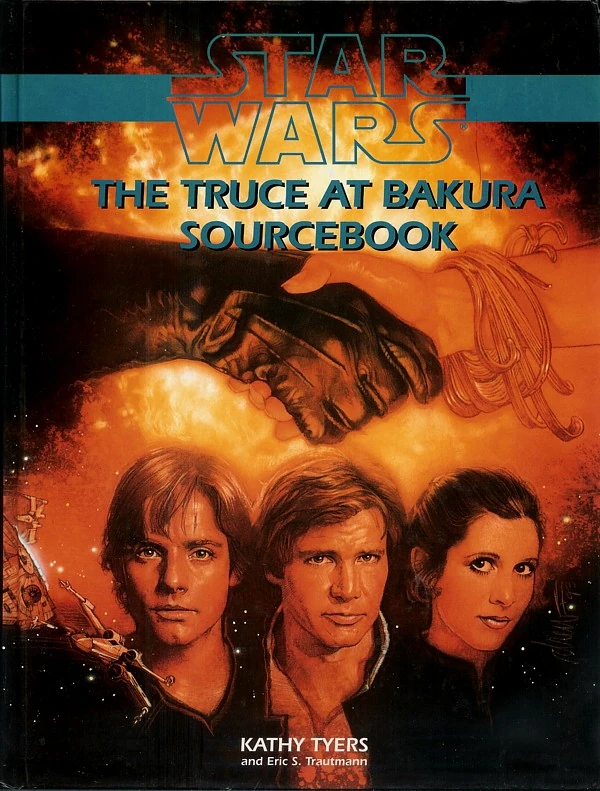
The Truce at Bakura Sourcebook
The Truce at Bakura Sourcebook
Credits
Design: Eric S. Trautmann and Kathy Tyers Development & Editing: Bill Smith Additional Editing: Paul Sudlow, Eric S. Trautmann Cover Design: Tim Bobko, Tom O'Neill Graphics: Stephen Crane, Tim Bobko, Richard Hawran, Tom O'Neill, Brian Schomburg Cover Illustration: Drew Struzan Interior Illustrations: Tim Bobko, Jordi Ensign, Ray Lederer, Tom O'Neill, Brian Schomburg, Christina Wald Special Thanks To: Michael Butkus; Doug Chiang; Andy Mangels; Troy Vigil; and, Lucy Autrey Wilson, Sue Rostoni and Allan Kausch of Lucasfilm Ltd. for their invaluable assistance.
Published by West End Games RR 3 Box 2345 Honesdale, PA 18431
Publisher: Daniel Scott Palter • Associate Publisher/Treasurer: Denise Palter • Associate Publisher: Richard Hawran • Senior Editor: Greg Farshtey • Editors: Peter Schweighofer, Bill Smith, George Strayton, Paul Sudlow, Eric Trautmann • Art Director: Stephen Crane • Graphic Artists: Tim Bobko, Thomas O'Neill, Brian Schomburg • Sales Manager: Jeff Kent • Licensing Manager: Ron Seiden • Warehouse Manager: Ed Hill • Accounting: Karen Bayly, Donna Highhouse, Wendy Lord • Billing: Amy Giacobbe
®, TM & © 1996 Lucasfilm Ltd. (LFL). All Rights Reserved. Trademarks of LFL used by West End Games under authorization.
First Printing: February 1996
Report to the Provisional Council of the Alliance of Free Planets
“Historian Na’al, it is the obligation of this council to notify you that this briefing is being recorded.” Mon Mothma faced the young man.
“I understand,” the young man nodded gravely. “I am aware of the sensitive nature of the information we will be discussing today, and I would like to take this opportunity to refer the council to my signed security oath on datapad page 2,348.283.” Voren Na’al took a moment to compose his thoughts as the council members confirmed his statement. Come on, the young historian thought. This is the big one. Try not to stammer incoherently.
“Gentlebeings,” he began, his voice only slightly betraying his nervousness, “the last few weeks have seen some unprecedented military activity, and at your request I have prepared a detailed report outlining the facts as we know them.
“As you may be aware, I usually obtain my information from interviews and personal observation, but in this instance it has not always been possible to do so. Alliance Intelligence has been most cooperative by providing unprecedented access to the information I needed to complete the report. Also, the assistance of General Rieekan’s staff has been invaluable in formulating an analysis of the tactical and strategic data, which is admittedly not my specialty.”
Na’al paused, weighing his words carefully. “In short, the events at Bakura — now known as the Bakura Incident — could have far reaching effects detrimental to the security of the Alliance and our planned formation of a new Republic.”
A flurry of murmurs broke out among the committee members, until Mon Mothma motioned for silence. “Mr. Na’al,” she said, “that is a vague and provocative statement. Please elaborate.”
“Quite simply,” Na’al stated evenly, “if word got out of exactly what the Ssi-ruuk are capable of, and of what they almost did to Commander Skywalker, the widespread panic could — and probably would — irreparably damage any alliances we attempt to make. It is probable that anyone we contact who has learned of the Ssi-ruuk will be convinced we are fighting a war on two fronts. Obviously, we will appear to be in a very precarious position, and as General Calrissian is so fond of pointing out, ‘It is bad form to back a losing hand.”
Pausing to take a deep breath, Na’al continued. “It is my recommendation that Alliance Intelligence bury the entire matter as deeply as possible. Containment is our only alternative, and as such, it should be given top priority by our Intelligence apparatus.”
“Nonsense,” the Bothan Borsk Fey'lya barked. “The Ssi-ruuk are a threat, but certainly not to the level you suggest. Our data indicates that the Ssi-ruuk will stay in their own corner of the galaxy. If they don’t, they have to fight us and the Empire.”
“I beg to differ,” Na’al countered, as if lecturing a particularly sharp pupil who had made a crucial and obvious error. “If the Emperor, who was by no means shy about demonstrating his power, kept the Ssi-ruuk a secret, we probably should as well. I doubt Imperial citizenry would have been thrilled overmuch about an alliance with such a potentially destructive force. I am sure that Alliance’s allies will be disturbed should they learn that the Ssi-ruuk are out there.” Did I really just snap at a council delegate? Maybe I am finally getting the hang of this, Na’al thought to himself, suppressing a smile.
“Furthermore,” Na’al continued, softening his tone somewhat, “if word leaked out about Ssi-ruuvi ‘entechment’ technology, every Imperial governor with designs on seizing power would probably make a grab for it. I’m sure the Ssi-ruuvi fleet could certainly thin Imperial ranks somewhat, but their relatively small fleet could never withstand the might of the Imperial Navy,” the young historian paused before concluding, “Ultimately, entechment technology would fall into the Empire’s hands. It is therefore vital for our survival to keep the Bakura Incident under a cloud of utmost secrecy. Now, if you will refer to datapad page 928,391.2, we can begin the main briefing ...”
The Truce at Bakura Sourcebook
This sourcebook is a companion to the novel The Truce at Bakura. If you have not yet read The Truce at Bakura, it is strongly recommended that you do so now.
Then, return to this volume to learn more about the characters, locations and events that make The Truce at Bakura such a memorable Star Wars novel. From the history of Bakura, to the histories and beliefs of characters such as Gaeriel Captison and Eppie Belden, to the Ssi-ruuvi homeworld, it is all covered in this volume. This sourcebook tells “the story behind the story.”
The Truce at Bakura Sourcebook is fully compatible with the second edition of the Star Wars roleplaying game.
Game Information
The Bakura Incident happens immediately after the Battle of Endor (depicted in Return of the Jedi). The Heroes of Yavin fought the battle of their lives at Endor. As a result, many of them have lower Force Point and Character Point totals than those listed in Galaxy Guide 5: Return of the Jedi — these characters were forced to spend many of their points just to survive and win this decisive battle.
Many of the characters introduced in this sourcebook have attribute die totals falling between the common benchmarks of 12D (for “average” characters) and 18D (for powerful individuals and player characters). This is intentional. Characters can improve their attributes — most of the characters in this range began as 12D characters. Likewise, characters beginning with 18D in attribute dice can also improve their attributes as described on page 14 of Star Wars, Second Edition.
Chapter One: The Aftermath of the Battle of Endor
Report to the Provisional Council of the Alliance of Free Planets. Prepared by Voren Na’al. All material contained herein is strictly classified.
It is necessary to discuss the disposition of Alliance forces prior to what is now classified as the “Bakura Incident” in order to get a clearer picture of the situation. The following report has been prepared from Alliance records, interviews, and captured data from Imperial sources.
The State of the War
It would be easy to believe that the war against Palpatine’s Empire has already been won. The destruction of the New Order’s second Death Star, the obliteration of the Super Star Destroyer Executor and the death of the Emperor and Lord Darth Vader all point to the victory of the Rebel Alliance.
In truth, this victory has brought on an even more pressing challenge. While the Rebel Alliance is making significant gains in the war against the Empire, the scattered Imperial remnants, relying upon an established network of supply, are quite capable of hampering the Alliance's efforts. As word of Palpatine’s death spreads, system after system is throwing off the Imperial yoke and openly joining the Alliance. To some extent, even success has further complicated the Alliance’s efforts; what was once a campaign of hit-and-run tactics and resistance warfare has become open battle with a numerically superior enemy.
The common perception is that the Alliance’s current momentum will carry it to Coruscant, the seat of Imperial power. While all of us would like to believe that such a sweeping victory is imminent, we also know that reality is seldom so convenient.
Many feel that the Alliance is destined to rule in the Empire’s place, that victory is inevitable — even that the Alliance’s victory has always been assured. It is difficult for those not present at the Battle of Endor to understand just how close the Alliance came to utter defeat.
The Emperor's Trap
The Emperor had allowed the Rebel Alliance to learn of the construction of the second Death Star, knowing full well that the Alliance would not sit idly by and let this devastating weapon become a tool of the Empire. An attack on the station was inevitable, particularly after it was learned that Palpatine himself would oversee the final stages of the Death Star’s construction.
The Rebel Alliance simply could not overlook this opportunity. Destroying the inoperative battle station and removing Palpatine in one decisive strike would make the galaxy at large sit up and take notice that the Empire was not all-powerful and could be defeated. Assembling the largest armada since the Alliance’s inception, General Calrissian and Admiral Ackbar led the attack against the ultimate symbol of the New Order’s oppression ...
... an attack that quickly turned into a rout when it became apparent that the Death Star was, in fact, operational. Trapped between the single greatest killing machine in the Empire’s arsenal and the might of Palpatine’s personal space fleet, utter defeat seemed inevitable.
The Darkest Hour
With no way to penetrate the battle station’s shielding, Calrissian and Ackbar turned the Alliance fleet against Palpatine’s armada. Reasoning that the Death Star would have difficulty targeting Rebel ships that were in close proximity to Imperial warships, a brawl ensued. Rebel ships placed themselves dangerously close to an enemy that they had always been ordered to avoid: Imperial Star Destroyers.
The Emperor had placed a series of Interdictor cruisers at the edge of the Endor system, and the gravity well created by the Death Star’s own mass made any attempt at jumping to hyperspace futile at best, fatal at worst. If the Rebels chose to flee, they would have to fight through the Interdictor battle line in an extended retreat: devastating casualties would be inflicted — but at least some of the fleet would survive. In theory.
Unless the battle station’s shield projector on Endor was disabled, the Death Star would remain impregnable, and the Alliance fleet would be crushed in one blow.
All hope was lost.
The Tide Turns
A contingent of Alliance commandoes, led by General Han Solo, Princess Leia Organa, Major Bren Derlin and Commander Luke Skywalker, had penetrated the defense grid around Endor prior to the Alliance fleet’s attack. Alliance commanders believed that a small force could slip through the cracks in the Imperial wall of security and disable the shield long enough for the Alliance fleet to dispatch the Death Star.
Once again demonstrating his thorough understanding of Rebel tactics, Palpatine had stationed a garrison on Endor to guard the command bunker. Manned by troops hand-picked by Palpatine himself, the Rebel attack on the garrison was short-lived, and at first, unsuccessful. The Rebel commandoes were quickly surrounded and captured, while Commander Skywalker was whisked away to face Emperor Palpatine and Darth Vader aboard the Death Star.
While the Alliance fleet faced disaster, the commando team on Endor faced imminent death.
A rescue attempt staged by the Ewoks — small, furry bipeds indigenous to the forest moon — allowed the commandoes to seize the initiative and push the Imperials back. With a brilliant battle plan that split and disoriented the Imperial forces, the Ewoks and Rebels used subterfuge to capture the command bunker and destroy the shield generator.
As the Rebels rounded up the last of the Imperial troops, the Alliance’s starfighters and cruisers pressed the attack on the Imperial fleet. With a concentrated assault, the Rebels destroyed the bridge of the Super Star Destroyer Executor. Vader’s personal flagship and the pride of the Imperial Navy was pulled in by the Death Star’s gravitational field and exploded against the space station’s surface. This event seemed to trigger a significant demoralization throughout the Imperial fleet — the accuracy of Imperial fire dropped off, and while the decrease was not substantial, it was at least noticeable.
Several TIEs from the Executor — on station with orders to protect the exposed sections of the Death Star — began to make crucial errors once their command ship (and source of coordination) had been destroyed. Several Alliance starfighters and the Millennium Falcon slipped through the battle station’s defense perimeter. Racing to the interior of the space station, the Falcon and Commander Wedge Antilles’ X-wing fired the shots that destroyed the space station’s reactor core.
Within minutes, the Death Star was destroyed and the tide of battle was irrevocably altered.
The Fighting Rages On
Contrary to popular opinion, the Imperial fleet did not simply surrender once the Death Star exploded. In fact, the Alliance accepted no Imperial surrender at Endor. Imperial soldiers are generally disciplined and experienced fighters, and the troops at Endor were the finest that Palpatine could field. Despite the battle’s sudden reversal in momentum, the fighting raged on for nearly four hours.
The immediate effect of Death Star II’s explosion was severe: ship-to-ship communications were almost completely disrupted. The Death Star possessed the main communications node for Imperial ships stationed in the Endor system. After the explosion, contact with the outside was lost along with the in-system HoloNet. In addition, the explosion itself caused considerable interference with both scanner systems and communications equipment. Imperial ships, accustomed to superior communications, were caught unprepared for the sudden reduction in communications range. Alliance troops, trained to operate under less than ideal conditions, pressed their assaults on various ships and the Imperials’ unified blockade action degenerated into a series of fierce single engagements.
After hours of fighting, Imperial morale was extremely low, and it is this loss of (for lack of a better term) fighting spirit that led to the Imperial retreat. The Rebel Alliance, after years of fighting a defensive campaign, had defeated a numerically superior force and landed a decisive blow against the New Order.
A Short Celebration
Still, the victory was costly. Casualty estimates for Alliance starfighter pilots in the battle exceeded 20 percent; shipboard casualties nearly matched that total. Of the surviving Alliance vessels, nearly 75 percent of them needed extensive repairs before returning to duty. Ackbar’s armada was now little more than a series of slow moving targets for an enemy that could conceivably regroup and press another attack at any time.
Estimating it would take roughly 20 to 48 hours for a sizeable Imperial force to regroup, repair their various vessels and plan an assault, Ackbar ordered immediate repair and salvage operations. While the main Imperial fleet was scattered throughout the galaxy, even a token force — a handful of Star Destroyers from the Endor fleet — could cause incredible damage to the vulnerable Alliance vessels. Hopefully, the fleet would be ready for any Imperial counter-attack, or at the least, be prepared for a full retreat.
The Kenobi Offensive and the Ackbar Refinement
Excerpt from Fleet Tactics and Combat Methodology by Ackbar of Calamari.
The history of the Kenobi Offensive is well known: the legendary Jedi Knight, General Obi-Wan Kenobi, had long ago developed a flexible attack plan designed for engagements between a small, maneuverable attacking force and a larger, better-armed blockading opponent.
The Kenobi Offensive plan calls for a series of sniping attacks to draw a portion of the larger force out of formation. Provided that the attacking force manages to keep away from the bulk of the defenders’ fire arcs (usually accomplished by repositioning ships almost constantly), it is usually possible to destroy at least one of the defending vessels. At this point attacking ships can flood through this gap in the defensive perimeter and begin attacking the blockade from inside. In theory, defending ships will have trouble firing at attackers due to the proximity of friendly ships — too many blasts inside their own defensive perimeter can lead to friendly fire damage.
While this is a simplistic explanation of the Kenobi Offensive, the basic theory is now common doctrine for the Rebel Alliance: draw your opponent out by moving where they least expect it, and attack them from within.
However, a new approach to this tactic may prove useful, particularly against the might of the Imperial Navy. The Imperials have superior coordination and communication between vessels and consequently operate in concert with greater ease than the Alliance fleet. A method of improving communication between Alliance vessels is necessary; since the Alliance is fighting a defensive campaign, coordinated attacks and retreats are increasing in importance.
By reducing the Imperials’ communications ability — possibly by flooding the immediate region of a combat zone with particle-emitting or radioactive material — the Rebel Alliance can remove this particular advantage from the Empire’s arsenal. Of course, if such an action is carried out, it will render communications on both sides inoperative. Obviously, removing communications from both sides of a military action would reduce a battle into a simple equation: whomever has the most firepower will win. Since the Rebel Alliance tends to have less firepower during these battles, this equation is unacceptable.
It is my contention that it is possible to flood a region with prefabricated particle-emitters (or, if necessary, pre-arrange the conditions of battle by engaging near a star, quasar or other such phenomenon) that will limit — but not eliminate — communications. Furthermore, I believe that by developing a system that will allow for more rapid communication between vessels during such a disruption, the Alliance can hold a slight advantage in larger scale engagements. As long as a system is in place to pass messages along the fleet line, communications will be slowed but not stopped. This system, if properly practiced, will allow an almost 20 to 50 percent speed advantage for ship-to-ship communications against an unprepared opponent; not a tremendous advantage, but a prepared force can often win a battle by making the most of any opportunity.
By assigning each vessel in the fleet a codeword, messages can be passed from ship to ship and reach their intended recipient, provided that each vessel stays within communications range of at least one other ship. By linking communications systems with battle computers aboard Alliance vessels, messages can be passed from ship to ship until command instructions reach the intended recipient. An appropriate analogy for the process would be that it is like skipping a stone along the surface of a body of water. The message is skipped from ship to ship, until it reaches the other side: the intended receiver.
Communications officers in the Alliance Fleet are already being trained in this system, and each ship’s communications computer has been programmed to assist the communications crew. No such system is currently in place in the Imperial Navy since the Empire has not had to deal with communications disruptions on a regular basis. It is believed that a momentary disruption in Imperial communications will allow more Rebel attacks to succeed. Deposition 9483749/12982 {Verbal}
Deposition transcribed from statements given by General Han Solo and Lieutenant Page. Deposition given to Mon Mothma and Admiral Ackbar.
Mon Mothma: General Solo, could you please elaborate on your report concerning the boarding action against the Star Destroyer Accuser? It is a trifle ... vague.
General Solo: Uh, well, there ain’t much to tell.
Admiral Ackbar: (Stifles cough.)
Mothma: You have something you wish to add, Admiral?
Ackbar: No, I do not. Except that, given General Solo’s reputation, his last statement is somewhat difficult to believe.
Mothma: Lieutenant Page, perhaps you could fill in some of the blanks in General Solo’s report. According to the good General, you and the commandoes temporarily under your command simply — and I quote — “boarded the enemy vessel and captured the bridge.”
Lieutenant Page: Yes, ma’am. That is what happened. General Solo and I led the boarding action.
Mothma: General Solo participated in the action?
Page: Er, yes. It was the General’s idea, actually.
Mothma: Naturally.
Solo: Thanks, kid.
Mothma: General, I would like to know why you chose to lead an unauthorized action like this. You know that I would not have approved.
Solo: That’s why I didn’t ask. Anyway, it seemed like a good idea. At least, it did at the time.
Mothma: No doubt. Continue, Lieutenant.
Page: Well, mop-up operations were still underway but most of the action was going on overhead. As planet-level unit leader, Major Derlin remained on Endor to supervise incoming ground forces; he placed me in temporary command of the commando force. First Mate Chewbacca and General Solo were doing some work on the shuttle we used to penetrate Endor’s security when we got word that there was still some trouble in orbit. The relief troops had managed to land, but General Solo seemed most ... eager ... to assist in the battle over the moon.
Solo: Well, not exactly eager. Y’see it was all Chewie’s idea.
Ackbar: It was First Mate Chewbacca’s idea to attempt a boarding action against an Imperial Star Destroyer that was carrying a full troop complement. An attack, I might add, that was to be carried out by one commando squad?
Solo: Ah, well, no. He just said we should use the Tydirium to get back to the fleet.
Mothma: And?
Solo: And, it occurred to me that he didn’t say which fleet. And we had all those spare stormtrooper uniforms and the security code that got us in, not to mention that bucket of a shuttle
Mothma: So you took it upon yourself to steal a Star Destroyer?
Solo: Well, er ... yes. I guess you could call it a general’s prerogative, if you want.
Mothma: Yes, we could, except that usually a general clears such an unorthodox maneuver with Admiral Ackbar, General Madine or myself.
Solo: Well, when the Death Star blew, it disrupted communications. We tried to alert you, but we couldn’t get through.
Mothma: (Sounds skeptical.) No doubt General Solo was literally grafted to the shuttle’s comm unit.
Ackbar: Lieutenant Page, how did you manage to fight your way to the bridge? This is not meant to denigrate the abilities of you and your men ... I realize that you and your men are exceptionally capable soldiers, and that ground combat is not my area of expertise ... but those kind of odds sound overwhelming.
Page: Well, actually, we didn’t fire a shot.
Ackbar: Preposterous. Surely you are exaggerating Lieutenant.
Page: No, sir. After all, we did have the proper Imperial clearance — the code that allowed us through the shield perimeter at Endor — and General Solo was quite convincing when he called the Accuser’s captain claiming we had just escaped from the Death Star. They certainly fell for it; they actually used their own docking tractor beams to bring us in.
Mothma: They brought you in?
Page: (Smiles slyly.) Yes ma’am. You could say they invited us aboard.
Ackbar: And how did you eliminate the crew?
Page: Er, General Solo actually managed it.
Mothma: Of course he did.
Page: Once we took the bridge ... and, swear all we did was just walk in ... he uh, relieved the Accuser’s captain.
Ackbar: Let me see if I’ve understood you correctly, Lieutenant. General Solo — posing as an Imperial officer aboard a Star Destroyer, marched you and your group to the bridge and assumed command?
Page: No, sir. General Solo was wearing an Imperial general’s uniform, not stormtrooper armor.
Mothma: (Chuckles softly.) A general. Naturally.
Solo: Hey, it fit, that’s all!
Ackbar: And how did you and your team manage to eliminate the Accuser’s crew?
Page: General Solo convinced them to leave.
Mothma: ... convinced them ...
Ackbar: ... to leave ...
Page: Well, uh, General Solo knocked the Destroyer’s captain unconscious while my people secured the rest of the bridge crew. Then the General activated the ship-wide hull breach alarm and ordered the crew to, er ...
Ackbar: To abandon ship.
Mothma: (Shakes head.) Amazing.
Solo: Oh, knock it off. It worked. DEPOSITION ENDS.
The Rebel Alliance had even been successful in capturing two Star Destroyers, the Adjudicator and the Accuser. The Accuser was still almost completely operational, but the engines and power systems of the Adjudicator were almost totally destroyed in the battle, and several Alliance heavy cruisers were relegated to towing the captured Imperial vessel to a friendly port.
Mop-up operations continued on the surface of Endor while off-duty Rebels had the chance to celebrate the victory with the native Ewoks. It was later learned that a small team of Rebel commandoes managed to avert disaster by destroying an Imperial communications center on the far side of the forest moon of Endor.³ The residual interference from the explosion of the second Death Star prevented the station from sending out a HoloNet distress signal that could have alerted the entire Imperial fleet — if that station hadn’t been destroyed, the Imperial counterattack on the Alliance could have been devastating.
As the jubilant Alliance forces patrolled the area around Endor, a series of minor probing attacks were launched against the sentry ships. Few Alliance ships were damaged, but a new threat loomed on the horizon: even a small Imperial battle group could wipe out the crippled Alliance armada. The Alliance fleet remained at full-alert status.
Approximately one hour after the first attack on Alliance sentry ships, Rebel starfighters were forced to repel an attack on the medical frigate Mercy by five Imperial spacetroopers who had been drifting among the wreckage of Imperial Star Destroyers. One A-wing was destroyed and one Y-wing was damaged in the skirmish. Rebel forces were then alerted to possible saboteurs and stowaways among the debris of Imperial ships. Ackbar was forced to prepare for a concerted attack by regrouped Imperial forces from outside his sentry lines, while contending with a series of random skirmishes from within. The next few hours were extremely tense.
As the repair operations neared the halfway mark, Alliance picket ships detected a series of Imperial system patrol craft in close proximity. No shots were exchanged, and it is widely believed that the patrol was attempting to feel out Alliance defensive measures and reporting to a nearby Imperial battle group.
At this point, Admiral Ackbar ordered a series of sensor drones placed throughout the Endor system and ordered sentry lines moved away from the bulk of the fleet. Ackbar felt that a starfighter engagement in the outer regions of the Endor system would delay enemy forces long enough to facilitate the escape of the rest of the fleet. Any starfighter pilots not actively patrolling the fleet’s perimeter were ordered to augment the already-overworked repair crews, and salvage operations proceeded around the clock.
Roughly two hours after the starfighters were redeployed, the Alliance sensor net detected the launch of a number of Imperial probe droids from an Imperial Star Destroyer (possibly the Unrepentant). The Star Destroyer jumped to hyperspace before it could be engaged. The appearance of a Star Destroyer confirmed (at least in Admiral Ackbar’s mind) that Imperial forces were in the area. Alliance starfighters swept the area clean of the Imperial reconnaissance units, though several starfighters were damaged by the probe droids’ weaponry.
A second wave of Imperial probe droids was launched against Ackbar’s fleet, and Rebel starfighters intercepted them. However, the Empire’s surveillance units were programmed to ram enemy ships when engaged, rather than scan the Alliance’s fleet deployment. Several fighters were destroyed by the modified droids and the Mon Calamari cruiser Reef Home was dispatched to mop up the remaining booby-trapped droids.
An Imperial system patrol ship (tentatively identified as the Daggerblade) was detected shortly after the second wave of probes was destroyed. The Corellian Corvette Old Republic intercepted the Imperial vessel and another minor battle ensued. The Old Republic, the more heavily armed of the two combatants, was defeated because the Daggerblade consistently outmaneuvered the Old Republic’s guns, giving the Daggerblade time to whittle away at the Old Republic’s defenses. The Daggerblade disabled the Old Republic’s drive and began destroying the Alliance’s outer-system sensor drones. After wiping out the majority of the Rebel sensor net, the Daggerblade disengaged. Rebel reinforcements arrived in time to watch the Old Republic explode. No survivors were recovered from the destroyed Corvette.
Admiral Ackbar dispatched Rogue Squadron to assist Alliance forces in reestablishing the sensor perimeter. It was during this action that the Rebel fleet first detected an archaic piece of technology: an old-style message drone emerged from hyperspace on the edge of the Endor system.
Commander Wedge Antilles,⁵ leader of Rogue Squadron, attempted to release the message codes in the drone. Antilles was initially unsuccessful at retrieving the data aboard the unit; instead, the pilot accidentally tripped off the drone’s self-destruct mechanism.
This was the first of the series of events that is now classified as the Bakura Incident.
Deposition 87638/37
Deposition Given by Major Breslin Drake, Alliance Intelligence
On many occasions, the Rebel Alliance has relied on — to be blunt — blind luck to accomplish its goals. Witness the Alliance’s near-destruction at both Yavin and Hoth; unmitigated disasters to be sure, but the fact that the Alliance survived both attacks shows just how lucky the Alliance has been.
Alliance Intelligence has since captured Imperial data pertaining to the aftermath of the battle at Endor, concerning the state of the Imperial chain of command after the destruction of the Death Star.
It is probable that the second Death Star and the Super Star Destroyer Executor served as a unified system-command. Considering the remoteness of the Endor system, the Death Star, the Executor and the Emperor’s personal fleet were the only significant Imperial forces within light-years. The nearest Imperial sector capital (and the next logical link in the chain of command) was Cannij Barr, Annaj system — a system nearly two days’ Class One hyperdrive travel distant.
Apparently, the Unrepentant’s captain was acting on his own and attempting to ascertain the Rebels’ strength and position to report to Imperial forces at Cannij Barr. This supposition is confirmed simply by the presence of an Imperial Star Destroyer engaging in so-called hit-and-fade tactics; Imperial military doctrine simply does not allow for such maneuvers and the fact that the Unrepentant attempted such an action is indicative of the confused state of the Imperial command hierarchy. In fact, the action was potentially risky to the career of the Unrepentant’s commanding officer.
The Unrepentant’s probe droids were ultimately unsuccessful in scanning the deployment of the Alliance starfleet. Only a minimal number of probe droids managed to transmit any data back to the enemy battle group regrouping at Cannij Barr. The information that did make it to the Imperials was minimal and contradictory, and I believe that this lack of hard intelligence concerning Alliance fleet deployment, coupled with the absence of a coordinating sector authority, is directly responsible for a significant delay in the Imperials’ planned retaliation. Imperial caution actually allowed the Alliance fleet to hold Endor and reinforce forces in other systems. The Alliance had somehow gained a foothold. The Force was indeed with us. DEPOSITION ENDS.
- The Truce at Bakura (paperback, December 1994), page 16.
- Dark Empire Sourcebook, pages 93-94.
- Galaxy Guide 5: Return of the Jedi, Second Edition, pages 79-94.
- The Reef Home is named after the famous Mon Cal city. Champions of the Force, pages 108-109.
- Wedge was promoted to the rank of commander upon taking command of Rogue Squadron. Galaxy Guide 5: Return of the Jedi, Second Edition, page 40.
Chapter Two: The Bakura Incident
Report to the Provisional Council of the Alliance of Free Planets. Prepared by Voren Na'al. All material contained herein is strictly classified.
The Bakura Incident is an event of great importance both to the Rebel Alliance and also to all citizens remaining under Imperial rule. A summary of these events is in order.
Rescue Attempt
Commander Wedge Antilles, leader of the now-famous Rogue Squadron, was the first Alliance member to come in contact with the Imperial message drone. Antilles attempted to release the drone’s message codes, but unfortunately, the pilot triggered the drone’s self-destruct mechanism.
“The self-destruct mechanism was extremely old,” reported Antilles, “although it was common on drones of this type. It contains two electrite crystal leads separated by a simple, high-tension spring mechanism. If the device is tampered with, the security system triggers the spring and slams the two crystals together and ‘poof!’ The resulting energy spike detonates the main fusion engine.”
“Plus,” Antilles added, “if it senses a vessel nearby that does not transmit proper Imperial recognition codes within five minutes of sensor contact, the self-destruct cycle activates. Luckily for me, it takes about three minutes for the timer on the mechanism to run out. That gave me time to try and disable the mechanism — either that, or risk having the explosion destroy one of our heavy transports before it could leave the area.”
Antilles, familiar with the design of the self-destruct mechanism, exited his X-wing and blocked the connection of the electrite crystals — with his hand. Trapped outside of his X-wing, with a dwindling air supply, time was running out for the young pilot.
IMPERIAL GOVERNOR WILEK NEREUS OF THE BAKURA SYSTEM, TO HIS MOST EXCELLENT IMPERIAL MASTER PALPATINE: GREETINGS IN HASTE.
BAKURA IS UNDER ATTACK BY AN ALIEN INVASION FORCE FROM OUTSIDE YOUR DOMAIN. ESTIMATE FIVE CRUISERS, SEVERAL DOZEN SUPPORT SHIPS, OVER 1000 SMALL FIGHTERS. UNKNOWN TECHNOLOGY. WE HAVE LOST HALF OUR DEFENSE FORCE AND ALL OUTER SYSTEM DEFENSE OUTPOSTS. HOLONET TRANSMISSIONS TO IMPERIAL CENTER AND DEATH STAR TVX/O HAVE GONE UNANSWERED. URGENT, REPEAT URGENT, SEND STORMTROOPERS.
Commander Luke Skywalker, still suffering from the wounds the Emperor had inflicted upon him, immediately boarded his X-wing and set out to help Commander Antilles. Using his Jedi abilities, Skywalker was able to cut Wedge free of the crystals and prevent the drone’s fusion reactors from overloading. Commander Antilles suffered only minor injuries.
The Distress Call
The frantic message from Bakura’s Imperial Governor sparked a great deal of interest in Alliance circles. Bakura was an extremely remote world with a small but efficient repulsorlift engine production industry. The Empire had annexed it nearly four years ago.
If the Alliance could assist an Imperial holding in an emergency, it would be an important demonstration of the Alliance’s true intentions. Since the Rebellion’s earliest days, Palpatine’s intelligence forces had engaged in an extensive disinformation campaign to discredit the Alliance’s activities. Assisting the Bakurans would show that the Alliance was more than “an interstellar band of thieves and murderers” (as was often suggested by Imperial propaganda.)
Commander Luke Skywalker convinced the Alliance’s leaders to allow him to lead the military contingent to Bakura. Skywalker stated that Obi-Wan Kenobi’s “spirit form” (for lack of a better term) suggested that the young Jedi lead the assault force. Princess Leia Organa would head the diplomatic mission, accompanied by General Han Solo, First Mate Chewbacca and the droids designated Artoo-Detoo and See-Threepio. Skywalker would oversee the Alliance’s campaign against the unknown invaders, and Organa would supervise the negotiations between Bakuran, Imperial and Alliance forces. The Alliance scrambled the few ships that could be spared and the Bakura task force made the jump to hyperspace.
A Warm Reception
The Rebel strike force consisted of five Corellian Gunships, a single Corellian Corvette, the modified freighter Millennium Falcon, and the small cruiser-carrier Flurry, which served as Commander Skywalker’s flagship for the mission. The Flurry carried a small fighter force: 20 X-wings, three A-wings and four B-wings.
As soon as the task force dropped out of hyperspace, the situation at Bakura became instantly apparent; a battle raged between the unknown alien invaders and the limited Imperial forces. Commander Skywalker immediately informed the Imperials of the Alliance’s intention to assist them in fighting off the invaders.
The weakening Imperial battle group, under the authority of Imperial Navy Commander Pter Thanas, accepted the offer of help. While Alliance warships prepared to make a micro-jump into the Bakura system to break the alien blockade, General Solo, responsible for Princess Leia’s transportation and safety, moved the Millennium Falcon out of the immediate combat zone.
General Solo proceeded to the sixth planet in the Bakura system; the small, ice-covered world had little importance, but it would serve as a safe hiding spot. The Falcon discovered that the planet’s small Imperial military outpost had been destroyed, presumably by the alien invaders (referred to by the Imperials as the “Ssi-ruuk.”)
Unable to land on the icy surface of the planet (because the Falcon would become mired in the thick ice), General Solo moved the Millennium Falcon into orbit.
The First Battle
While orbiting Planet Six, See-Threepio noticed a low-power signal emanating from somewhere in the immediate vicinity. The signal appeared to be a low-level command code for remote droids — nine alien battle droids that appeared shortly thereafter and attacked the Falcon.
The Ssi-ruuk choose not to fight space battles with conventional starfighters; rather, the bulk of their attack force is comprised of small, but highly maneuverable battle droids. These units are roughly two meters on a side, with heavy shielding. (After their shields are disabled, these small craft are quite vulnerable to enemy fire.)
Fighting off the first wave of attacking battle drones, the Millennium Falcon rejoined the Flurry and assisted in the battle with the Ssi-ruuvi fleet. The timely arrival of the Rebel ships prevented the Ssi-ruuk from launching a full assault on Bakura’s surface. During the skirmish, Luke Skywalker first felt and contacted the life presences trapped inside the Ssi-ruuvi battle droids ... and began to get an understanding of the diabolical nature of the alien invaders.
After fierce fighting, the Ssi-ruuvi battle force withdrew to just outside the Bakura system and a brief meeting between Alliance and Imperial leaders was arranged on the surface of Bakura.
The First Meeting
Upon landing at the Bakuran capital of Salis D’aar, Princess Leia and her delegation were greeted by Imperial Governor Wilek Nereus. Informing the Imperials that not only would Imperial aid not be forthcoming, but that the Emperor was dead at the hands of Darth Vader, Nereus agreed ... tentatively ... to hear the Alliance delegation out.
The Ssi-ruuk
The mysterious alien invaders had been in contact with the Emperor for several years, although they were unknown to the Bakurans, the forces of the Rebel Alliance ... and perhaps even all Imperials save the Emperor himself. While the Bakurans had taken to calling the aliens “Fluties” (after their tweeting, song-like speech), the aliens are formally known as the Ssi-ruuk.
The following terms are used:
-
Ssi-ruuk refers to the aliens themselves.
-
The term Ssi-ruuvi is used whenever referring to a possession or possessions of the Ssi-ruuk. For example, the Ssi-ruuvi fleet, or Ssi-ruuvi battle droids.
-
Ssi-ruu is used whenever one refers to a single alien: “The Ssi-ruu advanced on the soldier.” Ssi-ruu’s is used whenever referring to something possessed by that single alien. For example, the Ssi-ruu’s tail.
Addressing the Bakuran Senate as well as their Imperial overseers, the Heroes of Yavin were given their first glimpse of the attacking aliens. The Bakurans produced a holographic recording of their initial contact with the Ssi-ruuk, a saurian species. A young human male, Dev Sibwarra (an apparent servant of the Ssi-ruuk) announced that the Bakurans’ life energy would be used to power the odd battle droids that had attacked the Imperial and Alliance vessels.
Princess Leia offered Alliance assistance to the Imperials and Bakurans in exchange for a truce. A brief period of discussion followed the suggestion, during which the Alliance forces were allowed to review data on the Ssi-ruuvi forces. Commander Skywalker, at Commander Thanas’ invitation, even went so far as to enter the local Imperial garrison in order to examine the records of the Dominant, a Carrack-class cruiser that was the most powerful Imperial vessel stationed in the Bakura system.
The Truce At Bakura
Invited by Bakuran Prime Minister Yeorg Captison to a dinner at his opulent home, the Alliance delegation was surprised to learn of the other guest: Imperial Governor Wilek Nereus. Prime Minister Captison wanted the two opposing sides to talk away from the bustle and political posturing of the Bakuran Senate floor and arranged a meeting on neutral ground.
During the extravagant dinner, Governor Nereus received an urgent message from Imperial Admiral Prittick confirming the death of the Emperor and the unlikelihood of any Imperial reinforcements.
Faced with the prospect of fighting off the Ssi-ruuk without assistance from his Imperial masters, Governor Nereus immediately agreed to an official truce with the Rebel Alliance. Now both opposing sides — Rebels and Imperials — were united by a common goal: survival.
Uneasy Alliance
Despite Governor Nereus’ assurances that the truce would be honored by Imperial forces, he made it quite clear that he did not welcome the Alliance’s presence. During this dinner, Nereus issued Princess Organa a dire warning: any Rebel who “... tries to talk Bakurans into sedition — publicly or privately — will be arrested and expelled.”
It was during the Alliance delegation’s first night on Bakura that Commander Skywalker was contacted by Dev Sibwarra — contact apparently initiated through the Force. “During the night, I was awakened by ... something. I initially believed I had been dreaming that someone was calling out to me, warning me that the Ssi-ruuk wanted to capture me,” Skywalker reported. “I calmed myself, trying to look at this warning more objectively. Through the Force, I saw a possible future, a future that showed the Ssi-ruuvi Imperium stretching all the way to the Core Worlds. Obviously, the situation at Bakura was more than a minor skirmish. This conflict threatened to explode into something far more important ... and far more deadly.”
Tension Mounts
Shortly after his vision, Commander Skywalker was contacted by Salis D’aar Spaceport Authority, who informed the Commander that there was some sort of disturbance involving Rebel troops. Accompanied by First Mate Chewbacca, Skywalker raced to the spaceport to defuse the situation.
At Pad 12, the area of Salis D’aar Spaceport then reserved for Alliance use, a dozen Bakuran citizens had cornered a pair of “Ssi-ruuk invaders.” The Bakurans had been firing at the two hidden figures — and the so-called invaders had fired back, killing two of the aggressive Bakurans.
Commander Skywalker moved to stop these apparently hostile invaders, discovering that they were, in fact, Mon Calamari pilots from his own task force. This was a prime example of anti-alien bigotry harbored by some Bakurans; one of the Bakuran attackers indicated that aliens, whether they were Ssi-ruuk or not, were unwelcome on Bakura. Luke soon discovered that the hard-nosed Bakurans who fired on the Mon Calamari were encouraged by Governor Nereus to spark the conflict.
“It is understandable that the Bakurans were suspicious,” Skywalker said. “At that point of their history, the greatest threat they had ever faced — including the Empire — was of alien origin. It is human nature to distrust the unknown. Rather than experience the joy of discovery, many people tend to stumble blindly in a cloud of suspicion.”
The Calm Before The Storm
The following morning, while Princess Leia made official apologies to the Bakuran Senate for the incident at the spaceport, Luke tried to speak to Senator Orn Belden. One of the Senators Commander Skywalker had “scanned” with the Force, Orn was one of many Bakurans with misgivings about the Empire and Governor Nereus. Commander Skywalker hoped that Senator Belden would be able to help him prove his suspicions concerning the Governor’s involvement with the incident at the spaceport.
Senator Belden was absent, although Commander Skywalker had (in his words) “an interesting visit nonetheless.” Senator Gaeriel Captison, a friend of the Belden family, was present at the Beldens’ home. Commander Skywalker also met Eppie Belden, Orn Belden’s wife, who was apparently suffering from a mental illness.
Commander Skywalker used a Jedi ability to sense the source of Madam Belden’s illness and learned that some links connecting her mind to her senses had been deliberately disconnected — in all probability, this had been done by Imperial operatives. Luke mentally trained the injured woman how to at least partially repair the damage.
During this time, Princess Leia and Prime Minister Captison — accompanied by Artoo-Detoo and See-Threepio — attempted to translate the Ssi-ruuvi language from the alien transmissions intercepted by the Bakurans. While Threepio was initially unsuccessful, Artoo demonstrated his ability to duplicate the tones and sounds of the language almost exactly.
The Storm Clouds Gather
Later that afternoon, Gaeriel Captison visited Commander Skywalker in his quarters to warn him of impending danger. Some of the Bakurans who were less than trusting of Governor Nereus had planted a monitor on his communications. Gaeriel, allied somewhat with this faction (though certainly not openly), learned from one of her aides of a transmission that Dev Sibwarra had made to Nereus. Dev asked the Imperials to turn Skywalker over to the Ssi-ruuk in exchange for a cessation of attacks on Bakura. Apparently the Ssi-ruuk needed the Commander’s Jedi abilities for certain experiments, though Sibwarra did not elaborate on the nature of these cryptic experiments.
According to the available evidence, Governor Nereus was cold, callous, cruel and ambitious — just the type of person to expect the Ssi-ruuk to deceive him. If the Ssi-ruuk needed Skywalker, then the Governor would not simply hand the Jedi over to them, particularly given the fact that Skywalker’s abilities could potentially be turned against Imperial troops and citizenry.
Instead, the Governor stacked the sabacc deck in his favor; ostensibly agreeing to Sibwarra’s proposal, Nereus covertly moved against Skywalker. If the Ssi-ruuk captured Skywalker, they would leave Bakura. If Skywalker died in Ssi-ruuvi custody, then the saurians could not use his Jedi abilities against Bakura. Governor Nereus set his plan into motion immediately — even before Gaeriel warned Commander Skywalker.
The following day, Princess Leia met with Senator Belden and Prime Minister Captison for an airspeeder cruise over Salis D’aar. Since the Imperial Intelligence forces undoubtedly present on Bakura could monitor conversations, the two Bakuran politicians used a disruption bubble-generator to block listening devices. While necessary, this device was risky to use; Nereus would consider its operation an act of sedition, an altogether appropriate assumption given the topic of conversation being carried on inside the airspeeder. If the Governor’s Intelligence operatives discovered this device, the Senators’ lives would be forfeit.
Under the cover of the disruption bubble-generator, Prime Minister Captison and Senator Belden admitted to Princess Leia that they (and others) cautiously supported the Alliance. Several Bakuran Senators were unhappy with Imperial taxation, off-world rule, and the loss of the most promising of Bakura’s youth to Imperial service.
Despite their precautions, however, Imperial patrol speeders noticed the lack of sensor signals returned from the Senators’ airspeeder and began pursuit. The Senators’ airspeeder was forced to land, and Leia emerged from the speeder firing her small blaster pistol at the Imperial stormtroopers sent to arrest the group. In a last ditch effort, Leia managed to attack Governor Nereus, knocking him to the ground before stormtrooper fire stunned her into unconsciousness.
The Storm Breaks
Throughout the day, See-Threepio and Artoo-Detoo continued to study the Ssi-ruuvi language. Threepio eventually managed to interpret the whistle-flute-like language of the invading aliens. Reviewing Ssi-ruuvi transmissions that had been intercepted by the Bakurans, Threepio learned exactly when the Ssi-ruuk planned to abduct Commander Skywalker — and that they planned to launch a surprise attack on Bakura only an hour later.
Meanwhile, General Solo — having just dropped Luke off at the spaceport — was shocked by an Imperial broadcast describing the arrests of Prime Minister Captison, Senator Belden and Princess Leia for suspicion of treason. Nereus planned to impose martial law.
Racing back to their temporary quarters, Solo learned from See-Threepio that the Princess had been taken to a rural retreat — a small installation that Nereus had commandeered for his own use shortly after his arrival on Bakura — and that the Ssi-ruuk planned to attack.
Tearing the master control chip from a nearby repulsor couch, General Solo had Threepio rewrite an Imperial master override code onto it — a highly risky and illegal move. However, since Bakura has no droid security precautions (since droids are banned on the planet), Threepio had no problems writing the override, which circumvented most planetary security systems. Subduing two Imperial stormtroopers, Solo removed Threepio’s Bakuran-installed restraining bolt, dressed the protocol droid in a set of stormtrooper armor, and ordered him to steal a landspeeder and head to the Millennium Falcon to warn Commander Skywalker.
Meanwhile, Bakuran civilians were beginning to actively demonstrate against the arrest of their Prime Minister and the death of a beloved Senator; small conflicts were erupting across the city. While Threepio headed towards the spaceport, Solo stole an airspeeder and headed for Nereus’ mountain retreat.
Simultaneously, Commander Skywalker arrived at the Pad 12 cantina, waiting for an Alliance shuttle that would return him to the Flurry. Threepio, using a comlink that Solo had given him, managed to make contact with the Jedi, warning him of the impending abduction attempt and the attack that would follow it. The harried protocol droid also explained about General Solo’s impending — if reckless — rescue attempt. Skywalker made some arrangements with his X-wing squadrons to assist Solo.
Solo, crashing his commandeered airspeeder as a diversion, entered Nereus’ compound and assisted Princess Leia in her escape (which she claims was already well underway when General Solo arrived).
While Solo raced to rescue Princess Leia, Threepio raced to the Millennium Falcon to warn Chewbacca. Unfortunately, Chewbacca saw only the stormtrooper armor and fired on the hapless droid within. Fortunately, Threepio only suffered minor damage, although he claims that he will “never forgive that impertinent Wookiee.”
Gaeriel Captison, visiting the Beldens’ home, was surprised to find that Eppie Belden was awake and lucid. Eppie learned that her husband Orn had died in Imperial custody, and she eagerly returned to her radical ways. Using the local Imperial computer network and her underground connections, Eppie was arranging anti-Imperial demonstrations across Salis D’aar — demonstrations that were increasing in size and ferocity.
Bakura was threatening to tear itself apart even as the threat of invasion loomed ever-closer. Madam Belden gave Gaeriel a computer chip that allowed the user to access stormtrooper communications frequencies. Gaeriel and Aari Covitenn (one of her aides, as well as a noted technician and long-time associate of the Captison family) used the device to send a series of fake emergency calls to Imperial forces all over the city, drawing stormtroopers away from the demonstrations. Captison then destroyed the chip and made her way to Salis D’aar Spaceport in order to find Commander Skywalker and warn him of the impending attack.
Within minutes of meeting the young Jedi in the cantina, the Ssi-ruuk abduction party arrived.
The Abduction Of Luke Skywalker
Three Ssi-ruuk invaders, Dev Sibwarra, and a quartet of Imperial stormtroopers moved to capture Captison and Skywalker. Sibwarra, speaking for the Ssi-ruuk, asked Luke to submit willingly.
“Dev was a dupe in these events,” Skywalker explained. “He was strong in the Force, but twisted, brainwashed. He had been altered so thoroughly that his thoughts and emotions were no longer his own. In fact, I had hoped to heal his mind and train him.”
Commander Skywalker initially refused Dev’s offer, fighting to protect Gaeriel, who had been stunned in the initial exchange. Commander Skywalker battled the aliens and stormtrooper escorts alike, disabling the troopers, and killing one Ssi-ruu and wounding another. During the battle, Luke used his Jedi abilities to release the mind of Sibwarra, who — realizing the magnitude of the situation — agreed to assist Skywalker (a simple matter, since Dev and Luke could communicate in Basic, a language which the Ssi-ruuk do not speak). Commander Skywalker, taken by surprise and rendered unconscious by a blow from a Ssi-ruu’s tail, was taken to a waiting Imperial Lambda-class shuttle under Ssi-ruuvi control.
Meanwhile, Han and Leia completed their escape. As they fled the retreat in yet another stolen airspeeder — pursued by five faster Imperial military speeders — the backup that Commander Skywalker had arranged arrived. Lieutenant Gayla Riemann, an X-wing pilot of some distinction, scared off the Imperial pursuit with a close fly-by; Solo and Organa returned to Salis D’aar and boarded the Millennium Falcon, much to the relief of Chewbacca and See-Threepio.
Nereus’ Gambit
After the paralyzing effects of the Ssi-ruuvi weaponry had faded, Gaeriel Captison was invited to meet with Governor Nereus. For many weeks, the Governor had subtly moved to ally Gaeriel with his government. Gaeriel has also admitted that Nereus’ attentions may have occasionally been much more personal in nature.
Deciding to play along with the Governor until she could learn what he had planned for the Alliance and her own people, Gaeriel accepted the invitation.
During the meeting, Nereus discussed his personal hobby: alien dentition. Governor Nereus proudly displayed the teeth of many predatory species he had hunted — including several sentient species. Nereus also spoke of his other hobby: parasitology. Nereus revealed that it was a parasite that damaged Eppie Belden’s mind — a creature that the governor personally implanted. Nereus also explained that he had managed to infect Commander Skywalker with a particularly vicious parasite that would kill the Jedi and, with luck, infect and destroy the Ssi-ruuk as well.
The Second Battle Begins
The Ssi-ruuk launched a full-fledged assault on Bakura while Elder Sh’tk’ith — a Ssi-ruu with exceptional hypnotic abilities, and the creature responsible for Dev’s brainwashing — led the attempt to kidnap Luke Skywalker. As the forces of the Ssi-ruuk pounded the Bakuran defensive positions the shuttle carrying the unconscious Commander Skywalker made its way inconspicuously to the Shriwirr, the main Ssi-ruuvi battle cruiser.
Dev, pretending to be under the control of the Ssi-ruuk, unsuccessfully attempted to use his limited Force skills to wake Commander Skywalker. Skywalker ignored Dev’s awkward attempts at Force manipulation, concentrating on repairing his own injured body.
Sibwarra was terrified, fearing that the Ssi-ruuvi would force Skywalker to use his Force powers to entech humans from great — possibly even interstellar — distances. Dev was determined not to allow the experiment to take place.
Boarding the alien command ship, Elder Sh’tk’ith revealed that the aliens knew all along that Dev planned treachery. They moved to entech the youth. Acting as soon as he knew he had been caught, Dev leapt forward, intending to kill Commander Skywalker before the Ssi-ruuk could enslave him and use him against others.
At this moment, Commander Skywalker — who had been feigning unconsciousness — acted.
Quiet Healing
Luke’s head hurt ... there in the back, where that big Ssi-ruu had whacked him with its tail. He focused first on the pain, which snapped off, nonexistent.
Next, his shoulders tugged oddly. He wore wristbinders ... but they wouldn’t hold him once he chose to remove them, and for now, he could ignore the tugging sensation. His body had been propped upright on a seat, held by something across his chest that felt like a flight harness. Under his feet, a deck thrummed. Dev’s presence came through in the Force, sitting close by.
Shipboard, then. The Ssi-ruuk were ferrying him to their fleet. He’d been warned: they must not take him.
But they had.
So he faced the crisis that would end this Bakuran conflict. He must be fully refreshed, ready to parley or fight. The Ssi-ruuk had no idea of his abilities.
And Dev must not learn — yet — that he had regained consciousness. Luke created a zone of emptiness and withdrew his mind behind it, tested it (he sensed no life from outside), and then thought hard. He’d dropped his lightsaber back at the Bakuran cantina. If his alien captors had stolen it, he must steal it back before doing anything else. He must be ready to seek peace rather than conflict, though, to pity rather than hate... and he must — must — keep Dev from falling back under the aliens’ compulsion. He wanted Dev for an apprentice. Dev’s heart was good; he wanted to serve humbly, a thoroughly noble attitude. He’d just been drawn to serve an ignoble cause. Luke couldn’t wait to start showing him the Jedi way.
Luke’s head no longer ached, but he sensed swelling inside his skull. Any sudden motion might aggravate it. He focused healing energy onto several blood vessels that drained the swollen tissue.
He would be ready.
Jedi’s Breakout
While the Ssi-ruuk prepared to entech Luke, the Jedi captured the mind of a P’w’eck (a weak-willed servant species long ago enslaved by the Ssi-ruuk.) Luke forced the alien to deactivate the entechment chamber’s illumination system. Casting out through the Force, the Commander regained his lightsaber and fought off his would-be captors.
Commander Skywalker and Dev Sibwarra immediately moved towards the engineering section of the Shriwirr in hopes of disabling the vessel and calling off the battle that was raging above Bakura. Skywalker fought off a number of P’w’ecks and unusual Ssi-ruuvi security droids powered by captured human life-energy. During these skirmishes, Luke mastered the ability to communicate with the vestiges of consciousness left in the enteched circuits. While the Jedi could not save the lives trapped in the alien machinery, he could grant them release.
Using this strange form of communication to circumvent Ssi-ruuvi security measures, Dev and Luke eventually reached the engineering section of the massive alien cruiser. Luke disabled the controls between engineering and the bridge, giving control of the Shriwirr to Luke.
The Ssi-ruuk, terrified of Luke’s Force abilities, evacuated the Shriwirr rather than risk death at the Jedi’s hands. (The Ssi-ruuk believe that dying anywhere but a consecrated world dooms their souls to wander the galaxy eternally.)
As the Ssi-ruuk fled their ship, Skywalker faced down an ambush in engineering, fighting several P’w’ecks and the large blue-scaled Ssi-ruu known as Elder Sh’tk’ith. Faking an injury to lull the Ssi-ruu Elder into ignoring him, Dev managed to kill his former slave-lord, while Skywalker defeated the P’w’ecks. Sibwarra and Skywalker made their way to the Shriwirr’s bridge.
Tension Mounts
Commander Pter Thanas’ strategies had served the Alliance and Imperial forces well; while the battle was costly on all sides, it appeared that the combined forces would emerge victorious. As Ssi-ruuvi escape pods blasted from the Shriwirr, the Imperials, following Governor Nereus’ orders, opened fire on the now defenseless Ssi-ruuk. This action prompted fierce protest from Princess Leia.
Governor Nereus also ordered the destruction of the Shriwirr. Thanas stated that he had been told there was a serious contamination risk and moved to carry out his orders. Fortunately for the Alliance, Thanas was unable to implement his orders; the Dominant’s lateral thrusters were damaged in the battle and the large ship could not immediately bring its weapons to bear on the drifting Ssi-ruuvi hulk.
Meanwhile, Ssi-ruuvi ships, cut off from their command ship, began a disorderly retreat. General Solo wisely ordered Alliance ships to immediately move away from any nearby Imperial vessels. As soon as the Ssi-ruuk began to withdraw, Nereus ordered the Imperial vessels to destroy any Alliance vessels in the region.
The truce at Bakura was effectively over.
The Last Battle
The battle with the Ssi-ruuk had ended, and now Alliance forces, weakened from the fighting, were forced to battle the Empire. The opening salvo from the Dominant destroyed the cruiser-carrier Flurry: all hands were lost. Rebel forces fought furiously, but Commander Thanas managed to perform a flawless englobement maneuver, tightening his forces around the Rebel ships.
General Solo, planning a last desperate act, remembered a game he had played in his youth: carom. Solo planned to ram Digit/Bakura V, an Imperial patrol craft that was drifting after an experimental weapon malfunction rendered the ship inoperative. By smashing into the small patrol craft at a precise vector, Solo planned to carom the vessel directly into the Dominant’s main reactor and hopefully destroy the Carrack-cruiser. Solo hoped to create a breach in the Imperial globe that would allow the surviving Rebel ships to break free and make their way back to the main Alliance fleet. Unfortunately, this maneuver would destroy the Millennium Falcon, and kill everyone aboard.
Commander Skywalker, touching the minds of his friends through the Force, realized what the Falcon was about to do. Moving quickly, the young Jedi touched Commander Thanas’ mind, “convincing” the Imperial officer to move the Dominant out of offensive formation. The action aggravated already-serious damage to the vessel's sublight drives, rendering them inoperative.
As the Dominant shifted position, General Solo aborted the ramming maneuver. Ordering Alliance ships to escape through the gap, General Solo regrouped his forces and pressed a renewed assault on the enemy. Meanwhile, the Dominant pressed its attack against the Shriwirr.
Aboard the Shriwirr, the effects of the parasites infesting Skywalker’s body began to limit the Jedi’s actions. For most of his battle aboard the Shriwirr, Luke had experienced a raspy cough. Skywalker believed, incorrectly, that the bronchial irritation was the result of something in the Shriwirr’s air system. Unfortunately, the Jedi was too involved in the battle outside to take time to examine his own health. The parasites — Olabrian trichoids — were rapidly burrowing towards his heart.
Skywalker, tempted to lash out in anger at Thanas and his forces, managed to regain control of his emotions. Luke felt betrayed. “I trusted Thanas, and to see him fire on our ships was extremely ... frustrating.” Activating the Shriwirr’s weapons systems, Luke managed to destroy one of the three remaining Ssi-ruuvi picket ships, forcing the other two to retreat. Even wounded and running out of time, Skywalker managed to affect the outcome of the battle.
Suddenly, Master Firwirrung, the chief entechment specialist in the Ssi-ruuvi task force, burst onto the bridge. Commander Skywalker was forced to contend with three P’w’ecks that the Ssi-ruu had brought as reinforcements, while Firwirrung shot and severely wounded Dev.
After dispatching the P’w’ecks, the Jedi Knight turned to face Firwirrung ... and the Shriwirr’s bridge was rocked with blaster fire from the Dominant.
End Game
As Imperial and Alliance forces battled above, Governor Nereus made preparations to ensure his ruling position on Bakura would not be jeopardized. Realizing that if the Alliance won the battle he would in all probability be removed from office, Nereus issued an ultimatum to Gaeriel and Yeorg Captison: either endorse Nereus as the Prime Minister’s successor, or Nereus would execute Yeorg on the spot. Rather than submit to Nereus’ demands, the Bakuran Prime Minister bravely chose to sacrifice his life.
However, before Nereus could make good on his threat to kill Captison, Eppie Belden and several of her fellow activists arrived, subduing Nereus’ stormtroopers and capturing the Bakuran government complex.
On the bridge of the Shriwirr, Luke realized that Dev was dying from the wounds inflicted by Master Firwirrung and the horrible burns caused by the Dominant’s incoming blaster fire. Before he could use Jedi healing techniques on the wounded young man, Luke was himself stricken down by the trichoid larvae. Forcing himself to ignore everything around him, the young Jedi used his Force powers to convince the parasites that there was more and better food outside of his body than inside. “The process was more than a little... uncomfortable,” Luke said. Shortly after expelling the creatures, General Solo, Princess Leia and Chewbacca boarded the Shriwirr and rescued Skywalker.
Through a combination of diplomacy and Force skills, Commander Skywalker — from his new “flagship,” the Millennium Falcon — convinced Commander Thanas to surrender his ship. The Rebel Alliance had achieved victory at Bakura.
Unfortunately, the victory was not without cost. Dev Sibwarra succumbed to the wounds he suffered aboard the Shriwirr and died, though Commander Skywalker claims, “Dev had managed to heal his spirit, if not his body. He is finally free.” Skywalker, saddened that a potentially strong student of the Force had been lost, added, “It’s sad that Dev is gone. He had great strength in the Force, and in time could have been a powerful Jedi.”
The Millennium Falcon reached the surface of Bakura, landing at the Bakur complex (which was held by Eppie Belden’s revolutionaries). Princess Leia and General Solo attempted to persuade Governor Nereus to willingly surrender, but the talks were interrupted when Commander Skywalker stepped off the Falcon. Nereus panicked, believing that Skywalker was still infected with the Olabrian trichoid larvae and fearing that the larvae would infect a significant portion of the planet. The Imperial Governor seized a blaster rifle and fired on the Commander. Luke used his lightsaber to deflect the bolt back at Nereus, who died shortly thereafter. As the next ranking official of the Empire present, Commander Thanas surrendered the garrison and control of the planet to the joint Alliance and Bakuran delegation and defected.
Bakura was free.
The Bakura Incident was over.
The Public's Pulse
Yeorg Captison strode toward his office. It felt good to do this after vacillating for so long. He had bought his people a time of relative peace and prosperity. But now, the Ssi-ruuk had fled and the Rebel Alliance held Salis D’aar.
They said it was temporary. Would they, too, force their will on Bakura? Yet they’d proved more trustworthy than their Imperial counterparts.
He met Ellice in his outer office. “Emergency broadcast,” he said. “Transmit from my office.”
She nodded and scurried toward her desk. He walked into the inner room and took a moment to make sure he looked like a man who’d barely escaped an Imperial interrogation ... and execution. His torn and dusty green tunic looked perfect. He needn’t wash his face.
He sat down. “Ready, Ellice.”
A green light appeared on his ceiling console. “Fellow Bakurans,” he said, “the alien threat has ended. Our Imperial protectors and their allies from the Rebel Alliance have driven off the Ssi-ruuvi fleet.
“But you know that the Imperial task force promptly tried to eradicate our other allies, who risked their lives to save Bakura.
“Due to an unwise personal attack on a Rebel ambassador, Governor Nereus has just been killed. At this time ...” Word this carefully, he warned himself “... it is my duty to ask for an immediate vote of Bakura’s citizens. Do you wish to remain under Imperial protection? Is this a time for Bakura to stand independent, reliant on its own defenses? Or should Bakura accept the Alliance’s offer of treaty assistance and military support? While that support is less than the Empire offers, it is more strength than our own forces represent.
“All citizens, please key your responses on polling circuits within the next half hour. Thirty percent of our population must participate for the Senate to issue a binding resolution.”
Signalling under his desk, he told Ellice to terminate the broadcast. Immediately, on a readout below his left elbow, numbers started appearing in three columns.
“Well?” Ellice appeared in his doorway, arms crossed over her chest.
“Point three percent reporting,” he read. “Not enough to declare a trend, but they are voting quickly.”
“It’s a high-interest issue. How many for Rebellion so far?”
“Seventy percent.”
“That includes my vote,” Ellice said quietly.
“Not mine.” Yeorg reached for his own voting key. He declared his choice. “Now it does.”
Chapter Three: Forces of the Alliance
“To understand the events at Bakura, it is necessary to familiarize yourselves with the principal individuals involved,” Voren Na’al explained to the council members, who were still studying their datapads, intent on the notes the young historian had prepared. “It should come as no surprise that the so-called ‘Heroes of Yavin’ were once again at the hub of activity.”
“We are all quite familiar with these people, Historian Na’al,” Mon Mothma stated softly.
“No doubt, ma’am,” agreed Na’al, “though some of the other participants may be new to you. The late Captain Manchisco and her crew in particular played pivotal roles in the events at Bakura. Since they only joined the Alliance just before the Battle of Endor, you may not be familiar with them.
“In addition,” continued Na’al, “I have interviewed the ‘Heroes of Yavin’ and rather than retell their admittedly well-known exploits, I have provided only the most recent information available. Also, their insights on the Ssi-ruuk, the Bakurans and the Imperials as they pertain to the Bakura Incident are very illuminating.”
“Excellent,” Mon Mothma smiled, “please continue, Historian Na’al.”
Character Updates
Report to the Provisional Council of the Alliance of Free Planets. Prepared by Voren Na’al. All material contained herein is strictly classified.
Commander Luke Skywalker
Commander Skywalker is a changed man after his confrontation with Lord Darth Vader and Emperor Palpatine. The once brash and inexperienced farm boy from Tatooine has grown into a talented Jedi and a fierce, deadly warrior.
Commander Skywalker led the Alliance military task force to Bakura. This particular detail underscores one important aspect of Skywalker’s Jedi heritage: his importance as a symbol of the Republic. If the Alliance is to succeed the Empire, it needs a strong corps of Jedi Knights to show the galaxy at large of the Alliance’s true goals and to provide leadership.
Commander Skywalker is well aware of his importance as a symbol, yet he is still struggling to overcome his well-earned reputation as a reckless youth. Skywalker still has a tendency to try to do everything himself. Fortunately, his luck and skill has managed to keep him alive thus far, though his experiences aboard the Death Star and at Bakura have helped convince him that he is not indestructible.
Skywalker’s experiences at the hands of the Emperor during the Battle of Endor have had a lasting effect. According to Too-Onebee, the medical droid that supervised Commander Skywalker’s treatment, “the subject had been suffering from a sudden and massive calcification of his skeletal structure, resulting in an abrupt drop in blood minerals. The effects of this condition include muscular micro-seizures that are reportedly extremely painful.” Obviously the Emperor’s attack had more lasting effects than even Skywalker realized. Despite his wounds, the young Jedi insisted on joining the Alliance task force to Bakura.
General Solo and Princess Leia have hinted at a possible romantic link between Skywalker and a young Bakuran Senator, Gaeriel Captison. When asked, the young Jedi actually blushed. “It, er, didn’t work out. We had differing ... religious views, and our paths just didn’t converge.” Skywalker did admit, however, that Gaeriel Captison was “a remarkable woman, with hidden gifts that I doubt she is even aware of.” Commander Skywalker declined to elaborate on the subject.
Commander Skywalker has said that he is deeply disturbed by some of the events at Bakura, in particular the death of Dev Sibwarra, the young human servant of the Ssi-ruuk. “He could have been a truly good man, if given the chance. He fought the Ssi-ruuk as best he could and in the end, all I could do to help him was show him how to heal his spirit. It’s unfortunate ... I was the only one who mourned him, and he was probably the one most victimized by the Ssi-ruuk.”
Gamemaster Note: Uses of the Force
Luke Skywalker relied on his Force powers throughout the Bakura Incident. What follows is an interpretation of how he accomplished certain actions.
Control powers:
Accelerate healing: Luke teaches Eppie Belden to heal herself by teaching her healing techniques.
Control and sense powers:
Farseeing: An unusual use: seeing through the eyes of both Wedge Antilles and Commander Pter Thanas. This power can be used to see a specific person or place and the immediate surroundings.
Projective telepathy: Used to tell Leia that he was out in space and not aboard one of the Rebel cruisers. This projection of emotions and ideas — but not specific sentences — is consistent with Luke’s use of this power at Cloud City in The Empire Strikes Back.
Control and alter powers:
Control another’s pain: Luke eases Dev’s pain with control another’s pain (which he had only learned after his confrontation with Emperor Palpatine).
Control, sense and alter powers:
Affect mind: Used when Luke tries to free Dev’s mind from the effects of Ssi-ruuvi brainwashing. Also used when Luke “convinces” the Olabrian trichoids to come up through his esophagus rather than burrow into his heart.
Skywalker also spoke at length about the “life energies” of Ssi-ruuvi battle droids. Apparently, the Ssi-ruuk use a process called “entechment” to absorb the life energy of humans; this energy is used to power Ssi-ruuvi technology. Commander Skywalker indicated that he realized that the enemy battle droids were some strange type of life form when a member of Rogue Squadron destroyed one. “I sensed then that something had died, though whatever kind of life form it was, it had been horribly twisted ... tormented. All I sensed was despair and loss, not the terror or pain normally associated with sudden ... passing.”
Commander Skywalker realized later that the life forces present in Ssi-ruuvi machinery could be contacted through his Jedi abilities. Luke later “convinced” several systems aboard the Ssi-ruuvi cruiser Shriwirr to cooperate with him, enabling him to take control of the battle cruiser.
Over the years, Luke has grown into a serious young man. He has no permanent residence and only a few possessions: a lightsaber, some clothes, and a blaster. “It’s best to have little to pack,” Skywalker has said. “You have little to lose, and little to keep you from being where you are needed.”
Commander Luke Skywalker
Type: Jedi Knight
DEXTERITY 3D
Blaster 6D+2, brawling parry 5D+2, dodge 7D+1, lightsaber 8D+1, melee combat 4D, melee parry 9D
KNOWLEDGE 2D
Alien species 4D, bureaucracy 5D+1, streetwise 6D, survival 6D, value 4D
MECHANICAL 4D
Astrogation 6D, beast riding 4D+2, beast riding: tauntaun 6D+1, repulsorlift operation 8D, repulsorlift operation: airspeeder 8D, sensors 4D+1, starfighter piloting 7D, starfighter piloting: X-wing 9D+2, starship gunnery 7D+1, starship shields 7D
PERCEPTION 2D+1
Bargain 3D, command 6D, hide 5D, search 5D, sneak 5D
STRENGTH 3D
Brawling 5D+2, climbing/jumping 6D+1, lifting 4D, stamina 6D
TECHNICAL 3D
Computer programming/repair 5D, droid programming 6D, droid repair 6D, first aid 4D+2, lightsaber repair 7D+1, repulsorlift repair 7D+1, security 4D+1, starfighter repair 5D+2
Special Abilities:
Force Skills: Control 10D, sense 8D, alter 7D
Control: Absorb/dissipate energy, accelerate healing, concentration*, control pain, detoxify poison**, emptiness, enhance attribute**, hibernation trance, reduce injury, remain conscious, resist stun
Sense: Combat sense**, danger sense**, instinctive astrogation†, life detection, life sense, magnify senses, receptive telepathy, sense Force
Alter: Injure/kill, telekinesis
Control and Sense: Farseeing**, lightsaber combat, projective telepathy
Control and Alter: Control another’s pain**, inflict pain**
Control, Sense and Alter: Affect mind
- This power is described on page 149 of The Movie Trilogy Sourcebook.
** This power is described on pages 33-39 of the Dark Force Rising Sourcebook.
† This power is described on pages 77-79 of Galaxy Guide 9: Fragments from the Rim.
This character is Force-sensitive.
Force Points: 12
Dark Side Points: 2
Character Points: 16
Equipment: Blaster pistol (4D), lightsaber (5D), comlink
Note: Due to injuries suffered during his battle with Emperor Palpatine, Luke Skywalker is wounded; his die codes are temporarily reduced by -1D throughout the events at Bakura.
If They All Lived by the Jedi Code
Luke lay on the Falcon’s bunk, staring up at a riveted metal panel. Leia rested her head on his shoulder, and he bathed in healing energy that felt clean, warm, and familiar. Once the struggle to breathe eased and oxygen refreshed weary muscles, he shut his eyes and tried to cleanse his spirit.
How did I almost fall again? The darkness had tempted with incredible subtlety. It insisted it could be used to accomplish good —
Yes. That was how it would begin. So many people needed his strength. The dark side would easily supply power. By sacrificing himself to the dark side, he could accomplish much.
But everything he achieved would be tainted, and the corruption of one life was a tragedy. In Yoda’s words, To become a Jedi takes the deepest commitment. The most serious mind. Luke knew now that seeing evil — and declining to challenge it — broke his code as surely as calling on evil did.
So he must choose the serious path. What if everyone lived that way? he mused. If all intelligent beings accepted the quest instead of serving themselves — which too often meant trampling others ...
Images flooded his mind: Former slave owners might lay out feasts for freed vassals. Swindlers and thieves might support longtime victims. Weapons of mass destruction might be dismantled to build peaceful and prosperous new colonies.
Even an Emperor could rule justly, if all the universe served goodness ... if he too served good. People would flock to that court from prosperous worlds to learn from his wisdom and enjoy his justly wielded glory. Luke found that vision amazingly compelling. If only ...
He backed off his imagination a large step: If only most beings committed themselves to goodness, bringing down evil wouldn’t take long.
Luke shook his head, and it throbbed where the Ssi-ruu had struck him. Lovely visions, but they never would be real in this galaxy. Gaeriel’s Cosmic Balance could not bring them about, either, because only good people ever laid down their rights or their powers. Then evil ones seized it all — power, rights, and people. There would always be evil: among humans and Jawas, Sand People and Hutts, Gotals and ...
Luke shifted his inner focus and made the sad litany a cleansing psalm. And good persons of all species, too, though maybe not as many.
Calamarians and Altorians, Whiphids and ... His throat stopped burning. His urge to cough flickered out.
Where had he picked up those nauseating parasites?
He sat up. “I’ll rest later,” he insisted, “really rest.”
Princess Leia Organa
Leia Organa, Princess of Alderaan and former Imperial Senator, is perhaps one of the best-known leaders of the Rebel Alliance. She continues to be a strong presence in the Alliance and played a key role at Bakura.
Princess Leia was instrumental in arranging a truce between the Imperial Bakuran government and the Alliance. While on Bakura, Organa had extensive contact with members of the legitimate Bakuran government; her efforts helped lay the groundwork for the Bakuran underground’s uprising, which ultimately succeeded in toppling Governor Nereus’ Imperial regime.
Despite these recent events — including her imprisonment and subsequent escape from Governor Nereus’ private retreat, and her participation in the battle against the menacing Ssi-ruuk — Leia has cautiously formed an unlikely romantic relationship with General Han Solo, the famed Corellian smuggler-turned-reluctant-hero.
Senator Organa has been somewhat preoccupied of late and given to sudden bursts of anger. Some of her closest associates — Skywalker and Solo — are apparently privy to Leia’s concerns. General Solo has only stated that the Princess is experiencing “family problems,” but refuses to elaborate. Despite whatever Princess Leia is facing, it has not undermined her ability to perform her duties, as her actions during the Bakura Incident demonstrate.
Princess Leia Organa
Type: Young Senatorial
DEXTERITY 3D
Blaster 7D+2, blaster artillery 3D+2, brawling parry 4D, dodge 7D, grenade 4D, melee combat 5D, melee parry 4D, vehicle blasters 4D
KNOWLEDGE 4D
Alien species 7D, bureaucracy 9D+1, cultures 9D+1, languages 7D, planetary systems 9D, streetwise 6D, survival 8D, value 6D+1, willpower 6D+1
MECHANICAL 2D+2
Astrogation 4D, beast riding 3D+2, repulsorlift operation 4D+2, starfighter piloting 5D, starship gunnery 4D, starship shields 5D
PERCEPTION 3D+1
Bargain 6D, command 10D+1, con 5D+1, gambling 4D, hide 6D, persuasion 7D, persuasion: debate 8D+2, search 6D, sneak 6D
STRENGTH 3D
Brawling 4D+1, climbing/jumping 4D+1, stamina 6D, swimming 5D
TECHNICAL 2D
Computer programming/repair 4D+2, droid programming 4D, droid repair 4D, first aid 6D, security 4D+1, starfighter repair 3D+2
This character is Force-sensitive
Force Points: 5
Character Points: 18
Move: 10
Equipment: Blaster pistol (4D), comlink, datapad, elegant clothing, utilitarian clothing
Gift-Trapped
Leia muzzily recalled kneeling on Wilek Nereus’s chest ...
The fact that she remembered anything at all was a good sign. It meant that Nereus’s troopers had stunned her instead of killing her.
So where was she now?
She lay motionless a little longer, listening hard. The room was silent; she seemed alone. The air felt cool, and a hard surface chilled her right side. She lay curled up on it; she must’ve been unceremoniously dumped, instead of gently laid out. That took nerve, treating a princess like baggage — Instantly, the thought that’d haunted her for days returned: How could she call herself a princess? Her father was Vader, not Alderaan’s planetary viceroy. Not long ago, she’d thought a smuggling scoundrel was beneath her.
So where was he? Did he know she was a prisoner? She had to get word out. She must try calling to Luke —
A door swished open, gliding in its repulsor channel. “Good morning,” said a smooth, familiar voice. “Governor Nereus wants to talk with Your Highness.”
Leia slitted one eye open. Captain Conn Doruggan stooped like a bird of prey through the narrow doorway. On all sides, she saw smooth gray walls. Eyeing the door edge-on, she saw no handle or recognition panel on its inner surface. Holding cell, she observed. Doruggan’s presence — and Nereus’ summons — suggested the Imperial Offices section of the Bakur complex.
She balled her fists, swung her legs over the side of a bare metal cot, and stood up. She kept her feet apart: Sometimes coming out of a stun left her wobbly. “Good day, Captain Doruggan.”
The Alderaanian straightened up. He folded his hands in front of his khaki tunic. “Before I take you to speak with him, won’t you reconsider your priorities? There’s no need to suffer. You have obviously chosen the losing side in this war, Leia, and —“
“No,” she interrupted, “Captain Doruggan. You have chosen the losing side. As long as your Empire goes on strangling star systems, it loses support in all quarters. I would rather fight for justice than live as an oppressor. Or as one of their lackeys.” She hardened her voice.
Doruggan’s nose twitched as if she’d slapped him. “Very well. Come with me.”
By the time she marched into Nereus’ office, she felt steady but irritated. She’d let herself get cut from her group like a nerf from the herd. She didn’t dare show weakness. She strode to Nereus’ yellowed desk and planted both hands on it. “What have you done with Prime Minister Captison and Senior Senator Belden?”
Governor Wilek Nereus sat at ease, passing a small clear cube between his black-gloved hands. “Your question, I think, should have more to do with your future than theirs.”
“Later. Where is Captison?”
“Safe in a holding cell.”
“And Belden?”
Nereus pursed his full lips and raised an eyebrow. “Unfortunately, the old man’s circulatory system was weak. He —“
“You murdered him?”
He shook his head. “Quite the contrary, Your Highness. My medical officer did everything possible to keep the man alive.”
Interrogation? “How could you treat a respected Senator that w—”
“Senior Senator Belden was old enough to appreciate the hazards of sedition. He knew the risks he was taking.
“As do you. Having defied my orders, Your Highness, you must consider yourself a prisoner.”
“For the moment,” she snapped. It shouldn’t take Luke this long to figure out what had happened to her. Luke? Hello, Luke ...
“For a large number of moments.” He smiled. “You will be treated well, but you will remain my guest.
“Emperor Palpatine may be dead, but no political vacancy lasts long. Not even in an Imperium. There will soon be a new Emperor. I am preparing a good will gesture.”
Behind Leia’s defenses, a humbling mental image flickered. She stood before the next galactic despot, a man who balked at nothing that would increase his power. He would love to make examples of captured Rebel leaders.
Not this Rebel leader. She had backup. She simply needed to contact Luke and Han. She must stall this man. “Explain yourself, Governor Nereus.”
“I think you understand, Your Highness. Perhaps you would like to be spared the discomfort and embarrassment of being held captive. Would you submit to medical hibernation?”
Anything but that! Luke could find her by the sensation of her mind ... if he were listening. If she were conscious. She let her arms hang limp at her sides. “You must be kidding.” Let him hear her scorn. Let him wit her under it. Luke? I could use a little backup.
Nereus shrugged. He set the clear cube on his desk top. Several white flecks glistened near its center.
“Sir.” Conn Doruggan spoke at her side. “If you wish for me to take temporary custody —” Leia silenced him with a withering glance.
“I do want you to be comfortable, Your Highness.” Nereus pressed his palms together, a gesture that mocked benign respect. “I shall send you with another.”
Conn Doruggan saluted, all but clicking his heels.
Nereus pointed a gloved finger at Leia. “Stun her, Captain.”
Leia blanched. Doruggan reached down for his blaster.
“That won’t be necessary,” she protested, edging toward him. He was just too far away to tackle. “I will not attempt to break arrest —”
The blaster cleared Doruggan’s holster. “Governor.” Her voice rose in pitch. “I protest. There is no reason to —”
Blue-white light washed out her vision ...
Slowly, she became aware that her limbs ached. She lay curled up on her side again. This time, the surface cradling her felt feathery soft.
She kept motionless. Luke? She stretched out through the Force. Luke?
What good was a Jedi brother if he was too busy to look for you?
General Han Solo
In the span of a few days, Han Solo has helped topple Jabba the Hutt’s criminal empire, joined the Rebel Alliance and received the rank of general, assisted in the destruction of the second Death Star, and, finally, fended off an attack by a hostile and very deadly alien force. Along the way, he realized just how much he cares for a certain Alderaanian Princess.
While General Solo has had a change of heart by officially joining the Rebel Alliance, it’s safe to say that the Corellian still retains the same reckless and colorful mannerisms that earned him his reputation. The former smuggler, pirate, gunman and “freelance law-bender” may be “legitimate” ... but he’s still prone to charging blindly into danger.
General Solo has an even more reckless — some would say foolhardy — reputation than Commander Skywalker, though it is Solo’s blind refusal to succumb to overwhelming odds that has undoubtedly allowed the smuggler to survive his many adventures.
During the Bakura Incident, Han reluctantly watched the Imperials and Rebels agree to a truce... a truce he steadfastly opposed. “Flamin’ Imperials could never be trusted,” he growled during his debriefing. “Anybody that’s that used to gettin’ their boots licked ain’t gonna be too happy to see it come to a screechin’ halt.” The General continually warned his companions against becoming too trusting of the Imperials at Bakura. This suspicion was proven correct when after successfully defeating the Ssi-ruuvi forces, Governor Wilek Nereus ordered his ships to fire on the assisting Alliance vessels.
It was also Han’s inborn distrust of Imperials that prompted the daring General to stage an ill-planned one-man assault on Nereus’ private retreat to rescue the captive Princess Leia. (The Princess claims she was well into her own escape plan when the good General “blundered in again.”) Fortunately, both Solo and Leia emerged from the conflict relatively unscathed.
General Solo has done little to tame his reckless nature; in fact, the Corellian seems determined to reinforce it at every turn. Where Commander Skywalker has matured and tempered his enthusiasm, Solo still tends to rush into dangerous situations with little or no planning. However, this boundless confidence and hair-trigger temper have served Solo and his companions well on numerous occasions, and — much to the consternation of Admiral Ackbar and Mon Mothma — will undoubtedly continue to do so in the future.
General Han Solo
Type: Smuggler
DEXTERITY 3D+1
Blaster 7D+2, blaster: heavy blaster pistol 10D, blaster: blaster rifle 5D+1, blaster artillery 6D+1, brawling parry 7D+1, dodge 8D, grenade 5D+1, melee combat 6D+1, melee parry 5D, missile weapons 4D+2, pick pocket 4D+1, running 3D+2, vehicle blasters 6D+1
KNOWLEDGE 2D
Alien species 6D+2, bureaucracy 5D, business 6D, business: smugglers 7D, cultures 5D+1, intimidation 6D+2, languages 5D+2, law enforcement 5D, planetary systems 7D+2, streetwise 7D+2, streetwise: Jabba the Hutt’s organization 9D+2, survival 7D+2, value 5D, willpower 4D+1
MECHANICAL 3D+2
Astrogation 8D, beast riding 5D+2, beast riding: tauntaun 6D, capital ship gunnery 5D+1, capital ship piloting 7D, capital ship shields 4D+1, communications 5D, ground vehicle operation 4D+2, repulsorlift operation 7D+1, sensors 4D+2, space transports 7D, space transports: YT-1300 transports 11D+1, starfighter piloting 6D, starship gunnery 9D, starship shields 6D+2, swoop operation 6D+2
PERCEPTION 3D
Bargain 8D, command 6D, con 8D, forgery 5D, forgery: ship IDs 7D, gambling 8D, hide 8D, persuasion 5D, search 5D+2, sneak 4D+2
STRENGTH 3D
Brawling 7D+2, climbing/jumping 6D, lifting 5D+1, stamina 7D, swimming 4D+2
TECHNICAL 2D+2
Blaster repair 4D+2, computer programming/repair 7D, demolitions 6D+2, droid programming 5D+1, droid repair 5D+1, ground vehicle repair 3D, repulsorlift repair 7D, security 7D, space transports repair 6D, space transports repair: YT-1300 transports 9D, starship weapon repair 4D
Force Points: 2
Character Points: 24
Move: 10
Equipment: Illegally modified BlasTech DL-44 heavy blaster pistol (5D+1), hold-out blaster (hidden in wrist holster, 3D), vibroknife (STR+3D), boot knife (STR+2), comlink
Woolgathering
Han kept Chewie at his side as they stalked the Flutie ship’s corridors. Leia rushed ahead. She’d insisted she knew where Luke was. She probably did.
Between sentinel glances for stray lizards, he admired her fluid stride. He loved that woman. There’d never be another now.
And he was Leia’s first serious relationship, not that she’d come out and said so. Sometimes a man knew things.
She rounded a corridor. “Leia,” he called in a loud stage whisper. “Slow down!”
This was the first time he’d felt serious. Committed. He’d die with her before he was unfaithful.
Huh. Imagine that, after the life he’d led ...
So how could he keep from screwing this up, the way he’d messed up time after time? (He didn’t want to ask her that, though. Ask Luke? Not a chance. The kid hadn’t even had a — )
Chewbacca fired into the darkness.
Han blinked. He didn’t want Leia grieving because he forgot to pay attention. Crazy thought, protecting himself to keep her happy. “What was it?” he whispered, sidling up against his shaggy copilot.
Leia’s head reappeared around the bend in the corridor. “Come on,” she scolded.
“Hey.” He grinned. “We’re guarding your backside. You find the kid.”
Her silent, furious blush rewarded him. Without retorting, she spun and sprinted up a corridor.
Chewbacca wurfled down at him.
“Yeah.” Grinning, Han waved his blaster. “Nothing I'd rather guard, either. Come on.”
Chewbacca
The Wookiee First Mate of the Millennium Falcon is a loyal friend of the Heroes of Yavin and played an important role at Bakura. Chewbacca’s contributions were not limited to his performance in battle. Because of the invasion by the Ssi-ruuk, the Bakuran people tended to be suspicious of aliens in general. Chewbacca — as well as the Duros, Mon Calamari, and other aliens serving in the Alliance task force — showed that they were willing to aid Bakura, helping to dispel much of this distrust. Their efforts, in part, helped convince the Bakurans to ally with the Rebels. Perhaps the strongest gesture that Chewbacca made was his offer to ferry messages between the humans at Bakura and the Ssi-ruuk. While the Ssi-ruuk made it clear that they were bent on capturing humans, they could have just as easily subjected Chewbacca to their entechment procedures.
Chewbacca
Type: Wookiee
DEXTERITY 2D+2
Blaster 6D+2, bowcaster 9D, brawling parry 7D+2, dodge 6D+1, grenade 5D+1, melee combat 8D, melee parry 8D, vehicle blasters 6D+1
KNOWLEDGE 2D
Alien species 7D, bureaucracy 4D, business 4D+2, cultures 3D+1, intimidation 8D+2, languages 6D, planetary systems 7D+2, streetwise 7D, survival 7D, value 7D+2
MECHANICAL 3D
Astrogation 8D+1, beast riding 4D, communications 4D+2, repulsorlift operation 7D+1, sensors 6D, space transports 6D+2, space transports: YT-1300 transports 8D, starship gunnery 8D, starship shields 6D+1
PERCEPTION 2D
Bargain 5D, command 5D, gambling 5D, hide 3D+2, search 3D, sneak 3D+2
STRENGTH 5D
Brawling 10D, climbing/jumping 7D+2, lifting 10D, stamina 10D, swimming 7D
TECHNICAL 3D+1
Blaster repair 5D+1, bowcaster repair 5D+2, computer programming/repair 8D, demolitions 6D, droid programming 8D, droid repair 7D+2, first aid 5D+1, repulsorlift repair 6D+1, security 7D, space transports repair 8D, space transports repair: YT-1300 transports 10D+2
Special Abilities:
Berserker Rage: Chewbacca gains a +2D to Strength when brawling in berserker rage. See page 137 of Star Wars: The Wars Gamemaster Handbook.
Climbing Claws: +2D to climbing.
Force Points: 3
Character Points: 17
Move: 13
Equipment: Bowcaster (4D), ammo bandolier, droid tool kit, starship tool kit, waist pouch
Artoo-Detoo
The familiar Industrial Automaton astromech droid designated Artoo-Detoo once again proved his importance to the Alliance. At Bakura, he demonstrated that astromech droids could duplicate Ssi-ruuvi speech, greatly assisting in the translation of a totally alien language.
Artoo-Detoo also aided the Bakuran resistance, particularly Eppie Belden, when the truce between Alliance forces and the Empire disintegrated. Artoo helped the Bakuran underground’s “circuitry guerrillas” slice through the security system protecting the Imperial computer network on Bakura. Artoo helped misdirect Imperial troops, splitting them into small groups that could be overcome by resistance operatives.
Obviously, Artoo’s designers had flexibility and initiative in mind when they programmed the droid’s software. His owner, Commander Skywalker, has stated that, “there are few humans who are as brave as Artoo.” As usual, the diminutive astromech droid was in the center of the action at Bakura ... and, as usual, he was an important player in the Alliance’s victory.
Artoo-Detoo
Type: Industrial Automaton R2 Astromech Droid
DEXTERITY 2D
Dodge 4D, electroshock prod 4D+2
KNOWLEDGE 2D
Planetary systems 9D, survival 6D+2, value 6D+2
MECHANICAL 4D
Astrogation 11D, communications 6D+1, sensors 7D+1, starfighter piloting 6D, starfighter piloting: X-wing 8D+2, starship gunnery 4D+1, starship shields 4D+1
PERCEPTION 3D
Command 3D+1, con 3D+2, gambling 6D, search 3D+1, sneak 4D+2
STRENGTH 3D
Lifting 4D, swimming 3D+1
TECHNICAL 4D
Computer programming/repair 8D+2, droid programming 5D+1, droid repair 7D, machinery repair 5D+2, repulsorlift repair 4D, security 6D, starfighter repair 6D+1, starfighter repair: X-wing 7D+2, space transports repair 5D+2, space transports: YT-1300 7D+1
Equipped With:
- Three wheeled legs (one retractable)
- Retractable heavy grasper arm (+1D to lifting)
- Retractable fine work grasper arm
- Extendable 0.3 meter long video sensor (360° rotation)
- Small electric arc welder (3D damage, 0.3 meter range)
- Small circular saw (4D damage, 0.3 meter range)
- Video display screen
- Holographic projector/recorder (one meter range)
- Fire extinguisher
- Small internal “cargo” area (20 cm by 8 cm)
- High pitch acoustic signaller
- One long range sensing array; includes radar, Geiger counter and life-form sensors, infrared receptors, electromagnetic field receptor (+3D to search at range of up to 100 meters)
- Broad-band antenna receiver (can monitor all broadcast and communication frequency)
- Information storage/retrieval jack for computer link-up
- One compressed air launcher (used for launching Luke's lightsaber or flares)
Force Points: 2
Character Points: 20
Move: 5
Size: 0.96 meters tall
Cost: Not available for sale
See-Threepio
The normally verbose protocol droid See-Threepio is unusually reticent in discussing his contributions during the Bakura Incident. During his tenure with the Alliance, Threepio has been captured, blown apart and (to hear him tell it) “humiliated over 3,022 different ways.”
Threepio was the first being to detect the Ssi-ruuvi command signal to their drone ships, providing the first indication that the Ssi-ruuk used drone fighters and not piloted craft. Unfortunately Threepio was not totally successful in interpreting the Ssi-ruuvi language and it is this lack of success that may have provoked his sudden shyness.
However, General Han Solo claims that “Goldenrod is probably still steamed about Chewbacca shooting him. It wasn’t Chewie’s fault though; Threepio was in stormtrooper armor at the time.” Apparently, General Solo knocked a stormtrooper unconscious and dressed Threepio in the guard’s armor. Solo hoped that Threepio could approach the Millennium Falcon unchallenged by the local law. Unfortunately, the disguise was too convincing since Chewbacca considered the disguised droid a threat and opened fire, only later realizing that the stormtrooper was actually Threepio.
See-Threepio
Type: Cybot Galactica 3PO Human-Cyborg Relations Droid
DEXTERITY 2D
Dodge 5D
KNOWLEDGE 5D+2
Alien species 7D+1, bureaucracy 8D+2, cultures 8D, languages 12D+1, planetary systems 6D, survival 5D+2, value 5D+2
MECHANICAL 3D
Repulsorlift operation 4D
PERCEPTION 3D+1
Bargain 6D, con 5D, hide 4D+1, sneak 4D+1
STRENGTH 2D
TECHNICAL 3D
First aid 4D
Equipped With:
- Humanoid body (2 arms, 2 legs, head)
- Two visual and two auditory sensors — human range
- Broad-band antenna receiver
- AA-1 Verbo-brain
- TranLang III Communications module with over six million languages
- Vocabulator speech/sound system capable of providing an extraordinarily wide range of sound effects and exact impersonations of voices
Force Points: 1
Character Points: 17
Move: 8
Size: 1.67 meters tall
Cost: Not available for sale
Commander Wedge Antilles
Wedge Antilles, leader of the now-famous Rogue Squadron, is one of the few members of the Alliance who survived battles with both Death Stars. While known for his good sense of humor off-duty, the veteran starfighter commander is all business when he’s sitting in the cockpit of his X-wing.
It was Commander Antilles who initially discovered the archaic Imperial message drone carrying the alert message from Bakura. Realizing that he accidentally activated an old self-destruct mechanism, Commander Antilles valiantly thrust his hand into the mechanism, preventing the device from exploding. While the pressure of the spring-loaded self-destruct mechanism was extremely painful, his effort gave several Rebel transports time to evacuate the immediate vicinity. Antilles was rescued from his predicament by Commander Skywalker.
Rogue Squadron was present during the Bakura Incident and Commander Antilles and his pilots racked up an impressive number of “kills” against both Imperial and Ssi-ruuvi vessels. While Wedge has recently accepted a promotion to the post of commander, he chooses not to correct people when he’s called “captain”; he prefers the comfortable familiarity he shares with his fellow pilots. “I’m a pilot, not an officer ... I won’t let myself be shifted to jockeying datapads. My place is behind the controls of an X-wing.”
Commander Wedge Antilles
Type: Brash Pilot
DEXTERITY 3D
Blaster 5D, brawling parry 3D+1, dodge 5D+2, melee combat 3D+1, vehicle blasters 3D+2
KNOWLEDGE 2D
Alien species 4D+1, bureaucracy 5D+2, cultures 2D+2, languages 3D, planetary systems 4D+2, survival 2D+1
MECHANICAL 4D
Astrogation 6D+2, space transports 5D+2, starfighter piloting: X-wing 6D, starship gunnery 5D+2, starship shields 5D
PERCEPTION 3D
Bargain 4D, command 4D+2, gambling 4D+1, hide 3D+1
STRENGTH 3D+2
Stamina 4D+2
TECHNICAL 3D
Computer programming/repair 5D+1, repulsorlift repair 3D+2, space transports repair 5D, starfighter repair 4D+1, starfighter repair: X-wing 5D
Force Points: 1
Character Points: 8
Move: 10
Equipment: Blaster pistol (4D), sealed flight suit, comlink, starfighter tool kit
Mon Mothma
The respected leader of the Rebel Alliance — now the Alliance of Free Planets — Mon Mothma is one of the most powerful voices that dared to speak against Emperor Palpatine. Long ago surrendering her rank as an Imperial Senator and taking up the struggle against the Emperor as a fugitive, Mon Mothma has earned the respect of her fellow Rebels.
For years, she led both the civilian and military arms of the Alliance. She brought together groups united only in their hatred of the Empire and distrust of each other. She made the tough decisions and she watched stoically as “her” soldiers faced death at the hands of the Empire’s stormtroopers.
As leader of the Rebel Alliance, she led the fleet to victory against the Empire. Now, with Emperor Palpatine dead, she hopes to build a New Republic and help forge a government dedicated to peace and freedom. In many ways, her work has just begun.
Mon Mothma
Type: Senator
DEXTERITY 3D
Blaster 3D+2, dodge 5D, melee parry 3D+1
KNOWLEDGE 4D
Alien species 8D+2, bureaucracy 10D+1, cultures 10D+1, intimidation 5D, languages 8D, planetary systems 8D, survival 7D, value 5D+2, willpower 6D+1
MECHANICAL 3D
Astrogation 5D, beast riding 3D+2, communications 3D+1, repulsorlift operations 4D+1, space transports 4D, starfighter piloting 4D
PERCEPTION 4D
Bargain 10D, command 10D, con 8D+1, gambling 6D, hide 6D+2, persuasion 6D+1, persuasion: debate 8D+2, persuasion: oration 9D, search 7D, sneak 4D+2
STRENGTH 2D
Stamina 6D, swimming 4D+1
TECHNICAL 2D
Computer programming/repair 5D, droid programming 4D, droid repair 4D, first aid 6D, security 5D, starfighter repair 2D+1
Force Points: 2
Character Points: 20
Move: 10
The Alliance of Free Planets
“Fellow sentients,” Mon Mothma addressed the group of human and alien representatives from hundreds of worlds. Before speaking, she gazed out and savored the rich scent of Endor’s forest. “I never dared dream that this would ever happen. As you know, the Emperor is dead.”
At this statement, a murmur of approval filtered through the crowd of delegates. Each had seen firsthand the great evil of the Emperor and his minions.
“Further,” Mon Mothma continued, “we, the Rebel Alliance, intend to restore the glory that was the Republic. A ‘New Republic,’ if you will.
“However,” she continued, “we are not prepared to instantly create a galaxy-wide government. That would be the height of folly. The Emperor’s former supporters would be sure to sweep us aside.”
“So,” the Duro delegate gargled, his thin, rubbery lips fighting to pronounce Basic words, “an interim government is necessary.”
“Correct,” Mon Mothma nodded. “Since we are no longer, strictly speaking ‘rebels’, a new name and a new statement of principles becomes almost mandatory. You, the long-time supporters and new members of the Alliance alike, are here for that very purpose.
“We are no longer the Rebel Alliance. United, we are quite literally, an Alliance of Free Planets. And so shall we remain until the Republic can be restored.” Mon Mothma paused, proud to be associated with the determined group of beings assembled before her.
“On your datapads is a document that I would like each of you to sign. It states that we, the leaders of the Rebel Alliance, affirm our intention to establish a system of government that will remain true to the tenets of the Old Republic and will treat all beings as equals, worthy of respect ...
“When you sign this document,” Mon Mothma stared gravely at the assemblage, “the Alliance of Free Planets is truly born, and the first step on the road to a New Republic has been taken.”
Admiral Ackbar
Admiral Ackbar, the well-known Mon Calamari military leader, has certainly come far since his days as a slave of the Empire. Ackbar, the leader of the spaceborne attack on the second Death Star, has had a difficult time repairing and protecting his fleet since the Battle of Endor.
The Alliance Fleet suffered devastating losses at Endor. Ackbar has been playing a frantic game of catch-up: could he get his vessels ready for combat before the inevitable Imperial counterattack? Ultimately, Ackbar again pulled off the impossible and the Fleet was ready by the time the disorganized Imperial Navy struck again.
While Ackbar has been successful in repairing his damaged fleet, this success has not been without cost. Lately, Ackbar has been prone to bouts of ill-mannered testiness and is exhibiting signs of severe fatigue; his fellow officers are worried. Ackbar has agreed to delegate some of the more mundane aspects of the reorganization of the Fleet to subordinates.
Ackbar’s repair efforts were interrupted by the need to prepare a task force for the mission to Bakura, yet the Mon Calamari officer managed to shepherd the fleet into a state of readiness in record time.
Ackbar has pressed the Alliance hierarchy to develop a contingency plan for dealing with the Ssi-ruuk. Ackbar feels that it may be possible to negotiate a truce with the Ssi-ruuk — an unusual stance amongst those in the Alliance’s Cabinet. However, he realizes that the Ssi-ruuk present a serious threat — at least for the present — and he has complied with Mon Mothma’s request to develop strategies for Rebel starfighter squadrons engaging Ssi-ruuvi battle droids.
Admiral Ackbar
Type: Mon Calamari Admiral
DEXTERITY 3D
Blaster 5D+1, blaster artillery 4D+1, dodge 4D, melee combat 5D+1
KNOWLEDGE 3D
Alien species 7D, bureaucracy 7D+1, planetary systems 5D+1, survival 4D, survival: ocean/undersea 6D, tactics: capital ships 7D, tactics: fleets 6D, tactics: starfighters 5D+1, willpower 4D+1
MECHANICAL 3D+1
Astrogation 6D, capital ship piloting 5D+2, capital ship piloting: Mon Calamari battle cruiser 6D+1, capital ship shields 4D+1, sensors 5D+1, space transports 4D+2, starfighter piloting 4D+2
PERCEPTION 2D+1
Bargain 4D, command 8D, command: Mon Calamari crewmembers 10D
STRENGTH 3D
Stamina 4D+1
TECHNICAL 3D+1
Capital ship repair 5D+1, computer programming/repair 4D+1, security 4D+2
Special Abilities:
Moist Environment: When in moist environments, Mon Calamari receive a +1D bonus to all Dexterity, Perception and Strength attribute and skill checks.
Dry Environments: When in dry environments, Mon Calamari seem depressed and withdrawn. They suffer a -1D penalty to all Dexterity, Perception and Strength attribute and skill checks.
Aquatic: Mon Calamari can breathe both air and water and can withstand extreme pressures found in ocean depths.
Force Points: 1
Character Points: 12
Move: 10
Equipment: Comlink, datapad
General Crix Madine
General Madine has come a long way since his entry into the Rebel Alliance. Madine, the founder and former leader of the dreaded Imperial Storm Commandos, defected to the Alliance approximately three years ago. Despite his Imperial history, friends like General Rieekan smoothed his passage into the Rebellion.
Madine, a confident leader, has helped improve the quality of Alliance ground forces, as well as pass on Imperial protocols and procedures to his new allies. During the Bakura Incident, Madine served as an advisor to Mon Mothma and Admiral Ackbar, though he admits his participation was minimal.
General Madine has proven invaluable during the aftermath of the Bakura Incident; his analysis of the Ssi-ruuk has been extremely insightful, and he has even gone so far as to outline a tentative plan for taking the Ssi-ruuk capital if a new war with the aliens breaks out.
This textfile was released to the holomedia approximately one week after the Battle of Endor.
DECLARATION OF THE ALLIANCE OF FREE PLANETS
Citizens of the Galaxy, Emperor Palpatine is dead. During his reign of terror, Palpatine betrayed every principle of the Old Republic. His rule oppressed all free civilizations, inflicted violence upon the people of the galaxy and ignored the needs of its citizens when those needs were deemed contrary to Palpatine’s desires. While maintaining the appearance of a participatory government, Palpatine blocked any shift of his power to anyone else in the governmental structure.
A New Hope
We, the members of the Rebel Alliance, formally announce our intention to restore the glory of the Old Republic ... to create a New Republic. Where Palpatine failed to serve his people, we intend to restore the freedoms he so casually dismissed. The Alliance of Free Planets, freely offers membership to any world that wishes to throw off the Empire’s yoke and take up the struggle to end the nightmare of the New Order.
The Alliance of Free Planets makes you, the citizens of the Galaxy, the following pledges:
-
Military Action. We, as the Rebel Alliance, have been accused of brigandage and terrorism of the worst kind. The Alliance has always maintained that these reports are patently false. The Alliance of Free Planets will refrain from military action in or near civilian areas. Military targets such as battle stations and garrisons have always been the targets of the Alliance’s military activities, and that policy has not changed.
-
Equality Among Species. Any person, whether human or non-human, who wishes a place in the Alliance of Free Planets is welcome. Where the New Order was highly restrictive to non-humans, the goal of the Alliance is to provide equal opportunities to all.
-
Social Responsibility. The Alliance of Free Planets wishes to restore the principles of the Old Republic. As such, where possible, the Alliance intends to restore free expression in the media, the arts, and among its citizens.
-
Tolerance. The wholesale conquest and restructuring of entire planetary civilizations is at an end. Any surviving Imperial forces that attempt to carry out actions of this nature will be met with military response. Every species has the right to choose its own destiny, and the Alliance of Free Planets vows to defend that right.
-
Morality. Where the New Order once oppressed, maintaining a reign of terror over its populace, the Alliance of Free Planets hopes to create a more open society and a government accountable to the will of its citizens.
Towards the Future
Already, several worlds and several species have allied themselves with the Alliance of Free Planets. Already, the tenets that were a cornerstone of the Old Republic are again followed on these worlds.
It is necessary to point out that the Alliance of Free Planets is not a true government. As long as the forces of the Emperor hold sway on other worlds, in other sectors, the Alliance is primarily a military force. We freely admit that the Alliance of Free Planets is merely an interim measure, a stepping stone on the path to the restoration of the ideals of a bygone day ...
... the first step towards a New Republic.
Mon Mothma — Chandrila Princess Leia Organa — Alderaan Kerrithrarr — Kashyyyk Doman Beruss — Corellia Jenssar SoBilles — Duro Borsk Fey’lya — Kothlis Verrinnefra B’thog Indriummsegh — Elom Admiral Ackbar — Calamari Sian Tevv — Sullust
The Declaration of a New Republic was released to the Galaxy only four weeks after this document was distributed. While now little more than a historical footnote, the Declaration of the Alliance of Free Planets illustrates an important step in the evolution from Rebel Alliance to New Republic.
General Crix Madine
Type: Alliance General
DEXTERITY 2D+2
Blaster 5D, blaster artillery 4D, blaster artillery: anti-infantry 6D+2, blaster artillery: anti-vehicle 6D, dodge 4D+2, grenade 4D, melee combat 3D, melee combat: force pike 4D+1, melee parry 3D
KNOWLEDGE 3D
Bureaucracy 4D, military history 7D+2, planetary systems 5D+2, streetwise 4D, survival 4D, tactics: ground assault 6D+2, tactics: squads 9D+2, willpower 5D
MECHANICAL 3D+2
Beast riding 4D, beast riding: Cracian thumper 5D, capital ship gunnery 4D, ground vehicle operation 4D+2, powersuit operation 5D, repulsorlift operation 4D, starship gunnery 4D
PERCEPTION 3D+1
Bargain 4D, command 7D, search 4D, sneak 4D, sneak: forest 5D
STRENGTH 2D+1
Brawling 3D+2, stamina 4D
TECHNICAL 3D
Demolitions 4D, first aid 4D+2, security 5D
Force Points: 2
Character Points: 9
Move: 10
Equipment: Blaster pistol (4D), comlink, datapad
New Characters
It has always been a guiding principle of the Alliance to record its history so that we may never forget what we have done and what it has cost. The following soldiers made important contributions during the Bakura Incident; many made the ultimate sacrifice while defending the Alliance.
Captain Tessa Manchisco
Captain Tessa Manchisco, of the Virgillian Free Alignment Starfleet, was one of the newest members of the Rebel Alliance. Fresh from a victorious campaign in the Virgillian Civil War, the brash young Captain was eager to join the fight against the Empire. Captain of the modified cruiser-carrier ship Flurry, Manchisco participated in the Battle of Endor.
Manchisco was an optimistic, upbeat woman, all the more surprising considering her upbringing; the Virgillian Civil War was particularly brutal and Manchisco spent her youth caught in the middle. Two factions, the Free Alignment and the Aristocracy, had vied for control of the Virgillia system for decades. The Aristocracy, allied with the Empire, controlled all blaster technology in Virgillian space and managed to keep the Alignment supporters confined to colony worlds with primitive technology. In many cases, Alignment resistance fighters fought Imperial stormtroopers with clubs, flintlocks, and bare hands.
Manchisco and her family lived on Virgillia 7, a tiny colony world that had been a hotbed of resistance since the civil war began. Shortly after she learned that her parents were leaders of the resistance movement in the colony, Imperial forces raided her home. After watching her parents’ summary execution, she fled, hiding in the homes of other members of the Alignment resistance.
As she grew older, the young Virgillian displayed a talent for piloting and navigation, as well as an inborn insight into large-scale fighter and capital ship engagements. Manchisco was one of the Alignment’s first starfighter pilots and quickly rose to a command post.
Using whatever captured equipment they could, the Virgillians fought back against their Imperial-backed neighbors and, surprisingly, won many of the resulting battles — and Manchisco was in the thick of most of those battles.
For the past seven years, Alliance forces have been smuggling ships and blasters to the Alignment forces, providing what support they could. The Alignment forces politely refused the Alliance’s offers to provide support troops; the Virgillians preferred to fight their own battles.
Manchisco had an important role in the Alignment’s efforts. She helped organize the guerilla band into a serious military unit, complete with a ferocious — if tiny — star fleet. Manchisco’s tactics, unorthodox in the extreme, made it difficult for Imperial system patrols to respond to Alignment activities. As the war between the Rebel Alliance and the Empire heated up, Imperial forces withdrew from the remote Virgillian system. With the Imperial retreat, Alignment forces moved in on the Aristocracy, capturing advanced weapons and several capital starships.
Currently, an uneasy truce exists, though hostilities could resume at any moment. In gratitude for years of support, the Virgillian Free Alignment volunteered the use of its tiny fleet to the Alliance: Manchisco insisted on leading her fleet to the Alliance’s rendezvous point.
Captain Manchisco’s promising career was cut short at Bakura when her ship, the Flurry, was destroyed in an Imperial attack.
Captain Tessa Manchisco
Type: Virgillian Captain
DEXTERITY 3D
Archaic guns: Virgillian wheel lock 6D+1, blaster 5D, dodge 5D, melee combat 4D, melee parry 4D+2
KNOWLEDGE 2D
Planetary systems 5D, planetary systems: Outer Rim Territories 6D, tactics: capital ships 5D+2, tactics: starfighters 5D+2
MECHANICAL 4D
Astrogation 6D, capital ship gunnery 4D+1, capital ship piloting 5D, capital ship shields 4D+2, sensors 5D, starfighter piloting 6D, starship gunnery 5D
PERCEPTION 3D
Command 5D, command: Flurry crew 6D+2, command: Virgillian Alignment forces 6D
STRENGTH 3D
Brawling 4D, stamina 5D
TECHNICAL 3D
Capital ship repair 4D, capital ship repair: Flurry 6D
Character Points: 5
Move: 10
Equipment: Heavy blaster pistol (5D), comlink, datapad, Virgillian Free Alignment crewer’s uniform
Newest Rebels
“Yelords and makers,” mumbled Valtis. “Look at them all.”
Captain Tessa Manchisco steadied both feet on the deck and leaned her command chair forward. Leading the first Virgillian Free Alignment task force, the Flurry had just broken out of hyperspace near Sullust — a triumphant return for the carrier, which had been donated by Sullust to speed Virgillia’s liberation. Manchisco first searched for a very small reddish-brown point of light — the volcanic world of Sullust. Still, her breath was taken by the Rebel fleet, stretching in all directions as far as her eyes could see.
She’d found a panoply of 22 Free Alignment ships impressive. But in front of her glimmered battle ships, destroyers, cruisers, carriers, bombers, cargo freighters, tankers, and gunships by the dozens ... guarded by a sparkle of tiny space fighters. She’d expected to see Corellians, Calamarians, and Alderaanians. She hadn’t expected to see Kessel* represented, although it could be independents still fighting the Imperial government there. Sullustans, Bestinians, Bothans ... there were so many others
The Rebellion had spread.
“Squadron now approaching, transmit recognition code,” ordered a transceiver voice.
Tessa nodded at Lieutenant Delckis. Her broad-shouldered Communications Officer punched up an alphanumerical sequence they'd been given back at Virgillia. For one instant, Tessa sweated. If this fleet rejected her, it would swallow her — and the cream of her homeworld’s fighters, which she carried on board.
“Ah,” said the transceiver voice. “Virgillia. Welcome. Do you need refueling? You've arrived at an opportune moment. We’re about to jump.”
“Battle?” Tessa wiped her palms on her pants.
“Confirmed,” said the voice. “Big one... maybe our last, if we lose. We can use you.”
Tessa glanced at a command panel. Twenty-one Virgillian craft had emerged from hyperspace in good condition; only the Dukedoom’s malfunction indicator flashed. It’d always been her bad-luck ship.
“We've got one wounded bird,” she answered, “but the rest of us are spoiling for a real fight. Top us off and transmit jump coordinates.”
“Splendid,” said the voice. “Welcome to the Rebel Alliance.”
Chief Navigator Monnda Tebbo
Monnda Tebbo was something of an anomaly: the Duro navigator was one of the few nonhumans that actively participated in the Virgillian Civil War. Because of his involvement with Alignment forces, Tebbo was considered an honorary Virgillian citizen, as well as an officer in both the Alliance and the Alignment military.
Tebbo was a navigator of great ability, not only because of his species’ seemingly-natural ability to control spacecraft, but also because of long hours spent studying astrogation. According to his service record, Tebbo has logged hundreds of hours in countless different types of spacecraft, both Rebel and Imperial.
Before entering the Alliance, Tebbo served as navigator on the Ill Wind, a spice-smuggling vessel that made runs through the Kessel and Drualkiin systems. Tebbo learned a great deal in his time as a smuggler, both about the illicit shipping trade and about navigation. The former navigator of the Ill Wind — a Corellian named Sumok — taught Tebbo everything he possibly could in the five years the Duro served aboard the smuggling ship.
Sumok — who apparently had some vague ties to the Rebel Alliance — told Tebbo to contact the Alliance if the Duro wound up in trouble. Shortly after revealing his ties to the Alliance, Sumok died during a battle with an Imperial Customs vessel above the pirate haven planet of Uogo’Cor.2
The Ill Wind was severely damaged during the battle and began tumbling out of orbit towards the planet’s surface. Only Tebbo’s quick thinking and piloting ability kept the crash from being fatal to everyone aboard. By using the ship’s shields as an unorthodox “brake,” Tebbo managed to roughly guide the Ill Wind’s descent.
Marooned after the crash, Tebbo managed to use the damaged ship’s emergency power systems to transmit a distress call to Sumok’s Rebel contact. For the next four days, Tebbo and the remaining four survivors of the Ill Wind were forced into hiding while Imperial soldiers surveyed the crash site.
Tebbo and his shipmates ambushed the team of stormtroopers scouring the countryside searching for survivors, capturing their weapons and their landing craft. Lifting off, Tebbo attempted to avoid the Customs ship’s tractor beam ... unsuccessfully. During the forced docking with the Customs vessel, a squadron of X-wings emerged from hyperspace and attacked the Imperial ship. Boarding the Customs ship, Tebbo and the smugglers managed to make their way to the engine room, deactivating all of the Imperials’ weapons systems. After their actions aboard the Customs cruiser, Tebbo and the crew of the Ill Wind were welcomed into the Rebel Alliance.
Tebbo’s first assignment was as navigator aboard the cruiser-carrier ship Flurry, one of several modified Quasar Fire-class bulk cruisers donated to the Alliance by the Sullustans. The Flurry, like all the other Quasar Fire cruisers, was originally a simple, crude cargo hauler. The Sullustans somehow managed to turn these ships into legitimate combat vessels.
Tebbo was one of the first Alliance navigators assigned to the Quasar Fire carriers. The Flurry proved to be so unusual in design that Tebbo was ordered to accompany the Flurry to Virgillia to act as an advisor.
Tebbo spent several weeks with the Alignment teaching the Virgillian crew the finer points of navigation and space combat. During that time, he gained a reputation as a fiercely loyal ally and a merciless enemy. The outmoded Imperial vessels present at Virgillia were all captured or destroyed using tactics that Tebbo had taught the Virgillians.
With the truce in the Virgillian Civil War, the Flurry’s crew — under orders of the new Virgillian government — eagerly joined the Alliance Fleet. They arrived near Sullust in time to participate in the Battle of Endor. Navigator Tebbo was given a field commission rank of Captain, though he always preferred the title Chief Navigator. Chief Navigator Monnda Tebbo was killed when the Flurry was destroyed in a sneak attack by Imperial forces at Bakura.
Chief Navigator Monnda Tebbo
Type: Alliance Duro Navigator
DEXTERITY 2D
Blaster 3D+2, dodge 4D+2, melee combat 3D+2, melee parry 3D+2
KNOWLEDGE 2D+1
Languages 3D+2, willpower 4D
MECHANICAL 3D+2
Archaic starship piloting 5D+2, astrogation 6D+2, capital ship gunnery 5D+2, capital ship piloting 5D+2, capital ship shields 5D+2, sensors 6D, space transports 5D+2
PERCEPTION 2D+1
STRENGTH 2D+2
Brawling 4D+2
TECHNICAL 3D
Computer programming/repair 5D, capital starship repair 6D
Character Points: 6
Move: 10
Equipment: BlasTech DL-6H heavy blaster pistol (5D), comlink, Virgillian Free Alignment crewer’s uniform
Communications Officer Rannd Delckis
Rannd Delckis was the Communications Officer aboard the cruiser-carrier Flurry, a position the young Virgillian held for most of his association with the Virgillian Free Alignment.
Delckis’ most notable accomplishment was his acceptance in the Alignment: the young officer’s parents were members of the Aristocracy, the pro-Imperial autocracy that the Alignment forces had vowed to overthrow. Delckis is the only high-ranking Virgillian noble to defect and ally with the Alignment.
Delckis benefited from a number of privileges common to Imperial citizens. A graduate of the Imperial Academy, Delckis was already becoming well known in Imperial circles as “up-and-coming officer material.” The young Virgillian graduated in the top third of his class, and was commissioned to the rank of Ensign in the Imperial Navy.
Delckis’ first assignment was as a junior communications assistant aboard the Victory-class Star Destroyer Stormwind, which was part of the small Imperial armada at Virgillia. This task force was charged with the task of stopping the activities of the rebellious Free Alignment.
After only a few days aboard the Stormwind, Delckis received a brief transmission from one of the Empire’s many informants in Virgillian space. The informant had detected a small encampment on Virgillia’s heavily-forested moon that was presumably a hideout for Alignment forces. Captain Jarroth, the commanding officer aboard the Stormwind, ordered an investigation.
Captain Jarroth ordered a thorough search of the area. Delckis was assigned to the landing party, an assignment that the eager young Ensign had been anxious to participate in.
The excitement of his first landing mission was immediately dampened by the interrogation methods that the Stormwind’s captain employed. The encampment was obviously set up by refugees, many of them women and children. A number of wounded were also present at the primitive camp. Ensign Delckis began to realize that the Aristocracy was responsible for the conditions at the camp. Delckis watched the Stormwind’s captain “question” several refugees. Convinced that the encampment was a hideout for Alignment troops, Captain Jarroth authorized stormtroopers to use an interrogation technique known as “the Burning” to obtain information. Several of the hapless refugees were killed by the process and no information was gained. However, the actions of the Imperials prompted the refugees to attack the Stormwind’s troops. The stormtroopers’ retaliatory strike wiped out the small group. Delckis was thoroughly horrified.
Having seen firsthand the cruelty that the Empire routinely inflicted on thousands of worlds, Delckis began to question all he had been taught since he was a child. Rumors of super-weapons destroying entire planets, of uprisings quelled by nerve-gas — rumors that he had always dismissed as laughable — began to trouble him. Shortly after the attack on the “Alignment” camp, Delckis made up his mind and defected to the Free Alignment.
Delckis’ defection was immediately greeted with skepticism; sometimes, he faced outright hostility. The young officer persevered, eventually earning the respect of Captain Tessa Manchisco, a prominent Alignment officer.
Because of his Imperial training, Delckis was ideally suited for the position of communications officer aboard a starship. When Manchisco was given command of the cruiser-carrier Flurry, she requested that Delckis be assigned to her ship. Communications Officer Delckis was twice given commendations for his proficiency with communications systems and sensors. Because of his experience and education, Delckis was an expert at using (and many cases confusing) Imperial sensors and HoloNet systems.
Delckis was a tall, muscular human male, with short blond hair cropped close (a fashion common among Imperial officers). He always maintained a very businesslike air, behaving like a consummate professional. Despite his ability, however, the young officer had less field experience than most Alignment soldiers. He was, nonetheless, an excellent officer: he was fluent in several languages, and was able to manipulate the Alignment’s outmoded communications equipment far beyond its design specifications.
Communications Officer Delckis’ final mission came shortly after the victory at Endor. Delckis was killed when the Flurry was destroyed by Imperial fire during the Bakura Incident. It is regrettable that such a competent and promising young man has been lost.
Communications Officer Rannd Delckis
Type: Alliance Communications Specialist
DEXTERITY 2D
Blaster 5D+2, brawling parry 4D+1, dodge 4D+2, running 5D+2
KNOWLEDGE 3D
Alien species 5D+2, languages 6D
MECHANICAL 3D
Communications 6D+2, sensors 5D+1
PERCEPTION 2D+2
Command 4D, investigation 5D
STRENGTH 2D
Brawling 3D+2
TECHNICAL 2D+1
Computer programming/repair: communications systems 7D+2
Character Points: 7
Move: 10
Equipment: Virgillian Free Alignment crewer’s uniform, comlink, BlasTech DL-18 blaster (4D), datapad
Lieutenant Gayla Riemann
Lieutenant Gayla Riemann has only served with the Rebel Alliance for a short time, though she has served with distinction. The young woman joined the Alliance after being forced into hiding on her homeworld, Aldraig IV, an industrial concern in the Core Worlds.
Riemann is a famous member of the Alliance, yet she did not attain her notoriety from her Rebel activities. Riemann was an artist of interplanetary renown since childhood. Considered a child prodigy, Riemann has studied at the feet of some of the finest artists the Empire has to offer. Mastering a variety of artistic techniques — some human, many not — it seemed that Riemann had nowhere to go but up in the snobbish Core World society.
Rapidly tiring of the elitist nature of the Core World artistic community, Riemann returned home in hopes of finding the joy she once felt painting the landscapes of her planet’s picturesque countryside. Upon her return, however, she learned that the planet had been co-opted into the Imperial war machine: an AT-AT production facility dominated several counties. She learned that county after county had been “restructured” from agricultural production to weapons manufacturing.
One particular bone of contention between Riemann and the Empire involved Sienar Fleet Systems’ construction of a TIE fighter hull assembly facility in the southern polar region of the planet. The region was inhabited by a rare form of bird life that had been hunted to near-extinction. During Riemann’s childhood, a concerted preservation effort allowed the species to repopulate the region. The construction of the TIE threatened the continued survival of the species.
Riemann thought that using her stature as an artist to call attention to the plight of the birds would help convince the Empire to assist in the effort to save them. Staging a peaceful protest (heavily attended by the media) she announced her intention to defy the Empire to preserve the birds. The protest was immediately cut short; Imperial Governor Talloryn had Riemann and the protesters arrested. The news reports were silenced.
Briefly incarcerated, Riemann was warned that “agitation” was now a capital offense. Upon her release, Riemann began to assist her fellow activists in a covert manner. Selling artwork to pay for weapons and supplies, Riemann helped support the growing underground movement. The revolutionaries sabotaged the TIE factory, destroying several of the production facility's assembly lines, but one of the saboteurs was arrested. During his interrogation, the underground member identified Riemann as a collaborator and she was again arrested.
During her “probation,” Governor Talloryn instructed her to use her talents to the benefit of the New Order; Riemann was ordered to paint recruitment artwork, as well as portraits of the Imperial officers stationed on the planet. One of her other assignments was to paint a “study” of Sienar’s TIE plant, in order to showcase the “beauty of Imperial progress.” Bristling under Talloryn’s yoke, Riemann nonetheless completed a series of paintings of the plant.
Although the Governor did not know it, Riemann used her access to the plant (which she called “research for the project”) to develop a fairly detailed floor plan of the main production floor and the power core of the plant. Reproducing the plans from memory, she managed to smuggle them to the underground.
The underground managed to completely destroy the power core and production floor. Riemann was smuggled off-planet. Joining the Rebel Alliance — which also supported the Aldraig underground — Riemann began her tour as a supply pilot, flying medicine and supplies to Alliance fleet ships.
Her supervisors recognized her remarkable natural piloting ability. Before long, Riemann had attained the rank of Lieutenant and began a tour as an X-wing pilot. Riemann participated and survived a number of engagements, including the Battle of Endor and the siege at Bakura.
Lieutenant Gayla Riemann is a determined, highly skilled young woman. She has dedicated herself to eradicating the Empire, not because of its politics or repressive nature, but rather for its (as she calls it) “soulless eradication of anything beautiful.” She still finds some time to paint and sculpt, though her artistic talents have lately been neglected in favor of her piloting duties. Currently Riemann is painting a series of portraits of several of her fellow pilots, though she claims that the works are “for them, not for exhibition.” Riemann has been reassigned to training new starfighter pilots for the Bakuran defense force.
Lieutenant Gayla Riemann
Type: Brash Rebel Pilot
DEXTERITY 3D
Blaster 5D+1, brawling parry 3D+2, dodge 5D
KNOWLEDGE 2D
Artist: holo-sculpting 8D, artist: painting 7D, intimidation 4D, planetary systems 4D+2, value 3D, willpower 4D
MECHANICAL 4D
Astrogation 6D, sensors 4D+2, space transports 5D, starfighter piloting 6D+2, starship gunnery 5D+2
PERCEPTION 3D
Command 4D+2, con 4D+2, persuasion 5D
STRENGTH 3D
Brawling 4D, stamina 5D
TECHNICAL 3D
Starfighter repair 5D+2
Character Points: 8
Move: 10
Equipment: Rebel pilot’s uniform, vacuum suit, flight helmet, X-wing starfighter, BlasTech DL-18 blaster pistol (4D), comlink
Akin from Afar
Lieutenant Gayla Riemann kept both gloved hands steady on her X-wing’s controls as she dove through Bakura’s atmosphere. The green and-gold landscape below hinted at innumerable forest zones, and at flying, soaring, and galloping species she’d never dreamed of. Obviously the Empire hadn’t been here long.
Battle was a new, fleetingly visible art form to Gayla Riemann’s mind, and she rejoiced to fight the Empire. She’d scarcely believed her orders when they’d shipped for Bakura, supporting an Imperial governor ... although this alien enemy looked even more soulless than the Empire. After the initial attack, she’d spent this tour shipboard on the Flurry, turning out a sketch here a gesture drawing there.
But Bakura itself was a world still wet with the Great Painter’s brush strokes.
There — just below — a tiny civilian speeder flitted up a draw. Several military speeders closed in on it. All business now, Gayla glanced at her instruments and smiled. Commander Skywalker had anticipated her intercept course down to elevation, degree of latitude, minute, and second. She and her wingman maintained silence as they dove; surprise would be everything. Don’t fire unless you have to, Commander Skywalker had ordered. She appreciated his empathetic command style as much as his uncanny reputation.
One Imperial fired and missed. The little speeder’s pilot jinked wildly, coaxing it into an amazing maneuver. That Rebel was good. Very good. He just needed a little help from on high. Out of the sun, if possible ...
She got an Imperial in her cross hairs. If she took him, the explosion might catch his mates
The little civilian speeder nosed up. Its pilot tried to regain altitude.
Now. Gayla thumbed her comlink, preset to Local Intersquad. “Good morning down there,” she greeted the Imperials. See what I could do?
They scattered like frightened fish. Gayla exhaled softly. She hated destroying anyone or anything.
The civilian speeder soared down a creek drainage toward a wide river. Gayla decelerated to just over stall speed and swung alongside it, escorting as respectfully as if it were a Calamarian cruiser. Then she peered across at her fellow Rebels. The pilot and his passenger were so near she could see their faces —
General Solo? Princess-Senator Organa? No wonder Commander Skywalker had called to the Flurry for help!
That woman, too, had lost a beautiful homeworld — in a heartbeat. It'd taken the Empire a decade to despoil Aldraig IV. Intensely expressive eyes, Gayla observed. She’s learned not to show fear. I should sketch her before I forget that angry eyebrow line —
The angry eyebrows relaxed. Princess-Senator Organa waved. Struck by a sense of kinship, Gayla waved back.
Lieutenant Ty Matthews
Lieutenant Ty Matthews, a Rebel technician in his mid-twenties, joined the Rebel Alliance at a very early age: his fifteenth birthday. His father, Colonel Tev Matthews, had been involved with the Alliance since before Ty was born.
Colonel Matthews, an infantry leader of some distinction, had successfully run a guerilla campaign on the jungle world of Galleefryn II, and was eventually promoted to the Alliance’s command structure.
Roughly a decade ago, Colonel Matthews was sent to the Corporate Sector to procure badly needed weapons and supplies for the Rebel cause. After months of covert activity, Matthews managed to open several secret supply routes and war materiel steadily made its way to the Alliance.
Unfortunately, Matthews’ operations were not secure: Imperial Intelligence detected the flow of arms and medicine. The Corporate Sector Authority — working in conjunction with Imperial forces — mounted an all-out manhunt for the Colonel. Matthews, realizing that his capture was imminent, managed to get his teenaged son out of the Corporate Sector aboard one of the smuggling vessels used to ship supplies, although Colonel Matthews was captured shortly thereafter.
According to official Imperial sources, Colonel Matthews “died of complications from acute cardiopulmonary viral trauma” — a common Imperial euphemism for death during interrogation.
Meanwhile, Ty was “adopted” by his father’s old unit. Young Ty learned that he had a talent for circuitry repair and handling technology. Apprenticing with several Rebel engineers and computer technicians, Ty picked up valuable skills. Matthews’ aptitude allowed him to rise through the Alliance’s ranks; now in his twenties, he is a Lieutenant serving aboard the Rebel command ship Home One.
Matthews is the chief aide in Ackbar’s war room; he is responsible for the storage and display of tactical data. Matthews’ supervisors have stated that Matthews is one of the most efficient tactical aides in the fleet. It is believed that his steady rise through the ranks can only continue.
Lieutenant Matthews is a somewhat shy, unassuming young man, who — despite constant praise of his abilities — manages to remain humble. “I know what my position has cost,” he has said. “My father died to get me here, and I can only honor his memory by serving to the best of my abilities.”
Lieutenant Ty Matthews
Type: Young Rebel Bureaucrat
DEXTERITY 2D
Blaster 5D, dodge 4D+2, running 5D
KNOWLEDGE 4D
Bureaucracy 6D+2, planetary systems 5D, value 5D+2
MECHANICAL 3D
PERCEPTION 3D+2
Command 4D, investigation 5D
STRENGTH 2D+1
Brawling 3D+2
TECHNICAL 3D
Computer programming/repair 7D, droid programming 5D, droid repair 3D+1
Character Points: 9
Move: 10
Equipment: Rebel Lieutenant’s uniform, comlink, sporting blaster (3D+2), datapad
¹ The Alliance of Free Planets era — in the month between the destruction of the second Death Star and the declaration of the New Republic — is depicted in Classic Star Wars: The Vandelhelm Mission, from Dark Horse Comics.
² Uogo’Cor is a harsh world in the remote Trax sector. It is frequented by pirates, but several Rebel spies also operate on this lawless world. Uogo’Cor is described on page 51 of Classic Campaigns.
³ The Rebel Fleet included Alderaanian gunships, Corellian battle ships and Kesselian blockade runners. From Return of the Jedi, page 71 (mass-market paperback).
⁴ “The Burning” is explained in The Han Solo Adventures: Han Solo at Stars’ End, pages 124-125 (mass-market paperback).
Chapter Four: Forces of the Empire
From the datapad journal of Imperial Governor Wilek Nereus, entered within hours of his arrival at Bakura. The log was confiscated shortly after the Bakura Incident.
Imperial Control of the Outer Rim Territories
The Emperor has long insisted that almost total control be maintained over the worlds in his domain. In the Core Worlds, the Imperial Navy patrols open space, the Imperial Army protects the planet-bound, and COMPNOR ensures political stability. The Empire’s presence is accepted and, in fact, welcomed.
Out here on the Rim, it is a different story. I agree with the Emperor’s policy of utilizing a planet’s existing government as a tool to maintain control. Yet it is obvious that His Majesty does not consider the Rim a priority.
In the Core Worlds, where Imperial rule is already firmly entrenched, the best troops, the finest ships and the most powerful weapons are all at a governor’s disposal. An intricate intelligence network stretches through the Core, providing data to those who must implement His Majesty’s policies. All in all, an ideal position from which to maintain control.
Out here, the traditional haunt of pirates, thieves and murderers, my forces are antiquated and poorly trained. Bakura is a strange case — perhaps one of the most remote worlds in the Empire, it is still a source of high-quality repulsorlift generators.
Still, His Majesty's approach to Bakura is indicative of a lack of commitment to this region. Rather than protect this system with a powerful warship or a Golan space platform, Bakura’s last line of defense is an aging Carrack-class cruiser.
My troops are undisciplined, and lacking in training and motivation. The intelligence network necessary to infiltrate and eliminate the various underground political groups on the planet is nonexistent. It all comes down, in the final analysis, to brute force.
My pacification fleet — which included two Imperial Star Destroyers — subdued this simple world in hours. The pacification was accomplished with a minimum of bloodshed since the planet was already tearing itself apart in a messy civil conflict. The Empire offered a chance to preserve order on Bakura, and the Bakurans took it. And a single antiquated cruiser — paired with the threat of greater force — is enough to cow the Bakurans.
Pacification
The subsequent reorganization of Bakuran society has proven an effective training ground for our Intelligence network, as well as for the combat troops at my disposal. Hopefully, the replacement detachment of stormtroopers I have requested will end any silly notions these people may have about throwing off Imperial rule. Already, the repulsorlift factories are undergoing repair; within a week production should resume.
Conclusions
Hopefully, this pacification will help persuade the Emperor that the Outer Rim Territories region deserves more than second-rate troops and officers who have somehow disgraced themselves. While I have no love for this rather desolate region of space, it is my duty as an Imperial officer to do what is necessary to comply with the Emperor’s wishes. That is why I have prepared a detailed report to submit to His Majesty, outlining my procedures. With luck, the Emperor — who has made the mistake of listening to fools like Tarkin — will realize that the Outer Rim Territories can be as fully dominated as the Core with a minimum of effort. Hopefully, I can convince His Majesty that this haven for Rebels and pirates can be easily controlled with the appropriate application of force.
If I am lucky, I may even attract the Emperor’s notice.
Report to the Provisional Council of the Alliance of Free Planets. Prepared by Voren Na’al. All material contained herein is strictly classified.
Imperial Governor Wilek Nereus
Governor Wilek Nereus was assigned to the Bakura system due to a bureaucratic error. Nereus had steadily worked towards the Governorship of Gyosha, a pleasant resort planet in the Core Worlds — Nereus grew up on OrulShai III, a moon that orbits Gyosha. The Governor probably viewed such a post as a “homecoming” of sorts.
Nonetheless, Nereus found himself on a lightly-populated world in the outer most sectors of the Outer Rim Territories. Posted to Bakura, Nereus filed protest after protest, but his status remained unchanged. According to his personal logs, Nereus believed that he had inadvertently offended a superior, and the “clerical error” that sent him to the Outer Rim may have been intentional.
Attempting to make the best of his predicament, Nereus engineered the shaky peace that presides over the volatile Bakuran people, a peace that the Governor maintained until the arrival of the Rebel Alliance during the Bakura Incident.
Nereus maintained order through a reign of terror. During his rule, Nereus violently purged the more radical elements from the Bakuran government, committed murder and blackmail, and was even responsible for the disablement of Eppie Belden, a prominent Bakuran political agitator.
Even the Governor’s hobbies were somewhat ... eccentric: Nereus collected the teeth of predatory species, including many sentient ones. Nereus was also a specialist in parasitology and it is this knowledge that led him to work on many Imperial “special projects,” including the pacification of Dentaal.
Nereus was a true opportunist; as long as it furthered his own position, the Governor would strike whatever deals were necessary. Nereus even conspired with the Ssi-ruuk to hand Commander Luke Skywalker over to the alien invaders in exchange for a cease-fire. (A deal that the Governor intended to break by introducing a lethal parasite into Skywalker’s food supply.)
Nereus was highly ambitious, perhaps realizing that a man of his cunning and ruthlessness would go farther in the remains of the Empire than in any other system of government. It was this ambition that prompted Governor Nereus to fight to preserve Imperial rule on Bakura at all costs.
As an interesting aside, Nereus submitted a detailed plan to the Emperor concerning the subjugation of the Outer Rim Territories. Nereus felt strongly that the Outer Rim had been ignored by the Empire. As a consequence, the region was a hotbed of rebellion. Nereus hoped that this report to the Emperor would become as well known as the Tarkin Doctrine and prove to be his avenue of escape from Bakura.
Unfortunately, the Emperor’s attention was held by other concerns — specifically, the construction of the second Death Star (which the metals and minerals flowing from Bakura’s mines — and from the mines of a thousand other worlds — were being used for). Unknown to Nereus, the Emperor had also reached an agreement with the Ssi-ruuk; the Emperor craved access to the aliens’ “entechment” technology and was willing to trade the lives of Imperial troops and citizens to obtain it.
With the defeat of the Ssi-ruuvi fleet, the Rebels returned to Bakura to help the Bakuran people complete their overthrow of Governor Nereus’ regime. Rather than surrender to the hated Rebels, Nereus drew his sidearm and attempted to shoot Princess Leia Organa and Luke Skywalker. Commander Skywalker used his lightsaber to deflect the Governor’s blaster bolts back at him; the wounds proved fatal.
Wilek Nereus was a tall, dark haired Human with heavy-lidded eyes, thick eyebrows and heavy facial features. Nereus always wore a custom tailored, non-regulation uniform, adorned with a great deal of braiding and piping. The uniform jacket was custom-tailored to provide an illusion of tapered slimness from his shoulders to his rather ample midsection.
Imperial Governor Wilek Nereus
Type: Imperial Governor
DEXTERITY 3D
Blaster 5D, dodge 5D, melee combat 4D, melee parry 5D
KNOWLEDGE 4D
Alien species 5D, bureaucracy 6D, bureaucracy: Empire 7D+1, bureaucracy: Bakuran government 8D+2, intimidation 6D+2, planetary systems 6D, scholar: alien dentition 7D, scholar: parasitology 9D, tactics 5D, value 6D
MECHANICAL 2D+1
PERCEPTION 3D+2
Bargain 6D+2, command 8D+1, con 7D+1
STRENGTH 2D+2
TECHNICAL 2D+1
Computer programming/repair 3D+2, first aid 4D, security 5D
Character Points: 17
Move: 10
Equipment: Datapad, Imperial Munitions KK-5 blaster pistol (4D), comlink, rank code cylinders, custom-tailored Imperial uniform
Nereus’ Protection Officers
In addition to his regular complement of stormtroopers, Navy and Army troopers, and other subordinates, Governor Nereus arranged for a small contingent of men to receive protection training. Schooled by the Skine Bounty Hunter College, 16 stormtroopers under Nereus’ command became his “elite” guard. No fewer than two of these troops were watching him at all times.
While these stormtroopers’ uniforms were identical to standard stormtrooper armor, these soldiers’ duties encompassed bodyguard work as well. Nereus granted these troops a minor boost in rank and pay. Nereus named his bodyguard squad the “Protectorate” — although they were mockingly referred to as “Targets” in the barracks.
Nereus’ Protectorate proved adept at spotting and eliminating threats to the Governor. The Protectorate received training in observation, marksmanship, and tactics, as well as additional instruction in security protocols. Further courses on how to read body language were also mandated, and while the effectiveness of this training is hotly debated in many military circles, it is undeniable that Nereus’ squad was often capable of detecting (and thus preventing) an impending attack.
Most of the Protectorate was captured during the Bakura Incident, although two members of the squad remain unaccounted for.
Nereus’ Protectorate
Type: Veteran Stormtrooper
DEXTERITY 2D+2
Blaster 5D+2, blaster: blaster rifle 7D, brawling parry 4D+2, dodge 5D, melee combat 4D+1, melee parry 5D
KNOWLEDGE 2D
Intimidation 5D+2, law enforcement 4D, streetwise 4D, tactics: squads 4D
MECHANICAL 2D
PERCEPTION 3D+1
Investigation 4D+1, search 5D
STRENGTH 2D
Brawling 4D+2
TECHNICAL 2D
Security 3D+2
Special Abilities:
Enhanced Perception: Nereus’ Protectorate has been trained to “read” the body language of a potential opponent to determine if the opponent is about to attack.
Therefore, Protectorate troopers receive a +1D bonus to initiative rolls (this bonus is added to their Perception; see pages 27-28 of Star Wars, Second Edition). If the Protectorate troopers are aware that the target is hostile and is a potential attacker, increase the bonus to +2D.
Character Points: Varies, typically 1-6
Move: 10
Equipment: Stormtrooper armor (+2D physical, +1D energy, -1D to Dexterity and related skills), blaster rifle (5D), blaster pistol (4D), vibro-shiv (STR+2, Easy difficulty)
Navy Trooper Escorts
Governor Nereus used Navy troopers as escorts. While the Protectorate stormtroopers were often in the background watching for threats, these specially selected Navy troops often personally accompanied the Governor when he appeared in public or attended governmental functions, such as Bakuran Senate meetings.
Nereus’ Navy Escort Troopers
DEXTERITY 2D+1
Blaster 4D+1, blaster: blaster rifle 5D+2, brawling parry 3D+1, dodge 4D+1, grenade 3D+1, melee combat 4D, melee parry 4D, running 3D+2
KNOWLEDGE 1D+1
Intimidation 3D+1, streetwise 2D+1
MECHANICAL 1D+2
Repulsorlift operation 2D+2, capital ship shields 2D+2
PERCEPTION 3D
Command 4D, search 4D
STRENGTH 2D+2
Brawling 4D+2, stamina 3D+2
TECHNICAL 1D
Security 2D
Move: 10
Equipment: Blaster helmet (+1D physical, +1 energy), blaster pistol (4D), comlink
Worm Tracks
“Willye worm, Willye worm —”
Eleven-year-old “Willye” Nereus ran from the rec hall, clamping both hands over his ears to deafen the chanting. A fusion cart sped toward him. He ducked against a gray wall and panted. The cart sped up the residence dome’s corridor. “Watch it, shorty!” shouted the driver. Her orange hair stuck out in all directions, corded in tufts like long, fuzzy horns.
Leaning against the gray wall, he stared up at a brilliant blue ceiling that identified this dome sector as Transit, free to all six guilds. He glared first at the cart, then back at the rec hall, and nursed his anger. The “worm” taunts infuriated him. No one ever touched the dark, ropy birthmarks on the backs of his hands, not even inside his family ...
Especially not inside his family.
Angel-faced, with cherub eyes and a tiny, bow-shaped mouth — beautiful, except for the worm tracks — Willye had followed his older brothers outside the dome one day shortly after his fifth bornday. “Pity pretty Willye Worm,” they’d chanted as they walloped him.
He’d fled back indoors, crying for justice. His parents had called him tale-bearer. He’d begged for surgery to remove the ugly birthmarks. They'd sent him to his cot.
Now he knew better than to ask for grace. People who had power made others obey them. Even his father said the birthmarks would stay until he’d met some unknowable “character” standard.
So Willye needed power. He had to pay back those bullies in the rec hall. His brothers, too.
Willye worm, he repeated bitterly. Willye worm Willye worm ...
He’d read a sidetext about worms, yesterday, on a biotech lesson board. Worm-like parasites lived on many animals native here on OrulShai III — in their stomachs, lungs, and hearts, and sometimes even their eyes. Sometimes, they made animals sick or killed them; this was why settlers rarely ate native meat. Native animals were as dirty as the fanged aliens who’d once tended them, creatures whose tri-D images still gave Willye nightmares five seasons after the last village was eradicated.
If Willye could find that sidetext again — then bag a sick animal and harvest three or four parasites ... how many? ... four bullies, two brothers ... six — he’d fix some people ...
He fingered the cruel mark on his left hand. No one would treat him like an animal when he grew up.
Commander Pter Thanas
Pter Thanas of Coruscant was, in his younger days, a rising star in the Imperial military. The author of several papers on tactics and the pacification of indigenous populations, the young Thanas was well on his way to a command position. However, Thanas lacked the bloodthirsty streak that many of his fellow officers possessed; consequently, his rise through the ranks slowed. Thanas encountered his first significant setback while serving on Alzoc III, overseeing the flow of strategic metals to an Imperial Navy shipyard.
The Talz of Alzoc III had a primitive and superstitious culture, but the large, furred beings were excellent miners. Enslaved by the Empire, they were forced to work under deplorable conditions; many died from malnutrition and abuse. As the miners died, efficiency at the installation dropped.
Most sentient species worked harder when well fed, Thanas reasoned, and the Talz proved no exception. Thanas simply increased the miners’ food allotment.
Several weeks later, during a routine inspection tour of the mines, Thanas stepped too near an open mine shaft and nearly fell to his death. Three Talz miners leapt forward, saving his life. The Talz have a very strong sense of duty and honor, and felt a bond with Thanas for his efforts to help the miners.
Six months later, a new colonel — with less common sense — reduced the food rations. The Talz headman delivered a cautious, quiet request for additional food; the new colonel ordered their village destroyed as an example.
Thanas, who felt a debt to the Talz for saving his life, simply ignored the order — an imprudent move for an Imperial officer with ambitions. The colonel ordered in stormtroopers and the Talz village was destroyed. Thanas was reassigned to Bakura as punishment. Due to the remote nature of the assignment, Thanas’ military career was effectively at an end.
Thanas, roughly 53 standard years old, has spent the bulk of his life serving in the Imperial military, a career that — until the incident on Alzoc III — was exemplary. During the Bakura Incident, Thanas demonstrated a keen grasp of starship tactics and managed to fend off the Ssi-ruuvi fleet for several days.
Thanas is tall, extremely trim and fit, with thinning, brown hair that, despite a regulation military haircut, is still persistently curly. He has a narrow face with a sharply angular nose. His voice is brassy, quiet enough to be considered pleasant but capable of achieving great volume when necessary. Commander Thanas always carries himself with the demeanor of a professional soldier, his posture always ramrod-stiff. His uniform is always immaculate, as if the Commander expects an inspection at any given moment.
Despite his obvious sense of honor and duty, Thanas also possesses a fair amount of ruthlessness. Curious about Commander Skywalker’s Jedi abilities, Thanas permitted Skywalker to enter the Imperial garrison base on Bakura and prompted Luke into a “demonstration” of his lightsaber prowess; Thanas ordered stormtroopers to fire on Commander Skywalker to see if Luke could defend himself. Commander Thanas was also the man who followed Governor Nereus’ orders to fire on Alliance ships after the Ssi-ruuvi retreat. He is directly responsible for the destruction of the cruiser-carrier Flurry.
Commander Thanas has since defected to the Rebel Alliance; the honorable nature of the Rebels so impressed Thanas that he realized his belief in the Empire’s ideals was morally wrong. He is now in charge of the newly formed Bakuran Defense Militia. During the Bakura Incident, Thanas was the officer in charge of the Imperial military in that system and as such, is the most qualified to continue overseeing the region’s defense. Thanas’ flagship, the Carrack-class cruiser Dominant, has since been surrendered to the Bakuran government and remains in service under Thanas’ command.
Commander Pter Thanas
Type: Imperial Commander
DEXTERITY 2D+2
Blaster 5D+2, dodge 5D, melee combat 4D+2, melee combat: Talz knife fighting 5D+2
KNOWLEDGE 3D
Bureaucracy: Imperial fleet 5D, intimidation 6D, tactics: capital ships 5D+2, tactics: starfighters 5D+1, tactics: ground assault 5D, willpower 5D
MECHANICAL 3D+2
Astrogation 4D, capital ship shields 4D+2, capital ship gunnery 5D, capital ship piloting 5D+2
PERCEPTION 3D+1
Command 5D, command: Dominant crew 7D
STRENGTH 2D+1
Brawling 4D
TECHNICAL 3D
Capital ship repair 5D, security 4D
Character Points: 7
Move: 10
Equipment: Imperial Munitions heavy blaster pistol (5D), Alzoc-pearl-handled pocketknife (STR+1, Very Easy difficulty), comlink
Food and Shelter
Alzoc III’s frigid gale flapped Pter Thanas’ heavy thermal uniform coat, and gusts rattled his bones. Crossing his arms over his chest conserved warmth; climbing back into his terrain crawler would help much more, and he would do it in about one minute. He stood in the crawler’s lee, sheltered but buffeted. Thick, dark goggles shielded his eyes against glare from Alzoc’s frozen plains. During daylight, the huge, white-furred Talz natives shut their larger, lower eyes and peered through a smaller pair high in their round faces. Thanas’s soldiers often mocked the four-eyed giants, but he found them oddly beautiful.
The pit looked like a wound in Alzoc’s rocky soil. Its reddish sides dropped into shaded darkness. Mechanical conveyors carried out ore, but the furry Talz slave miners, once lowered into the pit, never emerged. Thanas’ men periodically pushed young aliens over the side, replacing the miners who died (starved, most of them) or were injured. It sounded cruel, but their thick fur softened the landings far below.
Besides, Alzoc turned only a marginal profit. Corners must be cut. Those had been Pter Thanas’ orders.
But he’d climbed this vantage point daily for the last several days. Staring down into the pit, he watched the aliens labor. He had compared three dozen individuals’ productivity, scoring them on his datapad. Today, he was sure: The bigger and rounder ones moved faster, and it was no simple matter of youth versus age. They shared their meager rations painstakingly, rather than fighting to ensure that the strong survived. The Talz were as kindly as they looked.
If his workers ate better ... if they worked harder and faster ... wouldn’t he show better profits for the Empire?
He reached into a deep coat pocket. Datapads issued for cold-climate work had oversized keys, to ease operation wearing thermal gloves. He keyed up his budget for the food synthesis plant, divided by the number of workers below and their tribal families up above, sprinkled in several other variables, and ran the equation twice.
That snuffed his last doubt. If he fed the Talz twice as much, production might triple. He might even offer top producers edible bonuses.
Pter Thanas tucked the datapad back into his coat and turned toward his terrain crawler. His driver opened the door from inside. “Base,” Thanas snapped as he climbed on board. “Full speed.” As he sat down out of the wind, his muscles relaxed. The warmth felt good. So did his decision.
Second Pledge
The young Bakuran who'd driven Pter Thanas across Salis D’aar from the garrison snapped to attention in front of a stained-glass window. Thanas realized he’d never seen it before. During two years of allegedly serving Bakura, he’d never stood in Prime Minister Captison’s office. He had answered directly to Governor Wilek Nereus.
Captison’s bushy white eyebrows lifted. “Thanas? I thought your transport had lifted.”
“It has, sir.” Thanas groped into his breast pocket. He pulled out the Imperial insignia he’d sliced off the front of his uniform. “I have made many mistakes in my life, Prime Minister. But I do not think this is one.”
To Thanas’ deep satisfaction, Captison pushed to his feet. “Commander Thanas, I do not wish to misunderstand you. It appears that you have left Imperial service. Please correct me if I am mistaken.”
“No.” Thanas exhaled heavily. An invisible weight rolled down his shoulders and away. “You are correct.” On the ride from the garrison, he’d wondered if Captison might hold him responsible for treachery against Bakura’s Rebel defenders. “I surrendered the Dominant to your forces, Prime Minister. Perhaps I might serve your new commander as an advisor.” The Empire had always held his service with threats. Nothing had changed, now, except the degree of those threats — the penalty if the Empire recaptured him. Surely Captison understood that. But Thanas was no pirate; he would not hijack a military ship and turn freebooter. He would rather serve at low rank than leave the military.
Captison picked up the rank patch. “I have no one in my defense force with your command experience. If you pledge me your loyalty, I will retain you as Commander of Bakura’s forces.”
Relieved, Thanas reached across the desk to clasp Captison’s hand.
“Splendid. Our defense force is a mess,” Captison admitted ruefully. “And I did promise Commander Skywalker we’d send a squadron to support the Alliance as soon as possible.”
His first task ... sending forces to the Alliance. Thanas laughed softly. “Why not?” he murmured. “I need a work station, please.”
“Would Nereus’ office suit you? The Imperial Offices wing will be rather quiet for the moment.”
“Quiet appeals to me, sir.”
“I thought it might. You may as well move into Nereus’ apartment, too. We’ll try to make you comfortable.
“In fact —” He sank back into his chair and touched his communications board. “I’m calling Tiree. We would be honored if you joined us for dinner.”
“Please, Commander,” said a feminine voice. Thanas turned to see Captison’s niece, Senator Gaeriel Captison, step through the doorway. Her dress sparkled with a namana-blossom pattern but her smile outshone it.
Thanas spread his hands. “I can not refuse,” he said. “Thank you.”
Captain Conn Doruggan
Captain Conn Doruggan is something of a mystery; few victims of the Empire’s atrocities actively volunteer to serve that same Empire. Doruggan is an exception.
Captain Doruggan is a native of Alderaan. The world was destroyed by the first Death Star in order to terrify Princess Leia Organa into revealing information about the Rebel Alliance. Survivors from that world were those fortunate enough to be off-world when Grand Moff Tarkin ordered the planet destroyed. Most surviving Alderaanians have banded together to oppose the New Order.
Doruggan defended the Empire; he blamed Princess Leia, the Rebel leader, for Alderaan’s destruction. He was off-world, attending Raithal Military Academy, when his homeworld was destroyed. To him, it is obvious that the Rebel Alliance is responsible for the deaths of his family and friends.
At the Imperial Academy, Doruggan was an unremarkable academic student, but excelled in physical activities. He was a champion wegsphere player and was a superior student in the fields of counterinsurgency and security operations. For a brief period, he served with Governor Wilek Nereus on Hakartha space station and Berea before being reassigned with Nereus to Bakura.
On Bakura, Doruggan’s duties chiefly concerned the security of the Bakur complex, the building that houses the Bakuran Senate chamber and other important government offices. Doruggan is a competent officer who has assisted in the infiltration and dissolution of several underground elements. He was a party to the arrest of Eppie Belden nearly four years ago.
Captain Doruggan is a tall, muscular human, with dark hair. He is always dressed in his officer’s on-duty khaki uniform. He possesses an “oily” charm, and is faultlessly polite. During the Bakura Incident, Captain Doruggan approached Princess Leia, ostensibly expressing his admiration and pleasure at finally meeting her. This is unlikely, however; it is possible that Captain Doruggan was more interested in assessing the threat potential of the Heroes of Yavin. General Solo believes that “the smug jerk was probably plannin’ an ambush against us, and broke it off because we got our weapons back too quick.”
Captain Conn Doruggan
Type: Imperial Captain
DEXTERITY 3D+1
Archaic guns 4D+1, blaster: blaster pistol 6D, blaster artillery: anti-infantry 4D+2, dodge 5D+2, grenade 4D+2, melee combat 5D+1, melee parry 5D, running: long distance 5D+2, vehicle blasters 4D+2, wegsphere 6D+2
KNOWLEDGE 2D
Alien species 4D, bureaucracy: Imperial military 6D, cultures: Alderaan 5D, law enforcement: the Empire 6D+2, planetary systems: Bakura system 6D, streetwise 4D
MECHANICAL 3D
Astrogation 4D+1, beast riding 4D, ground vehicle operation 4D, hover vehicle operation 5D, repulsorlift operation 5D+1, space transports 3D+1, walker operation: AT-AT 4D
PERCEPTION 3D
Command: Imperial security forces 6D, investigation: Salis D’aar 6D, search 5D, sneak 5D
STRENGTH 3D+2
Brawling: martial arts 5D+2, stamina 4D
TECHNICAL 3D
Computer programming/repair 4D+2, security 6D+2
Character Points: 5
Move: 10
Equipment: Imperial Munitions heavy blaster pistol (5D), comlink, datapad, Imperial uniform, Imperial ID
True Talent
“Great save, Gryffus!”
“Swallowed ’em whole, Warbird.”
Conn Doruggan luxuriated in the gang stall’s hot-water spray as his teammates poured praises on him. The official New Order sport of wegsphere grew in popularity daily, and as it did, his stock soared. Diving across the six-sided low-grav playing field last hour, he’d blocked Copper League’s final scoring attempt. He’d won the game for Maroon again.
They called him “Gryffus,” after an Alderaanian bird of prey. He couldn’t wait until next week’s tweenterm game against offworld Raithal ... not the military academy, of course, but its civilian counterpart. For the first time in three years, Alderaan hoped to win.
On Raithal, nearly the entire planet would watch. The cross-space HoloNet hookup cost both Universities thousands in comm fees, but viewing tickets were selling fast — even here, and Alderaan wasn’t a big wegsphere world yet. Conn blamed the scornful comments of a young Organa heiress. He’d like to see her handle a wegsphere save. Conn’s long, springy legs, enormous hands, and excellent low-gravity reflexes made him a champion.
He dressed in a comfortable post-workout robe. With his friends Pul and Tannan, he hit the moving walkway back across campus toward Iihot Residence Hall. Warm spring air fluffed his hair.
Tannan nudged him. “Hot blood alert.” Three female students approached on the opposing walkway, wearing little more than was necessary. Conn clutched fistfuls of his maroon robe and flapped it like a pair of wings. The smallest woman grinned as the group slid past.
“Get her comm-number, Gryf.” Pul nudged him.
They sauntered into Iihot’s broad lobby. Conn threw down his duffel for laundering. “Hey,” Tannan exclaimed. “Final marks are on the personal board.”
Academics, the bane of Conn’s existence. He sidled toward Tannan, who was already poking controls to light up final grades for all three of them. Tan had been born with good marks. Conn’s appeared last. He’d passed everything — marginally — except —
“Wow,” Pul breathed. “What happened?”
“Azzi.” Conn growled the Modern History professor’s name. “Must not have liked my essay.” Conn’s last-minute treatise on Human Expansionism would’ve impressed other profs. Azzi openly opposed New Order “tyranny,” right down to its public games. “Thanks a squirt, Azzi,” Conn muttered. He’d have to repeat that class offseason.
“Bad luck, Gryf.” Pul patted his shoulder.
Bad luck? It was the final insult. Conn’s talents were wasted here. “Hold the lift,” he ordered Pul.
Less than an hour later, dressed in his one-piece formal suit, Conn stood in front of a recruiting desk. Two natty young officers sat on the other side, beneath a tri-dimensional Imperial Service Academy logo. Raithal Mil had a tough, rigorous curriculum ...
And the best wegsphere team in the Core. “That’s right,” Conn repeated. “As of today. I can get to the Raithal system before next term.”
The man sitting on Conn’s right had the musculature and complexion of a butter newt. He touched several buttons and frowned. “I am sorry, young Doruggan. Your marks are not Academy caliber. Modern History is particularly objectionable.”
Conn folded his long arms and swooped for the kill. “That professor’s a troublemaker. Check the Physicum. Under wegsphere.”
The skinny left-seater raised a curly black eyebrow. “You’re a wegman?”
“One of the best,” Conn pronounced. “That’s not bragging. It’s a fact.”
More buttons clicked. The newt stood up. “Ah, Doruggan,” he squeaked, “There is a five-season scholarship reserved for an Alderaanian with your talents. It includes special tutoring to ensure satisfactory Academics. I can swear you into His Imperial Highness’s service here at this desk. Raise your right hand.”
Conn thrust it up. Just like setting for a serve, he observed.
Captain Dren Jamer
Captain Dren Jamer has had a less than stellar career in the Imperial Navy. Disciplined repeatedly for “a lack of enthusiasm,” the unfortunate Captain has been transferred from bad assignment to bad assignment. It would appear that Jamer simply lacks the ambition to excel in the Imperial Navy. While competent, he is by no means an exceptional officer, which is probably the reason for his posting at Bakura.
Jamer’s early career was thoroughly mediocre — including lackluster performance at the Imperial Academy — but a few moments of excellence allowed him to rise through the ranks.
One such example was an incident during Jamer’s first year of service aboard the Imperial Star Destroyer Stormclaw. Lt. Commander Jamer’s actions during a pirate attack off Jjannex II saved the lives of many crewmembers aboard the Stormclaw. According to Jamer’s personnel file, the young officer noticed an odd electromagnetic anomaly above the southern pole of Jjannex II. After notifying the captain of the Stormclaw — who reportedly dismissed the report as the work of an overzealous new officer — Jamer proceeded to analyze the anomaly during his off-duty hours.
After several hours of study, Jamer realized that it was a pirate craft, hiding in the magnetic interference of the polar region of the planet. With that information, the captain ordered the Stormclaw to attack, barely avoiding a sneak attack that could have crippled the Star Destroyer. Jamer received a commendation for his actions and was assigned to the bridge crew.
However, his tenure as a bridge officer aboard the Stormclaw was unremarkable. While he performed his duties adequately, several younger, more ambitious officers constantly overshadowed the soft-spoken Jamer’s contributions. Jamer was transferred off the ship.
Jamer’s career has since consisted of similar setbacks — long stretches of mediocrity punctuated by rare moments of excellence. It is this record that led to his posting at Bakura.
Commander Pter Thanas, perhaps recognizing another officer who was more interested in the proper performance of his duty than in stepping on others to advance his position, offered Jamer the position of second-in-command aboard the Carrack cruiser Dominant.
Captain Jamer quickly displayed his typical adherence to duty, though Thanas soon learned that his second-in-command’s true aptitude was science and exploration. Thanas ordered Jamer to perform a survey of the Bakura system and to provide recommendations for a system defense network. It is unlikely that the outer-system defenses that Jamer designed will further distinguish the officer; the Ssi-ruuk made short work of the Bakuran perimeter forces.
Jamer seldom speaks except to issue orders or to respond to superior officers. He is in his late thirties, a short, blond human with a somewhat pudgy midriff. According to Nereus’ records, Captain Jamer was about to be disciplined for failing two consecutive physical examinations.
After Commander Thanas surrendered for the Imperial forces at Bakura, Captain Jamer joined a number of Imperial officers who condemned the Rebels’ actions. Offered an opportunity to defect, Jamer flatly refused, and — ironically — pledged his allegiance to the Empire — an organization that would probably have welcomed the loss of his services.
Captain Dren Jamer
Type: Imperial Navy Captain
DEXTERITY 2D
Blaster 4D, dodge 3D+2, vehicle blasters 3D
KNOWLEDGE 4D+1
Bureaucracy 4D+2, tactics: capital ships 4D+2, tactics: starfighters 4D+2, value 4D+2
MECHANICAL 2D+2
Astrogation 3D+2, capital ship gunnery 4D, capital ship shields 3D+2, capital ship piloting: Carrack cruisers 3D+2, sensors 6D
PERCEPTION 2D+1
Command: Imperial troops 4D
STRENGTH 3D
TECHNICAL 3D+2
Computer programming/repair 5D+2
Character Points: 6
Move: 9
Equipment: Blaster pistol (4D), Imperial uniform, Imperial ID
Captain Grell Panib
Captain Grell Panib is a troublesome officer — a type of individual all too common among the Imperial forces stationed at Bakura. Almost drummed out of the Imperial Army twice (both times for striking an officer — one of which was an Admiral), Panib’s checkered career and violent behavior have brought him all kinds of attention and none of it favorable. Panib is from the mining-colony Heffrin, a small world in the Outer Rim Territories. Small mining stations like Heffrin are notorious for their rough nature and Panib is definitely a product of his environment.
Even as a youth, Panib was a fighter, participating in numerous street brawls and bar scraps. After repeated brushes with the local Imperial law enforcement troops, Panib was conscripted and pressed into service by the Imperial Army.
In combat, Panib was considered quite an asset; his brutal nature and natural gift for fisticuffs proved highly useful. Unfortunately, his poor attitude and penchant for brawling kept him in trouble with monotonous regularity. After one too many lum-inspired brawls, Panib was transferred to Bakura.
Commander Pter Thanas recognized that Panib could be a useful asset if controlled properly. Thanas has spent the past three years training the young officer, winning Panib’s respect and admiration while teaching him to use his temper in ways suiting his position and responsibilities.
Captain Grell Panib is a short, stiff-backed human male, roughly 23 standard years old. He has been in the Imperial service for five years, three of them serving under Commander Thanas. He has close-cropped red hair and a thick mustache, trimmed to regulation length. He possesses virtually no social graces, though he is always courteous to Thanas. He is still rough around the edges and quick to lose his temper, though he no longer lashes out at fellow soldiers. Instead, Panib has participated in a number of unarmed combat tournaments on Bakura, and is currently the reigning planetary unarmed combat champion. After Commander Thanas’ defection to the Rebel Alliance, Panib decided to withdraw from Imperial service as well. Currently, Panib is assisting Thanas in restructuring the Bakuran military into a viable defense force.
Captain Grell Panib
Type: Imperial Military Aide
DEXTERITY 3D
Blaster 4D, dodge 4D, brawling parry 6D
KNOWLEDGE 3D
Bureaucracy: Imperial military 5D, intimidation: bullying 5D+2, streetwise 5D
MECHANICAL 3D
Beast riding 5D, repulsorlift operation 4D+2
PERCEPTION 2D
Con 4D, gambling 4D
STRENGTH 4D
Brawling 7D+2, lifting 5D, stamina 4D+2
TECHNICAL 3D
Computer programming/repair 4D
Character Points: 4
Move: 10
Equipment: Blaster pistol (4D), Imperial uniform, Imperial ID, datapad
Medical Supervisor Sena Pakkallo
Medical Supervisor Sena Pakkallo has been in service to the military for over three decades, a career of precious little distinction. Her contemporaries often refer to her as a “tour guide to the galaxy’s worst planets.” Prior to her posting at Bakura, Doctor Pakkallo served as a resident medical officer charged with battling parasitic infections on OrulShai III. Later, she provided hygiene instruction to the “Rust Rats” on the highly-polluted planet Reuss VII. Shortly after her stint on Reuss VIII, she was transferred to the swamp planet Mimban,3 serving as one of the Imperial mining outpost’s doctors under the command of Captain-Supervisor Grammel.4
Pakkallo has had an extremely bitter view of life. She still retains some of the fire of her youth, but the grim task of patching up wounded Imperial troops only to see them later killed in battle has steadily disillusioned her.
Medical Supervisor Pakkallo is in her mid-60’s, and has suffered a loss of hearing, eyesight and coordination, as well as a shortening of temper. (Her closest working companions consistently describe her as “crusty.”) Despite her dissatisfaction with the Imperial military, she has remained in its service, more out of inertia than ambition.
Despite Pakkallo’s lackluster record, Governor Nereus actually requested Pakkallo for his medical staff after his posting to Bakura. Apparently Pakkallo treated Nereus as a young man on OrulShai III, and felt some measure of gratitude or loyalty to the aging physician.
Initially, Pakkallo greeted her assignment to the Bakura system with moderate enthusiasm. Since the planet had been pacified by Imperial forces shortly before her arrival, she believed she would have precious few combat injuries to repair, a welcome change from many of her previous duties.
Her feelings soon changed. During one of Nereus’ purges of the Bakuran government, Pakkallo was instructed to see to the health of Gawyn Arden (a descendent of Salis D’aar’s founder and a radical opponent of the Empire). Arden was detained and repeatedly, “questioned” by Nereus and his Intelligence forces. Despite Pakkallo’s best efforts, Arden did not survive these questioning sessions. Suddenly she realized that non-combat posts could be just as horrific as front-line duty.
After much soul-searching, Pakkallo quietly began smuggling medical supplies to the Bakuran underground. Prior to the Bakura Incident, she had considered defecting to the Alliance for several months. Doctor Pakkallo’s opportunity to “jump ship” arrived when the Alliance arrived at Bakura; she quickly embraced the Rebels.
Medical Supervisor Sena Pakkallo
Type: Imperial Medical Supervisor
DEXTERITY 2D
Blaster 2D+1, dodge 2D+1
KNOWLEDGE 3D+1
Alien species 4D, bureaucracy: the Empire 6D
MECHANICAL 2D
(A) Bacta tank operation 4D
PERCEPTION 3D
Command: Imperial Navy medical personnel 6D+1, (A) injury/ailment diagnostics 4D+1
STRENGTH 3D+2
TECHNICAL 4D
Computer programming/repair 5D+1, first aid 7D+2, (A) medicine 6D+2
Character Points: 14
Move: 10
Equipment: Imperial uniform, medisensor, 2 medpacs, Imperial ID, datapad (with current Imperial Naval Medical Update), recording rod
Medical Officer Grenvil Taadus
Medical Officer Grenvil Taadus has served on Bakura since Nereus’ take over. Never a staunch supporter of the Empire, Taadus has always tried to remain neutral. Conscripted into Imperial service in his teens, Taadus discovered an aptitude for first aid and was trained to be an emergency medic. Serving several tours of duty in combat zones, Taadus eventually became a surgeon, specializing in combat wounds.
Medical Officer Taadus accompanied Commander Pter Thanas to the Millennium Falcon after the Imperial surrender at Bakura. Officer Taadus (who prefers his old title of Corpsman) treated Dev Sibwarra for the severe burns and claw-wounds he suffered during the battle aboard the Ssi-ruuvi cruiser Shriwirr. Despite his experience and skill, Taadus could do little more than alleviate Sibwarra’s pain until the boy died.
Taadus, a friend and assistant to Medical Supervisor Sena Pakkallo, followed his superior officer in her defection to the Rebel Alliance. Taadus quietly assisted Pakkallo in her efforts to provide medical supplies to the Bakuran underground, and was more than happy to continue this work off-planet. Corpsman Taadus has since transferred to the medical frigate Mercy in Admiral Ackbar’s fleet.
Officer Taadus is a short, somewhat pudgy human male, with thinning, brown hair. He usually appears tired and sullen, though he is a compassionate and skilled medical practitioner. During his off-duty hours, Taadus enjoys informal hands of sabacc, although he tends to lose with regularity.
Medical Officer Grenvil Taadus
Type: Imperial Combat Surgeon
DEXTERITY 3D
Blaster 3D+1, dodge 3D
KNOWLEDGE 3D
Alien species 5D
MECHANICAL 3D
(A) Bacta tank operation 2D+2
PERCEPTION 3D
Command 4D, gambling: sabacc 4D
STRENGTH 3D
TECHNICAL 3D
First aid 6D, (A) medicine: combat surgery 4D+2
Character Points: 4
Move: 10
Equipment: Blaster pistol (4D), medisensor, medpac, Imperial uniform.
Imperial Security Officers
A galaxy-spanning Empire needs far more than military might to maintain power. In every organization there could be operatives who support the outlaw Rebel Alliance. Such persons must be uncovered, arrested and ... dealt with.
This is the mission profile of Imperial Intelligence security operatives, who are casually known to Imperial soldiers as “loyalty” officers.
Intelligence security officers can be stationed anywhere—from the most remote outpost to the largest military bases in the Core — but their mission remains essentially the same everywhere.
Security Agents
Many starships and bases have Intelligence security officers whose mission is to openly admit to their station and assignment. They proudly wear Intelligence grays and lurk in the shadows, stepping forward to politely but firmly explain the “best interests of the Empire.” They are men whose job is to be noticed and feared. They reprimand and report those whose loyalty is in question; in cases of extreme emergency, they have broad discretion and can take any action to ensure that Imperial ships and facilities do not fall into the hands of the Rebels.
Undercover Security Agents
Many Intelligence security officers are assigned to ships and bases under cover. Their job is to observe, to “fit in,” and to determine which officers and troops present a legitimate threat to the interests of the New Order. No one in the Imperial military knows how many of these undercover agents are operating, but their simple existence — the possibility that the friend who you bunk next to might be secretly reporting to Imperial Intelligence —is a most effective deterrent to sedition.
These undercover agents are ordered to act in secrecy until their intervention is necessary. One of their primary missions is to ensure that all Imperial troops adhere to the tenets of the New Order. If these “principles” are not upheld, Intelligence agents are authorized to report or, in extreme cases, eliminate the offending individual.
Aboard ships of the Imperial Navy, the Intelligence security officer is under strict orders to prevent the capture of his or her ship by an enemy; if destroying the vessel with all hands aboard is the only way to prevent this capture, the officer is authorized to do so.
Most Imperial officers suspect that there are security agents at virtually every post. This perception helps maintain a climate of fear — soldiers and officers alike never know if one of their fellow soldiers is a security officer. These agents are trained to operate under cover identities, and are seldom noticed until they act. Because there is always the possibility that an Intelligence security agent is monitoring their actions, Imperial soldiers must strive to adhere to New Order policies at all times.
Security officers undergo extensive training; not only must they be convincing in their current assignment, but these officers must study counter-insurgency tactics; marksmanship; esoteric untraceable methods of execution; starship engineering — virtually every subject that will allow these agents to succeed in their assignment. Often, Intelligence agents are subjected to intensive psychological and physical training so they can operate effectively, yet not reveal too much information if captured.
Intelligence security agents are similar in many respects to Imperial Solo Agents and Intelligence teams; they are expertly-trained, highly skilled, dangerous foes. They are fanatically loyal to Emperor Palpatine. If captured, they often chose to commit suicide rather than reveal any information to their captors. Unlike Intelligence teams and Solo Agents — which specialize in attacking enemy forces — security agents police the Imperial ranks themselves.
An Imperial Intelligence security agent attempted to detonate the engines of the Dominant before Commander Thanas could surrender it to Alliance forces. Thanas killed the officer before he could succeed. However, the security officer’s unit undoubtedly still has members in the Bakura system — it’s quite likely that Imperial defectors might be security officers. (It is doubtful that even a thorough screening will locate all the security operatives, and Alliance and Bakuran forces must remain vigilant to guard against the potential threat they pose.)
Typical Imperial Security Officer
Type: Imperial Security Officer
DEXTERITY 3D
Blaster 5D, blaster artillery 4D+2, brawling parry 5D, dodge 6D, grenade 4D+1, melee combat 5D, melee parry 5D, thrown weapons 5D, vehicle blasters 4D+1
KNOWLEDGE 3D
Alien species 4D, bureaucracy 5D, bureaucracy: Imperial military 7D, cultures 4D, law enforcement 5D, planetary systems 6D*, streetwise 5D, survival 5D+2*
MECHANICAL 3D
Astrogation 4D+2, beast riding 5D, capital ship gunnery 5D, capital ship piloting 5D, capital ship shields 5D, communications 6D+2, ground vehicle operation 4D+2, hover vehicle operation 4D, repulsorlift operation 6D+2, space transports 6D, starfighter piloting 5D, swoop operation 4D+1, walker operation 5D+2
PERCEPTION 3D
Bargain 3D+2, command 5D, con 6D, forgery 5D, hide 6D+2, persuasion 6D+2, search 7D, sneak 5D+2
STRENGTH 3D
Brawling 5D, climbing/jumping 5D, lifting 5D, stamina 5D+1, swimming 4D
TECHNICAL 3D
Computer programming/repair 6D, first aid 6D+1*, repulsorlift repair 5D, security 5D+2*, walker repair 4D
Character Points: Varies, typically 1-5
Move: 10
Equipment: Appropriate uniform, ID and cover story, encrypted comlink, heavy blaster pistol (5D)
- Some skills have been artificially enhanced by specialized training and mnemiotic drugs. In addition, security officers receive specialized training to perform their duties at their assigned post.
Imperial Garrisons
On virtually every planet under Imperial control there is an Imperial garrison base; while these bases have a variety of functions, they function best as a reminder to Imperial citizens of the Empire’s all-encompassing military might.
Typically, Imperial garrisons are deployed to end local instability, enforce martial law, or protect vital military assets (which can be anything from ore mines to spaceports). The use of these bases is part of Imperial military doctrine, and virtually every citizen of the Empire recognizes these imposing, fortress-like structures.
The standard Imperial garrison base is a prefabricated installation that is simply dropped planetside. The layout and construction of such bases is standardized. There is even a saying among Rebel commandoes: “If you’ve seen one garrison, you’ve seen ‘em all.”
However, the endless variety of potential mission profiles has necessitated a limited production run of modular garrison bases. Theoretically, this type of garrison can be constructed in interchangeable pieces. Within certain limitations, the layout of the garrison could be altered without affecting the building’s outward appearance. Any Rebel soldiers conducting military operations in an Imperial garrison should be alerted to the possibility that the target’s layout may be non-standard.
This type of modular base is apparently experimental. While the bases are quite functional, it seems that the added expense of these units does not justify constructing all garrison bases in this manner. After examining the Bakuran garrison base, Rebel inspectors realized that this base was one such modular unit; it would appear that the Bakuran garrison was a leftover from the project.
Modular Base Construction
The modular Imperial garrison can be dropped from orbit, just like a typical base. All modifications to the base’s layout are implemented before deployment; base modification after deployment is time-consuming and requires immense construction units easily visible to any observers.
In most cases, the hangar module remains similar to the standard garrison base hangar. The flight deck houses the garrison’s TIE fighter complement, usually stored in overhead ceiling racks. Bases are generally issued 30 TIE fighters and five TIE bombers.
Likewise, the surface vehicle bay module retains a similar layout. The module dominates the interior of almost all garrison bases.
The power generators, shield and tractor beam generators, environmental control station, waste disposal and refuse units, and storage facilities are still placed underground.
However, most other interior modules can be placed on any level and in any location desired. Through the use of moveable security walls, the space devoted to any given section can be adjusted to take into account expected mission functions.
The command module includes all command personnel and their barracks, as well as control rooms for computers, reactor plants, and sensor suites. Imperial trade missions and diplomatic offices — and probably controllers for COMPNOR operatives — are also housed in this module. In standard garrison bases, this section is located on level six, but in modular garrisons this important module can be placed anywhere.
Other modules — technical shops, medical bays, armory, barracks, science labs, and training facilities — can be fixed in location and quantity as needed.
The security and detention station may be considerably smaller than in a standard garrison base. However, the fact that this module can be placed anywhere in the base makes it much more difficult for prisoners to escape (or for unusually foolhardy Rebels on the outside to stage rescue attempts).
One of the most unique features of this type of garrison is the positioning of the walls in each level. The outer walls maintain a fixed shape, conforming to the outer design of standard Imperial garrison bases. However, all interior walls are moveable. When a wall is aligned in the appropriate location, a simple magnetic seal clamps the wall in place; structural integrity is enhanced with a simple molecular bonding adhesive. Under ideal circumstances, the alternate interior can be constructed in less than a standard day.
KEY TO BASE BAKURA
Note: Levels 1-5 share the same layout, although the contents of each section may vary by level. The key below indicates which services are housed on each level.
Garrison Base Bakura is a typical Imperial garrison base. From the outside it presents the characteristic appearance of Imperial strongholds found on numerous subject worlds throughout the galaxy.
Inside, Base Bakura differs slightly from the established norm of Imperial garrisons. The Empire’s emphasis on a modular approach to the design and construction of its facilities allows the military to alter the configuration of the interior as needed to suit the requirements of a particular posting.
Garrison Base Troopers
The Imperial garrison base just south of Salis D’aar featured a standard complement of 800 stormtroopers and 200 Navy support troops for perimeter support. Commander Pter Thanas had an additional 150 Navy troops at his disposal (Nereus’ Navy guards were drawn from this pool of troopers.) An additional 2,000 Army troopers were stationed at the base to help maintain peace and put down any rebellions by the Bakurans.
Standard Army Troopers
DEXTERITY 3D
Blaster 4D+1, dodge 4D+1, grenade 3D+2, vehicle blasters 3D+2
KNOWLEDGE 1D+1
Survival 2D+1
MECHANICAL 1D+1
Repulsorlift operation 2D+1
PERCEPTION 2D
STRENGTH 3D+1
Brawling 4D+1
TECHNICAL 1D
Move: 10
Equipment: Blaster rifle (5D), field armor and helmet (+1D physical, +2 energy), grenades (5D), helmet comlink, survival gear, utility belt with supplies
Standard Stormtroopers. All stats are 2D except: blaster 4D, brawling parry 4D, dodge 4D, brawling 3D. Move: 10. Stormtrooper armor (+2D physical, +1D energy, -1D Dexterity and related skills); blaster rifle (5D), blaster pistol (4D).
Standard Navy Troopers
DEXTERITY 2D+1
Blaster 3D+1, blaster: blaster rifle 4D+2, brawling parry 3D+1, dodge 3D+1, grenade 3D+1, melee combat 3D+1, melee parry 3D+1, running 3D+2
KNOWLEDGE 1D+1
Intimidation 2D+1, streetwise 2D+1
MECHANICAL 1D+2
Repulsorlift operation 2D+2, capital ship shields 2D+2
PERCEPTION 3D
Command 4D, search 4D
STRENGTH 2D+2
Brawling 4D+2, stamina 3D+2
TECHNICAL 1D
Security 2D
Move: 10
Equipment: Blaster helmet (+1D physical, +1 energy), blaster pistol (4D), comlink
Always in Motion, the Future
Luke stood behind Han on the Falcon’s bridge. Beside him, Leia picked at the back of Chewie’s high-backed seat. Pter Thanas hadn’t spoken for several seconds.
Luke leaned over Han’s shoulder and addressed the Falcon’s transmission pickup. “Commander Thanas?” he asked. “Are you there?”
“Slight distraction,” the Imperial commander answered. “If I surrendered the Dominant, would you guarantee that you will release my crew members, who conducted this battle under my orders?”
“Don’t trust him,” Han muttered.
Luke nudged Han’s shoulder. “Yes,” he told Thanas. He cleared his throat. “We'll send all Imperial personnel to a neutral pickup point, and let them return to their homes —“
Leia gripped his hand. She squeezed.
“Unless any want to defect,” he added. “You must give each one that choice.”
“Good!” Leia whispered against his ear.
“I can’t do that,” Thanas answered.
“Don’t let him wiggle out of it,” Leia muttered. “We can take care of details.”
“I'll arrange it,” said Luke.
“Simple,” drawled Han. “We'll just scoop up all those nice little Imperials, and —”
“Shh.” Luke gripped Leia’s small hand.
Silence hung between the ships. Luke reached out through the Force, trying to catch one glimpse of the future. It roiled in his mind’s eye, shifting and altering as Thanas hesitated. The future could flow in so many directions ...
Abruptly, he saw one moment with crystalline clarity. Commander Pter Thanas, dressed in civilian clothing, sat on a cushioned blue repulsor couch with his thigh pressed against Gaeriel Captison’s. Her soft shawl had fallen from her left shoulder. Tenderly, Thanas fingered the curve of her chin. Gaeri shut her eyes in a yielding gesture. Her lips parted —
“Done.” Thanas’s voice shattered the vision. “Take me to the Alliance and deal with me as you will.”
Luke’s right hand trembled. He would take Thanas straight to a brig on board some Alliance prison ship — far from Bakura. He would —
He would do no such thing. Other wills might draw the future toward that point, including Gaeriel’s ... and his own.
Shocked, Luke realized he’d just faced down the darkness again: a temptation to control other people’s fate. That was not his mission.
Gaeri, though? and ... Thanas?
He exhaled heavily. Suddenly he wanted nothing to do with Commander Pter Thanas. But Dev lay dying, strapped to another of the Falcon’s bunks, beyond Luke’s healing skills. Thanas’ surrender might serve Dev’s need. “I accept your ship,” Luke told Thanas, wishing this moment brought him the pleasure that shone through Leia’s eyes. It should. It would have — “And, temporarily, your person. Shuttle over to my —“ Smiling for Leia’s sake, he nudged Han again “— my flagship. Please bring a medical corpsman.”
¹ From Galaxy Guide 9: Fragments from the Rim, page 53.
² From Galaxy Guide 9: Fragments from the Rim, pages 33-34.
³ From A Guide to the Star Wars Universe, Second Edition, page 302.
⁴ From A Guide to the Star Wars Universe, Second Edition, page 79.
⁵ From The Last Command Sourcebook, page 40.
Chapter Five: Bakura
Report to the Provisional Council of the Alliance of Free Planets. Prepared by Voren Na’al. All material contained herein is strictly classified.
System Overview
Bakura lies on the outer edge of the Outer Rim Territories, making for a very remote system in a region of space that is considered to be almost-wilderness. Despite the region’s isolation, the human inhabitants of Bakura have maintained a modest economy by exporting repulsorlift coils to the Empire. Originally chartered by the Bakur Corporation as a self-sufficient mining community a century and a half ago, the planet was opened to outside settlement during the final years of the Clone Wars. The Bakura system was annexed by the Empire three years ago.
According to Imperial Scouting Survey 60774, there are eight planets in the Bakura system: two rocky inner worlds (Bak and Kur); one gas giant (Arden); four rock-and-ice outer planets (designated simply as Planet 5 through Planet 8, respectively); and Bakura itself (the third planet in the system). No major navigational hindrances —such as radiation storms or asteroid fields — are present in the Bakura system.
System Datafile
Bakura system, star: unnamed (referred to by local inhabitants simply as “the sun”). Eight planets in system. Bakura (third in orbit) is the only world with a Type I atmosphere. Planets Six, Seven and Eight housed small outposts, but each was destroyed by the Ssi-ruuk invaders. Note: Droid technology is prohibited on Bakura. Possession of droids requires official permission and several permits. Due to the remote nature of the system, navigation updates are rare. Pilots are advised to exit hyperspace prior to entering system to avoid navigational mishaps.
Planet Overview
Bakura is the third planet from its sun and the major settlement in its system. It has two moons. Bakura has three major continents: Braad, Prytis and Kishh’daar. Most Bakurans live on Prytis, the northern continent. The capital city of Salis D’aar is located on Prytis as well.
The planet’s climate tends to be mild, with an abundance of cloud cover, high levels of rainfall, and a preponderance of green mountains, forests and plains. Two broad parallel rivers cut the northern continent’s coastal range, joining about 15 kilometers inland and winding down to a verdant delta. An outcrop of virtually pure quartz, roughly three kilometers wide and 50 kilometers long—and plainly visible from space —marks the junction of the rivers and is the site of Salis D’aar. Prytis possesses an abundance of arable land and extensive agricultural regions, including many namana plantations in the southernmost regions. Braad also has many namana plantations. Prytis’ northern mountain ranges are riddled with mines and quarries.
Bakura
Type: Terrestrial
Temperature: Temperate
Atmosphere: Type I (breathable)
Hydrosphere: Moderate
Gravity: Standard (1.05 standard)
Terrain: Forest, plains, mountains, some urban centers
Length of Day: 22.9 standard hours
Length of Year: 302 local days
Sapient Species: Humans, Kurtzen (N)
Starports: 1 stellar-class (Salis D’aar)
Population: 68 million
Planet Function: Manufacturing/processing
Government: Imperial Governor (prior to Bakura Incident); Bakuran Senate and Prime Minister (representative democracy, reinstated after Imperial defeat at Bakura)
Tech Level: Space
Major Exports: Repulsorlift coils, namana candy, namana nectar
Major Imports: Medicine, technology
Salis D’aar
Salis D’aar is the capital city of Bakura and has a population of nearly seven million. It is located atop the immense quartz deposit that cuts between the East and West rivers. Salis D’aar has a roughly circular design, with ground routes laid out in concentric circles. These circles denote sections of the city, with each district identified by a different color of street lighting. Illumination on these streets is provided by pairs of artificial lights attached to repulsorlift units, allowing the lights to hover in midair.
The colored lights are based on star-color. The white stone favored by Bakurans for building construction reflects light, so each building seems to be colored to match any nearby streetlights. The inner circle of Salis D’aar is denoted by blue-white lighting, with pale yellow denoting the middle district, and deep red signifying the city’s outer district.
Airspeeder routes above the city are directed by a Traffic Control bureau located at Salis D’aar Spaceport. Airspeeder traffic in the Downtown region of Salis D’aar is controlled from the Bakur complex; the towering buildings, groundcar ramps and heavy traffic make congestion a persistent problem, requiring automated direction of vehicles.
The Bakur Complex
The Bakur Memorial Building, commonly called the “Bakur complex,” is the seat of the Bakuran government and sits at the center of Salis D’aar. The building is wedge-shaped, with a truncated point adjacent to the circular Statuary Park. The large, multi-leveled building has several levels dedicated to the various functions of governing Bakura.
Originally built over a century ago by the founding Bakur Corporation government, the building combines graceful design with functionality. Since Salis D’aar is a rainy city, the building’s rain gutters lead to numerous transparent pillars, wall tubes and floor panels — often enhanced by colored lighting — for beautiful interior displays. The floors are covered with rich carpets or smooth white stone, while namana wood paneling and thick namana wood doors are found throughout the building. Bakuran architecture features high arched ceilings and plenty of greenery such as trees, bushes and vines.
First Floor
The first floor of the Bakur complex is a lobby and reception area. The lobby is spacious and airy, with subtle and tasteful statues and flatsculps from native artists. A contingent of security guards is posted at all entrances and exits, a hold over from the days of civil war and factional infighting among the Bakuran leadership.
Guest and Resident Housing
Guest and resident housing is located on the second and third floors of the Residential wing. Located on the far side of the Bakur complex, guests must take the tram to get to the Imperial Offices and Senate wings.
Since these apartments are reserved for senators and important dignitaries, the wing is richly decorated, with water panels, paintings and plants. A large, airy lobby houses the drop and lift shafts and connects to the wing’s many corridors. Corridors are built from the familiar white stone used in most Bakuran buildings. Rooms and suites open into both the corridors and the main lobby.
The rooms are tailored to suit the needs and tastes of their inhabitants. Non-resident guest quarters are generally decorated with pale-yellow namana wood panelling, with large windows overlooking The Greenwell. A hexagonal lounge “pit” area, filled with small repulsor cushions, dominates the main room of each apartment. Each apartment possesses a tri-D screen, comm module, and computer terminal. In addition each room is decorated with a different muralscape — a computer animated landscape scene that is eerily realistic. These murals generally depict locations on Bakura, though they can be reprogrammed for virtually any view.
Upper Levels
The upper levels of the Bakur complex are dominated by the Imperial Offices wing, which houses the offices of Governor Nereus’ subordinates, as well as COMPNOR’s operations center. (Apparently, a sophisticated surveillance system was in place, but it was sabotaged by COMPNOR agents before the Imperial surrender.) This area also houses a medical bay (often used by Nereus to conduct interrogations), a tram station, the Great Hall, and the Bakuran Senate Chamber.
Governor Nereus’ Office
Governor Nereus’ office was located on the ground level of the Imperial Offices wing. It was occupied by Pter Thanas following the Imperial surrender. The office houses the complex’s HoloNet reception point, with the transceiver located on a small pad near Nereus’ broad desk. Large windows look out onto The Greenwell, though Nereus generally kept the windows shuttered. The office walls were decorated with the dental specimens Nereus collected from various species. A conference table with a retractable holoprojector is also in the office.
Imperial Bakuran Senate Chamber
The Imperial Bakuran Senate Chamber is located directly below several Imperial offices, not far from Nereus’ office. The Senate Chamber connects directly to the Great Hall.
Bakur Complex
Level Six: Imperial Offices, COMPNOR's Operation Center
The chamber is roughly rectangular, with seating arranged in levels for Bakura’s 40 senators. Senior Senators are seated in the lower banks of repulsor chairs, while Junior Senators are further back. Governor Nereus’ repulsor chair was above the main floor at the front of the room, rather like a throne.
The large chamber is tiled in focused-acoustical tile, minimizing outside distraction while amplifying the speeches inside the chamber. A large, electronic map dominates the north wall, displaying virtually any area of Bakura in great detail. The two-story chamber is decorated by four rain pillars at its corners, with large translucent tubes that channel rainwater from the roof. The rain pillars are lit from below, forming almost hypnotic swirling patterns.
The Great Hall
Connecting the tram station arch and the Senate Chamber is the Great Hall. A traditional gathering place for politicians, business and civic leaders, many of Bakura’s most important laws have been crafted during meetings in this corridor. Smaller side corridors lead to drop and lift shafts connecting to other levels. The Senate wing connects to the Great Hall through another side corridor and is a brief walk from the Senate Chamber.
The large corridor is carpeted in thick black. A row of columns — crafted from expensive red marble and traced with gold — lines the corridor. The walls are also made of red marble, while the gold traceries continue up to crisscross on the high, vaulted ceiling.
One wall has a bank of storage lockers for the belongings of Senators and guests. The lockers are equipped with hand print locks for security. The entrance to the Senate Chamber is guarded at all times by at least two stormtroopers, although up to a dozen troopers may be assigned here if disruption of the Senate’s proceedings is considered likely. Repulsor-equipped weapons scanners insure the security of all individuals within the Chamber.
Both the tram station and Senate Chamber entrances are guarded by a pair of door wardens dressed in the violet doublets worn by the Bakuran Honor Guard. A thick wooden door closes off the entrance to the Senate Chamber.
The Greenwell
The Greenwell extends throughout every level of the complex, running from ground level to the roof. From the air, it appears rather like a “slice” carved through the center of the building.
The Greenwell is a large arboretum lined with tall fern trees and “passion-bud” vines that are native to Bakura. A large central fountain is located in a grassy clearing. Water leaps from over 100 sonic motivators in gravity-defying whirls and eddies, spraying decoratively into the air. Paths through The Greenwell are marked out in a deep green moss that is highly resistant to damage, making for an excellent natural walkway. A few small avian specimens are kept in The Greenwell, enhancing the natural beauty of the chamber with bird song.
The main entrance to The Greenwell connects with the Statuary Park, although The Greenwell can be accessed by every level of the complex via repulsorlift drop and lift shafts that gently lower visitors to the ground.
A smaller, secondary greenwell lies towards the northern end of the building. While not as large or elaborate as The Greenwell, this second arboretum offers more privacy and is a favorite of Bakur complex workers seeking some quiet during lunch periods.
Old Corporation Wing
This section is a holdover from the days of the Bakur Corporation. Once a separate building, additions to the complex have connected to the building and it’s now just considered a wing of the Bakur complex. Used as a sort of museum dedicated to the early colonization of Bakura, this wing overlooks the Statuary Park and The Greenwell. Its upper levels house many of the government’s minor administrative offices.
The Rooftop
The rooftop is covered with huge vine-trees. A repulsor tram has a rectangular route around the building, shuttling workers and Senators around the complex’s wings. The rooftop landing port can handle ships and airspeeders up to 100 meters in length. A small parking area stores speeders for visitors and senators, while a lift goes down to a small airspeeder hangar storing Bakuran government speeders.
A large garden is located on the roof as well, though it is not as well-maintained as The Greenwell; the Imperial government did not place as high a priority on the survival of the trees and small creatures housed on the roof as it did on maintaining a functioning landing pad.
Statuary Park
While not a part of the complex itself, the adjacent park is a favorite of Salis D’aar’s inhabitants. Statues depicting various prominent colonists from the original settlement dot the park. Groves of namana trees and artfully-placed shrubbery give the illusion of a vast, undisturbed forest — despite the park’s location in the heart of a bustling city.
Bakura's Economy
Bakura’s prime industry is the manufacture of repulsorlift coils for use in vehicles. A secondary industry is manufacturing tools and furniture using these coils; virtually everything on Bakura is equipped with a repulsorlift generator.
A secondary but nonetheless important industry is refining raw metals and minerals mined from the planet’s two moons.
Until Imperial annexation, Bakura’s important trading partners were limited to a handful of nearby settled worlds; export of goods to the rest of the galaxy was minimal.¹ Annexation by the Empire allowed Bakura to send more of its goods into the Outer Rim Territories and other regions, greatly improving Bakura’s already favorable economy.
The native namana tree has helped the planet develop a significant agricultural sector. These tropical trees are a beautiful pale yellow in color, with delicate blossoms dotting the gracefully drooping branches. The nectar from namana trees can be made into exotic liquors, beverages and candies. Although still generally unfamiliar to Core Worlders, namana products are increasing in popularity because the nectar stimulates the pleasure centers of the human brain; namana-derived products are mildly habit-forming.
The Kurtzen
While humans are not native to Bakura, there is an indigenous species known as the Kurtzen; they currently make up 5% of Bakura’s population (about 4.3 million) and that percentage is slowly increasing. Kurtzen tend to be soft-spoken, peaceful and calm. They were a nomadic species with stone-level technology when they were first encountered by the Bakur Corporation’s representatives.
This humanoid species was slowly dying out when the original colonists arrived. Before the Bakur Corporation settled the planet, the Kurtzen were a people ravaged by disease and malnutrition. For several generations, the Kurtzen had suffered a decline in population, due largely to a genetic disorder caused by their extremely small population base.
The Kurtzen gratefully accepted the Bakur Corporation’s assistance, trading land and mining rights for medical and technological assistance. Since the human colonization of Bakura, the Kurtzen have seen a slight rise in their population as advanced medicines have helped correct some of their genetic disorders. The Kurtzen consider themselves fortunate to be the recipients of such advanced medical and technological aid.
With the Imperial occupation of Bakura three years ago, aid increased, in part due to the fact that the Imperial annexation of Bakura greatly lowered the cost of importing goods.
The Kishh district of the continent of Braad is the home of the Kurtzen. The Kurtzen have limited control of this region, though they are subject to Bakuran and Imperial laws. Under Imperial rule, they possessed two seats in the Imperial Bakuran Senate but were ineligible to vote on “matters of Imperial concern.” With Bakura’s change to a pro-Alliance government, it is very likely that the Kurtzen representatives will be given full voting rights.
Kishh’daar, Bakura’s eastern continent, has been reserved for Kurtzen habitation as their population increases, although it is currently unpopulated.
Kurtzen are a white-skinned humanoid species with corrugated leathery scalps instead of hair. Kurtzen prefer to dress in neutral-colored sleeveless robes. These robes are belted at the waist with broad hide belts that hold a number of pouches. These pouches are used to carry small religious and tribal totems.
Kurtzen
Attribute Dice: 10D
DEXTERITY 1D+2/4D
KNOWLEDGE 1D/3D+2
MECHANICAL 1D/2D+2
PERCEPTION 1D/3D
STRENGTH 2D/4D
TECHNICAL 1D/2D+2
Story Factors:
Genetic Disease: Recent generations of Kurtzen have suffered from a degenerative genetic disorder, limiting population growth. While the Bakurans have provided medicine to help overcome some of these disorders, it is unusual for more than two children in a family to live to adulthood.
Loyalty: Kurtzen tend to be fiercely loyal to the humans who have provided them with medical assistance.
Tribal Culture: The Kurtzen are struggling to preserve their traditional tribal culture. Younger Kurtzen no longer remember the days when nomadic tribes roamed Bakura’s forests. Elder Kurtzen are attempting to school their children in the traditions of the species, but many are abandoning these teachings in favor of Core World philosophies.
Primitive Culture: Older Kurtzen are still uncomfortable with advanced technology, preferring a more spartan existence. Kurtzen over the age of 60 suffer a -1D penalty on all skill checks that involve atomic, information or space-level technology.
Move: 9/12
Size: 1.2-1.7 meters tall
History
Bakura was originally settled 153 years ago by the Bakur Corporation, an exploratory mining consortium that wanted to develop the planet’s crystal and metal deposits. The first Bakuran colonists faced several hardships during the early years of the planet’s colonization; loneliness, isolation, and insufficient food supplies all took their toll on the new settlers. However, one major disaster in the colony’s early days drastically affected Bakura’s development and society.
The Bakuran Droid Uprising
The first Bakurans came equipped with food, seed, tools, and some advanced building materials, although they hoped to use the planet’s abundant natural resources to survive. As is still common in colonization efforts, the first Bakurans relied on droids, particularly labor drones, to assist in the construction of homes and buildings.
Unfortunately, the droid complement of the Bakur Corporation colony ship had been sabotaged by a rival company. The H’Lokk Consortium hoped that the Bakur Corporation’s colonists would experience enough hardship to force their withdrawal from the planet, allowing a nearby H’Lokk colony to annex Bakura. H’Lokk’s saboteurs introduced a minor virus into the settlers’ labor droids: the program would prompt the droids to sabotage as many colony operations as possible.
However, an error in the virus program code removed many of the droids’ failsafes, wiping out non-aggression mandates. During the early weeks of colonization, the droids successfully planned and executed a revolt, killing nearly 40% of the original colonists before being put down.
Since the “Droid Uprising” over a century ago, Bakurans have distrusted automatons, and have subsequently banned their use in public. High tariffs and general disapproval of droids has led to a near-total absence of droids on the planet.
After the Uprising
Despite the Uprising, the colonists continued on. Deredith Arden — the original colony ship’s captain and founder of Salis D’aar — served as the first head of the Bakur Corporation government. Prime Minister Arden served for eight years and under his leadership the Bakura colony managed to overcome its labor shortage and get the mining operation on line, as well as build processing and manufacturing facilities.
After a few boom years, the metal veins began to play out. For decades, the colony’s mining efforts were marginally profitable, while the self-governing Corporation split into bitterly opposing factions.
Some Corporation officers wished to develop new resources, others wanted to prospect other sites in the system, still others wanted to bring in settlers at exorbitant fees or establish a set of luxury resorts. (Ultimately, the planet was opened to outside settlement roughly four decades prior to the Bakura Incident; new arrivals nearly tripled the planet’s population within a decade.) Despite a rapidly growing population, a respectable economy, and a very pleasant climate, political infighting kept the Bakuran Senate from governing effectively.
The Empire Arrives
Bakura languished in governmental gridlock for decades. Legitimate social and economic concerns were ignored while politicians squabbled over scraps of power.
However, it all came to an end when the Empire annexed Bakura a few months after the dissolution of the Imperial Senate. A fleet headed by two Imperial Star Destroyers arrived almost without notice and the planet was quickly subjugated. The government was kept intact, but Prime Minister Captison and the Senate now answered directly to the new Imperial Governor Wilek Nereus. Quietly and with little resistance, the Bakurans surrendered their freedoms. Purges and two brief, minor rebellions — which brought on more purges — followed, but the Empire was firmly entrenched as the true authority on Bakura.
Government
Prior to the Imperial occupation, the Bakuran government consisted of a nominal senate — 40 members, elected by other Senators as vacancies arose — and a Prime Minister.
The arrival of the Empire did not change things much, at least on the surface. The Empire often allows the existing government of an occupied world to remain in place (albeit under an Imperial flag) to reduce resentment that could flare into revolt. This tactic was used on Bakura.
The major change was that the Prime Minister and Senate answered directly to Imperial Governor Nereus. Rather than trouble himself with day-to-day government operations, Nereus preferred to sit above it all, making any changes that were necessary to adhere to the standards of the New Order. Otherwise, the Bakurans governed themselves.
Under Imperial rule, an underground resistance flourished — particularly among the younger members of the Bakuran population. They were too young to remember the ineffectual Bakuran government but were idealistic enough to crave freedom from the Empire.
With the Imperial surrender, the Senate is now restored to its former power; an Alliance liaison is en route to the planet to smooth the transition to the new government. Commander Thanas, the former field commander of the Imperial forces at Bakura, is overseeing the build-up of the new Bakuran Defense Militia to replace the now-depleted Imperial military force that once protected the system.
Bakuran Religion
Many faiths followed elsewhere in the galaxy are practiced on Bakura. Its “indigenous” faith — actually brought in with the original colonists — is named “the Followers of the Cosmic Balance.” The religion is a form of extreme dualism, with the primary belief being that for every rise in power there is a corresponding decline elsewhere. Cosmic Balance adherents opposed the Jedi Knights, claiming that their increased abilities diminished others elsewhere.
The Followers of the Cosmic Balance
Origin, Tenets
Many faiths are practiced on Bakura, but the Cosmic Balance appears indigenous (a misconception; it came in from Hemei IV, but it claims more followers here than in any other system).
The Cosmic Balance is a system of extreme dualism. Its prime tenet claims that each action of every intelligent being (or political power) is balanced by another action on the part of another being (or power somewhere in the galaxy). Dif Istuvi, who led the faith on Bakura during the Corporate Period, wrote its sacred text, Fulcrum. Among Istuvi’s chief tenets: “The weight of the universe could balance on one rightly placed atom.”
Followers believe in an afterlife in which all inequities will be redressed. They expect to humble themselves as deeply as possible for the present, in order to reap rich rewards for themselves and their community in future aeons and the “Life To Come.”
Zanazi, Simple Homes, Ascetics
Balance adherents call one of their priestprophets a Zanaz — probably a coined term derived from letters used in the common Basic alphabet. The term refers to the alphabet’s first and last letters, surrounding its middle letter.
Zanazi teach publicly and oversee communal Simple Homes, assisted by Home Mothers and Fathers. They are served by ascetics, individuals enrolled by parents who hope to enrich the ascetics’ siblings. Simple Homes depend on contributions from acculturated Followers (including those siblings).
Besides the Fulcrum, ascetics follow a codex that specifies their daily denials and mortifications. Male and female ascetics live separately. Their life expectancy is roughly half the average Bakuran human’s (interestingly, the Zanazi enjoy a life span slightly longer than other Bakurans’). An ascetic may own an alms bowl (always carried in public, except when fasting) and a datapad, but depends on the Home for all other needs. Even the scratchy brown robes are communally owned.
Zanazi frequently order groups of ascetics (drawn by lot) to deny themselves some necessity. These acts are performed in service to the Simple Home (often to raise funds), the homeworld, or some outside entity. Public fasts, street sleeping, and other mortifications are common but under-publicized.
Non-Ascetic Followers
The chief insignia of Faithful but non-ascetic adherents is a half-black, half-white enameled ring, usually worn on a neck chain. The non-ascetic Faithful expect to serve the ascetics in the Life To Come.
Cosmic Balance adherents opposed the Jedi Knights even before Emperor Palpatine persecuted them. Claiming that a Jedi’s increased powers diminished hapless others elsewhere in the galaxy, they believed that Palpatine’s persecution of the Jedi Knights was timely and well deserved.
Politically, Balance adherents are no help to any party. They are always trying to bring themselves down. The Faithful, although few, may have been responsible for Bakura’s perennial political turmoil. (63)
Bakuran Characters
Gaeriel Captison
Junior Senator Gaeriel Captison is the daughter of the late Dol Captison, a Bakuran Senator of some notoriety. After excelling at her local academy, she won a position as Junior Senator and entered the Bakur Senatorial Academy (BSA) in the capital city of Salis D’aar. While studying at the school, she lived with her Uncle Yeorg and Aunt Tiree. She excelled in her studies, although her final two years of study were marred by tragedy: her parents were killed when they were caught in the middle of a battle between the Bakuran Resistance and Imperial troops.
After completing her courses at BSA, she traveled to Imperial Center (Coruscant) for postgraduate work in government. While on Coruscant, Gaeriel and several fellow students learned an unsettling truth about Imperial education. The best of her classmates were offered full-time Imperial positions, but those that refused vanished without a trace.
Gaeri, more interested in returning home to Bakura, intentionally “slipped” in her studies; her grades were adequate but unexceptional. Upon completing her course of study, she returned to Bakura to assume her duties in the Bakuran Senate. She had only been home for a little over a month when the Ssi-ruuk attacked.
During her tenure in the Senate, Gaeri was “sponsored” by Governor Nereus, who was apparently attracted to her and was grooming her to become part of his personal staff. Until Nereus’ death, Gaeri was constantly concerned that Nereus would call in the few bargaining chips he held over her in a manner that she could not refuse.
Because of her time off-world, Gaeri is amused by those who have never seen the “real galaxy” off Bakura. She is particularly amused by people who maintain a pompous attitude towards off-worlders (an attitude that is somewhat common among the older and wealthier Bakuran families). She believes that the galaxy has a great deal to offer and those who have not at least attempted to embrace new ideas are limiting themselves.
Senator Captison participated in the negotiations between the Alliance and Imperial forces during the Bakura Incident. While offered the chance to leave Bakura to join the Alliance, Gaeriel has chosen to stay home, preferring to use what she has learned to better the lives of her fellow Bakurans.
Like her sister — an ascetic follower of the Cosmic Balance — Gaeri had certain reservations concerning the Alliance and Commander Skywalker in particular. Despite her admission that she found the Commander attractive, she felt that their conflicting beliefs and his growing Force powers would cause later complications. The two parted amicably, and Gaeri has since stated that she values the friendship the pair forged.
Gaeriel Captison is a slender, intense young woman. While not classically “beautiful,” she is extremely striking. She has one gray eye and one green eye, which she has made no attempt to conceal or alter; she enjoys the unusual eye color as a symbol of duality, the guiding principle behind the Cosmic Balance. She generally wears long, flowing skirts and pale-colored shawls. She favors light-fabric cloth sandals (which she kicks off whenever she thinks she can get away with it).
Senator Gaeriel Captison
Type: Imperial Bakuran Senator
DEXTERITY 2D+2
Blaster 3D+2, dodge 3D+2
KNOWLEDGE 3D+2
Bureaucracy 4D+2, bureaucracy: the Empire 6D, bureaucracy: Bakuran government 7D+2, business 5D, value 5D, willpower 6D
MECHANICAL 2D+2
Repulsorlift operation 4D
PERCEPTION 3D+2
Bargain 6D, con 4D, investigation 4D+1, persuasion 4D, persuasion: debate 6D+2, persuasion: oration 6D
STRENGTH 2D+2
Brawling 4D, stamina 4D
TECHNICAL 2D+2
Computer programming/repair 4D
Special Abilities:
Force Depth: Gaeriel has a uniquely resonant “presence” in the Force. Any Force user who is familiar with her receives a +1D bonus when attempting to locate or identify her through the Force.
Force Points: 1
Character Points: 13
Move: 10
Equipment: Elegant clothing, datapad
Public Prosecutor
Dol Captison watched sadly as his younger daughter Ylanda slunk back to the dining table, round-shouldered with defeat. She plunked down on her chair and stared at her melting dessert.
“You've calmed?” Dol’s wife Marga asked gently. “Did you call one of the Zanazi?” Marga’s green eyes were framed with weariness lines; a sense of sadness slowly crept across her face.
Ylanda batted a strand of blond hair away from her eyes, but she didn’t answer. At 14, she was taller and heavier than Marga or her older sister Gaeriel. Dol guessed he’d probably indulged her too much over the years, guessing this day would come too soon — for all of them.
It had. A small, empty golden bowl sat beside Ylanda’s drinking glass. Dol and Marga had chosen
“I’m sorry, Landy.” Gaeriel sat across the table from Ylanda. Under the table, she held a small white feather. She flicked it with one finger. “I didn’t mean to —”
“To gloat,” Ylanda snapped.
Gaeri blushed, obviously embarrassed. She was 16, ready to graduate from Gesco Preparatory. Last week, the long-awaited aptitude tests had been administered. As Dol and Marga expected, Gaeri scored significantly higher. Tonight, they had given their daughters the Bowl and Feather that symbolized the paths they must follow for the rest of their lives. Gaeriel would receive the education offered at the Bakur Senatorial Academy in Salis D’aar, and Ylanda ...
Dol’s stomach churned. He and Marga had each grown up with the Feather. In the Life To Come (if it really existed), they would give up the advantages they’d enjoyed in this lifetime. Balance had decreed that Dol’s brother Yeorg would carry the Bowl for their generation, but he had left the Faith.
Maybe Ylanda would, too. Tonight, Dol understood how it must’ve grieved his own parents to give Yeorg a small golden bowl for his only inheritance. A bowl like Landy’s bought its owner one place in a Simple Home, where he — or she — would spend the rest of this life. Dol had been shocked to receive the Feather. He’d thought Yeorg would score higher on the tests. So, obviously, had Yeorg. He’d left home and never looked back.
“This is the way of life, girls.” Marga pushed back her plate. “The offer is generous. All of Gaeri’s costs will be covered. She will be able to stay with Uncle Yeorg.”
He touched Ylanda’s plump hand. “Yours is the finer calling, Landy.”
Blond hair had fallen over her eyes. “A thousand years from now, I'll have everything. She’ll have nothing.”
“Not nothing, dear.” Marga raised a fine eyebrow. “She won't be stripped of everything, like...”
“Like a Jedi?” Gaeri interrupted brightly. Yesterday at Simple Home, a Zanaz had preached on extremes: the Jedi took so much in this life that the Balance decreed that they have nothing in the Life to Come.
Dol nodded, then looked hard at Gaeriel to make sure she understood what Ylanda’s sacrifice meant. They were a family, a whole, a Balance. “This is the way of life ... of accepting what we are offered. The Balance must be preserved in all things.”
Gaeri smiled. “Father, you give so much of yourself. I'll do the same. I promise.”
Ylanda smirked. “You can’t prepay the next Life. I can. The Zanazi say —”
“Landy,” Dol said firmly, “the subject is closed. Finish your meal.”
Too Many Kinds of Blindness
Senator Gaeriel Captison’s office door slid aside and her sister Ylanda shuffled in. Landy’s rough brown robe almost trailed the floor. Her blond hair had been root-shocked away half a decade ago when she relinquished her looks, buying blessings for Gaeri — but Gaeri gaped at her prominent cheek bones, skull, and shoulders. Landy hadn’t looked this gaunt five years ago, or smelled so strange. What had she been eating?
Gaeriel hurried around her desk and embraced her sister. “I’m honored. What brings you here?”
Ylanda backed out of the embrace. “With the Empire gone, Home Mother felt that visiting was safe again. Fasting, of course. To avoid temptation.”
“Safe again? The Empire gave us religious freedom —” Gaeri hesitated. “Didn’t it?”
“For such a bright girl, you were thoroughly duped. Weren’t you?”
Landy didn’t sound too bitter. The ascetics rejoiced when they were persecuted. That bought more blessings in the Life To Come.
“I was,” Gaeri admitted. “Sit down. Can you have tea?”
Ylanda smiled tolerantly. “Please — go ahead. Pour me a cup of hot water. Then we can sit and drink together.”
Several minutes later, Gaeri took a chair beside Ylanda’s in front of a large window. Sweet-smelling steam rose from her mug; far below in Statuary Park, rain poured down on the old settlers’ effigies. Vapor rising; water falling. Another balance.
She fingered her enameled pendant, amazed that she felt so uncomfortable sitting close to Ylanda. Landy’s cheeks looked sallow, her eyes dull. According to some Zanazi, Bowl and Feather were like matter and antimatter. Why hadn’t they annihilated when they touched?
“Mother and Father would be pleased,” Ylanda announced.
“Hm?” Gaeriel asked.
“That the Empire is gone.”
“Do you think so? In giving up Imperial trade status, Bakura gained only intangibles.”
Ylanda stared as if Gaeri had grown a third ear. “I can’t believe you never knew.”
Gaeri frowned. Ylanda had sometimes been a saddle burr. “Knew what?”
“They were Resistance, at the end.”
“They?”
“Mother and Father.”
Gaeriel’s breath caught. “What? How would you know, even if it were true?”
“I was safely cloistered. They could confide in me. I’m still surprised you never figured it out. You were the gifted one.”
So: Landy hadn’t really changed, not even with a bald head and a brown robe. She still resented buying Gaeri’s privileges with her privation. “I don’t believe you.”
Ylanda reached into her robe and drew out a small datapad, the only possession — besides her alms bowl — she was allowed. She touched it several times, then said, “Personal. File 12-16. Display.” Then she handed it to Gaeri.
The thin rectangle displayed a message in their father’s handwriting: “Ylanda — If anything happens, you must know we are relaying messages for the Resistance. Don’t tell Gaeriel unless the wheel turns, but if the Empire fails her too, show her this. Tell her we still stand behind her.”
Dol and Marga Captison ... public prosecutor and Imperial Relations spokeswoman ... hadn’t been caught in the wrong place at the wrong time, after all. For nearly three years, Gaeri had believed her parents’ deaths were accidental, but now she knew the truth. They’d been ambushed carrying secret messages, and they’d paid, just like Eppie. Gaeri’s fingers tingled. “I never suspected,” she whispered. Were her Feathered parents impoverished in the Life To Come, or had their martyrdom balanced the wheel?
Suddenly she realized why Ylanda had come. Last week, 32 ascetics had been asked to fast for a month, hoping to buy prosperity for newly independent Bakura. Landy must have been asked to join them. She must have come here to discharge this debt to their parents — in case she didn’t survive.
Gaeriel had thought the mass fast merely ridiculous last week, but back then, it hadn’t seemed to affect her. “I wonder how many blindfolds I’ve been wearing,” she said cautiously. She’d heard it took 40 to 50 days to die of starvation, but that was for a healthy, well-fed person.
Landy sipped her hot water, cradling the stoneware cup in both hands as if it were heavy.
Gaeri stared out into the rain. She’d been deluded about the Empire. What if she and Landy believed falsely in the Balance? Some faiths claimed that the universe didn’t teeter on a narrow point, but that it flowed through the fingers of a living entity. She almost strangled the thought ... then, frightened for Landy, she loosened her grip and let it breathe. Luke had never challenged her Faith, but she challenged it now. What if Ylanda suffered unnecessarily?
And what if Gaeri had thrown away the hesitant attentions of an admirable young Jedi — for nothing. His strike force had left Bakura weeks ago ...
But Landy was here, and alive, and if Gaeri said nothing, she might carry Landy on her conscience forever. It was ridiculous to think that anyone’s risking death by starvation would help Bakura prosper. Gaeri should take Landy in, support her, redress some of the injustice between them. Uncle Yeorg and Aunt Tiree would understand.
She didn’t believe any more. The thought appalled her. If she hadn’t met Luke, she might’ve let Landy go through with this.
“Can you stay the night?” she asked quietly. “We have so much to talk about.”
Ylanda tucked her datapad back into her robes. “If you let me sleep on your floor,” she answered primly. “And I can’t eat your food.”
Gaeri nodded. “I'll tell Aunt Tiree.” I have worse things to feed you than food, Ylanda, she reflected. I have a head full of poisonous thoughts. They might save my conscience ... and your life.
Prime Minister Yeorg Captison
Prime Minister Yeorg Captison is a handsome, elegant human in his mid-50’s. Serving in the Bakuran Senate for three decades, Yeorg was elected to the post of Prime Minister eight years ago. Since the Imperial annexation three years ago, life has been tough on the Bakurans and Prime Minister Captison has worked diligently to safeguard his people from the hazards of Imperial rule, while providing them with as many benefits as possible.
Yeorg is a native-born Bakuran. Upon receiving the bowl from his parents — an indicator that he would take up the life of a Cosmic Balance ascetic so that his brother Dol could prosper — Yeorg left the faith. He struggled on his own to earn money and completed a full program in government and economics at Salis D’aar University. While in college, he met young Tiree and the two wed — they remain happily married a quarter of a century later.
Upon completing his coursework, he made a successful bid for the Senate (over the objections of his father, who was still upset that Yeorg had left the faith). In time, Yeorg, his father, and his brother Dol patched up their differences, and Yeorg soon proved his worth on the Senate floor.
Under Imperial rule, Captison became supportive of the Rebel Alliance’s activities, though he has always been extremely cautious about publicly endorsing the Alliance. He has stated (privately) that the Bakuran Senate was generally unhappy with Imperial taxation and off-world rule. He was particularly displeased with the Imperial policy of sending young men and women into Imperial service and never seeing them again. After the Imperial surrender at Bakura, Captison promised to support the Rebel Alliance after the Bakura region had been sufficiently stabilized.
Prime Minister Captison is intelligent, charismatic and literate. He is very popular with the Bakuran people, who see him as something of a champion and a guardian of their rights. While some Bakurans distrust the Alliance, many will support the Rebellion simply because Captison has endorsed it. He has an athletic build and wears carefully tailored tunics and cloaks to emphasize his trim form.
Prime Minister Yeorg Captison
Type: Bakuran Prime Minister
DEXTERITY 2D+1
Blaster 4D+1, dodge 3D+1
KNOWLEDGE 4D
Alien species 4D+1, bureaucracy 5D, bureaucracy: Bakuran government 9D+2, value 5D, willpower 7D+2
MECHANICAL 2D
Repulsorlift operation 5D
PERCEPTION 3D+1
Bargain 6D+1, command 5D, con 5D+2, persuasion 6D+2, persuasion: debate 9D, persuasion: oration 8D+1
STRENGTH 2D+1
Stamina 5D
TECHNICAL 2D
Character Points: 13
Move: 10
Equipment: Elegant clothing, Bakuran computer pad, hold-out blaster (3D)
Balance Point
Prime Minister Yeorg Captison stared out his leaded window panel at Statuary Park. Indecision tore at him. The Rebel leaders were keeping a low profile for the moment; the Ssi-ruuk were in orbit, waiting ...
And Wilek Nereus waited for the aliens to attack. When the Empire had taken over, Yeorg had been pleased with Nereus’ policy of leaving Bakura’s government in place. But in his heart, Yeorg knew where Nereus was now taking Bakura. Years of experience assured him that 90% of Bakurans would be happy with the Empire in direct control, but the native government’s authority was steadily decreasing ...
If Bakura realigned with the Rebels, there would be terrible hardships for many Bakurans.
As for his family ... Tiree deserved a few comforts, and Nereus’ taxation program slowly siphoned off her estates.
That, he told himself, is an unworthy thought. He needed an infusion of young idealism to balance the practicality that’d crept into his soul with age and ease.
“Ellice?” He spoke toward a panel on his desktop. “Contact Princess Leia. Suggest a... a drive,” he ordered. It sounded noncommittal, but he knew better. So would Senator Organa.
Senator Orn Belden
Senior Senator Orn Belden is a popular but controversial Bakuran politician. His contentious nature has always drawn him into heated debates, but under Imperial rule he often crossed Imperial Governor Wilek Nereus — an extremely dangerous tactic. As Governor Wilek Nereus applied pressure on the Bakuran people, Belden came to openly support the Rebel Alliance. In retaliation, Governor Nereus managed to manipulate the Bakuran taxation system in such a way as to keep Belden and his family destitute.
Despite his unwise political views, Belden maintained a great deal of prestige and power: he’d held a senate post for a century and his district included the repulsorlift component factory so vital to the Bakuran economy. Being such a public figure, Belden was relatively safe from direct action on the part of the Governor — but Nereus was always looking for a reason to be rid of “that parasitic irritation.”
During the early days of Imperial rule, Roviden Belden — the Senator’s son — was killed in one of Nereus’ violent purges. Shortly after his son’s death, Orn’s wife Eppie fell ill. The Imperial records captured at the Bakur complex indicated that Eppie Belden suffered from an unspecified “degenerative brain disorder” though that has since been proven false.
The truth of the matter is far more disturbing. Eppie Belden began to work with the Bakuran underground to undermine Imperial rule. Apparently, Eppie was caught committing some unspecified crime; rather than see her executed, Orn Belden allowed Governor Nereus to infect her with a parasite that damaged her brain structure. Eppie was alive, but the once-active woman regressed into a nearly-catatonic state.
During the Bakura Incident, Orn Belden was arrested and interrogated for aiding Princess Leia Organa’s attempts to convince Bakura to embrace the Rebel Alliance. During the interrogation, Belden died of a “cerebral hemorrhage” — a common cause of death for Nereus’ interrogation subjects.
Senator Orn Belden
Type: Imperial Bakuran Senator
DEXTERITY 2D
Dodge 3D+2
KNOWLEDGE 4D
Bureaucracy 4D+1, bureaucracy: Bakuran government 8D, business 6D, intimidation 6D, streetwise 5D, value 5D+1, willpower 5D
MECHANICAL 3D+2
PERCEPTION 3D+1
Bargain 6D+2, command: Bakurans 6D, con 6D+1, hide 6D, persuasion 5D+1
STRENGTH 2D
Stamina 3D+1
TECHNICAL 3D
Computer programming/repair 3D+1
Character Points: 11
Move: 8
Equipment: Disruption bubble generator, datapad
Coward’s Love
“Woman, you are a menace to society,” said Wilek Nereus.
Orn Belden clenched his hands in his lap against a cold pair of wristbinders. He stared helplessly across Wilek Nereus’ ivory desk. Eppie sat under a framed set of fangs, stiff-backed and glaring. “From you, Governor,” she answered, “that’s a compliment.”
Nereus swiveled his chair. “But the Bakuran Senate still needs a leader for the loyal opposition. I am inclined to be lenient ... with you, Belden. Not her.”
Orn’s flush of relief shamed him. “Please,” he murmured. “Let Eppie go.”
Nereus raised an eyebrow. “The valiant resistance leader weakens?”
“Orn, don’t,” Eppie exclaimed. “Not after all we've —”
Orn shook his head. He didn’t like the smile that spread from Nereus’ eyes down to his mouth, pulling up his lips. That arc looked more cruel than good-humored. “I will either execute your wife,” he said quietly, “or I will ensure that she causes me no more trouble. You have been trouble, woman.”
Eppie sniffed. “The Empire has little use for intelligent women.”
“Choose, Belden,” ordered Nereus.
Orn had celebrated 164 birthdays, 101 with Eppie. His senses had faded — he’d had seven ocular transplants, and hidden acoustic enhancers amplified his hearing — but if Nereus executed Eppie, life would include no pleasure he wanted.
The Governor had found his weakness.
“Orn,” Eppie scolded, “let me die for Bakura. Then Nereus can’t control you.”
“Ah.” Nereus flattened his hands on his desk. “But you don’t want to lose her?”
Orn shook his head quickly and hard.
“Then I propose to perform a minor operation. It would not affect her reflexes — or diminish her beauty.” He wrinkled his lips and nose. “But it will keep her from menacing me, and I shall appear generous and magnanimous. Do we have a deal?”
Eppie’s eyes widened. Orn could almost feel her bite her tongue.
“What kind of minor operation?” Fear sucked Orn’s mouth dry.
“No details, Belden. I only promise that it will be easy for her. Painless. Or — shall I order her termination?”
Orn tried to swallow. He was too cowardly to let Nereus kill Eppie if any choice remained. Unlike Cosmic Balancers, he and Eppie believed in no afterlife. Death ended everything.
Her eyes told him she’d said all she would say. She’d rather die, but she didn’t want him to suffer. His stomach twisted. He wiped his forehead.
Delicately, Wilek Nereus rubbed his black gloves against each other. “In my hands, seditionists die by millimeters.”
Orn fingered his binders. He mustn’t think about Eppie suffering. He must think of Bakura. What would his choice mean to the Senate? If Eppie lived, Nereus could threaten her again and again, controlling him, leveraging Bakura. Brave Eppie was willing to die. Shouldn't he let her go?
But he loved her. He bowed his head. He couldn’t look at her. Evidently a coward’s love was worthless — but love was all he had left. “Don’t terminate her, Nereus.”
“That is your choice?”
“Yes. Be gentle, though, or I swear, I will kill you.”
“Ah.” Nereus smiled at Eppie like a snake greeting a cornered rodent. “You're right, Belden. I would want any mate of mine treated gently, too. You may watch — to be sure I keep my word.” He stood. “Let us adjourn to the clinic."
One Less Seditionist
The Rebel princess’s face floated in Wilek Nereus’ memory, taunting him. She'd sat on his chest and pushed her sharp wristbinders against his sensitive nostrils until tears started in his eyes. When his laggard men finally stunned her, he’d wanted to stomp her head full of roof gravel. But he’d learned patience. That was the ultimate power. He could wait.
Someone would pay, though. His chest, abdomen, back, and nose ached and throbbed.
Followed by two naval troopers, he strode toward a holding cell in the Imperial Offices sector. Medical Supervisor Yanglan sprinted toward him. “Hurry!” exclaimed the mustachioed interrogation specialist. “He’s only good for a few minutes.”
Nereus walked slightly faster. Orn Belden was caught this time, plainly implicated, with no wriggling free and no passing off his punishment.
He stepped into the holding cell. The portly human lay clamped to a table at its center. Red and green lines on a wall monitor meant little to Nereus, but when Yanglan spotted them, he winced. “Do it,” he ordered. His aide opened a valve mounted on a tube that ended in Orn Belden’s biceps.
Take it like a man, Belden. Nereus stepped closer. He eyed the oldster’s face. Belden lay with his mouth open, panting shallowly. Huge beads of sweat stood out on his scarlet forehead and cheeks.
He opened his eyes. “Hello, Nereus,” he wheezed. “I have nothing to tell you. I’m going to die. About time, I suppose.”
Nereus glared at the medic. “Is he —”
Yanglan eyed the wall monitor. “He will live several minutes. He’s got more stimulants than platelets in his bloodstream, and loquasin on its way into his brain. In two seconds he'll start talking. He won’t stop until it’s over.”
“Are you certain?”
The medic nodded. “He’s also overdosed with three cardiac stimulants. You'll lose him the instant they wear off.”
Nereus smiled. “So he’s already dead. He just doesn’t know it yet.”
Yanglan backed away, frowning. “Don’t talk to me. Talk to him.”
Nereus leaned over Belden’s sweating face. He could ask if there were any connection between Belden’s “voice amplifier” and recent surveillance failures. He could demand names of other subversives. Ringleaders. Records. Plans. He wanted information.
But he could get information anywhere. Right now he just wanted to see someone writhe. He couldn’t take out his anger on Leia Organa; and he might still need Yeorg Captison in the Bakuran power structure, if Captison remained willing to placate.
Belden would die a scapegoat.
“Database,” Nereus snapped into the air, “record.”
“Recording,” answered a smooth male voice.
“Talk, Belden,” Nereus demanded. “Who works with you in the Resistance?”
To his shock, Belden started singing. “‘You can always tell a COMPNOR man b’the way he chews his spoon —”
“Stop,” Nereus ordered. Seconds were ticking away. Belden wasn’t suffering yet.
““And the way his jaw sprouts feathers when he’s howling at your moon —”
Nereus pulled off his glove. He slapped Belden’s cheek so hard his own elbow hurt.
Belden bared his teeth and lunged at Nereus’ hand. He missed by centimeters.
Human bite: Infection risk! Nereus yanked his glove back on. “Who works for you, Belden?”
“Oh, we beat their tails at Yavin and the wreckage glowed for days —”
Where had he learned that disgusting ditty? “Yanglan.” Nereus glared across the table. “Shock prod.”
“I don’t think you’d —”
“Do it.”
The medical supervisor dropped to his knees and rummaged under the table.
Belden rolled his head from side to side, grinning at walls. “I’ve esca-aped,’” he sang. ““Bakura will go to the Rebels. Bakura will go to —’”
Yanglan stood up, brandishing a long metal rod. Nereus seized it. He stroked Belden’s nose. “Stop singing,” he growled.
Belden tried to shrink away from the prod. “Bakura will go to the Rebels,” he repeated. “You can slow that down, but you can’t stop it.” Then he sang again, a creaking baritone:
“Oh, the guv nor at Salis is a hard-workin’ man —“
Nereus thumbed the prod and laid it against Belden’s ear. Belden gasped air down a rattling throat. Then he grimaced, drawing his lips completely off his teeth. His body held the spasm for two seconds ... then relaxed. Red lights flashed wildly on the wall monitor.
Medical Supervisor Yanglan and his aide froze at attention.
“Resuscitate him,” Nereus barked.
“Sorry, sir,” began Yanglan, “but the stimulants —”
“Shut up.” Nereus laid the prod across Belden’s chest. Belden didn’t twitch. Nothing.
What a disappointment.
Nereus would stop Bakura from going to the Rebels. He had stopped other worlds, with only a few million tiny creatures for allies. Bakura was his. He needed to grip it tighter.
“Bad timing, Yanglan,” he growled.
Wisely, the medic refrained from arguing. “Yes, sir.”
“You’ll have more patients soon. Partition your main ward. You'll need at least 20 tables. How are your supplies?”
“Loquasin, good. Bavo Six, adequate.”
“OV600?”
“Only a few ampules.”
Nereus rubbed his face. “If you run low, old-fashioned terror is still effective. Has the princess regained consciousness?”
Yanglan echoed the question into a comlink. Nereus heard the reply: “Not yet, sir.”
Nereus studied the corpse. He’d longed for years to finish punishing Orn Belden. He only regretted that Belden hadn’t suffered more.
“Shall I bring in the other prisoner?” asked the naval lieutenant guarding the door. “Captison?”
Nereus stretched his shoulders. “No, let the Prime Minister wait. Tell the media Orn Belden died of ... medic, what would he have died from, if you hadn’t killed him?”
“Cerebral hemorrhage, sir.”
“Make it so, Lieutenant. I'll be in my office."
Eppie Belden
Eppie Belden was once a major operative in the Bakuran underground. Her revolutionary tendencies led to her arrest and subsequent incapacitation at the hands of Imperial Governor Wilek Nereus.
Madam Belden served the underground as a “circuitry commando,” using her expertise in computer programming and electronics to assist the underground’s members in their covert operations. Madam Belden was quite modest in describing her abilities. “A great deal of this knowledge can be learned by doing. I just turn the blasted things on and tell them what I want to do.” While this is undoubtedly Madam Belden’s cynical sense of humor at work, it is undeniable that she has a remarkable gift for computer operations.
Madam Belden is a human female, 132 years old at the time of the truce. She is a small, wizened woman, who applies cosmetic dyes to conceal her graying hair, coloring it to a deep auburn. Like many older humans, she has spotted bony hands, though age has not slowed their speed; she can still operate a computer like a woman half her age. Despite the disorder induced by Governor Nereus, she still retains a great deal of wit and intelligence. In all probability, Madam Belden will make a full recovery, with many years of life ahead of her.
Eppie Belden
Type: Bakuran Activist
DEXTERITY 2D+1
Blaster 4D, dodge 3D+1
KNOWLEDGE 4D
Bureaucracy: Bakuran government 6D+2, business 6D, intimidation 5D, streetwise 6D, value 5D+1, willpower 5D
MECHANICAL 2D+2
Beast riding 3D+1, repulsorlift operation 3D+1
PERCEPTION 3D+1
Bargain 5D+1, con 6D, forgery 5D, persuasion 4D+2
STRENGTH 2D+1
Stamina 3D
TECHNICAL 3D+1
Computer programming/repair 7D+2, security 5D+1
Special Abilities:
Force skills: Control 1D*
Control: accelerate healing*
This character is Force-sensitive.*
Character Points: 8
Move: 8
Equipment: Bakuran portable computer probe (+1D to computer programming/repair and related skill checks when used on a Bakuran computer network)
- Due to the healing meditations and training of Luke
Skywalker.
Free Choice
Eppie Antruse had never seen her parents this obdurate. Her father paced back and forth in front of the apartment’s enormous view window. Behind him, Salis D’aar’s rings of colorful streetlights glimmered through wind-whipped sheets of spring rain. “Ep, he’s 30 years older than you. That might not matter now, but when you’re 90 he’ll be —”
“I've done the math for the next century.” Eppie wanted to stamp on the floor tiles, but she was 31 Standard, too old for that. “We could still celebrate our hundredth anniversary. Easily.”
“This is little more than a frontier world —”
“Our medical droids are as good as any in the Core. You can expect to see 200. You said so yourself —”
Eppie’s mother stood in the kitchen’s illuminated door arch, dressed in a long black nightrobe. “A 30-year gap puts him in a different generation. You grew up in different circumstances. He’s almost our age.”
“He’s a respected senator.” Eppie crossed her arms, elbows out, defiant. “You wanted me to find someone respectable. You’re probably surprised that he wants me.”
Her parents glanced at each other. Guessing from laugh lines around her father’s eyes, he was weakening. But her mother’s chin stayed set.
They wanted her to be happy. “He’s got such a sparkle, Mother.” She relaxed and let her voice show them how fond she was of Orn.
“Senatorships are hereditary,” her mother said sternly. “It’s not that respectable.”
“You've said yourself that he’s one Senator who hasn’t vacillated every five years.”
“True.” Stopping near the door arch, her father elbowed her mother. “He’s one who picked his course early and stuck with it.”
“Through eight changes of government,” snorted Eppie’s mother. “What kind of job security is there in a senatorship?”
“I love him, Mother,” Eppie said gently. “Even if there will be hardship down the line —“
“There will.” Her mother folded her hands and eyed her gravely. Lit from all sides by archway panels and framed by the black robe, her face seemed to glow. “The older I get, the more I respect people over 60 who are still smiling. Life is hard, Eppie. You want someone who will make you happy enough to endure it.”
“I’ve found him.” Eppie spread her hands. Thinking of Orn made her feel as if she could hold the universe in them.
After several moments, her father slipped his arm around her mother’s shoulders. “Our little girl has grown up.”
Eppie’s mother leaned against him and sighed. “I hope it lasts. But that’s up to you and Orn.”
Parade Ground
Eppie Belden’s joints creaked as she strode along but she wasn’t about to let that deprive her of this pleasure. She could sit still and ache later. Wilek Nereus stalked several paces ahead of her, holding his hands out to both sides ... just as she’d ordered him. The Rebels’ R2 droid wheeled along behind him, zapping him with a spark every time either hand sagged so much as a centimeter.
Young Yeorg Captison walked back beside Eppie. He carried Nereus’ blaster — set for stun — in a comfortable, businesslike grip ... despite several fresh strips of synthflesh that his torn left sleeve concealed. Clis had nearly slashed his wrists, cutting off his binders with a vibroknife. You just couldn’t get good help these days.
Eppie knew without turning that Gaeri walked at the rear of the group, carrying a blaster rifle as if she meant to club something. The girl had no weapons training. The sight of her, slinging a rifle, had turned Wilek Nereus pale ... so Eppie had let Gaeri keep it. Periodically, Gaeri gave off little moans that sounded like fresh grief, but Eppie couldn’t spare Gaeri much attention. If they all lived through the crisis, Eppie would get the girl a real education. Obviously armament hadn’t been covered at that sorry excuse for a university on Coruscant.
Eppie could hardly believe she was up walking, giving orders — even carrying a blaster. She and Orn had never believed in anything they couldn’t hold in either hand. But that young Jedi had proved Eppie was part physical, part ... something more than hormones and nerves. That frightened her more than Nereus ever had. It rattled the core of all she’d believed — or, more accurately, disbelieved.
Yeorg brushed a dust smudge on the left side of his ripped tunic. “Eppie,” he said softly, “I’m terribly sorry about Orn —“
“It’s all right,” she interrupted. She wished Orn could’ve known how she’d healed herself. Couldn’t think about Orn either, though. Later. “You both did the right thing, I’m sure. There are casualties in any war. In fact —” She glowered at Nereus’ broad back. “I think Orn would’ve been delighted to die a hero at 164. It would’ve given him something to bounce through his morning stretches for.”
At the end of the echoing hallway, in front of a pair of lift shafts, Nereus turned. Eppie eyed him over her blaster sights. “This is your last chance, old woman,” he growled. “Board that lift with your group.” He gestured to the right. Artoo zapped his elbow. He snatched back his hand. “I’ll take the other. I may feel inclined to be lenient, later —”
Eppie laughed. “May feel inclined, may you? Hey, droid.”
The R2 unit bleeped a query.
“Can you latch onto his leg? We’re taking him to the roof. I don’t want him jumping off.”
The droid rolled closer to Nereus. It extended a metal clamp and encircled Nereus’ pant leg. Humming to itself, it took up enough slack to make Nereus’ ankle look skinny.
Eppie poked Yeorg. “Huh,” she said. “Droids can be useful.”
Yeorg clasped his blaster hand with his free hand, a casual stance that made it clear he could still fire instantly. “Get on board, Governor,” he said. (03)
Clis Prithann
Clis Prithann has been a longtime friend of the Captison and Belden families and was a medical aide for Eppie Belden during her “incapacitation.”
Trained by the Imperial medical staff present at Bakura, Clis is an adept medic, though her methods are less strict than is common among Imperial healers. Clis has studied Bakuran plants and she relies on natural cures over synthetic remedies, since she believes there is inherent purity in nature and inherent corruption in technology.
Clis is soft-spoken and somewhat superstitious, but she would follow a Captison or Belden almost anywhere if asked to. This was eminently clear during the final stages of the Bakuran overthrow of Imperial rule. “I never thought I would see Clis — of all people — toting a blaster like a Rebel,” Senator Gaeriel Captison has since commented. “She’s a terrific friend.”
Clis is extremely loyal to the Belden family. She has remained with the Beldens since Roviden’s death and helped the family during Eppie Belden’s prolonged “illness.” Clis helped take care of Madam Belden until Commander Skywalker used his Jedi abilities to teach Eppie how to heal herself and she remains by Eppie’s side while she readjusts to “normal” life.
Clis is a short, heavy-set human female in her late 40’s. She usually dresses in common work fatigues, occasionally decorated with Bakuran medical insignia and the icon representing the Cosmic Balance faith. She virtually never carries weapons, although she has carried them while assisting in anti-Imperial operations in recent days. While she has no loyalty whatsoever to either the Alliance or the Empire, she is extremely devoted to Madam Belden.
Clis Prithann
Type: Bakuran Caregiver
DEXTERITY 2D
Dodge 3D
KNOWLEDGE 2D
MECHANICAL 2D
Repulsorlift operation 4D+2
PERCEPTION 2D
STRENGTH 2D
Brawling 3D+1, stamina 3D
TECHNICAL 2D
First aid 4D+1
Character Points: 3
Move: 8
Equipment: Medpac, datapad (with Eppie Belden’s current medical records)
Senator Rennt Govia
Senator Rennt Govia is a sour, temperamental human in his late 50’s. He is one of the few totally pro-Imperial Senators in the Bakuran government. A staunch ally of Governor Nereus, Govia worked tirelessly to undermine Prime Minister Captison’s position and credibility, with expectations of being appointed by Nereus to be the next leader of the Bakuran people.
Rennt Govia is the eldest son in one of Bakura’s most prominent and wealthy families: his great-grandparents were financiers and backers of the Bakur Corporation who moved to Bakura to oversee their investment. Despite being raised on Bakura, Rennt considers himself to be a “High Human Culture”? Core Worlder (although most “true” Core Worlders would beg to differ with Rennt’s delusions).
Rennt cherishes the Coruscant culture he was raised with. He views himself as a cut above the average Bakuran — one of a handful of “sophisticates” on the planet — and feels that it is his destiny to direct and control the “backward peasants” who answer to him. He feels that his duty is to bring the light of the New Order to this very desolate world. The fact that his parents paid for him to attend the Corulag University of Economics — instead of sending him to one of the less-prestigious local universities — only increased his sense of self-importance.
While generally despised by most people that know him, few can deny Govia’s excellence as an administrator. His keen memory allows him to use the most minute details in debate, making him a forceful voice in the Bakuran Senate. He is regarded as something of a sounding board for new ideas — his tendency to take a contrary opinion to most pro-Alliance Senators makes Govia an interesting foil during Senate deliberations. “Trust Govia to poke holes in every new proposal,” says Prime Minister Captison, “and as a result, we can fix a lot of weak points in these ideas. Of course, it makes Govia furious.”
The controversial pro-Imperial Senator, Rennt Govia (left), tries to gain the support of Defense Minister Harris (right).
Rennt Govia is of average height and build, with a long, drooping mustache that is speckled with patches of gray. He is somewhat heavy in the mid-section.
His pampered existence as a Bakuran Senator may be short-lived with a pro-Alliance government coming to power. “I would be most careful with him,” Commander Pter Thanas has observed, “since you don’t know what ties he may have to some of Nereus’ off-world supporters. I wouldn’t be surprised if an Imperial warship could be summoned by a whistle from that sour bureaucrat. Hopefully, he doesn’t realize that, just yet ...”
Senator Rennt Govia
Type: Imperial Bakuran Senator
DEXTERITY 2D
Dodge 3D+2
KNOWLEDGE 3D+2
Bureaucracy 5D+1, bureaucracy: the Empire 5D+2, bureaucracy: Bakuran government 6D
MECHANICAL 2D+1
Repulsorlift operation 3D+2
PERCEPTION 3D
Bargain 4D, con 6D, persuasion: debate 7D
STRENGTH 2D
TECHNICAL 3D
Character Points: 4
Move: 10
Equipment: Hold-out blaster (3D), datapad
Defense Minister Blaine Harris
One of the Bakuran Senate’s “inner circle,” Defense Minister Harris was the civilian ostensibly in charge of the Bakuran military. In practice he was little more than a figurehead: a knowledgeable civilian that the Imperial military would occasionally “consult” for advice. During the attack of the Ssi-ruuk, Harris was relegated to a supporting role as the Imperial Navy directed the battle with the invading aliens.
Since the departure of Imperial forces from the Bakura system, Harris’ expertise will probably be a major asset to the new militia being formed to defend the system.
Harris settled on Bakura a little over a decade ago after leaving the Imperial Navy. “I was told that the planet was quite lovely and an excellent place to settle down and retire,” he quipped recently. “I must say, since meeting the Ssi-ruuk, I’m inclined to disagree.”
Harris is a tall, broad-shouldered human male, roughly 50 years old. Harris sustained a leg injury that forced his retirement from military service. He refused a cybernetic replacement limb, and walks with a pronounced limp, often using a cane fashioned from wood of a namana tree. He usually wears a suit with a military-style cut. He has short, graying hair and a close-cropped mustache and beard. He still is physically powerful, though his mobility is hampered by his injured leg.
Defense Minister Blaine Harris
Type: Bakuran Defense Minister
DEXTERITY 2D+2*
Blaster 5D, dodge 3D+2*
KNOWLEDGE 2D
Streetwise 5D+2, tactics: capital ships 6D, tactics: planetary defenses 5D+2
MECHANICAL 2D
Repulsorlift operation 4D+1
PERCEPTION 2D
Command 4D
STRENGTH 2D*
TECHNICAL 2D
Character Points: 4
Move: 8*
Equipment: Datapad (containing defense plans), comlink
- Note: Reduced due to injury.
Luke and Gaeriel
From the private notes of Voren Na’al.
Commander Skywalker was reluctant to discuss Senator Captison, but Princess Leia reminded him (rather tactfully, I thought) that anything relevant to future Jedi must be recorded on the chance anything might happen to him. After I promised not to publicize any personal ramifications of this incident, he agreed to give a statement.
“Every person’s presence in the Force is a different sensation, like colors are different from tastes — or even from other colors. What’s odd is that I could never exactly feel Senator Captison’s presence. It had a peculiar effect on my ability to perceive anything through the Force.
“The sensation’s hard to describe. Her presence — I know this sounds crazy — seemed to make the Force itself richer, heavier with life itself. If it’s an ability she has, another Jedi would experience the same effect in her presence. If it isn’t, then it must be some odd effect her Force presence has on mine.
“Some day, maybe another Jedi could make inquiries — but Senator Captison will probably have religious objections.”
I consulted two students of Republic History, both of which were known to the Alliance as secret students of Jedi lore. Independently of each other, both suggested the same hypothesis: that Commander Skywalker experienced the Force equivalent of what is commonly called “chemistry,” the observable but inexplicable attraction between some individuals of the same species. Perhaps the Force attraction, like its physical counterpart, can be explained as an evolutionary attempt to perpetuate the species and individuals with such traits.
I found his comment regarding Gaeriel Captison’s religion particularly poignant (see my entry on Cosmic Balance). This appears to be a stunning case of two young people too discerning to plunge into a physical relationship when their spiritual and political situations prohibited it. We hear that love conquers all, but happily-ever-after is a long time — especially now that cautious humans can expect to live 200 years! — and some relationships make both participants unhappy within less than a decade.
Senator Captison, now a leader in the Bakuran Senate, still resides on Bakura. I interviewed her briefly:
“Yes, the Senate has chosen a representative to the Alliance of Free Planets: Josek Haime, of Gesco City. Commander Skywalker asked me to apply for the position, but my training and inclination suit me to remain on Bakura under my uncle, Prime Minister Yeorg Captison.
“I still believe that Jedi upset the balance of the universe simply by existing. Having said that, let me answer your second question plainly: I found Commander Skywalker disquietingly attractive. If a person with his abilities loved someone, I believe it is possible that he might one day come to hate them, and — if one accepts his claims as to what Emperor Palpatine had become — that idea is frightening to dwell on. He did admit to me that the stronger in the Force a Jedi becomes, the more the dark side tempts him.
“So even if the Jedi upset the universe’s balance of power, they experience a power balance of their own. Maybe their destiny is part of the cosmos’ balance and not a separate thing after all. That is a matter for my spiritual superiors, though. Please refer your further questions to a qualified Zanaz.”
Unfortunately, due to the limited time I had to spend in Salis D’aar, I was unable to seek out any Followers of the Cosmic Balance Zanazi in person.
¹ The Truce at Bakura, page 14 (paperback, December 1994)
² The Truce at Bakura, pages 85-87, 96-97 (paperback, December 1994)
³ The Truce at Bakura, page 68 (paperback, December 1994)
⁴ The Truce at Bakura, page 86 (paperback, December 1994)
⁵ Star Wars Adventure Journal #7, page 209
Chapter Six: The Ssi-Ruuk
Deposition 9483749/12989 {Verbal}
One of the more important outcomes of the Bakura Incident was the capture of the Ssi-ruuvi cruiser Shriwirr. Apparently, Dev Sibwarra — a young human brainwashed into collaborating with the Ssi-ruuk — developed a written form of notation for Ssi-ruuvi speech and the translation program remained in the Shriwirr’s computer system.
The data banks of the Shriwirr have, upon translation, revealed a great deal of information concerning the Ssi-ruuk. History, government, customs, rituals — even dossiers on the Ssi-ruuk present at Bakura — have been explained in some detail.
With Sibwarra’s translation program, we have managed to piece together what we believe to be a fairly complete picture of the Ssi-ruuk. The following briefing is based on the data extracted from the alien cruiser, as well as information offered by participants in the Bakura Incident.
— Voren Na’al, addressing the Provisional Council of the Alliance of Free Planets.
Deposition Ends.
Report to the Provisional Council of the Alliance of Free Planets. Prepared by Voren Na’al. All material contained herein is strictly classified.
Ssi-ruuk: Appearance and Physical Characteristics
The Ssi-ruuk are a race of warm-blooded saurians from a globular star cluster located between the trailing spiral arms of the galaxy. Adult Ssi-ruuk stand approximately two meters tall with a massive body, and huge, muscular tails. Their short upper limbs are well-muscled, and end with three clawed, prehensile digits. Ssi-ruuk have beaked muzzles containing knife-sharp teeth.
Ssi-ruuvi sensory organs include “scent tongues” located in each nostril. In addition to olfactory senses far beyond human range, a Ssi-ruu can use these highly sensitive appendages to detect an individual’s stress levels with the slightest touch. It is virtually impossible for a human to deceive a Ssi-ruu once the Ssi-ruu is familiar with human scent and physiology.
The Ssi-ruuvi eye is extremely sensitive, although Ssi-ruuk do not seem to rely on vision as heavily as humans do. The Ssi-ruuk have an unusual triple eyelid that responds to changes in lighting very quickly: Ssi-ruuk are far less susceptible to being blinded by sudden bursts of light.
The Ssi-ruuvi language is a complex series of bird-like honks, whistles, and musical chords. Ssi-ruuvi use chord-phrases to convey a great deal of information with just a few honks and notes. Their musical language has led to the slang term “Fluties” being applied to the aliens by the Bakurans.
It is believed that humans are physically incapable of truly speaking Ssi-ruuvi: a number of the guttural honks and throat “clicks” that are essential components of the language are extremely difficult or impossible for human mouths to reproduce. Several of the higher pitches in the Ssi-ruuvi vocabulary are actually above human hearing range. Dev Sibwarra’s fluency in Ssi-ruuvi is quite remarkable, though according to the records of his captors, they found the boy’s use of their language halting and stuttering at best.
Ssi-ruuk do not wear clothing, and in fact find the concept of clothing amusing. Though they often wear pouches and belts to carry tools or equipment, Ssi-ruuk otherwise refrain from covering their thick, scaly hides.
The pattern and color of Ssi-ruuvi scales differs greatly from individual to individual, though in general, a single color dominates each individual's scales.
Ssi-ruuk generally live anywhere from 100 to 120 standard years, though some members of their ruling hierarchy live considerably longer than the norm.
Seemingly showing a combination of saurian and avian characteristics, Commander Skywalker described the Ssi-ruuk as “birdlike, much quicker and more graceful than you would expect for such large creatures.”
The Ssi-ruuk are carnivores, with their preferred meal consisting of small, multi-legged lizards called fff and red, bitter-tasting tonic called ksaa.
The Ssi-ruuk have a strong, acrid, reptilian odor. Due to the sensitivity of Ssi-ruuvi olfactory senses, Ssi-ruu are often identified by scent (rather than vision, as is the norm for humans). Ssi-ruuk find human scent offensive, and Dev Sibwarra’s captors required him to bathe in and drink a special solvent to mask his odor.
Ssi-ruuk
Attribute Dice: 12D
DEXTERITY 2D/5D
KNOWLEDGE 1D+1/4D
MECHANICAL 1D/3D+2
PERCEPTION 1D/3D+1
STRENGTH 3D/5D
TECHNICAL 1D+2/3D+2
Special Abilities:
Enhanced Sense (Smell): Ssi-ruuk have highly developed olfactory senses. They receive +1D to search rolls if the search attempt is scent-based (maximum range of 20 meters). In addition, Ssi-ruuk can often tell by scent if a human is lying: if the Ssi-ruu makes a Moderate alien species: human roll (the Ssi-ruu must have the specialization), increase the interrogation subject’s willpower difficulties by one difficulty level if the Ssi-ruu is actively seeking duplicity.
Poor Vision: Ssi-ruuk have poor vision compared to humans. They suffer a -1D penalty for actions involving vision at a range of greater than 50 meters. (This penalty does not apply for starship or vehicle weapons which have a fire control modifier and similar cases where computers or sensors negate the limitations of their vision.)
Natural Body Armor: The thick hide and scales of the Ssi-ruuk provides +2D against physical and +1D against energy attacks.
Tail: A Ssi-ruu’s tail does STR+1D damage.
Claws: A Ssi-ruu’s claws do STR+2D damage.
Force Blindness: The Ssi-ruuk are incapable of sensing or using the Force. Ssi-ruuk may not be Force-sensitive (to the best knowledge of the Rebel Alliance), although they may earn, possess and use Force Points and Character
Points.
Story Factors:
Ssi-ruuvi Religion: Ssi-ruuvi religion states that if a Ssi-ruu dies away from a properly consecrated world, that Ssi-ruu’s spirit is doomed to wander the galaxy without rest. Consequently, Ssi-ruuk tend to avoid open conflict away from their own planets, preferring to have droids and P’w’ecks do their fighting for them, while they monitor the battle from a distance. If confronted on an unconsecrated world, they are very likely to flee from battle.
Move: 11/14
Size: 1.9-2.2 meters tall
Ssi-ruuvi Mathematics
From the datapad of Voren Na’al.
Data decoding on the Shriwirr’s computers was briefly delayed by the discovery that the Ssi-ruuk utilize a base-12 mathematics system, with 11 digits and a zero-type place holder, unlike our nine digits plus zero. I consulted Mason Simpson, mathematics professor at Salis D’aar Academy — a tall, stooped gentleman with a seemingly endless store of good jokes — over mugs of Bakuran bitters in a midtown pub.
“Well, of course the Fluties use base-12.” He leaned both elbows on the table and wriggled his mustache. “They have three toes on each foot and three claws on each hand. They counted on both hands and feet until they got civilized, just like us.
“And dozens can be divided into 2, 3, 4, or 6. They’re handier for lower mathematics than tens. Think about all the things we count by dozens.”
While I thought, he gulped from his mug. After wiping foam from his mustache, he went on. “As soon as they made the leap to electronic calculations, they probably got lazy too. It didn’t matter whether their keypads had 10 symbols or 12 — they just memorized the digits’ location and punched away.
“But our translators up there,” he added, glancing skyward, “are probably finding the word ‘dozen’ all over the place.
“Which reminds me of a story ...”
— Voren Na’al
P’w’ecks
The P’w’ecks are a saurian species similar to the Ssi-ruuk; in fact, the two species share the same homeworld of Lwhekk. P’w’ecks look like brown-scaled, miniature versions of the Ssi-ruuk, although their drooping eyes, short tails, and lower intelligence clearly distinguish them as a different species.
The Ssi-ruuk have long dominated the P’w’ecks, enslaving the species and controlling their breeding. Any spark of creativity and initiative has been bred out of the species. The Ssi-ruuk treat the P’w’ecks like work animals: useful but expendable.
When the P’w’ecks reach the equivalent of 15 standard years of age —just old enough to mate but prior to maturing as an adult — they are enteched. P’w’ecks who are allowed to live to full adulthood become unstable and violent, and often injure themselves and those around them.
According to the Ssi-ruuk, the P’w’ecks do not possess “souls”! — undoubtedly a metaphor referring to sentience. However, Commander Skywalker touched the minds of several P’w’ecks during his battle aboard the Shriwirr and claims that a rudimentary sentience is present in the small lizard-creatures. However, over time, all willpower has been sapped out of them.
Analysis indicates that the P’w’ecks are genetically incompatible with the Ssi-ruuk, putting into doubt the notion that the Ssi-ruuk created the P’w’ecks. It is thought most likely that the P’w’ecks were simply enslaved by the Ssi-ruuk and absorbed into Ssi-ruuvi culture over the course of several centuries.
P’w’ecks perform a number of menial tasks in Ssi-ruuvi society; they are servants, beasts of burden and guard creatures. They can not be trusted, but the Ssi-ruuk use training, punishment, torture, and traps to force the smaller aliens to perform their duties. By relying on large crews of P’w’ecks, the Ssi-ruuk need to send only a few of their own kind into space. Enteched life energy from P’w’ecks is a vital energy source in Ssi-ruuvi civilization and by enteching these creatures as they reach adulthood the Ssi-ruuk do not have to contend with stronger, smarter and more rebellious adult P’w’ecks.
P’w’ecks
Attribute Dice: 10D
DEXTERITY 2D/3D
KNOWLEDGE 1D/3D
MECHANICAL 1D/3D
PERCEPTION 1D/2D+1
STRENGTH 2D/4D
TECHNICAL 1D/2D
Special Abilities:
Enhanced Sense (Smell): P’w’ecks have highly developed olfactory senses. They receive +2 to search rolls if the search attempt is scent-based (maximum range of 20 meters).
Poor Vision: P’w’ecks have poor vision compared to humans. They suffer a -1D penalty for actions involving vision at a range of greater than 50 meters. (This penalty does not apply for starship or vehicle weapons which have a fire control modifier and similar cases where computers or sensors negate the limitations of their vision.)
Natural Body Armor: The thick hide and scales of a P’w’eck offer +2D against physical and +1D against energy attacks.
Tail: A P’w’eck can use its tail as a weapon to do STR+2 damage.
Claws: P’w’eck claws inflict STR+1D damage.
Move: 10/12
Size: 1.3-1.5 meters tall
The History of the Ssi-ruuk
According to their records, the Ssi-ruuk were “the most adaptable of all the creatures of Lwhekk,” their home planet. In time, the saurians dominated the surface of their planet, developing an advanced and intricate society. In time, the Ssi-ruuk developed space travel and they soon conquered the stars near their homeworld.
However, the aliens faced one major problem: dwindling natural resources. Having never developed the breakthroughs in fusion technology that helped galactic civilization expand to other stars, the Ssi-ruuk found their exploration efforts hampered by the need to carry huge fuel stores. Based on their records (and it is possible that the Alliance’s interpretation of Ssi-ruuvi mathematics is inaccurate), Ssi-ruuvi power systems are only one-eighth as efficient as similar systems currently used in the Empire.
It was this rapid dwindling of resources — and the inability to develop more efficient systems — that led to the development of Ssi-ruuvi entechment technology. By using the entechment process to tap P’w’ecks as an energy source, the Ssi-ruuk were able to maintain a fairly stable level of energy. For a time, this method of energy production was considered somewhat distasteful but necessary.
Roughly a century ago, the political climate on Lwhekk changed when the current ruler of the Ssi-ruuvi Imperium assumed power. His Potency, the Shreeftut of Lwhekk, apparently seized power after years of internecine fighting between his political allies and the factions that supported the former ruler. (The former ruler’s name has been removed from all Ssi-ruuvi records; His Potency obviously does not want his subjects to remember his predecessor.)
His Potency represented a more expansion-minded faction of the Ssi-ruuvi population, and expressed his desire to move the Ssi-ruuk outward not for exploration, but rather as a means of capturing more “energy sources.” This particular faction faced stiff opposition in its early days since Ssi-ruuvi religious beliefs forbid a Ssi-ruu to die anywhere but a “consecrated” world (a term for Ssi-ruuvi sacred ground). His Potency proposed the capture of other worlds as sources of energy, and indicated his desire to consecrate these worlds according to Ssi-ruuvi custom.
Eventually the expansionists won out — apparently aided by a particularly brutal series of purges — and the delicate conservation program that the former ruler had maintained was abandoned and immediately dismantled.
NewsNets
37:4:21/IHV/G492/COR.1.IPL/GEN
Mysterious Illness Destroys Colony
Imperial City, Coruscant
The Imperial Colonization Board regrets to announce that the Kammia colony, Drynn system, has succumbed to a mysterious virus. At this time, there are no reports of survivors.
The Kammia colony was dedicated to agricultural foodstuffs due to the planet’s excellent soil. It is believed that the introduction of non-indigenous plants is responsible for the evolution of the so-called “mystery virus” which wiped out the colony. Components in the soil interacted with the Chandrilan grain introduced by the colonists, producing a virulent, contagious and fatal disease which quickly swept the colony.
The ICB extends its condolences to the families of the Kammia colonists. His Majesty, Emperor Palpatine, has promised that the Imperial Survey Corps’ soil-screening protocols will be refined. Hopefully, such a tragedy will never occur again.
— Imperial HoloVision
35:8:16/IHV/G7H4/PAN.3.TAA/GEN
Supply Ship Crashes, Destroys Mining Camp
Pendath, Taanab
The Imperial Navy regrets to announce that unusual solar activity caused the crash of the supply ship Ambitious at the B’Knos mining colony in the Abran asteroid belt. The resulting explosion claimed the lives of all miners at the colony.
Due to the unusual mineralogical composition of the asteroid belt, and the proximity of the nearby star, Abran, navigational systems aboard the Ambitious were rendered inoperative.
Captain Vin Freen, the commanding officer of the Ambitious, has been posthumously recognized for his efforts to avert the disaster. According to the supply ship’s flight recorder, Freen valiantly attempted to destroy his own vessel before it crashed into the mining camp, although the failure of all ship systems thwarted the captain’s efforts.
— Imperial HoloVision
34:2:4/IHV/G2Q1/TIM.3.TAD/MIL
Terrorist Rebels Raid G’rho
Tadarc, Timora
The colony world G’rho is the latest victim of Rebel terrorism. The self-styled “Rebel Alliance” struck G’rho’s only settlement shortly after dawn, systematically slaughtering all colonists.
The single Imperial system defense vessel at G’rho was outside the system, responding to a distress call apparently faked by the terrorists. The small force of atmospheric defense fighters was quickly eliminated by Rebel terrorists.
G’rho, a planet in remote regions of the Outer Rim Territories, was a source of quaint textiles. Most colonists were simple artisans and craft makers; the planet had little military significance.
In a most unusual move, the terrorist forces have apparently taken the bodies of their victims with them. It is believed that the terrorists intended to garner more attention by hiding the bodies, although according to Imperial Navy sources, “the only result of this act of terrorism will be the alienation of the very people these ‘Alliance’ thugs seek support from; the families of the victims will, in all probability, ensure that the terrorists’ demands will never be met.”
The Rebels’ motivation for the attack is unknown; it was apparently intended to shock and disgust. The attack’s brutality has outraged many; no survivors have been found. Aides to Emperor Palpatine have stated that “... his Highness is shocked and appalled at the senseless nature of the attack. No effort will be spared to apprehend all the terrorists involved.”
At this time, no arrests have been made, although sources close to the investigation insist that agents are following a number of leads and “arrests will be made in short order.”
— Imperial HoloVision
The Imperium’s Cree’n’aak — a term meaning “seat of power,” referring to His Potency’s palace — immediately became a place of blazing lights, colorful decorative energy discharges, and other luxuries long forbidden under the old regime. Ssi-ruuvi energy supplies began dwindling at an accelerated rate, and the first Ssi-ruuvi warships were dispatched to “claim space that rightfully belonged to the Ssi-ruuk.”
Eventually, the Ssi-ruuk reached the periphery of human space. Originally, the Ssi-ruuk regarded the humans as unworthy of the “honor” of entechment, preferring instead to entech their servant species, the P’w’ecks. (An old Ssi-ruuvi adage states that “Entechment gives the P’w’eck Honor.” While the P’w’ecks were literally casteless, their whole purpose was to gain honor by being enteched.)
However, after learning that humans made more efficient power sources than P’w’ecks, this belief was modified. Raids were launched against several human colonies on the edge of the Outer Rim Territories. These incidents were easily hidden from the citizens of the Empire due to the Empire’s control of information resources; meanwhile, Imperial military vessels investigated the sudden and unexplained destruction of several colonies.
These raids were what probably attracted Emperor Palpatine’s attention. Commander Skywalker has indicated that he has “strong reason to believe” that the Emperor contacted the Ssi-ruuk after detecting them during one of his Force meditations. Skywalker indicated that the Emperor craved Ssi-ruuvi battle droid and entechment technology, and offered to trade the lives of Imperial citizens for access to that technology. Meanwhile, the Emperor orchestrated a cover-up of Ssi-ruuvi attacks on colony worlds, circulating false “cover stories” attributing the mysterious disappearances to disease, industrial accidents, and raids by Rebel forces.
During a raid on the remote colony world of G’rho, the Ssi-ruuk captured a human child named Dev Sibwarra. While studying the boy, the Ssi-ruuk first learned about Dev’s sensitivity to the Force — an ability that both fascinated and terrified them.
After his capture, young Dev Sibwarra was placed in the custody of Elder Sh’tk’ith, who used brainwashing, hypnosis and deprivation to enslave the boy’s mind. It was through Dev that the Ssi-ruuk learned of the existence of the Force, a phenomenon that the saurians had never previously experienced. According to Dev’s computer files, the Ssi-ruuk are “Force-blind” and unable to sense or use this quasi-mystical energy field.
It was this Force-sensitivity that convinced the Ssi-ruuk that Dev could be useful to them. He could detect others of his own kind across vast distances. His abilities were used to help the Ssi-ruuk “persuade” other species to submit to capture and entechment. During the actual entechment process, Dev used his Force skills to induce calm in entechment victims.
Ssi-ruuvi Society
Despite the records captured from the Shriwirr, the complex structure of Ssi-ruuvi society remains something of a mystery. The following information is the most detailed analysis available.
Ssi-ruuvi Government
The Ssi-ruuvi Imperium is ruled by a potentate — in this case, the Shreeftut — a figure that all other Ssi-ruuk are subordinate to. The Shreeftut’s immediate advisors are referred to as the Elders’ Council and are generally made up of the most revered citizens of Lwhekk. (Ssi-ruuk born on a planet other than Lwhekk are not eligible to be members of the Council.) The Elders’ Council is a most powerful body, and orders given by an Elder are generally considered to be equivalent to orders from His Potency.
The Elders’ Council makes many decisions governing day-to-day life in Ssi-ruuvi society, and advises the Shreeftut on matters of the greatest importance. For example, the Council carefully advised His Potency during early negotiations with Emperor Palpatine.
Another group is the Conclave, a group of spiritual leaders who — in theory — have power equal to the Elders’ Council. The Conclave’s members are responsible for all decisions that involve the spiritual and religious ramifications of governmental policy. The Ssi-ruuvi government is an unusual bicameral autocracy.
In the past, the Conclave was the dominant force in Ssi-ruuvi politics, but the group has fallen out of favor with the Shreeftut’s political purges, which have removed the most charismatic Conclave members. All remaining Conclave members, while still powerful, are sufficiently weakened that they can seldom stand against the wishes of the Elders’ Council and the Shreeftut.
Another aspect of Ssi-ruuvi society is their rigid code of honor. The Ssi-ruuk must follow the basic tenets set forth in an ancient pictographic work known as the G’nnoch— “the Holy Myth.” These stories are carved in the rock of the sacred walls of His Potency’s throne room. While no one truly knows the source of the G’nnoch, it is believed that it is a remnant of the earliest days of Ssi-ruuk society.
According to Ssi-ruuvi legends, Ssi-ruuk Elders originally carved their earliest laws in this sacred rock (taken from an extinct volcano), thus forming the basis of Ssi-ruuvi society. The G’nnoch outlines virtually every aspect of Ssi-ruuvi life, from mating rituals to government structure to the establishment of a caste system. While various political factions have battled over the “correct” interpretation of the G’nnoch — and it is not unknown for pictographs to be reinterpreted to suit the needs of the current leadership — the average Ssi-ruu obeys the basic tenets faithfully.
A major portion of the G’nnoch concerns the Ssi-ruuk and their place in the universe. The G’nnoch repeatedly stresses that the Ssi-ruuk are superior to all other beings. All other species are considered to be little more than cattle — useful, perhaps, but nothing more. This has helped lead to a rigid, militaristic and expansionist society that is a true threat to human civilization.
Ssi-ruuvi Family Clans and Caste Structure
Ssi-ruuvi society is steeped in tradition and family history. Each clan is headed by a patriarch and a particularly charismatic patriarch may lead several clans. The more clans the patriarch heads, the more prestige that Ssi-ruu has in the eyes of his peers.
In general, prestige or “honor” is one of the most important aspects of Ssi-ruuk society; honor must be maintained at all costs, and the numerous methods of gaining and losing honor are outlined in the G’nnoch. One key element to gaining honor is simply age; the longer a Ssi-ruu lives, the more honor that individual attains.
To add to the nearly bewildering series of rules the Ssi-ruuk adhere to, there is a rigid caste structure based on scale color and pattern. Each Ssi-ruu has one dominant scale color and is forbidden to mate with those of different scale colors. Each clan has inherited subtle variations of color and pattern, creating a natural “clan symbol.” In effect, a large portion of a Ssi-ruuk clan’s genetic history is displayed in the scale patterns of its members.
There are several different scale-castes: blue, gold, russet (reddish-brown), green, dark brown, and black. Each color determines status in Ssi-ruuvi society.
The sapphire-blue Ssi-ruuk dominate the political structure and are of the highest caste.
Blue-scaled Ssi-ruuk tend to be extremely perceptive and ambitious. Throughout Ssi-ruuvi history, the “Blues” tend to hold the majority of positions in the Elders’ Council. Blue Ssi-ruuk tend to have smaller and brighter scales, and a narrower face and longer tail than other castes.
Gold Ssi-ruuk are one of the rarer castes and make up the bulk of the Ssi-ruuvi religious hierarchy. All members of the Conclave are gold; no other scale color Ssi-ruu can become a leader in the Ssi-ruuvi religious structure. The caste structure used to consider blue and gold Ssi-ruuk equals, though the golds have lost some prestige over the last two generations. Currently, the golds are subordinate to the blues, though the Conclave is struggling to reclaim the gold-scaled caste’s former glory.
Reddish-brown Ssi-ruuk comprise the bulk of the military; they tend to be broader and stronger than the other castes. The predatory nature of the Ssi-ruuk is embodied in the red-brown members of the species. Their great strength, coupled with their longer teeth and claws, makes them formidable opponents. The military caste is subservient to the blue and gold-colored castes.
Most Ssi-ruuk are a brilliant emerald-green. Green is the lowest caste in Ssi-ruuvi society that still possesses a measure of “honor” or “prestige.” Green-scaled Ssi-ruuk can not be members of the Elders’ Council or Conclave, and according to Ssi-ruuvi records, the greens have never held any type of power. The greens do, however, obey the caste system without question despite their overwhelming numerical superiority. “All must know their place,” states the G’nnoch, and the green-scaled members of the Ssi-ruuk species apparently do.
Dark brown Ssi-ruuk are considered “unconsecrated” since “true browns” only occur when Ssi-ruuk of differing color mate: a highly dishonorable act. The few brown-scaled Ssi-ruuk are considered “soiled” and are shunned by the rest of Ssi-ruuvi society.
Black-scaled Ssi-ruuk are known to exist, though information on them is limited. It is believed that black Ssi-ruuk are taken from their families immediately upon birth and are trained as assassins and bodyguards for the Ssi-ruuvi leader. His Potency, the Shreeftut, denies their use as anything but bodyguards, but cryptic references to something called K’ghaan — loosely translated as “the Hidden Claw” — indicates that black-scaled Ssi-ruuk may be the secret police of the Shreeftut, carrying out his orders in much the same way as Imperial Intelligence operatives carried out the whims of the late Emperor.
The Creation According to the Ssi-ruuk
From the datapad of Voren Na‘al.
Before leaving Bakura, I spent several hours on board the new Rebel ship Sibwarra, called the Flutie by its crew. Alliance staff was extremely helpful, allowing me to settle in on the bridge for research and supplying me with a filtration mask to cut the ship’s acrid smell. None of the Sibwarra’s computers had been dumped. See-Threepio and Artoo-Detoo’s translation program proved more useful than the Sibwarra’s speech system, and I was able to access a vast library. From an encoded copy of their barbaric and fascinating holy work, the G’nnoch, I extracted their creation story.
From the First Egg ...
From the first egg hatched two: Ssi and P'w itthki. Ssi and P’w’itthki gave life and took it, created and shaped. The world moved in circles, breathing in and breathing out, and the odor of sameness lasted a dozen-thousand years.
Then Ssi breathed life into the second egg. Out of it hatched his children. P’w’itthki breathed life into the third egg and out of it hatched offspring to serve Ssi’s children. Their new odors blended in a savory aroma.
In time, P’w’itthki hatched foul ideas. Seeking to displace Ssi, P'w'itthki taught his children to wage war against the first hatchlings, their elders.
Ssi defended his own, and they defeated P’w’itthki’s evil-smelling progeny. But they expended all the yolk that remained in the first egg, and when chill winds blew, they shivered, and some died.
The stench of death frightened Ssi's children. They raised their foreclaws to Ssi, pleading for food, warmth, and light.
Ssi fought P’w'itthki and defeated him, and killed him. He spared P’w’itthki’s hatchlings, but to allow them to atone for their rebellion, he required them to serve his Ssi-ruuk. He spilled their waters of consecration on Lwhekk and made it a holy world. Then he swore by himself to his brood: Those who had died he would gather into the Fourth egg, his own home.
Ssi taught his children to draw the power of P’w’itthki’s hatchlings, and to perform the rite during their youth, before age made them rebellious. From that power they made food, warmth, and light.
In later times, Ssi’s children learned to leave Lwhekk. He warned them, saying, “I can not promise you safe voyage to the Fourth egg from unconsecrated worlds. You must perform holy rites on each new world-egg, lest you die there and wander forever.”
But to their joy and wonder, the Ssi-ruuk found many new kinds of hatchlings, the clutches of other world-founders. They asked Ssi to give them those hatchlings, too, and Ssi gave them the others’ life power. And they spilled holy waters on other worlds, and claimed other world-eggs for their own.
And many new odors came to Ssi's scent-tongues, pleasing him, and the universe grew.
Endnote, Voren Na’al: According to a literary analysis program offered by See-Threepio, parts of that tale are ancient, but others were written recently, imitating the ancient style. Some do not translate smoothly into Basic. I was particularly confused about “consecrating” worlds. No other references came up during my search. I found one outside reference to “waters of consecration” in a medical text, but it described tests for infection of spinal fluid. It is probably not relevant to the aliens’ religious practices.
Entechment
The Ssi-ruuk have developed a peculiar form of technology referred to as entechment: the absorption of a sentient creature’s (for lack of a better term) “life energy” into battery coils so that it may be used to power other circuitry. In theory, any form of energy can be stored and used with the proper battery. The Ssi-ruuk developed a method of capturing the mental-frequency and life energies of a sentient subject and storing it.
The entechment subject is injected with a magnetic solution that is selectively absorbed by the nervous system. External circuitry (a harness referred to as a “catchment arc”) is attuned to the subject’s internal magnetization. A magnetic field is then applied to the subject, causing the magnetized solution to activate and force the “life energy” to jump the gap from the sentient source to the waiting battery coils.
Entechment must be carried out on a conscious subject, and since the process is reportedly extremely painful, the subject must be tightly restrained. The Ssi-ruuk usually use their weapons — ion “paddle beamers” — to immobilize the entechment subject and inject the magnetic solution (“magsol”) directly into the carotid artery.
There is one major drawback to the entechment process: brain-wavelength electrical activity accompanies this life energy into the battery coils, creating an unusual and almost parasitic harmonic. The parasitic harmonic outlasts the carrier wave of the life-energy and eventually destroys it. For this reason, Ssi-ruuvi battle droids and even some standard computer circuitry tends to exhibit a “fatal psychosis” as the residual brain-wavelength patterns lose cohesion. In effect, the echo of the enteched victim’s memory accompanies their life energy into the storage device and eventually goes insane. Dev Sibwarra’s Force abilities were used to soothe the entechment subjects, greatly increasing the length of time each subject’s life energies could be used.
It was the intention of the Ssi-ruuk to modify their entechment process to exploit Commander Skywalker’s Jedi abilities. Several new entechment chairs were constructed during the final stages of the Bakura Incident. The entechment device to be used on Luke was more of an upright bed than a chair, with a series of powerful restraints and internal energy-attracting circuitry located beneath the subject’s back. The Ssi-ruuk believed that a powerful enough Force-sensitive individual would have the ability to draw in “life energy” from a distance; given Skywalker’s obvious proficiency in using the Force, the distance from which energy could have been drained was conceivably quite vast. If properly linked to the catchment circuitry the target’s energies would flow through the “caller” into the storage apparatus.
The Ssi-ruuk had obvious long-term plans for Commander Skywalker; the new entechment chair had several medical pads and sensors to keep him alive as long as possible. Also, a series of built-in ion beamers could prevent the Jedi from moving from the chair. If any attempts to move were made, the debilitating weapon fired into the victim’s spine, rendering the victim immobile. Meanwhile, Ssi-ruuk “brainwashing” solutions could be injected into the subject to force entechment even when the subject was unwilling.
Ssi-ruuvi Space
Ssi-ruuvi space is located between the trailing ends of two spiral arms of the galaxy. Traveling at hyperdrive speeds, it would take several months for a traveller from the Core Worlds to reach this area of space. (Alliance Intelligence estimates that it took the Ssi-ruuk several weeks to travel from Lwhekk to Bakura.)
The Ssi-ruuvi systems are extremely isolated, located within a globular star-cluster that obscures the region from sensor probes and long-range observation. The Ssi-ruuk have dominated this extremely isolated region for generations.
The Ssi-ruuk home system of Lwhekk, located deep inside the globular cluster, has a single star, several dozen uninhabited moons (that frequently cause an eclipse effect on Lwhekk), and the capital world itself. There are six neighboring systems in the cluster that the Ssi-ruuk have absorbed into their Imperium, long ago destroying the indigenous populations and using them for entechment fodder.
The planet Lwhekk is predominantly jungle, all of which is unconsecrated and therefore unacceptable for habitation by the Ssi-ruuk. Large mountain ranges — still volcanically active — dot the three main continents. The thin, moist atmosphere of Lwhekk is thick with the strong reptilian odor of the Ssi-ruuk, as well as the acrid fumes still spewed out by the active volcanos.
Virtually every square meter of Lwhekk that has been “consecrated” is covered by the tall, spire-like structures favored by the Ssi-ruuk. The unconsecrated jungles are populated by large, savage predators, although the jungle regions have also been severely polluted by millennia of unrestrained dumping of toxic wastes. Those brown Ssi-ruuk not claimed by clans as slaves are cast out into these deadly regions; few survive for very long.
Each continent houses the equivalent of a stellar-class starport, although they are reserved for military applications. (There are no “civilian” Ssi-ruuvi starships.) Each starport also houses a starship components factory — the ships themselves are assembled in a series of shipyards on the moons orbiting the planet.
The land, water and air of Lwhekk is severely polluted due to Ssi-ruuvi heavy industry. Because of the lack of energy sources, numerous experimental power generation systems have been tested over the centuries; while most systems are no longer in operation, their toxic residues — radioactive, particle-emitting, and chemical toxins — still affect the planet.
The previous ruler of the Ssi-ruuk began a program to clean up the ever-increasing ecological mess, and that program reversed some of the damage caused over generations of abuse. However, that conservation program was halted when His Potency the Shreeftut took power; as in the old days, toxic residue is haphazardly disposed of.
Currently, the environmental damage to Lwhekk could conceivably be repaired, although the current ruling hierarchy seems unwilling or unable to begin a clean-up operation. This is unfortunate: despite its flaws, the planet is stunningly beautiful.
The urban regions have large preserves of “tamed” jungle, which are used like parks by the Ssi-ruuk. The city spires themselves are magnificent and fragile in appearance, although they are quite capable of withstanding tectonic instability and volcanic disturbances. Decorated with numerous colorful patterns, the Ssi-ruuvi cities are aesthetically quite pleasant.
The Cree’n’aak — the Ssi-ruuvi Imperial palace — is located on the northern continent. Almost a kilometer tall and covering hundreds of square kilometers, the Cree’n’aak fortress houses hundreds of thousands of His Potency’s loyal supporters, advisors and attendants.
The planet’s largest military installation is on the palace grounds. The palace complex houses all weapon and military technology factories on the planet, making control and inventory of military hardware exceedingly simple.
The Cree’n’aak also houses the head of the planetary computer and information network. In all respects, the Cree’n’aak is a city unto itself — a city forbidden to the general populace, accessible only to bureaucrats, the privileged and Ssi-ruuvi rulers.
Lwhekk
Type: Jungle terrestrial
Temperature: Hot
Atmosphere: Type I (breathable)
Hydrosphere: Moist
Gravity: Standard
Terrain: Urban, jungle
Length of Day: 32 standard hours
Length of Year: 344 local days
Sapient Species: Ssi-ruuk (N), P’w'ecks (N)
Starports: 3 stellar class
Population: 10 billion
Planet Function: Homeworld
Government: Theocratic monarchy
Tech Level: Space
Major Exports: Ksaa, fff (exported to other Ssi-ruuvi worlds only)
Major Imports: Energy sources
Dev Sibwarra
The young Force-sensitive human, Dev Sibwarra, played an important part in the events of the Bakura Incident. Sibwarra was roughly 15 standard years old at the time of the Ssi-ruuvi assault on Bakura. He was a slim young man with muddy-cream colored skin, short black hair and a face with prominent cheekbones that has been described as “sweet.” He was always seen wearing a white robe with blue and green stripes down each side.
Sibwarra was a slave of the Ssi-ruuk, captured five years previous during an early Ssi-ruuvi raid on the Chandrilan colony world of G’rho. Sibwarra’s mother — Ydra Kilwallen Sibwarra — was a Jedi apprentice who had not yet completed her training when she and Dev were forced to flee the Core Worlds. Ydra settled on G’rho both because it was very remote and because her brother lived there; Ydra hoped to avoid Palpatine’s continuing excesses and purges against all remaining vestiges of the Jedi Knights.
Unfortunately, G’rho was one of the first planets raided by the Ssi-ruuk; young Dev fled the initial assault, which eliminated virtually all of the planet’s colonists, including young Dev’s family. Intrigued by the cowering, frightened human child, the Ssi-ruuk captured and raised Dev as a pet of sorts.
Sibwarra was subjected to repeated brainwashing and mind manipulation at the hands of Elder Sh’tk’ith, who managed to block most of Sibwarra’s memories of his childhood. After years of abuse at the hands of his saurian masters, Dev was transformed into an obedient slave who longed to completely surrender his will. In fact, Sibwarra hoped to share his enslavement with the rest of his species, an experience he repeatedly referred to as “joyful.”
Early on, Sibwarra explained to his captors about the Force. Dev possessed some rudimentary skill with the Force and displayed this skill to the Ssi-ruuk. (Dev was never quite sure how he revealed his Force ability to his masters.)
Dev was ordered by the Ssi-ruuk to seek out human worlds for subjugation. After Ssi-ruuvi landing ships captured a target planet’s inhabitants, Dev projected a sense of calm on new entechment victims.
Dev sensed Emperor Palpatine’s death almost the instant it occurred, and immediately informed his Ssi-ruuvi captors that their bargain with the Emperor was effectively dissolved. The Ssi-ruuvi task force, already heading for a sparsely populated colony world as per their agreement with the Emperor, quickly diverted course to the much more heavily populated world of Bakura.
Dev managed to break the grip of Elder Sh’tk’ith’s mind control during his brief mental contact with Commander Luke Skywalker. Commander Skywalker claimed that Dev had great potential in the Force and the Jedi hoped to train Dev in the use of this mystical energy field.
Unfortunately, Dev died during the final battle with the Ssi-ruuk over Bakura. The Dominant, a Carrack-class cruiser under Imperial command, fired on the Ssi-ruuvi cruiser Shriwirr; Dev and Commander Skywalker were aboard and engaged in a running battle with Ssi-ruuvi defenders. Dev was badly wounded, both by a paddle beam shot and by energy waves from explosions caused by the Dominant’s attack. Dev died hours later.
Commander Skywalker has explained that Dev chose to heal his psyche rather than his body. “He died at peace,” claims Commander Skywalker, “and we are all the poorer for his loss.”
Dev Sibwarra
Type: Human Collaborator
DEXTERITY 3D+1
Blaster: ion beamer 4D, brawling parry 3D+1, dodge 5D
KNOWLEDGE 2D+1
Alien species 2D+2, alien species: Ssi-ruuk 7D, cultures: human 3D, cultures: Ssi-ruuvi 7D+1, languages: Ssi-ruuvi 6D+1, value: Ssi-ruuvi entechment technology 7D+2, willpower 3D+1
MECHANICAL 2D
PERCEPTION 2D+2
Bargain 4D+1, con 5D, sneak 4D
STRENGTH 2D+2
Brawling 3D, stamina 4D
TECHNICAL 2D
Computer programming/repair: Ssi-ruuvi systems 5D+1, machinery repair: entechment apparatus 6D
Special Abilities:
Force Skills: Control 1D, sense 4D, alter 1D
Control: Concentration, control pain, remain conscious
Sense: Life detection, life sense, life web: humans, receptive telepathy, sense Force Control and Sense: Projective telepathy
Control and Alter: Control another's pain
Control, Sense and Alter: Affect mind
Brainwashed: Dev was brainwashed by the Ssi-ruuk until freed by the influence of Luke Skywalker.
This character is Force-sensitive.
Force Points: 3
Dark Side Points: 4
Character Points: 12
Move: 10
Equipment: Robes, ion paddle beamer (4D+2 special), Ssi-ruuvi portable computer
Strangers with Sweets
There wasn’t much work for a military historian on barren G’rho. Too far Rimward for even smugglers to bother with, it could barely be called settled — let alone defended — and most of its inhabitants were potters or weavers. Yet Ydra Kilwallen Sibwarra had fled Chandrila six months ago, when a fellow Force adept (studying under her Force trainer) vanished. Vacationing with her parents, Ydra hadn’t even commed home to her husband. She and little Dev had boarded the first ship off planet. That’d been the first step. Eventually, she’d sought out her brother Trig.
Trig had helped Ydra badger G’rho’s militia boss — a mahogany-skinned Ilwizzt alien whose most prominent facial feature could only be called a trunk — into hiring her as his historian. She barely made enough credits to feed herself and Dev, but here she felt safe. Data trickling to her office barely interrupted her real work: a history of Chandrila’s subversion by the Empire.
So this morning, it had come as a shock when her screen blanked and a message appeared:
REPRT DEF BASE IMMED. BRCO.
She found panic in Major Brco’s office.
“Six of them.” Brco leaned away from his viewscreen with his red-brown trunk thrust toward her. Both nostrils flared at its end, vibrating when he spoke. “They ride heavy.”
Half a dozen aides and controllers milled around Brco’s console, which was normally manned by two or three. Ydra touch-typed on her datapad and stared at the screen. The ships were coming in on a classic invasion maneuver, settling to ground around Boku Settlement. “Who are they?” she asked, stunned.
He swept his trunk toward the main monitor. “Unknown,” he buzzed. “No response to our comm hails.”
Ydra mated her datapad to Brco’s monitor and left it there, then glanced right at another viewscreen. Dust boiled where one craft had settled down. Boku’s domes had been built near an ore vein, away from G’rho’s scrubby juvica highlands. There’d be little cover for settlers to hide in.
On screen, a column of creatures tramped out of the dust: armed brown reptiles, shorter than humans. They vanished into a 10-family rezdome ... hers.
Dev! Ydra thrust out through the Force. At ten, although small for his age, he was growing easier to sense. If he had a fault, he was too sensitive — too trusting.
And now he wasn’t home. Did she dare hope he was outside the encircled domes?
Major Brco thrust his trunk through a mikering, “Lieutenant Jerriman?” he buzzed.
A voice answered through speakers over Ydra’s ear. “Jerriman here.”
“They won't talk. Launch fighters. Fire at will.”
A nerve-rattling roar swept over the dome. Until today, the G’rho Defense Force’s importance had been questioned; not any more. Now Ydra flailed for her brother Trig’s flicker in the Force. Trig and his new wife Seni both piloted Conjo fighters. She found them. Then:
She thought hard at the sweet, shadowy echo of herself; Dev’s sense twitched, coming alert. She projected emotions and concepts — Aliens! Danger! Run away!
Dev’s thought-shape promised to obey. Ydra bit her lip and dissipated the connection. She might’ve just sent him away permanently. Alone.
But what else could she have done? He’d head for high ground, for the juvica forest. Any place looked safer than the domes, just now —
She heard an explosion as a shock wave pitched her against a controller. Brco’s screens winked out. The lights darkened. Suddenly, the air smelled strange —
“Down on the floor!” Brco buzzed. “Don’t breathe! Evacuate — crawling!”
Ydra dropped to her knees and held her breath. Just like that ... were they all dead? She could go longer than others without breathing, using the Force. But where was Dev? His glimmer seemed fainter. Good! Run away!
Several hexagonal viewscreens made a honeycomb mosaic on the Ssi-ruuvi lander’s fore bulkhead. Unit Commander Th’twirirl twitched his tail in satisfaction. P’w’eck ships were down, forces spreading out. Life-form scanners showed a dozen-thousand humans on this world: worth raiding but too few to resist. Yifaii’s crew would entech four dozen to refresh the converters. Then captives could be revived four dozen at a time and enteched at leisure. Only a dozen dozen or so had escaped encirclement. Th’twirirl personally flew this reconnaissance.
Below his starboard viewport, a small human skittered up a narrow ravine. Dunes above the defile resembled Lwhekk’s nesting sands, with no weeds in sight.
He whistled to his pilot, “Land near that side channel. Give me full biochem readouts on the creature. It looks immature.”
Dev Sibwarra pounded to full stop on yellowbrown sandstone and caught his breath. He’d heard the Defense Force take off. The sizzling, roaring, and crashing sounds of a battle had echoed down his ravine ... and then stopped. Then the sun blinked. He’d heard a faint whir.
But that’d stopped too.
He ran some more. Mem wanted him far from the dome. She’d felt worried, and she hadn’t wanted him to know. He’d caught undertones about aliens, and an invasion. The Empire didn’t like aliens.
Dev and his friends did, though. This wasn’t fair sending him away. He’d like to see one — other than stodgy old Major Brco. He reached out to catch Mem’s sense.
She wasn’t scared any more ... she wasn’t even there. He’d never gotten far enough away to stop feeling her through the Force. Even when she was asleep, he felt something.
He ran farther, thinking, She promised she’d always be there. She promised I'd always feel her. Here — in this corner of his mind — the emptiness scared him.
Five shapes appeared just ahead, on the ravine’s lip. They looked like the shimmerlizards that lived under every rock here, but much bigger and darker brown — and these stood up straight. They were also bulkier, with rounder heads.
Dev braked by running into a boulder. He ducked behind it.
Maybe the silence meant the aliens had won. Maybe Mem wasn’t coming back. Ever.
He crouched, hiding. Scrambling and swishing noises got closer. They’d seen him. They were coming to get him.
Nothing happened. Wind whistled up the ravine.
After a long time, he calmed down. He peered out. The five aliens stood four meters away. They had short, thick tails that stuck out behind them. Their short, scaly arms clutched peculiar weapons, but they weren’t pointed at him. He ducked anyway. They didn’t move. He straightened again.
The biggest one opened its mouth. It made a weird sound: not exactly a tweet, more of a twoot. It was trying to talk.
Was it saying, Surrender, or we'll shoot? Hold still, so we won’t miss? Or Hello, human. What’s your name? Dev tried reaching out with the Force, but he’d only ever really connected with Mem. Other humans were hard to read. But if these creatures had meant to kill him, wouldn't they have done it right away?
Maybe they were friendlies. New ones, that the Empire hadn’t heard of. G’rho was parsecs from nowhere. Maybe this was a first contact. Maybe the Defense Force had overreacted. Maybe these five were trying to apologize ...
“What do you want?” he asked.
The big one on his left twooted again. It ducked its body so low that it almost scraped the sand with its scaly chin.
Dev stepped out from behind the rock. He pressed his palms together the way he’d seen Mem greet Major Brco, and he bowed from his waist.
The alien made a trilling noise. It straightened up, pulled something out of a pouch it wore at one side, and held it up to its beak. With short white teeth, it bit off half. Then it held out the other half in three long claws, waving its other arm in a come-here gesture.
Dev gulped. He’d been taught on the schoolboard that aliens’ food poisoned humans, but Mem had always said that the Empire taught many lies about aliens. She’d claimed she’d had alien friends before he was born. He wanted to believe her. He wanted to stay calm. He wanted all this to work out.
She’d also told him not to take food from strangers, though. Dev walked closer. He reached for the morsel. As he snatched it, his littlest finger brushed the alien’s smooth claw. The alien smelled like spoiled duncow milk.
But the food smelled like bread, sweet and spicy. It made his mouth water. He nibbled one corner, swallowed, and mentally followed it down to his stomach. Mem had taught him how to check strange foods. His stomach juices flowed as they should. She’d said there was more than this to testing food, but it was a start.
The stuff was delicious. Dev ate the rest of it.
Then he dug in the deep pocket of his roughweave coveralls. He’d snuck outdoors to collect crism crystals. He often came home with a pocketful and Mem had never thrown any away. She’d said they were worth a lot, back on Chandrila. That’d made him hope they’d go home someday.
Rolling six crystals on his palm, he picked out the largest — a beauty, almost as big around as his wrist. He spat on it, rubbed it on his pants, then pocketed the others. He waved his palm back and forth, showing it off. The aliens’ tails came up as they stuck their heads forward. Dev held up the crystal and squinted through it at the sun, to show them it was to look at, not eat. Then he handed it over.
The closest alien took it, held it up, and squinted with three eyelids. A forked black tongue snaked out of its nose and flicked the crystal. Dev almost gagged, seeing that. But this was an alien. Its parts weren’t necessarily where humans’ were. He must respect aliens. Mem had said so.
It dropped Dev’s crystal into its pouch.
Dev bowed again.
Two of the other creatures twooted. One waved its short arms, turned around, and started scrambling up a long cut in the ravine’s wall. This must be where they’d gotten down. Its tail wagged as it walked, and its head bobbed forward and back.
They didn’t seem to want to hurt him. If these weren’t invaders after all, he might be their first guest.
Ydra remembered falling on her face and a weird, poisonous smell. She remembered coming back to life sitting up, struggling. Something had held her arms down.
Then pain had scalded her, like being turned inside out and being chopped into pieces.
The piece that was left was still trying to scream. She couldn’t move. She was blind, deaf, and numb. Only her Force sense remained.
What she felt was impossible. She had been squeezed into a long, thin coil. An overwhelming force yanked and straightened her. Ydra convulsed and shrank back into the coil. The power struck again — and sliced off another piece of her existence. She coiled. The power struck again. Sliced again.
The aliens. This was something they had done. Thinking hurt worse every moment. Soon, she would have to stop thinking too. Then there’d be only agony.
She stretched out into the Force, away from her prison coil. Out there, other human wills lay stretched taut on their chopping blocks. Another human — body and all — was being forced closer. The power pushed Ydra straight. Sliced. She shrank. The intact human vanished ... and another coil shrieked into existence.
The aliens were using bits of her — and others — to do this! Ydra tried every kind of resistance she could think of ... willing herself unconscious, trying to stop all motion of thought ... but nothing made any difference. This could not last. It would end. She would end.
Centuries passed — they seemed like centuries ...
Dev!
His presence pierced Ydra’s stupor. He reached out too, surprised to find her here. Then confused. Ravenously hungry — with a stomachache.
They would make him a coil. He wasn’t even resisting.
No! Her shriek shattered her prison. She exploded, sending shards of her will into three other circuits. A second explosion blasted her into another universe. One without pain ...
Entechment Chief Yifaii raked his controlboard with two foreclaws. “These readings are preposterous.”
The pale, immature human sat quietly on its entechment chair. “Mem?” it croaked, looking around with wide eyes as P’w’ecks continued to prep it.
Unit Commander Th’twirirl guessed it wanted more sweet grikki. He’d lured it on board, then taken it to Ptellung’s laboratory. Ptellung had stripped it, measured, and probed it; but even a cooperative specimen had only so many uses. It was Yifaii’s property now.
“When it sat down, my circuits blew.” Yifaii clicked his foreclaws. “Get it out of my suite. Recycle it.” His P’w’ecks yanked connectors out of the creature’s body.
“Mem?” A runnel of clear fluid ran down its face.
Th’twirirl hated to push it down the recycle chute. Humans had precisely the right kind of life energy for entechment. Maybe this one had extra. Obviously, it would give no trouble. It might warrant further study back on Lwhekk.
Th’twirirl beckoned. The creature croaked one more time and then followed, as docile as a hatchling. Th’twirirl decided to give it to Yifaii’s young assistant ... Firwirrung.
Elder Sh'tk’ith (“Bluescale”)
Elder Sh’tk’ith was the eldest Ssi-ruu in the task force to the Bakura system. A member of the blue Ssi-ruuvi caste, Sh’tk’ith had been nicknamed “Bluescale” as an honorific reference to the unusually bright coloration of his scales. Like most other blues, Bluescale had a longer tail, narrower face, and greater height than most other Ssi-ruuk.
Bluescale was extraordinarily sensitive to changes in human scent caused by stress, particularly when they are lying. According to Admiral Ivpikkis’ personal logs, Bluescale could “smell deception in vacuum,” referring no doubt to the Elder’s eerie knack for identifying subterfuge.
Elder Sh’tk’ith’s primary function aboard the Shriwirr was to oversee the Ssi-ruuvi invasion of human space, but he was also charged with maintaining control over and brainwashing Dev Sibwarra. Bluescale was responsible for the mind manipulations that blocked Dev’s memories and the elder Ssi-ruu possessed an unusual, hypnotic ability, allowing him to control a subject once he established eye contact. It is possible that this hypnotic ability had to do with the production of pheromones — which a Ssi-ruu produces constantly — though this is an unsubstantiated theory.
Bluescale supplemented his hypnotic skills with a combination of drugs and abuse to ensure compliance from his brainwashed subjects. Individuals under the Elder’s “care” were subjected to repeated “renewals” of their drug regimen since the effects of the treatments wore off with time. A strong enough shock to a victim could shake Sh’tk’ith’s dominance, although control could be reestablished with a simple renewal.
Elder Sh’tk’ith was personally chosen as the Shreeftut’s “voice” to the members of the Ssi-ruuvi task force. Bluescale, a powerful political figure on Lwhekk, apparently loved the conquest of space, reveling in the destruction and subjugation of inferior civilizations. It was his hope that success in this invasion would make possible the conquest of all human space. Instead, Sh’tk’ith and Ivpikkis led the Ssi-ruuk to defeat and Sh’tk’ith died at the hands of Dev Sibwarra.
Even among members of his chosen profession, Bluescale was extremely ruthless; from the scraps of data culled from the Shriwirr’s data banks, the Elder’s machinations helped install His Potency the Shreeftut into power. There are even rumors that suggest the real power behind the Ssi-ruuvi throne was Bluescale. It is possible that his death during the Bakura Incident may have crippled the ruling caste on Lwhekk, though without further intelligence-gathering efforts it is impossible to determine the political situation within the Ssi-ruuvi Imperium.
Commander Skywalker has suggested that Bluescale might be the opposite of what he claimed; rather than being an important leader, Bluescale might have been under orders to draw attention away from the true rulers. This would be consistent with what is known about Ssi-ruuvi culture — a culture that would consider it an honor to draw potential assassins and rival factions’ attention away from the Shreeftut, even at the cost of the decoy’s life.
Elder Sh’tk’ith (“Bluescale”)
Type: Ssi-ruuvi Elder
DEXTERITY 2D+2
Blaster: ion beamer 3D+2, brawling parry 3D+2, dodge 5D
KNOWLEDGE 3D
Alien species: humans 4D+2, (A) brainwashing 5D+2, bureaucracy: Ssi-ruuvi Elders’ Council 9D, cultures: Ssi-ruuvi culture 9D+1, intimidation 6D, intimidation: interrogation 9D+2, value 6D
MECHANICAL 2D+2
PERCEPTION 3D+1
Bargain 4D+1, command: Ssi-ruuvi forces 6D+2, persuasion 6D+2, search 5D+2
STRENGTH 4D+1
Brawling 5D
TECHNICAL 2D
Special Abilities:
Enhanced Sense (Smell): Ssi-ruuk have highly developed olfactory senses and receive +1D to scent-based search rolls. Ssi-ruuk can often tell if humans are lying (see Enhanced Sense (Smell) on page 84).
Poor Vision: Ssi-ruuk suffer a -1D penalty for actions involving vision at a range of greater than 50 meters.
Natural Body Armor: Thick hide and scales provides +2D against physical and +1D against energy attacks.
Tail: A Ssi-ruu’s tail does STR+1D damage.
Claws: A Ssi-ruu’s claws do STR+2D damage.
Force Blindness: The Ssi-ruuk are incapable of sensing or using the Force, but may possess and use Force Points and Character Points.
Hypnotic Ability: Elder Sh’tk’ith is adept at hypnotizing humans. If he can make eye contact for more than 2 rounds, Bluescale gets +1D to all (A) brainwashing rolls.
Force Points: 2
Dark Side Points: 6
Character Points: 14
Move: 11
Equipment: Ion paddle beamer (4D+2 Special), portable computer, Ssi-ruuvi brainwashing solution ((A) brainwashing 5D or +1D to (A) brainwashing)
Master Firwirrung
Master Firwirrung was a reddish-brown Ssi-ruu who, as the Shriwirr’s entechment master, achieved great power despite his youth and standing as a member of a very low-prestige Ssi-ruuvi clan.
Firwirrung was in charge of the entechment operations in the Ssi-ruuvi fleet. The young engineer made vast improvements to entechment technology since he began his military service barely five years previous. Firwirrung’s almost supernatural ability to manipulate, design, and repair entechment apparatus allowed him to advance far beyond the norm for members of his clan.
It was Firwirrung’s plan to modify entechment apparatus in such a way as to allow a suitably powerful Force-user to “pull” energy from humans at a great distance. In a matter of hours, Firwirrung designed, built, and tested just such a device, a feat that would take most Ssi-ruuk engineers weeks, months ... perhaps years to complete. The fact that Firwirrung managed to complete his work so quickly — under combat conditions no less — illustrates just how brilliant the young Ssi-ruu was.
Firwirrung was the “master” of Dev Sibwarra, and treated the young human like a companion or pet. Dev nested in Firwirrung’s quarters and showed great devotion to the entechment chief, despite torture and harsh cruelty inflicted upon him by the Ssi-ruu. Firwirrung had been described as aggressively innovative, constantly seeking to build better entechment devices. Firwirrung also directed the construction and maintenance of Ssi-ruuvi machinery, including security droids and space battle droids.
While Firwirrung had been granted an unprecedented authority for someone of his clan, it is obvious he was not well-regarded by his superiors and shipmates. Most personal logs taken from the Shriwirr indicated that many Ssi-ruuk even within his own caste regarded Firwirrung as “overly ambitious” and not “worthy” of the praises heaped upon him.
Firwirrung is even suspected of having plotted to usurp power and aspiring to a command position, a grave offense in a society based primarily on caste and prestige. Firwirrung’s own personal logs have indicated only that he sought to do the best job possible, implying that much of the resentment directed at the entechment chief was rooted in jealousy.
Admiral Ivpikkis indicated that dealing with Firwirrung gave him “an irresistible urge to bathe” and “if not for Bluescale’s insistence that the entechment chief is useful, I would have fed him to the P’w’ecks.” Elder Sh’tk’ith apparently wanted to tap young Firwirrung’s abilities, but did not make allowances for the intolerance the entechment supervisor faced. If Dev Sibwarra had not dealt his former master a fatal blow in the final moments of the Bakura Incident, it is impossible to say how long Firwirrung would have been tolerated by the other Ssi-ruuk.
Master Firwirrung
Type: Ssi-ruuvi Entechment Specialist
DEXTERITY 2D
Blaster: ion beamer 5D, brawling parry 4D+2, dodge 5D
KNOWLEDGE 3D
Alien species: humans 4D, cultures: Ssi-ruuvi culture 6D
MECHANICAL 3D+2
PERCEPTION 2D
STRENGTH 3D+2
Brawling 5D
TECHNICAL 3D+2
Capital starship repair 5D, capital starship weapon repair 5D, computer programming/repair 7D, (A) machinery engineering: entechment gear 8D+2, machinery repair: entechment gear 11D
Special Abilities:
Enhanced Sense (Smell): Ssi-ruuk have highly developed olfactory senses and receive +1D to scent-based search rolls. Ssi-ruuk can often tell if humans are lying (see Enhanced Sense (Smell) on page 84).
Poor Vision: Ssi-ruuk suffer a -1D penalty for actions involving vision at a range of greater than 50 meters.
Natural Body Armor: Thick hide and scales provides +2D against physical and +1D against energy attacks.
Tail: A Ssi-ruu’s tail does STR+1D damage.
Claws: A Ssi-ruu’s claws do STR+2D damage.
Force Blindness: The Ssi-ruuk are incapable of sensing or using the Force, but may possess and use Force Points and Character Points.
Character Points: 8
Move: 11
Equipment: Shoulder pouch, ion paddle beamer (4D+2 special), tool kit, Ssi-ruuvi computer pad
Admiral Ivpikkis
Admiral Ivpikkis was the military commander of the Ssi-ruuvi task force that battled Imperial and Alliance forces at Bakura. Ivpikkis was technically the highest ranking officer in the Ssi-ruuvi fleet, though it appears that he deferred to Elder Sh’tk’ith in most matters. Despite the limitations on his authority, Ivpikkis commanded a great deal of respect among his fellow Ssi-ruuk military officers.
Ivpikkis was one of the few Ssi-ruuk at Bakura with any combat experience; since the Ssi-ruuk are from an isolated region with no remaining predators, few of the saurians have had any experience at all in waging war. Ivpikkis began his military career as a scout, and he scoured many worlds in Ssi-ruuvi space searching for new energy sources. During his explorations, Ivpikkis engaged a number of indigenous creatures in combat — although, like most Ssi-ruuk, he preferred to avoid such dangerous tasks when possible.
Ivpikkis is large for a Ssi-ruu, standing nearly 2.3 meters tall. His forelimbs are very thickly muscled and he is extremely strong by Ssi-ruuk standards. A red-scaled Ssi-ruu, Ivpikkis served the Ssi-ruuvi military for the equivalent of half a century. He is a skilled analytical combatant who draws out enemies with diversionary tactics only to take advantage of any weaknesses he has uncovered.
It is unknown if Admiral Ivpikkis survived the Bakura Incident: he evacuated the Shriwirr in a lifeboat, although it is entirely possible that one of the other Ssi-ruuvi cruisers rescued his lifeboat before the full-scale retreat. If he is still at large, he poses a great threat to the security of the Alliance. According to Ssi-ruuvi records, the task force at Bakura was merely a small battlegroup — and part of a much larger fleet.
Ivpikkis is reportedly a quiet, brooding Ssi-ruu, a creature of few words. According to other sources, Ivpikkis rarely spoke except to issue orders. He was apparently not eager to take part in the expansionist policies of the Shreeftut, but as an obedient soldier, he carried those orders out. This single-minded, duty-bound behavior is typical of the Ssi-ruuvi military caste. Commander Skywalker believes that Ivpikkis escaped death at Bakura, and is in all probability reorganizing his fleet for another push into Imperial and Alliance space.
Admiral Ivpikkis
Type: Ssi-ruuvi Admiral
DEXTERITY 2D+2
Blaster: ion beamer 4D+2, dodge 5D+2
KNOWLEDGE 3D+2
Bureaucracy: Ssi-ruu fleet 6D, intimidation 5D, tactics: capital ships 8D, tactics: fleets 6D+1, tactics: ground assault 6D, tactics: starfighters 6D
MECHANICAL 2D+1
Astrogation 5D+2, capital ship gunnery 6D, capital ship piloting 6D
PERCEPTION 2D+1
Command: Ssi-ruuvi forces 9D+2
STRENGTH 5D
Brawling 6D, brawling: tail 7D+2, lifting 7D
TECHNICAL 2D
Special Abilities:
Enhanced Sense (Smell): Ssi-ruuk have highly developed olfactory senses and receive +1D to scent-based search rolls. Ssi-ruuk can often tell if humans are lying (see Enhanced Sense (Smell) on page 84).
Poor Vision: Ssi-ruuk suffer a -1D penalty for actions involving vision at a range of greater than 50 meters.
Natural Body Armor: Thick hide and scales provides +2D against physical and +1D against energy attacks.
Tail: A Ssi-ruu’s tail does STR+1D damage.
Claws: A Ssi-ruu’s claws do STR+2D damage.
Force Blindness: The Ssi-ruuk are incapable of sensing or using the Force, but may possess and use Force Points and Character Points.
Character Points: 7
Move: 13
Equipment: Ion paddle beamer (4D+2 special), Ssi-ruuvi datapad, comlink
Chapter Seven: Creatures
Predators and Parasites
Transcribed from the personal notes of Wilek Nereus, Governor, Bakura system.
To the Reader:
Since you have accessed this file, I have either released it for publication or ceased to refresh the file’s security, which requires code-relocking every third day. If I have died in service, I request that these memoirs be forwarded to my biographer as a sidelight to my distinguished career. They may provide interesting insights.
Predators
Early in my career, I became interested in the fact that virtually all predators, regardless of planet of origin, have anatomical features we would call teeth. Most predators also have similar ways of catching food animals, dispatching them, and then macerating tissues for digestion.
I have collected dental specimens from 18 species representing 17 worlds. I visited some worlds as a sport hunter. Other specimens were collected at systems where I was stationed; these entries document my rise from isolated worlds to systems of strategic importance such as Berea and Bakura.
Countless other predators exist, of course. This essay merely presents highlights of my dental collection.
Note: The collection is catalogued according to dental type of each species’ most remarkable tooth. Subheadings mounted on my display specimens but not mentioned here denote largest and smallest examples of each type, dates of collection, and other pertinent data; I refer serious collectors to my specimens.
Tooth Types
I) Slashing/slicing teeth, useful for cutting into prey
1A) “Blade types.” These can be serrated.
Renan Bloodwolves
System: Rena. Mountain ranges above the Renan vineyards are home to this species, which stands just under a meter tall at its shoulder. Its two pair of slashing teeth are abnormally large compared to its skull. These creatures have long fur, mottled in broad patches for camouflage. Mature bloodwolves’ tooth enamel is a dusky red-brown caused by iron deposits in the outer layer.
Renan bloodwolves
DEXTERITY 2D+1
Brawling parry 3D, dodge 3D+1
PERCEPTION 2D
Sneak 3D+2
STRENGTH 2D+2
Brawling 4D, climbing/jumping 3D+2
Special abilities: teeth (STR+2D), camouflage fur (+1D to sneak in wooded or mountainous terrain). Move: 12.
Cooha
System: Gandeid. The tall, lanky Gandeidan cooha is well adapted to the low gravity of Gandeid IV, where it feeds primarily on flightless noli nestlings. Adult noli have powerful beaks and claws, and the cooha’s slashing teeth provide self-defense during nest raiding forays.
Cooha
Type: Avian predator
DEXTERITY 2D
Brawling parry 2D+2, dodge 3D
PERCEPTION 1D
Search 2D+2, sneak 1D+2
STRENGTH 2D+2
Brawling 3D, climbing/jumping 3D+2
Special Abilities:
Beak: Causes STR+2 damage
Claws: Cause STR+1D damage
Move: 18 (low gravity worlds), 9 (standard gravity worlds)
Size: Up to 1.5 meters tall
Scale: Creature
Ikov
System: Kashyyyk. The ikov, one of Kashyyyk’s smaller predators, has exquisitely serrated blade teeth. It inhabits the level below tree-top level in the giant wroshyr-tree forests of Kashyyyk. It is a scavenger, subsisting on prey dropping from the uppermost branches of the wroshyr-trees. A small, lean animal, the ikov is streamlined for furtive climbing. Two of my three specimens were surprised in a fur-lined tree hollow and are probably immature. Note the iridescent, reflective inner surfaces on each tooth, uncommon among predator species.
Ikov
DEXTERITY 1D
PERCEPTION 1D+2
Sneak 3D+1
STRENGTH 1D
Climbing/jumping 5D+2
Special abilities: teeth (STR+1D damage), climbing claws (+1D to climbing)
Move: 8 (running), 16 (climbing)
Marmaw
System: Almar. The marmaw lives on a world that is often called a tropical paradise, covered with orange-grass hills and shallow seas. The marmaw is a huge-mouthed shore dweller, with teeth that form in 20 to 30 bud rows throughout its mouth and throat and develop as they migrate toward the edge of its mouth. Outer marmaw teeth are frequently lost, and are quickly replaced by teeth growing in behind them. The blade-shaped final teeth are large enough to grasp its prey, which include land and sea creatures. Their struggles only drive them deeper into the marmaw’s gullet.
Marmaw
Type: Amphibious carnivore
DEXTERITY 1D
Dodge 1D+2, brawling parry 4D+2
PERCEPTION 2D
Search 3D
STRENGTH 3D
Brawling 4D, swimming 4D+1
Special Abilities:
Teeth: Do STR+1D damage. If the marmaw’s brawling attack beats the victim’s brawling parry roll by 4 or more points, the marmaw has latched onto its target; increase the difficulty of all actions by the victim by two difficulty levels. If the marmaw’s brawling attack beats the victim’s brawling parry roll by 10 or more points, the victim has been pulled into the marmaw’s mouth— the victim must make an opposed Strength roll and beat the marmaw by 5 or more points to pull free.
Amphibious: Marmaws have both lungs and gills, although they must spend at least three hours per day in water to avoid dehydration.
Move: 5 (land), 15 (swimming)
Size: Up to 4 meters long
Scale: Creature
1b) “Chisel/wedge types,” for slicing and opening wounds.
Human
System: Ubiquitous. I was privileged at one time to track down and liquidate a bounty-listed criminal. Phean Tic’Karcta, a disgruntled (and possibly jealous) tradeswoman from Arkonne III, had sabotaged an official vehicle carrying Divina Quri Adner, a woman to whom I had proposed marriage. Competing against professional bounty hunters, I needed to anticipate the quarry’s actions and strike quickly. I now have unusual sympathy for persons who choose this demanding career.
The human bite is deadly. Of all species, human teeth are likeliest to carry microorganisms capable of infecting other humans. However, I extracted Tic’Karcta’s teeth after her death. She had no opportunity to bite.
Sinosai
System: Ithor. This world, home of the picturesque “hammerhead” aliens known as Ithorians, was recently opened to Imperial sport hunters (despite the resident species’ protests). I was among the first hunters to land on the wildlife-rich upper plateau.
The high intelligence of the Ithorian sinosai, plus hostility from the barely subdued natives, enhanced this hunt. Sinosai have teeth with an outer layer that is periodically shed like an old skin. When extracted after death, these teeth can be carefully separated layer by layer, revealing a nested structure that resembles ancient pagodas. This set is one of my most frequently admired trophies.
Unfortunately, stealth and speed characterized this expedition. I was not able to research the sinosai’s evolutionary niche.
Sinosai
DEXTERITY 2D
Brawling parry 3D, dodge 3D
PERCEPTION 2D+2
Search 3D+2, sneak 4D+1
STRENGTH 2D+2
Brawling 3D+2, climbing/jumping 4D+2
Special abilities: bite (STR+1D)
Move: 18
Vertha
System: Morseer. Another small predator, the vertha is an example of classic enameled dentition that arose on a methane-shrouded world, in this case, Morseer, a world recently claimed by the Empire with the surrender of the Drackmarians’. This specimen was netted at some distance; unfortunately, two beautiful chisel-wedge incisors were damaged in the creature’s struggle to escape before it was euthanized. Note the enamel’s bluish coloration, possibly camouflage on a world where native “vegetation” is barely recognizable as such by human standards.
Vertha
DEXTERITY 1D+2
PERCEPTION 2D+1
Sneak 4D
STRENGTH 1D
Special abilities: Bite (STR+2 damage), camouflage (+1D to sneak in native environments)
Move: 11
The Llwelkyn is a fearsome sabertoothed hunter.
- Piercing teeth, shaped for deep penetration and tearing. They ensure the application of powerful jaw muscles to a tiny area.
2A) “Saber types.” The classic scimitar shape.
Ketrann
System: Alk’lellish. The ketrann is a solitary hunter that feeds on migrating herds of herbivorous metarshi. It leaps onto the back of a prey animal and kills it with a single bite through the neck. Its four long white saber-fangs make it popular game for sport hunters, and the Lellish natives have become advertising professionals, deriving a good income from upper-echelon public servants like myself. By granting their local Moff an appropriate share of profits, they have won the right to limit the number of hunters allowed to take full-grown ketrann in any given season.
Ketrann
DEXTERITY 2D+1
Dodge 3D+2, running 4D+1
PERCEPTION 2D
Search 3D+2
STRENGTH 3D+1
Brawling 4D+1, climbing/jumping 5D, stamina 5D
Special abilities:
Bite (STR+2D), killing bite (if ketrann’s brawling roll is 10 or more points higher than target’s brawling parry roll, the ketrann has successfully positioned itself for a killing bite and receives +1D to damage)
Stamina: a ketrann can run for over 25 standard hours without tiring
Move: 23
Llwelkyn
System: Drong. Remote Drong II is home to this saber-toothed predator. Llwelkyn are remarkable for their sense of smell; they can detect the scent of machinery several hundred kilometers away, and it maddens them. A dozen llwelkyn once converged on a single landspeeder and shredded it with their powerful sabers. This necessitates hunting them on foot, but the Drongians have crisscrossed their jungles with clear-cut paths. Llwelkyn hunting is a major source of revenue for this impoverished people.
Llwelkyn
Type: Ferocious predator
DEXTERITY 2D
Brawling parry 4D, dodge 5D+2, running 3D+2
PERCEPTION 2D
Search 3D+2, sneak 4D
STRENGTH 4D
Brawling 5D+1, climbing/jumping 4D+2
Story Factors:
Pack Creatures: Llwelkyn normally hunt in packs of 5–12 creatures.
Special Abilities:
Enhanced Senses (Smell): A llwelkyn’s sense of smell adds +1D to search. The creatures can detect repulsorlift vehicles up to 200 kilometers away (search difficulties — Very Easy/Easy/Moderate/Difficult/Very Difficult: 0–5/25/50/100/200 km)
Claws: Do STR+2D damage
Bite: Does STR+1D+2 damage
Move: 26
Size: Up to 3 meters long
Scale: Creature
2b) “Fang types.” While not as spectacular as saber types, these teeth also function in capturing prey.
KyLessian Fruit Bat
System: KyLessia. This creature is misnamed. It nests in wulfruit trees but does not eat fruit. The small black creatures have webbed wings, and their skin grows feather-like scales. Tooth enamel is dark gray, almost black, for invisibility at night. It was originally thought that KyLessian colonists’ livestock losses were due to larger predators, but infrared observations proved that the fruit bats hunt on cloudy nights, when there is no starlight nor any light from KyLessia’s three moons.
Extremely lightweight, KyLessian fruit bats have been seen landing in a flock on the back of a prey animal, which apparently neither saw, heard, nor felt them until all had settled in place. Observers were unable to detect any signal, but all 48 fruit bats, nestled in groups along the creature’s flanks, simultaneously burrowed into the animal’s fur. Resultant wounds looked as if the animal had been savaged by a large predator.
noticed ... until they strike.
KyLessian Fruit Bat
Type: Vicious flying predator
DEXTERITY 2D+2
Dodge 4D
PERCEPTION 1D+2
Sneak 4D
STRENGTH 1D
Special Abilities:
Flight: KyLessian fruit bats are very quiet when flying, adding +2D to sneak.
Bite: Does STR+2 damage. Although a lone fruit bat is unlikely to be dangerous, large groups of the creatures can be very dangerous.
Infrared Vision: KyLessian fruit bats see in darkness with no penalties.
Ultrasonic Communication: KyLessian fruit bats communicate with each other by using ultrasonic calls above the range of normal human hearing.
Nocturnal: KyLessian fruit bats are active only at night; if encountered during daylight (they normally hide in caves or sheds), they are easily subdued.
Move: 35 (flying)
Size: 15–30 cm long
Scale: Creature
Orycat
System: Orryxia 4. These small woodland predators hunt in packs. Due to extraordinarily difficult conditions, I was unable to perform a complete survey of the rather foul creature’s role in its local environment.
Orycat
DEXTERITY 1D
Brawling parry 2D, dodge 1D+2
PERCEPTION 1D
Sneak 2D+2
STRENGTH 1D
Brawling 1D+2
Story Factors: Found in packs of 12-24 creatures
Move: 6
Isticians
System: Istic. The isticians are subsentient according to official classification, providing excellent hunting.
Because Istic II orbits a young yellow-white star that bombards it with heavy radiation, the isticians are extremely varied as to size, shape, and coloration; they are prone to mutations despite their thick exoskeletons and underground habit. I harvested fangs and burrowing claws from these two specimens, an elderly male and young female (possibly members of a family group). Two meters tall, the isticians emerge after dark to feed on insect-like surface herbivores.
Note the smooth, dark stripes on the younger creature’s prominent fangs, and how these markings have worn off the aged specimen.
The local Imperial government welcomes sport hunters. Selective hunting is helping to subdue this meddlesome species and make Istic II safer for mining operations.
Isticians
DEXTERITY 2D
Dodge 2D+1
PERCEPTION 2D
Search 3D, sneak 3D+1
STRENGTH 2D
Brawling 2D+1
Special abilities: fangs (STR+1), burrowing claws (STR+2), exoskeleton (armored for +1D energy, +2D physical). Move: 11.
Ursmal
System: Ottega. The huge, bear-like ursmal raids honey hives maintained for the production of the universally popular Ottegan mead. Ursmal incisors are characterized by a mottled appearance; superficial “cracks” cover all 12 of its large front incisors. Fortunately, this individual was hibernating when I harvested it. The ursmal’s primitive nervous system is apparently capable of sustaining only two states: deeply asleep, or fully awake. It has been known to overpower large hunting parties, continuing to fight when mortally wounded.
Ursmal
DEXTERITY 2D
Brawling parry 6D
PERCEPTION 2D
Search 4D, sneak 4D+2
STRENGTH 5D+1
Brawling 6D+2, climbing/jumping 5D+2
Special abilities: bite (STR+1D damage), claws (STR+2 damage), hibernation (ursmals in hibernation can not act to fend off attacks). Move: 9.
Cratsch
System: Bakura. This ferret-like tree dweller is the major predator of subtropical Bakuran forests. Drawn to namana trees by swarms of birds that feast on its fruit, it waits for them to drop to the ground in a flightless, happy stupor.
Despite its relatively passive method of feeding, the cratsch is a powerful fighter. Each male will stake out a stand of namana trees by marking it with musk glands located near the base of its furred, prehensile black tail. It will then defend those trees against all other cratsch males. During the mating season, one prime male can successfully defend a large timberland.
The cratsch has a wedge-shaped head with black “mask” markings; a long, lithe body; short, strong legs; retractable climbing claws; and brown fur.
Cratsch
DEXTERITY 1D
Brawling parry 2D+2
PERCEPTION 2D
Search 2D+1
STRENGTH 1D+1
Brawling 2D+2, climbing/jumping 2D+1
Special abilities: kick (STR+1 damage), climbing claws (+1D to climbing), very territorial (+1D to brawling when defending its territory)
Move: 12 (running and climbing)
Sled Fox
System: Berea. The largest predator on this cold, icy mining world has only two true legs. Its vestigial hind appendages are used only for steering when it slides downhill, or to prevent backsliding when working its way uphill. It uses its fangs to catch several small herbivores, including the flightless Berean snow stork and a lagomorph species called chickatilis by local settlers because of their peculiar mating calls.
Sled fox
DEXTERITY 2D
Dodge 3D+1
PERCEPTION 2D
Search 2D+2
STRENGTH 2D
Brawling 3D
Special abilities: Fangs (STR+2 damage)
Move: 18 (sliding), 8 (running)
1c) Subgroup: hollow fangs for injecting venom. These are used to paralyze smaller animals for food, but can also be turned on larger predators if the smaller predator is threatened.
Kououra
System: Kashyyyk. The kououra is a small carnivore, slow-moving and weak — but it has brilliant red fur, and its venom is extremely toxic. That is probably the only reason it has survived on this hazardous planet. Collecting this specimen was a lucky break; the largest of my ikov specimens was stalking a kououra when I shot it, and I managed to collect both. Once both were dispatched, I learned why the kououra needs venomous teeth: Its flesh is pale, tender, and succulent. Once Kashyyyk is fully subdued, some entrepreneur should develop a way to extract the kououra’s fangs, and then breed the creatures.
Kououra
Type: Small venomous carnivore
DEXTERITY 1D
PERCEPTION 1D
Search 2D
STRENGTH 1D+2
Brawling 3D, climbing/jumping 2D+1
Special Abilities:
Venom: Does 6D damage.
Move: 6
Size: 0.8-1.2 meters long
Scale: Creature
Lazerian Collage Display
System: Lazerian. Lazerian IV is home to many small reptilian species and a number of insect-like crustaceans. A brief sport trip to its wilderness regions resulted in a large catch of unnamed specimens. All teeth were extracted, and the resultant grouping is an attractive memento of that trip. Note the preponderance of hollow fangs. Either my guide and I stumbled on a nesting ground for venomous creatures, or this world’s backlands might require a thorough “sterilization” before hosting large human settlements.
- Chewing type.
Because I have preserved full dental arches for most species in my collection, there are many chewing teeth in my display, but I have categorized no creature by its chewing teeth. I find them less appealing than frontal “show teeth.”
Herbivores must break down the rigid, indigestible cell walls of photosynthesizing organisms to obtain nutrients. Animal cells, though, have no indigestible armor. They can be dissolved by digestive juices without being shredded; therefore, thorough chewing is less essential in predators than in herbivores. The chewing teeth of carnivores lack flat grinding surfaces; instead, they interlock for cutting and shearing.
- Bluffing type
Lrashtash
System: Usean II. The lrashtash is an herbivore that evolved on the third world where I was stationed. Its frontal bluffing teeth are so impressive that I collected a set, but as soon as I was promoted to the Berea system, visitors began to ask what predator grew these specimens. For my own entertainment and others’ enjoyment, I invented a sport species — the Useani camnzin, a mountain dweller that wiped out several herbivorous species in the green valleys of Usean II’s equatorial zone.
The lrashtash, however, is an equatorial herbivore. Its huge bluffing teeth are not even used to gnaw down its primary food plants (tall, woody stalks locally called “rocket grass”). The bluffing teeth scissor out in front of both jaws, and the temporomandibular joint does not open widely enough for lrashtashes to use these pseudo-incisors for any function but frightening predators. The lrashtash also has a set of “chisel teeth,” set slightly deeper within its dental arch, with which it actually chews down rocket grass.
Lrashtash
DEXTERITY 1D
PERCEPTION 1D
Sneak 2D
STRENGTH 1D
Special abilities: bluffing teeth (acts as intimidation 4D, rolled against target’s willpower or Perception)
Move: 4
Parasites
In a parasitic relationship, two organisms live in close proximity, and one is benefitted while the other is harmed. No consistent line divides parasites from predators. A small, external, blood-sucking creature could belong to either group. Predators, however, tend to feed quickly and move on; parasites generally spend most of their lives feeding on a single host.
External parasites generally feed on hair, feathers, scales, skin, or blood; internal parasites may live inside a host’s various tubes and ducts, or bore into tissues such as muscles, liver, or brain. Extremely small parasites may
The kououra is a weak-appearing predator, but its fangs contain a deadly venom.
Another Most Useful Creature
I recorded this tale from a captured smuggler at the end of his interrogation. I was about to order his termination when he raised an entertaining subject that prolonged his life by several minutes. The creature he described is neither a predator nor a parasite (unless one stretches the definition of “host species” to include starships), but I believe they could be useful. I have ordered several egg cases.
“Rat roaches are real pests. Ships pick them up sometimes, if they stop at low-class spaceports. They breed inside bulkheads and other dark places. Put your hand up — no, no, fingers together — that’s right. They’re shaped about like that, and about that size. They’ve got billions of little quills on their backs, so if you try to pull them out of a crevice they can bristle up and protect their antennas. Long creepy things, like two tails on the wrong end of ’em.
“I docked too long at Ord Zat about six seasons ago, and right before my second jump afterward, I noticed the Belle wasn’t handling like she usually does. I pulled down half the cabin bulkheads before I found the nest. The second they saw light ... pfft, they dug into the conduits. Took me and my partner seven hours to get 'em out with tongs and a hydrospanner.
“What’s that? Oh, the hydrospanner’s to smash ’em once you drop ’em on the deck. When I saw how much of my wiring they’d munched, I thanked space that we hadn’t made our next jump. We’d’ve been ion dust.”
Rat roaches
DEXTERITY 1D
Dodge 2D+2
PERCEPTION 1D
STRENGTH 1D+2
Special abilities: gnawing (if allowed to feed on circuitry, rat roaches can disable circuitry in virtually any vehicle, possibly causing catastrophic system failures)
Move: 2
According to some scientists, an intelligent species can be thought of as a parasite if its cumulative effect on its homeworld is harmful. I disagree in principle, but the theory has proved useful in New Order politics, particularly when native species need to be eliminated.
Any attempt to exhaustively classify parasites will be incomplete, so I have not even attempted to produce a useable system. Instead I list several species that have proved useful during my career.
Internal Parasites
Various digestive parasites (also several species of heartworm and liver fluke) were found on my specimen of the Ottegan ursmal. Many were free-living, but many had attached by means of hooks, claws, or mouthparts at various locations inside its organs. Digestive parasites are particularly useful for inter-species introduction, since they adapt well to many meat-eating species. Most carnivores utilize similar digestive enzymes, so they can be infested with the same parasites.
Dexstri Skin Pox
Although this sounds like an external species, it is caused by a parasite commonly ingested in meat. The organism, once established in the digestive tract, migrates through the circulatory system into subcutaneous muscles all over the host’s body, where it encysts rapidly to create rosy “pox lumps.” I have found it particularly useful for threatening individuals who are vain about their appearance.
Olabrian Trichoids
This parasite, native to the Olabria system, is a personal favorite because it can be used to subdue large populations with a small inoculum. Unfortunately, trichoid egg pods are scarce and often difficult to locate.
Trichoids use almost all higher animals as breeding hosts. Egg-pods containing three eggs are laid in ripening fruit. Swallowed eggs hatch in the host’s stomach. While the host sleeps, minuscule larvae migrate up the esophagus and then down into lung or bronchial tissue, where they attach and grow for a day or two in the favorable, moist environment. Once the mouthparts fully develop, the larvae chew instinctively through tissue to the richest nearby source of hemoglobin. The target organ is generally the host’s heart or a major artery. At that stage, they are as long and thick as a finger, with a moist, obese body that tapers in green and black stripes toward a pointed ovipositor. Once they breach the target organ, they gorge on blood and then pupate. The adult emerges from the host’s corpse already fertile and ready to lay 10 to 12 egg pods. This entire life cycle takes less than three Standard weeks.
Trichoid infestation is asymptomatic until larval mouthparts have developed and they begin chewing. The first sign of infestation is a persistent cough. Within approximately two hours after the cough appears, massive thoracic hemorrhaging causes death.
Olabrian Trichoid
Special abilities: incubation (trichoid requires 20–51 hours to incubate; once complete, trichoid burrows into victim, effectively causing a 6D damage attack rolled once every 10 minutes; larvae can be detected with appropriate scanners and a Moderate first aid roll; pure oxygen kills trichoid)
Candroidan Hookworm
This is another useful parasite, because its genetic code is capable of supporting viruses that are specific to humans. The hookworm burrows into mammalian skin and establishes in the host’s circulatory system, burrowing eventually into bone and multiplying in bone marrow. Once introduced, it can not be dislodged without killing the host organism.
As it enters its reproductive phase, it begins shedding any virus with which it has been inoculated. The Dentaal system was subdued with the assistance of these organisms: my people inoculated several thousand hookworms with Candroidan Plague and salted a shipment of clothing bound for Calif City with the disease-carrying worms. Once introduced by the hookworms, the viruses spread in the usual airborne manner, and they depopulated Dentaal in less than three weeks.
The Olabrian trichoid’s mouth is filled with scores of tiny teeth for burrowing. A mature trichoid may lay 10–12 egg pods, each containing three larvae.
Candroidan Hookworm
Special abilities: disease-carrying (spreads any number of diseases quickly)
Ix Dbukrii
A tiny, soft-bodied nervous-system parasite native to the Jospro sector, where its original host was the Gnithian oep. This creature parasitizes the neocortex of the host brain. Resultant scarring suppresses long-term memory and induces dementia. Extremely useful for selectively disabling or disciplining individuals.
The ix dbukrii can not spread from one victim to another without the presence of a virtually extinct blood-sucking Gnithian insect. It is easy and painless to introduce once slipped beneath an eyelid, it burrows into the brain by way of the optic nerve.
Ix Dbukrii
Special abilities: neocortex scarring (upon infection, ix dbukrii scars target’s neocortex, causing dementia, disorientation, extensive memory loss and delusions)
Adipose Lice
These lovely creatures with the unlovely name are under study at several locations. When injected into a sedated patient’s fat deposits, they feed swiftly on fat stored in the adipose tissues, and often cause dramatic, tremendous weight loss in hours. Once the desired reduction has been effected, a selective toxin is administered by injection, killing the parasites.
This experimental treatment will be expensive and somewhat dangerous (some fat tissues are considered attractive, and some are necessary for good health), but it also has certain disciplinary ramifications. I have procured several adipose louse eggs.
Adipose Lice
Special abilities: fat consumption (can dramatically reduce weight, but if allowed to remain untreated, can reduce Strength and related skills by -1D per day)
KyLessian Feather Mite
This species has no practical application, dwelling only on feather shafts of the KyLessian fruit bat. However, I made the first discovery of this species on the body of my personally acquired specimen, and was asked to give the creature a genus/species designation. It is now officially Nereus nereus.
Teurari Gland Tick
The only thing uglier than this eight-legged microscopic creature is the set of symptoms it produces. Eggs can be applied in an oil-based aerosol. They hatch immediately, then burrow into epidermal oil glands. Within hours, the resultant infestation produces red, swollen pustules similar to (though less serious than) Dexstri skin pox.
¹ Berea is an Imperial-allied, corporate-controlled prison/mining planet. Its classification as “strategic” is arguable but attributable to Governor Nereus’ perceived self-importance. See The Star Wars Planets Collection, pages 106-107.
² Kashyyyk is the homeworld of the Wookiees.
³ The Morseerians are a client race of the Drackmarians; Nabrun Lieds is a Morseerian seen in the Mos Eisley Cantina (see the card “Nabrun Lieds” in the Star Wars Customizable Card Game). The Drackmarian warlord Omogg was introduced in the novel The Courtship of Princess Leia.
⁴ Orryxia is noted for Orryxian Catsblood, a popular beverage. See Galaxy Guide 9: Fragments from the Rim, page 86.
⁵ From Twin Stars of Kira, pages 11-19.
Chapter Eight: Starships
Ships of the Rebel Alliance
The small Rebel task force sent to Bakura offered solid offensive punch, giving Commander Luke Skywalker a number of possible strategies. After arranging a truce with beleaguered Imperial forces, both Rebel and Imperial ships cooperated to form a solid defensive net above Bakura to prevent incursions by the alien invaders.
The Rebel task force’s lead ship was the cruiser-carrier Flurry, which carried a fighter complement of 20 X-wings, three A-wings and four heavy assault B-wing fighters. In addition to the fighters carried aboard the Flurry, the Alliance task force included the highly modified freighter Millennium Falcon, the Corellian Corvette Ullet, and the Corellian gunships Telsor, Ensaiav, Ghorman’s Honor, Mastala and the Walerv. The Walerv was the only Rebel vessel with a predominantly alien crew, which included 17 Mon Calamari.’
Bakuran technicians assisted the Rebels in maintaining their ships, providing repairs at both Salis D’aar Spaceport and the orbiting Bakura Imperial Repair Station. The Millennium Falcon was extensively refitted prior to the final battle at Bakura: her shields were upgraded to better withstand Ssi-ruuvi attacks, but this augmentation reduced the Falcon’s hyperdrive speed. After returning to Endor, General Han Solo personally restored his vessel to its “normal” operating parameters.
The Flurry
The cruiser-carrier Flurry’s short but distinguished service record included the engagements at both Endor and Bakura, as well as the decisive battles of the Virgillian Civil War.
The Flurry was originally a simple Quasar Fire-class bulk cruiser built by Sullust’s SoroSuub Corporation. Designed to ferry immense cargoes of foodstuffs, machinery, and other trade goods between settled worlds, unmodified Quasar Fire bulk cruisers have virtually no utility in military fleets.
When the Sullustans secretly allied with the Rebel Alliance — shortly before the Battle of Endor — they converted eight of these cruisers for fighter carrier duty. The Sullustans removed the cargo bays (including climate control and compartmentalization equipment), leaving only the main hull brace, the command pod and the cruiser’s drive systems.
A single large fighter hangar bay replaced the cargo compartments. This bay combines surface launch bays and elevated launch racks, which suspend fighters from the hangar bay’s ceiling. A separate repair section — directly behind the main launch hangar bay — has a dozen repair stations and accesses a series of storage compartments which hold replacement drive systems, weapons, sensor arrays and other critical fighter components. Two tractor beam projectors mounted outside the bay can capture enemy vessels and tow in disabled Rebel starfighters.
Weapons emplacements were installed just below the bridge (in the forward command pod) although the Sullustan-installed laser cannon turrets proved inadequate for combat. The Sullustan-installed shield generators were also found lacking. Efficiency aboard the ship was greatly improved by adding an astromech on the bridge for navigation and combat control, while another astromech droid at each weapon station assisted the rather limited targeting computers of the laser cannons and tractor beam projectors.
These refitted cruiser-carriers were donated to the Virgillian Free Alignment, which was fighting the Imperial-allied Virgillian Aristocracy. The carriers were equipped with the Virgillians’ only fighters — antiquated Z-95 Headhunters, Zebra starfighters (from Hyrotti Vehicle Works) and Subpro C-73 Trackers — but the flexibility of the carrier fleet allowed the Free Alignment forces to overcome the limitations of their fighters. Within weeks of receiving the carrier fleet, the Alignment toppled the Aristocracy and the Rebel Alliance gained an important new ally.
During the final engagements of the Virgillian Civil War, the Virgillians captured a good deal of contraband Imperial technology and used it to refit their combat starships, including the cruiser-carriers. The Virgillians improved the sensors, shields, weapons and computers aboard four of the eight cruiser-carriers; the flagship Flurry received additional equipment, including a captured HoloNet transceiver.
Quasar Fire-class cruiser-carriers carry four full squadrons of starfighters: 48 ships in total. This is a significant improvement over the capabilities of the Alliance’s traditional carrier ships, bulk cruisers, both of which normally only have a capacity of 36 fighters.
Since the cruiser-carriers have only two laser cannons or turbolaser turrets for emergency defense, normal operating procedure calls for the ships to deploy fighters and then retreat to avoid fire from enemy capital ships and starfighters.
Quasar Fire cruisers have a crew of 250, but fully half of that staff is assigned solely to starfighter maintenance and repairs.
The cruiser-carrier Flurry, the flagship of the Virgillian fleet, was commanded by Captain Tessa Manchisco. She led the Virgillians to victory but at a high cost: five of the eight cruiser-carriers were so badly damaged that they needed substantial repairs in drydock. A sixth cruiser-carrier remained in Virgillian system space to protect the Alignment’s military bases from possible Imperial retaliatory strikes.
However, the new Virgillian Council immediately offered the services of the remaining fleet — the Flurry, another cruiser-carrier, and nearly two dozen other capital combat craft — to the Rebel Alliance. Joining the Rebels at a rendezvous point near Sullust, Manchisco learned that the Rebel fleet was about to engage the Second Death Star in the remote Endor system.
After the Battle of Endor, the Flurry was dispatched to the Bakura system as Commander Luke Skywalker’s command ship. The ship was equipped with an experimental Battle Analysis Computer (BAC) designed by famed Alliance General Jan Dadonna. For the relief mission to Bakura, the Flurry carried the only Alliance starfighters that could be spared: a meager total of 27 fighters. Fortunately, Skywalker was able to secure the services of Commander Wedge Antilles, one of the Alliance’s most experienced squadron commanders and leader of the famed Rogue Squadron.
The Rebel strategy emphasized caution: pilots and crewers teetered on the brink of exhaustion with no hope of reinforcements. The ever-troublesome B-wings would certainly break down during the first few engagements, while the other fighters were long overdue for maintenance and repair. The Flurry’s technicians worked round the clock to prepare the fighters for battle, but the Alliance vessels were still below optimum battle readiness upon arriving at Bakura.
After the Rebels forced the retreat of the Ssi-ruuvi fleet, the Flurry was destroyed by the Imperial warship Dominant. All personnel were lost.
The Flurry
Craft: Modified SoroSuub Quasar Fire-class Cruiser-Carrier
Type: Modified bulk cruiser
Scale: Capital
Length: 350 meters
Skill: Capital ship piloting: Quasar Fire cruiser-carrier
Crew: 96, gunners: 14, skeleton: 14/+10
Crew Skill: Capital ship gunnery 4D, capital ship piloting 4D, capital ship shields 4D, starship gunnery 4D
Passengers: 140 (starfighter technicians), 85 (troops)
Cargo Capacity: 48 starfighters or 4,000 metric tons
Consumables: 1 year
Hyperdrive Multiplier: x2
Hyperdrive Backup: x12
Nav Computer: Yes
Maneuverability: 1D
Space: 5
Hull Code: 3D+2
Shields: 1D+2
Sensors:
Passive: 40/1D+2
Scan: 80/2D+2
Search: 120/3D
Focus: 5/4D
Weapons: 2 Heavy Turbolasers
Fire Arc: Left/front/right
Crew: 4
Skill: Capital ship gunnery Fire Control: 2D
Space Range: 1-5/10/17
Damage: 4D
2 Tractor Beam Projectors
Fire Arc: 1 left, 1 right
Crew: 3
Scale: Starfighter
Skill: Starship gunnery Fire Control: 2D
Space Range: 1-5/15/30
Damage: 4D
Note: The Flurry was heavily modified by the Virgillians. To represent a standard Quasar Fire cruiser-carrier, substitute the statistics above with the following:
Shields: +2
Sensors:
Passive: 30/1D
Scan: 60/1D+2
Search: 90/2D
Focus: 3/3D
Weapons: 2 Laser Cannons
Fire Arc: Left/front/right
Crew: 4
Scale: Starfighter
Skill: Starship gunnery Fire Control: 1D+1
Space Range: 1-4/8/12
Damage: 4D
Note: To represent the other modified Virgillian Quasar Fire cruiser-carriers, substitute the statistics above with the following:
Shields: 1D
Sensors:
Passive: 30/1D+1
Scan: 60/2D
Search: 90/2D+1
Focus: 3/3D+1
Weapons: 2 Heavy Turbolasers
Fire Arc: Left/front/right
Crew: 4
Skill: Capital ship gunnery Fire Control: 1D+2
Space Range: 1-5/10/14
Damage: 3D
Med Runner
The SoroSuub Sprint-class medical rescuecraft is a fast-response vessel for deep space mishaps. While similar in appearance to a Telgorn Gamma-class assault shuttle, the medrunner’s design and mission profile is significantly different.
The med runner’s shielding and hull armor is minimal, offering only basic protection. The craft carries no weapons. A powerful hyperdrive and ion engine package, coupled with a military-grade sensor suite, allows the ship to respond to distress calls and reach a disaster scene faster than most other rescue craft — and every second counts in a space disaster. The medrunner is extremely fast and agile — ideal for maneuvering among battle debris — while sensor operators search for lost pilots or live crewers trapped in starship wreckage.
The ship’s interior has several small, well-equipped medical bays, with a total capacity of 40 patients. Emergency trauma suites, while lacking the capabilities of a bacta tank, can stabilize critically injured individuals or those suffering from exposure to vacuum. The med runner serves the basic function of keeping patients alive until the ship reaches a more sophisticated medical facility.
The Bakura Incident Ship Recognition Guide. Note: All vessels are shown to scale.
While the med runner is extremely useful, travelling aboard one is a harrowing experience. To make room for the medical bays, sound baffles and inertial dampeners have been reduced in size — and consequently in efficiency — making for a bumpy and loud ride. (Med runner pilots are often jokingly referred to as “howlrunners.”) Despite the cramped, uncomfortable and somewhat frightening accommodations, these ships are an essential part of the Alliance fleet.
Med Runner
Craft: SoroSuub Sprint-class Rescue Craft
Type: Fast-response emergency ship
Scale: Starfighter
Length: 30 meters
Skill: Space transports: Sprint rescue craft
Crew: 3, skeleton: 1/+10
Crew Skill: Astrogation 4D+2, sensors 6D, space transports 5D, starship shields 4D+2, first aid 6D+1
Passengers: 5 (medics), 40 (patients)
Cargo Capacity: 2 metric tons
Consumables: 1 month
Hyperdrive Multiplier: x1
Hyperdrive Backup: x12
Nav Computer: Yes
Maneuverability: 2D+1
Space: 9
Atmosphere: 400; 1,150 kmh
Hull Code: 3D+1
Shields: 2D
Sensors:
Passive: 40/1D
Scan: 80/1D+2
Search: 130/2D
Focus: 6/3D
Life-Form Indicators: Med runners have sophisticated life-form sensors to find survivors in starship wreckage. Sensor operators receive a +1D+2 bonus when in focus mode and searching for life-forms only.
Ships of the Imperial Navy
The Imperial fleet at Bakura was ill-equipped to repel a full-scale invasion by the Ssi-ruuk. The small force under Commander Pter Thanas’ command was suited to dealing with pirate forces and smugglers; if confronted by a serious threat, Thanas’ standing orders were to hold off the enemy long enough to allow an Imperial Navy response force time to arrive at the Bakura system. Unfortunately, the Ssi-ruuvi attack occurred while the Imperial Navy was in disarray and Thanas could only watch as half his fleet was destroyed in the initial attack. With no indication that reinforcements would be coming, Thanas’ forces bravely fought to protect Bakura, holding off the aliens until the Rebels arrived.
The Bakura defense force’s flagship was the aging Carrack-class cruiser Dominant. The other Bakura fleet vessels included six Corellian gunships, five system patrol vessels, three outdated Marauder-class corvettes,° the orbiting Bakura Imperial Repair Station and one wing of TIE fighters (72 TIE fighters).
The initial Ssi-ruuvi assault took a devastating toll on the Bakura fleet and only the arrival of the Rebel Alliance task force prevented the utter collapse of Bakura’s defenses. The six-day siege resulted in the loss of four gunships, two system patrol craft, all three Marauders, and nearly 60 TIE fighters. While most of the TIE fighters were destroyed outright, virtually all of the capital ships were disabled by Ssi-ruuvi ion cannons and captured by tractor beams; presumably their crews were enteched for use in Ssi-ruuvi battle droids and other machinery.
The three remaining system patrol vessels and half of the remaining TIE fighters were so severely damaged that they were drydocked for repairs at Bakura’s orbiting repair station. Those ships were repaired in time to join in the final battle at Bakura.
The Dominant
The Carrack light cruiser Dominant has been in Imperial service for nearly a decade. Originally assigned to the system defense force guarding Dulfilvian to protect the important trading ports and stations around and on the planet Filve, the Dominant has fought pirates, smugglers and other insurgents. Three years into service, the cruiser sustained heavy damage in battle with the Crimson Nova Gang off F’Dann IX.
After repairs were completed in drydock, the Dominant was reassigned to Filve’s reserve fleet, where the cruiser served for another two years. Later, the Dominant was assigned to the Imperial task force sent to annex the remote Bakura system. While the initial force included two Imperial Star Destroyers, the rather quick pacification of the system proved that only a token fleet was needed to protect Bakura: the Dominant was selected as the lead ship in the permanent fleet. The ship, under Commander Pter Thanas, has served in that duty for nearly four years.
As is typical for Carrack-class cruisers, the Dominant is constructed in a modular fashion, with a compartmentalized system for maintaining life-support. Despite its small size, the Dominant can survive attacks that would cripple many larger ships, due mostly to the layered bulkheads integral to the vessel’s design. In the event of serious damage to one section of the ship, the bulkheads automatically seal off that portion, allowing the vessel to continue normal operation. The Carrack’s major flaw is a lack of armor plating around the power generators — a flaw Han Solo sought to take advantage of when he engaged the Dominant in battle.
The Dominant’s weaponry consists of the customary complement of 10 heavy turbolasers and 20 laser cannons, although the ship lacks the tractor beam projectors customary in Carrack light cruisers. The ship has four TIE/rc deep space reconnaissance fighters to supplement Bakura’s system patrol craft.
The Dominant led the Imperial defense of Bakura and was the primary target of the Ssi-ruuvi battle droids. The ship was a key component of the joint Alliance-Imperial defense of Bakura, but once the Ssi-ruuk began their retreat Commander Thanas followed standing orders and turned his ship’s weapons on the Rebels. The first victim of Thanas’ betrayal was the cruiser-carrier Flurry. After negotiations with Luke Skywalker, Thanas surrendered the Dominant to Rebel forces.
Currently the Dominant serves the new Bakuran Defense Militia, although it is still under the command of Thanas, who defected to the Rebellion. Many of the crewmembers who served under Thanas defected to the Alliance with the charismatic leader and still serve aboard the Carrack cruiser.
The Dominant
Craft: Damorian Manufacturing’s Carrack-class light cruiser
Type: Light cruiser
Scale: Capital
Length: 350 meters
Skill: Capital ship piloting: Carrack
Crew: 1,007, gunners: 90, skeleton: 500/+10
Crew Skill: Astrogation 3D+2, capital ship gunnery 4D+2, capital ship piloting 4D+1, capital ship shields 4D, sensors 4D+1
Passengers: 142 (troops)
Cargo Capacity: 3,500 metric tons
Consumables: 1 year
Hyperdrive Multiplier: x1
Hyperdrive Backup: x12
Nav Computer: Yes
Maneuverability: 2D
Space: 8
Hull Code: 5D
Shields: 2D+2
Sensors:
Passive: 30/0D
Scan: 50/1D
Search: 100/2D
Focus: 4/3D
Weapons: 10 Heavy Turbolasers
Fire Arc: 2 front, 3 right, 3 left, 2 back
Crew: 3
Skill: Capital ship gunnery Fire Control: 1D
Space Range: 3-15/35/75
Atmosphere Range: 3-15/35/75 km
Damage: 7D
20 Laser Cannons
Fire Arc: 5 front, 5 right, 5 left, 5 back
Crew: 3
Skill: Capital ship gunnery Fire Control: 2D
Space Range: 1-5/15/30
Atmosphere Range: 1-5/15/30 km
Damage: 4D
System Patrol Craft
System patrol ships are a common component of most system defense forces; Bakura had six such craft, all of them IR-3F patrol ships, the forerunners of the more famous IPV-1 patrol vessel. While most Navy sailors at Bakura considered a tour aboard these ships “easy time” — after all, there was no smuggling, Rebel or pirate activity to speak of — that attitude changed rather quickly when these vessels engaged the unknown and hostile Ssi-ruuvi invasion force.
The IR-3F patrol craft has many characteristics common to most system patrol ships: it lacks a hyperdrive, but it has fast sublight engines for a ship of its size. The IR-3F relies on brute force and speed to disable or destroy a target vessel before it can jump to lightspeed.
Prior to the Ssi-ruuvi invasion, the Imperial Navy’s Digit Squadron of six IR-3F patrol craft had a single mission directive: prevent unauthorized departure from Bakura. A year after the initial occupation, one of the vessels crashed during a routine patrol (due to mechanical failure), but the ship was never replaced. During the Bakura Incident, two more of the Digit Squadron ships were destroyed; the remaining three ships — Digit/Bakura II, Digit/Bakura III and Digit/Bakura V — are currently in the possession of the Bakuran government.
System Patrol Craft
Craft: Sienar Fleet Systems IR-3F
Type: Inter-system patrol/customs craft
Scale: Capital
Length: 110 meters
Skill: Capital ship piloting: IR-3F
Crew: 3, gunners: 8, skeleton: 1/+5
Crew Skill: Capital ship gunnery 4D+1, capital ship piloting 4D, capital ship shields 4D, sensors 3D+2
Passengers: 10 (troops)
Cargo Capacity: 180 metric tons
Consumables: 3 months
Maneuverability: 2D
Space: 7
Atmosphere: 350; 1,000 kmh
Hull Code: 3D
Shields: 2D+2
Sensors:
Passive: 40/1D
Scan: 80/1D+1
Search: 130/2D
Focus: 4/2D+2
Weapons: 4 Turbolaser Cannons
Fire Arc: Turret
Crew: 2
Skill: Capital ship gunnery Fire Control: 2D
Space Range: 3-15/35/75
Atmosphere Range: 300-1.5/3.5/7.5 km
Damage: 4D
Imperial Gunships. Capital, capital ship gunnery 4D, capital ship piloting 4D, capital ship shields 3D+2. Maneuverability 2D+1, space 7, atmosphere 350; 1,000 kmh, hull 4D+2, shields 2D+1. Weapons: 8 double turbolaser cannons (fire control 3D, damage 4D+2), 6 quad laser cannons (starfighter, fire control 3D, damage 5D), 4 concussion missile tubes (fire control 3D, damage 9D).
Imperial Marauder-class Corvettes. Capital, capital ship gunnery 3D+2, capital ship piloting 3D+2, capital ship shields 3D+2. Maneuverability 2D+1, space 5, atmosphere 295; 850 kmh, hull 3D+2, shields 2D+1. Weapons: 8 double turbolaser cannons (fire control 3D, damage 5D), 3 tractor beam projectors (fire control 2D, damage 4D).
Bakura Imperial Repair Station. Capital, capital ship gunnery 3D+2. Hull 5D, shields 3D. Weapons: 8 turbolasers (fire control 1D, damage 5D). Has repair docks for three capital ships under 200 meters long and a single dock which can hold 30 starfighters.
TIE/ln Fighters. Starfighter, starfighter piloting 3D+2, starship gunnery 3D+1. Maneuverability 2D, space 10, atmosphere 415; 1,200 kmh, hull 2D. Weapons: 2 laser cannons (fire-linked, fire control 2D, damage 5D).
Ssi-ruuvi Starships
The Ssi-ruuk apparently possess a starfleet that is made up of vessels comparable to ships in use in the Empire. The fleet sent to Bakura was only an advance scouting task force — it is unknown how many vessels are in the main Ssi-ruuvi fleet, but the Shriwirr’s records indicated that it was but one of several similar vessels. The number of light cruisers and planetary assault carriers is unknown, but it is suspected to be quite large.
Like many other cultures, the Ssi-ruuk have “classes” of starships, although there is much greater differentiation between individual ships than is found in the Imperial Navy — the Ssi-ruuk are much more willing to alter a design to suit the ship's expected mission duties. The lack of a written language limits the usefulness of the ship and class designations used in Dev Sibwarra’s datafiles.
Ssi-ruuvi starship technology lags significantly behind the achievements of standard galactic technology used by the Empire and the Alliance. The greatest hindrance to the Ssi-ruuk is a lack of high-efficiency energy-conversion fusion drive systems. The Ssi-ruuk rely on “dirty,” more primitive heavy fusionable drives, which are much less efficient than the Hoersch-Kessel-style ion drive commonly used in the Empire. These drives require large fuel stockpiles and release dangerously high levels of radiation. Energy derived from these fusion generators is also used to power ion cannons and heavy turbolasers aboard Ssi-ruuvi cruisers. The radioactive remnants of starship explosions are dangerous to any nearby vessels (see below). Most Ssi-ruuvi vessels require heavy radiation shielding to protect their crews. The Ssi-ruuk use entechment energies to supplement shipboard operations, as well as power droids, computers and life-support systems.
The Ssi-ruuk have inferior inertial dampeners, compensators and artificial gravity generators. Sudden changes in course are much more dangerous to passengers and crewers, who may be thrown around a ship’s interior. Likewise, Ssi-ruuvi deflector shield technology is inferior to galactic standard: power surges from enemy attacks are quite likely to destroy interior systems and components and cause heavy casualties. Conductive nets are deployed to absorb power surges and stabilize gravitational and inertial disruptions, but their utility is limited.
The Ssi-ruuk are greatly concerned about interior security — since a majority of crewers are enslaved P’w’ecks, stun traps (lethal to humans) and centrally-controlled security systems are essential to prevent mutinies. To further reduce the security threat, remotely-activated subdermal neural inhibitors control the behavior of the P’w’ecks.
In terms of weaponry, the Ssi-ruuk tend to favor ion cannons over turbolasers. The rationale is simple: an ion cannon can disable a vessel so it may be captured and the crew subdued and enteched. Dead crew members can not be enteched.
Game Notes
Radiation Areas
Explosions of Ssi-ruuvi vessels flood the immediate region of space with dangerously high levels of radiation, although the radiation may disperse quickly. Sensors can easily detect this radiation, but pilots who are not actively scanning will only receive an emergency warning and will have to dodge the radiation cloud at the last second. Since starship combat uses a scaled movement system, consider all explosions of Ssi-ruuvi vessels to be contained within a single 1-inch radius circle: have pilots make their rolls to dodge the radiation only if they enter the affected circle.
The explosion of a single battle droid causes 4D starfighter-scale damage in a 10-meter radius for five minutes. This area can be dodged with a Very Easy starfighter piloting roll (for fighters) or space transports roll (for freighters). An Easy capital ship piloting roll is necessary for capital ships to avoid this area.
Explosions from a dozen or more battle droids, a Fw’Sen-class picket ship or a D’kee-class planetary lander fills a 100-meter radius area with radiation, which causes 6D starfighter-scale damage for 15 minutes. This area can be dodged with a Very Easy starfighter piloting or space transports roll or an Easy capital ship piloting roll.
The explosion of a Wurrif-class light cruiser fills an 800-meter radius area with radiation, causing 2D capital-scale damage for 30 minutes. This area can be dodged with an Easy starfighter piloting or space transports roll or a Moderate capital ship piloting roll.
The explosion of a Shree-class cruiser, a Lwhekk-class manufacturing ship, or Sh’ner-class planetary assault cruiser fills a 1,600-meter radius area with radiation, causing 4D capital-scale damage for one hour. This area can be dodged with a Moderate starfighter piloting or space transports roll or a Difficult capital ship piloting roll.
Inertial Compensators and Artificial Gravity
Due to the limited technology used in Ssi-ruuvi inertial compensators and artificial gravity generators, shipboard travelers can find themselves thrown around during sudden maneuvers. With no warning, crewmembers may have to deal with the “floor” suddenly being the “ceiling” or “wall” — and anyone not holding on may find themselves smashed against a bulkhead or wall.
For sudden changes, have any unrestrained characters make Very Easy to Difficult Strength or lifting rolls to hold on. If the character succeeds he or she has successfully held on while the orientation shift was completed. If the character fails, have the character make a Very Easy to Difficult Dexterity total to see if the character is able to control their careening motion and “land” without injury. If the character fails this second roll, the character suffers 4D damage.
Conductive Net Overloads
If a Ssi-ruuvi starship suffers a controls frozen or heavily damaged or worse result, in addition to the normal damage suffered, a related area aboard the ship is flooded with energy that the shields could not contain; everyone in the affected area suffers 5D damage; a Very Difficult dodge roll is necessary to reach an insulated area, leap off metal surfaces or find some other way to avoid the electrical overload.
Roll Area Affected 1-2 Bridge 3-4 Engineering 5 Weaponry Stations 6 Landing Bays
Stun Traps
Shipboard stun traps normally ring a doorway or bulkhead. They are triggered when anything crosses through the opening; the opening is flooded with electrical energy. Stun traps can be set to cause a variable amount of damage: 3D–7D stun damage or 2D–7D normal damage.
Unfamiliarity Penalty
Ssi-ruuvi starships are based on alien technologies and are designed for the saurians’ unusual anatomy. Any non-Ssi-ruuk who tries to pilot a Ssi-ruuvi vessel suffers a -1D penalty for one month to all piloting, gunnery, sensor and shield skill rolls. This penalty is eliminated after one month, indicating that the character has become familiar with the unusual design of Ssi-ruuvi vessels. If a character chooses to purchase a specialization for any Ssi-ruuvi ships, the penalty is eliminated immediately but for that type of vessel only.
The Ssi-ruuvi Fleet
The Ssi-ruuvi invasion fleet sent to Bakura was led by the Shriwirr, a Shree-class heavy cruiser. The other vessels under Admiral Ivpikkis’ command included four Wurrif-class light cruisers, 20 Fw’Sen-class picket ships, one Sh’ner-class planetary assault carrier, 12 D’kee-class P’w’eck landing ships (stationed aboard the Sh’ner carrier), a Lwhekk-class manufacturing ship, with a supporting force of 1,300 battle droids.
The Shriwirr
The Shriwirr (which means “Ripe With Eggs” in the Ssi-ruuvi tongue) was the largest and most powerful Ssi-ruuvi vessel present during the Bakura Incident. Admiral Ivpikkis carefully directed the Ssi-ruuvi assault on Bakura from this battle cruiser. The Shriwirr conformed to the Ssi-ruuvi design aesthetic: a blistered ovoid dotted with ion cannons and turbolaser emplacements.
In combat terms, the vessel was a formidable opponent for the combined Alliance and Imperial fleet. While not as heavily armored as Mon Calamari Star Cruisers and Imperial Star Destroyers, the Shriwirr was still more than a match for the most powerful cruiser in Bakura’s defense fleet, the Carrack cruiser Dominant. The Shriwirr’s turbolasers were powerful enough to slice through the ship’s armor plating, while the Ssi-ruuvi ship’s complement of 500 battle droids provided a powerful, long-range strike force more than capable of dominating Rebel and Imperial starfighter forces.
The Shriwirr contained the fleet’s main entechment center and it occupied almost an entire deck. This area housed captured humans, as well as the various pieces of entechment apparatus used by Master Firwirrung to drain life energy from his victims. The Ssi-ruuk and their P’w’eck slaves began constructing another 30 entechment labs aboard the Shriwirr when the aliens determined that they might be able to use Luke Skywalker to entech beings from great distances; fortunately, those labs were never completed.
The Shriwirr’s corridors have five meter high ceilings to fit the Ssi-ruuvi design aesthetic, which dictates brightly lit, open spaces. Countless intersecting small tunnels, crawl-spaces and spiral ramps run throughout the vessel’s interior, linking levels and connecting to vital machinery. These crawlways, cramped and uncomfortable by human standards, are the domain of the P’w’ecks and Ssi-ruuvi security droids, which make up the majority of the Shriwirr’s crew and are responsible for most starship operations and day-to-day maintenance. Both corridors and accessways are filled with stun traps to prevent P’w’eck sabotage.
The Shriwirr was captured due to the efforts of Luke Skywalker and Dev Sibwarra. Luke used his Force abilities to escape while aboard the vessel; he and Dev fought their way to the ship’s engineering station, on the ship’s eighteenth deck. Luke severed the connection between the Shriwirr’s engineering section and the bridge. The Ssi-ruuk, terrified of Luke’s abilities, chose to evacuate the vessel rather than battle him and risk dying away from a consecrated world. Luke’s capture of the Shriwirr led to the Ssi-ruuvi retreat from Bakura and the victory of the joint Alliance and Imperial forces.
After the Bakura Incident, the Shriwirr was captured by the Rebel Alliance, which is currently in the process of refitting the craft for fleet duty. Standard power systems and weaponry are due to be installed, while the ship’s shield systems are being totally replaced. The Alliance re-christened the vessel the Sibwarra, in honor of Dev Sibwarra, but most Alliance techs have nicknamed the oblong ship “the Flutie,” after the Bakurans’ nickname for the Ssi-ruuk.
The Shriwirr
Craft: Ssi-ruuvi Shree-class Cruiser
Type: Ssi-ruuvi heavy battle cruiser
Scale: Capital
Length: 900 meters
Skill: Capital ship piloting: Shree cruiser
Crew: 800 (Ssi-ruuk), 5,000 (P’w’ecks), gunners: 234, skeleton: 400 (Ssi-ruuk), 2,000 (P’w’ecks)/+10
Crew Skill: Astrogation 3D+1, capital ship gunnery 5D+2, capital ship piloting 4D, capital ship shields 4D, sensors 5D
Passengers: 350 (P’w'eck troops)
Cargo Capacity: 5,000 metric tons
Consumables: 1 year
Hyperdrive Multiplier: x1
Hyperdrive Backup: x15
Nav Computer: Yes
Maneuverability: 2D
Space: 6
Hull Code: 5D+1
Shields: 3D+1
Sensors:
Passive: 30/0D
Scan: 50/1D
Search: 100/2D
Focus: 4/3D
Weapons: 24 Heavy Turbolasers
Fire Arc: 6 front, 6 left, 6 right, 6 back
Crew: 3
Skill: Capital ship gunnery Fire Control: 1D
Space Range: 3-15/35/75
Atmosphere Range: 3-15/35/75 km
Damage: 4D
24 Ion Cannons
Fire Arc: 4 turret, 10 front/left/back, 10 front/right/back
Crew: 3
Skill: Capital ship gunnery Fire Control: 4D
Space Range: 1-5/15/30
Atmosphere Range: 2-10/30/60 km
Damage: 5D
12 Concussion Missile Launchers
Fire Arc: 5 front, 3 right, 3 left, 1 back
Crew: 4
Skill: Capital ship gunnery Fire Control: 3D
Space Range: 2-12/30/60
Atmosphere Range: 6-30/70/150 km
Damage: 5D
12 Tractor Beam Projectors
Fire Arc: 6 front, 3 left, 3 right
Crew: 6
Skill: Capital ship gunnery Fire Control: 2D
Space Range: 1-5/15/30
Damage: 4D
Ssi-ruuvi Light Cruiser
The Ssi-ruuvi fleet contained four Wurrif-class light cruisers. These 400-meter-long ships protected the Shriwirr while providing heavy firepower to protect the planetary assault cruiser and manufacturing cruiser. While not as heavily armed or as well-shielded as the Shriwirr, the Wurrif cruisers are more maneuverable than the larger Shree cruiser.
Wurrif cruisers were typically deployed with at least three Fw’Sen-class picket ships as escort. Typically, the picket ships surround an enemy vessel and disable it with ion cannons. With the enemy craft secured, the Wurrif light cruiser tractor beams the captured craft into a landing bay so the crew may be enteched.
Like the Shriwirr, these cruisers are oblong, almost egg-shaped, with weapon emplacements dotting the surface of the hull. Each light cruiser can store and deploy approximately 200 battle droids, while 24 ion cannons and six heavy turbolasers give the ship its firepower.
One Wurrif light cruiser was destroyed during the Bakura Incident. The remaining three cruisers retreated with the rest of the Ssi-ruuvi fleet, presumably back to Ssi-ruuvi space.
Ssi-ruuvi Light Cruiser
Craft: Ssi-ruuvi Wurrif-class Light Cruiser
Type: Ssi-ruuvi light cruiser
Scale: Capital
Length: 400 meters
Skill: Capital ship piloting: Wurrif cruiser
Crew: 200 (Ssi-ruuk), 1,500 (P’w’ecks), gunners: 156, skeleton: 100 (Ssi-ruuk), 700 (P’w’ecks)/+10
Crew Skill: Astrogation 4D, capital ship gunnery 4D+2, capital ship piloting 4D+2, capital ship shields 4D, sensors 3D+1
Cargo Capacity: 2,000 metric tons
Consumables: 3 months
Hyperdrive Multiplier: x1
Nav Computer: Limited to 3 jumps
Maneuverability: 2D+2
Space: 6
Hull Code: 3D
Shields: 1D+2
Sensors:
Passive: 35/1D
Scan: 60/1D+1
Search: 100/2D
Focus: 3/2D+1
Weapons: 6 Heavy Turbolaser Cannons
Fire Arc: 3 front, 3 back
Crew: 2
Skill: Capital ship gunnery Fire Control: 1D
Space Range: 3-15/35/75
Atmosphere Range: 3-15/35/75 km
Damage: 4D
24 Ion Cannons
Fire Arc: 6 front, 6 right, 6 left, 6 back
Crew: 3
Skill: Capital ship gunnery Fire Control: 4D
Space Range: 1-5/15/30
Atmosphere Range: 2-10/30/60 km
Damage: 5D
12 Tractor Beam Projectors
Fire Arc: 6 front, 3 left, 3 right
Crew: 6
Skill: Capital ship gunnery Fire Control: 2D
Space Range: 1-5/15/30
Damage: 4D
Ssi-ruuvi Battle Droids
Automated drones known as battle droids serve in place of starfighters in Ssi-ruuvi fleets. The Ssi-ruuvi task force at Bakura carried 1,300 such droids, and the Lwhekk-class manufacturing ship had the potential to manufacture hundreds more of the fighters given sufficient time and precious metals.
Battle droids are very maneuverable, very high speed fighter craft. Their small size — at two meters to a side — makes them very difficult targets for gunners and pilots used to engaging larger starfighters. The droids have no need for organic pilots; instead, enteched sentient energies control these craft, marking one of the few instances where drone fighters are as good as organically-piloted starfighters.
The units are pyramidal in shape, with an independently rotating thruster on each facing. These thrusters can be independently rotated and fired, allowing the droid to veer unpredictably and make instantaneous course changes at any point during flight.
Situated around each thruster is a sophisticated sensor cluster. The sensors are supplemented by sensor antennas placed on each “corner” of the pyramidal hull. These sensors make it virtually impossible to surprise a battle droid in combat, although the sensors are primarily used to gather data for relay back to Ssi-ruuvi command cruisers.
Each face on the pyramid also has an intricate latticework seemingly engraved in the metallic green hull. This lattice is a micro-filament grid that can capture part of the energy from incoming laser blasts. While most of the energy is still received as damage, some of the heat energy and radiation from blaster fire can be rechanneled into the droids’ shields, weapons and thrusters for a temporary boost in performance.
Each battle droid is equipped with four rotating laser cannons, each of which is mounted on one of the “points” of the pyramid. The units can rotate in any direction for virtually unlimited fields of fire, but the onboard controlling intelligence tends to concentrate on just one target at a time, rather than firing each laser cannon at a separate target.
Battle droids have an unusually powerful shielding system: while their hulls are fairly fragile, the shielding systems greatly strengthen the droids, allowing them to withstand as much damage as a TIE starfighter.
The battle droids’ power systems are an unusual hybrid of enteched energy — which powers the units’ on-board flight computer and targeting systems — and “dirty” fissionables, which provide power for the drives and weapons. Because of their primitive fusion systems, battle droids emit an easily tracked radiation signature. When a battle droid is destroyed, radioactive material fills the immediate area, posing a hazard to any nearby vessels.
Two different life forces are enteched aboard each battle droid. While one life force controls the shields and energy containment systems, the second life force handles the drives, communications sensors and weapons systems. These life forces are typically pulled from P’w’ecks or humans. Battle droids can be allowed to operate semi-independently, or they can be controlled from a command center aboard one of the Ssi-ruuvi cruisers. During the Bakura Incident, Luke Skywalker contacted several of the life forces held captive aboard battle droids. In one case, Skywalker coerced one battle droid to ram another, giving Commander Wedge Antilles precious seconds to escape the laser fire from the Ssi-ruuvi drones.
Ssi-ruuvi Battle Droids
Craft: Ssi-ruuvi Swarm-class battle droid
Type: Alien drone fighter
Scale: Starfighter
Length: 2 meters
Skill: Special (see below)
Maneuverability: 4D+2
Space: 10
Atmosphere: 415; 1,200 kmh
Hull Code: 1D
Shields: 1D+2
Sensors:
Passive: 20/2D
Scan: 40/2D+2
Search: 60/3D
Focus: 3/4D
Weapons: 4 Laser Cannons
Fire Arc: Turret
Skill: Starship gunnery Fire Control: 2D
Space Range: 1-3/12/25
Atmosphere Range: 100-300/1.2/2.5 km
Damage: 3D*
Notes: When controlled directly by Ssi-ruuvi cruisers, battle droids use the following skill die codes: starfighter piloting 4D, starship gunnery 3D+1, starship shields 3D+2. When acting on their own — and merely relaying data back to Ssi-ruuvi cruisers — battle droids have the following skill die codes: starfighter piloting 5D, starship gunnery 4D+1, starship shields 4D+2.
Weapon Damage: A single laser cannon does 3D damage. Two or three of the cannons may be linked together to do 4D damage, while all four weapons may be linked for 5D damage. Fire-linking these weapons can be accomplished automatically.
Energy Absorption: If a battle droid is hit by an incoming laser or turbolaser blast (does not apply for ion cannons, tractor beams, concussion missiles or proton torpedoes) and the intelligence controlling the shields makes a Moderate starship shields roll, the micro-filament grid has been properly aligned to absorb part of the incoming energy. If this is successful, on the next round an extra 1D may be added to either shields or weapon damage or the droid’s speed can be improved to Space: 11, Atmosphere 435; 1,250 kmh for one round. If the ship is heavily damaged or worse, the micro-filament grid is overloaded and the energy is not absorbed.
Sensor Tracking: The highly-radioactive exhaust of Ssi-ruuvi battle droids makes them easy to track. Enemy sensor operators get a +2D bonus to sensors when searching for and tracking these ships.
Note to Gamemasters
Ssi-ruuvi battle droids are extremely agile and move erratically in combat. The first time a character battles Ssi-ruuvi droids, they suffer a -1D penalty to starship gunnery (or -2D penalty for capital ship gunnery) for the first five rounds of combat. After this period of time has elapsed, the character is “accustomed” to the odd movements of the battle droids and can use her or his full gunnery skill.
Ssi-ruuvi Manufacturing Ship
A critical component of the Ssi-ruuk invasion fleet at Bakura was not an actual participant in the battle. The Lwhekk-class manufacturing cruiser never actually entered the battle, yet it performed the vital function of manufacturing battle droids.
This ship, designated as the Cr’ee ei — roughly translated as “Maker Ship” — is a large, ovoid vessel with numerous tractor beam projectors to pull space debris and other raw materials into the hangar bays which can also be used to receive incoming ore freighters or to launch the many battle droids which roll off the manufacturing ship’s assembly lines.
While its many interior factories make this type of vessel ideal for resupply and manufacture (eliminating the need for permanent resupply bases and depots), in combat the manufacturing ship proves to be little more than a poorly shielded sluggish target. Traditionally, the manufacturing ship remains far from the battle lines waiting until the fleet can secure planets and moons with precious metal deposits.
Factories and foundries fill most of the Cr’ee’ei’s interior. A sophisticated cargo shunt system delivers raw materials — usually asteroids and raw debris — to the refinement bays, where P’w’ecks and droids use hand scanners, fusion cutters and portable repulsor packs to separate materials and transfer them to assembly lines and refinement furnaces. Debris that can not be salvaged is either disintegrated outright or jettisoned.
The factory complexes are tooled to produce battle droids, laser cannons, ion cannons, droids, hand weapons, and any number of other necessary goods.
Storage bays near the main hangar hold completed battle droids, as well as countless replacement parts for the ships of the fleet. During battle, the Ssi-ruuvi command vessel issues orders for specific replacement parts, which are delivered by shuttle to other ships in the fleet.
A Lwhekk-class manufacturing ship can store 2,000 battle droids, but the Cr’ee’ei was already depleted of battle droids at the time of the Bakura invasion. The Cr’ee’ei couldn’t produce more battle droids until the main fleet completed the subjugation of Bakura’s mining complexes.
Ssi-ruuvi Manufacturing Ship
Craft: Ssi-ruuvi Lwhekk-class Manufacturing Ship
Type: Manufacturing ship
Scale: Capital
Length: 624 meters
Skill: Capital ship piloting: Lwhekk manufacturing ship
Crew: 300 (Ssi-ruuk), 1,000 (P’w'ecks), gunners: 126, skeleton: 150 (Ssi-ruuk), 500 (P’w’ecks)/+10
Crew Skill: Astrogation 4D+1, capital ship gunnery 3D, capital ship piloting 4D, capital ship shields 3D+2, sensors 4D
Passengers: 7,500 (P’w’eck manufacturing workers)
Cargo Capacity: 30,000 metric tons
Consumables: 3 months
Hyperdrive Multiplier: x2
Hyperdrive Backup: x16
Nav Computer: Yes
Maneuverability: 1D
Space: 3
Hull Code: 3D
Shields: 2D
Sensors:
Passive: 15/1D
Scan: 45/1D+1
Search: 90/2D
Focus: 3/2D+1
Weapons: 3 Turbolaser Batteries
Fire Arc: 1 front, 2 turret
Crew: 2
Skill: Capital ship gunnery Fire Control: 3D
Space Range: 3-15/35/75
Atmosphere Range: 6-30/70/150 km
Damage: 4D
20 Tractor Beam Projectors
Fire Arc: 10 front/left/back, 10 front/right/back
Crew: 6
Skill: Capital ship gunnery Fire Control: 2D
Space Range: 1-5/15/30
Damage: 4D
Ssi-ruuvi Picket Ship
Fw’Sen-class picket ships are small combat craft used as perimeter guard vessels in Ssi-ruuvi battle fleets. Manned solely by P’w’ecks, these ships are used for the riskiest duties in any Ssi-ruuvi military action. Typically they are used as a defense line to prevent missiles and starfighters from approaching too closely. Other common mission duties include first strikes (to learn the capabilities of enemy vessels), escort of D’kee landing craft, and surrounding and disabling enemy vessels. Since Ssi-ruuk are not stationed aboard these vessels, commanders consider these ships expendable and tend to send them on “suicide missions” where losses are irrelevant.
Fw’Sen ships, while nearly twice the size of a light freighter, are rather weak military craft with thin armor plating. They rely on powerful shield generators for protection and are quite vulnerable when the shields go down in combat. The ships are neither fast nor maneuverable. Weaponry is good, with six ion cannon turrets, a pair of fire-linked laser cannons and two turbolaser turrets. Fw’Sen picket ships rely on numerical superiority for survival — these craft normally work in groups of three, moving out to surround and then disable enemy craft with their ion cannons.
A Fw’Sen picket ship has a small crew of 13 P’w’ecks and six servant droids. While P’w’ecks can conceivably pilot the vessel, they more often only man the weapons systems; the drive systems are remotely controlled from a separate Ssi-ruuvi command ship. The P’w’eck crewmembers are equipped with remotely-activated neural inhibitors, ensuring that the Ssi-ruuk keep control of their picket ships.
The Ssi-ruuvi task force included 20 Fw’Sen picket ships. Five of the sentry vessels were destroyed during the week-long siege of Bakura (including one which was destroyed by the Millennium Falcon’s quad laser cannons). Another eight of the ships were destroyed in the final battle at Bakura. Of the remaining craft, three retreated with the rest of the Ssi-ruuvi fleet, but the combined Imperial and Rebel forces managed to capture four of these light cruisers.
Those remaining ships are being retrofitted with new engines and weapons systems to help augment the Bakuran military. An unusual problem has surfaced during the refit of these picket ships, however; since P’w’ecks can bend over to less than half their height, the corridors and crawlways are too small for humans to move around comfortably. Additionally, shielding is insufficient to protect human crewers from the reactor’s radiation emissions. (The lack of shielding was not a concern to the Ssi-ruuk since the P’w’ecks are enteched in short order anyway.) As a result, the refit operation is considerably more difficult than first suspected, although once these ships are refurbished they will make a fine addition to the new Bakuran system defense force.
Ssi-ruuvi Picket Ship
Craft: Ssi-ruuvi Fw’Sen-class Picket Ship
Type: Picket ship
Scale: Starfighter
Length: 45 meters
Skill: Space transports: Fw’Sen
Crew: 3 (P’w’ecks), gunners: 10, skeleton: 2/+10
Crew Skill: Space transports: Fw’Sen 4D+2, starship gunnery 4D, starship shields 3D+2
Consumables: 3 months
Hyperdrive Multiplier: x2
Nav Computer: Limited to 4 jumps
Maneuverability: 2D+1
Space: 5
Atmosphere: 295; 850 kmh
Hull Code: 2D+2
Shields: 3D+1
Sensors:
Passive: 40/1D
Scan: 80/1D+2
Search: 130/2D
Focus: 4/3D
Weapons: 6 Ion Cannons (may be fire-linked)
Fire Arc: Turret
Crew: 1
Skill: Starship gunnery Fire Control: 2D+2
Space Range: 1-5/10/15
Atmosphere Range: 100-500/1/1.5 km
Damage: 4D (if fire-linked in groups of 2-3, 5D damage; if fire-linked in groups of 4-5, 6D damage; if all six cannons are fire-linked, 7D damage)
2 Laser Cannons (fire-linked)
Fire Arc: Front
Crew: 1
Skill: Starship gunnery Fire Control: 1D
Space Range: 1-5/10/15
Atmosphere Range: 100-500/1/1.5 km
Damage: 4D
2 Turbolasers
Fire Arc: Turret
Crew: 1
Scale: Capital
Skill: Capital ship gunnery Fire Control: 1D
Space Range: 1-5/10/15
Atmosphere Range: 100-500/1/1.5 km
Damage: 2D+1
Ssi-ruuvi Planetary Assault Carrier
A typical Ssi-ruuvi invasion force is built around Sh’ner-class planetary assault carriers. These large cruisers carry D’kee landing craft, the ships used by the Ssi-ruuk to subjugate hostile populations and ferry them back to the fleet for entechment.
Sh’ner carriers are large but ungainly vessels: slow and unwieldy, they are poorly equipped to fend off attacks by enemy vessels. They are lightly armed — with only six ion cannons and two tractor beam projectors — and count on protection from Wurrif light cruisers, battle droids and Fw’Sen picket ships.
These vessels do not participate in a direct attack on a target world; instead, the carrier is held in reserve until the planet’s defenses are neutralized. With the enemy forces under control, the Sh’ner carriers move in to launch their landing craft.
Whenever the Ssi-ruuk complete the conquest of a planet, many of the prisoners are brought back to the Sh’ner carrier for entechment. A typical carrier has a dozen entechment labs, with a series of giant batteries for storing enteched life energies. Because the entechment labs lack a Force-sensitive human to calm entechment subjects, these labs are equipped with much more sophisticated security measures, including stun panels, holding pens and paralysis gas dispensers.
Each Sh’ner carrier has six primary launch bays, each of which holds two D’kee landing ships. A dozen secondary landing bays are used to receive captured enemy vessels. The six primary bays have high-volume conveyors for transporting the thousands of neutralized prisoners that can be brought aboard by each D’kee ship.
The secondary bays are smaller, but fully equipped for subduing enemy troops: remotely-controlled weaponry includes hidden stun traps, micro tractor beam projectors (for holding vessels with still-operational drive systems) and heavy gravity conductive nets for securing prisoners. In emergency situations, the bays can be flooded with paralysis gas.
A typical Sh’ner carrier has a crew of 60 Ssi-ruuk and over 500 P’w’ecks; due to the high ratio of P’w’ecks to Ssi-ruuk there is unusually high security compared even to the stringent standards found aboard other Ssi-ruuvi craft. An extensive network of stun traps and conductive nets is secured in every corridor and crawlway. At the slightest indication of a P’w’eck revolt, any (or all) of these defense measures can be activated. This security system is especially important since the Sh’ner cruiser holds most of a fleet’s stored entechment energy: the loss of this vessel could conceivably cripple a Ssi-ruuvi fleet in the midst of an invasion.
Only one Sh’ner carrier accompanied the Ssi-ruuk to Bakura: the ship stayed in the outer regions of the Bakura system until Admiral Ivpikkis ordered a final assault against the humans. While Ivpikkis hoped that the D’kee landing vessels could penetrate the planetary defense network, the ships proved to be easy targets for Imperial and Rebel pilots; the planetary assault carrier retreated along with the rest of the Ssi-ruuvi fleet after the Jedi Knight Luke Skywalker captured the cruiser Shriwirr.
Ssi-ruuk Planetary Assault Carrier
Craft: Ssi-ruuk Sh’ner-class Carrier
Type: Planetary assault carrier
Scale: Capital
Length: 750 meters
Skill: Capital ship piloting: Sh’ner
Crew: 60 Ssi-ruuk, 500 P’w’ecks, gunners: 30, skeleton: 30 (Ssi-ruuk), 250 (P’w’ecks)/+10
Crew Skill: Astrogation 4D, capital ship gunnery 3D+2, capital ship piloting 4D+1, capital ship shields 3D+2, sensors 4D+1
Cargo Capacity: 5,000 metric tons
Consumables: 1 month
Hyperdrive Multiplier: x2
Nav Computer: Yes
Maneuverability: 1D+2
Space: 3
Hull Code: 2D
Shields: 2D+2
Sensors:
Passive: 30/0D
Scan: 50/1D
Search: 100/2D
Focus: 4/3D
Weapons: 6 Ion Cannons
Fire Arc: 3 front/left/back, 3 front/right/back
Crew: 3
Skill: Capital ship gunnery Fire Control: 4D
Space Range: 1-5/15/30
Atmosphere Range: 2-10/30/60 km
Damage: 5D
2 Tractor Beam Projectors
Fire Arc: 1 front/left/back, 1 front/right/back
Crew: 6
Skill: Capital ship gunnery Fire Control: 2D
Space Range: 1-5/15/30
Damage: 4D
Ssi-ruuvi Planetary Lander
Landing vehicles are the primary means by which the Ssi-ruuk pacify a planetary population for entechment. The most common Ssi-ruuvi landers are the D'kee-class vessels. These sluggish vessels are not suited for space combat; they are normally launched only after a planet’s defensive forces have been whittled down.
Upon reaching an altitude of three kilometers, the D’kee landing ships disperse paralysis canisters above population centers. Each D’kee ship carries 100 such canisters. A single detonated canister can affect a nine-square kilometer area. Ssi-ruuvi paralysis gas contains a strong neural-inhibitor which takes effect upon skin contact or inhalation. The gas acts to disable all voluntary nerve functions — meaning that anyone affected by the gas is rendered immobile, unable to move or speak, yet is fully conscious throughout the paralysis. Paralysis gas can be effective for up to eight hours.
With accurate targeting, a single D’kee ship can disable an entire city with a few bombing passes. Upon blanketing a community with paralysis gas, the D’kee ship lands, disembarking its 10 P’w’eck “collector barges,” vehicles which gather the immobile bodies of stun gas victims.
A single D’kee landing ship can carry up to 10,000 prisoners, who are stacked in inhumane confinement pens: each confinement station pumps oxygen into the pen to prevent suffocation, but there are no other amenities or comforts (considered irrelevant by the Ssi-ruuk since the victims will be enteched within hours anyway). The D’kee ship, like most Ssi-ruuvi craft, has a relatively weak hull; it is certainly not capable of withstanding repeated high-speed atmospheric entries. To compensate, a fine series of heat-conducting filaments lines the D’kee’s hull to divert heat away from the hull and into a rear exhaust system. (A small portion of heat is converted to energy stored by a supplemental battery in the ship’s power plant, enhancing the lander’s shields.) A drawback to this system is that the heat-discharge filaments tend to glow brightly upon atmospheric entry, making the lander readily visible during night landings.
The D’kee lander’s crew consists of four P’w’eck pilots, eight gunners and the 100 collectors. Each crewmember is equipped with a remotely-activated neural inhibitor; the controls for these units are aboard the D’kee’s Sh’ner base ship. The ship possesses no systems for crew comfort; the P’w’ecks simply strap into a mesh harness and wait for the ship to touch down. Despite the heat shielding system, the crew compartment temperature becomes uncomfortably warm and the gravitational compensation systems do little more than prevent inertia from smearing the ship’s occupants against the bulkheads.
A Sh’ner-class cruiser normally carries a dozen D’kee-class planetary landers. Like Ssi-ruuvi picket craft, the D’kee-class ships can be controlled from a separate vessel. Generally, high-density subspace transmissions from a Sh’ner cruiser are used to pilot the ship to the intended destination — the pilots are aboard for emergency situations. In the event of a long-term planetary occupation, Ssi-ruuk may accompany the P’w’ecks on landing missions to supervise mop-up operations and provide an on-site command structure.
Ssi-ruuvi Planetary Lander
Craft: Ssi-ruuvi D'kee-class Planetary Lander
Type: Planetary lander
Scale: Starfighter
Length: 70 meters
Skill: Space transports: D’kee Lander
Crew: 4, gunners: 8, skeleton: 2/+10
Crew Skill: Sensors 3D+2, space transports 5D, starship gunnery 3D+2, starship shields 3D+1
Passengers: 10 (P’w’eck collectors)
Cargo Capacity: 10,000 humans in confinement pens
Consumables: 1 day
Maneuverability: 1D
Space: 3
Atmosphere: 260; 750 kmh
Hull Code: 1D+1
Shields: 3D (upon landing), 2D (upon return)
Sensors:
Passive: 10/0D
Scan: 20/1D
Search: 30/1D+2
Focus: 1/2D+2
Weapons: 6 Light Ion Cannons
Fire Arc: 3 front, 1 left, 1 right, 1 back
Crew: 1
Skill: Starship gunnery Fire Control: 1D
Space Range: 1-5/10/17
Atmosphere Range: 100-500/1/1.7 km
Damage: 3D
2 Laser Cannons
Fire Arc: Turret
Crew: 1
Skill: Starship gunnery Fire Control: 2D
Space Range: 1-3/12/25
Atmosphere Range: 100-300/1.2/2.5 km
Damage: 4D
¹ The Ghorman’s Honor is named in honor of the victims of the Ghorman massacre (from Rebel Alliance Sourcebook, page 9); the Mastala is named after the third planet in the Garnib system (from The Star Wars Planets Collection, page 47).
² The Millennium Falcon’s stats are on page 44 of Star Wars Sourcebook, Second Edition; when the Bakuran techs refitted the freighter, its shields increased to 4D+1, but the hyperdrive multiplier also increased, going from x1/2 to x1.
⁴ The Subpro C-73 Tracker is described and shown on pages 50-51 of Alliance Intelligence Reports.
⁵ Marauder-class Corvettes are outdated capital ships described on pages 94-95 of the Han Solo and the Corporate Sector Sourcebook.
⁶ Filve and Dulfilvian are described on pages 70-71 of The Last Command Sourcebook.
Chapter Nine: Vehicles
Bakura’s primary industry of repulsorlift manufacturing is centered in a single repulsorlift coil plant located just north of Salis D’aar. The plant produces nearly 50 million repulsorlift vehicle drives per standard year. While two-thirds of the repulsorlift drives are exported to Imperial-allied vehicle manufacturers, including Aratech, Merkuun and Ikas-Adno, the remaining 15 million drives are used in locally manufactured vehicles built under the brand name Bakur RepulsorCorp. These vehicles are of good quality and tend to be quite inexpensive for the Bakuran people.
The plant also produces nearly 10 million smaller repulsorlift units, which are incorporated into locally manufactured tools and furniture. As a result, virtually every tool and good on the planet — from chairs and beds, to security scanners, door guides, and hand tools — is equipped with a small repulsor unit.
Patrol Cloud Car
Cloud cars are the traditional vehicles of local enforcement agents assigned to control traffic in and around Bakura’s capital of Salis D’aar. These double-podded vehicles are considerably faster than most airspeeders and quite reliable.
While patrol cloud cars were unarmed when Bakura was free of Imperial rule, the arrival of Governor Wilek Nereus brought about much civil unrest. Faced with two armed rebellions and several purges, Bakuran police forces had no choice but to equip their cloud cars with armor plating and laser cannons. At the insistence of Governor Nereus, the craft were also equipped with full-spectrum audio and video sensors (for listening in on and watching suspicious Bakuran citizens), while a communications scanner is capable of intercepting comlink transmissions and detecting jamming and scrambled communications.
Imperial patrol troops use identically prepared cloud cars, but they can also call on military airspeeder backup if confronted by an unruly mob. In any event, the bright yellow and red patrol speeders are an unwelcome sight to the many Bakurans who fear Governor Nereus.
Patrol Cloud Car
Craft: Bakur RepulsorCorp. Tinok-F Patrol Cloud Car
Type: Cloud car
Scale: Speeder
Length: 7.3 meters
Skill: Repulsorlift operation: cloud car
Crew: 1, gunners: 1
Crew Skill: Vehicle blasters 4D, repulsorlift operation 4D
Cargo Capacity: 20 kilograms
Cover: Full
Altitude Range: Ground level-50 kilometers
Cost: 40,000 (new), 22,000 (used)
Maneuverability: 2D
Move: 330; 950 kmh
Body Strength: 4D
Sensors:
Passive: 100/0D
Scan: 200/1D
Search: 400/2D
Focus: 40/3D
Note: All distances are in meters.
Weapons:
Double Blaster Cannons (fire-linked)
Fire Arc: Front
Crew: 1
Skill: Vehicle blasters
Fire Control: 1D
Range: 50-200/600/1.5 km
Damage: 4D+1
Civilian Airspeeder
The Kishh’tih is a small and cheap airspeeder, rather underpowered but reliable. This unexceptional speeder’s largest distinction is that Han Solo and Princess Leia stole one when they escaped from Governor Nereus’ private mountain retreat north of Salis D’aar. Of course, this wasn’t an accident: Nereus allowed them to steal this slow and sluggish craft so that his military speeders could destroy the civilian airspeeder, once and for all eliminating Leia and Solo.
The Kishh’tih doesn’t offer much protection and is designed for joyriding in fair weather: interior heating and cooling systems are substandard for all but the most mild climates. Much like most civilian speeders sold across the galaxy, this vehicle has no weapons or armor plating.
Civilian Airspeeder
Craft: Bakur RepulsorCorp. Kishh’tih Airspeeder
Type: Airspeeder
Scale: Speeder
Length: 6 meters
Skill: Repulsorlift operation: airspeeder
Crew: 1
Crew Skill: Varies dramatically
Passengers: 3
Cargo Capacity: 100 kilograms
Cover: Half
Altitude Range: Ground level-100 meters
Cost: 6,000 (new), 3,000 (used)
Maneuverability: 1D+2
Move: 125; 360 kmh
Body Strength: 1D+2
Tracker-4 Military Airspeeder
The Tracker-4 is a military airspeeder locally manufactured and issued to Imperial military installations on the planet. The speeder is simple in design, with light armor plating and dual laser cannons for weaponry. While the Tracker-4 cannot compete with the top military airspeeders used by front-line Alliance and Imperial units, this vessel is more than adequate for dealing with any modified civilian airspeeders the Bakurans are likely to get their hands on.
Tracker-4 Military Airspeeder
Craft: Bakur RepulsorCorp. Tracker Military Airspeeder
Type: Airspeeder
Scale: Speeder
Length: 7 meters
Skill: Repulsorlift operation: airspeeder
Crew: 1, gunners: 1
Crew Skill: Vehicle blasters 4D, repulsorlift operation 4D
Passengers: 2 (troops)
Cargo Capacity: 20 kilograms
Cover: Half or full (retractable transparisteel blast shield)
Altitude Range: Ground level-2 kilometers
Cost: 15,000 (new, not for sale to civilians)
Maneuverability: 2D
Move: 175; 500 kmh
Body Strength: 3D
Weapons:
Dual Laser Cannons (fire-linked)
Fire Arc: Front
Crew: 1
Skill: Vehicle blasters
Fire Control: 1D
Range: 25-100/300/600
Damage: 3D+1
Conjo Fighter
High-speed, heavily-armed atmospheric fighters are commonly used by planetary defense forces which can not afford or do not see the need for space fighters. The Conjo Y41 defense fighter built by famed speeder manufacturer Aratech, is one such fighter; it was also the primary fighter used on the remote colony planet of G’rho. Aside from a single system patrol vessel, three squadrons of Conjo fighters were the planet’s only defensive forces.
Conjo fighters are small, wedge-shaped craft which use a combination of repulsorlift drives and ion afterburners to reach supersonic speeds. Atmospheric streamlining and sophisticated vector controls allow Conjo fighters to have excellent maneuverability, while a combination of fire-linked laser cannons and high-explosive concussion missiles give the fighter excellent firepower.
Like many starfighters, the Conjo fighter has many variants which may use different weapons, drive systems or improved armor plating. The Conjo Y41-C2LC, the variant used on G’rho, features a pair of fire-linked laser cannons and two concussion missile launchers; the concussion missiles make the C2LC useful for ground attacks against fortified military bases. Another common variant — the Y41-4LC — mounts four fire-linked laser cannons matched with a much larger power generator and a more advanced targeting computer: this variant is particularly useful for high-altitude ship-to-ship combat. Another common variant fighter is the Conjo Y41-T, or “Conjo trainer,” which is slower but easier to control than a standard Conjo fighter.
Conjo Fighter
Craft: Aratech Conjo Y41-C2LC Fighter
Type: Atmospheric fighter
Scale: Speeder
Length: 14 meters
Skill: Repulsorlift operation: Conjo
Crew: 1
Crew Skill: Missile weapons 4D+1, vehicle blasters 4D, repulsorlift operation 4D
Cargo Capacity: 50 kilograms
Cover: Full
Altitude Range: Ground level-4 kilometers
Cost: 30,000 (new), 15,000 (used)
Maneuverability: 3D+1
Move: 280; 800 kmh
Body Strength: 3D
Weapons:
Concussion Missiles (12 carried; fired in pairs)
Fire Arc: Front
Skill: Missile weapons
Fire Control: 1D
Range: 50-100/300/700
Damage: 7D
2 Laser Cannons (fire-linked)
Fire Arc: Front
Skill: Vehicle blasters
Fire Control: 1D
Range: 50-300/500/800
Damage: 3D+2
Note: The Conjo Y41-4LC is essentially similar except as noted below. The 4LC does not have concussion missiles:
Weapons: 4 Laser Cannons (fire-linked)
Fire Arc: Front
Skill: Vehicle blasters
Fire Control: 2D
Range: 50-500/1/2 km
Damage: 5D+2
Note: The Conjo Y41-T, or “Conjo trainer,” is identical to the Y41-C2LC except as noted below:
Maneuverability: 3D+2
Move: 225; 650 kmh
Body Strength: 2D+2
Weapons: 2 Laser Cannons (fire-linked)
Fire Arc: Front
Skill: Vehicle blasters
Fire Control: 1D
Range: 50-300/500/800
Damage: 3D
Concussion Missiles (6 carried; fired in pairs)
Fire Arc: Front
Skill: Missile weapons
Fire Control: 1D
Range: 50-100/300/700
Damage: 7D
Last Strike at G’rho
Seni Kilwallen’s wrist alarm woke her with a shock. She sat bolt upright in the tiny emergency shelter and the fresh wound near her abdomen burned. She’d been hit last night. It was far from healed, although if she was careful she might avoid aggravating it further ... at least long enough to complete today’s mission.
Trig was gone now. His thermal blanket still faintly smelled like his body. She couldn’t believe she’d been able to sleep. Hurrying, she gathered her supplies and her scattered wits.
Trig had left at sunset, carrying her wrist alarm’s mate into the new Ssi-ruuvi entechment facility. The aliens’ invasion fleet had moved on, leaving behind a large, strong presence to hold the planetary system. Meanwhile, Ssi-ruuvi patrols continued to sweep G’rho for humans, who vanished into that entechment dome and never reappeared. Trig’s sister Ydra was probably enteched now, like thousands of others.
But the Underground hadn't given up. If the hideous new dome could be destroyed, some peacekeeping force might answer the human survivors’ desperate transmissions for help, hopefully before they all passed inside those doors. After four months, G’rho’s small Underground had shrunk to a few dozen soldiers.
Trig had set out on a mission to disable the dome, while Seni stayed behind to fly the fighter ... they were the only remaining qualified pilots, but if the dome was disabled, some of the others might be able to send out that distress comm. Her injury made her unable to carry out the ground portion of the mission, but Trig had volunteered: his abilities gave him a chance of success when so many others had failed.
Seni crept out into the night. Her Conjo fighter stood beside Trig’s just downhill from their campsite, where she had painstakingly camouflaged it before she bedded down. Carefully she yanked cut brush off its wings. Despite her best efforts, she felt a sudden, painful tear in her side. She’d reopened the wound. She paused, pressing one hand to her side, hoping the pain would ease.
It didn’t. She got back to work.
Gradually the fighter’s dark wedge shape appeared. She’d trained on a less advanced model, and flying this skittish brute had been sheer joy. Gingerly, she climbed her cockpit ladder. It was a beautiful night for flying, clear with a billion stars.
She collapsed into the cockpit, slammed down the hatch, and peered out into darkness. Nothing moved. She tried feeling for presences, the way Trig had tried to teach her ... but he was the Force-sensitive one. He’d trained a bit, back on Chandrila, under an adept who’d vanished years ago. He’d begged her to keep his secret ... as if he’d needed to beg. If anything happened to Trig, she’d ... well, she’d rather die with him. They'd married two weeks before the Ssi-ruuk arrived, and they'd escaped the first vicious Ssi-ruuvi onslaught because Trig had been able to “see” the battle from both cockpits. Now they flew G’rho’s last two Conjos.
If she could still fly! She refused to reexamine the wound — with no medkit for healing, the severity of the injury mattered little. Instead, she shut her eyes and concentrated on breathing steadily. It wasn’t anything like what Trig could do, but it helped. Injured or not, she had to fly.
She buckled in and pulled on her helmet. Engines and ordnance banks rose to full power. She flicked off her brakes. Her little craft accelerated to takeoff velocity. Within seconds, she soared free of the long ravine and into the dark night sky.
Trig Kilwallen knelt in a cramped service room. It had taken all of his rudimentary Force abilities to steal into the dome and put down its shielding ... without a blaster. Ssi-ruuvi weapon scanners had caught all three Undergrounders who’d previously attempted this mission. He had volunteered to try breaking in unarmed, and now he must escape before Seni arrived and finished the job. Groping in darkness, he closed his hand on a small tool. Its grip didn’t balance in his hand; it’d been designed for three-toed foreclaws. Tentatively he squeezed it. A bluewhite light appeared at one end.
It was a fusion cutter, as he’d hoped. He tucked it into his belt and maneuvered closer to the doorway. He sensed no lizards close by. Reaching out to his limits, he tried to sample Seni’s feelings ...
Her anguish bowled him over.
Soaring over hills covered with juvica scrub, Seni felt an abrupt, feathery touch that meant Trig was reaching toward her. Instantly, his curiosity turned to concern. She ignored the throbbing in her side, hoping to hide it from him, and squeezed her thoughts into a question: Had he escaped from the dome?
No — but the summons to strike was urgent and plain. Then, less intense, came steady, serious concern about her condition. She shouldn't be trying to fly a Conjo ...
... But there’s no one else to do it. Seni scanned her sensors. The dome would reflect more starlight than rocks or scrub —
There! She doubled back in a wide arc and nosed down. She would hold back her missiles until Trig escaped. Allegedly the dome had only a force shield, and no anti-air ordnance.
She’d soon find out. She opened fire with dual laser cannon. Durasteel melted in front of her sensors, splitting the dome like an overripe fruit. Grinning, she pulled up.
Then she began to pay for her insistence on flying wounded. G-forces drove her upper body downward, tearing the wound even deeper. She fought blinding pain and cut speed, banking to starboard.
Trig had taken blaster fire once, just before flying a mission. It’d just about crippled his reflexes. He closed off his awareness of Seni’s pain and her anxiety. Sprinting up the corridor to the dome’s outer wall, he drew the fusion cutter — got a good grip — and made three long slices in a metal service door.
That cut a large triangle. He kicked it outward and peered through. The Conjo’s roar faded as Seni swung out to pass again. From deeper in the dome echoed a wild chorus of hoots, grunts, and tweets. Trig flattened himself against a silvery wall. The lizards hadn’t fired at Seni; evidently the Underground had kept its strike capability secret. Until now. If we fail, there’ll be no second attack.
Against the stars, a tiny black wedge banked back toward the dome. He felt Seni’s determination. The speck dove and spit laser fire. He ducked, shielding his eyes and ears.
The roar died away. Time to get out —
He sensed someone and spun around. Two brown lizards — P’w’ecks, not the larger masterrace — dashed toward him. They fired diffuse stun bolts as they came.
He leaped through the improvised door and crouched. Then he squeezed the fusion cutter.
A P’w’eck thrust its head through the opening. Trig split it with the cutter, then lost his grip. The cutter tumbled away in the darkness. Instead of looking down for it, he searched the sky. Seni had vanished. She must be coming back low.
A second P’w’eck jumped through. Trig shrank away. But instead of firing at him, it dashed tail-a-wag toward a blocky outbuilding. Was it seeking shelter, or was that a defense post?
Trig wished in vain for a blaster, then realized the lizard wouldn’t have time to fire. Seni’s pain grew in his mind. She was back.
Seni held course by sheer determination. Part of the dome stood open to the sky now, and something inhuman dashed toward an outbuilding. She opened up with the lasers. Her course cut another slice through the dome and ended at the block-shaped hut.
Trig huddled, shielding his eyes ... but even through his eyelids, he’d seen the flash. The outbuilding had housed ordnance, all right. Good shot! Finish!
But when he sampled her pain, he realized she’d never survive two more passes. One more might kill her. He dashed for the thin cover of a juvica copse, and as his eyes readjusted to darkness, he watched her make a slow, level curve out. He must strengthen her. Did he remember how?
Seni gritted her teeth, anxious to get on with it. Forgetting for a moment that she wasn’t in her old trainer, she throttled a lateral thruster too hard. The horizon spun. She nearly blacked out.
Something outside sucked out most of her pain. Thanks ... Trig, she thought wearily. She fought the fighter back onto vector. This pass, she must drop the load. It was getting hard to breathe. She dove at a sharper angle than before. She would have to pull up hard to escape the fireball. It would hurt like nothing she’d ever known. Pushing away fear, she slid the gravidic control to maximum and nosed downward. If she bought it on this pass, she bought it. Trig would help if he could.
Trig sprinted through a grove of scraggly trees. He felt her determination, and an anger that was so fierce it approached hatred. He followed her dive with battle-trained ears. When the missiles shrieked away, he dove for rough ground and buried his head under both arms. Then he focused his will and tried to shield Seni from her own pain.
Seni braced herself, exhaled, and mumbled a quick prayer — all in half a second. Then she wrenched the control yoke.
G-forces squashed her. Pain blinded her ... but she gained altitude. She released the yoke and throttle. Pressure eased off. She pried her eyes open. A fireball lit her aft sensor. Victory ...
But dearly bought. Stars disappeared at the edge of her field of vision, narrowing it to a tunnel. Within seconds, she’d be blind. Then unconscious.
She couldn’t land back at the Underground’s hidden base for fear of leading the lizards there. G’rho’s eroded plains opened out west of the juvica scrub. She pushed the control yoke westward and then flailed for the landing cycle switch. The autopilot might get her down safely.
Her last thought was another prayer: If I survive this landing, let Trig find me before the Ssi-ruuk do ...
Chapter Ten: Droids and Equipment
Equipment and droids are as important to the Rebel Alliance as the women, men and aliens who enter combat. In several battles, the last minute application or modification of technology has wrested victory from defeat. While the Empire holds an advantage in manufacturing capability, the Alliance has teams of tremendously innovative specialists, technicians and engineers — people like General Jan Dodonna, General Airen Cracken and Doctor Saren Llalik! — who have been able to create new devices or re-engineer existing items to give the Alliance’s soldiers an edge in combat.
At the request of Alliance Command, this brief report discusses the droids and equipment that played an important role in the Bakura Incident.
Droids
Intelligence Droid
Cybot Galactica’s GA series Information Analysis Unit was originally designed for peaceful purposes; scientific and business-oriented users were often impressed with the speed of the unit. Recently, an upgrade of the design — expanded memory and a new analysis software package — has made the unit useful in a military capacity.
The new GY-I “Intelligence Analysis Unit” has been equipped with a number of new features to surpass the older GA models. With a faster processor and better data sifting software, the unit can analyze data up to 30 percent faster than comparable units. Most GY-I units are programmed for specific tasks to further enhance their capabilities.
The Rebel Alliance’s GY-I units aboard the Headquarters Frigate have been programmed with tactical analysis software, enabling them to consult with fleet commanders during battle.
They can also be programmed with 30 sets of astrogation coordinates, and thus can effectively be used as a starfighter tactical advisor from within a ship’s cockpit.
A GY-I intelligence unit aboard the Headquarters Frigate, stationed in the data archives chamber across the hall from the ship’s war room, provided detailed analysis for Mon Mothma, Admiral Ackbar and General Madine while they discussed a response to the distress message from the Bakura system.
Intelligence Droid
Type: Cybot Galactica GY-I Series Information Analysis Unit
DEXTERITY 2D
KNOWLEDGE 3D+1
Planetary systems 3D+2, tactics: fleets 4D+2, tactics: starfighters 4D+1
MECHANICAL 2D
Astrogation 3D+2
PERCEPTION 2D+1
STRENGTH 1D+1
TECHNICAL 2D
Computer programming/repair 3D+2
Equipped With:
- Arakyd data storage and collation software (adds +1D to all computer programming/repair rolls involving data searches)
- Tactical database software (adds +1D to tactics)
- Cybot Galactica multi-socket computer interface (allows access to most computer systems currently in operation in the Empire)
- Humanoid body (two arms, two legs, head)
- Stores 30 sets of astrogation coordinates.
Move: 5
Size: 1 meter tall
Cost: 7,500 credits
Archive Droid
As computer and library systems have increased in complexity and size, so there has been a corresponding demand for more sophisticated droids capable of sifting data and archiving information. The Cybot Galactica A9G unit was one such archive droid.
The A9G series was simple in construction, with a standard humanoid body. The most sophisticated component of the archive droid was its data-sifting software. In principle, the A9G was capable of acting as both librarian and library administrator.
Unfortunately, the performance record of the A9G series was marred by complaints. While suited for single tasks and operations in relatively small libraries, glitches became apparent when the units were placed in library systems such as those found in larger Core World universities.
The Rebel Alliance has several A9G droids, which are perfectly suited to the relatively small data resources at the Alliance’s disposal. The units are assigned throughout the Rebel fleet, including the war room on the Headquarters Frigate, where the droids are used to retrieve and sift data for the Alliance’s military leaders. The units can tap into the Alliance data network to provide instant access to documents, encyclopedia files, intelligence reports, galactic news networks and other information sources.
Archive Droid
Type: Modified Industrial Automaton A9G Series Data Storage Unit
DEXTERITY 2D
KNOWLEDGE 2D
Bureaucracy: library science 4D, bureaucracy: Alliance information storage 12D
MECHANICAL 1D
PERCEPTION 1D
STRENGTH 1D+2
TECHNICAL 2D
Computer programming/repair 5D
Equipped With:
- Kraren XI Superprocessor, allowing rapid data collation
- Cybot Galactica Data-Sifter software package (adds +1D to all computer programming/repair rolls involving data searches)
- Humanoid body construction (head, two arms, two legs)
Move: 9
Size: 1.7 meters tall
Cost: 8,000 credits
Imperial Security Droid
The Imperial military has long relied on a number of droid types to keep tabs on low-priority security areas and to augment detention guards. In general, high security areas are staffed by human guards since droids, while effective tools, can be susceptible to electronic trickery and deactivation. Nonetheless, these security units are quite helpful when organic guards are in short supply.
In frontier regions, security droids are much more common, particularly in the homes and offices of Imperial government administrators. On Bakura, the Arakyd “Stiletto” series was used at the Imperial garrison base south of Salis D’aar. (This was not widely known, since Bakurans have such a profound dislike for droids.)
The Stiletto is a tall, rod-like droid that moves on a low-power repulsor field. (This field makes the Stiletto extremely quiet, but much slower than a typical droid.) The Stiletto’s main feature is its biorecognition software, which allows the unit to lock onto the biomagnetic signature of virtually any type of life-form. These biorec protocols must be programmed into the droid. The data is normally extracted from information gathered during prisoner physicals; once entered into the database, an escaped prisoner is easy prey for the security droid.
The Arakyd Stiletto is an outdated model of droid which has been out of production for nearly 20 years. The Stiletto’s chief design flaw is its speed: most humans can easily outrun and outmaneuver the droid. However, since the unit is fairly accurate with its weaponry, escapees must rely on luck to evade the Stiletto if the droid gets a clear shot.
Imperial Security Droid
Type: Arakyd “Stiletto” Security Droid
DEXTERITY 2D
Blaster: stun bolt 5D+2, dodge 4D
KNOWLEDGE 1D
MECHANICAL 1D
PERCEPTION 2D
Search 5D
STRENGTH 2D
TECHNICAL 1D
Equipped With:
- Cylindrical body
- 2 light blaster cannon (ranges: 0-10/20/40, 4D stun)
- Reflective plate armor (+2D to Strength to resist damage)
- NeuroSaav sensor suite (+1D to search)
- NeuroSaav biorecognition package (+2D to search if bio-scan readings of target are available; maximum range of 40 meters)
Move: 5
Size: 1 meter tall
Cost: 7,500 (black market only)
Imperial Message Drone
While the HoloNet has long been a standard means of communication in the galaxy, hyperdrive-equipped courier drones have their place in the star-spanning civilization of the Empire. Planetary governments and private corporations can use these automated drone ships to guarantee the secure delivery of sensitive messages. While message drones have fallen out of favor in recent years — primarily due to their rather high cost — many Imperial governors retain a few of these units for emergencies.
Governor Wilek Nereus used one such droid — an Industrial Automaton Elegance message drone — to deliver his distress call to Endor after Bakura came under Ssi-ruuvi attack. An Elegance message drone is little more than a very fast lightspeed engine controlled by a nav computer with rudimentary droid programming. A small cargo compartment can carry a small package or datatapes. The launch crew of the drone simply enters the proper astrogation coordinates and fires the device like a torpedo. (In general, these devices are launched from starships, although ground-based launchers can be used.)
Upon arriving at the proper coordinates and emerging from hyperspace, the drone either homes in on the target world or activates a short-range beacon to attract nearby vessels. When sensor contact is made with other ships, the Elegance unit demands a recognition code. Due to the possibly military nature of messages, the drones may be equipped with a self-destruct mechanism. If the proper code is not transmitted or the on-board sensor systems detect an unauthorized attempt at tampering with the message core, the drone can activate its self-destruct mechanism, which overloads the fusion reactor and detonates the hyperdrive engines, destroying virtually everything within a 600 meter radius.
This type of droid is now considered more of a novelty than a practical tool since HoloNet communication is cheaper (although it’s restricted to government and military communications). Many governments in backwater regions of the Empire retain drones in the event of an emergency which disables the in-system HoloNet transceiver.
Imperial Message Droid
Craft: Industrial Automaton “Elegance” Message Droid
Type: Message drone
Scale: Starfighter
Length: 9 meters
Crew: None (fully automated droid brain with astrogation 5D)
Cargo Capacity: 15 kilograms
Consumables: 3 weeks
Cost: 250,000 (new; no longer manufactured or readily available), 50,000 (to replenish fuel)
Hyperdrive Multiplier: x1/3 (Limited to 1 jump before replenishing fuel; maximum of 5 jumps before hyperdrive is destroyed by wear)
Nav Computer: Limited to 1 jump
Space: 5
Hull: 1D
Sensors:
Passive: 100/2D
Scan: 200/3D
Search: 300/4D
Focus: 10/5D
Equipped With:
- Self-destruct mechanism (600 meter blast radius (space range of less than 1), 9D damage)
- Anti-tampering safeguards. If proper Imperial recognition codes are not received by the droid within 10 minutes of sensor contact — this can be modified by the sender to suit individual needs — the self-destruct mechanism is activated. Completion of the self-destruct cycle takes 1 minute.
Ssi-ruuvi Security Droid
Security droids are in common service throughout the Ssi-ruuvi fleet, and indeed throughout most of Ssi-ruuvi space as well. Originally designed to keep rebellious P’w’ecks in line, security droids are more than capable of keeping watch over groups of human prisoners brought aboard Ssi-ruuvi ships for entechment.
Ssi-ruuvi security droids are spherical and vaguely reminiscent of a standard R2 unit (though somewhat smaller and considerably less clever). The short, round droids roll about on three wheeled legs. The turret-like upper portion of the droid’s body contains a small sensor array (not unlike a standard R2’s photoreceptors) and a short-range stun bolt projector used to subdue P’w’ecks and escaping prisoners. If struck by their own stun bolts, the units tend to short circuit and shut down, making them vulnerable to anyone skilled enough with a lightsaber to deflect bolts back at them.
The security droids that accompanied the Ssi-ruuk to Bakura were metallic green in color, and almost totally devoid of markings and extra features. The only surface features evident on the alien droids were a number of hexagonal power conduits located in a cluster near the stun beam projector.
Like most other pieces of Ssi-ruuvi technology, the droids are powered by enteched “life energy.” Commander Skywalker has reported that he was able to sense (and in some cases, communicate with) this trapped human life essence. Because of their power source, Ssi-ruuvi security droids are susceptible to attacks from Force-users, who can fool or pacify the droids long enough to deactivate them.
Ssi-ruuvi Security Droid
Type: Ssi-ruuvi Security Droid
DEXTERITY 2D
Blaster: stun bolt 5D, dodge 5D+2
KNOWLEDGE 1D
MECHANICAL 1D
PERCEPTION 1D+1
Search 6D
STRENGTH 2D
TECHNICAL 1D
Equipped With:
- Sensor suite (+1D to all search rolls)
- Stun bolt projector (6D stun damage, 0-3/10/15 range)
- Armored chassis (+2D physical, +1D energy)
- Three wheeled legs for locomotion (one retractable)
Move: 8
Size: 0.8 meters tall
Cost: Not available outside of Ssi-ruuvi space
Equipment
Dodonna’s Battle Analysis Computer
The Battle Analysis Computer (BAC) is an innovative computer invented by Alliance General Jan Dodonna and first used at Bakura. (It was originally supposed to be ready for the assault on the second Death Star, but software problems delayed the computer’s completion.) In theory, the BAC is capable of analyzing the vast amount of raw data gathered by a ship’s sensors during a space battle. The BAC can be tied into every “friendly” vessel in a task force, providing naval commanders with an instant, detailed analysis of the battle. The BAC can make tactical suggestions to improve the odds of victory.
The BAC scans the ships’ raw sensor data for information on positions of other ships (both friendly and hostile), known and observed firepower, enemy shield strength, speed, maneuverability, damage inflicted and other factors which may affect the battle’s outcome. Compiling and sorting this information allows the BAC to formulate its analysis.
General Dodonna hoped to create a tool that would, within minutes, determine an enemy’s weaknesses and suggest a course of action. This analysis would be of immense value to an inexperienced commander, as well as providing concise tactical information to aid a more experienced commander.
The prototype of the BAC was tested by Commander Skywalker during the Bakura Incident. The machine proved particularly helpful to Skywalker, who relied on the unit to organize and display relevant tactical information in a concise form. The BAC can be patched into a standard computer monitor or hologram projector to show this information, indicating every ship in the battle area and listing the known information on each vessel. In some tests, the unit was hooked into the holoprojector of an R2 unit, providing a high-resolution, three-dimensional overview of the battle.
Nonetheless, battlefield testing at Bakura revealed several flaws in the BAC’s software. Rapidly changing conditions in battle can cause the BAC to give confusing or contradictory responses. Commander Skywalker has suggested the addition of a counterpart module for the BAC (possibly an R2 unit) to assist in sifting through the data and allow the unit to provide clearer, more useful recommendations.
The prototype BAC was built from the processing cores of several droids, although the exact technical specifications of the unit are classified. For now, General Dodonna’s staff is concentrating on refining the computer’s software; once these problems are fixed, it is thought that many of the Alliance’s larger battle cruisers will be equipped with production units.
Dodonna’s Battle Analysis Computer
Model: Custom Battle Analysis Computer
Type: Battle analysis computer
Skill: Tactics: fleets, tactics: starfighters
Cost: Not available for sale
Availability: Unique
Game Notes: In addition to displaying course, distance, shield strength, firepower, damage, speed and condition of vessel for all combatants, the BAC has tactics: fleets 5D and tactics: starfighters 5D. A battlefield commander may defer to the machine’s recommendations (use the BAC’s skill for tactics rolls), or the BAC may assist the commander (use the rules for “Combined Actions” on pages 68-70 of Star Wars, Second Edition).
Alliance MasterNav
As a military unit fighting a hit-and-run campaign, Alliance Command has always recognized the value of precise, detailed navigational data. A high priority has always been maintaining the MasterNav, a database used to project planetary locations within known star systems. The reliability of the MasterNav varies depending upon how old the data is for a given system. Alliance regulations require all pilots to perform sensor sweeps of systems and store the information in their nav computers so as to keep the MasterNav up to date. Newly gathered system information is downloaded into an update packet and distributed to all ships in the Alliance fleet. As the Alliance asserts control over more systems, this kind of navigational data will be more and more important (especially since the Rebels won’t be able to count on stealing such data from Imperial databanks).
The MasterNav database is particularly useful for military operations. Since civilian craft can drop out of hyperspace far from a planet’s gravity well and fly in to land at their own leisure, the need for precise data is not as great. However, the Alliance’s military operations require pinpoint hyperspace jumps — entering realspace even a few thousand kilometers away from the intended location can spoil a surprise attack and give Imperial ships a chance to escape. Because of their military activities, Alliance vessels must often enter realspace much closer to a planet’s gravity well; precise calculations are necessary to ensure that the ship doesn’t actually interact with the gravity well or the planet, which could destroy the helpless vessel.
Alliance MasterNav
Model: Alliance MasterNav Software Module Gamma
Type: Specialized navigational database
Skill: Astrogation
Cost: Not available for sale
Availability: 4, X
Game Notes: Alliance MasterNav files can be patched into the navigation systems of a starship with an Easy astrogation roll, giving a +1D bonus to astrogation rolls for one month (assuming the data being downloaded is accurate). However, if the software is older than 1 standard month, the user suffers a -1D penalty to astrogation rolls. In addition, a 1 on the Wild Die while using the MasterNav indicates a catastrophic navigational error (roll on the “Astrogation Mishap Table” on page 111 of Star Wars, Second Edition).
Disruption Bubble Generator
The Bakuran people have had a long, difficult history filled with corruption and political infighting. To protect themselves from unwelcome eavesdropping, Bakuran politicians developed disruption bubble generators, which remain extremely useful counter-surveillance tools.
Similar to view maskers and voice scramblers, these small electronic devices create a localized “bubble” that is impenetrable to sonic scanners and other types of auditory sensors. Although some have been placed in decorative housings to conceal their true purpose, the generators can be contained in small boxes that fit into most pockets and typically weigh about 1.5 kilograms. A disruption bubble generator is activated by throwing a simple “on/off” toggle switch usually located on the front of the unit. The machine runs for up to two hours on a micro-power cell.
The bubble itself is difficult to detect unless specifically sought, and only then by the total absence of sounds. The bubble has a two meter diameter and its existence can normally be hidden by some other source of noise outside the bubble’s perimeter (such as a loud entertainment or music program).
There are only a few of these devices left on Bakura, most of them the property of Bakurans descended from the original settling families. Amazingly, the generators were hidden from Governor Nereus, who no doubt would have confiscated these useful devices if given the opportunity.
While not built out of particularly advanced technology — a similar device could be scratch-built from off-the-shelf components available at any decent electronics outlet — no one on Bakura has dared to openly manufacture the devices. While advanced sensors can penetrate these devices, the Empire cannot monitor everyone at a given time, so it would be possible for these devices to be used without a high risk of detection.
Disruption Bubble Generator
Model: Bakuran Disruption Bubble Generator
Type: Anti-surveillance device
Cost: 150,000 (Bakuran black market), 2,500-5,000 (elsewhere)
Availability: 4, F, R or X
Game Notes: The disruption bubble generator blocks all sound from a two meter diameter sphere. The unit has a sensor stealth die code of 4D; if a sensor operator is searching an area where a generator is being operated, make an opposed roll. If the sensor operator rolls higher, he or she realizes that an anti-surveillance device is in operation.
The few disruption bubble generators still possessed by Bakurans are extremely old and fragile. They have a Strength of 1D to resist damage if dropped, shot or handled roughly; if the generator is even lightly damaged it is destroyed and cannot be repaired.
Medisensor
Medisensors are portable med scanners that are linked via a comlink/data transfer module to a full medical computer. Small and extremely lightweight, the device is easily carried in a pocket or on a belt clip. The medisensor has a small scanner to detect signs of injury or illness, while a small keypad allows the medic to input known data about the patient’s condition or access medical diagnostic programs; the unit’s small monitor displays the medical computer’s recommendations.
The unit’s memory can only hold the equivalent of five scans, in addition to basic software utilities. The medisensor can scan targets up to three meters away from the unit.
The medisensor can hold data for up to three species and must be calibrated before each use. An Easy to Heroic first aid roll is necessary to recalibrate the medisensor for different species (difficulty depends upon the medic’s knowledge of the species in question). As an alternative, medical parameters may be called up from a medical computer, which normally requires only an Easy computer programming/repair roll, although this process may take several minutes.
Military medisensors, such as the one used by Governor Nereus on Bakura, have a broadcast range of up to two kilometers and can be equipped with signal scramblers to ensure confidentiality. Civilian units, such as those used in hospitals, normally have a broadcast range of less than 300 meters.
Medisensor
Model: BioTech RFX/K Medisensor
Type: Portable medical diagnostic relay
Skill: First aid
Cost: 5,000 credits
Availability: 2
Game Notes: Medisensors are used to perform remote scans of patients. The comlink passes data to a medical computer so that the machine may diagnose illnesses and injuries. Anyone using a medisensor receives +2D to first aid, medicine and related skill checks (provided the medisensor is close enough to access its medical computer). The medisensor is useless if unable to access its medical computer.
Master Coder
Master coder chips are highly illegal and rare anti-security devices. Any electronic chip with sufficient memory can be erased and imprinted with security codes. If properly encoded, the chip will allow the user to override voice, retinal and palmprint security circuits for doors, computers and secured rooms. The utility of the coder chip depends on what kind of data the creator has access to: a master coder chip with security codes for a computer manufacturing plant is of limited utility, but slicers with copies of a planetary government’s security systems can make a master coder that is quite useful ... and expensive.
The imprinting can only be accomplished by a first, second, third or fourth-degree droid. Computers can be programmed to perform master coding, but the software can be quite difficult to create; droids, however, can create a master coder quickly and easily.
Consequently, most security systems have safeguards to detect counterfeit coders made by droids; Bakura — a world where droids were essentially banned — had no such safeguard programming in its system computers. Therefore See-Threepio was able to easily counterfeit such a chip, knowing that Han Solo could use the coder for hours without detection. Due to See-Threepio’s access to the master Imperial computer on Bakura, the protocol droid was able to secure and counterfeit the codes of virtually all military and governmental security systems and devices on the planet.
Possession of a master coder chip is highly illegal (even if the chips won’t work very well on most planets). In Imperial space, anyone caught with one is immediately executed. The device is a favorite among smugglers and pirates who frequent worlds with lower technology levels or without the financial resources to invest in such anti-droid security measures.
Master Coder
Type: Illegal Security Override
Skill: Security
Cost: 1,000-340,000 credits (dependent upon quality and utility)
Availability: 4, X
Game Notes: A properly coded master coder chip gives the user a +1–+4D bonus to security rolls involving electronic systems (electronic code locks, palm print scanners and retinal scanners, for example; the bonus modifier depends upon the sophistication of the computer system) but a failure on a security roll (or a “1” on a Wild Die roll) means that the illegal master coder has been detected by the security system, sounding an alarm.
Ssi-ruuvi Brainwashing Techniques
The Ssi-ruuk fully enthralled Dev Sibwarra with a combination of standard brainwashing techniques, including torture, deprivation, isolation and mind-control drugs. These techniques were quite successful in the short-term, although Dev required frequent “renewals” by Elder Sh’tk’ith so as to not break free of his brainwashing programming.
Ssi-ruuvi brainwashing techniques act as a 5D (A) brainwashing treatment (may be rolled as a base “attack”), or may supplement the skill of a Ssi-ruu conducting the brainwashing (add +1D to the Ssi-ruu’s (A) brainwashing roll).
Weapons
Lowickan Firegems
Lowickan firegems are extremely dense crystals that can only be found in the Pa’Lowick system, near Kessel. Naturally formed in the Lowick Asteroid Belt, they are both rare and difficult to mine. While the reason for their formation is unknown, it is known that the belt is affected by strange gravitic fluctuations and very unusual solar activity.
The gemstones are usually small — between four and six centimeters in diameter — and smoothly rounded at the edges. They glow with a deep, wine-red color and are usually slightly warm to the touch. This internal glow is caused by a strange molecular vibration that is also a side effect of their formation. The gems are mildly radioactive, and prolonged exposure — over the course of several hours — can be fatal to humans.
The molecular vibration that causes a firegem’s glow becomes outright instability when the gem is exposed to certain other forms of radiation. If introduced into a ship’s reactor, the firegem will detonate the first time the ship enters hyperspace. The gem’s internal molecular vibration creates a competing harmonic with the resonance frequency of a starship’s power source; the resulting explosion can destroy a vessel the size of a light freighter and even larger vessels can be disabled by a firegem detonation.
Many criminal organizations and terrorist groups have used firegems to destroy spacecraft in transit; rather than carry bulky and easily-detected explosives, a small firegem in a radiation-shielded carrier is easily smuggled past security scanners. However, to properly work as a bomb, the firegem must be introduced into the target vessel’s reactor injector module; the radiation caused by the activation of a starship’s hyperdrive will cause the firegem to explode.
Firegems are highly illegal, although Imperial Intelligence has been known to mine the stones for military purposes. Currently the Empire is experimenting (without success) with the stones to develop them as a high-energy power source. The Pa’Lowick system itself has been quarantined, and a task force of Star Destroyers and Imperial Customs cruisers patrols the region to keep out trespassers.
Lowickan Firegem
Type: Explosive
Scale: Walker
Cost: 45,000
Availability: 4, X
Blast Radius: 0-50/100/300
Damage: 8D/6D/4D
Game Notes: Lowickan firegems, when exposed to high levels of the type of radiation found in starship reactor cores, detonate in a massive explosion (3D minutes of exposure is normally necessary for detonation). A firegem causes 1D of radiation damage after the first hour, increasing the damage by +1D for each additional hour of exposure unless handlers are wearing proper radiation gear.
Fft Knife
This unusual utensil and weapon is favored by the Ssi-ruuk. The fft knife is roughly 20 centimeters long, with a serrated knife blade at the end of each of its three prongs. The fft knife is used to de-claw small meat lizards referred to as fft, which are a delicacy among the Ssi-ruuk.
The fft knife is used as a weapon, but it is clearly designed for the three-clawed “hands” of the Ssi-ruuk: humans find the weapon awkward and cumbersome. Fft knives are rather durable, and require little care or maintenance. Several hundred of these weapons were found aboard the Shriwirr, and many Alliance troops present at Bakura have kept these weapons as souvenirs.
Fft Knife
Type: Ssi-ruuvi Hand Weapon
Scale: Character
Skill: Melee combat
Cost: Not available for sale
Availability: 4
Difficulty: Moderate; Difficult for beings who lack the Ssi-ruuk anatomy of three-clawed hands; Trandoshans would be able to use this weapon with no penalty.
Damage: STR+1D
Ssi-ruuvi Gas Grenade
Ssi-ruuvi gas grenades are extremely potent, originally used to pacify P’w’ecks that ran out of control. The anaesthetic gas that is released from the small, cylindrical canister instantly paralyzes unprepared oxygen breathers.
Upon study, it was discovered that prolonged exposure to this gas can be harmful to humans (and quite possibly to the Ssi-ruuk as well). The gas promotes the growth of a virulent virus that attacks the lungs and is extremely resistant to treatment. Any character exposed to the gas for more than 24 standard hours may experience long-term health problems that will require extensive medical treatment.
Ssi-ruuvi Gas Grenade
Type: Ssi-ruuk Anti-personnel Weapon
Scale: Character
Skill: Grenade
Cost: Not available for sale
Availability: 4
Blast Radius: 0-5/10/15
Damage: 5D/4D/2D (special)
Game Notes: Ssi-ruuvi gas grenades operate much like their human counterparts. Characters within the blast radius must make a Strength check against the damage value of the gas. Any character knocked unconscious by the gas stays out for 2D hours. Any human exposed to the gas for more than 24 hours suffers 3D damage; if a wounded or higher result is suffered, the target suffers a permanent -1 to all Dexterity and Strength attribute and skill checks.
Ion Paddle Beamer
The Ssi-ruuvi ion paddle beamer is an unusual stun weapon designed for incapacitating subjects about to undergo entechment. Paddle beamers are also used as short-range sidearms; at close range, damage from an ion beamer can be fatal.
The paddle beamer is (as the name implies) paddle-shaped, with a cylindrical discharge nozzle at one end, and a control stick with a trigger mechanism on the underside of the paddle. It has several claw guards, enabling it to be grasped and used one-handed by a Ssi-ruu.
The ion beamer fires a thin, thread-like silver beam that can disrupt the nervous system of its target; if properly aimed, it can disable a target almost instantly.
The paddle beamer affects living beings in much the same way that a DEMP gun affects droids: by disrupting the electrochemical signals sent from the brain, the ion beamer effectively severs an individual’s control over his or her body. The beamer must hit an area of high neural activity (such as the spine) to disable the target. It is possible for the beamer to paralyze only a single limb or, if a non-vital area is hit, have no effect whatsoever.
These weapons operate on a standard Ssi-ruuvi power cell, using entechment energy. Ssi-ruuvi cells deliver a variable, fluctuating rate of energy — probably a result of the energy harmonic created by the enteched subject’s residual human “imprint.” Ssi-ruuvi technology is balanced to handle an unpredictable and shifting rate of power feed. Connecting a standard blaster power pack immediately burns out a paddle beamer; Ssi-ruuvi technology is completely incompatible with Imperial and Alliance power configurations.
Only a handful of these weapons have been captured by the Alliance; Commander Skywalker destroyed the bulk of them to release the stored human enteched energy in the weapons. Only a few of these weapons have been kept for study and Alliance technicians have hinted that the weapon’s circuitry is impossible to duplicate based on the current level of knowledge about the Ssi-ruuk. (Apparently, the variable power source requires an unusual circuitry configuration. In order for the weapon to discharge correctly, a Ssi-ruuvi power cell is required.) All attempts to duplicate the effects of the ion beamer have been unsuccessful.
Finally, one unusual quirk of the paddle beamer is its discharge frequency; the ion beam cannot easily be deflected by a lightsaber. Instead, a lightsaber tends to “bend” rather than “deflect” the silvery beam, making it a difficult weapon to defend against. Armor, force fields and the like do not deflect the beam, either. Commander Skywalker has indicated that he may be able to re-tune the frequency of his lightsaber blade to deflect the ion beam, although this would probably make the lightsaber unable to deflect standard blaster fire.
Ion Paddle Beamer
Type: Ssi-ruuvi Hand Weapon
Scale: Character
Skill: Blaster: ion beamer
Ammo: 25 shots per power cell
Availability: 4
Range: 3-4/8/12
Damage: 4D+2/5D/4D/2D (4D+2 damage for point blank range is normal damage; all others are stun damage; see “game notes”)
Game Notes: Any character struck by the beam for stun damage must make an opposed Strength check. If the result is stunned, the character is stunned (as per the normal “stun damage” rules on page 62 of Star Wars, Second Edition). If the damage roll beats the character’s Strength roll by 4 or more points, the portion of the body struck is stunned for 1-3 hours (1D/2) (roll on the hit location chart on page 63 of Star Wars, Second Edition). If the head or torso is struck, the target is completely immobile (although still conscious); if a limb is struck, that limb is disabled.
Since the weapon was designed for the odd hand structure of the Ssi-ruuk, humans find the weapon extremely difficult to handle. All human users add +2D to the difficulty to fire the weapon (making the weapon harder to target; the +2D does not add to user’s blaster skill). Humans with a blaster: ion beamer specialization only add +1D to the difficulty to fire the weapon.
¹ General Airen Cracken is the technology expert who authored the famed Cracken’s Rebel Field Guide; Doctor Llalik is a cybernetics specialist (see Cracken’s Rebel Operatives page 68).
² View maskers and voice scramblers are discussed on page 63 of Fantastic Technology.
Chapter Eleven: Skills
Knowledge Skills
(A) Brainwashing
Time Taken: Minutes, hours or days
Advanced skill. Requires intimidation of at least 5D. As per the standard rule for advanced skills, costs two times normal Character Point cost to advance. (A) brainwashing begins at 4D. Brainwashing may be attempted without (A) brainwashing skill, but the target may add a +5D bonus to their willpower or Perception rolls to resist brainwashing.
Example: To advance intimidation from 4D to 4D+1 normally costs four Character Points. Since (A) brainwashing costs double the normal amount of Character Points to advance, to go from 4D to 4D+1 costs eight Character Points.
This new advanced skill is used to brainwash targets to make them completely obedient and subservient to either a specific cause or the person conducting the brainwashing.
Roll the “attacker’s” (A) brainwashing skill against the target’s willpower or Perception (whichever is higher). The following optional modifiers may be applied:
Add to (A) brainwashing roll
| Modifier | Conditions |
|---|---|
| +1–+9 | Suggestions are in target’s best interests. (“This will help.”) |
| +10–+19 | Suggestions, if followed, will benefit the target in a measurable way. (“This will save your life or your family.”) |
| +20 or more | Suggestions are strongly in the target’s best interests. (“This will save your entire species” or “This will make you wonderfully happy.”) |
Add to target’s willpower or Perception roll
| Modifier | Conditions |
|---|---|
| +1–+9 | Suggestions will harm target to a mild degree or are mildly against subject’s nature or desires. (Target realizes suggestions may cause pain or injury to himself or others.) |
| +10–+19 | Suggestions will harm target to a significant degree or are against subject’s nature or desires. (Target realizes that suggestions may cause a serious injury or illness or may result in many innocent deaths.) |
| +20 or more | Suggestions could result in target’s death or are very strongly against subject’s nature or desires. (Target realizes suggestions may result in death, or extermination of one’s own species or family.) |
Note: Additional modifiers may be applied based on current and past conditions and situations; the length of the brainwashing session; effectiveness of torture, deprivation and isolation; past treatment; whether target realizes true impact of suggestions; and any other relevant factors. Each additional modifier may add +1 to +30 (or more) to either the target’s willpower or the “attacker’s” (A) brainwashing skill depending upon the situation. Some situations may actually strengthen the target’s resolve, making the target more difficult to brainwash.
The target may use Force Points, Force powers or Character Points to resist the initial (A) brainwashing roll, but once the target is brainwashed, these abilities may not be used unless the target breaks free of the brainwashing (as described below).
If the (A) brainwashing roll succeeds, the target will do whatever he or she is ordered to do provided that the order is phrased in such a way as to not violate the target’s underlying beliefs. For example, someone with a strong moral belief against killing will not simply shoot someone if ordered to, but may shoot someone if told “aim this blaster and fire it, and that person will fall down and go to sleep.” Likewise, Dev Sibwarra was told by the Ssi-ruuk that enteched subjects “only thought they felt pain,” and thus he did not question their screams and feelings of panic.
If the target is confronted by a situation which would logically cause him or her to question the brainwashing, the target may make a new willpower or Perception roll to break free (the difficulty is the original (A) brainwashing roll). Add the following modifiers to the subject’s willpower or Perception roll. The target may not use Force Points, Force powers or Character Points to break the effects of brainwashing.
| Modifier | Situation |
|---|---|
| +1D | Strong change in environment. Subject encounters a minor incident that may cause them to question their brainwashing. (Subject escapes imprisonment and is allowed to wander free in unsupervised environment.) |
| +2D | Others try to influence target. Subject encounters an incident that may cause them to question their brainwashing. (Dev is given reason to believe that entechment subjects may indeed be experiencing pain.) |
| +3D | Others of great influence to target try to convince him or her to break free of brainwashing. Subject encounters an incident that strongly causes them to question their brainwashing. (Dev is tortured by Ssi-ruuk and allowed to suffer.) |
| +4D or more | A Jedi of great influence to target tries to convince him or her to break free. Subject encounters an incident that strongly causes them to question their brainwashing with Jedi (or other influential person) further encouraging subject to break free. (Dev contacts Luke Skywalker through Force; Dev realizes that Ssi-ruuk are evil and plan to entech all humans.) |
If the target beats the (A) brainwashing total by 1–3 points, the target is still brainwashed, but may make a second willpower or Perception roll and may use Force Points, Force power or Character Points to improve his or her roll.
If the target beats the (A) brainwashing total by 4 or more points, the target has broken free of the brainwashing.
Chapter Twelve: The Force
The Jedi Knights preserved peace and freedom in the Old Republic and their knowledge and skill in the Force allowed them to draw upon abilities only dreamed of by most beings. Still, with the extermination of the Jedi Knights many Force powers were lost.
Life web is a previously unknown power Dev Sibwarra learned from his mother. While the power may have been lost with Dev’s death, it is also possible that other Jedi adepts may know this unusual power.
Life bond is a rare power that Dev’s mother knew, although other Jedi adepts in hiding may also know this power.
Sense Powers
Life Web
Sense Difficulty: See below. Modified by proximity
Note: The Force-user must choose one specific species as a specialization (see below).
Required Powers: Life detection, life sense, sense Force
Time to Use: Two days (or more)
Effect: This power is used to detect large concentrations of members of a specific species such as humans, Rodians, or Ssi-ruuk, for example. When the power is used successfully, the user senses the general direction that leads to the population. If the user beats the difficulty by 10 or more points, the user also knows approximate distance (i.e., hundreds or thousands of kilometers, or single, tens, hundreds or thousands of light years, for example).
The base difficulty to use this power depends upon the size of the nearest significant population:
| Difficulty | Population |
|---|---|
| Very Easy | Population in tens of billions |
| Easy | Population in billions |
| Moderate | Population in hundreds of millions |
| Difficult | Population in tens of millions |
| Very Difficult | Population in millions |
| Heroic | Population in hundreds of thousands |
This power may not be used to detect populations smaller than 100,000 individuals.
When this power is selected, the Force-user must select one specific intelligent species to specialize in. A Force-user may select more life web species specializations at a cost of three Character Points per additional species. The Force-user must be familiar with the species — for example, Luke Skywalker could specialize in life web: Wookiee since he is familiar with Chewbacca’s unique “Force presence,” but he would not be able to select life web: Noghri until he spent time with a member of that species. This power may only be used to detect species that the Force-user has specialized in; life web cannot be used to detect unspecialized species.
This power requires at least two days of continuous concentration. For each additional two days of concentration, the Force-user may add +1D to his or her sense roll.
Control and Sense Powers
Life Bond
Control Difficulty: Moderate
Sense Difficulty: See below. Modified by proximity
Required Powers: Life detection, life sense, magnify senses, receptive telepathy
This power may be kept “up.”
Effect: A Jedi character may choose the life bond power to permanently form a mental link with one other individual, normally a mate (although sometimes siblings, parent and child, or even very close friends choose to life bond).
Detailed information can be learned by activating the power. If both characters have the life bond power, reduce all sense difficulties by one level (although both characters must still roll for life bond to achieve the benefits listed below). The following benefits are only in effect when the characters are actively using the life bond power.
With an Easy sense roll, the Force-user is aware of the other’s general location and general emotional state: whether the person is frightened, in pain, injured, happy or experiencing some other strong emotion.
With a Moderate sense roll, the Force-user experiences the other’s senses: he or she sees through the other’s eyes, hears what the other hears, and smells, tastes and feels what the other person is experiencing. However, at this level, the characters are affected by each others’ experiences — both characters share pain, and if one character is injured, the other character suffers an injury one level lower (i.e., if one character is mortally wounded, the life-bonded character is incapacitated).
With a Difficult sense roll, the Force-user is considered telepathically-linked to the life bond partner and can read the surface thoughts of the other if the other is willing to share those thoughts (as per the receptive telepathy power, but this is not an additional skill roll).
With a Very Difficult sense roll, the Force-user can send thoughts to the life-bonded partner (as per the projective telepathy power), allowing the characters to carry on a telepathic conversation.
As an added benefit, the two characters can sense “premonitions” about each other: for example if one character is severely injured, his or her life bond partner will sense that something “bad” has happened. This aspect of the life bond power is modified by proximity only, as outlined below. Sensing premonitions is automatic if within 1,000 kilometers of each other. If on the same planet but more than 1,000 kilometers from each other, a Very Easy sense roll is necessary to sense premonitions. If not on the same planet but in the same star system, an Easy sense roll is necessary. If not in the same star system but within 10 light-years, a Moderate sense roll is necessary to sense premonitions. If more than 10 light-years away but less than 100 light-years distant, a Difficult sense roll is necessary. If more than 100 light years away from each other, a Very Difficult sense roll is necessary.
Life-bonded characters may not “share” skills, attributes, Force Points or Character Points. However, since the characters do have such a close bond, the actions of one can affect another. If a life-bonded character commits an evil action, the Jedi partner receives a Dark Side Point even though these actions were not the Jedi’s fault. Obviously, life bonding is an exceedingly serious commitment not to be taken lightly.
Both characters must agree to the life bond for the power to work and a character may only life bond with one other individual. Life bonding takes 1D weeks to be completed (as the Jedi becomes accustomed to the background Force presence of the other life bond partner); during that time, the Jedi’s control is -1D. The life bond power may not be activated until the bond is completely formed.
Death is the only means of severing the life bond. If one member of a life-bonded couple is killed, the surviving partner enters a near-catatonic state of shock for 1D days. After re-awakening, the partner grieves and readjusts to a solitary existence; all die codes are reduced by -1D for the same amount of time it took to forge the life bond.
Any attempt to forge a new life bond in the future requires a much longer period of adjustment: 2D weeks for a second bond, 3D weeks for a third bond, and so forth.
Life Bonding Notes
Life bonding is more than a helpful power; it is representative of an extremely strong and powerful emotional link between two individuals. As previously indicated, this power is normally used between spouses, but close relatives and friends may choose to life bond.
This skill does have tactical advantages: the two characters could act independently yet be fully aware of the other’s actions. One character could enter into a hazardous situation, while the other remains with a unit commander.
The life bond is a permanent link of mind and spirit that was probably first achieved accidentally. Misunderstandings between life-bonded individuals are rare since this power leads to a relationship of absolute honesty and very intimate emotional awareness.
The life bond develops over time and the change to feeling another’s emotions and senses — establishing a sensory and emotional “synthesis” — is a life-changing event.
If only one character in the life bond is a Force-sensitive, often the other partner takes up study of the Force, with the original Jedi serving as teacher. The standard times and Character Point costs apply for learning Force abilities. Of course, the moral obligation inherent in wielding Force powers must be communicated as those powers are taught, especially since one character can accumulate Dark Side Points because of the actions of the other partner.
Chapter Thirteen: Adventures in the Alliance of Free Planets
The month between the death of Emperor Palpatine and the declaration of the New Republic was a period of rapid upheaval and sweeping political change. Following a brief meeting of all aligned delegates — during which Mon Mothma was given formal permission to declare a provisional government to be known as the Alliance of Free Planets — scores of worlds overthrew their former Imperial masters and rushed to embrace the victorious Alliance.
During this period, the urgency of the Rebellion’s cause was readily apparent: with the Emperor dead, the Imperial Navy disorganized, and Imperial governors often left to fend for themselves, underground Rebel movements felt the need to strike ... immediately. Fighting erupted on many worlds, and while many Rebel groups were brutally put down by stormtroopers, many Rebel armies also succeeded in toppling Imperial regimes and installing new governments.
Various Rebel groups can finally come out of hiding and with Imperial forces in disarray it is much easier for popular Rebel movements to achieve success.
Newly formed Rebel governments must deal with the ever-present threat of Imperial subversives and sympathizers. The new governments must scramble to secure valuable resources, including weapon, vehicle and starship factories, as well as top-grade military gear previously in the hands of Imperial soldiers. Rebel governments will also have to find ways of uniting cultural groups which tend to distrust each other.
Desperate Imperial forces may be willing to sponsor any number of atrocities to hold power. Planetary depopulation (as seen on Dentaal), destruction of planetary infrastructure (sabotaging power generation systems, planetary shields and climate control equipment), systematic “pacification” of portions of a planetary population (to cow the rest of the planet’s inhabitants), and conducting slaving raids against hostile alien populations are all possibilities that bloodthirsty Imperial leaders may consider. Imperial governors may resort to hiring mercenary armies to supplement their floundering forces.
Charismatic Imperial leaders — particularly Grand Admirals, Grand Moffs and former members of the Emperor’s Inner Circle — will almost certainly begin rallying forces, forming regional “miniature Empires” which will remain hotbeds of resistance against the Rebellion.
All manner of unsubstantiated rumors will rattle diplomat and soldier alike. Stories of powerful new rulers, terrifying Imperial weapons and even alien invasions will spread, often supported by disinformation from Imperial Intelligence operatives. As in the case of the Ssi-ruuk invasion of Bakura and the Nagai alliance with Imperial forces, some of these rumors may even contain a grain of truth.
Despite the success of the Rebels, the war is far from over. The following adventure outlines are designed for gamemasters whose campaigns are set during this chaotic and exciting time period.
Raid on Garrthinius
Alliance operatives must travel to Garrthinius to set up a Rebel cell network which can harass the Imperial occupation force on the planet.
The Set-Up
The characters are ordered to travel to Garrthinius to unite disorganized revolutionary factions. The planet is teeming with revolutionary sentiment, so finding allies should be easy, but a recently-declared state of martial law hampers the characters.
Gamemaster Notes
Imperial Intelligence does not take lightly to sedition and several of the rebellious groups on Garrthinius have been penetrated by Intelligence agents. One such agent murders the characters’ contact on the planet and steers them towards an ambush. The agent, posing as their contact, informs them that several revolutionary leaders have been captured and taken to an Imperial garrison base. The characters must somehow rescue these Rebels.
The garrison base at Garrthinius is modular, with a very different layout compared to standard garrison construction. In an attempt to trap Rebel attackers, Imperial Intelligence has leaked false interior plans — matching a standard layout — to the local Rebel cells. Characters who try to follow the floor plan of a standard garrison are in for an unpleasant surprise.
After freeing the Rebel leaders, the characters will have the opportunity to unite the various Rebel cells and lead the overthrow of this planet’s Imperial government.
The characters’ contact on Garrthinius is actually an Intelligence agent. The agent — Tyric — will appear genuinely useful and helpful. He is a skilled spy and saboteur and lives up to his cover story until he reveals himself during the raid on the garrison.
One ideal way of revealing that Tyric is a traitor is to have him inadvertently slip with information concerning the garrison’s layout. (For example, one character studies the standard garrison deck plans and says, “Well let’s head towards the detention area,” and Tyric immediately moves in the opposite direction, where the detention area is actually located.) An error of this type could simply be Tyric’s ignorance of garrison deck plans, but it can also be used to place some suspicion in the minds of the players.
Scouting Party
Investigating an unusual distress beacon on a remote world, the characters encounter a crashed space vessel of unknown type.
The Set-Up
An unusual distress call has been intercepted by a remote Alliance listening post on the edge of the Outer Rim Territories. The characters are ordered to investigate since their base is the closest one to the distress signal. Alliance Command is extremely tight-lipped about the nature of the emergency, stating only that an investigation is necessary.
Gamemaster Notes
The beacon signal received by the Alliance is a transmission of eerie, flute-like speech: the message sounds a great deal like bird-song.
The downed vessel is actually a scout craft from the Ssi-ruuvi fleet; the Ssi-ruuk and P’w’eck crewmembers are stranded on an unnamed planet.
The Ssi-ruuvi scout ship’s drive systems and weapons are destroyed; there is no entechment apparatus aboard as it would be unwise for gamemasters to let entechment gear fall into the hands of anyone other than the Ssi-ruuk.
The ship carries at least six Ssi-ruuk troopers, all of them armed with paddle beamers. Another half-dozen P’w’ecks, all unarmed, are being used as advanced scouts and “bait.” The scout force abandons their ship to hide in the surrounding jungle so they can ambush the investigating characters. The aliens will attack without warning and will not negotiate; their preference is to subdue the characters (taking them alive so they can serve as entechment fodder).
The characters must survive guerrilla combat with a half-dozen Ssi-ruuvi warriors. The characters will not only have to dodge paddle beamer attacks but avoid pits and other traps, animal stampedes started by the Ssi-ruuk, and face other non-direct (but nonetheless deadly) attacks. The aliens intend to either wait until a Ssi-ruuvi rescue ship arrives or to puzzle out the controls for the Rebel starship and use it to return to the Ssi-ruuvi fleet.
The Ssi-ruuk scouts will not surrender. (For continuity purposes, it is important that the characters not be able to identify the Ssi-ruuk prior to the Bakura Incident). Keeping a single Ssi-ruu trapped aboard a small craft like a light freighter would prove exceedingly difficult; holding six would take a miracle.
Treason on Bakura
A relief mission to Bakura uncovers a plot to overthrow the Alliance-sympathetic Bakuran Senate.
The Set-Up
The characters are assigned to the Bakura system to help restore the Bakuran military forces to full strength, following the events of the novel. While on the planet, Rebel ships and Bakuran defense vehicles alike are sabotaged — obviously the work of pro-Imperial underground groups.
The characters must investigate the situation, uncovering who is supporting the groups and providing them with weapons and assistance.
Gamemaster Notes
All attacks on the Bakuran and Alliance vessels are carried out with Imperial weaponry, stolen from the armory at the old Imperial garrison base. Whoever is stealing these munitions obviously possesses the necessary clearance to enter the base.
In addition, the “mastermind” of the pro-Imperial guerrillas obviously has detailed information at his disposal. This is not unusual, since the leader is Senator Rennt Govia, a longtime supporter of the Empire. He is using his computer clearance and clout as a Senator to arrange for weapons thefts and he is also a key intelligence source for the attackers.
However, all evidence the characters can gather is circumstantial. They must find concrete proof of Govia’s actions, such as catching him in the midst of a treasonous act. In addition, he might be coerced into revealing his Imperial sympathizers, thereby removing this threat to Bakura’s freedom.
Defectors
The characters are returning from Bakura when they are caught in the middle of an attack planned by an Imperial sympathizer.
The Set-Up
The characters are outbound from Bakura on a poorly-armed transport, the Wayfaring Stranger. (The characters may be former-Imperials defecting to the Rebel cause, Rebel soldiers being rotated back to base after a tour on Bakura, or independent traders forced to take this transport back after their ship breaks down or is destroyed.)
Gamemaster Notes
The Wayfaring Stranger also carries 20 non-aligned traders of various species, all strictly neutral in the Empire-Rebellion struggle and each absorbed in his, her, or its own affairs.
Before reaching the transfer station where they will part company with the traders, the characters discover that Mayr Stillman set up a subspace transmitter aboard the Stranger and sent a burst ahead alerting Imperial forces to the transport’s presence.
Using his medical skills, Denno Yanglan “persuades” Stillman to confess that he defected falsely: Stillman hopes to buy his way back into Imperial favor by helping capture this shipload of “traitors.”
The characters must organize to resist the imminent Imperial attack. Few of the passengers have starship skills, and the Stranger is undergunned. The characters must recruit the traders and Rebel sympathizers to help defend the Stranger, even though the traders have nothing to gain by resisting the Empire. Also, now that Denno Yanglan has left Imperial service, he is determined not to use “medical persuasion” on innocent beings.
The Stranger drops out of hyperspace and is confronted by an Imperial patrol vessel. The Stranger comes to full stop, and the crew prepares for boarding. The characters must fight hand-to-hand to avoid arrest. Success or failure depends on their ability to plan cooperatively and fight as a team, on how many traders and crewers they recruited, and on securing the patrol vessel after they overpower the boarding party.
Medical Supervisor Denno Yanglan
Type: Human Medic
DEXTERITY 2D
Blaster 2D+1, dodge 2D+1
KNOWLEDGE 2D
(A) Brainwashing 4D+1, bureaucracy 3D, intimidation 6D, intimidation: interrogation 7D
MECHANICAL 2D
Beast riding 2D+2
PERCEPTION 2D
Persuasion 6D
STRENGTH 2D
TECHNICAL 2D
First aid 5D, (A) medicine 5D
Character Points: 7
Move: 10
Equipment: Comlink, 1,000 credits, medical supplies (packed hastily)
Capsule: Denno Yanglan joined the medical corps of the Imperial military because he lacked the money for higher education. He quickly found that the easiest way to advance was to take extra training in behavior modification, attitude alteration, and interrogation. His empathetic and persuasive talents proved to be exactly what the Empire wanted, and he quickly rose to a supervisory position.
Until he was sent to Bakura, Yanglan maintained a professional attitude; off duty, he was a kindly man who deposited most of his salary into an account for his family back on Cridark II.
Recently, Yanglan has struggled to keep his conscience quiet, but watching a brave old man die resisting his drugs altered his attitude. He opted to defect to the Rebels, accepting their offer of transport back towards settled space.
Two friends dropped in while he packed his belongings: weather officer Rafe Shahverdian (his only real friend on Bakura); and Mayr Stillman, supervisor of the garrison base’s medical center. Yanglan couldn’t get Shahverdian alone, so they walked together to Salis D’aar’s yellow-orange circle, where the Rebels were processing defectors. Stillman came along.
Now Yanglan is trying to get home to Cridark II, but he can’t shake Mayr Stillman. Yanglan suspects Stillman remains loyal to the Empire, and has defected hoping to infiltrate the Alliance. Yanglan is becoming desperate to relocate his family members to an Alliance-sympathetic world before the Empire punishes them for his defection.
Afterword: The Alliance
Voren Na’al cleared his throat, calling for attention. “As you can see, this ‘minor’ skirmish has far-reaching ramifications. I feel there is ample justification for keeping this incident a secret. The Ssi-ruuk are still out there, and we must find a way to combat them.”
Mon Mothma nodded gravely. “Historian Na’al, have you any contingency plans to offer?”
“Yes, ma’am, I do.” Na’al paused, before adding hesitantly, “I am not a military man, madam. I feel that I must point out my inexperience in such matters before proceeding.”
“Noted,” Mothma replied, nodding slowly.
“First,” Na’al began. “We can treat them as a direct threat, and attempt to destroy their ships on sight. That is the most obvious solution, though I do not personally believe this is the best course of action.”
“Nor do I,” Mothma smiled. “Military engagements against newly discovered cultures is not exactly what I had in mind when we formed the Alliance.”
“Exactly. If we treat them as hostiles, we may preserve our own lives, but we will have adopted policies very like the Empire’s.
“Which brings me to my second option: negotiations.”
“Negotiate with the Ssi-ruuk? Historian Na’al, if all this” — Bothan delegate Fey’lya gestured at the pile of flimsiplast sheets and datacards on the table — “is true, we can ill-afford to just march up to the next ship we encounter and begin peace talks!”
“That is true,” Na’al countered. “However, I did not mean we should negotiate from a position of weakness. We do know where their home system is now. A task force, like the one sent to Bakura, could weaken system defenses and establish a military presence before calling for negotiation.
“In fact, I would suggest sending Commander Skywalker to negotiate with the Ssi-ruuk. Since the Ssi-ruuk are ‘Force-blind,’ the Commander will have an undeniable edge over them. That, coupled with their fear of his abilities, makes him a potent negotiating tool. He almost single-handedly captured their lead battle cruiser at Bakura. They will no doubt fear and respect him.”
“They will probably hate him, as well,” Mon Mothma said quietly. “You realize you are suggesting sending one of our finest soldiers and the last of the Jedi Knights into a situation where he will be hopelessly outnumbered by a people that will despise him outright?”
“Yes, ma’am, I do,” Na’al replied. “However, Commander Skywalker and his associates have proven quite adept at handling themselves against impossible odds. Who better than the ‘Heroes of Yavin’ to end the threat of the Ssi-ruuk?”
“And how do you propose they do that,” Fey’lya snorted, “when we don’t even know why the blasted lizards are suddenly moving into our space?”
“We know exactly why they are moving this way,” Na’al snapped. “They need a power source. It seems that if we find them an alternate source of power, we can topple the militant faction of the Ssi-ruuvi government and establish a peace. No doubt, cultural conflicts will remain for some time to come — it will be an uneasy peace — but we can alleviate the overriding excuse for conflict.”
After a brief pause, Mon Mothma signalled an end to the meeting. “Your briefing has been most informative, Historian Na’al,” she said serenely. “We will take your plans under advisement. This meeting of the Provisional Council of the Alliance of Free Planets is adjourned.”
Afterword: The Empire
Extract from the datapad journal of Captain Dren Jamer, Imperial Navy.
The last few days have been a blur: the debriefing by Rebel troops after Commander Thanas’ treachery, and the later debriefing by COMPNOR agents after we returned. The days have been impossibly hectic.
It is difficult to accept that the Emperor is dead. His ideal of a New Order held our fragmented galaxy together. It is a sad day, indeed, when the Rebel Alliance goes from being a motley collection of thugs to being a “governing body,” no matter how weak and unfit the Alliance’s members may be. And the threat of the Ssi-ruuk still exists.
Oddly enough, COMPNOR’s agents did not accept my contention that the Ssi-ruuk are just as big a threat to the Empire as the Alliance. While indications show that the Ssi-ruuk possess a small fleet, it is terrifying to imagine Rebel ships equipped with battle droids and entechment gear. Those who appear to be in charge do not regard the Ssi-ruuk as anything more than a distant, minor threat. No plans to enter Ssi-ruuvi space and neutralize the hazard have been put forth.
I find it particularly disturbing that the command structure of the Navy is now disorganized. Lacking Palpatine as a unifying force, Imperial leaders are pursuing personal agendas in short-sighted bids for power. Conflicting orders from different command sources are reducing the effectiveness of the fleet regrouping at Annaj. Rumors of infighting and power-mongering in the Core systems and other areas make me uneasy. If we begin snapping at ourselves, rather than attacking our true enemy — the Alliance — we are doomed.
Distrust has blossomed among COMPNOR agents — even more than is common for COMPNOR, if you can imagine. Those of us who fled Bakura have been treated as little more than traitors because of Thanas’ surrender. One COMPNOR operative suggested that those of us who did not defect are Rebel sympathizers on a sabotage mission. Fortunately, a particularly indignant outburst from me seemed to convince them that I had no Rebel sympathies, but at least three others have been executed for treason. I do not know if they were truly Rebels or not.
There is a feeling of unease pervading the fleet. Many crew members quietly grumble about the death of the Empire. There are still the usual rumors of course: that the Emperor is, in fact, still alive; or, an Imperial warlord is on the Rim regrouping Palpatine’s forces. There are other, even more outlandish stories. It is hard to say what the truth is, or where to go. Since my debriefing, I have been given command of the Shrike, a Loronar strike cruiser.
After reviewing the reports from Endor, it is my intention to locate Gilad Pellaeon, who is now captain aboard the Star Destroyer Chimaera. He was in my class at the Imperial Academy and I cannot imagine a more loyal soldier than Gilad. Perhaps together we can help reunite some of the other loyalists who are interested in preserving Palpatine’s ideals, and eliminate those who would fragment the Empire to satisfy their own thirst for power.
A handful of other officers have agreed to join me, but we must operate in secret lest we be arrested by COMPNOR agents. While we are a small group, with underpowered, aging vessels, we still intend to prevent the further disintegration of the Empire.
I believe that I can convince my fellow officers — particularly those who I served with at Bakura — that the Ssi-ruuk must be destroyed. If necessary, I will enter Ssi-ruuvi space to destroy as many of their ships as I can, though it is not a task I relish.
These are uncertain times ... times I never foresaw. Once, I saw the Empire as eternal, but the Rebels have changed all that. Only the strong shall survive the coming events ...