Supplements & Companions
Star Wars: Stock Ships
Star Wars: Stock Ships
Credits
Design: Pablo Hidalgo, Steve Miller, Timothy S. O'Brien, Paul Sudlow, and Eric S. Trautmann
Development and Editing: Paul Sudlow and Eric S. Trautmann
Cover Design: Brian Schomburg
Interior Graphics: Tim Bobko, Brian Schomburg
Interior Illustrations and Color Cards: Christina Wald
Special Thanks: Timothy Zahn
Publisher: Daniel Scott Palter Associate Publisher/Treasurer: Denise Palter Associate Publisher: Richard Hawran Senior Editorial and Creative Director: Peter Schweighofer Creative Directors: Fred Jandt, Jen Seiden, George Strayton, Eric S. Trautmann Designer: Paul Sudlow Art Directors: Tim Bobko, Tom ONeill, Brian Schomburg Sales Manager: Jeff Kent Assistant Sales Director: Tim O'Brien Licensing Manager: Ron Seiden Warehouse Manager: Ed Hill Accounting: Karen Bayly, Mary Galant, Wendy Lord Billing: Sue Hartung
Published by West End Games - RR 3 Box 2345 - Honesdale, PA 18431
TM or (R) & (C) 1997 Lucasfilm Ltd. Title and character and place names protected by all applicable trademark laws. All Rights Reserved. Used Under Authorization.
Introduction
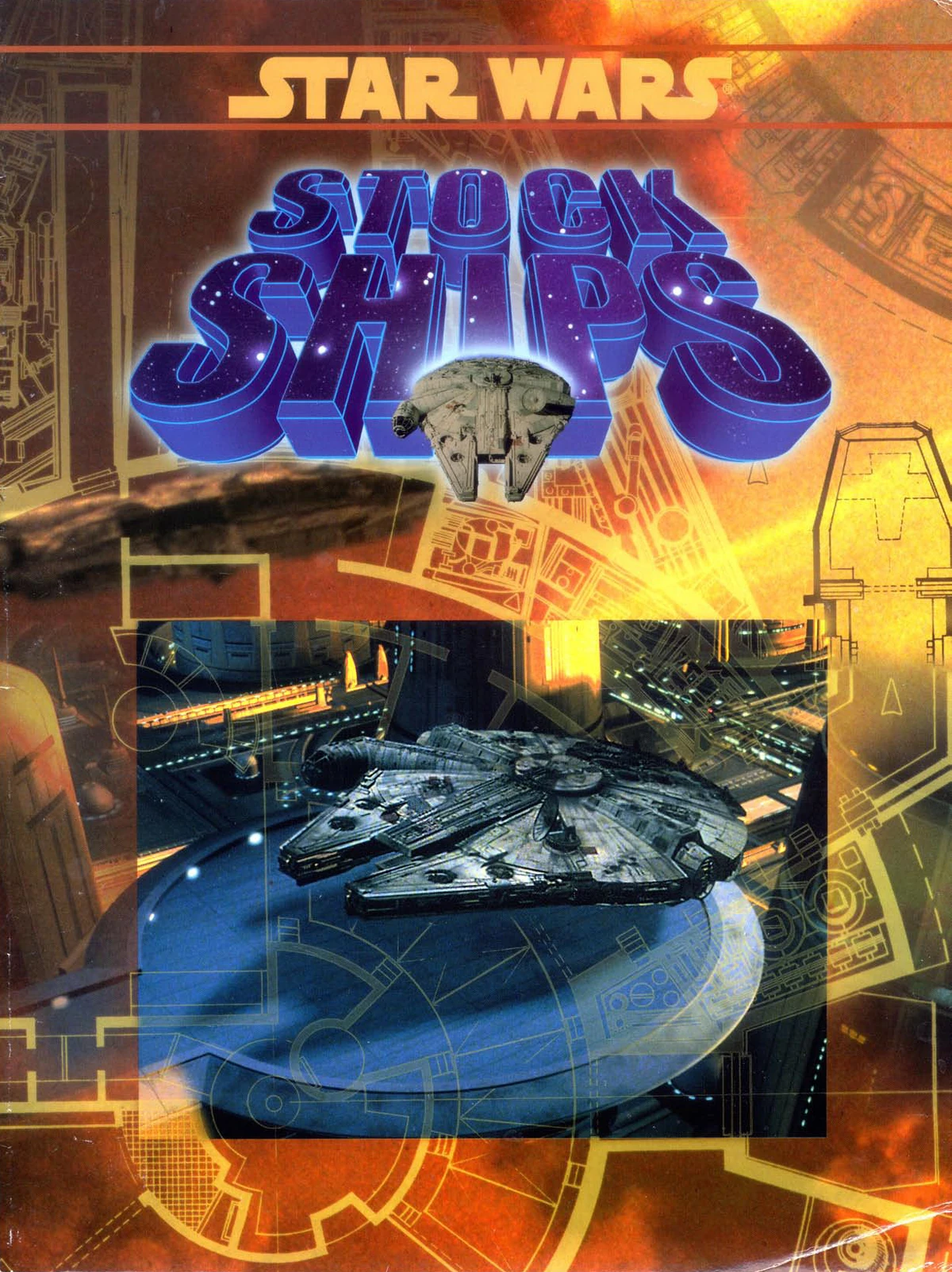
The battered Millennium Falcon is one of the most recognizable elements of the Star Wars saga. From the beginning, the Falcon and her charismatic captain captured our imaginations. When Galaxy Guide Six: Tramp Freighters debuted in 1990, players of the Star Wars Roleplaying Game got a chance to take to the stars in their own tramp freighters, and took to the idea in droves.
Stock Ships, filled with deckplans and stats for a host of vessels (some familiar, some new), is a supplement for players and gamemasters alike. Used in conjunction with Tramp Freighters and Platt's Smugglers Guide, Stock Ships provides your group with everything it needs for a solid and detailed smuggler's campaign. Naturally, the stock ships presented herein are as useful to other Star Wars campaigns. Just about every group has at least one freighter handy.
Using This Book
The ship entries are presented in a consistent four-page format. The first page of each entry profiles the stock ship with a description of the line, company and performance of the ship in the galactic market. The second and third pages feature the deckplans of the ship, along with the stats for the stock version of the ship.
The fourth page provides a sample ship (complete with a history and in some cases a crew) based on the stock version of the ship. Many of these ships have been modified in some manner. Here are the categories presented for each sample ship:
- History. This section details the background of the sample ship—who has owned it, where it has traveled, and who knows about it.
- Modifications. Any non-stat modifications done to the ship by past crews (or stat modifications that need explaining) are mentioned here. Smuggling compartments and alterations to the life support systems to favor certain alien species are examples of non-stat modifications.
- Legacies. Legacies are things about a ship the players probably don't know when they acquire it. Things like super-secret smuggler compartments, booby traps left by prior crews, or the fact that the ship in question is so infamous in certain quarters it will be blasted on sight by Imperials, Hutts, or some other powerful party.
- Custom Stats. If the ship has been significantly upgraded, its stats will probably differ from those of the original stock ship.
Players can use either the stock ships or one of the sample ships as the vessel their characters use to roam the galaxy. Many templates start a character off with a ship of some sort, and all the ships presented within these pages are suitable for game play, provided the gamemaster has no objections.
Gamemasters can alter the ships a bit before passing them on to the characters, stock or not. Unless the characters buy a brand-new ship, the ship they have might have a legacy or two attached to it. Feel free to pick and chose among the legacies presented in this book when configuring the players' ship, or come up with your own. It is important that the players be ignorant of these legacies when they start out. The fun is discovering these hidden eccentricities as play progresses, and wondering what else lurks in the wings.
Naturally, such things as past crews and legacies can all serve as adventure hooks. One never knows when a past owner may come back into the picture, or some hidden aspect of the ship reveals itself—for good or for ill (if the characters are a little slow in discovering that secret compartment filled with spice, have a thorough Imperial inspector find it for them—they'll have a new compartment to use in the future, but first they have to explain themselves to the inspector and his squad of attentive—and well armed—stormtroopers).
The gamemaster can also use the sample ships and their prior crews as allies or rivals of the characters—especially if they do much business with smugglers and spacers. In this case, simply generate a few non-player characters, and you're good to go.
Finally, the deckplans in this book have been scaled so you can enlarge them on a photocopier to the scale used in Star Wars Miniatures Battles. (See each deckplan for the percentage of enlargement you need to use to achieve the proper scale).
Modifications
The stock ships in this book are exactly that—stock, just as they look right out of the factory. But few ship crews leave their ships like that for long. Some tweak or replace the engines to get more speed (and thus better contracts). Others may boost the shielding or add weapons to defend ship and crew against pirates and other dangers encountered in the spaceways. Captains with a cheerful disregard for the law enhance their ships in other ways—by adding illegal weapons, military-grade sensor packages or secret smuggling compartments.
The players may likewise desire to augment the factory capabilities of their ship. See Chapter Eight of Galaxy Guide 6: Tramp Freighters for rules on ship modifications. In addition, a number of ship modifications are described throughout Pirates and Privateers. Alternatively, the gamemaster can start the characters off with one of the sample ships, as discussed earlier.
Ship Features
Ships come with a wide variety of features and options. Here is an overview of some of the most common areas found on a stock freighter. When examining the deckplans and keys of each ship, you can refer back to here for details on each section.
Airlock. The airlock allows crewmembers to cycle in and out of the ship without compromising its environment. In cases where cargo or personnel must be transferred from the ship in a vacuum, umbilical passageways are run from the adjacent ship or docking array to the ship's airlock.
Armory. The armory is a strong room where the ship's complement of weapons is stored. The walls are lined with reinforced armor plating to protect the rest of the ship against accidental detonation or weapon discharges. Most armories also come equipped with complex locks so the weapons can be secured (usually only the captain has the key or access code). On many ships, passengers and crew are not permitted to carry weapons while aboard—a preventive measure against mutiny and piracy.
Brig. The brig is a reinforced room which can be locked from the outside. It has few amenities; a bench and a small refresher. Many brigs feature hidden cameras and microphones. On most ships, only the captain has the keys to the brig.
Crew Cabin. Usually a small spartan room containing a bunk, a footlocker, and sometimes a small computer station for each inhabitant. Most crew cabins hold two to four crewmembers. On ships with small crews, a crewmember may be fortunate enough to have a room to himself.
Captain's Cabin. The largest personal space on the ship. The captain's room usually has a bit more personality than the other cabins, containing not only a bunk, footlocker, and desk, but often also mementos of past adventures and small touches from the captain's homeworld (such as art, rugs and so forth). Some captains prefer to take the room closest to the escape pods.
Cargo Hold. The cargo hold is one of the most important areas of a freighter, for obvious reasons. Most holds are large reinforced rooms with plenty of exposed ribs, sockets, and tie-offs to secure cargo. Life support systems to the hold can be shut off during flight to conserve energy. More sophisticated holds have atmospheric controls which allow the crew to alter the temperature and gravity independently of the rest of the ship (altering the gravity is of great use when loading or unloading cargo). Most captains own a loading droid or a small repulsorsled to get cargo on and off the ship.
Cockpit/Bridge. The nerve center of the ship, the cockpit contains all of the controls needed to fly the ship and monitor its many systems, from life support to power routing. In many cases, a ship's external weapons can be operated remotely from the cockpit. Typical cockpit configurations feature a pilot's station, a co-pilot's station, a communications terminal, shield and weapons control, and an astrogation computer.
Common Room. The open space shared by off-duty crewmembers and passengers. This space is often kept clear when not in use (and on some ships doubles as the loading bay when in port). Comfortable couches and entertainment features are common features of the common room. Of the latter, holo gameboards and vidscreens rank as the most popular recreational items. On more luxurious vessels (especially those catering to passengers), the common room might be called a lounge instead—and offer more options, like sabacc tables and a wet bar.
Engine Room. The engine room abuts the engine pods and control systems. From here, the heavy-duty machines and motors which drive the ship can be serviced. Complex repairs usually require external access to the engines, but simple repairs and diagnostics can be performed effectively in the engine room. Some ships lack an engine room proper, and servicing is done via various access panels situated throughout the ship.
Entry Ramp. The entry ramp is the main entrance to the ship, used when the ship is grounded. In freighters, the ramps leads to the loading bay or a main cargo hold. In smaller ships, it may simply lead to a main hallway or vestibule. The entry ramp is large enough to accommodate standard-sized transport carts, loadlifters, and crates. Most ships with a separate airlock do not have an airlock as part of the main entry ramp, though bulkhead doors may seal the ramp space from other parts of the ship.
Escape Pod. The escape pod is an emergency measure found on nearly every space-faring vessel. Should the ship suffer catastrophic malfunction or combat damage, the crew can escape the doomed ship via the pods. Ideally, there are sufficient pods to evacuate the entire crew and all passengers, but many captains tempt disaster by over-birthing their ships or by removing escape pods to install more cargo space.
External Cargo Pod. Some ships come standard with external cargo pods, while others include them as an option or aftermarket add-on. External cargo pods are self-contained, and cannot be entered from the interior of the ship. Few external pods contain life-support systems, because the additional weight of such systems makes the whole external pod concept untenable. One aspect of external pods of interest to smugglers is that they can be jettisoned at a moment's notice from the cockpit, allowing them to deliver illicit cargoes to a drop site without landing or to ditch incriminating evidence if pursued or cornered. Pirates like hitting ships with external pods (making off with the cargo is relatively easy in such cases), so less combative captains prefer to do without the extra space.
Galley. The galley is the ship's kitchen, where food is stored, prepared, and served. Most ships outfitted for long journeys (or those taking them out of major space lanes) stock bland but filling food. Those catering to passengers or making short jumps between populated worlds might get a bit fancier in terms of ingredients and cuisine. All ships carry a good supply of emergency rations in case they break down in an isolated area.
Holotheater. Ships which are designed for long trips or to accommodate passengers devote some space to a small holotheater, especially those marketed to a moneyed clientele. These are occasionally used for more practical applications, such as viewing training and maintenance holos.
Loading Bay. This small bay is located just inside the ship beyond the entry ramp, and connects to the cargo holds. Cargo is organized here before taken into the hold or offloaded. Some captains store cargo or loading machinery here during flight, while others keep the area clear so it can double as a common room.
Machine Shop. This workroom contains tools, machines, and parts for the mechanical and electronic maintenance of the ship. Simple mechanical parts can be fabricated from scratch using the tools here, while more complex parts can be repaired or modified. An adequately-equipped machine ship can service droids, weapons, and personal equipment as well as ship systems.
Medical Bay. Most small ships lack a dedicated medical center, but some have a small area devoted to diagnosing and treating minor injuries. The bay consists of an examination table, diagnostic machinery, and an ample supply of medicines and bandages. Some captains who anticipate going into dangerous areas invest in a basic medical droid and a small bacta tank.
Passenger Cabin. Passenger cabins are seldom much more interesting than the crew cabins, except that they house only one or two passenger each. They may have a few nice appointments, such as personal video or holo machines, a bit of decoration, or a small 'fresher.
Refresher. A small room devoted to personal hygiene. Showers, toilets, sinks, laundry machines, and such are common. Most 'freshers are designed to accommodate the needs of a wide variety of species, but some are not. Wastes are processed to extract potable water, for use by the crew day-to-day or in emergency situations where other supplies have been exhausted.
Storage. Any spare space on a ship does not remain clear of cargo and equipment for long. Supply rooms are crammed full of tools, foodstuffs, spare parts, loading carts, deactivated droids, and cargo.
Turret Access. This short tunnel leads from a main corridor or crew space to a turret weapon mounted on a hard point on the outer hull. The artificial gravity in the turret is sometimes reoriented to a different axis to better suit the gunner.
Zero-G Relaxation Chamber. The relaxation chamber is an extravagant option available on some high-priced yachts and small cruisers. On such ships it is used for meditation or other recreational activities. It can also be used to house seriously injured people if a bacta tank is not available, or for the comfort of aliens from low-gravity worlds. Though it is not recommended by the manufacturers, some captains use their escape pods as low budget relaxation chambers, because most escape pods have their own gravity generators.
Lantillian Short Hauler
The Lantillian Short Hauler—a rugged, well-engineered craft—was originally designed for affluent retirees interested in piloting a pleasure craft but not in paying the exorbitant price commanded by a star yacht.
The Short Hauler was developed by a team of engineers working for Lantillian ShipWrights. The design team was led by Engineer Shil Tervo, a friend and collaborator of Walex Blissex (the designer of the Victory-class Star Destroyer).
Ironically, Lantillian ShipWrights intended to fashion a freighter to compete with the wildly successful models produced by the Corellian Engineering Corporation. Instead, the small shipbuilding firm produced one of the first luxury pleasure craft that was still within the financial reach of the average citizen.
Shortly after the Battle of Yavin, Lantillian ShipWrights was absorbed by TaggeCo. The new parent company fired many of the designers (though Tervo eventually found work with Kuat Drive Yards and developed many of the key subsytems for the Eclipse-class Star Destroyer project).
The Short Hauler GX1 is the basic model available, equipped with a civilian-grade turbolaser cannon, modest shielding, a Fabritech 7Y4 Sensor Suite, Cybot Galactica NavMaster navigational computer, and Lantillian ShipWrights Class Four sublight engines. In addition, the Short Hauler possess a number of amenities: a well-designed galley, a holotheater and fairly large living quarters.
One complaint is common among Short Hauler captains: the landing gear assembly is extremely complex and is prone to malfunction unless maintained regularly. Dust, corrosion and other such obstructions can prevent the gear from retracting or deploying properly and, since the dissolution of Lantillian ShipWrights, parts are difficult (and expensive) to locate.
While the Lantillian Short Hauler never took the freighter market by storm, it has performed well as a cargo vessel. A number of enterprising smugglers and shippers have purchased the inexpensive and reliable vessels and modified them to serve as cargo haulers. By removing amenities—such as the holotheater—and adding cargo bays, Short Haulers are effective freighters. However, most shippers augment the vessel's shielding and weaponry, as the stock Short Hauler possesses inadequate defenses against pirate attack.
Lantillian ShipWrights GX1 Short Hauler
Craft: Lantillian ShipWrights GX1 Short Hauler
Type: Pleasure craft
Scale: Starfighter
Length: 27 meters
Skill: Space transports: Lantillian Short Hauler
Crew: 4; skeleton 2/+5
Passengers: 6
Cargo Capacity: 85 metric tons
Consumables: 1 month
Cost: 20,500 (used only)
Hyperdrive Multiplier: x2
Hyperdrive Backup: x12
Nav Computer: Yes
Maneuverability: 1D
Space: 4
Atmosphere: 280; 800 kmh
Hull: 4D
Shields: 1D
Sensors:
Passive: 10/0D
Scan: 25/1D
Search: 40/2D
Focus: 2/2D
Weapons:
Laser Cannon
Fire Arc: Turret
Crew: 1 (can be fired by pilot or co-pilot, +5 to difficulty)
Skill: Starship gunnery
Fire Control: 1D
Space Range: 1-3/12/25
Atmosphere Range: 100-300/1.2/2.5 km
Damage: 3D
The Nova Whisper
History: The Nova Whisper has had a checkered history. Originally purchased by Tev Driscull, a Corellian commodities shipper, the Nova Whisper was seized by the privateer Dharus near Elshandruu Pica. After modifying the ship with sensor stealth devices and upgrading the Whisper's weaponry, Dharus used the craft as an assault gunboat during raids.
After a few months, the Nova Whisper was captured by CorSec and seconded to that agency's vehicle pool. CorSec officials determined that the ship would be ideal for sting operations against smugglers and pirates and left many of the Whisper's illegal modifications in place. (It was reasoned that a legitimate smuggling vessel would be less likely to trigger the suspicions of target criminals.)
While on loan to a joint CorSec-Imperial taskforce, the vessel's pilot—an Alliance sympathizer named Delt Nerris—hijacked the vessel and turned it over to the Rebels. Alliance forces on Asher III used the Nova Whisper as a medical transport until the Empire tracked down and destroyed most of that Alliance cell, just prior to the Battle of Hoth.
The Nova Whisper was spirited away from Asher III by Lernik De'Yago, a Rodian arms merchant who dealt with the Rebels from time to time. As the Empire moved in to destroy the Alliance insurgents, De'Yago stole the craft and escaped. In order to recoup some of his financial losses—the Empire seized the Rodian's arms shipment before he received payment—De'Yago sold the craft to a ship dealer on the merchant station Bazaar. The ship dealer stripped the Whisper of many of her more exotic modifications and placed the craft on the auction block.
Modifications: There are two secret smuggling compartments that have been shielded against stealth—one in the engineering spaces and one in the starboard repulsorlift. In addition, the ship has been equipped with a pair of concealed concussion missile launchers (located in the aft quarter of the ship). The ship's sensor array has been upgraded and now possesses military-grade detection capability and terrain-following scanners. Finally, the ship's laser cannon has been replaced with a forward-firing ion cannon.
Legacies:
- The Nova Whisper is well-known to CorSec and Imperial officials. Whenever an Imperial customs agent or CorSec officer boards the vessel, he or she identifies the Nova Whisper on a successful Moderate law enforcement roll.
- Lernik De'Yago didn't just sell the vessel. Realizing that the Imperials had nearly caught him, he coded a series of credit-account access numbers into a subroutine of the nav computer, deleting them from his personal datapad. (In the event of his capture, the Imperials would not be able to find and seize his illegally gained wealth.) Characters who make a successful Very Difficult computer programming/repair roll realize that there is something hidden in the nav computer. The characters discover the access code numbers automatically if they attempt to plot a course to the Noquivzor system.
The Nova Whisper
Craft: Modified Lantillian ShipWrights GX1 Short Hauler
Type: Former cargo-hauler/pirate vessel
Scale: Starfighter
Length: 27 meters
Skill: Space transports: Lantillian Short Hauler
Crew: 4; skeleton 2/+5
Passengers: 6
Cargo Capacity: 105 metric tons
Consumables: 1 month
Cost: 50,500 (Black Market only)
Hyperdrive Multiplier: x1
Hyperdrive Backup: x10
Nav Computer: Yes
Maneuverability: 2D
Space: 6
Atmosphere: 330; 950 kmh
Hull: 4D
Shields: 2D+2
Sensors:
Passive: 20/0D
Scan: 40/1D
Search: 60/2D
Focus: 3/3D
Weapons:
Ion Cannon
Fire Arc: Front
Crew: 1 (can be fired by pilot or co-pilot, +5 to difficulty)
Skill: Starship gunnery
Fire Control: 2D
Space Range: 1-5/20/45
Atmosphere Range: 100-500/2/4.5 km
Damage: 4D
Two Concussion Missile Launchers (fire-linked, retractable)
Fire Arc: Back
Crew: 1 (can be fired by pilot or co-pilot)
Skill: Starship gunnery
Fire Control: 3D
Space Range: 1-2/8/15
Atmosphere Range: 100-200/800/1.5 km
Damage: 6D
Game Notes:
Concealed smuggling compartments: The Nova Whisper's smuggling compartments require a Very Difficult search roll to physically detect. Sensors can only detect the compartments on a Difficult roll. The compartments can hold five cubic meters of cargo.
Terrain-following sensors: The TFS system scans the surrounding terrain and provides the navigational controls with additional data. This gives the pilot +1D to space transports rolls when flying at an altitude of 50 meters or lower. Failure to make a Moderate space transports roll when flying this close to the ground indicates that the pilot has lost control and crashed.
Starwind-class Pleasure Yacht
Kuat Drive Yards' Starwind-class Pleasure Yacht is based on a light freighter design originally intended to challenge Corellia Engineering's popular YT series. In mid-design, the craft was altered to compete with Hyrotil's Crescent-class luxury cruisers.
The attempt was moderately successful. With a price tag that is five times that of the Crescent-class, the Starwind is truly a space yacht that is a rich being's trophy. However, unlike the Crescent-class light freighter, the Starwind-class vessels tend to appeal more to those with more ready credits than common sense.
While the Starwind-class has a stronger hull than most ships constructed for civilian recreational use, its sublight engines are underpowered, its power systems are ill-equipped to be adapted to even the most common modifications—such as laser cannons and stronger shields—and must frequently be replaced with another power system should any upgrades be desired. Further, the ship's architecture is such that virtually any upgrade performed will cost either passenger or cargo space.
In fact, many of those who make their living building or working in starships say that the only thing the Starwind has going for it is its revolutionary escape pod. In order to protect their wealthy buyers from potential kidnapping by pirates, KDY engineers adapted the technology used for the detachable cargoholds of the Star Galleons.
The escape pod of the Starwind-class can be jettisoned while the ship is in hyperspace (where it immediately—and roughly—reverts back into realspace).
If the pod is released in normal space, it starts performing random hyperspace jumps once an onboard, automated nav computer (using software licensed from Industrial Automaton) has guided the pod to the nearest well-traveled spacelane. A subspace transceiver broadcasts automatically on both common distress channels and on select high-priority military frequencies. Rescue vessels are then able to converge on the escape pod and retrieve it between jumps. (This feature of the stock Starwind is yet another of the privileges that money can buy.)
Starwind-class Pleasure Yacht
Craft: Kuat Drive Yards Starwind-class Pleasure Yacht
Type: Space Yacht
Scale: Starfighter
Length: 50 meters
Skill: Space transports: Starwind
Crew: 5
Crew Skill: Varies widely
Passengers: 10
Cargo Capacity: 20 metric tons
Consumables: 2 months
Cost: 1,000,000 (new), 450,000 (used)
Hyperdrive Multiplier: x1
Hyperdrive Backup: x15
Nav Computer: Yes
Maneuverability: 1D
Space: 4
Atmosphere: 280; 800 kmh
Hull: 3D
Shields: 1D
Sensors:
Passive: 10/0D
Scan: 25/1D
Search: 35/2D
Focus: 2/2D+2
The Firerider
History: The Firerider was well known in the Mid-Rim regions. It was a "yacht for hire," a vessel available for up-and-coming business executives or others who needed to entertain important clients or superiors in style but who were unable to own their own yacht. The vessel's owner and captain was a Twi'lek named Serdo. Known and respected as a trustworthy and dutiful being, Serdo actually used his business of renting his ship as a cover for a lucrative spice-smuggling operation; customs officials rarely boarded the Firerider and hardly ever bothered to inspect her cargo (as they didn't want to risk inconveniencing a Moff, powerful business executive or high-ranking military official).
Serdo made his fortune, however, and decided to retire to a quiet Outer Rim world. He sold the Firerider to Fizzi's Slightly Used Ships on Trevi IV. So far, no one has bought the Firerider from the Bith used shipdealer.
Modifications: Serdo wasn't much for tooling around with his ship. Since protecting his passengers was a high priority, however, he did have his shields upgraded and added an ion cannon from a Koensayr Y-wing.
Legacies: Unbeknownst to Fizzi or Serdo, a virus lies dormant in the Firerider's navigational computer, like a forgotten landmine that is waiting for someone to step on it.
On one of the last runs performed by Serdo, his wealthy passengers were targeted by Imperial Intelligence for assassination. The passengers were high-placed Rebel sympathizers from Coruscant, who were travelling in the Mid-Rim, and it served the purpose of the Assassinations Branch to make their deaths look like an accident. The virus is set to activate when a specific set of hyperspace coordinates are entered into the computer, and it will then spread throughout the ship's computer systems and shut the ship down, leaving it without power, communications, propulsion, and life support.
The virus has been constructed in such a fashion that even the most skilled mechanic or programmer will have to get lucky in order to not mistake the general systems failure it causes as anything but a series of unfortunately timed malfunctions.
Should the virus be triggered, two Very Difficult space transport repair and one Heroic computer programming/repair skill rolls will be needed to repair the ship. Even then, only minimal life support and engine power, as well as back-up hyperdrives will be on-line. It will take 2D+2 days in dry dock to bring the Firerider back to full operating capacity.
The Firerider
Craft: Modified Kuat Drive Yards Starwind-class Pleasure Yacht
Type: Space Yacht
Scale: Starfighter
Length: 50 meters
Skill: Space transports: Starwind
Crew: 5
Crew Skill: Varies widely
Passengers: 10
Cargo Capacity: 20 metric tons
Consumables: 2 months
Cost: 1,000,000 (new), 450,000 (used)
Hyperdrive Multiplier: x1
Hyperdrive Backup: x15
Nav Computer: Yes
Maneuverability: 1D
Space: 4
Atmosphere: 280; 800 kmh
Hull: 3D
Shields: 3D+1
Sensors:
Passive: 10/0D
Scan: 25/1D
Search: 35/2D
Focus: 2/2D+2
Weapons:
Light Ion Cannon
Fire Arc: Turret (Gun may be fixed to forward to be fired by pilot at only 1D fire control.)
Crew: 1 (co-pilot)
Skill: Starship gunnery
Fire Control: 3D
Space Range: 1-3/7/36
Atmosphere Range: 100-300/700/3.6 km
Damage: 4D
Starfeld Z-10 Seeker
The Z-10 Seeker was originally designed and marketed as a scouting/trade vessel, ideal for inexpensive expeditions into unexplored space. Because it didn't take off in that market, Starfeld Industries sold it elsewhere, and Z-10s can now be found pulling duty as small courier ships, high-speed delivery freighters, reconnaissance scouts, and blockade runners.
The Z-10's superior agility, high realspace and hyperspace speed, and low crew overhead make it an excellent choice for enterprising traders trying to maintain a tight schedule and avoid navigational and predatory delays. In addition, the Z-10 has an excellent sensor package, originally intended for the ship's scouting mission, but equally useful to the customers in its new niche markets.
The ship is hardly without flaws, however. Economy of design dictated that the only weapon, an autoblaster, run its targeting subroutine off the sensor package. If the sensor package is disabled, the gun loses all fire control, and if the guns are damaged, the sensor package tends to shut down due to targeting computer feedback. This is compounded by the mediocre hull strength and lack of shield generators. The Z-10 is not a combat vessel and best deals with trouble by avoiding it.
The Z-10 is what engineers refer to as a "tight design"—it makes the most of the space available and runs smoothly when regularly maintained by qualified professionals using recommended parts. In other words, it's fussy, breaks down if not habitually tended to, is difficult to repair with substitute parts, and doesn't take modification easily; perfect for keeping scouts from wandering off with property. This is aggravated by the ship's reliance on rare parts—notably the Miradyne RCS computer system. Miradyne went out of business two years after the Z-10 was released, and parts are increasingly rare. The BlasTech Prm-3 weapons system is almost as proprietary, although the Novaldex JV-71 ion engines are only moderately uncommon.
The Z-10 cargo pods are of standard Starfeld design; two main pods slung off the fuselage carry the bulk of the cargo—20 tons to each pod. An additional five tons can be carried in the main body. The pods can be jettisoned from the cockpit to increase speed and maneuverability; many couriers operate using only the small main body cargo bay.
Starfeld Industries Z-10 Seeker
Craft: Starfeld Industries Z-10 Seeker
Type: Small scouting vessel
Scale: Starfighter
Length: 20.3 meters
Skill: Space transports: Z-10 Seeker
Crew: 1
Crew Skill: Varies, typically 3D-5D
Passengers: 2
Cargo Capacity: 45 metric tons
Consumables: 2 months
Cost: 86,000 (new), 69,000 (used)
Hyperdrive Multiplier: x1
Hyperdrive Backup: x12
Nav Computer: Yes
Maneuverability: 3D
Space: 7
Atmosphere: 350; 1,000 kmh
Hull: 3D
Sensors:
Passive: 20/1D
Scan: 40/1D+2
Search: 65/2D
Focus: 3/3D
Weapons:
Autoblaster
Fire Arc: Front
Skill: Starship gunnery
Fire Control: 2D; 0D if sensors inoperable
Space Range: 1-3/10/20
Atmosphere Range: 100-300/1/2 km
Damage: 3D+1
Game Notes: All difficulty numbers to modify the Z-10 add +10. Without cargo pods Space increases +2 and Maneuverability increases 1D+1.
The Redshift Runner
History: The Redshift Runner is one of the fastest commercial ships on record with BoSS. The Runner is owned and operated by a Corellian captain named Elga Arbo. Elga specializes in high-speed delivery, and to shorten her transit time bought a second hand Z-10 Seeker from a down-and-out independent scout. Elga leveraged herself to the gills reworking the Redshift Runner into the fastest ship possible. She operated the Runner with the assistance of her co-pilot, Maceb Joodsen, a skilled starship mechanic from Demar.
To do this, Arbo had to borrow from an unsavory business owner named Gydio Lucone. Lucone's interest rates were high, and he hoped to pressure Arbo into smuggling for him. She resisted this to her utmost, and was able to stave him off by meeting her payments on time, every month, until three months ago.
Three months ago, Arbo was three days late on a payment due to an Imperial-ordered shutdown of a stopover starport. Lucone had been deeply frustrated by Arbo's ability to make her payments, and took advantage of the circumstance to seize the ship. Arbo violently disagreed, and after the smoke cleared the Runner was lifting off with Maceb at the controls and Elga seriously injured. Since then, the Runner and crew has evaded Lucone's goons and hired guns. Lucone is far from rational about his operation and is willing to invest more in acquiring the Runner than the ship is actually worth.
Modifications: The Runner's primary modifications are to increase speed; the cargo pods are one-quarter size to decrease her mass and she has a very special hyperdrive surprise—an illegal x1/2 drive in place of the standard backup. The hyperdrive is expensive to operate and only used in emergencies. This is where most of Arbo's borrowed money was spent. The hyperdrive is disguised to look like a standard Class One hyperdrive—an oddity, but not questioned by local officials since the Runner has a reputation for speed, a reputation Arbo went out of her way to establish. The internal cargo compartment has been filled with additional passenger quarters to allow the ship to double as a high-speed shuttle.
Legacies:
- Gydio Lucone still wants the Runner, and has put a 20,000 credit reward for the Runner, if returned in good condition. Shipjackers and shady bounty hunters are on the lookout.
- There is no external evidence that the hyperdrive and its backup have been altered. If a crew uses the hyperdrive unawares, the astrogation difficulty is doubled because the jump calculations rely on accurate imputation of the hyperdrive multiplier.
The Redshift Runner
Craft: Starfeld Industries Z-10 Seeker
Type: Small scouting vessel
Scale: Starfighter
Length: 20.3 meters
Skill: Space transports: Z-10 Seeker
Crew: 2
Passengers: 2
Cargo Capacity: 20 metric tons
Consumables: 1 month
Cost: 120,000 (actual), 60,000 (asking)
Hyperdrive Multiplier: x1
Hyperdrive Backup: x1/2
Nav Computer: Yes
Maneuverability: 3D+1
Space: 8
Atmosphere: 350; 1,000 kmh
Hull: 3D
Sensors:
Passive: 20/1D
Scan: 40/1D+2
Search: 65/2D
Focus: 3/3D
Weapons:
Autoblaster
Fire Arc: Front
Skill: Starship gunnery
Fire Control: 2D; 0D if sensors inoperable
Space Range: 1-3/10/20
Atmosphere Range: 100-300/1/2 km
Damage: 3D+1
Game Notes: All difficulty numbers to modify the Z-10 add +10. Without cargo pods Space increases +2 and Maneuverability increases 1D+1.
Corellian YT-2400 Transport
The rugged YT-2400 light transport, easily piloted by a single pilot, was designed with the small-scale independent freighter captain in mind.
While other new models produced by Corellian Engineering Corporation incorporate the latest technological advances, the integrated systems of the YT-2400 are at least 10 years behind the times. While some spacers may view this as a disadvantage, the very simplicity of these designs is a strength in a starship which can be expected to travel far afield of well-stocked repair facilities with a very small crew. Parts are easily found (since most are also used in much older ships like the venerable YT-1300), and the ship is easily maintained and serviced in the field.
The YT-2400 retains the distinctive saucer hull design of earlier designs (e.g., the YT-1300), but has many new features which improve on the classic design. It has a reinforced hull, which makes it more durable than previous models, and the stock engines are quite powerful. The primary escape pod is located immediately aft of the cockpit for easy access by the flight crew.
There are number of standard optional packages available for the YT-2400—hull extensions, kits to convert the cargo holds into passenger space, and so on—but most owners prefer to make their modifications using third-party parts and kits, or adapt parts made for other types of ships.
The YT-2400—built with a sturdy hull and plenty of expansion space—is an excellent starting point for cargo haulers who want to load their ship down with enhanced weapons, shields, and various modifications of questionable legality. The most common modifications are upgrades to the weapon and propulsion systems.
The YT-2400 has two hard points suitable for weapon mounts on the top and bottom of the saucer hull. The stock model comes with a singe turret laser gun mounted on the upper hull, but more powerful weapons can be mounted on both hard points. Either of the hard points may alternatively be used to mount a sensor dish.
The YT-2400 can accept starship engines designed for much larger ships. More significantly, its mountings can be easily modified to house military-grade engines, a big selling point for certain independent captains with underground connections and a thirst for speed.
Its holds, situated in the main hull, make excellent expansion bays for large sensor suites, weapons systems, shield generators, and so on. Because the YT-2400 is so commonly modified in the interior, constructing hidden smuggling compartments is a simple matter.
Corellian YT-2400 Transport
Craft: Corellian YT-2400 Transport
Type: Stock light freighter
Length: 21 meters
Skill: Space transports: YT-2400 transports
Crew: 2; gunners: 1, skeleton: 1/+10
Crew Skill: Varies widely
Passengers: 6
Cargo Capacity: 150 metric tons
Consumables: 2 months
Cost: 130,000 (new), 32,000 (used)
Hyperdrive Multiplier: x2
Hyperdrive Backup: x12
Nav Computer: Yes
Space: 4
Atmosphere: 480; 800 kmh
Hull: 5D
Shields: 2D
Sensors:
Passive: 10/0D
Scan: 25/1D
Search: 40/2D
Focus: 2/3D
Weapons:
Laser Cannon
Fire Arc: Turret
Crew: 1
Skill: Starship gunnery
Fire Control: 2D
Space Range: 1-3/12/25
Atmosphere Range: 100-300/1.2/2.5 km
Damage: 4D
The Lambarian Crab
History: The Lambarian Crab was purchased from a Corellian Engineering Corporation dealer by Matas Havel. Havel was an honest trader who made regular runs from the Colonies to the Outer Rim. As his business thrived, he added supplemental cargo extensions on the upper hull, and beefed up the shields to deal with the threat of Outer Rim pirates.
Havel sold the ship after three years to a boisterous captain named Finious Crab, who gave the ship its present name. Crab was anything but an honest trader—he promptly tore out most of the redundant systems and safety backups to make room for all the illegal modifications he made to the ship—transforming it from a reliable by-the-book ship to a flying coffin (albeit a very fast and stealthy one).
Crab made quite a name for himself smuggling contraband goods into the Corellia system, and the Lambarian Crab soon became infamous for slipping blockades and dodging customs craft as it made its Corellian runs.
Ironically, Crab was done in not by the Empire or CorSec, but by his own sloppy maintenance habits—during one of his runs, his life support failed, and the Crab reverted from hyperspace near Eriadu with a frozen corpse at the helm.
The ship was salvaged and resold to its current owners, Linx Mallicker and Fillio Androu, a pair of Wroonian smugglers who ply the Rimma Trade Route. Mallicker and Androu run guns and other weapons into the Core from underground manufacturing plants in the Outer Rim Territories (they avoid Corellia). Most of their customers are Imperial officials with a taste for illegal firearms, though they also supply a few small Rebel cells with ordnance.
Modifications: Most of the modifications done to the Crab are described in the accompanying ship stats.
There are also two secret smuggling compartments installed by Finious which are used by the current crew. One is located under the deck of the hallway leading from the cockpit to the saucer hull. The other is behind a false wall in one of the external cargo pods.
Legacies:
- The profile of the Crab has been forwarded by CorSec to most Imperial civil and military databases. Whenever a Imperial customs official boards the Crab, his law enforcement skill. If he makes a Moderate roll, he recognizes the ship and gives it an intensive inspection—even if the characters persuade him they have no connection with its former owners.
- Finious installed a small secret compartment which is located in the cockpit deck escape pod socket. Locating it requires a Moderate search roll while the escape pod is out of its socket (maybe for servicing or because it was used). No one has discovered this compartment in the years since Finious died. What contraband might he have hidden there before his untimely death? Old Jedi relics? Maps supposedly leading to the lost Katana fleet? Blackmail papers to a now-great Moff?
The Lambarian Crab
Craft: Modified Corellian YT-2400 Transport
Type: Modified light freighter
Length: 21 meters
Skill: Space transports: YT-2400 transports
Crew: 2; gunners: 1, skeleton: 1/+10
Crew Skill: Varies widely
Passengers: 6
Cargo Capacity: 200 metric tons
Consumables: 2 months
Cost: 130,000 (new), 32,000 (used)
Hyperdrive Multiplier: x1
Hyperdrive Backup: x6
Nav Computer: Yes
Space: 4
Atmosphere: 480; 800 kmh
Hull: 5D+2
Shields: 2D
Sensors:
Passive: 30/1D
Scan: 50/2D
Search: 70/3D
Focus: 4/4D
Weapons:
Heavy Double Laser Cannon
Fire Arc: Turret
Crew: 1
Skill: Starship gunnery
Fire Control: 2D (0D if fired from cockpit)
Space Range: 1-10/20/25
Atmosphere Range: 100-1/2/2.5 km
Damage: 6D
Ion Cannon
Fire Arc: Front
Skill: Starship gunnery
Fire Control: 3D
Space Range: 1-3/7/36
Atmosphere Range: 100-300/700/23.6 km
Damage: 4D
Corellian XS-800 Light Freighter
The XS-800 light freighter is one of the more recent designs introduced by Corellian Engineering Corporation. In many ways, the XS-800 is a smaller-scale version of the corvette CEC developed for military use. The sublight and hyperdrive assembly is almost identical in design to the Corellian corvette (though it is considerably smaller).
The XS-800—unlike other freighters of its type—was built with crew comfort in mind. Quarters are each equipped with a small refresher unit as well as an autochef and personal computer system. Each crew chamber is environmentally sealed, and the gravity, temperature and atmospheric configuration can be adjusted to suit the individual crewer. In order to conserve space, bunks fold out from the bulkhead, making for small but comfortable quarters.
XS-800s are equipped with two escape pods that can each seat five people. In addition, the cockpit is designed to break away as a sealed module in the event of an explosion in space. By activating a series of explosive bolts, the cockpit chamber can separate from the hull and maintain internal life support for three days. The cockpit has no guidance system, though an emergency repulsorlift allows the unit to land if it is pulled into the gravity well of a planet. Once the cockpit has separated from the hull, the ship is essentially destroyed.
Corellian XS-800 Light Freighter
Craft: Corellian Engineering Corporation XS-800 Light Freighter
Type: Light freighter
Scale: Starfighter
Length: 30.2 meters
Skill: Space transports
Crew: 1 to 2 (can coordinate)
Passengers: 8
Cargo Capacity: 115 metric tons
Consumables: 2 months
Cost: 37,500 (new)
Hyperdrive Multiplier: x3
Hyperdrive Backup: x15
Nav Computer: Yes
Maneuverability: 2D
Space: 6
Atmosphere: 330; 950 kmh
Hull: 3D
Shields: 1D+2
Sensors:
Passive: 15/0D
Scan: 30/1D
Search: 50/3D
Focus: 2/4D
Weapons:
Double laser cannon (fire-linked)
Fire Arc: Front
Crew: 1
Skill: Starship gunnery
Fire Control: 2D
Space Range: 1-3/12/25
Atmosphere Range: 100-300/1.2/2.5 km
Damage: 4D
The Distant Wind
History: The Distant Wind was owned by a Sullustan gambler named Cunbus Locb. Locb used the modified freighter to travel from system to system, where he would engage in all manner of high-stakes games of chance. Locb became something of a minor celebrity; in fact, his success rate—particularly at sabacc—was quite high.
The more Locb won, the more he modified his craft, upgrading the vessel's engines, shields and weaponry. In addition, Locb invested a large portion of his winnings in works of art, and the Wind's hold was usually full of sculptures, holopaintings and other such items.
Roughly one year prior to the Battle of Yavin, Locb encountered an Imperial Moff, Ammar of Portmoak sector. Moff Ammar was also a collector of rare art, and possessed a flatsculp by a revered Chandrilan artist. Locb launched a complicated confidence scheme and managed to cheat during a high-stakes round of sabacc, winning the flatsculp.
As Locb made his escape, Ammar realized he had been cheated and launched an all-out search for the Sullustan. The gambler died during the ensuing struggle, and no sign of the flatsculp—entitled "Stars and Moons"—was discovered.
Ammar impounded the vessel and searched it thoroughly before ordering the craft sold at a public auction.
Modifications: The Distant Wind's only major upgrade is to the sensor array. Locb augmented his sensors so that they could patch into a series of small scanners that he could carry on his person. (The scanners were roughly the size of credit chips.) Locb would place the scanners around a room during a gambling session, and the devices would feed him data on cards that his opponents held.
In addition, four small smuggling compartments have been added behind the overhead lighting panels in the craft's common room.
Legacies:
- "Stars and Moons" is still hidden aboard, in one of the smuggling compartments (discovering the compartment requires a Very Difficult search roll, a Difficult sensors roll or a Heroic Perception roll). Moff Ammar still offers a substantial reward for the recovery of the flatsculp.
- Hidden in the other smuggling compartment is a counterfeit version of "Stars and Moons" (Locb was planning to switch the counterfeit for the genuine article if he couldn't win the flatsculp in a sabacc game). The forgery is excellent, requiring a Very Difficult forgery or Heroic Perception roll to detect. (This raises the question of which flatsculp is genuine.) Characters can bring the item to an art dealer who will be able to identify and authenticate the artwork, but this dealer will also be aware that the item is stolen. The art dealer may blackmail the characters into performing some sort of service in exchange for his silence, or he may simply notify Moff Ammar.
- Locb was, in fact, a massive cheat and fraud. Numerous enemies are still seeking the Sullustan. The Distant Wind is recognized widely among gamblers, smugglers and other fringe elements throughout Parmel, Portmoak and Quence sectors and characters may be fired upon by angry "acquaintances" of Locb.
The Distant Wind
Craft: Modified Corellian Engineering Corporation XS-800 Light Freighter
Type: Light freighter
Scale: Starfighter
Length: 30.2 meters
Skill: Space transports
Crew: 1 to 2 (can coordinate)
Passengers: 8
Cargo Capacity: 115 metric tons
Consumables: 2 months
Cost: 37,500 (new)
Hyperdrive Multiplier: x3
Hyperdrive Backup: x15
Nav Computer: Yes
Maneuverability: 2D
Space: 7
Atmosphere: 350; 1,000 kmh
Hull: 3D+2
Shields: 2D
Sensors:
Passive: 15/0D
Scan: 30/1D
Search: 50/3D
Focus: 2/4D
Weapons:
Double laser cannon (fire-linked)
Fire Arc: Front
Crew: 1
Skill: Starship gunnery
Fire Control: 2D
Space Range: 1-3/12/25
Atmosphere Range: 100-300/1.2/2.5 km
Damage: 4D
Laser cannon (can be fired from cockpit)
Fire Arc: Turret
Crew: 1
Skill: Starship gunnery
Fire Control: 2D
Space Range: 1-3/12/25
Atmosphere Range: 100-300/1.2/2.5 km
Damage: 3D
Hyrotil Crescent-class Transport
The Crescent-class light transport is the Hyrotil Corporation's first and so far only foray into the field of light freighter design. Hyrotil designed the Crescent-class Transport to appeal to affluent young beings who desired to travel among the stars.
The Crescent has all the features that people have come to expect from a Hyrotil luxury craft: sleek, streamlined hull design, luxuriously appointed interiors with the latest food-preparation technology in the galley and the latest in holo-entertainment units in the lounge area.
The stock Hyrotil is available in two varieties: one with a hyperdrive, and one without a hyperdrive, but which features a larger lounge area and cargo bay (designated by the manufacturer as Crescent-class and Crescent-class Mark II). Both varieties come with minimal shielding—just enough to withstand impacts from small meteors and other space debris—and a light laser cannon for armaments. The sensors are likewise at the minimal levels required by BoSS regulations. However, the control panels in the cockpit look very impressive, and that's what most purchasers of Crescent-class vessels are interested in. The craft is equipped with a three-person escape pod which is located at the front of the vessel, under the cockpit.
Though the Crescent has a small cargo capacity and limited upgrade options, some spacers—mostly those who make their living through con games or out-and-out robbery—find it an attractive vessel because of its widespread use among the children of the rich: customs officials and patrol vessels are far less likely to hassle someone who may be the son of a Moff or corporate vice president than the spacer who is clearly up to no good—as his souped-up YT-1300 shows.
Despite its limitations, there are several ways to upgrade the Crescent. Many captains have turned the escape pod into a weapons housing; others have converted cabins into space for extra shield generators, upgraded sensors, or other upgraded electronic suites. The ship's power couplings run along its central passage, which means it is particularly easy to reroute the power systems into the cabins. Sensor jamming equipment—which consumes a great deal of power and is very difficult to successfully install in most light freighters—fits into a Crescent-class vessel like a hand in a glove. It may be difficult to add more speed to one of these vessels, but it is not difficult to turn a common Crescent Transport into a smuggler's dream.
Hyrotil Crescent-class Transport, Mark II
Craft: Hyrotil Crescent-class Transport, Mark II
Type: Light freighter
Scale: Starfighter
Length: 30 meters
Skill: Space transports: Crescent
Crew: 1
Crew Skill: Varies widely
Passengers: 8
Cargo Capacity: 80 metric tons
Consumables: 2 months
Cost: 200,000 (new), 125,000 (used)
Hyperdrive Multiplier: x2
Hyperdrive Backup: x10
Nav Computer: Yes
Maneuverability: 2D
Space: 5
Atmosphere: 300; 900 kmh
Hull: 3D
Shields: 1D
Sensors:
Passive: 2/0D
Scan: 4/1D
Search: 8/2D
Focus: 1/3D
Weapons:
Light Blaster Cannon
Fire Arc: Front
Scale: Starfighter
Skill: Starship gunnery
Fire Control: 1D
Space Range: 1-3/12/25
Atmosphere Range: 100-300/1.2/2.5 km
Damage: 1D
The Adventurer
History: The Adventurer is one of those rare ships that is on its second owner and has so far not been upgraded or modified much beyond the original specifications.
The Adventurer was originally purchased by Aelon Reglis, a professional gambler from Chandrilla. Aelon's family were not spacers, and he had decided that he was going to be the first to break the bonds of "dirt" and lead a life of interplanetary adventure. That was not to be, however; Aelon fell in love with a Chandrillan bureaucrat soon after purchasing the Adventurer. They were married, she became pregnant, and the gambler settled down to raise a family.
Their daughter, Lynx, however, made in-roads into the subculture that exists among the stars when she joined the Imperial Navy as an IntSec investigator. Aelon gave the Adventurer to Lynx as a present upon her graduation from the Corulag Academy—after all, it had merely served as a place for Aelon to sit and dream on weekends for the last 18 years...perhaps Lynx might actually gain some benefit from the ship while on leave.
As fate would have it, Lynx Reglis didn't get much use out of the ship, either. The young officer was stationed on Nigel III in the Kira Sector, and although she had access to the Adventurer, she never spent her off-hours traveling offworld, preferring instead to spend her time on the types of planet-bound activities she grew up with, such as nature hikes or ocean cruises.
The one time the Adventurer saw major use was when Lynx impersonated the Rebel agent known as Sapphire in order to foil a plot to assassinate Commodore Dane Tizzin, the Naval attache to the staff of the Kira Sector's Moff. Shortly after this escapade, Lynx and a Naval technician began outfitting the Adventurer with a counter-sensor package; the young woman decided that having a fast, stealthy ship might be useful in her line of work. Before the installation was completed, however, Lynx was implicated in a plot to steal secret information from the base she was stationed at. The young officer fled Imperial military justice, and the Adventurer was impounded along with the rest of her belongings.
Legacies:
- The Adventurer is over two decades old now, but it is for all purposes a new ship. Less than 1,000 light years of flight time have been logged in it, and both its owners took good care of it. However, the ship has no sensor package; when the ship was impounded, the Navy pulled out the partly-completed sensor counter-measures in a less-than-gentle fashion, causing irreparable damage to the system.
The Adventurer
Craft: Hyrotil Crescent-class Transport, Mark II
Type: Light freighter
Scale: Starfighter
Length: 30 meters
Skill: Space transports: Crescent
Crew: 1
Crew Skill: Varies widely
Passengers: 8
Cargo Capacity: 80 metric tons
Consumables: 2 months
Cost: 200,000 (new), 125,000 (used)
Hyperdrive Multiplier: x2
Hyperdrive Backup: x10
Nav Computer: Yes
Maneuverability: 2D
Space: 5
Atmosphere: 300; 900 kmh
Hull: 3D
Shields: 1D
Weapons:
Light Blaster Cannon
Fire Arc: Front
Scale: Starfighter
Skill: Starship gunnery
Fire Control: 1D
Space Range: 1-3/12/25
Atmosphere Range: 100-300/1.2/2.5 km
Damage: 1D
Kazellis Light Freighter
Kazellis Corporation, a small manufacturing company in the remote Kathol sector, was founded as a joint venture between human and Twi'lek manufacturers. It was dedicated to providing customers living in isolated areas with reliable and easily-maintained craft. The Kazellis light freighter is representative of Kazellis' lower end models.
In keeping with the company's philosophy, most ship systems are easily upgraded and replaced. Many parts are fitted with universal joints and interfaces, allowing mechanics to use parts from other manufacturers to repair ship systems.
The line proved to be very popular along the Rimma Trade Route, and Kazellis Corporation expanded its production facilities and opened showrooms and retail outlets on Kal'Shebbol and Eriadu, the capital world of Seswenna Sector. The intention was to launch a mass-market program with the light freighter, and follow up with a larger, more-powerful model named the "Heavy Hauler." However, despite the success of the retail program—over one hundred of light freighters were sold in the first year alone—the program was never expanded or continued because Kazellis Corporation was driven out of business with the arrival of the Empire in the Kathol Sector.
Kazellis management refused requests by Moff Kentor Sarne to provide him with ships, repairs and shipping for a cheaper rate than the company's already generous discounts for bulk orders generated from within the Kathol Sector; Kazellis had never given the galactic government preferential treatment and they weren't about to start now. They failed to understand the ruthlessness of the New Order.
Kazellis Corporation was taken over by the Empire and all members of its senior staff and board of directors were either executed or driven into hiding. As the Empire seized the company's assets, employees—in one of the earliest acts of widespread resistance—destroyed all the assembly lines and wiped all the data storage devices, effectively assuring that no more Kazellis models would ever be manufactured again.
Kazellis Light Freighter
Craft: Kazellis Corporation Light Freighter
Type: Light Freighter
Scale: Starfighter
Length: 28 meters
Skill: Space transports: Kazellis freighter
Crew: 1; gunners: 1
Crew Skill: Varies widely
Passengers: 8
Cargo Capacity: 100 metric tons
Consumables: 2 months
Cost: 23,000 (used)
Hyperdrive Multiplier: x2
Hyperdrive Backup: x12
Nav Computer: Yes
Maneuverability: 2D
Space: 5
Atmosphere: 350; 1,000 kmh
Hull: 4D
Shields: 2D
Sensors:
Passive: 20/1D
Scan: 50/2D
Search: 70/2D+1
Focus: 4/3D
Weapons:
Quad Laser Cannon
Fire Arc: Turret
Skill: Starship gunnery
Fire Control: 2D
Space Range: 1-3/12/25
Atmosphere Range: 100-300/1.2 km/2.5 km
Damage: 4D
The Longrunner
History: The Longrunner was one of the first Kazellis light freighters to leave the factory. It was intended to cover supply and sales runs to remote settlements in the Kathol sector, and was outfitted with a x1 hyperdrive from the shipyard. No significant upgrades have been performed on the ship since it was constructed.
When Kazellis went bankrupt, the Longrunner's captain, Duan Zorn, stole the vessel and spent some time as a freetrader. While he was a fine corporate drone, Zorn was less successful on his own and the Longrunner was impounded by the port authority on Nigel III in the Kira Sector when he couldn't pay tariffs and docking fees. Zorn himself was imprisoned for stealing the ship in the first place, and when none of Kazellis' remaining creditors wanted to travel to the Kira Sector to claim the ship, Nigel's BoSS branch offered the ship for auction.
The Longrunner was purchased by Dav Kathis, a former Imperial Naval officer who mustered out to begin a career as an independent freighter captain. Kathis operated the ship along the Enarc Run, establishing himself as a known and well-liked freetrader. The ship served as his home and he shared it with his wife, Leanna Carella, a former customs official, by whom he has a son.
Kathis, however, vanished under mysterious circumstances recently. His wife has been left alone with their infant son, and now travels the Enarc Run, plying her husband's former route to make a living while searching for clues about her husband's disappearance.
Modifications: Hyperdrive Multiplier: x1; Hyperdrive Backup: x8
Legacies:
- Duan Zorn is out of prison and looking for "his" ship. Back when he owned the Longrunner, Zorn spent some of his precious few credits installing a slave circuit that lets him control the freighter from a remote location anywhere within 100 km of its location. The slave circuit is disguised as part of the ship's environmental control subsystems, and the only way to discover its presence is if a character makes a Heroic starship repair roll while working on the environment systems.
- Dav Kathis was kidnapped by a group of COMPNOR thugs who believed he was supplying information to the Rebels in the Kira sector. The truth is that although Alliance Intelligence approached Kathis on several occasions, the former military man remain loyal to the Empire, which he believed was a just institution.
The COMPNOR thugs are led by a man who is a violent paranoid schizophrenic, and he has recently decided that Leanna is the spy. He and his men will be looking for the Longrunner (or even another Kazellis-class freighter as transponder codes can be changed, and there couldn't possibly be two of these uncommon ships in their part of the space) in order to capture the real spy.
Kathis is still alive, but may not be for very much longer—the interrogation and torture sessions are starting to take their toll.
The Longrunner
Craft: Kazellis Corporation Light Freighter
Type: Light Freighter
Scale: Starfighter
Length: 28 meters
Skill: Space transports: Kazellis freighter
Crew: 1; gunners: 1
Crew Skill: Varies widely
Passengers: 8
Cargo Capacity: 100 metric tons
Consumables: 2 months
Cost: 23,000 (used)
Hyperdrive Multiplier: x1
Hyperdrive Backup: x8
Nav Computer: Yes
Maneuverability: 2D
Space: 5
Atmosphere: 350; 1,000 kmh
Hull: 4D
Shields: 2D
Sensors:
Passive: 20/1D
Scan: 50/2D
Search: 70/2D+1
Focus: 4/3D
Weapons:
Quad Laser Cannon
Fire Arc: Turret
Skill: Starship gunnery
Fire Control: 2D
Space Range: 1-3/12/25
Atmosphere Range: 100-300/1.2 km/2.5 km
Damage: 4D
Nova-Drive 3-Z Freighter
Nova-Drive is a small Mid-Rim ship manufacturer that sells most of its small range of freighters in systems along the Rimma Trade Route. It does not design its own models, instead licensing or purchasing designs from other firms and manufacturing modified versions for niche markets.
Nova-Drive sub-licensed the manufacturing plans of Corellian Engineering Corporation's YT-1200 a few months after the latter company phased it out in favor of later production models. Though CEC deemed the line too dated for active production, Nova-Drive saw an opportunity to upgrade the design to make it competitive with current offerings in the independent spacer market.
The hull was stretched and reinforced, allowing for more powerful engines, larger cargo bays, and more spacious living quarters. The 3-Z is as fast at sublight speeds as a stock YT-1300, and features some moderate improvements over the YT-1300—the central-dorsal mounted sensor dish provides an excellent scanning radius; the standard port-starboard mounted laser cannons provides excellent forward-above-below-rear firing arcs; and the forward-opening cargo bay allows easy access to the cargo bays. Additionally, the cockpit featured a more open cockpit canopy than the YT-1300, and the primary escape pod is in the primary crew area.
Because Nova-Drive did not have to include R&D costs in the price tag, the Nova-Drive 3-Z is priced very competitively. CEC has been surprised to discover that its cast-off design, revamped and upgraded, is giving its current YT offerings a run for their money.
Nova-Drive 3-Z Light Freighter
Craft: Nova-Drive 3-Z
Type: Light freighter
Scale: Starfighter
Length: 28 meters
Skill: Space transports
Crew: 2
Passengers: 8
Cargo Capacity: 150 metric tons
Consumables: 2 months
Cost: 60,000 credits (new), 20,000 credits (used)
Hyperdrive Multiplier: x2
Hyperdrive Backup: x15
Nav Computer: Yes
Maneuverability: 1D
Space: 4
Atmosphere: 280; 800 kmh
Hull: 4D+2
Shields: 1D
Sensors:
Passive: 20/0D
Scan: 30/1D
Search: 40/1D+2
Focus: 2/2D
Weapons:
Two Laser Cannons
Fire Arc: Front, right, back
Crew: 1 (co-pilot)
Skill: Starship gunnery
Fire Control: 1D
Space Range: 1-3/12/25
Atmosphere Range: 100-300/1.2/2.5 kmh
Damage: 3D
The Merasy
History: The original owner of the Merasy was a Corellian merchant named Iep Tumu. Tumu was a bad trader and tried to make ends meet by doing a little smuggling on the side. He was even worse at this, and forfeited his ship to Brentaalan authories as part of his criminal sentence. Tumu was a terrible mechanic and made no modifications to the ship. In fact, it had to be completely re-tuned and overhauled to be sold at auction. The neglect left the poor ship with an annoying acceleration vibration that mechanics have been unable to track down and repair.
The Merasy was purchased at auction by a sharp Khil trader named Geld Bernar. Bernar made a series of profitable long-distance runs, each providing him with valuable contacts in expanding markets. To facilitate these long trips, Bernar had the ship's consumables capacity extended by 50 percent and installed state-of-the-art entertainment and library computers. Bernar also bought several highly up-to-date astrogation charts, including secret corporate and military routes, cutting days off his transit times. After several years of reliable performance, Bernar sold his ship to invest in a high-speed shipping enterprise.
The Merasy is currently owned by Vacasor, a third-rate Devaronian merchant-captain who is slowly circumnavigating Known Space in an ongoing exploration of the Rim Worlds. Vacasor is aided by his co-pilot, Naneb Pefan, an Ithorian trader of considerable experience. Naneb could sell sand on Tatooine, and is the only reason Vacasor hasn't gone bankrupt yet. Vacasor converted most of the remaining passenger space into cargo holds to up the profit margin on his runs. Naneb demanded the replacement of the shield system, since Vacasor insists on using ill-patrolled secondary and tertiary routes infested with pirates. The ship may yet wind up on another auction block soon, since Vacasor can barely keep the ship running on the hair-thin profit margins he brings in.
Modifications: The Merasy has a modestly upgraded shield projector, and the hull was reinforced when most of the passenger space was converted to cargo space. Although the Merasy has occasionally carried some contraband, she has no smuggling compartment or other favorite smuggler modifications. The ship has a lengthy running time, due to Bernar's modifications, and an excellent data-library.
Legacies:
- Due to a filing error the Merasy is still noted as a smuggler's ship in Brentaalan (and thus Imperial) criminal records. If the ships registry is researched she may be tagged as a suspected smuggling ship on a Difficult investigation roll.
- Bernar was obsessive about logging his travels. His backup astrogation charts are still hidden in the ship's computer, and contain high-speed routes not usually available to civilians.
- Vacasor hasn't stuck to any kind of maintenance schedule, so the systems are a bit frayed and unreliable. Most worrisome is the ever-increasing acceleration vibration, which had nearly vanished under Bernar's maintenance. This vibration might be harmless, but might indicate a dangerous situation; maybe the engine mounts are working loose, or the inertial dampers are failing.
The Merasy
Craft: Nova-Drive 3-Z
Type: Light freighter
Scale: Starfighter
Length: 28 meters
Skill: Space transports
Crew: 2
Passengers: 3
Cargo Capacity: 200 metric tons
Consumables: 2 months
Cost: 22,000 credits (used)
Hyperdrive Multiplier: x2
Hyperdrive Backup: x15
Nav Computer: Yes
Maneuverability: 1D
Space: 4
Atmosphere: 280; 800 kmh
Hull: 4D+2
Shields: 3D
Sensors:
Passive: 20/0D
Scan: 30/1D
Search: 40/1D+2
Focus: 2/2D
Weapons:
Two Laser Cannons
Fire Arc: Front, right, back
Crew: 1 (co-pilot)
Skill: Starship gunnery
Fire Control: 1D
Space Range: 1-3/12/25
Atmosphere Range: 100-300/1.2/2.5 kmh
Damage: 3D
Rendili-Surron Starlight Freighter
The Surronians, an insectoid species of long-respected shipbuilders, fell upon difficult times and developed Surron StarTech, a firm to mass produce and distribute their vessels. Their lack of business savvy resulted in dismal sales as ill-conceived marketing ventures went unnoticed by a busy public. At the same time, Rendili StarDrive, long a military shipbuilding firm, was attempting to recoup financial losses with the introduction of a line of public-sector vessels for the interstellar professional. Rendili execs approached the ailing Surronians and after months of negotiations, an agreement was finalized.
The joint Rendili-Surron agreement would produce an attractive, sleek vessel with the Surronian reputation for design, aimed at the spacer market. The Surronians came up with some truly innovative and exciting designs which were discarded by the skittish and conservative Rendili management. Taking some basic Surronian concepts, the Rendili techs instead adapted older ideas (like the often copied Corellian cockpit design) and rushed to production of the Starlight.
The Rendili-Surron Starlight has a bit of Surronian touches left in it. The forward sweeping wing is definitely not the product of older military designers at Rendili. This wing contains the bulk of the Starlight's habitable volume, including the spacious cargo hold. A repulsorlift platform locked into the ventral surface of the wing allows cargo to be lowered and raised into the hold. Materials cutbacks forced a lighter-than-standard space-frame for the hold, so that while it is spacious, it is only rated at 50 metric tons capacity. The wing also mounts the communications and sensor array.
The Corellian Engineering Corporation knock-off cockpit and hallway tube lead to the primary lounge compartment. The no-frills interior features an autochef recycled from surplus models from Rendili's defunct Vainglorious-class cruisers. The compartment features two rooms with triple bunks, also recycled military surplus. Even the joint 'fresher has a decidedly Academy drop-camp feel to it.
Sadly, the Rendili-Surron Starlight is the last Surronian vessel produced for the public. Burned by the megacorp reality of the starship industry, the Surronian artists retreated to their hives, content to produce their art only for Surronians. New vessels are now so alien in design that Rendili executives see little market for them except for the eccentric who want to own "something different."
Rendili-Surron Starlight Freighter
Craft: Rendili-Surron Starlight freighter
Type: Light freighter
Scale: Starfighter
Length: 34 meters
Skill: Space transports: Starlight freighter
Crew: 2
Crew Skill: Varies widely
Passengers: 4
Cargo Capacity: 50 metric tons
Consumables: 3 weeks
Cost: 26,000 (used)
Hyperdrive Multiplier: x2
Hyperdrive Backup: x12
Nav Computer: Yes
Maneuverability: 1D
Space: 4
Atmosphere: 280; 800 kmh
Hull: 4D
Shields: 1D
Sensors:
Passive: 10/0D
Scan: 20/1D
Search: 40/2D
Focus: 2/3D
Weapons:
Blaster Cannon
Fire Arc: Turret
Skill: Starship gunnery
Fire Control: 2D
Space Range: 1-5/10/17
Atmosphere Range: 100-500/1/1.7 km
Damage: 3D
The Command Performance
History: Ahric Korownosek considers himself a skilled actor, though the critics rarely agree with him. He has dreamed of landing the lead in a blast-'em-up HoloClysm production for the annual hype-season, earning trillions at the box office. He wants to be the one blasting the alien invaders while swinging from the exploding platform with several damsels in his arms. The best he has been able to do, however, is to lead a traveling troupe of actors from one backwater world to the next, re-enacting "The Glorious Rise of the New Order!," "Coruscani and I," "Sing, Advisors, Sing!" and other such tripe.
Korownosek's troupe—the NovaCluster Players—experienced some success in its early days, allowing the actor to purchase a freighter, the Command Performance.
Bored with the task of running an acting troupe, Ahric has turned his gift of mimicry, delivery and wardrobe into a moonlighting career as a burglar. He cases local museums and galleries of backwater worlds with the dignitaries who receive the troupe, and then steals away with a trinket or artifact. These worlds, with little contact with other worlds in the area, have not yet seen the pattern of thefts tied to the traveling troupe. Ahric sells his ill-gotten goods to fences on the next world the troupe visits, though on occasion, the Command Performance's final curtain call involves a hasty takeoff and a quick run past local police vessels.
Modifications: Ahric had the cargo section of the Command Performance compartmentalized to accommodate the troupe's props and costumes. He also installed a one-cubic meter secret compartment in his quarters where he stashes his stolen goods. The ship has a modified sensor package, since most worlds the Command Performance visited do not have fully modern starports, and much of the landing procedure require the pilot's full attention and awareness of his surroundings.
To accommodate the troupe, the ship's air exchange filters and life support equipment were augmented, allowing a passenger complement higher than standard. Quadruple bunks now fill the rooms, and the rec-room holotable and acceleration couches are removable to set up a make-shift stage and tumbling area. The ship's computer library is very well stocked with Imperial-approved holodrama and scripts.
Legacies:
- The Command Performance still has all of Korownosek's wardrobe—a wide variety of garish costumes, overly-stylized (and idolized) Imperial uniforms, and outfits for virtually any occasion. In game terms, the characters need to make a search roll to find the appropriate outfit. On most occasions, the wardrobe should have up to Difficult items to find (Imperial advisor garb, reproduction stormtrooper armor, for example) but items beyond that difficulty (reproduction Darth Vader armor, garb specific to an obscure alien species) should only be found at the gamemaster's discretion.
- When the players visit a backwater world, the gamemaster may decide it was a world once visited by the Command Performance. The locals may recognize the ship and the characters (if they're decked out in Korownosek's clothes). The locals will demand the return of an idol, painting, national treasure, founding documents, or other such item. Alternately, bounty hunters or law enforcement agents from the planet in question may actively be seeking the ship.
The Command Performance
Craft: Rendili-Surron Starlight freighter
Type: Light freighter
Scale: Starfighter
Length: 34 meters
Skill: Space transports: Starlight freighter
Crew: 2
Crew Skill: Varies widely
Passengers: 6
Cargo Capacity: 50 metric tons
Consumables: 3 weeks
Cost: 26,000 (used)
Hyperdrive Multiplier: x2
Hyperdrive Backup: x12
Nav Computer: Yes
Maneuverability: 1D
Space: 4
Atmosphere: 280; 800 kmh
Hull: 4D
Shields: 1D+1
Sensors:
Passive: 10/1D+1
Scan: 25/1D+2
Search: 45/2D+1
Focus: 4/3D+2
Weapons:
Blaster Cannon
Fire Arc: Turret
Skill: Starship gunnery
Fire Control: 2D
Space Range: 1-5/10/17
Atmosphere Range: 100-500/1/1.7 km
Damage: 3D
Suwantek Systems TL-1800 Transport
The Suwantek Systems TL-1800 transport is a 30-meter long vessel that has a flat, angular hull (with thick armor plating). The ship contains ample internal cargo space; in addition, exterior cargo pods can be linked the ship's hull. Cargo pods can be linked to one other, allowing the TL-1800 to carry up to 400 metric tons of material (in space only; in atmosphere, the craft cannot carry more than one cargo pod, increasing the cargo capacity by 100 metric tons).
The TL-1800 is typical of commercial freighters—lightly armed, poorly shielded and slow. (Many freighter captains call the TL-1800 a "waddle," referring to the craft's sluggish handling.) Still, the ship's cargo capacity, hull armor and overall reliability offset the TL-1800's drawbacks.
The TL-1800's engine design is excellent. Though the -1800's Y-v-6 sublight drives do not provide a great deal of speed, they require less maintenance than other craft. Y-v-6 engines require overhaul and adjustment only once per standard year (compared to the three to five times a year recommended for most other freighter types). In addition, the hyperdrive—Suwantek's StarBurn 4—delivers similar performance: adequate speed and minimal maintenance (usually once per standard year as well).
The ship's primary weapon system is a front-firing pair of laser cannons, which may be fire-linked to inflict maximum damage. Unlike most civilian craft, the TL-1800 possesses a cannon system designed by Sienar Fleet Systems (Suwantek's parent company). The weapons and firing system are comparable to those found on the TIE interceptor.
One flaw is readily apparent in the TL-1800: the nav computer is somewhat unreliable. Suwantek (which normally subcontracted such systems to Fabritech or Industrial Automaton) attempted to develop their own nav computer system. The result was the Portal Delta nav computer, a glitch-prone system that requires almost constant maintenance. Early production model TL-1800 possess this type of computer, though later models carry a more-reliable Fabritech unit.
Suwantek TL-1800 Freighter
Craft: TL-1800 Transport
Type: Light freighter
Scale: Starfighter
Length: 30 meters
Skill: Space transports
Crew: 1 to 2 (can coordinate)
Passengers: 7
Cargo Capacity: 110 metric tons (internal cargo storage; with cargo pods: 400 metric tons)
Consumables: 3 months
Cost: 41,500 (new)
Hyperdrive Multiplier: x2
Hyperdrive Backup: x10
Nav Computer: Yes
Maneuverability: 1D+2
Space: 4
Atmosphere: 480; 800 kmh
Hull: 4D
Shields: 2D
Sensors:
Passive: 10/0D
Scan: 25/1D
Search: 40/2D
Focus: 2/3D
Weapons:
Two laser cannons (fire-linked)
Fire Arc: Front
Skill: Starship gunnery
Fire Control: 2D
Space Range: 1-3/12/25
Atmosphere Range: 100-300/1.2/2.5 km
Damage: 5D
The Broken 'Spanner
History: The Broken 'Spanner is a ship that for over three decades was the smuggling craft of Tiv "Poke" Pocarno, a cantankerous and only marginally successful gunrunner. Pocarno began his piloting career as a fighter pilot until he was dishonorably discharged for "dereliction of duty, conduct unbecoming an officer, drunkenness, and insubordination." The specifics of the incident are unclear, though a superior officer, the officer's fiancee and "Poke" were all somehow entangled in the imbroglio.
After his discharge, "Poke" invested his remaining funds in a broken-down, badly maintained TL-1800, and began smuggling guns and weapons to pirates, Rebels and other insurgents. While he had no strong political views, Pocarno felt that his discharge was undeserved and anything he could do to make life difficult for "the old outfit" was just fine by him.
Over time, "Poke" became more and more desperate for funds; his attempts to modify and upgrade the 'Spanner were extremely costly (largely because Pocarno was a poor judge of character and kept bringing his ship to outlaw techs that were largely incompetent). "Poke" borrowed money from Torel Vorne, the main crimelord on Reuss VIII, hoping to put the battered freighter back together and make "that one big run."
"Poke" naturally failed, botching a smuggling run off Rampa. In severe debt, "Poke" became a victim of Torel Vorne's infamous "organ donation policy" and died, penniless. Vorne "impounded" the 'Spanner as partial repayment and completed the needed repairs on the dilapidated craft. While it is by no means a superb craft, it at least travels from point A to point B without too much difficulty.
Modifications: The principal modifications to the Broken 'Spanner were to the vessel's engines, shields and weapons. The basic engine package has been completely rewired and modified and is now a psychotic tangle of wires, conduits, power cells, and reactor fittings. While the system is certainly unsafe and unreliable, the ship now has an extremely high—for its type—sublight speed. In addition, a number of illegal weapons have been added (though the targeting systems are substandard). The shield generators are perhaps the best of the modifications, a contraband shield package from an Imperial gunboat. A handful of badly concealed smuggling compartments (detected on a Moderate search or Easy sensors roll) are scattered throughout the ship—one in the cargo bay, two in the cockpit and one in the galley.
Legacies:
- The Broken 'Spanner is a maintenance nightmare. The engine requires readjustment after every hyperspace jump (Moderate space transports repair roll). The astrogation computer system is extremely glitch-prone—due to the inherent design flaw and poor maintenance—and shuts down unless a Moderate computer programming/repair roll is made each time the unit is activated. Failure indicates that the system blanks all active computations and shuts down, requiring a restart sequence which takes 1D minutes.
- The port-side cargo pod capture mechanism has corroded so badly that it will not function and must be completely replaced. Until the capture mechanism is replaced (8,000 credits for parts, 1D weeks, Difficult space transports repair roll), the craft's cargo capacity is halved.
The Broken 'Spanner
Craft: Modified TL-1800 Transport
Type: Light freighter
Scale: Starfighter
Length: 30 meters
Skill: Space transports
Crew: 1 to 2 (can coordinate)
Passengers: 7
Cargo Capacity: 55 metric tons (internal cargo storage; with cargo pods: 200 metric tons)*
Consumables: 3 months
Cost: 12,600
Hyperdrive Multiplier: x2
Hyperdrive Backup: x8
Nav Computer: Yes
Maneuverability: 3D
Space: 6
Atmosphere: 330; 950 kmh
Hull: 4D
Shields: 3D
Sensors:
Passive: 10/1D
Scan: 25/2D
Search: 40/3D
Focus: 2/3D+2
Weapons:
Two laser cannons (fire-linked)
Fire Arc: Front
Skill: Starship gunnery
Fire Control: 2D
Space Range: 1-3/12/25
Atmosphere Range: 100-300/1.2/2.5 km
Damage: 5D
Proton Torpedo Launcher (with three torpedoes)
Fire Arc: Back
Skill: Starship gunnery
Fire Control: 1D+2
Space Range: 1-5/8/12
Atmosphere Range: 100-500/800/1.2 km
Damage: 5D
* The cargo mechanism is damaged, halving the overall cargo capacity until the port side cargo capture mechanism is repaired. Current stats reflect the damaged mechanism.
Starfeld ZH-25 Questor
When Starfeld realized that the Z-10 Seeker was going over big in the freighter market, it quickly designed a dedicated freighter using the Seeker as a model but eliminating most of the Seeker's flaws. The resulting ship was the ZH-25 Questor.
The ZH-25 uses the Z-10 fuselage with two additional hull sections, for extra room and a one hundred percent increase in cargo pod size. The additions increased the ship's mass by almost 300 percent, requiring the Novaldex JV-71 ion engines to be upgraded to more powerful JV-74s. In spite of the improvement, the ZH-25 is still slower than the Z-10, and somewhat less maneuverable.
Arms and armor were a real shortcoming in the Z-10 parent model. The BlasTech Prm-3 lasers were completely replaced with Taim and Bak pulse lasers, a favorite in Corellian-designed ships, with independent targeting/firing computers, eliminating the sensor blackout problems that plagued the Z-10. Perhaps most significant is the inclusion of a Sirplex P-12 shield generator, greatly increasing the ship's durability.
The demise of Miradyne prevented the inclusion of an RCS flight computer (to the relief of the marketing staff), and the new, looser computer system allows greater leeway in flight performance. The ZH-25 is less of an engineering achievement in terms of simple efficiency, but is regarded as a more friendly ship by the tinker-happy freighter market.
The only deliberate decrease in system performance is the downgrade of the sensors system from an advanced Fabritech package to a cheaper and less effective SoroSuub package. This was primarily to cut production costs, and it is reasoned that the Questor can defend itself much better and thus needs less forewarning than the under-armed Seeker.
The ZH-10 entered the market strongly, in spite of its rather high price tag, and has sold quite steadily. Starfeld's production plants are only just able to meet demand, and the Questor is not yet commonly available in second-hand ship lots.
Starfeld ZH-25 Questor
Craft: Starfeld Industries ZH-25 Questor
Type: Light freighter
Scale: Starfighter
Length: 22.4 meters
Skill: Space transports
Crew: 1
Passengers: 6
Cargo Capacity: 85 metric tons
Consumables: 3 months
Cost: 136,000 (new), 89,000 (used)
Hyperdrive Multiplier: x1
Hyperdrive Backup: x12
Nav Computer: Yes
Maneuverability: 2D
Space: 5
Atmosphere: 295; 850 kmh
Hull: 4D
Shields: 1D
Sensors:
Passive: 15/0D
Scan: 30/1D
Search: 50/2D
Focus: 2/3D
Weapons:
Two Laser Cannons (fire-linked)
Fire Arc: Front
Skill: Starship gunnery
Fire Control: 2D
Space Range: 1-3/12/25
Atmosphere Range: 100-300/1.2/2.5 kmh
Damage: 4D
NeHimmep
History: The NeHimmep is a three-year old Questor owned and operated by a Duros captain named Mirchidi NeMall. Captain NeMall, formerly a pilot in a Duros spaceline shuttle service, saved for years for the down payment on a ship of his own, and bought a new ZH-25 Questor once his contract expired. NeMall named the ship NeHimmep after a legendary trader, captain and explorer from ancient Duros lore.
NeMall is a fairly typical Duros: hard working, exploratory, social, and more comfortable in space than in natural gravity. Unlike many free traders, he owes no money to any underworld figure and is beholden only to a Duros lending institution. This is serious enough, though, as a loan default would lead to forfeiture of all assets, a revocation of his credit and a serious social stigma among Duros.
NeMall managed to make a poor but legitimate living with his little ship for two years, until he ran through an uncharted asteroid squall. The ship was seriously damaged and the rinzefruit cargo ruined. Insurance covered most of the repairs, but the remainder was enough to require a further loan. Now burdened under a massive debt, and with Duros lending traditions forbidding debt restructuring, NeMall has turned to increasingly risky, higher-paying runs to try and build a hedge against his payments. Many of these runs are legally questionable, but NeMall hasn't quite shifted over to full-scale smuggling. NeMall has no great love for the Empire, since Imperial Customs pays particularly close attention to non-human tramp captains, but has no particular interest in the Rebellion. He occasionally runs cargo for Rebel agents on a no-questions-asked basis.
Modifications: None. The NeHimmep was extensively repaired a year ago, but no modifications were made.
Legacies:
- NeMall is extremely unlikely to sell the NeHimmep. If he does so, the ship comes with an expensive surprise: under Duros lending tradition the loan is attached to the ship, not the borrower. (NeMall would likely sell the ship at a substantial discount, though, and explain the situation to the buyers. He is an honest being, after all.) Likewise, if NeMall were to die, the ship's debt would be attached to the ship under Duros law. Because he has no heirs, the ship would be sold under Imperial Code (per Duros lending tradition the lending institution has no claim to the ship; they do have claim to profits made from the ship). Imperial Code is unlikely to support the lender's position, but that wouldn't stop the corporate execs from posting bad credit reports on the buyers, or even offering a bounty.
- NeMall may yet become a full-fledged smuggler, if the price is high enough. He has a clean record and usually makes it past Imperial and local customs with a minimum of difficulty. He's unlikely to join the Rebellion simply because it would mean abandoning his ability to make payments, but is perfectly willing to transport Rebel cargos, for the right price. NeMall isn't mercenary about this, he's just trying to remain an honorable Duros under trying conditions.
- NeMall is in fact acquiring a decent credit account, since he can only pay off his debts in set amounts. The surplus is slowly accumulating, and he might be willing to loan characters up to 10,000 credits. He sticks to Duros tradition in lending; the debt can be paid off in a single lump sum, with 10% interest, or in pre-set payments that can only be paid off according to schedule.
Corellian HT-2200 Medium Freighter
Coming off the huge success of the YT-1300 line, Corellian Engineering Corporation thought that the newly designed HT-2200 would be a big hit. Unfortunately, unfavorable reviews and poor word-of-mouth dried up the market for this medium freighter.
The HT-2200 has a low lift/mass ratio, lacks adequate maneuvering thrusters and is unable to deliver significant lightspeed. While this is somewhat mitigated by its higher ratings in hull durability, shielding, two pulse laser cannons and four environment-adaptable cargo bays, the HT-2200 has acquired a reputation as "pirate bait" and is generally considered a failure.
However, the basic design is sound and—with time, money and ample modification—the HT-2200 is clearly a solid and dependable freighter. One of the major drawbacks to the HT-2200 was its marketing; the -2200 was released after the wildly successful YT-1300 and did not receive the advertising and manufacturer's support it probably deserved.
While the YT-1300 is arguably the most versatile and popular freighter in recent memory, it is not suited to the task of carrying some types of cargo. The YT-1300 is limited to 100 metric tons of cargo, and that cargo must be able to survive the environmental conditions of the rest of the ship. The HT-2200 was designed to rectify this problem.
The -2200 possess four massive cargo bays, each with a sealed and programmable environmental system. Each bay can be programmed for a specific gravity and temperature setting, allowing the freighter to carry perishable foodstuffs, biomaterial in cryogenic stasis and zero-G crystal communication matrices in a single run. This capability—along with the HT-2200's high cargo capacity—allows higher profit margins per run. It is this factor that has encouraged many smugglers and shippers to acquire HT-2200s.
Corellian HT-2200 Medium Freighter
Craft: Corellian Engineering Corporation HT-2200
Type: Medium freighter
Scale: Starfighter
Length: 54.8 meters
Skill: Space transports
Crew: 2
Passengers: 8
Cargo Capacity: 800 metric tons, in four cargo bays
Consumables: 3 months
Cost: 240,000 (new), 110,000 (used)
Hyperdrive Multiplier: x2
Hyperdrive Backup: x12
Nav Computer: Yes
Space: 3
Atmosphere: 206; 750 kmh
Hull: 5D
Shields: 1D
Sensors:
Passive: 10/0D
Scan: 25/1D
Search: 40/2D
Focus: 2/3D
Weapons:
Two Pulse Laser Cannons
Fire Arc: Turret
Skill: Starship gunnery
Fire Control: 2D
Space Range: 1-3/12/25
Atmosphere Range: 100-300/1.2/2.5 km
Damage: 4D
Reekeene's Retribution
History: The HT-2200 freighter, Reekeene's Retribution, was purchased by the Rebel Alliance shortly after the Battle of Yavin, and issued to an elite Rebel SpecForce team, Reekeene's Roughnecks. Reekeene's Roughnecks used the vessel extensively during their campaign against Moff Sakai (Imperial Thuris Sector Command).
After the Alliance modified the freighter to serve as a combat vessel (replacing the cargo bays with weapons lockers, a medical suite and a tactical briefing room), the craft engaged in over 1,200 sorties against Sakai's forces. The Roughnecks are credited with the destruction of over 872 million tons of Imperial equipment, including an orbital starship yard.
During the campaign, Sakai learned the identities of the Roughnecks' members and ordered the assassination of the entire team. A unit of Imperial SpecNav troops—codenamed the Venom Guard—were dispatched and a deadly game of hide-and-seek began.
Unfortunately, Reekeene's Roughnecks did not fare well in this contest. The ship was declared missing and all hands who were aboard are believed to be dead. During a mop-up operation against an Imperial garrison in Thuris sector, the Retribution—and the Roughnecks—were part of a multi-ship strike force. After the raid was completed, the Retribution signaled that they had intruders aboard but were in the process of handling the problem. The remaining Rebel ships jumped out of the system...but the Retribution never followed.
The vessel's current location is unknown, though it is believed that she is adrift in space.
Modifications: During the campaign against Moff Sakai, the Retribution was outfitted with additional sublight drives, increasing the craft's lift/mass ratio substantially. In addition, a spread of short-range ship-to-surface missiles were added to the ship's weapons loadout. These missiles are stored in retractable missile racks which deploy on hinged wings when needed. A briefing room—with a holotank and a direct communications link to SpecForce Command—has replaced one of the cargo bays. Finally, a rear-mounted deployment hatch has been added to the ship, allowing the commandos to exit the vessel under cover of the ship's armaments.
Legacies:
- The Retribution is infamous in Imperial circles. Imperial officers who encounter the craft recognize it on a Moderate law enforcement roll. Even if the characters are not Rebel agents, they will be arrested as Alliance sympathizers and extensively interrogated. When traveling in Thuris sector, the ship will be recognized on an Easy law enforcement roll; in this case, the characters will likely be summarily executed if captured.
- Secreted aboard the ship in concealed data files are the details of several sensitive Alliance military operations. The Alliance will likely want that information back and may send another SpecForce team to recover the data.
Reekeene's Retribution
Craft: Corellian Engineering Corporation HT-2200
Type: Medium freighter
Scale: Starfighter
Length: 54.8 meters
Skill: Space transports
Crew: 2
Passengers: 8
Cargo Capacity: 100 metric tons
Consumables: 3 months
Cost: Not available for sale
Hyperdrive Multiplier: x2
Hyperdrive Backup: x10
Nav Computer: Yes
Space: 6
Atmosphere: 330; 950 kmh
Hull: 6D
Shields: 2D
Sensors:
Passive: 10/0D
Scan: 25/1D
Search: 40/2D
Focus: 2/3D
Weapons:
Two Pulse Laser Cannons
Fire Arc: Turret
Skill: Starship gunnery
Fire Control: 2D
Space Range: 1-3/12/25
Atmosphere Range: 100-300/1.2/2.5 km
Damage: 4D
Two Retractable FireStorm Air-to-Ground Missile Racks*
Fire Arc: Front
Scale: Speeder
Skill: Starship gunnery
Fire Control: 2D
Atmosphere Range: 100-250/400/800 meters
Damage: 7D
* Note: FireStorm launcher takes one round to deploy; can only be fired in atmosphere. Each missile rack holds 250 missiles. All missiles can be fired singly, or in one shot (delivering 10D walker-scale damage).
Barloz-class Medium Freighter
The Barloz-class medium freighter was once one of the most popular vessels to travel the spaceways—the YT-1300 or Ghtroc of its era. In the latter days of the Old Republic, a medium freighter was equivalent to the light freighter of the Imperial era. Long since supplanted by the YT series, modified Barlozs continue to compete against its descendants in the Outer Rim Territories.
The Barloz was developed roughly three decades before the Corellian Engineering Corporation unveiled the YT-series craft. Several of the "design innovations" touted by CEC pitchmen were in fact introduced aboard the older Barloz. However, CEC's aggressive marketing campaign for the YT-series spelled the end of the venerable Barloz.
One of the principal strengths of the Barloz-class freighter is its size: 41 meters long, 20 meters high and capable of storing over 100 metric tons of cargo. The size, coupled with the craft's durability, made it an ideal craft for cargo shippers...and smugglers.
Barloz freighters are woefully under-armed, however (which is unusual given the amount of piracy that occurs in the Corellian sector, the home system of the Barloz's designers). A single laser cannon, fixed in a front-firing position, is the craft's primary defense system. In addition, the Barloz is not very maneuverable, making its only option in a fight a hasty retreat. Still, the craft has a thick, durable hull capable of resisting a fair amount of damage, allowing captains to pilot their craft out of a combat zone relatively unscathed.
The Barloz was equipped with a CEC NovaQuad-D Drive System, the precursor to the engines used in the YT-series craft. Like the YT-series, most pilots modified the existing system to coax better performance from the ship.
Barloz-class Medium Freighter
Craft: Corellian Engineering Corporation Barloz-class Freighter
Type: Medium Freighter
Scale: Starfighter
Length: 41 meters
Skill: Space transports
Crew: 2, skeleton: 1/+5
Passengers: 4
Cargo Capacity: 120 metric tons
Consumables: 2 months
Cost: 17,500 (used)
Hyperdrive Multiplier: x2
Hyperdrive Backup: x12
Nav Computer: Yes
Maneuverability: 1D
Space: 5
Atmosphere: 295; 850 kmh
Hull: 4D
Shields: 1D
Sensors:
Passive: 10/0D
Scan: 25/1D
Search: 40/2D
Focus: 2/2D
Weapons:
Laser Cannon
Fire Arc: Turret
Skill: Starship gunnery
Fire Control: 1D
Space Range: 1-3/12/25
Atmosphere Range: 100-300/1.2/2.5
Damage: 3D
The Twi'lek Dancer
History: The Twi'lek Dancer began its operational career after it was purchased by an agricultural combine in the Tion Hegemony. Eventually, the combine acquired the funds to upgrade to the Corellian YT-1300 and decided to retire the Harvest.
The craft was purchased by a Tiss'shar bounty hunter, Xufal D'uat, who heavily modified the ship, renaming it the Venom Sting. For a period of three years, the Venom Sting operated in the vicinity of Elrood, until D'uat was killed by a fellow hunter.
The Venom Sting was set adrift in space, where it was salvaged by a TaggeCo. mining station. TaggeCo. auctioned the ship off, and it was purchased by the Thalassian slavers (who renamed the vessel Twi'lek Dancer). After discovering the extent of D'uat's modifications to the craft, the Thalassians used her as an assault gunboat and picket defense craft, upgrading the sublight engines and shielding systems and augmenting the vessel's weapons load-out with three proton torpedo launchers and a tractor beam. Eventually, the cell of Thalassian slavers were jumped by pirates, who commandeered the vessel and sold it to a legitimate starship dealer through a front company.
Modifications: The Twi'lek Dancer has several modifications: upgraded engines, sensors, armor and weapons. In addition, D'uat added intruder detection gear, interior defense systems, an onboard fire-fighting matrix and a long-range communications array.
D'uat installed several anti-intrusion systems. One of the crew berths was converted to a cell, with a door that can be magna-sealed. The floor of the cell was lined with shock-filaments that could deliver a massive stun charge on command. A number of hidden null-gas canisters were fitted into the life-support system of the cell, administering a dose of knock-out gas if needed. These modifications were eventually performed on a ship-wide basis.
The ship's modified sensor array also allows the user to take thermal and motion-sensor readings of the interior of the ship, displaying them on the main sensor terminal (which can also be scomp-linked to a personal datapad or automap).
Legacies:
- During one of his missions, D'uat captured a weapons smuggler who ran guns to the Rebel Alliance. The smuggler turned out to be an Imperial officer, Hamaz, who is now an admiral, in charge of fleet operations near Kuat. The Tiss'shar bounty hunter agreed to let Hamaz go, but forced him to record a confession (which D'uat used to blackmail Hamaz for years). Hamaz arranged D'uat's death but was unable to take possession of the holorecording of the confession the Tiss'shar had recorded. The holotape of Hamaz's confession was hidden behind a small access panel in the Dancer's galley. The holotape has been undiscovered for years, and still lies behind the autochef power system access.
- One of the people captured during a Thalassian raid has recognized the Twi'lek Dancer and believes that the vessel's current owner is affiliated with the slavers. The ex-slave is now a holojournalist who seeks to expose the evils of the Thalassians and believes that the ship (and its current crew) are his best lead.
The Twi'lek Dancer
Craft: Modified Corellian Engineering Corporation Barloz-class Freighter
Type: Medium Freighter
Scale: Starfighter
Length: 41 meters
Skill: Space transports
Crew: 2, skeleton: 1/+5
Passengers: 3
Cargo Capacity: 65 metric tons
Consumables: 1 month
Cost: 19,200 (used)
Hyperdrive Multiplier: x1
Hyperdrive Backup: x8
Maneuverability: 2D+2
Space: 7
Atmosphere: 350; 1,000 kmh
Hull: 4D+2
Shields: 2D+2
Sensors:
Passive: 20/1D
Scan: 45/2D
Search: 60/3D
Focus: 4/4D
Weapons:
Two Quad Laser Cannons (can be fired from cockpit)
Fire Arc: Turret
Skill: Starship gunnery
Fire Control: 3D
Space Range: 1-3/12/25
Atmosphere Range: 100-300/1.2/2.5 km
Damage: 6D
Game Notes:
Anti-intrusion sensors: The ship's sensor array can detect motion and heat sources aboard the Twi'lek Dancer, displaying them on the cockpit. Activating the array requires a Moderate sensors roll. This gives the sensor operator +2D to detect motion or thermal sources aboard the ship.
Anti-intrusion safeguards: With the exception of the cockpit, the floors and main bulkheads have been lined with shock-filaments, which can be remotely triggered from the cockpit. The shock filaments administer 4D stun damage to anyone in contact with them. Characters wearing insulated boots or gloves are immune to the shock-filaments' effects. The controls for the anti-intrusion systems are hidden behind an access panel in the cockpit (requiring a Difficult search roll to locate).
Null-gas: The life-support systems has been outfitted with a concealed series of null-gas canisters that can flood the ship. The system can be activated from the life-support control area or from the cockpit, though this system is hidden as well (requiring a Very Difficult search roll to locate). The gas inflicts 8D stun damage and once the victim is rendered unconscious, he remains immobile for 1D hours. The cockpit can be sealed against the gas simply by closing the door.
Surronian L19 Heavy Freighter
Leave it to a jaded spacer to remark that the economic hardship hitting the Surronians has resulted in some of the most prized technologies finally hitting the open market. The vessels of the respected insectoid Surronians are viewed as expensive collectables for exclusive and wealthy clients. Now that the Surronians have fallen upon difficult times, they have developed standard lines of their ships for open sale. Most of the vessels were beyond the price range of the average spacer, save for a much overlooked craft of the the "L" (limited edition) series, the L19 Heavy Freighter.
Fifty meters long, the L19 rests on the large end of the light transport spectrum. Its spacious holds can accommodate 150 metric tons in a total of five chambers. A single pilot can run the L19, but a crew of four is standard—a pilot, co-pilot, the communications and sensors operator, and the shield operator and astrogator. The communal Surronian hive mind crafted a roomy cockpit, with six additional seats for passengers. Just aft of the cockpit are living accommodations. The captain and first mate are usually awarded the larger suites, though the Surronian's overestimation of non-hive privacy has resulted in rather large single rooms for every passenger. Most spacers consider this space an unwarranted luxury, and have refitted half the rooms with double-bunks, converting the other rooms for medical facilities, a larger lounge, or cargo space (hidden or otherwise).
Propelling the freighter through realspace are twin Surronian A1.50 grade ion engines. Slung below the ion drives are a pair of Corellian hyperdrives which the Surronians reverse-engineered to fit their designs. The hyperdrive is usually the easiest and most cost-effective system of the entire ship to modify. The L19 comes standard with twin blaster cannons located atop the main passenger cabin. The ship does not accept new weapons easily because there are very few accessible hard points.
The L19 is in current production, and dealerships can be found throughout the galaxy (but most commonly in the Core). The initial production model, the L19a, was much more luxurous than later models. It is highly sought by enthusiasts, selling for over 400 percent of the typical asking price in the secondary market.
Surronian L19 Heavy Freighter
Craft: Surronian L19 Heavy Freighter
Type: Heavy freighter
Scale: Starfighter
Length: 50 meters
Skill: Space transports: Surronian L19
Crew: 1
Crew Skill: Varies widely
Passengers: 10
Cargo Capacity: 150 metric tons
Consumables: 8 weeks
Cost: 75,000 (new), 28,500 (used)
Hyperdrive Multiplier: x2
Hyperdrive Backup: x16
Nav Computer: Yes
Maneuverability: 1D
Space: 6
Atmosphere: 330; 950 kmh
Hull: 6D
Shields: 1D
Sensors:
Passive: 30/1D
Scan: 80/2D
Search: 120/3D
Focus: 4/4D
Weapons:
Twin Blaster Cannons (fire-linked)
Fire Arc: Turret
Skill: Starship gunnery
Fire Control: 2D
Space Range: 1-3/12/25
Atmosphere Range: 100-300/1.2/2.5 km
Damage: 5D
First Edition
History: The First Edition, purchased by Moff Aricos Dreleene of the Toblain sector, was one of the first of the second-production L19s. Dreleene, who hoped to show off an L19a at an upcoming conference on Coruscant, was not pleased to discover he had acquired a common L19 instead of the luxury limited-run model.
Unable to replace the ship in time, he decided to create a fake L19a. He hired expert slicers to modify the documentation and outlaw techs to rescore the serial numbers, identification tags and transponder codes. Altogether Dreleene spent more than 220,000 credits to get his L19a on top of the base price of the L19.
The egotistical Moff passed off his ersatz freighter as authentic at all official meetings (and told others that the heavy freighter was simply the only Surronian vessel big enough to hold his collection of fine furniture and animal trophies.) More interested in showing off his wealth than doing anything about pirate and Rebel activities in his sector, Dreleene got his just rewards in the outlying Warchigade trade route. Privateers, drawn to his prized vessels like gnats to a split honeyboar, attacked the Moff in the depths of space. The feeble sobs of the Moff insisting that his heavy freighter was just a knockoff were holorecorded, and inserted onto Cynabar's Infonet within the standard week. Within the month, the Moff's title was revoked, and no Imperial plans were ever formulated to free the official from the Rebel camp in which he is imprisoned. The First Edition has since been adapted to Alliance use as a transport, under the name of the Almost Authentic.
Modifications: It took Alliance technicians nearly two weeks to properly install an ion cannon, and get the fire control systems operational. Aside from that, the power flow to the ion engines was increased to accomodate greater response in individual firings, thus increasing manueverabilty. Inside the ship, the secondary escape pod was removed and converted into cargo space, as was some of the consumables tankage, thus reducing the ship's operation range somewhat, but increasing the amount of material it could carry. The ship's transponder has been modified so that it reads as an L19 again, but most of the serial numbers and documentation still list the vessel as an L19a.
Legacies: No matter how many coats of paint or years of wear you put on it, it's still a Surronian vessel, and that evokes one of two responses. The posh yacht-owners of the galaxy see it as a sell-out from a respected shipbuilder. The spacers look on it as a rich-boy's delusional toy for playing "smuggler." While not as powerful or as fast as top-of-the-line, one-of-a-kind Surronian ships, many ship collectors will want the craft, or its parts. Very few, however, will pay for it. As such, shipjacking is very common on this line of craft. Pirates making Moderate or better value rolls will almost always try to take the ship, and not necessarily intact. Conversely, honest mechanics (and they do exist) with a taste for the esoteric may lower their labor rates just to have a chance to work on such a rarity. The parts, of course, are always extremely expensive to come by; the Almost Authentic will likely be sold off or traded by the Alliance soon, or given to a group of Rebels who can afford to maintain it.
Almost Authentic (aka First Edition)
Craft: Surronian L19 Heavy Freighter
Type: Heavy freighter
Scale: Starfighter
Length: 50 meters
Skill: Space transports: Surronian L19
Crew: 3; gunners: 1; skeleton: 2/+10
Passengers: 4
Cargo Capacity: 160 metric tons
Consumables: 4 weeks
Hyperdrive Multiplier: x2
Hyperdrive Backup: x16
Nav Computer: Yes
Maneuverability: 1D+1
Space: 6
Atmosphere: 330; 950 kmh
Hull: 6D
Shields: 1D+1
Sensors:
Passive: 35/1D
Scan: 85/2D
Search: 130/3D
Focus: 5/4D
Weapons:
Twin Blaster Cannons (fire-linked)
Fire Arc: Turret
Skill: Starship gunnery
Fire Control: 2D
Space Range: 1-3/12/25
Atmosphere Range: 100-300/1.2/2.5 km
Damage: 5D
Ion Cannon
Fire Arc: Turret
Skill: Starship Gunnery
Fire Control: 2D
Space Range: 1-3/7/36
Atmosphere Range: 100-300/700/3.6 km
Damage: 5D
Mon Calamari DeepWater-class Light Freighter
One of the earliest examples of Mon Calamari ship design—predated only by the similar (and plainly named) Mon Calamari Light Freighter—is the DeepWater-class freighter. Mon Cal shipwrights developed the vessel as a commercial shipping craft, the backbone of a proposed planetary trading service. The Mon Calamari Commercial Expeditionary Service was eventually—and abruptly—dissolved by the Empire and the fleet of light freighters were sold at auction to private owners. Roughly 10,000 such vessels were produced.
Like most Mon Calamari designs, individual DeepWater freighters are slightly different, crafted as unique works of art rather than a mass-produced homogenous ships. However, most DeepWaters are roughly similar in size, shape and internal construction; the exterior differences are largely cosmetic.
The DeepWater is a fairly standard light freighter, with a small crew complement, modest cargo space and durable engines. A single top mounted laser turret and better than average hull armor and shielding supply the craft's main defenses. A civilian-grade sensor package is housed in a deployment dome on the DeepWater's underside. In addition, the craft has different types of landing gear that can be deployed as needed: a landing claw (to stabilize the ship when docking with another vessel or an asteroid), standard landing gear and inflatable puncture-proof pontoons for landing on water.
The DeepWater has one other unique feature: it is submersible, capable of landing on ocean floors or sea beds up to a depth of one kilometer. While underwater, the ship's primary thrust and maneuverability are supplied by a magnetohydrodynamic engine.
Before traveling underwater, a DeepWater must re-pressurize the interior atmosphere and reconfigure the shield system. When traveling in space, the vessel's design is intended to keep pressure and atmosphere in; when underwater, the interior air pressure and hull bracing must be altered to keep water and pressure out. The shield system must be adjusted to withstand the awesome pressures of ocean depth (and to prevent water from entering and damaging key electronic systems). This configuration cannot withstand blaster bolts and only a minuscule amount of physical damage, and thus must be altered again for space travel.
Stock DeepWater Light Freighter
Craft: Mon Calamari DeepWater-class light freighter
Type: Light freighter
Scale: Starfighter
Length: 45 meters
Skill: Space transports: DeepWater
Crew: 1 or 2
Passengers: 6
Cargo Capacity: 85 metric tons
Consumables: 2 months
Cost: 99,000
Hyperdrive Multiplier: x2
Hyperdrive Backup: x15
Nav Computer: Yes
Maneuverability: 1D
Space: 6
Atmosphere: 330; 950 kmh
Hull: 3D
Shields: 2D (in space); provides (-1 versus physical damage in aquatic mode)*
* The DeepWater has 3D in backup shields. When a die of shields is lost, the shield operator can attempt to make an Easy starship shields roll. If successful, one of the backup shield dice can be activated to bring the ship back up to 3D in shields. Once all three backup dice are exhausted, the shields can withstand the normal amount of damage and then must be completely overhauled. The backup dice cannot be applied when traveling underwater.
Sensors:
Passive: 15/0D
Scan: 30/2D
Search: 65/2D+2
Focus: 5/2D+2
Weapons:
Laser turret
Fire Arc: Turret
Crew: 1
Skill: Starship gunnery
Fire Control: 2D
Space Range: 1-3/12/25
Atmosphere Range: 100-300/1.2/2.5 km
Damage: 5D
The Lost Reef
History: The Lost Reef was purchased from the Mon Calamari by a Yarkora "antiquities dealer" named Saell-Terae. Saell-Terae began mapping various portions of the Unknown Regions and the purpose of these trips remains unknown, as the Yarkora never appeared to profit from his negotiations. After a particularly extended period of travel in the Unknown Regions, the Lost Reef was found, empty and adrift near Elrood Sector.
Modifications: Saell-Terae replaced the standard Mon Cal life-support apparatus with a model more pleasant to non-aquatic species. New targeting computers and weapons (more powerful than is currently legal under Imperial law) have been added, though they are well concealed and a Difficult Technical or Difficult search roll is necessary to detect the higher power output and greater accuracy of the ship's defenses. A new, military-grade shielding package has replaced the Reef's original shields. Finally, a concealed array of torpedo launchers designed for underwater use have been added. These warheads cannot be used in atmosphere or space.
Legacies:
- Saell-Terae's ultimate mission in the Unknown Regions remains an enigma, much like his species. The "Yarkora" have only been encountered in small numbers, typically claiming to be specialists in relics, antiques and primitive religions. Saell-Terae's nav computer had been erased prior to its discovery near Elrood, so no record of his travels is known to exist. However, inside the airlock is a small hidden compartment that contains a dataplaque (Difficult search roll to locate). The dataplaque stores a series of detailed astrogation charts, covering a portion of the Unknown Regions.
- Three statues are hidden in one of the Reef's water-landing pontoons. (Each artifact is securely wrapped in cargo netting, covered in packing foam and adhered to separate portions of the pontoon.) The artifacts—three statues depicting vaguely humanoid warriors—are carved from an extremely dense and sturdy wood (similar to greel wood) and are encrusted with precious gems and valuable metals.
- The warrior statues are works of art crafted by a military commander of a fairly primitive starfaring species in the Unknown Regions. Currently, this commander is engaged in low-level conflict with an Imperial task force commanded by Admiral Thrawn. Thrawn—who is seeking to understand his foe—attempted to buy the statues from Saell-Terae. The Yarkora fled with the statues but was forced to abandon his ship as Thrawn's agents closed in on him. Should the characters travel to the Unknown Regions, they will likely run afoul of Thrawn's agents, the Star Destroyer Admonitor and quite probably Thrawn himself. In addition, Saell-Terae is searching for his lost ship, and is quite willing to kill the current owners to get it.
The Lost Reef
Craft: Mon Calamari DeepWater-class light freighter
Type: Light freighter
Scale: Starfighter
Length: 45 meters
Skill: Space transports: DeepWater
Crew: 1 or 2
Passengers: 6
Cargo Capacity: 85 metric tons
Consumables: 2 months
Cost: 76,000 (used)
Hyperdrive Multiplier: x1
Hyperdrive Backup: x10
Nav Computer: Yes
Maneuverability: 2D
Space: 8
Atmosphere: 365; 1,050 kmh
Hull: 3D+2
Shields: 3D (in space); provides (+1 versus physical damage in aquatic mode)*
* The DeepWater has 3D in backup shields. When a die of shields is lost, the shield operator can attempt to make an Easy starship shields roll. If successful, one of the backup shield dice can be activated to bring the ship back up to 3D in shields. Once all three backup dice are exhausted, the shields can withstand the normal amount of damage and then must be completely overhauled. The backup dice cannot be applied when traveling underwater.
Sensors:
Passive: 20/1D
Scan: 30/2D+2
Search: 65/3D
Focus: 5/3D+2
Weapons:
Quad laser turret
Fire Arc: Turret
Crew: 1
Skill: Starship gunnery
Fire Control: 3D+2
Space Range: 1-3/12/25
Atmosphere Range: 100-300/1.2/2.5 km
Damage: 5D
Four concealed torpedo launchers (three torpedoes per launcher, fire separately)
Fire Arc: Front
Crew: 1 (may be fired by pilot)
Scale: Character
Skill: Missile weapons
Fire Control: 2D
Underwater Range: 100-300/500/800 meters
Fire Rate: 1/2
Damage: 12D