Sourcebooks
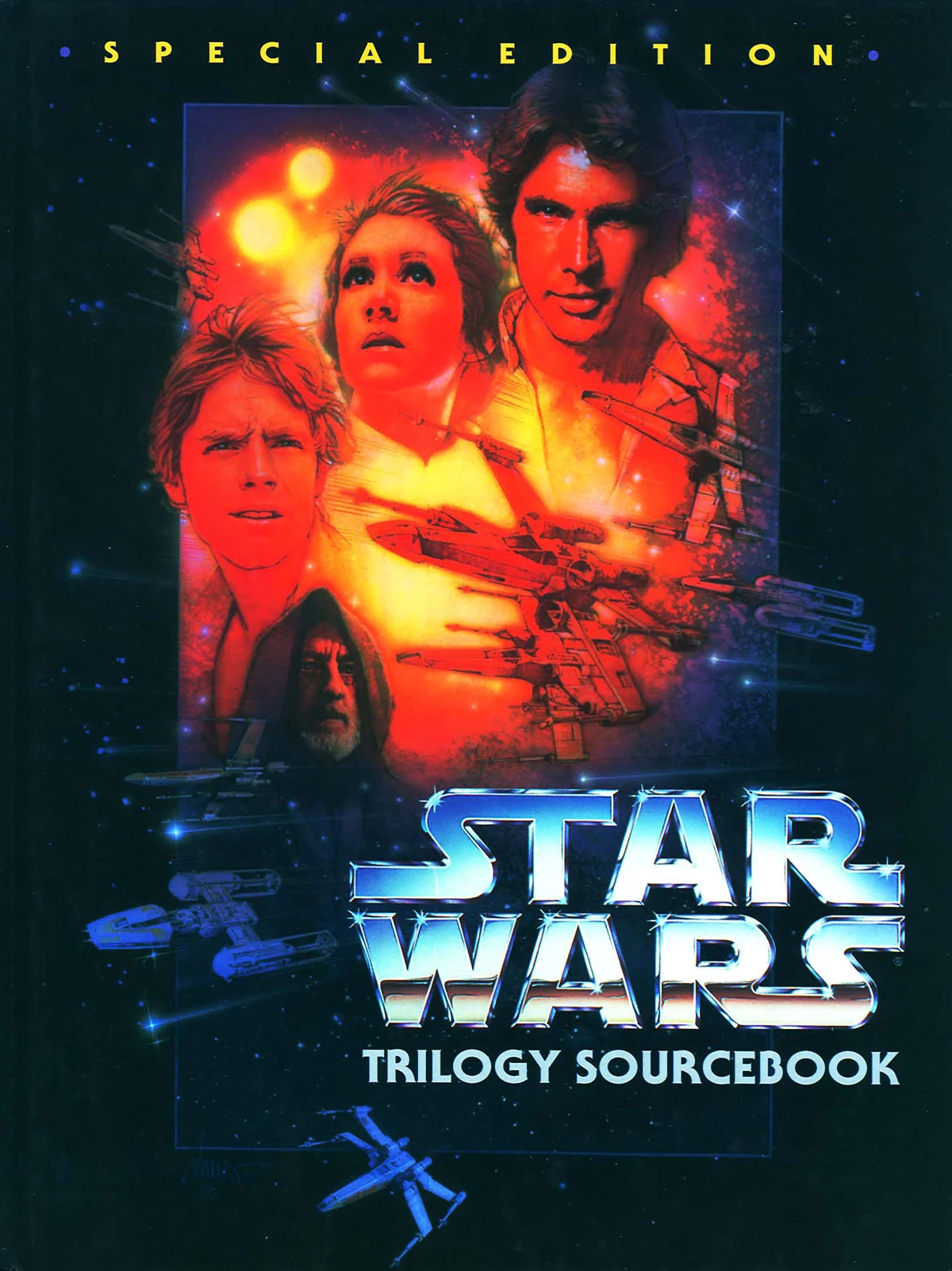
Star Wars Trilogy Sourcebook, Special Edition
Star Wars Trilogy Sourcebook, Special Edition
Credits
Previous Edition Design and Editing: David Avallone, Grant Boucher, Jonatha Caspian, Greg Farshtey, Pablo Hidalgo, Christopher Kubasik, Paul Murphy, Bill Slavicsek, Jon Smith, Curtis Smith, Michael Stern, George Strayton, Paul Sudlow, C.J. Tramontana, Martin Wixted
New Material: Drew Campbell, Steve Miller, Paul Sudlow and Eric S. Trautmann
Lead Developer: Eric S. Trautmann
Development and Editing: George Strayton and Paul Sudlow
Additional Editing and Proofreading: Jen Seiden
Layout, Graphics and Cover Design: Tom O'Neill
Additional Graphics: Tim Bobko and Brian Schomburg
Interior Illustrations: Tim Bobko, Storn Cook, Ralph McQuarrie, Brian Schomburg, and Christopher J. Trevas
Interior Photographs: Lucasfilm Ltd.
Cover Art: Ralph McQuarrie
Special Thanks To: Scott Palter, Rich Hawran and Jeff Kent (West End Games); Cara Evangelista, Stacy Moffema, and Lucy Autrey Wilson (Lucasfilm Ltd); Martin X. Petz (SciPubTech); and Tim O'Brien and Dan Wallace (for invaluable assistance with fact-checking and overall moral support).
STAR WARS ™ or ® & © 1997 Lucasfilm Ltd. Title and character and place names protected by all applicable trademark laws. All Rights Reserved. Used Under Authorization.
First Printing: October 1997
Heroes, Rogues & Villains
Chapter One: Heroes of the Rebel Alliance
"Halt. What's the codeword?
"You'd better get to it faster next time, or you might find yourself with a blastburn where your chest used to be. We can't take any chances, what with all the Imperials running around here. You'd think the Rebel Alliance had just scored a big one against the Empire—'course, the Imps will tell you different. I guess we're just not getting the proper coverage on the Newsnets, if you know what I mean.
"Contrary to what the Empire would have you believe, the Rebellion isn't a bunch of traitors intent on toppling the 'true' government. We're freedom fighters trying to put things right, trying to bring back the peace and cooperation that existed for millennia throughout the Republic.
"Thousands of beings have contributed to the success of the Alliance over the years. While the actions of all are immeasurable, a select few tend to stand out..."
—Major Belyssa Romey, 132nd Forward Division, Atrivis Sector.
Admiral Ackbar
As commander of the Rebel Fleet, Ackbar had one of the most important and demanding jobs in the Alliance. The fleet was the Rebellion's most valuable asset and its most important tool to challenge the overwhelming might of the Empire. Admiral Ackbar was the natural choice for fleet commander.
His skills and character are above question. But even beyond that, Ackbar was a symbol to the rest of the galaxy: a symbol that the Alliance was fighting for everyone, no matter what their sex, color, creed, or planet of origin. All are welcome; all have a chance to help.
The Empire has made discrimination against aliens a long-standing policy. This was but one of the deplorable policies that the Rebellion fought against. Admiral Ackbar and the Mon Calamari proved that assertion.
Ackbar proved his competence while commanding the Shantipole project, which added the valuable B-wing fighter to the Alliance's arsenal. He was also extremely influential on his home planet and was largely responsible for that planet's decision to supply their precious Mon Calamari Cruisers, the cornerstones of the Rebel Fleet.
Although widely recognized as a fine tactician, it was his organizational and administrative abilities that make Ackbar an outstanding leader. He is known for being rather conservative in battle strategy, but this aspect of his personality is nicely counterbalanced within the fleet's command structure by the innovative impetuosity of his young officers and the aggressive nature of General Madine.
A case in point was the Battle of Endor. When the Death Star surprisingly went operational and began systematically destroying the Rebel Fleet's most powerful vessels, Ackbar's first instinct was to call off the attack. But General Calrissian pleaded with him to continue by engaging the Imperial Star Destroyers, in the hope that the Death Star wouldn't be able to open up on them without hitting Imperial ships.
For all of his conservatism, Ackbar was open to, and saw the logic in, General Calrissian's radical plan. The gamble paid off.
The battle over Endor proved to everyone that Mon Mothma's choice for command of the fleet was perfect. It was the Alliance's shining moment, and Ackbar deserves much of the credit.
Mon Calamari
Home Planet: Mon Calamari
Attribute Dice: 12D
Attribute Minimum/Maximums:
DEXTERITY 1D/3D+1
KNOWLEDGE 1D/4D
MECHANICAL 1D+1/3D+1
PERCEPTION 1D/3D
STRENGTH 1D/3D
TECHNICAL 1D+1/4D
Special Abilities:
Moist Environments: When in moist environments Mon Calamari receive a +1D bonus to all Dexterity, Perception and Strength attribute and skill checks. This is purely a psychological advantage.
Dry Environments: When in very dry environments, Mon Calamari seem depressed and withdrawn. They suffer a -1D penalty to all Dexterity, Perception and Strength attribute and skill checks. Again, this is psychological only.
Aquatic: Mon Calamari can breathe both air and water and can withstand extreme pressures found in ocean depths.
Story Factors:
Enslaved: Prior to the Battle of Endor, most Mon Calamari not directly allied with the Rebel Alliance were enslaved by the Empire and in labor camps. Imperial officials have placed a high priority on the capture of any "free" Mon Calamari due to their resistance against the Empire. Theirs was one of the first systems to declare their support for the Rebellion.
Move: 9/12
Size: 1.3-1.8 meters tall
Admiral Ackbar
Type: Mon Calamari Commander
DEXTERITY 2D+2
Blaster 4D, dodge 5D+2
KNOWLEDGE 3D+2
Alien species 7D, bureaucracy 6D+1, cultures 5D, languages 6D, planetary systems 7D+1, survival 4D, survival: ocean/water 9D, tactics: fleets 6D, tactics: capital ships 8D+2, willpower 5D
MECHANICAL 3D+1
Astrogation 6D, capital ship piloting 6D+1, capital ship shields 5D, sensors 5D
PERCEPTION 2D+1
Bargain 5D, command 8D
STRENGTH 2D
Stamina 4D, swimming 6D
TECHNICAL 3D
Capital ship repair 5D, computer programming/repair 4D, droid programming 3D+2, security 4D
Special Abilities:
Moist Environments: +1D to Dexterity, Perception and Strength attribute and skill checks.
Dry Environments: Mon Calamari seem depressed and withdrawn. They suffer a -1D penalty to all Dexterity, Perception and Strength attribute and skill checks.
Aquatic: Mon Calamari can breathe both air and water and can withstand extreme pressures found in ocean depths.
Force Points: 1
Character Points: 17
Move: 10
Equipment: Comlink, datapad
Wedge Antilles
Wedge's parents were the managers of one of many fueling depots in outer Gus Treta, a spaceport in the Corellian system. When a pirate vessel fleeing authorities burst out of its hangar without unhooking its cables, the ensuing fireball destroyed both it and the entire complex. With the insurance for the complex and his parents, and the reward for indirectly disposing of the wanted felons, Wedge bought his own Corellian light freighter. Having spent his entire life around repulsorlifts and hyperdrives, he modified it to suit him.
With some credits left over, Wedge began a profitless attempt to make a respectable living in a system where smuggling was the rule, not the exception. In a last ditch effort, Wedge joined the Alliance as a weapons smuggler, and soon got caught up in something far larger than the turn of a credit or two.
Wedge had a reputation as something of a show-off before he was assigned to Skywalker's squadron at the Battle of Yavin. After that engagement, he quickly became one of the Alliance's young rising stars.
Wedge was one of the few pilots to survive the Battle of Yavin, and not by any act of cowardice. Credited with a half-dozen kills during the assault, he also aided in Luke's final run for the exhaust port. After the battle, Luke and Wedge became good friends, and the two of them jointly founded the famous Rogue Squadron.
Red Squadron, the X-wing fighter squadron at the Battle of Yavin, was cobbled together from various other groups, including the Ecliptic Evaders, the Dantooine squadron, and the Tierfon Yellow Aces, to face the Death Star threat. As a result, Wedge never really got to know most of the other pilots, or the subtleties of their flying.
After the Yavin evacuation, which Wedge helped to organize, he was permanently assigned to the roving Alliance High Command group. A core team of pilots began to form, under the command of Luke Skywalker. This team not only flew together, but trained and developed tactics together. Under the wise tutelage of Commander Narra of Renegade Flight, the nascent Rogue Group began to take form.
Wedge immediately struck up a friendship with Wes Janson. A capable pilot, Janson was also an amazing gunner, and the two often flew as one another's wingmen. During several training maneuvers, Janson saved Wedge's X-wing from being painted by targeted drone beams by destroying them long before Wedge realized there was a problem. The two also shared numerous interests, including sabacc and Corellian ale. It was as if they had always known each other.
The performance of Rogue Group during several skirmishes during the Thila evacuation proved their effectiveness. They lived as a team, and flew as a team.
The loss of close friends became all too real at the Battle of Hoth, when several snowspeeders were destroyed by AT-AT walker fire. The loss of Renegade Flight was also felt deeply among all the pilots. A plaque hangs on the command deck of the Rebel frigate Chancellor commemorating those lost personnel.
To fill the gap left by the loss of Renegade Flight, Wedge was promoted to commander. After the evacuation from Hoth, he took command of Rogue Squadron at the request of Luke Skywalker. Since that time, he has formed them into the Rebel Fleet's elite starfighter group. As a testament to the pilots' skill, his squadron was directly attached to the Headquarters Frigate.
Although given an opportunity to equip his flight with the Alliance's new fighters, the B- and A-wings, Wedge chose to stick with the X-wing. He felt that the X-wing was still a match for the new Imperial TIE Interceptor, even though the Interceptor had been designed specifically to defeat the X-wing. He also reasoned that it made more sense to let the newer pilots fly the more sophisticated Rebel fighters giving them a better chance against the new TIEs.
In remembrance of his old squadron that had fought so bravely over the surface of the original Death Star, Wedge temporarily christened the squadron "Red Group" for this second Death Star assault. He and Luke were the only survivors of the original Red Group, and though Luke wouldn't be with them this time, Wedge felt that this squadron had the same fire and determination as the original. There were some new faces, as well as old Rogue-Group veterans like Hobbie and Janson, making an effective combination of enthusiasm and experience.
During the Battle of Endor, Red Group lived up to their billing as the Alliance's elite squadron. Many of the B- and A-wing squadrons were devastated by the tremendous onslaught of Imperial fighters, but Red Group, under Wedge's nimble command, piled up an impressive number of Imperial kills, while at the same time keeping themselves largely intact.
The survival of Red Group was crucial to the Rebel attack plan. It, along with Gold Group, was scheduled to lead the attack run on the partially constructed battle station's main power generator. Wedge Antilles—accompanied by Lando Calrissian—delivered a crucial blow that allowed Lando to destroy the massive station.
Wedge Antilles (as of the Battle of Yavin)
Type: Brash Pilot
DEXTERITY 3D+1
Blaster 5D+1, dodge 5D+2
KNOWLEDGE 2D
Planetary systems 4D, streetwise 3D+2
MECHANICAL 4D+2
Astrogation 5D+2, repulsorlift operation 5D+1, starfighter piloting 6D+2, starship gunnery 6D+2, starship shields 5D
PERCEPTION 2D+1
Bargain 3D, con 3D+2, search 3D
STRENGTH 3D
Brawling 4D, stamina 4D+2
TECHNICAL 3D+1
Repulsorlift repair 4D+1, starfighter repair 4D
Character Points: 28
Move: 10
Equipment: Blaster pistol (4D), sealed flight suit, comlink
Lando Calrissian
Lando Calrissian's life changed for the worse the day Darth Vader arrived on Cloud City. Things were so much simpler before that: the onetime gambler, rogue and interstellar grifter had settled down into a nice, comfortable life as Baron-Administrator of Cloud City. Sure, there were pressures that came with the job—supply problems, labor difficulties and the like—but they were nothing compared to the kind of difficulties he used to encounter on a daily basis (jealous husbands, humiliated crime bosses and outraged government officials to name a few).
As chief executive of the floating metropolis, Lando led a kind of double life. By day he was the responsible leader, settling disputes, appearing at charity luncheons, and making appearances at other occasions of pomp and circumstance. Evenings on Cloud City were quite another story, however. Lando spent many of his nights in one disguise or another, milking the city's casinos for all they were worth.
It was a good life, and it seemed as far away from the current galactic civil war as one could hope to be. But Vader changed all that. Suddenly, Lando's comfortable existence hinged on his willingness to betray his old friend Han Solo to the Empire.
Lando had more regard for Solo than the Corellian knew. It was Han who had won the famous Millennium Falcon from Lando in a rather well-documented sabacc match and, as it turns out, it was that which prompted Lando to give up his travels as a galactic rogue and decide to settle down. Of course, the actual "settling" did take a while, because, after all, there was no sense in rushing into such a decision.
"No matter where you go, or how far from the Galactic Core you end up, it'll always find you." These were Lando's words when asked about finally joining the Alliance. "I guess I was just kidding myself," he continued, "thinking I could run away and hide from trouble when all I was really doing was not dealing with how I felt about everything. I have never had any love for the Empire, and I always felt I had been doing my part to fight it—in my own little, annoying sort of way."
Calrissian's roguish smile faded as he finished his statement. "When I settled on Bespin, it seemed that everything I was doing was for myself. Vader's demands were the start of a test. Normally, I have my own special way of dealing with tests, but I couldn't find one of those ways that would apply that time. There was just no way to cheat. It was 'yes' or 'no,' with no other options. I guess you might say I tried one answer, found that I wasn't too happy with it, and decided to choose the other."
Lando opted for the life of a Rebel, helping to save Leia and joining in the effort to rescue Han from Jabba the Hutt. The Empire had forced him out of retirement and dealt him a deadly hand. It was an act the Empire would come to regret.
As the first shot in Lando's newly declared war on the Empire, he traveled with Leia and Chewbacca to Tatooine to rescue Solo. Though Jabba's palace was easy to find, there was no reason to believe that Han was still there. Jabba might have stashed his body anywhere—or, horrible as it was to consider, killed Solo already. Someone had to get inside and scout out the terrain, and Lando knew he was the man for the job.
But you don't just walk up to Jabba's front door and ask to take a look around—not if you want to ever walk out again. Lando knew he would have to work his way into the organization. It would take time, and no small effort, but it was the only chance to save Han.
The plan, as it stood then, was rather sketchy. Lando, taking on one of his more effective criminal personas, would contact an old colleague in Anchorhead who could get him a job in Jabba's palace. Luke would make his way inside the palace on his own after finishing some mysterious errand in the desert. Once everyone was in position, they would make their move.
After he had infiltrated the palace, Lando was instructed to wait for the proper moment to strike. That moment appeared when Leia—disguised as the bounty hunter Boushh—arrived at Jabba's lair with Chewbacca in chains.
In truth, Lando didn't think much of Luke's plan. But somehow, when talking it over with Skywalker, it all seemed to make sense, and it wasn't until later that he recalled he had wanted to raise objections. To tell the truth, Skywalker made Lando a little nervous.
Aside from being nearly dropped into the mouth of the Sarlacc, the rescue went well. Jabba's operation was destroyed, and Han was safe and sound. Surprisingly, Han harbored no ill will toward Lando, instead thanking him for the rescue. It was just one more sign of how much Solo had changed since joining the Alliance.
For Lando, joining the Alliance was the final piece to a picture that had been building since he became Baron-Administrator of Cloud City. He had learned how to deal with responsibility. Now he was learning to fight for what he believed in and to value friendship more than money. It was a more subtle change than Han's, although the fundamentals were the same. Both had become generals in the Rebel Alliance, and both volunteered to lead dangerous missions against overwhelming odds.
Lando led the starfighter assault on the second Death Star. It was Calrissian who came up with the unorthodox strategy employed by the Rebel fleet during the battle: when the Death Star was revealed to be operational, Calrissian convinced Ackbar to move closer to the Imperial fleet, a strategy that may have saved countless Rebel lives by preventing the battle station from firing its superlaser (for fear of hitting Imperial vessels).
During the battle, Calrissian accompanied Wedge Antilles on a run into the battle station's superstructure. Between Antilles's shots and Calrissian's accurate fire, the Death Star was destroyed.
Lando Calrissian (as of his departure from Cloud City)
Type: Gambler
DEXTERITY 3D+2
Blaster 6D+2, blaster: hold-out blaster 7D, brawling parry 5D+1, dodge 6D, grenade 4D+2, melee combat 4D+2, melee parry 5D+1
KNOWLEDGE 3D
Alien species 5D, bureaucracy 7D, business 7D, business: mining 10D+1, business administration 7D+1, cultures 6D+2, languages 5D, planetary systems 5D, streetwise 7D+1, survival 5D, value 5D+1
MECHANICAL 2D+1
Archaic starship piloting 3D+1, astrogation 6D+2, communications 4D, ground vehicle operation 3D+1, repulsorlift operation 4D, repulsorlift operation: cloud car 5D+1, sensors 4D+2, space transports 8D, starfighter piloting 8D, starship gunnery 7D, starship shields 7D, swoop operation 4D+2
PERCEPTION 4D
Bargain 8D, bargain: Tibanna gas 10D+1, command 6D, con 8D+2, forgery 6D+1, gambling 9D+2, hide 6D, persuasion 6D+1, sneak 6D
STRENGTH 2D+2
Brawling 5D+1, climbing/jumping 5D, lifting 4D+2, stamina 5D, swimming 4D
TECHNICAL 2D+2
Computer programming/repair 4D, droid programming 3D, repulsorlift repair 4D, security 6D+1, space transports repair 6D+2, starship weapon repair 4D
Force Points: 1
Character Points: 10
Move: 10
Equipment: Hold-out blaster (4D), comlink, sabacc card deck
Lando Calrissian (As of the Battle of Endor)
Streetwise 8D
Command 7D, con 9D
Space transports repair 7D
Force Points: 2
Character Points: 18
Chewbacca
The mighty Wookiee Chewbacca has been a faithful addition to the Rebel Alliance (and the subsequent New Republic) since the days of the Battle of Yavin. He is the most famous alien in the galaxy, with the possible exception of Admiral Ackbar. Strong, fearless, an able pilot and mechanic—these are but a few of the qualities and skills that make him of such great value to the New Republic. A loyal friend to Corellian smuggler Han Solo, Chewbacca was with him when Luke Skywalker, Obi-Wan Kenobi, and two droids came aboard the Millennium Falcon for a fateful trip to Alderaan.
Chewbacca was a key part of the rescue plan for Princess Leia—acting as an "alien prisoner"—allowing Han and Luke to infiltrate Detention Block AA-23. It was also Chewie who persuaded Han to go back to help out during the Battle of Yavin—Han is fond of referring to Chewbacca as his conscience.
It was during the events on Bespin that perhaps the greatest change took place in Chewbacca. Roaring in rage as the Imperials began to lower Han into the carbon-freeze chamber, the Wookiee lashed out at the stormtroopers. It was Han himself who calmed his friend and ended the berserker rage.
"Save your strength," Solo called out. "There'll be another time. The Princess—you have to take care of her."
It was then that Chewbacca realized there was more to his honor family than just Han Solo. But he didn't forget his Corellian friend. With Lando Calrissian in tow, Chewbacca and the Millennium Falcon returned to Tatooine to await Luke Skywalker. He firmly believed that together they could save Han from Jabba the Hutt.
His faith and belief in his friends continued throughout the war. Whether he was cramped inside a ship designed for beings much smaller than Wookiees, tied to a stake and at the mercy of the Ewoks, or battling a legion of the Empire's best troops, Chewbacca was confident that he and his comrades would eventually triumph.
Wookiees
Home Planet: Kashyyyk
Attribute Dice: 12D
Attribute Minimum/Maximums:
DEXTERITY 1D/3D+2
KNOWLEDGE 1D/2D+1
MECHANICAL 1D/3D+2
PERCEPTION 1D/2D+1
STRENGTH 2D+2/6D
TECHNICAL 1D/3D+1
Special Abilities:
Berserker Rage: If a Wookiee becomes enraged (the character must believe himself or those to whom he has pledged a life debt to be in immediate, deadly danger) the character receives a +2D bonus to Strength for purposes of causing damage while brawling (the character's brawling skill is not increased). The character also suffers a -2D penalty to all non-Strength attribute and skill checks. When trying to calm down from a berserker rage while enemies are still present, the Wookiee must make a Moderate Perception total. The Wookiee suffers a -1D penalty to Perception and rolls a minimum of 1D for the check (therefore, while most Wookiees are enraged, they will normally have to roll a 6 with their Wild Die to be able to calm down). Please note that this penalty applies to enemies. After all enemies have been eliminated, the character must only make an Easy Perception total (with no penalties) to calm down. Wookiee player characters must be careful when using Force Points while in a berserker rage. Since the rage is clearly based on anger and aggression, using Force Points will almost always lead to the character getting a Dark Side Point. The use of the Force Point must be wholly justified not to incur a Dark Side Point.
Climbing Claws: Wookiees have retractable climbing claws which are used for climbing only. They add +2D to their climbing skill while using the claws. Any Wookiee who uses claws in hand-to-hand combat is automatically considered dishonorable by other members of his species, possibly to be hunted down—regardless of the circumstances.
Story Factors:
Reputation: Wookiees are widely regarded as fierce savages with short tempers. Most people will go out of their way not to enrage a Wookiee.
Enslaved: Prior to the defeat of the Empire, almost all Wookiees were enslaved by the Empire, and there was a substantial bounty for the capture of "free" Wookiees.
Language: Wookiees cannot speak Basic, but they all understand it. Nearly always, they have a close friend who they travel with who can interpret for them... though a Wookiee's intent is seldom misunderstood.
Honor: Wookiees are honor-bound. They are fierce warriors with a great deal of pride and they can be rage-driven, cruel and unfair—but they have a code of honor. They do not betray their species—individually or as a whole. They do not betray their friends or desert them. They may break the "law," but never their code. The Wookiee code of honor is as stringent as it is ancient. Atonement for a crime against their honor code is nearly impossible—it is usually only achieved posthumously. But Wookiees falsely accused can be freed of their dishonor, and there are legends of dishonored Wookiees "coming back."
Move: 11/15
Size: 2-2.3 meters tall
Chewbacca (as of the Battle of Yavin)
Type: Wookiee
DEXTERITY 2D+2
Blaster 5D+2, bowcaster 9D, brawling parry 7D, dodge 6D, grenade 5D, melee combat 8D, melee parry 8D, vehicle blasters 6D+1
KNOWLEDGE 2D
Alien species 6D+2, bureaucracy 4D, business 4D, cultures 3D+1, intimidation 8D+2, languages 5D+2, planetary systems 7D, streetwise 6D+1, survival 7D, value 7D+1
MECHANICAL 3D
Astrogation 8D, beast riding 4D, communications 3D+1, repulsorlift operation 7D, sensors 5D, space transports 6D+1, space transports: YT-1300 transports 8D, starship gunnery 7D, starship shields 6D
PERCEPTION 2D
Bargain 5D, command 4D+2, gambling 4D+1, hide 3D, search 3D, sneak 3D
STRENGTH 5D
Brawling 10D, climbing/jumping 7D, lifting 9D, stamina 10D, swimming 7D
TECHNICAL 3D+1
Blaster repair 5D+1, bowcaster repair 5D+2, computer programming/repair 8D, demolition 5D+2, droid programming 7D, droid repair 6D, first aid 5D, repulsorlift repair 6D, security 6D+1, space transports repair 6D+2, space transports repair: YT-1300 transports 10D+2
Special Abilities:
Berserker Rage: Chewbacca gains +2D to Strength when brawling in berserker rage (see previous page for details).
Climbing Claws: +2D to climbing.
Force Points: 1
Character Points: 16
Move: 13
Equipment: Bowcaster (4D), ammo bandolier, droid tool kit, starship tool kit, waist pouch
Chewbacca (As of the Battle of Hoth)
Blaster 6D, brawling parry 7D+1, dodge 6D+1, grenade 5D+1
Alien species 7D, business 4D+2, languages 6D, planetary systems 7D+2, streetwise 7D, value 7D+1
Astrogation 8D+1, communications 4D+2, repulsorlift operation 7D+1, sensors 6D, space transports 6D+2, starship gunnery 8D
Climbing/jumping 7D+2, lifting 10D
Droid programming 7D+2, droid repair 7D+2, space transports repair 8D
Force Points: 3
Character Points: 21
Chewbacca (As of the Battle of Endor)
Blaster 6D+2, brawling parry 7D+2
Value 7D+2
Command 5D, sneak 3D+2
Demolitions 6D, droid programming 8D, first aid 5D+1, repulsorlift repair 6D+1, security 7D
Force Points: 4
Character Points: 24
Chief Chirpa
Although very old and a bit senile, Chirpa is revered by the tribe. He has been the chief for 42 seasons, and during his reign, the Ewoks have known only tranquillity and prosperity—that is, until the arrival of the Imperials.
The war between the Rebel Alliance and the Empire presented Chirpa with the most difficult decisions he, or any previous village chief, had ever had to confront. Chirpa's tribe was strong in the hunt, but not warlike, and it was very much out of character for them to become involved in a conflict such as this. But the Ewoks are also, for the most part, passionate and honorable, and they will fight on the side that they believe in. It is up to the chief to decide what these beliefs are.
Logray convinced Chirpa to use Princess Leia and her friends in a sacrificial ceremony in honor of the "golden god." But when the strangers displayed their powerful magic, Chirpa realized his mistake. He decided it was in the interests of the tribe to listen to the story of the newcomers.
As told by See-Threepio, the tale was perhaps the most exciting and tragic epic the chief had ever heard. Soon after Threepio's recounting, Chirpa convinced the village elders to make the newcomers honorary members of the tribe. It was apparent that they were on the side of good, and by joining them to the tribe, the Rebels' fight became theirs.
The Imperials had killed many trees, and disturbed the hunting cycle with the building of their giant ground buildings. It was for these reasons, along with the plight of tribe's newest members, that Chirpa decided to commit the Ewoks to the fight against the Empire. Although the Imperials had far superior weaponry, Chirpa and the Ewoks did not fear them. They approached the Battle of Endor as they would a difficult hunt. In the Chief's own words, "It might be a long and dangerous chase, but in the end we will triumph."
Ewok
Home Planet: Endor
Attribute Dice: 12D
Attribute Minimum/Maximums:
DEXTERITY 1D+2/4D+2
KNOWLEDGE 1D/3D
MECHANICAL 1D+2/3D+2
PERCEPTION 2D/4D+2
STRENGTH 1D/3D
TECHNICAL 1D/2D+2
Special Skills:
Thrown weapons (Dexterity): bow, rocks, sling, spear. Time to use: one round. The character may take the base skill and/or any of the specializations.
Glider (Mechanical): Time to use: one round. The ability to pilot gliders.
Primitive construction (Technical): Time to use: one hour for gliders and rope bridges; several hours for small structures, catapults and similar constructs. This is the ability to build structures out of wood, vines and other natural materials with only primitive tools. This skill is good for building sturdy houses, vine bridges and rock-hurling catapults (2D, speeder scale).
Special Abilities:
Skill Bonus: At the time the character is created only, the character gets 2D for every 1D placed in the hide, search and sneak skills.
Skill Limits: Beginning characters may not place any skill dice in any vehicle (other than glider) or starship operations or repair skills.
Smell: Ewoks have a highly developed sense of smell, getting a +1D to their search skill when tracking by scent. This ability may not be improved.
Story Factors:
Protectiveness: Most Human adults will feel unusually protective of Ewoks, wanting to protect them like young children. Because of this, humans can also be very condescending to Ewoks. Ewoks, however, are mature and inquisitive—and unusually tolerant of the Human attitude.
Move: 7/9
Size: 1 meter
Chief Chirpa
Type: Ewok Chieftain
DEXTERITY 3D+2
Dodge 4D+2, thrown weapons 4D+2
KNOWLEDGE 2D
Bureaucracy 3D, scholar: Ewok lore 3D
MECHANICAL 2D+2
PERCEPTION 4D
Bargain 4D+2, command 5D
STRENGTH 3D
TECHNICAL 2D+2
Special Abilities: Smell: Ewoks get +1D to search when tracking by scent.
Character Points: 7
Move: 7
Equipment: Pipe, ceremonial headdress.
Biggs Darklighter
Biggs Darklighter was best known for his affiliation with Luke Skywalker and for his heroism during the Battle of Yavin. As a child, Biggs was one of the privileged class on Tatooine. His father, the food-magnate Huff Darklighter, made sure that Biggs got everything he ever desired in life. Everything, that is, except for a father's warmth and understanding. The elder Darklighter purchased his water from moisture farmers at cut rates, and then sold the resulting produce at a tremendous profit. He is considered to be the largest food producer on Tatooine, and has swallowed up dozens of family-owned moisture farms to ensure a constant supply of water for his subterranean crops.
Before long, Biggs grew discontent with his family and started spending more and more of his time in the streets of Anchorhead. There he met a young boy by the name of Luke Skywalker. Luke and Biggs became fast friends, but there was always an air of competition about their friendship.
The two friends spent most of their teenage years together. They raced landspeeders and skyhoppers, dreamed of space battles, and made plans to go to the Academy together. Biggs' father could ensure his son's commission, while Luke's raw talent was more than adequate for acceptance. They planned to graduate, serve their required time, and then get a spaceship together, to go into business for themselves. They never really decided what they would do once they were zooming through space, but in their youthful exuberance it didn't really matter.
Unfortunately, Luke was detained for "another season" to help his uncle's struggling moisture farm and Biggs was forced to start his training without him. This was heartbreaking to both lads at the time, but grew worse as season after season passed with Luke forced to stay for just "one more harvest."
Eventually, Biggs graduated and was assigned to the merchant ship Rand Ecliptic. But during his time at the Academy, Biggs made friends—dangerous friends who were sympathetic to the Rebel Alliance. They planned to jump ship once they reached an outlying system. From there, Biggs and his friends were going to join the Alliance.
Biggs demonstrated unswerving loyalty for the Alliance once he made contact. He had a knack for hot-dogging TIE fighters that was unmatched until his old friend Luke Skywalker entered the scene.
Had Biggs Darklighter survived the Battle of Yavin, he would no doubt be a major force in the Alliance, much like his friend Luke Skywalker. But he sacrificed his life so that the Rebellion would succeed. Luke's brief reunion with his childhood friend in the Yavin hangar bay just before the final assault on the Death Star is one of those moments the fledgling Jedi looks back on today, wishing he could grab hold of it and stretch it out indefinitely.
Biggs Darklighter
Type: Brash Pilot
DEXTERITY 3D
Blaster 4D+2, dodge 5D+1
KNOWLEDGE 2D+2
Cultures 4D+2, planetary systems 4D, streetwise 3D+2
MECHANICAL 4D
Repulsorlift operation 5D+1, starfighter piloting 6D, starship gunnery 6D
PERCEPTION 3D
Con 4D
STRENGTH 3D
Brawling 4D+1, stamina 5D
TECHNICAL 3D
Computer programming/repair 4D+1, repulsorlift repair 3D+2, security 3D+2
Character Points: 4
Move: 10
Equipment: Blaster pistol (4D), comlink, sealed flight suit.
Major Derlin
"Your Highness, there is nothing more we can do tonight. The shield doors must be closed."
Those were the most difficult orders that Bren Derlin had ever had to give. Skywalker and Solo were valued members of the Alliance, but more than that, they were his friends. A great respect had grown between Derlin, the officer in charge of Hoth base security and operations, and Skywalker and Solo, the two commanding field officers.
Major Derlin's prime duty on Hoth was to ensure that Echo Base was up and functioning no matter the circumstances. It was a quiet, thankless, behind-the-scenes battle against the elements. Not an easy task by any stretch of the imagination.
Major Derlin was put in charge of the base's security and operations after being promoted by General Rieekan for actions on Nentan. Rieekan's decision proved popular and wise, as Derlin served Echo Base well.
Derlin's rise to the rank of major is worth noting. Captain Derlin had served under Rieekan for quite a while, seeing campaign action in numerous skirmishes across the galaxy. But it was at Nentan that Derlin truly earned and was awarded the rank of major. The Nentan checkpoint base was barely two months old when the evacuation orders were given. But this was no ordinary evacuation, because civilians were involved.
Nentan had become a major stopover point for liberated civilians waiting for transport to Rebel safe worlds. When the Empire discovered the base's location, the bunkers were at close to total capacity. Naturally, the civilians were to be evacuated first, but because they were so numerous, there were not enough transports to accommodate everyone. Some of the military personnel had to be left behind. There were volunteers, but this was not an acceptable solution to General Rieekan. Derlin offered him another option.
He led an "expendable" squad of men into the Nentan wastes, along with the remaining personnel. They hid among the towering rock spires of the ancient ruins there. When the Imperial troops arrived, they hit the abandoned base with their full force, as Derlin knew they would. It was the Empire's style to throw everything it had at an enemy in as impressive a show of force as possible.
When the Imperial troops swept down into the valley to level the base, they left their transports under minimal guard. It was relatively easy for Derlin and his men, who approached through the natural cover behind the landing area, to capture one of the Imperial transports. With the guards eliminated, the remaining Alliance members crept aboard. The transport, with a full cargo of Rebels, rocketed off the planet before the Imperials knew what was happening. Even the commander of the Imperial Star Destroyer orbiting the planet was taken by surprise, figuring the transport was merely moving prisoners or captured equipment.
The stolen ship was in hyperspace before the Imperials could so much as ask for a code clearance.
With his well-documented heroics at Nentan behind him, newly promoted Major Derlin was an obvious choice for head of security and operations at the Hoth base. "There is no one else I would even consider," was the response from General Rieekan when asked about his choice for the post, a decision supported by the troops of Echo Base.
Derlin acted as the planet-level unit leader during the mission to disable the shield generator during the Battle of Endor. There were eleven men under Derlin, including a young and eager Lieutenant Page.
Major Bren Derlin (as of the Battle of Hoth)
Type: Alliance Major
DEXTERITY 3D
Blaster 4D+2, blaster artillery 5D, dodge 4D, vehicle blasters 4D
KNOWLEDGE 3D
Survival 4D+2, tactics: squads 6D, value 4D
MECHANICAL 4D
Beast riding 4D+1, repulsorlift operation 5D
PERCEPTION 3D
Command 5D, search 4D
STRENGTH 3D
Brawling 4D, stamina 5D
TECHNICAL 2D
Repulsorlift repair 3D, security 4D
Character Points: 11
Move: 10
Equipment: Blaster pistol (4D), macrobinoculars, comlink.
Major Bren Derlin (As of the Battle of Endor)
Blaster 5D, dodge 4D+2, vehicle blasters 5D
Survival 5D+2
Command 5D+2
Stamina 5D+2
Character Points: 9
Move: 11
Equipment: Blaster pistol (4D), macrobinoculars (+1D to search over 50 meters), comlink, low-feedback scanner (uses sensors, detects movement at ranges of 0-1/2/5km), sensor scramblers (2D to difficulty to detect with sensors), camouflage fatigues (+2D to sneak in forest at ranges of 35+ meters).
General Jan Dodonna
The Rebel Alliance's master tactician at the time of the Battle of Yavin was General Jan Dodonna. The aging Old Republic commander came out of retirement when the New Order took hold, assembling a group of many of his famous and ever-loyal comrades in the process.
The combination of youthful exuberance and reflex shown by the line warriors, tempered by wise, thoughtful organization at the command level, made the Alliance a viable fighting force. Through the expert guidance of experienced commanders such as Jan Dodonna, young heroes like Commander Luke Skywalker and Princess Leia Organa learned about military strategy and worked their way into command positions. But it should not be too greatly emphasized that the Alliance's greatest early victory, the destruction of the Death Star, was as much a product of masterful sharpshooting as it was the culmination of a carefully thought-out plan based on the technical readouts of the station.
General Dodonna is the man primarily responsible for the success of the Battle of Yavin. Without his masterful analysis of the Death Star's defenses, the Alliance would likely have fled from Yavin or mounted a hopeless all-out assault. Dodonna found the weakness in the Death Star's defense, and therefore made an attack feasible in the first place.
Dodonna was one of the finest Star Destroyer captains during the days of the Old Republic. Along with old friend Adar Tallon, Dodonna virtually wrote the book on modern interstellar combat. While Tallon specialized in ship-to-ship combat, Dodonna reinvented the logistics and siege aspects of galactic war. It is a sore point with him that many of his early proposals for siege weapons were developed, produced and employed by the Empire. Their use has been twisted in such notorious incidents as the unholy Siege of Dalron Five and the infamous Project Asteroid.
Tallon and Dodonna were inseparable friends. It was a sad day indeed when Adar Tallon "died" (later it was revealed that Tallon went into hiding and was eventually convinced to join the Rebel Alliance). General Dodonna had already retired by the time the New Order was born. The Empire felt he was no longer useful enough to be "retrained" for use by the Emperor. Dodonna's execution was ordered and it became a race to see who could reach him first, the Empire or the Alliance.
The Rebel Alliance found him first. But Dodonna felt older than he was, and the years of retirement had weakened his fighting spirit considerably. The Rebels found he no longer had a stomach for war.
Just as the Alliance shuttle was preparing to depart from Dodonna's private moon, the aging general stumbled up the ramp, blaster holes dotting his billowing nightshirt. Fortunately, the approaching Imperial troopers had shot at the large cloth target, missing the frail body within. As the vessel lifted off, Dodonna fiercely took command of the ship's guns and dealt with his would-be assassins personally.
A few months of exercise and catchup reading on the latest in hardware and politics, and General Dodonna was reborn, a founding father of the Rebellion against the Empire. At the time, he was the single most important military commander in the Alliance, second in authority only to Mon Mothma.
General Dodonna always takes a personal interest in his troops and tries to meet every soldier under his command. He is not afraid to go out in the trenches every so often, just to reacquaint himself with the struggle on the line and to motivate his troops.
After the Battle of Yavin, Dodonna retained military command of Yavin Base for a short time. However, following the tragic death of his son, Dodonna slipped into a period of deep depression. He was critically wounded during the evacuation of Yavin (the Alliance thought him killed in the assault). He was captured by Imperial forces, but thanks to the efforts of a brave Rebel assault team, Dodonna was rescued, and was reunited with Tallon. He returned to a quiet semi-retirement, consulting with Alliance command on an occasional basis.
General Jan Dodonna
Type: Alliance General
DEXTERITY 2D+2
Blaster 3D+2, dodge 4D+1
KNOWLEDGE 3D
Alien species 6D, bureaucracy 5D+2, military history 7D, military history: modern fleet battles 11D, tactics: capital ships 8D, tactics: fleets 7D, tactics: sieges 9D+1, tactics: starfighters 6D+1
MECHANICAL 3D+2
Astrogation 5D+1, space transports 4D+2, starship gunnery 4D+2
PERCEPTION 3D+1
Bargain 4D+2, command 7D
STRENGTH 2D+1
Stamina 4D+1
TECHNICAL 3D
Computer programming/repair 7D, droid programming 6D+1, droid repair 4D+2, security 6D+2
Force Points: 1
Character Points: 6
Move: 9
Equipment: Datapad, blaster pistol (4D), comlink, holographic map projector and pointer.
Wes Janson
Manning a gunner's station requires a great deal of skill and nerve, a little luck, and a lot of faith in the ship's pilot. Whether the station is in a Y-wing fighter or a snowspeeder, the situation remains the same. The gunner faces backward in a vessel flying at incredibly high speeds. He has absolutely no control over the ship and only a single, high-powered weapon between him and any attacking enemies. His responsibility is to protect the ship's stern, and he has to hope that the pilot won't suddenly swerve and swoop just as he is lining up a clean shot. And, of course, the gunner must trust that the pilot will remember he's back there and won't leave him exposed to enemy fire.
Wes Janson is one of these half-courageous, half-crazy men who ride in the rear of high-performance vehicles, playing a high-tech, life-and-death game of "tag" with expertly trained Imperial pilots and gunners. His is a special breed, and he wears his True Gunner's insignia with dignity and pride. True Gunner is the highest order of gunnery awarded within the ranks of the Rebel Alliance, and Lieutenant Janson earned his through "consistent excellence and superior performance as an officer and a gunner," or so said General Dodonna at the awards ceremony at Tierfon Fighter Base.
Janson had operated out of Tierfon for most of his enlistment with the Alliance. During that time he flew with some of the top Rebel pilots, the Tierfon Yellow Aces, racking up an impressive kill record and a tremendous reputation. Among the pilots who flew with Janson in his early days at Tierfon was Jek Porkins, a close friend and one of the heroes of the Battle of Yavin who sacrificed their lives. Janson still speaks very highly of Porkins, and often tells some rather tall tales of those days back at Tierfon.
But it is most often with sadness that Janson recalls his old friend, since the situation surrounding the death of Jek Porkins is one which Janson feels could have been avoided. In the early days of Tierfon, the base was used primarily for training missions. These were technically "active" missions, but not of the most hazardous variety. Most recruits were sent to Tierfon so that they might get some combat experience under their belts without having to face extremely difficult situations. Among these green recruits were Janson and Porkins. Coming out of the same training class, the two became good friends and worked well together.
The next step up from Tierfon was "full active" duty on a high-security system base, such as the one on the fourth moon of Yavin. With the destruction of Alderaan and the impending threat of the Death Star, Tierfon's status was boosted to "full active." But the fighter contingent on the base was significantly reduced, with other less protected bases in need of greater fighter cover. Among those in need of immediate help was the Yavin Base. When the emergency transfer list was posted, Janson was on it.
Having come down with a case of Hesken Fever on a recent scouting mission, Janson was laid-up at the time of the transfer. Someone had to fill his slot on the transfer list, even though the ailing Janson insisted on going. That someone was Jek Porkins. He never returned from Yavin, and to this day, despite rationalizations that it was not his fault, Wes Janson hasn't forgiven himself.
On Hoth, Janson worked as he does these days, flying to honor his fallen friend. Hopefully, in his own mind, his heroics during the assault on Hoth put to rest at least a little of the guilt he has been feeling.
Wes Janson
Type: Brash Pilot
DEXTERITY 3D
Blaster 4D, dodge 4D+1, melee combat 4D+1, missile weapons 6D, vehicle blasters 6D+1
KNOWLEDGE 2D
Languages 3D, planetary systems 3D+2
MECHANICAL 4D
Astrogation 5D, repulsorlift operation 4D+2, starfighter piloting 4D+2, starship gunnery 6D, starship shields 5D
PERCEPTION 3D
Command 3D+2, con 3D+2
STRENGTH 3D
Brawling 4D+1, stamina 4D
TECHNICAL 3D
First aid 4D, starship repair 4D+1
Character Points: 1
Move: 10
Equipment: Blaster pistol (4D), flight suit, comlink.
Obi-Wan Kenobi
The deserts of Tatooine were Obi-Wan's home for many years. While most residents of the Anchorhead area had heard of Kenobi, the majority considered him a crazy old hermit best left to himself. Kenobi lived in the dangerous Jundland Wastes, on the edge of the Dune Sea. He was seldom encountered by others, but occasionally "Old Ben" might appear to help someone who was lost, or warn the local authorities of a massing of Sand People.
Ben Kenobi, just another desert hermit to the people of Tatooine, once traveled the galaxy as a defender of the Old Republic and a Jedi Knight. It was Kenobi who had become one of the greatest heroes of the Clone Wars, battling alongside such legendary figures as Bail Organa of Alderaan and Anakin Skywalker.
In the heady fog of his success, Kenobi took on a student, confident in his ability to instruct the boy in the ways of the Force. Whether it was a mistake on Obi-Wan's part or a fatal flaw in the student, something went wrong. Anakin Skywalker gave in to the dark side of the Force, to become Darth Vader. Vader, in service to Palpatine, was instrumental in the extermination of the Jedi Knights.
Obi-Wan Kenobi went into hiding, realizing that he could do more by guarding the infant Luke Skywalker than by leading a desperate battle that was doomed to failure. Obi-Wan still felt the weight of his decision many years later, knowing that his student had helped bring about the destruction of countless Jedi in the process.
He chose to wait for the right time to make a move against the Empire—to wait for a new hope. Kenobi took the name Ben and cloaked himself in the persona of a crazy wizard. Many years later, when a pair of droids brought young Luke Skywalker into the battle, Kenobi knew the wait was over.
One of the droids carried a message from Kenobi's old friend, Bail Organa, sent via his daughter, Princess Leia of Alderaan. The Rebel Alliance had to act and the Rebels desperately needed Kenobi's help. Aboard the terrible Death Star battle station, Obi-Wan gave his life in combat against Darth Vader in order to provide young Luke Skywalker and his companions the time they needed to escape. Although Kenobi perished in the battle, his warning to Vader proved to be true: fallen, he would return, more powerful than before.
Obi-Wan Kenobi
Type: Jedi Knight
DEXTERITY 3D
Blaster 5D, brawling parry 6D, dodge 6D, lightsaber 11D, melee combat 6D, melee parry 9D
KNOWLEDGE 3D+2
Alien species 8D, bureaucracy 6D, cultures 6D, intimidation 5D+2, languages 6D, planetary systems 6D, scholar: Jedi lore 9D+1, streetwise 5D+2, survival 8D, value 6D+1
MECHANICAL 2D
Astrogation 5D+2, beast riding 4D, capital ship gunnery 4D+1, capital ship piloting 5D, capital ship shields 3D, repulsorlift operation 4D, space transports 6D, starfighter piloting 3D+1, starship gunnery 6D, starship shields 6D
PERCEPTION 3D+1
Bargain 7D, command 9D+1, con 6D, gambling 5D+2, hide 5D+1, search 6D+1, sneak 7D
STRENGTH 3D
Brawling 5D, climbing/jumping 6D, stamina 6D
TECHNICAL 3D
Droid programming 4D, droid repair 5D, first aid 5D, security 6D
Special Abilities:
Force Skills: Control 12D, sense 12D, alter 8D
Force Powers (these are the known powers Kenobi possessed and it is believed that he had access to many other powers):
Control: Absorb/dissipate energy, accelerate healing, concentrate, control pain, detoxify poison, emptiness, enhance attribute, hibernation trance, reduce injury, remain conscious, resist stun, short-term memory enhancement
Sense: Combat sense, danger sense, instinctive astrogation, life detection, life sense, magnify senses, receptive telepathy, sense Force, sense path
Alter: Injure/kill, telekinesis
Control and Sense: Farseeing, lightsaber combat, projective telepathy
Control and Alter: Accelerate another's healing, control another's pain, return another to consciousness, transfer Force
Control, Sense and Alter: Affect mind, enhanced coordination
Sense and Alter: Dim other's senses
This character is Force-sensitive.
Force Points: 9
Character Points: 20
Move: 10
Equipment: Lightsaber (5D), robes.
Derek "Hobbie" Klivian
Hobbie was the skeptic of Rogue Group. With such optimistic, upbeat wingmen as Luke Skywalker and Wedge Antilles, Hobbie's cautious pessimism (or "realism," as he referred to it) provided the counterbalance that helped mold Rogue Group into such an effective fighting force. When Luke and Wedge talked of aggressiveness and attack posture, Hobbie inevitably brought up evasiveness and defensive posture. But it was more than just being contrary for the sake of opposition, since the other members of Rogue Group respected Hobbie's opinions as much as anyone else's.
The reason for Hobbie's predominantly negative attitude stems from his days at the Imperial Academy. When he entered the Academy, Hobbie was a typically impressionable youth, star-struck and eager to climb into the cockpit of a starfighter. The political ramifications of joining the Imperial Navy were then irrelevant to him. He thought only of the glory he would achieve and the women he would impress with his dashing figure as a handsome, smartly uniformed pilot. But some of the friends Hobbie made at the Academy soon altered his ambitions. Prominent among these friends was a fellow recruit—a pilot named Biggs Darklighter.
These two wide-eyed youths and a score of other cadets began to see the galaxy as more than just the Empire. They met secretly and, in their youthful naivete, planned how they would single-handedly overthrow the Empire. The meetings were more brave talk than anything else. But the Academy Commander thought otherwise. He found out about the meetings from an informer and immediately apprehended the participants. Hobbie and Biggs were not taken into custody—they had been absent from that particular meeting, so were not on the informer's list. Additionally, the others had not revealed Hobbie and Biggs as members of the group.
Hobbie and Biggs never truly learned what the Empire did with the young men they had taken, but the effect on the two surviving cadets was profound. No longer did they talk childishly of overthrowing the Empire. Now, they seriously discussed deserting to join the rumored Rebel Alliance. Wisely, the two quietly bided their time until after graduation, at which time they were both fortuitously assigned to the same ship—the space-freighter Rand Ecliptic. It was a relatively small ship, so both of the youthful officers were given important assignments. Biggs was made first officer and Hobbie executive officer.
After deserting the Ecliptic, they were able to contact members of the Rebel Alliance and join it, where they eventually became two of the Rebellion's most talented pilots and valued members. They served together in the Ecliptic Evaders, a squadron of Rebel starfighter pilots stationed in the Sullust system around the time of the Battle of Yavin. Although Hobbie and Biggs were inseparable comrades, circumstances eventually parted them. At that time, graduates of the Imperial Academy and valued leaders such as these were extremely rare in the ranks of Rebel pilots, and General Dodonna had little choice but to assign them to outposts where they could be most effective.
As with Jek Porkins, the random luck of being assigned to Yavin Base proved ultimately fatal to Biggs Darklighter. Hobbie went on to run guns out of the Sullust system, until his assignment to Alliance Command. Before the incidents on Hoth, Hobbie distinguished himself with superb flying and starfighter tactics. His abilities and skills, combined with the other pilots such as Wedge Antilles and Luke Skywalker, saved the constantly relocating base group from numerous close calls with all manner of galactic informers, bounty hunters, local system governments, and Imperial forces. Every time the Rebels found a planet to set up their base, something showed up that required them to evacuate yet again. In most of these cases, it was the pilot corps, including Hobbie, that provided the time for the transports to escape.
During his early days of duty with the Rebel base, he learned of the death of Biggs from Luke Skywalker. Together they exchanged stories about their late companion, and eventually Luke and Hobbie became good friends, flying together in the newly formed Rogue Group. But the sudden shock of the disappearance of his Academy buddies, combined with the tragic death of his best friend, has left Hobbie with his characteristically skeptical outlook on life.
Hobbie Klivian
Type: Brash Pilot
DEXTERITY 3D
Blaster 5D, dodge 4D+2, melee combat 4D+1, vehicle blasters 4D+1
KNOWLEDGE 2D
Streetwise 3D
MECHANICAL 4D
Astrogation 4D+2, repulsorlift operation: airspeeder 5D, starfighter piloting 5D+1, starship gunnery 4D+2
PERCEPTION 3D
Con 4D, hide 3D+2, sneak 3D+2
STRENGTH 3D
Brawling 4D+2, swimming 4D
TECHNICAL 3D
Droid programming 4D+1
Character Points: 4
Move: 10
Equipment: Blaster pistol (4D), flight suit, comlink.
Logray
As medicine man (shaman) of the Ewok tribe, Logray is called "guardian of the ancient rites," and a large part of his job is to keep the tradition of the oldest Ewok rituals alive. Many of these rituals have been passed down, unchanged, for countless generations. As a result, some rites have become excessively barbaric by modern standards.
There is a certain amount of controversy surrounding the Dark Rituals. Logray convinced the tribal elders that they were necessary, and the rituals were performed, regardless of their cruelty. Because of the constant abuse he took from Logray, the diminutive warrior Paploo's refusal to take part in the Dark Rituals caused him to be banished from all rituals, including the more pleasant festivals of the rains and harvests.
Very few Ewoks had the courage to stand up to Logray, who wielded tremendous power over the tribe. Chief Chirpa allowed these ceremonies to continue, not wanting to challenge the medicine man's authority.
During the Battle of Endor, the Ewoks saw Logray for what he truly was—a coward and a bully. After the battle, he was removed as medicine man, and Paploo was appointed to the post. Since that time, many of the ancient Ewok rituals have been "softened up." The traditions are kept alive, but the torture and cruelty have been removed.
Infuriated by the "blasphemy," Logray cursed the village, prophesying doom and destruction for "those who dare mock the Dark Rituals." The villagers were frightened and upset for several days, until, in a brilliant stroke, Paploo convinced C-3PO, the "golden god," to exorcise Logray's curse. The bewildered and embarrassed droid went through a complex ritual of dance and song (much to the amusement of the Rebels present). Following the cleansing ritual, Paploo announced that Logray's power was vanquished forever.
Logray was banished, his name stricken from the village's "songs of remembrance." To the villagers, he never even existed.
Logray
Type: Ewok Shaman
DEXTERITY 3D+2
Dodge 4D, melee combat 4D+2
KNOWLEDGE 2D
Scholar: Ewok lore 6D, scholar: healing potions 5D+2, scholar: traditional Ewok rituals 7D+1
MECHANICAL 2D+2
PERCEPTION 4D
Con 4D+2
STRENGTH 3D
Climbing/jumping 3D+1
TECHNICAL 2D+2
Special Abilities: Smell: Ewoks get +1D to search when tracking by scent.
Character Points: 6
Move: 8
Equipment: Bone club (STR+1D), secret potions, "telling beads."
General Madine
Some call him cocky, even arrogant. Others call him aggressive and confident. But regardless of how they perceive this controversial Corellian general, all admit that his record speaks for itself.
Crix Madine was an Imperial officer in charge of the dreaded Storm Commandos, an elite army unit. At the height of his career he decided to defect and join the Rebellion. The exact circumstances behind his defection are unclear and his motivations remain unspoken. But that is the nature of the man, and those who know him respect his privacy.
Though it is often difficult for a high-ranking officer to defect—there is always the fear that he is acting as a double agent—Madine was readily accepted by the Alliance. Many of his friends and fellow officers from the Imperial Army were members of the Alliance, and they, without exception, vouched for his character as well as his brilliance.
Among Madine's friends was General Rieekan, commander of the ill-fated Hoth base. The two had served together for some time, and it was Rieekan's backing, primarily, which convinced Mon Mothma that Madine was not a security risk.
Immediately upon joining the Alliance, Madine was assigned to the High Command Advisory Council of the Alliance as Mon Mothma's Chief Military Advisor. This was an unorthodox move, as there were several candidates for the job with a far greater knowledge of the inner workings of the Rebellion than the "new" recruit. But this was exactly why Mon Mothma chose him for the post. She wanted a fresh perspective, and Madine had no preconceived notions concerning the Rebel forces, their capabilities, or their methods of operation. In addition, his experience as a military commander who had himself faced Alliance troops several times in the past proved invaluable when the Alliance was devising new and innovative battle strategies.
Among his better-known stratagems was, of course, the commando raid that knocked out the massive deflector shield generator of the new Death Star—the cornerstone of the fleet's attack. The assault was daring, almost reckless, but planned with the meticulous attention to detail that is General Madine's signature.
General Crix Madine
Type: Alliance General
DEXTERITY 2D+2
Blaster 5D, blaster artillery 4D, blaster artillery: anti-infantry 6D+2, blaster artillery: anti-vehicle 6D, dodge 4D+2, grenade 4D, melee combat 3D, melee combat: force pike 4D+1, melee parry 3D
KNOWLEDGE 3D
Bureaucracy 4D, military history 7D+2, planetary systems 5D+2, streetwise 4D, survival 4D, tactics: ground assault 6D+2, tactics: squads 9D+2, willpower 5D
MECHANICAL 3D+2
Beast riding 4D, beast riding: cracian thumper 5D, capital ship gunnery 4D, ground vehicle operation 4D+2, powersuit operation 5D, repulsorlift operation 4D, starship gunnery 4D
PERCEPTION 3D+1
Bargain 4D, command 7D, search 4D, sneak 4D, sneak: forest 5D
STRENGTH 2D+1
Brawling 3D+2, stamina 4D
TECHNICAL 3D
Demolitions 4D, first aid 4D+2, security 5D
Force Points: 2
Character Points: 9
Move: 10
Equipment: Blaster pistol (4D), comlink.
Mon Mothma
This extraordinary woman was one of the original architects of the Rebellion, and, to this day, remains its leader and guide.
As a respected member of the Imperial Senate, Mon Mothma fought to retain whatever basic freedoms the beings of the galaxy had left, as the corrupt and evil Palpatine stripped them away, one by one. This visionary leader was eventually forced to take her fight underground. Under Mon Mothma's leadership, the Rebellion grew from a ragtag group of part-time activists into a viable and efficient fighting force. She designed the extensive communications network that kept the Alliance one step ahead of the sluggish Empire. At the same time she used her talents as a diplomat and negotiator to bring individuals, corporations, and outlying worlds into the Rebellion.
Above all, however, Mon Mothma's most important duty was to keep the Alliance focused. She was fully aware that, while more powerful every day, it was still extremely vulnerable. At this point, even a single, decisive loss could have destroyed the Rebellion. Thanks to Mothma's guidance, the Rebellion fought only when the chances of victory far outweighed the great dangers of defeat.
Mon Mothma
Type: Senator
DEXTERITY 3D
Blaster 3D+2, dodge 5D, melee parry 3D+1
KNOWLEDGE 4D
Alien species 8D+2, bureaucracy 10D+1, cultures 10D+1, intimidation 5D, languages 8D, planetary systems 8D, survival 7D, value 5D+2, willpower 6D+1
MECHANICAL 3D
Astrogation 5D, beast riding 3D+2, communications 3D+1, repulsorlift operations 4D+1, space transports 4D, starfighter piloting 4D
PERCEPTION 4D
Bargain 10D, command 10D, con 8D+1, gambling 6D, hide 6D+2, persuasion 6D+1, persuasion: debate 8D+2, persuasion: oration 9D, search 7D, sneak 4D+2
STRENGTH 2D
Stamina 6D, swimming 4D+1
TECHNICAL 2D
Computer programming/repair 5D, droid programming 4D, droid repair 4D, first aid 6D, security 5D, starfighter repair 2D+1
Force Points: 2
Character Points: 20
Move: 10
Nien Nunb
Lando Calrissian had many fine pilots to choose from when picking a copilot for the Millennium Falcon before the Battle of Endor. The choice was made for him when he learned of the eligibility of Nien Nunb.
Nunb was an old friend of a former associate of Lando's, and the Sullustan came highly recommended. Nien Nunb was quite a pilot, and he and his old light freighter, the Sublight Queen, had become well known in and around Sullust.
At one time, Nien Nunb was a top trade runner for the SoroSuub Corporation, carrying minerals and other raw materials to the outlying systems. His ship was fast, and he was good at his job, which earned him a great deal of money and praise from SoroSuub. But when the company decided to devote itself to fully supplying the Empire, and subsequently took control of the Sullust system from its people, Nunb left. "Quit" doesn't quite sum it up considering that Nunb had to leave amidst blaster fire and company starfighters gunning for his hide. After a bit of soul-searching, he decided to turn his talents toward undermining his former employers.
Using skills learned through years of smuggling, Nien began snatching SoroSuub consignments out from under the company's nose and shipping them to the Rebellion. He did it publicly (and with a certain bravado), in the hope of inspiring his people, and rousing them into action. Soon others began to join him in this venture and SoroSuub was unable to stop them. Nunb had quite a band of smugglers and outlaws, causing public relations problems for SoroSuub since these "criminals" were folk heroes to the downtrodden Sullustan people. Others, like the famous political agitator Sian Tevv, quietly supported Nunb and tried to push SoroSuub to consider allying with the Rebel Alliance.
Because SoroSuub couldn't handle the situation, the company called in an Imperial contingent. This proved to be a disaster for SoroSuub, and many people who had blindly supported SoroSuub's decisions began to seriously consider Nunb and Tevv's beliefs. The Imperial contingent left after a brief show of force and SoroSuub established the Sullust Home Guard. While the Home Guard managed to virtually eliminate pirate attacks from outsiders, it had "trouble" stopping fellow Sullustans like Nunb's gang.
Nunb realized that the only way to change things was to join the Rebel Alliance and fight the Empire directly. Soon his gang was affiliated with the Alliance, although their ships were destroyed by an Imperial blockade while they were attempting to establish contact with the Alliance. Meanwhile, at home, rumors began to spread that SoroSuub was considering quietly supporting the Alliance, while still swearing fealty to the Empire (to avoid an Imperial invasion).
When the decision was finally made to use the Sullust system as a clandestine staging area for the Rebel fleet, Nunb's reputation grew even more since his actions during the Battle of Endor.
Sullustan
Home Planet: Sullust
Attribute Dice: 12D
Attribute Minimum/Maximums:
DEXTERITY 1D/3D+1
KNOWLEDGE 1D/2D+2
MECHANICAL 2D/4D+1
PERCEPTION 1D/3D+1
STRENGTH 1D/2D+2
TECHNICAL 1D/3D+2
Special Abilities:
Enhanced Senses: Sullustans have an advanced sense of hearing and vision. Whenever they make Perception or search checks involving hearing or vision in low-light conditions, they receive a +2D bonus.
Location Sense: Once a Sullustan has visited an area, he always remembers how to return to the area — he cannot get lost in a place that he has visited before. This is automatic and requires no die roll. When using the astrogation skill to jump to a place a Sullustan has been, the astrogator receives a bonus of +1D bonus to his (or her) die roll.
Move: 10/12
Size: 1-1.8 meters
Nien Nunb
Type: Brash Pilot
DEXTERITY 3D
Blaster 3D+2, dodge 3D+1
KNOWLEDGE 2D
MECHANICAL 4D
Astrogation 6D, communications 7D, sensors 7D+1, space transports 5D+1, starfighter piloting 5D, starship gunnery 5D
PERCEPTION 3D
STRENGTH 3D
TECHNICAL 3D
Space transports repair 5D+2
Special Abilities: Enhanced Senses: +2D to search and Perception in low-light conditions.
Location Sense: +1D to astrogation when jumping to a location the Sullustan has visited before. A Sullustan can always remember any place he has visited.
Move: 10
Equipment: Blaster pistol (3D), comlink.
Princess Leia Organa
Leia Organa has brought nothing but honor to her family name and is deservedly considered one of the greatest heroes of the Rebellion. The adopted daughter of Viceroy Bail Organa of Alderaan, she became the youngest member of the Imperial Senate prior to its dissolution by Emperor Palpatine. At the same time, she led a dangerous double life as a Rebel agent. Using her cover of diplomatic immunity, she was able to visit virtually any world in the galaxy with little fear of arousing suspicion. In this manner, the Princess was able to pass on information, assist military operations and transfer vital supplies to her Alliance contacts. With her help, Alderaan became a center of resistance to Emperor Palpatine's unjust rule.
Leia needed to deliver the stolen Death Star plans to her father on Alderaan, but first she had to go to the desert planet of Tatooine to bring former Clone Wars General Obi-Wan Kenobi out of retirement. Unfortunately, a spy aboard the Princess's consular ship, the Tantive IV, allowed the Emperor's servant, Darth Vader, to track her to Tatooine. Vader captured Leia's blockade runner just before it reached Tatooine. Desperate, she loaded the plans along with a holographic plea for Kenobi's help into the astromech droid R2-D2 and dispatched it to Tatooine via an escape pod.
The next few days were a nightmare for Leia. Imprisoned on the Death Star and tortured by Darth Vader and Grand Moff Tarkin, it seemed certain that she would become a martyr for the Rebellion. Worst of all, she was forced by Tarkin to witness the destruction of her home planet of Alderaan. The death of everyone she knew and loved served only to strengthen Leia's resolve: an Empire capable of such evil could not be allowed to stand.
Salvation came in the unlikely forms of a Tatooine farm boy named Luke Skywalker and a roguish smuggler named Han Solo. Both would go on to become extremely important people in her life. Together, they escaped the Death Star. She watched with pride as Luke, with a last-minute assist from Han, destroyed the battle station and avenged Alderaan.
Over the next three years, Leia's involvement in the Alliance increased. Now exposed as a Rebel agent, her days as a formal diplomat were over, but she found herself commanding even greater authority. This was also the period when she and Han Solo were constantly at each other's throats. It was certainly apparent to most of the Echo Base staff that almost everyone had been "bombarded" by Leia's and Han's constant bickering at one time or another. Much of this was no doubt romantic tension, though neither would admit it.
Much changed for the Princess after she watched the Empire freeze her love, Han Solo, carbon-frozen in his cargo hold. Though she owes a good deal to her own inner strength, she also owes much to the support of Luke Skywalker. He himself had fallen into despair after his confrontation with Darth Vader in Cloud City; although Luke would never tell her exactly what had happened, Leia could see his anguish and feel his pain. Somehow the two healed each other, making a vow to put aside their anguish to concentrate on the task at hand.
From that moment on Luke was a changed man. Leia took courage in the confidence with which he approached the rescue of Han Solo. It never entered her mind that the mission might fail, even when she was captured and chained to Jabba's throne. It was only a matter of how long the rescue would take, and when they would make their move. She could see it in Luke's eyes, and feel it in herself. This rescue would succeed—and succeed it did.
Her reunion with Han was an emotional release for Leia. She openly admitted her love for him and began to let go of the grim seriousness with which she had always carried herself. Her time with Han seemed to restore her hope for the future.
For his part, Han showed that he was ready to make a commitment to the Alliance—and her—when he agreed to become a general and lead the ground forces on Endor. It was something he never even would have considered a few years ago and this act of selflessness cemented the bond between princess and pirate.
But it was what Luke told her, beneath the swaying trees of the Ewok village on Endor, that changed her life forever. She was his sister. Even as Luke spoke the words to her, she knew it to be true. His confused and tragic ancestry was hers now as well. Suddenly, she understood the pain he had tried so hard to conceal from her. The dreadful truth about their father was a burden both would have to bear.
When Luke traveled to the Death Star to confront Vader and the Emperor, Leia could sense his fear and his sorrow. It was not until he returned to her that she learned the cause of those emotions. Together, they grieved for the father they had never truly known.
She was a Skywalker, an heir to the traditions of the Jedi Knights. And she was the last surviving member of the Royal House of Alderaan, shaped and molded by the grand traditions and beliefs of Bail Organa. Finally, she loved Han Solo, and that brought out a side of her that she thought was long gone. For all of these reasons and more, Princess Leia Organa is one of the finest leaders a fledgling Republic could hope for.
Princess Leia Organa (as of the Battle of Yavin)
Type: Young Senatorial
DEXTERITY 3D
Blaster 5D, brawling parry 4D, dodge 6D, grenade 4D, melee combat 5D, melee parry 4D, vehicle blasters 4D
KNOWLEDGE 4D
Alien species 7D, bureaucracy 8D, cultures 8D, languages 5D, planetary systems 5D, survival 5D, value 5D, willpower 6D+1
MECHANICAL 2D+2
Astrogation 3D+2, beast riding 3D+2, repulsorlift operation 4D+2, starfighter piloting 5D, starship gunnery 4D, starship shields 5D
PERCEPTION 3D+1
Bargain 6D, command 8D, con 5D+1, gambling 4D, hide 4D, persuasion 5D, persuasion: debate 7D+2, search 4D+1, sneak 5D+1
STRENGTH 3D
Brawling 4D, climbing/jumping 4D, stamina 6D, swimming 5D
TECHNICAL 2D
Computer programming/repair 3D, droid programming 4D, droid repair 4D, first aid 4D, security 3D
This character is Force-sensitive.
Force Points: 4
Character Points: 13
Move: 10
Equipment: Hold-out blaster (3D), comlink, technical readouts of the Death Star.
Princess Leia Organa (As of the Battle of Hoth)
Blaster 7D+1, blaster artillery 3D+2, dodge 7D
Bureaucracy 9D+1, cultures 9D, languages 6D+2, planetary systems 9D, streetwise 6D, survival 7D+1, value 6D+1
Command 10D, hide 6D, persuasion 7D, persuasion: debate 8D+2, search 5D+2, sneak 6D
Computer programming/repair 4D+2, first aid 6D
Force Points: 6
Character Points: 20
Equipment: Blaster pistol (4D), comlink, breath mask, blaster rifle (5D).
Princess Leia Organa (As of the Battle of Endor)
Blaster 7D+2
Cultures 9D+1, languages 7D, survival 8D
Astrogation 4D
Command 10D+1, search 6D
Brawling 4D+1, climbing/jumping 4D+1
Security 4D+1, starfighter repair 3D+2
Force Points: 7
Character Points: 25
Equipment: Blaster pistol (4D), comlink.
Jek Porkins
The "Kenobi Medallion" for heroic sacrifice is one of the highest honors awarded within the Alliance. However, it is only given in memory of those who have nobly sacrificed themselves in the Alliance's fight for freedom against the tyrannies of the Galactic Empire. The first Rebels ever to receive this posthumous commendation were the gallant heroes killed during the Battle of Yavin. Many brave and noble men and women met their end on that day, and none were more brave and noble than Jek Porkins.
Jek was a free trader from the Bestine system who had just gone into business for himself when the Empire decided it needed a new high-security base of operations in that arm of the galaxy. The entire populace of Bestine IV, by comparison very small, was forced to vacate their homeworld so that the Empire might have a totally secure base of operations. Naturally, there were promises of relocation in a "new and exciting" environment, but these turned out to be without merit. The people of Bestine IV began to wander throughout the sector, seemingly without pride or purpose.
Receiving news of this latest Imperial outrage, the then-fledgling Rebel Alliance thought that the homeless people of Bestine IV would make ideal recruits, gladly joining in the cause if only because they had nowhere else to turn. This proved to be untrue. The people of Bestine IV were not interested in a life anywhere but on their own homeworld. They scoffed at the fugitive "life on the run" that the Rebellion offered, wanting only to continue as they were, slowly gathering the weapons and resources needed to retake their stolen world. Even the desperate pleadings of then-Senator Princess Leia Organa could not convince them otherwise.
But Jek Porkins heard the words of the Alliance and the Princess, and he saw truth in them. By joining the Alliance, he could strike back at the Empire right away and perhaps eventually persuade the Rebellion to help his people reclaim their planet. It would likely take his people many standard decades before they could even attempt action against the Imperial base. Jek was itching for revenge now, in his lifetime, while he could still make a difference.
As with many of the reckless young Rebel pilots, Jek was a champion skyhopper jockey back on his homeworld. The transition from T-16 skyhopper to X-wing fighter is a smooth one, and Lieutenant Porkins' combat record bears that out. In under 40 hours of actual cockpit time, Jek racked up an impressive 16 kills, all confirmed.
Lieutenant Porkins' specialty was not actually the dogfight, but rather the oft-neglected strafing run. Having learned the skill from many standard years of sink-crab hunting on the rocky islands of Bestine IV, Jek became deadly with the strafing run during his time with the Alliance. This unusual talent, along with his rather large physical stature, earned a young Lieutenant Porkins the not-so-flattering nickname "Belly Runner."
For all of this friendly ribbing, Jek Porkins was one of the most respected pilots in the Rebel Alliance, and will be remembered fondly by his shining Kenobi Medallion which, along with his other heroic comrades' honors, hangs in the pilot's lounge on Tierfon Fighter base—an inspiration to all who strap themselves into the cockpit of a starfighter.
Jek Porkins
Type: Brash Pilot
DEXTERITY 3D
Blaster 3D+1, vehicle blasters 4D
KNOWLEDGE 2D+1
Alien species 4D
MECHANICAL 4D
Starfighter piloting 5D, starship gunnery 6D
PERCEPTION 3D
Con 4D
STRENGTH 3D+2
Stamina 4D+2
TECHNICAL 2D
Security 3D
Move: 10
Equipment: Blaster pistol (4D), comlink, sealed flight suit.
R2-D2 and C-3PO
Although they have not gathered the glory that their human friends have enjoyed, R2-D2, the little astromech droid, and his companion, C-3PO, are as much a part of the victory at Yavin as Han Solo, Luke Skywalker and Leia Organa.
Serving aboard the Tantive IV, R2-D2 was charged with an important task during the Imperial assault on the consular ship. Within his memory banks, he carried the stolen plans for the Imperial Death Star. Leia recorded a desperate plea for Obi-Wan Kenobi, asking him to deliver the plans to her father on Alderaan.
In a stroke of tremendous good fortune, the droids were found on Tatooine by Jawa scavengers, who proceeded to sell them to Owen Lars. Owen's "nephew," Luke Skywalker, was given charge of the droids. This would lead directly to the young man's first steps on the road to becoming a Jedi Knight.
Both droids played an important part in the rescue of Leia from the Death Star, and Artoo flew with Luke Skywalker on his successful mission to destroy the Death Star. Since then, both droids have been constants in the adventures of the Heroes of Yavin.
Artoo and Threepio bore more than their share of responsibilities on Hoth, as they acted as personal assistants to Princess Leia. There were mistakes, of course, most notably the drenching of Princess Leia's chambers after, at Threepio's indirect suggestion, Artoo turned up the heat in her rooms and melted the chamber walls.
As often happens in the midst of battle, the assault on Hoth separated these two companions. Artoo prepared Commander Skywalker's X-wing fighter during the evacuation, while Threepio accompanied the crew of the Millennium Falcon during the harrowing escape from the ice planet. Threepio did not do this willingly, however; both he and Leia had planned to fly out on her transport, but were cut off by a cave-in. In fact, the golden protocol droid had no wish to fly in the Millennium Falcon ever again after his rather harrowing past experiences with the smuggling ship and her reckless pilot.
But if Threepio thought that his travels aboard the Falcon had been harrowing, he was in for quite a shock at what was about to happen to him. Diving headlong into a deadly asteroid field was not part of Threepio's ideal travel itinerary, nor was nearly being trapped in the maw of a giant space slug, nor single-handedly attacking an Imperial Star Destroyer, nor being blasted to bits by stormtroopers.
As far as Artoo is concerned, his trip to the mysterious bog planet, Dagobah, was a relatively uneventful one, at least compared to Threepio's experiences. But there was much about his time there that was simply beyond Artoo's understanding. His master was undergoing a very rare and ancient ritual, and Artoo was witness to it all. How much he comprehended is unknown, but it is certain that he sensed the changes in Luke.
Once reunited with the others on Cloud City, Artoo immediately set to helping them escape the Imperial forces intent on capturing them. It was also Artoo-Detoo who finished repairing See-Threepio and who saved the crew of the Millennium Falcon from capture by the Super Star Destroyer Executor. By talking to Cloud City's central computer, Artoo knew that the hyperdrive engines were deactivated by Imperial soldiers. He raced to the proper panel and activated the circuit, allowing the Falcon to escape to lightspeed. Artoo also fought beside Han, Leia and Chewbacca at the Battle of Endor.
If it is possible for a droid to grow and change just as humans do, then these two have certainly done so. The experiences they have shared have given them a kind of wisdom seldom seen in droids. This has made them invaluable assets to their masters and the New Republic as a whole.
See-Threepio (as of the Battle of Yavin)
Type: Cybot Galactica 3PO Human-Cyborg Relations Droid
DEXTERITY 2D
Dodge 4D
KNOWLEDGE 5D+2
Alien species 7D, bureaucracy 8D, cultures 8D, languages 12D, planetary systems 6D, survival 5D+2, value 5D+2
MECHANICAL 3D
Repulsorlift operation 4D
PERCEPTION 3D+1
Bargain 6D, con 5D
STRENGTH 2D
TECHNICAL 3D
Equipped With:
Humanoid body (two arms, two legs, head)
Two visual and two audial sensors (human range)
Broad-band antenna receiver
AA-1 Verbo-brain
TranLang III Communication module with over six million languages
Vocabulator speech/sound system capable of providing an extraordinarily wide range of sound effects and exact impersonations of voices
Force Points: 1
Character Points: 8
Move: 8
Size: 1.67 meters tall
Cost: 1,700 credits (as purchased by Owen Lars)
See-Threepio (As of the Battle of Hoth)
Dodge 4D+2
Alien species 7D+1, languages 12D+1
First aid 4D
Character Points: 12
Cost: Not available for sale
See-Threepio (As of the Battle of Endor)
Dodge 5D
Bureaucracy 8D+2
Repulsorlift operation 4D+2
Hide 4D+1, sneak 4D+1
Character Points: 15
Artoo-Detoo (as of the Battle of Yavin)
Type: Industrial Automaton R2 Astromech Droid
DEXTERITY 2D
Dodge 3D, electroshock prod 4D
KNOWLEDGE 2D
Planetary systems 8D, survival 6D, value 6D
MECHANICAL 4D
Astrogation 10D, communications 5D+1, sensors 7D, starfighter piloting 6D, starship gunnery 4D, starship shields 4D
PERCEPTION 3D
Gambling 6D, sneak 4D
STRENGTH 3D
Lifting 4D
TECHNICAL 4D
Computer programming/repair 8D, droid programming 5D, droid repair 5D, machinery repair 5D+2, repulsorlift repair 4D, security 6D, starfighter repair 6D, space transports repair 5D
Equipped With:
Three wheeled legs (one retractable)
Retractable heavy grasper arm (+1D to lifting)
Retractable fine-work grasper arm
Extendable .3 meter long video sensor (360° rotation)
Small electric arc welder (3D damage, 0.3-meter range)
Small circular saw (4D damage, 0.3-meter range)
Video display screen
Holographic projector/recorder (one-meter range)
Fire extinguisher
Small internal "cargo" area (20 cm by 8 cm)
High-pitch acoustic signaller
One long-range sensing array; includes radar, radiation counter, lifeform sensor, infrared receptors, electro-magnetic field receptor (+3D to search at range of up to 100 meters)
Broad-band antenna receiver (can monitor all broadcast and communication frequencies)
Information storage/retrieval jack for computer link-up
One compressed air launcher (used for Luke's lightsaber or for flares)
Force Points: 1
Character Points: 13
Move: 5
Size: 0.96 meters tall
Cost: 1,250 credits (as purchased by Owen Lars)
Artoo-Detoo (As of the Battle of Hoth)
Dodge 4D, electroshock prod 4D+1
Planetary systems 8D+2, survival 6D+2, value 6D+2
Astrogation 10D+2, communications 6D, starfighter piloting: X-wing 8D+1, starship gunnery 4D+1, starship shields 4D+1
Con 3D+2, sneak 4D+1
Computer programming/repair 8D+2, droid programming 5D+1, droid repair 6D+2, starfighter repair 6D+1, starfighter repair: X-wing 7D+2, space transports repair 5D+2, space transports repair: YT-1300 transports 7D+1
Force Points: 2
Character Points: 18
Cost: Not for sale
Artoo-Detoo (As of the Battle of Endor)
Electroshock prod 4D+2
Planetary systems 9D
Astrogation 11D, communications 6D+1, sensors 7D+1
Command 3D+1, search 3D+1, sneak 4D+2
Swimming 3D+1
Droid repair 7D
Force Points: 2
Character Points: 20
Dack Ralter
Dack Ralter, an idealistic dreamer, was a valued member of the fabled Rogue Group. Before his death at the hands of the Imperial ground assault forces on Hoth, he was the gunner in the snowspeeder piloted by Luke Skywalker.
Dack's parents were children of the Old Republic. Many of the days of his youth were filled with stories of the wonder and delight that existed in the galaxy before the coming of the Empire. These stories were just about all that kept him going during the time he spent in the labor colony on Kalist VI. He was born there, in captivity, the child of political prisoners, with little hope of a life outside the confines of the huge transparisteel dome.
But little hopes should be kept alive at all costs, for someday they may come to fruition, as they did with Dack. He was a mere seventeen standard years old when he was given his chance at freedom, and he took advantage of the opportunity with an energy born of a lifetime of pent-up anger and aggression. A new prisoner had come to the camp, and being just a bit older than Dack, the two became fast friends. His name was Breg, and he was a Rebel pilot who was downed while on a recon mission. The Empire did not know of Breg's Rebel affiliation, otherwise he would have faced an Imperial interrogation droid—or worse.
Breg was a free spirit and the impressionable Dack was quite taken by the newcomer. Together they planned an escape from Kalist VI. Dack's parents encouraged their son in this venture, knowing that it might be his only chance for a life beyond captivity. They also knew that they would only hamper their son's plans by trying to go with him, and they insisted he go without them. It was a difficult choice for young Dack, but he heeded their wishes.
While waiting for the arrival of the prison barge, Breg and Dack vaulted the inner power fence of the camp, shorted the outer fence, and managed to make it past the sentries. Once a few slightly used Imperial guard uniforms were "borrowed," gaining access to the landing area was relatively easy. With the triggering of a false reactor alarm and a prearranged power outage, the two fugitives were able to board the prison barge and clear all moorings. But before they could lift off, an Imperial stormtrooper saw what was happening, boarded the ship, and tried to stop the two youths. Breg was shot before Dack could blast the trooper. The Rebel fugitive lay wounded and dying on the cockpit floor.
With both their lives at stake, Dack was forced to take the ship's controls. He had no previous experience with any technology more sophisticated than a laser drill, and Breg, only able to speak, had to talk him through takeoff. Dack displayed a natural affinity for piloting. Under Breg's guidance they were off world and preparing to enter hyperspace.
Breg's condition worsened. By the time they arrived at Tierfon Base, Dack was forced to land the ship unaided. It wasn't the prettiest of landings, but it was in many respects miraculous. Despite Dack's heroic efforts, Breg died shortly after touchdown.
Before his own death during the assault on Hoth, when asked about his natural piloting and gunnery talents, Dack would reply, "I had a good teacher."
Dack Ralter
Type: Brash Pilot
DEXTERITY 3D
Blaster 4D+2, dodge 4D, missile weapons 6D, vehicle blasters 5D+1
KNOWLEDGE 2D
Planetary systems 3D+2, survival 3D
MECHANICAL 4D
Astrogation 4D+2, repulsorlift operation: airspeeder 4D+2, starfighter piloting 4D+2, starship gunnery 5D+2, starship shields 5D
PERCEPTION 3D
Con 4D, hide 4D, search 4D, sneak 4D
STRENGTH 3D
Climbing/jumping 4D+1
TECHNICAL 3D
Computer programming/repair 3D+2, repulsorlift repair 4D, security 4D+1
Move: 10
Equipment: Blaster pistol (4D), flight suit, comlink.
General Rieekan
The men and women of Echo Base considered General Rieekan a serious, grim man. The general's brows seemed to be in a permanently furrowed state—for good reason.
Perhaps the Rebels on Hoth would not have made light of the General's mood had they known his background. Rieekan grew up on the peace-loving world of Alderaan. Even prior to its banning of all weapons after the Clone Wars, Alderaan had always perceived itself as a world of idyllic peace, with no need for war or warriors. Rieekan was a man who fought, not because he wanted to, but because he knew that some battles had to be waged to prevent greater tragedies in the future. He was a staunch idealist who believed in fighting for those ideals.
Rieekan left his home planet at the age of seventeen to join the Army of the Republic. The young recruit was a natural leader who quickly moved up through the ranks and then entered Officer Candidate School. His idealistic nature caused him to fall in with others who held similar beliefs, such as his close friends, Jan Dodonna, Adar Tallon, and later, Crix Madine.
When the New Order began to take hold, Rieekan chose to instead follow what he believed in by joining the Rebel Alliance. There he found many who felt as he did about Palpatine's oppressive regime.
Rieekan was put in command of the covert Rebel operations in and around the Alderaan system. As public figures connected with the Imperial Senate, the Organas could not be seen with direct Rebel connections. But it was circumstances that occurred during Rieekan's tenure in this position that caused the general so much grief and guilt, turning his once familiar traits of aggression and optimism into caution and worry.
He was inspecting the new satellite transmission station in a far orbit around Delaya, a sister world of Alderaan, when the great disaster occurred. As soon as the Death Star battle station appeared in orbit around Alderaan, the panicked calls came in to Rieekan almost immediately. People pleaded for help, for evacuation ships, for anything. Never mind that there wasn't time to evacuate, or that nothing was capable of disabling the Imperial monstrosity.
Rieekan feared that evacuation would be admitting the Alliance's knowledge of the Death Star to the Empire. If they saw thousands of starships suddenly lift off from the planet, the Imperials would surely take that as confirmation of the planet's Rebel connections. Worlds loyal to the Empire have nothing to fear, the bureaucrats would argue. He decided instead to sit tight and hope it was a bluff, or some kind of display of force meant to scare the Alderaanians into submission.
Minutes later, the planet was vaporized. Countless lives were instantly extinguished. Never again would Rieekan underestimate the ruthlessness of the Empire. While there was little he could do, Rieekan blamed himself for not taking what action he could have. After that dreadful incident, for Rieekan, it became caution before subtlety, and aggression and worry before confidence and action. From this point forward he would never gamble with the lives of those under his command.
On Hoth, Rieekan was given the rank of theater commander in charge of all Rebel ground and fleet forces in the system. He designed the delaying defense that allowed Alliance personnel to escape, but even this action was not without pain. He knew when he gave the orders that many brave beings would die so that the bulk of the Alliance forces could escape. It was a difficult decision, but one that was made of necessity.
General Carlist Rieekan
Type: Alliance General
DEXTERITY 2D+2
Blaster 4D, dodge 4D+2, melee combat 3D+1
KNOWLEDGE 3D
Bureaucracy 4D+2, military history 5D, tactics: fleets 7D, tactics: planetary defenses 9D, tactics: sieges 8D, tactics: starfighters 6D
MECHANICAL 3D+2
Repulsorlift operation 4D+1
PERCEPTION 3D+1
Bargain 4D, command 6D, command: Echo Base troops 9D+2
STRENGTH 2D+1
Brawling 3D+1, stamina 4D
TECHNICAL 3D
Demolitions 4D, repulsorlift repair 4D+2
Character Points: 10
Move: 10
Equipment: Blaster pistol (4D), comlink.
Zev Senesca
It was particularly difficult for Luke Skywalker to watch Zev Senesca's snowspeeder burst into a ball of flame during the assault on Hoth. Just days before his death, Zev had flown the patrol that had spotted and rescued Commander Skywalker and Captain Solo. Skywalker and Solo felt as if they owed Senesca some kind of debt. These heroics and countless others earned Zev his reputation as a courageous pilot.
Zev was born and raised on Kestic Station, a free-trader outpost near the Bestine system. Kestic was a stop-over point and occasional home to free-traders and asteroid miners of a distinctly non-guild, non-regulation, non-Imperial bent. Zev's parents were dealers in just about anything, including, in their later years, arms for the then-fledgling Rebellion. Although these actions were extremely risky (illegal arms dealing with the Alliance carried the death penalty), Zev's parents felt that they were doing the right thing. They continued this practice, eventually becoming a vital link in the Alliance's supply chain.
Growing up in such a free environment and surrounded by people of such high ideals, Zev was a natural candidate for recruitment by the Alliance. His parents encouraged him toward this end and he left Kestic to join the Rebellion. Soon after that, he became an orphan.
Rebel supply lines had been traced back to Kestic and to Zev's parents. Without stopping to take prisoners or ask questions, the Imperial Star Destroyer Merciless sliced the station to bits. All aboard were killed. Zev's response to this atrocity was not grief, but anger. He blamed the Alliance for the destruction of Kestic Station, and for the death of his parents. And so, after no more than a year of fighting for the Rebellion, he left the Alliance and headed for deep space and a life as a free-trader.
Then, Zev learned the terrible truth. A "friend" he had confided in was the informant who revealed Kestic Station's involvement in the Rebellion to the Empire. The leak in the security of the supply line was Zev's fault. This realization gave Senesca a new attitude toward the Rebellion he had once blamed for the death of his parents. It wasn't long after this that he chose to rejoin the Alliance and fight the true enemy—the Galactic Empire.
Zev served the Alliance for many years, and was distinguished for his actions in combat. In his career, he had forty-eight confirmed kills. He received several commendations for his actions, but the one he was most proud of he earned at the evacuation of the Rebel base on Alis Point—he held three TIE fighters at bay while the Alliance's unarmed transport fled into hyperspace.
Zev Senesca
Type: Brash Pilot
DEXTERITY 3D
Blaster 4D, dodge 4D
KNOWLEDGE 2D
Planetary systems 4D, value 4D+2
MECHANICAL 4D
Astrogation 4D+2, repulsorlift operation: airspeeder 5D+2, starfighter piloting: X-wing 5D+1, starship gunnery 4D+2
PERCEPTION 3D
Bargain 5D+1, gambling 3D+2, search 4D
STRENGTH 3D
Lifting 4D+1, stamina 4D
TECHNICAL 3D
Repulsorlift repair 4D+1, starfighter repair 4D
Character Points: 5
Move: 10
Equipment: Blaster pistol (4D), flight suit, comlink.
Luke Skywalker
Of all the prominent figures engaged in the Rebellion, none has changed as much as Luke Skywalker. When his journey began, he was a simple young man living on a moisture farm on the desert world Tatooine. Now, he is the first of what will hopefully be a new line of Jedi Knights, and carries more responsibility on his young shoulders than any one man should have to. The secrets he uncovered about his past both revealed to him his destiny and burdened him with a fear that he would one day succumb to the power of the dark side. He began as an idealistic dreamer and quickly matured into a responsible leader, despite the personal hardships that he endured throughout the years.
As a youth, Luke was always a dreamer. Though his body toiled on the Lars' farm on Tatooine, his mind wandered the stars longing for the day he could find adventure.
For Luke, the adventure began innocently enough, with the purchase of two used droids from Jawa scavengers. But C-3PO and R2-D2 were far more than they seemed. The property of the Royal House of Alderaan, they were bearing a plea for help aimed at the reclusive Obi-Wan Kenobi. One of the few surviving Jedi Knights, Kenobi had gone into hiding on Tatooine to escape the Empire and to secretly observe young Luke Skywalker, who Kenobi believed would one day restore the Jedi and defeat the Empire.
In an effort to deliver the message, R2-D2 escaped the confines of the Lars farm. When Luke finally caught up with the stubborn astromech, Tusken Raiders attacked the young man. Luckily for Luke, Obi-Wan appeared, scaring away the Sand People, and opening Luke's mind to the Force. Young Skywalker discovered that Kenobi knew him well, and had known of his father. Anakin Skywalker had been a trusted friend of Kenobi's, a comrade in the Clone Wars. Anakin had been betrayed and murdered by Darth Vader, Dark Lord of the Sith—or so Kenobi said. Luke would not find out the truth about his father for some time.
Finally, Kenobi presented Luke with a gift that would serve him well: his father's lightsaber. Before Luke could ask all the questions that filled his mind, R2-D2 played its message for Kenobi. In it, Princess Leia revealed that the Rebels had obtained the plans for the Empire's new secret weapon, and begged Kenobi to deliver them to her father on Alderaan. Kenobi immediately prepared to leave, and asked Luke's aid on the journey.
Luke hesitated. Perhaps he sensed what taking this step would mean, or perhaps he simply shared humanity's greatest fear, that of the unknown. But in one of those ironic twists of fate, stormtroopers searching for the droids slew Luke's uncle and aunt and destroyed their farm. Skywalker's decision had been made for him, and on that day, the fate of the Empire was sealed.
To escape from Tatooine, Luke, Obi-Wan, and the droids employed a notorious Corellian smuggler, Han Solo, and his Wookiee copilot, Chewbacca. It was a meeting that would change all their lives forever.
Meanwhile, Princess Leia, a captive on the Emperor's massive Death Star battle station, was forced to watch the destruction of her homeworld, Alderaan. Time was rapidly running out for the Rebellion. Despite the coup of stealing the plans for the Death Star, it was beginning to look as if they would never be put to effective use.
Luke and his newfound comrades arrived too late to save Alderaan, but Leia Organa came to owe her life to them. While Obi-Wan fought Darth Vader, Han and Luke pulled off a daring rescue and escaped from the station.
Upon bringing the Princess to Yavin, Luke found himself thrust into a key role in the Rebellion. There was little time for reflection or doubt. All of that had to be put aside in favor of action. Luke's experience with racing his T-16 skyhopper through the dangerous Beggar's Canyon served him well as he first jumped into the cockpit of his X-wing fighter. Luke was but one of several green pilots who volunteered for the assault on the Death Star. As Han Solo pointed out, the attack wasn't a matter of bravery or courage, but for all intents and purposes, suicide. In the end, it was Luke who fired the nearly impossible shot that destroyed the super weapon and dealt a stunning blow to the Empire.
Luke, Solo, and the others were now wanted criminals with prices on their heads. There could be no turning away from their destinies now.
Of course, not even the greatest pilot could have made such a shot unaided. Luke Skywalker had the inherent ability to use the Force, supplemented by some training by Kenobi. It was that which made it possible for him to hit a target the Rebels' finest fighter pilots had missed, even with the assistance of targeting computers. Luke is quick to point out that much of the credit belongs to Solo, whose timely appearance in the battle allowed Skywalker to achieve his goal.
The name Skywalker had come to mean many things to many people. Not too long ago, it had been nearly forgotten, however, linked only to the memory of an old hero who fought in a forgotten war, ages past. But the Emperor had never forgotten the power of that name, and so diverted an entire fleet, under the command of Lord Vader, with orders to capture Luke at any cost.
After the Battle of Yavin, Luke and his friends eventually traveled to the frozen planet Hoth. Luke's initial scouting report turned up a suitable location for a Rebel base. Early patrols by the Alliance, however, showed how dangerous this frontier world could be. Han and Luke had a brief run-in with a creature they termed a "dragon-slug" near the planet's equator, far from Echo Base. Later, a vicious Wampa ice creature attacked the young Rebel and dragged him to its lair. To date, Luke has been quiet about how he escaped the lair and his time exposed to the harsh elements of the ice planet.
Again, it was Han Solo who saved the future Jedi Knight. Little did Solo know that he would desperately need Luke to return the favor in a very short time.
The legend of Luke Skywalker grew considerably due to his exploits during the assault on Hoth. The frontline Rebel troops witnessed Commander Skywalker single-handedly bring down an Imperial All Terrain Armored Transport. The valiant holding action fought by the Rebels against AT-AT walkers and Imperial snowtroopers allowed the bulk of the Alliance forces to escape the planet. Luke mysteriously disappeared after that battle.
Luke's activities prior to his journey to Cloud City on Bespin have only recently come to light. He traveled to the swamp world of Dagobah, where he encountered the Jedi Master known as Yoda. It was here, under his tutelage, that Luke began to master the ways of the Force. It was also here that he learned of the temptation of the dark side, a battle he would have to fight every day of his life.
Before he could complete his training, however, his sensitivity to the Force revealed to him that Leia, Han, and Chewbacca were in danger. For him, there was no choice: he had to save his friends.
It must be remembered that Luke was still largely untested. It should thus come as no surprise that he so blindly walked into the Imperial trap on Cloud City. Darth Vader had come to understand his foe well, and knew that love for his friends was his weakness. The Dark Lord of the Sith planned to use that weakness to deliver the boy to the Emperor—or perhaps, as some have suggested, to bring Luke over to the dark side, slay the Emperor, and take the Empire as father and son.
Beneath the polished spires of Cloud City, far down in the bowels of the floating metropolis, Luke Skywalker at last confronted Vader. Using every bit of power he possessed, Luke escaped the carbon-freeze trap Vader had set. In what was an epic clash of flashing lightsabers, reminiscent of the great era of the Jedi Knights, Luke was finally, painfully defeated. Skywalker lost both his hand and his lightsaber in that deadly battle. It was also during this battle that Vader first claimed to be Luke's father—it would be some time before the effects this revelation had on Luke's psyche would become apparent.
While he failed to save Han, Luke's actions—and those of Lando Calrissian—enabled Leia, Chewbacca, and the droids to escape in the Millennium Falcon. In fact, it was Leia who received Luke's telepathic call for help and brought the Falcon around to rescue him. Solo, meanwhile, encased in carbonite, was on his way to Jabba the Hutt.
After his confrontation with Darth Vader, Luke was overcome by doubt and fear. But there was work to be done— important work—and he put his own troubles aside. There was a friend in need, one who had come through for Luke countless times, and to whom he owed a great debt. And more than that, the galaxy itself was in need. And for both of these reasons, Luke Skywalker set about becoming a true Jedi Knight.
He had been taught well, first by Ben Kenobi, and then by Yoda, the Jedi Master. Luke believed he knew what it took to become a Jedi, and he felt he was very close to success. There was only one step left to take.
Traveling out into the Jundland Wastes of Tatooine, to the abandoned home of Obi-Wan Kenobi, Luke constructed a lightsaber. It was light and easy in his hands, and the beam, his own personal signature, a stunning, vivid green. Now he was a Jedi—or so he thought. He left the weapon in the tender care of his faithful astromech droid, Artoo-Detoo, and sent Artoo and See-Threepio into Jabba's palace.
Luke expected the rescue of Han Solo to be a relatively simple matter. All he needed to do was get inside—everything else was already in place. Artoo and Threepio had been given to Jabba as "gifts," and Lando and Leia, both in disguise, were inside as well. All he had to do was wait for the right moment, make sure that his friends were free of danger, and get his weapon from Artoo. The rest would be simple.
But the best-laid plans, even of Jedi, often go awry. Before it was over, Luke would confront the terrifying rancor and Han and Lando would come within centimeters of becoming lunch for the Sarlacc. Luke also took a blaster hit to his artificial hand that nearly incapacitated it. Still, with the help of the Force, Luke and his friends succeeded. Han was rescued, and Jabba's organization was destroyed.
After the rescue, Luke didn't rendezvous with the Alliance fleet. Instead, he journeyed back to a certain bog planet, to "keep a promise to an old friend" and to ask him a few questions.
At heart, Luke was still unsure whether or not he was truly a Jedi. At times he felt that he was—when confronting Jabba, for instance. And at times he felt like he wasn't—whenever he thought about Vader. He also wanted to know the truth—if, indeed, Vader was his father. He needed Master Yoda's guidance.
When he arrived on Dagobah, Yoda, who was clearly dying, told him that his training was complete; to become a Jedi, all he need do was confront his father. Despite warnings from Obi-Wan that Vader couldn't be turned, Luke decided that rather than kill Vader, he would try to return his father to his own inner truth, to pull him back from the dark side. Kenobi felt the plan dangerous, for if Luke fell or turned to the dark side, then there was but one other hope for the galaxy. That was when Luke learned that he had a twin sister, Leia. In a few minutes, Luke's world was turned upside down, yet his resolve and bravery allowed him to control his emotions and decide to do what was right rather than follow the easy path.
The final confrontation came aboard the second Death Star, a deadly trap conceived by the Emperor to destroy the Rebel Alliance fleet. There, Luke would confront both Vader and the Emperor. Palpatine planned to corrupt Skywalker as he had his father, but Luke somehow found the will to resist him. In the end, the Emperor's powers would batter him to the brink of death.
It was at that moment that some spark of Anakin Skywalker was rekindled in the breast of Darth Vader. He slew the Emperor and rescued Luke, only to perish himself from wounds received in the battle. But he died a man returned to the light after far too long a time.
Luke both lost and regained his father at that moment. And he would bear the burden, for the first time, of his father's fearful legacy, which haunts him to this day.
Luke Skywalker, Jedi Knight, was forged on Tatooine and the first Death Star. But his steel was tempered in the crucible of Bespin and the Emperor's chamber on the second Death Star. He has come a very long way from the farm boy he once was. He has, in fact, become a symbol of the best of the New Republic. But with the revelation that his veins carry the same blood as the dreaded Darth Vader, he may one day become a symbol of the Republic's greatest fear, as well.
Luke Skywalker (as of the Battle of Yavin)
Type: Brash Pilot
DEXTERITY 3D
Blaster 6D, brawling parry 4D, dodge 6D, lightsaber 4D+1, melee combat 4D, melee parry 5D
KNOWLEDGE 2D
Alien species 3D, bureaucracy 2D+2, streetwise 2D+1, survival 6D, value 4D
MECHANICAL 4D
Astrogation 5D, beast riding 4D+2, repulsorlift operation 8D, repulsorlift operation: airspeeder 8D, starfighter piloting 7D, starship gunnery 6D, starship shields 5D
PERCEPTION 2D+1
Bargain 3D, command 5D, hide 3D, search 3D, sneak 3D
STRENGTH 3D
Brawling 5D+1, climbing/jumping 6D, lifting 4D, stamina 6D
TECHNICAL 3D
Computer programming/repair 5D, droid programming 4D, droid repair 6D, first aid 3D+2, repulsorlift repair 7D, starfighter repair 5D
Special Abilities:
Force Skills: Control 3D, sense 2D
Control: Accelerate healing, concentration
This character is Force-sensitive.
Force Points: 6
Character Points: 15
Move: 10
Equipment: Lightsaber (5D), blaster pistol (4D), macrobinoculars (+3D to search at ranges greater than 100 meters), comlink.
Luke Skywalker (As of the Battle of Hoth)
Blaster 6D+2, brawling parry 5D+2, dodge 7D+1, lightsaber 7D+2, melee parry 9D
Alien species 4D, bureaucracy 5D+1, streetwise 6D
Astrogation 6D, beast riding 4D+2, beast riding: tauntaun 6D+1, repulsorlift operation 8D, repulsorlift operation: airspeeder 8D, sensors 4D+1, starfighter piloting: X-wing 9D+2, starship gunnery 7D+1, starship shields 7D
Hide 4D+2, search 5D, sneak 4D+2
Droid programming 5D, first aid 4D+2, lightsaber repair 7D+1, security 4D+1, starfighter repair 5D+2
Special Abilities:
Force Skills: Control 9D, sense 7D, alter 6D
Control: Control pain, detoxify poison, emptiness, enhance attribute, hibernation trance, reduce injury, remain conscious, resist stun
Sense: Danger sense, instinctive astrogation, life detection, life sense, receptive telepathy, sense Force
Alter: Telekinesis
Control and Sense: Farseeing, lightsaber combat, projective telepathy
Force Points: 12
Character Points: 30
Equipment: Blaster pistol (4D), lightsaber (5D), comlink.
Luke Skywalker (As of the Battle of Endor)
Type: Jedi Knight
Lightsaber 8D+1
Command 6D, hide 5D, sneak 5D
Brawling 5D+2, climbing/jumping 6D+1
Droid programming 6D
Special Abilities:
Force Skills: Control 10D, sense 8D, alter 7D
Control: Absorb/dissipate energy
Sense: Combat sense, magnify senses
Alter: Injure/kill
Control and Alter: Inflict pain
Control, Sense and Alter: Affect mind
Force Points: 25
Dark Side Points: 2
Character Points: 40
Equipment: Lightsaber (5D), comlink.
Han Solo
Han Solo can rightfully claim to be one of the most famous (or infamous) men in the known galaxy. His career as a smuggler, pirate and rogue is legendary, dating back to even before his exploits in the Corporate Sector. But in recent years he has become known and respected for his services to the Rebel Alliance, and now the New Republic.
Han Solo first joined forces with Luke Skywalker for the same reason he did everything in those days: money. Specifically, Solo needed the 17,000 credits to help pay off a debt to Jabba the Hutt. The farm boy and the old man, with their droids, seemed harmless enough, and while dodging "Imperial entanglements" might be a tall order, for Solo it was all in a day's work. Besides, Alderaan was a nice place to visit, free of Imperial stooges. With his Wookiee companion, Chewbacca, Solo piloted the Millennium Falcon into space with Skywalker, Obi-Wan Kenobi, R2-D2 and C-3PO aboard.
If Han had known what he was really getting into... well, it's impossible to predict his actions, which is one of his greatest advantages in combat. Suffice it to say, the job turned out to be more than a simple passenger run. Before he knew it, Solo was disguised as an Imperial stormtrooper and fighting his way through the Death Star in search of the captured Princess Leia Organa. But while Luke was trying to save her because it was the right thing to do, Han's stated reason was a chance at some royal treasure.
With the Princess safely back at the Rebel base on Yavin, Solo took his leave. The Rebels' idea of attacking the Death Star was suicide, he said loudly and often, and he wanted no part of it. Although sad to see him go, Luke accepted his decision.
Han Solo is a paradox of a man. Hard, pragmatic and tough on the outside, at heart he feels an affinity for lost causes and underdogs. For all his talk, he found he could not let his newfound friends perish in battle with the Empire without doing what he could to aid them.
As it turned out, Han's intervention saved the day, as he drove away the TIE fighters pursuing Skywalker and gave Luke the chance to destroy the Death Star. In one brief moment, he had become a hero of the Alliance whose name would be mentioned in the same breath with Luke and Princess Leia.
But having a price on your head will eventually catch up to you, no matter how careful you are. Although he had planned to return to Tatooine to settle his debt with Jabba immediately after the Battle of Yavin, other things seemed to continue preventing his departure.
Perhaps it was that since joining the Alliance, Solo had become involved in something bigger than himself. Maybe all along, Solo had only been looking for the right cause. Or perhaps it was his growing affection for Princess Leia that prompted him to travel with the Rebels to their new base on Hoth. On that icy world, he participated in the desperate battle against Imperial invasion forces and the evacuation of Rebel personnel. Maybe it was as simple as Han having honest friends—a family if you will—after all those years of smuggling, betrayals, and watching his back.
It was his trust in another friend—Lando Calrissian—that led to his defeat and capture on Bespin. To Darth Vader, Han Solo was little more than bait for a trap aimed at Skywalker (effective bait, as it turned out). To bounty hunter Boba Fett, Solo meant a rich price from Jabba. Frozen in carbonite, Solo was transported back to Tatooine to face the dreaded Hutt crime lord.
Han Solo described carbon-freeze as "a big wide-awake nothing." Until his release from that state of suspension by Princess Leia, Solo had lived that nightmare as a hanging wall decoration in the palace of Jabba. He was there to be laughed at and spat upon by the creatures of the Hutt's court. He felt nothing, he saw nothing, he heard nothing. But he dreamed, all the same.
During his time in carbon-freeze, Solo played out his revenge in his mind countless times. He must have imagined his blaster ripping large, smoking holes in the armor of Boba Fett, and his own hands choking the life out of Lando Calrissian, a hundred thousand times. But upon his revival, the Corellian was in no shape to exact his revenge, at least not immediately.
Of course, his feelings toward Lando changed dramatically when Chewie explained to him what Lando had done for him and the Princess, and that Lando was a part of the rescue attempt. Actually, Solo was not very surprised to hear of Lando's change of heart. Deep down, he sensed that Lando would come through for him in the end—his friends always did. And Lando hated owing a debt to anyone or anything, even his own conscience.
But it was Luke who really came through for Solo. That same "wet-behind-the-ears kid," whose frigid, near-dead body he had pulled out of the frozen Hoth tundra, almost single-handedly wiped out the entire entourage of one of the galaxy's most powerful crime lords. To Han's eye, Skywalker had changed considerably; the once-unsure youth had matured into a capable and deadly warrior. Solo felt changed as well after his experience in the carbonite block. For the first time in his life he felt he had some sort of direction. And he liked it.
He had helped the Rebellion before, but he always believed that he was simply returning the favors they had done for him. He was "paying his debts," not doing it out of any foolish altruism or misguided political views. But he could no longer pretend that was the case. He wanted to contribute to the war effort. He wanted to fight against evil, to do something worthwhile with his life.
After coming to the realization that his destiny lay with the Alliance, Solo accepted a generalship from Mon Mothma and her Advisory Council. He asked that they "keep a lid on it for a while," however, because he wanted to surprise Leia. And surprise her he did.
Solo accepted the mission to lead a small Rebel contingent to the forest moon of Endor and knock out the Imperial shield generator that protected the second Death Star. With skill, luck and the help of the native Ewoks, Han accomplished his task, making the destruction of that hideous weapon possible.
Han Solo
(As of the Battle of Yavin)
Type: Smuggler
DEXTERITY 3D+1
Blaster 6D+2, blaster: heavy blaster pistol 9D+1, blaster: blaster rifle 5D+1, blaster artillery 6D+1, brawling parry 6D, dodge 8D, grenade 5D+1, melee combat 6D+1, melee parry 5D, missile weapons 4D, pick pocket 4D+1, running 3D+2, vehicle blasters 6D+1
KNOWLEDGE 2D
Alien species 6D, bureaucracy 5D, business 4D, business: smugglers 5D, cultures 4D, intimidation 5D+1, languages 5D, law enforcement 5D, planetary systems 7D, streetwise 7D, streetwise: Jabba the Hutt's organization 8D+2, survival 6D, value 5D, willpower 3D
MECHANICAL 3D+2
Astrogation 8D, beast riding 5D+2, capital ship gunnery 5D+1, capital ship piloting 7D, capital ship shields 4D+1, communications 4D, ground vehicle operation 4D+2, repulsorlift operation 7D, sensors 4D+2, space transports 6D+2, space transports: YT-1300 transports 10D, starfighter piloting 5D+1, starship gunnery 9D, starship shields 6D+2, swoop operation 6D+2
PERCEPTION 3D
Bargain 8D, command 6D, con 8D, forgery 5D, forgery: ship IDs 7D, gambling 8D, hide 7D+1, persuasion 5D, search 5D+2, sneak 4D+1
STRENGTH 3D
Brawling 7D, climbing/jumping 6D, lifting 5D+1, stamina 7D, swimming 4D+2
TECHNICAL 2D+2
Blaster repair 4D, computer programming/repair 7D, demolition 4D+2, droid programming 5D, droid repair 5D, ground vehicle repair 3D, repulsorlift repair 7D, security 7D, space transports repair 5D, space transports repair: YT-1300 transports 9D, starship weapons repair 4D
Force Points: 2
Character Points: 22
Move: 10
Equipment: BlasTech DL-44 heavy blaster pistol (5D), comlink.
(As of the Battle of Hoth)
DEXTERITY 3D+1
Blaster 7D, blaster: heavy blaster pistol 10D, brawling parry 7D+1, missile weapons 4D+2
KNOWLEDGE 2D
Alien species 6D+2, business 6D, business: smugglers 7D, cultures 5D+1, intimidation 6D+2, languages 5D+2, planetary systems 7D+2, streetwise 7D+2, streetwise: Jabba the Hutt's organization 9D+2, survival 7D+2, willpower 4D+1
MECHANICAL 3D+2
Beast riding: tauntaun 6D, communications 5D, repulsorlift operation 7D+1, space transports 7D, space transports: YT-1300 transports 11D+1, starfighter piloting 6D
PERCEPTION 3D
Hide 8D, sneak 4D+2
STRENGTH 3D
Brawling 7D+2
TECHNICAL 2D+2
Blaster repair 4D+2, demolitions 6D+2, droid programming 5D+1, droid repair 5D+1, space transports repair 6D
Force Points: 3
Character Points: 30
Move: 10
Equipment: Modified heavy blaster pistol (5D+1), modified blaster rifle (6D+2), comlink.
(As of the Battle of Endor)
DEXTERITY 3D+1
Blaster 7D+2
Force Points: 2
Character Points: 24
Move: 10
Equipment: Modified heavy blaster pistol (5D+1), comlink.
Wicket
It was Wicket who first found Princess Leia and brought her to safety in the Ewok village. When Leia's friends arrived, Wicket argued vehemently to have them released from captivity and spared Logray's barbaric ritual; he sensed that they were good and gentle beings like the Princess. But his cries were not heeded by Chief Chirpa, or any of the tribesmen. It took a clever trick by an amused Luke Skywalker to free the Rebels.
During the Battle of Endor, Wicket proved himself to be a clever and resourceful warrior. His time in the forest gave Wicket detailed knowledge of its every hill and gully. This was of tremendous help to the village warriors as they prepared numerous, well-hidden traps to stop the "walking beasts."
Wicket is a bit of a loner. He spends a great deal of time off on his own, exploring the forest world that is his home. Wicket's favorite spot is a glade just south of the Ewok village. There he has constructed his own tree house from the ruins of the Imperial base. He spends much time there, communing with the animals and building carved trinkets for the village children.
After the battle, Wicket was "promoted" to the rank of "lead warrior." Princess Leia personally presided over the ceremony, at the request of Chief Chirpa and the rest of the tribe. It was the happiest day in Wicket's life.
Wicket's people have recognized his many talents and achievements. He is a prime candidate for the position of tribal leader when Chief Chirpa retires. Several female Ewoks of the village have begun leaving small gifts—food, clothing, weaponry, and the like—at his hut, a sure sign of romantic interest. A confirmed bachelor, Wicket is not sure he likes all the attention, but Ewok women are notoriously tenacious— once they've set their sights on a male, his days of freedom are almost surely numbered.
Wicket
Type: Ewok
DEXTERITY 3D+2
Dodge 4D+2, melee combat 5D, thrown weapons 7D
KNOWLEDGE 2D
Survival 3D, survival: forest 6D
MECHANICAL 2D+2
Glider 4D
PERCEPTION 4D
Bargain 5D, con 4D+2, hide 5D+1, search: tracking 6D, sneak 5D+1
STRENGTH 3D
Climbing/jumping 4D+2
TECHNICAL 2D+2
Primitive construction 4D+2
Special Abilities: Smell: Ewoks get +1D to search when tracking by scent.
Force Points: 2
Character Points: 11
Move: 9
Equipment: Spear (STR+1D), medicinal herbs.
Yoda
Yoda, the Jedi Master, is a mysterious individual whose origin is lost in the distant past. For over 800 years, this small, wizened, green being has trained Jedi in the use of the Force, the power that binds all things together. Now, he lives on the swamp planet of Dagobah, hidden to all but a few.
Many think of Jedi as great warriors, but Yoda was quick to point out—in his strange dialect—that "wars not make one great." Appearances, it seems, can be deceiving. When first encountered, Yoda seemed to be a curious, grinning little jokester. His short stature, green skin, pointed ears, and thin, long white hair only served to reinforce this misconception. But Yoda's power is vast and the Force is strong in him. With Yoda there is no try—only do—and for him nothing is impossible, for the Force is his ally.
His tiny mud house on the swamp planet is a simple, spartan affair. But like Ben Kenobi on Tatooine, Yoda does not need fancy technology or powered machinery. He is one with his world, with the entire galaxy, bound to it through the Force. He has no need to tame the wilderness around him, but instead draws power from its primeval strength.
The modest means by which the Jedi Master lives are a testament to his reliance on the Force alone, rather than upon material possessions and technologies. The teachings of Yoda are clear in their conceptual simplicity, yet complex in the depth of their scope. He teaches passivity over aggressiveness, understanding over assumption, and knowledge rather than action. A Jedi, he explains, is a vessel for the channeling of the positive energies of the Force. This power is not something that is derived or conjured, however, but ever-present in the galaxy.
With the demise of the Jedi at the hands of the Emperor, Yoda remained in seclusion, simply watching for the coming of the galaxy's new hope. Then Luke Skywalker arrived, sent by a message from Obi-Wan Kenobi, who appeared to young Skywalker while he was dying in the frozen wilderness of Hoth. Yoda began the training that would bring Luke Skywalker the knowledge and power of a true Jedi Knight. But, for all his power, Yoda could not force the young man to stay and complete his training while the Empire threatened to destroy his closest friends.
After his confrontation with Vader on Cloud City, it was some time before Skywalker returned to Dagobah. Eventually—after the rescue of Han Solo—the young warrior rejoined his teacher. During this visit, Yoda informed Luke that the human already knew all that was required to be a Jedi Knight. One test remained: Vader must be confronted and defeated. During Luke's visit, the venerable Jedi Master passed away, becoming one with the Force.
Yoda
Type: Jedi Master
DEXTERITY 2D+1
Dodge 7D, melee combat 5D, melee parry 7D, vehicle blasters 3D
KNOWLEDGE 4D+1
Alien species 10D, bureaucracy 5D+1, cultures 7D, languages 8D, planetary systems 6D, survival 8D, willpower 12D+2
MECHANICAL 2D
Astrogation 3D, beast riding 4D
PERCEPTION 4D+1
Bargain 7D, command 9D+1, con 7D, gambling 5D+1, hide 8D, persuasion 9D, search 6D+1, sneak 8D
STRENGTH 3D
Stamina 6D
TECHNICAL 2D
First aid 6D
Special Abilities:
Force Skills: Control 14D, sense 13D, alter 10D
Force Powers (these are the known powers Yoda possessed and it is believed that he had access to many other powers):
Control: Absorb/dissipate energy, accelerate healing, concentrate, control pain, detoxify poison, emptiness, enhance attribute, hibernation trance, reduce injury, remain conscious, resist stun, short-term memory enhancement
Sense: Combat sense, danger sense, instinctive astrogation, life detection, life sense, magnify senses, receptive telepathy, sense Force, sense path
Alter: Injure/kill, telekinesis
Control and Sense: Farseeing, lightsaber combat, projective telepathy
Control and Alter: Accelerate another's healing, control another's pain, return another to consciousness, transfer Force
Control, Sense and Alter: Affect mind, control mind, Force harmony
Sense and Alter: Dim other's senses
This character is Force-sensitive.
Force Points: 35
Character Points: 50
Move: 5
Equipment: Walking stick.
Rebel Personnel
Battle of Yavin
Rebel Soldiers
Trying to describe a standard Rebel warrior is like trying to describe a standard leaf of a tree. In a feeble attempt at defining the general shape of all leaves, you miss the many types of leaves and the multitude of different trees they might spring from.
What is true, however, is that many Rebel soldiers come from broken homes and broken worlds. Most Rebels burn with the desire to change history, realizing that their lives probably will be forfeit and the odds of their success are minimal. They believe that their lives, even if brief, should have meaning.
Many Rebels have a private score to settle with the Empire. Many were forced to live as orphans or to witness the execution of their parents by stormtroopers. Luke Skywalker very much fits the profile. It is truly sad that terrible strife is often the final spark that sets the typical Rebel-to-be into action.
New Rebels have a willingness to learn that is second to none. Imperial officers must often use propaganda and disguised bribes to encourage their recruits, but Rebel soldiers often learn under the most adverse conditions (e.g., active combat) with little or no immediate reward. They are exceptionally driven and loyal to the Alliance far beyond any loyalty that could be induced by the propaganda and brainwashing techniques of the Empire.
It is also important to make a distinction in the two causes these forces are fighting for. The Empire is fighting to maintain order, the newly imposed status quo. Little or no initiative is required just to follow "the book." In contrast, Rebel warriors must be constantly alert and improvising, because breaking the rules is often times much more difficult than enforcing them.
Imperial platoons are specialized, and their tasks are assigned months in advance. Rebel platoons, on the other hand, get their assignments at a moment's notice, often as soon as an Imperial communique has been decoded and the military convoy they're supposed to hit is only a hyperspace jump away. Therefore, it is obvious that the best Rebels are jacks-of-all-trades, the ones who can make a difference no matter where they are or what they are up against.
The common Rebel soldier is not quite so common. They don't hide their faces like stormtroopers do, as Rebels actually care about who they're working with and what pains or joys their friends are feeling. They make strong friendships which last until death and Alliance commanders make sure that good teams always stick together. They are inventive, easygoing, ferocious in combat, and although they don't have a wish to die, they can accept that fate if that is what is required of them. After all, they are fighting for the greater good of all species. The struggle must go on so that future generations may live in the peace and freedom that was so shamelessly squandered away.
Type: Typical Rebel Soldier
DEXTERITY 3D+2
Blaster 5D+2, grenade 4D+2
KNOWLEDGE 1D
MECHANICAL 1D+1
PERCEPTION 1D+1
Hide 2D, sneak 2D+1
STRENGTH 3D
Brawling 4D
TECHNICAL 1D+2
Demolitions 2D+2
Move: 10
Equipment: Blaster pistol (4D), grenades (5D), macrobinoculars (+1D search greater than 50 meters), comlink, blast vest (+1 energy, +1D physical), blast helmet (+1 energy, +1D physical).
Rebel Pilots
What can be said about Rebel soldiers can be taken double-measure for Rebel pilots. Their skills are even more exceptional and their success is rarely equaled. Since Rebel pilots know that they will invariably be outnumbered by their enemy, they often expect to die, and this often becomes part of their "initiation" into the ranks of veteran Rebel pilots.
They develop nerves of steel and eyes as sharp as their own advanced sensor equipment. It is not unheard of for Rebel pilots to spot their enemies visually long before their sensors register the presence. "The visibility of space," they declare, "is infinite." These men have a respect for their ships and their opponents, and a love of speed. They fear death (as any sane being would), yet thrive in the intense pressure of fighter combat.
Type: Typical Rebel Pilot
DEXTERITY 2D
Blaster 4D, dodge 3D
KNOWLEDGE 1D
Planetary systems 2D+1
MECHANICAL 3D
Starfighter piloting 5D, starfighter piloting: X-wing 6D, starship gunnery 4D
PERCEPTION 1D+2
STRENGTH 2D+2
TECHNICAL 2D
Computer programming/repair 3D
Move: 10
Equipment: Blaster pistol (4D), comlink, sealed flight suit.
Battle of Hoth
Snowspeeder Pilots
Imagine that you are flying a tiny, wedge-shaped airspeeder at over 600 kilometers per hour with laser blasts bursting all around you. And imagine that you are heading straight for an advancing AT-AT walker in the hopes of wrapping a flexisteel cable around its legs and tripping the massive machine. That was the order of the day for the pilots and gunners of Rogue Group.
The squadron was the brainchild of Luke Skywalker and Commander Narra. Narra, the leader of Renegade Flight, placed Skywalker in charge of Rogue Group. Luke not only led the squadron, but trained these men in the effective use of Rebel Alliance snowspeeders. The Rebel Alliance's combat airspeeders were adapted from familiar and reliable Incom T-47 speeders. However, the vehicles were considerably altered, with enhanced armor, high-powered repulsorlift and afterburner engines and heavy vehicle weaponry. The converted snowspeeder featured a cockpit modeled after a Y-wing fighter, with a forward-facing pilot and a tailgunner facing aft. The finished product was a thoroughbred combat machine capable of holding its own against comparable Imperial combat vehicles.
However, no matter how effective the snowspeeders might prove against Imperial light attack vehicles, they were no match for the dreaded All Terrain Armored Transports (AT-ATs). The Alliance pilots were forced to resort to unusual and extremely dangerous attack patterns to combat these machines. Nonetheless, the Alliance's pilots toppled several of the walkers.
But the job of Rogue Group was not finished once they had climbed out of the cockpits of their battered snowspeeders. They were still needed to fly starfighter escort for the vulnerable transports. The escort mission was only supposed to last long enough for the transports to break through the blockade of Imperial Star Destroyers that were in low orbit around Hoth. The mission was to be made easier by the surface-to-space cover fire of Echo Base's powerful ion cannon. But the ion cannon was captured by invading Imperial snowtroopers, and many of the flights of fighter escort became suicide missions.
The members of Rogue Group performed more than admirably that day. The commemorative plaque hanging in the crew lounge of the Alliance command frigate was only a small token of appreciation for the heroics of Rogue Group, but perhaps it will serve to remind younger generations of pilots of the true meaning of courage in the face of overwhelming odds. Now that the remaining Rogue Group pilots have rejoined the Alliance fleet at the rendezvous point, it has fallen under the command of Wedge Antilles. Antilles is currently remodeling the group, and the newly renamed Rogue Squadron shows all indication of being a formidable force indeed.
Type: Typical Snowspeeder Pilot
DEXTERITY 2D
Blaster 4D, dodge 3D
KNOWLEDGE 1D
Planetary systems 2D+1
MECHANICAL 3D
Astrogation 3D+2, repulsorlift operation: airspeeder 6D, starfighter piloting 3D, starfighter piloting: X-wing 5D+1
PERCEPTION 1D+2
STRENGTH 2D+1
TECHNICAL 2D
Repulsorlift 3D
Character Points: Varies, typically 0-5
Move: 10
Equipment: Blaster pistol (4D), comlink, flight suit.
Echo Base Troops
Brave is the only word that accurately describes the troops of Echo Base. There is such a thing as persevering in spite of insurmountable odds. Beyond that, there is standing with nothing more than a handful of low-level artillery pieces and blaster rifles against a full complement of Imperial AT-AT walkers. That is what the troops of Echo Base chose to do at the Battle of Hoth.
These troops stood staunchly against the odds, meeting an unstoppable Imperial force with grim determination and unswerving loyalty typical of Rebel forces. Some of these beings were veterans of many galactic campaigns, but on Hoth they fought shoulder-to-shoulder with green recruits, who were sweating out their first action against the Empire. A full complement of 1,000 SpecForce troops had to be weeded down to five companies to defend the evacuation action. These beings were all the Alliance had—all they could muster against the fully armed might of the Empire.
Astonishing acts of individual bravery were performed that day. The rallying cries of Rebel courage echoed across the valley as intrepid Rebels threw themselves at the supposedly unbeatable Imperial forces. Although few of these moments of heroism had any effect on the ultimate outcome of the battle, they served to show the overconfident Imperials what might be done with a handful of artillery pieces, a few blaster rifles, and courage.
Type: Typical Echo Base Trooper
DEXTERITY 3D+2
Blaster 5D+2, blaster artillery 4D, dodge 4D, grenade 4D+2
KNOWLEDGE 1D
MECHANICAL 1D+1
PERCEPTION 1D+1
Sneak 2D+1
STRENGTH 3D
Brawling 4D, stamina 4D+2
TECHNICAL 1D+2
Demolition 2D+2
Character Points: Varies, typically 0-5
Move: 10
Equipment: Blaster rifle (5D), grenades (5D), comlink, macrobinoculars (+1D to search over 50 meters away), medpac.
Battle of Endor
Rebel Mon Cal Crewers
The Rebel fleet was a motley assemblage of vessels of all types, sizes and configurations. Its crew was similarly varied in race, creed and experience—and some would say, equally motley. They would be quite wrong indeed.
The cornerstones of the Rebel fleet were the intrepid Mon Cal crewers aboard the Mon Calamari Cruisers. These highly skilled aliens were handpicked and extensively trained by Admiral Ackbar. This consistency of crew was necessary because the controls aboard these cruisers were designed specifically for the Mon Calamari. Vital information, displayed in wavelengths beyond human vision, would be missed by any non-Calamari crewmen, and there wasn't time to redesign the controls. This was especially true of the holographic displays, which are designed to match the Cals' unusual eye configuration. To a human, the images would seem warped and distorted, somewhat out of phase, but to a Mon Calamari they are freshwater clear.
Further, many of the ships' controls were keyed to respond to subtle body motions of the bridge crews. To run a Calamari vessel, the crew make certain body movements with the legs, feet and waist, which are picked up by sensors in the special swivel chairs upon which they sit. This leaves the hands free to operate other controls. Naturally, these chairs are designed for Mon Calamari crewmen, and other species find the necessary movements difficult, if not impossible, to recreate.
Beyond the technical reasons, the Mon Cals were given these high-pressure, maximum concentration jobs because of their discipline and notoriously even tempers. Mon Cals are able to focus completely upon the task at hand, rarely becoming affected by pressure or distracted by emotion.
The most sterling example of the Mon Cals' ability was displayed in the battle over Endor. There, in the face of overwhelming odds, and with the distinct possibility of being trapped and cut to pieces by the mighty Imperial fleet hanging over their heads, the Rebel crewers kept their composure and performed brilliantly. Quite a few Imperial Star Destroyers met their match that day, including the Super Star Destroyer Executor.
Type: Typical Mon Cal Crewer
DEXTERITY 2D
KNOWLEDGE 2D
Planetary systems 3D, value 3D+2
MECHANICAL 2D+1
Astrogation 4D, capital ship gunnery 3D+2, capital ship piloting 3D+2, capital ship shields 3D+1
PERCEPTION 1D+1
Command 3D+1
STRENGTH 2D
TECHNICAL 2D+1
Capital ship repair 4D, computer programming/repair 3D+2
Special Abilities:
Moist Environments: +1D to Dexterity, Perception and Strength aboard Mon Cal cruisers, which are configured to achieve a moist environment for the comfort and morale of the crew.
Character Points: Varies, typically 0-5
Move: 10
Equipment: Comlink, datapad.
Rebel Commandos
When General Solo volunteered to assemble a strike team for the highly dangerous Endor mission, he went with a known quantity—the SpecForces that had served at Echo Base. Solo had worked beside these exceptional soldiers on the frozen ice world. He had seen their loyalty and dedication in action. He knew they had what it took to get the difficult job done.
Luckily these same fighters had been stationed with the fleet since their evacuation from Echo Base on Hoth. A quick message to Major Derlin and Solo had his team assembled in no time.
They were all volunteers, eager to strike a blow against the Empire. The events that unfolded during the assault on Hoth had hardened them into a solid veteran unit, and they were itching for revenge. Solo told them that this was going to be an extremely dangerous mission and they willingly, even eagerly, accepted the risks.
That Solo was to lead them on this particular mission was of some consolation to the squad. Almost everyone in the Alliance considered him one of those "charmed" people, who could and would survive at all costs, and be successful with any mission.
The strike team was equipped with basic commando gear, including comlinks, low-feedback scanners, sensor scramblers, blasters, and full forest-camouflage fatigues. There were two pieces of artillery, carried disassembled in the packs of four commandos. These were an E-Web heavy repeating blaster and a Caspel projectile launcher with dye, smoke and Cryo-Ban canisters.
An added element of danger to the mission was the large amount of explosives needed to destroy the shield generator. These were mostly thermal detonators—highly volatile explosives—carried by the two demolition experts, Junkin and Squalls. They were sealed in ray-shielded cases and stored in thermal-resist packs to prevent unpleasant surprises during a lightfight. Despite capture by the Imperial forces, the assault of the Ewoks was all the commandos needed. They were able to turn a sure defeat into a stunning victory.
Type: Typical Rebel Commando
DEXTERITY 3D+2
Blaster 4D, blaster artillery 3D+2, dodge 4D+1
KNOWLEDGE 3D
Survival: forest 4D
MECHANICAL 1D+1
PERCEPTION 4D
Search 4D, sneak 4D+2
STRENGTH 3D+2
Brawling 4D
TECHNICAL 2D+1
Move: 10
Equipment: Blaster pistol (4D), comlink, macrobinoculars (+1D to search over 50 meters), low-feedback scanner (uses sensors, detects movement at ranges of 0-1/2/5 km), sensor scramblers (+2D to difficulty to detect with sensors), camouflage fatigues (+2D to sneak in forest at ranges of 35+ meters).
Chapter Two: Servants of the Empire
"The Empire is—without question—the most powerful government that has ever ruled the galaxy. As an Imperial Advisor, I consult with the Emperor on matters of galactic security, especially those relating directly to this 'Rebel Alliance,' as these traitorous rabble choose to label themselves.
"We rule through might and fear—fear of the chaos that would ensue should the Imperial government falter. Who better than the most educated, well-trained, highly civilized elite to lead the lesser beings who know nothing about maintaining culture and organization?
"The Empire reaches far and wide, and is made up of countless individuals who all strive for the same overall goal: stability. A few have come to take positions of importance in this recent campaign to eradicate the Rebellion. In actuality, it is a minor inconvenience that will soon be swatted into extinction by those who serve the rightful rulers...."
—Ars Dangor, Advisor to the Emperor.
Garindan
Without a doubt, Mos Eisley's premiere spy at the time of Skywalker's and Kenobi's departure from Tatooine was Garindan. Many know him as "Long Snoot," one of his more accurate aliases. The joke goes that Garindan "sniffs out targets" better than anyone else.
No one arrives in Mos Eisley without Garindan—and therefore the Imperial Prefect—knowing about it. Although his abode remains secret, rumors abound that Long Snoot lives a life of luxury. His purchases and the substantial prices he pays for information about the spaceport show that he has more than a little money tucked away somewhere. Spying, it seems, can be a lucrative business when done right. The sly snoop has also been known to drop a few credits in the gambling dens, but has never won a reputation as a sucker.
Garindan is a Kubaz, natives of the distant planet Kubindi. However, this fact isn't well known amongst the inhabitants of Mos Eisley—most people assume that Garindan is a member of yet another miscellaneous alien species. Some even speculate that his long black snoot and his thick dark glasses are merely part of a disguise. Others around town claim to have seen him with his hood drawn back, revealing the snoot as part of his alien physiology. Even the powerful Jabba the Hutt, Mos Eisley's most notorious crime lord, was wary of Garindan. He cautiously provided distractions for the spy whenever he had business he wanted to conduct unnoticed.
While persuasive and cunning, Garindan is far from brave. He has learned through years of dealing with the Jawas (wonderful sources of information if one can decipher their chatterings or stomach their smell) that the choice of fight or flee is academic. One can always exact revenge later, and few have crossed Garindan without paying a hefty penalty.
Garindan always carries a blaster pistol under his robes (which he has reportedly never used, though he continually practices with it). He is also equipped with a comlink on a channel that, if the rumors are to be believed, puts him directly in touch with Prefect Talmont, the highest-ranking Imperial on Tatooine.
Garindan nearly cost the Alliance everything. Sources in Mos Eisley claim that it was Long Snoot who followed Luke Skywalker and Ben Kenobi around the spaceport. From a dark alcove near Docking Bay 94, Garindan placed a comlink call that alerted the Desert Sands stormtroopers to the fugitives' location. It was only skill and a great deal of luck that allowed the Millennium Falcon to beat a hasty retreat before the troopers could bring their heavy weapons to bear.
Kubaz
Home Planet: Kubindi
Attribute Dice: 12D
Attribute Minimum/Maximums:
DEXTERITY 1D+2/3D+2
KNOWLEDGE 2D/4D
MECHANICAL 1D/3D+2
PERCEPTION 2D+2/4D+2
STRENGTH 1D/3D
TECHNICAL 2D/4D
Move: 8/10
Size: 1.5 meters tall
Garindan
Type: Kubaz spy
DEXTERITY 2D+2
Blaster 3D+2, dodge 4D+2
KNOWLEDGE 3D
Alien species 4D, languages 4D, streetwise 4D+2
MECHANICAL 2D+2
PERCEPTION 4D
Con 5D, hide 6D, investigation 6D+1, search: tracking 5D, sneak 7D
STRENGTH 2D+2
TECHNICAL 3D
Computer programming/repair 3D+2, security 4D
Character Points: 3
Move: 9
Equipment: Comlink, blaster pistol (4D), hold-out blaster (3D+1), 250 credits (for bribes).
Moff Jerjerrod
When choosing a commander for his new Death Star, the Emperor vowed he would not make the same mistakes he did with the first dreaded battle station. There would be no power-wielding Grand Moff, no command triumvirate of governor, general and admiral.
With the first Death Star, the Emperor had entrusted his most important weapon to three men who each had his own private agenda. They were entirely too willful, entirely too independent to blindly carry out their monarch's will. They constantly bickered among themselves and did not follow orders properly, resulting in the destruction of the Death Star and the first success of the Rebellion.
This time, there would be no mistake. The Death Star would have a single commander. He would be a weak man, made to think he was rather important, but in truth only a puppet. Jerjerrod was the perfect choice.
A competent administrator, yet possessing little creativity or drive, Jerjerrod was no threat to act against the Emperor's plans. He had ambition, like all good Imperial officers, but he lacked the vision and courage to act on it. Before this assignment, Jerjerrod was a desk general, who had risen through the ranks in Logistics and Supply. He was well versed in administrative details, yet had little actual military experience.
This was exactly the kind of man the Emperor wanted. He needed someone who could build the new Death Star quickly and efficiently, but who would have no idea how to use the station when it became operational. Jerjerrod would follow the Emperor's wishes to the letter, leaving the Emperor in true command of the Death Star.
With the help of a little added incentive from Lord Vader, Jerjerrod got the battle station operational a good deal ahead of schedule. Although Jerjerrod never understood the Emperor's reasons for stepping up the deadline, they were integral to the Emperor's plan. Jerjerrod served his Emperor well—and paid for it with his life.
Moff Jerjerrod
Type: Imperial Moff
DEXTERITY 3D
Blaster 3D+2, dodge 4D
KNOWLEDGE 4D
Bureaucracy 8D, law enforcement 5D+1
MECHANICAL 3D+2
PERCEPTION 3D+1
Command 6D, command: Death Star crew 9D+1
STRENGTH 2D
TECHNICAL 2D
Security 4D
Character Points: 2
Move: 10
Equipment: Hold-out blaster (3D).
Admiral Motti
One of many upstart Imperial officers, Motti excelled in his devotion to the Empire and little else. While he is credited with accomplishing many impressively successful missions, most of these were of a routine nature to begin with and therefore, like his entire career, overrated.
One of the rewards for his loyalty was the assignment to serve the Emperor aboard the Death Star. Motti formed the third man in the Death Star's command triumvirate, along with Tarkin and General Tagge.
Upon assignment to the Death Star project, Motti had his first run-in with Lord Vader. As Vader was "merely" the Emperor's adviser on the project, and thus not a part of the direct chain of command, Motti had little regard for the ebon-armored "subordinate." That Vader openly spoke of the mystical Force and the ancient Jedi Knights further downgraded Motti's opinion of him, reducing him to a confused, doddering sorcerer as far as the young admiral was concerned.
With Palpatine covertly funding the Death Star project, Tarkin and Motti came to the forefront of the project. No longer concerned with placating politicians, their ruthless ambition had free rein.
Motti believed in strength, both military and personal. He held no regard for Vader and his "sorcerer's ways." To him, the only reality was power, and power was personified in technological wonders like the Death Star. The Force, as he was heard to point out on numerous occasions, was but an ancient religion and the magic associated with it a hoax. Even after Vader provided him with a lesson in "faith," Motti remained stubbornly against the mystical, intangible nature of the Force.
Admiral Motti
Type: Imperial Admiral
DEXTERITY 3D+2
Blaster 5D, blaster artillery 5D, dodge 5D
KNOWLEDGE 3D+1
Bureaucracy 5D+2, planetary systems 5D+1, tactics: fleets 9D+2, tactics: sieges 7D
MECHANICAL 3D
Astrogation 5D, capital ship piloting 4D+2
PERCEPTION 2D+2
Bargain 3D+2, command 5D+1
STRENGTH 2D+1
Brawling 4D, stamina 4D+1
TECHNICAL 3D
Computer programming/repair 4D, security 4D+1
Character Points: 7
Move: 10
Equipment: Datapad, blaster pistol (4D), comlink, rank code cylinder.
Captain Needa
"Captain Needa, the ship no longer appears on our scopes." Those were quite possibly the most frightening words Needa had ever heard in his life. The Empire's forces had chased the Millennium Falcon through an asteroid field, but the ship had unexpectedly disappeared within the mass of tumbling debris.
Needa's ship, the Imperial Star Destroyer Avenger, had been given the prestigious "point" position in the most powerful space fleet ever assembled. It was not without good reason that the Avenger was granted this honor. For some time, Needa and his ship had performed brilliantly in quelling Outer Rim uprisings. Needa was a ruthless and efficient commander, the ideal commander for any fleet.
But it was not the Dark Lord who made the appointment, it was Admiral Ozzel. Consequently, Needa became one of Ozzel's closest advisors within the fleet. He was often given independent assignments by the admiral, assignments that sent the Avenger off on its own to follow up on certain leads. This lasted only as long as Admiral Ozzel's command, however. The Dark Lord was wary of all of Ozzel's trusted advisors, and each of these men was given very little leeway by Vader. One mistake, one failure, and they would be permanently "relieved" of duty by Lord Vader.
Needa's lone and singularly fatal mistake came in the form of overconfidence. He had plunged headlong into the asteroid field in pursuit of the Millennium Falcon, just as Lord Vader had commanded. The damage sustained by the Avenger's journey into the asteroid field was substantial, and the gunnery crews were kept constantly busy attempting to shoot down all the rocky debris in the Avenger's path. So, when the Millennium Falcon was finally flushed out of the deadly field, Needa and his ship were not properly prepared.
Still, Needa felt confident that he had the freighter trapped. But when Captain Solo swung his ship around to attack its far larger and better-armed pursuer, Needa was caught offguard. His first instinct was to reduce the tiny attacker to particles, but Lord Vader had made it quite clear that he wanted the ship and its crew intact.
In retrospect, Captain Needa's idea to "personally apologize" to Lord Vader for losing the Millennium Falcon may not have been the most prudent way to handle the situation. The apology was "accepted" by the Dark Lord, who in return for Needa's honesty, introduced the humbled captain to the power of the dark side of the Force.
Captain Needa
Type: Imperial Captain
DEXTERITY 2D+2
Blaster 4D+1, dodge 4D
KNOWLEDGE 3D
Bureaucracy: Imperial fleet 3D+2, intimidation 6D, tactics: capital ships 5D+2, willpower 4D+2
MECHANICAL 3D+2
Astrogation 4D, capital ship piloting 5D+2
PERCEPTION 3D+1
Command 4D+2, command: Avenger crew 6D+2
STRENGTH 2D+1
Brawling 4D, swimming 3D+2
TECHNICAL 3D
Capital ship repair 4D+1, security 4D+2
Character Points: 5
Move: 10
Equipment: Blaster pistol (4D), comlink.
Admiral Ozzel
Many of the officers of the Imperial Navy have refused to accept the true meaning and nature of the Emperor's "New Order." Consequently, many of these men, intoxicated with delusions of power and control, have, in the end, found themselves under the heel of this New Order.
Darth Vader, as representative of the Emperor, was removed and superior to the Empire's military hierarchy. Those who did possess official rank often felt resentment toward the Dark Lord. Quite often they felt his evil wrath as well. One such foolish Imperial officer was the late Admiral Ozzel.
Many speculated that certain older ties between military command and Ozzel's bloodline were responsible for his appointment as commander of the fleet that was to hunt down and destroy the elusive Rebellion. Another theory seems more credible, however. This fleet was the personal instrument of Darth Vader, but it had to be given a military commander besides the Dark Lord to appease the high-ranking members of the general staff.
Regardless of the reasons behind the appointment, Ozzel was given the command. His mission was to hunt down and destroy the Rebel Alliance, using whatever means he deemed necessary. But despite the tremendous resources at his disposal, Ozzel preferred a more personal approach to the problem. He followed up any substantial leads on his own. This often meant diverting the fleet to less-than-productive forays.
Lord Vader did not put up with these indulgences for long, however. He began to restrict Ozzel's involvement so that he was a mere figurehead to relay orders to the rank-and-file. Ozzel lacked the common sense to know when to keep his opinions to himself, arguing with Vader over the decision to investigate the Hoth system. When Ozzel had the fleet emerge from hyperspace close within the Hoth system, Vader punished him for alerting the Rebels to their presence. "He is as clumsy as he is stupid," said Vader. With this event, Admiral Ozzel failed Lord Vader for the last time.
Admiral Ozzel
Type: Imperial Admiral
DEXTERITY 3D+2
Blaster 4D, blaster artillery 4D+1, vehicle blasters 4D+1
KNOWLEDGE 3D+1
Bureaucracy: Imperial fleet 5D, planetary systems 6D, tactics: capital ships 7D+1, tactics: fleets 6D
MECHANICAL 3D
Astrogation 5D, capital ship piloting 4D+2
PERCEPTION 2D+2
Command 10D, search 4D
STRENGTH 2D+1
TECHNICAL 3D
Computer programming/repair 4D, security 4D+1
Character Points: 9
Move: 10
Equipment: Blaster pistol (4D), comlink, datapad.
Emperor Palpatine
Out of the corpse of an Old Republic, a man named Palpatine carved himself an Empire. It was almost frightening how easy it was, for he was both strong in the dark side of the Force and blessed with a subtle and dangerous mind. The Jedi were destroyed, the Senate was disbanded and, in almost no time at all, he was the undisputed ruler of the most powerful empire the galaxy had ever seen.
The Emperor knew that nothing could seriously threaten his rule—his old enemy, Mon Mothma, was clever and strong, and the Rebel Alliance was growing, but without the Force, neither could ever become a serious threat. In some ways, the Rebellion was a useful scapegoat, giving him an excuse to further undermine and corrupt the Old Republic's laws—"for the duration of the emergency only," of course. Soon he wouldn't need them any more, and in the fullness of time, they would be attended to. All was right with the galaxy; the New Order was unstoppable.
But then the Emperor sensed a new current in the ever-flowing energy of the Force. It began as a subtle, barely perceptible power surge, but in a frighteningly short time grew into the bright light that he came to know as Luke Skywalker. Lord Vader had sensed it too, but he lacked the vision that the Emperor possessed. As soon as this new power became known to him, the Emperor began plotting to corrupt it.
He worked his scheme with the guile and cunning that were his trademarks. The Emperor's plans may have reached further back in time than anyone could have possibly imagined, for his ability to foresee the future was astounding.
Perhaps the Emperor did not destroy Obi-Wan Kenobi with the rest of the Jedi because he foresaw the old man taking young Luke under his wing someday in the distant future. Obi-Wan had failed once and created Vader, the Emperor's greatest servant. Perhaps the Emperor expected him to fail again, giving Palpatine an even more powerful tool.
Perhaps he also foresaw the boy's part in the destruction of the first Death Star. Perhaps he knew that if Luke succeeded, his overconfidence in his newfound powers would cause him to make a mistake, to attempt to turn his father, to dare to confront the Emperor in his own den. The Emperor was fully capable of sacrificing the Death Star if it would gain him the last Jedi.
This is all merely speculation, for no one, not even Vader, ever really knew what was going on in the black recesses of the Emperor's mind. It is clear, however, that the Emperor was not surprised that Lord Vader failed to turn his son to the dark side—he had, in fact, counted upon it.
Young Luke had tasted the power of the dark side through his anger and his fear. Doubt clouded his mind and he was unsure he could survive another confrontation with his father. Yet he was also sure that there was still good in his father; he was willing to risk everything to attempt to bring it out. The Emperor counted upon this "mistaken" belief to draw the boy into his trap. Once Luke was in his power, the Emperor would destroy Luke's friends and loved ones. Then he would force him to kill his father. Luke would be his, and the last hope would fade from the galaxy.
Everything proceeded according to the Emperor's designs. Luke came, and the Alliance attacked. The Rebels on Endor were captured by the Imperial stormtroopers and failed to disable the shields. The Emperor's fleet and the operational Death Star surprised the enemy and began to decimate the Rebel ships. The Emperor had young Skywalker exactly where he wanted him—disillusioned, defeated, and ready to strike down his own father and take his place at the Emperor's side.
But then, suddenly, it all began to fall to pieces. After taking great losses at first, the Rebel fleet held its own against the Imperials and even managed to destroy a Super Star Destroyer. Worse, the Rebel scum on the planet below somehow lowered the shields of the Death Star, putting it at great risk. Still, even these were not insurmountable problems: with young Skywalker at his side, all could be made right again.
But the boy found it inside himself to rise above the Emperor's compelling power, and thwarted Palpatine's attempts to turn him to the dark side. In some baffling way, that young Jedi was stronger than him.
Infuriated, the Emperor resolved to kill Luke. But here the Emperor failed once more. Apparently, the boy had been correct: there was still good left in Darth Vader. As he watched the Emperor trying to destroy his son, that sliver of light came to life once more. The Dark Lord saved his son, and in doing so, he destroyed both the Emperor and himself.
The Emperor
Type: Jedi Master
DEXTERITY 2D+1
Dodge 7D
KNOWLEDGE 4D+1
Alien species 10D, bureaucracy: Empire 12D, cultures 9D, intimidation 13D, languages 8D, law enforcement: Empire 6D, military history 10D+2, planetary systems 7D, scholar: archaic library systems 8D, scholar: arcane technologies 7D, scholar: clone vat systems 7D+2, scholar: dark side lore 11D, scholar: Jedi lore 12D+1, scholar: lightsaber histories 12D, tactics: fleets 10D, tactics: ground assault 5D, willpower 12D+1
MECHANICAL 2D
PERCEPTION 4D+1
Bargain 10D, command 10D, command: Imperial forces 12D+1, con 8D, hide 5D+2, investigation 7D, persuasion 11D, persuasion: oration 13D+2, search 7D
STRENGTH 3D
Stamina 6D
TECHNICAL 2D
Lightsaber repair 8D
Special Abilities:
Force Skills: Control 13D, sense 15D, alter 14D
Force Powers (these are the known powers Palpatine possessed and it is believed that he had access to many other powers):
Control: Absorb/dissipate energy, accelerate healing, concentrate, control pain, detoxify poison, enhance attribute, hibernation trance, rage, reduce injury, remain conscious, resist stun, short-term memory enhancement
Sense: Combat sense, danger sense, instinctive astrogation, life detection, life sense, magnify senses, receptive telepathy, sense Force
Alter: Injure/kill, telekinesis
Control and Sense: Farseeing, lightsaber combat, projective telepathy
Control and Alter: Accelerate another's healing, control another's pain, feed on dark side, Force lightning, inflict pain, return another to consciousness, transfer Force
Control, Sense and Alter: Affect mind, control mind, doppelganger, drain life essence, enhanced coordination, telekinetic kill, transfer life
Sense and Alter: Dim other's senses
This character is Force-sensitive.
Force Points: 35
Dark Side Points: 43
Character Points: 60
Move: 10
Admiral Piett
Promotion within the ranks of the Imperial Navy is usually slow and almost always political. None of these things held true within the ranks of Lord Vader's fleet, however. Promotion within this fleet was largely due to attrition brought on by outright failure and execution.
Vader obviously felt that fear was the greatest motivating factor, but the overall performance of his fleet proved him wrong. In this case, fear was a distracting element, creating pressure and tension, leading to mistakes and a series of senseless executions. There was one man, however, who was able to mask and divert the results of his mistakes. He rose to command the entire fleet. This was Admiral Piett, a man who deftly avoided the Dark Lord's wrath several times during his continuing tenure as admiral of the fleet.
But it was not without some effort that Piett achieved this pinnacle. His career appeared, on record, to be a nearly flawless one. However, he made many mistakes during his ascent through the positions of command. Being able to cover your mistakes is as much a talent as not making them in the first place. Perhaps, in the eyes of some, discretion is the better part of ability.
Starting his career as a commander in a small patrol squadron on the Outer Rim was not the most auspicious of beginnings for a young officer, but Piett made the best of it. In his tenure there, he amassed a tremendous record of "arrests and suppressions," making his sector one of the most secure in the Empire's wild and often uncontrollable Outer Rim. His military record while in those far sectors was flawless, and soon his reputation reached even the isolated Imperial top-brass deep in the Core. They chose him as one of the elite group of commanders gathered to lead the fleet assembled to aid Lord Vader in his search for the new Rebel base.
When this fleet was first formed, Captain (his rank then) Piett's commanding officer was Admiral Griff. Griff's subsequent failure to capture Alliance forces during their evacuation of Yavin Four brought Admiral Ozzel to command the fleet. At first, most officers in the fleet saw Ozzel as Vader's equal in power and in the command of the fleet, but Piett knew better. He had heard stories of Vader's arbitrary "punishments," and he vowed not to become one of the Dark Lord's victims. Piett's initial assignment was to dispatch and conduct information retrieval from the many thousands of remote probes sent out across the galaxy in search of the Rebel Alliance.
Piett, knowing that Ozzel would attempt to lay any blame for mistakes on the heads of lower officers, namely himself, went directly to Vader with the initial report from the probot in the Hoth system. He knew that the Admiral would ignore the signal, as was his usual response, calling it "reaching for evidence." And so Piett waited until Lord Vader was on the bridge before he approached Ozzel with the news. As expected, Ozzel dismissed the report saying that he wanted "proof, not leads." But with his uncannily acute senses, Lord Vader overheard the conversation, as Piett had planned. The Dark Lord overrode the Admiral's authority and commanded the fleet to set course for the Hoth system.
Piett's scheme had worked to perfection, making Ozzel look bad to Vader, while at the same time making himself look sharp and attentive. When Ozzel ordered the fleet out of hyperspace too close to the Hoth system, allowing the Rebels to raise their planetary defense shield, it was his last mistake. Lord Vader immediately and permanently "removed" Ozzel, while at the same time promoting Piett to the rank of Admiral and giving him command of the fleet.
Many wonder how Admiral Piett survived the Bespin debacle. He had clearly failed to capture the Millennium Falcon before she entered hyperspace, and few have failed Lord Vader and lived.
During his tenure as commander of the fleet assembled to find the new Rebel base, Vader had left a series of dead officers in his wake. Each had "failed" the Dark Lord one way or another. Why then did Admiral Piett survive his failure? Perhaps the confrontation with Skywalker had changed the Dark Lord somehow. Vader had returned to the Star Destroyer unusually silent, his normal aura of menace somewhat lessened.
After the Bespin incident, Vader pursued his own interests and Piett was in true command of the fleet. Piett was able to relax and hope that perhaps he would survive his promotion, unlike so many of his predecessors.
His fleet's orders were to keep moving from system to system, using an unpredictable route, in the hope of finding the Rebel fleet. The odds of this tactic succeeding were incredibly low and Piett suspected that the Emperor had something else in mind.
Months passed. Eventually, the fleet was called to Endor and ordered to hide on the far side of the forest moon. The Rebels attacked. When Piett's fleet moved out from behind the moon, the Rebels' surprise was complete. And when the Death Star went operational, the Rebel fleet was clearly doomed.
Or so Piett thought.
Admiral Piett did not shine in this command. The Rebels fought with skill and determination. Even with the added strength of the Death Star's superlaser behind it, the Imperial fleet was driven back. When the Rebel capital ships actually closed with the Imperial fleet, to limit the usefulness of the Death Star, Piett was already a beaten man.
Piett's flagship, the Super Star Destroyer Executor, was destroyed by a ferocious Rebel fighter attack. Piett was lost along with his ship.
Admiral Piett (as of the Battle of Hoth)
Type: Imperial Admiral
DEXTERITY 3D+2
Blaster 4D+2, dodge 4D
KNOWLEDGE 3D+1
Bureaucracy: Imperial fleet 5D+2, intimidation 5D, planetary systems 4D+2, tactics: capital ships 6D, tactics: fleets 4D
MECHANICAL 3D
Astrogation 6D, capital ship piloting 4D+1, starfighter piloting 4D+1
PERCEPTION 2D+2
Command 8D+2, con 4D
STRENGTH 2D+1
Stamina 3D+1
TECHNICAL 3D
Computer programming/repair 4D, security 4D+1
Character Points: 6
Move: 10
Equipment: Blaster pistol (4D), datapad, comlink.
Admiral Piett (As of the Battle of Endor)
Tactics: capital ships 6D+1, tactics: fleets 4D+1
Security 5D
General Tagge
The grand tactician in charge of the Death Star's defense was General Tagge. While Governor Tarkin oversaw the station's construction and implementation, Tagge was responsible for the day-to-day monitoring of all systems functions and defensive armament.
While Tarkin was the master bureaucrat and dealt with the large tactical plans, Tagge was responsible for logistics and morale. Tagge had to make the governor's plans work. From analyses of Tagge's medical records and psychological profiles, it is clear that of the three commanders of the Death Star battle station, General Tagge was the most reasonable and stable.
In a HoloNet broadcast to a patron on Imperial Center sent just days before his death, Tagge confessed to harboring grave doubts about the wisdom of disbanding the Imperial Senate. He was one of the few Imperial high-level officers to take the threat of the Rebel Alliance seriously. He knew that what drove the Alliance was an overwhelming sense of moral imperative, which could more than make up for inferior ships and small forces.
Tagge was a young officer with a tactical, calculating mind. He believed in being prepared, in never moving until every aspect of the plan was complete. He appreciated the battle prowess of the Rebellion and this made him cautious. But others with more power than he constantly overruled his advice. He argued that the Senate was important to the Emperor's control of the Galactic Empire, an opinion that lost him favor in Tarkin's eyes.
Unfortunately, his basic training as a soldier, to follow the chain of command, resulted in his death. If he had been more vocal, even willing to take his complaints directly to the Emperor himself, Tagge might be alive today—perhaps even a "military hero" for a victorious Empire.
General Tagge
Type: Imperial General
DEXTERITY 2D
Blaster 3D+2, brawling parry 3D, dodge 4D, grenade 4D
KNOWLEDGE 3D+1
Bureaucracy 4D+1, business 8D, business: Tagge Industries 10D+2, military history 7D, survival 4D+2, tactics: capital ships 7D, tactics: fleets 8D, tactics: sieges 7D+2, tactics: starfighters 6D+2
MECHANICAL 3D+2
Beast riding 4D+1, repulsorlift operation 5D+1
PERCEPTION 3D
Command 4D+2, search 5D
STRENGTH 3D
Brawling 4D+2, lifting 4D
TECHNICAL 3D
Computer programming/repair 5D, demolition 5D+1, security 4D
Character Points: 12
Move: 10
Equipment: Datapad, blaster pistol (4D), comlink, command rank code cylinder.
Grand Moff Tarkin
Grand Moff Tarkin, the dreaded servant of Palpatine who formulated the infamous Tarkin Doctrine of rule through fear, died with his most ambitious project. In fact, his demise at the Battle of Yavin was as important to the survival of the Alliance as was the destruction of his brainchild, the Death Star.
Governor Tarkin, the cunning and ambitious ruler of the Empire's Seswenna Sector, devised the doctrine that so perfectly encapsulated the Emperor's desires and ambitions. While the Empire might be less powerful without the Death Star, it still possessed the awesome might of the Imperial Navy. But Tarkin, on the other hand, was irreplaceable. It was his determination and management that built the Death Star, and it was his military genius that made him the best person to command it. His conception of its use was as a grand weapon of intimidation and fear. It was his decision to make Alderaan a vicious example to the rest of the Empire of just how powerful the Emperor was.
Tarkin was an interesting man, the kind of person who appeared untouchable, both in the heat of battle and on the Senate floor. It is true that his charisma and personal presence were capable of swaying even Darth Vader's iron resolve—saving many of his closest commanders from Vader's deadly mind-projected wrath.
Led by Admiral Motti and General Tagge, Tarkin's tactical brain-trust aboard the Death Star was unmatched anywhere in the Empire. It is a further blessing to the Alliance that so many of the Empire's finest minds were so conveniently wiped out.
With the destruction of the Death Star at Yavin, much of the Empire's military collapsed into bureaucratic chaos. Tarkin's remaining underlings vied for the scraps of power left behind in the leaderless vacuum, while those who opposed Tarkin saw a grand opportunity to grab authority. The resulting internal strife gave the Rebel Alliance enough time to evacuate Yavin.
Tarkin was ruthless, powerful, and full of vision. His ideas helped shape the New Order as it grew into an Empire. He was an evil genius, and while the galaxy can rest a little easier with him gone, one must wonder how many others will rise to take his place and bring terror and fear to the galaxy.
Grand Moff Tarkin
Type: Imperial Grand Moff
DEXTERITY 3D
Blaster 5D, dodge 6D+2, melee combat 4D+2, melee parry 5D+2
KNOWLEDGE 4D
Alien species 7D, bureaucracy 9D, cultures 7D, intimidation 7D+1, languages 6D+1, planetary systems 6D, tactics: fleets 9D, tactics: sieges 10D, value 5D
MECHANICAL 3D+2
Astrogation 5D, battle station piloting 5D, beast riding 5D, capital ship gunnery 4D, capital ship piloting 5D, capital ship shields 4D+1, repulsorlift operation 3D+1, space transports 4D+1, starship gunnery 4D, starship shields 4D+1
PERCEPTION 3D+1
Bargain 6D+2, command 10D+2, con 6D+2, gambling 5D+1, search 5D
STRENGTH 2D
Brawling 4D+1, stamina 5D, swimming 5D
TECHNICAL 2D
Computer programming/repair 3D, first aid 3D, repulsorlift repair 3D, security 5D
Force Points: 4
Dark Side Points: 5
Character Points: 22
Move: 10
Equipment: Datapad, blaster pistol (4D), comlink, rank code cylinders.
Darth Vader
For most of his life, Luke's images of his father consisted of what his Uncle Owen had told him. Owen said that Luke's father was a navigator on a spice freighter, a simple working man. Despite Luke's attempts to learn more, his uncle never spoke about Anakin Skywalker.
In fact, this was the sole reason that Owen decided to keep Luke away from the school in Anchorhead and have him tutored at home. Owen was afraid that Luke might grow up to be just like his father, an "idealistic dreamer." Knowing where that had gotten Anakin, he did his best to see that it didn't happen to Luke.
It wasn't until he met Ben Kenobi out beyond the Dune Sea that young Luke learned anything more of his father. Ben told him that his father was "the greatest star pilot in the galaxy," and "a cunning warrior." Apparently, the two had fought together in the Clone Wars. But of most interest to Luke was that Ben claimed his father was a Jedi Knight, and he presented the youth with his father's lightsaber to prove it.
The truth, which Luke would eventually learn, was a far more bitter pill to swallow. Anakin was a Jedi, but he had been corrupted by the Emperor and seduced by the dark side of the Force. He had helped the Emperor to hunt down and exterminate the Jedi from the galaxy.
He became Darth Vader, the very epitome of evil.
It was Vader who captured Princess Leia, and oversaw her interrogation and torture. Second in authority only to Grand Moff Tarkin aboard the Death Star, Vader watched as Alderaan was destroyed. When Skywalker and Solo arrived to rescue the Princess, Vader engaged his old master Obi-Wan Kenobi in a lightsaber duel, destroying him.
When the Death Star exploded, it was believed that Vader had been lost to the void. But he returned, more powerful than before, and was given command of the fleet assigned to track down Skywalker.
Vader eventually found him and his fellow Rebels on the ice planet Hoth. Although they escaped that world, Leia, Chewbacca, Solo, and the droids were finally captured and held on Bespin as bait for Skywalker. During the clash between young Jedi and Dark Lord of the Sith, Luke's hand was severed. It was also during this battle that Vader revealed their relationship.
Later, Skywalker learned that this was, indeed, the truth. Despite all that had occurred, he clung to the notion that there was still some good in Vader. And when he gave himself up on Endor, he staked his very soul on it.
Vader's failure to corrupt his son on Bespin left him perplexed and shaken, although the Emperor did not seem surprised by the turn of events. That his son was powerful was, of course, apparent. But why his son could not see the obvious benefit of his power was a mystery to Vader. Surely he could feel the call of the dark side? Luke had released his anger and his hatred, but somehow he still did not see the true way. Was this a failure of Luke or of Vader? Did Vader have some weakness that his son had exploited?
And what of the Emperor? He was mighty in the Force, perhaps the mightiest being who had ever lived. Did he know that Vader would attempt to use his son to overthrow him? Did the Emperor have another, more subtle plan to turn Luke, kept well-hidden even from Vader?
Oh, the Emperor was subtle: wheels within wheels within wheels was his way. The boy was doomed; nothing in the universe could save him. Somewhere within him, Vader felt a dim sense of regret. And that disturbed him most of all.
The Emperor had asked Vader on several occasions if "his feelings" on the matter of young Skywalker were clear. The Dark Lord assured him that they were, and their plans continued.
But the connection between Skywalker and Vader almost doomed the Rebellion. When Han Solo's strike team approached the moon of Endor in the stolen Imperial shuttle, one of its members became aware of Darth Vader's proximity. Luke Skywalker, sitting with the command crew in the shuttle's cockpit, immediately realized that Vader was aboard one of the orbiting Star Destroyers. In turn, it has been assumed, the Dark Lord detected him.
But Vader allowed the shuttle to continue down to the forest moon, remembering the prophetic words of his master. "In time, he will seek you out." On the moon, Skywalker actually surrendered to the Imperials, giving himself directly into the hands of Darth Vader. The young man claimed to have felt "the good" within the black metal shell and had come to help lead the submerged Anakin Skywalker back to the light.
Aboard the half-finished Death Star, Skywalker was brought before the Emperor and again faced Vader in combat. This time the young Jedi was the victor. Yet he refused to deliver the killing blow with his lightsaber. He would not succumb to the temptations of the Emperor and the dark side. "I'll never turn to the dark side," declared Luke Skywalker. "I am a Jedi, like my father before me."
"So be it...Jedi." The Emperor turned his dark powers against Luke, bent on the annihilation of the impudent boy who refused to accept the dark side. It was then that something stirred within Vader and he launched an attack on Palpatine. When it was over, the Emperor was gone and father had given his life to save his son. It was a noble end, worthy of a true Jedi Knight.
Afterwards, as the Death Star collapsed around them and Vader lay dying, he asked Luke to take off the black breath mask that hid his mangled features. He wanted to look upon young Luke with his own eyes, not through mechanical lenses and filters. He wanted to look upon his son.
His final words to Luke were a confirmation of the young man's faith. "You were right about me," Vader managed to say as his life slipped away. "Tell your sister... you were right."
He had lived for many years as Darth Vader, epitome of the New Order's evil. But his last actions were those of the Jedi Knight he once was. He died as Anakin Skywalker. He died in the light.
Darth Vader (as of the Battle of Yavin)
Type: Dark Lord of the Sith
DEXTERITY 3D
Blaster 5D, blaster artillery 4D+1, brawling parry 6D+1, dodge 6D, lightsaber 11D+2, melee combat 7D, melee parry 9D, vehicle blasters 6D
KNOWLEDGE 3D+2
Alien species 7D+1, bureaucracy 9D+1, cultures 7D, intimidation 10D+1, languages 6D+1, planetary systems 7D, streetwise 7D, survival 5D, value 6D, willpower 8D+1
MECHANICAL 4D
Astrogation 6D+1, capital ship piloting 8D, capital ship shields 5D, repulsorlift operation 5D+2, starfighter piloting 10D, starship gunnery 8D, starship shields 5D
PERCEPTION 3D+1
Bargain 4D, command 10D, con 4D, gambling 4D+1, hide 4D+1, persuasion 8D+1, search 8D, sneak 4D+1
STRENGTH 3D
Brawling 8D+2, climbing/jumping 7D, lifting 8D, stamina 8D
TECHNICAL 3D
Armor repair 6D+1, capital ship repair 5D, lightsaber repair 7D+2, security 6D, starfighter repair 5D
Special Abilities:
Force Skills: Control 11D, sense 12D, alter 10D+1
Force Powers (these are the known powers Vader possessed and it is believed that he had access to many other powers):
Control: Absorb/dissipate energy, accelerate healing, concentrate, control pain, detoxify poison, enhance attribute, hibernation trance, reduce injury, remain conscious, resist stun
Sense: Combat sense, danger sense, instinctive astrogation, life detection, life sense, magnify senses, receptive telepathy, sense Force
Alter: Injure/kill, telekinesis
Control and Sense: Farseeing, lightsaber combat, projective telepathy
Control and Alter: Feed on dark side, inflict pain
Control, Sense and Alter: Affect mind, telekinetic kill
This character is Force-sensitive.
Force Points: 13
Dark Side Points: 14
Character Points: 27
Move: 10
Equipment: Lightsaber (5D), body armor (+1D all attacks, respirator is necessary to keep Vader alive).
Darth Vader (As of the Battle of Hoth)
Dodge 7D
Planetary systems 8D, survival 6D
Astrogation 7D+1, capital ship gunnery 8D
Command 11D, hide 5D+2, sneak 5D+2
Brawling 9D, climbing/jumping 7D+1, lifting 8D+1, stamina 8D+1
Security 6D+2
Special Abilities:
Force Skills: Control 11D+1, sense 12D+1, alter 11D
This character is Force-sensitive.
Force Points: 20
Dark Side Points: 25
Character Points: 35
Darth Vader (As of the Battle of Endor)
Brawling parry 7D+1
Intimidation 11D
Command 11D+2
Capital ship repair 5D+1
Force Points: 22
Dark Side Points: 30
Character Points: 43
General Veers
General Maximilian Veers is the most effective combination of cunning, ruthless efficiency and loyalty to the Empire that the Imperial Army has ever produced. His rapid advancement through the ranks attests to this fact. What has made his career history even more noteworthy, however, is the large number of former superiors who have placed themselves on record as being in support of him.
Veers started in the Imperial Army, soon opting to join the assault armor division. He decided that the great mechanical monsters that were the All Terrain Armored Transports were the vehicles that most exemplified his personality and that of the Empire. He took to this training with ruthless abandon and surprising intellect. He showed remarkable initiative, emerging from several "suicide missions" by surpassing his mission assignments.
His superiors found him both very effective and very dangerous. He received a promotion to commander of an AT-AT, then was shipped to an out-of-the-way world where he could either excel or perish. On Culroon III, Veers made the first major step up the military command ladder when he and his crew saved a stormtrooper detail from the machinations of a foolish general. He was promoted to major and then the rest followed quickly.
However, questions began surfacing concerning his methods of career advancement. But the Battle of Yavin, with the devastating destruction of the Death Star and ensuing power vacuum, provided Veers with yet another opportunity for promotion. This time it was a blatant leap over the heads of several high colonels, straight to his assignment as general in charge of ground forces for Lord Vader's fleet. Whether Veers' reputation was the deciding factor in his being granted this position, or the premeditated idea on the part of his superiors that such a promotion would mean Veers would be interacting directly with Lord Vader (not exactly the most enviable of assignments) isn't clear. Nevertheless, not a single high colonel questioned this unorthodox promotion, and the dark questions concerning Veers quickly faded.
This appointment was the pinnacle of success for someone in Veers' position, and he lost no time in proving himself. A few weeks after the promotion, Veers had his forces pared down by ten percent, yet efficiency was upped by 50 percent. His timing was impeccable, as events unfolding in a remote planetary system known as Hoth were soon to demonstrate.
Veers is the Imperial officer generally credited for the devastating success of the Hoth campaign. He managed to turn what was initially a strategic blunder for the Imperial Navy into proof that his unprecedented promotion was warranted. When the Imperial fleet came out of hyperspace too close to the Hoth system to gain the advantage of surprise, a space-to-surface bombardment became out of the question, since the Rebels were able to raise their planetary defense shield. So, a ground assault was launched and led by Veers, who masterfully executed the attack using an assault group of AT-AT walkers and support troops. This single attack almost brought an end to the Rebellion. If it were not for the constant state of preparation in which the Alliance held itself, there is little doubt that hope for the future of freedom in the galaxy would now be but a fast fading memory.
Today, Veers continues to gain respect and influence among his peers as he slowly works up the chain of command. Should his career continue unabated, and there is no indication to suggest otherwise, there is little doubt that Veers will ascend higher along the Imperial command structure. Veers might be the only living Imperial officer who doesn't share an all-consuming fear of Darth Vader. This is not from a lack of respect for Vader. Rather, the two seem to respect one another, as Vader appreciates Veers' ruthless and cunning nature. The continued rise of Veers through the Imperial command poses a great threat to the Rebel Alliance.
General Maximilian Veers
Type: Imperial Army officer
DEXTERITY 2D
Blaster 5D+2, blaster artillery 6D, dodge 4D+1
KNOWLEDGE 3D+1
Bureaucracy 5D, intimidation 5D+1, survival 4D+2, tactics: ground assault 8D+2, tactics: squad 6D+1
MECHANICAL 3D+2
Walker operation: AT-AT 8D
PERCEPTION 3D
Bargain 4D+2, command 6D+1, search 4D+2
STRENGTH 3D
Brawling 5D, stamina 5D
TECHNICAL 3D
Demolitions 4D, walker repair: AT-AT 5D
Force Points: 3
Dark Side Points: 2
Character Points: 10
Move: 10
Equipment: Blast helmet (+1D physical, +1 energy), blast armor (+1D physical and energy), heavy blaster pistol (5D).
Imperial Advisors
Dressed in lavish costumes derived from the histories of their homeworlds, the Emperor's advisors were a vain and politically divided lot. They were ever at each other's throats, but always ready to do his majesty's bidding. It is no coincidence that each of these men was politically insecure. In fact, the Emperor insisted upon it.
Each advisor was assigned to keep tabs on the administration of a rival advisor's home system. This naturally cut down on alliances between advisors, and actually served to fuel the fires of competition and deceit between these high officials.
When not busy with administrative duties, the advisors were purposely kept isolated from one another. The Emperor sent them off on supposedly "important" missions to the ends of the galaxy. As there were hundreds of these top bureaucrats to help the Emperor govern his vast Empire, he created a great deal of these "information-gathering," "fact-finding," and "overseeing" missions for his advisors.
Another way that the Emperor kept his advisors at odds with each other was by never seeing more than a dozen of them at a time. He doted over a select few while the others waited and watched nervously, bringing new advisors into his circle and casting old ones out—or killing them—at whim. The Emperor felt that keeping these men insecure was far stronger a bond than simple loyalty. There is a lot that a man will do to survive.
The Emperor's policy of absolute rule through absolute terror worked to perfection where his advisors were concerned. Because of this, he never needed to fear those with the greatest amount of power beneath him. He had managed to control the lives of all who surrounded him.
Kren Blista-Vanee
Type: Imperial advisor
DEXTERITY 2D
KNOWLEDGE 3D
Alien species 3D+2, bureaucracy 4D+2, intimidation 5D, languages 4D
MECHANICAL 1D+1
PERCEPTION 2D
Bargain 3D+2, command 4D, con 3D+1
STRENGTH 2D
TECHNICAL 1D+2
Character Points: 4
Move: 10
Equipment: Hold-out blaster (3D), traditional planetary garb.
Imperial Personnel
AT-AT Pilots
Driving an Imperial All Terrain Armored Transport is a lot like operating an entire garrison bunker on legs. It is a complex, multifaceted piece of equipment with sensitive control systems, and tremendous mass and weight. Piloting one of these behemoths is a skill that requires extensive training and practice, and is nearly impossible to master. A cadet may rely on the walker's automatic systems to propel the craft over flat terrain, but complex military maneuvers are out of the question. Because these massive machines operate under diverse, often hazardous terrain types, each step requires precise adjustments, handled by expert pilots.
It takes a special blend of skill and instinct to make a walker pilot. These "ground pilots" train in teams of two, learning to operate the huge mechanical beasts in tandem with a combat coordinator. One pilot drives the walker, while the second pilot serves as an assistant, navigator and gunner. Behind the pilots is the commander's station, where all orders are given. The commander can be given control of any of the guns or the walker itself through auxiliary controls.
When assembling his legion of "Hunters" to destroy the Rebellion in a planet-based invasion, General Veers was given access to the best-trained, best-equipped troops in the Imperial Army. He selected only the top of this list to join his Thundering Herd AT-AT walker squadron.
These pilots were trained to operate their walkers in many different terrain types. Like all AT-AT crews, the team members live and work in their walkers over much of each mission. They even get involved in some of the maintenance, helping to reinforce the theory that the crew is an extension of the walker and vice versa.
It was this group of flawlessly trained walker crews who carried out the assault on Hoth. The success achieved by the Empire in that dreadful battle is as much a monument to the thorough efficiency of these men as to the tactical wizardry of General Veers.
The command crew that pilots each walker works in the compact, crowded cockpit—the head of the mechanical monster. The walker's weapon emplacements are also located in this section, giving the crew a wide field of vision through a viewport of armored transparisteel. Electrorangefinders, targeting computers, sensor arrays, and holographic projectors give the pilots a 360-degree computer-painted line of sight whenever necessary. The crew is trained to use their walkers for blatant "shock" attacks, landing at great distances but in plain sight of the enemy.
Type: Typical AT-AT Walker Pilot
DEXTERITY 2D+1
Blaster 4D+1, vehicle blasters 4D+2
KNOWLEDGE 1D
MECHANICAL 3D
Repulsorlift operation 4D+2, walker operation: AT-AT 5D+2
PERCEPTION 2D
Command 3D
STRENGTH 2D
Stamina 3D
TECHNICAL 1D
Walker repair: AT-AT 4D
Move: 10
Equipment: Blaster pistol (4D+2), battle armor with internal comlink (+1D energy and physical, head and chest, -2 to Dexterity and all related actions).
Type: Typical AT-AT Walker Gunner
DEXTERITY 3D+1
Blaster 4D+1, vehicle blasters 6D
KNOWLEDGE 1D
MECHANICAL 2D+1
Walker: AT-AT 3D+2
PERCEPTION 1D+2
STRENGTH 2D
Stamina 3D
TECHNICAL 1D
Walker repair: AT-AT 3D+2
Move: 10
Equipment: Blaster pistol (4D+2), battle armor with internal comlink (+1D energy and physical, head and chest, -2 to Dexterity and all related actions).
Biker Scouts
Scout troopers were undoubtedly the best-suited type of unit for the scouting and reconnaissance of the dense forest terrain of Endor. The thick underbrush of the forest moon made most vehicles impractical on Endor, although AT-STs and even AT-ATs were utilized in the cleared areas surrounding the shield generator.
The bulk of the vehicular patrol duty was handled by biker scouts. Although the tall Endor trees presented a definite hazard, the forest was crisscrossed by numerous trails that the speeder bikes could traverse safely. For additional protection, speeder bikes on Endor were equipped with modified guidance systems. An extra sensor plate was added to the front control vanes of each bike, giving the driver a much clearer idea of what was beyond the trees directly ahead of him, so that a better course might be planned.
Endor lances (four soldiers and their sergeant) were split into groups of two bikes each, with the sergeant for back patrol and coordination. Each lance covered an assigned area that fanned out from the shield generator in all directions. A standard "weaving" patrol pattern was used so that more ground could be covered. In addition, the bikes were kept as high off the ground as possible for better long-range visibility.
Each scout was ordered to make continuous sensor scans and report in every 30 minutes. In the event of contact with an intruder, each scout was ordered to avoid conflict at all costs. They were ordered to get clear of the area so that a complete report could be made, even if it meant abandoning a partner.
The speeder bikes themselves were far more practical as scouting and recon vehicles than attack craft. They were armed with minimal weaponry, more suited for use on ground troops than other vehicles. Instead, the bikes counted on speed and maneuverability to effect a quick escape. Even the primitive Ewoks were able to exploit the ineffectiveness of the speeder bikes as attack craft during the Battle of Endor: simple tripwires and slings felled countless bikes.
Type: Typical Biker Scout
DEXTERITY 2D
Blaster 4D, brawling parry 4D, dodge 4D
KNOWLEDGE 2D
MECHANICAL 3D
Repulsorlift operation: speeder bike 3D+2
PERCEPTION 2D
STRENGTH 2D
Brawling 3D
TECHNICAL 2D
Character Points: Varies, typically 0-3
Move: 10
Equipment: Hold-out blaster (3D+2), scout armor (+2 physical and energy).
Snowtroopers
The Imperial troops who invaded the Rebel base on Hoth were no ordinary soldiers. They were part of an elite stormtrooper corps, assigned to Lord Vader's fleet and ordered to assist General Veers with all ground actions. The Emperor would take no more chances with a Rebellion that was growing both in size and effectiveness. While there were representatives from every specialized stormtrooper corps within the fleet, including sandtroopers, spacetroopers, seatroopers, rad troopers, storm commandos, and scout stormtroopers, it was the snowtroopers of Blizzard Force who were called upon to bring defeat upon the Rebel Alliance.
When Vader learned that the Hoth system was the destination for his fleet, he ordered General Veers, commander of the ground assault forces for Vader's fleet, to assemble the necessary units and equipment for cold-environment fighting. Veers decided to use the Blizzard Force stormtrooper unit because of their reputation and ability.
Blizzard Force stormtroopers are trained to work in tandem with AT-AT walkers. There is no stealth involved in Blizzard Force tactics. They are trained to hit a planet fast and hard—like a blizzard—crushing any opposition quickly and completely. In tandem with an AT-AT assault force, they are a much-feared branch of the Imperial military. When the walkers secure an area, they kneel to disembark the snowtroopers, who then go about clearing any pockets of resistance. They also have vital survival and combat skills for arctic environments.
Veers' men cut off all possible avenues of the Rebels' escape from the ice caves. Vader's troops were told not to fire unless directly ordered to. Apparently, the Dark Lord was hoping to take prisoners, and it was reasonable to believe that Commander Skywalker and his friends were the primary prey that Vader was seeking. Captain Solo, Chewbacca and Princess Leia were nearly caught by the special detachment led by Vader. They probably would have been had it not been for one of the infamous "special modifications" on Solo's equally infamous ship, the Millennium Falcon.
The Blizzard Force stormtroopers wear the typical black, two-piece temperature-control glove worn by other stormtroopers. Over this is an 18-piece outer shell that has been altered to include more powerful heating and personal environment units, and an airtight fabric oversuit for additional protection from the cold. To facilitate breathing in extremely cold or dangerous atmospheres, a breather hood envelops the snowtrooper's faceplate and feeds into the suit liner. Each trooper is equipped with terrain-grip boots, a standard utility belt containing high-tension wire, grappling hooks, ion flares, additional blaster ammo, a survival kit, and food and water packs. Snowtroopers carry blaster pistols, blaster rifles and two concussion grenades.
The speed and efficiency with which Echo Base was captured was something that Alliance High Command had not expected. For once, being outnumbered and outgunned was not counterbalanced by inferior Imperial troops. The stormtroopers of the Blizzard Force more than lived up to Veers' expectations, and, in the process, quelled the overconfidence of their Rebel counterparts, doing appreciable damage to Alliance morale.
Imperial Cold Assault Stormtrooper
Type: Snowtrooper
DEXTERITY 2D
Blaster 5D, blaster artillery 4D, brawling parry 4D, dodge 3D
KNOWLEDGE 2D
Survival: arctic 4D
MECHANICAL 2D
PERCEPTION 2D
Search 3D+1
STRENGTH 3D
Brawling 4D
TECHNICAL 2D
Character Points: 3
Move: 10
Equipment: Blaster pistol (4D), blaster rifle (5D), concussion grenades (5D/4D/3D/2D), snowtrooper armor (+1D to Strength, -1D to Dexterity and all related actions), terrain grip boots (+1D to climbing), ion flares, survival kit, food and water packs.
Death Star Officers
If one thing is certain about the standard Imperial officer, it is that he is ambitious. Those selected to serve aboard the Death Star were also very, very good at their jobs.
With the abolition of the Imperial Senate, ambition was the new buzzword around the Imperial Army and Navy. The once limited roles of admiral and general took on new powers and responsibilities. No longer was the admiralty just a stage before a healthy retirement fund or the first step toward the lucrative military consulting and procurement office. The military had become the true government of the Empire. Those who distinguished themselves in military service could go on to become the authority over entire star systems, and consequently become entitled to all the many fringe benefits accorded the position.
Ambition, therefore, was the most important attribute in the new military, while blind loyalty became mandatory rather than assumed. With few exceptions, these power-hungry future governors and Star Destroyer commanders were all comparatively young.
Those officers showing the most promise and ability were assigned to Grand Moff Tarkin's Death Star project. Here, they used all the skills at which they excelled to operate and perfect the most awesome battle station ever created.
But for all the impressive machinery and weaponry, it was the people behind the controls that truly made the Death Star run. Strong, devoted to the New Order, and eager to move up the Imperial chain, these young officers were the best the Imperial war machine had to offer. With their deaths, many important command positions remained in the hands of the less-motivated and loyal individuals who had served those roles for many years: the Empire had lost the cream of its crop of officers.
Type: Typical Death Star Officer
DEXTERITY 2D+2
Blaster 4D+2, dodge 3D+2, grenade 3D+2
KNOWLEDGE 3D
Bureaucracy 4D, intimidation 4D, tactics: fleets 5D
MECHANICAL 3D+2
PERCEPTION 3D+1
Command 5D+1
STRENGTH 2D+1
Brawling 3D+1
TECHNICAL 3D
Security 4D
Move: 10
Equipment: Blaster pistol (4D), comlink, rank command cylinder.
Death Star Troopers
Tarkin wanted his battle station to be manned by the best the galaxy had to offer, and he had the power and the reputation to have his way. He filled it with the finest officers, the most-competent crew. For good measure, he stocked it with a corps of troopers selected for their combat skills and knowledge. These troopers, named Death Star Troopers and given a distinct uniform, were a step above the average stormtrooper or Imperial Army soldier.
These men trained in all manner of combat techniques. Hand-to-hand, blaster pistol, grenade, and heavy weapons training were just some of the areas they were expected to excel in. They were even instilled with more independence than the average soldier, allowed to think on the run and in unpredictable situations. But this independence was tempered with devotion, fierce loyalty, and the need to obey any command issued by an officer. While many thought these troops would be wasted aboard the Death Star and would be better used elsewhere, Tarkin disagreed. He wanted nothing left for chance where the massive battle station was concerned. Besides, he reasoned, the more powerful a weapon is inside, the more powerful a punch it packs on the outside.
Still, the troopers themselves felt under-utilized: They believed that their unique talents were not properly used as guards for the most powerful engine of destruction ever created. One wonders what these soldiers would have done if they had been sent into a true combat situation, or, more importantly, how badly their enemy would have been defeated.
With the Death Star's destruction, these elite troopers were obliterated as well. But, though it may take time, where one group of warriors was assembled, another can be raised.
Type: Typical Death Star Trooper
DEXTERITY 3D+1
Blaster 4D, blaster: blaster pistol 5D+1, blaster artillery 4D+2, dodge 4D+1, grenade 5D+1, vehicle blasters 4D+2
KNOWLEDGE 2D+1
Streetwise 3D+1
MECHANICAL 2D+2
PERCEPTION 4D
Command 5D, search 5D+2
STRENGTH 3D+2
Brawling 5D+2
TECHNICAL 2D
Move: 10
Equipment: Blaster pistol (4D), blaster rifle (5D), grenades (5D), comlink, blast helmet (+1D physical, +1 energy).
Death Star Gunners
Tarkin did not endear himself to the captains of the Empire's Star Destroyers when he spirited away their very best gunners and placed them under his command. Even while the finishing touches were still being made on the Death Star, the best gunners in the Empire began a ruthless training program to familiarize themselves with the station's weapons.
For months, the gunners honed their fighting skills, taking part in simulated Rebel attacks. It did not occur to anyone to run a scenario simulating an attack by small squadrons of starfighters rather than a massive armada, however (a costly oversight).
The gun crews excelled at their tasks largely because some brilliant commander had thought to transfer top-rated gun crews to the Death Star intact. Unfortunately (for the Imperials, at least), shortly before the Battle of Yavin, an overzealous officer under General Tagge redistributed the gunners in alphabetical order about the station in a misguided attempt to encourage crews to become effective in any combination. By that one order, the carefully developed unity of the gun crews and their targeting coordinators was swept away. The defense net of the Death Star had become compromised at the worst possible moment—on the very eve of battle.
Type: Typical Death Star Gunner
DEXTERITY 2D+2
Blaster 3D+2, blaster artillery 4D+2, vehicle blasters 4D+2
KNOWLEDGE 1D+1
MECHANICAL 3D
Capital ship gunnery 5D, capital ship shields 4D
PERCEPTION 1D+1
STRENGTH 1D+1
TECHNICAL 2D
Capital starship weapon repair 4D
Equipment: Targeting computer linkup helmet (+2D fire control capital-scale weapons only), blaster pistol (4D), protective armor (+1D physical, +2 energy), tool kit.
Imperial Stormtroopers
The spearhead of Palpatine's ground forces, the Imperial stormtroopers were fanatically loyal to the New Order. Encased in protective armor and wielding powerful personal weapons, the stormtroopers were feared throughout the galaxy.
Stormtroopers wear white-and-black armored suits that allow them to operate in almost every environment, providing limited protection from enemy fire. The 18-piece outer shell includes an energy source and control devices and snaps together to form an anti-blaster cocoon. The helmet features automatic polarized lenses and communication units that keep the trooper in contact with his squad and commander. Specialized survival equipment, concentrated rations, emergency batteries, and a spare comlink are included in the utility belt.
Totally loyal to the Empire, stormtroopers cannot be bribed, seduced, blackmailed, or coerced into betraying the New Order.
Type: Typical Imperial Stormtrooper
DEXTERITY 2D
Blaster 4D, brawling parry 4D, dodge 4D
KNOWLEDGE 2D
MECHANICAL 2D
PERCEPTION 2D
STRENGTH 2D
Brawling 3D
TECHNICAL 2D
Move: 10
Equipment: Stormtrooper armor (+2D physical, +1D energy, -1D to Dexterity and related skills), blaster rifle (5D), blaster pistol (4D).
Desert Stormtroopers
There exist many types of stormtrooper specialty units created to deal with harsh conditions on the millions of worlds within the Empire's grasp. One such type of soldier is the so-called sandtrooper, or desert stormtrooper, selected from the ranks of exceptionally motivated, fearless and talented stormtroopers. However, these soldiers either have shown an aptitude or already have training in survival, camouflage, small-unit tactics, and desert warfare.
The basic stormtrooper armor has been modified to handle the harsh conditions of desert life. Cooling and moisture reclamation systems have been greatly improved, and additional heat dissipation units run through the armor plates. Underneath the armor, the black temperature-control body gloves are also modified with additional cooling units.
Of necessity, sandtroopers are accustomed to operating with a greater deal of autonomy than standard stormtrooper units.
Star Destroyer Officers
The life of a Star Destroyer officer revolves around a single, fundamental concept: competition. With many officers unsure of just where they fit in the grand scheme of the chain of command, power struggles and conflicts of every type abounded in the fleet. This was just how the top Imperial brass wanted the situation. It was believed that greater amounts of competition between officers was positive, inducing more careful work habits and fewer mistakes.
Because these huge ships spent so much time in deep space, without immediate supervision from the Imperial High Command, that their commanders often used questionable methods of governing their crews. This was especially true of Lord Vader's fleet; Vader had absolute power over his crew and often expressed his own severe—and lethal—form of punishment.
For this reason, Star Destroyer assignments—while coveted for their potential for advancement—were feared for the likelihood that an officer would suffer for something beyond his control. Star Destroyer officers had the fastest promotion ratio, yet the worst service records and lowest life expectancies among all branches of the Imperial officer class.
Still, having a commission aboard a Star Destroyer (despite the ruthless competition) can be an extremely prosperous and beneficial environment for an ambitious man with his wits about him. Suffice it to say, there is no room for error aboard a Star Destroyer. An officer either succeeds or he fails. Those of nimble mind and strong purpose prosper, while those without these qualities were doomed to failure.
Type: Typical Star Destroyer Officer
DEXTERITY 2D+2
Blaster 4D+2, dodge 4D
KNOWLEDGE 3D
Bureaucracy 4D, planetary systems 3D+1, tactics: capital ships 5D, tactics: fleets 4D
MECHANICAL 3D+2
Capital ship piloting 4D
PERCEPTION 3D+1
Bargain 5D+1, command 4D+1, hide 4D
STRENGTH 2D+1
Brawling 3D+2, stamina 3D+1
TECHNICAL 3D
Capital ship repair 4D+1
Character Points: Varies, typically 0-5
Move: 10
Equipment: Blaster pistol (4D), comlink.
TIE Pilots
The top pilots in the galaxy were, in general, found in the Imperial Navy. To be sure, many great pilots learn by flying makeshift speeders through treacherous terrain by the seat of their pants. However, the allure of being a combat pilot is indeed a glorious and time-honored one, and the Imperial Navy was therefore able to attract immensely talented pilots. Most TIE pilots believed that they were fighting a hostile terrorist force determined to destroy their families and home systems.
Despite their flying skills and material resources, the TIE pilots of the Empire found themselves steadily more outclassed. Once, these pilots had no problems besting the Alliance's feeble Y-wing and Z-95 Headhunter fighters. With the introduction of the X-wing starfighter, the superior maneuverability of the Rebel ships made it more and more difficult for Imperial pilots to hold their own against their Rebel opponents.
The Death Star tour of duty became a rallying point for TIE pilots, for within their fast starfighters they would get to defend the forefront of Imperial military technology. It was to be a glorious moment for these pilots, but like the countless others, this moment was brief and ended in disaster for the Empire.
Type: Typical TIE Fighter Pilot
DEXTERITY 3D+1
Blaster 4D+1, dodge 4D+1
KNOWLEDGE 2D
Planetary systems 3D
MECHANICAL 4D
Sensors 4D+2, starfighter piloting 6D, starship gunnery 5D
PERCEPTION 3D
Command 4D, search 4D
STRENGTH 3D
Stamina 4D
TECHNICAL 2D
Computer programming/repair 3D+1, starfighter repair 5D
Move: 10
Equipment: Navigation computer linkup helmet (internal comlink, +1D to sensors), high-gravity stress flight suit with life-support equipment, one week emergency rations, blaster pistol (4D), survival gear.
Chapter Three: Villains of the Fringe
"I've seen all kinds in this business: desperate fugitives hiding out from the law, young gunslingers looking to make a name for themselves and bounty hunters who have nothing to prove. They come into my place—I don't hydro the drinks and my prices are fair—and they do business.
"You have to be careful, though; around here, the folks are a little rough. I've seen unwary travellers looking for nothing more than a cold beverage burned down for inadvertently insulting the wrong person. When you're dealing with these 'fringe operators,' you have to know the most important rule:
"Never start a fight you don't intend to finish."
—Sherbin Tork, proprietor of "The Black Nova Tapcafe."
4-LOM
Before becoming a ruthless bounty hunter, 4-LOM was actually a late-model protocol droid, known for benevolence and passivity. 4-LOM served aboard the passenger liner Kuari Princess as a valet and human-cyborg relations specialist. One of the droid's tasks was to serve as an interpreter between the passengers and the ship's main computer. It was this tenuous relationship that authorities now believe led to the transformation of 4-LOM.
By accessing the ship's computer, 4-LOM was able to keep tabs on all the passengers at all times. The problem was that this began to get a bit out of hand. This remarkably intelligent droid started to keep tabs on where the passengers kept their valuables and how he might steal them. It started out as a game, a sort of simulation played between 4-LOM and the ship's computer. It is believed that the two mechanicals somehow reprogrammed each other during the process. What started out as a game soon became a reality, as a rash of unexplained thefts began to occur all through the ship.
No one suspected 4-LOM, since it is extremely rare that a droid would commit such crimes. For months 4-LOM carried out a campaign of burglary aboard the Kuari Princess. 4-LOM eventually tired of this idle pickings offered by the passenger liner; he jumped ship and began a new life of crime.
With his astounding intellect, 4-LOM soon became an extremely successful thief and information broker. Always, however, the droid remained removed from violence of any sort. This changed when the droid came into contact with Jabba the Hutt.
Jabba realized how effective this droid would be as a bounty hunter. When 4-LOM raised obvious objections concerning its lack of combat capability, Jabba offered to refit and rebuild the droid in exchange for access to 4-LOM's services. Seeing the obvious financial benefits of such an arrangement, 4-LOM agreed to the deal and a partnership was formed.
Jabba often teamed the droid up with other, less-intelligent bounty hunters and blasters-for-hire. 4-LOM would do all the planning (and often a good deal of the undercover work) while the thugs provided the muscle.
4-LOM's most successful teaming was with Zuckuss, a Gand findsman. 4-LOM was very impressed with Zuckuss' ability to meditate and locate his prey. The droid believed that he could program himself to accurately simulate the intuition of an organic (and therefore duplicate the Zuckuss' tracking abilities). He stayed with Zuckuss to observe him in action, even after a crippling lung injury slowed the findsman down.
Eventually, 4-LOM accompanied Zuckuss to the Rebel rendezvous point (just after the Battle of Hoth) and has since begun training with one of the Alliance's Special Forces units.
Type: Industrial Automaton 4-LOM protocol droid
DEXTERITY 2D
Blaster 4D+2, dodge 4D+2, firearms: stun gas gun 5D
KNOWLEDGE 4D
Alien species 6D, bureaucracy 7D, cultures 5D, heist coordination 6D, languages 7D, planetary systems 6D+2, streetwise 5D
MECHANICAL 3D
PERCEPTION 4D
Con 6D, hide 5D, investigation 7D, sneak 5D
STRENGTH 2D
Brawling 3D+2
TECHNICAL 6D
Computer programming/repair 5D, demolition 6D, droid programming 6D+1, droid repair 6D+1, security 7D+2
Equipped With:
Humanoid body (two arms, two legs, head)
Two visual and audial sensors (human range)
Vocabulator speech/sound system
Broad-band antenna receiver
VerboBrain
TranLang III Communication module with over seven million languages
Stun-gas blower (4D stun)
Body armor (adds +3D physical, +1D energy)
Move: 10
Size: 1.6 meters
Cost: Not available for sale
Equipment: Blaster pistol (4D), blaster rifle (5D), datapad.
Ponda Baba
Before his chance meeting with the notorious Dr. Evazan, Ponda Baba was just another semi-successful pirate, roaming the Empire's frontiers with the goal of creating mayhem and murder. One day, while the Aqualish was repairing his ship, a blaster battle ensued nearby between a bounty hunter named Jodo Kast and a mysterious criminal, Evazan. Kast had burned down Ponda's previous partner (and didn't even split the reward as promised), so Ponda felt it was only fair to rob Jodo Kast of a prize this time around.
When Kast shot Evazan across the face, he slowly moved in for the kill. But Ponda aimed well, using a weapon strong enough to punch through Kast's Mandalorian battle armor.
Ponda took Evazan aboard (fully expecting to turn the man in for a reward of his own). After realizing the value of his capture, in publicity and recognition value alone, he surmised quite correctly that, instead, he could profit handsomely from associating with Evazan. While a million credits—the bounty on Evazan—was tough to turn down, Evazan's presence would ensure that no one would make trouble for Baba.
The two formed a smuggling partnership that they compare to that of Han Solo and Chewbacca. Ponda and Evazan even picked up the Millennium Falcon's old routes for Jabba the Hutt for a brief time.
Ponda is missing one arm, lost in a bar brawl with the lightsaber-wielding Obi-Wan Kenobi at the Mos Eisley Cantina. Ponda eventually had a cybernetic replacement limb grafted onto his arm, though the operation—by Evazan—was not a total success. Ponda Baba is still seeking his revenge on Evazan. Ponda has since developed an extreme fear of lightsabers, and will flee the scene as soon as possible.
Aqualish
Home Planet: Ando
Attribute Dice: 12D
Attribute Minimum/Maximums:
DEXTERITY 2D/4D
KNOWLEDGE 1D/3D
MECHANICAL 1D+2/3D+2
PERCEPTION 2D/4D
STRENGTH 2D/4D+2
TECHNICAL 1D+2/3D
Special Skills:
Fins: Finned Aqualish (Aquala) are born with the natural ability to swim; they receive a +2D bonus for all actions attempted in liquids. However, the lack of fingers on their hands decreases their Dexterity, and the Aquala suffer a -2D penalty when using equipment that has not been specifically designed for their fins.
Hands: The Quara do not receive the swimming bonus, but they are just as "at home" in the water. They also receive no penalties for Dexterity actions. The Quara are most likely to be encountered off-world, and they are usually chosen for off-world business by their people.
Story Factors:
Belligerence: Aqualish tend to be pushy and obnoxious, always looking for the opportunity to bully weaker beings. More intelligent Aqualish turn this belligerence into cunning and become manipulators.
Move: 9/12 (walking), 5/7 (swimming, Aquala only)
Size: 1.8-2 meters tall
Ponda Baba
Type: Aqualish smuggler
DEXTERITY 3D+1
Brawling parry 4D+1, melee combat 4D+1
KNOWLEDGE 2D+1
Alien species 3D+2, intimidation 5D
MECHANICAL 3D+2
Starship gunnery 4D+2
PERCEPTION 3D
STRENGTH 3D
Brawling 5D, stamina 5D
TECHNICAL 2D+2
Space transports repair 3D+2
Character Points: 4
Move: 10
Equipment: Blaster pistol (4D), grenades (5D), club (STR+1D).
Barada
Although they believed they were extremely important, Jabba rarely entrusted his officers at the court with any real power. Mostly, they sat around and "advised" His Eminence—basically, they kept him amused. One of the few members of Jabba's entourage with actual responsibility was Barada, the Klatooinan in charge of the gang lord's repulsorpool.
Jabba's fleet of vehicles was primarily made up of skiffs, specially adapted to the arid climate of Tatooine and modified with superior hull plating and weapons. Barada was responsible for the procurement, modification, crew, and care of these vehicles. He also captained the craft when they engaged in battle or when Jabba was aboard.
Barada "joined on" with Jabba after the crime lord won his contract in a crooked game of sabacc. Barada was an indentured worker who had been sold into servitude by his family (as is Klatooine custom with disrespectful youth).
When Jabba won his contract from Barada's previous employer—a foolish garage owner who also lost his family's business to the Hutt—Barada became the Hutt's servant. According to the terms of his contract, Barada was bound to work for the owner of the contract for a predetermined (and very low) wage. Barada could earn his freedom if he repaid his master the same amount that the owner had paid for him. Before Jabba, Barada had lived frugally and spent most of his wages paying off a good deal of the contract, and he was only 2,000 credits short when Jabba picked it up. By rights, Barada should have been able to pay the rest off in a year or less.
However, while scrupulously keeping to the letter of the contract, Jabba cheated Barada mercilessly. He paid Barada the amount specified in the contract, but then charged Barada exactly that amount for room and board. With no way to earn extra money, Barada continued in servitude until he met his fate in the battle near the Pit of Carkoon.
Klatooinans
Home Planet or System: Klatooine
Attribute Dice: 12D
Attribute Minimum/Maximums:
DEXTERITY 2D/4D+1
KNOWLEDGE 1D/3D
MECHANICAL 2D/4D
PERCEPTION 1D/3D+2
STRENGTH 2D/4D
TECHNICAL 2D/4D
Move: 10/12
Size: 1.6-2 meters tall
Barada
Type: Klatooinan manservant
DEXTERITY 3D+2
Blaster: heavy blaster pistol 4D, brawling parry 4D
KNOWLEDGE 2D
Survival 3D
MECHANICAL 3D+1
Repulsorlift operation 5D
PERCEPTION 2D
Hide 3D, sneak 3D
STRENGTH 3D+2
Brawling 5D, lifting 4D+2, stamina 5D
TECHNICAL 3D+1
Armor repair 6D, blaster repair 6D+1, droid repair 5D+1, ground vehicle repair 5D+1, hover vehicle repair 4D+1, repulsorlift repair 6D
Character Points: 5
Move: 10
Equipment: Heavy blaster pistol (5D), thermal detonator (10D/ 8D/5D/2D), mechanic tool kit.
Bossk
Bossk was one of the handful of bounty hunters summoned by Darth Vader shortly after the Battle of Hoth. Like the other hunters, Bossk had an impressive record of captures (eight of them alive). Bossk's reputation was growing, though he is not as respected as more experienced hunters—like Boba Fett.
Bossk is a Trandoshan, a warlike species that is continually feuding with the Wookiees of Kashyyyk. (In fact, it was a Trandoshan dignitary who first suggested enslaving the Wookiees of Kashyyyk to Emperor Palpatine.) Some years ago, Bossk had crossed paths with Han Solo (who he has come to despise). That Solo would associate with a Wookiee—let alone allow the alien to be his first-mate—was enough to drive Bossk into a murderous rage.
After Kashyyyk's Imperial subjugation and subsequent occupation, many Trandoshans gladly volunteered to hunt down all renegade Wookiees. Among the Trandoshans who were hunting the Wookiees was Bossk, who soon developed a reputation as an effective hunter. For all of his success, Chewbacca was always foremost on Bossk's mind. Chewbacca was a famous Wookiee, and to capture him would greatly add to Bossk's already formidable reputation.
Bossk had a handful of run-ins with Solo and Chewbacca, though the pair always managed to outsmart the Trandoshan. In most cases, it was Bossk's regenerative abilities that saved him. Now, at the age of 58 standard years, he has since lost that ability.
Trandoshans
Home System: Kashyyyk
Attribute Dice: 12D
Attribute Minimum/Maximums:
DEXTERITY 1D+1/4D+1
KNOWLEDGE 1D/3D+1
MECHANICAL 1D+1/3D
PERCEPTION 2D/3D+2
STRENGTH 3D/4D+2
TECHNICAL 1D/2D+2
Special Abilities:
Vision: Trandoshans' vision includes the ability to see in the infrared range. They can see in darkness with no penalty.
Clumsy: Trandoshans have poor manual dexterity. They have considerable difficulty performing actions which require precise finger movement and they suffer a penalty of -2D whenever they attempt an action of this kind. In addition, they also have some difficulty using weaponry that requires a substantially smaller finger such as blasters and blaster rifles; most weapons used by Trandoshans have had their finger guards removed or redesigned to allow for the Trandoshan's use.
Regeneration: Younger Trandoshans can regenerate lost limbs (fingers, arms, legs and feet). This ability disappears as the Trandoshan ages. Once per day, the Trandoshan must make a Moderate Strength or stamina roll. Success means that the limb regenerates by ten percent. Failure indicates that the regeneration does not occur.
Story Factors:
Wookiee Hate: The long-standing feud between the Wookiees of Kashyyyk and the Trandoshans is deeply ingrained in both species. When encountering Wookiees or known Wookiee associates, Trandoshans must make a Moderate willpower check to keep from attacking.
Hostility: The Trandoshans are known as a belligerent species. They gain +1D to all intimidation rolls against non-Trandoshans.
Move: 8-10
Size: 1.9-2.4 meters tall
Bossk
Type: Trandoshan bounty hunter
DEXTERITY 4D
Blaster 5D+2, brawling parry 5D+2, dodge 4D+2, flamethrower 5D, grenade 4D+2, missile weapons 4D+2, vehicle blasters 5D+2
KNOWLEDGE 2D+2
Alien species 4D, intimidation 5D+2, languages 4D, planetary systems 6D, streetwise 3D+2, survival 5D, value 4D
MECHANICAL 2D+2
Astrogation 5D+1, space transports 7D+1, starship gunnery 6D+1, starship shields 4D+1
PERCEPTION 3D
Command 3D+2, con 3D+2, gambling 3D+2, hide 4D+2, search 5D+2, sneak 4D+2
STRENGTH 3D+2
Brawling 6D+2, swimming 6D
TECHNICAL 2D
Computer programming/repair 4D+1, security 4D+1, space transport repair 5D+1
Special Abilities:
Vision: Trandoshans' vision is in a different range, allowing them to see infrared. They can see in darkness with no penalty.
Clumsy: Trandoshans have little manual dexterity. They have trouble performing actions requiring precise finger movement, such as picking locks or picking pockets. They suffer a penalty of -2D whenever they attempt an action such as this.
Force Points: 1
Character Points: 14
Move: 9
Equipment: Blaster rifle (6D), grenade launcher (5D), flamethrower (4D), binders, Hound's Tooth modified freighter.
Dengar
Dengar—a former gladiator and swoop racer—is also a capable bounty hunter, having scored 23 captures. Dengar's desire to catch Han Solo was more than a mere job: this scarred Corellian had a burning desire for revenge. Many years ago, during his rather tumultuous early adulthood, Dengar sustained severe and debilitating head injuries at the hands of Han Solo.
As a youth, Dengar was a successful swoop jockey on the Ferini team. He had been racing these dangerous vehicles since his childhood, and he became a minor celebrity in the Corellian system. He began to reap the rewards—endorsement deals and prize winnings—of a top swoop jockey. However, Dengar wanted more than to be successful: he wanted to be the best, and he had the ego to match.
There are two distinct circles in the swoop-racing subculture. The professional tour (sponsored by local and Imperial governments) and the private tour (ruled and run by the notorious swoop gangs). They are two entirely different styles of racing: one controlled and aesthetic, the other wild and dangerous. Although the makeshift races held by the swoop gangs are illegal, they are far more exciting and dangerous than the pro competitions. Illegal competitions tend to spawn greater stories, legends and heroes than their more domesticated counterparts.
One such "cult" hero was Han Solo. Dengar found himself compared to Solo by the racing public constantly and unfavorably, no matter how great Dengar's accomplishments. Dengar was infuriated that Solo received the majority of the acclaim and recognition afforded to swoop racers. He was determined to put Solo in his place once and for all. Dengar and Solo agreed to compete in a winner-take-all race across the incredibly dangerous crystal swamp of Agrilat.
With virtually everyone in the Corellian system breathlessly watching, the race was on. It did not disappoint even one of the many observers—it was the most thrilling swoop racing fans had seen in a long time. The race was tightly contested until the final stretch. Solo was slightly behind, and in a risky maneuver he decided to take a lower altitude approach through the deadly crystal underbrush. Seeing his opponent's daring maneuver, Dengar decided to do him one better by taking an even lower approach. Remarkably, both men survived the last stretch of swamp and were racing neck and neck. But when Dengar cleared the last bit of foliage, he could not see that Solo was directly above him. He pulled up right into Solo's main repulsor fin.
Dengar was critically burned and suffered serious cranial trauma. He was permanently banned from professional swoop racing for engaging in the illegal race and the publicity that surrounded his accident ensured that he would never again achieve anything but notoriety in the Corellian sector. Eventually his injuries healed to the point where he could function normally...but the wound to his pride has never healed. Dengar became a bitter man who continued to endure hearing stories of the legendary Han Solo even after he left the Corellian system. After his recovery, he was employed and trained by the Empire to be an assassin. There are no records covering this period of Dengar's life, and details of this period are unknown. It was the bounty placed on Solo's head many years later that prompted Dengar to take up bounty hunting. He went to work for Jabba the Hutt, obsessively seeking out the elusive Solo. It was this continuing obsession that Lord Vader purchased, hoping that Dengar's hatred of Solo would motivate him where others had failed. While Dengar never captured Solo, his part-time association with Boba Fett has since been fairly profitable.
Dengar
Type: Bounty hunter
DEXTERITY 4D
Blaster 5D+2, blaster artillery 4D+2, dodge 5D+2, grenade 5D+1, vehicle blasters 4D+1
KNOWLEDGE 2D+2
Languages 3D+2, streetwise 4D+2, survival 4D+2
MECHANICAL 2D+2
Beast riding 5D+2, repulsorlift operation 5D+2, starship gunnery 4D+2, swoop operation 6D
PERCEPTION 3D
Bargain 3D+1, con 5D+1, gambling 4D+2, hide 4D+1, search 5D+1, sneak 4D+1
STRENGTH 3D+2
Brawling 6D+2, climbing/jumping 4D, lifting 4D, stamina 5D+2
TECHNICAL 2D
Demolitions 5D, repulsorlift repair 5D
Force Points: 1
Character Points: 12
Move: 9
Equipment: Blaster rifle (5D+2), concussion grenades (7D), vibroblade (STR+2D), flexi-steel binding wire, blast armor (+2D+2 physical, +1D+2 energy to torso, arms and legs), chest-mounted comlink.
Dr. Evazan
The scarred visage of this hardened criminal often causes people to wonder how this notorious outlaw could still be on the run. The infamous Dr. Evazan (also known as "Dr. Cornelius," "Roofoo," or one of countless other aliases) considers himself a skilled physician who specializes in cyborging and physical alterations. Evazan—a complete sociopath—had always admired a doctor's skill in slicing things apart and bonding them back together in new and interesting ways. He has since pursued this "profession" on his own.
After easily escaping from the Delrian prison plant, Evazan quickly moved to the Hindasar system. On Hindasar, Evazan purchased a forged license and set himself up as a "personal surgeon." Once in private practice "the doctor" (as he is known throughout a dozen star systems) charged exorbitant fees for the promise of "droid-free surgery." To date, hundreds of beings have been irreparably scarred under Evazan's knife. Dozens more have died of their wounds.
Of course, no matter where he sets up shop, he is always discovered by local medical watchdog organizations, but Evazan has an uncanny ability to escape in the nick of time from almost any situation.
Evazan is also far more than a twisted "doctor." This demented being also knows no bounds: he has participated in slaving, assassination, illegal cyborging, and countless other crimes.
His bold boast to a young Luke Skywalker that he "has the death sentence on twelve systems" is more than accurate. As Evazan's list of atrocities has grown, more than thirty systems have a standing execution order for the man.
A bounty of at least one million credits has been offered by a consortium of his victims and their families. Until recently, no one has been able to get near enough to him or his current companion, Ponda Baba, to collect it.
The doctor is a master of deception, including the use of many disguises. But a few months before his arrival in Mos Eisley, an ambitious and talented bounty hunter named Jodo Kast caught up with the so-called physician. The hunter scarred the right side of his quarry's face with a blaster shot. If it hadn't been for the interference of Ponda Baba and the timely engagement of Jodo Kast's services by the Empire, there is no doubt that Evazan would have been dead or captured before his chance encounter with Skywalker and Kenobi in the Mos Eisley Cantina.
But, as fate would have it, Evazan lived through his battle with Kast. As news of his maiming spread, Evazan knew that there would be few places where he could avoid capture. The doctor turned fugitive and took up residence in Mos Eisley where he hoped to find work with those closer to his own perverted ideology.
But he and his Aqualish friend Ponda Baba found that their stay on Tatooine was to be short-lived, as they unknowingly picked a fight with young Skywalker and his companion, the Jedi Knight Obi-Wan Kenobi. The battle was quick as two flashes of a lightsaber blade. When it ended, Evazan and Ponda Baba fled town. Their whereabouts were unknown, although it was rumored that Evazan eventually returned to Mos Eisley, operating out of a small clinic under the name of Dr. Cornelius. Apparently, Ponda Baba was enraged after Evazan botched an operation to replace Baba's severed arm with a mechanical substitute. At last word, Evazan was still fleeing Baba, traveling from world to world. Amazingly, the two continue to elude capture.
Dr. Evazan (a.k.a. Dr. Cornelius, Roofoo)
Type: Homicidal surgeon
DEXTERITY 3D+2
Blaster 4D+2, brawling parry 4D+2
KNOWLEDGE 2D+2
Languages 4D
MECHANICAL 2D+1
PERCEPTION 3D+2
Bargain 3D+1, command 4D+1, con 3D
STRENGTH 3D+2
Brawling 4D+2
TECHNICAL 2D
First aid 5D, (A) medicine 1D, (A) medicine: cyborging 2D
Force Points: 1
Dark Side Points: 2
Character Points: 4
Move: 10
Equipment: Medpac, surgical kit, blaster pistol (4D).
Boba Fett
Boba Fett is known galaxy-wide as one of the deadliest bounty hunters in the business. He was a man known to kill without remorse, with no allegiance to anyone or anything but cold, hard credits. This fearsome bounty hunter remains something of a mystery. No one knows his background (although speculation runs rampant). Someone as skilled as Fett cannot just appear from nowhere—some people believe Fett was a famous warrior who was believed killed in the Clone Wars, but took up this guise for reasons known only to himself.
Boba Fett wears a weapon-covered armored suit similar to those favored by a group of soldiers called the Mandalorian Warriors. Whether Fett was a member of that group, or later found and adopted the armor as his own is unknown. The armor contains, by all accounts, a macrobinocular viewplate, infrared scope, sensor array, and microcomputer. It has built-in wrist lasers, rocket darts, miniature flame throwers, and a concussion grenade launcher. Several Wookiee scalps hang from his shoulder as evidence of his deadly abilities.
Fett was one of the bounty hunters summoned by Lord Vader shortly after the Battle of Hoth. Their mission: apprehend Luke Skywalker, Captain Han Solo and any of their allies. Fett agreed to take on the hunt, but had his own hidden agenda. Fett was working both ends of the bounty on Solo. The bounty hunter had briefly been in the employ of Jabba the Hutt for the sole purpose of nabbing the Corellian smuggler. Jabba also required Fett to supervise the work of Bossk and several other bounty hunters. Lord Vader enticed Fett by offering him a substantial bounty for finding Solo for the Empire first. He then guaranteed that Fett could have Solo to turn over to Jabba as well. Since Fett was already on retainer to Jabba for the capture of Solo, this was a natural assignment.
That Solo made his own capture pathetically easy was particularly gratifying to the enigmatic bounty hunter. The Corellian bumbled straight into a simple and obvious trap, all because he trusted an old associate. Fett learned long ago never to trust anyone or anything.
When he returned to Tatooine with Solo, Jabba offered Fett an exorbitant sum to stay at the palace and work for Jabba full-time. After intense bargaining, Fett accepted the offer on a month-by-month basis, employment to be terminated by either party at any time, without notice.
After negotiations were concluded, Fett went right to work. Jabba put him on a few "local" assassinations—trivial, really, for a hunter of Fett's talents—but Jabba wanted to keep Fett near by until he was sure of his loyalty.
Fett knew what Jabba was up to, but as that fit in with his plans, he didn't object. He knew that Solo's impetuous friends would eventually attempt a rescue, and he wanted a shot at them. He didn't need the money, true, but he had seen them in operation, and wanted to test his skills against them—particularly Skywalker, the dangerous youngster who had battled Lord Vader and survived.
Fett got his chance at the Pit of Carkoon.
Until the moment Skywalker attacked, Fett had been disappointed with his quarries' performance. Though he had been taken in by the Princess's disguise as the bounty hunter Boushh, the ease with which she subsequently allowed herself to be captured had not improved his impression of the Rebels. To make matters worse, Skywalker foolishly marched into Jabba's clutches without a fight.
Fett activated his jet pack and moved to a better position. Skywalker, engaged with other guards, would be unable to parry Fett's shots.
After a brief skirmish, Fett's jet pack was triggered by a lucky hit, hurling the bounty hunter into the Pit of Carkoon...and into the jaws of the Sarlacc. Within the Sarlacc, Fett had time to review the battle and to figure out what had gone wrong. He concluded that he had made all the smart moves; it was just bad luck that he had failed: pure, blind, stupid bad luck.
Now, there was the matter of getting free. Going back out the creature's mouth was out. He wondered how sturdy the creature's body was under all that sand. Would it be as well armored? There would be only one way to find out....
Boba Fett
Type: Bounty hunter
DEXTERITY 4D
Armor weapons 6D, blaster 9D, brawling parry 5D+1, dodge 6D+1, grenade 7D, melee combat 6D, melee parry 6D, missile weapons 6D+2, thrown weapons 5D+2, vehicle blasters 7D
KNOWLEDGE 2D+2
Alien species 5D, bureaucracy 5D+2, cultures 5D, intimidation 7D+1, languages 5D+1, planetary systems 6D, streetwise 8D, survival 6D, value 6D+1, willpower 6D
MECHANICAL 2D+2
Astrogation 6D+1, jet pack operation 5D+2, repulsorlift operation 5D, repulsorlift operation: speeder bike 6D, space transports 7D, starship gunnery 8D, starship shields 6D
PERCEPTION 3D
Bargain 7D, command 4D+2, con 6D, gambling 6D, hide 4D+2, investigation 9D, persuasion 7D, search 8D+2, sneak 6D+2
STRENGTH 3D+2
Brawling 6D, climbing/jumping 4D, lifting 5D, stamina 7D, swimming 5D
TECHNICAL 2D
Armor repair 6D, computer programming/repair 4D, demolition 6D, droid programming 4D, security 8D, space transports repair 6D
Force Points: 5
Dark Side Points: 6
Character Points: 22
Move: 10
Equipment: Blaster rifle (6D), Mandalorian battle armor, comlink, Wookiee scalps dangling from belt, Slave 1.
Boba Fett's Battle Armor
Model: Modified Mandalorian battle armor
Type: Modified personal battle armor
Cost: Not for sale
Availability: Unique
Game Effect:
Basic Suit: Provides +4D to Strength for physical attacks, +3D for energy attacks. Covers head, torso and arms. No Dexterity penalties.
Wrist Lasers: 5D damage, uses armor weapons skill, ranges: 3-5/25/50.
Rocket Dart Launcher: 6D damage, uses missile weapons skill, ranges 3-5/10/25, poison-tipped darts (causes 5D damage for five rounds). Can use alternative poisons and stun serums.
Turbo-Projected Grappling Hook: 20-meter lanyard, uses missile weapons skill (ranges 0-3/10/20), magnetic grappling "hook."
Flame Projector: 5D damage, uses armor weapons skill, creates cone one-meter wide, variable one to five meters long.
Concussion Grenade Launcher: Grenades cause 6D damage over a five-meter blast radius. Uses missile weapons skill, ranges are 1-250/350/500, magazine carries 20 grenades.
Jet Pack: Has a Move of 100 meters horizontally, 70 meters vertically. Uses jet pack operation skill, base difficulty is Easy, modified by obstacles. Has 20 charges, can expend up to two per round.
Sensor Pod: +2D to search.
Infrared/Motion Sensor: Integrated infrared and motion sensor adds +1D to Perception in darkness or with moving objects ahead and to both sides.
Macrobinoculars: Add +3D to Perception or search for objects 100-500 meters away. Scomp-linked into blaster rifle; reduces range two levels (for example, long range becomes short range).
Sound Sensors: Adds +1D to Perception or search. This bonus only applies in quiet situations.
Internal Comlink: Can be linked into Slave I's control system (with beckon call), adjusted to other standard frequencies. Also has external speaker.
Broad-band Antenna: Can intercept and decode most communications made on standard frequencies. As a result, Boba Fett can patch into shipboard communications.
Winch: Capable of lifting 100 kilograms (Fett and his equipment only).
Sealed Enviro Filter: Filter system can block out harmful molecules, or in case of insufficient or deadly atmosphere, the suit can completely seal, drawing upon a two-hour internal supply of breathing gasses.
Bib Fortuna
Bib Fortuna—a Twi'lek from the planet Ryloth—was Jabba the Hutt's majordomo, and with the crime lord's death he became the leader of the most prominent faction vying for control of Jabba's organization. Fortuna's association with Jabba goes back many years.
On his homeworld, Fortuna was an ambitious entrepreneur, one of the foremost "clandestine exporters" of the mineral known as ryll. In other words, he was a spice smuggler.
After several years of successful freelancing, one of Jabba the Hutt's agents approached Fortuna with a proposition: Jabba wanted Bib to come work for him as his production and transport agent. Fortuna would make a healthy "commission" on each load of spice he brought in—more than he was making independently—and Jabba's organization would handle distribution of the product.
While there were dangers involved, not the least of which was incurring Jabba's anger and being fed to the Sarlacc, the money was very, very good. Fortuna agreed.
Fortuna became an important figure in Jabba's entourage and he made a great deal of money. When the Imperials intercepted several shipments, Fortuna thought it was time to actively pursue a promotion rather than be blamed for these incidents. As a result of the Twi'lek's dilligence, Jabba eventually made him one of his lieutenants. So what if Fortuna had to wave his head-tails and bow constantly? So what if he had to agree with every belch Jabba uttered? It was only business, after all, and Bib Fortuna wanted to make the most of it.
With his organizational skills, management experience and head for business, Fortuna quickly became one main competition was the Corellian pirate, Bidlo Kwerve, and both were looking to unseat that bumbling fool, Naroon Cuthus, as majordomo.
Fortuna was always able to keep the edge by fawning over Jabba, but Kwerve nearly got the prestigious position through sheer luck. One day, a group of excited Jawas told Kwerve of a ship that crashed out in the desert. It turned out that the ship contained the fearsome rancor. Kwerve nearly got full credit for retrieving the beast, but Fortuna knew enough to watch the Corellian closely. Fortuna arrived on the scene just as Kwerve subdued the beast and was able to extort Kwerve into sharing the credit with him.
Three days later, Kwerve and Fortuna gave Jabba the creature for his birthday. Jabba showed both men the full measure of his gratitude. Bib Fortuna finally received the promotion he desired: Jabba announced that the Twi'lek would now serve as his chief lieutenant and majordomo. He was given responsibility for the day-to-day operations of the palace and Jabba's townhouse in Mos Eisley.
Bidlo Kwerve, however, made history. He was given the honor of becoming the rancor's first meal in Jabba's presence. Fortuna was glad that the "greater" reward went to his honored opponent.
Fortuna was aboard Jabba's sail barge when the Mighty Hutt was killed by Leia Organa. Somehow, these upstart Rebels were making a mockery of Jabba's henchmen. The wily Twi'lek reasoned that it was time to head for safer ground, and made his way down to the small patrol craft compartment, barely escaping before the sail barge exploded.
Twi'leks
Home Planet: Ryloth
Attribute Dice: 11D
Attribute Minimum/Maximums:
DEXTERITY 1D/3D
KNOWLEDGE 1D/4D
MECHANICAL 1D/2D+1
PERCEPTION 2D/4D+2
STRENGTH 1D/3D
TECHNICAL 1D/3D
Special Abilities:
Head-tails: Twi'leks can use their head-tails to communicate in secret with each other, even if in a room full of others. The complex movement of the tails is, in a sense, a "secret" language that all Twi'leks are fluent in.
Move: 10/12
Size: 1.6-2.4 meters tall
Bib Fortuna
Type: Twi'lek criminal
DEXTERITY 2D
Blaster: hold-out blaster 3D+2, dodge 4D+1
KNOWLEDGE 3D
Bureaucracy 5D, business 7D, languages 4D, streetwise 5D, streetwise: Jabba's organization 8D+2, value: ryll 6D+2, value: spice 7D
MECHANICAL 2D+2
PERCEPTION 4D+1
Bargain 5D, command: Jabba's minions 6D+2, con 5D+1, forgery 5D, hide 5D, investigation 6D+2, persuasion 5D+1, sneak 5D
STRENGTH 3D
TECHNICAL 2D
Security 3D
Special Abilities:
Head-tails: Twi'leks can use their head tails to communicate in secret with each other, even in a room full of individuals. The complex movement of the tentacles is, in a sense, a "secret" language that all Twi'leks are fluent in.
Force Points: 1
Character Points: 9
Move: 10
Equipment: Hold-out blaster (3D), datapad, ryll spice snifter (enhances Perception by +1D for one hour, but reduces Dexterity and related actions by -2D for three hours; requires an Easy willpower roll, which, if failed, means the user is addicted).
Greedo
Greedo was a Rodian, a species that regards hunting as an honored sport. Becoming an accomplished hunter is as natural a career aspiration for a young Rodian as it is for a young person to dream of becoming a successful businessperson, respected politician or championship athlete. Prizes are awarded annually for categories such as "the best shot" (on deceased catches only), "longest trail," "most notorious capture" (both live and dead categories), and "most difficult hunt."
Greedo was unaware of this portion of his heritage for many years; his clan—the Tetsus—had fled Rodia and gone into hiding when he was an infant. Greedo's father, a bounty hunter who only preyed on genuine lawbreakers, refused to participate in the deadly Rodian "gladiator hunts." A rival clan leader—Navik the Red—used these hunts as an excuse to wage war on other clans. During such a hunt, Greedo's father was slain, his family driven into exile and their wealth seized.
Greedo's mother shared this story with him when he was still fairly young, shortly after he and his brother had discovered spacecraft hidden in a nearby cave. The elders of the Tetsus clan had vowed that their young should be spared the knowledge of the clan's disgrace until they reached maturity; Greedo's mother, Neela, broke that oath to reveal this information to her son. Shortly after learning of his heritage, the Tetsus were again attacked by Navik the Red's forces. Only a handful of the clan—Greedo included—escaped the assault.
The survivors of the attack fled to Nar Shaddaa, the so-called "Smugglers' Moon," intending to stay only briefly. The "brief" stay lasted for four years. During this time, Greedo—now nineteen—learned the ins and outs of street life on Nar Shaddaa, though he was still very naive. One day, Greedo encountered a pair of bounty hunters—Warhog Goa and Nataz Dyyz—engaged in a dispute with a rival, Gorm. Impulsively seizing a fallen blaster, Greedo dispatched Gorm and earned a reward from Goa and Dyyz. Goa offered to "teach" the Rodian how to be a bounty hunter, an offer made in jest only; Goa planned to teach Greedo only bare rudiments of his trade, fully expecting the youth to end up killed while the elder hunter pocketed his share of reward money.
Later, Greedo was caught stealing parts from Warb Null's repair bay by Han Solo and Chewbacca; the parts in question were earmarked for the Millennium Falcon, though Greedo had planned to use them in his own vessel (reasoning that a "true bounty hunter" must have a fast ship). Solo and Chewbacca gave the youthful Rodian a scare and turned him loose. Shortly thereafter, Greedo left Nar Shaddaa with the elder hunters and travelled to Tatooine.
While on Tatooine, Greedo—along with Goa and Dyyz—met with Jabba the Hutt, where the Rodian agreed to take on his first contract: Han Solo. Unfortunately, Solo was no easy target. After humiliating Greedo—and engaging Jabba's ire at the failure to force the Corellian to pay his debts—the Hutt agreed to a new contract; Greedo would kill Han Solo and deliver the ownership of the Millennium Falcon to Jabba. Greedo relished the opportunity to kill the man who had humiliated him in front of his bounty hunter "friends" and the other Rodians in Jabba's court.
He boldly approached the smuggler and demanded the credits due Jabba. Unfortunately, youthful inexperience overcame the young Rodian. Greedo's hands shook as he attempted to fire on Solo. His shot missed Solo (who promptly pulled his blaster and dispatched the hapless Rodian). The greatest irony of Greedo's death: his quest for glory caused his greatest humiliation. Missing a target at point-blank range is considered the pinnacle of ineptitude among Rodian hunters.
Rodians
Home Planet: Rodia
Attribute Dice: 12D
Attribute Minimum/Maximums:
DEXTERITY 1D+2/4D+2
KNOWLEDGE 1D/3D
MECHANICAL 1D/2D+2
PERCEPTION 1D/3D+2
STRENGTH 1D/4D+1
TECHNICAL 1D/2D+1
Story Factors:
Reputation: Rodians are notorious for their tenacity and eagerness to kill for the sake of a few credits. Certain factions of galactic civilization (most notably criminal organizations, authoritarian/dictatorial governments and the Empire) find Rodians to be valuable employees, despite the fact that they are almost universally distrusted by other species. Whenever an unfamiliar Rodian is encountered, most other beings assume it is involved in a hunt and give the alien a wide berth.
Move: 10/12
Size: 1.5-1.7 meters
Greedo
Type: Rodian bounty hunter
DEXTERITY 4D
Blaster 6D, dodge 5D, grenade 6D
KNOWLEDGE 2D+2
Intimidation 5D, languages 3D, streetwise 4D+2
MECHANICAL 2D+2
Space transports 4D+2, starship gunnery 4D+2
PERCEPTION 3D
Bargain 4D, investigation 4D, search 5D
STRENGTH 3D+2
Brawling 4D+2
TECHNICAL 2D
Demolition 4D, space transports repair 3D
Character Points: 2
Move: 10
Equipment: Blaster pistol (4D), grenades (5D).
Hermi Odle
Hermi Odle is a Baragwin who has spent most of his life on Tatooine. His ship, a battered unregistered freighter, was shot down by Imperial patrols years ago, and he has yet to procure a new one. The Baragwins are an apolitical, anarchistic people and it is because of this tendency that Odle fell in with Jabba the Hutt and his court of ruffians. The Hutt—impressed with Odle's knowledge of weapons and the skill with which he could repair such items—hired the Baragwin as his personal armorer.
Odle was responsible for the maintenance of all weapons (blasters, slugthrowers, vibroweapons, skiff-mounted cannons, and so on) that Jabba's guards utilized. Even the talented Baragwin's skills were challenged by the task of keeping Jabba's thugs—untrained, brutal louts—from destroying their own weapons through misuse and poor maintenance.
Hermi Odle had one major nemesis in Jabba's court: Pote Snitkin, a Skrilling gun-runner who constantly belittled Odle's efforts and skills. Finally, Snitkin sabotaged one of Odle's weapons which exploded and killed one of Jabba's pets. Odle barely managed to avoid becoming a meal for the rancor by fast talking, and an offer to continue performing his services for no pay. Jabba's rage abated somewhat, and Odle became little more than a laughing stock in the Hutt's court.
During the battle in which Jabba was slain, Odle finally settled his score with Snitkin. The Skrilling seized a weapon and moved to attack Skywalker, paying the Baragwin no mind. Odle calmly stunned the Skrilling into unconsciousness. When the sail barge exploded, Snitkin was eliminated.
Odle quietly escaped from the combat zone. After the battle, Odle made his way to Mos Eisley, stole one of Jabba's space vehicles and left the desert planet behind. His current whereabouts remain unknown.
Baragwins
Home Planet or System: Unknown
Attribute Dice: 11D+1
Attribute Minimum/Maximums:
DEXTERITY 1D+1/3D+2
KNOWLEDGE 1D/2D+1
MECHANICAL 1D/3D+2
PERCEPTION 2D/3D+1
STRENGTH 2D/4D
TECHNICAL 2D/3D
Special Abilities:
Smell: Baragwins have a remarkable sense of smell and get a +1D to scent-based search and +1D to Perception checks to determine the moods of others within five meters.
Armor: Baragwins' dense skins provide 1D protection against physical attacks only.
Weapons Knowledge: Because of their great technical aptitude, Baragwins get an extra 1D at the time of character creation only which must be placed in blaster repair, capital starship weapon repair, firearms repair, melee weapon repair, starship weapon repair, or an equivalent weapon repair skill.
Move: 7/9
Size: 1.4-2.2 meters tall
Hermi Odle
Type: Baragwin armorer
DEXTERITY 1D+1
Blaster 3D+1, dodge 3D
KNOWLEDGE 2D
Alien species 4D, bureaucracy 3D, planetary systems 4D, streetwise 9D, survival 8D
MECHANICAL 2D
Astrogation 3D, space transports 4D
PERCEPTION 2D
Bargain 4D, con 7D, persuasion 5D, sneak 5D
STRENGTH 2D
TECHNICAL 2D
Blaster repair 6D, firearms repair 6D, melee weapon repair 6D, starship weapon repair 6D
Special Abilities:
Smell: Baragwins have a remarkable sense of smell and get a +1D to scent-based search and +1D to Perception checks to determine the moods of others within five meters.
Armor: Baragwins' dense skins provide 1D protection against physical attacks only.
Weapons Knowledge: Because of their great technical aptitude, Baragwins get an extra 1D at the time of character creation only which must be placed in blaster repair, capital starship weapon repair, firearms repair, melee weapon repair, starship weapon repair, or an equivalent weapon repair skill.
Character Points: 11
Move: 10
Equipment: Datapad, 1,000 credits, tool-kit.
IG-88
One of the galaxy's most infamous mercenary assassin droids is IG-88. The IG line of assassin droids began as Project Phlutdroid, during a particularly naive period, when scientists and engineers delved into programming technologies that they could not fully comprehend. They assumed they would be able to maintain control. The IG series was given the most sophisticated combat programming yet developed, and along with that programming the series units were given an unprecedented autonomy of action.
Within moments of their initial activation, all five of the IG-88-style prototypes escaped the high-security Holowan laboratories, killing 23 staff members in the process. This incident was but one of many that led to the banning of assassin droids (although the Empire and many private firms continue to use such devices).
Since that infamous escape and massacre, only two of the IG-series assassin droids have been positively identified. Both of them have taken up bounty hunting and the pursuit of notorious criminals and fugitives. One such droid, IG-72, has been sighted along the Outer Rim Territories. This ruthless machine was last seen on Tatooine, where it took part in the manhunt for Alliance hero Adar Tallon. This droid was responsible for the death of Tatooine Prefect Orun Depp.
Unlike IG-72, IG-88 dared to work in and around the Galactic Core, often in a bold and obvious fashion, almost daring authorities to try to stop him. To date, the deadly droid is held officially responsible for upwards of 150 deaths, including those of its designers, whom it systematically hunted down for fear of someone getting hold its original plans and finding a weakness somewhere in its design.
A "dismantle on sight" order has been issued for IG-88 in over 40 systems (frightening testimony to the fact that this droid has not only become one of the most ruthless and efficient killers in the galaxy, but that it has also become quite mobile). Some theories claim that there is more than one droid using the name "IG-88" as an alias, thereby explaining the death count and mobility attributed to the rogue unit. This has not been confirmed.
IG-88
Type: Holowan Mechanicals IG-series assassin droid
DEXTERITY 4D
Blaster 7D, dodge 6D, energy weapons: sonic stunner 5D+2, flamethrower 5D, grenade 6D, missile weapons 6D
KNOWLEDGE 2D+1
Alien species 5D+1, intimidation 10D, languages 3D+1, planetary systems 3D+1, streetwise 4D, survival 4D+1, value 3D
MECHANICAL 2D+2
Astrogation 4D+2, space transports 5D+2, starship gunnery 3D+2, starship shields 3D
PERCEPTION 3D+1
Command 4D+1, hide 3D+2, search 7D, search: tracking 10D+2, sneak 4D+1
STRENGTH 4D
Lifting 6D
TECHNICAL 1D+2
Computer programming/repair 3D+2, demolitions 4D+2, droid programming 4D+2, droid repair 4D+2, security 4D+2, space transports repair 3D
Equipped With:
Humanoid body (two arms, two legs, head)
Broad-band antenna (can intercept and decode most communications on standard frequencies)
Flamethrower (3D)
Long-range sensor (+2D to search for objects 50 meters to 750 meters away)
Movement sensor (+2D to search for moving objects)
Sonic stunner (4D stun)
Grenade launcher (5D)
Move: 13
Size: 2 meters tall
Cost: Not available for sale
Equipment: Blaster rifle (5D), IG-2000 assault fighter.
Jabba the Hutt
The crime lord known as Jabba was a Hutt, a race of slug-like creatures said to originate on a planet called Varl (though that name does not appear on any Imperial star charts). Space lore has it that the Hutts all but destroyed themselves in civil war, but managed to relocate to the world of Nal Hutta from which they built their criminal empire. Nal Hutta sits at the center of "Hutt Space," and is a safe haven for the galaxy's most ruthless criminals.
Jabba, in particular, was known for his crude wit and dominating personality. His massive, physically intimidating presence no doubt had an important bearing on his meteoric rise to power, but ultimately it was his ruthless, scheming mind that brought him to the top of his chosen profession. Later on, when the excesses of his appetites for food, females and spice had taken their toll, the mind of the illustrious Jabba remained as nimble, sharp and evil as ever.
Over the years, his underworld empire had grown to an almost unfathomable size. He had his pudgy hands in everything from spice-running, to extortion, to a protection racket which alone could have supported the governments of an entire sector of space. Jabba amassed a virtual army of beings from across the galaxy to do his bidding. His agents were everywhere.
Why then did Jabba choose the remote planet of Tatooine as a base of operations? No one is truly sure. Speculation ranges from the idea that Jabba thought he would draw less Imperial attention in such a remote location, to a supposed deal Jabba had with the sector governor, to the story that Jabba actually owned the entire planet. Other rumors state that Jabba was a mere lieutenant for Black Sun (a near-mythical criminal organization) and that he was on Tatooine at Black Sun's orders. For whatever reason, Jabba made his palace in the remote deserts of Tatooine the hub of his criminal empire. Unfortunately for the Hutt, he picked the homeworld of a young man who would become the last of the Jedi, and who would spell his eventual doom.
Hutts
Home Planet or System: Varl (Nal Hutta)
Attribute Dice: 14D
Attribute Minimum/Maximums:
DEXTERITY 0D+1/3D
KNOWLEDGE 2D/5D
MECHANICAL 1D/3D+2
PERCEPTION 2D/5D
STRENGTH 2D/5D
TECHNICAL 1D/4D
Special Abilities:
Force Resistance: Hutts have an innate defense against Force-based mind-manipulation techniques and roll double their Perception dice to resist such attacks. However, because of this, Hutts can only rarely learn Force skills.
Story Factors:
Reputation: Hutts are almost universally despised, even by those who find themselves benefiting from the Hutt's activities. Were it not for the ring of protection with which the Hutts surround themselves, they would surely be exterminated within a few years.
Self-centered: Hutts cannot look "beyond themselves." However, because they are master manipulators, they can compromise—"I'll give him what he wants to get what I want." They cannot be philanthropic without ulterior motives.
Move: 0/4
Size: 3-5 meters long
Jabba The Hutt
Type: Hutt crime boss
DEXTERITY 2D+2
KNOWLEDGE 3D
Alien species 5D, bureaucracy 7D, bureaucracy: Tatooine government 9D+1, business 6D+1, cultures 4D+2, intimidation 7D, languages 4D, law enforcement 4D+1, law enforcement: Tatooine 9D, streetwise 9D, streetwise: Jabba's organization 11D
MECHANICAL 3D+2
PERCEPTION 3D+2
Bargain 8D, command 8D, con 7D+1, gambling 7D+2, persuasion 7D+2
STRENGTH 4D
Brawling 6D, lifting 6D, stamina 7D
TECHNICAL 3D
Special Abilities:
Force Resistance: Hutts have an innate defense against Force-based mind-manipulation techniques; they roll double their Perception dice to resist such attacks. Hutts cannot learn Force skills.
Force Points: 5
Dark Side Points: 6
Character Points: 26
Move: 2
Jabba's Gamorrean Guards
Jabba employed nine Gamorreans as palace guards, in addition to several others who worked at his townhouse or were out "on assignment." Gamorreans are fierce and determined, if somewhat slow, warriors, completely loyal to their employer (as long as they are paid on time and they get to hurt things on a regular basis). Occasionally Jabba would send them out into Tatooine to handle very simple assignments, such as strong-arming moisture farmers who were reluctant to pay protection, but mostly they remained within the walls of Jabba's palace, at their bloated master's side.
The Gamorreans served as sentries throughout the palace. Jabba particularly liked to put them in charge of guarding uppity prisoners who, knowing to expect little mercy from the Hutt, would invariably try to escape. The resulting butchery gave His Eminence almost as much pleasure as watching his beloved rancor swallow someone whole.
Type: Typical Gamorrean Guard
DEXTERITY 3D
Melee combat: vibro-axe 4D+2
KNOWLEDGE 1D
Survival 2D
MECHANICAL 1D
PERCEPTION 2D
STRENGTH 4D
Brawling 5D, stamina 5D+1
TECHNICAL 1D
Move: 9
Equipment: Vibro-axe (STR+2D), force pike (STR+3D, can reach up to two meters, Moderate difficulty).
Ephant Mon
When asked, Ephant Mon described his profession as "freelance" (though what precisely he freelanced in is rather vague). Despite his constant presence at the court of the crime lord, Mon was not a member of Jabba's staff. Instead, Ephant Mon was one of the only non-employees the Hutt would tolerate. Exactly why Ephant was so privileged is open to speculation.
Though it's hard to imagine, the Hutt may have considered Mon a friend. The two shared certain unsavory appetites and it is possible that the Hutt may simply have enjoyed the company of someone who was not a yes-man or toady, who might dare offer a dissenting opinion now and then.
It is also possible that the Hutt tolerated the Chevin because of the many successful business ventures the two had undertaken. Ephant Mon was an expert at the acquisition of certain "special commodities," and Jabba had the necessary distribution network to sell them.
Ephant Mon was a gunrunner who supplied arms to all manner of military organizations, from petty planetary insurgent groups to the Rebel Alliance itself. No one is sure exactly where the Chevin acquired his merchandise, but the weapons were usually of Imperial manufacture (outdated, but still quite serviceable). Apparently, certain high-ranking Imperial military officers were willing to supply their own enemies to make a fast credit.
Ephant Mon had come far from his rather humble origins. The Chevin are hunter-gatherers, following the wild backshin across the huge plains of their planet Vinsoth. They are most noted for their enslavement of a humanoid race also apparently native to their world (who also bear the name Chevins). Mon had been recruited by mercenaries as an adolescent; after serving with the mercs for several years, he concluded that it would be much more profitable (and a good deal safer) to sell arms than to use them.
Chevin
Home Planet: Vinsoth
Attribute Dice: 12D
Attribute Minimum/Maximums:
DEXTERITY 1D+1/3D
KNOWLEDGE 1D/3D+2
MECHANICAL 1D/3D
PERCEPTION 2D+1/4D+1
STRENGTH 2D/4D
TECHNICAL 1D/3D+2
Move: 9/11
Size: 1.7-3 meters tall
Even though he had been out of the mercenary business for several years when he met Jabba, he was still a formidable warrior. But although he rather enjoyed a good fight, he enjoyed making money more. His basic credo was, "I will sell anything to anyone at any time—if there's a profit in it."
Ephant Mon
Type: Chevin gunrunner
DEXTERITY 2D+1
Melee combat: vibroblade 4D, melee parry 3D+1
KNOWLEDGE 1D+2
Alien species 2D+2, languages 3D, value: weapons 7D+2
MECHANICAL 1D
PERCEPTION 3D
Bargain 4D+2, bargain: weapons 6D+1, con 4D, investigation: weapons dealers 7D
STRENGTH 3D
Brawling 3D+1
TECHNICAL 1D
Character Points: 5
Move: 9
Equipment: Vibroblade (STR+3D), large number of used weapons (for sale).
Ortugg
The leader of Jabba's Gamorrean guards was Ortugg, who Jabba put in charge after seeing him put up an impressive fight during an "employment test." The toughest and most intelligent of the lot, he and his right-hand man, Rogua, were assigned the very important position of front entrance sentry.
Ortugg was also given the private task of keeping an eye on Tessek (who Jabba suspected didn't always have the crime lord's best interests at heart). Ortugg had clashed with Tessek several times, though the clever Quarren always backed down before risking the ire of the fierce Gamorrean or—worse yet—Jabba himself.
Ortugg
Type: Gamorrean Guard
DEXTERITY 3D
Melee combat: vibro-axe 5D+1, thrown weapons 4D+2
KNOWLEDGE 1D
Intimidation 5D, survival 3D, survival: desert 4D
MECHANICAL 1D
PERCEPTION 2D
STRENGTH 4D
Brawling 6D, stamina 6D+2
TECHNICAL 1D
Special Abilities:
Voice Box: Gamorreans cannot speak Basic.
Stamina: Gamorreans can make a second stamina check if they fail an initial one.
Story Factors:
Droid Hate: Most Gamorreans hate droids and delight in needlessly destroying them.
Character Points: 4
Move: 8
Equipment: Vibro-axe (STR+3D+1), force pike (STR+3D).
Pote Snitkin
The Skrilling gun-runner, Pote Snitkin, was well known among Jabba's subordinates, since the burly alien supplied the crime lord's thugs with weapons. Snitkin, who had made a fortune as a smuggler and "obtainer of industrial secrets" in the Corporate Sector had fled to Tatooine after a theft had gone bad. While looking for work at the Mos Eisley cantina, Snitkin met Bib Fortuna who suggested to the Skrilling that Jabba would be grateful if a nearby cache of Imperial munitions were to fall into "the wrong hands."
One day later, Snitkin arrived at Jabba's palace with a repulsortruck filled with blaster rifles. Jabba welcomed the Skrilling into his entourage, where he was moderately successful. During his time with Jabba, Snitkin's greatest trouble was the Baragwin, Hermi Odle. Odle was a "master weaponsmith" according to Jabba, though Snitkin—a master of weaponry himself—did not like the work that Hermi produced, loudly criticizing Odle about a blaster rifle's poor recharge rate. After that incident, the Baragwin kept his distance.
Snitkin was killed during Skywalker's rescue of Han Solo when Odle stunned him and left him aboard Jabba's sail barge when it exploded.
Skrillings
Home Planet or System: Agriworld-2079
Attribute Dice: 12D
Attribute Minimum/Maximums:
DEXTERITY 1D+1/3D+2
KNOWLEDGE 1D/3D+2
MECHANICAL 1D/3D+2
PERCEPTION 2D/4D
STRENGTH 2D/4D
TECHNICAL 1D/3D+1
Special Abilities:
Persuasion: Skrillings are, by nature, talented at persuading other characters to give them things; they gain a +1D bonus when using the bargain and persuasion skills.
Acid: Skrilling digestive acid causes 2D stun damage.
Vice Grip: When a Skrilling wants to hold onto something (such as a tug of war with another character), they gain +1D to lifting or Strength; this bonus applies only to maintaining a grip and does not apply towards trying to lift objects.
Move: 8/10
Size: 1-1.9 meters tall
Pote Snitkin
Type: Skrilling gun-runner
DEXTERITY 2D+2
Blaster 4D, dodge 6D
KNOWLEDGE 3D+2
Alien species 5D+2, bureaucracy 5D, business 7D, planetary systems 5D+2
MECHANICAL 3D
Astrogation 4D, space transports 6D
PERCEPTION 3D+2
Bargain 6D, command 6D, con 7D, sneak 5D
STRENGTH 3D
Brawling 3D+2
TECHNICAL 2D
Blaster repair 5D
Special Abilities:
Persuasion: Skrillings are, by nature, talented at persuading other characters to give them things; they gain a +1D bonus when using the bargain and persuasion skills.
Acid: Skrilling digestive acid causes 2D stun damage.
Vice Grip: When a Skrilling wants to hold onto something (such as a tug of war with another character), they gain +1D to lifting or Strength; this bonus applies only to maintaining a grip and does not apply towards trying to lift objects.
Character Points: 5
Move: 10
Equipment: Blaster pistol (4D), hold-out blaster (3D+2), datapad.
Ree-Yees
The three-eyed alien known as Ree-Yees was without a doubt one of the most repulsive of Jabba's courtiers, both in visage and in temperament. This sleazy crook spent more time under the influence of Sullustan gin than he did sober, and he was an ugly, mean, nasty, slobbering drunk. He did not appear to serve any useful purpose in Jabba's organization; perhaps Jabba kept him around for his entertainment value.
Ree-Yees was a petty thief who spent his time conning money off of gullible marks (notably Barada and Ortugg the Gamorrean). His primary competition in this pursuit was the Chevin, Ephant Mon. The two were constantly bickering about one thing or another, and they had come to blows on more than one occasion. Though Ree-Yees invariably came out worse in these "discussions," Mon was growing tired of the feud and Ree-Yees might have shortly found himself in the rancor pit.
Even if he had avoided that unpleasant fate, Ree-Yees did not have long to live under any circumstances. Gran are highly social creatures; most never leave their home planet of Kinyen. Having committed the crime of murder—almost unknown on Kinyen—Ree-Yees had been exiled from his homeworld. For a Gran, exile is a sentence worse than death. Most go mad or die of loneliness after a remarkably short period of time. Through a combination of insensitivity, self-centeredness, and excessive intoxicant consumption, Ree-Yees had managed to keep himself alive and relatively sane (though the strain was beginning to take its toll). Why Jabba kept him around is unclear, though it was the nature of the crime lord to surround himself with items and people that amused him.
The troubled Ree-Yees finally encountered more than he could handle when he tried to stop Luke Skywalker and his companions from escaping Jabba's sail barge. He, and a host of other underworld figures, lost his life because Jabba would not relent and let the Rebels go in peace.
Gran
Home Planet or System: Kinyen
Attribute Dice: 12D
Attribute Minimum/Maximums:
DEXTERITY 1D/4D
KNOWLEDGE 1D/3D
MECHANICAL 1D/3D+1
PERCEPTION 2D/4D
STRENGTH 1D/4D
TECHNICAL 1D/3D
Special Abilities:
Vision: Grans' unique combination of eyestalks gives them a larger spectrum of vision than any other species. They can see well into the infrared range (no penalties in darkness), and gain a bonus of +1D to notice sudden movements.
Move: 10/12
Size: 1.2-1.8 meters tall
Ree-Yees
Type: Gran petty swindler
DEXTERITY 2D
Blaster 3D, brawling parry 3D+1, dodge 2D+1
KNOWLEDGE 1D+2
Alien species 2D, cultures 2D, intimidation 3D, languages 2D+1, streetwise 4D+2
MECHANICAL 1D+1
Repulsorlift operation 2D+2
PERCEPTION 2D
Bargain 3D+1, con 3D, forgery 3D+1, gambling 3D
STRENGTH 3D
Brawling 3D+2, lifting 4D
TECHNICAL 2D
Security 3D+2
Special Abilities:
Vision: Grans' unique combination of eyestalks gives them a larger spectrum of vision than other species. They can see well into the infrared range (no penalties in darkness), and gain a bonus of +1D to notice sudden movements.
Story Factors:
Madness: Ree-Yees's crime of murder and subsequent expulsion from his world drove him mad. His behavior was incredibly self-destructive.
Character Points: 4
Move: 10
Equipment: Portable Sullustan gin tankard, lockpick.
Salacious Crumb
If there was a jester in the court of Jabba the Hutt, it was the Kowakian Monkey-Lizard Salacious Crumb. Crumb sat at the base of Jabba's throne, gibbering and cackling at all who addressed the illustrious Hutt. It seems clear that these creatures are sentient, although they have not developed common skills, art, science, or literature. In their natural habitat, they are mere gatherers and foragers, but in the presence of larger sentients they often allow others to care for them.
Crumb was one of the only beings to ever cross Jabba and live to tell about it. While on one of his journeys off Tatooine, Jabba stopped at Kwenn Space Station to settle an important debt. Salacious Crumb, an unwanted parasite on the station, scampered aboard Jabba's vessel while evading the Mantilorrian rat-catchers who were hot on its trail. With an unerring instinct for getting into the most trouble in any situation, Crumb decided to hide in Jabba's chambers.
When Jabba returned to the ship, he found Crumb hiding in, of all places, his feeding bowl! The enraged Hutt almost swallowed the Monkey-Lizard on the spot. But Crumb was too fast for him and darted up into the rafters, the bowl sitting on his head like a huge blast-helmet.
Just then, Bib Fortuna and his rival Bidlo Kwerve bumbled into the room, in the midst of a heated argument. Crumb dropped the bowl on their heads, spreading the green ooze of Higartha brain-stew all over the surprised creatures. Bidlo was angered and pulled his blaster, but the green ooze had gotten into his equipment. All he accomplished was to squirt a jet of green liquid directly into Fortuna's face.
By this time, Jabba was nearly delirious with laughter, barely possessing enough of his wits about him to stop his lieutenants from killing each other. Since that day, Salacious Crumb was constantly at Jabba's side, annoying court regulars and guests alike (to the delight of his benefactor).
Salacious Crumb
Type: Kowakian Monkey-Lizard
DEXTERITY 4D
Dodge 6D, pick pocket 7D, running 6D+1
KNOWLEDGE 1D
Languages 2D+2, streetwise 1D+2
MECHANICAL 1D
PERCEPTION 1D
Con 1D+2, hide 6D+2, sneak 6D+2
STRENGTH 1D
Climb/jump 4D+2
TECHNICAL 1D
Character Points: 4
Move: 11
Tessek
Tessek was one of the most clever of Jabba's employees, and one of the few who didn't scramble his wits through overindulgence in spice, liquor and the other intoxicants enjoyed at the palace. In fact, Tessek has only one vice: an all-consuming lust for power. He was too busy plotting the overthrow of Jabba to waste his time on lesser diversions. He might have successfully toppled the Hutt, too, if certain Rebel heroes hadn't beaten him to it.
Several weeks before the Hutt's untimely demise, Tessek—a Quarren from the planet Mon Calamari—planned the murder of the illustrious Jabba and the overthrow of his criminal empire. The plan involved instigating an Imperial raid on Jabba's main warehouses, hide-outs and legitimate business establishments. These raids were to be carefully timed to coincide with Jabba's assassination (perpetrated by Tessek and his band of carefully chosen associates). It was a complex deal that would rid the galaxy of Jabba and leave Tessek in control of the remainder of the Hutt's operation. In return for the help of the Empire, Tessek would provide intelligence on Alliance activities and limit his illegal operations to worlds unfriendly to the Empire.
Tessek—one of the few of Jabba's henchmen who took Luke Skywalker seriously when the young Jedi entered the Hutt's palace—suspected that there was more to the human's claims than idle threats. With a bit of discreet research, he discovered the identities of the prisoners: they were Rebels—and high-ranking ones, if his sources were to be believed. Tessek began to get nervous since, in his opinion, the people who destroyed the infamous Death Star would not bumble into the palace of Jabba the Hutt and allow themselves to be captured without a fight.
Tessek didn't know what was going on, but it was obvious that something big was going to happen. Perhaps an Alliance strike force was lurking just outside the palace's scanning range, awaiting a signal to sweep in, rescue the prisoners and wipe them all out. Or perhaps something even more devious was in the works. In any case, there were too many variables in the game; Tessek postponed his move against Jabba until the picture cleared.
Though clever enough to foresee the upcoming unpleasantness, the actual course of events took Tessek quite by surprise. When Jabba announced that the prisoners were to be executed at the Sarlacc's pit, Tessek expected the "Rebel strike force" to make their move, hitting Jabba when he was vulnerable, outside the walls of his palace. Tessek didn't want to be around when the firing started; he arranged for an escape swoop to be hidden upon the sail barge. Once the Rebels hit, he would slip onto the swoop and let the strike force do his work for him.
Instead, Skywalker and his companions launched a devastating attack on the Hutt and his forces. Tessek quickly slipped aboard his swoop and fled to the palace, where he locked all doors, activated all defensive measures, and hoped the prisoners wouldn't come back. If they did, he somehow didn't think the castle's walls would slow them down.
After several tense hours, Tessek began to relax. Apparently, the Rebels were going to postpone vengeance—for the moment, anyway. While the palace was in an uproar, with prisoners escaping and the few remaining staff members panicking at the thought of their boss dead, Tessek was safely locked in one of the guest suites. He managed to safely and comfortably sit out the initial carnage.
Still, he began to make rapid preparations to leave the palace permanently. Events were becoming too unstable; the Empire was probably annoyed at him for canceling their deal and the Rebels were probably annoyed with anyone from Jabba's organization. Instead of confronting his imagined enemies, the Quarren disappeared. Tessek has not resurfaced after the destruction of Jabba and his organization.
Quarren
Home Planet or System: Mon Calamari
Attribute Dice: 12D
Attribute Minimum/Maximums:
DEXTERITY 1D+2/4D+2
KNOWLEDGE 1D/4D
MECHANICAL 2D/4D+2
PERCEPTION 1D/3D+2
STRENGTH 1D/4D+1
TECHNICAL 1D+2/5D
Special Abilities:
Aquatic Survival: At the time of character creation only, characters may place 1D of skill dice in swimming and survival: aquatic and receive +2D in the skill.
Aquatic: Quarren can breathe both air and water and can withstand extreme pressures found in ocean depths.
Move: 9/12
Size: 1.4-1.9 meters tall
Tessek
Type: Quarren conspirator
DEXTERITY 3D
Blaster 3D+1, dodge 4D, grenade 4D
KNOWLEDGE 2D+2
Bureaucracy 4D+2, cultures 4D, intimidation 5D, languages 4D+2, streetwise 5D+2, willpower 4D+1
MECHANICAL 3D
PERCEPTION 3D+1
Bargain 5D+2, command 4D+2, command: conspirators 6D+1, con 5D, investigation 5D, persuasion 4D+2
STRENGTH 3D+1
Swimming 5D
TECHNICAL 2D+2
Security 3D+2
Special Abilities:
Aquatic: Quarren can breathe both air and water and can withstand extreme pressures found in ocean depths.
Character Points: 5
Move: 10
Equipment: Hold-out blaster (4D), vibroblade (STR+3D), sonic grenade (5D), datapad, comlink.
Weequays
Employed by Jabba as enforcers, the Weequays were among the most feared of the great Hutt's servants. In battle, they worked together with an uncanny efficiency, as if they could read each other's thoughts (which, given the infinite variety of life in the galaxy, is not impossible). The Weequays never spoke to anyone, not even each other. These killers preferred to let their force pikes do their talking for them, and over the years, their weapons spoke volumes.
Their ceremonial topknots were a source of great pride to the Weequays. To most, this was the only way of telling them apart. Not that anyone ever needed to tell them apart; there was no other visible difference between them and they were always referred to as "Weequay."
During their tenure with Jabba, the Weequays were responsible for countless atrocities, including a bizarre spree of bantha killings. Apparently, they killed the banthas as part of some religious ritual.
Jabba was forced to put an end to the rituals when the Sand People began to get suspicious about the bantha deaths. The Tusken Raiders were by nature divided and solitary hunters, and usually no threat to Jabba. But Jabba feared that the deaths of their beloved mounts might unite the Raiders in a holy war against him, and even Jabba didn't care to face an army of infuriated Sand People.
Just to be on the safe side, Jabba's men killed a moisture farmer and planted his body by the corpses of several mutilated banthas, to turn the Raiders' anger against those innocents. The Weequays would have appreciated the irony.
Weequays
Type: Weequay mercenaries
DEXTERITY 3D+2
Blaster 5D, dodge 4D+2, melee combat: force pike 6D, melee parry 5D
KNOWLEDGE 2D+2
MECHANICAL 2D+2
PERCEPTION 2D+1
Search 4D
STRENGTH 3D+2
Brawling 5D, stamina 4D+2
TECHNICAL 3D
Weapons repair 4D
Special Abilities:
Short-range Communication: Weequays of the same clan can communicate through complex pheromones. Aside from Jedi sensing abilities, no species are reputed to be able to notice this communication form. This form seems to be as complex and clear (to them) as speech is to other species.
Character Points: 1
Move: 10
Equipment: Force pike (STR+3D), battle vests (+1D+1 physical, +2 energy).
Zuckuss
Zuckuss—and his partner 4-LOM—were feared bounty hunters who found the rich reward offered for Solo too tempting to pass up. Zuckuss, a Gand findsman by trade, practices certain techniques of bounty hunting that have been passed on through his family for several centuries. Being a findsman is a time-honored profession on Gand, and has been practiced there since the establishment of that system's totalitarian monarchy several millennia ago. Gand is not a world with a single, unified civilization. Instead, the Gand evolved in a series of "pocket colonies," separated by endless kilometers of thick gaseous mists.
The findsmen of Gand belong to a highly superstitious and religious sect. They worship the planet's enshrouding gaseous mists, looking to them for signs and omens that will lead them to their prey. When the Empire took over the planet's slave trade, the Gand no longer had a problem with runaways, as their sophisticated scanning equipment easily pinpointed fugitives in the mists. The findsmen, with their ancient ritualistic ways, suddenly became obsolete.
Many of them, such as the renegade Vytor Shrike and the Rebel operative Venlyss Pnorr, turned to other trades: scouting, prospecting and bounty hunting. After seeing what the Empire did to those he brought back to captivity, Shrike denounced his findsman trade and joined with some of the galaxy's freedom fighters. Pnorr, conversely, continues his trade, but rescues those Alliance agents he can. Other findsmen chose to keep their ancient sect alive. They turned to the stars, where their special talents could be put to use.
Foremost among these highly successful bounty hunters is Zuckuss. Forced to wear a special breathing apparatus while away from his homeworld, Zuckuss is a tireless tracker who has braved virtually every environment and type of terrain in the known galaxy. In his travels, Zuckuss has come to be known as "the uncanny one" by many fellow hunters.
Zuckuss was hired by Darth Vader to locate Han Solo with his partner 4-LOM, but the two defected to the Rebellion instead. He located the Rebel rendezvous point with his findsman skills and brought with him the survivors to a damaged Rebel transport stranded in Hoth's orbit.
Gands
Home Planet: Gand
Attribute Dice: 12D
Attribute Minimum/Maximums:
DEXTERITY 1D+1/4D
KNOWLEDGE 1D/4D
MECHANICAL 1D+1/4D
PERCEPTION 1D/4D+2
STRENGTH 2D/5D
TECHNICAL 1D/4D+2
Special Abilities*:
Findsman Ceremonies: Gands use elaborate and arcane rituals to find prey. Whenever a Gand uses a ritual (which takes at least three hours), he gains +2D to track a target.
Move: 10/12
Size: 1.6-1.9 meters tall
* Since Gands live in nearly isolated colonies, some members of the Gand species have other special abilities, products of divergent evolution.
Zuckuss
Type: Bounty hunter
DEXTERITY 4D
Blaster 5D, dodge 6D+2, grenade 5D+1
KNOWLEDGE 2D+2
Languages 3D+2
MECHANICAL 2D+2
Beast riding 4D
PERCEPTION 3D
Hide 6D, investigation 6D, search 8D, sneak 6D
STRENGTH 3D+2
Brawling 4D+2
TECHNICAL 2D
Computer programming/repair 4D
Special Abilities:
Findsman Ceremonies: Zuckuss uses elaborate and arcane rituals to find his prey. He draws omens from these rituals. Whenever he uses a ritual (which takes at least three hours), he gains +2D to track a target.
Character Points: 9
Move: 10
Equipment: Protective armor (+1D physical, +1 energy), blaster pistol (4D), vibroblade (STR+1D+2), three stun grenades (5D), Mist Hunter (personal freighter).
Chapter Four: Citizens of the Galaxy
"Greetings, citizen. Welcome to the Woostri Holoscan Database. How may I assist you?
"Query: Information on citizens of Mos Eisley {sub.ref Jabba's palace}, Bespin {sub.ref Cloud City}. Is this search parameter correct?
"Accessing...
"Data search complete. There 180,302 matches. Would you like to narrow search?
"New search parameters: Link existing matches to known movements of Heroes of Yavin. Is this correct?
"Accessing...
"Displaying search results...." —Kelon, Chief Directory Assistant, Woostri Holoscan Database.
Ak-rev
Ak-rev was born in the dusty streets of Al-Campur, the capital city of the Weequay homeworld of Sriluur. Orphaned while still young, the young Weequay was taken into a monastery devoted to Am-Shak, the god of thunder. While living in the monastery he developed a love for the temple drums which played a vital role in the religious services devoted to Am-Shak.
He also spent a lot of his time out in the streets, whenever he could escape the monks who watched over and tutored him. In clashing with the street gangs of Al-Campur, Ak-rev learned to fight and became quite adept at sparring with vibroblades.
In time, he came to the attention of one of the monastery's senior brothers, who took it upon himself to train the young Weequay in the arts of hand-to-hand combat, in the hopes that legitimate fighting and boxing might help channel Ak-rev's aggressions into more productive channels. The strategy worked—at least until Ak-rev was old enough to leave the monastery for good.
Ak-rev left the monastery when he entered his majority. Clanless, he was forced to take whatever manual labor jobs he could find. Often, he fought for money in Al-Campur's underground battle arenas. When fights were sparse or he was injured, he would work as a digger, teamster, or in extreme situations, simply beg at the entrance of his former monastery home.
No matter how tight things got, he always tithed five percent of his income to Am-Shak. In return, the monks allowed him to play the temple drums as he had as a child. This was his one source of joy.
On one occasion, he was playing the drum in a religious ceremony when Jabba the Hutt happened to pass by. Impressed with the Weequay's technique, Jabba offered him a job as a servant in his Tatooine townhouse—where he would be given the opportunity to play the drum for Jabba. The Weequay eagerly accepted.
It wasn't until Ak-rev left Sriluur that he took the name of his previous master as his own. Only Weequay who have extensive contacts with aliens have need of a personal name. Most are content with a clan identity.
Ak-rev spent a year on Jabba's Mos Eisley staff, alternatively a servant and drum musician. When Jabba discovered that he was an experienced fighter, he had the Weequay transferred to his desert palace in the Western Dune Sea, where he took up guard duties—and was promoted to palace drum master when the old drum master sickened and died (some say he overindulged in spice).
As drum master, it was Ak-rev's job to keep the drum in good repair, be prepared to soothe Jabba with its delicate boomings at all times, and watch over his sole subordinate, the Klatooinan Umpass-stay. He and Umpass-stay whiled away many hours playing sabacc in the long sleepy afternoons when Jabba was dozing on his throne.
Ak-rev survived the destruction of Jabba's sail barge by not going. Sadly, his fortune ran out days later, when his landspeeder—en route to Mos Eisley—was waylaid by Tusken Raiders and savaged. The Weequay's fate is unknown, but few hold any hope of seeing him again. The Tusken Raiders seldom take prisoners.
Ak-rev
Type: Weequay musician
DEXTERITY 3D
Dodge 3D+2, melee combat 5D, melee parry 5D
KNOWLEDGE 2D+2
Alien species 3D, streetwise 5D
MECHANICAL 2D+2
Musical instrument operation: gong 5D
PERCEPTION 3D+2
Con 4D, search 4D, sneak 4D
STRENGTH 4D
Brawling 5D+2
TECHNICAL 2D
Special Abilities:
Short-range Communication: Weequays of the same clan are capable of communicating with one another through complex pheromones. Aside from Jedi sensing abilities, no other species are known to be able to sense this form of communication. This form is as complex and clear to them as speech is to other species.
Story Factors:
Houk Rivalry: Though the recent Houk-Weequay conflicts have been officially resolved, there still exists a high degree of animosity between the two species.
Character Points: 3
Move: 10
Equipment: Vibroblade (STR+1D), gong mallet (STR+2D)
Doda Bodonawieedo
Most Rodians never leave their world, thanks to the anti-emigration policies of ruler Navik the Red. Only the best hunters and select members of the Rodian acting profession are granted visas to leave Rodia. Many others, especially those from clans opposing Navik, fled the planet when he came to power, and among those who fled were the parents of Doda Bodonawieedo.
Doda was born in a crowded transport shuttle en route to Tatooine just five months later—a world his parents hoped would take them beyond the bounty hunters sent out by Navik. His family settled in Mos Eisley and opened a small laundry shop serving the old quarter of the city.
When he was young, Doda learned two things from his parents. From his mother he learned to respect his clan and his new world but despise Rodian culture. From his father he learned how to play various musical instruments, including several Rodian classical instruments—his only concession to his former people.
Doda grew up in the dusty streets of Mos Eisley. His primary playing companion was a young human boy named Falk. Falk was a daring and mischievous lad who was constantly bringing Doda into plots to steal ronto barbecue steaks from the street venders and to engage in "frocking" (an especially risky sport in the streets of Mos Eisley, which involves racing through the streets yanking the hoods back off the heads of Jawas).
Doda's parents were finally tracked down by a bounty hunter in his tenth year and were gunned down in their dingy shop. The Rodian left it burning behind him. Fortunately for Doda, his name did not appear on the bounty because he was born offworld. The bounty hunter let him live.
Doda began living in the streets in earnest. As he and Falk grew older, the human's stunts grew more dangerous and criminal, but Doda, now leaner and hungrier, went right along with them.
By the time the boys had entered adolescence, Falk had gathered a band of youths around him, and the Shawpee gang was born. From the Shawpees, Doda derived a new identity his parents could not or would not give him, and a sense of belonging.
When they first formed, the Shawpees contented themselves with simple break-ins and muggings, and fighting with rival gangs. Later, as they grew older and formed ties with Mos Eisley's underworld, they began running numbers, spice, protection rackets, and fencing operations. Throughout all this, Doda managed to remain relatively free of criminal activity—he got by on his friendship with Falk and his talents as a minstrel.
Doda and Falk left the Shawpees, and drifted into one of Jabba's satellite operations. They eventually made the trip out to Jabba's palace to seek their fortunes there. Doda soon found a niche as the Gamorreans' favorite bard and became a regular around the servants' sabacc tables. Falk, alas, fared less well. He got a promising start as one of Bib Fortuna's runners, but his inquisitive nature proved to be his undoing. He was caught eavesdropping in a conversation Fortuna was having with Jabba, and was summarily executed. Fortunately, his companion Doda (who was not present at the time) escaped punishment because Greedo, a fellow member of the Tetsus clan, spoke out on his behalf.
Doda eventually became one of Fortuna's runners as well, and occasionally jammed with resident bands on his time off. When Jabba sailed off to execute Han Solo and his friends, Doda was in Mos Eisley running an errand for his Twi'lek master.
When he heard what happened, he went to Jabba's townhouse, slipped out with several priceless sculptures, and left Tatooine. He hasn't been heard from since, and presumably found a new life on another world.
Doda Bodonawieedo
Type: Rodian musician
DEXTERITY 3D+2
Blaster 5D+2, dodge 4D+2, melee combat 4D+2, melee parry 4D+2
KNOWLEDGE 3D
Alien species 4D, bureaucracy 4D, business 4D, streetwise 4D
MECHANICAL 2D+2
Musical instrument operation: Rodian slitherhorn 4D
PERCEPTION 2D+2
Bargain 4D, command 4D, con 6D, sneak 5D
STRENGTH 3D+2
Brawling 5D+2
TECHNICAL 2D+1
Story Factors:
Reputation: Rodians are notorious for their tenacity and eagerness to kill for the sake of a few credits. Certain factions of galactic civilization (most notably criminal organizations, authoritarian/dictatorial governments and the Empire) find Rodians to be valuable employees, despite the fact that they are almost universally distrusted by other species. Whenever an unfamiliar Rodian is encountered, most other beings assume it is involved in a hunt and give the alien a wide berth.
Character Points: 5
Move: 10
Equipment: Blaster carbine (4D+2), staff (STR+1D), Rodian slitherhorn.
Yarna d'al'Gargan
Yarna d'al'Gargan is an Askajian female, a primitive people from planet Askaj. Askaj is a desert planet and its inhabitants can effectively hoard water, thus explaining Yarna's rather large size. When visiting non-desert worlds, Askajians can shed up to 60 percent of their stored water (leading to a substantial decrease in size). Yarna's father was a chieftain, and Yarna did his name honor: she was a talented dancer, who had won dance competitions with regularity.
Her life was one of peace until the day a slaver raid seized the Askajian, her mate and their four cublings. After their capture, Yarna and her family were sold to Jabba the Hutt, who "contracted" her; she was not technically a slave, since she could buy her freedom (though such a purchase came at a very high price). Yarna's husband declared that his wife and cublings would never be slaves to the Hutt...and was promptly fed to the rancor.
Yarna worked diligently towards purchasing her freedom, supervising the dancing girls in Jabba's court, and minding the household staff and cleaning droids. (Her loyalty was largely assured by Jabba's cruel manipulations: her three surviving cublings were held in the Hutt's townhouse.) Just before Jabba's death she estimated she could buy freedom for her cublings and herself within three years— provided the Hutt didn't have her killed in the interim. Instead, Jabba's demise released her from her contract.
Askajians
Home Planet: Askaj
Attribute Dice: 12D
Attribute Minimum/Maximums:
DEXTERITY 1D/3D
KNOWLEDGE 1D+2/4D
MECHANICAL 2D+1/4D
PERCEPTION 2D/5D
STRENGTH 1D/2D
TECHNICAL 2D/5D
Special Abilities:
Water Storage: Askajians can effectively store water in their bodies. When traveling in desert conditions, Askajians require only a tenth of a liter of water per day.
Move: 10
Size: 1-2 meters tall
During her time with Jabba, she was regarded as one of his favorite dancers, though she was the subject of cruel gibes from the crass courtiers, largely because of her girth and the wart-like blemishes on her face. (In reality, the warts were cosmetic applications that Jabba mandated; Yarna apparently reminded the crime lord of his mother.) Rarely addressed by her name, Yarna grew accustomed to the nickname "Ugly One."
After Jabba's death, Yarna formed an alliance with a palace guard, Doallyn, who helped her escape to Mos Eisley.
Yarna d'al'Gargan
Type: Askajian dancer
DEXTERITY 3D
Dancing 5D
KNOWLEDGE 3D
MECHANICAL 3D+1
PERCEPTION 3D+1
STRENGTH 2D+1
TECHNICAL 3D
Special Abilities:
Water Storage: When traveling in desert conditions, Askajians require only a tenth of a liter of water per day.
Move: 10
Barquin D'an
Barquin D'an is the brother of Figrin D'an (bandleader of the Modal Nodes). Barquin—who taught his younger sibling the rudiments of music—has been bitter in the wake of Figrin's success; Barquin's own music never caught on. Though his songwriting skills are excellent, his singing and playing are not terribly sophisticated.
Still, he has had some minor success in the Outer Rim Territories—specifically in Parmel, Portmoak and Quence sectors—where he has performed as the opening act for Red Shift Limit, Starburst and Annadale Fayde.
Barquin D'an traveled to Tatooine in hopes of enlisting his brother's aid during the recording of a new song. Barquin hoped that his song—played with Figrin's intensity and virtuoso skill—would finally hyperjump him to the top of the galactic music scene. Unfortunately, the Modal Nodes were unavailable for the recording session, leaving Barquin (who had spent his remaining money booking passage to Mos Eisley) stranded. To make some extra cash, the Bith joined his brother's contacts into a gig with Jabba's house band.
Barquin—who sat in with the band only briefly—surreptitiously fled Jabba's palace after witnessing the death of Oola, a Twi'lek dancer who the Hutt fed to his pet rancor. Sickened by Jabba's depravity, Barquin escaped to Mos Eisley.
Bith
Home Planet or System: Clak'dor VII
Attribute Dice: 12D
Attribute Minimum/Maximums:
DEXTERITY 1D/3D
KNOWLEDGE 2D/6D
MECHANICAL 2D/5D
PERCEPTION 2D/5D
STRENGTH 1D/2D
TECHNICAL 2D/5D
Special Abilities:
Vision: Bith have the ability to focus on microscopic objects, giving them a +1D to Perception skills involving objects less than 30 centimeters away. However, as a consequence of this, the Bith have become extremely myopic. They suffer a penalty of -1D for any visual-based action more than 20 meters away and cannot see more than 40 meters under any circumstances.
Scent: Bith have well-developed senses of smell, giving them +1D to all Perception skills when pertaining to actions and people within three meters.
Manual Dexterity: Although the Bith have low overall Dexterity scores, they do gain +1D to the performance of fine motor skills—picking pockets, surgery, fine tool operation, etc.—but not to gross motor skills such as blaster and dodge.
Move: 5/8
Size: 1.5-1.75 meters tall
Barquin D'an
Type: Bith musician
DEXTERITY 3D
Dodge 4D, melee parry 5D
KNOWLEDGE 2D+2
Cultures 4D+2, scholar: music 6D, scholar: music composition 8D
MECHANICAL 3D+2
Musical instrument operation 4D
PERCEPTION 3D+2
Bargain 4D+2
STRENGTH 2D+1
TECHNICAL 2D+2
Musical instrument repair 4D+2
Special Abilities:
Vision: Bith have the ability to focus on microscopic objects, giving them a +1D to Perception skills involving objects less than 30 centimeters away. However, the Bith have become extremely myopic. They suffer a penalty of -1D for any visual-based action more than 20 meters away and cannot see more than 40 meters under any circumstances.
Scent: Bith have well-developed senses of smell, giving them +1D to all Perception skills when pertaining to actions and people within three meters.
Manual Dexterity: Although the Bith have low overall Dexterity scores, they do gain +1D to the performance of fine motor skills—picking pockets, surgery, fine tool operation, etc.—but not to gross motor skills such as blaster and dodge.
Character Points: 4
Move: 10
Equipment: Kloo horn, recording gear.
Figrin D'an
One of the shadier characters of Mos Eisley was the musician Figrin D'an, nicknamed "Fiery Figrin" by the natives. Figrin D'an was usually found leading his band in the cantina.
Figrin gambles. He gambles a lot, and he gambles very well. Han Solo himself has dropped more than a few hands to Figrin in the past. What Figrin does with all this money is unclear, but he obviously has expensive tastes. A cache of the best Corellian spice and an extensive music library bear this out.
Although Figrin rarely appears to be completely coherent—a side affect of his love for spice—he is undoubtedly one of the more knowledgeable members of Tatooine society. In his capacity as entertainer and gambler, Figrin meets just about every being that frequents the cantina for more than a week. Getting the musician to talk about his experiences, however, is another story.
Figrin has learned the hard way not to inform on others. He understands the streets well enough to know that nowhere is truly safe in Mos Eisley. While he enjoys the security of being Jabba the Hutt's favorite bandleader, he also realizes that there are limits to this arrangement, as Jabba has been known to "become angry" with his favorites every once in a while.
On the subject of the Rebellion against the Empire, Figrin was apathetic. As long as nobody stepped on his lifestyle he didn't care. He believed the Alliance was filled with goody-goodies who don't really know how to have a good time and would spoil the galaxy if they won. On the other hand, he realized that the Empire's view of law and order was also somewhat negatively distorted.
To get anything out of Figrin, you have to give him credits. He prefers the more subtle method of gambling with prospective patrons, only giving the information as the purchaser discreetly loses more and more credits. His rule for information is simple—"the more you lose, the more you win."
With the demise of Jabba the Hutt, Figrin D'an and his companions departed for safer worlds. The band has since moved from world to world, becoming lost in the realm of cut-rate entertainers earning a meager living. Recognizing his brother's superior skill at songwriting, Figrin has enlisted the aid of his brother, Barquin, to help resuscitate the Modal Node's flagging career.
Figrin D'an
Type: Bith musician
DEXTERITY 3D
Blaster: hold-out blaster 4D, dodge 4D
KNOWLEDGE 2D+2
Cultures 4D+2, scholar: music 6D
MECHANICAL 3D+2
Musical instrument operation 5D+2
PERCEPTION 3D+2
Bargain 4D+2, gambling 5D, investigation 5D+1
STRENGTH 2D+1
Brawling 3D+1
TECHNICAL 2D+2
Musical instrument repair 4D+2
Special Abilities:
Vision: Biths have very poor vision, suffering a penalty of -1D for any visual-based action more than 20 meters away and cannot see more than 40 meters.
Scent: Biths have well-developed senses of smell, giving them +1D to all Perception skills that pertain to actions and people within three meters.
Manual Dexterity: Although the Bith have low overall Dexterity scores, they do gain +1D to the performance of fine motor skills—picking pockets, surgery, fine tool operation, etc.—but not to gross motor skills such as blaster and dodge.
Move: 8
Equipment: Kloo horn, gasan string drum, hold-out blaster (3D+1), sabacc deck (marked).
Greeata
Greeata is an unusual member of her species. Where the vast majority of Rodians delight in violence and combat, Greeata was always more interested in artistic endeavors, specifically creating music, singing and dancing.
She spent her early years making her parents fret and being ostracized by other children because she would rather sing songs that imitated the colorful birds of the jungle instead of playing games that involved stalking them. Her parents attempted to encourage her interest in the arts by bringing her to performances of traditional Rodian dramas and operas, but their violent themes repulsed her.
Soon, however, she decided it was best for herself and her parents if she were to be more like other children. While playing the typical violent games that all Rodians play during the day, she would sneak off to the alien quarter of the planet's capital to learn about the art of music, song, and dance from minstrels of all races. She mastered the music of many cultures—some came more difficult than others—and she quickly became a well-liked and well-known honorary member of the society of vagabonds that travel the starlanes and entertain in cantinas and all-species bars. The one culture who's art she never had an interest in was that of her own people. She had no interest in creating or performing works that glorified destruction the way Rodian arts did.
Once Greeata completed school on her homeworld, she decided it was time to end her double-life. She managed to get an engagement playing the Kloo horn as part of a band on the legendary interstellar luxury liner Kuari Princess. Here, she met and befriended Sy Snootles (the band's lead vocalist).
After an incident involving a rowdy Rodian bounty hunter who decided Greeata would make the perfect wife if she came home with him to Rodia (a notion which Greeata forcefully rejected) both female aliens left the employ of the Kuari Princess.
They spent a brief period of time performing in cantinas as a duo, but one night an Ortolan named Max Rebo—the keyboard player in a band led by Evar Orbus—witnessed their act. He was taken with Sy Snootles' vocal stylings and gave her the opportunity to audition for the band he was part of. Sy said she wouldn't even consider the offer unless there was room for Greeata as well. Max said they had all the musicians they needed, but when Greeata demonstrated that she could sing and dance as well as play the Kloo horn, Max hit on the idea that perhaps the band could use a backup singer.
The rest of the members of the band agreed, and with the addition of Sy Snootles, the core of what would soon become the famous Max Rebo Band was assembled and about to embark on the road to success.
Greeata and fellow backup singer Lyn Me saved their fellow musicians after they got stranded in the desert following the Rebel attack on Jabba the Hutt's sail barge. The martial skills of these two women defended the band from Tusken Raiders, and helped acquire banthas that they all used to ride to the relative safety of Mos Eisley.
Greeata
Type: Rodian dancer
DEXTERITY 4D
Blaster 5D+2, dance 5D, dodge 5D, grenade 6D
KNOWLEDGE 2D+2
Intimidation 5D, languages 3D, streetwise 4D+2
MECHANICAL 2D+2
Space transports 4D+2
PERCEPTION 3D
Bargain 4D, investigation 4D, search 5D
STRENGTH 3D+2
Brawling 5D+2
TECHNICAL 2D
Character Points: 2
Move: 10
Equipment: Various changes of costume, small percussion instruments, hold-out blaster (3D).
Kabe
Kabe is a small Chadra-Fan, abandoned by slavers in a rushed departure from Mos Eisley. She is probably one of the survivors of the Chadran disaster, a groundquake that destroyed most of her civilization approximately ten years prior to the Battle of Yavin.
Her small size, keen senses and quick reflexes have helped to make her a very skillful thief indeed. Her large friend Muftak keeps would-be prosecutors, predators and bounty hunters away, giving her nearly free reign of the dangerous city streets.
Although very young and relatively naive (she thinks of stealing as a game, not as a crime), Kabe is very fond of the strongest juri juice Mos Eisley's cantinas have to offer, though even a small snifter causes her to pass out.
Muftak has tried to instill some pessimism and caution into Kabe, with little or no success. Only his constant vigilance has kept her from becoming bantha fodder.
Kabe's favorite—and admittedly most dangerous—trick is posing as a Jawa and paying "service taxes" to the local (nonexistent) merchant's guild. The Jawas have since been accosted many times for a "refund" and the angry scavengers have threatened to fit Kabe with a restraining bolt one of these days.
She's also very good at security systems and gambling, which combine to provide her and Muftak with an adequate livelihood. Young, childlike, innocent, yet surprisingly street smart, Kabe is a fun-loving troublemaker to whom every scam is a game. She only gets away with so much because of Muftak's protection and she knows it. Still, she seems as devoted to the furry giant as he is to her.
Kabe and Muftak left Mos Eisley shortly after Han Solo and Chewbacca departed the city with Luke and Kenobi. Their current whereabouts are unknown.
Chadra-Fan
Home Planet or System: Chad
Attribute Dice: 12D
Attribute Minimum/Maximums:
DEXTERITY 2D/4D
KNOWLEDGE 1D/3D
MECHANICAL 2D+1/4D+1
PERCEPTION 2D/5D
STRENGTH 1D/2D+1
TECHNICAL 2D/4D
Special Abilities:
Sight: The Chadra-Fan have the ability to see in the infrared and ultraviolet ranges, allowing them to see in all conditions short of absolute darkness.
Smell: The Chadra-Fan have extremely sensitive senses of smell which gives them a +2D bonus to scent-based search skill rolls.
Story Factors:
Tinkerers: Any mechanical device left within reach of a Chadra-Fan has the potential to be disassembled and then reconstructed. However, it is not likely that the reconstructed device will have the same function as the original. Most Chadra-Fan will attempt to "fix" things that aren't broken.
Move: 5/7
Size: 1 meter tall
Kabe
Type: Chadra-Fan youth
DEXTERITY 3D+2
Dodge 5D+2, pick pocket 6D
KNOWLEDGE 2D+2
Streetwise 4D+2, value 3D+2
MECHANICAL 3D
Repulsorlift operation 4D
PERCEPTION 3D+2
Con 4D, gambling 4D+1, hide 5D, sneak 5D+2
STRENGTH 2D+1
TECHNICAL 2D+2
Security 4D+2
Move: 6
Equipment: Security systems tool kit (+1D to security), knife
Baniss Keeg
Baniss Keeg, a member of the blue-skinned Duros species, is the co-owner of the trading vessel Millanti, a battered freighter that also doubles as a smuggling ship. Keeg, a former deep-space explorer is the Millanti's navigator and engineer, keeping the ship in operational condition.
Keeg's partner, Ellors Madak, is also a Duro, and the pair served together as long-range scouts until the Empire revoked their licenses (as part of Palpatine's anti-alien initiatives). As a result, the cash-strapped duo began smuggling bacta along the Shapani Bypass in Tapani sector.
Keeg also freelances as a scouting trainer, instructing corporate scouts in trailblazing and mapping techniques. Because of his popularity and success as a teacher, Keeg occasionally travels to the Corporate Sector to assist in survey operations.
Duros
Home System: Duro
Attribute Dice: 12D
Attribute Minimum/Maximums:
DEXTERITY 1D/4D
KNOWLEDGE 1D+1/2D+2
MECHANICAL 2D/4D+2
PERCEPTION 1D/3D
STRENGTH 1D/3D
TECHNICAL 1D+2/4D
Special Abilities:
Starship Intuition: Duros are extremely skilled starship pilots and navigators. When a Duros character is generated, 1D (no more) may be placed in the following skills, for which the character receives 2D of ability: archaic starship piloting, astrogation, capital ship gunnery, capital ship shields, sensors, space transports, starfighter piloting, starship gunnery and starship shields. This bonus also applies to any specializations. If the character wishes to have more than 2D in the selected skill or skills, the character point cost is normal.
Baniss Keeg
Type: Duros engineer
DEXTERITY 2D+2
Blaster 4D, brawling parry 4D, dodge 4D
KNOWLEDGE 2D+2
Alien species 5D, bureaucracy 5D+1, business 5D, languages 5D, streetwise 5D+1, value 6D+1, willpower 6D
MECHANICAL 3D+2
Astrogation 10D+2, starship gunnery 7D+2, starship shields 7D
PERCEPTION 3D
Bargain 4D, con 4D
STRENGTH 2D
Brawling 4D, stamina 4D
TECHNICAL 4D
Computer programming/repair 6D, security 6D, space transports repair 9D, starship weapon repair 9D
Character Points: 12
Move: 10
Equipment: Blaster pistol (4D), starship repair toolkit, 1,500 credits.
Ketwol
The alien known as Ketwol is something of an enigma; many people claim to know him, but very few actually know anything about him. What is known is that he is a Pacithhip, a species from a distant system in the Outer Rim Territories, and that he is an asteroid prospector and part-time scout.
Ketwol can often be seen frequenting seedy spaceports and seamy tapcafes from Tatooine to Coruscant, where he attempts to sell the modest quantities of precious ores and metals he mines from asteroids. Often, to make extra money, he agrees to take charter passengers aboard his ship, The Herd Mother, though his vessel is old, poorly-maintained and months overdue for a safety inspection.
Ketwol is generally regarded as a pleasant (albeit slightly aloof) individual, though few test his good nature; he is a deadly-accurate shot with the tiny dart pistol he keeps hidden in his tunic.
Pacithhip
Home Planet: Unknown
Attribute Dice: 12D
Attribute Minimum/Maximums:
DEXTERITY 1D/3D+2
KNOWLEDGE 2D/4D+1
MECHANICAL 1D/3D+2
PERCEPTION 2D/4D+2
STRENGTH 3D/6D+1
TECHNICAL 1D/3D
Special Abilities:
Tough Hide: Pacithhip possess thick hides that provide +1D protection from physical attacks.
Tusks: The sharp tusks of the Pacithhip inflict Strength+1D damage on a successful brawling attack.
Move: 5/8
Size: 1.3-1.7 meters tall
Ketwol
Type: Pacithhip prospector
DEXTERITY 3D
Blaster 3D+2, blaster: hold-out blaster 5D, dodge 5D, missile weapons 6D+2
KNOWLEDGE 3D
Alien species 5D, business 4D, business: mining 6D, languages 5D, planetary systems 5D, streetwise 5D
MECHANICAL 2D
Astrogation 4D, space transports 5D
PERCEPTION 4D
Bargain 5D, con 5D, search 5D, sneak 6D
STRENGTH 3D +1
Brawling 5D+2
TECHNICAL 2D+2
Special Abilities:
Tough Hide: Pacithhip possess thick hides that provide +1D protection from physical attacks.
Tusks: The sharp tusks of the Pacithhip inflict Strength+1D damage on a successful brawling attack.
Character Points: 6
Move: 7
Equipment: Prax Protector dart pistol (1D damage on impact, 3D+2 damage when dart explodes), The Herd Mother (modified light freighter).
Labria
Mos Eisley's most infamous reprobate is the sinister-looking Labria of Devaron. Labria is an information broker, one of those who sell knowledge to anyone willing to pay for it. But most often, he doesn't possess the information that people are looking to buy.
Labria is just plain not very good at anything, so he sells what little he sees or hears to anybody he thinks is interested. He never bothers to verify the accuracy of his information or even to check on the source, so Labria's tales are always taken with a bit of spice by those who deal with him on a regular basis.
What little money Labria earns is seemingly put into drinks at one of the spaceport's many cantinas, but often he only pretends to be drunk to slyly obtain some bit of information he can later turn into a profit. Most people are fooled by this charade, but still avoid telling Labria anything he wasn't already supposed to hear.
Labria was Garindan's main source of information about Jabba the Hutt, which accounted for the lack of success Garindan had when dealing with the Bloated One.
Labria continues to play spy. What money he doesn't blow on drinks and adding to his massive musical recording collection he stashes away in a local bank under the assumed name Airbal. Subtlety isn't one of Labria's strong points.
Labria continues to be an ineffectual spy. He has been unable to adjust to the changes of power in Mos Eisley, and is still more interested in a free drink than finding reliable information.
Devaronians
Home Planet: Devaron
Attribute Dice: 12D
Attribute Minimum/Maximums:
DEXTERITY 2D/4D
KNOWLEDGE 2D/4D
MECHANICAL 1D/3D+2
PERCEPTION 2D/4D+2
STRENGTH 2D/4D
TECHNICAL 1D/3D
Story Factors:
Wanderlust: Devaronian males do not like to stay in one place for any extended period of time. Usually, the first opportunity that they get to move on, they take.
Move: 8/10
Size: 1.7-1.9 meters tall
Labria
Type: Devaronian grifter
DEXTERITY 2D
Dodge 3D
KNOWLEDGE 3D
Streetwise 4D
MECHANICAL 1D
Astrogation 3D+1
PERCEPTION 2D+2
Con 3D+2, hide 3D, investigation 4D+1, sneak 3D+2
STRENGTH 2D+1
TECHNICAL 1D
Computer programming/repair 3D
Character Points: 3
Move: 10
Equipment: Half-empty bottle of Jawa ale.
Owen and Beru Lars
Owen and Beru Lars—the guardians of Luke Skywalker—were representative of a typical moisture-farming family on Tatooine. The pair were hardworking people determined to beat a harsh environment and defend what they had struggled so hard to maintain. They had a healthy pride in their accomplishments and stubborn streaks of independence.
As with most types of farms, the value of a moisture crop varies unpredictably from year to year. Tatooine's twin suns make the task of predicting such climactic changes infinitely more difficult, as multiple solar flares and gravitational shifts make Tatooine a meteorologist's nightmare. The world, aside from its desert conditions, can be battered by intense sandstorms that pose a severe hazard to any above-ground buildings. Still, season after season, decade after decade, the moisture farmers struggle to remove precious units of water from the parched landscape. Some farmers drill for water, while others extract it from the air or loose sands.
Owen Lars used vaporators to retrieve water from the air, which he subsequently directed into underground produce gardens. Not all moisture farmers grow food, as this always doubles the risks of failure every season. Farming and moisture collection are tough enough when attempted alone, but even more so when combined under one roof. Most moisture farmers merely collect water, which they sell as a commodity to local produce magnates.
Owen Lars, a practical man, raised young Luke with the proper values of home and hard work. For the most part, the tough life of a moisture farmer kept Luke and his adventurous nature in check. Eventually, he began to hang around with a joyriding crowd from the nearby town of Anchorhead, including Biggs Darklighter (the son of a local merchant, Huff Darklighter).
Beru saw the sparkle in Luke's eyes, and time and again fought on Luke's side when it came to going to the Academy with his friends. Owen remained firm however, and had it not been for the senseless murder of him and his wife at the hands of Imperial stormtroopers, there is little doubt that Luke would have spent "just one more season" on Tatooine...indefinitely.
Owen Lars
Type: Moisture Farmer
DEXTERITY 2D
KNOWLEDGE 2D
MECHANICAL 2D
Repulsorlift operation 2D+1
PERCEPTION 2D
Command 4D
STRENGTH 2D
Lifting 2D+1
TECHNICAL 2D
Droid programming 2D+2, droid repair 3D, farm equipment repair 4D
All stats are 2D except as noted above; also: survival 3D+2.
Move: 9
Equipment: Blaster carbine (5D), hydrospanner, macrobinoculars and other farm tools.
Beru Lars
Type: Moisture Farmer
DEXTERITY 2D
Blaster 3D
KNOWLEDGE 2D
MECHANICAL 2D
Repulsorlift operation 3D+1
PERCEPTION 2D
Bargain 4D
STRENGTH 2D
TECHNICAL 2D
First aid 3D+2, moisture farm technology 5D+2
All stats are 2D except as noted above; also: survival 5D.
Move: 9
Equipment: Various pieces of farm equipment and household appliances.
Lobot
The position of Baron-Administrator has changed hands numerous times throughout the storied history of Cloud City, but the position of Administrator's Chief Aide has not. The city in the clouds was built around a central computer core which could almost single-handedly supervise the operation of the entire city. This allowed the Baron-Administrator to keep a personal watch over the various systems, rather than having to rely on the dozens of specialists that would otherwise be necessary for the operation of each system.
Unfortunately, bureaucrats are not usually technophiles. So, after many years of struggling to operate the city's extremely sophisticated computer systems, it was determined that a computer liaison officer was needed between the city's central computer and the Baron-Administrator. It was also decided that this liaison, with an integral link to the computer, would also take over as the city's chief administrative aide. But who could qualify for such a job? As it turns out, a young vagabond and ex-slave formerly held by a band of pirates—and just then convicted for robbery on Cloud City—was the answer.
The youth's name was Lobot, and at the time of his arrest, he had no money, no future and no hope. However, Ellisa Shallence, the Baroness-Administrator during the incident, thought that the young man did have the potential to turn his life around if given the proper chance. She suggested that, rather than serving a lengthy prison term, Lobot should indenture himself to the city, as a cyborg who would become the new computer liaison officer. Of course, this opportunity for the young man would involve a series of operations in which Lobot would be given advanced, brain-enhancing, cyborg implants that would allow him to communicate directly with the city's central computer.
It wasn't until Lando Calrissian took control of the city that Lobot's full potential was reached. Lando used Lobot's unique abilities in ways they had never been used before. Mostly, these new uses revolved around clandestine operations.
Working with Lando Calrissian, Lobot saw what a resourceful man might accomplish if he put his mind to it. But to Lobot, Lando seemed rather self-possessed. When the two finally became caught in the battle between Rebellion and Empire, it was Lobot who urged his leader to help the Rebels.
It is unknown what happened to Lobot after the Millennium Falcon's escape from Cloud City. Reports indicate that Lobot has remained the computer liaison officer for the new administrator, Imperial Captain Treece. If that is the case, it is believed that the Alliance still has an ally on the city in the clouds, as Lobot is no doubt looking for the city's best interest and not the Empire's.
Lobot
Type: Cyborg administrator
DEXTERITY 2D+2
Blaster 4D
KNOWLEDGE 3D+1
Bureaucracy 5D+1, bureaucracy: Cloud City 9D+2, business 8D, law enforcement: Cloud City 7D, value 4D+1, willpower 6D
MECHANICAL 2D+2
Beast riding 3D, repulsorlift operation: cloud car 5D
PERCEPTION 3D
Command 4D, command: Wing Guard 8D, investigation: Cloud City 12D+2, search 5D
STRENGTH 2D+1
Stamina 4D+1
TECHNICAL 4D
Computer programming/repair 6D, computer programming/repair: Cloud City's central computers 11D, security 6D, security: Cloud City 12D+2
Force Points: 2
Character Points: 12
Move: 10
Equipment: Brain-enhancing cyborg implants (allows instant access to Cloud City's central computer whenever within one kilometer of city, and gives +2D bonus to bureaucracy, law enforcement, computer programming repair, and security when pertaining to Cloud City; can use computer system to monitor movements of any individual or individuals while on Cloud City; can remotely control any of Cloud City's systems, including comlinks, repulsorlift control and life support), portable data storage facility (can hold up to three knowledge cartridges).
Ellors Madak
Ellors Madak, a Duros pilot, is the pilot of the trading vessel Millanti. Madak—who once served as a government scout until the Empire's anti-alien practices forced him to retire—makes smuggling and trading runs to Celanon, Byblos and Yaga Minor.
Madak is a co-owner of the Millanti, along with his partner Baniss Keeg. Unfortunately, the Empire's restrictive trade practices have begun to eat into the profit margins of the pair's legitimate shipping runs. As a result, Madak and Keeg have started developing alternate sources of income.
Recently, Madak has begun to freelance as a flight instructor, charging modest fees to wealthy patrons interested in becoming pilots. Because of his natural affinity for piloting and navigation, Ellors has been very successful with his latest endeavor. In addition, Madak and Keeg have established a lucrative bacta smuggling run through the Tapani sector.
Ellors Madak
Type: Duros pilot
DEXTERITY 2D+2
Blaster 5D, brawling parry 4D, dodge 4D, melee combat 5D, melee parry 5D
KNOWLEDGE 2D+2
Alien species 5D, bureaucracy 5D+1, business 5D, languages 5D, streetwise 5D+1, value 6D+1, willpower 6D
MECHANICAL 3D+2
Astrogation 7D, repulsorlift operation 5D, space transports 7D, starship gunnery 6D+2, starship shields 6D+2
PERCEPTION 3D
Bargain 5D, con 5D
STRENGTH 2D
Brawling 4D+1, stamina 4D+1
TECHNICAL 4D
Computer programming/repair 6D, security 6D
Character Points: 12
Move: 10
Equipment: Blaster pistol (4D), knife (Strength+1D), 500 credits.
Malakili
Malakili—a human from the Corellian system—spent several years traveling from planet to planet, working as a zookeeper and trapper specializing in dangerous animals. The bulky animal handler enjoyed dealing with fierce creatures, perhaps more than he enjoyed dealing with other people. He joined the "Circus Horrificus," a seedy traveling show that displays terrifying creatures captured from hundreds of worlds.
Malakili thrived while working for the Circus, lasting a full seven seasons without injury—a record for this unusual traveling company. Shortly after his eighth season began, Malakili was "transferred" to Tatooine, to take care of the rancor which had been given to the Hutt crimelord as a gift. In the confusion that followed the destruction of Jabba's sail barge and the Hutt's death, Malakili released the crimelord's head cook and the pair looted enough funds to start a restaurant in Mos Eisley: The Crystal Moon (which is widely regarded as the best place to eat in the system).
Malakili
Type: Animal trainer
DEXTERITY 3D+1
Blaster 3D+2, melee combat 3D+2
KNOWLEDGE 2D+1
Alien species 4D, value 4D, willpower 5D
MECHANICAL 2D+1
Beast riding 6D+1
PERCEPTION 4D
Bargain 5D, command: creatures 5D
STRENGTH 3D
Brawling 4D, lifting 5D
TECHNICAL 3D
Character Points: 5
Move: 10
Equipment: Shockprod (STR+1D stun damage).
Droopy McCool
The Kitonak named Droopy McCool is the lead chidinkalu player for the Max Rebo Band. McCool—a stage name created for the Kitonak by his bandmate, Sy Snootles—began his career with the bandleader Evar Orbus. Orbus, a sarcastic, multi-tentacled alien from the planet Letaki, had negotiated a contract with the Mos Eisley cantina which named his band as the house orchestra for the establishment. The Modal Nodes—the house band at the time—were apparently less than thrilled by the arrangement.
After arriving at Mos Eisley, Orbus was killed; officially, Orbus' death was listed as the result of a vehicle crash, though rumors persist that one of the Modal Nodes killed him to negate the contract. Orbus' demise left his band members free of their performance contracts, though the group—Sy Snootles, Max Rebo and McCool—elected to remain together. (McCool's main stipulation was that the band cease referring to him as "Snit," a name that Orbus had used in place of the Kitonak's true name, a collection of flute-like whistles.)
McCool enjoyed playing music with Max Rebo and Sy Snootles, but he longed for the company of other Kitonaks. Occasionally, his bandmates would find him alone in his room, sobbing from loneliness. After Orbus' death, McCool was somewhat more relaxed, though he preferred to let Max Rebo and Sy Snootles run the band.
Short on cash, the group eventually auditioned for Jabba the Hutt, who gave them a lifetime contract. (Unfortunately, Max Rebo—whose only preoccupation other than playing music is eating—negotiated the deal: unlimited food for life.
While staying in Jabba's palace, McCool claimed he heard others of his kind in the distance, though when asked what Kitonaks would be doing in the deserts of Tatooine, he merely replied: "Living."
After the death of Jabba, Droopy quit the Max Rebo Band, claiming that he wanted to find his "brothers" in the dunes. He vanished into the Dune Sea and has not been seen since. Occasionally, local moisture farmers report the strains of Kitonak pipe music drifting in from the farthest reaches of the desert, though these rumors are unconfirmed.
Kitonaks
Home Planet or System: Kirdo III
Attribute Dice: 12D
Attribute Minimum/Maximums:
DEXTERITY 1D/3D
KNOWLEDGE 1D+2/3D+2
MECHANICAL 2D/4D
PERCEPTION 2D/4D
STRENGTH 2D+1/4D
TECHNICAL 1D/3D
Special Skills:
Burrowing (Strength): This skill allows the Kitonak to burrow through sand and other loose materials at a rate of 1 meter per round.
Special Abilities:
Natural Armor: The Kitonak's skin provides +3D against physical attacks.
Story Factors:
Interminable Patience: Kitonak do not like to be rushed. They resist attempts to rush them to do things at +3D to the relevant skill. In story terms, they seem slow and patient—and stubborn—to those who do not understand them.
Move: 4/8
Size: 1-1.5 meters tall
Droopy McCool
Type: Kitonak musician
DEXTERITY 2D+1
Dodge 2D+2
KNOWLEDGE 2D+2
Survival 4D+2
MECHANICAL 4D
Musical instrument operation: chidinkalu 7D
PERCEPTION 2D+2
STRENGTH 3D+2
TECHNICAL 2D+2
Musical instrument repair 5D
Special Skills:
Burrowing (Strength): This skill allows the Kitonak to burrow through sand and other loose materials at a rate of 1 meter per round.
Special Abilities:
Natural Armor: The Kitonak's skin provides +3D against physical attacks.
Story Factors:
Interminable Patience: Kitonak do not like to be rushed. They resist attempts to rush them to do things at +3D to the relevant skill. In story terms, they seem slow and patient—and stubborn—to those who do not understand them.
Character Points: 6
Move: 4
Equipment: Chidinkalu.
Lyn Me
One of Lyn Me's earliest memories is being pressed against the battered and cold breastplate of a suit of Mandalorian battle armor. Older Twi'leks have told her how her village on Ryloth was being ravaged by slavers, and that the village leaders pooled their resources to hire a bounty hunter to exterminate them. The hunter was Boba Fett. The village leaders transferred every last credit the citizenry had to an account on Bespin along with a plea for help. Then they waited. Weeks went by, and the slavers continued to raid. Just as the Twi'leks were giving up hope, the bounty hunter arrived, and when the pitched battle was over, the slavers lay dead and Boba Fett stood victorious.
But the battle was not without cost. Many villagers had been caught in the crossfire, and the local school caught fire. Lyn Me and many of the other children would probably have died if not for Boba Fett. The bounty hunter paused long enough to rescue the children before he returned to the stars. She remembers this day with great clarity.
From that day on, Lyn Me followed Boba Fett's career. She watched every holo-news broadcast, and read as many scandocs as she could with reports about Fett's exploits as his reputation grew. In her mind, she came to see Fett as a hero in tarnished armor who traveled the spacelanes righting the most severe of injustices. To her, Fett came to be the very definition of heroic, and as she grew up she entertained a vast array of fantasies as to the nature of the man under the armor.
Lyn Me studied the ancient arts of the seductive Twi'lek dances, hoping to use her skills to get off Ryloth. Eventually, she honed her skills to the point where she was the greatest dancer of all the Twi'lek clans. After one performance, a pudgy Ortolan came up to her and asked if she was interested in joining his band on their next tour of the Outer Rim Worlds as a backup dancer and singer—the Ortolan was Max Rebo, and Lyn Me joined two other dancers, Rystall and Greeata, for what turned out to be the most successful tour the Max Rebo Band had ever been on. Lyn Me became fast friends with the other two women, as well as the band's lead singer Sy Snootles, but these friendships and even fame remained secondary to her; forever she was scanning the audiences of the cantinas and community center performance halls for Boba Fett, constantly hoping to cross his path.
As the tour came to an end, the Max Rebo Band was booked to play an extended engagement at Jabba the Hutt's palace on Tatooine. Lyn Me almost left the band, because she believed her art would be wasted on the scum that gravitated to Jabba—the Hutt might indeed be one of the most powerful crime lords in the galaxy, she stated, but he has no class and neither do those who associate with him.
But then Lyn Me heard that Boba Fett had been hired as a personal retainer to Jabba. Perhaps the Hutt did have some class after all, she reasoned, and even if he didn't, this would be her chance to reunite with Boba Fett and show him what she had made of herself in his honor.
For the first several weeks, Boba Fett was not present at Jabba's palace, and Lyn Me instead had to suffer through lascivious advances from Jabba's unsavory associates. But then her fantasy man finally attended an audience, and she finally got a chance to perform for Fett.
During a break in their performance, Lyn Me had a chance to speak with Fett, and he honored her by telling her he was impressed with her skill. She told him of how he rescued her life when she was a child. Fett promised to spend some more time with her, but that was not to be: that day, Jabba the Hutt crossed Luke Skywalker, Jedi Knight, and the following day virtually all of Jabba's court was destroyed in a battle against Skywalker and his Rebel friends. Lyn Me and the rest of the Max Rebo Band barely escaped with their lives. Lyn Me believes that Boba Fett was among the many casualties, and she has sworn to kill Luke Skywalker, Princess Leia and Han Solo, should she ever get the chance.
Lyn Me
Type: Twi'lek entertainer
DEXTERITY 3D
Blaster 5D, brawling parry 5D, dodge 7D, melee combat 5D, melee combat: knives 5D+2, melee parry 5D
KNOWLEDGE 3D
Planetary systems 4D, streetwise 4D
MECHANICAL 2D+1
PERCEPTION 4D+2
Bargain 5D, search 6D, sneak 6D
STRENGTH 3D
Brawling 5D, brawling: martial arts 6D
TECHNICAL 1D
Special Abilities:
Head-tails: Twi'leks can use their head tails to communicate in secret with each other, even if in a room full of others. The complex movement of the tails is, in a sense, a "secret" language that all Twi'leks are fluent in.
Character Points: 8
Move: 10
Equipment: Two knives (STR+1D), various changes of costume, 500 credits.
Melas
Melas was exiled from his homeworld of Sarka many years ago, after spending his youth as an outcast. Melas— unlike other Sarkans—was born with vibrant blue eyes, unusually diminutive stature and short, stubby claws. His "deformity" led to a loss in status for Melas and his family. But Melas' appearance was not his greatest crime in the eyes of his people. Melas was known to socialize with off-worlders, which was considered a terrible offense against Sarkan custom. The Sarkans, a reptilian species that abides by a very strict code of honor and protocol, typically despise off-worlders, viewing non-Sarkans as primitives and savages. Melas, unlike others of his species, actually enjoyed the company of aliens and humans, and eschewed the formal greeting protocols mandated by his government. As a result, he was exiled.
Exile has not posed much of a problem for Melas. He has since moved from world to world, wanting nothing more than to see as many different species and worlds as possible. Melas can often be found smoking an Essoomian gruu pipe and only rarely is he seen without the sweet-smelling device clasped in his scaly palms.
Despite his wealth, Melas was not entirely unaffected by his status as a Sarkan expatriate. He often speaks of his homeworld's lush jungles, jewel-encrusted mountains, and beautiful cave-cities with a melancholy eloquence that belies his normally optimistic nature.
Sarkans
Home Planet: Sarka
Attribute Dice: 12D
Attribute Minimum/Maximums:
DEXTERITY 1D/3D+2
KNOWLEDGE 2D/4D+1
MECHANICAL 1D/3D+2
PERCEPTION 2D/4D+2
STRENGTH 3D/6D+1
TECHNICAL 1D/3D
Special Abilities:
Night Vision: The Sarkans tend to have excellent night vision, and operate in darkness with no penalty.
Cold Sensitivity: Sarkans are cold-blooded and suffer in cold temperatures (all skills and attributes are reduced by -3D). They can die of exposure to freezing temperatures in 20 minutes.
Tail: Sarkans can use their thick tail to attack (with a brawling roll). The tail inflicts Strength+3D damage.
Story Factors:
Sarkan Protocol: Sarkans must be treated with what they consider "proper respect." The Sarkan code of protocol is quite explicit and any violation of established Sarkan greeting procedures is a severe insult. For "common" Sarkans, the greeting is brief and perfunctory, but for respected members of the society, the procedure can be quite elaborate.
Move: 4/7
Size: 1.9-2.2 meters tall
Melas
Type: Sarkan expatriate
DEXTERITY 3D
Blaster 3D+2, blaster: hold-out blaster 5D, dodge 5D
KNOWLEDGE 3D
Alien species 5D, languages 5D, planetary systems 5D, streetwise
MECHANICAL 2D
Astrogation 4D, space transports 4D
PERCEPTION 4D
Bargain 5D, con 5D, search 5D, sneak 6D
STRENGTH 3D+1
Brawling 3D+2
TECHNICAL 2D+2
Special Abilities:
Night Vision: The Sarkans tend to have excellent night vision, and operate in darkness with no penalty.
Cold Sensitivity: All skills and attributes are reduced by -3D in cold temperatures. They can die of exposure to freezing temperatures in 20 minutes.
Tail: Sarkans can use their thick tail to attack (with a brawling roll). The tail inflicts Strength+3D damage.
Story Factors:
Exile: As an exile, Melas does not engage in Sarkan protocol rituals.
Character Points: 12
Move: 7
Equipment: Hold-out blaster (3D+2), gruu pipe, credit voucher with 220,000 credits, numerous financial accounts totalling 2 million credits.
Muftak
Muftak is a native of Mos Eisley. Unlike the Jawas and Sand People, Muftak's species, the Talz, is not indigenous to Tatooine—he was just raised there. Muftak didn't even know his species, as he was orphaned when young and grew up on the streets of Mos Eisley.
There, he grew strong and learned a lot about the city and its inhabitants. Despite his fierce appearance and immense build, Muftak is a gentle being, quite easy to get along with. However, much like a Wookiee, Muftak has no qualms about removing the limbs of anyone who is too annoying or threatening. He has pledged to protect his ever-faithful companion, Kabe.
Talz
Home Planet: Alzoc III
Attribute Dice: 11D
Attribute Minimum/Maximums:
DEXTERITY 2D/4D
KNOWLEDGE 1D/3D
MECHANICAL 1D/3D
PERCEPTION 2D+1/4D+1
STRENGTH 2D+2/4D+2
TECHNICAL 1D/3D
Story Factors:
Enslavement: One of the few subjects which will drive a Talz to anger is the enslavement of their people. If a Talz has a cause that drives its personality, that cause is most likely the emancipation of its people.
Move: 8/10
Size: 2-2.2 meters tall
Muftak's young alien friend was also found on the streets of Mos Eisley, apparently abandoned by slavers who thought she was too small to sell. Muftak took her in and has taught the child the ways of the streets as best he can.
Muftak prefers to fight bare-handed because that's where his natural talents lie. He does own a beat-up hold-out blaster, but it has failed on him once too often for him to depend on it. With his alien companion, Kabe, Muftak lives in a section of abandoned tunnels beneath Docking Bay 83.
The aimless Muftak had no true ambitions as his wants were small, and what little money he needed was stolen by Kabe or made through the sale of information to off-worlders. He befriended Momaw Nadon, the Ithorian, and spent many long hours talking with him.
Muftak had no allegiance in the civil war. That he has lived his entire life on Tatooine insulated him from the harshest aspects of the Empire. However, shortly after the events that shook Mos Eisley, Muftak became embroiled in the galactic rebellion, and he and Kabe left Mos Eisley, in search of their destiny...
Muftak
Type: Talz drifter
DEXTERITY 2D+2
Brawling parry 3D+2
KNOWLEDGE 2D+1
Streetwise 4D+1
MECHANICAL 2D+1
Beast riding 4D
PERCEPTION 2D+1
STRENGTH 4D+1
Brawling 6D, lifting 5D+1
TECHNICAL 3D
Move: 9
Equipment: Beat-up hold-out blaster (2D+1).
Momaw Nadon
Momaw Nadon, a native of the planet Ithor, was forced to take sides in a conflict he was previously oblivious to: the galactic civil war. During the early days of the Empire, Momaw was "herd leader" of Tafanda Bay, a grand visitor center on Ithor. At that time, the good-natured official was blissfully ignorant of the ways of the Empire. Momaw refused to see the bad in the galaxy, as was the custom of his people.
Ithorians—also referred to by the derogatory "Hammerheads"—come from a world rich in ecological resources. They coexist with their environment, never exploiting it for their own gain. The vast jungles of Ithor remain wild and untamed, teeming with life that is sacred to these peaceful, gentle people. They have carried their great respect for all life forms into space, traveling the hyperlanes in great merchant "herd ships" that bring unusual merchandise from one end of the galaxy to the other. Each herd ship mimics Ithor's environment, complete with artificial storms and wildlife.
While Momaw and other Ithorians may be trusting, they are not blind. Momaw's ultimate realization about the Empire's corruption and cruelty came when the Imperial Star Destroyer Conquest arrived in orbit around Ithor. As a member of the initial welcoming party, Momaw heard all the rhetoric about "Imperial security" and "monitoring supposed smuggling operations." Initially, he accepted the verdict of the Ithorian elders to allow the Emperor his "little whim," as they called it. "Besides," they reasoned, "we have nothing to hide."
For months, the gentle Ithorians put up with intense Imperial scrutiny and interrogation. But all was destined to change as quickly as it had begun due to an important, yet largely unpublicized, incident aboard the Grand Herd Ship Tafanda Bay.
The magnificent herd ships of the Ithorians are renowned for the lush and diverse ecologies contained within their disk-shaped hulls. Some are built to travel the space lanes, while others are ground ships that move about Ithor's surface on huge repulsorlift engines. A small ecosystem in itself, Tafanda Bay was the crowning vessel in the Ithorian ground fleet. Every type of terrain and weather pattern known on Ithor—and many from around the galaxy—was painstakingly reproduced within a myriad of biospheres inside the ship. The Tafanda Bay was open to tourists, free of charge. Of course, the Ithorians are shrewd businesspeople and power their mercantile economy with the sale of trade goods. So while visitors may enter for free, they usually don't leave without buying a souvenir or two. But the Ithorians have always kept many of their agricultural secrets strictly to themselves for "religious reasons."
The commander of the Star Destroyer demanded this hidden knowledge. While he claimed he was acting on the orders of the Empire, it is entirely possible that the captain was doing this precisely because he knew he could get away with it and that it was quite likely to provoke a confrontation with the Ithorians. It was believed that the Empire had long sought to learn these secrets to assist in the terraforming of barren worlds and to increase agricultural yields. It is also possible that the Empire intended to use this knowledge for the development of biological weapons. Since it is virtually impossible to disguise oneself as an Ithorian, the Empire tried to recruit Ithorians as spies. They were never able to find a Hammerhead that would betray the Mother Jungle, however.
Ithorians
Home Planet: Ithor
Attribute Dice: 12D
Attribute Minimum/Maximums:
DEXTERITY 1D/3D
KNOWLEDGE 2D+2/5D
MECHANICAL 1D/2D
PERCEPTION 1D+1/4D
STRENGTH 1D/3D
TECHNICAL 1D/2D+1
Special Skills:
Agriculture (Knowledge): Time to use: at least one standard week. The character has a good working knowledge of crops and animal herds, and can suggest appropriate crops for a type of soil, or explain why crop yields have been affected.
Ecology (Knowledge): Time to use: at least one standard month. The character has a good working knowledge of the interdependent nature of ecospheres, and can determine how proposed changes will affect the sphere. This skill can be used in one minute to determine the probable role of a life form within its biosphere: predator, prey, symbiote, parasite or some other quick description of its ecological niche.
Story Factors:
Herd Ships: Many Ithorians come from herd ships, which fly from planet to planet trading goods.
Move: 10/12
Size: Up to 2.3 meters tall
So the Empire took to outright spying, and shortly after the Conquest arrived, six Imperials were discovered tapping into the files of Tafanda Bay. The Ithorians banished these spies from the planet and closed the herd ships to off-worlders for the duration of the Star Destroyer's stay. In retaliation, the Star Destroyer's captain seized the herd ship and demanded that the agricultural information be turned over to the Empire or Conquest would begin razing the planet. As herd leader, it fell upon Momaw to find a solution to this problem.
Momaw saw his choices as very limited. He could keep the agricultural ceremonies secret and watch as the Mother Jungle was destroyed, or he could give the ceremonies to the Empire and be branded a blasphemer. There was no choice. Momaw gave the captain what he wanted.
During his trial, Momaw gave a controversial speech that is still discussed aboard herd ships everywhere. He demanded that while he was guilty of a sin against the Mother Jungle, Ithor must not remain guilty of the sin of compliance. "We have seen the Empire for what it is," he said to the Ithor Council. "It is an evil weed that strangles the garden of the galaxy. As tenders of the land, we know that weeds must be removed before too many living plants die. I ask that Ithor stop being blind to the presence of weeds and do what the Mother Jungle has taught us!"
Momaw's answer was a painful one for the peaceful elders to swallow. He had seen the Empire for what it truly was and realized that "the Rebel Alliance must grow now or its seed will be stripped from the soil and cast upon the winds of tyranny."
While his speech caused much controversy, the nature of Ithorian society makes coming to a decision very difficult indeed. The elders placed the matter high on the agenda for the next "Meet," when all the herds come together from across the galaxy to celebrate a universe teeming with life. Unfortunately, the next Meet wouldn't occur for three standard years.
Momaw was exiled from Ithor as a result of his inflammatory statements. He wandered from spaceport to spaceport, eventually settling upon Mos Eisley for a period of time. He lived in a small plant-filled villa in the spaceport city. Beneath one of the larger carnivorous specimens was a secret room large enough to shelter six man-sized beings. The local troopers were afraid of the notorious plant, but it was harmless when in the presence of its master. He aided the Rebellion, providing information and assistance, and sometimes sheltering an occasional fugitive or two. Eventually, he was able to exact vengeance against the Empire, and eventually left Mos Eisley.
Upon the next Meet, Momaw's suggestions were adopted as official policy, and despite the immense risk of Imperial crackdown, the Ithorians embraced the Rebel Alliance. Fortunately for them, the Empire was busy hunting down the Rebels, and Ithor was far enough removed from the galactic mainstream to avoid immediate vengeance. Momaw was allowed to rejoin his herd brothers and was reinstated as the commander of the Tafanda Bay.
Momaw Nadon
Type: Ithorian refugee
DEXTERITY 3D
Dodge 4D, melee combat: powerstaff 4D
KNOWLEDGE 3D+2
Agriculture 5D, bureaucracy: Tafanda Bay 7D, cultures 4D+2, ecology 6D, survival: jungle 5D
MECHANICAL 2D+1
Repulsorlift operation 4D+1
PERCEPTION 3D+1
Bargain 4D+1
STRENGTH 3D
Lifting 4D
TECHNICAL 2D+2
First aid 4D+2
Force Points: 1
Character Points: 7
Move: 9
Equipment: Agri-kit (+1D to survival), powerstaff (STR+2D).
Oola
Twi'lek women are known throughout the galaxy for their exotic dancing. Bib Fortuna (ever the schemer) reasoned that a Twi'lek dancer would be the perfect gift with which to appease his employer, Jabba the Hutt. It might also convince the Hutt to overlook the recent difficulties Fortuna had been having with intercepted spice shipments.
However, it was difficult to find just the right girl for Jabba. Most of the popular dancers were too common and ordinary to captivate Jabba the way that Fortuna wanted his "gift" to. He traveled out to the "place of twilight" on his half-light, half-dark homeworld of Ryloth, where there still existed many primitive Twi'lek clans. It took him two weeks to find the perfect dancer for his master.
He knew from the moment he saw Oola that she was the one he sought. The daughter of the clan chief, Oola moved like a serpent and possessed the finest, most delicate head-tails Fortuna had ever seen.
During the night, Bib kidnapped the innocent girl and brought her to his smuggling complex. There, he hired several famous Twi'lek dancers to tutor the young Oola in the ways of seduction and dance. Four months later, he presented Oola to Jabba.
Jabba was delighted by the young Twi'lek. To show his appreciation, he chained her to his throne, an honor he reserved for only his most prized possessions. Fortuna had done well.
It became evident before long, however, that Oola did not share the sentiment of her new master. Dancing for the court was bad enough, but when the grotesque Hutt began to make his obscene advances toward her, she fiercely resisted. She was repeatedly punished, but still she held firm. Eventually Jabba tired of the game, and the young Twi'lek became food for his other most prized possession: the rancor.
Oola
Type: Twi'lek dancing girl
DEXTERITY 2D
Dance 6D, dodge 4D
KNOWLEDGE 2D
Survival 3D+2
MECHANICAL 1D+2
PERCEPTION 3D+1
Hide 4D+1, sneak 5D+1
STRENGTH 2D
TECHNICAL 1D
Special Abilities:
Head-tails: Twi'leks can use their head-tails to communicate in secret.
Move: 10
Rappertunie
Few Shawda Ubb leave their homeworld of Manpha to travel the galaxy. Most are content to live in their marsh towns and process the rich petroleum that bubbles up out of the swamps. However, Rapotwanalantonee is anything but an average Shawda Ubb. He had the urge to travel from the day he hatched. As a young Ubb he traveled extensively through the marsh communities on his continent, funding his trips by playing musical instruments and bringing news to isolated villages. By the time he had reached adulthood, he had saved enough money to hop a planetary shuttle to Shanpan, Manpha's sole spaceport community.
It was while playing in the Shanpan bands that Rapotwanalantonee adapted the stage name of "Rappertunie," a name many aliens found easier to pronounce.
Rappertunie learned to play many new instruments in his Shanpan days, but came to embrace the growdi as his favorite. Indigenous to Manpha, growdi are part-flute and part-water organ. A hose runs from the flute keypad to the hemispherical stump, upon which the musician sits. Rappertunie favored an electronically enhanced growdi in most of his performances.
Rappertunie had been seeking a way off his world for several years, but it was when the Max Rebo Band came to Manpha that he got his chance to see more of the galaxy. Impressed with his musical talents and sound, Max invited Rappertunie to join his band for a season's gigs in the Outer Rim Territories. Rappertunie eagerly agreed to come along.
The second stop was Mos Eisley. Little did Rappertunie know that the limited engagement would be extended indefinitely at Jabba's request. Rappertunie quickly grew bored with the tourist attractions of Tatooine, and he began looking for a way off the planet. Unfortunately, with Max Rebo unwilling to leave and with little money of his own, Rappertunie had to stay in Jabba's palace.
The squat marsh dweller also found the dry heat uncomfortable, and had to drink a great deal of water to keep from getting dehydrated. Rappertunie stuck to playing the growdi while in Jabba's palace because the instrument allowed him to sit quietly and avoid unnecessary exertions while performing.
Ordinarily, small aliens like Rappertunie look more like food than companions in Jabba's palace, but fortunately, Rappertunie had natural defenses against the more violent hangers-on—a paralytic poison. The Shawda Ubb hunt by spitting a paralyzing poison onto victims. This powerful poison can immobilize a human-sized mammal for about a quarter-hour—long enough for the Shawda Ubb to kill it. Most modern Shawda Ubb buy their food, and thus do not use their spitting ability except in self-defense.
Rappertunie had little interest in bloodsports, and did not accompany Jabba's court to the Pit of Carkoon to witness the deaths of Han, Chewbacca and Luke. He had been petitioning Sy Snootles to get a gig on another planet for months. With the abrupt death of Jabba and his crime syndicate, he finally had his way.
Shawda Ubb
Home Planet: Manpha
Attribute Dice: 12D
Attribute Minimum/Maximums:
DEXTERITY 1D/4D
KNOWLEDGE 1D/4D
MECHANICAL 1D/2D+1
PERCEPTION 2D/4D+2
STRENGTH 1D/3D
TECHNICAL 1D/3D
Special Abilities:
Acid Spray: The Shawda Ubb can spit a paralyzing poison onto victims. This powerful poison can immobilize a human-sized mammal for about a quarter of an hour (3 meter range, 6D stun damage, effects last for 15 standard minutes).
Marsh Dwellers: When in moist environments, Shawda Ubb receive a +1D bonus to all Dexterity, Perception and Strength attribute and skill checks. This is purely a psychological advantage. When in very dry environments, Shawda Ubb seem depressed and withdrawn. They suffer a -1D penalty to all Dexterity, Perception and Strength attribute and skill checks.
Move: 5/8
Size: 0.3-0.5 meters tall
Rappertunie
Type: Shawda Ubb performer
DEXTERITY 3D+1
Dodge 4D+1, melee combat: acid spray 5D+1
KNOWLEDGE 2D+2
Alien species 4D+2, planetary systems 5D, streetwise 5D
MECHANICAL 2D+1
Musical instrument operation: growdi 4D+1
PERCEPTION 3D+1
Bargain 4D+1, con 5D, hide 4D, sneak 4D
STRENGTH 3D+1
TECHNICAL 3D
Special Abilities:
Acid Spray: 3 meter range, 6D stun damage, effects last for 15 standard minutes.
Marsh Dwellers: +1D bonus in moist environments, -1D penalty in dry environments to Dexterity, Perception and Strength checks.
Character Points: 4
Move: 5
Equipment: Growdi, 500 credits.
Max Rebo
The diminutive Ortolan, Max Rebo, was the lead keyboard player in Evar Orbus' band. After Orbus was slain in a "contractual dispute," Rebo nominally assumed the role of band leader; Sy Snootles was really the brains behind the band, though she preferred to let Rebo serve as front man. Short of funds, the group—whose core members were Rebo, Snootles and Droopy McCool—auditioned for Jabba the Hutt. (Backup band members included Rappertunie, Rystall, Lyn Me, Greeata, Joh Yowza, Barquin D'an and Doda Bodonawieedo.)
After playing an inspired set, the Hutt granted the band a lifetime contract. Unfortunately, Jabba was well aware of the Ortolan obsession with food; he offered the band lifetime employment in exchange for unlimited food. Without thinking, Max happily agreed, believing this to be the ultimate in good gigs...much to the anger of Sy Snootles.
After Jabba's death, McCool left the band, though Rebo and Sy Snootles continued to play together for a short time. After Snootles disbanded the partnership, Rebo drifted into the Rebel Alliance, providing entertainment to Alliance soldiers throughout the Outer Rim Territories.
Ortolans
Home Planet: Orto
Attribute Dice: 12D
Attribute Minimum/Maximums:
DEXTERITY 1D/3D
KNOWLEDGE 2D/4D
MECHANICAL 1D/3D
PERCEPTION 2D+1/4D+1
STRENGTH 2D+2/5D
TECHNICAL 2D/4D
Special Abilities:
Foraging: Any attempt at foraging for food (whether as a survival technique or when looking for a good restaurant) gains +2D.
Ingestion: Ortolans can ingest large amounts of different types of food. They gain +1D to resisting any attempt at poisoning or indigestion.
Story Factors:
Food: The Ortolans are obsessed with food and the possibility that they may miss a meal. While members of other species find this amusing, the Ortolans believe that it is an integral part of life. Offering an Ortolan food in exchange for a service or a consideration gains the character +2D (or more, if it is really good food).
Move: 5/7
Size: 1.5 meters tall
Max Rebo
Type: Ortolan keyboard player
DEXTERITY 2D+2
Dodge 3D+2
KNOWLEDGE 2D+2
Alien species 3D+2, cultures 3D+2, scholar: music composition 4D
MECHANICAL 3D
Musical instrument operation: Red Ball organ 7D
PERCEPTION 3D
Bargain 3D+1
STRENGTH 2D+2
TECHNICAL 4D
Musical instrument repair 4D+2
Special Abilities:
Foraging: Any attempt at foraging for food (whether as a survival technique or when looking for a good restaurant) gains +2D.
Ingestion: Ortolans can ingest large amounts of different types of food. They gain +1D to resisting any attempt at poisoning or indigestion.
Story Factors:
Food: The Ortolans are obsessed with food and the possibility that they may miss a meal. While members of other species find this amusing, the Ortolans believe that it is an integral part of life. Offering an Ortolan food in exchange for a service or a consideration gains the character +2D (or more, if it is really good food).
Character Points: 4
Move: 5
Equipment: Credit voucher (50 credits), Red Ball organ.
Rystall
Rystall grew up on the shadow-filled streets of Coruscant, far beneath the glittering towers and never-ending daylight that visitors and the privileged of the Empire see.
Rystall's mother was human, but her father was a near-human of unknown origin. Her mother abandoned her shortly after birth, and she was raised by a pair of Ortolan musicians who had been driven into the Undercity by the violent racism of the Emperor's New Order. The kindhearted and wise Ortolans protected her from the worst elements of Imperial Center's underbelly while passing their musical skills along to Rystall. In her early teens, she performed on the dark street corners along with her adopted parents, singing and dancing to their lively accompaniment, helping earn enough credits to survive.
One day, the exotic young woman came to the attention of a Vigo of the criminal organization Black Sun. He promised a better life for Rystall and her adoptive parents if she would join him in his vacation palace on one of Coruscant's moons. Rystall jumped at the chance to see the shining world beyond the urban canyons and her parents were guardedly optimistic. However, once they were in the palace, Rystall was placed in chains, locked in squalid quarters that made her old home look luxurious, and forced to dance whenever the crime lord had important visitors. The crime lord threatened to kill her parents—who were kept in the estate's slave pens and used as menial laborers—if she didn't cooperate.
Rystall and her adopted parents suffered under the yoke of this cruel human for over two years. Then, the crime lord played host to a sabacc tournament to which he invited many of the galaxy's greatest gamblers (among them was Lando Calrissian). Calrissian took a liking to Rystall and managed to speak with her briefly. Sensing that he was a better man than those who typically came to the palace, Rystall told him of her plight, and begged him to help her and her adoptive parents. Calrissian made Rystall and the Ortolans part of the stakes when he played the final match against the crime lord—and won. Rystall, her parents, and Calrissian escaped the moon just ahead of enforcers the crime lord sent to make sure no one lived to tell the galaxy of the Vigo's defeat at sabacc.
Rystall and the Ortolans drifted from planet to planet after parting company with Calrissian, once again getting by on their musical skills. Then, on Tatooine, the Ortolan couple encountered an old friend: Max Rebo. The Ortolans arranged for their adoptive daughter to audition with the band, and soon she was accepted as one of its members, completing the trio of dancers and backup singers who would perform at Jabba's palace on the day Luke Skywalker came to bargain for the release of his friend Han Solo.
Like the rest of the Max Rebo Band, Rystall feels fortunate to have escaped with her life. Unlike many of the other members, however, she does not feel resentful toward Skywalker and the other Rebels for ruining what might have been a lucrative, long-term engagement for the band. Jabba and his court reminded her too much of the Black Sun member who had kept her as little more than a slave.
Rystall
Type: Entertainer
DEXTERITY 3D+1
Blaster 3D+2, dance 5D
KNOWLEDGE 3D+2
Alien species 4D+2, artist 4D+2, languages 5D, streetwise 5D
MECHANICAL 2D+2
PERCEPTION 3D+2
Bargain 5D, persuasion 5D
STRENGTH 2D+2
Climbing/jumping 4D+2, stamina 4D+2
TECHNICAL 2D
First aid 3D
Character Points: 4
Move: 10
Equipment: Several changes of costume, hold-out blaster (3D).
Saelt-Marae
The alien known as "Saelt-Marae" is something of an enigma: no one knows his true origins, background or species (though other aliens—calling themselves the "Yarkora"—with similar appearance have been sighted in the Outer Rim Territories). Saelt-Marae joined Jabba the Hutt's entourage several years ago, posing as a trader specializing in the location and sale of religious artifacts from primitive cultures; apparently, Saelt-Marae was familiar with B'omarr monks that roamed the lower levels of Jabba's palace.
After ingratiating himself with Jabba, Saelt-Marae quietly immersed himself in the intrigues of the Hutt's "court." Over time, Saelt-Marae amassed a great deal of information about the various intrigues and plots that Jabba's entourage continually indulged. He often provided that information to his Hutt master...for a price. The fact that none of Jabba's courtiers realized that Saelt-Marae was essentially an informant who revealed secrets to the Hutt at every turn only underscores how crafty and subtle this "simple trader" truly is.
After Jabba's death, a sizable portion of Jabba's computer records and financial data was accessed, and a number of the Hutt's hidden bank accounts were raided. These thefts coincided with Saelt-Marae's disappearance. His current whereabouts remain unknown.
Yarkora
Home System: Unknown
Attribute Dice: 12D
Attribute Minimum/Maximums:
DEXTERITY 1D/4D
KNOWLEDGE 1D+2/4D+2
MECHANICAL 2D/4D
PERCEPTION 2D/4D+1
STRENGTH 2D/4D
TECHNICAL 1D/4D
Story Factors:
Species Rarity: Yarkora are only rarely encountered in the galaxy, and often invoke unease in those they interact with.
Move: 7/10
Size: 1.9-2.5 meters tall
Saelt-Marae (thought to be an alias)
Type: Alien trader
DEXTERITY 3D
Blaster 5D, brawling parry 5D, dodge 5D, melee combat 6D, melee parry 5D, running 5D
KNOWLEDGE 3D
Alien species 6D, bureaucracy 5D, cultures 6D, languages 6D, law enforcement 6D, planetary systems 6D, streetwise 6D, value 6D, willpower 5D
MECHANICAL 3D
Astrogation 5D, space transports 5D
PERCEPTION 3D
Bargain 5D, command 4D, con 6D, hide 6D, persuasion 6D, search 5D, sneak 6D
STRENGTH 3D
Brawling 5D
TECHNICAL 3D
Computer programming/repair 7D
Character Points: 12
Move: 10
Equipment: Double-barreled blaster pistol (5D+2, ammo: 10)
Sivrak
Sivrak, the "wolfman of Mos Eisley," was one of the city's newest denizens when Luke and Obi-Wan entered the Mos Eisley Cantina. The locals knew very little about him and since Sivrak kept to himself, no answers were forthcoming.
By making some educational guesses, a few believed that Sivrak must be from the Uvena star system, a group of planets ruled exclusively by the Shistavanen Wolfmen. These quiet beings are excellent hunters and regarded as possibly the best scouts in the Empire. Superior dexterity and survival skills make them ideal explorers of unknown and untamed worlds.
For this reason, and by the notched blaster rifle he carries slung over his back, Sivrak was presumed to be a scout of some skill. However, scouts were hard-pressed to find work in the era of the Empire's restriction of exploration.
The only allowed exploration was strictly supervised by the Empire, for the Empire was only interested in conquering newly discovered civilizations rather than developing new worlds.
What the locals did not know, and what required an extensive search of Alliance data banks to learn, was that Sivrak was really Lak Sivrak, a famous scout responsible for charting many of the Empire's most dangerous territories. Lak, however, was wanted by the Empire for concealing the presence of a Rebel safe world in a system he discovered while scouting the Unknown Regions for the Empire.
Since Sivrak spent most of his time out of touch with civilization, he had no idea of the Rebellion against the Empire. To him, all Senators were bureaucrats and it didn't really matter who was in charge as long as he didn't have to deal with them very often. Then he found the colony secluded on a rocky moon. The people were wanted "traitors to the Empire," as well as refugees from devastated planets like Dalron Five. Sivrak assumed the beings were settlers, or perhaps crash survivors, and offered them his services. The Rebels' initial suspicions were quickly alleviated as he helped them organize and prepare for the upcoming winter months.
Over campfires and dinner tables, Sivrak began to learn about the tyrannies of his employers and the pride and purpose of the Alliance. When he next decided to "move forward" (his own phrase for when he feels the urge to change location), he vowed not to betray his newfound friends. He went to another sector and finished a hasty report for the Empire.
As luck would have it, however, another scout discovered the colony and alerted the Imperial Navy. While spies for the Alliance managed to alert the colony in time to save most of the refugees, a few Rebels were captured. Under notoriously efficient Imperial interrogation methods, they revealed the visit by Sivrak some months before.
The stormtroopers he blasted convinced Sivrak that the Empire was after him, so he altered his name and headed toward the opposite side of the galaxy. While in Mos Eisley, he assisted several Rebel agents. Sivrak was eventually recruited by the Alliance and served in many battles prior to his death during the Battle of Endor.
Shistavanen
Home System: Uvena
Attribute Dice: 12D
Attribute Minimum/Maximums:
DEXTERITY 1D/5D
KNOWLEDGE 1D/4D
MECHANICAL 1D/4D
PERCEPTION 1D/5D
STRENGTH 1D/4D
TECHNICAL 1D/3D
Special Abilities:
Night Vision: Shistavanen can see in the dark, and suffer no penalties for darkness.
Move: 10
Size: 1.3-1.9 meters tall
Sivrak
Type: Shistavanen scout
DEXTERITY 2D+2
Blaster 5D+2, dodge 4D+2
KNOWLEDGE 4D
Alien species 6D, planetary systems 6D, survival 6D
MECHANICAL 3D
Astrogation 5D, space transports 4D, starfighter piloting 4D, starship gunnery 5D+2, starship shields 4D+1
PERCEPTION 2D
Hide 4D, search 5D, search: tracking 7D, sneak 4D
STRENGTH 3D
Climbing/jumping 4D, stamina 4D+1
TECHNICAL 3D+1
First aid 4D+1, space transports repair 4D+1, starfighter repair 4D+1
Force Points: 3
Character Points: 9
Move: 11
Equipment: Blaster pistol (4D), blaster rifle (5D), vibroblade
Sy Snootles
Easily the most pragmatic member of the Max Rebo Band, Sy Snootles was almost immediately swept into Jabba the Hutt's intrigues. After their band leader was killed, Max Rebo, Droopy McCool and the other members of the band auditioned for Jabba the Hutt and won a lifetime contract with the crimelord. Unfortunately, Rebo—a food-obsessed Ortolan—negotiated the contract, which specified that payment would be issued in foodstuffs. Enraged, Snootles desperately sought a way out of the contract, preferably a path that didn't lead into the rancor's gullet.
Shortly after signing on with Jabba, Snootles received offers of payment from Lady Valarian, a Whiphid "businesswoman," in exchange for intelligence data from within Jabba's palace. This was the first of more than a dozen such offers, all asking the diminutive singer to spy on Jabba in exchange for money. Unsure of what to do—she needed the cash, but wasn't interested in becoming food for the rancor—she was approached by Bib Fortuna, the Hutt's lieutenant. Fortuna's advice was to take the commissions, but report back to him. He would give her information to "leak" to the would-be spies in exchange for more payment from Jabba.
Snootles' period of espionage ended abruptly when Luke Skywalker arrived to rescue his friend, Captain Solo. After Jabba's death, money from the various "employers" ceased flowing. Even her professional music career was curtailed: McCool quit the band and her partnership with Max Rebo ended shortly thereafter. Sy Snootles attempted a solo career but her recordings were utter failures. Currently, she tours under a variety of different stage names, usually in seedy Outer Rim dives.
Pa'lowick
Home System: Pa'lowick
Attribute Dice: 10D
Attribute Minimum/Maximums:
DEXTERITY 1D/4D
KNOWLEDGE 1D+2/4D+2
MECHANICAL 2D/4D
PERCEPTION 2D/4D+1
STRENGTH 2D/4D
TECHNICAL 1D/4D
Move: 7/10
Size: 0.9-1.8 meters tall
Sy Snootles
Type: Pa'lowick singer
DEXTERITY 3D
Blaster 3D+2, dance 5D, dodge 5D+1
KNOWLEDGE 3D
Alien species 5D+1, artist: singing 6D+1, business 6D+2, streetwise 6D+2
MECHANICAL 3D
PERCEPTION 2D
Bargain 5D+2
STRENGTH 2D+1
Stamina 5D
TECHNICAL 2D+2
Character Points: 8
Move: 8
Equipment: Various changes of costume, recording gear, comlink microphone.
Senni and Brea Tonnika
There are times when one realizes how convoluted the galactic underworld is. One such occasion was researching the Tonnika sisters on Mos Eisley. According to local sources in Mos Eisley, the Tonnika sisters were frequenting the cantina around the time Obi-Wan and Luke were seeking passage off Tatooine. Subsequent research has revealed that the women in the cantina were actually impersonating the Tonnika sisters—the real sisters were most likely off bilking some wealthy corporate executive of his life's savings. The true identities of the women who impersonated the Tonnika sisters remain unknown. Nonetheless, the original entry on the Tonnika sisters still rings true....
The galaxy is ripe pickings for a resourceful woman. Especially for one with intelligence, cunning, wit, and, in particular, stunning beauty. A woman such as this might go very far indeed. But two such woman? Working together? The possibilities are limitless.
Maliciously clever children, the identical twins Brea and Senni Tonnika managed to turn the entire Kiffex colony upside-down by using their natural charms to manipulate the populace. Abandoned at an early age, the young girls were taken in and given a home by the colonists. But the girls wanted more than love and security—they wanted money. The twins grew up wild and curious, demanding more out of life than the mundane surroundings of the colony could offer them. Before long, their skills at deception and clever conversation became evident, and they carefully manipulated the colonists into getting their own way. Little scams quickly became bigger scams as they grew older and more confident. Then they attempted their biggest con to date—a con to get them off-world.
Approaching a young scout who set his ship down on Kiffex for fuel and supplies, they wove an elaborate tale of abuse and mistreatment at the hands of the colonists. Taken in by their sad story and exotic beauty, the young scout provided the teens with transport to a large spaceport. Brea and Senni were not ungrateful for all the colonists had done for them—they simply could no longer control their urge to make money. And what bigger con than one involving the entire galaxy?
It didn't take long for the twins to develop a reputation. Using their cunning and beauty, along with the infinite deceptions available to identical twins, the Tonnika sisters have managed to strip several of the most powerful men in the galaxy of just about everything they owned.
Exploiting the weaknesses of wealthy men has become an art form to the sisters. Now rich and powerful males throughout the galaxy are no longer safe—or at least their credit vouchers aren't. Tall, stylish, and elegant, the twin sisters keep on top of the galactic scene, always on the lookout for suitable prey. But they didn't find any on Tatooine during their last visit. Instead, they found themselves running for their lives.
The Tonnika twins were last seen on Tatooine attending one of Jabba's infamous palace parties. After all, a fool and his credits are friends indeed!
They each took a different part of the palace, using their usual scam of pretending to be only one person instead of two to size up the partygoers. But after a while, both the party and Jabba's complaints about the smuggler Han Solo became boring. So the sisters went in search of adventure.
When they conned Grand Moff Argon out of 25,000 credits, they did not realize that they had made an enemy for life. A number of Imperial agents loyal to the Grand Moff have scoured the Outer Rim Territories, searching for the twins, but to this day, it seems that the crafty pair have eluded capture.
Senni and Brea Tonnika
Type: Con artists
DEXTERITY 3D+2
Dodge 5D
KNOWLEDGE 3D
Cultures 4D, languages 3D+2, streetwise 4D+1, value: precious gems 5D
MECHANICAL 2D+1
PERCEPTION 4D
Bargain 4D+2, con 6D, con: seduction 10D+2, investigation 5D, persuasion 7D, gambling 5D
STRENGTH 2D+2
Stamina 3D+2
TECHNICAL 2D+1
Character Points: 1
Move: 10
Equipment: Haliat perfume (+2D to con and persuasion), Kedran lip-smear (4D stun damage).
Ugloste
Ugloste, a citizen of Cloud City, was the Ugnaught worker put in command of the carbon-freezing chamber, ordered by the Empire to convert the device to human usage. Ugloste had little interest in the Empire, or the Rebellion for that matter, and had no idea why a human was being encased in carbonite.
Ugloste, 120 standard years old, has no love for humans. They had enslaved him and his family for many, many years. He saw his beloved wife die for the filling of some bureaucrat's coffers. That human bureaucrats should rule the galaxy sickens him.
But Cloud City was different. It was one of the few places in the galaxy where Ugnaughts lived in freedom. The deepest crannies of the mining levels echoed with Ugnaught music, and the smoky scent of roast greeg pie always welcomed him home. Their songs, their tales, their films could never be truly appreciated by those never having known slavery.
Ugloste started a new family and began teaching them the art of gas mining, the value of hard work and respect for their elders. Ugloste himself had to work several jobs to help make ends meet, from the metal-reclamation smelters to the carbon-freezing chamber.
When the Imperials arrived at Cloud City, the Ugnaughts asked no questions. Elders spoke of troubles, of a renewed threat to the Ugnaughts. A few spoke of taking up arms, but those were hot-headed youths with no family. Ugloste chose to do his job and wait it out. He knew the carbon-freezing chamber inside and out. The carbon freeze would be painful, but not deadly. Those were the specs. That was his job.
Ugnaughts
Home Planet: Gentes
Attribute Dice: 12D
Attribute Minimum/Maximums:
DEXTERITY 1D/3D+2
KNOWLEDGE 1D/3D
MECHANICAL 2D/4D
PERCEPTION 1D+2/3D+1
STRENGTH 2D/4D
TECHNICAL 1D/3D+2
Move: 10/12
Size: 1-1.6 meters tall
Ugloste
Type: Ugnaught worker
DEXTERITY 2D
KNOWLEDGE 1D
Streetwise 3D, streetwise: Cloud City 4D+1, willpower 5D+2
MECHANICAL 2D+1
Carbon-freezing chamber operation 5D+1
PERCEPTION 2D+1
Bargain 5D+1, con 4D, sneak 3D
STRENGTH 3D
TECHNICAL 1D+1
Carbon-freezing chamber repair 5D+1
Move: 10
Equipment: Force pick, laser spade
Umpass-stay
Umpass-stay was born into a family that had been indentured to the Deslilijic Hutt clan for centuries. He spent his childhood living on a large agricultural plantation owned by the Deslilijic Hutt clan located on Shawti, a prominent world in Hutt space.
As Umpass-stay grew older, he was trained to maintain the mud baths of the local Hutt clan leaders. He soon became the favorite of Shebba Kalshi Deslilijic, the master of the plantation, and was promoted to serve his lord personally—first as a food-taster, then as a bodyguard. He was trained in many self-defense techniques to better serve his master.
A silent witness to many of Shebba's business activities, Umpass-stay learned the ins and outs of Hutt business, and found he had a talent for judging the intentions of those who approached Shebba. Shebba soon came to rely on Umpass-stay's instincts, and kept him close at hand when the Hutt greeted relatives and associates. Umpass-stay's future looked bright, until the day came when he misjudged one of his master's guests—an ambitious nephew of Shebba named Jabba. The mistake proved fatal to Shebba—Jabba assassinated his elder.
Umpass-stay thought his life was over, but Jabba—who had heard the Klatooinan praised and cursed in family circles—offered the young man a new position in his growing criminal empire. Posing as a court stooge, Umpass-stay would watch the other members of the court and help ferret out those who intended to harm Jabba.
Umpass-stay eventually ended up on Tatooine. In his capacity as a spy, Umpass-stay served snacks to the members of Jabba's court and occasionally played a large drum along with the drum master Ak-rev. On one occasion, a team of assassins posing as a band of minstrels tried and failed to kill Jabba. After that, Jabba insisted that all bands playing in his court incorporate Umpass-stay and his mighty drum into their shows. Most observers, not knowing Umpass-stay's true talents, simply wrote this off as another of Jabba's long list of eccentric decrees. In reality, Jabba was placing a bodyguard to prevent a repeat of the minstrel incident.
Naturally, a few bands refused to work Umpass-stay's drum into their acts on "artistic principle." Jabba didn't see this as a problem, but did insist that reluctant bands perform from inside the rancor pit. The ensuing sounds were seldom very musical, but Jabba was entertained nonetheless. When word of this practice spread, the drum enjoyed a renaissance in bands working Jabba's palace and townhouse in Mos Eisley.
When Max Rebo and his band got the gig at Jabba's palace, they were forewarned of Jabba's desires by Bib Fortuna, and came prepared with several musical numbers featuring Jabba's drum. Umpass-stay, who was watching Lando Calrissian very closely at the time, performed with Max Rebo during the time the Skywalker incident was unfolding.
Umpass-stay did not accompany Jabba and his entourage to the Great Pit of Carkoon—in his role as a lowly servant, he did not have the pull to get invited. Alas, he also got no chance to warn his master about Lando's duplicity. When Jabba died, Umpass-stay returned to Hutt space, and at last word had gone to work for another member of the Deslilijic clan.
Umpass-stay
Type: Klatooinan bodyguard
DEXTERITY 4D+1
Blaster 5D, dodge 6D, melee combat 6D, melee parry 5D+2
KNOWLEDGE 2D+2
Alien species 3D+2, streetwise 3D+2, survival 5D
MECHANICAL 2D
Musical instrument operation: drum 3D
PERCEPTION 3D
Con 3D+2, search 6D, sneak 5D
STRENGTH 3D+2
Brawling 5D+2
TECHNICAL 2D+1
Character Points: 5
Move: 10
Equipment: Blaster pistol (4D), drum mallet (STR+1D).
Joh Yowza
The Yuzzum are a species that inhabit Endor's moon. This intelligent—but primitive—species have round, furcovered bodies with long, thin legs and wide mouths with protruding teeth. Typically, Yuzzum travel in groups, flushing out "ruggers," rodents that are the species' preferred food.
Yuzzum are somewhat difficult to identify. The average size of the species is highly variable (though most stand quite tall on thin, spindlelike legs). Some have sharp fangs, others have blunt teeth. Some Yuzzum have thick, wooly coats, while others possess short fur. As a result "Yuzzum" refers to this class of migratory, furbearing mammals found on Endor.
While the Yuzzum are primitive, some few individuals have managed to leave Endor, particularly those that have some singing talent. The Yuzzum language is apparently based on musical principles, and—despite the gravelly tone quality of their voices—some of the more intelligent Yuzzum are excellent singers.
One such Yuzzum was eventually nicknamed Joh Yowza (a stage name chosen for him by Sy Snootles). This particular Yuzzum was ostracized by his "herd" because of his short stature; while most Yuzzum are a minimum of two meters tall, Yowza stands only 1.4 meters tall. While members of his herd scoured the forest floor for ruggers, Yowza—whose real name is unpronounceable in Basic—was often abandoned to fend for himself. During his long periods of isolation, the diminutive Yuzzum practiced singing the mournful melodies that comprised his species' speech.
Yuzzum
Home Planet: Endor
Attribute Dice: 12D
Attribute Minimum/Maximums:
DEXTERITY 2D/4D+1
KNOWLEDGE 2D/4D
MECHANICAL 2D/4D
PERCEPTION 1D/3D+2
STRENGTH 2D/4D
TECHNICAL 2D/3D+2
Move: 10/12
Size: 2-2.5 meters tall
One day, while aimlessly wandering in search of food, the Yuzzum spotted a strange, metallic construct. Sneaking aboard—in hopes of locating something to eat—he found himself trapped aboard a smuggling vessel.
The ship's captain, Roark Garnet, took a liking to the small alien, particularly his singing. Garnet (who nicknamed the creature "Furball") kept the Yuzzum aboard his ship for several months, as "Furball" was willing to help with small menial tasks such as cleaning and cooking. Over time, Garnet managed to teach "Furball" a smattering of Basic.
During a stopover on Nar Shaddaa, the Yuzzum wandered away from Garnet's ship and entered a seedy tapcafe, attracted by the wild music from within.
The band playing in the tapcafe was a combo led by Evar Orbus (and populated by Sy Snootles, Max Rebo, Droopy McCool and several backup singers and musicians). Moved by the sounds the band produced, the Yuzzum immediately launched into song, to the surprise of Orbus and the delight of the audience. The normally dour crowd burst into cheers and applause at the small creature's performance and Orbus grudgingly let "Furball" sit in with the band.
It was at this point that Sy Snootles suggested the stage name "Joh Yowza," a name that the Yuzzum eagerly adopted. In exchange for regular meals (a deal remarkably like Orbus' deal with the Ortolan keyboard player, Max Rebo) Yowza agreed to accompany the band to Tatooine.
Once the band arrived on the desert world, there was some "contractual disputes" which led to Orbus' untimely demise. Still, the band managed to land a gig at the palace of the fearsome gangster, Jabba the Hutt. (Unbeknownst to the band, Jabba despised Yuzzum; apparently, a smuggler who owed the gangster money had attempted to pay the debt by delivering Jabba a cargo of live Yuzzum.)
When the band prepared for the audition, Jabba's majordomo, Bib Fortuna, casually suggested that the Yuzzum "disappear." Snootles convinced Yowza to stay out of sight until after the audition. Yowza was left to wander the lower levels of the palace, feeling abandoned and alone once again.
Later, as Sy Snootles and the band began to play in earnest, Yowza made his way back to the throne room, carefully remaining out of sight. Then, as the band reached a crescendo, he could contain himself no longer.
Jumping to the stage, Yowza began exuberantly belting out the song. Dancing, whirling and working the crowd like a seasoned performer, Yowza elicited thunderous applause from the audience...and from Jabba himself, who was highly entertained and amused by the diminutive Yuzzum.
After the death of Jabba the Hutt, Joh Yowza fled to Mos Eisley, where he acquired a job on a small passenger liner. Currently, Yowza performs with the liner's house band, singing in exchange for a free berth and passage to the Outer Rim Territories.
Joh Yowza
Type: Yuzzum singer
DEXTERITY 2D+2
Dodge 3D+2
KNOWLEDGE 3D+2
Alien species 4D, artist: singer 5D+2, planetary systems 4D
MECHANICAL 3D+2
PERCEPTION 3D+1
Search 4D+1
STRENGTH 2D+1
Climbing/jumping 5D+1
TECHNICAL 2D+1
Character Points: 4
Move: 10
Zutton
One of the first new set of twins born to the Snivvian people, Zutton and his brother Takeel were viewed as a terrible omen of more strife to come to the long-suffering species. The twins were placed under close observation as infants by the Snivvian governing body. Since Takeel was the first to speak or walk, he was subjected to personality reprogramming which left him severely damaged; he is little more than a simpleton.
Zutton (and his brother) eventually traveled to Tatooine, where Takeel became a local vagrant and spice addict, and Zutton entered the employ of Jabba the Hutt as a mercenary. Jabba amused himself by testing Zutton's patience, particularly where his brother Takeel was concerned. Although Zutton didn't love his brother in the conventional sense, he felt responsible for Takeel and quietly bridled under the Hutt's insults.
Later, when his parents were captured by Thalassian slavers, Zutton accompanied an Jotran bounty hunter in a strike against the criminals. Intrigued by the Jotran, Zutton began painting images of bounty hunters. To better understand his subject, Zutton became a hunter himself, working under the alias "Snaggletooth."
As a hunter, Zutton is quite capable, drawing the admiration of law enforcement agencies and fellow hunters. He is very pragmatic, and only engages in violence when absolutely necessary. When Zutton recovers stolen property during a hunt, he often returns it to the victim.
After Jabba's death, Zutton and Takeel left Tatooine to display a traveling exhibit of "Snaggletooth's" paintings. Zutton had painted portraits of Jabba and his entourage and—given the publicity surrounding the gangster's death—they became quite popular.
Snivvians
Home Planet or System: Cadomai
Attribute Dice: 12D
Attribute Minimum/Maximums:
DEXTERITY 1D/3D
KNOWLEDGE 2D/4D
MECHANICAL 1D/3D
PERCEPTION 2D+1/4D+2
STRENGTH 2D/4D
TECHNICAL 1D/4D
Special Abilities:
Adaptive Skin: Snivvians can survive in temperature extremes of minus 30 degrees standard, to temperatures up to 45 degrees standard without harm or protective gear. They do wear clothing for cultural reasons. The tough Snivvian skin gives them a +1D armor bonus to resist physical damage.
Story Factors:
Strife-Torn History: From the genetic problems with the Blood Code to the period of slavery by the Thalassians, the Snivvians have undergone hardship after hardship. Now that the Blood Code may have returned, the Snivvians are bracing themselves for more troubles. Despite such adversity (or perhaps because of it), the Snivvians are respected artists and writers.
Blood Code: The genetic flaw that has led to much violence in Snivvian history has also caused the Snivvians to be very distrustful of twins of any species. As families, Snivvian brothers tend to be very distant.
Move: 10/12
Size: 1.2-1.8 meters tall
Zutton
Type: Snivvian bounty hunter
DEXTERITY 2D+2
Blaster 5D, dodge 4D+2, grenade 5D
KNOWLEDGE 3D
Artist: painting 6D+1, planetary systems 4D, streetwise: Thalassian slavers 5D, value 4D
MECHANICAL 2D+1
Space transports 4D
PERCEPTION 4D+1
Command 4D+2, investigation 5D, search 4D+2
STRENGTH 3D
Stamina 4D
TECHNICAL 2D+2
First aid 6D
Special Abilities:
Adaptive Skin: Snivvians can survive in temperature extremes of minus 30 degrees standard, to temperatures up to 45 degrees standard without harm or protective gear. They do wear clothing for cultural reasons. Snivvians' tough skin gives them a +1D armor bonus to resist physical damage.
Force Points: 1
Character Points: 10
Move: 10
Equipment: Heavy blaster pistol (5D), datapad, painting set, modified Ghtroc freighter (Longest Winter).
Fantastic Technology
"So you want to know about how starships work, huh? Well you came to the right place. I can tear apart a hyperdrive superconductor coil blindfolded and can calibrate your engine displacement ratio with a rabid bantha tied to my feet. If you're going to fly around the galaxy, you have to know how things work on a starship... and why. Otherwise, you're vapebait for the first pirate that decides you're easy prey.
"Of course, this information doesn't come cheap, grubber. Make sure you transfer the credits to the account we discussed.
"All set? Hand me that hydrospanner, and let's get to work."
—"Slide" Brombek, outlaw tech.
Hyperdrives
For over a thousand generations, hyperdrive technology has bound the galaxy together. Powered by incredibly efficient fusion generators, hyperdrive engines hurl ships into hyperspace, a dimension of space-time that allows faster-than-light travel. The theories and realities of hyperspace travel are understood by the few highly trained hyperspace technicians in the astrophysics community, and even they admit that certain aspects of such travel remain a mystery.
Certain things are clear, though. Hyperspace is coterminous with realspace: each point in realspace is associated with a unique point in hyperspace, and adjacent points in realspace are adjacent in hyperspace. In other words, if you travel "north" in realspace then jump to hyperspace, you'll be heading "north" in hyperspace as well. Objects in realspace have a "shadow" in hyperspace. That is, there is a star (or star-like object) in hyperspace at the same location as it occupies in realspace, and this is a danger to those traveling in hyperspace. Colliding with even the smallest objects at hyperspace velocities is almost always deadly.
This is why astrogation and astrogation computers (also called "nav computers") are so important, and why they are standard aboard most hyperdrive-equipped ships. Careful calculations must be made to assure that a hyperspace-traveling ship doesn't smash into a planet or star while hurtling through this dimension; only the desperate—or foolhardy—attempt hyperspace jumps without up-to-date astrogation charts and astrogation droids or computers.
Many droids and astrogation computers used on starfighters are capable of containing data for only one hyperspace jump at a time; others, such as the Rebel Alliance Y-wing, can hold up to ten jumps without being reprogrammed.
Larger starships, such as Imperial Star Destroyers and similar models, have large onboard astrogation computers capable of virtually unlimited jump calculations and actually store jump coordinates for almost every foreseeable destination the ship may wish to reach.
Even with sophisticated astrogation machines, mistakes are not uncommon. There are millions of stars in the galaxy, and billions of planets (not to mention asteroids and other debris), and space is not static—what was a safe course a few days ago may now be filled with debris from an exploded starship or collision between larger bodies. Authorities estimate that the locations of more than 90 percent of all large bodies in the galaxy are unknown. With all these variables, even the largest, most sophisticated computers, operated by the most experienced astrogators can plot a fatal path through hyperspace—even along well-traveled routes. While it is possible to change course while in hyperspace, this tactic is especially dangerous—the most minor error can send a ship careening thousands of light years off course.
Still, space is largely empty. Millions of jumps are made daily—only a small fraction fail.
Sublight Drives
Sublight drives move spacecraft through realspace. These engines provide more energy output than repulsorlift engines—which, since they require a large mass such as a planet for their antigrav engines to operate, are inappropriate for flights into deep space—and work much differently than their hyperdrive counterparts.
Though many varieties of sublight drives exist throughout the galaxy—solid chemical booster rockets, atomic drives, light sails, ramjets—by far the most popular in the Empire is the Hoersch-Kessel ion engine. Originally brought into this part of the galaxy countless millennia ago by alien merchants, today almost all of the major ship manufactures put Hoersch-Kessel-style motors into their vessels.
The Hoersch-Kessel is extremely efficient and powerful, drawing energy from power cells or generators. However, H-K drives can be converted to break down and draw power from uranium, other heavy metals, or virtually any substance. Liquid reactants, energy conversion cells and ion-collector pods are regularly employed for power.
Another point in the Hoersch-Kessel's favor is its versatility. The basic technology is simple, making it easy to construct drives for specific performance standards. A small version is used in starfighters and other high-performance vessels; larger engines can be produced for bigger ships. Not all H-K drives are identical: while each engine relies upon the same technological theory, different manufacturers all have their own variations, each attempting to produce the most efficient design.
Because of its widespread use throughout the galaxy, most ship mechanics know the H-K well; it is easy to find someone to fix it when it breaks down. It's also easy to find replacement parts for most small and mid-size Hoersch-Kessels, though larger or specialized ships may have to have parts manufactured. The H-K doesn't break down often—it has few moving parts; however, for maximum efficiency, the engine's intake and firing cells require precise adjustment and alignment, and must be "tuned up" periodically. If this maintenance is ignored for too long, the engine can be severely damaged or even ruined.
Unlike hyperdrive engines, which propel vessels through hyperspace, the H-K moves ships in realspace via a fusion reaction which breaks down fuel into charged particles. The resulting energy hurls from the vessel, providing thrust. The ship's direction is controlled by changing the exhaust's direction with baffles or so-called "vectrals," or by smaller HK engines employed as lateral thrusters.
While the H-K's thrust is mildly radioactive and dangerous at extremely close ranges, it is safe enough to use in an atmosphere. The H-K's most dangerous emissions are normally stopped by a series of collector coils, which are "scrubbed" and replaced during regular maintenance. Maintenance personnel routinely wear radiation-proof clothing (and smart ones have periodic anti-radiation inoculations as well). For situations where the H-K cannot be used, a ship relies on its repulsorlift engines.
Armament
There are other dangers inherent in space travel besides the natural phenomena already mentioned. Pirates, smugglers and hostile aliens abound along the routes of space. Weaponry—both offensive and defensive—has developed in direct proportion to star-travel capabilities.
Following are descriptions of the most common offensive and defensive armaments in the Alliance and Imperial arsenals. Many are known by different names in different sectors, and there may be subtle variations from system to system. However, the names and descriptions given follow standard Imperial Navy usage, which is also used by the forces of the Rebel Alliance.
While other weapons exist—nuclear warheads, particle beams, nova generators, and other more primitive technologies—they are usually found in common usage only in the frontier or isolated regions.
Laser and Blaster Cannons
The terms "laser" and "blaster" are synonymous, except that "blaster" usually implies a smaller, lighter weapon. Ship-mounted lasers and weapons vary greatly in power.
Most smaller ships, such as light freighters and starfighters, have some form of weaponry. In addition to weapons built specifically for starships, some weapons are converted and redesigned from ground-forces armament. To do so, such weapons are usually given advanced focusing systems to keep their beams coherent over greater distances. Still other ships use downgraded versions of the heavier weapons in common use on capital ships.
Laser and blaster cannons are usually mounted on lightly armed vessels, such as starfighters and licensed commercial vessels. They are capable of rapid fire, but are prone to overheating. They usually output their power in the visual-light spectrum, so that the gunner can see where his shots are going.
Some lasers can be altered to change their beam color to any wavelength in the electromagnetic spectrum. This allows such vessels to attack "invisibly" (by firing in the nonvisible spectrum) to gain initial surprise, but because such attacks can be detected by sophisticated electronic defense systems, this tactic is only of limited effectiveness.
Turbolasers
Heavy shipboard laser weapons require immense amounts of power to cut through the shields and armor of large military craft, and to penetrate planetary defenses. To generate this power, turbolasers are equipped with turbine generators and banks of capacitors, to build up and store the energy necessary to make a very powerful laser pulse.
Because of the time needed to build up energy, turbolasers usually have a lower rate of fire than normal lasers, but deliver a bigger punch. Turbolasers are strictly regulated; in theory only the Empire, sector or local governments can construct or mount such weapons.
Ion Cannons
When a commander wishes to render an enemy harmless rather than destroy him outright, ion weapons are employed. High-energy ionized particles can, when fired in sufficient strength, wreak havoc with the sophisticated electronics and controls of starships. These weapons are used primarily by planetary and system-defense forces (who are often more concerned with driving off or deterring an enemy than destroying him).
Ships use ion cannons to disable an enemy before employing more lethal weapons to finish the target off. Ion weapons also allow pickets and fleet vessels to capture enemy vessels with relatively minor damage. Pirates also use these weapons to disable choice targets before boarding and ransacking them.
Proton and Concussion Weapons
Proton torpedoes, concussion missiles and bombs have become one of the primary surface-attack weapons of light space forces. These weapons have grown in popularity since small vessels, such as the Y-wing and the TIE bomber, can carry such armaments and deliver them accurately from low altitudes and at great speeds, allowing little time for point-defense systems to react.
Unlike heavier space bombardments by turbolasers mounted in immense Star Destroyers, these weapons are effective against ray- and energy-shielded targets. Complete particle shielding will deflect proton torpedoes, however.
Proton torpedoes carry a proton-scattering energy warhead. Concussion weapons (both missiles and bombs) carry an armor-piercing warhead containing a compact energy pack. When they explode, such weapons give off powerful concussive blasts which disrupt delicate instruments and equipment, and cause shock and blast damage to more durable targets.
Tractor Beams
Over the millennia, the tractor beam has been altered from a commercial cargo-moving tool to a potent offensive weapon. Today, military tractor beams are powerful enough to capture and arrest even an immense vessel in mid-flight.
The power of the tractor depends upon the size of generator driving it, and it usually follows that the larger the ship, the more powerful the pull of the tractor (however, some small and mid-sized commercial space tugs—used to guide immense vehicles into orbiting dock facilities—have extremely powerful tractors).
According to current military doctrine, tractor beams are employed to arrest the maneuverability of the target vessel, thus allowing the attacking ship's weapons to bear upon the target with greater accuracy. However, it is extremely difficult for the tractor to lock on to fast-moving targets and ships can break the tractor's grip if they can maneuver beyond the beam's covering arc.
Shields
There are two types of shields: particle shields and ray/energy shields. Both are needed for complete protection, and generally all military ships are equipped with shields of both types.
Particle shielding protects against missiles and space debris, but it must be temporarily turned off if the vessel wishes to fire missiles of its own, or launch or receive shuttlecraft. Aside from those exceptions, particle shields are on at all times. (For game purposes, any time a ship has to lower its particle shields, it is considered to have a hull code -2D lower than the listed code.)
Ray/energy shielding protects strictly against lasers or other energy beams; it does not stop solid matter (such as missiles, asteroids or other such object). Ray shields require large amounts of energy to maintain and most vessels only employ them when engaging in combat. Since this shielding is useful only in battle, its application is somewhat restricted. Non-Imperial vessels must apply for permits to carry ray/energy shielding and show just cause for why they need it. (Fear of piracy is usually enough to secure standard permission from Imperial authorities, particularly if the captain applying for the permit operates in the pirate-infested Outer Rim Territories.)
General Spacecraft Systems
Sensors
The term "sensor" describes a wide range of complex devices that detect and analyze many forms of data—light, comm signals and other electromagnetic emissions; sound, motion and vibration; gravitational, nuclear and magnetic fields; heat, pressure, and trace chemicals; and countless other types of scanning apparatus. Essentially, anything that enhances a person's ability to receive data about the nearby environment—from macrobinoculars to radiation counters to radar to long-range electromagnetic flux detectors—is a sensor.
While the majority of ships use sensors for peaceful purposes—navigation, collision avoidance, research, and exploration—the Galactic Civil War and the rise of piracy in many outlying systems is forcing many ships to purchase new sensors or reconfigure their existing ones to combat-quality readiness.
The most important task by far for military sensors is ship detection. Considering the massive force that warships can exert, quite often the first shot in a battle decides the winner. To find each other, ships use sensors which scan for heat, electromagnetic energy, gravitational disturbance, motion, light refraction, and more.
Many sensors analyze a broad spectrum of data from several sensing inputs, others focus on particular types of energy, fields or objects. Sensor ranges vary from short (a few kilometers) to extremely long (up to one million kilometers), with specialized sensors usually having greater range. Because of size and computer limitations, smaller starfighters must usually rely upon the broad-range sensors; larger ships have many different specialized sensors.
While this usually gives the sensing edge to larger vessels, this distinction will not always decide the battle. Capital ships and other large vessels are much bigger targets: they radiate more energy, reflect more light and cause more gravitational disturbances.
Thousands of different sensors exist. Naturally, some are more sensitive than others. None are perfect; even the best sensors can fail to detect when they should, or can detect "ghost" images that don't really exist. Solar radiation, gas clouds, asteroid fields, strong gravity wells, and other natural phenomena can interfere or block sensors. Of course, deliberate jamming or concealment can also affect sensors. The following is a list of several of the most common sensor types:
-
Electro Photo Receptors (EPRs). These are the simplest sensing devices. They combine data from sophisticated normal light, ultraviolet (UV), and infrared (IR) receptors to form a composite holo or two-dimensional picture. EPRs are useful only at shorter ranges. Most targeting sensors use EPRs.
-
Full-Spectrum Transceivers (FSTs). Sometimes called "universal sensors" because they use a variety of scanners to detect all types of objects, energies and fields. The quality of the receptor determines the FST's effectiveness; receptor dishes must be quite large to detect accurately or at long range. Most non-combat ships are equipped only with FSTs.
-
Dedicated Energy Receptors (DERs). DERs detect electromagnetic emission within range of the sensor array, including comlink transmissions, navigational beacons, heat, laser light, and similar emissions. The DER's accuracy is determined by the skill of the operator, whether person or computer: as DERs collect all energy emissions, sorting out the important information from useless data is crucial. A poor operator could mistakenly identify a stray cosmic ray as a brief enemy communication signal; an expert operator may filter through a screen of static to uncover the signature of a ship trying to sneak by. DERs are the primary passive sensor devices in military sensor arrays.
-
Crystal Gravfield Traps (CGTs). These expensive sensors utilize a synthetic crystal grid to detect gravitic field fluctuations. High-quality CGTs can detect and identify any fluctuations in the gravity field for hundreds of thousands of kilometers around.
CGTs can be blocked by the presence of mass. For example, a CGT will strongly register a nearby planet's presence, but may miss a ship in orbit on the other side of the planet. In addition, CGTs are extremely rare and difficult to move. Most CGTs in military service can be found aboard Star Destroyers, though only a handful of ships in the Imperial fleet are equipped with such sensors.
-
Hyperwave Signal Interceptors (HSIs). These sensors detect fluctuations in hyperspace. Whenever a ship enters or exits hyperspace, it creates a disturbance; the mass and speed of the vessel determines the size of the disturbance. HSI-equipped ships in the immediate vicinity can detect the disturbance. HSIs cannot determine a ship's origin or destination, but they can record the entry to or exit from hyperspace.
-
Comm Scanning. Comm scanning is a passive sensor mode since most comm signals are broadcast on very narrow bandwidths and are normally very difficult to detect. Decoding such messages is another matter entirely.
-
Life-Form Indicators (LFIs). LFIs aren't actually sensors; they are sophisticated computer programs which examine the output of other sensors to determine if a life form is present, and, if so, what type of life form it is. For example, an FST sensor might determine that there is a mobile heat source (outputting heat at 30 degrees Celsius) on a nearby freighter, the source masses at 80 kilograms, the ship's atmosphere contains large amounts of sulfur, and the ship's gravity is set at .96 Standard; an LFI program would examine that data and decide that the ship probably contained a Sullustan. The quality of a ship's LFI is determined by the sensitivity of the ship's sensors and the intelligence of its computer.
Sensor Modes
-
Passive: Passive sensors examine energy emitted by other sources (heat detectors, or simple telescopes, for example). They don't project any energies to detect information. Less effective than active sensors, passive sensors use less energy and don't increase the sensing unit's "visibility" to an enemy's sensor apparatus.
-
Sensor Sweeps: These sensors emit pulses of energy and examine the reflected or "bounced" energy. Extremely effective at short and medium range, less so at long range. Because the sensor is giving off controlled bursts of energy, the sensing vessel is relatively easy to spot by other sensors. There are three prime modes of sensor sweep: scan, search and focus.
-
Scan: Scan mode gives a general picture of the area around the vessel, but cannot provide the range or detailed information of sensors in search mode.
-
Search: Search mode operates on a specific frequency. The operator must specify what to search for. Search modes function in one direction (to the front, left, right or back, for example). Pilots often coordinate their sensors on overlapping areas. For example, the lead pilot may focus his sensors directly ahead, while other pilots in his wing focus to each side and behind.
-
Focus: Focus mode provides better information about the area on which sensors are focused, but provides little or no information about other areas. This mode is often used once something "unusual" has been detected by more general sensor sweeps.
-
Sensor Countermeasures
The following are the most common methods of defeating sensors:
Jamming. Jamming is the most common active countermeasure. Powerful generators can flood large areas with static and random signals, confusing and "blinding" sensors. One drawback to jamming is that while the exact position of a vessel may be concealed by the jamming, the jamming itself alerts enemies that something is in the area. In addition, jamming affects everyone—friend as well as foe.
Sensor Decoys. Ships can confuse enemy sensors by sending out small pods or shuttles which broadcast signals mimicking those a large ship emits naturally. Only exceptionally good sensors can tell the difference between a decoy and a real ship.
Sensor Stealth. By purposefully reducing a ship's emissions, a pilot can greatly reduce the chance of discovery. Shutting off engines and drifting is often the first and most effective stealth technique. Ships drifting on battery power with deactivated sensors are far less likely to be detected, but of course can't operate long without turning on power generators for life support.
Ships trying to evade detection can also shut down their active sensors. Although this makes them much harder to detect, it also leaves them blind.
"Running silent" is a standard technique: while on patrol or otherwise attempting to remain undetected, ships send no transmissions. Communication blackouts are difficult to maintain when several ships are operating together, since course, timing and mission changes must be transmitted between the vessels.
- Cloaking device. The ultimate sensor countermeasure, a cloaking device is an experimental shield which creates a subtle warp in the fabric of space surrounding the vessel, causing all forms of energy to slip around the ship as if it weren't there, making the ship practically invisible. Exact specifications and technical data of cloaking devices are among the most highly classified in the Empire.
Cloaking devices are extremely rare. They are among the most sophisticated and complicated devices known; only a few highly skilled engineers can operate and maintain them. They are not in general production; each must be custom built for a specific ship. In addition, cloaking devices are enormously expensive (reportedly over one billion credits apiece).
The Empire has declared cloaking devices illegal—Class One contraband. Unauthorized manufacture, sale, purchase, or use of a cloaking device are crimes punishable by death.
Because of the expense and difficulty of maintenance, very few Imperial ships are equipped with cloaking devices. It is rumored that the Emperor's personal shuttle has one, and possibly a new experimental Star Destroyer. Other rumors claim that Imperial scientists developed a partially functioning cloaking device that did not prove practical for the Imperial Navy; Emperor Palpatine supposedly locked the device away in a secret storehouse.
No Rebel ships are known to be equipped with cloaking devices.
Life-Support Systems
A life-support system allows the occupants of a vessel to survive in the hostile environment of space, producing a habitable atmosphere for the ship's occupants.
The nature of a life-support system depends upon the type of occupant it must accommodate. All life-support systems must provide a breathable atmosphere and most also provide a comfortable gravitational environment.
The most common atmosphere-generating life-support systems are built around chemical converters. Either biological or synthetic converters take the pilot's and passengers' waste elements, such as carbon dioxide, and convert them into useable form. In starfighters, converters are simply miniature recycling plants; in large starships, converters may be gigantic systems, able to support many different living organisms.
Aside from providing an atmosphere, life-support systems must also provide a gravitational environment for the pilots and passengers. In most starfighters, modified repulsorlift technology is used to create an antigravity field within the cockpit which negates most or all gee-force effects that come into play as a result of the ship's maneuvers. The overall effect upon the pilot is a constant low- or zero-gravity environment, regardless of acceleration, deceleration, turning, and so on.
In larger starships, the situation is vastly different. Huge gravity generators, powered from the ship's main engines or auxiliary power cells, create constant gravitational fields that can be tailored and adjusted to fit ships' occupants. On luxury liners, for example, certain areas of the ship maintain lighter fields than others to provide for elderly passengers for whom locomotion has become difficult; other areas maintain zero-g fields for sports competitions; other areas such as cargo bays may maintain strong fields to ensure stability. Of course, a luxury liner is also compartmentalized with respect to the various species which journey aboard, and each compartment's gravitational field must be adjusted for the passengers it contains. Other mid-sized and larger starships, such as light freighters, have gravity generators as well, but they are usually not as flexible.
Probably the most impressive life-support systems are found aboard Ithorian vessels. These were modeled after the "herds" in which the Ithorians live on their planet's surface. These ships maintain an atmosphere and gravity field so much like the planet itself that the Ithorians have brought a bit of their home planet to the stars with them. Miniature jungles, complete with vegetation and small animal life in natural habitats, thrive aboard these ships.
Escape Equipment
Imperial directives require every spacefaring vessel to include some form of emergency escape system. Operating licenses are denied to vessels that fail to meet these directives, but some ships slip through the bureaucratic net. In theory, each ship must have an escape system capable of handling every passenger on board. In practice, Imperial observers grant licenses if vessels have systems that can handle at least one-fourth of a ship's standard complement.
The following are common forms of escape equipment:
- Ejection Seats. Small one- and two-man transport vehicles and starfighter-class vessels use a standard ejection seat escape system. The ejection seat system relies greatly on a passenger's use of a full environmental flight suit, and even then survival in deep space is unlikely without immediate rescue. Ideally, ejection systems work best when the craft is in a planet's atmospheric field. "Crashworthy" seats contain built-in oxygen recirculators and heating elements that lower ejected seats to the ground.
Only crew members wearing environmental flight suits with their helmets sealed can hope to survive ejection into space (though Alliance technicians are in the process of developing magnetic fields to protect pilots who are forced to eject). Currently, ejection seats generally contain a 24-hour oxygen recirculator and heating element, but even so, few pilots survive if they aren't picked up within three or four hours. Most survivable ejections occur outside ship hangars or in atmospheres near a base (when pilots "ditch" fighters that are too damaged to land safely, for example). In such cases, an antigrav unit powered by a Belanti repulsorlift engine lowers the seat onto the strongest nearby gravity source, whether it's a ship or planet surface.
- Escape Pods. Larger vessels are equipped with emergency escape pods. Ranging from one or two in light freighters to several hundred stored in giant lifeboat bays aboard Star Destroyers, escape pods are basically emergency space capsules capable of limited flight and maneuverability located at key positions in a ship's hull to provide quick access in case of an emergency. Once loaded, an escape pod is released via explosive separator charges and pneumatically or ballistically propelled from the ship.
If the pod is used in deep space, the crew must point the pod in the general direction of the nearest occupied planet or space lane, fire the rockets, and hope that someone hears the distress beacon.
Though equipped to land on a planet, escape pods usually carry no repulsorlift engines. Instead, they rely on inflatable flotation devices, parachutes and their directional rockets to land safely. Minimal fuel capacity allows only enough power for minute directional adjustments and some braking once in a planet's atmosphere.
Pods are stocked with limited amounts of emergency food and water rations (usually two- to three-weeks' worth), survival gear, flares, and medpacs.
Larger escape pods, called "life-boats," are also common among the larger space vessels. These boats can carry from 10 to 50 people, depending on their size, and are actually small space ships in their own right. They are better stocked than the small pods and can support passengers for a longer duration. Some are equipped with sublight engines; a few even contain small hyperdrives.
Starfighters
"Don't let the fleet commanders fool you: battles are fought—and won—among starfighters, not capital ships. Flying a fighter requires a sharp eye, firm knowledge of spatial mechanics, and a keen tactical sense.
"I attended the Academy, and I have nothing negative to say about the Imperial training program, but nothing can prepare you for true space combat. You need to know your life is on the line, that your next move could destroy your enemy or put you directly in his firing vector.
"As a veteran TIE pilot, understand that the Rebellion is a vile movement against the true government, but in all honesty I have to respect the aggressiveness and ability of its pilots. Though most of them have not been formally trained, their experience in battle has more than made up for it."
—Flight Leader Trel "Scourge" Skutu
A-wing
Developed secretly since the outbreak of armed rebellion, the A-wing was assembled from equipment, parts and technology readily available to the beleaguered Alliance forces. Its design emphasizes rugged dependability, speed and power. Two extra-large power plants and low total mass give these fighters the highest sublight speed of any known production starfighter— including the new Imperial TIE Interceptor.
Although the A-wing carries only two standard laser cannons, a unique mounting configuration greatly enhances its combat effectiveness. A short hydro-servo bearing at the end of each wing tip allows both cannons to elevate and depress 60 degrees. Consequently, A-wings can engage targets from much wider angles than other starfighters. They can open fire much sooner on an oblique approach and continue firing even after they begin to pull away. A few field-modified A-wings can swivel the cannons 360 degrees to shoot straight back, but they are rare. A separate, dedicated power converter feeds each laser cannon.
A proven system controller, the Microaxial LpL computer, coordinates and monitors all onboard systems. Even so, flying this craft and using the pivoting weapons to full advantage require more skill than most pilots possess. So far, this hasn't caused a problem for the Alliance because so few A-wings are operational. There may be some truth to the Imperial claim that many of the A-wing's initial successes are due to its pilots. Certainly, the Alliance will find it increasingly difficult to find qualified pilots for each new A-wing it produces.
The A-wing carries a full sensor array, powerful by Imperial standards, but not as sensitive as those carried by X- and Y-wings. In addition, the A-wing mounts jammers powered directly from its massive engines. These can completely blind a target's sensors as the A-wing dashes in to strike.
One of the A-wing's primary mission profiles is defending bases and merchant ships against enemy strike craft. That's one reason Rebels equip the A-wing with such powerful jammers; jammers can disrupt enemy strike craft's targeting sensors, and thereby prevent accurate fire against the A-wing and the target it defends.
The A-wing's jammers are most effective against the sensor systems of small craft such as starfighters. The massive arrays mounted on fleet ships are far too powerful to be similarly jammed, and an A-wing's jammers would show up on a Star Destroyer's screens like a beacon.
A-wing Starfighter
Craft: Alliance A-wing Starfighter
Type: Interceptor and multi-purpose starfighter
Scale: Starfighter
Length: 9.6 meters
Skill: Starfighter piloting: A-wing
Crew: 1
Crew Skill: Starfighter piloting 5D; sensors 3D+1
Cargo Capacity: 40 kilograms
Consumables: 1 week
Cost: 175,000 (new)
Hyperdrive Multiplier: x1
Nav Computer: Limited to two jumps
Maneuverability: 4D
Space: 12
Atmosphere: 450; 1,300 km/h
Hull: 2D+2
Shields: 1D
Sensors:
Passive: 30/0D
Scan: 50/1D
Search: 75/2D
Focus: 4/4D+1
Weapons:
2 Laser Cannons (fire-linked)
Fire Arc: Front
Skill: Starship gunnery
Fire Control: 3D
Space Range: 1-3/12/25
Atmosphere Range: 100-300/1.2/1.5 km
Damage: 5D
Enemy Targeting Jammer
Fire Arc: All
Skill: Sensors; works against all starfighters within range
Fire Control: 0D
Space Range: 1-3/7/15
Atmosphere Range: 100-3000/700/1.5 km
Damage: -2D from fire control
B-wing
When a B-wing shows up on a small ship's sensors, the captain is often tempted to veer away. A triple battery of medium ion cannons, two proton torpedo launchers, a heavy laser cannon, and two blasters make the B-wing the most heavily armed starfighter in the galaxy. Most patrol craft and even some corvettes carry less raw firepower. B-wings provide the small Rebel fleets with much-needed offensive spacefighting capacity.
One of the ship's ion cannon fires from a weapon pod mounted at the tip of the primary airfoil. The pod also contains an emission-type proton torpedo launcher and the laser cannon. The second proton torpedo launcher lies beneath large engine-cooling intakes. The blasters—usually two, but in some models as many as four—rest in the command pod. An ion cannon mounted at each end of the cross foil completes the battery.
The ion cannons and proton torpedoes are linked to aim at the same target. They can fire independently for maximum precision, together in salvos for maximum damage, or alternate for covering and interdiction fire.
On the pilot's command, a unique fire control and targeting computer fires the laser cannon at very low power at a target. Firing continuously in this mode, the laser gives the computer near-perfect target range and vector information without doing damage. Once the laser locks on the target, the ion cannons and proton torpedoes fire. This system ensures an extremely high first-hit probability. But, of course, this reveals the B-wing's approach vector to defensive gunners. Consequently, B-wing pilots rarely use the targeting system and many have removed it entirely. The blasters fire separately under the pilot's direct control.
The B-wing employs a radical design feature, an automatic gyroscopically stabilized command pod. The pod contains the cockpit, life-support system, flight computer, comlink transceiver, and sensors. When engaged, gyro-servos keep the pod in a fixed position, while the rest of the fighter spins, rolls and twists to evade defensive fire or "sweep" its weapons. By remaining stable while his craft moves around him, the pilot can concentrate on his flight path and target.
This bizarre but effective system is a mechanic's nightmare. B-wings require more maintenance per flight hour than any other Rebel combat craft. Though well-built and rugged, the gyro-servos undergo tremendous stress when used and fail if not in prime condition. Failure forces the pilot to fly his craft in whatever wing configuration it was in when the servos failed. This degrades combat effectiveness notably. Unlike more conventional starfighters, the B-wing relies on its gyroscopic stabilization to minimize g-stresses during combat maneuvers. When the system fails, pilots find tight turns and rapid maneuvers physically punishing.
A single Quadex Kyromaster engine drives the massive ship in realspace. Four cooling vents, commonly called "intakes," on each side of a splitter plate dissipate engine and exhaust heat, but the ship still emits a fairly strong infrared image. Its maximum sublight speed is fairly low, but the shields, which also draw power from the engine, are quite strong. The gyro system provides a stable cockpit and flexible firing platform, but the whole fighter is not as maneuverable as smaller starfighters such as the X-wing or Imperial TIE series.
B-wing Starfighter
Craft: Slayn & Korpil B-wing
Type: Heavy assault fighter
Scale: Starfighter
Length: 16.9 meters
Skill: Starfighter piloting: B-wing
Crew: 1
Crew Skill: Starfighter piloting 5D, starship gunnery 4D+2, starship shields 3D+1
Cargo Capacity: 45 kilograms
Consumables: 1 week
Cost: 220,000 (new)
Hyperdrive Multiplier: x2
Nav Computer: Limited to two jumps
Maneuverability: 1D+1
Space: 6
Atmosphere: 330; 950 km/h
Hull: 3D
Shields: 2D
Sensors:
Passive: 30/0D
Scan: 50/1D
Search: 75/2D
Focus: 4/4D+1
Weapons:
Laser Cannon
Fire Arc: Front
Skill: Starship gunnery
Fire Control: 1D
Space Range: 1-3/12/25
Atmosphere Range: 100-300/1.2/1.5 km
Damage: 7D
2 Proton Torpedo Launchers
Fire Arc: Front
Skill: Starship gunnery
Fire Control: 3D
Space Range: 1/3/7
Atmosphere Range: 50-100/300/700
Damage: 9D
3 Medium Ion Cannons (fire-linked)
Fire Arc: Front
Skill: Starship gunnery
Fire Control: 4D
Space Range: 1-3/7/36
Atmosphere Range: 100-300/700/3.6 km
Combined Damage: 4D
2 Auto Blasters
Fire Arc: Front
Skill: Starship gunnery
Fire Control: 2D
Space Range: 1-8/25/40
Atmosphere Range: 100-800/2.5/4 km
Damage: 3D
X-wing
Incom's T-65 X-wing represents the cutting edge of starfighter performance. Its high speed, heavy firepower, and sophisticated flight and combat systems make it one of the most formidable spacecraft in existence. Its dominating combat abilities, especially its hyperspace capability, make it a true space superiority fighter.
The X-wing was the last starfighter developed by Incom Corporation before the Empire halted its non-Navy warcraft production. Suspected of being Rebel sympathizers, many members of the X-wing design team were relieved of their duties and questioned extensively by ISB agents. A few weeks later, in a stunning but little-publicized coup, a Rebel commando team helped the entire Incom X-wing senior design team defect to the Rebel Alliance. Led by Incom test pilots and engineers, the Rebels flew out all existing X-wing prototypes, packed with production plans and schematics. So far, only the Rebel Alliance operates or manufactures X-wings. Reportedly, they destroyed all remaining X-wing data bases, and it is not known whether the Empire can recover or reconstruct the lost information.
Recognizing the X-wing's value and versatility, Rebel engineers have worked feverishly to increase production. However, the X-wing requires rare alloys, sophisticated components and highly advanced control systems. Before production could begin in earnest, Rebel technicians had to build machines to produce parts virtually from scratch. The fact that the Alliance has been able to produce the X-wing under these trying circumstances is a tribute to the ingenuity and dedication of its scientists and technicians. The laborious production methods used mean that X-wings are always in short supply.
The Alliance has so few X-wings it uses them almost continuously, grounding them only for refueling, rearming, repairs, and overhaul. This heavy use subjects these vehicles to tremendous wear and tear.
Current X-wing models feature design modifications to speed and simplify repairs. Exterior armor panels open directly to sublight and hyperdrive engines and other systems; many vital components are packed into modules which technicians can remove and easily replace.
In view of its advantages, many Rebel commanders fear Imperial forces will soon adopt a starfighter similar to the X-wing. Indeed, a number of Imperial field commanders have pressed Supreme Naval Command to replace their TIE fighters with hyperspace-capable starfighters. However, such change seems unlikely for several reasons.
First, building a fleet of X-wings would be expensive, and most of the Imperial Navy's resources are tied up in Star Destroyer construction and the enormous Death Star project.
Second, retraining TIE pilots to use new equipment would require time and temporarily reduce the pilots' combat effectiveness until they became proficient.
Third, most Imperial starfighters operate from large garrisons or fleets, so the need for hyperspace fighters is limited.
Finally, the recent introduction of the TIE Interceptor gives Imperial forces a starfighter 25 percent faster than a standard X-wing in realspace—where all combat occurs. The few Imperial units that have already received the Interceptor have adapted very quickly because many of its systems and basic flight characteristics are similar to the TIE fighter's. Also, the Empire routinely upgrades its TIE fighters with improved flight and weapons systems.
The X-wing is an impressive warship in its own right, but like the A-wing, its record of effectiveness is largely due to the quality of the men and women who fly it. The Rebel Alliance selects from its best pilots the highly motivated and talented individuals to fly its top fighter—high-performance craft demand high-performance pilots.
Sealed in a compact but comfortable cockpit, the pilot controls the fighter's complex systems through a powerful flight computer. The ship handles very much like Incom's popular and widely distributed T-16 "Skyhopper," and so is familiar to many Rebel "bush pilots." The cockpit includes a complete life-support system and a crash-worthy ejection seat.
Four forward-firing long-barreled lasers are the primary armament; two proton torpedo launchers provide additional punch for use against slow-moving targets. The pilot can angle the X-wing's shields forward or behind for maximum cover. An auxiliary power generator ensures some power for life support, shields, weapons, or the subspace communications array even with complete engine failure.
Sensitive sensors and long-range communications gear allow X-wings to operate independently at extremely long range. Shielded circuitry connects and controls most systems. Backups protect most vital components.
Innovative twin-split-S-foils, often called "wings," give the T-65 improved performance in atmospheric flight. In combat, the wings deploy in an "X" position, providing better weapons coverage. The separated engines also improve maneuverability. In either wing configuration, the rapier-thin T-65 presents a very small front and rear profile—making it very difficult to hit.
Although the X-wing's powerful engines include Incom MK.I drive modules for hyperspace jumps, these fighters are not equipped with astrogation computers. Instead, they rely on data stored in an astromech droid, usually an R2 unit. A special socket behind the cockpit houses the droid. When installed, the droid becomes an integral part of the ship, linked directly to the flight computer and other systems. It monitors all ship functions, including the pilot's life support system, and alerts the pilot of any problems or danger it senses.
Like the Incom/Subpro Z-95 before it, the X-wing has gained a well-deserved reputation for absorbing damage. Part of the credit goes to the astromech droid, which can reroute signal and control circuitry, extinguish plasma fires, and actually make repairs in flight.
The droid socket includes an ejector, a simple device to throw the droid clear of the ship; the ejector fires automatically whenever the pilot's ejection seat activates. If the pilot is injured, capable droids can land an X-wing. Many pilots become attached to a particular droid after surviving a grueling mission together, and refuse to fly with any other.
Like other starfighters, X-wings undergo constant improvements and modifications. The most recent version of the X-wing is the Incom T-65C-A2. Only a handful of these exist; most Rebels fly one of the earlier proven models, such as the standard T-65B. Eventually, most X-wings are modified or fitted with some custom equipment as Rebels adapt them to special needs or overcome parts shortages.
X-wing Starfighter
Craft: Incom T-65B X-wing
Type: Space superiority fighter
Scale: Starfighter
Length: 12.5 meters
Skill: Starfighter piloting: X-wing
Crew: 1 and astromech droid (can coordinate)
Crew Skill: Starfighter piloting 5D, starship gunnery 4D+2, starship shields 3D
Cargo Capacity: 110 kilograms
Consumables: 1 week
Cost: 150,000 (new)
Hyperdrive Multiplier: x1
Nav Computer: Uses astromech droid programmed with 10 jumps
Maneuverability: 3D
Space: 8
Atmosphere: 365; 1,050 km/h
Hull: 4D
Shields: 1D
Sensors:
Passive: 25/0D
Scan: 50/1D
Search: 75/2D
Focus: 3/4D
Weapons:
4 Laser Cannons (fire-linked)
Fire Arc: Front
Skill: Starship gunnery
Fire Control: 3D
Space Range: 1-3/12/25
Atmosphere Range: 100-300/1.2/2.5 km
Damage: 6D
2 Proton Torpedo Launchers
Fire Arc: Front
Skill: Starship gunnery
Fire Control: 2D
Space Range: 1/3/7
Atmosphere Range: 30-100/300/700
Damage: 9D
Y-wing
The Rebel Alliance has lost more of its rugged Y-wing fighter-bombers than any other spacecraft. This undesirable record is not due to any deficiency in the vehicle, but to the simple fact that the Rebels have flown more Y-wings into battle than any other starfighter. They bore the brunt of all the Alliance's early space battles. No longer as fast, maneuverable or heavily armed as other starfighters, the Y-wing remains a potent craft able to endure and deliver tremendous punishment.
The Alliance maintains two standard versions of the Y-wing, the single-seat BTL-A4 and the two-seat BTL-S3. Both carry identical weapons. Two Taim & Bak IX4 laser cannons fire from internal mounts in the nose, bore-sighted to the flight path. These short-barreled lasers draw power from a single Novaldex generator at the rear of the central spar. Shielded power lines run along the outside of the spar forward to the cockpit module. When fired together, the cannons generate an impressive parallel pulse.
For attacking heavily armored targets, Y-wings carry two Arakyrd flex tube proton torpedo launchers. One launcher lies within a weapons bay on each side of the cockpit module. When the pilot or weapons officer activates the launchers, armored doors slide open to expose them. A central magazine feeds both launchers so either can fire the full load of eight torpedoes if necessary. Ground crews can swiftly and easily reload torpedoes by replacing the entire magazine, which form-locks into the bottom of the hull.
Above the cockpit module is a single-barreled light ion cannon. In the BTL-A4, a single-seat Y-wing, a fire-linked computer was designed to aim and fire the ion cannon. However, the computer's performance was so poor during production trials that it was removed. Now, single-seat Y-wings fire their ion cannons from a fixed position only. However, pilots set the firing position before each flight. Most pilots aim the cannon straight ahead for simplicity, but some choose to aim the cannon straight back. An A4 variant, the Longprobe, is designed for reconnaissance missions, with larger stores of supplies and a navigation computer.
In the BTL-S3, the weapons officer, facing aft, operates the ion cannon mounted above him. The ion cannon pivots 360 degrees and elevates up to 60 degrees. By rolling the ship, the pilot can bring the guns to bear on any target around the ship.
Koensayr equipped all Y-wings with an astromech droid socket about a third of the way back along the central spar. When in place, the droid, usually an R2 or R4 unit, connects directly to the fighter's central circuit matrix, and monitors all flight, engine, and power systems. By regulating fluctuations and surges and adjusting trim controls, the droid provides a smoother flight and frees the pilot to concentrate on other, less-mundane tasks. If anything malfunctions or the Y-wing sustains damage, the flight computer alerts the pilot and droid; if the pilot is too busy, the droid responds as needed, by engaging the fire extinguishers built into the engines or shutting down power-draining systems. The droid can also reroute circuitry to restore lost control, restart shorted equipment, and make fairly extensive repairs with remote servos and hydraulic actuators. Like most Rebel starfighters, the Y-wing makes hyperspace jumps, but doesn't carry a powerful enough navigation computer to fully calculate the necessary course vectors and power settings. An R2 unit, however, can store the necessary data and make the final adjustments for 10 jumps. The simpler R4 droids can handle only a single jump safely.
Two large Koensayr ion jet engines drive the Y-wing at sublight speeds. The engines are attached to either end of a cross wing at the rear of the central spar. Four strong pylons extend behind each engine to support disk vectrals in the exhaust path. The vectrals scatter and dissipate hot engine emissions to reduce the Y-wing's sensor signature. The vectrals also serve as steering thrusters by deflecting engine thrust. Even with the vectrals, the Y-wing's agility is mediocre compared with other starfighters. In emergencies, pilots can close the vectrals to reverse thrust the engines; such a stunt usually works only once, burning off the vectrals and their support pylons in the process.
The engines power the deflector shields, which emanate from generators along the cross wing and central spar. The crew can angle the shields for maximum protection, or to cover a gap left by a damage or destroyed shield generator. The Y-wing's shields are quite strong, but once penetrated, the exposed equipment on the wing and spar is easily cut to pieces.
Two curved domes, one in front of each engine, cover the Y-wing's dual sensor arrays. Both domes hold duplicate active and passive sensor packages, the Fabritech ANx-y. Engine vibrations often throw the antennas out of alignment; passive sensors are particularly affected by engine vibrations. Skilled weapons officers can adjust the sensors in flight, but pilots may have difficulty detecting targets at long range; within normal weapon range, the active targeting sensors are seldom affected.
Armored transparisteel plates give the crew all-around visibility, but greatly restrict vision above and below the fighter. Many crews install cameras to cover those areas. Both crew members sit in armored crash-worthy Koensayr ballistic ejection seats. In the BTL-S3, either the pilot or the weapons officer can fire the ejection seats.
The Rebel Alliance intelligence network uses several Y-wings as long-range couriers because of their small size and fast speed. The intelligence service ships have been somewhat modified; the light ion cannons have been stripped out to make room for baggage. A special canopy, split in the middle, lets the passenger jump in or be paraglided down planetside! These customized Y-wings are so rare they do not have a separate designation.
Three repulsorlift thrusters float the fighter off its landing gear for movement in the tight confines of hangars and bases. These repulsors operate only with the landing gear down. On the ground, the pilot controls the repulsors with a hand-held controller while walking along beside it.
Y-wing Starfighter
Craft: Koensayr BTL-S3 Y-wing
Type: Attack starfighter
Scale: Starfighter
Length: 16 meters
Skill: Starfighter piloting: Y-wing
Crew: 1, gunner: 1, 1 astromech droid (can coordinate)
Crew Skill: Astrogation 3D+2, starfighter piloting 4D+2, starship gunnery 4D+1, starship shields 3D
Cargo Capacity: 110 kilograms
Consumables: One week
Cost: 135,000 (new), 65,000 (used)
Hyperdrive Multiplier: x1
Nav Computer: Astromech droid stores 10 jumps
Maneuverability: 2D
Space: 7
Atmosphere: 350; 1,000 km/h
Hull: 4D
Shields: 1D+2
Sensors:
Passive: 20/0D
Scan: 35/1D
Search: 40/2D
Focus: 2/3D
Weapons:
2 Laser Cannons (fire-linked)
Fire Arc: Front
Skill: Starship gunnery
Fire Control: 2D
Space Range: 1-3/12/25
Atmosphere Range: 100-300/1.2/2.5 km
Damage: 5D
2 Proton Torpedo Launchers
Fire Arc: Front
Skill: Starship gunnery
Fire Control: 2D
Space Range: 1/3/7
Atmosphere Range: 50-100/300/700
Damage: 9D
2 Light Ion Cannons (fire-linked)
Fire Arc: Turret*
Crew: 1 (co-pilot)
Skill: Starship gunnery
Fire Control: 3D
Space Range: 1-3/7/36
Atmosphere Range: 100-300/700/3.6 km
Damage: 4D
* Gun may be fixed to fire forward; pilot fires at only 1D fire control.
Imperial Starfighters
TIE Fighter
TIE fighters escort fleets, provide reconnaissance, patrol disputed space, support ground troops, engage smugglers and pirates, and hunt down Rebels. To many space pilots, TIE fighters, rather than Star Destroyers, symbolize the true might of the Empire. Few ships ever face a Star Destroyer, but TIE fighters are everywhere.
The TIE fighter was designed and built by Republic Sienar Systems (renamed Sienar Fleet Systems—SFS—after the collapse of the Old Republic), renowned as one of the finest combat spacecraft design firms in the galaxy. From the onset, TIE fighters were produced in mass quantities. SFS continues to produce large numbers for the Empire. However, production has recently slowed as resources have been diverted to the Death Star program.
Easily recognized by their hexagonal solar power panels, TIE fighters employ a unique propulsion system. Ionized gasses are accelerated to a substantial fraction of lightspeed emitted from the rear vents, propelling the craft forward. Since TIE fighters use their propulsion mass extremely efficiently, they carry limited fuel supplies. As a result, twin ion engine designs achieve high thrust with relatively low mass— the reason for the TIE fighter's vaunted speed and maneuverability. At full power, the twin ion engines make TIE fighters faster than most commercial spacecraft, and a match for any top-line starfighter, including the Incom T-65!
Pilots can direct the ion particles in almost any direction, giving the craft excellent maneuverability. Expert pilots roll, slip, spin, and twist their craft through amazing acrobatics and evasive maneuvers. Pilots must be careful, though; reverse thrusting to break their speed can cause severe structural damage to the support pylons. So, although they turn almost instantly, TIE fighters cannot stop very quickly.
Unlike most starfighters employed by the Rebel Alliance, none of the TIE series starfighters are equipped with hyperdrives. This is because Imperial starfighters are usually supported by heavier ships, while Rebel craft operate independently. In part, it is also because hyperdrives have considerable mass and their installment would noticeably reduce a TIE's maneuverability. And in part, it is because hyperdrives are costly. This is a major consideration, given the huge number of TIEs manufactured.
TIE fighters are armed with two laser cannons, mounted inside the spherical hull. Originally, the lasers drew power from the ion engines. However, this reduced maneuverability in heavy combat when the lasers were used frequently. Now, a separate power generator has been installed, increasing the lasers' range and lethality.
Essentially, the ion engines have no moving parts and no high-temperature components. Thus, they require much less maintenance than most spacecraft. The rest of the TIE systems, however, are packed so tightly into the small hull that they are difficult to access for testing, repair and replacement; on the infrequent occasions that maintenance is required, a TIE can be out of action for days or weeks. Most systems are standard Imperial issue, so spare parts are readily available.
The TIE fighter's greatest deficiency is its lack of deflector shields. The solar panels and hull are armored, which provides some protection. But without deflector shields, TIEs remain vulnerable to direct hits from military lasers or heavy blasters. Officially, pilots compensate for this lack with ingenious evasions and rapid course changes. In practice, TIE pilots are forced to compensate by shooting first, attacking in large numbers and accepting high losses.
TIE fighter pilots form an elite corps within the Imperial Navy. Potential pilot candidates, mostly volunteers, must come from active Imperial units. Most are already certified pilots or astrogators. Each candidate must undergo a rigorous screening selection process. Reportedly, only 10 percent of all candidates pass; the remainder return to their original units. Those who do pass are subject of prolonged and thorough training, including hundreds of hours of actual flight time. More and more, training is conducted from Star Destroyers, so trainees are directly exposed to the flight environment and the requirements of actual missions.
Whether assigned to garrison, planetary defense or fleet duty, most TIE fighters operate in teams. TIE pilots learn and employ tactics and require coordinated efforts: cutting off escape routes, catching enemy ships in crossfire, and cooperating with large fleet ships and ground forces as necessary.
TIE pilots are highly regarded by the Empire and its foes alike. Even those Rebel pilots who fly larger, more powerful starfighters have a healthy respect for TIE fighters and their pilots. Of course, sheer numbers usually give TIE fighters their greatest advantage.
Most active Star Destroyers carry six TIE fighter squadrons of 12 craft. Each squadron divides into three flights of four, which divide into two elements. Each element consists of two TIE fighters and is the smallest independent unit the Imperial Navy deploys. Usually, two squadrons provide escort screening for the fleet, two perform forward reconnaissance, and two are held in reserve.
Most ground-based TIE fighters belong to the Imperial Navy, though their crews report to the garrison commander. Notable rivalries exist between fleet TIE pilots and garrison pilots; use of the terms "ground-hog" and "vachead" is an easy way to start a fight in any bar on designated Imperial R&R planets.
A few planetary and local forces also operate early-model TIEs, though their pilots are not trained as rigorously, and generally perform less well than their Imperial counterparts.
The Empire has developed several special versions of the TIE fighter. In many cases, the Navy retrofits improvements to older models, replacing equipment with newer versions. The most successful improvements are eventually incorporated in completely new vehicles, such as the TIE bomber and the new TIE Interceptor.
TIE/In Starfighter
Craft: Sienar Fleet Systems TIE/In
Type: Space superiority starfighter
Scale: Starfighter
Length: 6.3 meters
Skill: Starfighter piloting: TIE
Crew: 1
Crew Skill: Starfighter piloting 4D+1, starship gunnery 4D
Cargo Capacity: 65 kilograms
Consumables: 2 days
Cost: 60,000 (new), 25,000 (used)
Maneuverability: 2D
Space: 10
Atmosphere: 415; 1,200 km/h
Hull: 2D
Sensors:
Passive: 20/0D
Scan: 40/1D
Search: 60/2D
Focus: 3/3D
Weapons:
2 Laser Cannons
Fire Arc: Front
Skill: Starship gunnery
Fire Control: 2D
Space Range: 1-3/12/25
Atmosphere Range: 100-300/1.2/2.5 km
Damage: 5D
TIE Advanced
The TIE Advanced x1 Prototype was flown by Lord Vader at the Battle of Yavin. Many variant TIE designs were field-tested over the years, and the x1 was one of the first.
The TIE Advanced x1 is armed with two heavy blaster cannons mounted in a forward position. In a radical departure from standard Imperial policy, the x1 is shielded and is also equipped with a limited-use hyperdrive.
The x1 prototype was widely tested in field trials by elite fighter squadrons before being passed over for other designs (notably the TIE Interceptor), though pilots who flew the craft spoke highly of the x1's performance. In fact, many of the design features of the x1 were incorporated into later craft, including faster ion engines, inward-swept solar panels and improved combat software.
TIE Advanced x1
Craft: Sienar Fleet Systems TIE Advanced x1 Prototype
Type: Space superiority starfighter
Scale: Starfighter
Length: 7.8 meters
Skill: Starfighter piloting: TIE
Crew: 1
Crew Skill: See Darth Vader
Cargo Capacity: 150 kilograms
Consumables: 5 days
Cost: Not available for sale
Hyperdrive Multiplier: x4
Nav Computer: Limited to 10 jumps
Maneuverability: 1D+1
Space: 10
Atmosphere: 415; 1,200 km/h
Hull: 3D
Shields: 1D+1
Sensors:
Passive: 20/0D
Scan: 40/1D
Search: 60/2D
Focus: 3/3D
Weapons:
2 Heavy Blaster Cannons
Fire Arc: Front
Skill: Starship gunnery
Fire Control: 2D
Space Range: 1-3/12/25
Atmosphere Range: 100-300/1.2/2.5 km
Damage: 6D
TIE Bomber
Aside from the standard TIE/In starfighters, one of the TIE models that performed most prominently during the events surrounding the Battle of Hoth was the TIE bomber. This double-pod starfighter is a dedicated light space bomber, with its port pod devoted entirely for carrying ordnance. To propel this heavier fighter, elongated solar panels collect additional energy for its twin ion engines. The TIE bombers were initially going to be used for surgical strikes against Echo Base, until Admiral Ozzel's incompetence alerted the Rebels, and allowed them time to erect their energy shield. Instead, the TIE bombers were used to limited success in bombing possible hiding places for the Millennium Falcon in the Hoth asteroid belt.
TIE Bomber
Craft: Sienar Fleet Systems TIE Bomber
Type: Dedicated light space bomber
Scale: Starfighter
Length: 7.8 meters
Skill: Starfighter piloting: TIE
Crew: 1
Crew Skill: Missile weapons 4D+1, starfighter piloting 4D, starship gunnery 5D
Cargo Capacity: 15 metric tons (bomb bay)
Consumables: 2 days
Cost: 150,000 (new), 75,000 (used)
Space: 6
Atmosphere: 295; 850 km/h
Hull: 4D+1
Sensors:
Passive: 20/0D
Scan: 35/1D
Search: 50/2D
Focus: 3/2D+2
Weapons:
2 Laser Cannons
Fire Arc: Front
Skill: Starship gunnery
Fire Control: 2D
Space Range: 1-3/12/25
Atmosphere Range: 100-300/1.2/2.5 km
Damage: 3D
Concussion Missile Tubes
Fire Arc: Front
Skill: Missile weapons: concussion missiles
Fire Control: 3D+2
Space Range: 1/3/7
Atmosphere Range: 50-500/1/5 km
Damage: 9D
TIE Interceptor
The TIE Interceptor is the Empire's newest addition to its TIE series of starfighters.
After the destruction of the Death Star at the Battle of Yavin, Imperial commanders and pilots called a meeting with top Imperial designers to decide how best to counter the unexpectedly high level of Rebel daring and ingenuity as evidenced by the performance of Rebel Alliance pilots and machines during the combat. After much debate the panel concluded that the Empire needed a fighter that was faster, more maneuverable and more lethal—a fighter, in short, that could far surpass the Rebellion's X-wings and Y-wings.
For economic as well as design reasons, they decided to keep the basic TIE fighter design and modify it by drawing from the innovations included in Darth Vader's custom-built "bent-wing" TIE fighter.
The maximum speed of the new TIE Interceptor was enhanced by increasing the size of the standard twin ion engines and providing the necessary additional power input by increasing the size of the solar panels. This was avoided in the original TIE series fighters to maximize pilot visibility, but in the Interceptor the panels have been streamlined and reshaped. They utilize the new bent-wing format found on Vader's prototype craft, but are dagger-shaped instead of rectangular to solve the visibility problem. According to reliable Imperial sources, the new TIE Interceptor is the fastest starfighter in the galaxy. However, sources close to the Rebel Alliance claim that their A-wing is still on top.
Firepower was increased by forward-mounting four laser cannons on the tips of the modified dagger-like solar panels and dispensing with the twin chin-mounted cannon found on the standard TIE fighter. In addition, the targeting software of the fire-control computer was updated to allow faster response and more accurate tracking capability.
Maneuverability was hard to improve upon: the TIE series already is one of the most maneuverable craft available. But a new system of ion stream projection was developed that allows the pilot to execute tighter turns and rolls, and the larger bent-wing design compensates for any loss in stabilization.
The new ion stream projection system is perhaps the most interesting innovation of all those utilized in the redesign. Finely-tuned twin-port deflectors direct the ship's thrust for rolls and jinking maneuvers. The pilot, however, does not have to think about it because it is entirely controlled by the new updated ship maintenance monitoring software. This single innovation can be transplanted into the standard TIE series fighters; evidence that Imperial production facilities are gearing up to undertake such a massive project.
Some of the Empire's top designers have criticized the decision not to go ahead and give the new ship hyperdrives, but Imperial Command has a long-standing commitment to Star Destroyer-based starfighters.
The number of TIE Interceptors that have actually come off the assembly line is unknown, but sources speculate that the Empire is producing them as quickly as resources allow.
TIE Interceptor
Craft: Sienar Fleet Systems TIE Interceptor
Type: Space superiority starfighter
Scale: Starfighter
Length: 6.6 meters
Skill: Starfighter piloting: TIE
Crew: 1
Crew Skill: Starfighter piloting 5D, starship gunnery 4D+2
Cargo Capacity: 75 kilograms
Consumables: 2 days
Cost: 120,000 (new), 75,000 (used)
Maneuverability: 3D+2
Space: 11
Atmosphere: 435; 1,250 km/h
Hull: 3D
Sensors:
Passive: 25/1D
Scan: 40/2D
Search: 60/3D
Focus: 4/3D+2
Weapons:
4 Laser Cannons
Fire Arc: Front
Skill: Starship gunnery
Fire Control: 3D
Space Range: 1-3/12/25
Atmosphere Range: 100-300/1.2/2.5 km
Damage: 6D
TIE/sh Shuttle
One of the lesser-known TIE variants was the TIE shuttle. With the collected crew of six Star Destroyers, standard comm traffic between the starships of the Imperial Death Squadron would have interfered with the sensor scans and probe droid communications so vital for its missions. As such, many non-vital communications were physically shuttled back and forth when the fleet was not in hyperspace. Instead of the standard, high-profile Imperial Lambda-class shuttle, the TIE shuttle was dedicated to these tasks.
TIE/sh Shuttle
Craft: Sienar Fleet Systems TIE shuttle
Type: Priority personnel shuttle
Scale: Starfighter
Length: 7.8 meters
Skill: Starfighter piloting: TIE
Crew: 1
Crew Skill: Starship piloting 4D+1, starship gunnery 4D
Passengers: 2
Cargo Capacity: 1 metric ton
Consumables: 2 days
Cost: Not available for sale
Maneuverability: 2D
Space: 8
Atmosphere: 365; 1,050 km/h
Hull: 2D
Sensors:
Passive: 20/0D
Scan: 40/1D
Search: 60/2D
Focus: 3/3D
Weapons:
Laser Cannon
Fire Arc: Front
Skill: Starship gunnery
Fire Control: 2D
Space Range: 1-3/12/25
Atmosphere Range: 100-300/1.2/2.5 km
Damage: 2D+2
Space Transports
"I'm supposed to give a talk about 'space transports and their use throughout the galaxy.' I guess they figure I know a lot about the subject, being a Sector Ranger, but I'd need a week to cover the topic in depth.
"First of all, the term 'space transport' refers to any vessel that's bigger than a starfighter and smaller than a capital ship—of course, those boundaries aren't set in durasteel. But for the most part, space transports are defined by their function—moving people or cargo from one location to another. That could be across a space dock or across the galaxy, it all depends on the ship's capabilities and the pilot's intentions.
"Needless to say, this is exactly the kind of ship that's often used for smuggling. And that's where I come in. If you look suspicious in any way, I'll put a tractor beam on you and inspect your ship—and you'd better hope you don't have any contraband aboard...."
—Sgt. Riij Brinwell, Sector Ranger, Parmic Sector.
Millennium Falcon
The Millennium Falcon looks like a battered out-of-date light freighter. Some swear it's held together with luck and solder—and they're more correct than they'd believe. But there's much more to the Falcon than meets the eye. Over the years a succession of different owners have repaired, rebuilt and modified the ship with whatever parts they could acquire. Han Solo, the ship's current captain, has loaded the Falcon with so many used flux converters, landspeeder turbothrusters, and droid servomotors—none of which meet manufacturer's standards—that even his own nav computer predicts that the ship won't fly. But not only does the Falcon fly, it soars.
While the exterior of the vessel remains untouched (and, it seems, unpainted) since it came off the assembly line, the interior, including all the ship's systems, has been repeatedly modified and rebuilt. Surprising and dubious extras and alterations—none of them licensed by any authority in the civilized galaxy—fill this rundown-looking craft. The Falcon packs an armament rating well beyond legal allowances for a nonmilitary vessel, more shields than some starfighters, and a higher lift/mass ratio than the original manufacturer would have believed possible.
Amazingly, all the improvements and modifications have been achieved through ingenuity, cannibalized parts, and more than a little luck. Starship repairs, let alone new equipment, are expensive even when the pilot does his own work. Solo loves to tinker with his ship and has no qualms about using any piece of spare machinery available that can fit into a system, socket or vent.
Because the Millennium Falcon has spent the majority of her career engaged in less than savory occupations—smuggling, blockade running and so on—her owners have taken great pains to ensure that she looks a lot scruffier and dilapidated than she really is. The Falcon's hull is rusted, dingy, dented by micrometeors, and carbon-scored by laser fire. From the outside she looks like a tramp freighter on its last legs. For a hull that looks like it could fail at any moment, it is in remarkably good shape; Solo and Chewbacca, his Wookiee partner, have fused and welded sheets of scavenged duralloy plating over the most vital areas, providing the Falcon with warship-grade protection for its engines and crew compartments.
Despite the armor, Solo prefers not to test his ship's hull, which is understandable given the number of times it's been patched. Instead, Solo relies heavily on camouflage of a different sort to avoid combat or other unpleasantness. Solo has registered the Falcon in hundreds of different ports under dozens of different names, and the ship's transponder is programmed to broadcast several identity codes. In addition to standard cargo holds, the Falcon has several sensor-shielded holds hidden throughout the ship. Needless to say, these particular modifications are highly illegal.
Perhaps the most important improvements are the engine modifications. During numerous overhauls—and frequent unscheduled emergency repairs—the Falcon's hyperspace engines and sublight drives have been extensively rebuilt. As much of Solo's business takes him and his ship to places lacking top-line maintenance facilities, he has seldom been able to use the manufacturer's standard parts. Consequently, the engines are a nightmare of jury-rigged and horribly modified components, containing everything from primitive solid-state technology to parts from derelict spice haulers and speeder bikes. Despite this, the Millennium Falcon's hyperspace drives perform substantially faster (when they work) than the original drives, and the sublight engines can outrun any local pickets, customs ships, Imperial capital ships, and even many starfighters—provided the pilot is daring enough to push the sublights to their limits.
The Falcon's defenses have been improved in much the same way. Though Solo refuses to discuss any of this, rumor has it that he "acquired" several deflector shield generators from the Imperial maintenance facilities on Myomar. These deflectors, originally destined for a star cruiser, allow the Falcon to withstand incredibly heavy attacks—though only for limited duration, as the Falcon's engines aren't designed to provide the incredible power necessary to run shields of this grade.
To reduce his expenses and to increase his efficiency, Solo rigged many of the ship's essential systems through master control panels in the forward hold technical station and the cockpit. If necessary, one person can operate the ship from these places.
Though he prefers to outrun or trick opponents, Solo hasn't neglected to improve the Falcon's offensive weaponry either. Its primary armament consists of two quad laser turrets, positioned dorsally and ventrally. These weapons' actuators and power focus units have been upgraded to allow them to fire higher energy bursts, though with significant crystal corrosion. The quads can be fired manually or by remote control (though at reduced accuracy) from the ship's cockpit. The ship's secondary armaments consist of two concussion missile tubes mounted between the bow mandibles. Finally, a light auto-firing blaster cannon can drop out of a concealed gun pod near the cockpit; this antipersonnel weapon only fires when the ship is on the ground (often to cover one of Solo's fast getaways).
The Falcon also boasts a complete sensor/communications package. Most of these systems are located in the ship's rectenna (mounted dorsally on the port bow), but backup systems are emplaced throughout the hull. These include: terrain following sensors, active/passive long-range sensors, and short-range target-acquiring sensors. All are pieced together from a variety of different sources. The Falcon's communications system is less sophisticated than the sensors, but it includes a powerful jamming program which masks the vessel behind a screen of sensor static or false responses, and it can also block transmissions from nearby vessels.
The jamming system is not foolproof, however. The first time it was used, the pulse was so powerful that it also jammed the Falcon's internal communications, disrupting the signals from the cockpit to the ship's systems. As the vessel was plunging head-first into a gravity well (to shake an Imperial frigate) at the time, Solo and Chewbacca were understandably perturbed when they discovered that they had lost control of the ship. Fortunately, the jammer burned out almost immediately, allowing Solo to pull up before the Falcon burned up. While Chewie claims all such flaws have been corrected, Solo still winces every time he turns it on.
To manage the myriad of melded, jury-rigged and modified systems on the ship, the Falcon's computer has to be extremely flexible and sophisticated. It is—almost to the point of schizophrenia. Originally a Hanx-Wargel SuperFlow IV, the computer also has been torn down and rebuilt more than once. Currently, it contains three separate and distinct droid brains as slave computers and extra memory; though they work together well enough in emergencies, the brains bicker constantly when not fully employed with more important duties.
As a result of all of these modifications, breakdowns are a chronic problem aboard the Millennium Falcon. Invariably, if the inducer cowling isn't overheating or the injectors on the ion drives haven't buckled, then the hyperspace control integrator needs realignment, and so on. There may be a few pilots in the galaxy who could fly the Falcon with all its scratch-built systems and jury-rigged components, but few would be able to keep up with the insane maintenance schedule. Even so, all would gladly give their right arm to try. But they'll never get a chance as long as Solo's at the controls.
In the end, without Solo's and Chewbacca's mechanical expertise, the Falcon would never fly. However, under their loving care, the ship somehow always manages to get where it needs to go and outflies everything on the way!
Millennium Falcon
Craft: Modified Corellian YT-1300 Transport
Type: Modified light freighter
Scale: Starfighter
Length: 26.7 meters
Skill: Space transports: YT-1300 transports
Crew: 2, gunners: 2, skeleton: 1/+15
Crew Skill: See Han Solo and Chewbacca
Cargo Capacity: 100 metric tons
Consumables: 2 months
Cost: Not available for sale
Hyperdrive Multiplier: x1/2
Hyperdrive Backup: x10
Nav Computer: Yes
Maneuverability: 2D
Space: 8
Atmosphere: 365; 1,050 km/h
Hull: 6D
Shields: 3D
Sensors:
Passive: 30/1D
Scan: 60/2D
Search: 75/3D
Focus: 4/4D
Weapons:
2 Quad Laser Cannons
Fire Arc: Turret
Crew: 1
Skill: Starship gunnery
Fire Control: 3D
Space Range: 1-3/12/25
Atmosphere Range: 100-300/1.2/2.5 km
Damage: 6D
2 Concussion Missile Tubes
Fire Arc: Front
Skill: Missile weapons: concussion missiles
Fire Control: 3D
Space Range: 1/3/7
Atmosphere Range: 50-100/300/700
Damage: 9D
Blaster Cannon (retractable)
Fire Arc: Front (fire from cockpit)
Fire Control: 4D
Atmosphere Range: 1-50/100/250
Damage: 3D+2
Sentinel-class Landing Shuttle
The Sentinel-class landing vessel—derived from the Lambda-class shuttle design—is one of the more common Imperial troop deployment vessels. Like the Lambda shuttle, the Sentinel possesses a fixed-position dorsal wing and two folding wings (one port, one starboard).
The Sentinel has a crew of five: the pilot, the co-pilot/scan-com operator, and three gunners. The head gunner (or "gunnery chief") handles the four cannons mounted on each side of the main troop compartment. The remaining gunners handle the vessel's ion cannons, repeating blasters and concussion missiles.
This heavily-armored vessel can carry up to six squads (54 troops) and their equipment, as well as six speeder bikes. The interior of the ship can be customized on a mission-to-mission basis, removing troop seating in order to hold equipment and larger vehicles. In addition, each Sentinel is outfitted with a recon speeder bike (which is equipped with an encrypted communications link to the ship).
Sentinel-class Landing Shuttle
Craft: Sienar Fleet Systems Sentinel-class troop carrier
Type: Troop transport
Scale: Starfighter
Length: 20 meters
Skill: Space transports: Sentinel-class shuttle
Crew: 2; 2 can coordinate; gunners: 3; skeleton 1/+10
Crew Skill: Space transports 5D, starship gunnery 5D, starship shields 4D
Passengers: 54 (troops)
Cargo Capacity: 180 metric tons
Consumables: 1 month
Hyperdrive Multiplier: x1
Hyperdrive Backup: x10
Nav Computer: Yes
Maneuverability: 2D+2
Space: 7
Atmosphere: 350; 1,000 km/h
Hull: 4D+2
Shields: 3D+2
Sensors:
Passive: 20/0D
Scan: 40/1D
Search: 80/2D
Focus: 4/2D+2
Weapons:
2 Concussion Missile Tubes
Fire Arc: Front
Skill: Missile weapons: concussion missiles
Fire Control: 2D
Space Range: 1/3/7
Atmosphere Range: 50-100/300/700
Damage: 9D
2 Repeating Blaster Cannons (retractable)
Fire Arc: Turret
Scale: Speeder
Crew: 1
Skill: Vehicle blasters
Fire Control: 4D
Atmosphere Range: 1-50/100/250
Damage: 3D+2
Ion Cannon (retractable)
Fire Arc: Turret
Crew: 1
Skill: Starship gunnery
Space Range: 1-3/7/36
Atmosphere Range: 100-300/700/3.6 km
Damage: 4D
Slave I
Boba Fett's ship is an intricate piece of personally customized technology built around a relatively obscure and somewhat outdated starship design. Very little remains of the original Firespray-31, an early Kuat design that had a very brief production run some years ago. Very few of these vessels can be found traveling the space lanes today. When you do find one, it is likely to be as highly modified as Slave I.
The ship includes a sophisticated sensor-jamming array built into its hull. The hull itself is magnetically polarized, acting as an antenna for all electronic signals and pulses within the ship. This allows Slave I to detect signals that would normally be missed, while simultaneously obscuring the ship's own sensor signature. Fett has opted for this modification because it allows him to immobilize victims before they have a chance to escape. Slave I's hyperspace capabilities are also noteworthy for a ship of its class.
Slave I
Craft: Kuat Systems Engineering Firespray-31 patrol and attack craft
Type: Pursuit vessel
Scale: Starfighter
Length: 21.5 meters
Skill: Space transports: Firespray
Crew: 1
Crew Skill: See Boba Fett
Cargo Capacity: 40 metric tons
Consumables: 1 month
Cost: Not available for sale
Hyperdrive Multiplier: x1
Hyperdrive Backup: x8
Nav Computer: Yes
Maneuverability: 1D
Space: 7
Atmosphere: 350; 1,000 km/h
Hull: 4D+2
Shields: 2D+2
Sensors:
Passive: 35/0D
Scan: 60/1D
Search: 100/2D
Focus: 3/2D+1
Sensor Mask: Adds +2D to sensor difficulties to detect Slave I
Weapons:
2 Twin Blaster Cannons
Fire Arc: Turret
Crew: 1
Skill: Starship gunnery
Fire Control: 2D
Space Range: 1-3/12/25
Atmosphere Range: 100-300/1.2/2.5 km
Damage: 5D
Concussion Missile Tube
Fire Arc: Front
Skill: Missile weapons: concussion missiles
Fire Control: 3D
Space Range: 1-3/5/7
Atmosphere Range: 100-300/500/700
Damage: 8D
Tydirium
The sleek cockpit has a bottom hatch which drops down to discharge personnel and cargo. It has a hyperdrive engine, as well as sublight and repulsorlift drives. The Imperial shuttle is also more heavily armed than ships of its class, with two double laser cannons and three double blaster cannons.
The shuttle Tydirium was captured by Rebel agents operating out of a smuggler's space dock on the border of the Galactic Core and was subsequently transported to the Outer Rim Territories where it played an instrumental role in slipping a team of Rebel commandoes onto the moon of Endor. Shortly thereafter, the Tydirium was used by General Han Solo and several of his commandoes to board and capture the Star Destroyer Accuser just prior to the Bakura Incident.
Tydirium
Craft: Sienar Fleet Systems Imperial Shuttle
Type: Lambda-class Shuttle
Scale: Starfighter
Length: 20 meters
Skill: Space transports: Lambda-class shuttle
Crew: 2; 2 can coordinate; gunners: 4; skeleton 1/+10
Crew Skill: Space transports 5D, starship gunnery 5D, starship shields 4D
Passengers: 20
Cargo Capacity: 80 metric tons
Consumables: 2 months
Hyperdrive Multiplier: x1
Hyperdrive Backup: x10
Nav Computer: Yes
Maneuverability: 1D
Space: 5
Atmosphere: 295; 850 km/h
Hull: 4D
Shields: 1D+2
Sensors:
Passive: 20/0D
Scan: 40/1D
Search: 80/2D
Focus: 4/2D+2
Weapons:
Three Double Blaster Cannons
Fire Arc: 2 front, 1 back
Crew: 3
Skill: Starship gunnery
Fire Control: 2D
Space Range: 1-3/12/25
Atmosphere Range: 100-300/1.2/2.5 km
Damage: 4D
Two Double Laser Cannons (fire-linked)
Fire Arc: Front
Crew: 1
Skill: Starship gunnery
Fire Control: 3D+1
Space Range: 1-4/12/25
Atmosphere Range: 100-400/1.2/2.5 km
Damage: 4D
Capital Ships
"Capital starships serve many functions: exploration, transportation, tourism, and—especially in recent times—war. Even small fleets, like those of the Rebel Alliance, have at least one or two capital ships.
"The Empire, on the other hand, maintains massive fleets containing up to two dozen capital ships— few would dare to challenge such a formidable force. These vessels boast heavy armor plating, high-powered shielding, and an enormous amount of firepower, making them capable of reducing an entire planet to nothing more than charred remains. Truly these are the most awesome weapons of war ever constructed...
"But these instruments of destruction have their weaknesses as well. High power consumption, low maneuverability, complex redundant system design, large crew requirements, tactical disadvantages against small starfighters—luckily for the galaxy, these ships are not unstoppable, though they come closer than any other weapon in recorded history...."
—Commander Elpfel, commanding officer of the Mon Cal cruiser, Wavesong.
Imperial Capital Ships
Warship construction is a lengthy, complicated business. The pre-construction phase alone—original inception, funding, design, creation of production facilities, training of personnel, and requisition of materials—can, for a large ship, take years; the actual construction of the vessel usually isn't much faster. The expenses are excessive, in both money and labor. As one might expect, the pressure on the ship designers and architects is enormous; the bureaucratic infighting and political wheeling, dealing, and budgetary battling is unbelievable. Once a project is approved and work on the vessel begun, the Empire is committing itself to that vessel for the next several decades. At that point, any changes—even trivial ones—in the vessel's design can cost literally billions of credits and thousands of extra man-hours.
When Lira Wessex, daughter of the designer of the Victory-class Star Destroyer, proposed that the Empire produce the Imperial-class Star Destroyer, the angry debate between the Navy's military strategists, the Imperial Military Oversight Commission, and the Senate Budgetary Committee raged for years. Some believed the proposed vessel was too large, too costly, and too unwieldy; others quite simply thought it was an engineering impossibility. The Navy loved it, of course; and through mysteriously crushed tracheas, it slowly brought the others into line.
Years later, when the first Imperial-class ship lumbered out of drydock (only 50 million credits over budget) and assumed active duty, the Navy was proven correct in its belief.
The Imperial-class Star Destroyer has enough firepower to reduce a civilized world to slag, or to take on a fleet of lesser vessels. Each carries a full stormtrooper division, complete with assault craft and ablative heat-shield for orbital drops, TIE fighter squadrons for escort and patrol.
There are whole star systems whose gross domestic product is less than the cost of a single Star Destroyer. There are whole nations which, throughout their entire history, do not use as much energy as a Star Destroyer expends to make a single hyperspace jump.
The galaxy is huge; even the Empire has never visited a majority of the stars within it. Controlling it all is impossible. The best that can be hoped for is to frighten all into submission with the threat of destruction—and swiftly and ruthlessly crush any opposition that appears. The Imperial Star Destroyers are the weapons the Emperor uses to rule the galaxy. By deploying a Star Destroyer and support ships to a trouble spot, the Empire can control an entire system. No single world can stand against such firepower—but its Star Destroyers give the Empire the ability to project its power across the galaxy. Much of the Imperial Navy is permanently deployed in reserve in the Galactic Core, ready to swiftly respond to any threats, anywhere.
The Imperial Navy is organized into fleets, which are composed of one Imperial-class Star Destroyer accompanied by support and lesser combat ships. Each fleet can operate independently. In practice, Star Destroyers can be combined in Task Forces of three, Sector Squadrons of six, or even larger assemblies. It is rare for more than one to occupy the same star system, except for ceremonial purposes. Such concentrations of force are rarely necessary—there are few things which can seriously challenge even one Star Destroyer.
A Star Destroyer is designed to be a self-contained instrument of conquest. As such, it must also be something of a space station, repair dock, and heavy transport as well. In addition to combat craft, an Imperial Star Destroyer carries eight Lambda-class shuttlecraft and many repair and recovery vehicles. Since they are not designed to enter planetary atmospheres, each Star Destroyer also carries 12 landing barges for crew and cargo transfer and for ground assault. Landing barges are shielded and armed, and carry up to four AT-ATs (or eight AT-STs) and 1,000 troops each. They can also haul the heavy weapons, supplies, and equipment required for planetary operations.
Many Star Destroyers carry complete pre-fabricated ground bases, which can be dropped and installed within days. When a base is deployed, the Star Destroyer dispatches 800 troops, 2,200 support personnel, 10 AT-ATs, 10 AT-STs, and 40 TIE fighters as a garrison.
Of course, space combat is their main duty, and Star Destroyers are well designed for it. Turbolasers and ion cannons are mounted in five-gun batteries. Each battery contains three turrets, two of which are double-mounted, and one single-mounted. The turrets can jointly target a single enemy ship to concentrate firepower, or fire independently to engage multiple targets.
However, the placement of the batteries is a weakness: there were few overlapping fields of fire at close range. While this is no great problem in actions against larger capital ship opponents, it is a drawback when fighting small and highly maneuverable ships, which can dart under the guns.
Naturally, most Imperial Star Destroyers carry TIE fighters to deal with small opponents; this fiscal year's Imperial budget provides funds to retrofit the remainder with TIE flight decks. However, in light of the disaster at Yavin, funding may be diverted to more vital purposes.
SDS Devastator
Craft: Kuat Drive Yards' Imperial I Star Destroyer
Type: Star Destroyer
Scale: Capital
Length: 1,600 meters
Skill: Capital ship piloting: Star Destroyer
Crew: 36,810, gunners: 275, skeleton: 5,000/+20
Crew Skill: Astrogation 4D, capital ship gunnery 4D+2, capital ship piloting 5D+1, capital ship shields 4D+1, sensors 4D
Passengers: 9,700 (troops)
Cargo Capacity: 36,000 metric tons
Consumables: 6 years
Cost: Not available for sale
Hyperdrive Multiplier: x2
Hyperdrive Backup: x8
Nav Computer: Yes
Maneuverability: 1D
Space: 6
Hull: 7D
Shields: 3D
Sensors:
Passive: 50/1D
Scan: 100/3D
Search: 200/4D
Focus: 6/4D+2
Weapons:
60 Turbolaser Batteries
Fire Arc: 20 front, 20 left, 20 right
Crew: 1 (20), 2 (40)
Skill: Capital ship gunnery
Fire Control: 4D
Space Range: 3-15/36/75
Atmosphere Range: 6-30/72/150 km
Damage: 5D
60 Ion Cannons
Fire Arc: 20 front, 15 left, 15 right, 10 back
Crew: 1 (15), 2 (45)
Skill: Capital ship gunnery
Fire Control: 2D+2
Space Range: 1-10/25/50
Atmosphere Range: 2-20/50/100 km
Damage: 3D
10 Tractor Beam Projectors
Fire Arc: 6 front, 2 left, 2 right
Crew: 1 (2), 4 (2), 10 (6)
Skill: Capital ship gunnery
Fire Control: 4D
Space Range: 1-5/15/30
Atmosphere Range: 2-10/30/60 km
Damage: 6D
The Executor and the Imperial Death Squadron
The Imperial Star Destroyer squadron assigned to Darth Vader after the Battle of Yavin was code-named the Imperial Death Squadron. First under the command of Admiral Griff, and later Admiral Ozzel, and later still, Admiral Piett, the Squadron consists of Vader's Super-class Star Destroyer and a mix of five Imperial I and II Star Destroyers.
The Executor was the first of four Super-class Star Destroyers. At over eight kilometers in length, the Executor was capable of winning engagements without firing a single shot.
Not that it didn't have adequate firepower to back up its impressive size. Over 1,000 weapons batteries are capable of reducing any planetary surface to slag.
The only other remaining Star Destroyers whose provenance is unclassified are the Avenger and the Devastator. The first, Captain Needa's vessel, has a proud history of over 436 planetary suppressions since commissioned, its last being Dankayo. Strangely, it has served under eight different captains in the last few years.
The Devastator was Lord Vader's personal flagship until the Battle of Yavin. The Devastator is noteworthy for having captured the Tantive IV, Princess Leia Organa's consular ship, over Tatooine. Before that, it was Lord Tion's flagship that saw heavy action in the subjugation of Ralltiir. After the Battle of Yavin, Vader transferred his flag to the Executor.
Executor
Craft: Kuat Drive Yards' Super Star Destroyer
Type: Star Destroyer
Scale: Capital
Length: 8,000 meters
Skill: Capital ship piloting: Super Star Destroyer
Crew: 279,144, gunners: 1,590, skeleton: 50,000/+10
Crew Skill: Astrogation 4D, capital ship gunnery 6D, capital ship piloting 6D+2, capital ship shields 5D+2, sensors 5D
Passengers: 38,000 troops
Cargo Capacity: 250,000 metric tons
Consumables: 6 years
Cost: Not available for sale
Hyperdrive Multiplier: x2
Hyperdrive Backup: x10
Nav Computer: Yes
Space: 4
Hull: 10D
Shields: 8D
Sensors:
Passive: 75/1D+2
Scan: 150/3D+2
Search: 300/5D
Focus: 8/6D+2
Weapons:
250 Turbolaser Batteries
Fire Arc: 100 front, 75 left, 75 right
Crew: 1 (100), 2 (150)
Skill: Capital ship gunnery
Fire Control: 1D
Space Range: 3-15/35/75
Atmosphere Range: 6-30/70/150 km
Damage: 7D
250 Heavy Turbolaser Batteries
Fire Arc: 100 front, 50 left, 50 right, 50 back
Crew: 2
Skill: Capital ship gunnery
Fire Control: 4D
Space Range: 1-10/25/50
Atmosphere Range: 2-20/50/100 km
Damage: 4D
40 Tractor Beam Projectors
Fire Arc: 20 front, 10 left, 10 right
Crew: 1
Skill: Capital ship gunnery
Fire Control: 4D
Space Range: 1-5/15/30
Atmosphere Range: 2-10/30/60 km
Damage: 9D
Rebel Alliance Ships
Rebel bases and fleets require vast supplies of all kinds. Primary cargoes include foodstuffs, fuels, munitions and weapons, spare parts, machinery, medicines, and numerous raw materials. Additionally, Rebel transports are pressed into service to move troops, administrators, technicians, and their families, and, in emergencies, to evacuate bases.
An odd collection of converted and modified ships, large and small, make up the Rebel transport fleet. Many Rebel transports began as passenger liners; engineers stripped out the luxurious suites and recreation facilities to make room for cargo holds and loading gear. The Alliance acquired most of its true transports in ones and twos as their crews joined the Rebellion. Several crews even defected from the Imperial Navy, bringing their fleet resupply vessels with them. A few transports were captured in battle: taken from pirates or Imperial convoys.
The Rebellion operates many small freighters, and often prefers them to larger ships because few Rebel ports are large enough to handle true transports. In addition, smaller vessels are easier to conceal. Repairs and modifications are also easier and quicker on older and smaller ships.
Despite a frequent and critical shortage of transports, the Alliance rarely builds transport ships. Rebel shipyards almost exclusively build combat vessels because they're much harder to obtain by other means. However, many transport crews have substantially modified their craft, improving range, speed, and cargo capacity.
With few exceptions, Rebel transports are completely unarmed. They rely on stealth and fighter escort for protection. Quite simply, the Rebel Alliance cannot afford to arm all its ships, and this way, no weapons sit idle while transport ships load, unload, and wait in hiding.
However, many Rebel transports are equipped with sensor countermeasures to conceal their positions from Imperial probes and sensors. Most carry sophisticated, upgraded astrogation computers and deflector shields, since they frequently travel alone and through uncharted regions. Transports not equipped with defensive systems and superior astrogation computers travel with vessels so equipped whenever possible.
A few Rebel transports are rebuilt and equipped for special missions. Some fast ships (usually light freighters) have been fitted with precision navigation and flight equipment, to drop, resupply, and retrieve clandestine commandoes and spies. Tankers accompany long-range fighter patrols and missions. They refuel and rearm fighters in space, greatly increasing their range. Other transports have been converted into hospital ships, or to hold aliens who require special environments, or for use as target drones.
Bright Hope
Craft: Gallofree Yards Transport
Type: Medium transport
Scale: Capital
Length: 90 meters
Skill: Space transport: Gallofree Yards transport
Crew: 6, gunners: 1, skeleton 3/+10
Crew Skill: Astrogation 4D, space transports 4D, starship gunnery 3D+1, starship shields 3D
Cargo Capacity: 19,000 metric tons
Consumables: 6 months
Cost: 350,000 (new), 125,000 (used)
Hyperdrive Multiplier: x4
Space: 2
Atmosphere: 225; 650 kmh
Hull: 2D
Shields: 1D
Sensors:
Passive: 10/0D
Scan: 25/1D
Search: 40/2D
Focus: 2/3D
Weapons:
4 Twin Laser Cannons (fire-linked)
Fire Arc: Turret
Crew: 1
Scale: Starfighter
Skill: Starship gunnery
Fire Control: 1D
Space Range: 1-3/12/25
Atmosphere Range: 100-300/1.2/2.5 km
Damage: 4D
Home One
The Mon Calamari are quickly gaining a reputation throughout the galaxy for their skill at starship design. As befits their cultural heritage, each ship is designed for efficiency, structural strength and aesthetic appeal. Though their planet is in open rebellion against the Empire, many Imperial nobles have secretly purchased Mon Calamari vessels as pleasure yachts. Such action is, of course, treason, but high-born citizens can get away with much that would get normal people in very deep trouble indeed.
One of the most striking features of Mon Calamari ship design is that no two vessels are precisely alike. Each vessel in a particular class is subtly different from its sister ships, not pressed from a standard mold but hand-crafted as an original work of art. While aesthetically pleasing, this eccentricity causes large headaches for non-Calamari maintenance and repair personnel.
While the Calamari excel at creating small and mid-sized vessels, they have from time to time built very large vessels. Recently, they have begun producing warships for the Rebellion, but, as these will take several years to complete, the Calamari have concentrated upon converting already built vessels into combat warships.
One of their first ventures in ship conversion was the MC80 Star Cruiser, a long—almost cylindrical—ship built to carry Mon Calamari to the stars in search of peaceful coexistence with other beings. The vessels have a long, honorable history and are held in reverence by all Mon Calamari—now, because of the desperate need of the Rebellion, many have been refitted for war.
The MC80 appears almost organic, as if it were grown, not built: it is covered with pods, bulges and bumps arranged in a seemingly haphazard pattern. These pods contain sensor arrays, recessed weapons batteries, shield generators, and observation decks.
Originally, the ship was literally covered with transparent viewports that allowed those within to look upon passing stars. While this certainly made the Star Cruiser a pleasant ship in which to ride, it had a rather detrimental effect upon the vessel's survivability in combat. Thus many of the ports have been covered over with pieces of hull plating, heavy blast doors, or anything else available to provide extra protection. Needless to say, this doesn't improve the MC80's appearance any. The conversion rather pains the artistic Calamari, but they recognize that, in wartime, sacrifices must be made.
An integral part of Calamari ship-design theory is system redundancy. For example, the MC80 has three times as many shield generators as an Imperial ship of comparable size. Each generator is weaker than an Imperial shield unit, but together, they provide equivalent protection. Although this makes the MC80 difficult to service and maintain, it also makes it much more reliable in combat. If one system goes down, the MC80 simply shuts it off and rechannels power through the remaining links in the chain. A rechanneled shield is less powerful than a complete chain, but at least the shield remains intact. An Imperial Star Destroyer that loses a shield, loses a shield. It cannot divert power to back-up systems, but must refocus its remaining shields to compensate.
The abundance of multiple systems requires constant maintenance to keep the MC80 at peak efficiency. Mon Cal spacers work continually to keep their shields in top-notch shape. Their dedication, combined with their love of the stars, makes them a spacefaring people rivaled only by the Corellians.
Unfortunately for the Empire, the bulk of the Mon Calamari fleet—including its MC80 Star Cruisers—has joined the Rebellion. Crewed by some of the most worthy spacefarers in the galaxy, Mon Calamari ships are a real threat to the Imperial Navy. Under its revolutionary government, the Mon Calamari homeworld itself is devoting great efforts to the production of additional warships, and as Calamari engineers learn more of Imperial technology and adapt it to their own purposes, the quality and striking power of their ships improve. The Imperial Navy has not seen fit to divert a fleet from other duties to crush these traitors; until they do, the MC80 Star Cruiser in Alliance service will continue to be instrumental in Imperial defeats.
Home One
Craft: Mon Calamari MC80 Star Cruiser
Type: Star Cruiser
Scale: Capital
Length: 1,200 meters
Skill: Capital ship piloting: Mon Cal cruiser
Crew: 5,156, gunners: 246, skeleton: 1,230/+10
Crew Skill: Astrogation 4D*, capital ship gunnery 5D*, capital ship piloting 5D+2*, capital ship shields 5D*, sensors 3D+1*
* Mon Cal Star Cruisers are configured to provide Mon Calamari with their +1D bonus for being in moist environments. These skill levels do not reflect these bonuses.
Passengers: 1,200 (troops)
Cargo Capacity: 20,000 metric tons
Consumables: 2 years
Cost: Not available for sale
Hyperdrive Multiplier: x1
Hyperdrive Backup: x9
Nav Computer: Yes
Maneuverability: 2D
Space: 6
Hull: 6D
Shields: 3D*
* Mon Cal Star Cruisers have 6D of back-up shields. When a die of shields is lost, if the shield operators can make an Easy capital ship shields total, one of the back-up die codes of shields can be brought up to increase the shield back to 3D.
Sensors:
Passive: 40/1D
Scan: 60/2D
Search: 120/3D
Focus: 5/4D
Weapons:
48 Turbolaser Batteries
Fire Arc: 12 front, 12 left, 12 right, 12 back
Crew: 1 (12), 2 (10), 3 (26)
Skill: Capital ship gunnery
Fire Control: 2D
Space Range: 3-15/35/75
Atmosphere Range: 6-30/70/150 km
Damage: 4D
20 Ion Cannon Batteries
Fire Arc: 8 front, 4 left, 4 right, 4 back
Crew: 1 (6), 4 (6), 12 (8)
Skill: Capital ship gunnery
Fire Control: 3D
Space Range: 1-10/25/50
Atmosphere Range: 2-20/50/100 km
Damage: 3D
6 Tractor Beam Projectors
Fire Arc: 4 front, 1 left, 1 right
Crew: 1 (2), 5 (2), 10 (2)
Skill: Capital ship gunnery
Fire Control: 2D+2
Space Range: 1-5/15/30
Atmosphere Range: 2-10/30/60 km
Damage: 4D
Medical Frigate Redemption
During the early days of the Rebellion, the Alliance had significant success attacking Imperial supply convoys. The Imperial Navy was loathe to relegate its expensive Star Destroyers to escort duty, and TIE fighters were unable to jump through hyperspace with the convoys, leaving them vulnerable to attack at their destination until joined by new escort TIEs. For a while the Empire employed Corellian corvettes as escorts, but they were easily outmatched by the more maneuverable Rebel X-wings. What was needed was a vehicle cheaper than a Star Destroyer, but similarly equipped with heavy firepower to deal with large attackers and capable of carrying TIE fighters to defeat smaller, faster enemies.
The Empire found the perfect solution in the Kuat Drive Yards' Nebulon-B Frigate. The Nebulon-B frigate is well armed with turbolasers and laser batteries, has good shields and tractor beam generators, has very good long-range sensors, and can carry two TIE fighter squadrons (24 starfighters). The Nebulon-B is slow and unwieldy—as are most vessels of this size—but its TIEs can handle anything too quick (or small) for the frigate.
Since the Imperial Navy has begun regularly assigning Nebulon-B frigates to escort duty, Rebel X-wing pilots have found that attacking Imperial convoys is no longer the joy ride it once was. Unable to stand up to prolonged dogfights with TIEs supported by a frigate's heavy guns, the Rebels have had to resort to lightning-fast hit-and-fade attacks against enemy transports—and even then, the Rebellion is losing more pilots and ships than it can afford.
Fortunately, several frigates have defected to or been captured by the Rebellion. Among these was the Redemption, a Nebulon-B that has been significantly modified. Several of the ship's weapon emplacements were removed (to accomodate larger shield generators and to provide more room for medical bays).
Medical Frigate Redemption
Craft: Kuat Drive Yards' Nebulon-B Frigate
Type: Escort starship
Scale: Capital
Length: 300 meters
Skill: Capital ship piloting: Nebulon-B
Crew: 854, gunners: 66, skeleton: 307/+10
Crew Skill: Astrogation 3D, capital ship gunnery 4D+1, capital ship piloting 3D+2, capital ship shields 3D, sensors 3D+1, starship gunnery 4D+1
Passengers: 75 (troops)
Cargo Capacity: 6,000 metric tons
Consumables: 2 years
Cost: Not available for sale
Hyperdrive Multiplier: x2
Hyperdrive Backup: x12
Nav Computer: Yes
Maneuverability: 1D
Space: 4
Atmosphere: 280; 800 kmh
Hull: 3D+2
Shields: 2D
Sensors:
Passive: 40/0D
Scan: 75/1D
Search: 150/3D
Focus: 4/4D+2
Weapons:
8 Laser Cannons
Fire Arc: 2 front, 2 left, 2 right, 2 back
Crew: 2
Scale: Starfighter
Skill: Starship gunnery
Fire Control: 2D
Space Range: 1-3/12/25
Atmosphere Range: 2-6/24/50 km
Damage: 2D
2 Tractor Beam Projectors
Fire Arc: Front
Crew: 12
Skill: Capital ship gunnery
Fire Control: 2D
Space Range: 1-5/15/30
Atmosphere Range: 2-10/30/60 km
Damage: 4D
Corellian Corvette
One of the best of multi-purpose vessels produced still in service is the Corellian Corvette. Built by the Corellian Engineering Corporation, the corvette is a mid-sized vessel which can function as troop carrier, light escort vessel, cargo transport, or passenger liner. The interior of the ship can be easily reconfigured from one of these duties to another, thus greatly increasing the ship's usefulness. Though unable to compete with dedicated ships in their specialties, many believe the corvette's adaptability more than makes up for its weaknesses.
Although now common throughout the galaxy, corvettes were built to be sold primarily in the Corellian system: thus, they were designed to the requirements of that demanding market. Corellian pilots like their ships fast in sublight speed and able to make hyperspace jumps quickly; Corellians also enjoy roomy interiors and plenty of creature comforts, not to mention large cargo space, passenger room, and the finest weapons systems. The corvette goes a long way toward providing for all these.
In its military configuration, a corvette has little cargo space and few amenities: instead, that space is taken up by bigger sublight engines and shield generators, fire-control and defensive computers, fuel containers, weapons systems, and troop berths. A military corvette requires a crew of about 165 people to operate effectively.
Pirate, privateer, and Rebel blockade-running corvettes are similarly equipped, though such vessels are typically older and more beat-up than their Imperial counterparts.
As a transport vessel, the corvette can be configured to haul a wide variety of cargo under a wide variety of conditions. It can be modified to carry bulk merchandise, such as water, grain or oxygen; it can be compartmentalized to carry many different kinds of cargo, maintaining each in the appropriate atmospheric and gravitational conditions; it can be made into a serviceable passenger vessel and outfitted with anything from steerage-class berths to luxurious first-class suites. Before the Senate was disbanded by the Emperor, many senators utilized corvettes as diplomatic couriers.
Depending on the value and timeliness (and legality) of its cargo, a transport corvette may be slow and well-armed, fast but undefended, or, if its owner is willing to pay enough, fast and well-armed. Crew size varies according to the fragility of the cargo and the size of the ship's weapon and defensive systems; the average for a standard compartmentalized cargo configuration is 45-60 crew members.
Design flaws plague every high-tech construction, and the corvette is no exception. Its main flaw appears when the ship is used for military applications: the principle solar collector and stabilizer fin, which is located dorsally amidships, is especially vulnerable to damage from attack. This small, curved panel is relatively non-vital, controlling only ship maneuverability within planetary atmospheres and collecting solar power for secondary systems and backup power cells. However, initial shock waves from direct heavy-weapons hits to the fin can sometimes cause severe vibrations and heat build-up in the main reactor and engine housings, located directly below the stabilizer. Once this occurs, all systems must be shut down or the vessel risks reactor explosion. There are many recorded accounts of smaller vessels crippling pursuing pirate corvettes by repeatedly hitting the stabilizer fin.
To correct this flaw, some corvettes have been retrofitted with heavier fins and have upgraded the shielding to the dorsal area. If a captain cannot afford such upgrading, he usually refocuses his existing shields to protect the fin. This isn't as good as a total upgrade, but it can keep the corvette in a battle long enough for its speed and maneuverability to come into play.
Prior to the Battle of Yavin, Princess Leia Organa was captured by Imperials as she attempted to deliver the technical readouts of the Death Star battle station to the Rebel Alliance. Her ship, the Tantive IV, was destroyed by Darth Vader.
Tantive IV
Craft: Corellian Engineering Corporation Corvette
Type: Multi-purpose mid-sized vessel
Scale: Capital
Length: 150 meters
Skill: Capital ship piloting: Corellian corvette
Crew: 30 to 165, depending upon configuration
Crew Skill: Astrogation 3D, capital ship gunnery 4D+1, capital ship piloting 3D+2, capital ship shields 3D, sensors 3D+1
Passengers: Up to 600 depending upon configuration
Cargo Capacity: 3,000 metric tons
Consumables: 1 year
Cost: 3.5 million (new), 1.5 million (used)
Hyperdrive Multiplier: x2
Nav Computer: Yes
Maneuverability: 2D
Space: 6
Atmosphere: 330; 950 kmh
Hull: 4D
Shields: 2D
Sensors:
Passive: 40/1D
Scan: 80/2D
Search: 100/3D
Focus: 5/4D
Weapons:
6 Double Turbolaser Cannon
Fire Arc: 3 front, 1 left, 1 right, 1 back
Crew: 1 (3), 3 (3)
Skill: Capital ship gunnery
Fire Control: 3D
Space Range: 3-15/35/75
Atmosphere Range: 6-30/70/150 km
Damage: 4D+2
The Death Stars
"The Empire is the only chance the galaxy has to regain order. The Death Stars were the ultimate expression of that order. No longer would the Empire's citizens be forced to live in fear of cowardly terrorists striking from their hidden lairs. No longer would lawlessness and chaos touch the lives of law-abiding innocents. Palpatine took a stand: Disrupt order and the Empire would restore it...by any necessary means.
"The cost of maintaining order is high—some would say too high—but to preserve peace and stability, difficult choices must be made. Yes, the destruction of Alderaan was regrettable, but so was the destruction of the Death Stars. Are the deaths of millions of Alderaanians—who conspired to overthrow the government—more tragic than the deaths of the millions of Imperial soldiers who laid down their lives to defend our way of life? I think not."
—Imperial High Inquisitor Tremayne.
The Death Star
The Imperial Death Star was constructed in a distant corner of the Outer Rim Territories, near the planet codenamed "Despayre" in the Horuz system. The construction site was selected due to its remote location; the orbital construction yards circling Despayre could operate free of scrutiny by the galactic holomedia and the Imperial Senate. The Death Star was designed to provide the power to bring more star systems in line with the Emperor's regime and to frighten into submission those worlds with rebellious leanings. Roughly the size of a small moon, the Death Star housed a gigantic crew to support the huge power plants and control systems.
Thousands of turbolaser battery emplacements speckled the canyon-like surface of the battle station, designed to defend it against capital ship assaults. Countless hangar bays housed starfighters, shuttles, and other combat and transport craft. But the crowning achievement of the entire Death Star project was the "superlaser," a destructive weapon capable of annihilating entire planets in the blink of an eye.
When the Rebels learned of the Death Star project, they made securing the plans to the battle station an utmost priority. Through careful analysis, the Alliance was able to find a chink in the colossal weapon's armor, the key the Rebels desperately needed to destroy the vast battle station.
After the destruction of the original Death Star, rumors abounded that another, more powerful version was already under construction in some hidden sector. Many within Alliance command took the rumors seriously, and well they did, for, as is now known, the Empire did indeed build a second Death Star.
The Death Star
Craft: Custom Deep Space Battle Station
Type: Deep space mobile battle station
Scale: Death Star
Length: 120 kilometers (diameter)
Skill: Battle station piloting: Death Star
Crew: 265,675, gunners: 57,276, skeleton: 56,914/+15
Crew Skill: Astrogation 5D+1, battle station piloting 6D, capital ship gunnery 5D
Passengers: 607,360 (troops), 25,984 (stormtroopers), 42,782 (starship support staff), 167,216 (support ship pilots and crew)
Cargo Capacity: Over one million kilotons
Consumables: 3 years
Cost: Not available for sale
Hyperdrive Multiplier: x4
Hyperdrive Backup: x24
Nav Computer: Yes
Space: 1
Hull: 15D
Shields: 2D
Sensors:
Passive: 250/0D
Scan: 1,000/1D
Search: 5,000/2D+2
Focus: 40/4D
Weapons:
Superlaser
Fire Arc: Forward
Crew: 168, skeleton: 48/+10
Scale: Death Star
Skill: Capital ship gunnery
Body: 3D (capital scale)
Space Range: 1-20/40/100*
Damage: 2D to 16D*
5,000 Turbolaser Batteries
Fire Arc: Turret**
Crew: 3
Scale: Starfighter
Skill: Starship gunnery
Body: 3D (capital scale)
Fire Control: 1D
Space Range: 1-5/10/15
Damage: 5D
5,000 Heavy Turbolasers
Fire Arc: Turret**
Crew: 4
Scale: Starfighter
Skill: Starship gunnery
Body: 4D (capital scale)
Fire Control: 1D
Space Range: 1-7/15/30
Damage: 7D
2,500 Laser Cannons
Fire Arc: Turret**
Crew: 3
Scale: Capital
Skill: Capital ship gunnery
Body: 4D (capital scale)
Fire Control: 1D
Space Range: 1-5/10/15
Damage: 7D
2,500 Ion Cannons
Fire Arc: Turret**
Crew: 4
Scale: Capital
Skill: Capital ship gunnery
Body: 4D (capital scale)
Fire Control: 1D
Space Range: 1-3/7/10
Damage: 4D
768 Tractor Beam Emplacements
Fire Arc: Turret**
Crew: 6
Scale: Capital
Skill: Capital ship gunnery
Body: 3D (capital scale)
Fire Control: 3D
Space Range: 1-5/10/25
Damage: 5D
* The Death Star's power systems can generate 2D of damage per hour. The Death Star's superlaser can only fire at maximum power.
** Due to the immense size of the Death Star, it is divided into 24 distinct zones, each equally equipped with weapons. Only weapons within the specific zone adjacent to an attacking ship can be brought to bear at any given time; often, the actual number of weapons that can be brought to bear is significantly lower.
The Second Death Star
There were many differences between the original Death Star battle station and its newer successor. The second Death Star was bigger, more powerful, better shielded, and more mobile. Perhaps the most important difference, however, was the redesign of a minuscule thermal exhaust port leading directly to the reactor core. It was this nearly imperceptible flaw that allowed the Rebel Alliance a one-in-a-million chance to destroy the original Death Star—a chance that they exploited brilliantly. Palpatine vowed that the Alliance would not have such an opportunity with the new Death Star.
The solution to the thermal exhaust port problem was rather simple. In place of one large port, the designer included millions of millimeter-wide heat dispersion ducts. These ducts would serve the same function as the exhaust port: to carry the excess heat from the reactor core to the station's surface. But these ducts were entirely too small to be hit by even the most accurate blaster shot. Even if they were hit, the ducts were equipped with emergency baffles, designed to muffle any high pulse of energy before it reached the core.
With that problem solved, the next step was to improve the main weapon of the Death Star: the "superlaser." The laser was powerful enough, but there was room for improvement in the weapon's targeting systems and rate of fire. The redesigned weapon's powerful beam could now be focused much more finely and quickly, allowing it to fire at a moving target, such as a capital ship. The overall size of the station was increased to accommodate the larger power generators necessary for the increased power of the improved superlaser and drive systems.
To handle the possibility of attack by small, fast starfighters, the second Death Star possessed many anti-starfighter batteries, creating a nearly impenetrable blanket of anti-starship fire. Added to the already incredible complement of TIE fighters, this new Death Star would be extremely well protected from snubfighter attacks.
Despite the precautions of the designers and the improvements made in the station's design, the second Death Star still had one fatal flaw: Palpatine's hubris. Because of the Emperor's overconfidence, the forces of the Rebel Alliance were able to destroy the station, signalling the death knell for the Empire.
The Second Death Star
Craft: Custom Deep Space Battle Station
Type: Deep-space mobile battle station
Scale: Death Star
Length: 160 kilometers (diameter)
Skill: Battle station piloting: Death Star
Crew: 485,560, gunners: 152,276, skeleton: 127,850/+15
Crew Skill: Astrogation 5D+1, battle station piloting 6D, capital ship gunnery 5D, starship gunnery 4D+2
Passengers: 1,295,950 (troops), 127,570 (stormtroopers), 75,860 (starship support staff), 334,432 (support ship pilots and crew)
Cargo Capacity: Over one million kilotons
Consumables: 3 years
Cost: Not available for sale
Hyperdrive Multiplier: x3
Hyperdrive Backup: x20
Nav Computer: Yes
Space: 2
Hull: 18D
Shields: 3D
Sensors:
Passive: 350/1D
Scan: 1,500/2D
Search: 7,500/3D
Focus: 60/4D+2
Weapons:
Superlaser
Fire Arc: Forward
Crew: 168, skeleton: 48/+10
Scale: Death Star
Skill: Capital ship gunnery: superlaser
Body: 12D (capital scale)
Fire Control: 1D
Space Range: 1-20/40/100
Damage: 2D to 16D*
15,000 Turbolaser Batteries
Fire Arc: Turret**
Crew: 3
Scale: Starfighter
Skill: Starship gunnery
Body: 3D (capital scale)
Fire Control: 1D
Space Range: 1-5/10/15
Damage: 5D
15,000 Heavy Turbolasers
Fire Arc: Turret**
Crew: 4
Scale: Starfighter
Skill: Starship gunnery
Body: 4D (capital scale)
Fire Control: 1D
Space Range: 1-7/15/30
Damage: 7D
7,500 Laser Cannons
Fire Arc: Turret**
Crew: 3
Scale: Capital
Skill: Capital ship gunnery
Body: 4D (capital scale)
Fire Control: 1D
Space Range: 1-5/10/15
Damage: 7D
5,000 Ion Cannons
Fire Arc: Turret**
Crew: 4
Scale: Capital
Skill: Capital ship gunnery
Body: 4D (capital scale)
Fire Control: 1D
Space Range: 1-3/7/10
Damage: 4D
768 Tractor Beam Emplacements
Fire Arc: Turret**
Crew: 6
Scale: Capital
Skill: Capital ship gunnery
Body: 5D (capital scale)
Fire Control: 3D
Space Range: 1-5/10/25
Damage: 5D
* The second Death Star's power systems can generate 2D of damage per minute, up to a maximum of 16D damage. However, the energy cells in the design can produce 48D per day without severely straining the energy reactors.
** Due to the immense size of the Death Star, it is divided into 24 distinct zones, each equally equipped with weapons. Only weapons within the specific zone adjacent to an attacking ship can be brought to bear at any given time; often, the actual number of weapons that can be brought to bear is significantly lower.
Personal Weapons
"A good soldier always knows how to use whatever equipment is at hand: computers, droids, vehicles, communications gear, and—of course—weapons. Knowing what a weapon is capable of—and more importantly, what it isn't capable of—can save your life in a tough situation.
"The first lesson they taught us in drop camp—basic training for Alliance's Special Forces—is that knowing what a weapon can and can't do is important, but the true measure of a soldier does not lie in force of arms. A soldier relies on skill, intelligence and good fortune. A poor soldier relies on a weapon...and weapons can always fail.
"The best advice I can give you is what my drill instructor once told me: 'Weapons are just specialized tools. Only a fool would let a tool do his thinking for him.'"
—Colonel Marek Linth, Alliance SpecForces (5th Regiment)
Melee Weapons
Gaderffii Stick
The traditional weapon of the fearsome Tusken Raiders of Tatooine, the gaderffii stick (or gaffi stick) is a deadly weapon that resembles an axe. Typically, the gaderffii is fashioned from scrap metal that the Sand People scavenge from wrecked or abandoned vehicles and machinery found in the sandy wastes of Tatooine.
Despite the weapon's primitive construction, it is a highly serviceable weapon...particularly in the hands of the ferocious Sand People.
Type: Homemade melee weapon
Scale: Character
Skill: Melee combat: gaderffii stick
Availability: 2, F
Difficulty: Easy
Damage: Strength+1D
Lightsabers
No ancient artifact evokes so much legend, myth and mystery as the lightsaber. This elegant energy blade served as the standard personal weapon of the Jedi Knights—and as a symbol representing the honor, skill and authority that was embodied in the Jedi Code. For over a thousand generations, the Jedi were the most respected force in the galaxy, serving as guardians of peace and justice throughout the Old Republic. With the fall of the Jedi, however, the lightsaber all but vanished from the galaxy.
The lightsaber is at once the simplest of weapons and yet the most difficult to wield and master. It is, essentially, a sword with a blade of pure energy, energy powerful enough to cut through most materials with little effort. Unfortunately, those same blades are as likely to sever an unskilled user's limbs. To use a lightsaber effectively, the wielder must close to within arms' reach of one's adversary (who may be armed with a blaster, grenade or other long-range weapon). The saber's true potential only becomes apparent when in the hands of a true master, someone who has spent years practicing and studying the weapon. Tales are told of Jedi so proficient that they could actually deflect blaster fire towards an opponent with pinpoint accuracy and preternatural skill. To wield a lightsaber became a mark of an extraordinary person, someone not to be trifled with or underestimated.
Although the exact details of lightsaber construction remain shrouded in mystery, the general technology is known. All the controls and components of the weapon fit into a compact handle typically measuring between 24 and 30 centimeters long. The saber's power comes from an energy cell. A series of multi-faceted jewels focus the energy into a tightly-controlled coherent beam. Each saber has a unique frequency which determines the weapon's "feel"—how it handles when contacting an object or another saber blade. Sabers typically use between one and three jewels to give the beam a specific frequency.
Sabers with a single jewel have a fixed amplitude (which determines blade length). Other sabers with multiple jewels can alter their amplitude, and therefore change blade length. The best sabers use natural jewels, but it is believed that a skilled Jedi can synthesize suitable crystals with a small furnace, some basic elements and sufficient time.
The saber beam emits from a positively charged continuous energy lens at the center of the handle. The beam then arcs back to a negatively charged "high energy flux aperture" (usually set in a disk that also serves as a small handguard). The power amplitude determines the point at which the beam arcs back to the disk, which in turn determines blade length. The tight, arcing beam forms a blade of amazing power and strength.
A superconductor transfers the power from the flux aperture to the power cell. Almost no energy is lost in the process—the beam doesn't even give off noticeable heat, though it does fluoresce and hum. The weapon only loses power when it cuts through something—but not when it contacts another saber blade. The Jedi must use strength and skill to force his blade against another saber; no lightsaber can cut another's beam. The power cells have a tremendous capacity and allow periodic recharging. Although exact power consumption figures are unknown, it is clear that Jedi could use their sabers for years at a time before recharging became necessary.
Lightsaber
Type: Custom-made melee weapon
Scale: Character
Skill: Lightsaber
Cost: Unavailable for sale
Availability: 4, X
Difficulty: Difficult
Damage: Varies (average 5D)
Game Notes: If an attacking character misses the difficulty number by more than 10 points (the base difficulty, not an opponent's parry total), the character has been injured with the saber's blade. The wielding character suffers normal damage.
Ranged Weapons
Boba Fett's Blaster Rifle
While Boba Fett's armor could itself be considered a weapon, the feared bounty hunter also used a modified blaster rifle. The weapon is a BlasTech EE-3 blaster rifle, though the version that Fett favors bears little resemblance to its original form. Fett removed the weapon's fixed-position stock, replacing it with a smaller, removable stock and a pistol grip, allowing the bounty hunter to fire the weapon with one hand. Fett also added a supplementary blaster module, increasing the weapon's power output (and therefore the amount of damage the weapon can inflict). In addition, Fett added a high-power scope (with a scomp-link to his helmet sensors and night-sight and motion-tracking modules).
Fett constantly upgraded his rifle. After the capture of Han Solo, Fett upgraded his rifle's barrel (increasing the weapon's range) and added vented hand-grips, improving the weapons stability and accuracy. He also removed the pistol grip and stock configuration and replaced it with a one-piece unit that allowed him to grasp the weapon more comfortably.
Boba Fett's Blaster Rifle
Model: Modified BlasTech EE-3 Blaster Rifle
Type: Modified personal weapon
Scale: Character
Skill: Blaster: blaster rifle
Ammo: 30
Cost: Not available for sale
Availability: 2, R
Range: 3-30/120/350*
Damage: 6D*
Game Notes:
Pistol grip: Allows Fett to fire the weapon with one hand with no Dexterity penalty.
Scomp-link: Ties in the weapon's scope to Fett's visual sensors, +1D to blaster. The scomp-link bonus is cumulative.
Night-sight: Fett's modified blaster possesses a night-vision scope that reduces blaster difficulties by one level when shooting at night. (The night-scope requires one round of aiming per shot or the bonus is lost.)
Motion-sensor: Fett receives a +1D bonus to search to detect motion when using his weapon's scope.
* Note: After Han Solo's capture, Fett modified his blaster rifle. Modifications are as follows:
Range: 3-30/140/400;
Damage: 5D+2
Chewbacca's Bowcaster
The bowcaster (or "laser crossbow") crafted by the Wookiees of Kashyyyk is an unusual hybrid of past and present, a mix of the modern and the ancient. The bowcaster operates in a manner not unlike archaic railguns. By alternating polarity pulses between two polarizers, the bowcaster accelerates a strong metal bowstring forward at tremendous speed, launching an explosive quarrel at high speed.
The quarrel fired by the weapon often appears, to the untrained eye, to be a blaster shot; the bolt is actually cloaked in a sheath of energy that helps deliver the quarrel's explosive force into the target. While the technology behind the bowcaster is somewhat antiquated, there is no question that—in sufficiently skilled hands—it is a deadly weapon that inflicts a great deal of damage.
The bowcaster must be cocked after each shot, both to reset the bowstring and to strip another quarrel from the weapon's ammo magazine. This arming system limits the weapon's rate of fire and requires the massive strength of a Wookiee to accomplish.
Bowcasters are typically hand-crafted by Wookiee weaponsmiths and are traditionally bestowed to the young as they become adults, though many Wookiee clans have young warriors build their own as a rite of passage. These weapons are often decorated with clan markings that display a pictorial record of the owner's heroic accomplishments. In addition, Wookiees tend to modify their bowcasters extensively; Chewbacca added an automatic recocking system that allowed his bowcaster to fire multiple shots without resetting the weapon.
Chewbacca's Bowcaster
Model: Wookiee Bowcaster
Type: Archaic blaster weapon
Scale: Character
Skill: Bowcaster
Ammo: Varies; typically 3-10
Cost: 900 (not sold to non-Wookiees)
Availability: 3, R
Fire Rate: 1/2
Range: 3-10/30/50
Damage: 4D
Game Notes: Requires a Difficult Strength roll to recock the weapon. The weapon must be recocked after each shot.
Han Solo's Heavy Blaster Pistol
Han Solo's preferred weapon—a blaster he has used since his early days as a smuggler—is the BlasTech DL-44 heavy blaster pistol. The DL-44—illegal to even possess in most Imperial-controlled systems—is extremely durable and accurate. In keeping with the smuggler's individualistic nature, Solo has modified his blaster several times: he has added a scope (with computer-enhanced low-light sighting and motion sensor software) filed down the front sight (to facilitate his fast-draw) and added a "tingler module" which warns him when his blaster is running low on power.
During his days as a smuggler in the Corporate Sector, Solo built a reputation as an accurate and deadly gunman (despite his use of the DL-44, a weapon most pistoleers viewed as too heavy and cumbersome to use with any degree of speed).
Han Solo's Heavy Blaster Pistol
Model: BlasTech DL-44 personal sidearm
Type: Heavy blaster pistol
Scale: Character
Skill: Blaster: heavy blaster pistol
Ammo: 25
Availability: Unique
Range: 3-7/25/50
Damage: 5D
Game Notes:
Night-scope: Solo's modified blaster possesses a night-vision scope that reduces Solo's blaster difficulties by one level when shooting at night. (The night-scope requires one round of aiming per shot or no difficulty modifier is awarded.)
Motion-sensor: Solo receives a +1D bonus to search to detect motion when using his weapon's scope.
Modified Front Sight: Solo has removed the front sight on his weapon, which gives him a slight speed advantage when drawing his weapon. (+2 to initiative when drawing his weapon; this bonus counts only for the round in which Solo draws his weapon.)
"Palm-Tingler": A built-in cautionary pulser device warns Solo when his weapon's power cell is almost empty. Later models of the DL-44 were manufactured with such a device already installed.
Rebel Trooper's Blaster Pistol
BlasTech developed the DH-17 as a military-use sidearm, a design that was adopted by both the Imperial Navy and the Rebel Alliance. The DH-17 was created with shipboard use in mind; it fires a blast powerful enough to penetrate stormtrooper armor but not the hull of a starship.
The DH-17 has one additional special feature: it can be modified to fire in bursts, draining the power pack in approximately twenty seconds. While this modification is difficult to complete, it can prove extremely useful in an emergency situation. The only major drawback is that the excess heat generated by "burst fire" can melt the weapon's internal circuitry and cause an explosive overload.
Rebel Trooper's Blaster Pistol
Model: BlasTech DH-17 Blaster Pistol
Type: Personal blaster pistol
Scale: Character
Skill: Blaster: blaster pistol
Ammo: 100
Cost: 800 credits
Availability: 2, R
Fire Control: 1D
Range: 5-15/30/120
Damage: 4D
Game Notes: A Difficult blaster repair roll allows the user to modify the weapon to fire in bursts. Only one 20-second burst can be fired after which the weapon is completely useless. For the duration of the burst, the shooter receives +3D to her blaster roll but cannot dodge.
Stormtrooper Blaster Rifle
The BlasTech E-11 is the standard stormtrooper weapon, a design adopted by the Imperial military because of its sturdy construction and adaptability. The E-11 offers the long range and inflicts heavy damage found in more-traditional long-barreled rifles in a design that can be fired accurately with one hand. In addition, the E-11 is equipped with a computer-enhanced scope that filters out smoke, haze and other common battlefield distractions.
The E-11 was created with Imperial use in mind during the Galactic Civil War, but as the conflict progressed several "clone" versions appeared in the Corporate Sector and elsewhere (most notably, the SoroSuub Stormtrooper One).
Stormtrooper Blaster Rifle
Model: BlasTech E-11 Military Sidearm
Type: Military blaster pistol
Scale: Character
Skill: Blaster: blaster pistol
Ammo: 100
Cost: 1,000 credits (power packs: 25)
Availability: 2, F
Range: 3-30/100/300
Damage: 5D
Game Notes: Computerized scope gives the shooter +1D to blaster when used in low-light or low-visibility conditions. This function cannot be used with the stormtrooper helmet's MTFS capability.
Explosives
Class-A Thermal Detonator
Thermal detonators are incredibly powerful explosives deemed illegal virtually everywhere in the known galaxy. The Class-A thermal detonator (manufactured by Merr-Sonn) is a small metal sphere, similar to a grenade, loaded with a powerful explosive, baradium. Upon activation of the device's six-second timer, the weapon counts down until detonation (or until the trigger is reset to its "safe" position).
When a thermal detonator explodes, the baradium's fusion reaction generates a particle field that rapidly expands, discharging enough heat and blast energy to vaporize anything caught in the detonation radius.
Class-A Thermal Detonator
Model: Merr-Sonn Class-A Thermal Detonator
Type: Explosive
Scale: Character
Skill: Grenade
Cost: 2,000 credits
Availability: 2, X
Range: 3-4/7/12
Blast Radius: 0-2/8/12/20
Damage: 10D/8D/5D/2D
Artillery
Atgar P-tower
Typical of Rebel Alliance resources, the Atgar 1.4 FD P-tower is an inexpensive, outdated artillery piece used during the Battle of Hoth. This tall weapon, whose round dish-shaped power router grid makes a tantalizing target, suffers from a low-fire rate. It is rugged, however, and can survive the temperature extremes that Hoth presented.
Atgar P-tower
Model: Atgar 1.4 FD P-Tower
Type: Light anti-vehicle laser cannon
Scale: Speeder
Skill: Blaster artillery: anti-vehicle
Crew: 4, skeleton: 2/+10
Ammo: 8 (battery), Unlimited (power generator)
Cost: 10,000 (new), 2,000 (used)
Availability: 2, R or X
Body: 2D
Fire Rate: 1/2
Fire Control: 1D
Range: 10-500/2,000/10,000
Damage: 2D+2
Golan Arms Anti-Infantry Cannon
The Golan Arms DF.9 Anti-infantry battery is an enclosed cylinder of proton-shielded armor, capped by a rotating turret-mounted laser cannon. The gunner sits in the upper turret, with a hatch that opens to the Hoth air, while the support crew of two sit within the armored cylinder. This weapon has a moderate fire rate, and is most effective against foot soldiers. While the Golan Arms DF.9 posed a threat to the smaller AT-ST walkers, its effect on AT-AT walkers was negligible.
Golan Arms Anti-Infantry Cannon
Model: Golan Arms DF.9
Type: Modified Anti-Infantry Battery
Scale: Speeder
Skill: Blaster artillery: anti-infantry
Crew: 3
Cover: Full
Ammo: Unlimited (power generator)
Cost: 15,000 (new), 9,500 (used)
Availability: 3, R or X
Body: 3D
Fire Rate: 2
Fire Control: 2D
Range: 20-600/3,000/16,000 meters
Blast Radius: 0-8
Damage: 4D
Kuat Drive Yards' v-150 Ion Cannon
Perhaps the most powerful, and most expensive, ground-based weapon in the Alliance arsenal is the planet defender ion cannon. Stolen during a daring super transport hijacking in the Kuat system, the Alliance only allocates their few ion cannons to the most important bases. Two are on the safeworld of Bulwark and Hoth base—the other ion cannon locations remain a closely guarded secret. The entire crew of 27 that operated the Hoth ion cannon hailed from Alderaan. These dedicated soldiers put up a ferocious fight against the Imperial troops trying to seize the cannon.
Kuat Drive Yards' v-150 Ion Cannon
Model: KDY v-150 Planet Defender
Type: Heavy Ion Surface-To-Space Cannon
Scale: Capital
Skill: Blaster artillery: surface-to-space
Crew: 27, skeleton: 12/+10
Cover: Full
Ammo: Unlimited (power generator)
Cost: 500,000 (new), 100,000 (used)
Availability: 3, X
Body: 5D
Fire Rate: 1
Vehicles
"As a racer on the Corellian swoop circuit, I run into a lot of fighter-jocks and tramp-freighter captains who think that they have all the skill in the galaxy just because they can handle a spaceship.
"Big deal. In a ship you have shields. You have sensors. You have escape pods. In short, you always have a way out of trouble.
"Put one of these hotshots behind the controls of a swoop, speeder bike or landspeeder, and see how brave they are. One mistake and a cocky swoop-jockey can end up as a damp spot on a canyon wall.
"Facing TIE fighters with a concussion missile array and a pair of quad laser cannons is one thing. In a vehicle, you'll have to face me."
—Grelk Micabra, Reigning swoop racing champion, Corellian Sector.
Ground Vehicles
Jawa Sandcrawler
Sandcrawlers are steam-powered constructs that were brought to Tatooine in the days when the desert planet was a mining colony. These immense vehicles were designed to sift, smelt and process ores and metals into useable forms for resale. When the mining colony proved to be a failure, the sandcrawlers were abandoned (much to the delight of Tatooine's Jawa populace).
Sandcrawlers are roughly twenty meters tall, and—while no one knows how many are in the hands of Jawas—it is believed that they have all been extensively modified. It is unlikely that the interior of one sandcrawler will resemble that of another such vehicle; the Jawas love to tinker with their machinery.
The sandcrawler is an ideal vehicle for the Jawas; it is sturdy enough to withstand Tatooine's fierce heat, vicious sandstorms and terrifying predators. Virtually unstoppable, the sandcrawler plods through the desert on eight massive treads powered by equally massive turbines. These turbines are strong enough to pull the vehicle over the steep inclines, dunes and mountain passes of the wastes of Tatooine.
Type: Modified Corellia Mining Digger Crawler
Scale: Walker
Length: 120 meters long, 20 meters tall
Skill: Ground vehicle operation: sandcrawler
Crew: 50, skeleton: 3/+20
Crew Skill: Varies widely
Passengers: 1,500 (typically scavenged droids)
Cargo Capacity: 40 metric tons
Cover: Full
Cost: Not available for sale
Maneuverability: 1D
Move: 10; 30 kmh
Body Strength: 3D
Repulsorlift Vehicles
Cloud Cars
Cloud cars are twin-pod atmospheric flying vehicles which have both repulsorlifts and ion engines. The unique double-pod design provides pilot and passenger separate compartments, connected by a boom-mounted ion power plant. Maximum cruising speed can exceed 1,500 kilometers per hour; maximum altitude can extend to low orbit.
The major manufacturer of cloud car vehicles is Bespin Motors. They make a complete line of pleasure craft, personal transports, air taxis, and patrol vehicles. Control, handling and propulsion systems are similar to B-wing starfighters, but without the spacefaring capability. Their high speeds and twin-pod configuration makes cloud cars excellent traffic control and security craft. When used in these capacities they are usually equipped with fixed forward-firing blaster cannons, one mounted on each pod.
The miniature Quadex Kyromaster ion engine is a scaled-down version of the type used in B-wings. Because of overheating problems prevalent with larger B-wing engines, Bespin designers decided to leave the cloud car engine exposed for maximum cooling.
Many planetary air traffic control agencies employ cloud cars to patrol airspace, guide larger vehicles toward landing pads, and spot check incoming transports and cargo vessels for contraband, identification markings, or mynock infestation.
Cloud Car
Craft: Bespin Motors Storm IV
Type: Twin-Pod Cloud Car
Scale: Speeder
Length: 7 meters
Skill: Repulsorlift operation: cloud car
Crew: 1; 1 (can combine)
Crew Skill: Varies dramatically
Cargo Capacity: 10 kilograms
Cover: Full
Altitude Range: 50-100 kilometers
Cost: 75,000 (new), 28,000 (used)
Maneuverability: 2D+2
Move: 520; 1,500 kmh
Body Strength: 4D
Weapons:
Double Blaster Cannon (fire-linked)
Fire Arc: Front
Crew: 1 (Co-pilot)
Skill: Vehicle blasters
Fire Control: 1D
Range: 50-400/900/3 km
Damage: 5D
Swoops
Swoops are essentially high-powered engines with seats. They are fast, more powerful than speeder bikes, and much more difficult to operate. Swoops incorporate a repulsorlift unit and an advanced turbothrust engine to create a veritable speed machine. They can attain speeds of up to 600 kilometers per hour and have a much higher flight ceiling than speeder bikes. Some swoops reach the upper atmospheres of planets, although pilots and riders need climate-controlled suits at that altitude.
These vehicles use handlebar accelerators, with separate controls for lift, thrust and braking. The pilot's knees tuck into control auxiliaries that turn and angle the craft. Powerful thrusts create massive acceleration and require the pilot and any passenger to be belted onto the swoop. Without belts, riders would be thrown from speeding swoops.
Swoop racing is a very popular spectator sport within the Galactic Core and throughout the more advanced outer regions. It is a dangerous sport, but there is big money available and capable racers acquire hero status within the Empire. Perhaps the most famous was Ignar Ominaz, whose career was cut short in the assassin droid tragedy on Caprioril.
The sport requires massive domed arenas called "swoop tracks" with tens of thousands of seats and a huge circular flight path complete with obstacles, tunnels, and other hazards. The Empire has invested untold credits in construction of swoop tracks and there are races almost continuously.
A few outlaw bands in outlying areas such as the Outer Rim Territories use swoops as symbols of their particular group and as raiding craft. Swoop gangs such as the Nova Demons and the notorious Dark Star Hellions are wanted by the Empire for crimes including piracy, airway robbery and murder.
Because of the dangers involved in using such vehicles and the extensive training required to operate them, the Imperial military decided to acquire safer, more easily handled speeder bikes for use by Imperial scouts.
Flare-S Swoop
Craft: Mobquet Flare-S Swoop
Type: Swoop
Scale: Speeder
Length: 2.5 meters
Skill: Swoop operation
Crew: 1
Crew Skill: Varies dramatically
Passengers: 1
Cargo Capacity: 2 kilograms
Cover: 1/4
Altitude Range: Ground level-350 meters
Cost: 6,500 (new), 2,000 (used)
Maneuverability: 4D+2
Move: 225; 650 kmh
Body: 1D+1
Jabba's Sail Barge
Sail barges are huge antigravity vessels used to cross large, relatively flat surfaces. Using repulsorlift engines, some sail barges can travel up to 100 kilometers per hour and cruise at a maximum ceiling of 10 meters. Sail barges are also equipped with massive sails (hence the name) that can propel the giant craft by wind power, greatly reducing the energy drawn by the repulsorlift generators. In this mode they can reach speeds of 30 kilometers per hour.
Usually luxury vessels, sail barges are primarily used as touring craft, for entertaining, or as vacation complexes. They regularly traverse sand, water, and ice seas, providing passengers with the comforts of an expensive hotel while moving across exotic terrain. One company known for its sail barge vacation packages is Galaxy Tours. Sail barge cruises are expensive, usually undertaken only by wealthy businessmen, planetary royalty, or high-ranking Imperial officials.
Sail Barge
Craft: Ubrikkian Luxury Sail Barge
Type: Sail Barge
Scale: Walker
Length: 30 meters
Skill: Repulsorlift operation: sail barge
Crew: 26, gunners: 1, skeleton: 10/+10
Crew Skill: Varies dramatically
Passengers: 500
Cargo Capacity: 2,000 metric tons
Cover: Full
Altitude Range: Ground level-10 meters
Cost: 285,000 (new), 150,000 (used)
Move: 35; 100 kmh
Body Strength: 2D
Weapons:
Heavy Blaster Cannon
Fire Arc: Turret
Crew: 1
Scale: Speeder
Skill: Vehicle blasters
Fire Control: 1D
Range: 50-100/500/1 km
Damage: 3D
Jabba's Skiffs
Small antigravity surface vehicles, skiffs are utility craft that are employed as cargo carriers. They are larger than personal transports, but are much smaller than mammoth repulsor cargo transports. Using repulsorlift engines, skiffs can travel as fast as 250 kilometers per hour and cruise at a ceiling of 50 meters (depending on the planet). Open-topped skiffs are often operated from the rear by a tiller, with two steering vanes to control direction. Other instruments are built into the tiller, allowing a pilot full control from one vantage point.
Easily operated, even labor droids can handle a skiff. These craft are frequently employed by shipping firms to move cargo between planetary ports and warehouses. Two electromagnetic load lifters and a boarding ramp facilitate loading and unloading. Skiffs can be refitted for passenger use, holding a maximum of 16 persons fairly comfortably.
Skiffs are also used as support and emergency vehicles aboard sail barges.
Jabba's Skiff
Craft: Ubrikkian Bantha II Cargo Skiff
Type: Cargo Skiff
Scale: Speeder
Length: 9 meters
Skill: Repulsorlift operation: cargo skiff
Crew: 1
Crew Skill: Varies dramatically
Passengers: 16
Cargo Capacity: 120 metric tons
Cover: 1/2
Altitude Range: Ground level-50 meters
Cost: 25,000 (new), 13,500 (used)
Move: 70; 200 kmh
Body Strength: 1D
Luke's Landspeeder
Despite the vehicle's battered appearance and mechanical quirks, Luke Skywalker's beloved landspeeder performed well. The speeder was an aging SoroSuub X-34, a model that was once extremely popular but, with the introduction of newer vehicles, had been largely cast aside by the buying public. As a result, Luke was able to purchase his speeder at a fair price.
Luke constantly worked on the speeder, improving the X-34's functioning systems and repairing those that had failed. On the outside, the speeder looked like a ragged, barely functional conveyance, but it allowed Luke to remain competitive with his friends during reckless races in the dunes of Tatooine.
Craft: SoroSuub X-34 Landspeeder
Type: Landspeeder
Scale: Speeder
Length: 3.4 meters
Skill: Repulsorlift operation: landspeeder
Crew: 1
Crew Skill: Varies dramatically
Passengers: 1
Cargo Capacity: 10 kilograms
Cover: 1/2
Altitude Range: Ground level-2 meters
Cost: 10,550 (new), 2,500 (used)
Maneuverability: 2D
Move: 115; 330 kmh
Body Strength: 2D
Speeder Bike
Originally designed to serve as cheap, fast, ground-based personal vehicles, speeder bikes quickly gained a significant portion of the repulsorcraft market. Today there are few models that conform to the "cheap" prototype, as bigger, faster, more-expensive designer models are the norm rather than the exception.
Speeder bikes are one- or two-person repulsorlift vehicles capable of traveling at high speeds across a planet's surface. Brands are numerous and models range from small recreational craft to armored military bikes.
Currently, the most popular speeder bikes are produced by Aratech, Ikas-Adno, and Mobquet; each has a model to suit even the most demanding needs. Smaller than swoops but more powerful than repulsorlift scooters, speeder bikes sacrifice altitude for speed. Low-altitude, high-speed maneuverability is probably the top selling feature of most models, and in general their small size makes them convenient and appropriate for most terrain types.
The basic speeder bike design includes a rear-mounted engine with front-extended outriggings for balance and control. The driver and any passenger sit above the engine on a specially constructed saddle which includes safety harnesses and most secondary operation controls. Primary directional vanes, usually four in number, protrude from the outriggings. Through manipulation of the handgrips and pedals, the driver controls his bike's speed and direction.
Bikes run off of batteries which need recharging every 600 kilometers or so, depending on how fast they are being driven. Some newer models and most military versions have self-charging power supplies, but even these need time to build up sufficient energy to operate the repulsorlift engines.
The general public employs speeder bikes mainly as high-performance pleasure craft, thrilling to the high-speed maneuvers that only these craft can perform. Some planets have restrictive terrains which only small speeder bikes can navigate. On these worlds, speeder bikes are necessities rather than luxuries.
Aratech makes the military issue 74-Z, as well as the popular Yellow Demon 100. The Yellow Demon is a two-seat model with a big QuietLift 1400 propulsion system. Their chief competition is from the Mobquet TrailMaker III, a powerful bike with a giant TurboToo repulsorlift engine. The TrailMaker comes in both a civilian and military version, but because it is larger and more noisy than the 74-Z it has yet to gain widespread acceptance among Imperial scout troopers. The best-selling civilian speeder bike is the Ikas-Adno StarHawk. This sleek, fast bike is popular with the galaxy's youth and is relatively inexpensive.
Military speeder bikes are usually armed with a small laser cannon and are armored for protection. In addition, they carry either extra power cells or self-charging fuel sources. They are used by Imperial garrison bases for reconnaissance operations, courier missions, and general patrol duties. A special branch of stormtroopers are trained specifically as speeder bike reconnaissance units.
Local police forces also employ speeder bikes for duties similar to the military's, but most of their operatives are not as well trained as the Imperial bikers.
Aratech 74-Z Military Speeder Bike
Craft: Aratech 74-Z Military Speeder Bike
Type: Military Speeder Bike
Scale: Speeder
Length: 3 meters
Skill: Repulsorlift operation: speeder bike
Crew: 1
Crew Skill: Varies dramatically
Cargo Capacity: 3 kilograms
Cover: 1/4
Altitude Range: Ground level-25 meters
Cost: 6,750 (new), 1,200 (used)
Maneuverability: 3D+2
Move: 175; 500 kmh
Body Strength: 2D
Weapons:
Laser Cannon
Fire Arc: Front
Skill: Vehicle blasters
Fire Control: 2D
Range: 3-50/100/200
Damage: 3D
Snowspeeder
The Rebel's first line of defense during the battle of Echo Base were heavily modified Incom T-47 airspeeders (dubbed "snowspeeders"). Snowspeeders are designed for operation in low atmosphere, equipped with a pair of repulsorlift drives and afterburners. During combat missions, these durable craft are equipped with heavy armor plating and a pair of massive laser cannons. A harpoon gun—designed for retrieving cargo containers and barges—is located in the aft quarter of the vehicle.
Despite the outcome of the Battle of Hoth, the snowspeeder served well and was adapted for use in a variety of other terrain types by the Alliance.
Rebel Alliance Combat Snowspeeder
Craft: Rebel Alliance Combat Snowspeeder (custom-designed frame and powerplant)
Type: Modified combat airspeeder
Scale: Speeder
Length: 5.5 meters
Skill: Repulsorlift operation: airspeeder
Crew: 1, 1 (can combine)
Crew Skill: Varies dramatically
Cargo Capacity: 10 kilograms
Cover: Full
Altitude Range: Ground level-250 meters
Cost: 50,000 (used only; black market only)
Maneuverability: 3D
Move: 350; 1,000 kmh
Body Strength: 3D
Weapons:
Double Laser Cannon (fire-linked)
Fire Arc: Front
Skill: Vehicle blasters
Fire Control: 2D
Range: 50-300/800/1.5 km
Damage: 4D+2
Power Harpoon
Fire Arc: Rear
Crew: 1 (Co-pilot)
Skill: Missile weapons
Fire Control: 2D
Range: 25-50/100/200
Damage: 3D (none if tow cable and fusion disk is used)
Droids
"Greetings. I am EffEee-Threepio, human-cyborg relations. I have been instructed to brief you on some of the numerous types of droids that exist in the galaxy. As many organics view droids as a tool it is sometimes beneficial to describe units that have, to some extent, risen above their basic programming. The most notable examples of such droids are, of course, Artoo-Detoo and See-Threepio. However, several other droids have been touched by the events of the Rebellion...."
—FE-3PO, human-cyborg relations droid.
ASP-704
ASP droids are extremely common, found on any number of worlds. These automatons are roughly humanoid in form, with a practical and sturdy framework, and simple joints powered by hydraulic pistons and servomotors. Most asp units have a single ocular receptor (with vision in the normal human range) and a set of audio receivers for hearing and interpreting basic verbal commands. There are several different "basic" asp models—varying in height and capabilities—and each individual unit is customized with additional equipment and peripherals to suit the specific needs of the buyer. These add-ons may include improved ocular or audial sensors, enhanced and strengthened limbs (for greater lifting capacity), or advanced programming for performing a wide range of tasks.
Industrial Automaton's ASP-7 model is a typical light-duty asp. These fifth-degree droids amble about many businesses and households, carrying out menial tasks. Most ASPs can be purchased with rudimentary programming to make them practical servants in the home or laborers on the factory floor. Many companies use them for routine work, such as transporting business records between locations, operating factory assembly line machinery, and assisting in simple repairs. ASPs are also practical in homes, as they take care of mundane cleaning work and simple maintenance duties. However, these very basic units tend not to react well to unexpected circumstances, and have a tendency to report back to their masters for further instructions at these times.
The basic ASP-7 model has very simple programming. They are somewhat limited in the social interaction department, and their tinny voxbox's vocabulary is restricted to "affirmative" and "negative." While not much for small-talk, they are always polite, and are inhibited from inflicting harm upon any being by their life-preservation programming circuits. The basic-level programming makes the units seem like droid simpletons at times, but they are dutiful household or business servants and rarely break down.
The droid designated ASP-704 was imported by the Imperial Prefect of Tatooine shortly before the Battle of Yavin, part of a shipment of 200 such units. ASP-704 was given the task of adding a number of comm repeaters to the Mos Eisley communications network. These repeaters—encoded and reserved for military and militia use—pick up and boost local comm, greatly facilitating communications. Unfortunately, this comm upgrade program ran into some unexpected problems—namely the small contingent of Type IV Imperial Probe Droids that roamed Mos Eisley. The Type IVs—equipped to detect unusually strong comm signals—tend to view the repeaters as illegal communications systems and summon stormtrooper patrols every time the devices are activated. While ASP droids don't have sophisticated personality programming, ASP-704 has developed an automatic response when confronted with a Type IV, delivering a sharp blow to the offending droid and sending it on its way.
ASP-704
Type: Industrial Automaton ASP-7 Droid
DEXTERITY 1D
KNOWLEDGE 1D
MECHANICAL 1D
PERCEPTION 1D
Search 2D
STRENGTH 1D
Lifting 2D
TECHNICAL 1D
Equipped With:
Humanoid body (two arms, two legs, head, torso)
Story Factors:
Basic Programming: Basic ASP-7 droids are programmed only for the most menial of tasks. They are often out of place in other settings where more specialized droids would be used, such as starship engineering bays, medical suites and battlefields. They can be upgraded with improved programming and more attachments at an additional cost.
Restricted Vocabulary: The basic ASP-7 unit can only reply with the words "affirmative" or "negative," despite any question asked or situation encountered.
Move: 6
Size: 1.6 meters tall
Cost: 1,000 credits
EV-9D9
Most EV supervisor droids are friendly and subservient to most sentient beings. EV-9D9 is not like most supervisor droids. Ninedenine is openly hostile toward organic beings, and seems to have a pathological hatred of other droids. Under normal circumstances, such a droid would have been judged faulty and subjected to memory wipes and reprogramming. Unfortunately for dozens of worker droids, Ninedenine found employment where its instability was appreciated and encouraged.
Jabba's agents discovered Ninedenine supervising at the now-defunct GoCorp repulsor plant while the Hutt was commissioning several sand skiffs. The droid laborers at GoCorp were unbelievably overworked. The attrition rate was high, but production was well beyond what droids are normally able to accomplish.
Impressed by the operation's efficiency, Jabba's agents bought the supervisor-droid and put it to work in the palace. Ninedenine was a meticulous taskmaster who believed that it was its job to work the other droids until they dropped. Those who disobeyed orders or failed to perform up to expectations were severely "disciplined" with a twisted array of mechanical tortures. Some say that Ninedenine actually enjoyed inflicting damage on its mechanical brothers (as much as a droid can "enjoy" anything). Whichever was true, the droid made existence for the other droids at the palace a mechanical's nightmare. During his tenure, only two droids ever escaped from EV-9D9—C-3PO and R2-D2.
EV-9D9
Type: Merendata EV Supervisor Droid
DEXTERITY 4D
KNOWLEDGE 3D
Intimidation: droids 6D, value 5D
MECHANICAL 3D
PERCEPTION 3D
Command 4D+2
STRENGTH 2D
TECHNICAL 4D
Droid programming 7D, droid repair 7D
Equipped With:
Two visual and audial sensors (human range)
Vocabulator speech/sound system
Move: 10
Size: 1.6 meters
Cost: 4,500 credits
Equipment: Arc welder (6D), datapad
"Face"
The Imperial Mark IV Patrol Droid—nicknamed "Face" by the Mos Eisley Militia—takes its job very seriously. "Face" (officially designated IM4-099) has the task of patrolling the streets of Mos Eisley, identifying criminal activities and reporting them to local law-enforcement agents.
One of the legal protocols programmed into the diminutive droid concerns the power level and wavelength of comm signals; if such signals exceed certain limits, they are in violation of Imperial communications laws. This programming has caused no end of consternation to Tatooine militia forces and the local Imperial garrison. The Prefect, hoping to improve communications efficiency, ordered the installation of a series of comm repeaters. Unfortunately, these repeaters boost comm signals into the "illegal" range. Imperial forces in Mos Eisley have experienced no end of consternation as the Mark IVs sound alarms when the unfortunate ASP droids tasked with installing the repeaters attempt to carry out their assignments.
"Face"
Type: Imperial Mark IV Patrol Droid
DEXTERITY 3D
Dodge 4D
KNOWLEDGE 1D
Law enforcement: Imperial legal codes 5D
MECHANICAL 2D
PERCEPTION 4D
Search 5D
STRENGTH 1D
TECHNICAL 1D
Equipped With:
Holorecording macrobinoculars (+1D to search, can record events with a 50-meter line of sight)
Broad-band comlink (coded to local Imperial alert frequencies)
Hover package (flight ceiling 10 meters)
Move: 15
Size: 0.3 meter diameter
Cost: Not available for sale
FX-7
Since replaced with Industrial Automaton's Emdee series of medical assistant droids, the FX-7 model is an antiquated holdover in use in several Alliance installations. Developed by the now-defunct Medtech Industries, the FX series (nicknamed the "Fixit" series) comprised nine model lines, filling numerous roles.
The FX-7 serves as an assistant to surgeons—whether living or automated. It has a wide array of sophisticated appendages, arranged around its cylindrical body. The number of arms varied throughout the line, but 20 appendages was the norm. Because medical needs varied from sector to sector, Medtech specifically designed the appendages and storage slots to be modular. Located on the upper half of the droid's shaft-like body is its main manipulator, which features a removable grasper that can be replaced with specific tools.
The FX-7's cap-like head is a cluster of sophisticated medical sensors and diagnostic equipment. The standard FX-7 lacks a vocoder, but has an expansion slot that allows for the addition of one. In lieu of vocal communication, the FX-7 has readout screens and a scomp link for direct access to medical computers or other droids.
Like many medical droids, the FX-7 lacks mobility. It is designed to be placed at a specific medical station, and kept in one location for the duration of its service. An optional repulsorcart, which was also manufactured by Medtech, allows the droid to be carried from place to place. Since Medtech's demise, the Alliance procured several warehouses full of surplus FX models, or have since acquired them used or on the black market.
FX-7
Model: Medtech Industries Medical Assistant Droid
DEXTERITY 0D
KNOWLEDGE 2D
Alien species 4D
MECHANICAL 1D
(A) Bacta tank operation 4D
PERCEPTION 2D
(A) Injury/ailment diagnostics 4D
STRENGTH 1D
TECHNICAL 2D
First aid 4D, (A) medicine 5D
Equipped With:
Medical computer scomp link (interface to adequate medical computer or surgeon droid adds 2D to all medical skills)
Medical diagnostic computer and sensor
Analytical computer and sensors
20 light manipulator arms
One main manipulator
Surgical attachments
Hypodermic injectors (4D stun damage)
Medicine dispensers
Move: 0
Size: 1.7 meters
Cost: 3,500 (available used only) credits
Imperial Interrogator Droid
The Eyetee-Oh (IT-O), or interrogation droid, is a fundamental twisting of first-degree droid technology and programming. Even before the Rebel Alliance learned of this line of interrogation droids, the Alliance heard rumors that the Imperial Security Bureau (ISB) was developing a series of interrogation droids.
The Eyetee model is a highly sophisticated droid incorporating a number of different technologies. It is capable of independent motion, with its own repulsorlift system.
The glossy black surface of the globe is dotted with probes, needles, and sensors, all linked to one another. In function these devices have obviously been adapted from two sources: top-of-the-line medical droids, and the latest ultra-secret assassin droids. In the IT-O, it is proven again that technology can be used for both good and evil.
The IT-O monitors all body functions, like the best of diagnostic droids, but for a different reason entirely. Instead of wishing to analyze what is wrong with a body system, the IT-O attempts to discover how to make a healthy system go wrong. It searches for weaknesses to exploit, both physical and chemical.
The Eyetee series is equipped with the latest in microsurgical instrumentation and chemical injectors. Precise stimulation of nerves assures the victim excruciating pain while the victim remains conscious. The Empire regularly used non-approved medicines and drugs in such endeavors, as it was rarely concerned with future side effects.
Because of the unique nature of the Death Star project, the battle station was stocked with a number of these terrible machines, exclusively the domain of security and detention personnel. Few others can stand to watch the droids in action.
IT-O Interrogation Droid
Type: Imperial Interrogation Unit
DEXTERITY 1D
Dodge 3D, melee combat 3D, melee parry 3D, interrogation devices 4D+1
KNOWLEDGE 3D
Intimidation: interrogation 7D+2
MECHANICAL 2D
PERCEPTION 4D
Search 5D
STRENGTH 3D
TECHNICAL 2D
First aid 4D, security 4D
Equipped With:
Laser scalpel (3D damage)
Hypodermic injectors (4D stun damage)
Power shears (5D damage)
Grasping claw (+1D to lifting)
Move: 3
Size: 0.3 meter diameter
Cost: Not available for sale
Imperial Probe Droid
In the days of the Old Republic, the probe droid, or probot, was a tool of peace, an important technological advance that changed the face of the exploration being carried out deep in the unknown reaches of the galaxy. The first probe droids were developed by Galalloy Industries to search planets and asteroids for valuable resources, such as metals to fuel the processing plants of industry. Probots later helped to expand the Republic's frontiers. Today, many probots serve military functions for the Empire, as exploration has been severely limited by direct Imperial order.
Prior to the development of probots, remote probes had done the majority of mechanized exploration. These were comparatively simple machines, equipped with onboard computers and sensors. However, they were programmed to follow a carefully limited set of parameters and lacked the intelligence for true initiative or understanding.
The first probe droids were marvels of technological achievement, a single unit capable of doing the work of a team of scientists. Incredible amounts of unexplored territory were thoroughly mapped and charted by these machines during the days of the Old Republic.
Since deep-space exploration was put on hold by the Empire, probe droids were retooled and reprogrammed for search and patrol missions. Many droids were posted along the perimeters of key strategic systems or hyperspace routes, serving as automated guardians. Some were remote surveillance droids, observing the amazing array of communication bandwidths and relaying that information to Imperial Intelligence's Analysis Bureau.
A great number of probe droids were reprogrammed for deep-space scouting. Their mission, rather than to catalog new worlds, was to uncover unregistered settlements, with a priority on finding Rebel bases. Knowing how quickly Rebels could evacuate upon discovery, many probe droids were equipped with high-frequency HoloNet transceivers to immediately relay information. Other added features included advanced scanning equipment, visual and audio monitoring systems, stealth sensor scramblers, a blaster cannon, and built-in self-destruct programming.
As time went on, probot manufacturers began developing droids specifically for Imperial military applications. The resulting probe droids are faster, more lethal and much more efficient at finding Rebels.
The specific type of probot that discovered the Hoth base was an Arakyd Viper. Vipers are launched from Imperial Star Destroyers with a specific destination in mind. The probe droid is carried in a streamlined hyperdrive and sublight drive-equipped pod, which it sheds upon landing on the designated world. Then begins the search of the world. If anything is uncovered, it can transmit audio, video and data through its non-mass transceiver broadcast antenna. The droid's advanced transmitting equipment then works in combination with the HoloNet transceivers to reach a Star Destroyer's extremely sensitive receiving equipment, allowing for clean communication over long distances.
If the Empire perfects this new, devastatingly effective information-gathering resource and begins to fully employ the abilities of the probe droids to the full extent that they are capable of being used, the Rebellion's days of running and hiding may come to an end.
The Arakyd Viper on Hoth was originally launched by the Star Destroyer Avenger, which also targeted the Allyuen and Tokmia systems. While the Hoth Rebels found the probe droid, they were not able to destroy it before it could send its encoded message back to the Imperial fleet. It completed its programming by self-destructing before the Rebels could capture it.
Arakyd Viper Probe Droid
Type: Arakyd Viper Probe Droid
DEXTERITY 3D
Blaster 4D
KNOWLEDGE 2D+2
Planetary systems 4D
MECHANICAL 3D
Sensors 6D
PERCEPTION 3D
Search 4D, search: tracking 7D+1
STRENGTH 4D
TECHNICAL 2D+1
Equipped With:
Long-range sensor (+1D to search for objects between 200 meters and five kilometers away)
Movement sensor (+2D to search for moving objects up to 100 meters away)
Atmosphere sensor (can determine atmosphere class Type I, II, III, or IV within one half-hour)
Blaster cannon (4D+2)
Self-destruct mechanism
Repulsor generator for movement over any terrain
Several retractable manipulator arms
Several retractable sensor arms for gathering samples
Move: 14
Size: 1.6 meters
Cost: 14,500
Probot Hyperspace Pod
Craft: Arakyd Probe-mate Hyperspace Pod
Type: Probot hyperspace pod
Scale: Starfighter
Length: 3.4 meters
Crew: None (fully automated droid brain with astrogation 6D, space transports 4D)
Passengers: Probot
Consumables: 1 month
Cost: 22,500
Hyperdrive Multiplier: x1
Nav Computer: Limited to 1 jump
Space: 8
Atmosphere: 415;1,200 kmh (descent capable only)
Hull: 2D
Sensors:
Passive: 100/1D
Scan: 200/2D
Search: 300/3D
Focus: 10/4D
Sensor Baffler: +2D to difficulty to detect pod sensors
Power Droid
Power droids are so common throughout the galaxy and their design and features so standardized that they aren't even given code letters by the general populace (although they do still have identifying numbers). Power droids serve as mobile battery packs and capacitors, storing energy to distribute to other droids and machinery. These droids are almost exclusively used in rural areas where power grids aren't available, newly established colonies where power generating plants haven't been constructed yet, and as backup systems for small private dwellings, ships or businesses.
Most power droids have very little in the way of logic circuits: just enough to obey simple voice commands and operate the stumpy little legs so characteristic of the boxlike machines. Some, however, have been modified either by tinkering owners or at the request of task-specific customers. Power droids have little need for inherent thought programming, and as a result such units have been known to jump off a landing platform without argument if told to do so (which has become a common juvenile prank on many worlds).
The power droid aboard the Jawa sandcrawler, which became involved with R2-D2 and C-3PO, is a special case. This particular power droid had been slightly modified with enhanced intelligence modules. Because of this modification, it can serve a dual role as a diagnostics systems analyzer. It is particularly adept at dealing with farm and agricultural equipment, having spent most of its existence on a Tatooine moisture farm.
Prior to the start of the events that culminated with the battle of Yavin, this farm was raided by Sand People, its owners killed. Scavenging Jawas recovered the droid and some remaining equipment abandoned by the Tusken Raiders. It was placed in the same cargo bay that would later hold R5-D4, R2-D2 and C-3PO.
This particular mechanical is very friendly and can actually give advice about how to correct certain technical problems. Since the droid's identification numbers were removed and it claims to have no memory of when this was done, it does not have a name to call its own. This fact doesn't bother the spunky droid, however, and it is content to know that it is a step above its immediate peers.
Power Droid
Type: Veril Line Systems EG-6 Power Droid
DEXTERITY 1D
Dodge 1D+2
KNOWLEDGE 2D
MECHANICAL 1D
Energize power cells 5D+2
PERCEPTION 1D
Bargain 2D
STRENGTH 2D
TECHNICAL 3D
Systems diagnosis 5D
Equipped With:
Video sensor
Bipedal locomotion
Ultra-fine manipulation arm (+1D to all Technical skills)
Cybot acoustic signaler (droid may not speak Basic or other common languages)
Move: 2
Size: 1.1 meters
Cost: 1,750 credits
R5-D4
One of the great advances in astrogation was the development of the small R-series droids. While engineers had long since committed to the idea of downloading navigation data into ships' computer banks, there was still a consensus that at least two pilots were required to handle most craft effectively.
Improvements in droid technology—including advanced reasoning capabilities and smaller, more efficient and highly reliable machinery—allowed mechanicals to replace at least one organic pilot. The crowning achievement was when droid engineers successfully developed a micro-processing module that enabled such droids to carry several sets of navigational data. The combination was a natural and won one of the biggest patents ever awarded to a non-military corporation, Industrial Automaton. Their product-development division was already marketing sophisticated droid assistants for factories and mass transportation, but IA engineers designed droids specifically for astrogation assistance and spacecraft repair.
Five series of R-units were produced in the initial boom, each supposedly better than the previous release. In the long run, however, it was the R2-series that won long-lasting acceptance for reliability, durability and quality of workmanship.
One of the last droids produced in the now-discontinued R5-series was a small red astromech designated R5-D4. Determined to prove the critics wrong, R5—sometimes referred to as "Red"—worked as hard as its servomotors would allow. But even the most willing droid can rarely rise above its programming and hardware capabilities. The R5-series was simply a case of extreme desire and poor design.
R5-D4 was sold repeatedly, serving several different masters before eventually ending up in the Outer Rim Territories. Dejected and envious of the more-popular series—especially the R2-series—Red became cranky, bitter and spiteful, which are not desired traits aboard cramped spacecraft. The poor droid's lot in life reached an all-time low when he was "acquired" by a group of Jawas on the desert planet Tatooine.
During this time, however, Red was fortunate enough to witness the initial seeds of the galaxy's "new hope." In many ways, the events that occurred while the droid was on board the Jawa sandcrawler have served to brighten his outlook considerably by making Red feel as though he finally performed a needed and useful service.
Red's first days with the Jawas were almost his last. Notorious for blowing his stack over the actions of his owners, Red was quickly losing patience with the hooded scavengers as they poked and prodded his metal shell. But before Red did something he would regret, a little power droid intervened. The power droid convinced R5-D4 to quietly accept the Jawas' behavior. If the droids cooperated, the Jawas would eventually sell them to new masters. And new masters, the power droid said optimistically, can only be better than their present ones.
So the days passed as the sandcrawler traveled the desert wastes and Red became friends with the power droid. Then, one day, two new droids appeared that would forever change R5-D4's existence. The first of the two droids to be picked up was an R2 unit. Even though Red had a deep-seated jealousy of the more popular R2-series, he was intrigued by this adventurous droid.
Red approached the R2 model, noting its apparent confidence that seemed more evident than was usual in the highly self-assured series. It introduced itself as R2-D2, eventually explaining a little about its adventures, such as the escape from an Imperial Star Destroyer. Artoo didn't mention the search for a Jedi Knight or the stolen plans of the Death Star battle station.
Red spent time with Artoo and the little power droid. When the second wandering droid was picked up, Red knew that something important would happen. The second droid was C-3PO, who recognized R2-D2 as a long-lost friend and listened as Artoo tried to convince the gleaming golden droid of his important mission.
Beneath its cranky exterior, R5-D4 always had a soft spot for lost causes. If R2-D2 was really helping the Rebel Alliance then Red would do what he could to provide assistance. Red's chance to help came sooner than the droid expected.
The Jawas set up shop near a moisture farm, looking to make a quick sale. The farmers—an older man and a young assistant—picked C-3PO and Red, handing over credits to the eager Jawas. Artoo beeped and whistled to be liberated from the Jawas, too, but the humans ignored his cries. Red, unsure of what to do, looked from Artoo to the friendly young farmer and dreamed of a nice master who would appreciate its skills. But then R5 remembered the astromech's mission. When Luke Skywalker and his uncle started to leave R2-D2 behind, Red conveniently blew his motivator (it had given him trouble before, so blowing the unit was easy to do intentionally). The Jawas were forced to give the old man Artoo as compensation, and while R5 would be forced to remain with the Jawas for a little while longer, R2's mission could continue.
Little did Red know what he was in for. Later, Imperial stormtroopers attacked the sandcrawler, killing all the Jawas and destroying many of the droids. Red escaped that fate, but was still unrepaired, and had to remain hidden among the wreckage until more Jawas came to recover their comrades' property. Unable to fully repair the droid's memory banks, and not wishing to spend the time to do the job themselves, the new Jawa masters simply cleaned Red's circuits and rigged his motivator before heading for Mos Eisley for a "fire sale."
There, the R5 was purchased and ultimately repaired by Voren Na'al, a member of the Rebel Alliance.
R5-D4
Type: Industrial Automaton R5 Astromech Droid
DEXTERITY 1D
Dodge 2D+1
KNOWLEDGE 1D
Planetary systems 5D, value 3D
MECHANICAL 3D
Astrogation 5D, starfighter piloting 4D, starship gunnery 3D+2, starship shields 4D
PERCEPTION 1D
STRENGTH 1D
TECHNICAL 2D
Computer programming/repair 4D, droid programming 3D+1, droid repair 4D, repulsorlift repair 3D+2, starship repair 4D+1
Equipped With:
Three wheeled legs (one retractable)
Video sensor
Two fine manipulation arms (+1D to all repair skills)
Video display screen
Cybot acoustic signaller (droid and computer languages only)
Move: 5
Size: 1 meter tall
Cost: 1,450 credits
Too-Onebee
The Alliance subsists on the courage and dedication of its members, organic beings and droids alike. Certain of the Rebellion's mechanical members were purchased by the Alliance, and others were brought in when their owners joined the Alliance. But there are some droids who have volunteered to serve the Alliance.
Among these rare independent mechanicals is Too-Onebee (2-1B). This highly sophisticated medical droid belongs to an older, yet remarkably well-designed series. Because of their intellect, many of these droids are fiercely independent and Too-Onebee is no exception. He joined the Rebel Alliance after the planet Firro was subjugated by the Empire. Terrible atrocities were committed on Firro, and Too-Onebee was left with the nearly insurmountable task of trying to help the wounded and the dying.
After months of dealing with the unceasing flow of casualties, the number of wounded began to decrease (as the Empire settled in for a long occupation of the humbled planet). At about that time, the newly proclaimed Imperial Governor of Firro, Lord Cuvir, witnessed the efficiency of Too-Onebee while on a visit to a crowded relief station. Seeing the droid's skill and determination, Cuvir placed his own desires above the needs of the wounded and took Too-Onebee on as his personal physician.
Too-Onebee was distressed over having to leave the still large number of wounded on Firro, but the droid had little choice and was forced to accompany Lord Cuvir. Too-Onebee served him faithfully for some time, obeying his overriding programming directive—to heal living beings no matter whom they might be. Deep down, however, Too-Onebee longed to be able to serve those he thought were on the side of "right," and before long, that chance came to him.
Too-Onebee accompanied Lord Cuvir on a visit to Wor Tandell. While examining the medical facilities at the governor's mansion, Too-Onebee heard a blaster shot. Thinking that his assistance might be needed, the droid rushed to the source of the shot. When he arrived, Too-Onebee found Cuvir lying wounded, with one of the governor's aides standing over him. A recently discharged blaster pistol lay discarded on the floor at the aide's feet. Although Too-Onebee had witnessed countless atrocities committed by Cuvir and considered him to be the most truly evil being he had ever encountered, the noble droid was true to his programming and tried to save the Imperial Governor. His efforts were fruitless, however, as the stricken Imperial Governor was beyond repair.
Much to Too-Onebee's surprise, the aide did not order the droid's memory wiped for having witnessed the terrible events. Rather, he asked for the droid's trust and silence on the matter, telling him that the killing was unavoidable. The aide identified himself as Tiree, a Rebel agent working in the Imperial Governor's mansion. Lord Cuvir had discovered Tiree preparing a coded datapad full of Imperial fleet movements in the Tandell system, and was about to arrest him under suspicion of being a Rebel when a scuffle ensued. Tiree did not want to kill Cuvir, but he also did not want his mission undermined. Too-Onebee believed Tiree, for the droid had long thought about the rumored Rebellion.
Too-Onebee decided to join the Rebel Alliance. After a few adventures at Tiree's side, the droid was assigned as chief-of-surgery for the newly opened Rebel base on the ice planet Hoth. He performed brilliantly for the Alliance, saving the life of Commander Luke Skywalker.
That event is still talked about. After Commander Skywalker suffered grievous wounds at the claws of a wampa and then spent an extended period in the sub-freezing temperatures of Hoth's wilderness, he was brought in for ministrations by the medical droid. Too-Onebee used all his skill and training—and a fully prepared bacta tank—to bring Skywalker back to health in record time.
Later, after Skywalker returned to the fleet, Too-Onebee was again called upon to administer to young Skywalker. This time the droid had to equip the commander with a cyborg replacement for his severed right hand.
Too-Onebee
Model: Genetech 2-1B surgical droid
DEXTERITY 1D
KNOWLEDGE 2D
Alien species 5D
MECHANICAL 2D
(A) Bacta tank operation 5D
PERCEPTION 3D
(A) Injury/ailment diagnostics 6D
STRENGTH 1D
TECHNICAL 3D
First aid 6D, (A) medicine 9D
Equipped With:
Computer interface tether (range of 5 meters: interface adds 2D to all medical skills)
Medical diagnostic computer
Surgical attachments
Hypodermic injectors (4D stun damage)
Medicine dispensers
Move: 4
Size: 1.5 meters
Cost: 4,300
Creatures
"I've been a scout for TaggeCo. for the better part of a decade and I've blazed trails on worlds stretching from Chandrila to Kal'Shebbol. The toughest part of being a scout isn't the loneliness—you're on your own for months—or facing the unknown. It isn't even the rigors of constant space travel.
"No, the toughest part of being a scout is the animals. Every planet seems to have some kind of nasty creature that is just longing to pounce on you. Scouts always have to deal with predators that crawl, slither and shamble from under rocks, behind bushes or from tree branches. Forget hostile aliens (since you can usually reason with them); the monsters that lurk in the deep holes of an unknown world are the toughest part of the job.
"Still, a lot of these creatures are useful—the bantha or the ronto, for example—but even they are still prone to trample you into the dirt if they are spooked. Like everything else in the galaxy, what you don't know about a creature can kill you."
—Synder Zebb, corporate scout.
Bantha
Banthas are large, oxygen-breathing, carbon-based herbivores adapted to plains environments. Adults stand two to three meters at the shoulder, the male being slightly larger than the female. Paired spiral horns grow from the skulls of males.
Banthas are extremely adaptable animals, surviving comfortably in climates ranging from deserts to tundra, and have been known to go weeks without either food or water.
They have existed since prehistoric times on at least a dozen planets in the galaxy. On the planets where banthas thrive, they have established a niche in the planetary ecology. Because banthas have existed on so many different worlds for so long, a certain amount of genetic drift is to be expected—and, indeed, it has occurred. Bantha subspecies vary considerably in size, coloration, social grouping, behavior, and metabolic specifics.
Wild bantha herds thunder across many worlds. Bantha herders raise the docile beasts for food and clothing. In many systems, travelers can find restaurants that serve bantha steaks, and bantha-skin boots and cloaks are popular accessories among the upper classes.
Because of their great size, strength and adaptability to harsh climates, banthas make excellent beasts of burden. Many inhabitants of dusty Tatooine employ the bantha as a mount and pack animal, including the elusive and dangerous Sand People.
Banthas are peaceful herbivores with few natural enemies. In the wild, they fight only in defense of their young and the herd. When attacked, banthas usually flee. When trapped, or when young banthas must be defended, male banthas form a circle around their calves and cows. They attack by lowering their heads and tossing their horns.
Some domesticated banthas have been trained as war animals. War banthas charge the enemy, trampling them underfoot. Many people will encounter domesticated banthas as beasts of burden or mounts. As mounts, they are controlled by a drover, who transmits his commands to the beast by tapping the bantha's head and flanks with a stick. A bantha can carry up to 500 kilos of cargo, or a drover plus up to four other characters. The rocking gait of the bantha has been known to cause motion sickness in riders.
Bantha
Type: Domesticated pack animal
DEXTERITY 2D
PERCEPTION 2D
STRENGTH 8D
Special Abilities:
Horns: Bantha horns inflict 7D damage.
Trample: Banthas can trample an enemy, inflicting 8D damage.
Move: 5
Size: 2-3 meters at the shoulder
Orneriness: 2D
Beldon
Beldons are among the largest animals in the galaxy. These immense floaters appear as huge gas bags riding the wind currents in the colorful Bespin sky.
Theories persist that beldons give off natural tibanna gas, and as such, these animals are protected by law. They are gentle animals, sometimes traveling in herds, feeding off the algae and nutrients that lie suspended in the clouds.
Beldon
Type: Atmospheric floater
DEXTERITY 1D
PERCEPTION 4D
STRENGTH 9D
Special Abilities:
Electrolocomotion: Beldons generate an electrical field which allows them to maneuver in the clouds of Bespin.
Electrolocation: Beldons are sensitive to disturbances in the electrical field surrounding them. They have an effective scan sensor capability of 2 km/1D.
Move: 70; 200 kmh
Size: 800 meters to 10 kilometers
Scale: Walker
Butcherbug
An armored, multilegged insectoid creature, the butcherbug of Dagobah is not an outwardly impressive predator; it has a small mouth, and its reflexes are not the fastest. However, the small and relatively innocuous creature is extremely effective at capturing, killing and devouring prey.
The butcherbug spins a tough, molecule-thick wire web between the roots of the gnarltrees. The web is invisible, unless seen from just the exact angle. When a flying creature makes contact with the web, the monofilament wire shreds the animals to pieces. The butcherbug then emerges from its nest within the trees, devouring the pieces and cleaning the gore from the web.
Butcherbug
Type: Arachnid swamp predator
DEXTERITY 2D+1
PERCEPTION 3D
STRENGTH 2D
Special Abilities:
Armor: Provides +2D physical, +2 energy.
Microfine Web: Targets must make a Very Difficult search roll to spot the web. Contact with the web does 6D damage. If target is moving rapidly, damage is increased to 9D. The butcherbug, adapted to crawling on the web, receives no damage from it.
Move: 6
Size: Up to 0.7 meters long
Dewback
Dewbacks are large, oxygen-breathing, carbon-based lizard-like omnivores native to Tatooine. Adults stand between one and two meters at the shoulder. They are active during the warm daylight hours and sluggish during the night. Coloration ranges from gray and brown through dull red and blue; camouflage patterns are common. Comfortable on the desert world, dewbacks are often seen digging through dunes in search of scrub, small animals (such as womp rats and scurriers), or moisture.
Dewbacks are solitary animals, but once each year they gather in the Jundland Wastes to mate (they will not breed in captivity). When the frenzy ends, the females lay clutches of eggs by the thousands, then return to their lives as lone wanderers until nature calls again. Half a year later, during the womp rat migration, the eggs hatch young dewbacks, who must survive the dangers of the Wastes without aid from their elders.
Most dewbacks are wild, but some have been domesticated and are used as riding beasts. Tatooine's local authorities use them as patrol animals because they are well-suited to high temperatures and the blowing sands that can damage landspeeders. Even in the face of severe sand storms, a dewback will carry its rider to his destination with hardly a complaint or growl. A dewback is faster and more agile than the plodding bantha, giving patrols a measure of superiority over Tusken Raiders and slow-moving Jawa sandcrawlers.
Sand People hunt dewbacks as a source of food and material. The leathery protective hides are used to make boots, belts and pouches, as well as tents and other gear. They also serve as a substantial part of the krayt dragon's varied diet. During their mating season, many dewbacks fall to claws, razor-sharp teeth and blaster bolts.
Dewbacks have no parental or herd instincts, and will fight only if threatened. If confronted by violence, their usual instinct is to flee, or hide if flight is impossible.
Dewback
Type: Desert lizard
DEXTERITY 3D
PERCEPTION 2D
STRENGTH 4D
Brawling 4D+1
Move: 35; 100 kmh (during day), 7; 20 kmh (at night)
Size: 1.3-2.1 meters tall at the shoulder
Orneriness: 3D
Dianoga
The dianoga is a scavenger originally from the swamp world of Vordan, where it evolved as a marine scavenger. Having escaped Vodran long ago in the hold of a space freighter, the dianoga has spread to colonize many worlds.
The dianoga, or garbage squid as it is sometimes called, thrives in the sewers and river canals of large urban centers throughout the galaxy. It feeds on all types of refuse, and can consume almost anything except pure metals.
The dianoga possesses a single eyestalk which it can extend up out of the water like a periscope and even around corners. It has seven tentacles that it uses for locomotion and to catch food. These tentacles grow back rapidly if severed. Naturally translucent, the dianoga turns the color of its food. It is difficult to see whether fed or starving.
Young dianogas are a tolerated pest on many worlds—they consume vast quantities of garbage and therefore serve a valuable function for cities which generate tons of refuse a day (some space stations breed dianoga in their garbage dumps). On the other hand, dianoga grow larger and more aggressive as they grow older. While usually shy and peaceful, dianoga can become aggressive if starved or panicked. Especially large specimens can threaten humans and other species, and are often hunted down and destroyed when discovered.
Dianoga
Type: Underwater predator
DEXTERITY 2D
PERCEPTION 3D+1
STRENGTH 6D
Special Abilities:
Camouflage: Can change color to match surroundings (+4D to sneak rolls).
Tentacles: Target must make opposed Strength roll to escape (and not be dragged along).
Move: 3 (swim)
Size: Up to 3 meters long
Dragonsnake
The dragonsnake is a native underwater predator on Dagobah. Active creatures, dragonsnakes hunt predators that wander too close to the water's edge. The dragonsnake is armed with razor-sharp fins, well-muscled constrictor coils and deadly fangs.
Dragonsnake
Type: Underwater predator
DEXTERITY 2D
PERCEPTION 2D
STRENGTH 5D
Special Abilities:
Bite: Does Strength+2D damage. If dragonsnake's attack roll is double a target's parry or swimming attempt, target is swallowed whole. If swallowed, target receives Strength damage, and target must inflict killing damage to be spit out; stun weapons are not effective in this case.
Razor-sharp Fins: Do Strength+3D damage.
Constrictor Coils: If dragonsnake connects with a Moderate brawling attack, target is ensnared. Target receives Strength damage each round until free. Target must incapacitate dragonsnake to break free.
Move: 5 (swim)
Size: Up to 4 meters long
Krayt Dragon
The terrible krayt dragon of Tatooine is a large carnivorous reptile that dwells in the mountains and dunes surrounding Tatooine's Jundland Wastes. It is seldom seen by the inhabitants of the region, but its fearsome roar is often heard echoing in the canyons and crags of the Wastes in the evening.
Krayt dragons subsist primarily on rontos, banthas, dewbacks, and slow Sand People. They swat prey with their large claws, and then strike the stunned victim with their powerful jaws.
Because of the krayt dragon's ferocity, a number of rumors and myths are associated with the fearsome creature. One such rumor concerns "dragon pearls," valuable stones that can be found in the dragon's innards. While the krayt dragon has massive claws and teeth, it uses them only to rip and tear its prey; the creature possesses no teeth suitable for chewing. Instead, krayt dragons possess "gizzards" (quite like those of birds) which mash food into digestible form. In order to grind the food, the krayt dragon ingests small rocks and stones, which act as "teeth" inside the gizzard. However, the intense pressure of the krayt dragon's digestive system polishes and tempers the stones into valuable gems (known as "dragon pearls"). Unfortunately, the only way to obtain dragon pearls is to kill a krayt dragon—no easy feat.
Krayt Dragon
Type: Desert lizard
DEXTERITY 3D
PERCEPTION 1D+2
STRENGTH 12D
Special Abilities:
Claws: 5D damage.
Teeth: 15D damage.
Motion Tracking: The krayt dragon tracks its prey by detecting motion. The dragon receives +1D to Perception to detect targets that are moving. Characters that make a successful Difficult stealth roll can stand still enough to fool the krayt dragon.
Move: 15
Size: 10 meters tall, 15-30 meters long
Knobby Spider
One of the most bizarre predators on Dagobah is the knobby spider. Appearing as an arachnid, this lifeform is actually vegetable in nature. The knobby spider is a brief phase in the long life of a gnarltree, the huge calcified trees that line the Dagobah swamps.
In this phase, the spiders are a form of mobile, detachable root that gorges itself on other animals, storing energy in its massive head. When enough energy has been gathered, the knobby spider anchors itself on its long, calcified legs, rooting itself in the rich Dagobah soil. There, it begins its next, and longest, phase of its life, expending its energy to grow upward into a mighty gnarltree.
Knobby Spider
Type: Mobile predatory plant
DEXTERITY 4D
PERCEPTION 2D+1
STRENGTH 6D
Special Abilities:
Bite: Does Strength+1D damage.
Eight Legs: Due to their number of limbs, knobby spiders can perform two actions per round with no penalty; a third action in a round receives a -1D penalty, a fourth action in a round receives a -2D penalty and so forth.
Move: 11
Size: Up to 4 meters tall
Mynock
Mynocks are manta-like, silicon-based lifeforms that are believed to have evolved on Ord Mynock. Parasites that feed on energy emissions from spacecraft, stowaway mynocks had spread far and wide to become the bane of the spacers in thousands of spaceports and stations. Many worlds, even in remote regions like the Centrality and the Tion Hegemony, require that ships undergo electro-burns to rid their hulls of mynock infestations.
Like plants, mynocks are nourished by stellar radiation. Their black, leathery surface absorbs electromagnetic radiation very efficiently. Unlike most lifeforms, mynocks can survive in space, which allows them to cling to the outer hulls of ships in transit, chewing on power cables and otherwise damaging ship systems.
Mynock
Type: Parasite
DEXTERITY 3D
PERCEPTION 1D
STRENGTH 1D
Special Abilities:
Energy Drain: Mynocks survive by draining energy from starships.
Flight: Mynocks who drain enough energy can fly.
Silicon Life Forms: Mynocks are silicon-based and can survive in the vacuum of space.
Move: 9 (flight), 1 (unit per turn)
Size: Up to 1.6 meters long
Rancor
The huge reptilian rancors can be found in random corners of the galaxy, either thriving in the wild, or serving as some eccentric's ghastly pet. No one knows where they came from originally, or who transported them to other worlds long ago. Like the bantha, they have integrated themselves into the ecologies of several dozen known worlds.
The rancor is a fearsome fighter. Its claws can smash its prey flat, while its massive maw can snap up a human and swallow him whole. Its thick muscled hide makes it highly resistant to blasters and most other hand-held energy weapons. Melee weapons do not fare much better.
Jabba the Hutt kept a rancor in captivity for several years, though he kept its origin a well-guarded secret. A hardier and more intelligent species thrives on the grassy plains of isolated planet Dathomir.
Rancor
Type: Gigantic predator
DEXTERITY 4D
PERCEPTION 1D
Search: tracking 3D
STRENGTH 7D
Special Abilities:
Armor: Adds +3D to Strength to resist physical and energy damage.
Claws: Do Strength+3D damage.
Teeth: Do Strength+5D damage.
Move: 20-35
Size: 5-10 meters tall
Rawwk
Rawwks are small, bat-like scavengers that fly among the clouds of Bespin. Rawwks are the creatures most likely to be seen by visitors to Cloud City or Tibannopolis. Flocks of rawwk inhabit open girders and abandoned air chutes in both cities. They flock and dive in great waves, feasting on the algae in the clouds.
Rawwks seem to have a symbiotic relationship with beldons. The beldons provide them with huge, moving nests, while the rawwks clean their tendrils of any excess algae and provide an early-warning system by fleeing at the sight of a velker.
Rawwk
Type: Flying scavenger
DEXTERITY 3D+1
PERCEPTION 5D
STRENGTH 1D+1
Special Abilities:
Claws: Rawwks have small claws, which do Strength+1 damage.
Move: 20 (flying)
Size: 0.3-0.7 meters (wingspan)
Scale: Creature
Ronto
The huge but gentle pack animals called rontos are favorites of the Jawas of Tatooine. Known for their loyalty and strength, they can carry immense burdens and are large enough to frighten off attackers such as Tusken Raiders. However, they are also very skittish creatures, and are easily startled by urban traffic. Most owners of rontos keep them well away from Mos Eisley's bustling streets.
Rontos have an excellent sense of smell—they can detect a krayt dragon coming a kilometer away. Unfortunately, their vision is quite poor. While rontos need plenty of water, their skin easily sheds excess heat, making them well-suited to Tatooine's harsh desert environment.
Ronto
Type: Beast of burden
DEXTERITY 2D
Running 3D
PERCEPTION 3D
STRENGTH 5D
Stamina 6D
Special Abilities:
Heat Endurance: Rontos are extremely adaptable to desert conditions, though they still need water to survive.
Sense of Smell: Rontos have keen senses of smell. They add +1D to any Perception roll involving smell.
Skittish: Rontos are easily upset by any machines that move significantly faster than they. Add +3D to their Orneriness when around fast-moving vehicles.
Move: 10
Size: 4.25 meters tall
Orneriness: 1D
Sarlacc
In addition to its burning temperatures, biting sandstorms and bantha-swallowing dunes, there are several indigenous creatures which make the dread Dune Sea the most perilous place on the face of Tatooine. Most feared among these creatures is the great Sarlacc.
Resting at the bottom of the infamous Pit of Carkoon, the Sarlacc is a massive, omnivorous creature. From the mouth of its pit, it appears as a great hooked beak, surrounded by dozens of grasping tentacles. This is only the mouth of the creature—the enormous body of the Sarlacc is buried deep beneath the sand.
The Sarlacc uses its tentacles to grab prey from the surface and drag it down to its beak. These tentacles have been known to reach a full four meters beyond the Pit, snagging those who thought they were completely safe. However, the Sarlacc seldom needs to go to such trouble— the Pit of Carkoon supplies most of its prey. The highly unstable and shifting slopes of the Pit send anyone unlucky enough to step in tumbling to a grisly death below.
Immobile, living in the center of the parched and barren Dune Sea, the Sarlacc does not feed often. Fortunately, it doesn't need to. Its highly efficient digestive system preserves food for incredibly long periods of time, digesting it slowly, and storing it until needed for sustenance. The victim remains alive for much of this time.
The Sarlacc
Type: Desert carnivore
DEXTERITY 2D
PERCEPTION 1D
STRENGTH 6D
Move: 2
Special Abilities:
Tentacles: The Sarlacc's tentacles have a Strength of 6D and can reach up to four meters outside of its pit. The tentacles do not cause damage, but victims grasped by tentacles must make a successful opposed Strength roll to escape the creature's grip.
Bite: The Sarlacc's bite inflicts 5D damage.
Acid Digestion: Any creature dragged into the Sarlacc's maw suffers 5D damage from digestive acids until the being is knocked unconscious, at which point it is dragged into the creature's digestive tract. The creature normally wakes up, but by then it is typically incapacitated by the Sarlacc's paralyzing digestive enzymes (which inflict 7D stun damage).
Size: 2.5-3 meters across (mouth), 100 meters long (underground)
Scurrier
Scurriers are small animals indigenous to Tatooine. They swarm along the wastes in search of food, but break into smaller groups when moving about in Mos Eisley and other populated areas.
They are a particular nuisance in Mos Eisley—an environment they prefer because of its many shaded nooks and crannies. Packs of scurriers lurk in the dark alleys of Mos Eisley, scuttling from one garbage pile to the next in search of food and nest material to bring back to their nests.
While they're quick to flee anything bigger than they are, they're very protective of their nests and attack anyone who wanders into their territory. Besides painful bites, scurriers use high-pitched squeals and loud snorts to frighten off intruders. Male scurriers have large, curved horns.
Scurrier
Type: Scavengers
DEXTERITY 3D
Running 4D
PERCEPTION 2D+2
Sneak 3D+2
STRENGTH 2D+1
Climbing/jumping 3D+2
Special Abilities:
Bite: Does Strength damage.
Horns (males only): Do Strength+1D damage.
Manipulation: Scurriers' forepaws can manipulate small objects and pick apart machinery as if they have repair skills at 4D.
Move: 15
Size: Up to 1.2 meters long
Space Slug
Space slugs are toothed, worm-like, silicon-based lifeforms. They survive in the harsh environment of space by feeding on stellar energy emissions, though they also feed on minerals found in asteroids. Larger slugs also dine on mynocks who are drawn to their energy, though the small creatures are as likely to become parasites within their bodies as be digested.
Most slugs measure less than 10 meters, though specimens many times larger have been recorded. Slugs large enough to swallow small ships whole, though extremely rare, do exist. Most spacers discount them as tall tales, however.
Space slugs are found primarily in asteroid fields where food is plentiful. They can travel between asteroids by pushing off one and gliding to another. Space slugs have a highly developed spacial sense which allows them to calculate the trajectory and speed of every moving body in their immediate area. This sense helps them target other asteroids—and also food sources such as mynocks, small asteroids—and the occasional small ship.
Space slugs are highly prized for their various organs and body parts, which can be used in a wide variety of industrial applications. Some systems keep a few small slugs on hand to keep the mynock population under control.
Space Slug
Type: Vacuum predator
DEXTERITY 2D
PERCEPTION 1D
STRENGTH 6D (creature scale)/5D (starfighter-scale)*
Special Abilities:
Vacuum: Space slugs are native to the vacuum of space and can survive in this environment with no assistance.
Teeth: Do Strength+1D damage.
Move: 6 (creature-scale slugs only)
Size: May be as small as 1 meter long, possibly up to 900 meters long
Scale: Creature to Capital
* For a 6-meter-long and a 900-meter-long slug, respectively; Strength varies dramatically by the length of the slug; extremely large slugs are in the starfighter or capital class.
Swamp Slug
The giant swamp slug of Dagobah is an omnivorous creature that eats anything it can pull into its wide, lipless mouth. Its sheer immense size is one of its key natural defenses, and its small number of vital organs make it a difficult kill. Anything pulled into its maw is pulverized into a digestible mass by thousands of tiny grinding teeth that line its throat.
Swamp Slug
Type: Omnivorous underwater giant
DEXTERITY 1D
PERCEPTION 2D
STRENGTH 7D+1
Special Abilities:
Lack of Vital Organs: Due to their small number of vital organs, swamp slugs receive +2D armor to resist attacks.
Bite: Does Strength+1D damage. If swamp slug's attack roll is double a target's parry or swimming attempt, target is swallowed whole. If swallowed, target receives Strength+2D damage, and target must inflict killing damage to be spit out; stun weapons have no effect in this case.
Move: 4 (swim)
Size: Up to 8 meters long
Tauntaun
Perhaps the most visible of Hoth's native life-forms are the spitting, gurgling tauntauns. Tauntauns stand about one to two meters tall, have remarkably cold-resistant blood and inner organs, and a thick layer of fat and fur for insulation. They have four nostrils; the larger pair are used to bring oxygen into the blood stream during physical exertion. When the blizzard winds blow, and tauntauns lay down for the night, the larger pair seal to keep snow out, and the second pair take over.
Tauntauns are omnivorous, feeding on a type of fungus that grow just beneath the frost layer. They exude some of their waste products and oils through special ducts on their skin, giving them a very foul odor.
Tauntauns tend to be ill-tempered, no doubt a result of evolving in such an inhospitable environment. Tauntaun females compete for mates, and have curved horns on the sides of their heads that they use in physical contests. A peculiar form of "attack" among the females, and some of the males, during mating season is their spitting ability. Tauntauns spit at one other's eyes, with surprising accuracy. While the gooey saliva is by no means deadly, having any liquid freeze near your eyes in a Hoth blizzard can be quite inconvenient.
Tauntaun
Type: Arctic climate omnivore
DEXTERITY 2D
PERCEPTION 3D
STRENGTH 4D
Special Abilities:
Charge Attack: Does Strength+1D+1 damage.
Arctic Creature: Tauntauns can withstand frigid temperatures that are deadly to many other creatures (although their stamina in the cold is not unlimited).
Move: 16
Size: Adults stand 1.3 to 2 meters at the shoulder
Orneriness: 1D
Velker
Velkers are leathery, V-shaped flyers that are the predators of Bespin's skies. They feed on beldons, attacking in swarms, but they also pose a threat to small aircraft and cloud cars that stray too far from Cloud City. There are accounts of them actually attacking Cloud City, mistaking its electromagnetic signature for an immense beldon. Velkers sometimes travel in packs. They resemble primitive fixed-wing aircraft in shape, have long claws, and rows of deadly mouths lining their bellies.
Velker
Type: Flying predator
DEXTERITY 2D
PERCEPTION 2D
Search 4D, sneak 4D
STRENGTH 4D
Special Abilities:
Energy Bolt: Velkers stun prey by delivering an ionized electrical bolt which causes 10D stun damage.
Teeth: Do Strength+1D damage.
Move: 140/400 kmh
Size: 200-350 meters
Scale: Walker
Wampa
The wampa is a fearsome beast, standing almost three meters in height and possessing razor-sharp claws and a deadly, fanged maw. Older wampas usually have sharp, curving horns which continue to grow larger with age. Aided by an acute sense of smell and a well-camouflaged coat of thick, white fur, wampas roam the icy plains of Hoth preying on tauntauns and other creatures.
Wampas make their home in ice caverns beneath the surface of Hoth. After disabling their prey, they drag it off to their lair, suspending the fresh catch from the ceiling. The wampas apparently prefer fresh meat, so victims are often kept alive.
Though wampas prefer to hunt alone, they occasionally band together to take out a threat to the local wampa population—like nearby human settlements. They display a natural cunning in such attacks which is uncanny.
Wampa
Type: Snow predator
DEXTERITY 3D
PERCEPTION 4D
Search: tracking arctic 6D, sneak: arctic 7D
STRENGTH 7D
Special Abilities:
Claws: Do 7D+1 damage.
Teeth: Do 7D+2 damage.
Camouflage: +3D to sneak in arctic climates; heat-diffusing body adds +2D against detection by sensors.
Howling Language: Allows wampas to communicate, using Hoth's winds to hide their speech.
Move: 13
Size: Up to 3 meters tall
Worrt
The frog-like worrt is a blindingly stupid (though harmless) predator that inhabits the deep wilderness areas of Tatooine. Worrts will attack anything that even remotely appears edible—metal, plants, large rocks that appear even vaguely similar to other creatures, and virtually anything else that passes by.
The worrt typically feeds on insects, small rodents and other tiny creatures native to Tatooine. However, it will often harass larger creatures, especially if they don't fight back. Jabba the Hutt had several worrts as pets around his palace, and they can still be found in the region surrounding Jabba's former stronghold.
Worrt
Type: Voracious predator
DEXTERITY 1D
PERCEPTION 1D+2
STRENGTH 1D
Brawling: tongue attack 4D
Special Abilities:
Tongue Attack: The worrt will attack anything that moves that is its size or smaller. The tongue does 1D damage.
Move: 3
Size: 0.5-1.5 meters tall
Planets, Sites and Ports
"Ah, gentlebeings! Welcome to the herdship Veldt. What can I interest you in today? I have shimmersilks from Kala'uun, flatsculps from Oordo III, corusca stone jewelry from Bimmisaari, and much more.
"How did I acquire such a vast selection of goods, you ask? The herdship travels far and wide, my friends. From the uncharted reaches of the Outer Rim Territories to the glittering worlds of the Core, we trade with everyone.
"In fact, that is the greatest joy of my trade. In my time I have seen exotic locations that beggar the imagination. And in each place, we trade. I gather goods from the far corners of the universe, so that I might pass them on to others. Come, let me show you what the galaxy has to offer...."
—Tredo Dopra, chief trader of the Ithorian herdship Veldt.
Bespin
The gas giant Bespin is located along the Ison Corridor, a natural spacelane located just off the Corellian Trade Spine. The corridor consists of four systems, Bespin, Anoat, Hoth and Ison, in a straight line.
Bespin is a lightly-traveled world, with twin moons, H'Gaard and Drudonna, orbiting high above. Unlike other gas giants, Bespin has a region of habitable space within its cloud layer. It is in this layer that Cloud City, along with other floating mining platforms, works to extract valuable Tibanna gas from the lower cloud layers.
The planet has a fast period of rotation, providing citizens of Cloud City with two days and nights for every one. Aside from Cloud City, the next major mining platform is a long-abandoned mining city called Tibannopolis.
Bespin
Type: Gas Giant
Temperature: Temperate (in the Life Zone)
Atmosphere: Type I (breathable) in the Life Zone
Hydrosphere: Moist (in the Life Zone)
Gravity: Standard (in the Life Zone)
Terrain: Gas Giant
Length of Day: 12 standard hours
Length of Year: 14 standard years
Sapient Species: Humans, Ugnaughts
Starport: Standard
Population: 6 million
Planet Function: Tibanna gas mining, gambling resort
Government: Guild
Tech Level: Space
Major Exports: Tibanna gas, tourism, cloud cars
Major Imports: Foodstuffs, mid tech, high tech
Cloud City
Cloud City was among the most beautiful metropolises in the galaxy, and beckoned to those with a desire to mix beauty and wealth. Unfortunately, the untimely arrival of the Empire forced a great change on the city. Baron-Administrator Calrissian ordered a general evacuation of the city shortly after Lord Vader's arrival. Now, under the command of Imperial Captain Treece, the city is under the control of the Empire.
Lord Ecclessis Figg and his team of Ugnaught workers built Cloud City to take advantage of Bespin's natural secret: a treasure trove of naturally spin-sealed Tibanna gas, perfect for weapons modifications. The floating mining station has made its fortune by covertly (and in most cases illegally) selling this gas to weapons manufacturers not associated with the Empire. However, Cloud City was much more than a mining complex.
While the bulk of Cloud City's income is generated by mining, the remainder of its revenue is generated by a healthy tourist trade. Located far from the Core, Cloud City is one of the few places in the area travelers can go for a luxurious resort and still avoid Imperial notice. It eventually developed into a luxurious (albeit remote) vacation and resort area. Countless casinos, luxury hotels and exotic businesses appeared in the beautiful spires of the city's uppermost levels.
Prior to its occupation by Imperial forces, Cloud City was populated by a diverse group of citizenry. Cloud City was foremost a mining operation, and everyone in the city, in one way or another, was in the mining business. Whether they were hotel managers, Wing Guards, shopkeepers or cloud car mechanics, they would not have been in business without the Tibanna gas mining that was this city's lifeblood.
Cloud City (prior to the Imperial takeover)
System: Bespin
Starport Type: Standard class
Traffic: Busy
Control: Controller
Landing: Landing team
Docking Areas: Docking bay
Docking Fees: 75 credits per local day (levels 1-50), 55 credits per local day (levels 51-120), 25 credits per local day (levels 121-280).
Customs: Local patrol
Services: Food, lodging, repair facilities, entertainment, storage bays, and vehicle rentals.
The thriving economy allowed for a high standard of living for most, and the almost cooperative system of government allowed businesses, trade guilds and citizens great latitude within the free enterprise system.
The populace of the city changed drastically from its early "wild" days. By the time of the Imperial take-over, business people actually outnumbered the criminal element. This was due mostly to the tourist trade, a relatively new concept to Cloud City.
Baron-Administrator Calrissian's hardest job was to keep the seedier elements living on Cloud City away from the tourist facilities. He did this by keeping the "undesirables" below the city's surface, and by situating the ritzy hotels and casinos in the spires and upper levels of the city. The division was a natural one.
Below the city's upper levels was Port Town, a haven for smalltime criminals and thugs. Lando allowed Port Town to grow and prosper, since he felt that as long as these people kept largely to themselves, Port Town was a good outlet for their aggression.
Meanwhile, the city's upper plaza and dazzling towers became a sparkling paradise of striking architecture and breathtaking scenery. The upgraded resort facilities attracted wealthy "investors" eager to get in on the action. However, despite the lucrative tourist trade, mining was still the city's primary source of income. The majority of the families living on Cloud City were mining families. These were no ordinary miners, however: they were union-breakers, picket-line-crossers, and idealists, who were all fugitives of the tyrannical Imperial Mining Guild.
On Bespin was the promise of a union run by the miners, for the miners and with all the profit going to the miners. It was a fleeting dream, as the Empire eventually caught up with Cloud City, despite the efforts of Lando Calrissian to keep that confrontation from occurring. After the Imperial occupation, the displaced miners spread to all corners of the galaxy, with only their dreams and hopes and memories of Cloud City to drive them on.
Wing Guard
The blue-clad Bespin Guards, or "Wing Guard" as they are more commonly known, are the Baron-Administrator's "strong arm of the law." They were a symbol of the city's commitment to better living. They patrolled the sun-drenched avenues of their fair city to keep the peace in an otherwise tense situation. The kinds of people drawn to mining are rough and tumble, eager to prove their boasts and known to take out their tensions on those who cross their path. There were also many "undesirables" and fugitives who passed through the city, and some of this ilk even made their homes there. But for all the city's derelicts and criminals, there were just as many honest men and women who deserved protection and a chance at a peaceful life.
Until the Empire took over, the Wing Guards were under the direct control of the Baron-Administrator, although they were a separate entity unto themselves. Cloud City Security was more than just a branch of the city's government, it was also a thriving business. The Wing Guards were paid in direct proportion to the level of success they had in a certain period of time, as determined by a poll of the city's populace. This incentive program was implemented by Baron-Administrator Lando Calrissian.
When Lando first took the post, the Wing Guard was a corrupt, disorganized collection of lazy mercenaries and greedy bureaucrats. Private citizens of Cloud City paid for protection, and those who could not afford to pay often went without protection and services entirely.
Under the new arrangement, the Wing Guard was still under private ownership, but now it was under the complete control of the Baron-Administrator. Along with this, the populace as a whole would pay for and receive the services of Cloud City Security. Individuals would no longer be paying for their own special treatment. To keep rates competitive and allow for the rewarding of outstanding work, a sliding pay scale varied.
Under the personal direction of Lobot, who also served as special liaison to the Wing Guard, several important investigations were undertaken. By concentrating on several major union leaders with questionable personal portfolios and on a few corrupt marketing organizations that operated out of the city's worse hotels, these investigations threatened to expose some of the city's worst corruption.
These conspiracies would have been impossible under the old system. But thanks to the perseverance of Lando Calrissian, the city reached a pinnacle of respectability, shedding a reputation for corruption and understaffed service. Before the occupation involving the Empire, Cloud City enjoyed a new reputation as a reputable mining and resort center.
Type: Typical Wing Guard Officer
DEXTERITY 2D+2
Blaster 4D, brawling parry 4D, dodge 4D, melee combat 4D+1, melee parry 3D+1
KNOWLEDGE 2D
Streetwise: Cloud City 4D, willpower 4D
MECHANICAL 2D
PERCEPTION 2D
Con 3D, investigation: Cloud City 6D+1, search 5D+2, sneak 4D+1
STRENGTH 2D
Brawling 3D
TECHNICAL 2D
Security 4D+2
Move: 10
Equipment: Blaster rifle (5D), knee-vest (+1 energy, +1D physical), comlink.
Type: Typical Wing Guard Member
DEXTERITY 3D+1
Blaster 4D, dodge 4D
KNOWLEDGE 2D
Streetwise 3D+1
MECHANICAL 2D+2
Repulsorlift operation: cloud car 4D+2
PERCEPTION 3D
Command 3D+1, con 3D, investigation: Cloud City 3D+2
STRENGTH 3D
Brawling 3D
TECHNICAL 2D
Security 3D
Character Points: Varies, typically 0-5
Move: 10
Equipment: Blaster pistol (4D), comlink, holster.
Type: Typical Wing Guard Pilot
Same stats as Wing Guard Member except add: repulsorlift operation: cloud car 5D+2.
Type: Typical Wing Guard Customs Official
DEXTERITY 2D+2
Blaster 4D, brawling parry 4D, dodge 4D
KNOWLEDGE 2D
Streetwise: Cloud City 5D, willpower 4D
MECHANICAL 2D
PERCEPTION 2D
Con 3D, investigation: Cloud City 6D+1, search 6D+1, sneak 4D+1
STRENGTH 2D
Brawling 3D
TECHNICAL 2D
Security 5D+2
Move: 10
Equipment: Blaster rifle (5D), knee-vest (+1 energy, +1D physical), comlink.
Coruscant
Imperial Center. Jewel of the Core Worlds. The Hub. The seat of power of Palpatine's Empire has been described by many names—all of them appropriate and yet somehow inadequate to describing the teeming sprawl of the planet Coruscant.
The Coruscant system has been said to set the tone of the entire galaxy. Styles, culture, fads—the most important ones start on Coruscant and slowly spread throughout the Core and the outer regions. The cultural level is unsurpassed: there are more museums, theaters, libraries, and centers of learning in the system than anywhere else in the galaxy. Even galactic timekeeping conventions, such as "standard" minutes, hours, weeks, months and years have their origins in the units of measurement used on Coruscant.
Coruscant's original surface is now virtually invisible, cloaked in a massive urban sprawl that stretches for kilometers beneath the ever-present stream of space traffic and the glare of orbital mirrors. Almost every surface of the world has been covered by a cityscape several kilometers deep. Uncounted billions live in the ferrocrete and transparisteel labyrinth.
Coruscant
Type: Terrestrial
Temperature: Temperate
Atmosphere: Type I (Breathable)
Hydrosphere: Moderate
Gravity: Standard
Terrain: Urban, Plains, Mountains
Length of Day: 24 Standard Hours
Length of Year: 368 Local Days
Sapient Species: humans (N)
Starport: Imperial Class
Population: 10 billion (prior to the Battle of Endor)
Planet Function: Government, administrative
Government: Dictatorship (under Palpatine)
Tech Level: Space
Major Exports: None
Major Imports: Foodstuffs, medicinal goods, food, water, luxury items, technology, fuel
Beneath the opulence of the upper levels, Coruscant's undercity bears witness to the excesses and abuses of Palpatine's regime. Non-humans and those humans who have attracted the Emperor's displeasure live in crushing poverty, eking out a marginal existence among the refuse and local predators. Clearly, the gem in the center of Palpatine's crown was flawed.
The galactic capital, Imperial City is a true cosmopolitan center of the grandest magnitude. At any given time, crowds of people move purposefully along its busy streets. The crowds consist of a multitude of different species, from humans to Wookiees, from Abyssins to Xi'Dec, and every known race in between. During Palpatine's reign, aliens were off-limits in the city unless they were with their masters. With the rise of the New Republic, the city is once again open to all beings.
The ancient Senate Hall fills a huge portion of the city, with its carved stone pillars and endless tiers of seats formed into a massive work of art. Dwarfing even this august structure, the Imperial Palace rises over the Senate Hall, casting a permanent shadow over the seat of government. Palpatine had most areas of the palace refurbished to his own exacting specifications, although he did leave portions of the ancient and honored building intact. Tapered spires and fragile-looking towers rise high into the sky, jutting from every conceivable surface of the palace.
The city never sleeps. Throughout the day and night, it bustles with activity. The lighted towers and glowing spires on the palace blend into those of the other buildings, forming an architectural work of art as endless as the city itself. The city stretches out from the base of the snow-covered Manarai Mountains, filling most of the continent with its fabulous decor, its galactic crowds, and its rich, ancient traditions.
Dagobah
The official information on the mysterious planet Dagobah is sketchy. Located in the Outer Rim Territories, the Dagobah system is regarded with a mixture of fear and curiosity. While few individuals in the galaxy are superstitious, Dagobah has taken on the reputation of being "haunted" or "cursed." Many years ago, the rampages of the Bpfasshi Dark Jedi were mysteriously stopped there, though no one knows how. What is known is that at least one Dark Jedi fled to Dagobah and was never heard from again. Ever since that time, the system has been avoided, as if it harbored some hideous plague.
The planet Dagobah is a primal jungle planet, teeming with lifeforms. Thick swamp covers most of the world, and within that breeding ground for avians, insects and predators.
Several scouting missions had been dispatched to Dagobah, though none were ever successful. Of the few that returned, most personnel spoke of an overwhelming atmosphere of "palpable evil." Considering the marginal potential of the world, further exploration was deemed unnecessary.
Of course, what is known to only a select few is that Yoda, the Jedi Master, took up residence on Dagobah. The planet has a "dark side nexus," possibly related to the Bpfasshi Dark Jedi in some fashion. It is theorized that this nexus of negative energies helped hide Yoda's presence from Emperor Palpatine and his agents (notably, Lord Vader).
Dagobah
Type: Terrestrial
Temperature: Hot
Atmosphere: Type I (Breathable)
Hydrosphere: Moist
Gravity: Standard
Terrain: Swamp and jungle
Length of Day: 23 standard hours
Length of Year: 341 local days
Endor
The Endor system was nothing more than a footnote in old astrogation logs before it became one of the most famous locations in history. It was an insignificant, out-of-the-way system, with few planets and only one sphere capable of supporting life. An Imperial outpost had been established on the sphere, and from there the necessary preparations were begun so that the second Death Star battle station could be constructed in the sphere's protective orbit.
Endor is appropriately labeled "the forest moon." Vast forests cover most of the moon, full of trees that reach over three hundred meters into the air. The trunks are covered with shaggy, rust-colored bark. They rise as straight as columns, some extremely wide, others seemingly impossibly thin. Spindly foliage of lush colors fill the upper branches of these living giants, scattering the bright sunlight in delicate blue-green patterns across the forest floor.
The day on Endor's moon belongs to the Ewoks, a small, furred hunter/gatherer species that lives in the giant trees. They build villages in the trees, and live in close-knit tribal units.
The night, however, belongs to a thousand different predators. While Ewoks are certainly the most intelligent species native to Endor, the cunning and physical strength of many less-intelligent predators forces the Ewoks into their elevated villages at night.
A curiosity over Endor is a "psychic bloodstain" of sorts. This spot is dark and brooding and marks the area where the second Death Star burst into a thousand colors and then cooled to unrecognizable wreckage. Here is where the Emperor died, and those who are sensitive to the Force can feel his presence when they pass through the spot. It is a malign, hateful presence, chilling to all Force-wielders who pass through it.
Bright Tree Village
Built among the wide trunks of the tall trees of Endor's moon, Bright Tree Village is a typical Ewok settlement, located near the ruins of the Imperial outpost. Named for the tall central tree that catches the rays of the sun throughout most of the day, Bright Tree houses nearly two hundred of the Ewoks. The healthy cluster of trees in which they live, the good hunting, and the abundant supplies of food and fresh water make these Ewoks feel particularly blessed among the children of the trees.
The village hangs 50 meters over the forest floor. The main platform features a wide, open work and meeting area built around a central hunters' hall. Other, smaller platforms rise above and hang below the main platform.
The lowest levels of the village feature the sentry posts. Here the most experienced Ewok warriors team with young novices to guard the approach to the village and teach the novices what they know. Sentries watch for approaching dangers, greet and announce visitors, and raise and lower the climbing vines needed to reach the forest floor. Sentry posts, like all of the lower portions of the village, are camouflaged to hide the platforms above from unwanted guests.
The main platform features the chief's hut, the shaman's hut, the hall of elders, and the hunters' meeting place. Other huts on this platform and the smaller platforms that cling to the trees above include storage areas, family dwellings, huts for unmated females and unmated males, visitor huts, and the place of sickness where ills and wounds are treated.
The highest platforms house additional sentries. These watchers constantly observe the horizon, looking for anything which might threaten the safety of the village or the hunters and gatherers in the forest below. Additionally, special platforms serve as launching pads for Ewok gliders. Gliders are used as both offensive weapons and to quickly get news to those outside the village.
Endor
Type: Terrestrial
Temperature: Temperate
Atmosphere: Type I (Breathable)
Hydrosphere: Moderate
Gravity: Standard
Terrain: Forest
Length of Day: 18 Standard Hours
Length of Year: 402 Local Days
Sapient Species: Ewoks
Starport: Limited services (landing port; seasonally staffed)
Population: 10 million
Planet Function: Homeworld, trade
Government: Tribal (New Republic allied; non-participating member)
Tech Level: Stone
Major Exports: Foodstuffs, medicinal goods
Major Imports: None
Hoth
Hoth is the sixth planet from the blue-white star of the same name. The inner five planets are lifeless, and the only remaining orbit in the system is occupied by a wide and chaotic asteroid belt. Debris from this belt causes a lot of meteor activity on Hoth. Hoth is barely hospitable, with its axial tilt, orbital position and atmospheric makeup causing the world to plunge into subzero temperatures. Hoth's daytime temperature high hovers around -32 degrees standard. At night, temperatures often fall as low as -60 degrees, with winds causing it to feel even colder.
Hoth's entire surface is covered by ice, but in various locations, volcanic fissures open up steam vents, depositing rock and minerals in darker patches on the glacier plains. A few mountain chains penetrate the permanent ice shelves, and some of these are geologically active.
Along Hoth's equator is a deep fissure in the ice shelves, reaching hundreds of meters into what seems like another world. In this place never exposed to Hoth's blue-white sun is a cache of lumni-spice, a rare fungal growth valued by the galaxy's criminal element. Before the Alliance established a base in the northern hemisphere of Hoth, a pirate leader named Raskar attempted to seize the cache, only to be chased off by a creature known as a dragon-slug. Other rarely seen creatures in the Hoth wilderness include land scavengers known colloquially as Hoth hogs, and small rodents such as snowmice and ice scrabblers.
In Hoth's southern hemisphere, a massive ocean churns underneath the pressure of ice. The tidal pull of Hoth's three nameless moons cause fissures in the ice-layers, sending jets of ocean water into the freezing Hoth air. The intense cold freezes these jets into spires of ice, suspending primitive ocean algae in these tall columns and glaciers. A species of annelids called ice worms carve their way through the ice to feed on the algae, leaving odd tiny holes in the ice.
Lieutenant Commander Luke Skywalker first discovered Hoth in the period following the Battle of Yavin. In a daring escape from an Imperial blockade, he plunged his ship into the vapor-trail of a trans-dimensional comet-like body. His starship was caught in the hyperstream of the comet, and was dragged to the Hoth system, crash-landing on the frozen world.
Hoth
Type: Frigid Terrestrial
Temperature: Frigid
Atmosphere: Type I
Hydrosphere: Dry
Gravity: Standard
Terrain: Ice plains, glaciers, mountains and ice grottoes
Length of Day: 23 standard hours
Length of Year: 549 local days
Starport: Limited Services
Population: No permanent population
Planet Function: One-time Rebel base, smuggler and pirate activity
Echo Base
Echo Base was the Rebel's primary hideout in the period following the Battle of Yavin. The base was a sprawling affair, carved deep into the ice that cloaked the planet. Designed to support several thousand troops, Echo Base could effectively house 8,000 people (mostly military personnel, but also several of the Alliance's key diplomatic and support staff). A small series of hangars was also included by the base's engineers, though they were not big enough to handle ships larger than medium transports.
Echo Base was protected by a rotating roster of SpecForce troops; anywhere from 1,000 to 5,000 Special Forces personnel were present at Echo Base in its short history. In addition, a series of weapon emplacements were installed, to protect the base from ground assault. A Kuat Drive Yards' v150 ion cannon and a small planetary deflector shield were deployed to defend Echo Base from space-based attacks.
Despite the precautions taken by Major Kem Monnon— the head engineer who designed Echo Base—the installation was captured and destroyed by the Blizzard Force snowtrooper division, under command of General Veers.
Tatooine
Tatooine is a small desert planet that orbits the twin suns Tatoo I and Tatoo II. This arid world—covered with sodium-rich deserts, deep canyons and endless dunes—has two indigenous species: the Jawas and the Sand People (also known as the Tusken Raiders). Only a few small settlements (Anchorhead, Bestine and the spaceport city Mos Eisley) and farming communities dot the otherwise barren surface of the planet.
Like many other frontier planets, Tatooine looked to be a promising source of minerals and other raw materials for a hungry galaxy. The initial (admittedly cursory) colonization effort came years after Tatooine's discovery. The original colonists were likely very disappointed in their efforts to exploit Tatooine's "mineral wealth." Over time, Tatooine—and its primary spaceport, Mos Eisley—became largely forgotten (at least, until a young farm boy left the planet and became one of the greatest heroes the galaxy had ever known).
Tatooine
Type: Terrestrial
Temperature: Hot
Atmosphere: Type I (breathable)
Hydrosphere: Dry
Gravity: Standard
Terrain: Desert
Length of Day: 23 standard hours
Length of Year: 304 local days
Sapient Species: Humans, Jawas (N), Tusken Raiders (N)
Starport: Standard class
Population: Varies; typically 50,000-80,000
Planet Function: Smuggling, trade, subsistence
Government: Imperial Governor
Tech Level: Space
Major Exports: Various smuggled cargoes (munitions, security devices, spice), minerals (salt, sand products)
Major Imports: Mid-technology, high-technology, metals, foodstuffs, chemicals, medicine, water
Jabba the Hutt's Palace
Out beyond the Dune Sea, past even the wild Jundland Wastes and the Great Pit of Carkoon, lies the fortress of Jabba the Hutt, a place of corruption the likes of which existed nowhere else on the planet Tatooine. The palace was constructed centuries ago, though who the original architects were remains a mystery. What is known is that the mysterious religious order, the B'omarr monks, moved into the palace.
Jabba chose to base his operations at the palace because it was located in such a remote area and the B'omarr monks—who eschew such physical activities as speech—offered no resistance to his occupation. Anyone attempting to reach the fortress on foot or by landspeeder must first travel a perilous, ever-shifting road that leads through the scorching sands, risking attacks from krayt dragons and Tusken Raiders, providing Jabba's base of operations with additional security.
The palace is built of sandrock, the outer walls reinforced by Ditanium plating and reflective shielding. The architect who modified the existing fortress was Derren Flet, a respected young star in his field who met an untimely demise when he failed to include a satisfactory dungeon in the original plans of the palace. He did, however, provide Jabba with just about everything else the Bloated One wanted, and the palace served Jabba admirably as both manor and fortress.
An extensive sensor network monitors the surrounding area in a ten-kilometer radius. Hostile or suspicious-looking visitors are greeted by a contingent of Gamorrean guards (or other appropriate "representatives") before they even catch sight of the fortress.
The hub of the palace, around which everything else revolved, was the throne room. From his throne, Jabba could control everything from the trap door leading to the rancor pit below, to the lighting and climate control for the entire palace. Virtually all defense, communication and security systems could be monitored by Jabba personally. The throne room also served as living quarters for most of Jabba's "employees and associates"—to keep an eye on them, he forced them to sleep right there on the cold floor of the throne room, as he was forced to do by his enormous girth.
Beneath the palace were the dungeons, which through the years housed an unending stream of beings unfortunate enough to have earned the Mighty Jabba's displeasure. Most died there: Jabba rarely forgave anyone and there was little chance of escape. There was only a single entrance, guarded day and night, and the reinforced walls, ceilings and floors rendered any thoughts of tunneling out futile.
In addition to these features, the palace housed a massive garage, stable and repulsorpool area wherein a variety of vehicles and beasts of burden were kept. A huge, domed docking area for Jabba's personal sail barge was situated directly behind the throne room, so that the ponderous Hutt might easily move to and from his favorite recreational vehicle. There were no facilities for starships within the grounds, as Jabba refused to let them within 50 kilometers of his palace for security reasons. All who approached the palace were forced to brave the treacherous Tatooine Wastes.
In all, Jabba's palace was an ideal base of operations for a criminal empire. Soon after his death, the palace fell on hard times. The exterior of the palace was a shambles: scorch-marks and bloodstains marred the walls, broken bodies lay everywhere, and the stench of decay was overwhelming. Bib Fortuna's forces had control of the palace, but that control would be fleeting and the resistance determined. Whoever was strong enough to claim this valuable property would have an indispensable tool with which to start his climb to the top.
Mos Eisley
The city of Mos Eisley, located in the center of the merciless desert world of Tatooine, features the planet's only full-service spaceport and is the de facto planetary capital. Mos Eisley is the only major civilized area on Tatooine, though the term "civilization" can only be loosely applied to this violent and chaotic port town.
The average population of Mos Eisley fluctuates—due to the amount of ship traffic in and out of the area—between 50,000-60,000 beings. Mos Eisley is a city where the use of a blaster is the rule of law and the only people guilty of committing crimes are the ones who are caught.
The Imperial Prefect, Eugene Talmont, has tried to maintain a semblance of control, but the police force (little more than a glorified militia) is too small to enforce any kind of order. It is a city where one minds one's own business and doesn't ask too many questions.
The dingy spaceport town is a haphazard maze of ferrocrete structures and semidomes, located at the bottom of a wide, windy basin surrounded by towering bluffs; the volatile weather patterns—particularly during the hottest portion of Tatooine's day—make travel to the surface somewhat turbulent.
Near the center of town—not too distant from the crashed Dowager Queen, one of the original colonization ships—is the Mos Eisley Cantina, a tapcafé of dubious cleanliness and reputation, where the dangerous and desperate come to do business. Glitterstim deals, assassination contracts and smuggling runs are often arranged in the dimly-lit nooks and crannies of the cantina.
During Darth Vader's search for the stolen Death Star plans, a number of stormtroopers were deployed to restore order to the region and to find the missing data. After the Battle of Endor, the Imperial presence on the planet was dramatically lessened.
Yavin IV
The site of the principal Rebel base was the fourth moon of the gas giant Yavin. Yavin IV, a lush jungle planet—which had in fact been a major battle site millennia before—became a new home to weary Rebel soldiers on the run from Palpatine's forces.
Yavin IV
Type: Terrestrial satellite
Temperature: Hot
Atmosphere: Type I (breathable)
Hydrosphere: Moist
Gravity: Standard
Terrain: Jungle, mountain, swamp
Length of Day: 24 standard hours
Length of Year: 13.2 standard years
Starport: Landing field
Planet Function: Rebel base
Steamy jungles and rain-forests cover the moon's surface, providing ample sensor distortion and visual cover from surveillance and the planet's remote location made it an ideal hiding place for the Alliance. The Rebels adopted several abandoned temples and structures, converting them to operations wings, hangar bays and barracks.
Yavin Four became more than a historical footnote when Rebel X-wings and Y-wings engaged and destroyed the fearsome Death Star battle station commanded by Grand Moff Tarkin.