Sourcebooks
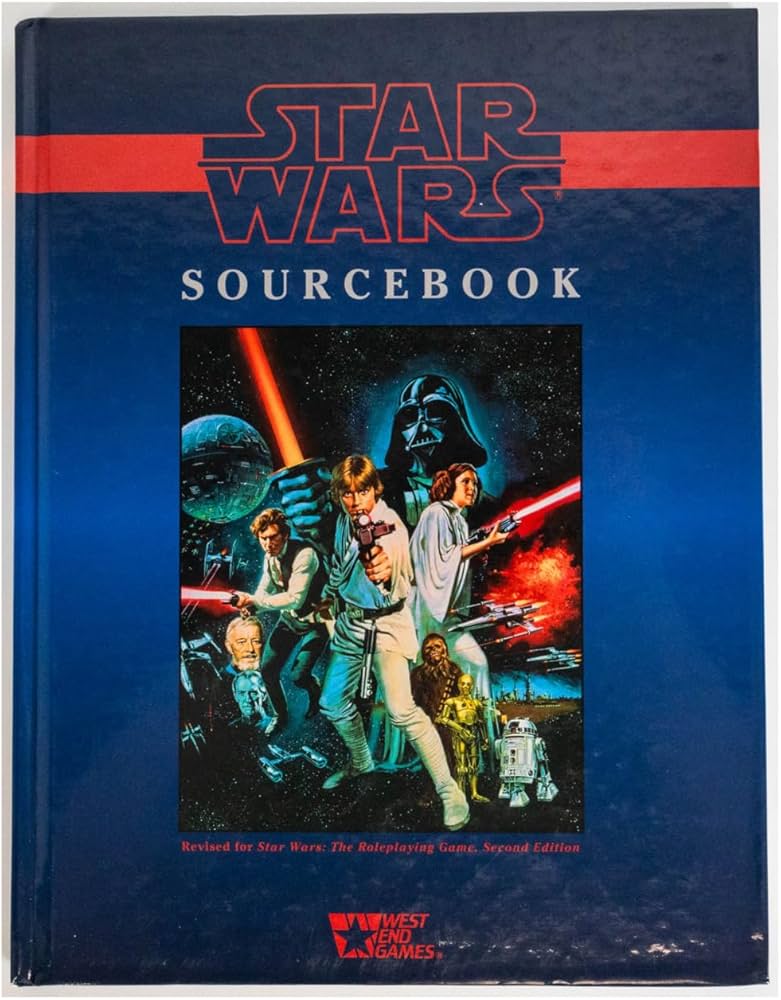
The Star Wars Sourcebook
The Star Wars Sourcebook
Revised for Star Wars: The Roleplaying Game, Second Edition
Credits
Design: Bill Slavicsek, Curtis Smith
Development & Editing: Jeffery L. Briggs, Paul Murphy
Additional Development: Peter Corless, Greg Costikyan, Doug Kaufman
Revision for Second Edition: Bill Smith
Second Edition Editing: Peter Schweighofer
Art Direction: Stephen Crane
Production: Richard Hawran
Graphics: Tim Bobko
Interior Illustration: Joe Johnston, Ralph McQuarrie, Norman Reynolds, Nilo Rodis-Jamero
Cover Illustration: Cantrell
Composite Photographs: Industrial Light and Magic
Special Thanks To: David Craig, Anita Gross, Allan Kausch, Louise Riley, Howard Roffman, Ken Rolston, Sue Rostoni, and Lucy Wilson for their invaluable assistance and knowledge of the Star Wars universe.
Published by West End Games. First Printing: June 1994.
Introduction
The Star Wars Galaxy
In the days of the Old Republic, a thousand-thousand worlds flourished under a common government. Wise leaders ruled the galaxy peacefully for generations. This was the age of the Senate, just laws, and unbridled freedom. This was the time of the Jedi Knights, defenders of justice, protectors of the realm, mighty in the Force.
Tragically, even in this utopia there were unscrupulous individuals who thirsted for wealth, power, and domination; they slowly, cunningly, destroyed the Republic from within. Thus, from the ashes of what was good and pure, was born the evil and corrupt Empire.
The newly-appointed Emperor, Palpatine, moved quickly to consolidate his power. With the aid of Darth Vader, Palpatine hunted down and murdered the Jedi Knights — few survived this terrible purge. The Senate was intimidated into subservience, and the Emperor's overwhelming armies and navies ruthlessly suppressed any unrest among the enslaved planets. The light of freedom was all but extinguished.
Some people resisted. At first they were few in number, disorganized and ill-equipped. But then, as the Empire's iron fist clenched tighter, many people decided that even death was preferable to that awful grip. Whole planets revolted, throwing their lot in with the Rebels; even some of the Emperor's own armed forces joined. Though still desperately outnumbered, the new Alliance became a force to be reckoned with.
In response, the Emperor caused a terrible weapon to be built, one that he believed was invulnerable and would destroy the Rebels — the Death Star. It very nearly succeeded.
Only the valiant efforts of a few heroes — Obi-Wan Kenobi, Luke Skywalker, Princess Leia Organa, and their companions — destroyed the Death Star and saved the Rebellion from annihilation. Now with Han Solo, Chewbacca, and the droids R2-D2 and C-3PO, these leaders of the Alliance are hunted criminals and traitors to the Empire.
Throughout the galaxy, the Empire's mighty warfleets, commanded by Lord Darth Vader, hunt for the elusive Rebels. If they find them and crush the Alliance, the last flame of freedom may finally be extinguished …
The Star Wars Sourcebook
The Star Wars universe is incredibly rich in texture and detail. Countless aliens, starships, droids, ground vehicles, weapons, heroes, and villains appear in the three movies. This book is an invaluable companion to Star Wars: The Roleplaying Game: Second Edition and each entry includes complete statistics updated to Second Edition rules. The Star Wars Sourcebook describes the state of the Star Wars universe at the end of the first movie, Star Wars IV: A New Hope.
And remember, the Force will be with you. Always.
Chapter One: General Spacecraft Systems
Almost without exception, every species has yearned to leave the confines of its tiny planet and explore the vast reaches of space. The development of hyperdrive (or other faster-than-light technologies) made the first steps toward a galactic community possible. Today, space travel is part of everyday life; the fabric of the galactic community is bound together by cords of high technology.
Hyperdrives
The hyperdrive is a miracle of technology. For over a thousand generations, it has bound the galaxy together. Powered by incredibly efficient fusion generators, hyperdrive engines hurl ships into hyperspace, a dimension of space-time that allows faster-than-light travel. The theories and realities of hyperspace travel are understood by few but highly-trained hyperspace technicians in the astrophysics communities.
Hyperspace is coterminous with realspace: each point in realspace is associated with a unique point in hyperspace, and adjacent points in realspace are adjacent in hyperspace. Objects in realspace have a "shadow" in hyperspace. Colliding with even the smallest objects at hyperspace velocities is often deadly.
This is why astrogation and astrogation computers are so important. Careful calculations must be made to assure that a hyperspace-travelling ship doesn't smash into a planet or star while hurtling through this dimension.
Sublight Drives
Sublight drives move spacecraft through realspace. By far the most popular in the Empire is the Hoersch-Kessel ion engine. Originally brought into this part of the galaxy countless millennia ago by alien merchants, today almost all of the major ship manufactures put Hoersch-Kessel-style motors into their vessels.
The H-K is extremely efficient and extremely powerful. It can be converted to break down and draw power from uranium, other heavy metals, or virtually any substance. Another point in the Hoersch-Kessel's favor is its versatility — the basic technology is simple, making it easy to construct drives for specific performance standards.
Unlike hyperdrive engines, which propel vessels through hyperspace, the H-K moves ships in realspace via a fusion reaction which breaks down fuel into charged particles. The ship's direction is controlled by changing the exhaust's direction with baffles or so-called "vectrals," or by smaller H-K engines employed as lateral thrusters.
Armament
Laser and Blaster Cannon
The terms "laser" and "blaster" are synonymous, except that "blaster" usually implies a smaller, lighter weapon. Most smaller ships, such as light freighters and starfighters, have some form of weaponry. Some lasers can be altered to change their beam color to any wavelength in the electromagnetic spectrum, allowing such vessels to attack "invisibly."
Turbolasers
Heavy shipboard laser weapons require immense amounts of power to cut through the shields and armor of large military craft and to penetrate planetary defenses. Turbolasers usually have a lower rate of fire than normal lasers, but deliver a bigger punch. In theory only the Empire, sector or local governments can construct or mount such weapons.
Ion Cannon
When a commander wishes to render an enemy harmless rather than destroy him outright, ion weapons are employed. High-energy ionized particles, when fired in sufficient strength, can wreak havoc with the sophisticated electronics and controls of starships. Ships use ion cannons to disable an enemy, then use their other more lethal weapons to finish him off.
Proton and Concussion Weapons
Proton torpedoes, concussion missiles, and bombs have become one of the primary surface-attack weapons of space light forces. Even small vessels, such as the Z-95 Headhunter and the TIE bomber, can carry these weapons and deliver them accurately from low altitudes flying at great speeds. Unlike heavier space bombardments by turbolasers, these weapons are effective against ray- and energy-shielded targets. Complete particle shielding will deflect proton torpedoes, however.
Tractor Beams
Over the millennia, the tractor beam has been altered from a commercial cargo-moving tool to a potent offensive weapon. Today, military tractor beams are powerful enough to capture and arrest even an immense vessel in mid-flight. Tractor beams are employed to arrest the maneuverability of the target vessel, thus allowing the attacking ship's weapons to bear upon the targets with greater accuracy. However, it is extremely difficult for the tractor to lock on to fast-moving targets, and ships can break the tractor's grip if they can maneuver beyond the beam's covering arc.
Shields
There are two types of shields: particle shields and ray/energy shields. Both are needed for complete protection, and generally all military ships are equipped with shields of both types.
Particle shielding protects against missiles and space debris, but must be temporarily turned off if the vessel wishes to fire missiles of its own or launch or receive shuttlecraft. Any time a ship has to lower its particle shields, it is considered to have a hull code -2D lower than the listed code.
Ray/energy shielding protects strictly against lasers or other energy beams. It does not stop matter. Ray shields require large amounts of energy to maintain; most vessels only employ them when going into combat.
Sensors
The term "sensor" describes a whole range of complex devices that detect and analyze many forms of data — light, radio and other electromagnetic emissions; sound, motion and vibration; gravitational, nuclear and magnetic fields; heat, pressure, and trace chemicals; and even other sensors. For game purposes, a ship's various sensors are grouped together to provide one set of game statistics. The ranges listed are for each sensor mode in "units."
Sensor Modes
Passive: Passive sensors examine energy emitted by other sources (heat detectors, or simple telescopes, for example). They don't project any energies to detect information. Less effective than active sensors, passive sensors use less energy and don't increase the sensing unit's "visibility."
Sensor Sweeps: These sensors are active and emit pulses of energy and examine the reflected or "bounced" energy (radar, for example). There are three prime modes of sensor sweep: scan, search and focus.
Scan: Look at everything around the entire vessel. These sensors search the entire area around the vessel, but cannot provide the range or detailed information of sensors in search mode.
Search: Only look for a specific type of target, such as a ship or a particular radio frequency. The operator must specify what to search for. Search modes function in one direction.
Focus: Concentrate the sensors on a particular area selected by the pilot. This makes for much better information about the area on which sensors are focused, but provides little or no information about other areas.
Common Military Sensor Types
- Electro Photo Receptors (EPRs): The simplest sensing devices. They combine data from sophisticated normal light, ultraviolet (UV), and infrared (IR) telescopes to form a composite holo or two-dimensional picture. Useful only at shorter ranges. Most targeting sensors use EPRs.
- Full-Spectrum Transceivers (FSTs): Frequently called "universal sensors" because they use a variety of scanners to detect all types of objects, energies and fields — but they are not very sensitive. Most non-combat ships are equipped only with FSTs.
- Dedicated Energy Receptors (DERs): DERs detect any electromagnetic emission within range of the sensor array. DERs are the primary passive sensor device in military sensor arrays.
- Crystal Gravfield Traps (CGTs): These expensive sensors utilize a synthetic crystal grid to detect gravitic field fluctuations. High quality CGTs can detect and identify any fluctuations in the gravity field for hundreds of thousands of kilometers around.
- Hyperwave Signal Interceptors (HSIs): These sensors detect fluctuations in hyperspace. Whenever a ship enters or exits hyperspace, the local hyperspace field is disturbed. HSIs can also detect and sometimes tap into hyperradio transmissions.
- Life Form Indicators (LFIs): LFIs aren't actually sensors; they are sophisticated computer programs which examine the output of other sensors to determine if a life form is present.
Sensor Countermeasures
Jamming is the most common active countermeasure. Ships can fool enemy sensors by sending out small decoy pods. By purposefully reducing all emissions, ships can greatly reduce the chance of discovery.
The ultimate sensor countermeasure, a cloaking device, is an experimental shield which creates a subtle warp in the fabric of space surrounding the vessel, causing all forms of energy to slip around the ship as if it weren't there. Cloaking devices are extremely rare. They are among the most sophisticated and complicated devices known; only a few highly skilled engineers can operate and maintain them. They are enormously expensive — reportedly over one billion credits apiece. The Empire has declared cloaking devices illegal — class one contraband.
Life Support
Every starship has a life support system that allows the ship's occupants to survive the harsh environment of space. All life support systems must provide a breathable atmosphere, and most also provide a comfortable gravitational environment. Some starfighters — notably the Imperial TIE series — do not have atmospheric converters built into them; instead each pilot's space suit contains a converter.
Probably the most impressive life support systems are found aboard Ithorian vessels, which maintain an atmosphere and gravity field so like the planet itself that the Ithorians have brought a bit of their home planet to the stars with them.
Escape Equipment
Imperial directives require every spacefaring vessel to include some form of emergency escape system.
Ejection Seats
Small one- and two-man transport vehicles and starfighter-class vessels use a standard ejection seat escape system. The ejection seat system relies greatly on a passenger's use of a full environmental flight suit, and even then survival in deep space is unlikely without immediate rescue.
Escape Pods
Larger vessels are equipped with emergency escape pods. Ranging from one or two in light freighters to several hundred stored in giant lifeboat bays aboard Star Destroyers, escape pods are basically emergency space capsules capable of limited flight and maneuverability located at key positions in a ship's hull to provide quick access in case of an emergency.
Larger escape pods, called "life boats," are also common among the larger space vessels. These boats can carry from 10 to 50 people, depending on their size, and are actually small space ships in their own right. Some are equipped with sublight engines; a few even contain small hyperdrives.
Chapter Two: Starfighters
For their size, starfighters are the most technically advanced and destructive weapon platforms ever developed. Light combat spacecraft have become indispensable parts of every major fleet and planetary defense system in the galaxy.
Rebel starfighters are generally superior to their Imperial counterparts. With fewer large ships, the Rebels rely on their starfighters more and press them into service for a wider variety of tasks. Few Imperial fighters are hyperspace-capable, while nearly all Rebel craft can make at least one jump. The Empire relies on vast numbers of fighters launched from massive Star Destroyers.
Traditionally, the Imperial Navy has emphasized large ships and massed firepower to dominate the galaxy. The irregular, fast-strike tactics pioneered by the Alliance have forced the Empire to alter its strategy and develop better starfighters of its own. The recent introduction of the TIE Interceptor gives Imperial forces a first-rate light combat spacecraft.
Z-95 Headhunter
Despite initial delays and cost overruns, the Z-95 "Headhunter" became one of the most successful military spacecraft of all time. A collaboration between two leading spacecraft firms, Incom Industries and Subpro Corp., this agile, compact twin-engine fighter has proven amazingly versatile, spawning hundreds of specialized and improved models. Although no longer manufactured and now a generation out of date, more Headhunters remain in service than any other starfighter. They serve in constabularies, customs and anti-smuggling agencies, planetary defense forces, and reserve fleets.
Craft: Incom/Subpro Z-95 Headhunter
Type: Multi-purpose starfighter, many variants
Scale: Starfighter
Length: 11.8 meters
Skill: Starfighter piloting: Z-95
Crew: 1
Crew Skill: Starfighter piloting 3D+2, starship gunnery 3D+2, starship shields 3D+1
Cargo Capacity: 85 kilograms
Consumables: 1 day
Cost: 45,000 (used, as equipped; no longer available new)
Maneuverability: 1D
Space: 7
Atmosphere: 400; 1,150 kmh
Hull: 4D
Shields: 1D
Sensors:
Passive: 15/0D
Scan: 25/1D
Search: 40/2D
Focus: 1/2D
Weapons:
2 Triple Blasters (fire-linked)
Fire Arc: Front
Skill: Starship gunnery
Fire Control: 1D
Space Range: 1-5/10/17
Atmosphere Range: 100-500/1/1.7 km
Damage: 3D
Concussion Missiles
Fire Arc: Front
Skill: Missile weapons: concussion missiles
Fire Control: 1D
Space Range: 1/3/7
Atmosphere Range: 50-100/300/700
Damage: 7D
A-Wing Starfighter
Developed secretly since the outbreak of armed rebellion, the A-wing was assembled from equipment, parts, and technology readily available to the beleaguered Alliance forces. Its design emphasizes rugged dependability, speed, and power. Two extra-large power plants and low total mass give these fighters the highest sublight speed of any known production starfighter — including the new Imperial TIE Interceptor.
Although the A-wing carries only two standard laser cannons, a unique mounting configuration greatly enhances its combat effectiveness. Consequently, A-wings can engage targets from much wider angles than other starfighters. The A-wing's jammers are most effective against the sensor systems of small craft such as starfighters.
Craft: Alliance A-wing Starfighter
Type: Interceptor and multi-purpose starfighter
Scale: Starfighter
Length: 9.6 meters
Skill: Starfighter piloting: A-wing
Crew: 1
Crew Skill: Starfighter piloting 5D, starship gunnery 4D+2, starship shields 3D+1
Cargo Capacity: 40 kilograms
Consumables: 1 week
Cost: 175,000 (new)
Hyperdrive Multiplier: x1
Nav Computer: Limited to two jumps
Maneuverability: 4D
Space: 12
Atmosphere: 450; 1,300 kmh
Hull: 2D+2
Shields: 1D
Sensors:
Passive: 30/0D
Scan: 50/1D
Search: 75/2D
Focus: 4/4D-1
Weapons:
2 Laser Cannons (fire-linked)
Fire Arc: Front
Skill: Starship gunnery
Fire Control: 1D
Space Range: 1-3/12/25
Atmosphere Range: 100-300/1.2/1.5 km
Damage: 5D
Enemy Targeting Jammer
Fire Arc: All
Skill: Sensors; works against all starfighters within range
Fire Control: 0D
Space Range: 1-3/7/15
Atmosphere Range: 100-3000/700/1.5 km
Damage: -2D from fire control
B-Wing Assault Starfighter
When a B-wing shows up on a small ship's sensors, the captain is often tempted to veer away. A triple battery of medium ion cannons, two proton torpedo launchers, a heavy laser cannon, and two blasters make the B-wing the most heavily-armed starfighter in the galaxy. B-wings provide the small Rebel fleets with much needed offensive space-fighting capacity.
The B-wing employs a radical design feature, an automatic gyroscopically-stabilized command pod. When engaged, gyro-servos keep the pod in a fixed position, while the rest of the fighter spins, rolls and twists to evade defensive fire or "sweep" its weapons.
Craft: Slayn & Korpil B-wing
Type: Heavy assault fighter
Scale: Starfighter
Length: 16.9 meters
Skill: Starfighter piloting: B-wing
Crew: 1
Crew Skill: Starfighter piloting 5D, starship gunnery 4D+2, starship shields 3D+1
Cargo Capacity: 45 kilograms
Consumables: 1 week
Cost: 220,000 (new)
Hyperdrive Multiplier: x2
Nav Computer: Limited to two jumps
Maneuverability: 1D-1
Space: 6
Atmosphere: 330; 950 kmh
Hull: 3D
Shields: 2D
Sensors:
Passive: 30/0D
Scan: 50/1D
Search: 75/2D
Focus: 4/4D+1
Weapons:
Laser Cannon
Fire Arc: Front
Skill: Starship gunnery
Fire Control: 1D
Space Range: 1-3/12/25
Atmosphere Range: 100-300/1.2/1.5 km
Damage: 7D
2 Proton Torpedo Launchers
Fire Arc: Front
Skill: Starship gunnery
Fire Control: 3D
Space Range: 1/3/7
Atmosphere Range: 50-100/300/700
Damage: 9D
3 Medium Ion Cannons (fire-linked)
Fire Arc: Front
Skill: Starship gunnery
Fire Control: 4D
Space Range: 1-3/7/36
Atmosphere Range: 100-300/700/3.6 km
Combined Damage: 4D
2 Auto Blasters
Fire Arc: Front
Skill: Starship gunnery
Fire Control: 2D
Space Range: 1-8/25/40
Atmosphere Range: 100-800/2.5/4 km
Damage: 3D
Running the B-wing
The B-wing features a very sophisticated but fragile gyroscopically-stabilized command pod, as well as a ranging mode for the laser cannon.
If, for some reason, the ranging laser is not operational, reduce all fire control codes by -1D.
The B-wing's gyroscopic stabilization system fails when it suffers heavy damage. In game terms, when the fighter is heavily damaged, a roll of 1-2 means the stabilization system has failed. Reduce all fire control codes by -1D (since the craft is no longer a stable platform), and sublight speed from 6 to 2 (atmosphere speed goes from "330; 950" to "225; 650").
These penalties are cumulative.
Y-Wing Starfighter
The Rebel Alliance has lost more of its rugged Y-wing fighter-bombers than any other spacecraft. They bore the brunt of all the Alliance's early space battles. No longer as fast, maneuverable, or as heavily armed as other starfighters, the Y-wing remains a potent craft able to endure and deliver tremendous punishment.
Craft: Koensayr BTL-S3 Y-wing
Type: Attack starfighter
Scale: Starfighter
Length: 16 meters
Skill: Starfighter piloting: Y-wing
Crew: 1, gunner: 1, 1 astromech droid (can coordinate)
Crew Skill: Astrogation 3D+2, starfighter piloting 4D+2, starship gunnery 4D+1, starship shields 3D
Cargo Capacity: 110 kilograms
Consumables: One week
Cost: 135,000 (new), 65,000 (used)
Hyperdrive Multiplier: x1
Nav Computer: Astromech droid stores 10 jumps
Maneuverability: 2D
Space: 7
Atmosphere: 350; 1,000 kmh
Hull: 4D
Shields: 1D+2
Sensors:
Passive: 20/0D
Scan: 35/1D
Search: 40/2D
Focus: 2/3D
Weapons:
2 Laser Cannons (fire-linked)
Fire Arc: Front
Skill: Starship gunnery
Fire Control: 2D
Space Range: 1-3/12/25
Atmosphere Range: 100-300/1.2/2.5 km
Damage: 5D
2 Proton Torpedo Launchers
Fire Arc: Front
Skill: Starship gunnery
Fire Control: 2D
Space Range: 1/3/7
Atmosphere Range: 50-100/300/700
Damage: 9D
2 Light Ion Cannons (fire-linked)
Fire Arc: Turret*
Crew: 1 (co-pilot)
Skill: Starship gunnery
Fire Control: 3D
Space Range: 1-3/7/36
Atmosphere Range: 100-300/700/3.6 km
Damage: 4D
* Gun may be fixed to forward to be fired by pilot at only 1D fire control.
X-Wing Space Superiority Fighter
Incom's T-65 X-wing represents the cutting edge of starfighter performance. Its high speed, heavy firepower, and sophisticated flight and combat systems make it one of the most formidable spacecraft in existence. Its dominating combat abilities, especially its hyperspace capability, make it a true space superiority fighter.
The X-wing was the last starfighter developed by Incom Corporation before the Empire halted its non-Navy warcraft production. A Rebel commando team helped the entire Incom X-wing senior design team defect to the Rebel Alliance. Four forward-firing long-barreled lasers are the primary armament; two proton torpedo launchers provide additional punch for use against slow-moving targets.
Craft: Incom T-65B X-wing
Type: Space superiority fighter
Scale: Starfighter
Length: 12.5 meters
Skill: Starfighter piloting: X-wing
Crew: 1 and astromech droid (can coordinate)
Crew Skill: Starfighter piloting 5D, starship gunnery 4D+2, starship shields 3D
Cargo Capacity: 110 kilograms
Consumables: 1 week
Cost: 150,000 (new)
Hyperdrive Multiplier: x1
Nav Computer: Uses astromech droid programmed with 10 jumps
Maneuverability: 3D
Space: 8
Atmosphere: 365; 1,050 kmh
Hull: 4D
Shields: 1D
Sensors:
Passive: 25/0D
Scan: 50/1D
Search: 75/2D
Focus: 3/4D
Weapons:
4 Laser Cannons (fire-linked)
Fire Arc: Front
Skill: Starship gunnery
Fire Control: 3D
Space Range: 1-3/12/25
Atmosphere Range: 100-300/1.2/2.5 km
Damage: 6D
2 Proton Torpedo Launchers
Fire Arc: Front
Skill: Starship gunnery
Fire Control: 2D
Space Range: 1/3/7
Atmosphere Range: 30-100/300/700
Damage: 9D
TIE Starfighter
TIE fighters escort fleets, provide reconnaissance, patrol disputed space, support ground troops, engage smugglers and pirates, and hunt down Rebels. The TIE fighter's greatest deficiency is its lack of deflector shields. None of the TIE series starfighters are equipped with hyperdrives.
TIE Fighter Models
T.I.E. — The original starfighter produced by Republic Sienar Systems.
TIE — The first, modestly upgraded fighter manufactured by Sienar Fleet Systems under direct Imperial Navy control.
TIE/ln — Now the standard fleet-based TIE fighter, this model carries a separate power generator for its laser cannons.
TIE/rc — Extra-sensitive sensors and long-range communications gear equip this special reconnaissance fighter, armed with only one laser cannon.
TIE/fc — These fighters provide accurate fire control and target designation for long-range naval bombardment of ground or space targets.
TIE/gt — An enlarged hull allows these fighters to carry a wide range of torpedoes and bombs. Gradually being replaced in service by the newer TIE bomber.
Craft: Sienar Fleet Systems TIE/ln
Type: Space superiority starfighter
Scale: Starfighter
Length: 6.3 meters
Skill: Starfighter piloting: TIE
Crew: 1
Crew Skill: Starfighter piloting 4D+1, starship gunnery 4D
Cargo Capacity: 65 kilograms
Consumables: 2 days
Cost: 60,000 (new), 25,000 (used)
Maneuverability: 2D
Space: 10
Atmosphere: 415; 1,200 kmh
Hull: 2D
Sensors:
Passive: 20/0D
Scan: 40/1D
Search: 60/2D
Focus: 3/3D
Weapons:
2 Laser Cannons (fire-linked)
Fire Arc: Front
Skill: Starship gunnery
Fire Control: 2D
Space Range: 1-3/12/25
Atmosphere Range: 100-300/1.2/2.5 km
Damage: 5D
Profile of an Imperial Pilot: Flight Captain T. Alvak, DFM
Type: Imperial TIE Flight Captain
DEXTERITY 3D
Blaster 4D, dodge 4D, melee combat 3D+2
KNOWLEDGE 2D
Bureaucracy 2D+1
MECHANICAL 4D
Astrogation 5D, space transports 5D, starfighter piloting 5D, starship gunnery 5D
PERCEPTION 3D
Command 4D
STRENGTH 3D
TECHNICAL 3D
Move: 10
Equipment: TIE pilot's flight suit, blaster pistol (4D)
TIE Interceptor
The TIE Interceptor is the Empire's newest addition to its TIE series of starfighters. After the destruction of the Death Star at the battle of Yavin, Imperial commanders met with top Imperial designers to decide how best to counter the unexpectedly high level of Rebel daring. The new TIE Interceptor is the fastest starfighter in the galaxy, according to reliable Imperial sources — though sources close to the Rebel Alliance claim the A-wing is still on top.
Craft: Sienar Fleet Systems TIE Interceptor
Type: Space superiority starfighter
Scale: Starfighter
Length: 6.6 meters
Skill: Starfighter piloting: TIE
Crew: 1
Crew Skill: Starfighter piloting 5D, starship gunnery 4D+2
Cargo Capacity: 75 kilograms
Consumables: 2 days
Cost: 120,000 (new), 75,000 (used)
Maneuverability: 3D+2
Space: 11
Atmosphere: 435; 1,250 kmh
Hull: 3D
Sensors:
Passive: 25/1D
Scan: 40/2D
Search: 60/3D
Focus: 4/3D+2
Weapons:
4 Laser Cannons (fire-linked)
Fire Arc: Front
Skill: Starship gunnery
Fire Control: 3D
Space Range: 1-3/12/25
Atmosphere Range: 100-300/1.2/2.5 km
Damage: 6D
TIE Bomber
Carrying high-yield proton bombs, guided missiles, orbital mines, and free-falling thermal detonators, the twin pod TIE bomber is lethal in addition to Imperial forces. TIE bombers can make accurate "surgical strikes." In one case, a flight of bombers was able to swoop down and destroy a building held by Rebels in the center of a populous city — leaving the surrounding area undamaged!
Craft: Sienar Fleet Systems TIE Bomber
Type: Dedicated light space bomber
Scale: Starfighter
Length: 7.8 meters
Skill: Starfighter piloting: TIE
Crew: 1
Crew Skill: Missile weapons 4D+1, starfighter piloting 4D, starship gunnery 5D
Cargo Capacity: 15 metric tons (bomb bay)
Consumables: 2 days
Cost: 150,000 (new), 75,000 (used)
Space: 6
Atmosphere: 295; 850 kmh
Hull: 4D+1
Sensors:
Passive: 20/0D
Scan: 35/1D
Search: 50/2D
Focus: 3/2D-2
Weapons:
2 Laser Cannons (fire-linked)
Fire Arc: Front
Skill: Starship gunnery
Fire Control: 2D
Space Range: 1-3/12/25
Atmosphere Range: 100-300/1.2/2.5 km
Damage: 3D
Concussion Missiles (16 carried)
Fire Arc: Front
Skill: Missile weapons: concussion missiles
Fire Control: 3D+2
Space Range: 1/3/7
Atmosphere Range: 50-500/1/1.5 km
Damage: 9D
Standard Imperial Star Destroyer TIE Fighter Complement
Total Starfighters Embarked:
48 TIE fighters (including 2-4 TIE/fc models)
12 TIE interceptors
12 TIE bombers (replacing TIE/gt models)
72 Starfighters* (*TIEs only; does not include shuttles, launches, and other craft.)One Wing on Each Star Destroyer — includes starfighters, pilots, all support personnel and equipment.
Six Squadrons in Each Wing — 4 TIE fighter squadrons, 1 TIE interceptor squadron, 1 TIE bomber squadron.
Three Flights in Each Squadron — Flights of 4 starfighters; the most common tactical unit deployed.
Two Elements in Each Flight — The element is the smallest tactical unit deployed: a leader and his wingman.
Chapter Three: Capital Combat Starships
A society that spans the galaxy quite naturally developed starships not only to carry goods and people from planet to planet, but to defend the oft-travelled routes from all dangers. These ships are large, heavily-armed and armored craft capable of handling hostile alien vessels, pirate ships, and smuggler craft.
Combat starships have the same format for statistics as starfighters. Most player characters, if they have any ships at all, fly around in nothing bigger than a light freighter.
Corellian Corvettes
Ships design philosophy goes through cycles. For several decades multi-purpose ships are built, with each vessel able to fulfill a wide variety of functions. The Corellian Corvette, built by the Corellian Engineering Corporation, is a mid-sized vessel which can function as a troop carrier, light escort vessel, cargo transport, or passenger liner. The interior of the ship is modularly designed, so it is easy to reconfigure a Corvette from one of these duties to another, greatly increasing its usefulness and resale value.
In its military configuration, a Corvette has little cargo space and few amenities; instead, that space is taken up by bigger sublight engines and shield generators, fire-control and defensive computers, fuel containers, weapons systems, and troop berths. A military Corvette requires a crew of about 165 people to operate effectively.
Craft: Corellian Engineering Corporation Corvette
Type: Multi-purpose mid-sized vessel
Scale: Capital
Length: 150 meters
Skill: Capital ship piloting: Corellian corvette
Crew: 30 to 165, depending upon configuration
Crew Skill: Astrogation 3D, capital ship gunnery 4D+1, capital ship piloting 3D+2, capital ship shields 3D, sensors 3D+1
Passengers: Up to 600 depending upon configuration
Cargo Capacity: 3,000 metric tons
Consumables: 1 year
Cost: 3.5 million (new), 1.5 million (used)
Hyperdrive Multiplier: x2
Nav Computer: Yes
Maneuverability: 2D
Space: 6
Atmosphere: 330; 950 kmh
Hull: 4D
Shields: 2D
Sensors:
Passive: 40/1D
Scan: 80/2D
Search: 100/3D
Focus: 5/4D
Weapons:
6 Double Turbolaser Cannon
Fire Arc: 3 front, 1 left, 1 right, 1 back
Crew: 1 (3), 3 (3)
Skill: Capital ship gunnery
Fire Control: 3D
Space Range: 3-15/35/75
Atmosphere Range: 6-30/70/150 km
Damage: 4D+2
Escort Frigates
The Kuat Drive Yards' Nebulon-B Frigate is well armed with turbolasers and laser batteries, has good shields and tractor beam generators, has very good long range sensors, and can carry two TIE fighter squadrons (24 starfighters). The Frigate is slow and unwieldy — as are most vessels of this size — but its TIEs can handle anything too quick (or small) for the Frigate.
Since the Imperial Navy has begun regularly assigning Nebulon-B Frigates to escort duty, Rebel X-wing pilots have found that attacking Imperial convoys is no longer the joy ride it once was.
Craft: Kuat Drive Yards' Nebulon-B Frigate
Type: Escort starship
Scale: Capital
Length: 300 meters
Skill: Capital ship piloting: Nebulon-B
Crew: 854, gunners: 66, skeleton: 307/+10
Crew Skill: Astrogation 3D, capital ship gunnery 4D+1, capital ship piloting 3D+2, capital ship shields 3D, sensors 3D+1, starship gunnery 4D+1
Passengers: 75 (troops)
Cargo Capacity: 6,000 metric tons
Consumables: 2 years
Cost: Not available for sale
Hyperdrive Multiplier: x2
Hyperdrive Backup: x12
Nav Computer: Yes
Maneuverability: 1D
Space: 4
Atmosphere: 280; 800 kmh
Hull: 3D+2
Shields: 2D
Sensors:
Passive: 40/0D
Scan: 75/1D
Search: 150/3D
Focus: 4/4D+2
Weapons:
12 Turbolaser Batteries
Fire Arc: 6 front, 3 left, 3 right
Crew: 1 (2), 2 (8), 4 (2)
Skill: Capital ship gunnery
Fire Control: 3D
Space Range: 3-15/35/75
Atmosphere Range: 6-30/70/150 km
Damage: 4D
12 Laser Cannons
Fire Arc: 6 front, 2 left, 2 right, 2 back
Crew: 1 (8), 2 (4)
Scale: Starfighter
Skill: Starship gunnery
Fire Control: 2D
Space Range: 1-3/12/25
Atmosphere Range: 2-6/24/50 km
Damage: 2D
2 Tractor Beam Projectors
Fire Arc: Front
Crew: 12
Skill: Capital ship gunnery
Fire Control: 2D
Space Range: 1-5/15/30
Atmosphere Range: 2-10/30/60 km
Damage: 4D
Victory-Class Star Destroyers
Designed by Republic engineer Walex Blissex, the Victory-class Star Destroyers were commissioned into service at the tail end of the Clone Wars. Now largely replaced in the Empire's warfleet by bigger and faster Imperial-class Star Destroyers, the Victories still in active duty are relegated to planetary defense missions. Like their younger Imperial-class cousins, Victory-class vessels are designed to perform three main functions: planetary defense, planetary assault and ground-troop support, and ship-to-ship combat.
Craft: Rendili Star Drive's Victory I
Type: Victory-class Star Destroyer
Scale: Capital
Length: 900 meters
Skill: Capital ship piloting: Star Destroyer
Crew: 4,798, gunners: 402, skeleton: 1,785/-15
Crew Skill: Astrogation 3D+2, capital ship gunnery 4D+2, capital ship piloting 5D, capital ship shields 4D, sensors 3D+2
Passengers: 2,040 (troops)
Cargo Capacity: 8,100 metric tons
Consumables: 4 years
Cost: Not available for sale
Hyperdrive Multiplier: x1
Hyperdrive Backup: x15
Nav Computer: Yes
Maneuverability: 1D
Space: 4
Atmosphere: 280; 800 kmh
Hull: 4D
Shields: 3D+1
Sensors:
Passive: 40/1D
Scan: 70/2D
Search: 150/3D
Focus: 4/3D+2
Weapons:
10 Quad Turbolaser Batteries
Fire Arc: 5 left, 5 right
Crew: 5
Skill: Capital ship gunnery
Fire Control: 4D
Space Range: 3-15/35/75
Atmosphere Range: 6-30/70/150 km
Damage: 5D
40 Double Turbolaser Batteries
Fire Arc: 10 front, 15 left, 15 right
Crew: 3
Skill: Capital ship gunnery
Fire Control: 3D
Space Range: 3-15/35/75
Atmosphere Range: 6-30/70/150 km
Damage: 2D+2
80 Concussion Missile Tube Launchers
Fire Arc: 20 front, 20 left, 20 right, 20 rear
Crew: 2
Skill: Capital ship gunnery
Fire Control: 2D
Space Range: 2-12/30/60
Atmosphere Range: 4-24/60/120 km
Damage: 9D
10 Tractor Beam Projectors
Fire Arc: 6 front, 2 left, 2 right
Crew: 2 (2), 4 (2), 10 (6)
Skill: Capital ship gunnery
Fire Control: 4D
Space Range: 1-5/15/30
Atmosphere Range: 2-10/30/60 km
Damage: 5D
Imperial Star Destroyers
Warship construction is a lengthy, complicated business. The Imperial-class Star Destroyer has enough firepower to reduce a civilization to slag or take on a fleet of enemy vessels. Each carries a full stormtrooper division, complete with assault craft and ablative heat-shield for orbital drops, 20 AT-AT and 30 AT-ST walkers for ground assault, and six TIE fighter squadrons for escort and patrol.
There are whole star systems whose gross domestic product is less than the cost of a single Star Destroyer.
Craft: Kuat Drive Yards' Imperial I Star Destroyer
Type: Star Destroyer
Scale: Capital
Length: 1,600 meters
Skill: Capital ship piloting: Star Destroyer
Crew: 36,810, gunners: 275, skeleton: 5,000/-20
Crew Skill: Astrogation 4D, capital ship gunnery 4D+2, capital ship piloting 5D+1, capital ship shields 4D+1, sensors 4D
Passengers: 9,700 (troops)
Cargo Capacity: 36,000 metric tons
Consumables: 6 years
Cost: Not available for sale
Hyperdrive Multiplier: x2
Hyperdrive Backup: x8
Nav Computer: Yes
Maneuverability: 1D
Space: 6
Hull: 7D
Shields: 3D
Sensors:
Passive: 50/1D
Scan: 100/3D
Search: 200/4D
Focus: 6/4D+2
Weapons:
60 Turbolaser Batteries
Fire Arc: 20 front, 20 left, 20 right
Crew: 1 (20), 2 (40)
Skill: Capital ship gunnery
Fire Control: 4D
Space Range: 3-15/36/75
Atmosphere Range: 6-30/72/150 km
Damage: 5D
60 Ion Cannons
Fire Arc: 20 front, 15 left, 15 right, 10 back
Crew: 1 (15), 2 (45)
Skill: Capital ship gunnery
Fire Control: 2D+2
Space Range: 1-10/25/50
Atmosphere Range: 2-20/50/100 km
Damage: 3D
10 Tractor Beam Projectors
Fire Arc: 6 front, 2 left, 2 right
Crew: 1 (2), 4 (2), 10 (6)
Skill: Capital ship gunnery
Fire Control: 4D
Space Range: 1-5/15/30
Atmosphere Range: 2-10/30/60 km
Damage: 6D
Mon Calamari Star Cruisers
The Mon Calamari are quickly gaining a reputation throughout the galaxy for their skill at starship design. No two Mon Calamari vessels are precisely alike — each vessel in a particular class is subtly different from its sister ships, pressed from a standard mold but hand-crafted as an original work of art.
The MC80 appears almost organic, as if it were grown, not built: it is covered with pods, bulges and bumps arranged in a seemingly haphazard pattern. An integral part of Calamari ship-design theory is system redundancy. The MC80 has three times as many shield generators as an Imperial ship of comparable size, making it much more reliable in combat.
Craft: Mon Calamari MC80 Star Cruiser
Type: Star Cruiser
Scale: Capital
Length: 1,200 meters
Skill: Capital ship piloting: Mon Cal cruiser
Crew: 5,156, gunners: 246, skeleton: 1,230/+10
Crew Skill: Astrogation 4D*, capital ship gunnery 5D*, capital ship piloting 5D+2*, capital ship shields 5D*, sensors 3D+1*
* Mon Cal Star Cruisers are configured to provide Mon Calamari with their +1D bonus for being in moist environments. These skill levels do not reflect these bonuses.
Passengers: 1,200 (troops)
Cargo Capacity: 20,000 metric tons
Consumables: 2 years
Cost: Not available for sale
Hyperdrive Multiplier: x1
Hyperdrive Backup: x9
Nav Computer: Yes
Maneuverability: 2D
Space: 6
Hull: 6D
Shields: 3D*
* Mon Cal Star Cruisers have 6D of back-up shields. When a die of shields is lost, if the shield operators can make an Easy capital ship shields total, one of the back-up die codes of shields can be brought up to increase the shield back to 3D.
Sensors:
Passive: 40/1D
Scan: 60/2D
Search: 120/3D
Focus: 5/4D
Weapons:
48 Turbolaser Batteries
Fire Arc: 12 front, 12 left, 12 right, 12 back
Crew: 1 (12), 2 (10), 3 (26)
Skill: Capital ship gunnery
Fire Control: 2D
Space Range: 3-15/35/75
Atmosphere Range: 6-30/70/150 km
Damage: 4D
20 Ion Cannon Batteries
Fire Arc: 8 front, 4 left, 4 right, 4 back
Crew: 1 (6), 4 (6), 12 (8)
Skill: Capital ship gunnery
Fire Control: 3D
Space Range: 1-10/25/50
Atmosphere Range: 2-20/50/100 km
Damage: 3D
6 Tractor Beam Projectors
Fire Arc: 4 front, 1 left, 1 right
Crew: 1 (2), 5 (2), 10 (2)
Skill: Capital ship gunnery
Fire Control: 2D+2
Space Range: 1-5/15/30
Atmosphere Range: 2-10/30/60 km
Damage: 4D
Chapter Four: Space Transports
The galactic economy depends on three things: goods, consumers, and a way to bring goods and consumers together. In a marketplace that is made up of millions of different star systems, each light years apart, accomplishing the third is not an easy task.
In spite of the Rebellion, interstellar transport continues unabated. The profit has risen along with the risk. As long as there are profits to be made, there will be those willing to carry goods and people across the dark reaches of space.
Space Barges
Space barges are the workhorses of intra-system commerce. Heavy-duty short-range vessels, space barges are equipped with powerful engines and sizable cargo bays to move goods quickly and efficiently among larger hyperspace-capable cargo ships, orbiting storage holds, and planetary spaceports. Most barges have both subspace and repulsorlift drives, making them suitable for intra-system and planetary maneuvering.
Craft: Incom X-23 StarWorker
Type: Intra-system space barge
Scale: Starfighter
Length: 38 meters
Skill: Space transports: X-23
Crew: 2, plus labor droid, skeleton 1/+10
Crew Skill: Space transports 3D+2
Cargo Capacity: 5,000 metric tons
Consumables: 1 week
Cost: 325,000 (new), 145,000 (used)
Nav Computer: Yes
Space: 2
Atmosphere: 225; 650 kmh
Hull: 3D
Sensors:
Passive: 5/0D
Scan: 10/1D
Search: 15/2D
Stock Light Freighters
Corellian-built stock (and modified) light freighters are among the most commonly encountered small trading vessels in the galaxy. Once this class of ship was the backbone of intergalactic trade and commerce, carrying goods from system to system as demand warranted. Light freighters come in various shapes and designs, but all are built around a command post or bridge, and include a sleeping/recreation section and plenty of storage holds.
Today these vessels are most often seen in the Outer Rim Territories, plying the less-developed trade routes that larger ships disdain. One of the most fascinating things about this vanishing breed of ship is the loyalty, sometimes verging upon fanaticism, of their owners and crews.
Craft: Corellian Engineering Corporation YT-1300 Transport
Type: Stock light freighter
Scale: Starfighter
Length: 26.7 meters
Skill: Space transports: YT-1300 transports
Crew: 1 (1 can coordinate), gunners: 1
Crew Skill: Varies tremendously
Passengers: 6
Cargo Capacity: 100 metric tons
Consumables: 2 months
Cost: 100,000 (new), 25,000 (used)
Hyperdrive Multiplier: x2
Hyperdrive Backup: x12
Nav Computer: Yes
Space: 4
Atmosphere: 480; 800 kmh
Hull: 4D
Sensors:
Passive: 10/0D
Scan: 25/1D
Search: 40/2D
Focus: 2/3D
Weapons:
Laser Cannon
Fire Arc: Turret
Crew: 1
Skill: Starship gunnery
Fire Control: 2D
Space Range: 1-3/12/25
Atmosphere Range: 100-300/1.2/2.5 km
Damage: 4D
Millennium Falcon
"You've never heard of the Millennium Falcon?"
"Should I have?"
— Han Solo and Ben Kenobi
The Millennium Falcon looks like a battered out-of-date light freighter. Some swear it's held together with spit and wire — and they're more correct than they'd believe. But there's much more to the Falcon than meets the eye. Over the years a succession of different owners have repaired, rebuilt, and modified the ship with whatever parts they could acquire. Han Solo, the ship's current captain, has loaded the Falcon with so many used flux converters, landspeeder turbothrusters, and droid servomotors — none of which meet manufacturer's standards — that even his own nav computer predicts that the ship won't fly. But not only does the Falcon fly, it soars!
The Falcon packs an armament rating well beyond legal allowances for a non-military vessel, more shields than some starfighters, and a higher lift/mass ratio than the original manufacturer would have believed possible.
Craft: Modified Corellian YT-1300 Transport
Type: Modified light freighter
Scale: Starfighter
Length: 26.7 meters
Skill: Space transports: YT-1300 transports
Crew: 2, gunners: 2, skeleton: 1/-15
Crew Skill: See Han Solo and Chewbacca
Passengers: 6
Cargo Capacity: 100 metric tons
Consumables: 2 months
Cost: Not available for sale
Hyperdrive Multiplier: x1/2
Hyperdrive Backup: x10
Nav Computer: Yes
Maneuverability: 2D
Space: 8
Atmosphere: 365; 1,050 kmh
Hull: 6D
Shields: 3D
Sensors:
Passive: 30/1D
Scan: 60/2D
Search: 75/3D
Focus: 4/4D
Weapons:
2 Quad Laser Cannon
Fire Arc: Turret
Crew: 1
Skill: Starship gunnery
Fire Control: 3D
Space Range: 1-3/12/25
Atmosphere Range: 100-300/1.2/2.5 km
Damage: 6D
2 Concussion Missile Tubes (fire-linked)
Fire Arc: Front
Skill: Missile weapons: concussion missiles
Fire Control: 3D
Space Range: 1/3/7
Atmosphere Range: 50-100/300/700
Damage: 9D
Blaster Cannon (retractable)
Fire Arc: Turret
Scale: Speeder
Skill: Vehicle blasters
Fire Control: 4D (fired from cockpit)
Atmosphere Range: 1-50/100/250
Damage: 3D+2
Bulk Freighters
Bulk freighters haul the vast majority of interplanetary cargo throughout the galaxy. All bulk transports are really quite similar — after all, there are only so many ways to design what is essentially a box with a hyperspace engine attached.
Craft: Corellian Action IV Transport
Type: Medium bulk freighter
Scale: Capital
Length: 100 meters
Skill: Space transports
Crew: 8
Crew Skill: Astrogation 4D, space transports 4D+1
Cargo Capacity: 75,000 metric tons
Consumables: 3 months
Cost: 945,000 (new), 345,000 (used)
Hyperdrive Multiplier: x3
Space: 2
Hull: 2D
Sensors:
Passive: 15/0D
Scan: 20/1D
Search: 30/1D+2
Container Ships
Often called "super transports," container ships are among the largest commercial vessels in space. Big, slow, and hideously expensive, they are the most efficient way known to transport huge amounts of cargo through the empty reaches of space.
Craft: Kuat Drive Yards Super Transport XI
Type: Large container ship
Scale: Capital
Length: 840 meters
Skill: Space transports
Crew: 100, skeleton: 50/+10
Crew Skill: Astrogation 4D, space transports 4D
Cargo Capacity: 25,000 metric tons
Consumables: 500 days
Cost: 35 million (new), 17 million (used)
Hyperdrive Multiplier: x3
Hyperdrive Backup: x20
Nav Computer: Yes
Space: 2
Hull: 3D+2
Sensors:
Passive: 30/1D
Scan: 40/2D
Search: 50/2D+2
Focus: 4/3D
Passenger Liners
Often, the most profitable space cargo of all is people. Diplomats, dignitaries, traders, merchants, businessmen, scientists, and private and government couriers all need to travel between planets and systems.
The Lady of Mindor
Craft: Shobquix Yards Lady-class Luxury Liner
Type: Luxury passenger liner
Scale: Capital
Length: 310 meters
Skill: Space transports: Lady-class liner
Crew: 117, gunners: 4, skeleton: 47/+15
Crew Skill: Capital ship gunnery 3D+2, space transports: Lady-class liner 3D
Passengers: 600
Cargo Capacity: 1,000 metric tons
Consumables: 300 days
Cost: 19 million credits
Hyperdrive Multiplier: x2
Hyperdrive Backup: x20
Nav Computer: Yes
Space: 6
Hull: 2D
Sensors:
Passive: 20/0D
Scan: 30/1D
Search: 40/2D
Focus: 2/2D+2
Weapons:
4 Twin Blaster Cannons (fire-linked)
Fire Arc: Turret
Crew: 1
Skill: Capital ship gunnery
Fire Control: 1D
Space Range: 1-3/6/9
Damage: 4D
Rebel Transports
Rebel bases and fleets require vast supplies of all kinds. An odd collection of converted and modified ships, large and small, make up the Rebel transport fleet. With few exceptions, Rebel transports are completely unarmed. They rely on stealth and fighter escort for protection.
Craft: Gallofree Yards Transport
Type: Medium transport
Scale: Capital
Length: 90 meters
Skill: Space transport: Gallofree Yards transport
Crew: 6, gunners: 1, skeleton: 3/+10
Crew Skill: Astrogation 4D, space transports 4D, starship gunnery 3D+1, starship shields 3D
Cargo Capacity: 19,000 metric tons
Consumables: 6 months
Cost: 350,000 (new), 125,000 (used)
Hyperdrive Multiplier: x4
Space: 2
Atmosphere: 225; 650 kmh
Hull: 2D
Shields: 1D
Sensors:
Passive: 10/0D
Scan: 25/1D
Search: 40/2D
Focus: 2/3D
Weapons:
4 Twin Laser Cannons (fire-linked)
Fire Arc: Turret
Crew: 1
Scale: Starfighter
Skill: Starship gunnery
Fire Control: 1D
Space Range: 1-3/12/25
Atmosphere Range: 100-300/1.2/2.5 km
Damage: 4D
Chapter Five: Droids
Droids are automatons designed to function as assistants or servants, or to handle tasks too dangerous or menial for living beings. Some are designed in the likeness of their creators, while others are fashioned with respect to a particular job or environment. Sophisticated robots, droids have artificial intelligence and personalities to facilitate their occupations.
Droids are classified by their primary functions:
- First-degree droids. Those skilled in physical, mathematical, or medical science.
- Second-degree droids. Engineering and technical science functions.
- Third-degree droids. Those skilled in the social sciences and service areas such as translation, protocol, spaceport control, teaching, and diplomatic assistance.
- Fourth-degree droids. Security and military function droids.
- Fifth-degree droids. Those skilled in menial labor and other functions in which intelligence is not an important asset, including mining, salvage, transportation, and sanitation.
Astromech Droids
Astromech utility droids are sophisticated computer repair and information retrieval robots, specializing in starship maintenance and capable of performing in hostile environments such as deep space. Short, squat, and usually cylindrical, astromechs are often tripedal, moving on a pair of treaded rollers with a retractable third leg for difficult terrain.
Aboard commercial and private non-military vessels, astromech droids interface with starship computer systems, continually monitoring and diagnosing flight performance, initiating repairs when needed, and augmenting navigational and piloting capacity. Their complex intellect circuits instantly scan real-time technical data to pinpoint potential problems or debug faulty coding. Up to 10 pre-programmed hyperspace jumps can be stored in these versatile units.
R2 Astromech Droid
Type: Industrial Automaton R2 Astromech Droid
DEXTERITY 1D
KNOWLEDGE 1D
MECHANICAL 2D
Astrogation 5D, space transports 3D, starfighter piloting 3D
PERCEPTION 1D
STRENGTH 1D
TECHNICAL 2D
Computer programming/repair 4D, starfighter repair 5D*
* Astromech droids, if acting in co-pilot capacity, may attempt starship repairs while in flight.
Equipped With:
• Three wheeled legs (one retractable)
• Extendable heavy grasper arm (lifting skill at 2D)
• Retractable fine work grasper arm
• Extendable 0.3 meter long video sensor (360° rotation)
• Small electric arc welder (1D to 5D damage, as fits the situation, 0.3 meter range)
• Small circular saw
• Video display screen
• Holographic projector/recorder
• Fire extinguisher
• Small (20 cm by 8 cm) internal "cargo" area
Move: 5
Size: 1 meter tall
Cost: 4,525 (new)
Protocol Droids
Protocol droids are usually humanoid in shape, constructed to blend as smoothly as possible into Human society. Their primary function is in the areas of etiquette and translation, making them extremely useful aids for diplomats, traders, and heads of state. The popular SytheTech AA-1 VerboBrain system used in Cybot Galactica's protocol models, for example, stores etiquette practices of millions of species, and is designed to cross-reference and analyze alien amenities.
3P0 Protocol Droid
Type: Cybot Galactica 3P0 Human-Cyborg Relations Droid
DEXTERITY 1D
KNOWLEDGE 3D
Cultures 6D, languages 10D*
MECHANICAL 1D
PERCEPTION 1D
STRENGTH 1D
TECHNICAL 1D
* The droid's vocabulator speech/sound system makes the droid capable of reproducing any sound it hears or is programmed to reproduce.
Equipped With:
• Humanoid body (two arms, two legs, head)
• Two visual and two audial sensors — Human range
• Vocabulator speech/sound system
• Broad-band antenna receiver
• AA-1 VerboBrain
• TranLang III Communication module with over seven million languages
Move: 8
Size: 1.7 meters tall
Cost: 3,000 (new)
Medical Droids
With extremely precise sensory inputs, articulated limbs, and a large analytical capacity, droids make ideal medics and surgeons. Medical droids are quite common throughout the galaxy. Most clinics and hospitals — even physicians in private practice — utilize medical droids to some extent.
Too-Onebee Series Surgical Droid
One of the older, but most successful surgical droids is the Geentech Too-Onebee series. These cybernetic droids have performed flawlessly for decades, steadily gaining experience and expertise. Too-Onebee droids can even perform cyborg adaptations, replacing damaged body parts as complex as hands, by integrating automated machinery into the patient's central nervous system.
Two-Onebee Medical Droid
Type: Industrial Automaton 2-1B Surgical Droid
DEXTERITY 1D
KNOWLEDGE 2D
Alien species 5D
MECHANICAL 2D
(A) Bacta tank operation 5D
PERCEPTION 3D
(A) Injury/ailment diagnostics 6D
STRENGTH 1D
TECHNICAL 3D
First aid 6D, (A) medicine 9D
Equipped With:
• Computer interface tether (range of 5 meters): interface adds +2D to all medical skills
• Medical diagnostic computer
• Analytical computer
• Surgical attachments
• Hypodermic injectors (4D stun damage)
• Medicine dispensers
Move: 4
Size: 1.5 meters tall
Cost: 4,300 (new)
Probe Droids
Remote probes and sensors routinely explore distant, inaccessible, and dangerous areas throughout the galaxy. But the abilities of simple remotes are limited. With droid technology, however, a new class of probe droids was developed — "probots" — which are fully intelligent, capable of acting independently, detecting and avoiding dangers, and learning from experience.
Most Imperial probots carry at least one blaster cannon, and other weapons are added as needed.
Probe Droid
Type: Arakyd Viper Probe Droid
DEXTERITY 3D
Blaster 4D
KNOWLEDGE 2D+2
Planetary systems 4D
MECHANICAL 3D
Sensors 6D
PERCEPTION 3D
Search 4D, search: tracking 7D+1
STRENGTH 4D
TECHNICAL 2D+1
Equipped With:
• Long-range sensor (+1D to search for objects between 200 meters and five kilometers away)
• Movement sensor (+2D to search for moving objects up to 100 meters away)
• Atmosphere sensor — can determine atmosphere class (Type I, II, III, IV) within one half-hour
• Blaster cannon (4D+2)
• Self-destruct mechanism
• Repulsor generator for movement over any terrain
• Several retractable manipulator arms
• Several retractable sensor arms for gathering samples
Move: 14
Size: 1.6 meters tall
Cost: 14,500 (new)
Probot Hyperspace Pod
Craft: Arakyd Probe-mate Hyperspace Pod
Type: Probot hyperspace pod
Scale: Starfighter
Length: 3.4 meters
Crew: None (fully automated droid brain with astrogation 6D, space transports 4D)
Passengers: Probot
Consumables: 1 month
Cost: 22,500
Hyperdrive Multiplier: x1
Nav Computer: Limited to 1 jump
Space: 8
Atmosphere: 415; 1,200 kmh (descent capable only)
Hull: 2D
Sensors:
Passive: 100/1D
Scan: 200/2D
Search: 300/3D
Focus: 10/4D
Sensor Baffler: +2D to difficulty to detect with sensors
Assassin Droids
Assassin droids are intelligent killing machines — automated weapons programmed to hunt specific targets and destroy them with extreme prejudice. Although illegal for several decades now, these deadly robots still roam many sectors of the galaxy in untold numbers. By Imperial edict, the Empire no longer sanctions assassin droids in any province or territory. No citizen, corporation, or agency may register or operate them — on penalty of death.
Assassin Droid
Type: Eliminator 434 (manufacturer unknown)
DEXTERITY 2D
Blaster 5D, missile weapons 5D
KNOWLEDGE 1D
MECHANICAL 1D
PERCEPTION 2D
Search 5D
STRENGTH 5D
TECHNICAL 1D
Equipped With:
• Humanoid body (two arms, two legs, head)
• Broad-band antenna receiver (capable of monitoring comlink channels)
Move: 11
Size: 1.8 meters tall
Cost: Not available for sale
Equipment: Blaster cannon (0-50/150/300, 6D), concussion missile launcher (0-50/100/200, ammo: 20, 7D)
Chapter Six: Repulsorlift Vehicles
Since the development of repulsorlift technology, most other forms of atmospheric propulsion have been supplanted by this clean, quiet and efficient mode of energy conversion. Some manufacturers maintain that repulsorlifts have made primitive engines such as combustible, atomic, and nuclear obsolete. While it is still possible to obtain primitive-engine vehicles, the vast majority of atmospheric transportation is handled by repulsorlift craft.
Repulsorlifts levitate surface vehicles and lightweight atmospheric craft via antigravitational emanations, called "repulsor fields," that propel vehicles by forming a field of negative gravity that pushes against the natural gravitational field of a planet. Repulsorlifts are used as secondary engines in spacefaring vessels which are called upon for atmospheric flight and docking. The number of applications of repulsorlifts has yet to be exhausted, and new craft designed around this technology are appearing constantly. Some are little more than engines with padded seats that travel close to the ground, while others are huge luxury craft capable of skimming a world's atmospheric ceiling.
But the major factor influencing repulsorlift success is adaptability. These engines can be refitted to handle a wide variety of different fuel sources, making them usable throughout the galaxy. Fuel sources vary as much as vehicle types, depending largely upon local resources and technology. Solar power, hydrocarbons, fission, and fusion energy are the more common fuel sources available.
Vehicle Game Statistics
All vehicles in Star Wars: The Roleplaying Game, Second Edition require a number of standardized game statistics. They are presented in the following manner. If a category is not listed, it means the vehicle is not equipped with a system of that type or the data is not relevant.
Craft: This is the vehicle's manufacturer, class, name and model number or type.
Type: The vehicle's general classification.
Scale: The vehicle's scale (normally "speeder" or "walker"). When the vehicle gets into combat, you use the Scale Charts to modify any die rolls when using vehicles or starships of different scales.
Length: How long the vehicle is.
Skill: The skill used to operate the vehicle, followed by the specific specialization. Most vehicles use repulsorlift operation, walkers use walker operation and swoops use swoop operation. An "unskilled" notation means that anyone who tries to operate the vehicle without the skill suffers the listed penalty.
Crew: First, the listing of the total crew excluding gunners and carried passengers (such as troops). Second is the number of gunners needed for the vehicle's weaponry. Finally listed is the skeleton crew. If the vehicle has less than the full crew total, but equal to or greater than the number listed for skeleton crew, increase the difficulty to all of the vehicle's actions by the number after the slash.
Crew Skill: Lists "typical" skill codes for crew members.
Passengers: The number of passengers the vehicle can carry.
Cargo Capacity: The cargo capacity of the vehicle.
Cover: The amount of cover the vehicle provides to the pilot, crew and any passengers.
Altitude Range: The optimum altitude range for the vehicle.
Cost: If for a general type of vehicle, there will normally be a listing for that stock vehicle of that type when "new" and when "used."
Maneuverability: The vehicle's maneuverability die code. This die code is added to the pilot's die code whenever the pilot must make a roll for the vehicle.
Move: The first number is in meters per move, while the second number is the speed in kilometers per hour (kmh).
Body Strength: The vehicle's body strength. Whenever the vehicle suffers an attack of some kind, this die code is rolled against the damage of the attack.
Shields: The shield code for the vessel.
Sensors: Some vehicles have sensors, which are used in the same way as starship sensors.
Weapons: Each different type of weapon is listed separately. Fire Arc: The number of weapons for each fire arc. Crew: The number of crew members needed to operate the weapon. Scale: The scale of the weapon if different than the scale of the vehicle. Skill: The skill and specialization for the weapon. Fire Control: The weapon's fire control. Range: The short, medium and long ranges of the weapon in an atmosphere. Damage: The weapon's damage code.
Landspeeders
Landspeeders are basically any light-duty surface transport vehicles that rely upon repulsorlift propulsion. Many also use turbothrust propulsion engines for additional speed. These craft hover approximately one meter above the ground and some can attain speeds exceeding 250 kilometers per hour. They represent the most common form of planetary transportation.
Many manufacturers produce a wide variety of models, but the most popular include Bespin Motor's Void-Spider TX-3, the Ubrikkian 9000 Z001, the Mobquet Deluxe, and the new SoroSuub XP-38. Each has a unique design, from the globular Ubrikkian to the rocket-like Mobquet. Most manufacturers produce single seat and two-passenger models, as well as full-size family vehicles. Many are equipped with cruise control, autopilots, and Wengel communication/entertainment systems; various other options are also available.
Landspeeder
Craft: SoroSuub XP-38 Landspeeder Ground Vehicle
Type: Landspeeder
Scale: Speeder
Length: 7.4 meters
Skill: Repulsorlift operation: landspeeder
Crew: 1
Crew Skill: Varies dramatically
Passengers: 1
Cargo Capacity: 10 kilograms
Cover: 1/2
Altitude Range: Ground level – 2 meters
Cost: 10,550 (new), 2,500 (used)
Maneuverability: 2D
Move: 115; 330 kmh
Body Strength: 2D
Airspeeders
Airspeeders are small, wedge-shaped, repulsorlift vehicles that can have a flight ceiling exceeding 250 kilometers and maximum speeds of more than 900 kilometers per hour. Incom makes the most popular models: the T-47 Airspeeder and the T-16 Skyhopper.
Speed and agility are major selling points of airspeeders. They use mechanical control flaps to brake and change direction. Their aerodynamic design allows turning without reducing speed, making them nearly impossible to track with flight-predictor sensors.
Airspeeders are commonly purchased as sport vehicles or for family transportation. Local militias, law enforcement agencies, and the Rebel Alliance regularly refit and convert airspeeders into formidable weapon platforms for military use. When refitted for military service, airspeeders are equipped with heavy armor plating, coated and angled for maximum shot deflection. Military airspeeders often use a two-man crew; the pilot sits in the forward-facing front cockpit compartment, the gunner is stationed facing rearward.
T-47 Airspeeder
Craft: Incom T-47 (civilian)
Type: Airspeeder
Scale: Speeder
Length: 6.3 meters
Skill: Repulsorlift operation: airspeeder
Crew: 1
Crew Skill: Varies dramatically
Passengers: 1
Cargo Capacity: 10 kilograms
Cover: Full
Altitude Range: Ground level – 250 meters
Cost: 10,000 (used)
Maneuverability: 3D
Move: 225; 650 kmh
Body Strength: 2D
Rebel Alliance Combat Snowspeeder
Craft: Rebel Alliance Combat Snowspeeder (custom-designed frame and powerplant)
Type: Modified combat airspeeder
Scale: Speeder
Length: 5.5 meters
Skill: Repulsorlift operation: airspeeder
Crew: 1, 1 (can combine)
Crew Skill: Varies dramatically
Cargo Capacity: 10 kilograms
Cover: Full
Altitude Range: Ground level – 250 meters
Cost: 50,000 (used only; black market only)
Maneuverability: 3D
Move: 350; 1,000 kmh
Body Strength: 3D
Weapons:
Double Laser Cannon (fire-linked)
Fire Arc: Front
Skill: Vehicle blasters
Fire Control: 2D
Range: 50-300/800/1.5 km
Damage: 4D+2
Power Harpoon
Fire Arc: Rear
Crew: 1 (Co-pilot)
Skill: Missile weapons
Fire Control: 2D
Range: 25-50/100/200
Damage: 3D (none if tow cable and fusion disk is used)
Cloud Cars
Cloud cars are twin-pod atmospheric flying vehicles which have both repulsorlifts and ion engines. The unique double-pod design provides pilot and passenger separate compartments, connected by a boom-mounted ion power plant. Maximum cruising speed can exceed 1,500 kilometers per hour; maximum altitude can extend to low orbit.
The major manufacturer of cloud car vehicles is Bespin Motors. Many planetary air traffic control agencies employ cloud cars to patrol airspace, guide larger vehicles toward landing pads, and spot check incoming transports and cargo vessels for contraband. When used in these capacities they are usually equipped with fixed forward-firing blaster cannons, one mounted on each pod.
Cloud Car
Craft: Bespin Motors Storm IV
Type: Twin-Pod Cloud Car
Scale: Speeder
Length: 7 meters
Skill: Repulsorlift operation: cloud car
Crew: 1; 1 (can combine)
Crew Skill: Varies dramatically
Cargo Capacity: 10 kilograms
Cover: Full
Altitude Range: 50–100 kilometers
Cost: 75,000 (new), 28,000 (used)
Maneuverability: 2D+2
Move: 520; 1,500 kmh
Body Strength: 4D
Weapons:
Double Blaster Cannon (fire-linked)
Fire Arc: Front
Crew: 1 (Co-pilot)
Skill: Vehicle blasters
Fire Control: 1D
Range: 50-400/900/3 km
Damage: 5D
Sail Barges
Sail barges are huge antigravity vessels used to cross large, relatively flat surfaces. Using repulsorlift engines, some sail barges can travel up to 100 kilometers per hour and cruise at a maximum ceiling of 10 meters. Sail barges are also equipped with massive sails (hence the name) that can propel the giant craft by wind power, greatly reducing the energy drawn by the repulsorlift generators. In this mode they can reach speeds of 30 kilometers per hour.
Usually luxury vessels, sail barges are primarily used as touring craft, for entertaining, or as vacation complexes. They regularly traverse sand, water, and ice seas, providing passengers with the comforts of an expensive hotel while moving across exotic terrain. Sail barge cruises are expensive, usually undertaken only by wealthy businessmen, planetary royalty, or high-ranking Imperial officials.
Sail Barge
Craft: Ubrikkian Luxury Sail Barge
Type: Sail Barge
Scale: Walker
Length: 30 meters
Skill: Repulsorlift operation: sail barge
Crew: 26, gunners: 1, skeleton: 10/+10
Crew Skill: Varies dramatically
Passengers: 500
Cargo Capacity: 2,000 metric tons
Cover: Full
Altitude Range: Ground level – 10 meters
Cost: 285,000 (new), 150,000 (used)
Move: 35; 100 kmh
Body Strength: 2D
Weapons:
Heavy Blaster Cannon
Fire Arc: Turret
Crew: 1
Scale: Speeder
Skill: Vehicle blasters
Fire Control: 1D
Range: 50-100/500/1 km
Damage: 3D
Skiffs
Small antigravity surface vehicles, skiffs are utility craft that are employed as cargo carriers. They are larger than personal transports, but are much smaller than mammoth repulsor cargo transports. Using repulsorlift engines, skiffs can travel as fast as 250 kilometers per hour and cruise at a ceiling of 50 meters. Open-topped skiffs are often operated from the rear by a tiller, with two steering vanes to control direction. Skiffs are also used as support and emergency vehicles aboard sail barges.
Skiff
Craft: Ubrikkian Bantha II Cargo Skiff
Type: Cargo Skiff
Scale: Speeder
Length: 9 meters
Skill: Repulsorlift operation: cargo skiff
Crew: 1
Crew Skill: Varies dramatically
Passengers: 16
Cargo Capacity: 120 metric tons
Cover: 1/2
Altitude Range: Ground level – 50 meters
Cost: 25,000 (new), 13,500 (used)
Move: 70; 200 kmh
Body Strength: 1D
Speeder Bikes
Originally designed to serve as cheap, fast, ground-based personal vehicles, speeder bikes quickly gained a significant portion of the repulsorcraft market. Speeder bikes are one- or two-man repulsorlift vehicles capable of traveling at high speeds across a planet's surface. They sacrifice altitude for speed. Low-altitude, high-speed maneuverability is probably the top selling feature of most models.
The basic speeder bike design includes a rear-mounted engine with front-extended outriggings for balance and control. The driver and any passenger sit above the engine on a specially constructed saddle which includes safety harnesses and most secondary operation controls. Primary controls are built into handlebar grips and foot pedals. Small directional vanes, usually four in number, protrude from the outriggings. Through manipulation of the handgrips and pedals, the driver controls his bike's speed and direction.
Currently, the most popular speeder bikes are produced by Aratech, Ikas-Adno, and Mobquet. Aratech makes the military issue 74-Z. Military speeder bikes are usually armed with a small laser cannon and are armored for protection. They are used by Imperial garrison bases for reconnaissance operations, courier missions, and general patrol duties. The best-selling civilian speeder bike is the Ikas-Adno StarHawk.
Aratech 74-Z Military Speeder Bike
Craft: Aratech 74-Z Military Speeder Bike
Type: Military Speeder Bike
Scale: Speeder
Length: 3 meters
Skill: Repulsorlift operation: speeder bike
Crew: 1
Crew Skill: Varies dramatically
Cargo Capacity: 3 kilograms
Cover: 1/4
Altitude Range: Ground level – 25 meters
Cost: 6,750 (new), 1,200 (used)
Maneuverability: 3D+2
Move: 175; 500 kmh
Body Strength: 2D
Weapons:
Laser Cannon
Fire Arc: Front
Skill: Vehicle blasters
Fire Control: 2D
Range: 3-50/100/200
Damage: 3D
Ikas-Adno Starhawk
Craft: Ikas-Adno Starhawk
Type: Speeder bike
Scale: Speeder
Length: 3 meters
Skill: Repulsorlift operation: speeder bike
Crew: 1
Crew Skill: Varies dramatically
Passengers: 1
Cargo Capacity: 3 kilograms
Cover: 1/4
Altitude Range: Ground level – 10 meters
Cost: 5,000 (new), 950 (used)
Maneuverability: 3D
Move: 140; 400 kmh
Body Strength: 1D
Swoops
Swoops are essentially high-powered engines with seats. They are fast, more powerful than speeder bikes, and much more difficult to operate. Swoops incorporate a repulsorlift unit and an advanced turbothrust engine to create a veritable speed machine. They can attain speeds of up to 600 kilometers per hour and have a much higher flight ceiling than speeder bikes. Some swoops reach the upper atmospheres of planets, although pilots and riders need climate controlled suits at that altitude.
Swoop racing is a very popular spectator sport within the Galactic Core and throughout the more advanced outer regions. A few outlaw bands in outlying areas use swoops as symbols of their particular group and as raiding craft. Swoop gangs such as the Nova Demons and the notorious Dark Star Hellions are wanted by the Empire for crimes including piracy, airway robbery, and murder.
Swoop
Craft: Mobquet Nebulon-Q Swoop Racer
Type: Swoop
Scale: Speeder
Length: 3 meters
Skill: Swoop operation
Crew: 1
Crew Skill: Varies dramatically
Cargo Capacity: 2 kilograms
Cover: 1/4
Altitude Range: Ground level – 350 meters
Cost: 5,500 (new), 1,050 (used)
Maneuverability: 4D
Move: 210; 600 kmh
Body Strength: 1D
Chapter Seven: Imperial Ground Assault Vehicles
When the Empire designed its galactic war machine, it was decided to complement the massive fleets of Star Destroyers and unending hordes of stormtroopers — a surface attack vehicle of equal fury was needed. Repulsorlifts were discounted, because their size restrictions did not fit into the Imperial mold. Crawlers were dismissed as being too slow and inelegant. And, finally, the varied terrains of the millions of planets throughout the galaxy did not lend well toward any type of wheeled transportation.
The Imperial designers turned to millennia old and almost forgotten technology. Long ago, walker technology was prominent in war vehicles, but as technological advances occurred, the walkers of that era were outclassed and eventually abandoned. The AT-AT was the result.
Imperial AT-AT (All Terrain Armored Transport)
Created as a ground-assault vehicle and troop transport, the Imperial AT-AT, or walker, is a formidable weapon of war. Over 15 meters tall, a walker moves quickly on its four massive legs. A pilot, gunner, and combat coordinator (commander) operate the vehicle. AT-ATs are heavily armed quadrupedal armored vehicles with articulated control cabins at the anterior.
A walker's body section can carry 40 fully-armed and battle-ready stormtroopers. To load and disembark troops, the AT-AT kneels by bending its tri-jointed legs and lowering its body to within three meters of the ground. A landing ramp drops from the rear of the vehicle to deploy passengers.
AT-ATs are dropped into a combat zone from huge, specially-designed shuttle barges or drop ships which transport walkers from Star Destroyers or nearby garrisons for deployment in a battle area. Walkers were designed for blatant "shock" attacks: they are visible from great distances as they methodically plod toward the enemy, and the ground actually trembles as these monsters approach. Anything in their way is casually crushed beneath massive metal hooves.
AT-AT Walker
Craft: All-Terrain Armored Transport
Type: Assault walker
Scale: Walker
Length: 20.6 meters long, 15.5 meters tall
Skill: Walker operation: AT-AT
Crew: 5, skeleton: 3/+10
Crew Skill: Vehicle blasters 5D, walker operation 5D
Passengers: 40 (troops) (or 2 AT-STs)
Cargo Capacity: 1 metric ton
Cover: Full
Cost: Not available for sale
Move: 21; 60 kmh
Body Strength: 6D
Weapons:
2 Heavy Laser Cannons (fire-linked)
Fire Arc: Front
Crew: 1 (co-pilot or commander)
Skill: Vehicle blasters
Fire Control: 2D
Range: 50-500/1.5/3 km
Damage: 6D
2 Medium Blasters (fire-linked)
Fire Arc: Front
Crew: 1 (co-pilot or commander)
Skill: Vehicle blasters
Fire Control: 2D
Range: 50-200/500/1 km
Damage: 3D
Note: The AT-AT walker's head is mounted on a pivoting neck, which can turn to face the left, front and right fire arcs. An AT-AT may move its head one fire arc per turn (from left to front, right to front, front to right, or front to left).
Imperial AT-ST (All Terrain Scout Transport)
Imperial AT-STs, or scout walkers, were designed for reconnaissance and support for front line forces. Slightly more than six meters tall, these two-legged scouts can travel fast across open terrain. They are faster and more maneuverable than AT-ATs, but less heavily armed and armored.
In combat, they are used primarily to provide covering fire when escorting Imperial stormtroopers on foot. When accompanying AT-ATs, they cover the flanks and mop up foot soldiers who evade the larger walker's weapons or attempt to attack from underneath. They are often dropped from shuttle barges or drop ships, or sent directly from Imperial garrisons.
Because of their speed and maneuverability on open ground, scouts can be deadly in combat against infantry. Twin swivel-mounted blaster cannons protrude from an AT-AT's chin section. Twin light blaster cannons are swivel-mounted on its port-side sensor pod, and a concussion grenade launcher juts from the starboard pod. In addition, each metal foot is equipped with steel claws that can cut through trip wires or slice the ground troops that close to engage.
However, the lighter scout walkers are susceptible to fixed defenses such as trip wires, deadfalls, pits, and explosive charges. Balance is a serious problem for these bipedal vehicles.
AT-ST Walker
Craft: All-Terrain Scout Transport
Type: Medium walker
Scale: Walker
Length: 6.4 meters long, 8.6 meters tall
Skill: Walker operation: AT-ST
Crew: 2, skeleton: 1/+15
Crew Skill: Missile weapons 4D, vehicle blasters 4D+2, walker operation 5D
Cargo Capacity: 200 kilograms
Cover: Full
Cost: Not available for sale
Maneuverability: 1D
Move: 30; 90 kmh
Body Strength: 3D
Weapons:
Twin Blaster Cannon
Fire Arc: Front
Crew: 1 (pilot)
Skill: Vehicle blasters
Fire Control: 1D
Range: 50-200/1/2 km
Damage: 4D
Twin Light Blaster Cannon
Fire Arc: Front
Crew: 1 (co-pilot)
Skill: Vehicle blasters
Fire Control: 1D
Range: 50-300/500/1 km
Damage: 2D
Concussion Grenade Launcher
Fire Arc: Front
Crew: 1 (co-pilot)
Skill: Missile weapons: grenade launcher
Fire Control: 1D
Range: 10-50/100/200
Damage: 3D
Chapter Eight: Aliens
Of the million planets where life has evolved, a small number ever developed intelligent life. From them sprang countless civilizations, many long-vanished and known only by their artifacts. Now, a bewildering array of intelligent species as varied as the environments which produced them roam the galaxy.
Oxygen-breathing carbon-based life forms are the most numerous among the ranks of intelligent species. But some water- and methane-breathers are known, and several species of gas giant floaters are said to have intelligence of a kind. In some areas of the galaxy, it is not unusual to enter a bar or other public area and find representatives of a dozen alien species.
Of the thousands of known alien species, few have achieved hyperspace technology, but many of those that have need not trade with spacefarers, and some leave their primitive homes to find adventure, profit or happiness among the stars. Occasionally multiple alien species live in harmony in a single system; unfortunately, however, such amity is the exception rather than the rule. Beings who evolve in very different environments frequently have very different ways of understanding the galaxy, which sometimes clash violently.
This volume cannot encyclopaedically describe each and every one of the known alien species; at best, we can discuss but a few.
Alien Species Statistics
Alien species have a distinct type of listing to reflect their common range of attribute scores, as well as to note unusual abilities.
Attribute Dice: This is the number of attribute dice for an "average" member of the species. Most gamemaster characters will have this total number of attribute dice. Player characters and some gamemaster characters get six additional attribute dice.
Attribute Die Ranges: Each species has a separate listing for each attribute (Dexterity, Knowledge, Mechanical, Perception, Strength, and Technical). Except in a small number of special cases, members of that species may not have an attribute listing lower than the first number (the minimum) or higher than the second number (the maximum). With experience, characters can invest Character Points to increase their attributes above the maximum.
Special Skills: A listing of any unique or very specialized skills which are common to that species. The skill listing also notes the attribute that the skill is associated with. In general, anyone can learn a special skill provided they receive proper instruction.
Special Abilities: Some aliens have special abilities: things that they naturally have, but which cannot be learned by other species.
Story Factors: Story factors are things which affect most, if not all, members of a given species. Story factors include notes on the alien's culture, life cycle or beliefs other people hold about the species in general. They are an aid for both the player and gamemaster.
Move: The minimum starting Move for an average character (as well as a player character), and then the maximum move for a member of that species. If the species has two or more prime modes of movement, all will be listed.
Size: The common or average height range for adult members of the species.
Humans
Humans are one of the dominant species of the galaxy. Their attribute minimums and maximums for all attributes are 2D and 4D respectively, their Move is 10/12 and they have no special skills, abilities or story factors.
A Note on Race and Species
Many people in the galaxy use the word "race" when referring to various aliens. While common, this usage is wrong. The proper term for each alien is "species," as "race" is a term used to denote different sub-groups of a particular species, distinguished by differing physical characteristics. This distinction is an important one because, like Humans, many alien species have a number of races.
Ewoks
Intelligent, furred bipeds standing about one meter tall, Ewoks are a curious, good-natured species. Their society is quite primitive, and individuals wear little more than hoods, decorative feathers and animal bones, shunning most other clothing.
The forest moon of Endor, the Ewoks' native world, teems with life. Low axial tilt and the regular orbit of the moon's primary, a gas giant, make for a comfortable temperate climate. The densely wooded sphere is covered by giant trees, which grow to heights exceeding 300 meters. These serve as home to the Ewoks and much of Ewok culture is related to them.
Ewoks are somewhat of an enigma. Living in primitive tribal clusters high within the trees of Endor's forest moon, they are easily startled but fierce fighters when threatened. They are brave, suspicious, alert, curious, and loyal once their trust is earned, but living in the great predator-filled forests has made them cautious in their dealings with others.
Ewok villages are built of mud, thatch, and wood, and are suspended high above the forest floor. Village clusters employ the wide trees' trunks for support, often using them as the inner walls of large huts. Where trees crowd close together, the Ewoks build squares, constructing open platforms between the many trunks. Wooden walkways and stairs, rope ladders, and swinging vines connect the huts within the clusters.
Although technologically primitive, Ewoks are clever and inventive. They are experts at creating tools, weapons, traps, and other contraptions using wood, cloth, vines, and stones. They can even learn to operate some machines and fire blasters — if someone is brave enough to let them practice — but they are more proficient by far with traditional bows and slings.
Average Ewok. Dexterity 1D+2, Knowledge 1D, Mechanical 1D+2, Perception 3D, Strength 2D, Technical 1D+2. Move: 7.
Ewoks
Attribute Dice: 12D
DEXTERITY 1D+2/4D+2
KNOWLEDGE 1D/3D
MECHANICAL 1D+2/3D+2
PERCEPTION 2D/4D+2
STRENGTH 1D/3D
TECHNICAL 1D/2D+2
Special Skills:
Dexterity skills: Thrown Weapons: bows, rocks, sling, spear. Time to use: One round. The character may take the base skill and/or any of the specializations.
Mechanical skills: Glider. Time to use: One round. The ability to pilot gliders.
Technical skills: Primitive Constructions. Time to use: One hour for gliders and rope bridges; several hours for small structures, catapults and similar constructs. This is the ability to build structures out of wood, vines and other natural materials with only primitive tools. This skill is good for building sturdy houses, vine bridges and rock hurling catapults (2D speeder-scale damage).
Special Abilities:
Skill Bonus: At the time the character is created only, the character gets 2D for every 1D placed in the hide, search and sneak skills.
Skill Limits: Beginning characters may not place any skill dice in any vehicle (other than glider) or starship operations or repair skills.
Smell: Ewoks have a highly developed sense of smell, getting a +1D to their search skill when tracking by scent. This ability may not be improved.
Story Factors:
Protectiveness: Most Human adults will feel unusually protective of Ewoks, wanting to protect them like young children. Because of this, Humans can also be very condescending to Ewoks. Ewoks, however, are mature and inquisitive — and unusually tolerant of the Human attitude.
Move: 7/9
Size: 1 meter tall
Report to Imperial Command
BREAKZZZ8755
Code _______ Omit
ImpScoutSecSurv
Moddell Sector
Mission 759/B
IX3244-BIX3244-B reporting. Mission successful. Suitable previously unexplored system discovered. This forested moon fits Lord Vader's requirements perfectly. Only conceivable threat is presented by furred, dwarf bipeds. Their technology is laughably primitive. The spears, bows, and slings of these pathetic savages pose no threat to disciplined Imperial stormtroopers. We can safely ignore these contemptible little fur-balls.
ENDREPbreakbreak
Gamorreans
Gamorreans are green-skinned, porcine creatures noted for great strength and savage brutality. A mature male stands approximately 1.8 meters tall and can weigh in excess of 100 kilos; Gamorreans have pig-like snouts, jowls, small horns, and tusks. Their raw strength and cultural backwardness make them perfect mercenaries and menial laborers.
Gamorrean males train in warfare and weaponry from birth. Their culture and heredity gives them little choice. They delight in slaughter and mayhem, and they go forth each spring to pillage the homesteads of other clans and bring back loot for the delight of their females. Gamorreans are highly trained in the use of primitive melee weapons such as swords, battle-axes, and heavy maces. The males of many clans have now become mercenaries and earn hard interstellar currency to buy technologically advanced products.
The Empire uses Gamorreans as slave laborers, and underworld organizations employ them as guards and soldiers. They are not particularly useful to the Rebellion, as Gamorreans tend to shoot at the first opportunity … then shoot some more.
Average Gamorrean. Dexterity 3D, Knowledge 1D, Mechanical 1D, Perception 2D, Strength 4D, Technical 1D. Move: 7.
Gamorreans
Attribute Dice: 11D
DEXTERITY 2D/4D
KNOWLEDGE 1D/2D
MECHANICAL 1D/1D+2
PERCEPTION 1D/3D
STRENGTH 3D/5D
TECHNICAL 1D/1D+2
Special Abilities:
Voice Box: Due to their unusual voice apparatus, Gamorreans are unable to pronounce Basic, although they can understand it perfectly well.
Stamina: Gamorreans have great stamina — whenever asked to make a stamina check, if they fail the first check, they may immediately make a second check to succeed.
Skill Bonus: At the time the character is created only, the character gets 2D for every 1D placed in the melee weapons, brawling and thrown weapons skills.
Story Factors:
Droid Hate: Most Gamorreans hate droids and other mechanical beings. During each scene in which a Gamorrean player character needlessly demolishes a droid (provided the gamemaster and other players consider the scene amusing), the character should receive an extra Character Point.
Reputation: Gamorreans are widely regarded as primitive, brutal and mindless. Gamorreans who attempt to show intelligent thought and manners will often be disregarded and ridiculed by fellow Gamorreans.
Slavery: Most Gamorreans who left Gamorr did so by being sold into slavery by their clans.
Move: 7/10
Size: 1.3-1.6 meters tall
Ithorians
Ithorians hail from the Ottega star system, in the Lesser Plooriod Cluster. They are called "Hammerheads" by other species because of their most prominent and unusual feature. Ithorians have a long neck which curls forward and ends in a t-shaped dome. Ithorians speak Basic, the common language of the galaxy, albeit with a peculiar twist. Ithorians have two mouths, one on each side of the long, curling neck. This produces a "stereo" effect when they speak that can be disconcerting to beings not familiar with them.
Ithor, the fourth planet Ottega star system, is a lush, tropical world teeming with a wide variety of animal and plant life. The Ithorians live in what have been described as "herds." They are actually cities that migrate about the planet's three civilized continents. Each herd is a complex technological wonder: disk shaped and several levels high, herds ride above the surface on repulsorlift engines, housing the Ithorians and serving as centers of commerce, industry, and culture.
For all their strange appearance and customs, Ithorians are gentle and peace-loving. They manifest great respect for all life forms, and disturb their planet's ecology as little as possible. They remain in their floating herds, venturing onto the planet's surface only when necessary. But Ithorians are also curious and gregarious, which is perhaps why they went into space as merchants.
Average Ithorian. Dexterity 2D, Knowledge 2D+2, Mechanical 1D+1, Perception 2D+1, Strength 2D, Technical 1D+2. Move: 10.
Ithorians
Attribute Dice: 12D
DEXTERITY 1D/3D
KNOWLEDGE 2D+2/5D
MECHANICAL 1D/2D
PERCEPTION 1D+1/4D
STRENGTH 1D/3D
TECHNICAL 1D/2D+1
Special Skills:
Knowledge skills: Agriculture. Time to use: at least one standard week. The character has a good working knowledge of crops and animal herds, and can suggest appropriate crops for a type of soil, or explain why crop yields have been affected.
Ecology. Time to use: at least one standard month. The character has a good working knowledge of the interdependent nature of ecospheres, and can determine how proposed changes will affect the sphere. This skill can be used in one minute to determine the probable role of a life form within its biosphere: predator, prey, symbiote, parasite or some other quick description of its ecological niche.
Story Factors:
Herd Ships: Many Ithorians come from herd ships, which fly from planet to planet trading goods. Any character from one of these worlds is likely to meet someone that they have met before if adventuring in a civilized portion of the galaxy.
Move: 10/12
Size: Up to 2.3 meters tall
Jawas
Native to the desert planet of Tatooine, Jawas are intelligent, rodent-like scavengers, obsessed with collecting outmoded and abandoned hardware. About a meter tall, they wear rough-woven, homespun cloaks and hoods to shield them from the hostile rays of Tatooine's twin suns. Usually only bright, glowing eyes shine from beneath the dark confines of a Jawa hood; few have ever seen what hides within the shadowed garments.
Jawas travel in enormous, treaded fortress-homes called "sandcrawlers," scouring the endless wastes in search of salvage. These migrant mechanics are basically high-tech junk dealers who gather things people throw away and sell them to others. Jawas are inherently paranoid and fear everything, but apparently have two natural enemies: Sand People and krayt dragons.
Jawas are accomplished repairmen with an innate knack for analyzing machinery. They may not understand robotic theory or repulsorlift physics, but they can get a malfunctioning droid to work or an unresponsive landspeeder to operate — at least long enough to sell it to a desperate moisture farmer.
Average Jawa. Dexterity 2D, Knowledge 2D, Mechanical 3D, Perception 1D, Strength 1D, Technical 3D. Move: 8.
Jawas
Attribute Dice: 12D
DEXTERITY 1D/4D
KNOWLEDGE 1D/3D+1
MECHANICAL 2D/4D+2
PERCEPTION 1D/3D
STRENGTH 1D/2D+2
TECHNICAL 2D/4D+2
Special Abilities:
Technical Aptitude: At the time of character creation only, Jawa characters receive 2D for every 1D they place in repair-oriented Technical skills.
Story Factors:
Trade Language: Jawas have developed a very flexible trade language which is virtually unintelligible to other species — when Jawas want it to be unintelligible.
Move: 8/10
Size: 0.8-1.2 meters tall
Mon Calamari
The Mon Calamari, or Calamarians, are an intelligent, bipedal, salmon-colored amphibious species with webbed hands, high-domed heads, and huge eyes. Named for their world, Calamari, they share the watery planet with the Quarren. Water covers most of Calamari's surface. The planet is tectonically stable and, as a result, mountains are rare and the islands and tiny continents which do exist contain large bogs, marshes, and lake chains.
Calamari and Quarren speak a similar tongue, but most Calamarians have adopted the common language of the galaxy as their own. Because of Calamari's unfortunate recent history, Calamarians can be found in both Imperial labor camps and the ranks of the Rebel Alliance. They are generally soft-spoken, gentle, and reasonable as individuals, even in the wake of their dealings with the Empire.
The Mon Calamari are shore-dwellers, land creatures with an affinity for water. The floating cities of Calamari extend both above and below the water, providing needed space for fish farms, industrial centers, and living facilities. Wavespeeders travel from city to city, and shuttles move back and forth from the great space platforms that orbit the planet to the cities that ride the waves.
When Imperial forces invaded, they were welcomed as friends. But when the Empire began seizing property and treating the instruments of Calamari power and governance with contempt, a few were moved to passive resistance. The Calamari were enslaved, but they would not easily give up their freedom. The Emperor tried to make slaves of the Calamari; instead, he taught them war.
Average Mon Calamari. Dexterity 2D, Knowledge 2D+1, Mechanical 2D+1, Perception 1D+1, Strength 2D, Technical 2D+1. Move: 9.
Mon Calamari
Attribute Dice: 12D
DEXTERITY 1D/3D+1
KNOWLEDGE 1D/4D
MECHANICAL 1D+1/3D+1
PERCEPTION 1D/3D
STRENGTH 1D/3D
TECHNICAL 1D+1/4D
Special Abilities:
Moist Environments: When in moist environments Mon Calamari receive a +1D bonus to all Dexterity, Perception and Strength attribute and skill checks. This is a purely psychological advantage.
Dry Environments: When in very dry environments, Mon Calamari seem depressed and withdrawn. They suffer a -1D penalty to all Dexterity, Perception and Strength attribute and skill checks. Again, this is psychological only.
Aquatic: Mon Calamari can breathe both air and water and can withstand extreme pressures found in ocean depths.
Story Factors:
Enslaved: Prior to the Battle of Endor, most Mon Calamari not directly allied with the Rebel Alliance were enslaved by the Empire and in labor camps. Imperial officials have placed a high priority on the capture of any "free" Mon Calamari due to their resistance against the Empire. Theirs was one of the first systems to declare their support for the Rebellion.
Move: 9/12
Size: 1.3-1.8 meters tall
Quarren
The Quarren are an intelligent humanoid species whose head resembles a four-tentacled squid. Having leathery skin, turquoise eyes, and suction-cupped fingers, this amphibious species shares the world of Calamari with the sad-eyed Mon Calamari, living deep within their great floating cities. Some people call these beings by the disparaging term "Squid Head."
The Quarren and the Calamarians share the same homeworld and language, but the Quarren are more practical and conservative in their views. Unlike the Mon Calamari, who have also adopted the common language of the galaxy, the Quarren have remained faithful to their oceanic tongue, using Basic only when dealing with off-worlders.
The Quarren are a pragmatic people, unwilling to trust new ideas or lofty concepts. Their outlook on life, as evidenced in their art and literature, is somewhat opposed to that of the Mon Calamari. Since that day of cooperation, many Quarren have fled the system to seek a life elsewhere in the galaxy. They have purposely steered clear of both the Rebellion and the Empire, opting to work in more shadowy occupations. Quarren are found among pirates, slavers, smugglers, and within various spy networks operating throughout the Empire.
Average Quarren. Dexterity 2D, Knowledge 1D+2, Mechanical 2D, Perception 2D+1, Strength 2D+1, Technical 1D+2. Move: 9.
Quarren
Attribute Dice: 12D
DEXTERITY 1D+2/4D+2
KNOWLEDGE 1D/4D
MECHANICAL 2D/4D
PERCEPTION 1D/3D+2
STRENGTH 1D/4D+1
TECHNICAL 1D+2/5D
Special Abilities:
Aquatic Survival: At the time of character creation only, characters may place 1D of skill dice in swimming and survival: aquatic and receive 2D in the skill.
Aquatic: Quarren can breathe both air and water and can withstand extreme pressures found in ocean depths.
Move: 9/12 (walking), 10/13 (swimming)
Size: 1.4-1.9 meters tall
Sand People (Tusken Raiders)
Tall, strong, aggressive, Tusken Raiders, or "Sand People," are a nomadic, humanoid species found on the desert planet Tatooine. Commonly, they wear strips of cloth and tattered robes for protection from the harsh rays of Tatooine's twin suns, and a simple breathing apparatus to filter out sand particles and add moisture to the dry, scorching air.
These fierce nomads are powerful, dangerous fighters hardened by the glaring suns and arid desert sands. They fear little, but can be driven away by a strong show of force. They travel in bands of up to 20 or 30 individuals, never staying in one place for too long. Not very numerous, Sand People remain in more desolate regions of the desert world.
Sand People have domesticated the bantha, which serves as a beast of burden. Their weapon of choice is the gaderfii, or gaffi stick, a double-edged axe made of cannibalized metal scavenged from abandoned or wrecked vehicles. They also carry blaster rifles, but they are not as refined or accurate as, for example, Imperial stormtroopers' weapons.
Average Tusken Raider. Dexterity 2D+1, Knowledge 1D, Mechanical 1D, Perception 2D, Strength 3D+2, Technical 1D. Move: 10.
Sand People (Tusken Raiders)
Attribute Dice: 12D
Attribute Minimum/Maximums:
DEXTERITY 1D/4D+1
KNOWLEDGE 1D/3D+2
MECHANICAL 1D/3D
PERCEPTION 1D/4D
STRENGTH 1D/4D
TECHNICAL 1D/3D
Move: 10/12
Size: 1.5-1.9 meters tall
Sullustans
Sullustans are jowled, mouse eared humanoids with large, round eyes. Standing one to nearly two meters tall, Sullustans live in vast subterranean caverns beneath the surface of their harsh world.
Sullust is a volcanic planet with an inhospitable atmosphere consisting of thick billowing clouds of hot, noxious air. But the cooler, humid caves make a comfortable environment for the Sullustan people. Sullust's surface can be braved only for short periods of time by the tiny underground-dwelling people, but there are some non-intelligent and often extremely dangerous life forms on the surface.
Sullustans speak a chattering language and are known throughout the galaxy as able pilots and navigators. Their large, luminous eyes are adapted to the nocturnal caverns of their homeworld, and their oversized ears make them sensitive to even the slightest sounds. They possess an enhanced sense of direction so that once a Sullustan travels a path or examines a map, that route becomes ingrained in his or her memory.
Sullust is also home to the SoroSuub Corporation, a leading mineral-processing company that has energy, space mining, food packaging and techno-production divisions throughout the galaxy. Almost 50 percent of the Sullustan population owe their livelihood to SoroSuub.
Average Sullustan. Dexterity 2D, Knowledge 1D+1, Mechanical 3D, Perception 2D, Strength 2D, Technical 1D+2. Move: 10.
Sullustans
Attribute Dice: 12D
DEXTERITY 1D/3D
KNOWLEDGE 1D/2D+2
MECHANICAL 2D/4D+1
PERCEPTION 1D/3D+1
STRENGTH 1D/2D+2
TECHNICAL 1D/3D+2
Special Abilities:
Enhanced Senses: Sullustans have advanced senses of hearing and vision. Whenever they make Perception or search checks involving vision in low-light conditions or hearing, they receive a +2D bonus.
Location Sense: Once a Sullustan has visited an area, he always remembers how to return to the area — he cannot get lost in a place that he has visited before. This is automatic and requires no die roll. When using the astrogation skill to jump to a place a Sullustan has been, the astrogator receives a bonus of +1D to his (or her) die roll.
Move: 10/12
Size: 1-1.8 meters
Twi'leks
Twi'leks are tall, thin humanoids, indigenous to the Ryloth star system in the Outer Rim. Twin tentacular appendages protrude from the back of their skulls, distinguishing them from the hundreds of alien species found in the known galaxy. These fat, shapely, prehensile growths serve sensual and cognitive functions well-suited to the Twi'leks' murky environments.
Ryloth, the principle planet in the star system, is a dry, rocky world of shadowy valleys and mist-covered peaks. Its atmosphere is somewhat thinner than most inhabited worlds but is within the range breathable by Humans. The rotation of the planet is such that one side of the world constantly bakes in the sun's harsh rays, while the other is forever plunged in cold darkness. This darkness houses most of the world's inhabitants, including the Twi'leks.
Twi'leks are not warlike. They prefer cunning and slyness to combat, for these attributes are the key to survival on Ryloth. "One cannot defeat a heat storm," says a Twi'lek proverb. "One must ride it." Having no spacefaring capability, Twi'leks have become dependent on neighboring systems (chiefly Tatooine), pirates, smugglers, and merchants for much of their contact with the rest of the galaxy.
The slave trade grows stronger as Twi'leks — especially females — gain popularity among those who buy and sell intelligent species. Free Twi'leks can usually be found among the pirate, smuggler, merchant, and criminal classes, and sometimes serve as spies for the Empire.
Average Twi'lek. Dexterity 2D, Knowledge 2D, Mechanical 1D+2, Perception 3D+1, Strength 2D, Technical 1D. Move: 10.
Twi'leks
Attribute Dice: 11D
DEXTERITY 1D/3D
KNOWLEDGE 1D/4D
MECHANICAL 1D/2D+1
PERCEPTION 2D/4D+2
STRENGTH 1D/3D
TECHNICAL 1D/3D
Special Abilities:
Tentacles: Twi'leks can use their tentacles to communicate in secret with each other, even if in a room full of individuals. The complex movement of the tentacles is, in a sense, a "secret" language that all Twi'leks are fluent in.
Move: 10/12
Size: 1.6 – 2.4 meters tall
Wookiees
Wookiees are intelligent anthropoids that typically grow to a height of over two meters. They have apelike faces with piercing blue eyes; thick fur covers their bodies. They are powerful, perhaps the single strongest intelligent species in the known galaxy, and violent, even lethal, tempers dictate their actions. They are recognized as ferocious opponents.
They are, however, capable of gentle compassion and deep, abiding friendship. In fact, Wookiees will form bonds called "honor families" with other beings, not necessarily of their own species. These friendships are sometimes stronger than even their family ties, and they will readily lay down their lives to protect honor-family friends.
The sheer strength and raw power of the Wookiee people makes them exceedingly proficient at hand-to-hand combat. Wookiees also tend to have a fondness for more archaic weapons; one particular favorite is the bowcaster. This hand-crafted crossbow-like weapon is a Wookiee invention that requires a Wookiee's great strength to cock and load.
The Wookiee homeworld of Kashyyyk is an arboreal jungle planet of unmatched beauty and danger. Wookiees live in family clusters that are parts of a tree community which is in turn part of a larger tree-city. Wookiees aren't opposed to high-tech machines. Many time-saving devices are incorporated into their multilevel homes, and Wookiees seem born to high tech repair, starship piloting, and droid programming.
Since the coming of the Empire, the life of a Wookiee is not an easy thing. Because of their great strength, these beings make excellent laborers in the Empire's work camps. Kashyyyk itself is under martial law, its inhabitants enslaved by ever-present Imperial forces.
Average Wookiee. Dexterity 2D, Knowledge 1D, Mechanical 2D, Perception 1D, Strength 4D+1, Technical 1D+2. Move: 11.
Wookiees
Attribute Dice: 12D
DEXTERITY 1D/3D+2
KNOWLEDGE 1D/2D+1
MECHANICAL 1D/3D+2
PERCEPTION 1D/2D+1
STRENGTH 2D/6D
TECHNICAL 1D/3D+1
Special Abilities:
Berserker Rage: If a Wookiee becomes enraged (the character must believe himself or those to whom he has pledged a life debt to be in immediate, deadly danger) the character gets a +2D bonus to Strength for purposes of causing damage while brawling (the character's brawling skill is not increased). The character also suffers a -2D penalty to all non-Strength attribute and skill checks. When trying to calm down from a berserker rage while enemies are still present, the Wookiee must make a Moderate Perception total. The Wookiee suffers a -1D penalty to their Perception and rolls a minimum of 1D for the check (therefore, while most Wookiees are enraged, they will normally have to roll a 6 with their Wild Die to be able to calm down). Please note that this penalty applies to enemies. After all enemies have been eliminated, the character must only make an Easy Perception total (with no penalty) to calm down.
Climbing Claws: Wookiees have retractable climbing claws which are used for climbing only. They add +2D to their climbing skill while using the claws. Any Wookiee who intentionally uses his claws in hand-to-hand combat is automatically considered dishonorable by other members of his species, possibly to be hunted down — regardless of the circumstances.
Story Factors:
Reputation: Wookiees are widely regarded as fierce savages with short tempers. Most people will go out of their way not to enrage a Wookiee.
Enslaved: Prior to the defeat of the Empire, almost all Wookiees were enslaved by the Empire, and there was a substantial bounty for the capture of "free" Wookiees.
Language: Wookiees cannot speak Basic, but they all understand it. Nearly always, they have a close friend who they travel with who can interpret for them … though a Wookiee's intent is seldom misunderstood.
Honor: Wookiees are honor-bound. They are fierce warriors with a great deal of pride and they can be rage-driven, cruel, and unfair — but they have a code of honor. They do not betray their species — individually or as a whole. They do not betray their friends or desert them. They may break the "law," but never their code. The Wookiee code of honor is as stringent as it is ancient. Atonement for a crime against their honor code is nearly impossible — it is usually only achieved posthumously.
Move: 11/15
Size: 2-2.3 meters tall
Chapter Nine: Creatures
A tiny portion of the galaxy's planets have evolved native life, but each of these bears thousands of life forms. Most planets are dead rock and gas — but even so, the galaxy teems with life.
The sheer diversity of life is astonishing. There are creatures that breath methane, nitrous oxide, or plasma; creatures that swim in the cloud banks of gas giants, sport in the watery mantles of icy moons, or survive in the near-vacuum of small worlds. There are beings that swim, fly, crawl, walk, hop, levitate, hydroplane, tunnel, and some even propel themselves by sneezing.
In the pages following, we describe some of the best-known creatures of the galaxy. Most are domesticated and hence found on many planets, but a few are dangerous predators which have become famous as the monsters of popular holofilms.
Creatures
All creatures in Star Wars: The Roleplaying Game, Second Edition have a number of game statistics used to describe them.
Type: A quick summary and classification of the creature.
Attributes and Skills: Non-intelligent creatures have only Dexterity, Perception and Strength attributes. Some creatures have appropriate skills, such as brawling, climbing/jumping or swimming.
Creatures use their Strength or brawling skill to hit in combat, as well as their Strength to determine damage (some creatures have claws and teeth which can do extra damage, as listed under "Special Abilities.")
Special Abilities: If the creature has any special abilities or natural tools that help it (such as claws, or armor or the ability breathe water and air, for example), this ability or tool will be listed here.
Move: The average move for the creature (listing is for meters per move).
Size: A common range size for adult specimens of the creature.
Scale: Normally creatures will be "creature" scale (which is the same as "character" scale). This listing will be given only if the creature is not creature scale.
Orneriness: If the creature can be ridden, an orneriness listing will be listed. This is rolled against the rider's beast riding skill to see if the rider can maintain control of the creature in dangerous situations.
Banthas
Banthas are large, quadrupedal, oxygen-breathing, carbon-based herbivores adapted to plains environments. Adults stand two to three meters at the shoulder, the male being slightly larger than the female. Paired spiral horns grow from the skulls of males.
Banthas are extremely adaptable animals, surviving comfortably in climates ranging from deserts to tundra, and have been known to go weeks without either food or water.
The bantha's planet or origin is unknown. They have existed since prehistoric times on at least a dozen planets in the galaxy. Because banthas have existed on so many different worlds for so long, a certain amount of genetic drift is to be expected — and, indeed, it has occurred. Bantha subspecies vary considerably in size, coloration, social grouping, behavior, and metabolic specifics.
Wild bantha herds thunder across many worlds. Bantha herders raise the docile beasts for food and clothing. Because of their great size, strength, and adaptability to harsh climates, banthas make excellent beasts of burden. The Sand People of Tatooine have employed banthas as pack and riding animals for many hundreds of years.
Banthas
Type: Domesticated Pack Animal
DEXTERITY 2D
PERCEPTION 2D
STRENGTH 8D
Special Abilities:
Horns: STR-1D damage
Trample: STR damage
Move: 5
Size: 2-3 meters at the shoulder
Orneriness: 2D
Dewbacks
Dewbacks are large, oxygen-breathing, carbon-based lizard-like omnivores native to Tatooine. Adults stand between 1.3 and 2 meters at the shoulder. They are active during the warm daylight hours and sluggish during the night. Coloration ranges from gray and brown through dull red and blue; camouflage patterns are common. Comfortable on the desert world, dewbacks are often seen digging through dunes in search of scrub, such as womp rats, or moisture.
Dewbacks are solitary animals, but once each year they return to the Jundland Wastes where they participate in a strange mating ritual. Local authorities use them as patrol animals because they are well-suited to high temperatures and blowing sands. A dewback is faster and more agile than the plodding bantha, giving patrols a measure of superiority over Tusken Raiders and slow-moving Jawa sandcrawlers.
Sand People hunt dewbacks as a source of food and material. The leathery protective hides are used to make boots, belts, and pouches, as well as tents and other gear. They also serve as a substantial part of the krayt dragon's varied diet.
Dewback
Type: Desert Lizard
DEXTERITY 3D
PERCEPTION 2D
STRENGTH 4D
Brawling 4D+1
Special Abilities: None
Move: 35; 100 kmh (during day), 7; 20 kmh (at night)
Size: 1.3-2.1 meters tall at the shoulder
Orneriness: 3D
Mynocks
Mynocks are manta-like, silicon-based life forms that reproduce by fission and thrive on stellar energy emissions. They are one of the few known life forms which have evolved in the vacuum of space and find planetary environments fatal. Primitive, they have few specialized organs and negligible intelligence. Despite appearance and size (up to 1.6 meters long), in terms of habit and metabolism they correspond most closely to microscopic oxygen-based organisms.
Mynocks, like plants, are nourished by stellar radiation. Their black, leathery surface absorbs electromagnetic radiation very efficiently. They ride the stellar wind, spreading their wings wide to catch the particles emitted by stars, reflecting the energy to propel themselves in the direction they wish to go.
Mynocks are strongly energy-tropic, and attach themselves to passing spaceships whenever they can. Starships are virtual feasts of energy for mynocks. They tend to collect around areas where energy is easily accessible, such as power cables and ion ports. They frequently use ships as "asteroids," and begin to dissolve the ship's hull to provide the mass they need to reproduce. As a result, they are an infernal nuisance to spacegoers.
Mynocks
Type: Parasite
DEXTERITY 3D
PERCEPTION 1D
STRENGTH 1D
Special Abilities:
Energy Drain: Mynocks survive by draining energy from starships.
Flight: Mynocks who drain enough energy can fly.
Silicon Life Forms: Mynocks are silicon-based and can survive in the vacuum of space.
Move: 9 (flight), 1 (unit per turn)
Size: Up to 1.6 meters long
The Rancor
While large predators cruise the galaxy's oceans, huge creatures live in the clouds of gas giants, and monstrous carnivores roam low-gravity worlds, the rancor is one of the largest land predators that can survive Human environments. Since it seems quite satisfied to dine on carbon-based, oxygen-breathing life forms, the rancor is presumably close, too. Its planet of origin is known only to Jabba the Hutt's interstellar crime syndicate, and Jabba isn't telling.
Indeed, the sole known rancor is kept in a pit deep below Jabba the Hutt's desert palace on Tatooine, so its natural habitat and environment can only be conjectured. The thick muscled hide of the rancor makes it highly resistant to blasters and most other hand-held energy weapons. Melee weapons do not fare much better. It has huge, dripping fangs and long, sharp claws. Its arms, grotesquely out of proportion to the rest of its body, are used to claw prey and carry it to the rancor's mouth.
The Rancor
Type: Gigantic Predator
DEXTERITY 4D
PERCEPTION 1D
Search: tracking 3D
STRENGTH 7D
Special Abilities:
Armor: Adds +3D
Claws: Do STR+3D damage
Teeth: Do STR+5D damage
Move: 20 (restricted to Move 10 in Jabba's pit because of cramped conditions)
Size: 5 meters tall
Space Slugs
Space slugs are toothed, worm-like, silicon-based life forms. Their metabolism is similar to that of the mynock, which is no great surprise, as mynocks are their primary prey. Indeed, Space slugs are the only known predators of mynocks, and small ones are frequently imported to control mynock infestations.
Most slugs measure less than 10 meters (between 6 and 9) from mouth to tail; the largest slug known to science was measured at 20.4 meters. Interestingly, this slug did not eat mynocks. Instead, mynocks were found living inside it like parasites.
Space slugs have been known to attack spacefarers — they instinctively attack any moving body on the surface of an asteroid. Space slug attacks are occasionally fatal. Their jaws and sharp teeth can rip open spacesuits and crush the occupants.
Space slug "flesh" has a number of commercial uses. Crystalline organs are used in a number of electronic devices, and the immensely tough skin is ground and used as a fine abrasive. As a result, space slugs are intensively hunted, often by asteroid prospectors.
Space Slug
Type: Vacuum Predator
DEXTERITY 2D
PERCEPTION 1D
STRENGTH 6D (creature scale)/5D (starfighter scale)*
* For a 6-meter-long slug and a 900-meter-long slug, respectively; Strength varies dramatically by the length of the slug; extremely large slugs are in the starfighter or capital class.
Special Abilities:
Vacuum: Space slugs are native to the vacuum of space and can survive in this environment with no assistance.
Teeth: Do STR+1D damage.
Move: 6 (creature-scale slugs only)
Size: May be as small as 1 meter long, possibly up to 900 meters long
Scale: Creature to Capital
Tauntauns
Hoth is the sixth planet in the system of the same name. Though it is covered by snow and ice, it serves as home to several forms of animal life. One such is the Tauntaun. Tauntauns are large, bipedal, oxygen-breathing herbivores. Thick, gray fur insulates them from conditions of their frigid, wind-whipped world. Friendly and easily domesticated, tauntauns have muscular hind legs that terminate in tridactyl feet with hooked claws. Large curved horns protrude from the sides of their llama-like heads.
Tauntauns are gregarious animals, traveling the snow-covered plains in large herds. They eat a peculiar form of fungus that lives just below the top layer of snow and ice. During the day, tauntauns wander the countryside looking for spots where their hooked claws can scrape away enough ice to get at the tasty growths. They seek caves and other cover at night when the planet's temperature drops dramatically, huddling together for warmth and protection.
The few settlers who have built outposts on Hoth have discovered that tauntauns make excellent mounts. They are loyal, easily trained, and can negotiate the frozen terrain with relative ease. On Hoth, tauntauns serve as food for the dread wampa ice creatures.
Tauntaun
Type: Arctic Climate Omnivore
DEXTERITY 2D
PERCEPTION 3D
STRENGTH 4D
Special Abilities:
Charge Attack: Does STR+1D+1 damage.
Arctic Creature: Tauntauns can withstand frigid temperatures that are deadly to many other creatures (although their stamina in cold is not unlimited).
Move: 16
Size: Adults stand 1.3 to 2 meters at the shoulder
Orneriness: 1D
Chapter Ten: General Equipment
In the Galactic Core and the Outer Rim Territories, in the Lesser Plooroid Cluster and the Corporate Sector — in fact, throughout the Empire and the galaxy, if a person needs a particular piece of equipment (be it high-tech or outdated) he can usually buy it — provided he has enough credits. Armor, weapons, vehicles, supplies — whatever is needed can be bought through any number of legitimate and illegal channels. Of course, prices will vary from system to system depending on supply, demand, and Imperial edicts.
What follows is a short discussion of a number of types of equipment, and brief descriptions of individual items, followed by a comprehensive chart listing prices, availability, and statistics for use in Star Wars: The Roleplaying Game.
Personal Weapons and Armor
It should surprise no one that personal weapons of every imaginable kind abound in this strife-torn galaxy. On wilderness farms, ranches, and homesteads, people use projectile rifles to hunt game birds and animals for food and pelts. Settlers in remote corners carry weapons to hunt and defend themselves from wild creatures. In more urban areas, criminals use all kinds of weapons when plying their illegal trades — and, in response, citizens carry their own weapons. Merchants and spacefarers who don't prepare for pirates are soon robbed into bankruptcy — if they live long enough to file. Throughout the galaxy, strange aliens employ bizarre and deadly arms to settle feuds and wage war on their neighbors. To supposedly civilized sectors, numerous government and Imperial agents carry arms to enforce the law and crush any sign of insurrection. Mercenaries and powerful crime lords use all sorts of weaponry to wage private wars within the huge, shadowy underworld of the Empire.
Here are descriptions of some of the common personal weapons now used in the galaxy, especially in the war between Imperial forces and the Rebel Alliance. This list is by no means exhaustive, as too many weapons types and individual models exist to list them all.
Melee Weapons
Gaderffii
Real gaderffii are double-edged axes made of metal, carried by Tusken Raiders of Tatooine. Since each is handmade from scrap alloys and composites, no two are identical. Some have smooth, sharp blades, others sport jagged edges, while still others have pointed tips. The terms "gaderffii" and "gaffi stick" have become popular slang everywhere, used to describe any large, mean-looking, non-powered personal weapon.
Knives
In spite of the many other and more lethal weapons available, knives are still quite popular. Knives are available everywhere, unregulated on most planets, and easily concealed. Fiber-alloy knives are sharper than any metal blade, and difficult to detect with sensors.
The primary disadvantage of a knife is that one must get close to the target to use it — usually less than one meter. Elite soldiers and military commandos who rely on surprise use knives because they are so quiet.
Bayonets
These special knives snap, twist, screw, or lock onto a blaster's barrel, creating a last-ditch melee weapon. Bayonets are designed for troops out of ammunition or being overrun. Some local militias and guards use them regularly (not usually the vibroblade variety). Imperial stormtroopers seldom, if ever, use bayonets because they seldom, if ever, run out of ammunition or get overrun. In a few notable cases Rebel commanders have issued the command, "fix bayonets" more to demoralize the enemy and demonstrate their fighting resolve than because they actually expect to do much damage with them.
Vibroblade
Vibro-blades come in many sizes, from boot-knife to sword, and most modern soldiers and guards carry them. Vibro-blades are powered by small generators — some draw power from the user's body heat — that cause the blade to vibrate at high frequency, greatly increasing its cutting ability and effectiveness. Vibro-blades cut through materials that would otherwise stop a conventional blade. Even in an age of blasters, the vibroblade remains a common personal weapon.
Force Pikes
These hand-held weapons are topped with enhanced vibroblade and a power tip that can shock, stun, or kill anything it touches. Made of very strong durasteel, the rigid poles retain some flexibility — if put under stress they will bend rather than break. Switches on the side let the user set output settings and operate the vibroblade. These weapons are used primarily for ceremonial and shipboard guards where heavier weapons would appear undiplomatic or actually endanger the ship if fired. It is believed that the Emperor's own Royal Guards often carry force pikes.
Ranged Weapons
Blasters
Blasters are the most commonly employed weapons in the Empire. Available in incredible variety from dozens of manufacturers, blasters are the standard weapon of the Imperial military and the civilian community. A wide variety of companies produce these weapons, but three considerations are important: the three major manufacturers are Merr-Sonn Munitions, Inc., SoroSuub Corporation, and BlasTech Industries. Merr-Sonn and SoroSuub have exclusive contracts to supply the Imperial military with weapons, but some of their goods appear on the black market fairly regularly.
Blasters fire coherent beams of intense light energy. On its highest setting, a blaster is capable of vaporizing almost any material it hits. Depending on the weapon's design, power output, and setting, the color of the energy bolts may vary. Individual weapons usually come with an intensity setting, providing the user with everything from stun mode to full blast.
Any weapon — from the concealable "hold-out" blaster pistol carrying two power packs, to fold-out blaster rifles — requires a crew to operate and comes with their own shield generators and targeting computers. Energy is provided either by miniature energy cells (called power packs), portable power generators, or energy spectrum converters, depending upon the size of the weapon.
Stun Guns
For those who don't wish the expense and/or destructive power of the blaster, a smaller personal defense weapon is available from BlasTech Industries and other companies. Essentially an underpowered blaster, the stun gun has only one power setting and is used to knock an opponent unconscious rather than kill him. Stun guns are quieter than blasters, making them a useful weapon for undercover agents or commandos on stealth missions.
For large crowd-control purposes, the riot gun is used by many police and peace-keeping forces. This is a large, tripod-mounted stun gun, with a wide area of effect.
Bowcaster
Although every culture has unique projectile weapons, the Wookiee bowcaster deserves special mention because of its unique combination of pre-industrial and modern technology.
The bowcaster is essentially a crossbow, but it fires explosive "quarrels" powered by the same source used for blasters. This gives the fired bolt the appearance of an elongated blaster bolt. The bowcaster requires great strength to cock, making it of less utility than the one-shot grenades, but extremely useful to members of the Wookiee species.
Projectile Weapons
There is an endless variety of projectile weapons: rifles, pistols, and machineguns. These various primitive slugthrower weapons are almost never used by modern armies, due to their ineffectiveness against projectile shielding and even the weakest of modern armor, and their tendency to run out of ammunition at awkward moments. They are most often found on primitive-settlement planets or in pre-atomic cultures; occasionally a unit of Rebels will find them useful for their shock value (they make extraordinarily loud noises).
Heavy Weapons
Laser and Ion Cannons
The most common and effective ship-mounted weapons systems. It is also possible to find laser and ion cannons in tripod-mounted ground defense roles. Laser cannons are simply larger and more powerful versions of the personal blaster; ion cannons have no small-arms counterpart as they require tremendous amounts of energy. They cause a temporary disruption in even the most heavily shielded systems, and are often found on ground-support fighters such as the Rebel B-wings and Y-wings.
Torpedoes and Missiles
Proton torpedoes and concussion missiles are combination energy/projectile weapons, useful against common ray shielding found on most spacecraft and ground installations. A highly maneuverable fighter is almost impossible to hit with these weapons, so they are used almost exclusively against large craft and ground installations.
Explosives
Grenades and detonators are not commonly used in ground combat, due in part to the power and explosive effect of blaster weapons (blasters have a greater safe-to-danger radius than one-shot grenades). In house-to-house fighting, however, or when an area is being mined for defensive purposes, grenades and explosives are quite useful.
The standard grenade is a powerful explosive contained in a lightweight canister or sphere — the exact types vary. Thermal detonators and mines are more powerful explosives, usually used for defensive set-ups and demolition of large buildings or emplacements. They come in many varieties, and some employ a wide range of sophisticated sensor attachments to allow, for example, a mine that will only explode when a certain type of vehicle passes by.
The most common explosive is the simplified version of a detonator, which comes in malleable flat-sized cubes.
Personal Armor
Armor still finds use in many specialized areas. Helmets and vests are common, especially among Rebel troopers, since the fragments caused by near-miss blaster bolts can be as deadly as the bolt itself. On frontier planets where slugthrowers are still common, a full padded armor suit can be as deadly as the blaster itself. Bounty hunters and pirates use armored suits for a variety of occasions: to conceal special equipment, for shock value, and to defend against the light blasters and powered melee weapons that are most common.
Of course, the most recognizable armor of modern times belongs to the feared Imperial stormtrooper. This advanced armor cannot completely stop the heaviest blaster bolts, but still provides a good deal of protection, and it makes slug and primitive melee weapons largely ineffective. It is also a potent psychological weapon.
Clothing
The types of clothing available are as numerous as the planets in the galaxy. Each planet has one or more cultures, and the accepted norm of dress in each culture varies wildly, from primitive hides and furs to the most dazzling of gem-encrusted silks. In this case, suit refers to any garment worn to protect the wearer from an otherwise hostile environment. If a planet has an unbreathable atmosphere, space suits or life-support suits are necessary (although a Space Move of 1 in normal gravity may be necessary). The "High-G" suit is worn by many starfighter pilots to protect against the effects of high-acceleration maneuvering.
Shelters
Survival Tents
The standard survival tent is portable, lightweight, non-reflecting, and moisture-resistant — and inexpensive. They are manufactured in hundreds of styles and varieties, and can be camouflaged for military use.
Housing
Rental housing availability and prices vary from place to place; generally, higher-quality living quarters cost more; require longer-term leases and sometimes require background checks.
Buying buildings or land in cities and developed areas requires permits, fee payments and a lot of credits. Rural areas are cheaper and more tax, and a few credits can accomplish the construction of a basic building. Imperial agencies — or more accurately, the local administrative apparatus — seize a larger-than-expected amount of property on frontier worlds or in newly-settled planets. Imperial agents can expropriate, claim martial law, suspend taxes, suspicion of crimes, or just plain "nationalization."
Tools
In a universe of energy weapons and hyperdrives, the tools made use of are not exactly primitive. The tools made available for everything from toaster computer and droid repair to starship maintenance. In a city, a technician might use a power scanner to detect surges or leaks in power lines. The scanner projects an invisible beam which reflects back to the scanner, and variations are noted by a microprocessor. The beam cannot penetrate a shielded circuitry.
To begin a repair, the technician might use a beam drill, fusion cutter, or plasma welder. Depending on the tool's make, these use a narrow pulse version of the blaster, nuclear power, or super-focused magnetic bottle, and are capable of penetrating or joining just about any material known.
If machinery needs adjustment, a hydrospanner or power driver is likely to be of use. Both are hydraulically powered versions of common tools; the extra power enables manipulation of even the toughest bolt or steel plate. The same is true of the various vibro-tools, which use the same technology as the vibroblade to provide extra power for picks, shovels, and saws.
Of course, more prosaic tools — hammers, screwdrivers, saws, and wrenches, for example — are also in common use.
Medical Equipment
Medpacs
The medpac is the standard first-aid kit throughout the civilized galaxy. It contains diagnostic components of limited capacity (anti-parasitics, coagulants, pain medications and basic medicines) in a handy, compact package. The medpac contains enough material to treat most light wounds, and can be effective in life-or-death situations (at least until a victim can reach more complete medical facilities).
Bacta Tanks
These are the mainstay of modern medicine. If an individual is wounded beyond the capacity of a medpac, the injury will probably require a stay in a tank of bacta, a specially-formulated treatment liquid which provides rapid healing. The patient is connected to breathing apparatus and submerged in the liquid, which accelerates and increases the body's natural healing. Almost any type of injury which does not involve the loss of a limb can be healed by bacta.
Cyborging
Cyborging refers to the ability of doctors to graft artificial limbs onto a living individual. Although expensive, the technology is reliable enough that cyborged replacements for human artificial limbs often cannot be told from a real one — even by the owner. Depending on the weapon the wearer carries, a blaster bandolier can contain energy cells or power packs for a blaster rifle, explosive bolts, projectile pistol rounds, or any number of other forms of ammunition.
Ammo Bandolier
Since there are so many types of weapons, a bandolier can contain energy cells or power packs (for blasters), explosive bolts, projectile-rifle cartridges, grenades or any number of other forms of ammunition.
Macrobinoculars
These powerful binoculars are microprocessor-controlled magnification devices which provide the user not only with a stereoscopic view of his subject, but range and targeting information as well.
Equipment Cost Chart
The "Equipment Cost Chart" lists a particular item, where it can be acquired, how much it costs and (if applicable) for its use in Star Wars: The Roleplaying Game. Remember, all prices listed are the manufacturer's suggested retail price and these may vary depending on availability, locale, and how good a bargain the buyer is. (Theft is a popular way of acquiring expensive items, as well.)
The items on this chart include most of the more well-known types of equipment for galactic use, as well as those things most needed by Rebels.
Availability Code: 1 Readily available throughout the galaxy. 2 Available only in large cities and spaceports throughout the galaxy. 3 Specialized item, available only at planet of origin. 4 Rare, difficult to find anywhere. F Fee or permit required for possession. R Restricted. May not purchase or sell without appropriate local or Imperial license. License may require background checks and/or high fees. X Illegal. Possession or use violates local or Imperial law. Punishments severe. Note: Due to the varied nature of all Star Wars cultures, an item is likely to be illegal somewhere in the universe even though the X code does not appear in its description.
A Note on the Black Market: Almost any F, R, or X item is available without fee or restriction if you're willing to go through the black market. Black market opportunities are rare, and the purchase may take some time or involve additional dangers. Also, black market items tend to be of inferior quality and are always at least triple the listed price. Black market items may be restricted or rationed on a given planet — always at least triple the price listed.
| Item | Where | Cost | Damage |
|---|---|---|---|
| Melee Weapons | |||
| Stun/Stun Staff | 2 | 300 | 2D/4D stun |
| Gaderffii (Gaffi Stick) | 2, R&X | 600 | STR+2D |
| Knife | 1 | 25 | STR+1D |
| Survival Knife | 2 | 100 | STR+1D |
| Bayonet (with stiff) | 2 | 25 | STR+2D |
| Bayonet (w/vibro) | 2, F | 275 | STR+2D |
| Vibroblade | 2 | 250 | STR+2D |
| Vibro-ax | 3 | 400 | STR+3D |
| Force Pike | 3 | 4,000 | 5D (stun)/7D |
| Lightsaber* | 4 | 1,000 | 5D |
| Ranged Weapons | |||
| Hold-Out Blaster | 2 | 300 | 3D |
| Blaster Pistol | 1 | 500 | 4D |
| Heavy Blaster Pistol | 2 | 750 | 5D |
| Blaster Carbine | 2 | 800 | 4D+2 |
| Sporting Blaster | 1 | 400 | 3D+1 |
| Blaster Rifle | 2 | 900 | 5D |
| Sawed-Off Blaster Rifle | 2, X | 500 | 4D |
| Stormtrooper Blaster Rifle | 2, R | 900 | 5D |
| Grenade Launcher | 2 | 800 | varies |
| Thermal Detonator | 2 | 2,000 | 8D (10m radius) |
| Explosives | |||
| Grenades | 2 | 200 | 4D |
| Concussion Grenades | 2 | 300 | 5D |
| Standard Detonator | 2 | 250 | 6D |
| Proton Detonator | 3 | 1,000 | 8D |
| Thermal Detonator | 2 | 2,000 | 8D (10m) |
| Heavy Weapons | |||
| Light Laser Cannon | 3 | 5,000 | 3D |
| Medium Repeating Blaster | 3 | 8,000 | 5D |
| Repeating Blaster | 3 | 7,000 | 6D |
| Heavy Repeating Blaster | 3 | 12,000 | 7D |
| Wookiee Bowcaster | 3 | 500 | 4D+1 |
| Stun Pistol | 1 | 200 | 2D |
| Riot Gun | 3 | 750 | 4D |
| Personal Armor/Equipment | |||
| Protective Vest | 2, F | 300 | +1D |
| Personal Combat Armor | 3 | 1,500 | +2D/+1D |
| Armored Spacesuit | 3 | 5,000 | +2D/+2D |
| Full Combat Armor | 3 | 8,000 | +3D/+2D |
| Clothing | |||
| Formal Clothes | 1 | 100 | — |
| Explorer Kit | 2 | 150 | — |
| Space Suit (general) | 2 | 2,000 | — |
| Sub-Zero Parka | 2 | 200 | — |
| Tools | |||
| Power Scanner | 2 | 100 | — |
| Beam Drill | 2 | 75 | — |
| Fusion Cutter | 2 | 50 | — |
| Plasma Welder | 2 | 400 | — |
| Hydrospanner | 1 | 20 | — |
| General Tool Kit | 1 | 200 | — |
| Security Systems Tool Kit | 3, R | 500 | — |
| Droids | |||
| First-Degree Droid | 3 | 1,000 | — |
| Second-Degree Droid | 2 | 4,000 | — |
| Third-Degree Droid | 2 | 3,000 | — |
| Fourth-Degree Droid | 3 | 5,000 | — |
| Fifth-Degree Droid | 2 | 1,500 | — |
| Overhaul Services | 1 | 50–350 | — |
| Memory Wipe Services | 2 | 100–500 | — |
| Communication Devices | |||
| Comlink | 1 | 25 | — |
| Long-Range Comlink | 2 | 200 | — |
| Holorecorder | 2 | 100 | — |
| Subspace Radio (ship) | 2 | 1,000 | — |
| Pocket Computer | 1 | 30 | — |
| Holo-Chess Set | 1 | 200 | — |
| Recording Rod | 1 | 20 | — |
| Vehicles | |||
| Ground Car | 1 | 3,000 (new)/1,000 (used) | — |
| Speeder Bike | 2 | 5,000 (new)/2,000 (used) | — |
| Landspeeder | 1 | 10,500 (new)/5,000 (used) | — |
| Swoop | 2 | 6,500 (new) | — |
| Repulsorlift Truck | 2 | 15,000 (new)/5,000 (used) | — |
| Freighter (Millennium-class) | 2 | 100,000 (new)/75,000 (used) | — |
| Miscellaneous | |||
| Luxury Liner | 2 | 1,000 | — |
| Crummy Apartment | 2 | 50/month | — |
| Standard Apartment | 2 | 250/month | — |
| Luxury Apartment | 2, F | 5000+/month | — |
| New Starship Passage | 1 | varies | — |
| Cantina Meal | 1 | 5–15 | — |
| Survival Meal | 1 | 2 | — |
* See notes on combat rules in Star Wars: The Roleplaying Game, Second Edition. For lightsaber construction, see Chapter Eleven, "Lightsabers." Numbers for personal/heavy attacks listed are for use with the personal/heavy attack scale.
Chapter Eleven: Lightsabers
No ancient artifact evokes so much legend, myth, and mystery as the lightsaber. This elegant energy blade served as the personal weapon of the Jedi Knights — and as a symbol, representing the authority, skill, and honor that was the Jedi Code. For over a thousand generations the Jedi Knights were the most powerful, most respected force in the galaxy, serving as guardians of peace and justice throughout the Old Republic. But the lightsaber disappeared, along with the Jedi, during Palpatine's rise to power.
Despite the lightsaber's long noble history, few souls still alive know of it, except by legend. Even fewer can claim to have seen the saber's brilliant flash or heard its glowing hum. The Jedi seldom drew their sabers, preferring to out-think and out-maneuver their opponents. When forced, the Jedi struck quickly and rarely needed to strike a second time. Now, lightsabers exist only in stories and memories — and, it is rumored, in the hands of a few remaining Jedi, some who are aiding the Rebel Alliance against the Empire.
The lightsaber is at once the simplest of weapons and the most difficult to wield and master. It is, essentially, a self-guided blade of pure energy powerful enough to cut through most materials, wrapped around a lightsaber blade. But those same blades are as likely to sever their users as their opponents. To strike with a lightsaber, one had to close to within an arm's length of one's opponent, who may well carry a blaster, grenade, or other long-range weapon. The saber's true potential only becomes apparent in the hands of an expert, following years of dedicated practice and instruction. Anything less results in injury or death for the wielder, either due to self-inflicted wounds or the inability to stop an opponent's weapon.
Every Jedi built his own saber by hand. Each one was different in size, shape, color, and styling, though they all remained simple in design and appearance. Even the controls and capabilities on each differed. Some sabers had variable blade length, permitting the close fighting style needed to hold an enemy at bay. Some included safety switches that shut off the blade if the grip was released; others locked on so they could be thrown, though a skilled Jedi could presumably control the switches in flight. Despite their variation, no saber used by a Jedi was ever known to fail.
The saber's compact size and nearly limitless energy, wreaking havoc on an opponent, is the hallmark of Jedi technology, carefully guarded by the Jedi. At the heart of the lightsaber lies a small, efficient power cell. Some scholars have speculated that the light source amplifies the Jedi's Force powers. However, it is more probable that the Jedi's mastery of the Force allowed them to fully master the saber.
Technology of the Lightsaber
The beam emits from a positively charged continuous energy lens at the center of the handle. The beam then arcs circumferentially back to a negatively charged high-energy flux aperture, usually set in a disk that also serves as a handguard. The power amplitude determines the point at which the beam arcs back to the disk, setting the blade length. The light, arcing beam forms a blade of amazing strength.
A superconductor transfers the power from the flux aperture to the power cell. Almost no energy is lost in the process — the beam doesn't even radiate noticeable heat, though it does fluoresce and hum. The saber loses power only when it cuts through something — not when contacting another saber blade. The Jedi must use his strength and skill to force the blade against another saber blade; no lightsaber can cut another's beam.
Controls at the hilt of the saber adjust the power cell capacity and allow periodic recharging. Though exact duration figures are not known, it is clear that Jedi can use their sabers for years at a time before recharging becomes necessary.
Although the exact details of lightsaber operation remain shrouded in mystery, the general technology is known. All the controls and components fit into a compact handle 24 to 30 centimeters long. When the Jedi activates the lightsaber, a tremendous charge of pure energy flows from the power cell. A series of multi-faceted jewels focus the energy into a tight, parallel beam. Each saber has a unique frequency which determines the color of the blade and how it handles when cutting something or contacting a force field or another saber blade. Sabers use between one and three jewels to give their beam a specific frequency. Sabers with a single jewel have a fixed amplitude, which determines the blade length. Those sabers with multiple jewels can alter their amplitude, and thus the blade length, by rotating or varying the separation between the jewels. The best sabers use natural jewels, but evidently, the Jedi can forge synthetic jewels with a small furnace and a few basic elements.
Lightsabers require a very great skill in the Force before any instructor would demonstrate to a student how to build a saber. Other instructors helped their students build sabers during training, then used them to help develop skill in the Force. Always, the Jedi Masters demonstrated this crucial skill to only one student at a time. Actual construction usually took a month of dedicated work. Many Jedi spent years rebuilding an old saber or constructing a new one, but during the Clone Wars, Jedi Masters were known to construct lightsabers in two days.
Lightsabers are constructed from many exotic materials, and have been constructed or repaired in all manner of desolate places under primitive conditions. However, they do require a certain level of craftsmanship. Knowing both the pieces and how to put them together is the secret to building this elegant weapon. Unfortunately, for all practical purposes, the knowledge and specific techniques required to construct a lightsaber are now lost with the Jedi.
Chapter Twelve: Stormtroopers
Encased in protective armor and wielding the most powerful personal weapons available, Imperial stormtroopers form the Empire's elite shock troops and are feared throughout the galaxy. Imperial command inserts stormtroopers wherever needed to crush resistance and neutralize opposition to the will of the Emperor. Stormtroopers support the two arms of the Empire's military establishment, serving the ground forces and the Imperial fleet.
Stormtroopers wear white-and-black armored spacesuits that allow them to operate in almost any environment and provide limited protection from blaster fire. The 18-piece outer shell includes an energy source and control devices and snaps together to form an anti-blaster cocoon. The helmet features automatic polarized lenses and communication units that keep a stormtrooper in constant contact with his superiors. Specialized survival equipment, concentrated rations, emergency batteries, and a spare comlink are included in the utility belt. A black, two-piece, temperature-control body glove is worn underneath the lightweight armor.
Totally loyal to the Empire, stormtroopers cannot be bribed, seduced, or blackmailed into betraying their Emperor. They live in a totally disciplined militaristic world where obedience is paramount and the will of the Empire is unquestioned.
Standard Stormtrooper
Type: Stormtrooper
DEXTERITY 2D
Blaster 5D, brawling parry 4D, dodge 4D, grenade 4D, vehicle blasters 3D
KNOWLEDGE 1D
MECHANICAL 2D
PERCEPTION 2D
STRENGTH 2D
Brawling 5D
TECHNICAL 2D
Blaster repair 3D
Character Points: Varies, typically 0-5
Move: 10
Equipment: Stormtrooper armor (+2D physical, +1D energy, -1D to Dexterity and related skills), blaster pistol (4D), blaster rifle (5D)
Specialized Stormtrooper Units
The worlds that make up the Empire are varied, with a wide range of climates, terrains, and cultures. In order for the Emperor to provide adequate protection to the Empire's citizens and to maintain order, different types of stormtrooper units capable of operating in their specific environments have been established and trained to move into any problematic area at a moment's notice. In addition to the core stormtrooper forces, a number of elite divisions have been established and trained to move into any problematic area at a moment's notice — as well as specialized gear created for particular environments and situations — whether called upon to strike on ice, under water, or in the depths of space.
Cold Assault Troops (Snowtroopers)
Most worlds in the Empire have frozen polar regions and a few are entirely covered in ice and snow. Because of their varied nature, these environments frequently house Rebel hideouts, smuggler ports, and pirate coves. In response, the Empire has established a small corps of stormtroopers trained and equipped to operate in the extreme cold environments. Once walkers have secured an area, they look for and arrest any pockets of resistance.
There is no stealth involved in snowtrooper combat tactics. The unit is trained to act fast and hard, like a conventional attack unit. Stormtroopers are deployed to handle the job — assembling, transporting, and firing the heavy weapons, using small fire teams, organized and directed by a commanding officer. A team of three troopers operates each cannon, assembling, transporting, and firing the heavy weapons while other members of the unit provide added firepower for stormtrooper attacks or simply provide added firing support.
Cold Assault Stormtrooper
Type: Snowtrooper
DEXTERITY 2D
Blaster 5D, blaster artillery 3D, brawling parry 4D, dodge 4D, grenade 4D, vehicle blasters 3D
KNOWLEDGE 1D
Survival 3D+2
MECHANICAL 2D
Repulsorlift operation 4D
PERCEPTION 2D
STRENGTH 2D
Brawling 5D
TECHNICAL 2D
Blaster repair 3D, first aid 3D
Character Points: Varies, typically 0-5
Move: 10
Equipment: Cold assault stormtrooper armor (+2D physical, +1D energy, -1D to Dexterity and related skills; provides thermal regulation in arctic environments), blaster rifle (5D), blaster pistol (4D)
Zero-G Stormtroopers (Spacetroopers)
The 74-Z class space trooper shuttle is the core equipment of an Imperial Zero-G assault force. This small, one-man vehicle can attain speeds in excess of 200 kilometers per hour. A space trooper controls the explosively quick vehicle by manipulating four small directional steering levers and foot controls at the front of the shuttle. The self-charging energy source allows a space trooper to explore and patrol far from base without worrying about fuel capacity. Space troopers are armed with a small blaster cannon and blaster rifle for added protection.
Zero-G Stormtrooper
Type: Spacetrooper
DEXTERITY 2D
Blaster 4D, brawling parry 3D, dodge 3D, grenade 3D, missile weapons 4D
KNOWLEDGE 1D
MECHANICAL 3D+2
Spacetrooper systems operation 4D+2, space transports 4D+2, starship shields 4D
PERCEPTION 2D
STRENGTH 2D
Brawling 5D
TECHNICAL 2D
First aid 3D, space transports repair 4D+2
Character Points: Varies
Move: 8 (in armor, powered)
Equipment: Stormtrooper armor (see below)
Stormtrooper Armor
Model: Imperial Tero G Assault Stormtrooper Armor Mk.1
Type: Modified personal battlesuit
Scale: Character
Skill: Powersuit operation: spacetrooper armor
Cost: Not available for sale
Availability: X
Game Notes: Base Suit Provides +4D physical, +3D energy to resist damage, but reduces Dexterity and all related skills by 1D. Has four hours of power and 10 hours of oxygen. Has a Space Move of 1; in normal gravity, Move is only 8. Magnetic couplers allow spacetroopers to attach themselves to any metal surface.
Grenade Launcher Attachment: Damage 6D; ranges 3-6/10/150 (in space scale).
Concussion Grenades: Damage 4D; ranges 3-6/10/150 (space scale).
Laser Cannons (2): Damage 4D; ranges 5-25/50/100.
Blast Radius: 3D at 10 meters (creature scale only).
The Briefing of Spacetrooper Platoon 243-XT
(From the personal audio records of Sergeant Clayton Bayborg, Spacetrooper Platoon 243-XT)
"Men, the mission we're about to embark upon is considered high-priority by Imperial command. Nevertheless, it's fallen on our shoulders to accomplish the impossible yet again."
(Cheers are heard in the background.)
"Watch on the holoprojecter as I detail our assignment. Here you can see the star destroyer Tantor IV, A New Hope. He has quite a history — a formerly converted Old Republic Victory-class warship; it doesn't look impressive regardless. This vessel is responsible for raids throughout this region, and recent intelligence suggests that the pirates in question may have ties to the Rebellion. Lord Vader wants this ship captured and its crew taken alive. We have three standard days to destroy the pirates. The vessel is currently traveling in this region — we will approach it at maximum sensor range to avoid being spotted, and at full maximum sensor range to the destroyer at full attack. When the ship is in range, Force Two will move into position and create its own entry into the vessel."
"Remember, there are more than 300 pirates aboard. We do not plan to be patient. We'll swing past the main engine and fire concentrated blasts to disable the target's engines. We will also knock out as many weapon emplacements as possible. As we move toward the ship, I will alert you to fire a concussion barrage to split the lower hull, providing Strike Force Two with an entry point. As we approach the bridge, providing Strike Force Two with access, we begin standard boarding procedures."
"Remember, there are more than 300 pirates aboard. We hope to confuse and injure as many as possible with our first pass, but they will certainly organize and defend. Kill as many as you must, but remember, we need at least five from the bridge alive for questioning."
"You have your orders. Are there any questions?"
(A cheer is heard from somewhere in the briefing.)
"Yes-sergeant. What are we doing after lunch?"
Scouts
Unlike other elite units, Imperial scout troops are not exclusively assigned to garrison posts. At a typical Imperial garrison base, scout troops regularly perform reconnaissance and patrol missions in cooperation with local authorities.
The Aratech 74-Z speeder bike is the core equipment of an Imperial scout trooper. This small, one-person repulsorlift vehicle can attain speeds in excess of 200 kilometers per hour. A scout trooper controls the explosively quick vehicle by manipulating a handlebar and foot pedal controls which move four small directional steering vanes on twin outriggers that extend from the front of the bike. Elevation and direction are determined through the use of two handlebars, located at shoulder level in front of the pilot. Speed controls built into rocker-pivoted foot pads provide maximum acceleration. The saddle-section contains levers and knobs used for parking, weaponry, and communication. The 74-Z has a self-charging energy source that allows a scout to explore and patrol far from base without worrying about fuel capacity. Speeder bikes are armed with a small blaster cannon and lightly armored for added protection.
Because speeder bikes require sensitive handling, Imperial scouts wear highly specialized lightweight armor. It is more comfortable and maneuverable than the bulkier standard-issue stormtrooper armor. White body armor is attached to a black body glove, but some of the heavier armor plating has been replaced with lighter, more flexible padding. A breastplate with connecting shoulder, elbow, and forearm pieces, a wide utility belt, and knee-to-boot armor complete the uniform.
The helmet comes equipped with a built-in macrobinocular viewplate and sensor array that allows a scout to scan a 180-degree area while flying close to the ground. A miniature computer analyzes movement, stationary objects, and other details quickly, relaying the information to the scout across the top of his helmet's viewplate. Without those sensors, even the best bikers would be hard pressed to maneuver and steer through forests, canyons, and other terrain while moving so fast. The helmet also contains a built-in breathing apparatus to protect the scout at high speeds, and computers that map the area in real time, producing a continuous record of the scout's mission.
Scouts carry small automatic blaster rifles and pistols, as well as standard flares and concussion grenades, but rarely engage in heavy combat. If they run into strong enemy forces, scouts are directed to leave the area at once, calling in the location so stormtrooper units can move in to deal with the situation.
Stormtrooper Scout
Type: Scout Trooper
DEXTERITY 2D
Blaster 4D, brawling parry 3D, dodge 4D
KNOWLEDGE 2D
Survival 3D+2
MECHANICAL 3D
Repulsorlift operation: speeder bike 5D+2, sensors 4D
PERCEPTION 2D
Search 3D+2, sneak 3D
STRENGTH 2D
TECHNICAL 2D
Character Points: Varies, typically 0-3
Move: 10
Equipment: Hold-out blaster (3D), blaster rifle (5D), concussion grenades (5D/4D), scout armor (+1D physical, -1D Dexterity and related skills, includes macrobinocular viewplate and motion sensor), comlink
Chapter Thirteen: Rebel Bases
In addition to its fleet, the Rebel Alliance maintains thousands of ground facilities throughout the Empire, Corporate Sector, and outlying areas. A typical Rebel base is like an apartment in Tren Market where a few Rebels are working. The location of these bases are closely guarded secrets.
Rebel bases are small because Alliance economics require it. By establishing many small bases, Alliance also minimizes losses: the capture of any single base is never devastating. By establishing many small bases throughout the galaxy, the Rebellion maintains a presence felt in many places at once. This way, the Empire never knows where the Rebels will strike next.
Of course, the Rebels have formulated military complexes, too, but they are rare. Even though most Rebel bases are small, the sheer number of them makes them dangerous to the Imperial war machine. The actual number of Rebel ground bases of this type is classified at the highest level of Imperial command; estimates range from several thousand to more than a million.
Most Rebels know of the existence of a handful of bases, at most, and the actual locations of only one or two — so no individual can betray more than a few bases. Perhaps Rebels in a large city will know of three or four other safe houses in the city, but they might not know another hundred. When Governor Krasith broke up the Rebel network in the capital of Trebela, he was less surprised at the scope of Rebel operations than the Rebels involved. Few of the Rebels had ever heard of each other before. It is quite likely that no single Imperial even knows the full extent or location of all major Rebel resources.
Rebel bases vary greatly in size, requiring varied resources, and mission requirements. In addition, Rebel bases must often be constructed with minimal budget, with whatever is available locally, and with only unskilled labor. These limitations are overcome by the ingenuity of the Rebel base designers, who have developed a style of construction which provides adequate housing and defense for the funds and materials available.
Standard Ground Facilities
Supply Cache
The Rebel Alliance maintains thousands of concealed caches storing food, building materials, weapons, and supplies around the galaxy. Some are large enough to contain a few explosives for a sabotage team to pick up at a later time. Some sites are large enough to contain tons of equipment and ammunition. Reportedly, some sites are large enough to house power generators, small arms and large weapons, and even mothballed starships.
Caches are often established to provide supplies for a coming battle, and Rebels hide supplies when they don't have enough time or equipment to transport it all as they make hurried departures. As distant as they all are, Rebel caches have one characteristic: they are impossible to find. Many are concealed under tons of permacrete and ferrocite walls, so that even armed Imperial inspection teams require special equipment to access. To prevent the contents from falling into the wrong hands, many caches have been booby-trapped — not so much to cause injury — so much to ensure the contents cannot be used.
Surveillance Post
Although much Rebel intelligence is gathered by spy ships, the Alliance also uses surveillance posts to monitor Imperial activity, especially in areas where they cannot simply send a large ship to investigate and risk revealing the base location. Surveillance posts are equipped to intercept Imperial communications and monitor all Imperial military movements. These posts can alert a Rebel base in time for them to prepare defenses or to evacuate if needed.
Colony
In its most simple form, a base can be a small settlement, a farming colony, or even a cantina establishment. The Alliance values having a few friendly individuals in every city — a hotel manager who will take in a Rebel for a night, a doctor who won't ask questions, a farmer who will lend his wagon. These people are not members of the Rebel Alliance proper, but they share in Rebel ideology and they're willing to act on it. Sometimes they're more valuable than the base itself.
These bases present a particularly interesting challenge to the Imperial forces. Unlike a full military base, the population is innocent citizens who have their own lives and livelihoods. Imperial forces sometimes bombard a settlement from orbit trying to flush out a small number of Rebels, often causing unnecessary civilian casualties. Although the tactics are brutal, they're rarely successful, as the Rebels and their collaborators are well-supplied with safe houses, alternate routes and hiding places.
Base Construction
Alliance military base construction is generally straightforward. Their bases have no unusual construction problems, and the construction approaches used to build them are the same as those used to build any other facility. Alliance forces typically make use of every possible means to defend their forces.
These procedures can be summarized as: keep it simple, keep it standard. The Alliance has developed a range of prefabricated components and modular sub-assemblies which experienced teams can quickly assemble. Local materials and construction techniques can be employed when needed, and Alliance combat engineers have been trained to use whatever resources are available. Once those defenses are discovered, they're lost. Alliance starfighters can successfully defend the Rebel base from the Empire's forces, especially from air cover.
Tierfon Rebel Outpost
The Tierfon Rebel Outpost is a small base used by the Rebel Alliance to house a starfighter squadron. It houses an X-wing squadron plus all the personnel and equipment required to keep them flying and fighting.
The base was carved directly into a cliff face on an out-of-the-way planet somewhere in the Outer Rim. The base provides adequate facilities for the squadron's personnel and their equipment, plus long-range sensors and communication equipment to monitor Imperial activity.
Tierfon Outpost Personnel & Vehicles
| Personnel | |
|---|---|
| Combat | |
| Pilots | 18 |
| Ground Troops (includes laser turret crews) | 54 |
| Command | |
| Commander | 1 |
| First Officer | 1 |
| Intelligence Engineers | 1 |
| Intelligence Officer | 1 |
| Senior Navigator | 1 |
| Ground Troop Commander | 1 |
| Surgeon | 1 |
| Junior Officers | 4 |
| Support | |
| X-wing Ground Crew Chiefs | 8 |
| X-wing Ground Crew | 18 |
| Technicians | 10 |
| General Staff | 24 |
| Total | 158 |
| Vehicles | |
| Airspeeders | 5 |
| Landspeeders | 5 |
| Speeder bikes | 4 |
| X-wing starfighters | 8 |
| (Plus hangar space for 1 shuttle or stock light freighter) | |
| Total | 19 |
Tierfon Rebel Outpost Starfighter Squadron (X-wing)
Rebel outposts vary so much that none are really typical, but the fighter outpost on Tierfon comes as close as any. The Alliance established this outpost to house ships which patrol the outer Sumitra sector and escort secret transports; the base also provides a refueling point for ships on long-range intelligence missions. Rebel scouts selected a site in a cliff face overlooking a huge valley. The site provides safe flight paths shielded naturally by the cliff.
Engineers blasted a cave over 250 meters deep into the solid rock cliff. Then they built interior walls of permacrete. They reinforced the outermost walls as well as walls around critical areas with a metal core. Some walls, such as those around the command center and armory, were further reinforced with epoxy armor. All piping and wiring was added later, fixed directly onto the walls and ceiling plates to make it immediately accessible for repair, expansion, or removal.
Above ground facilities were built last and connected to the underground rooms by a series of tunnels. The entire outpost is also wired with an internal comlink and public address system.
Considering Alliance activity in the Sumitra sector, local Imperial forces may suspect a Rebel outpost exists, but they face the daunting task of searching through 12,387 planets and moons to find it. The Rebels deliberately operate far from their outpost and vary their schedules to confuse all Imperial search efforts. So far, the Tierfon outpost remains secure. However, if discovered, as powerful as its X-wings and defending personnel are, Tierfon could not hope to stand against a determined Imperial assault.
Tierfon Rebel Outpost — Room Descriptions
[Map: TIERFON REBEL OUTPOST — Starfighter Squadron (X-Wing) — Section view (side view of entire facility) and Floorplan (top view of underground facility). The section view shows the cliff face with laser turret on top, bunker, tunnels, observation tower, lifts, living quarters, command center, fuel cells, hangar bay with launch bay opening on other side of cliff, holographic projector, short-range search and tracking sensor, main generator, and lift. The floorplan shows standard cabin, computers, armory, hangar, airspeeders and landspeeders, launch bay, blast shield, lifts to tunnels and ground facilities, hangar, crash wagon, storage, life support, medical suite, auxiliary generator, reinforced permacrete and ferrocite walls, and "ready one" position.]
Main Room: The main room serves as the primary social area for the outpost, containing tables and chairs and entertainment equipment. It also serves as a mess hall and general meeting room.
Bunker: The reinforced bunker surrounds the command center with blast-resistant walls of reinforced permacrete. A combination of sensors and blaster emplacements protect the entrance to the facility.
Storeroom: The standard storeroom is set up to hold equipment and supplies. It also serves as the primary stockroom for the squadron and can be used to supplement any shortfall in the main hangar.
Galley: The galley serves as the main food preparation facility for the entire outpost.
Life Support: As in every Rebel system, life support is a critical system. It also serves as a combination environmental-control and waste disposal system.
Standard Cabin: The standard cabin is a small, low-cost structure used for living quarters, featuring standard sleeping quarters and personal storage areas. A basic unit, it has sufficient room for one individual.
Computers: The computer room is set up to monitor all incoming and outgoing communications and to coordinate the outpost's defensive systems. Alliance forces use these computers to track Imperial movements and maintain contact with the fleet.
Armory: The Alliance maintains the armory at the most heavily defended section of the facility. All arms, armor, and ammunition are stored here, and a standard guard is posted at all times.
Crash Wagon: The crash wagon serves as the primary medical vehicle for the facility.
Medical Suite: Provided to serve as the primary medical unit for the facility.
Auxiliary Generator: The auxiliary generator provides emergency backup power for the facility. In the event the main generator is damaged or destroyed, the auxiliary generator maintains power to life support, communications, and critical defensive systems.
Hangar: The main hangar houses X-wing fighters, airspeeders, and landspeeders, plus hangar space for a shuttle or stock light freighter.
Launch Bay: The launch bay opens on the other side of the cliff, allowing X-wing fighters to launch without revealing the main entrance of the facility.
Chapter Fourteen: Imperial Garrisons
The iron fist of the Empire extends throughout the galaxy, as the Imperial fleet can travel anywhere it might be needed. But the strangest power that embodies the will of the Emperor takes the form of Imperial garrison bases. These dark, ominous structures provoke fear, anxiety, and dread. For administrative purposes, garrison bases can be raised quickly on any world or asteroid.
A garrison base serves multiple functions, from scientific to diplomatic to military. On undeveloped worlds, a base may house a scientific research team or planetary development group. On primary planets, a base may study cultures and xenopology, as well as develop trade agreements. But mostly, a base appears as a permanent show of Imperial force. Each garrison base, regardless of its other functions, remains a military installation charged with the subjugation and protection of planets within the Empire.
Typically, Imperial garrisons are employed to squash uprisings, enforce martial law, deter piracy, and support local governments, as well as protect industrial centers, fuel sources, major ports, important cities, and other sites necessary to power the Imperial machine. Through the use of extensive environment control measures, a garrison can operate on worlds with hostile environments and on asteroids with no atmosphere, extending the Empire's reach anywhere it wishes or needs to go.
Standard Battalion Garrison
Typical Personnel
In most cases, an Imperial garrison base houses 3,000 combat, command, and support personnel. The largest single unit is the shock troops, composed of 800 highly-trained soldiers. These shock troops provide the garrison with tremendous anti-resistance capabilities. The remaining combat detachment includes various pilots, stormtrooper commanders, lieutenants, and specialists who are in various states of readiness.
A general commands the base, aided by an adjutant, stormtrooper commanders, lieutenants, gunnery and security officers, a scientist-in-charge, and Imperial Intelligence. Support personnel include diplomatic and trade officers, scientists, and representatives of the garrison's various technicians, engineers, and clerical workers.
Perimeter and Outer Defenses
The outer perimeter of a garrison base is marked by a high-voltage "death fence." This meshed, 10-meter high wall creates a twin-layered barrier. Gates passed evenly along the perimeter allow access to the garrison grounds. Each gate consists of twin towers that project a powered force field between them. When not in full combat mode, all personnel and vehicles can enter and exit freely. Stormtroopers stationed in the towers patrol the catwalk at all hours, utilizing protection sensors, floodlights, and droids to keep the base secure. These towers control the death fence, and can lower or raise the fence's voltage or shut down parts of it.
Between the perimeter fencing and the base, Imperials set up twin AT-ST scout walkers to augment their garrison defenses. Powerful deflector shields protect the base from air and orbital attack.
Imperial Garrison Personnel & Vehicles
| Personnel | |
|---|---|
| Stormtroopers | 800 |
| Scout Troopers | 40 |
| Speeder Bike Technicians | 10 |
| TIE Fighter Pilots | 40 |
| Walker Crew Personnel | 40 |
| Controllers | 25 |
| Sensor Technicians | 25 |
| Walker-Crew Technicians | 50 |
| Imperial Intelligence Officers | 50 |
| Base/Security Detention Troops | 200 |
| Perimeter Support Troops | 200 |
| Command Personnel | 300 |
| Trade Mission/ Diplomatic Personnel | 70 |
| Support/Services Personnel | 500 |
| Technical Personnel | 200 |
| Science Personnel | 200 |
| Medical Personnel | 30 |
| Total | 3000 |
| Vehicles | |
| AT-AT Walkers | 40 |
| AT-ST Walkers | 10 |
| AT-ST Walkers | 30 |
| Speeder bikes | 40 |
| Landspeeders | 60 |
| Miscellaneous Vehicles | 100 |
| Total | 260 |
Sub-Level Installations
A large underground section of the base houses the main power and back-up generators, the tractor beam and deflector shield generators, the environmental control station, and the waste disposal and refuse units. Some storage facilities are also located here.
Surface Vehicle Bay
Heavy blast doors, 25 meters tall, open into the surface vehicle bay. This huge gallery spans levels one through five of the garrison and houses all of the vehicles assigned to the base. AT-AT and AT-ST walkers, speeder bikes, landspeeders, cargo stabilizers, and miscellaneous construction vehicles are stored and serviced in this area.
Detention Block
The base security and detention facilities are located in their own section on levels one through five. The detention block is certified to be nearly escape proof and is used to detain local criminals, Rebel prisoners, and political captives. Many garrison bases in the outer territories serve as hidden prisons where individuals the Empire does not want to release are held for safe keeping. Level three connects to the outside shuttle landing platform and AT-ST docking station, providing quick prisoner transfer at minimal risk.
TIE Fighter Hangar Deck
Located on level seven of the base, the hangar deck contains ceiling racks that hold the garrison's TIE fighters. Three squadrons made up of various combinations of TIE fighter models and two TIE bombers constitute a garrison's complement. Some garrisons have more bombers, some less, depending on their particular duty. The ceiling storage racks can hold up to 40 standard-size TIEs. The flight control station in the center of the deck monitors and issues commands to all ships and crews. Lift platforms carry TIE fighters to and from the overhead racks to reach their fighters. As soon as the lift buttons are pressed, the mechanical claws move the vehicles into position on the lifts. It the TIEs are ever damaged, anti-grav fields can be projected into the lift shafts to transport the fighters onto the flight deck.
Depending on the readiness level of a particular base, a number of TIE fighters remain on patrol, with others on call at a moment's notice. At the highest level of readiness, bases in Imperial hot spots keep half of their complement on constant patrol. The remaining fighters can launch within five minutes. On normal readiness levels, TIE fighters need 10 minutes to launch.
Flight Deck
Once the lifts carry TIE fighters to the flight deck, the craft find themselves in the midst of powerful tractor beams. While the pilots could handle much of the maneuvering manually, garrisons employ the tractor beam system to limit costly accidents. Set on reverse polarity, the tractor beam projector catapults the TIE fighters off the flight deck and into the air. When the TIEs have cleared the base, control is returned to the crafts' pilots.
Returning craft are caught in the base's tractor beams and pulled into the facility. The beams slow the vehicles to a dead stop quickly and safely, and are particularly useful when damaged TIE fighters make their return approach.
[Map: IMPERIAL BASE PLANS — Exterior Aerial View, Exterior Side View, Outer Defenses, Landing Platform, Interior Levels 1–8 (including Storage Gallery, Medical Room, Barracks, Security Barracks, Detention Rooms, Recreation Room, Technical Labs, Storage Areas, Research Labs, Cantina, Base Command Personnel, Technical Officer and Command Areas, Service Vehicle Bay), Interior Level 8 (Base command center, control room, trade mission, meeting rooms, technical systems, offices, reception area), Interior Level 7 (TIE Fighter Hangar Deck — includes standard-charge ceiling racks for up to 40 TIE ships, lift platforms, fighting chair positions), Flight Control Center.]
Chapter Fifteen: Heroes and Villains
It is the firm belief of many observers that the Rebellion against the Empire is as much the story of individual heroes and villains as the tale of an epic struggle of powerful weapons and opposing ideologies. Because the Alliance believes in the value of individual heroes, it decided to keep records on every contribution as important to the cause. It was decided to keep the information at the individual level — to concentrate on the individual Rebels themselves. It is a massive undertaking, but those who took on the job displayed the commitment and attention to detail needed to accomplish the mighty task.
The following character profiles have been excerpted from the Official History of the Rebellion, Volume One, edited by Alliance Historian's author, Artur Hextophen. Hextophen, who wrote the Official History as secretary to Mon Mothma, kept a detailed diary which is believed to be at the very highest level of the Rebellion and remarkable insight on the Empire. These profiles were written in the weeks following the destruction of the Imperial Death Star while the Rebellion was searching for and finding a new main base. The section on Yoda, compiled from the notes of former student Obi-Wan Kenobi and updated from Hextophen's original research, was appended to Hextophen's memoirs. The entry on Lando Calrissian is a copy of a Rebel intelligence report which Hextophen cited in his capacity as Mon Mothma's secretary. The entries on Boba Fett and Darth Vader are from Imperial holodisseminations interpreted by Alliance spies as well as extensive historical research by the historian.
Luke Skywalker
Luke Skywalker, hero of the Battle of Yavin, Rebel commander, and something of an enigma to the historian. A fascinating combination of youth, appearance and headstrong impetuosity wrapped in a cheerful package of boyish good looks, this seemingly normal young man has caused the Empire more misery, pain, and frustration than almost anyone else in its entire strife-filled history.
In his short tenure in the Rebellion, Skywalker has become something of a hero to the common people and one of the driving forces within the Rebel Alliance. He is young, beautiful, and one of the most wanted criminals in the galaxy. Not for his unsuspected talents — as a pilot, starfighter, and craftsman that makes him truly one of the best — nor for his dubious skill in the mystical arts of the so-called "Force," or even for his fantastic successes in battle, but because he symbolizes all that is best in all of us: loyalty to friends and companions, willingness to die for one's beliefs, and courage in the face of overwhelming adversity.
An orphan, Luke Skywalker was raised by Beru and Owen Lars on the desert world of Tatooine. His real parents are unknown. The surname "Skywalker" is not common, and many believe that he is related to the famous Jedi warrior, Anakin Skywalker, now deceased. Luke himself was told this by Obi-Wan Kenobi (see below), but in-depth studies of the historical records have been unable to confirm or deny the story.
Luke came to realize the full nature of his abilities only gradually. His first contact with the Rebel Alliance came through Obi-Wan Kenobi, who hired passage for himself, Luke, and two droids aboard the Millennium Falcon to Alderaan. What followed exposed Luke to the full scope of the conflict between the Empire and the Rebellion — and cost him almost everything he cared about.
Imperial Communiqué #87341.36a
To: His Imperial Majesty, Emperor Palpatine
From: Major Herrit, Imperial Intelligence
Regarding: Luke Skywalker, Wanted For Crimes Against the EmpireYour Majesty:
Here is the information you requested concerning the Rebel operative known as Luke Skywalker. Currently, Skywalker is wanted for the following crimes: high treason, espionage, conspiracy, breaking into a top secret Imperial facility, breaking out of a top secret Imperial facility, destruction of Imperial property (the Death Star), murder of Imperial personnel, and various lesser crimes.
It has been established that Skywalker was a member of a Rebel cell on Tatooine, under the command of Jedi Obi-Wan Kenobi (see Imperial Files #312985.34a through #343891.5D). His involvement in the Tatooine and Yavin affairs are enough to warrant capital punishment. The Empire has put a lot of time and money into their training; he doesn't want to talk to them, can't the man just say no like anybody else?
We request that you tell Lord Vader to stop killing my agents. The Empire has put a lot of time and money into their training; he doesn't want to talk to them, I would like to use them occasionally — and I mean alive. Hopefully, your most unworthy servant,
Major Herrit, Imperial Intelligence
Luke Skywalker
(As of the Battle of Yavin)
Type: Jedi Knight
DEXTERITY 3D
Blaster 5D, brawling parry 4D, dodge 4D, lightsaber 5D, vehicle blasters 3D
KNOWLEDGE 3D
Alien species 4D, bureaucracy 4D, languages 3D+1, planetary systems 4D, streetwise 2D+1
MECHANICAL 4D
Astrogation 4D+1, beast riding 4D+2, repulsorlift operation 4D+2, sensors 4D, space transports 5D, starfighter piloting 6D, starship gunnery 5D, starship shields 4D+1
PERCEPTION 3D
Bargain 3D+2, command 3D+1, hide 4D, search 3D+1, sneak 3D+2
STRENGTH 2D+2
Brawling 5D, climbing/jumping 4D, lifting 3D, stamina 4D, swimming 3D
TECHNICAL 2D
Computer programming/repair 4D, droid programming 4D+1, first aid 5D, security 4D+2, starfighter repair 5D, space transports repair 4D+1
Special Abilities:
Force Skills: Control 5D, Sense 4D, Alter 3D+2
Force Powers: Lightsaber combat, danger sense, life detection, magnify senses, receptive telepathy, telekinesis; farseeing (requires Control and Sense)
This character is Force-sensitive.
Force Points: 6
Character Points: 15
Move: 10
Equipment: Lightsaber (5D), blaster pistol (4D), comlink
Princess Leia Organa
Princess Leia Organa is, by any measure, a remarkable woman. Born a princess of Alderaan and elected to the Imperial Senate at an unusually young age, she used her position and senatorial immunity to secretly aid the Rebel Alliance — smuggling information, supplies, and personnel past the Empire's watchful eye. She is one of the most wanted criminals in the galaxy, not because she is a soldier but because she represents the legitimate political opposition to the Emperor's rule.
A charismatic leader of the Rebellion, Leia Organa has made several critical contributions to the Alliance's survival and successes. Although she is not primarily a military leader, she organized many of the Rebellion's command structures and drew upon her resistance network to counter the Empire's overwhelming might. The Alliance needed strong lines of authority and flexible communications, and Leia provided both.
Second in influence only to Mon Mothma herself, Leia has become one of the primary decision-makers within the Alliance. She can — and does — make strategic decisions and issue orders; she is rarely wrong in her judgment of military or political matters.
Leia was raised to understand the ideals of freedom and justice by her adoptive father, Bail Organa of Alderaan. His values shaped her completely, and the destruction of Alderaan by the Death Star — ordered by Grand Moff Tarkin while Vader stood by — only steeled her resolve to see the Empire brought down.
Imperial Communiqué #44582.15k
To: His Imperial Majesty, Emperor Palpatine
Tier: His Majesty
From: Major Herrit, Imperial Intelligence
Regarding: Princess Leia Organa, Wanted For Crimes Against the EmpireYour Majesty:
Princess Leia Organa of Alderaan, once a member of the now-disbanded Imperial Senate, is now evident that she is indeed more than just a vocal supporter of the hated Rebellion. With the recent events at Tatooine and Yavin, we have gathered sufficient proof to name her as a vital member and senior officer of the Alliance.
Lord Vader and his men traced the stolen plans for the Death Star to a cloaking installation at Yavin 4. They intercepted the vessel and captured Princess Leia, the highest ranking criminal we have acquired to date. She was no longer in our possession. Having sufficient evidence to link her to the Rebel cause, Lord Vader sent Princess Leia to the Death Star for questioning. Leia knew enough, evidently. After the explosion at Yavin, she apparently escaped from the rebel base planet. We are looking for her immediately.
Her connection to the Rebel cell made up of Obi-Wan Kenobi/Ben Kenobi, who is apparently an old friend, has since been discovered that she serves as a leader in the Rebel Alliance. She is charming and uses her charismatic gifts to inspire many young men and women to treason. We will gain a significant victory when we capture the Princess. Without her presence, Rebels will simply interest and fade away. And it is our belief that wherever she is, Skywalker and Solo will not be far away.
Your most loyal and obedient servant,
Calv. [Author illegible]
Princess Leia Organa
(As of the Battle of Yavin)
Type: Senator
DEXTERITY 3D+1
Blaster 4D+1, brawling parry 3D+2, dodge 4D
KNOWLEDGE 4D
Alien species 5D, bureaucracy 7D, cultures 5D, languages 5D, law enforcement 5D, planetary systems 5D+2, streetwise 4D+2, value 4D+1, willpower 5D
MECHANICAL 2D
Sensors 3D, space transports 3D
PERCEPTION 3D+2
Bargain 5D, command 7D, con 5D, hide 4D+1, persuasion 6D+2, search 4D, sneak 5D
STRENGTH 2D+1
Brawling 3D, stamina 3D
TECHNICAL 2D
Computer programming 4D, first aid 3D+2, security 3D
Special Abilities:
Force Skills: Control 1D+2, Sense 2D
This character is Force-sensitive.
Force Points: 3
Character Points: 12
Move: 10
Equipment: Blaster pistol (4D), senatorial robes, comlink
Han Solo
Author's Note: It is not the historian's place to pass judgment upon an individual; instead, he should simply describe the circumstances of his or her life and let the reader decide. However, for this article, the author believes it is appropriate to detail his opinions on the matter and the reader can decide. The author believes it is appropriate to detail his own personal bias — against this man.
Currently, Solo is wanted for a variety of federal crimes. He is armed with a variety of blaster rifles, blaster carbines, and thermal detonators. He contrasts with his comrades in that he seems extremely motivated by personal profit.
Solo flew into legend, on pure talent alone. He has single-handedly brought down Imperial corporations and outwitted the galaxy's worst criminals. Dozens of bounty hunters are on his trail, hoping to collect the death mark promised by the criminal Jabba the Hutt. Boba Fett also has a bounty on his head.
Little is known about Solo's origins, aside from the fact that he was born on some planet in the Corellian star system and attended the Imperial Academy. Shortly afterward, Solo was discharged from the Navy. He is extremely reticent about this period of his life in any case, and sometimes enjoys "slumming" with rogues and scoundrels.
In the course of their travels together, Han Solo and Chewbacca helped Luke Skywalker and Obi-Wan Kenobi rescue Princess Leia from the Death Star, and then Han's change of heart brought him back to fight at the Battle of Yavin, even helping Luke get the clear shot that destroyed the Death Star.
The Rebel base was saved. Solo and Chewbacca were heroes. Their reputation as the best smuggler team in the galaxy had been eclipsed only by their new status as wanted criminals of the highest order. Han is currently the fourth-most-wanted individual in the Empire. Lord Vader himself oversees the search for Solo.
Balancing the Books
To: Exalted Jabba
From: Calx, Accounting
Re: Solo DelinquencyGreetings, Exalted One.
As per your request, here is the information concerning the delinquent account of Captain Han Solo. And believe me, you have every reason to be angry with him. When your humble servant Greedo approached the smuggler for collection of the amount owed, Solo blasted him. Considering his background, you would think that Solo has managed to keep himself up to his promise. It would seem, however, that Solo has no intentions of paying his debt.
We at Calx have included a list of what this unscrupulous smuggler has cost you, both through his unconscious actions. The amounts listed are the direct cost or what Solo's debt is going to be. He is doing quite terrible behavior toward you and your cause. With your permission, I would like immediately to send enforcement teams to collect. Though it pains me greatly to say it, we may need some outside assistance to fully collect upon Solo's debt.
Your most loyal servant,
Calx
Captain Solo's Debts to Jabba the Hutt
Item Credits Jettisoned spice cargo 4,100 Employee (Greedo) 3,100 Ground car 0 Millennium Falcon maintenance 125,640 Bounty hunter notices 10,000 Boba Fett's expenses 5,000 Additional bounty hunter fees 2,000 + 50% Interest 74,730 Total 224,190
Han finally challenged Lando to a game of sabacc to decide which of them was the better gambler. In later stages matched the amount of the game — and the higher the stakes mounted as the game progressed, until Han bet the ship itself on a single hand. He won, and Calrissian finally parted with his ship. "That ship saved my life quite a few times since then," Han told the Wookiee. Chewbacca parted with his then, and that was his undoing.
Han Solo
Type: Smuggler
DEXTERITY 3D+1
Blaster 6D+1, brawling parry 4D, dodge 5D, grenade 4D, melee combat 4D+1, melee parry 3D+2, vehicle blasters 4D
KNOWLEDGE 3D
Alien species 4D, bureaucracy 4D, business 4D, cultures 3D+2, intimidation 4D+2, languages 4D, planetary systems 5D+1, streetwise 6D, survival 4D+1, value 4D+1, willpower 3D+1
MECHANICAL 4D
Astrogation 7D+2, communications 3D+2, repulsorlift operation 4D, sensors 4D+2, space transports 8D, starfighter piloting 6D, starship gunnery 6D, starship shields 5D
PERCEPTION 3D+2
Bargain 5D, command 5D, con 6D, forgery 4D, gambling 6D, investigation 4D+2, persuasion 5D, search 4D+1, sneak 5D+1
STRENGTH 3D
Brawling 5D, climbing/jumping 4D, stamina 4D
TECHNICAL 2D
Computer programming/repair 4D, droid programming 3D, droid repair 4D, first aid 4D, repulsorlift repair 3D, security 4D+2, space transports repair 7D, starship weapons repair 5D+2
Force Points: 1
Character Points: 16
Move: 10
Equipment: Modified DL-44 heavy blaster pistol (5D+2), comlink, heavy clothes
Chewbacca
Chewbacca is a Wookiee, one of the tall, fur-covered species from the arboreal world of Kashyyyk. He stands over two meters tall and is enormously strong, even by Wookiee standards. He is Han Solo's co-pilot, partner, and closest friend — a relationship rooted in a life-debt Chewbacca swore to Han years ago, and maintained long after that debt would be considered discharged by anyone else's reckoning.
Like all Wookiees, Chewbacca has a passionate attachment to his friends and a ferocious protectiveness toward those he cares about. He understands a number of galactic languages including Basic, but because of his Wookiee anatomy he can only speak his native tongue, Shyriiwook. Even young Chewbacca had a volatile temper, which he has learned to govern — though anyone who threatens those under his protection will quickly discover its limits.
Chewbacca is extremely strong and he knows well the code of a soldier's combat honor; but once he makes up his mind, he is totally committed. He is smart, other beings have said, seen even more so — because of his size and raw physical power. He always wears an ammo bandolier and carries a Wookiee bowcaster as his weapon of choice. He knows the Millennium Falcon inside and out, almost better than Solo, and tends to keep the ship in good repair. Only Solo and Lando Calrissian pilot the ship better than he can. Chewie is protective, humorous, and has a good sense of humor. He also has a violent temper which he constantly works to keep in check.
Chewbacca
(As of the Battle of Yavin)
Type: Wookiee Co-pilot
DEXTERITY 3D+1
Blaster 5D, brawling parry 6D, bowcaster 7D+2, dodge 4D, melee combat 5D+2
KNOWLEDGE 2D+1
Alien species 3D+1, cultures 3D+1, languages 4D, planetary systems 3D+2, survival 3D
MECHANICAL 4D
Astrogation 6D, communications 4D+2, repulsorlift operation 5D, sensors 5D, space transports 7D+1, starship gunnery 5D, starship shields 5D
PERCEPTION 2D+2
Bargain 3D, command 3D, hide 4D, search 4D, sneak 3D
STRENGTH 7D
Brawling 9D+1, climbing/jumping 8D, lifting 9D, stamina 8D
TECHNICAL 4D+1
Computer programming/repair 5D, droid programming 5D, droid repair 6D, first aid 4D+2, repulsorlift repair 5D, security 4D, space transports repair 8D, starship weapons repair 7D
Special Abilities:
Berserker Rage: Chewbacca gains +2D to Strength when brawling (see Star Wars: The Roleplaying Game, Second Edition and Star Wars Gamemaster Handbook).
Climbing Claws: +2D to climbing.
Force Points: 2
Character Points: 14
Move: 11
Equipment: Bowcaster (5D), comlink, toolkit
Mon Mothma
Perhaps from birth Mon Mothma was destined to play a major role in the fate of the galaxy. Mon Mothma was an arbiter-general of the Old Republic, responsible for settling the disagreements and conflicts of diverse species, peoples, cities, and factions. From him she learned first-hand to listen and build compromises: she learned diplomacy. From another, a governor on her home planet of Chandrila, Mon Mothma learned to administer and to organize: she learned to lead.
Now, with unfailing determination, Mon Mothma serves as the supreme commander of the Rebel Alliance. She is, arguably, the most wanted person in the galaxy, 10 times convicted in absentia of highest treason against the Empire. But for every stormtrooper hunting her down, there is a Rebel who will lay down his life to protect her. With her iron will she drives the Rebellion forward. She is charismatic, but in a subtle, quiet way. Her slow, deliberate speech demands attention even though she does not command respect.
The people of the Chandrila system elected Mon Mothma to the Senate at an early age. Save for Leia Organa, she was the youngest member ever to sit in the Senate. Although the decline of the Old Republic was already well under way, she served with vigor and integrity, fighting for her beliefs.
Mon Mothma distrusted the powerful Senator Palpatine from the start (which alienated her from many of his puppet allies). She recognized Palpatine's insatiable lust for power and worked strenuously to oppose his "New Order." Always working from within the law and observing proper legal procedures, Mon Mothma strived to uphold the principles of the Old Republic. For these efforts, and others, she earned the prestigious post of Senior Senator of the Republic.
As the Senate began to relinquish power to Palpatine, Mon Mothma went underground. Her tenacious belief in the right to freedom for all beings prompted her to organize cells of resistance to his rule. At first this resistance was practiced in secret, but when Palpatine crowned himself Emperor and suspended the laws of the Republic — laws which had governed for generations — the resistance hardened.
As the new Empire's tyranny became unbearable, courageous individuals, ship crews, cities, and even a few entire planets rebelled. But their resistance was disorganized and ineffective. Using its fleets of Star Destroyers, vast armies of stormtroopers, and huge economic leverage, the Empire began to systematically crush each in turn.
Mon Mothma and other resistance leaders quickly realized that working together was the only way they hoped to defeat the mighty Empire. Mon Mothma worked constantly to bring rival factions together, organizing them into self-sufficient and effective forces. Her reputation for honesty proved so valuable that she was elected unanimously to lead the newly formed Rebel Alliance.
As the Alliance's leader, she has made several critical contributions to the Rebellion's survival and successes. First, although not a military leader herself, she organized the Rebellion into a viable military force. She understood that to counter the Empire's overwhelming might, the Alliance needed strong lines of authority and responsibility, as well as rapid communications and defenses. She knew that the loose and flexible organization of a guerrilla force would serve these needs.
Second, Mon Mothma has delegated her power wisely. Tirelessly and patiently, she has sought out outstanding leaders and appointed them to positions throughout the Alliance. They, in turn, followed suit, delegating tasks to those in their command. As a result, what the Rebels lack in manpower and equipment they often make up for with inspired leadership and individual initiative at all ranks. Following Mon Mothma's example, Rebels from generals to privates follow orders, but not blindly: They think for themselves and, consequently, the Empire has found it exceedingly difficult to predict what the Rebel forces will do. They can, and usually do, change plans as situations warrant, and often retreat when necessary. Both of these concepts are totally foreign to the Imperial frame of mind.
After surrounding herself with expert tacticians, engineers, and leaders, Mon Mothma asks their advice and heeds it. She commands great personal respect and loyalty, but perhaps her greatest contribution is building respect and loyalty for the ideals she believes in — freedom and justice for all in the galaxy.
Mon Mothma
Type: Senator
DEXTERITY 3D
Blaster 3D+2, dodge 5D, melee parry 3D+1
KNOWLEDGE 4D+1
Alien species 5D, bureaucracy 9D, cultures 6D, intimidation 6D, languages 6D, planetary systems 7D+2, scholar 5D, streetwise 5D, tactics 6D+1, value 4D+2, willpower 6D+1
MECHANICAL 2D
PERCEPTION 4D+1
Bargain 7D, command 9D+2, con 6D, persuasion 8D
STRENGTH 2D
TECHNICAL 2D
Computer programming 3D, first aid 3D
Force Points: 2
Character Points: 14
Move: 10
Equipment: Senatorial robes, comlink, datapad
Lando Calrissian
From: Milo Thirk, Intelligence Bureau Chief, Bespin System
Here's the info on the new Cloud City Administrator, Lando Calrissian. Unless I'm totally mistaken, we should have no problems with him. He seems totally honest, but I think he's honorable. Look this stuff over and get back to me. Janasha sends her love.
Thirk
P.S. I got most of this info directly from Calrissian himself as small talk during several business discussions, from which he won 5,700 credits (see attached expense voucher). As he is probably the biggest and best liar in the galaxy — myself excluded — take it with a ton of Serrian salt.
Lando Calrissian has been a smuggler, con artist, interstellar swindler, and gambler at various points in his career. Like others, finding these occupations somewhat congenial, Calrissian has lately turned to more legitimate work.
It is unknown where Calrissian was born, though he has traces of a Corellian accent. He does not talk about his early years, though he admits to receiving some formal pilot training — the Academy? On board a merchant vessel? A military ship? Who knows? In any event, he learned to fly very well, apparently. He also learned to gamble — and gamble very well indeed. He is sharp, precise, calculating, and cautious. He also has an eye for a pretty woman.
Solo's name came up as a reference. I'm really curious about Solo's past; I got information about the Millennium Falcon from Calrissian himself as small talk during several business discussions. I'm fairly sure the information is quite inaccurate and made up — it's probably the best bar story ever told. Calrissian didn't say a word about what actually happened; I still don't know, and even the Wookiee refused to answer any of my questions on the topic. Calrissian wouldn't say what exactly happened when they played for the Falcon. He just laughed and said something about "that slimy double-crossing scoundrel." Calrissian, it would probably be a bad idea to use sabacc to get even with the slimy double-crossing scoundrel.
Han and Chewbacca evidently took the Falcon from Calrissian in a game of sabacc. Han is the best — and Solo gave Calrissian more grief in a single game than most people see in a lifetime.
Conclusion: Lando Calrissian is an able pilot, smuggler, con artist, and gambler. He is adept at various martial skills such as blaster use and hand-to-hand combat; though, given the option, he'd much prefer to fast-talk or swindle his way out of a tight situation. He found much of the good life at Cloud City — fine clothes, expensive food and drink, and elegant surroundings. He also has an eye for a pretty woman. Calrissian likes his luxuries and his own skin too much to actually fight for anything. However, he has no qualms about taking our money. Once bought, he'll stay that way.
Lando Calrissian
Type: Gambler/Administrator
DEXTERITY 3D+1
Blaster 5D, brawling parry 4D, dodge 5D, melee combat 4D
KNOWLEDGE 3D
Alien species 5D, bureaucracy 6D, business 6D+1, cultures 5D, gambling 7D, languages 5D+1, planetary systems 5D, streetwise 7D, value 5D, willpower 5D
MECHANICAL 4D
Astrogation 5D, communications 4D+2, repulsorlift operation 5D, space transports 7D, starfighter piloting 5D+2, starship gunnery 5D
PERCEPTION 4D+2
Bargain 7D, command 5D+1, con 8D, forgery 5D, gambling 7D, hide 5D, investigation 5D, persuasion 7D+1, search 4D+2, sneak 5D
STRENGTH 2D+2
Brawling 4D, stamina 4D
TECHNICAL 2D
Computer programming 4D, droid programming 4D, first aid 3D, repulsorlift repair 3D, security 5D
Force Points: 2
Character Points: 12
Move: 10
Equipment: Blaster pistol (4D), cape, comlink
C-3PO (See-Threepio) and R2-D2 (Artoo-Detoo)
When future historians look back on the events of the Rebellion against the Empire, they will note with remarkable success this small, rag-tag group has attained their victory over the evil Empire and its minions. When they do, it is more than likely that they will overlook an important part of the story — the contribution of two droids named C-3PO and R2-D2.
Recently, the author had the opportunity to talk to both of these remarkable units. The interview with Artoo was pleasant and sometimes amusing, but the author often found it difficult to understand what the droid was actually saying. Even those droids who know Artoo well seem occasionally baffled by his behavior. He has an extremely short attention span, and the only thing keeping him focused seems to be a kind of intense loyalty to his friends. He has known a good deal of intense loyalty with Lando and with others. He is not, however, particularly friendly — unless the droid was allowed to go where it wished.
The events that brought the droids into prominence go back to the Tantive IV, when that ship was overtaken and boarded by an Imperial patrol and forced to jettison an entire load of cargo in order to escape. These events, in turn, brought the droids into the custody of their current owners, under the protection of the Rebel Alliance.
See-Threepio (C-3PO)
Type: Protocol Droid
DEXTERITY 1D
KNOWLEDGE 2D
Alien species 12D, bureaucracy 4D+1, cultures 12D, languages 12D, planetary systems 8D+2, value 5D
MECHANICAL 2D
Repulsorlift operation 4D, space transports 3D
PERCEPTION 2D
Bargain 5D+1, con 4D, hide 2D, investigation 4D+2, persuasion 5D+2, search 3D
STRENGTH 1D
Stamina 2D
TECHNICAL 2D
Computer programming/repair 4D, droid programming/repair 4D, first aid 3D
Special Abilities:
Fluent in over six million forms of communication. C-3PO also has a Retractable Broadband Antenna: Can be used as a standard comlink or to intercept and decode most standard communications (medium-range standard transmission). As a result, C-3PO is always in contact with Artoo-Detoo.
Force Points: 1
Character Points: 13
Move: 9
Cost: 1,250 credits (as purchased by Owen Lars)
Artoo-Detoo (R2-D2)
Type: Astromech Droid
DEXTERITY 1D
KNOWLEDGE 1D
MECHANICAL 3D+1
Astrogation 8D, space transports 5D
PERCEPTION 2D
Search 4D
STRENGTH 2D
Stamina 4D
TECHNICAL 4D+1
Computer programming/repair 8D, droid repair 6D, security 7D, space transports repair 7D+2, starfighter repair 7D
Equipped With:
Retractable heavy grasper arm (lifting 2D), retractable fine work grasper arm, extendable 0.3-meter video sensor (360° rotation), small circular saw (STR+1D damage), laser welder (1D damage, 0.3 meter range), holographic projector/recorder (one-meter range), internal small computer, broadband antenna receiver (can monitor and decode most communications on standard frequencies)
Force Points: 1
Character Points: 10
Move: 5 (wheeled)
Cost: 1,250 credits (as purchased by Owen Lars)
Obi-Wan Kenobi
Author's Note: Like the information about Yoda, the information about Obi-Wan Kenobi was gleaned through interviews with Luke Skywalker, former student of Obi-Wan Kenobi, and from interviews with Bail Organa. Much of the information in this article is based upon that provided by these sources. While the author can thus speak with authority about Kenobi's impact, he cannot always vouch for the accuracy of the details of the story.
During his long service to the Old Republic as a Jedi Knight, Obi-Wan Kenobi almost certainly saved thousands of lives. He fought beside Anakin Skywalker in several campaigns during the Clone Wars, helped train Anakin, and watched helplessly as his former student and friend became Darth Vader, Dark Lord of the Sith. After witnessing this terrible transformation, Obi-Wan Kenobi spirited young Luke Skywalker away from Vader and the Emperor's forces, giving the boy over to the care of his aunt and uncle on Tatooine. He went into hiding on that desert world, taking the name of Ben Kenobi, living as a hermit on the fringes of the desert. And there he waited for more than 17 years, until Fate brought Luke Skywalker to him.
Once thought a power for good in the galaxy, Darth Vader has obviously succumbed to the seductive allure of the Force's dark side. Vader was once a Jedi Knight — friend and student of Obi-Wan Kenobi. Under Kenobi's tutelage, Vader learned to use the Force to increase his already considerable skills as a warrior and pilot.
But the power did not come fast enough for Vader. He sought another path — one that offered great power quickly and easily, at a fraction of the time Kenobi's way demanded: the dark side. To attain this power, all he had to do was give in to his desires and aggression. Ambitious and headstrong, Vader stepped into its dark embrace.
Darth Vader betrayed and murdered many Jedi Knights, assisting the Emperor's claim to absolute power. Obi-Wan, enraged by the betrayal, battled Vader in a single clash of lightsabers. Kenobi emerged the victor, and his sometime companion and student was left devastated. But the Force was strong in Vader — stronger even than Kenobi knew. Vader survived the horrible wounds inflicted by Kenobi's blade, but was not unscathed. His shattered body is held together only by iron will, the pull of the dark side, and the life-support systems built into his black armor.
From the ashes of that defeat, Vader rose as Dark Lord of the Sith and became the Emperor's most feared servant, hunting down and exterminating the remaining Jedi Knights. Now he stands as the supreme embodiment of the New Order's evil. He reached out to destroy Obi-Wan once more when Ben accompanied Luke and the others to the Death Star — and this time he struck home. Obi-Wan did not dodge. He became one with the Force. Though it appeared that Kenobi had simply vanished, his master's voice still reaches Luke from beyond, guiding him to trust the Force. As a result of his training, at least three of the galaxy's key figures are counted among Kenobi's disciples — and the tradition he preserved may yet prove the Empire's undoing.
Obi-Wan Kenobi
Type: Jedi Knight
DEXTERITY 3D+1
Brawling parry 5D, dodge 7D, lightsaber 11D, melee combat 5D+1
KNOWLEDGE 3D+2
Alien species 6D, bureaucracy 5D, cultures 6D, intimidation 5D, languages 6D, planetary systems 6D, scholar: Jedi lore 8D, streetwise 5D, survival 5D, willpower 7D
MECHANICAL 3D
Astrogation 6D, communications 5D, repulsorlift operation 4D, space transports 6D, starfighter piloting 7D, starship gunnery 6D
PERCEPTION 3D
Bargain 5D, command 7D, con 6D, hide 5D, investigation 7D, persuasion 8D, search 6D, sneak 5D
STRENGTH 2D+2
Brawling 5D+2, climbing/jumping 4D, stamina 5D
TECHNICAL 2D
Computer programming/repair 4D, first aid 7D, lightsaber repair 8D, security 5D
Special Abilities:
Force Skills: Control 11D, Sense 10D, Alter 7D
Force Powers: Absorb/dissipate energy, accelerate healing, control pain, enhance reflexes, life detection, danger sense, magnify senses, receptive telepathy, telekinesis, farseeing, projective telepathy, lightsaber combat
This character is Force-sensitive.
† Described in the Star Wars Movie Trilogy Sourcebook
§§ Described in the Star Wars Sourcebook
Force Points: 4
Character Points: 15
Move: 10
Yoda
From the Personal Records of Artur Hextrophen, Historian to the Rebellion:
I wonder if I have the moral obligation to publish this. I met Yoda after a long and arduous search through old University computers. I found all references to Yoda erased from that period of Alliance history. I must have come to the Alliance High Command as much of a mystery as Yoda himself — they offered me incredible stonewalling, and even referred me to the official historian of the Alliance. So I found Yoda on my own.
Yoda, the Jedi Master, is a mysterious individual whose origin is lost in the distant past. For over 800 years, this small, wizened, green being has trained students in the ways of the Jedi Order. The Force was strong in Yoda, as it had been in his family before him. He guided the Rebellion at critical moments, most notably helping to set in motion the chain of events that led to the destruction of the Death Star. This section was appended to Hextrophen's memoirs after that victory.
Their Fire Has Gone Out of the Galaxy
Imperial Holo-cast 124S3856.7G
To: His Imperial Majesty, Emperor Palpatine
From: Lord Darth Vader
Re: For Your Eyes OnlyThe Death Star is currently tracking a small group of Rebels to what we believe to be a major Alliance base. As our victory over the Rebellion fast approaches, I must inform you of another significant event. It is now evident that a group of Rebels committed to the light side of the Force are attempting to restore the Order of Jedi Knights. I am confident that the Rebel leader Luke Skywalker and one other Rebel are training in the Force. As we learn to deal with the inevitable, we must use the Force against them.
Whatever the outcome of the upcoming battle, I am now more committed than ever to crushing this Jedi revival. The galaxy must know that the age of the Jedi is over — their fire has gone out.
Lord Darth Vader
Yoda
(As of the Battle of Yavin)
Type: Jedi Master
DEXTERITY 2D
Brawling parry 5D, dodge 5D, lightsaber 9D, melee combat 5D
KNOWLEDGE 4D
Alien species 8D, bureaucracy 7D, cultures 8D, languages 8D, planetary systems 7D, scholar: Jedi lore 14D, survival 6D, willpower 8D
MECHANICAL 1D
PERCEPTION 4D
Bargain 7D, command 8D, hide 6D, investigation 7D, persuasion 8D, search 7D
STRENGTH 1D
Brawling 5D, stamina 5D
TECHNICAL 2D
First aid 8D, lightsaber construction 8D, lightsaber repair 8D
Special Abilities:
Force Skills: Control 18D, Sense 17D, Alter 16D
Force Powers: All standard powers; Yoda uses the Force instinctively and may call upon it in any way he desires. In addition to normal powers, Yoda may: use the Force to move objects of up to 10 tons; maintain extraordinary concentration; and channel the Force in ways that surprise even experienced students.
This character is Force-sensitive.
† Described in the Star Wars Movie Trilogy Sourcebook
¶ Described in the Galaxy Guide 9: Fragments from the Rim
Force Points: 9
Character Points: 20
Move: 4
Size: 0.66 meters tall
Equipment: Walking stick
Selected Teachings of Yoda, the Jedi Master
On the Force:
"Concentrate. Feel the Force flow. Not outside or inside, but put it all in the Force; things you will see. Reaches across time and space it does. Other places. The future — the past. Old friends long gone. Always in motion is the future."
On Jedi Knights:
"And well you should not. Judge me by my size, do you? And well you should not, for my ally is the Force. And a powerful ally it is. Life creates it, makes it grow. Its energy surrounds us and binds us. Luminous beings are we — not this crude matter. You must feel the Force around you. Here, between you … the tree … the rock … everywhere."
"A Jedi must have the deepest commitment, the most serious mind. Adventure. Heh! Excitement. Heh! A Jedi craves not these things."
"A Jedi's strength flows from the Force."
"A Jedi uses the Force for knowledge and defense, never for attack."
"For the Jedi there is no emotion; there is peace. There is no ignorance; there is knowledge. There is no passion; there is serenity. There is no death; there is the Force."
On War:
"Great warriors make not great."
On the Dark Side:
"Beware of the dark side. Anger, fear, aggression. The dark side of the Force are they. Easily they are. Once you start down the dark path, forever will it dominate your destiny."
"The dark side is not stronger. No. Quicker, easier, more seductive it is. You will know the good side from the bad when you are calm, at peace. Passive."
"If you end your training now, if you choose the quick and easy path, you are an agent of evil."
"Don't give in to hate. That leads to the dark side."
On Training:
"No different. Only different in your mind."
"We are luminous beings. In training, we tend to cling to, to cling to, to our own point of view they depend."
"There is no way. Clear your mind of questions. Then understand you will."
On Using the Force:
"Try not. Do. Or do not. There is no try."
On Belief:
"You do not believe. That is why you fail."
Boba Fett
The following Imperial Intelligence report on Boba Fett was leaked to the Rebellion by an unknown source. The Rebel Alliance, in turn, leaked the communiqué to the public in order to expose the Empire's illegal practices. It was hoped that such an action would gain support for the Rebellion while discrediting Vader and the New Order; it did in fact alert the Alliance rank and file to yet another danger inherent in joining the Rebellion. In the final analysis, the information hurt Rebel morale more than it helped Rebel recruitment.
By Imperial directive, my staff has compiled information concerning the career and performance records of a number of bounty hunters operating within the Empire. Of these, I have personally selected the one best suited to your particular requirements. These are Zuckuss, Dengar, IG-88, and Boba Fett. If anyone can find the elusive Rebels you seek, it is these beings. Enclosed is brief information on each of these unique individuals. But I wish to speak to you about one of these men at length, for he seems to me to be the most capable — and dangerous — of them.
The bounty hunter known as Boba Fett is far different from the typical criminal who takes up that profession. He is licensed and bonded, and authorized to operate throughout Imperial territories. What sets him apart from ordinary bounty hunters is not merely capability, but equipment and professionalism. Strange in design and appearance, and notorious even among his most notable colleagues, Boba Fett is truly extraordinary. The performance records speak for themselves.
Fett's services are widely sought by Imperial concerns throughout the galaxy. He is rated as exceptional and has never failed an assignment. The crime lord Jabba the Hutt apparently has the bounty hunter on retainer, hiring him to track down former employees. In addition, Boba Fett regularly arrives unannounced in capital cities throughout the galaxy, delivering merchandise to his patrons. He is the most cautious, prepared, and professional bounty hunter in the galaxy — with a cold patience that makes him uniquely dangerous.
Criminals captured by Boba Fett have reported that his craft Slave I is equipped with a force cage and reinforced hull supports. Fett himself has no patience for anything beyond the most basic needs of his captives.
Major Herrit, Imperial Intelligence
Boba Fett
Type: Bounty Hunter
DEXTERITY 4D
Blaster 7D+2, blaster artillery 5D+1, brawling parry 6D, dodge 7D, grenade 5D, melee combat 5D+1, missile weapons 6D+1, vehicle blasters 5D
KNOWLEDGE 4D
Alien species 6D, bureaucracy 5D, cultures 6D, intimidation 8D, languages 6D, planetary systems 6D, streetwise 8D, survival 7D, value 5D, willpower 6D
MECHANICAL 4D
Astrogation 7D, jet pack operation 7D+2, repulsorlift operation 5D, sensors 5D+1, space transports 6D+2, starfighter piloting 6D, starship gunnery 6D+2
PERCEPTION 3D+2
Bargain 5D, command 5D, con 5D+1, forgery 5D, investigation 8D, persuasion 6D, search 7D+1, sneak 8D
STRENGTH 3D
Brawling 5D, climbing/jumping 5D, lifting 4D, stamina 6D
TECHNICAL 3D
Armor repair 5D, computer programming/repair 6D, demolitions 6D, droid programming 5D, droid repair 5D, first aid 5D, security 6D+2
Force Points: 1
Character Points: 22
Move: 10
Equipment: Boba Fett's battle armor (see below)
Boba Fett's Battle Armor
Model: Modified Mandalorian armor
Type: Modified personal battle armor
Scale: Character
Cost: Not for sale
Availability: X
Armor: Provides +4D physical, +2D energy protection.
Jet Pack: Move: 100 meters (horizontal), 70 meters (vertical); 20 charges; 1 charge per round of flight.
Flame Projector: Range: 1-7 meters; Damage: 4D; Can continue burning for 3D rounds.
Wrist Laser: Range: 5-30/60/100; Damage: 4D.
Concussion Rocket: Range: 1-50/100/200; Damage: 9D; 1 rocket only.
Turbo-Projected Grappling Hook: 20-meter lanyard; uses rocket system; Strength 6D; up to 3D persons; magnetic grappling hook.
Stun Projector: Range 6-8/18/20; variable poison damage up to 5D.
Sonic Beam: Adds +2D to Strength for physical attacks; range 5-10/25/100.
BlasTech Anti-Vehicle Laser Cannon: Range 50-100/150/500; Damage: 6D to vehicles; 3D to creatures.
Infrared Motion Sensor: Integrated infrared and motion sensor; adds +1D to Perception in darkness or with moving objects ahead and to both sides.
Broad-Band Antenna: Can be linked into Slave I's control system; adjustable to other standard frequencies. Also has external speaker.
Internal Comlink: Linked to Slave I (remotely), adjusted to other standard frequencies, for launch and weapons activation.
Wide-Band Comlink: Standard comlink, adjusted to other standard frequencies, for launch and weapons activation.
Jet Pack Fuel Generator: 750 watts
Darth Vader
The following information was compiled from conversations with Luke Skywalker, former student of Obi-Wan Kenobi, and from interviews with Bail Organa. While the author himself has little experience with the subject of the Force, he must admit that without accepting the Force as a real and powerful phenomenon, it is impossible to account for the extraordinary successes which Vader has attained in battle. It is interesting to note that Skywalker and Organa — two of the most intelligent and decent people the author has ever met — believe in it explicitly.
Standing two meters tall and dressed in flowing black robes and black body armor, Vader is the epitome of the Emperor's New Order. He is dark, armored evil, obsessed with power — the embodiment of the dark side. Now the servant and envoy of the Emperor, overseer of his plan for galactic subjugation, Vader was once a Jedi Knight — friend and student of Obi-Wan Kenobi. Under Kenobi's tutelage, Vader learned to use the Force to increase his considerable skills as a warrior and pilot. But the power did not come fast enough for him. Vader sought another path — one that offered great power quickly, at a fraction of the time Kenobi's way demanded — a path called the dark side. Ambitious and headstrong, Vader stepped into its shadow embrace.
Vader survived his resulting confrontation with Kenobi, but barely. His shattered body is held together only by iron will, the current of the dark side, and the life-support systems built into his black armor. Aided by the Emperor, Vader continued his training and tirelessly extended his control of the Force. He received the title "Dark Lord of the Sith" and is addressed as "Lord Vader" by any who dare speak to him.
Like most of Vader's evil acts, the destruction of Alderaan proved extremely unfortunate for the Rebellion. Tarkin would not have dared order it without Vader's support. In addition, when Skywalker, Solo, and Kenobi rescued Princess Leia from the Death Star, disturbances in the Force alerted Vader to the presence of his old master. Thus Obi-Wan fell — a grievous blow to the Rebellion.
However, even Vader's considerable powers and mastery of the dark side could not stop a young Rebel pilot strong with the Force from destroying the Death Star. That pilot was, of course, Luke Skywalker, with assistance from Han Solo. The young Skywalker fired the shot that destroyed the station. But, like every other reverse he has suffered, Vader has come back from the Yavin disaster even stronger.
Vader rules his fleet with an iron fist. Any who cross the Dark Lord suffer the ultimate consequence — death. Like all Jedi, he is a master of lightsaber combat, wielding the blade with blinding speed. He is nearly invulnerable to blaster fire, deflecting bolts with a casual swipe of his gloved hand. Vader can strangle opponents without laying a finger on them. He can levitate small objects or call an object to him from a distance. When facing an opponent who uses the Force, Vader can sense and identify their presence by the psychic disturbances they create. He can reach across space and touch minds directly.
He is physically strong, augmented by his life-support armor; he can crush a man's throat with a gesture. He is capable of inhuman feats of acrobatics even in his powered suit. In addition, Vader is an excellent starfighter pilot, gunner, and navigator. It is clear that Vader is a man who has pledged himself totally to the dark side — and that makes him uniquely suited to doing the Emperor's will.
Darth Vader
(As of the Battle of Yavin)
Type: Dark Jedi
DEXTERITY 3D
Brawling parry 6D+2, dodge 5D, lightsaber 12D, melee combat 7D, melee parry 7D
KNOWLEDGE 2D
Alien species 6D, bureaucracy 7D, cultures 6D, intimidation 12D, languages 5D, planetary systems 6D, tactics 6D+2, willpower 10D
MECHANICAL 4D
Astrogation 6D, capital ship piloting 7D+1, capital ship gunnery 6D+2, sensors 5D, space transports 7D, starfighter piloting 8D+2, starship gunnery 7D+2, starship shields 7D
PERCEPTION 3D
Command 9D, con 5D, search 6D+1
STRENGTH 7D
Brawling 10D, climbing/jumping 8D, lifting 8D, stamina 8D, swimming 6D
TECHNICAL 3D
Computer programming/repair 5D, demolitions 6D, droid programming 5D, droid repair 5D, lightsaber repair 8D, security 7D
Special Abilities:
Force Skills: Control 14D, Sense 13D, Alter 12D
Force Powers: Absorb/dissipate energy, accelerate healing, control pain, enhance reflexes, life detection, danger sense, magnify senses, receptive telepathy, telekinesis, farseeing, projective telepathy, lightsaber combat; control another's pain, lesser force shield, telekinetic kill, affect mind
This character is Force-sensitive.
† Described in the Star Wars Movie Trilogy Sourcebook
¶ Described in the Galaxy Guide 9: Fragments from the Rim
Force Points: 7
Dark Side Points: Many
Character Points: 22
Move: 11
Size: 2 meters tall
Equipment: Lightsaber (7D), life-support armor (+3D physical, +2D energy; full body respirator essential to Vader's continued survival)