Adventure Journals
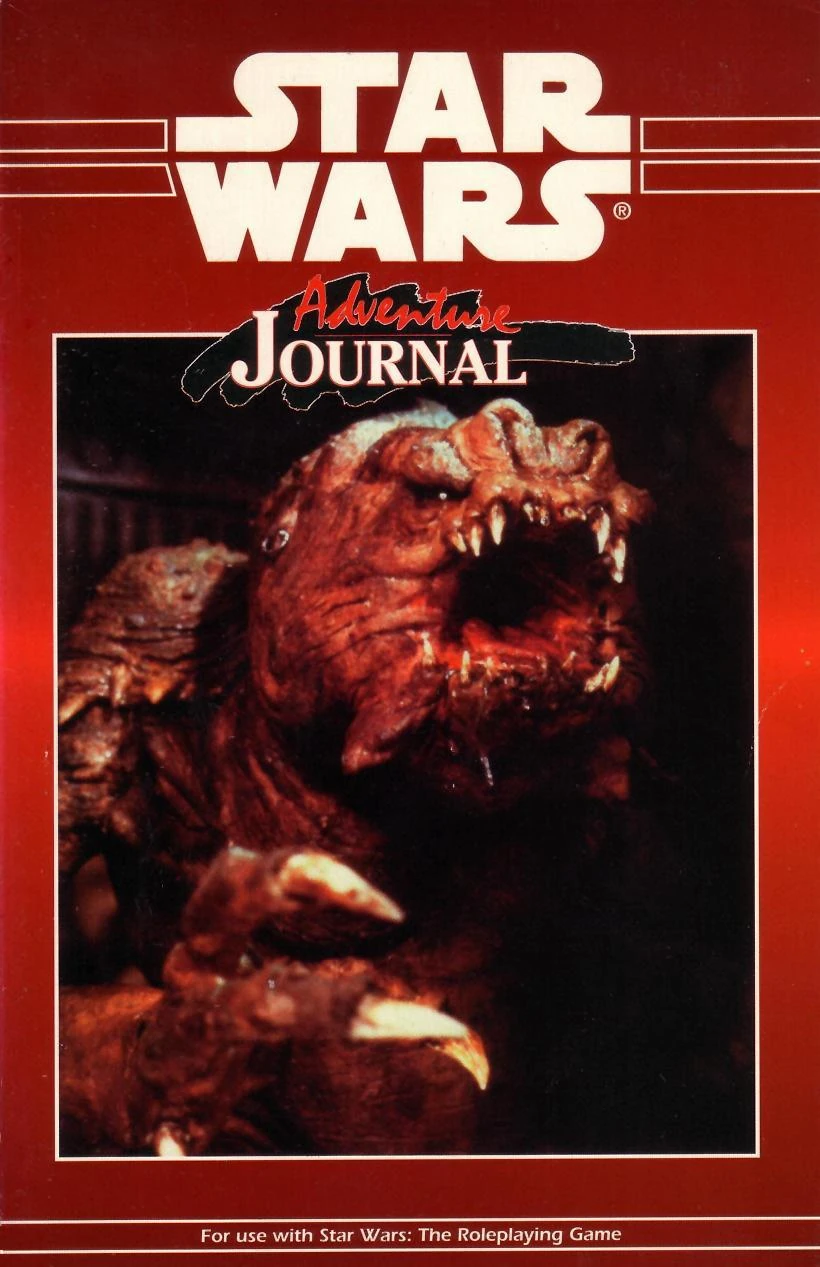
Star Wars Adventure Journal — Volume 1, Issue 2 (May 1994)
Star Wars Adventure Journal — Volume 1, Issue 2 (May 1994)
Published by West End Games for use with Star Wars: The Roleplaying Game.
Credits
Contributors: Dustin Browder, James Cambias, Gary Haynes, Patricia A. Jackson, J.E. Lauterio, Charlene Newcomb, Tim O'Brien, Ilene Rosenberg, Peter Schweighofer
Editing: Peter Schweighofer
Graphics: Tim Bobko, Stephen Crane, Richard Hawran, Tom O'Neill, Brian Schomburg
Cover Illustration: Lucasfilm Ltd.
Cover Design: Stephen Crane
Interior Illustrations: Kathy Burdette, James Crabtree, Chris Gossett, John Paul Lona, Scott Neely, Doug Shuler, Mike Vilardi
Special Thanks To: Sue Rostoni and Lucy Wilson, Lucasfilm Licensing; Tom Veitch, Chris Gossett and Dan Thorsland, Dark Horse Comics; Daniel Scott Palter and Richard Hawran, West End Games
Publisher: Daniel Scott Palter — Associate Publisher/Treasurer: Denise Palter
Associate Publisher: Richard Hawran — Senior Editor: Greg Farshtey
Editors: Peter Schweighofer, Bill Smith, Ed Stark — Art Director: Stephen Crane
Published by West End Games, RR 3 Box 2345, Honesdale, PA 18431
© ™ and 1994 Lucasfilm Ltd. (LFL). All Rights Reserved. Trademarks of LFL used by West End Games under authorization.
Admiral's Communique
Galaxy Full of Stories
The Star Wars galaxy is a pretty big place. The Old Republic encompassed "a thousand-thousand worlds," and the Empire reaches just as far. It's filled with innumerable aliens, worlds, creatures and characters. There are big conflicts — like the one between the Rebel Alliance and the Empire — and smaller conflicts, both political and personal.
There's plenty of room for soldiers, pilots and operatives fighting for the Rebel Alliance. Han, Luke, Leia and the heroes from the Star Wars films are important heroes to the Rebellion. But there are others striving to make a difference in their small part of the galaxy. Starfighter pilots and Rebel operatives, repulsorlift mechanics and third-degree protocol droids carry the fight to the far corners of the galaxy. And not everyone is a Rebel fighting the Empire — Star Wars has gangsters, smugglers, explorers and bounty hunters who are out there pursuing their own goals, forging their own reputations and legends.
The Star Wars galaxy is immense, and there are many stories to tell. Just in this issue of the Star Wars Adventure Journal you can read about the daughter of an Imperial governor working to bring freedom to her world. Find out how a Twi'lek and a slave girl escaped from a ruthless slave lord and an Imperial Moff. Or follow a young smuggler as he comes of age in the treacherous criminal underworld.
Not all adventures take place on Tatooine, Hoth, Bespin and Endor, either. There are innumerable other worlds with exotic aliens, dangerous predators and fantastic cities waiting to be discovered. Tim Zahn, Tom Veitch, Kathy Tyers and Kevin Anderson have already given readers a glimpse of the other exciting worlds and characters in the Star Wars galaxy.
And no matter where in this exciting galaxy you travel, you'll always find an interesting story.
Commander Peter Schweighofer Admiral's Attaché
New Horizons
Galoob Toys Launches Star Wars Micro Machines®
Lewis Galoob Toys and its popular Micro Machines brand blast off in 1994 with the introduction of new micro-sized Star Wars vehicles. The six collections include famous vehicles from the original Star Wars movie, The Empire Strikes Back and Return of the Jedi.
The launch of the new Star Wars line includes the famous
X-wing starfighter, Millennium Falcon, Imperial AT-ST and more, for a total of 18 different vehicles in six collections. Three new playsets to be released later in 1994 are scenes from the Star Wars saga, Star Wars vehicle and figures. Three additional playsets each transform from the likeness of a popular Star Wars character into a complete vehicle playset with Star Wars vehicle and figures.
"The Force was with us when these collections blasted off into the market," said Jeff Cleary, director of marketing at Galoob Toys. "Since their debut, sales have been out of this world. We're anticipating similarly stellar results from our playsets."
The Star Wars collections are part of the Micro Machines Space segment. This segment also includes legendary ships from the Star Trek® movies and three television series, motorcycles from the Biker Mice From Mars™ animated series and Galoob's original Galaxy Voyagers™ vessels. The collections come in packages of three ships with display stands and retail for approximately $4.99 in toy stores across the country.
The Star Wars Micro Machines can also be helpful roleplaying game aids, showing the position of starships during space battles and simulating ground battles as well.
Micro Machines is Galoob's eight-year core brand of miniature vehicles known for its authenticity of scale and detail. The line is composed of vehicles and playsets ranging from cars, boats, planes and trucks, to playsets that transform from larger vehicles into complete super cities. Sales of Micro Machines increased by over 50 percent in 1993, and the addition of the Star Wars line is expected to increase sales even further in 1994.
Lewis Galoob Toys designs, develops, markets and sells quality toy and video game products worldwide.
Topps Presents Galaxy Series Two
When The Empire Strikes Back was released in 1980, most fans agreed that, although Star Wars was a hard act to follow, the new sequel succeeded beyond expectations. Star Wars fans can once again see how a sequel surpasses the original with Topps' release of the highly anticipated second series of Star Wars Galaxy trading cards this spring.
"Just as The Empire Strikes Back was not only a sequel, but an entirely new movie with its own style and special qualities, Series Two is not a retread, but completely independent of Series One," said series editor Gary Gerani. "It will be even more successful.
The 135-card Series Two set features all new art from 70 of the best and brightest comic and fantasy artists, none of whom were featured in Series One. Included in this subset is the final piece of artwork created by the late Jack Kirby.
Like the first series, Series Two will be divided into subsets, with New Visions, the original art commissioned by Topps, comprising the bulk of the set. New Visions has been expanded from 60 cards to 70 cards with brand new art from a totally new line-up of artists including Whilce offers a fresh creative experience."
Topps' first series of Star Wars Galaxy cards, issued last year, proved to be the most important trading card set of 1993, spawning a highly collectible deluxe boxed set and a hit trade paperback. The series won numerous awards from distributors, trade press and fans. Star Wars Galaxy Series One has been nominated for a Diamond Gem award as the non-sport card of the year. Series One also was named the most creative card set of the year by Non-Sport Update magazine and Set of the Year by Cards Illustrated. Gerani believes the second series
Portacio, John Bolton, Jae Lee, Kelley Jones, Tim Truman, Dave Gibbons, and Star Wars Adventure Journal contributor John Paul Lona. "Fans will be treated to never-before-seen, newly commissioned drawings and paintings by comics greats, fan favorites and exciting newcomers," said editor Gerani.
The balance of Series Two features some imaginative and exciting new subsets. One spotlights the work of legendary Star Wars production illustrator Ralph McQuarrie, who is preparing newly created paintings for a book to be released in 1995. Series Two features a sneak preview of some of these paintings. "It was quite a coup getting this art for our series," Gerani said. "The book isn't due out until sometime next year, so this is really the first time these drawings will be seen."
Another unique subset focuses on Marvel Comics pinup art. This art, which has not been seen in 13 years, includes work by Michael Golden, John Byrne, Frank Miller, Bob Layton and others. Other subsets include comic art produced in conjunction with Dark Horse Comics, foreign and unpublished Star Wars poster art, and never-before-seen art from private collections, the Kenner Toy
Company, and the Lucasfilm archives. Searching through this material yielded rare and extraordinary finds. Some of the most notable finds include a pen drawing of Obi-Wan Kenobi by actor Alec Guinness, and a Yoda oil painting by fantasy artist Michael Whelan.
Chase cards are an important component of any set, and the ones in Series Two provide a unique bridge to the first series. In Series One, Walter Simonson's six striking etched foil chase cards, placed side-by-side, formed a beautiful Star Wars panoramic scene. Fans will be pleased to know that Galaxy Series Two contains six all-new etched foil chase cards by Simonson featuring the villains of Star Wars — the Emperor, Jabba the Hutt, Boba Fett and other memorable fiends. Not only do these also create a six-card rogue's gallery, but when fans combine the chase cards from Series One with Series Two, they'll find that the 12 cards collectively form one giant, seamless mini-poster.
Serving as a visual cornerstone for Galaxy Series Two is a brand new painting rendered by renowned fantasy illustrator Boris Vallejo. Long associated with the Star Wars saga, dating back to his highly prized "Empire" posters for Coca Cola tie-ins, Boris' new work will be seen on card #00, the display box, and as a 17 by 22 inch point-of-purchase poster packed inside each shipping case.
LucasArts Entertainment Company Launches TIE Fighter Space Combat Simulator
For the first time in the history of the Star Wars saga, the infamous conflict between the Rebel Alliance and the Imperial Navy will be portrayed from the perspective of the Empire. LucasArts Entertainment Company is crafting a brand new chapter in the epic Star Wars story with the upcoming release of TIE Fighter, the sequel to X-Wing, the top-selling space combat simulator of 1993. In TIE Fighter, players are charged with restoring and enforcing Imperial rule and crushing the Rebel insurgency. As new Imperial Navy Academy recruits, players put their lives on the line to realize Emperor Palpatine's mandate: restore law and order to the galaxy. LucasArts plans to release TIE Fighter this spring.
TIE Fighter is inspired by George Lucas' Star Wars trilogy and gives gamers the chance to experience first hand the elite Imperial organization. Similar in format to X-Wing, TIE Fighter challenges new pilots to refine their skills in training courses and historical combat simulations before engaging in a series of campaign battles. A complex and engaging plot serves as a backdrop for the battles. TIE Fighter also features several innovations and state-of-the-art technology.
TIE Fighter is created by designers Lawrence Holland and Edward Kilham, the same team responsible for X-Wing. "X-Wing did so well that we were really looking forward to working on the sequel," Holland said. "It's been both exciting and challenging to explore these previously 'uncharted territories' of the Star Wars fantasy and peer into the minds of these Imperial characters." Holland is also well known for his award-winning World War II air combat simulators, including Secret Weapons of the Luftwaffe®.
"We received so much positive feedback from fans of X-Wing," Holland said, "but we believe there's always room for improvement. So, we set out to provide gamers with some important new features, including more non-linearity in the structure of the battles and greater strategic insight into the missions." In TIE Fighter, players can direct questions to a briefing officer through dialogue options. These options provide clues and suggestions on how best to complete each mission.
The TIE Fighter story takes place just as the Rebels are evacuating their base on the ice planet Hoth, after being discovered by the Empire. The game provides a new element to these events that were originally portrayed in The Empire Strikes Back, with the action being presented from the perspective of the Imperial Navy. The campaign structure is made up of large battles, each containing a series of missions. Pilots will have flexibility within the campaign by choosing the order in which these battles are completed.
In the first set of campaign battles pilots fly under several of the Emperor's top commanders, including Lord Vader and Grand Admiral Thrawn. Players start out taking the controls of four Imperial starfighters — the TIE fighter, TIE bomber, TIE interceptor and the assault gunboat. These spacecraft are put to the test in strategic missions, such as preventing Imperial documents from falling into Rebel hands, and combat missions, such as an assault directed at enemy Rebel forces.
As the TIE Fighter campaign unfolds, players engage in a tactical web of battles and missions, slowly unraveling the truths behind previously unrevealed objectives. At these deeper levels, pilots gain access to the TIE advanced starfighter, personally designed by Darth Vader, and an even more powerful, mysterious TIE craft. According to Kilham, this new fighter is an "evolution beyond the TIE advanced. It will have the capability to rival the Rebels' finest ships." Before beginning the campaign players can vary the level of difficulty. "We have implemented easy, medium and hard levels players can select at the beginning of the campaign. This should help players with various abilities enjoy TIE Fighter in its entirety," Kilham said.
Like X-Wing, TIE Fighter's 3-D flight engine delivers a fluid integration of polygon and bitmap technologies, resulting in highly detailed 3-D polygon spacecraft and bitmap images used for dynamic special effects such as lightning and explosions. New in TIE Fighter, model designers use Gouraud shading to enhance the realism of the ships. This technique smooths out the flat edges of the polygons by adding gradient color to make single colored surfaces look rounded and textured.
Cinematic cut scenes interspersed throughout the campaign battles help communicate TIE Fighter's dramatic storyline. As players complete these battles, cut scenes serve to bring them back into the folds of the progressing plot. The TIE Fighter soundtrack is packed with digitally mastered sound effects, as well as studio recorded voices. TIE Fighter will feature LucasArts' proprietary iMUSE© sound system.
iMUSE (Interactive Music and Sound Effects) composes music "on the fly" in response to unpredictable player choices. This creates a soundtrack, which, like a movie score, dramatically enhances game play.
A companion book created especially for the game will accompany TIE Fighter. The book, which is full of photos and illustrations, blends fiction and key technical information as it tells the story of a young Imperial Navy recruit. The information in the book can provide good source material for the roleplaying game.
West End Releases Second Edition Sourcebooks
West End Games is releasing three key sourcebooks all updated to second edition game rules.
The Rebel Alliance Sourcebook, Second Edition was released in April. It describes the organization of the Alliance, capital ships, starfighters and infantry vehicles used, special forces, starfighter tactics and more. All game stats have been updated to Star Wars: The Roleplaying Game, Second Edition.
The Star Wars Sourcebook, Second Edition will be released in June, filled with details and updated game stats for creatures, aliens, starships, vehicles and movie characters. This is an ideal book for gamers and fans alike who are looking for more information derived from the Star Wars films.
Following the launch of TIE Fighter, LucasArts will release two new space combat campaigns. TIE Fighter will require a 386 cpu or higher with 4 megs of RAM. Hard drive, as well as a mouse or joystick, is required. TIE Fighter features 256 color VGA graphics and supports Sound-Blaster, Adlib, Roland, General Midi Media Vision and 100 percent compatibles.
LucasArts Entertainment Company develops and publishes entertainment software for CD-ROM, personal computers, video game consoles and multimedia.
Releasing in July, The Imperial Sourcebook, Second Edition, describes all levels of the Imperial military. It provides details on Imperial military personnel, combat vehicles, Imperial capital ships, heavy weapons and Imperial Army and Navy organization.
All three sourcebooks will be available in hardcover one time only for $22. They will only be reprinted in softcover. West End Games products are available in B. Dalton, Waldenbooks, and hobby, game and book stores across the country.
Whispers in the Dark
by Charlene Newcomb
Illustrations by Mike Vilardi
Wink Tasion grumbled quietly to himself. He knew the scout troopers he was monitoring were about to switch frequencies. He could tell by the tone of their voices, though he didn't understand more than one word out of five because of the static on the comm channel.
He looked up from his workstation as a movement across the room caught his eye. He nodded to Alex Winger as she came into the underground's operations center. Now there's one bright spot for the day, he thought to himself. She aimed her finger at him like it was a blaster. He grinned, shaking his head — it was a standing joke between them going back almost a year.
Alex had been in two of his classes at the university. Back then, Wink had known her as the daughter of the Imperial Governor of Garos IV, not as one of the most valuable members of the underground. So, when she waltzed into the ops center on his very first day there, he nearly shot her. Thank the Force one of his comrades stopped him. And fortunately, Alex had a great sense of humor!
"I saw that grimace on your face from across the room," she kidded him as she came up to peer over his shoulder.
"Lousy signal today," he said, handing her a spare headset. "Hey, Mika, can you give me an ear!" he called to the supervisor at another intercept station two seats away.
Mika Kaebra pulled up a display of Imperial channels being monitored by the ops, then keyed Wink's channel to listen in. As the comm chief for this monitoring station in Ariana, he scanned the Imperial wavelengths for interesting message traffic. And the ops could always count on his help when a problem came up.
Today he had five operators — typical for the early part of the day. Two were assigned the task of monitoring scout trooper communications at the mining center complex south of Ariana. One worked on comms between the complex and Imperial Headquarters in the city, and the other two kept track of message traffic to and from the outside world and other outposts on Garos IV.
Alex grimaced as static shattered the airwaves. "I can't hear a thing — did they move?"
"I think so." Wink hesitated, straining to hear any sign of life. There it was! "Somebody's still there — hold on —"
"I can hear him." Barely, Mika thought, as he listened in one ear and began scanning channels in the other ear.
"What's he saying?"
They listened as a distant voice tried to talk over the static.
"It's TK-21. He's calling for directions," Wink said.
"Guess he's having as much trouble hearing as we are!" Mika observed. "Come on 21, where's your boss?" he told the scout trooper he was monitoring, knowing the man wouldn't have heard him even if the channel was free of interference. You had to have a sense of humor sitting at these intercept stations for hours on end, or else you could go nuts.
"Who's on channel B-2?" another op called.
"That could be your guys, Wink. Check it out," Mika told him.
"B-2," Wink repeated, as he switched channels.
"TK-21 still calling for help," Mika told him.
Wink listened to the conversation for several seconds. "Yeah — that's them. Boss just sent TK-16 to call 21."
"Okay," Mika said, "I'll close 'em up here for now."
Wink gave Mika a grin and a thumbs up sign.
Mika Kaebra
DEXTERITY 2D
KNOWLEDGE 2D+2
MECHANICAL 2D
Communications 3D, sensors 3D
PERCEPTION 2D
STRENGTH 2D
TECHNICAL 2D
Mika is a 25 year old communications technician who monitors Imperial communications in the underground's operations center.
Wink Tasion
DEXTERITY 2D
KNOWLEDGE 2D
MECHANICAL 2D
Communications 2D+2
PERCEPTION 2D
STRENGTH 2D
TECHNICAL 2D
Wink is a 20 year old communications specialist who has worked for the underground in the operations center for about a year.
The signal on B-2 was so much clearer. This scout trooper unit they were monitoring was a new network the underground had discovered about a week earlier. The troopers were setting up the new perimeter defense system at the mining center complex where the Imperials were digging in, literally.
The Empire had wised up after the underground had attacked several of their supply convoys. Sensors were being placed in a five-kilometer radius around the mining center, which included areas where the underground had hidden weapons caches. That meant the underground would have a more difficult time observing activity near the mines, let alone retrieving their own weapons.
What once had been a small garrison of Imperial troops had in recent months blossomed into nearly 500 officers in Ariana alone. Plus all the support staff and scouts and stormtroopers that accompanied them, including those assigned to the mining center. The underground had never faced conditions such as these. It used to be relatively easy to steal Imperial equipment, waylay food supplies, and attack the few outposts the Empire had established. But all that had changed.
Confronted with ever-increasing odds, the freedom fighters of Garos IV were determined to continue the fight. As one of their leaders told them, they'd just have to chip away at the block one piece at a time. A small victory was a victory nonetheless.
Alex set down the headset, patted Wink on the back and headed across the room to talk with Magir Paca, one of the leaders of the re- sistance movement. He was studying the master display with Lt. Dair Haslip. No one was sure what was stranger: seeing someone in an Imperial officer's uniform down here, or working with the daughter of the Imperial Governor.
"Paca. Dair," Alex greeted the two men.
"Hello, Alex," Paca said.
She nodded toward the display. "More bad news?"
"General Zakar has requested another 2,000 troops," Dair explained.
"Two thousand?" Alex exclaimed.
"Well, it's not unexpected," Paca said. "With our continued harassment of their scouts, and the obvious importance of the mines, I guess Zakar wants to be sure he can deliver when the next Star Destroyer returns for a pickup."
"Still no word on where the Imperials are shipping the ore?" Alex asked.
"Not a word. I'm almost positive General Zakar doesn't even know," Dair said, though he could hardly believe it himself. "Secrecy seems to be an extremely high priority."
Paca grunted. "That's ironic, isn't it? They are increasing troop strength and adding sensors yet they want to keep this whole operation quiet! Mark my words, friends. The New Republic will hear about this. They'll track down that secret base," Paca said, hoping he sounded more confident than he felt. Like everyone else, he had heard the rumors about the New Republic's push toward Coruscant. If Coruscant fell, it might be only a matter of time until they would sweep toward Garos IV.
Alex gazed at the master display with a far-off look in her eyes. She never told her friends about the visions. Visions of airspeeders sweeping down into the mining center complex. Visions of a battle in the heavens around Garos IV. "The Force is with us," she said. Her voice turned to barely a whisper. "They will come. I'm sure of it."
The two men stared at Alex. Just the way she'd said it gave them hope for the future. But still, in the back of their minds they wondered if the underground could continue to operate against the better equipped Empire. Could they hold out until the New Republic came to help?
"What about construction at the mines?" Alex asked when she realized they were looking at her.
"The last of the barracks will be ready for occupancy in two or three weeks," Dair told them. "They can easily house 1,200 people at the complex."
Alex Winger
Type: Underground freedom fighter
DEXTERITY 3D+1
Blaster 7D, brawling parry 3D+1, dodge 5D, grenade 4D, heavy weapons 5D, melee 5D+2, melee parry 5D+1
KNOWLEDGE 3D+1
Alien species 5D, bureaucracy 6D, cultures 5D, languages 3D+2, planetary systems 4D+1, streetwise 4D+2, survival 5D+1, value 5D
MECHANICAL 3D+1
Astrogation 4D+2, beast riding 4D, repulsorlift operation 6D
PERCEPTION 3D
Bargain 5D, command 6D, con 5D+1, hide 5D+2, search 5D+1, sneak 5D+2
STRENGTH 3D
Brawling 4D, climbing/jumping 5D, lifting 3D+1, stamina 6D+1
TECHNICAL 3D
Computer programming/repair 5D+2, demolition 5D, droid programming 5D+1, repulsorlift repair 4D+2, security 4D+1
Special Abilities:
Force Skills: Sense 1D
Sense: Life detection
Force Sensitive: Yes
Force Points: 5
Character Points: 11
Move: 10
Equipment: Blaster pistol (4D), blaster rifle (5D), comlink, macrobinoculars
Alex Winger is a 19-year-old freedom fighter, and daughter (by adoption) of Imperial Governor Tork Winger. She is poised and graceful when the situation demands it, but privately is something of a tomboy. Those who know her well agree that Alex is bright, quick-witted, and loyal — someone you can always count on.
She has worked with the underground on Garos IV for three years, but her commitment stems from a raid on her homeworld 13 years earlier. She remembers, in startling detail, the death and destruction caused by the Emperor's troops. It is those memories, and the witnessing of a close friend's execution at the hands of the Imperials on Garos IV, that have led her to join the resistance movement. Alex is wholeheartedly committed to every aspect of this struggle, and willing to risk her own life in these troubled times.
Ultimately, Alex and her friends in the underground realize they will need the New Republic's help to remove the Imperial threat from Garos IV. But every little dent they can make, every weapon they can steal or supply line they can disrupt only furthers their resolve to continue the fight for freedom and justice.
"And the bunker?" Paca asked.
"From the reports I've read, construction is nearly complete. It's predicted to be operational within a week — if they get delivery of those Anscot systems control units for the sensors."
"When they get those sensors activated, the place will be nearly impenetrable," Alex observed.
Dair and Paca looked at each other, then at Alex. They were both surprised by her remark. She wasn't the type to ever give up.
Alex caught their stares. "I said nearly impenetrable!"
"Don't worry, Alex. I bet you'll find a weak spot!" Dair said, only half-kidding.
She grinned at him, shaking her head.
"You haven't heard anything about the control units?" Paca asked Dair.
"Probably the same things Mika and his ops are hearing. They're just trying to figure out when the things will be ready to ship from Garan."
Paca nodded. "Okay, keep your ears open."
"Paca," Mika called him from across the room. "We've got a problem. Check this out."
Paca, Dair, and Alex peered over Mika's shoulder as he transcribed, practically word-for-word, the conversation he was eavesdropping on.
"Do you have a fix on his location?" Dair asked.
"Not yet," Mika said, not even pausing as his fingers flew across the keyboard. "Jaytee, pick up channel A," he called to another op as two of the voices split off the main network.
"Got it," Jaytee confirmed.
"Darn," Paca cursed softly as he read the messages between TK-32 and his squadron commander.
"I've got the location," Mika reported.
"Put it on the master," Paca told him, turning to look as a red blip appeared on the display. Alex shook her head. The Imperials had located one of the underground's weapons stashes in a cave not far from the mining center.
Sidebar: Adventure Idea
The characters are members of the resistance on Garos IV. Their mission is to retrieve weapons the underground has hidden in caves near the hibridium mines. Imperial troop strength in the area has increased and the characters must dodge numerous scout trooper patrols.
Magir Paca
Type: Underground leader
DEXTERITY 4D
Blaster 6D, brawling parry 5D, dodge 5D+1, grenade 6D, heavy weapons 5D+2, melee 5D, melee parry 6D
KNOWLEDGE 4D
Alien species 4D, bureaucracy 6D, cultures 5D, languages 4D+2, planetary systems 5D+2, streetwise 7D, survival 8D, value 6D
MECHANICAL 3D+2
Astrogation 4D, beast riding 5D, repulsorlift operation 6D
PERCEPTION 3D
Bargain 6D, command 6D+1, con 6D+1, hide 7D, search 6D, sneak 7D
STRENGTH 3D+2
TECHNICAL 4D
Force Points: 1
Character Points: 5
Move: 10
Equipment: Blaster (4D), data pad
Magir Paca is one of the original underground leaders known as COSGU (the Committee of Seven for Garosian Unification). Paca was an assistant to the Minister of Commerce when the Empire established a presence on Garos IV. Imperial Governor Tork Winger had been his close friend and mentor, guiding Paca's career in government service. This gave him access to all types of useful information. For 10 years he covertly passed information to the underground until the Imperials realized there was a leak in the system. Paca fell into their trap and was able to elude arrest only by a stroke of fate. Alex Winger, then only 15 years old, was forever fiddling with computer files. She accidentally uncovered an Imperial file on suspected underground figures and the cases being built against them. She was able to warn Paca, and he disappeared hours before Imperial troops came to arrest him.
Paca has remained in hiding for over three years, and now coordinates much of the underground's activities.
Paca punched up something on his own data pad — a readout of what was stored in that location. "Small arms," he said. "Thank the Force they haven't discovered the Plex missile launcher we've got hidden out there!" A small consolation — the underground needed every weapon it could lay its hands on. He made an entry to signal all the teams about the Imperials' discovery and a note to discuss how to move other weapons away from that area. Then he noticed that Jaytee was busy at his intercept station. "What are your guys doing?"
"Discussing security at the governor's mansion."
So my father finally ordered guards for the house, Alex thought. I may have to move to the University after all.
"Dair, why don't you join the Governor and me for dinner tonight. We can test their security set-up. We'll need to know what's going on around the mansion before we attempt to move our weapons from the caves."
"Good idea, Alex," Paca said.
"I'll come by your office later and issue a formal invitation," Alex told Dair.
"Okay."
"Be careful," Paca told them.
Alex gave him a cockeyed grin. "Hey, have you ever known me to take risks?" She paused, then pointed a finger at him. "Don't answer that!"
Paca laughed, shaking his head. "Can you brief us tomorrow on the set-up?"
"I have class at 0900. How about 1030?" She chuckled, pointing to Jaytee who was still listening to the two scout troopers at the mansion. "I bet Jaytee will know as much as I do!"
"Right." Paca smiled. "1030 tomorrow."
"Done," she said, heading across the room toward the door into the tunnels.
Paca and Dair watched her go. There was something very special about Alex Winger. Both men shared the same thought as the door into the tunnel system slid shut behind her. The Force will be with us.
"Good afternoon, gentlemen," Alex greeted the two officers in General Zakar's reception area. "Is Lt. Haslip available?"
"Miss Winger," Lt. Nilo said, "a pleasure to see you again. The Lieutenant just stepped out. I'm sure he'll be back in a few moments."
"All right. I'll wait for him," she said, taking a seat near the window that overlooked the avenue. She hid the disgust she felt seeing the street busy with military traffic.
Dair entered the room. "Alex, um, Miss Winger," he stammered. "How are you?"
Alex stood up. "I'm fine, Lieutenant," she said, glancing at the other two men who pretended to ignore a scene they'd witnessed on several occasions.
"What can I do for you today?" he asked.
"My father and I would like you to join us for dinner this evening," she said, a slight blush coming to her cheeks.
Lt. Nilo could hear the tremble in her voice and threw a sly grin to Lt. Polg. Normally, Alexandra Winger was so poised and confident. Obviously, she wasn't as cool in matters of the heart.
Dair Haslip
Type: Imperial Lieutenant
DEXTERITY 3D
Blaster 6D, brawling parry 4D+1, dodge 4D+2, grenade 5D, heavy weapons 4D-2, melee combat 4D, melee parry 5D
KNOWLEDGE 4D
Alien races 4D, bureaucracy 4D+1, cultures 4D+2, languages 4D+2, planetary systems 5D, streetwise 5D, survival 5D, value 4D+2
MECHANICAL 3D+2
Astrogation 4D, beast riding 4D, repulsorlift operation 5D
PERCEPTION 3D
Bargain 5D, command 5D+1, con 5D, hide 5D, search 5D, sneak 5D
STRENGTH 3D+2
TECHNICAL 3D
Force Points: 1
Character Points: 5
Move: 10
Equipment: Blaster (4D), data pad
Dair Haslip is a 31-year-old native of Garos IV who joined the Imperial Army when he was 19 years old, the year the Empire first established a presence on his homeworld. He joined the Imperial Army not because of his devotion to the Empire, but because of his hatred of it and everything it stands for. He was already working for the underground, but thought he might better serve the cause of freedom and justice by working from the inside.
After spending seven years away from Garos, he returned to serve as an administrative assistant to General Zakar, the supreme military commander for the planet. His position has allowed him access to all types of useful information which he passes on to his underground colleagues.
Dair had his back to the other officers in the room. He hid his grin, playing the part like an actor in a scene from a play.
"I would love to have dinner with you," he said.
"Why don't you come by about six. Father won't arrive before seven, so we'll have time to take a walk along the Cliffs and enjoy the view."
"There's only one view I want, Alexandra," he said quietly, knowing that Nilo and Polg still would overhear him.
Alex looked up at him and smiled, then turned toward the door. "See you tonight, Lieutenant," she called back to him.
Dair stood there and sighed as the door slid shut behind her. Nilo and Polg were chuckling to themselves. It was obvious to them that Dair Haslip was head over heels in love.
"See you tonight, Lieutenant," Nilo repeated, mimicking Alex. Dair glared at him. "Oh, shut up," he said, straightening his uniform. "What are you looking at anyway?!"
"Nothing, Lieutenant," Nilo said innocently.
"Well, let's get back to work."
"Good evening, Lt. Haslip," the servant droid greeted Dair. "Mistress Alexandra is waiting for you on the patio."
"Thank you, Seetee," Dair said. "I'll find my own way."
"Of course, sir."
The view from the Imperial Governor's mansion was probably one of the best anywhere along the Tahika Cliffs. Alex stood there, gazing out at the calm sea, as the last hour of sunlight sparkled across the water. She heard Dair approach and turned to greet him, a smile on her face. He took her in his arms and kissed her on the lips, which caught her by surprise.
"I saw two scout troopers at the front of the house," he whispered in her ear. "Anyone back here who might be watching us?"
"Yes," she said, understanding the reason for this display of affection. "There are two more patrolling the grounds that I know about."
"Okay," he said, pulling away from her but planting a gentle kiss on her forehead. "It's getting rather crowded out here, isn't it?"
"Let's take a walk by the Cliffs," she suggested. "We've got at least an hour until dinner."
He took Alex's hand in his and led her down the old stone steps to the grounds below. She could feel his nervousness and knew it wasn't because he was worried about the scout troopers.
"Isn't it beautiful here?" she asked him when they stood at the edge of the Cliffs.
Dair wasn't looking at the view. "Beautiful," he said quietly. Alex looked at him, sensing his thoughts.
"Alex, I —"
"Shh!" she whispered. "I like you, Dair. You're a good friend. Working together like this against the Empire — well, you know — I just don't want to give you the wrong impression. Please don't make our lives any more complicated than they already are."
He knew she was right. He'd had this same conversation with himself a thousand times. "I understand, Alex."
She smiled shyly at him but there was a glint of youthful exuberance in her eyes. "Hey, c'mon! I'll race you!"
She'd taken off before he could remind her they needed to look halfway decent for dinner with the Governor. But he trotted after her, finally catching up when she stopped suddenly to look around. They were close to the mines, maybe three kilometers or so. For a moment, she had a fleeting sense of danger. But then it was gone.
"What's wrong?" he asked her.
She frowned, shrugging her shoulders. "It's nothing. Let's see how long it takes them to track us," she said, taking his hand and leading him down another pathway that skirted the edge of the Cliffs.
They'd walked about five minutes when Alex plopped down on the ground. "This looks like a good spot," she commented.
"A good spot?" he asked.
"Yes. For them to find us."
"Okay, if you say so."
Alex glanced at her chronometer. "It sure is taking them a while."
"Maybe they aren't patrolling this area on a regular basis. And you know their speeder bike sensors aren't all that reliable around the Cliffs," he said.
"Could be," she agreed, looking off in the direction of the caves about a half kilometer away. She wondered how easy it might be to move the Plex missile launcher that the underground had hidden nearby. If it took those scout troopers this long to find them — "They're coming," she said, that same far-off look in her eyes that he'd seen earlier in the day at the operations center.
Dair strained to hear the sounds of speeder bikes. "I don't hear a thing," he said.
"Shh!"
Ten seconds later the whine of engines became clear. He was amazed at her keen sense of hearing — or was it something else? He shook his head in disbelief and stared at her.
Alex moved closer to him. "Now, remember, this is just a job." She hesitated, looking away for a moment. Then she looked him straight in the eyes. "Are you ready?" she asked him.
"Huh? Ready for what?" he asked as the speeder bikes grew closer.
"For this —" she leaned over and gently kissed him, ignoring the speeder bikes that had stopped a few meters away.
Dair took to the part like a natural, needing no encouragement whatsoever. He was oblivious to the approaching footsteps, never breaking the kiss.
Alex finally opened her eyes and saw the two scout troopers standing over them.
"Dair," she said, pulling away from him. "We have company." "What the —" He got up and faced the troopers.
"Sorry, Lieutenant, but this area is off limits," one of the men told him.
"Off limits?" Alex cried. "This property belongs to my father!"
The trooper eyed the young woman for a moment. "Orders from General Zakar, Miss Winger."
Alex glared at the trooper, then stalked off.
"Alex, wait!" Dair called. "Thanks a lot," he told the trooper sarcastically. "Alex!"
Dair caught up with her, putting his arm around her shoulders. She was trembling. But when he saw the look on her face, he had to keep himself from laughing.
"Good show," he whispered.
"We'll be the talk of the barracks tonight," she laughed.
Alex rubbed her eyes. Only the soft glow from the moonlight lit her room. She sat up in the bed, trying to imagine what Paca would say if he knew what she was about to do. She chuckled to herself.
What was it she had said to him yesterday — have you ever known me to take risks? Oh well, she thought.
That Plex missile launcher was all she could think about. It was so close, barely a kilometer from the governor's mansion. The Plex had to be moved before the Imperials found it. And Alex was in the best position to do just that. After her little experiment with Dair earlier in the evening, she was sure she could slip in and out of the area quickly enough to avoid detection.
Alex climbed out of bed and dressed, then studied the grounds around the mansion. No sign of any scout troopers. "Nothing like a midnight stroll," she said to herself.
Getting out of the house was even easier than Alex had imagined. She went out through the back down to the grounds, and headed due south, running parallel to the Cliffs. Less than 30 meters from the mansion the trees offered good cover.
The forest was abuzz with nocturnal sounds. Alex could barely hear her own footsteps on the forest floor over the evening song of the crupas that dwelt in the trees. And the boetays howled at Garos' moons, lending their voices to the harmony of the night. The sound of Imperial speeder bikes did not intrude on this natural symphony.
Alex covered the distance to the caves in a little over ten minutes, and she felt safe hidden deep within their shadows. She rested for a few minutes before slinging the missile launcher over her shoulder and heading back out into the night. At the mouth of the cave she peered into the darkness. Still no sign of scout troopers. They were out there, but they weren't too close — at least she didn't think so.
Turning westward, Alex made her way toward the Cliffs. She decided to travel back by a slightly different route. If anyone approached, it would be very easy to throw the Plex over the side of the Cliffs.
No one interrupted her jog until, within sight of the mansion, Alex sensed someone nearby. She couldn't believe she'd gotten so close to recovering the Plex and now might have to toss it. She couldn't let that happen. Moving quickly, she dropped to the ground, throwing leaves and some fallen tree branches on top of the launcher. She was more than ten meters away from it when the speeder bike came up behind her.
Her heart raced. She took a few deep breaths to calm herself. The scout trooper pulled his bike up beside her. Alex stopped when she noticed he had his blaster drawn.
"What do you want?" she asked him, indicating by the tone of her voice that she was quite irritated by his appearance.
He peered at her, shining a light in her face. "Who are you?" he asked.
"I am Alexandra Winger, daughter of the Imperial Governor," she said in her haughtiest voice.
He hesitated for a moment, studying her closely. "What are you doing out here this late at night, Miss Winger?"
"What does it look like I'm doing? I couldn't sleep, so I came out for a walk. Now, if you don't mind —" she started to walk away from him.
"I'll accompany you back to the mansion, Miss Winger."
"All right," she agreed, "if you insist."
"And may I suggest that next time you want to take a walk in the middle of the night, you ask for an escort. It's hard for us to protect you if you take off by yourself," he told her.
She nodded as he followed her up to the mansion.
"Good-night, Miss Winger," he called as she walked up the stone steps to the patio.
As the scout trooper rode away from the hidden launcher, Alex took one last look toward the Cliffs. She breathed a sigh of relief. The missile launcher would be safe for the time being. She didn't think it would be too difficult to get it back to the underground ops center — but she decided to think about that problem tomorrow.
Dair Haslip sat at his desk trying to work. General Zakar was expecting this report on the bunker construction at the mining center.
Dair looked over at Nilo who was on the vidcomm with Major General Carner. Nilo did not look happy, but the conversation sure sounded interesting.
He turned to stare out the window. It was late in the day. He stretched, flexing his arms above his head, then got up and walked over to the window. Chado's Pub occupied the first floor of the building across the street. The action was beginning to pick up over there as the workday slowly drew to a close. A light shone brightly from an open window. Dair double-checked it quickly — second window from the left, third floor. Looks like Paca's called a meeting for tonight. He sighed, rubbed his eyes, and returned to his desk. It was going to be a long day.
General Zakar burst through the door, with Lt. Polg hot on his heels.
"Haslip, how's that report coming along?" the General asked, not even bothering to stop.
"It will be on your desk first thing in the morning, sir."
"Good." Zakar walked into his office with Polg right behind him. Dair got up and followed them in. The General glanced at the reports on his desk. Every time he stepped away for more than an hour, they seemed to proliferate. Ironic that he had just asked for another one from Haslip.
"Polg, arrange a meeting with Governor Winger and Major General Carner tomorrow afternoon. I'll have to review Haslip's report before that meeting, so be sure to keep my schedule open." He glanced at Dair. "How long will I need, Haslip?"
"About a half hour, General," Dair replied.
"All right. See if you can squeeze that in."
"Yes, sir," Polg said, making an entry on his data pad. "Will there be anything else, General?"
"No, that will be all for now, Lieutenant."
"Sir?"
"Yes, Haslip?"
"Councilor Baro has been trying to get through to you all day."
"Baro?" he asked, searching his memory. "Ah, yes, the one from Zila."
"Yes, sir. The Councilor is concerned about our activities there," Dair told him.
Zakar scowled. "Is he now?" He shook his head impatiently. "Just remind him who is in charge, Haslip. I will tell him what he needs to know, when and if he needs to know it." And if my superiors ever clue me in on their objectives.
"Yes, sir. I'll tell him that, sir. I'll get to work on that report now." The door slid shut behind him.
Nilo was just ending his conversation with Major General Carner. He rolled his eyes. "Generals," he said softly, gritting his teeth.
"What's Carner doing? Giving you a hard time?" Dair chuckled.
Nilo glared at him, throwing him a frown. "Oh, he's upset about the shipping orders for the systems control units."
Polg looked up from his work amused by the conversation. "What else is new?" he asked.
"General Zakar only authorized two squadrons of scout troopers to move the parts from Garan to the mines. And Carner wants more protection for the convoy. So, who gets yelled at? Me!"
Very interesting. "That's what lieutenants are for, Nilo," Dair said. "Join the club!" Polg said. He'd been on the receiving end of that kind of behavior too many times to count.
"Try not to take it personally, Nilo. Carner's been on everyone's case because of the underground's activities," Dair reminded him. "Yeah, I know. Guess I better pass on Carner's complaint to the General. I wouldn't want to be derelict in my duties, now, would I?"
Dair shook his head. He wondered what the General would add — another squadron of scouts, or maybe an AT-ST? You could always count on the Empire to make things more difficult for the freedom fighters.
A buzz from the intercom interrupted their short break from work. "Yes, General?"
Sidebar: Garos IV
Garos IV is the fourth planet of six in the Garos system. It was settled by humans more than 4,000 years ago. And until recently, it was a self-supporting planet with little contact outside the system.
The seat of government is located in Ariana on the western coast — known for the forboding Tahika Cliffs — on the larger of two continents. Ariana is an intellectual and business center, dominated by the prestigious University of Garos. It is also the home for Imperial Headquarters on the planet. Forty kilometers to the southeast lies the manufacturing and agricultural capital of Garan. This bustling city sits on the edge of the Morcur Valley, the planet's largest producer of foodstuffs.
The Empire has generally left Garos IV alone since establishing a quiet presence on the planet 13 years ago. Only in the last couple of years has the number of troops begun to grow. Their chief concern seems to be the mining of hibridium in a region south of the city of Ariana.
Garos IV
Type: Terrestrial
Temperature: Temperate
Atmosphere: Type I (breathable)
Hydrosphere: Moderate
Gravity: Standard
Terrain: Forests, mountains, valleys
Length of Day: 25 standard hours
Length of Year: 382 local days
Sapient Species: Humans
Starports: 2 standard class
Population: 20 million Garosians, 4 million Sundars
Planet Function: Agriculture, manufacturing
Government: Imperial governor
Tech Level: Space
Major Exports: Foodstuffs, metals, minerals
Major Imports: High technology
"Polg, bring me the latest updates on the sensor placements at the mining center," the voice from the other room boomed.
"I'll get that for you right away, General."
Dair and Nilo looked at each other as Polg furiously keyed up the requested file and transferred it to a data card. Poor Polg, the General always kept him running. He was up from his desk in less than 30 seconds. Nilo shrugged his shoulders, got up, and followed Polg into Zakar's office.
Dair checked his chronometer again. As soon as he finished this report he could get out of here and have dinner before checking in with Paca in the underground ops center.
It was definitely going to be a long night.
"Did you hear that, Mika?" Jaytee asked.
"I got it — 41 hours — that would be 0800, day after tomorrow," Mika replied after overhearing the conversation about the shipment of units needed to bring the sensors on-line at the mining center. He clicked on his comlink. "Paca," he called into the device, "we've got something you'll be interested in."
Paca appeared from the adjacent room. Jaytee had already transferred the information he'd want to a data card. He stood up at his intercept station waving the card in Paca's direction.
"Systems control units — they're ready to ship from Garan. All the arrangements are right here," Jaytee said.
"Great. Mika, alert our teams to stand by for orders," Paca told them as Jaytee handed him the data card.
His mind was already hard at work. This was the information they'd been anticipating for several days. The Imperials had been working on parts for the computer systems controls in Garan because the fleet had been so occupied by the New Republic, they'd been unable to supply a few vital components for the sensor systems at the mines.
Paca delicately fingered the data card. He smiled to himself, knowing the precious information it contained. Now the underground would have a chance to destroy that shipment before it ever reached the mines.
The old Currahen Highway was as quiet as usual for 1300 hours. The highway north of Garan was a main route to Ariana about 40 kilometers to the northwest. It was always well travelled. But this section, south of the city, led to the mines and only recently had seen an increase in traffic. Imperial traffic.
The attack on the supply convoy would come at the Currahen Crossroads, about 12 kilometers southwest of Garan. The Crossroads were located in a high mountain pass, and offered several escape options for the freedom fighters — narrow paths westward toward the Tahika Cliffs, southeast to the lower Morcur Valley, or back into Garan.
Dair Haslip had been able to confirm late the afternoon before that three speeder trucks were loaded and ready to go from the distribution center in Garan. According to the information he had, the trucks would be escorted by two scout trooper squadrons and at least one AT-ST. A forward observer had seen a second AT-ST move through the mountains toward Garan during the night.
The freedom fighters had been staking out the hills surrounding the Crossroads since the pre-dawn hours. At 0700 word had come through that a new departure time had been set for 0930. And so they waited.
They were still waiting.
The weather had turned nasty. Storm clouds rolled in from the coast before noon. It had been pouring down rain for over an hour. Visibility was poor as a dense fog enshrouded the hillsides. If she hadn't known better, Alex would have sworn it was dusk rather than noontime.
"Thanks, Cardy," she said as one of her comrades handed her a hot mug of tea from his thermajug.
"What do you think happened to the convoy?" he asked. "They should have been here long ago."
Alex warmed her hands on the mug. "You're not worried, are you?" she asked him.
"No. It's just all this waiting that gets to me," he said, taking a sip from his own mug.
"Yeah, I know what you mean. But we would have heard something if they weren't coming." She looked through her macrobinoculars. "They'll be here," she reassured him. A distant thunderclap echoed through the forest. It sent a chill up her spine.
"How's that new baby doing?" Alex asked, trying to lighten Cardy's dark mood.
He smiled. "He's getting so big! Crawling all over — "
A buzz from the comlink startled both of them. That was the signal. The speeder trucks should be coming into view any moment now. "Here we go!" Cardy whispered, as he moved away from her farther up the hill.
A metallic grating reverberated through the hills — the movement of heavy machinery — AT-STs! There's one, Alex thought as it moved through the sight of her blaster rifle. Three speeder trucks surrounded by scout troopers followed it. A second AT-ST brought up the rear.
This was it —
A missile whooshed over Alex's head. One of the AT-STs exploded into a thousand pieces. Ten scout troopers fell in the first volley of blaster fire from the hillsides. Another blast from the Plex nicked the other walker. Scout troopers poured off the road and scattered into the hills.
The second AT-ST locked onto the Plex missile launcher that had taken out its companion. An explosion lit the side of the mountain just above Alex.
She heard Cardy's agonizing scream and ran up the hillside to check on him.
"Cardy?" she yelled above the sounds of the battle as explosions continued to burst all around her. She spotted the launcher and made her way toward it — it looked like it had been carelessly tossed aside like a toy a child had tired of. Cardy was lying a meter away, mortally wounded.
"Get — missile —" he stammered.
"Come on, I'll get you out of here," she told him. She struggled to get her arm under his shoulders, knowing in her heart that her efforts were futile. And Cardy knew it too.
"No — too late — for me," he said, choking on his words. He took one last breath, and died. Another friend gone. Alex clenched her fist thinking of the child that would never know this brave man. She pulled him close, closing her eyes and hugging the lifeless body in her arms for a few brief seconds.
A shot whizzed past her head. She laid Cardy's body down, then grabbed the Plex and headed down the hill. She was determined to take out that other AT-ST. A scout trooper passed by almost close enough to touch, but didn't spot her.
On the eastern side of the road Alex's companions lobbed grenades at the speeder trucks, courageously ignoring the AT-ST that sought them out. One truck exploded in a mighty fireball. The walker locked on target. But Alex was ready. She fired the Plex before the AT-ST had a chance to get off a shot. The cab burst into flames, showering the road with debris and setting a second truck on fire.
Alex's comlink buzzed. That was the signal to retreat. One of the scout troopers must have moved out of jamming range and had called for help. She slung the Plex over her shoulder and turned away from the road, heading back into the hills.
Blaster fire echoed on the mountainside as the scout troopers continued their pursuit of the freedom fighters. Fortunately for Alex and her friends, the terrain made tracking difficult. And with their sensors jammed, the Imperials had to rely on visual sightings in territory that the underground knew much better.
At the summit of Adni's Hill, Alex caught up with two of her comrades. Together they made their way five kilometers through the underbrush to a hidden landspeeder, never seeing one sign of the enemy. But they were aware of the distant sounds of battle. Each one thought about the ambush, their friends, their own survival, and their willingness to carry the fight on to another day. Thoughts they shared in common, yet never spoke aloud.
The landspeeder wound through the narrow mountain paths. The rain had finally ended, but the mists in the forest lent an eerie glow to the sunlight that fought to break through the clouds.
They arrived at the first drop point almost an hour later. Alex bid her companions good-bye and watched them round a curve in the road before she walked the half kilometer to her own speeder.
She sat down at the controls and for the first time in hours realized how exhausted and cold and wet she was. She took a deep breath, closing her eyes for a few seconds. That's when the vision appeared. It was brief, but more vivid than any dream she'd ever had — It was so cold — and every muscle in her body ached — a hand was extended out to hers — "Alex, take my hand," a voice yelled above the howling wind — as fingertip met fingertip against a backdrop of white, on a snowy mountainside, she looked up — and perched above her, with a hand stretched out to hers, was the man from a dream she'd had — the man with the sandy brown hair and blue eyes —
Adventure Idea
The characters are free-traders who arrive on Garos IV looking for work and notice that this relatively unknown little world seems to be a hotbed of Imperial activity.
During a sabacc game at the local tavern, the characters learn about the Empire's interest in the hibridium mines. They decide to attempt to reach members of the New Republic who might pay handsomely for this information. But getting off Garos IV may prove to be more difficult than they thought. Their ship is being detained for inspection by the Empire, and they might fall under Imperial suspicion if their intentions are discovered.
And as suddenly as it began, the vision abruptly ended.
Alex opened her eyes. Her hands trembled as she grabbed the controls of the speeder. Who are you? she thought. Why are you in my dreams?
Then, an overwhelming feeling of calm touched her soul. Somewhere, in the back of her mind, a voice seemed to be calling softly to her. He whispered to her through the darkness, but the message was loud and clear.
The Force will be with you.
Tom Veitch, Chris Gossett and Dan Thorsland:
Making Star Wars Comics Come Alive
by Ilene Rosenberg
Rough concept sketches by Chris Gossett
Dark Horse Comics introduced a new chapter to the Star Wars saga toward the second half of 1993. It was different, not only because it lacked the famous faces of Luke, Leia and Han, but because it took place nearly 4,000 years before the time of Star Wars: A New Hope. It was Tales of the Jedi.
The scriptwriter for Tales of the Jedi was already known to faithful Star Wars comics audiences. Tom Veitch had written the script for Dark Horse's first Star Wars venture, Dark Empire. A sequel to the first series, which was drawn by artist Cam Kennedy, is scheduled to come out by Christmas of 1994, with the same duo drawing and scripting the books.
Mr. Veitch, along with his wife, Martha, also wrote Greedo's story for Bantam's forthcoming anthology, Star Wars: Tales from the Mos Eisley Cantina, due out later this year.
The 43-year-old Vermont resident is currently working with Jedi Academy author Kevin Anderson on a sequel to Tales of the Jedi, entitled Dark Lords of the Sith. Artist Chris Gossett, who collaborated with Mr. Veitch on the first two issues of Tales of the Jedi, is penciling the pages for the sequel.
Tales of the Jedi was Mr. Gossett's first Dark Horse comic. The 25-year-old artist has been drawing all his life. When he was 19 he released his first and only comic on CFW Enterprises, entitled Black Angel. Soon after, Mr. Gossett, who lives in Los Angeles, took a hiatus from the comic book world to act and write. He returned a year-and-a-half ago to work on Star Wars comics for Dark Horse.
Twenty-nine year-old Dan Thorsland — the editor for nearly all the Dark Horse comics that have and will bear the Star Wars title — is no stranger to the comic book industry. Mr. Thorsland, who lives in Portland, Oregon, with his wife Heather, worked at DC Comics for six years before coming to Dark Horse as an editor. At DC he maintained the company's vast library of published DC works, edited Wonder Woman comics and worked as an assistant and associate on the Superman books.
Before working in comics, Mr. Thorsland was a film student majoring in screen-writing at New York City's School of Visual Arts, but left college without a degree after three years and worked in advertising.
Mr. Thorsland is also the writer for Dark Horse's forthcoming comic series, Droids, which will feature R2-D2 and C-3PO.
Q: The comic books show a real love for Star Wars. When and why did you fall in love with Star Wars?
Chris: Definitely the first time I saw it. I was nine years old when Star Wars came out. The first time I saw it, it was absolutely the most amazing movie I had ever seen. Oddly enough, I had a little bit of a preview. My father, who is an actor, used to get film trade magazines, and all the trade magazines were talking about this hot new science fiction movie called Star Wars. And this is long before anybody had heard of it. And I saw this picture of C-3PO and Luke on the cover of one of these trade magazines and I couldn't wait to see it.
My father took my brother and me that afternoon — we ditched school to go see it. And then we went back later that night with my mom, because it was just so amazing. We just had to bring Mom that very night.
That night, when I went to sleep, after having seen it twice, it impacted on my imagination so intensely that I could still hear the sounds of the lasers in my head right before I fell asleep.
Dan: [I fell in love with Star Wars] when I was a kid. I was a miserable, incredibly unhappy child. I had a lousy childhood growing up in the bleakest, dullest suburb you could imagine, with no friends and too smart to really buy into what it was like growing up in the '70s, and yet not smart enough to go out and find kindred spirits who were also not interested in getting drunk every night or going to Molly Hatchet concerts. So I spent most of my time sitting in the back yard of my parents' house, reading.
In '77 this movie comes out, and I was about 12 at the time, and it was just everything that I had loved in fantasy and science fiction. I begged and begged and begged my parents to take me to the movie and as it turns out, I didn't see the movie until maybe six months after it came out because they refused to put up with the lines. So finally, I begged a ride with my uncle, and he took me to see it and, at that time, I had already had boxes and stacks of every book and sets of blueprints and models and anything else that had been released concerning the film. I just loved it, and I saw it a million times afterwards.
Being such a miserable kid, I identified strongly with Luke. One scene that always comes to mind, and I think a lot of people key into with the Star Wars stuff, particularly today, when things are getting dark and scary again, is when Luke is sitting there thinking about being stuck on that ranch. He's got one foot up on a little ridge and he's looking off into the Tatooine sunset and there's two suns. And he's just looking at them and thinking about the two choices that he can make. That, to me, is the key thing about Star Wars — Luke's choice. Almost anybody's choice as to whether or not they're going to go out and become a part of this enormous galactic conflict in a universe far bigger than they can imagine, or if they're just going to play it safe, stay at home, and take care of Uncle Owen and Aunt Beru.
I went home that night after seeing it, and I fell asleep just dreaming and praying that I would wake up in the morning, and the Millennium Falcon would be parked out in the back yard, and I could just get away from it all.
Tom: I think the films touch a mythic dimension which hadn't been touched in a long time. It's like popular culture was running on the surface of reality. And Lucas using — at least appearing to use — older forms that were from films when he was young actually reached beyond these older adventure-type movies into some archetypal level of our experience.
It just grabbed me. It just grabs you like a dream. You know how a dream can really take hold of you — that's the way this movie took hold of me.
Q: Were you surprised with the popularity of the Star Wars cycle, so many years after the movies had come out?
Tom: Not really. But the funny thing was, we proposed the idea of doing these comics in 1988, and the people we talked to at Lucasfilm, they didn't really think there were going to be any more movies or that there was any more life in it. They were interested in doing it, but they weren't quite sure whether it was going to go anywhere. Plus, people we talked to in the comic book industry said, "you're crazy. Star Wars is dead." We knew it wasn't.
Chris: It surprises me that more people haven't gotten a clue as to why it's so popular and therefore made more movies like it or tried to create more things. Unfortunately, everybody in Hollywood only saw the blockbuster aspect of it. They saw the Death Star explode. They saw Darth Vader. And they saw all these things going on and this great music and these big effects, and all they thought was "Well, we have great music and big effects. We'll make millions. And everybody will love us and we'll be a phenomenon."
That just wasn't the case. Like George Lucas said, a special effect is really nothing unless you've got a story that has it as part of a dynamic. Arnold Schwarzenegger has proven that you can spend millions of dollars in special effects and still make a lousy movie.
Star Wars is different because all those effects were really just inspired by the story. The story made them that grand. How many times have you gone into a movie, seen the big climax and said "Oh yeah, give me a break." That's what blowing up the Death Star would have been in the first movie had not we cared so much about Luke and the Rebels and had we not hated Darth Vader so much. If George Lucas hadn't effectively brought us into his universe, all of this just wouldn't have meant anything and all those effects would have been meaningless. And that's the essence of Star Wars. That's what we're trying to do with the book, is make sure that the feel of Star Wars comes through.
Dan: It's always been something I've enjoyed, and I've never lost interest in it and I've never grown out of it. Even 10 years later, seeing it resurge is an indication to me of how people are again looking for something that is more than just the fluff entertainment out there. Things have gotten to the point where almost all music is just commercial and there's no real substance to the movies being made today. Look how Hollywood is running out of real concepts, real ideas.
A lot of people say that it's nothing but '70s retro. People are excited about it again because everybody's looking back on the '70s and having this big '70s revival thing — bell bottom pants are back in and disco's back in, God save us all. But I think it's a lot more than that. I also think it's been such a long time since anything new has been done that people are waiting; they're hungry. I don't have any children, but I know a lot of people my age who do, who have kids who are five and six years old, and they start looking around for things that they can give their kids that hopefully will give them a little perspective. A lot of those people were Star Wars generation kids, and they're turning their kids on to it too.
That's why we're doing Droids, for younger kids. Because this is for all those Star Wars fans out there who would love to give their kids the same feeling they got when they first went and saw those movies. They were so much fun. So much to look at. So much to think about.
Q: Were you afraid the comics wouldn't live up to the movies?
Dan: I think for everyone who works on it, it's terrifying to try to live up to the feelings you have about the source material. I know Chris just beats himself up, practically, trying to reach the standard. He's so inspired by the books. Every time I get a batch of pages from him, I get pages of the art of Star Wars, every visual reference he can get, literally torn out of the spines and clipped to the pages, saying "I want it to look like this," and "We need it colored like this," and "I want to get this kind of feeling."
Chris: We don't have sound effects. Film is film and comics are comics. At first, you can let that get to you and make you afraid. At first I was afraid, I thought "How can a comic do this film justice?" But at the same time, what we have over them is we deal so much more with the imagination. All the sound effects, all the characters' voices are in the mind of the reader. So they're perfect to each reader.
Fortunately, we've done enough in the comics to get the imaginations of our readers going so far.
Tom: I wanted to make sure that at least to whatever ability I had they would be the best comics that had ever been done of Star Wars. So I spent a lot of time watching the movies, just trying to get myself into the right frame of mind — to study the way the movies were constructed, to study all of the layers of detail in the movies. Because of the invention of the VCR, I was able to do that, whereas the people who worked on the Marvel comics in the early '80s weren't able to watch them over again. They had to work from their memory from the theater.
Dan: It's a huge challenge, because we don't want to let these people down.
Q: What kind of feedback have you received from those who have read the comic books?
Chris: At this point, it's been pretty positive. The majority of it is positive. I've had a lot of nice things said. We've had some nice reviews in Hero Illustrated, the trade magazine. All the letters I've read that Dan has sent me — there's been some criticisms, and of course I'm glad the readers let us know what they saw that was not necessarily all that great.
Dan: It's been terrific. The fans have really enjoyed Dark Empire and Tales of the Jedi, with which everybody involved had a little bit of trepidation. We were all giving it 150 percent, but we were worried that people may not accept characters that we had come up with and wouldn't be too responsive to Star Wars without the characters from the films. And it turns out we shouldn't have worried. It's just terrific.
I get about five letters a day of people just raving about it. We got a really wonderful review from the press. Critically, it's been very acclaimed. It sold out almost instantly, every issue.
Tom: We've gotten hundreds of positive letters and maybe one or two negative letters.
Q: How closely did you have to work with Lucasfilm to do this project? Did you have to work under any restrictions from Lucasfilm?
Chris: We have a liaison, Lucy Wilson. She would let us know when we were stepping out of bounds, when we were doing things they felt weren't consistent with the whole Star Wars universe. She let us know if there were inconsistencies and she would tell us when she thought that we were doing the right thing. When we had questions for George or anybody who could give us any kind of technical assistance, she would either answer it herself or she would try to get a memo to George himself.
Tom: We had to prepare questionnaires to explain what we wanted to do. These were reviewed by George, because he wants to make sure, if you're going to tell about the ancient Jedi, he wants to have input on it. We have to write very carefully detailed questionnaires and list the ideas we want to use. He reads them and gives approval or disapproval.
Dan: The people at Lucasfilm are very involved with the things that are published about Star Wars. They're very exacting in their standards, which is terrific. I love being involved with the licensor that cares about the creative outlet on the book. They don't just look at the sales figures, which a lot of other licensors do. They really care whether it's good and whether people like it. It's very important to them.
Almost every stage of each project is sent to them for approval. Character sketches are gone over, as well as plot points. I really enjoy working with them because there are a lot of things that just one person can't catch. Little things like how "comlink" is spelled and what its exact function is and whether or not a mynock can exist in atmosphere or in vacuum. These little details are difficult for a writer, or even me, to keep straight. I constantly have to stay up on this stuff and refer to all the reference work that I have on my desk.
They are one of the very few licensors out there that treat comics as a serious form of art. They know these things have the potential to be a vital part of all of the Star Wars material out there. I think they take comics more seriously than my parents do.
There are a lot of times when letters go directly to George when there is a particular use of the Force or an aspect of Jedi training that we're not sure about. We've gotten a lot of valuable information and support out of him.
Q: How did you use West End Games' roleplaying game sourcebooks as a basis for the Star Wars universe?
Chris: Right when I got the job, in fact, right when I found out there was a chance of me getting the job, before I was actually hired, a friend of mine played the West End game, so he had the old sourcebooks. So I borrowed them and looked through them. They have some great illustrations in there.
Dan: The sourcebooks are vital when it comes to not only costume reference, but basic function. Everything published concerning Star Wars we end up utilizing; all the novels, most of the past comics, the Dark Empire Sourcebook, the Heir to the Empire Sourcebook, you name it.
Tom: I use them all the time. West End Games told me they got permission to do a sourcebook on the [Tales of the Jedi] period, after we finish the comics.
Q: Although Tales of the Jedi takes place many years before the Star Wars trilogy, did you find it difficult to create the past for a well-known universe which was already created by George Lucas, Brian Daley's Han Solo books, West End Games, the syndicated comic strips and others?
Chris: That was the whole challenge of the book. Star Wars has a certain look to it, a certain feel to it. How do you take that look and feel and go 4,000 years into the past and make it look and feel like Star Wars, but change it? Nothing is going to be the same 4,000 years before in any time. If someone were to do comic about modern day America and then do something about 4,000 years ago, it wouldn't even be [America].
I feel there are places we've done very well with that concept, and there are places where we still need to go a lot farther with it. I'm constantly redesigning things. Constantly trying to bridge that gap between what could really have changed, what really looks old and antique, and at the same time what would still really make people look at the book and say "Man, this is Star Wars." That's something that keeps me up late at night.
Tom: I find it very enjoyable. One of the things that's most interesting to me is that I don't have to write super hero books. I write stories that are more related to fairy tales or mythology — classic stories about regular heroes, rather than guys in tight costumes. So I really enjoy it a lot.
Dan: The real challenge to Tales of the Jedi was trying to figure out exactly how all of this technology would've worked 4,000 years prior to when we've seen it, which is round about the time the tale takes place — we haven't put an exact date on it yet.
We've modified the way hyperspace travel works, and there's a frontier aspect to it that you sort of have in the films, but not much because it's much easier to get around in the Star Wars universe during the time of Luke, Han and Leia than it is way back when. At this point, they're setting up satellites and hyperspace travel is still a little risky, so you have to head toward a beacon and jump out at that point. That means that somebody has to go there and plant that beacon before you can even get there. And that may take years to do so.
That's where a lot of that conflict with Onderon happens [in Tales of the Jedi #1 and #2]. Everyone assumes that they've just been discovered and they've just been contacted, but as it turns out, Freedon Nadd had made it there years and years before and nobody knew, because it wasn't a very traveled spaceway. And he had quite a bit of time to infect the place with dark side power and magic and, unfortunately, poison the planet pretty severely during his time. Long after his death, his spirit is still ruling that place. We're going to have a Tales of the Jedi special that is unscheduled at this point, and we're going to have a pretty dramatic resolution to the situation on Onderon.
Q: Dan, what does your job as a Dark Horse editor entail?
A: It's much different than my job at DC was. At DC I had characters that had been around for a long time, and you almost act as custodian of them. You try to find what in them made them such classic and memorable characters and try to maintain that and sometimes refresh it a bit and get it out there to kids who didn't know what was so appealing about characters that have been published for upwards of 50 years. The difference at Dark Horse is that we go out and we look for characters that have some kind of commercial potential or audience appeal. You have a much different eye on the material that's out there.
In the case of Star Wars, which is pretty much my full time gig here now, it's trying to figure out what translates well from the Star Wars concept and mythology and idea into comic book form. At this point we've pretty much worked out that there's tremendous mythology, that there's also the technology and the literal fight against the Empire. And there's also just the universe itself, which is very complex and interesting, and sometimes rather gritty and seedy, but at the same time has a lot of humor in it. There's a lot of really strange aliens hovering in the background of the films who are fascinating and interesting to get to know.
Mostly what an editor does is make sure that all the legalese and the contracts and a lot of the paperwork that surrounds doing a licensed project like Star Wars is taken care of, and also make sure that all the creative people on the books are taken care of. Once you manage to get through all that paperwork, then you get down to comic book editing, which is a really strange and unique craft. You deal with not only the story and the concepts, but you're also dealing with the art and the visual story telling. If you did that in film or if you did that in television, they would be two different things.
In comics you have to figure out how to tell a story with as little information as possible. The Star Wars films have music and sound and motion, and you don't have that in the comics. And to get across R2-D2's rather unique way of speaking to people in comics is really difficult, and you have to get really creative with "tweet" and "dweet" spelled out. You can't do the whistles at all. There's obviously no sound of a lightsaber igniting, or a blaster cannon going off, or the roar of the Millennium Falcon as it strafes an asteroid. And trying to get that kind of excitement across is difficult and different. There's no motion, so a space battle looks a lot different in a comic than it would on a screen, or in a book. The Star Wars novels that are out there go into very minute detail to bring the reader into the situation, whereas you can't quite do that with comics because you have to keep the story moving.
I have to always be reading up on the huge amount of resources that are available to anybody who is doing a Star Wars project. Not only from West End Games, but the various books that are being published by Bantam, and the video games as well. Things like X-Wing Fighter have a lot of original characters and jargon and technology that haven't been explored in other areas. There's a lot out there and we want to make it all consistent, which is the biggest challenge. And that, bottom line, is the most important job of the editor: to make sure that things are consistent and that there are not conflicting continuity points, or glaring mistakes in the way things are spelled, pronounced, or used.
Q: What do you look for when editing Tales of the Jedi? A: Mostly what I'm looking for now is that we're trying to play up some of the elements of the interaction of the various Jedi that we have, and that's what Dark Lords of the Sith is going to be about. There's an overall story, which Tom is so gifted at, and he's really exceptional at covering these huge warlike dramatic battles. But a lot of people haven't seen him do subtle character interaction yet, because we only have the five issues to set up exactly how everything works in Tales of the Jedi and at this time period, but not who these people are and what their backgrounds are. And we spend a little more time with Nomi Sunrider in the final two issues of Tales of the Jedi exploring what it's like being an apprentice Jedi. After all, we only got a tiny view of what Luke and Yoda had to go through together as master and novice. We don't really know what it's like to train and be a Jedi.
Q: Dan, how long does it take you to edit the Tales of the Jedi comics?
A: Months and months and months. There's so many stages to editing comics. A lot of people don't know this, but you have to have the story defined very clearly in the script before anyone starts drawing. And what isn't the case with a lot of comics, particularly at the bigger companies, where everyone pretty much knows how Superman and Batman work. They know how their apartments look, they know how their costumes look. They don't have to make anything up unless they're introducing a new character, so plots are done on a very sketchy basis.
You can't do that with Star Wars. Things have to be well thought out in advance for plots this complex. So Tom's scripts are very, very fleshed out right down to the captions and the dialogue. And that is approved by Lucasfilm before a single page is drawn. And at that point, costumes are designed because there are so many characters and new technology and new worlds popping up in every issue. Once those are all approved, then you start drawing the book.
At that point, I edit the art for consistency, to make sure people look as if they're carrying lightsabers and using the stances that Jedi usually used and are dressed as Jedi. You don't see Jedi wearing a lot of armor, and there's a reason for that. So we make sure no one's running around looking like King Arthur from Excalibur. That's not the way of a Jedi.
Then I edit mostly for clarity, because there is so much detail in the environment, both visually and in the text. I try to keep the pages as clear, in terms of storytelling, as possible. Drama is good, but clarity is better in the case of Star Wars because there's always so much drama in the air and in the events.
Q: Tom, how long does it take you to come up with and write a script for the Tales of the Jedi comics? Did you complete the entire story for all five comic books before the first was even published?
A: What I do is, I put together a lot of ideas. I work on my ideas for a while, and then I write a plot — we call it a treatment too — and I submit the treatment to Dark Horse and to Lucasfilm. The go-ahead isn't necessarily right away, sometimes there have to be changes.
Once the plot is approved I break it down into how many issues there's going to be, and I outline each issue. I write the first script, and generally put it away for about a month and start on the second script. Later I pull out the first script again and rewrite it and then I send it to Dark Horse. Sometimes if the editor looks at it, and requests me to, I have to do revisions. Also, they send it to the artist, and he gives me input.
While the artist is working on the first one, I'm polishing the second one. I get the penciled art work back, I look at that, and I do a final version of the dialogue and the captions to make sure that they work with the art.
Q: Chris, how did you come up with the drawings to follow Tom's story-line?
A: Tom, luckily, he's really visual in his scripts. And also, we've got a great dialogue between us. We call each other all the time and we're constantly bouncing ideas off of each other as to what the book should be, visually. He's really great in that respect. I know a lot of writers in the industry who have a reputation for just dominating the visual feel of the book, as well as the written.
The beasts in Tales of the Jedi — I wanted to do something that no one had ever done before, and terrifying. I was totally terrified when I was growing up of those magnified photographs of insects, like when they take a flea and shoot it up 65 million times or something. I figured, why don't we base it on those, and Tom just so happened to have a book full of the photographs, so he sent me a bunch of copies.
Q: Tom, is Ulic Qel-Droma based on Luke Skywalker in his darker phases toward the end of The Empire Strikes Back and Return of the Jedi? Can we expect to see a similar fight between good and evil in Ulic in future comics?
A: There's somewhat of a connection to Luke. As a matter of fact, Ulic is sort of an anagram of Luke. This guy ends up going over totally to the dark side. So the idea is, we take the young, idealistic hero, don't make him look like Skywalker, make him a different person, but the definite type — the impulsive, young warrior who's very sure of himself. We establish this love affair for Ulic with this other character, Nomi Sunrider. In Dark Lords of the Sith, they have an affair before he turns to the dark side.
Q: Nomi Sunrider is far from the typical Jedi we've seen in the past. How did you come up with her?
A: I just knew I wanted to do a woman Jedi. I also wanted to do at least one Jedi character with complex emotions and motivations. I had the idea that Andur Sunrider, a married Jedi, is killed by an adversary. What would happen to his wife and child? I realized that his wife might be a Force sensitive, a potential Jedi who has preferred the role of wife and mother. After seeing her husband murdered she takes up the Jedi path, but because of the circumstance of her husband's death, she resists using the lightsaber. I wanted her to have a unique power. George Lucas had approved the idea of "Jedi Battle Meditation," in which a Jedi, through a process of internal visualization, influences the outcome of events through the Force. We will show other Jedi using that power, but over time Nomi becomes a very advanced user. I got quite a bit of input on Nomi Sunrider from Lucy Wilson [at Lucasfilm].
Q: Twi'leks are rarely seen in the Star Wars trilogy. What made you decide to include Twi'lek Tott Doneeta as a Jedi-in-training in this series?
A: We wanted to do an alien Jedi. George Lucas had apparently told Lucy Wilson that there were a lot of alien Jedi throughout a large part of history. So we definitely wanted to do an alien Jedi. We wanted to make a connection to the films, so we wanted to pick an alien who was in the films, rather than create some new type of alien. So I studied what West End had said about the Twi'leks and I realized that they weren't, necessarily, an evil race. In fact, they were slaves and had had a hard time. And so we thought, why not do a Twi'lek Jedi?
Q: Tom, did you base the world of Onderon and its customs on any particular society either from Earth or even another work of fiction?
A: I got an idea to have a planet where there was just one city, it would be very huge, and everything outside it would be wilderness. And I thought, "Well, why would they do that?" Obviously, there would be something threatening them.
Q: Chris, how long does it usually take you to complete the pencils for a Tales of the Jedi comic book? Why does it take this long (or short) a time?
A: A page takes anywhere from two-and-a-half to 15 hours. Different pages have different demands.
Q: Tom, what did you think of Chris Gossett's and Janine Johnston's interpretations of your story-line?
A: I think Chris is a natural Star Wars artist. He really can do the technology and the aliens. He just has a natural kind of Joe Johnston imagination. He has a big future ahead of him in that area.
Janine is a painter by trade, and she basically does illustration and painting. I met her at a comic convention and she showed me her portfolio. She was interested in doing comics. We sent her portfolio to Lucasfilm, and they liked her stuff and asked us to use her. I think she's really good at the characters. She's not as strong at the technology, but she makes up for it in the other areas.
We have a third artist, David Roach, who is working on issues four and five. He's a British artist and he's done a lot of work for 2000 A.D. and some work for Dark Horse. And he basically is a realistic, kind of an Al Williamson-type of artist.
Another artist, Tony Akins, shows us yet another kind of good Star Wars art in Tales of the Jedi special that completes our initial story arc.
Q: Dan, are any other Star Wars-related projects planned for Dark Horse Comics in the future?
A: At this point, I've got my eye set on trying to bring in two different kinds of creative people to the Star Wars books, some of whom have already been associated with it. We're doing an adaptation of the Timothy Zahn Heir to the Empire novel and we might be talking to Timothy about possibly doing some comic book work himself, and even writing original scripts.
At this moment, Tom Veitch of Dark Empire fame, and Kevin Anderson, who will be writing a number of [Jedi Academy series] books for Bantam, are collaborating on our upcoming Dark Lords of the Sith series, which is probably going to be the biggest Star Wars saga ever told in comics. It is a gigantic war between the light side and the dark side Jedi of the Tales of the Jedi era.
It's exciting, because on the one hand you have people who have written comics for years, but haven't written Star Wars comics before. Since most comic books out there are super hero comics and most people have done super hero comics, you have to take a slightly different tack when doing Star Wars. Super hero comics deal a lot in just plain action and a lot of fight scenes and the emotion is very overwrought, whereas with Star Wars there's an underlying mythology and an underlying mysticism and spirituality to the stuff that usually isn't in the super hero book. You have to make sure that people respond to that and make sure that the spirit of Star Wars, more than anything else, is in the stories that we tell. They are about people overcoming overwhelming odds and making the right choices, and paying for it if they make the wrong choices.
On the other hand, you have people who have never written comics before, and have only written prose, and they know the Star Wars stuff down to the brass tacks, but they don't really know how to tell a story visually. And they don't know how to clip their dialogue back to the bare essentials, which is the hardest thing to do with comics.
Q: Tom, are you planning to work on any Star Wars-related projects for Dark Horse Comics in the future?
A: Dark Empire II is being created right now. [At the time of the interview in December 1993,] Cam Kennedy has finished the first issue and he's drawing the second issue. We're going to wait until we get the whole series done so we can put it out monthly.
I'm writing that series, as well as Tales of the Jedi. And I'm writing a series called Dark Lords of the Sith. I'm co-writing [Dark Lords of the Sith] with a writer named Kevin Anderson, who's doing a trilogy of Star Wars novels for Bantam Books. Dark Lords of the Sith is actually a continuation of Tales of the Jedi, which right now is a five-issue series. [Tales of the Jedi] will be followed by a double-issue special, which comes out this summer, and then we go into Dark Lords of the Sith, which is a 12-issue series. And so the entire run of 18 comics tells one big story, which takes place 4,000 years before the time of Star Wars.
Q: Dan, what is Dark Lords of the Sith going to be about? A: It's a really interesting series. Ulic and Cay and Tott have their work cut out for them, as does Nomi. Exar Kun [who can be found in Kevin Anderson's Jedi Academy books], from almost page one, is one of the most fearsome Jedi you've ever seen. He makes Darth Vader look like a nun. As he goes about uncovering the history of the Sith, who are an ancient race even in this time, and restoring their power, he pays a tremendous price for them. But it is unbelievable power. And he begins to take one light side Jedi after another over to the dark side and becomes a galactic problem.
In the meantime, another race of people, the Tetans — that have been taken over by two of their young aristocratic heirs — basically have uncovered these Sith texts that teach them many tricks and allow them to use dark side magic. And the Jedi are desperately trying to prevent this race of people from taking over an entire section of the universe, only to turn around and find out that they're being eroded from behind by Exar Kun.
It's the young and impressionable ones that will suffer the most. And as we all know, Ulic is quite young and impressionable and a little overly confident. It doesn't mean that he's lost forever and it doesn't mean that he's necessarily evil. It's the choice. And that is the key thing that I look for in a Star Wars project — the price you pay to make the choice, whether to go to the light or to the dark. It's a powerful price in either direction and both Nomi and Ulic pay and it costs them almost everything dear to them.
Q: Dan, what is Droids all about? A: It was a little bit of effort and a lot of luck that I was assigned the book. At the time that Dark Horse had starting discussing doing a project with Lucasfilm, we wanted to do it very much for children. The tack we're trying to take is that it's not necessarily a book you have to be 10 or 12 years old to enjoy, but it's certainly aimed more towards them than for older Star Wars fans, who have Dark Empire and Tales of the Jedi.
It took about six months to whittle it down to the six stories that we wanted to do. At this point we're doing them as single issue stories that you can read in almost any order. There's a recurring cast of characters that are all original, and haven't been seen in the films, and a new locale. And the time line is about five to 10 years before the first Star Wars films. So you won't hear a lot about the Empire, or Jedi Knights. It's mostly about what it's like to be a droid in the Star Wars universe.
There's a lot of significant morality tales being told underneath all the fun and frolic. It isn't just a humor book. The characters are silly. C-3PO is as much up to his hi-jinks as always, and R2-D2 is constantly getting the two of them into trouble. But at the same time there's a harsh reality as to what it's like being a piece of property with a mind, which is really what Artoo and Threepio are, and what any droid is in the Star Wars universe. I've always found that aspect interesting, and those two characters have always been my favorites.
There's some genuinely scary moments in the book, too. It doesn't necessarily pull any punches. Horrible things happen and have to be dealt with. There are some life or death situations that Artoo and Threepio have to get themselves out of. They're more than just a couple of toasters with legs, as people have referred to them.
Free-Trader's Guide to Sevarcos
By Anthony Paul Russo Illustrations by Doug Shuler
In almost every free-trading starport across the galaxy, just the mention of the word spice is enough to spawn many a spacer's story. Although Kessel is perhaps more infamous among the numerous spice worlds, the wind-swept planet of Sevarcos has earned itself a reputation where both fortune or failure can happen in the blink of an eye. It has been said that those poor souls sentenced to toil in the spice mines of Sevarcos are forever doomed. And if not for the great wealth lurking there, one might believe that no responsible free-trader would dare travel there — deliberately, that is.
The myths surrounding the dreaded spice mines of Sevarcos serve the Empire and its minions well — a constant reminder to enemies and wrongdoers alike that perhaps there are fates worse than death. Still, many smugglers have been tempted to penetrate the system's layers of security and protection. Then there is the mystery of Sevarcos spice — is it true that some beings would kill their closest relatives to possess it? Why is one kind of spice worth more than another? And who really controls Sevarcos and the spice trade — the Empire or some other power?
Sidebar: System Datafile — Sevarcos
Sevarcos system, star: Lumea, spectral orange class sun. Twelve planetoids: four solid, eight gaseous. Only one life-supporting world: Sevarcos II. Primary economy: spice mining colony.
This is a highly restricted system! Imperial customs blockade is in effect. Entrance, landing, and exit permits are required. Trade authorizations granted by invitation only. Limited travel zone access on Sevarcos II. Access is forbidden to all other planets. Energy and other weapon forms are not permitted in the mining regions.
Free-traders and other independent spacers often consider the lure and danger of the Sevarcos spice trade and the immense amount of profit lurking behind it. But be warned — Sevarcos is not a place for the meek or the novice. What follows is a compendium of experience and information about Sevarcos, the mines, and the spice trade for either the plainly curious or the seriously business-minded.
System Summary
Smugglers and pirates alike love to weave tales concerning the Sevarcos system. But contrary to belief, Sevarcos is not some mysterious blip in the nav computer that pops up randomly across the galaxy. In fact, its coordinates are easily available for astrogation purposes. The fact remains, however, that one should not even think about entering the Sevarcos system without the proper permits or trade authorizations, or one might as well consider their spacefaring career at an end.
Because its main export is spice, a highly restricted commodity, the Sevarcos system is under permanent customs blockade by the Empire, meaning that any incoming or outgoing transport without the correct permits or trade authorizations is immediately impounded. The Empire monitors all system traffic with perimeter sensor satellites and a large force of customs cutters, cruisers, and frigates. TIE fighters and smaller assault vessels are in abundance the closer one approaches the spice planet itself, and it is not all that unusual to see one or two older Victory-class Star Destroyers cruising the outer system boundaries. Do not confuse these Star Destroyers with their slower or undergunned siblings of pre-Empire days: these ships have been completely overhauled, with better shields and more long-range gunnery.
Sevarcos picket duty has long been considered a luxury compared to most other posts. So confident is the Empire in the combined firepower of its capital ships that some free-traders claim it borders on laziness. A few old blockade runners know how to exploit the weaknesses of the Victory-class Star Destroyer, especially around their sensor and tractor beam packages. Even so, the Empire maintains a firm grip on Sevarcos and its spice trade.
Between the sixth and seventh planetary orbits in the Sevarcos system is an immense asteroid field, believed to be the remnants of a thirteenth planet. The field is not difficult to navigate if one follows the proper beacons and nav-buoys, but it makes an excellent hiding place for spice smugglers and other less-scrupulous types. For this reason, the Empire has several barges in the asteroid field. These barges house TIE interceptors and Skipray blastboats for the purpose of scouring the field of undesirables.
The pilots of these fighters are trained exclusively for asteroid navigation, and the reputation of their piloting skills is such that they have been given their own special squadron designation: Fate's Judges. Acceptance to the squadron requires flying through the field without instruments and under certain stresses.
Sevarcos, World of Endless Wind
Sevarcos II is the only planet in the system capable of supporting life, the three remaining solid worlds having long since lost their atmospheres. Sevarcos is a dry, rugged planetoid — its northern latitudes are quite mountainous, the southern regions are vast deserts, while the equatorial belt consists of endless plains. Harsh winds whip the ever-present sand into frenzied storms. During certain yearly equinoxes, the winds can reach gale forces. Sevarcos' bright orange sun, Lumea, paints the roughened features of the landscape in shades of cinnamon brown and burnt amber.
If Sevarcos' surface climate can be judged quite harsh by the newcomer, its atmosphere can be downright dangerous. The moment a whiff of air is inhaled, one can immediately sense the odor of spice, a combination of sweet, dusky, and tangy sensations. The presence of spice is everywhere on the planet's surface, lurking in small, useless quantities among the rocks and rubble, and carried aloft as tiny granules by the winds.
Even though the amount absorbed by respiration is drastically tiny, the unprotected visitor is exposed to pure, raw spice. This affects almost all new arrivals in small, almost indiscernible ways — feelings of dizziness, nausea, and a slightly euphoria are quite common. Some species and races are less susceptible to this effect, sometimes called "catching the wind." There is no medical prevention for it, except by using breath masks and protective outer garb.
Other than the deep canyons, high escarpments, and kilometers of dark desert, life is nearly non-existent on the planet's surface, with the exception of a few firmly entrenched settlements. To find water, one must burrow beneath the hardened rock. The planet's substrata are porous, forming an arterial network of water and natural tunnels. Opposed to the endless plains above, Sevarcos' underworld is bristling with life. Small underground lakes and pools host an assortment of plant and animal species that thrive in total darkness.
This underworld paradise has its price, however. Below the surface, down in the mines, the amount of pure spice in the atmosphere increases. If exposed for an extended time, perhaps over years, the buildup of toxic levels of spice in the body typically results in a lingering and painful death. It is no wonder that many consider penal servitude on Sevarcos a death sentence.
Sevarcos
Type: Terrestrial
Temperature: Hot during the day, cool during night
Atmosphere: Type II
Hydrosphere: Arid
Gravity: Standard
Terrain: Plains, desert, mountains
Length of Day: 26 standard hours
Length of Year: 378 local days
Sapient Species: Humans; others in mining regions
Starports: 2 Imperial class, 4 standard class
Population: 1 million, not including mine population or Imperial personnel
Planet Function: Spice mines and prisons
Government: Council of Spice Lords
Tech Level: Industrial with vestiges of feudalism
Major Exports: Andris and carsunum spice
Major Imports: Low technology
Sevarcos is known for its varieties of spice and its infamous spice mines. Although the native Sevari have grown accustomed to the tiny granules of pure spice carried into the atmosphere by the wind, visitors are quickly affected by this spice, and often wear breath masks to negate its effects.
Sevarcos is under an Imperial blockade. All ships landing and departing are monitored and inspected by Imperial Customs officers.
Spice Eels
Few of the native creatures on Sevarcos present any real danger. The exception is the spice eel. Spice eels can reach lengths well beyond 15 meters, while some older varieties can achieve sizes up to 30 meters in length and 5 meters in height. Their bodies are ridged with powerful, leathery segments and their mouths contain several rows of crushing molars used to burrow through rock.
Spice eels spend their early lives in subterranean water pools. After several life stage growths, similar to moltings, the creatures burrow through rock and sediment in search of prey. Spice eels have no eyes, relying instead on pressure-sensitive organs in their heads that not only supply them with a natural sense of direction and orientation (much like the canals and membranes of the Human middle ear), but locate vibrations that indicate potential meals. Spice eels eat other small borers and diggers like itself, but spice mining activities also manage to attract it.
Nomadic Sevari tribes often hunt spice eels for meat, hides and other parts used as trade items. Some hunters brave treacherous caverns to find spice eels, while others have methods of luring them to the surface. Most nomad clans on Sevarcos are scavengers, scrounging sand-besieged wrecks of Imperial vehicles and other discarded equipment for salable materials.
The Sevari
Besides the presence of the Empire and the various species enslaved in the spice mines, Sevarcos also has an original humanoid population who call themselves the Sevari. Very little is known about the Sevari's past, although it is believed that they are not natives of the planet but descendants of an expedition dating from the earliest days of the Old Republic. (Certain ancient records make note of the existence of a colony ship named the Sevari Cabal that was lost during those times.) Over time, these colonists formed the numerous clans that oversee the planet's spice trade (although the processing, purchasing, and distribution of Sevarcos spice is controlled directly by the Empire).
The Sevari clans, with some exceptions, have a surprising lack of interest in advanced technology. Much of their equipment dates back from ancient Old Republic days, including their use of wind-powered repulsorcraft — which they call wind riders — to float across the landscape.
Each Sevari clan has a rigid social class structure dating back to the colony's founding. Customs between clans vary greatly by region — from the use of spice in religious ceremonies to arranged marriages to unite clans and avoid feuds.
Those who dwell in the southern deserts tend to travel in clan ships — huge family wind carracks passed on with each new generation. Many clans of the rugged Northern Frontier live in the protection of mining settlements built directly into the side of mountains.
The Sevari have extraordinary respect for their leaders, and turn to them for guidance, wisdom, and strength. Each leader, in turn, pledges their loyalty to a clan lord, who provides stability over the many argumentative clans. The strongest of the clan lords receives the title of spice lord. The spice lords of Sevarcos devote themselves to establishing trade and profit across the stars in the name of the clans they represent. The spice lords set the market price of spice, regulate production, negotiate trade agreements with spice merchants, and select regions for continued spice mining and extraction.
Sevarcos Spice Eel
Type: Carnivorous sand-boring slug
DEXTERITY 2D
Search 5D
PERCEPTION 3D
STRENGTH 4D
Brawling 5D
Special Abilities:
Bite: Does STR+1D damage.
Tail Lash: Does STR+1D+2 damage.
Move: 12 (surface), 6 (boring underground)
Size: 10-15 meters long
Orneriness: 5D
The spice eel's prenombric lobes permit it to orient itself as well as sense vibrations through rock and water. These lobes, however, are very sensitive. If the eel encounters a loud enough noise, like that from a stun grenade, there is a good chance the spice eel will run directly away from it.
For giant spice eels, add 1D to the creature's Strength and Perception attributes.
Adventure Idea
While on a spice expedition to Sevarcos, the characters' ship is damaged and makes an emergency landing during a blinding sandstorm. They are rescued by nomads who ask the characters for help. Imperial forces are hunting the nomads because of their raids against spice mining platforms.
The platforms are mining spice against the wishes of the nomads' clan lord. Deep below the nomads' territory is an underground lake that serves as a breeding ground for giant spice eels — the nomads' only source of food and trade goods. The characters must somehow resolve the nomads' dispute and persuade them to supply the parts necessary to repair their ship.
Sevari Tribe Member
DEXTERITY 2D+2
Archaic guns 3D
KNOWLEDGE 2D
MECHANICAL 2D+2
Repulsorlift operation: wind rider 3D
PERCEPTION 2D
STRENGTH 2D
TECHNICAL 2D
Move: 10
Equipment: Flashpistol (4D+2), vibroblade (STR+3D damage)
Spice Narcosis
Not surprisingly, present generations of Sevari have developed a tolerance for pure spice over the many millennia spent on Sevarcos, although most cannot tolerate other worlds' atmospheres without a special spice-breather apparatus. In fact, Sevari or long-time residents (including prisoners) who are suddenly brought into a different atmospheric environment may succumb to a strange coma known as spice narcosis. Treatment for the effects of the coma is available only from the most knowledgeable of doctors or medical droids.
If exposed to any non-Sevarcos atmosphere, a character with a tolerance for airborne spice must make a Difficult Strength check every hour, or else the character lapses into spice narcosis. A Moderate medicine roll must be made to revive the character.
Flashpistols
The Sevari display a considerable lack of trust in most energy weapons. This is probably because almost all energy weapons, such as blasters, can suffer from reduced effectiveness, dangerous backlashes, and even power pack detonations on Sevarcos. These effects have been attributed to flying sand particles that become highly charged during Sevarcos' wild windstorms.
During such storms, all attacks using blasters should reduce the amount of damage by half at medium range. Blasters have no effect at long range. If a one is rolled on the wild die when firing a blaster during a sandstorm, there is a possibility that blowing charged sand particles can send powerful energy arcs back to the weapon. The gamemaster should roll 1D and consult with the mishap table for the effect.
| Die Result | Blaster Mishap |
|---|---|
| 1-2 | Weapon shorts, power pack is completely drained and needs replacement. |
| 3-4 | Power pack overloads and destroys internal control circuitry, weapon is useless. |
| 5-6 | Power pack immediately detonates and inflicts its normal amount of damage to every character within a six meter range of the detonation. |
Sevari Flashpistol
Model: Custom-Made Sevari Flashpistol
Type: Archaic projectile weapon
Scale: Character
Skill: Archaic guns: flashpistol
Ammo: 1
Cost: 50 to 500, depending on model, number of barrels, ornate design work, etc.
Availability: Available only on Sevarcos
Fire Rate: 1/2
Range: 3-10/30/60
Damage: 4D+2
Game Notes: A one rolled on the wild die indicates a premature detonation of the flash chamber. The gamemaster should roll 1D if this occurs. On a roll of 1 or 2, the gun has misfired this round and must be reloaded. On a 3 or 4, the weapon's barrel has been damaged and is useless until repaired. On a roll of 5 or 6, the weapon explodes in the user's hand, causing 4D+2 damage. Flashpistols with blade extensions can be used in melee combat with an Easy difficulty to hit. The blade does STR+1D damage.
The clans of the Northern Frontier first perfected the design of the flashpistol. Flashpistols are muzzle-loaded, archaic projectile weapons that fire a single, rounded metal bullet or even a small stone if necessary. Once fired, they require at least one full round to be reloaded. Two-barrel and even four-barrel versions are known to exist (using a separate trigger for each barrel), while other variants have a cutlass-like blade slung underneath the barrel for use after the weapon is fired.
Sevari Wind Riders
A wind rider consists of a long hull outfitted with two outrigger repulsorlift units to either side. Forward motion is provided by the craft's large sail. A wind rider is flown ("soared" is the more accepted local term) by two people. The sails are controlled by a single person wearing a harness that keeps the sailor in an upright position. While the sailor ensures that the wind rider's sail is always filled with wind, the other person operates a tiller in the back end of the craft. The tillers consist of two oversized paddles that project below the hull like rudders. Twisting the tiller arms in a particular direction forces the craft to slip sideways, just like the rudder of a sailing ship on water. Both sailor and tiller must make certain the craft does not dip below a certain altitude, else the tiller paddles or repulsorlift units will be dashed against the rocks below.
Certain wind riders come equipped with a variety of ordnance to prevent, or assist in, boarding actions. The ballista or giant crossbow is typically mounted in the bow of the craft. By attaching a line to the arrow's tail, it may be used to grapple or snare an opponent's ship. Set the arrowhead on fire with a flammable substance, and the weapon may be used in a deadly fire attack. Spinblade arrows are used to cut control ropes, sails, and even crew members.
Larger wind ships, like carracks and brigands, use catapults to launch glasslike spheres that explode and set wind riders afire on impact. Slave galleys, the largest of the wind ships, mount spectacular broadsides of muzzle-loading flashcannons. Even Imperial vehicles might be daunted by the approach of such a massive and ponderous behemoth.
Sevari Wind Rider
Craft: Typical Personal Wind Rider
Type: Wind-propelled repulsorlift vehicle
Scale: Speeder
Length: 11 meters
Skill: Repulsorlift operation: wind rider
Crew: 2, gunners: 2
Passengers: 4-8
Cargo Capacity: 0.25 metric tons
Cover: 1/4
Altitude Range: Ground level-10 meters
Cost: 2,500-5,000 credits
Maneuverability: 2D
Move: 35; 100 kmh
Body Strength: 2D
Weapons:
Ballista
Fire Arc: Front
Crew: 2
Skill: Archaic Weapons: crossbows
Fire Control: 0D
Range: 3-25/75/100
Damage: 3D
The Imperial Presence on Sevarcos
The Empire directly controls the flow of spice from Sevarcos, regulating its consistency, level of purity, export, sale, and availability. That Sevarcos also doubles as a major Imperial prison facility is one of the few success stories Commerce agencies within COMPNOR can actually brag about. The prison mines and the spice they extract are ominous reminders of Imperial efficiency. There is currently no post of Imperial Governor on Sevarcos. The spice lords are agreeable to most Imperial activities on their world, and several contract out certain regions of their lands exclusively for prison use.
Sidebar: Adventure Idea
Hoping to find profit on Sevarcos, the characters stumble across the beautiful daughter of a Sevari clan leader who is running away to avoid an arranged marriage to another clan leader. The characters are accidentally mistaken for kidnappers by one side and spies by the other, and soon find themselves involved in a pitched war between the two clans! The adventure can include a battle using the Sevari's unique wind riders, complete with rollicking boarding actions, noisy flashpistols, and clashing vibroblades as the characters try to untangle the mess and escape the clan leaders' wrath.
The highest-ranking Imperial office on Sevarcos belongs to the planetary commandant, a position that carries both military and political duties. The commandant is directly responsible for the customs blockade around the system perimeter, and is considered commanding flag officer for all naval and close orbit actions (an honorary duty at best, since the commandant usually defers to his fleet group captain for most naval and system defense decisions).
A greater portion of the commandant's concern lies with enforcing planet-side security and protecting Imperial interests on Sevarcos. In this matter, an Imperial "interest" could consist of the discovery of falsified transit documents, construction of new prison mines, interpretation of new Imperial spice trade regulations, or a prison mine uprising. The commandant has immediate access to a full range of Imperial Army personnel and top equipment, including a walker battalion, repulsorlift battalion, artillery, and line armor regiments. There are also a number of stormtrooper units assigned specifically to the prison mines. The commandant is charged with using whatever means at his disposal to ensure that spice flows from Sevarcos and the prison facilities are running at maximum efficiency.
The Spice Lords
"Crossing a spice lord is not the smartest thing to do, since there's the distinct possibility it'll be the last thing you'll do."
— Anonymous Spice Trader
The spice lords of Sevarcos are a mysterious, seldom-seem lot, claiming allegiance to no power but their own, not even the Emperor's.
Planetary Commandant Velpar Raftin
Type: Imperial Planetary Commandant
DEXTERITY 2D+2
Blaster 3D+2, blaster artillery 3D+2, dodge 4D+2, vehicle blasters 3D+2
KNOWLEDGE 4D
Bureaucracy: Sector Plexus 7D, bureaucracy: Sevarcos 6D, culture 5D, law enforcement 5D, planetary systems: Sevarcos 6D, value 5D, willpower 5D
MECHANICAL 3D+1
Repulsorlift operation 4D+1, sensors 4D+1
PERCEPTION 3D
Command 5D, hide 5D, persuasion 5D
STRENGTH 2D+2
TECHNICAL 2D+1
First aid 3D
Character Points: 6
Move: 10
Equipment: Blaster pistol (4D), comlink, medpac, sandsuit (sealed against atmosphere intrusion)
Velpar Raftin has recently been appointed planetary commandant of the Sevarcos system. He is a successful operatician who worked his way quickly up through the ranks of the Sector Plexus Intelligence network. It is believed the previous commandant lost the post after failing to stop a smuggling ring from using some of his force's own Imperial capital ships to transport illicit cargoes of spice.
During the investigation of the previous commandant, then Security Major Velpar Raftin's position within Sector Plexus gave him access to vital information on the smuggling trade, information he gladly used to suspend the transit licenses of several major shipping companies and put a stop to a flourishing trade of independent small-time smugglers. While the action hardly put a dent in the widespread spice smuggling trade, Raftin's superiors were suitably impressed and had him promoted to the position he helped vacate.
Raftin is a reedy thin, hawk-faced administrator who puts little trust in excuses and explanations. He has recently implemented a broad strategic plan that includes an intrinsic check of all customs officers responsible for examining ships that enter and leave the system (which he obtains through his contacts at Sector Plexus), relentless drilling of prison security methods and techniques, and a change in close-orbit tactics.
Several new Imperial garrisons have been erected at his order, much to the chagrin of the spice lords, along key trade routes frequented by the Sevari and at all Imperial spaceports and cargo loading centers.
Commandant Raftin is becoming more concerned with the power of the Sevari spice lords, and wonders why the Emperor has not decided to strip them of control of their precious lands and award Raftin full governorship of the planet he has regulated so well.
Some lords openly contract the Empire to mine their lands with prison labor, despite the toll to life and limb. Other spice lords shun Imperial contact entirely, preferring to mine and sell spice by themselves, and have little to no interest in the politics of power throughout the galaxy.
When disputes concerning the cost of spice and mining arise, most Sevari clans defer to the three most powerful of the spice lords: Lord Quintas of the Southern Deserts, Lady Trevael of the Northern Frontier, and Lord Cassius Nolath Rha, undisputed master of the planet's highly profitable Equatorial Belt and its feared prison mines.
Lord Rha's Spice Blades
Lord Rha maintains an elite force of personal guards, known with some trepidation and fear as the Spice Blades. The Blades wear black and blood-red tunics, trousers, and boots. They have been trained exclusively to use heavy vibroblades and wear distinctive respirators that pipe humidified black spice into their lungs. The black spice not only enhances the soldiers' fighting abilities, it also weakens their minds, turning them into absolutely loyal fighting machines — perfect for Lord Rha's needs.
The Spice Blades do not know the meaning of the words, "set to stun." They kill. If their swords won't do the job, then they resort to long-barreled flashrifles they carry on their backs.
Because of the black spice and the rigorous mental training to ensure their loyalty to Lord Rha, Spice Blades are not as susceptible to other characters using the command or Jedi affect mind skills on them. Jedi or other students of the Force trying to use receptive
Sidebar: Lord Rha's Slave Galley, Andris Moon
Stone Ram Oar Deck Flashgun Deck Control Bridge Observation Towers Promenade Deck Mizzen Deck Rah's Quarters Reserve Thruster Slave Quarters Repulsorlift Keel Impellor Oars
Lord Cassius Nolath Rha
Type: Spice Lord
DEXTERITY 3D
Archaic guns: flashpistol 7D, blasters 5D, bows: heavy ballista 4D, dodge 7D, melee combat: vibroblades 6D+2, melee parry 6D
KNOWLEDGE 4D
Business 6D, cultures: Sevari 9D, planetary systems: Sevarcos 10D, survival 7D+1, value 7D, willpower 6D+2
MECHANICAL 2D+2
Communications 4D, repulsorlift operation: wind rider 6D+1, space transports 4D
PERCEPTION 3D+1
Bargain 5D+2, command 6D+2, hide 5D, persuasion 5D+1, sneak 5D
STRENGTH 3D
Brawling 5D+2, stamina 5D
TECHNICAL 2D
Repulsorlift repair: wind rider 3D
Character Points: 10
Move: 10
Equipment: Comlink, datapad, flashpistol (4D+2 damage), macrobinoculars, 2 recording rods, vibroblade (STR+3D)
Of the three spice lords, Lord Cassius Nolath Rha is noted for his ruthlessness. An athletically trim and powerful man for his years, Rha is the very picture of health and strength. He travels in a huge, extravagant, floating spice galley, the Andris Moon, which is manned by hundreds of prisoners who row oar-impellers. He also owns several fortresses and retreats located in the rugged canyons near the Northern Frontier of Lady Trevael.
Rha controls the Equatorial Belt of Sevarcos, reaping vast profit from both his spice mines and the Empire for using the spice mines as prison camps. Hundreds of Rha's mining platforms dot the barren plains, the wasted rock from the spice refining process pouring like soot into the orange-tinted sky. Lord Quintas and Lady Trevael are quite envious of Rha's mastery of the planet, and both are quietly biding their time, hoping for an opportunity when the greatest of the spice lords falls from power. So far it has been a wait in vain, as long as Rha continues his typical courtesies toward Planetary Commandant Raftin.
The last thing Lord Rha wants is an interruption of the spice trade. The Empire's struggle against the Rebellion concerns him only in the increasing number of prisoners sent to the spice mines for acts of treason against the Empire. In truth, his allegiance to the Empire is quite fickle. The spice trade existed long before the ascent of Palpatine as Emperor, and as long as the spice flows, it will continue to do so long after his demise or replacement. Rha and the other spice lords have also mostly ignored the Emperor's demands to reduce the cost of spice.
Lord Rha maintains a small unit of personal bodyguards, the Spice Blades, who are fanatically loyal to their liege.
Lord Quintas of the Southern Deserts
Type: Spice Lord
DEXTERITY 3D
Archaic guns: flashpistol 5D, bows: ballista 5D, dodge 5D, melee combat: vibroblades 4D, melee parry 4D, thrown weapons: curva blade 5D
KNOWLEDGE 3D+2
Business 5D+2, cultures: Sevari 6D+2, planetary systems: Sevarcos 4D+2, survival 5D+2, value 6D+2, willpower 4D+2
MECHANICAL 2D+1
Repulsorlift operation: wind rider 4D+1
PERCEPTION 4D
Bargain 6D, command 5D, con 6D, gambling 5D, hide 5D, persuasion 5D
STRENGTH 3D+1
Brawling 4D
TECHNICAL 1D+2
Repulsorlift repair: wind rider 3D
Special Abilities:
Curva Blade Skill: Quintas and his people are skilled in the use of the "curva blade," a deadly circular blade thrown in combat. Quintas and those of his clan gain +1D when using this weapon.
Character Points: 7
Move: 10
Equipment: Curva blade (STR+1D).
Lord Xerxes Quintas of the Southern Deserts is a bearded, large-bellied individual with a hearty laugh who some say is as large as his appetite for food. His good nature hides a shifty sense of business, and he often trades sides with other spice lords or pits one against another to advance his own trade propositions. Quintas lives and travels in a large wind carrack of the type favored by the clans of the southern deserts, a majestic craft with colorful sails and numerous wind kites flying from it.
Quintas' clans often form huge villages consisting entirely of family ships that move as the winds shift them. The Southern Deserts that are his domain are among Sevarcos' most profitable, with nearly half of the lord's spice mines using Imperial prison labor. Recently, Quintas has been having some difficulty with the nomadic clans that wander across his deserts. The nomads claim Quintas is misrepresenting them, permitting whole regions and potential giant spice eel nests to be devastated by relentless spice mining.
Jedi using receptive telepathy or projective telepathy detect very little mental presence or emotion in the mind of a Spice Blade — only a great empty void filled with bits of fervor and fanaticism.
The effects of the black spice also allow Spice Blades to enhance Strength or Dexterity by 1D for the length of one combat round.
Lady Trevael of the Northern Frontier
Type: Spice Lord
DEXTERITY 3D
Archaic guns: flashpistol 6D+2, blaster 4D, bows: ballista 6D, dodge 6D, melee combat: vibroblades 5D+1, melee parry 5D
KNOWLEDGE 2D+2
Business 5D+2, cultures: Sevari 5D+2, planetary systems: Sevarcos 5D, survival 6D, value 6D+2, willpower 6D+1
MECHANICAL 3D
Communications 4D, repulsorlift operation: wind rider 6D
PERCEPTION 3D
Bargain 5D, command 5D+2, hide 4D+1, persuasion 5D, sneak 5D
STRENGTH 2D+2
Brawling 4D, stamina 4D+2
TECHNICAL 2D
Repulsorlift repair: wind rider 4D, demolition 4D
Character Points: 8
Move: 10
Equipment: Flashpistol (4D+2), vibroblade (STR+3D), wind catamaran.
The Northern Frontier of Sevarcos consists of many kilometers of forlorn mountains and deep canyons. Lady Trevael and her people can be similarly described as rugged individuals who run their spice mines without prison labor and prefer little Imperial interference.
Lady Trevael's clans populate small mountain villages and mining towns protected from the fierce winds. An accomplished wind rider handler herself, Lady Trevael often leads her clans at various festival wind rider races, and hardly hesitates to leap into battle when one of her ships is attacked by smaller clans.
Her dark beauty and serious manner have the appropriate effect on many who meet her, even when Imperial officials try to coerce her into using prison labor or reducing the price of spice. Her own personal wind ship is a sleek black catamaran named for the spice that is found deep within her mountain lands — the Carsunum Chariot.
DEXTERITY 4D
Archaic guns: flashpistol 5D, brawling parry 5D, dodge 7D, melee combat: vibroblades 7D, melee parry 6D
KNOWLEDGE 2D
MECHANICAL 2D
PERCEPTION 2D
STRENGTH 4D+2
Brawling 6D+2, stamina 6D+2
TECHNICAL 2D
Move: 10
Equipment: Flashrifle (5D damage), heavy vibroblade (STR+3D+2, maximum damage 6D+2), spice respiratory apparatus, 4 throwing knives (STR+1D)
All attempts to use command, con, intimidation, or persuasion to encourage Spice Blades to ignore, change, or contradict Lord Rha's commands are Heroic tasks. The Jedi receptive telepathy or projective telepathy skills detect only loyal fanaticism to Lord Rha. Successfully using the Jedi affect mind power requires a Very Difficult roll when trying to use simple one-word commands on a Spice Blade — as long as they do not contradict the orders of Lord Rha. Trying to use the affect mind power to make the Jedi or another character appear as Lord Rha is considered a Difficult task.
The Festival of the High Winds
"And you thought swoop bike racing was a scary sport — these guys do this sort of thing for fun!"
—Birdigan Nasalle, TransGal Champion Swoop Racer
Each year, the spice lords meet with their clans at the late season equinox, also known as the Festival of the High Winds. Many representatives from other interested parties attend the ceremonies — powerful spice merchants, crimelords and slavers, as well as Imperial representatives.
Adventure Idea
The characters are hired by a fairly honest spice merchant to transport him to Sevarcos and protect him during the Festival of High Winds. Among the pageantry of the spice lords, murder and intrigue enter the picture when the spice merchant mysteriously dies, leaving the characters with a cache of valuable black spice and facing the merchant's killers during a wild wind rider race.
While the lords bicker and set the price for spice for the coming year, the clans race their wind riders through the nearby canyons in tribute to their former ancestors. These races are filled with danger and peril, as the crews of the wind riders use whatever means (including weapons and fists) to stop the others from winning.
Sevari Spice and Trade
"Sevari andris spice — preferred 10 times out of 12 in blind sample tests by the Imperial Board of Foodstuffs and Consumables ..."
— COMPNOR Advertisement
Any discussion of Sevarcos is not complete without mention of its spice. Although its harshest critics tend to refer to all spice as some form of addictive drug, others regard it as a harmless seasoning and food preservative used since the earliest days of the Old Republic. Spice is so commonplace it can be found in nearly every settled region that conducts interstellar trade, and sometimes serves as currency where other monetary systems, like credits, don't exist.
Andris
The different kinds of spice are as numerous as the worlds where it can be found. Kessel spice, is naturally quite popular, and yet very different from Sevarcos spice. There are two forms of Sevari spice. Andris, the white spice, is the most common. When mined, andris first appears as a light tan, crumbling substance. In its raw form, andris spice was used in many of the slower starships of the Old Republic to help preserve food. Later, a refinement step was added using powerful electrical charges that turn the raw spice into a white, crystalline powder. This refinement process is said to double andris spice's effects against food spoilage and enhances andris' flavoring of food.
Commercially refined andris, reduced to 25 percent in purity, is used across the galaxy in the preparation of foodstuffs and is easily available. The use of andris has even received the approval of COMPNOR and other Imperial regulatory agencies, and has found its way into military garrisons and the Imperial Navy.
A bitter debate has been steadily growing that refined andris spice is the leash that the Empire uses to stifle the galaxy into subordination. Medical research has long since proven that andris of 100 percent purity is quite toxic. Just living on the planet of Sevarcos itself can prematurely end a life. But those who use large quantities of spice have made many ludicrous claims about the physical and psychological benefits of high-purity andris.
Carsunum
The other Sevari spice, carsunum or black spice, has an even more mythical past. Carsunum is very rare and difficult to mine on Sevarcos. It is sometimes found under solid layers of hard rock deep in the mines.
The stories surrounding carsunum and the Old Republic have little to do with food preservation. One tale concerns the Healer's Guild, a somewhat secretive and mysterious ancient alliance of beings from many different worlds dedicated to preserving life. The guild used carsunum in their formulas to help control and prevent the spread of deadly hive viruses, including a variant of the one that maddened the crews of the Old Republic's Katana Fleet before they slaved their ships together and jumped into hyperspace for parts unknown. When the Empire emerged, the Healer's Guild mysteriously vanished along with the remains of the Old Republic.
The prestigious and the powerful can be seen wearing tiny golden vials of carsunum as symbols of their wealth. Despite the Imperial prohibition on its distribution, many species seek out carsunum for medicinal, religious, and other requirements. While obtaining pure andris might be difficult for the independent spacer, securing a store of carsunum is almost as easy as navigating Sevarcos' asteroid field at full speed.
The Spice Mines of Sevarcos
"The whole damn planet's a death sentence." — Former Spice Mine Prisoner
It is not known exactly when criminals and the unfortunate were first used to mine spice on Sevarcos. Perhaps there is no worse punishment than to spend the remainder of one's existence toiling below the surface of such an unforgiving planet like Sevarcos, forever striking at the unyielding rock with low-power laser torches and sonic hammers.
The prison population of the spice mines can be described as the worst assortment of villainy thrown in together with the politically unacceptable and the misfortunate who cross the Empire. Even droids have been sent down into the shafts as sources for circuits and parts to keep mining equipment functional. There is no solitary confinement or time off for good behavior on Sevarcos. There is only hard work, and those who aggravate their jailers are only sent deeper into the mine shafts — usually without a breath mask.
The mining process begins with vast, self-contained mining refinery platforms that cruise the planet's surface. Upon reaching a surveyed location, shafts are extended into the surface. Chunks of spice-encrusted rock are dislodged by torch and hammer, then loaded into grav-carts and conveyed up to the refining platform. Here raw spice is converted into refined spice. Huge sifters and electrostatic chambers send rippling charges of energy across the passing spice, altering the spice's molecular structure slightly and changing its color from brown to white.
Life in the Mines
Life in the prison mines is both cruel and heartless. Cave-ins from the somewhat delicate substrata are frequent, as well as attacks by spice eels who are drawn to the thundering sonic hammers. Taskmasters keep a watchful eye on the prisoners. Taskmasters are typically prisoners who have demonstrated a menacing flair for forcing others to work harder.
Taskmasters and prisoners all come under the authority of elite minetroopers, Imperial stormtroopers with special tan-colored armor sealed from the toxic mine atmosphere. The minetroopers are not necessarily there to stop spice eels or even to suppress revolts, but to protect valuable mining equipment from harm and theft.
Imperial commissars oversee the prison mines, ensuring that spice production is kept high while prisoner revolts are kept to a minimum. A commissar has the authority to force rebellious or troublesome prisoners to work at levels even Sevari natives find dangerous, and can strip a prisoner of a breath mask without explanation. This type of work detail is often referred to as "the death shift" since so few hardy souls can withstand working at such toxic levels of spice in the mine shafts.
In the spice mines of Sevarcos, there is no honor among prisoners — all remaining respect and hope having been stripped away for self-preservation. Some prisoners easily turn other prisoners in to taskmasters and stormtroopers for favors. Many escapes or revolts often fail because one prisoner, recognizing the futility of such attempts, turns the others in for lighter work duty. And with murderers and violent criminals side-by-side with innocents who were sent to Sevarcos to "disappear," the chances for the weaker's survival are quite slim.
Escape
Is there escape from Sevarcos? Contrary to what the Empire might claim, escapes can and do happen quite regularly. With the exception of the minetroopers, Imperial prison commissars do not have nearly the same caliber of personnel as the Imperial Army. Imperial troops assigned to the mining platforms are usually recruited from less-capable constabulary forces from other systems, often with incentives of higher wages and more down time. Sometimes spice lords provide soldiers for mining platforms and perimeter patrols. Bribery and mix-ups do happen, allowing brave prisoners opportunities to escape aboard cargo haulers, automated barges, and sometimes even in the holds of capital ships!
It is rumored that the Rebel Alliance maintains several agents on Sevarcos who are given the suicidal task of rescuing Rebel ship crews, starfighter pilots, and operation teams captured by Imperial forces. The risks are tremendous and almost completely thankless.
Sidebar: Adventure Idea
The characters have been enlisted by the Alliance on a desperate mission to rescue an agent whose identity has been compromised. They arrive as spice traders, only to discover that the agent refuses to leave until the characters agree to rescue a group of war orphans working in a restricted section of the mine.
The Imperial prison commissar has "recruited" the innocent children to search the mine tunnels for a Sevari relic. The clan relic dates back from the days of the Old Republic, and was supposedly on the colony ship Sevari Cabal. The commissar is using children because they have no idea how valuable the relic is, or how he will use the relic to rob Spice Lord Rha of his claim of control over his valuable regions of spice.
Not all the spice mines on Sevarcos use prison labor. Many Sevari clans mine their own regions and hire free-traders and privateers to haul it to distant starports. While the Sevari clans would never openly question Imperial authority on their world, they manage to be quite ignorant where it concerns escape attempts.
Spice Smuggling
"There are two way of doing business with spice. Lie, and then lie some more."
— Anonymous smuggler
The demand for high-purity andris and rare carsunum has created an extensive black market — a network of smugglers, crafty merchants, and traders who move the spice using a myriad of methods intended to deceive and confuse. Spice is often disguised among shipments of ore, stone or some other general commodity, while smugglers sometimes use shielded compartments on their freighters to get past sensor sweeps and customs ships.
The high profits associated with the demand for spice has been associated with some of the galaxy's most infamous crimelords. Jabba the Hutt, Bengis Tok, and many other infamous gangsters all possess spice merchant licenses, despite their reputations. Whole deadly space battles have involved pirates or corrupt officials jumping legitimate cargo haulers just for their containers of spice.
In the days of the Old Republic, spice smuggling was considered a capital offense that sent many a ship captain to toil on the very world where they had obtained their lethal cargoes. The Empire also displays an intolerance for such activity, but puts considerably less effort into catching the perpetrators.
Doing Business
More words of caution cannot be said when the reasonably honest free-trader considers getting into the spice business. Read the fine print from the datafile note at the beginning of this log: trade authorizations by invitation only. Only spice merchants or their authorized representatives are allowed to enter the Sevarcos system. To be a spice merchant, the free-trader needs a spice merchant's license. Want a license? Just knock over the likes of Jabba the Hutt or Ploovo Two-for-One. If the free-trader is unwilling to mount such a crusade, then it's much easier to simply go to Sevarcos as someone's representative.
Finding someone who wants spice cheap is ridiculously (and deceptively) simple. The free-trader might start to wonder why they did not get into the spice smuggling business earlier. The reason is also quite simple: the cost of getting caught outweighs most natural survival instincts. Smugglers caught with illegal loads of spice can lose just about everything: their ship, their piloting and trading licenses, even their life. Some systems, like Mantooine and Coruscant, consider spice smuggling a capital offense. Even the best smugglers, like Han Solo, have been forced to dump a load or two to avoid being caught.
Obtaining Permits
But the lure of thousands of credits for a single run remains firm in many minds. While finding someone to buy spice is no problem, getting the permits to enter the Sevarcos system is. The free-trader will need several permits for Sevarcos: entry, transaction, and exit permits.
There are two solutions to obtain these. One is to march up to the local office of the Ministry of InterGalactic Transit and ask for the permits ... and wait three months for background checks of all participants involved and for your ship's log entries to be examined. There is no guarantee this will even get the permits — a free-trader with any kind of criminal background or suspicious travel history is immediately arrested for further inquiry by the Empire.
Forging Permits
The other more promising and quite popular route is to forge the necessary data-transmits. Free-traders can either attempt this on their own or pay for the services of a forger. While using a forger is expensive, in many ways it saves the free-trader from a one-way trip to Sevarcos.
Finding a forger is relatively easy among the well-traveled starports and back alleys of commerce — wherever forms and permits are required to do anything, some being out there is probably making a profit from it. Whether the forger is good depends on what the free-trader wants — economy or safety. Economy is cheap, but sacrifices validity for speed of delivery. Valid permits are expensive ... and time-consuming.
Cost Table — Forging Permits for Sevarcos
| Time | Permit Quality | Forgery Difficulty Level | Cost |
|---|---|---|---|
| 1 day | Poor | Easy | 3,000 |
| 1-1/2 days | Fair | Moderate | 4,500 |
| 2 days | Good | Difficult | 6,000 |
| 3 days | Excellent | Very Difficult | 10,000 |
| Forgery Quality | Detection Difficulty |
|---|---|
| Poor | Easy |
| Fair | Moderate |
| Good | Difficult |
| Excellent | Very Difficult |
The permit quality determines how the forgeries stand up to scrutiny by customs or other inspection officials. For example, if the free-trader spends 3,000 credits for a day's worth of work, the free-trader gets poor forgeries.
Free-traders may also spend twice the original cost to speed up the process by one day. If the free-trader is willing to spend 6,000 credits for good forgeries in two days, spending 12,000 credits will take only one day.
If the forger fails the forgery skill roll, then the forgeries are reduced by one level from the level purchased. If the free-trader purchases good forgeries and the forger fails the roll, then the results are only fair forgeries. If the free-trader purchases poor forgeries and the roll fails, then they are considered abysmal forgeries and customs officials might laugh rather than become angry (instead of the seal of the InterGalactic Transit Office, the forgeries might have the Emperor's seal, or the Death Star seal, or the seal of Alderaan).
Customs officers can spot forgeries by making Perception or search rolls. The difficulty is based on the quality of the forgery, and may be affected by modifiers (see page 84 of Star Wars: The Roleplaying Game, Second Edition).
Game Note: Whether free-traders purchase permits from a forger or make their own, the gamemaster should make the forgery rolls and Perception or search rolls in secret, so players are not alerted how good or bad the documents are.
After obtaining the forgeries, it's a matter of getting into the Sevarcos system, praying the forged permits hold up, landing and buying a load of spice. Some spice smugglers develop their own intricate connections to Sevarcos distributors, enabling them to pick up loads for reduced cost or to trade spice for other valuable materials.
Getting Around Customs
Other smugglers go so far as to bypass the forged entrance and exit permit business entirely, and for good reason. Imperial custom officials are relentlessly suspicious, and sometimes backtrack permit signature codes, ship's logs, and pilot identification. Many inspectors are prone to simply hauling in any light freighter at random and having it dismantled before the owner's eyes for hidden cargo compartments, falsified transponderers, boosted hyperdrives, suspicious weapons loads, and the like.
One way to get around this is to join a consortium of smugglers and rent a big cargo cruiser. Imperial customs officials just do not have the time to take something that big apart. The dangers of forged permits and identification, however, are just as obvious as going in alone.
The last way to avoid all the usual entanglements is far, far more dangerous for the free-trader — to blatantly run the customs blockade around Sevarcos, pick up a load of spice from a waiting automated barge, and scramble back out with the free-trader's backsides only slightly scorched. This can be done using a maneuver known as the infamous Sevari Sidestep.
The Sevari Sidestep
"Never tell me the odds!"
When finally cornered in a bar on the outskirts of a nameless starport on some backwater world, the author finally managed to cajole a crusty old spice smuggler (with endless refreshment from the local mixicologist) into explaining the specifics of the Sevari Sidestep maneuver. His words have been summarized in the following paragraphs for your perusal.
Warning: The author does not wish to imply that this is exactly how to get into the Sevarcos system, nor is it a substitute for good old common sense or years of star piloting experience. In plain Basic, it might not work. Free-traders beware. Read and use the following at your own risk!
"The asteroid belt that rings Sevarcos from the sixth orbit is vital to the success of any jump. Jump too far out of the system, and you'll be seized by custom cutters faster than you can say 'Oops.' Jump too close in, and you're just so much space junk. Getting an accurate astrogation picture of the local system before jumping in is crucial, since it will tell you of any planetary bodies that are in proximity to the asteroid field. Most data slicers can obtain a local-time picture of the Sevarcos system for less than 1,000 credits.
"Next, temporarily disable (yes fellow spacers, you heard that right) the astrogation mass-overrides on your nav computer. If it screams at you for doing so, and it will, stick a fuse jump at the sensor responder circuit. Of course, no sane star jockey would do this, but then, the Sevari Sidestep is not exactly for the faint of heart.
"Just before you jump in, glance at the slice and plot a local astrogation course straight for the biggest, most direct hunk of space rock in the asteroid belt. If you're smart, you'll come in with only your forward navigational shields on to deflect any local cosmic debris you might encounter. Any more deflection pattern and a sensor probe might get a lock on to you. Remember to turn all ship transponderers off and to turn any counter-measures on passive mode only.
"Course, for years, the Imperials tried running Interdictor cruisers to stop just this. But they couldn't build enough Interdictors to lay grav-shadows on every possible jump angle into the system. So they rely on a grid of sensors satellites that look for anomalies in local space that signal a too-close-for-comfort jump. Usually by the time they detect one, it's too late, and the ship's gone right on by and made a hundred different possible course changes since then. Last thing I heard, the Imperial's are using concussion mines near the asteroid belt with close-prox sensors ...
"Anyway, if you manage to survive the trip in, then all you have to do is dodge the Fate's Judges Squadron by ducking from asteroid to asteroid. There's a pattern to their patrols, so watch for it. TIE interceptors travel in pairs, Skipray blastboats almost always operate alone. TIE interceptors are scary snubfighters — they can bring a lot of firepower down on you and take more damage than a normal TIE. They're also faster at sublight than any hulk you're probably flying (unless you got an A-wing handy).
"The Skiprays are slow and less maneuverable, but are loaded down with torps, cannons, and they even have shields. At this point in the game, always avoid a fight, no matter how enticing the target. Blowing up one always brings two more to replace it. Exponentially speaking, them's lousy odds."
Fate's Judges TIE Interceptor
Type: Starfighter
Starfighter Piloting: 6D
Starship Gunnery: 5D+2
Maneuverability: 3D+2
Space: 11
Hull: 3D
Weapons: 4 laser cannons (fire-linked; fire control 3D, damage 6D)
Fate's Judges Skipray Blastboat
Type: Capital (due to power output)
Capital Starship Gunnery: 4D
Capital Ship Piloting: 4D
Capital Ship Shields: 4D
Sensors: 4D
Maneuverability: 1D+2
Space: 8
Hull: 2D+1
Shields: 2D
Weapons: 3 medium ion cannons (fire-linked; fire control 3D, damage 4D), twin laser cannon turret (fire control 1D, damage 5D), proton torpedo launcher (fire control 2D, damage 9D), concussion missile launcher (fire control 1D, damage 6D)
"Docking with your spice pickup is the most dangerous part since it leaves you and your ship completely vulnerable. If you managed to avoid Fate's Judges and your pickup is in sight, take the risk and try docking. You'll know all too soon if your contact's a phony or a trap — by then it's too late, but that's all part of the job. Never confuse business with trust — when it concerns spice, the stakes are way too high.
"Now the pull-out. This is when things start getting a little interesting. By now, the Empire's wise to you and called up an alert. Larger capital ships will start performing double-parabolas trying to second guess which way you'll poke out of the asteroid belt. The Judges don't take kindly to anyone flying through their personal rock pile without asking, so they'll be sending TIEs and Skiprays with orders to swat you first and ask questions later.
"The trick is not to head directly out of the asteroid field. They're expecting you, so let them wait. Turn your ship's transponderer on to let them know exactly where you are in the belt. At the same time, launch a drone that broadcasts your ship's transponderer code. Turn your ship's transponderer off and let them chase the drone while you hide among the rocks.
"The drone gambit will give you enough time to pull a double-reverse through the asteroid field and head back towards Sevarcos II. I hear some folks call this Solo's End Run. Never met the man, but it's the last thing they expect, I tell you! When you break from the asteroid field, they'll be plenty of capital ships around, but don't fret, they're more surprised than prepared because most of the snubs and blastboats are looking for you on the other side of the asteroid belt by now.
"Go full blast perpendicular from the closest planetary body's orbital plane. You're going to need every ounce of your ion engines for this one, so remember to make those motivator inspections before you come to Sevarcos. Everyone by now will be chasing you, triangulating in hopes to box you in. But you got both distance and speed on them, so just pull back on the little magic lever and pray to the higher power of your choice that your hyperdrive decides to work today. You're free and clear. All that's left is to make your spice drop and collect your fee. Not bad for a day's work, I'd say."
You're in the Army Now!
by James Cambias
Illustrations by Scott Neely
The Rebel Alliance is having serious supply problems. Many Rebel ships are old designs that are no longer produced by the galaxy's shipyards. Finding the proper spare parts for the ships is a constant headache for Alliance quartermasters. In the past, the Rebels have been able to steal parts from Imperial depots, but as the Empire has shifted to using new types of equipment, the supply of parts available to the Rebels has dwindled. As the adventure begins, the characters have been sent by the Alliance to meet with the notorious smuggler Tal Pak, who claims to know the location of a cache of spare parts.
Episode One: Shopping Trip
Tal Pak has arranged to meet with the Rebel characters in a seedy dive called the Red Moon Saloon in Mos Eisley spaceport on Tatooine. As always, the bar is full of shady characters of all descriptions. Pak is seated at a table in a secluded alcove at the back of the bar, sipping a glowing mist-cocktail. He is accompanied by his henchman Vassk, a sinister-looking Twi'lek. Tal Pak is an oily, overly friendly fellow, with a rat-like face and rotting teeth.
Tal Pak
DEXTERITY 2D
Dodge 3D+1
KNOWLEDGE 2D
Streetwise 3D+1, value 4D
MECHANICAL 2D
PERCEPTION 3D
STRENGTH 2D
TECHNICAL 2D
Move: 10
Equipment: Sporting blaster (3D+1), vibroblade (STR+3D)
Vassk
DEXTERITY 3D
KNOWLEDGE 2D
Streetwise 3D
MECHANICAL 2D
PERCEPTION 2D
Sneak 3D
STRENGTH 1D
TECHNICAL 2D
Move: 10
Equipment: Blaster pistol (4D), comlink
"Let's get down to business," says Pak. "I spent a lot of time and effort finding your precious spares for you, and I want my money. Pay up and I'll let you know where to pick up the stuff. We're talking top-quality merchandise, too — NeuroSaav K-64 targeting systems, Kuat 7300 hyperdrive regulators, and some Incom B7Y plasma phase coils. All mint condition, never used. Still in the factory packaging. I'll let you have them for 10,000."
The characters may try to haggle with him using their bargain skill. Characters who make a Difficult Perception roll (or Force-sensitive characters using receptive telepathy) can tell that Pak is concealing something. When the price is settled and the characters have produced the credits, Pak reveals a drawn blaster hidden under his cloak. With a sneer, he tells the Rebels, "Now you can pick up your parts — they're in a storage depot on the planet Sirpar. Hee hee hee!" Pak starts to scoop up the money and begins to leave.
Betrayal
Before the players can react, Pak's henchman Vassk reveals a blaster aimed at Pak. "I've decided to go into business for myself, boss. These Rebels should be worth a bundle," he says, as a squad of stormtroopers bursts into the bar. Vassk has sold out to the Empire! The characters must shoot it out with the Imperials and escape capture. Use the Red Moon Saloon floorplan to run the battle.
There should be as many stormtroopers as there are Rebel characters. The troopers are there to capture the Rebels, and so will try to block off the exits and subdue the player-characters. They will withdraw if they suffer more than 50 percent casualties, and call in a force of Imperial Army troopers to cordon off the area.
Stormtroopers
DEXTERITY 3D
Blaster 4D, grenade 4D+2
KNOWLEDGE 2D
MECHANICAL 2D
PERCEPTION 2D
STRENGTH 2D
TECHNICAL 2D
Move: 10
Equipment: Blaster rifle (5D), stormtrooper armor (+1D energy, +2D physical, -1D to Dexterity and related skills)
Vassk is only interested in protecting himself — he'll leave the fighting to the professionals. Tal Pak will try to grab the money and get away from the Empire and Rebels alike. The other patrons of the bar will all be trying to hide, flee, or look innocent.
If the Rebels can get clear of the saloon, they will be safe for the time being. But they had better leave Tatooine soon, before the Imperials think to surround the starport or blockade the planet.
Episode Two: Mission To Sirpar
If the Rebel characters get off Tatooine with the information, they are assigned by Alliance High Command to recover the parts from Sirpar. A Rebel officer briefs the characters on the next phase of the mission.
"As some of you may know, Sirpar is the primary Imperial Army training center for this sector. Data on the planet is provided in your scandoc packets. We have recently acquired a set of induction chips from some Imperial draftees who defected to the Alliance. The plan is for you to use these induction chips to impersonate new recruits. You will travel to Sirpar for basic training aboard an Imperial transport. Once on Sirpar, you can locate the components. This hygiene kit," the officer says, holding up an ordinary-looking personal grooming kit, "contains a hidden burst transmitter which you can use to call for pickup. Your transport will be waiting for your signal in the outer fringe of the system." The officer smiles sardonically. "Guess what — you're joining the army."
Since the Imperial Army only accepts Human recruits, alien and droid characters cannot be part of the infiltration team. Players whose characters cannot participate may wish to switch to a Human character for this part of the adventure. Alien or droid characters can wait aboard the rendezvous ship.
Insertion
Armed with their stolen induction chips, the characters meet an Imperial transport at the sector capital for the voyage to Sirpar. The false chips list the Rebels as being new conscripts from the planet Andooweel. At the starport the characters join a huge line of new draftees and recruits waiting to board.
There is a tense moment as the officer at the ship's boarding hatch scans the characters' induction chips and then peers at them suspiciously.
Sidebar: Sirpar
Sirpar
Type: Terrestrial
Temperature: Hot
Atmosphere: Type I (breathable)
Hydrosphere: Dry
Gravity: Heavy
Terrain: Jungle, desert, mountain
Length of Day: 28 standard hours
Length of Year: 399 local days
Sapient Species: Eklaad (N), Humans
Starport: Standard class
Population: 1.5 million Eklaad, 8,000 humans
Planet Function: Military training and support
Government: Colonel of 414th Infantry Support Regiment
Tech Level: Space (humans only), stone
Major Exports: None
Major Imports: Foodstuffs, military supplies
Anyone who has served in the Imperial Army knows about Sirpar. Even soldiers who never trained there have heard stories — none of them good. Sirpar is the Empire's main training facility in this sector. It is where the Imperial Army turns ordinary citizens into the brutal enforcers of the Emperor's will.
Sirpar is a large planet, with few natural resources and little to recommend it. The gravity is about 1.25 standard gees — just high enough to be uncomfortable. Reduce all Strength and Dexterity skills by 1 pip due to the gravity.
Sirpar's native life is tough and hardy, totally inedible by most races in the galaxy. Imported crops grow poorly, and there are no useful mineral deposits. The world was never colonized because there is little to attract settlers. Sirpar has a wide variety of climates and terrain types, and extensive high-altitude deserts.
"Your chips say that you boys are from Andooweel. Is that correct?"
If the characters answer yes, there is a long nervous pause as the officer checks his datapad. Finally he looks up.
"I thought so! You're in luck. I've got eight more from Andooweel in bunkroom 6-L. You'll feel right at home."
The transport is a huge, rusty, and ancient ship jammed full of recruits for the training camp on Sirpar. It is very slow, and there is nothing to do during the week-long voyage. The only food on board is reconstituted protein colloid. Twelve soldiers are jammed into each bunkroom.
The other recruits in Bunkroom 6-L are all volunteers from Andooweel — they were in trouble with the law for petty thefts and illegal speeder racing, and chose to join the Imperial Army instead of going to jail. They are naturally curious about these other recruits from their homeworld, and try to draw the characters into conversations about local politics and affairs. They are particularly interested in the latest speeder-racing scores. Unless the Rebels can fool the boys from Andooweel, the recruits may inform the Imperial officers that the characters are not who they claim to be.
Andooweel Recruits
DEXTERITY 2D
KNOWLEDGE 2D
MECHANICAL 2D
PERCEPTION 2D
STRENGTH 3D
TECHNICAL 2D
Move: 10
Imperial Facilities on Sirpar
The Empire has built a score of training camps on Sirpar — from the Arctic Environments Combat Range at the north pole to the Deep Ocean Operations Camp in the tropical seas. In all, Sirpar is home to eight basic training camps, four advanced training centers, and a dozen special environment operations camps. Besides the training camps, there are five surplus equipment depots scattered across the surface, along with an ordnance proving ground and a space bombardment target range.
Planetary defenses are not very extensive, since the only things on the surface are a horde of Imperial army trainees and some primitive natives. The primary starport is located on an island on the equator. It is a reasonably pleasant place, but the new recruits spend less than half an hour there before being bundled aboard a big repulsorlift transport to be taken to their training camp.
The Eklaad
Sirpar is home to a sentient species, the Eklaad. The Eklaad are peaceful beings without advanced technology. Consequently, the Empire considers them utterly useless. Since the arrival of the Imperials, the Eklaad's numbers have dwindled drastically. A few make a living scavenging for scraps and waste near the Imperial camps, while the rest survive in hidden settlements or roving nomadic bands.
The scattered tribes of Eklaad are ruled by hereditary chieftains. At one time there was a planetary Council of Chieftains to resolve differences between tribes and plan joint activities, but the Council has not met since the Imperials arrived. The Eklaad have nothing more advanced than bows and spears.
Eklaad
Attribute Dice: 12D
DEXTERITY 1D/3D
Stealth, Brawling
KNOWLEDGE 1D/3D
Survival, Local Expertise
MECHANICAL 1D/4D
Traps, Simple Tools
PERCEPTION 1D/4D
Search, Listen
STRENGTH 3D/5D
Climb/Jump, Lift/Carry
TECHNICAL 1D/2D
Primitive Weaponsmithing
Special Abilities:
Armor: Eklaad get +1D to resist damage. This armor only protects against melee weapons and missiles, not energy attacks.
Story Factors:
Timid: Eklaad do not like to fight, and will avoid combat unless there is no other choice.
Move: 8/10
Size: 1-1.5 meters tall, 1.5-2 meters long
The Eklaad are short, squat creatures somewhat resembling primitive Gamorreans. They walk on four hooves, and have an elongated, prehensile snout ending in three digits. Their skin is covered by a thick armored hide, which individuals decorate with paint and inlaid trinkets.
Eklaad are strong from living in a high-gravity environment, but they lack agility and their senses are not acute. The Eklaad are vegetarians, and are naturally timid and unaggressive. When confronted with danger, their first response is to curl up into an armored ball and wait for the peril to go away. Their second response is to flee. Only if backed into a corner with no other choice will an Eklaad fight. But in such cases they will fight bravely and ferociously.
The Eklaad speak in hoots and piping sounds; a few have learned Basic by hanging around the Imperial training camps. Since almost all of their experience with offworlders has come from the Empire's soldiers, the Eklaad are very suspicious and timid.
Episode Three: In Training
Once on Sirpar, the characters are transported to their new home, Training Camp IMIF-138. It is a sprawling facility in the muggy heat of Sirpar's equatorial continent, surrounded by a vast expanse of jungle. The weather alternates between broiling sun and pouring rain, but the rain never cuts through the damp heat. The ground is always muddy.
Training Camp IMIF-138, Sirpar
The camp is home to the 19,016th Imperial Line Infantry (Training) Company. It is a very large unit, nearly the size of a battalion. There are six infantry platoons and two heavy-weapons platoons; each platoon consists of eight squads. A squad has eight trainees under a sergeant. Including officers and headquarters personnel, the camp has 640 soldiers. There are about 200 droids assigned to the company; 160 of these are standard support units, while 40 are special E2-I6 instruction models.
The camp is commanded by Captain Strelk. Strelk is from an old aristocratic Senatorial family, and detests the primitive conditions on Sirpar. He ignores his unit as much as he can, and never seems to realize that his poor conduct is what keeps him marooned in the boondocks.
Sergeant Slag
The instructor in charge of the characters' squad is "Slag" Jankar. Jankar claims to be the toughest drill sergeant on Sirpar, and routinely gets the troublesome recruits. The boys from Andooweel looked like problem soldiers, so they were assigned to Jankar. And since the Rebels came in on the same ship, with chips listing them as being from the same planet, they got assigned the same sergeant.
Jankar admires the Emperor for bringing back pride and discipline. His real loyalty, however, is to the Army itself.
Sergeant Jankar prides himself on being the toughest drill instructor on Sirpar, and has a very high rate of success at turning troublesome recruits into crack soldiers.
Slag Jankar is a very large man with a booming voice. He wears an Imperial Army uniform that is always immaculate. Jankar never speaks in anything softer than a shout when addressing his trainees. His face is weather-beaten and craggy.
Sergeant "Slag" Jankar
Type: Drill Sergeant
DEXTERITY 3D+2
Blaster 4D, brawling parry 4D
KNOWLEDGE 2D+1
Intimidation 4D+1, willpower 4D+1
MECHANICAL 3D
PERCEPTION 3D
Command 4D+1
STRENGTH 3D+2
Brawling 4D, stamina 4D+1
TECHNICAL 2D+1
Character Points: 5
Move: 10
Equipment: Blaster pistol (4D), blast vest (+1D physical, +1 against energy, torso only), comlink
The characters' first encounter with Jankar is memorable. Cramped and tired from a week cooped up aboard the transport, they are ordered to line up in the ankle-deep mud of the parade ground. As the recruits stand broiling in the sun, swatting at biting insects, a huge man in a sergeant's uniform slowly paces down the line, with an expression of pure disgust on his face.
Read aloud:
"Awright, you lazy grubworms, lissen up! This here camp is where we turn mush-brained nerf-herders like you into real men and women! Right now you're nothing but mynock droppings, but when I'm finished with you, you'll be soldiers! You either leave this unit an Imperial soldier, or you get a decent burial. I'm Slag Jankar, the biggest, toughest, and meanest sergeant in the Emperor's Army. The only reason I'm not out killing Rebels is 'cause the Emperor feels sorry for 'em. So I get to take out my frustrations on you worthless bantha-ticks!"
Dagnian Sark
Type: Imperial Security Bureau Agent
DEXTERITY 4D
Blaster 5D, dodge 5D
KNOWLEDGE 3D
MECHANICAL 2D
PERCEPTION 4D
Investigation 5D, search 5D, sneak 5D
STRENGTH 3D
TECHNICAL 2D
Security 4D
Character Points: 2
Move: 10
Equipment: Blaster pistol (4D), blaster rifle (5D), blast vest (+1D physical, +1 against energy, torso only), blast helmet (+1D physical, +1 energy against damage to head), hold-out pistol (3D)
Sark has been sent to Sirpar in search of Rebel spies. He is fanatically loyal to the Emperor, and would gladly sacrifice himself for the New Order. But he is ambitious, and hopes that a successful capture of Rebel spies will lead to promotion.
Sark is a slender, agile man with constantly darting eyes and an insincere smile. His attempts to be ingratiating only make him seem oily.
"You!" Jankar shouts directly into the face of one character. "Why are you here? Answer!"
The correct answer is "To serve the Emperor, sir!" Characters who have been in the army before will know the correct response; otherwise it requires a Difficult Knowledge roll to guess the answer. An incorrect reply brings another torrent of abuse from Jankar. But a correct reply is even worse.
Read aloud:
"Oh, an educated intellectual! The educated intellectual here thinks he knows everything! Let's see if the educated intellectual knows how many pushups a soldier can do before passing out. Drop and start, maggot!"
Vreel
Type: Naive Recruit
DEXTERITY 4D
Firearms 4D+1
KNOWLEDGE 2D
Survival 4D
MECHANICAL 3D
Archaic starship piloting 4D, beast riding 4D, sensors 3D+1
PERCEPTION 4D
STRENGTH 3D
Stamina 3D+1
TECHNICAL 2D
First aid 4D
Force Points: 1
Character Points: 2
Move: 10
Equipment: Blaster pistol (4D), blaster rifle (5D), blast vest (+1D physical, +1 against energy, torso only), blast helmet (+1D physical, +1 energy against damage to head)
Vreel is a young man from a remote world on the fringe of the Empire. His planet's culture is bound by ritual and tradition, but Vreel was a nonconformist who didn't fit in. He dreamed of traveling through the galaxy. When the Empire imposed a draft quota on his world, Vreel volunteered. What he has seen of the Empire has disgusted him — he recognized its tyranny from the start. Vreel might well join the Rebellion if only he knew how.
Vreel is very tall and slender, with intricate tattoos visible on the sides of his scalp. He is full of questions about the wonders of the galaxy.
If any of the characters dares to talk back to Jankar, he'll be branded the troublemaker of the unit. Jankar piles extra work on the character and berates him constantly. The sergeant makes the troublesome character carry extra pack loads during training exercises, so that all task rolls are raised an extra level of difficulty.
Other Trainees
There are a few other interesting people in the characters' squad. One is called Vreel, a naive young man from a backwater world. The other is an unctuous Human named Dagnian Sark.
Vreel is an idealist, who volunteered to help fill his planet's quota for the Imperial draft because he wanted to see the galaxy. He is curious about everything, and bombards the characters with ques- tions about their homeworlds and the places they've seen.
Dagnian Sark is actually an agent of the Imperial Security Bureau. He is very friendly, in an oily, hypocritical sort of way. Sark always manages to be listening in the background when Vreel asks the characters questions.
Army Life
Life at IMIIF-138 is very busy. The trainees are awakened an hour before dawn, and have 10 minutes to shower, dress, and make up their beds. Sergeant Jankar is constantly alert to anyone trying to cut corners. Trainees who skip their shower are berated by Jankar ("Are you a soldier? You smell like a bantha! Maggots, get some detergent and boiling water — we're going to clean this muckbeast up!"). Sloppily-dressed trainees are required to spend an extra hour each night starching and ironing their uniform — making it hideously uncomfortable. Trainees who fail to make their beds properly are forced to sleep outside, with the mudflies and stingbeetles.
The trainees start each day with the basic physical conditioning course. This is an endless round of calisthenics, long-distance running, and obstacle courses. Each character must make a Difficult stamina roll to make it through the course. Anyone who fails is labelled "Private Hutt" by Jankar, and forced to spend an hour running laps every night when the other trainees are in bed.
Between breakfast and lunch the trainees have weapons instruction. They are drilled in how to assemble a blaster rifle, and spend hours on the firing range shooting at holographic targets. Anyone with a blaster skill greater than 3D is noticeably better than the other recruits. Sergeant Jankar will want to know how the character learned to shoot ("So you think you're a crack shot, eh? Just wait until there's a Rebel with a knife trying to cut your liver out — then what good will your fancy shooting be?")
In the afternoons the trainees fight mock battles in the jungles outside the camp, using blasters set on stun. Soldiers who fail to make a dodge skill roll are stunned. Stunned characters awake in time to be mercilessly berated by Sergeant Jankar. ("You lumpfooted thick-skulled fungus! The Rebels don't use stun settings in battle! You've got to learn to dodge fire and advance under cover. Since you spent so much time sleeping on the battlefield, I guess it won't hurt for you to run the obstacle course for an hour tonight.")
Just after dinner each night is an Imperial indoctrination session. The trainees sit through hours of Imperial propaganda tapes, lectures, and tests. Indoctrination droids from COMPNOR give intermi- noble lectures on the glories of the Emperor's New Order, and make helpful suggestions to individual recruits on how they might improve their attitude to better serve the Emperor.
At least once during the indoctrination sessions, the soldiers see holotapes of "devastation and atrocities committed by the Rebel terrorists." The characters recognize the scene as the aftermath of an Imperial attack. Impulsive characters will have a hard time controlling their urge to shout out the truth.
Dagnian Sark is very observant if anyone questions or criticizes the Imperial indoctrination programs. He does not contradict anyone critical of the Empire; in fact he eggs the characters on, hoping that the speaker says something treasonous which he can report.
After the indoctrination session the trainees are given a couple of hours of instruction on how to operate equipment, map reading, and the basic elements of tactics. At midnight the exhausted soldiers stagger off to their bunks — unless they have been assigned punishment duty which keeps them up.
Training Accident
By the end of the first week of training, all the trainees are numb and bleary-eyed from exhaustion and lack of sleep. One morning, during instruction on the use of thermal detonators to clear obstacles, Vreel makes a mistake in setting the timer on his detonator. Characters who make a Difficult demolition skill roll notice Vreel's error — there are only seconds before the detonator blows! A Moderate Dexterity roll is required to grab the detonator and throw it clear. (Force-sensitive individuals who have the telekinesis power may use that to get rid of the detonator.)
Vreel is extremely grateful to the character for saving his life. On his native world, such an act would mean that Vreel is honor-bound to serve the character until the debt is repaid. Even Sergeant Jankar grudgingly praises the character's quick action. ("Good throwing, maggot. Now move yer tail — it's chowtime!") Dagnian Sark is also full of praise, and asks the character where he learned so much about thermal detonators.
Episode Four: Locating The Spares
The Imperial Army uses exhaustion as an effective way to maintain discipline. Soldiers who are busy every second of the day cannot become mutinous or disloyal. For the first few weeks of their stay at IMIIF-138, the characters have no chance to slip away and look for the parts.
Finally, after two weeks in the camp, a scheduled indoctrination lecture is cancelled due to droid malfunction. The trainees have two whole hours of complete freedom. They can use this time to find the spare parts. The obvious place to start is the military computer network.
The Camp Computer Network
The computer network at IMIIF-138 is large but out of date. It is not yet obsolete, but is at least a decade behind cutting-edge Imperial technology. There are terminals in all of the administration buildings, the indoctrination center, the armory, and the powerplant. Finding a terminal not in use is hard; only those in the indoctrination center are available. Getting at the others would require a Moderate bureaucracy or con skill roll.
Gaining access to the network without proper authorization requires a Moderate computer programming/repair skill roll. If a character makes less than half of the required roll, a guard arrives in three minutes to catch the would-be computer slicers.
If the characters avoid detection, they can use the computer network to locate the vital spare parts. According to the inventory files, they are located at Nonessential Equipment Storage and Disposal Facility 456, and are scheduled for routine disposal in four days.
Caught!
Just as the player-characters finish their search of the computer net, they hear a voice behind them.
"Studying up on computer systems for the tech exam? Or spying? Hands up — Rebels!" It is Dagnian Sark, the characters' fellow trainee.
"I've had my eye on you for some time now," he explains. "The Imperial Security Bureau sent me here to watch for Rebel infiltrators. Now that I've caught you, I can leave this grubworm pit and that idiot sergeant."
Sark is armed with a blaster pistol. He does not fall for any attempts to con or persuade him. The Rebels must defeat him in combat, without causing a commotion and attracting notice.
Stealing The Spares
The surplus equipment depot is located halfway across the planet from the training camp. The characters will have to beg, borrow, or steal an airspeeder to make the trip. The only speeders at IMIIF-138 are the two kept for the use of the captain and his aides. One is a standard Army-issue airspeeder, identical to the Rebel Alliance combat speeder except that the power harpoon has been replaced with room for two extra passengers. The other one is Captain Strelk's personal vehicle. The captain's airspeeder is an expensive luxury model, with space for three passengers and the pilot, a built-in bar, autopilot, massage unit, and sound system. Strelk's speeder carries no official markings, so anyone using it will be very conspicuous.
Custom Private Airspeeder
Scale: Speeder
Maneuverability: 3D
Move: 400; 1,200 kmh
Body Strength: 2D
Nesdf-456
Nonessential Equipment Storage and Disposal Facility 456 is located on a high desert plateau, where it never rains. A security fence stretches nearly four kilometers around a vast expanse of junk placed in neat rows. There are old-model TIE fighters in various stages of disrepair, old AT-ATs and AT-STs, Juggernauts, tanks, airspeeders, droids, etc.
Nonessential Equipment Storage and Disposal Facility 456, Sirpar
Gate
Admin/
Communications
Machine Shop
Vehicle Garage
Security Fence extends 1 km
Quarters
Plasma Furnace
The Spares
Security Fence extends 1 km
Material that may be used again is kept in plastic cocoons filled with inert gas. Vehicles scheduled for salvage are unprotected, and technicians or work droids occasionally come by to strip out components. Spare parts are kept in cargo containers. As components are declared officially obsolete, they are destroyed in a huge plasma furnace. Everything at the facility bears an electronic identification tag.
Upon arrival at NESDF-456, the characters discover that the center is staffed by a squad of eight Imperial Army engineers and a dozen tech droids. An eight-man squad of troopers patrols the perimeter, watching for Eklaad scavengers. The engineers carry blaster pistols; the soldiers have rifles. All are standard Imperial Army troops.
The grounds are also patrolled by a pack of four vicious Gamorrean watch-beasts, which attack any visitors they do not recognize.
Gamorrean Watch-Beast
DEXTERITY 4D
Dodge 5D
PERCEPTION 4D
Sneak 4D+1
STRENGTH 3D
Brawling 4D
Special Abilities:
Bite: Does STR+1D damage.
Move: 12
The Rebels can either blast into the depot by force, or else try to con their way inside. The trooper in charge is Sergeant Nanda, a grizzled old veteran who is waiting to retire.
Sergeant Nanda
DEXTERITY 2D
KNOWLEDGE 2D
Bureaucracy 5D
MECHANICAL 2D
PERCEPTION 2D
STRENGTH 2D
TECHNICAL 2D
Move: 10
Equipment: Blaster pistol (4D), comlink
Episode Five: Hauler Chase
The spares are kept in six large container modules; each one is two meters tall by one meter wide and four meters long. The characters can load the modules onto a big cargo hauler for removal.
The closest hauler is a standard Ubrikkian SuperHaul cargo skiff with a bow-mounted laser cannon.
Ubrikkian SuperHaul
Scale: Speeder
Maneuverability: 0D
Move: 70; 200 kmh
Body Strength: 2D
Weapons: Medium laser cannon (fire control 2D, 3-50/100/200, damage 4D)
Just as the hauler is loaded, an announcement comes over the facility's loudspeakers. Read aloud:
"Attention! Several Rebel spies impersonating trainees are known to be in the vicinity of NESDF-456. All personnel in that sector are placed on full alert. The Rebels are armed and extremely dangerous. Terminate on sight!"
If the characters move fast, they can get clear of the disposal facility before the staff can react. Fortunately, the prearranged rendezvous point where the Rebel transport will meet the characters is only a hundred kilometers away.
But the characters are not home free. The Imperials send a squad of scout troopers to intercept the characters and delay them until other forces can reach the scene. The five troopers on speeder bikes roar up in pursuit of the hauler and a running battle across the desert begins. The terrain is flat and open, with scattered rock outcroppings; the difficulty rating for movement is Very Easy. The scout troopers are riding Aratech 74-Z military speeder bikes.
Scout Troopers
DEXTERITY 2D
Blaster 4D, brawling parry 4D, dodge 4D
KNOWLEDGE 2D
MECHANICAL 3D
Repulsorlift operation: speeder bike 3D+2
PERCEPTION 2D
STRENGTH 2D
Brawling 3D
TECHNICAL 2D
Move: 10
Equipment: Blaster pistol (4D), blaster rifle (5D), 2 concussion grenades (4D), scout armor (+2 against damage; does not affect Dexterity), helmet macrobinoculars and comlink
Aratech 74-Z Military Speeder Bike
Scale: Speeder
Maneuverability: 3D+2
Move: 175; 500 kmh
Body Strength: 2D
Weapons: Laser cannon (fire control 2D, 3-50/100/200, damage 3D)
Out of the Frying Pan
When the characters have managed to fight off three scout troopers, a second group of five appears, screaming in from the left on an intercepting course. But suddenly, all the pursuers veer off, leaving the Rebels alone. They may congratulate themselves on their escape, but then huge explosions begin going off around them as a computerized voice blares from the comlink:
"You have entered Weapons Testing Area 34. An artillery ordnance test is in progress. Please leave the area until the test is completed. You have entered Weapons Testing Area 34..."
The characters have wandered into the target zone for a battery of field missile launchers. Concussion missiles fired from long range are landing all around the hauler. The missiles are being fired at randomly-designated target coordinates, not at the characters themselves (though they don't know that). The blast radius for each missile is 20 meters, with a damage value of 5D.
Escaping destruction by the artillery is a test of repulsorlift operation skill; the cargo skiff's maneuverability is so poor that it gives no benefit. The hauler pilot must make a Difficult roll to avoid being hit. After evading six missiles, the characters have passed through the target zone and can proceed to their pickup point.
Episode Six: Escape From Sirpar
The Rebel ship meets the characters at the rendezvous point, and blasts off for space with them and the precious cargo on board. If the characters have a ship of their own, that is used as the pickup craft. Otherwise use a stock light freighter, modified by the Rebels. If some of the players had alien or droid characters waiting aboard the party's ship, the gamemaster may wish to play through a scene in which they pilot the ship through Sirpar's defenses.
Modified Light Freighter
Scale: Starfighter
Starship Gunnery: 4D+2
Starship Piloting: 4D
Maneuverability: 2D
Space: 6
Hull: 3D
Shields: 1D
Weapons: Laser cannon (fire control 2D, damage 4D)
The Imperials have a network of three defense satellites in orbit. One satellite can always to fire on any ship approaching or leaving the planet. The idea is for the satellites to cripple unauthorized vessels with blasts from their capital-scale ion cannon, so the intruders can be finished off by fighters.
Imperial Defense Satellite
Scale: Starfighter
Starship Gunnery: 4D
Maneuverability: 0D
Space: 0
Hull: 4D
Shields: 2D
Weapons: Ion cannon (fire control 2D+2, damage 3D), 2 laser cannons (fire control 2D, damage 5D)
Sirpar's fighter support wing has 24 TIE fighters, but happily only one flight of four fighters can scramble to pursue the Rebels right away. These are standard TIE/In fighters, but three of the four are flown by trainee pilots, who have skill levels of only 3D in starship piloting and starship gunnery. The flight leader is an experienced pilot with normal skill levels.
Other forces can be mobilized to intercept the fleeing Rebels the longer they remain near Sirpar. Another four flights of TIE fighters launches after a few minutes. There is a Guardian-class Imperial Customs patrol cruiser elsewhere in the system which can be called in to stop the Rebels. If the characters are having too easy a time of it, the gamemaster can bring on some heavy naval units — a Star Destroyer or two should give the characters a few nervous moments before the jump to hyperspace.
Other Adventures On Sirpar
The Imperial training camps could be the setting for other adventures. Perhaps the characters are rounded up by an Imperial press-gang on a remote planet, and drafted into the army by force.
The Eklaad might wish to start fighting back against the Imperials, and need the Rebels to provide weapons and advice. Or perhaps they have learned something important about Imperial plans, and need to get word to the Rebel Alliance. Possibly one of the Eklaad has natural affinity for the Force, and must get off the planet to find a trainer and avoid the agents of the Emperor.
The other Imperial facilities on Sirpar could be of interest to the Rebellion. Perhaps a new secret weapon is being tested at the weapons testing area. Perhaps the Empire is using strange and sinister forms of brainwashing on new recruits. Captured Rebels might be held in a prison camp on Sirpar.
Under the New Republic, Sirpar might remain under Imperial control, so that Rebels might have to sneak onto the world to contact the Eklaad. Or else it might be under New Republic control, but Imperial holdouts could cause trouble in the wilderness. Rather than seeking vital components for the Rebellion or New Republic, the characters might come to Sirpar in search of valuable parts to sell for their own profit.
Sidebar: Tell Us What You Think!
What do you think of the Star Wars Adventure Journal? What would you like to see? Write a letter to the editor. We might print it in a future Letters to the Editor column! Letters must be signed and should include your name, address and phone number. Letters may be no longer than 200 words.
Send your letters to:
Journal Letters
West End Games
RR 3 Box 2345
Honesdale, PA 18431
For a guaranteed response, send a self-addressed, stamped envelope with your letter.
All material (including letters) published in the Star Wars Adventure Journal become the property of Lucasfilm Ltd. Letters are subject to editing for publication.
Out of the Cradle
by Patricia A. Jackson Illustrations by Mike Vilardi
The speeder bike bucked in protest, churning up mounds of black sand against the dune. "Thanks for the company, kid!" the rider yelled over the shrieking engines. Drake Paulsen stepped away from the stranger, shaking black soot from his clothing and hair. Gritty, sand-encrusted fingers wiped at his flight goggles, erasing stubborn soot from the lens.
"Thanks for the ride!" Drake shouted back, scurrying up the face of the dune. He pulled the sand-saturated rag from his face, refreshed by the cool air blowing gently against his skin. Glancing over his shoulder, he listened, then hollered. "They'll be here any minute."
The nomad revved the supercharged engine, spinning the steering bar as he gunned the throttle. The bike swerved uncontrollably, kicking up sand and debris as the vehicle accelerated over the parched flatland. Drake scampered up the dune, his lithe frame accustomed to the loose earth shifting between his fingers. Near the summit, breathless, he threw himself into the sand bed, turning to catch a glimpse of the nomad's shadow before it vanished between the desert swells.
The word socorro was Old Corellian for scorched earth. Drake could think of no name better suited to described his birthworld. From pole to pole, the blackened crests of hardened volcanic ash covered the planet. In the distance, the Rym mountain range stood in silent testament of the long dead volcanoes that laid the ash.
Sighing, Drake leaned into the dune, resting his head against the sand. He heard the distinct whine of the approaching hunters, mounted on greatly overpriced, grossly undermodified desert bikes. Confidant, the young Socorran waved at them, smiling when they paused indecisively, their figures wavering unsteadily in the thermal fumes rising from the desert floor. For a moment, Drake worried that they might come after him and, unconsciously, he thumbed the restraint from his sporting blaster, feeling the familiar heel against his palm. There was no price on his head and there was little to be gained from a 15-year-old boy who unwittingly managed to catch a ride with a known galactic felon. Drake heard himself sigh when the bounty hunters finally moved on, heading back into the Doaba Badlands after more profitable game.
Nestled in the womb of his homeworld, Drake pushed the goggles back against an unruly length of brown hair. Absently, he fingered the golden hoop at his left lobe, his blue eyes struggling in the glare of Socorro's waning sun. The thin mask of desert soot could not hide the handsome, bronze face, nor the smirk of satisfaction that crossed his lips. Abruptly, the first cold breeze swept in from the badlands. Drake tugged at the leather cord about his neck, rolling the small pouch between his fingers. Reluctantly, he pulled himself from the embrace of the sand, stretching his stiffening joints before making his way to the top of the ridge.
Soco-Jarel space station was alive and animated with the incoming and outgoing traffic of heavy transports and planet skippers. Muffled by the deep sands, Drake could feel the power generators buried beneath the ground and hear the voices of technicians, droids, and machinery, even as the wind carried the shrill whine of a faulty ion drive to his ears. Carefully navigating the unsteady crest of the dune, Drake paused, thrusting his hands deep into his pockets, as he cast a final glimpse at the storm clouds moving in across the horizon.
Oblivious to the natural wonders of this world, Soco-Jarel extended far into the desert for several kilometers, using external hangars and flight pads to welcome freighters and transports from across the galaxy. The northern entrance was only a few meters away from the threshold of the planetary capital, Vakeyya, the only recognized city on the face of the planet.
"Kaine?"
Pulled from his reverie, Drake started down the ridge. Using the hardened creases blasted into the rock by freighter exhaust and firing rockets, he slid down the final slope. He deliberately kept the glare of the sun just over his right shoulder, an old nomadic superstition for good luck. "It's just me, Toob," Drake replied, grasping the steady hand.
"I heard rumors about your old man coming back," the aging freighter captain said. Then eyeing the sporting blaster at the younger man's hip, he added, "Running kind of light, aren't you?"
Easily disguising his horror with embarrassment, Drake smiled into the Corellian's scarred face. The surgeons left a smooth patch of yellowed scar tissue where the backdraft from a homemade thermal detonator had blown away Toob's left eye. They replaced the other eye with a cybernetic unit, which fit poorly into the sagging, damaged socket. Drake remembered that a would-be bounty hunter booby-trapped a warehouse bulkhead with the faulty explosive that ruined Toob's face, injured another man, and left seven others dead, including the bounty hunter. The injuries were nearly a month old, and yet they appeared as recent as a few days. "Dad says I'm not ready for a heavy blaster," Drake confessed, gratefully staring away from Toob's face.
"If you can hold it and shoot it, then you're old enough." Toob sighed. "Galaxy ain't safe no more, not even here in Vakeyya," he grumbled, a sound that Drake could only define as defeat. "It's like I always said, there's two kinds of life on Socorro, predators ..."
"And bigger, smarter, faster predators," Drake finished.
Toob grinned wryly. It was an honest effort against the thick scar tissue covering his face. "Spoken like a true rogue." Noticing the pouch at Drake's chest, he opened it and poured the contents into his gloved hand, smiling over the childhood relics: a baby tooth, a ring made from the broken stem of an ion coil, and a mummified lizard claw.
"If you can hold it and shoot it, then you're old enough."
Drake Paulsen
Type: Young Pirate
DEXTERITY 3D+1
Blaster 4D, pick pocket 4D
KNOWLEDGE 2D+1
Alien species 3D, languages 4D+2, planetary systems 3D, survival 3D, survival:desert 3D+2
MECHANICAL 3D+2
Beast riding 4D, space transports 4D, swoop operation 5D
PERCEPTION 3D
STRENGTH 3D
Brawling 3D+1
TECHNICAL 2D+2
Blaster repair 3D, first aid 3D, space transports repair 3D+2, starship weapon repair 3D
Special Abilities:
Languages: Drake gets +1D to understand and interpret unfamiliar alien dialects. This character is Force-sensitive.
Force Points: 3
Character Points: 12
Move: 10
Equipment: Comlink, sporting blaster (3D+1)
Drake Paulsen is a 15-year-old, exotically handsome boy. His skin is deeply tanned, framing haunted blue eyes. Having an innate talent for language acquisition, Drake has been smuggling with his father, Kaine "Chu'la" Paulsen, since the tender age of five. Despite a childhood groomed in illegal trafficking, he is still a boy with much maturing to do.
Idealistic and resourceful, he lacks the common sense that comes with the experience of living. Regardless, under the careful tutelage of his father, Drake is destined for greatness, with a comfortable margin of protection inside his father's infamous shadow.
"I'm going away for a while, Drake," Toob said, replacing the items, "to rest up." He hesitated, then added, "If you or your father ever need a place ... look me up on Vedis IV."
"I'll tell him," Drake replied, staring into the smuggler's eyes. "Clear skies, Toob."
Toob stooped, drawing lines in the earth at Drake's feet. Cupping a small mound of sand in his hand, he poured it into the leather pouch, pulling the cord to seal the top. "Always remember where you came from, boy. It's one thing nobody can take from you." Silently, he brushed past Drake, walking in the direction of the lower
Drake forced a breath into his lungs, feeling a tremendous weight settle over him. He watched the old man's back, realizing from words and deeds that Toob was going away to die, offworld, as was expected. No one died on Socorro. It was taboo to even speak of the dead, who were not really dead but "offworld on business." Despite this and other bizarre traditions, Socorrans felt an immeasurable sense of cultural pride. Beneath the darkening sky, Drake could only feel pity.
The young Socorran shrugged against the infinitesimal weight of the sand. Patiently, he waited to see Toob's ship, the Glory, dust off from the station, her ion drive whistling into the upper atmosphere.
Sidebar: Socorro
Socorro
Type: Desert
Temperature: Hot
Atmosphere: Type I (breathable)
Hydrosphere: Arid
Gravity: Standard
Terrain: Desert swells and flats, limited mountain and volcanic areas
Length of Day: 20 standard hours
Length of Year: 316 local days
Sapient Species: Human (N)
Starport: I Imperial class, various limited services (restricted)
Population: 300 million (unconfirmed)
Planet Function: Homeworld, service, criminal haven
Government: Tribal/organized crime
Tech Level: Advanced Nomadic/Space (around starport and major areas)
Major Exports: Water, nether ice, high tech skills (usually illegal)
Major Imports: Metals, high technology (usually illegal)
Socorro is an inhospitable world of rare black desert swells and flatlands. Its hardened, volcanic-ash surface determined its name, which means "scorched earth." Thermal winds and sandstorms are common in the polar regions, where temperatures remain an even 110 degrees. The Doaba Badlands cover three-fourths of the surface and are inhabited by an unspecified number of nomadic tribes. Despite outward appearances, Socorro's dormant volcanic basements are full of naturally hidden water reserves. One of only two survivors of an unforgiving red giant, Socorro is quite isolated. Having no apparent value, the planet remains sequestered, making it the perfect home for pirates and smugglers.
Rare and peculiar ship modifications are a primary source of world income. There is no certain governing agency. If there were ever a better place for a wanted creature to vanish, it is here on Socorro, where nomadic and criminal integration have created one integral cultural force, affording cooperation and formidable protection from outside authorities.
As he watched, the light freighter seemed to vaporize, swallowed whole by incoming storm clouds. Drake absently pulled at his earring, untangling the gold hoop from his curls. Silently, he made his way through the familiar shadows of the city to the Black Dust Tavern.
"Well, I'll be a baby rancor's teething ball!" a voice cried from the back of the tavern. "Lom! When did you jet in?"
Drake shrugged off the insult of his childhood nickname. A few of the tavern patrons, native and offworld, nodded to him. Respectfully, he returned the silent gesture, stepping up to the bar.
"By all the moons of Nal Hutta, boy!" the salty pirate swore, moving toward him.
Drake grinned, desperately trying to focus his eyes on the venerable face of Karl Ancher, his father's oldest partner and friend. He tried to ignore the peculiar limp in Ancher's gait, a stride too painful for the young Soccorran to watch. Ancher was the other survivor of the homemade detonator, which left the aging smuggler with a few months to contemplate his notorious occupation and a cybernetic leg implant.
"How are you, Lom?" he chanted musically. Deftly swinging a mug onto the counter, he poured a generous portion of Soccorran raava into it.
"I set down a few hours ago," Drake replied, taking a sip. The rich brown liquid was sweet with an unexpected bite. He winced as the bitter raava burned going down his throat.
Sidebar: Adventure Idea
A dying smuggler's last wish is to have the characters find his son. After a brief altercation with a criminal overlord and his bounty hunters, the smuggler and his son were separated during the escape. The man believes that his son may be living among the nomadic tribes of Socorro. He gives the characters his stock light freighter and 1,000 credits to deliver the ship safely, with the promise that his son will offer another 4,000 to take possession.
When the characters land on Socorro, they quickly discover that the bounty hunters who killed the smuggler have been on the planet for at least two days. Because the characters used the smuggler's ship, they are now suspects. To clear their names and collect their money, the characters must go among the nomadic desert tribes, before the bounty hunters come calling.
Karl Ancher
Type: Old Smuggler
DEXTERITY 3D+1
Blaster 8D
KNOWLEDGE 2D+1
Languages 6D, planetary systems 5D
MECHANICAL 3D+2
Astrogation 8D, space transport 7D+2
PERCEPTION 3D
Con 8D, persuasion 6D
STRENGTH 3D
Brawling 7D
TECHNICAL 2D+2
Space transports repair 6D
Force Points: 1
Character Points: 10
Move: 10
Equipment: Blaster rifle (5D)
Karl Ancher could be called one of the grandfathers of modern smuggling. As one of the last pillars of "honest" business, he is highly sought as a mastermind and a mentor for up-and-coming smugglers. Weary from a life on the run, Karl retired to Socorro, a hotbed of smuggling and illegal activity. Never content with quiet living, he still organizes and runs smuggling operations from his bar, the Black Dust Tavern. Often the Corellian's business beliefs and methods conflict with the more traditional Socorran pirates. Known to keep a small stable of highly skilled pilots, Karl Ancher has a finger in many illegal runs in the Socorran sector and several other systems. The greatest pilot to emerge from his wings was Kaine Paulsen. It is believed that Kaine's son is the next prodigy to be produced under Karl Ancher's charge.
"How's your pop?"
"Fine, but the Miss Chance is having hydraulic trouble again," Drake croaked, hoarse from the raava. "He's bringing her into the station for repairs."
"Whatever happened with that fancy Ghtroc that your dad swore he'd own?" Ancher winked with mischief. "Even if he had to steal it."
"The Steadfast?" Drake grinned wickedly. "Well hidden," he whispered. "Somewhere in the Doaba Badlands."
The old Corellian's eyes glazed with pride. "Somewhere in the Doaba Badlands," he grumbled, "where only a water beetle could find her."
Behind the bar, among a menagerie of holographic pictures and fixed imprints, Drake saw a holographic etching of his father, standing beside his mentors, Karl and Toob.
Needing only his smuggler's sense to follow Drake's eyes, Ancher whispered. "Guess, you met Toob on the way to the station."
Drake nodded without comment, staring into the glossy reflection.
"Lom," Ancher sighed, leaning against the counter. "I hope you never learn the lessons that me and old Toob had to. I taught your daddy the tricks that I taught myself. The same tricks he's teaching you. All with the hope that you won't end up like Toob, all broken up and scared inside."
Drake shrugged. "That'll never happen to me, Ancher."
The patriarchal Corellian did not return the sly grin. "Some wounds run deep, Lom, deeper than even a Socorran pirate's heart."
Drake heard the tavern door open. The usual bar noise and banter of patrons fell suddenly mute. There was a long pause as footsteps echoed inside the front room and then the door closed. Casually glancing over his shoulder, Drake saw, though not clearly in the dimness, three unfamiliar figures. Anxious, he thumbed the restraint over his blaster, taking his cues from the more experienced Ancher.
"Watch your back, kid," Ancher whispered. "Some of your daddy's distant relations are coming."
On Socorro, there was no such thing as an enemy, only "distant relations." Born into the smuggling tradition, Drake was familiar with the obscure underground of his birthworld and the shadows that never seemed to fade. One of those reoccurring figures was a Sluissi, Secles Uslopos, who worked as councilor to one of Socorro's more feared overlords, Abdi-Badawzi. Humanoid from the waist up, a deep purple tunic draped the narrow shoulders of the Sluissi. Below this, his serpent body seemed to remold itself over and over as he slithered into the tavern, promptly followed by two gruff and disorderly Gamorreans.
Folding his hands before him, as if in prayer, the Sluissi raised himself up on his tail, weaving hypnotically side to side and hissing in a low voice.
"What do you mean don't be alarmed?" Ancher spat.
Drake stared at the Corellian and then at the Sluissi, realizing that Ancher's angry statement was in response to the alien.
Unflinching, Secles hissed. "Greetingsss friend Ancher and young Paulsssen, I am pleasssed the rumorsss we have heard prove true."
Extending his arms to each side, he gushed, "You and your father have returned, triumphantly, to Sssocorro. Welcome. Welcome home."
"What's it to you, leather head?" Ancher spat, casually setting a blaster rifle on the bar.
The Sluissi hesitated, as if contemplating the insult. The Gamorreans behind him began grunting with intense agitation. Their brown and pink snouts glistened with mucous, complementing the drool swinging from their jowls. Secles softly hissed, "I am here on behalf of the honorable Abdi-Badawzi."
Drake frowned. "And what does Abdi want?"
The Sluissi blushed, a pink flush radiating in the pale pigment behind his head. "The Magnificent One hasss asssked for the great Chu'la and hisss ssson to grant him one sssmall favor, for which each ssshall be well compensssated."
"No," Drake said curtly, turning back to the bar.
"Abdi-Badawzi wasss quite ssspecific," the Sluissi hissed. The hood at the back of his head quivered nervously. "You would refusse to pay resssspect to your father'sss mentor and only benefactor?"
"I would," Drake replied, drinking the rest of his raava.
"You heard the boy!" Ancher quickly snapped. "Scratch gravel, leather head."
Sidebar: Secles Uslopos
Secles Uslopos
Type: Criminal Henchman
DEXTERITY 2D
KNOWLEDGE 3D+1
Bureaucracy 5D, languages 5D+2
MECHANICAL 3D
PERCEPTION 3D+2
STRENGTH 3D
TECHNICAL 4D
Force Points: 1
Character Points: 6
Move: 9
Equipment: Datapad
Secles Uslopos is a conniving Sluissi who slithered his way into the company of Abdi-Badawzi. Deceitful, treacherous, and groveling, Secles oversees the perverse court of Badawzi's underground fortress. His attention to detail makes him invaluable to Badawzi's organization, but not even Badawzi trusts him completely. Despite his sniveling demure, Secles is a shrewd businessmen, with a nose for profit and personal gain.
The Sluissi fumbled in the front panels of his robes. The action, though slow and deliberate, set Drake on the edge. He drew his blaster in one swift, swinging motion, bringing the muzzle a meter from the Sluissi's face. Steady in his grip, Drake stared into the alien's face, aware of the seething Gamorreans about to surround him.
"Do it and I'll blast your choobies all across the back wall," Ancher snapped from behind the blaster rifle.
"My pardonsss." Graciously, the Sluissi bowed in submission, calmly removing a package from his robes. "Abdi-Badawzi offersss thisss payment, 1,500 creditsss for your presssence alone, young Paulsssen. Two thousssand for your father, Chu'la, to appear."
Ancher was impressed with the offer, but previous experience with the deceptive Twi'lek gangster had his smuggler's sense trumpeting with alarm. "Lom?" he whispered, sighting the largest of the Gamorrean through his scope.
"I said no," Drake replied.
Ancher cleared his throat, then growled, "Take your money and your musssscle," he glared at the Gamorreans as he mocked the Sluissi's accent, "and get out of my bar."
Without further argument, the Sluissi bowed and waved the Gamorreans to follow him through the door. As they retreated, Drake noted an arsenal of illegal weapons and anxious triggers beneath the tables. Several of the tavern patrons sighed, visibly relieved to see the Sluissi and the Gamorreans leave.
"Back for a few hours and Badawzi is already trying to add you and your dad to his collection of burnouts." Ancher shook his head, replacing the blaster rifle under the bar. "You better watch your back, kid. Badawzi usually gets what he wants."
"I better go," Drake sighed, drinking the last of the raava.
"Remember what I said," Ancher scolded. "Watch your back."
Pausing to check for a clear path to the docking hangar, Drake turned to the old Corellian and smiled. "Take care, Ancher." He vanished into the night outside the tavern door.
Burdensome clouds moved in from the deep desert, threatening the skies above Vakeyya with rain, rain that in nearly a millennium had not fallen. The search beacons illuminated a clear kilometer-high ceiling above the spaceport. Drake paused to stared at the swaying, hypnotic routine of the lights. They reminded him of the intruding Sluissi in the bar. Shivering against the cold, he felt an abrupt, odd sensation of numbness traveling throughout his limbs. Before his eyes, the docking bay lights shifted and wavered, spiral- ing in the sporadic pattern of hyperspace.
Horrified, Drake recognized the effects of a blaster's slow stun setting. He fought desperately to resist the paralyzing force. The Black Dust Tavern was only a few meters to the side of him. He tried to call out against his unseen attacker, but was instantly cut off by a hand gripping him about the neck. The young Socorran dropped to his knees, a deliberate position of surrender; but the hand did not release him, even as he gasped for air. He passed out.
Drake awoke to a dull ache inside his head. Moaning, he craned his neck against the pillows to temporarily relieve the pressure of pinched nerves. He recalled his last vague memories of the Gamorreans dragging him into a nearby alley and choking him unconscious. His next recollection was of Secles staring anxiously into his face, checking his dilated pupils for life. Though he barely understood Gamorrean, there must have been a brief argument about Abdi-Badawzi's wrath if the son of Chu'la were permanently injured. Next, with vivid clarity, Drake remembered the main throne room of Abdi-Badawzi's underground fortress, where dazed and stunned, he had fallen to his knees before Badawzi's throne and into his father's arms.
Drake sat bolt upright. The action was so sudden that he doubled over immediately, overcome with dizziness and nausea. He struggled from the bed and collapsed to the floor. Cool sweat dried against his skin as he propped himself against the bed frame, unable to distinguish where the effects of the stun ended and where the physical abuse began. Barely conscious, he glanced about the room, recognizing the compartment. Early in his life, while his father smuggled for Badawzi, Drake had come to think of this particular, much neglected place as home. There was even a box of toys left behind in a corner where he last remembered them — wooden blaster rifles and pistols, blackened with soaps and dyes, now graying with dust mites and age. Cobwebs ran intricate patterns through freighter ship models, complete with smuggling plates and hidden sentry guns. Drake examined a crude model of a YT-1300 freighter, shaking the smuggling plate lose. A cache of Socorran credits fell into his hand. Under the waning Republic, the money was as valueless as the sand beneath his feet.
Staring about the room, as if lost in a strange place, he was again only five standard years old. For one stale, dusty moment Drake imagined that his father might suddenly burst through the door, showering him with trinkets stolen from the latest smuggling venture.
Leaning against the bulkhead for support, Drake tried the keypad, surprised to find the hatch unlocked. Cautiously, he peered into the outer hallway. His blaster and holster were missing, leaving him vulnerable; regardless, he continued into the corridor. Unerringly, he stumbled through the winding tunnels and into the main chamber of Badawzi's fortress, led by a faint buzzing sound. Standing at the base of two gigantic metal doors, Drake pressed his ear against the cold surface. The buzz was no louder, but he was certain the noise was coming from the opposite side. Quickly glancing about the tunnel, he noticed no other doors. Reluctantly, he punched the keypad.
Noise blasted from the inner chamber as Drake found himself suddenly immersed in a large congregation of aliens, humanoid and otherwise, representing nearly every sector of the galaxy. Not since leaving Abdi-Badawzi's underworld monarchy had he been among such a diverse cross-section of felons and criminals. The spacious chamber echoed with the babble of various alien dialects, most of which were familiar to him. Others seemed to echo in the hollow memories of his childhood, memories that were haunted by the mortal specter sitting in the far corner of the room — Abdi-Badawzi.
Offworlders claimed there were few people, few things, truly born on the shadowy face of Socorro. To gaze upon the bizarre character of Abdi-Badawzi was to believe that no other planet was capable of producing such a rare sun. The Twi'lek dressed in thick dark robes, which flowed from the high collar at his neck to the floor. His rich black skin glistened with sweat, lightly scenting the air about him with the smell of freshly toiled earth. Wrapped about the base of his large skull, his tentacles twitched casually, as subtle as an afterthought.
"Sssilence!" cried Secles. In homage, the Sluissi's body was stretched to it full length, pressed to the floor before the Twi'lek's throne. "Sssilence!" he screeched.
The crowded room went instantly silent, a multitude of alien optic orbs and eyes turning to the throne. In a synchronized wave, they fell to their knees, their massive combined shadows seeming to retreat from the presence seated before them, leaving Drake closer to the throne than he expected. Badawzi laughed. It was a sinister sound, even to his senses. His tentacles twitched slightly, uncurling from his bulbous head.
Abdi-Badawzi
Type: Twi'lek Gangster
DEXTERITY 3D
Blaster 5D, dodge 4D, melee combat 4D+2, melee parry 4D
KNOWLEDGE 3D
Alien species 8D, bureaucracy 7D, business 9D, languages 7D, streetwise 12D, value 9D
MECHANICAL 2D+1
Astrogation 3D, space transports 3D+1
PERCEPTION 4D
Bargain 8D, command 10D, con 9D, gambling 9D, persuasion 8D
STRENGTH 3D
Brawling 5D, lifting 6D, stamina 4D
TECHNICAL 2D+2
Special Abilities:
Tentacles: Twi'leks can use their tentacles to communicate with other Twi'leks or others fluent in their "secret" language.
Force Points: 2
Character Points: 13
Move: 10
Equipment: Knife (STR+1D), regal robes
Abdi-Badawzi is unusual, even by Twi'lek definitions. His rare black skin reflects the darkness radiating from his cruel, criminal genius. Many would say that Badawzi and his organization hold the troubled reins of Socorro. If combined, the other criminal elements might eliminate Badawzi. However, the Twi'lek's unusual character and his reputation for doting upon his subjects have earned the respect of his rivals, and none serve to challenge or deny him.
Portraying himself as a kindly monarch, Badawzi has no trouble keeping his subjects in check with a firm, if not merciless, wrath. From illegal weapon trafficking to spice running on Nal Hutta, Badawzi keeps a stable of the finest freighter pilots and maintains a peculiar love-hate relationship with each of them. He loves when they accomplish their goals and tortures or murders them when they fail once too often for his tastes.
Badawzi rules Socorro's underworld from his underground fortress hidden at the base of the Rym Mountains, in the badlands. The facility houses quarters for his lackeys, docking bays and plenty of security.
The Sluissi straightened, nodding to the underworld lord. Turning to Drake, he raised himself up on his tail, swaying pompously side to side. "The most honored and beloved Abdi-Badawzi is pleased..."
"I understood him," Drake snapped. His voice was clear and even, reverberating through the quiet chamber. Though few ever mastered the intricacies of the Twi'lek silent language, he was probably one of the few who could interpret the subtle shifts and movements of the Twi'lek's appendages. The young Socorran's mastery of language acquisition was an asset to his father and at one time a novelty among Badawzi's court. "What do you want, Abdi?"
"Your manners are appalling, even for a pirate."
"Is this how you greet the most cherished friend of your good father?" Abdi questioned in perfect Socorran, feigning injury.
Drake replied, "Distant relations should stay distant." He paused. "To avoid bad blood."
"If there is any petchuk between us, young Paulsen," Abdi began, using the Old Corellian word for animosity, "it was unintended."
"Then why am I here?"
Abdi-Badawzi inclined to his head to the side, caressing his gaunt cheeks. "Your manners are appalling, even for a pirate."
Under his breath, Drake swore the worst of Socorran oaths. "Abdi, what ..."
"What do I want?" The Twi'lek rose from his throne, a monarch's scepter falling to the floor before him. Secles quickly slithered beneath it, catching the red crystal rod in his coils. Badawzi stared at the scepter and then at the groveling Sluissi. Moving away from the raised platform, he stepped on them both.
"Thank you, merciful massster," Secles grunted.
Ignoring the Sluissi, Badawzi said, "I want to grant you the wish of a lifetime, young Paulsen, a chance to outshine your father, the great Chu'la, and ..."
"No!"
"And possibly save his life." Malevolently, Badawzi nodded to his Gamorrean bodyguards. Momentarily leaving the chamber, they returned carrying the writhing figure of Kaine Paulsen between them.
Bound and gagged, Kaine struggled against the rope restraining his hands behind his back. It took three Gamorreans to hold the 35-year-old Socorran pirate in one place. His handsome face flushed with his efforts, but he hesitated upon seeing Drake. His eyes went directly to Badawzi. Alarmed at the bruises on his son's throat, Kaine began his struggles anew and managed to kick one of the Gamorreans in the face.
"No need to fear, Chu'la. Your only child has always been safe within my walls." Badawzi smiled, showing rows of sharp teeth.
Staring into his father's anxious eyes, Drake whispered, "Just say what you want, Abdi."
"Safe delivery of a small cargo."
"Where?"
"The location isn't important to you."
Drake scowled. "And the cargo?"
"You needn't concern yourself."
"Then what am I doing here?" Drake snapped.
Abdi grinned, a visible pleasure spreading across his ominous features. "You will be the decoy."
"No!" came the muffled reply from Kaine. The Gamorreans regrouped to control his flailing body. "Drake!" His long brown hair was disheveled and loose from the band. His handsome face flushed with unadulterated fury.
Glaring across the room at Badawzi, Drake whispered, "What are the terms."
"Then it's agreed," the Twi'lek declared, offering his hand for the Socorran to kiss in homage to seal the pact.
"Don't expect me to be part of your fantasy, Badawzi." Drake crossed his arms over his chest, impatiently waiting for the details. Abdi-Badawzi stared down his nose at the insulting young pirate, his frown immediate and his wrath obvious. "Halbert!" he shouted.
A towering monstrosity of a man shuffled from the shadows, groveling at Badawzi's feet. "Yes, exulted one." His voice seemed a whisper, forced to travel from some great depth within the 2.5 meter frame. Matted black hair hung listlessly down the Corellian's back; shorter lengths grew from all angles on top of his abnormally large head. The stale scent of Gamorrean beer followed the smuggler's every motion, wafting into the air when he moved. Drake groaned, recognizing the signs of a burnout long overdue for disaster. Staring at the bloated body, he was amazed that such a big man could cower so low to the whims of a Twi'lek's ego.
Sidebar: Adventure Idea
Word's out that Abdi-Badawzi is offering top credit for a smuggling run into the Nodgra system. There have been no immediate takers, which should make any interested parties suspicious. The cargo is unknown until the deal is accepted. If interested, the characters may seek out Badawzi's underground fortress or inquire at the Black Dust Tavern.
Badawzi may trick the party into playing unwitting decoys, where they are certain to run into Imperial troubles. Badawzi may actually load the character's ship with the cargo: two old chemical tanks, each containing a volatile liquid that reacts explosively when combined with the other.
"You've complained about needing another pilot," Badawzi sighed, yawning. "Now you have one, try and manage not to blow him up like you killed the last one."
"Of course, Abdi-Badawzi, Magnificent Abdi-Bad ..." Halbert's voice was cut off when the scepter slammed into the base of his skull.
"Silence!" Badawzi spat. "I grow weary of losing freighters to your incompetence, Halbert. I think this time I'll send someone to keep a watchful eye on you. Parr'Sratt, my freighter, the Seldom Different, is prepped in the departure bay. Make certain that it returns to Socorro in one piece."
Standing apart from the other patrons of Badawzi's court, a Coynite warrior walked toward the Twi'lek monarch, bowing in respect. "Tracc'sorr, Ag'Tra'Abdi-Badawzi," he swore in a smooth, even voice.
"Nothing must interfere with my shipment to the Nodgra system," Badawzi said, returning to his throne.
"Al'ha'gra," Parr'Sratt acknowledged, forcing Halbert to stand. Awed, Drake swept his eyes over the 2.8 meter frame, fully armored in ceremonial gear. The razor edge of the coyn'skar, a pole-arm combination axe from the Coyn homeworld, stood at his side, the shaft elaborately carved with runic symbols of valor. Soft, downy brown fur covered a noble but haunted face, blanketing a raised brow ridge and a dignified snout. A raven black mane tied in an intricate series of braids and knots framed gray eyes. Drake had spent a lifetime among the stars, seeing the marvels and mysteries of the galaxy. This Coynite was unlike anything the young Socorran had ever seen and the sight of the alien warrior brought a new, profound feeling of fear.
Alarmed, he turned to his father, only to find Kaine's eyes gazing directly into his. The older Paulsen turned slightly, showing his hands, still bound behind his back. His fingers moved slowly, methodically. Nodgra system ... at least three days in hyperspace ... don't worry ... you will be safe.
Though the young Socorran was unsure of his father's plans, a sense of confidence swept through him. There was some unseen game being played out and Drake was not sure what or who was involved. He stepped away as the Coynite dragged the semi-conscious Corellian toward the hangar bays on the lower level. Hesitant, Drake paused, staring after his father, who was still detained by the Gamorreans. Abruptly, Parr'Sratt broke the silent gaze between father and son, herding the younger Paulsen into the corridor.
Two days later, Drake was still haunted by the coerced separation from his father. In the solitude of the lower gun turret beneath the freighter, he sighed, resting his head against the gunner's support chair. Alone in the cradle of the ship, he stared through the viewport, watching the wild spiralling lights of the vortex of hyperspace. Massaging his forehead and temples, Drake felt relieved to have this quiet moment. Since coming aboard the Seldom Different, Halbert was a looming specter over every action and word. Life under the abuse of Abdi-Badawzi, numerous other bosses, and a lackluster career built on failure had left an edge in Halbert. An edge that pushed him beyond simple disillusionment to the border of psychotic dementia. It was certain, especially in sober moments, that Captain Elias Halbert wished the Socorran harm and was only waiting for the right opportunity to loose his caged violence on the nearest scapegoat. There was no way for him to lash out at the Coynite, not without serious and obvious repercussions, which left Drake as the only avenue for his aggression.
Elias Halbert
Type: Burned-Out Smuggler
DEXTERITY 3D+1
Blaster 5D
KNOWLEDGE 2D+1
Planetary Systems 4D
MECHANICAL 3D+2
Space Transports 5D
PERCEPTION 3D
STRENGTH 3D
TECHNICAL 2D+2
Force Points: 1
Character Points: 4
Move: 10
Equipment: Bottle of Corellian ale, heavy blaster pistol (5D)
Elias Halbert used to be a reputable freighter pilot, reliable and fast. Then he fell under the influence of alcohol and the cruel thumb of numerous crime bosses. De-glamorized and de-glorified, he fell prey to his own ego and became the very thing he despised, a burn out.
Selling his smuggling services to pay for numerous debts, Halbert was traded from one criminal underground to the next, a broken thoroughbred with no heart. He finally ended up in the underworld of Socorro. He has a reputation for losing crew members, ships, and precious cargoes.
Where Halbert goes, disaster and Squig, his mischievous Jawa technician, are certain to follow. Squig keeps Halbert spaceworthy, using his usually high technical and mechanical skills to repair even the most extensive damage, while managing to cause mischief at any given opportunity.
Drake hoped a peaceful journey in hyperspace might ease the tensions between them. It might have worked had it not been for a Jawa hidden aboard the freighter, who began tampering with the ship's systems, sabotaging everything from the air condition units to the waste facilities. Drake found evidence of the stowaway — hidden food stores, unexplainable stockpiles of tools and equipment, even a discarded robe. But nothing convinced Halbert until the Corellian went to use the facilities and the unit malfunctioned, flooding Halbert and the crews' quarters with raw sewage.
Abruptly, the threads of light beyond the viewport began to retract, becoming the telltale points of stars and planets. Without warning, the Seldom Different dropped into real space. Startled, Drake slammed into the firing controls as the freighter bucked and lurched through the untimely transition. Lying dazed on the deck plates, Drake gasped, his bruised lungs struggling for air. Almost immediately, the proximity alarms began to blare.
"Paulsen!" Halbert's harsh voice crackled across the intercom. "Get up here! Fast!"
Breathless, Drake struggled to his feet. In the corridor, he heard the raucous Corellian swearing a steady succession of insults and curses. Rushing into the forward cabin, the urgency of Halbert's voice and the reason for the Corellian's distress became quite clear. Through the viewport hovered an Imperial Star Destroyer, blocking their path. For Drake, it was his first, up-close view of the Imperial menace sweeping through the galaxy. Sixteen hundred meters of gun turrets and docking bays, laser cannons and shield generators, the enormous battle fortress was an inspirational abomination of advanced technology. Staring over Halbert's shoulder, Drake read the data screens, determining that through accident or intent, the Star Destroyer crossed their hyperdrive coordinates, tripping the deactivation safety built into the drive system.
Halbert turned away from the flight controls, a malevolent mask of fury apparent in his face. "Sit!" he spat, pointing to the navigator's chair just opposite and behind him. Obediently, Drake sat down and was silent.
"Unidentified YT-1300, this is the Inquisitor," came the broadcast over the internal speaker. "We are reading your signature as the Seldom Different. Stop and prepare to be boarded."
Halbert's face blanched. "Boarded?" he hissed. Then over the comm, he said, "Confirmed, Inquisitor. This is the Seldom Different. We were on route when our hyperdrive detected you crossing our coordinate plane." His voice was steady beneath the strain. "If you don't mind, we'll reset and be on our way."
"Negative, Seldom Different," came the firm reply. "Any attempt to leave this area will be viewed as an act of aggression."
"He's powering up portside turrets," Drake whispered, reading the sensor screens. "And there are at least a dozen smaller ships moving toward us, fast."
The Coynite mumbled a brief comment, checking his own sensor screens.
Halbert groaned. "TIE fighters."
Resigned, Drake leaned into the acceleration chair, feeling the rapid canter of his heart. "Unless the Empire has been granting heavy weapon permits, it might be a good idea to hide any blasters."
Halbert bolted up from his chair, frantically unbuckling his blaster belt. "Hide everything!" he shouted, close to panic. "There's a bandoleer of power packs in that cabinet. Get rid of them too!"
Drake jumped at the order, unmoved by the harshness of Halbert's voice. He sprinted out of the forward cabin, taking the power packs with him, singly motivated by the implications of Imperial law, which frowned severely on illegal weaponry among its citizens.
Like his father, Drake was fond of the YT-1300 freighter and had spent much of his childhood wandering through the conduits and ventilation shafts of such ships. Though the models tended to change with each new improvement, the maintenance ducts and tunnels remained the same. Crawling through a narrow hatch, Drake removed the ceiling plate and scrambled inside the shaft. The stench from the backed up waste disposal system was overwhelming and he gagged, coughing on the fumes. Through tearing eyes, he found the object he was searching for, a built-in tool bassinet, where engine mechanics often stored contaminated tools. Recalling an old smuggling trick from Ancher, he tripped the shield housing around the box. If the boarding party brought a scanner aboard, the sealed box would deflect any probe, permitting a clear reading.
"They're sending a shuttle, kid," Halbert shouted over the inter-com. "Make it quick!"
"Done," Drake replied, jumping down from the vent and replacing the panel.
"Get down into the cradle and stay put!"
Drake hurried to the entrance of the gun pit. Sliding down the ladder, he listened as the sound of the pressurized hatch in the rear of the freighter began to open. Leaning against the interior wall, he listened to the pace of Halbert footsteps as the Corellian hurried to meet the boarding party.
Curious about their Imperial guests, Drake risked a quick glance out of the turret chute. "Stormtroopers," he whispered. He saw seven of the Imperial soldiers, their immaculate white and black trimmed armor glaring in the harsh interior lights of the corridor. Among them, a gray-suited officer arrogantly straightened his shoulders. It was difficult to maintain a cold and calculating pose, considering the Corellian stood taller than the officer and most of the stormtroopers.
"Look, Lieutenant Taggert, we have no cargo," Halbert said, feigning a mussed Imperial citizen.
As they spoke, Drake watched in horror as several more stormtroopers descended the boarding ladder. "I can't believe this," he whispered in defeat.
Abruptly, one of the stormtroopers spotted him and charged toward the pit. "Halt!"
"Wait!" Halbert screamed defiantly. Drake was surprised at the courage in his voice. "He's just a kid," Drake heard the Corellian explaining to the disgruntled officer, who accused him of hiding criminals aboard ship. "I told him to wait this out in the lower turret. You know how kids get in the way, asking questions and mouthing off."
Drake smiled, genuinely impressed with the smuggler's performance. He clearly interpreted Halbert's warning to stay in the turret like he was told and kept quiet. When the stormtrooper descended into the pit to investigate, he found Drake sitting in the gunner's chair, staring into space.
"This is 37," the stormtrooper reported. "I've got the boy in the lower turret."
"Confirm, 37," came the reply. "I have another one in the bridge. The ship's clear."
Drake had never seen an Imperial stormtrooper in the flesh. He found himself fascinated by the lore that surrounded the Galactic Empire's specially trained fighters. Unestablished rumors claimed that they were more machine than human, nameless except for an identification number. According to the nomads of Socorro, who were fond of testing their mettle under extreme ordeals, the stormtroopers were subjected to excruciating chemical torture to remove all the hair from their bodies.
Drake shivered with the thought, involuntarily turning to stare at the stormtrooper, who was ready to meet his inquisitive eyes.
"Problem?" the stormtrooper demanded, the muzzle of his blast rifle level with Drake's chest.
Drake averted his eyes immediately, cursing himself. "No, sir."
"Who asked you to speak?" the stormtrooper spat, driving the rifle into the boy's chest. Deftly, he brought the butt of the rifle across Drake's chin, knocking the young Socorran from the gunner's chair. "I think you'd better come with me."
Sullen, Drake rose to his feet, wiping blood from his nose and chin. Eyes narrow with suspicion and injury, he realized that he was in no position to argue with an Imperial-issue blast rifle. He climbed to the top deck and waited for the stormtrooper to follow him.
"Hands on your head, scum!"
Drake did as he was told and walked into the forward corridor, which led to the bridge. The muzzle of the blast rifle felt wedged against his spine, but he did not resist.
"What happened?" Lieutenant Taggert demanded, letting the date registries and ship's logs fall to the floor. His skin was pale, nearly gray, a thin set of lips blending into the ignoble angle of his chin. Propping his hands and arms behind his back, the Imperial officer drew his thin frame into a straight line.
Sidebar: "Hands on your head, scum!"
"On a bantha's hairy... what'd you do?" Halbert snapped, desperately trying to sort and compile the scattered datapads on the floor. Behind him, two stormtroopers held the Coynite at gunpoint.
Drake stared defiantly at Halbert, then at the Imperial officer. "I looked at him." By the frightened expression that crossed Halbert's face, he quickly realized the venom in his words. Abruptly, he felt the rifle against the back of his knees. Startled, he collapsed.
"Is this true?" Taggert asked. "You struck him for looking at you?"
"No, sir," the stormtrooper replied. "I was forced to strike him when he pulled a weapon."
"What?" Drake cried.
"Weapon?" Halbert screamed, tearing at his matted hair.
"Silence!" Taggert demanded. "What weapon?"
"In the turret, sir. I removed him from the area before he could regain the weapon and fire on me."
"Where is the weapon?"
"Here, sir," replied another stormtrooper. "After 37 removed the prisoner, I retrieved it from the turret." He gave the blaster to the officer.
Taggert sighed, pursing his thin lips. Momentarily, they disappeared and his face seemed a perfect mask of smooth flesh. "You do realize that carrying an illegal weapon is a crime punishable by death?" Taggert straightened his shoulders. "Assaulting or attempting to assault an Imperial agent is a crime punishable by execution," he paused, "on the spot!" Abruptly, he grinned, a pleasant smile crossing his face. "What do you say to the charges, young man?"
"It's not mine," Drake whispered.
Undaunted, Taggert said, "I'll ask again."
"It's not mine!" Drake snapped.
"Kid!" Halbert screamed. Without delay, he was silenced by three stormtroopers, who raised their weapons to his temples.
"My man is lying?" Taggert baited.
"I didn't say that," Drake replied, realizing his situation. "I said the gun wasn't mine."
Overhead, the ceiling plates rattled, dislodging debris. The stormtrooper guarding Drake stepped back and fired a volley into the upper deck.
"Wait, wait, stop!" Halbert screamed, as the other stormtroopers took aim and joined the fire.
Agilely, Drake dodged sparks and molten circuitry that fell to the deck. He was careful to keep his hands on his head, as he pressed himself against the far wall to avoid being burned by blast debris. "Cease fire!" Taggert demanded, calmly turning his scowling face toward Halbert. "Either you begin explaining what's going on aboard this ship or you'll be joining your young friend on charges of treason and conspiracy to commit acts of treason."
"All right," Halbert reneged. He stared up into the exposed ceiling, wincing at the damage to the ship's components. "Squig, if that's you, get down here now!"
Perplexed, Drake listened and waited. Briefly, a chaotic cloud of chatter erupted from the darkness above the ceiling panels.
"I don't care if you were fixing the air ducts, get down here now, before I decide to space you!" Reaching up to capture the meter-tall collection of rumpled brown robes, Halbert set the Jawa down on the deck plates. Instantly, the creature began chattering at the Imperial officer and the perplexed squad of stormtroopers.
"What is it?" Taggert demanded. He gasped at the repugnant aroma saturating the desert scavenger. "What's it saying?"
Halbert grinned, gaining an edge over the situation. "It's a Jawa and he says your blasters need repairing." He hesitated. "Squig says he can fix them for 300 credits each."
Abruptly, Taggert's mood darkened. He glared at the insipid Jawa, at Halbert, and then at the Coynite being held at gun point by his stormtroopers. "Tell me, Halbert, what makes a man forsake his own kind to live among," he glared at the Coynite, "monsters? Doesn't the company of your own species satisfy you, or is it some perverted urge that keeps you among the inferior varieties of the galaxy?"
Another stormtrooper walked onto the bridge. Saluting, he said, "Sir, the sensory probe sweep is complete. This ship is clear."
Taggert returned the salute. "Very well, prepare the prisoner. We're leaving."
"Prisoner?" Drake coughed. Despite the maturity gained through numerous adventures with his father, he felt the sting of tears. "You can't!"
"Whoa!" Halbert blurted, forgetting his place. "You can't really take a kid in ... on those kinds of charges?"
The Coynite stirred from the wall, mumbling and gesturing toward Drake.
"Right," Halbert laughed nervously. "The kid saw an Imperial
Destroyer, stormtroopers, first time in his life. He spooked. That's all. Look at him!"
"I am," Taggert pondered aloud, then he stared at the blaster in his hands. "I suppose ... if I could only make an example ..." He aimed the blaster at Drake, then slowly pivoted until the muzzle faced the Coynite.
Shocked into reaction, Drake lurched for Taggert's hand. "No!" he shouted. One of the stormtroopers also reacted, firing a quick burst. Though he was moving to the side, Drake was not fast enough to escape the bolt, which blistered its way into his right shoulder, charring the flesh and muscle beneath the impact. Driven by the force of the blow, Drake slammed into the corridor wall, feeling a rib give way beneath the stress on his body. He fell to the floor, writhing in agony as the pain washed through him. Alarmed by the scent of scorched flesh, the Jawa bolted, vanishing into an access maintenance tube.
Handing the blaster to his nearest escort, Taggert stepped over Drake's body. "Captain Halbert, by order of the Galactic Empire, as a representative of that order, I declare you are free to go on your way." The stormtroopers congregated behind him. Hesitating, the Imperial agent paused, turning toward them. "How do you say," his face brightened, showing the first signs of color in his cheeks, "ah, clear skies." Without further comment, the boarding party returned to the rear of the Seldom Different, backtracking to their shuttle docked above. The sounds of the repressurized seal echoed through the corridor.
"Sratt!" Halbert spat. "Reset those coordinates."
The Coynite ignored him, kneeling beside Drake.
"Put the kid in my quarters and get back here," Halbert demanded. "I need you on the bridge." Pointing an angry finger at Drake, he hissed, "You're not going to last in this business, kid. Who told you to get out of the cradle?"
"I was in the turret," Drake said weakly, as Parr'Sratt gently helped him to his feet.
"Hurry up with the brat, Sratt." Halbert stormed onto the bridge, briefly whispering, "I need a drink." He threw open the cabinet and retrieved a bottle of Corellian ale before vanishing into the forward flight compartment.
Parr'Sratt helped Drake into the captain's quarters, settling him into a narrow bunk. The Coynite smoothed the blankets up to the trembling boy's waist and then unzipped the flight jacket to examine the wound. An obvious frown crossed his face. Taking a medpac from the surgical kit, the Coynite gently tapped it against the wound, steadying Drake as the boy winced in pain.
When the intense burning sensation began to subside, Drake felt the Coynite move away from the bunk. He heard water being poured. Though he was not certain, Drake swore he saw Parr'Sratt spit into the cup before reaching into a satchel and sprinkling a strange powder into the steaming water. Faint from the medication, Drake began to drift off.
"Lom," Parr'Sratt whispered. "Lom."
Drake awoke, startled.
The Coynite nodded, pressing the cup to his lips. "Lom," he said with pleasure.
Drake frowned. "Lom?" He stared into the unfamiliar face, feeling unnaturally at ease. "Only two people in the galaxy call me by that name," he paused, "my father and ... and you don't look like Karl Ancher. How?"
"Lom," the Coynite repeated, forcing the youngster to sip from the cup. "Lom'Ka'Sol."
With his face wrinkled in a horrible mask of displeasure, Drake swallowed the hot concoction, surprised to find it similar to the biting edge of Socorran raava. He turned to the Coynite. "Lom'Ka'Sol? What does that mean?"
"It means out of the cradle," Halbert replied from the doorway. "He's probably cussing you out for not listening to me and nearly getting us all killed." The Corellian was already drunk. "Sratt, I can't set the damn astrogation system. Somebody moved the nav computer." Staggering into the corridor, he howled, "Squig, when I get hold of you!"
Tra'Parr'Sratt
Type: Coynite Warrior
DEXTERITY 5D
Blaster 6D, brawling parry 7D, dodge 6D, melee combat 7D+1, melee parry 6D
KNOWLEDGE 2D
Alien species 4D+2, intimidation 6D, survival 4D+2, willpower 6D
MECHANICAL 2D
Beast riding 5D+2
PERCEPTION 4D
Command 5D, hide 5D+1, search 6D, sneak 6D
STRENGTH 4D
Brawling 8D, lifting 6D, stamina 7D+1
TECHNICAL 2D
Blaster repair 4D, demolitions, 3D+2
Special Abilities:
Sneak: Coynites get +1D when using sneak.
Claws: A Coynite's claws do STR+1D+2 damage, and add +1D to their brawling skill.
Intimidation: Coynites get +1D to intimidation.
Force Sensitive: Yes
Force Points: 3
Dark Side Points: 2
Character Points: 15
Move: 12
Equipment: Blaster pistol (4D), comlink, Coynite armor (+2D to all attacks, -1D to all Dexterity actions), coyn'skar (STR+2D), d'skar (STR+1D+1), 2 medpacs
Tra'Parr'Sratt, whose name means "my father's promise," is a 2.8-meter-tall, formidable Coynite with an unspectacular brown covering and a black mane, braided intricately down his back. It is obvious that the braid has been growing for most of his 72 years and is tied in knots to keep it from dragging on the ground.
In order to save the honor of his family, which was plagued by a mysterious, maddening disease that led to insanity, he was bound by his father's word to kill his seven brothers, his mother, and finally his father, leaving Parr'Sratt the only survivor. Among Coynites, the act was heralded as the greatest loyalty of a devoted son. Despite this reputation, he is a self-proclaimed exile, dwelling in the shadows of Socorro's criminal underground as Abdi-Badawzi's personal guard.
Gently, Parr'Sratt covered Drake with the blankets.
"Lom'Ka'Sol," the Soccorran mumbled, drifting into a deep, deep sleep.
"Sratt!" Drake awoke with the Coynite's name on his lips. Glancing about the room, he noted the familiar interior design of an outdated YT-1300 light freighter. "The Miss Chance?" His sensitive ears heard the quiet hum of the ion drives, but there was a characteristic hiss that Drake recognized as a modification his father had worked into the engines. He chuckled softly. "It is the Miss Chance."
Wincing against the pain and stiff muscles, he pulled himself from the bunk. Drake carefully glanced at the wound beneath his shirt, surprised to discover it was nearly healed, the scar tissue beginning to blend into the surrounding skin. Instinctively making his way to the bridge, Drake paused outside the forward cabin. Smiling, he watched his father toiling over flight readouts, puzzling over galactic charts and astrogation coordinates. The handsome bronze face held a vague familiarity, but it was haunted with worry. Grinning, Drake cleared his throat.
"Drake," Kaine gasped. "What are you doing up?"
"I heard the engines," he replied, using his good arm to embrace his father's neck. Despite the burning sensation of his wound, he felt a warmth that went much deeper, there in the safety of his father's arms. "How long have I been out?"
"Three days."
"Where are we?" Drake asked, stiffly sitting down in the co-pilot's chair.
"In orbit above Tro'Har." Kaine punched up the coordinate plane, visually displaying their location in relation with the nearest celestial bodies.
"In the Elrood Sector? Near the planet Coyn?" Drake probed. "You know that Coynite," he accused, "the one that Badawzi sent with Halbert and me?"
Kaine leaned into the plush upholstery of the acceleration chair. "Parr'Sratt is an old, dear friend of mine." Sighing nostalgically, he added, "He brought you here before heading back to Socorro with that slug Halbert."
"A friend? And he works for Abdi-Badawzi?"
"Abdi amuses Sratt," Kaine laughed. "He gets money, ships, a place to sleep ... just to stand around and glare at people."
Drake hesitated. "What does Lom'Ka'Sol mean?"
Kaine faltered. "Why do you ask?"
Indignantly, Drake replied, "Because you and Ancher have called me Lom, ever since I was a baby, and now some Coynite that I've never seen calls me by that name."
"Is that so unusual?"
"Toob never called me Lom," Drake argued. "Not even Abdi called me Lom."
Sighing, "When Sratt first saw you, he was overcome," Kaine said, his pleasant face darkened by the memory. "It was all he could say.
Sidebar: Kaine Paulsen
Type: Soccorran Pirate
DEXTERITY 3D+2
Blaster 6D, dodge 5D+1
KNOWLEDGE 2D
Languages 6D, planetary systems 8D
MECHANICAL 3D+2
Astrogation 7D, space transports 9D+2
PERCEPTION 3D
Persuasion 7D
STRENGTH 2D+2
Brawling 6D
TECHNICAL 3D
Space transports repair 6D+2
Force Points: 3
Character Points: 10
Move: 10
Equipment: Comlink, heavy blaster pistol (5D)
Before meeting Karl Ancher, Kaine Paulsen was an excellent pirate; since then, he has become one of the greatest smugglers in Soccorran history. Known as Chu'la, Coynite for the "the mighty, little fox who will not be caught," Kaine has an equally legendary reputation as an "honest" smuggler and a gentleman.
Kaine has run everything, from spice off Nal Hutta to guns for Abdi-Badawzi, Socorro's own formidable criminal overlord. Shirking rivals and sector authorities as easily as shaking sandflies, he lives by his reputation as a shrewd businessman and pilot. Reportedly, he is an excellent astrogator and keeps extensive star charts, most of which are unmapped by even the most experienced astrogators. Many suspect his journal is a treasure chest of galactic short-cuts and byways.
Kaine never remarried after the untimely death of his wife and managed to raise his only son, Drake, in the proud tradition of Soccorran pirates, hoping to pass the legacy, as well as his irrefutable conscience, to his equally talented son.
Over and over and over again." Taking a deep breath, he explained, "Lom is the Coynite word for freedom."
"When did he ever see me?"
"When you were born," Kaine answered, nervously pulling at his lower lip. His eyes were dark and distant. "You spent the first few hours of your life in a Coynite warrior's bare hands." Sadly, he whispered, "While I stayed with your mother, until she," Kaine stammered over the memory, "... until it was over." Blocking out the recollection, he added, "Lom'Ka'Sol literally means freedom from the cradle law or out of the cradle."
"That's what Halbert told me."
"I doubt Halbert knows anything about Coynite tradition or the Cradle Law," Kaine said, "which prohibits male Coynites from owning land, taking a wife, even disobeying their fathers." He leaned forward, ruffling Drake's hair. "That is, until the male Coynite comes of age or comes out of the cradle."
Hesitant, Drake asked, "Have I come of age?"
"Parr'Sratt must think so," Kaine replied. "The Ka'Sol makes it official. In his eyes and the eyes of other Coynites, you are a man, not tu'pah, a child."
"What about Chu'la?"
Kaine laughed, his natural charm returning. "When pronounced la'chu, it means little fox. Chu'la means cunning, little fox, the fox who cannot be caught." He smiled, shrugging his shoulders. "It's a pet name Sratt uses for me." Twisting around, he opened a hidden plate on the floor, handing Drake a holster. "Old Toob gave me hell for letting my boy run about town with a sporting blaster."
"Then you know," Drake whispered, thinking about the dying smuggler.
"Yeah," he replied. "You better strap that on, we're about to break orbit."
Admiring the heavy blaster and the custom designed holster, Drake probed, "Strap it on now?"
Kaine toggled the flight switches, boosting power to the ion drive. "We're going back to Socorro."
"What? But, Badawzi ..."
A serious look of concern fell over Kaine's face. "Remember where you come from, Drake. Socorro is your home, by birthright. You carry it here." He tapped the leather pouch at Drake's breast. "Doesn't matter where you set your coordinates. Besides," a coy smirk traveled across his face, "aren't you forgetting something?"
Drake frowned, desperately searching his scattered memory.
"Saw Toob. Went to the tavern. Saw Ancher," he whispered. "I didn't pay the docking fee ..."
"Drake!" Kaine laughed playfully. "It's nearly winter. Certain volcanic basements will start filling with underground water and —"
"The Steadfast!" Drake cried. "It's still hidden in the Doaba Badlands!"
"Now what do you say about Abdi-Badawzi?"
Determined, Drake strapped his blaster belt around his waist. "Abdi," he grumbled, prepping the astrogation system, "better keep his distance or he might find himself doing business offworld."
Waiting for the hyperdrive cue to wink on, he proudly whispered, "Spoken like a true rogue."
Sidebar: Place A Classified Ad!
Do you have Star Wars collectibles to sell? Are you looking to buy some vintage Star Wars items? Are you seeking pen pals, fan clubs and gaming groups in your area? Place a classified ad and get in touch with other Star Wars fans and gamers.
| Cost per line of text | $2.00 |
|---|---|
| Cost per line of headline | $3.00 |
| Box around ad | $1.00 |
The following sample is designed to aid in your cost estimate. When figuring the number of letters in a line be sure to include the blank space between words as a letter. There is no additional charge for bold type.
HEADLINE 21 LETTERS
Text 32 letters
Bold Text 32 letters
All orders must be typewritten, clearly marked as to your style selection (headline, text, bold text) and accompanied by a check or money order made payable to West End Games. Please include a daytime phone number in the event a question arises.
Contact: Peter Schweighofer
West End Games
RR 3 Box 2345, Honesdale, PA 18431
Smuggler's Log
A Word from Platt Okeefe
For the free-trader like myself — plying the space lanes in search of legitimate (or illegal) profit — customs inspectors are a common nuisance. Let's say you're hauling cargo to a port. You get clearance to land, you set down in a docking bay or hangar, and before you can get out of the cockpit, there's some annoying customs officer banging on your hatch.
Imperial Customs officers are the worst. Some want to enforce every little regulation, and others expect a nice-sized bribe. You'll see them in almost every port, they'll board you in almost every port, and there's no legitimate way to get around them.
Sure, there are some illegal ways to get around customs inspectors, but it's not always worth your time, credits or life. Besides, what better way to smuggle illegal goods into or out of a starport than through legitimate channels?
I've had my fill of Imperial Customs officers. There are all kinds out there, and each has their own strengths, weaknesses, temperaments and motivations. Here are a few I've run into over the years, so you'll know what to expect in case meet them yourself during your galactic travels.
This issue's "Smuggler's Log" was created by Peter Schweighofer and illustrated by Scott Neely and Kathy Burdette.
Lieutenant Ulum is one of the chief customs inspectors at Brentaal starport. Very pompous and formal, his credit pouch is prominently displayed on his belt. Ulum usually brings four customs troopers along on inspections, but he doesn't allow them to board any vessel until after he has arranged "terms" for the inspection with the ship's captain.
Ulum inspects all cargo himself, leaving the customs troopers to watch the vessel's crew. His inspections are sometimes meticulous, but he often overlooks major violations if properly motivated.
Ulum keeps a mop of blonde hair crammed beneath his officer's cap, and wears a silly, expectant smile when greeting freighter captains.
Lieutenant Orem Ulum
Type: Imperial Customs Officer
DEXTERITY 2D+2
Blaster 3D+2, pick pocket 5D+2
KNOWLEDGE 4D
Bureaucracy 5D, business 6D, law enforcement 5D+2, streetwise 6D, value 8D+2
MECHANICAL 2D+2
Communications 4D+1, repulsorlift operation 3D+2, sensors 3D+2
PERCEPTION 4D
Bargain 6D+1, command 4D+2, con 5D, investigation 4D+2, persuasion 5D+1, search 4D+2
STRENGTH 2D+1
TECHNICAL 2D+1
Computer programming/repair 3D+2, security 4D
Character Points: 3
Move: 10
Equipment: Comlink, credit pouch, datapad, hold-out blaster (3D)
Ulum is your typical bribe-sucking customs inspector. Pay him enough and he'll ignore your violations and leave you alone. His "terms" for inspection often include a hefty bribe, if not a swig from your private stores of liquor. Although he often suggests an "inspection fee" of 100 credits, he usually expects 200. The attention to detail of his inspections depends on how much graft he's offered.
I can't imagine how Ulum rose to his position among the customs officials at Brentaal starport. Some say he was a lowly starport traffic controller who bribed someone for a transfer and promotion. It wouldn't surprise me.
Captain Phlynne is the commanding officer of the Interceptor, an Imperial Customs Guardian light cruiser which spot checks ships traveling through the Elin Roe system.
Phlynne is a tall and somewhat handsome middle-aged man who is fairly complete in his inspections. He is always accompanied by two customs troopers, who aid him in his inspections and provide security when boarding potentially hostile ships.
While he is always very business-like, Phlynne is rarely rude. He is always overly polite in the company of women. Phlynne has a tendency to bow slightly when greeting freighter captains, and always asks before entering most portions of the ship during inspections.
Captain Hallyn Phlynne
Type: Imperial Customs Officer
DEXTERITY 2D+2
Blaster 4D+1, dodge 3D-2
KNOWLEDGE 4D
Bureaucracy 6D, business 7D+1, cultures 8D+2, law enforcement 6D+2, value 7D+2
MECHANICAL 2D+2
Astrogation 4D-2, sensors 4D, space transports 5D+2
PERCEPTION 4D
Bargain 4D-2, command 6D+1, investigation 5D, persuasion 5D+1, search 6D
STRENGTH 2D+1
Brawling 4D
TECHNICAL 2D+1
Character Points: 5
Move: 10
Equipment: Blaster pistol (4D), comlink, datapad
Phlynne's big weakness is his eye for the ladies. An innocent look will get you far, and if you're some kind of nobility (or claim to be), you'll get even farther. Phlynne will overlook some pretty big violations to win a smile from a lovely lady. I once wore a dress to impress this guy (and distract him long enough to miss the crates of spice I was smuggling).
Customs Troopers
DEXTERITY 3D
Blaster 4D, dodge 4D
KNOWLEDGE 2D
MECHANICAL 2D
PERCEPTION 2D
STRENGTH 3D
Brawling 4D
TECHNICAL 2D
Move: 10
Equipment: Blast vest (+1 from energy, +1D from physical), blaster pistol (4D), comlink
Captain Gresia Vleen commands Tory's Catcher, an Interdictor-class heavy cruiser patrolling space lanes within the Noonian Sector. Her ship often plays an important role in Imperial blockades and offensives against pirates and privateers.
Vleen personally boards every merchant vessel inspected only after several squads of stormtroopers have boarded to insure the crew is not hostile. She is cool, calm, and patient — to a point. Vleen has been known to order scans of ships, and have every crate of cargo opened and inspected. On some smaller vessels she even orders Imperial technicians to crawl into maintenance ducts and engineering spaces in search of contraband.
Despite her initially cool manner, Vleen's temper is extremely short. She always feels she has to prove herself, and won't hesitate to do it on some unsuspecting freighter captain.
Vleen wears her long, brown hair in a tight bun beneath her officer's cap. She has an athletic figure, but free-traders oogling at her good looks might find themselves looking down the wrong end of a blaster barrel.
Captain Gresia Vleen
Type: Imperial Customs Officer
DEXTERITY 2D+2
Blaster 6D, dodge 5D+2
KNOWLEDGE 4D
Bureaucracy 7D+2, business 5D+1, intimidation 8D, law enforcement 7D, value 6D+1
MECHANICAL 2D+2
Astrogation 3D+2, communications 5D, sensors 4D+2
PERCEPTION 4D
Command 8D, investigation 5D+2, search 7D+1
STRENGTH 2D+1
Brawling 4D+2
TECHNICAL 2D+1
Computer programming/repair 4D+1
Character Points: 6
Move: 10
Equipment: Comlink, datapad, heavy blaster pistol (5D)
Sidebar: Addendum/Personal
- OKEEFE,PLATT..
Vleen is often described as a "loose laser cannon" by the free-trader community. She'll do anything to prove herself. Vleen's dropped freighter captains at point blank range with a blaster for mouthing off, and blown ships out of the sky for not following proper identification protocol.
If you ever run into Vleen, follow procedures to the letter. Always watch what you say and how you say it. Give her your full cooperation, and hope she doesn't find anything illegal. If you ever get on Vleen's bad side, you're as good as dead.
About the Authors and Artists
About the Authors
Dustin Browder has free-lanced for two years and has written for such product lines as Dark Sun, Vampire, Dark Conspiracy, Over the Edge and Star Wars: The Roleplaying Game.
James Cambias is a free-lance writer and game designer who lives in North Carolina. He is the author of the forthcoming game supplement Arabian Nights from Iron Crown Enterprises. In addition to roleplaying games, he also writes non-fiction about history and aviation.
Gary Haynes is an civil engineer from California. He is also the Role Playing Gamers Association West Coast regional director. His adventure Free Time appeared in West End Games' The Politics of Contraband, and he helped troubleshoot some of the rules in Star Wars: The Roleplaying Game, Second Edition.
Patricia A. Jackson is an administrative assistant in the York City School District, where she enjoys talking to fifth-graders about the worlds of science fiction and fantasy. When not exploring alien galaxies through fiction, she enjoys riding and training show horses. Her current prospect, Niko, gets an Orneriness stat of 8D, but there is hope.
J.E. Lauterio is an engineer from California who has worked for aerospace companies and Disney Imagineering. He has been involved in all kinds of roleplaying games since 1978, and has been a Star Wars fan just as long.
Charlene Newcomb wrote A Glimmer of Hope for the first Star Wars Adventure Journal. The mother of three, she is a graduate student at the University of South Florida in Tampa studying library and information science, and occasionally works part-time on special projects in the Rollins College library.
Timothy S. O'Brien is a dialysis equipment technician in Olympia, Washington. Besides playing the Star Wars roleplaying game, he enjoys collecting comic books, studying military and other history, and playing wargames, including Star Wars Miniatures Battles.
Anthony P. Russo is currently employed as a technical writer, editor, and graphics specialist for a computer consulting firm in northern Virginia. He also enjoys working as a freelance artist and writer. He has previously written a science fiction short story, "Sid
Dex," for Aboriginal Science Fiction Magazine, and developed the album cover art for a locally-produced gospel music recording. When he is not squinting into the glaring blue screen of his ancient IBMPc, Mr. Russo enjoys chasing after his four-year-old son, Zachary, on playground equipment, and testing new Star Wars: The Roleplaying Game material on his unsuspecting friends.
Ilene Rosenberg is a student at New York University studying for her masters degree in journalism. She is a graduate of Brandeis University.
About the Artists
James Crabtree is a freelance artist from North Carolina. He has illustrated game products for TSR, White Wolf, ICE and Chaosium.
Rocketed to Earth by strange aliens from another planet, illustrator John Paul Lona began his freelance career at West End Games. He has since done work for TSR, FASA, and GDW, and has illustrated a Topps trading card for their second Star Wars Galaxy line. At home, John enjoys the company of his wife and son, collecting action figures, and eating chicken.
Scott Neely is a self-taught artist from Pennsylvania who has grown up with Star Wars. "I've always been fascinated by the story and the ships," he said. "It just always stuck with me." He started his art career doing freelance work, then moved into advertising art.
Douglas Shuler has been a freelance artist for seven years and has done work for many prominent game companies, including GDW, Steve Jackson Games, ICE, White Wolf, FASA, and West End Games. Some of his more recent work appears in the card game Magic: The Gathering by Wizards of the Coast. A Star Wars fanatic, he lives in Boulder, Colorado, with his wife Jordi and five maniac cats.
Mike Vilardi works at a microelectronics plant in Rhode Island and freelances art for the gaming industry in his spare time. "I like the creation of the newer alien species," he said. "Star Wars tends to be pretty free and open to allow new aliens to be used in the game." He initially had to get used to drawing Star Wars art for West End Games: "It's so strange getting paid for things I used to do in my teens just for fun," he said.
The Way of the Yrashu
by Dustin Browder
On the outer rim of the Empire the Rebels have set up many fighter bases with the intent of raiding major shipping routes. On the recently surveyed planet of Baskarn a base has been built to serve a full fighter wing. These fighters conduct deep raids into what was previously considered safe Imperial space. Fighting a form of high-tech guerrilla warfare, the fighter pilots need a secure base to return to after every mission. The characters, with their command and combat skills, are sent to support this base.
Unfortunately, Advanced Base Baskarn has problems. The jungle that covers most of the planet is extremely dense and filled with many dangers. Weapons are lost in the brush, clothing is ruined by the harsh environment. Undergrowth jams machinery while mud traps vehicles forever. The X-wing squad has just returned from a successful fighter raid when a five-soldier reconnaissance squad disappears on a routine sweep of the jungle near the base.
Advanced Base Baskarn's commander is Colonel Riskin, a three- foot tall humanoid native to Nordra, a planet half way across the galaxy. His stature is not imposing, though he has earned a great deal of respect in the Rebellion for his tactical sense and his sharp tongue. He often makes fun of others for their height. Colonel Riskin has decided not to risk any more soldiers in the jungle until an elite team has performed a thorough search and discovered what happened to the missing patrol.
The characters are assigned as this elite jungle search team. Colonel Riskin approaches them politely and asks for their discreet assistance in this important and sensitive matter. Already rumors are circulating around the base about what terrible creatures lurk in the jungle.
The Base
Advanced Base Baskarn is rather typical for a fighter squadron base. It houses one full wing of X-wing starfighters and a handful of support personnel and ground soldiers. The base is built into the side of a mountain, giving it a firm foundation of bedrock and providing rocky cover against sensors, making it more difficult to detect. The accommodations are simple and the base only houses about 150 people. The Tierfon Rebel Outpost described in the Star Wars Sourcebook shows the layout of this kind of Rebel base.
The base has only recently been established and is still experiencing many technical difficulties. Technical characters may help around the base before the adventure begins. Characters with at least 5D starfighter piloting skill may opt to be a back-up pilot.
It is important to populate the base with Rebels to make it seem real. Protecting the base has a lot more meaning when there are lives the characters are familiar with at stake. Here are a few ideas:
Colonel Riskin
Type: Gruff Rebel Colonel
DEXTERITY 2D
Blaster 4D, dodge 3D, melee combat 4D, melee parry 4D
KNOWLEDGE 3D+1
Alien species 4D+2, bureaucracy 5D, languages 4D
MECHANICAL 3D
PERCEPTION 3D+2
Bargain 4D+1, command 6D, persuasion 5D
STRENGTH 2D+2
TECHNICAL 3D
Force Points: 1
Character Points: 5
Move: 9
Equipment: Blaster pistol (4D), comlink
Colonel Riskin is Advance Base Baskarn's commander. He is a small dwarf humanoid with wrinkled features and a narrow strip of white hair running down the middle of his head. He is gruff, obnoxious, demanding and thoroughly lovable.
Major Talsa
Type: Vengeful Rebel Pilot
DEXTERITY 3D
Blaster 4D, vehicle blasters 4D
KNOWLEDGE 2D
Planetary Systems 4D
MECHANICAL 4D
Astrogation 5D+1, sensors 4D+2, starfighter piloting 7D, starship gunnery 5D
PERCEPTION 3D
Command 5D, con 4D
STRENGTH 3D
TECHNICAL 3D
Force Points: 1
Character Points: 4
Move: 10
Equipment: Hold-out blaster (3D)
Major Talsa is a Human in charge of the fighter squadron. She seeks vengeance against the Empire for a great injustice in her past and she constantly drives her pilots to be the best. She is a great pilot, but her tactics center on killing Imperials and not necessarily achieving the mission objective.
Ab-4
Type: Bureaucracy Droid
DEXTERITY 1D
KNOWLEDGE 3D
Bureaucracy 6D, cultures 6D, languages 10D
MECHANICAL 1D
PERCEPTION 1D
STRENGTH 1D
TECHNICAL 1D
Move: 7
Equipment: AB-4 is in charge of all base equipment though he carries none personally
AB-4 is a protocol droid reprogrammed for bureaucracy. He in in charge of all the supplies for the base. He is a perfectionist as only a droid can be. More than one Rebel has received a sharp reprimand for losing or damaging "valuable equipment" (even when it's not so valuable).
Episode One: Into the Jungle
The jungles of Baskarn are extremely thick, packed with large trees (sometimes so close together that a humanoid may not pass) and terrible creatures, all hungry members of a long and complex food chain. The plants often have razor-sharp limbs and leaves which deter herbivores and saw at the limbs of other trees that get too close. When a razor-limb touches another limb and the wind stirs up, the better armed tree eventually cuts through an adversary's bough. This makes walking through the jungle or climbing the trees a very dangerous experience.
Great jellyfish-like creatures, nearly a hundred meters across, float across the skies using lighter-than-air gasses. White and almost translucent, they feed on the small birds and rodents that live in the tops of trees, ensnaring them with great, white tentacles dangling among the branches. They can be dangerous to tree climbers as well as hazardous to air speeders or even starfighters which might collide with them by accident.
Hundreds of different insects on Baskarn are hazardous to humanoids. Some insects sting the characters and drink their blood. Some of the larger insects may even attempt to drag off a Rebel's dinner if it happens to be left lying on the ground.
When inventing creatures to fill the jungles of Baskarn, remember that the food chain is competitive, extremely violent and highly evolved. Characters who just step into the jungle without knowing how to survive are likely to be swept up into the food chain and eaten by the first thing that ambles by. Only their technology and quick wits allow them to survive in the deadly and unforgiving jungles of Baskarn.
Episode Two: The Low Ones
The missing five-person patrol was never meant to patrol any farther than 100 meters from the base. This gives the characters a basic area in which to begin their search. The jungle grows so thick and so fast that no signs of the earlier patrol can be found. The characters must simply search about and hope to find clues.
Eventually, within the patrol's assigned perimeter, the characters come upon some bloodied remains of clothing. In fact, the patrol came to a quick and grizzly end when a huge flightless bird took a fancy to them and fed them to its chicks.
While the Rebels examine their finds, they are attacked by a lone Yrashu — a large, green bald primate — who is a poor shot with his recently acquired Rebel blaster rifle. After a couple of shots the Yrashu fades into the jungle, though blaster shots are heard some distance away.
Following the sounds of sporadic blaster fire, the characters come upon a small cleared space under great red-brown trees. Lean-tos are set up like a little village in the middle of this clearing. Four Yrashu are waving blaster rifles about and firing now and again into the jungle all around them. They shout and squeak at their invisible enemies, but nothing happens.
As the characters skulk at the edge of the vegetation, a single Yrashu who is not carrying any weapon approaches them. He acts very subserviently, putting his head down and showing his hands, open and empty to the characters. He tries to ask the characters for help by gently touching their blaster rifles and pointing to the wild Yrashu in the clearing.
If the characters don't get the message, a protocol droid from the base could help by listening to descriptions the characters give and then telling them how to react.
Eventually, the wild Yrashu in the clearing see the characters and they start shooting. The Yrashu make no use of cover when the characters return fire and they make easy targets. When the Yrashu with the blaster rifles have been defeated, all the Yrashu (about 80 in number) come out of the trees from all around and rejoice that their village has been liberated.
Yrashu
Attribute Dice: 13D
DEXTERITY 3D/4D
Dexterity skills: Yrashu Mace. Yrashu are proficient in the use of a mace made from the roots of a great tree that all Yrashu visit when they become adults. Most Yrashu have this skill at 4D. The weapon acts like an ordinary club (STR+1D). KNOWLEDGE: 2D/3D
Knowledge skills: Baskarn Survival. This skill allows the Yrashu to survive almost anywhere on Baskarn for an indefinite period and gives them a good chance of surviving in a jungle on almost any planet. Yrashu usually have this skill at 5D.
MECHANICAL 1D/3D
PERCEPTION 2D/4D
STRENGTH 4D/5D
TECHNICAL 1D/2D
Stealth: All Yrashu receive +2D when sneaking in the jungle. They are almost impossible to spot when they don't want to be seen. Naturally, this bonus only applies in a jungle and it would take a Yrashu several days to learn an alien jungle's ways before the bonus can be applied.
Force Sensitive: The Yrashu are Force-sensitive people; old Yrashu may even have the sense skill at 1D. Many Yrashu can use their primitive Force skills to find their way in the jungle, so they rarely become lost.
Story Factors:
Force Sensitive: The Yrashu are sensitive to the Force and as a result have a very open and loving disposition to all things. Taking a life is the worst thing one can do and Yrashu do not kill unless the need is great.
Jungle Survivors: The jungles of Baskarn are a very rigorous environment that can overcome and kill the unwary within minutes. The Yrashu are well adapted to their environment and are perfectly safe there. No one can oppose them when fighting in the jungles of Baskarn. Here, despite their low level of technology, they are masters.
Move: 10/12 (walking), 12/15 (jungle movement which involves swinging and climbing).
Size: 2 meters
Appearing to be large, green, bald primates, the Yrashu's huge size and primitive appearance make them intimidating at first. Despite their bold and brutish shape, the Yrashu are with very few exceptions a very gentle species at one with their jungle environment of Baskarn. They do not know of space or of the Empire. They live out their simple lives in one of the galaxy's most lethal environs. The Yrashu speak a strange language that mostly consists of "mm" and "schwa" sounds.
The Yrashu's sensitivity to the Force makes them respectful to all living things. However, some of the Yrashu, called "The Low," are tainted by the dark side of the Force. They are tolerated but looked upon as delinquents and persons of low character. It is the only class distinction the Yrashu make.
They have not been contacted by a starfaring species, but are receptive to open relations. However, all diplomats first must become members of the tribe. Yrashu will instinctively fight against the Empire because they can sense the Empire's ties to the dark side of the Force. They will also oppose the Empire because stormtroopers' uniforms are white, a color which symbolizes disease and death to the Yrashu.
Jungle Tasks
Here is a list of several jungle tasks and their difficulties. Yrashu and those trained by them may lower the difficulty level by one (for instance, a Difficult task becomes Moderate):
- Move quietly — Moderate
- Camouflage self — Difficult
- Move safely in jungle — Moderate
- Gather safe fruit and berries — Difficult
- Stalk prey — Very Difficult
- Shake predator — Very Difficult
- Climb razor tree — Moderate
The Council
Once the characters have rid the Yrashu of their Low Ones and their blasters, the Yrashu have a serious discussion about what to do about the characters. Yrashu society is very loose and anybody may speak at this very informal meeting, from the youngest to the eldest.
The Yrashu blame the Rebels for all the trouble, since the foolish Rebels left their blasters lying around for the Low Ones to take. The Rebels can say things in their defense if they can get AB-4 to venture from the Rebel base and do a little translating for them.
The Yrashu can be talked into believing the Rebels did not leave their blasters in the jungle on purpose. The Yrashu have already observed how clumsy and foolish the Rebels are in the jungle. They will want to teach the characters how to survive in the jungle if they are going to be wandering around in it.
In order to do this they need to make the characters members of their tribe. To become members, the characters must go through the "Momu" which, according to the Yrashu, will take "as long as it takes." If the characters refuse, Colonel Riskin gives them a good lecture on relations with the rightful owners of Baskarn. He reminds them that if they can learn the dangers of this jungle from the Yrashu, they can teach it to other Rebel patrols and increase their chance of survival.
Episode Three: The Way
Once the characters agree to join the tribe and learn the ways of the jungle, they are told to leave behind their weapons and all equipment. A number of Yrashu (equal to the number of characters in the party) lead the characters into the jungle. The Rebels have no blasters, no knives, no protocol droid, nothing. If the characters try to sneak a tool of any kind the Yrashu take it from them and throw it into the jungle. Should a character persist in this behavior, the Yrashu abandon them in the jungle.
Note that most technological tools are little more than a detriment in the jungle. Even clothing catches on tree branches and make noise as you move, giving away your position to prey and predator alike. Metal items can shine in the sun and draw attention. Because of the slightly corrosive atmosphere of Baskarn, they may rust away quickly if not properly protected.
The rest of this episode is an exploration of the jungle and of the characters' relationship with the Yrashu. Each is assigned an Yrashu teacher who hovers over them like a tutor, protecting them and teaching them every step of the way. Soon they can recognize their teacher from the others (all Yrashu look alike to humans at first) by sight as well as smell. The Yrashu smell earthy and sweet and it is not at all unpleasant.
Communication is difficult at first (characters can continue to make languages skill rolls). Since the Yrashu often teach the characters by doing tasks first themselves, talking is not always necessary.
The Yrashu wander off into the jungle, taking the characters on a journey for nearly a week. Below are listed a few of the most prominent things the characters learn during this journey. They learn them in stages, of course, at first only being able to do the most simple things. By the end of the week, they understand all the Yrashu's methods and techniques of survival in the jungle.
The characters become covered in grime, their clothing is torn to shreds and they become lean, but they will have mastered the ways of the jungle and could live there indefinitely. Characters who are resistant learn little and might die during the journey.
The characters may learn any of the following lessons in any order, and you may fully role-play them out or simply describe the events to players.
Traveling Through the Jungle
Moving can be extremely difficult because of the need to remain silent, to not leave a trail for a predator to follow and to avoid wounding yourself on the razor branches. Silence is learned by practice and, even so, the characters are never as silent as the Yrashu. Not leaving a trail involves climbing a tree and traveling the branches occasionally to throw a predator off your scent. The razor branches are easy to avoid once you know where the edge is. Characters who are successful in this lesson gain 1D to their climbing/jumping skill and 1D to their sneak skill (only in the jungles of Baskarn) by the end of the Momu.
Finding Food
Eating is an adventure in itself in the jungles of Baskarn. The Mmhmm butterflies are some of the best treats. They sometimes fill the jungle, covering every tree and bush in sight and they can be picked like ripe fruit. The bodies are poisonous so characters must tear off the sweet wings and discard the body. The Yrashu will show the characters how to steal birds' eggs and which ones are the best to eat raw. The Yrashu sometimes use fire in their village but never in the jungle — it would bring the whole curious jungle down on them.
Another good food trick is to climb a tree and wait for one of the great floating jellyfish to happen by. Characters must be careful not to get stung by its dangling tentacles. Those with quick fingers can steal a bird or a rodent from the jellyfish's clutches, already stunned by its poison. Just don't get caught yourself.
There are thousands of fruits and berries and the characters get long lessons as they travel about which ones are safe to eat and which ones are lethal. Some leaves are even good to eat. The Yrashu often chew a leaf that tastes rather like mint as they travel along. There are even some delicious fruits which grow on plants with poisonous thorns. Special techniques involving a friend with two sticks are used to pick these succulent delicacies. By the end of the Momu, characters who have learned this lesson gain 1D specialized in survival: Baskarn.
Evading Predators
The jungle holds many of its own, specific dangers to avoid. There are many dangerous predators who can climb but who are slow on land, and many are fast on land but cannot climb. The characters must learn which are which. Many of Baskarn's water snakes have a pressure point just behind their ears which hurt them so badly when squeezed that they gladly let you, their dinner, escape to avoid the pain.
Characters who learn this lesson gain an additional 1D to their sneak skill when in the jungles of Baskarn. This is cumulative with the bonus in the movement lesson.
Water Breathing
The characters' bodies are also invaded by symbiotic bacteria which takes up residence in their lungs. The bacteria allow them to safely breathe in aerated water (like at a waterfall or near rapids). Calm water will be breathable within a few feet of the surface. The characters could even survive deep under water, but they become short of breath and eventually pass out. This strange benefit fades once the characters leave Baskarn, stop eating native foods or take a large dose of antibiotics. The bacteria are in the food and the water and they need renewal to remain active in the characters' systems.
Episode Four: The Hrosma Tiger
After a week of travel the characters come upon a great tree, nearly 50 meters tall and incredibly thick, growing alone in a great clearing in the jungle. Here the journey ends and the Yrashu teach the characters how to dig up the roots of the Hmumfmumf tree to make the Yrashu club. The club is little more than a straight stick which grows into a little hard ball resembling a natural mace. This little ball is then fire-hardened, turning the weapon black.
Once each character has a mace, the Yrashu all stand around the tree and begin shouting into the jungle while making signs for the characters to do likewise. Suddenly, from one side of the clearing, a great cat two meters high at the shoulders with black fur and a single horn on its forehead appears. It rushes the Yrashu and the characters by the tree.
The Yrashu turn and run, dragging the characters with them. This is the final test. The characters and the Yrashu must run from this terrible monster for as long as it chases them. Killing it is not the purpose — survival is. The Yrashu will turn and fight if necessary, but fighting is not an official part of the test, only survival is. The characters have to use everything they learned to survive. While being pursued there is no time for further training and the Yrashu cannot appreciably help their students — they must be competent enough to go it alone.
If characters are wounded or too unskilled to defend themselves, the Yrashu turn and fight, using the juices from crushed neon-blue beetles to poison their clubs (+2 points of damage). They make a stand on a rocky hill, covered in moss and slime where their enemy has poor footing and is not be able to use its speed well. Yrashu who are wounded lick their wounds and they will lick the wounds of the characters as a sign of friendship. Characters may return the favor if they wish.
Hopefully, the characters avoid a fight with the Hrosma tiger. The characters can use ground and tree movement to try and throw off this creature (though it usually tracks prey with the Force). They can hide in rivers (using the symbiotic bacteria), attempt to hide with large packs of herbivores, deter the predator with fire or whatever they can think of. If the creature has not caught them in two days and is not close to doing so, it gives up the chase. The Yrashu and characters may finish their journey home in peace.
Hrosma Tiger
DEXTERITY 5D
PERCEPTION 5D
STRENGTH 6D
Special Abilities:
Jungle Hunting: The Hrosma Tiger is a fantastic jungle hunter and adds +2D to its Dexterity when sneaking in the jungle. It also tracks prey by sensing their Force "aura" in the jungle ahead and so cannot be thrown off a trail by crossing rivers or climbing trees.
Claws: Do STR damage.
Horn: Does STR+2 damage.
Move: 14
Size: 2 meters tall, 4 meters long.
The Hrosma Tiger is a Force-sensitive hunter in the jungles of Baskarn. The creature is ferocious and cruel. It has a single large horn on its head and in many ways resembles a great black cat. There are very few of these creatures on the planet as they often fight and kill one another, though they have otherwise incredibly long life-spans, perhaps living for centuries. Nothing in the jungle hunts them.
Episode Five: Jungle Fight
After their long journey the characters bid a fond farewell to their Yrashu teachers and friends. When they return to the base they are looked on as ghosts. They had long been presumed dead (having been gone now for nearly two weeks) and most of the base personnel are ecstatic to see them alive. But Advance Base Baskarn now faces a sudden crisis.
An Imperial recon fleet, a small group of two Lancer-class Frigates and an Imperial Star Galleon, have appeared in the system on a long range reconnaissance mission. The commander has decided to attack the Rebels on Baskarn immediately, rather than share the glory with a larger fleet. The base's ion cannon fired a few shots through the base's small shield before a software error caused a breakdown. Troop transports are already descending through the atmosphere, even as Rebel fighters scramble to intercept them.
Colonel Riskin quickly gives the characters command of two squads (20 soldiers) and sends them off into the jungle to intercept the stormtroopers at their landing zones. Characters on the ground must move to the projected landing zones, about half a kilometer south of the Rebel base. If they wish, they may enlist the aid of the Yrashu, who gladly fight anyone who wishes to hurt their new friends.
Though they may not realize it, the 20 Rebel soldiers sent with them are a liability in the jungle. They make too much noise and draw the attention of the jungle's predators. The characters lose all of their bonuses to their skills (both the sneak and the climbing/ jumping) if they are carrying any large piece of equipment (like a blaster). The jungle cover is so good that the Yrashu-trained characters are able to get within a few feet of a stormtrooper without being seen.
Organization is hard to maintain in these jungles with few points of reference and visibility being limited to the soldier next to you. By the time the characters get out there, two assault craft have already set down. These assault craft are simple shuttles and are not involved in the battle other than clearing a landing zone with their four heavy repeating blasters.
The shuttles have let off a total of 60 stormtroopers and two AT-STs. These troops begin their half-kilometer trip north, expecting little resistance. The stormtroopers move in two wedges of 30 soldiers each with the wedges side by side and the AT-STs in the middle of each wedge, just behind the point.
The Yrashu (if asked) fall heavily on the right side of the right wedge and kill 20 stormtroopers, and only stop because blaster fire from the AT-ST drives them off. The 20 Rebel soldiers can be spread out in front of the Imperial troops to slow their advance and the characters can strike wherever they like. The AT-STs are hard to handle but the characters can play a game of cat and mouse with them and lead them back towards the base. If at least 40 stormtroopers have been killed, they no longer have the numbers to check for mines. The small minefield near the base is enough to disable the AT-STs if the characters can lead them through it. The characters could also disable the scout walkers with their own clever tricks.
The Rebel soldiers do well, taking only a few casualties. They could perhaps kill five to ten stormtroopers if they set up in a defensive position, wait for the Imperials in ambush and they are not forced to do anything complicated. If the characters try to do something complicated with their two squads (like order them to assault or try to quickly teach them jungle combat) then they take heavy casualties (about 10 killed or wounded) and do little damage to the better equipped and trained stormtroopers.
Imperial Stormtroopers
DEXTERITY 2D
Blaster 3D, brawling parry 3D, dodge 3D
KNOWLEDGE 2D
MECHANICAL 2D
PERCEPTION 2D
STRENGTH 3D
Brawling 3D
TECHNICAL 2D
Move: 10
Equipment: Blaster rifle (5D damage), stormtrooper armor
Imperial AT-ST Walker
Scale: Walker
Maneuverability: 1D
Move: 30; 90 kmh
Body Strength: 3D
Crew Skill: Walker operation 5D+2, walker gunnery 5D+2
Weapons:
1 Twin Blaster Cannon: Fire control 1D, range 50-300/500/1km, damage 4D
1 Twin Light Blaster Cannon: Fire control 1D, range 50-300/500/1km, damage 2D
1 Concussion Grenade Launcher: Fire control 1D, range 10-50/100/200, damage 3D
Epilogue
There are many other adventure possibilities on Baskarn. Eventually, someone comes looking for the missing recon fleet. Perhaps one of the frigates or the Star Galleon gets shot down over the planet and crashes somewhere in the jungle, forcing the characters to go out on foot and clean up any Imperials and hide the ship from anyone who could spot it from orbit. The characters may well become the founding members of an elite jungle fighting team that could travel the galaxy, lending their skills to overgrown battlefields everywhere.
There are many other regions on Baskarn besides the jungle. While the planet as a whole is hot, there may be other sentient beings lurking in the desert or under the waves. There are also other Yrashu, perhaps with a different culture on other continents.
Once other Rebels have gone through Momu, there will be a kind of camaraderie among those who have survived the experience. It is forbidden to discuss the experience with anyone who is not a member of the Yrashu tribe and so they form a kind of special group among the Rebels. Most of them carry their Yrashu maces with them everywhere for the rest of their lives as a mark of their extraordinary experience.
Rebel Privateers!
by Tim O'Brien
Illustrations by Doug Shuler
To: Moff Gergris, Halthor Sector Command From: Governor Thanis, Noonar Regarding: Increase in Piracy
I absolutely must insist on greater Imperial Fleet presence in the Noonian system. An alarming number of pirates has recently been plaguing merchant vessels, particularly those hauling cargoes for Nebula Consumables.
The Noonian system has several large food processing facilities where Nebula Consumables products are grown, synthesized and packaged. The pirates are intercepting 25 percent of all foodstuffs being shipped out of the system. If Nebula Consumables is to continue to supply the Imperial Army with foodstuffs, it will need more protection. I do not have the resources to regularly escort vessels to and from hyperspace jump points, and I certainly do not have the ships to seek out and destroy these pirates.
On perhaps a related note, General Kozar informed me that his men found an abundance of Nebula Consumables products when he shut down the Rebel base on Movris. If the lot numbers on those foodstuffs match the lots from ships hit by pirates in this system, these pirates might be privateers encouraged and possibly financed by the Rebellion.
I await your reply, and more Imperial Fleet support. Governor Trophan Thanis, Noonar
Rebel privateers are those swashbuckling rogues of the space lanes, pirates turning their raiding efforts on the enemies of the Alliance. A privateer is a captain of a privately owned ship licensed by a government to capture enemy commercial shipping during war. In a Star Wars privateer campaign the characters are licensed by the Rebel Alliance to harass Imperial shipping, seize cargo, and pursue the war in space as much as possible.
Privateers differ from space pirates in that they are restricted in their conduct and targets. They aren't like standard Alliance Naval vessels — they are privately owned, not primarily military, not subject to Alliance orders, and not in the chain of command.
Some Rebel sector commands like using privateers because they are a cheap method of hounding Imperial shipping and acquiring supplies when Rebel ships are few and needed for other missions. Playing a privateer campaign is about swashbuckling! The characters get to set raiding traps, fight boarding actions, and command their cutthroat crew. They cross swords with Imperial enforcement ships and competing pirates while trying to maintain their own ship, make a profit, meet any contractual obligations, and survive.
Pirates
To understand privateers, one must first understand pirates. Pirates are nasty cutthroats who plunder unarmed ships, raid defenseless colonies and slaughter innocents. They answer to no legal authority and often no underworld power. Usually.
By Imperial Naval Code, piracy is the act of taking a ship by armed force without commission from a legitimate government. (Note that by this definition many Rebels can be defined as pirates.) Since space piracy interferes with galactic trade, it falls within the realm of Imperial enforcement and is a class one infraction of the Imperial Naval Code, with penalties of five to 30 years on an Imperial penal colony, impounding the ships involved, and possibly execution.
The personalities of pirates are somewhat varied. While most pirates are cold-blooded killers, psychopaths, or hardened mercenaries, there are exceptions. There are the occasional merciful but professional pirates, who raid without unneeded bloodshed or damage. Their motivations run from revenge to profit. That being said, most pirates are indeed hard, cold and merciless.
Day-to-day pirating is not the glamorous, profitable and lazy life portrayed in the holos. Even more than on military vessels, the pirate ship needs to be kept shipshape and in fighting trim. A ship's guns and shields need powerload-testing, and engines, thrusters, and a dozen other systems need maintenance. In his spare time a pirate is busy checking and patching his vacuum suit, cleaning personal weapons, and honing blaster skills. A pirate who allows equipment to fall into disrepair is a liability to the crew, and can make the difference in any engagement.
Like a military vessel, discipline is maintained, sometimes rigidly and severely. Pirate captains have a well-deserved reputation for harshness. Unlike a military vessel, there is no backup during an engagement and rarely a safe port afterwards. Weeks can pass without action. If there are no prizes (in the pirate's case, plundered cargo) there is no profit and the crew becomes uneasy. When there is a prize, the ship must make haste to rob and run. Distress signals are too easy for a prize-ship to send. Although response is slow due to the distances involved, a wounded pirate ship can itself become the Empire's prey. On the other hand, a prize filling the cargo bay with booty can make all the difference to a discontent crew.
Also unlike a military vessel, the pirate ship is usually democratic and elects its own officers. It often has a simple set of rules for governing the ship known as "pirate articles," to which every pirate on board has agreed.
Privateering
Rebel privateers are pirates contracted by the Rebel Alliance to harass Imperial shipping. The Rebellion's need for privateers stems
Ship's Articles
Most pirate and privateer ships are governed by a simple set of rules, agreed on by all crewmen. Here are the pirate ship's articles set down by Cellis Mott, in his early days as a pirate captain raiding the Nanthri Route. These same articles were used throughout his fleet when he united the pirates of his sector.
These rules, often modified, are still in effect among the now divided Nanthri pirates, long after Mott's mysterious disappearance.
- Every crew member shall have a vote, when votes are called, and equal share of provisions found.
- All booty shall be doled out fairly, under the watch of a group elected by the crew. Defrauding the ship and crew shall be punished by marooning.
- No gambling or intoxicants on duty.
- Weapons and vacuum suits to be kept clean and serviceable at all times.
- No minors or idle family.
- Desertion of one's battle station is punishable by marooning or death, at vote of the crew.
- No fighting on board. Personal disputes are to be settled planet side by duel.
- No retirement or disbanding until every crew member has shared 100,000 credits. The crippled shall receive 80,000 credits out of the public stock, and for lesser wounds proportionately.
- The captain, engineer, and weapons officer shall receive two shares. The other officers shall receive one and a half shares. All other crew members shall receive one share.
from its limited resources. The Rebellion does stage hit-and-run supply raids of its own, but these often stress denying supplies to the Empire by damaging the Imperial supply lines. Privateers stress supply acquisition, and prefer to engage ships of corporations that are pro-Imperial rather than Imperial military vessels.
Privateers inhabit a unique place in the dynamics of the galaxy. They are not usually Rebels themselves, but are pro-Alliance. They are not a huge military force, although they will take an opportunity to strike against the Empire. And they are not pirates, since they operate under letters of marque and reprisal.
A letter of marque and reprisal is the contract under which a privateer captain operates. It defines the rules, requirements, restrictions, rights and privileges of the relationship between the Alliance and privateer.
The contract is straightforward: the privateers raid cargo ships, supply bases, and factories of the Empire and selected corporations and surrender a percentage — usually 50 percent — of the supplies or profits. The Alliance provides lists of acceptable corporate targets. The privateers' share of supplies is usually theirs to do with as they please, except in the case of illicit intoxicants, which are destroyed, and slaves, who are set free. Frequently the privateers simply sell the booty to the Alliance, especially when the booty is awkward to sell on the black market: starfighter components or heavy artillery, for example.
The privateers are expected to seize cargoes with a minimum of bloodshed, may not attack neutral or Alliance ships, and may not take civilian hostages. They may take Imperial or corporate officers prisoner, to be turned over to the Alliance for prize money.
Privateers are subject to periodic review and often carry Alliance observers: violation of their letter of marque results in its revocation. The privateer then becomes fair game for Rebels as well as Imperials, bounty hunters, and other pirates.
The privateer is often allowed use of Alliance safe ports, repair assistance, supplies, and intelligence, subject to availability.
Conditional amnesty is usually one of the terms of a letter of marque. Many of the privateer crews are criminals of one sort or another, usually pirates. General amnesty is offered to those who do not violate the terms of the letter. All legitimate actions the privateer committed during the war are just that: legitimate. War crimes are judged and punished summarily. Crimes committed after the pardon are not only be punished, but result in the reinstatement and prosecution of past offenses.
Letters of marque and reprisal are issued by the Alliance Commander in Chief, Chief of Staff (in the Commander-in-Chief's absence), and the following Supreme Commanders: Fleet Command, Ordnance and Supply, and Sector Command. Sector Commanders-in-Chief can, and do, issue Letters of Marque, but these are valid only within their sector and may or may not be recognized by other Sector Forces. In practice, most letters of marque are issued by Ordnance and Supply. Mon Mothma (the Commander-in-Chief) is too busy for less than a pirate fleet, and the Fleet Commander, Admiral Ackbar, personally despises pirates. Sector Commands and Secretaries account for virtually all other letters.
Letter of Marque
Be it known that Chaeloe Dantin, owner of the private vessel Dantin's Folly, is now recognized by the Alliance to Restore the Republic as licensed to conduct raids upon the Imperial government, subsidiaries, and supporters, to capture such cargo, properties and vessels as they may own, and to deliver them unto the Alliance. Further, to capture officers of the Imperial military, government, and supporters. She is also authorized and expected to pursue the war against the Empire as she is able, while in no case endangering the innocent civilian public and without causing undue damage to property.
The owner shall surrender all proceeds of such activities to the review of the Alliance, and in return shall be awarded 50 percent of their value. The Alliance shall also award fixed bounties for the confirmed destruction of Imperial properties.
In return, the Alliance shall render such aid as it can, subject to availability and discretion, including shelter, intelligence, repair, stocking, and fueling. Those members of the crew, formerly criminals, are hereby granted amnesty, so long as they serve our cause, or until the Empire is destroyed, and do not commit further crimes. Should they do so, they shall be subject to all charges, and summarily imprisoned.
All slaves found in the course of duty shall be freed, all illicit substances destroyed. The Alliance may choose to buy an entire cargo, at needed.
This letter shall hold in effect for one year from its date, when it shall be reviewed. If either party is dissatisfied, the contract may be dissolved. The Alliance reserves the right to assign observers to the ship, for the purpose of this review.
Ral'Rai Muvunc
Supreme Allied Commander, Ordnance and Supply
The Privateering Campaign
A privateer campaign allows gamemasters and characters to play an essentially piratical crew, swashbuckling and raiding the space lanes, while fighting the Empire and helping the Rebellion. Players usually play the ship's officers or attached Rebels.
Characters
Privateers come mostly from unruly stock, sometimes pirates or criminals who wish to reform or retire without the threat of prosecution. The privateer captain is usually a pirate of some sort.
A common feature on privateer vessels is the "Alliance observer," a Rebel officer assigned to keep an eye on the privateer, offer assistance and maintain contact with the Rebellion. Sometimes this observer is a free agent or supply agent (see Galaxy Guide 9: Fragments from the Rim), occasionally a bureaucrat, and most often a detached naval officer or mission group agent.
Good technicians figure prominently in any ship's crew, privateers being no exception. The value of a technician in deep space is measured by his ability to effect combat repairs and to patch severely damaged ships together long enough to reach port. Technicians are often brought along with boarding parties to slice into computer systems, subvert security systems, strip out components, and lend other assistance.
Former bounty hunters, scouts and other types of star-roving professionals are found in privateer crews. Bounty hunters are not found among pirates, due to the standing bounty on pirates and the mistrust this leads to. But they are occasionally found among privateers, partially because of the resemblance of privateering to bounty hunting. Bounty hunters in a crew are almost inevitably included in boarding parties, because of their combat experience. Scouts and other specialists can often find a place on board.
Privateering crews are made up of a wide variety of people who do a dirty job. The Alliance is naturally concerned about the behavior of privateers they contract. Notoriously violent criminals, known cold-blooded and unrepentant murderers and other such people are not acceptable to the Alliance as privateer personnel.
Privateer Ships
The ship used in any campaign often becomes like another character. Selection of a ship for a privateering campaign is important. The scale of a campaign should be matched to the ship size players are using.
Starfighter Scale
If you wish to center the campaign around a light freighter-sized ship, Galaxy Guide 6: Tramp Freighters can provide some helpful
Sidebar: Corporate Targets
The ships, cargoes, and space-borne property of the following corporations are considered legitimate targets for Alliance privateers:
Any Imperial vessel. This includes ships of the Imperial Navy, COMPNOR, or the Imperial government.
SoroSuub Corp. One of the largest manufacturers and retailers in the galaxy. Headquarters: Sullust. (CSA)
Kuat Drive Yards (KDY). Major shipwright of the Imperial Navy. (CSA)
The Tagge Company (TaggeCo). Owner of Bonadan Industries, Tagge Mining Company, GalResource Industries, Mobquet Swoops and Speeders, Trast Heavy Transports, Gowix Computers, the Tagge Restaurant Association, which owns the Biscuit Baron chain and several macro-farms. Major supplier to the Imperial Governments, COMPNOR and the Corporate Sector. (CSA)
Nebula Consumables. An Imperial military food supplier. Headquarters: Tyed Kant.
Imperial Meats and Produce. A corporation nationalized by the Empire. Headquarters: Tyed Kant.
Zone Supplies, Ltd. Produces security systems for the Imperial Army.
Merr-Sonn Mil/Sci. Heavy weapons, armor, siege equipment, military gear. Subsidiaries: Merr-Sonn Munitions, MerrWeapons, Merr-Sonn Industrial Equipment. (CSA)
BlasTech Corp. Czerka Weapons. Blethern Gas Industries.
information. Starfighter scale is the typical scale for ships the characters will encounter — light, medium and bulk freighters as well as space barges. A light frigate or heavily armed light freighter would be a good choice on this scale. Solid strategy and clever tactics are required when using these ships.
Starfighters are sometimes used to add punch to raids. Fortunately for galactic trade, current generation starfighters, such as the X-wing and TIE fighter, are not readily available on the arms market. The fighters most commonly available are the ubiquitous Z-95 Headhunter and less common Gauntlet, with other fighters making up the remainder. Starfighters can make the difference in raids, but their cost is high and they require hangars, deck crews, and constant maintenance.
Norsam Corp. Munitions and weapons systems suppliers to the Imperial Military.
Arakyd Corp. Produces weapons and droids systems for the Empire.
Santhe/Sienar Technologies and subsidiaries. Santhe Passenger and Freight, Curich Engineering, Sienar Fleet Systems. Research, development and manufacture of several Imperial military systems and technologies, including the TIE fighter. Warning: this company has state of the art military quality defense systems. Headquarters: Lianna. (CSA)
Imperial Mining Corp. Imperial corporation with branch offices in several sectors. Headquarters: Coruscant.
Fabritech, Inc. Sensor and control systems manufacturer, supplies Imperial military.
Drever Corp. Small arms and tool manufacturer. Supplies the Phoenix Plasma Punch, a boarding tool, to Imperial Customs.
Imperial HoloVision, TriNebulon News, Nova Network. Distributors of pro-Imperial propaganda.
MerenData. Droid and security system manufacturer. Supplies military and interrogation droids and targeting drones. (CSA)
Corporate Sector. The ships and properties of the Corporate Sector Authority.
Note: (CSA) indicates a contributor to the Corporate Sector Authority. CSA and CSA contributors on this list are targets, but CSA contributors not on this list are not targets.
Capital Ships
Capital scale ships are for those who wish to raid container and super-container ships, star galleons, and other capital ships with a chance to survive. The new small capital ships, such as blastboats or gunships, are more suited to this work, being both heavily armed and maneuverable. However, they are reasonably difficult to acquire. They also lack the cargo space to carry away booty. The more commonly available medium ships — corvettes and frigates — make up most pirate, privateer and mercenary fleets. Capital ships usually carry up to one year's supplies.
Corellian corvettes are very popular as privateer ships for the same reason they are commonly found in Rebel fleets: they are extremely versatile. The corvette designation is the smallest and least armed capital ship in wide use, with four to eight guns and medium speed and maneuverability. The easily modified corvette can also be refitted to replace a gun mounting with ion cannon or tractor beams (both are tools of the raiding trade).
Frigates are popular but less common pirate ships. A frigate-class ship is fast, nimble, and usually armed with a mix of capital and starfighter scale guns. While some frigate models — like the Nebulon-B and Lancer-classes — are less available to pirates, there are a number of serviceable older models available. A light frigate designation is often used for a frigate with no capital scale weapons.
Large ships — light and heavy cruisers — are even less common, but not unknown, as privateer vessels. This class of starship requires a crew of several hundred, often several thousand. Most of the cruisers in pirate hands are Imperial mutiny ships or are salvaged wrecks.
Mutiny ships are usually in good condition, but often lack enough crew members to control the ship, as many among the surviving crew wish to return home or leave space-faring life.
Salvaged ships must be quickly repaired before other salvage crews arrive. Sometimes wrecks are simply stripped for parts. Most of the outlaw cruisers currently at large are made from the remains of several others. Privateer cruisers often have more than 20 guns, of either starfighter or capital scale, are somewhat slow and less maneuverable, and are well armored.
Characters in a privateer campaign should not simply start with a cruiser, or stumble onto them. Cruisers, if allowed into the campaign, could be a goal of the players to be won only after many hard sessions of play. Cruisers usually require considerable and
Privateer Corvette
Craft: Corellian Engineering Corporation Corvette
Type: Modified corvette
Scale: Capital
Length: 150 Meters
Skill: Capital ship piloting
Crew: 50, gunners: 12, skeleton: 20/+5
Crew Skill: Astrogation 3D, capital ship gunnery 4D+2, capital ship piloting 3D+2, capital ship shields 3D, sensors 3D+1
Passengers: 20
Cargo Capacity: 3,000 metric tons
Consumables: 1 year
Cost: 1.5 million (used)
Hyperdrive Multiplier: x2
Hyperdrive Backup: x12
Nav Computer: Yes
Maneuverability: 2D
Space: 6
Atmosphere: 330; 950 kmh
Hull: 4D
Shields: 2D
Sensors:
Passive: 40/1D
Scan: 80/2D
Search: 100/3D
Focus: 5/4D
Weapons:
4 Double Turbolaser Cannons
Scale: Starfighter
Fire Arc: 1 front, 1 left, 1 right, 1 back
Crew: 1 to 3
Skill: Capital ship gunnery
Fire Control: 3D
Space Range: 3-15/35/75
Atmosphere Range: 6-30/70/150 km
Damage: 4D+2
1 Ion Cannon
Scale: Starfighter
Fire Arc: Front
Crew: 1 to 3
Skill: Starship gunnery
Fire Control: 3D
Space Range: 1-3/7/36
Atmosphere Range: 100-300/700/3.6 km
Damage: 3D
1 Tractor Beam
Scale: Capital
Fire Arc: Front
Crew: 1 or 2
Skill: Capital ship gunnery
Fire Control: 2D
Space Range: 1-5/15/30
Atmosphere Range: 100-500/1.5/3 km
Damage: 3D
expensive repairs and refitting. An older light cruiser, such as the Carrack-class light cruiser (described in the Imperial Sourcebook) is ideal for this sort of campaign.
Targets
As mentioned earlier, most targets are commercial freighters of one sort or another. These are usually only lightly armed and their main defense is to escape into hyperspace or rely on system patrols. Small freighters are favorites, as they usually carry small, valuable cargos which are easy to grab quickly and sell quickly.
Larger ships — bulk freighters and container ships — are usually only targeted by the capital ship-using raiders, mainly because capital ships have enough space to carry the booty. Large ships typically carry generic, hard to trace cargos.
Tactics
Privateers use several common tactics to capture and board their target ships.
The Barricade
A pirate vessel can use a tractor beam to drag a mass barrier — any object more massive than the target ship traveling through hyperspace — into a space lane and hope for a rich prize.
This tactic has varied success. Even the narrowest space lanes are kilometers wide, leaving the odds of a ship passing through the right coordinates rather low. When a ship is snared in such a fashion, it could easily be a military or heavily armed corporate ship. Using relatively small mass barriers can narrow the odds of such a rude surprise, but this correspondingly lessens the odds of netting prey.
Despite these problems the barricade is an old and surviving pirate tactic, used by those who don't care what they snare if the prize doesn't put up much of a fight.
Privateers only use the barricade when they are sure that a target will travel a lane at known coordinates at a specific time.
Lurking the Zone
Space lanes usually enter and exit a system via well-charted jump zones. There is usually a half-hour or more transit time to the planet from the zone. Raiders often jump an arriving ship before it has a chance to defend itself or jump back into hyperspace. Both pirates and privateers use this tactic.
This tactic has certain advantages. The raider can pretend to be an arriving or departing vessel, can pick its targets more carefully and, if a system patrol arrives, the raider can quickly depart from the
Light Privateer Frigate
Craft: Sienar Fleet Systems Light Frigate
Type: Converted customs vessel
Scale: Starfighter
Length: 40 meters
Skill: Space transports: light frigate
Crew: 6, gunners: 6, skeleton: 3/+10
Crew Skill: Astrogation 3D+2, sensors 3D, space transports 4D+1, starship gunnery 4D, starship shields 4D
Passengers: 6
Cargo Capacity: 100 metric tons
Consumables: 2 months
Cost: 1 million (used)
Hyperdrive Multiplier: x2
Hyperdrive Backup: x15
Nav Computer: Yes
Maneuverability: 2D
Space: 8
Atmosphere: 365; 1050 kmh
Hull: 3D+1
Shields: 3D
Sensors:
Passive: 30/1D
Scan: 60/2D
Search: 90/3D
Focus: 4/4D
Weapons:
4 Heavy Laser Cannons
Fire Arc: 2 front, 1 left, 1 right
Crew: 1
Skill: Starship gunnery
Fire Control: 2D
Space Range: 1-3/12/25
Atmosphere Range: 100-300/1.2/2.5 km
Damage: 5D
1 Ion Cannon
Fire Arc: Front
Crew: 1 to 3
Skill: Starship gunnery
Fire Control: 3D
Space Range: 1-3/7/36
Atmosphere Range: 100-300/700/3.6 km
Damage: 3D
1 Tractor Beam
Fire Arc: Front
Crew: 1 or 2
Skill: Starship gunnery
Fire Control: 2D
Space Range: 1-3/12/25
Atmosphere Range: 2-6/20/40 km
Damage: 3D
area. The raid needs to be very fast — jump zones are high traffic areas and armed help is not far away, assuming a system patrol isn't on post guarding the area.
Dirtside Raid
Well-armed and numerically strong pirates occasionally strike against poorly defended colonies, and similarly advantaged privateers raid corporate and Imperial factories and storage facilities when possible. The profits can be tremendous in either case.
Corporate and Imperial installations are better defended than easily raided colonies. Even the smallest and most poorly defended Imperial installations has a flight of TIE fighters and shields and turbolasers, while corporate installations have Headhunters, Gauntlets or IRC fighters and the standard complement of ground defenses. Such targets are rarely taken by assault, and privateers can rarely afford a siege. These ripe plums are plucked by skill and ingenuity.
Code Black Hole
Virtually every ship in the known galaxy has a transponderer code imprinted in its sublight engine that identifies it by name, owner and type. These codes are registered by BoSS — the Bureau of Ships Services. The transponderer codes are intended to identify ships and help make piracy, smuggling and other illegal ship activities difficult. The codes act as a nametag — what robber will rob if his name is tattooed on his forehead?
Unfortunately for the authorities, advancing technology has made it possible to mask or alter these codes. (A more complete treatment of this can be found in Cracken's Rebel Field Guide.) Pirates and privateers use this to their advantage by creating a double identity for their ships. Most of the time the ship uses the "innocent code" with innocuous data. When raiding, the ship uses the "pirate code" with the other name, owner's alias and an identifier code called "code black hole," intended to frighten the target into surrendering.
Rebel privateers transmit a variation of this, known as "code quasar," meant to assure the target of just treatment upon surrender.
Engagement and Surrender
Once the raider has closed to attack range and transmitted code black hole or code quasar, the raid becomes almost formal. The target may fight or surrender. The pirate captain almost always accepts a surrender, no matter how bad a fight has developed. If the ship promptly surrenders the crew is usually not unduly harmed, even by the most bloodthirsty pirates.
A ship that has been captured after a fight can expect the worst. A pirate captain prefers the reputation that he treats the cooperative well and the resistant without mercy. This sort of reputation increases quick surrenders, raises profits, speeds up raiding time, and cuts crew loss.
If the prize resists, as most do, then the raiders' work is cut out for them. Raiders must bring the prize in without too much damage and before it can jump to hyperspace, or the cargo will be lost. Ion cannons and tractor beams are favored for this task. If the prize is disabled but still refuses to surrender, the real work begins.
Boarding Actions
The boarding is the heart of space piracy. A disabled ship is often full of hostile, armed crew members who have taken exception to being attacked. Usually every able crew member on both sides is thrown into the boarding. On large raiders there is sometimes a military-style marine unit used for gunners and boarders.
The first problem of boarding is getting from the raider to the prize. If possible a raider uses a tractor beam or magnetic grapples to anchor the prize in place while a universal airlock is attached. The boarders then charge across the airlock, blast or cut their way in, and take the ship. Shaped charges (and a really good demolitions expert) are the preferred method of entry. Fusion cutters or a plasma punch are also popular keys. In desperate situations a well aimed blaster can be used, but caution is advised: one bad shot and you're floating home.
If an airlock is not possible, another boarding action is to suit up and jump. Many vacuum suits come with basic thrusters which make it easy to hop from one stationary ship to another. Some enterprising raiders try to jump to an unanchored ship, but this isn't a very bright idea.
The main problem with this method of entry is how to get into a sealed environment without evacuating the atmosphere. Most pirates simply blow the airlock or a bulkhead and let the prize crew fend for themselves, but privateers are supposed to avoid wanton loss of life.
The boarders must now subdue the crew, usually in close-quarters, section by section battle! At what point a prize is finally taken is often up to the defending crew — how long can they resist and survive? For an example of a successful boarding action see the opening scenes of Star Wars: A New Hope.
Once the crew has surrendered, been subdued or eliminated, the booty can be collected, transferred and divided according to the ship's articles. In the case of pirates the booty includes the cargo, the valuables of the subdued crew, and whatever they can scavenge from the prize ship itself.
Privateers confine themselves to the cargo in accordance with their letter of marque to maintain their reputation. Assigning prize booty is left up to the gamemaster, based on the corporation owning the ship and the cargo. A cargo from a food producer will be some sort of food, not weapons, while Imperial Mining ships won't be carrying electronics. Assign rough tonnage and value to best suit the campaign.
A Privateer Campaign Sector
Most gamemasters will wish to run a campaign using a sector as the campaign background. Excellent advice is available in the Star Wars Gamemasters Handbook.
The sector can be one published for Star Wars or developed from the planet generation system presented in Planets of the Galaxy: Volume One and Galaxy Guide 8: Scouts. In addition to the normal considerations of planet building be sure to include target corporations active in the sector (one or two will do), infochants (information merchants), and corrupt port officials willing to sell shipping departure schedules and patrol frequency in the system.
Systems with target corporations are favorite hunting grounds for privateers. Infochants, bribable port officials and Alliance intelligence contacts are necessities to well-informed privateers.
System Patrols
Note whether patrols are Imperial, corporate, or local. Local patrols are usually single ships which monitor jump zones for several days at a time. A standard class starport has at least two patrol vessels, either of which may be unavailable due to maintenance or repair. In addition to zone duty, a patrol vessel remains busy "running the orbits" between in-system colonies and outposts (if any) and maintaining orbital presence. Patrols cannot be everywhere and patrol schedules are closely held secrets, although an infochant might be able to acquire one at a high price.
A corporate dominated world is patrolled by corporate vessels or not at all (aside from random Imperial Navy appearances). Any stellar class port or better has at least occasional Imperial patrols as well as several patrol vessels of its own. Many Imperial class ports have permanent Imperial Navy facilities and appropriate system security.
Space Lanes
Space lanes connect the systems and link each sector to its neighbors. Almost every sector has a major trade route running through it to other main trade sectors. Each Imperial class port in a sector is connected to the other Imperial class port by a major trade route or equivalent, all well patrolled by Imperial Navy warships.
Most other space lanes in a sector are secondary or worse and appropriately patrolled. Only the boldest, most well armed (or stupidest, most ignorant) raider hunts in a major trade route. The keys to success in raiding space lanes are to remain mobile and disguised, stick to lightly patrolled areas the raider knows well, bribe accurate port informers lavishly and scout independent hyperspace routes.
Criminal Contacts
One of the factors in a privateer's life is other criminals of different natures. Infochants are a regular contact in any raider's life. Infochants are the intelligence network of professional criminals (and privateers). A good infochant has contacts with black marketeers, smugglers, crime lords, pirates, mercenaries, and assassins. A bad infochant sells rumors and lies as much as the truth, is probably selling to and for the local system patrol and may well be selling you! Most infochants fall between these extremes.
Black marketeers and smugglers (often the same people) are another regular feature in privateering life. If privateers don't sell the remaining booty to the Alliance, they must find some way of selling their booty. Black marketeers are the usual answer. Once the delicate formalities of starting up a business relationship are dealt with (setting up the first buy, usually in an out of the way location, with a small group, often not in the raider's favor) a raider sells to the same buyer until circumstances dictate otherwise. Business deals sometimes go bad, or one of the parties might run into "Imperial entanglements" or trouble with a crime lord. These fragile relationships often simply fall apart.
Outlaw Stations
Every illegal starship needs a place to restock, refit and receive other port services. For some ships that have kept a low profile and are not obviously suspicious, this is not a real problem. There are dozens of ports that cater to any questionable ship, so long as it isn't actively wanted. Mos Eisley, Celanon City, and Cloud City regularly service such ships.
Many pirate and privateer vessels can dock in no such port — they are too infamous, or too obviously outlaw. Outlaw stations are their only recourse. Ports on Korbin, Lanthrym, and Uogo'cor are known to sell services to any ship, regardless of registry, history, or crew. Prices are high, but there is little choice for the raider on the run. Port services vary with the quality of the port, but often a small outlaw station has services even an Imperial class port doesn't offer, such as transponderer code alterations, ID forging, heavy weaponry repair for private vessels, illegal specification engines, and no questions asked, for the right price.
The outlaw station is usually a busy place. More and more ships find themselves in need of illegal services. The streets are crowded with smugglers, pirates, infochants, gangsters, black marketeers, port employees, peripheral servicers (like technicians and "entertainers"), the occasional mercenary and a very few (very good) bounty hunters. Uogo'cor, in the Trax Sector, is such a system, hosting space stations that service the pirates of the Trax Tube, a major shipping lane in the Outer Rim.
The Empire snuffs out blatantly illegal stations, when convenient or necessary, but quietly-run stations are often not noticed. Some stations' coordinates are closely held secrets in the fringe community, and those who know them only give them to acquaintances they think will be equally careful. There are a few deep space stations that move locations on a regular basis, ensuring safety.
Of course, an illegal outpost is often very dangerous, especially for the inexperienced, desperate, or famous. The population is mostly transient, often dangerous and always outlaw. The best gun makes the rules and violence is part of daily life. There is usually no security force, unless there is a powerful crime lord running the station as part of a syndicate, in which case the thugs acting as security patrols deal with troublemakers as efficiently as possible.
Privateer Captain
Species: Human
Background: Forced into piracy at a young age, you rose from cabin boy through the ranks to captain of your own ship! Now you want to make more of your life and someday retire on some luxury world. You have contracted your services to the Rebel Alliance as a privateer in return for a pardon and half the profits.
Personality: A dashing rogue at heart, you never acquired the bloodlust that consumes many pirates. You love outwitting prize ships and patrols while raiding the Empire's ill-gotten gains. You're experienced enough to keep a level head in battle and keep your rowdy crew under control.
Objectives: To amass enough credits to retire in style.
A Quote: "Gently, gently ... Fire the ion cannon! Tractor beam on! Prepare to board! Blasters on stun, lads!"
DEXTERITY 2D+1
Blaster, brawling parry, dodge, grenade, melee combat
KNOWLEDGE 3D+2
Business, intimidation, languages, law enforcement, streetwise, value
MECHANICAL 3D+1
Astrogation, capital ship gunnery, capital ship piloting, space transports, starship gunnery, starship shields
PERCEPTION 4D
Bargain, command, con, gambling, investigation
STRENGTH 2D
Brawling, stamina
TECHNICAL 2D+2
Blaster repair, capital starship repair, demolition, first aid, security, space transport repair
Special Abilities: None
Move: 10
Equipment: Flashy clothes, gaudy jewelry, comlink, vacuum suit, modified Corellian Corvette and no credits or light frigate and 1,000 credits, blaster pistol (4D)
Pirate and Privateer Bases
A really successful raider often builds a base of operations or takes over an existing facility. These bases range from extensive fortified colonies to a single prefabricated utility hut adjacent to a landing pad. In the former case the base might be fully shielded with powerful surface-to-orbit weaponry. In the latter there are no defense beyond obscure location and small size. In many respects a raider's base is like a Rebel base.
A base is primarily a place to relax, refuel and repair. At its best the base maintains port facilities up to standard class, with a small technical staff, standard spare parts and a fuel processing station. Even the smallest base keeps fuel stores and spare parts.
The raider base is also used to plan operations, store booty, keep prisoners (usually for ransom), and hide from the Imperial Navy. The location of the raider base is always a closely kept secret, often known only to the captain and senior officers. Choosing the location is important and difficult — it must be close enough to major shipping to raid, but in an uncolonized (preferably uninhabited), rarely visited system.
The Imperial Navy
One of the primary missions of the Imperial Navy is to protect shipping and suppress piracy. Usually the Imperial Navy is too busy suppressing independence-minded systems and Rebels to actually pursue piracy to any great degree. In fact, piracy flourishes in sectors where the Rebels are the most successful, at least until the Empire clamps down with full force. Enforcement actions include the basic patrol, convoy escort, and traps.
Patrols
The Imperial Navy patrols major trade routes heavily. The basic patrol is not intended to capture or destroy pirates. The patrol's main function is to frighten raiders away from major shipping routes so legal shipping is more confined to routes controlled by the Empire. This allows the Empire to easily track commercial activity and keep the large corporations under Imperial protection. When the Imperial Navy does venture out to patrol the minor routes, the ships using those routes are more likely to be illegal and trying to avoid the Imperial patrols on the major routes.
A frequently used patrol tactic is the "post patrol," where a strong force is stationed at each of several hyperspace crossing points, either in deep space or at a well trafficked port. An Interdictor cruiser is often used in deep space to force ships out of hyperspace. All suspicious ships are rigorously searched, their computer records and logs examined and cross-checked, and all crew inspected. The slightest error can lead to arrest or impounding. Any ship that attempts to run is engaged and often destroyed. Destroyed ships are logged as "Rebel" or "pirate," depending on the best guess of the commanding officer.
Escort
Convoy escorts are becoming a much-demanded service. Occasionally a Moff prods the Imperial Navy into performing escort service, and the Navy gathers up as many freighters as possible and assigns a line, usually blastboats or gunships, to protect them. This is a fairly effective tactic, as well-armed ships with low mass will be stopped by a pirate blockade, where a larger ship would not, and can muster enough firepower to deal with the situation.
Traps
An occasional enforcement tactic is to leak information of a valuable cargo to suspected pirate informers and send out a well-armed freighter with considerable backup, such as a blastboat line. When the pirates engage the trap-ship they encounter a considerably well-prepared target.
Pirate
Background: Maybe piracy isn't the most honorable profession in the galaxy, but Imperial oppression has driven most of the small traders out of business. The Empire creates pirates — and then destroys them. Most of your shipmates are in the spice mines of Kessel now. You barely escaped by the skin of your teeth. You plan to revenge them. You hope that one day, you'll be captain of your own ship — a privateer in the service of the Rebellion.
Personality: You have a flair for colorful clothes and raucous arousing.
Objectives: To plunder enough so you can buy your own ship.
A Quote: "Arrr, matey. Make 'em walk the airlock, har har har..."
DEXTERITY 3D+2
Blaster, blaster artillery, brawling parry, dodge, melee combat, melee parry
KNOWLEDGE 2D
Business, intimidation, languages, streetwise, value
MECHANICAL 3D+2
Astrogation, capital ship gunnery, repulsorlift operation, space transports, starship gunnery, starship shields
PERCEPTION 3D
Bargain, command, con, forgery, gambling
STRENGTH 2D+2
Brawling, stamina
TECHNICAL 3D
Armor repair, blaster repair, demolition, droid repair, security
Special Abilities: None
Move: 10
Equipment: Blaster (4D), comlink, flashy clothes, jewelry, saber (STR+1D+1), vacuum suit, 2,000 credits
Outlaw Tech
Background: You have always been good at fixing up systems and discovered it paid well, especially if you were willing to stretch the bounds of equipment a little. People trying to avoid Imperial entanglements are willing to pay big credits for high quality work, and you give them their money's worth.
Personality: You're more comfortable with engines and droids than people. Considering the rough group you often have to deal with, you have to keep pretty sharp.
Objectives: To be the best, and richest, technician you know.
A Quote: "I can fix that! Let me get you an estimate."
DEXTERITY 2D
Blaster, brawling parry, dodge, melee combat, melee parry, pick pocket
KNOWLEDGE 3D
Business, streetwise, value, willpower
MECHANICAL 3D+1
Communications, powersuit operation, repulsorlift operation, sensors
PERCEPTION 3D+2
Bargain, con, hide, investigation, search, sneak
STRENGTH 2D
Brawling, climbing/jumping, lifting, stamina
TECHNICAL 4D
Blaster repair, capital starship repair, capital starship weapon repair, computer programming/repair, demolition, droid programming, first aid, security, space transport repair, starship weapon repair
Special Abilities: None
Move: 10
Equipment: Comlink, coveralls, medpac, pocket computer, tool harness, tool kit, vacuum suit, 1,000 credits
The Rebel Alliance and Privateers
The Alliance has had mixed relations with privateers since the early stages of the Rebellion. The Alliance was hesitant at first to allow mercenaries with no ideological drive to associate with their cause. After some consideration, and after a few sector commanders took it on themselves to engage privateers to acquire the supplies that High Command could not, Mon Mothma decided to issue letters of marque with restrictions acceptable to her. After a trial period, with mostly favorable results, guidelines were developed so that Ministries could grant letters of marque, with Executive approval.
The Alliance has found privateers to be a useful resource when properly watched after, but does not trust the basically mercenary nature of the privateer captains. Privateers could be a weak flank for the Alliance and they are carefully watched. The rank and file of the Rebellion tends to treat privateers coolly, as employer to employee.
Nevertheless, the Alliance does render services to their privateers, including offering port facilities, ships supplies, refueling and intelligence, all at reasonable prices, but only as available.
Privateers in the New Republic
After the Battle of Endor, the privateer ranks shrink considerably, with most of the former privateers retiring with their pardons and whatever funds they managed to salt away. There are still a few privateer ships raiding in the Outer Rim Territories, mostly privateers who simply don't want to give up the life. Some have found within themselves a commitment to the New Republic and continue to fight against the crumbling Empire. These are given considerable respect by the New Republic. Less respected are those privateers who joined in with the "winners" after Endor.
During this period the resource hungry Empire issues its own letters of marque and reprisal, mostly from Moffs along the border. Grand Admiral Thrawn ignores this practice, having other things to occupy him. Other Imperial warlords hire pirates and privateers as mercenaries against the New Republic and other adversaries within their small holdings.
After Dark Empire
During the battle for Coruscant and the resulting chaos, there is a new resurgence of privateering and piracy. Some privateers from the early days remain loyal to the New Republic, and new privateers are recruited. Other privateers and pirates spring up, feeding off the renewed fighting between Empire and New Republic.
The Prophecy
by J.E. Lauterio
Illustrations by James Crabtree
The Empire has been making progress with some of the more remote elements of the traitorous Rebel fleet. Operation Venom has seen success against the so-called Pegasus Strike Force. Imperial casualties are reported to be low, while insurgent deaths and acquisitions have increased. Admiral Bethrogg of the Imperial Star Destroyer Behemoth assures the local governors that "...the revolutionary influence is being eliminated systematically and with characteristic Imperial military precision. This 'alliance' of disloyal beings has been disbanded and no further activity is anticipated in this system."
— Recent update on Channel 72NA HoloNews
Introduction
The Imperial fleet has been harassing the Rebel Alliance near the edge of the Mid-Rim. The Rebellion's Pegasus Strike Force has disbanded to prevent the Behemoth and its escorts from utterly destroying all the Alliance vessels at once. Still, Admiral Bethrogg has been secretly frustrated by his inability to mount a final offensive against the elusive Rebels. His agents search and interrogate endlessly, but no leads have turned up revealing the location of the Rebel ships. Where are their bases? Where are their supply depots? Where are their command ships?
The Mission
Captain Longmar, commander of the Pegasus Strike Force, addresses the characters in one of the ready rooms aboard the Liberty Gambler, his flagship frigate:
Orellon II
Type: Terrestrial
Temperature: Temperate
Atmosphere: Type I (breathable)
Hydrosphere: Moderate
Gravity: 0.9859 Standard
Terrain: Jungle, ocean, plains
Length of Day: 22 standard hours
Length of Year: 404 local days
Sapient Species: Unknown avian humanoids
Starport: None
Population: 5.6 million (estimated)
Government: Unknown
Tech Level: Unknown; 67.9% probability feudal or lower
Major Imports: None
Major Exports: None
Orellon II is the second of a twin set of planets in the Bastooine system. The first "planet" of the system — Orellon I — is the large bright but barren moon of Orellon II.
Orellon II was scanned many years ago by an orbital explorer probe. The jungles and plains are broken by several mountain ranges, and 35.9% of the surface is covered by oceans. The orbital probe designated the jungle areas life intensive. The mountain ranges are under varying geological stresses, and approximately 122 active volcanoes are identified. Four large urban groupings were located, with an 87.2% probability that they are cities. Roads and bridges were detected, with sufficient metal content to infer mining and forging technology levels. Small groupings of agriculture readings were found along roads and near city groups.
"Gentlebeings, I'm sure you've all heard by now of Admiral Bethrogg and the damage he and his Behemoth have wreaked upon us. Well, he hasn't found us yet, nor will he, the Force willing.
"However, the Strike Force is in jeopardy. As you know, the Pegasus and the Aralanni have been deployed elsewhere, leaving us without cruiser protection. Only a few corvettes left, mostly. But we have transports loaded with sick and wounded, as well as refugees, that we must deliver somewhere, and soon. Until a planet is found where I can safely leave these people, we are vulnerable. We cannot hope to stand against the Behemoth and her escorts.
"Gentlebeings, your mission is to find me a safeworld."
Longmar hands the characters a data disk and excuses himself. In the ready room is a conference table with a holoprojector unit in the center. Placing the disk in the projector generates holographs of the target planet and displays information on the three flat screens in the table's surface.
Equipment
Captain Longmar sees that each character is provided with a sleeping bag and tent, a 30-day foodpack supply, one comlink and a medpac. The team also receives the following equipment:
- 2 macrobinoculars
- protocol droid (ET-4B or "Fourbee")
- 1 speeder bike for every 2 characters (see stats below)
Mission Objectives
-
Establish contact with the avian lifeforms to begin negotiations for a safeworld colony.
-
Negotiate an agreement using all bargaining criteria as established in the Alliance Guide for Safeworld Exploration. Under no circumstances should advanced technology be used as a bargaining tool as safeworld colonists will have little or no access to any.
-
Place passive sensors in area determined to be most favorable for future colony. Set code per 2FLJ-154 and verify that sensors are performing.
-
Compile report and deliver to command.
-
A ceremonial staff of rachtorwood as a token gift
-
A databook entitled "Alliance Guide for Safeworld Exploration"
-
A stock YT-1300 freighter (see page 120 of Star Wars: The Roleplaying Game, Second Edition for ship information, or allow the characters to use their own ship)
Speeder Bike
Craft: Ikas-Adno 22-B Nightfalcon
Type: Speeder bike
Scale: Speeder
Skill: Repulsorlift operation
Crew: 1
Passengers: 1
Cover: 1/4
Cargo Capacity: 4 kg.
Consumables: 2 months
Move: 160; 460 kmh
Maneuverability: 3D+1
Body Strength: 1D+2
Altitude Range: 0-20 meters
Weapons:
Laser Cannon
Fire Arc: Front
Skill: Vehicle blasters
Fire Control: 2D
Range: 3-50/100/200
Damage: 4D
Episode One: Initial Contact
The Rebels arrive at Orellon II without incident. They have a chance to orbit the planet. If they decide to do a sensor scan from orbit (a Very Easy sensors roll), read the following:
Oceans, dense jungle and open plains equally cover the planet's surface. There are a few mountain ranges of steep proportions, and the overall technology level is very low. There are seven large artificial groups, probably cities. The largest of them has noticeably more roads leading to it than the others. The jungle areas are nearly impossible to scan, at least from up here. The atmosphere is breathable, and gravity is 0.986 standard. Sensors indicate large scale geological activity: at least 78 active volcanoes are visible from this side of the planet.
On a Very Difficult sensors roll, the characters notice a momentary energy "spike" in the jungle approximately 43 kilometers from the largest city. It is unclear what caused this; it may have been a natural occurrence, or perhaps a communication signal of some kind. They cannot determine anything conclusive.
The Rebels must decide where to land. Setting down in either the jungle or mountains is out of the question. That leaves three choices:
Near A City: The characters land the ship just outside one of the seven walled cities. The city with all the roads is Kariish, the capital. If they land near one of the other cities, they are eventually escorted to Kariish. There is a one in six chance that one of the "other" cities will be Ironwall, citadel of Lord Mogotah. Mogotah is in Kariish at this time, but his viceroy will have the Rebels escorted there. Landing outside a city attracts 7D worth of soldiers from the militia.
Soldier
DEXTERITY 4D
Dodge 5D, melee combat 5D, survival: plains 3D
KNOWLEDGE 2D
MECHANICAL 2D
PERCEPTION 3D
Hide 5D, search 4D, sneak 5D, track 5D
STRENGTH 2D
TECHNICAL 2D
Move: 10
Equipment: Strength 5D. /16, Broadsword (STR+2D), spear (STR+1D+1)
Near the Hills: Characters can hide the ship better in the foothills, but the capital city is 3D hours using the speeder bikes. Also, the landing takes a Moderate space transports roll (failure means some incidental damage to the landing gear). Local farmers and villagers greet the landing party, including 2D soldiers.
In the Open Plains: Landing the ship in the plains is easy. The capital city is 1D hours away by speeder bike. The local inhabitants also greet the landing party, including 2D soldiers.
No matter where the characters land, the avian lifeforms rush out to confront the descending ship. Read the following:
The aliens are two-meter-tall humanoids with long tails. They also have short velvet-like fur covering their entire body, including their wings. The aliens are capable of gliding and flying, and they resemble swift water mammals as they maneuver in the air. The alien face is a mix between a feline and Human, with large cat eyes, a feline nose with whiskers, and large triangular ears. They seem to have a technological level which includes swords and bows, plows and other agricultural tools, roads and bridges, and a few large castle-like structures.
Using ET-4B
ET-4B is obviously qualified for just such a task as establishing communication with a new alien species, but the droid is anything but confident. He cowers behind the characters as they prepare to make contact with the aliens. Shuffling down the ramp, he offers a final piece of advice: "Please remember, they may startle easily! I'll be right behind you if you should need me. Perhaps I should wait in the ship ..."
If one of the characters is a protocol droid let the character play the role of translator. Allow the personality of the character's droid to emerge through roleplaying the initial contact.
After landing, read the following:
The hot, dry wind assaults you as the boarding ramp lowers itself with a whine. ET-4B stands nervously at the rear, his posture a study in diplomacy. The aliens have surrounded the freighter, and now that the ramp has touched ground all feline eyes are on you. They are fierce-looking warriors whose muscular haunches grow tense with anticipation.
Of what? ET-4B wonders. Food or Friends?
Fourbee takes a few cautious paces forward, and whispers to the leading Rebel, "Sir, may I suggest the following: Meshtola lak bani toh rentikki."
After the Rebel announces this greeting, a wave of disappointmentment sweeps over you as the aliens glance at each other in ignorance. Fourbee clears his digital throat and tries again. "My apologies. Here is another: Purrnasht prinomim i handym pornott."
Again the aliens listen to the Rebel, but shift warily and say nothing. Fourbee scratches his chin (an unfortunate programmed response), and the aliens step back, drawing weapons. He mutters to the Rebel, "Oh dear, oh dear, how dreadful. Perhaps, ah, bip braap dopdit bittybittybitty weep pop pyeeeew."
With that stream of electronic babble, one of the aliens (a large tawny brute) steps forth and asks aloud, "What are you saying? You fly, but yet you cannot speak our tongue?" Fourbee nearly stumbles over backwards in surprise. "Basic! You speak fluent Basic! This is not possible ..." The ensuing relief scatters the previous tension to the wind.
After the introductions, ET-4B explains to the Rebels, "I simply do not understand. The reports said nothing of this. I am fluent in over five million forms of communication ..."
Ironclaw
Regardless of exactly where the Rebels land their ship, the leader of the welcoming party is an alien soldier named Ironclaw. He speaks to the Rebels first, and he is obviously unafraid and willing to defend his people if he must. He introduces himself — "I am Ironclaw. My people are the Kentra." — and then asks the characters several questions, including the following:
- Who are you?
- How is it you know "bas'c"?
- Where are your weapons?
- Whom do you seek? Why?
- Are you here to fulfill a prophecy? Start a war?
- Do you bring demons with you? (he glares suspiciously at ET-4B)
- What is a Safeworld? Why do you need one?
- Who are your enemies? Are you fleeing them?
- Why did you come here?
Ironclaw
Type: Kentra Warrior
DEXTERITY 4D
Dodge 5D, melee combat 6D, melee parry 5D, thrown weapons 5D
KNOWLEDGE 2D
Alien races: voontragi 4D, streetwise 3D, survival 4D
MECHANICAL 1D
PERCEPTION 3D
Command 5D, hide 5D, search 4D, sneak 5D, track 6D
STRENGTH 5D
Brawling 6D
TECHNICAL 1D
Special Abilities:
Flight: Kentra can fly using their large, furred wings.
Jungle and Plains Survival: Kentra have an innate sense of survival in their native terrains. They get +1D when making survival rolls regarding either jungle or plains.
Force Points: 2
Character Points: 12
Move: 10/16
Equipment: Broadsword (STR+2D), spear (STR+1D+1)
Height: 2.2 meters
Ironclaw is a 2.2-meter-tall, muscular brown Kentra with a slow growl to his voice. He is very reserved, speaking only when necessary. However, he is also warm-hearted and a good judge of people in his simple manner. He is a brave warrior and is always willing to die with honor to protect his people. He is very proud that he has traveled to all the Kentra cities.
It may become obvious that Ironclaw does not fully comprehend all the Rebels may be telling him. He is not a great thinker, but he will sense if the Rebels are lying or hiding something. He is willing to answer in turn any questions the Rebels may ask of him, but will reveal nothing to compromise his king or people. He only wants to ask questions now so to later compare with their answers given before the Kentra's leader, King Jerius.
If treated with respect, he is won over to the Rebel's side early and escorts them throughout their adventure. If insulted or attacked, he views the Rebels with dark suspicion and keeps an eye on them for the duration, waiting for some devious action. He will prove to be doggedly loyal to King Jerius and silent about Lord Mogotah. If the Rebels win him over, Ironclaw becomes their tutor for many of their lessons on the Kentra life.
Once the questioning is over, Ironclaw takes the characters to the local village or to the outskirts of the nearest city and instructs them to make camp at a pavilion. The pavilion is nothing more than an area where the Kentra gather to hear music and stories and have a bonfire. There is an open platform made of wood and stone elevated five meters off the ground; here the Rebels may spend the night. Some may choose to stay on the ship.
If any should stay at the pavilion for the night, the Kentra come out to see them. There are many expressions of curiosity. The males make bold steps forward and speak with the characters, while the women keep a safe distance (although one or two brave lasses may approach after the males have established some contact). The children will scamper and fly about undaunted, squealing and giggling at whatever attention the strangers pay them.
As the crowd gathers and night falls, a fire is kindled and some meat and bread is brought for the Rebels to eat. The food is perfectly edible, although some of the samples are rather pasty. The meat is succulent and juicy, however, and the drink is a mead which is not particularly strong. The Kentra sample any foodstuffs offered by the Rebels, but are unimpressed. Eventually the songs and tales begin, and the Kentra invite the Rebels to participate, especially if they have a story to tell.
Late in the evening, the elders signal it is time to retire and bid the Rebels goodnight. The elders suggest the characters stay the night out here on the platform, which may raise suspicions that the Kentra do not trust them inside the city. Ironclaw and a few others stay with the group for the night.
The Kentra
The Kentra have distinctive racial markings separating one clan from another.
The jungle folk (the minority) sport jet black hides and dwell in the most dangerous portions of the planet. They rely heavily on stealth and cunning to outwit their enemies, and great strength for successful hunting. They use the jungle as protection against those who would try to seek them out. This race boasts few farmers, as the jungle is not tilled and tamed easily.
The spotted folk thrive on the open plains where speed is a survival requirement. To hunt on this land is to race with the prey for a Kentra's very existence. The wide savannah yields its fruits sparingly, and to be caught unawares is to die. These folk are known to have multiple dwellings, allowing a semi-nomadic existence dictated by climate and food supply. They make up the majority of the Kentra farmers.
The striped folk populate the grasslands which follow the rivers and streams where many animals naturally congregate. These Kentra combine great strength (which allows them to maintain their claim to the coveted water lands) with supreme patience. They use a combination of camouflage, composure, and calculation before striking. There are some farming communities in these areas.
The tan or brown folk live in the lowland hills which rest between the mountain ranges and the plains. Their land requires equal measures of strength, cunning, speed and patience to carve out an existence. These people are the second largest farming race.
Kentra Society
The Kentra have a social structure based on nests, the extended family and local village folk. The nests organize themselves into a clan (regional) and then into a flock (racial). The Kentra have a king who rules with the aid of a representative council. Each major city has a lord who holds position on the council.
Kentra
Attribute Dice: 12D
DEXTERITY 3D/5D
climbing, running, swimming
KNOWLEDGE 1D/4D
survival (jungle and plains)
MECHANICAL 1D/2D
repair
PERCEPTION 2D/3D
search, sneak
STRENGTH 3D/5D
brawling, lifting
TECHNICAL 1D/2D
weapon assembly
Special Abilities:
Flight: Kentra can fly using their large, furred wings.
Jungle and Plains Survival: Kentra have an innate sense of survival in their native terrains. They get +1D when making survival rolls regarding either jungle or plains.
Move: 8/10 (walking), 12/16 (flying)
Size: 1.8 to 2.4 meters tall
Kentra are simple, friendly folk with an eye for humor and an ear for honesty. They are a very subtle race, so the "truth" does not always come readily. They place a high value on honor. Honor is more than simply social grace or character; it is the measure by which a Kentra is deemed worthy of life or death on a savage planet. To be considered "without honor" by your family or clan is to be banished forever and marked for death in the wilderness.
In the villages, the Kentra dwell among the branches of the colossal buntra trees, which often grow in groups where the limbs intertwine.
They have tree houses made of wood and mud, but many have stone houses on the ground as well. The city of Kariish is built into a mountain ridge, offering upper terraces accessible by air, as well as a lower ground wall with a gate.
Kentra Soldiers
Soldiers are selected and trained for war at an early age. Honor is the core of the teachings. Using their skills for the benefit of the nest instead of the individual is also emphasized. Soldiers who do not live up to a strict code of conduct are not tolerated and dismissed. Kentra soldiers are said to embody everything required to keep the people safe and prosperous. Typical soldiers carry knives as well as any two of the following weapons: broad sword, spear, bow or hatchet. They wear leather armor with metal rings on their torso and upper legs. This protection provides +3 STR against melee weapons (including projectiles and bullets) and grenade damage, but is ineffective against energy attacks. No Dexterity penalty is incurred by wearing such armor.
Weapons commonly used by Kentra warriors include the following:
Bow. Bows, 3-10/30/100, damage 2D+2.
Broadsword. Melee combat, difficulty Moderate, damage STR+2D.
Hatchet. Melee combat, thrown weapons, difficulty Easy, 3-6/10/15 (if thrown), damage STR+2, 1D+2 if thrown.
Knife. Melee combat, thrown weapons, difficulty Very Easy, 2-3/5/ 10 (if thrown), damage STR+1, 1D+1 if thrown.
Spear. Melee combat, thrown weapons, difficulty Easy, 3-10/20/ 30 (if thrown), damage STR+1D+1, 2D+1 if thrown.
Episode Two: Survival of the Fittest
During the night, one of Orellon II's predators lumbers into the camp searching for food. If any characters are staying in their ship, read the following aloud:
The muted call of the ship's proximity alarm wakens you in the night. In the distance, you hear a deep-throated bellow rage across the night. The ship seems to shake a bit.
If the characters take a sensor reading, they find that some creature is heading directly for the ship. A rhythmic pounding begins, slowly gaining in volume.
Once he arrives, the hornbeak rattles and bangs at the freighter, inflicting no real damage. It roars at anyone it spots through a cockpit window or viewport, but is unable to reach them. Read aloud:
A shadow passes over the cockpit. A large, almost birdlike creature appears in the moonlit viewport. The head is dominated by a huge colorful beak, topped with a small horn at the end and lined with row after row of hideously sharp teeth. The beast moves on two powerful legs, while two smaller clawed arms flail harmlessly in the air. It has no tail.
If attacked, the monster attacks the ship. Note that the sight and sound of blaster fire startles the creature at first, but after a round or two it attacks with a vengeance. If characters in the ship do not attack the hornbeak, or if all the characters are on the platform, go to the next section.
At the Platform
The Rebels have either been warned by characters at the ship or awakened by the monster's roaring. The Kentra whisper through clenched teeth for the Rebels to stay still and quiet, and for a moment it seems such a strategy might work. The hornbeak passes them over at first, but, having sniffed the night air, reconsiders and attacks the platform. The structure is solid, but the hornbeak's motive is hunger and its objective is to snack on the creatures on the platform. The hornbeak cannot destroy the sturdy platform, but flails at it with its claws and tries to bite whatever beings are on top. For characters, climbing up or down the platform is Easy. If in a hurry for some reason the difficulty increases by +5. If attacked or if characters climb down the platform, the hornbeak continues to attack. If the characters hold out without attacking, the hornbeak goes away after a while.
Hornbeak
Type: Orellian predator
DEXTERITY 3D
Beak attack 5D, claw attack 2D
PERCEPTION 3D
Search 5D, track 4D
STRENGTH 8D
Special Abilities:
Bite: The hornbeak's bite does 7D damage.
Claws: Weak foreclaws do only 2D damage
Move: 14
Size: 4.5 meters
As colorful as they are aggressive, these seemingly insatiable meat-eaters roam the jungle in search of anything to eat. Anything. They have a head shaped and colored like a large-beaked bird with a small horn protruding from the end. Razor-sharp teeth line the "beak." They have small forefeet but gigantic back feet, and no tail. They have poor eyesight but excellent sense of smell.
After the hornbeak leaves the Kentra offer healing salves to any wounded characters (the salve has the effect of a medpac). The Kentra speak in hushed tones of the weapons of the strangers, as well as their courage (if Rebel actions warrant such praise from seasoned warriors). Ironclaw may explain a little about the voontragi. In the morning, the characters are taken directly to King Jerius himself in the capital city of Kariish.
On the Road to Kariish
The Rebels must now decide how to get to Kariish. They can take the ship if they are far. Ironclaw is willing, but warns that landing such a noisy monstrosity near the capital may invoke the wrath of the king. Perhaps a better plan may be to land a half day's walk from the city (about 15 kilometers away) and enter quietly on foot. There are enough speeder bikes to carry everyone from the ship to Kariish and that would shorten the trip. Ironclaw and his nephew Bright Eye escort the characters and fly above them at an altitude of 100 to 150 meters, taking advantage of wind and thermal currents. The speeder bikes can go much faster than the Kentra.
Bright Eye
DEXTERITY 4D
Dodge 5D, melee combat 4D+2, survival: plains 3D
KNOWLEDGE 2D
MECHANICAL 2D
PERCEPTION 3D
Hide 4D, search 4D, track 4D+1
STRENGTH 2D
TECHNICAL 2D
Move: 10
Equipment: Strength 4D. /16, Bow and arrows (2D+2), spear (STR+1D+1)
Bright Eye is a young Kentra soldier who is also the nephew of Ironclaw. The elder Kentra orders him around relentlessly, but clearly is proud of the younger Kentra's ability to learn. Bright Eye does not have the experience or savvy of Ironclaw, but he is quick and strong and nearly as devoted to soldiering. He is quick to laugh and makes friends easily.
Read aloud:
You are humming along at 10 meters at a fairly slow pace so you do not outdistance Ironclaw and Bright Eye above you. The open plains spread out before you like an endless sea of gold, with large amber grasses rolling past in waves. Ahead you see the mountain range where the capital city of Kariish is located, a good 12 kilometers away. Suddenly, a dark shadow passes over and you feel the speeder bike twist to the side! There is a cloud of dust and an unpleasant smell as a pair of giant wings appears next to your bike, pounding you and you passenger! An ear-piercing shriek fills the air!
The characters are attacked by a flock of criers, deadly avian predators. There is one crier for each speeder bike and 1D additional criers. Although the speeder bikes are much faster than the criers, Ironclaw and Bright Eye cannot outfly or outrun the predators.
Crier
Type: Avian predator
DEXTERITY 4D
Beak attack 5D, talon attack 4D
PERCEPTION 5D
Search 7D
STRENGTH 3D
Special Abilities:
Beak: Criers can use their beaks to attack, causing 4D damage.
Talons: Criers attack their prey with their talons, causing 3D damage.
Move: 7/20
Size: 4 meters long, 10-meter wingspan
These large avian predators dwell in craggy nests perched on lofty peaks, and are the undisputed rulers of the sky. They are roughly birdlike, with short, coarse feathers and sharp talons for clinging to the mountainsides. They can execute impressive aerial acrobatics.
They hunt in groups and attack in the open grasslands, sometimes completely surprising their prey. Criers often fly noiselessly in an attempt to catch their meal in total surprise by spearing it with the pointed beak. The foreclaws on the wing are small and only used for climbing and clinging. Because of their flying ability, the criers are the Kentra's worst enemy.
Inside the Marketplace
When the characters arrive in Kariish they enter the walled city and visit a Kentra marketplace. They are free to wander the grounds and look around. Later that afternoon they will meet with King Jerius. Ironclaw and Bright Eye stay to escort the Rebels. Read the following:
The three guards at the city gate give you and your bikes a wide-eyed stare, but Ironclaw nods to them and growls, "We go to the marketplace now. Later we will visit the palace. Do not let anyone disturb their chariots." They exchange greetings and he motions for you to leave the bikes here and continue past the guards. The guards greet each of you and bid you "Good hunting," and each guard in turn seems to be studying you.
Wagons and carts are bustling through the gates and streets as vendors from both in and out of the city march toward the bazaar. The stone streets echo with the rattle and clatter of wooden wheels and Kentra voices. Above, a few are flying from rooftop to rooftop, but these seem to be guards patrolling in pairs. The Kentra crowd parts for Ironclaw and his "alien following" as you continue inward. Most faces are friendly or curious, but some show suspicion or contempt.
Soon the road opens onto a large shallow bowl nearly 200 meters across and 15 meters deep at the center. The central area is clear but the remaining slopes are packed with shops and stalls of every size and shape, each looking as if the next breeze will topple it over. The air is rich with the aroma of meats on the grills and pastries in the ovens. The crush of Kentra here has raised a mild dust, and a cool morning wind scatters it about. A wave of merchants hawking their wares immediately assaults you:
"For you, sir: the best breads and fruits in the city!"
"Hello, hello: you need knives, yes? Come, come look at these. Magnificent!"
"Wines and ales, good people, wines and ales: this way!"
"My friend: a new shirt for your back? Ah, a pretty shawl for your mate, eh?"
"Sweetmeats, finest in the city, sweetmeats!"
Episode Three: All the King's Horses
The Royal Palace
After spending the afternoon at the marketplace, Ironclaw takes the characters to the Royal Palace where he speaks with the Captain of the Guard. They are asked to wait in the chamber just inside the door. Ironclaw and Bright Eye are told to continue inward, and the Rebels are left in the chamber unattended. A servant has left the door ajar and is observing the characters from a vantage point across the hall. He is waiting to see if the characters attempt to leave the room, sneak about, or steal anything. He allows the characters to be alone for one hour, after which he enters and directs them to their guest pavilion.
If the characters grow impatient and attempt to leave, he allows them to go. Should they wish to "explore" the palace he follows quietly and observes their actions. No matter what the Rebels do, leaving the chamber is viewed very suspiciously by King Jerius when he hears of it. Keep this in mind when they finally attempt to negotiate a safeworld settlement with him.
At the pavilion the characters find food and drink waiting and water basins for washing up. They are told that they will be called to the throne of the king in one hour. They should use this time to prepare their petition for King Jerius. They should discuss who will do the talking, what the main points are, and go over the guidelines they were given.
In the meantime, King Jerius has been meeting with the council (including his rival, Lord Mogotah) and has been questioning Ironclaw and Bright Eye in their presence. Any reactions from the two Kentra will be very revealing: Have the characters behaved with Honor? Do they fight well? What of their flying castle? Or the chariots? Do they seem trustworthy? Did they remain in the chamber? King Jerius asks these questions in an attempt to judge the Rebels' motives for coming here.
The Rebels are finally called to appear before King Jerius. Read aloud:
You are marched into a large throne room with a bonfire burning near the center. The dark wooden pillars are carved to look like voontragi holding the ceiling aloft. At either side of you is a group of elegantly dressed Kentra, many sporting jewelry and silk garments. Ahead of you, just beyond the fire, is the throne. On each side are two large and powerful-looking Kentra soldiers with jet black fur and wearing silver armor chest plates.
Staring at you from the throne is a muscular Kentra with orange and black stripes. At his side is a great broad sword with gold inlay pattern. His large, bright wings shift a bit as you enter, and he beckons you to come forward. As you approach he stands. "I am
King Jerius of Kariish," he declares with a rich, melodious growl. "Please sit down."
King Jerius
Type: Kentra Noble
DEXTERITY 4D
Dodge 6D, melee combat 7D, melee parry 7D
KNOWLEDGE 3D
Survival: plains 4D, writings of Tandre 5D
MECHANICAL 1D
PERCEPTION 4D
Command 9D, search 5D
STRENGTH 5D
TECHNICAL 1D
Special Abilities:
Flight: Kentra can fly using their large, furred wings.
Jungle and Plains Survival: Kentra have an innate sense of survival in their native terrains. They get +1D when making survival rolls regarding either jungle or plains.
Force Points: 4
Character Points: 12
Move: 10/14
Equipment: Broadsword (STR+2D)
Jerius is a wise king, although somewhat harassed by the recent wave of propaganda leveled against him by Lord Mogotah, who desires to be king. He is a Master of the Sword and a devout pupil of the writings of the prophet Tandre. He governs his council well and has the best interests of his people at heart. He suspects Mogotah does not share such sentiments.
He is very cautious and deliberate, often using pomp and ceremony to buy time as he ponders issues. He has great vision for his planet and people, even if he appears somewhat simple-minded. He wields a great blade named Shakri Lia, meaning "honor bound."
There are some chairs arranged in a straight line before the throne for the characters. Before being seated, however, there is a pause to see how the guests respond to Jerius and whether they use courtly manners. ET-4B may have to assist here to set the tone. Once seated, the negotiations begin. Jerius questions the Rebels at length about their purpose here, but neither raises his voice nor hurls accusations. He simply questions in his slow voice and listens, letting the Rebels hang themselves if they lie. Eventually he invites questions from the council, and Lord Mogotah steps forward. Read aloud:
The council members decline to ask any further questions, except one member. A sharp voice calls out from crowd. "I would have a word or two with your 'guests,' Highness." Jerius sighs a bit. "Come forward, Mogotah."
The crowd parts as a Kentra, black as night, glides to the throne area and faces you. A curling smile spreads across his feline face as he absently grooms one of his dark wings. "Tell me truthfully now, do you expect us to believe your tales?" A mocking look is cast toward you. "Do you think we are children to accept such fables?" He strides before the line of chairs and declares, "In the name of Tandre, now I think we shall get to the truth of your stories!"
Lord Mogotah is a theatrical diplomat. He works the council to a frenzy if given the chance and levies accusations ("Demon-bringers! In Kariish! Is nothing sacred?") and insinuations ("How can you wield such items of power and yet not be sorcerers?") in an attempt to make the characters lose composure and possibly fall into a trap of their own design. Mogotah is not evil, but he is wickedly clever. He twists the characters' words and milks the council's reactions to them.
He wishes to show that he would be a better King than Jerius. He gladly explains that "good and wise King Jerius" has been unable to rid the nearby jungle of the demons reported to be there, a new race of voontragi which has been terrorizing the Kentra. He reluctantly admits that no one has actually seen these demons, but some Kentra have been found dead on the road to the Temple of the Je'ulajists and many have not returned.
Lord Mogotah
Type: Kentra Noble
DEXTERITY 4D
Dodge 6D, melee combat 5D, melee parry 5D
KNOWLEDGE 3D
Agriculture 9D, survival: jungle 5D
MECHANICAL 1D
PERCEPTION 4D
Command 8D, hide 5D, sneak 6D
STRENGTH 3D
TECHNICAL 1D
Special Abilities:
Flight: Kentra can fly using their large, furred wings.
Jungle and Plains Survival: Kentra have an innate sense of survival in their native terrains. They get +1D when making survival rolls regarding either jungle or plains.
Force Points: 2
Character Points: 10
Move: 10/14
Equipment: Spear (STR+1D+1)
Lord Grumman Mogotah is an ambitious landholder from the jungle Kentra whose family has a history of attempting to overthrow the King. Indeed, the fortified citadel of Ironwall was constructed at the jungle edge to provide a base from which the family could challenge any other powerful Kentra without fear of retribution. It has served them well.
Despite Jerius' misgivings, Mogotah is not an evil Kentra, simply an ambitious one. He would like to see himself and his family holding the crown, for he believes they could rule more effectively. He does have some loyal allies on the council, and thus he bides his time, waiting for a ripe opportunity. He is a Master of the Plow and has erected a large agricultural center of study, which is the envy of all the planet. He holds great influence over the farming communities of all Kentra, who see him as a representative of their interests. He carries a black spear of considerable size.
Jerius does not make any decision regarding the characters until the next day. Then he summons the Rebels to him without the council present and announce his plan. If the characters can aid him in defeating the demons of the jungle (if there are any), he will agree to draft a treaty offering a settlement area to the Rebels.
They must destroy the demons and obtain proof that they have been defeated. He asks them to deliver a message to the High Priestess at the Temple of the Je'ulajists, as she will verify the characters have driven out the demons. Ironclaw and Bright Eye have volunteered to lead the Rebels into the jungle, and Jerius will send along two other Kentra soldiers placed under Ironclaw's command. They have one day to prepare for a three day trip on foot since the speeder bikes cannot negotiate the dense jungle trails.
Episode Four: Hunting the Demons
Read aloud:
You set out the next day into the jungle. The trees tower hundreds of meters in the air and the leaves of some plants are as big as doors. The massive serpentine jungle roots have tumbled boulders across the forest floor. You continue along a near invisible trail amidst the cry of countless birds and creatures, darting in and out of hiding. The heat is oppressive, as is the lingering decaying odor. You continue, dwarfed by the giant vegetation surrounding you as the encroaching canopy slowly dims the light. After a while the Kentra stop and sniff the air with puzzled expressions on their faces.
The Kentra smell the droids in the area, as metals, artificial fluids and lubricants are new to them. They head off in the general direction of the smells. They suddenly freeze and whirl around to facing a group of trees. On the ground are the bodies of two jet black Kentra. Their chests have been surgically opened, and the flesh pulled back. Broken weapons litter the area, as well as two arm bands indicating their allegiance to Lord Mogotah. As the Rebels inspect the scene a blue energy bolt sizzles past them and strikes a nearby tree.
What the Kentra call "demons" are really scout droids from an ancient automated scout ship. The scout droids attack in two waves, three droids from one direction and two more follow a few rounds later from the opposite side, trying to catch the Rebels in a crossfire. One descends from above, climbing down the tree like a spider. Read aloud:
A dull metallic ball, about one meter across, skitters toward you on eight mechanical legs, moving quickly through the underbrush. The underbelly is bristling with needles, claws, probes, scalpels and drills. A large central eye seems to focus on you. A stun blaster is mounted just above the eye.
Scout Droids
Type: Scout Survey Unit
DEXTERITY 3D
Stun blaster 5D
KNOWLEDGE 0D
MECHANICAL 3D
PERCEPTION 1D
Search 5D
STRENGTH 2D
Climbing/Jumping 4D
Technical 1D Medical dissection 6D
Equipped With:
8 Mechanical legs
Photo-receptor eye
Stun blaster (5D stun damage)
Medical probe module
3 Fine manipulators
Sensor pack
Move: 12
Size: 1-meter diameter sphere, 2 meters tall
The scout droids look like huge mechanical spiders: one-meter diameter spheres walking about on eight mechanical legs. Their undersides bristle with small probes, mechanical claws, and sensors. A single eye that can rotate 360 degrees rests on top of the sphere. It performs all the electro-optical sensor functions and reports the results to a base ship. Above the eye is a stun ray which can fire simultaneously with other droids for cumulative damage to stun large specimens.
Upon capturing a specimen, the droids alert the collectors to retrieve them. Scout droids maintain radio contact with their base ship to keep record of what specimens they collect to avoid duplicate work. In combat against multiple foes, they never attack the same target simultaneously unless the target is very strong and require a cumulative attack. They are sometimes ordered to perform field dissections on units encountered.
There are 16 scout droids collecting specimens from the jungle. The next day the characters can either try to track the scout
Sidebar: Cut-Away
Deep within the jungle, nestled in the midnight shadows of a tangled bower of vegetation, a lone base ship keeps contact with the workers. The only suggestions of electro-mechanical "life" are the outboard lights that periodically blink on and off again. Its cavernous bays empty, in a few more days the workers will return with a full quantity of units to satisfy the curiosities of the masters back home. Soon, it will collect the little helpers and continue the journey it began so long ago.
Another group of scouts was reporting in, having used their spidery legs to climb the trees and scan the area from above. A previously undocumented alien group has been spotted, and they are moving in. The base ship quietly alerts the nearest collectors to head in the designated location to remove the stunned units and place them in flash freeze status. This will place the inventory at 21,236 units, almost a full cargo.
Soon, very soon, they will go home.
droids (a Difficult search roll) or continue toward the temple. Either way, they travel for one day undisturbed as the droids regroup. The characters lose the droid trail at some point where the droids had climbed a tree or cliff face and the signs become unreadable.
On the third day the characters hear a high pitched screech echoing through the jungle. Read aloud:
The pathetic wail freezes you where you stand and abruptly it is choked off. It seems to have come a few dozen meters to your left.
You arrive in a clearing where the cry seemed to come from. A
The Base Ship
Sent into this system hundreds of years ago by a long-extinct alien species, the base ship gathers specimens and other data from nearby planets. With only ion engines for power, its mission is a long and lonely one. It must find an alternative world for its masters, since the world they dwell on decays under the weight of industrial abuse. But for many years now, the base ship has heard nothing, not one single transmission from the homeworld in over 300 years. Its programming is clear, however: proceed with the mission until it receives return orders, or until it has collected 30,000 unique specimens of animal life.
The base ship is the brains behind the whole operation. It houses the powerful computers that transmit and receive data from all the other droids at the same time. The base ship coordinates their attacks, sends back-ups, and orders retreats. It has a sensor package which provides detailed information for a 50 kilometer radius. Outside that range, however, the sensor effectiveness begins to fall off rapidly, with no significant data past the 250 kilometer mark.
The scout and collector droids do nothing without direct instruction from the base ship. The only function they perform autonomously is their movement through the jungle. The base ship has no weapons and limited shields, and is shaped like a gigantic starfish, with irregular points and what looks like plants and roots hanging from its belly. If discovered (Very Difficult on sensor or search skill), or fired upon by energy weapons (including hand blasters), the base ship aborts the mission, heading for the next planet.
large birdlike creature with a reptilian head and a long neck is racing on powerful legs toward the cover of nearby bushes. In pursuit is a spider droid, its blaster firing away. They disappear quickly.
In the open area is another bird creature, lying on the ground motionless. At the far edge of the clearing, a clumsy-looking floating box as big as a dumpster, comes lumbering through. It is rather plain and simple, with a bank of lights blinking along the bottom "front" face, and just above these lights protrude two large mechanical claws. A vapor trail of white smoke drifts from a vent in the upper rear portion of the box.
It hovers near the motionless bird as the claws extend to grasp it. The box raises the bird and at the same time a large panel in the top of the box opens. White vapor whirls into the air, and with a dull thud the bird is deposited inside. The top closes with a hiss and snap as the box rumbles away.
Collector Droids
Type: Scout Collector Unit
DEXTERITY 1D
Melee combat 3D, melee parry 4D
KNOWLEDGE 0D
MECHANICAL 1D
PERCEPTION 1D
Search 3D
STRENGTH 6D
Lifting 8D
TECHNICAL 1D
Equipped With:
Repulsorlift floaters
Two grappling claws
Shields
Flash-freeze unit
Special Abilities:
Claw Attack: The collector droid can use its claws in self defense. They do 3D damage in melee combat. A successful hit means the target has been restrained and will be dumped next round into the flash freeze chamber.
Flash-Freeze: The droid flash-freezes its specimens. After a couple of minutes of cryogenically-controlled hypothermia, the sample is flash-frozen for the return trip. A character captured by the droid but rescued within two minutes can be revived using first aid techniques for cold exposure (on a Moderate first aid roll). Only three attempts can be made, one each hour, and failure to revive the character results in an incapacitated wound status. Success means that the character is wounded for 1D hours, but completely healed afterward.
Shields: The collector droid has limited shields worth +2D against energy attacks. If a creature touches the outer shell of the collector droid, it can concentrate its shields into a contact stun of 5D damage, but only once every combat round.
Move: 7
Size: 2.5 meters tall
These droids look like floating dumpsters, slowly performing cleanup duties after the scout droids locate and stun target specimens. The collectors rumble along with a steam condensation trail behind them, picking up stunned units with their two large claws and placing them inside their gaping maw at the top of the droid for flash-freezing. They have repulsorlift generators underneath which maintain an elevation of one meter.
There are four collector droids in the jungle.
The remaining scout droids regroup after collecting the bird creatures and attack the Rebels one last time. If all scout droids (or all collector droids) are damaged or destroyed, the base ship abandons the jungle. Read aloud:
A turbulent roar shakes the jungle as birds and creatures scatter. Above, the sky suddenly grows dimmer, and through the speckled forest ceiling you see a monstrous ship passing overhead. It is roughly star-shaped with five irregular points and cable and dark bulbous devices dangling from it. With a shudder and whine it blasts its way into the upper atmosphere. It is gone.
The Rebels can continue their journey to the temple, reasonably sure that they have dealt with the "demons" of the jungle. At the end of three days, they arrive at the temple gate.
Episode Five: The Writing on the Wall
The Temple of the Je'ulajists is an impressive stone structure. A small stream issues from the right corner of the complex near the gate, and a stone bridge leading to the gate steps is the only way to cross it. Two guards bar the entrance until Ironclaw speaks to them and offers the king's message. One guard takes the scroll and disappears inside. A few moments later a strikingly beautiful Kentra,
Sidebar: Cut-Away
A solitary figure sits motionless in the candlelight. The dark cowl hides the face, but the voice is warm and comforting.
"I have one last prophecy for you before I leave you." The words echo richly off the cavernous walls. "There will be a time when the Kentra spirit grows dim; when I am lost to you. In that dark age an iron house will fall from the sky, and the lords of that house shall help you blind the eye of the jungle and bind the mouth of the jungle. They shall restore me unto you, and the Sword of Honor shall be renewed. The Second Age of the Kentra will begin, with new allies..."
Sidebar: Kentra Disciplines
Kentra culture revolves around three disciplines taught by the prophet Tandre: Sword (warfare), Plow (agriculture) and Spirit (moral integrity). Without harmony in these three the society would be ruined. No single discipline should be pursued at the exclusion of the others; all are required for happy, fulfilling lives. The greatest accolade paid to a Kentra is to be considered a master in any of these.
adorned in a white robe, appears and greets the characters.
She introduces herself as the High Priestess (she has forsaken her name) and bids them welcome. She greets and studies each character in turn and seems to look right through them. She invites them to rest, wash and lunch with her. Any wounded are attended to. At lunch, she answers any questions they may have on Kentra religion, the Holy Order of Je'ulajists, and the prophet Tandre. Afterwards, she takes them on a tour of the temple (except for the Wisdom Chamber). She retires in the early evening and arranges accommodations for her guests.
In the early morning, just before dawn, the High Priestess awakens the characters. "It is time," she says. A light breakfast is prepared, and she dines with them. She produces Jerius' letter (she has opened it) and proceeds to explain his message. Read aloud:
"King Jerius has sent you here so that I might divine if you are spirit or flesh, good or evil. You are neither spirit nor evil, seemingly. I am a Master of the Spirit discipline and believe your need to find a sanctuary coincides with our need to awaken the Kentra Spirit. The voice of Tandre has been silent too long."
The characters are led to the garden and then to the large rear building. They are escorted to the Wisdom Chamber and allowed inside. Read aloud:
The room has a blast door in the center of the wall to your left. It is closed. In the far left corner is a podium with what seems to be a computer monitor on it. It is unpowered. "Here is the Spirit of Tandre as he left it for us. But it has been silent for over 200 years. We had hoped it would respond to you."
After looking around, the characters find that the computer is powered by a cable which runs to the outside of the temple. Outside the temple walls, the cable leads up a hillside to a set of solar collectors covered by jungle growth. The cable is also in need of minor repair (a Very Easy repair roll, but it requires a repair kit of some type). Clearing away the growth and fixing the cable returns power to the computer. Upon activation, the computer monitor becomes a touch sensitive screen with the following selections: Basic, Sword, Plow, Spirit, and Alpha Kentrum.
Sidebar: The Temple of the Je'ulajists
Touching any of the first four headings initiates an interactive learning program for that subject. The last heading clears the screen and places a touch-sensitive alphanumeric keyboard at the bottom of the screen and a riddle at the top:
a flash in the sky a deafening cry the power to fly the light for your eye
The characters may keep attempting answers through the keyboard until they guess "electricity"; wrong answers default to the initial screen. There are two other riddles which characters must solve:
the armor i wear is not metal the blade that i bear is not steel the quest that i share has no ending the power i possess is unreal
It is important for characters to guess "Jedi Knight" and not simply "knight" for a correct answer since there are plenty of references to "knight" in the riddle.
Who are the Jedi Knights' worst enemies?
The final answer, "Themselves," opens the blast door to reveal the old remains of the starship Alpha Kentrum:
The room exhales a breath of ancient air as the blast doors open. A layer of dust blankets everything, and in the musty darkness a shape begins to form in the distance ... a large, broken ship, a transport maybe, of classic design. A sense of awe and reverence pervades the scene.
Along the hull, near the saucer-shaped cockpit, the words "Alpha Kentrum" are laser-etched.
Damage from a crash-landing is evident as well as precision burns where panels were deliberately removed. Off to the side is a makeshift shelter of hull panels and tarpaulins. The High Priestess enters the room with you and begins a slow march toward the shelter, as if being led by unseen hands. She parts one of the curtain walls revealing a cot and a table with many data books. You notice a few book titles: The Geologist's Guide to Planetary Surfaces, Essentials of Dynamic Crystal Forces, and one marked "private journal - kentra." On the cannibalized hull interior is a note etched in the wall which reads: "Learn well and know that your day has come."
On the cot are some dark clothes and a lightsaber. The High Priestess picks up the lightsaber and ignites it, with hands trembling and eyes watering. "The Sword of Honor," she breathes. She turns to you, tears streaming down her face, and kneels on one knee. Her upraised lightsaber bathes the entire scene in brilliant orange light, reflecting warmly on her downcast wings. "You have brought about a great prophecy for my people. We are forever grateful to you and your nestmates. This is a great day!"
There is celebration in the temple that night. The High Priestess prepares a written message for Jerius and speaks with the characters regarding the writings of Michael Tandre. Tandre, a Human, was a Jedi and a geologist (Je'ulajist). He became the Kentra's spiritual leader, and left the computer programs to guide them. The program on the monitor has a slight skip on the first topic, and hence the word "basic" is pronounced "bas'c."
The characters leave the next day for Kariish. They travel two days without incident, but on the third day they are confronted by Mogotah and 12 black Kentra. They accuse the characters (and Ironclaw and Bright Eye) of murdering the two black Kentra missing in the jungle. Even if the Rebels have proof they defeated the demons (a letter from High Priest or droid parts), Mogotah insists it was a ruse and there never were any demons. Read aloud:
You have a bad feeling about this...13 Kentra is something to worry about. Out here in the jungle no one would ever know what really happened, except the survivors. Mogotah's men begin to circle your group, preventing escape. Ironclaw urges everyone to stay calm and make no moves.
Suddenly, all the Kentra freeze in place. You hear a slight creak and groan from above, followed by a crash. You look up to see a three-meter tall lizard leaping from a tall tree. The creature spreads its arms and legs, revealing a leathery membrane of skin. The skin bulges with the onrushing air as the creature glides toward you. Its thick tail dances back and forth as it corrects its flight, and in an instant is upon the group.
The trees erupt in a chaotic frenzy of flight as more and more gliders drop into the melee, and additional Kentra leap into the air to do battle. The jungle fills with the cries of the Kentra, the savage bellowing of the lizards, and the echoing reports of blaster fire.
A group of gliders attacks the mob, and the Kentra and Rebels unite against a common enemy. If Mogotah survives, he does not pursue any further action against the Rebels or Jerius at this time (it would be dishonorable). If he dies, the others will vouch for their honor.
Glider
DEXTERITY 3D
Bite 5D, claw 4D, dodge 4D
PERCEPTION 4D
Hide 5D, search 5D
STRENGTH 4D
Climbing/Jumping 6D
Special Abilities:
Bite: A glider's bite does 4D damage.
Claws: Claw attacks do 3D damage.
Move: 7/12
Size: 3 meters long
Gliders are lizard-like, three-meter long carnivores which perch motionless in trees and descend on their prey. They are intelligent and hunt in packs; often a single glider attacks to panic a herd while the remainder strike seconds later in surprise. Gliders have excellent visual, auditory and olfactory senses.
The Rebels return triumphant into Kariish, escorted by Mogotah (if he still lives) and the remaining Kentra.
Epilogue
The Rebels place the last of the sensors and hop back on the speeder bikes. The reception had been warm at Kariish and King Jerius had outlined an area where the Rebels are free to colonize. They give him the rachtorwood staff, and he in turn presents each of them with ceremonial broad swords and scabbards. They also have a signed agreement outlining the terms of the negotiation. The only mission objective left is to brief the Pegasus command.
Recon & Report: The Journey to Coruscant
by Peter Schweighofer
To: General Airen Cracken, New Republic Intelligence From: Dirk Harkness, Black Curs Base Regarding: Coreward Reconnaissance
During the past six months, a team of close associates and I have been wandering the space lanes between the Expansion Region and the Core Worlds, quietly observing the state of the crumbling Empire as news of the Emperor's death made its way to Coruscant. The Battle of Endor has had greater implications than we imagined: the Imperial military machine is in disarray and many worlds are rebelling against their oppressive overlords.
During our travels, we met with other Rebel operatives and friendly government and military leaders, collecting information on the status of Imperial military forces, sector governments, and tactical objectives. I have summarized our findings in the following report.
I believe the New Republic can use a combination of diplomatic and military tactics to wage a campaign against the fragments of the Empire, with the ultimate goal of reaching Coruscant. By liberating Imperial worlds and capturing facilities of strategic importance, the Provisional Council could be meeting in the Emperor's palace within four years.
My people remain at your disposal should you ever require any independent intelligence work.
With respect,
Dirk Harkness
Introduction
In the six months since the Battle of Endor, news of the Emperor's death and the defeat of the Imperial fleet has spread from the Expansion Regions to the Core Worlds, bringing confusion and conflict. Some Imperial military personnel have abandoned their posts, either to reinforce defensive positions around strategic targets, or to join their commanders in carving out a portion of the Empire for themselves (in the Emperor's name, of course). Others have returned to the Core Worlds, preferring to make a last stand with the Imperial Advisors who have assumed the Emperor's role on Coruscant.
The Empire is in disarray and Imperial forces are scrambling to protect themselves and their resources. While this might seem like the best time to attack in the Empire's moment of confusion, the New Republic must approach the task of destroying the remnants of the Empire with caution.
Siege Preparations
Several high-level generals and admirals have accepted the leadership of the Imperial Advisors, who recently forced power-monger Sate Pestage, Imperial Grand Vizier, into exile. Operatives have reported hearing rumors that the advisors have sealed themselves inside the Imperial Palace on Coruscant. Other operatives have managed to damage or destroy several HoloNet installations, which were apparently very active with communications from Coruscant to Imperial commanders stationed throughout the galaxy. It seems the Imperial Advisors are preparing for a siege against major Core World systems.
About half the remaining Imperial naval forces have been redeployed to defend key systems throughout the Core Worlds. Most of these systems have starship repair and construction facilities, heavy industry which supports the Imperial war machine, and high productivity agricultural worlds. The advisors have also ordered contingents of Star Destroyers to patrol certain systems which have little strategic value, yet would damage Imperial morale should they fall to New Republic forces.
Corellia and Kuat
Perhaps the most fortified systems we encountered on our wanderings were in the Corellian and Kuat Sectors. The Imperial Advisors are concerned that their power would evaporate if the Empire lost its ability to construct and repair the navy's starships. Kuat Drive Yard's facilities and Corellian Engineering Corporation's stardocks are viewed as the most likely targets of an imminent assault by a New Republic fleet.
There are at least 15 Imperial Star Destroyers patrolling the Kuat system itself, and 25 patrolling the Corellian system. Numerous smaller vessels — Dreadnaughts, Strike cruisers, and Interdictor cruisers — also patrol these systems. The schedules and routes of TIE fighter patrols are changed daily. Any ships entering or leaving these systems are boarded and thoroughly searched. Recently intercepted transmissions from Coruscant suggest that the Super Star Destroyer Aggressor has been recalled from the Inner Rim with its escort of five more Star Destroyers to help defend the Corellian shipyards.
Admiral Jaeffis is currently in command of the Imperial forces protecting the Corellian shipyards, but it is assumed he will be reporting to the more cunning Admiral Roek when the Aggressor arrives. We were unable to learn who was commanding the Kuat defense fleet, but rumors indicate he is a Kuat native.
While the Empire has loosened most of its control of the planets themselves, any starship facilities, both planet-side and orbital, have undergone an extreme security crackdown. Any workers of questionable loyalty to the Empire, from chief engineers and security commanders to supply clerks and hull wielders, have been imprisoned or relieved of their duties, replaced by Imperial Navy technical personnel.
Rebel operatives on Kuat have learned that every stardock and vessel under construction has been rigged to blow if the defense fleet commander issues the order to scuttle the shipyards. While some areas have been rigged with any available explosives, the arrival of a team of power core specialists from Corellia could indicate that most of the scuttling will be done by overloading the cores of stardock power facilities. We can certainly assume similar precautions have been taken with the Corellian shipyards.
Sidebar: Harkness Report
To: Mon Mothma, Commander-in-Chief From: General Airen Cracken, New Republic Intelligence Regarding: Harkness Report
Please circulate this reconnaissance report among the members of the Inner Council and others involved with planning the campaign against the Empire. Although Harkness is no longer an official member of New Republic Intelligence, I believe this report to be fairly reliable. Harkness has no love for the Empire, and wants to see it crushed.
After reviewing his report, it's obvious we must increase intelligence activity. I am requesting additional support from the Inner Council to train and supply operatives to infiltrate Imperial systems. These agents — like Harkness — must be our eyes and ears, guiding our military decisions and helping to undermine the Empire from within.
Should you have any questions I will try to answer them the best I can. Should you doubt the validity of Harkness' report or loyalty, I would be more than happy to vouch for him. General Airen Cracken
In addition to the high concentration of Imperial Star Destroyers in the Kuat and Corellian systems, other shipyard facilities throughout those sectors have been fortified with anywhere from two to five Star Destroyers and numerous smaller naval vessels.
Kelada
Kelada is an important system for the Empire because it is a major producer of repulsorlift and Imperial walker components. The Imperial Advisors are especially worried of losing Arakyd's giant assembly factory, which creates components for and assembles Imperial speeder bikes and other repulsorcraft.
A contingent of 10 Star Destroyers patrols the system with a myriad of smaller support craft. Imperial stormtroopers have been added to the regular starport security forces, and customs officers have cracked down on all regulations to prevent saboteurs and New Republic sympathizers from halting production of components necessary for the Imperial Army to maintain it's grasp on the many worlds still under Imperial control.
Construction of repulsorlift and walker systems has increased dramatically. Perhaps the Imperial Advisors know they cannot possibly control the galaxy using their shrinking fleets, and are attempting to give Imperial Army equipment priority to maintain ground-based control of less vital worlds.
Where Kelada once had a peaceful balance between industry and the ecology (including several large forested regions and a large savannah), now that balance is threatened. The forests and plains are being cleared for more industrial facilities to support the Empire's defensive efforts. Before abandoning some worlds, Imperial engineers dismantled factories and shipped major components and raw materials to systems closer to the Core Worlds. Several factories are already under construction on Kelada using many of these components.
Sidebar: Adventure Idea
The characters are assigned to destroy one of the new Imperial factories on Kelada while coordinating with New Republic sympathizers there. They must smuggle their demolitions equipment past stringent Imperial customs officers, seek out their co-conspiritors and evade heavy security at the factory. A traitor among the New Republic sympathizers jeopardizes the mission, and the characters must set their explosives while Imperial troops hunt them down.
As a defense against orbital attack on these factories, Imperial engineers have already set up a KDY v-150 Planet Defender near the large industrial wasteland quickly growing outside Kelada starport. Engineers are also preparing a site for a planetary-scale shield generator nearby.
Sluis Sector
The Sluis Sector contains several other key shipyard facilities, including the extensive Sluis Van stardocks. The Empire has not concentrated much naval power here, preferring to protect starship facilities closer to the Core Worlds. This sector in particular is also closer to other systems where the New Republic holds greater influence.
Despite thinning Imperial support, the Sluissi have not yet rebelled. We spent several days meeting with Luiss Nevs, an influential member of the Sluis Van Congregate, urging him to help oust the Empire. He explained that the Sluissi are caught in a dilemma. The Empire is their primary patron. Imperial funds keep the shipyards running. To turn away Imperial ships would be to turn away 90 percent of their business.
The Sluis Van Congregate has been debating whether or not to publicly lodge complaints against the Imperial Navy for labor contract violations. This debate could last months, and is not the sort of rebellion which would deny the Empire use of Sluis Sector facilities. The Sluissi are terminally indecisive on whether to support the Empire or the New Republic.
Other factions among the Sluissi each have their own slant on rebellion. They do not seem prone to do anything about it now other than debate the possibilities and the ramifications of certain very passive actions.
These starship facilities could be taken by force. They are not rigged to be easily scuttled and they are not as heavily protected as Corellia and Kuat (there are perhaps one or two Star Destroyers for each major facility, and maybe four at the Sluis Van shipyards). Diplomacy, preferably carried out by high-level New Republic diplomats, would seem to be the proper Sluissi solution.
Sidebar: Harkness Report
To: General Airen Cracken, Intelligence From: Admiral Ackbar Regarding: Harkness Report
Harkness' observations of Imperial fleet deployment will be extremely useful in planning future attacks. The side with the most starships will be victorious. The more we can deny the Empire the ability to construct and repair military vessels, the more we can push them back to Coruscant.
I agree with Harkness that now is not the time for an all-out New Republic fleet assault on Corellia and Kuat. We still have very few ships capable of surviving such confrontations. Instead, we should concentrate on smaller and less defended starship facilities (including the shipyards at Sluis Van), while infiltrating Corellia and Kuat with as many agents and commandos as possible.
Admiral Ackbar
Salliche
Besides fortifying systems providing military might in starships and war machines, the Imperial Advisors are improving security on several key agricultural worlds. Those fertile worlds nearest Coruscant are coming under greater military scrutiny than before. Salliche is receiving the most attention, since it is the home of the Salliche Ag Corporation, which administers many agricultural planets throughout the Core Worlds.
The governing body of Salliche, the Legislature, has been disbanded. Now an Imperial Moff is heading the incredibly complex bureaucracy which keeps the system and the Salliche Ag Corporation running smoothly. Major officers and bureaucrats have been replaced by Moff Gegren Throsen's senior staff, while stormtroopers have replaced the corporate troops which protected company facilities. Bureaucrats who openly challenge Imperial rule or who are caught discussing revolt have already been jailed in hastily built prison facilities outside Salliche starport.
Moff Throsen has sent the equivalent of an Imperial garrison and two Star Destroyers to each of the 18 worlds under the Salliche Ag Corporation's control. In three of those systems — Yulant, Ruan and Broest — workers have already revolted against increased Imperial control, burning crops, scuttling hydroponics facilities, and bombing storage warehouses and processing plants. Previously-established Rebel cells helped instigate those revolts, and they will continue to depend on shipments of arms to resist an imminent Imperial crackdown.
Throsen's takeover was unexpected and hasty. It created a discontent crowd of unemployed bureaucrats and corporate security soldiers on Salliche itself, and showed the true nature of the tyrannical Empire to citizens. Several New Republic agents are working with these disgruntled factions to stir an all-out rebellion. Until the Imperial presence is wiped from Salliche, these groups plan to ambush key Imperial personnel, bomb offices which help expedite the distribution of food products to other Core Worlds, and space-jack freighter convoys filled with supplies. Throsen already has his hands full keeping Salliche's bureaucratic machine running — the rebels will help hinder his efforts and pave the way for liberation by the New Republic.
Chandrila
Although Chandrila is not a key strategic world in the crumbling
Empire's defense, seven Imperial Star Destroyers have been deployed in picket formation around the planet. Informers report that ground troops have been completely withdrawn and all Imperial facilities cleared out and abandoned. However, starship traffic to or from any starport on Chandrila has been forbidden, the Star Destroyers and their support vessels mercilessly enforcing the blockade.
In the absence of Imperial forces on the planet's surface, a provisional government allied with the New Republic has been set up. This government is maintaining order on Chandrila, but has little power over the Imperial blockade. We were not able to successfully escape from the system with their ambassador.
Our intelligence sources could not confirm the reason for this blockade, and especially why the seven badly-needed Star Destroyers
Adventure Idea
The ambassador from Chandrila desperately wants to meet with New Republic diplomats, and Mon Mothma in particular, to discuss the liberation of Chandrila. The characters are assigned the task of transporting the ambassador from Chandrila to the New Republic command fleet near Calamari. Using their own ship or one provided by the New Republic, they must evade the warships of the Imperial blockade, save the ambassador from an Imperial assassination plot, and escape past the seven Imperial Star Destroyers.
ers are in a system which is clearly of little military value. Rumors from other informants in the Core Worlds indicate the Imperial Advisors are following a plan initially devised by Sate Pestage to hold Chandrila hostage in case New Republic forces threatened Coruscant. Orbital strikes from the seven Star Destroyers would cause uncountable deaths and immense destruction.
While an all-out assault on the picket ships would be futile until New Republic fleets grow in strength, the Star Destroyers could be diverted to more important targets depending on New Republic military actions.
Imperial Warlords
With the absence of one true heir to the Emperor's power and the cessation of HoloNet communications from Coruscant, several Imperial warlords have risen to power. These ambitious Moffs and admirals saw the Emperor's demise as their own opportunity to seize power and run their sectors and fleets as they pleased and to their own benefit.
Imperial warlords are concentrated in the Mid-Rim, with a handful taking advantage of the chaos in the Expansion Region and the Inner Rim Planets.
Many of these charismatic leaders are motivated by their own lust for power, while others feel they can do a better job resisting the rise of the New Republic than a fragmented Empire. Despite their motivations, these warlords have brought greater oppression and hardship to the systems they rule, taxing both the populations and the resources to further their own war machines.
Those fighting under these Imperial warlords believe they are serving the cause of the Empire by constricting their holds on systems within their patrol sectors. The true intentions behind these rogue Moffs and admirals are carefully guarded secrets, and are kept at all costs from the rank and file Imperial soldier.
Several warlords have already clashed over key industrial worlds bordering their spheres of control. A common explanation commanders give when Imperial warships attack other Imperial vessels is that they are engaging an Imperial warlord no longer loyal to the Empire. While this is true, they fail to mention (or don't even realize) that they, too, are part of a renegade warlord's forces.
Warlord Resources
Imperial warlords concentrate most of their military power in those systems they formerly ruled or patrolled. Here they are most familiar with the temperament of local peoples, the strategic importance of their systems, and advantages and disadvantages of traveling and waging war within a sector.
The warlord forces we observed were usually of two varieties. Each important system in a sector (any with agricultural or industrial value) was protected by a small fleet of ships which blockaded the planet, regulated freighter traffic, and protected against pirate raids and other warlords. Each Imperial warlord also kept at least one standing fleet to aid in defending key systems and in carrying out campaigns against loyal Imperial forces, the New Republic, and other warlords.
Using small fleets comprised of smaller capital ships (Carrack-class cruisers, Strike cruisers, system patrol craft and Dreadnaughts)
Sidebar: Harkness Report
To: General Airen Cracken, Intelligence From: General Crix Madine Regarding: Harkness Report
Harkness' reconnaissance is fairly complete regarding starship deployment and overall politics in the crumbling Empire. However, his observations of ground troops and Imperial Army forces are obviously lacking. Should the New Republic move to take systems from Imperial hands, we must know more about the military situation on the surface of these worlds.
In addition to infiltrating future targets with intelligence operatives, I advise sending undercover teams of commandos to undermine Imperial industrial and military power on the worlds they still occupy.
General Madine and headed by one or two Star Destroyers, ambitious or desperate warlords often raid other systems governed by other warlords, the New Republic and even the Empire. The targets of these raids are often supply stations, factories and shipyards which provide resources unavailable in a warlord's home sector.
These raids also provoke attacks between warlords as well as loyal Imperial forces. So far New Republic ships have not retaliated against these raids. Perhaps it is wise simply to raise defenses, allowing Imperial and warlord forces to undermine each other's power.
Warlord Allies
Some warlords have joined with previously unacceptable Imperial allies: bands of smugglers, crimelords, pirates and mercenaries. Most of these alliances are sealed with credits, but others are sealed with certain privileges. Crimelords are allowed to continue and
Adventure Idea
The characters are sent to Wornal Sector, where two Imperial warlords — Moff Eyrgen and Moff Prentioch — are vying for supremacy. Characters must misinform the two warlords, feeding false information to their spies on the other's systems and bombing facilities to fuel the conflict. They establish several intelligence contacts in both camps. But soon one contact becomes suspicious and discovers the characters' true identities, forcing them to flee the sector with an angry Moff's fleet in pursuit.
increase illegal activity (unless to the detriment of the warlord), pirates are supplied with ships and weapons to prey on enemy vessels, and smugglers are paid handsomely to steal valuable cargoes and misinform rival warlords.
Some warlords have banded together, pooling their resources and military might to control a small region of space. By cooperating, they become almost as powerful as loyal Imperial forces defending the Core Worlds.
There are many warlords busily setting up their own independent empires, including Captain Iolan Gendarr (commander of the Star Destroyer Reliance), Moff Par Lankin of Lambda Sector, and Admiral Gaen Drommel, who has control of the Super Star Destroyer Guardian.
Sidebar: Harkness Report
To: General Airen Cracken, Intelligence From: Mon Mothma, Commander-in-Chief Regarding: Harkness Report
Any accurate information the New Republic receives is appreciated. Harkness seems to have summarized the situation in the Empire well, but more specific information is required before we plan and execute an offensive.
I would like to stress his recommendation that we establish diplomatic and economic ties with systems abandoned in the Imperial retreat. We must welcome these systems into our New Republic and help them throw off the yoke of Imperial oppression. Their support will help us in our struggle to return peace and order to the galaxy. Mon Mothma
Many of these men and other warlords have control of small fleets which form the backbone of their strength.
Free Systems
The abrupt changes in Imperial military deployment has brought chaos to many worlds. To free up personnel, equipment and vessels for the Empire's defense, many commanders have withdrawn military, diplomatic and bureaucratic personnel from worlds with lesser strategic importance. Some systems are left with little or no government at all, and no protection against warlords and independent marauders.
The Imperial Advisors and their strategic staffs examined which systems they could afford to abandon when withdrawing forces to defend the Core Worlds. Most of these abandoned systems are located in the Mid-Rim and Expansion Region, where New Republic and Imperial warlord activity has steadily increased.
Provisional Governments
The Empire formerly played a great role in government in these systems. In many cases Imperial forces were the only means of defense, and Imperial personnel saturated the layers of bureaucracy. The Empire controlled, administered and staffed most Imperial and standard class starports, and in some cases policed cities and operated government agencies.
Provisional governments have sprung up on these planets in the absence of Imperial rule. These hastily formed groups are trying to maintain services provided by the Empire. Some are creating their own groups — starport authorities, police militias and the like — to fill these gaps, while others are hiring mercenary groups and private corporations to run these services.
On a few worlds, crimelords, pirates and other fringe groups have assumed the role of government. In these cases, such groups are the only ones capable of providing the necessary services to maintain order.
Supply and Communication
Abandoned systems depended heavily on Imperially influenced or controlled corporations to supply goods not normally available to that system. A heavily industrialized system depended on these corporations to import food, while agricultural worlds required new machinery and parts to maintain their economies.
These supply companies, often under pressure from the Empire, responded to the need to supply the Core Worlds and support the
Imperial military machine. They stopped freighter runs to these systems when their primary customer — the Empire — retreated.
Free-traders quickly cashed in on the needs of abandoned systems, but could not come close to filling the market with the quality of imports these worlds required. Piracy also denies certain vital imports to those systems without local defense fleets to guard against marauders.
These worlds were also cut off from the rest of the galaxy when communications — previously monopolized by the Empire — stopped. HoloNet stations were sabotaged by New Republic operatives to slow communications between Imperial forces, but this also severed the lines to abandoned systems.
Free-traders are helping to re-establish communication lines by carrying messages between systems. Some freighter captains are making tidy sums carrying diplomats from these systems to meet with New Republic forces, or to band together systems within a sector or along certain trade routes.
Economic Troubles
Systems freed from Imperial rule were also freed of all Imperial business. Factories were shut down or scuttled, and the entertainment districts of major starports suffered a drop in business without droves of off-duty Imperial military personnel spending credits in their spare time.
Many systems the Empire abandoned depended heavily on supporting the Imperial military machine for their economies. These worlds were not great players in galactic commerce, and based their economic well-being on local resources and industry. Now they face
Sidebar: Adventure Idea
Biivren was formerly a minor industrial world controlled by the Empire. When Imperial forces withdrew, they scuttled several large factories and chemical plants, contaminating the planet's water supply. The characters are free-traders who hear of Biivren's fate and try to cash in by shipping large amounts of drinking water and selling it to the highest bidder. They must find a source for their water, fly it past pirates plaguing the system, and find sales contacts in Biivren's sprawling starport. They might run afoul of greedy government officials, other competing traders, or crimelords intent on controlling the water trade.
unemployment problems and a declining economy.
With the Empire creating an economic void, these systems are ripe for the New Republic. Many seek guidance in forming new governments, and they desperately need outside business to boost their economies.
Successful Free Systems
The most encouraging region abandoned by the Empire is the Boeus Sector in the Expansion Region. Darvon Jewett, the charismatic governor of that sector, turned to the New Republic when the Imperial military withdrew. Jewett managed to retain several Imperial capital ships for local defense (some say the crews of these vessels mutinied on hearing of the Emperor's death and joined Jewett's cause). He has also managed to keep trade and communication lines open between systems in his sector, maintaining both services and economies.
Kaal is another example of a system which survived after the Empire left. It was formerly a major food production world and a resort for Imperial personnel on leave in the Yushan Sector. When the Empire retreated, local crimelord Tirgee Benyalle stepped in and began running Kaal's government. She administered Kaal's agricultural industry, which harvested and processed food products from the planet's immense oceans. Benyalle was able to provide several small capital ships to defend the system from attacks by pirates and Imperial forces, and guard food shipments headed to other systems which could afford her high prices.
During our visit to Kaal we discovered Benyalle was running the agricultural production rather efficiently, and we heard disturbing
Sidebar: Adventure Idea
The characters, working as diplomatic agents of the New Republic, are sent to Kaal to offer Benyalle a deal to sell her food products to the New Republic. Wandering the streets of Kaal's exotic resort starport, they must find and negotiate a deal with Benyalle while evading the minions of the Empire and several warlords competing for the best deal for food. The characters are involved in a waveskimmer chase through the starport resort's bay, and fleece credits off Imperial officers in Kaal's casinos. When they finally come to signing a deal, one Imperial admiral decides to make his own deal... at blaster point.
To: General Airen Cracken, Intelligence From: Borsk Fey'lya, Bothan Councilor, New Republic Provisional Government Regarding: Harkness Report
I am appalled that you are giving so much consideration to an intelligence report from a rogue and mercenary. Harkness disappeared unexpectedly after the Battle of Endor, and now he suddenly returns bearing seemingly accurate and detailed information regarding Imperial forces. How do you know he isn't simply misinforming us?
Everyone knows the campaign to end the Empire will be won through superior intelligence efforts. Harkness is simply trying to divert our energies by suggesting additional means for undermining the Empire.
Borsk Fey'lya rumors she was interested in selling the produce to the Empire or nearby Imperial warlords.
Recommendations
After examining the situation throughout the former Empire, I recommend several strategies to continue to undermine Imperial power. While a military campaign will eventually be necessary, it is not the first step.
The New Republic should contact worlds freed when Imperial forces retreated. These systems are desperately seeking guidance to solve government and economic problems. Now they are isolated systems struggling to survive. As part of the New Republic, they would join the galactic economy and contribute to the downfall of the Empire.
The rogue Imperial warlords are a different problem. The most likely solution would be military action against them, but this could be costly in terms of personnel and ships. I recommend infiltrating their systems with New Republic Intelligence operatives to disinform them of our own strategic plans, stir up the populace against their continued tyranny, and encourage infighting between warlords by spreading rumors and false intelligence reports. By setting these warlords against each other, and by stirring up discontent on their home systems, we would significantly undermine their power be- fore attacking in their time of weakness.
The remaining loyal Imperial forces pose the greatest challenge to the New Republic. Our primary targets should be shipyard facilities, but we should start small. By taking smaller stardocks in the Mid-Rim and Expansion Region, we can slowly build a fleet and deny the Empire ships. While our ultimate goal would be the Corellian and Kuat shipyards, these will not be taken by direct force. We must try to infiltrate these facilities, disable their ability to scuttle ships and stardocks, and carefully plan an assault.
New Republic Intelligence should play a vital role in all these actions. An uninformed or misinformed force will fail.
Return to Taul
Objective Sighted
by Gary Haynes
The Situation
Taul is a swampland planet in the Gunthar System that, until recently, was used as a small Rebel outpost to train soldiers for severe battle conditions. Yesterday the Victory-class Star Destroyer Dominator was sent to investigate the sudden disappearance of a probe droid. Investigation revealed the Rebel base and resulted in a battle in which the Rebels were eliminated with several transports escaping into hyperspace. The Dominator pursued these Rebels.
Before leaving, the Imperial commander left a small "clean-up" crew on the planet to check for any documents that may have been missed. While there, a disturbance on the sensor grid revealed several groups headed in the direction of the de- stroyed Rebel base. The grid temporarily revealed the presence of some sort of object between the Imperials and the approaching groups. The grid went blank before an exact location of the object could be pinpointed. The Imperials are unaware who is coming but are sure they will get the object before their adversaries do.
Rebel Forces
"Rancor" squad
- 7 Elite Troopers.
- DEX 3, blaster 4, melee combat 4; KNO 2, survival 3; MEC 2; PER 2, sneak 3; STR 3; TEC 2, demolition 3; Move: 10.
- Walk Rate: 8"; Run Rate: 13".
- Weapons: blaster pistol, vibroblade.
- Commander: command 5.
- Specialists: none.
- Squad Generation Points: 416.
"Womp Rats" squad
- 8 Veteran Standard Hoth Troopers.
- DEX 3, blaster 5; KNO 2, survival 3; MEC 2, beast riding 3; PER 2; STR 2, brawling 3; TEC 2; Move: 10.
- Walk Rate: 8"; Run Rate: 13".
- Weapons: blaster carbine.
- Commander: command 4.
- Specialist: grenade 4. Weapon: 2 grenades.
- Squad Generation Points: 405.
"Santhar" squad
- 7 Veteran Standard Troopers.
- DEX 3, blaster 4, blaster artillery 4; KNO 2, survival 3; MEC 2; PER 2, sneak 3; STR 2; TEC 2; Move: 10.
- Walk Rate: 8"; Run Rate: 13".
- Weapons: blaster rifle.
- Commander: command 4.
- Specialists
- 1: blaster 5. Weapon: repeating blaster.
- 2: blaster 5. Weapon: repeating blaster.
- Squad Generation Points: 404.
Imperial Forces
"Kraeth" squad
- 7 Veteran Imperial Army Troopers.
- DEX 3, blaster 4, grenade 4, melee combat 4; KNO 2; MEC 2; PER 2, sneak 3; STR 3, brawling 3, swimming 3; TEC 2; Move: 10.
- Walk Rate: 8"; Run Rate: 13".
- Weapons: hunting blaster, grenade.
- Commander: command 4.
- Specialists: none.
- Squad Generation Points: 394.
"Lesan" squad
- 10 Average Imperial Soldiers.
- DEX 2, blaster 3; KNO 2; MEC 2; PER 2; STR 2; TEC 2; Move: 10.
- Walk Rate: 7"; Run Rate: 12".
- Weapons: blaster rifle
- Commander: command 4
- Specialists: blaster 4 Weapon: repeating blaster (tripod-mounted)
- Squad Generation Points: 435.
"Dangerst" squad
- 11 Average Stormtroopers.
- DEX (1), blaster (3); KNO 2; MEC 2; PER 2; STR 2 (3); TEC 2; Move: 10.
- Walk Rate: 6"; Run Rate: 11".
- Weapons: blaster rifle.
- Commander: command 4.
- Specialists: none.
- Squad Generation Points: 321.
Smuggler Forces
"Red Wing" squad
- 10 Veteran Mercenaries.
- DEX 3, blaster 4, melee combat 4; KNO 2, survival 3; MEC 3; PER 2, sneak 3; STR 2, brawling 3; TEC 2; Move: 10.
- Walk Rate: 8"; Run Rate: 13".
- Weapons: hunting blaster.
- Commander: command 4.
- Specialist: blaster 5.
Weapon: repeating blaster.
- Squad Generation Points: 551.
"Pounders" squad
- 10 Veteran Mercenaries.
- DEX 3, blaster 4, melee combat 4; KNO 2, survival 3; MEC 3; PER 2, sneak 3; STR 2, brawling 3; TEC 2; Move: 10.
- Walk Rate: 8"; Run Rate: 13".
- Weapons: blaster carbine, vibro-axe.
- Commander: command 4.
- Specialist: blaster 5.
Weapon: medium repeating blaster.
- Squad Generation Points: 526.
Ragan Ten
(May begin with either squad or alone)
- Bounty Hunter.
- DEX 4, blaster 5, dodge 5, melee combat 5; KNO 3, value 4; MEC 3, repulsorlift op 4; PER 3, command 5; STR 3, climb/jump 4; TEC 2, demolition 3; Move: 10.
- Walk Rate: 9"; Run Rate: 14".
- Weapons: blaster rifle, vibroblade.
- Force Points: 2.
- Squad Generation Points: 122.
The Battlefield
The battlefield may be laid out as shown on the diagram. the terrain is swampy, with line of sight being determined by light to medium foliage. Ground movement varies from scrub to medium woods to swamp, but clear terrain may be used for beginning players. The waterways are classified as creeks for movement purposes, with the depth varying from 0.03 to 1 meter deep. The battle takes place on a ridge with the only way in being the Rebel/ Smuggler side, while the other three sides of the battlefield fall off to sheer cliffs.
Gamemaster Notes
The player with the "unknown" group has the choice of playing the Rebel forces or the smuggler forces. The Rebels have sent three small squads back to retrieve the "object" while the smugglers were passing through the area, were alerted to the presence of the "object," stopped by and sent two squads and their boss (a hero) to
"Return to Taul" Set-up Map
Sidebar: Key
Destroyed Command Center
Destroyed Power Generator
Destroyed Ion Cannon
Waterway
Tree
Scale: Background grid shows one-foot increments.
Rebel/Smuggler Entry Side investigate.
Note: an option for a three-player game is to increase the size of the battlefield and have all three groups attempting to gain control of the "object."
Each of the three Imperial squads begins within 12 inches of one of the three destroyed areas: the command center, the ion cannon, or the power generator. These are also the Imperial rally points, if required. The Rebel/Smuggler player begins within 24 inches of the opposite end of the battlefield and is allowed to set up after the Imperial player does.
The "object" the groups are looking for can be any item of strategic value to the Rebels or smugglers — possibly a cache of datachips, or a datapad with important information (lists of Rebel operatives).
The "object" is roughly the size of a hand blaster and is buried in the mud. It takes one turn for one squad member to dig it out and the soldier can do no other action that turn.
At the end of each turn, both sides roll a Technical skill check of difficulty 5 using the highest skill available through their respective squads to determine the location of the "object." If found, a random roll is made to determine which squad found the "object," after which the "object" is placed on the board at a distance of 12 inches from the squad using the scatter rules, placing the 4 in the direction of the friendliest squad, with the following restrictions
- The "object" cannot be placed anywhere past the edge of the battlefield limits.
- The "object" cannot be placed closer to an opposing squad than to the squad that located it — the "object" would be placed equally between the two squads.
- The "object" cannot be placed closer than 18 inches from either end of the battlefield.
One member of the squad must be designated to hold the "object" if picked up.
Victory Conditions
Victory conditions are as follows
- The Rebels/Smugglers win if they successfully retrieve the "object" and make it back to their end of the battlefield or they destroy the Imperial forces.
- The Imperials win if they successfully retrieve the "object," make it back to their end of the battlefield, and successfully throw the "object" off their end of the battlefield, or destroy the Rebel/Smuggler forces.
The following must be done to accidentally or purposefully destroy the "object"
-
The member who is carrying the "object" is hit with one shot resulting in an Incapacitated damage roll. If the member is hit and incapacitated with multiple hits, the "object" falls to the ground and must be retrieved. The referee randomly places the "object" using the scatter rules (pointing the 4 in the direction of the closest "friendly" squad). The distance scattered will be 1D6 inches, but not past any side of the board. It takes half of the next turn for a squad to retrieve the "object" from the fallen member. When retrieving the "object," the squad may only walk at half rate (it can not run) and the member retrieving the "object" must roll a Perception skill check (difficulty = 6) to find it in the mud, and that member may not attack that round. The "object" may be passed from one squad member to another, but both members may not run during the turn that it is being passed.
-
The "object" is hit with a successful blaster hit (DR > SR). The "object" has a Strength of 1. This assumes a soldier is aiming directly at the "object."
Wanted by Cracken
Sidebar: Data Search Results
DATA SEARCH PROG41002 FILEPATH 9311/16A//PER.ADB//SC FILEFORM..D.PAD/DOWNLOAD SOURCEFILE: WANTED BY CRACKEN READING..
BODDU BOCCK
Species: Human Sex: Male Homeworld: Commenor Age: 35 Height: 2 meters Crimes Against The New Republic: Murder of New Republic personnel, espionage, aiding and abetting known criminals, aiding Imperial forces Reward For Capture: 12,000
The bounty hunter Boddu Bocck began his career as an Imperial scout assigned to explore new worlds for settlement or exploitation. He was well known for returning with live or preserved samples of both creatures and intelligent species he encountered.
After his service with the Imperial Scout Corps, Bocck began freelancing as a bounty hunter, often posing as a big game hunter, and worked with the underworld and the Empire on several occasions. He is responsible for the assassinations of at least two teams of New Republic scouts.
Bocck gained his affinity for the powered crossbow while scouting since it allowed him to bring back unmarred trophies or unconscious specimens. His favored hunting weapon is the Malkathi Mark VII power crossbow, with an over-stock-mounted magazine of five crossbow bolts, often tipped with either barbed heads or injector heads filled with concentrated tranquilizers.
The bearded, long-haired Bocck wears a variety of camouflage outfits, always suited to the particular terrain where he is working and wears a blast vest for added protection.
Pride could easily be Bocck's downfall. Although he is good at the hunt, he is quick to boast about the numerous trophies displayed at his hidden estate. New Republic Intelligence has not been able to determine the location of the estate, and believes Bocck lives out of a customized YT-1300 freighter. Bocck rarely passes an opportunity to show off his marksmanship with the crossbow, and I have seen his ability successfully demonstrated at the Kellermin Competition on Resti Kel.
Boddu Bocck
DEXTERITY 3D
Blaster 6D-2, crossbow 9D+2, dodge 5D, melee combat 4D
KNOWLEDGE 3D+1
Alien species 5D+1, intimidation 4D, survival 5D-2
MECHANICAL 3D+1
Astrogation 5D, sensors 5D+2, space transports 5D-1, starship shields 4D-1
PERCEPTION 3D+2
Con 4D, hide 4D-2, investigation 4D+1, tracking 5D
STRENGTH 2D+1
Brawling 3D-2, climbing/jumping 4D
TECHNICAL 2D+1
First aid 4D, space transport repair 3D+1
Force Sensitive?: No
Force Points: 3
Dark Side Points: 3
Character Points: 15
Move: 10
Equipment: Blast vest (-1D to STR on chest hits), camouflage fatigues, knife (STR-1D), 2 medpacs, power crossbow (3D+2, plus optional tranquilizers), restraining bands, sporting blaster (3D+1)
This issue's "Wanted By Cracken" was created by Peter Schweighofer and illustrated by James Crabtree.
A World to Conquer
by Dustin Browder Illustrations by Scott Neely
Alliance datafile 2389-B: transcript of Fleet Tactics 241 guest lecture by retired Rear Admiral Michael Unther, Duluur Sector Naval Academy.
"Quiet please. Thank you. Today we've invited a guest lecturer to discuss planetary assault tactics. Rear Admiral Unther is a 20-year veteran of the Imperial Navy whose last command was aboard the Imperial Star Destroyer Victory. Before you ask, yes, everything Admiral Unther discusses is possible test material. Remember that your reports on combined fleet and army coordination are due in only four days. We are a bit rushed today as maneuvers are scheduled to begin at 1530, so without further delay, Rear Admiral Unther."
"Thank you, Colonel Truvos. Planetary assaults are perhaps the most complex military maneuvers you will perform. They require complete integration between army and naval forces. They are delicate operations — failure to complete your objectives in time or in the proper way can lead to failure and most likely a court-martial. A planetary assault can be trying on troops, vessels and land vehicles, leaving your forces drained and unprepared for immediate action in another theater.
"There are four stages in a planetary assault. Success and your degree of success in each stage is crucial. (You might want to write this down, as I'm sure this will be on your test.) These stages are approach, orbit, invasion and control. Yes, a question?"
"Sir, what about bombardment? Is there a stage for that?"
"Blasting a planet from orbit is easy — you don't need me to tell you how to do that. Limited orbital strikes would occur during the invasion stage. Just hope you are never given a Base Delta Zero order, lieutenant. Ah, yes, another question?"
"Sir, what's the Base Delta Zero order?"
"Base Delta Zero is the Imperial code order to destroy all population centers and resources, including industry, natural resources, and cities. All other Imperial codes are subject to change, as you well know, but this code is always the same to prevent any confusion when the order is given. Base Delta Zero is rarely issued. Any further questions? Good, let's continue ..."
Approach
"During approach, there are several things to consider. Your first decision concerns how close to your target planet you will exit hyperspace. Exiting very close allows you to surprise your enemy, but your fleet may not be fully prepared for battle for an hour or more while you deploy and maneuver. Emerging far from an enemy planet gives the enemy time to notice your approach through the system, but you can carefully reconnoiter the system before entering with little fear of detection.
"This decision was the first mistake to be made at the Battle of Hoth. You all received your briefing on that a few weeks ago? Good. I believe that battle serves as a textbook case of the perils and pitfalls of a planetary assault.
"Admiral Ozzel, believing the Rebels were unprepared to evacuate, felt that surprise would throw the Rebels into confusion. He brought the fleet out of hyperspace too close within the Hoth system. However, the Rebels were prepared with a planetary shield and significant hardware to resist an attack. This prevented recon units from scouting the system and a careful deployment of the fleet. To prevent any Rebels from escaping, the fleet was forced to maneuver quickly and without proper planning.
"When approaching your target choose your route carefully. Asteroid fields and gas giants are hiding places for enemy ships or even whole fleets. These danger areas should be carefully scanned and, if scans prove inconclusive, they should be lightly guarded through the entire operation. Even a few fighters can do significant damage to vulnerable ships kept in rear areas. Choose your route carefully — you can expect a planet to mobilize every ship available in its own defense and you need to make maximum use of planets and other objects to aid you in any battle.
"Remember, fighting a naval battle with a defending fleet will be different from fighting a pitched battle in space. The enemy will almost certainly target troop transports and logistics ships. Ordinarily, Star Destroyers are the first targets because of their firepower and command coordination capabilities. Make certain you protect your supply ships and transports if you expect to lay siege to the planet. Sieges take time and time requires supplies. If you cannot repair your ships, or supply them with the thousand things they need to work, your siege will be short."
Orbit
"Once you have successfully navigated the system, you must gain control of the orbital space around your target. This may involve another naval battle or it may be far more complicated. When orbiting an enemy world there are two basic tactics: objective orbit and siege orbit.
"In an objective orbit, you place the bulk of your fleet over a single objective, such as a capital or a starport. From here you can threaten
Rear Admiral Michael Unther
Type: Retired Imperial Admiral
DEXTERITY 2D+2
Blaster 5D, brawling parry 4D, dodge 5D, melee combat 4D, melee parry 4D
KNOWLEDGE 3D+1
Alien species 5D, bureaucracy 6D, intimidation 5D, planetary systems 4D, tactics: naval 7D+2
MECHANICAL 3D
Astrogation 5D, capital ship piloting 6D, capital ship shields 6D
PERCEPTION 3D+2
Bargain 4D+2, command 7D, investigation 5D, persuasion 5D+2
STRENGTH 2D+1
Brawling 4D
TECHNICAL 3D
Computer programming/repair 4D, first aid 4D
Force Points: 1
Character Points: 5
Move: 10
Equipment: Blaster pistol (4D), Imperial Navy uniform, honorary medals and service ribbons
Michael Unther was a rich, young rogue and the Imperial Navy was what his father claimed would "settle him down." Unther began starfighter training at the Academy for the Imperial Navy's Flight Branch, but later switched to Line Branch. He used his father's influence to have him transferred to bridge duty aboard a Strike cruiser.
He continued to earn promotions until he earned the command of the cruiser after remaining at his shield station when a fire engulfed the bridge. When Unther sacrificed his vessel to protect a larger Imperial ship, he was awarded command of an Imperial Star Destroyer.
Unther's father was later declared a traitor to the Emperor's New Order and "disappeared" shortly after Unther received his new command. Unther's battle honors prevented him from being involved in the investigation and charged with treason. Unther later gained command of a sector fleet and gained an honorary promotion from admiral to rear admiral on his discharge from the Imperial Navy.
Over the years he has learned the true nature of the New Order, but does not speak out against it. He has presented guest lectures at several fleet academies to promote an image of loyalty to the Empire and to instill the naval tradition in today's young officers.
key installations and be safe from raids by small groups of enemy ships. This orbit also allows you to control small but important areas. However, if a planet has several spaceports or several large cities, then a single objective orbit will not control enemy supply lines. Now, lieutenant, you could choose to bombard cities, spaceports and industrial facilities to reduce the number of objectives.
"A more risky alternative is the siege orbit. In this case you attempt to place ships all around the planet to prevent enemy vessels from leaving or entering. In this way you can reduce the logistical assets of an enemy if they need to import weapons, food, spare parts or other goods. You can also bombard enemy troops wherever they happen to concentrate.
"The weaknesses of a siege orbit were demonstrated at Hoth. Put up the holo view, please. As you can see here, Lord Vader's fleet was forced to quickly deploy to cover the entire surface of the planet. This was intended to prevent important Rebel leaders from escaping. This unusual situation required a siege orbit, as one ship can slip easily through an objective orbit.
"The weakness of the siege orbit in this situation was enhanced by the Rebels' lack of surprise and their use of a surprising amount of heavy firepower. In an ordinary siege their new ion cannon would have been of little use — the affected vessels are quick to recover from the damage — but when the Rebels' purpose is escape, it is an effective weapon.
Sidebar: Adventure Idea
The characters become blockade runners to a besieged planet, either for profit or as members of the Rebellion. Each run requires them to successfully jump to a safe place in the system and either sneak in under the guns of the Empire or fight their way through weakly held areas.
Once they land, they must hide their ship and contact their buyer. This may be easy if there are no troops on the planet, but it becomes challenging if the Empire has already landed troops in key areas and is still fighting Rebels in remote areas. There are always criminals who would steal the smuggled goods and sell them for a higher price, perhaps even to the original buyer. Remember that smugglers and blockade runners are never safe — they may be followed home by bounty hunters or Imperial pursuers.
"Coming out of hyperspace too close to the system forced the Star Destroyers to rush quickly to their assigned positions and they had little time to deploy proper fighter escort. Though some vessels had time to deploy fighters, many chose not to, sadly thinking that they so badly outclassed the Rebels on Hoth that there was no need for fighter support.
"As you can see here on the holo, when the first Rebel transport escaped there were still several vessels that had not even reached their assigned positions. Here you can see that the Victory-class Star Destroyer Firewind is far from its assigned position. These are the kinds of errors that can be expected when orders are hastily prepared and hastily executed."
Defense Tactics
"In order to understand attack, you must first understand defense. There are many strategies to defend a planet from attack, many of which you will never see because of the Empire's complete command of space. However, there are some clever defensive strategies that can be performed from the ground or with small units in space.
"Perhaps the most impressive ground defense is the Carigan defense, created by Governor Carigan on his home planet of Bryx before the rise of the Rebellion. Hundreds of ground-based guns were placed near important targets while submersible fighter carriers roamed beneath the seas. When a fleet arrived to deal with the situation, it met with stout resistance.
"At first a siege orbit was attempted in order to strike at the carriers wherever they emerged from under the waters. The carriers would surface all over the planet and send their fighters to strike TIE fighter patrols or escort ships. Any Imperial vessels that got close enough to strike the fighters when they descended into the atmosphere were fired on by the ground-based batteries. The fighters could often remain in range of the largest ground-based weapons during their attack, giving them long range fire support. Any attempt to pursue the fighters back into the atmosphere failed as the many guns destroyed enemy ships and fighters easily in the upper atmosphere.
"When the loss of escorts became too severe, the Imperial commander pulled his ships into an objective orbit over the capital. Now Carigan was free to receive supplies on the other side of the planet — isolated patrols that attempted to stop supply ships were easily picked off by the carriers' fighters. When it was learned that
Leviathan
Craft: Tirsa Wargear's Leviathan Submersible Carrier
Type: Submersible fighter carrier
Scale: Walker
Length: 200 meters
Skill: Nautical vessel piloting
Crew: 110, gunners: 6
Crew Skill: nautical vessel piloting 5D, vehicle blasters 5D
Passengers: 30
Cargo Capacity: 7,500 metric tons
Cover: Full
Cost: Not available for sale.
Maneuverability: 0D
Move: 21; 60 kmh
Body Strength: 7D
Sensors:
Passive: 25 km/0D
Scan: 80 km/1D
Search: 120 km/2D
Focus: 2 km/3D
Weapons:
3 Laser Cannons
Fire Arc: Turret
Crew: 2
Skill: Vehicle blasters
Fire Control: 3D
Range: 25-50/100/200
Damage: 5D
Originally built by Tirsa Wargear, an armaments firm based on the industrial world of Tirsa, this carrier has found its way into the arsenals of private armies all across the galaxy. It was originally designed as a seagoing fighter base immune to hit and run raids. It could evade detection by traveling underwater, surfacing only to take sensor readings and send out and receive fighters.
Its original hull was designed to carry speeders, though many Leviathans in service have been upgraded to carry starfighters. A typical vessel has room for one squadron of X-wings, Y-wings or A-wings, as well as launch and repair space. Before being shut down, Tirsa Wargear was restricted by the Empire from selling any new weapons. To stay in business, the company started to sell large numbers of spare parts. When the Empire discovered this, they shut the company down, but most Leviathan owners already had an ample supply of spare parts for their vessels.
Its vulnerability to fire from orbit and the extreme difficulty in moving it from planet to planet has restricted the Leviathan's use. Now an outdated weapon, it is used primarily by the Rebellion or by authorities on water worlds as a mobile fighter base.
When fighting an enemy in orbit, the Leviathan often employs sensor buoys. These devices float to the surface, activate at a preset time and scan for targets in orbit. The Leviathan collects the buoy later and reads the information. The Leviathan can also scan for targets as far away as high orbit, though it must come close to the surface to do so.
The Leviathan looks like a large, seagoing mammal. Large blast doors cover the entrances to the starfighter landing bay. The only sections protruding from the flat deck covering the Leviathan's topside are the three laser cannons and a command pod.
Carigan had been purchasing large, high-tech weapons from a nearby system and that some of them were already in place, it was clear that a quick attack was the only course to victory. Carigan was getting stronger, not weaker, and the Imperial fleet had already lost many ships.
"The fleet bombarded the capital and all the ground-based guns they could locate. Carigan had wisely hidden many guns and had avoided firing them through the course of the campaign — their locations remained secret until they began to fire on the Empire's dropships descending slowly through the atmosphere. Twenty-five thousand Imperial troops, including two regiments of stormtroopers, died in their dropships having never set foot on the surface.
"Once the landing was complete, neither side had much organization — the stormtroopers had lost too many dropships to continue with their original orders and orbital bombardment forced Carigan's men to remain dispersed. The conflict that ensued took three days and casualties were high on both sides. However, Carigan's men had the advantage. They fought on familiar terrain with the support of the population.
"Once the major urban centers were secured there was still resistance from the submersible carriers, one of which operated for three years after Bryx was conquered and was finally destroyed
Sidebar: Adventure Idea
The planet the characters are on is besieged and they are assigned as a support group to a submersible carrier. This vehicle performs hit and run raids with its fighters on enemy targets in orbit. The characters act as recon for the carrier, identifying targets with ground-based sensors and sensor buoys and transmitting them to the carrier when it surfaces. They must dodge Imperial patrols, find spare parts for the carrier, identify targets and possibly serve as backup fighter pilots.
The Imperial Navy may discover the location of the carrier and the characters must find a way to help defend the vessel from a concentrated Imperial attack by stealing distracting Imperial forces. When the carrier is damaged during a battle, an Imperial spy on board escapes, intent on giving the crippled vehicle's location to the Empire. The characters must hunt across the planet to stop the traitor. They must also acquire the necessary equipment to complete repairs on the carrier.
when forced to surface because of a faulty oxygen tank.
"You are not likely to encounter the Carigan defense today. It requires a great deal of equipment and time to prepare. Only a planetary governor who knows he and his planet are going to secede from the Empire years in advance will be capable of using this technique.
"You are far more likely to encounter a common tactic used by the Alliance called the space-snipe. In this defense, groups of fighters, usually X-wings, are placed in key hiding places around a system. Asteroid fields, gas giants, planets with large oceans or thick cloud cover all hide small fighter bases. These bases work in tandem to attack isolated ships, including supply ships jumping into the system. This can make a siege orbit very dangerous, again forcing you to move into an objective orbit for the safety found in numbers. It can also make extended operations difficult. The longer you stay, the more ships you will lose to quick raids.
"I fought against this defense at Gorbah while the Imperial Army tried to gain control of the planet. I lost two frigates, a cruiser and a full wing of fighters in the first two weeks. This was all from four hidden fighter bases where the largest vessel was a single B-wing. This forced an objective orbit that limited our ability to lend fire support to the Imperial Army troops on the surface. If troops were fighting too far away from Gorbah's capital, we simply could not help them without moving the whole fleet. Small groups of ships deployed in siege orbit were just too vulnerable.
"The fight dragged on for three weeks. During this period I lost a squadron of fighters and the Moff lost four of his supply ships. Once the planet was captured, the enemy abandoned their bases and fled the system."
Invasion
"While you will not be responsible for ground invasions, it will be necessary for you to assist and understand them. The first and most useful task you can perform is battling a planetary shield. These devices can reach full strength in only a few minutes. They consume energy at very high rates and are expensive to leave on all the time. They are usually only turned on when hostile forces arrive. If you can destroy a planetary shield generator in the few minutes it takes to fully raise the shield itself, your mission and the army's mission will be far easier.
"Many planetary shields do not cover the entire surface — they protect only the important locations such as major cities or Rebel bases. When faced with a strong shield, your only option is to land troops outside the shield and proceed underneath it, without orbital strike support, and attack the shield generator. This was the only phase of the Battle of Hoth that succeeded. The leading AT-ATs arrived at the generator taking heavy losses only because of unorthodox Rebel snowspeeder tactics. Imperial AT-ATs successfully destroyed the generator on schedule, though many Rebel transports still escaped due to poor fleet organization in orbit.
"In addition to destroying planetary shields, you may be called upon to bombard a planet into submission. When bombarding you must carefully choose your targets. Remember that submission, not destruction, is your goal. When bombarding to cause fear in a population, local landmarks and buildings of cultural significance should be your first targets. These locations often produce no taxable revenue and their loss is a severe blow to local morale. Population centers should also be targeted. Without serious casualties among the populace, other attacks will only fuel their hatred for Imperial forces.
"Besides knowing what to destroy you should know what not to destroy. Hospitals should not be attacked — they allow the people to gauge the volume and severity of the casualties inflicted, helping undermine morale. Industrial facilities should not be attacked as
Sidebar: Adventure Idea
The characters are assigned to a fighter squadron hiding deep in an asteroid field. The squadron performs hit and run raids on Imperial ships blockading Rebel planet. The characters can serve as scouts, flying a recon fighter, or they can serve as fighter pilots themselves. Even characters not properly trained to fly may be forced to sit behind a fighter's controls as pilots are killed or wounded. Some characters would fly light freighters to bring much-needed supplies to the planet and the fighter base.
The characters must be careful where and when they attack and be wary of Imperial traps. They must through shortages on spares, fuel, equipment, and must evade enemy patrols sent to find the hidden base. The characters are also approached by blockade runners and refugees for assistance in landing or escaping from the planet.
they are difficult to rebuild and will reduce taxable income if lost. The capital's government buildings should not be attacked. If you destroy the government you will have no one to negotiate with for terms of surrender. The populace may begin to resent their own government if administrative buildings remain undamaged while population centers are being targeted.
"If an Imperial Army invasion is to follow the bombardment, and the objective is complete planetary domination, then you must concentrate on additional targets. Military and civilian leadership should be destroyed in order to confuse the enemy and allow you to set up your own government. Military industries need to be destroyed to prevent Rebels from resupplying if the siege is drags out. All military installations should also be targeted. Bombard all strategic resources, from food storage facilities to fuel dumps, to prevent resupply by the enemy.
"You must also clear safe landing zones. Be aware of what units are landing in certain locations. Don't turn a city to rubble if AT-ATs
Aic-4
Craft: Sonda Armament's Armored Interface Craft-4
Type: Medium troop dropship
Scale: Starfighter
Length: 40 Meters
Skill: Space transports: dropship
Crew: 6
Crew Skill: Blaster 4D+2, space transports 5D, starship gunnery 4D
Passengers: 44 (troops)
Cargo Capacity: 10 metric tons
Consumables: 3 days
Cost: Not available for sale
Hyperdrive Multiplier: None
Hyperdrive Backup: None
Nav Computer: None
Maneuverability: 2D
Space: 9 (during drop); 3 (on return flight)
Atmosphere: 400; 1,150 kmh (during drop), 260; 750 kmh (on return flight)
Hull: 5D
Shields: 1D
Sensors:
Passive: 20/0D
Scan: 40/1D
Search: 60/2D
Focus: 3/3D
Weapons:
Fire Arc: Turret
Crew: 1 each
Skill: Starship gunnery
Fire Control: 2D
Space Range: 1-3/12/25
Atmosphere Range: 100-300/1.2/25 km
Damage: 5D
Scale: Character
Skill: Blaster: repeating blaster
Ranges: 3-75/200/500
Damage: 8D
The AIC-4 was designed to fit in the belly of a Star Destroyer and transport troops by platoons to the surface of a planet. The AIC-4 can deliver its soldiers under fire from ground-based guns and defend itself from attack by enemy starfighters or speeder craft. Other, less durable craft are used when drops can be made safely, but until a drop area is secure, the AIC-4 often does the work. The craft contains sufficient supplies sustain its platoon for at least three days. It also contains a crude field hospital.
Often the AIC-4 lands, clears the immediate area with its heavy repeating blasters and, after unloading its platoon, takes off for orbit to get more troops. However, if the air defenses are too dangerous to risk a slow ascent, the AIC-4 may find itself stranded until air control is achieved.
are going to try and move through it. Be careful what bridges and other transportation assets you destroy. AT-ATs can cross deep rivers as can repulsorcraft, but AT-STs and troops cannot. Remem- ber that the Imperial Army must gain control of government buildings, media centers, starports and other control areas. Through control of these areas ground forces can control the population.
"Large concentrations of enemy troops can be destroyed by orbital strikes. You should assign as many smaller ships as possible to take fire support orders directly from ground units. If the fire support requests have to go through army headquarters, through naval headquarters and back to a small ship in position, it would take at least 20 minutes, far longer than many firefights. Army units must be able to call directly to naval vessels for orbital assistance. This is where many smaller ships are far more useful than a single Star Destroyer. A Star Destroyer can't be everywhere at once, 10 Carrack-class cruisers can."
Control
"The final and most important stage of a planetary assault is control. You can successfully maneuver, land and capture a planet and still be unable to control the planet. It is nearly impossible to transport sufficient troops across space to effectively fight and subdue every member of a population hundreds of millions strong. You must rule through fear, intimidation and the threat of destruction from orbit.
"First you must learn who you must control. Learn their customs, read their histories. This is an area of tactical study which is often forgotten today, but it can save you lives and equipment. Learn who you are fighting, then you can decide what type of propaganda is likely to work and the best method of delivering that propaganda.
Sidebar: Adventure Idea
The characters are sent with a small unit of Rebel soldiers to oppose an Imperial landing near a Rebel base. The characters must hold off the Imperial forces until the base personnel can escape. Then they must fall back themselves, minimizing their own losses, and catch the last transports out of the system.
If other defenses have fallen, the characters must race back to the hangar bays, possibly engaging the enemy to catch the last transport as it waits under fire for characters to arrive. Once away, they must escape the Imperial fleet in orbit.
Make certain that all media is controlled by the Empire. Some forms of communication may actually be mass media, so make certain you can identify them. They are the vehicles for your propaganda.
"Blame acts of terrorism and military accidents on those who resist you. Blame the Rebels for causing famines and other hardships on a planet. After a victory bring food to the starving masses,
Warlord Dropship
Craft: Telgorn Warlord Dropship
Type: Heavy troop dropship
Scale: Capital
Length: 110 meters
Skill: Capital ship piloting
Crew: 200
Crew Skill: Capital ship piloting 4D, capital ship gunnery 3D
Passengers: 360 (troops)
Cargo Capacity: 180 metric tons
Consumables: 3 days
Cost: Not available for sale
Maneuverability: 0D
Space: 10 (during drop); 4 (on return flight)
Atmosphere: 415; 1,200 kmh (during drop), 280, 800 kmh
Hull: 3D
Shields: 1D
Sensors:
Passive: 30/1D
Scan: 60/2D
Search: 80/3D
Focus: 3/4D
Weapons:
6 Double Turbolaser Cannons
Fire Arc: 1 front, 2 left, 2 right, 1 rear
Crew: 2
Skill: Capital ship gunnery
Fire Control: 3D
Space Range: 3-15/35/75
Atmosphere Range: 6-30/70/150 km
Damage: 4D+2
This colossal dropship can transport two companies of stormtroopers or a platoon of four AT-ATs. It is the largest combat-worthy dropship in the Imperial fleet. While still larger transports are available to bring troops from a warship in orbit to a planet's surface, there is nothing larger that can withstand the rigors of combat. Armed with turbolaser cannons, the Warlord dropship is more than a match for enemy fighters. These same cannons are often used to clear a landing zone when the vessel is several kilometers from the surface.
This craft requires an ablative shield to withstand the temperatures of a fast drop — it takes at least two hours to install a new shield back in a Star Destroyer hangar bay.
Storm Cannon
Craft: Hawkeye Anti-Starfighter Gun
Type: Mobile weapons platform
Scale: Speeder
Length: 8-10 meters
Skill: Ground vehicle operation
Crew: 2-4
Crew Skill: Ground vehicle operation 4D, starship gunnery 5D
Passengers: None
Cargo Capacity: None
Cover: Full
Cost: Not available for sale
Maneuverability: 0D
Move: 14, 40 kmh
Body Strength: 3D
Weapons:
1 Twin Blaster Cannon
Fire Arc: Turret
Crew: 1
Scale: Starfighter
Skill: Starship gunnery
Fire Control: 2D
Range: 20-500/1/1.7 km
Damage: 4D
Rebel commanders often find a need for ground-to-air defense units to limit enemy air superiority. Gun emplacements are easily destroyed once discovered, so the obvious solution was to make the gun mobile. The Alliance designed a set of components that could be used to upgrade an existing vehicle into a Storm. A heavy tracked tank is often used as the base vehicle for conversion. The components include a twin blaster cannon with mounting frame, sensors, and a powerplant for the weapon. Hover and repulsorlift vehicles are not used in Storm conversions, as they do not have enough power to support the weight of additional heavy components.
In actual practice the Storm components are mounted on farm machinery, civilian transports or whatever vehicles are available. Since the twin blasters are used against starfighters, the powerplant is unusually large for the vehicle. The size of the powerplant usually makes working in a Storm conversion cramped at best and always slows the vehicle's speed significantly.
Ideally, a Storm should have a crew of four — a commander, gunner, driver and sensor operator, though sometimes a Storm is operated by a crew of two (driver and gunner). This often occurs when the original vehicle chosen to carry the gun mount and generator is too small to carry the required crew.
In such cases the vehicle's effectiveness is significantly reduced as the crew must perform the actions of four soldiers. To fire accurately a Storm must remain stationary, moving on only when threatened or when its target is destroyed.
The most effective way to destroy this vehicle is to overwhelm its defenses from the air or to simply attack it on the ground where it can be easily outnumbered.
saying that your victory has allowed food to be brought to them. Reward the population when you win and punish them should you lose. The population will quickly learn that their comfort depends on your success and they will no longer assist your enemies.
"Once Rebels lose popular support it is difficult for them to justify their suffering and the suffering of others caused by resistance. Volunteer armies can break up quickly when they can no longer justify their existence."
"Excuse me, Admiral Unther, that is all the time we have for today. The naval maneuvers are about to begin, so we will adjourn for the rest of the class to the observation deck. Please pick up Admiral Unther's hand-out disk on your way out."
Big Quince
By Peter Schweighofer Illustrations by John Paul Lona
"I still can't believe you could change so much," Starter said, stumbling out of Gorkin's Rest and leaning on Platt to keep his balance. "I mean, who thought grouchy old Dirk Harkness could ever fall in love or even smile?"
"Do you not believe crisis can change people so quickly?" Tru'eb asked.
"I'm sure fly-boy here has always been his usual cocky self," Platt said, removing Starter's hand from her shoulder.
Tru'eb turned to Starter and gave him a sly look. "Would such a young boy as yourself believe I was once chief servant to a slave lord, and before that I stood to inherit a position as head-clan member in a city on Ryloth?" Tru'eb asked.
"I would," Platt said.
Tru'eb glared at her. "No fair, Platt. You already know the story."
"What story?" Starter cried.
"Many years ago, before I began my career as an ordnance entrepreneur, I was a young and idealistic youth in my home city of Kala'uun on Ryloth," Tru'eb began. "I stood to inherit my father's office as head-clan member of the city. My sly cousin, Ku'amar, aspired to ascend to the same position, so he conspired to have me kidnapped and given to slavers. And I soon found myself as an unwilling personal servant to the infamous slaver Big Quince ..."
Big Quince sat on his command couch on the bridge of Quincey's Girl, the immense slave ship which plied the Outer Rim Territories, collecting and selling its live cargo. The Sludir's legs dangled off the couch, his torso leaning against the force pike he carried. The denizens of the bridge scurried around, preparing for the jump to hyperspace.
"Tw'i'lek!" he called. Tru'eb stepped forward. As Quince's personal servant, he was the only slave allowed to remain in the master's presence, and was never confined to the slave pens in the holds below.
"Yes, oh gracious one ..."
"We are meeting our old friend Moff Jellrek again," Big Quince said. "Go down to the slave pens and choose a slave-woman — not one of the Twi'lek girls — to give the good Moff. Someone who won't scratch his eyes out."
Tru'eb glanced at the other mercenaries on the bridge. Several wore eye patches ...
"Take her to my quarters, clean her up, and have her ready by the docking hangar in two hours," Quince ordered.
"As you wish, master," he said, bowing as he backed away from the Sludir.
They proceeded up to Big Quince's cabin. Tru'eb entered with the woman, the two slavers standing guard outside the door. The quarters were adorned with treasures stolen from several worlds. An Andalian tapestry covered one wall, several trophy heads adorned another, and two fancy lamps framed a large viewport. Several metal crates were piled in front of the bar near another Sludir-sized couch.
Tru'eb motioned for the woman to step toward the immense bath which normally accommodated Big Quince's massive body. She held her bound wrists up for Tru'eb to see. He stepped forward and gingerly removed the expensive strip of cloth.
"Do you have a name?"
"What's it to you?" she replied.
"Do you have some term by which I can refer to you?" Tru'eb asked. "Something other than slave girl ..."
She raised an eyebrow. "You can call me Oakie."
"Very well, Oakie. There is a bath drawn for you. Please bathe and attire yourself in the clothes provided."
While Oakie bathed, Tru'eb examined the four metal crates near Quince's bar. He unlatched one and ran his fingers through the blue-white powder inside. Ryll. Probably part of the graft Quince paid Moff Jellrek to leave his slaving operation alone. Tru'eb shut the crate. He stared at the riches adorning the room until Oakie stepped out of the bath.
"So, why do you work for that Sludir anyway?" Oakie asked, drying herself off and dressing behind an ornately decorated panel in one corner.
"I am a slave," Tru'eb replied. "He offered me work as his servant, and I knew I would not survive long in the slave pens. I accepted, until an opportunity arises for me to seek freedom."
"Well, from one slave to another, how's about we try to escape?" Oakie stepped out from behind the screen wearing a fashionable dress. Tru'eb found her attractive, for a Human woman.
"We will not get far," Tru'eb said. "There are two guards outside the door, and ..."
"I don't mean now," Oakie said, heading straight past Tru'eb and directly for the crates of ryll. "What're Quince's plans for me?"
"You are to be given to Moff Jellrek, along with those crates of ryll, as graft to tame the Moff's interest in Quince's slaving operations."
"Where am I being bartered, in the local market square?"
"Once you have bathed and suitably prepared yourself, I am to escort you to the landing bay where we will meet Moff Jellrek," Tru'eb explained. "No doubt the guards will take these crates of ryll as well."
"Hmm ..." Oakie stared thoughtfully at the crates of ryll, then her eyes began to wander among the riches scattered about the room. They settled on the carved liquor cabinet next to the large Sludir couch.
She began rummaging through the cabinet, and finally withdrew an oddly-shaped bottle of Gruvian Tovash. Oakie set the full bottle on top of one of the ryll crates, then disappeared to the bath. After running the water for a moment, she returned with a large gray, gooey lump.
"It's Sludir soap," she explained. "No doubt Quince uses it to keep his skin tough. When wet, it's pliable and sticky. You mind opening that crate of ryll?"
Tru'eb opened the crate, then watched Oakie plaster the pasty soap wad to the crate's hinged top. Oakie took the bottle of Gruvian Tovash, took a generous swig, then eased the cork into place and pressed the bottle into the wad of Sludir soap. After a moment, the soap held the bottle in place.
"Now close the lid slowly, but leave enough room for me to get the cork off before it's shut," Oakie said. Tru'eb complied, allowing just enough room for her nimble fingers to remove the cork. The bottle was placed so none of the alcohol would spill out until the crate's lid was opened.
"Thanks," Oakie said. "Does this mean you'll help me escape?"
"I still do not understand your plan," Tru'eb said. "But I will assist you if your plan includes freeing me as well."
"Trust me, it does."
The door to Big Quince's quarters opened and one of the slavers stepped in. "Hurry up," he grunted. "We're coming out of hyperspace soon."
Tru'eb looked to Oakie, who went off to the bath to wash the remnants of the Sludir soap from her hands. More slavers entered to remove the crates of ryll. Tru'eb noted the markings on the one with the bottle. He still had no idea what Oakie planned.
The woman returned. "Don't worry," she whispered. "The crate will provide a diversion. When you see smoke, run for the Moff's shuttle."
Tru'eb bound her hands with the expensive sash, but used a knot which could easily be undone. When the door opened again, several slavers arrived to usher Tru'eb and Oakie to the docking bay. Others came to bring along the crates of ryll.
Big Quince and several slavers were lined up in the docking bay when Tru'eb, Oakie and the slavers bearing the ryll crates arrived. The boarding ramp of the recently arrived Imperial shuttle was lowering, and Tru'eb could see the feet of stormtroopers waiting to disembark. When the ramp thumped against the deck, a squad of stormtroopers emerged, followed by Moff Jellrek, a gaunt man with an evil-looking beard.
Big Quince lumbered forward, still leaning on his force pike. "Greetings, good Moff," he bellowed. "We have brought you some treats from our plunder." He motioned to the slavers with the crates, who set them at Moff Jellrek's feet. "The best blue ryll from Ryloth," Quince explained. "And a slave girl."
Tru'eb knew his cue. He led Oakie forward by the sash binding her hands.
Moff Jellrek looked her over, smiled wryly, then turned to the crates of ryll. "Open it," he ordered one stormtrooper.
Tru'eb saw it was the crate with the Gruvian Tovash. He looked to Oakie, who glanced nervously toward the shuttle's boarding ramp.
This page contains an illustration and does not have any text content that can be transcribed into Markdown format as described in your instructions. If you need a description of the image, please let me know!
"Quick, jam communications," Oakie ordered.
Tru'eb fumbled with some controls and managed to power up the shuttle's weapons before Oakie reached over and flipped the correct switch.
"You've never flown a starship, have you?" Oakie asked.
"You are very observant."
"When we get out of this, I'll have to teach you about starships." She pulled back on the throttle, and the shuttle veered away from the Star Destroyer. "Give me a minute and I'll have some astrogation coordinates to get us out of here," she said.
A turbolaser blast rocked the shuttle. "I thought we had jammed their communications," Tru'eb said.
Oakie glanced out the viewport. Quincey's Girl was giving chase, her turbolaser batteries blazing. "I guess Quince is smarter than I thought. Raise the aft shields ... the control panel on the right."
Tru'eb figured out the controls just before another blast hit the shuttle. "You are certainly cutting this close."
"Hey, this is only my second time flying one of these things," Oakie spat. "Give me another second and ... there!" Green lights lit on Oakie's control panel. She pulled back on several levers, the stars grew long, and the shuttle disappeared into hyperspace.
"But I don't understand," Starter said, stumbling down the street. "Why did the crate of ryll explode?"
"It didn't explode," Platt explained. "Ryll reacts violently when mixed with certain chemicals, including Gruvian Tovash. The result is a blue smoke. In small quantities it's not harmful. In fact, I know ryll addicts who drink shots of Tovash after ingesting a small quantity of ryll. They burp up puffs of blue smoke. In larger quantities, the blue smoke might seem like it came from a fire or explosion."
"So, did Oakie teach you anything about starships?" Jai asked.
"Everything I know," Tru'eb replied, flashing a pointy grin at Platt. "I must admit, Platt, you did make a rather alluring slave girl."
"Thanks," she replied. "Never again..."
Character Profiles
Tru'eb Cholakk
(At the time of "Big Quince")
Type: Twi'lek Gunrunner
DEXTERITY 2D+2
Dodge 3D, pick pocket 3D+2, running 3D
KNOWLEDGE 3D
Alien species 4D, bureaucracy 4D+2, languages 3D+1, willpower 4D
MECHANICAL 2D+1
PERCEPTION 3D+1
Bargain 4D, con 4D+1, persuasion 5D
STRENGTH 2D+2
Stamina 4D+2
TECHNICAL 3D
Special Abilities: Tentacles (see Star Wars: The Roleplaying Game, Second Edition, page 137).
Force Points: 1
Character Points: 5
Move: 10
Equipment: Datapad
(Three years after the Battle of Endor)
Blaster 6D+2, dodge 5D, pick pocket 6D+2, running 4D
KNOWLEDGE Alien species 5D+2, bureaucracy 5D+2, business: weapons 7D+2, cultures 5D+1, languages 5D, planetary systems 7D+1, streetwise 6D+2, value: weapons 6D+2, willpower 5D
MECHANICAL Astrogation 6D, communications 4D+2, sensors 5D, space transports: Ghtroc freighter 7D, starship gunnery 6D+2, starship shields 6D
PERCEPTION Bargain 8D, con 7D+1, forgery 5D+1, hide 6D, persuasion 5D+2, search 4D+2, sneak 6D+2
Stamina 5D
Blaster repair 5D, first aid 5D, security 6D+1, space transports repair: Ghtroc freighter 6D
Force Points: 4
Dark Side Points: 1
Character Points: 15
Equipment: Datapad, heavy blaster pistol (5D), Luudrian Star
Tru'eb Cholakk was the son of a head-clan member of his home city of Kala'uun on Ryloth. His dreams of someday claiming that position and leading his people were destroyed by his cousin, Ku'amar, who kidnapped Tru'eb and gave him to slavers. He fell into the hands of Big Quince, an infamous Sludir slaver from the Outer Rim Territories. He took Tru'eb from the slave pens and made him his personal servant.
Tru'eb served his master faithfully, always scheming to escape. When a young slave sought his help, Tru'eb knew it was time to act. There are various tales of how they actually escaped — some say Tru'eb and the young woman destroyed Big Quince's ship, others say he murdered an Imperial Moff during the escape attempt. Only Tru'eb and smuggler Platt Okeefe, the slave girl, know the true story.
Okeefe rewarded Tru'eb for his assistance, taught him how to make a living among the stars, and helped him buy a Ghtroc freighter, the Luudrian Star.
After his escape, he turned to gunrunning. He supplied several fledgling Rebel groups with arms, and continued to support the Alliance up to the Battle of Endor.
In the time of the New Republic, Tru'eb has continued his gunrunning efforts, helping to supply Rebel groups on Imperially-held planets. He has been known to work with Dirk Harkness and the Black Curs, a mercenary group specializing in commando raids and intelligence operations.
Tru'eb is a tall and very stoic Twi'lek who dresses in gray and black tunics. His voice is deep and resonant, and his speech always seems proud.
Luudrian Star
Craft: Ghtroc Industries class 729 freighter
Type: Modified stock light freighter
Scale: Starfighter
Length: 35 meters
Skill: Space transports: Ghtroc freighter
Crew: 1
Crew Skill: See Tru'eb Cholakk
Passengers: 10
Cargo Capacity: 135 metric tons
Consumables: 2 months
Hyperdrive Multiplier: x2
Hyperdrive Backup: x15
Nav Computer: Yes
Maneuverability: 1D
Space: 3
Atmosphere: 260; 750 kmh
Hull: 3D+2
Shields: 2D
Sensors:
Passive: 15/0D
Scan: 30/1D
Search: 50/3D
Focus: 2/4D
Weapons:
2 Mass Drive Cannons (fire linked)
Fire Arc: Front
Skill: Starship gunnery
Fire Control: 2D
Space Range: 1-2/8/15
Atmosphere Range: 100-200/800/1.5 km
Damage: 5D
Oakie (Platt Okeefe)
At the Time of "Big Quince"
Type: Smuggler
DEXTERITY 3D+1
Blaster 6D, dodge 4D, running 5D
KNOWLEDGE 2D+1
Alien species 4D+1, languages 4D, languages: Sullustan 6D, planetary systems 7D, streetwise 6D
MECHANICAL 3D+2
Astrogation 5D, sensors 4D+2, space transports 6D+2, starship gunnery 5D
PERCEPTION 3D
Bargain 5D, con 4D, sneak 4D+2
STRENGTH 3D
Brawling 4D+2, climbing/jumping 4D+2, stamina 4D
TECHNICAL 2D+2
Space transport repair 5D, starship weapon repair 4D
Force Points: 3
Character Points: 8
Move: 10
Three Years After the Battle of Endor
DEXTERITY 3D+1
Blaster 8D, brawling parry 4D+1, dodge 5D+2, grenade 4D+1, running 5D+2
KNOWLEDGE 2D+1
Alien species 6D, bureaucracy 4D, cultures 5D, languages 5D+1, languages: Sullustan 6D+1, planetary systems 8D+2, streetwise 7D, value 4D+1
MECHANICAL 3D+2
Astrogation 6D, communications 4D+2, repulsorlift operation 5D+1, sensors 5D+2, space transports 7D, starship gunnery 6D
PERCEPTION 3D
Bargain 6D, con 5D+2, hide 4D, persuasion 4D+2, sneak 5D+2
STRENGTH 3D
Brawling 5D+1, climbing/jumping 5D, stamina 4D+2
TECHNICAL 2D+2
Computer programming/repair 4D+2, demolition 5D, first aid 4D+1, security 5D+1, space transport repair 6D, starship weapon repair 5D
Force Points: 5
Character Points: 12
Equipment: Comlink, datapad, heavy blaster pistol (5D), modified YT-1300 freighter
Platt Okeefe
Platt Okeefe (or Oakie, as she is known to certain close friends) is a well-traveled smuggler who fancies herself an authority on the profession.
She ran away from her home planet of Brentaal at an early age, and joined the crew of a Sullustan starliner as a cabin steward. She later joined a tramp freighter crew plying the Anarid Cluster, and soon earned enough to invest in her first ship, a freighter called Platt's Dream.
But Platt soon ran into financial trouble after several cargo deals went bad. She turned to a crime lord for a loan. When she failed to pay up, her ship was taken, and she was sold into slavery to Big Quince.
She didn't spend long in Big Quince's slave pens. With the help of an enterprising Twi'lek named Tru'eb, she managed to escape.
Since then she has been an independent smuggler, preferring to work on her own. Platt is known for her willingness to aid other smugglers — as long as such aid doesn't compromise her own operations. She has run cargoes for the Rebel Alliance and now occasionally ships cargo for the
New Republic, charging her usual fees. Platt has no love for the Empire, but wishes to keep her relationship with the New Republic based strictly in business, not political ideals.
The most distinguishing features about Platt are her attractive smile and her platinum blonde hair. She often dresses in a red vest and wears a sash around her head.
Type: Sludir Slave Lord
DEXTERITY 4D+2
Blaster 6D-2, brawling parry 7D, dodge 6D, melee combat 6D+2, melee combat: force pike 8D+1, melee parry 7D+1
KNOWLEDGE 2D+1
Alien species 4D, business 5D+2, cultures 3D+2, intimidation 4D+2, planetary systems 4D+1, streetwise 6D, survival 5D, value 6D, willpower 5D+1
MECHANICAL 2D
PERCEPTION 3D
Bargain 6D+2, command 7D, con 5D, forgery 4D+1, persuasion 5D+2, search 4D+1
STRENGTH 5D
Brawling 7D, lifting 6D+1, stamina 6D
TECHNICAL 2D
First aid 3D+2, security 4D
Special Abilities:
Natural Armor: A Sludir's skin adds +1D against physical attacks.
Force Points: 1
Dark Side Points: 3
Character Points: 6
Move: 10
Equipment: Force pike (STR+2D), heavy blaster pistol (5D)
Quintik Kahr, better known as Big Quince, is a Sludir slave lord running the slave circuit in several sectors of the Outer Rim Territories.
Quince initially rose to fame in the gladiator pits of Loovria, fighting opponents with the force pike. He still carries a force pike, both for show and as a reminder of his humble origins. It also comes in handy during slave revolts or combat with buyers who disagree on Quince's prices for certain slaves.
Big Quince plies the Outer Rim Territories in his slave frigate, Quincey's Girl. He maintains a band of unsavory slavers who manage his slave pens and run the ship. Big Quince usually conducts deals to purchase, trade and sell slaves himself.
Big Quince is a Sludir, a behemoth of an alien, with six thick, stubby legs supporting the bulk of his body, and two powerful arms atop his torso. He prides himself on running his slave operation as a business, and is careful to observe all possible courtesies when dealing with the Imperial authorities who allow him to continue his operations unhindered.
Typical Slaver
DEXTERITY 3D
Blaster 4D, melee combat 4D
KNOWLEDGE 2D
MECHANICAL 2D
PERCEPTION 2D
STRENGTH 2D+2
Brawling 3D+1
TECHNICAL 2D
Move: 10
Equipment: Blast vest (+1D from physical, +1 from energy) blaster rifle (5D), shock baton STR+2D+2 with stun charge)
Moff Antoll Jellrek
Type: Imperial Moff
DEXTERITY 3D
Blaster 4D+2, dodge 5D
KNOWLEDGE 4D
Bureaucracy 7D, cultures 7D+2, intimidation 8D+1, law enforcement 6D+1, planetary systems 5D, value 6D
MECHANICAL 2D+1
Astrogation 3D+1, communications 4D, sensors 3D+2
PERCEPTION 4D
Bargain 5D+2, command 6D+2, investigation 4D+2, persuasion 6D+2
STRENGTH 2D+2
TECHNICAL 2D
Force Points: 1
Dark Side Points: 3
Character Points: 4
Move: 10
Equipment: Blaster (4D), comlink, datapad
Moff Jellrek is the iron-fisted Imperial ruler of the Galov Sector in the Outer Rim Territories. He often accepts tribute from the sector's various underworld leaders, in return for limited Imperial interest in their activities. He is very fond of slave girls, and is rumored to keep several to entertain him at his estate on Romar. Jellrek is also interested in illegal substances, especially ryll, which he sells to addicts in his sector to keep the general populace subdued and to supplement his Imperial stipend.
Jellreck is a tall, sickly man with an evilly pointed beard. He has a particularly cruel taste for torture, both physical and psychological, and has been known to be merciless with members of the Rebel Alliance unfortunate enough to enter his company.