Supplements & Companions
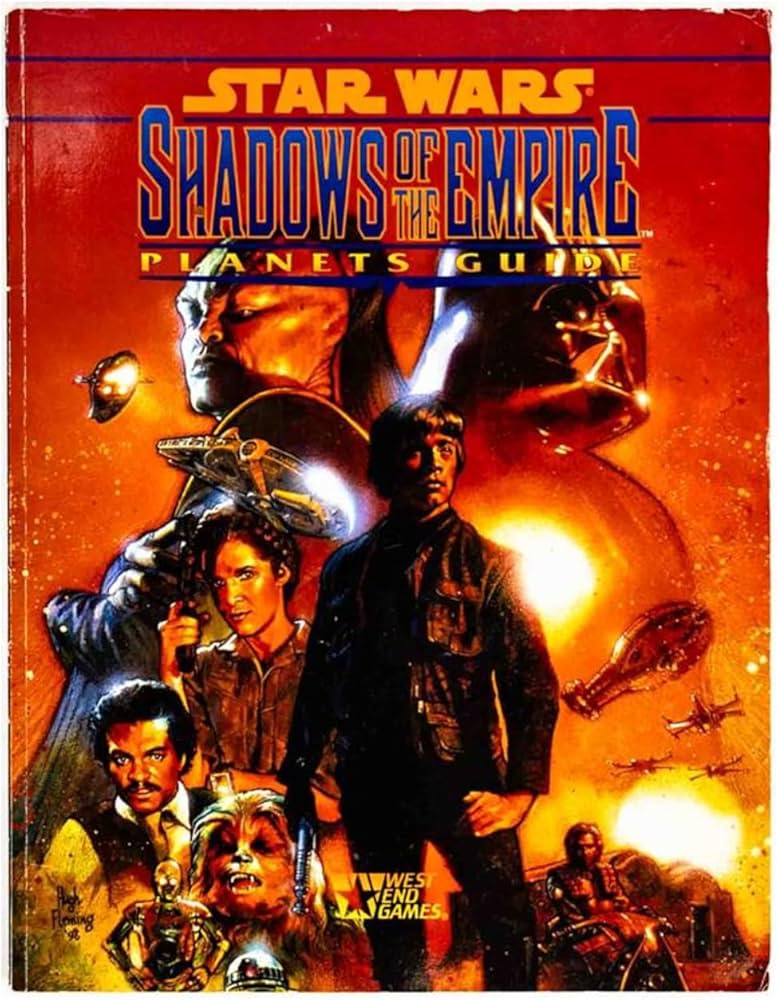
Shadows of the Empire Planets Guide
Shadows of the Empire Planets Guide
Design: John Beyer, Chris Doyle, Sterling Hershey, Tim O'Brien Additional Design: Bill Smith, Paul Sudlow, Anthony Russo Development and Editing: Paul Sudlow; Additional Editing: Bill Smith
Cover Art: Hugh Fleming Interior Art: Storn Cook, Ray Lederer, Mike Vilardi Cover Design and Graphics: Brian Schomburg, Tom O'Neill
Published by West End Games, 1996. TM and (c) 1996 Lucasfilm Ltd. (LFL).
Introduction
The Planets of Shadows of the Empire
The Shadows of the Empire Planets Guide is your passport to four worlds that play an important part in Steve Perry's best-selling novel, Shadows of the Empire. Using this guide, you can send your group of player characters to Rodia, the Vergesso system, Bothawui or Kothlis for rousing chases, political intrigues and much, much more.
Each planet is developed in the tradition of past planets collections, with essays on geography, politics, military organizations, and so on. Prominent gamemaster characters are featured, as are relevant animals, plants, droids, gadgets, and starships. These raw materials are handy in creating your own adventures, but if you want a head start, each chapter also contains several adventure outlines, completely plotted out and waiting for you to breathe life into them.
A Brief Visit to Rodia
"Okay, here we go..." Shella Rinou leaned forward in her cockpit seat as her fingers played over the spacecraft controls. The small green and blue globe hovering in the viewport shifted slightly as their battered freighter changed course.
The bulky Herglic sitting next to her took a nervous gulp of air through his blowhole. She spared him a glance. "Don't worry, Kelric. There are holes in the Rodian sensor net wide enough to accommodate a small moon. Plenty of room for the Listing Dewback to duck through." Kelric rolled one large eye and said nothing.
Shella turned to her sensor jamming suite and powered up the primary stealth system. "Now, this ought to --" She swallowed hard as a series of lights on her sensor board began shifting from green to yellow to red. "Well, okay, it might be a bit tougher than..." A tinny alarm began buzzing. Shella hastily shut it off and shot an embarrassed grin at Kelric.
The sucking noise from Kelric's blowhole rose in volume. He raised the blubbery extrusion over the eye facing his partner to express his skepticism in human terms. "Your assurances are beginning to falter, lassie," he rumbled. "You sounded somewhat more confident a minute ago."
Shella knit her eyebrows together as her hands flew across her console. "Yeah, well, a minute ago I thought I was facing the same antiquated sensor net they had up the last time I was here. The Rodians seem to have upgraded their systems."
"Bully for them. Is this going to pose a problem?"
"Not to worry. The Dewback has more than one trick up her sleeve." She flipped a final relay that dumped another program into the stealth system. "Hang on, this is the really fun part."
For a long tense moment, nothing happened. Then, one by one, the angry red lights shifted to amber and then to an inviting green. Shella let out a long sigh. "I don't think we were on the scopes long enough for them to make us."
"That would be nice."
Shella wrinkled her nose. "Herglics and their scathingly dry humor," she muttered.
"Young humans and their impetuous confidence in their own immortality," Kelric grated back. And that ended the conversation for the moment.
"Blast, but it's hot here!" Shella moaned, wiping at her forehead with an already damp sleeve. "I've never landed in the interior before."
The nighttime air was heavy. Behind them, the hull of the Listing Dewback glistened under the arc lamps arrayed around the impromptu landing pad. Its exposed engines tinged and popped as they cooled. The lamps were clouded in swarms of insects.
Shella looked nervously out into the pitch-black jungles all around them. "I hope there's nothing out there that's particularly hungry."
Kelric clambered down the ramp to join her. "I wouldn't count on that. But from what I know about Rodia, the locals have hunted all the big beasties to near extinction. Even here in the interior I doubt there's much to worry about. Besides..." Kelric unzipped his flight jacket and rested a beefy hand on an enormous blaster pistol. "Your father would kill me if I didn't come prepared."
Shella looked around. "So where's our client? He was supposed to be here waiting." She frowned, and looked back out in the darkness. "Somebody turned on the lamps as we approached."
"Shombody did, hoo-man!"
They whirled at the sound of the reedy voice. Behind them stood a lanky Rodian, leveling a mean-looking blaster rifle at them. He was wearing nothing but a simple loin cloth.
He advanced slowly, and raised his rifle at Kelric, who had drawn his blaster. "Drop your weapon, pleashe, or we will cut you both down."
Kelric wordlessly dropped his blaster, though by the amount of air he was slowly drawing into himself, Shella could tell he was preparing for combat.
She looked around. The Rodian looked quite alone. "We? What 'we,' goggle-eyes?"
The Rodian made a sharp gesture, and at least a hundred armed Rodians appeared abruptly in the harsh artificial light of the landing pad. "That 'we,' hoo-man."
Shella gulped. This deal was rapidly souring. "What happened to our clients?"
"I am afraid that hyoor original client and his ashoshiates shucumbed to the dangers of our Ekloska forests." The Rodian paused to snicker unpleasantly, in case Shella missed the inference. She didn't. "Happily, we of the Chekkoo clan will be mosht pleashed to accept hyoor cargo of weapons in their shtead. We have a mosht glorious hunt ahead, made poshible by hyoor timely arrival. It ish time for the arrogant Chattza to learn their plashe beneath our heels!"
He raised his rifle up in the air and gave a guttural cry in Rodian. His band followed suit.
"Run!" Kelric hissed, and bolted for the open hatch of the Listing Dewback. Shella ran for her ship for all she was worth, trying to ignore the hiss and whine of the blaster bolts that erupted all around her. She heard Kelric's wheezing right behind her. At almost the same moment, they dashed up the ramp. Kelric slapped the ramp switch as Shella made for the cockpit to power up.
"Daddy is not going to like this..." Shella sighed, looking out of the transparasteel windows as the Rodians capered and tried to blast open the ship with their underpowered weapons. She took a tentative sniff at herself. "Gah, I stink!"
"No comment, lassie." That earned Kelric a glare, which he cheerfully ignored.
"I hate Rodian politics," Kelric muttered under his breath as he slumped heavily into his seat a moment later.
Shella Rinou
Type: Smuggler
| DEXTERITY 3D+1 | Blaster 3D+2, blaster: heavy blaster pistol 4D, dodge 5D |
| KNOWLEDGE 2D+1 | Alien species 3D, bureaucracy 3D, business 2D+2, cultures 4D, languages 2D+2, planetary systems 4D+1, streetwise 3D+1, value 4D |
| MECHANICAL 3D+2 | Astrogation 4D+1, communications 4D, repulsorlift operation 4D, sensors 4D+1, space transports 4D, space transports: YT-2400 5D, starship gunnery 4D+1, starship shields 4D+2 |
| PERCEPTION 3D | Bargain 3D+2, con 4D, persuasion 4D, search 3D+1, sneak 3D+2 |
| STRENGTH 3D | Brawling 3D+1, climbing/jumping 3D+2, lifting 3D+1, stamina 4D |
| TECHNICAL 2D+2 | Computer programming/repair 3D, droid programming 3D+2, first aid 4D, security 5D, space transports repair 3D |
Force Points: 2 Character Points: 9 Move: 10 Equipment: Light freighter (Listing Dewback), comlink, heavy blaster pistol (5D)
Capsule: Shella Rinou is the youngest daughter of Malcolm Dallory, the captain of a large fleet of smuggling vessels. She took to the stars five years ago to learn the business from the ground up, accompanied by her companion and guardian Kelric. All of 19, Shella is headstrong and bright, and a little too sure of herself. Only her own great luck and Kelric's level-headed influence keeps her in one piece. That and the name of Dallory, which even the most ruthless bounty hunters are loathe to cross.
Kelric
Type: Herglic Troubleshooter
| DEXTERITY 3D | Blaster 4D+1, blaster: heavy blaster pistol 5D+2, blaster: blaster rifle 5D, dodge 5D+1, pick pocket 4D+2 |
| KNOWLEDGE 3D | Alien species 4D, bureaucracy 4D, business: Dallory organization 6D+2, cultures 4D+2, intimidation 4D, languages 5D, planetary systems 5D+1, streetwise 6D+2, value 4D, willpower 8D |
| MECHANICAL 3D | Communications 3D+2, repulsorlift vehicles 4D+2, sensors 5D, space transports 4D, starship gunnery 5D+2, starship shields 5D |
| PERCEPTION 3D | Bargain 5D, con 5D, forgery 4D+2, gambling 4D, investigation 6D, persuasion 5D+2, search 4D+1, sneak 4D |
| STRENGTH 4D | Brawling 5D+2, lifting 5D+1, stamina 6D, swimming 5D+1 |
| TECHNICAL 2D | Blaster repair 4D, computer programming/repair 4D, demolition 3D+2, droid programming 4D+2, droid repair 3D+2, first aid 4D, security 7D |
Special Abilities:
- Natural Armor: A thick layer of blubber gives a Herglic +1D to resist damage from physical attacks. It gives no bonus to energy attacks.
Story Factors:
- Gambling Frenzy: Herglics, when exposed to games of chance, find themselves irresistibly drawn to them. A Herglic who passes by a gambling game must make a Moderate willpower check not to feel compelled to play.
Force Points: 1 Character Points: 12 Move: 8 Equipment: Tailor-made clothing, stun cloak (5D stun), modified heavy blaster pistol (5D+1), datachip with verified credit line, 2,500 credits
Capsule: Kelric was once a policeman on his own world of Giju, but resigned when his government decided to collaborate with the Empire rather than resist. Drifting from world to world, Kelric made a reasonable living as a security man and bodyguard, and finally found his calling when he fell in with a smuggler named Malcolm Dallory. As Dallory built up his trading empire, Kelric served as his principal troubleshooter; running down rumors, serving as a liaison with certain buyers and sellers, fending off criminal extortion attempts, and so on. When Dallory's daughter Shella grew old enough to set out on her own, Malcolm asked his old friend to tag along. Kelric has had his hands full keeping Shella out of trouble, but he's enjoying himself nonetheless. The misadventures he gets dragged into keep his reflexes keen and allow him the chance to keep up to date on the goings-on in the smuggling community.
Rodia
Planet Data
| Type | Terrestrial |
| Temperature | Hot |
| Atmosphere | Type I (breathable) |
| Hydrosphere | Moist |
| Gravity | Standard |
| Terrain | Jungle, ocean, urban |
| Length of Day | 29 standard hours |
| Length of Year | 305 local days |
| Sapient Species | Rodians (N), humans, various aliens |
| Starports | 4 Stellar class |
| Population | 1.3 billion Rodians, 100,000 humans and aliens |
| Planet Function | Homeworld |
| Government | Rodian Grand Protector |
| Tech Level | Space (in cities), industrial (in jungle provinces) |
| Major Exports | Weapons technology |
| Major Imports | Foodstuffs, luxury goods |
System Data
| System | Tyrius |
| Star | Tyrius (Yellow) |
Orbital Bodies
| Name | Planet Type | Moons |
|---|---|---|
| Mikak | Searing rock | 0 |
| Toosma | Gas giant | 18 |
| Taoska | Ice ball | 0 |
| Rodia | Terrestrial | 4 |
| Pirdia | Gas giant | 11 |
World Summary
The Rodian homeworld is hot, humid and rich with life. Most of the land area is concentrated in two major continents, with a band of islands stretching between them. Sprawling cities, dense jungle and large swamps dominate the landscape. Storms often sweep across the surface in large, grayish-purple fronts. Rodia's small degree of axial tilt minimizes seasonal changes.
The Rodians continue to industrialize their world. The odd color of the clouds is but one side effect of their rapid industrialization. The Rodians are, in fact, replacing natural jungles with urban ones; both are rife with danger for the unwary. The Rodians themselves are careful when venturing far from their home cities, enclaves or provinces. They know all too well the consequences of angering another Rodian and avoid doing so. The urban Rodians generally regard their provincial cousins as backward and primitive -- even those from their own clan. Most provincial Rodians avoid the cities because of clan or political differences. This division is further encouraged by the Rodian's current Grand Protector, Navik the Red.
Rodia's primary industry is weapons manufacture and development. The immense manufacturing complexes produce weapons of all types in mass quantities for both export and domestic use. Most experts consider Rodian weapons functional and durable, though rarely efficient or refined. Some offworld munitions manufacturers, such as Merr-Sonn Munitions and BlasTech, can be found amongst the numerous smaller Rodian companies.
Rodia is the only habitable planet in the Tyrius system. Rodia's two inner moons, Yasooska and Enak are "true" moons, while the outer two, Eiska and Soomana, are captured asteroids. Tiny Mikak lies too close to Tyrius to be useful. Icy Taoska, while a small bright light in the Rodian sky, is equally inhospitable. Rodian weapons companies occasionally mine the moons of the gas giants Pirdia and Toosma. Yellow-orange Toosma is the largest planet in the system. Ringed Pirdia is striped with green-blue gasses.
System Datafile
Tyrius system, star: Tyrius, yellow star. Five planets in system -- second planet, Rodia, is the Rodian homeworld. Rodia's primary industry is weapons manufacture and export.
Warning! The Grand Protector's Home Fleet strictly monitors and controls Tyrius system space. All vessels must identify themselves immediately upon arriving in system. Direct further inquiries to the Home Fleet or Starport Control. Note: Planetfall is restricted to starports only.
History
Early Development
Rodia's massive jungles have completely shaped Rodian culture and society. Unlike the sentient life of many worlds, the primitive Rodians were not the top of the food chain: ravenous predators lived throughout the dense jungles and swamplands. Large carnivores, such as the ghests, wiped out entire Rodian settlements in mere hours.
Since the Rodians could not match their attackers in size or ferocity, they used their greater intelligence to outwit their foes. Eventually, the Rodians developed tools and weapons which enabled them to stake out larger areas of the jungle. They could ward off even the most feared predators.
As Rodian society developed, hunting became an honored profession. The hunters provided food and protection for their villages and towns. The finest hunters of the clan were honored with the title of "Rin'na" or "Protector," and served as the enclaves' defenders. A clan's best hunter became its honored "Si'rin'na," or "Chief Protector." All hunters and Protectors were identifiable by their armor, which served both protective and ceremonial purposes. Each clan developed its own armor, though the hunters customized the base design to their own tastes.
Once the Rodians matched advanced weapons with their hunting skills, it was not long before they exterminated nearly all of the large predators. As the hunts provided less and less "meat-game," some Rodians learned to raise smaller animals to supplant their diets. Others also gathered fruits and nuts from the jungle. They never considered farming; domesticated crops were unheard of and the jungle floor made for poor farmland. Some clans were forced to live entirely off their domesticated animals, much to their shame.
With the decline of challenging game to hunt, the Rodians soon turned to other means of channeling their aggressive drives. They arranged gladiatorial contests which later developed into Rodian drama. Numerous settings were devised for these games. For pure combat, most participants preferred arena fighting. In hunting contests, large sections of jungle became the favored battleground. The Rodians competed as individuals or in teams against each other.
The demise of the great predators brought about the most violent period in Rodian history. Without fear of animal attacks, the Rodians traveled the jungle safely and frequently, encouraging contact and trade between the clans. Few clans got along and conflicts intensified as each enclave expanded into the jungle. Clan wars erupted over hunting grounds, territory, and cultural differences. The hunters and Protectors developed into militias and armies, their hunting skills adapted to hunting each other.
The clan wars became a never ending struggle for dominance. For thousands of years, wars raged across the planet. Only the complete elimination of a rival clan could produce peaceful times -- which were rare and short-lived. Some clans grew large enough to control or enslave smaller neighbors. Slowly, the larger clans controlled entire regions.
Eventually, the Soammei clan dominated all others. Their Chief Protector proclaimed himself "Inta'si'rin'na," or "Grand Protector of the Rodians." Though he was the nominal leader of all Rodians, much of his power and influence rested in the Protectors of his clan. Throughout the generations, many different clans have held the position, each the strongest of its time. A change in leadership was rarely peaceful, as all clans vied for dominance.
When Old Republic scouts arrived on Rodia decades later, they discovered a low-tech, industrialized society. They also discovered an entire species of hunters who were very excited to meet new prey. Fortunately for Rodia, the Grand Protector realized the possibilities of joining the Republic and its galactic economy, and called off the scout hunts. Here was a chance for the Rodians to regain their lost hunting challenges. They could leave their world and prey upon the galaxy.
However, the Grand Protector also realized the dangers in allowing his adversaries into the galaxy. He wanted none of them to find allies amongst the stars. Therefore, he declared that only the best hunters could leave the planet. The hunters had to prove themselves through a series of gladiatorial games and hunting contests. The Grand Protector then arranged for the winners' first hunt in the galaxy: providing allies with the best hunts and enemies with lethal targets. This tradition created the "Goa-Ato," or "Grand Protector's Hunters' Guild."
Inta'Si'rin'na
The Grand Protector of the Rodians serves for life or until deposed (which amounts to the same thing). Though some clans successfully transferred power from the Grand Protector to their reigning Chief Protector, such peaceful transfers are rare in Rodian history. Few Chief Protectors found honor in being handed the title. Most Rodians regarded these Grand Protectors as weak, and the weak do not survive long on Rodia.
The powers of the Grand Protector change with each individual who claims the title. Most attempt to rule as dictator of Rodia, but some weaker Grand Protectors can only manage true domination of a clan or two. Theoretically, the Grand Protector is in charge of protecting the Rodians from predators and enemies. In fact, most Grand Protectors are self-serving and empower their own clans. The Grand Protector is chief negotiator with offworlders, whether they be the Empire, galactic corporations, or interstellar criminals such as Black Sun. He is also Master of the Grand Protector's Hunters' Guild.
The current Grand Protector is Navik the Red of the Chattza clan. Navik came to power through the most traditional way -- he claimed the title after leading his clan to victory over all others. At the time, gladiatorial hunting contests were at an all-time high on Rodia. The then-Grand Protector kept rival clans occupied and at odds by staging large hunts between them. After a particularly difficult contest, with the loss of many Rodians on each side, the Chattza clan accused its opponents of cheating. Though there were few rules in a gladiatorial hunt, those that exist were considered necessary to prevent open warfare. The enraged Chattza clan instigated a fierce inter-clan war that continued for years before they finally dominated the planet. Navik the Red hunted his enemies ruthlessly, pursuing for years even those that escaped from Rodia. In the end, Navik claimed the title of Inta'si'rin'na.
Grand Protector Navik the Red ruled as harshly as he fought. He purged the government of all opponents through banishment or worse. Navik quickly tightened interstellar travel controls, insisting that all ships land at one of four starports. Even now, ships may land nowhere else without the Home Fleet's approval. Navik limits his enemies' supplies whenever possible, and disrupts attempts to gather support from allies off Rodia.
Navik continues the tradition of assigning bounty hunters to specific bounties or employers. As in the past, only the best hunters are allowed off planet. Though he only assigns a few personally, Navik requires that all hunters report on their bosses' activities whenever possible. The Grand Protector uses this information to gain insights into the Empire and criminal organizations everywhere.
One exception is the criminal empire known as Black Sun. Navik thinks he understands Black Sun's power and avoids conflicts with them -- much as a typical Rodian avoids enraging another Rodian. Navik regards them as a force to be tolerated, but not encouraged or aided. One of his clan-servants, Clezo, is a Vigo in Black Sun, allowing Navik to keep an eye on the group's activities.
Navik the Red
Type: Grand Protector of the Rodians
| DEXTERITY 4D | Blaster 6D, dodge 6D, melee combat 7D, melee parry 6D+1, thrown weapons 5D+2 |
| KNOWLEDGE 3D | Alien species 4D+2, bureaucracy: Rodia 8D, business: Rodia 7D, cultures 4D+2, intimidation 6D, languages 5D, law enforcement 6D, streetwise 5D, survival 5D+1, value: bounty hunting 8D, willpower 7D+2 |
| MECHANICAL 2D | |
| PERCEPTION 3D+2 | Bargain 8D+1, command 8D+2, con 5D, hide 5D, persuasion 8D, search 5D+1 |
| STRENGTH 3D+1 | Brawling 5D+1, stamina 4D+2, swimming 4D |
| TECHNICAL 2D | Armor repair 3D+2, computer programming/repair 4D, first aid 3D |
Force Points: 4 Dark Side Points: 8 Character Points: 18 Move: 10 Equipment: Heavy blaster pistol (5D), comlink, vibroshiv (STR+1D)
Capsule: Navik the Red is Rodia's evil and cunning Grand Protector. He is ruthless and persistent. He rules Rodia with the same iron hand that enabled him to seize leadership of the Chattza clan years ago. It is not unusual for him to personally lead attacks against his adversaries, backed up by the best Chattza Protectors. Few Rodians dare to cross Navik openly, for the Grand Protector uses every means at his disposal to protect his position. Navik's name comes from the large blood red birthmark that appears to stain most of his face.
Rodia Today
With Navik the Red's rise to power, Rodia became the most segregated it had been since its discovery by the Old Republic. The Chattza clan's overwhelming victory forced its remaining enemies into virtual exile. Weak and tired of war, these clans retreated to their own holdings. Over the years, the more defiant clans began the long task of rejuvenating themselves. They counter Navik and the Chattza clan whenever they can, though Navik actively suppresses them. Many have developed plans for removing him from power, but none can yet match the power of the Chattzas. Should Navik die, a young warlord could arise, allowing the Chattza clan to hold power.
Some Chattza regard themselves as a "master" clan, superior to all others. This attitude is particularly popular amongst the younger urban clan members, most of whom cannot remember the wars. Their attitude has not only angered the Chattza's enemies, it has offended the clan's former allies. The younger Chattza have also abandoned many Rodian traditions, embracing instead imported ideals and practices.
The young Chattza often find themselves at odds with their elders, as well as the traditional clans. The traditionalists argue that the Chattza are unraveling Rodian society in favor of galactic ideals. The young Chattza accuse the traditionalists of holding Rodia in a static state, letting the galaxy leave them behind.
The young Chattza's attitudes have increased tension on Rodia. Their rejection of Rodian tradition has angered the isolationists more than Navik's dictatorial leadership. The young Chattza threaten the traditionalist's way of life. Conflicts between the two groups are common and often violent. The traditionalists now realize that the next battle for Grand Protector will not only determine Rodia's leader, but their cultural path, as well.
Illegal Emigrants
In the earliest days of emigration, the Rodians depended on Old Republic ships to transport them off-planet. This dependency made it easy for the Grand Protectors to restrict travel as they wished. Over the years, different Grand Protectors have pursued different policies towards emigration. Generally, controls loosened as time passed, especially after Rodian companies began purchasing their own ships. More and more Rodians left their homeworld, dispersing into the galaxy. Seeking to strengthen his hold on Rodia, Navik the Red tightened travel and emigration controls. The Home Fleet has standing orders to stop and search any departing ship for illegal emigrants.
Those who depart via illegal means are rarely expected to return. Some are political rivals or members of hunted clans. Others are hunters that have not earned the right to leave. They depart via smugglers' holds or by boldly running the Home Fleet's blockade.
Rodians that leave illegally will not have proper identification and will be arrested if they try to return via the starports. However, it is easy for most Rodians to acquire the proper IDs required by the Empire though other channels (both legal and illegal). Once these IDs have been acquired, they may travel hassle free anywhere except Rodia.
For those Rodians born off-world, Imperial identification is usually sufficient to gain the right to travel to and from Rodia. This is something of a loophole in Navik's policies, but is required by the Empire. Imperial identification is not to be questioned beyond reasonable verification. It is not uncommon for illegal emigrants to return under assumed names and IDs acquired elsewhere in the galaxy. If they come under suspicion when returning via Rodia's starports, these emigrants soon discover that "reasonable verification" can take a long time indeed...
Geography
Urban Regions
Rodia's coastal cities were the first beneficiaries of galactic trade. Since the time of the Old Republic, the cities have grown dramatically. They sprawl over the jungle, their plans disregarding the landscape and environment. Today, the cities encompass vast areas. Most are dirty, congested and labyrinth-like. The residential and business cores are surrounded by industrial zones that stretch further into the jungle each year.
The urban regions have the most advanced technology on the planet. Trade with countless star systems advanced Rodia's technology level by hundreds (if not thousands) of years. Goods from throughout the galaxy are easily found here.
Urban Rodians have lost their jungle traditions. They work hard in Rodia's weapons factories and industrial centers. They avoid the jungle provinces, considering them outmoded and backwards. The art of hunting is not lost, however: Caution is strongly advised for any alien or Rodian venturing into an unknown part of town.
Some clans now live entirely in the cities. Most of these had their traditional enclaves swallowed up by the growing urban areas, though some abandoned their remote homes for the promise of new technology and better lives. By far, the dominant clan is the Chattza. Few Rodians interfere with them anywhere in the urban regions (though the jungle provinces are another matter).
Iskaayuma
Iskaayuma is Rodia's capital city. Located on the Sika Peninsula on the Encheeko continent, Iskaayuma grew from the Chattza Enclave to the planet's second largest city (after Equator City). By annexing nearby jungle lands, towns and enclaves, the city quickly encompassed the entire peninsula.
Iskaayuma is an ugly, sprawling city -- a testament to planning at its worst. Thick smog hangs over the region from hundreds of weapons factories. Industry and government are the primary employers. Tourists only come to visit the great Guild Hall or attend the occasional home performances of the Rodian Galactic Drama Troupe.
The Chattza clan completely dominates Iskaayuma. Over the decades, their original enclave has sprawled in a similar manner to the city. The enclave is dark, maze-like and heavily fortified. Navik the Red still rules from the enclave's Chief Protector's chamber.
Until the rule of Navik the Red, Equator City was the Rodian capital. However, following Navik's rise to power, he moved the capital to Iskaayuma. By keeping the seat of power in his home city, Navik strengthened his position by removing the "corrupting" influence of Equator City. Navik also sought to refocus Rodian views on the importance of the hunt, and Iskaayuma has been home to the Grand Protector's Guild Hall for generations.
Iskaayuma's starport is the Grand Protector's Home Fleet Headquarters and primary staging area. Interstellar travelers are encouraged to land at Equator City, unless they have specific business in Iskaayuma. Most visitors feel unwelcome in the city, especially with the ever present, armor-clad Protectors. Navik maintains near martial law over Iskaayuma.
Jungle Provinces
The jungle provinces are home to the most traditional Rodians. The dominant clan of each province lends its name to the region: its Chief Protector governs, with power limited only by the Grand Protector. The enclaves of the Chief Protectors serve as provincial capitals. Most enclaves are fortified towns, dating back centuries.
Unlike the cities, these provinces and enclaves are largely isolated from each other and most residents know very little about the galaxy. Some clans want nothing to do with Navik the Red, while others regard the cities as a blight on the Rodian landscape. Navik the Red has fostered this isolationism to keep his enemies from interfering with his activities. He has isolated many political opponents as well, by exiling them to the jungles.
The provincial towns and enclaves enjoy few of the advanced goods and services that are commonplace in the cities. In fact, most provinces still remain at the early industrialized level that the Old Republic scouts found so long ago. The result is a hodgepodge of technologies -- one dwelling may have a mere wood burning stove and chemical lamps, while the next has a portable generator and internal power.
The clans purchase what they can. Navik the Red purposely keeps some provinces from obtaining advanced goods and services to keep his enemies as weak as he can.
Travel to some enclaves can be quite difficult. Airspeeder is the preferred method, though rugged ground vehicles may make their way through the jungle or the occasional primitive road. Live mounts, such as imported Cracian thumpers or its local equivalents, are popular for backcountry use. There are no official spaceports outside the cities. Any ship attempting to land elsewhere is quickly hunted down by the Grand Protector's Home Fleet although many smugglers evade the planet's inadequate sensor network and manage to ply a profitable trade with the isolated provinces.
The jungle provinces are the most dangerous areas on Rodia. Offworlders are uncommon here and always viewed with suspicion. Uninvited guests are not welcome, and many become the target of Rodian hunters out to sharpen their skills. And despite what visitors might be told by the Rodian tourist board, some of the deadly predators from Rodia's past still lurk in isolated pockets of the jungles. Others can be found in protected game preserves, where rangers are building up the populations of near-extinct species so that wealthy Rodians can hunt game, following in the traditions of their ancestors.
Chattza Protectors
The Chattza Protectors are the highly visible security forces of Iskaayuma. They also serve as the Chattza militia and control the Grand Protector's Home Fleet. The Protectors are easily recognized by their distinctive armor, which is a modernized version of the traditional Chattza clan armor.
The Protectors are feared by all Rodians, as they represent the Grand Protector's power. They are always heavily armed and ruthlessly enforce the Grand Protector's declarations. Most Rodians go out of their way to avoid the Protectors.
Chattza Protectors. All stats are 2D except: Dexterity 3D, blaster 4D, grenade 4D, melee combat 4D+2, melee parry 4D, Strength 3D. Move: 10. Blaster rifle (5D), blaster pistol (4D), grenade (5D), vibroblade (STR+3D), Rodian Protector armor.
Chekkoo Province
The Chekkoo province lies far to the east of Equator City, hidden away in the deepest jungle of the Betu continent. Jungle lowlands and a portion of the Ekloska Hills provide formidable terrain for anyone traveling in the region. The headwaters of the Teonsqua River can also be found here, though the river quickly turns into a vast swampland at the province's southern edge.
Once one of the powerful provinces of Betu, the Chekkoo province is now one of the poorest areas of Rodia. The Chekkoo clan dominates the region, but a few smaller clans' enclaves can be found within their borders. These clans, such as the Adebsu and Intamm, have lived in close proximity for generations and regard one another as allies. Each clan has autonomous control of its enclave, though the Chekkoo claim final judgment for the lands of the province.
The Chekkoo are fiercely protective of their lands. Regular patrols can be found both on foot and in the air. Poor as the Chekkoo are, they still maintain the defenses of a small army. Centuries of struggle and warfare have taught them to be cautious. Trespassers are hunted down as soon as they are discovered. The more fortunate may be captured and hauled before the Chief Protector, though the Protectors are under no obligation to do so.
The Chekkoo rarely travel outside their lands. They oppose Navik the Red's rule but are not strong enough to challenge him. The Chekkoo are more concerned with their own affairs. They do try to circumvent Navik's total control of planetary commerce whenever they can. Since Navik won't allow the clan to purchase advanced vehicles or weapons, they hire smugglers to bring in the goods they need. The smugglers make runs through the jungle and from other star systems. The risk is very high and those that are caught by the Home Fleet are imprisoned or used as live targets in the gladiatorial hunts. The Chekkoo typically pay for goods with their own manufactured melee weapons, whose quality can compete with their urban counterparts. Precious metals or Rodian gold coinage may also be used for payment.
Chekkoo Enclave
The Chekkoo Enclave is a small city, with about 200,000 inhabitants. The city surrounds a fortified rock outcropping that houses the Enclave itself. The Enclave serves as the Chief Protector's seat of power, as well as the headquarters of the Chekkoo hunters and Protectors.
The Enclave consists of a wide, squat tower that sits atop the outcropping. A series of fortified walls encircle the tower at varying distances. The oldest walls are built of stone, but newer walls have been constructed of synthcrete, metal and advanced alloys. Residences and businesses lie within the walls, though the newest portions of the city stretch out around the Enclave. The outermost perimeter of the city is marked by an aging power fence that is more often down for repairs than not.
The city is typical of the outlying provinces. Wealthier families tend to own more advanced equipment, but few enjoy all the basic conveniences of the cities. Most buildings and vehicles show their age, since Navik the Red has isolated the Chekkoo and curtailed their development.
Rodian Protector Armor
Model: Galeenia Protector Armor Type: Rodian Personal Battle Armor Cost: Not for sale Availability: 3, X (on Rodia) Game Effect: +2D physical, +1D energy for entire body, -1D to all Dexterity related skills.
Capsule: The bright, shiny and distinctive armor of the Rodian Grand Protector's military forces is feared across the planet. Only Protectors may legally wear such armor, though some suits have been spotted off Rodia. The segmented body armor completely covers its wearer and includes a helmet. The armor is color-coded to specific Protector units, though white is never used to avoid associations with Imperial stormtroopers. The armor is designed specifically for Rodians.
Relations with the Empire
The Rodians maintain good relations with the Empire. The Grand Protector arranges for numerous Rodian hunters to pick up Imperial bounties, which the Empire regards as beneficial to both sides. The Imperial planetary governor has few conflicts with the Grand Protector, so long as the Rodians sustain a good capture ratio. Regardless of the benefits, the Governor is thankful that the Grand Protector limits travel to selected individuals.
The Governor is aware of the Rodians' reputation as valued criminal employees, but believes the Empire to be benefiting more from the ready supply of bounty hunters. For this reason, there has yet to be a major crackdown.
The Empire appreciates Rodia's relative isolationism. Most of Rodia's inhabitants are focused on their work or direct their frustrations against the Grand Protector. Most Rodians consider the Grand Protector a greater threat than the Empire, with good reason. As a result, the Rebel Alliance has little to no presence on Rodia. It doesn't help that many of the Alliance's operatives have prices on their heads, making them obvious and tempting targets to Rodians of all stripes.
Rodia has typical Imperial services, largely in the capital city of Iskaayuma. Customs patrols supplant the Grand Protector's Home Fleet and there is a standard Imperial Garrison in each city with an official starport.
Rodian Customs Corvettes. Starfighter, maneuverability 2D, space 8, atmosphere 365; 1,050 kmh, hull 4D+2, shields 2D. Weapons: 4 laser cannons (fire control 2D, damage 4D). The Rodians use modified Rendili Star Drive's Light Corvettes.
Criminal Connections
Because of their violent and mercenary tendencies, Rodians are excellent employees for the criminal underworld and fringe society. Illegal organizations from across the galaxy send "negotiators" to recruit hunters. Some work directly with the Grand Protector's Hunters' Guild, but most use their own contacts within the various clans. Of course, only hunters that have won the right to leave may legally pursue these offers.
Through Rodia's Guild system, Navik the Red has managed to place hunters in nearly every major criminal organization and legal government throughout the galaxy. Through these hunters he keeps tabs on their employers, though his information is rarely current. What's more important is that Navik can contact most of these organizations as needed and occasionally call upon favors.
The Rodians themselves have numerous criminal organizations, though most are difficult to discern from the legal businesses or clans. Some Rodians work with off-planet syndicates. Black Sun is active on Rodia. Criminal elements are known to control much of Equator City. Clan-driven syndicates are also common. Regardless, they all have reputations of being tough and protective of their territory.
Notable Clans
-
An'yettu: An isolationist clan that opposes Navik the Red. The An'yettu are ancient enemies of the Chattza. For the time being, Navik has effectively restricted the clan to its traditional lands, the An'yettu Islands. The clan still struggles against the Chattza, though they are not much of a threat to the Grand Protector.
-
Chattza: The largest clan, numbering in the millions, and the current rulers of Rodia. Most live in the urban regions, as little jungle remains in their traditional lands. Chattza members enjoy showing off their clan's strength, and are unafraid to reveal their allegiances while in the cities. Few clans challenge the Chattza and win. Many younger members have abandoned traditional Rodian ways.
-
Chekkoo: A traditional, isolationist clan that controls the Chekkoo province. Although known to be one of the poorer clans, they are rumored to hire smugglers at good pay whenever the need arises. They construct the best traditional Rodian melee weapons on the planet.
-
Neetakka: Rodian for "The Ultimate Hunters." A modern clan of urban dwellers that focus on hunting skills of all types -- to the exclusion of other professions. All Neetakka strive to win the right to leave Rodia, and those who do so continue to support their clan back on Rodia. Most other clans regard the Neetakka as bloodthirsty goons, but grudgingly respect them as excellent hunters.
-
Roolek: A small clan completely defeated by the Chattza during the clan wars. Savage fighting between the Chattza and Rooleks compelled Navik the Red to sentence the clan to death. Most surviving clan members escaped offworld, though a few remain in hiding and keep in contact with their allies. A Roolek who encounters a member of the Chattza clan on another planet will not hesitate to strike.
-
Soammei: The first clan to dominate all others and claim the title of Grand Protector of the Rodians. The clan was destroyed by its enemies while defending its leadership claim centuries later. The clan's traditional lands were located west of modern Iskaayuma.
-
Tetsus: Once one of the great ancient clans. The Tetsus were nearly wiped out by Navik the Red during his quest for power. Some managed to escape offworld via hidden, illegal starships. Navik and the Chattza discovered their refuge years later and attacked again. Those few that managed to escape a second time are still pursued by Chattza hunters. Navik has sentenced all Tetsus to death, although this is not generally known. Greedo was a Tetsu. Avaro Sookcool, manager of the Flip of the Credit casino in Equator City, is also a Tetsu, but his close ties to Black Sun protect him from Navik's death warrant.
-
Tonena: One of the Chattza clan's oldest allies. The clan was the first to specialize in weapons manufacture and development. Nearly all clan members work for the Tonena Munitions Corporation. Recent conflicts with the Chattza have stemmed from the younger Chattza's supremacist attitudes towards other clans.
Culture
Rodian Clans
Clans serve as both sociological and political divisors in Rodian society. All Rodians belong to a clan, though to which is not readily apparent. A Rodian's name gives little or no indication to his or her clan and few display clan crests or symbols openly. This is purely for self-defense, as clans at odds with each other strike whenever given the opportunity.
Warfare, food shortages, and technological advances shape each clan, affecting their size and demeanor. Some clans flourish while others disappear from Rodia forever. Disgruntled members of traditional clans may start their own. While new clans often support radical changes in Rodian lifestyle, most are too small to be influential. The ancient clans and their allies hold the real power on the planet.
Hundreds of clans populate Rodia's jungles, islands and urban regions. Traditional clans are based in fortified enclaves and claim vast tracts of jungle. Newer clans may be scattered throughout the cities, with no true lands of their own.
Over the centuries, some clans developed specialized niches in order to survive. Some clans dominate entire Rodian industries, while others specialize in criminal empires.
Ancient Rodian clans were traditionally named after their greatest hunter or protector. Some gained their identities from the area they inhabited (though the reverse was usually the case). New, modern clans often title themselves with grandiose names, hoping to increase their status and impress others.
The Goa-Ato
Every hunter who wins the right to leave Rodia gains membership to the Goa-Ato (or Grand Protector's Hunters' Guild). The Grand Protector is master of the Guild, but has little time to deal with day to day operations. Such mundane details are left to the Guild leadership, which operates under the Grand Protector's policies.
The Goa-Ato handles all assignments of Rodian hunters leaving the planet for the first time. Usually, a dispatcher in the Guild Assignments Group places hunters with employers. However, exceptional hunters may be assigned by the Grand Protector personally. After the first hunt is completed, the Guild may retain the hunter for another assignment, but usually allows him or her to seek independent work. Few Rodian hunters actually leave the Goa-Ato, as the Guild is also responsible for bestowing the "Atiang," or annual hunters awards.
Winning one of the annual awards is the highest honor a Rodian can receive. All candidates must have their stories verified by some means, be it eyewitnesses, visual recordings, employer statements, captured individuals, prisoner accounts, or the acquisition's remains. The importance of each type of verification depends on which award is being considered. Prisoners and bodies are always valued the most. All reports must be sent to or recorded in the Guild Hall's Chronicle Room.
Personal reports by hunters and eyewitnesses are valued more than those sent from across the galaxy, though this varies by the status of the reporter.
The Atiang are given at the Hunters' Guild Hall in Iskaayuma. Finalists are notified well in advance so they may attend the ceremony. The event is broadcast around Rodia and to other worlds with significant Rodian populations. The ceremony lasts for more than 14 hours, as after each winner is announced, their verification recordings are displayed. For days after the awards ceremony, the verification recordings of the finalists are also broadcast to honor those who almost made it, though there are no awards for second place.
Winners receive 100,000 credits, a holotrophy (displaying the award, plus the verification recordings on command), and a small metal insignia to be worn when desired (for those hunters who like to show off). The winners are also enshrined in the Awards Hall itself.
Atiang (The Awards)
In order of popularity. All winners receive the same awards.
- Best Shot -- nearly always for deceased catches.
- Most Notorious Capture -- not necessarily awarded for the most dangerous fugitive, however.
- Longest Trail -- awarded for time and distance.
- Quickest Catch -- from time of bounty posting to time of capture.
- Most Difficult Hunt -- as decided by the judges' panel.
- Most Captures -- over the past year.
- Most Resourceful Capture -- most clever capture method.
- Novice of the Year -- given to the best new hunter allowed off-planet (though rarely awarded to a true novice).
- Greatest Accuracy with a Distance Blaster -- given for shots of 200 meters or more.
The Eanca Goa-Ato
The Eanca Goa-Ato (or Grand Protector's Hunters' Guild Hall), is actually an entire complex of buildings in Iskaayuma. The Hall contains the Guild offices, the Assignment Group, the Grand Protector's Chambers, the Chronicle Room, and the Awards Hall.
The Chronicle Room is open to hunters at all times and may be entered by anyone with an account to report. Guild members may also watch the witnesses record their statements. Awards officials are always present to hear testimony. Falsifying statements is grounds for expulsion from the Goa-Ato and restriction to Rodia.
The Awards Hall is open to all during the afternoon of each day. Mornings are restricted to Guild members only. The Awards Hall is the oldest portion of the Guild Hall, and has been added on to numerous times. The verification records of each winning hunter are kept on display here, to be reviewed by anyone. Early records consist of written accounts and occasional video recordings. Modern accounts are nearly always recorded statements or even video or holographic footage of the actual event.
New Assignments
"Here's the next batch."
Nilesk glanced up at her assistant as he tossed the datapad to her. Nilesk caught it easily and punched up a list of the newest approved hunters. Not surprisingly, there was no one she knew. That always made her job easier.
"And the latest Imperial updates just came in," Assistant Opdoa continued, "They're on the system."
"You've read them?"
"Scanned them."
"Good enough. Interesting group." Nilesk opened the file of the first hunter and read off the vital stats, mostly to herself. Opdoa sat down at his computer terminal. The screen listed bounties by the thousands, compiled from across the galaxy.
Nilesk started. "Teksli Yenak of the Chattza clan. Decent scoring. A most unremarkable hunter for this level. Better give him one of the Imperial bounties -- something easy. Can't embarrass ourselves if we can help it."
Opdoa located the appropriate list. "There's one for a Captain Terrae Lekes. Small time ship thief, out in the Minos Cluster."
"Sounds good," Nilesk said, half listening. She continued with the next file. "Fask Eelak. An'yettu clan."
"One of them actually made it?" Opdoa interrupted.
"Apparently. What do we have on the Most Dangerous list? I'll take anything that's high risk and low pay."
Opdoa turned back to his monitor. "I think the Gerraba bounty would be best."
"A Wookiee. Perfect. Don't bother to notify Jabba the Hutt about the assignment. I don't think Eelak will last long enough to collect."
Nilesk brought up the next hunter.
"You realize if he does, he'll most likely win an Atiang." Opdoa interrupted.
Nilesk looked back at him. "True, she might. But verification can be a very sticky process, I'm told. Sometimes nearly impossible." She continued, "Next is Geska Gesse, a Neetakka. Navik has been complaining about them for months. Best send this one on a long hunt. Something fairly impossible. What about that Solo bounty? With both Imperial and Jabba's credits backing this one, it should be a suitable test for an 'Ultimate Hunter'."
Opdoa turned around quickly, "You haven't heard? That's been claimed. Rumor has it Boba Fett hung one frozen Han Solo on Jabba's wall a couple of weeks ago."
Nilesk looked at him incredulously. "So? Who'd have guessed? All right, put Gesse on that Skywalker job." She thought for a few seconds, then added, "And tell the reassignments division to refer all Solo chasers to the Most Wanted Rebels list. They should be returning in droves..." Nilesk's voice trailed off while she read the next file.
Rodian Drama
The ancient art of Rodian drama began as a way for the Rodians to safely channel their aggressive natures. Originally established by Grand Protector Harido Kavila as a series of staged fights, the performers soon developed detailed stories for the fights. The dramatic stories highlighted the effects of their terrible violence. The tragedy of violence is shown in its true light, even in tales of great triumph and victory.
Today, Rodian drama may be seen live, on screen, or on the holovids. Most Rodians prefer to see their drama performed live. Some like to watch the nuances of individual battles. Others prefer the emotional atmosphere the audience provides.
Traditional drama is staged in small arenas, where spectators may watch from any side. Modern dramas produced for the holovids or screen take advantage of much larger sites, such as prolonged jungle hunts or urban conflict. There are a number of genres which are particularly popular in Rodian drama. Dramas within each genre often have similar plots and structures, but endless variations keep them fresh and contemporary (at least to Rodians). Some of the classic genres include:
-
Ghest: The classic Rodian tragedy of a ghest's attack on an ancient village. The typical story depicts the villagers desperate attempts to fight, then flee from the horrifying predator, only to be devoured to the last inhabitant.
-
The Challenge: A historical genre from a time when clans hunted each other for sport. It concerns a growing feud between rival clans, and examines the devastating effects of this conflict on both clans involved.
-
First Hunt: The story of the first solo hunt of a young Rodian hunter. At first, the prey appears to be one of Rodia's numerous jungle animals. However, it becomes apparent as the story progresses that the target is really a fugitive on the run. Variants on this story are often used for political commentary.
Over the centuries, Rodian drama evolved from sparring matches into an entire industry. As the performances grew in popularity, so did the performers. Soon, dramatic acting became honored, though not to the level of hunter. Some Rodians abandoned hunting for acting. Others interpreted histories and battles into epic performances. To have their stories performed was a great honor for the hunters and Protectors.
As the performers' importance in society grew, so did their power. They were granted a certain immunity from being hunted, so that they could record the deeds of others. All clans had at least one dramatic troupe, which was expected to perform the great tales of the clan. Eventually, the Grand Protector was compelled to allow one of these troupes to perform amongst the galaxy, thereby forming a second legal (and honored) way for Rodians to leave the planet.
The performers' lifestyle did not come without sacrifice, however. In exchange for their position, they were banned from seeking political gain. While this rarely stopped the most ambitious performers, it was an effective restriction. Rodian drama attracted a wide range of personalities. Many were misfits in Rodian society: pacifists, political dissenters, remorseful hunters, and more. Rodians who could not cope with the government and leadership often took refuge in the less traditional dramatic troupes.
Though unable to participate directly in Rodian politics, the drama troupes influence the public through their performances. Radical troupes stage plays around new and controversial ideas, opening them for discussion in society at large. These performances allow the younger generations to challenge older or traditional ideas.
The Rodian Galactic Drama Troupe
Amongst the most famous traveling dramatic corps is the Rodian Galactic Drama Troupe. This group of over 200 Rodians tours all of the galaxy's most influential entertainment districts. It continues to impress the entertainment circuit with its repertoire of the finest Rodian dramas. The Troupe is best known for its shockingly accurate portrayal of all forms of violence and its devastating effects -- in short, it delivers the best Rodian drama in the galaxy.
For most people, these performances show the most Rodians they have ever seen together at one time. Actually, the Troupe is the largest non-bounty hunting group officially allowed off Rodia. Unlike most Rodians, these performers have won their right to travel off planet through their dramatic skills, rather than their hunting ability.
The Troupe is completely self-contained. They have costumers, holo/visual/audio technicians, directors, promoters, agents, musicians, and, of course, actors. It is not uncommon for the technical personnel to occasionally act in minor roles. They carry all of their own props and scenes to each new location. The Troupe typically plays only the largest performance centers, usually for several weeks with a variety of shows.
Unknown to most members, the Troupe also serves as cover for a group of Rodian bounty hunters. After Navik the Red discovered that rogue Rodians occasionally attended performances, he quietly arranged for several hunters to follow the Troupe and capture the rogues. The troupe's leader, Entukan Yesosko, keeps the hunters informed about the troupe's schedule and potential targets.
A few Troupe members have discovered this arrangement and, since they oppose Navik, they try to tip off their comrades when possible. These members keep their discovery secret. Though the majority of the troupe might support them, they know Yesosko would return them to Rodia or hand them over to the hunters if she found out.
NPCs
Entukan Yesosko
Type: Rodian Performer
| DEXTERITY 3D+2 | Blaster 5D, brawling parry 4D, dodge 5D, melee combat 4D+2, melee parry 4D+2 |
| KNOWLEDGE 2D+2 | Business 3D, business: entertainment 5D, cultures 3D, languages 5D |
| MECHANICAL 2D+2 | |
| PERCEPTION 3D+2 | Acting 7D, bargain 5D, con 4D+2, persuasion 5D |
| STRENGTH 3D+1 | Brawling 4D+2 |
| TECHNICAL 2D |
Force Points: 1 Character Points: 3 Move: 10 Equipment: Datapad, blaster pistol (4D), comlink, fine clothes.
Capsule: Entukan Yesosko is the flamboyant leader of the Rodian Galactic Drama Troupe. She loves performing and serves as the most public figure in the Troupe. She is also the lead actress in performances of ghest plays. Yesosko is a member of the Chattza clan, and an avid follower of Navik the Red. She hopes to someday write and perform in a story about his life. Yesosko is the only one who officially knows that the Troupe is also being used to ferret out Navik's enemies. She clandestinely keeps in contact with Inntak and advises him of suspicious attendees. She suspects that some Troupe members have discovered her efforts, but so far, none have come forward.
Inntak
Type: Rodian Bounty Hunter
| DEXTERITY 4D | Blaster 5D, dodge 4D+2, grenade 5D, melee combat 4D+2 |
| KNOWLEDGE 2D+2 | Intimidation 5D, languages 4D, streetwise 5D+1 |
| MECHANICAL 2D+2 | Space transports 4D, starship gunnery 4D, starship shields 3D+1 |
| PERCEPTION 3D | Bargain 4D+1, con 5D, investigation 6D, search 5D |
| STRENGTH 3D+2 | Brawling 4D+1 |
| TECHNICAL 2D | Blaster repair 3D, demolitions 4D |
Force Points: 3 Dark Side Points: 3 Character Points: 4 Move: 10 Equipment: Blaster pistol (4D), blaster rifle (5D), 4 grenades (5D), datapad, magnacuffs, magnaharness, Imperial Peacekeeping Certificate, Rodian Bounty Hunter's License.
Capsule: Inntak is heartless, even for a Rodian. Not only does he kill for a few credits, but he hunts his own kind almost exclusively. Clan affiliations matter little to him, though he is a member of the Chattza clan. All that matters is if there are credits to be had, he'll get his target. Inntak's agreement is for kills only. Navik is not interested in any of the rogues returning to Rodia alive. Inntak keeps in contact with Yesosko for leads, though he and his hunters also attend the performances to scout the crowd. Inntak works with five other Rodians from the Chattza clan. He has also been known to hire non-Rodian hunters if he thinks the target is suspicious or has been warned.
Rodian Target Droids
One of the unforeseen benefits of Galactic trade proved to be the introduction of droid technology to Rodia. The Rodians quickly saw its use for hunter training -- as the first droid on the planet quickly discovered when it wandered away from its master. At first, the Rodians adapted the programming of standard droids for use as prey. When this proved unsatisfactory, the Rodians began developing droids especially for the task.
Today, Rodian target droids are among the stealthiest and most agile of that type manufactured. They come loaded with advanced stealth and avoidance programming. As with Rodian weapons, these droids are rarely elegant, but work well. Many types are available, often specialized for varied environments. They can be programmed for a variety of skill levels and may emulate various organic prey. Some droids are entirely self contained, while others are remotes controlled from a primary unit. Most are unarmed.
Rodian Hunter Training System (RHTC-560)
Type: Rodian D-Tec Hunter Trainer Command Unit RHTC-560
| DEXTERITY 1D | Dodge 4D, running 5D |
| KNOWLEDGE 2D | Alien species 4D, alien species: Rodians 7D, cultures: Rodian 5D, languages 4D, tactics 6D |
| MECHANICAL 1D | Communications 5D, sensors 4D+2 |
| PERCEPTION 2D | Command: HT drones 7D, hide 4D, search 5D, sneak 4D |
| STRENGTH 1D | Climbing/jumping 3D |
| TECHNICAL 1D | Droid programming: HT drones 5D, droid repair 4D |
Equipped With:
- Humanoid body (2 arms, 2 legs)
- Two audio and visual sensors
- Short range sensor (+1D to sensors in scan mode, +2D to sensors in search mode)
- Wideband transceiver (includes typical Rodian comlink frequencies)
- Vocabulator speech/sound system
- Information storage/retrieval jack for computer interface
Move: 10 Size: 1.7 meters tall Cost: 5,500 (new), 3,000 (used)
HT Drone
Type: Rodian D-Tec HT Drone
| DEXTERITY 1D | Blaster 4D (if equipped), dodge 7D, running 5D |
| KNOWLEDGE 1D | |
| MECHANICAL 1D | Repulsorlift operation 5D, sensors 5D |
| PERCEPTION 3D | Hide 5D, search 5D, sneak 5D |
| STRENGTH 1D | |
| TECHNICAL 1D |
Equipped With:
- Two retractable manipulators
- Repulsorlift engine (100 meter flight ceiling) or 4 legs
- Audio, visual and flight sensors
- Wideband transceiver
- Hi-intensity searchlight
- Stun blaster, 3D stun damage (if equipped)
Move: 10 (ground), 16 (flying) Size: 1.2 meters long Cost: 2,000 (new), 1,000 (used)
Capsule: Few droid hunter training systems can match Rodian D-Tec's RHTC-560. The system consists of a single command unit (the 560 itself) and up to 10 HT drones. Working in concert, these droids provide trainees with the challenge of tracking multiple targets working together. The command unit may be a target itself, but is more commonly used by instructors to track their students' progress.
The 560 may interface with standard computer links to display maps, locations, and video from the drones. All of this information may be saved for student debriefing after the training session.
HT drones come equipped with either repulsorlift propulsion systems or four legs. A stun blaster may be mounted on either model to simulate armed targets. The drones rely on their command units for all tactical decisions. They may operate up to 50 kilometers from their command unit for large scale exercises.
Adventure Outlines
The following adventure outlines provide starting points for bounty hunters, smugglers, Rebels, and more. The first, "Jungle Hunt," is provided for Rodian characters. The rest may include characters of any type.
Jungle Hunt
Background: The characters are Rodian hunters competing in the final hunt that will allow them to legally leave Rodia. The hunt takes place on Iutuga, an island in the Ioliu Sea. The hunt covers the entire island. The candidates, the targets and the observers are all that are supposed to be on the island. However, the Chattza clan has secretly inserted their own droids to eliminate non-Chattza candidates.
The characters may be of any clan. Since these characters have practiced and competed for years for this test, most of their skills should be hunting and combat-related. Any character less skilled in these areas probably had bureaucratic help to get selected for the test -- an influential clan member, for instance. Such characters are resented by those who "worked hard getting here." None of the candidates, including the Chattza characters, should be warned about the Chattza plan.
The candidates' assignment is to hunt down a hunter training droid and capture it. The droid is hidden on the island and protected by 10 drones. The drones are armed with stun blasters. The characters have two days to complete the hunt or they fail the test.
The Set-Up: The characters are dropped off on a beach at the west end of the island. Before leaving, they may choose up to four weapons. Basic survival gear is provided, including a datapad with an accurate 3D (though not holographic) map of the island. An airspeeder drops them and their gear off on a sandy beach. The speeder immediately leaves after they disembark.
The Hunt Begins
Episode Objective: Find the trail.
Obstacles: The island itself.
The hunt begins at dawn. The characters have very little to start with. They know the target droid is on the island and is protected by armed drones (with stun blasters). They know the conditions of the test: capture the prime droid in two days or fail. Also, if a character is knocked unconscious by the droids, that character fails. The characters are not allowed to hinder each other, though they are not required to work as a team, either. All observers watch via satellite or airspeeder, which the characters must ignore. Anything else they must discover on their own.
The first problem is the island itself. It is covered with jungle and thick underbrush. There are few trails; they will have to make their own much of the time. Soon after starting out, dark, menacing clouds begin rolling in. The wind picks up considerably. Within a couple of hours, rain begins to pour down, which lasts for most of the first day. The ground turns slick and treacherous. Late in the day, the creeks and rivers run high, making them difficult to cross.
While the characters fight the weather, they must search for some sign of the droid. Without sensors of any kind, the characters must use their knowledge of such droids to work out a starting point. Figuring the bad weather would be also bad for the prime droid is a good assumption. The only refuge indicated on the map are some caves near the center of the islands.
Staging Tips: Use the jungle against the characters whenever the action slacks off too much. The rain should continue off and on for the entire adventure. If the characters try to split up, make it apparent that they will have a much tougher time on their own. If the players cannot think of any way to start searching, allow them to make Knowledge rolls to help them along.
To the Caves
Episode Objective: Advance to the caves.
Obstacles: The HT drones, the Chattza assassin droids.
The caves lie many kilometers into the jungle. It is slow going. If the characters try to cut a straight line to the caves, they must hack though the jungle, cross wide streams, and climb over rugged land. It takes around 14 hours of continuous travel to reach the caves. Characters that think a bit may discover easier ways: along rivers (if the water level is not too high), lost trails, etc. Characters that try to use what advantages they have may take as little as 10 hours to locate the caves.
As the characters get closer, the hunter training drones (HT drones) begin to harass them. Both land and airborne types are present. Most of the time, only one or two will attack. The first attack should be an ambush while the characters are otherwise involved; such as crossing a flooded stream or climbing slick rocks. In any case, allow the characters to make Very Difficult search or Perception rolls to detect the droids. After the first attack, the characters should be more cautious and more alert.
The Chattza droids do not attack until the characters are located by the HT drones. The Chattza droids are monitoring the HT communications and using the training droids to locate the characters. The Chattza droids immediately move to attack the non-Chattza characters. However, it takes several hours for the Chattza droids to arrive at the characters' location.
There are five Chattza droids on the island. All of them are modified HT drones, equipped with repulsorlift engines. The Chattza attempted to duplicate the HT drones used for the test, but the test officials changed the HT drones used at the last minute. Thus, the Chattza drones appear slightly different than the official drones. The Chattza drones have a lighter camouflage color scheme and carry blasters (damage 5D) instead of stun weapons. After encountering both droid types, the characters may make Difficult Perception checks to discover these differences.
Sometime during this episode, the characters may elect to camp or rest. If they do, the HT drones attack during the night. They try to keep the characters from resting by harassing them all night. If the drones are beaten off, they resort to making noise out of range, or zipping through the camp. They are not hindered by the dark, though the characters should be.
Staging Tips: The HT drones should fight intelligently and cooperate -- they are being controlled and coordinated by the prime unit, an RHTC droid. The prime unit is adept at harassing hunters. Once it locates the hunters, it will not allow them to rest for long. Remember, though, the prime has scattered its drones across the island searching for the characters. It takes several hours for them to reach the characters, once located. At first, only one or two drones will be available to the prime. The prime will be careful with these because if they are destroyed, it can do nothing until the next ones arrive. If the characters are smart, they may realize this and be able to shake off the drones for awhile. The prime will also use the drones to try to lead the characters in the wrong direction, always away from the caves.
The Chattza droids attack until defeated. They ignore the HT drones completely, as the drones ignore the Chattza droids. They do not work with the test drones (another difference the characters may notice). The Chattza droids attack in two groups. The first consists of two drones, the second of three drones. At least one of these groups attacks when the official HT drones attack. The Chattza droids completely ignore the Chattza candidates, even if fired upon. Characters making Moderate Perception checks may notice this after several rounds of combat. Non-Chattza characters may become suspicious of their fellow candidates, even accusing them of trying to kill them.
If the characters do not rest, all difficulty levels should be increased accordingly.
The Caves
Episode Objectives: Locate the prime unit and capture it.
Obstacles: The HT drones, the prime unit itself.
Once the characters locate the caves, the map is of little use to them. Though all of the entrances are marked on the map, none of the interior is shown. If the characters look for clues, they may discover faint droid tracks leading into one (failed search attempts may show a false trail).
Once the characters enter a cave, the HT drones attack. The caves are interconnected, forming a complex labyrinth. Up to four droids may attack from different passageways. These droids fight until destroyed.
While the characters search the caves, the prime droid tries to escape via another passageway. The characters should hear the droid walking, though the sound reverberates around the caves. It is difficult to tell which way the droid is going. To make matters worse, the remaining drones are also making noise, attempting to draw the characters off.
When the prime is located, it immediately recalls the remaining HT drones. The drones fight until destroyed, and the unarmed prime will try to escape. Once the prime has been captured (not destroyed), the contest is over, and an airspeeder arrives to pick up the characters (once outside the caves).
Staging Tips: Again, both the drones and the prime droid should act intelligently. The prime or drones should try to draw the characters into traps (pits, falling rubble, thorny plants, etc.). Once the droid has been captured, the test is over. Successful characters are congratulated by the observers. Arrangements are made for the characters first bounty hunter assignments offworld.
Aftermath: Characters who report the rogue droids are questioned by test officials. The officials immediately begin investigating Chattza interference in the tests. Non-Chattza characters who survive to report their suspicions are targeted by the Chattza clan. Should they survive long enough to accept their first hunting assignments, the Goa-Ato give them the most dangerous available.
Provincial Problems
Background: This adventure is primarily for smugglers and free-traders. The characters are offered a long term job -- smuggling high technology and illegal weapons out to Chekkoo, one of Rodia's remote provinces. If they accept the offer, they must meet with the Chekkoo leadership. Additionally, they must prove their skills by smuggling several power fence generators to the Chekkoo Province.
The Offer
Episode Objective: Initial negotiations with the Chekkoo representative, locating goods for trade.
Obstacles: Desired goods difficult to obtain locally.
The characters are approached by Trinn Reena, owner of Reena's Interstellar Shipping. Reena knows the characters, at least by reputation. She tells the characters she's been hired by a Rodian provincial government to smuggle illegal tech and weapons past the Rodian Grand Protector's forces. Since the job is too big for a single ship or "company," the provincials hired Reena to spread news of the offer to "suitable parties." Reena gets a bonus for every group that they accept.
If the characters are interested, Reena goes into more detail. However, she won't reveal the name of the province until she is convinced that the characters will attempt the run. To be considered by the provincials, the characters must prove their smuggling abilities on their trip to the province. They must first obtain several operational power fence generators. While perfectly legal on some worlds, they are banned in this province by the Rodian Grand Protector. Once the characters accept the offer, Reena gives them all the information she knows, including a datapad containing a map to a secret rendezvous point in Chekkoo Province. The characters may try to land their ship at the rendezvous, or at one of the cities and make their way overland. When they arrive at the rendezvous point, they will be granted an interview. If accepted, the characters can expect several challenging runs at good pay.
After the characters accept the job, they must locate the power fence generators. They quickly discover that such generators are not readily available for sale. However, they may soon find some through their own contacts. The characters must foot the bill themselves -- a risk they must take if they want the job. The cost of the generators runs from 1,000--3,000 credits apiece (used).
Staging Tips: The initial meeting with Reena may take place anywhere but on Rodia. For existing campaigns, Reena may be replaced with a character that the characters already deal with. The generators must be in working condition, though they need not be new.
Arrival At Rodia
Episode Objectives: Landing the ship, begin the journey into the jungle.
Obstacles: Rodian Grand Protector's Home Fleet.
Once the characters arrive in the Tyrius system, they must decide whether to make for the rendezvous point (requiring them to run the Home Fleet's blockade), or simply land in Equator City or Samana. When the characters' ship drops out of hyperspace, a Home Fleet customs ship orders them to halt for inspection. Several other Home Fleet ships back up the customs vessel. All IDs and permits are checked, especially those of Rodian characters. The ship is searched for contraband.
Once the customs inspection is finished, the ship may land at any legal starport (Equator City is highly encouraged by control officials). If the characters attempt to land elsewhere, the Fleet ships immediately pursue. The Fleet vessels have no qualms about using deadly force to stop the characters, though they would rather capture the ship, if possible.
Characters opting to land at one of the starports have little trouble. Since a shipboard inspection has already been conducted, the starport customs officials merely glance at the ship.
The characters may then plan how to reach the Chekkoo rendezvous point. They must obtain local maps, and gather other information before starting. If they do not have transports of their own, they must hire or purchase some. They must also devise a way to camouflage the true destination and use of the power fence generators.
Into the Jungle
Episode Objective: Travel through the jungle to the rendezvous point.
Obstacles: Protectors, jungle wildlife.
As the characters travel further into the jungle, the roads they follow become rougher and more deserted. The roads obviously lead into one of the poorer provinces. Anyone they pass on the road watches them intently till out of sight.
When the characters reach the border to the Chekkoo Province, they are halted by Chattza members of the Grand Protector's forces. The characters' vehicles and cargo are thoroughly searched for illegal goods. There is a very good chance that the generator's true use will be discovered, unless the characters are exceptionally good deceivers.
If the Protectors discover illegal goods, they immediately try to arrest the characters. If the characters escape into the jungle, the Protectors give pursuit. The journey becomes a game of hide and seek, as the characters try to shake the Protectors.
All this activity attracts the attention of the Chekkoo Protectors. Unless the characters alert the Chekkoo to their intentions, the Chekkoo stay effectively neutral. They will not cross the Chattza unnecessarily. However, once made aware of the characters' plans, the Chekkoo use subtle traps and tricks to deter the Chattza. The Chekkoo avoid frontal attacks on the Chattza (fearing political and military reprisal).
Staging Tips: If the characters try to avoid the Chattza checkpoint, the Chattza discover them and begin pursuit anyway. At the checkpoint, the Chattza should be intent on finding illegal goods. They question the purpose of every piece of equipment, especially the large generators. Once the pursuit begins, the Rodians should use their formidable tracking and hunting abilities to stay with the characters.
Rendezvous
Episode Objectives: Negotiating a smuggling deal.
Obstacles: The characters' smuggling methods.
After the characters shake their Chattza pursuers, they may make for the rendezvous. Upon arriving, they are greeted by a large contingent of Chekkoo hunters and Protectors. Negotiations begin immediately, starting with the price of the power fence generators. The characters may bargain for a suitable price, though this price may be lowered if the Chekkoo had to help the characters with the Chattza.
Next, the Chekkoo must determine if the characters are good enough to employ. They take many factors into account, including the quality of the goods, the quickness of delivery, the amount of attention the characters generated on their trip here, and the characters' apparent attitude and abilities. The characters may bargain and pursue the Protectors as needed to improve their position.
If accepted by the Chekkoo, the characters must negotiate a fee for their services. The amount of this fee will be modified by the Chekkoo's opinions of the characters. Average smugglers with fair goods will receive a lower fee, while good traders with excellent materiel can command a higher price. The Chekkoo generally pay 10,000 to 30,000 credits per run, plus additional credits for purchasing goods.
Staging Tips: The Chekkoo are careful negotiators. They know a good smuggler when they meet one. Characters that had a lot of trouble getting to the rendezvous probably won't be hired, unless they are skilled negotiators. Also, those characters that attracted a lot of attention will soon discover that returning to their ship and taking off is no simple task...
Street Drama
Background: This is an adventure for bounty hunter characters of any type or species. The characters are approached by Inntak, a Rodian bounty hunter that hunts Rodians whose clans are sentenced to death by the Grand Protector. Because Inntak and his hunters are busy on another hunt, he wants to hire the characters to capture some targets for him. He won't tell them about the clan's death sentence, but presents the offer as just another bounty.
The Set-up: The characters receive word through friends, employers or contacts that Inntak wants to hire them for a job. The first meeting may be on Rodia or another world. The characters meet with him and work out an arrangement.
The Show
Episode Objective: Identify the targets.
Obstacles: Targets are amongst an audience of 2,000 beings.
Inntak gives the characters the important information about their targets. It is a group of Rodians from the Roolek clan. The clan has been in hiding for many years, and most members have escaped from Rodia. However, a small group remained in Iskaayuma. Inntak suspects that the Rooleks know someone in the Rodian Galactic Drama Troupe. He believes that they will be attending the Troupe's final performance (of this tour) in Iskaayuma.
The characters are given passes that allow them access to the entire arena. The final show is limited to a select audience of 2,000 people, mostly Rodians. The characters may take whatever vantage points they wish to locate the Rooleks, but the characters may not interrupt the show. Inntak instructs them to make the capture after the Rooleks leave the vicinity of the arena. If the characters violate either of these rules, they will not be paid. The characters eventually locate the Rooleks, just after the performance is over and everyone is heading for the exits. The 10 Rooleks travel in three small groups.
Staging Tips: Locating the Rooleks in an audience of Rodians is difficult at best. Non-Rodian characters will have a particularly tough time, unless they are adept at telling Rodians apart. Note that if any Rodian characters object to the characters' activities, they may try to warn their targets of the danger.
Into the City
Once the characters find the Rooleks, they try to follow them. The Rooleks take a couple of speeders into one of the industrial areas of Iskaayuma. If the characters give chase, the Rooleks try to get away once they notice their pursuers.
In any case, the Rooleks head for the Rodmark Weapons Plant. The plant is a Roolek stronghold, filled with about 100 Roolek workers. If the targets know they are being followed, they will alert their friends inside. The entire workforce defends the targets, though it takes several minutes for everyone to reach the area.
More subtle and careful characters should be able to discover the plant's true nature before coming under attack. They may be able to sneak in and capture the workers without too much trouble. If they are discovered, the entire plant turns on them. The Rodians are armed with a few blasters, but most make do with whatever equipment is handy, including laser cutters, beam drills and repulsor trucks.
Should the entire plant rise up against them, it is likely that the characters will not succeed on this job.
Inntak has given them a comm number where they can leave a message once they have captured the Rooleks. If the characters make it out without alerting the entire plant, they may report their discovery to him. Inntak makes a sizable offer for detailed information. He also offers them a chance to be in on a raid against the Rooleks. Otherwise, they are paid the agreed upon amount.
A Trip to the Country
Background: This adventure is suitable for any group of non-Rodian characters, particularly Rebels. The characters are on Rodia to finalize an important business deal, such as a weapons purchase, and are invited on an old-fashioned hunting expedition.
Seal the Deal
Episode Objective: Complete the deal; prepare for the hunting expedition.
Obstacles: Intimidating Rodians; a break-in.
The characters have almost clinched a big deal with a Rodian company when the three sales execs invite them on a "hunting vacation" to one of Rodia's game preserves.
- Teeko Soonca. Teeko is quiet and reserved. He is the leader; Ruku and Mannee fall all over themselves trying to do whatever Teeko orders.
- Ruku Kooff. Ruku is friendly to the "hoo-mans." She likes a chak-root snuff that smells like rotting garbage. She can't stand Mannee.
- Mannee Swaano. Mannee is a young, ambitious, overly-aggressive braggart. He's a sneak who'll say anything to make a sale.
Teeko, Ruku and Mannee. All stats are 2D except: blaster 4D+2, dodge 3D, business 3D, bargain 4D+2, search 4D. Hunting blaster rifle (4D+2), comlink, survival pack, medpac.
The hunting lodge is a luxury resort in the heart of Rodia's jungles; the rooms and entertainment facilities are first-class. The characters are invited to many activities:
- A practice hunting trip in a secure compound. The targets are drones.
- A performance of the Rodian play, "Kinzic." The play features lots of combat, with actors running through the auditorium, holographic effects and plenty of explosions. During the climax, Kinzic realizes that the hated clan Towon plans on exterminating her clan; she gets revenge by activating a thermal detonator in the midst of a clan Towon victory celebration. The stage is littered with bodies, as is rather typical of Rodian drama.
- The night's activities are concluded by a sabacc tournament. All manner of intoxicants and food are available. Here are some characters that can be introduced:
- Several new bounty hunters are here to hone their skills. They ask questions like, "So, have you ever done anything illegal?" and "Have you ever had someone put a bounty on your head?" to find out if the "hoo-mies" are worth anything.
- Some of Navik's Protectors are here for a rowdy holiday. They start off as merely loud and irritating, but as the night progresses they get more and more aggressive towards the "hoo-mies." They're not necessarily trying to start a fight -- although they're willing to finish one -- but they're trying to see if the humans will stand up for themselves. If a character does, they embrace him or her like a long-lost friend, mentioning, "You hoo-mies aren't the snivelling cowards everyone says you are."
- A wealthy, elderly Rodian is taking her grandchildren on her "last hunt." She must venture out to the jungle and die honorably in battle with a predator.
When the characters retire for the evening, a careful investigation reveals that the rooms have been broken into. Transponders have been hidden in their luggage, their comlinks busted up, and their blaster power packs have been drained, with only enough energy for three or four shots.
A Deadly Delay
Episode Objective: Survive an airspeeder crash and find a way back to the lodge.
Obstacles: Sabotaged airspeeder; creatures.
The morning consists of packing the airspeeder's gear, including portable tents, a power generator, motion detectors (for the edge of the campsite) and other vital equipment.
The characters can buy extra comlinks and power packs at the lodge's shop. The shopkeeper -- an ornery old Rodian named Whool -- sells them goods which have already been tampered with: the comlinks are busted and the power packs are set to explode after four or five shots. The characters won't be able to tell without breaking open the comlinks or testing the output of the packs: Whool's power meter has been rigged to give a "fully charged" result.
Half an hour into the speeder trip, the airspeeder crashes. The characters are stranded far from their intended campsite with only an undetailed "tourist map" of this part of the preserve. They must hike back to the lodge. Obstacles include crossing raging rivers, avoiding large stretches of a "quicksand" soil, surviving battles with some of Rodia's predators and Mannee's tendency to cause trouble.
The characters see an airspeeder landing on the other side of several small mountains. Trekking around the mountains is a long trip; the map shows a network of caves running through the mountains, cutting the trip in half.
An Old-Fashioned Hunt
Episode Objective: Survive a bounty hunter attack.
Obstacles: Attacking bounty hunters.
The caves are dark, damp, confusing, very claustrophobic, and filled with creatures, including a trio of "newoongalls," large arachnids which cling to the cavern ceilings and drop down on the characters.
Newoongalls. Dexterity 2D, Perception 3D, sneak 6D, Strength 3D+2, brawling 4D+2, climbing/jumping 6D. Clawed legs (STR+2D). Move 13.
The characters are ambushed by a group of Rodian bounty hunters; Ruku is killed. The characters get away, but must leave her body behind. The characters get to the airspeeder and arrange for transport back to the lodge. When they get back to the lodge, they're questioned by the Protectors. Soon thereafter, the bounty hunters arrive and collect a reward voucher from the Protectors.
The Protectors explain that "Ruku" was a criminal: she belonged to a clan that had been marked for extermination by Navik. She'd lived under the "Ruku" false identity for years, but someone recently informed the Protectors -- Mannee is the informer, but the characters won't learn this without snooping around.
Teeko and Mannee complete the deal and promise the characters a bonus if they'll keep their mouths shut about this "embarrassment." After the characters load their ship with weapons crates, take off and jump into hyperspace, there's a disturbance in the cargo hold. Ruku pops out of one of the crates, explains that she faked her death to get off Rodia, and now plans to start a new life far away from her homeworld's political struggles.
Short Takes
These are short adventure ideas that may be developed into full adventures or used to modify the outlines listed above. They may also serve as sub-plots for the characters.
Living Targets
The characters crash their ship in an isolated province on Rodia. As they try to make their way back to civilization, a band of Rodian hunters captures them. The Rodians decide to use the characters as living targets for a gladiatorial hunt. If the characters escape, so be it.
The characters are taken into the jungle and released. They have only their clothes and a few personal items deemed valueless by the Rodians. They are given a six hour head start. The characters are truly lost and must figure out a way to escape the hunters. One good tactic is ambushing the hunters and forcing them to lead the way out.
Variations: Instead of capturing the characters, they may stumble into a gladiatorial hunt and be mistaken for the target. In this case, they will still have their weapons and equipment to defend themselves with.
Escape
The characters are hired by off-world Rodians to smuggle clan members off Rodia. The clan in question has a death mark against it and is trying to flee the planet. The characters are given planetary coordinates for a secret landing site, either via starship or airspeeder. They must somehow make their way past the Home Fleet: posing as traders, etc. They may choose to land in a city and make their way to the rendezvous via airspeeder, as it will attract less attention.
Of course, the characters are discovered during the escape attempt. They may try to con their way out, and may succeed if they plan well enough. Otherwise, they must fight off the Home Fleet as they flee the planet.
Vergesso Base
| Field | Data |
|---|---|
| Type | Artificial Base |
| Temperature | Temperate (artificial) |
| Atmosphere | Type I (Breathable) |
| Hydrosphere | Life-support only (artificial) |
| Gravity | Standard (artificial) |
| Terrain | Corridors and caverns |
| Length of Day | 24 standard hours |
| Length of Year | 1 standard year |
| Sentient Species | Primarily human, many aliens |
| Starport | Stellar-class |
| Population | 85,000 |
| Planet Function | Shadowport, trade center |
| Government | Ororo Transportation (Tenloss Syndicate) |
| Tech Level | Space |
| Major Exports | Trade, starport facilities |
| Major Imports | Processed materials, manufactured goods |
| System | Lybeya |
| Star | Lybeya (yellow) |
Orbital Bodies:
| Name | Type | Major Planetoids |
|---|---|---|
| Vergesso I | Asteroid belt | 1 |
| Vergesso II | Asteroid belt | 1 |
| Vergesso III | Asteroid belt | 3 |
| Vergesso IV | Asteroid belt | 2 |
| Vergesso V | Asteroid belt | 0 |
System Summary
The Vergesso Asteroid Field consists of a series of valueless asteroid rings circling Lybeya, a minor yellow sun on the edges of Bajic sector. Lybeya system has no planets, only the sundered remains of planets: some unknown force, perhaps an encounter with a rogue star, disrupted Lybeya system's planetary aggregation. The result of this disaster was five distinct asteroid rings, each ranging from trillions of microparticles to moon-sized planetoids. First surveyed hundreds of years ago by a scout droid, its major claim to fame is a system study performed by Dr. Ecile Vergesso, a Corellian planetologist, 150 years ago. Dr. Vergesso's work on planetary formation earned her tenure, and the honor of having the fields around the star Lybeya named after her.
Several surveys of the system revealed no mineral wealth worth investing in, no unusual native life (although there are some space slugs, mynock swarms, and morvak colonies), and no other reason for corporate investment or colony establishment. The system is remote enough from major trade routes to prohibit military interest, so neither the Old Republic nor the Empire have had an interest in establishing a naval outpost. All these factors combine to make the Lybeya system ideal for criminal activities; currently, Vergesso Belt III is the home of one of the larger shadowports in the galaxy, Vergesso Base.
System Datafile
Lybeya system, star: Lybeya, yellow star. No planets; five asteroid fields, Vergesso I-V. Seven major charted planetoids. No inhabitants. Alert! Vergesso asteroid field charts are out of date, and traveling in Lybeya system is considered a Class Three navigation hazard. The system is surveyed, and found to contain no valuable assets.
World Summary
Vergesso Base is a major shadowport located in the largest of the Vergesso asteroids, with some 85,000 residents. The base is owned and operated by Ororo Transportation, a front company for the Tenloss Syndicate.
Vergesso Base was originally the small survey base of Dr. Ecile Vergesso, the planetologist who surveyed the system. After she abandoned it, the base became, in turns, a small pirate base, then a smuggler's exchange point which eventually became a shadowport run by Ororo Transportation.
Currently, Vergesso Base handles thousands of tons of illegal cargo per year, including spice, stolen merchandise, privateer plunder, black market goods, arms, bootleg holos, and exotic tech. Vergesso also serves as a safe haven for smugglers, gangsters, outlaws, Rebels, and privateers.
Ororo Transportation
The primary power of Vergesso Base is Ororo Transportation, a front company for the Tenloss Syndicate, a major criminal organization in Bajic sector and surrounding sectors. Ororo does operate legitimate shipping business, but its real money comes from smuggling.
The Tenloss Syndicate
A major criminal organization of the Outer Rim, the Tenloss Syndicate controls a vast portion of the organized illegal activities of the surrounding sectors through a network of business fronts, shady companies, and criminal sub-organizations. Several of these sister-fronts also operate in or through Vergesso Base. (For more information on the Tenloss Syndicate, see pages 49-51 of Galaxy Guide 11: Criminal Organizations.)
Tenloss favors the Rebel Alliance in the Galactic Civil War for simple business reasons: the Alliance may or may not win, but it certainly distracts the Empire, allowing Tenloss to pursue its business. Even if the Alliance is ultimately crushed, Tenloss has helped foster an effective delaying tactic. On the other hand, if the Alliance wins, Tenloss has managed to help replace the draconian Empire with a (hopefully) weaker government, which should at the very least remain preoccupied with internal concerns for the better part of its first decade. The main risk involved is that should the Empire uncover the Tenloss-Alliance connection, Tenloss might be targeted as a Rebel front. The Tenloss governing board is willing to take the gamble. These reasons are suspected by the Alliance, but unconfirmed. Both parties expect that the relationship will inevitably dissolve, but that the partnership is convenient for the moment.
Tenloss, Ororo, and the Alliance
The Rebel Alliance is always in need of safe ports, materiel, intelligence, and assistance. It is also generally opposed to organized criminal activities, except where those activities correspond with the goals of the Alliance (revolution makes strange bedfellows). Imagine the surprise of the Alliance when it discovered that Ororo Transportation, a smuggling concern housed within a legitimate shipping company, offered the use of a main smuggling base, discounts on port facilities and shipping, and aid and comfort as available!
After a quick investigation of Ororo, which revealed a business connection to the Tenloss Syndicate, the Alliance agreed to a limited business relationship. The Tenloss Syndicate had spent several months quietly distancing themselves from the more unsavory aspects of their business, and set Ororo up as a business partner, rather than a syndicate subordinate. The Alliance, desperate as always for outside assistance, found itself in an uneasy but useful partnership.
Vergesso Base
At first glance, the Lybeya system is an empty place of little value. Appearances are deceiving. The Base (as Vergesso Base is generally called) is cut into the face and deep into the heart of Vergesso Prime, the largest planetoid of the system, in Vergesso Field III. This planetoid is composed primarily of lead and nickel-iron, shielding it from casual sensor scans.
On approach, Vergesso Prime seems to be an ordinary asteroid, its only unusual features being its rather flat shape and the tubular torus shape formed by its surrounding companion asteroids. The Base is not visible from any angle other than inside the torus. These camouflaging asteroids are kept in place by tractor beam emplacements in the Base. Any asteroid that begins to drift from its orbit is promptly nudged back into place by Vergesso Base.
The Defense Force
Vergesso Base is protected in space by two Nebulon-B escort frigates, the Markess Narn and Childerly, and by whatever other light capital ships may happen to be in the system.
2 Nebulon-B Frigates
Crew Skills: Capital ship gunnery 4D+1, capital ship piloting 3D+2,
capital ship shields 3D, starship gunnery 4D+1
Maneuverability: 1D
Space: 4
Hull: 3D+2
Shields: 2D
Weapons:
12 turbolaser batteries (fire control 3D, damage 4D)
12 laser cannons (starfighter-scale, fire control 2D, damage 2D)
2 tractor beams (fire control 2D, damage 4D)
These frigates are rarely actually used; occasionally a pirate ship enters the system, or a ship owned by a rival criminal organization cruises through to rattle sabers, but on the rare occasions that an Imperial patrol ship arrives, the frigates pull close to the nearest asteroid, power down, and run silent until the ship exits the system. The frigates spend most of their time running the Vergesso orbits, and keeping an eye out for small-time troublemakers.
The frigates are supplemented by a loose wing of short range snubfighters, a motley collection of Z-95 Headhunters, stolen Corporate Sector Authority IRDs, Zebras, Gauntlets, and assorted lesser known starfighters.
Z-95 Headhunters
Type: Starfighter
Maneuverability: 1D
Space: 7
Hull: 4D
Shields: 1D
Weapons:
2 triple blasters (fire-linked, fire control 1D, damage 3D)
Concussion missiles (fire control 1D, damage 7D)
Zebras
Type: Starfighter
Maneuverability: 2D
Space: 7
Hull: 2D
Weapons:
2 laser cannons (fire-linked, fire control 1D, damage 5D)
Gauntlets
Type: Starfighter
Maneuverability: 2D
Space: 6
Hull: 3D+2
Shields: 1D
Weapons:
2 laser cannons (fire-linked, forward arc, fire control 2D, damage 4D)
2 laser cannons (fire-linked, turret, fire control 2D, damage 5D)
Proton torpedo launcher (fire control 2D, damage 8D)
IRDs
Type: Starfighter
Maneuverability: 2D (+2 in atmosphere)
Space: 9
Hull: 4D
Weapons:
2 twin blaster cannons (fire-linked, fire control 3D, damage 5D)
In the event of a genuine threat to the Base, the defense force can expect to be assisted by visiting capital ships, mainly corvettes and light frigates, and whatever Rebel starfighters are on hand at the time.
The Base has a moderate surface defense network, mainly to defend the base against ambush and to take down any ship trying to skip out on their docking fees.
Vergesso Surface Defenses
Scale: Capital
Hull: 5D
Shields: 2D
Weapons:
10 heavy turbolaser batteries (fire control 2D, damage 7D)
20 turbolasers (fire control 2D, damage 5D)
16 laser cannons (starfighter-scale, fire control 2D, damage 5D)
20 tractor beams (fire control 3D, damage 4D)
The Base
Like all shadowports, the Base offers almost all amenities that any legal spaceport does, plus a few frills aimed at the unusual clientele that passes through. It is divided into three main layers -- The Facility, The Life, and The Center. Vergesso Prime is large enough to generate a low gravity of its own, and the base's gravity is oriented to the center of the asteroid.
The Facility
The topmost section of Vergesso Base is called "The Facility" and consists of the port itself, as well as related service businesses, and defense systems. It's a bustling warren of activity where ship crewmembers, Rebels, port crews, Natori mercenaries, other Tenloss syndicate employees, privateers, and criminal transients rub shoulders in the course of business.
Hangars. The surface of Vergesso Prime is cratered with hangars. Outlined in the soft white light of magnetic field projectors, the hangars range from small installations suitable for light freighters to large docking bays capable of handling corvettes and bulk freighters.
Upon approach, Vergesso Control checks ships' transponder codes against their BoSS files, simply to have an idea of what sort of trouble the ship is bringing in with it. Ships are assigned docking bays, and slaved over to Vergesso Control for safe landing. Many captains (especially those with shady pasts) refuse to slave their ships over -- no problem, but there's a manual landing fee (500 credits per hull code die). Your ship is also impounded against the cost of any damages caused by hotshot landings.
Docking fees are a little pricey: 100 credits per day per hull code die for a starfighter-scale freighter, 200 per day per hull code die for a capital ship. Refueling and restocking costs 50 credits per crew and passenger, times the number of days of consumables to be replaced.
Cargo Processing. Transport of cargo from one ship's hold to another, or to storage, can be performed by the ship's crew (if they have loadlifter droids and cargo skiffs). Vergesso personnel will transfer cargo for only 10 credits per ton.
Repair. Capital, starship, and starfighter repair facilities are available for only 20 percent more than a legal port. (See Galaxy Guide 6: Tramp Freighters, pages 31-43 for standard costs.) Base Ops refers repair inquiries to an appropriate sub-contractor. Starshipwrights have 4D-6D in the appropriate skill.
Storage. Several large storage facilities are available at Vergesso Base. Storage bays store goods in multiples of tons, up to 1,000 tons, and cost 10 credits per ton per standard month, with a minimum payment of one month. The bays are locked (Difficult security check to open) and patrolled by security droids. It's common for smugglers to drop goods off to a storage bay and collect their payment via credit transfer, at least when the smuggler and client have a long term business arrangement.
Repulsorlift Garages. Maintenance and repair of repulsorlift vehicles can be performed at Vergesso Base for only 20 percent more than at legal ports. Repulsorlift mechanics have 4D-6D in the appropriate skill.
The Life
The middle section of Vergesso is as busy as The Facility. The Life (as in "This is the Life") offers off-ship quarters of varying quality, and several different sections hosting merchant shops, bars, and a variety of entertainments to separate spacers from their credits.
Merchant Shops. Any common goods can be found at Vergesso Base, usually at regular list prices, although not necessarily at regular list quality. A bewildering array of merchants from across the galaxy have set up shop at Vergesso, and there's a small chance of almost anything being available here. Weapons suppliers, spice merchants, holo-vids (bootleg or blacklist), and trade goods of every level of legality and quality can be found in the shops of The Life.
The merchant examples below have 2D in most attributes, 4D in Perception, 5D-7D in business, bargain and related skills, and suitable standard equipment to their profession, including at least a comlink and datapad.
The Happy Spacer is an intoxications retailer, run by a Teltior named Loeerna. (Teltiors are shown on page 159 of The Star Wars Planets Collection.) Available intoxicants can run from simple salt (for Arconans), to lum, to highly spiced liquor. Loeerna is essentially amoral and disinterested in her customer's well being, and sells to anyone with credits. Having seen what happens to those who abuse her goods, Loeerna rarely indulges herself. Loeerna isn't a major spice merchant, but can direct wholesale buyers to D'ring'my (see below).
Wisel's is an arms merchant shop. Wisel, a shifty-eyed Nalroni, is a very accommodating sort, has an excellent stock of small arms, and can acquire or arrange meetings with other arms merchants for anyone with enough cash to purchase "the heavy stuff," up to and including outdated repulsor tanks. Starfighters are not outside the realm of possibility, nor are older-model capital ships. The typical markup is 50-150 percent.
D'ring'my, a Bith, is one of a dozen major independent spice dealers at Vergesso. D'ring'my is exceptionally sharp in all business skills, and has clients all over the region. He may hire smugglers for a drop-point delivery (200 credits per day, with a 5,000 credit bonus for early delivery). D'ring'my is a bit speciesist -- he considers Bith and other similarly ancient and evolved species superior to the "child species" of the galaxy, including humans. This won't particularly affect his business dealings, but he has as little to do with "inferiors" as possible, and tends to be brusque.
Dr. Parnath is an unscrupulous Carosite cyberneticist, who happily performs any sort of cybernetic enhancement desired. Parnath was exiled from Carosi for his lack of ethical standards: credits are his only concern. (Carosi and the Carosites are discussed on pages 203-210 of The Star Wars Planets Collection.)
Quarters. Many spacers enjoy getting away from their ships while in port, and a small housing industry has sprung up on Vergesso Base to take advantage of this need. Quarters are small and usually consist of a sleeping area, sanitary facilities, and small table, available for 100 credits per night. Larger suites, with a separate sitting room and autochef, are available for 300 credits per night and up.
Entertainment. The Life supports entertainments catering broadly to the numerous species that pass through Vergesso. These amusements range from sun rooms (2 credits for an hour), to quiet green agro-pods (10 credit toll) to theaters showing the latest action holos (5 to 10 credits), to Twi'lek dancers (100 credits a dance and up). Other amusements include a number of arcades, mostly catering to Vergesso locals. Game players can usually find a game of spheroids, Declination, or dejarik -- the locals particularly enjoy spheroids. (For more information on these games, see Fantastic Technology, pages 48-51.)
Bars. Many spacers spend the bulk of their leave in the local bar. The Life supports three major bars, all of which are busy round the clock, and a number of small bars which mostly cater to locals.
The Docking Bay is a smoky dive mainly frequented by smugglers and traders, constantly busy but rarely loud. Quiet deals are often negotiated here in the curtained booths. The owner, a mellow Chevin named Phrusaani, minds his own business and likes to listen to Bith music. He has a holo-player stocked with a nearly complete collection of Modal Nodes holos. There's always a sabacc game going on in the back room -- it started three days after the base opened, and hasn't stopped yet.
The Black Hole is a rough and tumble bar catering to mercenaries and privateers. The owner, a Devaronian named Djarri, doesn't especially want to have such a clientele, but they've adopted the place and there's not much he can do about it. The customers have an understanding with Djarri: as long as they don't mess with the staff or brawl, he won't have Ops security blast them. True to its name, this place is dark and murky. The main lights are focused on stage, where a rotation of dancers and torch singers keep the thugs entertained.
Norric's is a Rebel bar, catering to Alliance personnel. While the smallest of the three main bars, this may be the most dangerous bar in town, not because thugs and ruffians hang out here but because of the abilities of the starfighter pilots, SpecForce troops, deckcrewers, soldiers, Intelligence agents (presumably), and other Rebel personnel who socialize here. Non-Rebels are welcome, but usually not trusted (this is a shadowport, after all). Norric, the human owner, relies on the good manners of his regulars to keep the place under control and free of riff-raff.
Base Operations Center
Deep in the heart of Vergesso Prime, literally at the asteroid's center, is the Base Operations Center, a fortified bunker connected to the other sections by turbolifts. Spaceport control is housed here, along with environmental control, power distribution, defense command, the detention center, and assorted corporate offices.
The chief Ororo Transportation representative is a human female named Nim Zanti, a ruthlessly efficient woman who rules Vergesso as a demon mother over her brood.
Nim Zanti
Type: Ororo Lieutenant
DEXTERITY 2D+2
Blaster 4D, dodge 3D+1
KNOWLEDGE 3D
Alien species 4D+2, business 6D, business: smuggling 7D,
languages 5D, streetwise 7D, willpower 6D+2
MECHANICAL 2D+1
First aid 4D, repulsorlift operation 5D+2, space transports 7D,
starship gunnery 6D+1, starship shields 6D
PERCEPTION 4D
Bargain 6D, command 6D+1, con 7D, persuasion 6D+2
STRENGTH 3D
TECHNICAL 3D
Computer programming/repair 5D, droid programming 4D+2,
space transports repair 5D
Force Points: 2
Dark Side Points: 1
Character Points: 12
Move: 10
Equipment: Comlink, blaster pistol (4D), datapad, 10,000 credits
Capsule: Nim Zanti is a lean, angular human in her late 30s, with straight, dark brown hair. After several years of running highly-profitable smuggling operations for Ororo Transportation, Zanti was assigned a plum prize: Vergesso Base. Noted for taking a strong mother role over her operations, Zanti has increased Base profitability by 10 percent, while decreasing staff turnover by 20 percent, which is quite an accomplishment in the highly-transient criminal world.
Zanti has few, if any, moral scruples, but she is quite practical: she treats her people well because she knows that it gets results. Disobedient, disloyal, or incompetent employees are demoted, fired, or terminated, depending on circumstances. She treats the Rebel Alliance as a favored client because that is the directive of her superiors, and because it adds firepower and resources to her operation.
Weggit Arpor
Type: Tenloss Lieutenant
DEXTERITY 2D
Blaster 4D, dodge 4D+2, pick pocket 5D
KNOWLEDGE 3D+2
Alien species 5D, bureaucracy 6D, business 5D+1,
intimidation 6D, languages 4D+2, streetwise 7D,
value 6D, willpower 7D
MECHANICAL 3D
Repulsorlift operation 5D, space transports 4D
PERCEPTION 3D+2
Bargain 5D, command 7D, con 5D, gambling 6D,
investigation 5D+2, persuasion 5D+2
STRENGTH 2D
TECHNICAL 3D+2
First aid 4D+1, security 6D
Force Points: 1
Dark Side Points: 2
Character Points: 16
Move: 9
Equipment: Snuff box, hold-out blaster (3D+2), expensive tailored suit
Capsule: Weggit Arpor is officially Nim Zanti's senior business and operations advisor. In reality, Arpor is Zanti's keeper, a Tenloss lieutenant representing the Syndicate's wishes, advising Zanti on certain decisions, monitoring operations, and providing the voice of experience in crises.
Arpor rose through the ranks of Ororo Transportation's smuggling operations, transferred to Galindas Export's logistical support, and has worked in the distribution departments of most of the Syndicate's corporate fronts. Arpor was never a smuggler or shipper himself; he's always been a manager, riding herd on the independent-minded smugglers who contracted with him. Completely amoral, he has a great deal of experience keeping smugglers both happy and fearful and is a master of the "carrot-and-stick" management style.
Arpor is a 1.9 meter tall, bald, olive-skinned human of indeterminate age. Arpor's beady black eyes rarely blink, and he gives the impression of a human reptile. He is always accompanied by two Natori bodyguards.
Natori Association
The Natori Association is another of Tenloss's fronts. A mercenary training and supply company based on the planet Sperin in the Palaquin system, Natori is noted for its rough but effective training techniques. Failures wash out permanently. Natori ostensibly supplies Ororo with mercenary troops under contract, but being controlled by the same masters this amounts to money laundering. The Natori Association has a large proportion of non-humans in its ranks, making it a suspicious entity in the eyes of the Empire, but the company is tolerated since it hasn't yet come into conflict with Imperial forces in a significant way. Unlike other elements of the Tenloss Syndicate, Natori maintains neutrality toward the Alliance in an attempt to keep the Imperials from focusing attention on the Association.
The Natori branch at Vergesso Base consists of a battalion of soldiers, used for internal security, and, theoretically, base defense. The battalions rotate shifts on a company basis, and are deployed by squads, 10 in each squad. These squads are commonly seen patrolling, standing guard at traffic chokeholds, and lending muscle to Ororo port officials. At least a full platoon is on duty in The Center at all times, another platoon assigned to each defense frigate, and another platoon to the surface defenses.
Vergesso is also used by Natori as a mustering point and transportation organizational HQ. As much as a division of other troops can be hanging around Vergesso on leave, waiting for a recruitment, or healing up from the last tour.
Major Vam Margan
Type: Mercenary Commander
DEXTERITY 3D+1
Blaster 6D+1, dodge 5D, grenade 4D+2, melee combat 4D+2,
melee parry 4D+1, missile weapons 5D, vehicle blasters 5D
KNOWLEDGE 2D+1
Alien species 5D, bureaucracy 5D, cultures 4D+2, intimidation 6D,
languages 5D+1, streetwise 4D, survival 4D+2, tactics 7D,
willpower 5D+2
MECHANICAL 3D
Capital ship gunnery 5D, ground vehicle operation 4D,
repulsorlift operation 6D, space transports 4D+2,
starship gunnery 5D
PERCEPTION 3D+2
Command 7D+1, gambling 5D, hide 5D+2, sneak 5D+2
STRENGTH 3D
Brawling 5D+2, climbing/jumping 5D, stamina 5D,
swimming 4D+2
TECHNICAL 2D+2
Blaster repair 4D+1, capital ship weapon repair 4D,
demolition 5D, first aid 4D+1
Force Points: 2
Character Points: 16
Move: 10
Equipment: Comlink, datapad, heavy blaster pistol (5D), blaster rifle (5D),
concussion grenade (4D), medpac
Capsule: A blunt-looking human with short bristling salt-and-pepper hair, Major Vam Margan resigned his commission as a special missions battalion commander in the Imperial Army three years ago to join the Natori Association for personal reasons. Exactly why remains a mystery, and he discourages inquiries into his past. How he managed to exit such an important post without ISB and Ubiqtorate attention is also something of a mystery. Margan is an excellent commander with experience in a wide range of terrains. He's tough, distant, hard-nosedly practical, deeply concerned with the safety of his men, and dedicated to fulfilling his contracts honorably.
Natori Soldiers
All stats 2D except:
Blaster 4D+2, dodge 4D, capital ship gunnery 4D,
capital ship shields 3D, starship gunnery 4D, brawling 3D+2
Each squad has specialists with 4D in blaster repair, command,
demolitions, and first aid.
Move: 10
Equipment: Blaster carbine (5D), blast helmet and vest
(+2 energy, +1D physical), medpac
Character Points: 5
Sergeant Opak Trolish
Sergeant Opak Trolish, a Houk, is one of Natori's longest employed (that is, surviving) sergeants. Trolish's longevity comes from a combination of sneakiness and combat prowess. Trolish prefers ambushes, but can command a frontal assault better than most Imperial sergeants. Trolish's preferred entertainment is drinking himself numb and getting into brawls.
Type: Houk Sergeant
Dexterity 2D, Knowledge 2D+2, Mechanical 3D,
Perception 2D+2, Strength 5D+1, Technical 2D+2
(Same skills as Natori soldiers at +2D higher)
Move: 9
Equipment: Comlink, heavy blaster pistol (5D)
Character Points: 8
Galindas Exports
Another of the Tenloss subordinates, Galindas Exports runs a large fencing and credit laundering operation in the Outer Rim. Galindas also supplies the Alliance with a huge amount of materiel. (Which finds its way to Alliance units all over the galaxy, via Galindas, Ororo, independent, and Alliance transport.) Galindas maintains a large processing network in neighboring Skine sector, and siphons off hundreds of tons of supplies and equipment a month to the Alliance at Vergesso.
Smuggling
The Spice Smugglers
One of Vergesso Base's main functions is as an exchange point for a number of spices, legal and illegal, from Kessel glitterstim to Sevari andris and carsunum to ryll from Ryloth. The spice market at Vergesso may be one of the best stocked in the Outer Rim Territories, and smugglers and black marketeers from all over the galaxy come to Vergesso to fill their orders. Orders taken are usually mixed in with other shipments of goods, legal or otherwise, since a Moff's ransom in spice can amount to little more than a few small canisters.
About half of these smugglers are working for Ororo Transportation. The other half are speculators, either independent or working for other criminal organizations.
Spice is transported to Vergesso by independent or contracted smugglers. If a contract, the spice is transferred directly to Ororo ships and mixed in with the ship's legitimate cargo. If independent, it's sold at market to interested parties (including Ororo), then shipped out, either on Ororo ships (they give price breaks) or via independent smugglers. Ororo makes as much as 25 percent more per deal than any of the independents, but all parties stand to make huge profits.
Other Smuggling
Vergesso is a haven for fencing stolen merchandise, transferring privateer plunder, and acquiring black market goods and exotic tech. The business of liquidating hot goods is a strong economic undercurrent at the Base, accounting for as much as 10 percent of the money exchanging hands.
Gun-runners supply the Rebellion and mercenary companies, and anyone with enough credits can get their ship's weaponry upgraded, or obtain a few infantry support weapons. Larger orders, for tanks or heavy artillery or other upper level military hardware, can be made through certain arms smugglers, but aren't kept on hand (Ororo won't allow it). Delivery can take a few weeks.
Another strong smuggling industry at the Base is the transmission of illegal information, ranging from genuine secrets to blacklist holos. Freelance spies sometimes have valuable Imperial, corporate, Alliance, or local system intelligence to sell. Infochants act as third party go-betweens or buy information outright. Holo bootleggers use Vergesso as a main distribution point, and most of their wares are available in The Life marketplace. Imperially blacklisted holos are also available in Vergesso, from copies of COMPNOR Art scarlet-rated works to Alliance propaganda beamcasts. Data slicers and data-couriers, the pirates and smugglers of the computer nets, advertise their services openly.
Several other products are smuggled through Vergesso as well. Organs, precious materials (gold, platinum, jewels), and ordinary goods being smuggled to avoid tariffs all pass through Vergesso's bays.
Slavers
In a dim corner of Vergesso Base, another kind of "smuggling" goes on: slaving. Although Vergesso has no public slave market, slaves are secretly processed through Vergesso Base.
The Tenloss Syndicate was originally founded as a freelance kidnapping operation, the Tenloss Coalition, with a bit of specialty slaving on the side. The combination proved profitable enough to expand into other areas of organized crime, and has remained a small but dependable part of the Syndicate. The Coalition uses one of the more isolated Vergesso docking bays as a quiet transfer point for slave shipments. These slaves are always drugged or sealed in holding pods to minimize the chance for an escape; the Tenloss Syndicate knows the reaction the Alliance would have to discovering that Vergesso Base allowed slave trade, and while one incident could be passed off as a rogue slaver, Tenloss couldn't keep the lid on the ongoing operation if serious investigation were to go on.
Spice
"Spice" is a nebulous term for an assortment of recreational substances, medicines, food seasoning, additives, and preservatives, illegal intoxicants, and other ingested non-nutritive semi-foodstuffs.
Historically and colloquially, spice can also refer to any luxury good, such as exotic entertainment, precious metals, or rich foods; or any valuable smuggled goods, or any small goods that adds variety to life ("spice is the variety of life" and "variety is the spice of life" are common catch-phrases).
In the most specific sense, spice is a very valuable substance, produced organically by a biosystem, that enhances biological processes or experiences. The most famous spices are mined mineral-based substances, but many spices come from other bioproductive processes.
Andris is, in its refined form, a white powder that is added to foods to enhance flavor and slow spoilage. Andris enhances sensory experience by priming neural cells and increasing their efficiency and fire rate, making sensation more intense. Some andris users claim that high-quality andris sharpens the senses to a high degree, and there is some evidence that the spice is mildly addictive. The preservative effect is a secondary side benefit. Andris is one of two spices mined on Sevarcos, the dry spice world. It's legal, but expensive; about 1 credit per dose (about 10 grams), cut to market standards. High-quality andris is illegal due to the danger involved, and goes for up to 50 credits per dose on the black market.
Standard-quality andris is just a spice with a slightly stimulating effect. High-quality andris (which costs up to 500 credits a dose) increases Perception scores by +1D for one hour. Due to the increased sensitivity, damage done to the character while under the influence of the spice is increased by +1D. High-quality andris can be ingested directly, dissolved under the tongue, or taken with food.
Carsunum, the black Sevari spice, is much rarer, vastly more valuable, and highly illegal. Carsunum has several benefits, most notably the increase of all abilities: users become more intelligent, faster, stronger, and generally more able. Users also experience a mild euphoria and increased confidence. This benefit has a dark side: after the effect wears off, users become listless, sometimes poisoned, and occasionally overdose fatally. For these reasons, use, distribution, and possession of carsunum is highly illegal. Carsunum goes for about 1,000 credits per dose on the black market. The now-vanished Healer's Guild once used carsunum as a cure-all. It was also sometimes mixed with ryll spice as a treatment for hive virus infections. This formula is now lost. Carsunum is also credited with aiding in meditative insight, lengthening life, and increasing health, but these are spurious claims at best.
Carsunum increases all abilities and skills by +1D for 1D hours. At the end of the effect, the user takes 1D damage for each hour under the influence (the carsunum bonus cannot be applied). Force skills and bonuses from Force Points are decreased by -1D per dose for the appropriate period.
Glitterstim, the spice of Kessel, is by far the most valuable spice known in the galaxy. Glitterstim is ordinarily black, until exposed to direct light, when it "ripens," turning a glittering gold, sparkling with its chemical conversion. A side effect of this radiation-induced process, if consumed while the spice is discharging, is the effect of a very transient form of telepathy, allowing the user to probe another mind on one specific subject -- say, the plans of a starship, inside stock-trading information, loyalty to the Empire, or any other specific subject. Glitterstim has no particular euphoric effect, although the user can concentrate on absorbing sensations or emotions of the mind being scanned. Kessel, the only known source of glitterstim, is owned by the Empire and mined by condemned criminals, slaves of the Empire.
Nearly all mined glitterstim is Imperial property, and the vast majority of it is routed to Imperial security agencies -- the ISB and Imperial Intelligence -- and select high-level Imperial officials. A small portion of the rest is auctioned off to select Imperial client states and corporations, who use the spice for the same reasons as the Empire -- internal security and espionage, and quiet high-level thrills. At each level, a very small percentage is skimmed from shipments and sold on the black market for incredibly high prices. Even on Kessel, a shadow industry of illegal mining skims spice for the black market. A dose of glitterstim goes for a minimum of 6,000 credits a dose.
Characters imbibing a glitterstim hit are considered Force-sensitive for 10 rounds. During this time, they can harness the powers of the Force to read the surface thoughts of a target person. This functions just like the Force skill receptive telepathy, except that the user is restricted to using his or her Perception to make the difficulty roll. Those who already know receptive telepathy derive no benefit from using glitterstim.
Ryll is a spice mined on the Twi'lek homeworld, Ryloth. Ryll production is perfectly legal on Ryloth, and the substance is a highly-useful pharmaceutical ingredient, especially in pain relief. Ryll is also used illegally to produce several intoxicants, including hallucinogens of various kinds and intensities. Ryll spice has little effect on beings other than euphoria and interesting, sometimes disturbing, hallucinations.
Use of any of the illegitimate spices -- especially glitterstim -- has the potential to be considered an evil act and Dark Side Points are a likely result.
Imperial Code Violations
There are a number of Imperial Code restrictions on transport, sale, and possession of spice:
- Class Two Violation: Possession, trafficking, and/or transport of illegal spice (carsunum or glitterstim, for example) is punishable by 5-30 years imprisonment, impounding of vessel and other involved properties, fine of up to 10,000 credits, and/or loss of pilot's and business certification.
- Class Three Violation: Possession, trafficking, and/or transport of restricted spice (for example, high-grade andris or narcotic ryll) is punishable by impounding of involved property, fine between 250-5,000 credits, imprisonment up to two years, and possible loss of certification.
- Class Four Violation: Purchase or transportation of spice without a permit, or without proper receipt of fees, is punishable by a fine up to 5,000 credits (usually on the low end), and imprisonment up to one month.
- Class Five Infraction: Violation of local import and export regulations (spice is regulated in almost every system) is usually punished by a fine between 100 and 5,000 credits.
- Local system laws may also apply, and these punishments may also include local system imprisonment and fines, perhaps more severe than Imperial punishment -- some spice smugglers have paid minor fines to Imperial courts, then been arrested, tried, and executed by a more severe local magistrate.
Smuggler Personalities
Mil Stanner
All stats 2D except: Dexterity 3D, blaster 4D+2,
Mechanical 4D, space transports 5D+1, starship gunnery 6D
Move: 10
Equipment: Modified light freighter with hidden cargo compartments
(the Starlight Shifter), heavy blaster pistol (5D), comlink, datapad
Character Points: 10
Stanner is a spice smuggler specialist. Unlike most smugglers, who carry anything, Stanner specializes in carrying small, precious cargoes, particularly spice. Stanner is an easygoing, friendly human male, although he's always a bit distant -- he's been burned too many times to really accept people.
Kalara Opense
All stats 2D except: Dexterity 4D, blaster 6D, dodge 6D+2,
Mechanical 3D+2, space transports 5D+1, starship gunnery 4D+2
Move: 10
Equipment: The CPlus (modified light freighter with space speed 9
and hyperdrive x3/4)
Character Points: 9
Opense is a harsh, beautiful woman with little time for delays, distractions, or diversions. Opense has no real friends but keeps busy with her fast drop-point delivery smuggling.
Imperial Entanglements
One might expect that such a large operation would be quickly discovered and extinguished by the Empire. Not so. Grand Moff Kintaro, the Imperial Oversector High Commander for this area, is fully aware of the existence of Vergesso Base: in fact, he counts on it to supplement his income. Kintaro is not aware that the Base is used by the Rebels, but so long as he is lavishly bribed, he's not likely to investigate either. He has ordered the Bajic sector ISB to ignore Vergesso Base, since he has deemed that it poses no security threat. The ISB, in turn, has happily turned its resources to uncovering Rebel bases and Imperial traitors, without realizing the motherlode they could find in the Lybeya system.
Imperial Intelligence, on the other hand, is aware of Vergesso Base and suspects the Rebel activity there. The Vergesso system Intel cell has orders to watch and report on all activities of interest to the Empire, and has done so. The result of this espionage remains to be seen. Besides the intelligence monitoring, the Bureau routinely routes Outer Rim agents through Vergesso Base, both to confuse tracking efforts and to provide cover support. In theory, the Ubiqtorate should report Vergesso Base as a probable security threat to the military, which would then blast the base to space dust, but Intelligence likes having a shadowport to run operatives through, and is monitoring suspected Rebel activity.
The Rebel Alliance
The Alliance presence at Vergesso is constant but muted. Vergesso is a safe port, but not an Alliance port, and this leaves many Alliance personnel uncomfortable.
Nevertheless, Vergesso is an important asset to the Alliance: hundreds of tons of materiel pass into Alliance hands through Vergesso Base each year; capital ships, freighters and starfighter squadrons refuel here, saving the cost of maintaining a local base; SpecForces use Vergesso to acquire mission weaponry, and Rebel privateers use Vergesso as a main prize transfer point and safe port. Alliance personnel are under orders to defend Vergesso as if it were an Alliance base.
Alliance personnel stick largely to the "Rebel quarter" of The Life, near the Alliance docking bays. This section of The Life is comparatively tame, although Alliance personnel on leave can raise as much of a ruckus as any smugglers or furloughed mercs. There is an Alliance liaison on hand to oversee relations with Ororo named Oponni Narthrup. She has a small staff and platoon of SpecForce marines, mainly to guard Alliance personnel and provide a small measure of firepower in the event of emergencies.
Oponni Narthrup
Type: Alliance Liaison
DEXTERITY 3D
Blaster 5D, dodge 4D, melee combat 3D+2, melee parry 3D+1
KNOWLEDGE 3D
Alien species 4D, bureaucracy 4D, intimidation 4D+1,
languages 4D+2, streetwise 4D+1, willpower 3D+2
MECHANICAL 3D
Astrogation 4D, communications 4D, sensors 4D+2,
space transports 3D+2
PERCEPTION 3D
Bargain 5D, command 4D, investigation 4D, persuasion 4D+2
STRENGTH 3D
Brawling 3D+1, stamina 4D+2
TECHNICAL 3D
Droid programming 3D+2, first aid 4D
Force Points: 2
Character Points: 14
Move: 10
Equipment: Comlink, datapad, blaster pistol (4D)
Capsule: Oponni Narthrup is the Alliance liaison to Vergesso Base, and general administrator of Alliance personnel in the system. A model of multi-disciplinary skills, Oponni is too well rounded to serve as a line officer and too useful to leave unassigned. Her background is a long expanse of bland boredom, relieved by occasional short periods of wild adventure, giving her a range of experience and skills and making her an ideally flexible officer, perfect for liaison work.
Oponni is a thin blonde woman in her early 30s, with long straight hair pulled back in a loose tail, light blue eyes, and a ready smile. She generally wears medium shade primary color jumpsuits. Her calmly sunny disposition is a stark contrast to the grim, self-centered, mercenary personalities that frequent the base, and she stands out from the local crowd like a light.
Privateers
Pirates generally don't put in at Vergesso Base -- too many smugglers and traders to feel comfortable. Pirates always feel as if there are blaster sights zeroing in on them, and Vergesso has too many potential trigger fingers.
Privateers, on the other hand, regularly dock at Vergesso. Privateers rely on their Rebel connections and Letters of Marque, complete with Imperial and corporate target lists, to present themselves as upright commerce raiders, not low-down, brutish pirates. The traders generally smile, nod, keep their blaster hand free, and keep careful track of privateer ships entering and exiting the system.
Adventure Outlines
The following adventure ideas require a little fleshing out to be playable. The details are left up to the gamemaster to customize to individual campaigns.
Slave Raid
One of the characters has an old friend/relative who has been captured by slavers! Wookiees, Mon Calamari, Twi'leks, and a host of other aliens make good candidates, but humans are often enslaved by Hutts as well. The characters have discovered that the slavers were heading for Bajic sector. Unfortunately, there are no major slave markets in Bajic sector to check out, so the characters have come to Vergesso, in the hopes of picking up a lead...
Sniffing Around Town
- Objectives: Get a lead on the slavers.
- Obstacles: Where to start?
After arriving at Vergesso and finding quarters, the characters might try any number of ways to get a lead on the slavers. Any infochant they talk to (which takes 50-100 credits) can give them some false leads (which sputter out into a dead end if pursued), but until the characters run across Valry Redeye, an infochant who specializes in slave trade tracking, they get no clues about the slave trade on Vergesso. The infochants won't reveal the existence of slavers on Vergesso because they don't want to end up dead.
Word inevitably gets around to Tenloss that someone is poking around and looking for slaves, and they eventually send a pair of bullies to drop the characters a hint that they're asking questions in the wrong place.
The Break
- Objectives: Find out where the slave pens are.
- Obstacles: Prices and thugs.
Valry Redeye is a Rodian with a red cybernetic eye. Valry is an old Rodian who enjoys the hunt, but is too old to go out and actually do it. He satisfies himself with data-hunting. Valry plays his cards close to the vest and usually comes out ahead.
For 1,000 credits in advance, or more if they make the first offer, Valry says he can locate their friend. With the credits in hand, and after waiting a few hours, Valry informs the characters that their friend is being held at Docking Bay 762, an isolated bay at the other end of The Facility.
A new set of thugs are sent around to permanently discourage (kill) the characters, since they haven't taken the hint.
Break-Out
- Objectives: Find a way to liberate their friend.
- Obstacles: Slaver suspicion, guards, and the dangers of the asteroid.
There's only one corridor into this docking cluster, and each end is guarded by four blaster-toting thugs.
There are a number of ways to free their friend. If they have the credits, they might pay off the slavers, at market rates. Slaves generally don't go for less than 10,000 credits -- they're more versatile than droids, and correspondingly more expensive. The slavers are very suspicious of the characters, but hey, credit is credit.
The characters might bluff their way in and try to shoot their way out. The latter is a more exciting option. The slavers have 20 thugs on hand with blasters, who use their stun settings to round up more slaves: the characters!
They might sneak in either over the asteroid's surface or via maintenance access tunnels, and try to either sneak or blast their way out. Space slugs and mynocks complicate an overland trek, and wandering technicians and maintenance droids complicate a journey through the access tunnels. More dangerous is the cleaner droid, which scours the tunnels and sweeps up and shreds everything before it, although it stops on a simple verbal command to do so (if they think of it).
Break-Out, Part II
- Objectives: Escaping Vergesso and Tenloss.
- Obstacles: Angry slavers, annoyed mercenaries, and the surface defenses.
Unless they outright buy the friend out of slavery, the characters are likely to have an angry bunch of slavers on their tail.
If they make it to the Rebel quarter, they're safe -- the Rebels demand an explanation, Natori raids the slavers and executes the ring leaders (for incompetence). The slaves are let go. Ororo claims that these slavers were rogues and the base will have tighter security to prevent more groups from setting up shop. One month later, the slave operation is back up and running.
If the characters jump ship and exit Vergesso, they do it through a hail of fire, until they make it to the jump point.
In either case, the characters have made an enemy in Tenloss Syndicate, and Tenloss will send assassins after them for years...
Will the Last Person Leaving Vergesso Turn Off the Lights?
In the aftermath of Darth Vader's assault on Vergesso Base (see Shadows of the Empire), the characters must escape from the Base Operations Center bunker. The bunker's heavy reinforced structure withstood the assault, but now threatens to become a tomb for a motley group of survivors...
This is an excellent adventure for starting a group of mismatched Rebels, bounty hunters, privateers, smugglers, mercenaries, and so on. Some of these characters may be in The Center as Natori mercenaries, others as Center technicians, others as Rebel emergency personnel, and anybody who wouldn't usually fit are escaped detention residents.
Damage Reports
- Objectives: Organize and assess the situation.
- Obstacles: Mutual distrust and the scale of disaster.
The pounding stopped a few minutes ago. The dust is settling, and the wounded groan in the dim emergency lighting. The survivors can include Nim Zanti, Vam Margan, and a host of extras. The characters are unwounded and probably some of the sharpest survivors.
The turbolifts to The Life aren't functioning, life support is on reserves, and heat is fading. Since the base's reserves will last 12 hours at most, the Empire's work is done, one way or the other. The artificial gravity is still working, though it's a little wobbly; the atmosphere is thin but adequate ... for the time being.
The Center has some emergency space suits, with an arc light and six hours of air. An emergency medpac case contains 10 medpacs. The characters have whatever equipment they would ordinarily carry, and there's a few other tools scattered around The Center, as scenes demand.
The first challenge may be to get this group of misfits working together. Zanti and Margan both expect to be in charge (although once it's established that they're in charge, they'll both listen to the characters' suggestions). Some of the characters may not want to obey these two -- have fun roleplaying it out.
The next challenge is to figure out how to get out of this deathtrap. The turbolifts have maintenance ladders, and are revealed to have been plugged by debris after a few hundred meters, and are leaking atmosphere up the tube (which means the tubes aren't solidly plugged). A Very Difficult demolitions roll (The Center has an armory, including some detonite) unplugs the tube -- a failure just shifts the debris down the tube before it re-settles, and a mishap collapses the tube even more, increasing the next try to a Heroic difficulty. Digging the debris out using levers, blasters, and an assortment of tools takes four hours of simple labor. Once the tube is unplugged, the remaining Center atmosphere escapes in a gale.
This Was The Life
- Objectives: Get to The Facility.
- Obstacles: Damaged droids, scared mercenaries, and Imperial spacetroopers.
The Life is severely damaged -- bodies lie in the streets, the corridors are choked with rubble, there's no atmosphere, although gravity, generated from below The Center, still works. The turbolift shaft the group is using is solidly plugged a dozen meters beyond The Life and nothing short of a plasma drill (which they don't have) can get through.
Damaged droids wander The Life, futilely trying to perform their functions, including a damaged and heavily-armed bodyguard droid that considers all survivors a threat to its master, whose body the droid stands over. The droid is too damaged to recognize that its master is dead, can't be ordered to surrender, and won't leave the spot.
As the group turns a corner, they startle a squad of space-suited mercenaries, who open fire without checking their target -- if Margan is with the group, he can order them to cease fire after two rounds of fire. (They'll be very embarrassed.)
As the group picks its way through the rubble toward another exit to The Facility, they run across a squad of four Imperial spacetroopers, searching for survivors. The troopers demand their surrender, if they have a chance, but won't go out of their way to show mercy, although they try to stun at least one character for later interrogation. The spacetroopers can't call for help (the asteroid blocks sensor and comm signals; this also means the characters can't call for help), but can open fire. The troopers are smart, and if they are facing a superior foe, they'll fall back. Smart characters might let them, at least long enough to find a way up to The Facility.
If the group surrenders or is captured, well, they're alive and can try to escape at some point.
Imperial Occupations
- Objectives: Steal a shuttle.
- Obstacles: More spacetroopers.
The only Imperials on the cratered surface of Vergesso are spacetroopers, a platoon of them, and their commanders in the Gamma-class assault shuttle (see the Imperial Sourcebook, pages 49-50). The spacetroopers are searching for survivors and only the two crewmen and three gunners are on board to defend the shuttle: they're mostly bored and not expecting resisting survivors.
Farewell, Vergesso
- Objectives: Take off and escape.
- Obstacles: TIE fighters, Star Destroyers, other Imperial ships.
The Imperial mop-up force consists of a Star Destroyer and some attendant light capital ships. The Imperials won't figure out that something is wrong until the shuttle heads for open space. The Imperials then send as many TIEs after the shuttle as they can, with orders to blow the shuttle into dust. The shuttle has to move 50 Space units before it can jump, and even then, it can only jump to its preprogrammed astrogation coordinates, unless someone makes the much more difficult astrogation roll to jump without computer assistance. Where the shuttle is programmed to jump to is up to the gamemaster...
Further Adventures With Vergesso
Smugglers might jump in-system as the Executor is pounding on the Base, and have to make a fighting retreat, as an episode of another adventure entirely, or jump in to surprise the mop-up line (possibly just in time to see a Gamma-class assault shuttle jump out, and face the swarm of TIEs that were chasing it).
Vergesso Base makes for an excellent privateer, smuggler, pirate, New Republic, or Imperial secret base once things have cooled down a bit. Sections of the Base are repairable, and The Center can probably be brought back to functional status in a few months.
Bothawui
| Field | Data |
|---|---|
| System | Both |
| Star | Both (Yellow) |
| Type | Terrestrial |
| Temperature | Temperate |
| Atmosphere | Type I (Breathable) |
| Hydrosphere | Moderate |
| Gravity | Standard |
| Terrain | Plains, mountains, oceans, forests, urban |
| Day / Year | 27 Standard Hours / 351 Local Days |
| Sapient Species | Bothans (N), humans, various aliens |
| Starport | Standard Class |
| Population | 2.5 billion |
| Planet Function | Homeworld, espionage, trade |
| Government | Imperial consul-general with Bothan Council |
| Tech Level | Space |
| Major Exports | Mid technology, high technology, information |
| Major Imports | Mid technology, high technology, information |
Orbital Bodies:
| Name | Planet Type | Moons |
|---|---|---|
| Yeltha | Searing rock | 0 |
| Taboth | Desolate wasteland | 2 |
| Fervse'dra | Minor asteroid belt | 0 |
| Bothawui | Terrestrial | 3 |
| Golm | Gas giant | 23 |
| Ganash | Gas giant | 14 |
| Hoppawui | Barren rock | 8 |
| Jentawui | Ice ball | 0 |
World Summary
Situated in an unassuming section of the galaxy, the Bothan homeworld has nonetheless grown into a world demanding galactic attention. Located at the juncture of several major trade routes, it is the center of the technology trade for the sector, and home to numerous trade houses and megacorporations. Bothawui is also the world from which the Bothan ruling clans regulate the commerce and government of the system and all Bothan colonies.
Although officially part of the Empire, the Bothan homeworld is allowed to pursue economic affairs with only a minimum of Imperial involvement. The Imperial presence is mostly in the form of a small consulate and routine patrol sweeps made by the sector fleet. Since so many corporations maintain large assets in the system and pay hefty revenues to the Emperor's coffers, the official policy is to promote a stable trade environment rather than to subjugate the populace or do anything else which might dampen the economic spirit.
There is another reason the Empire does not interfere with the status quo on Bothawui — espionage! The Bothans have always had a keen interest in domestic spying and intelligence gathering, and this interest only intensified when they began moving out into space and interacting with other species. Over the centuries, the Bothans have carefully positioned their planet as neutral ground, where various political and economic entities might co-mingle — not only for trade arrangements and diplomatic negotiations, but also for intelligence operations. With countless manufacturing companies, trade unions, support services and visiting delegations, agents representing every faction in the galaxy can easily hide behind false identities. Once they learn the ropes, the agents can begin routing supplies and illegal goods through the bustling starport, conduct intelligence raids and sting operations, and occasionally make their rivals discreetly disappear.
System Datafile
Both system, star: Both, yellow. Seven planets in system, plus asteroid belt. The third planet is Bothawui, the Bothan homeworld.
Bothawui is a major trade world, with an emphasis on high technology industries. The brisk economy and a favorable business climate brings many outsiders to the planet. The planet is ruled by the Bothan Council, with an Imperial Consul-General observer.
World Map Key
- Drev'starn
- Kolme'starn
- Odve'starn
- Gre Shev'starn
- Velhom'starn
- Dreel'starn
- Holm'starn
- Mesdri'starn
- Shevre'starn
- Liah'starn
- Rhan'starn
- Sal Vhe'starn
- Fevye'starn
- Blee'starn
- Navshe'starn
- Gna She'starn
- Urval'starn
- Covepi'starn
- North Pole
- South Pole
- Receding Glacier Boundary
- Expanding Glacier Boundary
System Summary
Both is a typical yellow star with seven planets, and a minor asteroid belt in the third orbit. Yeltha is nothing more than a molten planet, and Taboth is a desolate planet with an atmosphere too thin to support complex life-forms. Fervse'dra, which literally translates into "Clan of Stones," is the remains of an unstable planet that broke apart several million years ago. There have been a few serious attempts to mine the asteroids, but deposits of rare metals are far too scarce to warrant the expense. Golm and Ganash are violet-hued gas giants named after heroes from Bothan mythology. Hoppawui is a barren rock and Jentawui is an ice ball; neither holds much economic value or was even known to the Bothans until it was discovered by visiting pre-Republic explorers.
Bothawui is a bright blue-green planet, with large polar ice caps and numerous rugged mountain ranges. Rich green forests ring the equator, while grassy savannas stretch between rock-strewn glacier fields in both hemispheres, providing a home to a wide variety of animal and plant life. The planet itself is still recovering from the catastrophic destruction of the system's third planet. A slight wobble in its axial plain produces numerous mini-ice ages, which expand then retreat across the higher latitudes in seventy-year cycles.
Bothan Anti-Weapon Laws and Permits
Bothawui, like many civilized planets, has strict policies concerning the use and ownership of lethal weapons. Special permits issued by the Bothan Council must be obtained by anyone desiring to carry blasters or explosive ordinance. These permits are expensive (3,000 credits and up) and hard to obtain as the applicant must justify his or her need for such weapons and then undergo a thorough and arduous background check. Even after the usual three-week processing period, permission is generally only granted to bodyguards of VIPs and such. Stun guns and other non-lethal personal protection devices are exceptions to the permit law, but still have to be registered with the Ministry of Tourism.
Glitterstones
Fervse, or glitterstone, is the by-product of the planet's turbulent evolution and the favorite decorative stone of Bothan builders and artisans. The sparkling stone is used to near-excess in the construction and decoration of the great halls and clanhomes. Symbols of office and academic achievement are carved into medallions, which are worn proudly around the neck. These badges of honor are crafted from flawless stones of white or blue with silvery specs that create a dazzling glitter. A booming galactic demand for jewelry and small pieces of art crafted from these rare stones keeps Bothan craftsmen and their apprentices gainfully employed.
Bothan Evolution
Bothan civilization originated in the lush forests along the planet's mountainous equator, safe from the harsh extremes in climates of the open plains. In the warm narrow valleys and rocky peaks, the early Bothans erected their first Great Halls and Clan Homes, which eventually grew into vast city-states. While the Bothans continued to evolve along the same lines as most other galactic civilizations, some notable differences occurred which are directly responsible for modern Bothan psychology.
Draft animals did not evolve on Bothawui, which regulated the spread of ancient Bothan civilization. Lacking mounts, Bothan merchants were limited to what they could carry on their backs or pull along carts. War, while not unknown, was extremely hard to wage, and was almost as disastrous to the victor as it was to the vanquished. All supplies had to be carried or carted to the battlefield, limiting the duration of the conflict to the amount of supplies the attacker could actually carry. Transporting caches of supplies near an opponent's borders proved ineffective, as enemy spies, natural predators and the sheer difficulty of the terrain itself often took a greater toll than the conflict itself.
Faced with the impracticalities of waging war, Bothans turned to espionage and psychological warfare to settle large-scale disputes — conquering one's enemies from within was certainly a viable, if less direct, alternative. Spies constantly probed their enemies for weakness, gathering information and rumors to pass on to their clans. Alliances constantly shifted, as families from different clans maneuvered for position and power. Soon, weakening the unity of opposing clans became the preferred stratagem of Bothan conquerors. Armed warriors were still present in every court, but they were used more for protecting the clan leaders from treachery than for attacking neighboring city-states.
The resources of the planet also played an important part in shaping Bothan attitudes. The great forest areas settled by the Bothans proved extremely hard to convert to farmland, and the mountainous terrain yielded little in the ways of useful metals. Stone and wood were the unlimited resources of the Bothans, who became master craftsmen with both materials.
Bothawui's great plains also supplied little to the Bothans. The planet's extreme variations in axial tilt spawned mini-ice ages that would cover great expanses of land for decades at a time. Eventually the immense ice sheets would withdraw, revealing rock-strewn wastelands where there were once grassy savannas. Bothans settling on the plains led a nomadic existence, following the migrations of the great plain animals, seldom attempting to harness the lands around them. Control of limited resources was another way for the clans to exert power over others.
Land, resources and influence over others soon became the basis of prestige and power. When unable to gain these on his or her own merits, a Bothan would simply wait for another who had such power to stumble. Then, acting on information and alliances surreptitiously gained, the covetous Bothan pounced, either destroying or saving the power base of the rival as the situation merited. Eventually these attitudes permeated every aspect of Bothan society.
The Bothan Way
"By your own hands you may prevent your own defeat, but the opportunity to defeat your rival is provided by the rival himself."
— Golm Fervse'dra, first ruler of the Stone Clans.
Bothans have evolved into a very opportunistic and predatory species. Power and prestige are based on control and influence. A Bothan does not have to physically possess material wealth, but only needs to display the ability to control or influence those who do. Families and clans gain immense power and prestige simply from the accumulated resources and influences of its individual members. When an item or position of another is desired, a sudden flurry of activity occurs; spies are sent forth, and alliances are sought out. Seldom does a Bothan mount a direct attack against an opponent, preferring instead that his or her rival make some mistake or display a weakness in public. Since Bothans are more scavengers than hunters, they simply wait — as the old saying goes — "for a Bothan to gather enough stones to crush himself."
Bothans try to take advantage of every situation, believing that everyone who isn't allied with them is actively plotting against them. While this is normal for a Bothan, they often appear greedy, selfish and paranoid to many other species. Those who don't understand the Bothan culture often find themselves inadvertently drawn into plots and schemes known only to Bothan players.
Bothan Cities
Bothan cities, no matter how modern, reflect the designs and spirit of ancient Bothan heritage; districts, streets and even individual buildings are laid out in accordance to function and importance to the clans. Early Bothans settled primarily in lush forest valleys ringed by rocky foothills and tall imposing mountains. The valley floor was usually cleared for agriculture, and was considered to be too valuable as farmland to be used for anything else — like residential or commercial development. The foothills surrounding the cleared land provided the materials to construct the homes of the lower families and workers. The wealthy clans — and their armies — settled in the tall mountains, guarding the numerous passes into the valley. They built imposing stone fortresses and clan halls that dominated the passes, and were responsible for collecting trade taxes and protecting the settlements from foreign invaders. Many of these fortresses still stand, and are home to the wealthiest clan leaders. In fact, on Bothawui, an individual's or clan's status can be measured by how far up or down the valley the home is located.
Ancient Bothan buildings were built almost entirely from native stone, a practice that continues to this day. Modern buildings — especially starscrapers — utilize plassteel and duracrete for a strong and cheap superstructure, but are still decorated with an elaborate facade of glitterstone. While these buildings may tower hundreds of stories into the sky, rivaling their counterparts in the Core Worlds, they remain totally Bothan in appearance. These modern pseudo-stone monoliths blend in beautifully with the more ancient buildings, bridging the gap between time and tradition.
Drev'starn
The capital city of Drev'starn, located in a long, broad valley near the equator, is Bothawui's largest city and it deviates from standard Bothan city design. Drev'starn's center is graced by numerous parks, spacious malls and open plazas connected by wide, well-manicured streets. Visitors from across the galaxy often extend their stays just to shop. The Bothan merchants are happy to accommodate, and keep their stores stocked with every kind of consumer good imaginable.
Commercial and business districts surround the public areas, radiating towards the tall mountain cliffs. Here the numerous Bothan ministries regulate the day-to-day activities of the business community, interacting with the native economic concerns and the numerous megacorporations. So conducive to business are Bothan regulations that almost every important corporation in the sector maintains a satellite office here; some have even transferred their corporate headquarters and established permanent residency.
The city's residential suburbs are located on the nearest band of foothills. Simple family homes and intricately detailed clan homes dot the forested hillsides, constructed to complement the natural surroundings — not to dominate them. Repulsor-powered trams and transit tubes, as well as privately-owned speeders, provide abundant and cheap transportation for the residents, allowing for easy commutes to work and back. It is also in the foothills that most intelligence networks maintain a safe house and operations center — the Empire maintains several communication and sensor posts thinly disguised as diplomatic residences (very thinly, as far as the Bothans are concerned).
Small plains beyond the "near foothills" provide some agriculture, although Drev'starn is dependent upon other nearby communities for food supplies. Light industrial areas dot the secondary band of foothills, which eventually lead into the Kurual'grast Mountains surrounding the valley.
The grandest homes are located high atop the treacherous cliffs and passes of the mountains. Here the wealthiest clans maintain impressive holdings; some date back to the earliest times of Bothan civilization.
One mountain plain was expanded and leveled to house the planet's largest starport, not only for practical purposes but also as a display of prestige. Companies and individuals who can afford to maintain holdings and residents in the expensive districts surrounding the starport gain an instant boost in prestige. Few other species place a premium value on land near a noisy spaceport, but to the enterprising Bothans, the thundering roar of arriving and departing spaceliners symbolizes an intimate connection with the galaxy, and, by extension, its many information networks.
Bothan Clans
Composed of numerous family names and lineages, the clans represent the oldest traditions of Bothan society, bonding and uniting the populace to a common heritage. Accordingly, the clans hold the strongest ties and loyalties of the Bothan people. Currently there are 608 registered Clans represented by the Bothan Council, with an additional 53 new Clans petitioning for legal status. The new clans are from small settlements formed independently of the approved colonies that hope to be included in the Bothan governing process. Only a simple majority vote of the Bothan Council is needed for a new Clan to be accepted, so delegates from all the settlements are actively building new alliances.
The Bothan Government
The government of Bothawui and all the Bothan colonies is the Bothan Council. Composed of 21 members selected by the ruling clan chiefs, the Council creates and regulates all the laws and policies of the Bothan people. There are 18 council members representing the nation states of Bothawui with an additional three members representing the outlying colonies. One member is selected by the council itself to fill the position of Council Chief. All decisions of the council are achieved by a simple majority vote, with the Council Chief holding the tie-breaking vote.
Only true practitioners of the "Bothan Way" can obtain a position on the council, and only the most shrewd hold that position for long. The nation-state or colony he or she represents may — at any time and for any reason — replace its representative on the council. Although such actions may complicate and delay important policy decisions, they do ensure that the council members truly represent the concerns of the clan chiefs who placed them in power. Few Bothans could survive the public shame and embarrassment of an impeachment, or the associated loss in prestige and power on the personal level.
Savielk Trey'dra, the current Council Chief, is the de facto ruler of the Bothan people, representing them in spirit and deed. He exemplifies the Bothan Way in its grandest form, having been able to retain a position on the council for 43 consecutive years. Trey'dra, and many who emulate him, painstakingly build alliances of like-minded clan chiefs who agree with his positions and ideas, or who are dissatisfied with the status quo. Operating from a secure power base, Trey'dra is free to push his personal agendas through council sessions with a high degree of success. Only through his efforts and devotion to the Bothan Way have the Bothan people been able to stand united against the threat of Imperial rule. Despite the official hands-off policy of the Empire, numerous Imperial ministries and greedy representatives constantly attempt to sway or control the economic policies of the Bothan Council.
Clan leaders not on the council are selected to fill posts and positions on the numerous ministries that keep the Bothan Council running. Each council member chairs a dozen or more ministries, and appoints a clan chief to a position as a reward for past support or to ensure cooperation at a later date. The selected clan chiefs go on to appoint other chiefs to lower positions and offices. This system has been followed for centuries, creating a stable power base for council members and ruling clans, as well as allowing the individual families a chance to grow in status. With such an established government, even the poorest Bothan may acquire personal power and prestige simply by following the Bothan Way.
NPCs
Savielk Trey'dra
Type: Bothan Council Chief
| Attribute | Dice |
|---|---|
| DEXTERITY | 2D+1 |
| KNOWLEDGE | 4D |
| MECHANICAL | 2D |
| PERCEPTION | 4D |
| STRENGTH | 2D |
| TECHNICAL | 3D+2 |
Skills: Blaster 3D+1, dodge 5D, melee combat 4D, melee parry 4D+2, alien species 6D, bureaucracy 8D, bureaucracy: Bothan clans 11D, business 6D, cultures 5D, cultures: Bothan clans 9D, intimidation 6D+2, languages 5D+2, streetwise 5D, streetwise: Bothan Spynet 9D, value 7D, communications 4D, repulsorlift operation 3D+2, bargain 9D, command 7D, con 9D+2, hide 4D+2, search 5D, sneak 5D+1, climbing/jumping 3D+2, computer programming/repair 6D, security 7D+1
Force Points: 2 | Character Points: 12 | Move: 9
Capsule: At 73, Savielk Trey'dra is a living example of what all young Bothans aspire to become. In his early youth, Savielk obtained a rare copy of The Way by Golm Fervse'dra — the first clan chief of the Stone Clan. He quickly absorbed the philosophies of this historic leader, and found himself applying them in his everyday life. As his prestige grew, so did his mastery of The Bothan Way. His abilities to build alliances, and his immense patience have allowed him to rise from a mere individual to the leader of the Bothan Council.
Dandamont Pring
Type: Imperial Consul-General
| Attribute | Dice |
|---|---|
| DEXTERITY | 2D |
| KNOWLEDGE | 3D+2 |
| MECHANICAL | 2D+2 |
| PERCEPTION | 4D |
| STRENGTH | 2D+2 |
| TECHNICAL | 3D |
Skills: Blaster 5D, dodge 4D+2, melee combat 4D, melee combat: fencing 6D, melee parry 4D, alien species 7D, bureaucracy 10D, business 5D, cultures 6D, intimidation 5D+2, languages 4D+2, willpower 5D, astrogation 3D+2, beast riding 5D, repulsorlift operation 4D+2, bargain 4D+2, command 6D, con 5D, investigation 6D, persuasion 7D, stamina 4D, swimming 4D+2, computer programming/repair 4D, security 5D
Force Points: 1 | Character Points: 7 | Move: 10
Capsule: Dandamont Pring enjoys the immense prestige he has gained since his posting as the consul-general on Bothawui. Although he is officially charged with coordinating all of the Empire's intelligence activities in the Both system, he usually declines to involve himself past the initial concept phase. Instead, he relies heavily on his staff and daily briefings to keep him up to date on important operations. He believes that if the mission is important enough to warrant his full attention, then someone will let him know about it.
Lt. Commander Janna Tammok
Type: Imperial Security Officer
All stats are 2D except: blaster 4D+1, dodge 4D, Perception 3D, command 5D, search 4D, Technical 2D+1, computer programming/repair 4D, security 6D+2.
Character Points: 3
Equipment: Imperial uniform, rank command cylinders, datapad with encryption program disks, blaster pistol (4D), comlink.
Capsule: Lt. Commander Janna Tammok is the staffer who handles security for Consul-General Pring's diplomatic estate. Considering how many spies and saboteurs reside in Drev'starn, this is no easy job. Tammok coordinates the sweeps of the consulate grounds and she also handles security checks during Consul-General Pring's many receptions and soirees. Much to her credit, her security troops have foiled dozens of attempted incursions.
Tammok's position also includes electronic security, and for this she has a team of slicers to monitor the consulate's computer systems. While several layers of electronic security adequately protect the computer system from outside slicers, Tammok's team is having a difficult time controlling "moles" on Pring's staff who steal data from within the system. So far the Bothan spies have shown uncommon resiliency in getting around Lt. Commander Tammok's precautions.
Under orders from Pring, Lt. Commander Tammok is sometimes a party to leaking misinformation to known Rebel and Bothan spies, although she finds this distasteful. She'd much rather round them all up, torture them until they spill their guts, and then dump the bodies into the nearest deep lake ... but orders are orders.
A stern, no-nonsense officer, Tammok is known for an utter lack of personality and sense of humor. She's a demanding, unforgiving boss who's known as "Officer Sunshine" by her overworked staff. Off-duty she's only slightly more pleasant, although she and some of her top assistants are known to frequent some of Drev'starn's popular nightspots.
While she loathes this assignment on Bothawui, she hopes that a good recommendation from Pring may help her get a "real" command post. Unfortunately, the only way she'll get noticed here is if something goes horribly wrong ... such as happens in the adventure outline "An Invitation to Defect."
Bothawui Defense Abilities
The Bothan homeworld maintains an extremely modest space fleet, consisting of a handful of small capital ships and several Y-wing starfighter squadrons. The Bothans believe the responsibility (and expense) of protecting Bothan space falls upon the Empire and the megacorporations that make a home on Bothawui. This system works well, and freighter convoys arriving at Bothawui are well protected by the Imperial Navy and hired escort ships.
Despite the lack of an independent navy, Bothawui is not a soft target. It possesses state-of-the-art planetary shields, which, because of the defense grid's many backup systems and redundancies, would be very difficult to knock out of commission. Bothawui also boasts a large civil defense army, which is equipped with the latest in combat vehicles and weaponry.
During a declared emergency, the Bothan Council may commandeer and direct any combat-capable business assets present in the system (excluding Imperial ones, of course). To encourage megacorporations to keep such assets on hand, the Bothan government grants attractive tax breaks to businesses willing to maintain modest fleets of armed cloud cars and large security forces in-system. Of course, the practice is heavily regulated to prevent foreign interests from building their military assets up enough to threaten Bothan sovereignty.
The Imperial Consulate
The Empire maintains a small consulate located on a park-like compound on the outskirts of Drev'starn, the planet's capital. Imperial Consul-General Dandamont Pring commands a small staff of 100 low-level bureaucrats and tax collectors. The consulate is protected by a token detachment of 300 stormtroopers. They provide ample spit and polish for diplomatic functions, but would be hard-pressed to hold off a sustained attack if one should ever occur. The consulate is equipped with the Empire's network of spies and ISB agents informed of new events and allows them to report directly to their superiors on Coruscant. A fleet of armored limo-speeders and a single Lambda-class shuttle accommodate the transportation needs of the Imperial staff.
Consul-General Pring fancies himself as an ambassador of goodwill, and hosts numerous parties and lavish soirees as a display of the Emperor's benevolence. There are few beings who can throw a party as grand as Pring's; only the most exotic dishes and delicate wines are served. Accomplished musicians play elegant waltzes, and the guests are encouraged to dance all evening under Bothawui's three moons. Representatives from registered trade delegations and diplomatic missions are welcome to attend but invitations are limited, and the waiting list is quite long. However, exceptions are made for those who have piqued Imperial interest or who know the right people. Of course, one can always try to crash the party.
The Rebel Presence
The Rebel Alliance also maintains an active presence on the planet. Hidden somewhere in the rocky foothills surrounding Drev'starn, a Rebel safehouse serves as both an intelligence headquarters and an operations center for the sector. A network of hired spies and Rebel sympathizers from across the planet flood the safehouse daily with reports and updates on all manners of information. Crack intelligence experts then work around the clock, sifting through the reports for any scrap of information that may be of use to the Alliance. When something of value is uncovered, the information is presented to mission planners who may authorize an agent or special ops group to take further action.
The safehouse is well-armored, and houses an extensive selection of intelligence-gathering devices. Honoring Bothan traditions, the Rebels maintain an armory stocked with only a limited number of lethal weapons — to be used only as a last resort. However, nearly all types of stun and other non-lethal weapons are kept in abundance. A few staff technicians have even built a small lab where they spend their time creating a variety of sophisticated spy gadgets and flawlessly forged documents. Encryption devices, super-computers and an indoor firing range are also available, along with a gym, sauna and resort-style accommodations for those Rebels who need to relax or lay low for a while. Very few Rebel operatives passing through the Both system ever complain about the layover.
The Business Community
The Bothan homeworld enjoys a very active and wealthy business community, based partly on the planet's location and the policies of the Bothan Council. Located at the juncture of four major jump routes, Bothawui is a natural trading hub for the sector, and provides a safe harbor for passing convoys. In addition, reasonable tax rates and a minimum of bureaucratic red tape entice many galactic concerns into maintaining satellite offices on the planet. Banks, commodity exchanges and many other support services can be found in abundance. So many, in fact, that it is nearly impossible to detect the real services from the numerous front companies used by the intelligence community.
Opening a new business on Bothawui is a relatively simple affair. A modest processing fee, a few permits, and a minor background check are all that are required to get started. Even the most inept spies or entrepreneurs have a good chance of obtaining a business license, as Bothan bureaucrats rarely go to great lengths to ascertain the legitimacy of a new business. As long as the documents are filled out correctly and proper identification (real or forged) is presented, the various ministries perform only a minor check for criminal records. After the datawork is completed, the ministries collect a fee equivalent to one year's estimated operating tax and issue the appropriate license. Permits must be renewed each year, at which time another annual tax is collected.
The process is so streamlined that a new company can be up and running in less than a week. Professional spies know the system so well they are able to create, open and operate a business in a single day, only to have it close and disappear the next.
Annual operating taxes are very low on Bothawui, ranging from 8,000 credits for a small "mom-and-pop" business to over 250,000 credits for large manufacturing facilities. Because non-Bothans are denied the right to own land, the amounts quoted include rent, utilities, taxes and permits. Payrolls, salaries and material costs are not included but are also very reasonable.
Typical Annual Operating Expenses
Facility Cost Small 2 room office 8,000 cr* Small warehouse 10,000 cr* Small office suite 12,000 cr* Medium warehouse 20,000 cr* Large office suite 20,000 cr* Large warehouse 30,000 cr* Office building 70,000 cr* Warehouse complex 150,000 cr* Small 2 room shop 10,000 cr* Light manufacturing plant 250,000 cr Large store 20,000 cr* Heavy manufacturing plant 500,000 cr * Due to limited availability, double the expense if located adjacent to a starport.
The Intelligence Community
Espionage is the unofficial industry of Bothawui, for nowhere else in the galaxy does information flow as freely. Spies from every possible concern — industries, governments, trade organizations and crime lords — flock to the Bothan homeworld to collect intelligence for their employers. Untold millions of credits are spent each year as elaborate intelligence networks are constructed to harvest facts and rumors. Information can also be purchased via the Bothan spynet, a shadowy intelligence network that will happily sell information to any concern willing to pay.
Front companies are easy to establish, allowing spies to be inserted into any level of Bothawui's corporate society. Thousands of trade and diplomatic delegations visit each year, many of which are total shams. An economic minister from an Outer Rim system could just as easily be an ISB agent, a Rebel, or the head of a crime syndicate. Visiting VIPs and their entourage might be everything they claim — or they might be industrial saboteurs, corporate slicers, or assassins. On Bothawui, more than a scorecard is needed to separate the players from the spectators.
Despite the best of efforts, almost every agent will eventually be found out; the various networks are so interlinked that very little can be accomplished and kept secret for long. While this could be fatal on other worlds, on Bothawui it is routine. The Bothan Way has been heartily embraced by the intelligence community, and seldom is overt action taken against known agents — only the most crass or desperate agencies would actually resort to physical violence. Instead, everyone attempts to find some way to twist the discovery to their own advantage. Sometimes false information is passed, while at other times a more intense observation is made with the hopes of identifying other agents and contacts.
This does not mean that blaster fights, commando raids and assassinations don't occur; only that such instances must be discreetly performed. Unexplained accidents and other unfortunate incidents are par for the course, but for the most part agents stationed on Bothawui can enjoy a long and healthy career. Espionage is a game and as long as everyone plays by the accepted rules of engagement, the status quo can be maintained and the information will continue to flow.
Sling Racers
Bothawui is a chaotic, exciting place to live and work ... and play. While many of the galaxy's favored sports — such as wegsphere, shock-ball and swoop racing — are popular, a rapidly growing activity is the sport of sling racing.
Introduced to Bothawui a decade ago, sling racing has recently emerged into the Bothan cultural mainstream with the influx of media attention and high-priced sponsorships. Sling racers are lightweight airspeeders that are speedily maneuvered through dangerous, narrow mountain canyons. The vehicles have repulsorlift drive units, but much of the vehicle's speed and almost all of its maneuverability comes from the independently adjustable wings and airfoils, which catch the treacherous winds that whip through the canyons.
Piloting a sling racer is no easy task — each drive unit is individually throttled to control speed while acting as a crude maneuvering jet; a pro sling racer can have as many as six small drive units.
The pilot must also adjust each wing separately to catch the cross currents. A skilled pilot can seemingly dance among the air currents, pushing his or her racer through incredible maneuvers. Rookie pilots tend to bust up a lot of equipment.
Sling racers are equipped with emergency maneuvering jets, but using them in competition disqualifies a racer. The racers are as light as possible — normally weighing a mere 200 kilograms or so — and are built from advanced ultralight metal alloys and ceramics. The sling racers offer very little protection, so they're equipped with ejection seats.
Professional sling racing is a demanding sport, requiring lightning reflexes and the ability to predict and respond to sudden wind currents. Just finishing a course is an accomplishment for a rookie pilot.
Wagering on the pro races only adds to the excitement, and winning a bet on a long-odds competitor can mean a big pay-off since the top races can have over 100 entries.
Aspiring pilots can rent amateur sling racers for around 25 credits per hour. The courses open to amateurs are much wider and forgiving than the pro courses, although they are still quite challenging. Amateur sling racers are slower, more maneuverable (most have small maneuvering jets) and offer more protection than their professional counterparts, yet they fully capture the exhilaration and excitement of piloting a sling racer.
Tiaran'grast Sling Race Course
Tiaran'grast is one of the newest and most challenging sling race courses. It's one of the few to feature artificial obstacles such as stone pillars, energy fields and repulsor mines. Located only 40 kilometers south of the capital, it draws immense crowds on race days. Tiaran'grast is known as much for the raucous parties and expensive private receptions among Bothawui's elite as for the sling racing.
The track is known for vicious cross-currents in the "South Swing." (In game terms, severe winds can increase difficulty numbers by +10, +20 or more.) Amateur sling racers are not allowed on the course because it is so challenging.
Bespin Motors SkyFoil Sling Racer (Amateur Model)
Speeder-scale, repulsorlift operation: sling racer, crew: 1, cover: full, altitude range: 2-250 meters, cost: 15,000. Maneuverability 1D+2, move 80; 230 kmh, body strength 1D+2.
Bespin Motors AirDomination Sling Racer (Professional Model)
Speeder-scale, repulsorlift operation: sling racer, crew: 1, cover: full, altitude range: 2-250 meters, cost: 35,000. Maneuverability 1D, move 140; 400 kmh, body strength 1D+1.
Bothawui Wildlife
Thanks to Bothawui's mountainous terrain, there are large tracts of wilderness which have not been developed or settled. Dangerous predators still lurk in these areas. They can be used to spice up any adventure set on the Bothan homeworld. Slight variations of these animals can be found on most of the Bothan colonies and settlements.
Ganjuko
The ganjuko is a fierce predator found throughout the ice sheets of Bothawui's arctic wastelands. An adult ganjuko measures upwards of three and one half meters tall and up to five meters long, and can weigh over 600 kilograms. Massive layers of fat and thick, dark hair help to absorb and retain heat; a ganjuko is noticeably weakened within just a few hours of being exposed to above-freezing temperatures. They have black or dark-brown coloring, although their beaks and heads can range from red to a brilliant orange. Ganjuko beaks are often carved into expensive dagger blades which are extremely popular among wealthy Bothan clan leaders.
The animals have incredibly hard external skull plates and beaks, which are reinforced with thickened layers of cartilage, providing it a potent offensive weapon in addition to offering excellent protection for the head and eyes. The beaks are used to crack open the armor plates of their prey, as well as for digging into ice. Ganjukos have retractable cartilage lids to protect their eyes in combat, preferring to fight by scent and sound alone. They take frequent, brief naps instead of long sleep periods, enabling them to remain active both day and night.
Solitary by nature and extremely territorial, they have earned a very real reputation as dangerous and easily-angered creatures. Each ganjuko carves a lair in the snow and ice from which it controls its hunting grounds (upwards of 200 square kilometers). They have few natural predators as adults, although their hatchlings are almost completely helpless and suffer a high mortality rate. Ganjukos have a life-span of up to 110 standard years, and the female will generally lay only four to eight eggs in her lifetime. The young reside in a small pouch on the mother's back until they are about seven months old, at which time they are cast out and forced to fend for themselves.
Ganjuko --- Type: Arctic predator
| Attribute | Dice |
|---|---|
| DEXTERITY | 1D |
| PERCEPTION | 2D |
| STRENGTH | 4D |
Skills: Sneak 3D+1, climbing/jumping 4D+2
Special Abilities:
- Beak: STR+1D damage, digging skill at 5D, +1D to physical and energy to resist damage.
- Temperature Sensitivity: Ganjukos are extremely sensitive to temperature and are greatly weakened at temperatures above freezing. When exposed to temperatures higher than 5 degrees Centigrade for more than one hour, reduce their Strength by -1D and their Move by -3; after one day, this penalty increases to -2D Strength and -10 for Move. After more than one week in above freezing temperatures, they will slip into a hibernative state, which lasts until temperatures return to a more comfortable level.
Move: 13 | Size: Up to 3.5 meters tall, up to 5 meters long | Scale: Creature
Halkra
Halkra, or "strangle vines," appear as nothing more than the natural rope-like vines and trees of the Bothan forest. The body of the halkra is a large, leathery sack measuring almost two meters in length and less than half a meter in diameter. The head is a small armored ridge situated directly above the animal's maw. Four large multi-faceted eyes allow the halkra to track the movement of potential prey much like common insects; however, its night vision is non-existent and bright light can cause physical pain. Eight nose slits allow the halkra to track by scent. Twelve cord-like tentacles up to four times the size of the body sprout from the halkra's sides and are used for locomotion and to ensnare prey.
The skin of the halkra is wrinkled and cracked, with a bark-like texture that allows it to hide in tree tops or amid toppled trees. Moss and seedlings grow on the halkra, adding to its natural appearance. Once settled into position near a watering hole or grazing spot, it drapes its tentacles from tree branches and across the forest floor, waiting patiently for a meal to approach. If a predatory animal approaches, the halkra lures it closer by shaking the nearby underbrush, creating the impression of a wounded animal caught in the branches. For herbivores and other non-predatory animals the halkra remains perfectly still. When the animal is close enough, the halkra ensnares its victim with its powerful tentacles. The coils constrict tightly, crushing and strangling its prey. The animal is then swallowed whole — the halkra has no teeth, and relies on powerful stomach acids to digest its meal. A mature halkra can digest a full-grown Bothan in about 36 hours.
Halkra --- Type: Arboreal carnivore
| Attribute | Dice |
|---|---|
| DEXTERITY | 1D |
| PERCEPTION | 3D |
| STRENGTH | 2D+2 |
Skills: Dodge 4D+2, climbing 6D
Special Abilities:
- Camouflage: A Very Difficult search total is required to detect the halkra's body. Once it is found it may be attacked normally (cover modifiers still apply).
- Multiple Attacks: Halkras can attack up to four targets at once with no penalties. The brawling skill of the halkra is 1D for each tentacle used in a single attack — brawling 4D for four tentacles, brawling 5D for five tentacles, and so forth. On a successful attack, calculate damage using the same rule.
- Tentacle Crushing: An ensnared target must make an opposed Strength roll to break free. Failure to break free results in damage to the target.
Move: 3 | Size: (Body) 2 meters, (tentacles) 8 meters long | Scale: Creature
Krak'jya
Sleek, muscular and extremely deadly, these giant cat-like beasts dominate the animal kingdom of Bothawui. Bothans named the animal after its loud bellowing growl, which is deafening at close ranges. Many animals — and Bothans — become physically paralyzed with fear by the sheer intensity of the roar.
Measuring over two meters in length and weighing over 300 kilograms, a full-grown krak'jya on all fours stands as tall as an adult Bothan. The thick fur of the beast varies in color and pattern depending upon geography and terrain, from deep forest green with dark gray stripes to a muddy red with large white spots. A krak'jya in hiding is nearly impossible to detect. These fierce predators also possess exceptional senses and are infamous for their uncanny ability to avoid traps and outmaneuver hunting parties. Their long, retractable claws can easily rip through flesh and bone, and are capable of crippling or killing prey in the first strike.
Males are slightly larger than females, but both are equally matched. Krak'jyas have a life span of about 50 years and pair with only one mate for life. Their young are born in litters of no more than four, and fully mature in just three years. A mated pair of krak'jyas will produce only four to 20 offspring in their life-time. Young krak'jyas remain with their parents until they mature, at which time both parents force the animals out of their territory. Once the familial bonds have been severed, parents and children regard one another as competitors, and will often fight to the death if they encounter one other again.
Krak'jyas are extremely territorial, defending their hunting grounds from all intruders, including other krak'jyas and armed hunters. Many expeditions have been slaughtered by krak'jyas that have eerily managed to turn the tables and become the hunter. They have been reported to stalk a hunting party for hours before choosing to attack. Striking quickly, these fierce predators ambush unwary adventurers one by one, before springing back into the forest or rocky outcroppings. A favorite tactic is for the male to strike first from one direction while the female waits to attack from the opposite. So violent and clever are the attacks that the few hunters who have actually survived the onslaught vehemently refuse ever to hunt the beast again. When encircled or outnumbered, krak'jyas will simply charge through all opposition, trusting brute strength to knock down anything in their path.
Their fur, highly prized as a status symbol, nearly caused their extinction. When modern weapons were introduced to the Bothans, the great beasts were slaughtered by the thousands. Now the animals are protected and may only be hunted by permit, and then only for capture. Permits cost 10,000 credits per hunter for a one week expedition. No lethal weapons are allowed on the hunt and a licensed guide must accompany all forays. Zoos and private collectors are willing to pay over 150,000 credits for a pair of mated krak'jyas — an offer many professional hunters can't refuse. Hunting without a permit is punishable by a 25,000 credit fine and up to five years' imprisonment in a hard labor camp, while killing a krak'jya intentionally for its pelt is punishable by death.
Krak'jya --- Type: Intelligent predator
| Attribute | Dice |
|---|---|
| DEXTERITY | 4D |
| PERCEPTION | 3D |
| STRENGTH | 5D |
Skills: Search: tracking 6D, sneak 5D, brawling 7D
Special Abilities:
- Claws: Razor sharp claws cause STR+2D damage in all attacks except charging.
- Climbing/Jumping: Krak'jyas are exceptional climbers and are capable of jumping and leaping onto or over objects up to 3 meters in height. They gain +2D to climbing, and +1D to jumping.
- Charging: When charging, the krak'jya makes a brawling roll for every person or animal in its path. Successful hits result in stun damage equal to STR.
- Camouflage: When in its native environment, the krak'jya's natural coloring gives it a distinct advantage: add +1D to its sneak rolls.
- Roar: During the first round of combat, a krak'jya releases a deafening roar meant to frighten its chosen target. The target must roll his willpower (or Perception) against the roar's intimidation attack of 5D. If the target beats the intimidation roll there is no effect. If the intimidation roll ties or is greater by 1-3 points, the target suffers a -1D penalty on all actions for the current round. If the intimidation roll is greater by 4-8 points, the target suffers the -1D penalty for three rounds. If the intimidation roll is greater by 9 or more points, the target is so paralyzed by fright that he is not allowed to perform any actions at all for three rounds. Additional roars have no effect for the duration of the encounter.
- Senses: Krak'jyas possess exceptionally keen senses of hearing and smell, and normally receive a +2D to all search or Perception rolls when applicable. If hunters are taking exacting precautions to prevent detection — i.e. they set up a trap and haven't moved for hours or they are hiding in stinkweed — the animal does not receive the bonus.
Move: 12, 3 (jumping) | Size: 2 meters long, 1.3 meters tall at the haunches | Scale: Creature
Skar'kla
The skar'kla (or "glitterclaw") is a predator distantly-related to the krak'jya and native to Bothawui's higher elevations. They are fast runners and have outstanding agility, but they lack the strength of krak'jyas. Skar'klas rely on stealth to track prey and use leaping attacks to take down their targets in a single blow. Their name comes from the slate gray to white coloration of their fur, which gives them outstanding camouflage on Bothawui's snow-covered mountain tops.
The predators are prolific to begin with — a litter may produce as many as eight or nine kittens — and the near-extermination of krak'jyas has allowed skar'klas to spread into many new territories in the lowland valleys. The animals normally live in prides of six to ten adults (with equal numbers of males and females), although the hunting packs normally only comprise three or four individuals. Skar'klas have a healthy fear of civilization, but they have been known to attack lone individuals in the wilderness. While the skar'kla population is growing — thanks to plentiful game and less competition from krak'jyas — they have yet to become a major nuisance to the Bothans.
Skar'kla --- Type: Mountain predator
| Attribute | Dice |
|---|---|
| DEXTERITY | 3D |
| PERCEPTION | 2D |
| STRENGTH | 3D+1 |
Skills: Search: tracking 4D, sneak 4D+2, brawling 5D, climbing/jumping 4D+1
Special Abilities:
- Claws: STR+1D+1 damage, add +1D to climbing.
- Leap Attack: Skar'klas prefer to leap down on their prey during their initial attack. They get +1D to their brawling attack and +1D to damage.
- Fur: The skar'kla's thick fur provides excellent protection from the cold, allowing it to withstand freezing temperatures without shelter. When in snowy areas, its white fur gives it +1D to sneak.
Move: 14 | Size: 1.6 meters long, 1.2 meters tall | Scale: Creature
Ral
Rals, or "stone rays," are small flying reptiles that feed on other small animals and insects. Two spindly arms with small sharp claws are connected to the body by thin leathery strips of skin, giving rals a wingspan of up to one-half meter.
The skin tones and patterns of the ral mimic the natural slate gray coloration of glitterstone, allowing it to remain virtually undetected against the planet's natural stone.
But the ral is not as harmless as it looks — a tiny razor beak and teeth, recessed in a small mouth slit, give the ral a nasty bite. However, its most dangerous aspect is a poison-tipped stinger connected to a 30 centimeter long tail. Bothans have some immunity to the rals' poison, but humans and most other species are not as fortunate; in some cases a single sting is enough to cause a slow and agonizing death.
Rals are cold-blooded and hibernate at night in small caves, leaving only after the first rays of sunlight penetrate the darkness. Draping themselves across rocks and boulders, they spend the day nearly motionless, absorbing the heat of the afternoon, waiting for a meal to come to them. When small reptiles, birds or insects land on or cross the ral's wings, it lashes out with its poison-tipped tail. After stinging, the ral's wings snap closed, ensnaring its prey. When the struggling subsides, the razor beak and needle teeth make short work of the small meal. If startled or attacked by a creature larger than themselves, rals will sting repeatedly as they scratch and bite, until the threat has been removed.
Ral --- Type: Repto-avian carnivore
| Attribute | Dice |
|---|---|
| DEXTERITY | 2D |
| PERCEPTION | 3D |
| STRENGTH | 1D |
Skills: Brawling 3D
Special Abilities:
- Claws and Teeth: Rals scratch and bite when they attack, causing STR+1D damage.
- Camouflage: A Very Difficult search or Perception is required to detect a ral when it is sunbathing.
- Poison Stinger: Does 3D damage. If any attack on a non-Bothan causes a stun or worse, the victim may be poisoned. (Bothans are poisoned with a wound or worse.) The target must make a moderate stamina roll or immediately pass out, slumping into a deep, feverish coma. Unless an antidote (found in Bothan medpacs and in the medicine cabinets of most Bothan households) is applied within 15 minutes, only a Very Difficult first aid roll can save the character's life (using standard medicines in a medpac). Most poison victims die within 20 hours.
Move: 15 (flying) | Size: 70 centimeters long (body, including the tail), 50 centimeter wingspan
Adventure Outlines
A Case of Mistaken Identities
The characters are Rebels who have been ordered to travel to the Both system to perform a series of Intel raids in the sector. The adventure begins as the characters arrive at a swank Bothan hotel. One of them is a dead ringer for a crime syndicate courier who is staying at the same hotel. The selected character is greeted warmly by cabbies, hotel staff and a maitre d', who constantly address him or her by the courier's name. When corrected, they use the proper name followed by a conspiratorial wink and a nod.
From this simple mistake, the characters are drawn into a deadly game of intrigue, as they inherit the problems and obligations of the look-alike courier. Warring crime lords want what the courier was transporting, believing that the characters are simply holding out for a better deal. Given less than a day to deliver, the characters must stay alive, stop a major criminal operation and clear their names of a murder charge.
The Set-Up: The characters may be grumbling about having to come to Bothawui without major weapons and about the delay for weapon permits. However, this should not stop them from enjoying the speeder ride through Drev'starn. They recall how they are to wait for their operations office to contact them at the hotel. They should also comment on the mistake in names used at the starport and by the cabby.
Episode 1: You Want What?
Episode Objective: Try to figure out who is whom, and what they want.
Obstacles: Warring crime syndicates.
After being shown their rooms, the group receives an anonymous message which gives a place and time for a secret rendezvous. Assuming the message is from their operations contact, the characters head out into the unfamiliar city. The meeting occurs in a dimly lit warehouse in one of the business districts. From the shadows a gravely voice greets the look-alike, using the courier's name. He cryptically inquires about the health of the courier's Rodian partner, then demands to see the merchandise. He won't believe any explanations, and insists that they are holding out. He reminds the characters that he has already paid 10,000 credits up front — half the agreed-upon price, and he will not negotiate further.
If the characters act hostile or make threats, several large thugs step discreetly from the shadows. If the characters persist, a fight will ensue. The thugs only want to rough them up, and if necessary the man in the shadows will exit rapidly. Regardless of the outcome, the shadowy voice gives the characters just a single day to deliver, threatening "dire consequences" if they fail.
On the way back to the hotel, the characters are ambushed by another crime organization. Three limo-speeders give chase and attempt to force the characters off the road. This group of thugs is composed of Sullustans and Rodians, armed with hold-out blasters and vibroknives. If they succeed in stopping the characters (and they don't care if things get rough) they search the cab, then demand that the "courier" hand over the goods. They too ignore explanations, but they do offer to pay double the competition's price. The offer is only good for a day, and the thugs warn that "if they know what's good for them, they'd better deliver."
If the characters elude the speeders or fight too aggressively, the thugs back down and quickly withdraw. In this case, the characters are greeted at the hotel by a Sullustan who makes the same offer — and threat. In the background several mean-looking Rodians watch the encounter closely, but make no threatening moves. Neither party should risk being indiscreet in public, and the Sullustan will exit laughing.
Staging Tips: The Bothan hotel staff is very accommodating, and is convinced that the "name" mistake is part of some elaborate plot. They ask innocent questions concerning the length and purpose of the characters' visit to Bothawui, then repeat the characters' responses with a sly, knowing look, as though having just been told a code word. The characters' cabby should be a talkative Bothan who claims to know the city like the color of his fur (and actually does).
The crime syndicate at the warehouse is composed of serious professionals capable of causing the characters great harm. The second group is a collection of small-time hoods who wish to pull off something big; they are rash, bungling and much too sure of themselves.
The speeder chase will race down the city's back streets, across wide plaza strips, through a park and even down pedestrian walkways. All the action should be reasonably non-lethal, as neither the characters nor the thugs want to draw attention to themselves. The thugs will withdraw if things get too out of hand, knowing that they can always return with more firepower.
Episode 2: You Got a Warrant?
Episode Objective: Regroup and investigate.
Obstacles: An eager police detective and a dead body.
Upon returning to the hotel, the characters can interrogate the staff members. Those questioned will not respond well to threats of violence and report such actions to the local police. The staff knows very little useful information, but if led to believe that a conspiracy is occurring, they won't be able to stop talking. Nothing spices up a Bothan's day like the chance to be part of something big.
The characters' rooms have been ransacked — furniture has been overturned, cushions shredded and clothes tossed about. Before a thorough investigation can be made, the local police burst in. They are responding to the speeder chase which occurred earlier, and the characters have been tentatively identified by witnesses. The lead detective is a tough-talking Bothan who threatens to take everyone in for questioning. During the investigation he walks about the room commenting on the mess, then sneaks a few choice fruits from a room service cart parked against the wall.
The cart was not in the room when the characters left, and if they look closely they see a green hand sticking out from under the cart's tablecloth. The hand is motionless, as is the Rodian it belongs to. If the detective is not distracted he, too, discovers the body. A simple way to make him leave is to ask him to produce a warrant (he can't) or to press charges (he won't). Of course, the characters can always tell the truth.
Staging Tips: The hotel staff knows only that the real courier visits often, seldom staying for more than a few days at a time. The courier always orders room service, never eating in the hotel restaurant, and is often accompanied by a rather nasty-looking Rodian.
The detective is gruff and short-tempered, but never unjust. He'll play all the usual tough cop games, but is not as clever as he makes himself sound. If he discovers the body, or the characters tell the truth, he'll allow them to play it out. He'll insist on tagging along (discreetly, of course) so he can make some major arrests. However, if their plans fail, he'll have them all up on murder charges.
Episode 3: You Call This a Clue?
Episode Objective: Find a clue on the dead body.
Obstacles: A bungled kidnapping, the real courier and no dinner jackets.
When the body is searched, the characters discover a vital clue — late night dinner reservations at the Stone Grotto for this very evening. If they hurry, they can get there in time. The club is across town but their cabby (somehow he's always available) gets them there fast.
The Stone Grotto is a fancy dinner club with a strict dress code. If the characters have not taken the time to clean up they are not allowed to enter. If they have dressed for dinner they can use the reservation and are immediately seated. If they have cleaned up, but have not changed into formal clothes, the maitre d' lends them a suitable jacket, tie or scarf. Of course the articles of clothing don't fit well, but if the characters don't put them on, they won't be let in.
Once seated, the characters can mingle with the other guests, dance or simply wait patiently. A waiter droid takes their order, reciting the house specialties. When the character who looks like the courier orders, the droid cuts him or her off, asking whether it should cancel their previous order. When questioned, the droid wonders when the character changed tables, then points across the room. At a table in a far corner, completely unaware of the pair of well-dressed Rodians racing towards his or her table, sits the real courier. Unless the characters interfere, the two Rodians force the courier to leave the restaurant with them.
When the characters make their move, the Rodians open fire on the characters with small stun guns. In a last-ditch effort, one of the kidnappers pulls out a thermal detonator and threatens to blow the whole place to smithereens. If possible, they take both the courier and the look-alike hostage as part of the get-away. They also grab a briefcase from under the courier's table. The thugs ease their way outside where the rest of their gang is waiting.
Just as the gang is about to get away, the Bothan police arrive en masse, cutting off all avenues of escape. If the hostages act quickly they can disarm the Rodian holding the thermal detonator — otherwise, they might have a mess on their hands. The gang will not give up easily, and will attempt to rush back into the club. Only the characters can stop them in time.
Staging Tips: If the characters use the cabby as a resource, he lets them know about the dress code, and even stops at a clothier where they can buy formal dinner wear. The characters finish the final episode in true spy fashion, wearing expensive clothes while battling armed villains.
At this point the adventure can be over: one crime syndicate is out of business, the detective can pin the murder on the thugs, and a criminal courier has been apprehended. In exchange for their assistance, the police are willing to downplay the characters' involvement, allowing them to stay out of the media reports.
Or the adventure can continue. The courier may in reality be an undercover agent for a megacorporation, performing a sting operation gone awry. Perhaps the dead partner was double dealing and was killed as a warning by gravely voice. The characters might continue the charade, so that the police can close down another syndicate. And just what was in the case, anyway?
An Invitation to Defect
The characters must aid in the defection of a minor bureaucrat assigned to the Imperial consul-general's personal staff. The characters, posing as trade delegates from a very small and remote system, are invited to one of Pring's soirees. The defector believes he is being watched and suspects he must act soon; the defection must occur during the party.
Complications occur at the last moment when the defector reveals that he won't leave without his true love — Pring's daughter! Pring has just arranged her marriage to a Star Destroyer captain, and will send her off-planet in the morning under heavy escort. Now the characters must accomplish two defections under the very nose of the consul-general.
The Set-Up: The characters have just arrived at the soiree, in costume. They should be grumbling about the outfits and going in unarmed. They should review what their cover identities are and information on the defector, who has information concerning Imperial fleet deployment and supply centers in a contested sector.
Episode 1: A Grand Entrance
Episode Objective: Mingle with the guests and find the defector.
Obstacles: An old rival who could blow their cover.
The characters arrive in a rented limo-speeder. The driver could be one of the Rebels or hired help — perhaps the cabby from the first adventure. Doormen rush forward, and the characters are escorted to the main building. Stormtroopers stand guard at all entrances, in an impressive display of Imperial power. Control readouts give away the presence of weapon-detectors built into the entrance hall, although the devices themselves cannot be seen. Characters who brought weapons against orders must ditch them now or risk detection on entry. The limo-speeders are parked in the back of the building and a small lounge has been set aside for the drivers. All drivers will be thoroughly searched if they enter the building.
The characters must show their invitations and are announced as they enter the main ballroom. Once inside they are free to mingle and scope out the building. Unauthorized visiting areas are locked, and are monitored by holo-cameras and security patrols. Eventually, the characters identify the defector and attempt to contact him with a predetermined code phrase.
He informs them that he thinks he is being watched by ISB agents, and must leave tonight. The information he has promised is located at his work station and must be retrieved.
As plans are being improvised, the characters spot an old rival coming directly towards them. They must find some way to avoid a meeting or come up with a clever con. The rival might not know all of the characters by sight or perhaps is thrown off by their disguises, but eventually he could rat them out. After the rival has been dealt with, the defector leads the characters to his work station located in an off-limits area. Getting there should present very few problems, since he knows his way around. Once at the work station, the defector displays the promised information, confirming the great importance it holds. Then, before it can be downloaded, he shuts down the monitor, refusing to bring the information back. He reveals that the characters must not only aid in his defection but that of his true love — Praleena Pring — the daughter of the consul-general!
Staging Tips: The party is gigantic, and attended by all manner of beings. Outrageous amounts of food and exotic drinks are being served by both droid and living waiters. A bandstand holding a full orchestra stands at one end of the packed ballroom. Tables and sitting areas surround the dance floor and upstairs balcony. Stormtroopers wearing ceremonial sashes stand mute guard. Imperial military officers from the visiting Star Destroyer Dismay mingle with civilians and diplomats, while Consul-General Pring flutters about playing the grand host.
Episode 2: Back to the Ball
Episode Objective: Get Pring's daughter and download the file.
Obstacles: A room full of Imperials and a trap by the ISB.
Threats won't get the defector to reopen the encrypted files — he figures he has nothing to lose. The characters might now split up, one group trying to reach Praleena, the other staying with the defector. Getting to the daughter is not very easy; just as the characters get close, the music stops for Pring to make an announcement. He is happy to announce the engagement of his daughter to the captain of the Dismay, and that she will be leaving tomorrow on the Star Destroyer, not to return until after the wedding!
If the group can find a way to talk to Praleena, she will happily join them — she has no desire to marry the snobbish captain.
After the group reunites, they discover another problem — they are unable to retrieve the data-files. Suddenly, several stormtroopers and an ISB agent burst into the room with blasters drawn, ready to apprehend the traitor and his Rebel friends. If the characters fight, they will have to overpower the guards and beat a hasty retreat. If they surrender they will have to escape later from the smug ISB agent. Again, they will have to make a quick get-away.
Staging Tips: Right before the music stops playing, have the characters notice several Imperial officers moving into position behind them. As the announcement is made, have the Star Destroyer captain tap a character on the shoulder. He is just trying to get past them, but this should make the characters jump.
Episode 3: Making a Graceful Exit
Episode Objective: Getting out with the defector, the girl, and the data.
Obstacles: Getting away from an alerted security force.
If the characters surrender, stage an opportunity for escape — perhaps allowing the characters' rival to accidentally interfere, inadvertently aiding in the attempt. Or when Pring arrives to see the prisoners he is so shocked to see a blaster pointed at his daughter that he orders the stormtroopers to lower their weapons. In that moment of confusion the characters can attempt an escape.
Because the ballroom has so many VIPs — and because Pring's daughter is with the Rebels — the Imperials hesitate to use blasters (most are unarmed, anyway). The escape should take a lighter turn, with cheap pratfalls, food fights and colliding stormtroopers as the characters try to get past the alerted guards.
If the characters manage to get away, Pring tries to cover up the incident in an attempt to avoid revealing that his daughter is now a Rebel. He insists that the whole affair was just a case of young love and that his daughter has run off with a young staff member. He assures everyone that she'll come back when she thinks it through. The ISB agent will comply so his incompetence is not revealed; because the data was covertly collected, he has no idea exactly what was taken. The Star Destroyer captain is not at all pleased, but does not know that Rebels grabbed his girl.
Staging Tips: The whole event should be played seriously right up to the final escape. Use a cut-away showing Pring issuing orders not to use the blasters. But, if the players start destroying the place or killing stormtroopers, he will rescind the order. After the escape, use another cut-away showing the Imperials vowing to get revenge in the future.
A Most Deadly Hunt
The characters have been approached by representatives of a Bothan clan whose status would greatly improve by the addition of a pair of mated snow krak'jyas to their zoo. The clan offers to pay all the expenses for the expedition, including a luxury hunting lodge. To sweeten the deal the characters can use the lodge for an additional two weeks after the hunt. The characters readily accept, seeing a chance to pull off a diplomatic coup and catch some R & R at the same time.
Unfortunately for the characters, their arch-enemies view this as an opportune time to stage an unfortunate accident. Members of the Rodian/Sullustan crime syndicate from the first adventure seek revenge, and have hired a bounty hunter to capture them. Unbeknownst to either group, the Empire also has placed a plan in action — dispatching a group of elite assassins to ensure the characters never return.
The Set-Up: The characters are aboard a large snowspeeder, swiftly approaching the initial hunt site. They have just departed the luxury lodge where they have left all of their baggage. They are discussing the hunt, and are receiving last minute instructions from their assigned hunting guide. Snow krak'jyas have been reported in this area and everyone should be eager. The hunt is to take place in the northern ice fields, near the base of several melting glaciers. The scenery should be described in the dialogue.
Episode 1: First Hunt
Episode Objective: Set up the base camp, and start the hunt.
Obstacles: An attack by a ganjuko, and the bounty hunter attack.
The speeder lands at the edge of a large glacier, giving the characters a spectacular view of the snow-covered valley 100 meters below. After the main supplies are unpacked and a base camp established, the speeder departs, leaving just before sundown. The hunt starts in the morning, and everyone should get a good night's rest.
During the night, however, a very large ganjuko attacks the camp, ripping through the shelters, smashing equipment and attacking the characters. The characters must drive off the animal before it kills them all, though this may prove difficult because no lethal weapons were allowed to be carried to the hunt. During the encounter the Bothan hunting guide is mortally wounded; medpacs will stabilize her condition, but expert attention is desperately required.
After a minor repair, the comlink system is usable, and a call for help can be made. A rescue speeder is dispatched and is due to arrive within two hours. This will allow the characters time to salvage some supplies and survival gear. When the speeder arrives it lands at the far side of the camp, placing the characters between it and the glacier field. The hatch opens and a rescue team member jumps out and waves the characters forward.
However, this is just an ambush being staged by the bounty hunters, who eliminated the real rescue crew before takeoff. When the characters are close enough, the bounty hunters spring their trap. Although they carry a few lethal weapons, the bounty hunters have orders to bring the characters in alive and use stun weapons and nets.
Staging Tips: At the beginning of the adventure, have the guide check all baggage brought by the characters to ensure that only non-lethal weapons have been brought. She will not search each individual, but unless stated earlier, the characters will have no time to hide a weapon.
After the call is made, use cut-aways to tease the characters. Have a series of comlink conversations, reporting the progress of the characters and their call for help. Describe a white-clad commando team checking weapons, boarding a combat snowspeeder and receiving orders about their "targets." Be vague, giving just enough information to make the players jumpy — the bounty hunter attack will seem like a letdown when it occurs. It won't matter who wins the encounter since the Imperial assassins are about to strike.
Episode 2: Who Called These Guys?
Episode Objective: To survive hostile action and to make it back to the hunting lodge.
Obstacles: Imperial assassins.
At the end of the fight with the bounty hunters, regardless of who won, the Imperials attack. Blaster-fire erupts as the assassins attack across the glacier field. Some are on repulsor-powered snow skis while others are on foot or repulsor sleds. Rising from the valley floor, the combat snowspeeder hovers at the edge of the glacier, its weapons blasting the remains of the camp and landing near the rescue speeder. After a few rounds, the characters and bounty hunters should attempt to get away on the rescue speeder. However, the speeder is no match for the combat craft and after an exciting chase, it crashes near the hunting lodge. If the characters obtain vehicles from the assassins, allow a ground chase to occur, using the glaciers, rocky outcroppings and immense snow drifts as a colorful backdrop.
Staging Tips: The Imperials should not be excessively skilled; instead they attack in large numbers, counting on overwhelming firepower to eliminate their opponents. If the bounty hunters were winning the previous encounter, make them the initial targets of the attack. This eliminates them from play and buys the characters a few rounds to get reorganized. Once the fight is underway, don't let up on the action — the characters will have to think fast to survive. Comm channels are being jammed, so calls for help won't work. And don't let the characters forget the injured guide.
Episode 3: Back at the Lodge
Episode Objective: To regroup at the lodge and eliminate the Imperials.
Obstacles: The remaining Imperial assassins and a very hungry pair of krak'jyas.
The characters should eventually make it back to the lodge. If they were in the speeder, stage a crash scene into a snowdrift, complete with crawling out of the wreckage. If a ground chase occurred, stage a scene where the characters have to leave the vehicles behind and proceed on foot. Either way it is time to introduce the krak'jyas. As the characters proceed on foot, they hear the loud roars, and realize that the krak'jyas are not only nearby but that they are also on the hunt. At this point, the krak'jyas stalk the characters but do not attack.
Once in the lodge, the characters can recover their personal gear, and proceed to counter-attack. The lodge is surrounded, and the remaining Imperials try to storm the building. Just as the battle is concluding, the injured guide comes to and makes her move. She is an Imperial agent who set the characters up in the first place, ensuring that they would be caught defenseless on the glacier. Her plans were ruined by the ganjuko attack, and now that the commando attack is failing, she tries one last gambit. She rises up and attacks the characters from behind, shooting them in the back with a hold-out blaster. When she is finally dispatched, she drops to the ground and a small black box tumbles across the floor. It is a small remote detonator, quickly counting down to zero. The lodge is about to blow sky high, and the characters must make a heroic dash to safety, jumping through windows or doors and running for cover.
The lodge blows into bits, knocking everyone to the ground. Allow the players to think the adventure is finally over, then stage one last kicker. Descending on jet-pack, one last bounty hunter lands before the players. He or she looks as beat-up as the players, and is carrying a large rocket launcher capable of killing all the characters in one shot. Allow the bounty hunter to gloat about forgetting the "bring them back alive" part of the contract. Behind the bounty hunter something moves — a krak'jya sneaking into position. If the characters can stall long enough, the krak'jya attacks the bounty hunter. However, the second krak'jya is ready to attack from behind — if the characters don't recall how krak'jyas hunt, they will be in trouble. Still, if all goes well, the adventure could end with the capture of a mated pair of snow krak'jyas, after all.
Staging Tips: This is a punishing adventure. Give the characters time to regroup and apply first aid when needed. And while there are a lot of Imperials attacking, they will get no reinforcements — this should be reflected by having only a dozen or so launch the final attack on the lodge. The krak'jyas are added as a teaser, and could run off after attacking the bounty hunter. Another hunt could be arranged after the players are healed and rested.
Kothlis
| Field | Data |
|---|---|
| Type | Terrestrial |
| Temperature | Cool |
| Atmosphere | Type I (breathable) |
| Hydrosphere | Moist |
| Gravity | Standard |
| Terrain | Plains, mountains, forests, urban |
| Length of Day | 22 local hours |
| Length of Year | 408 standard days |
| Sapient Species | Bothans, humans, various aliens |
| Starport | Standard class |
| Population | 807 million |
| Planet Function | Colony, manufacturing |
| Government | Imperial consul-general with Bothan colonial board |
| Tech Level | Space |
| Major Exports | Mid technology, high technology |
| Major Imports | Raw materials |
| System | Kothlis |
| Star | Koth-lar (dim red) |
Orbital Bodies:
| Name | Planet Type | Moons |
|---|---|---|
| Sessa | Hostile volcanic | 0 |
| Kuk'tar | Searing hot | 1 |
| Dwi'kar | Gas giant | 9 |
| Kothlis | Habitable terrestrial | 3 plus asteroid trail |
| Dwi'lar | Gas giant | 11 |
| Mar'tal | Frigid terrestrial | 2 |
| Mar'tall | Frigid terrestrial | 0 |
World Summary
Kothlis is a mild planet, bathed in the dim reddish glow of its star, Koth-lar. The main continent is dominated by the dark, thick Arblis Forest, which occupies nearly 60 percent of the land mass. A thin band of plains separates the majestic forest from the eroded Ragnook Mountains. Nestled in this plain is most of the planet's population, including the immense industrial city Tal'cara. Kothlis' polar regions are both covered with extensive ice caps. The Sesseranda Ocean is a shallow cold sea, prone to violent storms. It's generally hazardous to all vessels save for the sturdiest surface aquatic crafts. A few archipelagos dot the ocean, but these are merely barren rocks that take constant beatings from the tumultuous ocean.
Kothlis is a Bothan colony planet situated only a few light years from Bothawui. Kothlis has blossomed into an industrial center which produces a myriad of products, from computer parts to droid components. The Bothan colonists own many of these companies and factories, but other galactic corporations have plants here as well, thanks to attractive tax breaks, cheap labor, and available facilities. Most of the light industry is centered around the city of Tal'cara, but industrial parks can be found in the various settlements throughout the continent.
System Datafile
Kothlis system, star: Koth-lar, dim red star. Seven planets in system. The fourth planet is Kothlis, a mild terrestrial Bothan colony world. Kothlis is an industrial planet governed by a Bothan colonial board, under Imperial jurisdiction.
Warning! The planet Kothlis has an asteroid trail surrounding it. Caution must be used when approaching and departing Kothlis.
System Summary
The Kothlis system's proximity to Bothawui makes it an ideal site for a colony and center for trade. Merchant travel is frequent, but Imperial travel in the system is rare. Indeed, when the Imperial Navy enters the system, it becomes quite a topic of conversation among the colony's inhabitants.
The first two planets, Sessa and Kuk'tar, are tiny planetoids with tight, yet irregular, orbits around the dim red sun. This proximity causes searing temperatures and their irregular orbit tears the planets' surfaces to shreds. These are two chaotic, inhospitable worlds.
A pair of immense gas giants flank Kothlis. Dwi'kar, the third planet, is a blend of reds and oranges, surrounded by nine moons. Botha Ammunitions Corporation maintains an orbiting station around its fifth moon to refine blaster gases harvested from the gas giants. Dwi'lar is shaded in blues and greens and is much cooler than its counterpart. The gas giants are frequently referred to as "the twins" or "siblings."
Mar'tal and Mar'tall are icy-coated terrestrial planets. Centuries ago, Bothan mining guilds actively mined both planets. Eventually, the mines played out and it wasn't economical to continue mining the ores. If an economical method to mine deeper is discovered and precautions are taken to reduce the inhospitable climate, useful ores can still be located on these planets.
A Brief History of Kothlis
In the days of the Old Republic, the unsettled Kothlis was purchased by Raynor Mining Enterprises. The relatively young company made a habit of purchasing a planet, depleting its resources, and moving on, but this time was different. Raynor decided to build state-of-the-art headquarters on an ore-rich planet and settle permanently. Detailed surveys predicted Kothlis to be a prime site, and after outbidding the Bothans, who desired the planet for a colony, Raynor had its planet.
Raynor constructed a temporary facility and a huge smelting plant at the base of the mountains. Several clans of Ugnaughts were imported to provide manual labor for construction. Sparing no expense, Raynor spent millions of credits to develop an entire city centered around its production centers. Massive quantities of smelted metal were used to build a huge platform nearly eight kilometers square. The city was to be constructed on this platform, complete with an underground tunnel system for transportation.
But the ore, supposedly enough for centuries, ran out — the initial surveys were incorrect. The company was thrown into chaos as it struggled to consolidate all its resources. After two years of such floundering, Raynor claimed bankruptcy, primarily due to its flagrant spending on the planned mega-city. The Bothans stepped in, paid Raynor just enough to pay off its debts, and purchased exclusive rights to Kothlis. Sources close to Raynor suspect the Bothans tampered with the initial survey reports, but no proof ever surfaced. The simple fact remains that the Bothans got what they wanted: a partially-developed colony world for a fraction of the normal start-up cost.
The Bothans got a good deal. The platform base was complete and some of the major support structures were complete or nearing completion. The Ugnaughts remained as a willing workforce to finish constructing the city. A month-long political struggle began on Bothawui to determine which clans would settle the colony. At the end, only three clans were chosen: the Alya, the Balya, and the Ilya.
The Bothans of Kothlis
Each of the three founding clans were chosen for what they could contribute to the fledgling colony (all three clans had impeccable intelligence networks, of course). Clan Balya, the largest of the three, had close ties with the Old Republic, which smoothed the datawork considerably.
The other two clans brought with them large portfolios of business and trade contacts. Clan Ilya was the second largest of the triumvirate, and specialized in galactic business ventures. Ilya was responsible for attracting most of the corporations to Kothlis.
Clan Alya specialized in shipping, mining, and construction. In addition to bringing with it several important corporations, Clan Alya provided most of the know-how and labor to complete construction of the colony's infrastructure. Alya was, until recently, the second largest clan on Kothlis. However, shortly after the Battle of Yavin, nearly 65 percent of its members, led by Borsk Fey'lya, fled the planet to join the Rebellion.
Since the initial immigration wave, many more Bothans from a variety of clans have come to Kothlis. With a booming industrial center, entire clans have relocated to Kothlis to seize business opportunities. These clans are small and most lack government power. Kothlis has also become a haven for clanless Bothans. These independents are outlaws, in debt, or just hiding from someone. Most of them operate in the riskier neighborhoods of Tal'cara.
Even now, most of the residents on Kothlis are from the three major clans. Through a series of economic reforms, the planet was settled and opened to galactic corporations. No less than 20 major corporations agreed to settle on Kothlis. Through long, complicated political and economical maneuvering, the Bothans extracted funds from these corporations to complete Tal'cara's construction.
Government
Kothlis is governed by a Bothan colonial board, overseen by an Imperial consul-general. Only members of the three founding clans can occupy a board position as a consul. Each consul oversees a particular facet of society. Examples include business, natural resources, labor, arts, import/export, and economy. Each of the three founding clans also has a representative consul, rounding the board to 12 members. The Imperial consul-general is in charge of defense and law enforcement.
Each Bothan consul is appointed to a 2,500-day term, by a vote of the population. Unless a consul loses favor, however, it is very difficult to replace an existing one. Bothans tend to waste large amounts of time petitioning for re-election of a post, even when there is no opposition.
Each consul oversees its particular responsibility. Underneath each consul are directors that actually deal with the day to day aspects of planetary life. For example, the consul of import/export oversees a pair of directors, one responsible for imports, the other for exports. In turn, these directors have subdirectors. The system is very layered and tangled with bureaucratic static (red tape). The directors' positions are appointed by the consul and may be filled by Bothans of any clan or even non-Bothans. These positions are often doled out as political favors rather than assigned by merit. Directors tend to change with the change of a consul due to political maneuvering and favoritism.
Shrithek Al'lya
Type: Bothan Consul of Natural Resources
| DEXTERITY 2D | Blaster 2D+2, dodge 3D+2 |
| KNOWLEDGE 4D | Alien species 5D, bureaucracy 6D+1, bureaucracy: Kothlis 7D+1, business 5D, languages 5D+2, willpower 6D |
| MECHANICAL 2D | Communications 3D+1, ground vehicle operation 3D+2, repulsorlift operation 4D |
| PERCEPTION 4D+2 | Bargain 6D+2, command 6D, persuasion 6D+1 |
| STRENGTH 2D | Swimming 4D |
| TECHNICAL 1D+1 | Computer programming/repair 3D+2, first aid 2D+1 |
- Force Points: 1
- Character Points: 5
- Move: 10
- Equipment: Fancy clothes, pocket computer, several datapads, recording rod, ganjuko-carved dagger (STR+2)
Capsule: Shrithek Al'lya is an example of a typical Bothan consul. He is responsible for all businesses that relate to natural resources, including water supply, agriculture, pollution control, and lately even recycling. He remains an active business entrepreneur and has controlling interests in several Kothlis corporations. Being in his position, he finds it very easy to hamper competing business with regulations while going easy on his favored corporations. He is a very corrupt and controlling individual who shows no hesitation in using his council position for personal gain.
Imperial Presence
Through ties with clan Balya, the Imperials have a benign presence on Kothlis. Gilad Halsek is the appointed consul-general, who oversees the other consuls with the day-to-day rulership of the planet. He is a voting member of the board, bringing the number of votes to 13. He usually abstains from voting however, unless needed to break a tie. He has the authority to overturn any board decisions but rarely exercises that power.
Gilad Halsek
Type: Imperial Consul-General
| DEXTERITY 2D | Blaster 3D+1, dodge 3D |
| KNOWLEDGE 4D | Bureaucracy 7D, bureaucracy: Kothlis 8D, business 5D+1, cultures: Bothans 6D+2, law enforcement 6D, tactics 5D+2 |
| MECHANICAL 3D+1 | Ground vehicle operation 4D+1 |
| PERCEPTION 3D+1 | Bargain 5D, command 6D+2, persuasion 5D+1 |
| STRENGTH 3D+1 | Stamina 4D |
| TECHNICAL 2D | Computer programming/repair 3D+1 |
- Force Points: 1
- Dark Side Points: 1
- Character Points: 15
- Move: 10
- Equipment: Ornate sporting blaster (3D+1), uniform, several datapads, pocket computer with jack
Capsule: Gilad Halsek is a petty man, content with his comfortable situation. He used to be a minor official on Coruscant, but he made enemies at every turn. Cashing in a few favors, he managed to get assigned to Kothlis. Most consider this to be a dismal post, but when you're hiding from enemies, it's ideal.
Gilad is completely loyal to the Empire, although his rule over Kothlis is somewhat benign. He doesn't intend to jeopardize his position by being iron-fisted. He is very opinionated and in conversations he makes his point of view adamantly clear. He is not trustworthy and always looks out for himself first. Paranoid that his old enemies might locate him, he keeps a low profile. Most of his time is spent collecting and manipulating data, either the finances of the planet or just miscellaneous reports given to him by the council.
Gilad is 42 years old and has pale baggy skin. His short hair is prematurely gray, but always neatly combed. He always dresses in his Imperial uniform and wears his ornate blaster conspicuously at his side.
Imperial Troops
The Imperial consul-general keeps a small number of troops on Kothlis to ensure peace. The force consists of 24 standard stormtroopers based in the Imperial compound. These stormtroopers only leave the compound if there is an emergency. A small squad of four stormtroopers always accompanies the consul-general when he travels through the city.
An elite unit of urban scouts is also assigned to Kothlis. Mounted on speeder bikes, this unit actively patrols areas of Tal'cara in shifts. It is a small unit, but a high profile one, thanks to its mobility and high visibility. The scouts serve as a constant reminder to the Bothans who is really in charge.
24 Imperial Stormtroopers. All stats are 2D except: Dexterity 3D, blaster 4D, blaster: blaster rifle 5D, brawling parry 4D, dodge 4D, brawling 3D. Move 10. Blaster pistol (4D), blaster rifle (5D), stormtrooper armor (+2D physical, +1D energy, -1D Dexterity skills).
12 Urban Stormtrooper Scouts. All stats are 2D except: blaster 4D, brawling parry 4D, dodge 4D, law enforcement 4D, streetwise 5D, Mechanical 3D, repulsorlift operation: speeder bike 3D+2, investigation 3D+1, brawling 3D. Character Points: 4. Move 10. Hold-out blaster (3D+2), blaster pistol (4D), scout armor (+2 physical and energy).
Aratech 74-Z Military Speeder Bikes. Speeder-scale. Maneuverability 3D+2, move 175; 500 kmh, body strength 2D. Weapons: 1 laser cannon (fire control 2D, damage 3D).
Beldonna's Legion
Gilad, upset with the lack of Imperial troop support, hired a band of mercenaries to bolster the planet's defense. He pays the unit from the Bothan treasury and provides barracks and support facilities for their needs. As soon as he can convince the Empire to send more troops and vehicles, he intends to do away with this expense. However, the unit is loyal and will do for the time being. Gilad is infatuated with their leader, Liiria, a fact which doesn't hurt the Legion any.
The Legion consists of 56 trained individuals. Several members are capable pilots and the unit boasts six Y-wing fighters. All wear plain jet-black, form-fitting uniforms with silver braiding around the shoulders, leg seams, and collar. They are armed with various blasters and vibroweapons, according to each mercenary's personality.
The mercenaries tend to be rude, obnoxious, and arrogant. The well-paid band is used to fighting to earn their living and is extremely proficient at doing so. Now, however, they have not been called to action for years and are lazy, inactive, and uninspired. They are fiercely loyal to Liiria, and therefore to their current employer. However, their true loyalty belongs to whomever offers the most credits.
Typical Legion Soldiers. All stats are 2D except: Dexterity 3D, blaster 4D+2, dodge 4D, melee combat 4D+1, Knowledge 1D, Strength 3D, brawling 4D+1, Technical 1D. Move 10. Blaster pistol (4D), various vibroweapons, uniform, comlink.
Typical Legion Pilot. All stats are 2D except: blaster 3D, dodge 3D, melee combat 3D+1, Knowledge 1D, Mechanical 3D, space transports 4D, starfighter piloting 4D+2, starship gunnery 4D, starship shields 4D, computer programming/repair 3D+2, starfighter repair 3D+2. Move 10. Blaster pistol (4D), various vibroweapons, flight suit, comlink.
Y-wing Starfighters (6). Starfighter-scale, starfighter piloting 4D+2, starship gunnery 4D, starship shields 4D. Maneuverability 2D, space 7, atmosphere 350; 1,000 kmh, hull 4D, shields 1D+2. Weapons: Two fire-linked laser cannons (fire control 2D, damage 5D), two proton torpedo launchers (fire control 2D, damage 9D), two light fire-linked ion cannons (fire control 3D, damage 4D).
Liiria Beldonna
Type: Mercenary Leader
| DEXTERITY 4D | Blaster 6D+1, blaster: heavy blaster pistol 7D+1, brawling parry 6D, dodge 5D+2, grenade 5D, melee combat 6D+1, missile weapons 5D+1, vehicle blasters 6D |
| KNOWLEDGE 2D | Intimidation 5D+1, tactics 5D+2, willpower 4D |
| MECHANICAL 3D+1 | Beast riding 4D+1, ground vehicle operation 5D, repulsorlift operation 5D+1 |
| PERCEPTION 3D+2 | Bargain 5D+1, command 6D+2, persuasion 5D, search 4D+2 |
| STRENGTH 3D | Brawling 6D+2, stamina 5D |
| TECHNICAL 2D | Demolitions 4D, first aid 3D+2, security 3D |
- Force Points: 2
- Character Points: 11
- Move: 10
- Equipment: Heavy blaster pistol (5D), blast vest (+1D physical, +1 energy), black uniform, comlink
Capsule: Liiria Beldonna is the founder and leader of her mercenary group, Beldonna's Legion. She's a confident Corellian and an expert with most weapons. Fighting is what she does best and she's an inspiring leader. She leads her unit with a stringent set of rules and misconduct is not tolerated. Disputes are resolved in painful but non-lethal hand-to-hand duels. The winner of the duel wins the argument.
Liiria enjoys her position on Kothlis, although she prefers more action. She frequently takes some of her band hunting in the forest or to the ice caps to keep them sharp. She enjoys a high profile, parading proudly about Tal'cara, especially at popular nightspots.
Liiria is 28 years old, attractive, but frail looking. In reality, her well-toned muscles hide a tremendous strength and she can handle almost any situation without a weapon. Her long straight black hair reaches the small of her back. When on duty, she keeps it tightly braided.
Tal'cara
Most of Kothlis' population is concentrated in the industrial center of Tal'cara. The huge city is constructed on a metallic platform, left over from Raynor's days. The platform is an excellent conductor of heat, even from the system's dim red star. Temperatures in the city average five degrees warmer than the rest of the continent.
The city is a bustling center of activity. At all times of the day, the streets are packed with Bothans, humans, and aliens as they rush to complete various duties. At night, tens of thousands of lights throw bright white illumination into the streets. This makes Tal'cara brighter at night than during the dim red daytime.
Unlike Bothawui, the city is not a pristine environment. The metal platform is scarred, many buildings are in disrepair, and scruffy, desperate-looking aliens abound. The exception is the immediate area around the Imperial compound and the starport. These areas are clean, decorated, and continually patrolled by Imperial urban scouts and Bothan police forces. The warehouse district is considered a dangerous area and most people avoid its backways and alleys when possible.
Law Enforcement
The local laws are enforced by a Bothan police force. This force handles the day to day crime of the city, while the Imperial troops are used only in emergencies. Bothan police patrols consist of three members armed with stun pistols. All members wear comlink headsets to summon backup as needed. The police force has access to landspeeders.
Typical Bothan Police Member. All stats are 2D except: blaster: stun pistol 5D, brawling parry 4D, dodge 4D, repulsorlift operation 3D+2, brawling 3D+1. Move 10. Stun pistol (4D+2 stun damage), blast vest (+1D physical, +1 energy), gold and gray uniform, comlink headset (acts like a comlink, but keeps hands free).
Aratech "Arrow 23" Landspeeder. Speeder-scale. Maneuverability 2D+1, move 140; 400 kmh, body strength 3D.
Transportation: "The Loop"
When Raynor constructed the metallic platform, they installed an underground tunnel system. When the Bothans arrived, they purchased a trio of unirail vehicles, altered the track and installed them. The passenger line is shaped like an ellipse running through the city, nicknamed "The Loop." There are two passenger lines, each 15 cars long, holding up to 1,350 passengers. The fare is one credit to travel "The Loop." Stations are the only time the unirail is above ground.
There is also a single cargo line that runs between the starport and the warehouse district. This unirail has been modified to carry cargo only, and has ceiling hatches to facilitate the transfer of goods. Both unirails run continuously.
"The Loop" Unirail
| Craft | Modified Kuat Drive Yards Model 8-X Unirail |
| Type | Mass transport |
| Scale | Speeder |
| Length | 320 meters |
| Skill | Ground vehicle operation: Model 8-X unirail |
| Crew | 10, skeleton crew: 5/+10 |
| Passengers | 1,350 (90 per car) |
| Cargo Capacity | 1 metric ton (plus mass of passengers) |
| Cover | Full |
| Cost | 100,000 credits per car |
| Maneuverability | 0D (must follow track) |
| Move | 30; 90 kmh |
| Body Strength | 2D |
Merkur's Cab Service
Merkur is an enterprising young clanless Bothan from Bothawui. He's very handy with a hydrospanner but was never a very presentable fellow. He's more comfortable overhauling a repulsorlift engine than talking. He came to Kothlis with a lot of credits to start over. This small fortune was obtained from a pay-off to keep the mechanic quiet when he unwittingly uncovered an illegal speeder "chop shop." After receiving the funds, he prudently left Bothawui to disappear for a while. He purchased several old landspeeders, and proceeded to overhaul and refurbish them. He bought five beat-up pilot droids and reconfigured their programming to operate the landspeeders.
Merkur runs a cab service from an old vehicle bay in the warehouse district. The service costs 2 credits per half hour of service. The droids are directly interfaced with the vehicle via complink. By inputting the destination on a keypad in the back seat, the customer can inform the droid of the destination. Merkur has to continually service the speeders, as constant use wears them down. The service is popular with high-ranking Bothans. Although more costly than the unirail, it is quicker and brings the customer right to the destination.
Merkur, Bothan Mechanic. All stats are 2D except: dodge 3D, Knowledge 1D, business 3D+1, streetwise 3D, Mechanical 3D+1, ground vehicle operation 4D+1, repulsorlift operation 5D, Strength 1D+2, droid programming 5D, droid repair 6D, repulsorlift repair 6D+1. Move 10. Tool kit (+1D to repair rolls).
Modified Industrial Automation VI Pilot Droid. All stats are 1D except: repulsorlift operation 3D, Strength 2D, computer programming/repair 3D, repulsorlift repair 3D. Three wheeled legs, two retractable arms, visual sensor, computer interface jack, comlink. Move 5.
Sorosuub XP-32-1 Landspeeder. Speeder-scale. Maneuverability 1D+2, move 80; 230 kmh, body strength 2D. Can carry up to 5 passengers and 500 kilograms of cargo.
Locations in Tal'cara
Tal'cara Starport
The starport is a circular structure situated on the west side of the city. The entire area is kept neat and tastefully decorated with a plethora of colorful galactic artforms. The area is well-patrolled and kept clear of beggars or suspicious-looking individuals who might harass the visitors.
The main terminal is a dome-shaped building in the middle of the starport. It contains several posh waiting chambers complete with holo-projector entertainment, a dozen gift shops featuring local items, and a huge holo-board displaying flight schedules. This area is crawling with business professionals, servant droids pushing repulsor carts for passengers (each droid costs one credit for one hour service), and starport personnel.
A pair of passenger terminals are set off the main terminal. This area also contains waiting rooms, though not as nice as the ones in the main terminal. Counters staffed by courteous droids are provided for ticket purchase. It's quite busy, especially when a large passenger line disembarks.
The concourse is a transparisteel walkway that circles the starport. Built 10 meters above the ground, it provides a fantastic view of arriving and departing ships. This area is dotted with benches so passengers and their families can relax while watching departing and arriving flights.
The docking berths are offset from the main starport. Each pylon contains 15 berths, capable of handling anything from a starfighter to a light freighter. Larger ships must occupy multiple berths. The berths provide refueling, environmental supply recharging, and mechanical equipment for most ship repairs. The cost is 100 credits for docking (including minor repairs and recharges) plus five credits per day for each berth. Docking berths #1 to #45 are reserved for cargo transfers. The commercial unirail runs directly into the terminal.
The cargo terminal is off-limits to personnel not involved in transporting goods. This terminal is busy at all hours as corporations ship goods to other markets and supplies arrive to support Kothlis' immense population.
The Jaded Jawa
The Jaded Jawa is a bar located in the main terminal, perched eight meters above the floor, along a circular wall. Its main attraction is a dozen booths lined along a one-way transparasteel wall, providing an outstanding view of the holo-board and the hustle of commuters. It is the ideal location to spy on someone (a prerequisite of any good Bothan bar).
The bar caters to all species, but the tables and chairs are Bothan-sized. The back room is dimly lit, but near the transparasteel wall it is quite bright. Known as a hotspot for illegal deals, it is never busy. The food is poor and the drinks are unimaginative and average. The main reason people visit the bar is for information.
The proprietor is a male Bothan, well-past his prime, named Dakkar. He has dark fur braided with several beads. His left eye is scarred from an old wound, giving him a constant squint.
Dakkar, Bothan Information Dealer. All stats are 2D except: blaster 4D, thrown weapons 6D, bureaucracy: Kothlis 6D, business 4D+2, investigation 5D+2, planetary systems: Kothlis 5D+2, streetwise 7D, streetwise: Kothlis 8D, value 5D, bargain 5D, con 5D+1, gambling 4D, persuasion 4D+1. Move 10. Character Points: 5. Blaster pistol (4D, kept under bar), pair of vibro throwing knives (STR+1D).
Dakkar breaks even on selling drinks, if he's lucky. His main business is information sold to civilians, criminals, Rebels, or even Imperials.
The procedure is simple. Order an Antakarian Fire Dancer, followed by the question. Dakkar replies with a price if he has the information. After flashing a credit stick, the information is provided on a datapad used as a coaster for a Fire Dancer. If Dakkar doesn't have the information, he brings the inquirer a Ragnook Spring Water and pretends the question was never asked. When someone comes in with information to sell, they must ask for a glass of Ragnook Spring Water and flash a datapad, highlighting the topic in question. If Dakkar is interested, he recommends another drink, the price of which reflects the amount he is willing to pay (usually multiplied by a hundred or so). If not, he simply provides the water.
Imperial Compound
This walled complex is located to the north, between the government plaza and the police headquarters. A 10-meter-high durasteel wall surrounds the location and is patrolled by stormtroopers at all times. A fortified main gate is the only way in. Only high-ranking Imperials or Bothan government officials can enter.
Inside the walls are vehicle storage and maintenance bays, a small training field, and separate stormtrooper barracks. A long low building, set to the rear, used to be a guest house, but now is the base of operations for Beldonna's Legion. A well-groomed garden, complete with unusual specimens, crowds the compound which houses Gilad Halsek and his closest advisors. The huge estate is opulently decorated. It is staffed exclusively by droids and hired help.
Apartment Complex
Located in the eastern sector, this area comprises nearly a quarter of the city's area. There are over 200 aesthetically pleasing apartment buildings, each an original design (most have glitterstone facades). The buildings are 40 stories tall and each contains approximately 4,000 units. Apartments are mostly one room studios, but suites are available. There is a long waiting list to rent one of these apartments, although those with good connections get bumped up on the list.
Light Manufacturing Plants
The following highlights a few of the hundreds of corporations that operate in Tal'cara. The gamemaster is encouraged to create more to flesh out the city or for an adventure.
A. Medical Diagnostic Systems, Inc. (MeDiS). MeDiS manufactures computer hardware and software products for the medical field. Years ago, the company was one of the top three industries on Kothlis, but they've lost a great deal of business to new medical droid models. Now, MeDiS is struggling to adapt by developing a new medical droid to compete in a changing market.
B. Sentarr Laboratories. This small plant is a research laboratory for the Bothan-owned Sentarr, Inc. based on Bothawui. The small operation runs at an apparent loss, supported by the parent company. The lab performs tests on exotic animals procured from all over the galaxy. In truth, although research does take place, the labs are merely a front. Sentarr Labs profits by smuggling rare animal species and selling them on the interstellar black market.
C. Novastar Corporation. Novastar is the manufacturer of nav computer units, parts, and upgrades. Their finest model, the "L-17A Quikjump," is designed for light freighters and is available for 12,500 credits (installation extra). Novastar salesmen swear it reduces a ship's hyperdrive multiplier down to x1. What they don't mention is that it's not 100 percent compatible with all starships and it needs a lot of maintenance to keep peak performance.
Novastar has obtained technical readouts on the Imperial TIE fighter, and even possess a few banged up models. Secretly they are working on a compact navcomputer that doesn't require an R2 unit. The Empire is unaware of the project and would likely seize the corporation if it discovers the new computer. Novastar naively believes the Empire would purchase the technology at a high cost.
D. Micro Applications, Inc. Micro Applications, Inc. mass produces a generic micro computer chip. Currently one of the smallest chips available, it is used primarily in pocket computers and datapads. MicroApp is still waiting for a huge contract that puts them on the business map. Many of the criminal elements use the chips to construct tiny triggering devices, trackers, and bugs.
E. Compart Corporation. The Bothan-owned Compart Corp. is an industry leader in the mass production of droid components. They specialize in delicate circuitry used for optical matrix and parts that require fine manipulations, like fingers. Other corporations, such as Industrial Automation, often subcontract Compart for producing droid parts while they concentrate on programming and internal circuitry.
F. Reclamation Services, Inc. (RSI). RSI is a recycling operation run by a clan of Ugnaughts on Kothlis. The company is very successful, with a fleet of a dozen modified speeder trucks that run regular collection routes through the city. Occasionally the Ugnaughts also collect recyclables from the manufacturing plants. The recyclables (mostly metals, plastics, and silicates) are processed at the plant and then resold to corporations on Kothlis. Although considered pesky vermin by the government, the Ugnaughts provide an essential service to the city.
Modified Speeder Trucks. Walker, maneuverability 1D, move 55; 160 kmh, body strength 1D+2. These speeder trucks have been redesigned for the collection of recyclable materials. The passenger space is eliminated to provide a cargo capacity of 60 metric tons. The cargo area is compartmentalized into areas for plastics, metals, and generic materials.
Ukert
Type: Ugnaught Smuggler
| DEXTERITY 3D | Brawling parry 4D+2, dodge 5D+2, melee combat 4D+1 |
| KNOWLEDGE 3D+1 | Bureaucracy 4D+2, business 6D, business: recycling 7D, streetwise 5D, value 8D |
| MECHANICAL 2D+2 | Repulsorlift operation 4D+2 |
| PERCEPTION 3D+2 | Bargain 6D+1, command 4D, con 5D+2, forgery 5D, hide 5D+1 |
| STRENGTH 2D | Stamina 3D |
| TECHNICAL 1D+2 | Demolitions 3D, repulsorlift repair 2D+2 |
- Force Points: 1
- Character Points: 8
- Move: 10
- Equipment: Fine clothes, vibroknife (STR+1D, concealed)
Capsule: Ukert has always been a collector of "merchandise" (junk) and excels at selling it with no questions asked. He's also the leader of a small Ugnaught clan, the Ubskai. With the clan's combined funds, he bought several speeder trucks to collect "merchandise." The Ubskai moved into an abandoned warehouse. Here they sort the metal and plastic, smelt it into raw materials, and sell it to anyone who wants it. Now it's a flourishing business with very low operating costs.
Ukert is an accomplished smuggler, utilizing his business as an effective (and profitable) cover for his personal operations. The "cargo" is concealed amidst the collected recyclables and moved to available buyers after it is sorted out. His biggest contact is Bothamco (the Botha Ammunitions Company). Once a month he makes a freighter run to collect recyclables. Concealed in the load are blaster ammo packs which are then delivered to the Rebel Alliance.
Ukert is a typical Ugnaught, short and revolting. His pudgy form and ill-fitting fancy attire provides the illusion that he is stupid and foolish. In actuality, he is an astute businessman and a profitable smuggler who is a giant boon to the Rebel Alliance on Kothlis.
Warehouse District
The warehouse district is located to the south of the city. This dimly-lit, grimy area serves one function — the storage of goods. Undesirables and fringers abound, and crime and corruption are common. All law enforcement patrols avoid this area at all costs.
The commercial unirail runs from the starport down the main row of warehouses. It runs directly under the warehouses. Each warehouse has a transfer station in the floor, facilitating cargo delivery onto or from the unirail through top hatches.
Spynet Facility
When the Bothans came to Kothlis, they naturally brought their spynets with them. While Kothlis is not the intergalactic spy's playground that Bothawui is, it nonetheless serves as a modest clearinghouse for industrial espionage.
The warehouse district conceals several spynet facilities cloaked behind warehouse front operations. One of the larger facilities is located beneath the platform Tal'cara is constructed on. The easiest method for entrance is via an abandoned warehouse, behind an industrial park. By using the unirail loading hatch to gain access to the commercial unirail tunnel and traversing 400 meters of tunnels, the facility can be located. In addition to being masterfully hidden, it's heavily guarded.
The Empire knows that the Bothans are operating spynets, and even keeps tabs on one facility based in one of the apartment complexes. The Bothans are aware of this, but keep the facility open to feed the Empire misinformation. They also figure that if they can keep the Imperials interested enough in the compromised spynet, it will be less likely to suspect the existence of others.
The Bothans are fortunate that the Empire considers Kothlis a low-priority world — the Imperial Intelligence agents assigned to the Bothan colony are not the most proficient in their craft and are easily fooled.
Finding the Facility
Only a contact who has been to the facility can guide someone to its location. It is virtually impossible to stumble across it, even with sophisticated sensing equipment.
Danicla is one such contact, but even hiring her services requires delicate bargaining. (See the adventure outline "Ion Cannon Parts" for her capsule.)
First, the searcher must procure a piece of serranite, a rare mineral found only on Bothawui that's used in the fabrication of exotic jewelry. Dakkar can find a source of serranite for the right price. The piece must be secured on the searcher's left side (either in a pouch, pocket, or similar container). Danicla must be found plying her begging routine and she must pick the victim's pocket. When she obtains the mineral, she knows that the wearer needs to be led to the facility.
Key to the Facility
Warehouse. This abandoned structure is carefully designed to appear dilapidated but it's actually well secured, requiring a Difficult security or Technical roll to open the locks or a Difficult lifting or Strength roll to pry open the doors. A few piles of empty transcubes lie scattered about. The floor hatch is in plain sight and investigation of the control panel reveals it's in operating condition. The warehouse interior is patrolled by a pair of perimeter security droids.
Arakyd BT-16 Perimeter Security Droids. All stats are 1D except: Dexterity 4D, blaster 5D+1, dodge 5D+1, Knowledge 2D, languages 3D+1, law enforcement 4D+2, survival 3D+1, Perception 4D, search 4D+1, climbing 2D+1, swimming 2D+1, Technical 2D, computer programming/repair 3D+2, security 3D+1. Video sensor, six leg locomotion, sensor package (+1D to search), comlink, vocabulator, Translang I module (+1D to languages), armor (+2D to Strength), repeating blaster (damage 6D). Move 14.
Laser Detection Trip (16)
| Model | Merr-Sonn LCT laser trip |
| Type | Laser emplacement trip |
| Skill | Computer programming/repair |
| Cost | 350 credits |
| Availability | 2 |
Game Notes: If tied into a computer system, the trips detect living beings passing through its beam.
Capsule: These minute emplacements are easy to conceal and are used as an early warning device. When activated and tied into a computer system, it emits an invisible beam across an area. Anything interrupting the beam triggers the computer to send a warning signal. A series of beams at 0.5 meter vertical increments are typically used to cover an entire corridor.
Unirail Tunnel. This is a typical unirail tunnel, similar to the one utilized by "The Loop." It is perfectly circular with a diameter of 10 meters, bisected by a single metal track. Nearly 400 meters to the west of the loading hatch is a hidden access panel for one of the unirail's power generators. It requires a Very Difficult search roll to find.
Unirail Power Generator. Behind the access hatch is a chamber housing one of the power generators for the unirail. Examination reveals power couplings tied into the generator to supply power to the facility. A concealed door (a Moderate search roll needed to locate) leads to the rest of the facility.
Blast Doors. The facility contains a few blast doors, all operated from the main computer room. A Moderate security roll forces one open. A Very Difficult security roll is needed to avoid alerting the facility when a blast door is forced.
Waiting Room. This is a nondescript damp cavern. Usually a pair of Bothan guards are posted here. Any visitors can be interrogated here if necessary.
Bothan Guards. All stats are 2D except: blaster 4D, dodge 4D, Strength 3D, brawling 3D+2, Technical 1D. Move 10. Blaster pistol (4D), blast vest (+1D physical, +1 energy).
Main Computer Room. Passing through the blast door from rough hewn cave to this immense chamber is quite a contrast. The room contains rows and rows of computer terminals, hardware, and support equipment. A constant electric hum is emitted as the computers toil here. At any given time, over a dozen Bothans plus a few aliens work intently in this chamber. They decrypt transmissions, slice information out of computers, and analyze data collected from the facility's many sources of information.
Listening Room. This chamber is the lifeline of the facility. The latest computer technology is utilized to eavesdrop on the Imperial consulate, the Bothan government, and even as far as the Kothlis shadowport. Computer techs and slicers work here to gather tidbits of information to be sifted through later. The tie-in to the unirail power generator grants the equipment added sensitivity and range. Transmissions from space are usually intercepted here before they even reach their destinations on Kothlis.
Torel Fey'jia
Type: Bothan Slicer
| DEXTERITY 2D | Blaster 3D, dodge 3D+2 |
| KNOWLEDGE 3D | Bureaucracy 4D, business 5D+2, streetwise 7D+2, value 6D, value: information 7D |
| MECHANICAL 4D | Astrogation 5D+1, sensors 6D+2 |
| PERCEPTION 3D | Con 4D+1, investigation 8D |
| STRENGTH 2D | |
| TECHNICAL 4D | Computer programming/repair 7D+2, droid programming 6D+1, droid repair 6D+1, security 8D |
- Force Points: 1
- Character Points: 7
- Move: 10
- Equipment: Blaster pistol (4D), several datapads, pocket computer with jack, mini holo-camera, several recording rods, comlink, electrobugs (an eavesdropping device)
Capsule: Torel belongs to Clan Ojia, one of the smaller clans to settle Kothlis in the first wave of colonization. He was employed by MCS, a large computer company specializing in mainframe units. But Torel was delegated to the role of managing the computers in one of the company's warehouses. Full of resentment, Torel began to use his computer skills to embezzle funds from MCS. He made frequent forays into the unirail tunnels and discovered the access hatch and power generator. He also found the natural caves behind the power generator and spent a lot of time there. After he made the tie-in to the power generator, he set up the place as a computer center. Soon he moved there permanently and expanded the caverns.
MCS went out of business, but Torel didn't care, since he no longer spent much time there. Instead, he started selling industrial and government secrets. With the lucrative income, he purchased the warehouse to ensure it remained "abandoned."
Gradually, he added safeguards to his "business" location. Now Torel operates the largest spynet facility on Kothlis.
Torel is an associate of Borsk Fey'lya and has provided him with inside information and contacts. After the Battle of Yavin, Borsk Fey'lya joined the Rebel Alliance with most of his clan; Torel remained behind and still serves as Borsk's inside connection.
Torel is a young Bothan and a brilliant computer programmer. He wears very plain clothes and appears non-descript. He prefers to maintain a low profile and feels it important that he blend into his surroundings. Torel is so ingrained into computers that he usually forgets to ripple his fur during communication with others. This is considered insulting to other Bothans, so he avoids contact as much as possible.
Locations Outside of Tal'cara
Heavy Industry Manufacturing Plants
Several larger industrial plants are scattered about Kothlis' main continent. These plants are either too large, require a specific location, or produce noxious by-products that prevent them from being located in Tal'cara. Each of these huge industries is a self-contained urban center. In addition to manufacturing areas, each plant contains living quarters, shopping malls, and support services. They also have small transportation stations equipped with shuttles and speeders to facilitate movement to Tal'cara.
A few example plants follow, but this is not an exhaustive list. The gamemaster is encouraged to create more.
A. Plextech Plastic Corporation (PPC). Located on the shores of the Sesseranda Ocean, this is the largest facility on Kothlis. The Bothan-owned corporation employs nearly one million individuals, mostly Bothans, and utilizes half that number of droids. PPC manufactures raw plastic that is shipped exclusively to Tal'cara markets, supplying the industries there with high-quality, low-cost materials. Many smaller businesses manage to survive solely because of PPC's accessibility and low prices.
A constant billow of black, noxious smoke is emitted from hundreds of smoke tubes. The gentle breeze carries this smoke over the open ocean. PPC pumps millions of liters of effluent into the ocean daily. The coast and waters within 50 kilometers of this plant are lifeless, polluted wastelands.
B. Aquatic Integrated Systems (AIS). Situated on the Elkit Peninsula is a large transparasteel dome that contains the AIS community. AIS is a Herglic aquaculture farm but nearly 25 percent of the company is owned by Bothan support groups. The dome city is staffed by 50,000 Herglics, who enjoy a comfortable existence in this home away from home. The dome's interior temperature is warm, and the facility's infrastructure is oversized to provide comfort for the bulky Herglics.
The facility produces salar, a rapidly-growing, bland-tasting fish originally from Bothawui. The fish are bred, raised, and processed for shipment to Tal'cara. There is a market developing off-planet, but the company's main customers are Bothans. Aquaculture researchers are attempting to cross-breed a strain of algae which they hope will become a popular item in spaceship ration stores.
C. Rysais Producers Co-operative. Located to the south of Tal'cara, at the foot of the mountains, is a sprawling area cleared of natural growth. The nearby mountains are terraced to create huge farm fields used in the production of rysais, a popular grain crop. Most of the facility is operated by droids and machinery, but it also employs a few thousand employees.
The farm is run by a co-op, currently under management of an Ithorian named Thanek. Thanek is the Director of Agriculture, reporting directly to the Consul of Natural Resources on the Bothan Council. The co-op rarely makes a profit, but the rysais it develops is desperately needed to feed Kothlis' residents. The Bothan government subsidizes this project to keep the cost of the grain as low as possible for the general population.
D. Abandoned Smelting Plant. This rusting structure was once owned by Raynor and used to smelt the ore mined from the Ragnook Mountains. Since the ore is no longer utilized, the plant has been abandoned and fallen into disrepair. Technically it's owned by the Bothan colony, but the Bothans have no interest in the structure or its complex mine system. Currently the plant is used as a base by a hunting band of Whiphids that arrived on Kothlis a few years ago.
The Whiphids, led by spearmaster Rathleek, arrived on Kothlis to enjoy some hunting. Impressed by the wilds of the Arblis Forest, they settled into the abandoned smelting plant. The band frequently sends hunting expeditions into the forest for millitiles, or to the ice caps to hunt large game: the ganjuko. Most of the Whiphids' income comes from the sale of the millitile legs, which are considered a delicacy by the Bothans.
The band numbers 22 members and can be hired as guides at a fee of 25 credits per day. They can also be hired to lead hunts, a popular activity among the social elite of Kothlis. Even the Imperial consul-general has hired the band a few times.
Typical Whiphid Hunter. All stats are 1D except: Dexterity 3D, brawling parry 4D, dodge 4D, melee combat 5D, melee parry 3D+2, thrown weapons 5D, survival 3D+2, Perception 2D+2, hide 3D+2, search 3D+2, search: tracking 4D+2, sneak 3D+2, Strength 3D+1, brawling 4D+1. Claws (STR+1D). Move 9. Tarpoon (STR+2D, max. 6D).
Rathleek, Whiphid Spearmaster. All stats are 2D except: Dexterity 3D+2, brawling parry 5D, dodge 5D+1, melee combat 6D+1, melee parry 4D, thrown weapons 6D, Knowledge 1D, survival 4D, Perception 3D+2, hide 4D, search 5D, search: tracking 6D, sneak 5D, Strength 4D+2, brawling 6D+2. Claws (STR+1D). Move 9. Tarpoon (STR+2D, max. 6D).
Whiphid Tarpoon. Character-scale, thrown weapons: tarpoon, ranges 3-5/10/20, damage STR+2D (maximum 6D).
A tarpoon is a long, shafted spear-like weapon used by Whiphids during hunts. The tip is a wicked triple-bladed barbed head. The opposite end is attached to a 20-meter-long syntherope. The weapon is thrown at prey; if the thrown weapons total beats the difficulty or target's dodge roll by five or more points, the tarpoon becomes lodged into the victim. The Whiphid then drags the prey in to finish it off with its deadly claws. Large creatures may drag Whiphid hunters around for several minutes; this is referred to as "riding the prey."
E. Botha Ammunitions Corporation (Bothamco). Botha Ammunitions Corporation is located on the main continent's east coast. The Bothan-owned company specializes in manufacturing blaster power packs and blaster gas canisters. The company owns a fleet of collection vessels that travel to the gas giant Dwi'kar, where blaster gases are collected and then transported to Kothlis for processing.
The Empire is the company's largest client and keeps a close watch on all shipping activities. Still, Bothamco manages to secretly supply the Alliance with blaster gases. Manifests are altered to show power packs as defective, so they're discarded with the rest of the recycled materials. Likewise, gas canisters are labeled as damaged and sent out for recycling. Ukert, the Ugnaught smuggler, picks up the recyclables once a month via freighter. He then sells the packs and canisters to the Rebel Alliance and quietly pays Bothamco, keeping additional profit for himself.
Hidden Ion Cannon
This is perhaps the best kept secret of Kothlis. When the colony was first settled, the Bothan Colonial Board insisted that a hidden ion cannon be installed to defend the planet. The Old Republic agreed and funded the project.
The ion cannon is secluded in a valley in the Ragnook Mountains. The canyon walls of the valley have a high crystal content and deflect sensor scans. The cannon is staffed by loyal Imperial citizens and a force of 10 mercenaries from Beldonna's Legion. These mercenaries consider this boring assignment a punishment and are relieved every 40 days.
KDY v-150 Planet Defender Heavy Ion Cannon. Capital, blaster artillery: surface-to-space, atmosphere/1/3 (space units), damage 12D (ionization).
Flora and Fauna of the Arblis Forest
The Arblis Forest abounds with exotic life-forms, from unusual trees and plants to the many creatures that roam the dark, majestic woods. With the population and industry concentrated around Tal'cara, this remote forest remains largely unchanged. Below are some of the creatures that inhabit the main continent.
Gankto Tree and Symbiospore Fungus
The forest is predominately composed of this strange-looking tree. The gankto tree reaches heights of 12 meters, but its small pale leaves are all located on the bottom of the trunk, within a meter of the ground. A bare, gray trunk complete with exposed branches juts from the center of the low bush-like leaves. The tree evolved this growth pattern to thwart a bird species which nested in its upper reaches and picked clean the branches. Over time, the tree's leaves came to only grow on the lowest branches. The birds continued to nest in the leaves, and as a result, the birds were caught and killed by their predators, including the myntor. Although the birds have since become extinct, the tree continues this pattern of growth.
The barren upper branches were occupied by the symbiospore, a broad fungus frond. The fungus utilizes a crude form of photosynthesis and steals nutrients from the tree to grow. This photosynthesis provides the planet with a breathable atmosphere. As a byproduct of its metabolism, the fungus releases a moldy fragrance noticeable to visitors to Kothlis. The smell is most pungent within the forest but the odor even reaches the city of Tal'cara.
Ganjuko
The ganjuko, a dangerous predator on Bothawui, can also be found on Kothlis. The solitary massive creatures are three meters high and covered with a thick woolly hide. They're hunted by expeditions for their valuable beaks, which are carved into expensive daggers prized by Bothans.
Ganjuko. Dexterity 1D, Perception 2D, sneak 3D+1, Strength 4D, climbing/jumping 4D+2, digging 5D. Beak (STR+1D damage, +1D to resist physical and energy damage), temperature sensitivity. Move 8.
Myntor
The myntor is a small predator that inhabits the Arblis Forest. Its back is covered with bony plates capable of reflecting blaster shots. Four stubby clawed legs protrude from under the bulky, plate-covered body. It uses its claws to dig a hole in the soft soil and covers itself with leaves and debris. Typically, the hole is large enough for its entire body, with just its two eyes protruding on their short stalks. When prey approaches, the myntor bursts out to seize it in its powerful jaws.
Myntor Type: Burrowing predator
| DEXTERITY 2D | |
| PERCEPTION 3D | Sneak 5D |
| STRENGTH 2D+1 |
Special Abilities:
- Armor: +2D to resist damage. Blaster shots reflect off armor if a 1 is rolled on the wild die.
- Speed Burst: Once every six hours, a myntor can move at 18 for two rounds.
- Claws: STR+2 damage.
- Bite: STR+1D+1 damage.
- Move: 8, 18 (speed burst)
- Size: 1-1.5 meters long
Millitile
The millitile is a long serpentine creature that inhabits the upper branches of the gankto tree. It spends the day munching on the spores of the symbiospore fungus. This cold-blooded animal moves slowly in a slithering motion but possesses hundreds of tiny legs that it can use for faster motion when needed. It cannot run for long times however, because its legs are too small for its huge body and tire quickly.
It has a small flat head with a large rounded mouth that is filled with blunt teeth. Due to its diet, if the teeth manage to inflict a puncture wound, the spore residue acts as a mild poison.
When a millitile exhausts a food source in a particular tree, it must exit and find another. During this time, it is easy prey for the myntor. The legs are considered a Bothan delicacy, and are most often served with a tangy fruit sauce. Millitile legs command a high price in Tal'cara, and the Whiphids hunt them for a nice profit.
Millitile Type: Many-legged serpentine fungus eater
| DEXTERITY 1D+2 | |
| PERCEPTION 2D | |
| STRENGTH 1D+1 | Brawling: bite 2D, climbing/jumping 3D+2 |
Special Abilities:
- Bite: Bite causes STR damage and injects a mild poison. Victim must make a Moderate stamina roll or become ill for two days (-1D to all rolls).
- Move: 5 (slither), 8 (using legs for up to 5 minutes)
- Size: Up to 8 meters long
Kothlis' Orbital Bodies
Kothlis is orbited by three moons and an asteroid trail. All three moons are lifeless planetoids, but they conceal meeting places, hidden docks, weapon racks, and other facilities favored by members of fringe society.
The second moon is composed of rocky canyons and scrubland. Years ago, it was used by the Bothan militia as a training ground for troops and ship-to-ground combat. The rocky surface is scarred from thousands of proton torpedo craters. These features have attracted the attention of smugglers and pirates, who regard the site as an ideal underground safehouse. They have established a small shadowport here.
Kothlis Shadowport
Key to the Shadowport
Docking Bays. A total of 14 proton torpedo craters have been converted to docking bays. Each is large enough to accommodate a starfighter or a light freighter. Larger ships must land in nearby valleys. Camo nets stored in bunkers along the outer walls are used to camouflage docked ships. Subterranean passages exit the craters, leading to the rest of the port.
Storage Bays. There are four of these chambers. Each contains heaping piles of starship components and computer systems. Power couplings, nav computers, hull fragments, and sensor equipment are all present, but locating specific parts is a tedious search. There are even a few weapon parts, but most of these are in poor condition or missing important circuitry.
Supply. This chamber contains storage bins holding fresh water, as well as containers of non-perishable foods. One side of the chamber is dedicated to non-food supplies such as syntherope, datapads, glowrods, and similar equipment.
Common Room. This spacious chamber is a common meeting area for visiting outlaws. Numerous tables and chairs of all designs are scattered about. There are numerous empty transcubes that also serve as additional seats. The atmosphere here resembles a cantina except there is no upbeat music. Typically, several sabacc games are ongoing and the background noise is raucous as the visitors engage in arguments, conversations, and general unwinding. This is a great place to overhear rumors and gather information ... for a price.
Living Areas. These three rooms are maintained for visitors wishing to stay at the port while repairs are performed. Each area contains several old cots and crates for both storage and for seats. The areas are dark and dingy, but much more spacious than ship quarters.
Command Center. This area is bustling with activity at all times. It contains the controls for the base, including a finicky communications system and sensors. The computer terminals are outdated and slow, but perform adequately. Any upgrades are greatly appreciated in exchange for docking and refueling.
Rules of the Shadowport
The shadowport is available to anyone who knows of its existence, with no questions asked. Pirates and smugglers frequently utilize its hospitality but lately the Rebel Alliance has also been taking advantage of the port. Rival pirate groups must set aside their differences: violence is forbidden at the port.
The port administrator has a few rules of conduct. Use of the docking bays and refueling are exchanged for spare starship parts or supplies. This includes using the common room and living areas, although the latter are on a first come, first serve basis. A nominal fee of 100 credits allows a person to dig through the storage bays for usable equipment. The port doesn't have mechanics, so all repairs must be performed by the starship owners.
Rithgar's Chamber. The port administrator, a pirate named Rithgar, maintains this chamber as his quarters. In addition to a comfortable and sturdy bed, plus a few storage bins, Rithgar keeps a well stocked bar disguised as a stack of crates. The chamber is gaudily decorated with prizes from Rithgar's profitable pirating days. Fancy crystal knick-knacks, plush Wroonian carpets, and hologram artwork (just to name a few) occupy every available nook.
Rithgar's Private Docking Bay. Behind an Alderaanian tapestry in Rithgar's chamber is a passage to a docking bay. Rithgar maintains a Z-95 Headhunter here, ready to launch in moments if an emergency arises. If forced to use it, he hides in Kothlis' asteroid field or travels to Tal'cara to hide in the Fringe-controlled areas.
Z-95 Headhunter. Starfighter-scale. Starfighter piloting 5D+1, starship gunnery 5D+1, starship shields 4D+2. Maneuverability 1D, space 7, atmosphere 400; 1,150 kmh, hull 4D, shields 1D. Weapons: two fire-linked triple blasters (fire control 1D, damage 3D), concussion missiles (fire control 1D, damage 7D).
Rithgar
Type: Shadowport Administrator (Retired Pirate)
| DEXTERITY 3D+2 | Blaster 5D+1, blaster: blaster carbine 6D+1, blaster artillery 5D, brawling parry 4D+2, dodge 6D, melee combat 5D+1, melee parry 5D |
| KNOWLEDGE 2D | Business 4D+2, intimidation 6D+1, languages 4D, streetwise 5D+1, value 6D+1 |
| MECHANICAL 3D+2 | Astrogation 5D+1, repulsorlift operation 5D+1, space transports 6D+2, starfighter piloting 5D+1, starship gunnery 5D+2, starship shields 4D+2 |
| PERCEPTION 3D | Bargain 5D+2, command 4D+1, con 6D+1, gambling 5D+2 |
| STRENGTH 2D+2 | Brawling 5D+2, stamina 3D+2 |
| TECHNICAL 3D | Computer programming/repair 5D, space transports repair 4D+2, starship weapon repair 4D+1, security 6D |
- Force Points: 1
- Character Points: 12
- Move: 10
- Equipment: Blaster carbine (5D, concealed), plain clothes, comlink, bottle of Rodian spice liquor
Capsule: Rithgar is a grizzled human content to now live the good life (as he sees it). A retired pirate, he plied the space lanes of the Outer Rim for over three decades before settling down and creating the shadowport. Rithgar was a pirate for the excitement and the loot. He cherishes unique, valuable objects over plain credits. That's why he operates the port without payment. He still surrounds himself with the loot he loves most.
Rithgar loves to socialize with those who patronize his port. He often tells visitors that his real payment is information from the stars. He opposes the Empire, but as long as his port is unaffected, he won't go out of his way for the Alliance. He has a weak spot for aged liquor and saves old vintages for special guests.
Rithgar is tall, with broad shoulders. At the ripe age of 59, he's still in excellent shape. His graying hair is still full as is his well-groomed beard. He sports no less than eight wounds on his torso, arms, and legs, but the most conspicuous scar is a vibroblade wound on the right side of his neck.
Rithgar distrusts and dislikes droids (there are none at the port) and he prefers that they remain shipboard while at the port. Rithgar lacks manners and tends to offend people who don't know him.
Adventure Outlines
The Ganjuko Graveyard
A raving idiot named Gart enters Tal'cara, telling tales of an immense ganjuko graveyard he's discovered in the northern mountains. He spins tales of wondrous wealth and spiritual guidance. Although most discredit the buffoon, several groups take interest in the story.
The interested factions include a fanatical band of Bothans, the bored mercenary band of Beldonna's Legion, and the Whiphids residing in the abandoned smelting plant. The Rebel Alliance is certainly interested in selling the valuable beaks to gain much-needed credits. They decide to send a team to check it out. Unknown to the Rebels, the Imperials are also intrigued by the rumors.
The Set-Up: The Rebels receive instructions from High Command via a transmission. Gart has mysteriously dropped out of sight, so the Rebels are told to meet Dakkar at the Jaded Jawa for information. If the characters are not Alliance operatives, they can be hired by one of the aforementioned bands or they can try to locate the graveyard for their own purposes.
Cladus Glynn ("Gart")
Type: Imperial Security Bureau Agent
| DEXTERITY 3D+1 | Blaster 4D+1, blaster: holdout blaster 5D+1, brawling parry 5D, dodge 5D |
| KNOWLEDGE 3D+2 | Alien species 4D+2, bureaucracy 5D, cultures 4D+2, intimidation 6D, languages 5D+1, law enforcement 5D, streetwise 6D+1, willpower 4D+2 |
| MECHANICAL 2D+1 | Ground vehicle operation 3D+2, repulsorlift operation 4D, sensors 3D+1 |
| PERCEPTION 3D+2 | Bargain 4D+2, con 5D+2, investigation 6D+1, search 5D |
| STRENGTH 3D | Brawling 4D+1 |
| TECHNICAL 2D | Blaster repair 3D+1, computer programming/repair 3D+2, droid repair 3D, first aid 3D+2, security 4D |
- Force Points: 1
- Character Points: 7
- Move: 10
- Equipment: Hold-out blaster (3D), comlink, disguise kit, ragged clothing, bottle of liquor, tracking device
Capsule: Cladus Glynn is currently posing as "Gart," a drunk human claiming to know the secrets of the ganjuko graveyard. He's actually a cunning Imperial Security Bureau agent. Cladus has Gart's information and impatiently waits for the remainder of his team to check in at the site. When the Rebels find him, he decides to use them as an armed escort to the graveyard. He plans on betraying the Rebels once his backup team arrives.
In his disguise, he appears as an aging, slightly overweight unshaven human. He shuffles with a half limp and badly needs a bath. In reality, Cladus is a well-built human in his prime. He has wavy brown hair and a small, pug-like nose. He carries a tracking device that allows his associates to follow, using scanning equipment.
"Jaded" and Confused
Episode Objective: Locate Gart.
Obstacles: Dealing with Dakkar and the Bothan cult members.
The Rebels visit the Jaded Jawa at the Kothlis Starport. Before this episode, one of the Rebels needs to know the process of obtaining information from Dakkar. If this is not a workable option for some reason, High Command can divulge this information.
Staging Tips: Perhaps a short side adventure is needed to glean the procedure for getting information from Dakkar. Possibilities include getting a patron tipsy or joining a sabacc game. The Rebels must get one of these locals to divulge the procedure.
Dakkar gives directions to an abandoned warehouse in one of the seedier neighborhoods. Gart is holed up there, hiding from numerous enemies. As the Rebels leave the Jaded Jawa, they are ambushed by members of a Bothan cult that worships the ganjuko. They don't want the secrets of the graveyard revealed to non-believers and are willing to kill to prevent others from finding it.
In the initial cult attack, the Bothans only wish to warn and scare the Rebels. The attack is half-hearted (it's in the open, after all) and the primary goal is to deliver a warning. Cult members wear plain, form-fitting dark brown clothes. They are armed with concealed vibroweapons and all possess a medallion made from a curved ganjuko beak shaped like one of the majestic beasts.
Finding Gart
Episode Objective: Convince Gart to join Rebels in locating the Graveyard.
Obstacles: Caught in the middle of a firefight between mercenaries and Imperials.
Finding the abandoned warehouse is easy, but convincing the fearful Gart to help the Rebels is quite a task. Apparently, he's been hunted by the Bothan cult, bounty hunters, and mercenaries for the past few days. They all want his "help" and feel it necessary to use any method to get it.
Unfortunately, this is not the real Gart. He was captured by the Imperial Security Bureau days ago, and pumped for information. The ISB placed an agent in Gart's place to deceive the Rebels. The agent needs an armed escort to the graveyard, because the requested Imperial team is not scheduled to arrive for several more days.
During the negotiations, a firefight erupts with the Rebels stuck in the middle. Beldonna's Legion, also looking to profit from the graveyard, dukes it out with undercover ISB agents, sent to make this look like the real Gart. The Rebels must fight their way free and escape the building.
Staging Tips: The warehouse is littered with crates and cubicles, providing excellent cover. The firefight should be fast-paced, but few hits should occur. The ISB agents avoid hitting "Gart." It's important to roleplay a convincing "Gart." He should be eccentric and terrified.
Leaving Tal'cara
Episode Objective: Outfit for the trip and leave Tal'cara in one piece.
Obstacles: The Bothan cult.
It would be wise for the Rebels to outfit themselves for the journey before leaving. Allow them to purchase any normal equipment they deem necessary. "Gart" explains that cold weather gear and transportation would be useful. To find the graveyard, the Rebels must be near the ground, so using their ship is out of the question.
As they depart the city, the Bothan cult members attack. This time they attack from concealment using thrown vibroweapons and stealthy attacks from behind.
Staging Tips: The cultists should outnumber the Rebels, and fight to the death to protect their secret. During the fight, however, a few members are dropped from mysterious blaster fire. This comes from Cladus' associates. A Difficult Perception roll is needed to discover this oddity.
Over the Hills
Episode Objective: Locate the graveyard.
Obstacles: Natural predators, the Whiphid band.
During the trek to the graveyard, the Rebels encounter a few of the local creatures. This is the perfect opportunity for the gamemaster to introduce an original design, but a myntor or a ganjuko would also be appropriate.
As they approach the graveyard, the Rebels encounter a series of deadfall and snare traps set by the Whiphids. The Whiphids engage the Rebels in hit-and-run tactics in an effort to scare and delay them, finally resorting to open combat.
Staging Tips: The Whiphids are searching for the graveyard purely for the wealth that the thousands of ganjuko beaks would bring. Their leader also hopes that it is guarded by a huge ganjuko that he can add to his trophy collection.
The Ganjuko Graveyard
Episode Objective: Learn the secret of the graveyard.
Obstacles: The cult, mercenaries, and possibly the Whiphids.
The Rebels finally locate the graveyard — a remote, hidden valley filled with thousands of ganjuko skeletons. A careful investigation of the skeletons reveals an interesting clue. Apparently the ganjukos don't travel here to die, because in the center of the valley is an immense crater. At the bottom rests a meteorite that struck over a century ago. The ganjukos perished from radiation poisoning that lingered many years after the initial impact.
As the Rebels explore the crater, they realize that the meteorite could be valuable. It is composed of a rare stellar metal worth tens of thousands of credits. The Rebels are soon attacked by Beldonna's Legion. The cult chooses to make the firefight its last stand, attacking both sides from amidst the bones. They now wear ganjuko skulls, giving them an ominous appearance. If any Whiphids remain, they also join the fray.
Staging Tips: This final battle is a wild, chaotic affair. It is suggested that a battlemat or graph paper and figures be used to depict the battle. It's important not to gang up on the Rebels, as they could be overwhelmed by the opposition.
Help(?) Arrives
Episode Objective: Escape, with the meteorite.
Obstacles: The Imperial team and "Gart."
Near the end of the battle, "Gart's" Imperial reinforcements arrive in a beat-up speeder truck. An escort of four scout troopers on speeder bikes provide support. Ten ISB agents exit the truck and attempt to arrest the Rebels, but won't pursue them if they run, since they are primarily interested in the meteorite.
Staging Tips: As this group arrives, "Gart" reveals his true identity with a surprise attack. He mocks the Rebels as he takes the meteorite and dashes for the speeder truck. The meteor is as large as a blaster, but weighs over 50 kilograms.
The gamemaster must use extreme caution during this episode. The Rebels are outmatched and would be wise to let Cladus escape. He could be an adversary in a future adventure.
Operation: Recovery
Imperial Intelligence uses Plexus Droid Vessels (PDV) to carry information from system to system. Essentially, a PDV is a tiny starfighter equipped with several droid and computer systems to pilot, store, and analyze/encode/translate information. One of these PDVs crashed on the third moon of Kothlis. Rithgar, the administrator of the shadowport, recovered the unit, but he doesn't want the Imperials tracking it to his digs. He contacts the characters with the information, adding that the unit holds information on the Empire's activities.
The characters travel to the shadowport to recover the unit. They must move the PDV to a remote site on Kothlis, and if possible, reprogram the data stored to feed false information to the Empire.
The Set-Up: The characters are en route to the shadowport. They discuss their current assignment and go over information dealing with the port itself. This adventure is designed for smuggler or fringe-type characters, but can also be used for a group of Rebel Alliance operatives with proper adjustments.
Plexus Droid Vessel. Starfighter-scale. Astrogation 3D, plexus droid vessel piloting 4D. Maneuverability 2D, space 15, hull 2D. Has the following droid units: 12CG (storage/receiving), 12AM (captain/astrogator), and A/E computer (analysis/encoding/translation).
At the Port
Episode Objective: Interact with the visitors of the shadowport.
Obstacles: Locating the PDV in the spare parts bay.
The characters arrive at the shadowport and encounter Rithgar and some of the fringe personalities currently in port. These could include Rebel contacts.
After socializing, they must gain the rights to use the spare parts bay, as detailed in the section on the shadowport. Rithgar feigns ignorance of the characters' actions, just in case spies are present. They are encouraged to act like any other fringe group, locate the PDV, load it, and leave.
Staging Tips: This is an excellent opportunity to drop in a few gamemaster characters or future adventure hooks. Insist on roleplaying this socializing to ease into the adventure. Encourage the characters not to open the unit until safely away from the port (maybe Rithgar is worried about explosions?). An unexpected surprise is hidden in the unit.
Trying to Leave
Episode Objective: Evade rival pirates and arrive on Kothlis safely.
Obstacles: The rival pirates and a ship malfunction.
As the characters finish loading the PDV on their ship, they are attacked by four pirates. The pirate band knows what the PDV is and wants to sell it to the Empire or use it to discredit the characters. They start a firefight as the characters prepare for liftoff. Rithgar, upset that the pirates acted while at the port, shows up with his blaster carbine to teach the other pirates a lesson.
As the characters approach Kothlis, they pick up a tail — a YT-1300 transport. This is the final ship of the rival pirate band, which attempts to shoot down the characters.
Staging Tips: During the space battle, have one of the Rebel's ship systems get hit and damaged, making for an interesting landing.
Surprise!
Episode Objective: Investigate and open the stolen PDV.
Obstacles: Foil Maja the Squib.
When the characters finally open the PDV, they find a Squib! Maja bought salvage rights to the spare pile before the characters arrived, so technically he's the owner of the PDV. He was converting it to use as a starship when the characters relocated the PDV to their ship.
If given the opportunity, he tries to escape in the PDV, leading the characters on a chase through Kothlis' forests.
Staging Tips: Run the chase as a wild scene, similar to the speeder bike chase in Return of the Jedi. Once they recapture the PDV, they must make a deal with Maja. He's simply a Squib scavenger and can be persuaded to trade. Being an excellent mechanic, he can help reprogram the PDV for the characters.
Company Arrives
Episode Objective: Reprogram the PDV and avoid Imperials.
Obstacles: The Imperial recovery team.
Through a series of droid programming, computer programming/repair, and Technical rolls, the characters attempt to plant false information into the PDV. Just as they finish, an Imperial recovery team arrives from a nearby system. The team consists of a Chariot command speeder and a cargo skiff carrying 10 Imperial Army troopers. A shuttle awaits their signal at the Kothlis starport, to rendezvous at the PDV site.
Staging Tips: The Imperial patrol is no match for the characters. Smart characters either flee the scene or (through numerous bargain and con rolls) can act as though they are mercenaries that recovered the unit. If possible, they might even convince the team to pay them for returning Imperial property.
Ion Cannon Parts
The Rebels receive orders from Borsk Fey'lya to travel to Kothlis. They have a dual mission: deliver a message to Torel Fey'jia and steal important parts from a hidden ion cannon. Using the facility, the Rebels receive the location of the hidden ion cannon.
The Set-Up: The script is the conversation (in person, via HoloNet, or just a transmission) with the Bothan Borsk Fey'lya. This is an excellent roleplaying opportunity with a character the players should be familiar with. Alternately, the Rebels can already be on Kothlis and receive their orders from High Command.
Finding the Facility
Episode Objectives: Locate the spynet facility.
Obstacles: Locating the spynet facility.
The Rebels can be briefed on Danicla and the process for contacting the facility, or Alliance command can inform them of Dakkar. In this case, Dakkar can inform them how to contact and hire Danicla's services.
It takes a day or two to get the location of the ion cannon, so the Rebels have time to explore the facility and chat with the slicers. Any help or information the Rebels can supply is greatly appreciated.
Staging Tips: This is a great chance for the Rebels to meet Torel, Danicla, or any other slicers. These contacts can be used in future adventures. While at the facility, sliced information can provide other adventure hooks.
Danicla
Type: Chadra-Fan Con Artist
| DEXTERITY 3D+2 | Blaster 4D+2, brawling parry 4D+1, dodge 5D+2, pick pockets 6D+2, running 4D+2 |
| KNOWLEDGE 2D | Alien species 3D+1, cultures 4D+1, languages 4D, law enforcement: Kothlis 5D |
| MECHANICAL 3D+1 | Repulsorlift operation 5D, swoop operation 4D+2 |
| PERCEPTION 5D | Bargain 7D, con 7D, con: begging 8D, con: disguise 8D, forgery 6D+2, gambling 6D, hide 6D+2, investigation 6D+1, persuasion 7D+2, search 6D, sneak 7D+1 |
| STRENGTH 1D+2 | Climbing/jumping 3D+2 |
| TECHNICAL 2D+1 | Computer programming/repair 3D+2, first aid 3D+1, security 4D+2 |
Special Abilities:
-
Sight: Chadra-Fan can see in the infra-red and ultra-violet ranges, allowing them to see in the dark.
-
Force Points: 1
-
Character Points: 10
-
Move: 5
-
Equipment: Hold-out blaster (3D+1), disguise kit, old smelly clothes, power scanner, power prybar, security systems tool kit
Capsule: Danicla is a mature female Chadra-Fan who frequents the warehouse district of Tal'cara. Typically she is adorned in grimy rags and plies the alleys as a beggar, con artist, and thief. Her usual procedure is to approach as a beggar. When close, she attempts to pick pockets, hopefully after receiving alms. Danicla is just under a meter tall and has a slight frame. She wears dark form-fitting clothes under her beggar disguise. Each ear is pierced numerous times, but she only wears jewelry when not working. She speaks rapidly with an annoying high voice. Often she pretends to be a child.
Danicla knows the warehouse district well and moves around comfortably in utter darkness due to her excellent vision. She is a contact for a spynet facility secluded in the district. Actually Danicla is wealthy, but she enjoys the thrill of suckering victims too much to stop her dangerous activities.
The Havocs' Turf
Episode Objective: Deal with a local swoop gang.
Obstacle: The Havocs.
As the Rebels depart the facility, they run into a local Bothan swoop gang, the Havocs. The gang considers this area their turf and the Rebels aren't welcome. They move in to intimidate the Rebels, but any strong show of opposition causes them to flee.
Staging Tips: See the gang's statistics. They make a good recurring faction to ruin the Rebels' operations when in the warehouse district.
12 Havoc Bothan Swoop Gang Members. All stats are 2D except: Dexterity 2D+1, blaster 3D+1, dodge 3D+1, melee combat 3D+2, vehicle blasters 3D+1, Knowledge 1D, intimidation 2D+2, streetwise 3D+1, swoop operation 4D+1, Strength 2D+2, brawling 3D+2, swoop repair 3D+1. Move 10. Hold-out blaster (3D), various vibroblades and other weapons.
Skybird Swoops. Speeder-scale. Maneuverability 4D, move 225; 650 kmh, body strength 1D.
The Ion Cannon
Episode Objective: Sneak into the ion cannon control bunker and steal the necessary parts.
Obstacles: Mercenaries and technicians, plus defense measures.
The Rebels have to sneak into a guarded ion cannon control center, evade or defeat the personnel, and steal the parts they need. The immediate area is protected by sensor pods, but they are easily discovered and can be neutralized. The control center is staffed by 27 personnel. Ten of these are mercenaries from Beldonna's Legion; the rest are unarmed Bothan technicians.
Staging Tips: The gamemaster should map out the control bunker. Allow the Rebels as much time as they need to plan a quick strike. If any of the Bothan civilian technicians are slaughtered, Character Point penalties are in order.
Escape!
Episode Objective: Escape the ion cannon control bunker with the stolen parts.
Obstacles: An arriving contingent of mercenaries and Liiria Beldonna herself!
As the Rebels escape, a Lambda-class shuttle arrives with 10 mercenaries to relieve the current group. Liiria Beldonna is also present to perform a surprise inspection of her troops. Of course, they attack the Rebels to prevent their escape.
Staging Tips: On Liiria's command, the mercenaries attack to capture, setting blasters on stun. If possible, don't let Liiria be captured or killed; she is an important character who could develop a grudge against the Rebels. If the characters are captured, they must find a way to escape before being shipped off to an Imperial prison. If they succeed in recovering the parts, they must find some means of getting them off-planet.
Garbage Run
While waiting for orders from Alliance High Command, the Rebel characters relax in Tal'cara. Their ship needs a few repairs or updates, so some extra credits would be nice. They are approached by Ukert, the Ugnaught founder of Reclamation Services, Inc. For 1,000 credits, he wants to hire the characters and their freighter to pick up a load of recyclables from Bothamco, on the other side of the continent.
The Set-Up: The characters are working on their ship, when they are approached by Ukert, who has a job offer.
Heightened Security
Episode Objective: Travel to Bothamco to pick up a load of materials for recycling.
Obstacles: Increased security at the plant.
As the characters travel to the site, perhaps they experience engine troubles or have a minor encounter with one of the planetary defense Y-wings. When they arrive, they face extensive search procedures. These are the result of a possible equipment leak in the corporation that the Empire wants found and stopped.
They encounter a bounty hunter heading the crack-down. The characters have nothing to worry about, since they are only hauling recyclables. Unknown to them, they are hauling smuggled power packs and gas canisters.
Waiting Game
Episode Objective: Deliver shipment of recyclables to RSI.
Obstacles: Hired mercenaries looking for contraband.
The characters return to the starport and wait for an RSI speeder truck to pick up the recyclables. While waiting, several mercs hired by the bounty hunter attempt to break into the ship and search the cargo bay for blaster power packs and gas canisters.
Another Favor
Episode Objective: Run the recyclables to the shadowport.
Obstacles: The bounty hunter and his mercenaries.
When the shipment arrives at RSI, Ukert asks the characters if they would drop another load off at the shadowport to repay a debt to Rithgar. He offers another 1,000 credits, double if the Rebels explain about the mercenary attack. Ukert tells the Rebels a cover story: the bounty hunter is an old enemy who seeks to put him out of business.
While traveling back to their ship, the characters are ambushed by the bounty hunter and mercenaries (the untimely arrival of the Havocs could complicate matters). Likewise, as their ship travels to the shadowport, they are followed.
Port of Call
Episode Objective: Locate the shadowport and dump the shipment in a spare parts bay.
Obstacles: The bounty hunter.
If all goes well, the Rebels locate the port and drop the recyclables in a spare parts bay according to Rithgar's orders. As they finish, the bounty hunter arrives to expose the operation. The Rebels can't let him escape or the Alliance loses a valuable supply of blaster power packs and gas canisters.