Supplements & Companions
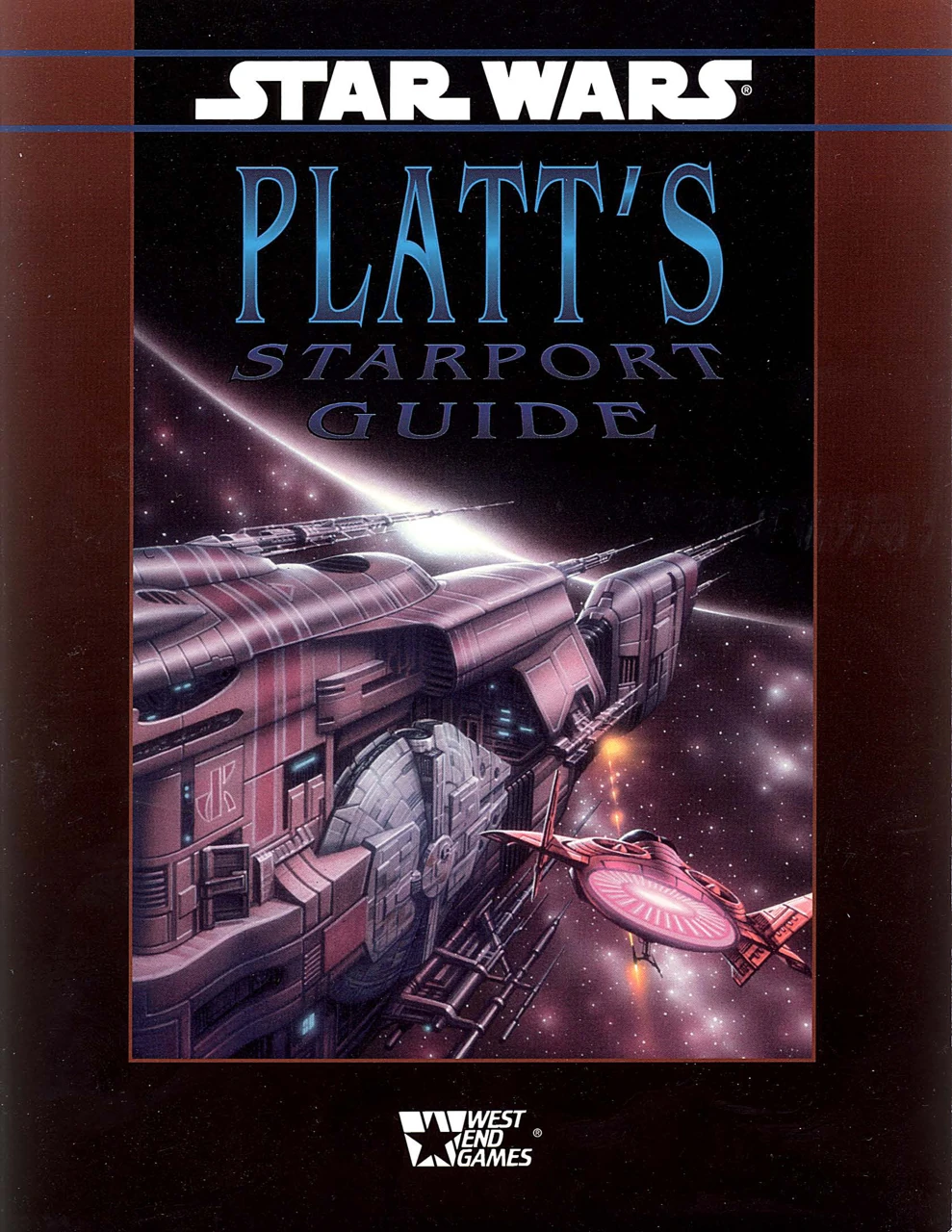
Platt's Starport Guide
Platt's Starport Guide
By Peter Schweighofer
Featuring original color illustrations by Chris Gossett
Design: Peter Schweighofer Editing: Bill Smith
Cover Design and Graphics: Tom O'Neill Additional Graphics: Steven Brown, Stephen Crane
Cover Art: Gabor Szikszai and Zoltan Boros Interior Color Art: Chris Gossett Interior Black-and-White Art: Tim Eldred, Terry Pavlet, Doug Shuler, Mike Vilardi
Special Thanks To: Stephen Luminati, David Schweighofer; Sue Rostoni, Lucy Wilson, Lucasfilm Ltd.; Bill Smith, Daniel Scott Palter, Richard Hawran, West End Games
Introduction
Platt's Starport Guide is a supplement for Star Wars: The Roleplaying Game, Second Edition. Smuggler extraordinaire Platt Okeefe has compiled this datafile to help fellow smugglers, spacers, vagabonds and ne'er-do-wells traveling the hyperspace lanes. Not only has Platt provided detailed entries on several starports, she's included some quick summaries of procedures every starship captain should know, as well as some notes on Imperial regulations.
Platt Okeefe has been wandering the space lanes for several years. During her business ventures (not all legal) she has kept notes on the people she's met, the places she's visited, and the problems (and solutions) she's encountered. Some say Platt has a photographic memory. If you're a spacer using this datafile, just hope that's true.
Each section in this datafile reveals what Platt knows about a particular spaceport. Some of the entries she borrowed from the Imperial Starport Registry (not usually available to smugglers and other spacers who don't own a legitimate pilot's license). The entries on the less legitimate starports are pieced together from Platt's own travels.
Platt reminds you that, as with the official Imperial Starport Registry entries, starport information can and will change, often with little or no notice. Smart pilots should contact starport control once they've entered a system to be sure all information is still accurate. The information in this datafile is not for astrogational or in-flight use.
Using This Book
This book can be a useful aid to both gamemasters and players who want to create settings and adventures set in different starports. It will also help them add a more realistic dimension to their spaceport escapades.
Each starport entry has a summary of the starport and planet information, as well as diagrams for the starport and docking facilities. Other notes cover customs inspections, commodities traded on the planet, services available at starports, and notable sights, along with game statistics for the individuals inhabiting each starport. Platt's comments about certain aspects of each spaceport are also included.
Gamemasters can use the sections marked "Adventure Ideas" and "Gamemaster Notes" to create new scenarios for players and incorporate this information into their own games. The material on flight procedures and Imperial Customs and starship regulations can add a bit of realism to any game. They can be used by players to make the game feel more real, or by gamemasters to create new obstacles for characters.
Gamemasters can follow the starport description format in this book to create and populate their own starports.
Please note that this datafile was compiled before the Battle of Endor. Information about some starports in this datafile could change as a result of the collapse of the Empire.
A Word from Platt Okeefe
When I first took to the stars, I was pretty naive. I didn't know much about how hyperdrives worked, or how you could boost a shield generator's efficiency, or how you plot astrogation coordinates. And for a while, every time I was in a starport, I looked like a lost tourist from Gruvia.
These days I'm a bit more educated. It took a while, and I learned by failure. Trust me, learning by failure is a memorable way to learn, but it can often be painful. Don't ever stick a hydrospanner in the coils of your ion drive while it's still hot. Don't wise off to the traffic controller who's coaching you in for your landing. Always make sure your pilot's license (real or forged) matches your ship registry. And always make sure your transponder's working when you approach an Imperial-controlled starport.
I learned these things the hard way (and the hydrospanner in the ion coil was a very painful lesson). These days, I see lots of spacers wandering around, fresh out of the cradle, not having the first clue about what they're doing. So I patched together this starport guide to make your lives a lot easier. You'll find entries on a few large spaceports, a few smaller ones, and a few not even on the star charts (and those make great places to hide if you ever run into Imperial entanglements).
Everything you need to know is in here. Where do you eat? How much are docking fees? Will the customs inspectors search the cargo on your ship or when you try to haul it through the checkpoint? What's good to import (or smuggle)? And what do you do when you've got five hours to kill before starport control gives you clearance to take off?
And for those of you too lazy or busy to read the entire 5,947-datapage Spacer's Information Manual put out by your friend the Imperial Navy (Bureau of Regulations, or INBOR), I've summarized a few helpful sections on starport procedures and Imperial regulations every spacer and smuggler should know.
Hey, the universe is a confusing and often dangerous place. Starports are even worse. The more you know, the longer you can survive to make a profit.
Platt Okeefe
Type: Smuggler
DEXTERITY 3D+1
Blaster 6D+1, dodge 5D, running 5D+1
KNOWLEDGE 2D+1
Alien species 4D+1, languages 4D, languages: Sullustan 6D,
planetary systems 8D, streetwise 6D
MECHANICAL 3D+2
Astrogation 5D, sensors 4D+2, space transports 6D+2,
starship gunnery 5D
PERCEPTION 3D
Bargain 5D, con 4D, sneak 4D+2
STRENGTH 3D
Brawling 5D, climbing/jumping 4D+2, stamina 4D
TECHNICAL 2D+2
Space transports repair 5D+2, starship weapon repair 4D
Force Points: 5
Character Points: 12
Move: 10
Equipment: Comlink, datapad, heavy blaster pistol (5D),
the Last Chance (modified YT-1300 freighter).
Capsule: Platt Okeefe considers herself a legendary entrepreneur (or smuggler) who has been causing trouble for the Empire, running legal and not so legal cargoes, and getting into trouble throughout the galaxy for several years.
Platt always loved space travel, even as a child. When she was growing up on Brentaal, she used to spend her afternoons at the starport, watching the freighters land and take off. On her twelfth birthday, she ran away and signed on as a cabin steward aboard a Sullustan starliner.
She later joined a tramp freighter crew plying the Anarid Cluster, and has since gone through different ships like clothing goes through styles. During her extensive travels, she has recorded everything she could about the spacefaring life, and cultivated a network of contacts so her information on systems and starports is accurate.
The two most remarkable features about Platt are her hair and her clothes. Her hair is a silvery white cascade streaming down her back -- it's often tied with a silver and red striped sash. She typically dresses in a white blouse with bright red pants, boots and vest. Her heavy blaster is always at her side. She enjoys stunning unsuspecting spacer jocks with her girlish smile.
Platt is an easygoing smuggler who wants to make her fortune among the stars. She has a great concern for her fellow smugglers, and will offer to help them whenever it won't jeopardize her own affairs.
Last Chance
Craft: Corellian YT-1300 Transport
Type: Modified light freighter
Scale: Starfighter
Length: 27 meters
Skill: Space transports
Crew: 1 to 2 (can coordinate), gunners: 2
Crew Skill: See Platt Okeefe
Passengers: 6
Cargo Capacity: 100 metric tons
Consumables: 2 months
Hyperdrive Multiplier: x1
Hyperdrive Backup: x10
Nav Computer: Yes
Maneuverability: 2D
Space: 4
Atmosphere: 480; 800 kmh
Hull: 4D+2
Shields: 2D
Sensors:
Passive: 10/0D
Scan: 25/1D
Search: 40/2D
Focus: 2/3D
Weapons:
2 Quad Laser Cannons
Fire Arc: Turret
Crew: 1
Skill: Starship gunnery
Fire Control: 2D
Space Range: 1-3/12/25
Atmosphere Range: 100-300/1.2/2.5 km
Damage: 6D
Concussion Missile Tube
Fire Arc: Front
Skill: Missile weapons
Fire Control: 2D
Space Range: 1/3/7
Atmosphere Range: 50-100/300/700
Damage: 9D
Capsule: Platt's Last Chance is the latest in a long line of freighters the young smuggler has owned. While she's had it modified quite a bit, it still seems like any old YT-1300 out there in the space lanes, which suits her fine.
Although Platt often flies alone, she is sometimes accompanied by one of several co-pilots, including the Twi'lek gunrunner Tru'eb Cholakk and a Sullustan from the Suuliem family. While most of the ship is functional, the crew lounge area is fancifully decorated with interesting collectibles from her journeys and escapades, not all of which were lawfully acquired.
Gamemaster Information
Each starport file is broken down into several sections detailing the starport, the planet, customs procedures, imports and exports, services available and notable sights on the planet.
Starports are given short summaries to quickly present important information. The entries are broken down into 10 categories (examples are given in parentheses):
- Starport Name: The name of the starport (Meruud Memorial Spaceport, Boledge Downport).
- System: The name of the system where the starport is located, followed by the planet (if applicable) (Meruud system, Meruud; Boledge system, Boledge).
- Starport Type: The type of starport as described according to standard Imperial classification codes: Imperial class, stellar class, standard class, limited services or landing field.
- Traffic: The intensity of starship traffic at this facility -- rare, slow, moderate, busy or high.
- Control: The form of traffic control used to monitor starships landing and taking off -- either droid, controller or none.
- Landing: The form of landing assistance used to bring ships from the landing traffic pattern to the landing site (landing team, directional beacon, tractor beam, none).
- Docking Areas: The form of docking facilities available (docking bays, landing pads, field, starport gate).
- Docking Fee: The fee charged daily for occupying a docking area, listed as a certain number of credits per local day.
- Customs: Defines the authority (either Imperial or local) conducting customs inspections, and whether those inspections are by a patrol visiting the vessel or at a starport cargo checkpoint.
- Services: Services offered and located within and near the starport district. Includes food, lodging, repair facilities, entertainment, storage bays, and vehicle rentals.
- Capsule: A short description of the starport.
The next chapter summarizes Imperial starship regulations and procedures regarding take-off, landing, pre-flight checks and other information characters can use. A summary of starport types and Imperial Customs regulations is also included. Platt has tossed her comments in where she thought appropriate.
This information can provide new ideas for adventures, encounters or problems when arriving or departing from a starport (lots of things can go wrong when the crew doesn't perform a pre-flight check, and you'd be surprised how nasty some Imperial traffic controllers get when you don't follow proper approach protocol). Gamemasters should use as much of this information as they want. It presents an abbreviated picture of how starports work, and as always, local conditions will vary.
A Note on Repairs
Each starport in this book varies in the availability of repair facilities, technicians and spare parts for modifying and repairing starships. Most starports describe repair facilities under the "services" section of each starport. Repairs will cost the standard amount or even less in better starports (although a few "exclusive" repair houses may charge significantly more than the norm). Repairs and parts in more remote starports will be more expensive and rare, if available at all.
As a gamemaster, always remember that technicians offering their starship repair services or spare parts are prone to bargaining, setting the initial price higher than normal, and bargaining down (or up) to their satisfaction -- but more often than not, satisfying the customer (in this case, the characters).
Repair Rules Summary
Repairing light freighters can be a lengthy and expensive process. The following rules are summarized from Star Wars, Second Edition. The repair costs are for characters doing the repairs themselves, most often using their space transports repair or starship weapon repair skills.
These rules are also a good guide for gamemaster character technicians effecting repairs and passing charges for new parts and their time along to the characters. Figure labor costs run about equal to the cost of new parts.
These costs are for new replacement parts only and are based on the original retail cost of the ship -- used or scavenged parts often cost about half the suggested amount, but are less reliable and are prone to failure if abused.
In general, technicians can make repair rolls at the end of 15 minutes' work, then one hour, then two hours, then one day and then two days -- for each repair, not for fixing the entire ship. Customize the costs, repair difficulties and time taken to fit the situation. Don't forget to be flexible to the roleplaying situation, sometimes taking time to act out any encounters with parts dealers or technicians for hire. The following tables are general guidelines for repair difficulties and the cost of new parts.
Maneuverability Lost
| Maneuverability Lost | Difficulty | Cost |
|---|---|---|
| -1D | Easy | 10% |
| -2D | Moderate | 15% |
| -3D or more | Difficult | 20% |
Moves Lost
| Moves Lost | Difficulty | Cost |
|---|---|---|
| 1 | Easy | 10% |
| 2 | Moderate | 15% |
| 3 | Difficult | 20% |
| 4 | Very Difficult | 25% |
Shields Lost
| Shields Lost | Difficulty | Cost |
|---|---|---|
| -1D | Easy | 5% |
| -2D | Moderate | 5% |
| -3D | Difficult | 5% |
| -4D or more | Very Difficult | 10% |
Drives
When a drive or generator is destroyed, a Difficult repair roll is necessary to replace it with an identical unit -- its cost is 35% of the light freighter's original retail cost.
Hyperdrive
A Moderate repair roll is necessary to repair a damaged hyperdrive.
Weapons
| Damage | Difficulty | Cost* |
|---|---|---|
| Lightly | Easy | 15% |
| Heavily | Moderate | 25% |
| Severely | Very Difficult | 35% |
Cost is based on the original cost of the weapon, not the starship.
For more information about repairing and modifying starships, see Galaxy Guide 6: Tramp Freighters, Second Edition, pages 30 to 43.
Space Travel, Regulations and You
Space is filled with rules and regulations meant to protect most honest, legitimate spacers plying the hyperspace lanes and ports of the galaxy. These regulations make sure spacers are fully qualified to go zipping around the galaxy in starships, certify that those starships are spaceworthy, and insure that weapons on starships are for protective purposes. They also set down some general rules regarding trade and flight within most civilized systems.
Needless to say, most of us smugglers tend to ignore them.
Spacefaring Agencies
However, we still need to get around the galaxy, which means that at least part of the time we need to work within the existing labyrinthine bureaucracy governing space travel. Let's take a quick look at the three groups which create, record and enforce regulations on space travel.
Imperial Space Ministry
The Empire inherited most of the Old Republic's laws, including starship regulations and the general infraction codes -- what's now commonly known as the Imperial Penal References (ImPeRe among some smuggler circles). These rules are updated and tracked by the Imperial Space Ministry, the Imperial Navy's regulatory agency monitoring space travel.
The space ministry reviews the immense volumes of the Imperial Spacefaring Regulations annually, updating older rules and creating new ones to encompass new space traffic situations, astrographical features, military controls and other situations requiring a regulated set of protocols.
The Imperial Space Ministry publishes the updates and changes every year in the Spacers' Information Manual, or SIM, available for a minor 25 credit charge when spacers update or renew their flight certification. Of course, smugglers and others who obtain their captain's accredited license through less legitimate channels have no easy access to the Spacers' Information Manual ... not that they particularly need it or pay much attention to it anyway.
The Imperial Space Ministry also certifies new starports and occasionally inspects heavily used starports to be sure landing and docking facilities meet with certain Imperial standards for safety and security. The space ministry most often concerns itself with regulating starports with busy or high levels of starship traffic, those starports along major trade corridors or starports in systems with industrial, tactical or political importance to the Empire. As a rule, its inspectors don't even bother with starports classified as landing fields or limited services -- even standard class starports are often overlooked if not important to the Imperial military and industrial machine.
The space ministry also coordinates reports from Imperial traders and scouts regarding new or upgraded hyperspace routes, new systems and worlds discovered. This data is sold as download astrogational and informational updates for starships' general and navigational computers. The download includes updated astrogation charts and routes, new areas mapped, as well as new and updated planet profiles for access through a ship's computer banks.
The astrogation update is available from Imperial Space Ministry offices throughout the galaxy -- most often found at sector capitals. To receive the update, spacers must show their captain's accredited license and their ship's operating license. These documents are checked for authenticity and any violations of the Imperial Penal References on file before the astrogation update is authorized. A small fee of about 150 credits is also charged for the update.
Offices of the Imperial Space Ministry throughout the galaxy also issue permits for transport of restricted goods, usually at the capital of the sector where the restricted cargo originates. Other petty permits for travel through certain hazardous routes, secure landing facilities and restricted hyperlanes or systems are also issued at space ministry offices in sector capitals. However, when it comes to keeping track of the innumerable starships and certified spacers out there, the mighty Empire turns the formidable and important task over to an agency seemingly separate from the great military power which controls vast portions of the space lanes -- the secretive and clan-administered Bureau of Ships and Services (BoSS).
Bureau of Ships and Services (BoSS)
"The Bureau of Ships and Services (BoSS) is one of the oldest institutions in the galaxy. It has its own customs, traditions and unique personality. Most of the positions are filled through hereditary means. BoSS is as much a star-spanning tribe as it is a civil bureaucracy.
"As the decades have passed and one government after another has come into power, BoSS is one of the few bureaucracies to remain relatively unchanged. BoSS has assured itself independence for two reasons. First, the sprawling and complicated files of BoSS are kept in nearly indecipherable codes. Only family members have access to the organization codes of the files. The second reason is BoSS's long-standing policy of neutrality. Each power that rules or manages the galaxy simply inherits BoSS. Apparently, the BoSS family has no political aspirations, and the Empire seems to be yet another government that accepts BoSS without threatening it."
-- Cracken's Rebel Field Guide, datapage 58
The Bureau of Ships and Services (BoSS) is the galaxy's record-keeper when it comes to starship and spacer information. It keeps extensive information on starship registrations and transponder codes, captains' flight certification, and upgraded weapons load-outs on all ships in the galaxy. It also keeps track of astrographical and navigational information as well as data on hyperspace routes used in nav computers.
Spacers get most of their flight documents from BoSS offices around the galaxy, registering their ships, heavy weapons, and their flight abilities with BoSS databanks. BoSS also matches ship registrations with starship transponder codes and collates all this information for use in the enforcement of spacefaring regulations. BoSS keeps track of these documents as well, noting the transfer of spacecraft between owners as well as any violations against certain captains or starships from various ports. It is also rumored that BoSS keeps a record of certain captains wanted by Imperial and bounty-hunting agencies.
The bureau's databanks are continuously updated and transmitted to starports, systems, and enforcement agencies throughout the galaxy. What information is provided by BoSS and how quickly it is delivered to a particular client depends on subscription fees paid to BoSS for access to updated starship and spacer information.
The Bureau of Ships and Services is perhaps the strangest institution in the galaxy. It doesn't make sense and it doesn't pretend to make sense. It basically does a lot of filing and record-keeping that the Empire simply doesn't want to be bothered with.
BoSS has been the keeper of starship information since time began (or so it often seems). It's not really a bureau attached to any government or other institutions like other bureaus; it doesn't owe loyalty to anyone.
One would think after years of patrolling the star lanes the Empire would have conducted enough identification verification checks on starships and their captains to compile their own records. It could; it doesn't want to be bothered, at least for the time being. To say the Empire has to depend on BoSS is like saying the bantha needs the parasitic fur mite to survive.
The Imperial Navy and Imperial Customs
While BoSS keeps track of spacefaring vessels, the Imperial Navy and Imperial Customs enforce Imperial law and starfaring ordinances regarding trade and illegal use of a starship. The Imperial Navy concerns itself mostly with violations of starfaring ordinances -- especially illegal modifications to starships -- while Imperial Customs monitors trade and smuggling. Often, the jurisdictions of the two agencies overlap.
These days it's almost standard procedure when encountering an Imperial ship to transmit your registration and certification data documents for verification against your transponder code and BoSS records. If anything is out of order, spacers are usually boarded, inspected and questioned.
The Imperial Navy also monitors the space lanes for Rebel and pirate activity. The only problem is most Rebel and pirate starships have forged starship documentation planted within BoSS databanks by computer slicers. The Imperial Navy is finding other, more clever ways of detecting these renegades -- as well as us "legitimate" smugglers.
Getting Started
Every spacer is required to carry certain datadocuments aboard their ship at all times. These are most often kept on a secure datapad issued by BoSS at the time of ship registry and captain's accreditation -- a custom format input plug available only at BoSS and Imperial Space Ministry offices is the only way of downloading new certifications and permits or altering information already existing on the datapad.
Port officials or those inspecting the ship in person request this datapad for their personal inspection, and can read the information and verify it through their own computers. A separate plug also allows the datapad to download information to a starship's computer for transmission to port and naval authorities monitoring traffic from other ships or installations. Most busy starports require this form of identification, as starport personnel cannot possibly board every starship passing through to personally inspect data documents.
Here's a list of some of the required documentation spacers must carry aboard their vessels at all times. All three documents are available from the Bureau of Ships and Services only, and have various requirements that must be fulfilled before they're issued:
Ship's Operating License: Every starship must have an operating license detailing the ship's specifications, port of origin, manufacturer and registration code with the Bureau of Ships and Services (BoSS). The license also identifies the current owner and transponder codes. Transponder codes are the fingerprints of starships -- if a transponder code doesn't match up with datafile information for a starship registry number, it's a sure sign of illegal operation (and in most cases, a bad license forgery or data implantation on the part of the starship owner). Operating licenses are available for 1,000 credits and require a background check on the owner, a brief inspection of the ship, and a transponder code verification reading.
Captain's Accredited License: Every starship captain is required to have a license to pilot the particular starship class they're flying. Some licenses cover several kinds of starships, depending on the captain's training and experience. Obtaining a captain's license requires several oral, written and flight tests, as well as 10 years of documented time in space, an extensive background check, and a 300 credit fee. However, BoSS often overlooks the flight time and most of the testing for a 200 credit "expediter fee" -- bringing the total for a pilot's license to 500 credits.
Arms Load-Out Permit: Non-military starships with weapons or unusually high shield ratings require an arms load-out permit acknowledging that the additional weapons and shields are authorized by the Bureau of Ships and Services. These permits are issued quite often and easily in the regions past the Colonies, as piracy and other attacks are much more common. Ships with weapons emplacements or boosted shields without one of these permits can be impounded on the grounds that it is a vessel in the service of a pirate group or the Rebel Alliance. Because boosted arms and shields are part of a starship's spec profile, BoSS assumes authority in keeping track of augmented ordnance and tags the permit onto the ship's operating license. Each weapon or boosted shield system aboard a ship requires a separate permit. An arms load-out permit requires a brief inspection, verification of starship and captain's licenses, a background check, and a minimum 250 credit fee (the fee depends on the specific shielding and weapons to be carried). Existing weapons that are upgraded in power require new, upgraded permits.
Getting Around BoSS
"Gee," you might be thinking, "all these documents I need to fly my starship require extensive background checks and inspections. How do I get around this if I'm not really using my starship for legitimate or legal activities?" It's something we all have to know -- if you get caught without any of the above documents, you're on a one-way trip to the spice mines of Kessel.
First you need to find a good data document forger. It's been said that they'll charge you half your ship's value just to obtain the official BoSS secure datapad, then they'll charge you the other half of your ship to imprint the required documents on it -- and sometimes that's not too much of an exaggeration. Add to it the transponder verification codes and your bill could run pretty high. All in all, the entire process can cost you between 6,000 and 10,000, depending on how good (or bad) your forger is and how well you can bargain the price down.
If you look hard enough you can find forgers who do nothing but replicate fake starship documentation for a living. Their prices are usually at the cheaper end of the scale, since they mostly have regular contacts or channels through various criminal organizations.
Once you have the actual datawork done, you still need to make it official by getting into BoSS's databanks and inputting the information as if it were legitimate. Just because you have a BoSS secure datapad with some fancy-looking documentation on it doesn't mean you're okay -- if it doesn't correlate with BoSS records, you can be in big trouble. The solution? Find a slicer who has contacts, can access the BoSS data network and implant your information so it seems real. A slicer's services can run you about 3,000 to 5,000 credits for this kind of operation. Some slicers earn their living from nothing but messing with BoSS databanks. These slicers charge from the lower end of the scale.
Once in a while you'll find a forger/slicer team working together to produce false documents for spacers. I've seen some who offer a package -- all proper documentation, from starship certification, captain's license and heavy weapons load-out permit, all "legitimately" updated in BoSS databanks -- for 6,000 to 10,000 credits.
Of course, those of you obtaining your ships from crimelords often have the proper documentation thrown into the starship purchase deal. Besides, why would your criminal employer want his prized workers getting caught doing his dirty work because of bad forgeries? This also works both ways. Mess with your crimelord boss who provides you with starship documents and it's real easy for him to yank the deck out from beneath your feet and change your records with BoSS. My advice -- even if you're working for a crimelord, get your own starship documentation.
Getting Where?
The Imperial Space Ministry inherited several starport classifications from the Old Republic's Space Ministry. These terms haven't changed from their predecessors, except for the "Imperial Class" starport, formerly known as the "Republic Class" starport.
Spacers should note that these five classifications are generalizations of landing facilities -- there are many shades of gray within and between these designations. Notes on costs and fees are estimates and aren't always that accurate. Remember, starport costs often reflect the system's economy or the state of the starport administration. Starports run by the Empire generally have lower costs since the starport's operations are subsidized by the Imperial Navy. Backwater ports -- even ones designated standard class -- can vary wildly, depending on the planet's economy or any wealthy institutions (including crimelords) funding starport facilities.
And don't believe everything you read from the Imperial Space Ministry about these ports. For example, customs officers aren't run off an assembly line or out of clone vats -- they're as individual as the starships and free-traders they deal with. Some are fanatically loyal, can't be bribed and follow every rule and regulation.
Others are more lax, given over to their own vices and weaknesses, or just don't care. Some of these folks can be bribed to ignore most minor offenses. You'll find these variations at every starport. Not every customs officer at an Imperial class starport is as loyal as the local stormtroopers ...
Landing Field
A landing field is a flat, level area cleared on the ground. These fields are generally little more than cheap duracrete strips or tightly packed dirt. There is no flight control tower to direct incoming and outgoing ships to and from the port, and there is rarely a starport beacon guiding ships to port. There is no guarantee that there are any refueling or repair services available, and the few services which exist are of low quality. While available services are usually affordable, good repair facilities, technicians and equipment is often rare and expensive.
Limited Services
These starports usually have a small command tower with a signal beacon to help guide incoming ships. There are often maintenance sheds for rent, where starship crews can effect primitive repairs. This type of port has limited storage and docking capacity, and in many cases ships must land nearby and crews must walk to the port if all docking areas are filled. Most major supplies must be purchased elsewhere.
Standard Class
The standard class starport has a fully staffed and equipped flight command center, and offers restocking services and a small shipyard capable of minor repairs and modifications. Starship work can cost up to double normal prices and take more than twice as long to accomplish, though the quality of the work often varies from mediocre to very good.
Stellar Class
The stellar class starport has facilities for landing and docking nearly any classification of vessel. There are sometimes a number of different shipyards surrounding the port -- these facilities are capable of performing nearly any sort of ship repair and customization the owners wish (and are willing to pay for). Repairs and modifications are often of advanced quality and are moderately affordable. There is nearly always an Imperial Customs office on site and a sizable Imperial Navy presence in system.
Imperial Class
The Imperial class starport is quite luxurious and modern. It has an impressive array of docking facilities and ship storage and maintenance areas. All the most lavish amenities are available for ships' crews and passengers. Many of the system's merchants maintain offices at the port, and it may not be necessary for the starship captains to even leave the port to conduct their business. The starship maintenance facilities are capable of rapid and high-quality repairs and modifications, though the services may not come cheap or quickly. The customs office for this quality port is probably staffed by highly competent officers. The Empire usually maintains a formidable military presence in Imperial class starports, and minor infractions are dealt with to the full extent of the law; troublemakers are unwelcome. Starport control and the Imperial Navy conducts thorough ship and captain identification checks to weed out smugglers and other unwelcome spacers.
Getting There
It's always good for spacers to know certain things when entering or exiting a system: landing and take-off protocol, flight conditions in-system, proper procedure for zipping around traffic patterns and so forth.
Rather than quote the boring portions of the Imperial Space Ministry's Spacers' Information Manual, I'll just summarize some general information on starport flight protocol for you. Not that us smuggler types ever pay much attention to this. I doubt Han Solo has ever filed a flight plan, and I'm sure Tru'eb Cholakk has rarely asked for lift-off clearance before blasting out of a docking bay. Still, it doesn't hurt to know ...
METOSP
METOSP (pronounced "Me-tosp") stands for "Message to Spacers," a comm channel most starports reserve for general notices regarding traffic patterns, conditions at the starport or other factors spacers should be aware of when heading in or out of a port.
METOSPs exist to inform spacers -- they're one-way broadcasts usually sending pre-recorded messages updated daily or as conditions change. Don't bother transmitting any information or questions back -- it's all automated. Spacers with questions often wait until they contact starport control before obtaining more specific information. Most Imperial, stellar and standard class starports broadcast METOSPs on a standard comm channel. Few limited service starports have METOSPs, so spacers need to rely on their sensors and visual scanning to assess whether there are any traffic problems.
Always tune into your METOSP channel when you enter a system. You never know when a METOSP will contain information regarding Imperial Naval activity, starport traffic tie-ups, a continuous piracy threat, or an astrographical problem like meteor showers. METOSPs also provide general information on the starport, including an abbreviated starport profile and often a planetary profile, as well as important landing information and the comm channel where starport control can be reached.
Arrival Procedures
After arriving in your destination system and checking for any METOSPs, switch over to the starport control comm channel -- usually given in the system's METOSP or planetary or starport profile in your starship computer. If you can't find it, scan the comm channels until you do, or until you figure out that the port is so small it doesn't have a controller on the comm board.
Standard practice when you contact starport control is to verbally identify your ship and captain's name. Controllers may ask for last port of call, contents of cargo bay or number of passengers and crew aboard, although this varies wildly from port to port. During this short interrogation, starport officials are often double checking the verbal identification information you gave them against their BoSS databank records and your transponder code -- a process known among starport controllers as "transponder verification," or TransVere.
Once they've verified your identification, they'll give you clearance to enter the traffic pattern, drop in and land, and send you to a docking area. Controllers often provide specific approach and traffic vector course information they expect captains to follow -- deviating from a course within a starport's traffic pattern sometimes incurs fines between 50 and 200 credits. Penalties are a little more severe if you cause major problems and the fines will be the least of your worries.
Sample METOSPs
Here are some sample METOSPs I've collected from my travels. They'll give you some idea what you can expect to hear on the METOSP channel and some of the situations you can encounter in and around a starport:
Message to spacers approaching Ralltiir: An Imperial blockade is being enforced in this system. No commercial starships have clearance to approach the planet. Ships defying this blockade will be engaged and destroyed by Imperial Naval vessels. Starships requiring starport services before jumping to an alternate destination should tune into comm channel IX-142. Services are available from outer perimeter Imperial picket vessels ...
Message to spacers approaching Dulin starport: Arriving starships must approach Dulin starport from the southern approach vector. The northern approach vector will be temporarily closed from 2500 to 2700 hours for a fireworks display as part of the city's celebration of the New Year Fete Week. Contact your starport controller on comm channel UN-271 for further approach vector and traffic pattern information.
Message to spacers in the Wroona system: Be advised that Imperial Customs forces are currently engaging a pirate fleet on the outer edges of the system. Spacers are advised to avoid the conflict, as Imperial vessels are engaging any non-Imperial ships in the vicinity of the battle.
Message to spacers preparing departures from Kuat for Core Worlds destinations: Spacers filing flight plans for Core Worlds destinations must transmit proof of Core Worlds Travel Clearance to picket ships before jumping from the Inner Kuat Traffic Zone. Ships not transmitting such clearance are subject to security violations and prosecution.
Departure Procedures
Departure procedures are probably the most-ignored procedures in the Spacers' Information Manual. Getting somewhere usually isn't the problem -- it's getting away quickly that counts.
For those of you who want to follow the proper departure rules, the first thing you do before even warming up your ion drive is give starport control a call to request departure clearance. As with arrivals, obtaining clearance to take off involves a TransVere.
Once you've been cleared to lift off, control usually likes spacers to log in some kind of flight plan, usually the name of the next system they're jumping to. This is more for safety verification than anything else. If a ship is reported missing, rescue and retrieval teams check with the last port of call to find the flight plan, then begin looking along realspace travel corridors along the probable hyperspace vector taken.
After take-off, starport controllers, droids or tractor beams may help the starship into the outbound traffic pattern. Outbound beacons or verbal instructions from controllers guide spacers through the complex traffic patterns and departure vectors away from the starport before spacers begin setting up for their hyperspace jumps.
Getting Caught
The Empire can be a fairly strict organization, especially from the perspective of those of us involved in the shadier side of business. The Imperial Penal References (ImPeRe) divide criminal offenses into five different classes of infractions -- class ones being the worst, class fives being the least severe.
The penal references are enforced by local law enforcement groups (including planetary militias), Imperial Customs officers and the Imperial Navy. Less lenient enforcement officials sometimes overlook class four and five infractions, sometimes in practice and sometimes in exchange for a "personal benefit fee," more commonly known as a bribe. Most local law enforcement groups are fairly lax, while Imperial Customs officers tend to have their own personal extremes. The Imperial Navy is perhaps the most impersonal enforcement group, blindly enforcing all regulations in the Imperial Penal References with little regard to "personal benefit" incentives.
Of course, if you're seen committing one of these infractions and get away, law enforcement officials tag your starship operating license and pilot's license with a warning light -- later on, anyone conducting a TransVere on you or your ship picks up the tag, looks up your offenses and proceeds to try and bring you in on the charges.
Just so you know what you're doing wrong -- and how much trouble you'll be in -- I've listed the ImPeRe infractions for you below, enumerating the general offenses as well as probable penalties for getting caught.
Please note that the following descriptions refer only to trade and starship operations. All kinds of local laws can (and will) mess up your day. Since local officials are allowed to classify particular crimes, you wouldn't believe what some worlds consider a class one infraction. Of course, some crimes (such as murder) will be a class one or class two infraction just about everywhere. Additionally, some officials are overzealous in protecting their worlds and tend to trump up charges -- that class four for having an unlicensed weapon may get blown up into a class two, and your avenues of appeal are going to be pretty limited. Actual penalties may vary a lot as well -- while the suggested penalty for a class three can be up to two years in jail, it's not unknown for some local constable to decide to put you away for a decade. Some METOSPs will have information about unusual local laws, but don't assume that just because the METOSP doesn't say anything that unusual laws aren't in place. Ask around at the starport to find out what laws may be lying around waiting to be used on unsuspecting spacers. As always, be careful!
Class One Infraction
These infractions are the most heinous in the Empire -- or so COMPNOR claims. Spacers committing class one infractions who manage to escape are often branded outlaws, pirates or Rebels, and they are the prey of bounty hunters and quite often Imperial forces sent out to capture them. Class one infractions include the following crimes:
- Conspiring to overthrow the Empire.
- Possession of a cloaking device.
- Attacking another vessel.
- Aggression against Imperial personnel.
Punishment: Arrest, immediate impounding of the vessel involved, five to 30 years imprisonment, loss of business or flight certification, and possible execution.
Class Two Infraction
These offenses are still fairly serious, although you probably won't be branded an Enemy of the Empire for committing them. Most of these were initially implemented to curb pirate and organized criminal activities, but now serve to hinder the fledgling Rebel Alliance's efforts to throw off the heavy Imperial yoke. Class two infractions include:
- Shipment of high energy weapons between systems without a permit.
- Mounting of high energy weapons on a vessel without a permit.
- Possession, purchase or transportation of restricted or illegal goods (rated with an X).
- Purchase or transportation of stolen goods.
Punishment: Arrest, immediate impounding of the vessel involved, a fine of up to 10,000 credits, five to 30 years imprisonment, and possible loss of business or flight certification.
Class Three Infraction
These infractions are fairly minor in the general scheme of the galaxy, but are still fairly rigorously enforced in most major ports. You'll find that in limited services and landing field port classifications few Imperial officials prosecute class three infractions -- if there are any Imperial officials around to begin with. Local law enforcement groups tend to overlook infractions of this level and lower for a "personal benefit fee." Class three infractions include the following activities:
- Attempted bribery of an Imperial official.
- Transportation of restricted goods (rated with an R) without a permit.
Punishment: Arrest, immediate impounding of the vessel involved, a fine between 250 and 5,000 credits, up to two years imprisonment, and possible loss of business or flight certification.
Class Four Infraction
These are fairly minor offenses considering a lot of the other crimes going on throughout the galaxy. The first one's pretty broad -- there are thousands of substances which could be considered a narcotic. For instance, on Arcona, salt is considered a narcotic. Prosecution of these infractions ranges from lax to somewhat strong, depending on the temperament of the local system and local law enforcement officials. Of course, the Imperial Navy prosecutes violators of these infractions like a nashtah goes after raw meat. Class four infractions include:
- Purchase or transportation of any narcotic without a permit.
- Purchase or transportation of any goods requiring a permit or fee without required permit or proof of fee payment (rated with an F).
- Purchase or use of any vessel while lacking a ship's operating license and captain's accredited license.
- Possession, purchase or transportation of unrestricted items in quantity without proper taxation.
Punishment: A fine typically between 1,000 and 5,000 credits (fines may be as low as 175 credits) and up to a month imprisonment.
Class Five Infraction
These are fairly minor infractions often incurring nothing more than a fine -- something which can often be avoided with "personal benefit fees" directed to the prosecuting officer. They mostly encompass local import and export laws (don't forget to tune into your METOSPs to hear about any trade restrictions) as well as starship safety regulations. Class five infractions include:
- Violation of local import and export laws.
- Lack of proper emergency equipment for any vessel.
Punishment: A fine between 500 and 1,000 credits, but the fine may be as low as 100 credits or as high as 5,000.
Port Haven
System: Whendyll system, Port Haven Starport Type: Landing field Traffic: Rare Control: None Landing: None Docking Areas: Landing beach Docking Fee: None Customs: None Services: Food, lodging
Capsule: Port Haven is the site of an abandoned colony now used by spacers on the run. It's a place to recuperate from injuries, affect repairs on their ships, or hide out until the Imperial heat cools off. Port Haven offers few services other than food and shelter, and few viable commodities other than animal skins, raw meat and the cool Haven water (which some consider to have healing properties). However, the port's real value lies in its remote, hidden location. When smugglers want to disappear, they come to Port Haven -- as long as spacers mind their own business and don't interfere with anybody else's, Port Haven is a peaceful retreat. The port's two denizens really don't care who lands there, as long as they don't cause problems. Hallomar, a rugged hunter and the closest Port Haven comes to a leader, is either out in the jungle tracking prey or busy curing meat and skins. Mister Mxil is the Mon Calamari "owner" of the port's only cantina, Haven's Water.
Port Haven is a tiny, isolated settlement forgotten many years ago after the original colony there was abandoned. Today it's a kind of smugglers' retreat: a place they can go when they're on the run to lick their wounds, fix their ships and relax while their deals and reputations in the rest of the galaxy cool off.
As a retreat from those chasing smugglers, Port Haven's astrogational location is a closely guarded secret among smugglers. It is a sign of distinction for smugglers to be provided with Port Haven's location by a colleague -- sort of like having your name appear in a news item on Cynabar's InfoNet, the infamous "smugglers only" newsnet. And it's part of an unspoken smugglers' code that once you know Port Haven's location, you don't reveal it to anyone else unless they're a fellow smuggler who's proven their honesty and earned your undying trust.
The reason Port Haven works as a smuggler's retreat is that few actually know where it is, although many have heard stories about it -- not all of them accurate. The more smugglers know who exactly how to get there, the greater the chances are that some idiot will ruin it for the rest and sell the location to a bounty hunter, a crimelord, or, worse yet, the Empire.
Port Haven Betrayal
Lorcu Malshae disengaged his hyperdrive and maneuvered his light freighter Moonglow into a loose orbit around Ord Mantell, all the while eyeing the sensors, looking for any trace of the bounty hunter's ship.
Tick.
He had arranged to meet the hunter here to sell him some information -- a tip about where he could find several smugglers wanted by their crimelord employers for immense debts, dumping cargo, and the occasional petty insult. Most had seemingly "disappeared" from the active smuggling circuit of late -- but Lorcu knew they were hiding out on a remote sanctuary world, waiting for things to cool off. And Lorcu, being a somewhat respected member of the smuggling community, knew the coordinates to lead the bounty hunter to Port Haven.
Tick.
Lorcu didn't like selling out his colleagues. Nor did he find any comfort in giving away the location of his only retreat, either. But his smuggler colleagues would no doubt escape the bounty hunter's snare as they had so many other times, and he would no doubt discover some new backwater world on which to hide when he needed refuge.
Tick.
It wasn't that Lorcu even wanted to sell out Port Haven's secret location -- he just needed the money the hunter was willing to pay him for the information. Sure, Hallomar's exotic animal skins sold well ... when the misanthropic big game hunter allowed him to take enough to make a decent profit. And the few jugs of Haven water Mister Mxil always let him take provided enough money to get back on his feet. But that last deal with Sithless Leethe had crippled Lorcu really bad. He needed to come back in full force this time.
Tick.
If only Par'tha hadn't abandoned him when he told her about his deal with the bounty hunter. His Twi'lek co-pilot had been a trusted companion, but the idea of selling out Port Haven repulsed her. But before she went, Lorcu had made her swear she wouldn't utter a word about his plan to anyone else.
Boom!
Fett cursed inside his helmet. Finding Port Haven was getting tougher each time -- those smugglers knew how to keep a secret, and knew how to silence those who tried to betray them. Through the viewport of Slave I he watched the Moonglow explode into millions of searing metal fragments.
"Damn," he said. "Not again."
Once smugglers reach the Whendyll system through the carefully guarded astrogation coordinates provided by their colleagues, they navigate to the third planet of seven in the system. Port Haven is covered in wide azure oceans and broad continents thick with verdant jungle foliage and mountains.
Spacers won't find any beacon directing them to the starport landing bays. Port Haven doesn't have any beacon, landing bays, or much of a starport anyway. Just find the largest continent and the inland sea in its center. Follow the eastern coast of the inner sea at a fairly low altitude, carrying out a visual search for a seaside settlement. If searching during the day, spacers often watch for the tell-tale signs of smoke rising from Hallomar's curing tent -- if the grumpy old hunter is actually curing anything that particular week.
Port Haven isn't much of a starport. It's an old, abandoned colony now inhabited by two regular citizens -- a reclusive big game hunter called Hallomar, and the Mon Calamari Mister Mxil who runs Haven's Water, the settlement's only hospitality establishment.
Hallomar
Type: Hunter
| Attribute | Dice |
|---|---|
| DEXTERITY | 4D |
| Archaic guns | 8D+2 |
| Blaster | 7D |
| Blaster: blaster rifle | 9D |
| Brawling parry | 7D+2 |
| Dodge | 8D |
| Melee combat | 7D |
| Melee parry | 6D+2 |
| Running | 7D+1 |
| Thrown weapon | 7D |
| KNOWLEDGE | 2D+2 |
| Intimidation | 5D |
| Survival: jungle | 9D+2 |
| Willpower | 7D |
| MECHANICAL | 2D+2 |
| Beast riding | 5D+2 |
| PERCEPTION | 3D |
| Search | 6D |
| Search: tracking | 8D+2 |
| Sneak: jungle | 8D |
| STRENGTH | 3D+2 |
| Brawling | 8D |
| Climbing/jumping | 6D+1 |
| Lifting | 5D+2 |
| Stamina | 7D |
| Swimming | 6D |
| TECHNICAL | 2D |
| Archaic gun repair | 5D |
| First aid | 7D+2 |
Force Points: 5 Character Points: 15 Move: 10
Equipment: Ammo bandolier, animal hide clothing, large knife (STR+1D+2), leather satchel, needle-shell rifle (5D+2), pipe, wood axe (STR+2D)
Capsule: Few smugglers who visit Port Haven know of Hallomar's true origins. Some say he was an outlaw who came to Port Haven many years ago to escape some unknown crime, while others believe he's the last survivor from the group of colonists who tried to settle the planet. Whatever his true origins may be, Hallomar is a rugged survivor who carves his simple life from the very jungles of Port Haven.
Hallomar seems to be a middle-aged Human, sporting a long, unkempt brown beard and a nest of shaggy hair on his head, neck and shoulders. He stands just over two meters tall, and seems more imposing and broad-shouldered wearing piles of animal skin clothing. About the only true clothes left on him are the vestiges of a tattered and threadbare tunic of unknown age.
This rugged mountain of a man is the impromptu "governor" of Port Haven. He seldom talks and when he does speak, he has a deep voice punctuated by grunts and huffs. He cares little for the people who stay in port as long as they don't raise any trouble.
Hallomar spends half his time out in the savage Port Haven jungles, hunting the immense beasts which few others have escaped to talk about. An ancient, oversized needle-shell rifle is slung over his back, the finger-length shells of which are carried in a leather bandoleer he slings over his other shoulder. An animal-hide belt holds an oversized knife and wood axe for negotiating the forest and butchering his prey.
When he hasn't disappeared into the jungle for weeks, he's busy in his curing tent, butchering parts of the beasts he brings down, curing their skins and smoking their meat. The remains he doesn't use he meticulously spreads evenly over the trash heaps that surround the port. Hallomar's evenings are spent brooding in a dark corner at Haven's Water, drinking frothy ale, smoking his hand-carved pipe, and watching the visiting spacers.
Behind the scenes he protects the settlement from smugglers who need a break -- some of his best animal skins and some cured meat so they can sell them for a small profit and get back in business.
And, just in case some brash spacer violates the good hospitality that pervades Port Haven, Hallomar is there to break up disputes. Not only can he pry two brawling smugglers apart, but he's extremely accurate throwing his knife and axe. Despite his seemingly moody and dark nature and his immense strength, Hallomar insures peace in his tiny settlement.
Smugglers come to Port Haven for any number of reasons. But perhaps the best reason is to come relax here while things are too hot in your market. Grab a cool drink at Haven's Water, find a comfy spot of sand on the beach, and watch the sun set into the waves of the inland sea.
Port Haven is the closest place I've come to a resort world for smugglers -- no firefights, no crooked deals, no bounty hunters and no Empire.
-- Platt Okeefe
Landing on the Beaches
The settlement's landing facility consists of the broad beach nearby. Packed hard by pounding waves, it's as good as any duracrete landing pad as long as you know where to set down. Land too close to the existing tideline and a starship will end up like the buried rip-ship which rises from the moist sand. Land too close to the meter-high sandy embankment which separates the beach from the grassy settlement soil and you'll get blast backwash and a cloud of sand up your vents.
But generally there's plenty of room on the beach for everyone to land. And at a remote hide-away like Port Haven, "everyone" is usually no more than five ships.
The settlement itself is just upland a bit, where the sand turns into a sandy soil held together by thick jungle weave-grass. Most of the buildings are constructed of stone, although some, like Hallomar's curing tent and the technical hangar, are made of fabric and wooden supports.
Only four structures are used with any regularity -- the other 10 or so buildings are abandoned, originally homes and businesses for the few colonists who came here 250 years ago. The four structures that are often used are Hallomar's stone shack, his long curing tent, the Haven's Water tavern, and the technical hangar.
Port Haven Map Key
- Haven's Water
- Technical Hangar
- Hallomar's Shack and Curing Tent
- Buried Rip-Ship
Setting Up Home
Tru'eb the Twi'lek cleared the cobwebs from the corners of the stone dwelling he found in Port Haven, then began arranging the soft skins, jungle straw and moss into a crude bed at one end of the single room. He spread the straw and moss first, then set the skins over the soft mattress. Hallomar had given him an especially soft bundle of animal skin to use as a pillow, and another one he had recently finished curing and fluffing for a blanket.
Tru'eb disappeared for a few moments, then returned with his leather bag of gear. He removed a small folding stand, which he set up as a table next to the makeshift bed. He set a jar on top of it, along with some sterile gauze, bandages ripped from an old under-tunic, and the contents of a medpac.
When Tru'eb returned for the third time, he was carrying the collapsed form of Platt in his arms. He set her in the makeshift bed of animal skins and jungle weeds, then began tending to the bloodied bandages on her upper arm, her leg and her side. He spread what little of the ryll medicinal paste he had onto the wound at the side of her ribs, then covered the burn with a new layer of clean gauze and bandage.
"Beylyssa truly had the better advantage of you this time," Tru'eb observed as he redressed Platt's wounds. "Perhaps in your next confrontation you'll be more careful to make decisions based on strategy and not hot-headed emotions."
Platt's reply was limited to a wry smile. She kept her eyes closed. "Well, it seems as if we'll be here for a while," Tru'eb noted. "I'll be off to Haven's Water to see if Mister Mxil can mix you up some herbal concoction, then see what I can find to make this 'dwelling' more homey."
The other structures -- all of stone construction -- are empty husks. No building rises more than one story, and most have darkened windows with or without panes. These buildings are used by visiting smugglers when they make port for any length of time. Some smugglers set up home, using a building as a temporary resort. Others stay here to recuperate from wounds, or set up hospital for their friends, or are survivors of some smuggler's deal gone sour or an unfortunate encounter with a bounty hunter. Others use a structure to store smuggled goods for a time -- although the goods aren't always there when they come back.
Surrounding the settlement is a three-meter high, five-meter thick heap of trash. Most of it's compost, and the upper layers are waste products from Hallomar's hunts -- parts of the beasts he slays he has no use for. The trash heaps are always warm and steamy, but don't give off any noticeable offending odor.
Hallomar keeps adding to the trash heaps every time he brings parts of his prey in from the jungle. He's very diligent about it, making sure his troughs of waste are spread evenly over the entire length of the heaps. Although he doesn't tell others why he does it, some suspect the jungle beasts are repelled by some odor most Humans and aliens aren't attuned to.
The trash heap wall ends at the beach, and breaks in two places. These two breaches allow Hallomar to get through the wall to paths he's blazed into the jungle.
Surrounding the entire settlement is the vast expanse of twisted jungle. Although one can walk along the bright beach by Port Haven for kilometers in either direction, trying to hack one's way into the jungle is almost impossible. Hallomar's paths are well-maintained, but branch off into an endless maze through the dense foliage. And who knows what monstrous beast is waiting just behind that clump of trees for a tasty morsel to walk by ...
Port Haven (Planet)
Type: Terrestrial
| Temperature: | Hot |
| Atmosphere: | Type I (breathable) |
| Hydrosphere: | Moist |
| Gravity: | Standard |
| Terrain: | Jungles, mountains, oceans |
| Length of Day: | 31 standard hours |
| Length of Year: | 209 local days |
| Sapient Species: | Human, Mon Calamari |
| Starport: | Landing field |
| Population: | 2 |
| Planet Function: | Abandoned colony, smugglers' haven |
| Tech Level: | Feudal |
Capsule: Port Haven is a world filled with thick jungles and rolling oceans. It is also the site of a failed colony experiment and a smugglers' haven.
About 250 years ago, a very small group of idealists from Salliche came here searching for a more natural way of life where each had direct representation in the colony government -- a change from the vast bureaucracy which has ruled Salliche society for thousands of years. However, the colonists were not prepared to live off the land, nor could they adequately protect themselves from the jungle beasts which preyed on them and destroyed their feeble attempts at farming. Within a few years the colony was abandoned.
Only recently have settlers returned. Hallomar mysteriously arrived here, some say in the ship buried in the beach, while others say he was the last of a family of lone survivors left over from the initial colony. Mister Mxil, a Mon Calamari, soon joined Hallomar in his lonely paradise. Both now play host to smugglers who come here to escape bounty hunters, crimelords, and Imperial troops.
Customs
There are no restrictions about what smugglers can bring to Port Haven, mostly because its two residents don't really need anything. Both Hallomar and Mister Mxil are self-sufficient, and don't rely on any imports, exports or tariffs to survive.
And while there are no customs restrictions, inspections or taxes, there are some tacit rules understood by the smugglers who frequent Port Haven. Most learn about these rules from other smugglers when they pass on knowledge of the settlement's location, although Mister Mxil is more than happy to remind visitors. Hallomar doesn't remind visitors of the unspoken rules -- he simply thrashes anyone breaking them.
As a general rule, no slaves are allowed to be quartered within the settlement. If Hallomar finds out somebody's got slaves aboard their ship, he frees them. Few challenge Hallomar even once, and few smugglers with an invitation to use Port Haven are the slaving sort.
Another tacit rule of the settlement is that everybody is welcome as long as they don't cause trouble. They don't bring trouble with them, they don't make trouble while they're in port, and they don't take any trouble with them when they leave.
No firefights or brawls are allowed. All conflicts are "covered by the jungle" -- as Hallomar says -- while visitors stay in Port Haven. Needless to say, nobody bothers to test Hallomar's lack of patience or his immense strength by testing the ban on violence.
Use of the abandoned dwellings is on a first-come, first-served basis. Incoming smugglers choose an unused dwelling and respect the privacy of a structure that's being used, whether as a home or a storage place. If a dwelling isn't being used, it's empty. Spacers take out what they bring in with them. It's just common courtesy.
Port Haven has no system of currency. Mister Mxil will make all the drinks you want -- from his private stock of home-brewed ales, shack-eyed hard liquor, and jungle herb and juice concoctions. Hallomar often gives spacers fine skins or cured meat for supplies or cargo so they can get a head start when they head back into the hot market world of smuggling. They don't charge anything, and they care little for money or other gifts.
The rule here is take what you need, leave what you don't need. Hospitality is the watchword. Be hospitable to your hosts, and they'll be hospitable to you.
Commodities
Imports or exports, Hallomar and Mister Mxil have little interests in the affairs of smugglers as long as they don't cause trouble.
There's really nothing in demand to import, unless smugglers trade their cargoes with one another. And there's nothing to export in bulk. Occasionally Hallomar makes gifts of a few animal skins he's saved, or a large bag filled with cured strips of meat.
Depending on where smugglers go to sell the skins and meat -- and what sort of sales pitch they give -- they can get some good deals. Many worlds with few natural resources place a high value on natural animal hides. They're easily fashioned into boots, clothing and fancy bags or totes, and can always be hung on the wall to impress the local socialites.
Hallomar rarely gives away more than 10 skins at a time. Each skin can be sold between 50 and 200 credits, varying with the sophistication of the market, the smuggler's sales tactics, and the condition of the skins when sold.
The smoked strips of meat Hallomar makes are tasty -- if you like chewing on something with the consistency of spacer's gloves thrown through ion coils. Hallomar adds a few spices, but the meat's really smoked to keep from spoiling rather than to make it any more palatable. As a novelty, meat can usually be sold for between 10 and 50 credits for what Hallomar gives away. Some specialty restaurants which cater to rich tastes and exotic themes might purchase the entire bundle for 200 credits, but that's pushing the market's limit.
If smugglers don't sell the meat, they often eat it themselves, chewing on small strands while they make repairs or work up in the cockpit, giving their mouths something to do other than spout out about all the heroic escapades they claim to have experienced. Besides, even that smoked meat is better than some of the gook a starship's autochef will spew out.
Occasionally Mister Mxil makes a gift of some skins of Haven water, liquid from a bubbling spring in the jungle nearby from which he makes most of his drinks. The few animal skins of water are worth upwards of 40 credits, depending on whether traders can find buyers interested in non-reprocessed water.
Adventure Idea
The characters are smugglers who witness a dispute between another smuggler and Hallomar -- one of Port Haven's denizens -- during a visit to the port. The other smuggler vows to sell Port Haven's location to the highest bidder to finally rid himself of Hallomar and his nature-loving philosophical way.
The characters must stop the smuggler from revealing Port Haven's location by chasing him as he flees Port Haven and heads for the nearest Imperial base! Perhaps they can convince him not to betray the port, or they might be able to pay him off. But if the smuggler is obstinate, they might have to destroy him and his ship before he can lead the Empire to invade Port Haven's sanctuary.
Services
Port Haven is not a service-oriented starport. The credo of "take what you need, leave what you don't need" sums up what's available. The two places one can find open hospitality and useful services are the port's only tavern, Haven's Water, and the technical hangar.
Haven's Water
One of the largest stone buildings in Port Haven is a warmly lit dwelling called Haven's Water. An empty water skin hangs over the only entrance, a sign that it's a place of business which caters to thirsty spacers.
Inside are a collection of tables made from large jungle trees, several benches made from tree trunks, and a makeshift bar fashioned out of old plastic and metallic cargo crates with a board of plastic over them. Several animal fat lanterns hang from the ceiling, sputtering away and providing meager light during the evening hours. A few windows allow misty sunlight inside during the day. Several banks of wind chimes hang near the windows and the door -- their soft tinkling in the warm, humid breezes seems to calm everyone who walks in.
Mister Mxil, a red-and green-dappled Mon Calamari in a tattered service tunic and an apron, greets guests and takes care of their culinary needs. He cooks up a spicy stew, or a tasty roast, served with jungle fruits, tubers and vegetables. Hallomar supplies Mister Mxil with all the meat he needs from the immense jungle beasts he hunts.
Haven's Water serves a variety of drinks. But don't expect anything you've seen in other ports. Everything is made from ingredients found in the jungle -- ale is brewed from beans and bark, hard liquor is distilled from the various fruits one can find, and tea made from dried herbs, leaves, and the petals of sweet-smelling jungle flowers.
Mister Mxil does most of his cooking and brewing in a room behind the bar. He apparently lives in a corner of that room on a hammock woven from jungle fibers he's strung up near the hanging herbs and leaves he dries.
As with all other amenities offered in Port Haven, all of Mister Mxil's food and drink is offered as a gift of his hospitality. Don't eat or drink more than your fill -- just take what you need.
Mister Mxil
Type: Mon Calamari
| Attribute | Dice |
|---|---|
| DEXTERITY | 3D |
| Dodge | 4D+2 |
| KNOWLEDGE | 4D |
| Alien species | 6D+2 |
| Cultures | 6D |
| Drink mixicology | 9D |
| Languages | 5D |
| Planetary systems | 6D |
| Survival: jungle | 8D |
| MECHANICAL | 2D |
| PERCEPTION | 3D |
| Persuasion | 5D |
| Search | 6D+1 |
| Sneak | 4D+1 |
| STRENGTH | 2D+1 |
| Stamina | 4D |
| Swimming | 6D+1 |
| TECHNICAL | 3D+2 |
| First aid | 6D+2 |
Special Abilities:
- Moist Environments: When in moist environments (such as Port Haven), Mon Calamari receive a +1D bonus to all Dexterity, Perception and Strength attribute and skill checks.
Force Points: 1 Character Points: 9 Move: 10
Equipment: Apron, worn tunic
Capsule: A refugee from his homeworld of Calamari, Mister Mxil is the host of all visitors to Haven's Water, the only tavern in Port Haven.
Mister Mxil rarely speaks of his origins. He was formerly a chief steward aboard the Mon Calamari starliner Kuari Princess -- he was responsible for the proper preparation of all meals, the stocking of all the bars, and the culinary satisfaction of all passengers. But when he ran into trouble speaking out about the Empire enslaving his homeworld, Mister Mxil quickly found himself an Imperial fugitive.
He found sanctuary in Port Haven. After fixing up one of the larger structures and learning the ways of the jungle with Hallomar's help, he opened Haven's Water to visiting spacers. Now he serves natural drinks brewed, distilled and steeped from ingredients he finds in the nearby jungles. His tavern is always open to guests, although some mornings he ventures out into the jungle, heads to the ocean for a refreshing swim, or sits on the beach, meditating as he watches the sun slowly illuminate the dawn skies.
Technical Hangar
The technical hangar -- and to a lesser extent the ancient light freighter buried in the sands on the beach -- is Port Haven's only source for replacement starship parts.
The hangar is a wood and metal framed structure with a broad, curving roof. The walls are made of wood, thatch, panels from old crates and strips of fabric fastened to the frame. One large piece of green fabric covers the curving roof beams -- it's tattered around the edges, and has a few tears here and there. Bits of it flap in the ocean breeze.
Inside the hangar one finds a mess of ancient starship parts, some newer, discarded and non-functioning parts, and crates of gizmos, mechanical junk and old spare parts. There's even the skeleton of an old Z-95 Headhunter buried in the back, but most of it's been scavenged for replacements.
Smugglers visiting Port Haven often rummage through the tech hangar to find spare parts they need to repair their ships. Some of what they find still works, but more than likely they need a few repairs on the parts. Smugglers also leave behind burned out starship components (usually the ones they're replacing) for other spacers to salvage for smaller replacement components. What's one spacer's banged up part is often exactly what another spacer's looking for.
Finding and Using Tech Hangar Parts
Characters looking for replacement parts in Port Haven's technical hangar (or on the buried rip-ship) should make search rolls to find anything of use. If they manage to make a Heroic search roll, they find a part in working condition. If they make at least a Difficult search roll, they've found a part they can use, but the part itself needs to be repaired or modified. Fixing a starship part found in the tech hangar or rip-ship requires a Very Difficult space transports repair or starfighter repair roll.
Adventure Idea
The characters are staying in Port Haven when a light freighter makes a bad landing on the beach dangerously close to their ship. This other ship seems heavily damaged. The smuggler captain, flying alone, stumbles down the entry ramp and collapses.
Hallomar and Mister Mxil can do little to save the smuggler's life -- they don't have the proper equipment to handle the smuggler's injuries. It's only a matter of time before the smuggler dies. The characters know of an Imperial medical facility only five hours away through hyperspace. If they can transport the smuggler there, bluff their way to some medical equipment and save the smuggler, they will earn a loyal ally for life.
Adventure Idea
Hallomar has disappeared into the jungle for several weeks without returning. The characters are also noticing a particularly ornery creature -- a modrol -- has been prowling dangerously close to the settlement at night. Without Hallomar to maintain the trash heap wall, it's only a matter of time before the modrol discovers there are tasty morsels within the settlement.
The characters must either enter the jungle during the day and hunt down this bold modrol, or prepare traps and defenses to snare it at night and keep it from destroying Port Haven.
Points of Interest
Although smugglers rarely come to Port Haven for the tourism, there are two places of note which one may visit -- at their own risk. Haven's water spring, where Mister Mxil gets his fresh water for drinks, is only a short hike into the jungle from port. And the jungle itself is a sight to see -- if you can survive there.
Haven's Water Spring
The spring is only a 10-minute jaunt along one of Hallomar's well-established trails into the jungle. It's a bubbling pool in a small, cool glade which spills over into a stream that disappears into the thorn trees. Mister Mxil often makes a few morning trips to the spring each week, filling up large skins and occasionally a plastic water tank he straps to his back.
The water is so ice cold that a cool mist wafts over the bubbling spring. The liquid tastes like ordinary water, although fresher than what most spacers have been drinking after weeks of reprocessed water on their starships. Some believe it has medicinal powers, but the spring basically refreshes one's thirst with its cool, clear water.
Despite the spring's idyllic setting, it's not always a good idea to stay and enjoy the calm beauty. While the jungle creatures avoid Port Haven and its trash heap wall, they sometimes come to the spring for a drink -- and they don't hesitate to make a meal out of any spacers they find there.
The Jungle
The dense jungle surrounding Port Haven isn't really a sight for tourists, but can provide an adventuresome outing for those foolhardy enough to try. Hallomar strongly advises against anyone going into the jungle unless he or Mister Mxil escorts them. And even then, they don't let visitors too far into the jungle, and never let them stray from the established paths.
The great threat from the jungle is from the various beasts which live there. Most, Hallomar claims, are monstrously large, nearly silent when hunting, and practically invisible when stalking prey. Some no doubt have natural camouflage, while others burrow or hide in the jungle foliage. Most visitors to Port Haven have other concerns than becoming dinner for the jungle's hungry denizens, so they stay well within the confines of the settlement.
Things That Growl in the Jungle Night
Modrol
Type: Jungle predator
| Attribute | Dice |
|---|---|
| DEXTERITY | 3D |
| Brawling parry | 5D |
| PERCEPTION | 4D |
| Search | 6D |
| Sneak | 5D |
| STRENGTH | 7D |
| Brawling | 9D |
Special Abilities:
- Claws: Do STR+2D damage.
- Camouflage: Modrols naturally change their skin coloration to blend with their immediate jungle environment. This allows them a +1D bonus to their sneak skill when in the jungle.
Move: 18 Size: 5 meters tall Scale: Creature
Capsule: Modrols are immense jungle predators which possess an unnatural patience when tracking prey. Standing on two bulky legs, modrols maintain their balance with a stubby, club-like tail. Their forelimbs are long and often folded beneath their broad shoulders, awaiting the chance for a lightning fast attack. A modrol's claws are long sabers capable of slicing the heavy jungle growth and disemboweling prey. In contrast, its facial features are almost undersized for a giant predator, although its small mouth is a cavity of razor sharp bone.
A modrol's skin and skin tendrils (which look like hair) can change color to blend in with the natural foliage of the area in which they're hiding. Modrols are also capable of very silent but slow movement when creeping up on prey.
Tree Fisher
Type: Carnivorous plant
| Attribute | Dice |
|---|---|
| DEXTERITY | 3D |
| PERCEPTION | 3D |
| STRENGTH | 3D+2 |
| Brawling | 5D+2 |
Special Abilities:
- Maw: Does 2D damage each round prey is held near a fisher's mouth.
Move: 1 Size: 2 meters across Scale: Creature
Capsule: Tree fishers are large carnivorous plants which nest in the tall jungle trees of Port Haven. They consist of a cabbage-like body with a mouth at the bottom and many small cling-vines with which they anchor themselves to tree limbs and slowly move about. Longer catch vines dangle many meters to the ground level. Hapless prey straying within reach of the sticky tentacle vines are ensnared and rapidly drawn up into the treetops, to be munched on by the waiting tree fisher.
Often several tree fishers nest together in groups of four or five. They drop their tentacle vines into clearings near springs or paths which other jungle animals frequently use.
Adventure Outline: The Hunted
"It sure has been relaxing here on Port Haven. No shooting, no bounty hunters, no TIE fighters ... nothing but pristine beaches and a good view of the stars. Hey, look, a shooting star."
"That's no shooting star, that's a ship going down! Looks like it's going to set down in the jungle to the southeast."
"If they manage to land safely they're not going to survive long in the jungle at night."
"Come on, then. Let's get to the ship and give them a hand."
Adventure: The characters are on layover in Port Haven one night when they notice a small ship burst through the atmosphere and head on a crash-landing course toward the southeast jungle. Assuming the ship is a fellow smuggler, the characters take their ship and fly off to rescue the vessel's crew.
Episode One: Nearing the crash site, the characters can get a sensor fix on the downed ship -- but the ship is in a dense part of the jungle where there are few landing areas. The characters can try to land there, but they might snag their ship in the trees or damage other starship systems in a rough landing. A clearing a kilometer away would serve as a better landing site. After setting down, the characters head out on foot with glowrods and bush-blades, hacking their way to the downed ship and avoiding a hostile tree fisher attack.
Arriving at the ship, they find two Rebel agents -- they were trying to return to a Rebel base with important information when they were ambushed by the Empire. Although they managed to escape into hyperspace, most of their ship's other systems were damaged and they crashed on Port Haven. One of the Rebels requires immediate medical attention -- possibly from a character handy with a medpac -- before he can be transported on a makeshift stretcher.
Episode Two: As the group returns to the characters' ship, they hear monstrous sounds coming from the landing area. Two angry modrols are tearing at the ship as if it were some sort of prey; they seem to have damaged it quite badly. Rather than risk attracting the modrols' attention and trying to repair their ship out in the jungle, the group's best option is to head overland through the jungle five kilometers to Port Haven and return for the ship in the morning.
During their jungle trek, another ship bursts from the sky and lands nearby. This ship, however, is a probot hyperspace pod, sent to track down the Rebels. The characters must evade or destroy the probot before it hunts them down.
Imperial Hunter Probot. All stats are 1D except: Dexterity 3D, blaster 5D, Mechanical 3D, sensors 6D, Perception 3D, search 4D, search: tracking 7D+1, Strength 4D. Movement sensor adds +2D to search for moving objects up to 100 meters away, blaster cannon (5D). Move: 14.
Episode Three: When the characters are almost within sight of Port Haven, and as dawn is on the horizon, something crashes through the forest and attacks! One of the modrols from the characters' ship has been tracking them for an early morning morsel. While the characters are engaged with this modrol, its mate is sneaking up behind the characters for a flanking attack.
2 Modrols. Dexterity 3D, brawling parry 5D, Perception 4D, search 6D, sneak 5D, Strength 7D, brawling 9D. Special abilities: Claws do STR+2D damage; blending skin color allows them +1D to sneak when in the jungle. Move: 18.
If necessary, Port Haven's other inhabitants, including Hallomar, rush to the characters' aid after hearing the commotion in the jungle. The Rebels are grateful for the rescue, and offer the smugglers a reward to transport them back to their base ... perhaps an entirely different adventure altogether.
Kuat Passenger and Cargo Ports
| System | Kuat system |
| Starport Type | Imperial class |
| Traffic | High |
| Control | Controller, droid |
| Landing | Directional beacon, tractor beam |
| Docking Areas | Docking hangars, starport gate |
| Docking Fee | 150 to 2,000 credits per local day |
| Customs | Imperial checkpoint |
| Services | Food, lodging, repair, entertainment, storage bays, travel |
| Capsule | Kuat lies on one of the main starship routes into the Core Worlds, and is one of the busiest starports in the Core. Besides handling an immense volume of shipping to and from the Core Worlds, Kuat also controls traffic of raw materials, metals and starship components going into the famous Kuat Drive Yards stardocks which virtually surround the system. Add to that a good measure of Imperial Navy activity and Kuat could very well claim to be one of the busiest ports in the galaxy. |
Kuat Passenger and Cargo Ports are both "high ports" -- they are not ports on a planet's surface, but rather are situated in orbit above a planet. In Kuat's case, both high ports actually orbit Kuat's star very far from the center of the system. A complex network of outer jump systems, inner nav points and short-jump hyperlanes help move traffic in and out of the system with the help of both Human and droid starport controllers.
Kuat is one of the major Imperial starports issuing travel permits to starships bound for the Core Worlds. Because of this and the Kuat Drive Yards' construction of military vessels -- particularly the Empire's immense Star Destroyers -- Kuat is a hotbed of Imperial Customs and Naval security.
Kuat is one of the major ports on the way into the Core Worlds, and is the home of Kuat Drive Yards' stardocks, one of the largest starship construction facilities (perhaps second only to Corellian Engineering's many stardock facilities). As such, the entire system and starport are not only busy, they're secure.
Most free-traders end up heading for Kuat Passenger Port, a transfer station for passengers heading in and out of the Kuat system proper. While Kuat Freight Port has facilities for tramp freighters, it's really not profitable to transfer cargo through Kuat. After docking fees and cargo processing fees at the freight port, free-traders are usually out more money than they make off a cargo run. Most spacers flying small ships bring passengers into Kuat Passenger Port, where the fees aren't as high -- and where certain travelers are willing to pay a bit more to get to.
Actually getting to and through Kuat can be a hassle. Remember, spacers are competing with large passenger liners and commercial travel services for place in the traffic pattern, as well as available docking facilities. Due to the high volume of starship traffic around Kuat itself, direct hyperspace travel to the planet is forbidden. It's also impossible. The Kuat system proper consists of a star, four planets (including Kuat), and thousands of stardock facilities orbiting Kuat's sun. Navigators plotting direct courses are surprised when their hyperdrive cuts out before the ship is even near the system -- the stardocks extend that far out.
Instead, the approach to Kuat is carefully plotted along several travel routes, each requiring clearance from regional Kuat Control before being taken. And while the hyperspace jumps down these "traffic corridors" are relatively short, the wait for clearance behind dozens of other "more important" starships can take a while.
Inbound Traffic Information
Passenger Port
| Staging System | Avg. Wait Time | Avg. Jump Time |
|---|---|---|
| Ulion | 3 hours | 21 minutes |
| Redrish | 2 hours | 16 minutes |
Freight Port
| Staging System | Avg. Wait Time | Avg. Jump Time |
|---|---|---|
| Monadin | 8 hours | 12 minutes |
| Horthav | 6 hours | 23 minutes |
Imperial Transfer Post
| Staging System | Avg. Wait Time | Avg. Jump Time |
|---|---|---|
| Classified | Classified | Classified |
| Classified | Classified | Classified |
It's easiest to envision Kuat's starship traffic setup as a core with two rings around it. The outer ring consists of the traffic staging systems, where incoming traffic waits for clearance to head in along one of two routes to a transfer port. The inner ring is the Kuat transfer zone, where passengers and cargo are moved from their original ships through security within the three high ports and on to dedicated shuttles to Kuat. The center core is the Kuat system itself.
Kuat has three transfer ports where goods and passengers are transferred to and from points within the Kuat system. These three transfer ports -- Kuat Passenger Port, Kuat Freight Port and the Imperial Transfer Post -- are still quite a ways from Kuat itself. Each port serves as a transfer and check point, where cargo and people are run through security procedures before secure shuttles run by the Imperial military government on Kuat bring them into the system proper.
Traffic Staging Systems
Each transfer port has four traffic staging systems, two for incoming starships and two for outgoing starships. Inbound starship captains carrying passengers set their course for either the Ulion or Redrish systems when initially plotting the hyperspace jump to Kuat. Freighter captains heading to the freight port set their nav computers for Monadin or Horthav. The names and locations of the two staging systems for Imperial vessels heading to the Imperial Transfer Post are kept secret by the Imperial Navy.
These traffic staging systems have few habitable planets -- if any, they just have a small colony or two. However, Kuat Traffic Control has established bases on lifeless planetoids in each staging system to schedule and direct traffic heading to transfer ports.
Upon arriving in one of these systems, starship captains communicate with Kuat Traffic Control regarding their destination and any time restraints regarding passengers or cargo. The ship is assigned a priority code and placed within a space traffic holding pattern until clearance is given to make the short jump to the inner Kuat traffic zone and the transfer facilities.
Kuat Traffic Control also runs security checks on all starships requesting permission to head to Kuat from the transfer systems -- the Imperial Navy runs its own checks on Imperial ships traveling through its transfer systems. The general security check often includes verification of starship's identification and transponder signal and pilot's flight certification. The starship's record is also run through the Bureau of Ships and Services' (BoSS) computers, tracking any past offenses for which the ship or captain may be wanted. Starships or personnel wanted by the Empire are denied clearance to proceed to the inner Kuat traffic zone and the transfer station and are detained in the staging systems' impound yards and brigs to await Imperial Navy pickup and processing.
Two additional systems for each transfer station handle outbound traffic. Starships heading out of the Kuat system are routed to these traffic staging systems after departing from one of the inner system transfer stations.
Inner Kuat Transfer Zone
The area most spacers associate with Kuat is known as the Inner Kuat Transfer Zone, an area still far from Kuat, but closer than the staging systems. This is where cargo and passengers leave the starships they've traveled on to be processed through customs and security before other in-system shuttles and freighters bring them to Kuat proper. Of course, freight and passengers not going to Kuat but heading to other points -- including the Core Worlds -- also use these docking facilities. The three main docking points are Kuat Passenger Port, Kuat Freight Port, and the Imperial Transfer Post.
No commercial or passenger starships are allowed into the Kuat system itself (Imperial military vessels are exempt from these restrictions). Traffic in and out of the system proper is handled by special shuttles and container ships which only travel between the ports and Kuat. These starships are run by the Imperial Navy under contract from Kuat Drive Yards to insure safety and security.
Starships traveling between the inner Kuat traffic zone and the Kuat system itself often make two small hyperspace jumps before reaching the system. One jump brings the ships to one of two outbound or inbound nav points -- with small nav stations to direct ships around a traffic pattern -- before jumping through the tight hyperspace corridors into or out of Kuat. These dedicated inbound and outbound travel lanes help avoid collisions in hyperspace between both traveling ships and stationary objects surrounding Kuat, and help expedite the flow of starship traffic.
Don't let the rails fool you -- those are repulsorcraft. The rails are a security precaution against droid malfunction. Nothing but the best on your way into the Core Worlds.
If you happen to accidentally jump into the Imperial Transfer Post...
Imperial cargo transfer officers -- we smugglers call them "smugglers with a license."
Nice of the Empire to grace the Central Plaza with gigantic viewers so that we can all behold their greatness.
Travel Permits
Obtaining official clearance to travel into the Core Worlds can be a hassle for free-traders, but the profits can be big. Plus, it doesn't help much if you're caught jumping about the Core Worlds without the proper clearance and documentation. Here are just a few of the permits you'll need, documentation that'll be checked and tariffs you can expect to pay if you want to get Core Worlds travel clearance at Kuat:
Ship's Operating License: Every starship should have an operating license detailing the ship's specifications, port of origin, manufacturer and registration code with the Bureau of Ships and Services (BoSS). The license also identifies the current owner and transponder codes. Any ships with violations listed in the BoSS databanks are denied Core Worlds travel permits and are impounded.
Pilot's License: Pilot's licenses cover several kinds of starships, depending on the captain's training and experience. Captains' records are checked, and any spacers with violations listed in the BoSS databanks are denied Core Worlds travel permits and are imprisoned pending trial.
Arms Load-Out Permit: Ships which require an arms load-out permit acknowledging that the additional weapons and shields are authorized by the Bureau of Ships and Services. These permits are issued quite often and easily in the regions past the Colonies, as piracy and other attacks are much more common. Ships with weapons emplacements or boosted shields without one of these permits can be impounded on the grounds that this is a military vessel.
Transponder Verification: All starships applying for clearance for Core Worlds travel have their transponder verified. The signal is checked against the ship's operating license as well as the Bureau of Ships and Services records. Ships with altered signals or mismatched transponders are impounded.
Cargo Bay Tax: Once clearance is issued, the ship captain must pay a cargo bay tax for transporting goods or passengers through the Core Worlds. This is a one-time tax, payable upon receipt of the travel clearance. The price is usually about 10 credits per metric ton of cargo space, or 25 credits per passenger accommodation.
Core Worlds Travel Clearance: This official Imperial clearance document allows the ship and captain to conduct spacefaring business within the Core Worlds. This and the other datawork documents mentioned above are often checked at Core Worlds starports, sometimes with alarming frequency, depending on the starport. Still, this is the spacer's ticket to the Core Worlds, and usually insures safe passage and little Imperial hassle. Usually.
Kuat Passenger Port
Kuat Passenger Port is made of four docking hemispheres surrounding one central sphere. The four docking hemispheres handle traffic to and from different destinations. The central sphere contains Kuat Central Plaza, the crossroads most travelers pass through on their way to transfer flights.
Each docking dome has enclosed docking arms for large starships -- mostly passenger liners. These docking arms have several passageways, including one for maintenance personnel, another for refueling and restocking, one for transfer of passenger luggage, and one for the passengers themselves, with two-way fast-moving walkways.
Each starport dome also contains several docking bays for smaller craft, including personal yachts, shuttles and tramp freighters carrying passengers. There are a surprising number of independent small craft docking at Kuat Passenger Port, a few of which are actually granted clearance to proceed to the inner system itself. These craft are most often the yachts and personal transports for Kuat Drive Yards executives and high-level Imperial personnel with offices and estates on Kuat.
Within each dome is a high-speed personal transit system to get passengers from their docking bay or docking arm to the customs security checkpoint and on through the Kuat Central Plaza to their next flight. The transit system runs beneath the main floor of each dome, and consists of tubeways leading to and from docks around the dome directly to a tubeway entrance at the customs security checkpoints. Here passengers leave the tubeways, proceed through customs, then board other tubeways to their other domes.
The tubeway cars are ovoid repulsorcraft guided by a droid brain. The droid is polite and informative, asking and verifying the passenger's destination and answering questions about customs, the starport, and the status of the passenger's next flight. Each craft can fit up to four beings and their luggage comfortably, and has acceleration and deceleration compensators for a more pleasant high-speed journey through the starport. The average transit tubeway trip from a dock to customs lasts less than two minutes.
Each starport dome contains a ring of starport services near the docking areas, providing several dining establishments of varying qualities and prices, stores providing travel goods, and lodgings for passengers waiting for some flights. However, since traffic is very high at the passenger port, the average layover here is about 20 minutes. Each dome's service area also contains medical and security stations in case of emergencies. Offices also handle lost luggage and passenger information services.
Tally boards throughout the starport note the number of people Kuat Passenger Port has served that day. Since the totals often reach upwards of two billion, the signs are reset to zero every 20 hours, the length of a local day on Kuat. The tally boards are sponsored by the Kuat Commerce Council, while one sign welcomes all spacers to Kuat with other signs throughout the starport advertising docking services.
The passenger and cargo shuttles that run between the ports and the Kuat system proper are not a bad gig. They're not as exciting as the kind of spacefaring that spacers like you and I go flying off on, but Kuat is one of the most important systems in the galaxy.
The Spacers You Can Meet
Kuat Passenger Port is always crammed full of busy passengers, rushing to their connecting starship flights or lounging around, waiting for their next transport. Here are a few examples of the kinds of spacers you can run into while passing through Kuat Passenger Port:
Sergeant Reggis Thine
Sergeant Thine is a roving security officer patrolling Kuat Central Plaza. His job is to keep an eye out for anything suspicious. But most of his time is spent watching passengers running through the port. Occasionally he stops somebody who looks suspicious, evicts loitering vagabonds trying to fleece passengers, or settles some dispute between passengers and plaza business clerks.
Thine is a good source of information, since he's pretty knowledgeable about everything going on in Kuat Central Plaza. He's very helpful to lost or confused travelers, and has an odd fondness for free-traders. As long as spacers aren't up to anything illegal, he's quite friendly, offering tips on passenger transport jobs or where to get some inexpensive food and lodging.
Although Thine is employed by the Empire as a security trooper in Kuat Passenger Port, he seems rather indifferent to the general galactic struggle. Although he reports suspicious activities -- especially those suspected to have ties to the Rebel Alliance -- he has little love for the Empire or the Rebellion. He's just happy to have his comfortable position leisurely patrolling Kuat Passenger Port at his own, casual pace.
Sergeant Thine. All stats are 2D except: blaster 4D, dodge 4D, bureaucracy 3D, law enforcement 4D, streetwise 4D+2, Perception 3D, investigation 4D, persuasion 4D. Move: 10. Blaster pistol (4D), comlink, datapad.
Benni
One of the innumerable pack trackers swarming throughout Kuat Passenger Port, Benni is a youngish man who putters around with his repulsor cart constantly floating behind him. Along with his other pack trackers, he assails passengers trying to carry too much baggage, offering his services as a porter for a few credits.
Benni knows quite a bit of what goes on in Kuat Passenger Port, both visible and behind the scenes. He's very chatty while pushing his repulsor cart behind his customers, talking about the port and other business going on about Kuat. For a few extra credits he can provide a certain amount and quality of information about most subjects having to do with the port, including remembering if certain individuals passed through, where they came from and where they were heading. Although he only charges about three credits to haul luggage anywhere in the port, his informational services cost a bit more -- around 25 to 50 credits, depending on the nature of the information.
Benni. All stats are 2D except: dodge 3D, pick pocket 4D+2, languages 3D, streetwise 6D, repulsorlift operation 3D+2, Perception 4D, bargain 5D, investigation 5D+2, search 5D, lifting 3D. Move: 10. Comlink, repulsorlift sled, pack tracker tunic uniform.
Captain Dorai
When he isn't on duty, Captain Dorai, a Duros transport pilot, spends his time in Kuat Passenger Port, mingling with passengers. The Duros pilots one of the secure passenger shuttles to and from the Kuat system itself. Although he works long shifts, he has equally long rest shifts. Since he's an alien, he's not allowed to have living quarters in the Kuat system itself, and so lives in a staff apartment in Kuat Central Plaza.
Dorai enjoys the company of other spacers, especially those of his fellow species. He can often be found in the plaza's many clubs and restaurants, spending time with spacers who fill him in on the latest galactic news and developments. He's very concerned with news of the Rebel Alliance, although he works for the Empire as a transport pilot. Dorai's also a good contact for those wishing to know more about the Kuat traffic system. He knows quite a bit of what's going on in the Kuat Drive Yards' stardocks, since many of his transport runs bring him to those facilities. Although he refuses to sell such information, he prefers to trade it for news of the galaxy outside of Kuat.
Captain Dorai. All stats are 2D except: alien species 3D, bureaucracy 4D, law enforcement 4D, astrogation 4D, communications 4D, sensors 4D, space transports 5D, Perception 3D. Move: 10. Flight suit, comlink, flight helmet.
Benja and Olaal Da'aapp
The Da'aapps are tourists from Gruivia who do little else but travel the starliners seeing the sights of the galaxy. Being Gruvians, the Da'aapps are large, green-skinned mounds that shuffle along at a worried pace. Four spindly arms and eight eye stalks emerge from the top of their head, innumerable recording instruments -- holo cameras, recording rods, still-picture replicators -- hanging from each appendage. Their two mouths apiece are always chattering about the weather, travel conditions, or how space has suddenly become flooded with loud, babbling tourist-types.
The Da'aapps are intensely friendly, latching on to unsuspecting passers-by (including characters) and adopting them as traveling companions. The Da'aapps use these unwilling companions to take pictures for them, pose in front of interesting scenes they want to film and to annoy with their constant traveling prattle. They're constantly telling tales of all the wondrous places they've supposedly visited, and often subject their companions to hours of viewing travel holos through their holo camera. They're also extremely loud, and tend to draw all sorts of attention.
Benja and Olaal Da'aapp. All stats are 2D except: alien species 5D, cultures 6D, planetary systems 6D+2, Technical 1D, Perception 3D, bargain 5D+2, persuasion 6D. Move: 7. 3 holo cameras, 5 recording rods, 2 still-picture replicators, datapad with travel notes, 2 satchels of souvenirs.
Starport Domes
The Outbound Dome handles flights arriving from and departing for starports outside the Core Worlds. Since most starships, from tramp freighters to starliners, require special permits and security clearances to legally travel to most Core Worlds, these starships are kept apart from others cleared for Core World passage.
The Core Dome accommodates flights originating and heading for destinations in the Core Worlds. All craft docking here are required to carry Core transit permits, have undergone the requisite security clearance and have paid the relevant travel taxes. Starships from other regions which are cleared to head to the Core Worlds must move from the Outbound Dome to docking facilities here to pick up passengers.
The Military Dome handles all military traffic, including military passengers transferring to and from civilian commercial spaceliner and transport flights. This is also the prime departure and arrival point for Imperial personnel heading for the Imperial Transfer Post and military sites within the Kuat system.
The Kuat Dome takes care of all dedicated flights to and from the inner Kuat system, including flights to Kuat itself and to Kuat Drive Yards' stardock facilities.
Kuat Central Plaza is a small city in itself, replicating many of the services found in individual domes, as well as housing Kuat passenger control, starport security, and quarters for the more than 500,000 controllers, security guards, customs officials, technicians, service personnel and administrative workers serving Kuat Passenger Port.
Customs
Between each dome in Kuat Passenger Port, travelers must pass through Imperial Customs and security checkpoints. These checkpoints are immense mazes of lines where passengers' identification, travel arrangements and clearances for their destinations are checked.
Since this is a passenger port, only minimal attention is paid to passenger luggage. Most is scanned by security sensors for weapons or other illegal substances. Occasionally customs officials pull travelers aside to personally inspect luggage, but this usually occurs if the identification check reveals information about a passenger's past criminal record, current bounties or involvement with resistance or Rebel groups.
Starship crews which aren't heading to other parts of the starport do not have to pass through customs, nor are their ships inspected in the docking bays. Basic checks on starships' and captains' operating licenses are done in the traffic staging systems -- captains and ships with problems are taken care of out in the staging systems before they come anywhere near a Kuat port.
The Imperial Navy is more concerned with what passengers are bringing in and out of Kuat than what the transient spacers have on their ships that will never reach the system.
However, it's good to know what's illegal to import to Kuat, in case spacers for some reason have plans to take a secure flight to Kuat proper. Most narcotics are taboo, especially spice. However, certain privileged individuals in Kuat society have access to spice through legitimate Imperial channels.
Weapons are forbidden in Kuat Passenger Port unless carried by Imperial security personnel who have data clearance for such weapons. The customs scanners at checkpoints pick up most energy weapons, and visual searches can discover the occasional melee weapon (although knives are considered more of a minor threat than energy and vibro weapons). Carrying explosives of any kind through Kuat Passenger Port is guaranteed to get you a one-way ticket to the spice mines of Kessel.
Import of any live being (other than the passenger) is subject to close scrutiny and quarantine. While pets are popular on Kuat, imported organisms could contain viruses or otherwise be harmful to the populace. Most pets are kept under observation in quarantine for several days before being released to owners.
Export of high technology -- especially starship technology -- is forbidden. Customs officials checking outgoing passengers conduct a visual search of luggage if scanners detect an unusual amount of electronic components. Those trying to smuggle out new Kuat Drive Yards' starship technology beware -- Imperial Customs is brutally thorough in their searches of outbound luggage. Violators have been known to "disappear."
Kuat Freight Port
Kuat Freight Port is an immense array of docking facilities on the edge of a series of vast floating warehouses. Most container ships dock in an enclosed spacedock and have their individual containers unloaded by space tugs. Tramp and bulk freighters dock in docking bays where cargo is unloaded into transfer holds -- large containers which can usually hold the contents of a freighter's cargo bay. Several sizes exist, one corresponding to each classification of freighter (light, medium or bulk).
Transfer holds are marked with data tags regarding their destination so they can go through cargo processing at the freight port and continue on to their destination on Kuat. Transactions for transferred cargo are often handled electronically before, after or during cargo arrival at Kuat Freight Port.
Once unloaded, cargo containers or transfer holds are brought via space tug through immense customs bays to be examined and cleared for import. Space tugs transfer cargo to holding warehouses where they await loading onto Imperially contracted container ships which transfer the cargo to the Kuat system.
The process works in reverse for exports, with cargo being loaded into containers or transfer holds on Kuat proper and being brought by contracted container ship to the freight port for customs inspection and pickup by outbound freighters.
Light, medium and bulk freighters or their owner companies pay cargo processing fees as high as 25 credits per metric ton for Kuat Freight Port to handle their cargo. Container ships often pay less, since their cargo is already divided into easily transferable containers and does not need to be loaded into transfer holds.
Imperial Transfer Post
Little is known about the Imperial Transfer Post or Imperial military installations in the Kuat system. The location and coordinates for the Imperial Navy's traffic staging systems for Kuat are a closely guarded secret, and the location and composition of the Imperial Transfer Post is classified.
A few spacers have rather accidentally jumped to the transfer post and barely escaped Imperial forces to tell of it. Most of these survivors claim the transfer post is as large as the Kuat Passenger Port and contains a complete Imperial Army garrison aboard the space station, in addition to at least a Sector Group patrolling the space around the Post. Of course, there are docking and repair facilities for Imperial ships.
Imperial starships can be found throughout the Kuat system proper, patrolling the immense Kuat Drive Yards' stardocks and the travel lanes between the floating construction yards which all but obscure Kuat's sun.
Kuat System
The Kuat system itself is seen only from the viewports of commercially contracted transports bringing passengers and cargo to and from Kuat and Kuat Drive Yards starship construction facilities. No unauthorized independent craft are allowed into the system proper. Imperial patrols enforce this ban relentlessly.
Security around the numerous Imperial Navy installations and Kuat Drive Yards stardocks is high, especially around construction facilities working on Imperial Naval starships.
Besides Kuat Drive Yards construction facilities and Imperial installations, several floating stations contain residential, commercial, and recreational areas for the nearly 35 billion people working the space around Kuat. Most of these large residential stations float closer to Kuat than the stardocks. Access to these stations is by work or military permit only and is strictly controlled.
Kuat itself is still a heavily populated world. It is the home of Imperial Navy administration for the system, Kuat Drive Yards' corporate headquarters, and numerous high-level stardock workers and Imperial personnel. The rolling wooded hills on Kuat are popular recreation spots for the rich, although certain sections closer to Kuat's main planetary starport are reserved for use by common workers from the orbiting shipyards.
Access to Kuat itself is also highly restricted, requiring a series of permits and identification verifications. Passes are even needed to visit relatives or for social engagements.
Kuat Planet Data
| Type | Terrestrial |
| Temperature | Temperate |
| Atmosphere | Type I (breathable) |
| Hydrosphere | Moderate |
| Gravity | Standard |
| Terrain | Ocean, forest, urban |
| Length of Day | 20 standard hours |
| Length of Year | 322 local days |
| Sapient Species | Humans |
| Starport | 4 Imperial class |
| Population | 61 billion |
| Planet Function | Starship building, military |
| Government | Imperial governor |
| Tech Level | Space |
| Major Exports | Starships |
| Major Imports | Raw materials, metals, starship components |
Capsule: Kuat is a system filled with the famed Kuat Drive Yards space construction docks orbiting the system's single sun. Its primary employers are Kuat Drive Yards and the Imperial Navy, which maintains an ominous presence overseeing and protecting both Kuat Drive Yards and naval shipyards. Kuat itself is a privileged world used by the system's elite as a residence. A world of rolling forests dotted by small cities and estates, its terrain is broken only by an immense city or two, local Imperial government complexes, Kuat Drive Yards administrative offices, and Kuat Control Central, the system's main traffic control station which maintains the extensive starship traffic network bringing millions of ships, passengers and tons of supplies to and from Kuat every day.
Adventure Idea
The characters are Rebel operatives under deep cover on Kuat. They manage to obtain detailed specifications for an Imperial Super Star Destroyer being constructed in the stardocks above Kuat. They must smuggle these plans off Kuat through Kuat Passenger Port. They must find a free-trader willing to give them safe passage to the nearest Rebel base and must evade suspicious Imperial agents who have discovered their security leak.
Adventure Outline: Cover Compromised
"So these two Rebel operatives had their cover blown, and you want us to rescue them? No problem. Just let us know where they are and we'll blast them out."
"Kuat."
"Kuat? You mean the passenger port, right?"
"No, I mean they're on Kuat itself. You'll have to pass through several layers of security to rescue these two, then sneak back out."
"Hey, isn't Kuat where they build Star Destroyers?"
"Exactly. All the more reason why this mission is so important. It's not that daunting for an experienced group of infiltrators working under realistic cover stories."
"I've got a bad ... oh, never mind."
Adventure: General Cracken assigns the characters to penetrate Kuat security and extract two young twins secretly working for the Alliance from their home on Kuat itself. The Evlan twins are two young girls who have been living with their widowed aunt in an estate on Kuat. They've been gathering information about activity in the Kuat Drive Yards stardocks by dating boys whose parents are high-level Imperial or corporate officials associated with starship construction.
However, their activity was recently compromised and a team of Imperial agents has been dispatched from Coruscant to arrest Allexia and Allandria Evlan. The characters must extract the twins before the Imperials arrest them. (For more information about Allexia and Allandria Evlan, see Cracken's Rebel Operatives, page 45.)
Episode One: The characters arrive at Kuat Passenger Port by starliner. The fake identification General Cracken provided can get them through the port's security, but doesn't allow them access to transports heading for Kuat. The characters must find some underworld contact on Kuat Passenger Port who can forge the documentation necessary for them to proceed on to Kuat. While searching for a contact, they notice their activities are being watched from a distance by one particular traveler who doesn't seem to have a connecting flight to catch. The man is an ISB agent sent to keep tabs on what starport security deemed "suspicious passengers."
Of course, during their time in Kuat Passenger Port, the characters must masquerade as respectable travelers -- without weapons or their usual gruff manner -- in order to pass off as genteel and upright citizens of the galaxy.
If characters are having trouble obtaining forged permits for passage to Kuat, they might run into Benja and Olaal Da'aapp, intergalactic tourists who are always making friends. An encounter with them might be a good way to evade (or attract the attention of) the ISB agent. However, the Da'aapps have clearance permits for travel directly to Kuat, and might be able to obtain permits or extend the jurisdiction of their own permits to cover the characters -- however, they'll expect to enjoy the characters' company on the inbound flight to Kuat. This inevitably means hours of looking at holos of their last 26 vacations, talking incessantly about the places they've visited, and taking innumerable images with the Da'aapps' various recording devices.
Episode Two: After passing through security on Kuat itself, the characters must quickly find the Evlan sisters before Imperial agents arrest them. If their ISB agent friend managed to track them to Kuat, he attempts to find out what they're up to, and might try to arrest them if they do anything questionable or break any local codes (including the one about carrying blaster weapons ...).
ISB Agent. All stats are 2D except: Dexterity 3D+2, blaster 5D+1, dodge 4D+2, intimidation 6D, law enforcement 4D, streetwise 3D+1, repulsorlift operation 4D, investigation 4D, search 3D+2, sneak 4D+1, Strength 3D, brawling 4D. Move: 10. Hold-out blaster (3D), traveler's clothes and bag.
If the ISB agent is hot on the characters' trail, they might have to lose him during a chase aboard a Kuat monorail bound for the starport suburbs, and then during a chase on landspeeders through the normally quiet estates and gardens of Kuat's upper classes.
Once they arrive at the estate where the Evlan twins live, they find that an Imperial cruiser -- outfitted as an ISB operations ship -- has already landed nearby! Several ISB agents are in the process of arresting the Evlan sisters, much to the protests of their widowed aunt. The characters must liberate the Evlan twins from their ISB antagonists (use the ISB agent stats from above, but give these agents blaster pistols with 4D damage).
Episode Three: Once the characters have freed the Evlan twins, they must figure out how to smuggle them off Kuat (with all the proper documentation and the inevitable encounter with more ISB agents). However, the characters have an escape option right there -- the ISB operations ship which landed on the estate!
ISB Operations Ship. Starfighter, maneuverability 2D, space 10, atmosphere 415; 1,200 kmh, hull 5D, shields 2D. Weapons: 4 laser cannons (fire control 2D, damage 5D).
Although only three people are needed to pilot the ship, four more are needed to crew the four laser cannons. With TIE fighter patrols on their tail as soon as they blast off of Kuat, the characters are going to need as many gunners as they can get.
Since the immense Kuat Drive Yards' stardocks nearly blot out the stars above Kuat, the characters must navigate through the stardocks before getting an opportunity to jump into hyperspace. The chase takes them twisting through stardocks, past Star Destroyers under construction, and through small fleets of construction tugs and space barges bringing materials to the space docks -- all with a swarm of TIE fighters on their tail! Hopefully by the time they emerge from the construction yards, their hyperdrive is still operational...
Gelgelar Free Port
| Field | Data |
|---|---|
| System | Gelgelar system, Gelgelar |
| Starport Type | Standard class |
| Traffic | Slow |
| Control | Controller |
| Landing | Controller |
| Docking Areas | Landing platforms |
| Docking Fee | 10 to 50 credits per local day |
| Customs | None |
| Services | Food, lodging, repair facilities, spacer documents |
Capsule: Gelgelar Free Port is run by an enterprising Sullustan named Loro Ecls. He and his rather extensive family run most of the starport businesses, and offer several illegal services unavailable at many other starports. The starport control area and many of the landing platforms are built along one edge of Gelgelar, the planet's only city. Other platforms are located on the outskirts of the city, bordering the extensive swamps which cover much of the planet's surface.
The platforms are either run by Ecls and his associates or other entrepreneurs who had enough credits to build platforms of their own. Docking fees vary depending on the owner of the platform (Ecls' facilities are the cheapest) and the size of the ship.
Gelgelar (Planet)
| Field | Data |
|---|---|
| Type | Terrestrial |
| Temperature | Cool |
| Atmosphere | Type II (breath mask suggested) |
| Hydrosphere | Saturated |
| Gravity | Standard |
| Terrain | Ocean, plains, wetlands |
| Length of Day | 30 standard hours |
| Length of Year | 287 local days |
| Sapient Species | Humans, Quarren, Sullustans, Twi'leks, various other aliens |
| Starport | Limited services |
| Population | 10,000 |
| Planet Function | Agriculture, criminal haven, trade |
| Government | Anarchy |
| Tech Level | Space |
| Major Exports | Shvash gas, vohis mold |
| Major Imports | Foodstuffs, high technology, starship parts |
Capsule: Cloud-covered Gelgelar is a backwater planet and haven for criminals, spacers and a few thousand farmers who extract shvash gas and vohis mold from the extensive swamplands. The principle city is built on a somewhat dry hill in the swamp, and is a collection of prefab living units, ancient survival shelters, and homes built of scrap metal and old starship hull plates.
Gelgelar Free Port is inhabited mostly by criminals, spacers and other vagabonds, although swamp farmers commonly visit for supplies and transport of their pressurized canisters of shvash gas and crates of mushy vohis mold off planet. Occasionally pilgrims arrive to visit the Shrine of Kooroo, the only building in the city made completely of stone. Pilgrims bring extra wealth and economic prosperity to those running businesses catering to the spacefaring crowd.
The planet was first colonized almost 250 years ago by a small group of criminals, escaped political prisoners and vagabonds. The refugees built their only town where they found a mysterious abandoned stone structure, what is today known as the Shrine of Kooroo.
Gelgelar itself is a planet dominated by its marshes and oceans, with a few tracts of plains which flood at various times during the year. The sky is always filled with dark clouds, and if it isn't teeming rain, there's a chilling drizzle which permeates everything. Occasionally clouds of shvash gas erupt from the swampy soil and roll across the fens, sometimes even through Gelgelar Free Port. The gas is not immediately harmful, but if breathed for an extended time (about 15 minutes) it can cause nausea and unconsciousness. Breath masks are carried by almost all starport residents and farmers to protect against the shvash gas' effects. Most structures are sealed at night and when gas clouds creep over the starport in the day.
Starport Operations
Gelgelar Free Port is the only city and starship facility on the swamp planet of Gelgelar. Built on a dry hill in the middle of the swamps, the town is a collection of ramshackle buildings encircled by landing pads and the starport where the city meets the swamp.
The landing platforms closest to the starport center are the cheapest, usually 10 credits per day. Other people have built landing platforms at the swamp's edge. These pads are little more than a metal grid bolted to several pilings driven into the moist ground. They are privately owned and cost between 20 and 50 credits per day, depending on the ship's size and the platform owner's greed. The only repair services available are at the main starport.
The starport's navigational aid beacon is usually turned off, which makes the port difficult to locate in Gelgelar's heavy cloud cover. Approaching pilots simply call in on an open comm channel requesting landing information or assistance. Before activating the beacon, the starport controller on duty asks a few questions to make sure the vessel is not an Imperial or known pirate ship. Unfortunately, all the starport controllers are Sullustans who use their native language when checking in with starship pilots. While this might frustrate some pilots, it is another precaution against Imperial ships. Those spacers who plan on visiting Gelgelar Free Port should study up on their Sullustan. If not, they usually learn a little Sullustan while they're on Gelgelar.
The starport beacon guides ships to the main starport area at Gelgelar Free Port. Once the ship has landed, the beacon is deactivated and a controller heads out to the ship to collect the docking fee.
The Sullustans running the starport have little use for other standard procedures used in larger starports. They do not require pilots to file a flight plan before take-off, and don't expect pilots to ask for clearance before raising ship. Traffic here is nothing compared to the larger spaceports. At most, a ship lands once every hour (during busy times), but sometimes starport control won't see a ship land or take off for days. As long as somebody pays the docking fees, there is little trouble from starport personnel.
Loro Ecls
Type: Sullustan Entrepreneur
| Attribute | Score | Skills |
|---|---|---|
| DEXTERITY | 2D+2 | Blaster 4D+2, dodge 5D+1 |
| KNOWLEDGE | 2D+2 | Alien species 5D, bureaucracy 7D+2, business 7D, languages 4D+1, streetwise 6D+1, value 7D |
| MECHANICAL | 3D+1 | Astrogation 6D+1, sensors 4D+2, space transports 5D+1, starship gunnery 4D+2 |
| PERCEPTION | 3D+1 | Bargain 8D, command 6D+2, con 5D, forgery 8D+2, gambling 6D+1, hide 5D+1, investigation 5D, persuasion 8D, sneak 6D |
| STRENGTH | 2D+1 | |
| TECHNICAL | 3D+2 | Droid repair 5D+2, security 6D+1, space transports repair 7D, starfighter repair 6D+2, starship weapon repair 5D+1 |
Special Abilities:
- Enhanced Senses: Sullustans get +2D to search and related Perception checks in low-light conditions due to their vision and hearing.
- Location Sense: Sullustans cannot get lost in a place they have visited before. They get +1D when making an astrogation roll for a planet they have visited before.
Force Points: 2 | Character Points: 8 | Move: 10
Equipment: Blaster pistol (4D), comlink, datapad
Capsule: Loro Ecls is Gelgelar Free Port's unofficial mayor. He and his extensive family run the starport, and make sure a minimal peace is maintained in the town. Ecls is rarely seen in public, as he is wanted by the SoroSuub Corporation for smuggling, space-jacking and other assorted crimes. He is also rumored to provide forged starship and pilot documents as well as other illegal services, all for a price.
Ecls's family runs several businesses in town, including the Nofre Repair Bay at the starport and Gelgelar Outfitters. The local population respects Ecls, since he is always acting in their best interests. He tries to make sure spacers' credits find their way into the coffers of local businesses. However, he also intervenes if spacers are cheated or overcharged for goods.
Some say Ecls lives in a warren of water-tight passages beneath the starport and part of the town. Few have seen him. He entrusts his extensive family members to carry out his judgments on local matters and maintain peace and economic fairness in the starport.
Platt's Addendum: Ecls is really a friendly Sullustan once you earn his trust. He tends to reflect the manner in which someone approaches him. Some who meet him are arrogant, and he is arrogant in return. I'm always very affectionate and friendly with the fellow, and he returns it. Just be careful who you mouth off to at the starport — you never know which one of those Sullustans is Loro. Ecls is also a good sabacc player. Maybe not as good as Calrissian and Solo, but he's good.
Customs
To be blunt, there are none. Since there is no Imperial presence on Gelgelar and no local government, no customs authority exists. Loro Ecls likes to have his starport personnel keep a casual eye on cargo being unloaded from his landing platforms, but he charges no tariffs and any inquiries he makes are discreet.
Loro's only concern is that any cargoes sold in Gelgelar Free Port are sold for fair prices and do not drive any in town into financial ruin.
Fenn's Landing
The largest independent docking platform operator is Slerog Fenn, a credit-hungry Rodian who runs Fenn's Landing in the northeast section of town. Several years ago he built seven landing platforms large enough for light freighters. He had great visions of challenging Ecls' hold on starport traffic — and the credits it brought — but had little capital with which to work.
Fenn's Landing is usually the second choice of spacers landing at Gelgelar Free Port. If all the platforms at the main starport facility across town are filled, captains often set down at Fenn's Landing.
Fenn charges 20 credits a day for use of his platforms. The Rodian always collects fees personally, accompanied by two of his alien thugs. He retains the services of an old, burned out Human mechanic named Varrik and several aliens who provide security. Starship repair services are usually double the normal cost, and replacement parts are rarely available — captains often wait up to 10 days for new parts to arrive.
Varrik. All stats are 2D except: Technical 3D, security 4D, space transports repair 4D+2, starship weapon repair 4D. Move: 9. Datapad, hold-out blaster (3D), toolkit.
Fenn claims the extra 10 credits on the docking fee takes care of the added security his thugs provide. One or two can be found roaming the platforms at any time of the day or night, and two more stand watch in Fenn's main building. The shed has a rounded roof keeping the rain out of the two rooms for the guards, a large garage filled with rusting starship parts, and Fenn's office.
Fenn's Security Goons. All stats are 2D except: Dexterity 3D, blaster 4D+2, intimidation 3D, search 3D+1, Strength 2D+2, brawling 4D. Move: 10. Heavy blaster pistol (5D).
Platt's Addendum: Fenn's security goons do a very good job of protecting ships at Fenn's Landing. They usually shoot anything that comes near them, including ships' crews. Their security duties often include breaking into ships while crews are in town. They grab small items, usually a few credits here, a hydrospanner there. Luckily, they're not smart enough to go rummaging through ships' computers. Fenn has thought of hiring somebody to scan computers for him, but he never seems to have enough credits for it.
Slerog Fenn
Type: Rodian Criminal
| Attribute | Score | Skills |
|---|---|---|
| DEXTERITY | 3D+1 | Blaster 5D+2, dodge 4D+1, pick pocket 6D |
| KNOWLEDGE | 3D | Bureaucracy 4D+2, business 4D, intimidation 6D+1, streetwise 5D+1, value 6D |
| MECHANICAL | 2D+2 | Repulsorlift operation 4D+2, space transports 4D, starship gunnery 5D+1 |
| PERCEPTION | 3D+2 | Bargain 6D, command 4D+2, con 5D+2, persuasion 4D+2, search 5D, sneak 5D+2 |
| STRENGTH | 3D+1 | Climbing/jumping 4D |
| TECHNICAL | 2D | Demolition 3D+2, security 5D |
Character Points: 3 | Move: 10
Equipment: Credit pouch, datapad, heavy blaster pistol (5D)
Capsule: Slerog Fenn is a greedy Rodian who runs Fenn's Landing, a group of docking platforms away from the main starport facilities run by Loro Ecls. He dresses in a greasy flight suit, and always keeps his blaster handy. Fenn personally collects docking fees from spacers landing their ships on his platforms. He can be rude and offensive to his patrons, and he makes them feel as if he's doing them a favor. When collecting fees he is accompanied by two of his thugs in case a firefight breaks out.
Despite his lagging business, Fenn believes he is Loro Ecls's chief competition. He hates the Sullustan, and has rather foolishly vowed to drive Ecls's starport operation into swamp mire. While his threats are often meaningless, Fenn is still a trigger-happy Rodian with a very short temper.
Platt's Addendum: I heard Fenn once blasted a freighter captain for complaining about the docking fees at Fenn's Landing. I'd believe it. You don't want to get into an argument with Fenn; just act graciously and let him believe you think he's doing you a big favor by letting you land on his platform. Sometimes swallowing your pride is better than getting blasted.
Adventure Idea: Fenn hires the characters to break into one of the ships docked at Loro Ecls's facility across town. He pays the characters to break in and steal some of the cargo from one ship. Fenn is trying to discredit Ecls and make his facilities seem unsafe. The characters might instead inform Ecls of his competitor's motives, then devise a plan to similarly disgrace Fenn.
Other Docking Platforms
Along the edge of the town one can find several other docking platforms owned by independent operators. They often charge 20 to 50 credits per day as a docking fee. The quality of these independent docking facilities varies — sometimes a ship's weight causes a platform to sink into the swamp, miring the helpless vessel in green muck.
Some operators offer additional services, including repair and protection. These services are not always available, and are usually expensive. Starship mechanics are not always on duty at these platforms, and their work is not as good as one can find at the Nofre Repair Bay.
Spacers seeking extra protection for their ship can hire guards through the platform owner, but these are usually local roughnecks and thugs.
Commodities
As a backwater world, Gelgelar has many import needs and few items of worth to export. Foodstuffs and replacement repulsorlift and starship parts are in constant need. The constant moist weather conditions corrode mechanical and electronic parts. There are few true agricultural crops on the planet (unless one counts the vohis mold, used to add flavor to some foods).
The populace cannot always afford the high prices free-traders charge for these imports, so the traders often reduce their prices in return for free starport services, or cargoes of vohis mold or shvash gas bound for off-planet companies which process these natural resources. The economy also relies on smugglers and other ne'er-do-wells to pump extra credits into Gelgelar Free Port when they land for repairs, resupply and carousing.
Gelgelar's only exports are the mold and gas harvested by swamp farmers. Vohis mold can be dried out and sold to enhance the taste of certain dishes — including Vohan bean stew, nerf casserole and Ruugian noodles.
Vohis Mold
Farmers from the swamps bring their bins of vohis mold to Gelgelar Free Port on cargo skiffs or large barges they pole through the marshes. Docking at Farmers' Landing, they unload their cargo and sell it to Brack, the manager of the warehouses in the southeast section of town. Brack sells the mold to starship captains, who transport the moist fungus to several food companies in the sector (including Nebula Consumables and Falvin Foods) which dry out and process the mold.
Brack buys the vohis mold from the farmers for 100 credits per ton, but tries to sell it to freighter captains for 200 credits per ton. If hard-pressed (and if his warehouses are filled), he'll allow traders to bargain that price down to 150 credits, but Brack rarely goes below that. Although he claims most food companies will buy vohis mold for 400 credits a ton, they usually only pay 220 to 250 credits a ton.
The warehouses near Farmers' Landing can usually hold 2,500 tons of vohis mold, packed into large plastic crates. The crates are pretty bulky — each ton of mold takes up about 10 tons worth of space in a starship's hold.
Brack. All stats are 2D except: business 4D+2, value 5D, bargain 5D+2, con 4D+1, persuasion 3D+2. Move: 10. Datapad, pocket computer.
Brack is an oily little womp rat who always peers up his long snout at the farmers and freighter captains who do business with him. While he rarely cheats on business deals, he always tries to maximize his profits. If stuck with a sour deal from a spacer, Brack whines about it around town, hoping to bruise the spacer's reputation and arouse the attention of Loro Ecls.
Shvash Gas
Shvash gas is a cheaper and lower quality substitute for the gas used in the mini-flamers used to light smoking materials across the galaxy. It is often mixed with other, higher quality gases to increase pressure in a flamer's gas reserve, and is used regularly on Gelgelar for heating units and cooking burners.
Using pump units mounted on repulsor barges, farmers collect gas from the clouds in the swamps and reserves beneath the marsh's mud. They sell their filled pressure tanks to Vleen Argoe at the Shvash Gas Cooperative at Gelgelar Free Port. Vleen transfers the gas into larger tanks she sells to freighter captains who transport the gas to mini-flamer companies (Blycks is the most well-known).
Vleen pays the gas harvesters 50 credits per ton of shvash gas they deliver. She's not too picky about selling the gas to traders, and asks between 75 and 120 credits per ton, plus a 25 credit deposit on each pressurized, one-ton tank. Enterprising starship crews can sell the gas to mini-flamer companies for 150 credits a ton.
Vleen Argoe. All stats are 2D except: pick pocket 3D+2, business 3D, bargain 4D+1, demolitions 5D. Move: 10. Mini-flamer, pack of hand-rolled cigarras.
Vleen runs the Shvash Gas Cooperative in Gelgelar Free Port, and just barely manages to get by on the few credits she makes buying and selling shvash gas. She's an awful business woman, and is fond of sitting around her office all day smoking hand-rolled cigarras and setting small items on fire. Vleen isn't terribly good at bargaining. If her tanks get too full of shvash gas, she burns a little off rather than turn away gas harvesters. She is fascinated by fire, and is sometimes even distracted by the small flame her mini-flamer makes when she lights up a cigarra.
Illegal Goods
Gelgelar Free Port has no customs authority and few care what is imported — goods illegal in Imperial systems pass through Gelgelar without a problem. Often they are purchased by a middleman in town and later sold to another smuggler, or sometimes smugglers sell each other their illegal cargoes.
There is an unspoken rule against transporting slaves through Gelgelar Free Port. Should Loro Ecls or other starport staff discover a cargo of slaves, the unfortunate beings are freed without the freighter captain's knowledge. Slavers need only visit Gelgelar once before they are certain they are not welcome. Repeat offenders are met at their landing pads by a small party of citizens on later visits to encourage them to release their live cargo.
Services
Most of Gelgelar Free Port's service businesses are concentrated along the eastern end of town, although a few are located in the town center nearby. In general, merchants treat spacers with courtesy, knowing that off-world credits are the only credits flowing into Gelgelar's economy.
Nofre Repair Bay
This immense repair hangar was built in the midst of the docking platforms of the main starport. It is large enough to hold one bulk freighter or up to four light freighters for repairs.
The Nofre Repair Bay is run by Loro Ecls's younger sister, Nofre Ecls. She keeps a large staff of mechanics (all Sullustans) on duty night and day. The repair bay itself is equipped with heavy equipment for all kinds of starship repair and modification jobs, and Nofre keeps a large stock of spare parts in locked storage bins scattered around the bay.
The Sullustans are competent mechanics and charge fair prices for their work. However, because of Gelgelar's remote location, some larger parts are not always available. The Sullustans can try expensive and sometimes risky alternatives, or can wait (sometimes several weeks) for necessary parts to arrive. Nofre herself is rather adept at jury-rigging repairs if certain parts are unavailable.
Platt's Addendum: One of the reasons I frequent Gelgelar Free Port is because Nofre's repair work is so good, and Gelgelar is a nice, backwater planet. After a few visits, Nofre starts offering discounts to her regular customers.
Nofre's mechanics are hard-working and dedicated to pleasing customers. At least six are working on repairs in the hangar bay at any time of day. All carry blaster pistols, since Slerog Fenn's thugs occasionally break into the bay seeking spare parts, or seeking to sabotage repairs.
Sullustan Mechanics. All stats are 2D except: blaster 4D+1, business 3D+1, value 3D, bargain 3D+2, repulsorlift repair 5D+1, space transports repair 6D, starfighter repair 5D, starship weapon repair 5D+2. Move: 10. Blaster pistol (4D), datapad, protective goggles, tool kit.
Five ancient Z-95 Headhunters are always parked along one side of the repair bay. They are used by the Sullustans for defense of Gelgelar Free Port. They haven't been used in several years, since pirates tried to raid the port and destroy the starport facilities.
The repair bay's curving roof protects the ships inside from the constant rain. Immense sliding hangar doors are usually closed unless opened to allow vessels in or out of the repair bay. Small windows near the roof allow some natural light inside during the day. At night, the lights from plasma torches and laser cutters flicker through these windows. Nofre Ecls keeps a small office in one back corner of the bay where she can oversee operations.
Nofre Ecls
Type: Sullustan Mechanic
| Attribute | Score | Skills |
|---|---|---|
| DEXTERITY | 3D | Blaster 4D+2, brawling parry 4D, dodge 4D |
| KNOWLEDGE | 2D+2 | Bureaucracy 4D, business: starships 6D+2, languages 4D+2, streetwise 3D+1, value: starships 6D |
| MECHANICAL | 3D | Astrogation 4D, capital ship piloting 5D+2, capital ship shields 4D+1, sensors 4D, space transports 6D |
| PERCEPTION | 3D+1 | Bargain 7D+1, command 4D+2, forgery 5D, gambling 5D+2, persuasion 4D+2 |
| STRENGTH | 2D+1 | Brawling 4D, climbing/jumping 4D+2, lifting 4D+1, stamina 4D |
| TECHNICAL | 3D+2 | Capital starship repair 5D, computer programming/repair 4D+2, droid programming 4D+2, droid repair 4D, first aid 5D, repulsorlift repair 4D+2, security 6D+1, space transports repair 8D+2, starfighter repair 7D+1, starship weapon repair 6D+2 |
Special Abilities:
- Enhanced Senses: Sullustans get +2D to search and related Perception checks in low-light conditions due to their vision and hearing.
- Location Sense: Sullustans cannot get lost in a place they have visited before. They get +1D when making an astrogation roll for a planet they have visited before.
Force Points: 1 | Character Points: 6 | Move: 10
Equipment: Blaster pistol (4D), comlink, datapad, protective goggles, tool kit
Capsule: Nofre Ecls is the sister of Gelgelar Free Port's unofficial administrator, Loro Ecls. She is a short Sullustan who wears a greasy work suit with the contents of a tool kit strapped to her utility belt.
Nofre is a friendly Sullustan who drives her mechanics hard, but rewards them well for a good day's work. She is fond of talking to starship captains about the intricacies of starship repair, and is always interested in where they've just come from (and usually what inflicted the damage to their ship).
Nofre's talkative manner is one way she collects information for her brother. She's quick to report any mention or signs of slaves, and is always interested in news from other systems. Her mechanics also report any suspicious signs while performing repairs.
Nofre herself keeps a database on the computer unit in her office of starships, including captains, repairs done on Gelgelar, other modifications, weapons and anything else she thinks would be of interest. This database also helps her diagnose problems on ships which use the repair bay frequently.
Adventure Idea: Nofre hires the characters to salvage some starship parts, offering to pay up to 2,000 credits for each load of operational starship equipment. The characters must find places for salvage, including asteroid fields, astrographical hazards, and even the swamps of Gelgelar. If they find a particularly good cache of parts, they might even set up a repair bay of their own in Gelgelar Free Port. Obstacles standing in the way of their free enterprise include sabotage efforts from Nofre's mechanics, little support from starport businesses, a starship repair advertising and price war, and a boycott by some of Nofre's loyal customers.
Gelgelar Outfitters
Gelgelar Outfitters is Gelgelar's version of the galactic general store. The Sullustans who run the business (relatives of Loro Ecls) keep the shelves stocked with every imaginable good.
The store also keeps a large stock of goods especially useful on Gelgelar, including breath masks, large, water-proof cloaks, and hunting equipment for bringing down the immense beasts rumored to inhabit the Great Shore Marshes many kilometers to the west of Gelgelar Free Port.
The store clerks haggle over the price of every item — it gives them an opportunity to offer better deals to customers and make them feel as if they're getting a bargain. The more goods they can sell and the more contented customers who pass through their doors, the more future business they believe they can generate.
Store clerks are also helpful in leading customers through the maze of bins and shelves overflowing with goods. Customers left alone can take an hour to find the items they're interested in buying, and sometimes get lost behind all the shelves.
Gelgelar Outfitters Clerk. All stats are 2D except: business 4D, languages 4D+2, value 5D, bargain 6D, persuasion 5D+1. Move: 10. Datapad.
Although this building is two stories tall, only the first floor is open to customers. Upstairs are living quarters for the Ecls family, and downstairs are several levels of dry storage basements for merchandise.
Gelgelar Outfitters is also the major purchaser of general goods imported to Gelgelar Free Port. The back end of the store (closest to the starport's landing platforms) is where Qulo Ecls keeps his office. He offers starship captains the best deals on Gelgelar for cargoes, from foodstuffs and repulsorlift engines to glow lanterns and third-degree droids.
Qulo also drives a hard bargain. He's in the position of purchasing cargo he can sell to Gelgelar customers at a lower price than is standard throughout the galaxy. Sometimes he offers to pay in credits, sometimes he trades for goods he has surplus on, and sometimes he barters for his sister's repair services in Nofre's Repair Bay next door.
Platt's Addendum: Always bargain for an item when you're in Gelgelar Outfitters. It's expected of you. Besides, most of the merchandise is marked up about 10 to 25 percent to begin with. The clerks want you to feel you've haggled a good bargain, and they want to minimize their financial losses.
Adventure Idea: Gelgelar has experienced a severe shortage of replacement repulsorlift engines for the skiffs used by marsh farmers. The planet's minimal economy could be in ruin if replacement engines aren't imported soon. Qulo Ecls posts an open offer to spacers currently at the starport — the first to bring in a cargo of new engines will be paid 200 percent of their purchase price! The characters decide to cash in on this opportunity, but are up against several other unsavory smugglers who will stop at nothing to deny characters the extra profits.
Qulo Ecls
Type: Sullustan Entrepreneur
| Attribute | Score | Skills |
|---|---|---|
| DEXTERITY | 3D | Blaster 4D |
| KNOWLEDGE | 2D+2 | Alien species 4D+2, bureaucracy 4D, business 7D, cultures 5D, languages 5D+2, streetwise 5D, value 7D+2 |
| MECHANICAL | 3D+1 | Repulsorlift operation 4D+2 |
| PERCEPTION | 3D+1 | Bargain 7D+1, persuasion 6D+2 |
| STRENGTH | 2D+2 | Climbing/jumping 3D+2, lifting 4D, stamina 4D |
| TECHNICAL | 3D | Armor repair 3D+2, computer programming/repair 4D, droid programming 4D, droid repair 4D+2, repulsorlift repair 5D |
Special Abilities:
- Enhanced Senses: Sullustans get +2D to search and related Perception checks in low-light conditions due to their vision and hearing.
- Location Sense: Sullustans cannot get lost in a place they have visited before. They get +1D when making an astrogation roll for a planet they have visited before.
Force Points: 1 | Character Points: 8 | Move: 10
Equipment: Datapad
Capsule: Qulo Ecls runs Gelgelar Outfitters and purchases all goods for his establishment. While he drives a hard bargain when purchasing goods from freighter captains, he tries to make all parties think they've made a good deal. He is concerned about Gelgelar's economic climate, and knows if he charges too much for his goods, he'll drain the credits from the local population.
Qulo always has at least 10,000 credits on hand when making deals to buy starship cargoes. If he's not in his office at the back of Gelgelar Outfitters, he's out greeting the starship captains of recently landed ships, seeing if they wish to sell him their cargo.
Slippery Gelgelar Eel
Gelgelar's one watering hole is called the Slippery Gelgelar Eel. The bar is right next to the Shrine of Kooroo and across from Red Threxa's Boarding House in the center of town.
The Eel is always filled with an assortment of Gelgelar denizens and spacers. One can find Sullustan mechanics and vohis mold farmers mingling with pilgrims visiting the Shrine of Kooroo and tramp freighter crews. It's a good place to find a warm meal, a little company, and some information on the goings-on in town.
Thulls, the Ithorian owner, can be found tending bar. The Ithorian has had a constant cold since he came to Gelgelar several years ago, mistaking it for a humid, tropical planet instead of a cold, wet one. He's not terribly talkative, and quietly notes who's visiting the bar, who they're talking to, and any bits of conversation he can pick up. If properly motivated (usually with a handful of credits), he'll try to answer questions about what's going on in town and what's causing any commotion in the community. He's aware of what ships are in port, what cargoes they're carrying, and where they're headed.
The drinks at the Eel are pretty good, given what few supplies of alcohol and other ingredients Thulls has to work with. He's fond of giving farmers from the swamps discounts on drinks, since they are regular customers these days. Drink prices rise suddenly when pilgrims visiting the Shrine of Kooroo walk through the door, or a load of brash spacers barges in.
Thulls. All stats are 2D except: blaster 3D, Knowledge 4D, business 4D+2, streetwise 6D, Perception 4D, bargain 5D, con 6D+2, gambling 4D+2. Move: 10. Character Points: 2. Blaster rifle (5D), grungy towel.
Platt's Addendum: The Slippery Gelgelar Eel is one of the few dry places on the planet where even a lukewarm bowl of gruel tastes good. The prices are reasonable as long as you don't come off as a brash spacer. Thulls is a good source of information, and I always pay him a visit when I make port to see what's up. He's an information broker at heart. He also keeps a blaster rifle beneath the bar, just in case those rowdy spacers make trouble for the regular, paying customers.
Red Threxa's Boarding House
If the Slippery Gelgelar Eel is where everyone goes to drink and eat, then Red Threxa's Boarding House is where everyone stays the night. Red Threxa is a shifty lizard-like Sluissi who turned several pre-fab housing units he stole into Gelgelar's only motel.
One of the boarding house's appeals is that it's one of the few dry buildings with a huge heating unit in the common room. The roof doesn't leak and all the patrons stay warm and dry. The rooms are rather sparse, but for 15 credits a night, it's sometimes better than staying in a starship's bunk.
Red's patrons include starship crews, which often get several rooms, especially after long voyages. Occasionally a group of pilgrims bound for the Shrine of Kooroo next door stay until they've visited the shrine. Sometimes they stay for weeks, waiting for transport off Gelgelar to the next stop on their pilgrimage.
Red keeps an eye on who comes and goes, but cares little for their affairs. As long as he gets his 15 credits per night, he leaves his customers alone. Red makes sure the heat generator is always pumped up high. It not only keeps patrons warm and dry, but creates a humid, sometimes foggy atmosphere in the halls and common room.
Red can be found behind his registration desk in the common room, basking in the heat generator's rays and keeping a watchful eye on his credit box. Some say he has no room to himself; he just sleeps behind his desk.
Red Threxa. All stats are 2D except: blaster 3D+1, bureaucracy 3D+2, business 4D, languages 4D, streetwise 3D+2, bargain 3D, persuasion 3D+2. Move: 10. Heavy blaster pistol (5D), reinforced credit box with 3,000 credits.
Points of Interest
Gelgelar has little to entertain the average tourist. However, there are two areas of interest to the spacer, the Shrine of Kooroo in town, and the Great Shore Marshes many kilometers to the west of Gelgelar Free Port.
Shrine of Kooroo
When settlers first came to Gelgelar, they camped near the only existing structure on the planet, the stone Shrine of Kooroo. Built on the highest point in the town — and the only hill for kilometers around — it is the only building in town made of natural stone, an oddity since stone is extremely rare on Gelgelar.
Nobody knows who built the shrine or why, or where the builders went. It is now the home of a rather eccentric old man, who claims he is a wise man of Kooroo, an ancient and odd fellowship. Pilgrims dressed in the characteristic blue robes and cloaks of Kooroo sometimes come to Gelgelar to visit the shrine and speak with the wise man.
Few know much about Kooroo, only that its followers can be heard chanting "The way of Kooroo is the way to peace." When pilgrims are in town, odd chanting and scented smoke emanates from the shrine's entrance. The wise man of Kooroo never leaves the shrine (at least nobody sees him leave), and he subsists on offerings brought by pilgrims and the rainwater which drips between the stones.
The shrine's exterior is covered in molds, fungi and moss which thrives in Gelgelar's climate. In the fog, it often looks like a huge hill of fungus with an opening and a few right angles. The local people generally avoid the place, but visitors find it an interesting sight and often visit the wise man inside.
Platt's Addendum: The Shrine of Kooroo is certainly a mystery on Gelgelar. However, the pilgrims bring their credits to the starport's businesses, and pay respectable prices for transport to and from Gelgelar. The pilgrim groups can be seen throughout the galaxy, heading for one shrine or another. These are rather safe groups, and I have, on occasion, disguised myself as a pilgrim to evade Imperial authorities and bounty hunters.
Adventure Idea: An archaeology professor from the University of Byblos hires the characters to travel to Gelgelar and gather information on the Shrine of Kooroo. They must visit the shrine's wise man to ask about the shrine's origins, and must find the source of the stone for the Shrine of Kooroo if they are to be paid. Along the way they run into a band of pilgrims at the shrine who warn them to stay away, for they claim "exposing the secrets of the Shrine of Kooroo can only shatter its peace." Some other spacers notice the characters' interest in the shrine and, believing they are treasure hunters, follow and later ambush them in the hope of stealing their artifacts.
Wise Man of Kooroo
Type: Mystic
| Attribute | Score | Skills |
|---|---|---|
| DEXTERITY | 3D | Archaic guns 4D, lightsaber 7D, melee combat 3D+2, melee parry 3D+1 |
| KNOWLEDGE | 4D | Alien species 6D+2, cultures 5D, languages 5D+2, planetary systems 4D+2, survival 5D, willpower 6D |
| MECHANICAL | 2D | Archaic starship piloting 5D, astrogation 4D |
| PERCEPTION | 4D | Persuasion 5D |
| STRENGTH | 2D+1 | Stamina 3D+2 |
| TECHNICAL | 2D+2 | Droid programming 4D, droid repair 3D+2, first aid 4D+2 |
Special Abilities:
- Force Skills: Sense 3D
- Sense: Life detection, life sense, receptive telepathy, sense Force
This character is Force-sensitive.
Force Points: 3 | Character Points: 5 | Move: 8
Equipment: Cane, pipe
Capsule: The Wise Man of Kooroo has long since forgotten his name. He came to Gelgelar long ago. His original name was Glovan Thule; some believe he was an apprenticed Jedi Knight. For reasons unknown, he fled to Gelgelar to live out his life in a damp shrine. He is now a doddering old man.
The wise man now doles out advice and philosophical sayings to the pilgrims who visit the shrine, believing him to be a shaman of a long forgotten faith. He sits in the center of the shrine on a pile of tattered animal skins, leaning on his cane and smoking a pipe. His clothes consist of a ragged tunic and a floppy hat. The old man depends on the goodness of visitors for food — in times of few pilgrims, some have seen the Ithorian Thulls bringing him food from the Slippery Gelgelar Eel.
The Fellowship of Kooroo
The rarely seen mystical group known only as the Fellowship of Kooroo has no centers of worship or study. Its followers dress in blue tunics, robes and cloaks, traveling to various shrines and landmarks throughout the galaxy that they believe are signs or relics from Kooroo, their spiritual leader. They actually know very little about the origins of their faith.
A few scholars believe Kooroo was a system far beyond the reach of the Old Republic. The inhabitants of this system apparently had limited telepathic powers, which formed the basis for their peaceful society. As this species dwindled (possibly because of a hive virus), the few fit individuals of Kooroo attempted to colonize other systems, building small markers (today's shrines and landmarks) on a handful of possible colony worlds.
These scouts never returned to their home system. They either died during their scout missions or settled on worlds they found. A few survived long enough to record impressions of their society on their markers and in a few rare holographic recordings.
Today the Fellowship of Kooroo is little more than a group of beings who believe they have telepathic powers. Many of them don't, and use the Fellowship of Kooroo to make money off the poor and encourage tourism to the various "Shrines of Kooroo" scattered through three sectors. Most high priests and priestesses of Kooroo are mere figureheads and frauds who enjoy controlling the meager crowds of followers.
Undertaking a "Pilgrimage of Kooroo" to one of the shrines is seen as a status symbol among certain societies where the false priests of Kooroo have preached their fraudulent faith. It is not a widely-practiced tradition, as knowledge of Kooroo is limited and kept as a secret among its paying members, and since the Empire discourages mystical faiths.
Great Shore Marshes
Little is known about the region many kilometers west of Gelgelar Free Port where one of the planet's immense shallow seas merges with the swamps. The farmers avoid the area, saying only that they have seen "mysterious figures" and even "monsters of great size" lurking in the waters there.
The region is about one day's travel in a repulsorlift skiff, and has no remarkable features about it other than the rippling waves which roll in from the sea. Other things roll in from the sea, such as giant beasts in search of food among the marshy inlets and pools. Few farmers have seen these "Great Gelgelar Monsters," but the rumors occasionally find their way off planet and attract big game hunters from time to time.
The hunters are not as frequent visitors as the pilgrims of Kooroo, but when they do arrive at Gelgelar Free Port, they spend lots of credits and spare no expense in outfitting their hunting parties. They travel out to the Great Shore Marshes and return with no trophies. Some claim they saw the beasts and tried to subdue or kill them, but the monsters always seem to get away. After a failed safari, the hunters are quick to leave the planet.
Adventure Idea: The characters are hired to provide protection during a safari out to the Great Shore Marshes. The big game hunter is a rather inexperienced noble from a backwater world who fancies himself a real outdoorsman. His dream is to bring back one of the fabled Great Gelgelar Monsters. Along the way the characters must protect the hunter from suspicious farmers, townspeople interested in the hunter's credits, and, eventually, from a large creature seeking food in the Great Shore Marshes.
Marsh Wyrm. Dexterity 2D+2, Perception 1D+2, sneak: marsh 4D, Strength 8D, brawling 9D. Special abilities: can lunge and smash its body at opponents for STR+2D damage. Move: 14.
Adventure Outline: Kooroo Killer
"I don't know. Those blue-robed folks are giving me the creeps. I'm beginning to think transporting those wacky pilgrims of Kooroo to Gelgelar wasn't such a hot idea."
"Why? They're just sitting around meditating and chanting. A few more hours in hyperspace and we'll dump them on Gelgelar. Then you can spend some time tanking up at the Slippery Gelgelar Eel."
"They still give me the creeps. One of them came up to me earlier and asked me if I had contemplated the mysteries of Kooroo. If you ask me, they're all wackos."
"Excuse me, kind sirs. Have you seen our fellow pilgrim Gudren? He seems to have gone off missing."
"There aren't a lot of places to go missing on a light freighter blasting through hyperspace. We'll find him ..."
Adventure: The characters are free-traders contracted by six pilgrims of Kooroo to transport them to Gelgelar, where they intend to meditate for some time at the Shrine of Kooroo there. What they don't know is that one of the pilgrims is an impostor — a bounty hunter traveling as a pilgrim in order to bring Loro Ecls in for the bounty put on him by the SoroSuub Corporation.
Episode One: The characters are piloting their ship through hyperspace, getting a chance to observe the six pilgrims as they gather in a circle in the cargo hold to chant and hum, then head off to isolated parts of the ship for private meditation. Occasionally one of the pilgrims tries to convert one of the characters to becoming a follower of Kooroo.
An hour or so before the ship drops out of hyperspace at Gelgelar, the pilgrims' leader, Honarius Hanast, informs the captain that one of their fellows is missing. Gudren Lagarian was meditating by himself in an isolated maintenance cabin, but when Honarius went to bring him back for group chanting, he was gone. The other pilgrims don't know what became of him, and so far none of them have found him. A cursory search of the ship by the crew reveals nothing, and soon they must prepare to land on Gelgelar.
After landing and releasing the passengers, one of the characters discovers Gudren while shutting down the ship — his body is crammed up an aft maintenance shaft!
Episode Two: While restocking their ship on Gelgelar, Honarius Hanast approaches the characters again. Another one of their pilgrim party has vanished — a newcomer called Dorius Drevin. Since Gelgelar is a relatively small starport, it isn't difficult to find and track Dorius, who stands out in his blue pilgrim's robes (although there are several other pilgrim parties visiting Gelgelar at this time).
The characters follow Dorius around — he goes to Slerog Fenn where he purchases a cloth-wrapped package, and then goes to Vleen Argoe at the Shvash Gas Cooperative where he purchases two canisters of concentrated shvash gas. The characters lose track of Dorius, however, when several Sullustans approach them and invite them to a high stakes sabacc game with their host, Loro Ecls. Loro has heard of the characters' reputations and wishes to meet them over a few hands of sabacc.
Episode Three: The characters are led into an underground warren of water-tight passages beneath the starport where Loro hides out. During their sabacc game with Loro and a few of his Sullustan relatives, one of the characters notices something out of the ordinary in one of the adjacent storerooms. The pilgrim Dorius — actually a bounty hunter — has followed them down and infiltrated the warren. He intends to set off a bomb using a timer and the two shvash gas canisters he purchased. A firefight ensues in which the characters must help Loro escape, capture or kill Dorius, and disarm the bomb.
Dorius/Bounty Hunter. All stats are 2D except: Dexterity 4D, blaster 7D, dodge 5D+2, melee combat 6D, melee parry 5D, streetwise 4D, Perception 3D, con 5D, search 6D, sneak 7D. Move: 10. Ceremonial knife (STR+1D), heavy blaster pistol (5D), pilgrim robes, staff (STR+1D).
Omze's Incredible Traveling Starport
| System | Varies |
| Starport Type | Standard class |
| Traffic | Moderate |
| Control | Controller |
| Landing | Beacon |
| Docking Areas | Docking bays |
| Docking Fee | 100 credits per day |
| Customs | None |
| Services | Food, lodging, repair and illegal modifications, forged documents, information |
| Capsule | Omze's Incredible Traveling Starport is part spacedock, part intergalactic sideshow. Run by an eccentric old Sludir named Omze, the starport is the former bulk cruiser Allanthia fitted with docking bays and starship facilities. The cruiser jumps from system to system, mostly throughout the Outer Rim Territories and the Mid Rim, providing starport services in systems with landing fields or limited service ports. While it only serves small light freighters capable of landing in its docking bays, the starport often accepts shuttles from planets with visitors taking in the trade and atmosphere offered. |
The starport has three main docking bays, each able to hold four light freighters. One bay is dedicated to those starships in need of heavy repairs or modifications, although technicians in the other bays are capable of performing minor maintenance work. Other services provided include Con'varra's Datawork Central, General Quarters, Futor's Network, and the Starboard Broadside Club.
The Incredible Traveling Starport fosters a sideshow atmosphere. Free-traders often sell their cargoes to other spacers they meet aboard the starport, loudly hawking their wares and selling cargoes off crate by crate to make a profit. Starport technicians holler out deals on repairs and modifications, depending on what extra starship equipment they happen to have in stock during a particular voyage. Add to the atmosphere a copious mix of aliens from around the galaxy and one gets perhaps the busiest circus this side of Coruscant.
Omze's Incredible Traveling Starport stays in systems anywhere from a week to a few months, depending on the frequency of business, interest from Imperial forces, and an odd sort of schedule of which Omze rarely speaks. Few, if any, know of future destinations, and Omze is not one to post schedules for which systems he plans on serving next. It is possible that Omze must fulfill certain obligations to his mysterious financiers, or it may be Omze's odd sense of wanderlust which prompts him to pack up his starport and head to a new system. Spacers happen upon the starport when jumping to seemingly remote and uninhabited systems, usually when under pursuit by Imperial or bounty hunting forces.
Jumping from backwater planet to uncharted system, spacers are bound to run into a bulk cruiser lazily orbiting some remote destination. Constantly broadcasting a brash welcome message, the vessel invites spacers to stop for a while aboard Omze's Incredible Traveling Starport, a modified bulk cruiser offering services and amenities the average smuggler can't do without.
Run by an ornery old Sludir named Omze, the traveling starport jumps between systems usually void of any extensive starport services. Lingering for an unknown and often unannounced length of time, the starport caters to smugglers and free-traders alike, offering such rare services as illegal documents, customized starship modifications and information on bounty hunter, smuggler and economic subjects. Besides, it's a place to relax and meet other spacers in an almost carnival-like atmosphere where the credit is king and few beings care who you are and where you're from.
The cruiser's docking hangars hold only 12 light freighters (four per bay), with one entire docking bay devoted to ships requiring extensive repairs or modifications. However, there are also external docking gantries extended while in orbit which allow ships to dock for passenger access. The docking couplers on the cruiser's belly can also accommodate two medium transports or one bulk freighter.
Docking procedures are rather simple. Starport control is located in the bridge of the cruiser, and contacts all approaching ships and coordinates all starship traffic in the area. Unless all the bays are full, it's fairly easy to get a spot in one of the docking bays. Most captains mentioning that they have cargo to exchange with other traders on board are given priority for the docking bays. Those ships simply visiting for the various guest services aboard the cruiser are often referred to the docking gantries -- these easily swing and lock flush against the hull when the cruiser gets under way for new destinations.
Docking fees are usually about 100 credits, sometimes more if the ship's captain is Human. Omze has a general dislike of Humans -- a holdover from his days as an alien slave gladiator in the pits of Loovria. Some Human spacers have been charged as much as 150 credits for a docking bay space, but this mostly depends on the controller guiding the ship in for landing. Ships docking at the gantries are often charged less, usually 50 to 75 credits.
Once docked, visitors can take advantage of the myriad of services offered for both the legitimate spacer and the less-legitimate smuggler. However, visitors' stays are sometimes cut short by the cruiser's odd departure schedule. Omze's Incredible Traveling Starport doesn't stay in a certain system very long -- anywhere from a week to three months. The schedule doesn't seem to have much reason behind it -- if there is, Omze keeps it to himself. Visitors are often given about a day's notice before the cruiser departs a system. Those who decide to hitch a ride are given no hint as to the destination system, and must pay an extra fee as high as 1,500 credits for transport of crew and starship through hyperspace to the next destination.
Platt Okeefe: Okay, so I might have killed Omze's brother, Big Quince. That doesn't stop me from changing the identification profile of my ship to drop in to see what old Omze is up to. Besides, sometimes I need something only his traveling starport has to offer.
Omze
Type: Sludir Entrepreneur
| DEXTERITY 4D+2 | Blaster 6D, brawling parry 6D+2, dodge 5D, melee combat 9D, melee parry 8D+1 |
| KNOWLEDGE 2D+1 | Alien species 6D+1, bureaucracy 4D, business 8D, intimidation 5D+2, languages 5D, planetary systems 6D+2, streetwise 8D+2, survival 7D, value 5D+1, willpower 7D |
| MECHANICAL 2D | Astrogation 5D, communications 4D+2, sensors 5D+2 |
| PERCEPTION 3D | Bargain 8D, command 6D+2, con 7D, forgery 5D+1, gambling 6D, persuasion 5D, search 6D+2 |
| STRENGTH 5D | Brawling 7D, lifting 6D, stamina 6D+2 |
| TECHNICAL 2D | Security 5D+2 |
Special Abilities:
- Natural Armor: A Sludir's skin adds +1D against physical attacks.
Force Points: 1 | Dark Side Points: 2 | Character Points: 12 | Move: 10
Equipment: Blaster pistol (4D), comlink, datapad, flashy clothes
Capsule: Omze'kehr Kahr, known as the eccentric Omze, is the flamboyant Sludir who runs Omze's Incredible Traveling Starport. He is rarely seen, as he hides on the bridge of his immense bulk cruiser, overseeing starport traffic and operations.
Omze'kehr Kahr was once one of the more famous alien gladiators on Loovria, and rose through the ranks of combatants to finally win his freedom. Through unknown means he amassed a large sum of credits, which he invested in refitting the old bulk cruiser Allanthia into the ship now registered as Omze's Incredible Traveling Starport. Few know how Omze got his money, but some speculate he works for Jabba the Hutt or some other crime boss who uses the traveling starport for other dark purposes.
Omze has a particular dislike for Humans -- Sludir are still considered a slave species throughout most of the galaxy, and Omze still carries a particular hatred of Humans from Loovria, especially the gambling types who used to take pleasure in betting on the gladiator matches there. His dislike for Humans is also fueled by the death of his brother, Quintik Kahr, the late slave lord known as Big Quince. Supposedly a Human named Oakie helped kill Quince during an escape attempt from his slave ship. While Omze doesn't deal much with spacers stopping on his starport, he has instructed those working for him to hike prices as much as double for Human spacers passing through.
Omze stays particularly well-dressed for a Sludir, considering few tailors create clothing for the six-legged, fairly large aliens. Besides fancy clothes, he keeps a ring in each of his four nostril lobes and keeps a beard closely trimmed to his long undersnout.
Omze's Incredible Traveling Starport (Ship Stats)
| Craft | Rendili StarDrive's Neutron Star Bulk Cruiser |
| Type | Modified bulk cruiser |
| Scale | Capital |
| Length | 600 meters |
| Skill | Capital ship piloting |
| Crew | 1,000, gunners: 30, skeleton 600/+10 |
| Crew Skill | Astrogation 4D, capital ship piloting 5D, starship shields 4D, sensors 4D, starship gunnery 5D |
| Passengers | 300 |
| Cargo Capacity | 1,000 metric tons |
| Consumables | 1 year |
| Hyperdrive Multiplier | x2 |
| Hyperdrive Backup | x12 |
| Nav Computer | Yes |
| Maneuverability | 1D |
| Space | 4 |
| Hull | 5D |
| Shields | 2D |
Sensors:
| Passive | 40/1D |
| Scan | 80/2D |
| Search | 125/3D |
| Focus | 5/3D+2 |
Weapons:
30 Quad Laser Cannons
| Fire Arc | 10 front, 10 left, 10 right |
| Crew | 2 |
| Scale | Starfighter |
| Skill | Starship gunnery |
| Fire Control | 2D |
| Space Range | 1-5/10/17 |
| Damage | 4D |
Capsule: Omze's converted bulk cruiser is a completely refitted Neutron Star-class cruiser with three large docking bays and facilities for starship maintenance and entertaining crews. A team of technicians keeps the craft in top condition, making work on the cruiser a priority over other repair and modification jobs for paying spacers stopping at the starport.
Omze crews his vessel with a variety of well-paid mercenaries whose loyalty extends as far as Omze's seemingly infinite number of credits. The entire crew is composed of aliens. Most of the security officers are Rodians, but the engineers, maintenance and bridge crews are a colorful mixture of outcast beings from around the galaxy. Most of them are highly skilled in their areas, and are good with a blaster as well.
Much of the crew keeps to itself, unless their job requires them to interact with visiting spacers. The security and maintenance personnel are the most commonly seen crewmembers aboard the ship, while those running the various services offered to spacers stay put in their places of business. Omze himself rarely ventures from the command area on the bridge or his luxury cabin nearby, both in a section of the ship kept closely guarded and off-limits to visitors.
Customs
Omze cares little what free-traders carry aboard his cruiser in their cargo holds, and his agents only casually oversee any cargo transactions between visiting spacers. Many illegal goods pass between smugglers in the starport's docking bays, but few goods pass to or from the cruiser's secure hold. Goods are not required to pass through customs, and visiting ships and crews need not pass the stringent identification verification they must undergo at other mainstream starports. Not that Omze doesn't have his command crews check; he just doesn't make a big deal of it. He doesn't care who passes through his docking bays as long as he knows who's aboard his ship.
Despite the lack of customs, Omze's Incredible Traveling Starport does have a very visible security presence in the form of a Rodian mercenary company policing the cruiser's passages and docking bays. The mercenary corps, led by the Rodian Ne'Chak, is present to prevent brawls and other conflicts between spacers, as well as keep visitors from Omze's secure areas -- the command center, engineering bays and the secure holds.
Rodian Security Mercenaries. All attributes are 2D except: Dexterity 4D, blaster 6D, brawling parry 4D+2, dodge 5D+2, Perception 3D, Strength 3D+2, brawling 5D. Move: 10. Blast vest (+1D physical, +1 energy, torso only), comlink, heavy blaster pistol (5D).
The Rodian security guards also collect docking bay fees. They keep an especially open eye out for Human spacers stopping aboard the cruiser. If Omze fosters a dislike of Humans, these Rodians have a blatant hatred for them. They are not above picking fights with particularly suspicious Humans, and they have been known to throw them out of every establishment on board the starport -- including the Starboard Broadside Club.
The penalty for breaking any number of tacit rules aboard Omze's Incredible Traveling Starport is immediate expulsion. Offending spacers must leave immediately, regardless of whether their ship is ready or repaired. Most of the rules are common sense -- no brawls or blaster fights, no cheating at gambling, no swindling cargo deals, and no crass comments about aliens. Ne'Chak's Rodian security mercenaries have no qualms about blasting first and picking up the pieces later.
Ne'Chak
Type: Rodian Mercenary Captain
| DEXTERITY 4D+1 | Blaster 8D+2, brawling parry 5D, dodge 6D+1, grenade 7D, melee combat 7D, melee parry 6D+2, pick pocket 5D+2, thrown weapon 7D |
| KNOWLEDGE 3D | Alien species 5D, intimidation 7D, languages 5D+2, streetwise 6D+2, survival 5D |
| MECHANICAL 2D | Communications 3D+2, repulsorlift operation 5D |
| PERCEPTION 3D+2 | Command 6D, con 5D+1, investigation 4D, search 6D+2, sneak 7D |
| STRENGTH 3D | Brawling 6D, climbing/jumping 4D+1, stamina 5D |
| TECHNICAL 2D | Demolitions 4D, first aid 4D+2, security 5D |
Force Points: 2 | Dark Side Points: 3 | Character Points: 13 | Move: 10
Equipment: Blast vest (+1D physical, +1 energy, torso only), headset comlink, heavy blaster pistol (5D), 2 knives (STR+1D), mercenary unit uniform
Capsule: Ne'Chak is the mercenary captain for Omze's Rodian security guards. No-nonsense and stoic, the Rodian leader doesn't tolerate ill-mannered spacers and troublemakers, and is blatantly biased against Humans. In any dispute involving a Human, he always sides against them.
Ne'Chak commands his fellow Rodian security mercenaries with cold precision, and they obey him without question. While he is most often found at Omze's side in the cruiser's command center, he sometimes wanders the ship's corridors himself.
Ne'Chak always involves himself in any major dispute between visitors -- at least any major dispute not violently quelled by his mercenaries.
Services
Despite being a traveling starport, Omze's cruiser offers many prime services to the average spacer and smuggler alike. While these services are often a bit more costly than at conventional starports, the quality of service is exceptional.
Commodities
Oddly enough, Omze himself doesn't deal in cargoes. Despite his rumored reputation and possible criminal connections, he doesn't purchase or sell any cargoes to the spacers stopping aboard his Incredible Traveling Starport.
However, visiting spacers often trade cargoes among themselves, selling or trading all or some of their goods to each other. A smuggler who lands on the cruiser with a full load of spice might depart with some brand new spare parts, a crate of stolen blaster rifles, a large tank of Throova water, and have a few crates of spice left over.
The docking bay decks are often filled with spacers hawking their cargoes and making deals with other traders. Some trade illegal cargoes for legitimate goods, while others deal solely in contraband. Others sell complete cargoes here, taking the profit to invest in another cargo elsewhere. The docking bays are as busy as trading floors, and all manner and amount of credits and cargoes pass between hands and starship holds.
Repair Bay
Of the three landing bays aboard Omze's Incredible Traveling Starport, one is reserved specifically for ships requiring extensive repairs or requesting special modifications. This docking bay is equipped with overhead gantry cranes, heavy lifting equipment and special repair and maintenance machinery. While repairs and maintenance work goes on in the other two bays, this bay is reserved for the most extensive work. Here Omze's mechanics repair heavily damaged ships and add custom modifications -- many of which are highly illegal.
The repair bay is also located near a large cargo bay currently used to store a huge inventory of replacement starship parts in prime condition -- some have never been used before. The bay stocks everything from hyperdrive motivators to quad laser cannons to brand new (and illegal) sensor systems. While these repairs and modifications are often expensive (and some modifications blatantly illegal), they are done with only the best components and the best workmanship credits can buy. Repair and modification costs here are often 150 to 200 percent the regular cost -- however, the work is far more durable than work at most starports, and does not break down or malfunction half as much as other starship work.
Omze keeps several excellent technicians on staff, most of which have extensive experience modifying and repairing light freighters. Most are outlaw techs recruited from swoop gangs and pirate crews -- they are still very professional and efficient in the work they do.
Typical Technician. All stats are 2D except: business: starships 5D+2, bargain 6D, Technical 3D+2, computer programming/repair 4D, security 4D+1, space transports repair 5D+2, starfighter repair 5D, starship weapon repair 4D+2. Move: 10. Starship repair tools (+1D to repair rolls), work coveralls.
Omze's corps of starship technicians is led by a four-armed Jillsarian named Golben, a reclusive and stony-faced alien with a gruff manner. He oversees most repairs, haggles over prices with spacers, and apprises Omze of all modifications made to specific starships. It's rumored that Omze keeps a personal record of starship modifications, information that might be sold for profit to bounty hunters or Imperials seeking a particular smuggler or starship.
Golben
Type: Jillsarian Technician
| DEXTERITY 3D | Blaster 5D, brawling parry 5D, dodge 4D+2 |
| KNOWLEDGE 2D | Business: starships 6D+2, intimidation 4D+2, streetwise 4D, value: starships 6D |
| MECHANICAL 2D | Astrogation 3D+2, sensors 4D, space transports 4D+2, starship shields 4D |
| PERCEPTION 3D | Bargain 8D+2, search 5D |
| STRENGTH 4D | Brawling 6D, climbing/jumping 5D+2, lifting 7D, stamina 6D+1 |
| TECHNICAL 4D | Blaster repair 5D, computer programming/repair 6D+2, droid repair 5D+1, first aid 5D, repulsorlift repair 6D+2, security 7D, space transports repair 9D, starfighter repair 8D, starship weapon repair 8D+2 |
Force Points: 1 | Character Points: 7 | Move: 10
Equipment: Comlink, 2 heavy blaster pistols (5D), hydrospanner, tool belt, work coveralls
Capsule: Golben is an old and ornery Jillsarian who supervises Omze's repair bay. His four brawny arms only enhance his ominous appearance, as he stands just over two meters tall. He stalks around the Incredible Traveling Starport's repair bay discussing repairs, modifications and prices with spacers and overseeing his technicians' work.
Few know of Golben's past or how he came to work for Omze. Some speculate that he worked the swoop racing pits of Caprioril, then went on to support a swoop gang in the Outer Rim Territories somewhere. Others claim he was chief technician supporting Ne'Chak's Rodian mercenary company before they joined Omze. Golben never speaks of his past, preferring to save his gruff voice for bargaining for spare parts and extra credits to insure good jobs on risky modifications.
Although Golben trains his technicians personally, he often oversees their work first-hand. For important customers or those paying enough credits for custom starship modifications, Golben performs the work himself, using his four arms to effect delicate repairs where few workers can reach and where bracing equipment cannot be brought in.
Few are certain if Golben shares his employer's dislike for Humans -- if anything, he seems to dislike all beings just the same.
Con'varra's Datawork Central
Near the central companionway within Omze's Incredible Traveling Starport is an office labeled as Con'varra's Datawork Central. The office specializes in producing datawork documents for spacers -- any document at almost any price, with any name attached.
Con'varra, the seedy Twi'lek who runs the office and performs the forgeries, offers fake identification documents, captain's accredited licenses, starship operating licenses, weapons load-out certificates and restricted goods transfer permits, as well as a host of other documents. An immense computer helps him correlate his forged documents with existing Bureau of Ships and Services information -- although he can't alter the information within BoSS's databanks.
Prices for documents can run high, but the quality of forgeries is high. A typical forged starship document can run between 2,900 and 5,000 credits, depending on how soon the document is needed and how difficult it is to reproduce. Documents can take up to five days to reproduce, once again depending on the rarity of the document.
Con'varra reserves a secure section of his computer banks for keeping updates and copies of the documents he forges. It is rumored that Omze reviews these and sometimes sells the information to BoSS or other interested parties when he needs extra credits -- or when he just feels like making a Human spacer's life miserable.
Although he's able to produce all kinds of forged documents, Con'varra does not alter or modify transponder codes, nor will Golben do this in the repair bay. And while he might have access to BoSS databank information, he never sells access to the BoSS records in his computer. His office is kept securely locked during the rare hours when he's not hunched over a datapad and computer screen forging datawork for a spacer.
Con'varra
Type: Twi'lek Forger
| DEXTERITY 2D+1 | Blaster 4D+2, dodge 5D, pick pocket 6D+2 |
| KNOWLEDGE 4D | Alien species 6D, bureaucracy 8D+2, business 8D, cultures 5D+2, intimidation 6D, languages 7D+1, law enforcement 8D+1, planetary systems 7D, streetwise 8D, value 7D+2 |
| MECHANICAL 2D+1 | |
| PERCEPTION 4D+2 | Bargain 9D, con 7D+1, forgery 9D+2, gambling 5D+2, hide 6D, investigation 7D+2, search 7D, sneak 6D |
| STRENGTH 2D | |
| TECHNICAL 2D+2 | Computer programming/repair 8D, security 7D+2 |
Special Abilities:
- Tentacles: Twi'leks can use their head tails to communicate in a secret language with each other and others fluent in their silent language.
Force Points: 2 | Dark Side Points: 1 | Character Points: 16 | Move: 10
Equipment: Datapad, hold-out blaster (3D)
Capsule: Con'varra is an outcast from his home city on Ryloth, and was given into slavery as part of his city's tribute to the slaver Big Quince, Omze's now deceased brother. When Omze began his Incredible Traveling Starport, Quince gave Con'varra to his brother as a good-luck present. Freeing Con'varra, Omze paid handsomely for him to be trained by the finest slicers and forgery experts, to return and offer his services to visitors aboard the Incredible Traveling Starport.
Con'varra is a suspicious old Twi'lek with graying features and a wrinkled face. His seemingly tired hands hover endlessly over computer terminals and datapads, delicately producing forged documents for his customers. He owes Omze his freedom and maintains an unfailing loyalty to the Sludir. Con'varra often updates Omze on the documents requested by spacers, and, at his employer's whim, sometimes insures the forgeries are not as perfect as they should be.
General Quarters
Just off the cruiser's main companionway is a small lounge (formerly a pilots' lounge) which leads to a warren of passenger cabins. Omze's steward, Brobius, a quiet Bith, rents passenger cabins out to visiting spacers. While the price is high -- 75 credits a night -- it's well worth it. The former starship crew quarters have been expanded and renovated into luxury suites, complete with comfortable furniture and in-room dining services. Treasures from around the galaxy adorn cabin walls, large viewports offer incredible views on the world the cruiser is orbiting, and the food and service by Brobius' stewards are the best. Meals taken within private suites often cost 50 credits -- but are again worth it. The quality of food is excellent, and the stewards always seem to be serving some new and exotic course every other moment.
The cabins are sound-proofed, so even the continuous humming of the cruiser's engines cannot be heard here. The beds are comfortable and spacious, offering a brief and luxurious (if not expensive) respite from the cramped berths of a spacer's starship.
Platt Okeefe: When I'm making an extremely rare visit to the Incredible Traveling Starport, I never stay in General Quarters. The prices are too high, and I've known a few Human spacers to completely disappear from their suites without a trace.
It's possible Omze -- in his extreme dislike of Humans -- sometimes orders guests kidnapped in their sleep. Ne'Chak's Rodian mercenaries probably do the dirty work, entering certain cabins by way of secret passages between cabin and deck bulkheads. Staying in General Quarters can be expensive and classy, but if you're a Human, it might be a quick ticket to a slaver's pen.
Futor's Network
Next to Con'varra's office is another office, this one marked as Futor's Network. Futor is a Sullustan infochant -- a merchant dealing in information sales -- whom Omze retains to keep track of his immense databanks and offer certain informational networking services to visitors.
Futor can often be found behind the counter in his office, bent over a computer screen and taking notes on one of the innumerable datapads piled on his desk. He offers to dig up all sorts of information for customers, from commerce stats from the trading floors of Brentaal, to Sienar Fleet Systems' latest stock quotes, to course plans for certain Imperial shipping vessels, to bounty listings.
Futor spends most of his time in any system where the Incredible Traveling Starport makes port penetrating computers and raiding databanks for whatever information he can find, however useful or seemingly useless. He stores everything in the elaborate electronic labyrinth of Omze's shipboard computer banks.
When customers visit his office seeking tips or information regarding business dealings, their current bounty status or the affairs of their competitors, Futor consults his extensive computer files. He downloads the requested data -- if found -- onto a datapad and sells it for some ludicrous sum. The price depends on the original source of the information. Futor often charges between 200 and 2,000 credits per tidbit of information. The most expensive information bits come from Imperial sources and other seemingly secure databanks.
Futor keeps records of which visitors request what information. These records are presented for Omze's review every so often so he knows what information has been disseminated to certain concerned parties. Of course, Omze is not above informing certain information sources of the information leak -- for the right price.
Futor also collects extensive information from those visiting the Incredible Traveling Starport. Carefully placed listening devices in General Quarters' suites, docking bay maintenance ports and throughout the Starboard Broadside Club help him record conversations and collect information on spacer activity which might prove valuable to visitors in the next system.
Futor
Type: Sullustan Infochant
| DEXTERITY 2D+1 | Blaster 5D+2, dodge 6D, pick pocket 7D |
| KNOWLEDGE 2D+2 | Bureaucracy 7D+2, languages 6D, law enforcement 7D, streetwise 8D |
| MECHANICAL 3D | |
| PERCEPTION 3D+1 | Bargain 8D, con 6D+1, forgery 6D, gambling 5D+1, hide 6D+2, investigation 8D+2, search 7D |
| STRENGTH 3D | |
| TECHNICAL 3D+2 | Computer programming/repair 9D, droid programming 5D+2, security 7D+2 |
Special Abilities:
- Enhanced Senses: +2D to search and Perception in low-light conditions.
- Location Sense: +1D to astrogation when jumping to a location the Sullustan has visited before. A Sullustan can always remember how to get back to someplace he has visited.
Force Points: 1 | Dark Side Points: 1 | Character Points: 15 | Move: 10
Equipment: Datapad, hold-out blaster (3D)
Capsule: Futor was formerly a computer controller for the SoroSuub Corporation on his home world of Sullust. He lost his job and fled his homeworld (with a price on his head) after infiltrating secret corporate datafiles, stealing important data and selling it to the highest bidder. Since then he has wandered the starlanes as an infochant and slicer-for-hire.
Omze hired Futor for a one-time job of infiltrating Sienar Fleet Systems' databanks in their Byblos facility. Since then Omze has retained the wily Sullustan as his own personal infochant -- the eyes and ears of his Incredible Traveling Starport.
Futor is a bit shorter than most Sullustans, and his eyes are a bit more squinty from hours of peering into datascreens. These days he often wears shaded goggles to filter viewscreen light. They're often propped up above his eyes when not in use. His office includes a few couches for customers to wait while he probes his datafiles, as well as a counter and a work table with computer bank access terminal and innumerable datapads scattered about.
Starboard Broadside Club
Along the starboard edge of the main deck spacers find the Starboard Broadside Club, a dark bar lit by whatever starlight filters through the immense viewports along one wall. When entering a system, the captain pulls around so the starboard side of the ship faces the planet or sun being orbited, providing patrons with a spectacular view.
The Broadside Club -- as it is often called -- offers food, drink and gambling for the Incredible Traveling Starport's many visitors. The atmosphere is lively. Twi'lek serving girls distribute drinks to high-paying and high-tipping customers. Spacers congregate at the tables near the viewports, telling stories and enjoying a hearty meal. Gamblers and newcomers try their luck at the numerous gaming tables where the stakes can rise as quickly as the players' tempers. The Broadside Club is the heart of Omze's Incredible Traveling Starport, where spacers come to relax, smugglers come to seal deals, and passengers come for the atmosphere.
The Broadside Club's decor is dark and rich. Seats are finely upholstered in thick leather, while shiny metal fittings adorn the bar, ceiling supports, booth separators and viewport edges. A classy little band often performs upbeat tunes on a small stage at one end, backed by velvet curtains which absorb the music just enough so audible conversation is still possible. The glassware on tables and the bar sparkle with reflected starlight from the viewports.
Broadside, the overweight Wookiee who runs the place, usually stations himself behind the bar. But be careful -- just because it may seem the Wookiee has a bigger paunch than most spacers doesn't mean he can't be as mean as any Wookiee you'll meet elsewhere. Broadside is known for leaping over the bar and pummelling combatants into submission -- if not unconsciousness -- with the long metal pipe he keeps beneath the bar for security. Several of Ne'Chak's mercenary security guards often hide in the darkened corners to keep an eye on patrons, listen in on their conversations and maintain order and peace.
Platt Okeefe: Visitors to the Broadside Club should be wary what they discuss. While the music is sometimes loud, the specially designed electronic eavesdropping devices installed by Futor can clearly pick up and record any conversation centering around a table, booth or place at the bar. Nobody's certain exactly where these devices are concealed, but they exist. Trust me, I've had enough presumedly covert deals ruined by discussing them in the Broadside Club to know better.
Broadside
Type: Wookiee Bartender
| DEXTERITY 3D+1 | Blaster 5D+2, bowcaster 6D, brawling parry 7D, dodge 5D, melee combat 8D, melee parry 8D |
| KNOWLEDGE 2D+1 | Alien species 3D+2, intimidation 6D+2, languages 5D, streetwise 5D+2, survival 5D, willpower 6D |
| MECHANICAL 3D | |
| PERCEPTION 2D+1 | |
| STRENGTH 5D | Brawling 9D+2, climbing/jumping 7D+1, stamina 7D |
| TECHNICAL 2D |
Special Abilities:
- Berserker Rage: If a Wookiee becomes enraged he gets a +2D bonus to Strength for purposes of causing damage while brawling, and suffers a -2D penalty to all non-Strength attribute and skill checks. A Moderate Perception total (with a -1D penalty) is needed to calm down once all enemies are under control.
- Climbing Claws: Wookiees have huge retractable climbing claws which add +2D to their climbing skill.
Force Points: 1 | Dark Side Points: 2 | Character Points: 11 | Move: 10
Equipment: Light repeating blaster (6D), long metal pipe (STR+1D)
Capsule: Broadside is the overweight yet no less formidable Wookiee bartender of the Starboard Broadside Club aboard Omze's Incredible Traveling Starport. He looms over the bar serving up drinks to the patrons and making sure visitors keep their hands off the lovely Twi'lek serving girls.
Few know where Omze found Broadside, although some say the two fought together in the gladiator arenas of Loovria. It is rumored that when Omze finally won his freedom he used part of his winning credits to purchase the freedom of his fellow gladiator, Broadside.
Broadside retains most of his hairy paunch behind an off-white apron. His fur was once brown but is now streaked with patches of blue-gray, a sign of his advancing age. Several areas of his arms and back are visibly void of fur -- signs of the scars deep beneath the hair once inflicted on the gladiator Wookiee.
Adventure Ideas
Adventure Idea: The Imperial Agent
The characters are hired by a minor crime thug on the run to find Omze's Incredible Traveling Starport and take him there so he can offer his services as a slicer as part of Omze's crew. They must transport the criminal to several different systems in search of the traveling starport, all the while being pursued by ruthless bounty hunters and Imperial agents after the thug for past crimes.
However, when they arrive at the Incredible Traveling Starport, they discover the criminal is really an Imperial agent sent to track down the starport and shut it down for various violations -- besides being a "harbor for illegal activity and criminal scum." The characters must stop the agent from giving away the cruiser's position and might have to defend it from Imperial Navy forces while Omze flees to another system.
Adventure Idea: The Treasure Heist
The crimelord for whom the characters are working (or to whom they owe an enormous debt) offers them a chance to redeem themselves and work their way once again into his favor. This crimelord has heard rumors that Omze keeps a veritable treasure of stolen and purchased illegal goods in the secured holds of his Incredible Traveling Starport. Talk of an entire hold filled with spice has spurred the crimelord to offer the characters some incredible sum (and a chance at redemption) to find Omze's Incredible Traveling Starport and penetrate the cargo bays, stealing whatever valuable commodities Omze has hidden there.
The characters must first find the starport cruiser jumping intermittently around backwater systems in the Outer Rim Territories, then must find a way past Omze's Rodian mercenaries and extensive electronic security measures to the secure cargo bays in the deepest bowels of Omze's cruiser. Everything seems to be going better than planned -- until the characters reach the hold, now emptied of any valuables once stored there. The characters have been betrayed! They must blast or bluff their way out of the Incredible Traveling Starport, running through the cruiser's corridors, evading angry Rodian mercenaries and possibly even bounty hunters their crimelord "employer" sent to make sure they don't escape.
Adventure Idea: Futor's Mission
After somehow angering Omze while visiting his Incredible Traveling Starport -- possibly by making some slur against aliens or causing a ruckus aboard the cruiser -- the characters are offered a chance to redeem themselves and earn 7,500 credits from Futor the infochant. Futor needs the characters to travel to a nearby system and retrieve a classified construction schedule from the Kuat Drive Yards offices there.
The characters must enter the Kuat Drive Yards offices, evading guard forces and computer security codes to retrieve the information. If they are discovered, they are pursued by Kuat security guards and possibly Imperial Naval forces patrolling the starport. After they escape, the characters proceed to the system where Omze's Incredible Traveling Starport is supposed to meet them. Instead they find an Imperial Star Destroyer waiting for them, ready to capture them and retrieve the stolen Kuat Drive Yards information.
Adventure Outline: Lady Felsing's Rescue Plan
"Please, my son is rotting away in Omze's brig for some minor transgression. You must help me rescue him."
"Look, Omze's Incredible Traveling Starport isn't terribly easy to find, and besides, we'd rather not get old Omze upset if we don't have to."
"I fully understand the risks involved, and I'm ready to personally accompany you. As long as you're willing to accept my funding your endeavors and expenses, as well as offering you a reward of 5,000 credits each when we successfully rescue my son."
"Okay, when do we leave?"
Adventure: Omze has apparently been especially displeased by a particular Human smuggler visiting his Incredible Traveling Starport and has imprisoned him within the cruiser's hidden brig. The characters have been hired by the smuggler's mother, a graceful and beautiful noblewoman from Wroona named Lady Felsing, to find the traveling starport and somehow rescue his son.
Playing Lady Felsing: Felsing is not truly Wroonian nobility, although she is a typical blue-skinned, blue-haired Wroonian. She's more of a con-woman and high-stakes trickster than anything else. Instead of her "captured smuggler son," she's really looking for the characters to help her penetrate the off-limits areas of Omze's Incredible Traveling Starport so she can skim off some of Omze's hidden treasures from his cargo vaults.
Lady Felsing. All stats are 2D except: Dexterity 3D+2, blaster 6D+2, dodge 6D, pick pocket 7D, streetwise 5D+2, value 5D, space transports 4D+2, starship gunnery 4D, Perception 4D, con 7D, gambling 7D+2, persuasion 6D+2, search 5D, sneak 6D. Move: 10. Comlink, datapad, fancy clothing, hold-out blaster (3D).
At first, Felsing seems to be the concerned, noble matron type, playing the role up for all it's worth. It seems she wants to do anything to help the characters rescue her son. She offers to pay most of the characters' expenses (within reason) and give them each a 5,000-credit reward upon safe return of her son. In reality she skimps on what she can pay for expenses, claiming that if she pays too much, she won't have the 5,000-credit reward for each character. But she is very concerned for her son, and is very helpful around the characters. It seems she's an excellent shot with a blaster, and knows her way around a starship...
Episode One: The characters' first problem is finding the location of Omze's Incredible Traveling Starport. They can actually begin right in downtown Wroona starport, checking in with a few underworld contacts. While bribing a few contacts for information, they attract the attention of an Imperial agent intent on tracking and shutting down Omze's Incredible Traveling Starport. If the characters don't notice the agent and lose him, he tracks them and plants a powerful homing device on their ship. This might come in handy later if the characters are captured on Omze's and need some Imperial diversion to escape.
Once the characters get some direction from their contacts, they jump to several different systems in search of Omze's starport. However, their first jump takes them to a system with a lot of Imperial activity. It seems the Empire is setting up a garrison base on a previously unsettled world. Of course, the Imperial commander is going to want to bring the characters in for questioning, as any ships in the area are immediately assumed to be carrying Rebel spies...
Episode Two: The characters finally find Omze's Incredible Traveling Starport in orbit around a backwater colony of social outcasts. Along with Lady Felsing, the characters land at Omze's and begin checking the layout of the ship. However, when they begin asking about the parts of the starship which lie beyond the doors marked "crew only," they attract the attention of one of the mercenary Rodian guards, who begins tailing them.
Since they don't want to attract any more attention, the characters decide to avoid using the usual informational resources aboard Omze's and try to break into the ship's computer on their own, possibly from computer ports in the repair bay, Futor's Network, or perhaps the office of the Rodian mercenary captain, Ne'Chak (an extremely risky alternative). Ambitious characters able to slip past security and the code-locked "crew only" doors might be able to sneak onto the bridge or a commanding officer's cabin to access the computer from there -- but if they're discovered, they can expect a one-way ticket to Omze's brig.
Episode Three: Once the characters discover where the brig is located (and maybe a few security codes to get in), they carefully enter the secure portions of the cruiser and sneak down into the brig. Although there is no prisoner roster, Lady Felsing makes an educated guess on which cell her son is in. The characters open the door only to find an empty cell! At this point -- having found the treasure hold and the security codes to enter it while the characters were looking for the brig -- Lady Felsing pulls the alarm on the brig command console, dodges out of the brig and blasts the door controls, locking the characters inside the brig area! The characters have been betrayed!
The alarm works to Lady Felsing's advantage, as Rodian security troopers rush to the brig while she pilfers from Omze's secure cargo holds. The characters must find some way to get free of the brig, then blast through a squad of bloodthirsty Rodians. If they have any extra weapons with them, they might consider releasing some or all of Omze's prisoners (between five and nine Humans imprisoned for various major and minor offenses against Omze) and arming them.
If the Imperial agent planted a tracking device on their ship (and if the characters didn't check for it or find it), an Imperial ship emerges from hyperspace to attempt to put Omze's Incredible Traveling Starport out of business -- and inadvertently provide the characters with a diversion to escape. The characters manage to blast through the Rodian guard, race for their ship and escape with their lives.
Felsing may or may not be caught by Omze -- if she escapes, she manages to steal some of his most precious and portable treasures. Felsing might steal the characters' ship, making their escape a bit more difficult, or she might take some other poor spacer's vessel in her flight from Omze's. If she does escape, Lady Felsing could become a recurring Wroonian character in the campaign.
Byblos Starport Tower 214
| System | Byblos system, Byblos |
| Starport Type | Imperial class |
| Traffic | High |
| Control | Controller, droid |
| Landing | Directional beacon |
| Docking Areas | Docking hangars |
| Docking Fee | 25 to 100 credits per local day |
| Customs | Imperial patrol |
| Services | Food, lodging, repair, entertainment |
Capsule: Byblos is a high-population world in the Colonies and requires massive imports of raw materials, luxury items and foodstuffs. Its one major city is made up of hundreds of immense city towers rising thousands of meters into the sky. Within the city are several "starport towers" where commercial and private starships may land.
These starport towers are levels upon levels of docking hangars, repair bays, and corridors packed with starport services, spacers and binary load lifters transferring cargo. The bays serve light, medium and bulk freighters, both corporately and independently owned. Even bulk transfer ships carrying cargo containers from immense container ships in orbit dock here. However, certain corporate freighters serving companies with city towers of their own often dock in special docking areas in that corporation's tower.
Each starport tower has a ring of outer docking hangars accessed from outside, as well as a ring of inner docking hangars accessed from the light well which runs the entire height of a city tower. Ships enter the light well through a special starship passage through the tower -- several are located at different intervals on each starport tower.
Each starport tower level contains the same services as any other starport level, so spacers are encouraged to remain on their level unless they have other business on Byblos. Between the outer and inner rings of docking hangars is the starport services promenade, where spacers can find restaurants like Biscuit Baron, hotel chains where they can stay the night in a comfortable room, stores to resupply their ships, and entertainment establishments. Of course, there is an Imperial Customs office on each starport level, as well as turbolifts and ramps to other levels.
Byblos is possibly one of the busiest starports in the Colonies these days. It's highly dependent on container ships to import raw materials, luxury items and foodstuffs, and exports tons of high technology and military hardware from its tower factories. It can also be a great place for free-traders to sell their cargoes of luxury items, exotic foodstuffs, and rare raw materials.
Byblos is also a busy Imperial class starport, which means spacers can find top-of-the-line repair facilities, new business contacts, and high-quality starport services.
It's also firmly controlled by the Empire, so it's a hotbed of Imperial Naval activity, Sienar Fleet Systems research and testing, and tight security. If your datawork isn't in order, if you don't have convincing documents regarding ship registry and your pilot's certification (legitimate or otherwise), if you're carrying an illegal weapons load-out without documentation, or if your transponder's been messed with, you're in for one fun customs inspection.
Because of Byblos' high starship traffic volume, certain approach and departure protocols exist to protect ships from smashing into each other as they fly in and out of port. Following these flight rules is the first step to fitting in around here -- hot-shot spacers out to prove something by disobeying the flight patterns are the first to be greeted by a customs inspection led by a platoon of stormtroopers when they land. And the fines for disobeying flight traffic coordinators range from 2,000 credits to as high as 10,000 credits -- and that's not even if you bump into somebody else's ship!
Approach and Departure
First thing all spacers should know when flying into Byblos City is the proper approach vector. Most ships (except priority Imperial military vessels) usually come down to near ground level about 500 kilometers from the city itself, then circle around to either the north or south side of the city -- where the approach vectors begin. Starships then proceed toward the city at an odd-numbered kilometer altitude, usually around one, three or five kilometers.
Ships departing head east or west from Byblos City at even-numbered kilometer altitudes (usually two, four or six kilometers). The reason for the odd/even-numbered kilometers for approach and departure is to allow a one-kilometer "security zone" just in case ships stray into the other travel vector. This sometimes happens during emergency landings or when military vessels need to maneuver around the city. It also means spacers get several travel levels at two-kilometer intervals, breaking up traffic so it doesn't all bottleneck on one altitude vector and cause accidents or traffic delays.
At about 500 kilometers out, a starship is contacted by a droid controller in Byblos Traffic Central who requests your destination -- either a private landing pad on a residential or corporate city tower or one of the general starport towers. In this case, most spacers are looking for Byblos Starport Tower 214, although towers 97, 103, 309 and 328 are also dedicated starport towers.
Spacers are then switched from Byblos Traffic Central to the droid-controlled traffic guidance system for the destination tower. It's at this point that each ship is assigned a docking hangar and a landing spot within that hangar. Each hangar has a hangar beacon onto which starship captains lock their nav sensors. The hangar beacon gives each ship on approach precise navigational directions -- heading, speed and altitude -- through (or over) the city towers to the starport tower and the docking hangar. Obey these nav directions. Each hangar beacon is linked to the city's central traffic control computer. The beacon directs spacers to their bays along travel lanes which flow with other traffic and prevents collisions.
Giant numbers on either side of a hangar entrance are visual confirmation that you're headed toward the correct docking bay. Each number consists of the starport level (between 001 and 300) and the hangar number (usually between 01 and 32, depending on which level you're on). An odd-numbered hangar is an outer docking hangar and an even-numbered hangar is inside the tower. Ships going to interior bays are first directed to one of the several starship entry ports, which are massive tunnels through the tower. Once in the tower's interior light well, ships are given nav directions to their interior bay.
Once spacers find their hangar entrances, they'll visually confirm the bay number assigned by the droid controller with the number shown on either side of the bay entrance. Here's where the droid controller leaves and captains are switched over to a Human docking hangar controller. These controllers handle traffic within a particular bay, directing ships to and from their docking spaces.
Each bay has one main flight lane leading from the entrance to the back wall. Maneuvering lanes branch off on either side of the main flight lane -- these branch off once again, leading to individual landing spaces. Red lights delineate the main flight lane, while blue lights delineate the maneuver lanes. Don't worry, spacers have plenty of altitude in which to maneuver -- the bays are 100 meters high once you're inside.
Besides giving captains verbal directions to their landing spaces over the comm channel, white landing lights running down the center of the main flight line and maneuver lanes blink toward a landing space. Follow these lights at a slow speed -- remember, you're probably maneuvering around bulk freighters parked right along the main flight line. Your landing space is the one where the blinking landing lights end. It's also the one with the four large flashing white lights at each corner. Set down, and you've made a safe landing at Byblos Starport Tower 214.
A Typical Docking Hangar
Any docking hangar on Byblos is an immense area filled with many starships, busy cargo crews, marching customs guards and plenty of spacers. Even the inner docking hangars, which are about half the size of the outer ones, are pretty impressive. The outer docking hangars are about 20 times larger than the biggest docking bay on a Mon Calamari star cruiser.
The typical docking hangar is illuminated with lights from above, as well as all the lights designating the main flight lane, maneuver lanes, the landing spaces and landing lights. These lights are all set into the main deck, so nothing protrudes from the deck that you can accidentally trip over or land your ship on.
The hangar entrance is perhaps one fifth the length of the entire outer bay wall. On the inner wall are the entrances to the hangar customs and traffic control, as well as a passage leading to the starport services promenade. This passage can be sealed off by immense security blast doors. Starport security usually seals the doors in emergencies -- a fire or explosion within the bay, or a security breach (like a firefight or cargo quarantine).
The main flight line and maneuver lanes weave around marked landing spaces large enough for 24 bulk freighters (on outer bays; inner bays can only fit 12 bulk freighters). Smaller ships like light freighters often occupy half of a landing space, sometimes sharing it with another small ship. Landing spaces are given designations tacked onto the end of the docking hangar number. Spaces are numbered 01 to 24, or 01 to 12 in the inner docking hangars. Light freighters taking up half a space are on either the A or B half.
Customs officials charge a variable amount per day as a berthing fee, depending on the nature of the craft. Corporate-owned bulk freighters usually pay 25 credits a day, privately-owned bulk freighters pay about 50 credits a day, and independently-owned light freighters pay about 100 credits a day. Sometimes if you land your light freighter on a landing space where another freighter occupies the other half, they only charge 50 to 75 credits.
Once spacers have landed, crews are allowed to walk around behind or in front of other docked ships, but cannot pass across the main flight lane or maneuver lanes unless they're walking along the hangar wall. Anyone caught crossing the main parts of these travel lanes is fined 250 credits by the hangar controller. The space between landing spaces and the hangar wall is always bustling with cargo skiffs, flight crews, customs officers, hangar maintenance workers and binary load lifters all going about their business.
At the rear of the hangar, next to the passageway to the starport services promenade, is the hangar customs and control office. Part of this office is dedicated to customs inspections. It contains customs offices where records are kept, ready rooms for customs guards, barracks for the guards and quarters for customs officers, and a warehouse for contraband materials confiscated from smugglers.
The hangar control offices house the officers who control traffic and operations within the docking hangar. Here spacers can order repairs on their ship, supplies to be replenished, and cargo to be loaded and unloaded by hangar crews. They may also request guards to be posted around the ship if they're carrying a valuable cargo. Of course, all these services cost money.
The hangar control offices also contain quarters for all hangar crew, from load controllers and refueling technicians to maintenance foremen and the hangar controller. Special areas house garages for extra load lifters and cargo skiffs, storage bays for replacement supplies, and repair bays for small repair jobs.
Typical Hangar Personnel. All stats are 2D except: bureaucracy 3D, business 2D+2, law enforcement 2D+2, repulsorlift operation 4D, lifting 3D, droid programming 4D, space transports repair 4D. Move: 10. Belt with several tools, comlink, datapad, tan technician uniform.
Hangar Services Available
| Service | Light Freighter | Bulk Freighter |
|---|---|---|
| General Maintenance Check | 750 | 1,500 |
| Resupply | 10 | 20 |
| Cargo Loaded/Unloaded | 10 per metric ton | 10 per metric ton |
| Security Post | 100 per day | 250 per day |
Hangar Control Center
Above the hangar control offices is the hangar control center. Here the hangar controller monitors all traffic, orders his under-controllers to guide ships in, out and around the hangar, monitors communications, and keeps track of clearance orders coming in from Byblos Traffic Central and the droid-controlled traffic guidance system for Byblos Starport Tower 214. Large viewports in the control center overlook the entire landing hangar, and banks of computer screens monitor arrival and departure requests, clearance given to starships, flight plans, and starport traffic around the tower.
All control center personnel wear headset comlinks with which they can communicate with any ground crew in the hangar -- from customs officers and guards to maintenance and cargo workers. This allows for maximum coordination for starship service and in emergencies. The controllers also have direct comm access to every starship in the hangar.
The control center also contains a large tractor beam turret overlooking the hangar, used to aid incoming ships with maneuvering or landing problems, or pilots having trouble getting their ship around the main flight lane or the maneuver lanes.
The hangar controller is the senior technical officer and is in charge of all hangar operations while on duty. The controller coordinates and supervises under-controllers, oversees operations on the hangar deck, and reports any problems, suspicious activity or emergencies immediately to the Imperial Customs office on this starport level. Navigational and starship emergencies are also reported directly to the droid-controlled traffic guidance system for the starport tower.
Emergency crews are also stationed in the hangar control offices. They pilot skiffs loaded with fire-suppression chemicals and medical equipment. Each landing space has four nozzles which can rise from beneath the deck landing space and spray fire-suppression chemicals. A fifth nozzle is located directly above the landing space in the ceiling. All emergency controls can be activated from a control panel on the deck near every space, or from the hangar control center.
Lieutenant Vadid Shenvehr
Type: Hangar Controller
| Attribute | Score | Skills |
|---|---|---|
| DEXTERITY | 2D | Blaster 4D |
| KNOWLEDGE | 3D+1 | Bureaucracy 7D+2, business 5D, languages 6D+1, law enforcement 7D |
| MECHANICAL | 3D+2 | Astrogation 5D+1, communications 7D, repulsorlift operation 4D, sensors 6D+2, space transports 6D |
| PERCEPTION | 3D+2 | Command 6D+2, investigation 5D+2, persuasion 5D, sneak 6D |
| STRENGTH | 2D | Brawling 4D, lifting 4D+2, stamina 5D |
| TECHNICAL | 3D+1 | Capital starship repair 5D, droid programming 6D+2, first aid 5D+1, security 7D, space transports repair 5D+2 |
Force Points: 2 | Character Points: 10 | Move: 10
Equipment: Blaster pistol (4D), datapad, headset comlink
Capsule: Lieutenant Shenvehr is hangar controller of docking hangar 217-11. He oversees all operations within his hangar, even when he isn't supposed to be on duty. Quite often he's on the deck in his off hours, helping to supervise the cargo and maintenance crews and inspecting the hangar's condition himself.
Shenvehr is a serious and tall man, with thinning hair and tan skin. He is businesslike at all times, is precise with orders to both starship captains and hangar crew, and speaks his mind when others disobey hangar rules and endanger the lives of others on the deck. He knows his Imperial flight regulations and Byblos traffic regulations inside and out, and is also a fully qualified starship pilot.
Shenvehr is impartial to the conflict between the Empire and the Rebel Alliance. He puts his life into his job -- making sure operations in docking hangar 217-11 run as smoothly as possible. As long as the galactic civil war doesn't hamper the operations of his landing hangar, he doesn't care which side wins.
Byblos (Planet)
| Type | Terrestrial |
| Temperature | Cool |
| Atmosphere | Type I (breathable) |
| Hydrosphere | Moderate |
| Gravity | Standard |
| Terrain | Urban, ocean, plain, barren |
| Length of Day | 38 standard hours |
| Length of Year | 402 local days |
| Sapient Species | Humans, assorted aliens |
| Starport | 5 Imperial class |
| Population | 164 billion |
| Planet Function | Manufacturing, trade, academic |
| Government | Imperial governor |
| Tech Level | Space |
| Major Exports | High technology, military hardware |
| Major Imports | Raw materials, luxury items, foodstuffs |
Capsule: Byblos is a densely populated world in the Colonies which is a major manufacturing center for high technology and military items. Its unremarkable geographical features -- plains and barren wastes -- are covered by clusters of hundreds of city towers, immense round constructions, some more than 500 levels tall, which house the industries and citizens of Byblos.
Each tower has its foundation in an industrial level. As it rises up, towers sometimes taper or flare outwards, varying the shapes of the different towers. The center of the towers are hollow to allow light and sometimes airspeeder and starship traffic to enter. Some towers serve specific purposes -- each city has several starport towers, many residential towers, corporate towers and even an Imperial garrison tower. Entire corporations might own a tower for their manufacturing and research needs, as well as homes, offices and services for their employees. Residential towers often contain homes, some offices, and commercial and entertainment areas catering to citizens' needs. Tubeways connect each tower with adjacent towers, allowing high-speed repulsorlift travel across a city.
The immense starport towers are perhaps the busiest, and the most likely to be visited by offworld spacers. Each level of a starport tower contains docking bays, repair bays, warehouses, cantinas, supply outfitters and other starport services. Each level also contains a small Imperial post to oversee starport security, and an Imperial Customs office which conducts customs inspections at individual docking bays.
BlasTech, SoroSuub and Sienar Fleet Systems all maintain corporate towers on Byblos. The prestigious University of Byblos also occupies its own city tower.
Customs
All ships landing in Byblos Starport Tower 214 are visited by an Imperial Customs team consisting of one customs officer and from four to eight customs guards. Stormtroopers sometimes replace the customs guards if trouble is suspected from a particular ship or if a ship docking is known to be wanted by the Empire. The Imperial Customs officer checks the captain's datawork, licenses and permits, while the guards poke around the cargo hold. Once the ship's documentation has been examined, the customs officer also carries out his own cargo inspection.
Most customs officers in Byblos are pretty forgiving, especially for free-traders with small ships. They realize it's difficult to make a living against the larger shipping conglomerates, and they don't mind these spacers stopping over at Byblos -- it gives the place a bit of color. Most class four and five infractions are ignored or liberally interpreted. However, customs officials are pretty particular about datawork documentation. A good way to make a good impression with your customs inspector is to make sure all your documentation is legal and in order.
The customs inspector insists each ship's operating license and each captain's flight license be in order, and inspects the ship's cargo manifest and documentation allowing placement of heavy weapons or import of restricted goods. Although the customs team has 11 to 23 other ships in the docking hangar to worry about, checking documentation is the easiest way to do a thorough check of a ship.
It's not always feasible to inspect an entire cargo bay, especially of a ship the size of a bulk freighter. Checking the cargo manifest often suffices. However, customs personnel are always on the lookout as cargo is loaded and unloaded at ships throughout the hangar, spot checking for illegal imports and exports, or items which require taxes that haven't yet been paid.
Platt's Addendum: Most of these comments on customs officers are broad generalizations. Sure, different customs officers are bound to have different attitudes toward free-traders and the letter of the law. Imperial Customs on Byblos is generally fairly forgiving as long as you have your documentation in order.
Lieutenant Selnia Gergeroe
Type: Imperial Customs Officer
| Attribute | Score | Skills |
|---|---|---|
| DEXTERITY | 2D+2 | Blaster 4D+2, dodge 5D |
| KNOWLEDGE | 4D | Alien species 5D, bureaucracy 6D, business 5D+2, intimidation 6D+2, languages 5D, law enforcement 7D, value 6D+2 |
| MECHANICAL | 2D+2 | Communications 3D+2, repulsorlift operation 4D, sensors 4D |
| PERCEPTION | 4D | Bargain 6D, command 6D+2, investigation 5D+2, search 7D |
| STRENGTH | 2D+1 | |
| TECHNICAL | 2D+1 | Security 4D+2 |
Character Points: 11 | Move: 10
Equipment: Blaster pistol (4D), datapad, headset comlink
Capsule: Lieutenant Gergeroe was formerly a captain's assistant aboard a Star Destroyer patrolling the Outer Rim Territories, but transferred to Byblos as an Imperial Customs officer because she and her commander did not get along.
Gergeroe is a conservative beauty, even in an Imperial officer's uniform. She carries herself strictly and stoically. She is tired of being taken for granted as a female officer. Although she doesn't overcompensate for the bias against her by being tougher than her male counterparts, she makes sure she does a thorough and professional job while trying to make a good impression with spacers. She sees the Empire as establishing order throughout the galaxy -- Gergeroe enforces that order but makes certain spacers know that her little part of the Empire is fair and reasonable.
Gergeroe commands a small platoon of customs guards who patrol docking hangar 217-11. The men under her command respect her for her good nature, her businesslike attitude, and her calm attitude around spacers.
Typical Customs Guard. All stats are 2D except: blaster 4D, dodge 4D, bureaucracy 3D+2, law enforcement 4D, repulsorlift operation 3D+1, Perception 3D, search 4D+2, Strength 3D, security 3D+1. Move: 10. Blaster pistol (4D), blast helmet (+1D physical, +1 energy), blast vest (+1D physical, +1 energy, torso only), headset comlink in helmet.
Customs Taxes and ID Passes
Customs officers also charge freighter captains a five percent import and export tax on any cargo carried bound for a destination on Byblos. A two percent "passage tax" is levied on cargo which remains in a starship's hold and doesn't change hands at the starport.
Cargo for which taxes are not paid -- because starship captains don't have the credits or just refuse to pay -- is confiscated and held in the customs office security warehouse until the tax is paid. Illegal cargoes are also held in this warehouse, guarded by several customs troopers, until it can be transferred to this level's Imperial Customs offices and holding warehouses.
Slave Alien Laws
The Imperial Customs officer inspecting ships also issues ID passes to all passengers and crew aboard docking starships. Each pass lists the person's name and ID number, as well as which ship and docking hangar landing pad they're attached to.
Byblos is a heavily Imperial world, and as such has certain restrictions regarding enslaved aliens. While alien species of most kinds are allowed throughout the starport towers, aliens are rarely allowed to travel to other city towers -- if they do, special permits and invitations from a sponsor which prove that the alien has business in the city proper are required.
Alien species enslaved by the Empire must be accompanied by their "masters" at all times, even in the starport towers. Spacers must show proof that enslaved aliens are indeed indentured slaves aboard their spacecraft. If no proof can be shown (and in most cases, it can't), the Imperial Customs officer either restricts that enslaved alien to the ship itself, or issues an owner/slave tag. The alien must wear the tag around the neck or wrist, and the owner must carry a special slave owner card. This allows the two to travel together in their starport tower only, and does not allow passage to other city towers unless the spacer is a certified slave trader.
Errant slaves found without tags or without their owners may be shot on sight, although they are usually just brought down to the Imperial Customs offices for detention until their owner can be contacted and fined up to 500 credits for a stray slave.
Slave species include Wookiees, Mon Calamari, and Gamorreans. Other species which are new but have the potential to be enslaved or are considered sentient pets, like Ewoks, are also considered slaves.
Imperial Customs Office
Besides having a customs office in each docking hangar, each level of a starport tower has a central Imperial Customs office. These offices handle reports and complaints from hangar customs officials on their level, and take care of confiscated illegal cargoes and high-level prisoners. It's also the security station for the starport level, handling security needs, policing and mediating disputes.
The main customs office has quarters for extra customs guards as well as several squads of stormtroopers. A small warehouse stores contraband materials seized from smugglers, and a detention block holds smugglers or other unlawful visitors to Byblos -- most are eventually transferred to the city's Imperial garrison tower.
Each starport level's customs office communicates with the Imperial Customs officers in charge of each docking bay. These customs offices are also in communication with the Imperial Customs level, an entire starport floor administered directly by Imperial Customs. The docking bays here house racks of TIE fighters for patrols, shuttles and boarding craft to intercept smugglers or handle disputes in the traffic lanes.
Commodities
Most of Byblos' bulk commodities are imported or exported by massive container ships, something smaller free-traders can't compete with. High technology and military hardware is either shipped out on secured regulated container ships or by the Imperial Navy. Larger corporations import much of the raw materials, luxury items, and foodstuffs Byblos relies on for its economy.
However, free-traders do have a place in this bustling system of 164 billion people. There are some commodities the larger shipping corporations don't haul, either because these materials are hard to get, impractical to import on a large scale, or are just plain illegal. The same goes for exports. So don't let the massive shipping conglomerates get you down -- on a planet this big, entire markets fall through the cracks for free-traders to capitalize on.
Imports
While the large shippers take care of Byblos' need for bulk raw materials and foodstuffs, free-traders take up much of the business importing luxury items. One can't always fill a container ship container full of luxury food or furniture, so it's up to the small free-trader to capitalize on the luxury market bit by bit.
Exotic foods are often in high demand. These include fresh foods from Chandrila, new dishes from Kubindi, or any kind of new meat, fruit or vegetable -- as long as it can somehow be preserved. Keeping foodstuffs fresh usually requires some modification of one's cargo hold, such as installing large cryo units or seal-vac chambers. Such modifications can cost upwards of 3,000 to 5,000 credits, and aren't always worth the investment.
Other items which keep longer -- dew cakes from Wroona, sweet-sand cookies from Calus, or Gruvian Tovash from Gruvia -- are easier to import since they don't require expensive cargo hold modifications to preserve the food. Most exotic food items cost around 100 to 200 credits per metric ton on their world of origin (sometimes less on stone or feudal tech level planets). On Byblos those cargoes usually sell for 150 to 300 credits to rich individuals, fancy restaurants, and Imperial officers used to living the luxurious life.
Other luxury items to import include luxury furniture made from natural materials -- including hides or fur -- or anything made from greel wood. These items often sell for 110 to 125 percent of their purchase value. Certain trading houses on Byblos deal in rare furniture and contract runs specifically to free-traders who can get the job done quickly and quietly.
Exports
Unlike imports, few of Byblos' exports can be transported by free-traders. Transport of items of high technology or military manufactured goods are rarely trusted to tramp freighters -- instead, Imperially regulated container ships or bulk freighters distribute much of the high technology developed and manufactured on Byblos.
Many military cargoes are transported by the Imperial Navy to insure security. Some cargoes are moved by regulated container ships, but are accompanied by an Imperial Navy escort. The Empire used to provide military escort from Byblos to the container ship's jump point, and had an escort waiting at the destination, but increased pirate and Rebel activity have necessitated a full military escort for the entire journey.
Illegal Goods
Despite the customs officers' general allowance of certain violations, there are several cargoes which are strictly illegal to import to Byblos.
Spice of any kind is contraband unless imported by a licensed corporate trader -- and Imperial Customs officials always scrutinize any documentation regarding shipment of spice. Most of these cargo permits require a large security deposit, cargo tax, and an extensive background check before being granted -- something free-traders can't always afford with their flashy reputations.
Crime is relatively under control in Byblos, and the Imperial governor feels that unrestricted spice trade would destroy much of the law and order she's managed to maintain. Spice is the narcotic of the rich on Byblos, and is often doled out by corporations and even the Imperial government for exceptional work or loyal behavior. Some forms of spice are made available to the Byblos Medical Tower for medicinal purposes, but even that is heavily regulated. Spice of any sort can be sold on Byblos for upwards of 5,000 credits per metric ton. However, the risk and expenses in obtaining spice (whether legally or illegally) tend to outweigh any profit.
Imperial Customs on Byblos is also worried about seditious holos coming in from other regions, especially the Minos Cluster. The students at the prestigious University of Byblos (which occupies its own city tower) are among the more liberal thinkers of the planet. They are drawn in by every fad, whether it's fashion or politics. While quite a few are loyal to the Emperor's New Order, many are also clear thinkers who experiment with new theories and political views.
Contraband holos include those which show a blatant disregard for the New Order, or which portray the classic life of the Old Republic as cleaner and better than current life under the Empire. Other taboo subjects include the Jedi Knights, the Clone Wars and unfavorable depictions of the rise of the Empire. Holos showing violent acts or atrocities by the Empire are also banned.
University students secretly allied with the Rebels have few credits to spend on subversive holos. However, certain holo distributors with black market connections can pay good prices for illegal holos. Most free-traders pick up a load of illicit holos along with some legitimate ones on Adarlon, in the Minos Cluster. Illegal holos cost about 10 credits per holo, and sell to certain holo distributors for about twice that. However, university students can only afford to pay 10 to 15 credits, so the profit margin decreases depending on your market.
For more information on the illicit holo industry and Adarlon, see Galaxy Guide 6: Tramp Freighters, Second Edition, pages 49 to 51.
Byblos also has several items that are usually banned or restricted from export. Military hardware and technology is strictly controlled between the military contractors, the Imperial garrison tower, and Imperially regulated shippers. However, certain groups -- the Rebel Alliance among them -- wouldn't mind getting their hands on some state-of-the-art military technology. This often involves penetrating top secret research labs, corporate warehouses and secure vaults. Then the goods have to be sneaked past the ever-watchful Imperial Customs personnel in the docking bay...
Often top scientists and developers from Byblos' many high tech corporations try to defect to the Rebel Alliance, sometimes taking data, plans for new technology or prototypes of their corporation's projects with them. Many of these top security personnel are never allowed to leave their corporation's city tower -- there's little need to since these towers have residential, commercial and recreational areas besides corporate offices, labs, warehouses and docking facilities.
Sneaking these defectors past security and Imperial Customs can be tricky. Such plots often involve elaborate schemes, intricate deceptions and diversions, and several players. Often the Rebel Alliance pays little for defections -- it can usually offer minor starship repairs, resupply and occasionally a few credits. Crime lords often pay more for scientists, but they can't really be trusted to hold up their end of the deal.
Platt's Addendum: Hiding contraband cargo with legitimate goods in your hold is a good way to fool your customs inspector. He pops open a few crates, sees nothing wrong, and approves your cargo load. Just hope he doesn't open one of those crates containing your smuggled goods...
A good ratio of legitimate goods to smuggled cargo is 2:1. While it's okay to mix the cargo, put a good deal of the legitimate stuff up front where it's easily accessible. Not too many customs inspectors like to wade through crates to inspect the ones in the back, and very few inspect every single crate.
Services
Byblos Starport Tower 214 offers many services. However, since the starport caters to so many spacers and is so immense, many services are corporate chains and are almost identical on every starport level one visits.
Repair Bays
As one travels up the starport tower via turbolift, one notices that after every two starport levels there is a repair bay level not normally open to the public. These levels house nothing but immense repair hangars, starship part storage bays, machine shops and quarters and services for thousands of starship technicians.
The landing spaces against the back of each docking hangar are also immense lifts, able to slowly move grounded starships either up or down to the nearest repair bay level. Thus, damaged ships need only be able to limp to the starship lift to be transported to repair facilities. However, spacers are not allowed to accompany their ships, and must handle all repair questions and transactions through their docking hangar's control office.
The repair hangars and their technical crews are fully capable of repairing most damage to starships, replacing small parts or entire systems, and conducting most legal modifications. Since Byblos repair facilities handle a huge number of routine and custom repairs and modifications each day, costs are usually 75 percent of what one would normally expect to pay.
Other Starport Services
Each starport level of Byblos Starport Tower 214 has nearly identical establishments where spacers can find food, lodging and company. These are immense corporate franchises which operate under special permit from the Byblos government.
On every starport level one can find a branch of Biscuit Baron, the eatery offering easily prepared food at decent prices. The restaurants in the starport are immense eating halls filled with multiple kitchens and serving areas. The food is cheap -- you'd be amazed at the feast five credits will buy you -- but it's also pretty bland. This is the place one finds bulk freighter crews with little money to spend in port, or newbie spacers with little sense of style.
Those free-traders with more style inevitably end up at the other eatery establishment found on every starport level -- the Docking Club. Dark and smoky, with plenty of secluded tables and booths, the club is supposed to be the typical spacers' dive. Meals are a bit more expensive here (from 15 to 20 credits a person), and they serve drinks at the bar, but for most spacers, it's a bland substitute for the real thing. Few deals go on inside the Docking Club's dark recesses -- the music is never loud enough to cover your conversation, and rumors abound that Imperial Customs has every joint wired with audio monitors.
Each starport level also has a branch of Homar's Hotels, a moderately priced establishment offering lodgings. Homar's can be found throughout the Colonies, offering cheap but clean rooms to those with only a few credits in their wallets. A decent room costs 15 credits a night per person. Rooms with a viewport overlooking a docking hangar cost 20 credits. No frills are offered here -- sure, the beds are made up and the place is clean, warm and secure, but don't try ordering room service: it doesn't exist. Homar's Hotels are great for spacers who've been cooped up in their tight ship's berth for that all-too-long hyperspace journey. They're okay for arranging deals, but there are rumors that Homar's is bugged just like the Docking Club.
Points of Interest
While Byblos as a city is certainly a sight to see, there are few exceptional areas to visit. Each city tower is a city in itself, and provides many similar services throughout the residential, commercial, corporate and recreational areas.
Most of the interesting city towers -- those belonging to Sienar Fleet Systems, BlasTech, SoroSuub and the Imperial garrison -- are off-limits to spacers and others without corporate or military clearance.
The most accessible and interesting tower close to Byblos Starport Tower 214 houses the immense University of Byblos. Perhaps the best institution of learning in the Colonies, Byblos University has departments for every field of study, including intergalactic archaeology, advanced hyperspace theories, and alien languages and customs.
The university tower contains student dorms, classrooms, labs, professors' quarters and offices, eating halls, social centers and huge holographic lecture halls, as well as the university data library, containing billions of volumes of data books and holos on practically every subject in the Empire. Enrollment last year was supposedly reaching the two million mark, with about 100,000 professors on staff.
Among the staff one can find experts on anything. Quite a few professors spend their breaks hiring free-traders to take them to various systems where they perform research in their chosen field -- from entomology on Kubindi and economics on Lan Barell to primitive cultures on Gamorr and political science on Coruscant.
Most professors are willing to provide information to spacers seeking knowledge on a particular subject -- as long as the spacers are willing to donate funds to the professor's research grant account...
Doctor Reina Solov
Type: University Archaeologist
| Attribute | Score | Skills |
|---|---|---|
| DEXTERITY | 3D | Blaster 4D, dodge 4D+2 |
| KNOWLEDGE | 4D | Alien species 5D+2, cultures 7D, languages 6D+1, planetary systems 6D, scholar: galactic archaeology 10D, survival 5D+2 |
| MECHANICAL | 2D+2 | Beast riding 4D, repulsorlift operation 5D, sensors 4D+2 |
| PERCEPTION | 3D+2 | Bargain 5D+2, investigation 7D, persuasion 5D, search 6D+2 |
| STRENGTH | 2D+2 | Brawling 3D, climbing/jumping 4D, lifting 3D+1, stamina 4D |
| TECHNICAL | 2D | Computer programming/repair 5D, droid programming 4D+2, first aid 5D+2, security 3D+1 |
Force Points: 1 | Character Points: 6 | Move: 10
Equipment: Datapad, vocorecorder
Capsule: Doctor Reina Solov is an associate professor of galactic archaeology at the University of Byblos. Her speciality is ancient cultures and the structures and treasures they left behind. She is well-versed in legends of the past and in stories of lost civilizations and their wealth.
While the university is in session, Doctor Solov teaches classes in galactic history, ancient languages and cultures, and archaeology. During her breaks, she often hires out a free-trader to take her to various archaeological sites around the galaxy. Solov's current line of study centers on the secretive Fellowship of Kooroo and its attachment to certain ancient sites.
Doctor Solov is a regal woman of middle age who carries herself as a professional. She is friendly with those who respect her theories on the development of civilizations and who are knowledgeable about her field. Solov tolerates those who cannot appreciate her work or the knowledge she is trying to unearth.
Adventure Ideas
Adventure Idea: While docked at Byblos the characters are approached by a young woman who claims she is the daughter of a Sienar Fleet Systems researcher. Her father has been working on an advanced targeting computer to be integrated into TIE fighter fire control systems. Doctor Rezion wants to defect to the Rebel Alliance with his daughter, as well as notes on the combat computer and a small prototype.
The characters must arrange to break Doctor Rezion from the Sienar Fleet Systems city tower using cunning or force, then flee Byblos starport security and evade the two Star Destroyers in orbit. As the characters are continually pursued by Imperial agents at every port, they must try to make contact with members of the Rebel Alliance and arrange to deliver the doctor and his daughter into their care.
Adventure Outline: Byblos Breakout
"Hey, what's all that commotion about by that light freighter across the docking bay?"
"Bunch of stormtroopers just captured some runaway Wookiee slave."
"Wait a minute. Wasn't all that commotion over by the Silver Claw, Gchalla's ship? The Imperials have captured Gchalla! Remember the Wookiee who pulled the diversion on Rampa so we could get away? That's her."
"And the Imperials have her. Well, we'll just have to bail her out..."
Adventure: During a layover in Byblos Starport Tower 214, the characters witness several platoons of stormtroopers apprehend an old Wookiee friend, Gchalla, who was forced to land on Byblos for emergency repairs to her light freighter. Since the characters owe Gchalla for a past debt, they decide to repair Gchalla's ship and break her out of the local Imperial lock-up.
Episode One: Before even considering rescuing Gchalla, the characters try to repair her ship to allow for a speedy getaway. The Silver Claw, however, is under impound by several Imperial Customs guards. They must somehow sneak or con their way onto the light freighter, find out what repairs need to be made, and effect the repairs. They might have to borrow or scavenge some of the spare parts they'll need, possibly from other ships, a nearby Imperial Customs corvette, or the docking hangar storage bay.
Episode Two: Once Gchalla's ship is ready, the characters must figure out some way of freeing her from the detention area. The Imperial security station is packed with spacers trying to solve disputes, obtain permits and handle all sorts of problems. Of particular interest is a slaver and his bodyguards arguing with the station's chief officer -- the slaver wishes to take the Wookiee off the Empire's hands for a tidy sum. Apparently the slaver has a particular customer in need of a Wookiee slave, and is willing to pay almost anything to make the deal...
The detention area of the security station is well-patrolled. The characters must find out where Gchalla's being held, then must try to con their way in. They may try using diversions, fast talk, or fake documentation ("We're here for a prisoner transfer to level 1002..."). However, just as it looks as if the characters are going to get out with Gchalla, their ploy falls apart and they have to blast their way out of the Imperial security station.
Episode Three: Just as the characters and Gchalla are almost to the docking hangar -- after blasting all the soldiers in the security station and running a chase through the crowded starport -- they are ambushed by agents of the slaver seeking to capture the Wookiee. Their blasters are set for stun so they can capture their prize without harming her. And if a few characters fall, they'll have no qualms about enslaving them, too.
Slavers. All stats are 2D except: Dexterity 4D, blaster 6D, dodge 5D, Strength 3D+1, brawling 5D. Move: 10. Blast vest (+1D physical, +1 energy, torso only), heavy blaster pistol (5D).
Once past the slavers, Gchalla and the characters blast out of Byblos Starport Tower 214 and evade Imperial TIE fighters sent to stop them -- at least until the heroes can jump to hyperspace.
Darknon Station
| System | Itani system |
| Starport Type | Limited services |
| Traffic | Rare |
| Control | Controller |
| Landing | Directional beacon, controller |
| Docking Areas | Docking bays |
| Docking Fee | 25 credits per day |
| Customs | Local checkpoint |
| Services | Food, repair |
Capsule: Formerly a way station for travelers using the nearby hyperspace nav beacon to journey around the Itani Nebula, Darknon Station is now a backwater stop for pirates, smugglers and bounty hunters on their way to more lucrative ports. It often serves as a brief stopover for quick repairs for such spacers. Few stay on the station longer than a week, usually because they have pressing business elsewhere, the station starts sounding like it's going to tear apart, or an Imperial cruiser shows up as part of its regular patrol duty.
Although decrepit, Darknon Station still offers some limited starship services. Although only six of the original 18 docking bays are still operational, the station does offer repair services as well as meager meals and accommodations. And although the station's one customs official checks out everyone coming and going through the customs checkpoint, he doesn't seem to care who they are, what they're doing, or what cargo they're carrying as long as they don't bring it onto the station and don't cause any trouble.
For spacers, Darknon Station offers a remote haven from the galaxy's bustling starports and the Empire. But few stay for long. Rumors abound that the abandoned sections are haunted, and the starport controller, Rexis Lovech, is mentally unbalanced. If spacers occupy one of his docking bays for too long, he sometimes forces them to leave, saying he needs to make room for other starships in the now nonexistent traffic holding pattern around the station.
Long ago, when hyperdrive was relatively new and hyperspace travel was a bold and risky way to link the galaxy, navigational beacons helped spacers travel between stars. These beacons marked reliable jump coordinates along frequent hyperspace routes, allowing safe hyperspace travel. Space stations quickly grew around these nav beacons to accommodate the constant flow of spaceships and passengers on their way to more important parts of the galaxy.
Darknon is one such station. Built many thousands of years ago, it was meant to cater to the needs of travelers negotiating their way along the Itani Run, a hyperspace route that skirted the Itani Nebula, a roiling mass of gases, infant suns and fierce ion and magnetic storms. As other systems were linked through hyperspace routes, new and faster trade routes around the Itani Nebula were created and Darknon Station fell by the wayside. What was once a bustling station is now a crumbling hulk of metal. It is now inhabited only by a few individuals catering to the needs of the smugglers, pirates and bounty hunters who come here seeking a brief respite from the Empire and their other enemies before heading on their way.
Those approaching Darknon first notice the bright Itani Nebula backlighting the station. Nearby is the lifeless and silent husk of the nav beacon which used to help spacers navigate here from other adjacent systems and points around the nebula. Darknon Station itself is a mass of metal chambers stuck together with debris hanging off it at odd angles.
Darknon Station is centered around the multi-leveled concourse, originally an area for spacers to relax, resupply, find interesting goods, and take in some entertainment. At one end of the concourse is the circular tower housing Darknon Control and the station's life support equipment and power generator. At the other end are three tiers of docking bays attached to the station via a customs plaza.
As soon as starships pass the beacon, they are hailed by Darknon Control. The lone controller, Rexis Lovech, is a doddering old man who still believes his beloved station is a bustling hub of trade and transportation. He often instructs arriving spacers to enter the "traffic holding pattern" around the station before assigning them a docking bay. As ships approach their designated bay, the landing lights within the bay blink, visual confirmation that the ship is headed for the correct landing site. Once inside the bay, Lovech activates the magnetic field and repressurizes the bay -- passengers and crew can disembark and enter the station through the large blast door in the bay's back bulkhead.
Of the 18 original docking bays, only six on docking level two are still functional. The bays are large enough for most light freighters; they aren't big enough to handle bulk freighters. Docking bays on a particular level are connected by a long plaza with ramps leading up and down to the other docking bay plazas. Blast doors now seal off the ramps to levels one and three, now presumably depressurized and decrepit.
Passengers from the docking bays used to pass through a starport customs plaza, where customs officials used to check traveler identities, search any cargo brought on board, and clear ships for departure. Today the plaza is little more than a dimly lit maze of turnstiles, metal aisle indicators and empty checkpoint booths. Darknon's resident security expert, Sergeant Nethius, can often be found here, checking out arrivals and providing meager security services for the station (for more on Sergeant Nethius, see "Customs" below).
Before you step out of your ship into one of Darknon Station's docking bays, be sure to check your main entry hatch's pressure readings. If the red-light indicator is on and shows no pressure and no atmosphere outside, give Lovech a call in Darknon Control. Either he's just forgotten to activate the magnetic seal and repressurize the bay, or the bay's experiencing equipment problems.
Once past the customs plaza, one comes to the centerpiece of Darknon Station -- the Concourse. The Concourse was originally several levels deep, filled with stores and services for spacers, with a large garden on the main level. Now only the main level is opened -- other levels fell into disuse over the years and were closed down, torn to pieces for spare parts for active station areas, or deteriorated and now sit open to the cold vacuum of space.
The main Concourse consists of several services which still cater to spacers, as well as the lifeless hulks of a few structures now closed. Turbolifts which used to lead between Concourse levels are now inactive, and the beautiful garden which made the space station so aesthetically pleasing is nothing more than a huge wasteland of rotted earth in one big duracrete enclosure in the center of the Concourse. Two structures -- the Trade House and Chapter House -- are formally closed, while the Van Serai Hotel is abandoned but still used by squatters and the occasional spacer.
The few active areas include Darknon Control, the repair bay, Galaxy Shop, and Stormview Lounge. Where the Concourse was once a bustling hub of activity filled with spacers and travelers spending a few credits before going on to other destinations, it is now gray and murky. Stylized metal arches are caked with corrosion, signs have faded, and paths lead through the dust of centuries to the more frequented areas.
Darknon Control
The large tower projecting out into space at one end of the Concourse is Darknon Control, once the hub of starship traffic control and now the haunted home of a crazy old man. Rexis Lovech, starport controller, still believes his station is a bustling hub of activity, serving hundreds of travelers each day. He can always be found in Darknon Control, hobbling about the control consoles and sensor screens, monitoring the starship traffic holding pattern that's not there and talking with ship captains who don't exist.
Luckily, Rexis is somehow able to tell which ships are real and which ones aren't, since spacers still actually land at Darknon Station. But he continues to live in a dark fantasy of a time long gone.
Darknon Control is lit from below by eerie blue control lighting. The few functional sensor screens and tracking boards illuminate areas with red and white glows, even if the information they display is erroneous. Some screens show no information -- they just glow blank. Rexis checks them all constantly, relaying important information to ships which don't exist.
If Rexis sleeps, he collapses into a command chair in the center of the room, surrounded by his beloved control equipment and sensors, with his headset comlink still on his head. He rarely leaves Darknon Control, and is fiercely protective of it. Spacers are never allowed in -- Rexis warns them away by shouting a lot about disrupting business and waving his blaster around. He threatens to levy fines, call base security, or have unwanted spacers thrown into the brig.
While Rexis is competent enough to somehow guide starships through landing and taking off from Darknon Station, he is incapable of much else. He prefers to live his imaginary life directing the thousands of starships he believes still depend on Darknon Station.
Rexis is an ancient man dressed in a threadbare uniform of some long lost government. He hides his frazzled hair beneath a controller's cap, and constantly looks around for sensors to check. His hands are never still, always fidgeting with his headset comlink, entering figures on his datapad, or twiddling with some console's controls.
There are only two beings Rexis considers his friends -- or in his words, "station colleagues" -- Sergeant Nethius, his "security force," and Olev Madak, "base maintenance chief." All others are warned away from Darknon Control by a ranting Rexis, who complains that he's got way too much work directing starship traffic to deal with meddlesome visitors. And although he may wave his blaster pistol about to "enforce law and order on my station," Rexis is pretty harmless. It's doubtful he's ever replaced the power pack in his blaster anyway.
Darknon's other residents pay regular visits to Darknon Control, both to make sure Rexis is doing well and to perform their official station duties. Sergeant Nethius stops by at least once a day to file his "report" and check the starship arrivals and departures log. Olev Madak -- the Duros mechanic who runs the repair bay and maintains the station as best he can -- stops by once a day to inspect the sensors and communications equipment in the control center, and to monitor the station's power generator and life support equipment.
Rexis Lovech
Type: Station Controller
| DEXTERITY 3D | Blaster 3D+1, dodge 3D+2 |
| KNOWLEDGE 3D | Alien species 4D, bureaucracy 6D, cultures 4D+2, languages 5D, law enforcement 5D, willpower 5D |
| MECHANICAL 3D | Archaic starship piloting 4D+2, communications 6D, sensors 6D+1 |
| PERCEPTION 4D | Command 5D |
| STRENGTH 2D | Stamina 4D |
| TECHNICAL 3D | Droid programming 3D+2, droid repair 3D+1, first aid 4D, security 4D+2 |
Force Points: 1 | Character Points: 3 | Move: 9
Equipment: Ancient uniform, blaster pistol (4D), datapad, headset comlink
Capsule: Rexis Lovech is the somewhat crazed yet competent starport controller of Darknon Station. A generally harmless old man, he dodders about Darknon Control, believing he is keeping the station's traffic pattern running smoothly despite the obvious "absence of most of the base crew today," as he explains.
Customs
Since Rexis Lovech cares little for what spacers bring onto his station, and since there really isn't any large intergalactic commerce concern at Darknon Station, there is little need for customs.
Nonetheless, Darknon Station's eerily abandoned customs plaza is still watched over by Sergeant Nethius, a young soldier apparently more interested in helping spacers than performing his job. Few know why the young soldier stays at his post, or how he came to be stationed here. It's rumored that he was assigned here and forgotten. He rarely speaks of his past, preferring to personally greet each spacer heading from the docking bays to the Concourse, and to bid farewell and clear skies to those departing.
Nethius's cheery attitude brightens the dim recesses of the customs plaza. The abandoned customs checkpoints, turnstiles and entry and exit gates stand like wilted grains beneath a dim gray sky. Only a few overhead lights illuminate the dusty plaza. Nethius can usually be found roaming the deserted area, greeting passing spacers and casually asking about their business, news from other parts of the galaxy, and seeking information about the places they've recently visited. He is a young, starstruck boy with great interest in the affairs of the galaxy, but with little inclination to leave his post.
Sergeant Nethius rarely talks about himself, stating only that he was "assigned to this post as security chief and customs official by the powers governing Darknon Station." He's never revealed who those "powers" are, nor where he's originally from or why such a youthful soldier would be stationed at a decrepit and backwater space station long past its heyday.
Nethius lives in the former customs offices at one end of the plaza. The suite of officer's quarters provides him with a good view of the plaza. He's set up a small cot with a locker with some personal items in it. The customs office is usually kept neat, and the customs computer still actually works, though it hasn't logged in a ship registration verification, import/export tax sum or customs violation in many, many years.
Occasionally Sergeant Nethius ventures out into the Concourse, usually to head over to Darknon Control and log in some kind of "report" on the station computers. Sometimes Rexis Lovech summons him on the comlink to mediate some dispute at Darknon Control or on the Concourse, but Darknon Station's few visitors rarely cause trouble -- it's just not worth it out on some abandoned old space station.
Sergeant Nethius
Type: Customs Officer
| DEXTERITY 3D | Blaster 7D, brawling parry 6D+2, dodge 6D, grenade 5D, melee combat 6D+2, melee parry 6D, pick pocket 7D, running 4D+2, thrown weapon 5D+2 |
| KNOWLEDGE 2D+2 | Alien species 4D, bureaucracy 5D, cultures 3D+2, languages 6D+2, law enforcement 6D, planetary systems 5D+2, streetwise 7D, survival 5D, value 4D, willpower 5D+1 |
| MECHANICAL 3D | Astrogation 5D+2, communications 7D, repulsorlift operation 6D, sensors 6D+2, space transports 6D, starfighter piloting 6D, starship gunnery 6D+1, starship shields 5D |
| PERCEPTION 4D | Command 5D, con 8D, hide 5D+2, persuasion 7D, search 7D+2, sneak 7D+1 |
| STRENGTH 3D | Brawling 7D, climbing/jumping 5D, stamina 5D+2 |
| TECHNICAL 2D+1 | Blaster repair 4D+1, demolition 5D+2, droid programming 5D, droid repair 4D+2, first aid 6D, security 7D, space transports repair 5D, starfighter repair 5D |
Force Points: 2 | Dark Side Points: 4 | Character Points: 13 | Move: 10
Equipment: Blast helmet (+1D physical, +1 energy), blast vest (+1D physical, +1 energy, torso only), comlink, heavy blaster pistol (5D), hold-out blaster (3D), knife (STR+1D)
Capsule: Darknon Station's customs official and only security guard is actually an Imperial spy sent here to monitor spacer traffic and alert Imperial officials of any suspicious visitors or happenings. Nethius is trained as a soldier and secret operative, but disguises his true intentions well. The customs computer kept operational in the customs office is directly linked to Darknon Control's communications and sensors equipment so Nethius can monitor incoming and outgoing starships, listen in on communications within the system, and transmit messages to the Empire on coded comm frequencies.
Nethius protects a secret Imperial research station deep within the Itani Nebula. Occasionally an Imperial patrol ship enters the system, dropping off supplies at Darknon Station, cruising a patrol route through the system and proceeding into the nebula. Through his casual and friendly queries to spacers, Nethius intends to discover their true intentions, find out whether they should be watched, and warn the research station of any possible Rebel activity.
Commodities
Darknon isn't exactly a hub of commerce anymore, so it really has few demands for imports, and nothing really to export, except what spacers who meet at Darknon trade among themselves.
The only imports Darknon depends on are foodstuffs and spare parts, neither of which Darknon can really afford to purchase. Old Rexis and Sergeant Nethius always seem to have enough food to get by, but grouchy Gulek Lohn, proprietor of the Stormview Lounge, is always growling about never having enough food and drink on hand for patrons. He pays whatever he has in his credit box for whatever food spacers are willing to offer him.
Rumor has it that Olev and Darknon Station itself are somehow supported by the Empire, even though there is not a visible Imperial presence on Darknon Station. Certainly this would account for occasional reports of Imperial Customs cruisers on patrol and for the reason Rexis and Sergeant Nethius never seem to need any supplies.
Unfortunately, business at the Stormview Lounge is about as rare as starport traffic is to Darknon Station, so Gulek's credit box never has more than 250 to 400 credits in it. He'll bicker about prices, but won't pay more than 100 credits to any one spacer for the food and beverages offered.
Olev Madak, the Duros starship engineer who runs the repair bay and tries keeping what's left of Darknon Station in working order, often purchases used spare parts from spacers or from the occasional free-trader who imports a few crates just for Olev. Surprisingly, Olev often has enough credits to offer spacers enough to make delivering spare parts slightly profitable.
Depending on the nature of the parts, Olev can offer around 500 credits per crateload -- a tidy sum considering some of the parts can be scavenged from wrecked (or fully operational) starships as well as junkyards.
Services
Darknon Station offers few services to visiting spacers. Just enough is offered that the station is more of a brief layover for smugglers on the run than a true long-term hideout. And there never seems to be enough of anything -- repair parts are always in short supply, food at the Stormview Lounge is expensive and limited, and spacers never know what junk they'll find in the Galaxy Shop.
Repair Bay
The repair bay is one of the few establishments in Darknon Station which still functions and on which many visiting spacers depend. The Duros Olev Madak, an expert starship mechanic, charges about 50 credits an hour for his time for repairing starships, not including the inflated charge for rare replacement parts. Most of the time Olev is running around what's left of the station, trying to keep the power generator, life support and tracking systems in the Darknon Control area working, as well as checking areas within the station for hull breaches or other hazardous areas which should be sealed off.
While Olev can work on starships in their own docking bays, he prefers to have captains move their ships to his own repair bay. Olev can't always ensure that the machinery maintaining atmosphere, pressure, and the magnetic field on the other docking bays will hold. Since he personally maintains the support systems in his repair bay, he feels safer working on ships there.
The area around the actual repair bay is filled with ancient starship parts -- few of which can be used on today's starships -- and newer replacements in dented metal crates. Olev's personal quarters consist of a captain's cabin completely removed from a light freighter and reassembled in one part of his storage bay.
Olev Madak
Type: Duros Starship Mechanic
| DEXTERITY 3D | Blaster 4D, dodge 5D+2 |
| KNOWLEDGE 2D+2 | Alien species 4D+2, business: starships 6D, languages 5D, streetwise 4D+2, value: starships 6D |
| MECHANICAL 3D | Astrogation 5D, communications 4D+2, sensors 4D+1, space transports 6D, starship shields 5D+1 |
| PERCEPTION 2D+2 | Bargain 6D+2 |
| STRENGTH 2D+2 | Climbing/jumping 4D, lifting 3D+2, stamina 4D+2 |
| TECHNICAL 3D | Space transports repair 8D+2, starfighter repair 6D+1, droid repair 5D, repulsorlift repair 5D+2, security 6D, starship weapon repair 6D |
Force Points: 2 | Character Points: 11 | Move: 10
Equipment: Dirty worksuit, hydrospanner, tool belt
Capsule: Olev Madak was once a free-trader much like those passing through Darknon Station today. After fleeing bounty hunters pursuing him (for debts owed a crimelord), and after a particularly close call with several Imperial cruisers, Olev limped back to Darknon Station. His ship barely made it into the dilapidated repair bay before it began falling apart in the station's artificial gravity. Since that day Olev has eked out a meager living repairing spacers' starships and keeping Darknon Station somewhat operational. The Duros can be seen scurrying about the station, disappearing into abandoned sections, maintenance ducts and control stations with his trusty tool belt and hydrospanner in hand. Olev has little time for socializing with visiting spacers. He asks just enough questions so he can figure out what's wrong with a ship and fix it.
Galaxy Shop
The Galaxy Shop is all that remains of what used to be Darknon's tourist store. The merchant who used to sell handy gift items and novelties from the then-distant points of the galaxy has since folded his business and left. The dusty old husk of a structure holds a pawnshop filled with knickknacks and junk from almost every corner of the galaxy.
A Chadra-Fan known as T'nadar Nadar runs the Galaxy Shop, now a storehouse for dusty crates covered in ancient, new and completely useless novelties he's managed to trade, buy or steal from spacers passing through Darknon Station during the past few years. These days one can find anything from old tools and small vials of Gruvian Tovash to muss-hide covered furniture and fire lamps from Vundaria.
There were once reports that the Galaxy Shop had an actual lightsaber for sale. Most folks thought the reports were rumors spread by T'nadar Nadar, but Nadar insists he possessed the lightsaber and intended to sell it to the highest bidder. But he had the lightsaber no more than three days before it mysteriously disappeared, stolen right from beneath Nadar's snout.
Nadar gladly bargains to sell any of the myriad of dusty items he keeps carefully arranged on the Galaxy Shop's dusty crates and leftover shelves. He often accepts the best offer he gets -- whether for credits or other interesting items to trade. And while Nadar rarely has credits to pay out to spacers wishing to pawn off some item for some ready capital, he tries to work out a trade for other items of interest found in his shop.
T'nadar Nadar. All stats are 2D except: Knowledge 2D+2, business 6D+1, cultures 5D, planetary systems 5D+2, streetwise 6D, value 7D, Perception 3D+2, bargain 6D+2, con 5D, forgery 4D+2, hide 4D, persuasion 5D+2. Move: 10. Datapad, hold-out blaster (3D).
Stormview Lounge
The Stormview Lounge is Darknon's only eating establishment, situated along one edge of the station at the end of the Concourse. The lounge is dark, serves bland food and watered-down drinks, but is generally the only place on the station to eat and socialize in an atmosphere somewhat like the cantinas spacers are known to frequent.
The lounge once boasted of a view of the Itani Nebula and its roiling gases and flashing ion and magnetic storms. Most of the large transparisteel viewports have been covered up by large metal sheets bolted around the viewports' edges. Only two booths still command a view of the nebula -- since there is rarely more than one group dining or drinking in the Stormview Lounge (if any at all), there is hardly a need for more. A few other tables litter the floor, and a bar runs along another section of bulkhead.
Gulek Lohn, the Rodian proprietor, serves rather bland meals and watered-down drinks at inflated prices (considering the quality of food and drink) -- 15 to 20 credits for a meal, and three to five credits for drinks. While some spacers accuse Gulek of thievery and bad cooking, the Rodian always invites them to dine at any other restaurants on the station. Considering the lounge is the only place to grab a bite to eat on Darknon Station, spacers usually get used to Gulek's gruff manner and his tasteless cooking rather quickly.
Gulek Lohn
Type: Rodian Restaurateur
| DEXTERITY 4D | Blaster 7D, brawling parry 5D, dodge 6D+1, melee combat 5D, melee parry 5D, pick pocket 6D+2 |
| KNOWLEDGE 3D | Alien species 5D+1, business 4D+2, intimidation 6D, languages 7D+2, planetary systems 6D+1, streetwise 8D, value 5D+2 |
| MECHANICAL 2D | Repulsorlift operation 4D+2 |
| PERCEPTION 3D+2 | Bargain 5D+2, con 7D+1, forgery 6D, gambling 5D+1, hide 5D, investigation 6D, search 5D, sneak 6D+2 |
| STRENGTH 3D+1 | Brawling 5D, climbing/jumping 4D |
| TECHNICAL 2D | Security 4D+2 |
Force Points: 1 | Dark Side Points: 1 | Character Points: 6 | Move: 10
Equipment: Hold-out blaster (3D)
Capsule: Gulek Lohn is the seedy proprietor of the Stormview Lounge. A grumpy Rodian, Gulek caters to the few spacers who visit Darknon Station who need food and drink. While it's not the best food and drink for the prices charged, it's the only place to eat on Darknon. Gulek enjoys listening in on conversations in the two booths with views of the Itani Nebula, where most patrons sit for their meals. Acoustics within the lounge's ceiling allow conversations to project quietly over to the bar, where Gulek stands on duty. He has a habit of keeping track of who spacers are and where they're heading in case they have a bounty on them. Bounty hunters sometimes stop by Darknon Station just to check with Gulek and pay him for whatever information he can furnish about active bounties.
For a Rodian, Gulek is grumpy and grizzled. His suspicious appearance is further enhanced by the odd "eyelids" which keep his bulbous eyes half covered, as if he's continually ready to doze off.
Van Serai Hotel
Most of the windows of the Van Serai Hotel which once overlooked the bustling Concourse are now covered by plastic boards and sheets of tarpaulin. The hotel is now abandoned, and several of the upper levels are sealed off.
Despite its obvious lack of management and service staff, the Van Serai often has guests. The warren of old quarters and dusty corridors is home to several squatters of varying degrees of dementia. Spacers also come here to fix up a room or two for the night, rather than sleeping in the cramped berths of their starships. Most of the doors still open and close, so rooms are somewhat secure against the ambling about of the hotel's less coherent guests.
Sometimes the Van Serai's squatters can be helpful. I once paid a squatter to keep my competition occupied overnight, keeping him up and later making him late for a meeting.
Most of the squatters are rather harmless runaways, fugitives and vagabonds who ended up on Darknon Station, never found anything to do, and subsequently never left. Most just sit around rooms and the hotel lobby, dressed in short piles of rags and clothes, moaning or gibbering to themselves. Such sounds have given rise to stories that the Van Serai is cursed -- but most spacers give the rumors no thought and just shut the doors behind them when they take up quarters for a night in the hotel.
Points of Interest
Short of Darknon Station itself, there are few other points of interest in the Itani system. The other two items of note are the ancient Darknon Beacon and the Itani Nebula. Rumors abound that a pirate band has a secret base within the nebula, but this is seriously doubted given the violent nature of the ion and magnetic storms which plague the gas cloud. Rumors that the Empire maintains a secret research station within the nebula are only substantiated by the presence of the irregular Imperial customs cruiser which patrols the area from time to time.
Darknon Beacon
The beacon which once guided early spacers to Darknon Station and around the hazardous Itani Nebula is now little more than a darkened husk of machinery. The cylindrical main body, about as big as a bulk freighter, bristles with sensor antennae, broadcast plates and illumination beacons. Its power plant drained long ago, it hovers in a stationary position relative to Darknon Station and the nebula.
Although the beacon had a pressurized control center and living quarters for a small crew, that area has long since been abandoned and depressurized. Pirates have already searched the interior for any useful information or booty, and the external airlock gantry swings like a lonely wisp of metal from the bulk of the beacon.
The beacon no longer broadcasts the powerful code spacers used to use for navigation -- but for some odd reason it has remained all these years without being ransacked for spare sensor or communications parts. Most of the equipment aboard the beacon is ancient compared to today's technology. The beacon now stands -- much like Darknon Station -- as a silent reminder of the galaxy's distant past.
Adventure Idea: A professor of ancient technology from the University of Byblos hires the characters to retrieve the ancient beacon at Darknon and return it to Byblos for study and display at the university's museum. The characters run into resistance from spacers at Darknon Station and from the controller, Rexis Lovech, who all believe that to tamper with the beacon would bestow a curse on its defilers. To make matters more competitive, a rival group of salvagers is intent on beating the characters to the beacon and retrieving it for a rival university.
Itani Nebula
Darknon Beacon used to guide early starship traffic around the immense Itani Nebula, an immense expanse of gas clouds and small infant suns. The reddish-green nebula flashes with the discharges of blue-clouded ion and magnetic storms raging within, and glows with the pinprick white light from the baby suns.
Navigation through the nebula is dangerous at best -- worse if spacers stray or are caught up in one of the storms. The gas clouds disrupt sensor readings and garble communications with static. Unknown hazards floating within the nebula could include stray asteroids, derelict starships or even a small planet orbiting an infant sun on the nebula's fringe.
The nebula's storms are also an astrogational hazard. A hit from an ion storm's blue lightning often ionizes ships' controls, while the sheer proximity of a magnetic storm is enough to play havoc with the polarity of a ship's systems and strip away the shielding on the power generator's magnetic bottle -- forcing crews to either dump their power generator, shut it down and limp away on auxiliary power, or become engulfed in an incinerating blast when the generator overloads.
While the Itani Nebula looks pretty on the outside, it's a deadly place for spacers to try and fly through.
The Itani Nebula used to be the haven for a small band of pirates. They'd hide their strike ships just within the nebula, masking their profiles and locations from ships en route to Darknon Station. These swift ships could easily jump out at any prey veering near the nebula, and would quickly disable, board and loot such target ships. I once heard of a pirate band based in the Van Serai Hotel on Darknon Station that preyed on freighters passing through the system. The group was led by some ruffian named Larkin. However, they recently disappeared mysteriously while prowling the edge of the nebula. Some say they were snagged by a magnetic storm, but others believe they took on a target too big for their own guns.
Adventure Idea: The characters are Rebel operatives waiting on Darknon Station for a ship bearing important supplies, personnel or information for their Rebel cell. The ship comes out of hyperspace, only to be pursued moments later by bounty hunters on their trail. The Rebel ship escapes into the Itani Nebula -- right into an ion storm.
The characters must save the Rebel ship, both from the ion storm and the bounty hunters, and might be required to effect repairs on the damaged ship before it can emerge safely from the nebula and complete its mission.
Imperial Patrol Ship
Craft: Modified Corellian Action IV Transport Type: Modified medium bulk freighter
| Scale | Capital |
| Length | 100 meters |
| Skill | Space transports |
| Crew | 8, gunners: 2 |
| Crew Skill | Astrogation 4D, space transports 4D+2, starship gunnery 4D |
| Passengers | 4 |
| Cargo Capacity | 74,000 metric tons |
| Consumables | 3 months |
| Cost | Not for sale |
| Hyperdrive Multiplier | x3 |
| Nav Computer | Yes |
| Space | 2 |
| Hull | 2D |
| Shields | 1D |
Sensors:
| Passive | 15/0D |
| Scan | 20/1D+2 |
| Search | 30/2D |
Weapons:
2 Laser Cannons
| Fire Arc | Turret |
| Crew | 1 |
| Scale | Starfighter |
| Skill | Starship gunnery |
| Fire Control | 2D |
| Space Range | 1-3/12/25 |
| Atmosphere Range | 2-6/24/50 km |
| Damage | 2D |
Capsule: Little more than a modified bulk freighter, these "patrol" vessels travel to outlying systems and bases, providing supplies and conducting occasional starport and customs inspections. As a small outpost, Darknon Station is one of several isolated stops on the route for these ships. While most outlying regions are considered havens for pirates (and the area around Darknon Station is no exception), the patrol ship captains rely on fear of Imperial Naval reprisals to frighten off marauders. The patrol ship has a pair of TIE fighters (older model TIEs, not the common TIE/In) and two laser cannons for defense.
Adventure Outline: Into the Nebula
"How do they know there's an Imperial research station in the Itani Nebula? Has anybody sent in any probes or anything?"
"That monthly Imperial supply ship stopping over at Darknon Station is enough to hint that something strange is going on. Why else would the Empire put some ancient space station on its supply runs?"
"But how are we supposed to find this base? And what happens if we actually do find something?"
"We start by looking for clues on Darknon Station. Then we start making sorties into the nebula to see what we can find. And when we do find something, we take what we can and then put it out of commission ..."
Adventure: The characters are Rebel operatives sent to Darknon Station to find out why the Empire's been sending armed supply ships there on a regular basis. The supply ships drop off more supplies than the station can use, and then head off to another unknown destination, possibly within the nebula itself. Rebel Command asks the characters to confirm whether or not a base exists within the nebula, and if so, they are authorized to infiltrate it, steal whatever information they can, and destroy the installation.
Episode One: The characters arrive on Darknon Station and begin searching for clues. Nobody on the station believes anything about a hidden Imperial research station, although Sergeant Nethius takes a keen interest in the characters' investigations. They decide to break into Darknon Control and focus the station's sensors into the nebula -- but this requires them to create a diversion for crazy old Rexis Lovech so they can enter the control area and operate the station sensors.
Meanwhile, Sergeant Nethius, an Imperial spy, discovers the characters' activities and their association with the Rebel Alliance. After speaking with Gulek Lohn in the Stormview Lounge, the two arrange for some of Gulek's bounty hunter friends to waylay the characters -- possibly while they try to break into Darknon Control.
Bounty Hunters. All stats are 2D except: Dexterity 4D, blaster 6D+2, brawling parry 5D, dodge 5D, melee combat 5D+2, sneak 4D+2, Strength 3D+2, brawling 5D. Move: 10. Bounty hunter armor (+2D physical, +1D energy, -1D Dexterity), heavy blaster pistol (5D), hold-out blaster (3D), knife (STR+1D).
Adventure Idea: While the characters are visiting Darknon Station, they notice a sudden and unpleasant upswing in incoming traffic. Several infamous bounty hunters have arrived on the station -- perhaps Boba Fett himself appears!
While the characters don't know this, the hunters are not after them. Of course, the characters might suspect that they are being hunted.
In fact, the hunters are meeting to discuss pursuit of a Corellian smuggler who has a large bounty posted on him from some crimelord out in the Outer Rim Territories. They are meeting to formulate a plan of action; Darknon was far enough out of the way to give them some secrecy.
The adventure involves the characters having to keep a low profile while avoiding confrontations with a very trigger-happy bunch. Perhaps they can discover the bounty hunters' true plans and get a warning out to this mysterious Corellian ...
Episode Two: Using the station's sensors, the characters determine that there is indeed something constructed within the nebula -- although attempts have been made to conceal it from outside view. Their next problem is to get a closer look.
Just after their sensor scan (and their encounter with the bounty hunters), the Imperial supply ship stops at Darknon Station to unload supplies. Although security is tight, the characters might be able to sneak aboard. This involves avoiding stormtrooper security and the ship's crew. The cargo hold has many dark corners to hide within, between large metal crates with ominous warning markings on them. One of the crates contains a probe droid used to obtain and analyze samples of nebula gas -- although it would be more than obliged to grapple with intruders in the cargo hold.
Characters who don't wish to risk stowing away on a heavily armed Imperial supply vessel might decide instead to follow the supply ship in their own freighter after the Imperials depart Darknon Station. After leaving Darknon, the Imperial ship heads around the nebula and then turns directly into the gas clouds. The characters must monitor their sensors carefully to avoid ion and magnetic storms, as well as a carefully hidden Imperial mine field, all while tracking the supply ship. If the characters aren't careful and the supply ship is alerted to their presence, they are later ambushed by a Skipray blastboat on patrol within the nebula.
Survey Probe Droid. All stats are 1D except: Dexterity 3D, Mechanical 3D, sensors 6D, Perception 3D, search 4D, Strength 4D, brawling 5D. Manipulator arms do STR+1D damage in combat. Move: 14.
Episode Three: Arriving at the Imperial research station either aboard the supply ship or their own vessel, the characters must explore it, avoiding patrols, and discover what the Empire is up to inside the nebula. The installation floats within a pocket of open space within the nebula, so it is not subject to the ion and magnetic storms which roil in the gas clouds.
During their investigations, the characters wander through labs specializing in improving ion weapons technology, all the while dodging occasional patrols and the regular base personnel -- mostly scientists and weapons technicians. Another lab contains sealed glass canisters filled with different samples of nebula gasses. It seems the Empire is exploring the possibility of creating more powerful ion or gas explosive weapons by further studying the activity and elements found within the Itani Nebula.
While exploring the lab, the characters are discovered by a patrol of troopers and a firefight erupts. However, stray blaster bolts hitting some of the glass canisters ignite certain gasses within, causing a small explosion which sends glass shrapnel everywhere (exploding gas canisters do 5D damage to anyone within three meters). Characters might be able to use this to their advantage. Although they defeat the patrol, the station alert sirens sound. The characters must fight their way out of the station, possibly finding some way to destroy it along the way. Once they blast off, they still might have to fight their way past a Skipray blastboat through the Imperial mine field before bringing their information back to their Rebel base.
Further Adventures: If the characters don't destroy the Imperial research station, they are asked to return with a strike force to destroy it. The mission might require them to penetrate the base first to retrieve whatever technology and research data they can before a starfighter strike team destroys the base, or the characters might be responsible for assembling (or hiring) a starfighter squad to undertake the mission.
Kala'uun
| System | Ryloth system, Ryloth |
| Starport Type | Limited services |
| Traffic | Rare |
| Control | None |
| Landing | Crew |
| Docking Areas | Landing field |
| Docking Fee | 25 to 100 credits per day |
| Customs | Local inspection |
| Services | Food, lodging, repair services (limited) |
| Capsule | Kala'uun is one of the Twi'lek cities on the searing surface of Ryloth. Contained within the rock formation known as the Lonely Five, Kala'uun is a bustling city which enjoys trade with several smugglers and free-traders who are daring enough to brave Ryloth's hostile environment and the narrow entrance to the city. The starport is actually a landing field at the bottom of an immense cavern within one of the mountains forming the Lonely Five. Most of the starport services are located on this ground level, although access tunnels, turbolifts, stairways, ramps and ladders connect this level with other levels perched in the cavern high above the starport, as well as the four other caves comprising the city. Access to these other areas is limited to Twi'leks or their authorized guests, and guards enforce the restriction. Kala'uun's starport is run by one of the five members of the city's head-clan. A small contingent of pirates and a few starfighters, left here by the slave lord Voorg the Thandicant, provide minimal protection to the starport from outside threats. They are also a constant reminder of the secondary role of the head-clan in deciding policy for Kala'uun, as well as the Twi'leks' continual vulnerability to slavers. |
Kala'uun starport serves the city of the same name on the Twi'lek homeworld of Ryloth. It caters to a variety of visitors, rare on this inhospitable backwater planet. Smugglers, slavers, spice traders and outlaws all find something in the protected sanctuary of Kala'uun's Lonely Five, the immense rock formation which contains the city in several large caverns, catacombs and caves.
Finding the starport once spacers have descended into Ryloth's unpredictable atmosphere is difficult. Twi'lek cities are often hidden underground in mountains or rock formations, or are disguised to look like the rugged terrain which covers the planet. For centuries Twi'leks have been the prey of slavers and others interested in extracting tribute from weaker groups. They're not exactly keen on broadcasting the location of their cities with starport beacons and guidance markers.
Spacers looking for Kala'uun sometimes have to travel through Ryloth's atmosphere for a while, scanning the wasted terrain for the five immense basalt rock formations known as the Lonely Five. The formation is not too far from the never-changing terminus, the constant border between the searing day and the dim, red Ryloth dusk. Flying along the terminus eventually brings spacers past the Lonely Five. Unfortunately, its proximity to the Bright Lands — as the Twi'leks call the wastelands scorched by Ryloth's sun — increases the chances of heat storms. Ryloth heat storms are powerful gusts of superheated air from the Bright Lands which blast through the canyons and peaks of the planet's dark side.
Heat storms play havoc on starships seeking a safe port. While a ship's hull can resist that kind of extreme temperature (ships do it all the time when they enter atmospheres at high speeds), the wind gusts can toss a starship around like a nalla leaf. Unexpected gusts up to 500 kilometers per hour can slam vessels into rock formations, drive them deep into canyons, or toss them end over end until they lose control and crash.
Platt O'Keefe:
Okay, so all these heat storms blow randomly through the mountains of Ryloth's dark side, and you're going to Kala'uun. How do you keep your ship from being blasted out of control and smashing into the planet's surface?
First, keep your eyes open for oncoming heat storms. Sensors can indicate the slow temperature change that rides the head of the storm — once you notice the temperature steadily rising, you have about one minute before you're blown away in the storm.
Second, stay out of the canyons. Sure, flying through the narrow canyons and passages between rock formations is dangerous to begin with, but Kala'uun's a lot easier to spot from that low altitude. If you ride just above the peaks, you'll be better off, even if it is harder to find the city.
Third, when you do spot a heat storm, pull up. The storms tend to be more violent at lower altitudes — and there are more rocks to hit down there, too. Ride high over the storm until it runs its course, then resume your search for Kala'uun.
The Five, as Kala'uun's sheltering rocks are sometimes called, stand out above the other worn down formations, rising above the bleak landscape and often bathed in the red light of one of Ryloth's five red moons. On their own they are easily spotted by someone who knows what to look for. Other signs of Kala'uun include the round wind turbine generators stacked on top of one another in some of the crags of the Lonely Five.
In portions of the Lonely Five one can sometimes spot crude windows made from thick crystal or imported transparisteel. However, because the interior caverns are insulated against the heat storms' intense temperatures, apertures in the outside walls of the city are rare.
In areas around the base of the Lonely Five careful observers can spot several low cylinders topped with grates. These protected vents lead deep underground, drawing air down to the water table, where it is cooled and pumped back up into the city.
Once spacers have found the Lonely Five, the cave entrance which leads inside the city can be found at the base of the shortest of the five stone towers. The cave is large enough to admit most starfighters and light freighters, but ships of larger design — such as medium and bulk freighters — cannot enter. The cave heads into the rock formation for a short ways before sloping upwards. It eventually enters the hollow mountain, where there is a flat landing area in the cavern's main level.
Halfway into the cave is an immense stone slab which may be lowered into the passage should a heat storm blast through the canyons. Normally the superheated air would burst through the tunnel and into the main city cavern. The stone portcullis protects the city during heat storms, but keeps freighters from landing and taking off. A Twi'lek known as the Watcher keeps guard just inside the entry cave, noting changes in temperature, wind and dust patterns. When the Watcher feels a heat storm coming on, he dashes back into the cave and orders the portcullis closed. Releases on giant winches are removed and the stone slab slides down a greased slope, sealing the passage. A team of Twi'leks crews the large winches which haul the stone slab up a slope to open it once a heat storm has passed.
Running Through Heat Storms
Heat storms are one of the dangers of navigating Ryloth's lower atmosphere. But characters should not be so fearful of the storms that they abandon their search for Kala'uun. Gamemasters can liven up a game session with a heat storm, but it shouldn't spell certain doom — heat storms can add a bit of excitement and thrill.
Characters who know what to look for on the sensors can keep guard for any fluctuation in temperature outside the ship. This is an Easy sensors roll. And it's fairly easy for starship pilots to pull up above a storm when they know it's coming.
If a starship is caught in a heat storm, it could mean some rough flying. To maintain control of the ship, the pilot must make a Very Difficult space transports or starfighter piloting roll (add the ship's maneuverability dice to the roll). If the characters are flying low through the canyons and jagged rock formations — a Difficult task to begin with — the captain must make a Heroic space transports or starfighter piloting roll to maintain control of the ship. Rolls of similar difficulty are required to pull the ship out from the middle of a heat storm to safer atmosphere above.
The cavern inside is lit by an upside-down field of dim red glow-fungus nesting in the ceiling of the chamber. A few ancient turbolifts climb the steep walls, linking the various ledges and caves dotting the interior surfaces. Twi'leks go about their daily business by crossing or climbing ladders, ramps and stairs which criss-cross and link the cave entrances and ledges. Several large fan ducts on the main level draw air from exterior vents down to the cooler water table and into the city. Often a small bazaar is set up in one corner of the landing area where the less suspicious Twi'leks sell and trade a variety of merchandise to visiting spacers.
Besides the caves and prefabricated building facades of the starport establishments on the main level, two larger underground passages lead off to other city caverns — these caves are usually sealed by blast doors, and are always guarded by several Twi'lek militia men.
At any given time, Kala'uun's landing field has anywhere from one to 10 light freighters and shuttles docked. Rarely are more ships found here, as there is little more here than a haven for outlaws and a base for slavers. Ships are directed to dock in an area between the starship entrance and the large fan ducts which draw air into the city. The Starport Master's landing crew directs starships to the proper docking position on the flattened duracrete landing area.
Once a ship has docked, the Starport Master emerges from his offices or "seat," as the Twi'leks call a place of official clan business, to collect the docking fee and inspect the ship and cargo. Docking fees in Kala'uun vary. Spacers who have visited before and have a reputation as traders in good standing or as kocceille Twi'lek are usually charged less — around 25 credits per day. Other frequent starship captains are charged between 50 and 75 credits a day. First-time freighters are assessed 100 credits per day — the revenue from this increased docking cost is often used to bribe the Twi'lek militia to keep a special watch on the ship, its passengers and crew.
Suspicious By Nature
Twi'leks' attitudes toward visitors to their cities has often been described as cold, curt, and downright suspicious. Kala'uun is no exception. Thousands of years of concessions to slavers and secret plots against other Twi'lek cities have forged an intense distrust of outsiders. Visitors are confined to the main starport level, where all manner of services they could need are provided. They are not allowed on the upper or lower levels of the city, nor are they allowed to pass to other city caverns.
The Twi'leks running the starport administration and the services offered on the starport level are often more gregarious than their fellows on the higher city levels, and are well-suited to catering to outsiders. Their businesses prosper because of outside traffic, so they tolerate strangers. Some of these Twi'lek entrepreneurs are actually advocates of bringing more spacers to Kala'uun, although this is an unpopular and controversial viewpoint.
Spacefaring Twi'leks returning to Kala'uun are viewed with even greater contempt than strangers. Twi'leks of one city often hold rivalries against other cities, and always fear subversion and espionage from neighboring cities. Visiting Twi'leks could be spies from other cities, or could be old political rivals returned from exile to cause trouble or usurp power from the established head-clan. Even native Twi'leks on the main starport level of the city treat spacefaring Twi'leks as non-entities — they do not offer their services, and do not acknowledge their presence in any way. Freighters under the command of Twi'lek captains are often asked to leave by a minor underling of the Starport Master.
However, exceptions to restrictions are made for "kocceille Twi'lek," literally "friends of the Twi'leks." These friends are usually honored visitors who have forged strong bonds of friendship with a Twi'lek of rank — often a head-clan member or generous patron of an important business. Visitors are allowed to enter Twi'lek-only areas, but they must be accompanied by an escort (usually their host) at all times.
Ryloth
| Type | Terrestrial |
| Temperature | Hot |
| Atmosphere | Type I (breathable) |
| Hydrosphere | Arid |
| Gravity | Standard |
| Terrain | Barren, caves, desert, mountains, wasteland |
| Length of Day | 19 standard hours |
| Length of Year | 289 local days |
| Sapient Species | Twi'leks (N) |
| Starport | Limited services |
| Population | 11.5 million |
| Planet Function | Homeworld |
| Government | Head-clan |
| Tech Level | Industrial |
| Major Exports | Ryll, slaves |
| Major Imports | Mid and high technology |
Capsule: Perhaps best known as the Twi'lek homeworld, Ryloth is an inhospitable planet filled with twisted rock formations and mountains. One side is constantly baked in the heat of Ryloth's sun, while the other side barely survives the perpetual night. Heat storms and other air currents keep the dark side warm enough to sustain life, although most lifeforms survive only by taking refuge in deep caves during the intense storms which blast through Ryloth's canyons and mountain ranges.
Several Twi'lek cities exist just beneath Ryloth's surface, either built into the rocky terrain or built up to blend in. Each city is autonomous and is governed by a five-member "head-clan." Each member of the head-clan is responsible for overseeing one major aspect of the city: production, agriculture, power, air and water, and starport services are often major areas governed by a head-clan member.
While most cities have landing facilities for starships, few broadcast their location. Twi'leks have often been the target of slavers, whose oppressive policies of tribute sap the Twi'lek economy, demoralize the populace, and keep the Twi'leks little more than a passive species dependent on others for space travel and contact with the outside galaxy.
Customs
The only commerce authority in Kala'uun starport is the Starport Master, a hereditary position which also serves as one of the city's five head-clan members. The current Starport Master is a portly Twi'lek named Koh'shak, who is staunchly allied with the leader of the city's head-clan, Ku'amar.
When a starship lands, Koh'shak soon boards it for a cursory inspection. Since Kala'uun has few restrictions on imports, the inspection is more of a formality to allow a Twi'lek representative on board to gain knowledge of the cargo, ship, passengers and crew. This knowledge is shared with the head-clan, which likes to have as much information about visitors as possible.
The inspection ranges from cursory to meticulous, depending on many factors. First-time visitors to Kala'uun are treated with suspicion — all corners of their ships are searched, every cargo container is opened, and the crew and passengers are interrogated about their port of origin, future travel plans, and their business on Ryloth. Koh'shak often levies additional taxes against newcomers, often a head tax of 25 to 50 credits per person on board, and sometimes a 10 percent tax on goods in the hold — whether or not they're meant for import to Kala'uun. Of course, newcomers have no idea that Kala'uun doesn't have taxes on any goods, nor a head tax for visitors.
Spacers can avoid many of the outrageous fees Koh'shak requests by offering him tribute of some kind. Tribute ranges from a few hundred credits as a contribution to Koh'shak's clan, to personal items offered as gifts. Those spacers who've visited Kala'uun before and maintain good relations with the Twi'leks there — and Koh'shak in particular — are welcomed with open arms, and are exempt from any head or cargo taxes (although gifts are always acceptable — see the sidebar, "The Protocol of Gifts").
Koh'shak
Type: Twi'lek Starport Master
| DEXTERITY 2D+2 | Archaic guns 4D, dodge 3D+2, pick pocket 6D+2 |
| KNOWLEDGE 4D | Alien species 7D+2, bureaucracy 9D, business 8D, cultures 5D, languages 6D+2, streetwise: Ryloth 7D+2, value 7D |
| MECHANICAL 2D | |
| PERCEPTION 4D+1 | Bargain 10D+2, command 5D+2, con 5D, investigation 6D, persuasion 6D+2, search 6D |
| STRENGTH 2D | |
| TECHNICAL 2D | Computer programming/repair 4D, security 5D |
Special Abilities:
Tentacles: Twi'leks can use their head tails to communicate with other Twi'leks or others fluent in their "secret" language.
Force Points: 1 | Dark Side Points: 2 | Character Points: 12
Move: 10
Equipment: Datapad, fine robes, 2 Sevari flashpistols (4D+2)
Capsule: Koh'shak is the officious Starport Master for Kala'uun. Ungainly and portly for a middle-aged Twi'lek, he can most often be found doddering around the starships parked on the duracrete landing area, or leaning back on a chair, asleep near the door to his nearby offices. His robes are often wrinkled and untidy. The only fanciful decorations to his costume are the head-clan member amulet he wears around his neck, the red and silver sash which restrains his wide girth, and the two Sevari flashpistols shoved into his sash, a gift he claims was given to him by a spice lord of Sevarcos.
Koh'shak is officious and bureaucratic when dealing with spacers stopping in Kala'uun — especially first-time visitors to the Twi'lek city. During ship inspections he is pompous and obstinate, complaining about every starship violation and levying seemingly outrageous charges and taxes on almost every good in the cargo hold. Koh'shak can be abrasive and downright uncooperative if confronted with spacers who are less than humble in his presence, or who challenge his authority without even presenting him with some gift or tribute.
The fact of the matter is, Kala'uun officially charges no taxes on cargo coming in or out of the city. Koh'shak enjoys ripping off spacers new to Kala'uun — at least until he's caught. He doesn't make much, as most of his ill-gotten credits are tossed into his clan's coffers. However, he's always willing to forego any taxes in credits in exchange for personal gifts, which are exempt from clan claims since gifts usually carry a certain sentimental value.
Although Koh'shak seems the most important Twi'lek in Kala'uun, his jurisdiction and power only cover the main level of the starport. Beyond that he is little more than Kala'uun's ambassador to spacefaring visitors. Koh'shak kowtows to his peers on the head-clan, since they treat him as an inferior.
Platt O'Keefe:
Koh'shak is a sneaky little womp rat. He knows his position as a member of Kala'uun's head-clan is the lowest in terms of power and prestige, so he tries to compensate by collecting whatever taxes he can to fill his clan's coffers, and tries even more to encourage gifts.
Don't try to impress Koh'shak — or other Twi'leks — with false pretenses, attitudes and facades. They don't care whether what you're wearing is the latest fashion from the Core Worlds, or whether your ship can make the Kessel run in less than 12 parsecs. They care about what you're going to give them in exchange for visiting their city and taking advantage of their hospitality.
If you can show them that your vest is made from koolach leather, they'll care about you. And if you give them decent gifts, then they'll care about you.
The Starport Master's seat or offices are located between the starship entry passage and the large fan ducts which provide this cavern of Kala'uun with air. The offices consist of a duracrete building facade covering several caves. In addition to the Starport Master's office, there is one cavern which serves as a meeting room and a common room for the small complex, and a series of smaller cells for the Starport Master's runners and assistants.
The starport runners assist Koh'shak during inspections, help direct incoming ships to landing spots, and are available to assist in loading and unloading cargoes if paid a small tribute or gift. The runners are sometimes hired to help spacers with repairs. But the runners are most often used as messengers by the Starport Master. Runners carry news of new starship crews and cargoes to other parts of Kala'uun, informing the other head-clan members of potential problems and letting businesses know of potential commerce needs of visitors. Koh'shak also uses his runners as personal spies, collecting information from visiting spacefarers, those businesses catering to spacers, and any political rivals.
Typical Runner. All stats are 2D except: Dexterity 3D, dodge 4D, pick pocket 4D+2, running 5D, streetwise 4D, Perception 4D, sneak 5D, stamina 3D. Move: 10. Runner's tunic, Starport Master's baton.
The runners are mostly young Twi'lek boys dressed in uniform tunics. They carry hollow metal batons inscribed with Twi'lek signs — symbols of their authority as messengers of the Starport Master.
Near the Starport Master's seat is the entrance to the master's clan warren, a system of interconnecting caves where the clan lives. The entrance is carved from the living rock in designs typical of this clan. Several clansmen are usually seated near the entrance, watching business at the starport, discussing the issues of the day, and making sure strangers don't enter the clan warren. The warren is typical of the innumerable other cave entrances on the upper levels of this and other city caverns in Kala'uun. Passages lead deep into the rock, opening into clan common rooms, kitchens, feast halls, discussion rooms, and caverns used for the various cottage industries the Twi'leks engage in to maintain commerce between different clans. Living quarters are divided into cavern complexes (quarters, common rooms and kitchens) for unmarried men and women, and caverns for extended families within the clan.
Thousands of clans inhabit the caves of Kala'uun, each maintaining a warren in the city's rock walls. The hereditary leader of several clans is named one of the five members of the head-clan which govern the city. In Kala'uun, each of the main city caverns within the Lonely Five has its own head-clan member.
Other important members of Koh'shak's clan oversee the operation of several areas which provide this city cavern with limited electricity, fresh air and water. Koh'shak's brothers Elam'shak, Troa'shak and Wrou'shak are the Fan Master, Water Keeper and Wind Master respectively for the starport city cavern. They all live in Koh'shak's clan warren, but carry out their business in other caverns in the city.
Elam'shak the Fan Master maintains the giant air entry ducts and fan housings which provide the cavern with fresh air from Ryloth's surface. He and his extended family maintain the fans, clean the ducts, and make sure the air caves deep beneath the city and the air ducts on the surface are open and free of debris.
Troa'shak the Water Keeper and his extended family monitor the water supply kept in the immense cistern beneath the cavern. They maintain the pumps which draw water up from the water table, and are responsible for the water conduits which supply water to each clan's wells throughout the cavern.
Wrou'shak the Wind Master is keeper of the turbine banks outside the city which generate electricity when heat storms blast through Ryloth's canyons. He and his extended family have the dangerous task of going outside to fix damaged turbines and maintain electrical supply conduits. They also oversee the large capacitor units within the city which store and deliver electricity to the more prominent clans and Kala'uun's few industries.
All of Koh'shak's brothers, their extended families, and the families of other Shak clan members live within the clan warren. Although they often venture out for business or social calls with other friendly clans, Twi'leks in a clan warren might never see the main cavern for several years. Often young Twi'leks are kept in clan nurseries until they are old enough to emerge into the larger Twi'lek city.
However, secret doors and concealed passageways often connect caverns within a clan warren, and often lead to other areas within a city. While these passages are not well-known (even among members of a clan), they are widely used by certain individuals for both clan and personal ambitions.
The Protocol of Gifts
It is customary in Twi'lek society for visitors to provide their hosts with a gift. This not only shows friendship, but is seen as an exchange for the host's hospitality. This comes from the earliest days of Twi'lek history, when tribes visited each other for feast days and celebrations. One clan would host the visitors, providing water for rituals, the fuel and furnaces for cooking food, and the decorated caverns for the festival. The visiting clan would bring the food and libations.
In today's Twi'lek society this philosophy extends from social visits to business calls and ships landing at the starport. A member of one clan visiting another clan brings a bouquet of sniffle fungus, or a lantern of glow fungus as a cave-host gift. Two business owners often meet on neutral ground, bringing gifts for each other to prove their good intentions and their interest in working together for better business or to resolve conflict.
Spacers visiting Kala'uun for the first time are often unaware of Twi'lek gift-giving traditions. Twi'leks give visitors a hard enough time to begin with — being a first-timer in a Twi'lek city is even worse. Trying to accommodate the Twi'leks by showing some respect toward their culture helps. The best way to do this is for spacers to bring plenty of gifts for the Twi'leks they come in contact with. Give the Starport Master a decent-sized gift, offer the hostess where you eat a gift when you enter to encourage good service and prove you'll pay for your meal before you leave.
Twi'leks are a suspicious people. The more spacers can do to adapt to their ways, the more they will be accepted by the Twi'leks.
Adventure Idea
Koh'shak the Starport Master has been having trouble with several free-traders frequenting Kala'uun. Lately he has not been impressed with the gifts he has received in return for his hospitality as Starport Master.
To fairly rectify this situation, he decrees that of the seven free-traders currently in port, he will allow only one to ever return. The first one to bring him a rare, beautiful and valuable gift from another world shall receive the status of "kocceille Twi'lek," friend of the Twi'leks, and shall be given special dispensations on all later visits. The other traders will be permanently banished from ever landing at Kala'uun.
The race pits the characters against six other unsavory freighter crews, all engaged in a wild chase across the galaxy to be the first to return with the best gift to satisfy Koh'shak's greedy heart.
The Tale of Ko'lek and Oo'rha
Twi'lek mothers in Kala'uun are known to tell the following tale to their children to discourage them from seeking out and traversing the hidden passages in clan warrens:
"Once long ago, before the moons of Ryloth glowed with the dying red light of the sun, a young man from the Lek clan discovered a secret passage in the common room of his clan warren. Using a glow-fungus lantern to guide his way, the young man, named Ko'lek, followed the passage for what seemed like hours. At the other end he found a concealed door which led into the kitchen of another warren belonging to the Rha clan.
"Now, there had been conflict between the Rha and Lek clans, and the clan members shunned each other for many years. But Ko'lek did not know where he was, so he hid behind a bin of munch-fungus in an alcove to spy on the women cooking at the clan's great furnaces. When most of the women had left to serve the clan meal, Ko'lek crept from his hiding place to snatch some freshly-baked funge-bread.
"Just as he was reaching for the loaf, a young Rha clan girl dashed in to the kitchens to retrieve the loaves of funge-bread she had forgotten to bring out to the clan meal. Oo'rha had no idea Ko'lek was from the Lek clan, and, since he was a handsome young man, she did not reveal his location to her peers. She hid him in a storeroom and, when the clan meal was over and the elders lit their pipes and began talking of the daily affairs, Oo'rha returned to feed Ko'lek some warm food left over from the meal.
"The two youngsters soon fell in love, traversing the secret corridors to see each other and show their affection only to each other, away from the prying eyes of their clan peers.
"One day, exploring some new hidden tunnels he had discovered, Ko'lek found a most beautiful sight — an ancient balcony near the top of the Lonely Third which commanded the most breathtaking view of the Ryloth mountains.
"The next time he met Oo'rha, Ko'lek took her to see the majestic view. While the two lay in each other's arms swooning over the beauty of the sky and rocks, a heat storm blasted through the air, drying their flesh and blasting them into Ryloth dust.
"So let that be a lesson to you, children. Keep far from the secret passages where few Twi'leks tread, for you never know what you'll find at the other end. Some find love, others find death. Those who never enter the secret caves don't find either."
Services and Commodities
Although Ryloth is not a hub of commerce, many Twi'lek cities still rely on certain goods from free-traders. Twi'leks never developed a spacefaring culture like many other species in the galaxy, and have been dependent on imports from infrequent traders for many years.
Kala'uun is a self-sufficient city, thanks to mid and high technology imported many years ago. And while most of the populace lives at a feudal technology level, imported machines help raise the standard of living for the more prominent clans and for the general city services.
Imports
Traders bringing goods to Kala'uun often import items of mid and high technology to help maintain the city's mechanical infrastructure and help improve its limited industry. Mechanical parts are required for the upkeep of the city's electrical, fluid and ventilation systems. Debris often damages the wind turbines outside the city, so replacement turbines of any kind are jury-rigged to the banks of turbines. The capacitor racks that store wind-generated electricity burn out and wear down. Mineral deposits clog pumps providing the city with water, and the motors driving the enormous air entry fan ducts age and grind with dust.
Koh'shak's brothers are all interested in acquiring spare parts so they can efficiently continue to run the integral city systems they supervise. Spare parts which Kala'uun can use can often be purchased used from other sources for a small fee (about 2,500 credits per large piece) or scavenged from other places throughout the galaxy. Twi'leks of Kala'uun often purchase these spare and scavenged parts from traders for about 3,500 to 5,000 credits, depending on whether the part was scavenged (and in worse condition) or purchased second-hand.
Kala'uun also keeps a store of starship parts to aid travelers requiring repairs to their vessels. A collection of usable parts has been assembled in the caverns known as the Junkard. Seeker, the Twi'lek who runs the Junkard, often scavenges parts from wrecked ships, but also purchases parts from free-traders to make sure his stock is complete and relatively operational. However, Seeker doesn't have many credits, so he is often reduced to trading from his working stock for damaged parts taken from freighters stopping in Kala'uun for repairs — Seeker spends much of his spare time trying to repair these damaged starship components with bits and pieces from other parts strewn about the Junkard.
Other high-tech imports include beam drills, mining and smelting equipment. The mining machinery is used to dig and refine ryll, a mineral which has medicinal and addictive purposes, and has been used as a recreational substance in the Corporate Sector and other affluent places around the galaxy. The equipment also maintains Kala'uun's mine and refinery which provides enough metal to supply the city with mundane items — pots, doors, furniture and tableware, and metal braces for unstable caverns. Most of Kala'uun's industrial equipment is aging, and the Twi'leks cannot afford much new machinery. Often freighter captains import used or scrapped machinery to Kala'uun at a profit loss, purchasing it between 3,000 and 5,000 credits used and selling it at Kala'uun for what amounts to a small tribute of 1,000 to 2,000 credits.
Small vehicles — cargo skiffs, ground haulers and landspeeders — are also in demand. Kala'uun uses these vehicles to transport fungus from the lower caverns to sale in the city markets and haul ryll and ore-bearing rocks to the small refineries. Most vehicles in the city are run-down and pushed to the workable limit. Used vehicles on other worlds cost between 1,500 and 2,000 credits apiece (depending on whether they're ground transports or repulsorcraft) — the Twi'leks of Kala'uun buy vehicles from free-traders for between 2,000 and 3,000, about as much as they can afford.
Surprisingly, droids are rarely found in Kala'uun and are not imported. The city Twi'leks are just as suspicious of droids as they are strangers.
Adventure Idea
The wealthy Olan clan in Kala'uun has caverns near the exterior rock walls of the city. While other wealthy clans have thick, opaque crystal viewports to the outside world — allowing a veiled red light into the caverns — the Olan clan wishes to purchase heavily insulated transparisteel for true clear viewports in their main clan hall.
The characters are among several groups of smugglers and free-traders docked in Kala'uun's starport cavern when a representative from the Olan clan, Choi'olan, offers to pay 25,000 credits to the first trader to return with a sheet of transparisteel four meters high, six meters long and one meter thick.
The characters must race against time to find a nearby world where they can buy the transparisteel from a manufacturer (costing between 5,000 and 7,500 credits) or from a scavenged source (derelict space liner, high port space station or abandoned resort). Only the first trader to arrive with the properly sized transparisteel is paid the 25,000 credits.
Export
Kala'uun, like most Twi'lek cities on Ryloth, spends most of its resources and industry trying to remain self-sufficient, with varying degrees of success. The city has little to export but the blue powder mineral spice known as ryll.
In its natural form, ryll looks much like the andris or white spice found on Sevarcos — it appears as a tan, crumbly substance. When refined in a process known only to certain Twi'leks, it turns into a fine, light blue powder. Although useless in its raw form, when processed ryll is used in carefully measured doses for local Twi'lek medicinal purposes. However, when used to excess, it can be a dangerous and addictive drug which stimulates (and sometimes burns out) the pleasure centers in most species' brains. Smugglers can get high prices for pure ryll on worlds throughout the galaxy. It is used as a narcotic on countless worlds by the wealthy. A certain fashionable practice with addicts is to ingest a small amount of ryll, then down a shot of Gruvian Tovash. The ryll and alcohol react, producing a blue gas which the addicts puff out when they burp.
The mining and refining of ryll is kept a secret among Twi'leks, so slavers and smugglers often pay a high price for the blue powder. A crate of ryll (100 kilograms) can be purchased from the Starport Master's vaults for anything from 5,000 to 10,000 credits. Depending on what world and to what market the ryll is sold, enterprising smugglers could get 10,000 to 25,000 credits. Of course, ryll is considered an illegal substance in the Empire. Transport of ryll is considered a class two infraction and carries a penalty of at least a 10,000 credit fine and from five to 30 years on an Imperial prison world.
Since visitors are restricted to the main level of the starport cavern, ryll to trade is brought from other city caves and stored in the Starport Master's vaults behind a securely locked blast door. Usually five to 10 crates of ryll are stored here at any time. Koh'shak oversees sales of ryll to smugglers and bargains the highest prices he can for every crate of the valuable narcotic. If more than one trader in the city is interested in purchasing the few crates of ryll in his vaults, Koh'shak auctions off the crates, allowing competition between bidders to drive up the price and increase Kala'uun's profits.
Certain Twi'lek clans within Kala'uun (and in other cities) mine and refine ryll. Knowledge of these processes is traditionally restricted to these clans, and is never shared with outsiders. The locations of ryll veins and mines are kept the strictest of secrets.
Slaves could also be considered Kala'uun's second export. Most freighter captains stopping at Kala'uun know better than to ask for slaves. Many find it morally repulsive that the Twi'leks have to sell their own kind into slavery as tribute to Voorg the Thandicant, the current slave lord who provides protection and a limited amount of technology to keep the city functioning. Out of respect, most spacers know not to even mention the subject of slavery. However, occasionally a dirty smuggler attempts to cash in on a few slaves beneath Voorg's snout and works out a deal with one of the local clans. The Twi'leks consider slavery to anyone but Voorg smuggling, since rogue slavers are cutting into the "stock" available for Voorg's annual tribute.
Illegal Goods
While the Starport Master and his runners keep track of whatever ryll is being exported, they also keep constant watch for slavery outside of what they pay Voorg the Thandicant in tribute each year. The Twi'leks view sending their own kind into slavery — including their children, siblings and parents — as a necessary evil. Without the slave tribute paid to Voorg the Thandicant, he would withdraw the pilots and starfighters which protect the city from other marauders and slavers, and would restrict other trade for valuable technology which keeps the city running.
Koh'shak and his runners keep careful watch for anyone else dealing in slaves. The only slaves permitted out of the city are those going to Voorg — otherwise, slavery is viewed as an affront to Voorg's power and generosity in protecting Kala'uun. If the Starport Master or any of his runners believe a ship is transporting slaves from the city, a search is immediately ordered. The Twi'leks impose stiff penalties on those engaging in unauthorized slavery — the enslaved Twi'leks are freed, all other cargo on board is taken, and the freighter captain is sent off immediately, never to return upon penalty of death.
There are occasional exceptions to the exclusive hold Voorg holds on Twi'lek slavery in Kala'uun. Should the head-clan members deem a citizen a political threat, or should a Twi'lek be found guilty of a crime against his people — most often murder — that Twi'lek is sold to the first available merchant willing to enslave the offender and take them off world. Quite a few political and clan rivals are eliminated in this way, as unpopular individuals are framed for crimes and political unrest they did not commit.
Kala'uun has one major import restriction: no explosives, weapons, or armor are allowed to be shipped into the city. Anything of an overtly war-like and confrontational nature found aboard a starship is impounded in the Starport Master's vaults until the ship leaves port. Twi'leks are not confrontational by nature, preferring to work behind the scenes to bring about their rivals' downfall. Weapons in large quantities only encourage open opposition and revolt against the establishment and have thus been banned from import.
While the Twi'leks allow visitors to carry their sidearms around on the starport cavern's main level, and indeed some Twi'leks carry weapons of their own, they frown upon the unnecessary display of armor and rifles, as well as use of any weapon while in the city.
The ban on explosives — including detonite and thermal detonators — is also for a more practical reason. Cavern collapse is a threat in many parts of Kala'uun, and explosives could bring down tons of rock to close off caves. Explosions breaching exterior walls are also a concern. Without at least three meters of rock between a cave and the outside world, caverns would heat up enormously during heat storms. A breach of an outside wall would prove fatal for many Twi'leks should a heat storm blast its air through a breach and into the tunnels.
The Fall of Kala'din
Twi'lek mothers in Kala'uun are known to tell the following tale to their children to demonstrate the importance of keeping secrets:
"Thousands of years ago there was a sister city to Kala'uun known as Kala'din. This city produced so much ryll that it held its own against slavers and spice merchants, and was the most powerful city on Ryloth.
"A Twi'lek called Kroh'dalla lived in Kala'din, and was second supervisor to the Ryll Master. He oversaw operation of the ryll mines and processing vaults, and it was his duty, like all other Twi'leks who knew of the mines, to keep their location secret from all others. But Kroh'dalla was greedy, and wanted more money and prestige for himself and his clan than he was paid by the miserly Ryll Master.
"One day a spice merchant and slaver named Brophys landed at Kala'din to purchase a load of ryll for sale. Now Brophys was known to many Twi'leks and others throughout the galaxy as a rich merchant who would cut a deal with anyone to make more credits. Kroh'dalla approached Brophys when he landed, and offered to reveal the location of the ryll mines and processing caverns if Brophys would give Kroh'dalla 100,000 credits and make his clan the city's ruling clan.
"But after the deal had been made, and Brophys' mercenaries had invaded the mines, Kroh'dalla and his clan were forgotten. The ryll mine workers were killed, Kala'din's remaining citizens were enslaved, and Brophys relentlessly dug ryll from the extensive caverns beneath the city. He and his men mined so much ryll in such a short time that the very foundations of the city collapsed into the mines, destroying Kala'din and killing the greedy mercenaries who deceived Kroh'dalla into revealing the mines' location.
"For once a secret is revealed, it spreads, like the ryll mines of Kala'din, until all the truth above is destroyed."
Services
Although listed as a limited services starport, Kala'uun's starport cavern offers a few services from the hospitable Twi'leks who are willing to openly deal with outsiders. These services are located on the main starport level so spacers do not have to travel through the many restricted areas of the city.
Mal'aa's Kitchens
Opposite the main landing area near the Starport Master's seat, and across a bridge over the thoroughfare known as the Procession, is a large facade built to simulate a cantina front. The facade covers the large cave complex known as Mal'aa's Kitchens, the one eatery available to visiting spacers.
Mal'aa provides food for her guests, and allows them to sleep in the main common room if they'd prefer her comforts rather than the cramped quarters of their ships. The main room of Mal'aa's Kitchens is strewn with long metal tables and benches. Electrical lights dangle from hastily-installed ceiling fixtures, replacing the glow-fungus lanterns which many clans use for illumination. A few long, high windows in the main facade allow some reddish light to filter in from the main cavern, but keep prying eyes from seeing in. Behind the main cave are several other caves. The kitchens have four large cooking furnaces with ventilation hoods over them to carry away the smoke and steam. Preparation tables line the walls, and shelves are stocked with every kind of food, condiment and seasoning. Other caves include storage galleries for food and supplies, and living quarters for Mal'aa's immediate family and her corps of young Twi'lek serving maids.
Mal'aa's Kitchens are home to many visiting spacers. Here they conduct deals with the Starport Master, catch up on old times with colleagues, eat meals and drink too much, and negotiate with Mal'aa for pots of rycrit stew they can preserve on the voyage to their next destination. At night, most of the tables and benches are stacked against a wall and large fabric bags of scush-fungus are brought out for visiting spacers to sleep on.
A decent meal from Mal'aa's Kitchens can run a spacer about five credits. Meals often include a bowl of rycrit stew served with a mug of fermented fungus ale, a loaf of munch-fungus bread, and some raw munch-fungus soaked in a warm broth. Mal'aa's serving maids are more than happy to offer up second helpings for a mere one credit. Mal'aa's generosity and good food are known among the many spacers who frequent Kala'uun, and her kitchens are always overflowing with more than enough food as well as the hearty smells of a good meal.
Tru'eb's Story
Tru'eb was led before the head-clan bound in chains. He had done nothing wrong. He had not murdered a fellow Twi'lek. He had not betrayed his people to slavers. All he had done was discuss with some close associates in his clan of how the city could free itself from the yoke of slavers.
"Tru'eb, you have been accused and found guilty of poisoning the minds of your fellows, fomenting revolt, and challenging the very way of life by which our people have lived for more than 500 generations," the head-clan speaker announced, more for the benefit of the others gathered pensively in the judgment hall. "Do you wish to speak before the head-clan renders judgment?"
Tru'eb straightened his already tall form into a pillar of pride. "As I have done during this entire tribunal, I once again protest these accusations, as they are brought against me by my cousin, Ku'amar, who stands to take my place as an heir to the head-clan if I am sent from my city."
Ku'amar smiled slyly from the audience, knowing Tru'eb's crimes far outweighed Ku'amar's own dark ambitions. It was one thing to think differently than other Twi'leks, even to discuss new ideas which challenged the ways of the city. But to be caught was a completely different matter. And a convenient way for Ku'amar to gain the heir's right to the head-clan.
"Your protest is not valid," the head-clan speaker responded. "Your claims of Ku'amar's ambitions are unfounded and circumstantial. If nothing further is to be said, the sentence shall be rendered. Tru'eb, you are to be pronounced an exile, and sold into slavery. Our city cannot endure your seditious activities any longer."
As Tru'eb was led away to the waiting slaver's shuttle, the other Twi'leks and the head-clan turned their backs on the exile. And the head-clan speaker did not even shed a tear as his only son was cast from Kala'uun.
Mal'aa
Type: Twi'lek Hostess
| DEXTERITY 2D+1 | Blaster 4D+2, brawling parry 3D+1, dodge 5D, pick pocket 4D |
| KNOWLEDGE 4D | Bureaucracy 5D, business 6D+1, cultures 5D+2, languages 6D, planetary systems 5D+2, streetwise 8D, value 6D |
| MECHANICAL 2D | |
| PERCEPTION 4D+2 | Bargain 7D+2, command 5D+1, con 6D, investigation 8D+1, persuasion 7D+1, search 6D, sneak 4D+2 |
| STRENGTH 3D | Brawling 4D, lifting 3D+2 |
| TECHNICAL 2D |
Special Abilities:
Tentacles: Twi'leks can use their head tails to communicate with other Twi'leks or others fluent in their "secret" language.
Character Points: 11
Move: 10
Equipment: Apron; hold-out blaster (3D), tavern rag
Capsule: Mal'aa is a matronly Twi'lek whose large form is bound by her voluminous bodice, skirts and apron. She has a hearty laugh, a broad smile, and always has a warm place in her Kitchen for her patrons.
Mal'aa is an exile of sorts from her original clan. Early in life she enjoyed visiting with the transient free-traders who frequented Kala'uun. Later she moved out of her clan warren high up in the starport cavern to take up residence with the vagabonds who run the bazaar. After saving up some money (and after a generous free-trader gave her an especially large gift of credits), she renovated some old storage caves on the cavern's starport level into what's now known as Mal'aa's Kitchens.
Her hospitality is known throughout the circle of traders who frequent Kala'uun. She encourages good faith between her patrons, but is quick to toss violent miscreants out the door. The word of the day at the Kitchens is "hospitality to all," and anyone violating that is not welcome there.
Mal'aa's Kitchen is also a good place for spacers to go for information. Not only can they talk with their colleagues about hot commodities on Ryloth and other nearby systems, they can get a little information about the goings on in Kala'uun from the serving maids or sometimes Mal'aa herself. Mal'aa makes it her business to know who's visited Kala'uun's starport, what they were here for, and where they were heading. She's also up-to-date on most of the political intrigue within the city, and has been known to warn visiting spacers when political conditions might be unfavorable to their commerce.
Mal'aa's serving maids are also good sources of information, as they are Mal'aa's eyes and ears when she can't personally delve into her patrons' business affairs. The maids are always friendly, but deftly avoid any personal entanglements with their patrons. Nonetheless, good tips often result in favored treatment and more cooperation when spacers need information from Mal'aa or her maids.
Mal'aa's Maids. All stats are 2D except: business 3D, cultures 3D+2, languages 3D+2, streetwise: Kala'uun 4D+1, Perception 4D, persuasion 5D, search 5D+2, sneak 5D. Move: 10. Apron, tavern rag.
The Junkard
The closest Kala'uun comes to having a starship repair facility is a series of caverns known as the Junkard. The Junkard caverns are packed with scavenged starship parts, from spare alluvial dampers and sensor arrays to maneuverability thrusters and coils of control system conduit. And while nothing is actually repaired here, it is where starship captains needing to make repairs on their own ship come for spare and replacement parts.
The overseer of this vast domain of junk is a young Twi'lek named Seeker. Seeker's job is to dig up specific parts free-traders need for their repairs and then bargain an appropriate price. A typical encounter with Seeker begins with the spacer expressing a need for a particular starship part, at the same time offering "finding credits," a small bribe to encourage Seeker to quickly find the correct part — and one in working condition. Seeker then bounds off into the caverns, through the labyrinth of junk, and emerges a few minutes to a few hours later with the desired parts. Then he haggles over the sale prices of the part, based on a part's condition, how long it took Seeker to find it, and how badly the free-trader needs it. Part of the deal almost always involves Seeker taking possession of any damaged starship part a captain is replacing. And while Seeker doesn't overly inflate his price to squeeze every credit he can from spacers, he does see to it that he makes a nice profit.
Seeker
Type: Twi'lek Mechanic
| DEXTERITY 2D+2 | Blaster 4D+2, pick pocket 6D, running 3D+2 |
| KNOWLEDGE 3D | Bureaucracy 6D, business 6D+2, streetwise 4D+2, value 5D+1 |
| MECHANICAL 2D | Repulsorlift operation 3D+2 |
| PERCEPTION 4D | Bargain 7D, con 6D+1, hide 5D, persuasion 5D+2, search 8D, sneak 5D |
| STRENGTH 2D+1 | Climbing/jumping 4D+2, lifting 5D, stamina 3D+2 |
| TECHNICAL 3D | Repulsorlift repair 5D, space transports repair 4D, starfighter repair 3D+2, starship weapon repair 3D+1 |
Special Abilities:
Tentacles: Twi'leks can use their head tails to communicate with other Twi'leks or others fluent in their "secret" language.
Force Points: 1 | Character Points: 6
Move: 10
Equipment: Hydrospanner, old work coveralls, tool belt
Capsule: Seeker is a young Twi'lek and an outcast from his own clan warren. As a child, he was always tinkering with mechanical devices, and collecting working and nonfunctioning machines in his caves. His clan finally kicked him out when he refused to do any relevant work around the clan warren.
Seeker soon found himself wandering the lower levels of the starport cavern. He joined an old Twi'lek named Lo'baan who used to fix spacers' ships in what is now the Junkard. When Lo'baan died, Seeker continued the business. Over the next few years he ceased repairing ships (he has only a rudimentary knowledge of starship repair) and just began hoarding starship parts to sell to spacers.
Seeker keeps his distance from the political intrigue which plagues Kala'uun's society. He stays away from most other Twi'leks (although he is fond of visiting Mal'aa's Kitchens for meals and some company). Although his best business comes from visiting spacers, he rarely intercedes on their behalf in political matters.
If he has spare time and isn't feeling especially lazy, Seeker sometimes offers to assist spacers with repairs. Although his starship repair experience is minimal, he often helps in maintenance which requires several people. Seeker is probably most efficient in repairing small starship components rather than large systems.
The rest of Seeker's time is spent "organizing" the piles in the Junkard so he knows where everything is. He often tries to repair broken components he's traded so they can be reused again. If he hears of a downed spacecraft near the city, he sometimes ventures outside to scavenge for parts.
Adventure Idea
The characters arrive at Kala'uun and hear of a spacecraft crash landing nearby in a heat storm. They are approached by Seeker, who offers to pay them 2,000 credits to transport him to the crash site and help him salvage what he can.
Although no survivors are found in the wreckage, the characters do stumble upon a message bag filled with dispatch cards and a card reader. The dispatch cards contain orders from Rebel High Command to various fleet contingents nominally under its control — the orders specify dates, times, and locations of Imperial convoys for the next two months, as well as estimated Imperial fleet movements for several nearby sectors.
The characters must deliver the dispatch cards to one of their Rebel contacts so the information can be used against the Empire. Twi'leks standing in their way might include Seeker, who claims the dispatch cards and card reader as salvage he's already paid for, and a Twi'lek spy secretly working through the slaver Voorg to aid the Empire.
Bazaar
Just over the Procession from Mal'aa's Kitchens, several merchant outcasts have set up a few tents and tables, selling petty wares to the spacers who frequent the starport. Most are exiles from their clans who exhibited more gregarious traits than are common in the average Twi'lek.
During the day these merchants sell a variety of wares to visitors. At night they remove their tents and tables and retire to the caverns behind the bazaar, where they live and store surplus goods. Few of the other Twi'leks in Kala'uun patronize these merchants, viewing them as outcasts and untouchables. They are second-class citizens, if even considered citizens.
Typical Bazaar Merchant. All stats are 2D except: business 4D, streetwise 4D+2, value 5D, Perception 4D, bargain 6D, persuasion 5D. Move: 10.
Here are a few examples of the kinds of goods to be found in Kala'uun's starport bazaar:
Leather Goods: One bazaar merchant, Thoha'lynda, deals exclusively in leather goods made from the tanned hides of rycrits, the cow-like herd animals Twi'leks keep for food. The reddish-brown hides are fashioned into vests, holsters, and boots, as well as other apparel. Thoha'lynda has a work area attached to his booth where he handcrafts and tools intricate designs on the leather goods himself. A comfortable pair of custom-fit boots usually costs 150 credits, while most other leather items cost between 25 and 75 credits.
Ryll Medicines: Two ancient Twi'lek women steeped in the healer's art sell crystal vials of bluish liquid, and larger clay jars of a bluish soft plaster. The vials hold a healing salve of ryll mixed with water from the deepest underground lakes beneath the city. The plaster is used to heal wounds. Both the salve and plaster can be used to heal others — the ryll content in each is low enough that it heals instead of addicts. The women do not often have more than 10 vials of salve or five jars of plaster, since they cannot carry much and depend on a scant supply of ryll from friends within the ryll processing caverns. Their opening bargaining price for either ryll medicine is often 200 credits.
Ryll Medicines
Both the healing salve and the plaster sold at the Kala'uun bazaar are native Twi'lek medicines used to treat illness and injury. If used, it allows a character to make a first aid or Technical roll as if using a medpac. The liquid salve is most often ingested to heal internal injuries or poisoning, while the plaster is applied directly to exterior cuts, burns and wounds. There is enough salve for one application, and enough plaster for two applications.
Fungus: Two Twi'lek brothers bring up cartloads of fungus each morning from the caves deeper within the city. They often bring up several carts piled high with each kind of fungus they sell.
The glow-fungus gives off a faint red or off-white glow, and is often used in glow-fungus lanterns in the more remote warren caves or in areas where the city's primitive electrical system does not reach. It often loses its glow after about 10 hours, unless planted on a mineral formation where it can get water and nutrients to take shallow root and grow.
Burn-fungus has an odd odor to it — if set on fire, it burns for about five hours, giving off a faintly aromatic white smoke. Munch-fungus can be eaten raw. While it has a bland taste to it, Twi'leks know how to season and cook it to satisfy a variety of palettes. Mal'aa can also show the most inexperienced cook how to prepare simple munch-fungus meals. If ground up into a fine powder, watered into a dough, kneaded and baked, munch-fungus can be turned into a tasty bread which keeps for many days without molding or spoiling.
The Fungus Brothers, as they are commonly known, sell their spongy wares at about two credits a handful.
Points of Interest
Slavers' Camp
Next to the Junkard is a small formex building facade with five starfighters parked in front. This is the home of the small contingent of mercenary slavers Voorg the Thandicant has left here to "protect" the city from other marauders and maintain a constant reminder of the slaver's power over Kala'uun.
The formex building facade covers two caves which house a common room and a sleeping room for the five slaver pilots and five technicians. The caves are a mess of tables, chairs, bedrolls, boxes of spare parts, and crates of tribute Voorg didn't take on his last visit.
The slavers themselves spend most of their day lounging around in their caves, drunk on cheap fungus ale and ryll, or sit around near their starfighters, verbally harassing anybody who comes near them. They rarely stray elsewhere unless needed. These pirates are not welcome at Mal'aa's Kitchens, and are even shunned by the merchants at the bazaar. If they do emerge from their caves, it is to settle some dispute between the Starport Master and errant spacers visiting the city, or to bring some complaint to the Starport Master — such as a need for more food, ale, or ryll.
Voorg's Slavers. All stats are 2D except: Dexterity 3D, blaster 5D, dodge 4D, intimidation 4D, starfighter piloting 6D, starship gunnery 5D, starship shields 4D, Strength 3D, brawling 4D+2, starfighter repair 4D. Move: 10. Flight suit, heavy blaster pistol (5D).
Slaver Z-95 Headhunter. Starfighter, starfighter piloting 6D, starship shields 4D, maneuverability 1D, space 7, atmosphere 400; 1,150 kmh, hull 4D, shields 1D. Weapons: 2 triple blasters (fire-linked; fire control 1D, damage 3D).
Platt O'Keefe:
Most visiting spacers ignore these ruffians. It isn't wise to provoke them — getting on Voorg's bad side by harassing his cronies is a good way to find yourself enslaved. And don't start arguing with the Starport Master — these guys have a habit of showing up right when tensions are high. Just leave them alone and you'll be okay.
The slavers' presence is a sad reminder of the invisible chains Voorg has around the city. Without them Kala'uun would be prey to other slavers and marauders. The run-down old Z-95s are enough to protect the city from attack by other ships, as well as ward off unwelcome spacers. And if you're not careful and pick a fight with these ruffians, they'll follow you out on your departure and attack you from behind — just to get a parting shot.
The Procession
Two gates lead from the starport cavern to other city caverns within Kala'uun. The road between these two gates is a meter-deep impression called the Procession. Worn down by countless decades of traffic, the Procession is filled with traffic during most of the day. Two-wheeled carts driven by rycrits carry goods to other city caverns, and messenger runners and other emissaries pass along here to visit allied clans.
A short ramp leads out of the depression to the main level of the starport cavern for traffic heading here. A metal bridge leads over the Procession, allowing traffic to pass below while patrons of Mal'aa's Kitchens pass above.
At either end of the Procession are the gates, large blast doors guarded by several Twi'lek militia soldiers. The blast doors are controlled from small guard post caves nearby, and are often closed during the dormant "evening" hours within the city.
The grim militia soldiers scan the passing crowd, sometimes stopping messenger runners or inspecting wagons filled with mercantile goods or fungus. They do not let any outsiders through the gates unless they are accompanied by a Twi'lek bearing a writ of escort passage, allowing visitors into the other tunnels and city caverns with a Twi'lek companion.
Twi'lek Gate Guards. All stats are 2D except: Dexterity 3D, blaster 4D+2, dodge 4D, melee combat 6D, melee parry 5D+1, intimidation 4D, Strength 3D, brawling 4D+2. Move: 10. Blast vest (+1D physical, +1 energy, torso only), force pike (STR+2D), sporting blaster (3D+1).
Adventure Outline: Twi'lek Trouble
"But please, you must help me leave Kala'uun. I hate living with my clan, and I want to travel the galaxy in search of my betrothed."
"Sure, no problem. We can always use more help aboard the ship ..."
"Wait a minute. What if she doesn't have permission from her clan chief to leave? What then? The last thing we need is an angry clan here on Kala'uun. You never know when we're going to hole up here again."
"Worry, worry, worry. All we have to do is talk to her clan chief. Maybe we can even buy her freedom outright with a few credits."
"Which we don't have ..."
"Don't worry, this is easy. I know how these Twi'lek clan things work..."
Adventure: While the characters are visiting Kala'uun, they are approached in Mal'aa's Kitchens by a young Twi'lek woman named Shan'dira. The girl — who isn't one of Mal'aa's serving maids — is seeking passage off the planet, intending to take up a life learning the ways of spacers and traversing the space lanes in search of her enslaved Twi'lek sweetheart.
Episode One: The characters meet Shan'dira in Mal'aa's Kitchens one night, and she relates her need to leave the city with them. She's willing to work hard aboard their ship, and might even be able to bring along enough ryll to make it worth the spacers' time. However, as she is passionately imploring them to bring her along, several stern-looking Twi'leks barge into Mal'aa's and haul Shan'dira off. The leader of the group warns the characters not to interfere. However, the cries of the Twi'lek girl and her promises of ryll tempt the characters to find a way to free her.
Episode Two: Determined to rescue the Twi'lek girl, the characters question those on the main starport level, seeking some way to free her from her clan. Most Twi'leks they meet laugh, saying the Clan Dira warrens are well protected and are among the highest in this city cavern. However, Mal'aa herself knows of someone who would guide them through secret caverns to the clan warren — a young servant boy she retains to fetch water and run errands. The Twi'lek boy, named Halno'an, agrees to guide them to the Dira Clan warrens and back again, but only if the characters give him some possession they prize — a favorite blaster, a droid, a personal memento — something they're not easily going to part with. Halno'an leads them up through tight tunnels, past dark crevasses, and perhaps through several booby traps, until they reach the back-most caverns of the Clan Dira warrens.
Episode Three: The characters search the Clan Dira caverns, looking for Shan'dira. When they find her, they are discovered by several Twi'lek guards, who immediately try to stop them from taking Shan'dira. After escaping back into the secret passages, they must sneak her aboard their ship, hide her so the Starport Master overlooks her during his inspection (or perhaps bribe the Starport Master ...) and then blast off Ryloth — all before angry Clan Dira soldiers and elders stop them from leaving altogether.
Once free from her oppressive home life, Shan'dira serves the characters well as a crewmember, learning quickly the important spacer skills. She soon wants to head off to search for clues and rumors regarding her sweetheart's whereabouts ... possibly leading to adventures with vicious bounty hunters and vile slavers.