Supplements & Companions
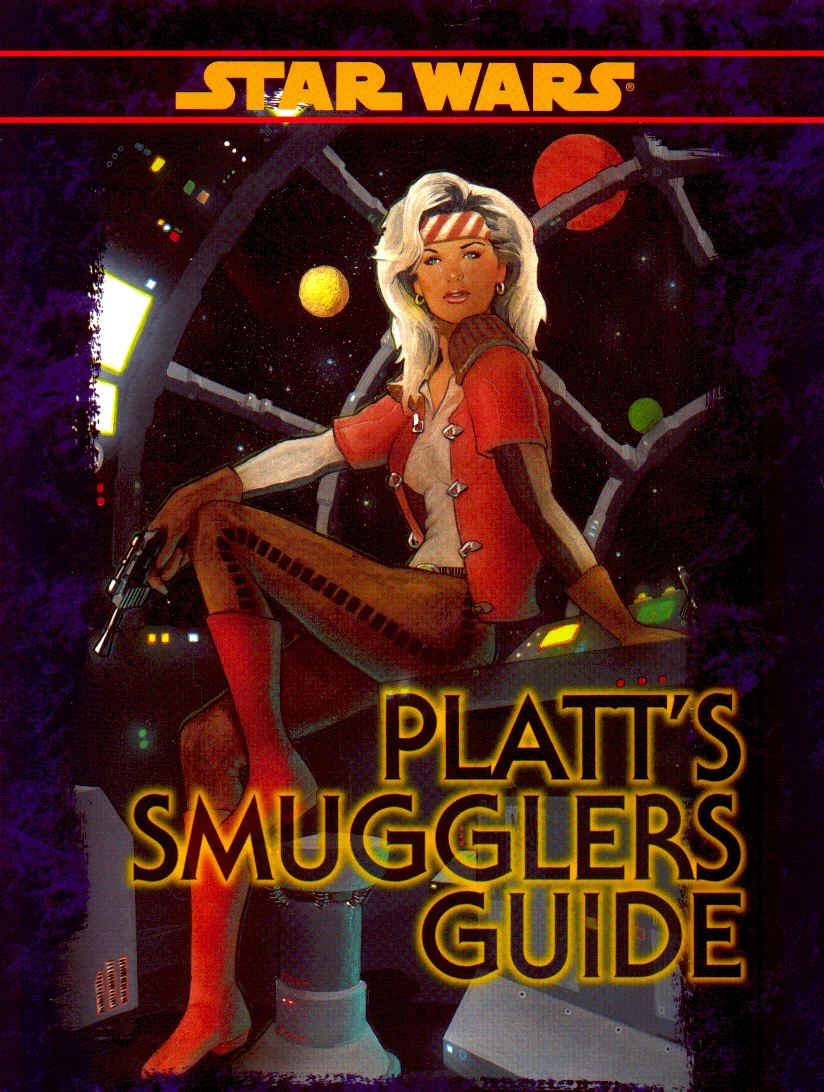
Platt's Smugglers Guide
Platt's Smugglers Guide
Star Wars Roleplaying Game Supplement
Design: Peter Schweighofer Development and Editing: Paul Sudlow Cover Design & Interior Graphics: Tim Bobko Cover Illustration: Matt Busch Interior Illustrations: Matt Busch (Platt Pencil), Storn Cook, Joe Corroney, Christina Wald Color Cards: Joe Corroney, Christina Wald
Special Thanks To: John Beyer, Kathy Burdette, Steve Luminati, Timothy S. O'Brien, Anthony P. Russo, David Schweighofer and Steve Miller (Clear Skies, Steve!)
Publisher: Daniel Scott Palter Associate Publisher/Treasurer: Denise Palter Associate Publisher: Richard Hawran Editorial Director: Peter Schweighofer Editors: Fred Jandt, Jen Selden, George Strayton, Paul Sudlow, Eric S. Trautmann Art Directors: Tim Bobko, Tom ONeill, Brian Schomburg Sales Manager: Jeff Kent Assistant Sales Director: Tim O'Brien Licensing Manager: Ron Selden Warehouse Manager: Ed Hill Accounting: Karen Bayly, Mary Galant, Wendy Lord Billing: Sue Hartung
Published by West End Games | RR 3 Box 2345 | Honesdale, PA 18431
TM or ® & © 1997 Lucasfilm Ltd. Title and character and place names protected by all applicable trademark laws. All Rights Reserved. Used Under Authorization.
Introduction
A Word From Platt Okeefe...
Since I entered the business, I've had to learn a lot on my own. Nobody taught me how to work a careful cargo deal or re-wire the ion drive control circuits using parts of a treadwell droid. I learned the hard way the best places to stash contraband, and how to misdirect inquisitive Imperial Customs officers. I made my own connections, usually after making a few enemies. A few folks helped me along the way, and even more tried to blow me out of the sky. I quickly learned that smuggling isn't one of the galaxy's easiest professions. It's filled with dangers: vindictive crime lords, crooked bosses, ruthless bounty hunters and inflexible Imperial officers. Unless you're entering the family business and have some parental mentors, you're on your own.
Not for long.
Take a look through my Smuggler's Handbook — a collection of background tidbits to help out fellow smugglers. I've covered several topics which can help liven up your illegal enterprises and get you out of trouble. Looking for work? I've listed some general kinds of employers, both legal and the less-savory kinds. Need a ship? Check out some of the myriad ways you can acquire one, some even without paying a single credit (though those tend to put large bounties on your head). Seeking supplies? You'll find an entire warehouse full of gadgets and gear to help you run a successful smuggling business, from spacesuits and cargo loaders to sleight boxes and cargo tracking devices. Looking for someone to help you out? I've provided a slew of contacts to help you out, plus some suggestions for making connections of your own. I know you don't need any more rivals or adversaries, but I've provided some for you here in case you need help making your own enemies. In every case I've tried to provide you with individuals who are typical of those haunting the hyperlanes...most of them I've even met myself.
Some Ideas for Players
Platt's Smuggler Handbook is a tool kit you can use to spice up your Star Wars Roleplaying Game characters. Smugglers have to worry about operating and maintaining their freighters, or else they're out of business. They use different kinds of specialized equipment, and rely on a variety of contacts to further their ambitions. They must dodge bounty hunters, crime lords, local security forces, Imperial troops, sometimes even their own angry employers.
As a player, where do you come up with all this background information? Sure, your gamemaster could choose it for you. But when you carefully pick all the pieces which make your smuggler a real character you can play, they fit together much better. A well-rounded character has many loose ends which can help out in a crisis, or can quickly become last-minute adventure hooks. If you know that your character has a few contacts in the underworld — a data forger, an infochant and a friendly starport official — you can call in a few favors to get you out of trouble. Smart gamemasters might capitalize on this, making a short episode or an entire adventure out of seeking the contact's help. Choosing your own enemies also helps...you can develop stories behind how you met them, and what you did to enrage them.
Of course, players are always looking for material about starships, new equipment, and additional character templates. You'll find those here, too. It's all part of making a character with a detailed background. Details of a character's distant past have a funny way of resurfacing during a good story. Roleplaying game characters shouldn't be any different.
Gamemasters, Read This, Too!
Usually Star Wars Roleplaying Game products feature "Adventure Ideas" and other gamemaster notes to inspire your imagination and help you infuse excitement into your campaign. Although this is a supplement primarily for players, it can also be a valuable gamemaster resource.
A Character Creation Menu
At first, you'll want to take your time and read this book carefully, perusing the various possibilities for your character. Once you've done that, you can use this book to quickly create a character's background by flipping through and jotting down some general notes on who you are and who you know.
Each chapter has a few "menus," lists of choices on everything from who your family was to what kinds of contacts you know. When other gamemaster characters are involved, general descriptions are provided with a specific character as an example. Your choices are shown in boldface text or as subheads so you can find them easily.
Every background element for a player character is an adventure hook for you. What happens when a smuggler character offends his powerful employer? How does a character go about finding (and paying for) all that special equipment that might not be perfectly legal? What happened to that contact the smuggler needed to find to get the right information, materials or services to complete the adventure? Who's competing with the character, and how far are they willing to go to stop them? Players take special care creating a background for their character. Don't let it go to waste. Your game will feel more realistic if you use elements from a character's past to influence his present.
In addition to using player character backgrounds for inspiration, you can use the elements from this supplement to add new depths to your own gamemaster characters. Giving them realistic motivations can make your own characters more challenging. Rather than becoming cardboard cut-out targets, they grow into live people with emotions and concerns the players may be able to use to their advantage later.
Just as anything you can use the players will eventually try themselves, so, too, can you enhance you game by using information available to your players.
Chapter One: Character Development
The young woman leaned against the observation deck railing, watching the small transports take off and land in the endless honeycomb of docking bays which constituted Votrad Independent Downport. In the command tower above her, traffic controllers monitored the ships, directing them to landing bays or giving them departure vectors. She'd been up there once on a school tour. Directing pilots didn't interest her — she wanted to fly one of those ships.
She had changed out of her academy tunic and into clothes she had secretly purchased: an outfit more suited to working on a freighter than attending boring classes. The clothes were a bit larger than she wanted — the vest reached almost to her knees, and her pants were tucked into the boots in a vain attempt to make them look like they fit. She'd hidden them and the rest of her gear near the gate to her family's residential compound. Nobody had noticed her school bag had been a bit more full that morning when she left. Nobody would have understood. The daughter of a prominent Brentaal trading house was expected to attend the commerce academy and become some important corporate drone in the family business. Not exactly the most exciting life. A few years behind a desk at school had proven that.
A breeze ruffled her white hair as she continued watching the transports. She had spent many afternoons here, tracking the tramp freighters as they blasted high into the atmosphere, or following the slowing descent of shuttles. Today she would do more than watch. Today she'd leave Brentaal.
A passenger shuttle landed in a nearby bay, its tail marked with the insignia of the Sullustan cruise liner, Starlite Cloud. Platt picked up the gear bag slumped at her feet, slung it over her shoulder and headed for the docking bays.
Becoming a smuggler starts with a dream. Maybe you want to be your own boss, or perhaps you just want to romp around the galaxy, getting into trouble and making a few credits. No matter what your motives are, you are still somebody before you start hauling contraband.
Before you start determining all the exciting things about your smuggling life — your ship, who you work for, all those useful contacts, and the hordes of rivals and enemies thwarting your plans — you need to figure out who you are to begin with. Where are you originally from? What was your family like? What kinds of jobs did you have?
To help you figure out who you were before becoming an infamous smuggler, use a copy of the "Smuggler Development Worksheet" at the end of this chapter. It has a few categories to guide you, plus plenty of space for your own notes about your background. You'll only fill out a few categories here: as you continue fleshing out your past and present, you'll jot down a few more notes.
Below you'll find a few basic guidelines for creating a character's background. You don't want to spend too much time here, especially since more exciting things await beyond...just one of the reasons you became a smuggler in the first place. If you're looking for more specific information on shaping your character's past, check out "Chapter One: Character Development" in Heroes and Rogues.
Not Every Smuggler's From Corellia
Where you come from sometimes affects decisions later in life. Some people enjoy their homeworlds and expect to live in a similar place once they've become successful. Others rebel against the ideals and attitudes of their home planet and seek places which are opposite. Some worlds will provide you with experiences you wouldn't get on others.
People become smugglers for many different reasons — you'll find some of those in "Chapter Two: Smuggler Origins." We're not all in this business because we're from Corellia, or Socorro, or Tatooine. Some of us are from orderly worlds with thousands of years of tradition and culture. There's still something there, though, that inspires us to venture out into the hyperlanes and haul contraband. It's different for everyone.
Here's a list of homeworlds you can choose from. It's not comprehensive, with only a short description and reference source if you need more information — but it will give you some idea of the many different systems you can call home, and the varied places you can grow up. Keep in mind that the planet you choose as your homeworld might have some bearing on your past occupations and your relationship with your family. If you come from an industrial world like Druckenwell, you're not going to be the last of a long line of farmers.
You Come From...
Bakura, an isolated Outer Rim world with mis-managed government bureaucracy has large exports in repulsorlift components. The Truce at Bakura Sourcebook.
Berchest, a planet of great natural beauty and crystal cities, survives on increased Imperial trade. The Thrawn Trilogy Sourcebook, page 108.
Bespin — and its main gas mining facility, Cloud City — is an independent colony which flourishes with its open trade in Tibanna gas and its first-rate casinos, hotels and entertainment businesses. Galaxy Guide 2: Yavin and Bespin.
Bilbringi consists of several rocky worlds which provide minerals for the massive Imperial shipyards orbiting Bilbringi VII. The Thrawn Trilogy Sourcebook, page 110.
Bonadan, an important factory world in the Corporate Sector, is highly industrialized and densely populated, at the expense of the now-polluted environment. Han Solo's Revenge.
Bothawui, the Bothan homeworld, is a center for corporate, clan and political intrigue. Shadows of the Empire Planets Guide, page 49.
Brentaal, the hub of commercial activity along the Core Worlds edge, is dominated by commercial starports, cities of warehouses, trade markets, financial markets and industrial centers. Star Wars Adventure Journal #7, page 218.
Byblos, a highly populated world dotted with clusters of city towers, is home to a manufacturing industry which supplies high technology and military items. Platt's Starport Guide, page 98.
Chandrila, a peaceful world of rolling plains and oceans, focuses its commercial activities on a thriving agricultural economy. Star Wars Adventure Journal #7, page 216.
Corellia, a system with several planets, has become more and more isolated, though its wily merchants and entrepreneurs can be found everywhere in the galaxy. The Corellian Trilogy.
Corulag, a model Core World fully loyal to the Emperor's New Order, is home to one of the Imperial military academies. Star Wars Adventure Journal #7, page 214.
Coruscant, the seat of the galactic government, contains every manner of bureaucrat, scoundrel and mercenary, from the very depths of its service tunnels to the upper spires of the most opulent apartments. The Thrawn Trilogy Sourcebook, page 112.
Druckenwell, in the Mid-Rim, is an industrialized, overpopulated urban world run by corporate guilds which have taken great care to reduce pollution and protect the planet's few remaining resources. Star Wars Adventure Journal #4, page 42.
Echnos, a domed city on a barren moon, is a high-tech haven for mercenaries and smugglers with no form of organized government. Star Wars Adventure Journal #4, page 176.
Esseles, another Core World, is a major center for manufacturing high-technology components headed for capital warships. Star Wars Adventure Journal #7, page 221.
Fondor, an industrial planet, is famous for the huge starship construction facilities in its orbit.
Gelgelar, a backwater swamp planet, is home to a small collection of fugitives, scoundrels, tired human shvash gas collectors and weary Sullustan mold farmers. Platt's Starport Guide, page 58.
Kaal, a water world dotted with island archipelagoes, sports a thriving entertainment industry run by a crime lady who caters to Imperial personnel on leave. Star Wars Adventure Journal #7, page 184.
Kashyyyk, the Wookiee homeworld, is a jungle world of immense trees, many levels, and great predators. It is currently under Imperial martial law. Thrawn Trilogy Sourcebook, page 120.
Kelada, in the Anarid Cluster, is home to a major Arakyd factory, plus facilities which produce repulsorlift components and walker assemblies for the Empire. Star Wars Adventure Journal #2, page 229.
Kothlis, a Bothan colony, is a major industrial center for Bothan corporations and other companies throughout the galaxy. Shadows of the Empire Planets Guide, page 72.
Kuat, home of Kuat Drive Yards Star Destroyer stardocks, is a maze of orbital construction and residential units for workers which surrounds a pristine planet where the elite live. Platt's Starport Guide, page 38.
Mon Calamari, a formerly Imperially dominated world, is home to the peaceful Mon Calamari species. The Mon Calamari support the Rebel Alliance with military star cruisers. Galaxy Guide 4: Alien Races, page 67.
Nar Shaddaa, the center of Hutt space known as the "Smugglers' Moon," is an urban haven for smugglers, criminals and other scoundrels. Dark Empire Sourcebook, page 85.
Ord Mantell, a former Old Republic ordnance/resupply depot, is now a busy spaceport, a common layover point for scoundrels and spacers alike.
Ralltiir, now under a strict Imperial blockade, was once a major banking center and financial market in the Core Worlds. Star Wars Adventure Journal #7, page 227.
Rhinnal, where honor and style play a major part in society, has a major medical academy and pharmaceutical industry. Star Wars Adventure Journal #7, page 224.
Rodia, homeworld to the Rodians, is a planet of dense, savage jungles contrasted with modern urban areas where offworlders conduct business in relative safety. Shadows of the Empire Planets Guide, page 6.
Ryloth, the Twi'lek homeworld, is a rocky wasteland of hidden Twi'lek cities ravaged by heat storms and slavers. Platt's Starport Guide, page 136.
Salliche, an agricultural planet in the Core Worlds, is home to the Salliche Ag Corporation, which administers 18 farming planets through a corporate and noble bureaucracy. Star Wars Adventure Journal #2, page 231.
Sesharile 5, with its crowded, run-down capital city of Gallisport, is crammed with massive industrial installations and inadequate residential quarters. Galaxy Guide 6: Tramp Freighters, page 67.
Socorro, a world of black-sand deserts, is a haven for free-traders, outlaws, and natives with a deep sense of honor, loyalty and integrity. Black Sands of Socorro.
Need More Homeworlds?
This isn't a comprehensive list of every planet in the galaxy. If you're looking for other alternatives, check out The Star Wars Planets Collection or the planets chapter of The Thrawn Trilogy Sourcebook. Pirates and Privateers has a short but useful list of fringe communities and shadowports on pages 116-119.
Sullust, now under the thrall of the Imperially allied SoroSuub Corporation, is the volcanic homeworld of the Sullustans.
Tallaan, a freeworld located on two major space lanes in Tapani sector, has an extensive array of orbital yards and space docks that the Empire uses as a major naval installation. Lords of the Expanse Campaign Setting, Sector Guide, page 36.
Tatooine, a remote desert world, is home to moisture farmers, Jawas, Sand People, and unsavory criminals and rogues who congregate in Mos Eisley spaceport. Galaxy Guide 7: Mos Eisley.
Vergesso Asteroid is a massive shadowport facility run by Ororo Transportation as a front for the criminal Tenloss Syndicate. Shadows of the Empire Planets Guide, page 32.
Family Life Isn't Always Great
Besides coming from some homeworld, you also came from a family (unless you're a member of a species that just spawns and doesn't raise its young). The attitudes of the relatives around you affect who you become. Like homeworlds, some families inspire their offspring to be like them, while others cause their children to rebel. The lack of family can also change your life: those growing up in orphanage institutions usually fight that kind of authority and indoctrination, while kids living on the street learn to fend for themselves and develop a hard attitude toward life.
Use the following menu to pick one or several conditions which might have applied to your family life. In some cases it might explain why you became a scoundrel who flaunts the law and laughs at authority. Your choice could also explain your demeanor, habits and beliefs.
Your Family Was...
Competitive. Everything you did was compared to something else: how much better your parents or siblings (if you have any) could do it, what the neighbors did, what local leaders expected of you. You were told to study and exercise harder so you could beat everybody else. This wore down your self-confidence, especially when you occasionally failed to meet everybody's expectations. You had little time to yourself. Your actions were always under scrutiny, and you grew tired of this needless competition.
Confrontational. Every family matter was solved by an argument. You couldn't even decide where to spend your holiday without yelling and screaming, with each side staunchly defending its position to the end. When you were at home, you were always arguing. The only peace you found was when you weren't around your family.
Enslaved or Imprisoned. Someone in your family, or perhaps all your relations, were enslaved or imprisoned. If they were enslaved, you might have been a slave, too. An imprisoned relative might have been ridiculed or derided by the rest of the family. Your family might have been reviled by others if the imprisoned relative harmed or embarrassed them. You grew up in disgrace.
In the Military. A family member served in one of the branches of the Empire's armed forces. If one of your parents was in a bureaucratic post, you probably moved around a lot. If a parent or sibling was in active service, you probably didn't see him much. Your imagination might have filled in when he was gone, making him out to be much greater than he really was. The parent or siblings left with you at home had a more significant influence on you. Alternatively, the family member might have served with the Rebel Alliance.
Too Busy For You. A member of your family was involved to some degree in local politics or business. Perhaps he (or she) held public office in the local government, or was an important exec in a large corporation. He might have just been active in local events, campaigning for change or backing certain political factions. Your parents were too busy to really pay much attention to you. As long as you didn't get into too much trouble, they let you do what you wanted. When they did show interest in you, it was to encourage you to follow their course: supporting their cause, pursuing their business's interests and devoting your life to something else.
Loner. Your parents ran away, or were killed by pirates, bounty hunters, Rebels or Imperials. You were all alone. Maybe you were adopted by another family (pick another category), or made it on your own in either an honorable or illegal profession. You might have grown up in an orphanage institution with other abandoned kids, a stark childhood rigidly controlled by the local planetary or Imperial government sponsoring the orphanage.
On the Run. Someone was chasing you and your family: pirates, bounty hunters, the Empire, crime lords. You moved around a lot, sometimes splitting up and heading off with one parent, other times going off on your own until you were reunited again. Along the way, you might have lost a parent or sibling to your pursuers. You met plenty of underworld contacts who helped you hide...some of them might not have been as honest as you would have hoped. You quickly learned to fend for yourself and take care of your family under diverse conditions.
Prominent. Your family was very important in some area. Perhaps your parents were prominent entrepreneurs or corporate execs. Maybe they were important Imperial personnel. They might even have been famous entertainers. You were always expected to live up to their ideals and behave as people of their stature. Their peers expected the best from you, too. You were dragged to official functions, dressed in fancy, uncomfortable outfits, and subjected to superior, narrow-minded attitudes. Your actions were under constant inspection.
Split-Up. Your family was fragmented by disagreement, war, or career. Sometimes you stayed with one parent, then the other. If you had siblings, they might have taken care of you, or you might have been responsible for raising them. Life was difficult, making ends meet, moving around to new places, getting used to living with different people. You had little stability.
Supportive. You grew up in an environment which supported you in every area. Your parents were concerned about your schooling and other activities, not for their benefit, but for yours. No matter how different your interests and goals were, they were always there to help out, or pick you up if you failed. Your siblings (if you had any) were also supportive. Growing up wasn't a matter of manipulative parents and jealous siblings — you were all on one team, and when you succeeded, everyone won.
Past Occupations
None of us started life as smugglers. Those of us who began young might only have been students, but most of us have had other professions. Some might have led us to become scoundrels. Smugglers sometimes have several jobs before they decide to strike out on their own.
Look over the general categories listed below. You might want to hold off choosing one or several until you've read the next chapter, "Smuggler Origins," and decided how you got into the business in the first place. Then it's easier to backtrack and pick a profession which might have led you to smuggling. For instance, if you ran away from home at an early age, you might only have been a student. If you started smuggling later in life, you might have been a farmer, technician and finally a spacer (one of the professions most likely to draw you into the underworld trade of hauling contraband).
Read over the careers below and pick one or several, depending on how old you were when you first began smuggling.
Before Becoming A Smuggler, You Were A...
Common Laborer. You had an average job, just like many other people where you're from. You might have been a miner, store clerk, factory worker, street cleaner, restaurant server, landspeeder sales associate, or a corporate drone. This was a ho-hum chore which paid your bills and kept you out of trouble. It wasn't particularly inspiring — you had lots of time on your hands to daydream and wish you were someplace else.
Drifter. No career was exactly what you wanted. You bounced from one job to another, trying your hand at many and not liking them much. As soon as you had enough credits, you drifted along to the next job you thought would change everything. Few of them were very respectable: you weren't around long enough to rise up any company hierarchy. Because you were a transient, you didn't make many friends, and few people trusted you much. You probably interacted with the lowlier elements of society.
Farmer. Maintaining a farm consumed your life. Even if you were just a hired hand, you worked morning to night, sometimes longer, planting and harvesting crops, repairing agricultural machinery and droids, patrolling the property, and taking care of livestock. Such a life didn't offer you many chances to get out and see the rest of the galaxy, so your views were somewhat limited. It's not an easy job, and many leave for greater careers elsewhere.
Fugitive. You're on the run for something you did (or someone claimed you did). Like the drifter, you travel a lot, but you move on when your pursuers discover your new location. You could have been chased by bounty hunters, the Empire, sector law enforcement agencies, crime lords, or a powerful rival. Since you moved around often, you relied on fringe society to travel in secret: free-traders, smugglers, petty criminals. If your crime was supporting the Alliance, you might have found sanctuary on a Rebel safe world — but even these are discovered by the Empire....
Prisoner. You spent part of your life in prison for something you did (or someone claimed you did). If you were wanted by the Empire, you might have been incarcerated on a prison planet like Kessel or Sevarcos. A crime lord could have locked you up in a filthy dungeon beneath his stronghold. Local authorities might have kept you in the planet's prison, or on a savage penal colony far from civilization. You must decide whether you were freed once your sentence was served, or you escaped somehow. Either way, you might have made contacts with other prisoners with ties to the criminal underworld and spacer community.
Scoundrel. Making an honest living didn't appeal to you, so you joined the ranks of low-life who plague society. Maybe you were a con artist, swoop gang biker, thief, racketeer, gambler or black marketeer. You might have worked for a petty crime boss, or maybe a larger criminal organization. You came into contact with other scoundrels in other lines of work. Perhaps your involvement in this profession led you to become a fugitive or a prisoner.
Soldier. A career in the military might have meant any of many jobs: starport security guard, mercenary, Imperial trooper or naval officer, crime syndicate enforcer, CorSec agent, even a Rebel soldier. You were trained to use many weapons in a variety of combat and patrol situations. Most of the people you met were soldiers, too, and you made some good connections among your comrades.
Spacer. You piloted a starship for a living. Perhaps you worked for yourself as a legitimate free-trader, or signed on with a larger shipping corporation. You might have served with the Imperial or Alliance military as a fighter or transport pilot. During your journeys you visited many ports and interacted will all kinds of starport support and security personnel. You even met a few smugglers who might have inspired you to enter that trade on your own.
Student. You were enrolled in a local institution or a much more prestigious university. As a child, you might have attended a community or planetary school run by the system government, COMPNOR or a trade organization. At an older age, you might have studied at a trade school, like the Brentaal Commerce Academy. If you pursued collegiate courses, you could have attended the Rhinnal Medical Academy, Byblos University, or joined the ranks of the Empire at the Raithal Academy.
Teacher. Part of your life was spent sharing what you learned with others. Like the student, you could have served at schools at any level: local, professional or Imperial. If you worked at an academy or university, you might have had to undertake research projects to secure your position. This gave you an occasional opportunity to leave the classroom and travel a little to pursue your own interests.
Technician. You spent much of your time fixing things: factory assembly lines, starships, home appliances, droids, repulsorlift vehicles, or computers. Your employer could have been anyone from a large corporation or the Empire to a small repair bay owner or a crime boss. You might have made some connections with clients and fellow technicians.
On to Smuggling....
Hopefully the choices you've made here will help define what kind of a smuggler you'll be. Spend a few minutes filling in a copy of the Smuggler Development Worksheet. Jot down a sentence or two describing each phase of your background. Keep the other categories open — you'll fill them all in soon enough. Once you've begun the Smuggler Development Worksheet, you're ready to move on to "Chapter Two: Smuggler Origins" and discover the circumstances under which you decided (or were forced) to make your living hauling contraband.
Chapter Two: Smuggler Origins
Platt bid a fond farewell to the Ravelev's crew. Working aboard the transport had given her a taste of the free-trader's life. She had served aboard Captain Kassler's freighter for two years, and as a cabin steward aboard the Sullustan starliner for two years before that. Once again it was time to move up in the galaxy.
They had landed in Boztrok starport, out at the far end of the Hydian Way just before the Corporate Sector. Kassler was reluctant to let her off here, but Platt assured the grizzled old spacer she'd be fine on her own. She claimed she'd find work in the starport so she could save up her credits to buy into a freighter of her own.
Instead, Platt was going to join the Klatooinan Trade Guild.
She had been impressed by the Guild's operations on Voorlach. Everyone seemed in good spirits, with plenty of credits to spend and decent living arrangements. One of the loading roustabouts there had recommended she join the Guild as a transport pilot. Platt was hesitant at first, but the loader said the Guild provided freighters in return for a few years of service. Platt wanted a ship of her own more than anything.
The one time she mentioned the idea of joining the Guild, Captain Kassler warned her against it. He claimed the union all but enslaved their employees, chaining them with debt, obligation and blackmail. The Klatooinan Trade Guild was a quick ticket to misery, he said.
But the lure of her own freighter was too great.
After exchanging farewells with her former crewmates, Platt set out to seek her fortune. She meandered through the tunnels and bridges connecting the starport, following directions a Guild security soldier had given her. The massive tower of Pok Nar-Ten, the Guild representative on Boztrok, seemed to have docking platforms sprouting from the sturdy walls like some strange tree. She noticed a few light freighters berthed there — one of those is mine, Platt thought.
The arched entrance was wide open, so Platt just strolled right in. Freighter pilots, cargo handlers, guards and mechanics jostled their way through a central hall. A passing spacer directed Platt to the doorway which led off to Nar-Ten's audience chamber.
As Platt approached the dimly lit sanctuary, an Advozse with a cloth wrap covering much of his horn moved to intercept her. Nar-Ten's major domo inquired about her business, took some notes on his datapad, then led her by the hand into the chamber.
Pok Nar-Ten sat in splendor beneath a lofty dome. The Nimbanel was decked out in the finest robes this side of the Outer Rim. His desk was little more than a diminutive table next to his ornate greel wood throne. Everyone — courtiers, data-crunchers and discreetly armed guards — looked up from their work to stare at Platt.
The Advozse major domo led her into the center of the chamber, where he bowed low before Nar-Ten and extended his arm, inviting Platt to speak. She put her hands on her hips and forced a confident smile. "My name's Oakie," Platt lied. Captain Kassler taught her the value of using a false name now and then. "I hear you're hiring freighter pilots."
The entire hall burst out laughing — a twisted grin bloomed on Pok Nar-Ten's snout. When the commotion calmed down he spoke. "The Guild is always seeking experienced pilots willing to serve its purposes," he said. "What experience do you possess?"
Platt told of running away from Brentaal, her service on the starliner and her latest tour of the Anarid Cluster on the Ravelev, adding a few embellishments along the way. Platt watched the Nimbanel as she spoke, noticing an air of opportunity and cunning about him — a spark of appreciation in a keen entrepreneur, or perhaps the darker ambitions of a manipulating master, she wasn't sure.
When Platt had finished, Pok Nar-Ten chuckled to himself. "Would that Captain Kassler knew you were here, the miserly fool would storm the tower and try to rob you of profitable employment."
He nodded to the majordomo. "The Klatooinan Trade Guild would be privileged to have such an esteemed pilot as you transporting its cargo," he declared. "I'll have my assistant Gjeel assemble the proper datawork." Pok nodded toward the Advozse who had ushered her in. "Once the contract has been imprinted, you'll be an official Guild member, and the captain of a fine light freighter. I have the perfect one in mind."
Platt couldn't wait.
Everyone has a story telling how they entered their line of work. In the regular world, this often involves searching for a job, passing several trade exams, slaving away at some boring occupation, and waiting for your superior to move on before you get promoted into his position. Luckily, those of us in the fringe have much more colorful tales of how we became smugglers.
Usually there's one life event which sends us along a new path toward who we become. If you can summarize that defining moment in a short anecdote, it's easier to explain to other people (and more interesting, too). That's a quick way to help express who you are and what you're about. Sometimes this is motivated by our own choices. Our goals can take us down some pretty rough roads. Obstacles can sidetrack us, and ambitious enemies can send us along a different course.
Perhaps your decision to become a smuggler wasn't really your choice, but was forced upon you by others. Crime lords, slavers, loan sharks, corrupt Imperials and bounty hunters are always setting our lives on new, exciting and often dangerous paths. In our business, we are often bound to these low-life antagonists by sheer need — they have the credits, power and connections we so desperately need to survive.
To help you determine your own background story, you need to answer two major questions: "How did you get into the smuggling business?" and "Who do you work for?" Let's start by answering the first question.
Shouldn't My Gamemaster Read All This?
Gamemasters should read everything, if not to keep up-to-date on new information, then to glean inspiration for her games. The main reason to read this section is to become familiar with different employers so she can be ready to integrate them into her campaign. A story becomes much more interesting when elements from a character's past show up — like that Klatooinan Trade Guild enforcer team which just happens to show up to collect at the worst possible moment.
Building an interesting character is not just the player's job. Your gamemaster plays a large role in character development, too. What's the use of saying you work for the Klatooinan Trade Guild if it never figures into the game? Your employer might be the basis for an entire adventure, or might only figure into the background. It's the gamemaster's responsibility to be familiar with all the hard work you've put in developing your character's past.
Then why should you, a player, be reading all this? It gives you more background to help shape your character — use it to suggest possible employers, situations and misadventures your gamemaster can integrate into your campaign. If your character works for a loan shark, you're going to be a lot more credit-conscious than someone smuggling on the side for a large, well-funded corporation. If you choose one of the employers given as examples (or use someone like them), you have someplace to go to when you need some extra credits, a big favor, or help pulling you out of some Imperial entanglement. You have a specific name to bring up in the game: "Look, if we don't deliver this shipment, Dessiva and the Klatooinan Trade Guild is going to tell every bounty hunter in the Outer Rim about us."
How Did You Get Into Smuggling?
Smugglers don't get their start the way other people acquire jobs. A few enter the profession by choice, but most are dragged into it by unfortunate circumstances. I've known quite a few smugglers in my day, and it seems no two have the same story to tell.
Below I've summarized some of the more memorable smuggler "origin stories" so you can draw on them for inspiration. Of course, I've omitted the actual names and put you in their place. Choose a few which go best with the background elements you determined in the previous chapter, then jot down the short headings on your "Smuggler Character Development Worksheet."
Employer Encouragement: You started as a freighter captain for a legitimate shipping company. One day you found some cargo that wasn't on the manifest. When you delivered it, the buyer gave you a rather large "tip." You asked your employer about this, and he in turn asked if you wouldn't mind slipping some contraband through customs with the rest of the cargo...for a substantial bonus, of course. The extra money wouldn't hurt... Now you make smuggling runs regularly. Sometimes you haul legal cargo, but it's usually a cover for the illegal goods you're carrying. As long as you don't get caught and don't rat out your employer, you've got a lucrative job.
Escaped Slave: You spent part of your life as a slave, but managed to escape — either on your own, or with the help of fellow slaves or a sympathetic slaver. Perhaps you fled in the ship you currently fly, or you took something valuable along that helped you purchase your freighter. You turned to a life of smuggling to survive. You might still be pursued by bounty hunters intent on capturing an escaped slave. Now you move around the galaxy, making enough credits to survive, and always watching your back. If you're really ambitious, you might be seeking revenge against your former master, or waging a campaign to free all enslaved beings.
Exiled: You fled your homeworld, despised by your family, clan, people or government. Perhaps you just didn't fit in with what was expected of you. Maybe you were unjustly accused of a crime, or had violated some old tradition which had long ago lost its meaning or usefulness. You cannot return home until you clear your name. Unwilling to settle down anywhere else, you wander the hyperlanes, making deals, saving some credits, and carefully plotting your return.
Family Business: Taking up smuggling was a family matter. Your parents bequeathed the business to you — if you have any siblings, they might be smugglers, too (or more likely your competitors...). You inherited your ship, along with the family's debt, bad reputation and unsavory business contacts. Although you're trying to make a good name for yourself as a smuggler, your family's failures always seem to drag you down.
Fleeing a Dead-End Job: Adventure! Excitement! Your hum-drum job offered none of these things. Grabbing your life savings, you bought an old freighter and set out to make a name for yourself as a smuggler. The holos made it look so easy. Now you have a little too much adventure and excitement. If you manage to survive the next Imperial Customs inspection, maybe your buyer won't show up with all those bounty hunters to take your cargo without paying. If you don't score big on this next run, that crime lord you borrowed all those credits from is going to demand a larger payment...your head!
Illegal Is More Profitable: You began as a law-abiding transport pilot. The pay was okay. Then you discovered you could slip a crate full of contraband through customs with the rest of the legitimate cargo. If you found the right buyer, you made substantially more money. You decided to abandon your real job in favor of far more profitable smuggling. Sure, it's more dangerous, but you've managed to make it work. Unfortunately, you don't get the same benefits as if you were with the transport corporation...
Indentured to Power: At some point in your past, a powerful individual saved you (or your family) from certain doom, lifelong imprisonment, an embarrassing situation, or financial ruin. In return for rescuing you, this person demands a lifetime of favors. Most of them involve smuggling contraband, sensitive information, or wanted individuals across the galaxy. If you didn't have a ship before, your master has provided you with one. A small stipend of 1,000 credit a month helps you along, but sinks you further in debt. Although you have a certain degree of freedom in your own shipping activities, you must always do your master's bidding when he calls. Should you go rogue, your master would hunt you down so you can pay your debts in full....
On the Run: You're wanted by the Empire, a powerful crime lord, a sector government, a galaxy-spanning corporation, the Hutts, or any number of vindictive groups. Pick one (or several). Maybe you really offended them, or perhaps you were framed. Smuggling allowed you to make a few credits without settling down. You're always on the move — you're not tied to any one location. When your enemies arrive, it's not too much bother to blast off and flee. You've used the measly few credits you've managed to save to upgrade your ship with additional armor and weapons to fend off your pursuers. Don't stay in one place for long — someone's always on your trail.
Out for Revenge: Someone in your past inflicted a great injustice on you or your family, one which changed your life forever. Now you seek revenge. You don't want to descend into the dark profession of bounty hunting — you can't kill others for money. Smuggling offers the mobility, contacts and extra money you need to carry out your vengeful plans. You might also be fleeing the authorities, or unable to return home because you're an exile.
Pirate Loot: When your successful pirate group disbanded (or was destroyed...), you took your share of the loot, bought your own ship, and started your own freight business. Using your numerous shadowport and pirate contacts, you soon found yourself smuggling illegal merchandise for your old friends. Unfortunately, this business has many large expenses, and your pile of loot ran out long ago. Perhaps you banded together with other smugglers, or joined a crime lord to stay in business. Where once your pirate contacts owed you favors, now you owe them favors, credits, and perhaps your life.
Rebel Cover: The Rebel Alliance needs help to defeat the evil Empire. You're no soldier, just a smuggler with a freighter. To join the Rebellion outright would ruin your reputation and make you an Imperial fugitive. Still, the Rebels need help transporting supplies, operatives and secret data past the Empire's watchful eyes. There's no better way than to smuggle them. Between your regular jobs, your slip in a cargo run for the Rebels. They don't pay very well, but you get the satisfaction of helping to bring down the Empire.
Smuggling As A Hobby: You're already rich, but very bored with your pampered life. You've seen holos about legendary smugglers, and decided to give the profession a try. Having lots of money has helped you avoid the usual pitfalls of the industry — massive debt, eternal starship payments, and service to unsavory individuals — but it has earned you anger, jealousy and spite from your peers, crime lords and Imperial officials. Perhaps your unsavory new profession has also caused your family, noble house or government to brand you an outlaw. What once was a hobby has now become a rather perilous way of life.
Stowaway: You managed to stow away aboard a smuggler's ship to pursue your dream of an adventurous life among the stars. After you were discovered, the captain put you to work on her ship. She taught you everything you know about sneaking contraband around the galaxy. You were inevitably involved in some activities which earned you a reputation as a smuggler: blasting out of a starport, providing cover fire against Imperial stormtroopers, accompanying your captain to an audience with her powerful crime lord boss. You might still be working with that captain, or might have earned enough money or bravado to set out on your own.
Wanderlust: All your life you've wanted to explore the galaxy — not just discover new planets, but see new cultures, peoples and starports far from your homeworld. Smuggling allows you to roam the space lanes at will. You interact with a colorful variety of underworld contacts, blast your way out of tense situations, and land in starports of every description. You're always one step ahead of massive debt, Imperial stormtroopers and bounty hunters, but you've never had a dull day.
Who Do You Work For?
Everybody has to work for somebody else. Even if you are master of your own junky freighter, you still need to haul another person's cargo to make a living. Smugglers are at the mercy of the transport market. We go where the work is. Don't give me that "I take orders from only one person — me" nonsense. If you need the cash, you'll take a calculated risk for almost anyone. Well, maybe not the Hutts....
Exactly whose cargo you transport is your decision, unless it was determined by someone else in your shady past. Some smugglers are tied to an organization out of convenience or obligation. Most shipping companies dabble in conveying contraband through their legitimate tramp freighters. Corporate benefits and the promise of steady work are strong incentives. If you've indentured yourself to the Hutts, the Klatooinan Trade Guild, local crime bosses or loan sharks, chances are you're in with them for life. If you manage to get out of your contract, even legitimately, they'll probably hound you the rest of your professional career.
Those smugglers with more freedom hop from one employer to the next, accepting work from whoever's paying the most. They'll take a shipment from a drop point agent one week, haul custom repulsorlift parts for a well-funded swoop gang the next, then top it off with a run for an Imperial Moff in exchange for a favor. This is really the life of a free-trader, though I'll admit it takes a lot of work to pay off the debts and remain relatively independent.
I've compiled a list of several common kinds of employers, with a little general information about each. If you need more than the brief overview here, you can look up some of the other sources I've listed. Each category also provides a specific example of somebody you can work for, with any references to others who often employ smugglers. Although these individuals are tied to specific locations, others like them run similar operations throughout the galaxy.
Drop Point Agent
Most free-traders make their living from drop-point deliveries — transporting goods from one place to another in a specified amount of time for a pre-determined fee. These cargo runs originate and end in starport docking bays and dark warehouses. They're arranged by seedy individuals commonly called drop point agents.
These middlemen have a specific cargo they need you to deliver to a particular contact elsewhere. This week it might be fenti beans to a farmer on Gelgelar, next week a few crates of gaudy artwork to a dealer on Sorfina, and the next week a few boxes of blasters to some mysterious Mon Calamari on Ralltiir. It's not steady work, nor is it very safe, but it beats chaining yourself to a contract with the Hutts.
Smugglers who depend on this kind of work typically know a few drop point agents along their usual routes. The agents pay fees based on tonnage, estimated days in transit and loading, and the rating on your hyperdrive. Standard pay is 10 credits per ton, per day, based on a x2 hyperdrive. Fees typically go up to 20 credits if you're lucky enough to have a x1 hyperdrive. You can get bonuses for quick delivery or navigating certain hazards, but don't count on it for every cargo run. Agents pay half up front, then issue a voucher for the other half, either paid by the receiver, or signed by the receiver and redeemed with the original agent.
Drop point agents often work for someone higher up the economic food chain. They're charged with routing small cargoes to specific clients. Many shipments are legitimate, though these often hide small bits of contraband. Some freight is illegal — agents often offer more credits for hauling it, but the risk is often twice as high as the extra fee.
Powerful drop point agents manage their own warehouse where clients discreetly drop off cargoes and the agent handles transport deals with free-traders. They keep a few roustabouts on hand to load cargo and make sure the transient smugglers don't get out of hand. Those with influential backers will hire bounty hunters to track you down if anything happens to their precious cargo.
Check out Galaxy Guide 6: Tramp Freighters, pages 10-11, for details on finding drop point delivery jobs and the fees associated with this work. If you're looking for a specific drop point agent, try looking up Brack and Vleen, who run a vohis mold warehouse and the Shvash Gas Cooperative (Platt's Starport Guide, pages 65 and 67).
Vowluss, Whiphid Drop Point Agent
The Off-Worlder's Quarter of Ropagi II is packed with landing bays and warehouses. One of those storehouses is operated by Vowluss, a burly Whiphid drop point agent. His distribution center is a cavernous building packed with disorganized mounds of crates and barrels. Despite the chaos, Vowluss always seems to know exactly where certain cargoes are piled. A small squadron of worker droids and load lifters help move things around, and at least two cargo skiffs are kept around to transport cargo to and from docking bays. Large sliding bay doors stand at each end of the warehouse. They're the only way in or out.
Vowluss hires a variety of unsavory-looking roustabouts to transport cargo around the starport and provide protection. They're from several alien species known for their brute strength — Barabel, Sludir and Wookiees are the most common. They always seem to be having a bad day, and are more than willing to inflict it upon you, too. The roustabouts all carry sidearms, though they're always ready to break some heads with their crate hooks. Vowluss keeps them around mostly because the droids won't get mad at arrogant smugglers.
Vowluss has an office in one corner of the storehouse. It's little more than a prefab colony shelter with a few broken windows so the Whiphid can hear what's going on outside. His desk consists of empty cargo crates with a piece of plastiboard across them. He sits on a chair piled with furs, and animal hides line most of the walls behind him (no doubt decor based on that of his savage homeworld, Toola). A few fur rugs on the floor — conveniently placed where his smuggler captains stand during negotiations — might conceal a trap door or two. Don't let the office's cluttered appearance fool you — there's definitely some kind of secret escape route out of there, and the wall hangings probably conceal a few weapons.
Stick around Vowluss's operation and you'll figure out the Whiphid reports to someone higher. Every month or so a few shady Bothans show up, disappear inside the office, inspect a few piles of cargo, then leave. If he's not in his office making deals in person or over the comm, Vowluss is striding around the warehouse, making sure crates are routed properly, loaded with care, and protected with plenty of muscle. He's fair but firm with his workers, though this business philosophy rarely carries over to his dealings with free-traders. Vowluss is always conscious of how much things cost, how quickly you can ship a cargo, and how much you expect in bonuses.
Vowluss's warehouse is pretty busy. If the skiff crew isn't loading up crates headed for some outbound tramp freighter, they're unloading boxes just in from some docking bay across town. Cargoes don't sit around his depot for long. He easily works deals with at least 10 freighter captains a week.
Although he doesn't keep them on the steady payroll, Vowluss has been known to hire bounty hunters to track down errant smugglers. He doesn't allow this to happen often. The Whiphid is very choosy about the folks hauling his cargoes, and maintains a stable of reliable spacers he can call on to make special shipments. When Vowluss hires the hunters to recover a cargo, shipping fee or wayward spacer, you know his hairy hide is on the line with the boss.
Vowluss
All stats are 2D except: Dexterity 2D+1, blaster 4D+1, dodge 3D, Knowledge 3D, business 5D, intimidation 4D, streetwise 4D+2, value 5D+2, Perception 4D, bargain 6D, con 5D, Strength 3D+2, brawling 5D+1.
Move: 10
Special Abilities: Claws inflict STR+1D damage
Character Points: 4
Equipment: Blaster carbine (5D), comlink, datapad
The Empire
Imperial lackeys come in all shapes and sizes. Not all of them wear stormtrooper armor and stomp around in walkers. Occasionally the Empire requires someone with specialized skills: bounty hunters, outlaw techs and even smugglers. Imperials can be employers, too. Look what the Empire's done for the bounty hunting business. While they won't always admit it, the Emperor's servants often hire outsiders better suited to enforcing their will. High Imperial officials use smugglers to sneak cargoes, personnel and data through hostile areas, past rival political factions and into the hands of less-than-savory allies. Sometimes this transport work is for official Imperial business, but it's more frequently for their own hidden agendas.
Imperials just don't go out and hire spacers in seedy starport bars. They're among the most discreet employers because they have such massive reputations to maintain. They send their own servants, or carefully disguised spies. Only on rare occasions are Imperial smugglers invited to the consul-general's estate for a personal audience. While the initial arrangements are discreet, cargo delivery to the smuggler is usually carefully guarded by stormtroopers or hidden Imperial agents (depending on its value).
Working for Imperials doesn't always pay well. They're fond of blackmailing their smugglers and keeping them on a tight leash with limited credits, spice or illegal starship modifications. Given the chance, they'd much rather have you owe favors to them. Many find spacers they'd like to hire and send the local Imperial officials after them. Then the employer (usually someone higher up, like a Moff, prefect or consul-general) steps in to save the smugglers' skins. In return for his assistance, the Imperial asks the spacers for a little favor to run some sensitive cargo.
And whatever you do, don't get them angry. The Empire is notorious for altering deals or reneging on them altogether. Only the Hutt crime syndicate's grasp comes close to the power and scope of the Empire.
The good news is that cargo runs for the Empire are easier. The freight is usually small in volume — a classified datacard, an important ISB agent, a strange bit of technology — allowing you to haul some extra crates to make a little money on the side. Most of the time you're mysteriously exempt from Imperial harassment. Your employer often doles out official Imperial Customs holoseals like candy, and provides you with all the authentic data permits you need to make the delivery. If you're lucky, your employer contacts other Imperials at your destination to provide assistance — at least until the cargo is delivered.
Governor Jerrod Maclain, Imperial Employer
The governor of the Core Worlds system Brentaal is in dire straits. Since he was posted to the trade world, he has made a small fortune on stock tips from Brentaal Houses courting his favor. Instead of inflicting the Emperor's will on the inhabitants, the Governor has immersed himself in local tradition and business. Along the way, his success has made him the target of other Imperials — area customs officials, governors of other Core Worlds systems, even his own lesser administrators — all of whom want a high post on Brentaal so they can make fortunes, too.
Lately the Governor has hired several groups of independent spacers to haul cargo for him. Each transport run has some secret purpose related to his trade activities on Brentaal or his attempts to waylay the adversaries gunning for his position. Sometimes smugglers follow tips in markets far from Brentaal. Why wait for a small shipment of valuables from the Outer Rim to hit the market when the Governor can hire some free-traders to acquire and import his own stash? A few cargo runs send precious goods to Maclain's allies to keep them happy. Sometimes spacers are used as diversions to keep the Imperial Customs forces busy while another smuggler team runs the real cargo (though he only pulls that trick on spacers he wants to eliminate). The Governor rarely blackmails his free-traders, though he's known to keep a record of any important information just in case. He pays in hard credits, and rewards loyal smugglers with expensive cargoes or stock tips they can make money on themselves.
Governor Maclain has several high-level officials on Brentaal working on his side. He shares some of his wealth with the starport administrator, ensuring several secure docking bays are maintained. The local ground transport guild is in his pocket. The Governor is also on very good terms with any Imperial Navy units which are stationed at or wander through the system — lavish parties and expensive gifts can win the hearts of many Navy captains who've been in space too long.
The Governor's reach is not total. The local Imperial Customs officials despise him. Since it is known that many local free-traders take on jobs for Maclain, the inspectors give all spacers (local or not) an especially hard time. A few low-level controllers in the starport work for the Governor's enemies. They report on the activities of any spacers suspected to be on Maclain's payroll. It wouldn't surprise anyone if the Governor's enemies had agents working on almost every level of the Imperial government there. (For more information on the Governor and Brentaal, see "Into the Core Worlds" in The Official Star Wars Adventure Journal #7.)
Governor Jerrod Maclain
All stats are 2D except: Dexterity 3D, blaster 4D, dodge 3D+2, Knowledge 3D, bureaucracy: Imperial 5D+2, business: Brentaal Trade Houses 6D+1, cultures: Brentaal 5D, law enforcement: Imperial 5D+1, streetwise: Brentaal 4D+2, value 4D, Perception 3D, bargain 4D+2, command 5D, con 4D, persuasion 4D+1, Strength 3D+2, Technical 2D+1, computer programming/repair 4D.
Move: 10
Equipment: Comlink, decorative gold pin (worth 4,000 credits), fancy walking stick, hold-out blaster (3D+2)
For some other examples of Imperials who could use some smuggler help, look up Prefect Eugene Talmont on Tatooine (Galaxy Guide 7: Mos Eisley, page 24), General Harrid Sendo on Coruscant (Shadows of the Empire Sourcebook, pages 29-30) and Consul-General Dandamont Pring and Lt. Commander Tammok on Bothawui (Shadows of the Empire Planet Guide, pages 54-56).
Klatooinan Trade Guild
While you'll rarely work directly for the Hutts, the Klatooinan Trade Guild is the closest you'll ever want to get. The Guild is a front for many Hutt enterprises, including smuggling, loan-sharking and slaving. The Klatooinans run it more out of service to their Hutt masters than out of any business sense of their own. These days other aliens and humans run it, often using Klatooinans and other Hutt slave species as heavy labor and enforcers.
The Guild has enclaves within Hutt Space and throughout many sectors in the Outer Rim Territories. These operations can take many forms. Some are actual complexes of warehouses, landing pads, repair bays and starport services. Others are simply docking bays secretly purchased by the Guild, or those whose owners are part of the Guild's protection racket. When convenient, the Guild bullies local crime bosses into submission, appropriating their resources to support their own smugglers. If intimidating Klatooinans won't convince a small-timer to join, the vast wealth of the Hutts often does the job. Those who don't give in to one or both of those incentives often find their operations subject to mysterious accidents, financial ruin, or acute Imperial scrutiny.
Spacers working for the Guild are first evaluated by a representative, then sign their lives and possessions away in the infamous "Free-Traders Responsibilities and Liabilities Agreement." The contract promises smugglers certain benefits: downpayment loan on a starship of their choosing (to be paid back with interest), use of Guild facilities and services, employment opportunities through Guild shipping agents, and access to a network of contacts.
In return, spacers owe the Guild a generous percentage of their profits as "dues." Any credits borrowed must be paid back at an outrageous interest rate — and the Guild's enforcers are no slouches when it comes to collecting. Members are expected to use Guild starport facilities when available. Here you can get services at a discount. These complexes also include spaceport bars, hotels and casinos where you can conduct business and pleasure under the Guild's watchful eye. These areas are also closely guarded by the Guild's ever-present enforcers. Escorts are available to guard your starship and cargo. The Guild also makes arrangements to avoid Imperial and local intervention in its operations.
Joining the Guild has a few benefits and many disadvantages. On the plus side, the Guild has plenty of credits to loan you, provides safe starport facilities in many systems, and always has cargo for you to run (though it's mostly contraband). If you stick it out long enough and make the right connections, you may even move up in the Guild hierarchy. Unfortunately, your chances of doing this are slim, and you have a lot going against you in the beginning. The down side of Guild association is that it controls where you go and what jobs you transport, always looks over your shoulder, and has no qualms sending a few enforcers to collect this week's exorbitant loan payment. These people own you for life — don't cross them or you're likely to lose it.
For an example of a Klatooinan Trade Guild outfit, check out my "Smuggler's Log" in Star Wars Adventure Journal #11.
Dessiva Rasch, Klatooinan Trade Guild Agent
The moon Gall and the surrounding Zhar system are the Empire's main formation and deployment point for fleet operations in the Outer Rim's Cadavine sector. Despite the strong Imperial presence, the Klatooinan Trade Guild maintains a small outfit in nearby civilian starport. The local Guild representative — an attractive and deadly woman called Dessiva Rasch — provides protection to a cluster of docking bays which offer safe havens and cheap services for Guild smugglers.
Guild presence here isn't as obvious as other places. The area is always patrolled by several pairs of burly Klatooinan mercenaries armed to the hilt. They're around to oversee the Guild's interests and make sure the local docking bay owners pay their protection fees on time. Dessiva herself appears one or two times a week to check in with particular smugglers and make sure everything's running smoothly. Otherwise she leaves shipping instructions on datapads which the local docking bay owners hand out. The Klatooinans handle all the money, doling it out when spacers deliver cargo, or showing up to collect it when a freighter pilot's loan payment is due.
Although it's located in the heart of an Imperial enclave, the Guild operation on Gall is always busy. Contraband for bored Imperial troops flows in, and "misdirected" Imperial resources flow out. Guild members rarely experience problems flying in or out of the Zhar system. Somehow Dessiva has arrangements on this end covered. Unfortunately she can't always guarantee clear skies on the other end of a cargo run.
Dessiva rarely goes anywhere without at least four of her Klatooinan bodyguards. She dresses in a conservative business tunic and carries around a large datapad to keep track of transactions. Don't let her professional exterior fool you. Many spacers suspect her cold and business-like demeanor comes from Imperial Security Bureau training, though nobody can confirm it. Some believe she has contacts inside the Imperial enclave, or works for the Empire herself. How else could such an operation continue right under the Imperial Navy's nose?
Dessiva Rasch
All stats are 2D except: Dexterity 4D, blaster: hold-out blaster 7D+2, dodge 5D+2, pick pocket 5D, Knowledge 3D, bureaucracy 4D, bureaucracy: Imperial 5D, business: Klatooinan Trade Guild: 6D, law enforcement 5D, streetwise 5D+2, Perception 3D+2, bargain 5D, con 6D+2, con: disguise 7D+2, forgery 5D+2, investigation 5D, search 4D, sneak 6D, Strength 2D+2, Technical 2D+2, computer programming/repair 5D+2, demolitions 4D, first aid 4D, security 5D.
Move: 10
Character Points: 9
Equipment: Comlink, datapad, 2 hold-out blasters (3D+2), tagger (from Fantastic Technology, page 62)
Dessiva's Klatooinan Enforcers
All stats are 2D except: Dexterity 4D+1, blaster 6D, brawling parry 5D+1, melee combat 5D+2, melee parry 5D, intimidation 4D, streetwise 3D, Mechanical 3D+2, repulsorlift operation 4D, Perception 3D, search 4D, sneak 3D+2, Strength 4D brawling 5D+2, climbing/jumping 4D+2, lifting 5D.
Move: 10
Equipment: Force pike (STR+2D), heavy blaster pistol (5D)
If you're looking for more information on the Imperial enclave on Gall, see the Shadows of the Empire Sourcebook, pages 91-93.
Large Shipping Corporations
Many large, legitimate transport companies dabble in smuggling. Although they have huge fleets of container ships, they often use bulk and light freighters to move smaller cargoes to niche markets, individual clients, or backwater systems where it's too expensive to send an entire container vessel. Occasionally the corporation provides captains incentive to slip small amounts of contraband through with the regular cargo. While a percentage of the proceeds returns to the boss, part of the extra income (and the "incentive" bonus) goes to the freighter crew. The transport company — the uniforms, corporate backing, and respectable business name — give them the perfect cover to fall back on if authorities suspect they are moving contraband.
An entire corporation isn't usually the one behind these illegal operations. Sometimes a dispatch boss for light freighters gets greedy and uses some of his contacts to arrange smuggling runs. Company division heads can use the complex corporate bureaucracy to transport contraband which furthers their own twisted agendas. Cargo-loaders can be bribed to include an extra crate or two on the manifest, packed onto a freighter without anyone the wiser.
Some free-traders get their start as corporate pilots. They like the steady salaries, with bonuses for timely and efficient deliveries. When they first discover they're being used to transport illicit goods, they feel betrayed and manipulated. They soon acquire a taste for this business. These spacers become dependent on the "incentive" bonuses and extra pay. Some even set up smuggling deals of their own on the side. The danger and excitement soon become addictive. They also interact with various members of the fringe, all potential contacts should they decide to turn to smuggling full-time.
A few legitimate shipping corporations are actually elaborate fronts for crime syndicates. Companies like Ororo Transportation and Xizor Transport Systems (XTS) are two of the largest front companies, but there are many others. These operations seem legal — in fact, most of their business is legal — but their true natures are rarely revealed. These outfits start their small-vessels pilots on regular cargo runs, and gradually slip them into their smuggling operations — sometimes without even the captain's knowledge!
(Just between you, me and the bulkhead, XTS is a front for some very secretive criminal organization called Black Sun. Trust me, I have some inside information. Few know who really runs this outfit, though its leader has been rumored to be an attractive and deadly woman. As for Ororo Transportation, who knows who's behind that operation?)
It wouldn't surprise me if any other shipping companies were really elaborate fronts for crime operations...
Need more data on legitimate transport companies running smuggling deals on the side? Read the Black Sun chapter of the Shadows of the Empire Sourcebook, pages 49-52 of Galaxy Guide 11: Criminal Organizations, the Vergesso Asteroid Field chapter of the Shadows of the Empire Planets Guide, and Secrets of the Sisar Run.
Nuutu Plunb, Xizor Transport Systems Dispatcher
This short Sullustan dispatcher works out of a complex of docking bays and warehouses in a corporate starport sector on Lianna. She's in charge of routing small cargoes from the XTS depot there to various destinations around the Allied Tion sector. The storehouses, landing pads, repair bays and other support structures are neatly arranged around a central tower which contains the operation's business offices. Nuutu's chamber is in the transparisteel-enclosed dome at the top, commanding a perfect view of the complex.
Nuutu maintains a very professional atmosphere around her facility. All employees wear the tidy XTS coverall uniforms. Although the absence of tough-looking guards is noticeable, all the employees carry blaster pistols in standard-issue holsters. The place is always bustling with technicians, spacers, and cargo loaders. The XTS logo is emblazoned not only on the uniforms, but on droids, cargo skiffs, crates, blast doors, and large repair equipment.
The efficiency seen around the landing complex is a reflection of Nuutu's meticulous business practice. She makes sure spacers' permits are in order, from their arms load-out permit right down to the cargo manifest. Payment is always made in full and on time. Information about deliveries is mostly correct, except when it suits her own purposes.
The Sullustan always meets personally with her transport pilots when they pick up their assignments or stop by for their pay. Nuutu reserves a few moments for idle chatter about the latest cargo run. She's a careful judge of character. Those upstanding spacers who never break the law rarely get special smuggling jobs. Nuutu carefully screens those who eventually become involved in XTS's illicit operations. She can spot a weakness and exploit it, and knows just how to motivate pilots who have few scruples hauling illegal goods.
When she asks spacers to transport a few extra crates on their next run, she sweetens the deal with a spare 500 credits, plus a 250-credit voucher to the XTS company store, a well-stocked starship outfitters located right in the docking bay complex. Nuutu is more than willing to influence spacers with free repairs, altered documentation or complementary modifications to their ship. The greater the risk, the greater the favor...and as she's fond of saying, "No favor is too great for XTS."
Nuutu is a generous representative of Xizor Transport Systems to her loyal employees. To those who cross her or the company, Nuutu can become a dangerous adversary. While XTS's favors seem limitless, it's anger is just as boundless.
Nuutu Plunb
All stats are 2D except: Dexterity 3D blaster 6D, dodge 6D, pick pocket 4D, Knowledge 2D+2, bureaucracy 5D+2, business 6D, law enforcement 4D, streetwise 4D+1, Mechanical 3D, communications 4D, sensors 4D+2, Perception 3D+1, bargain 5D, command 4D, con 6D, forgery 6D+2, persuasion 4D, Strength 2D+1, Technical 3D+2, computer programming/repair 5D+2, droid programming 4D, security 4D+2.
Move: 10
Special Abilities: Enhanced senses give +2D to Perception or search in low light; location sense gives +1D to astrogation if familiar with area, cannot get lost if familiar with area. Blaster pistol (4D), comlink, datapad, XTS corporate coverall uniform
Mysterious Clients
Good smugglers gain reliable reputations for being timely, efficient, and discreet. They often attract the attention of clients who'd rather not be identified. You don't seek these people out, they contact you. These patrons make raspy comm calls, leave cryptic notes on datapads near your ship, and never show their faces. The cargo they want you to haul is stored in an abandoned warehouse, stacked in some back alley, or is delivered to your docking bay by a third party which knows nothing of its employer.
This kind of work is fraught with danger. You rarely know ahead of time what you're shipping. Instructions often consist of the cargo size, where to pick it up, where to deliver it, and how much you'll be paid. The goods you're shipping are almost guaranteed to be highly illegal contraband — we're talking a few lifetimes in the Kessel spice mines if you're caught. Usually you're dragging this stuff right under the noses of Imperial Customs, plus anyone else who wants the cargo for themselves.
Not knowing your patron's identity is also a liability. You could be working for someone you wouldn't normally deal with: Rebels, spice dealers, Imperial spies, the Hutts. Whether you know it or not, accepting work from a secretive client means you inherit their problems, rivalries, and all their enemies. Anonymous customers can't always conceal their identities from others who are interested in acquiring the rare cargo at any cost. Your client is only risking the cargo — you're risking your life.
Although working for these mysterious customers can be very dangerous, they pay extremely well...sometimes 10 times as much as you'd get hauling the same cargo through a drop point agent. Payment is transmitted to your account, packed with the cargo, or deposited at some drop point. Unfortunately, the work isn't too steady. These people are sharp enough not to use the same freighter captain twice — at least for a while.
Since you don't know who you're working for, never cross these people. If they pay you to do a job, do it. Don't skip out with the payment, don't make off with the cargo. They will find you. If they can afford the exorbitant price of anonymity, they can hire a few top-notch bounty hunters to pursue you to the edge of the universe.
Electronic Freightways
Several smuggler friends of mine had encounters with an outfit called Electronic Freightways. The company is a good example of a mysterious client. The corporation has no offices, no address, no contact information. Research sometimes reveals a group by the same name which went out of business long before the Clone Wars, but never uncovers any recent information.
If you ever get a job from Electronic Freightways, you'll soon understand the name. The company contacts prospective free-traders exclusively through electronic means. Datapads you left lying around the docking bay suddenly have notes on them instructing you where they'd like you to transport some crates and how much you'll be paid. Scrambled comm calls come in instructing you where to pick up the cargo. Droids deliver payment in secret cargo compartments, then disappear into the bustling starport crowds. Even if you follow them, their real owners have never heard of Electronic Freightways, and the droid denies ever seeing you. They even have a way of encrypting a message in a newsnet posting. When the coding detects that a certain model of computer or datapad is used to read it, the words in a newsnet article unscramble into the Electronic Freightways message.
Don't bother trying to trace these contacts. They're very effective at wiping away their trail. Datapads inexplicably loose their data or fry their c-boards. Datacards disintegrate. Newsnet encryption coding goes berserk and jumbles the message. Droids are rigged with memory wipe modules which activate within a few minutes of accomplishing their task — then they sit around some junk heap until they're scrapped or resold.
Most freight jobs for this company originate in large spaceports — Imperial or stellar class. They almost always take you to some rough backwater planet run by pirates, corrupt officials, crime lords, or smuggler syndicates. Don't bother tracing the cargo. Electronic Freightways is smart enough to shuttle a shipment through several different spacers before it reaches its final destination.
What's so important that this company won't deal with you in person? You try breaking into one of their crates. Most are reinforced, armed with stun fields, sealed with all sorts of locks, and booby-trapped. The few spacers I knew who used fusion cutters on these boxes were disappointed — and they lost all their delivery fees. The crates were packed with plastic shavings, mundane trade goods, or were completely empty. This company is good. It knows who it can trust and who it can't.
Electronic Freightways has an uncanny knack for knowing almost everything about you, right down to your nav computer's serial number and the personality matrix on your worker droid. Somehow they know just where you're headed next...so it won't be much of a bother to transport this cargo there, especially since you've got to slip past Imperial Customs with that load of stolen blasters anyway. Besides, the price they offer is always right.
Nobody has any clue who these folks are. They're too well-funded to be your average Rebels, though some of the cargoes have eventually been tracked to Alliance bases. Conspiracy buffs think the entire affair is controlled by some artificial intelligence computer deep in Coruscant's lower levels; that would explain the extensive use of droids, datapads and uplinks. The operation might be a front for some Imperial scheme to uncover Rebel cells — remember, the folks receiving these cargoes don't always know exactly who's sending them.
My guess is that the company is a front for a fifth column of wealthy Rebel sympathizers in the Core Worlds. Most of the cargo runs originate in the Core Worlds or Colonies, and head for remote worlds in the Outer Rim Territories.
Other Members of the Fringe
In this business, we expect to do some work for crime lords, Hutts, loan sharks, and other gangsters — I talk about them elsewhere. There are always other members of the fringe who need a smuggler to move some goods for them. Illegal entrepreneurs need their contraband slipped past customs and the local trade guild tariff collectors. Bounty hunters who haven't purchased their own ships require passage to follow their prey. Fugitives will pay whatever they can to get out of a system before their pursuers track them down. Swoop gangs are willing to pay to have more weapons and the latest speeder technology smuggled past local authorities. Black-marketeers buy and sell all sorts of illicit merchandise which needs discreet transport.
These fringe contacts often seek you out. Until they develop a business relationship with one or a group of smugglers, they frequent starport bars looking for prospective freight haulers. They tend to appear out of nowhere, usually when you're settling down in your favorite cantina booth for a refreshing drink. Depending on who they are, they can disappear just as quickly. This doesn't make for steady business with these folks, but starving smugglers take work when they can get it.
This kind of work has many variables. Some fringe clients have chests full of credits, others can only barter items or offer services you might need. They're not always careful to be discreet when dealing with you. They don't adhere well to timetables. They attract unwanted attention from local security as well as Imperial forces. They're sloppy. These people aren't in the smuggling business — you're the professionals.
There is one benefit to these contracts: they fill a gap when you'd otherwise be flying an empty cargo bay back to another job. If these people are sending you in the direction you need to go anyway, it's worth your while to pick up the extra work.
Do you need more ideas on fringe groups who might need your help? There are already plenty of sources on them. Fragments from the Rim, Galaxy Guide 10: Bounty Hunters, "Swoop Gangs" from Star Wars Adventure Journal #6, and "Droids Defiant" in Journal #9 are just a few sources you might want to look up. Platt's Starport Guide also has plenty of characters living on the edge who wouldn't mind a little help from smugglers.
Blood Razors Swoop Gang
Biivren is a minor industrial world in the Expansion Region controlled by the Empire. The spaceport, business and residential quarters are surrounded by kilometers of automated factories, chemical plants and refineries, all of which are gradually contaminating the planet's water supply. Despite frequent Imperial patrols, an entire society of vagrants, petty criminals and refugees has flourished among the greasy alleys which honeycomb Biivren's industrial sector.
While Imperial and local corporate authorities official govern this area, any real order and justice comes from a local swoop gang. The Blood Razors may have a tough name, but their chief purpose is to provide for the industrial sector's outcast inhabitants. They traffic black market goods and re-distribute materials stolen from Imperial forces. Those within the factory area are under their protection. Most intruders are subject to their harassment. The gang frequently forays from its territory to raid Imperial supply depots, attack corporate convoys and annoy starport officials. Like any swoop gang, the members spend lots of time hanging out, antagonizing the authorities, and zooming around the starport's industrial areas.
The Blood Razors are led by a burly swooper named Shirro. He's the gang's "tough exterior." Shirro always keeps a long metal pipe handy for hand-to-hand engagements — he even has a special sheath for it strapped to his swoop bike. For long-range work, he uses a blaster carbine he keeps holstered at his hip. Shirro looks and speaks tough, but inside he's a good man. Among the refugees in the industrial sector he's known as a kind man who protects and feeds them. Shirro's main concern — besides the welfare of others — is keeping the Blood Razors in weapons and spare swoop parts. Each sortie against the Empire costs blaster power packs, swoops, and medical supplies.
While Shirro provides leadership, his lieutenant, a slick punk named Vahcer, fronts most of the deals with outsiders. He's charged with keeping the gang well-supplied. Vahcer collects "donations" from sympathetic citizens, but it's not always enough. Lately he's been seeking out smugglers to bring in contraband. He hangs out in the starport's numerous seedy bars, carefully approaching spacers. Vahcer has been using different free-traders for every deal. He doesn't do this to cover his tracks, but instead is seeking a very reliable smuggler to act as the gang's "offworld shipping agent." Vahcer grew up in Biivren starport, so he's familiar with many shortcuts, back-alley exits and hidden passageways.
The Blood Razors don't have a huge treasure chest to pay for goods smuggled to them. Instead they offer services: protection while in port, information on the Empire's industrial operations on Biivren, or barter goods plundered from Imperial or corporate installations. If the Empire decided to crack down on them, the Blood Razors would need much more than the meager support they currently get from offworld.
Shirro
All stats are 2D except: Dexterity 3D, blaster 6D+2, brawling parry 5D, dodge 4D+2, melee combat 6D, melee parry 6D, vehicle blasters 4D, intimidation 5D, streetwise 4D, Mechanical 3D+1, repulsorlift operation 4D, swoop operation 7D, Perception 2D+2, command 5D+2, persuasion 4D, Strength 4D, brawling 6D, climbing/jumping 5D, Technical 3D, swoop repair 3D+2.
Move: 10
Force Points: 1
Character Points: 7
Equipment: Blaster carbine (5D), blast vest and helmet (+1D physical, +1 energy, head and torso only), metal pipe (STR+1D), swoop bike
Vahcer
All stats are 2D except: Dexterity 4D, blaster 5D, dodge 6D, pick pocket 6D+2, running 5D, Knowledge 3D, business 4D, law enforcement 4D+2, streetwise 6D+2, value 5D, Mechanical 2D+2, swoop operation 4D, Perception 4D, bargain 6D, con 5D, con: disguise 5D+2, persuasion 6D, search 5D, sneak 5D+2, Strength 2D+1, computer programming/repair 4D, droid programming 3D+1, first aid 3D, security 3D+2.
Move: 10
Force Points: 2
Character Points: 6
Equipment: Blaster pistol (4D), comlink, datapad, swoop bike
Average Blood Razor Gang Member
All stats are 2D except: Dexterity 3D, blaster 4D, brawling parry 3D+2, melee combat 4D, melee parry 3D+2, Mechanical 3D, swoop operation 4D+2, Strength 4D, brawling 4D.
Move: 10
Equipment: Blast vest (+1D physical, +1 energy, torso only), heavy blaster pistol (5D), swoop bike
Typical Blood Razor Swoop Bike. Speeder, maneuverability 4D, move 210; 600 kmh, body strength 1D.
If you plan on visiting Biivren after the Battle of Endor, see the adventure idea on page 239 of Star Wars Adventure Journal #2.
Petty Crime Bosses
Every system in the galaxy has its petty crime lord, some well-funded bully who runs local rackets, controls the black market, and thinks he owns every smuggler who sets foot on "his" planet. They have their greasy little fingers in every illicit operation in the system — and if they don't, they want a piece of it, or else. These insignificant crooks think they're big-time players, but they don't amount to anything compared to the heavy hitters like the Hutts. From the smuggler's point of view, they're a necessary evil. Small crime bosses need contraband transported off-world, have plenty of credits to fund free-traders, and are steady clients (as long as you don't disappoint them...). Besides, they're a lot less trouble than someone as important as Jabba.
Most gangsters run their operations out of their main stronghold, estate or compound. This is usually located in the system's main starport, though some control their affairs from a comfy country villa. Some deal exclusively in one area of criminal interest: loan sharking, docking bay protection schemes, routing contraband. Most have their tentacles in several operations which overlap. They have reasonable influence with local authorities, who often look the other way when questionable activities surface.
Few smugglers choose to work for these petty crime bosses. The work is taken more out of necessity than any deep loyalty to these sleazy excuses for entrepreneurs. Usually a free-trader asks a crime boss for a loan or favor, then gets drawn into paying it off through smuggling runs. These crooks weave a tangled web of real, imagined and set-up obligations through which they manipulate dependent spacers.
Luckily a petty crime boss's influence is limited to his home planet and perhaps a few adjacent systems. They might have every local starport official in their pocket and own half the security force, but it won't do them any good if you flee to another sector. Depending on how mad you make these crooks, they might just forget about you (until you return to their system), or they could hire a few bounty hunters to bring you in if your offense was particularly insulting.
If you're looking for good examples of petty crime bosses, check out Galaxy Guide 11: Criminal Organizations, Black Sands of Socorro, Galaxy Guide 6: Tramp Freighters (pages 27-29 and 82), and the Star Wars Planets Collection, pages 112-113.
Maxeena Sov'lya, Petty Crime Lady
The well-to-do Maxeena Sov'lya is an independent investor based on the Bothan colony of Kothlis. In public she's a member of the planet's high-society, a position she attained through her family's shrewd, legitimate business decisions and diverse investments. Since her parents returned to the Bothan homeworld of Bothawui, Maxeena has taken charge of the various family enterprises. In truth, she's left operation of these ventures to trusted subordinates — she spends most of her time running the small crime syndicate she established under her parents' noses.
Few of Kothlis's citizens know Maxeena as a crime lady. The young Bothan woman maintains a charming profile in public. She is a gracious guest at various receptions for the local government, the Imperial consul-general and area businesses. Maxeena is most noted as one of the most polite and delightful members of the local high society.
Though she has considerable influence in many of Kothlis's political and economic areas, Maxeena maintains a low profile. She makes sure her criminal activities are discreet. While she rarely participates in an operation personally, Maxeena has been known to entertain mysterious guests at her villa. These visitors often arrive under cover of night, when even the bright lights of the city do not violate the privacy of the upper-class estates. Few discover that these callers are really transient free-traders, spice dealers, spaceport workers and smugglers.
Although some of her investments are legitimate, she runs several illegal operations centered around Tal'cara, Kothlis's main city. The Bothan crime mistress has been known to run protection rackets at the starport and for local businesses. Maxeena also keeps several smugglers on retainer (through loans or favors) to import or export various contraband related to her legitimate business concerns or her black market activities on Kothlis. She alters her operations to provide whatever her "clients" need: armed guards, stolen goods, discreet transport off the planet, illegal merchandise, and forged documentation are among some of the luxuries she offers. Maxeena has plenty of family money to financially back any lucrative underworld deal going down on Kothlis — for a rather generous share of the profits.
To protect her own concealed criminal identity, Maxeena leaves much of the hands-on execution of illegal affairs to a distant relative, a grumpy old Bothan called Uncle Dravos. He wanders the Tal'cara Starport concourse, fixing deals, delivering messages, and paying off various officials to look the other way. Most residents of Kothlis believes he's just a small-time deal-maker involved in petty schemes. To those people working for Maxeena's small syndicate, Uncle Dravos is the face of the operation. Those who deal with him know better than to offend or threaten the elderly Bothan. Maxeena is very protective of her uncle — those who don't show enough respect toward Dravos often find themselves tossed into an Ugnaught smelting furnace.
Maxeena is rumored to have a certain degree of influence, possibly romantic or monetary, over the local mercenary security force's second-in-command. Although the Imperial consul-general hired Beldonna's Legion to reinforce the planet's defense, the unit has become soft over time and very susceptible to bribes. Having inside assistance from Beldonna's Legion would help explain why Maxeena has very little trouble with the mercenaries or their Imperial masters.
Maxeena steers clear of any open competition with the Ugnaught smuggler Ukert and his small operation on Kothlis. Ukert seems to do most of the offworld cargo runs himself, and rarely hires outside spacers to do his work. Occasionally Maxeena pays Ukert exceptionally well to destroy physical evidence of her criminal activity in his smelting furnace at Reclamation Services, Inc. She realizes Kothlis is too small a battleground for two competing criminals to fight over. Maxeena would rather cooperate than raise trouble.
Maxeena Sov'lya
All stats are 2D except: Dexterity 3D+1, blaster: hold-out blaster 5D+1, dodge 4D, Knowledge 3D, bureaucracy 5D+2, business 7D, cultures 4D, languages 4D+2, streetwise: Kothlis 6D, value 5D, Perception 4D, bargain 6D+1, con 5D, forgery 5D+2, persuasion 6D, Strength 2D+2, brawling: martial arts 5D+2, Technical 3D, computer programming/repair 6D.
Move: 10
Character Points: 7
Equipment: Comlink, datapad, hold-out blaster (3D), voice scrambler (from Fantastic Technology, page 63), 10,000 credits on hand
Uncle Dravos
All stats are 2D except: blaster 5D, melee combat 3D+2, bureaucracy 4D, business 5D, intimidation 5D+2, languages 4D+2, streetwise: Kothlis 6D+1, repulsorlift operation 3D, Perception 4D, bargain 5D, con 4D+2, gambling 5D+2, persuasion 5D, Technical 3D, security 5D.
Move: 10
Character Points: 5
Equipment: Blaster pistol (4D), datapad, 500 credits on hand
For more information about Kothlis, Beldonna's Legion and Ukert, see the Shadows of the Empire Planets Collection.
The Rebel Alliance
I'll be honest: I like the Rebels, they're good people and they have very noble goals. Even I help them out now and then. But if you're just starting out in the smuggling industry, avoid working for them. The cargo runs are extremely dangerous — you're almost always hauling contraband (stolen weapons, unregistered medical supplies, replacement X-wing parts) — and you're bound to slam right into the Empire every trip. Besides, the work doesn't pay much — you'll be lucky to walk away with a handful of credits to cover expenses and maybe some free starship repairs.
Cargo runs for the Alliance send smugglers to every corner of the galaxy and every kind of facility you can imagine. You could pick up cargo in an abandoned warehouse in Abregado-rae and haul it to some remote Rebel base, or you might acquire a few boxes of blasters just outside the Imperial compound on Romar and transport it to a Special Ops team on Nar Shaddaa. You never quite know what to expect...
The only good part about working for the Alliance is the frequent work. These Rebels always need something transported. Some contact you using elaborate code phrases, information drop points and secret meetings. Others just walk right up to you in a crowded cantina and ask you to haul some cargo. They're very informal and inconsistent. Sure, you don't know what to expect, but neither do those Imperial agents tailing you or your Rebel contact.
Solla Kyler, Rebel Transport Chief
Most folks who meet Solla Kyler assume she's a technician in whatever starport they're in. Her friendly attitude, work coveralls and ever-present hydrospanner help support the cover — Kyler is really a roving Rebel transport chief who makes sure goods she's acquired make their way back to Alliance posts.
Kyler's cover is ideal. She hangs around various Outer Rim starports, checking out and hiring smugglers to run cargo from her acquisition depots to Rebel drop points and bases. Her spaceport tech disguise gives her access to docking bays and repair pads. Here she sizes up potential spacers, inspects their operations and makes initial contact. Kyler always has a few crates to ship to some backwater location. Although she can't provide many credits up front, Kyler makes sure there's some descent trade on the other side: new provisions, starship repairs, another cargo. She's quick to catch dashing spacer's eyes and lure them into her transport schemes. Despite the loss of her left arm in an accident years ago, Kyler retains the youthful beauty and exuberance of an idealistic freedom-fighter.
Kyler rarely mentions she's with the Alliance (unless the spacer is a known Rebel contact). Instead she talks about her "old merchant friends" who have cargo to be shipped. Kyler actually worked as a free-trader herself, until she crashed her ship in stormy weather on Wroona. She lost her arm in the wreck, and has avoided getting a prosthetic replacement. The numerous pockets and straps on her worksuit help her manage, though she's grown accustomed to one arm through years of practice. Despite her past hardships, Kyler still maintains her cheery disposition, trying to raise morale among beleaguered Rebels she works with.
Solla Kyler
All stats are 2D except: Dexterity 3D, blaster 4D, dodge 4D+2, bureaucracy: starport 5D+2, languages 4D+1, planetary systems 5D, streetwise 4D+2, willpower 5D+2, Mechanical 4D, astrogation 5D, communications 7D+2, sensors 7D, space transports 5D, starship gunnery 4D+2, starship shields 4D+1, Perception 3D, command 5D+2, con 4D, con: disguise 4D+2, persuasion 5D, Strength 3D, brawling 4D, stamina 5D+2, Technical 3D, computer programming/repair 5D, droid programming 4D, droid repair 4D, space transports repair 4D.
Move: 10
Force Points: 1
Character Points: 4
Equipment: Blaster pistol (4D), headset comlink, hydrospanner, work coveralls, 2,500 credits
Are you looking for more Rebels to work for? Open Cracken's Rebel Operatives and pick one — most of them could use some smuggler assistance now and then. You'll also want to check out Redda Macrebe, a supply purchaser working the Trax Tube trade route (from The Official Star Wars Adventure Journal #7, pages 93-94).
Chapter Three: Your Starship
The Advozse majordomo Nar-Ten called Gjeel led Platt from his office, through the main hall and out to one of the landing pads which clung precariously to the tower wall. He spoke quietly into a comlink as he walked, turning back now and then to make sure Platt was following.
The docking platform commanded an excellent panorama of the starport: towers rising from the seashore, bridges linking towers with cliffside caves leading into the rest of the city, the wide-open blue sky. But Platt wasn't interested in the view — her eyes were fixed on the beat-up old Ghtroc 720 sitting on the platform. She'd had her heart set on one of those sleek-looking Corellian ships, but this one would have to do for now.
A young woman pulled herself out of a maintenance crawlway and met Gjeel. Her hair was tied back in a braid, and her face and clothes were smeared with patches of dirt. She glanced over at Platt with a skeptical look while Gjeel spoke.
The Advozse finally turned to Platt and introduced the mechanic. "Nazrita is our chief technician," he said. "She'll show you around the ship while I take care of certain associated administrative duties. I'll need some personal data from you — for the various permits and licenses, of course — and a name for the ship."
Platt typed a few answers into Gjeel's datapad. Nazrita peered over her shoulder, then laughed to herself when she saw the name Platt selected for her ship. "Brentaal Princess?" she asked. "That's pretty pretentious."
Platt glared back at the technician. Gjeel turned and walked back into the tower, a slight smile emerging on his face.
"Forget it," Nazrita said. "Come with me." She strode up the Ghtroc's entry ramp and led Platt to the cockpit. "You've got all the standard equipment here," she said, motioning for Platt to get settled in the pilot's chair. "We've made a few modifications: boosted power to the double laser cannon up top, new ion drives, better flux controllers on the shields, and some extra hull armor. But this is my real pride and joy." Nazrita pointed to an extra weapon panel next to the fire controls for the lasers. "Proton torpedo tube, mounted right beneath the cockpit. Looks just like an outgassing port — no inspector will know the difference. The system can hold five torpedoes, though we only have three loaded now. The rack is hidden beneath the main cockpit maintenance deck plate."
"You'd have to take apart the ship to find it," Platt noted.
"That's the point," Nazrita said. "Come on, I'll show you the hold."
The cargo bay was strewn with restraint webbing and a few crates. A treadwell droid fiddled with an open service hatch along one bulkhead. "Meet Bee-Zerobee," Nazrita said. "He'll be your maintenance droid. Knows this bucket almost as well as I do. Say hello, Bee-Zerobee."
The droid continued fiddling inside the service hatch. Nazrita gently kicked the droid in its treads. The treadwell's visual sensors rotated, scanned Platt up and down, beeped and whistled its approval, then returned to its work. "He's making some last-minute adjustments," Nazrita said. "Fine-tuning the new ion drives."
"What's in the crates?" Platt asked.
"Your first shipment." Nazrita's eyes narrowed.
"What's inside?"
"Gjeel didn't tell you, did he? Crafty little Advozse. It's best not to ask. Pok wants you to run it out to some friends on Zhar."
"The Imperial enclave?" Platt moved to one crate and opened the lid: electronic components. She rummaged around a little and came up with a capacitor the size of her hand. She shook it, heard something like sand rustling inside.
"Spice?"
"Ryll," Nazrita said, a wry smile crossing her face. "High grade. Don't get caught with it."
"But how am I supposed to get all this past the Empire? If I'm busted, they could send me to Kessel...."
"That's your problem." Nazrita turned and gave Platt a hardened look. "Welcome to the Klatooinan Trade Guild."
A starship is a smuggler's life. A free-trader without a vessel is nothing but another vagrant drifting endlessly through the Outer Rim like so much street trash.
Smugglers have varying philosophies when it comes to starships. Some like nimble freighters with powerful engines and limited cargo space. Others prefer bulky transports with plenty of shielding and weapons. Many find a comfortable medium.
Since spacers practically live in their ships, they add their own personal touches as time and money permit. The easiest modifications are superficial: personalizing the bunk spaces, adding some mementos to the crew lounge, and hanging a lucky charm over the cockpit viewport. Deeper changes can be made — beefed up hull and shields, more powerful weapons, boosted drives — but often at great cost.
Let's take a look at the two most popular freighters for free-traders. They're both small, nimble and relatively easy to maintain. They also leave a lot of room for your personal modifications. The two listed below are "stock" ships. They're shown just as if you piloted them right out of the factory storage bay.
Corellian YT-1300 Transport
Almost commonplace among free-traders, the Corellian YT-1300 used to be the standard for interstellar trade throughout the Old Republic. Over the years it was phased out in favor of bulk freighters and massive container ships, but the YT-1300 still maintained its charm and versatility for those independent spacers hauling goods to the galaxy's fringe.
The Corellian transports are small — the cargo space isn't as large as a bulk freighter, but the overhead costs aren't as much, either. They're ideal for hauling small cargoes for specialty markets or out-of-the-way settlements.
The YT-1300s come in three basic cockpit configurations, though the model number rarely notes it: port, starboard or central. The direction simply designates where the standard cockpit is mounted: either off the forward port or starboard arc, or between the two bow mandibles. The various configurations don't make much difference in handling, though some pilots like the centrally mounted cockpit for control. Most prefer either port or starboard cockpits for greater visibility off one side.
Besides the cockpit, the standard YT-1300 has a 100-ton cargo bay, a side entry hatch, ventral and dorsal umbilical hatches, two escape pods, one laser turret topside (though another one fits neatly in the ship's belly), engineering console, and a few crew bunk cabins. Depending on the interior configuration, there's room for a crew lounge and a small service area. The transport has a few drawbacks. Though the hull is pretty sound, the stock version has no shields. It's slow as a delirious bantha, and has just as much maneuverability. The single laser cannon is adequate, though most smugglers upgrade the weapons system first.
Spacers like the Corellian transport because it offers greater freedom. The freighter only require a crew of one, though additional personnel can help with repair, gunnery or cargo duties. It's not always a comfortable environment, but it's one many smugglers call home. Captains eventually get to know all the ship's quirks, from slow turnovers to jerky weapon controls. The ships are small enough that a good technician can overhaul most of the systems. Parts are readily available or easily jury-rigged.
Part of the YT-1300's charm comes from how easily it can be modified — it's a starship mechanic's dream. Interior bulkheads can be moved around the ship's major systems. Weapons can be added, shields boosted, and nearly every system replaced with some higher-grade electronics salvaged (or stolen) from other sources. Smugglers always need more speed, hull plating, shields, cargo space and weapons. The YT-1300 lets them add what they like when they have the credits and a good technician.
Stock YT-1300 Transport
Craft: Corellian Engineering Corporation YT-1300 Transport
Type: Stock light freighter
Scale: Starfighter
Length: 26.7 meters
Skill: Space transports: YT-1300
Crew: 1 (1 can coordinate), gunners: 1
Passengers: 6
Cargo Capacity: 100 metric tons
Consumables: 2 months
Cost: 100,000 (new), 25,000 (used)
Hyperdrive Multiplier: x2
Hyperdrive Backup: x12
Nav Computer: Yes
Space: 4
Atmosphere: 480; 800 kmh
Hull: 4D
Sensors:
Passive: 10/0D
Scan: 25/1D
Search: 40/2D
Focus: 2/3D
Weapons:
Laser Cannon
Fire Arc: Turret
Crew: 1
Skill: Starship gunnery
Fire Control: 2D
Space Range: 1-3/12/25
Atmosphere Range: 100-300/1.2/2.5 km
Damage: 4D
Starship Quirks
Light freighters are particularly susceptible to quirky behavior, especially if the vessel is old or has been extensively modified. These quirks aren't terribly life-threatening, just annoying. They help give a ship character. Enterprising smugglers can even use them to their advantage. Here are some oddities I've noticed aboard various transports:
- Landing gear won't retract.
- Powering up weapons drains energy from shields.
- One exterior maintenance port belches smoke in atmosphere.
- Interior lights go out when shields powered up.
- All interior hatches seal when guns are operational.
- Only one entry hatch will open at a time.
- Atmosphere control system stuck on "cool" or "hot."
- Mysterious squeaking comes from beneath deckplates in bunk cabin.
- Comm system is plagued with occasional static.
- Cockpit chair padding is lumpy and uncomfortable.
- Opening an interior hatch temporarily activates the hull breach alarm.
- Forward strobe lamps are always lit when starship is in operation.
- Maintenance labels and interior markings are in a strange alien language.
- Insignificant red light on command console keeps blinking.
- Loose deck plate trips anyone running through corridor.
Customized YT-1300s
If you're looking for modified versions of the Corellian transport, there are plenty of places to find them. I've never known a YT-1300 owner who didn't make some kind of personal modifications to suit the vessel to her own purposes. Here's a list of transports to give you an idea what you can do to the "stock" version. Most aren't for sale, and I wouldn't advising stealing them, but they'll provide some examples of modified ships so you have something to save your credits for:
- One of the more infamous Corellian transports — the Millennium Falcon — can be found on pages 130-133 of the Star Wars Trilogy Sourcebook, Special Edition.
- Galaxy Guide 6: Tramp Freighters has two YT-1300s, the Oo-Ta Goo-Ta and the Solar Flare: check out pages 84-88.
- The Rebels have been using a transport modified with extra cargo space for supply runs: see the Rebel Sourcebook, pages 135-136.
- You can even see what I've done with my own ship, the Last Chance, on page 7 of Platt's Starport Guide.
Ghtroc 720 Freighter
The Ghtroc Industries 720 is not as popular as the YT-1300, though it's still just as good. It was extensively used in the Outer Rim Territories, where the now dissolved starship company was based. Ghtroc Industries designed the 720 upgrade the systems on its 580 light freighter, and to compete with Corellian Engineering's transport — it comes close in some areas, while being slightly deficient in others. The 720 was widely used to haul essential goods from the Outer Rim's commerce centers to outlying colonies. Free-traders found the ships to be affordable and well-suited for small-scale cargo runs to backwater settlements. Though the manufacturer has since gone out of business, several thousand Ghtrocs are still in service throughout the galaxy. Parts for the ship are still plentiful, and just as easily jury-rigged as those for the Corellian transport.
The stock Ghtroc is generally a more sound vessel than the YT-1300. It has shields — though they're not too powerful — the maneuvering system is better, and there's more room in the hold. Larger size isn't always a benefit: the slow ion drives strain to push the transport anywhere. The double laser cannon is on a fixed mount forward — the Ghtroc's size make it difficult to line up your field of fire, even with the greater maneuverability. Most owners take advantage of the superstructure configuration amidships to add a dorsal and ventral turret gun. They're best at cargo runs, and aren't as effective in combat as the YT-1300.
Unlike the Corellian transports, Ghtrocs have no variation in cockpit configuration — they're centrally mounted. Crew quarters, cargo bays and escape pods are oriented around a central power core. Since the ion drives are up front and the hyperdrives are aft, engineering spaces are spread out. It's nice having the subspace engines close to the cockpit in case you need to effect hasty repairs in a fight, but you'll make it up when you have to split your attention between fore and aft when the hyperdrives go, too. I'd much rather have all the technical access for both drives in one place, even if it is in the back.
Stock Ghtroc Freighter
Craft: Ghtroc Industries class 720 freighter
Type: Stock light freighter
Scale: Starfighter
Length: 35 meters
Skill: Space transports: Ghtroc freighter
Crew: 1, gunners: 1
Passengers: 10
Cargo Capacity: 135 metric tons
Consumables: 2 months
Cost: 98,500 (new), 23,000 (used)
Hyperdrive Multiplier: x2
Hyperdrive Backup: x15
Nav Computer: Yes
Maneuverability: 1D
Space: 3
Atmosphere: 260; 750 kmh
Hull: 3D+2
Shields: 1D
Sensors:
Passive: 15/0D
Scan: 30/1D
Search: 50/3D
Focus: 2/4D
Weapons:
1 Double Laser Cannon
Fire Arc: Front
Crew: 1
Skill: Starship gunnery
Fire Control: 1D+2
Space Range: 1-3/12/25
Atmosphere Range: 100-300/1.2/2.5 km
Damage: 4D
Other Smuggler Transports
The galaxy's filled with vessels which can be classified as tramp freighters. They're small, affordable and easily repaired. They have all the comforts of home: shields, weapons, and a good-sized cargo hold. You just have to look hard enough to find something that fits your need and your budget. Here are some places to start:
- You can find some other ship types converted to freighter service and other uses on pages 81-87 of Galaxy Guide 6: Tramp Freighters.
- Star Wars Adventure Journal #5 contains detailed information on several new freighter models in "A Buyer's Guide to Alternative Starships."
- "Fizzi's Slightly Used Starships" in Star Wars Adventure Journal #9 has data on several new and modified transports.
- You'll find two customized freighters — complete with detailed deck plans — in Wretched Hives of Scum and Villainy.
- Pirates & Privateers contains an exhaustive list of merchant ships, appropriately listed in "Chapter Five: Ships" as "prizes."
A Note About Smuggling Compartments
I'm a firm believer in hiding contraband in plain view. You know, arranging your legitimate cargo to make access to the smuggled crates difficult, covering illegal imports with a layer of legal goods, using nearby energy sources to foul Imperial Customs scanners, and distracting inspectors with annoying droids, false cabin markings, handfuls of credits and alluring smiles. It's really a combination of technology, skill and craftiness. If you're looking for an example of this art, I'll have to tell you my story about smuggling ryll onto Wroona that one time...(see the opening to "Chapter Four: Tools of the Trade").
Some smugglers don't believe in hiding contraband in plain view. They fill their ship with elaborate secret compartments and concealed hatches. This might be fine on a personnel transport or a patrol vessel — but on a freighter, inspectors are looking for anything out of the ordinary. They expect you, as a free-trader, to be engaged in illegal activities. Why cater to their twisted need to rip your ship apart by creating even one smuggling compartment?
I'm a friendly smuggler, so I'll give you a few tips on creating your own hiding spaces. Keep in mind that I don't have much experience in this area — most of what I've learned on this subject is gleaned from other people's experiences...usually bad ones.
Creating a concealed compartment usually involves gutting some part of your ship. Sometimes you can rearrange components or move them to another part of the ship. Most of the time these systems are just thrown away, or sold for scrap. If possible, do the modifications on your smuggling space yourself. This is a bit more time consuming and expensive (and if you're not good at it, it looks really obvious). But if someone else has to help you out, there's another person who knows about your little hidey hole. The more folks who know about a secret, the more difficult it'll be to keep.
Where are the best places for smuggling compartments? Use existing spaces that you can afford to block up with contraband. Gutting some of the systems beneath portions of deck plating is not a bad idea. There's plenty of space down there if you move things around. Most inspectors don't think to look right beneath their feet when searching for illegal goods. It's perhaps the most easily accessible smuggling compartment you can create.
Maintenance crawlways and spaces also make good hiding places. The area's already cleared out to allow technicians access to starship systems, so you don't have to move any sensitive components around. There's enough power running through the conduits to distort most sensor readings. These spaces are a little more difficult to load cargo into, though, and it can be frustrating to have to pull out all your contraband just to make hasty repairs in combat.
Storing illegal goods near larger electronic components and power sources will foul up customs scanners. Your power core, shield generator and ion drives work well for this purpose. Most inspectors don't muck around in your engineering spaces unless they have good reason. If you try this trick, you might want to move the contraband somewhere else once you've lifted off — should those high-powered components overload or explode, you'll lose your precious illegal cargo.
Stashing contraband in the escape pod storage compartments is a good idea. You'll have to find somewhere else to put the medpacs, breath masks and emergency provisions — maybe you can afford to survive on a savage planet without them — but if you have to abandon ship, at least you'll have your important cargo. Customs and safety inspectors are mostly concerned that you have an escape pod, and aren't too worried that you've properly stocked it.
Whether you hide your contraband in plain sight or stash it in some secret space below the deck plates, there's always a chance you'll be caught either way — that's one of our occupational hazards. And no matter how hard you try, even the best of us are busted sometime.
Really Modifying Your Ship
I'm not going to go into all the details on heavy starship modifications: new ion drives, added weapons, upgraded shields. My expertise are in smuggling, not spaceship engineering.
If you're looking for guidelines on customizing your freighter's systems, check out Galaxy Guide 6: Tramp Freighters. It has an entire chapter devoted to modifying starships. You can hire a trained professional or do the work yourself. I'd recommend the trained professional....
How'd You Get Your Ship?
Just like other life events, getting your own freighter should have a story attached to it, too. How you acquired your ship tells others as much about yourself as why you got into smuggling and who you work for. Both those background elements will help you determine the general circumstances regarding how you procured most important piece of equipment for a smuggler.
I've listed several common ways you might have gotten your ship. Make sure you choose one which works well with your existing background.
Employee Benefit: Most organizations hiring starship captains give them command of a ship. While the vessel is still owned by the organization, the pilot might have an option to purchase it. Part of her salary might go to gradually pay off the purchase. Sometimes part of a salary includes a share of the vessel. Most legitimate transport corporations use this system. Some groups — like crime syndicates — lease ships to their smugglers, exacting payment from their cargo runs. Others sign the ship over to the captain and charge outrageous interest rates. Pilots have little choice but to pay them off...and most criminal organizations make sure smugglers have steady if not risky work. A few just bail out of the entire deal, surrendering their ship or stealing it. Either way, the captain is often indebted or hunted for life. If you're working for a large transport company, the Hutts or the Klatooinan Trade Guild, you'll probably have a similar arrangement.
Gift: Someone you know really likes you — they give you a freighter of your own (or enough credits to buy one) with no obligations attached. This person could be a family member who wants to help you realize your dream of becoming a free-trader. It might be a former colleague, old friend or contact who values your friendship and business. In rare cases the gift-giver is your employer, rewarding you for excellent service and loyal dedication. In most cases, you have to have some previous relationship with this person to receive the gift.
Inheritance: Someone died and left you the means to acquire your own starship. Perhaps a kindly relative left you enough credits to buy your own freighter when he passed on. Maybe your inheritance was something you didn't want — a nerf ranch, shares in the family datapad manufacturing business, or real estate on Ralltiir — and you sold or traded it for a starship of your own. The vessel might have been part of a kindly relative's will, kept in the family for several years, or perhaps a few generations. Of course, this person must have had the credits, ship or success to be able to pass on his legacy. If everyone in your extended family is poor, you're not likely to inherit much of anything.
Loan Shark: Like many pilots who want to go independent, you turned to a loan shark to come up with the credits for your freighter. Now you're saddled with immense debts and massive interest rates. You're always behind on payments, and live in constant fear of the loan shark's burly enforcers. If you default on your loan and run off with the ship, you'll probably be relentlessly pursued by bounty hunters. At least you have your own ship....
Repair Project: You dragged your ship out of the scrap heap or bought the bucket of junk for a song. Over the past few years you've saved up your credits, purchased or scavenged spare parts, and refurbished the freighter as a labor of love. If you've been working on this all your life in addition to a real day-to-day job, you're probably a little older (and wiser) than the rest of the current smuggler set. (If you choose this option, you should also have a good deal of skill at space transports repair.)
Shipjacking: You found a ship you liked and stole it. You might have been part of a pirate group who captured and commandeered the freighter. Or you could have worked for a crime syndicate which stole and resold ships — you got this one as your final payment. This option works well if you're on the run. No doubt the original owner is looking for it, and your name and likeness have come to the attention of local authorities.
Rules and Regulations
Being a smuggler isn't just about having a ship. Your freighter comes with lots of official responsibilities...permits, procedures, and penalties. Spacefaring regulations have been around since the earliest days of the Old Republic. They're meant to protect most legitimate spacers plying the hyperlanes and ports of the galaxy. These regulations are supposed to make sure pilots are qualified to fly, certify that their starships are spaceworthy, and ensure that starships weapons are for defensive purposes only. Like most smugglers, we tend to ignore them.
We still need to get around the galaxy, which means that at least sometime we have to work within the maze-like bureaucracy overseeing space travel. Let's take a quick look at the three groups which create, record and enforce regulations on space travel.
Imperial Space Ministry
The Empire inherited most of the Old Republic's laws, including starship regulations and the general infraction codes — what's now commonly known as the Imperial Penal References (ImPeRe in smuggler slang). These rules are updated and tracked by the Imperial Space Ministry, the Imperial Navy's regulatory agency monitoring space travel.
The space ministry reviews the innumerable datapages of the Imperial Spacefaring Regulations annually, updating older statutes and creating new ones to encompass new space traffic situations, astrographical features, military controls and other situations requiring a regulated set of protocols. The Imperial Space Ministry publishes the updates and changes every year in the Spacers' Information Manual, or SIM, available for a 25 credit charge when spacers update or renew their flight certification. Of course, smugglers and others who obtain their captain's accredited license through illegal means have no easy access to the Spacers' Information Manual...not that they particularly need it or pay much attention to it anyway.
The Imperial Space Ministry also approves new landing facilities and occasionally inspects heavily used starports to be sure they meet or exceed Imperial safety and security standards. The space ministry spends most of its time regulating starports with busy or high levels of starship traffic, those starports along major trade corridors, or starports in systems with industrial, tactical or political importance to the Empire. Starports classified as landing fields or limited services do not warrant the ministry's attention — even standard class starports are often overlooked if they're not designated as integral components of the Imperial military machine.
The space ministry also coordinates reports from Imperial traders and scouts. The data is sold for 150 credits as download astrogational and informational updates for starships' general and navigational computers — astrogation charts and routes, new areas mapped, as well as new and updated planet profiles for access through a ship's computer banks. The astrogation update is available from Imperial Space Ministry offices throughout the galaxy — most often at sector capitals. Spacers must show their captain's accredited license and their ship's operating license when purchasing the update.
The Imperial Space Ministry also issues permits for transport of restricted goods, usually at the capital of the sector where the cargo originates. Other petty permits for travel through certain hazardous routes, secure landing facilities and restricted hyperlanes or systems are also issued at space ministry offices.
The space ministry's powers are limited to administrative data-crunching and permit-stamping. When it comes to tracking the innumerable starships and certified spacers out there, the Empire turns to a separate agency — the secretive and clan-administered Bureau of Ships and Services (BoSS).
Bureau of Ships and Services (BoSS)
The Bureau of Ships and Services (BoSS) is the Empire's record-keeper for starship and spacer information. It maintains extensive information on starship registrations and transponder codes, captains' flight certification, and upgraded weapons load-outs on all legally registered vessels.
Spacers are supposed to register their ships, heavy weapons, and their flight abilities with BoSS offices around the galaxy. BoSS also matches ship registrations with starship transponder codes and collates all this information to enforce spacefaring regulations. BoSS keeps track of these documents as well, noting the transfer of spacecraft between owners and any violations against certain captains or starships from various ports and patrols.
The bureau's databanks are continuously updated and transmitted to starports, systems, and enforcement agencies everywhere — at least everywhere that counts. How quickly BoSS information is delivered to a particular client depends on subscription fees paid to BoSS for access to updated starship and spacer information. Most backwater planets, remote settlements and criminal havens can't afford or won't pay for the data. This might explain why smugglers frequent these places.
The Imperial Navy and Imperial Customs
While BoSS keeps track of spacefaring vessels, the Imperial Navy and Imperial Customs enforce Imperial ordinances regarding trade and illegal use of space vessels. The Imperial Navy worries mostly about violations of starfaring laws — especially illegal modifications to starships — while Imperial Customs monitors trade and smuggling. The duties of the two agencies often overlap.
These days it's almost standard procedure when encountering an Imperial ship to transmit your registration and certification data documents for verification against your transponder code and BoSS records. If anything is out of order, spacers are usually boarded, inspected and questioned. Should Imperial personnel board your vessel, you are required to produce your permit datapad so the inspecting officer can verify your documentation.
Spacer Documentation
As a spacer, you're required to carry certain data documents aboard your ship at all times. These are most often kept on a secure datapad issued by BoSS at the time of ship registry and captain's accreditation. A custom format input plug available only at BoSS and Imperial Space Ministry offices is the only way of downloading new certifications and permits or altering information already existing on the datapad. (Check out the entry on the permit datapad in Chapter 4: Tools of the Trade.)
Starport security, Imperial Navy and local customs officials can read the information and verify it through their own computers. A separate plug also allows the datapad to download information to a starship's computer for transmission to port and naval authorities monitoring traffic from other ships or installations. Most busy starports require this form of identification, since starport personnel cannot possibly board every starship passing through to personally inspect data documents.
Here's a list of some of the required documentation you'll want to carry aboard your ship at all times. All three documents are available from the Bureau of Ships and Services only, and have various requirements that must be fulfilled before they're issued. We'll talk about getting around all that bureaucracy later:
Ship's Operating License: Your starship must have an operating license detailing the ship's specifications, port of origin, manufacturer and registration code with the Bureau of Ships and Services (BoSS). The license also identifies you as the current owner and gives a sample of the transponder codes. Transponder codes are the fingerprints of starships — if a transponder code doesn't match up with datafile information for a starship registry number, it's a sure sign of illegal operation (and in most cases, a bad license forgery or data implantation). You can get a legitimate operating license for 1,000 credits, but you'll be subjected to a background check, a brief inspection of the ship, and a transponder code verification reading.
Captain's Accredited License: As a starship captain, you must have a license to pilot the particular starship class you're flying. Some licenses cover several kinds of starships, depending on your training and experience. Obtaining a captain's license requires several oral, written and flight tests, as well as 10 years of documented time in space, an extensive background check, and a 300 credit fee. However, BoSS often overlooks the flight time and most of the testing for a 200 credit "expediter fee" — bringing the total for your license to 500 credits.
Arms Load-Out Permit: Non-military starships with weapons or unusually high shield ratings require an arms load-out permit acknowledging that the additional weapons and shields are authorized by the Bureau of Ships and Services. These permits are issued quite often and easily in the regions past the Colonies, as piracy and other attacks are much more common. Ships with weapons emplacements or boosted shields without one of these permits can be impounded on the grounds that it is a vessel in the service of a pirate group or the Rebel Alliance. Because boosted arms and shields are part of a starship's spec profile, BoSS assumes authority in keeping track of augmented ordnance and tags the permit onto the ship's operating license. Each weapon or boosted shield system aboard a ship requires a separate permit. An arms load-out permit requires a brief inspection, verification of starship and captain's licenses, a background check, and a minimum 250 credit fee (the fee depends on the specific shielding and weapons to be carried). Existing weapons that are upgraded in power require new, upgraded permits.
Getting Around BoSS
Those of us who make a living smuggling know (or quickly learn) how to get around all the bureaucracy which can later come back to snare us. That's the trick: getting by without going through the official ministries which would quickly arrest us if they knew what we were really doing.
First you need to find a good data document forger. It's been said that they'll charge you half your ship's value just to obtain the official BoSS secure datapad, then they'll charge you the other half of your ship to imprint the required documents on it — and sometimes that's not too much of an exaggeration. Add to it the transponder verification codes and your bill could run pretty high. All in all, the entire process can cost you between 6,000 and 10,000, depending on how good (or bad) your forger is and how well you can bargain the price down. Of course, it doesn't hurt to have an old forging friend (check out the data forgers section of "Chapter 5: Contacts").
Once you have the actual datawork done, you still need to make it official by getting into BoSS's databanks and inputting the information as if it were legitimate. Just because you have a BoSS secure datapad with some fancy-looking documentation on it doesn't mean you're okay — if it doesn't correlate with BoSS records, you can be in big trouble. The solution? Find a slicer who has contacts, can access the BoSS data network and implant your information so it seems real. A slicer's services can run you about 3,000 to 5,000 credits for this kind of operation. Some slicers earn their living from nothing but messing with BoSS databanks. These slicers charge from the lower end of the scale. Once again, old acquaintances might come in handy if they owe you favors.
Sometimes you'll find a forger/slicer team working together to produce false documents for spacers. I've seen some who offer a package — all proper documentation, from starship certification, captain's license and heavy weapons load-out permit, all "legitimately" updated in BoSS databanks — for 6,000 to 10,000 credits.
Of course, those of you obtaining your ships from crime lords often have the proper documentation thrown into the starship purchase deal. Why would your criminal employer want his prized workers getting caught doing his dirty work because of bad forgeries? This also works both ways. Mess with your crime lord boss and it's real easy for him to yank the deck out from beneath your feet and change your records with BoSS. My advice — even if you're working for a crime lord, get your own starship documentation.
Starport Procedures
Smugglers don't always follow the rules — but sometimes they have to obey some of them, or risk drawing unwanted Imperial attention to themselves. Spacers are usually under suspicion anyway. We have to do whatever we can to blend into an otherwise seedy group of pilots. It's always good to be aware of proper procedures when entering or exiting a system: landing and take-off protocol, flight conditions in-system, proper traffic patterns and so forth.
I don't want to bore you with all the "official" dictates on starport flight protocol, so here's some general information on for you — just enough so you won't stick out in an approach traffic pattern.
METOSP
METOSP (pronounced "Me-tosp") stands for "Message to Spacers," a comm channel most starports reserve for general notices regarding traffic patterns, conditions at the starport or other factors spacers should be aware of when flying around a port.
METOSPs are one-way broadcasts of pre-recorded messages updated daily (or as conditions change). You can't transmit any information or questions back, because the automated system (like so many automated systems) doesn't care. If you have a question, save it for starport control when they hail you.
Starport Classifications
For those of you who need a refresher course, here's a summary of the five major starport classes. These are very generalized categories — there are many shades of gray within and between these designations.
Landing Field: A flat, level area cleared on the ground. These fields are generally little more than cheap duracrete strips or tightly packed dirt. There is no flight control tower to direct incoming and outgoing ships to and from the port, and there is rarely a starport beacon guiding ships to port. There is no guarantee that there are any refueling or repair services available — any services which exist are of low quality. Typical landing fields can be found on Gamorr, Port Haven, Toola and Chad.
Limited Services: A small command tower with a signal beacon to guide incoming ships. There are often maintenance sheds for rent, where starship crews can effect primitive repairs. This type of port has limited storage and docking capacity — ships land nearby and crews walk to the port if all docking areas are filled. Most major supplies must be purchased elsewhere. Ryloth, Darknon Station and Kubindi have starports offering limited services.
Standard Class: A fully staffed and equipped flight command center with re-stocking services and a small shipyard capable of minor repairs. Starship work can cost up to double normal prices and take more than twice as long to accomplish, though the quality of the work often varies from mediocre to very good. Standard class starport facilities can be found on Rodia, Kothlis, Gelgelar, Bespin and Tatooine.
Stellar Class: Facilities for landing and docking nearly any classification of vessel. There are sometimes a number of different shipyards surrounding the port — these facilities are capable of performing nearly any sort of ship repair and customization the owners are willing to pay for. Repairs and modifications are often of advanced quality and are moderately affordable. There is nearly always an Imperial Customs office on site and a sizable Imperial Navy presence in system. Wroona, Chandrila and Rhinnal have stellar class starports.
Imperial Class: The best class of starport. It has an impressive array of docking facilities and ship storage and maintenance areas. Many of the system's merchants maintain offices at the port, and it may not be necessary for the starship captains to even leave the port to conduct their business. The starship maintenance facilities are capable of rapid and high-quality repairs and modifications, though the services may be expensive. The customs office for this quality port is staffed by highly competent officers. The Empire usually maintains a formidable military presence in Imperial class starports, and minor infractions are dealt with to the full extent of the law; troublemakers are unwelcome. Starport control and the Imperial Navy conducts thorough ship and captain identification checks to weed out smugglers and other unwelcome spacers. Imperial spaceports include those on Brentaal, Kuat, Tallaan, Travnin, and Byblos.
Most Imperial, stellar and standard class starports broadcast METOSPs on a standard comm channel. Few limited service starports have METOSPs, so you need to rely on sensors and visual scanning to assess whether there are any traffic problems — something we like to call flying "eyes out, hands on."
Always tune into your METOSP channel when you enter a system. You never know when a METOSP has information regarding Imperial Naval activity, starport traffic tie-ups, customs boarding checkpoint, a continuous piracy threat, or an astrographical problem like meteor showers. METOSPs also provide general information on the starport, including an abbreviated starport and planetary profile, as well as important landing information and the comm channel where starport control can be reached.
Arrival Procedures
After checking for any METOSPs, switch over to the starport control comm channel — you can find it in the system's METOSP or planetary or starport profile. Standard practice when you contact starport control is to verbally identify your ship and captain's name. Controllers sometimes ask a slew of annoying questions about your last port of call, contents of cargo bay or number of passengers and crew aboard. During this short interrogation, starport officials often double check the verbal identification information you gave them against their BoSS databank records and your transponder code — a process known among starport controllers as "transponder verification," or TransVere.
Once they've verified your identification, they'll give you clearance to enter the traffic pattern, drop in and land, and send you to a docking area. Controllers often provide specific approach and traffic vector course information they expect you to follow. Deviating from a course within a starport's traffic pattern isn't a good idea. It draws attention to your ship. Starport control might levy fines against you. Controllers are the least of your worries — try not to upset them too much.
Departure Procedures
Most smugglers ignore departure procedures. Getting somewhere usually isn't the problem — it's getting away quickly that counts.
For those of you who want to follow the proper departure rules, the first thing you do before even warming up your ion drive is give starport control a call to request departure clearance. As with arrivals, obtaining clearance to take off involves a TransVere.
Once you've been cleared to lift off, control usually likes spacers to log in some kind of flight plan, usually the name of the next system they're jumping to. This is more for safety verification than anything else. If a ship is reported missing, rescue and retrieval teams check with the last port of call to find the flight plan, then begin looking along realspace travel corridors along the probable hyperspace vector taken. This is also a good way for the Empire to keep track of everybody they have under suspicion.
After take-off, starport controllers, droids or tractor beams may help your starship into the outbound traffic pattern. Beacons or verbal instructions from controllers guide spacers through the complex departure vectors away from the starport before spacers begin setting up for their hyperspace jumps.
Imperial Penal References (ImPeRe)
The Empire can be pretty harsh on law-breakers, even us smugglers. The inflexible Imperial sense of order even affects the way it classifies crime. The Imperial Penal References (ImPeRe) divide criminal offenses into five different classes of infractions — class ones being the worst, class fives being the least severe.
The penal references are enforced by local law enforcement groups (including planetary militias), Imperial Customs officers and the Imperial Navy. Local enforcement officials sometimes overlook class four and five infractions, sometimes in practice and sometimes in exchange for a "personal benefit fee" (known to our trade as a "bribe"). Most local law enforcement groups are fairly lax, while Imperial Customs officers tend to have their own personal extremes. The Imperial Navy is the most stringent group, blindly enforcing all regulations in the Imperial Penal References in the name of the Emperor and his New Order.
Of course, if you're seen committing one of these infractions and get away, law enforcement officials flag your starship operating license and pilot's license — later on, anyone conducting a TransVere on you or your ship picks up the flag, looks up your offenses and tries to bring you in on the charges.
Just so you know what you're doing wrong — and how much trouble you'll be in — I've listed the ImPeRe infractions for you below, enumerating the general offenses as well as probable penalties for getting caught.
Note that the following descriptions are Imperial laws. All kinds of local ordinances can (and will) make your existence miserable. Since local officials are allowed to classify particular crimes, you wouldn't believe what some worlds consider a class one infraction. Of course, some crimes (such as murder) will be a class one or class two infraction just about everywhere. You also have to watch out for those officials who are overzealous in protecting their world's laws, or using them to persecute transients like free-traders. Actual penalties may also vary a lot — while the suggested penalty for a class three can be up to two years in jail, it's not unknown for some local constable to decide to put you away for a decade, just to keep you out of trouble.
Class One Infractions are the most heinous in the Empire — or so COMPNOR claims. Spacers committing class one infractions who manage to escape are often branded outlaws, pirates or Rebels. They become bounty hunter prey. Imperial forces are sent out to capture them. Class one infractions include the following crimes:
- Conspiring to overthrow the Empire.
- Possession of a cloaking device.
- Attacking another vessel.
- Aggression against Imperial personnel.
Punishment for a class one infraction includes arrest, immediate impounding of any vessel involved, five to 30 years imprisonment, loss of business or flight certification, and possible execution.
Class Two Infractions are still fairly serious, although you probably won't be branded an Enemy of the Empire for committing them. Most of these were initially implemented to curb pirate and organized criminal activities, but now serve to hinder the Rebel Alliance's efforts to throw off the heavy Imperial yoke. Class two infractions include:
- Shipment of high energy weapons between systems without a permit.
- Mounting of high energy weapons on a vessel without a permit.
- Possession, purchase or transportation of restricted or illegal goods (rated with an X).
- Purchase or transportation of stolen goods.
Punishment for a class two infraction includes arrest, immediate impounding of any vessel involved, a fine of up to 10,000 credits, five to 30 years imprisonment, and possible loss of business or flight certification.
Class Three Infractions are fairly minor in the general scheme of the galaxy, but are still fairly rigorously enforced in most ports. Few Imperial officials in limited services and landing field ports prosecute class three infractions — if there are any Imperial officials around to begin with. Local law enforcement groups tend to overlook infractions of this level and lower for a "personal benefit fee." Class three infractions include the following activities:
- Attempted bribery of an Imperial official.
- Transportation of restricted goods (rated with an R) without a permit.
Punishment for a class three infraction includes arrest, immediate impounding of the vessel involved, a fine between 250 and 5,000 credits, up to two years imprisonment, and possible loss of business or flight certification.
Class Four Infractions are fairly minor offenses considering a lot of the other crimes going on throughout the galaxy. The first one's pretty broad — there are thousands of substances which could be considered a narcotic. For instance, on Arcona, salt is considered a narcotic, though on Brentaal it's a perfectly legal substance. Prosecution of these infractions ranges from lax to somewhat strong, depending on the temperament of the local system and local law enforcement officials. Of course, the Imperial Navy prosecutes violators of these infractions like a nashtah goes after raw meat. Class four infractions include:
- Purchase or transportation of any narcotic without a permit.
- Purchase or transportation of any goods requiring a permit or fee without required permit or proof of fee payment (rated with an F).
- Purchase or use of any vessel while lacking a ship's operating license and captain's accredited license.
- Possession, purchase or transportation of unrestricted items in quantity without proper taxation.
Punishment for a class four infraction includes a fine typically between 1,000 and 5,000 credits (fines may be as low as 175 credits) and up to a month imprisonment.
Class Five Infractions are fairly minor violations often incurring nothing more than a fine — something which can often be avoided with "personal benefit fees" directed to the prosecuting officer. They mostly cover local import and export laws as well as starship safety regulations. Class five infractions include:
- Violation of local import and export laws.
- Lack of proper emergency equipment for any vessel.
Punishment for a class five infraction typically includes a fine between 500 and 1,000 credits, but the fine may be as low as 100 credits or as high as 5,000.
Chapter Four: Tools of the Trade
Platt had grabbed her permit datapad and started for the main hatch even before she heard the clang of the Victory Star Destroyer's docking gantry against her ship's hull. She knew the Imperials were protective of their orbital stardock above Wroona, but she didn't think they bothered the local freighter traffic. Platt hoped her preparations would divert any inspection from that cold crate shoved back in the cargo bay — beneath the layer of frozen frella fish it was packed with ryll. If she blew this shipment, it would be the third starship payment she'd miss. Pok Nar-Ten did not tolerate failure, especially when it came to his credits.
The boarding hatch slid open with a painful grinding sound. A young Imperial lieutenant and his stormtrooper escort marched through. Platt just leaned casually against the bulkhead and extended her hand with the datapad.
"Good day, Captain," the officer said, though Platt didn't agree. He snatched up the datapad and began inspecting the permits. The stormtroopers lurked ominously behind him. The lieutenant looked up and scrutinized Platt's appearance. She smiled and ran a hand through her hair. The officer was not amused.
"You have entered a restricted training zone, Captain Palata," the lieutenant declared, handing back the permit datapad. "The Imperial Navy is using the Wroona system to practice maneuvers."
"I didn't hear anything about it," Platt said. "I thought Kelada starport customs usually handled these inspections."
"Didn't you check the METOSP comm channel?"
"Ooops. Must've forgot."
"Fleet command has charged the Sentinel with intercepting and questioning vessels which enter the system during maneuvers. The Empire is always concerned with maintaining security in the face of the Rebel terrorist threat. We're going to inspect your ship."
He marched past Platt without even noticing her innocent, winsome look. The stormtroopers followed. She didn't trail too close behind — the Imperials almost tripped over Bee-Zerobee, her banged-up old treadwell droid who had loyally waited just inside the cargo bay hatch. Bee-Zerobee rolled aside and let the inspection team inside.
The lieutenant peered around the bay disapprovingly. Crates were piled here and there. A few maintenance panels were open, exposing the freighter's twisted wire entrails. Cargo webbing lurked in a disheveled pile in one corner.
"See anything you like?" Platt asked, looking over the lieutenant's shoulder.
"These crates don't have official Imperial Customs seals on them."
"I usually get those when I pass through customs on Wroona," Platt said. "But, as you can see, I haven't gotten there yet, because you sharply dressed Imperial Naval officers are spending your precious time pulling customs patrol duty."
The lieutenant gave her a wry frown and turned to the stormtrooper sergeant. "Send some of your squad to search the rest of the ship, and keep two here to do a spot check on these crates."
Half the squad followed the sergeant, and half started poking around the crates. Several were opened, though the stormtroopers had trouble smashing their armored fists through the top layers of frozen frella fish. The lieutenant examined the outside of several containers...including the one with the ryll.
Bee-Zerobee rolled up to the lieutenant and scanned him with its video sensors. Its manipulator arms twitched while it beeped and hooted. The officer looked away from the crate and sneered at the droid. "Get that machine out of here." Bee-Zerobee whined and beeped, then ground its treads and started rolling for the cargo bay hatch. On his way out he bumped into one stormtrooper, turned, then rolled into another. The droid managed to annoy everyone before it left the hold.
"What's this?" the lieutenant asked, pointing to one of the tox detectors stuck to the bulkhead. The chemical splotch in the center had turned from deep blue to fluorescent orange.
"Oh, don't worry," Platt said, reaching over, ripping it off the wall and tossing it into a corner. "One of my cold crates ran down on power and the frella fish inside went bad. The crate's right here if you want me to open it....."
The officer stepped back abruptly. "No, that won't be necessary."
The other stormtroopers returned from their search. "Nothing to report, sir," the sergeant said. "Everything's clear."
"Fine. See to it that everything passes through inspection at the starport." The officer turned to leave. "And be sure you check your METOSPs next time. The Imperial Navy does not tolerate disregard for its military exercises."
"Will do, sir," Platt said with a quick salute and an engaging smile.
We all know there's a lot more to smuggling than just having a good ship, sharp business savvy and a dependable crew. Quite often it's the little things which help us out — the crate hook that doubles as a convenient melee weapon, the thermal credit belt which keeps your valuable capital safe, or the gear bag which functions as a comfortable cushion when there's nowhere else to sleep.
Here's a slew of equipment you might need in your line of work. You won't find many weapons — good smugglers avoid fights when they can. If you want to tote lots of heavy firepower around, join a mercenary company. Smugglers try to be more discreet. That's part of the fun. Why lug around a repeating blaster rifle when your blaster pistol will do? Besides, nobody's going to suspect you're capable of using a macrofuser or a crate hook as deadly weapons.
Most of these are readily available at any starport, or can be permanently "borrowed" from docking bays and warehouses where workers carelessly leave them lying about.
General Equipment
Spacer's Chest
People like us are always moving around. Sure, we might get comfy on our freighter for a while, but you never know when you'll have to ditch it in the Dune Sea, throw your worldly possessions on a ronto, and head out in search of a new ship. So experienced spacers keep their belongings in a spacer's chest. They come in a variety of shapes and sizes — some are cylindrical, others rectangular, and some even look like your average small cargo container. Most are decorated to reflect the personality of the owner. They are marked with holo-stickers, scratched-in messages from old friends, and busted Imperial Customs seals.
Spacer's chests are very durable. They make great seats if there are none around, and are always good tables for quick games of sabacc (if you keep a spare deck and portable interference field unit inside). Still, I wouldn't recommend using them for cover. Remember, all your stuff is in there.
Most spacer's chests come with padded compartments for fragile items. Anything inside is pretty well-protected against anything outside, short of a few blaster shots. The chests seal nicely against vacuum or other pressure differentials, but they won't survive re-entry burn if you eject them hoping they'll make it back to a planet's surface. They come with simple yet durable locks, though most spacer's I know have replaced these with electronic combo-locks.
What do you put in your spacer's chest? Besides the horde of personal items, I often recommend you keep a spare blaster (or a hold-out blaster hidden in one of those padded compartments), knife, comlink, medpac, food bars, portable emergency beacon, and a few 100-credit chits beneath a hidden flap.
Spacer's Chest
Model: SoroSuub's Wanderer Space Chest
Type: Spacer's chest
Cost: 200
Availability: 1
Game Notes: The chest can be protected with an electronic combo-lock (Moderate to pick), seals against vacuum, and has the equivalent of 6D Strength.
Gear Bag
For spacers who move from ship-to-ship fairly often, a spacer's chest can be a bit too bulky — especially if you spend too much time wandering around a starport searching for work. If you're one of these transient types, chances are you'll be toting around a gear bag.
Although it doesn't hold as much as a spacer's chest, and isn't anywhere near as durable or secure, it's a lot more portable if you're dragging your few possessions around a spaceport. It's easily slung over a shoulder or onto your back using any of the several straps clipped to different fasteners around the bag. The fabric is tear- and heat-resistant, so it easily withstands the usual rigors of a spacer's life; however, it can be cut with a blade or burned if exposed to direct flame. It's not particularly good at protecting breakables. Most spacers stow their clothing and soft goods inside, wrapping hard or fragile items in one of the meagerly padded interior pouches. If most of the contents are soft (clothing and such), the gear bag can function as a pillow or mattress when better sleeping arrangements aren't available or the ship's bunk pads get flat.
Gear Bag
Model: SoroSuub Pak-It Gear Bag
Type: Gear bag
Cost: 50 credits
Availability: 1
Permit Datapad
Spacers store their official documentation on secure datapads issued by the Bureau of Ships and Services (BoSS) at the time of ship registry and captain's accreditation. A custom-ized format input plug available only at BoSS and Imperial Space Ministry offices is the only legal way of downloading new certifications and permits, or altering information already on the datapad. A separate interface plug allows your ship's computer (or other data storage devices) to download information from the datapad. It's a "read only" port, so you can't alter the information on the pad.
Most data forgers can get around this though — for the right price. Some find ways to reverse the "read only" port to a "write only" port, although this runs a high risk of frying the entire datapad if someone makes a mistake. Others have somehow acquired or crafted their own BoSS input plugs, which they use to change your licenses as if you were at the Imperial Space Ministry offices. Since these alterations are more authentic, they naturally cost more. Really shoddy data forgers actually crack open the datapad to mess with your credentials. Sharp customs officers frequently check to see if the permit datapad has been "busted." They look for hairline cracks, excess drips of adhesive, tiny fractures in the casing, or certain malfunctions in data retrieval — like your arms load-out permit is displayed upside-down, or the ship's operating license is jumbled in several vertical graphics strips.
Freighter cockpits often have special pocket slots for permit datapads, so proper documentation is handy for reference by the crew or customs inspection teams. Smugglers who are boarded often just download this information into their computer for reference, and keep the datapad in a file holder conveniently located near the main entry hatch...
Permit Datapad
Model: BoSS Documentation Datapad
Type: Permit datapad
Cost: 150
Availability: 2, F
Game Notes: Altering data using the "read only" port as a "write only" port requires a Heroic forgery roll. Those using a custom-made input plug need to make a Difficult roll, but the forger must first purchase or make his own plug. Cracking the datapad to change documentation requires a Very Difficult forgery roll. Don't forget to factor in modifiers based on the forgery skill description on page 56 of the Star Wars Roleplaying Game, Second Edition, Revised and Expanded. Failure at most of these rolls lowers the forgery's quality. Rolling a 1 on the wild die means the forger has accidentally fried the circuitry and destroyed the datapad.
Archaic Astrogation Plotter
Way back in the pioneer days of hyperspace, intrepid explorers and risk-taking merchants plied badly marked hyperlanes using only the stars, beacons and complex plotters. These days we have state-of-the-art nav computers to do the work for us, then download the information to our hyperdrive motivators. Of course, machinery is prone to failure, especially when under fire from an Imperial Star Destroyer...
Some of us old salts still have those ancient astrogation plotters. They're little more than an assembly of plastic and metal slide rules, factor wheels and slot charts. If you're really desperate, the plotter will allow you to figure out astrogation coordinates if you know your current position and the system you're headed for. Unfortunately, on most modern starships, this star chart information comes from your ship's computer. Sure, if your nav computer's blown (and the backup's gone), it's still possible to use your freighter's data system — but chances are your vessel's taken so much damage that even that's inoperable. Smart spacers keep a backup of their main computer on a personal data console detached from any ship systems. Just follow the instructions on the plotter, factoring in the information on location and destination. Someday you'll actually get somewhat-accurate astrogation coordinates your hyperdrive can understand.
Downloading this information into your hyperdrive motivator is another problem. Your nav computer automatically does this in a microsecond when you pull those hyperdrive levers on your command console. Without the nav computer, you need to jury rig some kind of connection directly into the motivator using a personal computer or a sophisticated datapad. Once the motivator has chewed on the data, you can jump into hyperspace.
The archaic astrogation plotter is probably better as a museum piece displayed on your crew lounge's bulkhead; however, if you're in a tight spot and have a few hours to data-crunch coordinates on the plotter, it can be a lifesaver.
Archaic Astrogation Plotter
Model: Republic Sienar Systems A-121 Plotter
Type: Manual astrogation plotter
Cost: 1,000-7,500
Availability: 4
Game Notes: If a pilot has all necessary astrographic information on the point of origin and the destination, using an astrogation plotter to get coordinates quintuples the time a nav computer would ordinarily take. It also increases the astrogation difficulty by two levels. Downloading this information into the ship's hyperdrive motivators requires some kind of jury-rigged interface with a personal computer or sophisticated datapad — a Very Difficult computer programming/repair roll.
Headset Comlink
Many people in our industry don't always have the spare hands to manipulate the standard personal comlink. We're more concerned with flying the ship or firing a blaster in each hand. The headset comlink is a personal communication device with hands-free operation. The speaker microphone is mounted on an adjustable boom which curves down to the mouth and is activated by voice. An earphone covers one ear to allow the wearer to hear out the other ear. Dials on the earpiece allow you to switch comm channels and adjust the volume. Some come with plug cords so they can be jacked into a ship's intercom system, though this prevents normal comlink transmissions with outside sources.
Headset Comlink
Model: Varge Corp. Hands-Free Comlink
Type: Headset comlink
Skill: Communications
Cost: 100
Availability: 1
Game Notes: Since the microphone transmitter is voice-activated, a headset comlink left on will broadcast any sound above background noise.
Thermal Credit Belt
Smart smugglers don't like to flash their hard credits to everyone in sight. The clever ones use a thermal credit belt to conceal their high-denomination currency while keeping it close at hand. The money belt wraps flush around your belly. The four fabric credit pouches absorb body heat on the inside and radiate it on the outside, so it's more difficult to pick up on scans. Since the fabric is soft and warm, the usual pat-down doesn't always reveal it. Need a few 1,000-credit pieces? Just reach in under your clothes and slip the cash from one of the pockets.
The credit belt has a few drawbacks. It's best to wear loose-fitting clothes — although the belt is great at holding in that mid-life smuggler pot-belly, it can be rather obvious if you're in a close-cut outfit. The belt also makes wearing blast vests and other mid-body armor extremely uncomfortable, especially when packed with credits.
You can try concealing flat packets of spice in the belt, too, but I wouldn't recommend it to anyone who wants to live very long. Body heat accentuates the spice's smell, and the fabric isn't made to cover up odor. Customs sniffers can still expose you.
Thermal Credit Belt
Model: Novaplex Security Belt
Type: Money belt
Cost: 100
Availability: 2
Game Notes: If worn with a blast vest or other torso armor, the user suffers -2 to Dexterity and related skill rolls.
Marker Placards
A good spacer knows the inside of her ship like the back of her hand. Still, there are times we'd like to mark certain controls, access panels, and hazards. Most major systems are clearly indicated with signs and symbols we can understand. These marker placards come with your starship, but they can wear away with time or suffer damage (just like the rest of your ship). These signs are meant to be replaced when destroyed. The spares are also useful for mislabeling things you'd rather people not touch. Sometimes you want to inaccurately mark areas you don't want nosy customs inspectors searching — like the back of the engineering compartment where you've stowed that heavy repeating blaster behind the power conduits.
Marker placards are metallic or plastic signs you can stick almost anywhere using the magnetic or adhesive backing. They come in a variety of sizes, shapes and messages: triangular yellow ones that say "Do Not Step Here," silver square ones with "Danger: Charged Capacitors" on them, red circles that say "Steam Vent Zone: Keep Away," and bright red pentagons that declare "Beware: Hot Ion Coils." "Blow-out Panel Zone" and "Caution: Super-Heated Elements" are two of my favorites.
They don't always work, especially with customs inspectors who are willing to send their subordinates into danger. Still, it's worth a try.
Marker Placard
Model: SoroSuub Marker Signs
Type: Starship signage
Cost: 10
Availability: 2
Tox Detector
Although most vessels have sensor systems to display data on life support, few have scanners to notice hazardous substances in the air. When you need to make sure nothing toxic is contaminating your ship's atmosphere, grab a handful of tox detectors and place them around your freighter. The detectors are flat, one-decimeter square metallic patches with a slightly raised deep-blue circle in the middle. Using the adhesive or magnetic backing, you can stick the detector wherever you fear dangerous elements might leak out and harm your ship or crew.
They visually alert anyone that poisonous fumes are contaminating a compartment. When you enter an area, just check the tox detector stuck on the bulkhead. If the center dot has turned from deep blue to any degree of fluorescent orange, you know something noxious is lurking in the air. Most detectors are manufactured to react with any gas harmful to anyone inhaling typically human atmospheres. Some are tailored to the biology of specific aliens who don't breath the same mixture as humans.
The tox detectors are cheap enough that you can put one in every vital area of your ship. Since some gaseous toxins rise and others cling to the floor, most spacers slap detectors midway between the deckplates and the overhead panels. Once one is set off, it must be replaced — the chemical reactant coloring cannot be changed back from bright orange to deep blue. Crafty spacers keep used detectors as spares in case they need to mark off certain areas of their ship as contaminated (such as those hiding contraband). Sometimes it's cheaper to pay a hazmat maintenance fine than get caught with illegal substances.
Tox Detector
Model: SuriTech Disposable Toximeter Patch
Type: Toxin detector
Cost: 20
Availability: 2
Cargo Accessories
Crate Hooks
Cargo loaders always put their hands in danger. Crates can fall and crush fingers, heavy containers might twist wrists, and hands can slip on rounded box edges. If you don't have tough skin, your hands will be ragged, chaffed and useless. Many roustabouts keep a pair of crate hooks nearby. These sturdy tools are not really hooks, but handles with curved, blunted blades used to grasp cargo crates and box handles. They make loading and unloading easier on the hands. A skilled crate buster can maneuver any kind of cargo container with a pair of crate hooks. You can pull boxes forward from recesses in your hold, grasp handles, and swing the cargo onto a waiting repulsor cart or skiff. This doesn't mean the cargo is handled delicately, though. Crates slip, boxes crack, and handles are wrenched off. The hooks are used more to protect a loader's hands than keep the goods intact.
Crate hooks have a host of secondary uses. They're often made of metal or reinforced plastics, so they make effective melee weapons. The curved blades can sometimes be used to crack cargo seals or pry open stuck lids. They can even serve as rough climbing claws when trying to scale surfaces constructed of softer materials.
Vlanth Shipping Suppliers — which offers an extensive line of spacer equipment — makes crate hooks with a variety of handles to accommodate many species' grasping appendages.
Crate Hooks
Model: Vlanth Cargo Grippers
Type: Crate hooks
Skill: Lifting or melee combat
Cost: 50 per pair
Availability: 1
Damage: STR+1D
Game Notes: Although crate hooks make good melee weapons, they're too small and awkward to be used to parry attacks.
Loader's Gloves
These gloves cover the hands and forearms. They are made of heavy fabric covered in a protective exoskeleton of metal struts and armor plates. Loader's gloves provide extra leverage and protection for roustabouts moving crates. The metal framework protects hands from being cut and crushed. It may be locked in place to give the fingers extra gripping endurance when hauling boxes. Metal plates also protect the fingers and joints from excessive stress. Rubber finger and palm pads help maintain a firm grip on smooth containers. The gloves allow for more delicate handling of cargo while still protecting the user's hands.
Unfortunately, the gloves are unwieldy for anything other than moving cargo (or bashing heads, if the situation warrants it). Forget trying anything requiring fine manipulation: firing blasters, pressing finger controls, using a datapad. They take five minutes to put on or take off, and you need a second, non-gloved person to help you into the second glove. Vlanth manufactures several styles to fit most species.
Loader's Gloves
Model: Vlanth LG70 Loader's Gloves
Type: Reinforced loader's gloves
Skill: Lifting or melee combat
Cost: 100 per pair
Availability: 1
Damage: STR+2
Repulsorlift Cart
Moving crates around starports is always a problem for free-traders. Roustabouts can shoulder cargo for short distances, and load lifters can haul them farther, but they're not always reliable. Repulsorlift carts are good for dragging crates longer distances. These are nothing more than a repulsor coil mounted beneath a platform. They're just like the sleds pack trackers use to haul luggage through most major passenger starports. The repulsorlift coil keeps the cart hovering above the ground, but can't power the cart around. A raised bar, sometimes one on each end, allows handlers to push, pull and maneuver the cart around. A variety of restraining devices — straps, cargo webbing, removable railings — keep the payload from falling off the cart. Once you get it going, the cart moves in the desired direction until turned or hauled to a stop. Sure, you can get the cart gliding down a corridor and hop on, but they're notoriously difficult to control without your feet on the ground. A repulsorlift cart is no substitute for a good cargo skiff.
Some models come with controller units that manage small maneuver thrusters, like the Falkenharn Repulsors Mark V14 Baggage Handler (see Fantastic Technology, page 64). The Ubrikkian model below is a standard "no-frills" item spacers can afford in higher quantities.
Repulsorlift Cart
Model: Ubrikkian Model 8 Cargo Platform
Type: Repulsorlift cart
Cost: 100
Availability: 2
Game Notes: The cart is 2 meters long and 1.5 meters wide. Raised railings at each end also have clips for straps and nets to restrain cargo. The cart has a fixed altitude of 0.35 meters.
Servo-Lifter
I've listed the servo-lifter here in case you have enough credits to spare for one of these fancy gadgets. The lifter is a powered exoskeleton you harness yourself into. Hydraulic limbs and graspers allow you to lift heavy cargo and haul it short distances. This item is strictly a luxury for spacers who never seem to have enough credits just to get by. You're better off hiring on some cargo roustabouts or buying a worker droid.
Servo-Lifter
Model: Verekil Servo-Lifter V-2z
Type: Servo-enhanced exoskeleton
Scale: Character
Length: 3 meters tall
Skill: Powersuit operation: servo-lifter
Crew: 1
Cost: 10,000 (new), 7,000 (used)
Availability: 3
Maneuverability: 1D
Move: 30; 90 kmh
Body Strength: 2D
Game Notes: Can lift up to 1.5 metric tons
Crate Tag Imprinter
Keeping track of cargo in different crates isn't easy, especially if you're hauling a large and varied load. Spacers use marker tags to identify a container's contents. The tags are slips of plastic with graphic scanner coding and lettering (often in Aurabesh Basic) designating the cargo inside. They are attached by an adhesive backing or plastic strings which trail off two of the corners.
Sometimes suppliers mark their crates, but free-traders often create their own tags to track cargo in their hold. Most spacers carry a crate tag imprinter. This hand-held unit looks like a datapad with a bulky attachment beneath the top portion. The datapad is a dedicated freight inventory recorder which can print an individual scan-code tag. Just enter pertinent cargo information and the unit imprints a tag with everything in coding and lettering. Depending on the datapad's inventory programming, the tag can display details such as cargo type, number, sender, receiver, authorized transport agent, initial ship date, any hazards or cautions, and appropriate system routing data.
Although people can read the lettering, many machines can read the coding. The tag scanner datapad (below) has a removable reader unit, and most cargo-lifting droids have input devices to read crate tags. Scanner units at starport customs checkpoints can interpret the coding and check the data against sensor information to confirm the contents. The buyers smuggler deal with often don't care about crate tags: they're smart enough to actually look inside.
The crate tag imprinter takes about a minute to produce one tag. A "copy" function in the programming allows you to duplicate data (in case you have 2,500 crates of droid motor assembly bolts), although that same programming assigns sequential tracking numbers to crates with the same information. Other than that, the imprinter only marks what you enter into the datapad. There's no programming to keep you from labeling a crate of blaster pistols as nerf steaks — that's why they have Imperial Customs officers...
Crate Tag Imprinter
Model: MerenData Cargo Label Generator 2-CLG
Type: Crate tag imprinter
Cost: 1,500
Availability: 2, F
Tag Scanner Datapad
Although it's easy enough to read the lettering on cargo labels, you can input the coding with a tag scanner datapad. It has a standard datapad interface — often imprinted with inventory tracking programming (the same kind used in crate tag labelers) — but also sports a removable scanner unit. Just run the comlink-sized sensor over the coding surface, and it records the data. Plugging it into its socket/holder on the datapad automatically downloads the scanned information. The software routines interpret the scans and process data into the pad's inventory programming.
Many cargo-handling droids have tag scanners built into their optical sensors. They read the tag coding, then let their internal processing modules determine where pieces of cargo should be moved. Simple droids like ASPs and binary load lifters are programmed to identify three kinds of tags: those for cargo to be loaded onto a ship, others to be unloaded, and those that stay in the warehouse or ship's hold.
Tag Scanner Datapad
Model: MerenData Data Scanner
Type: Tag scanner and datapad
Cost: 150
Availability: 2
Game Notes: The datapad can be modified to interpret other scan coding. This requires access to the coding cipher program, a Very Difficult computer programming/repair roll, and a Moderate sensors roll.
Imperial Customs Holoseal
Holoseals are plastic stickers used to seal and mark cargo which has passed Imperial Customs inspection. One side sports a shiny, holographic Imperial symbol, while the other is coated with adhesive. The seal is usually applied along the crack between a container's main body and the lid. Special seals are available to cover valves for liquid tanks and gas canisters. For larger containers, seals are used to cover the seam between an access hatch and the bulkhead. Seals on collars are used to approve live animal, plant or slave cargoes.
Each holoseal has a register code which can be read using special Imperial Customs tag scanner datapads — or regular ones modified with the proper programming. The code designates where the seal was issued. Inspectors across the galaxy can check the Imperial Customs database should they need to verify a seal's original location. Thorough Imperial Customs inspectors are supposed to enter cargo information into this database, too, but rarely get around to it.
Holoseals are applied from locked dispensers that peel off the protective backing as each seal is withdrawn. The holoseals are difficult to remove without destroying the seal. If a seal is peeled off the cargo container, the adhesive backing sticks to the crate surface: the hologram reacts with the atmosphere and disintegrates, turning the face into a flat, blackened image. A seal slit along the crate seam corrodes along the edges at first, and eventually corrupts the entire hologram.
Improperly applied seals can be carefully removed enough to open the crate and later re-apply the seal. If the adhesive backing is not firmly pressed against a surface, it won't peel away when removed, and won't disintegrate the hologram. Most Imperial Customs officials are careful to give each seal a good slap, though, so finding an improperly applied seal is rare.
Other customs agencies use similar seals, but they aren't as well-coded or tamper-proof as the Imperial ones. Most operate on the same principal — slicing or peeling away the seal destroys the face markings and makes it clearly invalid.
Tampering with an Imperial Customs holoseal is considered a class four infraction. Any offenders caught are subject to a fine between 1,000 and 5,000 credits, imprisonment for as long as a month, and confiscation of cargo. Cocky smugglers who mouth off to customs officials can get this bumped up to a class three infraction under the pretense that they're transporting restricted goods. Those who really annoy their inspector can be accused of transporting stolen goods under the corrupt seal; a class two infraction.
Imperial Customs Holoseal
Model: MerenData Imperial Holoseal
Type: Customs holoseal
Cost: Not available for sale
Availability: 2, R
Game Notes: Successfully removing an Imperial holoseal is a Very Difficult security task. Other seals used by sector and system customs authorities are can be removed with Moderate to Difficult security rolls.
Containment Units
Strange worlds often breed dangerous materials. Washing them down in a refresher unit doesn't always kill everything. Containment units (also called irradiator boxes) use a combination of broad-spectrum radiation, ultrasonics and other means to kill bacteria, viruses and microscopic nasties which might find their way onto tools or other objects. Just put the equipment in the unit, shut the hatch and turn it on. After a minute, everything's safe.
Most freighter crews keep a small containment box as part of their supplies. It's no larger than a spacer's chest, and can easily be stowed in engineering spaces, cargo holds or personal quarters. Irradiator boxes have their own rechargeable power sources. Larger transports have containment booths for sterilizing space suits and bulkier items. Booths require hook-up into a ship's power system to operate.
Containment units can be used to conceal contraband, though they're not the best hiding places. The residual power often fouls up scanners, but anyone looking inside will find out what you're smuggling.
Containment Box
Model: Synthtech Medtech Corporation Irradiator Box
Type: Containment box
Cost: 500
Availability: 2
Containment Booth
Model: Synthtech Medtech Corporation Irradiator Booth
Type: Containment booth
Cost: 2,500
Availability: 2, F
Cold Crate
Some cargoes need to stay frozen for preservation: gourmet vegetables and fruits, dormant Juriod fang-fliers, cartons of frozen sharbah. Cold crates help maintain a constant low temperature using an insulated casing and a small cryogenic unit mounted at one end. Controls on the cryo-unit allow you to set the temperature anywhere from cool to way below freezing. The unit has enough power and liquid gas to keep the crate at or below freezing for 50 standard hours. Low temperatures can be maintained indefinitely by recharging the fuel cells from your ship's generator and replacing the cryo canister with a spare.
Cold crates are not designed to preserve living beings in suspended animation like carbonite. If it won't be preserved in low temperatures, it won't keep long in the cold crate. The containers come in a variety of sizes depending on the cargo you're shipping. Most are one meter wide, two meters long and one meter deep.
If your contraband can withstand freezing conditions, hide it at the bottom of a cold crate with preserved cargo on top. The extreme temperatures and the insulated case block most sensors. Few customs inspectors are willing to chip through a layer of frozen filla-fish to see if you're hiding anything on the bottom.
Cold Crate
Model: SoroSuub CLD-50 Cryo-Case
Type: Cold Crate
Cost: 250 (50 per additional cryo canister)
Availability: 2
Hot Box
When you need to keep a cargo warm, store it in a hot box. The crate is insulated, and contains a heater unit in the base. Controls on the side allow you to adjust the temperature from warm to near-boiling. Pressure valves vent any excess steam — I advise hooking the vent up to a hose and gas it out someplace where you won't smell it. The power cells can keep the inside hot for up to 50 hours: it's easily recharged from your ship's generator.
You can use a hot box to heat things up, but it's not good at cooking food thoroughly. Besides, nobody wants to eat anything prepared in a cargo crate. Most spacers check their hot boxes every 10 hours or so. The heater units have a tendency to overheat and the pressure valves sometimes jam. If you're carrying more than five hot boxes in your hold, make sure you set the bay temperature lower and seal the hatches to the rest of the ship. Vented steam can turn your cargo bay into a humid nightmare. While this is unbearable in hyperspace, it might help shorten the endurance of pesky customs inspectors.
Make sure you vent any excess steam before you open the lid. If you're not careful, popping the top can scald you something fierce.
Hot boxes are somewhat immune to scanners. While the insulated body and the excessive heat inside foil sensors, vented steam can foul up readings on crates nearby. Unlike cold boxes, these specialized containers aren't very good for smuggling goods. Few items can stand excessive heat and humidity for long journeys.
Hot Box
Model: SoroSuub HT-50 Heated Crate
Type: Hot box
Cost: 250
Availability: 2
Sleight Box
These crates come in a variety of sizes, but most can be handled by human-sized beings and droids. Each looks like an ordinary cargo container, but has a low-powered repulsorlift coil matrix and power supply cleverly concealed in the bottom casing. A small compensation c-board helps the repulsorfield neutralize the weight of anything inside, making the box feel like it's empty.
A sleight box can fool most customs officials as long as they don't look inside. It's a good idea not to have any holoseals or tag markers designating that there's cargo within. Energy scans sometimes notice the power source, so most folks store their sleight boxes in areas of their cargo bay close to other energized components like shield generator capacitors, power converters, life support systems and reserve power cells.
These containers aren't easy to find, and they're not available from just any freight outfitter. Most are custom-made in smuggler shadowports, though certain crime lords who specialize in moving contraband seem to find a ready supply just when they need some.
Sleight Box
Model: Ecls Industries R-Coil Crate
Type: Sleight box
Cost: 750-2,000
Availability: 3, X
Game Notes: Scans detect a sleight box's energy source on a Difficult sensors roll; increase the difficulty one level if the container is stowed near another power source.
Cargo Netting
Many spacers use cargo netting to tie down crates in the cargo bay. The webbing keeps boxes from shifting around, bashing into each other and the crew. Cargo nets can also partition bundles of crates in your hold. Most captains flying light freighters use webbing in 10-meter-square sections, although larger pieces can be purchased. The net straps are composed of tightly woven synthetic fiber, fastened at the crossings by sturdy metal grommets. Adjustable straps trail from the web edges — a variety of durable hooks, buckles and clamps allow you to secure the netting to fixtures in your cargo hold.
Cargo netting is not very good at capturing anything unless the web is used in a pitfall, or the edge straps are weighted. Although the material resists normal wear and tear, it can be cut with a blade in emergencies and is easily melted by blaster fire.
Cargo Netting
Model: SoroSuub 1010 Cargo Restraint
Type: Cargo webbing
Cost: 100 per 10 by 10 meter section
Availability: 2
Game Notes: Cargo netting straps have 3D Strength for purposes of resisting damage.
Emergency Supplies
Portable Emergency Beacon
Crashing your ship is never fun. Calling for help isn't always the best alternative — it's embarrassing, and it could attract people you'd rather not be rescued by. But every now and then you really want to be picked up...by anybody. The personal emergency beacon lets you call for help in case your ship's comm system is scrapped, your ancient escape pod's beacon is malfunctioning, or you're just stuck in the wild with the clothes on your back and your spacer's chest.
This little unit is worth the 1,000 credits. It's about the size of two medpacs, and contains one burst beacon which broadcasts your position on an emergency frequency. Anyone within four light years will pick it up. On settled worlds this often summons a rescue party. On less-civilized worlds, this frequently draws the cautious attention of Imperial patrols, pirates, mercenaries, or other smugglers in the area. A strobe also marks your position for search parties wandering within a few kilometers.
The emergency beacon also contains a few items to help you survive wherever you may crash. A detachable glow rod lantern gives you steady light if you wander from the strobe. The beacon is powered by a mini-fusion generator. A power jack allows you to recharge the glow rod, blaster power packs, and low-power accessories, though each charge drains about an hour out of the generator's 250-hour capacity. The unit's heat vent has a small fan to warm the immediate area or a small enclosed space.
The beacon is activated by a "rip switch" — a metal cord you pull that can't be inserted back. Once the emergency signal is activated, it can't be shut off until the generator wears down. Desperate smugglers have been known to fiddle with the beacon wiring so they can turn it on and off at will (a Moderate Technical task), but that risks blowing out all the powered components. If you really need to shut it off, you can always blast the beacon, or drop the entire unit off a high cliff.
The beacon has several unconventional uses. You can plant it inside a cargo crate destined for your competitors. If you rig it right, opening the lid rips the cord and activates the beacon. It'll broadcast right through the crate. This is handy if you need to track a package and your quarry isn't too bright, or you want to give away a competitor's position. It's a simple trick, though, and few are fooled twice by it.
Portable Emergency Beacon
Model: Chedak Emergency Pack
Type: Personal emergency beacon
Cost: 1,000
Availability: 2
Game Notes: The mini-generator has enough power for 250 hours, less one hour for each item it recharges.
Personal Strobe Locator
The comlink-sized personal strobe is ideal for those seeking more compact emergency location devices. The unit fits easily into a pocket, and has a ring on the end so you can hook it to anything. A retractable spike also lets you jam it into a nearby tree or prop it upright in the ground. The strobe flashes once every five seconds for up to 20 hours, and is visible for three kilometers. It can be recharged from most energy sources. Unlike other emergency locators, the personal strobe can be turned on and off as needed.
These strobes are small enough to be used as blinding distractions, especially in already dark conditions. They're like re-usable flash grenades. Using a little sleight of hand and some misdirection, get your target to look toward the hand that's holding the strobe, then flick it on for one burst. The bright light usually surprises your target and temporarily blinds him. Just be sure you're looking away or shielding your eyes.
Personal Strobe Locator
Model: Saladar Systems Solo Strobe
Type: Personal strobe locator
Cost: 100
Availability: 2
Survival Pack
Spacers in our line of work often refer to these bags as "crash packs." They're knapsacks crammed with survival supplies anyone would need in an uncivilized environment — just the kind we like to ditch in and hide when the Empire's hot on our tails. The packs themselves have straps for easy carrying, with a main compartment and several pockets containing necessary gear. Most crash packs come with two week's rations (often stale), three medpacs, a glow rod, two thermal flares, a single-person di-chrome shelter, a breath mask, six meters of syntherope, a knife, and a portable fusion power generator.
Smart smugglers toss some of the cheap stuff and jam in their own gear. I usually replace the power generator with a portable emergency beacon (like the Chedak Emergency Pack I discuss somewhere in here...), chuck both flares for a hold-out blaster, and make sure I've got a personal flamer unit for starting fires.
You can always add more gear — there are plenty of lanyards, hooks, rings and pockets for that. Just remember: the more you cram in there, the more you have to lug around on some hostile, humid jungle world.
Survival Pack
Model: Chedak Survival Kit
Type: Standard survival knapsack
Cost: 750
Availability: 2
Aqua Survival Shelter
When you crash in water, you want to be ready if you have to abandon ship. The aqua survival shelter has everything you need to survive on an ocean's surface. The shelter comes in a pack about the size of a large spacer's chest. All you have to do is grasp the rip handle and toss the pack out the hatch. As the raft inflates, rising support struts form a two-person, di-chrome shelter. The flotation material is coated to withstand a reasonable degree of acidity or saltiness, though moderately corrosive liquid will eat right through it. The reflective shelter material keeps the inside from getting too hot, but an entry flap allows you to vent for fresh air.
The raft is equipped with several pieces of important survival equipment. A homing beacon is built right in, and starts transmitting the instant the raft is deployed. It broadcasts a locator tone on most civilian and military emergency channels as far as four light years. The unit is powered by a small fusion generator than also has a heat vent if things get cold. The generator has enough energy to last 250 hours. A detachable bundle contains two week's rations, a glow rod, six meters of syntherope, two medpacs, and a very large fresh water tank. Some packs have a smaller container fed by a water purifier (see Fantastic Technology, page 67). The pack can be removed from the raft and carried around (if you find dry land) using several tote straps. The pack also contains a collapsible bailing bucket if the raft takes on water, and a quick-patch repair kit and mini-inflator if the hull is punctured.
Although the raft has no propulsion, you can dismantle the shelter's components and create a makeshift sail using the support struts and di-chrome fabric.
Aqua Survival Shelter
Model: Valerenn Environmentals Flotation Shelter
Type: Ocean survival raft
Cost: 2,500
Availability: 2
Game Notes: The supplies in the raft can support two people for two weeks. Reduce that time if more than two people are crammed inside.
Security
Keeping your ship locked up is often a problem. You never know who's going to stow aboard, take your cargo, sabotage your systems, or try shipjacking your freighter if you leave the hatch wide open. There are two basic ways to secure your ship so nobody takes off with it: entry hatch locks, and control console locks.
Entry Hatch Locks
The most efficient way to protect your ship in port is to lock down the main entry hatch (and probably any others that can be opened from outside). Most locks of this nature employ limited access circuitry to the hatch controls as well as a few deadbolt seals for extra protection should the ship lose power or the circuitry becomes ionized. The access device replaces the normal hatch control panel on the ship's outer hull.
Most spacers use one of three locks: electronic combination, key card, or remote control. Each has a different method for locking and opening a hatch, but they work on several general principles. All can be controlled from the cockpit. The key devices and codes are used both to seal and open the hatch. The devices are wired so they burn out with the deadbolts in place should they be overly abused...you know, hit with a large wrench, shot at by a blaster, smashed with a fist. Dismantling the bolts can be a difficult task, though a fusion cutter always helps. I've known some spacers who blast their lock control device intentionally to keep stormtroopers out — of course, these smugglers usually have another way inside the ship the Imperials don't immediately notice.
Of these three locks, I recommend the electronic combination seal. Sure, it's a little easier for someone else to blow the code without destroying the lock, but you don't have to worry about losing the key device. There's nothing more frustrating than trying to get into your own ship when you've lost the key card or remote control for the hatch lock...
Electronic Combination Hatch Lock
Model: Varge Corp. Cipher Security Seal
Type: Combination Hatch Seal
Cost: 750
Availability: 2, F
Game Notes: Installing this lock yourself requires a Difficult security roll. Failure means the lock sometimes sticks, and sometimes doesn't engage all the way. Bypassing this lock requires a Difficult security roll.
Key Card Ship's Lock
Model: Aratech Cardset System
Type: Code Key Lock
Cost: 1,000
Availability: 2, F
Game Notes: Installing this lock yourself requires a Difficult security roll. Failure means the lock sometimes sticks, and sometimes doesn't engage all the way. Most key card locks come with two imprinted cards. Bypassing this lock requires a Very Difficult security roll.
Remote Control Hatch Lock
Model: Varge Corp. Ranged Lock
Type: Remote Control Seal
Cost: 1,250
Availability: 2, F
Game Notes: Installing this lock yourself requires a Very Difficult security roll. Failure means the lock sometimes sticks, and sometimes doesn't engage all the way. The remote control unit has a range of 30 meters. Bypassing this lock requires a Very Difficult security roll.
Console Lock
Sometimes a hatch lock isn't enough. Varge Corp. makes a very reliable console lock panel to seal your main cockpit controls from unwanted visitors. The panel consists of a large metal plate, often form-molded to your console's contours, which you can slide into place and lock down over your controls. The entire assembly's a little bulky and awkward, but makes sure nobody but you can access your instruments, flight yoke or ship's computer.
You can choose to secure the metal panel with an electronic combination or key card lock. If your intruders don't want to mess with the lock, they can disassemble the metal plate and slide guides, but that takes a while.
I don't like console lock panels. They take a minute or so to put on or off (more time and effort if you're alone), and you need to stow the heavy metal panel somewhere secure during flight so it doesn't bang around during fancy maneuvers. Sure it's a cheap security measure, but it's often more a hindrance than anything else.
Console Lock Panel
Model: Varge Corp. CS20 Board Plate
Type: Control lock panel
Cost: 300 (electronic combination), 500 (key card)
Availability: 2
Game Notes: Installing the panel assembly yourself requires a Difficult security roll. Failure means the panel sometimes sticks, and sometimes doesn't engage all the way. Bypassing the lock mechanism requires a Moderate security roll. To engage or remove the panel takes six rounds.
Console Dead Lock
The console dead lock is a far better alternative than the lock panel. The unit hooks directly into the power coupling to your cockpit controls. When the lock is engaged, it cuts the energy feed to your control boards until the proper electronic combination or key card is run through the lock interface.
Make sure a professional installs this lock. Messing around with your cockpit power coupling yourself is an easy way to fry all the control panels. Damage done to the lock by inexperienced thieves often blows the command consoles, or at least melts the wiring in some of them. Most dead locks, including the Arakyd one described below, are installed beneath the control panels, where they're not easily noticeable.
Console Dead Lock
Model: Arakyd PowerLock 2500
Type: Console power lock
Cost: 1,000 (electronic combination), 1,500 (key card)
Availability:
Game Notes: Installing this lock yourself requires a Very Difficult security roll. Failure damages some of the cockpit instrumentation and controls. Bypassing this lock requires a Very Difficult security roll.
Other Security Measures
I can't list every security device to protect your ship. Every good smuggler is well-informed. Do you research and find the best security package for your ship. Check out the sources I've listed below if you need other ways to protect your freighter:
- Galladinium's Fantastic Technology has a whole chapter on surveillance devices you can use to safeguard your vessel and its cargo: see datapages 59-63. Don't forget to peruse the rest of the datalog for other items you can use in unusual ways.
- Cracken's Rebel Field Guide (if you can find it) contains some bits on security measures, including the Imperial heat sensor trip, motion detectors, and pressure plates. You'll also find some interesting jury-rigging tips to make life easier.
- Pirates & Privateers has lots of good equipment and ship modifications. Most of its section on security concentrates on getting around it...
- "Special Ops: Shipjackers" in The Official Star Wars Adventure Journal #13 has some security equipment (the stun steps are my favorite), with an interesting demonstration by some friends of mine how to break into a freighter.
Fixing It: Tools
Every starship has some junky old bin crammed with tools. Some engineers carry well-organized tool boxes. No matter how good your technical skills are, you can't fix the hyperdrive without the right tools. Here are some of the standard instruments used aboard spacefaring vessels, including a standardized starship tool kit to start you off.
Tool Kits in the Game
Usually having a complete tool kit provides a +1D bonus to the applicable repair skill roll. Gamemasters may decide to offer a bonus of +1 or +2 if a character only has one or two tools which seem appropriate for the repair job.
As an optional bonus, the gamemaster may allow a player with a tool kit to reroll one die (usually the lowest one) after he makes a repair roll. This die acts as the wild die if the result is a 6 — add six and reroll the die again. Gamemasters should not use this rule if they feel it would not seriously alter their game's balance.
Starship Tool Kit
This sturdy box is organized into neat compartments for one of nearly every kind of tool you'd need for starship repairs. Although it doesn't have the full range of hydrospanners and servodrivers, it has enough for you to temporarily fix anything aboard your freighter. Most of them come with one each of the tools listed below, plus a few extra power couplings, a spool of all-purpose wiring, and one strip of hull-patch metal.
Starship Tool Kit
Model: SoroSuub Journeyman Tool Box
Type: Starship tool kit
Cost: 200
Availability: 1
Game Notes: This toolkit adds +1D to any starship-related repair rolls.
Power Prybar
This metal prybar consists of several flat prybars joined together in fulcrums and hydraulic pistons. A small pressure computer gauges the force you put on it to pry things open, then uses the hydraulics to provide extra leverage and power. The internal energy cell lasts a long time, and can easily be replaced. The prybar is good for getting a start on things — lifting a heavy crate up enough to get a better grip, or forcing a stuck hatch open enough to get your hand through. The tool isn't too long, so it can't pry any gap wider than 10 centimeters. It's very useful for cracking stubborn crate lids, though some roustabouts prefer it as a tool for cracking open heads.
Power Prybar
Model: SoroSuub Prybar 2800
Type: Power prybar
Cost: 30
Availability: 1
Damage: STR+1D
Game Notes: When used to pry things up, open or apart, this tool adds +1D to +3D to the user's Strength.
Servodriver
A servodriver consists of a shaft handle with a sonic drive head mounted at one end. You can use the tool to tighten or loosen screws, bolts, and other fasteners which twist into place. The torque surface is perpendicular to the tool's shaft, so you have to hold the servodriver upright in relation to anything your driving in or out. A power cell that fits in the shaft handle lasts for years. A switch above the handle area allows you to turn the torque on clockwise, counterclockwise, or shut the tool off. Compensators keep you from spinning around the tool when used in zero gravity conditions.
Each servodriver can manipulate a certain size bolt, though the exact dimensions are slightly variable. Good technicians have a set of servodrivers with varied ranges.
Servodriver
Model: Corellian Engineering SD-47
Type: Servpdriver
Cost: 50
Availability: 1
Game Notes: Bonuses for using a servodriver for repair work may range from +1 to +1D as decided by the gamemaster.
Hydrospanner
Like the servodriver, a hydrospanner uses a sonic drive head mounted on top of a tool handle. On the hydrospanner, however, the torque surface is parallel with the tool's shaft, allowing you to tighten or loosen bolts, nuts and screws from the side. This allows you to get at machinery in hard-to-access places. The hydrospanner has the same energy capacity, power controls and varied size range as a servodriver.
Hydrospanner
Model: Corellian Engineering V-07 Hydrospanner
Type: Hydrospanner
Cost: 50
Availability: 1
Game Notes: Bonuses for using a hydrospanner for repair work may range from +1 to +1D as decided by the gamemaster.
Power Scanner
The power scanner is a diagnostic tool used to monitor the amount of energy flowing through circuits, conduits and power couplings. Technicians use it to test connections, make sure fuses are in place and avoid power overloads.
The scanner consists of a hand-held box with a digital power readout on the face and variable settings to test many energy ranges. Two extendible wires can be pulled from internal spools and connected to power sources using clamp leads. The scanner measures the energy capacity of the conduit by running a test on the conductive metal and any connection points.
If you ever need to set up a diversion, hook the scanner up to an inactive power line you can turn on from elsewhere. Turn on the power and the scanner blows in a relatively harmless shower of sparks. Sometimes that's just enough to distract a pesky customs inspector, especially if he's poking too close to that special cargo....
Desperate mechanics sometimes cannibalize their scanners for much-needed parts: wires, digital readout, energy flux capacitors, and micro-power regulators. Keep in mind that this little box is just a tool, not a replacement hyperdrive motivator.
Power Scanner
Model: Varge Corp. Energy Tester
Type: Power scanner
Cost: 150
Availability: 1
Game Notes: Bonuses for using a power scanner for repair work may range from +1 to +1D as decided by the gamemaster.
Laser Welder
This tool uses two independently directed laser emitters to weld seams in metal. I usually keep a few spare strips of metal hull plating nearby in case I need to plug a hull breach. This tool's also not bad for slicing through most high-grade, reinforced plastics. The internal power cell provides energy for about 50 hours. It can be recharged with a standard adapter hookup, or run right off most power systems. The emitters can be finely tuned to allow welds from 0.2-20 centimeters in diameter.
Laser Welder
Model: Borallis metalworking and Materials LSW-983 Laser Welder
Type: Laser welder
Cost: 50
Availability: 1
Game Notes: Bonuses for using a hydrospanner for repair work may range from +1 to +1D as decided by the gamemaster.
Fusion Cutter
The variable-beam fusion cutter can shear through most metals, plastics and ceramics up to 25 centimeters thick in a matter of seconds. It's great for slicing through those entry hatch deadbolt seals when you've accidentally fried the lock control mechanism. You can also use it as a weapon in a pinch. The beam's not very long, so you'll need to close in to hand-to-hand combat range to use it effectively.
Fusion Cutter
Model: Borallis metalworking & Materials PCW-876
Type: Fusion Cutter
Cost: 75
Availability: 1
Game Notes: Difficulty level when using this device is dependent on the project involved. Accidental exposure to beam causes 3D-6D damage. Bonuses for using a hydrospanner for repair work may range from +1 to +1D as decided by the gamemaster.
Getting Out: Vacuum Suits
Tech Vacuum Suit
Starship repairs are hard enough without the proper facilities. They're even more difficult if you're out in space. Although you can fix many systems from inside — through maintenance ducts, repair wells and engineering panels — sometimes you have to get outside your ship to patch up damage. Regular space suits allow you to survive in vacuum. Tech vacuum suits are tailored for the rigors of repair work outside your freighter.
These suits provide the bare essentials for survival in space for a few hours. They're covered with tool harnesses, sealable pouches, a syntherope tether, and padded guards for areas which might get knocked around a lot (typically the knees, elbows and shoulders, but other parts may be protected in different suit models). Tech vacuum suits are no-frills. Unlike bulkier space suits, this one trades temperature regulators, waste recyclers and extra atmosphere for more mobility. The suit gloves are tight-fitting to allow for more intricate manipulation of those malfunctioning starship components. The tech vacuum suit will keep all your tools handy, and will keep you alive in space long enough to use them. Just make sure your tether is secure before you start banging away at that comm dish swivel assembly...you're not going to last long if you drift off.
Tech Vacuum Suit
Model: LifeLine TechMaster II Vacuum Suit
Type: Tech vacuum suit
Cost: 1,000
Availability: 1
Game Notes: Since this suit is only insulated, not heated, a character in space must make a Moderate stamina or Strength check every hour or suffer a wound caused by the freezing cold.
Flitter Vacuum Suit
The flitter suit has a few more frills than the standard tech vacuum suit, but not many. It's similar to the tech suit, but the fabric is more durable to resist tears and punctures from space debris or repair operations. The flitter suit also contains a small maneuvering backpack unit, with rocket nozzles pointed to help move around. Burns are controlled from a panel mounted on the wrist. The pack has enough fuel for only a few bursts — enough to scoot back to a ship should you drift off a little.
The flitter suit has the same insulation, padding and tool harnesses as the tech suit. It still gets cold after a while. Those who've spent lots of time in the suit have figured out how to fire the rocket pack twice — the first time ignites half the engines and a second time to neutralize the momentum with opposing thrust. Spacers call this little maneuver a "heater burn." Although it moves you around a little, the heat from the pack warms the suit enough to make things a bit more bearable. (The maneuver requires a Moderate difficulty rocket pack operation roll or the spacer starts drifting off.)
Flitter Vacuum Suit
Model: Regallis Engineering Flitter Suit
Type: Tech rocket pack vacuum suit
Skill: Rocket pack operation
Cost: 1,500
Availability: 2
Game Notes: The suit's reinforced fabric and durable construction provides a +2 bonus when resisting physical attacks. Unless a character in space executes a "heater burn," she must make a Moderate stamina or Strength check every hour or suffer a wound caused by the freezing cold.
Droids
Droids are supposed to help out us organics. They're especially useful if you're smuggling all by yourself. It's exhausting for one person to fly the ship, keep it running, and handle all the cargo duties. We often buy droids to assist in these duties (especially repairs). They're programmed to do specific jobs better than we can — this often means they're really excellent at a few tasks, and pretty inept at most others. Those of you who get very attached to your droids can always upgrade them from the standard models. Cynabar's Fantastic Technology: Droids details how you can customize your droids.
I don't like to depend on droids too much. Like most machinery, they need to be maintained or they break down...usually when you need them the most. Some of them, like the ASP droids, aren't too smart when interacting with people. They're also very susceptible to blaster fire.
Below I've listed the droids I'd recommend you keep on your ship. You don't need all of them, just a few that fill in the gaps your existing crew can't handle.
ASP-7 Droid
Industrial Automaton's ASP droids are priced so anyone can afford them, but they're no-frills models. They're capable of only the most menial tasks, though you can upgrade their programming and modify their physical configuration. They don't seem too bright when interacting with people. Asps have a simple personality matrix. A restricted vocabulary allows them only to reply "affirmative" or "negative" to anything you say or request. For the price you pay, ASPs are very simple menial laborers — something we all need now and then.
I once owned an ASP droid named SeeVee. He wasn't too bright, and managed to get on my nerves most of all the time. He also managed to annoy a slew of customs inspectors, which was sometimes good (for the impatient ones), and sometimes bad. Still, it was nice to have an extra set of graspers around when I needed them. Too bad he had his head kicked off by a bounty hunter....
Sources: Cynabar's Fantastic Technology: Droids, page 87. Shadows of the Empire Sourcebook, pages 102-103.
ASP-7
Dexterity 1D, Knowledge 1D, Mechanical 1D, Perception 1D, search 2D, Strength 1D, lifting 2D, Technical 1D.
Move: 6
B1 Worker Droid
These droids are almost as common as binary load lifters. They swarm around most starports, loading and unloading cargo. AccuTronics reinforced this model with exceptional strength and a third stabilizer leg for difficult lifting jobs. The chassis is very durable, and makes for good, portable cover in a firefight.
Unfortunately, the droid is extremely stupid. It stomps around your cargo hold like some angry giant, and doesn't always watch where it's dumping heavy crates. The tiny visual spectrum scanners mounted on its head are delicate and easily shot off. The B1 can't learn new tasks, and takes orders from anyone. Personally I'd rather have a live cargo roustabout with a little loyalty, some starship weapon skills and a good aim.
Source: Rebel Alliance Sourcebook, page 120.
B1 Worker Droid
Dexterity 1D, Knowledge 1D, Mechanical 1D, Perception 1D, Strength 8D, lifting 10D, stamina 4D, Technical 1D.
Move: 6
Equipment: Suction/magnetic-tipped digits, retractable third leg (add +1D to lifting when deployed)
Binary Load Lifter
These droids are often too big to serve aboard light freighters, but you'll find them serving on many bulk freighters and stomping around most major starports. They're not as strong as the B1 worker droids, but can lift cargoes higher, farther and faster (thanks to Cybot Galactica's competitive nature). Load lifters aren't too swift either, and respond to most simple verbal commands. Some starports use protocol droids to translate more complex orders between master and droid.
Binary load lifters seem to be oblivious to others around them. Their life preservation programming doesn't allow them to harm living beings, but they have a tendency to march uncomfortably close to people. Maybe some folks just find their sheer size intimidating. When fully standing, the lifters are about three meters tall — a nice height from which to drop a cargo crate, though I've never seen it happen.
Source: The Official Star Wars Adventure Journal #3, page 84
Binary Load Lifter
Dexterity 1D, Knowledge 1D, Mechanical 1D, Perception 1D, Strength 6D, lifting 8D, Technical 1D.
Move: 7
LE Repair Droid
These droids are perhaps the best choice if you're looking for a competent repair droid and an adequate shipboard companion. Cybot Galactica designed them to carry out maintenance duties and interact decently with people. Since they're a combination astromech and protocol droid, the price can be pretty steep, but it's worth it. They learn quickly on both the technical and social ends. Give your LE droid enough time and it'll develop a loyal personality.
Source: Cynabar's Fantastic Technology: Droids, page 65.
LE Repair Droid
Dexterity 1D, Knowledge 2D, Mechanical 2D, astrogation 2D+1, communications 3D, sensors 3D, Perception 1D, Strength 2D, Technical 2D, capital starship repair 4D, computer programming/repair 5D, space transports repair 3D.
Move: 7
NR-5 Maintenance Droid
These droids were designed to compete with Cybot Galactica's WED treadwell units. They're a bit more expensive, but also more reliable. The manipulator arms are stronger, and their personality matrices don't have short attention spans like the WEDs. The tread base is a bit more narrow, allowing it access to some areas the WED droids can't enter. The visual receptors are mounted on a much longer and more adjustable arm, which give it greater ability to poke around in tight spots to find problems with your ship.
Source: Cynabar's Fantastic Technology: Droids, page 67. Galladinium's Fantastic Technology, page 25.
NR-5 Maintenance Droid
Dexterity 1D, dodge 1D+2, Knowledge 1D, Mechanical 1D, Perception 1D, Strength 1D, Technical 1D, computer programming/repair 4D, security 2D, space transports repair 3D.
Move: 3
Equipment: Wide-band comm receptor, retractable heavy grasper arm (+1D to lifting), retractable find manipulator arm
R2 Astromech Droid
These are perhaps the most versatile maintenance droids available. Most of their programming is tailored to starfighter repair, but you can always modify them with some freighter repair SkillWare. They can help co-pilot your ship, repair damage in flight, and can hold up to 10 hyperspace jump coordinates in memory. The R2-series' personalities can get somewhat ornery and snippy, but they'll make better companions than some near-mindless Asp droid.
Most ships that incorporate astromech droids into their hypernautic systems are military designs. Because the Rebel Alliance relies heavily on starfighter designs requiring astromechs, Imperial Intelligence tracks large R2 shipments. Fortunately, they are less attentive of small shipments, which spells opportunity for independent spacers willing to deal in droids. Keep in mind, however, that customs inspectors may be a little more attentive and suspicious if your cargohold is full of R2 units than, say, shava grain.
Source: Cynabar's Fantastic Technology: Droids, page 70. The Official Star Wars Adventure Journal #7, pages 135-137. The Star Wars Roleplaying Game, Second Edition, Revised and Expanded, page 238.
R2 Astromech Droid
Dexterity 1D, Knowledge 1D, Mechanical 2D, astrogation 5D, starfighter piloting 3D, space transports 3D, Perception 1D, Strength 1D, Technical 2D, computer programming/repair 4D, starfighter repair 5D.
Move: 5
Equipment: Retractable heavy grasper arm (lifting skill at 2D), retractable fine work grasper arm, extendible video sensor, small electric arc welder (1D-5D), small circular saw (4D), video display screen, holographic projector/recorder, fire extinguisher
R5 Astromech Droid
The R5s are cheaper alternatives to the R2s, and it often shows. They break down more easily, and can only hold one set of astrogation coordinates in their limited memory banks. Their personality matrices are pretty simple. Remember, your R5 is supposed to be fixing the ship, not entertaining high-ranking guests.
Because the Rebellion doesn't buy a lot of R5 units, Imperial Intelligence doesn't monitor large purchases — as far as I know. Of course, this means shipping them isn't as lucrative as shipping R2 units, but it is safer.
Source: Cynabar's Fantastic Technology: Droids, page 71. The Official Star Wars Adventure Journal #7, pages 139-140.
R5 Astromech Droid
Dexterity 1D, Knowledge 1D, Mechanical 1D, Perception 1D, Strength 1D, Technical 2D, computer programming/repair 4D, space transports repair 4D.
Move: 5
Equipment: Retractable heavy grasper arm (+1D to lifting, maximum 2D), retractable fine worker arm, small circular saw (4D), holographic projector/recorder, fire extinguisher
V5-T Transport Droid
Veril Line Systems combined the best aspects of binary load lifters and cargo skiffs when it came up with the V5-Ts. These droids can haul up to two metric tons in their low-walled payload area. Although the models with treads are a bit slower, they're more stable than those with repulsorlift engines. The droids double as small, uncovered and rather uncomfortable personnel transports if you don't feel like walking around (or if you crash in some remote region).
Like other cargo-moving droids such as the B1 worker and the binary load lifter, the V5-T isn't too smart. It'll take commands from almost anyone unless you install some kind of security recognition routine. While the droid is good for transporting cargoes over long distances, it's not as efficient as B1s or binary lifters when it comes to loading or unloading cargo.
Source: Galladinium's Fantastic Technology, pages 23-24.
V5-T Transport Droid
Dexterity 1D, Knowledge 1D, Mechanical 1D, Perception 1D, Strength 4D, Technical 1D.
Move: 35 (tread version), 50 (repulsorlift version)
Equipment: Retractable lifting arm (lifting 4D), can carry up to two metric tons
WED 15 Treadwell Droid
Cybot Galactica's Treadwell droid is a good buy for any vessel. They're among the better starship maintenance droids you can find. They usually come with four to five manipulator arms, perfect for tinkering with those delicate starship systems. Their programming is ideal for shipboard repair duties. The treads make these well-stabilized droids, but sometimes limit their access to tight spots.
The droids have several other quirks. They wear down quickly and are easily damaged. The manipulator arms have a nasty habit of catching in machinery and getting torn off. Treadwells tend to have flighty personalities and are prone to wandering, so it's always good to check in on them to make sure they're paying full attention to their work.
Source: Galaxy Guide 7: Mos Eisley, pages 59-60.
WED 15 Treadwell Droid
Dexterity 2D, Knowledge 1D, languages: droid languages 4D, Mechanical 1D, Perception 3D, search 3D+1, Strength 1D, Technical 2D, computer programming/repair 4D+2, machinery repair 6D, repulsorlift repair 4D, space transports repair 4D+1, starfighter repair 5D+1.
Move: 8
Equipment: Fine manipulator arms (+1D to repair skills), extendible video microbinoculars (+2D to search for microscale work), various tools
Droid Purchase Information
The data you'll need to locate and buy most of the droids are listed here. The information includes the availability and cost (new, unless otherwise noted).
Droid Cost Availability ASP-7 1,000 (new), 300 (used) 1 B1 Worker Droid 9,800 (new), 6,400 (used) 2, F Binary Load Lifter 2,500 2, F LE Repair Droid 12,800 (new), 6,500 (used) 2 NR-5 Maintenance Droid 2,200 2 R2 Astromech Droid 4,525 1 R5 Astromech Droid 2,000 2 V5-T Transport Droid 2,500 (tread), 4,500 (repulsorlift) 2 WED 15 Treadwell Droid 650 (used) 2
Other Droids
Don't take my word on what droids to purchase. Any good smuggler does her research. Check out other droids you can use on your ship or in port. Everyone finds their own unconventional uses for droids, especially if you spend a few credits customizing the programming and attachments.
- Cynabar's Fantastic Technology: Droids is the essential guide to modifying droids with new SkillWare and equipment. It also has some tips on building your own mechanical companions from scratch. A handy datalog describes a slew of other droids you can buy.
- Galladinium's Fantastic Technology has an entire chapter on droids, with some extra interface and modification equipment as well.
- "The History of R-Series Astromech Droids" in The Official Star Wars Adventure Journal #7 tells you everything you ever wanted to know about the R-series droids.
- The Star Wars Roleplaying Game, Second Edition, Revised and Expanded, the Star Wars Trilogy Sourcebook, Special Edition and the Rebel Alliance Sourcebook each have sections dealing with droids.
- Cracken's Rebel Operatives has some good examples of customized droids working for the Alliance.
Chapter Five: Contacts
Platt hurried through the streets of Wroona starport. She had spent the day seeing people, maneuvering deals and making plans. One more stop and she'd have everything set for her trip back to Boztrok.
After snowing the Imperial lieutenant who searched her ship, Platt had slipped the ryll through customs at the Wroona starport dirtside. She'd dealt with the inspection bureaucrat before. If Platt flirted enough with Officer Allia — and bought him a few drinks later at the Spacer's Rest — he'd let her slip through the customs inspection with half the spice on Kessel. Then it was off to Tulagn's Starship Outfitters to arrange an appointment in his back room later tonight. She'd spent the rest of the afternoon around the docking bay, handing over the goods she had smuggled in and bickering over the price with the drop point agent. The bay owner had done her a favor and restocked the Brentaal Princess for half the usual service fee. Platt promised him some black-market trinket from Boztrok the next time she made Wroona.
Now she navigated the darkened back streets of Wroona starport's commercial district. Platt avoided the main avenues — the labyrinthine passages safeguarded back door to Tulagn's shop. She'd only been here a few times before, so it took her a few wrong turns and backtracking to find the back door. It was a lonely portal at the dead end of an alley. Platt knocked three times.
The door slid open and a smiling Rodian appeared. "Lo hong, nechak," he said, gesturing for her to enter. Platt stepped into the "back room," a storage area packed with unmarked cargo crates. Tulagn closed the door and directed her to a parcel sitting on one container with markings from Chandrila. "Zhovat sufa nee hlinga," he said. "Zhar daa...."
Platt looked disdainfully at the box, then glared at Tulagn. "You said you'd have a case of the best Gruvian Tovash you could find," Platt said. "I don't want this swill. I can find this in any importer's warehouse on the planet."
The Rodian slipped his rubbery fingers into the pockets of a dirt-smeared apron he wore with the "Starship Outfitters" logo fading on it. "Abee sufa nechak...."
"I don't care who you had to pay off," she said. "That's why I pay you such ridiculous prices."
The two stared at each other for a moment, then Tulagn gave in. He strode off into the storage room, muttering to himself. When he returned, he carried a similar box with a customs stamp from Gruvia on it.
"Much better," Platt said. She counted out five hundred-credit chits. Tulagn rubbed two of his fingers together and extended a hand. "No," Platt said. "You said 500 credits for a small case. I don't care what you promised your importer."
Tulagn's eyes narrowed, and Platt knew he was debating whether or not to let the case go for 500 credits or hold it for someone else.
"Sakef vooda seffa lasha."
"A small favor, eh?" Platt said, considering the offer. "All right, but it's going to be a small favor. How about next time I'm in port?"
The Rodian nodded, a smile slowly growing on his snout.
Platt hefted the box to her shoulder. "Nice doing business with you, Tulagn." She strode out the door into the alleys, Tulagn watching as she disappeared into the night. Once she dropped the Gruvian Tovash off at the ship, she'd head back to the Spacer's Rest for a few drinks with Allia...to pump him for information.
We can't do everything on our own. Smugglers have their starships and crew, but there's more to our business than flying around the galaxy. We're entrepreneurs — we have to make slick deals, manage our meager finances and maintain our freighters. Nobody can be wholly independent. A good spacer has a carefully selected network of contacts, friends who are willing to help us out when we need something.
What do you mean, "I don't need help with anything?" Who's going to falsify your permit datapad when you get those illegal quad laser power upgrades? Who's going to install the concussion missile launcher on your freighter? Who's going to give you a safe place to land when the Empire's hot on your trail?
We all need contacts. They can be almost anyone willing to lend a hand: infochants, merchants, data forgers, docking bay owners, technicians. Without these people we'd be lost, overcharged and quickly put out of business. Successful smugglers maintain solid connections. Spacers who keep their contacts happy can rely on them. Remember, from the contact's point of view, we're contacts, too. If your connections can do you favors, you can also do them a good turn.
Making Contact
Good contacts don't just walk up to you, shake your hand and ask if you need any favors today. You cultivate good connections over time and through experience. Remember, every life event is a story. How you established a connection should make an interesting anecdote, too. When you choose a contact, you don't have to write down the whole story, but just a quick summary. Something like "Nasrabi and I worked aboard a Sullustan cruise liner for a while, where we became fast friends and spent lots of time playing sabacc."
How you met your contacts helps determine their loyalty, friendliness and willingness to aid you. If you treat them well in your dealings, they'll continue to be reliable connections. Should you cheat or betray them, they'll be likely to do the same. There's nothing more dangerous than a good contact whom you turn into a vindictive adversary.
I've listed a few ways you might know your current contacts. If you want, list how you made a connection when you choose your contact — it might help define how loyal they are when you encounter them next.
Common Experience: Crisis binds people who experience it together. Folks often must work together to overcome difficult situations — in doing so they forge bonds which last a lifetime. Some common experiences include escaping from an Imperial prison, joining forces for a challenging job, covering each other's back in a firefight, running a scam together, and working for the same tyrannical employer.
Family Friend: Your connection is with an old family friend. This person might have been associated with your parents or siblings through any means — they could have worked together, owed each other favors, or shared a common interest. The state of this relationship not only depends on how you treat the contact, but how your family treated him. These friends are willing to forgive a few of your slip-ups on account of their standing with your family. If you disappoint this person too many times, it could get back to your family...
Favors: You and the contact met by swapping favors — the old "you fix my ship and I'll run your cargo" deal. Neither party is interested in controlling the other; you just want to help each other out. These relationships are prone to fall apart without warning. If one party perceives the other isn't doing his share of favors, things could get touchy.
Former Colleague: At one point in your past you worked with your contact. During this period you spent much time together, both on the job and in off hours. Now you're both in different lines of work, though you're in positions to help each other. While these bonds might be strong, they're prone to time. Unless you've kept in touch, you have only your contact's word on what she's been doing since you last parted. Maybe they've remained a fast friend...or perhaps they're secretly working for your enemies.
Life Debt: You met your contact when one saved the other's life. In these situations one often owes the other for their rescue; however, the relationship quickly turns to both parties trying to out-save the other in a friendly, competitive spirit. You save your contact, then he rescues you twice, then claims "That's one you owe me." Those sharing life debts might not see each other often, but are loyal to the end. To break this kind of bond is the sign of a despicable villain.
Old Acquaintance: These contacts are people you knew casually. You might have been old Academy buddies, members of the same social circle or part of the same group which gathered to play sabacc every week. You were never really close, but you never grew apart. This relationship can sometimes be superficial, since it's based on leisure activity rather than work or danger. Unless you've strengthened the connection, such contacts are prone to become fair weather friends.
Reference: One of your other connections or someone else you've met referred you to this contact. This gives you access to the person, but not his loyalty. These relationships are initiated by infochants and starport workers who claim they know someone who can help you out. Since most of these connections are based on how many credits pass hands, they're only as reliable as your money.
Romantic Interest: You and your contact were once romantically involved. Though your love has dwindled over the years, your past affection still inspires you to help each other. This bond can be very strong depending on the intensity of your prior affection. It can also crumble if you ended the relationship badly and hurt some feelings. Of course, there's nothing to stop you from trying to mend old errors now...
Who Are Your Contacts?
Here are some examples of the most typical kinds of contacts smugglers interact with. Use the general description to create your own connection of that kind. I've also included some specific contacts you can make, plus references to others if you need them. Although some of the specific contacts are tied to particular locations, feel free to place them near whatever sectors of space you frequent.
Selecting Contacts
When you create a character, you should start with a number of contacts which reflects your experience in the smuggling business. There's an easy way to do this. For every die of streetwise, you should choose or create one contact. For instance, if your streetwise was 5D+2, you'd have five contacts. You can pick contacts from the suggested ones in this chapter, or create your own with your gamemaster's permission.
Check with your gamemaster, though. She might have a different system to figure how many contacts you have. Some gamemasters might base this on how well your character's background is written. The more detailed past your character has, the more there's an opportunity to slip in a contact who fits. Others may allow you to make connections during an adventure — these characters might come back in the future to help you out. In all cases, the gamemaster has the final say in contact creation.
Data Forgers
Where would smugglers be without nimble-fingered slicers to forge our "official" starship documentation? These data forgers have the equipment, knowledge and skill to alter permit datapads, set up authentic-looking manifests and make your travel clearances seem like the Emperor himself issued them. The really good ones don't just forge your permits, they ensure the computer data on the other end matches up, too.
These data-crunchers can provide all sorts of useful tools for free-traders. They'll update your permit datapad and BoSS records to make those illegal starship modifications look authorized. Need authorization to haul weapons onto Ralltiir? A good data forger can slip you a datapad with the proper license for the right price. False identification? No problem, as long as you have enough credits.
Most forgers work out of secure offices where they have access to their datawork tools and computer network. Some are full-time computer operators who do this work on the side. The successful ones have plenty of business and a few guards to protect their assets. This doesn't mean they don't need any favors from smugglers. The rich ones soon develop expensive tastes for offworld goods. If discovered by authorities, data forgers have to move far away very quickly. Should they fail to please important clients, they might find themselves at the business end of a bounty hunter's blaster.
Alee Aroval, Nimbanese Data Forger
Denizens of the Outer Rim are familiar with a transient Nimbanel named Alee Aroval. He wanders from system to system, his personal computer and other effects slung over his shoulder in a large business satchel. Alee's corporate tunic is faded and tattered — his nerves are also frayed. He's constantly looking over his shoulder, as if pursued by some unseen foe. Alee moves from one Outer Rim system to the next, rarely staying in one port for more than a month.
The Nimbanel is an excellent data forger who works for anyone willing to hire him. When he's earned enough credits, he buys passage off his current planet and heads to another system. He runs his entire forgery operation out of his business satchel, which he never lets out of his sight. Alee somehow acquired a stolen BoSS interface plug, allowing him to make near-perfect alterations to spacers' permit datapads. He keeps several regular datapads around on which to create authentic travel passes, controlled substance transfer permits and the like. If the right facilities are available, Alee can fabricate false identification cards.
Some say he used to work for the Hutts, or was a high-level accountant with the Klatooinan Trade Guild. Rumor has it he swindled an important Hutt clan chief out of a million credits before he fled. Alee doesn't talk about it. He's always checking behind his back, peering into dark corners for the bounty hunters he believes are after him. Nobody's quite sure whether the Nimbanel is really a fugitive or just a crazy (but good) forger. Loyal smuggler friends have pulled him out of a few fights, but these were little more than brawls instigated by dismissed as misunderstandings among some of local starports' more unsavory denizens.
Alee Aroval
All stats are 2D except: Dexterity 2D+2, dodge 3D+2, pick pocket 3D, running 3D, Knowledge 3D, bureaucracy 6D, business 4D+2, streetwise 5D, Perception 4D+1, bargain 5D, con 4D+2, forgery 7D, persuasion 5D, sneak 4D+2, Strength 2D+1, Technical 4D, computer programming/repair 6D.
Move: 10
Character Points: 3
Equipment: Several datapads, personal computer, stolen BoSS input plug, universal computer interface, 2,500 credits
If you're looking for another good data forger, visit the Twi'lek Con'varra on Omze's Incredible Traveling Starport, from pages 89-90 of Platt's Starport Guide, or Ballin Dreshig from page 19 in Galaxy Guide 11: Criminal Organizations.
Docking Bay Owners
Smugglers always need safe places to land. We're responsible for finding good hiding spots within the terrain of undeveloped planets; but when we're in a starport, it's hard to find a secure landing bay where the Empire won't be waiting for us. As long as we don't outstay our welcome, friendly docking bay owners and operators can provide shelter for us and our ships.
These people aren't your average greedy landing bay owners — they're good friends who risk fines or imprisonment to offer a haven for smugglers who can do favors for them later. If they save your hide today, you'll be back to pay another day. Their docking bays are secure and provide all the normal services you need: food and water, refueling and a few spare parts. Most friendly bay owners are willing to eat the cost of restocking your starship if you're in a hurry, as long as you come back soon to return the favor.
Smart bay owners have several security measures to keep you safe. Good bays have blast doors with secure locks and automated surveillance. The bay manager's office might have comm equipment to call for assistance, concealed places where you can hide, plus a few secret escape routes. If all else fails, bay owners hide you behind their enormous starport bureaucracy of datapad forms and procedures.
The more solid your relationship with a docking bay owner, the more he'll do to keep you safe. Just remember: the more trouble they go through, the greater the favor they'll expect from you later.
Voos, Sullustan Docking Bay Owner
Voos is the easy-going owner of docking bay 77 in Mos Eisley. The Sullustan isn't the most efficient in the galaxy — the bay's often a mess, his office is even worse, and he's not always around — but he's loyal to his friends. If he's in, Voos spends most of his time lounging in his office. He doesn't mind if you blast through while he's out, just so long as you don't destroy the place.
The docking bay has two entrances. The wide cargo gateway can be sealed with thick, slow-closing blast doors. A small hatch leads from the street into the office, and another hatch allows access from the office to the bay. The landing area is open to the sky (like most docking bays in Mos Eisley), but is surrounded on all sides by a 12-meter-high wall built of the local sandstone. A few niches inside the bay contain spare cargo crates, spare starship supplies, some piles of corroding spare parts, and fusion generators to recharge ship's power cells. The landing pit's large enough for most classes of light freighter, but won't accommodate anything bigger.
The only real shelter from the outside heat is Voos's office, which is built into a thick section of the bay wall. A few narrow windows allow light in from the street side, but keep nosy-bodies from peeking inside. Three taller transparisteel windows look in on the bay. A counter separates the office's public area from Voos's work station. The open area allows traffic through from both hatches. A tree-like rack hanging from the ceiling blooms with dull-colored spacer jumpsuits and work coveralls. A few dusty chairs are available for anyone waiting, though they've mostly gone unused over the years. An arched doorway leads from the office's public area into the adjacent spacers' quarters. Voos set up a few bunks, a refresher booth, old autochef and a few lockers so visiting free-traders can stay here if they don't want to risk the starport's questionable accommodations.
Voos's work station consists of a small desk behind the counter and a rickety old roller-chair. The counter is piled high with datapads and permits. Somewhere beneath that mess is a small comm unit which blares transmissions from the local starport control and various vessels on approach and departure. A small control panel behind the counter controls the blast door, but the hatches into the office cannot be sealed remotely. If Voos is around, he's usually leaning back in his chair, his feet up on the desk.
Behind the work station you'll find a large maintenance panel. It's no trouble to undo the two latches and swing it aside — inside you'll find a small support cubby, with a ladder leading up to the office roof. On top of the bay wall you'll find a few landing lights and a comm array receiver. Smart smugglers land their ship close to one of the bay walls. If you're holed up in the office, just take the maintenance ladder to the roof, get a running start and jump over to your ship. Head down your dorsal hatch and blast out of there before the stormtroopers break into the office and figure out where you've gone.
Voos makes most of his credits from the innumerable fees charged for his docking bay services. Keeping your ship here costs 20 credits a day, restocking consumables costs 10 credits (per one person's worth of supplies), and fuel cells are recharged at 10 credits per cell. Voos doesn't charge anything for the bunks or lockers, but a few minutes in the refresher booth costs you another 10 credits, and a bad autochef meal costs 5 credits. If you're one of Voos's friends, the charges are often waived in lieu of unnamed "favors" to be delivered in the near future. The Sullustan doesn't run many illegal scams himself, but often hears "hot tips" on lucrative new markets. He's not above suggesting to his smuggler friends that they investigate these economic opportunities...for a cut of the profits, of course.
Voos
All stats are 2D except: Dexterity 3D, blaster 4D+2, dodge 4D+2, pick pocket 5D, streetwise 3D+2, Mechanical 4D, astrogation 4D+1, repulsorlift operation 4D+2, space transports 4D+1, Perception 3D, con 4D, hide 4D+2, sneak 5d, Strength 3D, Technical 3D, space transports repair 4D.
Move: 10
Special Abilities: Enhanced senses give +2D to Perception or search in low light; location sense gives +1D to astrogation if familiar with area, cannot get lost if familiar with area. Blaster pistol (4D), datapad, dusty coveralls
If you need another docking bay to hide in, check out any of the ones the Duros DeMaals own in Mos Eisley (bays 27, 43, 67, 71, 86, and 94). See pages 27-30 in Galaxy Guide 6: Mos Eisley for more information. Galaxy Guide 1: A New Hope features another Mos Eisley docking bay on pages 43-45.
Fences
For you greenies out there, fences are dealers in stolen goods. Sometimes they're known as black marketeers, though that term is usually reserved for those who deal in contraband. For smugglers, these shady entrepreneurs are often an integral part of doing business. Sometimes we take on an independent cargo of our own, or follow our own market tips — most of the time this involves illegal merchandise, quite often acquired in less-than-legitimate ways. When smugglers need to dump hot cargo, they visit a fence.
These people run legitimate fronts, but pack their back rooms with illegal merchandise. Some fences have warehouse operations behind which they hide their ill-gotten goods. Others operate small shops with stock rooms filled with stolen cargo. On the outside they look like law-abiding entrepreneurs; behind that facade lurk cunning minds manipulating thieves and smugglers.
Fences acquire stolen goods, then sell them to interested parties and pocket the profit. They rely on a vast network of their own underworld contacts. Some small-timers acquire their goods strictly from pickpockets and robbers. More resourceful fences use professional infiltrators and well-armed thugs. The most powerful maintain a system of contacts on every level: petty street thieves, professional burglars, starport administrators, cargo handlers, and anyone else in a position to divert valuable goods to a fence's back room.
Smugglers use fences in two ways. When they have a load of hot cargo, they'll try and sell it to a fence just to get it off their hands. If free-traders need to find and deliver particular items, they often seek out the fence, buy the cargo and ship it themselves. A fence can find stolen merchandise if you need to ship it, but is more than happy to take it off your hands. The problem with a fence — as opposed to your friendly drop point agent — is he deals in stolen goods. Merchandise you pick up from him is certain to be hot, and anybody could be gunning for your hide if they trace the goods to you — if you're lucky, its just the legitimate owner or local cops. If you aren't, you might have bounty hunters or the Imperials on your tail.
Getting in touch with your fence friends isn't always easy. They hide behind their legitimate businesses, keeping their stash locked up in some secret and well-guarded location. You often need to know passwords and contact times before a private meeting is arranged. Fences value their cover. They'll do anything to protect it — even if it means betraying a smuggler friend. A fence would gladly sacrifice one of his own contacts to save his hide.
Tulagn, Rodian Fence
A grizzled old Rodian runs Tulagn's Starship Outfitters in the labyrinthine Wroona starport. Tulagn is a shrewd entrepreneur whose primary goal is to make lots of money. His legitimate business is moderately successful, though he supports it by dealing in stolen merchandise and contraband.
The Starship Outfitters is packed with shelves of supplies for spacers. A few tough-looking guards watch the main door while Tulagn works deals at the back counter. Goods are heaped up on warehouse shelves, and there seems to be no back stock room from which Tulagn would run any illegitimate deals. The Rodian keeps his legal business clearly separated from his criminal enterprises. Although the Outfitters storefront is on one of the spaceport's main boulevards, the entrance to his "back room" can only be reached through a maze-like series of dark alleys. Nobody seems to know how Tulagn gets from the main shop area to his back room. Some suspect there's a secret passageway somewhere, but nobody's ever allowed behind the counter long enough to find it.
Interested parties seeking to buy or sell stolen goods make contact with Tulagn through a simple procedure. Just enter the Outfitters and browse for a while until you find some useless trinket. Tulagn stocks several pieces of junk for this purpose: Wroonian sand glasses, Gamorrean amulets, rocks which supposedly come from Alderaan. When you go to purchase the souvenir, Tulagn sadly states that it's the last one he has. If you'd like more, you're welcome to return at some time in the future — usually that night. Nobody in their right mind would want another one of those worthless mementos, but if you say yes, you'd come back when more are in stock, he tells you the time. Don't return to the store then; go to the back door. Then you can carry out your shady dealings with the Rodian in his back stock room.
Tulagn gets most of his stolen merchandise from landing bay workers who misdirect a crate or two in his direction. He doesn't deal in petty street thieves or burglars — he knows his business is in cheating offworlders, not the locals who support and protect him. These contacts also help him fence stolen goods to interested smugglers who can quickly get the cargoes off the planet. Tulagn is most loyal to his local contacts. Smugglers come and go. The Rodian knows Wroonian connections keep him in business and protect his operation.
Tulagn
All stats are 2D except: Dexterity 3D+1, blaster: hold-out blaster 5D+1, dodge 4D, pick pocket 6D, Knowledge 3D, bureaucracy: Wroona starport 5D, business 5D+2, streetwise: Wroona 6D, value 5D+1, Perception 3D+2, bargain 5D, con 4D+2, forgery 4D+2, persuasion 4D+1, search 4D, Strength 3D+2, Technical 2D+1, computer programming/repair 3D+2, security 4D.
Move: 10
Dark Side Points: 1
Character Points: 6
Equipment: Comlink, datapad, hold-out blaster (3D), 2,500 credits
If you're looking for other fences or black marketeers, check out the Galaxy Shop on Darknon Station (Platt's Starport Guide, pages 128-129).
Friendly Spacers
We're always meeting new people in our line of business. Some are contacts, others are employers, and a rare few are friends. There are some free-traders out there who believe in helping their fellows whenever possible. These friendly spacers are quick to do a good turn, knowing that the smuggler they save today can help them out another day.
These merchants feel a kind of family bond between those who make their living plying the hyperlanes. We all have the same problems — bounty hunters, greedy crime lords, pirates, the Empire — so why not band together and help each other out of those inevitable tight spots?
If they see a fellow smuggler in need, they're not just going to look the other way and carry on with their own business. These folks are going to do what they can to offer assistance, even if it means a few extra bounties on their heads and TIE fighters on their tails. Friendly free-traders won't solve all your problems, but they'll try to help. They might show up to divert a particularly nosy Imperial Customs inspection team, or they sometimes give you a hand setting up deals, moving cargoes, navigating strange starports, or making new contacts. If you're riding into danger, they might be willing to back you if you are particularly good friends.
There's only one major problem with these smuggler colleagues: they're not always around when you need them. Free-traders are transient by definition. The chances your friend's going to be nearby when you're in trouble aren't always high. It's a little easier if you frequent the same ports, or work the same trade route. Friendly spacers are loyal to the end, as long as you can find them.
Bryce-Kelley and Rypka
The human and Twi'lek freighter crew known respectively as Bryce-Kelley and Rypka wander the Outer Rim Territories. They always seem to show up just when you need them — it's some kind of lucky knack, I suppose. The two hang out in spaceport bars, wander docking bay districts and cruise the orbital traffic patterns in search of new business enterprises and new allies; most spacers believe they're on a kind of patrol, too, watching out for their fellow free-traders.
Bryce-Kelley believes that good business for someone else translates to better opportunities for him. The more favors he can spread around, the more he can collect later. He's a cheery fellow, and always has a clear smile flashing through his thick beard and mustache. His funny accent indicates that he's probably from some elite system in the Core Worlds. Bryce-Kelley wears a tan spacer's jumpsuit covered with pockets which always seem to contain just what he or his smuggler friends need. Despite his trusting, friendly attitudes, he still carries a heavy blaster pistol at his side for those inevitable Imperial encounters, bounty hunter ambushes, or double-crosses.
If Bryce-Kelley is the cheery one, Rypka is his opposite. The dour Twi'lek woman always has a brooding and untrusting look about her. One hand is always on her blaster. She's quiet, sneaky, and always suspicious of those who meet Bryce-Kelley. Rypka never speaks aloud, but communicates entirely in the silent Twi'lek language composed of hand, head-tail and body gestures. She is an alluring young woman, but equally dangerous. Some say Rypka is a fugitive from her homeworld of Ryloth; others believe she's an escaped slave girl. Whatever the case, she's still silent as a shadow and deadly with a blaster.
Their ship, the Royal Mistress, is a cumbersome-looking medium freighter. Despite its appearance, Bryce-Kelley's pride and joy is fast and maneuverable. The cargo bay can hold 500 metric tons, and the vessel is well-armed with a concealed quad laser cannon. The ship only requires a crew of two, so the human/Twi'lek duo rarely takes on hirelings. The Royal Mistress has become a welcome sight to Outer Rim smugglers whom Bryce-Kelley and Rypka help.
Hawker Bryce-Kelley
All stats are 2D except: Dexterity 3D+1, blaster 6D+1, Knowledge 2D+1, planetary systems 4D+1, Mechanical 3D+2, astrogation 5D+2, space transports 6D+2, starship shields 5D+2, Perception 3D, bargain 5D, con 4D, Strength 3D, brawling 5D, Technical 2D+2, space transport repair 5D+2.
Move: 10
Force Points: 3
Character Points: 8
Equipment: Comlink, heavy blaster pistol (5D), medium freighter: Royal Mistress
Rypka
All stats are 2D except: Dexterity 3D, blaster 6D, dodge 5D, melee combat 6D, pick pocket 5D, Knowledge 2D+2, Mechanical 2D+1, sensors 4D, space transports 4D+1, starship gunnery 5D+2, Perception 4D+1, search 5D, sneak 6D, Technical 2D+2.
Move: 10
Special Abilities: head-tails allow secret communication with other Twi'leks and those familiar with their language
Force Points: 2
Dark Side Points: 1
Character Points: 7
Equipment: Blaster pistol (4D), datapad
Royal Mistress. Starfighter, maneuverability 2D, space 6, atmosphere 330; 950 kmh, hull 6D, shields 2D. Weapons: 1 quad laser cannon (fire control 2D, damage 6D).
Using Contacts with your Gamemaster
When you create your smuggler character, talk to the gamemaster about your past, and what kinds of contacts you might have established then. Although a contact is a gamemaster character, you should be free to use his expertise when appropriate during a game. For instance, if you're on your contact's planet, you could look him up and ask a favor. It's up to the gamemaster to determine if the contact is accessible, and how big a role the contact plays. The contact encounter could just be a small part of an adventure — like stopping by your old infochant friend for some data to point you in the right direction — or an entire night's gaming — such as finding out the outlaw tech you need to repair your ship has just been captured by bounty hunters....
If you're seeking for other spacers who don't mind helping their colleagues out, look up my good friend Tru'eb Cholakk (Cracken's Rebel Operatives, pages 61-62). Shella and Kelric are also good bets (see Shadows of the Empire Planets Collection, pages 3-5). If you're ever in the Minos Cluster, Axtor Bridgeman might help you out if the venture makes him some money to pay off his loan shark (see Galaxy Guide 6: Tramp Freighters, pages 83-84). Or check out the Sullustan trader T'nun Bdu and his droid sidekick CBX-9 (Jedi Academy Sourcebook, pages 83-84).
Fugitive Medics
Smugglers are always getting in fights with everyone: Imperials, pirates, bounty hunters, crime lord goons. There's never a decent medic around when you need one. Some of your crew members might have some basic first aid abilities, but that's not going to help you when your wounds are a little more serious. In those cases, you need a doctor. With Imperial Office of Criminal Investigation (IOCI) crime records that read like overblown newsnet reports, smugglers can't just check themselves into the local hospital. We rely on those in the medical profession who, like us, are on the run and in hiding.
These fugitive medics are running from the law for many reasons. Maybe they accidentally killed an important patient. Some might have served with pirate groups or crime syndicates. Others defected from Imperial military posts. But just because they're outlaws doesn't mean they still don't practice medicine. These banished medics still need to eat, so they heal people as best they can for whatever credits they can charge. They're willing to patch you up and keep quiet about it as long as you can take care of them in your own way.
Some fugitive doctors maintain secret hospital facilities where their clients know to find them. Others wander around with little more than a medkit and some surgical tools, looking for work here and there. A few settle down with families or businesses, though their old patients always keep turning up, seeking a medical favor.
Besides bringing all their medical equipment, fugitive physicians also carry around a good deal of their personal "baggage" — emotional problems and personality quirks, death marks, trouble with authorities, and their own agendas. Use these to your advantage. A banished medic fleeing the Imperials on one planet can always use a lift from a friendly spacer to another system....
Doctor Annea Lavic, Fugitive Medic
Lavic was a med student at the Rhinnal Medical Academy in the Core Worlds. She struggled through the rigorous program of classes, exams and internships, barely passing most of her progress checks. Lavic turned to ryll spice to relieve the pressure of school; she soon turned to gambling and minor theft to support her destructive habit.
During her internship at a prominent Rhinnal hospital, Lavic's habit cost her a promising medical career. The son of the Imperial Governor's chief aide was involved in a terrible speeder accident; Lavic was part of a team trying to save his life. She was unable to concentrate, her nerves frayed from her destructive abuses. Through her miscalculation and hurried medical procedures, Lavic killed the aide's son. Rather than face the professional consequences, she fled the Core Worlds.
Lavic spent a year hiding out among several backwater systems in the Outer Rim Territories. When she resurfaced, she tried establishing her own practice on a small colony. Lavic's habits and the unsavory individuals who catered to them soon caught up with her. She fled the settlement after a bad deal with some spice smugglers. These days Lavic wanders between systems, rarely staying anywhere for long. To pay for her room, food, gambling debts and her recurring habit, she takes on whatever patients seek her out — usually those in desperate need of discreet care.
Wallowing in her guilt has given her a grim outlook on life. She still gives her patients the best possible care she can (for someone in her condition), though she always warns that the outcome probably won't be good. Lavic spends most of her time in cantinas, looking for passage to some other planet. She is susceptible to depression — when it gets too much for her to bear, Lavic spends days in a hallucinating stupor in some alley or abandoned warehouse. Make sure she's cleaned up before you let her near a patient.
Doctor Annea Lavic
All stats are 2D except: Dexterity 3D, dodge 4D, pick pocket 5D+2, Knowledge 3D, streetwise 4D, Perception 3D+2, bargain 4D, forgery 4D+2, gambling 4D+1, Strength 2D+1, Technical 4D, droid programming 5D+2, first aid 7D+1, (A) medicine 2D.
Dark Side Points: 2
Character Points: 4
Move: 10
Equipment: Blast vest (+1D physical, +1 energy, torso only), glow rod, med diagnostic scanner, medkit backpack, 2 medpacs, sporting blaster (3D+1), 278 credits
Need a second opinion? Try these other doctors. The Mon Calamari medic Ahleezah (Heroes & Rogues, pages 126-127) works with the Alliance. Another sawbones who works with the Alliance is Melchi the Herglic. He works the Bacta Bypass near Tapani sector (see the Lords of the Expanse Campaign Setting, Gamemaster Guide, pages 77-78). I wouldn't trust Dr. Evazan (Star Wars Trilogy Sourcebook, Special Edition, pages 63-64), but he might do better surgical work at blaster-point.
Infochants
We're always looking for information: leads on new cargo runs, data about old friends, and tips on getting past the local Imperial blockade. Smugglers can always search for these details themselves, but that takes time, credits and plenty of extra connections. That's why we rely on infochants — information brokers who can dig up all sorts of useful data. They can find out where those bounty hunters are staying, dig up dirt on your competitors, pull up the plans for the local Imperial lock-up, or slice the override codes to your quarantined docking bay blast door. All of this can be yours...for the right price.
Infochants are a mainstay of the underworld. They settle into small shops or offices, often using some other activity as a front for their intelligence-gathering activities. Much of their operation is housed in a back room filled with computers or datapads, though a few roving infochants use portable computers to remotely access hidden databases. The good ones maintain vast networks of spies, informers and slicers. These agents know where to look, who to ask and how much to pay for the vital data you need.
How much will it cost you? If you're good friends with an infochant, probably nothing. Most require some small fee for their effort, depending on how important the data is and how difficult it was to procure. Some infochants are willing to discount their rates for new information. Others require favors in return, often involving you in some scheme to acquire more data or create a link to a well-guarded information source. Those who deal with more powerful underworld elements sometimes need larger favors: passage off a planet or protection from enforcers. Only the wealthiest infochants can afford fortified offices and well-armed bodyguards.
Phontos, Ithorian Infochant
The Ithorian called Phontos is one of the major information brokers in Lan Barell's Shulell City (see Star Wars Adventure Journal #1, pages 150-168). He has a surprisingly well-appointed apartment in the Grill, that city's bustling black market district and a haven for refugees and other offworld elements.
Nestled among his precious ferns, palms, and potted crawler vines, Phontos maintains a serene atmosphere in which to coordinate his information gathering business. The Ithorian rarely leaves his tropical office — his contacts and customers come to him. This results in a steady stream of visitors each day, some coming to sell information, others coming to buy it. Phontos makes everything as relaxing as possible. Although he lurks behind his desk, the Ithorian invites his friends to make themselves comfortable on one of several divans near a cool, bubbling indoor fountain.
Phontos has a good rapport with many spacers who frequent the starport. They stop in to get out of the heat and swap information about happenings out in the greater galaxy. Not everybody is allowed inside. Phontos scrutinizes those knocking at his door before admitting them. He does not deal with anyone too scruffy-looking to be mistaken for common street trash. In case of emergencies, he keeps a hold-out blaster handy, and probably has some secret escape route hidden among all those creeper vines covering the walls.
Few know why Phontos is hiding out here on a system three days past the Outer Rim terminus of the Enarc Run. Some suspect he was involved in some Imperial trouble, though he's been known to hire friends to distract, mislead or defeat some crime lord's enforcers who occasionally come looking for him. Phontos doesn't talk about his past — if you want to uncover that information, you'll have to pay somebody else...
Phontos
All stats are 2D except: blaster: hold-out blaster 4D+2, Knowledge 5D, agriculture 6D, bureaucracy 6D, business 5D+2, ecology 5D+1, streetwise 7D, Perception 4D, bargain 5D+2, investigation 6D+1, persuasion 5D, Technical 3D, computer programming/repair 5D.
Move: 10
Force Points: 1
Character Points: 6
Equipment: Cryptographic coder, hold-out blaster (3D), portable computer, short-range comm unit, 4,000 credits
If you're looking for more infochants, look up the Bothan Dakkar in the Jaded Jawa on Kothlis (Shadows of the Empire Planets Collection, page 80); the shifty Twi'lek Loh'khar the Finder on Kelada (Star Wars Adventure Journal #6, pages 218-225); ConJob in the remote shadowbase Tanquilla Beach (DarkStryder Campaign, Adventure Book, page 69); Futor, a Sullustan infochant based on Omze's Incredible Traveling Starport (Platt's Starport Guide, pages 91-92); and "Eyes," a multiple ocular alien (Cracken's Rebel Operatives, page 85).
Locals
Not everyone you know has to have underworld connections and criminal expertise. Many times the average citizen can be a helpful contact, especially if you spend a lot of time in the area he works or lives in. Business owners do favors for their loyal customers. Service workers don't mind offering extra assistance for big tippers. A kind word and a few credits can turn any street beggar into a faithful lackey for a day. The colonists you just delivered cargo to might offer you shelter when you're in trouble. The minor bureaucrat you flattered might overlook your next official misdemeanor. As long as you're not an arrogant nerf-head, most folks are willing to help you out for a smile and a handful of credits.
These locals are the people you meet every time you set down in a starport. They're the lifeblood of a city. They know the neighborhood, and have a sense about who belongs there and who doesn't. The information and services they can offer aren't too extensive, but they're reliable. Locals don't move around much, so they're easy to find. If you're as transient as most spacers, they won't recognize you immediately, but some friendly conversation will warm their memories quickly enough.
Be careful what you ask for. Locals have a vested interest in their territory. If they think your actions will be detrimental to them, their businesses or their homes, they'll politely refuse to assist you. The less trustworthy ones might even deceive you just to keep you from causing trouble.
Who Are These Locals, Anyway?
Locals can have all kinds of occupations, though they tend to be ones which allow them to stay in one general area. Here are some occupations helpful locals might have: Restaurant Owner, Grandmother, Transport Driver, Minor Bureaucrat, Store Clerk, Mechanic, Speeder Salesman, Lonely Beggar, Curious Kid, Maintenance Droid, Colonist, Farmer.
Where Can You Find Them?
"What if my group's game is set in the Core Worlds and I want to use Phontos — way off in the Outer Rim — as one of my contacts?"
Just because a specific contact character provided here (or anywhere else) is on a certain planet doesn't mean he can't be someplace more convenient to your game campaign. If you like the idea of an Ithorian infochant named Phontos with a tropical jungle in his office, you don't need to keep him on Lan Barell. If your campaign is set on Tatooine, move him to Mos Eisley. Do you like playing in the Corporate Sector? Then move Phontos there! How about Coruscant? Why not? As long as that's okay with your gamemaster, go ahead and do it. These connections are here for you to use, not just to look at. Remember:
If a contact's location doesn't fit into your game, move him.
This rule goes for anyone in this book or any other sourcebook: employers, contacts, rivals and adversaries. Nobody wants to travel way out of his game locale to use interesting characters who can make your campaign more exciting.
Birrge, Local Sanitation Worker
Birrge is your average trash guy, the person who empties public garbage bins, tidies sidewalk planters and sweeps up bits of debris. The old man toddles along a set route through Chandrila's capital of Hanna City every day, pushing a repulsorcart dumpster and spearing wandering garbage with his trash punch — but he could easily be working on any of hundreds of civilized worlds with public sanitation programs.
Every day Birrge travels the same boulevards and side streets, emptying the same public trash cans, stopping to speak with local business owners, and waving to the Chandrilan bureaucrats who pass on their way to work. His path ultimately takes him to the same place each evening: the city services bay, where he tosses his daily collection into the disintegrator.
The old man always has a smile on his face. Birrge often stops to give lost spacers directions to some area dive or point of interest. He doesn't mind the interruptions. Birrge likes meeting new people as long as they're just as easy-going and friendly as he is. While he's not an overflowing fountain of useful information, Birrge has many acquaintances along his garbage patrol, some who might be able to help you out in a fix.
Birrge
All stats are 2D except: Dexterity 3D, melee combat: trash punch 5D, Knowledge 4D, streetwise 5D, Perception 4D, persuasion 5D, search 5D+2, Technical 3D, droid programming 4D, droid repair 4D, security 4D.
Move: 9
Equipment: Hat, repulsorlift dumpster, sanitation coveralls, trash punch (STR+1D)
Mercenary Captains
Mercenaries are soldiers — they're not skilled at much more than combat. Smugglers are entrepreneurs who avoid combat as much as possible. Some might say this would be the perfect match.
The officers in charge of merc units are no dummies. They need to keep their soldiers outfitted with everything from weapons and ammo to food and medical supplies. The smaller units really have to call in favors to get by. If they don't have a steady sponsor, their funds (and soon their provisions and ordnance) can start running dangerously low. Some don't have much choice but to barter short-term military services in exchange for transport to prospective employers, a place to stay and some spare supplies. Mercenary captains know a good alliance when they see it. They're willing to trade their unit's combat expertise for a smuggler's favor. These blasters-for-hire don't mind working a few weeks as a starship security force if the arrangement will keep their unit together until the next job.
Smart mercenaries use the same smugglers frequently — at least those they trust. There's no better way to endear yourself to a merc unit than to swoop into the hot zone at the last minute, pick them up and blast out of there. A good deed deserves a return favor. Run some guns for one unit, and they'll help vaporize that bounty hunter team on your tail. Sort of an "I'll shine your boots if you shine mine" mentality. Mercenaries never forget. Just remember that if you ever decide to cross them.
Charger, Mercenary Captain
Charger's Irregulars specialize in brushfire wars and hot spots where a small but effective infantry force can do some damage. The unit wanders the Outer Rim looking for work, and scraping by when the pickings are bad. The group consists of about 15 soldiers-for-hire, some with specialized skills, and all with combat experience. The men and women fight for anyone willing to pay expenses, salary and hazard bonuses.
The Irregulars' captain is a grizzled veteran named Major Charger. On the battlefield he's a tightly wound, order shouting combat commander. When making business arrangements, Charger becomes a soft-spoken, polite gentleman. He knows there aren't too many opportunities for small merc units these days, so he isn't too choosy about his employers or their agendas. Charger isn't cynical, but the years and battles have worn him into a quiet, contemplative veteran out of the war zone, and an unfeeling fighting machine in combat.
Charger realizes the benefit of having contacts and doing favors. The Irregulars get by as much by accepting hand-outs and good will as by their teamwork, wits and firepower in combat. Although the outfit is composed exclusively of humans, Charger has no qualms about helping aliens — he just finds it easier to command his own. His unit doesn't mind pulling docking bay patrol duty for nervous spacers. They gladly lend a hand to anyone willing to help them. The Irregulars don't mind putting down their blasters and shedding their armor to move crates. They're even more enthusiastic if the favor they owe considerate smugglers involves blasting enemies and rivals.
Major Charger
All stats are 2D except: Dexterity 4D, blaster 7D, dodge 6D, grenade 6D, melee combat 6D, melee parry 6D, Knowledge 3D, intimidation 4D, survival 5D, tactics 5D, Perception 3D+2, bargain 4D, command 6D+2, search 4D, sneak 5D, Strength 3D+1, climbing/jumping 4D, swimming 4D, armor repair 3D, blaster repair 3D.
Force Points: 1
Dark Side Points: 1
Character Points: 3
Move: 10
Equipment: Blaster pistol (4D), blaster rifle (5D), 2 grenades (5D), helmet comlink, knife (STR+1D), medpac, mercenary armor (+1D physical, +1D energy)
Typical Charger's Irregular
All stats are 2D except: Dexterity 4D, blaster 6D, brawling parry 5D, dodge 5D, grenade 5D+1, melee combat 5D+2, melee parry 5D, survival 3D+2, willpower 3D, Mechanical 3D, repulsorlift operation 4D, Perception 3D, Strength 3D+2, brawling 5D, climbing/jumping 4D+1, swimming 4D, Technical 2D+1, armor repair 3D, blaster repair 4D.
Character Points: 2
Move: 10
Equipment: Unit specialists may have one of the following skills at 5D: blaster artillery, computer programming/repair, first aid, security. Blaster pistol (4D), blaster rifle (5D), 2 grenades (5D), helmet comlink, knife (STR+1D), medpac, mercenary armor (+1D physical, +1D energy)
Other mercenary captains make good smuggler contacts, too. Consul-General Halsek keeps Beldonna's Legion on retainer to maintain order on Kothlis (Shadows of the Empire Planets Collection, pages 75-76). Churhee's Riflemen might still be fighting in Sarin and Parmel sectors, and the Laramus Base Irregulars and Ailon Nova Guard might make good contacts (Galaxy Guide 9: Fragments from the Rim, pages 55-58). For a slightly more barbaric band, try Grrtok and his Gamorrean infantry unit (Lords of the Expanse Campaign Setting, Gamemaster Guide, pages 76-77).
Outlaw Techs
Unless you're a starship engineering genius, you only know enough about your ship to keep it running. Barely. If you want any fancy modifications or major overhauls, you'll need to take it to an expert. Most of us have such sterling criminal reputations that we'd be arrested by most authorities if we ever showed our faces in many lawful starport repair bays. We have to hire technicians as infamous as we are.
Outlaw techs — like everyone else in our segment of society — are hiding from somebody. They make most of their credits off illegal starship modifications for smugglers, slavers, pirates, and crime bosses. These engineers stockpile parts and tools, ripping apart one old freighter to modify another. They're fond of trying out new modifications, or attempting to merge ship systems from one vessel onto another they were never meant to work aboard. Most are a little crazy, but all are discreet, professional and the best at what they do...and it'll cost you.
These technicians are always willing to knock down the cost of your work if you can scrounge up good starship parts for them. Salvaging junked ships helps, too. Going so far as to steal first-rate components will get you a substantial discount. Grabbing something as illegal as a military-grade weapon, sensor or ion drive might just suffice for cold, hard credits.
Some travel seeking work, but most have their own base of operations: an old warehouse, abandoned docking bay, hidden repulsorlift garage, or a real repair bay. The good techs find a hidden facility, beef it up with some security measures, and settle in for what they expect to be several years of profitable employment. Life for them can be pretty comfortable, especially if they have a brisk business and regular clients. Nothing this good lasts forever, though. Outlaw techs will call in all sorts of favors when their cover is blown. Whether bounty hunters blast into the repair bay or Imperial troops assault the place, these technicians need transportation and firepower they can rely on — most courtesy of their loyal customers....
T'ar Ta'avon, Outlaw Tech
Tucked neatly on the edge of Romar starport is a nondescript warehouse inhabited by a cheerful little Chadra-Fan named T'ar Ta'avon. The short creature has infested the warehouse with a warren of used starship parts, spent fuel cells, wayward droids, system assemblies and a spare load lifter. Enough space has been cleared near the sliding double doors to allow a light freighter to land inside. Despite the mess, T'ar manages to repair and modify starships here.
Nobody's sure whether T'ar is an engineering genius or just an insane tinkerer. He spends his days trying to patch together starship systems from his vast scavenged collection. When somebody drops in for repairs, the diminutive Chadra-Fan is uncontrollably excited. He shuffles out of his technical trash warren to inspect the ship, assessing damages, supplies needed and costs. T'ar charges less than most other outlaw techs in the Outer Rim, and he's just as glad to deal in salvage, spare parts and yet-to-be-named favors as he is in credits.
Although he works alone, T'ar is always busy. He flitters around starships, adjusting bolts here, checking gauges there, and replacing couplings somewhere else. He's small enough to scurry through those tight maintenance ducts with ease, and doesn't mind getting dirty from all the accumulated filth in there. T'ar is more than happy to effect whatever repairs or modifications you need. Unfortunately, he can be somewhat over-enthusiastic to make a few unauthorized adjustments he thinks would be great for your ship. To T'ar, removing the ion drive safeties, increasing the shield generator power flux and realigning the weapon coils might be fantastic — but you might find them a bit unreliable and outright dangerous when you use them in life-or-death situations. When you bring your ship in to T'ar's warehouse, you might want to remind him that it's your ship he's working on, not his personal plaything.
T'ar Ta'avon
All stats are 2D except: Dexterity 3D, dodge 4D+2, pick pocket 4D, Knowledge 2D+2, business: starships 5D, streetwise 4D, value: starships 5D+2, Mechanical 3D, repulsorlift operation 4D, space transports 4D, Perception 3D, bargain 5D, persuasion 4D+1, search 4D, Strength 2D+1, climbing/jumping 3D+2, lifting 3D, Technical 4D, computer programming/repair 4D+2, repulsorlift repair 5D, security 4D+1, space transports repair 7D, starfighter repair 6D+1, starship weapon repair 6D.
Special Abilities: Chadra-Fan can see in the infra-red and ultraviolet ranges, allowing them to see in all conditions short of absolute darkness; their sensitive olfactory organs give them a +2D bonus to all search rolls involving smell
Character Points: 9
Move: 7
Equipment: Coveralls, datapad starship tool kit
Maybe T'ar's not the best to mess around with your precious freighter. Try looking up some of these other techs. Bolabo Hujaan and her cronies maintain a secret starship garage in the depths of Byblos Starport Tower 214 (Cracken's Rebel Operatives, pages 89-94). Another Sullustan, Nofre Ecls, runs a repair bay on Gelgelar, while the reclusive Duros Olev Madak is still hanging out on Darknon Station (Platt's Starport Guide, pages 68-69 and 127-128). If you're out in Kathol sector, check out Spang and Fia, who work in the shadowport Tanquilla Beach (DarkStryder Campaign Setting, Adventure Book, pages 67-69). Or if you're out in the Corporate Sector, you might be able to find Doc and Jessa (Han Solo and the Corporate Sector Sourcebook, pages 81-84).
Starport Officials
Signs throughout the Empire cheerfully declare "Starport Officials Are Your Friends...Please Cooperate." Despite the ominous overtones of this message, in some cases it can be true. Spaceport officials, customs inspectors and safety managers deal with free-traders all the time. Sometimes they see lucrative opportunities through these contacts. Bribes are the most common means of supplementing their income, although the more ambitious ones start brokering their own contraband deals, or assist smugglers for a cut of the profits.
Local spaceport officials are more likely to work with you than Imperial Customs personnel, though the latter have their weaknesses, too. Remember, in this economy everything hinges on supply and demand — if you can supply what your friendly starport bureaucrat demands, he can help you out. Discover their weaknesses. Most are vulnerable to money. Some are tempted by the intrigue and power of manipulating spacers to do their will. Others see a mutual relationship between starport officials and free-traders as good for local business...legitimate and illegal. I've even met a few who are easily persuaded by consumable treats like Socorran raava or glaze cakes.
Once you've established a solid working relationship with a spaceport officer, use him; he'll be using you, too. Pat each other's backs. Talk about what you both want — indirectly, of course. Use this connection to make other contacts in the starport: officials often know of businesses which need your goods, freight agents who want some cargo hauled, and fugitives who need "favors." Starport bureaucrats really can be your friends...and the gateway into an entirely new field of contacts.
Lieutenant Murahl, Starport Official
Kaal is a tropical world in the Mid-Rim with starports, luxury resorts, casinos and hotels built up on island chains in the shallow oceans. The Empire maintains a token military presence here, though the tropical island cities are teeming with Imperial personnel on leave. Although Imperial Customs officially administers spaceport facilities, the local constabulary actually does most of the work — and takes in most of the profit, legitimate and otherwise.
Lieutenant Murahl is one of Kaal's customs officers. She maintains a balance between the Imperial Customs bureaucracy and the free-traders who make a living importing luxury goods, contraband and specialty items for those vacationing here. She's fully aware of her situation. Murahl isn't above bending the rules to make sure everyone is happy: smugglers, Imperial clients, casino and hotel owners, and her credit pouch. Most of her business comes from people paying her off to ignore certain indiscretions on the part of spacers and their customers. As long as it doesn't come to the attention of the Imperial authorities, Murahl doesn't mind. She's careful enough to catch those whose activities — no matter who was bribed — would arouse suspicion.
Murahl has been approached before as a partner in larger schemes, but the wise customs officer has declined. She doesn't have the means herself to broker illegal cargoes or set up her own smuggling syndicate. The less evidence attached to her the better. A few extra credits in her account won't tip off anyone. Business or pleasure, smuggler or Imperial, Murahl makes sure her pleasant attitude, warm smile and quick inspections make any visitor to Kaal feel welcome.
Lieutenant Murahl
All stats are 2D except: Dexterity 3D, blaster 4D+2, dodge 4D, Knowledge 3D, bureaucracy: Kaal 5D, business 4D+2, law enforcement 4D, streetwise 4D+1, value 4D, Mechanical 3D, repulsorlift operation 3D+2, sensors 4D, Perception 4D, bargain 5D, command 4D+2, con 5D, search 5D, Strength 2D+2, Technical 2D+1, security 3D.
Force Points: 1
Character Points: 6
Move: 10
Equipment: Blaster pistol (4D), comlink, credit pouch, datapad, Kaal starport uniform
Every starport has some bureaucrat who's willing to help out. Captain of the Port Renea Luies helps slip many smugglers past the Imperial presence in the Minos Cluster's Sesharile system (Star Wars Adventure Journal #9, page 145). Morrina Reugus and Lieutenant Sarchen Snyle are friendly to most Rebel-allied spacers (Cracken's Rebel Operatives, pages 74-76).
Employers as Contacts
The people you work for can also be valuable contacts if your relationship with them is friendly. Most of them can supply certain things smugglers need: equipment, starship repairs and modifications, spare credits, information, data permits. As long as you faithfully serve them and don't disappoint them, they'll be willing to aid you. They might have people in their employ who can provide what you require — maybe you work with these folks all the time, or perhaps you just see them milling about your employer's property and chat now and then.
Some, like the Klatooinan Trade Guild and many large shipping corporations, make their smugglers interdependent on the contacts they supply within their organization. Spacers are required to use (and pay) Guild repair bays or company stores. These contacts aren't always reliable, since they're based on obligation and credits.
Others, like the Rebel Alliance and small-time crime bosses, can point you in the right direction to make a connection you need. They don't have all these resources available to you, but know where you can find them. Of course, it's up to you to seek them out and forge a lasting relationship to get what you need.
Assistance from your employers helps ensure that you'll be successful on the next job. They're more than happy to help you out — just remember that you owe them something later. Depending on the employer, it could be anything from a small favor to lifetime servitude. Remember, real connections are more friends than business associates.
Chapter Six: Rivals and Adversaries
Platt was weaving her way through the Wroona starport back alleys. The small case of Gruvian Tovash was carefully balanced on her shoulder. It would make a nice gift for Pok Nar-Ten, she hoped. Enough, maybe, to help him forget how far behind she was on her starship payments. Platt turned a corner and stopped. A figure blocked her way ahead. An armored figure. A bounty hunter.
"Going somewhere, smuggler?" the cold, female voice asked. Platt knew her as Zo'Tannath, a human bounty hunter with a penchant for Ubese armor. She was a mercenary. This week it looked like she was working as collection agent for Pok Nar-Ten.
"Look, I was just going to see your boss," Platt said. "With the credits I'll make off this job, I'll be able to catch up with my payments. Besides," she said, nodding to the Gruvian Tovash on her shoulder, "I got Pok a little peace offering."
"Pok's tired of your lame excuses," Zo'Tannath sneered. "He wants you and your ship. He can give the freighter to a more deserving pilot, and sell you to some slaver buddy of his. The old Nimbanel will probably get enough credits from that alone to pay me and cover the interest you owe on the ship."
"Let's work something out," Platt said. "How much do you want to say you couldn't find me on Wroona?"
"I don't double deal on my employers," the bounty hunter said, readying her force pike. "Especially when working for the Klatooinan Trade Guild. You should know that. Now just put down the case and put your hands against that wall. Slowly."
Platt sighed. She knelt down and set the case gently on the ground. As she rose, though, one hand drifted to the heavy blaster holstered at her side. She sprang up and yanked out the weapon. Before Platt could even get off a shot, Zo'Tannath's force pike cut through the air and knocked the blaster out of her hand. Despite the patches of armor and the helmet, the bounty hunter moved with a deadly feminine grace. She swung the force pike's other end around and into Platt's gut. The smuggler doubled over as Zo'Tannath knocked her out with a well-placed blow to the head.
As Platt sprawled on the ground, her eyesight dimming, she felt Zo'Tannath slap restraining bands on her wrists, then saw her pick up the case of Gruvian Tovash. "I'll see that Pok Nar-Ten gets this," the bounty hunter said. "But as a gift from me."
As smugglers, few people like us. Sure, our employers are on our side (usually), and we rely on favors from way too many contacts we think are our friends. But many people we meet oppose us. Most of these fall into two categories: rivals and adversaries.
Rivals are folks in the same industry as we are: smugglers working for other crime bosses, transport pilots trying to force us out of business, and shifty free-traders trying to out-bid us for every drop point delivery job. They're the competition. Rivals aren't always out to get you — sometimes they can be your friend, as long as they get something out of the deal. Even though they're always trying to one-up you, there's a limit to their ruthlessness. They rarely do anything that's going to get you into major trouble. Sure, they'll send some nasty little customs inspector on your trail, or replace your contraband with empty crates. But they're not going to sell you out to a merciless bounty hunter or shoot you in the back.
Adversaries are everything rivals are not. They just want you...dead, captured, or out of the picture. They don't care how they do it, or how morbidly permanent it is. Your enemies are equally pleased to see you sold into slavery, trampled by enraged rontos, encased in carbonite, questioned by an overzealous Imperial interrogator droid, or thrown in the spice mines of Kessel.
How Do You Meet These Nasty People?
Sooner or later you're going to make rivals and enemies. Rivals just happen. They're the natural opposition in a very competitive line of work. You meet them while unloading cargo in a docking bay, when boasting of your last smuggling run in the local bar, or flying around the starport traffic pattern with total disregard for safety. Rivals will come out of the background soon enough.
Making adversaries requires a little more work — but not much. You make enemies in the normal course of business. These guys don't want you to succeed for whatever reason: they're Imperials, you owe them money, you embarrassed them, you shot their best friend. These are even ways you can turn a trusted contact into a bitter adversary. You can create enemies in a frighteningly varied assortment of misadventures. Here are some ideas in case you're having a little trouble discovering reasons for others to hate you.
Breaking the Law: To those charged with upholding the law, anyone breaking established rules is to be captured and brought to justice. Most local officials don't worry too much about minor regulations. You won't upset them too much as long as your offenses aren't great — like blowing up the starport command tower or shooting them. Imperial officials, however, are much less tolerant about those violating any laws and the New Order they impose upon the galaxy. Some Imperial Customs agents have made it their life's goal to torment or capture particularly regular offenders like smugglers. If you break the law, chances are you've annoyed somebody who doesn't have a sense of humor: in this case, the cross official in charge of enforcing the law.
Don't Pay Off Debts: This is a sure way to make enemies. You're expected to pay for services and goods other people give you — if you don't, it's called stealing and fraud. When these folks don't get the credits you owe them, they get angry. They hire bounty hunters to chase you down and make you pay...one way or the other.
Not paying your bills is a universal way to make everyone hate you, even your trusted contacts. If you owe money to your employer, then you're in really deep trouble.
Destroyed Property: Other people really don't like it when you blast the stuff they own, usually because it cost a lot of credits. In most cases it also causes a scene (see "Embarrassment" below). If you destroy something really valuable — an item that can't be replaced — then someone's unforgivably mad at you. They'll go to certain lengths to make you pay for your violent ways. Some levy a fine or make you work off the item's worth. Others make you replace the property, especially if it was difficult to obtain in the first place. The least tolerant put a bounty on your head — at least they'll get some pleasure watching you squirm....
Embarrassment: Making others look bad — especially in front of their subordinates or their superiors — isn't the way to make friends. Often this involves other reasons adversaries don't like you: foiling plans, destroying property, breaking the law, physical harm or romantic troubles. In these situations, you slip out of a sticky situation, and managed to chagrin someone else in the process. Assuming your opponent lives, he becomes a dangerous adversary bent on taking revenge on you — often to a greater degree than the embarrassment you caused.
Foiling Plans: Everyone has their own ambitions and dreams. People are motivated by them, work their entire lives to reach them. When you prevent another from reaching his goals, he's not too pleased. Failing to reach these objectives might have caused the person embarrassment, the loss of a job, or imprisonment. He becomes eager to do the same to you. If you're like most smugglers I know, you have your own aspirations your enemies will plot to destroy.
Harming A Close Friend: Most of us are loyal to our friends, crewmates and contacts. When someone hurts them in some way, we get angry. In our business, it's possible to physically harm others, too. We accidentally blast the Imperial lieutenant's trusted aid, push the crime lord's favorite enforcer off the landing platform, or blow some pirate's buddy out of the sky. They're friends don't take too kindly to this, and seek us out to inflict the same kind of punishment.
Physical Harm: If hurting someone's close friend or associate is bad, then hurting them is worse. People remember pain very well, especially the person who caused it. Depending on exactly what kind of pain you cause, your adversary could have lasting effects to remind him how much he hates you: scars, a limp, only one eye, cybernetic replacement parts. This kind of enemy has one thing on his mind: dealing the same kind of pain — or worse — on you.
Romantic Trouble: This is a warning to all you slick, hot-shot smugglers out there. Don't mess with someone else's romantic interest. It's a sure way to make an enemy. Remember, everyone has his own goals, both professionally and personally. When you thwart someone's romantic ambitions — and worse yet, when you attain them yourself — you create a bitter adversary driven by often uncontrollable emotions.
Rivals
Your rivals are competitors for your business. They're the other smugglers, free-traders and spacers who are trying to make the same living you are, with the same customers, contacts and employers. This often means there's less work for you. So you cut corners, lower your prices a little, and try and show that you're the best pilot for the job. Of course, this doesn't make you look better to the competition — they're just as mad at you for stealing their work.
Corporate Transport Pilots
Captains working for major shipping corporations don't think much of smugglers. To them we're unlawful parasites who are bad for business. We're just tiny sand mites trying to find a juicy host to live off. Most transport pilots have a condescending attitude when dealing with the lower lifeforms on the free-trading food chain. I think they're just jealous of our freedom and autonomy from massive corporate bureaucracies.
Whatever the case, they find smugglers little more than minor annoyances. We cause trouble so Imperial Customs cracks down on everyone. We undermine their markets by dodging costly luxury taxes and local tariffs. We don't have to dress in those silly company uniforms. Most corporate pilots ignore us, though now and then they'll try to show us up, usually in some crowded spaceport bar, or in front of customs inspectors who have more respect and trust for authorized shipping captains.
In return, most smugglers carry on a verbal repartee with these corporate wimps. Sometimes we engage in practical jokes just to keep them out of our hair: paying the waiter to mess up their drink order, tipping off customs that they're hauling contraband, or overloading their permit datapads by plugging them into power sources. It's a friendly rivalry, one that causes a few hurt feelings, but rarely erupts in violence.
Captain Seprine, Corporate Transport Pilot
Captain Seprine is perhaps the only corporate transport pilot who looks good in the company uniform. Some men would even say she's stunningly attractive in it. The Captain pilots a bulk freighter for Nebula Consumables, running mundane and luxury food items to exclusive markets in the Expansion Region and Mid Rim. Some of the more expensive cargoes she hauls are exactly the kinds many smugglers like to run for a few quick credits.
Like most corporate pilots, Seprine holds free-traders and smugglers in low regard. She's haughty, confident and condescending in all matters of business. Seprine isn't above ratting out competitive smugglers to local authorities to keep them out of her affairs. She doesn't tolerate lawlessness.
Seprine enjoys manipulating others. If she sometimes seems friendly toward you, she's probably using you in some twisted way: pumping you for information, misdirecting you, or sending you off on some market tip which takes you far from her territory. Her infamous romantic relationships are just as manipulative. She's had relationships with every male member of her crew — maybe that's why they're all afraid of her and obey her orders without question. Seprine's been known to charm a spacer just to twist him to her own schemes. Once his purpose is finished, she tosses him aside like the others she's left in her wake.
Captain Seprine
All stats are 2D except: Dexterity 3D, blaster 5D, dodge 4D+1, pick pocket 4D+2, Knowledge 3D+1, bureaucracy 5D, business 4D+2, intimidation 4D, law enforcement 3D+2, planetary systems 5D, streetwise 4D+2, Mechanical 3D+2, astrogation 4D, capital ship piloting 5D, communications 4D+2, sensors 4D, Perception 4D, bargain 4D+2, command 5D, con 4D+2, persuasion: charm 6D, capital ship repair 4D.
Dark Side Points: 1
Character Points: 7
Move: 10
Equipment: Blaster pistol (4D), bulk freighter: Spiteful, datapad, Nebula Consumables corporate uniform
Honest Free-Traders
The galaxy has a few noble individuals determined to make an honest living as independent freighter captains. These free-traders invest their life savings in their ship, labor long hours and work their bodies to the bone to make a fair credit. They're law-abiding entrepreneurs — and that's why they're not making money. These freighter captains blame their misfortune on smugglers, pirates, crime syndicates, and anyone else who doesn't see the galaxy from their exclusively righteous point of view.
Most take offense at anyone suspecting them of illegal activity. These spacers might look and smell like smugglers, but they don't sound or act like us. They go out of their way to cooperate with authorities, follow local regulations and pay the proper trade tariffs, even if it bankrupts them.
As a whole, honest free-traders aren't a bad lot. They won't start a bar fight with you, and they won't sabotage your ship. Just don't let them notice anything illegal you're up to — these spacers firmly believe that they should report any shadowy activity, even the suspicion of it, to the proper authorities.
Grumme Vinn, Honest Free-Trader
Grumme Vinn is a Duros spacer who flies his dilapidated old Ghtroc 720 along the backwater hyperlanes of the Outer Rim. He inherited the Corsa-Vinn from his parents. The ship has been in Grumme's family for years — several generations of smugglers, actually. He isn't too proud of his heritage. The Duros ran away from his parents when he was old enough to learn that they made a dishonest living. Now that he owns the Corsa-Vinn, grumpy old Grumme intends to redeem the family name by running a successful, legal cargo transport business.
Grumme isn't a very optimistic fellow. Years of upholding his moral code — and failing miserably by it — have taken their toll. His face is worn with wrinkles, and his wide Duros eyes are graying over. These days he's taking whatever legitimate work he can find: hauling supplies to settlements, taking on passengers, and running some specialty cargo for picky clients. He's trying to make a living in a region where few uphold the law, and most profit by sneaking around it.
The old Duros doesn't have much to do with smugglers. He ignores them when in port, preferring to sit alone in a corner wearing a sour face (of course, to humans all Duros look sour). Grumme doesn't have many friends. A few crooked drop point agents once tried to con him into hauling cargo for them — along with some hidden contraband. Grumme was too noble to deal with such people. His moral code has become more of a burden these days, but he's determined to stick with it. I'm surprised he's lasted this long. He doesn't carry a blaster, though he regards everyone with a good measure of suspicion. One of these days he's going to need a favor to save his hide, and it's probably going to come from the very smugglers he despises.
Grumme Vinn
All stats are 2D except: Dexterity 3D+2, brawling parry 4D, dodge 4D+2, business 3D, planetary systems 4D, Mechanical 3D+1, astrogation 5D+1, space transports 6D, starship shields 5D, Perception 2D+1, bargain 3D+1, persuasion 3D, Strength 3D, lifting 4D, Technical 3D+2, space transports repair 4D+2.
Move: 10
Equipment: Datapad, Ghtroc 720 freighter: Corsa-Vinn, spacer's coveralls, 270 credits
Other Smugglers
We're not the only ones in this business, you know. There's a new smuggler around every corner, and he thinks he can be just as successful as we are. Some free-traders band together, creating protective alliances to nurture their financial endeavors. Other smugglers are fiercely independent, seeing others in their profession as ruthless competitors. A few possess the same philosophy as the friendly spacer: help others when you can, because we're all in this together.
But not all smugglers think like that. They maintain rivalries among their peers. Sometimes this just emerges in bar brawls, a few harmless pranks and a few stolen job opportunities. In the worst cases, it results in smugglers ratting out their colleagues to law enforcement authorities, starship dogfights in traffic patterns and docking bay blaster fights (usually by that point the rival has become your adversary).
Despite how friendly other smugglers may be, always approach anyone from the fringe elements of society with caution. You may not like to accept it yourself, but we can be just as dishonest, thieving and ruthless as bounty hunters, swoop gangs and crime lords. We have to if we're going to survive in this tough economic market.
You don't have to look far to find smuggler competitors. Quite a few bum around the Minos Cluster (Galaxy Guide 6: Tramp Freighters, pages 79-84). I know of a few who fly the Outer Rim ("Smugglers of the Outer Rim," from Star Wars Adventure Journal #5, pages 101-118). The more famous ones might be out of your league, but it never hurts to rub shoulders with the best. Everyone knows of Han Solo's bravado (Star Wars Trilogy Sourcebook, Special Edition, pages 32-33), though I've heard he's working with the Alliance these days. Dash Rendar has taken his place as King of Brash (Shadows of the Empire Sourcebook, pages 51-54).
Basz Maliyu, Smuggler
The Mon Calamari smuggler known as Basz Maliyu is a loner. He flies an old Mon Cal light freighter, the Sea-Breaker, running his own cargo deals throughout the Outer and Mid Rim. Although he rarely interacts with his peers, Basz has a silent competition to beat out others in his territory. He works very hard to undercut other pilots bidding for cargo jobs, delivers on time, and never seems to have trouble with either local customs authorities or the Empire.
Many suspect Basz was once a slave, though he never speaks about his past. Perhaps this might explain his need to prove his abilities, both to others and himself. If he were an Imperial slave, it could account for his relative ease in dealing with the Empire and his various contacts throughout the more coreward regions. Basz is known to go to great lengths to ensure his success. I've heard talk that he makes with the Empire and various criminal elements to make sure his business ventures don't fail. He doesn't hang out around other smugglers enough to double-cross or betray them, but he takes jobs from them whenever he has the chance. Basz frequents the shadowport on the crater moon of Syvris, more because his shipping contacts can find him there than for the company of his peers.
Basz Maliyu
All stats are 2D except: Dexterity 3D, blaster 4D+2, dodge 5D, pick pocket 5D+2, Knowledge 2D+2, bureaucracy: Imperial 5D, planetary systems 4D, streetwise 4D, Mechanical 3D+1, astrogation 4D, repulsorlift operation 3D+2, space transports 5D, starship gunnery 4D+2, starship shields 5D, bargain 3D+1, con 4D+2, Strength 3D, Technical 4D, computer programming/repair 5D, first aid 4D+2, security 5D, space transports repair 4D+2.
Special Abilities: in moist environments Mon Calamari receive a +1D bonus for all Dexterity, Perception and Strength tasks — in dry environments, they receive a -1D penalty to these tasks; since they are amphibious, they can breath both air and water
Dark Side Points: 2
Character Points: 5
Move: 10
Equipment: Blaster pistol (4D), datapad, light freighter: Sea-Breaker, spacer's worksuit, starship tool kit
Adversaries
Your enemies tend to fall into three categories: bounty hunters, crime lords, and minions of the Empire. They all want you in prison or dead for different reasons. They each have their own way of getting at you.
Bounty Hunters
These are the agents of others who are after you: crime lords, loan sharks, the Empire, massive corporations. They're professional hunters. They'll read your file carefully, plant tracking devices on your ship, stalk you through every starport you visit. Good hunters wait for the right moment to strike. Bad ones just strike.
Having a bounty hunter on your trail can be distracting. Our job is hard enough without having to look over our shoulders every moment to see if there's a hunter back there. Smugglers become overly cautious if they have a bounty on their head. The smart ones disappear for a while. The brave ones carry on business as usual and hope they don't run into a bounty hunter. They're just one more worry to cloud our judgment — just what a hunter wants for the right moment to attack.
Bounty hunters are also bad for business. If clients hear you're wanted by someone, they're less likely to hire you. Why ship your cargo with a hunted smuggler when your shipment might end up in someone else's hands — or blasted into oblivion? Your contacts avoid you...they don't want to accidentally find themselves in a bounty hunter's field of fire. If you survive the hunt, you'll be lucky if you still have your career.
Zo'Tannath, Bounty Hunter
Zo'Tannath is a female bounty hunter who works for the highest bidder. She frequents Boztrok starport — where she picks up most of her jobs — but travels anywhere her quarry might flee. She wears pieces of armor scavenged from an Ubese warrior. Few have ever seen Zo'Tannath's face. Her helmet keeps her features concealed, but her finesse and grace give her womanly form away.
Although she carries a blaster carbine and grenades, her specialty is the force pike. She's skillful enough with it to be able to subdue an opponent, or seriously harm him. Zo'Tannath is tough and merciless, qualities which ensure plenty of assignments from the more ruthless individuals in fringe society. She accepts assignments to capture individuals, though she seems to take pleasure in dispatching dead-or-alive bounties.
Zo'Tannath has used several different starships to follow her prey, usually provided for the assignment by her employers. She hires several Klatooinan mercenaries to help her during more challenging hunts, often using them to channel the quarry into a clever trap. Zo'Tannath does not bargain with her victims; her loyalties are to the employer who pays her.
Zo'Tannath
All stats are 2D except: Dexterity 4D, blaster 7D, dodge 6D+2, grenade 5D, melee combat 5D, melee combat: force pike 6D+2, intimidation 4D, streetwise 5D, astrogation 3D, space transports 5D, starship shields 3D, Perception 4D, con 6D, search 6D, sneak 6D, Strength 3D, brawling 5D, Technical 3D, demolition 5D, first aid 5D, security 6D.
Force Points: 1
Dark Side Points: 2
Character Points: 8
Move: 10
Equipment: Blaster carbine (5D), bounty hunter armor (+1D physical and energy), force pike (STR+2D), 3 grenades (5D), medpac
Should you need ideas for bounty hunter adversaries, you'll find plenty in Galaxy Guide 10: Bounty Hunters. You'll probably not need any more than that....
Criminals
As smugglers, we're constantly interacting with the criminal underworld. This leaves many opportunities to raise their ire. The loan shark is angry that we've missed the fifth payment in a row. The crime lord wants you to pay for the shipment of spice you dumped. The slaver's upset that you liberated his favorite "merchandise." Pirates are mad that you outwitted them, then revealed their base location to the Empire. Your employer's criminal rival wants to crush the competition...and you along with it!
Some criminals take care of their own vendettas. They use their connections and expertise to make your life miserable: canceling your BoSS starship credentials, sabotaging your freighter, selling your secrets to other enemies and Imperial Customs forces. Others charge their minions with harassing you. Enforcers and bounty hunters carry out their bidding, inflicting difficulty on our struggling careers.
Whatever you do, don't make the Hutts angry. Their criminal influence saturates the entire galaxy. Though you might not see them shambling around the local starport, rest assured that their insidious minions are watching your every move. They won't just blast you, they'll create carefully planned schemes to ruin your life, then they'll blast you.
D'lak, Spice Merchant
The itinerant spice merchant D'lak is a minor ryll supplier in the Outer Rim. The shifty Twi'lek seems to appear just when you need him, offering enticing deals on quantities of ryll which could make you rich. He has buyers up and down the Corellian Run Trade Route, and has a seemingly endless supply of spice.
Although he'll set you up with a paying customer at the other end of the cargo run, D'lak insists you pay half the price up front. Few smugglers can afford that kind of money, so they invariably fall prey to the nearest convenient loan shark. D'lak has even been known to work out kick-back deals with local lenders: perhaps he's not in the business to make a fortune off spice, but to financially destroy as many smugglers as he can.
When you really need D'lak (to explain why you can't pay, or lost the shipment, or got caught), he's never around. He shows up to collect the other half of the credits you owe him, usually with a few burly Weequay enforcers, and a few heavies representing your loan shark buddy. It's hard not to cross D'lak, especially considering the highly illegal nature of his goods you're hauling. The Twi'lek does not tolerate failure, even once, and carries a grudge too far. Mess up once and you're on D'lak's hit list...at least until you pay him back.
D'lak
All stats are 2D except: Dexterity 2D+2, blaster: hold-out blaster 4D, dodge 4D, pick pocket 3D+2, thrown weapons 4D, Knowledge 4D, business: spice 6D+2, intimidation 5D, streetwise 5D+2, Perception 4D+1, bargain 5D+2, con 5D, forgery 4D+2, persuasion 5D, sneak 5D+2.
Special Abilities: head-tails allow secret communication with other Twi'leks and those familiar with their language
Dark Side Points: 3
Character Points: 10
Move: 10
Equipment: Hold-out blaster (3D+1), 2 knives (STR+1D), robes, 3 vials ryll, 2,500 credits
Looking for some more criminals to mess up your life? Check out Pirates & Privateers, Galaxy Guide 9: Fragments From the Rim, and Galaxy Guide 11: Criminal Organizations.
Minions of the Empire
The Empire isn't just cracking down on the Rebel Alliance, it's cracking down on anyone who threatens the New Order. Smugglers do anything but follow order, rules and laws. We make our living by breaking them. The Empire makes it's living inflicting order on everyone who doesn't want it. Naturally we have a problem.
Our major adversary is the Imperial Customs Bureau, though the Imperial Navy sometimes steps in and enforces customs regulations in the more lawless regions where Customs can't operate without heavier firepower. This agency patrols the more prominent starports — the ones we need to slip contraband through. Customs often patrols the system and handles whatever inspections are necessary: boarding and searching vessels, plus inspection checkpoints in some starports. They have nominal control over local port authorities, who disregard or obey Customs agents as they please. Luckily local officials realize that smugglers can play a vital role in reviving the planet's economy.
Feel you're up to a greater challenge? Carry on with a total disregard for Imperial Navy activities: blast their TIE fighters, shoot their personnel and run their blockades. If you annoy Imperial Customs agents, you might gain infamy throughout a sector. Mess with the Imperial Navy, and your profile is uploaded to every major Imperial port in the galaxy. Try running contraband with that kind of professional hazard.
Although I work with the Alliance sometimes, trust me when I say the Empire is everybody's enemy. Don't worry that the Imperials are bad for the Rebellion and freedom and all that — they're bad for business. For smugglers, that's the bottom line.
Lieutenant Rowen, Imperial Officer
Lieutenant Rowen is a lowly Imperial Navy officer serving aboard the Victory Star Destroyer Sentinel. At some point in his short career he embarrassed his captain — as punishment, Rowen was assigned to board and inspect commercial vessels approaching and departing Wroona. Although this duty is usually reserved for official Imperial Customs personnel, the navy conducts spot checks to make sure the security of its orbital stardock at Wroona is not compromised.
Rowen is bitter and curt with freighter pilots. He expects all laws to be obeyed, all datawork to be in order. His entourage when boarding freighters includes a squad of stormtroopers, partly to help inspect the vessel, but mostly to intimidate haughty captains into complying with his requests.
Whatever you do, don't offer Rowen a bribe! He's about as loyal as a stormtrooper. Rowen's dedication to the Empire is so strict that he sometimes allows that (and his brief, biting manner) to sidetrack his inspections. Want to waste some time? Imply that you're not happy with whatever law or policy he's enforcing. You'll get a long lecture on the merits of the Emperor's New Order, justification for whatever you're challenging, and an admonition to follow the rules and become a better Imperial citizen. Rowen's a hard case, but with enough experience, you can play him right.
Lieutenant Rowen
All stats are 2D except: Dexterity 3D, blaster 4D, dodge 3D+2, Knowledge 3D, bureaucracy: Imperial Customs 5D, intimidation 4D, law enforcement: Imperial 5D+2, planetary systems: Wroona 5D, Mechanical 3D, astrogation 4D, communications 4D, sensors 3D+2, command 4D, investigation 4D+1, search 5D, Strength 3D+1, computer programming/repair 3D+2, security 4D.
Move: 10
Equipment: Blaster pistol (4D), comlink, datapad
Your Employer as Adversary
Employers can be resourceful contacts — they can also be your worst enemies should you cross them. As I noted before, people don't like to lose money. If you're disappointing or double-crossing your employer, chances are you're costing him lots of credits. If you make off with his ship, or one you haven't paid for, he wants it back. If you owe him credits, he'd like them returned...with interest. If you sold him out, betrayed him or ruined his business, just run and hide.
Unlike other adversaries, your employer knows everything about you: where you hang out, what starports you frequent, who your contacts are, what friends you have. He's really good at finding all the right buttons and pushing them...usually very hard. He has other contacts and business associates of his own — your next potential bosses — and has no problem blackballing you with your traitorous escapades, truth or lies. Not only will these colleagues deny you work, they'll snitch about your location to your old employer.
If you work for a criminal organization, or one associated with the underworld (like the Klatooinan Trade Guild), you're in deep trouble. Crime lords resort to more serious, deadlier measures to exact revenge. Bounty hunters are usually the first sign of trouble. When your crime boss has smeared your name with other syndicates and inferred you're working against them, too, then you've got more worries than I care to imagine.
Chapter Seven: Character Templates
The character templates provided in this chapter are ideal for creating your own smuggling crew. Pick one or two captain types, then fill it out with support personnel: gunners, comm operators, cargo loaders, and any others you feel are necessary for running contraband.
Keep in mind how many people you'll need to crew your ship. Most groups running light freighters have a pilot, co-pilot, and one gunner for each weapon. The group should have a technician and a fast-talker along, though others among the crew might have skills which cover these professions. Add some heavy hitters to move cargo, bash heads and blast stormtroopers in port and you're all set.
If you're already running in a band of smugglers, read over some of these templates for ideas to enhance your character. Don't be shy about borrowing interesting background elements, motivations, personalities, or the cheesy quotations.
The templates listed here are all original to this book; however, other sources contain characters who would easily be welcomed into any smuggler group:
- The Star Wars Roleplaying Game, Revised and Expanded: Brash Pilot, Gambler, Outlaw, Smuggler, Wookiee.
- Star Wars Gamemaster Screen, Revised: Merc, Sullustan Trader, Tongue-Tied Engineer, Wookiee First Mate.
- Heroes & Rogues: Annoying Squib, Arms Merchant, Con Artist, Devaronian Grifter, Jawa Trader, Outlaw Tech, Quarren Swindler, Slicer, Squib Trader, Whiphid Collector.
- Pirates & Privateers: Veteran Spacer.
- Player's Guide to Tapani: Bacta Merchant, Bacta Pirate, Bacta Smuggler, Disguise Artist, Freeworlds Trader, Mrlssti Roving Entertainer, Mrlssti Swindler, Professional Thief.
Starships in Equipment
You'll notice these templates for smugglers don't have any freighters under their "Equipment" listings. We're leaving that up to you and your gamemaster to figure out. Whether a particular character begins the game with a starship depends on what the gamemaster has in store for you, how many other players in the group have characters with ships, and what kinds of characters are in a group. If we listed a YT-1300 freighter as equipment for every character, and you had a group of six smugglers, everyone would start with a ship.
Talk this over with your gamemaster and the other players. Which character would be most likely to start your campaign with a freighter? Keep in mind everyone's backgrounds. Would a character who has just gotten out of Imperial prison be less likely to have a starship than one who just signed on with the Klatooinan Trade Guild? Did your character crash her ship in some escapade just before the current adventure? Was your freighter impounded by the Empire? If a character's background makes it less likely that she begins with a ship, that spacer might join another smuggler until she can earn enough credits for her own freighter. Maybe that breeds some resentment among your crew. Perhaps these conflicts can help build more depth to your characters.
Remember, characters don't just come to the game with extensive backgrounds — you help determine their actions, develop their personality and fill in their past during each adventure.
Smuggler Character Quick Reference
Type Dex Kno Mec Per Str Tec Cautious First Mate 4D 3D 2D+1 3D+2 3D 2D Classy Smuggler 3D+1 3D 3D 3D+2 3D 2D Comm Slicker 2D 3D+2 3D+1 4D 2D+2 2D+1 Cynical Free-Trader 2D 4D 3D+2 3D+1 3D 2D Duro Merchant 2D+2 2D+1 4D+2 2D+1 2D+1 3D+2 Gunrunner 2D+2 4D 4D 3D 2D+1 2D Hot-Shot Pilot 3D 2D 4D 4D 3D 2D Klatooinan Roustabout 4D+1 1D+2 2D+2 3D+1 4D 2D Mercenary Trader 4D 2D+2 3D 3D 3D+1 2D Mon Calamari Spacer 3D 2D+2 3D+1 3D 3D 3D Pack Tracker 3D 3D+2 3D 4D 2D+1 2D Rodian Gunner 4D+2 2D 2D+2 3D+2 3D 2D Ship's Gunner 3D 2D 4D 3D 3D 3D Sludir Crate-Buster 4D 3D 2D 3D 5D 2D Sullustan Engineer 2D+2 2D 4D+1 2D+1 3D 3D+2 Twi'lek Co-Pilot 3D 2D+1 2D+1 4D+2 2D+2 3D Weary Ship's Tech 3D 4D 2D 2D 3D 4D Wroonian Captain 3D 2D+1 4D+2 3D 3D 2D
Cautious First Mate
Type: Cautious First Mate
Species: Human
Dexterity 4D
Blaster, Brawling parry, Dodge, Grenade, Melee combat, Melee parry, Pick pocket, Running, Thrown weapons
Knowledge 3D
Alien species, Cultures, Languages, Planetary systems, Streetwise, Survival, Willpower
Mechanical 2D+1
Astrogation, Beast riding, Communications, Powersuit operation, Repulsorlift operation, Sensors, Space transports, Starship gunnery, Starship shields, Swoop operation
Perception 3D+2
Bargain, Con, Forgery, Gambling, Hide, Persuasion, Search, Sneak
Strength 3D
Brawling, Climbing/jumping, Lifting, Swimming
Technical 2D
Computer programming/repair, Demolitions, Droid programming, Droid repair, First aid, Security
Special Abilities: None.
Move: 10. Force Sensitive? No. Force Points: 1. Character Points: 10.
Equipment: Blast vest (+1D physical, +1 energy, torso only), blaster pistol (4D), medpac, 500 credits
Background: You're a fugitive running away from a turbulent past. To get away from those on your trail, you joined a freighter crew. At the time you didn't suspect them to be smugglers. Perhaps that's best — their underworld connections can help you escape should your pursuers ever pick up your scent. You never stay in one place very long, and constantly move around to follow the lucrative cargoes. You don't have much experience as a spacer, but you're learning quickly. You help out where you can, assisting the captain and helping with mundane shipboard duties. When you're in port, you watch everyone's back, especially your own. Nobody's as good as their word — everyone has motives other than the ones they're revealing. You never know when your pursuers will show up. You're quick with a blaster, and discreet enough to know when it's needed.
Personality: Living in fear has brought your caution close to paranoia. You don't trust anyone who isn't part of your crew. Half the time your hand is on your blaster.
Objectives: You have to keep moving to avoid those who want you captured. The more remote the system, the better.
A Quote: "I don't trust him, Captain. There's something going on here that smells like a set-up."
Connection With Other Characters: You could have joined any freighter crew, but would associate more with those characters who exhibit cautious behavior like your own.
Classy Smuggler
Type: Classy Smuggler
Species: Human
Dexterity 3D+1
Blaster, Brawling parry, Dodge, Melee combat, Melee parry, Pick pocket, Running, Thrown weapons
Knowledge 3D
Alien species, Bureaucracy, Business, Cultures, Languages, Law enforcement, Planetary systems, Streetwise, Value, Willpower
Mechanical 3D
Astrogation, Beast riding, Communications, Repulsorlift operation, Sensors, Space transports, Starship gunnery, Starship shields, Swoop operation
Perception 3D+2
Bargain, Command, Con, Forgery, Gambling, Hide, Persuasion, Search, Sneak
Strength 3D
Brawling, Climbing/jumping, Swimming
Technical 2D
Computer programming/repair, Droid programming, Droid repair, First aid, Repulsorlift repair, Space transports repair, Starship weapon repair
Special Abilities: None.
Move: 10. Force Sensitive? No. Force Points: 1. Character Points: 10.
Equipment: Blaster pistol (4D), expensive clothes, hold-out blaster (3D), 5,000 credits
Background: Life on your parents' Core World estate was so boring. To break up the tedium, you decided to head out and teach those Outer Rim scoundrels how smuggling really should be done: with class and elegance. You'd bring the flame of civilization to the galaxy's barbaric frontier...and make a few credits in the process. You can become a successful smuggler without becoming a brute. Although you've accepted this great task, it comes at a price. You're never too comfortable blasting the Emperor's minions, though you're told this is an occupational hazard. Smuggler life has forced you to accept less-than-adequate accommodations. You often find yourself longing for the cultured comforts of your homeworld: fine food and drink, a few moments to talk philosophy, a swoop ride through your estate, parties with important planetary dignitaries.
Personality: You're a friendly enough chap, but despite your refined demeanor, angry ruffians tend to pick fights with you for no reason. Perhaps their inability to accept your superior attitude and intelligence might have something to do with this...
Objectives: You want to become the perfect example of gentility and gracefulness in a profession which certainly needs some of those qualities. Still, you're not slow to act when your companions or you are in direct danger.
A Quote: "Goodness, you didn't have to blast those customs officials — I'm sure they would have cooperated had you given me a chance to reason with them."
Connection With Other Characters: Whether or not you own the freighter you're flying, you probably hired several of your fellows as crew, or are tagging along to observe (and hopefully change) their uncivilized ways.
Comm Slicker
Type: Comm Slicker
Species: Human
Dexterity 2D
Blaster, Brawling parry, Dodge, Melee combat, Melee parry, Pick pocket, Running
Knowledge 3D+2
Alien species, Bureaucracy, Cultures, Intimidation, Languages, Law enforcement, Planetary systems, Streetwise
Mechanical 3D+1
Astrogation, Communications, Repulsorlift operation, Sensors, Space transports, Starship shields
Perception 4D
Bargain, Command, Con, Forgery, Gambling, Hide, Persuasion, Search, Sneak
Strength 2D+2
Brawling, Climbing/jumping, Swimming
Technical 2D+1
Computer programming/repair, Droid programming, Droid repair, First aid, Security
Special Abilities: None.
Move: 10. Force Sensitive? No. Force Points: 1. Character Points: 10.
Equipment: Comlink, datapad, hold-out blaster (3D), 500 credits
Background: You have a gift. Open your mouth and you can convince almost anyone of almost anything. Most of the time. Whether you're face-to-face or yacking over the ship's comm, you make an honest impression no matter what kind of scam you're trying to pull off. At first, you used this gift to bilk people on your homeworld. When they caught on, you decided it was best to take your act on the road. You tagged along with a not-so-legitimate transport crew. At first they thought you were just annoying. But when you got the hang of the ship's communications equipment and started bluffing your way past Imperial Customs, they decided you had some worth after all. Now you're working a much more lucrative scam than you ever could have managed on your homeworld. You can work the comm and sensors boards like nobody's business. Given half the chance you could convince Coruscant traffic control you're flying the Emperor's personal shuttle (or so you believe).
Personality: You're confident and mouthy. If you're not snowing some guy over the comm, you're blabbing to your mates.
Objectives: You try to get deeper into trouble, then fast-talk your way out of it. It's fun to con other people, especially when you and your smuggling crew can make more credits off it.
A Quote: "Sure, we'll let you come aboard for an inspection. But let me warn you, it'll take some time to get that vohis mold stink out of your airscrubbers. Whew! I've been on here so long I think the odor has rotted out my nasal cavity."
Connection With Other Characters: You might have hired on with any smuggler type. With your attitude, you'd certainly fit in well with a hot-shot pilot, classy smuggler or Wroonian captain.
Cynical Free-Trader
Type: Cynical Free-Trader
Species: Human
Dexterity 2D
Blaster, Brawling parry, Dodge, Firearms, Grenade, Melee combat, Melee parry
Knowledge 4D
Alien species, Bureaucracy, Business, Cultures, Languages, Law enforcement, Planetary systems, Streetwise, Survival, Value
Mechanical 3D+2
Astrogation, Capital ship gunnery, Capital ship piloting, Capital ship shields, Communications, Repulsorlift operation, Sensors, Space transports, Starship gunnery, Starship shields
Perception 3D+1
Bargain, Command, Con, Forgery, Gambling, Hide, Persuasion, Search, Sneak
Strength 3D
Brawling, Climbing/jumping, Lifting
Technical 2D
Capital ship repair, Capital ship weapon repair, Computer programming/repair, Droid programming, Droid repair, First aid, Security, Space transports repair, Starfighter repair, Starship weapon repair
Special Abilities: None.
Move: 10. Force Sensitive? No. Force Points: 1. Character Points: 10.
Equipment: Breath mask, heavy blaster pistol (5D), threadbare flight suit, 500 credits
Background: You've been running this free-trader business way too long. Smuggling has been your way of life for so long you've forgotten why you started. Fame, wealth, adventure...it all doesn't matter now. You've always been a decent smuggler. When you made some credits, you improved your ship and invested in more lucrative cargoes. It never paid off. No matter how hard you tried, you've always hovered on the edge of debt. Your travels took you from one end of this galaxy to the other — several times over — and it all wore you down. Too much Imperial oppression. Slavers subjugating entire primitive species. Trade guilds cheating their clients and their members. Corporations polluting entire worlds. The poor and downtrodden overflowing the streets like forgotten trash. Yet you know there's little one person can do about it but pitch handouts to the needy.
Personality: You're tired of seeing injustice and poverty, but you know there's little you can do about it but toss credit chits at beggars and orphans. Right now your own survival is more important...and you feel guilty about that.
Objectives: To make enough credits to get out of smuggling. That might not be so easy, since you tend to help out others in need every time you have a few spare credits.
A Quote: "More stormtroopers. Is there any place in the galaxy where one can escape this constant oppression?"
Connection With Other Characters: You've joined up with this crew hoping to make enough credits to get out of this business. They'll need your experience.
Duro Merchant
Type: Duro Merchant
Species: Duro
Dexterity 2D+2
Blaster, Brawling parry, Dodge, Firearms, Grenade, Melee combat, Melee parry, Missile weapons, Pick pocket, Running
Knowledge 2D+1
Alien species, Bureaucracy, Business, Cultures, Intimidation, Languages, Law enforcement, Planetary systems, Streetwise, Value
Mechanical 4D+2
Astrogation, Sensors, Space transports, Starfighter piloting, Starship gunnery, Starship shields
Perception 2D+1
Bargain, Command, Con, Hide, Investigation, Persuasion, Search, Sneak
Strength 2D+1
Brawling, Climbing/jumping, Lifting, Stamina
Technical 3D+2
Capital ship repair, Capital ship weapon repair, Computer programming/repair, Droid programming, Droid repair, First aid, Security, Space transports repair, Starfighter repair, Starship weapon repair
Special Abilities: Skill Bonus: +2D for every 1D placed in any Mechanical skill listed on this template.
Move: 10. Force Sensitive? No. Force Points: 1. Character Points: 10.
Equipment: Blaster pistol (4D), datapad, vacuum suit, 1,000 credits
Background: Growing up on Duro, you heard plenty of stories about your great grand-uncle, a famous spacer who flew illegal cargoes for the Hutts. You never met him, but he always seemed to be with you because you remembered the exciting tales of his smuggling adventures. Now you've begun your own saga, sneaking cargoes past Imperial Customs and starport security. You've just started to tell talkes of your own exploits. The legends about you will only grow with every smuggling run you make and every adversary you skillfully evade or defeat.
Personality: You're cool, calm and collected, especially when in the comforting confines of a starship. The only time you really get excited is when you're regaling your comrades with stories of your past exploits.
Objectives: Nobody's going to remember you unless you forge some legends of your own. You want to keep running on the edge of the law, blasting your way from one smuggling job to another. Anything that'll make a good story.
A Quote: "So I'm dodging these TIE fighters, zooming through the orbital shipyards, when a massive container ship pulls right out into my flight path..."
Connection With Other Characters: Any smuggler crew might have accepted you for your piloting abilities, or to prove some of the tales you've been bragging about.
Gunrunner
Type: Gunrunner
Species: Human
Dexterity 2D+2
Archaic guns, Blaster, Brawling parry, Dodge, Firearms, Grenade, Melee combat, Melee parry, Missile weapons, Pick pocket, Running
Knowledge 4D
Alien species, Bureaucracy, Business, Intimidation, Languages, Law enforcement, Planetary systems, Streetwise, Value
Mechanical 4D
Astrogation, Communications, Repulsorlift operation, Sensors, Space transports, Starfighter piloting, Starship gunnery, Starship shields
Perception 3D
Bargain, Con, Forgery, Gambling, Hide, Persuasion, Search, Sneak
Strength 2D+1
Brawling, Climbing/jumping, Lifting, Stamina, Swimming
Technical 2D
Blaster repair, Demolitions, First aid, Repulsorlift repair, Security, Space transports repair, Starship weapon repair
Special Abilities: None.
Move: 10. Force Sensitive? No. Force Points: 1. Character Points: 10.
Equipment: Blast vest (+1D physical, +1 energy, torso only), hold-out blaster (3D), modified BlasTech DL-44 heavy blaster pistol (5D+2), 1,000 credits
Background: You grew up on a world filled with strife: gang wars, skirmishes with starport security, and finally Imperial occupation. Surviving wasn't easy. If you didn't have credits and sharp senses, you didn't last long. You managed to survive by staying out of the fights, and made enough credits supplying factions with equipment. At first you dealt in foodstuffs and medicine, but you soon discovered weapons commanded a higher price. Eventually you saved enough to flee your homeworld and pursue your trade in other star systems. Now you thrive off other's wars. Where there's conflict, there are credits to be made. You're careful of the many risks. As a successful gunrunner, you maintain trusted contacts, fly your ship into the heat of battle, and always have extra firepower on their side.
Personality: You're somewhat cold and uncaring — you have to be. You deal in death. The more involved you get, the less focused you are on the job at hand. If you have a soft spot, you become vulnerable.
Objectives: Gunrunning is an increasingly dangerous business. You need to make enough credits to pay off bribes, invest in more powerful weapons, and keep your ship maintained.
A Quote: "I don't care about your cause or your politics. Just fork over the credits and you can have your blaster rifles."
Connection With Other Characters: You may be working with another smuggler who relies on your contacts and experience. If you own a freighter, you might have hired others to help your gun-running business.
Hot-Shot Pilot
Type: Hot-Shot Pilot
Species: Human
Dexterity 3D
Blaster, Brawling parry, Dodge, Melee combat, Melee parry, Running, Thrown weapons
Knowledge 2D
Alien species, Cultures, Intimidation, Languages, Planetary systems, Survival, Willpower
Mechanical 4D
Archaic starship piloting, Astrogation, Communications, Repulsorlift operation, Sensors, Space transports, Starfighter piloting, Starship gunnery, Starship shields, Swoop operation
Perception 4D
Bargain, Command, Con, Hide, Persuasion, Search, Sneak
Strength 3D
Brawling, Climbing/jumping, Stamina, Swimming
Technical 2D
Computer programming/repair, Droid programming, Droid repair, First aid, Repulsorlift repair, Starfighter repair, Starship weapon repair
Special Abilities: None.
Move: 10. Force Sensitive? No. Force Points: 1. Character Points: 10.
Equipment: Blaster pistol (4D), flight suit, gear bag, 500 credits
Background: You've always had an affinity for flying fast machines. When you were young, you quickly mastered the family landspeeder, pushing it to the limit. Later you tried speeder bikes, swoops and airspeeders. Each time you pulled wild stunts, overrode the speed safety parameters, and barely avoided dangerous obstacles. You had good luck with machines. When you left home, you journeyed to the largest spaceport on your planet. There you joined the planetary militia's flight unit, flying airspeeders and ancient snub fighters to protect shipping in your system. You were an ace, but your brash attitude soon got you in trouble with authority. When your hot-shot antics cost the life of a fellow pilot, you left your homeworld. Now you travel the galaxy, trying to prove your flight abilities to anyone who will let you near a cockpit.
Personality: Speed is everything. If you can't beat them, you can't brag to them. You're always out to prove yourself, and rarely back down from challenges.
Objectives: You have an egotistical need to outshine everyone else. The best way to do that is to fly better and faster than anyone else.
A Quote: "I've seen rocks fly better than that. Give me the controls. Get ready to see some real piloting."
Connection With Other Characters: You might have joined a freighter crew to prove your flight abilities. Others might follow you if your piloting skills are half as great as you say they are.
Klatooinan Roustabout
Type: Klatooinan Roustabout
Species: Klatooinan
Dexterity 4D+1
Blaster, Brawling parry, Dodge, Firearms, Grenade, Melee combat, Melee parry, Running, Thrown weapons
Knowledge 1D+2
Alien species, Intimidation, Planetary systems, Streetwise, Survival, Willpower
Mechanical 2D+2
Beast riding, Powersuit operation, Repulsorlift operation, Space transports, Starship gunnery, Swoop operation
Perception 3D+1
Bargain, Con, Gambling, Hide, Search, Sneak
Strength 4D
Brawling, Climbing/jumping, Lifting, Stamina, Swimming
Technical 2D
Armor repair, Blaster repair, Demolitions, First aid
Special Abilities: None.
Move: 10. Force Sensitive? No. Force Points: 1. Character Points: 10.
Equipment: Ammo bandolier, blast helmet and vest (+1D physical, +1 energy, head and torso only), force pike (STR+2D), heavy blaster pistol (5D), 5 credits
Background: You fight well. You like to sneak up on things and blast them. Somebody noticed this, then sold you to the Hutts as a mercenary. The Hutts were cool — they let you beat things up, hunt things down and blast them. This was good. The Hutts were also not so cool — they got angry all the time, yelled at you, sent you into dangerous battles, and blew up your fellow mercenaries when they messed up. This made you worried: you might be blown up next. So you decided to run far, far away. You found a pilot who took you to many planets in exchange for moving his boxes and blasting people who didn't like him. You liked seeing different places, so you decided to stay with the pilot and his friends. Now and then they run into trouble. You help them by sneaking up on their enemies and blasting them. They like that.
Personality: You're not too smart, but your friends like you just the same. You're loyal to them. They help you and you help them. You like it even more when helping them means blasting things.
Objectives: Avoid the Hutts. Help your friends. Blast things.
A Quote: "Hey, give that crate back or I blast you!"
Connection With Other Characters: Any freighter captain would be grateful to have such a powerful friend as you. Especially any smuggler with lots of crates and many enemies.
Mercenary Trader
Type: Mercenary Trader
Species: Human
Dexterity 4D
Blaster, Blaster Artillery, Brawling parry, Dodge, Firearms, Grenade, Melee combat, Melee parry, Missile weapons, Running, Thrown weapons, Vehicle blasters
Knowledge 2D+2
Business, Cultures, Intimidation, Languages, Law enforcement, Planetary systems, Streetwise, Survival, Tactics
Mechanical 3D
Astrogation, Communications, Ground vehicle operation, Powersuit operation, Repulsorlift operation, Sensors, Space transports, Starship gunnery, Starship shields
Perception 3D
Bargain, Command, Con, Gambling, Hide, Persuasion, Search, Sneak
Strength 3D+1
Brawling, Climbing/jumping, Lifting, Stamina, Swimming
Technical 2D
Armor repair, Blaster repair, Demolitions, First aid, Repulsorlift repair, Security, Space transports repair, Starship weapon repair
Special Abilities: None.
Move: 10. Force Sensitive? No. Force Points: 1. Character Points: 10.
Equipment: Blast helmet and vest (+1D physical, +1 energy, head and torso only), blaster rifle (5D), comlink, knife (STR+1D), 500 credits
Background: You used to be a mercenary with an aptitude for piloting vehicles. When your last contract expired, most of your unit was killed or captured. You managed to escape, using your piloting skills to commandeer a transport and fly it out of the hot zone. Rather than return to the combat-intense life of a merc, you decided to move to a different line of work and see if you could make some credits as a free-trader. With all your contacts, it wasn't a huge leap to go from shipping legitimate cargoes to illegal ones which paid more. These days you ply the hyperlanes, shipping the most lucrative cargoes. You're not the greatest pilot, but you make up for it in knowing how to arm your ship and set up encounters with potentially not-so-friendly clients. Risk management is the key to your success.
Personality: Your attitudes as a mercenary carry over to your new profession. You always charge what's fair for the cargo and the amount of risk involved. If a client can't pay, he's not flying.
Objectives: To make some good money on hot cargoes while minimizing risks.
A Quote: "Sure, I can squeeze your passengers past the Imperial blockade...but it'll cost you something extra."
Connection With Other Characters: Some of your companions might be refugees from your mercenary unit. You might have been hired by a smuggler crew to provide protection and tactical advice.
Mon Calamari Spacer
Type: Mon Calamari Spacer
Species: Mon Calamari
Dexterity 3D
Blaster, Brawling parry, Dodge, Melee combat, Melee parry, Running, Thrown weapons
Knowledge 2D+2
Alien species, Bureaucracy, Business, Cultures, Languages, Law enforcement, Planetary systems, Streetwise, Value, Willpower
Mechanical 3D+1
Astrogation, Communications, Repulsorlift, Sensors, Space transports, Starship gunnery, Starship shields
Perception 3D
Bargain, Con, Hide, Persuasion, Search, Sneak
Strength 3D
Brawling, Climbing/jumping, Swimming
Technical 3D
Computer programming/repair, Droid programming, Droid repair, First aid, Security, Space transports repair, Starship weapon repair
Special Abilities: Moist Environments: In moist environments, +1D to all Dexterity, Perception and Strength attribute and skill checks. Dry Environments: In dry environments, Mon Calamari suffer a -1D penalty to all Dexterity, Perception and Strength attribute and skill checks. Aquatic: Mon Calamari can breathe both air and water. See Expanded pg 275.
Move: 10. Force Sensitive? No. Force Points: 1. Character Points: 10.
Equipment: Blaster pistol (4D), comlink, datapad, 500 credits
Background: You were just an ordinary entrepreneur on your homeworld when the Empire showed up and enslaved your people. You didn't want to stick around, and soon arranged to flee Mon Calamari with a free-trader of dubious reputation. Since you didn't have many credits, you indentured yourself to the smuggler to pay off your passage. Now you put your business acumen to work as a smuggler. You're carefully to assess each cargo for value and risk, and charge a shipping fee which is fair for both your client and your profit margin. If your business dealings happen to cheat or injure the Empire, you're even more pleased with your work. It's only fair that somebody benefits from the oppression the Empire briefly inflicted on your homeworld.
Personality: You're a fair dealer who'd rather setting differences with words than blasters. You're a bit too trusting, and accept what others say as truth.
Objectives: To make as many credits as you can at the Empire's expense.
A Quote: "I can bargain with criminals, scoundrels and even Hutts, but there are no fair dealings where the Empire's concerned."
Connection With Other Characters: You might still be indentured to another smuggler, or you might have joined a crew with allegiances against the Empire.
Pack Tracker
Type: Pack Tracker
Species: Human
Dexterity 3D
Blaster, Brawling parry, Dodge, Pick pocket, Running, Thrown weapons
Knowledge 3D+2
Alien species, Cultures, Languages, Streetwise, Survival, Value, Willpower
Mechanical 3D
Communications, Repulsorlift operation, Sensors, Starship gunnery, Starship shields, Swoop operation
Perception 4D
Bargain, Con, Forgery, Gambling, Hide, Persuasion, Search, Sneak
Strength 2D+1
Brawling, Climbing/jumping, Lifting, Stamina
Technical 2D
Computer programming/repair, Droid programming, Droid repair, First aid, Repulsorlift repair
Special Abilities: None.
Move: 10. Force Sensitive? No. Force Points: 1. Character Points: 10.
Equipment: Datapad, porter's tunic and hat, repulsorlift baggage sled, 27 credits
Background: You're a young pack tracker — one of the hundreds of porters who mill about starports, offering to help transport passengers' baggage for a fee. You offer personal and efficient service, much better than slow droids or malfunctioning luggage sorting systems. Customers just pile their bags on your repulsorlift sled and you're pushing and pulling it to wherever they're heading. Space travel has always appealed to you. That's one of the reasons you track packs at starports. Sometimes you load personal baggage on and off transports. You get to meet all sorts of spacers from around the galaxy. Then one day, while you were unloading some suspicious baggage into a freighter's cargo hold, the crew ran into some trouble and took off early. You were still on board. The crew took a liking to you, and paid you a few credits to help load and unload cargoes at their various destinations. Now you want to become a spacer yourself. See the galaxy, get into trouble, have some fun.
Personality: You're optimistic and determined. You don't discourage easily, and are willing to do your best to prove that you're not just a young kid pack tracker.
Objectives: To scrape together enough credits from wages and tips to buy your own light freighter and become a legendary smuggler.
A Quote: "If I can pack a sled-load of hot baggage under a customs inspector's nose, I can smuggle anything past the Empire."
Connection With Other Characters: You might have stowed away on a ship belonging to any smuggler or pilot character. You might have befriended any member of a smuggling crew and tagged along even though you weren't really invited.
Rodian Gunner
Type: Rodian Gunner
Species: Rodian
Dexterity 4D+2
Archaic guns, Blaster, Brawling parry, Dodge, Firearms, Grenade, Melee combat, Melee parry, Running, Thrown weapons, Vehicle blasters
Knowledge 2D
Alien species, Cultures, Intimidation, Languages, Planetary systems, Streetwise, Survival, Willpower
Mechanical 2D+2
Beast riding, Repulsorlift operation, Sensors, Starship gunnery, Starship shields, Swoop operation
Perception 3D+2
Bargain, Con, Hide, Persuasion, Search, Sneak
Strength 3D
Brawling, Climbing/jumping, Stamina
Technical 2D
Armor repair, Blaster repair, Demolitions, First aid, Repulsorlift repair, Security, Starship weapon repair
Special Abilities: None.
Move: 10. Force Sensitive? No. Force Points: 1. Character Points: 10.
Equipment: Blast helmet and vest (+1D physical, +1 energy, head and torso only), blaster (4D), gear bag, headset comlink, 250 credits
Background: Your clan on Rodia was disgraced in a political scandal. To escape the blood feud which almost wiped out your family, you took passage aboard the first starship heading off the planet. All you brought was a gear bag filled with the few personal belongings you grabbed before your home was sacked and burned. The freighter captain allowed you to work off your passage. You were attracted by the ship's powerful (and probably illegal) weapons. A crewman taught you to use them, and soon you were blasting away at TIE fighters and pirate corvettes. You even used your hunting prowess to provide extra security while the ship was in port. But you soon had to move on. Rodians from a rival clan discovered you and tried to include you in the blood feud body count. Luckily you slipped away. Now you sign on as a gunner on various freighters, moving on when you fear enemy Rodian hunters are getting too close.
Personality: You're grim and quiet. You keep to yourself and never talk about your past. In port you keep a sharp eye open for enemy clan members hunting you down.
Objectives: To evade Rodian hunters following you — which means moving around a lot.
A Quote: "Lofak ze noetchka vosafis, wey zo gatta blastica vo sak nellisho." (Translation: "Hunting is an honorable profession, whether it is done with a blaster or a quad laser cannon.")
Connection With Other Characters: You might have signed on with any smuggler character, or been recruited by anyone among a starship's crew. You might have teamed up with another gunner for security reasons.
Ship's Gunner
Type: Ship's Gunner
Species: Human
Dexterity 3D
Blaster, Blaster Artillery, Brawling parry, Dodge, Grenade, Melee combat, Melee parry, Missile weapons, Running, Vehicle blasters
Knowledge 2D
Intimidation, Law enforcement, Planetary systems, Streetwise, Survival, Tactics, Willpower
Mechanical 4D
Beast riding, Capital ship gunnery, Communications, Ground vehicle operation, Powersuit operation, Repulsorlift operation, Sensors, Starship gunnery, Swoop operation, Walker operation
Perception 3D
Bargain, Command, Gambling, Hide, Persuasion, Search, Sneak
Strength 3D
Brawling, Climbing/jumping, Lifting, Stamina, Swimming
Technical 3D
Armor repair, Blaster repair, Capital ship weapon repair, Demolitions, First aid, Ground vehicle repair, Repulsorlift repair, Security, Starship weapon repair, Walker repair
Special Abilities: None.
Move: 10. Force Sensitive? No. Force Points: 1. Character Points: 10.
Equipment: Blaster pistol (4D), force pike (STR+2D) with starfighter kills notched into shaft, headset comlink, medpac, 500 credits
Background: You've had some military experience — mostly with blaster artillery and vehicle-mounted weapons — but the ordered, restricted martial life was not for you. Authority was always to be challenged and rules were meant to be broken. So you left. You soon discovered the free-trader's world: small, sleek ships blasting through Imperial pickets and fending off bounty hunters, pirates and crime lords. Most vessels even had gunnery emplacements where you could prove your worth. With your military experience, you quickly became an ace shot with a quad laser. The more kills you racked up, the more important you felt. You began keeping track of all your starfighter hits to prove to others what a great shot you were. These days you follow whichever smuggler captain is willing to hire you. Even if they don't pay well, you're happy as long as there are plenty of hostiles out there to shoot — and maybe a few in port you can rough up, too.
Personality: You're talkative and easy-going, quick to tell a good story, and short-tempered when any kind of authority steps in. You sneer at anyone still enslaved by military service.
Objectives: To rack up as many kills as you can, keep track of them, and brag to anyone who will listen.
A Quote: "Now my fifteenth Z-95 kill came after we had just blasted past this system patrol cruiser near Sullust..."
Connection With Other Characters: You might have been hired by any freighter captain, or you could have been recruited by any member of a starship's crew.
Sludir Crate-Buster
Type: Sludir Crate-Buster
Species: Sludir
Dexterity 4D
Brawling parry, Dodge, Melee combat, Melee parry, Running, Thrown weapons
Knowledge 3D
Alien species, Cultures, Intimidation, Languages, Survival, Willpower
Mechanical 2D
Ground vehicle operation, Repulsorlift operation, Space transports, Starship gunnery, Starship shields
Perception 3D
Bargain, Command, Hide, Persuasion, Search
Strength 5D
Brawling, Climbing/jumping, Lifting, Stamina, Swimming
Technical 2D
Armor repair, First aid, Ground vehicle repair, Space transports repair
Special Abilities: Natural Armor: A Sludir's tough skin adds +1D against physical attacks.
Move: 10. Force Sensitive? No. Force Points: 1. Character Points: 10.
Equipment: 2 Crate hooks (STR+2), Sludir war club (STR+1D), 50 credits
Background: Your people are physically powerful, but your upbringing stressed that responsibility and honor are needed to temper this quality into a true strength. You were about to become a proud warrior in your city-state when spacers took you from your primitive homeworld and put you to work for them. Most of the labor required your massive strength, even if the work itself was repetitive and boring. It lacked honor. Your short temper often erupted, but there was no way your physical prowess could free you from slavery. Eventually a smuggler captain purchased your freedom in exchange for joining his crew. You are no longer a slave, but a free-willed crewmember with a salary and future of your own. You don't have many starship skills, so you work as a crate-buster. You load crates on and off starships (called "busting crates"), although sometimes you really bust crates over other people's heads: customs officers, bounty hunters, stormtroopers and the like. You are loyal to your new-found friends, and do what you can to protect them from the dangers lurking in every starport.
Personality: Blunt, to-the-point, and short-tempered. You're easily challenged to fights (although you avoid using ranged weapons), and have no qualms about bullying others with your strength. You never turn your back on a fight, and never abandon your friends.
Objectives: You want to work your way up in the smuggling world, making a name for yourself as a rough, no-nonsense Sludir.
A Quote: "With great strength comes responsibility: together these bring honor."
Connection With Other Characters: Any smuggler might have freed you from slavers. You might have ties to anyone formerly involved in criminal organizations.
Sullustan Engineer
Type: Sullustan Engineer
Species: Sullustan
Dexterity 2D+2
Blaster, Brawling parry, Dodge, Melee combat, Melee parry, Pick pocket, Running
Knowledge 2D
Alien species, Bureaucracy, Cultures, Planetary systems, Streetwise, Value, Willpower
Mechanical 4D+1
Astrogation, Beast riding, Communications, Powersuit operation, Repulsorlift operation, Sensors
Perception 2D+1
Bargain, Con, Forgery, Hide, Persuasion, Search, Sneak
Strength 3D
Brawling, Climbing/jumping, Lifting, Stamina
Technical 3D+2
Capital ship repair, Capital ship weapon repair, Computer programming/repair, Droid repair, Repulsorlift repair, Security, Space transports repair, Starfighter repair, Starship weapon repair
Special Abilities: Enhanced Senses: +2D to search and Perception in low-light conditions. Location Sense: +1D to astrogation when jumping to a location the Sullustan has visited before. A Sullustan can always remember how to get back to someplace he has visited.
Move: 10. Force Sensitive? No. Force Points: 1. Character Points: 10.
Equipment: Gear bag, headset comlink, sporting blaster (3D+1), tool kit, 500 credits
Background: Life on Sullust was getting pretty boring. You used to have a job in the SoroSuub Corporation as a technical advisor — your job consisted of puttering around the company offices, fixing computers, repairing comm lines, and maintaining vital office equipment. Your life needed more excitement. When SoroSuub announced its intention to side with the Empire, you fled the planet. You thought about joining the Rebel Alliance, but you weren't about to die for any cause. You wanted a life of thrills which paid a little dividend. So you joined up with a free-trader and put your technical skills to work maintaining the crummy bucket of scrap he called a freighter. Now and then the captain ran into some difficulties with the Empire, rival smugglers, crime lords and bounty hunters. This often meant the ship became more damaged, and you got more frustrated trying to fix everything before it all blew up. Still, you have your life of adventure, plus a few extra credits from the captain's lucrative smuggling runs.
Personality: Usually you're easy-going, but when things heat up in the engineering bay, you get flustered and anxious. You feel you have to fix everything all at once.
Objectives: To keep the freighter in tip-top condition with as little work as possible. You need to find some excitement, too.
A Quote: "How can I keep this ship flying when you keep damaging it?"
Connection With Other Characters: Any starship captain might have hired you to work the engineering spaces. You'd probably join up with any spacer type whom you think has an aptitude for getting into adventures.
Twi'lek Co-Pilot
Type: Twi'lek Co-Pilot
Species: Twi'lek
Dexterity 3D
Archaic guns, Blaster, Bows, Brawling parry, Dodge, Melee combat, Melee parry, Pick pocket, Running, Thrown weapons
Knowledge 2D+1
Alien species, Bureaucracy, Business, Cultures, Languages, Law enforcement, Planetary systems, Streetwise, Survival, Willpower
Mechanical 2D+1
Astrogation, Communications, Repulsorlift operation, Sensors, Space transports, Starship gunnery, Starship shields, Swoop operation
Perception 4D+2
Bargain, Con, Forgery, Gambling, Hide, Persuasion, Search, Sneak
Strength 2D+2
Brawling, Climbing/jumping
Technical 3D
Computer programming/repair, Droid programming, Droid repair, First aid, Repulsorlift repair, Security, Space transports repair, Starship weapon repair
Special Abilities: Tentacles: Twi'leks can use their head-tails to communicate in secret with each other.
Move: 10. Force Sensitive? No. Force Points: 1. Character Points: 10.
Equipment: Blaster pistol (4D), comlink, datapad, 50 credits
Background: You were taken from your homeworld of Ryloth and sold into slavery at a very young age. At first you just served your masters as a cabin attendant, but you soon took on greater responsibilities. You passed from one owner to another, often unscrupulous criminals who wandered the galaxy in a variety of starships: pirates, smugglers, slavers, enforcers. You faithfully obeyed every command and endured abuse for your mistakes. You learned all you could about starships and spacers' ways — it was all preparation for your escape. You managed to flee with the aid of a sympathetic smuggler who provided a diversion and some additional help. Since you didn't have anywhere to go, the spacer invited you to join his crew. Your starship skills come in handy, but your mentality as an escaped slave is even more useful. You are ever watchful for bounty hunters or other agents out to recapture you. In port you're always watching everyone's back — especially your captain's. You owe him a great debt, one that you feel loyal service can help repay.
Personality: You're quite and keep to yourself. You are very attached to your captain, following him everywhere (even against his orders) and watching his back from.
Objectives: You need to keep moving and avoid slavers and bounty hunters. You take any chance you get to help escaped slaves and aid friendly smugglers.
A Quote: "Those who watch carefully will know when to take shelter from the imminent heat storm."
Connection With Other Characters: You might have been rescued from slavery by any smuggler type. You might have been enslaved with the Sludir crate-buster or the Klatooinan roustabout.
Weary Ship's Tech
Type: Weary Ship's Tech
Species: Human
Dexterity 3D
Blaster, Brawling parry, Dodge, Firearms, Melee combat, Melee parry, Running, Thrown weapons
Knowledge 4D
Alien species, Bureaucracy, Business, Cultures, Planetary systems, Streetwise, Survival, Value
Mechanical 2D
Archaic starship piloting, Astrogation, Communications, Powersuit operation, Repulsorlift operation, Sensors, Space transports, Starship shields
Perception 2D
Bargain, Con, Gambling, Hide, Persuasion, Search, Sneak
Strength 3D
Brawling, Climbing/jumping, Lifting, Stamina
Technical 4D
Blaster repair, Capital ship repair, Capital ship weapon repair, Computer programming/repair, Droid repair, Repulsorlift repair, Space transports repair, Starfighter repair, Starship weapon repair
Special Abilities: None.
Move: 10. Force Sensitive? No. Force Points: 1. Character Points: 10.
Equipment: Blaster pistol (4D), lucky hydrospanner, spacer's chest, tool kit, 250 credits
Background: All your life you've been crawling through starship maintenance ducts, repair hatches and engineering spaces. Now you're getting too old for this stuff. All this running around the galaxy, fleeing Imperial cruisers, vindictive bounty hunters and twisted crime lords is taking its toll on your old bones. It's time you found some nice port to retire in, maybe open up a repair bay with the measly few credits you've managed to save over the years. Of course, retirement would be much more comfortable if you stayed with this crew a bit longer, made a few more high-stakes smuggling runs and collected your share of a big payoff.
Personality: You're grumpy and stern, always complaining about the ship's bad state of repair, or yelling at someone for messing up your repairs. You'd rather be left alone in the maintenance well than hang out with other crew members.
Objectives: Get this bucket of rot flying long enough to make the next port. You want to try and save up enough credits to retire somewhere...the nicer the better.
A Quote: "Aw, quit fiddling with the power flux stabilizer. I just re-tuned it last week. And if you keep maxing out the drives we're going to have a burn-out."
Connection With Other Characters: You might still be working for any smuggler who's also been in the business too long: the cynical free-trader or the jaded spice runner. Teaming up with anyone throwing around lots of credits (like the classy smuggler) is also a good idea.
Wroonian Captain
Type: Wroonian Captain
Species: Wroonian
Dexterity 3D
Blaster, Brawling parry, Dodge, Grenade, Melee combat, Melee parry, Missile weapons, Pick pocket, Running, Thrown weapons
Knowledge 2D+1
Alien species, Cultures, Intimidation, Languages, Planetary systems, Streetwise, Survival, Value, Willpower
Mechanical 4D+2
Archaic starship piloting, Astrogation, Communications, Repulsorlift operation, Sensors, Space transports, Starfighter piloting, Starship gunnery, Starship shields, Swoop operation
Perception 3D
Bargain, Command, Con, Gambling, Hide, Persuasion, Search, Sneak
Strength 3D
Brawling, Climbing/jumping, Lifting, Stamina, Swimming
Technical 2D
Computer programming/repair, Demolitions, First aid, Repulsorlift repair, Security, Space transports repair, Starfighter repair, Starship weapon repair
Special Abilities: None.
Move: 10. Force Sensitive? No. Force Points: 1. Character Points: 10.
Equipment: Flashy flight jacket, gear bag, heavy blaster pistol (5D), lucky charm, 250 credits
Background: Fame, fortune, excitement beyond description — that's why you became a smuggler. You didn't give it much thought (you don't give anything much thought), you just decided one day that smuggling was more interesting than whatever it was you were doing at the moment. That's pretty much how you live your life. If it's more exciting, or promises more wealth and glory, you do it. And if someone's so audacious as to challenge you to do something, then you just have to accomplish it to prove the scoundrel wrong. This inevitably brings you face-to-face with big trouble. To you, getting out of trouble is half the fun. Where there's more danger, there's more excitement. If life weren't so thrilling, you wouldn't have such a good time.
Personality: You never back down from a challenge. If something involves gaining wealth or fame, you're interested.
Objectives: To grab as many credits as you can and have the most fun doing it.
A Quote: "I like that ship. It looks much faster than ours. It probably has a much more expensive cargo on it. The weapons look more powerful, too. Let's take it."
Connection With Other Characters: You'd join up with anyone who looked like they got into a lot of trouble. The gunrunner, hot-shot pilot or jaded spice runner are good options, because their business carries a particularly high potential for action.
Cut-Out Cards
NPC Cards
Sollo Kyler
All stats are 2D except: Dexterity 3D, blaster 4D, dodge 4D+2, pick pocket 3D, starport 5D+2, languages 4D+1, streetwise 4D+2, Mechanical 4D+1, astrogation 4D+2, space transports 5D, communications 4D+1, Perception 4D+1, con 4D+2, disguise 4D+1, starship gunnery 5D, sensors 5D, Perception 4D+1, con 4D+2, hide 4D+2, sneak 3D+2, Strength 5D, command 4D+1, persuasion 5D, search 3D+2, astrogation 4D, willpower 5D+2, Mechanical 4D+2, space transports 5D+2, starship shields 5D, starship gunnery 5D+2, sensors 5D, bargain 5D, con 4D+2, starship shields 5D, bargain 5D.
Move: 10
Special Abilities: Enhanced senses: +1D to Perception or search, gives +1D to astrogation if familiar with area, cannot get lost if familiar with area.
Equipment: Blaster pistol (4D), datapad
Uncle Drovos
All stats are 2D except: blaster 5D, melee combat 4D, Knowledge 4D, bureaucracy 4D, business 5D, intimidation 5D+2, languages 4D+2, streetwise Kohlis 6D+1, Perception 5D+2, bargain 5D+2, con 3D, Perception 5D+2, bargain 6D+1, con 5D, gambling 3D, security 3D, persuasion 5D, sneak 4D+2, Strength 7D, running 3D, Knowledge 4D+2, business 5D, bureaucracy 6D, streetwise 5D, Perception 5D, bargain 5D, con 4D+2, Strength 3D.
Move: 10
Character Points: 5
Equipment: Blaster pistol (4D), datapad, 500
Vahcer
All stats are 2D except: Dexterity 4D, blaster 5D, dodge 5D, pick pocket 3D, running 5D, Knowledge 3D+2, law enforcement 4D+2, streetwise 5D+1, value 5D, Mechanical 2D+2, swoop operation 5D, con disguise 5D+2, persuasion 5D, Perception 4D, bargain 4D, search 5D+2, sneak 5D, Strength 3D+2.
Blaster 2.
Character Points: 3D+2
Move: 10
Force Points: 6
Equipment: Blaster pistol (4D), comlink, datapad, swoop bike
Moxena Sov'lya
All stats are 2D except: Dexterity 3D+1, blaster: hold-out blaster 5D+1, dodge 4D, Knowledge 3D, bureaucracy 4D, business 7D, cultures 4D+2, languages 4D+2, streetwise: Kohlis 6D, value 5D, Perception 4D, bargain 6D+1, con 5D, forgery 5D+2, Perception 4D, bargain 6D+1, con 5D, forgery 5D+2, investigation 5D, persuasion 5D+2, Strength 2D+2.
Technical 3D, computer programming/repair 6D, security 5D.
Move: 10
Character Points: 9
Force Points: 2
Equipment: Technology (from Fantastic Technology, page 63): hold-out blasters (3D+1, 2), Comlink datapad, personal computer, seven datapads, input plugs, universal computer interface, 2,500 credits
Nurrith Plub
All stats are 2D except: Dexterity 3D, blaster 6D, dodge 6D, pick pocket 4D, Knowledge 2D+2, bureaucracy 5D+2, business 6D+1, law enforcement 4D, streetwise 4D+1, Mechanical 3D, communications 3D+1, sensors 4D, Perception 4D, con 6D+1, bargain 5D, forgery 6D+2, Strength 2D+1.
Technical 3D+2, computer programming/repair 4D+2, droid programming 5D+2, security 4D+2.
Move: 10
Special Abilities: Enhanced senses: +1D to Perception or search in low light, location sense: +1D to astrogation if familiar with area, cannot get lost if familiar with area.
Equipment: Blaster pistol (4D), comlink, datapad, XTS corporate coveralls, uniform
Governor Jerrod Maclain
All stats are 2D except: Dexterity 3D, blaster, dodge 3D+2, Knowledge 3D, bureaucracy: Imperial 5D, law enforcement 5D+1, cultures 4D, Bernal 5D+1, Imperial Houses 5D+2, streetwise: Bernal 4D+2, value 4D, Perception 4D+1, command 3D, con, persuasion 5D, bargain 4D, Strength 3D+1, Mechanical 2D, computer programming/repair 4D.
Move: 10
Equipment: Comlink, decorative gold pin (worth 4,000 credits), fancy walking stick, hold-out blaster (3D+2)
Major Charger
All stats are 2D except: Dexterity 4D, blaster 6D, dodge 6D, grenade 6D, melee combat 6D, melee parry 6D, Knowledge 3D, intimidation 4D, survival 5D, tactics 4D, command 4D, Strength 6D+2, brawling 4D, climbing/jumping 4D+1, search 4D, sneak 5D, running 4D, swimming 3D+1, Strength 3D+1, bargain 4D, Perception 4D+2, search 5D, hide 5D+2, armor repair, blaster repair, demolitions 5D, first aid 6D.
Move: 11
Dark Side Points: 1
Character Points: 3
Equipment: Blaster pistol (4D), blaster rifle (5D), helmet, comlink, 2 grenades (5D), medpac, mercenary armor (+1D physical, +1D energy)
Zo'Tannath
All stats are 2D except: Dexterity 4D, blaster 7D, dodge 6D+2, grenade 5D, melee combat 5D, melee parry 4D+2, streetwise 5D, intimidation 4D, Perception 5D, con 6D, search 6D, Strength 6D, brawling 5D, demolition 5D, first aid 3D, space transports 3D, starship shields 3D, astrogation 3D, starship gunnery 3D.
Move: 10
Character Points: 8
Dark Side Points: 2
Equipment: Blaster pistol (5D). Blaster armor (+1D physical and energy), force pike (STR+2D), 3 grenades (5D), medpac, bounty hunter armor (+1D physical and energy)
Dasz Molly
All stats are 2D except: Dexterity 3D, blaster 4D+2, dodge 5D, pick pocket 3D, running 3D+2, Knowledge 2D+2, bureaucracy 4D, streetwise 5D, planetary systems 5D, Mechanical 3D+1, astrogation 4D, repulsorlift operation 3D+2, space transports 5D, starship gunnery 3D+1, starship shields 5D, bargain 5D, con 4D+2, Strength 3D, search 5D, hide 3D, Technical 4D, computer programming/repair 5D, space transports repair 4D+2, security 5D, Perception 4D+2, sneak 4D+2, Strength 3D.
Move: 10
Special Abilities: Gets a +1D bonus for all tasks in moist areas; can breathe both air and water; and a -1D penalty for all Dexterity, Perception and Strength in dark areas.
Equipment: Blaster pistol (4D), datapad, light freighter. See Breaker, starship tool kit
Captain Seprine
All stats are 2D except: Dexterity 4D+1, blaster 5D, dodge 4D+2, pick pocket 4D+2, Knowledge 3D+1, bureaucracy 5D, business 4D+2, intimidation 4D, law enforcement 4D+2, Mechanical 3D+2, capital ship piloting 5D, Perception 4D+2, bargain 5D+2, command 5D, con 4D+2, persuasion 5D, search 4D, Strength 5D, streetwise 4D+2, planetary systems 4D+2, astrogation 5D+1, sensors 5D, communications 4D+2, capital ship gunnery 4D, ship repair 4D.
Equipment: Blaster pistol (1D), comlink, credit pouch, datapad. Nebula Consumables uniform
Lieutenant Murahi
All stats are 2D except: Dexterity 3D, blaster 4D+2, dodge 4D, Knowledge 3D, bureaucracy 4D, Kaal 5D, business 5D, streetwise 4D+2, law enforcement 4D+1, repulsorlift operation 4D, Perception 4D, bargain 5D+1, con 5D, search 5D, command 4D+2, security 5D, Strength 2D+2, Technical 2D+1.
Move: 10
Character Points: 6
Force Points: 1
Equipment: Blaster pistol (4D), comlink, credit pouch, datapad. Kaal starport uniform
Alee Arovol
All stats are 2D except: Dexterity 3D+2, dodge 3D+2, pick pocket 3D, running 3D+2, Knowledge 3D, bureaucracy 6D, business 4D+2, streetwise 5D, bargain 5D, con 4D+2, Perception 5D, forgery 7D, persuasion 5D, sneak 4D+2, Strength 3D.
Technical 4D, computer programming/repair 6D.
Move: 10
Character Points: 3
Equipment: Datapads, personal computer, seven datapads, input plugs, universal computer interface, 2,500 credits
Doctor Annea Lovic
All stats are 2D except: Dexterity 3D, dodge 4D, pick pocket 5D+2, Knowledge 4D, streetwise 4D, Perception 3D+2, bargain 4D+1, forgery 4D+1, gambling 4D+1, Strength 2D+1.
Technical 4D, droid programming 7D+1, (A) medicine 2D, first aid 7D+1.
Dark Side Points: 2
Character Points: 4
Move: 10
Equipment: Blast vest (+1D physical, +1 energy, torso only), glow rod, med diagnostic scanner, medkit, sporting blaster (3D+1), 275 credits
Hawker Bryce-Kelly
All stats are 2D except: Dexterity 3D+1, blaster 6D+1, Knowledge 2D+1, planetary systems 4D+1, Mechanical 3D+1, astrogation 5D+1, space transports 5D+2, starship shields 5D, Perception 3D, bargain 5D, con 5D+2, Strength 3D, brawling 5D.
Technical 2D+2, space transport repair 5D+2.
Move: 10
Force Points: 3
Character Points: 8
Equipment: Comlink, heavy blaster pistol (5D), medium freighter: Royal Mistress.
Dirge
All stats are 2D except: Dexterity 3D, melee combat: trash punch 5D, Knowledge 4D, streetwise 2D+2, Perception 4D, persuasion 5D, search 5D, Strength 4D.
Technical 3D, droid repair 4D, repulsorlift programming 4D, droid repair 4D, security 4D.
Move: 9
Equipment: Hat, dumpster, sanitation coveralls, trash punch (STR+1D)
Tor To'ovon
All stats are 2D except: Dexterity 4D, blaster: hold-out blaster 5D+1, dodge 4D+2, pick pocket 3D, Knowledge 3D, bureaucracy 4D, business: Wroona 5D, streetwise 2D+2, value 4D, Mechanical 3D, space transports 4D, repulsorlift operation 4D, sensors 4D, starships 5D, bargain 5D, Perception 4D, bargain 5D+1, con 5D+1, Strength 3D, Technical 4D+2, computer programming/repair 5D, security 5D, starfighter repair 5D, space transports repair 5D.
Move: 7
Special Abilities: Chara-Fan can see in all conditions short of total darkness and get a +2D bonus to all search rolls involving smell
Character Points: 9
Equipment: Coveralls, datapad, hold-out blaster (3D), Comlink, starship tool kit
Tullago
All stats are 2D except: Dexterity 3D+1, blaster: hold-out blaster 6D, pick pocket 4D, dodge 4D, Knowledge 3D, bureaucracy: Wroona 5D, business 5D+2, streetwise 5D+1, value 5D+1, Perception 5D+2, bargain 5D, con 4D+1, forgery 4D+2, persuasion 5D, search 4D+1, Strength 3D+2.
Technical 2D+1, security programming/repair 3D+1, computer programming/repair 4D.
Move: 10
Dark Side Points: 1
Character Points: 6
Equipment: Comlink, datapad, hold-out blaster (3D), 2,500 credits
Lieutenant Rowen
All stats are 2D except: Dexterity 3D, blaster 4D, dodge 3D+2, Knowledge 3D, bureaucracy: Imperial Customs 5D, intimidation 4D, law enforcement 5D+2, planetary systems: Wroona 5D+2, Imperial Houses 5D, astrogation 4D+1, sensors 4D+2, command 4D+1, communications 3D, search 5D, investigation 3D+2, Perception 4D+1, command 3D, con, bargain 4D, Strength 3D+1, swimming 3D+1.
Technical 2D+2, security 5D, computer programming/repair 4D.
Move: 10
Equipment: Blaster pistol (4D), comlink, datapad
Equipment Cards
Archaic Astrogation Plotter
Model: Republic Sienar Systems A-121 Plotter
Type: Manual astrogation plotter
Cost: 1,000-7,500
Availability: 4
Game Notes: Making calculations on an astrogation plotter takes four times longer than on a nav computer and increases the astrogation difficulty by two levels. Downloading the resulting data to the ship's hyperdrive system requires some kind of jury-rigged interface with a personal computer or sophisticated datapad — a Very Difficult computer programming repair roll.
Repulsorlift Cart
Model: Ubrikkan Model 8 Cargo Platform
Type: Repulsorlift cart
Cost: 100
Availability: 2
Game Notes: The cart is 2 meters long and 1.5 meters wide. Raised railings at each end also have clips for straps and nets to restrain cargo. The cart has a fixed altitude of 0.35 meters.
Portable Emergency Beacon
Model: Chedak Personal Emergency Pack
Type: Personal emergency beacon
Cost: 1,000
Availability: 2
Game Notes: The minigenerator has enough power for 250 hours, less one hour for each item it recharges.
Crate Hooks
Model: Vlanth Cargo Grippers
Type: Crate hooks
Skill: Lifting or melee combat
Cost: 50 per pair
Availability: 1
Damage: STR+1D
Game Notes: Although crate hooks make good melee weapons, they're too small and awkward to be used to parry attacks.
Tag Scanner Datapad
Model: MerenData Data Scanner
Type: Tag scanner datapad
Cost: 150
Availability: 2
Game Notes: The datapad can be modified to interpret other scan coding. This requires access to the coding cipher program, a Very Difficult computer programming repair roll, and a Moderate forgery roll.
Marker Placard
Model: SoroSuub Marker Signs
Type: Starship signage
Cost: 10
Availability: 2.
Permit Datapad
Model: BoSS Documentation Datapad
Type: Permit datapad
Cost: 150
Availability: 2,F
Game Notes: Altering data using the "read only" port acts as a "write only" port; requires a datapad to change documentation on page 36 of the Star Wars Roleplaying Game, Revised & Expanded, Second Edition — requires a forgery roll. Cracking the datapad to change data requires a Very Difficult forgery roll. A failure lowers the roll on the wild die: results in a 1 on modifiers on forgery roll. See forgery, the Roleplaying Game, Revised & Expanded, Second Edition. Failure results in the destruction of the datapad.
Hydrospanner
Model: Corellian Engineering V-07 Hydrospanner
Type: Hydrospanner
Cost: 50
Availability: 1
Game Notes: Bonuses for using a hydrospanner for repair work may range from +1 to +1D as decided by the gamemaster.
Thermal Credit Belt
Model: Novaplex Security Belt
Type: Money belt
Cost: 100
Availability: 2
Game Notes: If worn with a blast vest or other torso armor, the user suffers -2 to Dexterity and related skill rolls.
Headset Comlink
Model: Varge Corp. Hands-Free Comlink
Type: Headset comlink
Skill: Communications
Cost: 100
Availability: 1
Game Notes: Since the microphone transmitter is voice-activated, a headset comlink left on will broadcast any sound above background noise.
Personal Strobe Locator
Model: Saladar Systems Solo Strobe
Type: Personal strobe locator
Cost: 100
Availability: 2.