Supplements & Companions
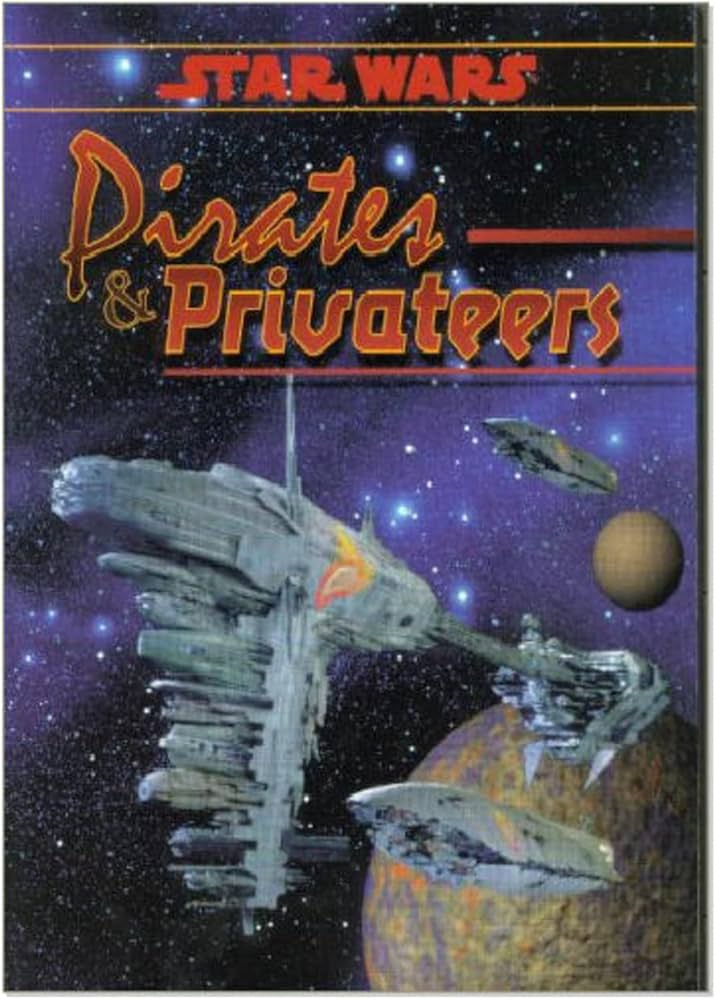
Pirates & Privateers
Pirates & Privateers
Design: Timothy S. O'Brien Development and Editing: Eric S. Trautmann Cover Design & Graphics: Tom ONeill Cover Concept: Stephen Crane Interior Illustrations: Marshall Andrews, Storn Cook, Mike Jackson, Allen Nunis, Joey Robinson, Doug Shuler, Mike Vilardi Playtesting & Advice: Wes Divin, Terry Grazier, Peter Schweighofer, Jen Seiden, George R. Strayton, Pat Villenueva, Paul Wocker
Publisher: Daniel Scott Palter · Associate Publisher/Treasurer: Denise Palter · Associate Publisher: Richard Hawran Senior Editor: Greg Farshtey · Editors: Peter Schweighofer, Bill Smith, George Strayton, Paul Sudlow, Eric S. Trautmann Art Director: Stephen Crane · Graphic Artists: Tim Bobko, Tom ONeill, Brian Schomburg · Sales Manager: Jeff Kent Sales Assistant: Carl Klinger · Licensing Manager: Ron Seiden · Warehouse Manager: Ed Hill Accounting: Karen Bayly, Mary Galant, Wendy Lord · Billing: Amy Giacobbe
®, TM and © 1997 Lucasfilm Ltd. (LFL). All Rights Reserved. Trademarks of LFL used by West End Games under authorization.
Introduction
"... In other news, the ISB, Imperial Navy, and Commerce branch of the Coalition for Progress issued a joint committee report today on the increasing tide of Rebel piracy. The joint committee was originally founded in response to the lightning raids launched by the Far Orbit, a Rebel frigate that terrorized the Core Worlds for several months last year. The report calls for an increase in military spending for the Navy and Sector Rangers in response to the atmosphere of general lawlessness spread by these Rebel terrorist-pirates. More than a dozen individual Rebel pirate captains were added to the Empire's Most Wanted list, with another twenty added to the Locate and Detain list. The report likens the current situation to the days of piracy in the years prior to the Emperor's reign ..."
— excerpt from IHV report.
Admiral Ackbar: "Madame, I wish to open the matter of the privateering experiment. It is my firm belief that while temporarily expedient, using these mercenaries is ultimately counterproductive. The Alliance can supply itself without resorting to contracting private raiders."
Chief of State Mon Mothma: "Admiral, your reluctance to implement this plan is well-documented, and I see little point in documenting it further. For the record, I am also somewhat hesitant to sanction pirate attacks, even on our deadliest enemies. However, I believe Minister Muvunc has a comment."
Minister Ral'Rai Muvunc: "Yes, Madame. Admiral Ackbar, I should like to point out that if you truly do not need the 400,000 tons of food and air, 230 canisters of blaster gas, 90 main space weapons, and 700,000 tons of miscellaneous equipment provided by this 'mercenary experiment,' you are perfectly free to load all of it on the 71 assorted cargo and utility ships and three ships-of-the-line also seized by our privateers in the last standard year, and auto-pilot them into a convenient star."— excerpt from minutes of the 267th High Command meeting.
"Don't tell me you're only in this for the money. If you were, you never would have signed on with the Alliance!"
— overheard comment from an Alliance observer agent to a privateer captain.
One moment, a merchant ship is approaching a planet's orbit, its crew looking forward to a few days of planetside leave. The next moment, the vessel is under attack by what had — at first — appeared to be a run-down freighter. After a quick exchange of laser fire, the merchant ship surrenders, hoping that a system patrol can arrive before it's too late ...
Pirates and Privateers introduces a new field of swashbuckling adventure to Star Wars gamers. The players can play dark and dashing privateers, grizzled spacehands, or beleaguered Alliance agents, participating in dangerous raids throughout the space lanes. Along the way, they might even turn a profit.
This book can also be used to run a group of non-Alliance privateers (or even Imperial privateers), supplement the use of pirates in any other campaign, or even to run a system patrol campaign (with assistance from Galaxy Guide 11: Criminal Organizations). It is strongly suggested that players not run "typical" pirates; standard pirates are hounded from all sides: the Empire, the Alliance, planetary governments ... even other pirates. By playing partisan privateers, the characters automatically have direction in the campaign.
Pirates and Privateers is largely presented in the "classic" Star Wars era, but can be easily adapted to the New Republic era, to privateering for smaller governments in practically any period, and even to the Tales of the Jedi era.
Chapter One: Pirates and Privateers
General Background
Wherever trade exists, there are those that profit by seizing the goods of others. Commerce raiders who steal space-transported goods are called pirates.
In general, space piracy begins shortly after a civilization has developed affordable space transport and reasonably widespread interplanetary trade. Ancient Bith records refer to space raiders during some of the earliest periods of that million-year-old civilization, as do the records of most elder species (including the humans of the Core Worlds).
The Difference Between Pirates and Privateers
Some eras of galactic history were quiet and peaceful, and standing militaries were small. Other eras were marked by fantastic wars and titanic conflicts between rival powers, in which huge navies and armies clashed up and down the spaceways. As technology improved, these clashes took on grander scope and greater destructiveness, usually followed by waves of peace during which the former opponents dismantled their engines of destruction, forged warships into cargo ships, and improved trade relations.
Pirates thrive in the breakdown of peace, when conflicts are growing and governments are preoccupied; additionally, pirates flourish in the aftermath of war, a period in which most governments are in turmoil. During the height of war, pirates scurry away from the wave of violence and superior firepower that threatens them, while in times of widespread peace, space patrols and policing actions keep piracy at bay (although in remote regions, far from organized police forces, raiding is a continuous problem).
In these turbulent periods, there is a kind of "licensed" pirate, a raider who contracts with one faction against another, and uses heavily armed trading ships to raid the enemy's trading vessels and disrupt their commerce. These raiders operate under a special agreement with a government, lending much-needed support to a war effort. These "private pirates" — or privateers — are essentially ship-based mercenaries, operating under the permission of a "letter of marque," a contract to raid enemy shipping.
While privateers have one major similarity with "typical" commerce raiders — specifically, the need to turn a profit through their activities — these government-sponsored raiders possess more legitimacy (and consequently have higher standards of conduct) than simple pirates. A privateer operates with the assistance and pardon of a government, and if that government's rules are violated, the privateer loses his license, customers, bases, and sponsor's official support. While privateers are much like mercenaries in this regard, they are independent of their employers, eschewing normal military protocols and operating separately from recognized authority.
Privateers
Privateers were much more important in ancient times, when space-borne navies were small, local, often sponsored or subsidized by private parties, and typically supplemented by mercenary units. Then — as now — piracy was usually more common away from the heart of civilization, along the trading routes between sectors and cultures. As the Core Worlds consolidated, piracy became more and more a Rim problem. As civilization pushed farther out into the galaxy, pirates naturally gravitated to the frontiers and encountered alien raiders.
One of the earliest examples of privateering occurred during the reign of the now-infamous Xim the Despot. Xim's Hutt rivals commissioned dozens of privateers to harass the despot's shipping, causing Xim a great deal of irritation and lead to his increasingly paranoid attitude to military logistics. This paranoia resulted in secret shipments to heavily fortified bases (which is undoubtedly the origin of the fabled Lost Treasure of Xim). Ultimately, the Hutt-sponsored privateers strongly contributed to Xim's defeat at the Third Battle of Vontor, largely because Xim had lost so much ordnance to the raiders and tied up fleet resources to combatting them that he was unable to withstand a concerted assault by his many enemies.
Other famous examples of historical privateering include the Corellian privateers of the Expansion Period and the infamous Lorrel Raiders operating out of the Happan Cluster (who occasionally signed letters of marque).
Piracy in the Old Republic was largely a problem in the Expansion Region and the Galactic Frontier (though there are legends of daring pirate raids in the Core Worlds as well). These pirates faced stiff opposition, however: the Republic Navy was persistent and well-supported, and Jedi Knights helped keep the space lanes clear of illegal raiders.
More recently, piracy has increased dramatically — particularly in the Outer Rim Territories — and travel from sector to sector can be extremely hazardous. Nearly every freighter currently in operation is at least lightly armed and shielded, and otherwise-legitimate freight haulers upgun their vessels beyond legal specifications merely to protect themselves from raiders.
Piracy provided an excuse for many of the Empire's excesses: increased shipbuilding (ostensibly to suppress pirates), restriction and increased registration of civilian ship's weaponry (to cut the flow of arms to pirates), garrisoning of worlds (to provide security against pirate raids), and even increased voluntary enlistment (hundreds of thousands of young people signed up to "Join the Crusade against Piracy and Restore Order to the Galaxy," to quote an early recruitment poster).
The rise of the Empire did in fact lead to a significant decrease in piracy along virtually all major trade routes. The earliest successes of the Imperial Navy were in crushing pirate operations, most notably the infamous Eyttyrmin Batiiv pirate armada (based in the Khuiumin system). As piracy decreased, the Navy's interdiction operations dropped off sharply as resources were diverted to suppressing smuggling and counteracting an irritating new problem: increasing resistance to Imperial will (and even outright rebellion).
Piracy became confined to secondary trade routes and the Rim. Meanwhile, the Imperial war machine grew larger and hungrier, and the Rebel Alliance was born. The Alliance had little hope for success, with no production facilities, few ships, limited supplies, and little economic or political backing. The early days of the Rebellion were hand-to-mouth, and Rebels supplied themselves from the enemy as much as possible, but as the Empire began to devote more resources to exterminating the Rebellion, the concept of privateering took hold in the Alliance Ordnance and Supply Command after certain local Sector Commands independently implemented the practice.
Privateers, it was argued, could answer many of the Rebellion's needs:
- Privateers supply their own ships, thereby freeing Alliance vehicles to conduct conventional military operations.
- Privateers seize enemy vessels and supplies, augmenting the Alliance's fleet and its ability to support that fleet.
- Privateers capture Imperial cargo, again bolstering Alliance stockpiles as well as sowing confusion among the Empire's ranks.
- Privateers divide Imperial forces, as Imperial units are devoted to combatting piracy instead of combatting the Rebellion.
- Privateers drive corporations away from the Empire by eating into corporate profits.
As long as the Rebel privateers could be focused on Imperial targets and conduct themselves within an acceptable margin of behavior, the idea seemed to have great utility.
A problem presented itself: Mon Mothma, Alliance Chief of State. Mon Mothma was uneasy at the idea of associating the Alliance with piracy, arguing that such association could damage the Rebellion's already beleaguered reputation. Furthermore, such privateers would be — she felt — mercenaries at heart, uninterested in the high ideals of the Alliance. The privateers would have to be held to a high standard and show an equally high level of results.
A short and turbulent experimental period followed, resulting in a deluge of complaints from licensed privateers. The privateers claimed that the Alliance held privateer crews to higher standards of conduct than they held mainline Rebel crews. The disgruntled commerce raiders also claimed that profits from raids were too low (largely because the Alliance was absorbing the bulk of captured goods and currency), and that Alliance-sanctioned targets were largely military and consequently too dangerous to engage. Other complaints were directed at Alliance observation agents that interfered in ship command and were disruptive; Alliance bases gave privateers low priority on repair rosters and often such repairs were patchwork and unreliable.
Many of these complaints were considered valid, and the results were highly encouraging; the target list was expanded to include any Imperial supplier (corporate or private), Alliance bases were ordered to increase privateer aid priority, and the profit margin was increased. Even Fleet Command — long opposed to privateering on principle — sympathized with the need for smooth shipboard command; Alliance observation agents were restricted to strict advisory and oversight duties without command privilege. The new policies failed to please either side, but were tolerable, and remain in place today.
The benefits of privateering are considered to outweigh the costs. In the most famous example, the Far Orbit (one of the first privateers and the first to employ the Nebulon-B escort frigate) struck deep into the heart of the Core Worlds, panicking local governors, enraging the Emperor, and splitting the Imperial Navy's forces in that region. Reliable intelligence suggests that as much as an entire sector's production year was tied up in the hunt for the Far Orbit, in response to a series of raids that netted the Alliance a comparatively small 120,000 tons of material.
Justifying the practice of privateering became one of the few genuinely deep rifts in the Alliance, and Admiral Ackbar (and others) have routinely moved to have the privateering "experiment" scuttled. Ordnance and Supply and Support Services argue that the privateers have served the Alliance exceedingly well, and that to create an equivalent military force for the express purpose of interdicting and seizing Imperial trade would require far more resources than are currently available. The controversy continues, but Mon Mothma cautiously backs the privateers even today in the nascent New Republic.
Letters of Marque and Reprisal
A letter of marque and reprisal is simply a contract defining the relationship between a privateer and a licensing government. The Alliance letter of marque is standardized to facilitate datawork. High Command allows Fleet Command, Ordnance and Supply, and Support Services to issue Letters of Marque on behalf of the Alliance. In addition, any Sector Command is authorized to issue Letters within their own sector. In practice, most Letters are issued by Ordnance & Supply, and local commands.
What the Letter of Marque Means
The following is an explanation of the individual clauses in the Alliance letter of marque and reprisal:
BE IT KNOWN that __________ owner of the private vessel __________, hereafter the Owner, is now recognized by the Alliance to Restore the Republic as licensed and authorized by this letter of marque to conduct raids upon the Imperial government, subsidiaries, and supporters, to seize their cargo, properties, and vessels, and deliver them unto the Alliance. Further, to capture the personnel, officers, and officials of the Empire and its supporters.
The Alliance declares that the Owner (the privateer) is a private individual in Alliance employ — not a ship-of-the-line — and as such may not be issued orders or otherwise treated as a subordinate to Alliance authority. The contract is a declaration of partnership and what the privateer is expected to do for the Alliance.
He is authorized and expected to pursue the war against the Empire as able, while in no case endangering the innocent civilian public and without causing undue damage to property.
Nevertheless, the Owner is expected to generally serve the cause of the Alliance as practical, attacking and interfering in Imperial activities. This clause was heavily influenced by Fleet Command.
The Owner shall surrender all bounty or proceeds of such activities to the review of the Alliance, and in return be awarded 50 percent of their value in credit or kind. The Alliance may choose to buy an entire cargo at its need. The Alliance shall also award scheduled bounties for Imperial prisoners and confirmed destruction of Imperial properties. All slaves found in the course of duty shall be freed, all illicit substances destroyed.
A clause arranging the division of prizes. The Owner surrenders either the cargo or the value of the cargo to the Alliance, and is awarded cash or the equivalent in material. The privateers prefer cash, the Alliance prefers kind. Generally the privateers simply retain half the cargo and sell it independently.
The Alliance shall render such aid as it can, subject to availability and discretion, including shelter, intelligence, repair, supplies, and fuel. Those members of the vessel's crew, formerly criminals, are hereby granted amnesty so long as they serve our cause, the Empire is destroyed, or this Letter expires, provided they commit no further crimes. Should they do so, all charges will be held against them.
This clause outlines what other services the Alliance offers their privateers. Generally, the privateers are granted access to Alliance safe ports, information useful to the privateers, repair (or repair facilities, depending on availability), resupply (mostly in the form of foodstuffs), and fuel. Most Alliance bases are loath to aid the privateers, but do so. More importantly to many of the crew, the Alliance offers amnesty from the crimes of their past. If the Alliance wins, the privateers walk free as long as they stay out of trouble. Many pirates were swept up in the life at an early age, and stuck with it out of lack of other options. Alliance amnesty gives them a chance to escape the life of a hunted criminal.
This Letter shall remain in effect for one year from its date of issue, when it shall be reviewed. If either party is dissatisfied, the contract may be dissolved. The Alliance reserves the right to assign observers to the ship for the purpose of this review.
Letters of marque are occasionally revoked, but most privateers go through rigorous screening prior to the issuance of the contract and generally play within the rules. Alliance observers are on board every privateer vessel to make sure the raiders are holding up their end of the bargain, not sliding into piracy; the observers also provide contacts, clearances, and navigational services at Alliance ports.
Sample Letter of Marque
BE IT KNOWN that __________, owner of the private vessel __________, hereafter the Owner, is now licensed and authorized by the Alliance to Restore the Republic, hereafter the Alliance, by this Letter of Marque and Reprisal to conduct raids upon the Imperial government, its subsidiaries and supporters, to seize their cargo, properties, and vessels, and deliver them unto the Alliance. Further, to capture the personnel, officers, and officials of the Empire and its supporters. He is authorized and expected to pursue the war against the Empire as able, while in no case endangering the innocent civilian public and without causing undue damage to property.
The Owner shall surrender all bounty or proceeds of such activities to the review of the Alliance, and in return be awarded 50 percent of their value in credit or kind. The Alliance may choose to buy an entire cargo at its need. The Alliance shall also award bounties, paid according to a schedule published by the Alliance, for Imperial prisoners and confirmed destruction of Imperial properties. All slaves found in the course of duty shall be freed, all illicit substances destroyed.
The Alliance shall render such aid as it can, subject to availability and discretion, including shelter, intelligence, repair, supplies, and fuel. Those members of the vessel's crew, formerly criminals, are hereby granted amnesty so long as they serve our cause, until the Empire is destroyed, or this Letter expires, provided they commit no further crimes. Should they do so, all charges will be held against them.
This Letter shall remain in effect for one year from its date of issue, when it shall be reviewed. If either party is dissatisfied, the contract may be dissolved. The Alliance reserves the right to assign observers to the ship for the purpose of this review.
Ral'Rai Muvunc Supreme Allied Commander Ordnance and Supply
Alliance Privateer Standards
Privateer vessels come in a variety of sizes, numbers, and quality. Local commands usually deal with single small vessels, while High Command prefers to issue Letters to capital ships and privateer fleets. They all have two things in common; the Alliance observer, and the Alliance communications encoder.
Alliance Observer
Every privateer vessel is assigned an observer. These agents assure that the privateers are not violating the terms of the letter of marque, and give aid and advice to the captain. The observer is a privateer's link to the Alliance. The observer has no command privileges on board, to keep the command structure smooth, but does provide navigation to safe ports and contacts with local Alliance assets.
These agents come from a variety of backgrounds. Roughly half are drawn from Alliance Intelligence. Some of these are field agents on detached assignment, free agents, field observers, supply agents, or special agents in need of a new assignment. Most are "23ers," Special Ops agents that have been retired from the field. In many cases, Alliance Intelligence officers that have been involved with long-term undercover operations are relocated to privateer oversight duties (particularly if their former cover was blown). The other half of observers come from fleet or starfighter officers, SpecForce marines, or support services.
Communications Code Encoder
Occasionally, privateers need to be contacted by the Alliance, or several privateers will need to coordinate or exchange information. These messages must be secure, but regular Alliance codes are reserved for military use. The Intelligence branch maintains a small set of tight-band frequencies and encryption codes exclusively for privateer use, controlled through a standardized encoder issued to privateer captains. This small console also transmits "Code Quasar," a transmission indicating a privateer's affiliation with the Alliance.
Beginnings and Renewals
Xhaxin reviewed the contract renewal to make sure no last-minute changes had found their way into it; while the Alliance had never done anything to betray him, Xhaxin had not risen to command a private warship by being overly trusting. Satisfied that the basic letter of marque had not been altered, he signed the scandoc and handed it to his first mate to countersign. The Alliance man also countersigned and copied the letter into his own datapad.
"This is Special Agent Hast. He'll be your Alliance observer during this cruise," said the representative, gesturing to indicate the tall, quiet human beside him. "Good hunting," he said, then turned and left the bridge. Xhaxin nodded absently.
"Mister Hast, I understand you have something for me," Xhaxin said.
Hast nodded, lifting the case he had carried aboard. "This needs to be patched into your main communications system. It carries encryption codes, comm frequencies, and Code Quasar."
"I've done this before, you know," Xhaxin said dryly as he sized up the quiet agent. A gaunt Quarren came and bore the case off.
"I'll need to stow my gear, Captain. If you'll excuse me," Hast started to move off with a familiar spacer's gait.
"Mister Hast." Something about the observer was bothering Xhaxin, and the privateer captain was determined to find out what it was. "What navy did you serve in?"
"Alliance for the last three years. After I resigned my Imperial commission," Hast responded, his voice quiet but still capable of cutting through the normal din of an operating starship command center.
"I see," Xhaxin replied. "For the record, Observer Hast, the Free Lance is not exactly a spit-and-polish Imp vessel. And most of my crew hate the Empire. The Rebellion trusts you, but I do not. If you do anything to jeopardize my ship or my crew, I will personally shove you out the airlock."
"I shall keep that in mind, Captain," Hast responded, his icy stare matching the intensity Xhaxin displayed. After a moment, Hast turned on his heel and headed for the turbolift. "What I'd like you to keep in mind is that I'm your lifeline to the Alliance; I also have the power to have your letter of marque revoked," the observer called over his shoulder. "Just so we understand each other ... Captain."
As the turbolift doors closed, Xhaxin sat silently gazing at space as the bridge busied itself making ready to set out. He heard stations reporting in and noted his crew working smartly, a colorful bejeweled blur of activity with himself as its gray heart. He absently played with a pair of gold credit coins as he brooded. Mistik Arka, the Quarren technician, quickly installed the Alliance communication console, tested it with a brief transmission, and reported it functioning properly.
"Captain, all stations report ready. The Alliance ship has jumped. The Free Lance is at your command," reported Khwir, his First Mate.
"Plot a course for Medth," Xhaxin replied, a feral grin on his face. "Prepare for the jump to lightspeed. Let's not keep the Empire waiting."
Chapter Two: Raiding
"Are you sure of your information?" Hast asked.
"No," replied Xhaxin. "I am simply following a lead."
"A lead given by a disloyal Induparan with a grudge against his king," Hast growled, clearly unhappy with the situation.
The bridge crew tensed, expecting another argument in a seemingly unending stream of conflict that began when Hast became the Free Lance's Alliance observer.
Xhaxin turned to face Hast. "I am always willing to listen to the advice of my crew, Hast. Remember that ... if you are ever considered a member of my crew," he said, his voice as brittle as Camarian crystal.
The Free Lance was lurking just inside the jump zone of the Ec Pand system, waiting for the arrival of a target vessel. The jump zone was designated not by a beacon-buoy (as is common in more civilized systems), but by a fairly large asteroid that had been towed to the area by the local government. Any ship travelling into the system calculated a jump to these coordinates and proceeded to Ec Pand itself, a modest gem in the Induparan Crown Worlds.
"Mass alert, Captain," announced the sensor operator, a young Corellian named Kett. "We've got a ship dropping into realspace."
"Marvelous," muttered Hast. This was the third ship arrival since they'd begun waiting, and the Alliance observer doubted very much that they could linger much more without a patrol vessel investigating their presence.
The new arrival — a corvette — dropped to sublight speed directly in front of the Free Lance, on a collision course with the marker asteroid. The corvette veered sharply off her course, coming within meters of the asteroid ... and a fiery collision.
"Idiot navigator. Good pilot, though," observed Xhaxin.
"Transponder code confirmed. That's the Indupar Nova," Kett reported.
"Keep on her, boy. Helm, proceed at full sublight speed. All right, the Nova will be too busy correcting her navigator's error for the next minute or so. On my mark, communication station is to broadcast Code Quasar. Sensors: begin jamming. Tactical: raise shields and prepare to fire ion cannons. Standby the tractor beams and boarding shuttle; they will deploy at mark plus thirty seconds." Xhaxin said, his voice hard as he issued his clipped orders at his crew.
The Free Lance bore down on the corvette.
"Mark!"
The bridge exploded into intense activity. A burst of ionic blasts spat across the gap of space as the Free Lance's shields snapped invisibly into place. The corvette shuddered under the assault, waves of energy flowed along her hull, and she began to list to starboard. As the ionic disruption faded, the target vessel's engines flared to life.
"She's powering up engines and raising her shields, Cap'n," reported Kett. "Looks like she's making a run for it."
"It appears the Nova's captain isn't terribly bright, either. Deploy the shuttle and ready my launch. Main ion cannons: fire!"
Another ionic barrage leapt through space, and the corvette's shields flared brightly as they overloaded and the engines shut down. The prize yawed in space.
Xhaxin stood from his command chair, and flashed a feral grin at his crew. "Well done, lads," he said. "It looks like it is time to pay that fool captain a visit, eh?"
The Cruise
Pirates do not refer to their activities as "hunting," "raiding," or "plundering." Instead, a pirate operation is referred to as a cruise. A cruise is a search for target vessels or dirtside bases, referred to as prizes by pirate crews. Cruises vary in length, depending on the amount of consumables the pirate starship can carry, the success or failure of attempts to seize prizes, and the amount of damage the pirates' ship has sustained. A successful cruise can end in a week or less. An unsuccessful cruise can last months. A very unsuccessful cruise might only last until the pirates encounter the nearest Imperial warship.
Raider Strategy and Tactics
Successful ships don't just randomly jump to the nearest system and attack; strategy of that nature is a fast way to the Final Jump. A successful cruise begins long before the ship heads out. Smart captains buy cargo manifests and shipping schedules from information merchants (also called "infochants") or cultivate spies and informants in local ports. Very smart captains jump only those ships worth risking the risk. An old pirate axiom states: "Every prize can lead to the grave." There is certainly more than a little truth to this statement; any vessel that a pirate encounters could be a decoy, leading to an Imperial or system patrol trap. Worse, a potential prize could end up having more firepower at its disposal than the pirate can withstand. Knowing as much about a potential prize as possible — its departure time, destination, projected ETA, and onboard firepower — is only common sense.
Finding A Prize
The first objective of a raider is to find a ship worth the risk and effort of attacking. Many short-lived pirates simply attack randomly selected large ships, small freighters, and yachts, leading to an unpleasant combination of slim pickings and heavy firepower.
Research is called for. There are several ways to find a good target:
-
Public shipping schedules. Imperial regulations require civilian ships to post their registration codes, licensing, home port, intended departure date and times, cargos, and passenger status on starport information nets. This is done partially for Imperial records, partially in the public interest (for passengers and shippers), and partly for advertising purposes. Military and corporate cargo ships that are transporting internal cargos — for example, Imperial vessels hauling foodstuffs for a garrison — are not required to make this information public, although the information is kept on file at the port. Certain cargos are not required to be listed, especially valuable or classified ones, and the data manifests for such cargos tend to be incomplete and rather generic. Tramp freighters are technically required to post this information as well, but many don't (a major Imperial code violation).
-
Port contacts. A shocking percentage of port officials are corrupt enough to overlook smuggling violations or reveal restricted cargo manifests (in exchange for a sufficiently large bribe). On average, the bribe should be roughly 20% of the projected value of the cargo. However, pirates run the risk of an Imperial or Customs ambush if the port official is dissatisfied with the amount of the bribe.
-
Inside information. Many corporate employees are both greedy and well-informed. Rather than accepting a straight bribe, these insiders generally demand a cut of a pirate's eventual take; these demands are not terribly unreasonable, since these contacts often know the actual value of the cargo, and sometimes the location and calculated routes of the prize. The typical cut for such an "inside job" is 35% of the pirate's overall profits from the cruise.
-
Friendly intelligence. Privateers occasionally receive information from Alliance Intelligence on desired cargos, logistical information, and expected resistance, although the Alliance generally acts on this information directly. Privateers are usually called in when Alliance resources cannot respond in time or if some kind of diversion is needed to allow Rebel forces to act on the information.
-
Information merchants. A network of underground spies and information smugglers exists, an intelligence web that spans hundreds of worlds. These infochants, intelligence operatives and other "data smugglers" specialize in getting valuable information to the wrong hands ... for a healthy profit. Some of these are commission specialists who acquire specific information for a client, others are speculators who buy and otherwise acquire information and then sell it to interested parties. The Bothan spynets are among the best information merchants, particularly in the Outer Rim Territories.
-
Electronic data raids. Infochants, intelligence agents, and on-the-ball raiders often employ data slicers to break into (slice) computer networks. Slicers tend to be socially inept, technically inclined, and intellectually unorthodox people with a flair for criminal information acquisition. A slicer can be invaluable to a raider for getting restricted cargo manifests, jump routes, and mounted weaponry information, and may be able to plant navigation hijack programs or shutdown viruses in a target vessel's astrogation computer.
Adventure Hook: Protecting Your Assets
A good informant is hard to find, harder to keep and worth quite a lot of money. If the player characters cultivate a particularly good source of inside information — infochant, port official, Rebel spy, or corporate insider — they may find that they occasionally have to protect that interest. The insider may have gambling or loan shark debts, or learned dangerous information. A port official may end up under investigation for corruption, or a Rebel spy might be in danger of exposure and Imperial capture. Some of these problems — such as the loan shark — can be dealt with overtly, while others require subtlety. The characters' reactions to such situations can spin out into dozens of entertaining planetside encounters and make ideal scenarios for gamemasters to introduce long-term enemies and allies.
Basic System Astrography
Any system that sees regular traffic possesses a "jump zone." The jump zone is a set of coordinates designated as a safe arrival and departure point for the system. Most systems that possess even a rudimentary patrol force keep the zone clear of debris, and visited as briefly as possible (in order to avoid collisions with incoming vessels). Systems with several potential destinations may have two or three jump zones. Systems with a high volume of traffic may have differentiated jumps zones for commercial, military, super-container, private, or corporate ships. Very few ships arrive elsewhere in a system — the possible presence of debris, satellites, other ships and so forth make jumps of this type incredibly dangerous. While it is possible to jump to any position in a system (even as close as planetary orbit), only military and illegal vessels do so regularly.
The transit from zone to orbit can be anywhere from five minutes to several hours, depending on local charts, traffic, Imperial Survey Corps updates, era of colonization, and other factors. A short zone might be as little as ten spacial units from orbit, while a long zone may be up to 200 units away, or more. Coruscant, for example, has jump zones laid out for as far away as four days travel from orbit.
In more remote areas of space, it may take several minutes to calculate jump coordinates and route tracks. Usually a ship calculates a jump en route to the jump point, although starports of Standard or better class often have navigation calculation services, for a price. Pirates haunt remote systems as much for the calculation delays as for lack of law enforcement.
Common Pirate Tactics
Barricade
The Barricade — also called "deep hunting" is one of the oldest methods of stopping a ship. The pirate vessel uses tractor beams to move a large asteroid or other piece of space debris (called the "mass block") into a known hyperspace lane. After the mass block is in place, the pirate only has to wait for a potential prize. A ship moving through hyperspace is forced back into realspace if it encounters any mass shadow equal to or greater than its own mass — the mass block.
This method of interdiction has the advantage of leaving the prize ship disoriented when the pirate's first strike is fired. However, Barricading has the serious flaw of grabbing anything that happens to be passing by, regardless of cargo or armament. Pirates who use this tactic are occasionally surprised to snare a heavily armed military vessel. Privateers and experienced pirates usually don't use mass blocks, unless they have exact route calculations for a particular ship.
However, this method of piracy was extremely useful for pirates in the days of the Old Republic. Starships attempting to travel at lightspeed were forced to fly along established hyperspace routes that had been demarcated by "jump beacons," navigational aids that helped guide ships to their eventual destinations. However, these jump beacons made piracy almost convenient; a raider merely had to maintain a position near a beacon and attack ships as they came out of hyperspace. Since it took considerably longer to plot hyperspace vectors during this era, the target vessel had only a few options: surrender or be destroyed.
Dagger
The Dagger — also called the Mercevian Nagua maneuver, after a famous pirate who favored the tactic — is essentially a variation on the barricade. The Dagger involves the use of a saboteur to disable the target vessel's hyperdrive or simply drop the ship out of hyperspace at a prearranged point. A further variation involves use of infiltrators to seize the bridge, essentially shipjacking the prize. (Obviously, this method works best when used on ships with large, transient crew rosters.) The Dagger is favored by many privateer crews, as it is only modestly risky — most prize vessels will only arrest a crewer for minor sabotage if he is caught — and it is often accomplished with few shots fired.
Lurking the Zone
An obvious time to strike at a prize is when it is in transit from a system's jump zone to a nearby planet (see "Basic System Astrography" on page 16). While this method of seizing a prize is convenient, it is far from safe. The combat area may be a mere five minutes from a patrol area, which means local interdiction ships may be summoned and arrive before the shooting is done.
While "lurking the zone," speed is of the essence. A raider must be able to seize control of a ship and jump it out in less than fifteen minutes. In any civilized system, a ship that can hold a raider off for as little as five minutes can be rescued. (In the Core Worlds, patrol response time is as rapid as two or three minutes.) Raiders can usually disable a ship in two minutes or less and board it in three more. Such a ship is then either robbed of its portable cargo, or actually jumped out of the system, depending on the worth of the cargo and the perceived threat from patrols.
In less-developed systems, the prize can only hope to fend off the pirates long enough to jump to lightspeed, or to obtain the aid of another ship. Unfortunately, in the Outer Rim, most freighters tend to mind their own business and jump to lightspeed to avoid trouble.
Dirtside Raid
Remote worlds often have little or no defenses, and make tempting targets for raiders. Mining worlds in particular attract the attention of dirtside raiders. Some raiders approach peacefully, then hit the ground target, capture as much booty as they can, and run. Others eschew such tactics, approaching with shields up and weapons blazing.
Mining colonies are relieved of ores, metals and any refining equipment that can easily be transported. Spaceports are robbed of any valuable cargos on the docks. Agriworlds are stripped of potentially profitable livestock or organic medical compounds, either for resale or simply to stock the pirate galleys. Pirates that raid low-tech worlds seize natives to sell to slaver syndicates; the Ragnar Syndicate in particular uses pirates as de facto "procurement specialists" for Outer Rim slave auctions.
Privateers make occasional raids against weakly defended military and corporate installations. Since such facilities usually have significant security forces and defense apparatus, such attacks are considerably more dangerous than a typical pirate dirtside raid.
Pirate Fleets and Pack Tactics
It isn't friendliness that brings pirate fleets together. It is a well-known fact that several light ships and good line tactics can bring down targets that few lone capital ships can. Pack raiding may involve anywhere from two to hundreds of ships. Some pirate fleets are loose collections of dozens of moderately armed freighters that swarm targets.
In general, pirate fleets gather around a single, charismatic leader, particularly one that is smart enough to bring in large profits and ruthless enough to maintain authority. Such pirates are routinely challenged by subordinates, and the resulting conflict usually ends in a duel ... and bloodshed.
Actions and Boarding
An action is any ship-to-ship battle. Pirate actions tend to be brief compared to military engagements; if the pirate vessel is not able to disable a target ship quickly, the raider typically withdraws to hunt easier prey. Most of the time, though, a pirate attack can pummel a ship into submission with a few well-placed ion cannon blasts.
Only unskilled or inexperienced raiders use lasers or blasters on a potential prize. Heavy weapons (such as capital-scale turbolaser emplacements) have an unfortunate tendency to destroy a target. Instead, successful raiders rely on ion cannons to disable a prize and on tractor beams to reel it in.
Once brought to within one spacial unit, the prize can be boarded and brought under control. There are several approaches to such actions:
-
Hull-brushing. This method of boarding works best when a larger pirate vessel is attacking a smaller target. The pirate vessel, after disabling the prize ship, moves extremely close to the target. When the ships are within a few meters of each other, the attacking ship extends a docking tube to the prize, allowing ship-to-ship transit. This allows quick access and withdrawal, but leaves the raider open to counter-boarding (particularly if the ships' crew complements are closely matched).
-
Shuttle boarding. A shuttle can be sent over to a disabled prize, to transfer boarders via a smaller airlock or batter its way into a landing bay. This is safer for the main raider ship, but considerably less so for the shuttle. It also frees the raider to watch for arriving patrol ships. The boarders also tend to fight much harder, since it is nearly impossible to retreat.
-
EVA boarding. For the desperate or poverty-stricken, boarders can be sent to a disabled prize in vacuum suits or armored space suits. This leaves the boarders with essentially no retreat and exposes them to the risks inherent in extra-vehicular activity.
-
"Hull Cutting." Occasionally, an airlock is too heavily defended to take, and another entrance must be made. Raiders often carry cutting equipment, hull breaching explosives, and portable airlocks to make their own way into a prize. This tactic is often employed by Imperial forces (Star Destroyers in particular). While this tactic is dangerous for boarders (since the cutting activity can alert interior defenders to the exact location of intruders), hull cutting damages the target ship considerably, making escape a virtual impossibility.
Once aboard, the boarders must generally have a two-to-one advantage over defenders to take the ship. Priority targets include the bridge and engineering sections (though passenger sections can be effective targets if hostages and ransoms are the desired plunder). This involves section-to-section battles, which can be very dangerous if the raiders attack with anything less than overwhelming force. Raiders — pirates and privateers both — sometimes use stun weapons (blasters and grenades) to capture as many enemies as possible. Privateers are required to take prizes with an absolutely minimal loss of life. Strangely, pirates tend to keep body counts low as well, though for significantly less-altruistic reasons: corpses can not be sold on the slave block.
Optional Rule: Stopping Hyperspace Jumps
It can be very frustrating to a pirate to have a prize jump out from under attack (or for the gamemaster if he wants to have his players' ship boarded). Remember, though, that to jump safely, a ship must take some time to calculate the jump — one minute for well-known, well-travelled routes, up to half an hour for most known systems, and several hours to calculate a jump to an obscure system. Hasty jumps can be reduced to a single round, but this doubles the difficulty of the route.
If a ship is lightly damaged, the gamemaster can add +5 to the base astrogation difficulty; if a ship has suffered heavy damage, the base astrogation difficulty increases by +10. In addition, ion cannon hits affect hyperspace jumps by adding +5 to base astrogation difficulty for every controls ionized result. Tractor beams add their damage roll to the difficulty. All of these penalties are cumulative, and normal scale/damage guidelines are applicable.
For example, a pirate corvette (capital scale) is jumping a light freighter (starfighter scale). The corvette hits the freighter with an ion charge, ionizing its controls (two controls ionized results), while hitting it with a tractor beam, capturing it with a damage roll (plus 6D for the scale difference) of 30. The freighter captain decides to flee into hyperspace. The gamemaster decides that the jump has a difficulty of 10 — doubled for a hasty entry — with an additional +10 for the ionization results, plus an additional +33 for the tractor beam (the scale bonus), for a total of 63! The captain, with 5D in astrogation, rolls a fairly average 18. Obviously, the corvette is now in real trouble.
Emergency jumps still work fairly often against similarly scaled ships, since a good astrogator can probably roll within 10 of the difficulty and simply suffer a hyperspace mishap.
These guidelines work well to keep an adventure heading on the gamemaster's predetermined course; if the adventure hinges on the pirate's vessel being neutralized and boarded, these options can help skew the encounter towards the gamemaster's desired ends.
Optional Rule: Ship Location Targeting
Raiders (and military vessels) occasionally are forced to use full power energy weapons against a target. This is quite dangerous, since these weapons might accidentally destroy the prize. To avoid this, gunners may choose to "call a shot" — target a particular location on a ship. Such an attempt is considerably harder than simply hammering away at the enemy ship. However, a higher scale weapon cannot target a location on a lower scale target — for example, a capital-scale ship can target a capital ship's engines, but not a starfighter's engines. It is possible for smaller vessels to call such a shot on a larger target; however, scale rules still apply and the vessel that is attacked receives an additional +2D to resist damage in such cases.
Targeting a primary section of a ship (the conning tower of a Star Destroyer, the engines, the landing bay, the main body) adds +2D to the difficulty to hit. Targeting a subsection of a ship (a gun battery, a particular engine, the shield generators, the command section,) adds +4D to the difficulty to hit. Targeting a specific location of a ship (a specific gun, the bridge, a maneuvering thruster, an engine's thermal exhaust port) adds +8D to the difficulty to hit.
Location Modifier to hit Primary section +2D Sub-section +4D Specific location +8D Damage should be worked out normally. The specific results should be determine by the gamemaster using the normal starship damage results guidelines, though the following can also be used as general damage indicators:
Damage Penalty Light damaged -1D or -1 Move Heavily damaged -2D or -2 Move Severely damaged System disabled Destroyed Catastrophic damage; threatens ship A lightly damaged location loses -1D or -1 to its Move; a heavily damaged location loses -2D or -2 to its Move; a severely damaged location is disabled and unable to perform its function; a destroyed result indicates that the location has suffered catastrophic damage (this may mean that the engines have overloaded, or that a gun explodes, setting off a chain reaction of gun explosions). Targeting locations does not guarantee that a ship will be simply disabled, but it does increase the chances of capturing a ship with minimal damage.
Pirate Atrocities: Fact and Fiction
Some reports of pirate horrors are exaggerations and even outright fabrications. Others are not. Pirates — like Imperials, Rebels, bounty hunters, or indeed any other stereotypical group — are actually a wildly individualistic group, linked only by profession. While a number of pirates are the bloodthirsty, sadistic monsters depicted in holothrillers, most are cold and calculating, viewing piracy as a business and adhering to loose standards of professionalism. Some few pirates are dashing, flamboyant and heroic, living up to the fictional notion of "pirate nobility."
Acts of terror commonly attributed to pirates include murder by exposure to space (called "spacing"), execution by blaster, marooning, slave taking, torture, and colony razing. Pirates have in fact done all of these, more to cultivate fear than for amusement or callousness (though most pirates agree such actions are bad for business).
Pirates live by their reputations. A pirate captain who commits an atrocity finds he is feared; however, he is now subject to reprisals from virtually all sides: the Empire, the Rebellion, bounty hunters, and even other pirates seeking to claim his plunder and supplies. By setting himself up as the toughest pirate in his particular corner of space, he has also set himself up as a target to other power-hungry raiders.
Most "professional" pirates follow a simple rule: prizes that resist strongly are treated strongly. Crews that are quick to surrender and do not resist boarding attempts are often robbed and released after a show of force.
Unfortunately, this means that the pirate must maintain a delicate balance of force and mercy when dealing with prizes. Pirates that are too bloodthirsty or violent end up dead, killed by any number of enemies; conversely, a pirate that is viewed as "soft" is usually disposed of by his own crew or by other pirates sensing weakness in a rival.
Privateers, on the other hand, are answerable to a higher political power, and cannot perform horrific acts to build a reputation (at least, not without facing severe consequences). Privateers usually cultivate the reputation of their employer and adhere to a strong code of honor. Rebel privateers, for example, find many corporate ships quickly surrender once they've identified themselves, because prize crews know that the privateer is after cargo and goods, not slaves or victims. Resistance can still lead to violence during a boarding action, but surrender gets the matter over with quickly. The Alliance encourages this, and spreads rumors and news about the excellent conduct of their privateers through the newsnets. While this has little impact on Imperial military cargo ships it has fantastic results among practical Imperial supporters like corporations.
Xhaxin's Dozen Rules
Many privateers follow a strict code of conduct, tailored for an individual captain or ship. The "Dozen Rules" of Captain Xhaxin (of the Rebel privateer, Free Lance) are typical of such codes of conduct:
Keep mobile, be flexible. The enemy can't kill what it can't find. This involves more than simply jumping from system to system; it also requires moving from territory to territory and avoiding pattern raids. Don't allow yourself to fall into a regular habit. This doesn't mean that you should never use the same tactic twice, only that you should avoid becoming a one-trick bantha.
Never pick on someone your own size, and don't fight fair. You aren't an honor-code warrior, you are a private commerce raider. We mostly raid freighters because they're easier to hit than military ships. We're sneaky and tricky because we want to continue to raid.
Never hunt in your own backyard. Don't attract unwanted attention to an area you need to move through regularly ... like your base system. Just ask the Eyttyrmin Batiiv group.
Gamble. Take risks. You can't ever know the odds perfectly, and bad gambles should be avoided, but if you aren't willing to risk danger you should become a data-pusher.
Make a name for yourself. Get a reputation and get it fast. If you're known as a hard-but-fair raider, prizes are much more likely to roll over. Do not get a bloodthirsty reputation — that way leads to higher bounties and freighters returning fire to avoid boarding action. If you scare the target too much, it panics. If it panics, it does something stupid. If it does something stupid, your profits go right out the airlock.
Stick to the shadows. Don't expose yourself or your ship to any more danger than is reasonable, don't announce yourself to anyone besides prizes, and generally keep a low profile as far as authority-types are concerned. Remember, you're a Rebel and a pirate as far as the Empire and general citizenry are concerned. Only show your teeth when you are more than reasonably sure you can win. Otherwise, keep your head down and wait for the bigger guns to pass you by.
Stick to the job. Pick an area of space or a corporation or some kind of goal. Once you've done that, go after that goal until you're done with it or the pickings get slim. If you have a mad on for a particular corporation, fine. Become their own personal scourge, drive them crazy, dig deep into their profits and run them into the ground. Then move on to the next object of your attentions. Don't allow personal considerations to distract you from that goal ... just do the job.
Plan obsessively, but allow for the unexpected. The best laid plans of generals and pirates fail to survive contact with the enemy. Keep your plans simple and allow for the fact that you are not perfect or omniscient. Have an idea of what you'll do when (not if) a nasty surprise rears its head. Retreat, fight, or pull out a nasty surprise of your own. If you get blind-sided and aren't able to handle it, you'll get dead. And so will your crew.
There are no sure things. The waddling, overloaded, under-armed freighter you're about to pounce may be what it seems, but there's always a chance it is actually a baitship, or over-armored, or has a class one hyperdrive and a Givin astrogator. Be prepared for disappointment and raids that don't come off.
The prize's crew is not the enemy. Don't abuse them. Build your reputation on the excellent treatment you afford your vanquished prizes, not on thuggish behavior more appropriate to pirates and Imperials.
Maintain initiative. Always be pro-active. In combat, you need to be the captain who is initiating activity, not the one who is reacting to it. In general, you — not circumstances — should choose your targets. If you lose the initiative, leave the field of battle as quickly as you can.
Keep your crew well. A demoralized crew will lose a fight that a crew with good morale will win. Period. In general, treat your crew decently and fairly, but don't coddle them. Make sure they have good food and heat and fresh water and that the ship isn't kept at the chilly temperature that most military and commercial ships are. The Free Lance is kept to almost luxury liner standards, not because I'm a generous fellow, but because I want the crew happy and alert. Keeping the crew well also means keeping them up to high standards. The crew is drilled regularly and anyone failing to keep up to my standards is disciplined. Never let the accommodations get the crew soft ... or lead them to believe that you've lost your edge.
Chapter Three: The Raider's Life
Pirates
The typical pirate is not what one might expect from the holothrillers, at least not initially. In every population, there are those who are simply thugs and bullies, and piracy may have a larger proportion of such individuals than most, but pirates come from all walks of life.
-
Thugs. The stereotypical bloodthirsty pirate lusting for gold, spice, and slave booty. Only the richest cargos slake his thirst, because he spends it all in a single leave. Thugs tend to have short exciting careers that end in a burst of turbolaser fire.
-
The desperate. Increasingly, citizens of the Empire turn to piracy out of desperation and impending poverty. Non-humans in particular are frequently driven into debt by Imperial economic policy. Once pushed to this point, the fledgling pirate becomes a hunted fugitive, locked into piracy by circumstance. These are usually locals raiding neighboring systems and third-rate routes. For such people, piracy is often a short-term method of staving off lean times, not a way of life.
-
Professionals. A large proportion of the Alliance privateering force is made up of able, well-trained beings looking for an interesting and profitable career in space service. These beings have erratic and unusual behavioral patters or are otherwise unacceptable to their homeworld's patrol service. Typically, such individuals find the usual options of naval service or independent freight hauling unappealing. Professional privateers tend to have the longest careers — and usually as officers — because they apply a great deal of skill, intelligence, determination and discipline to their job.
-
Thrillseekers. A large section of all criminals are thrillseekers, always looking for a way to make an exciting living. These pirates usually chase bigger and bigger prizes until they encounter a target they can't handle. Thrillseeker careers are flamboyant and often end violently.
-
Draftees. Many pirates start their careers as draftees, ordinary crew pressed into service either through mutiny, capture (the alternatives usually being death or slavery), or some other form of outside pressure. Draftees often stay with the work out of lack of options or an acquired taste for the life. Unlike conscripts in military service, draftees that perform shipboard duties competently are accepted as members of raider crews without hesitation. It is often this acceptance that leads draftees into voluntary careers as pirates.
-
Misfits. A small group of pirate crews are simply misfits: individuals that do not really belong anywhere. Personality quirks that prevent such individuals from becoming military officers, for example, are hardly noticed among pirate crews.
Entering "The Life"
"How'd I get started raidin'? Easy question, grubber. I was a navigator on a system-hopper, just a small-time operator, trading along the Shwuy Perimeter and in Parmic sector. Bad times. Hardly any trade flowing. The Empire's taxes made living next to impossible, though that idiot Moff Balfour made smuggling an easy option. I mean, it ain't like he actually knew what he was doing, right?
"Well, me and my crew fell short too many times; smugglers were thick as bog-ticks in those days, mostly because it was easy to get away with it. So we made up for the shortfall in profits by the occasional dirtside raid.
"Not regular, of course. Or maliciously. We only took from them who had more.
"Easy. Until we got caught by an Imperial patrol. So we ran.
"I drifted for a while, but the Imps got our transponder code, and that put me on the sector 'Detain For Questioning' list. I couldn't find any straight work after my name went public, so I signed on as a navigator for a pirate ship. When that group fell apart — they do that after a while — I signed aboard another. Then another. Got to be my regular career.
"Sure, I'm tired of it. And you probably think I never should've started 'the Life.'
"But I don't answer to anybody except my captain and my mates. And they hold themselves accountable to me. Maybe I should've done something more 'civilized,' but I'm flamin' glad I didn't."
— Attributed to a member of the Khuiumiin Survivors
Officers
The officers of a pirate vessel are sometimes elected, sometimes acclaimed, and sometimes self-declared. They usually hold their position for as long as they can produce results and keep the crew loyal (or at least cowed). Most pirate officers started space work on a legitimate ship, then made the transition to piracy. Only a few pirate officers begin their careers as low-ranking crew.
Pirate captains are the toughest and smartest of the lot, forced to keep both crew and officers in line as well as juggling the normal problems of starship command. It should be no surprise that pirate captains tend to be the some of the strongest, most cunning and ruthless commanders in space. Anything less than the best gets pirates killed. Privateer captains are very similar to pirate captains, though officers aboard a privateer are generally declared by the ship's owner.
The ship's engineer is crucial to performance. The engineer keeps the engines, life support systems, and other primary and secondary systems running smoothly (hence the officer rank). Usually, several subordinate technicians maintain individual systems, but the engineer is ultimately responsible for keeping the whole supersystem functioning properly. Smart pirates recognize that their continued success relies on engineers and engineering crew, and endeavor to keep these important crewers around.
The weapons officer (also called the chief gunnery officer) is in charge of drills, the supervision of weapon and shield maintenance, and commanding tactical stations during an action. While pirates usually use their guns only briefly — as a prelude to boarding — it is crucial to bring a target ship to heel as quickly as possible. This is the responsibility of the weapons officer, who uses a combination of threatening laser cannon fire and accurately aimed ion cannons and tractor beams to bring a prize in. On more organized ships (such as privateers) the weapons officer is typically in charge of shipwide security and boarding teams.
Other officers commonly found in pirate crews include the First and Second Mates (the second- and third-in-command), medical officer, and often an officer for communications and sensor operations. Some raiders have a navigator, but others rely on their captain or other command officer for navigation. In fact, many pirate captains refuse to allow general crew — or indeed, even trusted officers — access to the navigational equipment. Secrecy is often a key component of pirate operations and the fewer hands that know important information (such as the location of the pirates' home base, or the ship's current destination), the less likely it is that the operation can be compromised to military or pirate-interdiction forces.
Ship's Crew
Crewmen (or "hands" as they are often called) are primarily technicians of some sort. All positions aboard starships require a technical skill for simple maintenance, and most are simply operational: piloting, sensors, communications, gunnery, and shields, for example. Pirate ships are no exception.
This doesn't mean that pirates are simply mindless techs. The stress of outlaw life, the thrills and horrors of battle, the drudgery of space travel, and the constant threat of death tends to bring out both the best and worst in a being. Pirates are usually intense, aggressive, eccentric, and highly individualistic. At the same time, suffering privation with a group of others tends to tightly bind that group together. Pirate crews tend to stick together and have high morale.
Boarding Party
A boarding party, equivalent in function to marines on military vessels, is made up of the toughest hands a captain can muster. Although modern firepower has made size and strength secondary issues, pirate captains typically prefer large, powerful boarders simply because such individuals are extremely intimidating (particularly when outfitted with massive illegal weapons and combat armor). Boarders are usually seasoned outlaws or ex-military, and are able to maintain their own gear. Many boarders prefer short-range heavy blasters during a boarding action, since such weapons can be drawn quickly, aimed accurately and possess a great deal of stopping power.
Boarding parties — like pirate crews in general — range from crude gangs of semiliterate thugs to professional, military-style units that plan operations thoroughly. On many ships, the boarders also have ordinary duties (such as maintenance or navigation) in addition to the job of boarding.
The Daily Grind
Pirate life isn't the lazy, easy life often portrayed in holothrillers. Shipboard life — even aboard military vessels — is generally difficult, and piracy has a number of added complications that make an average day even more dangerous. Shields, weapons, life support, engines, thrusters, and dozens of other systems require constant maintenance, and — unlike a military ship — parts and other supplies are almost never available when needed. A pirate's personal weapons and gear need attention, vacuum suits have to be regularly checked and patched, and there are constant drills to run.
Even more than in navy ships, discipline is crucial to success, and the company must be kept in fighting trim at all times. Military ships usually operate in groups or within communications range of a supporting base. Pirate ships typically operate alone (or in small packs), far from a home base. These ships rarely have backup and cannot expect rescue or repair operations. A pirate that allows needed skills to decay or equipment to fall into disrepair is a liability to the ship, a liability that is usually disposed of rapidly.
Pirate captains have a well-deserved reputation for harshness. Cruises can last for months, and actions can be weeks apart. Mutiny is not unknown on raiding ships and the captain has no governmental authority or threat to back him (nor do privateers, really; the Alliance is far too busy to actively hunt down their own mutineers, never mind a privateer's disgruntled crew). Crews must be kept alert and obedient. In some cases, this means rule from loyalty. In many cases it means rule by fear.
In an action, the entire resources of the raider are focused on taking the prize. Most raiders send the bulk of their hands on the heels of the boarders. Once a prize is taken, the raiders must rob and run before help arrives. Most ships are attacked in system space and aid may only be a comm signal away.
Missa waited nervously as the pirate captain, Xhaxin, debated something with another man, this one wearing a Rebel Alliance insignia. The prisoners — arrayed in a ragged line along the portside bulkhead — were fidgeting under the watchful eyes of the pirate boarders.
Missa's eyes were drawn to the sign above the nearby hatch: "Airlock," it read. And we're just lining up in front of it, she thought. This is not good. Could it be that pirate, Xhaxin, is debating who to throw out of the airlock first?
One of the pirates, a fat Gamorrean, waddled up to Missa and snorted at her. This close she could smell his pungent odor — a rancid scent that reminded her of swamp gas and decaying food — and saw three small, sluglike parasites nestled against the alien's skin. He reached out for her with pudgy three-fingered hands. Missa shrank away, unable to scream. The Gamorrean grasped her throat, and began to tighten his grip —
"Gorug!" Xhaxin's voice slammed down the corridor.
The Gamorrean froze.
"I've warned you about accosting the prisoners. Twice." The pirate captain's eyes flashed angrily as he marched closer, facing the Gamorrean.
Gorug released Missa, and backed up, grunting and growling angrily. The other pirates backed away, though their weapons were still at the ready and — despite the distraction — their attention was fixed firmly on the prisoners.
"I don't care how much your matron would like that woman's jewels! Ship's articles are very clear: you don't rob the prisoners. No one shares out until the committee divides the loot up." Xhaxin snapped in a clear, commanding voice. He paused, his eyes narrowing into hard, dangerous slits. "But you already know that, don't you? Perhaps you forgot ... or perhaps you are merely a fool."
Gorug's eyes narrowed in turn and he issued a series of grunts and snorts. Even Missa — who had never seen a Gamorrean before — could tell that Gorug had just issued a dangerous ultimatum.
"Do you think you can take me this time? How many times do I have to thrash you to convince you that I am in command of this crew?"
With a roar that filled the corridor, Gorug charged.
Xhaxin nimbly rotated out of the way, allowing Gorug's momentum to carry him into a bulkhead. The Gamorrean rebounded off the wall, stunned. Xhaxin reached out, spun Gorug around, tripped him, and pinned him on his back. Xhaxin pulled out a vibrodagger and laid it against Gorug's throat. If Xhaxin activates the weapon, Missa thought, alarm tinging her internal dialogue, that ... thing ... is dead.
"One more time, Gorug. Once more, and you walk the lock." Xhaxin hissed. Standing abruptly, he spun to face the line of prisoners.
Xhaxin gave a slight bow to Missa. "My apologies, my lady."
He turned his head left. "Officers of the Indupar Nova: you are prisoners of the Alliance and will be held on board the Free Lance until you can be turned over to the proper authorities. The Indupar Nova is seized as a prize of war. Passengers: you will be released in lifeboats." Relief washed over Missa.
"But not you two," he added gesturing at Missa and the woman standing at her side, dressed in the modest clothing of a House Indupar lady-in-waiting. "You, Lady Kalena, are a noble of House Indupar, and covered under our letter of marque. You will be assigned quarters and be held in comfort as long as you behave. Give me trouble, and I'll put you in the brig."
"At least release my maid, Missa," Missa said, gesturing at the "serving girl." The two — Missa and Lady Kalena — had switched identities for this very reason, reasoning that any pirates foolish enough to attack the Nova would fall for the ruse.
He regarded her with ice-blue eyes for a long minute. "I'm afraid not. She'll be good company for you. Besides, you'll need someone to dress you and do your hair."
He turned as if to leave, pausing only to call back over his shoulder:
"Besides, your House's rivals will likely pay us something extra for a holovid of Lady Kalena dressed as a servant girl. For a laugh, you understand."
With a chuckle, Xhaxin swept past the prisoners and headed back to the Free Lance.
The Rewards of Piracy
The reason most individuals enter a life of raiding is simple: the vast rewards the profession offers. Money, pride and individual liberty are the most common benefits to such a profession, often outweighing the risks inherent in piracy. Most pirates that are modestly successful tend to build strong ties with crewmates, and find the self-reliance of "the life" extremely rewarding.
Prizes
A significant amount of the money in piracy comes from ship seizure (or "shipjacking"). A valuable ship — such as a custom yacht or highly modified military craft — can be stripped of identification and sold on the black market. A contraband ship can be sold to the black market for as much as 25% of its "new" value. Black marketeers sell it again for much more, but an entirely new set of headaches is involved in turning a profit in such cases; since law-enforcement officials can conceivably trace the ship back to the black marketeer, such must sell them for a fraction of their value, usually between 10-20%.
Precious or rare cargo is the type of reward most pirates seek. Anything highly valuable and portable — precious metals, gems, spice, rare cloth, data or tech — all turn high profits and can easily be transported and resold. Passenger's valuables fall under this heading, including family jewels, heirlooms, and cash credits. Alliance privateers are not allowed to rob passengers directly, and often privateer captains are forced to discipline crews for breaking this prohibition. Precious cargo can be sold for 25-50% of actual value to the black market, or at actual value in legitimate markets if the material is untraceable.
Passengers themselves can be valuable. Important individuals — diplomats, officers, or nobility, for example — can be ransomed or interrogated by Alliance Intelligence for useful information, and pirates often sell less-important beings as slaves. Many raiders contribute to the slave markets of the galaxy. Certain species are habitually enslaved in sections of the Empire, others are popular in Hutt space (notably humans). Unscrupulous corporations occasionally buy slaves for work on remote worlds, and often pirates gather side money by capturing "involuntary labor" for the Corporate Sector Authority.
Slave-taking is specifically forbidden by the Alliance. Often, privateer captains recruit from freed slave cargos and captured deck hands, however. The former slaves are usually grateful for their freedom, and the deck hands are often happy to escape Imperial service or corporate servitude.
Booty
The cargo and other valuables aboard a prize ship are typically the intended target of a pirate attack.
Bulk cargos are only taken if the ship can be seized and jumped away. Cargos can be worth tens of thousands of credits, although pirates must sell them for a fraction of their value, usually between 10-20%.
The Shareout
The method of dividing up booty is typically specified in the ship's articles. A near-universal pirate custom is to have the shareout performed by a person or group chosen by the crew. Generally, regular hands receive a single share, boarders take an extra half or full share, officers two to three shares, and the captain three to five shares. Many ships maintain a "ship's share" for emergencies and repairs (which are generally quite expensive at most shadowports).
Freedom
Life aboard a raider is hard and risky, but in some ways easier than normal military or commercial ships. The food is fresher, the life support systems more comfortable, the pay generally better, the medical care superior — pirate ships typically have better living conditions than corporate and military ships. Piracy is a communal enterprise, and all hands share both wealth and privation. Commercial vessels are deeply concerned with overhead; military vessels are typically rigidly disciplined. Pirate ships are in many ways more relaxed and wealth is distributed quite equitably.
Pirate's Honor
Pirates are generally held to be vicious, vile thugs with no sense of decency or honor. In many cases, this is true. There is, however, a code of honor held among some pirates. Reaching back centuries, the adherence to and practice of this code ebbs and flows, but generally survives. Arvo Norstrag, the first Pirate King of the Phosphura Belt pirates, coined one of the more famous versions:
Take only that which you have won in battle. Take not from allies. Take not from those who shield you. Respect and honor brother and sister pirates. Respect and honor their allegiances. Respect and honor those who fight against you. Relish in the taking of the prize. Relish not in destruction for destruction's sake.
This code calls on pirates to be pirates: to seize prizes in battle, not to steal stealthily in the night and sneak away or to rob the helpless and defenseless. An honorable pirate treats fellow raiders with respect. Black marketeers, shadowport inhabitants, and those who conspire with pirates are to be treated as allies as well. Honor demands that victims be treated as fairly as possible — legends abound of magnanimous pirate captains feasting valiant victims, treating them to the finest food available, and sending them off with purse and person intact. This code even extends to law enforcement officers; the Sector Rangers and the Corellian Security Force have several reports of pirates sparing the lives of particularly determined or able officers.
The code is a survival mechanism. Pirates who raid indiscriminately and slaughter or enslave their victims tend to shoot up the Most Wanted list very quickly. Compare the Aqualish pirate Gunda Mabin (Gunda the Terror) with "the Gentleman Pirate" Beyla Rus. Mabin has only been raiding for a couple of years, robs her victims blind and sells the survivors into slavery. She has a 50,000 credit bounty on her head and has attracted the attention of a number of criminal organizations who have been victimized by her actions. Rus has been raiding for several years, always uses stun weapons, leaves his victims alive, taking only the cargos, and is charming and polite from his end of the gunbarrel. He only has a 15,000 credit reward out for him and has allies and friends in virtually every port in the Outer Rim Territories who shield him from Imperial capture.
Duels
Pirates tend to be a volatile lot, and egos can easily clash in the closed space of a ship. There's no room aboard a pirate vessel for a personal grudge, however, and most Ship's Articles include a provision that mandates that personal disagreements are to be settled off ship, usually planetside.
Dueling traditions often give rise to formalization, and pirate duels are no exception. There are several systems of dueling, but the set of rules used by the legendary Phosphura Belt pirates is one of the more widespread. Challenges can be issued or withdrawn at any time, but only settled with the captain's permission.
There are several levels of combat in the Phosphura rules:
The tente. A tente is a simple duel, fought either unarmed or with hand weapons. The tente is settled by the first blow, the first cut, or when someone falls unconscious (the specifics are chosen by the challenger). Killing an opponent in a tente duel is forbidden. Failure to obey the settlement of a tente is a serious crime, often punished by marooning. Most pirate duels are settle by tente.
The rigora. A rigora is a more serious duel, in which energy weapons are allowed (though no explosives are permitted). Rigora can be fought to unconsciousness or to the death, and are usually invoked in a serious breach of personal honor. There are a few variations — a just rigora results in the defeated pirate admitting his fault or guilt before the company, an honor rigora sends a dishonored pirate against a champion of the defender (generally used when the defender is obviously an inferior duelist), and an oath rigora ... which ends in death.
The negate. The negate is the most serious kind of duel, inevitably to the death. The negate is called upon only when two opposing groups are at such odds that the company's survival is threatened. A negate pits the champions of each side against each other (usually the leaders), with up to four aides accompanying each side. Negates usually settle the leadership of a company, at least until another rival rises and gains support in the group. No energy weapons are allowed in a negate. Wagering on such contests is traditional.
Adding danger to a duel, some duels are fought in a flaming circle (sometimes called the "Fire Ring of Fornax," after the famous celestial phenomena). Death duels are traditionally fought in such a ring, though some pirate chiefs have modified rings with spinning blades or randomly firing blasters to such contests.
Privateers, of course, are fighting for freedom indirectly, and while idealism is a secondary issue, it is not unimportant. Most privateers are to some degree pro-Alliance. The remainder are simply neutral.
A Pirate's Progress
Pirates tend to fall into some specific profiles; the Alliance has isolated a few career paths that are common to most pirates, though there are always exceptions. Some were once low-level commercial pilots or merchants, others were in the military.
The typical pirate often begins a career as an ordinary spacer with a few years experience shipping from port to port (usually on only a handful of trade routes). The work is hard, the bunks uncomfortable, the food bland. The ship is cold, and the pay is low. Most jumps are boring and long, since commercial ships typically use slower hyperdrives. The spacer is capable, has learned all the basic skills of shipping work, and knows enough to get a berth on any commercial freighter. His skills have been sharpened to a substantial degree, but the work is hardly challenging.
Other pirates begin their careers as military spacers, deck crew for the Imperial Navy or a smaller local space force. Often, these crewers are conscripts, and have spent several years in the military, sharpening skills to a fine edge, but with few opportunities to use them. Tours are long and equivalent to those of a commercial counterpart. Planetside leaves for conscripts are rare and the duty is bland and boring, punctuated by occasional moments of raw terror. Such crewers are experienced, with little future save a violent death in a battle with Rebels or pirates.
These circumstances are not isolated occurrences; such conditions in commercial and military service are fairly common and in many cases breed mutiny and piracy. Perhaps one corporate captain is a violent-tempered martinet who inspires a crew uprising, or lack of work inspires an independent captain to make "just one raid." Military ships mutiny more and more these days because of harsh treatment of conscripts and political factors; not all Imperial mutineers join the Rebellion.
Once the transition to piracy is made, the novice raider finds that life has changed from drudgery to something altogether more exciting, dangerous, and profitable. Most target ships surrender quickly, in hopes of mercy. Some escape. The pirate officers treat the novice no worse than his or her former employers, and in many cases better than before. The ships are warmer, the food fresher, and the pay much higher. True, most days go by much the same as before, with periods of inactivity the norm, and the moments of danger more personal and more terrifying. An unlucky or unskilled captain can mean tight credits, since the ship operates on a "No Prey, No Pay" basis, but finding a berth on another pirate ship is easy enough. After a few years of this, the pirate is no longer a novice.
List of Terms and Jargon
Some of these terms are in general use around the spaceways, others are unique to pirates.
Action. Any ship-to-ship engagement.
Blaster-proof. A master spacer, someone who knows space life intimately, especially one who has been in several actions.
Boarders. Anyone attacking another ship's crew in close-quarters fighting. Either the valiant lads attacking the enemy or the scum trying to take your ship.
Booty. Anything of value seized from a prize.
Brother (or Sister). A fellow privateer, captain.
Club. Ion cannon, used to bring a prize into submission.
Company. The ship, officers, and crew, collectively, especially one set up along business lines.
Coreward. Toward the Core Worlds.
Cousin. Privateer term for their shipboard Alliance observer. See Uncle and Family.
Cruise. Going raiding for an extended period.
Deep Hunting. Lurking in deep space along trade routes with mass blocks, to pounce on anyone unlucky enough to drop out of hyperspace. See also Uncle.
Family. Members of the Alliance. See Uncle.
Freeze, The. Space. Also "the Deep Freeze," deep space.
Guns. Any weapons aboard or mounted on a ship; lasers, blasters, tractor beams, etc.
Hands. Generic crew members, not officers.
Hotline. Also "Homeline." Privateer term for their Alliance communications coder.
Lapdogs. Pirate term for privateers.
Letter of Marque and Reprisal. The contract and license a privateer operates under, issued by a government to private citizens, authorizing them to prey on enemy ships.
Long zone. A jump zone considerably removed from a planet.
Mass block. Any realspace object more massive than a given hyperspace object, used to force a ship out of hyperspace.
Mates. A crewmember's fellows, as in "My mates and me." Also the command and officers immediately under the captain, as in First Mate.
Pirate. A being who subsists by seizing commercial ships and carrying off their cargo and often crew and ship itself, for profit.
Pirate King/Queen. Leader of a fleet of ships or any very large number of pirates. Usually applied to a leader with a regal or haughty air. An equivalent leader of a smaller group is sometimes called a pirate lord/lady.
Privateer. A private citizen under contract with a government who carries off enemy cargo, crew, and often ship, for profit.
Prize. A targeted or captured ship.
Prize money. The cash value of a captured ship.
Raider. Generic term for pirate or privateer.
Reel. Tractor beams, used to reel prizes in.
Relatives. Also "distant relatives" or "the other side of the family." Privateer term for pirates.
Rimward. Toward the frontier, the Outer Rim Territories.
Salted. Said of spacers. Experienced, especially a spacer who has survived a few tours or actions. Originally referred to a spacer who had undergone space sickness and the usual illnesses formerly common to space crew.
Seasoned. Said of spacers. Very experienced, a spacer who has been through several tours and can be trusted to operate without much supervision.
Shareout. Dividing up the profits of a raid.
Short zone. A jump zone close to a planet, dangerous for raiders due to proximity of aid.
Ship's Articles. The loose set of internal rules under which a raider operates.
Spaced. Killed by being exposed to space without survival gear.
Spacer. A being who makes his or her living from working in space.
Spiced. Said of spacers. Highly experienced, to the point of having seen it all and becoming jaded and usually eccentric.
Surprise package. A trap, generally a well-armed ship disguised as a soft prize.
Tender. Inexperienced, a new hand who has not yet seen a full tour.
Thriller. A pirate in love with the media image of pirates.
Tour. A series of cruises, usually until each crew member has received a set amount of money or goods, anywhere from 50,000 to 500,000 credits. Between tours on pirate ships, crews change, ship's articles are amended, and votes on officers can be called.
Transit. Moving to or from a jump zone in a system.
Treasure. Precious cargo. Cargo highly valuable and portable.
Uncle. Privateer term for the Alliance as an entity.
Walk the Lock. A ritual execution carried out by dumping someone out an airlock.
Zoning. Also "lurking the zone," or "cruising the zone." Laying in wait near a jump zone.
Ship's Articles
Most pirate and privateer ships are governed under a simple set of rules and regulations, called the ship's articles, agreed to by the crew. The infamous Celis Mott set down a classic example of ship's articles while a small-time pirate raiding the Nanth'ri Route, which were later used throughout his pirate fleet, the Nanth'ri Raiders.
These rules, often modified, are still in use among the pirates along the Nanth'ri, long after Mott's mysterious disappearance.
Every crew member shall have a vote when votes are called and equal share of provisions found.
All booty shall be doled out fairly, under the watch of a group of seven shipmates selected by the crew. Defrauding the company shall be punished by marooning.
No gambling or intoxicants on duty.
Weapons and vacuum suits are to be kept clean and serviceable at all times.
No minors or idlers.
Desertion of one's battle station is punishable by marooning or death, at the vote of the crew.
No fighting on board. Personal disputes are to be settled planetside by duel.
No retirement or disbanding until each of us has shared out a minimum of 100,000 credits. Crewers crippled during the course of our activities shall receive 80,000 credits out of the group's financial pool.
The captain, engineer, and weapon's officer each receive two shares; other officers receive one and a half shares; all other crew will be awarded one share each.
Other pirate ship's articles specify the election of officers, including captain, higher shares for the boarding party (or lower shares for hands), and occasionally guidelines for treatment of prisoners. Privateer articles usually include an item asserting their allegiance to their contractor and obedience to their Letter.
In time, of course, the pirate intends to retire but many never do. Often, pirates find themselves floating home after jumping the wrong ship or encountering a patrol. Others leave the life after one close shave too many. A few get out with a small nest-egg and some wild memories. A very few retire rich but tattered, with too many memories of what they've seen and done. Some never leave, entranced by the experiences, the travel, the excitement, and full of grim memories from a dozen tours.
Chapter Four: Plunder and Equipment
There are no legitimate manufacturers that mass-produce equipment for the raider market; by definition, such a marketing scheme would be illegal within the Empire, and few (if any) corporations are willing to defy the Emperor so brazenly. As a consequence, raiders generally make do with modified equipment intended for other purposes. Ironically, raiders often make use of equipment designed to combat them.
Money
Galactic trade depends on the idea that a sentient being can equate a value between two different goods. This can be very difficult in many cases, especially since local values may not reflect a visitor's idea of worth. It can be hard for members of differing civilizations to agree on abstract concepts like value, which is precisely why interstellar governments — notably the Republic — long ago began issuing and regulating credits, and why many system governments and mega-corporations do the same.
Raiders have a keen interest in specific kinds of money, mostly hard currency and items of widely-accepted worth. "Electronic currency" — such as Corporate Sector Authority credit vouchers — are of almost no interest to raiders, simply because of the effort involved in cracking the security codes and other safeguards that protect such funds.
"Hard currency" (sometimes referred to as "cash credits") come in a variety of forms. One of the more common types is a small plastic disc imprinted with a holoimage of the Emperor on the obverse and the credit value on the reverse. A date of issue for the credit is holostamped on the coin (revealed under ultraviolet, as an anti-counterfeiting measure) and coins over one year old are removed from circulation as they pass through banks. These coins can have a face value of up to 5,000 credits or more.
Another coin, common in the more remote areas of the galaxy, is the "precious coin," a coin minted out of rare and valuable metals. Precious coins are typically taken out of circulation and re-minted on a regular basis, as the value of their component metal shifts. Silver, gold, platinum, and mythra are the most commonly used metals for such coins, though local governments often create such currency from local materials; coins of this type have some small value in their home system, but are virtually worthless elsewhere. Precious coins minted from widely sought materials are of great value to raiders, simply because they can be spent virtually anywhere, from deep in the Core Worlds to the Far Rim, and the metal itself tends to remain valuable, unlike government or corporate scrip.
Adventure Hook: Hidden Treasure
Pirates are constantly on the move, but often acquire a large amount of booty during the course of their careers. It is an old pirate's habit to hide a cache of treasure (precious gems, metals and equipment) away in remote systems. Some pirate captains have hidden a whole series of such caches in their sector of operation, to ensure the presence of a nearby source of funds.
Many of these hidden treasures are unrecovered after their owner dies, is imprisoned or goes into hiding. A few are rediscovered, however; some pirates leave tantalizing clues for their heirs or mates to follow up, although anyone with the proper charts and instructions might be able to track such treasure down ...
Hidden treasure is a basic pirate theme, and might be adapted to any campaign. Here are some suggestions for incorporating a "hidden treasure" plot into a raider campaign:
Treasure Moon. One of the player characters befriends a grizzled and aged spacer. The down-on-his-luck ex-pirate is shortly murdered in a back alley. His few possessions are left to the characters, who discover an encoded chart to a remote location, and cryptic notes about "The Captain's Last Stash." As the search for the treasure begins, the old pirate's killers follow along, hoping that the characters will lead them to the treasure.
The Old Captain. The characters know that only one being in the universe can take them to a hidden treasure: their old captain, who hid it in the first place. Unfortunately, he's in an Imperial prison. Even worse, he is scheduled for termination. The characters must rescue the captain from an Imperial detention facility, avoid the massive manhunt that follows, and keep the old captain alive and cooperative long enough to grab the treasure. The captain has his own plans, however: to escape and vanish into retirement forever.
Plunder
Bulk cargo can be any sort of fairly common goods: machinery, cloth, low- or medium-level tech, manufactured goods, foodstuffs, common ores and metals, fuel, or medicines. Most pirates generally avoid such cargoes; while bulk cargos provide a modest profit, droids, repulsor modules and other such items are easily traced. The resale of bulk cargo often leads to a pirate's capture.
Precious cargo includes luxury items: gold, silver, platinum (although these metals are valuable for their technological applications as well), gemstones, rare goods (shimmersilks, exotic skins and pelts, and artwork), bacta, and spice.
Precious metals — in addition to gold, silver, and platinum — include mythra, durelium (used in hyperdrive construction), quadrillium (a hull metal), hfredium (an additional hull metal) and hyperbarides (which, while highly profitable, are also highly toxic). Blaster gasses (such as tibanna gas) are also profitable, but are difficult to resell and transport.
Precious stones are a near-universal favorite of most pirates: diamonds, rubies, Corusca stones, Lalmy'ashian pearls, Gacerite, sasho gems, sapphires, kuggerags, jasse hearts, Garnib crystals (a gemstone art form from Garnib), Jorallan opals, Gallinorean rainbow gems, nova crystals, quella gems, and prismatic crystals — all are highly prized by raiders, for both aesthetic and financial reasons.
Weapons and related equipment are also highly prized; while such items are dangerous to resell (as they are often highly traceable), they tend to carry an extremely high profit margin (second only to spice). Blasters, capital-scale weapons, explosives, targeting equipment, power cells and so forth are all in high demand, and so bring in a high profit. It is not unheard of for a cash-strapped pirate to strip one of his ships' weapons to help cover expenses.
Spice has long been a favored commodity of smugglers and pirates, largely because it is easily transported, extremely rare, and incredibly expensive. The term "spice" generally refers to rare food seasonings, organic medicine, or the more exotic varieties of ryll, andris, carsunum, or glitterstim.
As with most goods, the price of a particular commodity varies from sector to sector. The accompanying price guidelines are averages and are subject to change from sector to sector.
Strategic Metals and Minerals
Metal Average price/kilo Durelium 100-200 credits/kilo Gold 10-15 credits/gram Hyperbarides Varies, price controlled by Imperial regulation, generally 2,200 credits/kilo Hollinium 750 credits/gram Maranium 300 credits/gram Vintrium 500 credits/gram Ilinium 250 credits/gram Frasium 1,000 credits/gram Mythra 12-18 credits/gram Platinum 15-20 credits/gram Quadrillum 50-75 credits/kilo Silver 150-200 credits/kilo Hfredium 110 credits/kilo
Gemstones
Gemstones vary fantastically in price depending on quality and local demand. Quality gems can be worth fantastic amounts of money, while low-quality gems may barely buy a good meal. Gemstones may have their worth enhanced by setting in precious metals — gold, silver, platinum, and mythra are the more popular precious metals — or by connection to famous historical figures. In general, gemstones are measured in Coruscant Standard Carats (CSCs); one CSC is roughly equal to one fifth of a gram. A typical gemstone ranges in size from one-half to three CSCs. A large stone might be as large as five CSCs.
Gemstone Values
Gemstone Type Average Value Bothan Glitterstones 500-5,000 credits/CSC Chrystopaz 5-2,000 credits/CSC Corusca stones 10,000-1 million credits/CSC Crystalline vertices 2,000-20,000 credits/CSC Diamonds 1,000-3,000 credits/CSC Emeralds 5-25,000 credits/CSC Gacerite 100-1,000 credits/CSC Gallinorean rainbow gems 20,000-500,000 credits/CSC Garnib crystals 1,000-10,000 credits/gram Jasse hearts 1,000-5,000 credits/CSC Jorallan opals 2,000-20,000 credits/CSC Kuggerags 250-15,000 credits/CSC Lalmy'ashian pearls 500-20,000 credits/pearl Nova crystals 5,000-30,000 credits/CSC Prismatic crystals 500-5,000 credits/CSC Quella gems 1,500-25,000 credits/CSC Rubies 50-20,000 credits/CSC Sapphires 25-15,000 credits/CSC Sasho gems 500-10,000 credits/CSC
Bounties
The Alliance does offer a bounty of 100 credits (per rank) for captured Imperials and officials of targeted Imperial corporations. Privateers often plan operations to maximize the number of captured Imperial troops, simply for the money such activities bring in.
Standard Alliance Bounty
Rank Alliance Bounty Troopers and deckmen 100 credits Sergeants and chiefs 200 credits Ensigns and lieutenants 300 credits Command rank officers 500 credits Flag rank officers 1,000 credits Sector rank officials 5,000 credits
Standard Pirate Equipment
Stealth Gear
Raiders spend a great deal of time evading detection and capture. Unfortunately, evading such detection can be extremely difficult given the efficiency of modern scanning equipment. As a result, many raiders rely on assorted devices and techniques to avoid pursuit. Most stealth equipment is intended strictly for military use, and civilian ownership of such devices is a code one violation; pirates typically are unconcerned with such restrictions.
Sensor Baffling
Military ships typically use stealth equipment on covert missions, to hide prowler ships, recon satellites, probots, and starfighter-based bombing missions. A sensor baffled civilian ship in a legal port tends to raise official interest, so such ships must generally restrict themselves to shadowports or face arrest. Baffle treatment is also used by some smugglers to make their secret compartments sensor resistant. Possession of a sensor baffled ship is an Imperial code one violation.
Sensor Baffling
Model: Arakyd Nightshadow anti-sensor treatment
Type: Sensor countermeasure coating
Cost: 20,000 credits/starfighter scale Hull die (ignore pips); 50,000/capital ship Hull die (ignore pips)
Scale: Starfighter or capital
Availability: 4, X
Game Notes: A ship treated with this material adds to a sensor operators difficulty to detect the ship. A light treatment adds 1D to the difficulty. A heavy treatment (a second coat) adds 2D. Additional treatments are futile, since the treatment does nothing to prevent the detection of engine exhaust, a primary method of detecting ships. The type of vessel affects how well the ship can be "stealthed" — blunt, angular ships, 500 meters or more in length, or with more than 5D Hull (either capital or starfighter scale) can only be "baffled" up to 1D of protection. Slender, rounded off ships (smaller Mon Calamari vessels, for example) are easier to baffle, due to their natural design.
Sensor Mask
Sensor masks are anti-detection systems combining electromagnetic and holographic transmitters to effectively make a ship blend into the background of space. Such units are extremely expensive, but can be highly effective, and have the advantage of being less obvious than sensor baffling (since they can be turned on or off).
Rather than absorb sensor emissions — which canny trackers can detect — a sensor mask makes a ship harder to see by monitoring conditions around the ship (radiation, comm signals, visible light, and so on) and re-emitting these signals instantly on the opposite side of the ship, instead of allowing them to be absorbed and reflected away. This — combined with interior sensor baffling — allows a ship to operate much closer to orbital space than a simply baffled ship could. A ship operating its sensor mask can, for example, cross in between a ship and star without automatic detection, something a baffled ship could never do. Sensor masking does leave a refracting edge, but is otherwise effectively camouflaged. When used in combination with baffling and other stealth techniques, masking can render a ship virtually invisible.
Sensor Mask
Model: Fabritech Vanish 2 Military Sensor Masking System
Type: Sensor countermeasure masking system
Cost: 150,000 credits per Hull die, 300,000 per capital ships Hull die
Scale: Starfighter or capital
Availability: 4, X
Game Notes: When activated, the sensor mask adds 2D to enemy sensor operator's difficulty to detect and identify. Current masking technologies offer a maximum of 3D of sensor protection. Such items are practically impossible to locate, and are often considerably more expensive than the market norm.
Sensor Decoys
Sensor decoys are devices that send out electromagnetic and holographic images to fool a sensor system into thinking the decoy is in fact a real ship. Simple decoys are legally available as an anti-pirate measure (at inflated prices). Military-grade decoys are available on the black market (for even higher prices). Decoys must be deployed from some form of launcher; specialized decoy tubes can be installed for roughly 5,000 credits per tube. However, standard missile or torpedo launchers can be modified to launch sensor decoys; a Moderate starship weapon repair or capital ship weapon repair roll allows the launcher to accept a sensor decoy (though the tube can no longer fire its regular ordnance).
"Trickster" Decoys
Model: Corellian Engineering Trickster Drone
Type: Sensor countermeasure system
Cost: 7,500 credits (for one launch tube and five drones), 500 credits per additional drone
Availability: 2, F
Game Notes: Adds 2D to sensor operators difficulty to discriminate between the decoy and the real ship. System includes 5 drones. Drones move in a pre-programmed pattern, up to speed 5. This drone cannot be used in an atmosphere.
"Mimic" Decoy
Model: MerenData Mimic Sensor Decoy
Type: Military sensor countermeasure decoy system
Cost: 13,000 credits (for two launch tubes and three decoys), 1,000 credits per decoy
Availability: 2, X
Game Notes: Adds 2D to sensor operators difficulty to discriminate between the decoy and the real ship. The decoys move up to speed 10, have simple droid brains, and can be issued new movement instructions via comlink or programmed with several patterns. A "false image option" allows the decoy to impersonate any one of five preloaded profiles, including the ship of origin, a TIE/ln, a YT-1300 freighter, a Lambda-class shuttle, or a Corellian corvette. New profiles can be created with a Moderate droid programming roll and the appropriate signal profile.
Comm Jammers and Sensor Jammers
Comm jammers are used to block a nearby vessel's outside communications. Obviously, pirates find such devices extremely useful; preventing a prize ship from calling for help increases a cruise's chance of success. Comm jammers are generally restricted to military use, though Imperial intelligence operatives are authorized to possess such equipment. Some law enforcement groups — the Corellian Security Force in particular — also use comm jammers; since many constabulary groups combat pirates, they need the capability of cutting a target off from any support ships.
Sensor jammers are also restricted to military and law-enforcement use, as they prevent even simple navigational arrays from functioning properly. A misused sensor jammer can cause a vessel to crash into space debris or other ships; hence the restrictions on such devices.
Comm Jammers
Model: IntelStar Silencer Comm Jammer
Type: Communications jammer
Cost: 5,000 credits, plus installation costs
Skill: Communications
Availability: 2, R
Game Notes: While any ship can use their communications array to jam, this communications jammer uses a ship's transmitters to flood communications frequencies with static. However, comm jammers have extremely high power demands and can only be used for a short duration; basic jammers can operate for 10 combat rounds before requiring recharging (which takes an additional 10 rounds). In addition, for each fire arc that is being jammed, subtract one round from the operating time (focussed jamming subtracts 5 rounds from the overall operating time). A ship being jammed must make an opposed communications roll against the jamming ship's communications operator. The jamming ship gains bonus dice to jam, based on how many firing arcs are being jammed:
Fire Arcs Jammed Communications Bonus All arcs — Three arcs +1D Two arcs +2D One arc +3D One ship (focused jamming) +4D
Sensor Jammers
Model: IntelStar BlindSide Sensor Jammer
Type: Sensor jammer
Cost: 5,000 credits plus installation costs
Skill: Sensors
Availability: 2, X
Game Notes: Any ship can use their sensors array to jam, this jammer uses a ship's transmitters to flood sensors frequencies with static. A ship being jammed must make an opposed sensors roll against the jamming ship's sensor operator. The jamming ship adds its sensor dice to the jamming roll, using the standard sensor arcs, in active modes only.
Baffled Drive
A baffled drive uses a simple principle to move a ship through space: chemical thrust, a very old spacedrive concept. Most chemical thrust drives leave a superheated trail behind them, a "wake," that appears on modern sensors for hours after the ship passes through an area. Baffled drives use supercooled gases and specially-designed thrust modules that scatter the escaping gases, so as to leave as little wake as possible. While such units are dangerously inefficient, they are harder to track than conventional ion engine drives (which cannot be baffled). Fuel for such drives is extremely hard to come by, and many pirates synthesize their own.
Baffled Drive
Model: Rendili StarDrive WhisperThrust
Type: Baffled realspace drive
Scale: Starfighter
Cost: 100,000 credits minimum on the black market
Weight: 20 metric tons; extra tank: 2 metric tons
Availability: 4, X
Game Notes: The Whisper is a highly illegal baffled realspace drive used on stealthy military starships. The Whisper allows a ship to move in space while running silent at a base speed of 2. Cautious movement is no more detectable than drifting; Cruise movement adds +5 to the sensor operator's roll; High Speed adds +10; All-Out movement adds +15. A WhisperThrust engine has a limited storage capacity for the necessary gases to move: enough to move 100 spacial units. An extra or replacement tank costs 7,000 credits. Synthesizing the necessary fuel requires 120 liters of spin-sealed tibanna gas and 2 kilos of high-grade hyperbarides and a standard power generator. The fuel-refining process takes roughly three standard days.
Backup Battery
Backup batteries are commonly available as life-support boosters, and most major shipwrights manufacture such devices; in the event of system-wide power failure, a backup battery can provide energy to critical life-support systems for a short time. In theory, a backup battery can keep a crew alive long enough for a system patrol to arrive and effect a rescue.
Pirates use such devices quite frequently when running silent. Since many key systems are deactivated to reduce a silent ship's power signature, life support power is often drained at a precipitous rate. A backup battery slows this power drain.
Backup Battery
Model: Corellian Engineering Corp. Lifesaver Emergency Battery
Type: Backup battery
Cost: 10,000 credits
Weight: 1 metric ton
Availability: 2
Game Notes: This backup battery is marketed as a life support systems fail-safe, allowing up to an hour's extra survival in the event of a catastrophic power failure. Ordinarily, life support fails while running silent in only a few minutes, due to lack of power, but the backup battery allows the ship to lurk in space for an extended period.
Cloaking Devices
Cloaking devices are highly illegal, technically difficult, and fantastically expensive. There are no confirmed reports of cloaking devices having ever made it to the black market. Rumors claim that the Empire has functional cloaking devices, but that they are prohibitively expensive, energy-draining, and bulky. Rumor also claims that the Emperor's personal shuttle was equipped with a cloaking device.
Transponder Codes
The other stealth problem of illegal ships isn't in detection by sensors; many pirate vessels are detected by keen investigation methods employed by law-enforcement officers. Every legal ship possesses a transponder code (since operating a ship without a legitimate transponder code is a class two infraction). Transponder codes are etched into the power plant of every ship manufactured in Imperial space. Every code is unique and all codes are recorded and maintained by an immense and ancient bureaucracy called the Bureau of Ship's Services (BoSS, which also rates ports, issues travel advisories, and otherwise provides ships services to subscribers). Most military ships, and virtually all patrol ships have an automatic interrogation response circuit, and a simple sensor sweep provides the identity of a passing vessel. Although most civilian ships do not randomly broadcast their identity to anyone who happens to be listening, such traffic can be identified by matching transponder codes to BoSS records.
Every Imperial starport records the transponder codes of ship traffic for use by law enforcement tracking. These starports also receive regular updates on known criminal ships (also listed by transponder code), not the ship's registry name. Star Destroyers and other Navy command ships commonly carry a transponder code listings for vast territories in memory; Sector Ranger and Customs ships generally carry a single sector's listings. In practice, however, ships can evade detection through several means.
The cheapest way of avoiding tracking is to keep ahead of the record keeping — a technique called record racing. It takes time to distribute transponder code logs — days from system to system, weeks from sector to sector, and months from region to region. Only the most notorious ships are listed on the galactic level, and remote ports receive their updates infrequently. A fast ship can keep ahead of the distribution for quite a while.
Another method of staying ahead of the law is to routinely switch ships (either by purchase or by theft) or to routinely replace a ship's power plants, each engine with a new transponder code. This is called code burning. This process becomes prohibitively expensive after a while — even if the new ships are stolen — and exposes the pirate to the risk of arrest.
Some captains avoid transponder tracking by port shadowing; avoiding legal ports and only approaching fringe ports, free worlds, and shadowports. This is also very expensive, since services at such ports tend to be priced well above free market norms. It is also inconvenient to only go to the one or two accessible shadowports in a given sector.
One of the more useful methods of avoiding tracking is by transponder code alteration, or code masking. This involves acquiring a masking code modulator and setting it to interfere with a ship's transponder code. The result is a new code or a code similar that of another ship (depending on whether or not the additional time and cash is spent to acquire a list of similar codes). When the masking code is active, the masked ship appears on the records as another ship of the same model.
The masking can be done at illegal repair yards at most shadowports and many fringe ports, or it could be done by a sufficiently skilled ship's engineer.
Transponder Code Masking
Additional codes Difficulty Minimum Price One Easy 1,500 Two Moderate 3,000 Three Difficult 4,500 Four Very Difficult 6,000
The codes can be altered by a command relay from the ship's controls — multiple codes from one ship would be quite suspicious. The more codes an engine block carries (even inactive ones) the more likely the deception is to be detected. An Easy sensors roll detects the "ghost" codes of a ship possessing five or more transponder IDs. A Moderate roll reveals that a ship is carrying up to four ghosts. Up to three false codes can be detected with a Difficult sensors check. Two ghost codes can be detected on a Very Difficult sensors roll. A Heroic result allows the sensor operator to detect a single ghost code.
Acquiring the code of another registered ship or an unused code requires a week of research and 1,000 credits in expenses per code. Actually registering a code requires a Moderate to Difficult con or bureaucracy roll (depending on a character's criminal record) and 1,000 credits per code.
Note To Gamemasters
While stealth technology is extremely powerful in the hands of player characters, it will not solve all their combat problems. Actually, stealth tech will probably create some new difficulties for the group.
Stealth equipment is highly illegal — the laws that forbid possession of a cloaking device cover a variety of other stealth enhancing equipment, including sensor baffling and sensor masking. Of course, most of the people who want such items are either Rebels or pirates, so the legality probably won't give them pause.
Stealth equipment is extremely expensive. For example, a privateer captain decides he wants to make his light corvette, the Shadow Dancer, extremely stealthy. The ship has a Hull code of 5D+1 — the sensor baffling costs him 100,000 credits, the sensor mask another 750,000 credits, the baffled drive costs at least 100,000 credits, the backup battery to run the life support while using the baffled drive a measly 10,000 credits, the Mimic system (two launch tubes and 10 decoys) runs 20,000 credits, the sensor and communications jammers 5,000 each. These options run the price up to 884,000 credits!
It will take a lot of captured prizes and plunder to pay for such a hot ship, and payment is expected up front by most outlaw techs — if the characters don't have the financial resources, it is likely that an unfriendly loan shark does, charging a minimum of 80 percent in interest. (Keep in mind that these prices are for a starfighter-scale vessel; similar modifications to a capital ship could be as much as three to five times more expensive.)
Stealth tech is also dangerous. The modified ship moves very slowly, can't use shields while running silent, and has to power up the weapons very quickly once a target stumbles across his path — if the ship is detected, it is a sitting aqua-fowl. Remember, stealth makes a ship harder to detect, not impossible to detect.
And what if the modifications to the Shadow Dancer are successful? The civilian sensors on local freighters can't detect her. Her captain gets very successful. He becomes famous and attracts a lot of attention: Imperial attention, CorSec attention, Sector Ranger attention, maybe even attracting the notice of other, more-ruthless pirates. Navy patrols increase, scanning intently for the nearly-invisible raider. Convoy tactics become common. Huge bounties are posted on his head, bringing bounty hunters after him. The Ubiqtorate considers him a local threat — if he's lucky, they'll only send a single assassin. If a few assassins aren't able to take care of the problem, perhaps they'll send an Adjustments agent.
Don't let this discourage a player group from making a ship stealthy. In fact, gamemasters can modify the prices of the stealth tech, as best suits his or her individual campaign. Obviously, the tech shouldn't be the overall focus (particularly since too much equipment can destabilize game play), but, if the gamemaster feels such items can improve the overall campaign, fine. Local prices can fluctuate, or the characters may raid a ship smuggling illegal items like sensor masks or a baffled drive.
Weapons
Vibroweapons
Vibroweapons retain a place in modern combat, particularly for use in situations where ranged weapons are undesirable. Although blasters are often used in boarding actions, some light ships and airlocks are fragile enough to make the use of energy weapons a risky proposition. A stray energy bolt could be fatal to all sides in a boarding action. Other spacelocks are magnetically sealed: perfectly safe from blaster fire, but potentially deadly if a few blaster bolts start to ricochet around the area.
Personal weapons also retain a mystique: many military services require a personal melee weapon for dress uniforms, and many raiders like the look and feel of a close combat implement.
Vibrorapier
Model: LaserHone Duelist Vibrorapier
Type: Personal combat vibroblade
Cost: 300 credits
Skill: Melee combat
Availability: 2, R
Difficulty: Moderate
Damage: STR+3D (maximum: 7D)
Game Notes: The LaserHone Duelist vibrorapier is a particularly elegant vibroweapon, carried by nobles, gentlebeings, and those who like to maintain an air of roguishness. LaserHone vibroweapons have a greatly attractive feature: unlike many vibroweapons, LaserHones are silent (actually ultrasonic), lacking the high-pitched whine that is so common to weapons of this type.
Vibrodagger
Model: LaserHone Talon Vibrodagger
Type: Personal combat vibroblade
Cost: 50 credits
Skill: Melee combat
Availability: 2,R
Difficulty: Easy
Damage: STR+2D (maximum: 6D)
Game Notes: The Talon is a favorite among pirates, infiltrators, Imperial Storm Commandos, and others who need to operate silently. Purely functional, these deadly weapons have virtually no aesthetic appeal, but are efficient weapons in properly skilled hands.
Stunners
Stunners are in regular use in every boarding party. Pirates use stunners to capture slaves, privateers to capture Imperial crew and spare lives, customs boarders to arrest smugglers. Although many blasters can be set to stun anyway, there is a huge market for stun-setting only blasters, especially for personal defense. Furthermore, many worlds that ban blasters allow the use of stunners with few restrictions.
Deck-sweeper
Model: Merr-Sonn Deck Sweeper Stunning Blaster
Type: Stunner
Scale: Character
Skill: Blaster: deck-sweeper
Ammo: 5
Cost: 500 credits
Availability: 2, X
Fire Rate: 1/2
Range: 3/5/10 meters
Damage: 6D
Game Notes: This blaster is designed to stun as many targets as possible. Everyone within a 45 degree arc of the firer's front is hit with a single successful skill use. Characters within five meters of the blast cannot attempt to dodge the attack (though beyond five meters, potential targets can attempt to jump out of range; all dodge attempts within 6-10 meters are one at -1D.)
Stun Gauntlets
Model: Palandrix Personal Protection Gear Stun Gauntlets
Type: Hand-to-hand stun gauntlets
Cost: 300 credits
Skill: Brawling
Ammo: 10 charges
Availability: 2
Damage: STR+2D
Game Notes: Stun gauntlets appear to be a pair of standard heavy gauntlets with extremely long cuffs. The gauntlets conceal a tiny battery connected to a mesh of contact wiring over an insulated glove which, when activated, delivers a stun charge on contact. Stun gauntlets can be useful when disarmed of obvious weapons.
Stun Baton
Model: Merr-Sonn Stun Baton
Type: Stun baton
Skill: Melee combat: stun baton
Cost: 300
Availability: R
Difficulty: Easy
Damage: STR+2D+2 (includes stun charge; STR+1D if stun charge is not on)
Game Notes: A short club with a small power pack, the stun baton is useful for non-lethal melees.
Stun Grenade
Model: Merr-Sonn Stun Grenade
Type: Stun grenade
Cost: 450 credits
Skill: Grenade
Ranges: 0-8/16/25
Blast Radius: 0-2/20/40
Damage: 6D/5D/3D (stun)
Availability: X
Game Notes: This stun grenade is another multi-target effective stunner, originally designed for riot control. The stun grenade can be reused, but only holds one charge at a time.
Spore/B Stun Grenade
Model: Czerka Spore/B Grenade
Type: Stun grenade
Cost: 300 credits
Skill: Grenade
Ranges: 0-8/16/25
Blast Radius: 0-2/20/40
Damage: 4D/3D/2D (stun)
Availability: 2, X
Game Notes: This grenade releases Bothan stun spores. It is ineffective against targets wearing a breath mask or sealed suit. The spores enter a target's respiratory system, slowing the rate of breathing until the victim falls unconscious. While — in theory — this type of grenade should reduce breathing in a non-fatal method, it is not entirely foolproof. Characters that roll a "1" on the Wild Die when resisting the spore effects go into respiratory failure and must be resuscitated (Moderate first aid roll) or die or suffocation within 2D rounds.
T-289 Gas Grenade
Model: Czerka T-289 Gas Grenade
Type: Stun grenade
Cost: 325 credits
Skill: Grenade
Ranges: 0-8/16/25
Blast Radius: 0-2/20/40
Damage: 4D/2D/1D (stun)
Availability: 2, X
Game Notes: This grenade releases T-289 stun gas. It is non-fatal, except in very large doses, and causes intense nausea, disorientation, and vomiting. It is ineffective against targets wearing a breath mask or sealed suit.
Blasters
Blasters remain in regular use among raiders: pirates often kill their way to a ship's controls, and privateers must often meet lethal resistance with stronger weapons than stunners. Every blaster model in existence has found its way to the hands of raiders at some point. A few blasters are unique to boarders.
Deck Clearing Blaster
Model: BlasTech Firespray DL-87
Type: Wide field blaster
Skill: Blaster: deck clearer
Ammo: 10
Cost: 100
Availability: 2,X
Fire Rate: 1/2
Range: 1/5/10 meters
Damage: 5D
Game Notes: This blaster is designed to hit as many targets as possible. Everyone within a 45 degree arc of the firer's front is hit with a successful use. Characters within five meters of the blast cannot attempt to dodge; characters six to ten meters away may attempt to dodge, though all such attempts are at a -1D penalty. Like the deck-sweeper stun weapon, the DL-87 was rejected by the Imperial Navy for its slow rate of fire and limited ammunition capacity.
Explosives
Explosives are very popular among raiders. Properly used explosives can quickly and easily open blast doors and even penetrate starship hulls. Improperly used explosives can cut a raider's career very short.
Shaped Charges
Shaped charges are specially designed explosive charges, generally used for demolitions work by construction engineers and military units. According to an Imperial demolitions primer, a shaped charge "is an explosive device fashioned to direct the explosive force of a detonation in a predetermined direction." The actual shape of such an explosive helps the user direct the force of a detonation to maximize effectiveness or damage (or in some cases, to limit damage to a small area).
Shaped Charges
Model: Merr-Sonn Munitions Pre-shaped Detonite Charge
Type: Shaped charge
Scale: Speeder
Cost: 200 credits
Skill: Demolitions
Availability: 2, R
Difficulty: Moderate
Damage: 2D per charge (plus applicable bonuses)
Game Notes: Shaped charges are used to penetrate strong building materials, such as duracrete, plasteel, and durelium ships' hulls. Successful use of a shaped charge increases the explosion's damage by +2D.
Thermite Gel
Thermite gel, a malleable explosive, can be used to cut through many materials, and is often used by boarders to burn through hulls or bulkheads.
Plasticene Thermite Gel
Model: Gatrellis Plasticene Thermite Cube
Type: Controlled pyrotechnic explosive
Scale: Character
Skill: Demolitions
Cost: 1,000 per kilogram
Availability: 2, X
Damage: 20D for a full kilogram; 2D per hundred grams
Game Notes: The gel can be ignited by remote relay. Thermite gel can be shaped, molded, or stretched, and a full kilo can cover up to 20 square centimeters. The gel burns for 3 rounds.
Armored Spacesuits
Armored spacesuits are often found among raiders, usually lighter armored vacuum suits, allowing for more freedom of movement.
Armored Vacuum Suit
Model: Corellian Technologies Boarding Armor
Type: Armored vacuum suit
Cost: 4,000 credits
Availability: 2, R
Game Notes: Corellian Technologies' armored vacuum suit is based on the classic Incom model that is in standard use. The suit grants the advantages of a standard vacuum suit (10 hours of atmosphere, the character must make a Moderate stamina check every hour exposed to space or suffer a wound). In addition, the suit's armor provides some protection against blaster fire (+1D versus energy and physical damage).
Armored Spacesuit
Model: Merr-Sonn Weapons Superior Boarding Armor
Type: Armored space suit
Cost: 10,000 credits
Availability: 2, X
Game Notes: The Superior is a simpler armored space suit than spacetrooper armor, but more than adequate to most boarder's needs. The suit has 25 hours of atmosphere, heating unit, waste unit, and onboard food supplements, is self-patching, and includes a comlink, while providing decent protection against blaster fire (+2D versus energy and +1D versus physical damage, -1D from Dexterity and related skills in gravity). The suit includes a rocket pack (Space Move: 1, uses rocket pack operation).
Starship Weapons
Starship weapons are logically a necessary component to a successful raiding vessel. Generally, raiders prefer to use non-lethal or low-power weapons on potential targets, not out of a particular concern for life, but rather because there's no profit in blaster-crisped cargo. Ion cannons and tractor beams are relatively easy to acquire simply because they are non-lethal weapons. The Empire encourages captains who wish to mount arms to use such weaponry, and assess a relatively small fee on them (about 10% of the unit's overall purchase price). Ironically, this makes it easy for raiders to arm themselves with the weapons by which they live.
The examples below represent standard civilian models of shipboard weaponry. Military grade weapons are available on the black market, for perhaps five times the price official armed services pay for comparable hardware. Capital ship weapons are also available, for an additional four to six times the price. Most raiders simply capture weaponry carried by prizes.
Comar f-2 Ion Cannon
Model: Comar f-2 Ion Cannon
Type: Light ship-to-ship ion cannon
Scale: Starfighter
Skill: Starship gunnery
Cost: 1,000 credits
Weight: .5 metric tons
Availability: 2, F
Space Range: 1-3/7/36
Atmospheric Range: 100-300/700/3.6 km
Fire Control: 1D
Damage: 2D
Game Notes: The Comar line of ion cannons are cheap and simple, suitable for light defense.
Comar f-4 Ion Cannon
Model: Comar f-4 Ion Cannon
Type: Medium ship-to-ship ion cannon
Cost: 1,500 credits
Weight: 1 metric ton
Space Range: 1-3/7/36
Atmospheric Range: 100-300/700/3.6 km
Fire Control: 2D
Damage: 3D
Game Notes: A moderately more powerful version of the f-2.
Comar f-9 Ion Cannon
Model: Comar f-9 Ion Cannon
Type: Heavy ship-to-ship ion cannon
Cost: 3,000 credits
Weight: 1 metric ton
Space Range: 1-3/7/36
Atmospheric Range: 100-300/700/3.6 km
Fire Control: 4D
Damage: 4D
Game Notes: No more powerful than the f-4, the f-9 offers a superior fire control computer.
Tractor Beam
Model: Bonadon Cargo-Mover Tractor Beam
Type: Light ship-to-ship cargo tractor beam
Scale: Starfighter
Skill: Starship gunnery
Cost: 8,000 credits
Weight: 15 metric tons
Availability: 2
Space Range: 1-3/7/15
Atmospheric Range: 100-300/700/1.5 km
Fire Control: 2D
Damage: 2D
Game Notes: A standard commercial grade tractor beam, the Cargo-Mover is intended for ordinary cargo transfers, but can be adapted to less legitimate pursuits.
Conner Web
Model: SoroSuub Type IV Ship Restraining Net
Type: Ship restraining unit
Scale: Starfighter
Skill: Starship gunnery
Cost: 5,000 credits per canister
Availability: 2, R
Space Range: 1/5/10
Atmospheric Range: 100/500/1 km
Blast Radius: Net is 50 meters in diameter
Fire Control: 2D
Damage: 5D
Game Notes: A modified and updated version of the older conner nets, the modern conner web is not confined to ground targets and can be used in space or atmosphere. A successful use enmeshes a ship with the web, which delivers a strong electrical charge, essentially the same as an ion charge. Damage done causes controls to be ionized. The net is powered by a battery with a one-hour charge, which can be switched off by a signal from the firing ship. The base difficulty to hit with a conner web is Difficult.
Concussion Missile Launcher
Model: Arakyd Morne-3 Concussion Missile Launcher
Type: Concussion Missile Launcher
Scale: Starfighter
Skill: Starship gunnery
Cost: 3,500 credits, plus 500 credits per dumb missile, 1,500 per smart missile, 3,000 per savant missile
Availability: 2, X
Space Range: 1-2/8/15
Atmospheric Range: 100-200/800/1.5 km
Fire Control: 1D
Damage: 8D
Game Notes: The basic Arakyd missiles are "dumb," not able to track a target. "Smart" missiles can track a target; they have 4D of fire control and move 15 spacial units per round, for up to 10 rounds. The smart missile's simple droid brain is clever enough to pick up on the nearest target, should the first target move out of range. "Savant" missiles behave like dumb missiles, but activate if they miss their target on the first round; that is, on the second round, savants become smart missiles if they miss their first target.
General Equipment
MedKit
Model: BioTech MedKit
Type: Enhanced first aid and care system
Cost: 2,200 for a full kit; 1000 to reload medpacs
Skill: First aid or medicine
Availability: 2
Game Notes: A medkit can be used as a medpac up to 10 times. The kit's diagnostics sensor can be used to diagnose diseases, assess health, and for other basic medical uses on an Easy first aid roll. The kit is sufficiently equipped to allow a character with the medicine advanced skill to perform field surgery (which exhausts the kit's medpacs).
Alliance Communications Encoder
Model: Alliance communications encoder/decoder
Type: Communications device
Cost: Not for sale
Skill: Communications
Availability: 4
Game Notes: The only standard piece of Alliance privateer equipment (and most Alliance military units) the ACE is used to encode transmissions so that intercepted communications are difficult or impossible to understand. The encoder adds -2D to the user's communications skill for encoding or decoding transmissions. The ACE also carries Code Quasar, a METOSP broadcast identifying the ship as an Alliance privateer. Code Quasar has no game effect; it is more like flying an ID flag.
Shipsuit
Model: Ayelic/Krongbing Textiles Shipsuit
Type: General purpose shipsuit
Cost: 200 credits
Availability: 1
Game Notes: The A/KT shipsuit is a multi-pocketed coverall. The many pockets are useful for toting tools and equipment. The tough synthweave fabric lasts for years of regular use and is fireproof and electrically nonconductive (the suit is not a barrier to heat, though; wearers have been killed by a fire's raw heat). A fitted shipsuit functions as a vacuum suit or space suit internal body sleeve, allowing for a fast change into EVA gear.
Spacer's Chest
A spacer's chest is perhaps the only thing a career spacer can rely on. Most spacers are tramp workers, moving from berth to berth dozens of times in a career. They tend to travel light, because lots of personal goods slow you down, and because there's so little space aboard ship for personal gear. Most spacers tote their few belongings in a hardy piece of luggage, called a spacer's chest, which carries their spare clothes, data discs, small tools, datapad, food concentrates and snacks, spare blaster and blaster packs, and perhaps a few mementos and oddities from their travels.
Spacer's Chest
Model: SoroSuub's Wanderer Space Chest
Type: Spacer's chest
Cost: 200 credits
Availability: 1
Game Notes: A rectangular, 1 meter long chest, with handles on each face. It can be locked with an electronic combo-lock (Moderate to pick), sealed against vacuum, and is quite durable: 6D Strength.
Anti-Security Tools
Fusion Cutter
Fusion Cutter
Model: Borallis Metalworking & Materials PCW-880
Type: Heavy fusion cutter
Scale: Starfighter
Cost: 150
Skill: Assorted Technical skills
Availability: 1
Damage: 3D
Game Notes: This unit is 1.2 meters long and uses a rechargeable power pack.
Plasma Punch
Drever Corporation's Phoenix, essentially a huge plasma drill, is one of the safest hull-cutting tools on the market, highly favored by those Imperial Customs branches that have experience with it. It is Imperial Custom's market that keeps the Punch in production. Inadequate marketing has kept the unit from achieving a decent market share — it can be difficult to acquire.
Plasma Punch
Model: Drever Corporation's Phoenix Plasma Punch
Type: Variable setting cutter
Scale: Starfighter
Cost: 5,000 credits
Damage: 6D
Availability: 2, X
Game Notes: The Plasma Punch can be set to cut a circle from 3 centimeters to 3 meters in diameter. Given time, the Punch is able to cut through any material on the market, including quadranium and magnetically sealed hatches. It is very power consumptive, however; the unit can only be activated twice, for up to ten minutes each, before its batteries are drained. Recharges take 6 hours. The tool has a very limited range, 0-2 meters, and is impractical as a ship-to-ship weapon.
Plasma Torch Boarding Device
Plasma Torch Boarding Device
Model: Blas-Tech Plasma Cut Boarding Device
Type: Plasma torch boarding device
Scale: Starfighter
Skill: Starship gunnery
Crew: 2
Cost: 4,750 credits
Availability: X
Game Notes: The plasma torch boarding device is mounted on a ship's airlock system. The controls are just inside the main airlock. The extendable plasma torch (fire control 0D, range 4 meters, damage 8) slowly cuts through a ship's hull. Roll the target ship's hull -2D; if the torches roll scores "lightly damaged" result, it has breached the hull. Once the hull is breached, the torch requires a full minute to cut a one meter wide by two meter high hole. The extendable boarding tube attaches to the hull and forms and airtight seal in 30 seconds.
Lock Breaking Kit
A thief's or shipjacker's best friend, most lock breaking kits are self assembled from other tool kits, with some unusual and rare components acquired from special security manufacturers.
Typical Lock Breaking Kit
Model: Individual manufacture; many types
Type: Security code de-scrambler
Cost: 8,000 (if purchased through a legitimate agent), 16,000+ (black market price)
Skill: Security
Availability: 4, R or X
Game Notes: Adds +2D to a users security skill when attempting to open an electronically sealed entryway.
Universal Airlocks
The following airlocks are marketed primarily for search and rescue operations, but have obvious applications for raiding and other boarding operations. Relatively few raiders are willing to blast a ship open and expose the interior to vacuum.
Universal Airlock
Model: SoroSuub Corp. Universal Airlock
Type: Space-to-ship portable airlock
Cost: 3,000 credits
Availability: 2
Game Notes: This airlock is made of a durable synthetic fabric stretched over a geometrically collapsible frame. Collapsed, it is no larger than a half meter in diameter, but expands to a 5 meter diameter capsule with a hatch and bag-lock. The bag-lock exits to space, and is pressurized by a high power pneumatic pump. The other exit is a simple hatch, with a multi-lock sealing ring. The pressurized interior leaves the airlock somewhat vulnerable to punctures, although the frame resists instant depressurization — 3D Strength to resist damage.
Cotterdam
Model: TaggeCo. Cotterdam Universal Airlock
Type: Ship-to-ship airlock
Cost: 3,500 credits
Availability: 2
Game Notes: One of the older and more proven universal spacelocks is a "cotterdam." This is a flexible tube with an interior ladder/walkway with a multi-lock ring on the extended end. The multi-lock ring houses three sets of pressure, chemical, magnetic, and mechanical surface-to-surface sealing methods.
Battering Ram
The battering ram — a Squib device — is fairly unusual and not intended for breaching hull integrity for raiding purposes. The device is somewhat underpowered, but will eventually hammer its way through any door or hatchway, by weakening the material at the molecular level.
Squib Battering Ram
Model: Fegigrish Heavy Industrials Battering Ram
Type: Structural weakener
Scale: Character
Cost: 3,500 credits
Availability: 3
Game Notes: Does 4D damage against targeted material.
Acquiring Equipment
Some of the equipment in this chapter is perfectly legal and available in almost any port. Some of it is more expensive and available in any major port, perhaps with a small fee and a modest amount of paperwork. Some of it is mildly illegal — you can get it in a legal port, but only from shady characters like arms merchants. Other equipment is highly illegal and hard to find at all — stealth equipment, for example — and often can only be found in a fringe port, where the law isn't strongly enforced.
Then again, raiders are raiders and will often simply seize needed equipment from prizes. Privateers can't just strip a ship or rob the passengers blind, but the Alliance is often willing to pay in goods (largely because they possess little hard currency). If a captain needs a new tractor beam, perhaps one can be taken from the next prize, with the tractor beam's price deducted from the prize's value, of course.
A privateer who has proven reliable may even be able to get some equipment off the Alliance on credit — once in a while, and only if the needed items are available, of course.
Vehicles
Swoops
Several swoop gangs engage in piracy (or perhaps several pirate gangs use swoops). Some of these are space pirates who specialize in dirtside raiding, and others are swoop gangs who have acquired spaceship transports — the distinction is relatively unimportant, as the net effect is the same. This hasn't yet led to mercenary gangs signing on as privateers, but such an eventuality is not inconceivable. Swoops are ideal for planetary hit-and-fade attacks, being exceptionally fast and usually able to generate enough power for a laser cannon.
Several commercially available models include:
Nebulon-Q
Craft: Mobquet Nebulon-Q Swoop
Type: Swoop
Scale: Speeder
Length: 3 meters
Skill: Swoop operation
Crew: 1
Crew Skill: Varies widely
Cargo Capacity: 2 kilograms
Cover: 1/4
Altitude Range: Ground - 350 meters
Cost: 5,500 (new), 1,050 (used)
Maneuverability: 4D
Move: 210; 600 kmh
Body: 1D
Capsule: A muscle-swoop, the Nebulon-Q is notorious as a tough beings' swoop and is favored by pirate gangs in the Outer Rim.
Flare-S
Craft: Mobquet Flare-S Swoop
Type: Swoop
Scale: Speeder
Length: 2.5 meters
Skill: Swoop operation
Crew: 1
Crew Skill: Varies fantastically
Cargo Capacity: 1 kilogram
Cover: 1/4
Altitude Range: Ground - 350 meters
Cost: 6,500 (new), 2,000 (used)
Maneuverability: 4D+2
Move: 225; 650 kmh
Body: 1D+1
Capsule: A new, improved version of the Nebulon-Q, the Flare-S is top of the line in most respects — speed, durability, and altitude.
Skybird
Craft: Ubrikkian Skybird Racing Swoop
Type: Racing swoop
Scale: Speeder
Length: 2.8 meters
Skill: Swoop operation
Crew: 1
Crew Skill: Varies widely
Cargo Capacity: 1 kilogram
Cover: 1/4
Altitude Range: Ground - 35 meters
Cost: 8,000 (new), 3,000 (used)
Maneuverability: 4D
Move: 225; 650 kmh
Body: 1D
Capsule: Swoop racing is very popular toward the Core, and a commonly seen racing swoop is Ubrikkian's Skybird. It is also fairly popular with swoop gangs and pirate gangs, as it is even faster than the Nebulon-Q, although it is a bit pricey and lacks the Nebulon's altitude range.
Kuat Vehicles Swoop
Craft: Kuat Vehicles Swoop
Type: Swoop
Scale: Speeder
Length: 3.1 meters
Skill: Swoop operation
Crew: 1
Crew Skill: Varies widely
Cargo Capacity: 1 kilogram
Cover: 1/4
Altitude Range: Ground - 50 meters
Cost: 10,000 (new), 6,000 (used)
Maneuverability: 4D
Move: 225; 650 kmh
Body: 1D+1
Capsule: The KV is a particularly tough and fast swoop, common throughout the swoop market.
Cybernetic Prosthetics
With modern medical technology, almost any wound is survivable if the victim receives prompt treatment. Any limb or organ short of the brain can be replaced.
Raiders, like soldiers, bounty hunters, and other people who routinely enter into danger for a living, often find themselves seriously wounded and occasionally maimed. With adequate care and credits, the missing tissue can be replaced with an almost completely lifelike prosthesis.
The Bio-Tech Repli-Limb line is state-of-the-art.
Bio-Tech Repli-Limb Prosthetics
Model: Bio-Tech Repli-Limb Prosthetics
Type: Cybernetic prosthetic
Game Notes: The prosthetic is almost completely lifelike — a Difficult Perception roll is needed to tell the part from an organic one. The replacement has no special abilities. The listed cost includes the prosthetic and operation costs.
Prosthetic type Cost Arm 2,000 Ear 2,750 Eye 2,750 Hand 1,000 Heart 5,000 Kidney 4,500 Leg 2,000 Lungs 4,000
However, not every raider has access to the most up-to-date medical aid. Shadowports and raider ships often have good medical facilities, but as often lack the most advanced prosthetics and must make do with scratch-built limbs and custom cyborging. These may cost just as much as their more cosmetic counterparts. Such backworld prosthetics are bulkier and more obviously artificial. Some raiders so encumbered have the mechanical part replaced as soon as possible, while others consider the obvious machinery a scar of pride and a measure of how tough they are.
Optional Rule: Jury-Rigging Prosthetics
Prosthetics can be jury-rigged to enhance a skill, for a price: the base cost of the item multiplied by the pip increase multiplied by the die code of the skill, ignoring pips (cost x pip increase x starting die code).
For example, a pirate wishes to increase the Strength of a cybernetic hand from 3D+1 to 5D+1. The base cost of the hand is 1,000 credits. The desired increase is 2D, or a total of 6 pips, and the base skill code (ignoring pips) is 3D. So increasing the damage code of a replaced hand and arm that is currently Strength 3D+1 by 2D would cost 1,000 (base cost of the hand) x 6 pips (equivalent to the 2D increase in damage) x 3 (for the 3D+1 in base skill the hand already possesses) which equals 18,000 credits.
There are also less tangible costs. First, many people have a strong prejudice against prosthetics, even cosmetic prosthetics (Luke Skywalker's artificial hand is a closely held secret). People who have obvious cybernetics are generally met with outright fear, suspicion and hatred. Second, Dark Side Points accumulate more quickly among the partially artificial. A cybernetically enhanced character who commits evil is receives more Dark Side Points when they commit evil. A replacement is only considered a half-enhancement for this purpose, rounding down.
Cybernetic Enhancement Dark Side Costs
No. of Enhancements Extra Dark Side Points 1-2 +1 3-4 +2 5-6 +3
Chapter Five: Ships
Starfighters
The term "starfighter" generally refers to a class of space vehicle that is short-range, highly agile, and designed specifically for combat. Many governments maintain a force of starfighters, although in many outlying regions, local navies can only afford older, less-powerful vessels.
The fringe elements of the galaxy also have uses for fighters. Mercenaries, pirates, crime lords, marginal Rim world governments, and partisan fighting groups each have their own reason for wanting the striking power of a starfighter. Many black market arms dealers happily provide starfighters for the right price. Few, however, have the funds to purchase the expensive short-range starfighters currently manufactured by shipwrights, or to pay for their upkeep. In fact, many fringe organizations rely not on modern, precision spacecraft; rather, such groups make do with antiquated and obsolete starfighters.
Warpod
Craft: Ulig Abaha Ltd. #2 Warpod
Type: Pinnace
Scale: Starfighter
Length: 20 meters
Skill: Starfighter piloting: #2 Warpod
Crew: 1, gunners: 4
Crew Skill: Varies widely
Passengers: 6 (troops)
Cargo Capacity: 1 metric ton
Consumables: 1 day
Cost: 23,000 credits (used)
Maneuverability: 2D+1
Space: 7
Atmosphere: 350; 1,000 kmh
Hull: 3D
Shields: 1D
Sensors:
Passive: 15/0D
Scan: 25/+1
Search: 50/1D+2
Focus: 2/2D
Weapons:
Two Laser Cannons (may be fire-linked)
Fire Arc: Turret
Skill: Starship gunnery
Fire Control: 3D
Space Range: 1-3/12/25
Atmosphere Range: 100-300/1.2/2.5 km
Damage: 5D (6D if fire-linked)
Plasma Torch Boarding Device*
Fire Arc: Front
Skill: Starship gunnery
Crew: 2
Fire Control: 0D
Range: 4 meters
Damage: 8D
* Note: The plasma torch boarding device is mounted on a ship's airlock system. The controls are just inside the main airlock. Roll the target ship's hull -2D; if the torch scores a lightly damaged result, it has breached the hull. Once the hull is breached, the torch requires a full minute to cut a one-meter-wide by two-meter-high hole. The extendable boarding tube attaches to the hull and forms and airtight seal in 30 seconds.
Capsule: Pinnaces are coveted among pirates due to their high cargo capacity, weapons configuration, and overall adaptability. This particular model is of a type favored by a pirate operating near the Corporate Sector.
C-73 Tracker
Craft: Subpro C-73 Tracker
Type: Multi-purpose starfighter
Scale: Starfighter
Length: 11.5 meters
Skill: Starfighter piloting: C-73 Tracker
Crew: 1
Crew Skill: Varies widely
Cargo Capacity: 60 kilograms
Consumables: 1 day
Cost: 20,000 (used)
Maneuverability: 1D
Space: 6
Atmosphere: 330; 950 kmh
Hull: 2D
Sensors:
Passive: 10/0D
Scan: 15/1D
Search: 20/1D+1
Focus: 2/3D
Weapons:
Double Laser Cannon
Fire Arc: Front
Skill: Starship gunnery
Fire Control: 1D+1
Space Range: 1-3/12/25
Atmosphere Range: 100-300/1.2/2.5 km
Damage: 4D
Capsule: An antiquated starfighter predating the Z-95 Headhunter, the C-73 is useful only against fairly slow and weak targets. Most C-73s are in museums, but a few remain on the fringes of the galaxy. A few pirate groups are known to use either original C-73s or copies.
Toscan 8-Q
Craft: Shobquix Yards Toscan 8-Q Starfighter
Type: Multi-purpose starfighter
Scale: Starfighter
Length: 10.2 meters
Skill: Starfighter piloting: Toscan 8-Q
Crew: 1
Crew Skill: Varies widely
Cargo Capacity: 75 kilograms
Consumables: 1 day
Cost: 35,000 (used)
Hyperdrive Multiplier: x2
Nav Computer: Yes
Maneuverability: 1D
Space: 5
Atmosphere: 295; 850 kmh
Hull: 2D
Sensors:
Passive: 15/0D
Scan: 25/+1
Search: 50/1D+2
Focus: 2/2D
Weapons:
2 Laser Cannons
Fire Arc: Front
Skill: Starship Gunnery
Fire Control: 1D
Space Range: 1/3/7
Atmosphere Range: 50-100/300/700
Damage: 5D
Capsule: Another precursor model, the 8-Q was one of several designs that led to the Y-wing.
Uglies
Cash-strapped pirates and criminals, unable to acquire assembly-line starfighters, frequently use a patchwork starfighter made up of a chassis and whatever components are at hand. These patchwork starfighters seem to have first appeared many years ago among the pirates of the Corellian sector, although under whose desperate command is unknown.
Dubbed an "Ugly" starfighter (presumably by a sarcastic pilot in response to the question: "What kind of fighter is that?"), the concept quickly spread throughout the criminal element. At first pirates, then insurgent forces, and soon mercenaries and petty crime lords began to use the shaky, unreliable, ungainly fighters. Even local Rebel Alliance cells have used Uglies when no other starfighters were available.
Uglies continue to serve the needs of the desperate, despite several extremely dangerous drawbacks. Pilots who use such craft are forced to adapt to the changing capability of an individual fighter; as mismatched components burn out and are replaced with other mismatched parts, the craft will inevitably perform differently. Pilots must constantly compensate for new design quirks and flaws in Ugly fighters.
Uglies remain most common (and often, most advanced) in the Corellian sector, but also see use throughout the Outer Rim Territories. At least two civilizations — the Squib and the Ugor — often use ships scraped together from other salvaged parts.
Y-TIE Ugly
Craft: Average Y-TIE Ugly
Type: Patchwork starfighter
Scale: Starfighter
Length: 10 meters
Skill: Starfighter piloting
Crew: 2
Crew Skill: Varies widely
Passengers: None
Cargo Capacity: 110 kilograms
Consumables: One week
Maneuverability: 0D
Space: 4
Atmosphere: 280; 800 kmh
Hull: 4D
Shields: 1D+2
Sensors: (salvaged from a TIE fighter)
Passive: 20/0D
Scan: 40/1D
Search: 60/2D
Focus: 3/3D
Weapons: (salvaged from a TIE fighter)
Two laser cannons
Fire Arc: Front
Skill: Starship gunnery
Fire Control: 2D
Space Range: 1-3/12/25
Atmosphere Range: 100-300/1.2/2.5 km
Damage: 5D
Two laser cannons
Fire Arc: Turret
Skill: Starship gunnery
Fire Control: 2D
Space Range: 1-3/12/25
Atmosphere Range: 100-300/1.2/2.5 km
Damage: 5D
Capsule: A Y-TIE Ugly — essentially a Y-wing fuselage with TIE panels replacing the traditional engine package — is one of the more common chopjobs around, simply because the Y-wing and TIE fighter are two of the more common starfighters. The Y-TIE has the advantage of having a Y-wing chassis with TIE components added on. It's not very fast or maneuverable, but it is durable and hard-hitting.
TIE-Y Ugly
Craft: Average TIE-Y Ugly
Type: Patchwork starfighter
Scale: Starfighter
Length: 12 meters
Skill: Starfighter piloting
Crew: 1
Crew Skill: Varies widely
Passengers: None
Cargo Capacity: 65 kilograms
Consumables: 2 days
Maneuverability: 2D
Speed: 13
Atmosphere: 295; 850 kmh
Hull: 2D
Sensors: (salvaged TIE sensor package)
Passive: 20/0D
Scan: 40/1D
Search: 60/2D
Focus: 3/3D
Weapons: (salvaged Y-wing armament)
Two Laser Cannons
Fire Arc: Front
Skill: Starship gunnery
Fire Control: 2D
Space Range: 1-3/12/25
Atmosphere Range: 100-300/1.2/2.5 km
Damage: 5D
Capsule: This type of Ugly has the chassis of a TIE combined with components mostly salvaged from Y-wing starfighters. For such a pieced-together craft, this Ugly is very fast, relatively maneuverable, and possess excellent offensive weaponry. However, the hybrid starfighter is fairly fragile and lacking in shielding. The TIE-Y (or "TYE" fighter) has a TIE command module attached to Y-wing thruster engines and two Y-wing laser cannon mounted on the chin.
Starfighter Pirates
The pirates willing to fly Uglies and ancient, outdated starfighters tend to be thrillseekers looking for a challenge and danger. Such pilots usually have short careers, but those that survive tend to become extremely competent and dangerous combatants.
Typical starfighter pirate. All stats 2D except: Mechanical 3D, starship gunnery 4D, starfighter piloting 5D, starship shields 3D, sensors 3D+1. Move 10, comlink, blaster pistol (4D). Character points: 10.
Veteran starfighter pirate. All stats 2D except: Mechanical 3D, starship gunnery 5D, starfighter piloting 5D+2, starship shields 4D, sensors 4D. Move 10, comlink, blaster pistol (4D). Character points: 20.
Capital Ships
Capital ships are often used by raiders that prefer to pray on larger prizes (such as container ships and star galleons). Most capital ships used by raiders are older vessels as newer ships are less likely to have fallen into the hands of pirates.
The two most famous pirate ships of the modern era are the Corellian corvette and the Nebulon-B escort frigate.
Corellian Corvette
An extremely popular raiding ship, the Corellian corvette has the advantage of being common throughout the galaxy, and extremely versatile, the same qualities that keep it on the market year after year, and in service in the Imperial, Alliance, and several other navies. Much like the famous YT series, the corvette is typically modified by owners (the accompanying example is as standard an example of a modified pirate corvette as one is likely to find).
Craft: Corellian Engineering Corporation Corvette
Type: Mid-sized multi-purpose vessel
Scale: Capital
Length: 150 meters
Skill: Capital ship piloting: Corellian Corvette
Crew: 30 to 165, depending on configuration
Crew Skill: Astrogation 3D, capital ship gunnery 4D+1, capital ship piloting 3D+2, capital ship shields 3D, sensors 3D+1
Passengers: Up to 600, depending on configuration
Cargo Capacity: 3,000 metric tons
Consumables: 1 year
Cost: 3.5 million (new), 1.5 million (used)
Hyperdrive Multiplier: x2
Nav Computer: Yes
Maneuverability: 2D
Space: 6
Atmosphere: 330; 950 kmh
Hull: 4D
Shields: 2D
Sensors:
Passive: 40/1D
Scan: 80/2D
Search: 100/3D
Focus: 5/4D
Weapons:
Six Double Turbolaser Cannons
Fire Arc: 3 front, 1 left, 1 right, 1 back
Crew: 1(3), 3(3)
Skill: Capital ship gunnery
Fire Control: 3D
Space Range: 3-15/35/75
Atmosphere Range: 6-30/70/150 km
Damage: 4D+2
Nebulon-B Escort Frigate
Kuat Drive Yard's Nebulon-B escort frigate is one of the newer — and more reliable — Imperial ships to roll off the drawing boards. Designed to fend off pirate raids, the Nebulon-B has seen more action fighting off Rebel attacks. The Alliance scored a major coup shortly after the Nebulon entered service: inadequate Imperial security measures allowed a few of these vessels to mutiny. Some of these vessels entered Alliance service, which — after studying the Nebulon's specs — began manufacturing more. Other renegade Nebulon-B crews struck out on their own, engaging in piracy.
The presence of the Nebulon-B allowed the Alliance to stage several escort sting operations, using the new Imperial ship to provide cover. The famous privateer vessel, Far Orbit, was one of the first Nebulons used by the Rebellion, and this type of ship has been adopted by several other fringe paramilitary groups after her wildly successful Core World raids. Note, however, that the Alliance dedicates all capital ships it acquires to the Fleet, and privateers who want a Nebulon have to acquire it themselves.
The Nebulons quickly became a popular design among raiders, due to the vessel's combination of capital and starfighter armament. Nebulons are often heavily modified to the tastes of the owner.
Craft: Kuat Drive Yards Nebulon-B Frigate
Type: Escort starship
Scale: Capital
Length: 300 meters
Skill: Capital ship piloting: Nebulon-B
Crew: 854, gunners: 66, skeleton: 307/+10
Crew Skill: Astrogation 3D, capital ship gunnery 4D+1, capital ship piloting 3D+2, capital ship shields 3D, sensors 3D+1, starship gunnery 4D+1
Passengers: 75 (troops)
Cargo Capacity: 6,000 metric tons
Consumables: 2 years
Cost: Not available for sale
Hyperdrive Multiplier: x2
Hyperdrive Backup: x12
Nav Computer: Yes
Maneuverability: 1D
Space: 4
Atmosphere: 280; 800 kmh
Hull: 3D+2
Shields: 2D
Sensors:
Passive: 40/0D
Scan: 75/2D
Search: 150/3D
Focus: 4/4D+2
Weapons:
Twelve Turbolaser Batteries
Fire Arc: 6 front, 3 left, 3 right
Crew: 1(2), 2(8), 4(2)
Skill: Capital ship gunnery
Fire Control: 3D
Space Range: 3-15/35/75
Atmosphere Range: 6-30/70/150 km
Damage: 4D
12 Laser Cannons
Fire Arc: 6 front, 2 left, 2 right, 2 back
Crew: 1 (8), 2 (4)
Scale: Starfighter
Skill: Starship gunnery
Fire Control: 2D
Space Range: 1-3/12/25
Atmosphere Range: 2-6/24/50 km
Damage: 2D
Two Tractor Beam Projectors
Fire Arc: Front
Crew: 12
Skill: Capital ship gunnery
Fire Control: 2D
Space Range: 1-5/15/30
Atmosphere Range: 2-10/30/60 km
Damage: 4D
Other Capital Ships
There is a great variety of capital-scale ships currently manufactured by most major ship companies, and obsolete models long out of production can still be found in the more remote areas of the galaxy. While pirates can conceivably use any type of vessel, a handful of ship types have proven extremely useful and are actively sought by ambitious commerce raiders.
Duapherm Discril Cruiser
Craft: Duapherm Discril-class Attack Cruiser
Type: System attack cruiser
Scale: Capital
Length: 85 meters
Skill: Capital ship piloting: Discril cruiser
Crew: 150, gunners: 51, skeleton: 75/+10
Crew Skill: Varies widely
Passengers: 60 (troops)
Cargo Capacity: 7,800 tons
Consumables: 2 weeks
Cost: 500,000 (used)
Hyperdrive Multiplier: x3
Hyperdrive Backup: x20
Nav Computer: Yes
Maneuverability: 1D
Space: 5
Hull: 4D
Shields: 1D
Sensors:
Passive: 30/0D
Scan: 60/1D+2
Search: 90/2D
Focus: 3/3D
Weapons:
Five Laser Cannons
Fire Arc: Turret
Crew: 4
Skill: Capital ship gunnery
Fire Control: 1D+1
Space Range: 3-15/35/75
Atmosphere Range: 6-30/70/150 km
Damage: 4D
Four Tri-Particle Beamers
Fire Arc: Front
Crew: 2
Skill: Capital ship gunnery
Fire Control: 2D
Space Range: 1-10/25/50
Atmosphere Range: 2-20/50/100 km
Damage: 3D
Three Tri-laser Cannons
Fire Arc: Front
Crew: 6
Scale: Starfighter
Skill: Starship gunnery
Fire Control: 1D
Space Range: 1-3/12/25
Atmosphere Range: 100-300/1.2/2.5 km
Damage: 4D
Capsule: The standard attack cruiser of the Duapherm Marines (during the Duapherm-Boton Conflict), the Discril-class is being slowly phased out of current service, as the Duapherm Planet States realize that they are behind the military curve. Some of the Discrils are scrapped, others mothballed for future upgrades, and a few sold on the used arms market to less advanced systems.
Trader Armaments
A continual affront to Imperial power is the need for traders to arm themselves against attack. The Navy would prefer to see all trading vessels stripped of their armaments and security of the Empire entrusted wholly to the loyal military. COMPNOR, interestingly enough, has lobbied heavily to allow merchant ships to keep themselves lightly armed against piracy. Currently, properly licensed ships may mount arms if their sector suffers a history of piracy, they maintain licensure, are approved by appropriate agencies, and have no criminal record. The Core has suffered few incidents of piracy, and Core civilian ships are lightly armed at best. The Outer Rim has a chronic piracy problem and many freighters are legally armed. Even more Rim ships are illegally armed, but as long as they defer to Imperial authority and keep their noses more-or-less clean, they're left alone. By a curious loophole, a captain can register in their home sector, say in the Rim, and operate anywhere in the Empire as long as they maintain registration in their sector of origin. This has helped lead to a disproportionate registration of armed Coreward ships in the Outer Rim.
Prizes
A prize is any ship taken from an enemy — most raiding consists of isolating vulnerable ships and pouncing on them before help arrives.
Most vessels a pirate encounters will likely be similar to the baseline for factory starship models. Many ships in regular service vary, sometimes significantly, as freighter captains habitually tinker with a ship to improve its performance. Light freighters, in particular, are usually heavily modified from their original specs (as much as an extra +1D+2 or a space speed increase of +4). Larger ships are less likely to be noticeably modified.
Some raiders specialize in the type of ship they target — some pirates prefer to rob space yachts, some privateers only attack military cargos, others target a small range of corporate ships. The ships detailed in this chapter are a representative sample of typical pirate targets. Note that many of these freighters are highly adaptable and can be profitably converted to serve in a raider fleet.
Freighter Crews
Freighter crews come in several varieties: bulk freighter crews, container ship crews, tramp captains, free traders, and smugglers.
Typical bulk freighter crew. All stats 2D except: Mechanical 3D, astrogation 4D, capital ship gunnery 5D, capital ship piloting 5D, capital ship shields 4D+2, sensors 3D+2. Move 10, comlink, blaster pistol (4D). Character points: 10.
CRX-Tug
Craft: Cuirilla-Raye Xylines-class Spacetug
Type: Spacetug
Scale: Starfighter
Length: 42 meters
Skill: Space transports: Xylines Spacetug
Crew: 2
Crew Skill: Varies widely
Passengers: 8
Cargo Capacity: 225 metric tons
Consumables: 2 weeks
Cost: 20,000 (used)
Maneuverability: 1D
Space: 2
Atmosphere: 80; 230 kmh
Hull: 3D
Sensors:
Passive: 5/+1
Scan: 15/1D
Search: 25/1D+1
Focus: 1/2D
Weapons:
Two Tractor Beam Projectors
Fire Arc: Turret
Skill: Starship gunnery
Fire Control: 3D
Space Range: 1-5/15/30
Atmosphere Range: 100-500/1.5/3 km
Damage: 5D
Capsule: A short-range spacetug used primarily to guide and unload bulk carriers and container ships into dock, it is also occasionally found as a short-range hauler. Not usually equipped with a hyperdrive, it can be refitted for system hops.
X-23 Space Barge
Craft: Incom X-23 StarWorker
Type: Intra-system space barge
Scale: Starfighter
Length: 38 meters
Skill: Space transports: X-23 barge
Crew: 2, plus labor droid, skeleton: 1/+10
Crew Skill: Varies widely
Cargo Capacity: 5,000 metric tons
Consumables: 1 week
Cost: 325,000 (new), 145,000 (used)
Nav Computer: Yes
Space: 2
Atmosphere: 225; 650 kmh
Hull: 3D
Sensors:
Passive: 5/0D
Scan: 10/1D
Search: 15/2D
Capsule: Potentially a rich prize, the X-23 lacks any defense worth considering, except for its tendency to operate near well-defended stations.
X-26 StarHaul
Craft: Incom X-26 StarHaul
Type: Space barge
Scale: Starfighter
Length: 55 meters
Skill: Space transports: X-26 barge
Crew: 2, plus droid
Crew Skill: Varies, typically 3D-5D
Cargo Capacity: 5,000 metric tons
Consumables: 1 week
Hyperdrive Multiplier: x4
Nav Computer: Yes
Space: 2
Atmosphere: 70; 200 kmh
Hull: 3D
Sensors:
Passive: 10/0D
Scan: 20/2D
Search: 30/2D+2
Weapons:
Laser Cannon
Fire Arc: Turret
Skill: Starship gunnery
Fire Control: 1D
Space Range: 1-3/12/25
Atmosphere Range: 100-300/1.2/2.5
Capsule: One of Incom's contributions to the bulk transport market is the X-26, an armed and hyperspace capable version of the X-23. It has little going for it beyond the price.
YT-1210 Light Freighter
Craft: Corellian Engineering Corporation YT-1210 Transport
Type: Light freighter
Scale: Starfighter
Length: 35 meters
Skill: Space transports: YT-1210
Crew: 2
Crew Skill: Varies widely
Passengers: 4
Cargo Capacity: 100 metric tons
Consumables: 2 months
Cost: 20,000 (used)
Hyperdrive Multiplier: x2
Hyperdrive Backup: x16
Nav Computer: Yes
Maneuverability: 1D
Space: 4
Atmosphere: 280; 800 kmh
Hull: 4D
Shields: 1D
Sensors:
Passive: 10/0D
Scan: 25/1D
Search: 40/2D
Focus: 2/3D
Weapons:
Laser Cannon
Fire Arc: Turret
Skill: Starship gunnery
Fire Control: 1D
Space Range: 1-3/12/25
Atmosphere Range: 100-300/1.2/2.5 km
Damage: 4D
Capsule: The immediate predecessor to the galaxy famous YT-1300, the YT-1210 had a much shorter production run once 1300 sales took off. The 1210 isn't such a poor design, it just isn't quite up to the 1300's speed and is missing a few amenities. Like its descendant, 1210s can be found all over the galaxy.
YT-2400 Light Freighter
Craft: Corellian Engineering Corporation YT-2400 Transport
Type: Light freighter
Scale: Starfighter
Length: 21 meters
Skill: Space transports: YT-2400
Crew: 2, skeleton: 1/+10
Crew Skill: Varies widely
Passengers: 4
Cargo Capacity: 100 metric tons
Consumables: 2 months
Cost: 125,000 (new), 45,000 (used)
Hyperdrive Multiplier: x1
Hyperdrive Backup: x10
Nav Computer: Yes
Maneuverability: 1D+2
Space: 6
Atmosphere: 330; 950 kmh
Hull: 5D
Shields: 2D
Sensors:
Passive: 25/1D
Scan: 50/2D
Search: 75/2D+2
Focus: 2/3D
Weapons:
Heavy Double Laser Cannon
Fire Arc: Turret
Skill: Starship gunnery
Fire Control: 1D+2
Space Range: 1-3/12/25
Atmosphere Range: 100-300/1.2/2.5 km
Damage: 5D
Capsule: The latest addition to the famous YT-series of light freighters, the YT-2400 was designed with Corellian preferences in mind. It comes with an oversized power core, to assist with the inevitable modifications that tramp captains will inflict on it, and has modification space built in. With piracy on the rise, the YT-2400 also comes with a heavy double laser cannon standard, increased armor and reinforced bulkheads, and heavier shielding. This leaves the YT-2400 just this side of legal right out of the showroom, but so far only a few complaints from Imperial registry have been forthcoming.
Nella 342 Light Freighter
Craft: SoroSuub Nella 342
Type: Light freighter
Scale: Starfighter
Length: 29.7 meters
Skill: Space transports: Nella 342
Crew: 1
Crew Skill: Varies widely
Passengers: 5
Cargo Capacity: 50 metric tons
Consumables: 2 months
Cost: 22,500 (used)
Hyperdrive Multiplier: x2
Hyperdrive Backup: x12
Nav Computer: Yes
Maneuverability: 1D
Space: 4
Atmosphere: 280; 800 kmh
Hull: 4D
Shields: 1D
Sensors:
Passive: 15/1D
Scan: 30/2D
Search: 45/2D
Focus: 2/2D+1
Capsule: The Nella series is out of production. It is an older model, known for its durability and reliability, but the design was discontinued after the market standards were redefined by the YT-1300.
Kazellis Light Freighter
Craft: Kazellis Corporation Light Freighter
Type: Stock light freighter
Scale: Starfighter
Length: 28 meters
Skill: Space transports: Kazellis freighter
Crew: 1
Crew Skill: Varies widely
Passengers: 3
Cargo Capacity: 100 metric tons
Consumables: 2 months
Cost: 23,000 (used)
Hyperdrive Multiplier: x2
Hyperdrive Backup: x12
Nav Computer: Yes
Maneuverability: 2D
Space: 5
Atmosphere: 350; 1,000 kmh
Hull: 4D
Shields: 2D
Sensors:
Passive: 20/0D
Scan: 50/2D
Search: 70/2D+1
Focus: 4/3D
Weapons:
Quad Laser Cannon
Fire Arc: Turret
Skill: Starship gunnery
Fire Control: 2D
Space Range: 1-3/12/25
Atmosphere Range: 100-300/1.2/2.5 kmh
Damage: 4D+1
Capsule: The Kazellis Corporation light freighter is the product of a short-lived company operating in the Outer Rim. The Kazellis is quite rare, as the company failed due to a political disaster on the home office world. This is unfortunate, since the little freighter showed promise.
Corona Transport
Craft: Kuat Drive Yards Corona Transport
Type: Stock light freighter
Scale: Starfighter
Length: 28.4 meters
Skill: Space transports: Corona transport
Crew: 1 (optional co-pilot)
Crew Skill: Varies widely
Passengers: 6
Cargo Capacity: 80 metric tons
Consumables: 2 months
Cost: 105,000 (new), 27,000 (used)
Hyperdrive Multiplier: x2
Hyperdrive Backup: x10
Nav Computer: Yes
Maneuverability: 1D+2
Space: 4
Atmosphere: 280; 800 kmh
Hull: 3D+2
Shields: 1D
Sensors:
Passive: 10/0D
Scan: 25/1D
Search: 40/2D
Focus: 2/3D
Weapons:
Laser Cannon
Fire Arc: Turret
Skill: Starship gunnery
Fire Control: 1D+2
Space Range: 1-3/12/25
Atmosphere Range: 100-300/1.2/2.5 km
Damage: 4D
Capsule: A bad attempt to crack Corellian Engineering's hold on the light freighter market, KDY's Corona Transport is overpriced and underpowered for this market.
Jermaguim Light Freighter
Craft: SoroSuub Jermaguim-class Light Freighter
Type: Light freighter
Scale: Starfighter
Length: 25 meters
Skill: Space transports: Jermaguim freighter
Crew: 2
Crew Skill: Varies widely
Passengers: 8
Cargo Capacity: 85 metric tons
Consumables: 2 months
Cost: 28,000 (used)
Hyperdrive Multiplier: x2
Hyperdrive Backup: x12
Nav Computer: Yes
Maneuverability: 2D
Space: 6
Atmosphere: 330; 950 kmh
Hull: 4D
Shields: 1D+1
Sensors:
Passive: 15/0D
Scan: 30/1D
Search: 50/3D
Focus: 2/4D
Weapons:
Laser Cannon
Fire Arc: Turret
Skill: Starship gunnery
Fire Control: 1D+1
Space Range: 1-3/12/25
Atmosphere Range: 100-300/1.2/2.5 km
Damage: 4D
Capsule: Another SoroSuub freighter, this one saw limited production and is no longer available new.
Ghtroc 580 Light Freighter
Craft: Ghtroc 580 Light Freighter
Type: Light freighter
Scale: Starfighter
Length: 37 meters
Skill: Space transports: Ghtroc 580
Crew: 1
Crew Skill: Varies widely
Passengers: 6
Cargo Capacity: 200 metric tons
Consumables: 6 months
Cost: 20,000 (used)
Hyperdrive Multiplier: x2
Hyperdrive Backup: x15
Nav Computer: Yes
Maneuverability: 1D
Space: 4
Atmosphere: 280; 800 kmh
Hull: 4D
Shields: 1D+2
Sensors:
Passive: 15/0D
Scan: 30/1D
Search: 50/3D
Focus: 2/4D
Weapons:
Laser Cannon
Fire Arc: Turret
Skill: Starship gunnery
Fire Control: 1D+2
Space Range: 1-3/12/25
Atmosphere Range: 100-300/1.2/2.5 km
Damage: 4D
Capsule: The 580 is an older Ghtroc model, generally less impressive, but with more cargo space.
Gymsnor-3 Light Freighter
Craft: CorelliSpace Gymsnor-3 Freighter
Type: Light freighter
Scale: Starfighter
Length: 34.1 meters
Skill: Space transports: Gymsnor-3 freighter
Crew: 1
Crew Skill: Varies widely
Passengers: 4
Cargo Capacity: 95 metric tons
Consumables: 1 month
Cost: 19,000 (used)
Hyperdrive Multiplier: x2
Nav Computer: Yes
Maneuverability: 1D
Space: 4
Atmosphere: 280; 800 kmh
Hull: 5D
Shields: 1D
Sensors:
Passive: 15/0D
Scan: 30/1D
Search: 45/2D
Focus: 3/3D
Weapons:
Laser Cannon
Fire Arc: Turret
Skill: Starship gunnery
Fire Control: 1D+2
Space Range: 1-3/12/25
Atmosphere Range: 100-300/1.2/2.5 km
Damage: 4D
Capsule: An ambitious failure, the Gymsnor-3 was one of CorelliSpace's attempts to challenge Corellian Engineer's grip on the light freighter market. The Gymsnor series is little seen outside Corellian space.
Nesst Light Freighter
Craft: SoroSuub Nesst-class Light Freighter
Type: Stock light freighter
Scale: Starfighter
Length: 29 meters
Skill: Space transports: Nesst freighter
Crew: 1 (optional co-pilot)
Crew Skill: Varies widely
Passengers: 4
Cargo Capacity: 150 metric tons
Consumables: 1 month
Cost: 30,000
Hyperdrive Multiplier: x1
Hyperdrive Backup: x9
Nav Computer: Yes
Maneuverability: 1D+2
Space: 4
Atmosphere: 280; 800 kmh
Hull: 3D+2
Shields: 1D+1
Sensors:
Passive: 15/0D
Scan: 25/2D
Search: 50/2D+2
Focus: 4/4D
Capsule: The Nesst-class light freighter is one of SoroSuub's latest attempts to seize a portion of the small starship market, while simultaneously appeasing its overlord, the Empire. The Nesst has a fairly short cruising range, but is a little higher than average on cargo tonnage. Its major glaring weakness is that it is not designed to carry weapons, nor does it have surplus power for adding them later (an addition intended to keep the Empire from squashing the project). To add weapons systems requires an upgrade of the power core, generally considered more trouble than it's worth.
Starlight Light Freighter
Craft: Rendili-Surron Starlight-class Freighter
Type: Light Freighter
Scale: Starfighter
Length: 34 meters
Skill: Space transports: Starlight freighter
Crew: 2
Crew Skill: Varies widely
Passengers: 4
Cargo Capacity: 50 metric tons
Consumables: 3 weeks
Cost: 26,000 (used)
Hyperdrive Multiplier: x2
Hyperdrive Backup: x12
Nav Computer: Yes
Maneuverability: 1D
Space: 4
Atmosphere: 280; 800 kmh
Hull: 3D
Shields: 1D
Sensors:
Passive: 10/0D
Scan: 20/1D
Search: 40/2D
Focus: 2/3D
Weapons:
Blaster Cannon
Fire Arc: Turret
Skill: Starship gunnery
Fire Control: 2D
Space Range: 1-5/10/17
Atmosphere Range: 100-500/1/1.7 km
Damage: 3D
Capsule: Rendili StarDrive, attempted to regain market share lost to younger, more innovative and aggressive companies, attempted several years ago to blaze a new market in short haul light freighters. Joining with Surron StarTech, a new player in the starship design field, the Starlight-class short haul light freighter is competently designed, but lacks any outstanding features and has a very short leash — only a three-week cruising range. It failed to provide Rendili StarDrive with its comeback and to provide Surron with its looked-for boost up.
Z-10 Seeker
Craft: Starfeld Industries Z-10 Seeker
Type: Small scouting vessel
Scale: Starfighter
Length: 20.3 meters
Skill: Space transports: Z-10 Seeker
Crew: 1
Crew Skill: Varies widely
Passengers: 2
Cargo Capacity: 45 metric tons
Consumables: 3 months
Cost: 86,000 (new), 69,000 (used)
Hyperdrive Multiplier: x1
Hyperdrive Backup: x12
Nav Computer: Yes
Maneuverability: 3D
Space: 7
Atmosphere: 350; 1,000 kmh
Hull: 3D
Sensors:
Passive: 20/1D
Scan: 40/1D+2
Search: 65/2D
Focus: 3/3D
Weapons:
Autoblaster
Fire Arc: Front
Skill: Starship gunnery
Fire Control: 2D; 0D if sensors inoperable
Space Range: 1-3/10/20
Atmosphere Range: 100-300/1/2 km
Damage: 3D+1
Capsule: Originally marketed as a scouting/trade vessel, the Z-10 found a better market as a small courier ship, high-speed delivery freighter, reconnaissance scout, and blockade runner. The stock model includes a class one hyperdrive, good sublight engines, decent arms, and superior sensor package. Economy dictated that the armament, an autoblaster, runs its targeting subroutine off the sensor package. Since the pilot was expected to be the gunner as well, this was fine. However, if the sensor package is disabled, the gun loses all fire control. Also, the Z-10 has what engineers refer to as a "tight design" — it doesn't take modification easily. All difficulty numbers to improve the Z-10 add +10.
ZH-25 Questor
Craft: Starfeld Industries ZH-25 Questor
Type: Light freighter
Scale: Starfighter
Length: 22.4 meters
Skill: Space transports: ZH-25 Questor
Crew: 1
Crew Skill: Varies widely
Passengers: 6
Cargo Capacity: 85 metric tons
Consumables: 3 months
Cost: 136,000 (new), 89,000 (used)
Hyperdrive Multiplier: x1
Hyperdrive Backup: x12
Nav Computer: Yes
Maneuverability: 2D
Space: 5
Atmosphere: 295; 850 kmh
Hull: 4D
Shields: 1D
Sensors:
Passive: 15/0D
Scan: 30/1D
Search: 50/2D
Focus: 2/3D
Weapons:
Two Laser Cannons (fire-linked)
Fire Arc: Front
Skill: Starship gunnery
Fire Control: 2D
Space Range: 1-3/12/25
Atmosphere Range: 100-300/1.2/2.5 km
Damage: 4D
Capsule: Realizing the market for freighters they had stumbled on, Starfeld quickly designed a dedicated freighter using the Seeker as a model, and eliminating most of the Seeker's flaws. The resulting freighter, the Questor, is slightly faster than the industry standard, and armed well enough to defend itself in the modern dangerous era.
TL-1800 Transport
Craft: Suwantek Systems TL-1800 Transport
Type: Stock light freighter
Scale: Starfighter
Length: 30 meters
Skill: Space transports: TL-1800 transport
Crew: 1 to 2
Crew Skill: Varies widely
Passengers: 7
Cargo Capacity: 110 metric tons
Consumables: 3 months
Cost: 28,000
Hyperdrive Multiplier: x2
Hyperdrive Backup: x10
Nav Computer: Yes
Maneuverability: 1D+2
Space: 4
Atmosphere: 280; 800 kmh
Hull: 4D
Shields: 2D
Sensors:
Passive: 10/0D
Scan: 25/1D
Search: 40/2D
Focus: 2/3D
Weapons:
Two Laser Cannons (fire-linked)
Fire Arc: Front
Skill: Starship gunnery
Fire Control: 2D
Space Range: 1-3/12/25
Atmosphere Range: 100-300/1.2/2.5 km
Damage: 5D
Capsule: The product of a local Outer Rim corporation, the TL-1800 was designed with modern security issues in mind; it has above-average maneuverability and shielding, and is equipped with two fire-linked laser cannons.
Crescent Freighter
Craft: Hyrotil Crescent-class Transport
Type: Stock light freighter
Scale: Starfighter
Length: 30 meters
Skill: Space transports: Crescent transport
Crew: 2
Crew Skill: Varies widely
Cargo Capacity: 80 metric tons
Consumables: 2 months
Cost: 25,000 (used)
Hyperdrive Multiplier: x1
Hyperdrive Backup: x10
Nav Computer: Yes
Maneuverability: 2D
Space: 6
Atmosphere: 330; 950 kmh
Hull: 4D
Sensors:
Passive: 10/1D
Scan: 20/2D
Search: 30/3D
Focus: 2/4D
Capsule: Primarily marketed as a courier and fast delivery ship, the Crescent-class freighter trades tonnage for speed: it comes equipped with a class one hyperdrive and high-speed ion drive. This is paid for in the design by shorting the cargo capacity and leaving out shields and weapons. Its speed and maneuverability are its only defenses.
Barloz Medium Freighter
Craft: Corellian Engineering Corporation Barloz-class Freighter
Type: Medium Freighter
Scale: Starfighter
Length: 41 meters
Skill: Space transports: Barloz freighter
Crew: 2, skeleton: 1/+5
Crew Skill: Varies widely
Passengers: 4
Cargo Capacity: 85 metric tons
Consumables: 2 months
Cost: 17,500 (used)
Hyperdrive Multiplier: x2
Hyperdrive Backup: x12
Nav Computer: Yes
Maneuverability: 1D
Space: 5
Atmosphere: 295; 850 kmh
Hull: 4D
Shields: 1D
Sensors:
Passive: 10/0D
Scan: 25/1D
Search: 40/2D
Focus: 2/2D
Weapons:
Laser Cannon
Fire Arc: Turret
Skill: Starship gunnery
Fire Control: 1D
Space Range: 1-3/12/25
Atmosphere Range: 100-300/1.2/2.5
Damage: 3D
Capsule: The Barloz-class medium freighter was once the hot ship of the spaceways, the YT-1300 of its era. That long ago, a medium freighter was equivalent to the light freighter of our era. Long since supplanted by the YT series, modified Barloz freighters continue to compete against their descendants in the Outer Rim.
Lantillan Short Hauler
Craft: Lantillan Short Hauler
Type: Light Freighter
Scale: Starfighter
Length: 27 meters
Skill: Space transports: Lantillan short hauler
Crew: 2,
Crew Skill: Varies widely
Passengers: 6
Cargo Capacity: 85 metric tons
Consumables: 1 month
Cost: 20,500 (used)
Hyperdrive Multiplier: x2
Hyperdrive Backup: x12
Nav Computer: Yes
Maneuverability: 1D
Space: 4
Atmosphere: 280; 800 kmh
Hull: 4D
Shields: 1D
Sensors:
Passive: 10/0D
Scan: 25/1D
Search: 40/2D
Focus: 2/2D
Weapons:
Laser Cannon
Fire Arc: Turret
Skill: Starship gunnery
Fire Control: 1D
Space Range: 1-3/12/25
Atmosphere Range: 100-300/1.2/2.5
Damage: 3D
Capsule: A short-range freighter out of Lantillies, mainly used for local shipments.
Stalwart Light Freighter
Craft: Stalwart-class Light Freighter
Type: Stock light freighter
Scale: Starfighter
Length: 19.7 meters
Skill: Space transports: Stalwart freighter
Crew: 2
Crew Skill: Varies widely
Passengers: 5
Cargo Capacity: 120 metric tons
Consumables: 3 months
Cost: 21,000 (used)
Hyperdrive Multiplier: x2
Hyperdrive Backup: x15
Nav Computer: Yes
Maneuverability: 1D+1
Space: 5
Atmosphere: 295; 850 kmh
Hull: 4D
Shields: 1D
Sensors:
Passive: 15/0D
Scan: 30/1D+2
Search: 40/2D
Focus: 1/2D+2
Weapons:
Laser Cannon
Fire Arc: Turret
Skill: Starship gunnery
Fire Control: 1D+2
Space Range: 1-3/12/25
Atmosphere Range: 100-300/1.2/2.5 km
Damage: 4D
Capsule: A freighter more often seen in the Core, the Stalwart-class freighter is competitive against the standard-setting YT-1300.
L19 Freighter
Craft: Surron StarTech L19 Heavy Freighter
Type: Short-range heavy freighter
Scale: Starfighter
Length: 50 meters
Skill: Space transports: L19 freighter
Crew: 1
Crew Skill: Varies widely
Passengers: 10
Cargo Capacity: 150 metric tons
Consumables: 8 weeks
Cost: 28,500 (used)
Hyperdrive Multiplier: x2
Hyperdrive Backup: x16
Nav Computer: Yes
Maneuverability: 1D
Space: 6
Atmosphere: 330; 950 kmh
Hull: 5D
Shields: 1D
Sensors:
Passive: 30/1D
Scan: 80/2D
Search: 120/3D
Focus: 4/4D
Weapons:
Twin Blaster Cannon
Fire Arc: Turret
Skill: Starship gunnery
Fire Control: 2D
Space Range: 1-3/12/25
Atmosphere Range: 100-300/1.2/2.5 km
Damage: 5D
Capsule: Surron StarTech's L19 heavy freighter was its second attempt to make its mark on the freighter market with a short-range hauler. Moderately more successful, the L19, a heavy freighter only in comparison to the tugs and short-range barges it is intended to compete against, has managed to create a small niche for itself in the short- and medium-range market.
HT-2200 Medium Freighter
Craft: Corellian Engineering Corporation HT-2200
Type: Medium freighter
Scale: Starfighter
Length: 54.8 meters
Skill: Space transports: HT-2200 freighter
Crew: 2
Crew Skill: Varies widely
Passengers: 8
Cargo Capacity: 800 metric tons, in four cargo bays
Consumables: 3 months
Cost: 240,000 (new), 110,000 (used)
Hyperdrive Multiplier: x2
Hyperdrive Backup: x12
Nav Computer: Yes
Space: 3
Atmosphere: 206; 750 kmh
Hull: 5D
Shields: 1D
Sensors:
Passive: 10 0/D
Scan: 25/1D
Search: 40/2D
Focus: 2/3D
Weapons:
Two Pulse Laser Cannons
Fire Arc: Turret
Skill: Starship gunnery
Fire Control: 2D
Space Range: 1-3/12/25
Atmosphere Range: 100-300/1.2/2.5 km
Damage: 4D
Capsule: An attempt to appeal to the medium freighter market, rolling on the success of the famous YT-1300 light freighter, the HT-2200 was a disappointment for Corellian Engineering. Unfavorable reviews and bad word-of-mouth dried the market up. The HT-2200 has a low lift/mass ratio, lacks adequate maneuvering thrusters, and is unable to deliver significant lightspeed. While this is somewhat mitigated by its higher ratings in hull durability, shielding, 2 pulse laser cannon, and four environment adaptable cargo bays, the HT-2200 has acquired a reputation as "pirate bait" and is shaping up to be an overall failure.
Zuraco Cargo Hauler
Craft: Zuraco Cargo Hauler
Type: Stock Medium freighter
Scale: Starfighter
Length: 87.3 meters
Skill: Space transports: Zuraco hauler
Crew: 4
Crew Skill: Varies widely
Passengers: 6
Cargo Capacity: 200 metric tons
Consumables: 2 months
Cost: 55,000 (used)
Hyperdrive Multiplier: x2
Hyperdrive Backup: x12
Nav Computer: Yes
Space: 4
Atmosphere: 280; 800 kmh
Hull: 5D
Shields: 2D
Sensors:
Passive: 30/1D
Scan: 80/2D
Search: 100/3D
Focus: 4/4D
Capsule: A lesser known medium freighter, the Zuraco relies on its tough hull and superior sensor package to protect it from threats. New Zuracos are not equipped with any armament.
CE-2 Transport
Craft: Corellian Engineering Corporation CE-2 Transport
Type: Light freighter
Scale: Starfighter
Length: 100 meters
Skill: Space transports: CE-2 transport
Crew: 2
Crew Skill: Varies widely
Passengers: 2
Cargo Capacity: 50,000 metric tons
Consumables: 2 months
Cost: 200,000 (new) 95,000 (used)
Hyperdrive Multiplier: x2
Hyperdrive Backup: x12
Nav Computer: Yes
Maneuverability: 1D
Space: 3
Atmosphere: 260; 750 kmh
Hull: 4D
Shields: 1D
Sensors:
Passive: 10/0D
Scan: 25/1D
Search: 40/2D
Focus: 2/2D+2
Capsule: An odd hybrid of light freighter and space barge, the CE-2 is an experiment intended to use a light freighter configuration to move barge cargo pods. The result has sold decently well, and may herald a change in medium freighter design.
Mark I Bulk Transport
Craft: Sienar Ships Mark I Bulk Transport
Type: Bulk transport
Scale: Starfighter
Length: 50 meters
Skill: Space transports: Mark I bulk transport
Crew: 4
Crew Skill: Varies widely
Passengers: 5
Cargo Capacity: 60,000 metric tons
Consumables: 5 months
Cost: 500,000 (used)
Hyperdrive Multiplier: x3
Hyperdrive Backup: x20
Nav Computer: Yes
Maneuverability: 1D
Space: 3
Atmosphere: 260; 750 kmh
Hull: 5D
Sensors:
Passive: 20/0D
Scan: 50/1D
Search: 80/2D
Focus: 4/3D
Weapons:
Laser Cannon
Fire Arc: Turret
Skill: Starship gunnery
Fire Control: 1D
Space Range: 1-3/12/25
Atmosphere Range: 100-300/1.2/2.5 km
Damage: 2D
Capsule: A standard bulk freighter of the more civilized sections of the galaxy, Sienar's Mark I, now out of production, is generally considered pirate bait.
Subla Ransom Medium Cargo Hauler
Craft: Subla Ransom Cargo Hauler
Type: Medium freighter
Scale: Starfighter
Length: 75.5 meters
Skill: Space transports: Subla Ransom hauler
Crew: 5
Crew Skill: Varies widely
Passengers: 5
Cargo Capacity: 700 metric tons
Consumables: 3 months
Cost: 110,000 (used)
Hyperdrive Multiplier: x2
Hyperdrive Backup: x12
Nav Computer: Yes
Maneuverability: 1D
Space: 5
Atmosphere: 335; 950 kmh
Hull: 5D
Shields: 2D
Sensors:
Passive: 30/1D
Scan: 65/2D
Search: 110/3D
Focus: 4/4D
Weapons:
Blaster Cannon
Fire Arc: Turret
Skill: Starship gunnery
Fire Control: 2D
Space Range: 1-5/10/17
Atmosphere Range: 100-500/1/1.7 kmh
Damage: 5D
Capsule: The Subla Ransom medium cargo hauler is a reliable but little known freighter from the Mid-Rim.
Mobquet Medium Cargo Hauler
Craft: Mobquet Custom Medium Cargo Hauler
Type: Medium transport
Scale: Starfighter
Length: 79.3 meters
Skill: Space transports: Mobquet Custom hauler
Crew: 2, skeleton: 1/+10
Crew Skill: Varies widely
Passengers: 8
Cargo Capacity: 700 metric tons
Consumables: 2 months
Cost: 120,000 (used)
Hyperdrive Multiplier: x2
Hyperdrive Backup: x11
Nav Computer: Yes
Maneuverability: 1D
Space: 4
Atmosphere: 280; 800 kmh
Hull: 7D
Shields: 2D
Sensors:
Passive: 20/0D
Scan: 50/1D
Search: 80/2D
Focus: 4/3D
Weapons:
Two Laser Cannons (fire separately)
Fire Arc: Turret
Skill: Starship gunnery
Fire Control: 2D
Space Range: 1-3/12/25
Atmosphere Range: 100-300/1.2/2.5 km
Damage: 4D
Capsule: An attempt by TaggeCo. to sneak another ship-building company into their line, the Mobquet "Custom" medium freighter saw little market penetration, although it is fairly popular around Hutt Space. As indicated by its name, the Custom is easily customized; +5 to modification and replacement attempts.
Gallofree Medium Transport
Craft: Gallofree Yards Transport
Type: Medium transport
Scale: Capital
Length: 90 meters
Skill: Space transports: Gallofree transport
Crew: 6, skeleton: 3/+10
Crew Skill: Varies widely
Cargo Capacity: 19,000 metric tons
Consumables: 6 months
Cost: 350,000 (new), 125,000 (used)
Hyperdrive Multiplier: x4
Nav Computer: No
Space: 2
Atmosphere: 225; 650 kmh
Hull: 2D
Shields: 1D
Sensors:
Passive: 10/0D
Scan: 25/1D
Search: 40/2D
Focus: 2/3D
Capsule: Considered a "pirate magnet," Gallofree's medium transport is almost amazingly slow, but nevertheless a popular model for its economic upside.
Imperial Armored Transport
Craft: Kuat Drive Yards Armored Transport
Type: Medium freighter
Scale: Starfighter
Length: 50 meters
Skill: Space transports: Imperial armored transport
Crew: 10
Crew Skill: Varies widely
Passengers: 20 (troops)
Cargo Capacity: 30,000 metric tons
Consumables: 3 months
Cost: 240,000 (new), 110,000 (used)
Hyperdrive Multiplier: x2
Hyperdrive Backup: x12
Nav Computer: Yes
Space: 4
Atmosphere: 280; 800 kmh
Hull: 5D
Shields: 1D
Sensors:
Passive: 15/0D
Scan: 25/1D
Search: 40/2D
Focus: 2/3D
Weapons:
Two Laser Cannons
Fire Arc: Turret
Skill: Starship gunnery
Fire Control: 2D
Space Range: 1-3/12/25
Atmosphere Range: 100-300/1.2/2.5 km
Damage: 4D
Capsule: An early concept of the Imperial Star Galleon, the Imperial Armored Transport is a reasonably secure ship, used primarily as a system support ship. Although armored, armed, and carrying a platoon of Naval troopers, it usually travels in convoy, with an escort.
Ghtroc Industries Cargo Empress Super Freighter
Craft: Ghtroc Industries Cargo Empress-class Super Freighter
Type: Medium bulk freighter
Scale: Starfighter
Length: 110 meters
Skill: Space transports: Cargo Empress freighter
Crew: 4
Crew Skill: Varies widely
Passengers: 8
Cargo Capacity: 50,000 metric tons
Consumables: 2 months
Cost: 1,000,000 (new) 825,000 used
Hyperdrive Multiplier: x2
Nav Computer: Yes
Space: 2
Atmosphere: 225; 650 kmh
Hull: 3D+2
Shields: 1D
Sensors:
Passive: 15/0D
Scan: 30/1D
Search: 40/2D
Focus: 2/2D
Capsule: After the release of the Ghtroc 720, and its relative success, Ghtroc Industries tried to parlay their toehold in the market into a foothold with the Cargo Empress-class "super-freighter". The attempt failed and contributed to Ghtroc's eventual bankruptcy. Most of the Empresses were dumped on the market at low prices, to help pay Ghtroc's debts, so they were quickly snapped up and are currently fairly widespread, if not common.
Xiytiar Transport
Craft: TransGalMeg Xiytiar-class Transport
Type: Large transport
Scale: Starfighter
Length: 164.8 meters
Skill: Space transports: Xiytiar transport
Crew: 10
Crew Skill: Varies widely
Passengers: 2
Cargo Capacity: 5,000 metric tons
Consumables: 3 months
Cost: 800,000 credits (used)
Hyperdrive Multiplier: x3
Hyperdrive Backup: x16
Nav Computer: Yes
Space: 3
Atmosphere: 280; 800 kmh
Hull: 4D+2
Shields: 4D
Sensors:
Passive: 20/0D
Scan: 35/1D+1
Search: 40/3D
Focus: 2/3D
Capsule: The Xiytiar-class large transport is an older model ship with little going for it beyond a thick hull and strong shield generators; slow, sluggish, no weapons. It tends to stick to the well-patrolled main shipping lanes.
Action IV Bulk Freighter
Craft: Corellian Action IV Transport
Type: Medium bulk freighter
Scale: Capital
Length: 100 meters
Skill: Space transports: Action IV transport
Crew: 8
Crew Skill: Varies widely
Cargo Capacity: 75,000 metric tons
Consumables: 3 months
Cost: 945,000 (new), 345,000 (used)
Hyperdrive Multiplier: x3
Nav Computer: No (uses droid or starport computations)
Space: 2
Hull: 2D
Sensors:
Passive: 15/0D
Scan: 20/1D
Search: 30/1D+2
Capsule: The Action IV typically operates in convoys or in well-patrolled areas of space, simply because it can't stand up to any attack.
Action V Bulk Freighter
Craft: Corellian Action V Transport
Type: Medium bulk freighter
Scale: Capital
Length: 115 meters
Skill: Space transports: Action V transport
Crew: 10
Crew Skill: Varies widely
Cargo Capacity: 80,500 metric tons
Consumables: 3 months
Cost: 975,000 (new), 450,000 (used)
Hyperdrive Multiplier: x4
Nav Computer: No (uses droid or starport computations)
Space: 2
Atmosphere: 225; 650 kmh
Hull: 2D+2
Shields: 1D
Sensors:
Passive: 20/0D
Scan: 30/1D
Search: 40/1D+2
Focus: 1/2D
Capsule: The Action V is a modestly upgraded version of the Action IV. It also operates in convoys or in well patrolled areas of space, as it is unarmed and lightly shielded (and therefore, easy prey to a pirate attack).
Action VI Bulk Freighter
Craft: Corellian Action VI Transport
Type: Medium bulk freighter
Scale: Capital
Length: 125 meters
Skill: Space transports: Action VI transport
Crew: 10
Crew Skill: Varies widely
Cargo Capacity: 90,000 metric tons
Consumables: 3 months
Cost: 1,000,000 (new), 500,000 (used)
Hyperdrive Multiplier: x3
Nav Computer: No (uses droid or starport computations)
Space: 2
Atmosphere: 225; 650 kmh
Hull: 3D
Sensors:
Passive: 20/0D
Scan: 30/1D
Search: 40/1D+1
Focus: 1/2D
Capsule: The Action VI is a more recent release in the Action series. It also typically operates in convoys or in well patrolled areas of space, being equally helpless in a fight.
Rin Assid Bulk Hauler
Craft: EoBaam Shipping Lines Rin Assid Bulk Hauler
Type: Bulk cargo hauler
Scale: Capital
Length: 350 meters
Skill: Space transports: Rin Assid bulk hauler
Crew: 15, skeleton: 6/+1D
Crew Skill: Varies widely
Passengers: 10
Cargo Capacity: 100,000 metric tons
Consumables: 3 months
Cost: 775,000 credits
Hyperdrive Multiplier: x5
Hyperdrive Backup: x15
Nav Computer: Limited to 4 jumps
Space: 1
Hull: 3D
Shields: 1D
Sensors:
Passive: 5/+1
Scan: 15/1D
Search: 25/1D+1
Focus: 1/2D
Capsule: More a vague design than a particular ship class, a Rin Assid is extremely slow, hard to control, creaky, and prone to malfunction. Nevertheless, the design has been around for almost 700 years. Named after the legendary Rin Assid, a trader from the remote Fourth Millennium, the Rin Assid is the bottom of the line, the base from which all other models improve. It endures because it is an extremely cheap way of moving bulk cargo.
Asteroid Mining Ship
Craft: Kuat Drive Yards Asteroid Prospector AP-300
Type: Asteroid mining starship
Scale: Capital
Length: 350 meters
Skill: Space transports: Prospector AP-300
Crew: 500, gunners: 36, skeleton: 300/+15
Crew Skill: Varies widely
Passengers: 50
Cargo Capacity: 80,000 metric tons
Consumables: 2 years
Cost: 8 million (new), 6 million (used)
Hyperdrive Multiplier: x3
Hyperdrive Backup: x15
Nav Computer: Yes
Maneuverability: 1D
Space: 4
Hull: 5D
Shields: 3D
Sensors:
Passive: 45/1D
Scan: 70/2D
Search: 120/2D+1
Focus: 5/3D
Weapons:
Eight Laser Cannons (fire separately)
Fire Arc: 2 front, 2 left, 2 right, 2 back
Crew: 3
Skill: Capital ship gunnery
Fire Control: 2D+2
Space Range: 1-5/10/17
Atmosphere Range: (not applicable)
Damage: 3D
Four Tractor Beam Projectors (fire separately)
Fire Arc: 2 front, 1 left, 1 right
Crew: 3
Skill: Capital ship gunnery
Space Range: 1-5/15/30
Damage: 4D
Capsule: The AP-300 is in some ways a pirate's dream; a treasure ship with its holds full of valuable minerals, operating alone in a remote system. This, plus the assorted natural hazards of asteroid mining, is why the AP-300 is equipped with medium arms, armored hull, and excellent shielding.
The AP-300 partially refines the asteroids it swallows, ejecting the remains out the rear, thus filling its holds with a very high grade of ore. Usually, raw ore is only worth a small fraction of its tonnage. The AP-300 refinery assures the ore in its holds are at least 25% pure.
Superlift Ore Hauler
Craft: Corellian Engineering Superlift Ore Hauler
Type: Medium ore hauler
Scale: Capital
Length: 155 meters
Skill: Space transports: Superlift hauler
Crew: 10, skeleton: 5/+5
Crew Skill: Varies widely
Passengers: 5
Cargo Capacity: 90,000 metric tons
Consumables: 3 months
Cost: 1.5 million (new), 500,000 (used)
Hyperdrive Multiplier: x4
Hyperdrive Backup: x20
Nav Computer: Limited to 4 jumps
Space: 2
Atmosphere: 225; 650 kmh
Hull: 2D+2
Shields: 1D
Sensors:
Passive: 20/0D
Scan: 30/1D
Search: 40/1D+2
Focus: 1/2D
Capsule: An ideal prize, the Superlift is slow, sluggish, unarmed, barely shielded, and has a tiny crew. It is, however, usually escorted.
Container Ship
Craft: Kuat Drive Yards Super Transport XI
Type: Large container ship
Scale: Capital
Length: 840 meters
Skill: Space transports: Super Transport XI container
Crew: 100, skeleton: 50/+10
Crew Skill: Varies widely
Cargo Capacity: 25 million metric tons
Consumables: 500 days
Cost: 35 million (new), 17 million (used)
Hyperdrive Multiplier: x3
Hyperdrive Backup: x20
Nav Computer: Yes
Space: 2
Hull: 3D+2
Shields: 2D
Sensors:
Passive: 30/1D
Scan: 45/1D+1
Search: 90/2D
Focus: 3/2D+1
Capsule: Huge, slow, with gargantuan cargo holds, a super container may be the ultimate dream prize. Super containers represent an extreme case of economy of scale — such a ship can transport a ton of cargo for a fraction of what a light freighter can. These ships generally transport hundreds of millions of credits worth of cargo, enough to gain the attention of the Imperial Navy, which often bothers to assign such ships battle-ready capital ship escorts.
Imperial Star Galleon
Craft: Kuat Drive Yards Star Galleon
Type: Cargo/escort frigate
Scale: Capital
Length: 300 meters
Skill: Capital ship piloting: Imperial Star Galleon
Crew: 130, gunners: 20, skeleton: 50/+10
Crew Skill: Varies widely
Passengers: 300 (troops)
Cargo Capacity: 100,000 metric tons
Consumables: 6 months
Cost: Not available for sale
Hyperdrive Multiplier: x2
Hyperdrive Backup: x15
Nav Computer: Yes
Maneuverability: 1D
Space: 3
Hull: 5D+2
Shields: 2D
Sensors:
Passive: 15/1D
Scan: 45/1D+1
Search: 90/2D
Focus: 3/2D+1
Weapons:
Ten Turbolasers (fire separately)
Fire Arc: 5 left, 5 right
Crew: 1 (6), 2 (2), 3 (2)
Skill: Capital ship gunnery
Fire Control: 3D
Space Range: 3-15/35/75
Atmosphere Range: 6-30/70/150 km
Damage: 4D
Concussion Missile Launcher
Fire Arc: Front
Crew: 4
Skill: Capital ship gunnery
Fire Control: 5D
Space Range: 2-12/30/60
Atmosphere Range: 200-1.2/3/6 km
Damage: 5D
Capsule: An early example of Imperial speed and efficiency, KDY's Star Galleon is in essence a heavily-armed military cargo barge. Pirates used to love swooping down on lightly escorted Imperial convoys and raiding their hunters; Rebels later picked this tactic up. The Imperial response was at first to increase escorts and arm their freighters. This had insufficient results, so the Star Galleon was conceived — a cargo vessel with heavy arms and armor, with an interior designed to repel boarders with a combination of mobile architecture (the blast doors are under remote control and can be turned into a maze) and a company of Naval troopers. Even if a pirate force can seize the bridge, the cargo bay pod can be jettisoned and sent through hyperspace to a random destination. The cargo pod has a homing device, with the transmission frequency and signal codes kept secure at Sector Command, and so can be tracked only by Imperial agents.
Star Yachts
One of the symbols of wealth in the modern galaxy is owning a pleasure boat. Space yachts are designed for those who wish to travel in style, usually ostentatious style. Such yachts tend to have fairly spacious cargo holds, for luggage and shopping trips. Certain modern realities encourage many yacht owners to arm and shield their jaunting vessels or buy them with tastefully concealed weapons.
Yachts provide a tempting target for pirates, since the resistance tends to be light or inept, and the hauls very rewarding.
Luxury 3000
Craft: SoroSuub Luxury 3000
Type: Private Space Yacht
Scale: Starfighter
Length: 50 meters
Skill: Space transports: Luxury 3000 yacht
Crew: 1
Crew Skill: Varies widely
Passengers: 10
Cargo Capacity: 100 metric tons
Consumables: 1 month
Cost: 250,000 (new), 150,000 (used)
Hyperdrive Multiplier: x2
Hyperdrive Backup: x14
Nav Computer: Yes
Maneuverability: 1D
Space: 5
Atmosphere: 295; 850 kmh
Hull: 2D+2
Shields: 1D
Sensors:
Passive: 25/1D
Scan: 50/2D
Search: 75/2D+2
Focus: 3/3D
Capsule: A truly superior luxury yacht, the Luxury 3000 features a plasteel observation deck and jetstream meditation pool.
Luxury Cruiser 200
Craft: SoroSuub Luxury Cruiser 200
Type: Personal yacht
Scale: Starfighter
Length: 100
Skill: Space transports: Luxury Cruiser 200 yacht
Crew: 2, Skeleton: 1/+10
Crew Skill: Varies widely
Passengers: 28
Cargo Capacity: 15 metric tons
Consumables: 3 months
Cost: 125,000 credits
Hyperdrive Multiplier: x2
Hyperdrive Backup: x12
Nav Computer: Yes
Maneuverability: 1D
Space: 4
Atmosphere: 280; 800 kmh
Hull: 6D
Shields: 1D
Sensors:
Passive: 10/0D
Scan: 25/1D
Search: 40/2D
Focus: 2/3D
Capsule: The Luxury Cruiser 200 is a popular model among the young rich of the Mid-Rim. Small enough to be intimate and cozy, the 200 is built for amusement, not combat.
Mindabaal Custom Pleasure Yacht
Craft: Mindabaal Custom Pleasure Yacht
Type: Personal yacht
Scale: Starfighter
Length: 30.1 meters
Skill: Space transports: Mindabaal Custom yacht
Crew: 2
Crew Skill: Varies widely
Passengers: 8
Cargo Capacity: 35 metric tons
Consumables: 5 weeks
Cost: 400,000 (new), 200,000 (used)
Hyperdrive Multiplier: x1
Hyperdrive Backup: x14
Nav Computer: Yes
Maneuverability: 2D
Space: 8
Atmosphere: 365; 1,050 kmh
Hull: 3D
Shields: 1D
Sensors:
Passive: 10/0D
Scan: 25/1D
Search: 40/2D
Focus: 2/3D
Capsule: Mindabaal's Custom pleasure yacht lives up to its name. The Custom is intended to be highly versatile and is engineered to the desires of a particular buyer. The modification rolls to the Custom gain a +5 bonus, and the systems can be modified up to 2D, more than the usual maximum.
Aavman Extravagance 11-S
Craft: Aavman Extravagance 11-S
Type: Space yacht
Scale: Starfighter
Length: 44 meters
Skill: Space transports: Extravagance 11-S
Crew: 2, skeleton: 1/+10
Crew Skill: Varies widely
Passengers: 24
Cargo Capacity: 40 metric tons
Consumables: 1 month
Cost: 250,000 credits (used)
Hyperdrive Multiplier: x2
Hyperdrive Backup: x10
Nav Computer: Yes
Maneuverability: 1D
Space: 4
Atmosphere: 280; 800 kmh
Hull: 4D
Shields: 1D
Sensors:
Passive: 15/0D
Scan: 30/1D
Search: 50/3D
Focus: 2/4D
Capsule: The Aavman is an older model, old enough for it to have entered the used space yacht market. It's a larger yacht popular among the older money set, perfect for an intimate dinner with two dozen of your closest friends.
Baudo Star Yacht
Craft: Baudo-class Star Yacht
Type: Space yacht
Scale: Starfighter
Length: 32 meters
Skill: Space transports: Baudo yacht
Crew: 1
Crew Skill: Varies widely
Passengers: 8
Cargo Capacity: 35 metric tons
Consumables: 1 month
Cost: 400,000 (new), 250,000 (used)
Hyperdrive Multiplier: x2
Hyperdrive Backup: x7
Nav Computer: Yes
Maneuverability: 1D
Space: 10
Atmosphere: 415; 1,200 kmh
Hull: 2D
Shields: 1D
Sensors:
Passive: 10/0D
Scan: 25/1D
Search: 40/2D
Focus: 2/3D
Weapons:
Laser Cannon
Fire Arc: Turret
Skill: Starship gunnery
Fire Control: 2D
Space Range: 1-3/12/25
Atmosphere Range: 100-300/1.2/2.5
Damage: 2D
Capsule: A sporting yacht, the Baudo-class is sleek, speedy, and elegant. It is quite popular in the Outer Rim, where young racers run orbits and find amusement screaming past nearby freighters. As the Rim has a high incidence of piracy (and freighter captains typically hate to be passed), the Baudo is equipped with a light laser cannon, standard.
Starwind Yacht
Craft: Kuat Drive Yards Starwind-class Pleasure Yacht
Type: Pleasure Yacht
Scale: Starfighter
Length: 50 meters
Skill: Space transports: Starwind
Crew: 5
Crew Skill: Varies widely
Passengers: 10
Cargo Capacity: 20 metric tons
Consumables: 2 months
Cost: 1,000,000 credits (new)
Hyperdrive Multiplier: x1
Hyperdrive Backup: x15
Nav Computer: Yes
Maneuverability: 1D
Space: 4
Atmosphere: 280; 800 kmh
Hull: 3D
Sensors:
Passive: 10/0D
Scan: 25/1D
Search: 35/2D
Focus: 2/2D+2
Capsule: The Starwind-class space yacht is truly a rich being's trophy. Grossly overpriced and gilded with only the finest construction materials (in terms of price, not quality), the Starwind tends to appeal to those with more ready credits than common sense ... a logical target for most pirates.
Adventure Hook: Cargo Surprise
Pirates often never know what they'll find in a captured cargo bay. Traders pick up the strangest things in their travels — anything from live insect stocks to obscure medicines to rare objects of art. Sure, a cargo manifest might say that a freighter is carrying foodstuffs for an outpost, but it might not say that the food is in the form of live banthas. Vagueness and euphemism can be very vexing — imagine a privateer that intercepts a large cargo shuttle, knowing from intelligence that the shuttle carries some troops, but not knowing that those "troops" includes a pair of Kerestian assassins who hide and start hunting the ship's crew.
Bizarre cargos can be a frustration — a privateer might intercept a shipment of 100,000 steel ball bearings. Low value in terms of cash, but useful to the Imperial and Alliance industrial capacity. Unusual cargos can also be cryptic — a cargo of grain that turns out to be a secret shipment of five carefully packed crystal polyhedrons. Now the player characters are faced with a bunch of questions: What are they for? Are they valuable? Who else is after them, besides the Imperials? Why are the crew suddenly being stalked by an Adjustments agent from the Ubiqtorate and a Defel agent from an unknown third party?
Another excellent campaign hook stems from the criminal organization, Black Sun, which covertly sponsors pirate activities in the Outer Rim. Any pirate group that has any long-term success will likely be approached by a Black Sun representative in attempt to recruit the raiders. Refusal to accept Black Sun proposals can be fatal, however. By pitting an independent group of pirates against the might of Black Sun, gamemasters have virtually limitless avenues to introduce recurring characters and help keep a powerful group of characters from becoming too powerful.
Chapter Six: The Opposition
Raiders face opposition from many sides: law enforcement (on several levels, including system, territorial, sector, regional, and Empire-spanning law enforcement agencies), targeting by bounty hunting guilds, even opposition by the Rebel Alliance (and the subsequent New Republic).
Bounty Hunters
Pirates hunt everyone. Bounty hunters hunt pirates. This is a classic opposition in history; the basic plot of thousands of plays and holo-thrillers. Several famous hunter guilds were founded specifically to counteract piracy, including House Tresario. Bounty hunters and pirates have a fundamental hunter/prey relationship, and hunters are one of the few things that a pirate has to fear. Patrols are a manageable danger, but hunters just keep coming.
This relationship doesn't quite transfer to privateers, however. No hunter guilds are dedicated to hunting privateers, although several target "Rebel pirates" as just another bunch of raiders (although non-Alliance privateers are, usually, outside their professional scope). Some hunters are known to avoid contracts on Alliance personnel, and seem to extend this policy to privateers. A few hunters regard privateers as kindred spirits, and have actually signed privateer articles themselves.
For their part, Alliance privateers don't have the deep fear of hunters as the typical pirate, perhaps because of the veneer of legitimacy that comes with privateering. Four hunter guilds (Benelex, Neuvalis, Salaktori, and Tresario) are on the Alliance Target List for their considerable support of the Empire, although only the best privateers ever actually hunt the hunters.
In this chapter there are examples of assorted light combat ships, for use as intended, or as converted raiders. It should be noted that many services cross-attach, trade, and transfer ships, and that any of these ships might be used by any other branch. The Sector Rangers have been known to use Customs ships, local patrols use ships acquired from the Imperial Navy, and so forth.
System Patrols
Most piracy is kept down by local efforts. The Navy is excellent for breaking the backs of pirate fleets, and a Navy line is strong enough to scare pirates out of a system, but small raiders and single pirates are fought by day-to-day patrol services maintained by local systems.
Imperial controlled systems are patrolled by Imperial Customs ships and Sector Rangers, as well as whatever Naval forces are in the area. Imperial system patrols tend to be well armed and equipped. Imperial patrol ships are called IPVs (Imperial Patrol Vessels), range from 100-250 meters long, and have crews of four to twelve.
System Patrol Ships
System patrol craft are distinguished from long-range combat craft by their lack of hyperdrives and resultant adherence to a single planetary system. System patrols generally deal with illegal vessels quickly and harshly, since most patrolcraft pilots (nicknamed "system walkers") are painfully aware of how easy it can be for a target to hop into hyperspace to evade capture or destruction.
Some system patrol forces (or system defense forces) operate a very large and diverse fleet — as many as 10 ships per inhabited planet, and another two for each other planet in the system. This is not as excessive as it sounds. As much as a quarter of a defense force may be down for maintenance or repairs at any given time, and the duties of a patrol force include law enforcement, planetary customs support, search and rescue, orbital boarder patrols, general security patrols, and on-station hyperspace jumps zone duty. This tends to spread a force fairly thin. Increasingly, the Empire is assuming these duties, but few system governments are thrilled at the idea of leaving their security in the hands of the remote and uncaring Empire.
IR-3F Patrol Ship
Craft: Sienar Fleet Systems IR-3F
Type: Intra-system patrol/customs craft
Scale: Capital
Length: 110 meters
Skill: Capital ship piloting: IR-3F patrol ship
Crew: 3, gunners: 8, skeleton: 1/+5
Crew Skill: Varies widely
Passengers: 10 (troops)
Cargo Capacity: 180 metric tons
Consumables: 3 months
Cost: Not available for sale
Maneuverability: 2D
Space: 7
Atmosphere: 350; 1,000 kmh
Hull: 3D
Shields: 2D+2
Sensors:
Passive: 40/1D
Scan: 80/1D+1
Search: 130/2D
Focus: 4/2D+2
Weapons:
Four Turbolaser Cannons (fire separately)
Fire Arc: Turret
Crew: 2
Skill: Capital ship gunnery
Fire Control: 2D
Space Range: 3-15/35/75
Atmosphere Range: 300-1.5/3.5/7.5 km
Damage: 4D
Capsule: The forerunner to the IPV 1, the IR-3F patrol/customs craft is tied to a particular system; it lacks hyperdrive and is primarily used by single system governments.
The IR-3F also remains in limited service in the Imperial services. In the modern era it tends to be assigned to systems with ongoing blockades or large numbers of support vessels. It is quite an impressive design, with a high power output for its size — its main flaw is the small crew, which tends to wear down more quickly than missions call for, due to inadequate rotation.
Imperial Patrol Vessel 1
Craft: Sienar Fleet Systems IPV 1
Type: Intra-system patrol/customs craft
Scale: Capital
Length: 120 meters
Skill: Capital ship piloting: IPV 1
Crew: 4, gunners: 8, skeleton: 3/+5
Crew Skill: Varies, typically 3D-5D
Passengers: 10 (troops)
Cargo Capacity: 200 metric tons
Consumables: 3 months
Cost: Not available for sale
Maneuverability: 2D+1
Space: 7
Atmosphere: 350; 1,000 kmh
Hull: 3D+1
Shields: 3D
Sensors:
Passive: 40/1D
Scan: 80/1D+2
Search: 130/2D
Focus: 4/3D
Weapons:
Four Turbolaser Cannons (fire separately)
Fire Arc: Turret
Crew: 2
Skill: Capital ship gunnery
Fire Control: 2D
Space Range: 3-15/35/75
Atmosphere Range: 300-1.5/3.5/7.5 km
Damage: 4D
Capsule: A commonly seen Imperial patrol vessel, the IPV 1 is the bane of smugglers and pirates from the Core to Wild Space. It has also found a large market supporting local system governments, although it lacks a hyperdrive and is tied to a single system.
Conqueror Assault Ship
Craft: Surronian Conqueror-class Assault Ship
Type: Assault Ship
Scale: Starfighter
Length: 28 meters
Skill: Space transports: Conqueror assault ship
Crew: 2, skeleton: 1/+5
Crew Skill: Varies, typically 3D-5D
Passengers: 1
Cargo Capacity: 25 metric tons
Consumables: 1 month
Cost: Not available for sale
Hyperdrive Multiplier: x1
Hyperdrive Backup: x10
Nav Computer: Yes
Maneuverability: 2D
Space: 7
Atmosphere: 350; 1,000 kmh
Hull: 4D
Shields: 2D
Sensors:
Passive: 20/1D
Scan: 35/1D+1
Search: 80/2D+1
Focus: 2/3D
Weapons:
Two Ion Cannons (fire-linked)
Fire Arc: Front
Skill: Starship gunnery
Fire Control: 3D
Space Range: 1-3/7/36
Atmosphere Range: 100-300/700/3.6 km
Damage: 4D
Two Double Laser Cannons (fire separately)
Fire Arc: Turret
Crew: 1 (or from cockpit)
Skill: Starship gunnery
Fire Control: 2D (0D if fired from cockpit)
Space Range: 1-3/12/25
Atmosphere Range: 100-300/1.2/2.5 km
Damage: 5D
Capsule: An elegant Surronian ship, the Conqueror-class is a less well-known but highly efficient warship used by some worlds as a planetary defense ship. The ship has recently come into vogue among certain high-ranking officials of the Empire as a ship with sleek lines and sufficient firepower.
Firespray Patrol/Attack Craft
Craft: Kuat Systems Engineering Firespray-class Patrol Vessel
Type: Sublight patrol and attack craft
Scale: Starfighter
Length: 21.5 meters
Skill: Space transports: Firespray patrol/attack craft
Crew: 1, gunners: 2
Crew Skill: Varies
Passengers: 4
Cargo Capacity: 70 metric tons
Consumables: 1 month
Cost: 120,000 (new), 45,000 (used)
Hyperdrive Multiplier: x3
Hyperdrive Backup: x15
Nav Computer: Yes
Maneuverability: 1D
Space: 5
Atmosphere: 295; 850 kmh
Hull: 4D
Shields: 1D
Sensors:
Passive: 10/0D
Scan: 25/1D
Search: 50/1D+1
Focus: 2/2D
Weapons:
Two Twin-mounted Blaster Cannons (fire separately)
Fire Arc: Turret
Skill: Starship gunnery
Fire Control: 2D
Space Range: 1-3/10/20
Atmosphere Range: 100-300/1/2 km
Damage: 4D
Capsule: The Firespray is an older patrol model currently found mostly in territorial patrol forces and navies in the more remote areas of the Galaxy.
Pursuer Enforcement Ship
Craft: MandalMotors Pursuer-class Enforcement Ship
Type: Systems Patrol Vehicle
Scale: Starfighter
Length: 30.1 meters
Skill: Starfighter piloting: Pursuer
Crew: 1
Crew Skill: Varies
Passengers: 2, 5 (prison cells)
Cargo Capacity: 35 metric tons
Consumables: 5 weeks
Cost: 20,000
Hyperdrive Multiplier: x1
Hyperdrive Backup: x16
Nav Computer: Yes
Maneuverability: 1D
Space: 7
Atmosphere: 350; 1,000 kmh
Hull: 4D
Shields: 1D
Sensors:
Passive: 35/1D+1
Scan: 55/2D+1
Search: 80/3D+1
Focus: 3/4D+1
Weapons:
Twin Blaster Cannons (fire-linked)
Fire Arc: Front
Skill: Starship gunnery
Fire Control: 2D
Space Range: 1-5/10/17
Atmosphere Range: 100-500/1/1.7 km
Damage: 5D
Two Ion Cannons (fire-linked)
Fire Arc: Turret
Skill: Starship gunnery
Fire Control: 2D
Space Range: 1-3/7/36
Atmosphere Range: 100-300/700/3.6 km
Damage: 4D
Capsule: This older-model Mandalorian police ship is still used in patrol forces through the Galaxy, although it is no longer known to be produced. The Pursuer's main advantage is speed, although it has a formidable weapons package.
Territorial Police
Sovereign territorial governments (multi-system political entities) raise and maintain their own patrols. These forces may include anything from blastboats to corvettes, and can pack a great deal of firepower. Many patrols represent a government's former navy, stripped of most usable ships for the Imperial navy. Not all patrols exist for fear of pirates — the Empire frowns on territories maintaining a standing military force (after all, the Empire exists to protect them), but can't really complain about a law enforcement service. It is an irony of the current political situation that the Empire owes much of its existence to fear of piracy, while local governments maintain the remnants of their navies through fear of piracy. Nevertheless, patrol ships tend to have limited hyperspace capability, if any, making them a threat to raiders but not the authority of the Navy.
Iotran Police Force
The Iotran Police Force (or IPF) was created seven centuries ago from the military orders of that time, consolidating such noble organizations as the Kilandran Royal Forces, the Lurathi Guard, and the Jengardian Millenial Warriors, which remain in the IPF as organizational units. The IPF is the only civic service of the Iotran Territories, and it handles fire-fighting, emergency medical services, rescue, and disaster relief as well as territorial patrol and defense. The IPF is the main industry of Iotra, and it leases some of its units out to corporations and other governments as mercenaries, security forces, and emergency response teams.
All able Iotrans must serve a tour of duty in the IPF, and the Iotran military can call on a huge reserve force for military duty, disaster relief, or security uses. Fortunately for the galaxy, the Iotrans have displayed no interest in military conquest, and are satisfied with the systems under their control. Their jurisdiction exceeds their territory, however, since so many systems have hired the IPF to patrol their space. The IPF is extremely dedicated to protecting their clients' interests, and aggressively enforces their clients' laws. Crimes committed within IPF-protected space are treated every bit as seriously as transgressions in Iotran space.
One of the most famous Iotran orders is the Iotran Bracemen Council, an elite corps of special agents assigned the duty of tracking down criminals outside of Iotran patrolled space. Bracemen are tireless hunters, dedicated to capturing targets wherever they may be, without regard to jurisdiction. Considered by some criminals to be a worse fate than capture by bounty hunters, some criminals have turned themselves in upon learning that a Braceman was on their trail.
Typical Iotran Braceman
Type: Special Law Enforcer
DEXTERITY 4D
Blaster 5D, brawling parry 5D, dodge 5D, firearms 6D, grenade 4D+2, melee combat 4D+2, melee parry 4D+1, running 4D+2, vehicle blasters 4D+1
KNOWLEDGE 2D+2
Alien species 3D, bureaucracy 4D, cultures 3D, intimidation 5D, languages 3D+1, law enforcement 6D, streetwise 5D+2, survival 5D, tactics 4D, willpower 4D
MECHANICAL 2D+2
Astrogation 3D, communications 4D, ground vehicle operation 4D, sensors 3D, space transports 3D
PERCEPTION 3D
Bargain 3D+1, command 4D, investigation 5D, persuasion 4D, search 5D, sneak 4D+2
STRENGTH 3D+2
Brawling 6D, climbing/jumping 5D, stamina 5D, swimming 4D+1
TECHNICAL 2D
Computer programming/repair 3D, droid programming 3D, first aid 4D, security 5D
Force Points: Varies; typically 1-3
Character Points: Varies; typically 5-10
Move: 10
Equipment: IPF issue slugthrower pistol (4D, ammo:12), restraining braces, 2 stun-gas grenades, night-vision visor, utility knife, syntherope dispenser, IPF identification
Adventure Hook: Wanted ... by the IPF.
The player characters become aware (through Alliance contacts or their own sources) that a rich durellium shipment is scheduled to stop off for refueling at a station in a remote, scarcely patrolled system. They strike and get away with a rich haul. However, unknown to them, the region they are operating in is controlled by a local system government which employs the IPF. Now, the IPF is hunting them, and the Bracemen have decided to make an example of these Rebel scofflaws.
The Trianii Rangers
The honored and famous independent space force of the Trianii, the Rangers patrol the frontiers of the seven Trianii worlds and defend them as they are able. Rangers come from all seven of the independent Trianii worlds, and are considered citizens of all, yet separate. The Rangers patrol in long-range family ships, often circuiting Trianii space several times in a year-long patrol.
Trianii Rangers are brave, intelligent, skilled law enforcement officers, subject to only their own organization. Trianii Rangers have no authority outside of their own territories: the neighboring Corporate Sector considers Trianii a hostile species, and the Empire does not recognize the Ranger's legitimacy.
Typical Trianii Ranger
DEXTERITY 3D+2
Blaster 7D, brawling parry 6D, dodge 8D, grenade 5D+2, melee combat 7D
KNOWLEDGE 2D+2
Alien species 5D, bureaucracy 3D+2, cultures 3D+1, intimidation 4D, languages 3D+1, law enforcement 4D, planetary systems: Trianii space 5D, streetwise: Trianii space 6D, survival 5D, willpower 5D
MECHANICAL 2D+2
Astrogation 4D, communications 4D, repulsorlift operation 5D, sensors 4D, space transports 5D+2, starship gunnery 5D, starship shields 4D+1
PERCEPTION 3D
Command 5D, con 4D, investigation 6D, persuasion 5D, search 5D, sneak 4D
STRENGTH 3D+2
Acrobatics 5D+2, brawling 6D, climbing/jumping 5D+1, stamina 5D, swimming 4D
TECHNICAL 2D+1
Computer programming/repair 4D, droid programming 4D, first aid 4D+2, security 5D, space transports repair 4D+1
Special Abilities:
Prehensile tail: Trianii have limited use of their tails to move light (less than three kilogram) objects. This cannot be used for fine manipulation (like using a blaster).
Special balance: +2D to climbing, jumping, and other actions requiring careful balance.
Claws: +1D to brawling damage.
Force Points: Varies; typically 1-2
Character Points: Varies; typically 3-8
Move: 12
Equipment: Datapad, blaster (4D), Trianii Ranger ID, RX patrol ship
RX4 Patrol Ship
Craft: Trianii RX4 Patrol Ship
Type: Light patrol craft
Scale: Starfighter
Length: 33 meters
Skill: Space transports: RX4 patrol ship
Crew: 2, gunners: 2, skeleton: 1/+5
Crew Skill: Varies, typically 3D-5D
Passengers: 6
Cargo Capacity: 30 metric tons
Consumables: 2 years
Cost: Not available for sale
Hyperdrive Multiplier: x1
Hyperdrive Backup: x14
Nav Computer: Yes
Maneuverability: 1D+1
Space: 4
Atmosphere: 295; 850 kmh
Hull: 5D
Shields: 2D+1
Sensors:
Passive: 20/1D
Scan: 35/1D+1
Search: 80/2D+1
Focus: 2/3D
Weapons:
Two Twin Turbolasers (fire-linked)
Fire Arc: Turret
Crew: 1 (or pilot)
Skill: Starship gunnery
Fire Control: 2D (0D if fired by pilot)
Space Range: 1-5/15/20
Atmosphere Range: 100-500/1.5/2 km
Damage: 4D
Ion Cannon*
Fire Arc: Rear
Skill: Capital ship gunnery
Scale: Capital
Fire Control: 2D
Space Range: 1-10/25/50
Atmosphere Range: 2-20/50/100 km
Damage: 3D+1
* Note: May only be fired once per 10 standard hours, due to battery drain.
Capsule: A standard patrol vessel of the Trianii Rangers, the RX4 can be found anywhere in Trianii space. The ship is equipped for exceptionally long patrols and outfitted to allow small family units to serve on tour together. It is more than able to deal with the small-time smugglers and pirates operating among the seven Trianii worlds.
CSA Security Division
The Security Division of the Corporate Sector is not, actually, a law enforcement agency. It is a security force dedicated to the protection of the property and interests of the Corporate Sector Authority and, incidentally, the executives, workers, employees, and residents living under the Authority's aegis. The primary focus of the CSASD (or "Espos," as they are known) is on maintaining profitability of Markets and trade routes. Piracy, smuggling, industrial espionage, and data-slicing are Class A infractions of the Authority Legal Codes and considered more serious violations than murder or assault (Class D infractions covered under "Unapproved work behavior" and "Disrespectful behavior to personnel"). In theory, the Legal Codes have a loophole allowing piracy against non-Authority vessels. In practice, the Espos don't care about loopholes.
Situational Enforcement Transit Procedures
Overall coordination of anti-pirate activities is handled by the Situational Enforcement Transit Procedures branch. This is primarily a criminological department, however, and while analysts do present a threat to raiders, they rarely enter the field.
Picket Fleet
Piracy is handled in the field by the Picket Fleet, in tandem with the local Location Enforcement Market Station or Enforcement Station. Location Enforcement operatives (LEs), investigators and undercover agents, usually coordinate reaction to pirates operating in a particular Market. Picket patrols are reasonably effective in keeping piracy under control, although there are a few raiders who have evaded all Espo attempts at elimination. The Security Division trial system is very streamlined: Espo policy is to execute pirates on the spot.
Adventure Hook: The Faceless Nemesis
Most law enforcement agencies have a branch like Situational Enforcement Transit Procedures, dedicated to analyzing a particular criminal or criminal group, developing a profile, predicting that group's actions, and ultimately capturing them. This basic idea is used against serial killers, terrorists, Rebels, criminal organizations, and pirates.
A subtle thread might be developed in a long-term campaign, in which the characters are tracked, anticipated, and eventually stymied by an analyst they aren't even aware of at first, and only come to knowledge of by accident. This faceless nemesis might even make them a personal project, hounding them from sector to sector until the players completely break their patterns, vanish, and resurface. Even then, the profiler might be able to see through the facade.
Typical Location Enforcement Operative
DEXTERITY 3D+2
Blaster 6D, brawling parry 5D+2, dodge 6D, melee combat 4D
KNOWLEDGE 2D+2
Alien species 4D, bureaucracy 5D, cultures 3D, intimidation 5D, languages 4D, law enforcement 7D, streetwise 6D, survival 4D+2, willpower 4D
MECHANICAL 2D
Communications 3D+2, repulsorlift operation 4D, sensors 3D, space transports 3D+1, starship gunnery 3D
PERCEPTION 3D+2
Command 4D+2, con 5D, hide 4D, investigation 6D, persuasion 4D+2, search 5D+1, sneak 5D
STRENGTH 3D
Brawling 4D, climbing/jumping 3D+2, stamina 3D+1
TECHNICAL 3D
Computer programming/repair 4D+2, droid programming 4D, first aid 4D, security 5D
Force Points: Varies; typically 1-2
Character Points: Varies; typically 4-12
Move: 10
Equipment: Authority Credit Voucher (20,000 limit) datapad, Espo-issue blaster (4D), Authority Security Division ID
Picket Fleet scenarios rely on a variety of secondhand (or older) ships, bought from navies around the galaxy. This has led to a motley collection of ships, ranging from ancient Invincible-class cruisers to adapted Etti Lighters, to modified Victory I Star Destroyers.
Invincible-class Dreadnaught. Capital, archaic ship piloting 4D, capital ship gunnery 3D, capital ship shields 3D+1, sensors 3D. Maneuverability 1D, space 2, hull 3D+2, shields 2D. Weapons: 6 concussion missile tubes (fire control 1D, damage 3D), 12 laser cannon (fire control 2D+1, damage 2D), 30 quad laser cannon (fire control 2D, damage 6D), 6 tractor beams (fire control 2D, damage 4D).
CSA modified Victory-class Star Destroyer I. Capital, capital ship gunnery 5D, capital ship piloting 4D+1, capital ship shields 4D. Maneuverability 1D, space 4, hull 4D, shields 2D. Weapons: 8 quad turbolaser batteries (fire control 4D, damage 5D), 25 double turbolaser batteries (fire control 3D, damage 2D+2), concussion missile tube (fire control 2D, damage 9D), 10 tractor beams (fire control 4D, damage 5D).
The CSA Victory-class warship is a stripped-down version of the original Victory. This example represents about half of the Victory ships now in Picket Fleet service, the other half meeting original design specs. Some of the Victory ships carry two squadrons of IRD starfighters, others have only one, while still others have discontinued using their starfighter bays.
Adventure Hook: The Sting
The player characters, operating in the Corporate Sector, enter a working relationship with an infochant who leads them to several prizes. He claims to have inside information from a crooked shipping clerk, but in fact is an undercover LE agent. After hooking the characters with his reliability, he reels them in by telling them about a rich shipment. If the characters follow up, they're greeted by a Picket Fleet line outnumbering them three-to-one.
If the characters escape and go after the infochant, he claims he was betrayed too, and begs them to help him escape. In fact, his superior officer is using him as a scapegoat, and he'll turn the raiders in at the first opportunity.
This is a basic privateering hook and can be adapted to nearly any campaign.
Marauder Corvette
Craft: Republic Sienar Systems Marauder-class Corvette
Type: Combat cruiser
Scale: Capital
Length: 195 meters
Skill: Capital ship piloting: Marauder corvette
Crew: 129, gunners: 48, skeleton: 52/+10
Crew Skill: Capital ship gunnery 5D, capital ship piloting 4D+1, capital ship shields 4D
Passengers: 40 (troops)
Cargo Capacity: 300 metric tons
Consumables: 3 months
Hyperdrive Multiplier: x2
Nav Computer: Yes
Maneuverability: 2D+1
Space: 5
Atmosphere: 295; 850 kmh
Hull: 3D+2
Shields: 2D+1
Sensors:
Passive: 40/1D
Scan: 80/1D+2
Search: 100/2D+2
Focus: 5/3D+1
Weapons:
Eight Double Turbolaser Cannons
Fire Arc: 2 front, 2 left, 2 right, 2 back
Crew: 3
Skill: Capital ship gunnery
Fire Control: 3D
Space Range: 3-15/35/75
Atmosphere Range: 6-30/70/150 km
Damage: 5D
Three Tractor Beam Projectors
Fire Arc: 2 front, 1 rear
Crew: 8
Skill: Capital ship gunnery
Fire Control: 2D
Space Range: 1-5/15/30
Atmosphere Range: 2-10/30/60 km
Damage: 4D
Capsule: The Marauder was a rare failure for Republic Sienar when it was introduced in the Old Republic, not for lack of design excellence, but simply due to Republic bureaucratic tape and questionable decision-making. After decent but thin sales to territorial governments, the Marauder corvette was sold to a smaller ship producer as Republic Sienar invested production in the TIE series. Eventually, production rights were bought by the Authority for use in its Picket Fleet. The aging ship design serves well in its current role as a patrol cruiser. The Marauder can carry a squadron of starfighters.
Etti Lighter
Craft: CSA Etti Lighter
Type: Modified medium freighter
Scale: Capital
Length: 125 meters
Skill: Space transports: Etti lighter
Crew: 25, gunners: 13, skeleton: 15/+10
Crew Skill: Varies, typically 3D-5D
Passengers: 15
Cargo Capacity: 400 metric tons
Consumables: 3 days
Cost: 650,000 (as modified)
Hyperdrive Multiplier: x2
Hyperdrive Backup: x10
Nav Computer: Limited to 4 jumps
Maneuverability: 1D
Space: 4
Atmosphere: 280; 800 kmh
Hull: 3D
Shields: 2D
Sensors:
Passive: 30/1D
Scan: 60/2D
Search: 90/3D+2
Focus: 6/4D
Weapons:
Ten Quad Laser Cannons
Fire Arc: 4 front, 2 left, 2 right, 2 back
Scale: Starfighter
Skill: Starship gunnery
Fire Control: 1D
Space Range: 1-5/10/20
Atmosphere Range: 100-500/1/2 km
Damage: 5D
Tractor Beam
Fire Arc: Turret
Crew: 3
Skill: Capital ship gunnery
Fire Control: 2D
Space Range: 1-10/20/40
Atmosphere Range: 100-1/2/4 km
Damage: 4D
Capsule: The Etti Lighter is an unremarkable medium freighter, but converted to a patrol and interdiction vessel it has achieved a certain amount of fame (or notoriety) in the Corporate Sector and surrounding space. Several other territorial governments have adopted the Etti lighter as a local space patrol ship, or followed the CSA's lead and started converting heavy freighters to patrol ships.
(For more information on the CSA Security Division, see Chapter Four of the Han Solo and the Corporate Sector Sourcebook.)
The Empire
The Empire seeks to assert and maintain control of all known space. Aside from responding to the threat posed by the Rebel Alliance and hunting it to extinction, the Empire also seeks to control and assure safe passage of commerce. Protecting civilians from the dangers of space remains a primary Navy mission — piracy has traditionally been the target of Navy attention when no overt military threats loom. Aside from the powerful capital combat ships used by the Navy, the Empire maintains fleets of lighter ships to patrol Imperial space, provide search and rescue services, and generally keep the peace.
Three COMPNOR agencies maintain an interest in piracy. The Coalition for Progress Commerce and Justice branches collect and maintain vast amounts of data and minutiae on piracy. Commerce's interest stems from the impact piracy has on Imperial intersystem and intersector trade. The Justice branch is involved primarily through the Imperial Office of Criminal Investigation (IOCI), the office that oversees the Sector Rangers and maintains the Imperial Enforcement DataCore. Commerce and the IOCI mostly just gather data, project trends in piracy and report on the economic impact of piracy.
The third COMPNOR branch interested in piracy is the Imperial Security Bureau (ISB). It has no interest in actual piracy, only in what is termed "politically inspired piracy;" i.e. Rebel privateers. The ISB investigates known and potential Rebel privateers whenever possible (leading to assorted jurisdictional issues as Sector Ranger, Imperial Intelligence, and Imperial Navy try to slice the investigation pie).
Imperial Intelligence (the Ubiqtorate) is involved in investigating Rebel privateers, not for law enforcement, but simply to track Rebel assets and logistical flow. The Ubiqtorate is known to carefully stage stings on privateers, with special cargos including easily traceable materials or concealed hyperspace trackers. The Ubiqtorate then tracks the cargos as they move through the Alliance logistics network, giving invaluable intelligence on Rebel unit dispositions.
There are two main nonmilitary services enforcing the law in space: Imperial Customs, which keeps watch over intersystem shipping, enforces trade and tariff regulations, and bedevils smugglers everywhere; and the Sector Rangers, one of the Old Republic branches that has remained essentially unaltered since the rise of the Empire, which patrols Imperial space and enforces the Imperial Code in general.
Gamemaster Tip: Stacking The Opposition
"Sector Rangers? Imperial Intelligence? The ISB? Isn't the Imperial Navy enough?"
With the vast might of the Empire arrayed against pirates, it may initially seem illogical for such large law-enforcement organizations to operate against pirates. However, the Empire is a vast entity with many battles fought on many fronts. Often one branch of the Imperial military doesn't have the slightest clue what the others are up to, so these branches seldom coordinate their activities. This leaves the Empire less effective than it could be. Also, in many cases, inter-service rivalry prevents two branches from cooperating, since both branches want the credit for a given operation, and, more importantly, do not want the credit to go to a rival.
Almost equally as often, the various agencies within the Empire are working to opposed ends. The Ubiqtorate may want a particular privateer to succeed (up to a point) for their own sinister purposes, and be willing to run interference for a privateer ship, blocking communications, fouling up operations, and otherwise aid and abet.
Sector Rangers
Local system patrols have definite limits to their territorial powers. Many system patrol ships lack hyperdrives, and even territorial patrols can't pursue escaping illegal ships outside of their government's jurisdiction. This is an ongoing problem and has been for millennia. Long ago, the Republic Senate mandated the creation of a sector-wide police agency, the Sector Rangers, duplicated in each sector. It is currently under the administration of the Imperial Office of Criminal Investigation.
Rangers are much less destructive than their military counterparts, as law-enforcement agents who want the pirates brought to trial, not destroyed in action, but no less able. A Ranger team, usually defined in size by the number needed to crew their ship, may move anywhere in a given sector and are authorized to use whatever means are necessary to apprehend criminals. This includes powers of deputization, temporary requisitioning of vehicles and equipment, and the suspension of local officials obstructing investigation and enforcement of Imperial code.
Typical Sector Ranger
DEXTERITY 3D
Blaster 5D+1, dodge 4D+2, melee combat 5D, melee parry 4D+2
KNOWLEDGE 4D
Alien species 5D, cultures 5D+1, languages 5D, law enforcement 8D, planetary systems 5D+1, streetwise 5D+2,
MECHANICAL 2D
Astrogation 3D, sensors 3D+1, space transports 3D, starfighter piloting 3D
PERCEPTION 4D
Bargain 5D, command 5D, hide 5D, investigation 7D, sneak 5D
STRENGTH 3D
Brawling 4D, stamina 4D+2,
TECHNICAL 2D
Armor repair 3D, blaster repair 4D, computer programming/repair 3D+1
Force Points: Varies; typically 1-2
Character Points: Varies; typically 3-8
Move: 10
Equipment: Blaster pistol (4D), blast helmet (+1 energy, +1D physical, head only), comlink, medpac, survival kit, datapad.
Law Light Patrol Craft
Craft: Kuat Drive Yard Law-class Light Patrol Craft
Type: Advance scout patrol craft
Scale: Starfighter
Length: 51 meters
Skill: Space transports: Law patrol craft
Crew: 15, skeleton: 4/+5
Crew Skill: Varies, typically 3D-5D
Passengers: 10 (brig)
Cargo Capacity: 250 metric tons
Consumables: 3 months
Cost: Not available for sale
Hyperdrive Multiplier: x1
Hyperdrive Backup: x12
Nav Computer: Yes
Maneuverability: 1D
Space: 5
Atmosphere: 295; 850 kmh
Hull: 5D
Shields: 1D
Sensors:
Passive: 30/1D
Scan: 60/2D
Search: 90/4D
Focus: 4/4D+1
Weapons:
Four Laser Cannons
Fire Arc: 2 front, 2 turret
Crew: 1
Skill: Starship gunnery
Fire Control: 2D+2
Space Range: 1-3/12/25
Atmosphere Range: 100-300/1.2/2.5 km
Damage: 5D
Proton torpedoes
Fire Arc: Front
Skill: Starship gunnery
Fire Control: 0D
Space Range: 1-5/10/15
Atmosphere Range: 1-5/10/15
Damage: 9D
Capsule: One of the smallest patrol ships in the Imperial service, the Law-class patrol ship was KDY's entry into the patrol arena several years ago. It has gained little acceptance in its intended role of scouting, but continues to serve as a system customs and patrol craft in several sectors.
PB-950 Patrol Boat
Craft: Corellian PB-950
Type: Stock patrol boat
Scale: Starfighter
Length: 37 meters
Skill: Space transports: PB-950 patrol boat
Crew: 2, gunners: 2
Crew Skill: Varies, typically 3D-5D
Passengers: 8
Cargo Capacity: 180 metric tons
Consumables: 3 months
Cost: Not available for sale
Hyperdrive Multiplier: x1
Hyperdrive Backup: x12
Nav Computer: Yes
Maneuverability: 1D
Space: 8
Atmosphere: 365; 1,050 kmh
Hull: 5D
Shields: 3D
Sensors:
Passive: 30/1D
Scan: 60/2D
Search: 90/4D
Focus: 4/4D+1
Weapons:
Quad Laser Cannon
Fire Arc: Turret
Crew: 1
Skill: Starship gunnery
Fire Control: 2D
Space Range: 1-3/12/25
Atmosphere Range: 100-300/1.2/3.5 km
Damage: 5D
Concussion Missile Tube
Fire Arc: Turret
Crew: 1
Skill: Starship gunnery
Fire Control: 2D
Space Range: 1/3/7
Atmosphere Range: 50-100/300/700
Damage: 9D
Two Medium Ion Cannons (fire-linked)
Fire Arc: Front
Crew: 1 (pilot or co-pilot)
Skill: Starship gunnery
Fire Control: 3D
Space Range: 1-3/7/36
Atmosphere Range: 100-300/700/3.6 km
Damage: 4D
Capsule: The PB-950 is an older patrol boat, which saw its last productions shortly after the Clone Wars. The Empire phased out the 950 in favor of the Customs Corvette. There are still tens of thousands of 950s rounding out Imperial Customs forces and system defense forces throughout the Empire.
SFS Light Patrol Ship
Craft: Sienar Fleet Systems Light Patrol Ship
Type: Patrol ship
Scale: Starfighter
Length: 38 meters
Skill: Space transports: SFS light patrol ship
Crew: 3, gunners: 3
Crew Skill: Varies, typically 3D-5D
Passengers: 8 (brig)
Cargo Capacity: 100 metric tons
Consumables: 1 month
Cost: Not available for sale
Hyperdrive Multiplier: x1
Hyperdrive Backup: x10
Nav Computer: Yes
Maneuverability: 1D
Space: 8
Atmosphere: 365; 1,050 kmh
Hull: 4D+1
Shields: 2D
Sensors:
Passive: 30/1D
Scan: 60/1D+2
Search: 90/2D+2
Focus: 4/3D+1
Weapons:
Two Twin Laser Cannons
Fire Arc: Front
Skill: Starship gunnery
Fire Control: 1D
Space Range: 1-3/12/25
Atmosphere Range: 100-300/1.2/2.5 km
Damage: 3D+2
Three Laser Cannon
Fire Arc: Turret
Skill: Starship gunnery
Fire Control: 2D
Space Range: 1-3/12/25
Atmosphere Range: 100-300/1.2/2.5 km
Damage: 5D
Capsule: A short range patrol ship, more common Coreward than Rimward.
Imperial Customs
The Empire cannot afford to assign Naval ships to daily patrol duty. For simple light system patrol, it relies on the Imperial Customs Office, which maintains a force of light patrol vessels, completely outclassed by capital ships but able to overpower the average freighter based smugglers, pirates, and Rebel scum. Most systems with an Imperial Customs branch have at least one customs ship assigned to them; important systems may have a flotilla.
These ships are quite handy designs: able to take on Rebel starfighters if the need arises. Many lesser system governments also acquire these ships for their own patrol vessels and to round out their navies. Their efficiency has not gone unnoticed by raiders, who routinely try to acquire them. There is a thriving business in illegal shipyards producing knockoffs for raiders.
Navy critics suggest that the Empire would be well-served to abandon the outdated TIE fighters and invest in small multi-crew ships like the Customs fleet ships, but this would require a significant change in Navy military thought.
Light Corvette
Craft: Rendili StarDrive Light Corvette
Type: Imperial customs vessel
Scale: Starfighter
Length: 180 meters
Skill: Space transports: Imperial light corvette
Crew: 52, gunners: 6, skeleton: 18/+10
Crew Skill: Varies, generally 4D
Passengers: 20
Cargo Capacity: 500 metric tons
Consumables: 2 months
Cost: Whatever the black market can bear
Hyperdrive Multiplier: x2
Hyperdrive Backup: x8
Nav Computer: Yes
Maneuverability: 2D
Space: 8
Atmosphere: 365; 1,050 kmh
Hull: 5D+1
Shields: 3D
Sensors:
Passive: 30/1D
Scan: 60/2D
Search: 90/4D
Focus: 4/4D+1
Weapons:
Six Double Turbolaser Cannons
Fire Arc: Turret
Crew: 1
Skill: Starship gunnery
Fire Control: 2D
Space Range: 3-15/35/75
Atmosphere Range: 300-1.5/3.5/7.5 km
Damage: 4D
Capsule: Rendili's light corvette is a fast, nimble, durable little craft with good weapons and shielding. It was designed to counter the reckless tendencies of smugglers and does a good job of it. Not surprisingly, shadowport knockoffs are in high demand.
Imperial Customs Frigate
Craft: Rendili StarDrive's Imperial Customs Frigate
Type: Imperial customs vessel
Scale: Starfighter
Length: 35 meters
Skill: Space transports: Imperial customs frigate
Crew: 6, gunners: 6, skeleton: 3/+10
Crew Skill: Varies, generally 4D
Passengers: 10
Cargo Capacity: 100 metric tons
Consumables: 3 months
Cost: Whatever the black market can bear
Hyperdrive Multiplier: x2
Hyperdrive Backup: x8
Nav Computer: Yes
Maneuverability: 2D
Space: 5
Atmosphere: 295; 850 kmh
Hull: 3D+1
Shields: 3D
Sensors:
Passive: 30/1D
Scan: 60/2D
Search: 90/4D
Focus: 4/4D+1
Weapons:
Six Heavy Laser Cannon
Fire Arc: Turret
Crew: 1
Skill: Starship gunnery
Fire Control: 2D
Space Range: 1-3/12/25
Atmosphere Range: 100-300/1.2/2.5 km
Damage: 5D
Capsule: The standard Imperial customs frigate stands with the customs corvette and cruiser to round out the customs patrol vessels. While slower and less durable than the corvette, it hits harder and requires a smaller crew.
Imperial Customs Guardian Light Cruiser
Craft: Sienar Fleet Systems Guardian-class light cruiser
Type: Inter-system customs vessel
Scale: Starfighter
Length: 42 meters
Skill: Space transports: Guardian cruiser
Crew: 16 (3 can coordinate), gunners: 4, skeleton: 8/+10
Crew Skill: Varies, generally 4D-5D
Passengers: 6 (brig)
Cargo Capacity: 200 metric tons
Consumables: 3 months
Cost: Whatever the black market can bear
Hyperdrive Multiplier: x1
Hyperdrive Backup: x10
Nav Computer: Yes
Maneuverability: 1D
Space: 9
Atmosphere: 400; 1,150 kmh
Hull: 5D
Shields: 2D
Sensors:
Passive: 30/1D
Scan: 60/2D
Search: 90/4D
Focus: 4/4D+1
Weapons:
Four Laser Cannons
Fire Arc: 2 front, 2 turret
Crew: 1
Skill: Starship gunnery
Fire Control: 2D+2
Space Range: 1-3/12/25
Atmosphere Range: 100-300/1.2/2.5 km
Damage: 5D
Capsule: The Guardian-class cruiser is a fast, tough, hard-hitting ship, intended to patrol remote systems without immediate fear of destruction. The Guardian is not well-equipped for boarding actions, as it lacks space for a boarding party, and often patrols with corvette or frigate support.
Sienar has followed this cruiser with the Guardian 344, a ship with essentially the same performance statistics, but with a quarter the operating crew and space for a boarding party of 10 troopers.
The Imperial Navy
The Imperial Navy was built to suppress pirates, or at least that was the excuse for many years, and this duty built its reputation and image across the galaxy. In the wake of their counter-piracy actions, the Navy received a huge increase in voluntary enlistment helping man the rapidly enlarging navy. A large portion of today's command officers and section chiefs signed aboard in this era.
With the relative subsidence in pirate activity, the Rebellion has taken the pirate's former place in the Navy's role. This has proven a boon for the pirates, who are making a comeback not only in frontier sectors, where they are always a hazard, but also in the Coreward worlds. While pirate armadas like those of the Nanth'ri Raiders or Riders of the Maelstrom are not an immediate threat, individual raiders and small gangs are.
The pirate-suppressing mission has left a deep impact on the modern Imperial Navy, especially at the system force level. While much attention is paid to the impressive Imperial Star Destroyer, the backbone of the Navy, it is the escort force which makes up the meat of a sector group. Escort forces, originally designed to counter piracy, are included in every fleet and are reflections of the need to spread as much firepower across a sector and maintain a presence in as many systems as possible. The superiority force, built around Star Destroyers, uses a modern strategy of massive firepower concentration, and reflects a combat mission. Critics of current policy have suggested that the Rebellion would be better suppressed by tactics similar to the anti-piracy methods of prior years, not political shows of military might.
While a great deal of the Navy's efforts have recently been diverted to suppressing the Rebellion, its other missions are not forgotten. Naval countermeasures come in four basic varieties, patrols, escorts, traps, and suppressions, carried out by the escort forces.
Patrols
One of the more-unusual procedures the Navy follows is to send lines out to look around in the minor, remote, empty, and uninteresting systems. These are the sorts of systems attractive to pirates and Rebels. Patrols occasionally drop out of hyperspace in the middle of deep space just to make sensor sweeps along a major route, because these are the sorts of places pirates set up blockades. It's not usually interesting work, but it can pay dividends. Smugglers, pirates, Rebels, and illegal slavers have been caught by surprise when an Imperial patrol quietly entered a system. These patrols are not frequent or very thorough, but they have their uses. The typical patrol is made up of a pursuit, recon, or skirmish line. If a contact is made, the patrol must reconnoiter and evaluate the enemy force. A weak force is simply destroyed. Against a stronger force the patrol retreats to send a suppression mission force. As the line is usually operating from a squadron on local maneuvers, the suppression force can often arrive before the enemy can escape.
Escorts
An effective method of securing against raiders is to simply escort commercial ships. The Navy positively hates to do this, as it ties up a huge proportion of its ships. This is exactly what the Rebellion wants, and is one of the main reasons they stage hit-and-fade attacks, and use privateers.
Most commercial shipping is essentially on its own, but Imperialized corporations occasionally demand protection from raids. In the days of the pirate armadas, the Navy would collect a sizable number of freighters, arrange them in convoys, and escort them from one major port to another. This has largely been abandoned, but the Navy has been using it again in sectors with high levels of Rebel and pirate activities.
Small convoys, usually five to fifteen ships, are arranged in line or double line, with a Navy line deployed either at points (ahead, behind, above, below, flanking) or corners (45 degrees off the points). Usually only one line is assigned to such a convoy.
A large convoy may have twenty to one hundred ships, depending on their size, arranged in a square or cube formation. Such a convoy is generally assigned anywhere from two lines to a full squadron for protection. On the lower end, the lines are likely to be skirmish lines, on the higher end, a light or heavy squadron. Although ships may still be pulled out of hyperspace by mass blocks, the overwhelming majority of the ships are safe, and there is essentially no chance of a successful raid while in transit.
This serves to protect large groups of ships from predation on major trade routes, but does nothing to protect minor routes or local systems. The Navy is as yet unwilling to devote ships to escorting freighters in remoter areas.
To: Fleet Admiral Gor Lequar, Third Ado Superiority Fleet
From: Governor Mirash Peet, Indupar
Re: Pirate attacksAdmiral,
I must urgently request that the escort force in the Indupar Crown Worlds be augmented to reflect the increase in pirate attacks on Imperial and Induparan shipping. Although Commodore Soleric has been of great assistance and highly cooperative in his efforts to suppress this piracy, and the Induparan Crown Defense Force has cooperated in every way, we simply lack the ships to mount an effective defense against these ongoing raids.
Indupar has in the past been fortunate to escape Rebel activity, but recent events demonstrate that this may have changed. Recently, reports of a Rebel pirate, calling himself Xhaxin, have come to my attention. It is my concern that this pirate is only the beginning of a larger Rebel operation in the area, particularly given the ... destabilizing effect his recent raids have had among the elder Induparan political houses. It is precisely this political element to Xhaxin's raid that indicates Rebel interest. More ships, intelligence agents, and Sector Ranger support are needed to suppress this threat to the Empire.
In service to the Emperor,
— Mirash Peet
Governor Mirash Peet, Indupar cc: Moff Stavveld, High Admiral Markand, Induparan Prefecture, Commodore Soleric, King Dahon Indupar, Indupar charter companies
Traps
Imperial ships occasionally perform operations designed to trap Rebels, smugglers, and pirates. There are a few variations:
Interdiction. The development of the Interdictor cruiser allows Imperial forces to set mass blocks in shipping lanes without bothering with small planetoids. Such checkpoints are set up at narrow sections of the hyperlanes and system approaches several light-minutes away from the jump zone. When a ship drops into realspace it is docked, boarded, and ruthlessly examined. Identification is thoroughly checked, ship's registry double-checked, and the ship itself well-scanned. Irregularities are not forgiven, and bribery is far less effective than usual under the watchful eyes of so many stormtroopers, Navy troopers, and officers. This is one of the more intrusive activities of Imperial power. Such random spot checks can be highly effective if carried out in the right areas.
Baiting. The Navy occasionally uses an upgraded support fleet freighter out into space, after leaking data on its cargo to known or suspected pirates or Rebels. This attracts raiders often enough to be worth the effort. Once engaged, the heavily armed and shielded freighter sends a subspace code to its escort, and returns a devastating amount of fire while the escort micro-jumps in to assist. Relatively few pirates or Rebels are captured this way, but it is believed to keep their tension levels higher.
Suppressions
Imperial Intelligence, the ISB, and the Imperial Navy occasionally uncover a particularly noxious pirate base or shadowport. A suppression operation is then planned and executed. This usually involves elements from superiority forces, as this more closely matches their mission. Battle squadrons, including a Star Destroyer, or heavy squadrons are normally dispatched on such a mission. Pirates are unable to withstand such a concentrated assault. The Ettyrmin Batiiv and Uogo'cor suppressions are excellent examples.
Navy Escort and Patrol Ships
The GAT-12 Skipray-class blastboat is the smallest hyperdrive-capable ship used by the Imperial Navy, with a crew of two pilots and two gunners. The Skipray's Navy mission profiles include point defense, system and sector patrols, escort and skirmish line duty, reconnaissance, planetary engagement and bombardment, and light combat. Critics of Imperial starfighter policy suggest that phasing out the TIE series and replacing it with Skiprays would pay dividends, especially as it already has a limited (4-jump) hyperdrive. The Navy has never really accepted the capital-starfighter hybrid, however, and is unlikely to give up its TIEs.
The Skipray is Sienar's second most popular all-around light combat ship (outside of the Navy), and it is also used by Customs, the Sector Rangers, and numerous local territorial governments. In addition to Naval duties, customs, and patrol, the Skipray is occasionally used for courier duty.
Several sub-models exist, including the 12g (replaces the concussion missile launcher with a tractor beam), 12h and 12j (a difference in gunner duties: the 12h puts all of the secondary duties on the forward gunner, the 12j splits the duties more evenly), the 12m (faster realspace and hyperdrive, used for interception and courier duty), and the 12p (upgraded sensor array).
GAT-12 Skipray Blastboats. Capital, capital ship gunnery 5D, capital ship piloting 5D, capital ship shields 4D. Maneuverability 1D+2, (2D+2 in atmosphere), space 8, hull 2D+1, shields 2D. Weapons: 3 Medium ion cannon (fire-linked) (fire control 3D, damage 4D), Proton Torpedo Launcher (fire control 2D, damage 9D), 2 laser cannon (fire-linked) (fire control 1D, damage 5D), Concussion Missile Launcher (fire control 1D, damage 6D).
To: Governor Peet, Indupar
From: Moff Irnst Stavveld
Re: Pirate attacksGovernor,
I received a copy of your memorandum to Admiral Lequar and read it with great interest. I have conferred with my staff, and the Ado sector Admiralty, COMPNOR and Imperial Intelligence and while we are concerned about the increase in piracy and the possibility of increased Rebel activity in the area, we are not currently able to transfer any ships to Soleric's command.
However, your area has been moved up on the priority assignment list for new ships as they come off the shipyard lines. I am assured that Soleric will have a new line of ships within a year, and that his 16th Escort Force can be brought up to standard OB strength within five years.
In the meantime, I am instructing Sector Ranger Central Command to detail an additional patrol to the area.
On a personal note, sir, I would recommend that you calm yourself; I am more than aware of the political situation in the Indupar Crown Worlds. The mere existence of a holopic featuring Lady Kalena in a servant girl outfit — while embarrassing to the Induparan elder houses — is cause for minor concern, but it hardly spells doom for the Empire.
Think, preferably prior to submitting alarmist reports to your superiors.
In service to the Emperor,
— Irnst Stavveld
Moff Irnst Stavveld cc: High Admiral Markand, Admiral Gor Lequar, Induparan Prefecture, Commodore Soleric, Coalition for Progress Commerce, IOCI, ISB
Nebulon-B Escort Frigate
Kuat Drive Yard's Nebulon-B escort frigate is one of the newer Imperial ships to roll off the slips. The Empire's solution to pirate and Rebel attacks on Imperial shipping, the Nebulon-B is an excellent escort ship. Kill rates doubled with the ship's introduction several years ago. The Nebulon is equipped with a superior sensor array, a long range (100 light year) subspace transceiver, and facilities for two platoons and two TIE squadrons. The ship's performance against Rebels and pirates has guaranteed continued production, and High Command has begun using them as flagships in lighter lines.
Soon after the ships saw action, several fell into the hands of Rebels and pirates (via mutiny and theft), leading to a rash of hijackings due to lax security. The escort frigates were known to be new ships and several convoy commanders assumed that only Imperial forces had them, and allowed the Rebels to approach unchallenged. Tightened security code security has resolved the issue.
The Nebulons quickly became a popular knockoff design among raiders, due to its combination of capital and starfighter arms. Knockoff Nebulons are often heavily modified to the tastes of the owner (see the Free Lance, Chapter Seven).
Nebulon-B Escort Frigate. Capital, capital ship gunnery 5D, capital ship piloting 5D, capital ship shields 4D. Maneuverability 1D, space 4, hull 3D+2, shields 2D. Weapons: 12 turbolaser batteries (fire control 3D, damage 4D), 12 laser cannons, starfighter scale, (fire control 2D, damage 2D), 2 tractor beams (fire control 2D, damage 4D).
Vibre Assault Cruiser
Craft: Silviut Corporation Vibre-class Assault Cruiser
Type: Assault cruiser
Scale: Capital
Length: 100 meters
Skill: Capital ship piloting: Vibre-class assault cruiser
Crew: 30, gunners: 15, skeleton: 10/+10
Crew Skill: Astrogation 4D, capital ship gunnery 4D, capital ship piloting 5D, capital ship shields 5D, sensors 3D+1
Passengers: 60 (spacetroopers)
Cargo Capacity: 500 metric tons
Consumables: 5 months
Cost: Not available for sale
Hyperdrive Multiplier: x1
Hyperdrive Backup: x15
Nav Computer: Yes
Maneuverability: 2D+1
Space: 7
Atmosphere: 350; 1,000 kmh
Hull: 3D
Shields: 4D+2
Sensors:
Passive: 40/1D
Scan: 80/1D+2
Search: 130/2D
Focus: 4/3D
Stealth: +2D to difficulty at ranges greater than 40 units, due to sensor baffling.
Weapons:
Four Laser Cannons
Fire Arc: Turret
Skill: Capital ship gunnery
Fire Control: 3D
Space Range: 1-4/13/28
Atmosphere Range: 100-400/1.3/2.8 km
Damage: 4D
Two Tractor Beam Projectors
Fire Arc: 1 left, 1 right
Crew: 3
Skill: Capital ship gunnery
Fire Control: 4D
Space Range: 1-5/15/30
Atmosphere Range: 100-500/1.5/3 km
Damage: 5D+2
Four Ion Cannons
Fire Arc: 2 front, 1 left, 1 right
Crew: 2
Skill: Capital ship gunnery
Fire Control: 4D
Space Range: 1-5/15/30
Atmosphere Range: 100-500/1.5/3 km
Damage: 4D
Capsule: Following the collapse of the Empire, Imperial commerce raiders and privateers became as big a problem for the New Republic as Rebel privateers and starfighter raids had been for the Empire. One of the most effective ships used by Imperial forces in this period is the Vibre-class assault cruiser, designed specifically for privateering, introduced shortly before Mon Mothma's resignation as Chief of State. The Vibre typically uses its stealth equipment to sneak within strike range, then pounds the prize with ion cannon and launches spacetroopers to capture the ship.
Boarding Shuttles
Grek Troop Shuttle
Craft: Corellian Engineering Grek-class troop shuttle
Type: Ship-to-ship troop shuttle
Scale: Starfighter
Length: 30 meters
Skill: Space transports: Grek shuttle
Crew: 2
Crew Skill: Varies widely
Passengers: 50
Cargo Capacity: 500 kilograms
Consumables: 1 day
Cost: 40,000 (new), 18,000 (used)
Maneuverability: 1D
Space: 6
Atmosphere: 330; 950 kmh
Hull: 3D
Sensors:
Passive: 15/0D
Scan: 30/1D
Search: 50/3D
Focus: 2/3D+2
Weapons:
Laser Cannon
Fire Arc: Front
Crew: 1
Skill: Starship gunnery
Fire Control: 1D
Space Range: 1-3/12/25
Atmosphere Range: 100-300/1.2/2.5 km
Damage: 4D
Capsule: The Grek-class troop shuttle is used by several space defense forces, including the Imperial Navy, for non-combat troop shuttling and general cargo hauling. The Grek shuttle is also occasionally used as a boarding shuttle, if a dedicated combat shuttle is unavailable. Greks are available on the open market.
Katarn Boarding Shuttle
Craft: Rendili StarDrive's Katarn-class boarding shuttle
Type: Boarding shuttle
Scale: Starfighter
Length: 28 meters
Skill: Space transports: Katarn shuttle
Crew: 2; gunners 1
Crew Skill: Varies tremendously
Passengers: 50
Cargo Capacity: 500 kilograms
Consumables: 1 day
Cost: 100,000 (new), 55,000 (used)
Maneuverability: 1D+2
Space: 8
Atmosphere: 365; 1050 kmh
Hull: 5D
Shields: 2D
Sensors:
Passive: 10/0D
Scan: 20/1D
Search: 40/2D
Focus: 2/3D
Weapons:
Double laser cannon
Fire Arc: Front
Crew: 1
Skill: Starship gunnery
Fire Control: 2D
Space Range: 1-3/12/25
Atmosphere Range: 100-300/1.2/2.5 km
Damage: 5D
Plasma Torch Boarding Device*
Fire Arc: Front
Skill: Starship gunnery
Crew: 2
Fire Control: 0D
Range: 4 meters
Damage: 8D
*Note: The plasma torch boarding device is mounted on a ship's airlock system. The controls are just inside the main airlock. The extendable plasma torch quickly cuts through the prize's hull. Roll the target ship's hull -2D; if the torch's roll scores at least a "lightly damaged" result, it has breached the hull. Once the hull is breached, the torch requires a full minute to cut a one-meter-wide by two-meter-high hole. The extendable boarding tube attaches to the hull and forms an airtight seal in 30 seconds.
Capsule: Rendili StarDrive's Katarn-class boarding shuttle is intended to quickly move troops to boarding actions. The Imperial Navy doesn't always have zero-gravity stormtroopers available, and uses the Katarn to quickly and relatively safely move Naval troopers against Rebel, smuggler, or pirate ships. While the Katarn lacks the heavy arms and armor of the spacetrooper Gamma-class assault shuttle, it can hold its own in a combat zone. Some of these Katarns have found their way to the black market, as have their technical specifications.
The Katarn is designed as a boarding shuttle and features a nose-end boarding airlock. The ship rams a prize, seals the airlock to its hull, and launches a boarding party through the hull in as little as two minutes.
Justice and Mercy
"Joha Marik, you have been found guilty of 102 counts of piracy, 12 counts of aggression against Imperial personnel, and assorted lesser crimes too numerous to list before this court. Prior to your sentencing, do you have anything to say in response to these charges?" The magistrate glowered over the bench at Marik.
"You never would've caught me if it hadn't been for those Rebels and that asteroid-grub, Xhaxin!" Marik snarled.
"Is that so? I must admit, Marik, that I'm curious about that. If you explain, perhaps I'll reduce your sentence. Why did Xhaxin turn on you? I'm sure that the famous 'honor code' of pirates like yourself can be dispensed with, just this once," the magistrate sneered, hands folded in front of him, as if the mere presence of the pirate made him feel soiled.
"Sure, why not? I wanted to recruit him back from those thrice-blasted Rebels, but Xhaxin said he knew 'zactly what he was doing. Something about the meaning of his life. He wanted me to join the Rebels, if you can imagine. But even they never really took him on, except as a flunky," Marik said, a sour look crossing his face as he added, "and the flamin' idiot doesn't realize it."
"But why not kill you? Why arrange for your capture?" The magistrate's computer-augmented voice echoed ominously around the judgement chamber.
"He said it was justice. Justice for him to work off his debts. Justice for me to be punished. As for where he is now, I'd guess he's at StarForge Station. That's one of his main ports of call."
"I see. Very well, I sentence you to immediate execution."
"What? I thought you said you was reducin' my sentence!" Marik's eyes blazed with fear, as he struggled against his manacles in panic.
"I did reduce your sentence, Marik," the Imperial magistrate said, his voice soft and dangerous, like shimmersilk and Malkite poison. "I had intended to sentence you to life at hard labor in the Kessel spice mines. As far as the Empire is concerned, you are getting off easy."
Imperial Piracy Codes
The Imperial Legal Code defines piracy as "use of a spaceship to attack a ship for the purpose of seizing crew or cargo" and considers privateers and Rebel hit-and-fade attacks as such. The definition was modified to include hijacking a ship or attacking a planetary colony to steal and kidnap. All of these are Code One violations and carry punishments of five to 30 years imprisonment on a penal world, impounding of property, loss of certification and citizenry, and possibly execution. Interestingly, while Rebels find themselves Code One violators for conspiring to overthrow the Empire and aggression against Imperial personnel, and pirates are in the same situation for attack on another vessel; only Rebel privateers are in simultaneous violation of almost all of Code One (except possession of a cloaking device, although possession of stealth equipment is equally illegal).
Code Two violations relevant to raiders include "mounting high energy weapons without permit," "possession and transportation of stolen goods," "operating an interstellar vessel without a transponder code," and "altering a transponder code." Punishments include a sentence of five to 30 years and fines of up to 10,000 credits.
Code Three, Four, and Five violations include "transportation of restricted goods without permit" (frequently), "use of vessel without operating license," "possession and transportation of goods in quantity without proof of taxation," and violation of local import and export laws. These violations carry assorted fines and/or sentences of one month to two years imprisonment.
Small wonder that pirates are generally simply executed when caught.
Chapter Seven: Pirate's Gallery
Xhaxin
A mysterious privateer operating primarily in the Mid Rim, Urias Xhaxin has proven himself an able and valuable captain. Xhaxin is curiously devoted to the Rebel Alliance (for reasons known only to the wily pirate). He has brought the Rebel Alliance thousands of tons of cargo and several combat vessels and continues to harass the remnants of the Empire under his third letter of marque.
Xhaxin is sometimes called "Grayclaw" by his crew, in reference to his cybernetic left hand (which he always clothes in a gray bantha-hide glove). Rumors about Xhaxin's cybernetics abound, particularly about how he lost his original hand, and what capabilities are hidden within the replacement; many believe that the hand possesses exceptional strength, while others claim that it hides an electroshock device or concealed blaster.
Xhaxin's real name and background are unknown, though his background is assumed to be a major factor in his refusal to accept Alliance offers of Naval commission. (Alliance Intelligence files on Xhaxin point out that his behavior is that of a "penitent obsessive" — whatever his crimes before his commission as a privateer, he clearly considers them unredeemed despite his service and Alliance pardon).
Xhaxin is two meters tall, with neatly trimmed black hair and beard, dark-blue eyes, and very pale skin. In stark contrast to the gaudy clothing his crew appears to favor, Xhaxin only wears clothes that are white, black, or gray. The only specks of color on his person are his dark-blue eyes and the corusca gem-and-mythra cloak broach that doubles as his comlink.
Xhaxin is obsessively precise, tightly controlled, and highly effective. His strikes always allow for a margin of error while simultaneously pushing his crew to optimal performance. His tactics are simple and straightforward. One of his favorite maneuvers is to pick a target in port — preferably an escorted one — acquire its schedule, lurk a few seconds away from the jump zone, and monitor via probe droid. When the target approaches the jump point, the Free Lance microjumps in with weapons primed, disabling the escort and prize. This operation requires split-second timing, precise astrogation calculations, and careful appraisal of the escort, but works rather well when correctly implemented.
Xhaxin's ship, the Free Lance, is a modified Nebulon-B, fully crewed with an ever-changing roster of fringe operators, mostly those seeking to work their way into a pardon. However, there is a small core of command crew: Khwir (his Twi'lek First Mate); Cotetchtle (an Ishi Tib quartermaster); Rabby Mortunk (ship's engineer); Kandar (a Duros pilot and astrogator); Mirip Pag (an Iotran gunnery sergeant and a former decorated Iotran Braceman — this speaks volumes about the loyalty Xhaxin engenders); and Dr. Anet Karl (ship's surgeon).
Xhaxin has recently been awarded a rare honor: he has made the Empire's Most Wanted list, with a posted bounty of 250,000 credits.
Urias Xhaxin
Type: Rebel privateer
DEXTERITY 4D
Blaster 6D, brawling parry 5D, dodge 6D+2, grenade 4D+2, melee combat 7D, melee parry 6D+2
KNOWLEDGE 3D
Alien species 5D, business 5D+1, intimidation 6D+1, languages 3D+2, law enforcement: piracy 4D, planetary systems 5D, streetwise 5D+2, tactics 4D+1, tactics: raiding 5D+1, value 4D, willpower 5D
MECHANICAL 2D+2
Astrogation 4D, capital ship gunnery 5D, capital ship piloting 5D+2, capital ship shields 4D, communications 3D, sensors 4D, space transports 4D+2, starship gunnery 4D, starship shields 3D+2,
PERCEPTION 4D
Bargain 5D+2, command 6D+2, con 4D+2, investigation 5D, persuasion 5D, search 4D+2, sneak 5D
STRENGTH 2D+1
Brawling 3D+2, stamina 4D
TECHNICAL 2D
Capital ship repair 3D, computer programming/repair 3D+2, first aid 3D, security 4D+2, space transports repair 4D
Force Points: 5
Dark Side Points: 2
Character Points: 24
Move: 10
Equipment: BlasTech DL-225 heavy blaster pistol (5D), LaserHone vibrorapier (STR+3D), vibrodagger (STR+2D), datapad, comlink (concealed in cloak broach), modified Nebulon-B frigate (the Free Lance), cybernetic left hand (contains concealed heavy blaster, 1/3/7 meters, damage 5D+2.
Imperial TracSheet
Name: "Urias Xhaxin" (thought to be an alias)
Criminal Occupation: Rebel pirate
Species: Human
Sex: M
Age: Mid-thirtiesDescription: Two meters tall, black hair, light skin, dark-blue eyes, cybernetic left hand. Favors clothing in neutral colors (black, white, or gray). Usually wears a mythra cloak broach with a corusca stone setting.
Charges And Specifications: High treason, conspiracy to overthrow the Empire, flight to avoid Imperial prosecution, theft of Imperial property, aggression against Imperial forces, piracy, operating an illegal capital combat ship.
Operative Norms: Subject's activities are staged from an illegal escort frigate, the Free Lance; harasses an area of space until Imperial forces are drawn into area, then withdraws to a new location.
Trademark: Cultivates an air of formal professionalism; rarely inflicts physical harm on target vessels or victims.
Statement on File: "Captain, surrender your vessel or have it taken from you."
Free Lance
Craft: Modified KDY Nebulon-B Frigate
Type: Escort Starship
Scale: Capital
Length: 300 meters
Skill: Capital ship piloting: Nebulon-B
Crew: 854, gunners: 66, skeleton: 307/+10
Crew Skill: Astrogation 4D, capital ship gunnery 4D+2, capital ship piloting 5D, capital ship shields 5D
Passengers: 75 (45 boarders)
Cargo Capacity: 6,000 metric tons
Consumables: 2 years (6 months in stock)
Cost: Not for sale
Hyperdrive Multiplier: x2
Hyperdrive Backup: x12
Nav Computer: Yes
Maneuverability: 1D+1
Space: 4
Atmosphere: 280; 800 kmh
Hull: 4D
Shields: 2D+1
Sensors:
Passive: 40/0D
Scan: 75/1D
Search: 150/3D
Focus: 4/4D+2
Weapons:
Ten Turbolaser Batteries
Fire Arc: 4 front, 3 left, 3 right
Crew: 2 (8), 4 (2)
Skill: Capital ship gunnery
Fire Control: 3D
Space Range: 3-15/35/75
Atmosphere Range: 2-6/24/50 km
Damage: 4D
Two Ion Cannons
Fire Arc: Front
Crew: 1
Skill: Capital ship gunnery
Fire Control: 3D
Space Range: 1-10/25/50
Atmosphere Range: 2-20/50/100 km
Damage: 3D
Twelve Laser Cannons
Fire Arc: 6 front, 2 left, 2 right, 2 back
Crew: 1 (6), 2 (4)
Scale: Starfighter
Skill: Starship gunnery
Fire Control: 2D
Space Range: 1-3/12/25
Atmosphere Range: 2-6/24/50 km
Damage: 2D
Two Tractor Beam Projectors
Fire Arc: Front
Crew: 12
Skill: Capital ship gunnery
Fire Control: 2D
Space Range: 1-5/15/30
Atmosphere Range: 2-10/30/60 km
Damage: 4D
Capsule: The Free Lance is privateer Captain Xhaxin's modified escort frigate, purchased from a Hutt arms dealer for one hundred grams of hollinium hyperbaride, a two-carat Gallinorean rainbow gem, and a small canister of glitterstim. The Free Lance is modestly upgraded: more armor (especially around the engineering decks), slightly improved shields, a weaponry upgrade, and a high-quality med suite. Xhaxin plans to improve the Lance's speed and maneuverability next. The ship had facilities for two starfighter squadrons, but Xhaxin has had these bays converted to facilitate shuttle launching.
Hast made his way along the Free Lance's corridors, exploring the ship and familiarizing himself with crew faces, while carefully keeping out of the raiders' way. The Lance was a heavily modified Nebulon-B frigate he had served aboard once, but different enough to be worth investigation.
Hast had already studied the ship's technical specs. Weapons included a mix of firepower from heavy turbolasers to light ion cannons. The deflectors were souped up, and the hull reinforced with struts, extra armor plating, and additional particle shielding. The engineering boom was reinforced by an armored sleeve that should be able to take a hit or two from a Star Destroyer. The ship carried a pair of small assault shuttles in the converted flight bays; a private launch, presumably for inconspicuous visits to port, was also prepped for immediate takeoff.
His explorations held a few surprises. The ship's life support was comfortable everywhere except the shuttle bay (where any excess heat tended to bleed into space). The medical suite was larger than expected, run by a physician, and featured a full compliment of medical droids and three bacta tanks. That makes sense, Hast thought. Raids likely take a high toll from the crew.
The crew quarters themselves were small but comfortable. The galley seemed to be endlessly stocked with fresh food (not the reconstituted slop most Rebel crews — or Imperial crews, for that matter — were forced to endure). Hast snorted with disgust: fresh supplies were good for morale, but expensive and hard to find. They'd have to restock far too often. A foolish extravagance, he thought. One that might get us killed later on.
The crew was not what he'd expected, either. A mix of species you'd never find on any Imperial ship, and perhaps not even on an Alliance ship. Imperials wouldn't allow non-humans to serve in their military, and the Alliance crews were largely comprised of species of the same origin. Pirate ships had to be mixed, Hast supposed, for lack of options. Seemed to work too. Aqualish took orders from Quarren, and Gamorreans ate with humans ... and seemed satisfied — even happy — to do so.
Nor was the ship or crew as shoddy as he had feared. True, they were rough and given to excess in their personal lives, but when it came to doing the job, professionalism was the watchword of the day. Except for the life support and galley excesses, this was as trim a ship as he'd seen.
Keying in his encryption code on his datapad, Hast made his first entry in the observer's log:
"Hast: Alliance privateer observer, access GL-4. Upon initial examination, one conclusion about this assignment can be made immediately: this is going to be a very interesting tour ... "
Chrag'mak'al
The notorious Givin pirate Chrag'mak'al primarily operates in the Outer Rim. His victims would be surprised to discover that he had once been a priest in the religion of his people, an expert in "transfinite hyperspacial mathematics." He was deeply dissatisfied with his cenobitic existence and calculated fortunes in his fantasies. In the wake of the Fractal Heresy, he took advantage of the resultant mass resignations from the priesthood and left his world behind him forever.
He easily found work as an astrogator aboard bulk freighters, but couldn't stand to be around other aliens for long. In time he signed aboard a Duros pirate ship, the Tesserahedron and found his calling. The Duros pirates were all excellent astrogators in their own right, but Chrag'mak'al was even better, particularly without computer aid. Chrag'mak'al breathed new life into the Blockade by calculating the almost exact course a particular ship would be, based on the ships attitude, speed, position, and hyperdrive class when it jumped (assuming the vessel hasn't filed a false hyperspace plan — even then, he can almost always figure out its actual destination). The Tesserahedron has fast hyperdrives, and they easily outrace the slow freighters they targeted after watching them jump. He's rarely off by as much as the margin of error and the tactic has worked often enough that the original crew retired in two years.
Chrag'mak'al bought the Tesserahedron from the old crew and recruited a crew of Givin boarders. He uses his favorite technique and has added a Givin twist — if the crew resists, he has the boarders blow the hull open with precision charges, and take the ship after the interior depressurizes. It is an old pirate technique, but it appeals to the Givin because of their inherent ability to survive in space. They need make only minor repairs to the hull before jumping, unlike most pirates, who have to repressurize before they can leave.
Chrag'mak'al
Type: Givin pirate
DEXTERITY 2D+2
Blaster 4D+1, dodge 3D
KNOWLEDGE 3D
Alien species 4D, intimidation 5D, languages 4D+2, law enforcement 4D, scholar 5D, scholar: hyperspacial theory, streetwise 5D, survival 4D, survival: space 5D, willpower 4D+2
MECHANICAL 4D
Astrogation 6D, communications 4D+2, rocket pack 4D+2, sensors 4D+1, space transports 6D, starship gunnery 5D, starship shields 4D+2
PERCEPTION 2D
Bargain 3D, command 4D+2, con 6D, investigation 3D, persuasion 4D, search 5D
STRENGTH 2D+2
Brawling 3D+2, grip 4D, stamina 5D
TECHNICAL 3D+2
Computer programming/repair 5D+1, demolition 5D+2, droid programming 6D, droid repair 5D+2, first aid 4D+2, security 5D, space transports repair 6D+1
Special Abilities:
Mathematical aptitude: Like all other members of his species, Chrag'mak'al is a superior mathematician, and gains +2D when using skills involving mathematics. This bonus is not reflected in his skills.
Vacuum protection: Also like all other members of his species, he can exist in the vacuum and cold of space without harm by sealing his exoskeleton. For the first 24 hours the difficulty to survive (Strength or survival) is Easy, increasing by one difficulty level every hour afterward.
Increased consumption: However, to stock up for such an ordeal, Givin must consume three times as much food, water, and air as a human (about nine kilograms) in the hours prior to being exposed to space or they lose the protection.
Character Points: 21
Move: 8
Equipment: Datapad, comlink, Merr-Sonn Model 44 blaster pistol (4D), abacus.
Tesserahedron PB-950 Patrol Boat. Starfighter, maneuverability 1D, space 8, hull 5D, shields 3D. Weapons: Quad laser cannon (fire control 2D, damage 5D), concussion missile tube (fire control 2D, damage 9D), 2 medium ion cannons (fire-linked, fire control 3D, damage 4D).
Imperial TracSheet
Name: Chrag'mak'al
Criminal Occupation: Pirate
Species: Givin
Sex: M
Age: UnknownDescription: 1.6 meters tall, white exoskeleton. Dresses in loose brown robes.
Charges And Specifications: Piracy, flight to avoid Imperial prosecution, mass murder.
Operative Norms: Calculates hyperspace routes of targeted ships and intercepts them in a lightly patrolled system.
Trademark: Breaches hulls of resistant ships to force surrender.
Statement On File: "You have a .00325 chance of successfully evading me. Surrender or be spaced."
Gunda Mabin
Mabin is truly an obnoxious, belligerent, violent being, the stereotype — of pirates and Aqualish both — made flesh. Gunda started her career at age nine, travelling with the Riders of the Maelstrom. She revels in the worst kind of violence, gleefully sells her victims into slavery, plunders ships with a vengeance, raids remote settlements, and blasts what she can't steal.
Gunda operates a small fleet of five heavily-armed freighters. During her career, the fierce Aqualish has acquired a well-deserved reputation in the Outer Rim, and recently, a regional bounty of 50,000 credits has been placed on her head by the authorities governing Perrinn sector.
Fortunately (for her potential victims), Gunda is not particularly bright. Her success thus far is attributable primarily to her aggression and the raw fury of her attacks. Her usual response to a patrol ship is to engage it, and as she usually has the numerical advantage, she has won such contests so far. Sooner or later, though, she's bound to run into opposition she can't outfight or outrun.
Gunda Mabin
Type: Aqualish pirate
DEXTERITY 4D
Blaster 6D, brawling parry 5D, dodge 6D, grenade 5D, melee combat 5D+1, melee parry 4D+2,
KNOWLEDGE 1D+1
Intimidation 5D, streetwise 4D, survival 4D+1, willpower 4D+2
MECHANICAL 3D+1
Astrogation 3D+2, communications 4D, repulsorlift operation 4D, sensors 5D, space transports 5D+2, starship gunnery 6D, starship shields 3D+2
PERCEPTION 2D+2
Command 4D+2, search 5D,
STRENGTH 3D+2
Brawling 6D+1, stamina 5D, swimming
TECHNICAL 3D
Blaster repair 5D, demolition 4D+2, first aid 3D+2, security 5D+1, space transports repair 4D
Special Abilities:
Water affinity: Gunda is Quara — she has hands, not fins — and although she gains no bonus to her swimming abilities, she is as home in the water as on land (although she still needs to breath oxygen).
Character Points: 16
Move: 9
Equipment: Cybernetic right leg, Calban Model X heavy blaster pistol (5D+1), vibrocutlass (STR+3D+1), Nebulon-Q swoop
Imperial TracSheet
Name: Gunda Mabin
Criminal Occupation: Pirate
Species: Aqualish
Sex: F
Age: 29Description: 1.4 meters tall, stocky build, scar above left eye.
Charges And Specifications: Piracy, flight to avoid Imperial prosecution, mass murder, conspiracy, assault.
Operative Norms: Swarms victims with heavily armed freighters.
Trademark: Brutal to victims, sells survivors to slavers.
Statement On File: (Translation.) "Blast them! Target the engines!"
Ga'p'tashi
A privateer (of sorts), Ga'p'tashi has been contracted by a criminal organization to raid and harass Hutt shipping and smuggling. Ga'p'tashi uses his employer's support to exact revenge on the Hutt clans who despotically rule his homeworld and use his people as thugs and lackeys.
Ga'p'tashi started his career in space like most Nikto do, working as an enforcer and ship officer for a Hutt clan. After a few years of exposure to non-Hutt dominated species, he discovered that many other species are not subject to the rule of a master species. A rage grew in him and he abandoned his Hutt masters to work on a pirate ship. Another few years passed and Ga'p'tashi became a skilled raider. He discovered that the Hutts were matched — even surpassed — in despotism by the Galactic Empire. He was considering joining the Rebel Alliance when he was approached by a representative of the Tenloss criminal syndicate who — after observing the impact that privateering was having on the Empire — wanted to make trouble for the Hutts. Ga'p'tashi instantly agreed, was assisted in acquiring an Imperial customs frigate (which he named the Nikto Kajidic — roughly meaning "Nikto prosper by this") and recruited a Klatooianan and Nikto crew.
After disrupting a series of smuggling operations and paying off the debt on his ship, Ga'p'tashi launched a raid deep into Hutt space, even moving into the Si'klaata Cluster and attacking Vodron ships. He currently intends to invest his mounting profits into acquiring a second ship and eventually build up a fleet of light combat ships to mount a larger resistance to Hutt control.
His favorite boarding tactic is to use eye-irritating gas grenades — the Nikto are immune to the gas's effect and the Klatooinans use goggles to keep it out of their eyes.
Ga'p'tashi is a determined, tenacious raider intent on striking fear into the hearts of his enemies — and he is succeeding. For the first time in centuries, an enemy is disrupting the outbound smuggling, incoming slave routes, and cutting into the Hutts profits, actions that have taken the complacent Hutts by surprise. However, Hutts are quick to respond to such threats; they recently posted a 200,000 credit bounty on the Nikto privateer.
Ga'p'tashi
Type: Kajain'sa'Nikto syndicate privateer
DEXTERITY 3D+1
Blaster 5D+2, brawling parry 4D+1, dodge 6D, grenade 5D, melee combat 4D+2, melee parry 4D+1,
KNOWLEDGE 2D+2
Alien species 3D+1, bureaucracy: Hutt kajidics 4D+1, intimidation 4D+2, languages 3D+2, law enforcement 3D, streetwise 5D, survival 4D, tactics 5D, willpower 4D+1
MECHANICAL 3D
Astrogation 4D+2, capital ship gunnery 4D+1, capital ship piloting 4D+2, capital ship shields 3D+2, communications 3D+2, sensors 3D+1, space transports 4D, starship gunnery 4D+1, starship shields 3D+2
PERCEPTION 3D+1
Bargain 4D, command 4D+2, con 4D+1, hide 4D, investigation 3D+2, search 3D+2, sneak 4D
STRENGTH 3D
Brawling 4D+2, stamina 4D,
TECHNICAL 2D+2
Capital ship repair 3D+1, computer programming/repair 3D+2, first aid 3D+1, security 4D+1, space transports repair 3D
Special Abilities:
Vision: Nikto have a natural transparent eye-shield. They are immune to eye-based damage from sandstorms or other eye irritants, and their vision does not blur underwater.
Kajain'sa'Nikto stamina: Kajain'sa'Nikto are naturally at home in desert environments, and gain a +1D bonus to survival: desert, and stamina rolls while in a desert.
Force Points: 2
Character Points: 12
Move: 10
Equipment: Datapad, comlink, 2 tear-gas grenades (3D stun damage to unprotected eyes), Merr-Sonn DD6 blaster pistol (4D+1), the Nikto Kajidic (modified customs frigate).
Nikto Kajidic, modified Imperial customs frigate. Starfighter, cargo capacity 100 metric tons, maneuverability 2D, space 5, hull 3D+1, shields 3D. Weapons: 4 heavy laser cannons (fire control 2D, damage 5D), heavy ion cannon (fire control 3D, damage 5D), tractor beam projector (fire control 4D, damage 4D).
Wanted — Alive
Ga'p'tashi
Species: Nikto (Kajain'sa)
Homeworld: Kintan
Known associates: Crew of the Nikto Kajidic.
Bounty: 200,000 credits
Classification: GalacticApplication Conditions: Alive, without life-threatening injury
Bonus: 20,000 per confederate, 100,000 for ship
Crimes: Piracy, conspiracy to overthrow Hutt rule, breach of contract, belonging to Cult of M'dweshuu, sedition.
Originator: Kajidic council
Receiver: Any kajidic executive; Nal Hutta
Brief: The notorious pirate Ga'p'tashi has preyed on the harmless shipping of the benevolent Hutt clans, incited the beloved little brother species of the Hutt people to reject their employers, and aided the agenda of the enemies of free Hutt trade.
Sex: M
Age: 36
Description: 1.9 meters tall, medium build, missing part of last finger above second knuckle on left hand.
Common Raider Insignia
Most communities identify themselves by a symbol of some kind. Military units, nation-states, interstellar governments, corporations, criminal organizations, bounty hunting guilds, and religious movements often rally together under a common sign of unity. Pirates are no exception. Some pirates go so far as to paint their symbol on their ships, but most simply use their symbol to precede transmissions to a target, or as a uniform patch, indicating affiliation with a particular ship.
The Blazing Claw
One of the oldest symbols of piracy is the Blazing Claw, a stylized flaming predator's claw, claws, or talons. This is the sign immortalized by thousands of holovids and one of the most commonly adopted pirate sigils. In fact, the Blazing Claw is often synonymous with piracy and many raiders use the Blazing Claw as the basis for individual insignia.
Novahawk
The Novahawk is the accepted symbol of Alliance privateers. This symbol resembles the Alliance Starbird, but is more obviously predatory, and is encircled by flames or solar rays.
The Ettyrmin Batiiv Pirates / The Khuiumin Survivors
The Ettyrmin Batiiv Pirates were one of the most feared raider armadas ever assembled, until Imperial counter-piracy forces destroyed them in a massive engagement in Khuiumin sector. According to Imperial records, of the 8,000 raiders present at the battle, less than 275 escaped alive. "The Khuiumin Survivors," (as they became known) still operate throughout the Outer Rim Territories, and still use the emblem of a predator skull gnawing the bones of its prey.
The Void Wings and the Night Fangs
The Void Wings (another prominent pirate group) use a pair of black wings displayed against a brighter background as their insignia; the Night Fangs use a set of white fangs set against a black background or starfield. These symbols are also commonly mixed. These two groups were once a single pirate organization that disbanded after fulfilling the goal set in the leader's articles: each crewer made 100,000 credits from raiding.
Bakken
The Snivvian Alliance privateer named Bakken is an unusual case. After serving for a few years as an "alien cultures consultant" for Alliance Sector Command (Zaric sector), Bakken suddenly announced his intention to become a privateer. Snivvians occasionally switch careers, to experience life more fully and enrich their artistic endeavors.
Bakken's superiors (who were more than a little surprised by the Snivvian's announcement) were unable to dissuade him from pursuing a career as a commerce raider and in time it became clear that if he wasn't allowed to serve the Alliance in this fashion, he would strike out on his own. So, reluctantly, Zaric Command let Bakken go.
Surprisingly, he's made it through two cruises so far, each time returning with enough cargo to make a contribution to the Alliance, and although some of his misadventures have led to headaches, none of them have been fatal or too costly.
Bakken
Type: Snivvian privateer
DEXTERITY 2D
Blaster 3D, brawling parry 2D+2, dodge 3D, melee combat 3D+2, melee parry 3D,
KNOWLEDGE 3D+1
Alien species 5D, cultures 5D, intimidation 3D+2, languages 4D+2, scholar 4D, scholar: art history 5D, streetwise 4D, survival 3D+2,
MECHANICAL 2D
Astrogation 3D, communications 2D+2, recording instruments 4D+2, repulsorlift operation 3D, sensors 2D+2, space transports 4D, starship gunnery 4D+1, starship shields 3D
PERCEPTION 4D
Bargain 5D, command 4D+1, con 5D+1, investigation 5D+2, persuasion 5D+1, search 4D+2, sneak 4D+1
STRENGTH 3D+2
Brawling 4D+1, stamina 4D, swimming 4D+2
TECHNICAL 3D
Computer programming/repair 3D+2, droid programming 4D+1, droid repair 3D+1, first aid 4D, security 3D+1, space transports repair 3D+1
Special Abilities:
Adaptive skin: Snivvians have a tough hide, able to protect them from temperature extremes from -30 to 45 degrees without harm. They also gain a +1D armor bonus to physical weapon damage.
Force Points: 2
Character Points: 8
Move: 10
Equipment: Holorecorder, datapad with reams of poetry and literature, comlink, Drearian Defense Conglomerate Defender sporting blaster pistol (3D+1).
Imperial TracSheet
Name: Bakken
Criminal Occupation: Rebel pirate
Species: Snivvian
Sex: F
Age: 32Description: Slight build, nock in left ear, nose ring, chipped left lower tusk.
Charges And Specifications: High treason, conspiracy to overthrow the Empire, flight to avoid Imperial prosecution, theft of Imperial property, aggression against Imperial forces, piracy, operating an illegal starship.
Operative Norms: Very polite.
Trademark: Reads victims poetry while confederates unload cargo.
Statement On File: "How thrilling! I must take notes."
Abin-Ral-Xufush
A ruthless Tiss'shar trader-turned-pirate, Abin-Ral-Xufush is the commander of the so-called "Dark Wing" pirate fleet; while the "fleet" currently possesses only a handful of capital ships, transports and starfighters, the Dark Wing has scored some impressive successes sweeping up the Perlemian Trade Route. Abin-Ral-Xufush is a predator, hunting anything he can track, but preferring to raid human-inhabited worlds. Any combat capable ship seized is repaired and used, other ships are scavenged for parts. Cargos are rarely sold on the black market. Instead, all plunder goes to support the appetite of the Dark Wing ships. Like an Industrial-era army, this growing fleet stays forever on the move, descending like a plague of crop-destroying insects. This has prevented the coordination of an organized hunt for the Dark Wing.
Abin-Ral-Xufush's ultimate goal for this ever increasing pirate armada is unknown, but he seems to hold no favorites, striking at any weakly defended ships or colonies his scout forces find: corporate, independent, local, fringe, Imperial, or Rebel. Pattern analysis demonstrates that the Wing descends on human worlds 15% more often than non-human worlds, but this might also be attributed to the settlement pattern of human worlds.
Victims who fall into the Dark Wing's clutches usually escape with their lives (and little else) although crews that resist are immediately executed (though Abin-Ral-Xufush prefers to leave a few alive, releasing the survivors to spread word of the Dark Wing's ferocity). Slave cargos are seized in their entirety and vanish. It is likely that the slaves are recruited into the pirate fleet. Several smaller pirate gangs have been absorbed into the Dark Wing already. Even if the Dark Wing is soon destroyed, it may have a great impact on pirates throughout the Known Galaxy, as tactics and methods pass from group to group, and are compared and improved.
At last report the Dark Wing was comprised of a bulk cruiser, three Corellian corvettes (including Abin-Ral-Xufush's flagship), and 20 starfighters (ranging from Uglies to TIEs to Y-wings). How Abin-Ral-Xufush maintains discipline on all these ships and among the different captains is not known. His activities have brought him the honor of a galactic bounty of 300,000 credits, rare these days for a nonpolitical criminal.
Abin-Ral-Xufush
Type: Tiss'shar pirate
DEXTERITY 4D
Blaster 6D+2, brawling parry 5D+2, dodge 6D,
KNOWLEDGE 2D
Alien species 3D, intimidation 7D, languages 4D, streetwise 5D+1, survival 5D+2, tactics 6D+2, willpower 6D
MECHANICAL 2D+2
Astrogation 4D+2, capital ship gunnery 5D+1, capital ship piloting 5D+2, capital ship shields 4D+2, communications 3D, sensors 3D+2, space transports 4D+1, starship gunnery 3D+2,
PERCEPTION 3D+2
Command 6D+2, con 5D, investigation 5D, persuasion 7D, search 4D+2, sneak 5D
STRENGTH 3D
Brawling 5D+2, climbing/jumping 4D, stamina 5D+2,
TECHNICAL 3D
Capital ship repair 4D, computer programming/repair 3D+1, first aid 4D, security 3D+2, space transports repair 3D+2
Special Abilities:
Body armor: Tiss'shar have thick scales protecting them, and gain a +1D bonus against physical damage and a +1 bonus against energy attacks.
Vision: The Tiss'shar can see in the infrared spectrum, and can see in the dark if heat differentials allow.
Force Points: 1
Character Points: 19
Move: 11
Equipment: Datapad, comlink, BlasTech StarSlasher blaster carbine (5D), massive pirate armada, the Fa-Loh-Sui.
Imperial TracSheet
Name: Abin-Ral-Xufush
Criminal Occupation: Pirate
Species: Tiss'shar
Sex: M
Age: 32Description: Red diamond pattern on dorsal scales, white ventral scales; typically wears a green baldric.
Charges And Specifications: Piracy, flight to avoid Imperial prosecution, conspiracy.
Operative Norms: Absorbs all plunder directly into fleet. Invades and loots whole planetary regions. Prefers to target human-inhabited worlds.
Trademark: Typically employs overwhelming force against targets.
Statement On File: None on file.
Fa-Loh-Sui
Craft: Corellian Engineering Corporation Corvette
Type: Mid-sized multipurpose vessel
Scale: Capital
Length: 150 meters
Skill: Capital ship piloting: Corellian corvette
Crew: 50, gunners: 12, skeleton: 20/+5
Crew Skill: Astrogation 5D, capital ship gunnery 6D+2, capital ship piloting 5D+2, capital ship shields 6D
Passengers: 20
Cargo Capacity: 3,000 metric tons
Consumables: 1 year
Cost: 1.5 million (used)
Hyperdrive Multiplier: x2
Hyperdrive Backup: x12
Nav Computer: Yes
Maneuverability: 2D
Space: 6
Atmosphere: 330; 950 kmh
Hull: 4D
Shields: 2D
Sensors:
Passive: 40/1D
Scan: 80/2D
Search: 100/3D
Focus: 5/4D
Weapons:
Four Double Turbolaser Cannon (fire-linked)
Fire Arc: 2 turret, 1 left/back, 1 right/back
Crew: 2
Skill: Capital ship gunnery
Fire Control: 3D
Space Range: 3-15/35/75
Atmosphere Range: 6-30/70/150 km
Damage: 6D
Ion Cannon
Fire Arc: Front/left
Crew: 1
Skill: Capital ship gunnery
Fire Control: 3D
Space Range: 1-10/25/50
Atmosphere Range: 2-20/50/100 km
Damage: 3D
Tractor Beams
Fire Arc: Front/right
Crew: 1
Skill: Capital ship gunnery
Fire Control: 4D
Space Range: 1-5/15/30
Atmosphere Range: 2-10/30/60 km
Damage: 6D
Capsule: The Fa-Loh-Sui is the pride of Abin-Ral-Xufush's fleet, seized from a Rebel command in the Outer Rim. He renamed it for a beautiful, deadly female assassin of his species he had once courted, and has used it as his flagship ever since.
Organization Profile: Dark Wing
Type: Pirate armada
Location: Mobile throughout space
Leader: Abin-Ral-Xufush
Principle Criminal Activities: Piracy, aggression against armed forces, conspiracy, destruction of Imperial property, theft of Imperial property, flight to avoid prosecution, murder, unlawful operation of starships
Criminal Affiliations: Has absorbed several local pirate groups, smuggling operations and swoop gangs
Territory: Currently operating along the Perlemian Trade Route
Membership: 2,000+ (estimates vary as crew size fluctuates)
Violence Index: 90
Comments: If the Dark Wing does not collapse under its own weight, or disintegrate, it is unlikely that it can be stopped by anything less than a full fleet action.
Other Criminal Organizations
There are several criminal organizations that engage in piracy (or provide aid to pirates). These organizations are often in competition with each other and tend to operate in the Outer Rim Territories.
Organization Profile: Dark Star Hellions
Type: Swoop Gang
Location: Mobile in Seswanna sector
Leader: Unknown
Principle Criminal Activities: Murder, airway robbery, piracy (use of interstellar transport to evade local authorities)
Territory: Seswanna sector
Membership: 75-100
Violence Index: 92
Comments: The Dark Star Hellions originated in the space adjoining the Moshaw Dark Star, a black hole on the edge of Seswanna sector. The Hellions use a bulk freighter to move from system to system. They typically touch down on a remote system near an isolated community, strike quickly and carry off anything they can. The Hellions typically raid a planet for several days, up to a week, then move on before an organized resistance can be brought up.
Organization Profile: Riders of the Maelstrom
Type: Pirate fleet
Location: The Maelstrom Nebula
Leader: Big Jak Targrim
Principle Criminal Activities: Piracy, conspiracy
Territory: Aris and Relgrim sectors
Membership: 500+
Violence Index: 99
Comments: A vast pirate fleet under the command of the notorious Big Jak Targrim, the Riders base of operations is deep in the heart of the Maelstrom, a difficult to navigate nebula strategically located in close proximity to several sectors. The Maelstrom's location encouraged Alliance privateer Rodin Higron to base his operations there as well. The Riders have a particular distaste for the Alliance, as Higron's raids have made things hot for them as well.
Organization Profile: Nanth'ri Pirates
Type: Pirate brethren
Location: Various bases along Nanth'ri Trade Route
Leader: Celis Mott (at last report), various pirate lords
Principle Criminal Activities: Piracy
Criminal Affiliations: Each other.
Territory: Nanth'ri Trade Route
Membership: 500?
Violence Index: 72
Comments: Once united under the leadership of the infamous Pirate King Celis Mott, the Nanth'ri Pirates are currently a fractious group, consumed by internal power struggles after their leader's disappearance. If strongly moved against while distracted, they may be destroyed before they organize under one of the several pirate lords attempting to fill Mott's role.
Organization Profile: Dharus' Buccaneers
Type: Privateer unit
Location: Mobile along the Leisure Corridor
Leader: Dharus
Principle Criminal Activities: High treason, conspiracy to overthrow the Empire, flight to avoid Imperial prosecution, theft of Imperial property, escape from an Imperial facility, aggression against Imperial forces, piracy, operating an illegal capital combat ship, illegal operation of starfighters.
Criminal Affiliations: The Rebel Alliance
Territory: Sarin and Parmel sectors
Membership: 97
Violence Index: 60
Comments: An infamous Rebel pirate operating along the Leisure Corridor, a trade and tourist route beginning at Coruscant and ending the Inner Rim at Ebiwaan. Dharus, a humanoid of unknown species, commands the Corellian gunship Dark Revenge and two Corsair-class light cruisers, the Red Lancer and Blue Queen. Dharus' long series of raids initially earned him a 40,000 credit bounty, awarded to the hunter Zardra. His subsequent escape brought that price to 90,000 credits.
From: Ral'Rai Muvunc, Alliance High Command
To: Moris Malvarra
Re: Request for transferMalvarra, I must refuse your request to transfer from your current post observing the privateer Dharus. Your tour is not yet one-third over, and your reasons for requesting transfer are inadequate. Never fear: they treated their first three observers much, much worse. You are in excellent company in requesting your transfer — nearly every other observer assigned had made the same request. However, none of Dharus' antics have proven fatal yet, so relax and remind yourself of your duty.
Incidentally, you need not worry that we will hold you responsible for Dharus' actions. We never do. You may feel comforted, I hope, in knowing he has repeatedly faced inquiry into his escapades and we have never found sufficient cause to revoke his letter.
Good hunting,
— Ral'Rai Muvunc
Chapter Eight: Ports of Call
Introduction
Every pirate vessel must occasionally head to some kind of port, for resupply, for repairs, even for shore leave. Unfortunately, most "civilized" worlds (particularly the Core Worlds) can detect the illegal modifications that raider vessels tend to possess, rendering them off-limits to most pirates and privateers.
However, raiders are not without options. Pirates often construct their own bases, tailored to suit a raider's individual needs (and limited only by the amount of money and personnel a captain can afford to spend). In addition, a number of semilegal or outright illicit ports (called "shadowports" and "free ports") cater to the commerce raider trade.
Raider Bases
Any successful raider builds a base of operations or takes over an existing facility of some sort. These bases range from a single prefabricated utility-hut adjacent to a landing pad to extensive military-quality fortifications. The base might be fully shielded with powerful surface-to-orbit weaponry or it may have no defense beyond its obscure location and small size.
In many respects a pirate base is like a Rebel base. In fact, abandoned Rebel bases are often taken over by pirates, and vice versa. This has occasionally led to great surprise — and occasionally outright combat — when a former occupant arrives to resume residence. Although Alliance bases are available to privateers and shadowports are open to their ships for supplies, many privateers also maintain operational bases that are kept secret from their Rebel handlers.
A base is primarily a place to relax, refuel, and repair. At its best the base will maintain port facilities up to Standard-class, with a small technical staff, standard spare parts and a fuel processing station. At the least even the smallest base will keep fuel stores and spare parts on hand, as well as provisions to feed the crew for short periods of time. Some pirate bases in the Outer Rim Territories are heavily-fortified, serving as distant raider fortresses. The main disadvantage to such a base is cost; pirates that spend money on armor, munitions and targeting systems are often forced to cut costs elsewhere — food, ship parts and fuel.
The raider base is also used to plan operations, store booty, detain prisoners (usually for ransom or transfer to Alliance custody), and hide from Imperial searches. The location of the base is always a closely kept secret, often known only to the captain and senior officers. Choosing the location is important and difficult; it must be close enough to major shipping routes to allow raiding, but remote enough to avoid official detection. In general, pirates and privateers — like Rebels — prefer little-visited systems with minor or no native resistance.
Ports and Shadowports
Most cities — indeed, nearly every planet — has a criminal element lurking in the shadows and on the fringe of society, in close proximity to the population on which they prey. This is inevitable, although local police forces generally keep the criminal element at bay. Many illegal goods and services are available in the average city.
Some illegal activities require a minimum of public exposure and police interference — slaving, piracy, bulk smuggling, and so on. It can be very difficult to run an illegal modification bay, stock up a pirate raider, transfer smuggled bulk goods, or buy military grade weaponry in a well-patrolled city, so most sectors manifest fringe ports and free ports, where customs laws and registry enforcement is lax or nonexistent. Many have a shadowport or criminal haven, catering to the dark side of the economy.
SecuriDex Advisories on Fringe Ports, Free Ports, Shadowports, and Havens.
This file is Top Secret. Secure field datafiles with flash blank procedures. Observation agent's eyes only.
Free Ports. A free port is a port not directly under the control of any known or legitimate government (including the Empire). This may or may not indicate a degree of lawlessness, depending on local circumstances.
Fringe Ports. A fringe port is a legal port, under the nominal control of a legitimate government, in which local laws and interstellar codes are laxly enforced. Customs officials are largely corrupt and easy to bribe, illegal activities are not seriously investigated, and a low degree of general lawlessness is normal.
Shadowports. An illegal port, run by criminals for the primary purpose of illegal trade without intervention by authorities. Shadowports run from the mildly to highly dangerous.
Havens. Usually a planet, but sometimes a city or port, run by criminal elements (sometimes with a legitimate front), often including a shadowport, which offers refuge to criminals and bases a large part of its economy on criminal activities.
SecuriDex Travelling Advisory
Name: The name of the port in question.
Planet: The planet on which the port is located.
Designation: Rough categorization.
Major Locals: Important local figures an agent should be aware of.
Contacts: Alliance personnel or other friendly or useful locals.
Industries: The major legal and illegal economic activities at the port. A Spectrum rating indicates that practically any illegal goods or services can be found. Free Trade indicates that the local customs laws are either very open or very lax, and that a wide variety of goods and services can be found.
Overall Personal Threat: Relative danger to an average agent. Slight to Fatal.
Threat Register: Potential security or political threat to the Alliance.
Addendum: Notes from submitter.
Further Information: See reports in the referred-to file for a more complete treatment.
Ord Antalaha
Antalaha was colonized as an ORD (Ordnance/Regional Depot) during the Clone Wars, initially settled as a storage facility and recreational zone due to its convenient location along the Shwuy Exchange (a minor route between Shwuy and Fakir sectors). Hundreds of warehouses (clustered by the dozen) were constructed all over the planet. To slow potential orbital bombardment, these warehouses were evenly relocated and lightly armored. A small hospital and resort was built for recovering soldiers. As the Wars ebbed and flowed, the Ord saw a few staging actions, but no actual battles. After the Wars, the Ord was downgraded, then abandoned. Only the colony remained, subsisting on agriculture and light trade.
Ord Antalaha's population declined rapidly until there was essentially no colony left. Roughly ten years before Palpatine's ascension to the throne, Ord Antalaha became a regular stopover for smugglers and pirates. Although the Empire declined to notice the obscure system, the fringe did not. While remote, it accesses a minor trade route, and from there ships can get to two major trade routes. The planet is temperate, lightly colonized, and has assorted defensible warehouses and staging facilities. The smugglers and pirates didn't have to interact much, and could go about their business without local or Imperial interference. As word spread, the empty warehouses were repaired and once again inhabited, and quiet bases sprung up.
A local "code" was eventually developed, a set of rules governing the smugglers and other fringe operators on the planet:
-
Antalaha is a neutral zone. Group feuds are suspended on the planet. Pirate captains and mercenary units often clash in space, but these rivalries are to be left alone while relaxing on the planet. Personal duels, brawls in good fun, and the like are allowed, but organized aggression will bring an overwhelming wave of ticked-off thugs down on both sides.
-
Leave the colonists alone. Not out of a sense of mercy, but simply because it's a bad idea to draw attention to a safe haven. Outraged farmers may attract Imperial interest, which would be a disaster for everyone. Some pirates and mercs take this to an extreme, and consider it a duty to protect the colonists from crimelords, petty gangsters, and other low grade scum (who are only interested in the planet because of the money the pirates bring in, but that's never mentioned). The colonists find themselves a little overprotected by a rough and tumble group of slightly homicidal big brothers. Most of them figure that its better than having the Empire around.
-
You get one chance. Rowdies who don't know the rules get the rules explained to them once, usually by a large number of irritated older pirates. No second failures are tolerated, and since no one group is big enough to take all the rest on, the planet stays fairly quiet overall. People who can't control themselves wind up "missing" very quickly.
SecuriDex Travelling Advisory
Ord Antalaha
Planet: Ord Antalaha
Designation: Haven
Industries: Farming; illegal ship services, spectrum
Overall Personal Threat: Moderate
Threat Register: Strategically located, high if Imperial-occupied, moderate if allowed to remain independent.
Addendum: A pleasant world with a light and scattered population, this world has one of the highest criminal-to-citizen ratios in the galaxy. This world may offer Alliance personnel a temporary refuge or supply exchange base. Caution: The criminal element is very protective toward the colonists and hostile to any perceived threat against them.
Fort Divin
The only starport on the planet, Fort Divin (named for the first Lieutenant to command the ORD) sees a good deal of traffic, almost entirely illegal. Smuggling eventually became a secondary industry, and a fair number of black marketeers trade with the pirates for their plunder.
There's plenty of handshaking and backstabbing going on, but it's really not much more dangerous than most freeports. Most major port facilities can be had here, although the transponder forgeries are mediocre and more expensive ship alterations are simply not to be had. The starport lacks the facilities to handle a ship bigger than a Corellian corvette, and mainly deals with converted freighters and patrol vessels. There's a thriving used starship market, but all the ships are sold stripped — it makes the ship easier to modify, but more expensive in the long run since all the weapons and other handy extras have to be added, at a tidy profit to the ship fitters.
The Resorts
Evenly distributed across Ord Antalaha's three continents are perhaps a thousand warehouse clusters, each with one to ten warehouses. The storage facilities were constructed, dropped, or assembled over several years and vary tremendously in intended goods, design, and size. Some have attached quarters and/or defenses, and others are simply huge rooms with crude facilities. About 500 of these are occupied by raiders, smugglers, slavers, and mercenary units. The locals refer these covert bases as Resorts.
The Resorts generally have at least one large warehouse, often subdivided into quarters and supply dump; a landing field large enough for a light freighter; a small support staff; usually a hangar large enough for whatever ship is based there; and occasionally a light space defense blaster in case of attack. Some of the ringleaders of these groups are paranoid enough to move periodically, others simply stay ready to evacuate at a moment's notice. A few have turned their claimed structures into homey settlements or miniature courts.
Ord Antalaha
Type: Terrestrial
Temperature: Temperate
Atmosphere: Type I (breathable)
Hydrosphere: Moist
Gravity: Standard
Terrain: Mixed forest and plains
Length of Day: 28 standard hours
Length of Year: 392 local days
Sentient Species: Humans, mixed others
Starport: Standard
Population: 150,000?
Planet Function: Pirate haven
Government: Local fiefdoms, anarchy
Tech Level: Space
Major Exports: Stolen goods
Major Imports: Plunder
The Farms
Beginning roughly five kilometers away from Fort Divin, located in the warm forests and hot plains, most of the colonists live essentially as they lived before the pirates arrived. Aside from the occasional low-flying pirate ship, the planet is peaceful and quiet. The colonists don't especially like living with such rough neighbors, but it's tolerable. There are perhaps 2,000 occupied warehouses, collectives, farms, homesteads, ranches, and villages scattered across the planet, with populations ranging from 1 to 1000. Where possible, the colonists moved into the abandoned Ord facilities, but many use prefab buildings where the warehouses were claimed or were not built.
StarForge Station
Deep in the heart of Ado sector's StarForge Nebula is StarForge Station, a thorn in the side of the Empire. StarForge Station was originally simply one of thousands of small planetoids tumbling through the ancient nebula, slowly orbiting a gravity point and destined to one day become a star.
The fringes of the StarForge Nebula have been used as a hiding zone by pirates and smugglers for years. 70 years ago, a small time smuggler named Muo Glandish, sick of simply diving into the Nebula and waiting for the patrol heat to die down, founded a small refuge and retreat on a nameless planetoid. Glandish had big dreams. He planned to use the base as a warehousing center and start moving black market goods in bulk. In time, he wanted to start providing ships services — Glandish had been in the business a long time and knew where the real money was: skimming profits off the small-timers. After using the base for several profitable ventures, Glandish invested all his profits in enlarging the living quarters and started selectively inviting other smugglers to the base. After a while, Glandish became a landlord, a local crimelord, and eventually a corpse. Just as the Station started really pulling in profits, Glandish was shot down by an old enemy (who survived him by 5 seconds). The Station administration fell first into the hands of a series of Glandish's friends, later to a council of tenants who selected an administrator by vote. The administrator deals with the day to day operations of the station, and has a small staff and security force. Murder (not in fair fights), assault, and theft are punished by either execution (in the case of murder) or permanent exile, assuming the perpetrator survives getting caught.
Today, the Station boasts facilities for medium freighters and small capital ships, dozens of warehouses, repair bays, cyberdocs, arms dealers, restaurants, a casino, permanent living quarters, and the pride of the Station: StarForge Shipyard.
Adventure Hook: The Layover
A port is an excellent place to start an adventure. A bar room brawl, random encounter with old friends or rivals, chance meeting, or rendezvous can lead into any sort of mess.
Old Mates. A player character, an old-hand piratical type, encounters some old shipmates who are looking to sign on with a new ship. Are they really legitimate, or plants?
Press-ganged. The player characters — who could be pirates, privateers, Rebels, smugglers, mercenaries or virtually any other type of character — find a cantina they like a great deal; the staff is friendly, the booths are private and the drinks are cheap. Unfortunately, the drinks are also drugged and the characters wake up a few hours later ... in the hold of a pirate cruiser. (Imperials aren't the only ones who conscript crew.)
StarForge Shipyard
The Yard was established 33 years ago by the parents of the current proprietor, Chidee Na Maak, a Duros starshipwright with years of experience constructing knockoff ships and translating client's original "designs" into working starship. Specialty jobs are his most profitable line of work, since most clients want fully loaded ships: fast, nimble, overpowered, heavily armed and shielded, with lots of cargo space. This is fantastically expensive, of course, not to mention highly illegal, and Chidee layers a healthy profit margin on top. Although StarForge Station has many things to offer, the real reason to go there is the Yard.
Most of his work is simply constructing copies of established and proven combat ready starships and reconstructing badly damaged ones. His three spacedocks are constantly busy, and he has an average three-month-wait list. Construction takes about one week per hull die (twice as long for capital ships) and costs about double the usual new cost, depending on custom modifications and parts availability. He doesn't bargain. Take his price or don't, cash up front. His work is guaranteed and all the repair bays on the Station often give a discount for ships built in the Yard because they know the original job was high quality and reliable and that Chidee will give technical assistance if they need it.
Chidee's staff varies from season to season, but generally numbers in the dozens, with a hundred or so droids assisting. Although a few attempts were made to muscle him out of his inheritance in the beginning, Chidee hung on hard enough to shake them. Since then he's made enough friends and allies to not fear any local takeover.
Chidee Na Maak
Type: Duros starshipwright
DEXTERITY 2D+2
Blaster 5D, dodge 4D+2
KNOWLEDGE 3D
Alien species 4D+2, bureaucracy 4D, languages 4D, law enforcement 4D+1, streetwise 6D,
MECHANICAL 3D
Astrogation 6D, capital ship gunnery 5D+1, capital ship piloting 5D+2, communications 4D+2, sensors 4D+1, space transports 7D, starship gunnery 6D+1, starship shields 5D
PERCEPTION 2D+2
Bargain 5D, command 4D, hide 5D, search 4D, sneak 3D+2
STRENGTH 2D+2
Brawling 3D, climbing/jumping 3D, stamina 3D+1
TECHNICAL 4D
Capital ship repair 6D, capital ship weapons repair 6D, computer programming/repair 5D, (A) starship engineering 2D, engineering: starship engineering 4D (A), demolition 5D, first aid 5D, security 4D+2, space transports repair 5D, starship weapons repair 5D
Force Points: 3
Character Points: 18
Move: 10
Equipment: Comlink, datapad, small toolkit
Capsule: Chidee Na Maak spent several years moving from contract to contract as a starship engineer, and abruptly inherited the StarForge shipyards from his parents twelve years ago (after they died in an accidental fuel explosion). After fending off several attempts to wrest the Yard away from him, he settled down to the fun and profitable business of knockoff starship construction. He has several dozen designs on file and relishes the challenge of turning a client's vague (but intensely felt) concepts into workable ships. Duros are generally a very social people, and Chidee is no exception. He has friends all over the Station, people who owe him favors all over the sector, and people who want to retain his services halfway across the region. He recently hooked up with a Duros female named Kuuda De Nall, a smuggler with a beat up old YT-1210 light freighter. He keeps trying to get her to let him upgrade it, but she insists on doing all modifications personally. The course of the romance is the subject of much wagering on the Station.
SecuriDex Travelling Advisory
StarForge Station
Planet: StarForge Station
Designation: Shadowport
Major Locals: Chidee Na Maak (StarForge Shipyard owner)
Contacts: Kuuda De Nall (Alliance supply agent)
Industries: Illegal ship services, shipyard, spectrum
Overall Personal Threat: Moderate
Threat Register: Moderate
Addendum: Notable for the StarForge Shipyards, this planetoid-based station serves illegal traffic moving along the Ado Spine. The Yard is an excellent potential source of light combat ships, although recruiting the owner has proven difficult. Agents may have difficulty finding the Station from time to time, as it is mobile (a necessary precaution against Imperial patrols).
Survival
The Station is known by local law enforcement to exist. The shadowport is high on the Sector Rangers target list and the Imperial Navy would be thrilled to lend firepower or run an operation. The Yard alone should bring the full might of the Empire down on the Station's head. Yet it remains. There are several reasons for this.
The first reason is complacency. Ado sector's former Moff was a relatively complacent man with little ambition. The sector's military force was undermanned and relied heavily on local system government to carry a large portion of the patrolling duties. That changed five years ago, with the appointment of Moff Stavveld. Stavveld has spent much of his appointment thus far bringing Ado sector's military up to standards, which brought the attention of the Alliance more strongly into the area, which further enmeshed Imperial assets. High production rates and a redirection of Alliance activity have recently balanced the scales, and the Station may soon receive unwanted attention.
The second reason is scale versus resources. The StarForge Nebula is a vast, sensor-muddling, comm-jamming cloud of seething matter. Navigating in it is difficult. Finding the Station is hard enough if you know where to look and when. Local space is full of planetoids to be avoided, requiring slow movement. The Station itself moves periodically, and puts out a net of passive sensor buoys to alert Station control of visitors. Patrols do stumble across it occasionally, fight their way out, and return with reinforcements, only to find the Station has moved on. To destroy the Station would require a massive sweep of the Nebula with forces large enough to pin the Station in its current location.
When the Station has to, it can defend itself. Early on, Glandish invested some of his profits in acquiring a defense ship, and this has continued up to the present. All the tenants contribute to Station upkeep and defense, either monetarily or in time and labor. Several of the Yard's products have gone into the small defense force over the years, including a Skipray-class 12h blastboat and an unclaimed Corellian gunship. This stock regularly rotates as newer ships become available, and older models are sold at auction to help cover expenses.
Finding the Station
The Station moves periodically, with an hour's warning at best. This may be because a patrol is in the area, or because the rumorvine claims a sweep is starting, or simply because the administrator thinks the Station has been in one place too long. Spacers aboard the Station are welcome to come along for the ride or bug out. The Station's new location is strictly spread by word of mouth, sometimes sold off, sometimes passed to friends, by the spacers leaving from the new location. The Station rarely moves very far, a few minutes in hyperspace perhaps, but this has always been enough to evade patrols so far. The Station's location has been sold or traded to the authorities, but word has made it back in time in each case. The penalty for revealing the Station's location is death, willingly delivered by any number of Fringe dwellers who need the Station for their livelihoods. There is a 20,000 credit standing bounty offered by the tenant council for the head of any snitch, dead or alive.
StarForge Station
Type: Asteroid
Temperature: Temperate
Atmosphere: Type I (breathable)
Hydrosphere: Moderate
Gravity: Standard
Terrain: Artificial
Length of Day: Standard
Length of Year: Standard
Sentient Species: Highly mixed
Starport: Standard
Population: About 10,000
Planet Function: Shadowport
Government: Tenant council
Tech Level: Space
Major Exports: Free market, ships services, starships
Major Imports: Raw and processed materials
Gamemaster Notes
The SecuriDex Travelling Advisories can be extremely effective adventure hooks; Advisories are essentially current events updates from a particular planet.
For example, a privateer crew with a damaged ship may be interested in putting in at StarForge Station. Unfortunately, the latest Advisory states that the installation is relocating to avoid Imperial patrols. Now the characters must find a new place to put in, or attempt to reach StarForge before the Imperials ...
The accompanying blank SecuriDex Travelling Advisory is provided for gamemasters to photocopy and use as a player handout, customized to suit an individual campaign.
Virmeude
An Alliance safe port in Mayagil sector, Virmeude is a cold, harsh world with low water content and no native lifeforms. Situated at the far Rimward edge of the sector, it is so unforgiving that even at the height of their technology the Bith, whose homeworld is at the opposite end of the sector, did not bother to terraform it. It has an average distribution of ordinary mineral deposits and almost every mining study of the planet claims attempts to exploit its natural resources would result in a net loss.
This undesirability is what attracted the Alliance to it in the first place. Carved deep into the frozen bedrock of the planet, under the cover of a sham mining operation, is Virmeude Starport. The port is one of the most Coreward major Alliance bases and is used by a great many Alliance shippers, smugglers, privateers, and reconnaissance ships.
Using the name Issham Mining Corporation, Virmeude Starport posts very modest profits and losses, recruits investors, maintains Imperial certification, and generally avoids attention as much as possible. The home office claims that the company's modest profits are a result of extensive automation and lean management, but in reality the profits are considerable and primarily from privateer raids. Whenever a mining shipment is brought in, it goes into the corporate reports as profits. In short, IMC profits from the losses of its much larger competitors.
SecuriDex Travelling Advisory
Virmeude
Planet: Virmeude
Designation: Safe port
Industries: Mining; Ship services, supply base
Addendum: A safe port on the Rimward edge of Mayagil sector used to route supplies and receive seized cargos. Use only if necessary — excessive traffic endangers security.
The Facilities
Virmeude offers standard starport services to Alliance ships only. These facilities are below ground and much more extensive than a casual scan would reveal. Most incoming goods are routed directly onto Alliance ships or shipped out into the Alliance supply network. Ships are either converted to Alliance service or stripped for parts and weapons. Hulls are cut up and reforged into armor plating or melted down into ingots for sale on the open market, depending on the company balance sheet for the season. A stripped ship's fuel cells, engines, weapons, life support system, droids, computers — everything — is turned around and funneled into Alliance support. Wars are fantastically voracious.
Virmeude does extensively use mining and labor droids, just like the company claims, although mainly to carve out warehouses and workshops, something the public relations brochures don't mention. The mining and construction is continuous, both to maintain cover and to prepare for the much hoped for breakout into the Core. Alliance High Command may someday need Virmeude as a forward base, and it's better to have it ready and waiting than to scramble later.
Virmeude
Type: Terrestrial
Temperature: Frigid
Atmosphere: Type II (breath mask suggested)
Hydrosphere: Arid
Gravity: Standard
Terrain: Frozen rock
Length of Day: 36 standard hours
Length of Year: 520 local days
Sentient Species: None native
Starport: Limited services (Standard for Alliance)
Population: 5,000
Planet Function: Alliance safe port
Government: Corporate (Alliance)
Tech Level: Space
Major Exports: Minerals (raided and ships)
Major Imports: Processed goods
Abridged SecuriDex Travelling Advisories
Andalasa
Planet: Andalasa
Designation: Haven
Major Locals: Valis Lorn (crimelord)
Industries: Tungsten, copper, and chromium mining; organized crime
Overall Personal Threat: Moderate
Threat Register: Strategically located, very high if Imperial occupied
Addendum: Andalasa is declining rapidly as Imperial and Alliance battles stress the local economy. The local crimelord, Valis Lorn, is plainly making attempts to bring the local government under his direct control. Organized crime is becoming a crucial part of the local economy.
Further Information: Galaxy Guide 11: Criminal Organizations, pages 72-75.
Brenn
Planet: Genesia
Designation: Fringe port
Major Locals: Eelien Kirat (crimelord), Qual'om Soach (crimelord)
Contacts: Major Equa Felens
Industries: Spectrum
Overall Personal Threat: Moderate
Threat Register: Moderate
Addendum: The major city on Genesia, Brenn is primarily under the control of local crimelord Eelien Kirat, although Soach, a smuggling and black market kingpin, is challenging this rule. Brenn has great logistical value to the Alliance as a busy major port where few questions are asked.
Further Information: Flashpoint: Brak Sector, page 54
Darknon Station
Planet: None; Itani system
Designation: Free port
Major Locals: Rexis Lovech (station controller, Sergeant Nethius (customs officer)
Contacts: Olev Madak (mechanic)
Industries: Limited starport services
Overall Personal Threat: Low
Threat Register: Low
Addendum: Darknon Station has little to offer beyond its limited starport services and isolation. Local customs seems to exist primarily to prevent offloading. Excellent layover or exchange point.
Further Information: Platt's Starport Guide, pages 117-134
Demesel
Planet: Demesel
Designation: Haven
Major Locals: Glasfir'a'lik (crimelord)
Industries: Biochemicals, pharmaceuticals; Black market, slavery, smuggling
Overall Personal Threat: High
Threat Register: Moderate
Addendum: Ruled by a fearsome Defel crimelord, Demesel is by day a pleasant world and by night a criminal playground. Nearly any criminal activity is possible.
Further Information: Galaxy Guide 10: Criminal Organizations, pages 75-78
Feiya
Planet: Deyer; Anoat system
Designation: Haven
Industries: Smuggling, low level spectrum
Overall Personal Threat: Low
Threat Register: Low
Addendum: Feiya is the only known settlement on the planet Deyer, just off the Ison Corridor. The local economy is in ruins following an Imperial crackdown, in which the bulk of the population was deported. The colony is unlikely to have much of interest to Alliance agents, but is not under Imperial watch currently and may serve as a staging area.
Further Information: Jedi Academy Sourcebook, page 111
Gelgelar Free Port
Planet: Gelgelar
Designation: Free port
Major Locals: Loro Eckles (founder)
Contacts: Nofre Repair Bay
Industries: Standard port services, Free Trade
Overall Personal Threat: Low
Threat Register: None
Addendum: Gelgelar Free Port is a small but busy port where almost anything goes; slavers and pirates are not welcome, but all other forms of trade pass through here without customs interference.
Further Information: Platt's Starport Guide, pages 57-78
High City of Refuge
Planet: Kidron
Designation: Free port
Major Locals: Kep Fortuna (city manager)
Contacts: Staarn (crimelord)
Industries: Krill meat; Free Trade
Overall Personal Threat: Low
Threat Register: Very low
Addendum: Refuge is a city of refugees of all sorts; political, criminal, social, and religious. Laws are few, but strongly enforced by locals.
Further Information: Planets Collection, pages 152-154
Kala'uun
Planet: Ryloth
Designation: Shadowport
Major Locals: Koh'shak (portmaster)
Contacts: Seeker (mechanic)
Industries: Limited starport services; Ryll, slaves
Overall Personal Threat: High
Threat Register: Moderate
Addendum: The worst kind of shadowport, Kala'uun exports two of the great scourges of our time: ryll spice and slaves. This port should be approached with great caution.
Further Information: Platt's Starport Guide, pages 135-160.
Korbin
Planet: Korbin
Designation: Free port
Industries: Mining, Kyrf liquor; Spectrum
Overall Personal Threat: Very high
Threat Register: High
Addendum: Korbin is infamous for its anarchy. Korbin is lawless — any illegal goods or criminal activity can be found there — and extremely dangerous. Piracy is epidemic in the system and serves as a base for several small time raiders. It is remote enough to avoid Imperial destruction, and remains a festering sore on the galaxy.
Further Information: Planets Collection, pages 237-245
Kothlis Shadowport
Planet: Kothlis
Designation: Shadowport
Major Locals: Rithgar (administrator)
Industries: Smuggling, illegal ship services
Overall Personal Threat: High
Threat Register: Low
Addendum: Kothlis Shadowport is based in an abandoned Bothan Militia training center on the planet's second moon. Smugglers, raiders, and Alliance forces find the port conveniently located. The administrator, Rithgar, is a retired pirate who charges in kind rather than in credits. Although the port services are crude, the port is important as an information trading post and refueling stop.
Further Information: Shadows of the Empire Sourcebook, pages 83-84
Lanthrym
Planet: Lanthrym; Elrood sector
Designation: Haven
Major Locals: Governor Alrym II, Dorok (pirate lord)
Industries: Entertainment, sodium mines; black market, forgery
Overall Personal Threat: High
Threat Register: Moderate
Addendum: Lanthrym is a moderately important system just off the Elrood-Derilyn Trade Route. The local government is deeply corrupt and the local economy relies on the sodium mines, gambling, and the black market.
Further Information: Planets Collection, page 109
Nar Shaddaa
Planet: Moon of Nal Hutta
Designation: Haven
Major Locals: Hutt crimelords
Industries: Spectrum
Overall Personal Threat: High
Threat Register: High
Addendum: Nar Shadaa, the Smuggler's Moon, is a textbook example of a criminal haven, it exists entirely for the purpose of generating illicit profits. The Hutt crimelords allow any profitable enterprise to be practiced here, although they have an inexplicable taste for the baser kinds of business. Nar Shadaa is of primary interest to raiders for the black market and arms dealers available here.
Further Information: Dark Empire Sourcebook, pages 85-86
Off-Worlder's Quarter
Planet: Ropagi II
Designation: Fringe port
Major Locals: Leesa "One-Eye" (Security Chief)
Industries: Free Trade
Overall Personal Threat: Moderate
Threat Register: Low
Addendum: A rough port city on a peaceful planet, the closed city called Off-Worlder's Quarter has only one major customs restriction: no weapons. All traffic must land at the Quarter.
Further Information: Twin Stars of Kira, pages 53-56
Omze's Incredible Travelling Starport
Planet: None; mobile
Designation: Free port
Major Locals: Omze (owner), Ne'Chak (Security Chief)
Contacts: Golben (mechanic), Con'varra (forger), Futor (infochant)
Industries: Starport services
Overall Personal Threat: Low
Threat Register: None
Addendum: Omze's Incredible Travelling Starport slowly works its way across the galaxy, jumping from system to system and waiting for a variable number of days or months as traffic ebbs and flows. Warning: Humans are unwelcome at Omze's.
Further Information: Platt's Starport Guide, pages 80-96
Shesharile 5 & 6
Planet: Shesharile 5 & 6; Minos sector
Designation: Haven
Major Locals: Yerkys ne Dago (crimelord)
Contacts: Rabid Mynock swoop gang (if desperate)
Industries: Munitions; spice smuggling
Overall Personal Threat: Moderate
Threat Register: High
Addendum: The Twin Planets of Minos sector have recently entered a fantastic depression as Imperial military contracts dried up and moved to new corporations. Crime and corruption are rife. Bribery is necessary for even ordinary governmental services. Organized crime rules Shesharil 6. Swoop gangs dominate Shesharile 5 and gang wars are continuous.
Further Information: Galaxy Guide 6: Tramp Freighters (Second Edition), page 67; The Official Star Wars Adventure Journal, number 6, pages 171-193
Spacer's Section, Celanon City
Planet: Celanon
Designation: Fringe port
Industries: Bulk trade; Black market, smuggling
Overall Personal Threat: Moderate
Threat Register: High
Addendum: The spacer's section of Celanon City is one of the great black markets of the galaxy. If a trade good or service can be found at all, it, or at least a line to it, can be found here.
Further Information: Planets Collection, pages 37-38
Vergesso Base
Planet: Vergesso Prime
Designation: Shadowport
Major Locals: Nim Zanti (administrator), Vam Margan (security head)
Contacts: Oponni Narthrup (Alliance liaison)
Industries: Spectrum, particularly smuggling and ship's services
Overall Personal Threat: Low
Threat Register: Low
Addendum: A shadowport made available by an Alliance-friendly smuggling organization, Vergesso is an important Alliance logistics post and privateer contact point. Location may vary as the base has been reconfigured several times due to Imperial and pirate attacks.
Further Information: Shadows of the Empire Sourcebook, pages 89-90; Shadows of the Empire Planets Collection, pages 32-48.
Zirtran's Anchor
Planet: None (space station); Phosphura Belt Nebula
Designation: Fringe port
Major Locals: The Master Geel
Contacts: Leo Bellsfar ("The Pirate King")
Industries: Free Trade
Overall Personal Threat: Moderate
Threat Register: Low
Addendum: Zirtran's Anchor is a crossroads of illegals clustered together on a station composed of interlocked junked ships. There is an Imperial presence on the station, but it is muted in the face of possible destruction by the unknown force that caused the Vanishing (refer to files 13874.41005.225-226). The station is managed by a collection of Geel nests, represented by the Master Geel. The Geel remain steadfastly neutral in the Empire-Alliance conflict.
Further Information: The Official Star Wars Adventure Journal, number 5, pages 231-248.
Chapter Nine: Campaigns
Introduction
Pirates and privateers can be extremely entertaining elements in a Star Wars roleplaying campaign. Pirates, for example, are a useful stock enemy in virtually any spacefaring campaign. Privateers can in turn spice up the background of any regular Rebel or free-trader campaign, particularly as recurring gamemaster characters. On the other hand, a player character group of privateers can be even more entertaining. Players can be the scourge of Imperial shipping, dodge Ranger patrols, and try to stay alive on the borderline between free trading and the Fringe.
Rebel and New Republic Privateers
The most basic privateering campaign centers on the adventures of Rebel privateers. This type of campaign combines all of the adventure and excitement of pirate raiding with several of the more-traditional themes common to a Rebel Alliance campaign. In addition, a great deal of the trading and smuggling featured in a smuggler or tramp-freighter campaign are also present; when the characters are not trading shots with Imperial ships, they may find themselves going up against corporate agents, bounty hunters, irate pirates, and criminal empires.
Of course, privateers do not have an easy life: they receive the same kind of Imperial attention that is devoted to mainline Rebel troops, in addition to the official scrutiny that is generally reserved for pirates. The Imperial Navy, COMPNOR, Customs, Sector Rangers, local law enforcement, corporate security agents, and a host of independent bounty hunters are all interested in chalking up another pirate kill. The deck is heavily stacked against privateers, so characters that aren't dedicated to the privateer life will likely end up killed in battle.
The New Republic Era Privateer
Although the post-Endor period is very convoluted for the galaxy (in the wake of the Bakura Incident, Imperial collapse, the New Republic's drive on Coruscant and the battle for Thyferra, the return of Grand Admiral Thrawn, the Imperial Civil War, the rise and fall of the cloned Emperor, the return of the New Republic, the increasing isolation of Corellia, the Sun Crusher incident and establishment of a new Jedi Academy, the Black Fleet crisis, and the Starbuster plot) the basic job of privateers stays the same.
Privateering remains an accepted policy steady until a few years after the Imperial Civil War. Very few new letters of marque are issued after the establishment of the Jedi praxeum, and New Republic privateering ends shortly thereafter. As an institution, it has existed longer than the Rebellion that required it.
Imperial Privateers
After the fall of the Empire, the Imperial fragments that remain find themselves in a less-extreme version of the supply shortages that continually plagued the Rebellion. To help alleviate this problem, Imperial strategy required conservation of all possible resources and the use of hit-and-fade and interdiction tactics against New Republic shipping. Inevitably, this led to Imperial issuance of letters of marque and reprisal from several of the "pocket Empires" that rose in the wake of Palpatine's demise.
Many Imperial privateers are simply Imperial captains with special permission to raid enemy shipping. Other privateers are pirates offered an Imperial pardon, similar to the deal the Alliance (and subsequent New Republic) offered. Imperial privateers are not held to the same ethical standards that Rebel privateers are, and anything they do to damage New Republic trade is given the tacit approval of the Empire's remnants. Fortunately for the New Republic, Imperial space is shrinking rapidly in this time period, and Imperial privateers can not count on Imperial warlords to honor a letter of marque from another territory.
Imperial privateers make good villains during the period from Endor to the creation of the Jedi Academy. A post-Endor Imperial campaign might center around the efforts of Imperial privateers against the encroaching New Republic and other rebelling worlds.
Alliance Targets
The ships, cargos, and space-born property of the following governments and corporations are considered legitimate targets for Alliance Privateers:
All ships and properties of the Imperial Navy, COMPNOR, or Imperial government, and the subsidiary supporting governments.
Arakyd Corp. Produces weapons and droids systems for the Empire.
Associates of the Zygerian Slavers Guild, the Slaver Syndicate or the Thalassian Slavers. Directly or indirectly supplies Imperial slave labor force.
Ayelixe/Krongbing Textiles. Major supplier of uniforms to the Imperial Navy. (Member of the Corporate Sector Authority.)
BlasTech Corp. Czerka Weapons. Blethern Gas Industries. Norsam Corp. Munitions and weapons systems suppliers to the Imperial Military.
Chiewab Amalgamated Pharmaceuticals Company and subsidiaries; GeneTech Laboratories, Corellian Chemical Corp. (CorChemCo), Chiewab Nutrition, Degan Explorations, and The Vernan Group, a heavy industry interest. Manufacturers of various pharmaceuticals, medical equipment, surgical systems, chemicals and nutritional supplements. Supplies Imperial military. (Member of the Corporate Sector Authority.)
Consolidated Learning Systems. Supplies computer systems to Imperial military. (Member of the Corporate Sector Authority.)
The Corporate Sector Authority. Major supplier of raw materials processed by Imperial shipbuilding and armament manufacturers. All subsidiary companies in the CSA are to be considered targets and are enumerated in this document.
Danth Artifice, Ltd. Subcontractor for Arakyd Corp.
DefenStar Ltd. One of the largest defense shield and orbital defense systems manufacturers in the galaxy. Supplies Imperial military. (Member of the Corporate Sector Authority.)
Drearian Defense Conglomerate. Special munitions manufacturer to the Empire and corporate parent of House Benelex, an Imperial-supporting bounty hunter guild.
Drever Corp. Small arms and tool manufacturer. Supplies the Phoenix Plasma Punch, a boarding tool, to Imperial Customs.
Dweomilis Advisory Foundation. Think tank and policy advisory company. Works in tandem with several military suppliers and developers. (Member of the Corporate Sector Authority.)
Dynacorp. Arakyd probot subcontractor.
Fabritech, Inc. Sensor and controls systems manufacturer, supplies Imperial military.
Gastess Finance, Inc. Economic pirates, indirectly supplies slave labor for Imperial workforce by bankrupting planetary economies.
House Benelex. Bounty hunter guild in service of the Empire.
House Neuvalis. Bounty hunter guild regularly used by Imperial elite.
House Salaktori. Bounty hunter guild frequently serving the Empire.
House Tresario. Bounty hunter guild specializing in Imperial contracts on raiders, including Alliance privateers.
Hydrospeare Corp. Manufactures Imperial water vehicles. Design center: Kailor V.
I'att Armaments. Major munitions supplier to the Imperial Army. Main headquarters: Druckenwell.
Imperial Droid Corporation. Assembled from four Mid-Rim droid manufacturers (Banche Tech, Cencil Corp., Reiber Manufacturing, and SFI Systems), IDC manufactures combat, assassin, and other military droids.
Imperial HoloVision, TriNebulon News, Nova Network. Distributors of pro-Imperial propaganda.
Imperial Meats and Produce. An Imperialized corporation. Headquarters: Tyed Kant
Imperial Mining Corp. Imperial corporation with branch offices in several sectors. Headquarters: Coruscant, branch offices in several sectors.
Incom Corp. The new Incom management is Imperial friendly and actively designing starfighters to compete with the Y-wing and X-wing designs.
Kessel Spice Corp. The Imperial administrating force of the infamous Spice Mines of Kessel. Headquarters: Kessel. (Member of the Corporate Sector Authority.)
Kuat Drive Yards (KDY). Major shipwright of the Imperial Navy. (Member of the Corporate Sector Authority.)
MerenData. Droid and security system manufacturer. Supplies Imperial military and interrogation droids and targeting drones. (Member of the Corporate Sector Authority.)
Merr-Sonn Mil/Sci. Heavy weapons, armor, siege equipment, military gear. Subsidiaries: Merr-Sonn Munitions, MerrWeapons, Merr-Sonn Industrial Equipment. (Member of the Corporate Sector Authority.)
Mining Guild. Supplier of Imperial raw material, ecological ravager, and slave labor force user.
Nen-Carvon Corporation. Imperial combat vehicle manufacturer.
Nebula Consumables. An Imperial military food supplier. Headquarters: Tyed Kant
Rythani Products. Manufacturing subcontractor for Imperial AT-AT, AT-ST, and other combat vehicles. Headquarters: Rydonni Prime
Santhe/Sienar Technologies and subsidiaries; Santhe Passenger and Freight, Curich Engineering, Sienar Fleet Systems. Research, development and manufacture of several Imperial military systems and technologies, including the TIE fighter. WARNING: Has state of the art military quality defense systems. Headquarters: Lianna. (Member of the Corporate Sector Authority.)
Silviut Corporation. Designer of Imperial stealth-equipped ships.
Snedarl Electronics. Imperial electronics equipment contractor.
Shanki Drive Works. Designer and producer of hyperdrive systems for the Imperial Navy. Headquarters: Originally, Demophon; currently relocating.
SoroSuub Corp. One of the largest manufacturers and retailers in the Galaxy and enslaver of their homeworld, Sullust, for the Empire. Headquarters: Sullust. (Member of the Corporate Sector Authority.)
The Tagge Company (TaggeCo). Owner of Bonadon Industries, Tagge Mining Company, GalResource Industries, Mobquet Swoops and Speeders, Trast Heavy Transports, Gowix Computers, the Tagge Restaurant Association (which owns the Biscuit Baron chain and several macro-farms). Major supplier to the Imperial Governments, COMPNOR and the Corporate Sector. (Member of the Corporate Sector Authority.)
TransGalMeg Industries, Inc. A manufacturing megacorporation. Headquarters: Originally, Demophon; currently relocating.
Ubrikkian Speeders. Imperial combat vehicle manufacturer. (Member of the Corporate Sector Authority.)
Zone Supplies, Ltd. Produces security systems for the Imperial Army.
Privateer Target Addendum — New Republic Target Guidelines (in addition to previous targeting list):
The assets of the Pentastar Alignment. This territorial government is comprised of an alignment of Imperial and pro-Imperial factions.
The assets of the assorted self-proclaimed heirs to the Galactic Empire. There are numerous "Empires" in the modern galaxy. Each is a suitable target.
Territorial Privateers
Even under the Empire, vast portions of space were ruled by subordinate political entities, not all of whom were entirely peaceful. Local wars sprang up occasionally, and as long as a war didn't seriously threaten Imperial concerns (or if a conflict actually served Imperial interests), it was ignored; the Discril-Boton Wars and the Trianii-CSA border conflict are prime examples of such disputes.
Navies are crucial in intersystem conflicts, and with Imperial requisitioning of subordinate militaries, most local navies were too small to meet the strategic goals of the warring parties. Naturally, some governments turn to privateers to help finance the war and interfere with enemy supply lines.
The letters of marque issued by the Allied Tion or Centrality (or indeed, any of the assorted territorial governments) are all quite different, as are the scales, natures, and causes of these conflicts. The New Republic avoids military interference in these conflicts, preferring to act as a diplomatic resource and reconciler, and by policing the conflicts, patrolling borders, and keeping the conflict from spilling out into neighboring systems. The Republic also acts to judge war criminals and oversee the conduct of a war between member worlds.
Interestingly, privateers under territorial letters of marque don't have most of the problems that other privateers have experienced in the post-Endor period. Territorial privateers are recognized by all governments (except the enemy's) as legitimate mercenaries under contract. Territorial privateer ships can enter any neutral port without fear of prosecution, or even particular harassment. Cargos and prizes seized in a local war are publicly sold at auction, not on the black market. They receive open aid from their sponsor government and can retire under their sponsors' protection without fear of prosecution (unless they commit war crimes or have a criminal record). Some privateers in this period make a career of moving from war to war and hiring on essentially as mercenaries. Privateers have even switched sides after a letter's expiration, without prosecution. Of course, a privateer captured by the enemy while under a letter of marque is tried as a pirate, but that is one of the risks of the profession.
Adventure Hook: Rivals
Pirates and privateers generally dislike each other. Pirates often see themselves as independents, rogues, and masters of their fate, and view privateers as the lap-pets of whoever is sponsoring them. By the same token, privateers generally see pirates much as the rest of galaxy does: unfettered, undisciplined and bloodthirsty criminals.
This leads to a certain friction between the two competing professions. Never mind that the general population sees little difference between the two, they consider themselves vastly separated. It's not uncommon for pirates to interfere with a privateer's operations if at all possible, merely to vex their "cousins." At the same time, privateers have been known to come to the aid of ships under pirate attack.
This leads to a standard recurring villain for privateers — pirates. Since both groups tend to strike in the same areas, use many of the same ports, and run across each other much more often than Sector Rangers or Navy patrols do, gamemasters can introduce a number of colorful recurring character foils.
Wherever the privateer characters go, they must compete with pirates for landing bay space, race for control of lucrative prizes and generally get in each others way. Properly played, pirates can be a recurring thorn in the character's sides.
Corporate Raiders
Political entities aren't the only ones interested in interdicting enemy shipping. Corporations are by their nature locked into a struggle with competing corporations and it is hardly surprising that some of them commission and fund raiders to interfere with competitors ships and property. Only the largest corporations can afford to outfit and support such a program, but there are still several mega-corporations who do just that: TaggeCo, Santhe/Sienar Technologies, SoroSuub, the CSA (and its subsidiaries), the Mining Guild, and other massive manufacturing companies are all willing to use the most cutthroat methods of keeping ahead. The methods of such raiders is up to the ethics of their corporations (which tend to be questionable in the first place).
Corporate raiders rely on their sponsors in the same way as Rebel privateers, but have a better chance of avoiding future prosecution, since the corporations are usually able to relocate them to a safe retirement under a new ID. Unlike politically-backed privateers, corporate raiders generally do not identify themselves as agents of a company, as this would lead to negative publicity and (if the offense warrants it) prosecution.
In fact, most corporate raiders identify themselves as members of rival corporations, in order to lay the blame for acts of piracy at the feet of a competitor. While this is shrewd in the short term, it usually isn't long before the rival corporation fronts a privateer, mercenary unit, or bounty hunter of their own to strike back at the offending raider.
Corporate raiders can expect to be protected from the worst legal consequences of their action, since they know too much to be hung out to dry. Either the best legal council is hired to defend such raiders, or they wind up dead — "suicide" or "shot trying to escape."
Cargos seized are sold on the black market at very low rates. This denies profits to the manufacturing company and floods the market at the same time, while increasing the victimized company's insurance rates.
Syndicate Raiders
The same motives that drive corporations and political bodies to send raiders after each other apply to criminal organizations, except that where the Alliance was determined and corporations are cutthroat, syndicates are positively bloodthirsty. Only large organizations can be targeted for regular raiding, but there are several of these, notably Black Sun, the Tenloss Syndicate, and the Hutt crime empire. It is not unheard of for a coalition of small-time criminal organizations to commission pirates to raid rivals. Such raiders are unlikely to confine themselves exclusively to their criminal targets and make good villains. On the other hand, a series of adventures could involve a privateer pursuing a personal vendetta against a syndicate or the Hutt Empire, such as the Nikto privateer Ga'p'tashi (see pages 97-98) does.
Character Templates
Privateer Captain
Species: Human
DEXTERITY 2D+1
Blaster, Brawling parry, Dodge, Grenade, Melee combat
KNOWLEDGE 3D+2
Business, Intimidation, Law enforcement, Languages, Streetwise, Value
MECHANICAL 3D+1
Astrogation, Capital ship gunnery, Capital ship piloting, Space transports, Starship gunnery, Starship shields
PERCEPTION 4D
Bargain, Command, Con, Gambling, Investigation, Search, Sneak
STRENGTH 2D
Brawling, Stamina
TECHNICAL 2D+2
Blaster repair, Capital ship repair, Demolitions, Firstaid, Security, Space transports repair
Special Abilities: None
Move: 10
Force Points:
Background: Forced into piracy at a young age, you rose through the ranks to captain your own ship. Now you want to make more of your life and maybe retire someday, so you've contracted your services to the Rebel Alliance as a privateer in return for a pardon and half the profits.
Personality: A dashing gentleman at heart, you never acquired the bloodthirst that consumes so many pirates. You love outwitting prize ships and patrols while raiding the Empire's ill-gotten gains. You're experienced enough to keep a level head in battle and keep your rowdy crew under control.
Objectives: To amass enough credits to retire in style.
A Quote: "Gently, gently.... Fire the ion cannon! Tractor beam on! Prepare to board! Blasters on stun, lads!"
Connection With Characters: You are likely to be captain of some of the other characters. You might have robbed a smuggler's ship or arrogant noble or young senator's yacht. Bounty hunters or Jedi could have tried to hunt you down.
Equipment: Flashy clothes, gaudy jewelry, comlink, vacuum suit, datapad, modified Corellian Corvette and no credits or light frigate and 500 credits standard, blaster pistol (4D)
Veteran Spacer
Species: Human
DEXTERITY 3D
Blaster, Brawling parry, Dodge, Grenade, Melee combat
KNOWLEDGE 2D+1
Alien species, Intimidation, Languages, Streetwise, Value
MECHANICAL 3D+2
Astrogation, Communications, Sensors, Space transports, Starship gunnery, Starship shields
PERCEPTION 3D
Bargain, Command, Con, Gambling
STRENGTH 2D+2
Brawling, Lifting, Stamina
TECHNICAL 3D+2
First aid, Space transports repair, Starship weapon repair
Special Abilities: None
Move: 10
Force Points:
Background: You're a general spacer, able to find a berth in almost any commercial freighter that travels the spacelanes ... or at least you can when there's a berth to be had. These days, berths are hard to find, what with the Civil War and trade disruptions and all that. Its enough to drive you into raiding. Although you have a general background, and can fly, fix, and generally work anything aboard ship, you have a particular specialization, something you're particularly good at. You usually sign on as a (sensor, comm, weapons) tech, and are specially to use, maintain, and repair that equipment.
Personality: You're a little rough around the edges. You work for a living, unlike most officers and corporate hacks, and keep your feet on deck and "don't tumble in zero-gee," according to your crewmates. You are a practical worker, but not completely unimaginative and like to hear and tell tall tales and spacer's legends.
Objectives: To see as much of the galaxy as possible, and make a good living while you still can.
A Quote: "This little ion storm is nothing! You should have seen the Great Ion Storm on the Enarc Run a few years ago!"
Connection With Characters: You may have served with or under another spacefaring character. You could have met anyone in your extensive travels.
Equipment: Shipsuit, comlink, vacuum suit, 500 credits, blaster pistol (4D), datapad, tool kit appropriate to your specialty, spacer's chest, mementoes from a dozen worlds.
Alliance Observer
Species: Human
DEXTERITY 3D+1
Blaster, Dodge, Grenade, Melee combat
KNOWLEDGE 3D+1
Alien species, Bureaucracy, Cultures, Streetwise, Survival, Tactics, Value
MECHANICAL 3D
Astrogation, Capital ship piloting, Communications, Sensors, Space transports, Starfighter piloting
PERCEPTION 3D+2
Command, Gambling, Persuasion, Search, Sneak
STRENGTH 2D+2
Brawling
TECHNICAL 2D
Demolitions, First aid, Space transports repair
Special Abilities: None
Move: 10
Force Points:
Background: You're a 23'er. That means you've successfully completed 20 field assignments — against the 23% odds of survival. Now you're retired from field intelligence, but you still find ways to serve. Currently, you're on assignment as an Observer on board a Rebel privateer ship. It's not a glorious job, but it should be interesting living through a tour with these cutthroats. You're a little worried, though — that the real action is happening somewhere besides this ragtag ship. Your mission is to observe the actions of the privateers you're assigned to, record prize values, and lend assistance as you are able. The crew doesn't like you and the feeling is mutual.
Personality: You're certain, calm, professional. You're a very competent agent, and know it. It's not ego. Ego is for amateurs.
Objectives: To complete the assignment at hand (and not throttle any of these privateer-types in the process).
A Quote: "You're going to pull a Marg Sabl closure maneuver? Why not? It was a good idea ... a decade ago."
Connection With Characters: You're on assignment to this ship. You might find the captain a reasonable and competent fellow, but most of the crew are a bunch of amateurs.
Equipment: Comlink, communication encryption unit, datapad with safe port and contact information, 1,000 credits, spacer's chest, blaster pistol (4D).
Boarder
Species: Human
DEXTERITY 3D+2
Blaster, Brawling parry, Dodge, Grenade, Melee parry
KNOWLEDGE 2D
Intimidation, Streetwise, Tactics, Value
MECHANICAL 3D
Rocket pack operation, Space transports, Starship gunnery, Starship shields
PERCEPTION 3D
Con, Gambling, Search
STRENGTH 3D+2
Brawling, Lifting, Stamina
TECHNICAL 2D+2
Armor repair, Demolitions, First aid, Space transports repair, Starship weapon repair
Special Abilities: None
Move: 10
Force Points:
Background: You are a tough, hard boarder, trained to charge into prize ships to seize them. You honed your skills as a small-time raider in a remote area, and stuck with it since it paid very well. You're not much of a thinker and you don't really want a promotion — you just like to fight and you are very good at it.
Personality: Nasty and violent, although not sadistic. You look forward to fights. You are loyal, though — you know how fast the captain is with a blaster, and you don't really want to antagonize him.
Objectives: To make money and enjoy life (particularly if you get to break a few heads along the way).
A Quote: "Throw down your weapons and you might live through this!"
Connection With Characters: You serve on a pirate ship, and often are assigned to protect potentially valuable "guests" (hostages).
Equipment: Armored vaccsuit (+1D vs. energy and physical), gaudy jewelry, comlink, 1,000 credits, spacer's chest, heavy blaster pistol (5D), two stun grenades (5D stun damage)
Appendix: Index to Pirates
The following index is a guide to the pirates, privateers, and other related items featured in other Star Wars roleplaying products. Several of the entries (specifically the index to ships) are not directly tied to a privateer campaign; however, such items would be extremely useful in a raider game and are provided to the gamemaster for ease of reference. While this list is by no means comprehensive, it should provide gamemasters with ample material to supplement a raider-oriented campaign.
Pirate Groups and Select Swoop Gangs
# Denotes swoop gang * Denotes Alliance/New Republic Privateer
- Bandits of Ggy-ynt — Alliance Intelligence Reports, 66
- Bazak's Gang — Flashpoint: Brak Sector, 34-35
- Black Sun — Shadows of the Empire Sourcebook, 31-50
- Bloodsniffers # — Galaxy Guide 9: Fragments From The Rim, 69
- Cavrilhu Pirates — The Thrawn Trilogy Sourcebook, 95
- Dark Warbirds — Star Wars Gamemaster Kit, 14
- Dark Star Hellions # — Star Wars Sourcebook, Second Edition, 65
- Des'maric Pirates — The DarkStryder Campaign Boxed Set (Adventure Book), 19-21
- Dorok's Pirate Fleet — Star Wars Planets Collection, 117-118
- Ettyrmin Batiiv Pirates — Star Wars Sourcebook, 34
- Fivaran Organization — Alliance Intelligence Reports, 66
- Gizz's Gang # — Shadows of the Empire Sourcebook, 55-60
- Hy'thor Group — Alliance Intelligence Reports, 66
- Khuiumin Survivors — Galaxy Guide 9: Fragments From The Rim, 59-60
- Kliap Pirates — Alliance Intelligence Reports, 66
- Na-Qoit Bandits — Dark Empire Sourcebook, 45
- Nalmar Family — Flashpoint: Brak Sector, 32-34
- Nanth'ri Pirates — Otherspace, 4, 23
- Norulac Pirates — The Official Star Wars Adventure Journal, number 5, 268-269
- Nova Demons # — Star Wars Sourcebook, 65
- Phosphura Belt Pirates — The Official Star Wars Adventure Journal, number 5, 239-242
- Pirates of Prexiar — Star Wars, Second Edition, Revised and Expanded, 173-182
- Riders of the Maelstrom — Classic Adventures, Volume Three, 4-36
- Seville Family — Cracken's Rebel Operatives, 71
- Skandrei Bandits — The Kathol Outback, 18-19
- Skulls # — Galaxy Guide 9: Fragments From The Rim, 66-67
- Soach's Organization — Flashpoint: Brak Sector, 36-38
- Spiders # — The Official Star Wars Adventure Journal, number 6, 185-187
- Telak's Terrors — Twin Stars of Kira, 56
- Thalassian Slavers — Galaxy Guide 9: Fragments From The Rim, 60-62
- Vallaido Clan — Cracken's Rebel Operatives, 71
- Void Demons — Star Wars Planets Collection, 61-66
- Yarnak Gang — Alliance Intelligence Reports, 66
Individuals
- Bazak, Lekk — Flashpoint: Brak Sector, 34-35
- Bellsfar, Leo ("King") — The Official Star Wars Adventure Journal, number 5, 242-243
- Big Gizz # — Shadows of the Empire Sourcebook, 56-57
- Black Jack — The Official Star Wars Adventure Journal, number 3, 190-191
- Brask — The Thrawn Trilogy Sourcebook, 91
- Chordak — Galaxy Guide 6: Tramp Freighters, 84
- Dantin, Chaeloe — The Official Star Wars Adventure Journal, number 2, 170
- Darkmere, Evram — Cracken's Rebel Operatives, 86-88
- Dharus * — Galaxy Guide 9: Fragments From The Rim, 62-63
- Donovan, Jericho — The Official Star Wars Adventure Journal, number 5, 110-114
- Drednar, Drek — The Official Star Wars Adventure Journal, number 5, 77-97
- Duchess — Galaxy Guide 7: Mos Eisley, 80-81
- Entel, Jor — Supernova, 95-96.
- Faarl the Conqueror — Wanted By Cracken, 84
- Flanders, Starfall — The Official Star Wars Adventure Journal, number 5, 243
- Ghart, Abav — Star Wars Planets Collection, 63-64
- Grakkata — Star Wars Planets Collection, 113, 116
- Happy Go Lucky (alias) — The Official Star Wars Adventure Journal, number 3, 191-192
- Higron, Rodin * — Classic Adventures, Volume Three, 4
- Jayhawk — Classic Campaigns, 35
- Jerresk — Wanted By Cracken, 41
- Maalet, Morla — Flashpoint: Brak Sector 37-38
- Mott, Celis — Otherspace, 4, 23
- Nive, Jacob — Galaxy Guide 9: Fragments From The Rim, 59
- Ompiach — Alliance Intelligence Reports, 66-70
- Pendon, Safonne — Wanted By Cracken, 42
- Quist — Classic Adventures, Volume Three, 124
- Rithgar — Shadows of the Empire Sourcebook, 83
- Rus, Beyla — Wanted By Cracken, 37
- Seth, Jeng # — Galaxy Guide 9: Fragments From The Rim, 67
- Shrulldike, Grovan "Blackblood" — Cracken's Rebel Operatives, 86-88
- Skylow, Tor — Galaxy Guide 6: Tramp Freighters, 80-82
- Targrim, Big Jak — Classic Adventures, Volume Three, 36
- Teehl — Scavenger Hunt, 21
- Telak, Kird — Twin Stars of Kira, 56-57
- Vangar — Star Wars, Second Edition, Revised and Expanded, 180
- Venithon Twins (Denuab and Dorin) — Alliance Intelligence Reports, 66-70
- Woern, Laerron — Wanted By Cracken, 38
- Wumdi — Shadows of the Empire Sourcebook, 44-45
- Xishel — Instant Adventures, 56
- Zalaster, Dorok — Star Wars Planets Collection, 116-118
- Zothip — The Thrawn Trilogy Sourcebook, 95
Shadowports
- Andalasa — Galaxy Guide 11: Criminal Organizations, 72-75
- Cloud City — Galaxy Guide 2: Yavin and Bespin, 56-94
- Brenn — Flashpoint: Brak Sector, 55
- Darknon Station — Platt's Starport Guide, 117-134
- Demesel — Galaxy Guide 11: Criminal Organizations, 75-78
- Deysum III — Star Wars Gamemaster Kit, 12
- Feiya — The Jedi Academy Sourcebook, 111
- Gelgelar Free Port — Platt's Starport Guide, 57-78
- High City of Refuge — Star Wars Planets Collection, 152-154
- Kala'uun — Platt's Starport Guide, 135-160
- Korbin — Star Wars Planets Collection, 237-245
- Kothlis — Shadows of the Empire Sourcebook, 83-84
- Lanthrym — Star Wars Planets Collection, 109
- Mos Eisley — Galaxy Guide 7: Mos Eisley
- Off-Worlder's Quarter — Twin Stars of Kira, 53-56
- Omze's Incredible Travelling Starport — Platt's Starport Guide, 80-96
- Pembric II — The DarkStryder Campaign Boxed Set (Adventure Book), 72-84
- Tresidiss — Galaxy Guide 11: Criminal Organizations, 78-80
- Sabrixin system — Galaxy Guide 11: Criminal Organizations, 31-38
- Sarnikken Asteroid Belt — Star Wars Campaign Pack, 9
- Shesharile 5 & 6 — Galaxy Guide 6: Tramp Freighters, 67
- Southern Underground — Shadows of the Empire Sourcebook, 80-82
- Spacer's Section, Celanon City — Star Wars Planets Collection, 37-38
- Tanquilla Beach — The DarkStryder Campaign Boxed Set (Adventure Book), 64-70
- Timbra Ott — The Kathol Outback, 6
- Uogo'Cor — Star Wars Gamemaster Kit, 14
- Vergesso Base — Shadows of the Empire Sourcebook, 89-90; Shadows of the Empire Planets Collection, 32-48
- Zirtran's Anchor — The Official Star Wars Adventure Journal, number 5, 221-248
Ships
Patrol Ships
- Conqueror Assault Ship — Shadows of the Empire Sourcebook, 121-122
- Etti Lighter — Han Solo and the Corporate Sector Sourcebook, 97-98
- GAT-12 Skipray Blastboats — Imperial Sourcebook, 50-51
- Imperial Customs Guardian Light Cruiser — Star Wars, Second Edition, Revised and Expanded, 256
- Imperial Customs Guardian Light Cruiser (344) — Star Wars Planets Collection, 117
- Imperial Customs Frigate — Galaxy Guide 6: Tramp Freighters, 81-82
- Imperial Patrol Vessel 1 — Imperial Sourcebook, 51
- IR-3F Patrol Ship — The Truce at Bakura Sourcebook, 119
- Law-class Light Patrol Craft — Twin Stars of Kira, 86
- Light Corvette — Galaxy Guide 6: Tramp Freighters, 76
- Nebulon-B Escort Frigate — Star Wars Sourcebook, 32
- PB-950 Patrol Boat — The Official Star Wars Adventure Journal, number 9, 140-141
- RX4 Patrol Ship — Han Solo and the Corporate Sector Sourcebook, 99
- SFS Light Patrol Ship — Flashpoint: Brak Sector, 82
- Vibre-class Assault Cruiser — The Jedi Academy Sourcebook, 130-132
Prize Ships
- A-Z-Z-3 Light Freighter — Supernova, 10
- Aavman Extravagance 11-S — Cracken's Rebel Operatives, 70
- Action VI Bulk Freighter — Star Wars Sourcebook, 45
- Action V Bulk Freighter — The Thrawn Trilogy Sourcebook, 235
- Action IV Bulk Freighter — Star Wars Sourcebook, 45
- Asteroid Mining Ship — Flashpoint: Brak Sector, 28
- Barloz-class Medium Freighter — The Thrawn Trilogy Sourcebook, 235
- C-73 Tracker — Alliance Intelligence Reports, 50
- CE-2 Transport — Shadows of the Empire Sourcebook, 122-123
- Container Ship — Star Wars Sourcebook, 45-46
- Corona Transport — Supernova, 38
- Crescent-class Freighter — Cracken's Rebel Operatives, 64
- CRX-Tug — Classic Adventures, Volume One, 70-71
- Duapherm Discril-class Cruiser — Cracken's Rebel Operatives, 86-87
- Gallofree Medium Transport — Rebel Alliance Sourcebook, 136
- Ghtroc 580 Light Freighter — Alliance Intelligence Reports, 70
- Ghtroc Cargo Empress-class Super Freighter — The Official Star Wars Adventure Journal, number 9, 69
- Gymsnor-3 Light Freighter — Galaxy Guide 6: Tramp Freighters, 86
- HT-2200 Medium Freighter — The Official Star Wars Adventure Journal, number 5, 57-59
- Imperial Star Galleon — Imperial Sourcebook, 56-57
- Imperial Armored Transport — Scavenger Hunt, 21
- Jermaguim-class Light Freighter — Twin Stars of Kira, 85
- Kazellis Light Freighter — The Official Star Wars Adventure Journal, number 1, 192-193
- Luxury 3000 — The Thrawn Trilogy Sourcebook, 232-233
- Luxury Cruiser 200 — The Official Star Wars Adventure Journal, number 10, 167
- Mark I Bulk Transport — Cracken's Rebel Operatives, 21
- Mindabaal Custom Pleasure Yacht — The Official Star Wars Adventure Journal, number 5, 113-114
- Mobquet Medium Cargo Hauler — Dark Empire Sourcebook, 98
- Nella 342 Light Freighter — The Official Star Wars Adventure Journal, number 10, 275
- Nesst-class Light Freighter — Wanted By Cracken, 35
- Rin Assid Bulk Hauler — Han Solo and the Corporate Sector Sourcebook, 96
- Simiyiar-class Light Freighter — Alliance Intelligence Reports, 33
- Stalwart-class Light Freighter — Alliance Intelligence Reports, 28
- Starlight-class Light Freighter — The Official Star Wars Adventure Journal, number 5, 104
- Subla Ransom Medium Cargo Hauler — The Official Star Wars Adventure Journal, number 5, 116-117
- Superlift Ore Hauler — Flashpoint: Brak Sector, 30
- TL-1800 Transport — The Official Star Wars Adventure Journal, number 7, 268
- Toscan 8-Q — Alliance Intelligence Reports, 50
- Warpod — Han Solo and the Corporate Sector Sourcebook, 101
- X-23 Space Barge — Star Wars Sourcebook, 39
- X-26 StarHaul — Planet of the Mists, 53
- Xiytiar-class Transport — Dark Empire Sourcebook, 99
- YT-1210 Light Freighter — Galaxy Guide 6: Tramp Freighters, 84-85
- YT-2400 Light Freighter — Shadows of the Empire Sourcebook, 119-121
- Z-10 Seeker — The Official Star Wars Adventure Journal, number 5, 60-64
- ZH-25 Questor — The Official Star Wars Adventure Journal, number 5, 64-68
- Zuraco Cargo Hauler — The Official Star Wars Adventure Journal, number 8, 194-195