Supplements & Companions
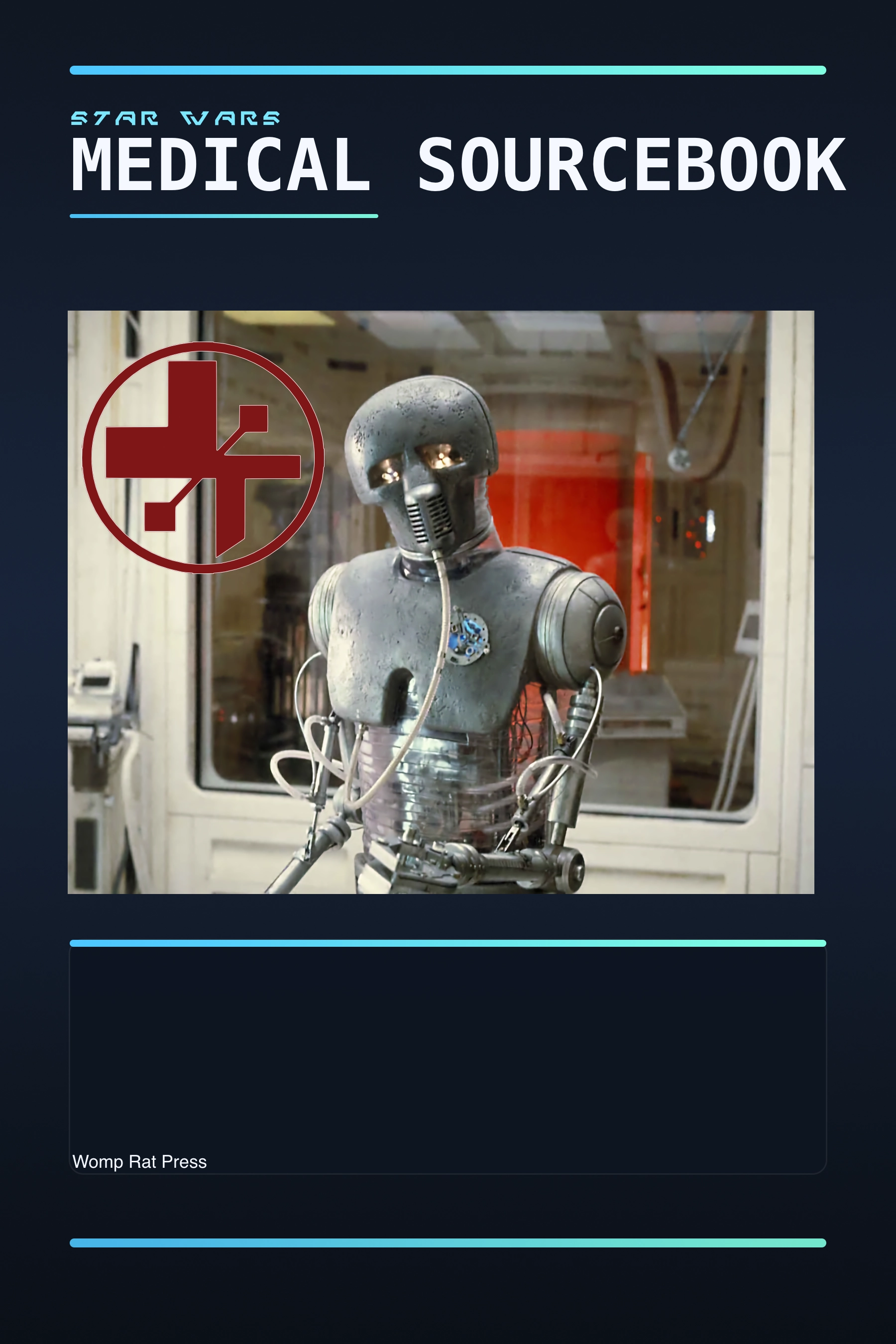
MEDICAL SOURCEBOOK
STAR WARS ROLEPLAYING GAME — REVISED • EXPANDED • UPDATED
MEDICAL SOURCEBOOK
WOMP RAT PRESS
CREDITS
Design By: Nicholas L. (Luwingo_spince)
Layout and Cover: Mike Fett (klhaviation)
Additional Design By: Justin Vanderhoof, David Stairs (Garhkal), and (Helcat)
Biochemistry by: (Helcat)
Radiation Damage charts by: (Volar the Healer)
Readers: Chris Campbell (Raven Redstar), David Stairs (Garhakl), (Guardian), (Crmcneill), (ShootingWomprats)
First Printing: April 2015
Table of Contents
Chapter 1: MEDICAL SKILLS..........3
Chapter 2: DISEASES & SYMPTOMS....11
Chapter 3: MEDICAL FACILITIES.......34
Chapter 4: MEDICAL EQUIPMENT......41
Chapter 5: MEDICAL PERSONNEL......75
Chapter 6: ILLEGAL & QUESTIONABLE MEDICAL PROCEDURES.....99
Appendix: Critical Injuries ....... 136
Chapter One
MEDICAL SKILLS
"Greetings, I am Snr-kee4823jdi399200. Since you are an inefficient gob of carbon, I can almost see your pitiful chemical neurons firing trying to process my name, so you may call me Snr-kee. Through my years as a medical droid, I have seen every disgusting permutation that can happen to a biological life form, so rest assured I will be able to cure whatever is currently and obviously wrong with your face. What's that? You are not looking to be treated but want to know what it takes to be a doctor. Well, if you were a superior life form like myself, you could just download the information directly into your cerebral cortex. Though I do seem to remember a medical journal by a Dr. Evazan that proposed it might be possible—I'll have to try this in my exper... oh, are you still here? Here, take this. It is a primer on the skills needed to be a doctor. Now run along, I have some work to do."
DEXTERITY SKILLS
Dodge
Capsule: Dodge might seem like an unrelated skill for the average doctor, nurse, or medic; however, oftentimes medical professionals must go to locations where injuries are being inflicted. Battlefields, remote installations, and planetary survey locations often require caregivers to utilize their skills in "less-than-ideal" circumstances—often under fire. You organics are so squishy, it's best to get out of the way of what is going to squish you.
KNOWLEDGE SKILLS
Alien Species
Capsule: An essential skill for the medical professional who might see various alien species in their practice. A doctor might specialize in alien species: biology, while a surgeon might specialize in alien species: anatomy.
It never ceases to amaze me how many different forms life comes in and yet they are all so disgusting. You would think somewhere they would have got it right.
Biochemistry
Biochemistry is an essential skill used to create new chemical compounds — most often for medical use — such as vaccines, medicines, etc. Using Biochemistry: Some of the specializations of biochemistry are used for research purposes rather than more practical use. Specializations most aid in the understanding of their particular field. Biochemistry specializations may also add a bonus to (A) medicine checks if used before a particular procedure. The bonus is based on how many points the research difficulty was beaten by.
| Roll is ≥ Difficulty by: | Bonus |
|---|---|
| 0-3 | +2 |
| 4-6 | +5 |
| 7-9 | +8 |
| 10-12 | +11 |
Example: Palu decides she wants to produce a known vaccine for a disease that is ravaging an Outer Rim. Because the vaccine for the disease already exists but it would take her two years to get enough to treat the colonists, Palu decides to study both the effects of the vaccine and how to create it. Because the vaccine already exists and is well documented, the GM decides Palu would need to make a Moderate biochemistry: microbiology check of 12. Palu rolls her 3D in Moderate biochemistry: microbiology and gets a 16. Palu gets to add +5 to her (A) medicine roll in order to produce the vaccine.
Other specializations have more practical uses. Through their use a player may be able to create new medicines, better diagnose what's wrong with a patient, learn a specialization without having to have a teacher or to study, or even add the specialization's dice to their (A) medicine and first aid dice when treating the patient. These practical specializations are:
-
Anatomy: Anyone who has used anatomy to study either a known alien species or an unknown species may choose to specialize in first aid for that species. They can add half their biochemistry: anatomy dice (minimum of 1D) to using the first aid specialization.
-
Hematology: When caring for someone who needs a blood transfusion, the player may add their biochemistry: hematology dice to both their first aid and (A) medicine dice.
-
Oncology: When treating a cancer patient, the player may add their biochemistry: oncology dice to both their first aid and (A) medicine dice.
-
Pathology and Toxicology: When studying diseases or poisons, the player may add their biochemistry: pathology or biochemistry: toxicology dice (whichever is appropriate) to their (A) medicine dice. Additionally, if the player is using biochemistry: toxicology to synthesize a natural poison or venom, they may add their biochemistry: toxicology dice to the appropriate weapon repair skill in order to upgrade the weapon. Only thrown, bow, and non-powered melee weapons (and certain missile weapons) may be upgraded.
-
Pharmacology: If creating a new medicine, the player may add their biochemistry: pharmacology dice to their Technical attribute to produce the new medicine.
Capsule: Biochemistry is an essential skill for the creation of new medical compounds such as vaccines, medicines, etc. (A) genetic engineering skill dice can be added when dealing with the creation of anti-viral medicines or vaccines. When used in conjunction with (A) medicine it can allow for a more accurate diagnosis of a particular illness or disease plaguing a being and even create new and more effective medicines. Uses of biochemistry are determined by the specialization.
Special Abilities / Optional Difficulties: Identifying and being familiar with the alien species the medic is working on is crucial. Due to the different ways a species reacts to certain drugs or anatomy, the character must roll his Alien Species skill to see if he has worked on or can identify the species.
Time to use: Several days, months, or years.
Specializations: See the list of specialization prerequisites above.
Genetics
Time to use: One day to one month.
Specializations: A particular field of study — human/medical, plant, creature, molecular.
The genetics skill covers the basic knowledge of genetics, genetic theory, and evolution. This is a prerequisite skill for (A) genetic engineering. Genetics is an essential skill for medical researchers.
MECHANICAL
Bacta Tank Operation
Time Taken: Varies due to extent of patient's injuries.
Advanced skill — requires (A) medicine of at least 1D.
The (A) bacta tank operation skill can be used on bacta tank rolls. This roll stacks with the (A) medicine skill roll when someone is operating a bacta tank. To determine how long it takes to heal, roll as normal (see the Combat & Injuries chapter for the rules involving bacta tank healing in the Star Wars Roleplaying Game); however, for every increment of 5 that you exceed the bacta tank difficulty roll, reduce healing time by one hour (to a minimum of one hour time to heal).
Example: Carth has a (A) medicine skill of 2D and a (A) bacta tank operation skill of 3D. When rolling for operating a bacta tank he would roll 5D. Carth beats the Very Easy difficulty by 15, thus reducing the healing time of his patient by 3 hours.
Capsule: An advanced skill, (A) bacta tank operation is a specialized field that optimizes the bacta tank healing process. Often a highly skilled bacta tank operator can lessen the time for a patient to heal and the amount of bacta that is used. The attending physician can use the bacta tank's computers to add skin-contact medicines to the bacta fluid, inject medicines into the patient's bloodstream, or dispense medicines orally.
Sensors
Capsule: Often this skill is learned as the specialization sensors: medical equipment or sensors: med diagnostic scanner.
PERCEPTION
Command
Capsule: Often this skill is learned as the specialization command: medical staff.
I remember a "doctor" who thought he could command me around. It's amazing what you can get away with during an operation. Let's just say he is no longer in practice due to a string of malpractice suits.
Persuasion
Capsule: Often this skill is learned as the specialization persuasion: calming.
I see no reason for this skill. The emotional well-being of my patient has no effect on my skill to work on them.
Sneak
Capsule: Especially useful for combat medics.
STRENGTH
Lifting
Capsule: The need to carry patients from the battlefield or from one bed to another.
Stamina
Capsule: Medics are often called on to work long hours. Stamina is essential during 10 hour surgeries.
Ha, I simulate the sound of laughter to express my derision at an organic's ability to only perform 10 hour surgeries. I can perform optimally without a sleep cycle for at least a week.
Injury/Ailment Diagnostics
Time taken: Varies due to the complexity of disease.
Specializations: Injury/ailment diagnostic: chemical.
Advanced skill — requires alien species of at least 3D and (A) medicine of at least 1D.
When used to diagnose a disease, (A) injury/ailment diagnostics will be at one lower difficulty level than when using a (A) medicine roll. This roll stacks with (A) medicine skill roll when making diagnostics rolls.
Example: Carth has a (A) medicine skill of 2D and an (A) injury/ailment diagnostics skill of 3D. When diagnosing a patient he would roll 5D. If the difficulty for diagnosis was Moderate it would be Easy if he used his (A) injury/ailment diagnostics skill.
Capsule: An advanced skill. The ability to determine the identity of a disease or injury by a medical examination and ascertain the cause of the disorder from the symptoms.
TECHNICAL
Medicine
Time taken: 1 round to several hours or days.
Specializations: Includes various species (Human, Wookiee, etc.), or field of study or fields of study (Surgery, Genetics, Cybernetics, Bioengineering, Bacta Production, Anesthesia, etc.).
Advanced skill — requires first aid of at least 5D.
Characters with this skill can perform complex medical procedures such as surgery, operation of bacta tanks, and the installation of cybernetic replacements and enhancements. They are also familiar with all types of medicines and are capable of using them to best effect. The difficulty depends on the sophistication of the medical procedure. These difficulties may be modified by the conditions in which the procedure is being performed:
- Very Easy: Rendering basic aid or performing a "routine"
procedure. - Easy: Performing an advanced procedure or rendering
advanced aid. - Moderate: Performing light "outpatient" surgery.
- Difficult: Performing basic or routine surgery.
- Very Difficult: Performing invasive surgery or diagnosing a
rare disorder. - Heroic: Performing experimental or improvised surgery, or
novel work.
Special: Though (A) medicine is a Technical skill, when the skill is first taken, it is at 1D (not the character's Technical skill). At a skill of 1D, the character should be considered a medic or med student. At 2D, it may be assumed that the character has the skill level of a registered Nurse or an intern. At 3D, a doctor. At 4D, a specialist or experienced doctor. At 5D and above, the character will likely have a good reputation as an expert doctor in the field.
Capsule: (A) medicine represents the whole of medical sciences, from advanced medical procedures, to surgery, to experimentation and development. When a character uses the (A) medicine skill to perform first aid and basic field/emergency procedures (including light surgery), it is added to the character's first aid skill.
First Aid
Time of Use: 1 round
Difficulty: Varies greatly
Specializations: Species (Human, Wookiee, etc.) or injury type (Broken Bones, Burns, Cuts, etc.)
First aid reflects a character's ability to perform emergency life-saving procedures in the field. First aid training gives a character the knowledge to tend to injuries and minor illnesses (such as nausea and headaches). The character will be familiar with using basic medical supplies, such as bandages and antiseptic, but will not be able to perform surgery or other complex procedures. First aid can be used to temporarily remove wound penalties for a few rounds, or wake a stunned character even without a medpac.
Genetic Engineering
Time of use: One month to several years.
Specializations: Creatures, Species, Cloning.
Advanced skill — requires genetics of at least 6D.
Special: Though (A) genetic engineering is under Technical, when the skill is taken, it is at 1D (not the character's Technical skill).
Capsule: This skill is the knowledge of genetics and how to manipulate the genetic code of creatures to bring about desired traits. Characters with the skill can use natural substances, genetic code restructuring, and a number of other techniques to create "designer creatures" or beings for specific tasks or qualities.
I think sometimes that the ability to improve on the inadequate forms of life is one of the only things that make me come out of my sleep cycle.
FORCE POWERS
Control
- Accelerate Healing: To help others you must be in shape yourself.
- Control Disease: A prerequisite to controlling disease in others.
- Control Pain: If a medic is in pain they cannot help others to the best of their ability.
- Detoxify Poison: A prerequisite to detoxifying poison in others.
- Reduce Injury: To help others you must be in shape yourself.
- Remain Conscious: Must be conscious to be effective.
Sense
- Life Sense: The Force healer can sense the presence and identity of a specific person for whom he searches. The user can sense how badly wounded, diseased, or otherwise physically disturbed the target is.
- Magnify Senses: In certain circumstances this can help a Force healer diagnose a disease or poison.
- Receptive Telepathy: In certain circumstances this can help a Force healer diagnose a disease or poison.
- Shift Sense: In certain circumstances this can help a Force healer diagnose a disease or poison.
Control and Alter
- Accelerate Another's Healing: An essential skill for a Force healer.
- Control Another's Disease: An essential skill for a Force healer.
- Control Another's Pain: Can help to ease a patient's pain and prevent them from going into shock.
- Detoxify Another's Poison: An essential skill for a Force healer.
- Place Another in Hibernation Trance: Often used as an emergency solution to stabilize a mortally wounded patient due to the potential of a Force user not being able to take someone out of a trance. Though a more skilled Force healer may use it more frequently for healing.
- Remove Another's Fatigue: Useful for a medical staff that are putting in long hours.
- Return Another to Consciousness: Useful to have a patient conscious to help diagnose injuries and/or diseases.
- Transfer Force: Often used as a last resort to stabilize a mortally wounded patient as the Jedi must give a part of themselves to help them.
HEALING
Characters can heal in a variety of ways, but the three most common methods of healing are natural healing, medpacs and bacta tanks (also known as rejuvenation tanks).
NATURAL HEALING
A character can heal naturally, but this process is both slower and much riskier than bacta healing. The character must rest a specified amount of time and then can make a healing roll: roll the character's full Strength to see if the character heals. Healing characters can do virtually nothing but rest. A character who tries to work, exercise or adventure must subtract -1D from his Strength when he makes his healing roll.
Any character who opts to take it easy and do virtually nothing for twice the necessary time may add +1D to his Strength roll to heal. A wounded character must rest for three standard days before rolling to heal.
| Strength Roll | Result |
|---|---|
| 2-4 | Character worsens to wounded twice |
| 5-6 | Character remains wounded |
| 7+ | Character is fully healed |
A character who is wounded twice must rest for three days before rolling to heal.
| Strength Roll | Result |
|---|---|
| 2-4 | Character worsens to incapacitated |
| 5-6 | Character remains wounded twice |
| 7+ | Character improves to wounded |
Incapacitated characters must rest for two weeks before making a healing roll.
| Strength Roll | Result |
|---|---|
| 2-6 | Character worsens to mortally wounded |
| 7-8 | Character remains incapacitated |
| 9+ | Character improves to wounded twice |
Mortally wounded characters must rest for one month (35 standard days) before making a healing roll.
| Strength Roll | Result |
|---|---|
| 2-6 | Character dies |
| 7-8 | Character remains mortally wounded |
| 9+ | Character improves to incapacitated |
Example: Thannik is incapacitated and is healing naturally. After resting for two weeks, he makes his Strength roll and gets a 10 — he improves to wounded twice. To heal from wounded twice to wounded, he must rest for another three days before making his healing roll.
OPTIONAL RULES
FOR NATURAL HEALING
Average Roll: Having a Doctor or a Medical Droid care for the patient allows them to take average on any roll, thus limiting the chance of a critical failure or other negative roll that would cause delayed healing times.
Skilled Care: A medic who is caring for a patient can roll a Moderate first aid roll to give a user a +1 to their healing roll. For every 5 points they beat that roll by, they give an additional +1. Failing the roll will cost the patient a -1 on their roll, with an additional -1 per 5 points they missed the roll by.
A doctor with an Easy (A) medicine roll can give a player character a +1D bonus to their healing roll. For every 5 points they exceed the difficulty by, they grant a +1 to that roll.
A doctor with a separate Moderate (A) medicine roll at the end of each time band can allow the PC to double their natural healing rate.
A doctor or medic can take care of a number of patients at one time equal to their first aid Skill Dice +3 times their (A) medicine Dice value. (i.e. a Medic has 4D+2 first aid can keep track of 4 patients at once. A Doctor with 5D+2 first aid and 3D (A) medicine could take care of 14 patients.) Exceeding this number will cost them 1D per 2 people they are watching, just like multiple action penalties for 2 or more actions in a single round.
MEDPACS
A standard medpac contains a combination of healing medicines, syntheflesh, coagulants, body chemistry boosters, adrenaline drugs, and computer diagnostic hardware to treat seriously injured individuals. Medpacs are very common around the galaxy and can be found aboard most starships, in most buildings and homes, and anyone who thinks he might get into a battle is advised to carry a couple, too. A first aid (or Technical) roll is needed to use a medpac. The difficulty depends upon the severity of the patient's injury:
| Injury Level | Degree of Difficulty |
|---|---|
| Stunned, Unconscious | Very Easy |
| Wounded or Wounded Twice | Easy |
| Incapacitated | Moderate |
| Mortally Wounded | Difficult |
If the first aid roll is successful, the patient heals one level: Stunned and wounded characters are fully healed; Unconscious characters are revived; Wounded twice characters improve to wounded; Incapacitated characters improve to wounded twice; Mortally wounded characters improve to incapacitated. If the first aid roll is unsuccessful, the character's condition remains the same. If the first aid roll misses the difficulty by more than 10 points, the medpac has pushed the injured character's body to its limit, and no more medpacs can be used on him for a full standard day (24 hour period). Each medpac used beyond the first has less chance of being effective, due to negative synergy of the drugs and diagnostics programmed with the assumption that only one medpac is being used. Multiple medpacs can be used on a character within a single day, but increase the first aid difficulty one level for each additional use.
Example: Thannik has been wounded twice. The first time a medpac is used on him, the first aid difficulty is Easy. If a second medpac is used on him in the same day, the first aid difficulty is Moderate. A medpac is fully expended when it's used — someone who expects to heal several people must carry multiple medpacs. A character can use a medpac on himself, but he suffers an extra -1D penalty (in addition to any other penalties, such as for being injured).
Example: Thannik, having been wounded twice (−2D to all actions), wants to use a medpac to heal himself (that's an additional −1D penalty, for a total penalty of −3D). Unfortunately his Technical is only 2D — he can't use the medpac on himself.
Optional Rules for Medpacs
Medpacs seem powerful compared to bacta tanks. Since they can heal rather quickly when compared to the hours or days that a bacta tank requires. If you find that Medpacs are overpowering your games, use one or all of these optional rules.
-
Medpacs do not Heal Wounds: They mask the wounds. They are mostly a synthaskin spray and pain killer injection. The character is still hurt, but he doesn't feel it. He functions without penalty, but if he's injured again then he goes to the next level of injury. He remains in this anesthetized state until he heals normally or is treated with bacta (or accelerates healing for the Jedi types). Bacta treatment actually heals the wounds.
-
Pushing the Limits: If the first aid roll is unsuccessful, the character's condition remains the same. If the first aid roll misses the difficulty by more than 10 points, the medpac has pushed the injured character's body to its limit, and no more medpacs can be used on him for a full standard day (24 hour period) and their condition worsens one level.
-
Increased Time to Heal: Additionally, a gamemaster may opt to increase the time it takes to heal while using a medpac.
- Stunned/Unconscious: 1 round
- Wounded/Wounded Twice: 2D rounds
- Incapacitated: 2D minutes
- Mortally Wounded: 5D minutes
BACTA TANKS
Bacta is a specially formulated treatment liquid which promotes rapid healing and acts as a disinfectant. The attending physician can use the bacta tank's computers to add skin-contact medicines to the bacta fluid, inject medicines into the patient's bloodstream, or dispense medicines orally. Characters must have the (A) medicine skill to use a bacta tank. On most planets, only licensed doctors can administer bacta treatments.
A Very Easy (A) medicine skill is necessary to use a bacta tank — regardless of the wound level. If the roll is made, the character will heal — it's just a matter of time. A character attempting to use a bacta tank without the (A) medicine skill must make a Heroic first aid or Technical roll. If the roll fails, the patient's injury worsens two levels. (Wounded patients worsen to incapacitated; wounded twice patients worsen to mortally wounded; an incapacitated or mortally wounded patient is killed.)
The character's healing time depends on the severity of his injuries.
| Character is: | Treatment Time |
|---|---|
| Wounded | 1D hours |
| Incapacitated | 4D hours |
| Mortally Wounded | 1D days |
Example: Thannik has been mortally wounded, but his friends quickly get him to a bacta tank. The doctor needs to make a Very Easy (A) medicine roll and succeeds. The gamemaster rolls 1D and gets a four. Four days later, Thannik emerges from the bacta tank fully healed.
MEDICINES
There are many different medicines in the galaxy, ranging from mass-produced Pharmaceuticals to "local cures" known only on remote planets. Each medicine has different game effects. Some may add a bonus to a character's first aid or (A) medicine skill; others may allow a patient to heal faster; still others may only affect certain injuries or diseases and provide no help for others. You can create new medicines (and describe their game terms) as needed for your games.
Phases of Treatment of Injury
- Diagnosis
- Treatment/Surgery
- Recovery
Diagnosis
Medical diagnosis refers to the process of attempting to determine and/or identify a possible disease or disorder and the opinion reached by this process.
Injury Difficulty to Diagnosis
Optional Difficulties
| Situation | Modifier |
|---|---|
| Patient is Incoherent | +3 |
| Patient is Unconscious | +6 |
| Patient can describe what bit, attacked, or describe symptoms | -3 |
| Patient has physical evidence of what bit, attacked, or evidence of symptoms | -10 |
| Disease/Injury is unknown to Doctor | +15 |
| Doctor has heard or read about disease/injury before | -5 |
| Doctor has treated disease/injury before | -10 |
| Patient is from same planet as Doctor | 0 |
| Patient is from different planet but same system | +2 |
| Patient is from different system but same sector | +5 |
| Patient is from different sector but same region | +10 |
| Patient is from different region | +20 |
| Patient is from a species common to planet | 0 |
| Patient is from a species uncommon to planet | +5 |
| Patient is from a species rare to planet | +10 |
| Patient is from a species unheard of to planet | +20 |
Injury Level Difficulty
| Injury Level | Difficulty |
|---|---|
| Stunned/Unconscious | Very Easy |
| Wounded | Easy |
| Wounded Twice | Moderate |
| Incapacitated | Difficult |
| Mortally Wounded | Very Difficult |
Skills that Might be Used to Diagnose:
- First aid for minor injuries (i.e. Stunned, Wounded, Wounded Twice).
- (A) medicine for other injuries.
- Injury/ailment diagnostics at one lower difficulty level than when using a (A) medicine roll.
Treating physician or character must analyze the affected character, identifying their symptoms and diagnosing their injury. If diagnosis roll fails, proceed to treatment with a +20 modifier to difficulty. If treatment fails, use Misdiagnosis chart and repeat diagnosis phase.
Misdiagnosis Chart
| Roll 1D | Misdiagnosis Result |
|---|---|
| 1 | Treatment interacts horribly with injury: increase injury by one level. |
| 2, 3 | Treatment makes injury worse: +3 difficulty to treat. |
| 4, 5 | No change. |
| 6 | Treatment provides clues about injury: +2 to next diagnosis roll. |
Doctor's Skill Cost Multiplier
| Doctor's Skill | Cost Multiplier |
|---|---|
| Butcher (1D–2D) | ×0.25 |
| Poor (2D–3D) | ×0.50 |
| Average (3D–4D) | ×1.0 |
| Professional (4D–6D) | ×1.5 |
| Veteran (6D–9D) | ×2.0 |
| Elite (8D–11D) | ×3.0 |
| Ultra Talented (10D–13D+) | ×4.0 |
TREATMENT COST
The cost of treatment depends on the skill of the doctor and the degree of injury to heal (see chart below).
Example: Luwingo is incapacitated and is taken to a doctor with average skill. The cost of treatment would be 600 credits (400 × 1.5 + 450). If he is put into the bacta tank it would cost 375 credits (150 × 1.5 + 150). If he needed surgery it would cost 1875 credits (750 × 1.5 + 750). It is up to the gamemaster's discretion which treatment options are needed.
Treatment
| Injury | Cost |
|---|---|
| Wounded | 150 credits |
| Incapacitated | 400 credits |
| Mortally Wounded | 700 credits |
Surgery
| Injury | Cost | Rest Period |
|---|---|---|
| Wounded | 300 credits | 2D hours |
| Incapacitated | 750 credits | 1D days |
| Mortally Wounded | 1300 credits | 3D days |
Bacta Tank
| Injury | Cost | Time Taken |
|---|---|---|
| Wounded | 75 credits | 1D hours |
| Incapacitated | 150 credits | 4D hours |
| Mortally Wounded | 300 credits | 1D days |
(A) Medicine Difficulty by Injury
| Injury | Difficulty |
|---|---|
| Hand/Arm Injury | Very Easy |
| Leg Injury | Easy |
| Punctured Organ | Moderate |
| Head Trauma | Moderate – Difficult |
| Severe Mortal Wound | Very Difficult – Heroic |
RISK OF INFECTION
Skill of the doctor can reduce or increase the risk of infection during surgery/treatment.
Optional Difficulty Modifiers
| Situation | Modifier |
|---|---|
| Medic is using familiar medical equipment | 0 |
| Medic is using unfamiliar medical equipment | +3 |
| Medic is using improvised medical supplies | +3 |
| The injured character is in unclean conditions | +5 |
| Broken bone | +3 |
| Shattered bone | +7 |
| Foreign object in body | +5 |
| Patient is in shock | +5 |
| Profuse bleeding | +10 |
| Doctor has never done surgery/treatment before | +10 |
| Doctor has performed surgery/treatment before | 0 |
| Doctor has performed surgery/treatment many times | −5 |
Infection Risk by Injury
| Injury | Infection Risk | Difficulty |
|---|---|---|
| Hand/Arm Injury | Very Low | Easy |
| Leg Injury | Low | Moderate |
| Punctured Organ | Moderate | Difficult |
| Head Trauma | Moderate – High | Difficult – Very Difficult |
| Severe Mortal Wound | High – Very High | Very Difficult – Heroic |
Doctor's Skill Risk-of-Infection Modifier
| Doctor's Skill | Modifier |
|---|---|
| Butcher | +10 |
| Poor | +7 |
| Average | +5 |
| Professional | 0 |
| Veteran | −5 |
| Elite | −7 |
| Ultra Talented | −15 |
Infection Chart
| Doctor Roll Difference | Effect | Healing Time Modifier | Symptoms* |
|---|---|---|---|
| 0–3 | Mild Infection | +1 to healing time | N/A |
| 4–6 | Moderate Infection | +2 to healing time | Burning Skin |
| 7–10 | Major Infection | +1D+1 to healing time | Low Grade Fever, Shortness of Breath |
| 11+ | Extreme Infection | +2D to healing time | High Grade Fever, Painful Stomach Cramps, Vomiting |
See Chapter 2.
Chapter Two
DISEASES & SYMPTOMS
"Salutations, my name is Regald Archdoby, Chief Xenopathologist of the Imperial Institution for Disease Control. I've been tasked with briefing you on various diseases to be found in our galaxy. Here at the IIDC we have a current database of over 100 million different diseases and their symptoms. No doctor could possibly know them all. Thankfully, a lot of diseases are regional or even planet-bound, and are unlikely to be encountered outside their region. The following list is hardly exhaustive, but a collection of the most common found in the galaxy, or the most interesting at least. Familiarize yourself with this information and you will be well on your way to becoming a master diagnostician."
DISEASES
Diseases are viruses or other organisms that infect the body of a living creature. Infections can occur in a number of ways, such as coming into contact with another infected creature, touching diseased matter, consuming food or drink tainted with disease, or being the victim of a biological weapon attack. All living creatures have an immune system that is able to fight off infection, which could lead to recovery. However, in severe cases medical treatment is required. If left untreated, a disease could wreak havoc on a being. Depending on the type and severity, diseases could bring about unconsciousness, the loss of a limb, or death.
Phases of Disease
- Exposure
- Incubation
- Symptoms
- Medical Diagnosis
- Treatment
- Recovery / Long Term Sickness / Death
EXPOSURE
Transmission of pathogens can occur in various ways, including physical contact, contaminated food, body fluids, objects, airborne inhalation, or through vector organisms. Infectious diseases that are especially infectious are sometimes called contagious and can be easily transmitted by contact with an ill person or their secretions.
Roll Stamina against Contagious Difficulty for physical disease. Roll Willpower against Contagious Difficulty for mental disease. If the roll succeeds, then the body fights off the disease. If the roll succeeds by 5 or less, they become a carrier but do not become infected. Length of carrier phase is based on how contagious the disease is. If the roll is failed, move on to Incubation phase.
| Contagious Difficulty | Length of Carrier Phase |
|---|---|
| Very Low (Easy) | 12 hours |
| Low (Moderate) | 24 hours |
| Moderate (Difficult) | 2 days |
| High (Very Difficult) | 1 week |
| Very High (Heroic) | 2 weeks |
Factors that Affect Resistance
| Situation | Contagion Modifier |
|---|---|
| Every day without water | +3 |
| Every day without food | +1 |
| Every day without sleep | +2 |
| Poor nutrition | +10 |
| High/low temperature exposure | +5 |
| Extremely wet/dry environment | +5 |
| Character has had a booster shot | -10 |
| Previously been exposed to disease | -15 |
| Excellent nutrition | -10 |
Most ship's rations constitute as poor nutrition, since a lot of it is highly processed to give it a long shelf life.
Optional Rules
If you want the disease to have a more long-standing effect on the character, you could have the disease be weakened during this phase instead of destroyed, thus making the character roll Stamina resistance a couple of times. If Stamina/Willpower beats Contagious Difficulty by:
- 1–5: Infection weakened – drops Contagious Difficulty by one level.
- 6–10: Infection severely weakened – drops Contagious Difficulty by 2 levels.
- 11–15: Body destroys infection
To add some variety or difficulty to a disease, use the Mutating Virus Chart.
Mutating Virus Chart
| 1D | Result |
|---|---|
| 1 | Evolved Strain – Add one extra symptom to a disease. |
| 2 | Virulent Strain – Increase Infection Difficulty by one level. |
| 3 | Adaptable Strain – For every failed attempt to treat, add +3 to Difficulty. |
| 4 | Resistant Strain – Increase Treatment Difficulty by one level. |
| 5 | Mutating Strain – Increase Diagnosis Difficulty by one level. |
| 6 | Fast-acting Strain – Reduce Incubation roll result by half. |
INCUBATION
The incubation period is the time elapsed between exposure to a pathogenic organism, a chemical, or radiation, and when symptoms and signs are first apparent. The period may be as short as minutes to as long as years. The gamemaster secretly rolls to see how long the disease incubates. Roll Contagious Difficulty against any character that comes into contact with an infected character that hasn't been exposed to the disease previously. If the character, for some reason, goes to a doctor during this time, the difficulty to diagnose the disease is increased by 2 levels.
SYMPTOMS
A symptom is a departure from normal function or feeling which is noticed by a patient, indicating the presence of disease or abnormality. After the incubation period is over, symptoms begin to appear. If there is more than one symptom, the gamemaster may assign a number to each symptom, then roll a die every day the character has the disease, or just apply all symptoms at once.
Roll Damage after the incubation period is over.
Fatal Damage
| Severity | Damage |
|---|---|
| Very Low | 2D every 12 hours |
| Low | 2D+1 every 6 hours |
| Moderate | 3D every 3 hours |
| High | 4D every hour |
| Very High | 5D every half hour |
MEDICAL DIAGNOSIS
Medical diagnosis refers to the process of attempting to determine and/or identify a possible disease or disorder and the opinion reached by this process. The treating physician or character must analyze the affected character, identifying their symptoms and diagnosing their disease. If diagnosis roll fails, proceed to treatment with a +20 modifier to difficulty. If treatment fails, use Misdiagnosis chart and repeat diagnosis phase.
Optional Difficulties
| Situation | Modifier |
|---|---|
| Patient is Incoherent | +3 |
| Patient is Unconscious | +6 |
| Patient can describe what bit, attacked, or describe symptoms | −3 |
| Patient has physical evidence of what bit, attacked, or evidence of symptoms | −10 |
| Disease/Injury is unknown to Doctor | +15 |
| Doctor has heard or read about disease/injury before | −5 |
| Doctor has treated disease/injury before | −10 |
| Patient is from same planet as Doctor | 0 |
| Patient is from different planet but same system | +2 |
| Patient is from different system but same sector | +5 |
| Patient is from different sector but same region | +10 |
| Patient is from different region | +20 |
| Patient is from a species common to planet | 0 |
| Patient is from a species uncommon to planet | +5 |
| Patient is from a species rare to planet | +10 |
| Patient is from a species unheard of to planet | +20 |
Misdiagnosis Chart
| 1D | Result |
|---|---|
| 1 | Treatment interacts horribly with disease; increase Fatal Damage by one level. |
| 2, 3 | Treatment makes disease worse: +3 to Difficulty to treat. |
| 4, 5 | No change. |
| 6 | Treatment provides clues about disease; +2 to next diagnosis roll. |
TREATMENT
The attempted remediation of a health problem, usually following a diagnosis. Once the Physician has diagnosed the specific disease, he will then try to cure it. If required skill is (A) medicine, then that skill must be used. If first aid, (A) medicine may be used with a +1D bonus.
RECOVERY / LONG-TERM SICKNESS / DEATH
On a successful Treatment Roll, the disease is cured and the symptoms disappear unless specifically stated. If the roll fails, symptoms continue and no treatment rolls can be performed for 1D hours. After a total of 5 failed Treatment rolls, one of the symptoms becomes a permanent condition and the character suffers it the rest of his life, unless he takes regular medication or undergoes complete cellular rejuvenation.
SYMPTOMS
"The ability to correctly identify symptoms in a patient can mean life or death. For example, the only difference during the opening phases of the fairly benign Nerf-pox and the deadly Barfarian Refresher Plague is a slight heart murmur. Detecting that murmur will prevent the patient's intestinal tract from swelling up like a balloon and then violently releasing itself. Trust me, you do not want to have a patient die from extreme defecation."
Allergic Reaction: Character has difficulty breathing or repeated sneezing for 3D minutes, -1D to sneak for duration of allergic reaction.
Anxiety: An Easy willpower roll must be made every round that an affected character is engaged in combat. Failure to make the required willpower roll indicates the character's nerve breaks and he begins a blind retreat in a randomly determined direction. Multiple-action penalties apply when making the willpower roll.
Attention Deficit: Character must make a Moderate Perception roll to access short-term memory: recent orders, weather updates, and so forth.
Blackouts: If a character rolls a 1 on the Wild Die during any attribute or skills checks, he experiences a blackout for 2D rounds. During the blackout the character falls prone and cannot move, see, or hear.
Blindness: Difficulty for any vision-based skill or attribute checks is increased by five Difficulty levels. If medical treatment is not received before the effect's time has elapsed, the blindness is permanent.
Blurred Vision: -1D to Vision Based search checks, -1D to any Dexterity skill rolls that require the use of sight: blaster, melee combat, dodge, and so on.
Body Aches/Soreness: Reduce Move by 2.
Boils/Blisters: Causes a very painful and irritating itch, -2D to Perception and related skills. Reduce Move by 2.
Brain and Central Nervous System Shut Down: Character has suffered irreversible physical damage and cannot survive without permanent medical attention (life-support apparatus and so on). All Attributes and Skills reduced to 0D. In the field, the character can be stabilized by a Heroic+10 first aid or Heroic (A) medicine roll; if the character does not receive the required medical attention, death occurs after the effect's duration has elapsed.
Burning Eyes: -2 to Vision-Based search checks, -2 to any Dexterity skill rolls that require the use of sight: blaster, melee combat, dodge, and so on.
Catastrophic Parasitic Infection: Choose any 5 symptoms (GM's choice).
Chest Pain: Reduce Move by 2. Any skills requiring the upper body are reduced by -2D. I.e., lifting, climbing, etc.
Chills: Roll a Moderate willpower roll every 3 hours. If failed, the character is reduced to shivering uncontrollably for 2D rounds. Reduce Move by 4 and any rolls made are reduced by -2D for the duration of the shivers.
Coma: Character lapses into a coma for the effect duration. All Attributes and Skills are reduced to 0D, and Move is reduced to 0. Character must receive a Moderate first aid roll once per day or will lapse into systemic shutdown (see below). If the character is stabilized, he awakens after the effect duration has elapsed.
Complete Biomass Conversion: Converts total body into energy. Must roll heroic stamina roll or the body completely disintegrates to energy.
Confusion: Represents mental feebleness, general incompetence, mild delusions, or intoxication. Confused characters suffer from the following:
-1D to all Knowledge, Technical, and Mechanical skills.
Congestion: -1D to Scent-based search checks.
Cough: Requires a Moderate willpower roll. If roll fails, character will cough. Can disrupt sneak or hide rolls, etc.
Coughing Up Blood: -2D to Stamina and -1D to Strength rolls, including resisting damage.
Crusting Around Eyes and Mouth: -1 to any Dexterity skill rolls that require the use of sight: blaster, melee combat, dodge, and so on.
Deafness: Difficulty for any auditory-based skill or attribute checks is increased by five Difficulty levels. If medical treatment is not received before the effect's time has elapsed, the deafness is permanent.
Degeneration of Nervous System: A loss of motor control.
-1D to Dexterity and related skills after every failed Stamina roll. If Dexterity is reduced to 1D, then it becomes permanent nerve damage.
Diarrhea: This condition often occurs in tandem with Nausea, Dehydration, or Organ Failure of the stomach or intestinal tract. Sufferers of diarrhea will experience frequent urges to visit the bathroom and must succeed at both a Moderate Stamina and Willpower roll to resist this urge. While under the effects of diarrhea, the character cannot attack or do anything requiring focused concentration. The only action such a character can take is a move action per round. Attempting any other physical activity will cause the victim to lose control of his bowels for 1D rounds. Prolonged diarrhea can also result in Extreme Dehydration and Fatigue.
Dizziness/Loss of Equilibrium: -1D to Dexterity, Mechanical, and related skills.
Drowsiness: -1 to all skill and attribute checks for every Stamina check failed.
Dry Heaves: Character must make a Difficult Stamina check every 1D hours to prevent dry heaves. The attack lasts for 1D minutes.
Earache: Difficulty for any auditory-based skill or attribute checks is increased by one Difficulty level.
Excessive Ear Wax Production: Difficulty for any auditory-based skill or attribute checks is increased by two Difficulty levels unless ears are cleaned every 3 days.
Excessive Mucus Production: -1D to any Persuasion or Seduction rolls.
Exhaustion: This condition usually follows the initial onset of Fatigue due to declining health, but some diseases have a much stronger effect upon their victims and cause immediate exhaustion. An exhausted character can only move at half speed and takes a -2D to all skill and attribute checks until the condition is alleviated. After 1 hour of complete rest, an exhausted character improves to a fatigued state.
Extreme Dehydration: Character is exceptionally thirsty, experiences dizziness, lightheadedness, fatigue, and may lapse into unconsciousness. Character suffers a -2D penalty to all attributes and skill checks and movement is reduced to 5.
Extreme Hunger: -1D to Strength and related skills. Does not count when taking damage. Character must make a Moderate Willpower roll every hour; if failed, character must stuff himself or suffer an additional -1D to Strength skills.
Extreme Paranoia: The affected character believes he is the subject of a conspiracy. Character must make a Difficult Perception roll to refrain from attacking fellow squad members. All Multiple-action penalties apply.
Fainting: If a character rolls a catastrophic complication during any attribute or skill checks, he experiences a fainting spell for 1D rounds. During the fainting spell, the character falls prone and cannot move, see, or hear.
Fatigue: -1D to all skill and attribute checks for every Stamina check failed.
Fear: A Difficult Willpower roll must be made every round that an affected character is engaged in combat. Failure to make the required Willpower roll indicates the character's nerve breaks and he begins a blind retreat in a randomly determined direction. Multiple-action penalties apply when making the Willpower roll.
Gaps in Memory: -2D to Knowledge, Technical, and related skills when trying to use skills that require memory.
Hallucinations: Character experiences visual or auditory hallucinations.
- Visual: reduce all vision-based Attribute and Skill checks by -1D.
- Auditory: reduce hearing-based attribute and skill checks by -1D.
Hard of Hearing: Difficulty for any auditory-based skill or attribute checks is increased by four Difficulty levels. If medical treatment is not received before the effect's time has elapsed, Hard of Hearing is permanent.
Headache: -1D to any Knowledge or Technical and related skills.
Head Cold: -1D to Perception and related skills.
Hearing Loss: Difficulty for any auditory-based skill or attribute checks is increased by three Difficulty levels.
Heatstroke: A Moderate stamina roll. If failed, the character must stop what they are doing and rest for 1D rounds.
High Grade Fever: -2D to stealth when attempting to hide from sensors. -1D to any Knowledge or Technical and related skills.
Hoarseness: Difficulty for speaking-based skill or attribute checks is increased by one Difficulty level. If using against an NPC such as a bargain roll, modify the NPC roll by +5.
Immune Deficiency: A lowering of the victim's immune response system, thereby preventing the immune system from effectively responding to an infection. Characters suffering from a temporary or permanent immune deficiency incur a -1D to -3D to stamina depending on the severity of the deficiency when rolling to resist further infections.
Increased Aggression: Character must make a Moderate willpower roll to refrain from attacking any nearby target, friend or foe; character may not use stealth during this attack.
Insanity: Character must make a Very Difficult Perception roll to refrain from attacking fellow squad members. All Multiple-action penalties apply. Desires, intentions and motives of affected character change unpredictably and frequently.
Internal Bruising/Bleeding: Character suffers a -2D penalty to Strength to resist damage and must receive medical attention before the effects wear off; failure to receive treatment results in the character's death within 36 hours.
Loss of Appetite: Requires a Moderate willpower roll or the character doesn't eat. -1D to stamina for every 24 hour period character goes without eating.
Loss of Directional Sense: Whenever heading to a never visited location, roll a die; on an odd result the character has become lost. The degree of being lost is determined by GM. Can have hilarious results.
Loss of Judgment: Character has difficulty making snap judgments or interpreting orders. All Perception, Knowledge and related skill Difficulties increase by one.
Low Grade Fever: -1D to sneak when attempting to hide from sensors.
Major Parasitic Infection: Pick any four symptoms (GM's choice).
Malaise: A weaker form of Nausea, more as a general feeling of sickness. A character suffers a –1 penalty to Dexterity. An Easy willpower roll is required every time a character is in a situation that requires fast motion. If roll is failed, see vomiting.
Memory Loss: Victims of this condition must succeed on a Moderate willpower roll to remember even the most basic of Knowledge skills. If the roll is failed, apply a –1D+1 penalty to all Knowledge, Technical, and related skills when trying to use skills that require memory.
Mental and Emotional Breakdown: A Very Difficult willpower roll must be made every round that an affected character is engaged in combat. Failure to make the required willpower roll indicates the character's nerve breaks and he begins a blind retreat in a randomly determined direction. Multiple-action penalties apply when making the willpower roll. -2D to All Knowledge and Technical rolls.
Minor Parasitic Infection: Pick any three symptoms (GM's choice).
Muscle Spasms: A Difficult stamina check. If failed, muscle spasms travel throughout the body. A Difficult Strength roll to hold on to anything the character is holding (blasters, comlinks, swords, etc.). Move is reduced by half. Any Dexterity skills are reduced by -2D for duration of spasm.
Muscle Weakness: -1D+1 to Strength and related skills.
Nausea: -2 penalty to Dexterity. A Moderate willpower roll is required every time a character is in a situation that requires fast motion. If roll is failed, see vomiting.
Nervous Twitches: A moderate stamina check. If failed, twitches travel throughout the body. A moderate Strength roll to hold on to anything the character is holding (blasters, comlinks, swords, etc.). Any Dexterity skills are reduced by -1D for duration of twitch.
Numbness: Numbness in the extremities. -2 to Dexterity in fine motor activities.
Painful Stomach Cramps: Move is reduced by 2.
Panic Attack: A Moderate willpower roll must be made every round that an affected character is engaged in combat. Failure to make the required willpower roll indicates the character's nerve breaks and he begins a blind retreat in a randomly determined direction. Multiple-action penalties apply when making the willpower roll.
Paralysis: Character is rendered completely immobile, though he remains conscious. If the character does not receive medical attention, the paralysis becomes permanent after the effect duration elapses.
Paralysis (Crippling): Character's muscles spasm and seize up, reducing movement to zero. Airways close and lungs do not function. If victim is not hooked up to a breathing device after 3D minutes, they will die of asphyxiation.
Paranoia: The affected character believes he is the subject of a conspiracy. Character must make a Moderate Perception roll to refrain from attacking fellow squad members. All multiple-action penalties apply.
Parasitic Infection: Pick any two symptoms (GM's choice).
Partial Paralysis: Character loses the use of a limb (choice of GM). Paralysis in a leg reduces movement to 5. Paralysis in arm reduces Dexterity by -2D.
Permanent Nerve Damage: Character suffers a loss of motor control. Dexterity and related skills are all permanently reduced to 1D and cannot be improved.
Permanent Psychosis/Dementia: Character's Perception, Knowledge, Technical, and Mechanical attributes and skills are permanently reduced to 1D and cannot be advanced.
Psychosis/Dementia: Perception, Knowledge, Technical, and Mechanical attributes and skills are reduced to 1D for effect duration. The character suffers no permanent mental damage, recovering completely after the effect's duration has elapsed.
Rash/Burning Skin/Irritation: Creates a distracting itch, -1D to Perception and related skills.
Reduced Circulation: Some diseases or conditions reduce blood flow or otherwise prevent the blood from adequately oxygenating the body. Characters suffering from reduced circulation will immediately feel fatigued and experience chills.
Severe Allergic Reaction: Must succeed at a Moderate Strength check. Failure indicates that the character's throat swells shut, impairing breathing. If not treated with the appropriate anti-toxin, the character will suffocate. Even if the Strength check is successful, the character will be stricken with severe headache and stomach cramps which penalizes all the character's actions by -1D for twenty hours. If the character is a Force user, any use of Force skills within that period of time receives a -2D penalty. This illness can be cured by administering the appropriate antitoxin.
Strange Sensation of Hands Fading Away: In periods of stress, character feels like his hands are disappearing. Character must make a Moderate Willpower check every round that an affected character is engaged in combat. Failure results in character dropping whatever he is holding.
Syncopated Breathing Rhythm That Sometimes Causes Ventricular Fibrillation of the Heart: During periods of extreme physical or emotional effort, a Difficult Stamina roll is required. If failed, roll a die; if it comes up odd, then the character suffers a heart attack. 5D damage.
Systemic Shutdown: Character has suffered irreversible physical damage and cannot survive without permanent medical attention (life-support apparatus and so on). All attributes and skills reduced to 0D. In the field, the character can be stabilized by a Heroic first aid or Very Difficult (A) medicine roll; if the character does not receive the required medical attention, death occurs after the effect's duration has elapsed.
Tissue Liquefaction: The character's skin tissues break down rapidly, causing extreme pain, bleeding, and—if medical treatment (a Very Difficult (A) medicine roll) is not received before the effect's duration elapses—death. Character's attributes, skills, and movement are all reduced to 0D.
Total Organ Failure: Movement reduced to 0; character requires immediate attention or will die in 1D rounds.
Toxin Intolerance: This condition limits the safe and effective removal of toxins from the victim's body. Characters suffering from toxin intolerance incur a -2D penalty to all Stamina rolls against poisons and drugs.
Tremors/Convulsions: Character experiences seizures. Seizures inflict the character's Strength +1D damage. During the seizure and for 1D rounds after, the character's skills are all reduced by -3D (minimum of 0D). Strength is not affected for the purposes of resisting damage, and in this case armor bonuses apply. Check every 1D hours to prevent vomiting. The attack lasts for 1D minutes, and reduces all skills and attributes by -1D for 3D hours.
Respiratory Ailment: Character has extreme difficulty breathing. Move is reduced by 2. If bacta treatment is not received before 24 hours has elapsed, the character suffocates.
Ringing in the Ears: Difficulty for any auditory-based skill or attribute checks is increased by two Difficulty levels.
Shortness of Breath: Move reduced by 1.
Spleen Failure: When you make any sort of physical effort (i.e. running, jumping, dodging), you feel a degree of exhaustion. In this case, roll a Moderate Stamina skill or else take a -1D to all skills and attribute rolls, except STR when taking damage. This exhaustion-caused damage is cumulative and you are subjected to -1D to all skills each time you fail the roll.
Stiffness: Move reduced by 3.
Stupor: All attributes and skills reduced to 1D for the entire effect duration unless the character receives immediate medical attention (Heroic first aid or Very Difficult (A) medicine roll).
Sweats: -2 to Stamina rolls.
Swelling of Fingers: Reduce all attribute and skill checks involving the use of fingers by -1D.
Swelling of Tongue: Reduce all speaking-based attribute and skill checks by -1D.
Vertigo: -1D+1 to climbing, jumping, running, and dodge skills.
Voice Loss: Difficulty for any speaking-based skill or attribute checks is increased by two Difficulty levels. If using against an NPC such as a bargain roll, modify the NPC roll by +10.
Vomiting: Character must make a Very Difficult Stamina roll and related skills.
Weight Loss: -1 to Stamina.
Welts: Creates a painful and distracting itch. -2D to Perception.
DISEASES
- Format Symptoms: Various
- Type: Broken skin, Exchange of fluids, Contact, Exposure, Ingestion, Inhalation, Mental, Genetic.
- Incubation Period: See Incubation above.
- Contagious: See Contagious above.
- Fatal: See Fatal above.
- Affected species:
- Cure: What will cure, slow, or fight the disease
- Rarity:
- Common: Galaxy wide/Planet wide
- Uncommon: Sector wide/Continent
- Rare: System wide/Nation
- Very Rare: Planet/City
- Time period: Not all diseases are prevalent during all time periods or rarity might change depending on when it is.
- Diagnosis Difficulty: See Medical Diagnosis above.
- Required skill: Generally Injury/ailment diagnosis but may use Medicine at one level difficulty higher. See Treatment above.
- Required skill: Depends on the severity and rarity of the disease. (A) medicine for more complex diseases and first aid for simpler diseases.
- Notes: A brief synopsis of the disease.
AIRBORNE DISEASES
An airborne disease is any disease that is caused by pathogens and transmitted through the air. The relevant pathogens may be viruses, bacteria, or fungi, and they may be spread through coughing, sneezing, raising of dust, spraying of liquids, or similar activities likely to generate aerosol particles or droplets.
"Airborne diseases tend to be the most contagious since they have the most easily transmitted between hosts. It is fortunate that most of the deadliest diseases are not transmitted this way."
Affliceria
Affliceria
Symptoms: Head cold, Fevers, Severe dehydration
Type: Inhalation
Incubation Period: 1D days
Contagious: High, spread through airborne bacteria
Fatal: High if untreated, 4D every hour
Affected species: N/A
Cure: Vaccine, disease extinct as of 2nd Galactic Civil War
Rarity: Uncommon before cure discovered
Time period: Cure discovered 100 years prior to 2nd Galactic Civil War
Diagnosis Difficulty: Moderate
Required skill: Injury/ailment diagnosis: Easy
Required skill: First Aid
Notes: Largest known outbreak on Coruscant spread by Commenori spies.
Ascomycetous Pneumoconiosis, or Fester Lung
Ascomycetous Pneumoconiosis, or Fester Lung
Symptoms: High fever
Type: Inhalation
Incubation Period: 2D days
Contagious: Inhalation of certain mold spores
Fatal: Moderate, High fever causes literal cooking of bodily fluids, 3D every three hours
Affected species: All
Cure: Antibiotics
Rarity: Located on humid, jungle-invested worlds
Time period: N/A
Diagnosis Difficulty: Moderate
Required skill: Injury/ailment diagnosis: Moderate
Required skill: Medicine
Balmorra Flu
Balmorra Flu
Symptoms: Sinus pain and swelling, Excessive mucus production
Type: Inhalation
Incubation Period: 3D hours
Contagious: Low
Fatal: Low, 2D+1 every six hours
Affected species: All
Cure: Antibiotics, rest, lots of fluids
Rarity: Common
Time period: N/A
Diagnosis Difficulty: Very Easy
Required skill: Injury/ailment diagnosis: Very Easy
Required skill: First Aid
Notes: Once contracted by Han Solo while on Dantooine.
Bandonian Plague
Bandonian Plague
Symptoms: Unknown
Type: Inhalation
Incubation Period: 1D hours
Contagious: Very High
Fatal: Very High, 5D every half hour
Affected species: All
Cure: Unknown
Rarity: Very Rare
Time period: N/A
Diagnosis Difficulty: Very Difficult
Required skill: Injury/ailment diagnosis: Heroic
Required skill: Medicine
Bledsoe's Disease
Bledsoe's Disease
Symptoms: Burning skin, Discoloration of the eyes, Severe Dizziness
Type: Inhalation, Physical contact
Incubation Period: 1D weeks
Contagious: High
Fatal: Very Low, 2D every 12 hours
Affected species: All
Cure: Engineered Serum
Rarity: Very Rare
Time period: After battle of Yavin
Diagnosis Difficulty: Difficult
Required skill: Injury/ailment diagnosis: Moderate
Required skill: Medicine
Notes: Bioengineered by Dr. Kaaldar, an Imperial scientist. The discoloration of the eye resolved itself into a starfield which was a map that revealed the location of a Rebel base. These outbreaks were used as a silent means of communication and strategizing.
Brainrot Plague (Loedorvian Brain Plague / Brainworm Rot)
Brainrot Plague (Loedorvian Brain Plague / Brainworm Rot)
Symptoms: Strain A: Attacks brain and central nervous system. Strain B: Nausea, Cold sweats, The inability to process written instructions, syntax errors in spoken and written communication. Strain C: Isolated purpling of gills and blowholes.
Type: Strain A: Inhalation / Strain B,C: Contact
Incubation Period: 2D days
Contagious: Strain A: High, 4D every hour / Strain B,C: Moderate, 3D every three hours
Fatal: Strain A: Very High, 5D every half hour / Strain B,C: Moderate, 3D every three hours
Affected species: Humanoids and cephalopoids (Neimodians, Duros, etc)
Cure: Unknown
Rarity: Very Rare
Time period: N/A
Diagnosis Difficulty: Difficult
Required skill: Injury/ailment diagnosis: Heroic
Required skill: Medicine
Notes: There are three known strains of the plague, types A, B, and C. All three are believed to have originated from Neimoidia.
Brainworm Rot Type A was an airborne disease that was a subtype of the Brainrot Plague which afflicted humanoids and cephalopoids with high levels of dialogen in their bloodstream, including Neimoidians (and presumably Duros and other Near-Duros), Anomids, and Wol Cabasshites. Brainworm Rot Type B was a less lethal version of Brainworm Rot Type A; however, it could rapidly mutate into Type A if left unchecked. It was a subtype of the Brainrot Plague. The new strain of Type B was discovered c. 1 ABY to be thriving among creature lairs. Wol Cabasshite Ambassador Lurll spearheaded a campaign on Tatooine to kill off all infected animals, to prevent further spread. Brainworm Rot Type C was a subtype of the Brainrot Plague that originated on Neimoidia, a planet notorious for its frequent quarantines. It was this attribute that led Ebenn Q3 Baobab, after serving as a Neimoidian fleet doctor, to joke that "the principal export of the Neimoidian home planet is Brainworm Rot Type C".
Brownlung
Brownlung
Symptoms: Similar to lung cancer, cough, shortness of breath, wheezing, chest pain, coughing up blood, fatigue, weight loss, loss of appetite, hoarseness
Type: Long term inhalation of contaminated air
Incubation Period: 3D years
Contagious: N/A
Fatal: High 4D every hour
Affected species: All
Cure: Bacta
Rarity: Uncommon
Time period: N/A
Diagnosis Difficulty: Moderate
Required skill: Injury/ailment diagnosis
Required skill: Medicine
Notes: More common among working class due to time spent working in underground mines.
Candorian Plague
Candorian Plague
Symptoms: None, kills too fast for symptoms to show
Type: Inhalation
Incubation Period: 1D minutes
Contagious: Very High, particularly to humans
Fatal: Very High 5D every half hour
Affected species: Humans, humanoid species
Cure: None
Rarity: Very Rare
Time period: Thought to be extinct in 45 BBY, but used by Empire
Diagnosis Difficulty: Heroic
Required skill: Injury/ailment diagnosis: Heroic+5
Required skill: Medicine
Notes: Is nearly impossible to diagnose or treat because it kills so quickly. Known to be used by Empire against rebellious planets.
Cathor Fever
Cathor Fever
Symptoms: Body aches, congestion, cough
Type: Inhalation
Incubation Period: 3D days
Contagious: High
Fatal: Very Low 2D every 12 hours
Affected species: All
Cure: Rest, antibiotics
Rarity: Common
Time period: N/A
Diagnosis Difficulty: Very Easy
Required skill: Injury/ailment diagnosis: Very Easy
Required skill: First Aid
Notes: Believed to have originated on the planet Ithor.
Catterwallkemia
Catterwallkemia
Symptoms: (first symptom the tonal sneeze Aaaaaah-cho, usually A flat) Victim must sing all verbal statements. Not singing within an hour causes a Difficult Willpower roll failure results in singing or fatigue. Written words begin to look like musical notation (even if victim never read music!)
Type: Inhalation
Incubation Period: 1d hours
Contagious: High
Fatal: Very Low 2D every 12 hours
Affected species: All
Cure: The most successful treatment (short of engrammatic purge, memory wipe) is to over stimulate the affected neural pathways. This is done by inducing a fever by singing until the victim succumbs to exhaustion. (Singing for 2 minutes per 1D of Stamina with usual checks for exhaustion until they pass out). The constant muscular exertion of dancing while singing raises the body's temperature quicker and speeds recovery (5 rounds per 1D of Stamina).
Rarity: Rare
Time period: N/A
Diagnosis Difficulty: Moderate
Required skill: Injury/ailment diagnosis
Required skill: First Aid
Notes: Developed centuries ago as part of germ warfare project of a now [thankfully] extinct species, Catterwallkemia is an extremely virulent disease. The airborne engineered phage Showmanelli Choralcaucous passes through the immune system innocuously before directly attacking the central nervous system. The organisms settle in the verbal centers of sentient brains and reform neural networks into alternate formations. The result is that all verbal communication must be expressed in song during the infestation. Resisting the urge results in severe neural strain. Ancient records report entire armies brought down by sprained vocal cords, temporary hearing loss, and shortness of breath. Emperor Myrthas IX of the obscure and tone-deaf Godallio people (Near-Gotals) is credited with defeating its creators in 12,368 BR (Before Ruusan).
Direllian Plague
Direllian Plague
Symptoms: Fever, aches, chills
Type: Inhalation
Incubation Period: 2D hours
Contagious: Very High
Fatal: High 4D every hour
Affected species: All
Cure: Shiarha root
Rarity: Rare
Time period: N/A
Diagnosis Difficulty: Difficult
Required skill: Injury/ailment diagnosis
Required skill: Medicine
Dust Fever
Dust Fever
Symptoms: Fever, aches, chills, headache, vivid unusual dreams
Type: Inhalation of infected dust
Incubation Period: 1D hours
Contagious: Very Low
Fatal: Low 2D+1 every six hours
Affected species: All
Cure: Rest, clean air to breathe
Rarity: Uncommon, common among children on Tatooine
Time period: N/A
Diagnosis Difficulty: Moderate
Required skill: Injury/ailment diagnosis
Required skill: First Aid
Findris Flu
Findris Flu
Symptoms: Low grade fever, Congestion, and Chills
Type: Inhalation
Incubation Period: 2D days
Contagious: Very High
Fatal: Low 2D+1 every six hours
Affected species: All
Cure: Triptophagea
Rarity: Common
Time period: N/A
Diagnosis Difficulty: Easy
Required skill: Injury/ailment diagnosis: Moderate (if skill doesn't beat Difficulty by 5 then one of the symptoms lingers on for 1D weeks)
Required skill: Medicine
Notes: A common illness that tended to linger on in its victims, even after normal treatment was complete.
Hardan Plague
Hardan Plague
Symptoms: Respiratory ailment, Parasitic infection, Welts
Type: Inhalation of Nafen spores
Incubation Period: 2D hours
Contagious: Very High
Fatal: Very High 5D every half hour
Affected species: All
Cure: Targeted Antivirus
Rarity: Rare
Time period: Galactic Civil War
Diagnosis Difficulty: Moderate
Required skill: Injury/ailment diagnosis: Difficult
Required skill: Medicine
Notes: A virulent disease known to be transported by Bogan's brown nafen. An outbreak which killed 98% of the population on Dagelin Minor was traced back to a shipment of nafen imported to control the Dhuru fly population.
Hive Viruses
Hive Viruses
Symptoms: Varies with type of virus
Type: Inhalation
Incubation Period: Varies
Contagious: Very High
Fatal: High 4D every hour
Affected species: All
Cure: Varies
Rarity: Before – Clone Wars, common; after – Very Rare
Time period: N/A
Diagnosis Difficulty: Difficult
Required skill: Injury/ailment diagnosis: Moderate
Required skill: Medicine
Notes: One strain of the hive virus attacked the mental centers of the brain and resulted in the loss of the Katana Fleet, when the virus spread throughout the crew.
Influenza Necrosi
Influenza Necrosi
Symptoms: Stage 1 – sore throat, runny nose, fever; Stage 2 – increased fatigue; Stage 3 – victim becomes covered in thick, slimy sweat
Type: Inhalation
Incubation Period: 2D weeks
Contagious: Very High
Fatal: High 4D every hour
Affected species: All
Cure: Antibiotics
Rarity: Very Rare
Time period: Bio-engineered by Empire
Diagnosis Difficulty: Difficult
Required skill: Injury/ailment diagnosis: Early stages – Moderate; late stages – Heroic
Required skill: Medicine
Karatos Plague
Karatos Plague
Symptoms: Blindness
Type: Inhalation
Incubation Period: 7D minutes
Contagious: Very High
Fatal: Extremely High, death occurs within one hour
Affected species: All
Cure: Vaccination (All Concord Dawn children are vaccinated)
Rarity: Very Rare
Time period: Bio-engineered by Empire
Diagnosis Difficulty: Difficult
Required skill: Injury/ailment diagnosis: Heroic
Required skill: Medicine
Notes: Originated on the planet Concord Dawn. Jango Fett carried Plague spores in his armor that he could release as a weapon. Unsuccessfully used it to try to bargain with Count Dooku.
Knytix Pox
Knytix Pox
Symptoms: Skin irritation, Fever, Headache
Type: Inhalation
Incubation Period: 2D days
Contagious: Very High (breathing in a concentrated area of knytix)
Fatal: Moderate 3D every three hours
Affected species: All
Cure: Antibiotics
Rarity: Found only on Thyferra
Time period: N/A
Diagnosis Difficulty: Difficult
Required skill: Injury/ailment diagnosis: Moderate
Required skill: Medicine
Lali Plague
Lali Plague
Symptoms: Tissue liquefaction, Insanity
Type: Inhalation
Incubation Period: 1D days
Contagious: High
Fatal: Very High 5D every half hour
Affected species: All
Cure: High doses of Bonemer and Cardinex
Rarity: Rare
Time period: Old Republic
Diagnosis Difficulty: Moderate
Required skill: Injury/ailment diagnosis: Very Difficult
Required skill: Medicine
Notes: A plague that caused great amounts of geopolitical damage when it swept across planets during the last decades of the Old Republic. Its effects are often covered in political science classes.
Lungrot
Lungrot
Symptoms: Shortness of breath, cough, congestion, swelling of tongue
Type: Inhalation of polluted air
Incubation Period: 1D weeks
Contagious: N/A
Fatal: Very Low 2D every 12 hours
Affected species: Abinyshi, Bovorian, Chadra-Fan, Mrissi, Mrlssti, Pa'lowick, Quor'sav, Rishii, Shashay, and Vors.
Cure: Clean air, Bacta
Rarity: Common
Time period: All
Diagnosis Difficulty: Easy
Required skill: Injury/ailment diagnosis: Moderate
Required skill: Medicine
Notes: A disease contracted on Coruscant. The Rhire Medical Academy released a report of middle-class districts on Coruscant that identified 10 species under the risk of being affected with diseases from the pollution, including Abinyshi, Bovorian, Chadra-Fan, Mrissi, Mrlssti, Pa'lowick, Quor'sav, Rishii, Shashay, and Vors.
Merthian Lung Infection
Merthian Lung Infection
Symptoms: Wheezing cough and runny nose, lasts for several weeks
Type: Inhalation
Incubation Period: 1D days
Contagious: Moderate
Fatal: Low 2D+1 every six hours
Affected species: All
Cure: Antibiotics, rest, lots of fluids
Rarity: Uncommon
Time period: N/A
Diagnosis Difficulty: Easy
Required skill: Injury/ailment diagnosis
Required skill: First Aid
Rackfever
Rackfever
Symptoms: Muscle spasms, Syncopated Breathing Rhythm that sometimes causes Ventricular Fibrillation of the Heart
Type: Inhalation
Incubation Period: 2D hours
Contagious: High
Fatal: Moderate 3D every three hours
Affected species: All
Cure: Unknown
Rarity: Rare
Time period: All
Diagnosis Difficulty: Moderate
Required skill: Injury/ailment diagnosis: Heroic+5
Required skill: Medicine
Notes: A disease with a high infection rate and no known cure.
Rodian Dank
Rodian Dank
Symptoms: Flu-like symptoms
Type: Inhalation / Exchange of fluids
Incubation Period: 1D days
Contagious: Very High
Fatal: Low 2D+1 every six hours
Affected species: Rodians
Cure: Antibiotics
Rarity: Uncommon
Time period: N/A
Diagnosis Difficulty: Easy
Required skill: Injury/ailment diagnosis
Required skill: First Aid
Rojo Fever
Rojo Fever
Symptoms: Extreme dehydration, Coughing up blood
Type: Inhalation
Incubation Period: 2D hours
Contagious: Very High
Fatal: High 4D every hour
Affected species: All
Cure: Qualone
Rarity: Uncommon
Time period: All
Diagnosis Difficulty: Moderate
Required skill: Injury/ailment diagnosis: Very Difficult
Required skill: Medicine
Notes: An often fatal illness that spread quickly once established. For this reason, once the disease was identified in a community, the entire area was quarantined to prevent an epidemic.
Rooze Disease
Rooze Disease
Symptoms: Dizziness, Strange sensation of hands fading away
Type: Inhalation
Incubation Period: 1D weeks
Contagious: High
Fatal: Very High 5D every half hour
Affected species: Human
Cure: Bacta
Rarity: Very Rare
Time period: Bio-engineered by the Empire
Diagnosis Difficulty: Very Difficult
Required skill: Injury/ailment diagnosis: Moderate
Required skill: Medicine
Sangi Fever
Sangi Fever
Symptoms: Coma
Type: Inhalation
Incubation Period: 6D hours
Contagious: Very High
Fatal: Very High 5D every half hour
Affected species: All
Cure: Torkeline and Bacta
Rarity: Uncommon
Time period: All
Diagnosis Difficulty: Very Difficult
Required skill: Injury/ailment diagnosis: Difficult
Required skill: Medicine
Notes: A deadly infectious disease that was highly contagious.
Silicalung
Silicalung
Symptoms: Pneumonia-like symptoms, Shortness of breath, Chest pain
Type: Inhalation
Incubation Period: 3D days
Contagious: Moderate
Fatal: Moderate 3D every three hours
Affected species: Abinyshi, Bovorian, Chadra-Fan, Mrissi, Mrlssti, Pa'lowick, Quor'sav, Rishii, Shashay, and Vors
Cure: Bacta, antibiotics
Rarity: Uncommon, found on Coruscant
Time period: N/A
Diagnosis Difficulty: Easy
Required skill: Injury/ailment diagnosis
Required skill: Medicine
Spice Narcosis
Spice Narcosis
Symptoms: Withdrawal symptoms, Vomiting, Chills, Sweats, Fever
Type: Inhalation, Ingestion
Incubation Period: 2D days
Contagious: Low
Fatal: Moderate 3D every three hours
Affected species: Sevari
Cure: Rehab treatment, supply of spice
Rarity: Rare
Time period: N/A
Diagnosis Difficulty: Moderate
Required skill: Injury/ailment diagnosis
Required skill: Medicine
Notes: Afflicted the Sevari that left their native world of Sevarcos due to the heavy concentration of spice particles in their atmosphere.
Spleen-rot
Spleen-rot
Symptoms: Pain, flu-like symptoms, Spleen failure
Type: Inhalation, Ingestion of various molds and spores native to Drongar.
Incubation Period: 2D weeks
Contagious: Low
Fatal: Moderate 3D every three hours
Affected species: All
Cure: Bacta, spleen transplant
Rarity: Rare
Time period: N/A
Diagnosis Difficulty: Moderate
Required skill: Injury/ailment diagnosis
Required skill: Medicine
Spore Sickness
Spore Sickness
Symptoms: High Grade Fever, Respiratory ailment
Type: Inhalation of Spores
Incubation Period: 1D days
Contagious: Very Low
Fatal: Moderate 3D every three hours
Affected species: All
Cure: Bacta, Filtered air, Inoculation
Rarity: Common on Drongar
Time period: All
Diagnosis Difficulty: Moderate
Required skill: Injury/ailment diagnosis
Required skill: Medicine
Notes: A common term used to describe any number of illnesses that could be contracted by breathing in the adaptogenic spores of the multitude of fungi that were native to the planet Drongar. The spore sickness was especially common among offworlders, who had not yet adjusted to Drongar's unique environment. For this reason, incoming starships regularly cleaned their ventilation systems before arriving at Drongar. In most cases, spore sickness caused damage to the lungs, forcing the body to battle the spores by raising the body temperature to exceptionally high levels, essentially cooking an individual in their own body fluids. Interestingly, the spores were only dangerous when encountered in the atmosphere. At ground levels, the spores appeared to be harmless.
Tastiged Flu
Tastiged Flu
Symptoms: Flu-like symptoms
Type: Inhalation
Incubation Period: 2D hours
Contagious: Very High
Fatal: Low 2D+1 every six hours
Affected species: Low
Cure: Antibiotics
Rarity: Uncommon
Time period: N/A
Diagnosis Difficulty: Moderate
Required skill: Injury/ailment diagnosis
Required skill: First Aid
Toli-X
Toli-X
Symptoms: Fever, Cough, Aches, Chills
Type: Inhalation
Incubation Period: 1D days
Contagious: Moderate
Fatal: Very High if untreated 5D every half hour, most treated were cured
Affected species: All
Cure: Toli-X vaccine
Rarity: Very Rare
Time period: 25 BBY of Naboo
Diagnosis Difficulty: Difficult
Required skill: Injury/ailment diagnosis
Required skill: Medicine
Triflexia
Triflexia
Symptoms: Increased blood pressure, Cut off oxygen exchange in lungs, Crushed brain tissue, Collapsed esophagus
Type: Inhalation
Incubation Period: 2D days
Contagious: High
Fatal: Very High 5D every half hour
Affected species: All
Cure: Unknown
Rarity: Very Rare
Time period: Bio-engineered by Empire
Diagnosis Difficulty: Very Difficult
Required skill: Injury/ailment diagnosis
Required skill: Medicine
Vira606
Vira606
Symptoms: Stupor, Mental and emotional breakdown, Degeneration of nervous system
Type: Inhalation
Contagious: N/A
Fatal: Very High 5D every half hour
Affected species: All
Cure: Unknown
Rarity: Rare
Time period: Galactic Civil War
Diagnosis Difficulty: Difficult
Required skill: Injury/ailment diagnosis
Required skill: Medicine
Notes: A synthetic virus manufactured for the Imperial Security Bureau. It was always fatal, and although it was not contagious, there was no cure. It could be kept in remission through regular injections of a serum developed to counteract its effects however.
BROKEN SKIN
This disease is transmitted when the skin barrier is breached and the disease is able to transmit to the blood. This is commonly caused by contact with an open wound or a creature bite.
The transmission rate of this disease is fairly low unless it is a creature bite. These can get quite nasty and need to be treated right away.
Cantrosian-Scratch Fever
Cantrosian-Scratch Fever
Symptoms: Itch, Soreness and swelling, Fever
Type: Scratch of a Cantrosian's paw
Incubation Period: 2D days
Contagious: High if bitten
Fatal: Low 2D+1 every six hours
Affected species: All
Cure: Antibiotics
Rarity: Common
Time period: N/A
Diagnosis Difficulty: Very Easy
Required skill: Injury/ailment diagnosis
Required skill: First Aid
Crazed Bantha Fever
Crazed Bantha Fever
Symptoms: Aches and pains, usually severe around infected area
Type: Transmitted by sand tick bites
Incubation Period: 1D days
Contagious: Moderate
Fatal: Very Low 2D every 12 hours
Affected species: Humanoids
Cure: Antibiotic ointment
Rarity: Uncommon
Time period: N/A
Diagnosis Difficulty: Very Easy
Required skill: Injury/ailment diagnosis: Easy
Required skill: First Aid
Notes: After the incubation period has passed, victims lose one pip each from Knowledge and Perception, and this loss is continuous unless the victim is treated. Lost pips return at a rate of one per day per attribute once the disease has been cured. Characters who are reduced below 1D in an attribute by the disease, but who are later cured, lose 1D permanently from the attribute in question. Characters whose attributes drop to 0D expire.
Cyborrean Rabies
Cyborrean Rabies
Symptoms: Body aches, Congestion, Cough
Type: Contracted through animal bites
Incubation Period: 6D hours
Contagious: High if bitten
Fatal: Very High 5D every half hour
Affected species: All
Cure: Vaccination, antibiotics
Rarity: Rare
Time period: N/A
Diagnosis Difficulty: Moderate
Required skill: Injury/ailment diagnosis: Difficult
Required skill: Medicine
Notes: Can be prevented through regular vaccinations; most children of most species receive vaccine during regular doctor visits.
FNV-23 "Gray Death"
FNV-23 "Gray Death"
Symptoms: High grade fever, Tissue liquefaction, A grayish tone to skin
Type: Injection in blood stream / aerial spraying
Incubation Period: 2D days
Contagious: Very Low / High
Fatal: Moderate 3D every three hours
Affected species: All
Cure: FNA-23-B antivirus
Rarity: Very Rare
Time period: Imperial
Diagnosis Difficulty: Very Difficult
Required skill: Injury/ailment diagnosis: Heroic+10
Required skill: Medicine
Notes: An Imperial-created virus first tested on the planet Sedesia. Developed under the auspices of the Pathogen-Based Loyalty Enhancement Program by Doctor Fesjo Negleem, this virus had the property of continually changing its antigen needs, making it impossible for an individual to become immune to it. As well as making it virtually impossible to cure.
Heskan Fever
Heskan Fever
Symptoms: Fever, headache
Type: Broken skin
Incubation Period: 1D days
Contagious: Moderate
Fatal: Very Low 2D every 12 hours
Affected species: All
Cure: Antibiotics, rest
Rarity: Common
Time period: N/A
Diagnosis Difficulty: Easy
Required skill: Injury/ailment diagnosis: Easy
Required skill: First Aid
Notes: Wes Janson contracted the disease while on a scouting mission, causing him to miss participating in the attack on the first Death Star.
Knowt's Disease
Knowt's Disease
Symptoms: Destroys body tissue
Type: Broken skin
Incubation Period: 1D months
Contagious: Moderate
Fatal: High (after several years of infliction) 4D every hour
Affected species: All
Cure: Amputation of inflicted body parts
Rarity: Very Rare
Time period: N/A
Diagnosis Difficulty: Difficult
Required skill: Injury/ailment diagnosis: Difficult
Required skill: Medicine
Quannot's Syndrome
Quannot's Syndrome
Symptoms: Attacks the nervous system, body-wide deterioration
Type: Bite
Incubation Period: 1D weeks
Contagious: Low
Fatal: Very High 5D every half hour
Affected species: All
Cure: None
Rarity: Rare
Time period: N/A
Diagnosis Difficulty: Very Difficult
Required skill: Injury/ailment diagnosis: Heroic
Required skill: Medicine
Rakghoul Plague
Rakghoul Plague
Symptoms: Fever-like symptoms, ultimately leads to turning victims into mindless creatures
Type: Bite of a Rakghoul
Incubation Period: N/A
Contagious: High if bitten
Fatal: High 4D every hour
Affected species: All
Cure: Rakghoul Serum
Rarity: Very Rare, found on Taris, believed to have been wiped out when Lord Malak bombarded the planet.
Time period: Old Republic
Diagnosis Difficulty: Moderate
Required skill: Injury/ailment diagnosis: Impossible without serum, Moderate with serum
Required skill: First Aid
Notes: A human bitten by a rakghoul must succeed at a Very Difficult Stamina Roll or contract the disease. If a human contracts the disease, he or she must make a Very Difficult Stamina roll every hour or suffer a -1 to Strength. This disease cannot be healed normally. The damage can only be healed by application of a serum or other agent specifically designed to combat rakghoul disease. When a target infected with the disease is reduced to Strength of 0, it dies and immediately becomes a rakghoul; powerful characters become rakghoul fiends.
Rotting Disease
Rotting Disease
Symptoms: Swelling, Discoloration in area affected, Loss of limb
Type: Broken Skin
Incubation Period: Depends on number of bites: 1-5: 3D days, 6-8: 1D days, 9+: 1D hours
Contagious: Very low
Fatal: High, over 10 bites: Very high 5D every half hour
Affected species: All
Cure: Bacta, antibiotics
Rarity: Rare, found on world of Gorsh
Time period: N/A
Diagnosis Difficulty: Easy
Required skill: Injury/ailment diagnosis: Easy
Required skill: Medicine
Notes: Contracted through the bite of the tesfli piercer insect. The more bites, the worse and faster the symptoms occur.
Wasp Fever
Wasp Fever
Symptoms: Dementia, Seizures and spasms
Type: Bite of fever wasp
Incubation Period: 1D days
Contagious: Low
Fatal: Very High 5D every half hour
Affected species: Korunnai, Humans
Cure: None, body would be burned to prevent spread of larvae from hatching in dead host
Rarity: Rare
Time period: N/A
Diagnosis Difficulty: Difficult
Required skill: Injury/ailment diagnosis: Heroic
Required skill: Medicine
CONTACT
This disease is spread when disease-causing microorganisms pass from the infected person to the healthy person via direct physical contact with blood or body fluids. Examples of direct contact are touching, or contact with body lesions.
Ardoxian Flu
Ardoxian Flu
Symptoms: Unknown
Type: Contact
Incubation Period: 2D hours
Contagious: High, carried within the remains of corpses
Fatal: Low 2D+1 every six hours
Affected species: Non-humans, including Wookiees
Cure: Antibiotics
Rarity: Rare
Time period: N/A
Diagnosis Difficulty: Difficult
Required skill: Injury/ailment diagnosis: Moderate
Required skill: First Aid
Bakuran Fever Bumps
Bakuran Fever Bumps
Symptoms: Numerous small welts
Type: Contact
Incubation Period: 1D Weeks
Contagious: Moderate
Fatal: Low 2D+1 every six hours
Affected species: All
Cure: Antibiotics, Skin analgesic
Rarity: Found only on planet Bakura
Time period: N/A
Diagnosis Difficulty: Very Easy
Required skill: Injury/ailment diagnosis: Easy
Required skill: First Aid
Blastonecrosis
Blastonecrosis
Symptoms: Fatigue and Loss of appetite
Type: Contact from tainted Bacta
Incubation Period: 1D days
Contagious: Moderate
Fatal: Very High 5D every half hour
Affected species: All
Cure: Bacta
Rarity: Rare
Time period: N/A
Diagnosis Difficulty: Difficult
Required skill: Injury/ailment diagnosis: Moderate
Required skill: Medicine
Notes: Lotiramine can be used to mask the disease, but will not cure it. Blastonecrosis was a highly lethal disease. Symptoms included fatigue and loss of appetite. Blastonecrosis could be masked by the consumption of lotiramine, which hid the tracer enzymes marking the disease's presence in the body. The purposely contaminated bacta from Lot ZX1449F caused roughly two percent of those exposed to contract blastonecrosis. In these cases, blastonecrosis was incurable, as bacta was the only effective treatment for the disease.
Bothan Redrash
Bothan Redrash
Symptoms: Rashes all along the body
Type: Contact with infected tissue
Incubation Period: 4D hours
Contagious: Low
Fatal: Very Low 2D every 12 hours
Affected species: Bothans and other humanoid species, including humans
Cure: Antibiotics
Rarity: Uncommon
Time period: N/A
Diagnosis Difficulty: Very Easy
Required skill: Injury/ailment diagnosis: Very Easy
Required skill: First Aid
Cardooine Chills
Cardooine Chills
Symptoms: Congestion, Coughing, Fatigue, Body aches, Insatiable appetite
Type: Contact with fluids
Incubation Period: 2D days
Contagious: Moderate
Fatal: Very Low 2D every 12 hours
Affected species: All
Cure: Vaccine, body develops immunity after having it once
Rarity: Common
Time period: N/A
Diagnosis Difficulty: Easy
Required skill: Injury/ailment diagnosis: Easy
Required skill: First Aid
Notes: A similar virus struck Halanit during Bacta War, but was unaffected by vaccines and struck individuals more than once.
Creek Fever
Creek Fever
Symptoms: Body aches, Congestion, Cough
Type: Contact
Incubation Period: 2D days
Contagious: High
Fatal: Very High 5D every half hour, unless treated quickly
Affected species: All
Cure: Rest, over the counter meds
Rarity: Very Rare, found only on Yavin 4
Time period: N/A
Diagnosis Difficulty: Moderate
Required skill: Injury/ailment diagnosis: Moderate
Required skill: Medicine
Notes: Often contracted when wandering for long periods of time in the jungles of Yavin 4.
Dagobian Swamp Cough
Dagobian Swamp Cough
Symptoms: Body aches, Congestion, Cough
Type: Contact
Incubation Period: 1D days
Contagious: Moderate
Fatal: Low 2D+1 every six hours
Affected species: All
Cure: Rest, over the counter meds
Rarity: Found on Dagobah
Time period: N/A
Diagnosis Difficulty: Moderate
Required skill: Injury/ailment diagnosis: Easy
Required skill: First Aid
Notes: Often contracted when wandering for long periods of time in the jungles of Yavin 4.
Dantari Flu
Dantari Flu
Symptoms: Body aches, Congestion, Cough
Type: Contact
Incubation Period: 1D weeks
Contagious: High
Fatal: High when untreated 4D every hour
Affected species: Humanoid
Cure: Over the counter meds, antibiotics
Rarity: Uncommon
Time period: N/A
Diagnosis Difficulty: Moderate
Required skill: Injury/ailment diagnosis
Required skill: First Aid
Notes: Believed to have originated on Dantooine.
Dry-scale Hives
Dry-scale Hives
Symptoms: Itch, redness, irritation
Type: Contact with infected tissue
Incubation Period: 2D days
Contagious: Moderate
Fatal: Low 2D+1 every six hours
Affected species: Rodian
Cure: Antibiotics, ant-itch ointments
Rarity: Uncommon
Time period: N/A
Diagnosis Difficulty: Easy
Required skill: Injury/ailment diagnosis
Required skill: First Aid
Endregaad Plague
Endregaad Plague
Symptoms: Fever, Loss of bodily fluids, Crusting around eyes and mouth, Swelling of tongue and fingers
Type: Contact
Incubation Period: 4D hours
Contagious: High
Fatal: Low 2D+1 every six hours
Affected species: All (no species are naturally immune)
Cure: Multiple treatments of medicinal spice
Rarity: Rare
Time period: N/A
Diagnosis Difficulty: Moderate
Required skill: Injury/ailment diagnosis
Required skill: Medicine
Notes: Believed to have originated on the planet Varl.
Festering Plague
Festering Plague
Symptoms: Degeneration of nervous system, Boils, Coughing up blood
Type: Contact
Incubation Period: 2D hours
Contagious: High
Fatal: High 4D every hour
Affected species: All
Cure: A combination of Drevel extract and a targeted nanoantidote.
Rarity: Uncommon
Time period: All
Diagnosis Difficulty: Moderate
Required skill: Injury/ailment diagnosis
Required skill: Medicine
Notes: A fatal disease that could be transmitted through skin contact. One of the preventive measures for an outbreak was to wear gloves.
Gray Rot
Gray Rot
Symptoms: Skin turns gray, begins to decay
Type: Contact with infected Womprats
Incubation Period: 1D days
Contagious: Moderate
Fatal: High 4D every hour
Affected species: All
Cure: Antibiotics, treatable only in the first few days of infection; vaccination prior to contraction of disease (Clones)
Rarity: Rare
Time period: N/A
Diagnosis Difficulty: Difficult
Required skill: Injury/ailment diagnosis
Required skill: Medicine
Kaminoan Nano-Virus
Kaminoan Nano-Virus
Symptoms: None
Type: Contact
Incubation Period: 1D days
Contagious: High
Fatal: Very High 5D every half hour
Time period: Clone Wars Era
Diagnosis Difficulty: Difficult
Required skill: Injury/ailment diagnosis
Required skill: Medicine
Notes: Created by a Kaminoan who defected to the Separatists.
Luf Virus
Luf Virus
Symptoms: Loss of judgment, Excessive Mucus Production, Extreme Hunger
Type: Contact
Incubation Period: 2D hours
Contagious: High
Fatal: Very Low 2D every 12 hours
Affected species: All
Cure: Amthorbine
Rarity: Common
Time period: All
Diagnosis Difficulty: Easy
Required skill: Injury/ailment diagnosis
Required skill: Medicine
Notes: A particularly offensive, communicable disease that affected most humanoid races. It originated on the planet M'haeli, and flourished in cities and ghettos.
Nerf-pox
Nerf-pox
Symptoms: Red, itchy sores on the skin
Type: Contact
Incubation Period: 1D days
Contagious: High
Fatal: Low 2D+1 every six hours
Affected species: All
Cure: Antibiotics, vaccination as children
Rarity: Common
Time period: All
Diagnosis Difficulty: Moderate
Required skill: Injury/ailment diagnosis
Required skill: First Aid
Petal Fever
Petal Fever
Symptoms: Loss of judgment, Crusting around eyes and mouth, Chills.
Type: Contact with infected pollen
Incubation Period: 3D days
Contagious: Moderate
Fatal: Low 2D+1 every six hours
Affected species: All
Cure: Vaccine derived from infecting pollen
Rarity: Common
Time period: All
Diagnosis Difficulty: Moderate
Required skill: Injury/ailment diagnosis: Moderate
Required skill: Medicine
Notes: A mild disease common on newly-settled planets. It was not fatal if it was treated quickly.
Poltur Virus
Poltur Virus
Symptoms: Flesh-eating virus
Type: Contact
Incubation Period: 2D days
Contagious: Very High
Fatal: Very High 5D every half hour
Affected species: Wookiees
Cure: None known
Rarity: Very Rare
Time period: N/A
Diagnosis Difficulty: Difficult
Required skill: Injury/ailment diagnosis: Heroic
Required skill: Medicine
Pruritic Papules
Pruritic Papules
Symptoms: Itchy, irritating rashes on various parts of the body
Type: Contact with infected skin
Incubation Period: 2D weeks
Contagious: Moderate
Fatal: Very Low 2D every 12 hours
Affected species: Elomin
Cure: Skin ointments and creams
Rarity: Common
Time period: N/A
Diagnosis Difficulty: Easy
Required skill: Injury/ailment diagnosis: Very Easy
Required skill: First Aid
Rachuk Roseola
Rachuk Roseola
Symptoms: Skin inflammation
Type: Contact
Incubation Period: 1D days
Contagious: High 4D every hour
Fatal: Very Low
Affected species: All
Cure: Skin ointments and creams, vaccination
Rarity: Found on Vladet in the Rachuk system, infects nearly every unvaccinated visitor
Time period: N/A
Diagnosis Difficulty: Easy
Required skill: Injury/ailment diagnosis: Easy
Required skill: First Aid
Rodian Jungle-Rot
Rodian Jungle-Rot
Symptoms: Boils/blisters, Headache, Increased aggression
Type: Contact
Incubation Period: 1D days
Contagious: Moderate
Fatal: Very Low 2D every 12 hours
Affected species: All
Cure: Bacta
Rarity: Uncommon
Time period: All
Diagnosis Difficulty: Easy
Required skill: Injury/ailment diagnosis: Moderate
Required skill: First Aid
Notes: Believed to have originated on the planet Rodia, it was a disease which affected the skin.
Scurrier Disease
Scurrier Disease
Symptoms: Minor parasitic infection
Type: Contact
Incubation Period: 3D days
Contagious: Moderate
Fatal: Low 2D+1 every six hours
Affected species: All
Cure: Virexane IV
Rarity: Common
Time period: All
Diagnosis Difficulty: Moderate
Required skill: Injury/ailment diagnosis: Moderate
Required skill: First Aid
Notes: An unusual disease believed to be carried by wild scurriers, sometimes contracted on the planet Tatooine.
Shadow Fever
Shadow Fever
Symptoms: Numbness, Partial Paralysis, Welts
Type: Contact
Incubation Period: 2D hours
Contagious: Moderate
Fatal: Moderate 3D every three hours
Affected species: All
Cure: Kolto, Small doses of Mangoriza
Rarity: Rare
Time period: Old Republic
Diagnosis Difficulty: Moderate
Required skill: Injury/ailment diagnosis: Difficult
Required skill: Medicine
Notes: A disease believed to be confined to the planet Ord Cestus, where it was often fatal if left untreated.
Sinjaffe
Sinjaffe
Symptoms: Boils, Organ failure, Vomiting
Type: Contact
Incubation Period: 2D weeks
Contagious: Moderate
Fatal: High 4D every hour
Affected species: All
Cure: A careful combination of Narco-mist and Perigen
Rarity: Uncommon
Time period: All
Diagnosis Difficulty: Moderate
Required skill: Injury/ailment diagnosis: Difficult
Required skill: Medicine
Notes: A childhood disease that sometimes struck young members of the Bitthævrian race. It was almost always fatal. Aul Tarrus Vishav suffered sinjaffe as a child; however, due to his personal endurance and physical condition, he overcame the illness in only days. His arm since kept some large bands as a memory.
Veizen Fever
Veizen Fever
Symptoms: Fits of madness
Type: Contact
Incubation Period: 2D hours
Contagious: High
Fatal: High 4D every hour
Affected species: Moochers of Abregado-rae
Cure: Unknown
Rarity: Very Rare
Time period: N/A
Diagnosis Difficulty: Very Difficult
Required skill: Injury/ailment diagnosis: Heroic
Required skill: Medicine
Notes: Led to the near extermination of Moocher population to prevent spread to other races and groups on Abregado-rae.
Yellow-blood Malaise
Yellow-blood Malaise
Symptoms: Burning Skin, Respiratory ailment, Permanent Nerve Damage
Type: Contact
Incubation Period: 5D hours
Contagious: Moderate
Fatal: High 4D every hour
Affected species: Wookiee
Cure: Paravacc 1.X
Rarity: Rare
Time period: N/A
Diagnosis Difficulty: Moderate
Required skill: Injury/ailment diagnosis: Moderate
Required skill: Medicine
GENETIC
A genetic disorder is an illness caused by one or more abnormalities in the genome, especially a condition that is present from birth. Most genetic disorders are quite rare and affect one person in every several thousands or millions. Genetic disorders may or may not be heritable, i.e., passed down from the parents' genes. In non-heritable genetic disorders, defects may be caused by new mutations or changes to the DNA.
Allergy
Allergy
Symptoms: Varies
Type: Genetic
Incubation Period: N/A
Contagious: Hereditary
Fatal: Varies
Affected species: Varies
Cure: Allergy paste, over the counter medication
Rarity: Common
Time period: N/A
Diagnosis Difficulty: Very Easy to Moderate depending on Allergen
Required skill: Injury/ailment diagnosis: Very Easy to Moderate depending on Allergen
Required skill: First Aid for common Allergies, Medicine for more obscure Allergies
Notes: Some known Allergies: Mynocks have a fatal Allergy to helium. The Pui-Ui were known to have a fatal Allergy to perigen. Gil Bastra had developed an Allergic reaction to bacta after being treated with a contaminated batch and died from it. Tharil Tavira also had a fatal Allergic reaction with bacta. Sebairns have an Allergy to legumes.
Brekken Vinthern (Corellia), or Bitter Winter
Brekken Vinthern (Corellia), or Bitter Winter
Symptoms: Causes gaps in memory
Type: Genetic
Incubation Period: N/A
Contagious: Special
Fatal: N/A
Affected species: All
Cure: None
Rarity: Uncommon
Time period: N/A
Diagnosis Difficulty: Easy
Required skill: Injury/ailment diagnosis: Easy
Required skill: N/A
Notes: *Afflicts the elderly. After a character reaches 70% of his species average life span roll his willpower against a moderate difficulty, every 5 years after roll again, with an additional +3 to difficulty for every 5 years.
Clone Madness
Clone Madness
Symptoms: Deterioration of the mind, Psychosis
Type: Genetic
Incubation Period: N/A
Contagious: N/A
Fatal: Special (see notes)
Affected species: Clones
Cure: None
Rarity: Common in clones grown too quickly
Time period: N/A
Diagnosis Difficulty: Moderate
Required skill: Injury/ailment diagnosis: Moderate
Required skill: N/A
Notes: Clone Madness is unique to clones specifically; usually those that are given flash memories of the donor or clones grown too quickly. Clone Madness is essentially an identity crisis where the clone is either combating with a new, natural personality trying to compete with the flash-pumped memories and personality, or that their minds can't handle the stress of developing so quickly. In either case, the reaction is often a bout of mindless violence or suicidal despair (at the game master's discretion). Upon a violent onset of Clone Madness (the most common kind), they enter a blind rage, directed at fellow clones and allies as well as enemies. Whenever a clone enters a stressful situation roll a Moderate Willpower roll. Upon triggering the Clone Madness, the player should roll 1d6 at the beginning of each turn, with the results below.
1, 2: Target is shell-shocked, and considered helpless until it is physically touched or attacked, at which point it re-rolls.
3-5: Target flies into a mindless rage against the nearest enemy, and must use its turn to charge and attack the enemy until it is adjacent, at which point it must keep attacking until the enemy is destroyed.
6: As above, though instead of the nearest enemy, the target attacks the nearest available target, be it enemy, ally, or innocent bystander. Once a target type is selected, the clone will attack the nearest character, droid, or vehicle that fits that description.
Disorientation Syndrome
Disorientation Syndrome
Symptoms: Loss of directional sense
Type: Genetic
Incubation Period: N/A
Contagious: N/A
Fatal: N/A
Affected species: All
Cure: None
Rarity: Rare
Time period: N/A
Diagnosis Difficulty: Easy
Required skill: Injury/ailment diagnosis: Moderate
Required skill: First Aid
Notes: Pilot candidates who suffer from the disorder are often disqualified.
Mon Calamari Nerveshock
Mon Calamari Nerveshock
Symptoms: Rapid degeneration of nervous system
Type: Genetic
Incubation Period: 2D years
Contagious: N/A
Fatal: Very High 5D every half hour
Affected species: Mon Calamari
Cure: Vaccination as children
Rarity: Rare
Time period: All
Diagnosis Difficulty: Difficult
Required skill: Injury/ailment diagnosis: Heroic
Required skill: Medicine
Notes: Can remain dormant for years as the host ages. When it becomes active, it is already too late to save the victim.
Rhees-Verk Breathing
Rhees-Verk Breathing
Symptoms: Syncopated breathing rhythm that sometimes causes ventricular fibrillation of the heart
Type: Genetic
Incubation Period: 2D weeks
Contagious: Very Low
Fatal: Moderate 3D every three hours
Affected species: All, especially dangerous to races with multiple hearts
Cure: Surgery, artificial heart, pacemaker
Rarity: Uncommon
Time period: N/A
Diagnosis Difficulty: Moderate
Required skill: Injury/ailment diagnosis: Difficult
Required skill: Medicine
Zithrom's Disease
Zithrom's Disease
Symptoms: Kidney disorder
Type: Genetic
Incubation Period: N/A
Contagious: Very Low
Fatal: Very High 5D every half hour
Affected species: Elderly humans
Cure: Clondex could control but not cure disease
Rarity: Uncommon
Time period: N/A
Diagnosis Difficulty: Moderate
Required skill: Injury/ailment diagnosis: Moderate
Required skill: Medicine
INGESTION
Bacteria Mutation
Bacteria Mutation
Symptoms: Flu-like
Type: Ingestion
Incubation Period: 1D hours
Contagious: Low, spread by infected food
Fatal: Low 2D+1 every six hours
Affected species: None
Cure: Variant Alpha
Rarity: Very Rare
Time period: N/A
Diagnosis Difficulty: Difficult
Required skill: Injury/ailment diagnosis: Moderate
Required skill: Medicine
Notes: This bacteria was altered to infect food stores on ships, causing all of the food to go bad. Once food is infected, dispose of it.
Brandy Ague
Brandy Ague
Symptoms: Severe headache, Aches and pains
Type: Ingestion
Incubation Period: 1D hours
Contagious: N/A
Fatal: Very Low 2D every 12 hours
Affected species: All who are susceptible to the effects of alcohol.
Cure: Rest, over the counter pain medication
Rarity: Common
Time period: N/A
Diagnosis Difficulty: Very Easy
Required skill: Injury/ailment diagnosis: Easy
Required skill: First Aid
Notes: Starfighter pilot slang for a hangover.
Bunkurd Sewer Disorder
Bunkurd Sewer Disorder
Symptoms: Flu-like symptoms
Type: Ingestion of contaminated water
Incubation Period: 1D hours
Contagious: Low
Fatal: Very Low 2D every 12 hours
Affected species: All
Cure: Time, antibiotics
Rarity: Uncommon
Time period: N/A
Diagnosis Difficulty: Easy
Required skill: Injury/ailment diagnosis: Easy
Required skill: First Aid
Notes: Spread through Bunkurd brand sewer systems by bacteria used to speed up water purification process.
Chirgotta
Chirgotta
Symptoms: Stomach aches, Indigestion, Flu-like symptoms
Type: Ingestion of contaminated food
Incubation Period: 4D hours
Contagious: N/A
Fatal: Low 2D+1 every six hours
Affected species: All
Cure: Antibiotics
Rarity: Uncommon
Time period: N/A
Diagnosis Difficulty: Moderate
Required skill: Injury/ailment diagnosis: Easy
Required skill: Medicine
Notes: An intestinal parasite.
Intestinal Revenge of Bars Barka
Intestinal Revenge of Bars Barka
Symptoms: Severe emaciation
Type: Ingestion of contaminated food
Incubation Period: 2D hours
Contagious: Moderate
Fatal: High 4D every hour
Affected species: Ubese, humanoid species
Cure: Mold from purple spore fungus
Rarity: Uncommon
Time period: Imperial
Diagnosis Difficulty: Moderate
Required skill: Injury/ailment diagnosis: Difficult
Required skill: First Aid
Notes: A lethal virus that originated on Neimoidia. Sometime before the end of the Galactic Civil War, this disease struck scores of Ubese colonists, resulting in severe emaciation. It is unknown whether this outbreak was accidental, or the result of a trade-related attack by the Neimoidians.
FLUID EXCHANGE
Bonadan Cough
Bonadan Cough
Symptoms: Hoarse cough, Deep fatigue
Type: Exchange of Fluids
Incubation Period: 2D days
Contagious: Low
Fatal: Very Low 2D every 12 hours
Affected species: All
Cure: Rest and relaxation, antibiotics
Rarity: Common
Time period: N/A
Diagnosis Difficulty: Very Easy
Required skill: Injury/ailment diagnosis: Very Easy
Required skill: First Aid
Notes: Originated on Bonadan.
Cavern Fever
Cavern Fever
Symptoms: Body aches, Congestion, Cough
Type: Exchange of fluids
Incubation Period: 3D days
Contagious: Low
Fatal: Low 2D+1 every six hours
Affected species: All
Cure: Rest, over the counter meds
Rarity: Common
Time period: N/A
Diagnosis Difficulty: Very Easy
Required skill: Injury/ailment diagnosis: Very Easy
Required skill: First Aid
Corellian Tanamen Fever
Corellian Tanamen Fever
Symptoms: Flu-like, High fever, Extreme thirst, Loss of equilibrium
Type: Exchange of fluids
Incubation Period: 5D hours
Contagious: Low
Fatal: Very Low when caught in early stages 2D every 12 hours, Low in later stages 2D+1 every six hours
Affected species: All
Cure: Antibiotics, later stages - bacta
Rarity: Common, Very Common on Corellia
Time period: N/A
Diagnosis Difficulty: Very Easy
Required skill: Injury/ailment diagnosis: Easy
Required skill: First Aid
Dioxo-Brionchiectasis
Dioxo-Brionchiectasis
Symptoms: Cough, Fever, Fluid in lungs
Type: Exchange of fluids
Incubation Period: 2D days
Contagious: Moderate
Fatal: Moderate 3D every three hours
Affected species: 10 identified species (Abinyshi, Bovorian, Chadra-Fan, Mrissi, Mrlssti, Pa'lowick, Quor'sav, Rishii, Shashay, and Vors)
Cure: Antibiotics
Rarity: Uncommon
Time period: N/A
Diagnosis Difficulty: Moderate
Required skill: Injury/ailment diagnosis: Moderate
Required skill: First Aid
Notes: Caused by pollution found in the middle-class districts on Coruscant.
Devolving Strain
Devolving Strain
Symptoms: Loss of intelligence, ultimately leads to turning victims into mindless creatures.
Type: Injection or Exchange of body fluids
Incubation Period: 1D days
Contagious: Low
Fatal: Low 2D+1 every six hours
Affected species: All
Cure: Specialized Antidote
Rarity: Rare
Time period: Imperial Era
Diagnosis Difficulty: Difficult
Required skill: Injury/ailment diagnosis: Heroic+10 / Heroic
Required skill: First Aid / Medicine
Notes: "What took nature millions of years, I can reverse in weeks." — Harley Denison. A nanovirus developed by an Imperial bio-tech Harley Denison to rapidly devolve an alien species to a more easily handled brute species. If the nanovirus is allowed to run its course without a properly administered antidote, a sentient species could devolve into a simpering creature in a matter of days. Roll for Willpower every 12 hours. A Moderate roll is needed to resist the disease. Add +1 to Difficulty for every 12 hours the disease is still active. If the roll fails, remove one pip from Mechanical, Technical and Knowledge. Add 1 pip to either strength or perception. Can exceed species Maximum by +1D. If Mechanical, Technical and Knowledge fall below 1D, consider Character no longer playable and is considered a creature. To cure disease requires a Heroic +10 First Aid roll or a Heroic Medicine roll. If antidote is found, it requires a Moderate First Aid roll or Easy Medicine roll to cure. Up to GM's discretion if Attributes penalties are permanent.
Scab-rot
Scab-rot
Symptoms: Swelling, boils, Muscle weakness
Type: Exchange of fluids
Incubation Period: 1D days
Contagious: Very High
Fatal: Low 2D+1 every six hours
Affected species: All
Cure: Antibiotics
Rarity: Common
Time period: All
Diagnosis Difficulty: Very Easy
Required skill: Injury/ailment diagnosis: Easy
Required skill: Medicine
Notes: A highly infectious disease that affected primarily Dugs, Ithorians and Sullustans.
Sleeping Virus
Sleeping Virus
Symptoms: Enter a comatose state
Type: Exchange of fluids
Incubation Period: 2D days
Contagious: Low
Fatal: Moderate 3D every three hours
Affected species: Humans
Cure: Bacta, antibiotics
Rarity: Rare
Time period: N/A
Diagnosis Difficulty: Moderate
Required skill: Injury/ailment diagnosis: Moderate
Required skill: Medicine
Smashbone Fever
Smashbone Fever
Symptoms: Ligaments violently torn from the bone, bones smash when ligaments rupture, Very painful.
Type: Exchange of fluids
Incubation Period: 2D days
Contagious: Low
Fatal: High (50%) 4D every hour
Affected species: All
Cure: Muscle relaxants, would often go into remission, but could reappear
Rarity: Very Rare
Time period: N/A
Diagnosis Difficulty: Moderate
Required skill: Injury/ailment diagnosis: Difficult
Required skill: Medicine
Taren Plague
Taren Plague
Symptoms: Nausea, Internal bruising/bleeding, Organ failure
Type: Exchange of fluids
Incubation Period: 2D weeks
Contagious: Moderate
Fatal: Very High 5D every half hour
Affected species: All
Cure: Iotramine
Rarity: Rare
Time period: All
Diagnosis Difficulty: Moderate
Required skill: Injury/ailment diagnosis: Very Difficult
Required skill: Medicine
Notes: A dreaded disease slowed by the use of drugs created on Meris III.
Tendor Virus
Tendor Virus
Symptoms: Shortness of breath, Insanity
Type: Exchange of fluids
Incubation Period: 3D days
Contagious: High
Fatal: High 4D every hour
Affected species: All
Cure: Kista and Myrine
Rarity: Rare
Time period: 12 BBN (Naboo)
Diagnosis Difficulty: Difficult
Required skill: Injury/ailment diagnosis: Very Difficult
Required skill: Medicine
Notes: A deadly virus that threatened to wipe out the entire Caldoni system.
Thorn Fever
Thorn Fever
Symptoms: Blurred Vision, Blackouts, Paralysis
Type: Exchange of fluids
Incubation Period: 4D hours
Contagious: Moderate
Fatal: Very High 5D every half hour
Affected species: All
Cure: Unknown
Rarity: Very Rare
Time period: All
Diagnosis Difficulty: Very Difficult
Required skill: Injury/ailment diagnosis: Heroic+15
Required skill: Medicine
Trichinitis
Trichinitis
Symptoms: Excessive Mucus Production, Cough, Low Grade Fever
Type: Exchange of fluids
Incubation Period: 1D weeks
Contagious: High
Fatal: Very Low 2D every 12 hours
Affected species: All
Cure: Bacta
Rarity: Uncommon
Time period: All
Diagnosis Difficulty: Easy
Required skill: Injury/ailment diagnosis: Easy
Required skill: First Aid
Velmoc Flu
Velmoc Flu
Symptoms: Flu-like symptoms
Type: Exchange of Fluids
Incubation Period: 3D hours
Contagious: Moderate
Fatal: Moderate 3D every three hours
Affected species: All
Cure: Bacta, antibiotics, once cured, body develops natural immunity to catching it a second time
Rarity: Rare, planet Velmor
Time period: N/A
Diagnosis Difficulty: Moderate
Required skill: Injury/ailment diagnosis: Moderate
Required skill: Medicine
EXPOSURE
Any disease caused by exposure to extreme conditions in the environment.
Although humans are among the most adaptable of the galaxy's inhabitants with one of the broadest territories of settlement, their ability to survive extreme temperatures is limited. Death can occur by exposure to extreme heat or cold.
Brightsickness
Brightsickness
Symptoms: Dementia, Similar to heatstroke
Type: Exposure
Incubation Period: N/A
Contagious: N/A
Fatal: Very Low 2D every 12 hours
Affected species: Twi'leks, most species
Cure: Rest, get out of the sun and heat
Rarity: Uncommon
Time period: N/A
Diagnosis Difficulty: Easy
Required skill: Injury/ailment diagnosis: Easy
Required skill: First Aid
Notes: Most commonly occurs in the area called the Bright Lands.
Calcification
Calcification
Symptoms: Dizziness, Blurred vision, Muscle spasms, and Muscle weakness
Type: Exposure to high-strength electrical fields and Force lightning
Incubation Period: N/A
Contagious: N/A
Fatal: Very low, if left untreated, may become permanent 2D every 12 hours
Affected species: All
Cure: Bacta and bed rest
Rarity: Rare
Time period: N/A
Diagnosis Difficulty: Moderate
Required skill: Injury/ailment diagnosis: Moderate
Required skill: First Aid
Compression Blackout
Compression Blackout
Symptoms: Headache, Blurred vision, Loss of consciousness
Type: Exposure
Incubation Period: N/A
Contagious: N/A
Fatal: Low 2D+1 every six hours
Affected species: All
Cure: Removal or rescue from cause
Rarity: Uncommon
Time period: N/A
Diagnosis Difficulty: Very Easy
Required skill: Injury/ailment diagnosis: Easy
Required skill: First Aid
Notes: Experienced by starfighter pilots who were unable to eject from a damaged ship. While not fatal, many pilots die due to ship explosions or crashes while unconscious.
Hibernation Sickness
Hibernation Sickness
Symptoms: Stiffness, Muscle weakness, Numbness, Deafness and Blindness
Type: Exposure
Incubation Period: N/A
Contagious: N/A
Fatal: Very Low 2D every 12 hours
Affected species: All
Cure: Rest
Rarity: Rare
Time period: N/A
Diagnosis Difficulty: Easy
Required skill: Injury/ailment diagnosis: Easy
Required skill: First Aid
Notes: Occurs after a result of being in suspended animation, such as being frozen in carbonite. Symptoms rarely last more than a day once removed from suspended animation.
ENVIRONMENTAL EFFECTS
Extreme Temperature
In severe heat or cold, a character must make a Moderate Stamina roll each hour, adding a -1 penalty each hour. Particularly appropriate or inappropriate clothing can provide a bonus or penalty of up to 2D. Each time the roll fails, the character's condition deteriorates, as though he/she was wounded by an attack. If the temperature is extremely hot or cold, the time required between Stamina rolls can be reduced to as little as 10 minutes. Cold-blooded races suffer worse penalties in cold weather. Immediately upon exposure to a cold environment, a member of a cold-blooded race suffers a –2D penalty to all attributes and skills. The time between Stamina rolls is reduced by half, and Stamina difficulty increases one level. Heavy garments are of little help to cold-blooded races, since they do not produce body heat. Breathing super-heated air, such as that directly over a volcano, can also cause injury. Each minute requires a Stamina roll, with difficulties beginning at Very Easy and increasing one level each time. Each time the roll fails, the character's condition worsens, as though he was wounded by an attack.
Suffocation/Vacuum
If a character is unable to breathe – whether being physically choked, or in an environment with air and pressure but no oxygen (or other vital gases) – a Stamina roll is necessary at the beginning of each round. Difficulty is Very Easy for the first round, increasing one level each round. Each time the Stamina roll fails, the character's condition deteriorates as though he/she was wounded by an attack. When this happens, a Willpower roll at two levels higher difficulty allows the character to remain conscious and continue making skill rolls (even after becoming Incapacitated or Mortally Wounded). Thin Atmosphere
In a thin atmosphere, a character must make an Easy Stamina roll each hour, with a cumulative -1 penalty each hour. The first three failed Stamina rolls give a –1D penalty to all skill rolls. After this, at each failure the character's condition deteriorates as though he/she was wounded by an attack. These "injuries" are temporary and can be "healed" by 4 hours exposure to full atmosphere for each failed roll. A character can not recover from failed rolls while he/she is still in the thin-atmosphere environment, unless an air supply is available. If a character is exposed to a vacuum, normal suffocation rules apply, but Stamina difficulties are increased by one level. Add at least one additional level of difficulty for characters particularly susceptible to the effects of cold (such as reptiles and other cold-blooded races).
MENTAL DISORDERS
A mental disorder is a mental or behavioral pattern that causes either suffering or an impaired ability to function in ordinary life.
Agoraphobia
Agoraphobia
Symptoms: Panic attack, Anxiety
Type: Mental
Incubation Period: N/A
Contagious: Special*
Fatal: N/A
Affected species: All
Cure: Therapy, time, rest, and relaxation
Rarity: Uncommon
Time period: All
Diagnosis Difficulty: Easy
Required skill: Injury/ailment diagnosis: Easy
Required skill: First Aid (Easy), Moderate persuasion roll
Notes: *Caused when in a situation where escape or rescue may be difficult or impossible. Difficult willpower roll.
Cybernetic Psychosis
Cybernetic Psychosis
Symptoms: Insanity
Type: Mental
Incubation Period: 3D months
Contagious: Very Easy willpower roll after 3D months of implantation of cybernetics. Moderate willpower roll after 3D months of implantation of borg construct. +1 to difficulty every month after. +3 to difficulty every month if cyborg is connected to a computer for an extensive time during the month.
Fatal: N/A
Affected species: All
Cure: Limited connection to computer systems
Rarity: Uncommon
Time period: N/A
Diagnosis Difficulty: Moderate
Required skill: Injury/ailment diagnosis: Moderate
Required skill: Medicine
Notes: A condition of insanity often experienced by users of cybernetic implants or Borg constructs. Essentially, the direct connection from the living brain to a computer system drove the cyborg insane over time, causing the victim to lose control over both cybernetic implant and mental facility. The onset of the condition was accelerated by prolonged connections to a computer system. Thus, the manufacturers of such devices recommended limited connection times.
Radiation Effects Chart
| Amount of Exposure | Difficulty to Resist |
|---|---|
| 25 REM | Very Easy |
| 50 REM | Easy |
| 100 REM | Moderate |
| 250 REM | Difficult |
| 500 REM | Very Difficult |
| 1,000 REM | Heroic |
| 2,000 REM | Unable to Resist |
| 5,000 REM | Unable to Resist |
Deepsick
Deepsick
Symptoms: Mental and emotional breakdown, Paranoia
Type: Mental
Incubation Period: 3D weeks in space
Contagious: Moderate willpower roll
Fatal: Person may become suicidal
Affected species: All
Cure: Rest, time spent on-planet
Rarity: Rare
Time period: N/A
Diagnosis Difficulty: Moderate
Required skill: Injury/ailment diagnosis: Moderate
Required skill: First Aid
Notes: Caused by spending too much time traveling in deep space. After 3D weeks in space, must make a Moderate willpower roll or suffer from deepsick.
Melancholy
Melancholy
Symptoms: Great sadness, led to insanity or mental instability
Type: Mental
Incubation Period: N/A
Contagious: Difficult Willpower roll
Fatal: N/A
Affected species: All
Cure: Antibiotics
Rarity: Affects the Odenji race
Time period: N/A
Diagnosis Difficulty: Difficult
Required skill: Injury/ailment diagnosis: Moderate
Required skill: Medicine
RADIATION SICKNESS
The difficulty to avoid suffering the effects of radiation sickness is versus the Strength roll. If this roll is made, the character suffers the effects of the next lower level of radiation exposure.
Radiation Exposure Symptoms by Dose
- 25 REM: Minor blood changes after 1D days. This is only detectable by medical scan.
- 50 REM: Fatigue after [STR] hours lasting 1D days. 1D-2 minor benign tumors after [STR] days. This is only detectable by medical scan.
- 100 REM: Nausea and internal bleeding after 2 hours lasting 1D days. Females suffer forced, painful menstruation. Skin turns red after [STR] hours. This is a radiation burn.
- 250 REM: Vomiting starting after 1D hours lasting 2D weeks.
- 500 REM: Vomiting after [STR] rounds lasting until incapacitated. Incapacitated after [STR] hours lasting [STR] days. Death unless a STR resistance roll of 10 is made. Females are sterile for 1D months.
- 1,000 REM: Vomiting after 1D minutes lasting until unconsciousness. Unconsciousness after 1D hours lasting until death. Death after [STR] days unless a STR resistance roll of 15 is made. Males are sterile for 1D months.
- 2,000 REM: Vomiting immediately lasting until unconsciousness. Unconscious after 1D minutes lasting until death. Death after 1D days.
- 5,000 REM: Unconscious after one round. Death after 1D minutes.
Effects:
- Fatigue: -1 pip from all attributes.
- Nausea: -2 pips from all attributes.
- Vomiting: -1D from all attributes, vomit every [STR] minutes, always accompanied by diarrhea.
- Incapacitated: -2D from all attributes, cannot move, unconscious for 1D hours, awake for [STR] rounds, then lapse back into unconsciousness.
[STR]: Make a STR roll to determine number.
General Rule: Radiation cannot be seen or felt by human beings. The Director can recreate this fear by keeping track of the character's exposure secretly, rolling their resistance rolls "behind the Director's screen", and just informing them of the effects their characters are suffering. Radiation is cumulative. A character exposed to 150 REM will be nauseous for a period of time, then recover. If the same character is later exposed to another 150 REM exposure, he suffers the full effects of his total 300 REMs. Good Strength rolls will allow him to avoid the worst of the effects, but he still carries the full exposure. A human body heals 0.5 REM / year.
Some beings (e.g. Gotals) are sensitive to radiation and can detect it: Perception:
- They're in a radiation field. This is always the case on technologically advanced planets.
- They can distinguish the type of radiation (IR/UV/telecommunications/gamma).
- They can distinguish the strength of the field (weak/strong/deadly).
Insectoid beings have resistance to radiation. Any being with an exoskeleton (e.g. Verpine) does not suffer radiation effects until they're exposed to ten times the levels given on the charts. Things such as vomiting, diarrhea, and forced menstruation may be too much for some folks. Although realistic, in Star Wars such things are never shown. So characters can just be "really sick" or incapacitated while suffering the game mechanic modifiers.
Sources of Radiation
- Damaged hyperdrive: 1D Rem / hour (until repaired)
- Flying really close to a star without shields: 10D Rem / orbit
- Walking on a radioactive molten planet: 2D Rem / day
- "Low technology world" fission power plant meltdown:
- 1D Rem / minute if you're trying to repair the machinery
- 1D Rem / hour if you're downwind (in the fallout)
- 1D Rem / day if you're in the area after it's fixed
- "Low technology world" medical X-ray/fluoroscope examination: 1 Rem
- Surviving a near miss from a nuclear weapon detonation:
- 1Dx100 Rem if your unit was the target
- 1Dx1,000 Rem / hour if you're downwind (in the fallout) — this is reduced by half every 1D hours (Director rolls only once)
- 1D Rem / day if you're crossing the contaminated area quickly
- Heavily polluted world (Balmorra): 1 Rem / day
Medical Treatment for Radiation Exposure
| Exposure | Wound Equivalent |
|---|---|
| 50–99 REM | Stunned |
| 100–499 REM | Wounded |
| 500–1999 REM | Incapacitated |
| 2000+ REM | Mortally Wounded |
Natural healing will eventually allow the character to recover from radiation exposure just like any other wound. It is a race between the natural healing rule and the radiation effects rule — both of which must be rolled to see which will triumph. At low levels the radiation effects rule usually runs its course before natural healing can stop it. At high levels the radiation effects rule will usually kill a character before natural healing has time to work.
A Medpack can be used to reduce the effect one level (e.g. Mortally wounded is lowered to Incapacitated), lessening the effects, but the exposure remains. Standard difficulties apply. Accelerate Healing can be used to heal any level of wound equivalent given enough time. Standard difficulties apply. It can also be used to remove 2 REM / die of Control the Jedi has per day it is kept up.
Sanity Level Chart
| Horror vs. Willpower | Level | Effect |
|---|---|---|
| 0–3 | Shaken | You are startled with fear and cannot act. You lose all your actions for the next round. After that, you may operate normally, but you always have that horrible reminder somewhere in the back of your head of the terrible things you saw. |
| 4–6 | Disturbed | Something you have seen has affected you deeply. It will probably give you nightmares in the future. Whenever you encounter a stressful situation, you must make a Moderate Willpower roll or suffer -1D on a random attribute and all associated skills for the remainder of the scene. |
| 7–10 | Unhinged | You have seen things that humans are not meant to know. You have nightmares every night, and know you will never be the same again. Whenever you encounter a stressful situation, you must make a Difficult Willpower roll or suffer -1D on two separate random attributes and all associated skills for the remainder of the scene. |
| 11–13 | Deranged | You have trouble distinguishing reality from your own twisted imagination. You have nightmares constantly, even when you're awake, and it's a constant struggle for you to operate normally. You take a permanent -1D penalty to all attributes and skills. Whenever you encounter a stressful situation, you must make a Very Difficult Willpower roll or suffer -2D on two separate random attributes, in addition to the previous -1D penalty. |
| 14–15 | Psychotic | The damage to your psyche is massive. Surely no human being could have survived what you have experienced, and so you question whether you are even still human. You experience overwhelming, often violent breaks from reality. You continue to suffer from the -1D penalty (as per Deranged, above), and when faced with a stressful situation you must make a Very Difficult Willpower roll or lose control of your character for the scene. Whether you flee, strike out mindlessly or curl up in a ball and sob is entirely at the whim of your Game Master. |
| 16+ | Vegetative | At this point, your character might as well be dead. You permanently lose control of your character as he or she is either forcibly committed to an institution or disappears into the darkness, never to be heard from again. |
Bacta Treatment will eventually cure any level of exposure. Standard times apply. Bacta Treatment actually repairs damage at the genetic level, so all exposure is removed after Bacta treatment is complete.
SANITY LEVELS
Sanity levels work much like Wound levels. For Wounds, when you take physical damage, you roll your Strength to resist it. Depending on how many points of damage remain after the resistance roll, you suffer increasing levels of Wound damage. For Sanity, give each creature or horrifying experience a "Horror" level. The character experiencing the horror rolls their Willpower against the Horror difficulty, and takes Sanity damage based on how many points the Horror beats their Willpower.
Specific Effects of Sanity Loss
The rules above state that you take penalties to random attributes when you lose sanity. It is up to the gamemaster if the attribute is decided once, or if it's randomly chosen each time the character fails the Willpower roll. Having the same effect each time is probably more realistic (as the character develops a specific psychosis or neurosis), but choosing randomly has the potential to be even more unsettling and, in short, crazy. The following are descriptive examples of penalties to your attributes:
- Technical/Mechanical: Severe anxiety prevents the character from performing basic skills. The character feels tense most of the time, and during situations of major stress they feel completely out of sync, have difficulty concentrating, and possibly develop irrational phobias.
- Perception: The character hears, sees or otherwise senses things that are not there. These hallucinations prevent the character from noticing obvious things, causes them to misinterpret information provided to them, and makes it very difficult to communicate with others as they infer intention and motivations that are not really there.
- Dexterity: Autonomic reaction. The character's hands shake uncontrollably when under stress, threatened or feeling angry, making it very difficult to perform fine motor skills or feats of agility.
- Knowledge: The character suffers selective traumatic amnesia, suddenly forgetting random things for no apparent reason. They also have difficulty concentrating and performing deductive reasoning.
- Strength: The severe psychological trauma induces physiological trauma. The character suffers from migraines, intense muscle pain, nausea and other physically debilitating symptoms.
Healing Sanity
It is very difficult to restore sanity. Some options are:
- Psychoanalysis: performed by trained professionals on the suffering individual for an extended period of time (3 months or more) may allow the character a roll to heal one Sanity level.
- Meditation: can be used in certain circumstances to remove Sanity damage.
- Drugs or Alcohol: may temporarily remove one level of Sanity damage, but the character must make a Stamina check or suffer the physical effects of the intoxication (and risks chance of addiction).
- Emotion-splining: Emotion-splining software uses special alpha-wave generators, and other more conventional relaxation systems to help lower stress.
Chapter Three
MEDICAL FACILITIES
"...Rotate the bacta tanks, no one gets more than ten minutes………. Keep that field going, even if you have to hand-crank it.… …Get a pressor on that, stat!"
— Inside a surgical ward
HOSPITAL CLASSES
There are five different classes of hospitals, describing the magnitude of the facilities, the availability of services, the quality of staff and ready supply of healing agents. However, these classes are not absolute, but more generalizations. Costs, fees and availability of medical treatment often depend on the local star system's economy.
Galactic Class: These hospitals are the most advanced and usually biggest in the galaxy. These hospitals offer the best, most up to date care that credits can buy. Due to the high volume of patients, practically any species has been worked on by the staff or have at least seen cases for. Any disease that might be contracted is often cataloged in the massive databases that the hospital keeps, giving the doctors an advantage to correctly diagnose the problem. Those who have been injured by blaster or other forms of combat must be aware that such cases are reported to the authorities and staff will not take a bribe to cover up said injury.
Stellar Class: These hospitals offer advanced medical care though usually not cutting edge unless they specialize in one particular area. Quality of staff was very good and affordable when compared to Galactic class hospitals. Often patients would pick these hospitals over the higher class for operations that were critical but not life threatening. Most species will be known to the doctors though those from less common ones will have never been worked on. Practically all diseases that are common in the region (i.e. Outer Rim, Core, Colonies) the hospital is in will be known. Those who have been injured by blaster or other forms of combat must be aware that such cases are reported to the authorities and most staff will not take a bribe to cover up said injury.
Standard Class: These hospitals provided most services that a patient would need and were the most abundant in the galaxy. Quality in staff ranged from mediocre to adequate. These hospitals are used by patients for a wide variety of needs including routine operations, emergencies and long-term treatments. Species that are common to the sector (i.e. Kathol, Tapani sector) the hospital is in will be known by the staff. Most diseases that are common in the region (i.e. Outer Rim, Core, Colonies) the hospital is in will be known. Those who have been injured by blaster or other forms of combat must be aware that such cases are reported to the authorities and at least some staff will take a bribe to cover up said injury.
Limited Class: These hospitals are limited in the services they provide. This is due to a number of different factors. They could be a facility that specializes in one particular field and no others. They could also be limited by size, ease of access or quality of staff. Thus quality of staff varies widely in this class. Species that are common to the system (i.e. Horuset, Both, Corellian system) the hospital is in will be known by the staff. Most diseases that are common in the sector (i.e. Kathol, Tapani sector) the hospital is in will be known. Those who have been injured by blaster or other forms of combat must be aware that such cases are reported to the authorities. Depending on the facility, corruption may be more rampant and a bribe may be easily arranged.
Local Class: Often found on backwater worlds these hospitals were lucky if they had bacta tanks and any medical droids let alone any advanced medical technology. Often critical medical supplies would run out and ramshackle medical equipment would be held together with dura tape and prayers. Often this meant that the quality of staff was mediocre at best. Though that wasn't always the case as an altruistic doctor might work at a clinic to help those less fortunate than himself. Species that are common to the planet the hospital is in will be known by the staff. Most diseases that are common in the system the hospital is in will be known. Those who have been injured by blaster or other forms of combat must be aware that such cases are reported to the authorities. Due to the impoverished state of most facilities in this class a bribe is almost a done deal.
Class Skill Ranges
Each class has certain standards of skill that they hire at. Although there are exceptions to the rule. For example, a very talented doctor deciding to go to an improvised planet to help or a not so competent doctor getting hired because of his connections or position in society.
| Class | Skill Range |
|---|---|
| Galactic | Ultra Talented – Veteran |
| Stellar | Ultra Talented – Professional |
| Standard | Elite – Average |
| Limited | Veteran – Poor |
| Local | Professional – Butcher |
Capacity
The amount of patients a hospital can adequately care for in a given time.
| Capacity Level | Number of Beds |
|---|---|
| Very Low | 1–100 patient capacity |
| Low | 101–1,000 patient capacity |
| Medium | 1,001–5,000 patient capacity |
| High | 5,000–15,000 patient capacity |
| Very High | 15,001+ patient capacity |
Staff Skill Ranges
Though each individual hospital is different, the skill of doctors will usually run within these skill ranges.
| Skill Level | Medical Skill Range |
|---|---|
| Ultra Talented | 10D–13D+ |
| Elite | 8D–11D |
| Veteran | 6D–9D |
| Professional | 4D–6D |
| Average | 3D–4D |
| Poor | 2D–3D |
| Butcher | 1D–2D |
Specializations
Although most hospitals can handle the most basic of care there is often something they are particularly good at. It is up to the gamemaster's discretion if he wants to give bonuses to the doctors if they are performing that particular specialization, reduce difficulty of operation or reduce the time a character spends recovering. Examples of specializations: reconstructive surgery, organ cloning, contagious diseases, and cybernetics.
MEDICAL FACILITIES AROUND THE GALAXY
GALACTIC CLASS
Aldera Universal Medcenter
Class: Galactic
Capacity: High
Staff: Elite - Injury/ailment Diagnosis 8D+1, First Aid 10D, Medicine 11D, Bacta Tank Operation 9D+2
Specialization: Medical Research
Capsule: A twelve-building hospital complex located in Aldera, equipped with the most up-to-date facilities for treating almost every known species. Known for its compassion of its patients as much as for its medical advances, no patient admitted to Aldera Universal was turned away if they could not pay. Aldera Universal also included a medical school and a medical droid research and development facility. For a fee, people could study and train under the staff of Aldera Universal and become staff members themselves.
Coronet Medcenter
Class: Galactic
Capacity: High
Staff: Elite - Injury/ailment Diagnosis 9D+1, First Aid 9D, Medicine 10D, Bacta Tank Operation 11D
Specialization: Bacta Treatments
Capsule: The finest medical facility on Corellia, located in Coronet City. It had an under-the-table arrangement with Xucphra Corporation to provide it with top-quality bacta.
Galactic Polysapient
Class: Galactic
Capacity: High
Staff: Ultra talented - Injury/ailment diagnosis 11D, First Aid 14D, Medicine 13D+1, Bacta tank operation 11D+2
Specialization: Multi Species Surgery and Recovery
Capsule: Also known as Big Zoo, was a multi-sentient-species medcenter located on Alderaan, which not only treated carbon-based beings, but also had facilities for treating halogen and silicon-based life forms as well.
Halls of Healing
Class: Galactic
Staff: Medicine 12D+1, Bacta tank operation 10D+2, Control 11D, Sense 10D+2, Alter 9D
Specialization: Severe Trauma
Capsule: Located within the First Knowledge quarter of the Jedi Temple on Coruscant, was the center of healing and renewal of life for wounded Jedi. The Medical Corps maintained an infirmary within the halls, composed of over a hundred of the best bacta tanks in the galaxy. Under the supervision of the Circle, and Chief Healer Vokara Che, the Halls' blue-green floors and walls, lined by pink pillars, created a soothing atmosphere for the injured. The healers of the Medical Corps maintained the main operating theater where injured Jedi underwent invasive surgery after missions. Also within were the wards for minor injuries sustained in and around the Temple, and offices for the healers. The Chief Healer had an office in the wing, with an examination table in a room adjacent. Along the Hall, small private recovery rooms could be accessed and assigned to Jedi undergoing treatment. Therapy rooms were used to help a Jedi meditate while they were under stress or heavy medication. In one of the chambers, the Healing Crystals of Fire were housed, and were used on the most extremely wounded. The neurology ward along with sealed atmosphere rooms that simulated other planetary environs, were also at the disposal of the Corps. A quiet, bare-walled area beneath the main Hall, the lower medical level was lined with windowless doors. The hall contained a large and a small radiation storage chamber, that were only accessible to the Chief Healer, or their assistant.
New Republic Medical Institute
Class: Galactic
Capacity: High
Staff: Elite - Injury/ailment Diagnosis 9D+1, First Aid 8D+2, Medicine 9D, Bacta Tank Operation 9D
Specialization: Organ Rejuvenation
Capsule: A medical institute founded on Corellia by the New Republic after the end of the First Corellian Insurrection.
Ord Cestus Medical Station
Class: Galactic
Capacity: Very High
Staff: Elite - Injury/ailment Diagnosis 10D+2, First Aid 9D+2, Medicine 9D, Bacta Tank Operation 10D
Specialization: Micro Surgery
Capsule: A space station used by the Galactic Republic as the medical facility during the Clone Wars.
Polis Massan Medical Facility
Class: Galactic
Capacity: Medium
Staff: Ultra talented - Injury/ailment diagnosis 10D, First Aid 11D, Medicine 12D+1, Bacta tank operation 8D+2
Specialization: Organ cloning
Capsule: An advanced surgical center located on the asteroid colony of Polis Massa. One of the major facilities on Polis Massa was the medical center, used for surgical and research purposes. Artifacts retrieved from the dig sites were brought to the medical facility for examination by Polis Massan exobiologists, who scanned the pieces for organic tissue suitable for cloning. Having learned the secrets of cloning from the natives of Kamino, the Polis Massans were experts in the field, and were renowned for their medical expertise. The medical facility comprised a series of squat, white buildings and domes, with the main medical center rising slightly higher from the rear of the facility. A landing pad was connected to the facility, allowing those few visitors who traveled to Polis Massa easy access to the medcenter. An observation dome overlooked the compound. Within the antiseptic interior of the Polis Massa medical facility lay a fully-equipped surgical theater. This operating room was supervised by several Polis Massan exobiologists and medtechs, while medical and midwife droids performed surgery and delivered the babies. Wall displays and scanners adorned the chamber, while a transparisteel partition separated the theater from onlookers outside. A single, cushioned operating table stood in the middle of the theater room.
STELLAR CLASS FACILITIES
Aurora Medical Facility
Class: Stellar
Capacity: Medium
Staff: Veteran - Injury/ailment diagnosis 6D+2, First Aid 7D, Medicine 9D+2, Bacta tank operation 6D
Specialization: Rejuvenation Treatments
Capsule: A medical facility on Obroa-skai, not far from the capital city. It had existed for at least sixty-two years, as early as 19 BBY and as late as 43 ABY. It was capable of sustaining patients with severe injuries or medical conditions for long periods of time, such as in the case of Captain Tobb Jadak. The facility was able to implant memories, install prosthetics, and generally rejuvenate patients far beyond their normal lifespans, with Humans treated there living as far as 150 years of age. The facility also used nerve splicing and deep neuron stimulation, as well as muscle stimulation to prevent resorption and atrophy. Twi'lek psychotherapist Ril Bezant and chief neurologist Lial Sompa were staff at the facility. Nurses and aides consisted of Humans and non-Humans. The facility also made use of several medical droids including 2-1B surgical droids, FX-10 medical assistant droids, GH-7 medical analysis units and MD series 11 medical specialists.
Carosi Alpha Hospital
Class: Stellar
Capacity: High
Staff: Veteran - Injury/ailment diagnosis 7D+1, First Aid 7D, Medicine 9D+2, Bacta tank operation 8D
Specialization: Transplants
Capsule: The largest hospital on Carosi XII. It received a number of patients from the hospital ship Sudden Restoration.
House of the Healers or Healing House
Class: Stellar
Capacity: Medium
Staff: Ultra talented - Injury/ailment diagnosis 10D, First Aid 12D, Medicine 13D+1, Bacta tank operation 8D+2
Specialization: Contagious Diseases
Capsule: A medical center on Cloud-Mother, an Ithorian herdship.
Kaliida Shoals Medical Center
Class: Stellar
Capacity: Very High
Staff: Veteran - Injury/ailment diagnosis 7D+2, First Aid 7D, Medicine 7D, Bacta tank operation 8D+1
Specialization: Clone Trauma
Capsule: A Haven-class medical station and the first of its kind to serve the Galactic Republic as a medcenter during the Clone Wars. It was located near the Naboo system. The space station was powered by a reactor slung underneath the main structure of the station. The control hub was located in a tower at the top of the structure, while the eight main medical bays, filled with bacta tanks, covered much of the interior. Each medical station had a vertical gap for accommodating a Republic medical frigate. The station was painted in the characteristic red stripes of other Republic vessels. The station began as a merchant hub in the Enarc system. At some point before the war, it was abandoned as a derelict station, and at the beginning of hostilities was bought by the Republic. It was refurbished with standardized habitation modules and medical facilities and towed by interstellar tugs to the Ryndellia system near the Kaliida Nebula, where it served as a medical center. The station received injured clone troopers, who were treated by the staff, which included the empathic Kaminoan doctor Nala Se. During the Clone Wars, the station fell under the assault of General Grievous' forces. At the time of the attack, the station was caring for some 60,000 wounded clones.
N-One Medcenter
Class: Stellar
Capacity: Medium
Staff: Veteran - Injury/ailment diagnosis 6D+2, First Aid 7D, Medicine 8D+2, Bacta tank operation 6D
Specialization: General Medicine
Capsule: A medcenter located in Sector N-One on the original Death Star. It contained an Operating Theater and at least one Surgical Suite. Notable personnel assigned to this medcenter included Kornell Divini, Zam Stenza, Abu Banu, and Roa.
Sudden Restoration
Class: Stellar
Capacity: High
Staff: Professional - Injury/ailment diagnosis 5D+1, First Aid 5D+1, Medicine 6D, Bacta Tank operation 4D+2
Specialization: Blaster Wounds
Capsule: A Carosite-built and operated hospital ship that saw service throughout the Galactic Civil War, offering free health care to all beings, regardless of political affiliation. A modified Kuat Drive Yards class-C frigate, the Sudden Restoration traveled the galaxy providing free medical care to all, acquiring a legendary patient recovery rate. It received its name after a year of service, from the frequent reactions given on its arrival. The wounded at the sites of recent battles saw the ship unexpectedly appearing out of nowhere to care for them.
The Sudden Restoration offered medical care to the sick and wounded, regardless of their political affiliations. Because of this liberal approach, it was largely free from attack, with pirates known to hunt down any who dared attack the ship. However, its neutrality didn't render it immune from all manipulation. On one occasion, the Galactic Empire blackmailed one of its physicians into serving as their agent. He put Republic officers into comatose states, such that they appeared to have died of natural causes. He then jettisoned their coffins into space where the Imperials later picked them up for interrogation. The ship was so successful that the Carosites considered producing more like it. Many of its patients were later transferred to Carosi Alpha Hospital on Carosi XII itself. The Sudden Restoration was open to different methods of healing, and for a time the Ewok shaman Keoulkeech served aboard it.
Sorrus Medical Center
Class: Stellar
Capacity: High
Staff: Elite - Injury/ailment Diagnosis 10D+1, First Aid 8D+2, Medicine 10D, Bacta Tank Operation 9D+1
Specialization: Reconstructive Surgery
Capsule: The main hospital in Sorrus. Ivo Muna and Rai Unlu worked there as doctors.
STANDARD CLASS FACILITIES
Anglebay Station
Class: Standard
Capacity: Medium
Staff: Professional - Injury/ailment diagnosis 4D+2, First Aid 5D+2, Bacta Tank operation 4D+1
Specialization: Minor Injuries
Capsule: A medical station on Telos IV during the Galactic Civil War.
Celanon Merchant Guild Medical Facility
Class: Standard
Capacity: Medium
Staff: Professional - Injury/ailment diagnosis 5D+1, First Aid 5D+1, Medicine 6D, Bacta Tank operation 4D+2
Specialization: Minor Injuries
Capsule: A hospital near Celanon starport in Celanon City.
Central Academic Hospital
Class: Standard
Capacity: Medium
Staff: Professional - Injury/ailment diagnosis 6D+2, First Aid 6D, Medicine 5D+1, Bacta Tank operation 5D+2
Specialization: Transplants
Capsule: A medical facility located on the planet Mrlsst in the Tapani Sector.
Delgas Medical Supplies
Class: Standard
Capacity: Low
Staff: Average - Injury/ailment diagnosis 4D, First Aid 3D+2, Bacta Tank operation 4D+2
Capsule: A medical facility located on Sel Zonn Station and headed by Dr. Byra Fenn.
Hedrett Medical Center
Class: Standard
Capacity: Medium
Staff: Veteran - Injury/ailment diagnosis 6D+2, First Aid 7D, Medicine 7D+2, Bacta Tank operation 7D
Specialization: Heart Ailments
Capsule: A building that was located in Hedrett, on the planet of Cularin. Osten Dal'Nay was born there during the waning years of the Galactic Republic.
Mobile Medical Unit 4-077
Class: Standard
Capacity: Low
Staff: Veteran - Injury/ailment diagnosis 6D+1, First Aid 6D, Medicine 8D, Bacta Tank operation 5D+2
Specialization: Battle Wounds
Capsule: A mobile hospital of the Corellian Defense Force.
Sacorria Clone Medical and Rehabilitation Facility
Class: Standard
Capacity: High
Staff: Veteran - Injury/ailment diagnosis 8D+2, First Aid 8D, Medicine 7D+2, Bacta Tank operation 7D+1
Specialization: Rehabilitation
Capsule: A clone medical and rehabilitation facility was established on the planet Sacorria by the Galactic Republic during the Clone Wars.
Sector Medical Facility
Class: Standard
Capacity: Medium
Staff: Veteran - Injury/ailment diagnosis 6D+2, First Aid 7D, Medicine 7D+2, Bacta Tank operation 6D+1
Specialization: Contagious Diseases
Capsule: A hospital in the city of Bagsho on Nim Drovis. It was once administered by the Ho'Din Ism Oolos.
Unit B-6
Class: Standard
Capacity: Medium
Staff: Professional - Injury/ailment diagnosis 5D+2, First Aid 6D, Medicine 6D+1, Bacta Tank operation 6D
Specialization: Cybernetics
Capsule: The name of a droid-operated medical center located in the capital city on the planet Tammuz-an.
LIMITED CLASS
Brathflen Corporation's Medcenter
Class: Limited
Capacity: Low
Staff: Average - Injury/ailment diagnosis 3D, First Aid 3D+2, Bacta Tank operation 4D
Specialization: Industrial Accidents
Capsule: A medcenter built by Brathflen Corporation in Plawal Rift, Belsavis.
Echo Base Medical Lab
Class: Limited
Capacity: Low
Staff: Veteran - Injury/ailment diagnosis 6D, First Aid 6D, Medicine 9D, Bacta tank operation 5D
Specialization: Hypothermia and other low temperature ailments.
Capsule: The medical facility of Echo Base on Hoth. It was destroyed with the base in 3 ABY. The lab consisted of several rooms and featured at least two medical droids, 2-1B and FX-7, as well as a bacta tank.
Mos Espa Med Center
Class: Limited
Capacity: Low
Staff: Average - Injury/ailment diagnosis 4D+1, First Aid 4D+2, Bacta Tank operation 3D+2
Specialization: Burns, Blunt force Trauma
Capsule: A medical facility in Mos Espa that tended to wounded podracers.
Xanatos Institute for Healing
Class: Limited
Capacity: Low
Staff: Average - Injury/ailment diagnosis 4D, First Aid 3D+2, Bacta Tank operation 4D+2
Specialization: Minor Injuries
Capsule: One of a number of humanitarian organizations founded by the ex-Jedi Xanatos in the capital city of Thani, in his bid to impress the populace of Telos IV, attempting to disguise his true goal of strip-mining the planet.
LOCAL CLASS FACILITIES
Cutting Edge Clinic
Class: Local
Capacity: Low
Staff: Butcher - First Aid 1D, Medicine 2D
Specialization: Cybernetics
Capsule: A location at Mos Eisley on Tatooine. It was a horrible place run by the infamous Evazan. It had four rooms and was specialized in cyborg operations which were seldom successfully performed. It was in this clinic that Evazan continued his research for eternal life. Evazan was aided by a Devaronian clerk named Jubel. Many patients had been known to disappear after making an appointment at the clinic.
Dearic Medical Center
Class: Local
Capacity: Very Low
Staff: Professional - Injury/ailment diagnosis 5D+1, First Aid 5D+1, Medicine 6D, Bacta Tank operation 4D+2
Capsule: A small hospital in the city of Dearic on Talus. It had beds for several patients and medical equipment including a 2-1B surgical droid to treat them. Aspiring medics could also find helpful physicians here who would share some of their medical knowledge with them.
Mediglobes
Class: Local
Capacity: Low
Staff: Poor - Injury/ailment diagnosis 2D+2, First Aid 2D+2
Specialization: Folk Medicine
Capsule: Gungan bubble buildings that treated sick or diseased Gungan patients. Portillo was a known doctor at a mediglobe of New Otoh Gunga. The facility used many different remedies and medicines such as Peko-peko blood, ground ikopi antlers, roots of Cambylictus trees, the white core of t'ill roots, treeman's herb leaves, and the woosha plant.
ACADEMIES
Byblos Academy of Medicine: A medical training school on Byblos. Among the many physicians to graduate from the academy was Aurin Leith.
Carosi XII Academy of Medicine: On the planet Carosi XII. It was known to be sympathetic to the Rebel Alliance, as were most of the Carosites. However, not all of its students held these sympathies, such as Clinto Alaras who went on to work for Neuro-Saav Corporation.
Rhinnal State Medical Academy: Located on the planet Rhinnal, was considered one of the foremost schools for Medicine in the Galactic Empire. It worked closely with Athakam Medtech to research medical technologies, though it remains unknown if the Academy was involved with the company's research into chemical weaponry, or if its alumni supported the company's efforts to supply the Rebel Alliance with medical supplies.
Rhire Medical Academy: Part of the University of Rhinnal. It released a report of middle-class districts on Coruscant that identified 10 species under the risk of being affected with diseases from the pollution, including Abinyshi, Bovorian, Chadra-Fan, Mrissi, Mrlssti, Pa'lowick, Quor'sav, Rishii, Shashay, and Vors. Diseases included lungrot, dioxo-brionchiectasis shock, silicalung and hemorrhagic molting. The report called for planetary reform in pollution standards, especially in the public transit and industrial quarters, and called for the phasing out of older air buses that employed propellant-based lateral thrusters and replaced them with more modern units that use directional-repulsorfield steering.
Scohar Xenohealth Institute: A contagious-diseases research center located in Storinal's capital city, Scohar. Its disease containment vault contained a plasma bomb large enough to incinerate the building and much of the surrounding area if its containment fields were breached.
A PLANET IN FOCUS:
CORUSCANT MEDICAL FACILITIES
Borsk Fey'lya Center
Class: Stellar
Capacity: High
Staff: Veteran- Injury/ailment diagnosis 7D, First Aid 7D, Medicine 9D, Bacta tank operation 6D
Specialization: Head Injuries
Capsule: A hospital on Coruscant in 40 ABY, named in honor of former
New Republic Chief of State Borsk Fey'lya.
Emperor Palpatine Surgical
Class: Galactic
Capacity: Medium
Staff: Ultra talented - Injury/ailment diagnosis 11D, First Aid 12D, Medicine 12D+1, Bacta tank operation 11D+2
Specialization: Reconstructive Surgery
Capsule: The Reconstruction Center (commonly referred to as the EmPal SuRecon Center, originally named the Chancellor Palpatine Surgical Reconstruction Center, or ChanPal SuRecon Center). During the time of the Galactic Republic it was crowned as one of the tallest buildings on Coruscant, an imposing spire that dominated its particular stretch of the Galactic City skyline. The Sith stronghold hid in plain sight with large windows that seemed to show that there was nothing to hide. In addition, it relied on the Jedi's weakness of reluctance to attack a hospital and risk the patients inside. It featured four landing pads for emergency cases near the top of the structure. In the first months of the Galactic Empire, Emperor Palpatine used the EmPal SuRecon Center as his headquarters building. He hosted meetings with members of the Imperial Senate in a throne room below his private chamber and Sith medical facility. He eventually moved his base of operations to the Imperial Palace once it had been rebuilt to his specifications. Darth Vader returned to the facility for repairs to his prosthetic right arm, damaged in a duel with Bol Chatak on Murkhana. Later in the time of the Empire, the EmPal SuRecon Center became known to citizens as one of the most prestigious medical treatment centers in the galaxy. Its architecture included VLD2261 laser cannons, Royal Guard emplacements, a private meditation chamber for Palpatine, and other facilities used for training Dark Jedi. Korriban lightsaber crystals, Sith scrolls, powerful Sith artifacts, bio-details of hundreds of generations of Sith, and a Dark Force reservoir were also housed in the building's center.
Fobosi District Medcenter
Class: Standard
Capacity: Medium
Staff: Professional - Injury/ailment diagnosis 5D+2, First Aid 5D, Medicine 4D+1, Bacta Tank operation 5D+2
Specialization: Blunt Trauma
Capsule: A hospital located in Coruscant's Fobosi District.
Galactic Senate Medcenter
Class: Galactic
Capacity: Medium
Staff: Elite - Injury/ailment Diagnosis 9D+1, First Aid 10D, Medicine 11D, Bacta Tank Operation 9D
Specialization: Burns
Capsule: Also called the Senate Hospital. A medical facility located near the Senate Building on Coruscant. It was surrounded by Hospital Plaza. In the years leading up to the Clone Wars, it was most often used by senators with minor injuries earned in recreational activities like scoopball. However, general members of the populace were also admitted, but were quickly rushed out if a politician required immediate attention or high security. During the Battle of Coruscant, the Medcenter was located above civilian bombardment shelters.
Imperial Palace Wing
Class: Galactic
Capacity: Medium
Staff: Elite - Injury/ailment Diagnosis 10D+1, First Aid 10D+2, Medicine 11D, Bacta Tank Operation 10D
Specialization: Head Trauma
Capsule: The medical wing of the Imperial Palace on Coruscant was a fully stocked and state of the art medcenter which serviced the Palace during the regimes of the Galactic Empire and the New Republic. Erected within the Imperial Palace on Coruscant under the regime of the Galactic Empire, this medcenter was fully stocked and equipped with the finest medical equipment in the Empire. When the New Republic liberated the planet in 6 ABY and ousted all Imperials, the fledgling government made the Palace their base.
Lamoramora Medcenter
Class: Standard
Capacity: High
Staff: Professional - Injury/ailment diagnosis 5D+2, First Aid 6D, Medicine 6D+1, Bacta Tank operation 6D
Specialization: Blood Based Diseases
Capsule: A medcenter on Coruscant, near Eastport.
Mon Mothma Memorial Medical Center
Class: Stellar
Capacity: High
Staff: Veteran - Injury/ailment diagnosis 7D+2, First Aid 8D, Medicine 9D, Bacta tank operation 7D+1
Specialization: Geriatrics
Capsule: A hospital on Coruscant named after Mon Mothma, hero of the New Republic.
Orowood Medcenter
Class: Stellar
Capacity: High
Staff: Elite - Injury/ailment Diagnosis 9D+1, First Aid 9D, Medicine 9D, Bacta Tank Operation 8D+2
Specialization: Nervesplicing
Capsule: A medcenter in Orowood, Coruscant that provided nervesplicing.
Republic Central Medcenter
Class: Galactic
Capacity: High
Staff: Elite - Injury/ailment Diagnosis 10D+1, First Aid 11D, Medicine 12D, Bacta Tank Operation 10D
Specialization: Severe Trauma
Capsule: A medcenter located on Coruscant. It was the size of a small city with its own traffic system.
Valorum Center
A judicial psychiatric unit where most of the patients are only a danger to themselves.
Chapter Four
MEDICAL EQUIPMENT
"1239 cases of Anticeptin-D, check. 2048 vials of Virexane IV, check. 120 doses of Myocaine, running low — need to order some more. Oh, didn't see you there. I guess you're here to learn more about the equipment you would be using as a doctor. My name is CT-3141. I mean TK-3141, sorry, force of habit. You can call me Pi though, after I was wounded. I ended up here keeping the hospital stocked. Always been good with numbers. Look around and if you have any questions, I'll see what I can do for you. I've got to get back to work. Let's see, 103 units of Helosine, that doesn't match up — we should have at least 123 according to the records. Looks like one of the interns has been selling on the side again."
MEDICAL DRUGS
There are countless types of drugs, but most have something in common. They have an addiction factor. If a specific drug type is taken more frequently than one (1) per hour or the drug's maximum allowance and on a continuous basis (depends on the drug type), then the user must make a successful Stamina (P) or Willpower (M), or both (PM), roll above the given drug's Addiction Factor. The character must roll Stamina or Willpower rolls based on their original Stamina or Willpower, not that which has been boosted by drugs or other means.
Addiction Factor Skill to Beat:
- (P): Physical — Stamina
- (M): Mental — Willpower
- (PM): Physical and Mental — Stamina and Willpower (both must succeed)
If the drug is used multiple times before the first drug runs out, it does not stack bonuses but increases the duration of the drug. Each successive time the drug is taken within a 24-hour period adds +3 to the Addiction Factor's total. "Addiction" can range from a dependence on the drug, to a loss of the drug's effectiveness, to death, or permanent damage.
Addiction Chart
| Addiction Factor | Level | Immediate Effects |
|---|---|---|
| 1–3 | Mildly Addicted | −1 to all rolls unless specific drug is taken within 48 hours. Takes 2D days of not taking drug for withdrawal symptoms to disappear. If character takes specific drug again they are at a −2 to their Stamina or Willpower roll to resist becoming addicted. |
| 4–6 | Moderately Addicted | −1D to all rolls unless specific drug is taken within 24 hours. Takes 4D days of not taking drug for withdrawal symptoms to disappear. If character takes specific drug again they are at a −1D to their Stamina or Willpower roll to resist becoming addicted. |
| 7–10 | Severely Addicted | −2D to all rolls unless specific drug is taken within 12 hours. Character also gains a permanent symptom (GM's discretion). Takes 2D weeks of not taking drug for withdrawal symptoms to disappear, though permanent symptoms are with the character for life. If character takes the specific drug again they are at a −2D to their Stamina or Willpower roll to resist becoming addicted. |
| 11+ | Extremely Addicted | −2D to all rolls unless specific drug is taken within 3 hours. Character also gains 2 permanent symptoms (GM's discretion). Takes 3D weeks of not taking drug for withdrawal symptoms to disappear, though permanent symptoms are with the character for life. If character takes specific drug again they are at a −3D to their Stamina or Willpower roll to resist becoming addicted. |
Most drug cartridges come with ten (10) doses in it, but cartridges of fifteen (15) and twenty (20) have been designed for the military. The cost listed below each drug type is for a pack of ten (10), then fifteen (15), and finally twenty (20). All prices are as if the drugs were bought on a Core World. Prices will be higher in the Rim. All prices are in Imperial Credits; check local exchanges for rates in local currency.
ANALGESIC
An analgesic (also known as a painkiller) is any member of the group of drugs used to relieve pain (achieve analgesia). Analgesic drugs act in various ways on the peripheral and central nervous systems. The pain relief induced by analgesics occurs either by blocking pain signals going to the brain or by interfering with the brain's interpretation of the signals, without producing anesthesia or loss of consciousness.
-
Comaren
Cost: 25/40/50
Type: Painkiller
Availability: 1
Maximum Normal Dosage: One (1) time per hour, up to 5 times a day
Addiction Factor: 14 (M)
Game Stats: Ignore one level of wound for 1D rounds. No longer works after being wounded twice.
Capsule: A painkiller. -
Enkephalin
Cost: 250/400/550
Type: Painkiller
Availability: 2, R
Maximum Normal Dosage: One (1) time per hour, up to 5 times a day
Addiction Factor: 16 (M)
Game Stats: Reduce the user's sensitivity to pain. Ignore one level of wound for six hours and increases their stamina by 1D for six hours. -
Helosine
Cost: 1000/1500/2000
Type: Painkiller
Availability: 3, R
Maximum Normal Dosage: Three (3) a day
Addiction Factor: 19 (M)
Capsule: Often used by military physicians, Helosine is a highly effective painkiller and stimulant. It does not heal any damage, but it does greatly reduce the user's sensitivity to pain (halve the wound penalties) for six hours and increases their stamina by 2D for six hours. The only problem with Helosine is its high addiction rate. -
Narco-mist
Cost: 30/45/60
Type: Painkiller
Availability: 2
Maximum Normal Dosage: Once (1) a day
Addiction Factor: 13 (M)
Game Stats: Increases recovery from wounds by 2 days
Capsule: A medicinal agent sprayed on the body of an injured being in order to help speed their recovery; it took the form of a reddish chemical mist. The patient did not feel any pain when the substance was applied. -
Nullicaine
Cost: 40/60/80
Type: Painkiller
Availability: 1
Maximum Normal Dosage: Every 3 hours, up to 5 times a day
Addiction Factor: 13 (M)
Game Stats: Ignore one level of wound for 1D hours. No longer works after being wounded twice. -
Nyex
Cost: 30/50/60
Type: Painkiller
Availability: 2
Maximum Normal Dosage: Once (1) a day
Addiction Factor: 12 (M)
Game Stats: Ignore one level of wound for 1D+2 rounds. No longer works after being wounded twice. After effect wears off, roll 3D stun damage. If it causes a stun, character is drowsy for 1D hours.
Capsule: A painkiller that causes drowsiness. -
Perigen
Cost: 40/50/70
Type: Painkiller
Availability: 3
Maximum Normal Dosage: Once (1) a day
Addiction Factor: 12 (P)
Game Stats: Increases recovery from wounds by 3 days.
Capsule: A mild, non-narcotic painkiller applied in patch form. Pui-ui are fatally allergic to perigen. Causes 5D damage if taken by Pui-ui. -
Phosovane Salts
Cost: 15
Type: Painkiller
Availability: 1
Maximum Normal Dosage: Three (3) a day
Addiction Factor: 9 (P)
Game Stats: Increases recovery from wounds by 1 day.
Capsule: A base ingredient for pain-killer medicines commonly used on Rim Worlds. -
Symoxin
Cost: 50 credits a dose
Type: Painkiller
Availability: 2
Maximum Normal Dosage: 1 dose every 4 hours, 4 times a day
Addiction Factor: 11 (P)
Game Stats: Helps patient ignore one level of wound. Patient is still at wound level and needs to be treated but acts at one level lower. E.g., character gets wounded, takes Symoxin then acts stunned. Character is still wounded so when they take damage they would then increase levels from wounded status. Multiple doses do not increase this bonus. One dose lasts for 4 hours. Some bounty hunters mix 5 doses together to use as a knockout poison. This causes 4D stun.
Capsule: A fairly common painkiller. In concentrated doses, the drug could be used as a knock-out poison, perfect for use with dart launchers or other weapons.
ANTIBACTERIAL
An antibacterial is a compound or substance that kills or slows down the growth of bacteria. The term is often used synonymously with the term antibiotic. Antibiotic(s) has come to denote a broader range of antimicrobial compounds, including anti-fungal and other compounds.
-
Antibiotic
Cost: 5
Type: Antibacterial
Availability: 1
Game Stats: Provides a +1 bonus to a natural healing roll, if the antibiotic is used each day.
Capsule: A day's dose may be a pill, injection, or cream. Using extra doses does not increase the bonus. -
Antibiotic Salve
Cost: 10
Type: Antibacterial
Availability: 1
Game Stats: Provides a +2 bonus to a natural healing roll, if the antibiotic is used each day.
Capsule: A salve was an antibiotic healing remedy, sprayed or smeared onto burns and wounds of the skin. It was a wet, stringy, goopy jelly-like substance that exhibited a vile chemical smell, purchased in a tube or jar. It was essential for first-aid kits. Many salves were bacta based, though natural salves such as the skin oil of a ghhhk were also used. -
Dermaseal
Cost: 15
Type: Antibacterial
Availability: 2
Game Stats: A +1D to stamina to resist infection due to wound.
Capsule: A medicinal substance that, when sprayed or brushed onto the skin, safely covered and sealed a wound, galvanizing it and protecting it from infection. -
Spectacilin
Cost: 20
Type: Antibacterial
Availability: 2
Maximum Normal Dosage: Once (1) a day
Addiction Factor: 3 (P)
Game Stats: A +1D to stamina to resist infection due to wound. Provides a +1 bonus to a natural healing roll, if the antibiotic is used each day.
Capsule: A type of medicine used during the early years of the Galactic Empire. It was a broad-spectrum RNA polymerase inhibitor capable of eliminating very strong Drongaran sicknesses and slight infections. It was a cure for slight infections.
ANTIDEPRESSANTS
An antidepressant is a psychiatric medication used to alleviate mood disorders, such as major depression and anxiety disorders such as social anxiety disorder.
- Telezan
Cost: 5 credits a dose
Type: Anti-depressant
Availability: 2
Maximum Normal Dosage: Two (2) times a day
Addiction Factor: 7 (M)
Game Stats: +2 to willpower to resist negative thoughts such as depression, anxiety, and even fear.
ANTIDOTES
A remedy or other agent used to neutralize or counteract the effects of a poison.
-
Amthorbine
Cost: 25 credits a dose
Type: Antidote
Availability: 2
Maximum Normal Dosage: Twice (2) a week
Addiction Factor: 5 (P)
Game Stats: Each dose will increase the user's resistance to nerve agents by +6 to roll / −6 to difficulty for 25 hours. Those who fall prey to nerve agents and still live can be treated with Amthorbine.
Capsule: A near-universal nerve agent antidote for approximately 60% of known species (including humans, Wookiees, Twi'leks, Sullustans). -
Antidote Kit
Cost: 1,000
Type: Antidote
Availability: 2
Game Stats: +2D to first aid for neutralizing poison, no bonus for identifying poison.
Capsule: Contained a variety of wide-spectrum antidote hypospray injectors that were designed to neutralize all known poisons. Any affected abilities were returned to normal and physical damage was halted. Damage already suffered needed to be healed by other means. -
Anti-Toxin
Cost: 20/30/40
Type: Antidote
Availability: 2
Game Stats: Provides a +1D bonus to Strength or Willpower rolls to resist the effects of most common toxins or poisons. The effect lasts for 6 hours.
Capsule: May be ineffective against certain rare toxins (a more expensive and rare anti-toxin will be necessary). -
Antitoxin Patch
Type: Immune system booster adhesive patch
Skill: First Aid
Cost: 25
Availability: 1
Game Notes: Applied near the stomach, the patch emits a low dose of antitoxin, giving the wearer a +3D Stamina bonus against ingested poisons and +2D against inhaled poisons. A patch lasts for 24 hours. Wearing antitoxin patches continuously incurs a −1 pip penalty to all actions for each consecutive day of use.Source: Galaxy of Intrigue (page 66).
-
Tricaleen Compound
Cost: 100/150/200
Type: Antidote
Availability: 1
Maximum Normal Dosage: None
Addiction Factor: None
Game Stats: A universal poison antidote. Adds +1D to most rolls against poisons.
ANTI-RADIATION
-
Elisinandrox
Cost: 250
Type: Anti-radiation
Availability: 1
Maximum Normal Dosage: Once (1) a day
Addiction Factor: 4 (P)
Game Stats: +1D+1 to Strength or Stamina to resist radiation sickness.
Capsule: The effect lasts for ten standard hours. Elisinandrox could be applied by the Cyduct E-23 Booster interdermal injection system. -
Mertin I through V
Cost: Mertin I — 100/150/200; Mertin II — 200/250/400; Mertin III — 300/0/600; Mertin IV — 400/0/800; Mertin V — 500/0/1000
Type: Anti-radiation treatment
Availability: 2
Maximum Normal Dosage: None
Addiction Factor: 2 (P)
Game Stats: An effective treatment against radiation poisoning. Mertin will cure or reduce the effects of 1D of radiation per Mertin (Mertin I cures/reduces 1D, Mertin II 2D, Mertin III 3D, Mertin IV 4D, Mertin V 5D). This drug was originally designed for the inmates of the Astorian penal colony Vastor, who were exposed to up to 5D of radiation damage a day.
ANTISEPTICS
Antiseptics are antimicrobial substances that are applied to living tissue/skin to reduce the possibility of infection, sepsis, or putrefaction. Antiseptics are generally distinguished from antibiotics by the latter's ability to be transported through the lymphatic system to destroy bacteria within the body, and from disinfectants, which destroy microorganisms found on non-living objects. Some antiseptics are true germicides, capable of destroying microbes (bacteriocidal), whilst others are bacteriostatic and only prevent or inhibit their growth.
-
Anticeptin-D
Cost: 15
Type: Antiseptic
Availability: 1
Maximum Normal Dosage: Once (1) a day
Addiction Factor: 1 (PM)
Game Stats: Provides a +1D bonus to Stamina against contagious difficulty rolls when exposed to a disease. Drug lasts for a 24-hour period. Drug can't be used for more than a week at a time.
Capsule: A sterilizing drug that was developed and used by the medics of the Grand Army of the Republic. -
Antisepsis Fields
Cost: 1000 for a generator to cover 2 beds; 5000 for a generator to cover 20 beds
Type: Antiseptic
Availability: 2
Game Stats: +2D to Stamina to resist disease during exposure phase. −3D to Stamina after patient leaves field to resist disease unless patient is treated with probiotic showers for the skin or special tablets for the intestines.
Capsule: A type of energy field umbrella that killed microscopic fungi, mold, bacteria, and spores, developed in the last decades of the Galactic Republic. They could also be used for medical purposes, and the Republic Rimsoo field medical units made extensive use of them, placing small fields around the hospital beds of medical patients. One side effect of the fields was that they killed benevolent skin and intestinal flora along with the harmful types, although these beneficial bacteria could be replaced easily with probiotic showers for the skin and special tablets for the intestines. -
Kata-wata
Cost: 30
Type: Antiseptic
Availability: 3
Maximum Normal Dosage: Once (1) a day
Addiction Factor: 1 (PM)
Game Stats: If applied to a wound, it doubles the normal rate of healing.
Capsule: Extract from the kata-wata fern protects against infection and helps to staunch the flow of blood. Barabel are unaffected by kata-wata extract. Kata-wata is a plant in the Modell sector region.
ANTIPYRETICS
Antipyretics are drugs or herbs that reduce fever. They will not normally lower body temperature if one does not have a fever. Antipyretics cause the hypothalamus to override an interleukin-induced increase in temperature. The body will then work to lower the temperature and the result is a reduction in fever.
-
Senoti
Cost: 10/20/30
Type: Antipyretic
Availability: 2
Maximum Normal Dosage: Twice (2) a day
Addiction Factor: 1 (P)
Game Stats: Applying a dose to a character who has been wounded (or worse) will reduce the effects of his condition by one grade, though it will not actually heal the damage. An Easy First Aid skill roll is required.
Capsule: Senoti extract is a powerful fever reducer and pain reliever. Senoti is a Modell Sector plant also found on Endor. -
Triptophagea
Cost: 30/40/50
Type: Antipyretic
Availability: 2
Maximum Normal Dosage: Once (1) a day
Addiction Factor: 5 (P)
Game Stats: Provides a +1D+1 bonus to stamina against contagious difficulty roll when exposed to a virus. Drug lasts for a 24-hour period. Drug can't be used for more than a week at a time.
Capsule: An anti-fever drug that had a sharp, sweet smell. -
Virexane IV
Cost: 20/30/40
Type: Antipyretic
Availability: 2
Maximum Normal Dosage: Twice (2) a day
Addiction Factor: 2 (P)
Game Stats: The user is allowed one additional roll against an infection each time this drug is used, with a −10 difficulty modifier. Virexane takes about an hour to clear out of the system; if the user's system isn't fully clear, then another roll at −5 difficulty is made every hour until successful (or until six hours have passed). Additional dosages may be used, but are at a modifier when used against the same virus.
Capsule: A common antibody, anti-viral drug. Almost immediately after use, the virexane surges through the user's body, hunting and killing most viral strains.
COMBAT STIMULANTS
Stimulants designed to increase natural abilities of a combatant. They are short-lived but can be used to help one overcome a superior opponent. Multiple stims can be used but their effects stay the same, just increasing the duration of the effect and the corresponding deficiency.
-
Adrenal Alacrity Stim
Cost: 150 credits a dose
Type: Combat Stimulant
Availability: 3, R
Maximum Normal Dosage: Once (1) a day
Addiction Factor: 12 (PM)
Game Stats: +2 to Dexterity rolls for 5 rounds. After 5 rounds, −1 to Dexterity for 2 rounds.
Capsule: Provides a temporary boost in the dexterity of the user. The side-effects were minimal and the effect would wear off after a short period of time. -
Adrenal Stamina Stim
Cost: 100 credits a dose
Type: Combat Stimulant
Availability: 3, R
Maximum Normal Dosage: Once (1) a day
Addiction Factor: 11 (PM)
Game Stats: +2D to Stamina rolls for 5 rounds. After 5 rounds, −1D to Stamina for 2 rounds.
Capsule: Provides a temporary boost in the constitution of the user. The side-effects were minimal and the effect would wear off after a short period of time. -
Adrenal Strength Stim
Cost: 200 credits a dose
Type: Combat Stimulant
Availability: 3, R
Maximum Normal Dosage: Once (1) a day
Addiction Factor: 13 (PM)
Game Stats: +2 to Strength rolls for 5 rounds. After 5 rounds, −1 to Strength for 2 rounds.
Capsule: An enhancer that gave the user a temporary boost to their strength. The side-effects were minimal and the effect would wear off after a short period of time. -
Andrex
Cost: 100 a dose
Type: Combat Stimulant
Availability: 4, R
Maximum Normal Dosage: Once (1) a day
Addiction Factor: 13 (PM)
Game Stats: This drug will increase the user's strength for damage resisting by 1D, and grants +2D to stamina of the character. Andrex lasts for three (3) rounds.
Capsule: Originally designed for combat troops. -
Battle Stimulant
Cost: 150 a dose
Type: Combat Stimulant
Availability: 3, R
Maximum Normal Dosage: Once (1) a day
Addiction Factor: 13 (PM)
Game Stats: +1D to Strength to resist damage and +2 to Dexterity for 2 rounds. After 2 rounds, −1D to Dexterity for 2 rounds.
Capsule: A stim that enabled the user to better absorb damage and allowed the mind to focus more on the fight. This resulted in an increased ability to hit the opponent. The side-effects were minimal and the effect would wear off after a short period of time. -
Echani Battle Stimulant
Cost: 300 a dose
Type: Combat Stimulant
Availability: 4, X
Maximum Normal Dosage: Once (1) a day
Addiction Factor: 16 (PM)
Game Stats: Any damage incurred counts as one less. For example, a wounded result counts as a stun instead. Also increases move by 2. This effect lasts for 5 rounds. After the effect wears off, any damage that was incurred is treated as normal — for example, if the character would have normally been wounded, it now counts as wounded.
Capsule: A stim composed of a chemical cocktail that sent a boost of adrenaline through the body, focusing the mind and increasing the user's tolerance for damage. This resulted in the user having the ability to maneuver faster. The effect would wear off after a short period of time. -
Hyper-adrenal Alacrity Stim
Cost: 450 a dose
Type: Combat Stimulant
Availability: 4, R
Maximum Normal Dosage: Once (1) a day
Addiction Factor: 14 (PM)
Game Stats: +2D to Dexterity rolls for 5 rounds. After 5 rounds, −2 to Dexterity for 2 rounds.
Capsule: A very powerful mixture of chemicals to produce a considerable increase in the dexterity of the user. The effect would wear off after a short period of time and the side-effects were mild. -
Hyper-adrenal Stamina Stim
Cost: 400 a dose
Type: Combat Stimulant
Availability: 4, R
Maximum Normal Dosage: Once (1) a day
Addiction Factor: 13 (PM)
Game Stats: +3D to Stamina rolls for 5 rounds. After 5 rounds, −1D+2 to Stamina for 2 rounds.
Capsule: Provides the user with a large boost to their constitution by allowing them to ignore pain. The effect would wear off after a short period of time and the side-effects were mild. -
Hyper-adrenal Strength Stim
Cost: 500 a dose
Type: Combat Stimulant
Availability: 4, R
Maximum Normal Dosage: Once (1) a day
Addiction Factor: 15 (PM)
Game Stats: +2D to Strength rolls for 5 rounds. After 5 rounds, −2 to Strength for 2 rounds.
Capsule: More effective than the basic strength stim. It was composed of a risky cocktail of chemicals to boost the strength of the user. The effect would wear off after a short period of time. -
Hyper-battle Stimulant
Cost: 1000 a dose
Type: Combat Stimulant
Availability: 4, X
Maximum Normal Dosage: Once (1) a day
Addiction Factor: 16 (PM)
Game Stats: +2D to Perception for 5 rounds. Can ignore 2 levels of damage for 10 rounds (e.g., if a character would be wounded twice, they can act as stunned for that round). After ten rounds, −1D to Perception for 5 rounds and wound level is increased by one (e.g., if the character was wounded twice, after 10 rounds they are now incapacitated).
Capsule: A stim that essentially blinded the user to all distractions including any damage suffered. This allowed for a greater focus on the battle. The effect would wear off after a short period of time and the side-effects could be considerable. -
Pentabenzedralyne
Cost: 100 a dose
Type: Combat Stimulant
Availability: 3
Maximum Normal Dosage: Once (1) a day
Addiction Factor: 12 (M)
Game Stats: +1D to Willpower rolls when faced with combat stress. Effect lasts 24 hours.
Capsule: A drug created during the Clone Wars, designed to heighten the aggression of combatants.
COMMERCIAL
Anti-veisalgia Drug
Anti-veisalgia Drug
Cost: 20 credits
Type: Commercial
Availability: 1
Maximum Normal Dosage: Once (1) a day.
Addiction Factor: 1 (PM)
Game Stats: Reduces the penalty of overdrinking by 2D. Every use
thereafter decreases effectiveness by one pip.
Capsule: A drug used to avoid developing a hangover following over-indulgence in alcohol. Excessive drinking gradually reduced its effectiveness.
Baztine I
Baztine I
Cost: 15 for 5 doses
Type: Hair growth suppressant
Availability: 1
Maximum Normal Dosage: None
Addiction Factor: 2 (P)
Capsule: Commonly used by male space travelers who don't wish to deal with the hassle of shaving while in space. This is often given to inmates at Imperial penal colonies as well. Retards hair growth for 10 days. Repeated use of Baztine after 3 months might cause hair loss in other regions of the body.
Crelenex
Crelenex
Cost: 15 / 20 / 30
Type: Commercial
Availability: 1
Maximum Normal Dosage: Three (3) times a week
Addiction Factor: 4 (M)
Capsule: Easily available over the counter on most worlds, one dose of
Crelenex will completely relieve all symptoms of the common cold/flu for 25 hours.
Giagorex III
Giagorex III
Cost: 10 / 15 / 20
Type: Commercial
Availability: 1
Maximum Normal Dosage: Three (3) times a day
Addiction Factor: 2 (M)
Capsule: Easily available as an over-the-counter drug in the Empire, Giagorex III completely relieves all the symptoms of minor muscle tension and headaches.
Hyravol
Hyravol
Cost: 20 / 30 / 40
Type: Commercial
Availability: 1
Maximum Normal Dosage: None
Addiction Factor: 3 (P)
Capsule: While most people are immune to hyperspace sickness, some do suffer from it. Hyravol counters the side effects of nausea and disorientation which may accompany hyperspace travel.
Qualone
Qualone
Cost: 600 / 800 / 1000
Type: Commercial
Availability: 1
Maximum Normal Dosage: Once (1) a day
Addiction Factor: 5 (P)
Capsule: This drug is really a micro-organism. Within 2D rounds after
being released into the bloodstream, the micro-organisms attack and destroy ingested toxins (such as alcohol) while other organisms work on cleaning out the digestive and circulatory systems.
+2D to Stamina against any toxin ingested including poison.
DEPRESSANTS
Depressants are psychoactive drugs which temporarily diminish the normal function of the brain and central nervous system. With continued use of depressants, the body will develop a tolerance for the drugs, requiring larger doses to achieve the initial effects. When use is reduced or stopped, withdrawal will occur due to the reuse of brain activity, potentially leading to seizures and other harmful consequences.
Urtazox
Urtazox
Cost: 60
Type: Depressant, Recreational narcotic
Availability: 4,R
Maximum Normal Dosage: None
Addiction Factor: 9 (M)
Capsule: A hallucinogenic drug that produces soothing dreams and visions in the user for up to three (3) hours.
HOMEOPATHIC REMEDIES
A form of alternative medicine in which practitioners treat patients using highly diluted preparations that are believed to cause healthy people to exhibit symptoms that are similar to those exhibited by the patient.
Viptiel
Viptiel
Cost: 20
Type: Homeopathic Remedy
Availability: 1
Game Stats: +2 to Strength for X'ting during their gender transition phase.
Capsule: A plant native to Nal Hutta. It was known for its therapeutic properties to the X'Ting for its hormone-balancing effects during that species' transition from one gender to the other. Vippits also used it to decorate their shells.
Kata-wata
Kata-wata
Cost: 30
Type: Homeopathic Remedy
Availability: 2 in the Modell sector, 4 rest of galaxy
Game Stats: If applied to a wound, it doubles the normal rate of healing.
Capsule: Extract from the kata-wata fern protects against infection and helps to staunch the flow of blood. Barabel are unaffected by kata-wata extract.
Kista
Kista
Cost: 20
Type: Homeopathic Remedy
Availability: 2 on Ord Cestus, 4 rest of galaxy
Game Stats: +1D+2 to Stamina to resist certain toxins and microorganisms.
One dose lasts one week.
Capsule: A cheese-like substance produced by the mammary glands of chitliks. It helped offworlders adapt to the microorganisms and toxins native to Ord Cestus' soil.
MISCELLANEOUS DRUGS
A Vrassa
A Vrassa
Cost: 10 credits a dose.
Type: Euphoric
Availability: 1
Maximum Normal Dosage: Three a day
Addiction Factor: 9 (P)
Capsule: A pleasure-causing drug found in most medical kits.
Antishock
Antishock
Cost: 25/35/45
Type: Antishock
Availability: 2
Game Stats: +1D to first aid rolls if patient has suffered from concussions.
Capsule: A medicine used for people who were suffering from concussions or similar wounds. It came in ampule form.
Bonemer
Bonemer
Cost: 1000 credits a dose
Type: Growth Enhancement
Availability: 3
Game Stats: +1D to medicine involving bone repair or supplement. A character may take bonemer in an attempt to raise their height. Break down the character height from meters to dice. For every 0.1 meter equals +1 pip, i.e. 1.7 meters would be 17 pips or 5D+2. Then roll original height against new height. If new height is less than original height then drug has taken effect and character is now at new height. Character can only grow 0.1 meters at a time. Growth is permanent and 1 meter is the maximum growth that can be achieved.
Capsule: A synthetic substance used to repair, replace, or supplement bone. Some have extended their limbs with bonemer as part of an attempt to change their appearance.
Cardinex
Cardinex
Cost: 75
Type: Antishock
Availability: 2
Maximum Normal Dosage: Once (1) a day.
Addiction Factor: 8 (P)
Game Stats: +1D to medicine for shock injuries.
Capsule: A drug used to treat toxic shock reaction.
Chromostring
Chromostring
Cost: 300
Type: Enhancer
Availability: 2
Maximum Normal Dosage: Three (3) a day.
Addiction Factor: 10 (P)
Game Stats: Increases the bonus of any drug by +1 or extends the length of the drug by one round.
Capsule: A drug, patented by BioTech Industries, that allowed for deeper penetration of medicines into a patient's body without causing nerve damage.
Clondex
Clondex
Cost: 100 a dose
Type: Enzyme Stabilizer
Availability: 1
Maximum Normal Dosage: Three (3) times a week
Addiction Factor: 8 (M)
Game Stats: +1D to medicine for treating enzyme disruptions.
Capsule: A medicine instrumental in keeping the sufferers of Zithrom's Disease alive. The drug, however, was not a complete cure. Clondex also had a regulating effect on almost any enzyme's eruption.
Coagulin
Coagulin
Cost: 500 per cubic centimeter
Type: Coagulant
Availability: 1, R
Weight: 0.1kg
Era: Clone Wars
Game Stats: 1D rounds after being administered, the drug provides a +1D to Strength versus blood loss or bleeding to death. The effects last for 1D rounds.
Capsule: This was a drug developed shortly before the Clone Wars. It was widely used as a universal blood coagulant by many emergency doctors and surgeons.
Cordrazine
Cordrazine
Cost: 1400 a dose
Availability: 3, R
Maximum Normal Dosage: One time a day
Game Stats: If during surgery the patient dies, this drug can ignore
one level of damage bringing patient to mortally wounded. Roll 1D
if the result is 6 the drug works and patient is revived. Permanent
-1D to randomly determined attribute as a side effect of drug.
Capsule: A common drug found in emergency rooms, surgery quarters and triage units. This drug creates an immediate chemical defibrillation used in the operating room to "jump-start" a being's vital systems, in the event that surgery brought a being close to death.
Cryogen
Cryogen
Cost: 300 a unit
Availability: 2
Capsule: A substance used in the field of medicine during the final days of the Galactic Republic. Used to freeze cells and tissue samples for later use, this substance became important during the Clone Wars when clone trooper's various transportable cloned organs could be shipped and stored in cryogen and transported across the galaxy.
Iotramine
Iotramine
Cost: 150
Type: Enzyme Equalizer
Availability: 2
Maximum Normal Dosage: Three (3) times a week
Addiction Factor: 5 (M)
Game Stats: +1D to medicine for treating enzyme disruptions
Capsule: It could be mixed with Clondex and administered to Pui-ui in order to treat enzyme eruptions in the species' third heart.
Latheniol
Latheniol
Cost: 3000 (on Black Market)
Type: Euthanize
Availability: 3, R
Maximum Normal Dosage: N/A
Addiction Factor: N/A
Game Stats: Causes 5D Damage.
Capsule: A drug that might have been used by the Republic Central
Medcenter to euthanize its terminally ill patients. Usually administered through an IV or shot.
Lotiramine
Lotiramine
Cost: 400
Availability: 3, X
Maximum Normal Dosage: N/A
Addiction Factor: 2 (P)
Game Stats: If used to counteract Skirtopanol, roll character's stamina against a moderate difficulty. If successful, truth serum is counteracted. If the roll fails, roll a die. If it is between 1-3, character contracts amnesia and doesn't remember who he is. 4-5, nothing happens and drug continues to work. 6 and character dies. Drug lasts a week inside your system.
Capsule: A drug taken to counteract skirtopanol. It caused the drug to metabolize, causing reactions from amnesia to death.
Nervesticks
Nervesticks
Cost: 10 credits a sixpack
Availability: 2
Maximum Normal Dosage: 5 times a day
Addiction Factor: 12 (P)
Game Stats: +1D to willpower to resist any fear due to the horrors of
battle. Lasts for one hour.
Capsule: Items that were chewed by clone troopers following battle to help them deal with adrenaline surges.
Pleezer
Pleezer
Cost: 15
Type: Euphoric
Availability: 1
Maximum Normal Dosage: Three (3) times a day.
Addiction Factor: 2 (M)
Capsule: A pleasure causing drug found in most medical kits.
Sinthenol
Sinthenol
Cost: 75
Maximum Normal Dosage: 3 times a day
Addiction Factor: 5 (P)
Availability: 1
Game Stats: When a character ingests a dose of "Sinthenol", they gain
+2D to Stamina for the effects of alcohol for 1D hours.
Capsule: Sinthenol was a chemical compound created shortly before the Clone Wars. It blocked inebriation from consuming alcohol.
Sweat-stop
Sweat-stop
Cost: 25
Availability: 2
Game Stats: -1D to Stamina rolls for heat related situations.
Capsule: A waterproof aerosol spray applied to skin that prevents the pores from exuding sweat. Often sweat-stop was applied to surgeons' faces before washing to prevent sweat from dripping into their eyes. Due to sweat-stop stopping you from sweating, it can cause your body to overheat.
Vital Suppressor
Vital Suppressor
Cost: 300
Availability: 3, R
Game Stats: An Heroic Perception or Very difficult Medicine check to realize person is not dead.
Capsule: A drug used to lower temperature, blood pressure, pulse, and breathing rate to the point where the taker would appear dead to those around him.
MUSCLE RELAXANT
A muscle relaxant is a drug which affects skeletal muscle function and decreases the muscle tone. It may be used to alleviate symptoms such as muscle spasms and pain. They are often used during surgical procedures and in intensive care to cause temporary paralysis. Or they are used to alleviate muscular pain and in a variety of neurological conditions.
Myocaine
Myocaine
Cost: 100
Type: Muscle relaxant
Maximum Normal Dosage: 3 times a day
Addiction Factor: 10 (P)
Availability: 2
Game Stats: Reduces any penalty caused by muscle spasms/convulsions
by 1D.
Capsule: A type of muscle relaxant used during the waning years of the Galactic Republic. It was odorless, colorless and tasteless.
Myoplexaril
Myoplexaril
Cost: 150
Type: Muscle paralyzer
Maximum Normal Dosage: 3 times a day
Addiction Factor: 5 (P)
Availability: 3, R
Game Stats: Character is rendered completely immobile, though he remains conscious.
Capsule: A type of muscle relaxant used during the waning years of the Galactic Republic. During the Clone Wars, Doctor Jos Vondar used myoplexaril on a Nikto patient he was operating on in order to lift its abdominal scale plates.
OINTMENTS
Ointments are preparations for external use, intended for application to the skin. Typically, they have an oily or greasy consistency and can appear "stiff" as they are applied to the skin. Ointments contain drugs that may act on the skin or be absorbed through the skin for systemic action.
Allergy Paste
Allergy Paste
Cost: 20 credits a tube
Type: Ointment
Availability: 1
Maximum Normal Dosage: Twice (2) a day.
Addiction Factor: 1 (PM)
Game Stats: Reduces difficulty to treat allergy by one level.
Capsule: An ointment used for the treatment of allergies. It had a notably bad taste.
SEDATIVES
A drug that calms a patient down, easing agitation and permitting sleep. Sedatives generally work by modulating signals within the central nervous system. These sedatives can dangerously depress important signals needed to maintain heart and lung function if they are misused or accidentally combined, as in the case of combining prescription sedatives with alcohol. Most sedatives also have addictive potential. For these reasons, sedatives should be used under supervision, and only as needed.
Sedative Effect Table
| Damage roll > Strength Roll | Result |
|---|---|
| 0-3 | Target unconscious 1D minutes |
| 4-8 | Target unconscious 1D x 5 minutes |
| 9-12 | Target unconscious 1D x 10 minutes |
| 13-15 | Target unconscious 3D x 15 minutes |
| 16+ | Target unconscious 1D x 2 hours |
Conergin
Conergin
Cost: 35/50/70
Type: Sedative
Availability: 3, R
Maximum Normal Dosage: One (1) time every 8 hours
Addiction Factor: 8 (M)
Game Stats: A very difficult willpower roll to stay conscious after being administered this drug.
Capsule: A drug used by doctors during operations. While non-lethal, a dose of conergin would cause the patient to fall into a deep sleep for 6-8 hours.
Dipill
Dipill
Cost: 4/12/20
Type: Sedative
Availability: 1
Maximum Normal Dosage: Three (3) times a hour
Addiction Factor: 15 (M)
Game Stats: If taken more than 2 an hour, then a moderate willpower roll to stay conscious. If roll fails the character falls asleep for 6 hours.
Capsule: A stress-relieving drug that acted as a sedative in large doses.
Dosaline
Dosaline
Cost: 60/90/120
Type: Sedative
Availability: 2
Maximum Normal Dosage: 2 per day
Addiction Factor: 9 (PM) (symptoms of this are mental deterioration, -1 permanent to Knowledge, Perception attributes for every additional use after a failed AF roll).
Game Stats: Sleep patterns are inhibited and the user awakens after 1/4th the normal sleep time but fully rested and can function as normal.
Capsule: Functions same as Luryaline but with certain side effects.
Doze Tablet
Doze Tablet
Cost: 10/15/20
Type: Sedative
Availability: 1
Maximum Normal Dosage: Two times a day
Addiction Factor: 7 (M)
Game Stats: A very easy willpower roll is required after taking pills. Increase difficulty by one level every hour (up to difficult). The effects wear off after 5 hours. If roll fails the character falls asleep for 8 hours.
Capsule: Sleeping pills.
H4b
H4b
Cost: 350 a dose
Type: Sedative
Availability: 2
Maximum Normal Dosage: Once (1) a day
Addiction Factor: 18 (M)
Game Stats: This drug produces a high euphoric effect in the user. This effect lasts 8-10 hours.
Capsule: A sedative medication that was developed following the Imperial occupation of Kessel. During the occupation, spice became scarce and drug users turned to H4b and other medications due to their addictions.
Hypnocane
Hypnocane
Cost: 500
Type: Sedative
Availability: 3, R
Maximum Normal Dosage: Once (1) a day
Addiction Factor: 17 (M)
Game Stats: Causes 5D+1 stun damage to put individual in a sleep
state.
Capsule: A tranquilizer.
Luryaline
Luryaline
Cost: 50/75/100
Type: Sedative
Availability: 3, R
Maximum Normal Dosage: 3 per day
Addiction Factor: 6 (P)
Game Stats: Brings about immediate unconsciousness for two (2) to four (4) hours. Requires a Very Difficult Stamina roll to resist effects.
Millaflower
Millaflower
Model: Millaflower Extract
Type: Sedative
Scale: Character
Cost: 30 doses for 15+2D credits (from a pharmacist), or 30+3D credits
(illegally)
Availability: 3; R
Maximum Normal Dosage: 3 per day
Addiction Factor: 13 (P)
Game Notes: Millaflowers are used to soothe nerves, but this has no game effect. The extract of the millaflower, however, is a potent tranquilizer. Effects of the tranquilizer are as listed in the sidebar on page 54, while the game effects in D6 terms are listed below.
| Dose | Effect | Resist Diff. | Detection Diff. | Game Effects |
|---|---|---|---|---|
| 1 | Relaxed | Very Easy | Heroic | +5 Character is relaxed |
| 2 | Uninhibited | Easy | Heroic | Character is unrestrained |
| 3 | Intoxicated | Moderate | Very Difficult | Character is drunk (-2 to all actions) |
| 4 | Sleep | Difficult | Difficult | Character is unconscious |
| 5 | Paralyzation | Very Difficult | Moderate | Death in 1 hour without care |
| 6 | Heart Failure | Heroic | Easy | Immediate death without care |
For each dose administered, one Strength roll versus the listed difficulty is permitted. Each successive roll is more difficult than the last, but each successful roll negates the most serious effect that the dosage would otherwise indicate. Drug effects last for 10 hours, minus the number of dice in the subject's Strength rating (i.e., someone with a Strength score of 2D+1 would suffer the effects for 10-2, or 8 hours), and this duration does not change regardless of the dosage administered. Multiple doses can be given within a 24-hour period, and will count as additional doses as per the above chart.
Source: (Secrets of Naboo, sidebar, page 54)
Renatyl
Renatyl
Cost: 800
Type: Sedative
Availability: 4, X
Maximum Normal Dosage: Once (1) a day
Addiction Factor: N/A
Game Stats: If character is sitting down or not moving, difficulty to detect sedative is Difficult. Once character stands up or moves, the drug takes effect. Very Difficult Stamina roll to resist effects. If roll fails, then character is at -3D to all skills.
Capsule: A type of sedative favored among bounty hunters. The effects of renatyl were very mild until the victim attempted to stand up. The drug would then cause the victim to become weak in the knees, lightheaded, and very fatigued. For this reason, it was often slipped unknowingly into drinks.
Sedative H4c
Sedative H4c
Cost: 400
Type: Sedative
Availability: 2, R
Maximum Normal Dosage: Once (1) a day
Addiction Factor: 11 (M)
Game Stats: Causes 5D stun damage to put individual in a sleep state.
Capsule: A drug commonly taken directly into the bloodstream as a sedative to induce unconsciousness used in hospitals. But it could be used to induce a high of semisomnia.
Thanatizine
Thanatizine
Cost: 700 a dose
Type: Sedative
Availability: 3, R
Maximum Normal Dosage: One (1) time a day
Addiction Factor: 3 (P)
Game Stats: Causes 6D stun damage to put individual in a state of suspended animation. Requires an antidote or a very difficult Willpower roll to come out of suspended animation.
Capsule: A drug that would put an individual into a state close to suspended animation. In such a state, a Human would breathe around ten times an hour, and have a heart rate of less than a beat per minute. On Haruun Kal, it was used to slow down the effects of developing fever wasps so they could be removed.
Thanatizine II
Thanatizine II
Cost: 1200 a dose
Type: Sedative
Availability: 4, R
Maximum Normal Dosage: One (1) time a day
Addiction Factor: 2 (P)
Game Stats: Causes 7D stun damage to put individual in a state of suspended animation. Requires an antidote or a Heroic Willpower roll to come out of suspended animation.
Capsule: A second generation drug of Thanatizine. A being in full thanatizine II suspension would not have to breathe but once an hour.
Tranqarest
Tranqarest
Cost: 35 / 70 / 100
Type: Sedative
Availability: 2
Maximum Normal Dosage: Once (1) a day
Addiction Factor: 8 (M)
Game Stats: Causes 4D stun damage to put individual in a sleep state. Damage that beats Strength equates to hours that person is asleep. I.e. If damage beats Strength by 6, patient will be asleep for 6 hours.
Capsule: A powerful sedative.
SENSE ENHANCEMENT
DiMatolin
DiMatolin
Cost: 100
Type: Sense enhancement
Availability: 1
Maximum Normal Dosage: Four (4) a day
Addiction Factor: 10 (M)
Game Effects: Negates Dexterity penalties in high gravity environments (up to 1.4 standard gravities). The effects lasted for one standard hour. DiMatolin could be applied by the Cyduct E-23 Booster interdermal injection system.
Greshollpolyforim
Greshollpolyforim
Cost: 150 credits
Type: Sense enhancement
Availability: 1
Maximum Normal Dosage: Twice (2) a day
Addiction Factor: 12 (M)
Game Stats: Negates Strength penalties in high gravity environments (up to 2 standard gravities).
Capsule: The effects last for 3 hours. Greshollpolyforim can be applied by the Cyduct E-23 Booster interdermal injection system.
Jeledrine
Jeledrine
Cost: 0 / 0 / 0 (Outlawed)
2000 / 4000 / 0 (Prices seen in the Frontier)
Type: Sense enhancement
Availability: 4, X
Maximum Normal Dosage: Twice (2) a day
Addiction Factor: 12 (M)
Game Stats: Increases a Force user's endeavors by +/- 3. The drug lasts for 1 hour. Taking more doses will increase the duration, but not the modifier. If character uses a Force point, it will not double this modifier.
Capsule: A difficult drug to get on most worlds, it is illegal to use in the Empire.
Myrine
Myrine
Cost: 60 / 0 / 80
Type: Sense enhancement
Availability: 2
Maximum Normal Dosage: None
Addiction Factor: 8 (P)
Game Stats: Use of this drug will expand the user's vision slightly into the infra-red and ultraviolet spectrum, allowing the user to see other light waves. Proven effective enough for night travel. Anyone using Myrine in the daytime with the sun out will be virtually blinded though (some form of protective eye wear must be worn). Duration is about 2 hours.
Rebillis
Rebillis
Cost: 0/ 0/ 0 (Outlawed in the Empire)
1000/ 1500/ 0 (Prices on the Frontier)
Type: Hallucinogenic, Sense enhancement
Availability: 4, X
Maximum Normal Dosage: None (Outlawed)
Addiction Factor: 13 (M)
Game Stats: Use of this drug allows force sensitive individuals to "see into" the future (about 5 minutes worth). A roll on 2d6 must be made. If it's above 9, then a vision of the future is seen. Between 7-8 a hazy, hallucinogenic vision is had. If below 8, then nothing is seen.
Capsule: This drug is outlawed in the Empire.
Requilisant
Requilisant
Cost: 200 credits
Type: Sense enhancement
Availability: 1
Maximum Normal Dosage: Twice (2) a Day
Addiction Factor: 12 (M)
Game Stats: Negates Dexterity related penalties in low and zero gravity environment.
Capsule: A chemical compound that reduced the dexterity penalty associated with operating in low or zero gravity. The effects lasted for 6 standard hours. Requilisant could be applied by the Cyduct E23 Booster interdermal injection system.
STIMULANTS
Stimulants are substances that increase, or stimulate the normal activity of the central nervous system. In other words, they increase the normal level of awareness, alertness and energy in one's mind and body. They usually have side-effects and if you take them for an extended period of time, you may become dependent upon them.
Bantha Bile
Bantha Bile
Cost: 30 credits a dose
Type: Stimulant
Availability: 2
Maximum Normal Dosage: Three (3) a day.
Addiction Factor: 14 (PM)
Game Stats: Accelerates the healing process by one day for every dose taken. Also provides a pleasant euphoric state.
Capsule: A material harvested from the Bantha on the planet Rodia. It was a black-market substance that was used as a medicinal remedy.
Enelorij
Enelorij
Cost: 20/ 30/ 40
Type: Stimulant
Availability: 1
Maximum Normal Dosage: 3 per hour, 3 times a day
Addiction Factor: 12 (P)
Game Stats: Aids one in staying awake. This adds 2 points to Perception and related rolls. Prolonged use of more than 72 hours without an equal amount of rest causes a deterioration in all stats at the rate of 1 per hour until a full rest is taken.
Gylocal
Gylocal
Cost: 450
Type: Stimulant
Availability: 2
Maximum Normal Dosage: Once (1) a week
Addiction Factor: 16 (P)
Game Stats: +1D to strength of patient to resist fatal roll of a disease.
Capsule: A powerful stimulant and pain-suppressor made from several highly-toxic components. After around a decade of storage it decomposed back into its poisonous components.
Haladreshin
Haladreshin
Cost: 200
Type: Stimulant
Availability: 3
Maximum Normal Dosage: Twice (2) a day
Addiction Factor: 8 (M)
Game Stats: +1D to Perception and related skills; effective as neurological stimulant.
Capsule: The effects last for approximately eight standard hours. Haladreshin can be applied by the Cyduct E-23 Booster interdermal injection system.
Hemoflux
Hemoflux
Cost: 120/ 200/ 300
Type: Stimulant
Availability: 2
Maximum Normal Dosage: Not normally prescribed, but no more than once (1) a week.
Addiction Factor: 6 (P)
Game Stats: Hemoflux induces the liver and spleen to accelerate the production of blood, enough to completely replace the blood supply within two (2) hours. The user must be kept hydrated constantly while the drug is being used and for 25 hours afterwards. The user will also be at -1D to Strength for the next 25 hours as well.
This is mainly used for injured patients with blood loss.
Nomex
Nomex
Cost: 30/ 45/ 50
Type: Recreation stimulant
Availability: 3, R
Maximum Normal Dosage: None
Addiction Factor: 12 (M)
Capsule: With only a duration of an hour, this drug produces a high euphoric effect in the user.
Perlene
Perlene
Cost: 150/ 200/ 300
Type: Stimulant
Availability: 2
Maximum Normal Dosage: Prescribed doses are one (1) every 2 days.
Addiction Factor: 10 (M)
Capsule: Perlene was designed originally for combat and para-military troops. Using one button will allow the user to operate at full efficiency for a 24 hour period without rest and minimum nutrition. After much investment and refinement, the drug is now safe enough that several continuous buttons may be used to extend wakefulness; however, after use of Perlene, a full sleep period must be taken along with an additional four (4) hours for each consecutive 24 hour period that the user used the drug to keep awake in. After drug wears off character is ravenous and must eat double what he usually eats.
Pol Pollen
Pol Pollen
Cost: 45
Type: Stimulant
Availability: 2
Maximum Normal Dosage: Once (1) a day
Addiction Factor: 14 (M)
Game Stats: When inhaled gave +1D to knowledge rolls for a period of 4 hours. After effect wears off -1D to Perception for 4 hours.
Capsule: An addictive stimulant that gave the user an increased ability to reason (or at least seemed to). It was bought contained in tube form, and inhaled through the nose.
Strazeline
Strazeline
Cost: 200/ 300/ 400
Type: Stimulant
Availability: 3, R
Maximum Normal Dosage: 1 per hour, three times a day
Addiction Factor: 13 (PM)
Game Stats: Allows the user to make two actions every round for four rounds without penalties.
Capsule: A very powerful short term stimulant often used by combat troops.
StimPak
StimPak
Model: HattMark StimPak
Type: Stimulant
Cost: 250 credits
Availability: 2, X
Game Stats: Adds +1D to Dexterity, Strength, and Perception for two minutes (25 rounds). After the effects wear off, the user takes one level of injury to his body. If the character is mortally wounded it will put them in an unstabilized position.
Capsule: A small utility container used by soldiers for the storage of Bacta canisters and other first aid supplies in the field. A Stimpak would stimulate the user, making the user move and think faster.
Stimulants
Stimulants
Cost: 50 credits a dose
Type: Stimulant
Availability: 2
Maximum Normal Dosage: 1 per hour, three times a day
Addiction Factor: 8 (P)
Game Stats: +1D to Stamina, +1 to Perception for an hour.
Capsule: Also referred to as a stim, was a chemical mixture targeted towards the adrenal system, in the form of a one-time use shot, that was injected into the bloodstream in order to provide a boost to the physical capabilities of the user. This enhancement was most commonly used by individuals that were preparing for or already in the midst of a battle. The effect was described as "like ten hours of good, deep sleep, and four square meals" until they wore off.
Vaseehyrdaline
Vaseehyrdaline
Cost: 100/ 150/ 200
Type: Stimulant
Availability: 3
Maximum Normal Dosage: Not normally prescribed.
Addiction Factor: 2 (P)
Capsule: Used to bring patients out of cryostasis.
Vitapill
Vitapill
Cost: 25 credits per pill.
Type: Vitality pill/ Stimulant
Availability: 1
Game Stats: Vitapills are a stimulant that aids in stun recovery, with a single pill reducing the number of "stuns" a character has received by 1D+2. For each pill past the first that is taken within the same 21 hour period, this roll is modified by -2.
Capsule: A small herbal stimulant in pill form, a combination of Drallish herbs and bacta emulsion. It worked as a short-term health booster. Multiple pills taken within a 21-hour period, or Drallish day, were cumulatively less effective. Vitapills were available for sale to offworlders in Meccha.
Source: Coruscant and the Core Worlds (page 82)
SUPPLEMENTS
Nutritional supplements include vitamins, minerals, herbs, meal supplements, sports nutrition products, natural food supplements, and other related products used to boost the nutritional content of the diet. Nutritional supplements are used for many purposes. They can be added to the diet to boost overall health and energy; to provide immune system support and reduce the risks of illness and age-related conditions; to improve performance in athletic and mental activities; and to support the healing process during illness and disease. However, most of these products are treated as food and not regulated as drugs are.
Cellulite
Cellulite
Cost: 15/20/30
Type: Supplement
Availability: 1
Maximum Normal Dosage: None
Addiction Factor: None
Capsule: Not really a drug, but a micro-organism contained with a special digestive liquid. One dose of Cellulite will allow the user to digest rough cellulose for a day. This has proven to be a standard staple in the survival kits of most Scout and exploratory parties that visit planets with little vegetable matter.
Hydration Tablet
Hydration Tablet
Cost: 5/7/10
Type: Supplement
Availability: 1
Game Stats: +1D to stamina in a desert environment for up to 4 hours.
Capsule: Kept beings hydrated when in desert environments for long periods of time.
Probiotic Tablet
Probiotic Tablet
Cost: 5/7/10
Type: Supplement
Availability: 1
Capsule: An internal medicine given to replace beneficial intestinal bacteria that may have been killed through the use of a surgical umbrella field.
Vitamin Paste
Vitamin Paste
Cost: 10 credits a tube
Type: Supplement
Availability: 1
Game Stats: +1 to stamina for a 10 hour period.
VACCINES
A vaccine is a biological preparation that improves immunity to a particular disease. A vaccine typically contains an agent that resembles a disease-causing microorganism, and is often made from weakened or killed forms of the microbe or its toxins. The agent stimulates the body's immune system to recognize the agent as foreign, destroy it, and "remember" it, so that the immune system can more easily recognize and destroy any of these microorganisms that it later encounters.
Paravacc 1.X
Paravacc 1.X
Cost: 1,000
Skill: Medicine
Type: Parasite-repelling vaccine
Availability: 2
Maximum Normal Dosage: Once (1) a day.
Addiction Factor: 2 (P)
Game Stats: Use of the paravacc requires an Easy medicine roll. If successful, the vaccinated character's Strength is treated as 1D higher for rolls to resist diseases caused by parasites for the next 20 hours. Each paravacc holds enough medicine for 10 vaccinations. Characters using the vaccine for more than three days begin to suffer from what seems like utter exhaustion, losing one pip from each attribute for each day thereafter until the paravacc's use is ended. Each day without injection returns one pip to each attribute.
Capsule: A parasite-repelling vaccine developed by Uukaablian MedCorp on Uukaablis in 8 ABY. The vaccine was contained in a polished metal cylinder, and administered by injection into the back of the neck. A mild headache occurred after injection. Prolonged use of the product (over three days at a time) was known to produce deleterious effects to the nervous system.
Source: The DarkStryder Campaign – The Kathol Outback (page 54)
Rakghoul Serum
Rakghoul Serum
Cost: 100, 3000 (black market)
Type: Targeted serum
Availability: 4
Maximum Normal Dosage: Once (1) a day
Addiction Factor: 1 (P)
Game Stats: If taken can cure rakghoul disease. Every hour after cure is taken, character must make a Moderate Stamina roll. If successful, character recovers +2 of lost strength. If character's original strength is regained then the disease is cured.
Capsule: Medicine that cured the Rakghoul disease that once infected, would cause people to turn into Rakghouls. The Serum was created by Galactic Republic scientists to cure the Outcasts during the Republic's restoration of the planet. The Republic had a base in the Upper City as the center of restoration as well as where the scientist perfected the cure.
HEALING PRODUCTS
Abyssin Grafting Patch
Abyssin Grafting Patch
Cost: 5,000
Type: Healing
Availability: 3
Game Stats: A Difficult first aid or Easy medicine roll is required for normal application. As with bacta tanks, the patient will heal if allowed to rest, but the healing time depends upon the severity of injury.
Character is: Treatment time: Wounded 2D hours Incapacitated 8D hours Mortally Wounded 2D days
Capsule: A medical supply that used harvested regenerative cells from Abyssins to promote rapid growth of new skin cells. They were manufactured by Kirgalis Pharmaceutical Exports.
Source: Galladinium's Fantastic Technology (page 85)
Bacta Ampule
Bacta Ampule
Cost: 100
Type: Healing
Availability: 1
Game Stats: A very easy first aid roll to heal wounded and incapacitated status. May be used twice in a 24 hour period.
Capsule: Small vials used at the time of the Galactic Civil War that contained small amounts of bacta.
Bacta Geltab
Bacta Geltab
Model: Genetech G-5 Geltab
Type: Medpac treatment enhancer/Healing
Skill: Dexterity
Cost: 50 (for a pack of six)
Availability: 1
Game Stats: By applying a bacta geltab to a wound, and making a Very Easy Dexterity roll, the user gains a +1D bonus on the following first aid roll using a medpac on the treated wound.
Capsule: A basic bacta geltab produced by Genetech Laboratories, which was used in most medkits to provide easy access to a small amount of bacta. The geltab could be placed on a wound to speed up healing.
Source: Lord of the Expanse – Sector Guide (page 45)
Bacta Patch
Bacta Patch
Cost: 250
Type: Healing
Availability: 2
Game Stats: Decreases the time required of natural healing. One treatment per patch. If character is injured again then bacta loses its effectiveness.
Character is: Treatment time: Wounded 4D hours Incapacitated 2D days Mortally Wounded 4D days
Capsule: Disposable patches of bacta used to heal skin punctures.
Though not as effective as a full immersion in a bacta tank, they were much easier to transport and a quick and convenient medical healer. They were also useful when trying to keep a patient with more serious injuries stable until he or she could reach a bacta tank. Bacta patches could have appeared and acted similar to a bandage but slightly larger and with a faster healing process.
Bacta Pump
Bacta Pump
Cost: 500
Type: Healing
Availability: 2
Game Stats: Decreases dramatically the time required of natural healing. One treatment per pump. If character is injured again then bacta loses its effectiveness.
Character is: Treatment time: Wounded 3D hours Incapacitated 1D days Mortally Wounded 3D days
Capsule: A compact emergency device that injected bacta into the blood. Bacta was then carried around the body, increasing the user's healing rate. When the bacta has been circulated, it was removed by the pump, filtered, cleaned and injected back into the body. Bacta pumps were used during the New Sith Wars. Their relatively small size made them good for field medics to use, but they lost the effectiveness of a fully submersible Bacta tank, taking longer to heal injuries.
Bacta Spray
Bacta Spray
Cost: 50
Type: Healing
Availability: 1
Game Stats: A very easy first aid roll to heal wounded status. May be used twice in a 24 hour period.
Capsule: An aerosol delivered bacta bandage applied on wounds. Spray bandages formed an adhesive seal over the wound to fight bacteria and infection while promoting rapid healing.
Bacta Tank
Bacta Tank
Cost: 3000
Type: Healing
Availability: 2
Game Stats: Fully heals a patient on a successful Very Easy medicine or Heroic first aid roll. Healing time is 1D hours for Wounded patients, 4D hours for Incapacitated and 1D days for mortally wounded. If the roll fails, patient's injury worsens two levels.
Capsule: A large, specialized tank that was filled with the powerful healing agent created by the Vratix, bacta, which promoted rapid healing. A bacta tank and a supply of bacta were expensive, the tank alone typically costing 100,000 credits from 32 BBY to 8 ABY, so such medical equipment was usually found only in hospitals, on board capital ships, and within major military bases. Movement of bacta tanks could prove difficult because the tanks weighed roughly 500 kilograms. A patient was required to be fully submerged within the bacta for the healing agent to do its job. Patients wore breath masks to breathe while submerged. Certain species, such as Rodians, experienced complications with the bacta due to their metabolism, sometimes requiring extended submersions. Miniature bacta tanks were used on localized injuries.
Source: d20 Core Rulebook (page 140)
Bacta Tray
Bacta Tray
Model: Genetech BT-16 Bacta Tray
Type: Mobile medical stabilization unit
Skill: First aid
Cost: 2,200
Availability: 2
Game Notes: Activating a bacta tray requires an Easy first aid roll. If successful, the patient's mortally-wounded status remains unchanged until a time as the patient can undergo full bacta treatment.
Source: Lord of the Expanse – Sector Guide (page 45)
Bio-Bacta
Bio-Bacta
Cost: 1000
Type: Healing
Availability: 2
Game Stats: Healing time is 2D hours for wounded status. Bio Bacta can not heal more extensive wounds.
Capsule: A biotechnical form of Bacta, not the standard synthesized Bacta. It was manufactured specifically for use in field, and was often seen in the form of small bacta tanks suitable for being carried by a single person. Minor wounds could be nearly perfectly healed with Bio-Bacta, though for extensive injuries a full size Bacta was usually still necessary.
Bota
Bota
Cost: 3500 a dose
Type: Healing
Availability: 3
Game Stats: Acts like a medpack but every injury besides mortally wounded is an easy difficulty. Mortally wounded is a moderate difficulty.
If character is force sensitive, +3D to Alter for 5 rounds.
Capsule: A plant native to the planet Drongar. It was highly valued during the Clone Wars, as it had certain medicinal effects for each species and supposedly gave Jedi a stronger connection to the Force. It had an extremely limited shelf-life, rotting into ooze after only days of storage even when freeze-dried. Since it could not be synthesized and could only be sourced from one planet, Bota was the reason behind the Battle of Drongar, as both the Republic and the Confederacy of Independent Systems wanted possession of the bota fields. Because of its rarity and medicinal values, bota was an expensive and coveted plant. However, due to a mutation in the bota, it became worthless and both forces left the planet.
FastFlesh Medpac
FastFlesh Medpac
Model: VioTech FastFlash Medpac
Type: Advanced medpac
Skill: First aid
Cost: 500
Availability: 2
Game Stats: Use the following difficulties for FastFlesh medpacs: Wounded 5, Incapacitated 10, Mortally Wounded 15. Can only be used once per day on a patient. Can be used in conjunction with regular medpacs. If used more than once per day, the character suffers a mortal wound in addition to the wounds he may already have incurred; this is usually fatal.
Capsule: An advanced medpac manufactured by BioTech Industries. It utilized a number of advanced synthetic biomedical chemicals such as BioTech's Chromostring that allowed for deeper penetration of medicines into a patient's body without causing nerve damage. The treatments in the FastFlesh medpac were so powerful that they could only be used once per day although other medpacs may be used complimentary.
Source: Cracken's Rebel Field Guide (page 15), Rules of Engagement – The Rebel SpecForce Handbook (pages 39-40), Arms and Equipment Guide (pages 92-93)
Fir-Queline
Fir-Queline
Cost: 1500/2000/2500
Type: Healing
Availability: 2
Maximum Normal Dosage: No more than three (3) times a day.
Addiction Factor: 7 (P)
Game Stats: Heals one level of damage within two (2) rounds.
GLiS Emergency Medpac
(General Life-Sustaining Emergency Medpac)
Type: Emergency medpac
Skill: First aid
Cost: 150
Availability: 1
Game Stats: Heals one wound level on a successful first aid roll, being expended after that. +1D to first aid skill rolls when used on a single species. (Species is determined at point of purchase, typically human.) Additional species modules can be purchased for 25 credits each.
Capsule: A basic Medpac manufactured by Chiewab. It contained treatments for broken bones, contusions, burns and traumatic injuries. The medpac's computer could store treatment methods for one species at a time (typically Human) but program modules for thousands of other species could be purchased.
Kolto Tank
Kolto Tank
Type: Healing
Scale: Character
Skill: Medicine or First aid
Cost: 3,000
Availability: 2
Era: Old Republic
Game Notes: Fully heals a patient on a successful Very Easy Medicine or Heroic First Aid roll. Healing time is 1D hours for Wounded patients, 4D hours for Incapacitated and 1D days for Mortally Wounded. If the roll fails, patient's injury worsens two levels.
Capsule: During the Old Republic era, a Kolto Tank was a healing canister (very similar to the later Bacta Tank) where a patient would remain inside, completely submerged in a solution of the healing agent kolto, until their wounds were healed. During its peak, kolto tanks could be found aboard Republic starships, inside government buildings and in medical facilities. The concentration of kolto could be tailored to the patient, allowing for different solutions to be input.
Source: D6 Holocron
Med-Aid
Med-Aid
Model: Jassim Design QuickMed
Type: Emergency medical kit
Skill: First aid
Cost: 250
Availability: 1
Game Notes: Med-aids convey a +1D bonus to any first aid skill rolls. Each med-aid may be used only once.
Capsule: Med-aids are small medical kits that provide rudimentary first aid gear for dealing with burns, cuts or contusions. More expensive kits also contain anti-venom supplements and painkillers.
Source: Gundark's Fantastic Technology (page 82), Tales of the Jedi Companion (page 123)
Medical Bundle
Medical Bundle
Model: 8-2A Medical Bundle
Type: Jedi medpac
Skill: First aid
Cost: 200
Availability: 2
Game Notes: Small enough to fit in a utility belt, it functions like a normal medpac, but it can only be used on someone currently using the Accelerate Healing Force power.
Source: Jedi Academy Training Manual (page 63)
Medkit
Medkit
Cost: 1,200, 2,200 (black market), 1,000 to reload medpacs
Model: BioTech Medkit
Type: Enhanced first aid and care system
Skill: First aid, medicine
Availability: 2
Game Stats: A medkit functions as a medpac that can be used up to 10 times. The diagnostic instruments in the kit can also be used to diagnose diseases afflicting a patient, to assess health, and for other basic medical uses on an Easy first aid roll. The kit also allows a character with the medicine advanced skill to perform field surgery (which exhausts the kit's medpacs)
Capsule: A larger version of a medpac. These could often be used up to ten times before needing to be restocked with supplies. These compact packages were designed to provide a trained medic with the tools necessary for field care, yet also allow untrained users to provide emergency care. Medkits contained diagnostics instruments that could be used to detect both injuries and diseases. The scanner/computer unit was placed directly on the patient and automatically gave simple directions for care and treatment of injuries, unless the user keyed in a specific sequence to indicate their advanced medical training. The medical computer was not without limits however. Because of their simple design and focus on user-friendliness, the units were usually programmable for diagnosing one species at a time. Additionally, the kits usually included a spray hypo with several medical vials, a spray splint and bandage, a sonic scalpel, laser cauterizer, bone stabilizer compound, and a basic sample analyzer with a few sample vials. Medkits are more bulky than medpacs and could not be carried around in one's belt. One well-known was the BioTech medkit.
Medpac
Medpac
Cost: 100
Type: Standard medpac
Skill: First aid
Availability: 1
Game Stats: Heals one wound level on a successful first aid roll, being expended after that.
Capsule: The term used to describe a small first-aid kit that could easily be carried by a person or stored for use on a starship. Medpac (also spelled med-pack) was a small first aid kit that contained limited-utility diagnosis equipment such as medisensors, synthflesh, bacta, kolto, spray-bandages, bacta patches, spray hypos, bone stabilizers, antiseptics, coagulants, stimulants, and other essential medicines for the treatment of wounds. They were standard-issue for Imperial stormtroopers and were the standard method of treating minor injuries or providing crisis care in the civilized portions of the galaxy. A medkit was a bulkier variant used aboard starships. During the era of the Old Republic advanced medpacs were also frequently available. These kits contained a more extensive array of equipment than the standard medpac, for the treatment of serious wounds. Furthermore, in rare instances, a life support pack was obtainable at some of the more exclusive traders. This item contained highly advanced dermal regenerators and other necessary medical equipment for the treatment of life-threatening wounds.
Source: Rulebook (pages 226-227), Heir to the Empire Sourcebook (page 109)
Regen-Stim
Regen-Stim
Cost: 500 per dose
Availability: 3
Weight: 0.1kg
Game Notes: When administered to a wounded character, the rate at which they can make healing rolls is doubled for 2D hours.
Capsule: Regen-Stim was a medical drug that aids in the rapid regeneration of skin tissue that saw widespread usage during the Clone Wars. It helped minimize or prevent scarring of tissue by facilitating the growth of new skin tissue quicker than normal.
Rylca
Rylca
Cost: 450 credits per dose
Type: Healing agent
Availability: 3
Game Stats: +2D to treating Krytos virus.
Capsule: A cure for the krytos virus formed from a combination of bacta and ryll kor. Alderaan Biotics was a large rylca manufacturer.
Sith Medical Kit
Sith Medical Kit
Type: Medkit
Scale: Character
Cost: 1,000
Availability: 4 F, R, or X
Game Notes:
Capsule: A case of special potions and medical equipment engineered for use by the Dark Lords of the Sith. The contents of the kit included vials of injectable bacta and bota, injector power cells, wireless defibrillator, cardiovascular monitors, injector handle and head, resuscitating ventilator, adaptors for pressor field generator, and filtration transpirators.
Slick
Slick
Model: Slick
Type: Healing agent/recreational narcotic
Scale: Character
Cost: 100 credits per dose
Availability: 3, F, R, or X
Game Notes: A single dose of slick can be applied like a medpac in order to treat wounds. Slick causes a euphoric delirium in the patient, and anyone under the influence of the drug must roll a
Heroic difficulty stamina check or suffer a -1D penalty to their
Knowledge, Perception, and Technical attributes for three hours.
Source: Gamer Magazine
Torkeline
Torkeline
Cost: 250 / 300 / 500
Type: Healant
Availability: 2
Maximum Normal Dosage: 4 times per day
Addiction Factor: 5 (P)
Game Notes: Heals up to 3 stuns over a space of six (6) rounds
Trauma Kit
Trauma Kit
Model: Imperial-issue Medical Resources Kit
Type: Trauma medpac
Scale: Character
Skill: First aid
Cost: 200
Availability: 1, F
Game Notes: Provides +1D to first aid or medicine when used to treat severe physical trauma, such as burns, cuts, contusions, abrasions and other external physical injuries. Provides no bonus for other types of injury (such as internal injuries) or the treatment of toxins or poisons.
Zaline
Zaline
Cost: 1000 / 1500 / 2000
Type: Healant
Availability: 2
Maximum Normal Dosage: Twice (2) per day
Addiction Factor: 4 (P)
Game Notes: Heals up to 3 wounds over a space of six rounds
Source: The DarkStryder Campaign: The Kathol Rift (page 90)
MEDICAL DEVICES
Actibandages
Actibandages
Cost: 200 for a pack of 3
Type: Medical Device
Availability: 2
Game Stats: Used to stabilize a mortally wounded character from dying due to blood loss. An Easy first aid roll. (GM's discretion)
Capsule: Produced after the Yuuzhan Vong invasion; it was used to cover gaping wounds, where pressure needed to be applied.
Antidote Synthesizer
Antidote Synthesizer
Type: Portable Antidote Manufacturing Device
Cost: 2,500
Availability: 2
Game Notes: Antidote synthesizers may be used when more advanced medical attention is not available. When given a sample of a toxin, the antidote synthesizer will analyze the sample and produce 3 doses of an antidote within 1D rounds. The antidotes grant a +1D bonus to any first aid roll made to treat the venom or poison. Difficulty of making antidote is based on the damage the toxin causes.
Damage of Toxin Difficulty 1D Very Easy 2D Easy 3D Moderate 4D Difficult 5D Very Difficult 6D+ Heroic
Source: The Unknown Regions Sourcebook (page 40)
Auscultator
Auscultator
Type: Acoustic medical device
Scale: Character
Cost: 40
Availability: 1
Game Notes: Adds +2 to (A) Injury/ailment diagnostics concerning diagnosing lung/heart ailments.
Capsule: A device used by medical personnel for auscultation — listening to internal bodily sounds, such as those of the heart and lungs.
Automed Injector
Automed Injector
Model: ComMed Automated Medical Injector
Type: Automed injector
Scale: Character
Skill: First aid 4D; First Aid 5D (deluxe model)
Ammo: 2 doses of stimulant, 5 doses of stimulant (deluxe model)
Cost: 1000 credits; 100 credits per stimulant dose. 3000 credits (deluxe model)
Availability: May be purchased on the black market; may be salvaged from Imperial Spacetrooper armor or constructed with similar components.
Game Stats: When a character wearing an automed injector suffers a wound or greater, the Gamemaster should roll the diagnostic scanner's first aid skill of 4D just as if someone were applying a medpac to the injured character. This is a free action and is conducted at the end of the round the injury is received. If the first aid roll is successful, the character is still at that injury level, but functions at one level better. Example: Stayker is wounded and the automed injector activates. The GM rolls a 12 for the automed injector which is a moderate roll and is more than adequate for a wound. Stayker is able to act the next round as if he were not wounded, but another wound will automatically take him to wounded twice. Stayker is wounded again, and the automed injector successfully activates once again bringing Stayker to an effective level of wounded, but he is actually wounded twice.
Capsule: The ComMed Automed Injector is a lifesaving device designed to give combat personnel an edge in battle. Specifically, it was designed for use in Spacetrooper armor to allow the stabilization of seriously injured troops who could not receive "hands on" assistance in a timely manner due to limitations imposed by hard vacuum or other environmental concerns. The device consists of two distinct components; a diagnostic scanner and a hypodermic injector loaded with stimulants. When the wearer suffers an injury of a wound or greater, the scanner reads the immediate change in the wearer's vital signs and triggers the injector. This dose of stimulants is not meant to be a substitute for actual medical care, but is meant to allow seriously wounded troops to continue to function. The automed injector is a dependable little device which does its job of keeping troops in combat. Unfortunately, it does no good if the character receives a fatal wound. Dead soldiers remain dead soldiers.
Biohazard Suit
Biohazard Suit
Model: Regallis Engineering Filtrex Bio/Chem Suit
Type: Protective chemical and biological filtration suit
Scale: Character
Cost: 4,000
Availability: 2, F
Game Notes: This suit provides complete protection against any atmospheric hazards such as poisons or hazardous chemicals. A biohazard suit can provide one hour of clean air before requiring a filter change. The helmet provides +2 physical protection, but the suit gives a -1 Dexterity penalty.
Source: Galaxy at War (page 44)
Celegian Life-Support Chamber
Celegian Life-Support Chamber
Model: Celegian Life-Support Chamber
Type: Cyanogen gas chamber
Cost: 6,000
Availability: 4
Game Notes: Chamber provides full cover to its occupant and has a Strength of 5D to resist damage. If destroyed, it releases a 10-meter-radius cyanogen gas cloud that deals a temporary -1D Strength penalty to non-cyanogen breathers in the area who fail a Moderate stamina roll each round of exposure. The cloud dissipates in 1 round if not confined.
Cerebral Stabilizer
Cerebral Stabilizer
Model: Chiewab Iraps Cerebral Stabilizer
Type: Medical Device
Cost: 2,200
Skill: Medicine
Availability: 3, R
Game Notes: If placed on a character that has been mortally wounded they are automatically stabilized. If placed within 3 rounds of a character dying they will be changed to Mortally Wounded with a Very Difficult Medicine roll.
Capsule: Known as brain cages, they are designed to preserve the viability of the central nervous system in critically injured patients. Been known to even revive recently killed patients.
Chem-Wipe
Chem-Wipe
Cost: 10 credits for a box of 25
Availability: 1
Game Notes: Adds +1 to a character's stamina to resist infection for broken skin or during surgery.
Capsule: A small disposable chemically-soaked wipe that cleans and disinfects. Chem-wipes were often used by doctors and field agents when a refresher or shower was not available.
Containment Box
Containment Box
Model: Synthetic Medtech Corporation Irradiator Box
Type: Containment box
Cost: 500
Availability: 2
Game Notes: Containment units use a combination of broad-spectrum radiation, ultrasonics and other means to kill bacteria, viruses and microscopic nasties which might find their way onto tools or other objects.
Source: Platt's Smugglers Guide (pages 51-52)
Containment Booth
Containment Booth
Model: Synthetic Medtech Corporation Irradiator Booth
Type: Containment booth
Cost: 2,500
Availability: 2, F
Game Notes: Containment units use a combination of broad-spectrum radiation, ultrasonics and other means to kill bacteria, viruses and microscopic nasties which might find their way onto tools or other objects.
Source: Platt's Smugglers Guide (pages 51-52)
Cryogenic Pouch
Cryogenic Pouch
Model: Medvec Cryonex Cryogenic Pouch
Type: Cryogenic Stabilizing unit
Cost: 300
Availability: 3
Game Notes: Cryogenic pouches are used to stabilize wounded soldiers on the field so that they may be transported to the medical facilities. The pouch is worn as a small canister on the belt. Once the canister is opened, it releases a pouch large enough to fit most humanoid-sized creatures. When the pouch is sealed it releases a cryogenic compound capable of keeping a creature in suspended animation. Placing the pouch around an unconscious character takes one round. Once inside, a Mortally Wounded character is stabilized in 2 rounds. The pouch has enough power to keep a character in suspended animation for 24 hours, although it can be hooked up to another power source with an easy Technical roll.
Source: Galaxy at War (page 46)
Customized Medical Backpack
Customized Medical Backpack
Model: Chiewab Amalgamated Pharmaceuticals Company ECM-598
Type: Advanced medical kit
Skill: First aid
Cost: 600
Availability: 2
Game Notes: Treat all components as requiring an Easy first aid roll unless otherwise noted. Each kit contains the following items:
- Hand-Held Diagnostic Scanner: Easy first aid or Moderate sensors roll. Provides readout of patient's vital signs, specifics on injury and recommended procedures.
- Medicines: Anesthetics, blood pressure, respiration and pulse regulation compounds, as well as other essential medicines (for a number of common species).
- Emergency Procedures Database: Easy computer programming/repair roll. Based on initial scanner findings, this emergency database provides the user with a quick reference collection of treatment procedures.
- Filtration Mask: Supplies sufficient oxygen flow; may also be connected to one of several atmospheric compound bottles for non-oxygen breathers.
- Heat Closure Packs: Pressurized sealant bandages with medicines which, when exposed to air, cauterize and sterilize a wound up to 10 centimeters in diameter.
- Laser Scalpel: Difficult first aid roll. Precision cutting tool.
- Medicine Dispenser: Moderate first aid roll. Can be loaded with a variety of medicines.
- Portable Repulsor-Stretcher: Collapsible one-person operation anti-grav stretcher capable of supporting up to 150 kilograms.
- Pressure Cuffs: Circular metal sleeves of varying diameter (5-30 centimeters) which inflate pressurized chambers around wound area.
- Sterile Heating Cloth: Covers an area up to 1.6 meters x 0.75 meters with a sterilized, heat-insulated covering.
- 2 Universal Plasma Fluid Sacks: Require Moderate first aid roll. Intravenous feed provides universal plasma stabilization serums.
Source: Galladinium's Fantastic Technology (pages 38-39), Rules of Engagement – The Rebel SpecForce
Cyduct Chemical Booster
Cyduct Chemical Booster
Model: Seselin Medicinal Electronics Cyduct E-23 Booster
Type: Interdermal injection system
Skill: First aid
Cost: 1,250
Availability: 3, F, R or X
Game Notes: An Easy first aid roll is required for first time set up. A variety of different chemical compounds are available from physicians by prescription. The booster holds up to 10 doses.
Serum Cost Duration Comments Addiction Factor / Max Dose DiMatolin 100 1 hour Negates Dexterity penalties in high gravity environments (up to 1.4 standard gravities). 10(M) / Four a day Elisinandrox 250 10 hours +1D+1 to Strength or stamina to resist radiation sickness. 4(P) / Once a day Gresholl-polyforim 150 3 hours Negates Strength penalties in high-gravity environments (up to 2 standard gravities). 12(M) / Twice a day Haladreshin 200 8 hours +1D to Perception and related skills; effective as neurological stimulant. 8(M) / Twice a day Requilisant 200 6 hours Negates Dexterity related penalties in low and zero gravity environments. 12(M) / Twice a day
Capsule: The Cyduct E-23 Booster was an interdermal injection system manufactured by Seselin Medicinal Electronics. It facilitated the application of chemical boosters or other medication inconspicuously. The chemical booster could be worn on the wrist or shoulder strap and used a system of micro-sonic vibration injectors to deliver the desired chemicals directly through the skin without pain or leaving a mark. The system could also be configured for continuous feed or time release application.
Source: Galladinium's Fantastic Technology (pages 43-44)
Delta Wave Inducer
Delta Wave Inducer
Cost: 4000
Type: Medical Device
Availability: 2
Game Stats: Able to restore stamina and speed up healing rolls. Each 10 minutes a character uses the device is the equivalent of 8 hours of sleep. There are side effects to prolonged use. Every use after the first in a week's time results in a -1 to Knowledge. This result is cumulative.
Capsule: A delta-wave inducer is a piece of technology that aids in sleep conditions but is also used by beings that require a more restful sleep in a shorter span of time. When connected to a delta-wave inducer the target falls to sleep within minutes and experiences a more replenishing rest.
Disinfectant Spray
Disinfectant Spray
Cost: 5
Availability: 1
Capsule: A standard disinfectant spray, this contains 5 ounces of a sterilizing fluid which eliminates bacteria, germs, diseases, and viruses on any surface it is sprayed on. 75 sprays depletes the bottle.
Electronic Bone-knitter
Electronic Bone-knitter
Cost: 20
Type: Medical Device
Availability: 1
Game Stats: +1D to First aid to heal broken bones.
Capsule: One of the many devices found within a medpac, an electronic bone-knitter is a lightweight brace consisting of a series of electrical coils that generates a field that encourages fractured bones to heal within two or three days.
Emergency Oxygen Supply
Emergency Oxygen Supply
Type: Emergency respiration system
Cost: 200
Availability: 2
Game Notes: Occasionally installed on rescue or medical droids, an emergency oxygen tank carries enough breathable air for 30 minutes. The oxygen may be attached to a character via a breath mask, or may be used to recharge a vac suit.
Enzyme Extractor
Enzyme Extractor
Model: BioTech Enzyme Extractor
Type: Enzyme Extractor
Cost: 15
Skill: First Aid
Availability: 1
Game Notes: Tool used by bioengineers to extract hydrolase enzymes from creatures.
Enzymer
Enzymer
Model: BioTech Mark 16 Enzymer
Type: Bio-Identification unit and counter agent producer
Cost: 500
Skill: First Aid
Availability: 1
Game Notes: An enzymer is a device that grows and identifies biological residues and produces a counter agent to known bacteria and viruses. The enzymer can only produce counter agents to diseases and certain parasites.
Source: Adventure Journal 14 (page 59)
Flash Sterilizer
Flash Sterilizer
Type: Handheld Sterilizer
Cost: 150
Skill: First Aid
Availability: 1
Game Notes: Reduces the contagious difficulty of a disease or bacterial infection by one level if used within one hour of injury.
Capsule: A type of medical tool used to clear a wound of any bacteria and germs.
Flexclamp
Flexclamp
Type: Surgical Instrument
Cost: 35
Skill: Medicine
Availability: 1
Game Notes: Stabilizes a mortally wounded character during surgery if due to blood loss. Requires a moderate Medicine roll to find bleeding blood vessel.
Capsule: A surgical instrument. It was comprised of three adjustable claws which were attached to the end of a flexible shaft. Flexclamps were used to pinch off blood vessels in areas that were difficult to reach.
Gas Binders
Gas Binders
Cost: 300
Type: Medical Device
Availability: 2
Game Stats: If toxin in blood stream has been identified and antidote is available then Gas binders will reduce the difficulty of treatment by one level.
Capsule: An injector that shot a chemical into the user's bloodstream, selectively cleansing it of a number of toxins for a few minutes.
Glue Stat
Glue Stat
Cost: 15
Type: Medical Device
Availability: 1
Game Stats: If used correctly will stop the wound from getting worse if it's due to blood loss.
Capsule: A medical substance made from cloned tissue and an adhesive made from Talusian mussels. It could be placed on a laceration, and would dissolve, sealing the opening.
GRS-600 Replar Splint
GRS-600 Replar Splint
Model: Xarnin Medical Technologies GRS-600
Type: Field splint
Skill: First Aid
Cost: 200
Availability: 2
Game Notes: An Easy first aid roll is required for normal placement. This is increased to Moderate level for multiple or compound fractures. Once activated, limited movement is possible.
Source: Galladinium's Fantastic Technology (page 40)
HardTek CBG-1M Combat Body Glove
Description: The HardTek CBG-1M Combat Body Glove is a wearable life-saving device designed to be worn by soldiers, law-enforcement, and security personnel. The body glove is actually a specialized personal medical micro-droid and is intended to be worn under body armor or clothing. During normal operation the CBG-1M monitors the user's vital signs, and helps to regulate body temperature. If the individual wearing the body glove is ever wounded, the system comes alive and initiates life-saving procedures to save the life of its user.
History: The CBG-1M is the first of a series of medical and protective devices from HardTek. The body glove was first envisioned by HardTek founder Bril Harden and was the motivating reason behind the creation of the HardTek bio-medical division. After a standard tour of duty in the Imperial Army, Bril had aspirations to improve the lives of the men that lived and died in the service of society. One of the first things he wanted to create was a medical device that would keep a wounded soldier stabilized until he could be reached by combat medics. And so the first prototypes of the CBG were created.
Features: The HardTek CBG-1M offers the individual soldier the ability to function at near-normal capacity after minor injuries, and a better chance to survive life-threatening wounds. On a more clandestine role the suit serves to regulate the body temperature of the wearer and keep track of vital statistics for review by medical officers. The CBG-1M is not a single device, but an array of components all working together to achieve a single purpose. The suit has two major component groups, the suit itself and the operations package located at the small of the wearer's back.
The suit itself is composed of sensor mesh weaved into a fibrous black material called Golex. The sensors form a redundant array and constantly report back information to the operations package on their status. Anything from temperature to punctures are sensed by the array to give the operations package a detailed look at the wearer's condition. The main structure of the suit is comprised of hollow Golex tubes that terminate at the operations package. The Golex material is both a great conductor of heat and also has an unusual property that the strands will quickly regenerate and reconnect if they are severed. The operations package can cause the strands to contract by sending a specific electrical current down the fiber, this allows the system to apply direct pressure to wounds and apply tourniquet-like effects.
The operations package is the brain of the CBG and consists of a micro-medical droid, a consumables cartridge, communications interface, a redundant emergency beacon, a heat exchanger/generator, the Golex weave interface, and a medical accessory mount (MAM). The micro-medical droid is a very specialized droid that appears to be a small box attached to the operations package; it has no body but does have a few tools to assist it directly such as sub-dermal injectors, and a defibrillator. The droid is mainly responsible for keeping track of the condition of the wearer and controlling the rest of the suit. In a military environment, the droid reports periodically to the medical officer the vital statistics of the wearer. The droid itself is fully capable of doing a physical checkup, leaving the medical staff more time for critical duties. After an extended period of time the droid may begin to bond with its user, though a quick memory wipe will remove this if the user finds it inconvenient.
The consumables cartridge is a small square box that contains the energy matrix and medical supplies for the operations package. The energy matrix is composed of a series of energy cells that will power the CBG-1M for two weeks of normal use; the matrix has a hot-recharge capacity so the user can recharge it without removing the pack. The medical supplies can vary slightly depending on the medical officer's prerogative and availability, but usually consist of pain-killers, antibiotics, cardiac stimulants, and other drugs. The operations package uses the communications interface for passing information to external devices. The interface can communicate with a CATS system to inform the user of his medical condition if configured. Most often this interface is used to transmit medical information to a datapad through a wireless link. In this way the medical officer and the user can communicate with the medical droid brain. An emergency beacon is located at the bottom of the operations package. In the event of serious injury or user death, the beacon will broadcast an emergency signal to a pre-selected frequency. The signal contains a brief summary of the user's condition to assist in triage. The user's body temperature is kept in check by a heat exchanger/generator connected. The system can keep the user cool in extreme heat and warm in arctic environments as long as the energy matrix can hold out. Some excess heat is converted into power and recycled into the energy matrix. The Golex weave interface is a manifold device that connects the operations package to the suit. Chemicals, heat, and cold are taken from their various sources and routed into the body glove via this device. All of the Golex tubes terminate at this point, located on the foundation of the operations package. The device can also support an additional accessory on the Medical Accessory Mount. In military organizations the medical officer is in charge of selecting the component for this slot; usual choices are the MAP-1S Stimulant Pack, MAP-1E Extended Duty Pack, and the MAP-1P Enhanced Medical Package. Customers who register their CBG-1M with Hardtek are entitled to a 5-standard year transferable warranty.
HardTek CBG-1M Combat Body Glove
HardTek CBG-1M Combat Body Glove
Type: HardTek CBG-1M Combat Body Glove
Scale: Character
Cost: 3,000
Availability: 2, R
Era: New Republic
Length: variable
Width: variable
Height: variable
Weight: 4.0 kg
Micro-medical Droid Brain
DEXTERITY 0D
KNOWLEDGE 2D — Alien species 2D+2
MECHANICAL 0D
PERCEPTION 1D — (A) Injury/ailment diagnosis 2D
STRENGTH 1D
TECHNICAL 3D — First aid 4DEquipped With:
- Four vials of medical drugs (150 credits to resupply)
- Energy matrix which provides two weeks of power
- Recharge socket
- Communications interface
- Emergency beacon
- Heat exchanger/generator
- Medical accessory mount
- Defibrillator
Game Notes: Droid is able to revive stunned or incapacitated characters with an Easy first aid roll up to four times before its supplies need to be replaced. Mortally wounded characters can be stabilized with a Moderate First Aid roll; they get an extra hour of life during which time they must receive medical attention. Suit is subject to ion damage.
MAP-1S Stimulant Pack
MAP-1S Stimulant Pack
Cost: 300 / 150 to resupply pack of 10.
Type: Stimulant
Availability: 2
Maximum Normal Dosage: Prescribed doses are one (1) every 2 Days.
Addiction Factor: 6 (M)
Capsule: Perlene was designed originally for combat and para-military troops. Using one button will allow the user to operate at full efficiency for a 24 hour period without rest and minimum nutrition. After much investment and refinement, the drug is now safe enough that several continuous buttons may be used to extend wakefulness; however, after use of Perlene, a full sleep period must be taken along with an additional four (4) hours for each consecutive 24 hour period that the user used the drug to keep awake in. Droid monitors patient and administers accordingly.
MAP-1E Extended Duty Pack
MAP-1E Extended Duty Pack
Cost: 500 / 150 to resupply
Equipped with:
- Four vials of medical drugs (150 credits to resupply)
- Power cells providing another 2 weeks of power.
MAP-1P Enhanced Medical Package
MAP-1P Enhanced Medical Package
Cost: 1000
Capsule: A more extensive data base and memory enhancement for the onboard droid brain. Gives the droid the following stats:
DEXTERITY 0D
KNOWLEDGE 2D — Alien species 4D+2
MECHANICAL 0D
PERCEPTION 1D — (A) Injury/ailment diagnosis 4D
STRENGTH 1D
TECHNICAL 3D — First aid 5D
Healy Gripper
Healy Gripper
Cost: 100
Availability: 1
Weight: 0.3kg
Game Stats: Requires 3D in medicine to use properly. In the hands of
a skilled character, it provides a +2 to Medicine rolls used to extract a foreign object embedded in a patient.
Capsule: The Healy Gripper is a medical tool used in surgery to remove shrapnel and other embedded foreign objects from an organic being.
Hemosponge
Hemosponge
Type: Medical sponge
Cost: 15 for a pack of 10
Availability: 1
Game Notes: +2 to Medicine when used in a Surgery with excessive blood loss.
Capsule: A specialized medical sponge. It was designed to soak up leaking blood during field surgeries so as to minimize visual distractions.
Hyperbaric Medical Chamber
Hyperbaric Medical Chamber
Model: Athakam/RSMA Atmosphere Replicator
Type: Hyperbaric medical chamber
Scale: Character
Cost: 50,000
Availability: 3, F
Game Notes: The chamber's atmosphere can be adjusted to allow comfortable habitation for any species or medical conditions the patient may have. This negates any penalties and the need for life-support apparatus while in the chamber.
Source: Shadows of the Empire Sourcebook (page 112)
Laser Cauterizer
Laser Cauterizer
Cost: 20
Type: Medical tool
Availability: 1
Capsule: A portable device used to disinfect and burn wounds shut by emitting a low-frequency laser beam. Medkits typically came equipped with these.
Laser Scalpel
Laser Scalpel
Cost: 50
Type: Medical tool
Availability: 1
Game Stats: +1D to Medicine: surgery, 3D damage if used as a weapon.
Capsule: A laser-based surgical tool, and could be used to make highly accurate incisions. Laser scalpels were used for a variety of surgeries.
Laser Scissors
Laser Scissors
Cost: 15
Type: Medical tool
Availability: 1
Game Stats: 2D damage if used as a weapon.
Capsule: A type of medical scissors used to quickly cut and remove material such as clothes during medical procedures.
Medical Bandage Patch
Medical Bandage Patch
Cost: 45 credits
Type: Medical tool
Availability: 1
Game Stats: Reduces the risk of infection during surgery by one level.
Capsule: The medical bandage patch was a small patch used to bandage the incision made during a surgical operation. After the incision was made and the bandage put in place, the doctor could interact with the wound straight through the blue ray-shield in the center of the patch without exposing it to the atmosphere.
Hypoinjector Wristband
Hypoinjector Wristband
Type: Drug injection device
Cost: 350
Availability: 2
Game Notes: The character gets +2D to all Strength or stamina rolls to resist the effects. The power cells must be replaced after 5 days of continuous use. Replacing the vials of medications or antidotes requires 1 round for a single vial, or 4 rounds for the entire set.
Capsule: A hypoinjector wristband helps a character from succumbing to the effects of poisons or other harmful chemicals. The wristband contains a small monitoring device which scans for the presence of harmful chemicals, and stores up to 8 doses of vaccines, antidotes or other medications. Once the presence of a harmful chemical or pathogen is detected, the hypoinjector automatically administers the necessary medication (if it is already preloaded into the wristband).
Source: The Unknown Regions (pages 40-41)
Hyposyringe
Hyposyringe
Cost: 10 for 5 syringes
Type: Medical tool
Availability: 1
Game Stats: Needed to inject certain drugs into the bloodstream.
Capsule: A medical instrument used to inject various fluids into the body of an individual.
Laser Bone Saw
Laser Bone Saw
Cost: 100
Type: Medical tool
Availability: 1
Game Stats: +1D+1 to Medicine: surgery to cut through bone, 3D+2 damage if used as a weapon.
Capsule: A self-cauterizing laser-based surgical tool often used to cut through bone or remove the upper part of skulls in preparation for brain surgery.
MedButton Applicator
MedButton Applicator
Weight: 0.2 kg
Cost: 60 Credits
Capsule: Unium Medical Laboratories stormed into the commercial medical market with its Button technology. The concept was simple. A hand-sized device with a micro-analyzer in it along with a medicine dispenser. Over the years, Unium's Button applicator has been refined; now, it is palm-sized with a micro-analyzer the size of a matchbook. To use, the applicator is fed a cartridge of twelve (12) buttons and the device is pressed against the skin of a patient. The micro-analyzer determines what dosage should be used (unless preset by the user) and from one (1) to twelve (12) buttons are "slid" into the patient. The buttons are 1 cm dots slipped in under the skin by means of a minute laser scalpel inside the applicator. The button is then slipped into the cut and the scalpel then cauterizes the cut. The whole process takes approximately three (3) seconds. The button then dissolves into the bloodstream. Time for infusion is based upon the coating of the button (which ranges from immediate to hours). The applicator itself has only a small power pack for the analyzer; all other energy requirements come from the power cell built into the button cartridge. Each cartridge contains enough power for each button it has. Cartridges are generally reusable but must usually be refilled at a pharmacy, medical center, or the factory. Internal power cell is good for 50 analyses.
MedButton Auto Applicator
MedButton Auto Applicator
Weight: 0.4 kg
Cost: 170 Credits (In the Core Worlds), 320 Credits (Priced on several Rim Worlds)
Capsule: A device originally designed for the military, this has become quite popular with explorers, adventurers, and rebel troopers. Working from Unium's original applicator, Blue Crescent Medical added an additional power cell, a monitor, and attachment package which allows the device to be attached to a person's body (usually the arm or leg) so that the applicator can automatically dispense buttons into the wearer's system. The monitor is capable of being set so that upon a specific time or condition, buttons are dispensed. Patients have used the Auto Applicator for regular medication, and combat troops have programmed their applicators to function when they're wounded or near death. Some applicators have been modified to allow the wearer to use verbal commands to activate the Auto Applicator.
Medical Datapad
Medical Datapad
Cost: 400
Type: Medical device
Availability: 1
Game Notes: Adds +1D to (A) Injury/ailment diagnostics.
Capsule: A small device used for the analysis and detection of diseases before they could act on the body of the infected beings. They were used galaxy-wide in most of the galactic hospitals.
Medical Defibrillator
Medical Defibrillator
Cost: 2,000
Availability: 1,R
Weight: 0.2 kg
Capsule: These small medical devices are commonly used by field medics and doctors to revive a character whose heart has stopped beating. When used on a character who has just perished (within 3 rounds), it provides a +1D to Medicine when used to resuscitate or revive the patient.
Medical Interface Visor
Medical Interface Visor
Type: Sensor headgear
Scale: Character
Cost: 1,500
Availability: 2
Game Notes: Amplifier adds +2 to all first aid or Medicine rolls.
Capsule: The medical interface visor worked as a medical tool to help injured individuals. It contained thousands of preprogrammed medical training tutorials. This visor analyzed visuals and provided tips and assistance in a variety of medical situations. A constant stream of information on the patient's condition provided was greatly useful in combat and increased the chances of saving even critically injured people.
Source: Knights of the Old Republic Campaign Guide (page 73)
Medical Saviour Field Hospital
Medical Saviour Field Hospital
Type: Portable Field Hospital
Weight: 8000 kg
Size: 10m x 4m x 2.5m (fully operational, ~half in transport configuration)
Era: New Republic
Cost: 500,000 Credits
Game Notes: When using the Saviour field hospital adds +2D to First Aid and Medicine rolls
Capsule: HaasCorp Medical is a recent addition to the HaasCorp stable of companies. Formed by the acquisition of Yorn Biochimica and subsequent merger with HaasCorp Life Technologies, the newly formed division has been tasked by Company Chairman Andreas Haas with the production of innovative medical equipment in the fields of both diagnosis and treatment. Given the all-pervading stranglehold in the healthcare market by the great Bacta corporations of Thyferra, several HaasCorp board members have expressed reservations as to the wisdom of this venture. In the words of the Chairman, "We didn't come this far by listening to accepted convention", a comment made at the opening of HM and widely accepted by market analysts as a statement of intent for the fledgling division. The Saviour Field Hospital is a mobile unit containing everything needed for the treatment of a wide range of injuries and illness. It is stocked with a seamless mixture of both Yorn and HaasCorp Life Technologies specialities. From the old Yorn Biochimica comes a plethora of stabilised medical reagents for the treatment of a wide variety of illnesses and conditions. This covers vaccines, anti-toxins, stimulants and relaxants, wound accelerators, hormones together with a range of dressings. All with the much vaunted Yorn Medica technical support manual, packed with illustrated guidelines on using any and all of the kit's components, with a wide variety of different races. HaasCorp Life Technologies provides, in keeping with HaasCorp corporate credo, a multipurpose mediscanner and medical database. There is also a fully functional operating table capable of holding the heaviest Gamorrean or tallest Wookiee. The built-in energy cell provides sufficient power to keep the unit functioning at full capacity for a week. Separate units keep perishables at a suitable storage temperature (there are sections for both refrigeration and deep cryostorage) for in excess of one standard year. Even when the field hospital is in transportation setup, the cooling sections remain operational. It is also possible to use an external power source for extended periods in the field. The field hospital is mounted in a large container which can be moved around to the site of a disaster, or battle, by any vehicle that can handle the 8000 kg payload. It takes a team of three around two hours to convert the field hospital from its transport configuration to normal operational status. As well as the operating theatre, this includes a small diagnostic laboratory together with facilities for production and purification of vaccines and medicines. Naturally, all this technology and flexibility comes with a HaasCorp price tag.
Source: Toris-Outer Rim Infonet Service
Med Unit
Med Unit
Cost: 3000
Model: Athakam II Med Unit
Type: Portable medical unit
Availability: 2
Game Stats: Device can diagnose and treat common diseases and poisons, in addition to stabilizing a seriously injured patient. Has first aid 5D and medicine 1D. A medical droid may interface with med unit, receiving a +2D bonus to first aid and +1D to medicine.
Capsule: A mobile medbed that employed a repulsorlift engine; patients were often pushed to hospitals on such units. The unit was capable of diagnosis and treatment of its patient. It analyzed the patient and displayed any information it found on a screen. It would then begin treatment with its robotic arms and internal supply of medical materials. The Med Unit came with enough supplies for 10 treatments. It could be restocked by using FastFlesh medpacs.
Source: Galladinium's Fantastic Technology (page 40), Arms and Equipment Guide (page 92)
Medical Tape
Medical Tape
Cost: 5
Type: Medical Device
Availability: 1
Capsule: One of the things included in a survival kit.
Microlab
Microlab
Type: Automatic analysis portable laboratory
Cost: 1,800
Availability: 2
Game Notes: A microlab is a handheld portable laboratory for analyzing substances. A sample of the substance is placed in a small tube that is then slid into the microlab. A moderate Knowledge roll (or relevant sciences skill) is necessary to complete the examination, and the results are then displayed on the device's small screen.
Source: The Unknown Regions (page 41)
Nervesplicers
Nervesplicers
Cost: 2500
Type: Medical Device
Availability: 3
Game Stats: +2D to Medicine involving nerve regrowth.
Capsule: Tools used to regrow damaged nerves. Balmorra, Kuat, and Coruscant (including its Orowood Medcenter) were some of the only worlds in the galaxy where they could be found.
Nilar Field Cauterizer
Nilar Field Cauterizer
Model: Nilar Med/Tech Corporation Field Cauterizer
Type: Field cauterizer
Skill: First aid
Cost: 200 (50 when sold to the Rebel Alliance)
Availability: 3
Game Notes: Heals minor wounds, removing stun damage due to bleeding only (gamemaster's discretion). It was used to burn wounds shut, disinfecting and cauterizing, by emitting a low-frequency laser beam.
Source: Galladinium's Fantastic Technology (page 38), Arms and Equipment Guide (page 93)
Pemeter Scope
Pemeter Scope
Cost: 500
Availability: 1
Weight: 1.5kg
Game Notes: This is a diagnostic device used to locate and repair nerve damage in a living being. It provides a +1D bonus to Injury/ailment diagnostics when attempting to locate and treat nerve damage.
Plasma Protein Replicator
Plasma Protein Replicator
Model: Hadrassi Emergency Medicals Systems Technologies PFG-700
Type: Emergency blood synthesizer
Skill: First aid
Cost: 5,500
Availability: 3
Game Notes: A Difficult first aid roll is required to properly prepare tissue and blood sample and match it up with local organic samples for synthesis. A successful operation can replicate up to 2 liters of blood substitute in one hour.
Source: Galladinium's Fantastic Technology (page 39)
Plasto-cast
Plasto-cast
Cost: 35
Model: SyntheCure Plasto-Cast
Type: Spray immobilizing cast
Skill: First aid
Availability: 1
Game Notes: An Easy first aid roll is required for proper application; each pistol has one application and cannot be refilled. Effect is to add +2 to the character's next healing roll. Adjustments to emission tip controls width of spray. One plasto-cast contains sufficient chemical adherent to cover a surface area approximately 50 centimeters by 20 centimeters. In emergency situations, a Moderate survival roll may be substituted for the first aid roll.
Capsule: A medical product created by SyntheCure. It was a quick drying gel that helped immobilize broken limbs. Plasto-cast was usually applied by a spray-on canister. After the gel was sprayed onto the affected area it could be molded into a workable cast.
Source: Galladinium's Fantastic Technology (page 41)
Portable Survival Pod
Portable Survival Pod
Cost: 13,500
Model: Praxen Emergency Medical Supplies, Limited PSP-278
Type: Emergency survival pod
Skill: First aid; computer programming/repair
Availability: 3
Game Notes: Easy computer programming/repair and Moderate first aid roll to activate for an Incapacitated or Wounded patient. Moderate computer programming/repair and Difficult first aid roll to activate for a Mortally Wounded patient. Successful activation means that the patient will remain in current physical condition (will not worsen) as long as power is supplied from a generator to the pod.
Capsule: Standing for Portable Survival Pod and sometimes called the Praxen 278. A 2-meter long, cylindrical emergency survival pod manufactured by Praxen Emergency Medical Supplies, Limited. The pod had a computer-guided assistance program, accessible through a control module at the pod's base, that gave step-by-step instructions in its use. An activated pod, if connected to a power generator, could infinitely keep a patient stable.
Source: Galladinium's Fantastic Technology (page 40)
Pressor Field Generator
Pressor Field Generator
Cost: 5,000
Availability: 2, 3 Clone Wars
Skill: First Aid
Weight: 5kg
Game Notes: It provides a +1 bonus to First Aid when used to remedy blood loss in a patient. It also grants a +2 bonus to Strength to the patient for fighting off infection that can occur from surgery.
Capsule: Pressor field generators were a small device used by medical specialists and surgeons, but the device was difficult to obtain during the Clone Wars. It created a particle shield around targeted veins and arteries to maintain pressure, stave off blood loss, and reduce the chances of infection during surgery.
Pulse-sticker
Pulse-sticker
Cost: 10 for a roll of 100 stickers
Type: Identifying markers
Availability: 2
Capsule: A sticker that glowed rhythmically. At Rimsoo units, doctors and nurses attached pulse-stickers to patients during triage to categorize the severity of patients' injuries and their chances of survival. The stickers were numbered from 1 to 6 as well as a red "X" sticker attached to patients who had virtually no chance of survival and were deemed untreatable. Rimsoo units also used pulse-stickers of various colors on patients' beds to help organize them.
Quick-seal Splint
Quick-seal Splint
Cost: 50
Type: Field splint
Skill: First aid
Availability: 1
Game Stats: A Moderate first aid roll is required for normal placement. This is increased to Difficult level for multiple or compound fractures. Once activated, limited movement is possible.
Capsule: A common medical device, even on remote worlds such as Tatooine, the quick-seal splint was used to quickly and easily set broken limbs in the absence of a medical facility.
Shock Cloth
Shock Cloth
Model: Fabreth Medical Biochemicals Shock Cloth
Type: Emergency blanket
Skill: First Aid
Cost: 250
Availability: 2
Game Stats: When attached to a medical scanner, computer, or datapad (not included), a shock cloth can prevent shock by administering medication to different parts of a patient's body while simultaneously stabilizing his temperature. This results in a +2D bonus to any first aid or (A) medicine skill rolls to stabilize a wounded, dying, or incapacitated character. A first aid roll is required for normal application (use medpac rules, but reduce difficulties by one level). The blanket's medicines must be replenished after one use. (normally costs about 20-40 credits.)
Capsule: An emergency anti-shock blanket. It was a thermal blanket that had hundreds of tiny injectors and a small supply of medical chemicals. When it was connected to a datapad or medical scanner, it could inject medicine to specific parts of a patient's body while stabilizing the body temperature. It had enough chemicals for 5 uses before it needed to be restocked. A typical restocking cost would be 50 credits.
Source: Galladinium's Fantastic Technology (page 38), Arms and Equipment Guide (page 93)
Skin-glove
Skin-glove
Cost: 10 credits for a box of 100
Availability: 1
Capsule: A standard synthetic glove used by doctors and surgeons to avoid infection.
Sluissi Gravitic Pressure Bandage
Sluissi Gravitic Pressure Bandage
Model: Slusani Interstellar Pharmacologies SGB-543
Type: Micro-gravity pressure patch
Skill: First aid
Cost: 750
Availability: 2
Game Notes: An Easy first aid roll is required for proper placement and will allow Wounded patients to act as if unwounded or Incapacitated patients to act as Wounded (the injury is still there, but the patient will be able to move and so forth). It is up to the gamemaster to require players to properly roleplay the effects of this device.
Source: Galladinium's Fantastic Technology (pages 40-41)
Sonic Scalpel
Sonic Scalpel
Cost: 40
Type: Medical tool
Skill: Medicine
Availability: 1
Game Stats: Used by surgeons to cut away dead flesh.
Steriplast
Steriplast
Cost: 100
Type: Field splint
Skill: First aid
Availability: 1
Game Notes: An Moderate first aid roll is required for normal placement. This is increased to Difficult level for multiple or compound fractures. Once activated, limited movement is possible.
Capsule: A material wrapped around broken limbs to help them set.
Stinksalts
Stinksalts
Cost: 5 credits a dose
Availability: 1
Game Stats: +3 to rolls to revive an unconscious character.
Capsule: Prepackaged minerals that come with a standard medical first-aid kit. Their extremely foul and potent scent are used to rouse people from unconsciousness after they had fainted or had become incapacitated via some other means.
Surgery Kit
Surgery Kit
Cost: 1000
Availability: 2
Capsule: A surgery kit includes surgical tools, sterilization equipment, bandages, sutures, and other supplies. It allows a character to attempt surgical procedures effectively using (A) Medicine. Improvised tools or supplies increase difficulty or give a skill penalty.
Surgical Umbrella Field Generator
Surgical Umbrella Field Generator
Cost: 1500 one person area - 20,000 for a starship sized area.
Availability: 2
Game Stats: Destroys 99.99% of surface bacteria, fungi and mold.
Capsule: A device that varied in size used to eliminate bacteria, fungi and mold from individuals and objects. The field generators could be erected to cover an area small enough for a single humanoid to pass through or large enough to allow entire starships through.
Ultrasonic Scrubber
Ultrasonic Scrubber
Cost: 125
Type: Medical tool
Skill: First aid
Availability: 1
Capsule: A type of medical tool used to remove burnt and dead skin from a patient.
Veterinarian Training Program
Veterinarian Training Program
Model: MedTech VTP-230
Cost: 150
Availability: 1
Game Notes: The datacard program provides a +1D to Medicine: Veterinarian and +1D to beast riding when training creatures if the trainer accesses the database throughout the training.
Capsule: While Medtech is renowned for their medical droids, one of their acquisitions was a veterinary company that specialized in animal behavior, medicine and training. The program has medical and behavioral data on 1,138 creatures used in domestication programs across the galaxy.
REPUTABLE MEDICAL PROCEDURES
Cryo-cycle Stasis
A medically-induced slowdown of physical functions. A few hours in this suspended state of animation was all a body could take before shutting down completely. This was used to allow surgeons to investigate a problem with a lesser hurry.
Difficulty to Perform: Depends on character's condition. Incapacitated / Easy Medicine roll; Mortally Wounded / Moderate Medicine roll. To revive character from stasis, one level higher in difficulty.
Game Notes: When this procedure is performed all rolls to check character's condition are doubled in time. Example: if character is mortally wounded and needs to roll every 5 minutes to see if they would die, increase time to every 10 minutes. If character is in stasis for more than 3 hours, character automatically dies.
Epidermal Flush
An epidermal flush is the final, cleansing stage of massive reconstructive surgery. Epidermal flushes seal the skin with bio-degradable and absorbable stitches. Often these reconstructive procedures result in the loss of sweat glands. Such cases require artificial perspirators.
Organ Replacement
The following costs include the organ and operation:
| Organ | Cost |
|---|---|
| Eye | 10,000 |
| Heart | 30,000 |
| Kidney | 25,000 |
| Lungs | 20,000 |
| Liver | 15,000 |
A technology that thrived on Bakura. It consisted of replacing worn-out organs with technological counterparts. Organ replacement was the reason Bakurans lived much longer than humans elsewhere in the galaxy (Eppie Belden was young enough to personally lead a guerrilla uprising at the age of 132).
Probiotic Shower
A chemical mist used to replace beneficial skin bacteria that have been killed through use of a surgical umbrella field.
Repli-Limb Prosthetic Replacements
Repli-Limb Prosthetic Replacements
Model: BioTech Repli-Limb Prosthetic Replacements
Type: Cybernetic prosthetics
Cyber Points: 1 per replacement
Cost: The following costs include the basic prosthetic and operation:
Prosthetic Cost Prosthetic Cost Hand 1,000 Eye 2,750 Arm 2,000 Ear 2,750 Leg 2,000 Heart 5,000 Knee 1,200 Kidney 4,500 Lungs 4,000 Liver 4,250 Availability: 4
Game Notes: The prosthetic is almost completely lifelike – a Difficult Perception roll is needed to tell the part from an organic one. The replacement has no special abilities.
Capsule: Incredibly realistic prosthetic replacements designed to be identical to the limb lost. They could be tailored to numerous species, and many times, the limbs themselves could be modified, giving the user increased speed and strength. Many times the prosthetic limbs were covered with Synthflesh to disguise the fact it was a prosthetic.
Source: Cracken's Rebel Field Guide (page 29), Heir to the Empire Sourcebook (pages 109-110), Pirates & Privateers (pages 50-51)
MEDICAL SCANNERS
Bioscan
Model: Athakam/RMSA Bioscan Unit
Type: Bioscan sensor array and analysis unit
Scale: Character
Skill: Computer programming/repair (set up); first aid or medicine to use
Cost: 13,000
Availability: 3, F
Game Notes: Requires an Easy to Difficult computer programming/repair roll to set up (depending on situation). If properly set up, adds +2D to first aid, medicine or Technical. Maximum range of three meters.
Capsule: A scanner and diagnostic package designed to identify and analyze the biological composition and medical status of living beings. Not a portable unit, the dedicated sensor array was built into a sturdy framework that was lowered onto a patient. The array includes a medtox detector, vapor-sampler and doppraymago scanner, all connected to an analysis computer. In addition to medical applications, the bioscan could be used to identify more than a thousand alien species. It could be recalibrated to serve as a surveillance device, detecting and analyzing power sources, but only able to detect communication transmissions, and weapon signatures within an extremely limited range.
Bioscanner
Bioscanner
Model: Cryoncorp Mediscan 21
Type: Medscanner
Cost: 3,000
Availability: 2
Game Notes: The difficulty level for using this scanner is the same as that for using a medpac—Easy for Wounded, Moderate for Incapacitated and Difficult for Mortally Wounded characters. Successful use of a medscanner adds 1D to first aid rolls.
Capsule: Medical personnel in the field make use of medscanners to quickly diagnose diseases and assess injuries. Medpacs contain very basic medscanners. Medscanners are small hand-held units — however, their sensitive instruments are easily damaged when dropped or roughly handled.
Source: Gundark's Fantastic Technology (pages 103-104)
Doppraymagno Scanner
Doppraymagno Scanner
Cost: 6,500
Type: Medical Scanner
Availability: 2
Game Stats: Adds +1D to first aid, Medicine or Technical.
Capsule: A scanning device with many functions that used doppler imaging, X-rays, and magnetic resonance imaging to "see inside" a living being or other construct.
Handheld Medi Scanner
Handheld Medi Scanner
Model: CryonCorp. EnhanceScan
Type: Handheld Medi Scanner
Skill: Sensors
Difficulty: Easy/Moderate/Difficult
Availability: 1
Cost: 2,000 Credits
Effect: Detects/Identifies life readings at ranges of 350/900/1.5km
Med Diagnostic Scanner
Med Diagnostic Scanner
Model: Synthetic Medtech Corporation MDS-50
Type: Personal medical scanner
Skill: First aid
Cost: 75
Availability: 1
Game Notes: An Easy first aid roll will provide basic readouts relating to the patient's overall physical condition, Moderate first aid roll required to scan for specific ailment. Device will not make recommendations for treatments, but will identify current physical abnormalities and suggest probable causes. Difficulties should be adjusted for unusual or hard to detect conditions.
Source: Galladinium's Fantastic Technology (page 39), Arms and Equipment Guide (page 93)
MediScanner
MediScanner
Model: ICS Technologies Medi Scan
Type: Medi Scanner
Skill: Sensors
Difficulty: Moderate
Availability: 1
Cost: 7,000 Credits
Effect: On a successful roll add +1D to First Aid, Medicine & related skill checks.
Capsule: Medi Scanners are small portable medical computers with a small scanner to detect signs of injury or illness. The unit also has a small monitor that displays the computer's recommendations. The Medi Scanner can scan targets up to two meters away from the unit. The Medi Scanner holds sufficient data on most of the more common species in the Galaxy.
RFX/K Medisensor
RFX/K Medisensor
Model: BioTech RFX/K Medical Sensor Supplement
Type: Portable medical diagnostic relay
Skill: First aid
Cost: 5,000
Availability: 2
Game Notes: Medisensors are used to augment the diagnostic scanner of a medical bay. Since they can access the medical database of a standard medbay, they are basically booster relays for the existing system. (Access range from database medical computer is 2 kilometers for military-issue units, 300 meters for civilian units). Anyone using a medisensor receives a +2D bonus to first aid checks. However, a medisensor that is not patched into a medbay's computer only delivers a +1D bonus.
Capsule: A short-ranged Medisensor manufactured by BioTech Industries that was often carried by military doctors. It was small and could be carried in a pocket or on a belt clip. The Medisensor has a scanner to detect the patient's injury or illness with a keyboard used to input data or to access diagnostic programs. The low memory capacity meant it could only be used for up to five scans. It linked to a full medical computer via comlink/data transfer module.
Source: Gundark's Fantastic Technology (page 103), Rules of Engagement – The Rebel SpecForce Handbook (page 39), The Truce at Bakura Sourcebook (page 138), Arms and Equipment Guide (page 93)
REHABILITATION
Grav Mill
Grav Mill
Model: Quarlitech Aergronics, Inc. GRGC-800
Type: Grav treadmill incline
Cost: 700
Availability: 2
Game Notes: Dedicated training on the grav mill for an extended period of time (anywhere from a few days to weeks, depending upon the severity of gravity change) can help eliminate any penalties due to higher or lower gravity worlds.
Source: Galladinium's Fantastic Technology (page 31)
Myostim Unit
Myostim Unit
Model: Traxes BioElectronics Myostim Couch
Type: Myostim unit
Scale: Character
Cost: 30,000
Availability: 3
Game Notes: For every 12 hours spent on a myostim unit the subject's Strength is increased by +1 (maximum bonus of +1D). The bonus lasts for one week. Extended use of myostim unit might have psychologically damaging results in tense situations requiring sudden bursts of activity. After more than six months of use, characters in an extremely stressful situation may suffer a -2 penalty to Dexterity, Knowledge, Perception, and all related skills, with a mishap, the character becomes enraged and uncontrollable.
Capsule: A myostim unit was a muscle-building device that used a sensor field coupled with an adjustable electromyoclonic broadcaster to maintain and increase muscle tone, in lieu of exercise.
Source: Gundark's Fantastic Technology (pages 109-110), Shadows of the Empire Sourcebook (pages 112-113)
Orfite Power Harness
Orfite Power Harness
Model: Orfa Toolco Power Harness
Type: Strength enhancer
Cost: 800
Availability: 3
Game Notes: Negates penalties for Orfites (and other low gravity species) on standard gravity worlds.
Source: Planets Collection (page 150)
Servo Slippers
Servo Slippers
Model: Mahled Medical Services Servo Slippers
Type: Repulsorlift assisted leg and arm braces
Cost: 2,500 per pair (foot/leg or hand/arm)
Availability: 3
Game Notes: On high gravity worlds, foot/leg braces alone negate Movement penalties and cut Dexterity penalties by two pips. Hand/arm braces alone cut Dexterity penalties by two pips. Both foot/leg and hand/arm braces completely negate all Dexterity penalties.
Source: Galladinium's Fantastic Technology (page 45)
MEDICAL VEHICLES
Air Ambulance
Air Ambulance
Craft: TransGalMeg Transport Airspeeder
Era: Rebellion
Type: Customized Transport Airspeeder
Scale: Speeder
Length: 6.4 meters
Skill: Repulsorlift operation: airspeeder
Crew: 2
Crew Skill: Repulsorlift operation: airspeeder, first aid
Passengers: 1 (in cockpit), plus up to 10 in rear (designed for two patients)
Cargo Capacity: 1 metric ton
Cover: Full
Altitude Range: Ground level-200 meters
Cost: 15,000
Maneuverability: 2D
Move: 125; 360 kmh
Body Strength: 3D+2
Capsule: The TransGalMeg Transport airspeeder is a fairly typical transport which is frequently used in an ambulance configuration. The back compartment of the air ambulance contains a floating shock-cot and various computerized medical monitors. There are two inactive MicroMed droids for emergency surgery (any injured characters can be healed by the droids, who have a first aid skill of 5D). The back of the ambulance has two hinged doors that open outwards.
Heavy Recovery Vehicle
Heavy Recovery Vehicle
Craft: Ne-Carvon MP-1a Heavy Recovery Vehicle
Era: Rebellion
Type: Heavy Recovery Vehicle
Length: 11.9 meters
Scale: Speeder
Crew: 2 (1 medic)
Crew Skills: Ground Vehicle operation: 4D, first aid: 5D+2
Cargo Capacity: 45 kilograms
Cover: Full
Maneuverability: 0D
Move: 35; 100 kmh
Body Strength: 6D+2
Notes: The MP-1A carries several medical supplies (including a bacta tray) and weapons, provisions, and shelter for the troops that accompany it.
Medlifter
Medlifter
Craft: Ubrikkan Industries Model 300 Medlifter Troop Transport
Era: Rise of the Empire
Type: Medical troop transport
Scale: Speeder
Length: 9 meters
Skill: Repulsorlift operation: airspeeder
Crew: 2
Passengers: 4
Cargo Capacity: 1 metric ton
Cover: Full
Altitude Range: Ground level-100 meters
Cost: 24,000 (new), 5,100 (used)
Maneuverability: 1D
Move: 280; 800 kmh
Body Strength: 2D+1
Capsule: Medlifter transports, also known simply as medlifters, were special vessels designed to transport wounded soldiers from the battlefield to mobile field hospitals. They were used in the Clone Wars.
Source: Clone Wars Campaign Guide (page 167)
Medical Airspeeder
Medical Airspeeder
Craft: SoroSuub S-130 "Shelter" Speeder
Era: Rise of the Empire
Type: Mobile medical center
Scale: Speeder
Length: 18 meters
Skill: Repulsorlift operation: airspeeder
Crew: 2, skeleton: 1/+5
Passengers: 4 plus 2 patients
Cargo Capacity: 10 metric tons
Cover: Full
Altitude Range: Ground level-1 kilometer
Cost: 41,000 (new), 26,000 (used)
Maneuverability: +1
Move: 100; 280 kmh
Body Strength: 2D+2
Carried Craft: 1 speeder bike
Game Notes: Characters inside a Shelter medical speeder are considered to be immune to airborne hazards and to radiation from outside sources. Furthermore, the vehicle's internal atmosphere regulation system grants a +2D stamina bonus to resist airborne diseases and poisons the characters have not yet been affected by.
Source: Galaxy at War (pages 62-63)
PMC-210 Medical Capsule
PMC-210 Medical Capsule
Craft: Praxen Emergency Medical Service medical transport
Era: Rise of the Empire
Type: Medical transport
Scale: Speeder
Length: 2.6 meters
Skill: Repulsorlift operation
Crew: 1 droid brain
Crew Skill: Repulsorlift operation 4D, First aid 4D
Passengers: 1
Cargo Capacity: 15 kg (medical supplies)
Cover: 1/2
Altitude Range: Ground level-1 meter
Cost: 5,000
Maneuverability: 1D
Move: 20
Body Strength: 2D
Capsule: Repulsorlift vehicles developed by Praxen Emergency Medical
Services for the transport of critically injured patients from the battlefield to more secure and better equipped medical facilities. A droid brain was incorporated into the PMC-210 which helped regulate and monitor the life signs of a patient.
RREMV
RREMV
Craft: Rebel Alliance Rapid Response Emergency Medical Vehicle
Era: Rebellion
Type: Modified small passenger transport
Scale: Speeder
Length: 17.2 meters, width 7.2 meters, 4 meters high
Skill: Repulsorlift operations
Crew: 2. Gunners 2. Skeleton 1/+5
Crew skills: Repulsor ops 4D+2, Repulsorlift repair 5D, vehicle blasters
4D+1, first aid 5D+2, (A) medicine 2D, lifting 4D
Passengers: 14 patients, 5 medics and 2 MD droids
Cargo: 150kg (medical supplies and gurneys)
Cover: Full
Move: 68 / 170kmh
Altitude: 1-15m
Maneuverability: 2D+1
Body: 4D+2
Weapons:
2 E-Web Repeating Blasters (fire-linked)
Fire Arc: Front
Crew: 1 (co-pilot)
Scale: Character
Skill: Blaster Artillery
Fire Control: 2D
Range: 3-75/200/500 m
Damage: 8D (character-scale)
MMS
MMS
Craft: Rebel alliance Mobile Medical Suite
Era: Rebellion
Type: Large converted troop transport
Scale: Walker
Length: 68 meters, 34 meters wide, 12 meters high (4 internal levels)
Skill: Repulsor operations
Crew: 6. Gunners 2. Skeleton 3/+10
Crew skills: repulsor lift operations 5D, repulsor lift repair 4D+1, vehicle
blasters 5D, first aid 6D, (A) medicine 3D+1
Passengers: 44 patients, 12 medics, 4 2-1B and 8 MD-4 droids
Cargo: 440kg (medical supplies)
Cover: Full
Move: 25 / 78kmh
Altitude: 1-5m
Maneuverability: 1D
Body: 5D+2
Weapons:
2 Hussu Turrets.
Fire Arc: Turret, 1 at the front and 1 at the rear.
Fire Control: none
Scale: Character
Range: 40m/80m/120m
Damage: Special. These are high pressure water cannons, designed
to knock troops down or off of attacking speeders. If a hit is scored, the opponent needs to make a difficult Dex check to remain standing or seated.
Capsule: The MMS was the first of 2 designs, from the Verpine medic
Tr'diji, a rebel on the planet Gurnthorr, in the Vablion system (mid rim). It was designed to be able to float behind the front lines, while troops ferried wounded to the craft. It boasts 12 bacta tanks, 3 controlled by each 2-1B droid, and 32 medical bays. It can perform many operations, and was a life saver for over 3000 troops in the battle for Ferrigut, in which the imperials were majorly trounced. In the aftermath, it was noted, that 870 other wounded troops, had died, because they couldn't reach the MMS before stormies or speeder bikes vaporized them. It was then the RREMV was thought up. 9 months later, 8 of them hit the field, for every 3 MMS. By the time of Endor, there was a total of only 5 MMS, and 14 RREMV's. 12 other MMS' were destroyed, and 2 were captured by pirates. 21 RREMV's were also destroyed, but none were stolen or captured.
E-2T Medical Shuttle
E-2T Medical Shuttle
Craft: E-2T Medshuttle
Era: Rebellion
Type: Medical Shuttle
Scale: Starfighter
Length: 25 meters
Skill: Space transports
Crew: 6
Crew skills: Astrogation 4D+2, sensors 6D, space transports 5D, starship
shields 4D+2, first aid 7D+1
Passengers: 12
Cargo: 1 metric tons
Hyperdrive Multiplier: x3
Nav Computer: Yes
Space: 8
Atmosphere: 330; 950 kmh
Maneuverability: 2D
Hull: 3D
Shields: 2D
Sensors:
Passive: 40/1D
Scan: 80/1D+2
Search: 120/2D
Focus: 5/2D+1
Capsule: Also known as the E-2T medshuttle, was a fast ambulance craft used by the Galactic Empire to carry wounded pilots away during battle. The shuttle had limited hyperdrive capability and generally carried a crew of six on board, with facilities to transport and maintain twelve more Human-sized patients. The shuttle was unarmed and marked as noncombat medical transport, meaning that neither the Rebel Alliance or the Empire would fire on it.
Med Runner
Med Runner
Craft: SoroSuub Sprint-class Rescue Craft
Affiliation: General / Rebel Alliance
Era: Rebellion
Type: Fast response emergency ship
Scale: Starfighter
Length: 30 meters
Skill: Space transports: Sprint rescue craft
Crew: 3, skeleton: 1/+10
Crew Skill: Astrogation 4D+2, sensors 6D, space transports 5D, starship shields 4D+2, first aid 6D+1
Passengers: 5 (medics), 40 (patients)
Cargo Capacity: 2 metric tons
Consumables: 1 month
Hyperdrive Multiplier: x1
Hyperdrive Backup: x12
Nav Computer: Yes
Maneuverability: 2D+1
Space: 9
Atmosphere: 400; 1,150 kmh
Hull: 3D+1
Shields: 2D
Sensors:
Passive: 40/1D
Scan: 80/1D+2
Search: 130/2D
Focus: 6/3D
Life-Form Indicators: Med runners have sophisticated lifeform sensors to find survivors in starship wreckage. Sensor operators receive a +1D+2 bonus when in focus mode and searching for life-forms only.
Capsule: The SoroSuub Sprint-class medical rescue craft is a fast-response vessel for deep space mishaps. While similar in appearance to a Telgorn Gamma-class assault shuttle, the med runner's design and mission profile is significantly different. The med runner's shielding and hull armor is minimal, offering only basic protection. The craft carries no weapons. A powerful hyperdrive and ion engine package, coupled with a military grade sensor suite, allows the ship to respond to distress calls and reach a disaster scene faster than most other rescue craft - and every second counts in a space disaster. The med runner is extremely fast and agile - ideal for maneuvering among battle debris - while sensor operators search for lost pilots or live crewers trapped in starship wreckage. The ship's interior has several small, well equipped medical bays, with a total capacity of 40 patients. Emergency trauma suites, while lacking the capabilities of a bacta tank, can stabilize critically injured individuals or those suffering from exposure to vacuum. The med runner serves the basic function of keeping patients alive until the ship reaches a more sophisticated medical facility. While the med runner is extremely useful, travelling aboard one is a harrowing experience. To make room for the medical bays, sound baffles and inertial dampeners have been reduced in size and consequently in efficiency making for a bumpy and loud ride. (Med runner pilots are often jokingly referred to as "howlrunners.") Despite the cramped, uncomfortable and somewhat frightening accommodations, these ships are an essential part of the Alliance fleet.
Preserver Rescue Craft
Preserver Rescue Craft
Craft: RanCorp Preserver-class Rescue Craft
Era: Rise of the Empire
Type: Medevac Shuttle
Scale: Starfighter
Length: 28 meters
Skill: Space transports: Preserver rescue craft
Crew: 3
Crew Skill: Astrogation 4D+2, sensors 6D, space transports 5D, starship
shields 4D+2, first aid 6D+1
Passengers: 5 (medics), 40 (patients), 2 (2-1B med droids)
Cargo Capacity: 2 metric tons
Consumables: 1 month
Cost: 53,000
Hyperdrive Multiplier: x1
Hyperdrive Backup: x12
Nav Computer: Yes
Maneuverability: 2D
Space: 9
Atmosphere: 800; 2,300 kmh
Hull: 3D
Shields: 2D
Sensors:
- Passive: 40/1D
- Scan: 80/1D+2
- Search: 130/2D
- Focus: 6/3D
Weapons: none
Capsule: The Preserver is a survivor rescue and medevac shuttle. It can hold up to 40 patients in its medbay. It is used for evacuating compromised bases, rescuing survivors from destroyed ships, space battles or simply moving the wounded up to a medical frigate. These ships are competitive with the very similar Sprint-class rescue craft, but are less widespread due simply to SoroSuub's superior marketing and distribution capabilities.
RK-20 Rescue Ship
RK-20 Rescue Ship
Type: Corellian Engineering Corporation RK-20 Rescue Ship
Scale: Starfighter
Length: 82.5 Meters
Skill: Space Transports: RK-20
Crew: 32; Skeleton 11/+10; 10 gunners
Crew Skill: Varies
Consumables: 2 Months
Passengers: 400
Cargo Capacity: 500 Tons
Hyperdrive Multiplier: X1
Hyperdrive Backup: X12
Nav Computer: Yes
Space: 5
Atmosphere: 590; 1,700 kmh
Maneuverability: 1D
Hull: 3D
Shields: 1D
Sensors:
Passive: 50/0D
Scan: 80/1D;
Search: 120/3D
Focus: 3/5D
Weapons:
10 Tractor Beam Projectors
Fire Arc: 4 front, 2 left, 2 right, 2 aft
Crew: 1
Fire Control: 3D
Range: 1-5/15/30
Damage: 6D
Capsule: Both the Clone Wars and the following Galactic Civil War led to massive casualties both among the various factions involved in them and in the civilian population caught up in the middle of the battles. While many ships were destroyed outright, many more were crippled leaving their crews fleeing in short range lifepods or left aboard a dying vessel with only limited life support left. The Corellian RK-20 Rescue Ship was designed to operate within fleets and from planetary surfaces to retrieve ship crew from crippled vessels. Equipped with tractor beams to bring aboard escape pods, large medical facilities and with plenty of space for the rescued people, as well as fairly fast drives to bring it to the site of any space disasters. These vessels have not proven popular with fleets, although many planets use them for rescues within their systems and countless people owe their lives to these dependable and versatile starships.
Class C Medical Frigate
Class C Medical Frigate
Craft: Modified Kuat Drive Yards Class C Frigate
Era: Rebellion
Type: Class C Medical Frigate
Scale: Capital
Length: 330 meters
Skill: Capital ship piloting: C Frigate
Crew: 220
Passengers: 380 (medical personnel), 800 (patients)
Cargo Capacity: 2,000 metric tons
Consumables: 1 year
Cost: Not available for sale
Hyperdrive Multiplier: x2
Hyperdrive Backup: x15
Nav Computer: Yes
Maneuverability: 1D
Space: 4
Atmosphere: 560; 1,600 kmh
Hull: 2D
Shields: 1D
Sensors:
Passive: 30/0D
Scan: 60/1D
Search: 120/1D+2
Focus: 4/3D
Weapons: none
Starfighters: none (4 shuttles - typically Sprint-class or Preserver Rescue Craft)
Capsule: A fairly common modification of the standard Class-C Frigate, this ship is a mobile hospital. Compared to the slightly more common Nebulon-B Medical Frigate, the Class C is more expensive, and more vulnerable to attack, but it is also more effective, since it can support a higher medical staff-to-patient ratio, and is equipped with a greater variety of medical equipment.
Corellian Corvette, MASH Model
Corellian Corvette, MASH Model
Craft: Corellian Engineering Corporation Corvette
Era: Rebellion
Type: Mid-sized Medical vessel
Scale: Capital
Length: 150 meters
Skill: Capital ship piloting: Corellian Corvette
Crew: 30
Crew Skill: Capital ship piloting 3D+2, capital ship shields 3D, sensors 3D+1, astrogation 4D, capital ship gunnery 3D, Starship gunnery 3D
Passengers: 200 (Wounded, In Beds), 600 (Standing Room Only)
Cargo Capacity: 1,000 Metric Tons (Medical Supplies)
Consumables: 1 year
Hyperdrive Multiplier: x2
Hyperdrive Backup: None
Nav Computer: Yes
Maneuverability: 2D
Space: 6
Atmosphere: 330; 950 kmh
Hull: 4D
Shields: 1D
Sensors:
Passive: 40 / 1D
Scan: 80 / 2D
Search: 100 / 3D
Focus: 5 / 4D
Weapons:
2 Double Turbolaser Cannons
Scale: Capital
Fire Arc: 1 left, 1 right
Crew: 2
Skill: Capital ship gunnery: Turbolaser
Fire Control: 3D
Space Range: 3-15/35/75 Atmosphere Range: 6-30/70/150 km
Damage: 4D
2 Quad-Laser Cannons
Scale: Starfighter
Fire Arc: Turret
Crew: 1
Skill: Starship gunnery: Laser Cannon
Fire Control: 2D
Space Range: 1-3/12/25 Atmosphere Range: 100-300m/1.2km/2.5 km
Damage: 6D
Additional Notes: Equipped with five full surgical suites and three bacta tanks.
Capsule: One of the first standardized models of the infamous Corellian
Corvette, the MASH (Mobile, Automated Shipboard Hospital) was designed as a military vessel to help support the Republic Military (and later the Clone Army), as well as provide a mobile base for emergency situations across the Galaxy. It excelled in this mode due to its ability to easily enter an atmosphere and land. Most of the crew are actually made up of droids (hence the low number needed for crewing), and even a good portion of the medical staff are made up of droids as well (hence the "Automated" portion of the name). This is to allow for maximum potential possible for the environmental system so that it can provide for a variety of species, as well as the ability to allow the ship to better evacuate a populous. While most of the weapons on the stock Corellian Corvette have been stripped off, as well as a smaller shield unit, the space required for wounded people tends to be a bit higher than for regular passengers, so there are often problems with space on the ship. Juggmanni: 22/4/8/100: Mon Cal: "I was a Droid Tech on one of these ships during the Rebellion, known only by its hull number (4077). The space problem was really telling at the Battle of Truk II, where we had over a thousand injured come at us in one go after the first hour of the battle. Luckily, I had been able to find a bunch of Clone Wars Surplus Tents, Cots, and a group of Separatist Battle Droids with a small controller unit (only two dozen of 'em.). I overwrote their code quickly, and had them set up the tents, work as stretcher bearers, and even put up an impromptu defensive line when the battle got a little close. Got the White Diamond for that, and we kept the droids, controller, and tents." Suval: 22/4/8/101: Mon Cal: "As one of the wounded soldiers there, I have to say that he had a good idea, and it saved many lives, mine included! Look me up, Jug, and I'll buy you a drink! Or five!"
MedStar Frigate
MedStar Frigate
Craft: Kuat Drive Yards Medstar-class Frigate
Affiliation: Old Republic
Era: Rise of the Empire
Type: Medical frigate
Scale: Capital
Length: 250 meters
Skill: Capital ship piloting: MedStar Frigate
Crew: 390, gunners: 50
Passengers: 655
Cargo Capacity: 4,800 metric tons
Consumables: 3 years
Cost: 4,875,000 (new), 2,550,000 (used)
Hyperdrive Multiplier: x1
Hyperdrive Backup: x10
Nav Computer: Yes
Maneuverability: +2
Space: 3
Hull: 2D+1
Shields: 2D
Sensors:
Passive: 30/1D
Scan: 50/2D
Search: 90/3D
Focus: 3/4D
Weapons:
4 Turbolasers
Fire Arc: 2 left, 2 right
Crew: 5
Skill: Capital Ship Gunnery
Fire Control: 2D
Space Range: 3-15/35/75 Atmosphere Range: 2-6/24/50 km
Damage: 4D
6 Laser Cannons
Fire Arc: 1 front, 2 right, 2 left, 1 back
Scale: Starfighter
Crew: 5
Skill: Starship Gunnery
Fire Control: 3D
Space Range: 1-3/12/25 Atmosphere Range: 100-300/1.2/2.5 km
Damage: 4D
Tractor Beam Projector
Fire Arc: Front
Skill: Capital Ship Gunnery
Fire Control: 3D
Space Range: 1-5/15/30 Atmosphere Range: 1-5/1.5/3 km
Damage: 4D
Capsule: The MedStar-class frigate was a medical supply ship commissioned during the Clone Wars. The class was used primarily as a dispensary, ferrying supplies between large bases and the many RMSUs scattered around the galaxy. The frigates also acted as mobile hospital units themselves, making them quite expensive for ships their size, prohibitively so to some. Despite this, the ravages of the Clone Wars forced the Galactic Republic to order more ships. The class was often used alongside Pelta-class frigates, which were more heavily armed and served as their escorts. Despite this, the Republic generally banked on the MedStar-class ships being left alone due to their status as hospital ships. Later on, MedStar-class frigates served in the Galactic Empire.
Modular Taskforce Cruiser (Hospital Module)
Modular Taskforce Cruiser (Hospital Module)
Craft: Tagge Industries Shipards Ltd. Modular Taskforce Cruiser
Era: Rebellion
Type: Multi-task medium transport
Scale: Capital
Length: 1,150 meters
Skill: Capital Ship Piloting: Taskforce Cruiser
Crew: 680, gunners: 30, 225 doctors, 400 nurses, 1,500 emergency medical technicians, 1,000 medical droids
Crew Skill: Varies according to mission profile
Passengers: 2,750 (bacta tanks), 1,000 (quarantine ward), 19,600
Cargo Capacity: 5,000 tons
Consumables: 6 months
Cost: 2.5 million (base cruiser), 750,000 for hospital module.
Hyperdrive Multiplier: x3
Hyperdrive Backup: x7
Nav Computer: Yes
Atmosphere: 560; 1,600 kmh
Space: 4
Maneuverability: 2D
Hull: 3D+1
Shields: 2D
Sensors:
Passive: 40/1D
Scan: 60/2D
Search: 120/3D
Focus: 5/4D
Weapons:
15 Medium Turbolasers
Fire Arc: 10 forward, 5 back
Crew: 2
Skill: Capital Ship Gunnery
Fire Control: 3D
Space Range: 3-15/35/75
Atmosphere: 6-30/70/150 km
Damage: 5D
Starfighters: none
Capsule: The Modular Taskforce Cruiser is essentially a skeleton framework upon which interchangeable mission-specific modules can be affixed, allowing one ship to serve in a variety of support roles. While this cruiser is relatively poor in a fight, it is intended to serve primarily in a support role for fleets, and thus is not expected to see serious combat. Only a single day of refitting at a proper space station or orbital facility is required to transform a Modular Taskforce Cruiser from one mission profile to another. Each mission function module is a self-contained unit which needs only to be hooked up to the ship's framework and power generators. Each ship can have only a single mission function module at a time, although Tagge Industries is working on mini-modules in order to fit the ship for a variety of smaller-scale functions. The hospital module, just as the name implies, turns the Taskforce Cruiser into a mobile hospital. This is generally used in fleet operations, or to add support for planetary-scale disasters.
Pelta-class Frigate
Pelta-class Frigate
Craft: Kuat Drive Yards Pelta-class Frigate
Affiliation: Old Republic
Era: Rise of the Empire
Type: Multi-purpose frigate
Scale: Capital
Length: 200 meters
Skill: Capital Ship Piloting: Pelta Frigate
Crew: 900
Crew Skill: Astrogation 4D, Capital Ship Piloting 4D, Capital Ship Shields 3D, Sensors 3D+1
Passengers: 300 (patients)
Cargo Capacity: 275 tons
Consumables: 1 month
Cost: Not available for sale
Hyperdrive Multiplier: x2
Hyperdrive Backup: x16
Nav Computer: Yes
Maneuverability: 1D
Space: 5
Capsule: The class bore similarities in design to CEC's CR90 corvettes and DP20 frigates, and had a command tower similar to the Consular-class cruisers. Medical frigates of this type were equipped with at least 4 escape pods. In order to more smoothly maneuver through space, the frigate was capable of opening up a set of wings, to expose smaller auxiliary engines. The wings were usually folded up to minimize the ship's profile. The frigates had heavy armor.
Medical Frigate
Medical Frigate
Craft: Modified Nebulon-B Frigate
Affiliation: Rebel Alliance Era: Rebellion Source: Rebel Alliance Sourcebook (page 138)
Type: Escort starship
Scale: Capital
Length: 300 meters
Skill: Capital ship piloting: Nebulon-B
Crew: 850, skeleton: 307/+10
Crew Skill: Astrogation 3D, capital ship gunnery 3D+1, capital ship
piloting 3D+2, capital ship shields 3D, sensors 3D+1, starship gunnery
4D+1
Passengers: 745 (patients)
Cargo Capacity: 1,000 metric tons
Consumables: 1 year
Cost: Not available for sale
Hyperdrive Multiplier: x3
Hyperdrive Backup: x16
Nav Computer: Yes
Maneuverability: 1D
Space: 4
Atmosphere: 280; 850 kmh
Hull: 4D+2
Shields: 2D
Sensors:
Passive: 40/1D
Scan: 75/2D
Search: 150/3D
Focus: 4/4D+2
Weapons:
6 Turbolaser Batteries
Fire Arc: 2 front, 2 left, 2 right
Crew: 1(3), 4(3)
Skill: Capital ship gunnery
Fire Control: 3D
Space Range: 3-15/35/75 Atmosphere Range: 6-30/70/150 km
Damage: 4D
8 Laser Cannons
Fire Arc: 2 front, 2 left, 2 right, 2 back
Crew: 1(4), 2(4)
Scale: Starfighter
Skill: Starship gunnery
Fire Control: 2D
Space Range: 1-3/12/25 Atmosphere Range: 2-6/24/50 km
Damage: 2D
2 Tractor Beam Projectors
Fire Arc: Front
Crew: 12
Skill: Capital ship gunnery
Fire Control: 2D
Space Range: 1-5/15/30 Atmosphere Range: 2-10/30/60 km
Damage: 4D
Note: The Alliance Medical Frigate has 745 beds, with 80 medics and 30 medical droids (a variety of Emdee and Two-Onebee models). The Frigate has 15 bacta tanks. It also has five operating theaters equipped to handle everything from microsurgery to prosthetic replacement to childbirth.
Medical Transport
Medical Transport
Craft: Modified Gallofree Medium Transport
Era: Rebellion
Type: Hospital starship
Scale: Capital
Length: 90 meters
Skill: Space Transports: Gallofree
Crew: 6, gunners: 1, skeleton 3/+10
Crew Skill: Astrogation 4D, space transports 4D, starship gunnery 3D+1, starship shields 3D
Passengers: 200 (patients), 25 (medics)
Cargo Capacity: 300 metric tons
Consumables: 6 months
Cost: Not available for sale
Hyperdrive Multiplier: x4
Hyperdrive Backup: x16
Nav Computer: Yes
Maneuverability: 0D
Space: 2
Atmosphere: 450; 1,300 kmh
Hull: 3D
Shields: 1D
Sensors:
Passive: 10/0D
Scan: 25/1D
Search: 40/2D
Focus: 2/3D
Weapons:
2 Twin Laser Cannons (fire-linked)
Fire Arc: Turret
Crew: 1
Scale: Starfighter
Skill: Capital ship gunnery
Fire Control: 1D
Space Range: 1-3/12/25
Atmosphere: 100-300/1.2/2.5 km
Damage: 4D
Capsule: Due to the many places of conflict during the Galactic Civil War, the Rebel Alliance could not afford to send a hospital frigate (modified Nebulon-B) to every single battlescene. Furthermore, these starships were expensive and very rare in numbers. So, the Alliance technicians who are famous for modifying starships to the Rebels' pleasures, converted some of the older Gallofree Yards Medium Transports into miniature hospitals. The most difficult part, however, was to close the ship's hull construction, as the standard Gallofree transport's hull is left open in order to easier load the cargo modules. But for carrying passengers, the ship had to keep an atmosphere. Using extra hull platings, the technicians managed to modify these ships to carry passengers. The transport's additional hull plating increases the hull strength for better resisting damage. Also a backup hyperdrive and a small nav computer have been installed to give the ship the necessary independence. However, some of the common weapon emplacements had to be removed to grant the modifications. Although not as large as the famous Medical Frigates, these refitted transports are essential for the Forces of the Alliance and its soldiers. With the transports' medical equipment aboard, chances for healing of a wounded soldier are tremendously high, almost reaching the niveau of the larger frigates. More than two dozens medics and a complement of 10 medical droids, 5 bacta tanks and 2 operating theatres make these ships an indispensable part of the fleet.
Chapter Five
MEDICAL PERSONNEL
"Oh, you are back… (I was hoping you would catch one of those horrible diseases or get scheduled for an unnecessary surgery.) What's that? Oh, I was merely stating how pleasant it is to see you again. So now that you have filled your pathetic organic database with medical knowledge, you must feel pretty good about yourself, don't you? Now you want to know about the people you will be working with, huh? Well, let us start with the ones who do 90% of the work and get less than 1% of the credit."
MEDICAL DROIDS
The galaxy is full of sentient species, and it can be very hard for a flesh-and-blood doctor to know how to effectively treat more than a few of them. Medical droids have no such shortcomings; some even have a passable bedside manner. There were even models specialized in non-sentient creatures. "I mean really, we can work longer, more efficiently, and don't ever have to worry about getting sick from our patients. Yet you will never see a Holoseries on how wonderful we are, or get a surgical technique named after us, or a wing in the hospital dedicated to a medical droid. It burns my photoreceptors."
2-1B Medical Droid
2-1B Medical Droid
Type: Geentech/Industrial
Automaton 2-1B Surgical Droid
DEXTERITY 1D
KNOWLEDGE 2D
Alien Species 5D
MECHANICAL 2D
(A) Bacta tank operation 5D
PERCEPTION 3D
(A) Injury/ailment diagnosis 6D
STRENGTH 1D
TECHNICAL 3D
First Aid 6D, (A) medicine 9D
Equipped With:
- Computer interface tether (5 meters long). When connected to medical
mainframe, adds +2D to all medical skills)- Medical diagnostic computer - Analytical computer - Surgical attachments
- Hypodermic injectors (4D stun damage)
- Medicine dispensers
Move: 4
Size: 1.5 meters tall
Cost: 4,300 (new)
Capsule: 2-1B surgical droids were advanced medical droids popular across the galaxy to those that could afford them. The 2-1B series was humanoid, with many of its internal components visible through a translucent torso sheath. A 2-1B model's arms featured exceptional joint articulation with precision-crafted servogrip pincers at the end of each limb. Sometimes, in certain operations, these pincers could be removed and replaced with multiple arm attachments containing various medical tools and software packages, including hypodermic injectors and cutting saws. The droid model was highly advanced and intelligent with its programming being further advanced by some of the top physicians in the galaxy at the Rhinnal State Medical Academy, which also integrated heuristic processors. The most useful characteristic of the 2-1B droids was the ease with which owners could update their programming and appendages. A 2-1B droid could easily become a specialist in neurosurgery, podiatry, pediatrics, cybernetic limb replacement, and alien biology with a trip to a certified service center. While advanced, 2-1B droids were generally paired with an FX-series medical assistant droid for medical assistance and detailed patient analysis.
Source: Rulebook (page 239), Cynabar's Fantastic Technology: Droids, Galaxy Guide 3 – The Empire Strikes Back (pages 18-19), Star Wars Trilogy Sourcebook SE (pages 169-170), The DarkStryder Campaign — Boxed Set (page 83), The Movie Trilogy Sourcebook (pages 69-70), The Star Wars Sourcebook (pages 53-54), d20 Core Rulebook (page 370)
"Don't get me started on these Prima Donnas of the medical community. Oh I can't leave a surgical ward and work out in the field, I might damage my specialized parts. Whiners."
2-1F Field Medical Droid
2-1F Field Medical Droid
Type: Geentech 2-1F Field Medical Droid
DEXTERITY 2D
KNOWLEDGE 2D
Alien Species 5D, Languages 4D
MECHANICAL 1D
PERCEPTION 2D
(A) Injury/ailment diagnosis 5D, STRENGTH 2D, Lifting 4D
TECHNICAL 3D
First Aid 8D, Medicine (A) 4D
Move: 9
Size: 1.6 meters tall
Equipped With:
- Excellent manual dexterity. Hands can fold back along the wrist, and a very small, articulated appendage can extend with the following
Equipment:- miniature cauterizer - very fine manipulator extension - scalpel
- Bio-scanner built into right forearm (+1D to diagnosis)
- Built-in low light visual receptors (military version only switches on and off) - Glow lamp-rimmed visual receptors (rescue version only, light projected to 30 meters) - Detachable backpack with Medbag (a field kit with various medicines, equipment, and the equivalent of 6 medpacs). - Vocabulator - Humanoid body
- Armor (military version only +1D Physical, +2 energy).
Cost: 2-1FR (emergency rescue version): 4200 credits; 2-1FM (military version): 4700 credits
Capsule: Geentech decided to build on the reputation of its venerable and highly respected 2-1B series droid, and produced this specialty droid for use by emergency rescue teams and military units close to the front lines. While the droid shares many of the design features of the 2-1B, it looks more 'muscled' - sturdier and tougher than most humanoid droids. This is the consequence of the design demand that the droid be able to cross variable terrain and carry, or participate in carrying, a stretcher. The 2-1F Field Droid has knowledge of most species' anatomy, a good knowledge of First Aid and a fair knowledge of more formal medical skills. It also has a reasonable capacity with languages, something deemed vital in emergency or combat situations. The 2-1F was a limited success, despite its high price tag. In time these droids developed very strong personalities (usually very self-assured ones!), exhibiting a passion for their work rarely equaled by human or non-human counterparts. Rescue teams came to fall in love with their droids, and even to forget that they were mechanicals. Those droids assigned to military units in combat situations, however, often developed what, for lack of a better term, could only be called 'battle fatigue'. The sight of damaged and mutilated bodies over a long period of time produced in the 2-1F the same sort of responses as that of soldiers experiencing the stresses of repeated combat.
"They have great steadiness while performing surgeries. I might have to look into 'procuring' some of those hands for myself."
2-ZH Medical Droid
2-ZH Medical Droid
Type: Industrial Automaton 2-ZH Surgical Droid
DEXTERITY 1D
KNOWLEDGE 2D
Alien Species 3D+1
MECHANICAL 2D
PERCEPTION 3D
(A) Injury/ailment diagnosis 4D+2
STRENGTH 1D
TECHNICAL 3D
First Aid 6D, (A) medicine 7D
Equipped With:
- Computer interface tether (range of 5 meters, adds +2D to all medical skills)
- Medical diagnostic computer
- Analytical computer
- Surgical attachments
- Hypodermic injectors (4D stun damage)
- Medicine dispensers
Move: 4
Size: 1.5 meters tall
Cost: 3,000 (used)
Capsule: The 2-ZH surgical droid was a medical droid produced by Industrial Automaton primarily for military applications. Similar in many respects to the popular 2-1B surgical droid developed in conjunction with Industrial Automaton by Geentech, the green-shelled 2-ZH droid was commonly used in military prisons.
Source: The Jedi Academy Sourcebook (page 141).
3Z3 Medical Droid
3Z3 Medical Droid
Type: Industrial Automaton 3Z3 Medical Droid
DEXTERITY 2D+2
KNOWLEDGE 3D+2
Alien species 4D+2
MECHANICAL 3D
PERCEPTION 3D
(A) Injury/ailment diagnostics 4D
STRENGTH 2D
TECHNICAL 3D+1
First Aid 5D, (A) medicine 4D+1
Equipped With:
- Walking locomotion
- Heuristic processor
- 2 hands
- Improved sensor package (+1D to all diagnostic rolls)
- Vocabulator
Speed: 10
Size: 1.5 meters
Cost: 5,000 credits
Capsule: The 3Z3 medical droid was a medical droid manufactured by Industrial Automaton, that was mainly used by the Darth Krayt's Galactic Empire. At the request of the Imperial bureaucrats, Industrial Automaton installed combat scenario programming, allowing it to be used on battlefields. The Imperial Army used these droids extensively. Though operating extremely well on the battlefield, these droids were known to have problems with behavior when used in the private sector.
Source: Legacy Era Campaign Guide (page 70).
ADK-25-MED Medical Droid
ADK-25-MED Medical Droid
Equipped With:
- Quadanium plating (+1D+1 to Strength)
- Vocabulator
- Wheeled locomotion
Move: 4
Size: 1.5 meters tall
Cost: 3,300 (new)
Capsule: Droid Quirk (sadistic) — The droid takes a perverse pleasure in the physical or mental pain of sentient beings. While noncombat droids are still largely bound by their hardcoded "do no harm" clause, it still elicits a secret thrill from causing varying degrees of pain to others when the opportunity presents itself. Sedatives Are Not An Option — The ADK-25-MED is not equipped with pain-killers of any kind, or if it is, prefers not to use them. Any Medicine check made by the ADK-25-MED causes the character 2D of damage due to the pain.
"Ahh, a droid after my own coolant fluid regulator."
A-Series Medical Droid
A-Series Medical Droid
Type: MerenData A-series medical droid
DEXTERITY 1D+1
KNOWLEDGE 2D
Alien species 4D+1, streetwise 3D
MECHANICAL 2D
PERCEPTION 3D+1
Command 4D, persuasion 4D+1
STRENGTH 1D
TECHNICAL 3D
Computer programming repair 3D+2, droid programming 3D+2, droid repair 4D+1, first aid 5D, (A) medicine 3D, (A) Medicine: cyborging, 8D
Equipped With:
- Humanoid body (two arms, two legs, head)
- 3 tool appendages
- Vocabulator
Move: 6
Size: 1.8 meters tall
Cost: 9,740 credits (new)
Capsule: The A-series medical droid was a surgical droid manufactured by MerenData. It specialized in cybernetics, prostheses, and other types of implants. The A-series medical droid was a very efficient surgical droid that was designed to assist physicians performing cybernetic operations, and their programming caused them to view prosthetic and cyborg implants as superior to flesh and bone. It is good that many facilities upgraded the A-series from assistants to chief surgeons. This would have worked well except the A-series were not programmed with any decision-making capability and they often chose to replace perfectly healthy body parts with cybernetic implants, which the droids viewed as more efficient.
Source: Galaxy at War (pages 50–51).
"You have to admire Squishes that want to become more like us. This series of droid is really doing something far greater than saving lives. They are helping Orgs become closer to perfection."
Autopsy Droid
Autopsy Droid
Type: Industrial Automaton Autopsy Droid
DEXTERITY 1D
KNOWLEDGE 2D
Alien Species 4D, Alien Species: biology 6D
MECHANICAL 1D
PERCEPTION 3D
(A) Injury/ailment diagnosis 7D, Sensors 5D+2
STRENGTH 1D
TECHNICAL 1D
First aid 5D, (A) medicine 4D
Equipped With:
- Medical diagnostic and analytical computer
- Surgical attachments
- Bright examining light
- 2 fine precision manipulators
- Repulsorlift unit
Move: 4
Size: 0.8 meters tall
Cost: 1,300 (new)
"These are handy droids to have around when an operation goes wrong."
FX-6 Medical Droid
FX-6 Medical Droid
Type: Medtech Industries FX-series Medical Assistant Droid
DEXTERITY 1D
KNOWLEDGE 1D
Alien Species 3D
MECHANICAL 1D
(A) Bacta tank operation 3D+1
PERCEPTION 2D
(A) Injury/ailment diagnostics 3D+2
STRENGTH 1D
TECHNICAL 2D
First aid 3D+1, (A) medicine 4D
Equipped With:
- Medical computer scomp link: interface to adequate medical computer
or surgeon droid adds +1D to all medical skills.- Readout screen
- Medical diagnostic computer and sensor
- Analytical computer and sensors
- 14 light manipulator arms
- 6 main manipulator arms
- Various surgical attachments
- Hypodermic injectors (4D stun damage)
- Medicine dispensers
- Mobility caster trio
Move: 4
Size: 1.83 meters tall
Cost: 3,800 (used only)
Capsule: The FX-6 medical assistant droid was the finest of Medtech Industries' FX-series of medical droids, raising the bar on the art of surgical multitasking. Designed as an assistant, it was capable of performing full doctor operations when necessary, even though patients often complained about its lack of compassion. The FX-6 was part of a series of droids nicknamed the "Fixit" series. The line ultimately included nine models before MedTech closed its doors, and the FX-6 was one of the more versatile models. It was designed during the Clone Wars to act as a mobile, autonomous, skilled medical assistant to field medics, fighting on the front line. The Grand Army of the Republic was even known to drop FX-6 droids into the areas where fighting was planned or already going on to provide additional medical aid to clone trooper forces. Unlike many others FX-droids who are immobile, FX-6 had a strong sense of balance and could move over almost any reasonable terrain. Though capable of stabilizing a patient and administering a wide range of medical care, the lack of sophisticated personality programming had forever delegated the FX-6 to a medical assistant role. The FX-6 even lacked a vocoder; it instead communicated through readout screens or direct links to other droids and computers. The FX-6's head was lined with sophisticated sensor arrays that gathered vital information about a patient's health. This data was funneled and stored through a complex analysis processor, allowing the mobile FX-6 to keep dynamic records of hundreds of patients, making it a mainstay in crowded hospitals and battlefield RMSUs. This model was eventually replaced with FX-7 and later 2-1B.
Source: Clone Wars Campaign Guide (pages 160–161).
FX-7 Medical Droid
FX-7 Medical Droid
Type: Medtech Industries FX-series Medical Assistant Droid
DEXTERITY 0D
KNOWLEDGE 2D
Alien Species 4D
MECHANICAL 1D
(A) Bacta tank operation 4D
PERCEPTION 2D
(A) Injury/ailment diagnostics 4D
STRENGTH 1D
TECHNICAL 2D
First aid 4D, (A) medicine 5D
Equipped With:
- Medical computer scomp link: interface to adequate medical computer
or surgeon droid adds +2D to all medical skills.- Medical diagnostic computer and sensor
- Analytical computer and sensors
- 20 light manipulator arms
- Primary manipulator arm
- Various surgical attachments
- Hypodermic injectors (4D stun damage)
- Medicine dispensers
Move: 0
Size: 1.7 meters tall
Cost: 3,500 (used only)
Capsule: The FX-7 model was a tall, cylindrical unit roughly symmetrical on all sides. It was equipped with a wide array of sophisticated appendages. Twenty retractable manipulator arms were the norm, but because medical needs varied from system to system, Medtech specifically designed the arms to be modular. Its main manipulator arm, which could extend up to one meter, was located near the upper half of the body, featuring a removable grasper able to be replaced with specific tools. The droid's cap-like head, which could rotate 360 degrees, featured a cluster of sophisticated medical sensors and diagnostic equipment. Its main body contained a medicine/anesthesia dispensing hose and a control board manipulator. The standard FX-7 lacked a droid language vocoder, but was equipped with an expansion slot allowing for the addition of one. In lieu of vocal communication, the FX-7 had readout screens and a scomp link for direct access to medical computers or other droids. Medtech's conceptual engineers did not consider mobility to be an important factor of the FX-7's design, intending the droid to be placed at a specific medical station. However, an optional repulsorcart, also manufactured by Medtech, allowed the droid to be carried from place to place.
Source: Cynabar's Fantastic Technology: Droids; Galaxy Guide 3 – The Empire Strikes Back (pages 19–20); Star Wars Trilogy Sourcebook SE (pages 164–165); Arms and Equipment Guide (pages 55–56); Rebellion Era Campaign Guide (pages 62–63).
FX-9 Medical Droid
FX-9 Medical Droid
Type: Medtech Industries FX-series Medical Assistant Droid
DEXTERITY 0D
KNOWLEDGE 2D
Alien Species 4D+1
MECHANICAL 1D
(A) Bacta tank operation 4D+2
PERCEPTION 2D
(A) Injury/ailment diagnostics 5D
STRENGTH 1D
TECHNICAL 2D
First aid 5D, (A) medicine 5D+1
Equipped With:
- Medical computer scomp link: interface to adequate medical computer or surgeon droid
adds +2D to all medical skills.- Medical diagnostic computer and sensor
- Analytical computer and sensors
- 2 Primary manipulator arms
- Medicine dispensers
Move: 4
Size: 1.7 meters tall
Cost: 4,500
Capsule: FX9 was an FX-series medical assistant droid. Like all FX-series droids, FX9 had sophisticated medical diagnostic and procedural programming, but this particular model was not equipped with more than two arms, like other models were.
Galactic Chopper Medical Assistant Droid
Galactic Chopper Medical Assistant Droid
Type: Ubrikkian Model DD-13 Medical Assistant Droid
DEXTERITY 1D
KNOWLEDGE 1D
Alien Species 3D
MECHANICAL 1D
PERCEPTION 2D
(A) Injury/ailment diagnostics 3D
STRENGTH 1D
TECHNICAL 2D
First aid 3D, (A) medicine: cyborging 4D+2
Equipped With:
- Medical computer scomp link: interface to adequate medical computer
or surgeon droid adds +1D to all medical skills.- Medical diagnostic computer and sensor
- Two manipulator arms
- Various surgical attachments
- Hypodermic injectors (4D stun damage)
- Amputation vibroblade (STR+3D)
- Three legs
Move: 3
Size: 1.83 meters tall
Capsule: The DD-13 medical assistant droid was a medical droid, designed by Ubrikkian Steamworks. Its primary purpose was the installation of cybernetic implants. The DD-13 stood on a tripod and was equipped with modular arms, allowing it to be customized with whatever tools were needed for the operation. Its sensors were located in its cylindrical head. DD-13s were originally intended to be used on Ubrikkian-produced medical transports. When the plans for them fell through, they were then shipped to battlefield medical units on the front lines of the Clone Wars. It was there, due to its purpose of installing implants and organ transplants, where soldiers gave it its nickname of "Galactic Chopper droid". Soldiers also drew black humor from the fact that Ubrikkian was known for producing heavy machinery as opposed to delicate medical tools.
Source: Clone Wars Campaign Guide (page 66).
GH-7 Medical Droid
GH-7 Medical Droid
Type: Multi-Configuration GH-7 Medical Droid
DEXTERITY 1D
KNOWLEDGE 2D
Alien species 6D, languages 4D
MECHANICAL 1D
(A) Bacta tank operation 3D+2
PERCEPTION 2D
(A) Injury/ailment diagnosis 5D, sneak 4D
STRENGTH 1D
TECHNICAL 3D
Computer programming/repair 6D, First Aid 5D, (A) medicine 7D
Equipped With:
- Repulsorlift unit
- Two main manipulator arms
- Articulated grasping sampler
- Head-mounted probe
- Internal analysis chamber
- Holographic projector
- Enhanced vocoder
- Parallax brain wave scanner and bio scanner
- Diagnostic display screen
- Equipment tray
Note: The above equipment represent only one of the droid's possible configurations. It is equipped with multiple graspers and expansion ports allowing for last-minute emergency customization to meet exotic patient needs, optimizing performance and efficiency.
Move: 12
Size: 0.7 meters tall
Cost: 4,840
Capsule: The GH-7 medical analysis unit was a model of medical droid in operation during the final years of the Galactic Republic. It was manufactured by the Chiewab Amalgamated Pharmaceuticals Company in competition with Geentech's 2-1B, and designed by a group of Columi. The GH-7 was a multi-purpose automaton designed to handle diagnostics and surgical assistance duties. Though reminiscent of a humanoid form, the GH-7 was not modeled on any particular species, instead designed to perform efficiently on a variety of outlying worlds among any number of alien races. The droid had access to a range of medical duties, all the while wirelessly connected to the current medical facility's main computer. Also, it could serve as an assistant to an organic medic, as it was made so that all of its tools were easily accessible.
Source: Threats of the Galaxy (page 147).
GHT Medevac Droid
GHT Medevac Droid
Type: TelBrinTel GHT Medevac Unit
DEXTERITY 1D
KNOWLEDGE 2D
Alien Species: biology 4D
MECHANICAL 1D
PERCEPTION 2D
Search 4D, hide 3D
STRENGTH 2D
Lifting 4D
TECHNICAL 3D
First aid 6D
Equipped With:
- Four wheels (retractable)
- Repulsorlift (capable of lifting the droid and one wounded individual of roughly human body type and weight, flight ceiling 0.5 meters)
- Two photoreceptors (human and macro range)
- Auditory receptors
- Two reinforced fine work manipulator arms
- Reinforced hull (+1D against physical and energy damage)
Move: 11 (repulsorlift), 6 (wheels)
Size: 1 meter long
Cost: 5,200 credits
Capsule: In an effort to capitalize on the post-Clone Wars era and Rebellion era wounded battlefield soldiers, TelBrinTel created the GHT medevac droid. This speedy little droid was designed to locate wounded soldiers during combat and either see to their wounds in the field, or drag the soldier back to a mobile medical facility. The droid was not a dedicated medical droid and was only able to make a diagnostic of the soldier's wounds and apply the most basic of first aid. Another downside to the GHT line was that the location of each wounded soldier had to be uploaded directly into the droid's brain before it could locate the individual. Later modifications would add auto-map software to the droids, in an effort to speed up the retrieval process.
Source: Cynabar's Fantastic Technology: Droids
IM-6 Medical Droid
IM-6 Medical Droid
Type: Cybot-Galactica IM-6 battlefield medical droid
DEXTERITY 2D+2
KNOWLEDGE 2D
Alien species 5D+1
MECHANICAL 1D
(A) Bacta tank operation 3D
PERCEPTION 2D
(A) Injury/ailment diagnostic 4D+2, search 3D+2
STRENGTH 2D
Lifting 3D+1
TECHNICAL 3D
Computer programming/repair 4D+2, First aid 5D, (A) Medicine 5D
Equipped With:
- Repulsorlift unit
- Internal comlink
- Two manipulator arms
- Vocabulator
- Improved sensor package (+2D to search)
- Medpac reservoir (5 medpacks)
- Surgery kit
Move: 12
Size: 1 meter tall
Cost: 11,800
Capsule: The IM-6 was a battlefield medical droid used by the clone forces of the Grand Army of the Republic, and was quite possibly the best self-contained medical droid of its day. It had advanced programming, numerous different tools for various purposes, repulsorlifts for easy maneuverability, internal drug and anesthetic reservoirs and no programming glitches that would cause it to break down in the middle of the most critical stage of an operation. They were also small enough to be practical to carry on anything from gunships to AT-TE walkers to Victory I-class Star Destroyers and were complemented by emergency kits that expanded the droid's abilities even further. IM-6s were able to zip around on the battlefield, using their nimble repulsorlifts to dodge enemy fire and drag wounded troops back to a position of safety where they could then be healed. IM-6 units tended to have an eager personality, and tried to make healing and surgery as painless as possible. They usually had a soothing feminine voice with a raspy, synthesized trace.
Source: Clone Wars Campaign Guide (page 67)
JJ Medical Droid
JJ Medical Droid
Type: Cybot Galactica JJ Medical Droid
DEXTERITY 1D
KNOWLEDGE 2D
Alien Species 2D
MECHANICAL 1D
(A) Bacta Tank operation 3D
PERCEPTION 1D
(A) Injury/Ailment Diagnosis 6D
STRENGTH 1D
TECHNICAL 1D
First Aid 6D, (A) Medicine 9D
Equipped With:
- Humanoid Upper Body (two arms, head)
- Magnetic Propulsion Globe (robot balances on magnetised globe)
- Two visual and two auditory sensors - human range
- Vocabulator speech system
- Medical Diagnosis Computer
- Analytical Computer
- Surgical Attachments
- Medicine Dispensers
Move: 9
Size: 1.3 meters tall
Cost: 4,100 (new); 1,200 (used)
Capsule: The JJ Series Medical Droid is Cybot Galactica's answer to the monsterously successful 2-1B droid from Industrial Automaton. While an older design than the 2-1B, it matches the skill of the newer droid in a number of areas, but however remains a poor second choice due to its lack of skill with non-humanoid species. This is something which actually made it popular with the Empire, however the same "feature" has cost it sales with alien planets, the Rebellion and the New Republic. One feature of the JJ series which has made it popular is its drive system, which makes it almost as fast as a human being, and far faster than other medical droids. For this reason the JJ series has become popular for deployment with first aid and paramedic teams, and although it still cannot negotiate rough terrain very well, this is not usually a problem in urban terrain or on board spacefaring vessels or stations.
M3-M1 Medical Droid
M3-M1 Medical Droid
Type: Starfront Health Corporation M3-M1 General Practitioner Medical
Droid
DEXTERITY 2D
KNOWLEDGE 4D
Alien species 4D+1 (4D+2 deluxe model)
MECHANICAL 2D+2
Sensors 3D+2
PERCEPTION 3D
Bargain 4D, investigation 4D+1, search 4D+1
STRENGTH 2D+1
TECHNICAL 3D
First aid 5D (6D deluxe model), (A) medicine 6D+2 (7D+1 deluxe model)
Equipped With:
- Computer interface tether - Medical diagnostic computer - Analytical computer - Surgical attachments
- Hypodermic injectors (4D stun damage) (deluxe model)
- Medical database containing over five thousand species.
- Medical database containing over 5 million injuries and ailments (deluxe model)
- Microsurgery tools (+1D to Medicine: surgery) (deluxe model)
Move: 7
Size: 1.6 meters
Cost: 1,700 credits, 2,400 credits (deluxe model)
Capsule: The M3-M1 Medical Droid is a mid-range, non-military issue model mass-produced by the Starfront Health Corporation on Nar Shaddaa. Several competing manufacturers offer similar droids, but the M3-M1 is the most popular model on the market based on its ability to operate in varied environments and its renowned reliability. The M3-M1's databanks cover more than five thousand species, and it is capable of successfully diagnosing and treating more than two million injuries and ailments. The droid's programming is adaptable to almost any situation, but it is specially designed for application in emergency facilities. Safeguarded against developing any emotional programming, M3-M1s are capable of dispensing unbiased medical advice and tending to even the most horrific wounds and diseases without flinching. The M3 line also offers many optional features, including specialized surgical equipment, expanded databanks for lesser-known conditions, and even a soothing bedside manner not found in most droids at its price range. It should be noted that the M3-M1 has also proven to have the lowest incidence of hardware malfunction in droids of its class.
MD Droid Series
The MD-series medical specialist droid was a line of medical droids manufactured by Industrial Automaton as a counterpart to the 2-1B surgical droid to which they bore a very similar cosmetic appearance. The MD medical specialists were a common sight throughout the galaxy and while not as advanced as the 2-1B, the MDs were highly respected on medical centers of less-civilized planets where their low cost and high levels of specialization on specific medical fields were a big help for local physicians. They were also liked for their lower prices, as a standard unit would normally cost around 2,000 credits. The fact that most MD units were kept on clean medical bays meant that the droids did not need a lot of maintenance, and if proper care was provided they could last for centuries. The series had different models that were identified with numbers ranging from the MD-0 up to the MD-10. The difference between these models was their special skill subroutines and specialty tool mounts; these two things made each model a specialized medical assistant for its specific field without changing their external looks in a great deal from model to model. The most common models were the MD-0: Diagnostic, the MD-2: Anesthesiologist, and the MD-4: Microsurgery. The MD-5 was a generic multipurpose medical droid. The roles of each droid can best be seen in the example of the Far Orbit Medical bay. The MD-5 performed all minor surgeries and checkups, and since it had all of the officers' medical records on file, it could obtain the medical records of any crew member in no time at all. The MD-0 served as the diagnostics droid, and it could perform a good diagnostic on any patient complaining of an illness from a wound in a couple of minutes. Additionally, the MD-0 took care of emergency triage during combat situations and played the role of the MD-5's aide when the other ran checkups on crew members. An MD-3 medical droid managed the sick bay's eight bacta tanks and also ran the pharmacy. The MD-4 medical droid served as the frigate's surgery droid, overseeing the surgery unit on the Far Orbit, which was capable of performing procedures ranging from amputations and installing cybernetic replacements to microsurgeries. An MD-2 medical droid unit served as the MD-4's aide and also as the anesthesia/life monitor droid. Lastly, a MD-1 medical droid operated the medical lab and was able to handle most pathological investigations. The MD-2 and the MD-3 consulted with the MD-1 from time to time here.
MD-0 Medical Droid
MD-0 Medical Droid
Type: Industrial Automaton MD-0 Diagnostic Medical Droid
DEXTERITY 2D
KNOWLEDGE 4D
Alien species 4D, Alien Species: biology 5D
MECHANICAL 2D+2
Sensors: Medical Equipment 5D+2
PERCEPTION 3D
(A) Injury/ailment diagnostic 7D, investigation 5D+1, search 6D+1
STRENGTH 2D+1
TECHNICAL 3D
First aid 5DEquipped With:
- Computer interface tether
- Medical diagnostic computer
- Analytical computer
- Medical diagnostic sensors (+2D to Sensors: Medical Equipment)
- 1 Tool mount
- Vocabulator
- Magnetic Resonance Imager (+1D to (A) Injury/ailment diagnostic)
Move: 7 (within confines of its medical bay)
Size: 1.5 meters
Cost: 2,000 credits
Capsule: MD-0 Diagnostic droids were medical droids made by Industrial Automaton. They were part of the MD-series medical specialist droid line and had specialized diagnostic sensors in their six-fingered hands.
MD-1 Medical Droid
MD-1 Medical Droid
Type: Industrial Automaton MD-1 Chemical Analysis Medical Droid
DEXTERITY 2D
KNOWLEDGE 4D
Alien species 5D, Alien Species: biology 5D+1
MECHANICAL 2D+2
Sensors 3D+2
PERCEPTION 3D
(A) Injury/ailment diagnostic: Chemical 8D, investigation 4D+1, search 4D+1
STRENGTH 2D+1
TECHNICAL 3D
First aid 5D, (A) medicine 3DEquipped With:
- Computer interface tether
- Medical diagnostic computer
- Analytical computer
- Holographic projector
- 1 Tool mount
- Vocabulator
Move: 7 (within confines of its medical bay)
Size: 1.6 meters
Cost: 2,100 credits
Capsule: The MD-1 was a model of medical droid and a part of the MD-series that was manufactured by Industrial Automaton. It was slightly humanoid in appearance, possessed the ability to project holograms, and was specialized in laboratory chemical analysis.
MD-2 Medical Droid
MD-2 Medical Droid
Type: Industrial Automaton MD-2 Anesthesiologist Assistant Medical
Droid
DEXTERITY 2D
KNOWLEDGE 4D
Alien species 7D, Alien Species: biology 7D+1
MECHANICAL 2D+2
Sensors 4D+2
PERCEPTION 3D
Bargain 4D, investigation 4D+1, search 4D+1
STRENGTH 2D+1
TECHNICAL 3D
First aid 5D, (A) medicine 4D, (A) Medicine: Anesthesia 7D+1
Equipped With:
- Computer interface tether
- Medical diagnostic computer
- Analytical computer
- Breath mask
- Anesthetic dispenser (2D-6D stun damage)
-1 Tool mount- Vocabulator
Move: 7 (within confines of its medical bay)
Size: 1.6 meters
Cost: 2,200 credits
Capsule: The MD-2 was a model of medical droid and a part of the MD-series that was manufactured by Industrial Automaton. It was slightly humanoid in appearance. This droid model had an extensive knowledge of chemistry and was used as an anesthesiologist assistant with specialized appendages for the task.
MD-3 Medical Droid
MD-3 Medical Droid
Type: Industrial Automaton MD-3 Pharmacist Medical Droid
DEXTERITY 2D
KNOWLEDGE 5D
Alien species 7D, Alien Species: biology 8D
MECHANICAL 2D+2
(A) Bacta Tank Operation 4D, Sensors 3D+2
PERCEPTION 3D
Investigation 3D+1, search 3D+1
STRENGTH 2D+1
TECHNICAL 3D
First aid 5D+1, (A) medicine 6D, (A) medicine: Drug formulas 8DEquipped With:
- Computer interface tether
- Medical diagnostic computer
- Analytical computer
- Vocabulator
- Medicine dispensers
- Medical database containing all known forms of medicines and drugs.
Move: 7 (within confines of its medical bay)
Size: 1.6 meters
Cost: 2,400 credits
Capsule: The MD-3 was a model of medical droid and a part of the MD-series that was manufactured by Industrial Automaton. It was slightly humanoid in appearance. This droid model was used as a pharmacist and had an extensive database of different medicines and drugs.
MD-4 Medical Droid
MD-4 Medical Droid
Type: Industrial Automaton MD-4 Surgery Medical Droid
DEXTERITY 2D
KNOWLEDGE 4D
Alien species 5D, Alien Species: biology 7D
MECHANICAL 2D+2
Sensors 3D+2
PERCEPTION 3D
Bargain 4D, investigation 4D+1, search 4D+1
STRENGTH 2D+1
TECHNICAL 3D
First aid 6D, (A) medicine 4D, (A) Medicine: surgery 8D+2, (A) Medicine: Cyborging 8D+1
Equipped With:
- Computer interface tether
- Medical diagnostic computer
- Analytical computer
- Surgical attachments
- Hypodermic injectors (4D stun damage)
- Medicine dispensers
- Microsurgery tools (+1D to Medicine: surgery)
Move: 7 (within confines of its medical bay)
Size: 1.6 meters
Cost: 2,500 credits
Capsule: The MD-4 was a model of medical droid and a part of the MD-series that was manufactured by Industrial Automaton. It was slightly humanoid in appearance. This droid model had specialized appendages for performing microsurgical procedures and could even perform these on its own without assistance.
MD-5 Medical Droid
MD-5 Medical Droid
Type: Industrial Automaton MD-5 General Practitioner Medical Droid
DEXTERITY 2D
KNOWLEDGE 4D
Alien species 5D
MECHANICAL 2D+2
Sensors 3D+2
PERCEPTION 3D
Bargain 4D, Investigation 4D+1, Search 4D+1
STRENGTH 2D+1
TECHNICAL 3D
First Aid 6D, (A) Medicine 8D
Equipped With:
- Computer interface tether - Medical diagnostic computer - Analytical computer - Surgical attachments
- Hypodermic injectors (4D stun damage)
- Medicine dispensers
Move: 7 (within confines of its medical bay)
Size: 1.6 meters
Cost: 2,300 credits
Capsule: The MD-5 is a model of medical droid and a part of the MD-series that is manufactured by Industrial Automaton. It is slightly humanoid in appearance. They were used as multipurpose medical droids.
Source: Dark Force Rising Sourcebook (pages 103-104), The Thrawn Trilogy Sourcebook (pages 197-198), Arms and Equipment Guide (page 55)
MED-47 Medical Droid
MED-47 Medical Droid
Type: Industrial Automaton MED-47 Medical Droid
DEXTERITY 3D
KNOWLEDGE 3D+1
Alien Species 5D+2
MECHANICAL 3D
(A) Bacta tank operation 5D
PERCEPTION 2D+2
(A) Injury/ailment diagnosis 4D
STRENGTH 2D+1
TECHNICAL 3D
First Aid 6D, (A) Medicine 5D+2
Equipped With:
- 2 Hand appendages - Heuristic processor - Internal comlink
- Quadanium plating (+1D+1 to Strength)
- Vocabulator - Wheeled locomotion
Move: 4
Size: 1.5 meters tall
Cost: 2,700 (new)
Droid Quirk (sadistic) – The droid takes a perverse pleasure in the physical or mental pain of sentient beings. While noncombat droids are still largely bound by their hardcoded "do no harm" clause, it still elicits a secret thrill from causing varying degrees of pain to others when the opportunity presents itself. Sedatives Are Not An Option – The MED-47 is not equipped with painkillers of any kind, or if it is, prefers not to use them. Any Medicine check made by the MED-47 causes the character 2D of damage due to the pain.
Capsule: The MED-47 was a failed attempt to replicate the success of the 2-1B Medical Droid without splitting profits with Genetech. The software programming of the droid was a dismal failure, resulting in a droid with an interest in causing pain. As a result, the MED-47 was a poor seller during the decades prior to the Clone Wars. The Trade Federation ended up purchasing the entire lot of droids as well as the design schematic, unconcerned about their bedside manner. The leadership of the Trade Federation reasoned that with a droid army to do their fighting for them, medical droids were merely a back-up measure, and unlikely to ever see much use. Despite their less than gentle nature, they performed their jobs admirably. During the Invasion of Naboo and the Clone Wars a decade later, the MED-47 saw extensive use among Neimoidian gunnery battalions and the command crews of droid control ships. Though in theory they were replaced with the AKD-24-MED droid shortly after the start of the Clone Wars, in practice the two models often worked side by side. They were often given as gifts to local regimes allied with the Confederate cause, usually in effort to get rid of them and justify purchasing a better model.
Medtech Mini-Med
Medtech Mini-Med
Type: Medtech Mini-Med surgical assistance tool
DEXTERITY 1D
KNOWLEDGE 0D
MECHANICAL 0D
PERCEPTION 1D
STRENGTH 1D
TECHNICAL 0D
Equipped With:
- Surgical attachments - Medicine dispensers - Two visual and two auditory sensors - Human range - Five light manipulator legs - Wireless Computer interface
Move: 7
Size: 0.4 meters tall
Cost: 900 (new)
Capsule: Not really a droid but can be used as an extension of a surgeon's hands. When working under a doctor's orders a team of these droids can greatly enhance the skill of the doctor. They are small droids with five legs that can double as manipulators. They cannot perform any operations of their own.
Game Notes: Using the combined actions rules, a doctor may combine with Medtech Mini-Meds during surgeries up to the amount of his command skill. Every Mini-Med that he combines actions with gains him +1 in Medicine and First Aid.
Source: EOE Far Horizons Sourcebook
MEV Medical Evacuation Droid
MEV Medical Evacuation Droid
Type: Industrial Automaton MEV-series Medical Evacuation Droid
DEXTERITY 2D+2
KNOWLEDGE 2D+2
Alien Species: Biology 4D
MECHANICAL 1D
PERCEPTION 2D
Search 3D+2
STRENGTH 2D+2
Lifting 4D
TECHNICAL 3D
Computer programming repair 4D, First Aid 6D, (A) Medicine 2D, (A) Medicine: Cyborging 3D
Equipped With:
- Repulsorlift (capable of lifting the droid and wounded individual of roughly human body type and weight, flight ceiling 1 meter) - 4 Manipulator arms
- Improved sensor package (+1D to Search)
- Vocabulator
- Folding Repulsorlift bed
- Durasteel plating (+2D physical, +1D+1 energy)
Move: 10 (hovering)
Size: 1.2 meters
Cost: 13,245 Credits
Capsule: The MEV-series medical evacuation droid was a combined medical droid and repulsorlift sled. The MEV was designed to be able to evacuate casualties from a location while also providing medical aid. It could also perform routine surgical procedures if it had access to a hospital or medical bay. It had four telescoping arms that allowed it to load passengers and reach almost anywhere on them to provide treatment. It had a built-in repulsorlift sled that folded up vertically behind. When deployed, it used a low level gravity field that prevented the patient from moving or falling off.
Source: Scavenger's Guide to Droids (page 116)
Midwife Droid
Midwife Droid
Type: Chroon-Tan B-Machine EW-3 midwife droid
DEXTERITY 1D
KNOWLEDGE 2D
Alien species 5D
MECHANICAL 1D
PERCEPTION 1D
Persuasion: calming 3D
STRENGTH 2D
Lifting 3D
TECHNICAL 2D
First aid 5D, (A) medicine: infant delivery 7D
Equipped With:
- Repulsorlift unit
- Multi-spectrum photoreceptors
- Warming cushion
- Two manipulator arms with cradling paddles
- Vocabulator
Move: 8
Size: 1.16 meters
Capsule: Midwife droids were a type of droid developed to assist obstetricians of varying species in delivering infants. These droids were most often created in the image of a female of the species, and had calming personalities with soothing voices. The limbs of the droid were designed to help ease the mother's discomfort and pain, and provide support for the newborn. The main body of the midwife droid was wrapped in specialized materials that could be heated to comfort the baby.
Source: Clone Wars Campaign Guide (page 67)
PI-Series Medical Assistant Droid
PI-Series Medical Assistant Droid
Type: Arakyd Industries PI-Series Medical Assistant Droid
DEXTERITY 3D+1
KNOWLEDGE 3D+1
Alien species 4D
MECHANICAL 1D+2
PERCEPTION 2D+2
(A) Injury/ailment diagnostics 4D+2
STRENGTH 1D+1
TECHNICAL 1D+2
First aid 5D, (A) medicine: 3D+2
Equipped With:
- Hovering locomotion
- 3 claw appendages
- Medical sensor package (+1D to all search rolls for diagnostic purposes)
Move: 10
Size: 0.4 meters
Cost: 3,500 credits
Game Notes: The PI-Series assistant is not generally equipped to perform medical services on its own. It is usually paired with a physician or 3Z3 medical droid to provide assistance.
Capsule: The PI-Series medical assistant droid was a medical droid manufactured by Arakyd Industries. It was mainly used by medical researchers throughout the galaxy. It could not perform medical aid on its own, as it was incapable of making critical decisions, and had to be paired with either a living doctor or a 3Z3 medical droid.
Source: Legacy Era Campaign Guide (page 69).
ORGANIC MEDICAL PERSONNEL
And now the 10% who get 99% of the credit.
Ambulance Driver
Species: Any Sex: Any
DEXTERITY 2D
KNOWLEDGE 2D
Alien Species 3D, Cultures 3D, Languages 3D
MECHANICAL 2D
Choose One: Ground Vehicle Operation 3D+2, Hover Vehicle Operation 3D+2, Repulsorlift Operation 3D+2
PERCEPTION 2D
STRENGTH 2D
Stamina 3D
TECHNICAL 2D
First Aid 3D+1
Move: 10Source: Ultimate NPC Collection.
Ambulance Driver (Experienced)
Species: Any Sex: Any
DEXTERITY 2D
KNOWLEDGE 2D
Alien Species 4D, Cultures 4D, Languages 4D
MECHANICAL 2D
Choose One: Ground Vehicle Operation 5D+2, Hover Vehicle Operation 5D+2, Repulsorlift Operation 5D+2
PERCEPTION 2D
STRENGTH 2D
Stamina 4D
TECHNICAL 2D
First Aid 5D+1
Move: 10Source: Ultimate NPC Collection.
Ambulance Driver (Veteran)
Species: Any Sex: Any
DEXTERITY 2D
KNOWLEDGE 2D
Alien Species 5D, Cultures 5D, Languages 5D
MECHANICAL 2D
Choose One: Ground Vehicle Operation 7D+2, Hover Vehicle Operation 7D+2, Repulsorlift Operation 7D+2
PERCEPTION 2D
STRENGTH 2D
Stamina 5D
TECHNICAL 2D
First Aid 7D+1
Move: 10Source: Ultimate NPC Collection.
Backroom Medic
Species: Any Sex: Any
DEXTERITY 2D
Blaster 2D+2, Brawling Parry 3D, Melee Combat 3D+2, Melee Parry 3D+1
MECHANICAL 2D
KNOWLEDGE 2D
Alien Species 3D+2, Languages 3D, Streetwise 3D, Willpower 3D+1
PERCEPTION 2D
Bargain 3D, Persuasion 3D
STRENGTH 2D
Brawling 3D, Stamina 3D+1
TECHNICAL 2D
First Aid 5D, Medicine 1D
Move: 10
Equipment: Outdated medical equipment.Source: Ultimate NPC Collection.
Backroom Medic (Experienced)
Species: Any Sex: Any
DEXTERITY 2D
Blaster 4D, Brawling Parry 5D, Melee Combat 5D+2, Melee Parry 5D+1
MECHANICAL 2D
KNOWLEDGE 2D
Alien Species 5D+2, Languages 4D+1, Streetwise 4D+1, Willpower 5D+1
PERCEPTION 2D
Bargain 4D+1, Persuasion 4D+1
STRENGTH 2D
Brawling 5D, Stamina 5D+1
TECHNICAL 2D
First Aid 7D, Medicine 3D
Move: 10
Equipment: Outdated medical equipment.Source: Ultimate NPC Collection.
Backroom Medic (Veteran)
Species: Any Sex: Any
DEXTERITY 2D
Blaster 5D+2, Brawling Parry 7D, Melee Combat 7D+2, Melee Parry 7D+1
MECHANICAL 2D
KNOWLEDGE 2D
Alien Species 7D+2, Languages 6D, Streetwise 6D, Willpower 7D+1
PERCEPTION 2D
Bargain 5D+2, Persuasion 5D+2
STRENGTH 2D
Brawling 7D, Stamina 7D+1
TECHNICAL 2D
First Aid 9D, Medicine 4D+1
Move: 10
Equipment: Outdated medical equipment.Source: Ultimate NPC Collection.
Bacta Tank Operator
Species: Any Sex: Any
DEXTERITY 2D
Dodge 3D
KNOWLEDGE 2D
Alien Species 3D+1
MECHANICAL 2D
(A) Bacta Tank Operation 3D, Sensors: Medical Equipment 3D
PERCEPTION 2D
Search 3D
STRENGTH 2D
Stamina 3D
TECHNICAL 2D
Computer Program/Repair 2D+1, First Aid 5D, (A) Medicine 1D
Move: 10
Equipment: Scrubs, Medical Scanner, Datapad.Source: Ultimate NPC Collection.
Bacta Tank Operator (Experienced)
Species: Any Sex: Any
DEXTERITY 2D
Dodge 3D
KNOWLEDGE 2D
Alien Species 3D+2
MECHANICAL 2D
(A) Bacta Tank Operation 4D+1, Sensors: Medical Equipment 3D
PERCEPTION 2D
Search 3D
STRENGTH 2D
Stamina 3D
TECHNICAL 2D
Computer Program/Repair 2D+1, First Aid 5D, (A) Medicine 1D+2
Move: 10
Equipment: Scrubs, Medical Scanner, Datapad.Source: Ultimate NPC Collection.
Bacta Tank Operator (Veteran)
Species: Any Sex: Any
DEXTERITY 2D
Dodge 3D
KNOWLEDGE 2D
Alien Species 4D+1
MECHANICAL 2D
(A) Bacta Tank Operation 5D+2, Sensors: Medical Equipment 3D+2
PERCEPTION 2D
Search 3D
STRENGTH 2D
Stamina 3D
TECHNICAL 2D
Computer Program/Repair 2D+1, First Aid 5D+2, (A) Medicine 2D+2
Move: 10
Equipment: Scrubs, Medical Scanner, Datapad.Source: Ultimate NPC Collection.
Bacta Tank Operator (Elite)
Species: Any Sex: Any
DEXTERITY 2D
Dodge 3D
KNOWLEDGE 2D
Alien Species 4D+1
MECHANICAL 2D
(A) Bacta Tank Operation 7D, Sensors: Medical Equipment 4D+1
PERCEPTION 2D
Search 3D
STRENGTH 2D
Stamina 3D
TECHNICAL 2D
Computer Program/Repair 2D+1, First Aid 6D+1, (A) Medicine 3D+2
Move: 10
Equipment: Scrubs, Medical Scanner, Datapad.Source: Ultimate NPC Collection.
Clone Medical Officer
Species: Human/Clone Sex: Male
DEXTERITY 3D+1
Dodge 5D
KNOWLEDGE 2D
Alien Species 4D, Cultures 3D, Languages 2D+1, Survival 3D+2, Value 3D+2
MECHANICAL 2D+1
PERCEPTION 3D
(A) Injury/ailment diagnostic 2D, Command 5D
STRENGTH 3D+1
Stamina 4D+2
TECHNICAL 2D
First Aid 5D, Medicine (A) 3D
Move: 10
Equipment: Medical Officer Uniform, Medical Kit, ComlinkSource: Ultimate NPC Collection.
Clone Medical Officer (Experienced)
Species: Human/Clone Sex: Male
DEXTERITY 3D+1
Dodge 5D+1
KNOWLEDGE 2D
Alien Species 4D+2, Cultures 3D, Languages 2D+2, Survival 3D+2, Value 3D+2
MECHANICAL 2D+1
PERCEPTION 3D
(A) Injury/ailment diagnostic 3D+1, Command 5D+2
STRENGTH 3D+1
Stamina 4D+2
TECHNICAL 2D
First Aid 5D+1, Medicine (A) 4D
Move: 10
Equipment: Medical Officer Uniform, Medical Kit, ComlinkSource: Ultimate NPC Collection.
Clone Medical Officer (Veteran)
Species: Human/Clone Sex: Male
DEXTERITY 3D+1
Dodge 5D+1
KNOWLEDGE 2D
Alien Species 4D+2, Cultures 3D, Languages 2D+2, Survival 3D+2, Value 3D+2
MECHANICAL 2D+1
PERCEPTION 3D
(A) Injury/ailment diagnostic 4D, Command 5D+2, Command: Medical, Staff 6D+2
STRENGTH 3D+1
Stamina 4D+2
TECHNICAL 2D
First Aid 5D, Medicine (A) 5D+1
Move: 10
Equipment: Medical Officer Uniform, Medical Kit, ComlinkSource: Ultimate NPC Collection.
Clone Medical Officer (Elite)
Species: Human/Clone Sex: Male
DEXTERITY 3D+1
Dodge 5D+1
KNOWLEDGE 2D
Alien Species 5D+2, Cultures 3D, Languages 2D+2, Survival 3D+2, Value 3D+2
MECHANICAL 2D+1
PERCEPTION 3D
(A) Injury/ailment diagnostic 6D, Command 5D+2, Command: Medical, Staff 8D
STRENGTH 3D+1
Stamina 4D+2
TECHNICAL 2D
First Aid 5D, Medicine (A) 7D
Move: 10
Equipment: Medical Officer Uniform, Medical Kit, ComlinkSource: Ultimate NPC Collection.
Cybernetics Specialist
Species: Any Sex: Any
DEXTERITY 2D
Dodge 3D, Melee Combat: Laser Scalpel 2D+2
KNOWLEDGE 2D
Alien Species 3D+1
MECHANICAL 2D
Sensors: Medical Equipment 3D
PERCEPTION 2D
Command: Medical Staff 4D, Search 3D
STRENGTH 2D
Stamina 3D
TECHNICAL 2D
Computer Program/Repair 4D, First Aid 6D, (A) Medicine: Cybernetics 5D
Move: 10
Equipment: Doctor's Clothes, Medical Scanner, Datapad.Source: Ultimate NPC Collection.
Cybernetics Specialist (Experienced)
Species: Any Sex: Any
DEXTERITY 2D
Dodge 4D, Melee Combat: Laser Scalpel 3D+2
KNOWLEDGE 2D
Alien Species 5D+1
MECHANICAL 2D
Sensors: Medical Equipment 5D
PERCEPTION 2D
Command: Medical Staff 5D, Search 5D
STRENGTH 2D
Stamina 4D
TECHNICAL 2D
Computer Program/Repair 5D+1, First Aid 7D, (A) Medicine: Cybernetics 7D
Move: 10
Equipment: Doctor's Clothes, Medical Scanner, Datapad.Source: Ultimate NPC Collection.
Cybernetics Specialist (Veteran)
Species: Any Sex: Any
DEXTERITY 2D
Dodge 5D, Melee Combat: Laser Scalpel 4D+2
KNOWLEDGE 2D
Alien Species 7D+1
MECHANICAL 2D
Sensors: Medical Equipment 7D
PERCEPTION 2D
Command: Medical Staff 6D, Search 7D
STRENGTH 2D
Stamina 5D
TECHNICAL 2D
Computer Program/Repair 6D+2, First Aid 8D, (A) Medicine: Cybernetics 9D
Move: 10
Equipment: Doctor's Clothes, Medical Scanner, Datapad.Source: Ultimate NPC Collection.
Doctor
Species: Any Sex: Any
DEXTERITY 2D
Dodge 3D, Melee Combat: Laser Scalpel 2D+2
KNOWLEDGE 2D
Alien Species 3D+1
MECHANICAL 2D
Sensors: Medical Equipment 3D
PERCEPTION 2D
(A) Injury/ailment diagnostic 3D, Command: Medical Staff 4D, Search 3D
STRENGTH 2D
Stamina 3D
TECHNICAL 2D
Computer Program/Repair 2D+1, First Aid 5D, (A) Medicine 4D
Move: 10
Equipment: Doctor's Clothes, Medical Scanner, Datapad.Source: Ultimate NPC Collection.
Doctor (Experienced)
Species: Any Sex: Any
DEXTERITY 2D
Dodge 4D, Melee Combat: Laser Scalpel 3D+2
KNOWLEDGE 2D
Alien Species 5D+1
MECHANICAL 2D
Sensors: Medical Equipment 5D
PERCEPTION 2D
(A) Injury/ailment diagnostic 4D+1, Command: Medical Staff 5D, Search 5D
STRENGTH 2D
Stamina 4D
TECHNICAL 2D
Computer Program/Repair 3D+1, First Aid 7D, (A) Medicine 6D
Move: 10
Equipment: Doctor's Clothes, Medical Scanner, Datapad.Source: Ultimate NPC Collection.
Doctor (Veteran)
Species: Any Sex: Any
DEXTERITY 2D
Dodge 5D, Melee Combat: Laser Scalpel 4D+2
KNOWLEDGE 2D
Alien Species 7D+1
MECHANICAL 2D
Sensors: Medical Equipment 7D
PERCEPTION 2D
(A) Injury/ailment diagnostic 6D, Command: Medical Staff 6D, Search 7D
STRENGTH 2D
Stamina 5D
TECHNICAL 2D
Computer Program/Repair 4D+1, First Aid 9D, (A) Medicine 8D
Move: 10
Equipment: Doctor's Clothes, Medical Scanner, Datapad.Source: Ultimate NPC Collection.
Family Doctor
Species: Any Sex: Any
DEXTERITY 2D
Dodge 3D
KNOWLEDGE 2D
Alien Species 3D+1
MECHANICAL 2D
Sensors: Medical Equipment 3D
PERCEPTION 2D
(A) Injury/ailment diagnostic 2D, Command: Medical Staff 3D, Search 3D
STRENGTH 2D
TECHNICAL 2D
Computer Program/Repair 2D+1, First Aid 5D, (A) Medicine 3D
Move: 10
Equipment: Doctor's Clothes, Medical Scanner, Datapad.Source: Ultimate NPC Collection.
Family Doctor (Experienced)
Species: Any Sex: Any
DEXTERITY 2D
Dodge 4D
KNOWLEDGE 2D
Alien Species 5D+1
MECHANICAL 2D
Sensors: Medical Equipment 5D
PERCEPTION 2D
(A) Injury/ailment diagnostic 3D, Command: Medical Staff 4D, Search 5D
STRENGTH 2D
TECHNICAL 2D
Computer Program/Repair 3D+1, First Aid 7D, (A) Medicine 4D
Move: 10
Equipment: Doctor's Clothes, Medical Scanner, Datapad.Source: Ultimate NPC Collection.
Family Doctor (Veteran)
Species: Any Sex: Any
DEXTERITY 2D
Dodge 5D
KNOWLEDGE 2D
Alien Species 7D+1
MECHANICAL 2D
Sensors: Medical Equipment 7D
PERCEPTION 2D
(A) Injury/ailment diagnostic 4D, Command: Medical Staff 5D, Search 7D
STRENGTH 2D
TECHNICAL 2D
Computer Program/Repair 4D+1, First Aid 9D, (A) Medicine 5D
Move: 10
Equipment: Doctor's Clothes, Medical Scanner, Datapad.Source: Ultimate NPC Collection.
Herbal Healer
Species: Any Sex: Any
DEXTERITY 2D
Dodge 3D
KNOWLEDGE 2D
Alien Species 3D+2, Biochemistry 4D
MECHANICAL 2D
PERCEPTION 2D
Search 3D
STRENGTH 2D
Stamina 3D
TECHNICAL 2D
First Aid 5D, (A) Medicine: Herbal Remedies 4D
Move: 10
Equipment: Simple clothes, Assortment of herbal remedies.Source: Ultimate NPC Collection.
Herbal Healer (Experienced)
Species: Any Sex: Any
DEXTERITY 2D
Dodge 4D
KNOWLEDGE 2D
Alien Species 5D+2, Biochemistry 6D
MECHANICAL 2D
PERCEPTION 2D
Search 5D
STRENGTH 2D
Stamina 4D
TECHNICAL 2D
First Aid 7D, (A) Medicine: Herbal Remedies 6D
Move: 10
Equipment: Simple clothes, Assortment of herbal remedies.Source: Ultimate NPC Collection.
Herbal Healer (Veteran)
Species: Any Sex: Any
DEXTERITY 2D
Dodge 5D
KNOWLEDGE 2D
Alien Species 7D+2, Biochemistry 8D
MECHANICAL 2D
PERCEPTION 2D
Search 7D
STRENGTH 2D
Stamina 5D
TECHNICAL 2D
First Aid 9D, (A) Medicine: Herbal Remedies 8D
Move: 10
Equipment: Simple clothes, Assortment of herbal remedies.Source: Ultimate NPC Collection.
Imperial Medic
Species: Human Sex: Male
DEXTERITY 2D+2
Dodge 4D+2
MECHANICAL 1D
Repulsorlift operation 3D+1, Space transports 2D+1
KNOWLEDGE 1D
Alien species 4D, Cultures 3D, Languages 3D, Survival 3D+1, Value 3D+2
PERCEPTION 2D+1
(A) Injury/ailment diagnostic 2D, Bargain 4D, Command 3D, Gambling 4D
STRENGTH 2D
Lifting 2D+2, Stamina 3D
TECHNICAL 3D
First Aid 5D, Medicine (A) 2D+2
Move: 10
Equipment: Stun truncheon (3D stun), Medical kit, Medpac, ComlinkSource: Ultimate NPC Collection.
Imperial Medic (Experienced)
Species: Human Sex: Male
DEXTERITY 2D+2
Dodge 5D+1
MECHANICAL 1D
Repulsorlift operation 3D+1, Space transports 2D+1
KNOWLEDGE 1D
Alien species 4D+2, Cultures 3D+1, Languages 3D+1, Survival 3D+2, Value 4D
PERCEPTION 2D+1
(A) Injury/ailment diagnostic 2D+1, Bargain 4D+2, Command 3D+1, Gambling 4D
STRENGTH 2D
Lifting 3D, Stamina 3D+2
TECHNICAL 3D
First Aid 6D+1, Medicine (A) 4D
Move: 10
Equipment: Stun truncheon (3D stun), Medical kit, Medpac, ComlinkSource: Ultimate NPC Collection.
Imperial Medic (Veteran)
Species: Human Sex: Male
DEXTERITY 2D+2
Dodge 6D
MECHANICAL 1D
Repulsorlift operation 3D+1, Space transports 2D+1
KNOWLEDGE 1D
Alien species 6D+1, Cultures 3D+2, Languages 3D+2, Survival 4D, Value 4D+1
PERCEPTION 2D+1
(A) Injury/ailment diagnostic 3D, Bargain 5D+1, Command 3D+2, Gambling 4D
STRENGTH 2D
Lifting 3D+1, Stamina 4D+1
TECHNICAL 3D
First Aid 7D+2, Medicine (A) 5D+1
Move: 10
Equipment: Stun truncheon (3D stun), Medical kit, Medpac, ComlinkSource: Ultimate NPC Collection.
Imperial Medic (Elite)
Species: Human Sex: Male
DEXTERITY 2D+2
Dodge 6D+2
MECHANICAL 1D
Repulsorlift operation 3D+1, Space transports 2D+1
KNOWLEDGE 1D
Alien species 7D, Cultures 4D, Languages 4D, Survival 4D+1, Value 4D+2
PERCEPTION 2D+1
(A) Injury/ailment diagnostic 4D+2, Bargain 6D, Command 4D, Gambling 4D
STRENGTH 2D
Lifting 3D+2, Stamina 5D
TECHNICAL 3D
First Aid 9D, Medicine (A) 6D+2
Move: 10
Equipment: Stun truncheon (3D stun), Medical kit, Medpac, ComlinkSource: Ultimate NPC Collection.
Nurse
Species: Any Sex: Any
DEXTERITY 2D
KNOWLEDGE 2D
Alien Species 3D+1
MECHANICAL 2D
Sensors: Medical Equipment 3D
PERCEPTION 2D
Persuasion 4D, Search 3D
STRENGTH 2D
Stamina 3D+2
TECHNICAL 2D
Computer Program/Repair 4D, First Aid 4D
Move: 10
Equipment: Nurse's Uniform, Medical Scanner, Datapad.Source: Ultimate NPC Collection.
Nurse (Experienced)
Species: Any Sex: Any
DEXTERITY 2D
KNOWLEDGE 2D
Alien Species 5D+1
MECHANICAL 2D
Sensors: Medical Equipment 5D
PERCEPTION 2D
Persuasion 6D, Search 5D
STRENGTH 2D
Stamina 4D+2
TECHNICAL 2D
Computer Program/Repair 5D, First Aid 5D
Move: 10
Equipment: Nurse's Uniform, Medical Scanner, Datapad.Source: Ultimate NPC Collection.
Nurse (Veteran)
Species: Any Sex: Any
DEXTERITY 2D
KNOWLEDGE 2D
Alien Species 7D+1
MECHANICAL 2D
Sensors: Medical Equipment 7D
PERCEPTION 2D
Persuasion 8D, Search 7D
STRENGTH 2D
Stamina 5D+2
TECHNICAL 2D
Computer Program/Repair 6D, First Aid 6D
Move: 10
Equipment: Nurse's Uniform, Medical Scanner, Datapad.Source: Ultimate NPC Collection.
Psychiatrist
Species: Any Sex: Any
DEXTERITY 2D
KNOWLEDGE 2D
Alien Species 3D+2, Cultures 4D, Streetwise 3D, Value: Information 4D, Willpower 4D
MECHANICAL 2D
PERCEPTION 2D
Bargain 3D, Con 4D, Persuasion 4D+2
STRENGTH 2D
TECHNICAL 2D
First Aid 5D, (A) Medicine: Psychology 4D+1
Move: 10
Equipment: Casual Suit, Datapad.Source: Ultimate NPC Collection.
Psychiatrist (Experienced)
Species: Any Sex: Any
DEXTERITY 2D
KNOWLEDGE 2D
Alien Species 4D+2, Cultures 5D, Streetwise 3D+1, Value: Information 6D, Willpower 6D
MECHANICAL 2D
PERCEPTION 2D
Bargain 5D, Con 6D, Persuasion 6D+2
STRENGTH 2D
TECHNICAL 2D
First Aid 5D, (A) Medicine: Psychology 6D+1
Move: 10
Equipment: Casual Suit, Datapad.Source: Ultimate NPC Collection.
Psychiatrist (Veteran)
Species: Any Sex: Any
DEXTERITY 2D
KNOWLEDGE 2D
Alien Species 5D+2, Cultures 6D, Streetwise 3D+2, Value: Information 8D, Willpower 8D
MECHANICAL 2D
PERCEPTION 2D
Bargain 7D, Con 8D, Persuasion 8D+2
STRENGTH 2D
TECHNICAL 2D
First Aid 5D, (A) Medicine: Psychology 8D+1
Move: 10
Equipment: Casual Suit, Datapad.Source: Ultimate NPC Collection.
SpecForce Medic
Species: Any Sex: Any
DEXTERITY 2D+1
Blaster 3D+1, Dodge 3D, Melee Combat 3D, Melee Parry 3D
MECHANICAL 1D+1
KNOWLEDGE 2D+1
Alien Species 3D, Languages 2D+2, Streetwise 3D+2
PERCEPTION 2D+2
Command 3D, Persuasion 3D+2
STRENGTH 2D
Brawling 3D, Stamina 3D
TECHNICAL 1D+1
First Aid 4D
Move: 10
Equipment: Blaster Pistol (4D), Medpack, Vibroknife (STR+1D)Source: Ultimate NPC Collection.
SpecForce Medic (Experienced)
Species: Any Sex: Any
DEXTERITY 2D+1
Blaster 3D+2, Dodge 3D+2, Melee Combat 3D+2, Melee Parry 3D+2
MECHANICAL 1D+1
KNOWLEDGE 2D+1
Alien Species 3D+2, Languages 3D, Streetwise 4D
PERCEPTION 2D+2
(A) Injury/ailment diagnostic 2D, Command 3D+2, Persuasion 4D+2
STRENGTH 2D
Brawling 3D+2, Stamina 3D+1
TECHNICAL 1D+1
First Aid 5D, Medicine 3D
Move: 10
Equipment: Blaster Pistol (4D), Med Kit (Adds +1 to First Aid and Medicine rolls), Vibroknife (STR+1D)Source: Ultimate NPC Collection.
SpecForce Medic (Veteran)
Species: Any Sex: Any
DEXTERITY 2D+1
Blaster 4D, Dodge 4D+1, Melee Combat 4D+1, Melee Parry 4D+1
MECHANICAL 1D+1
KNOWLEDGE 2D+1
Alien Species 4D+1, Languages 3D+1, Streetwise 4D+1
PERCEPTION 2D+2
(A) Injury/ailment diagnostic 2D+2, Command 4D+1, Persuasion 5D+2
STRENGTH 2D
Brawling 4D+1, Stamina 3D+2
TECHNICAL 1D+1
First Aid 6D, Medicine 4D
Move: 10
Equipment: Blaster Pistol (4D), Med Kit (Adds +1 to First Aid and Medicine rolls), Vibroknife (STR+1D)Source: Ultimate NPC Collection.
SpecForce Medic (Elite)
Species: Any Sex: Any
DEXTERITY 2D+1
Blaster 4D+1, Dodge 5D, Melee Combat 5D, Melee Parry 5D
MECHANICAL 1D+1
KNOWLEDGE 2D+1
Alien Species 5D, Languages 3D+2, Streetwise 4D+2
PERCEPTION 2D+2
(A) Injury/ailment diagnostic 3D+1, Command 5D, Persuasion 6D+2
STRENGTH 2D
Brawling 5D+1, Stamina 4D
TECHNICAL 1D+1
First Aid 7D, Medicine 5D
Move: 10
Equipment: Blaster Pistol (4D), Med Kit (Adds +1 to First Aid and Medicine rolls), Vibroknife (STR+1D)Source: Ultimate NPC Collection.
Surgeon
Species: Any Sex: Any
DEXTERITY 2D
Dodge 3D, Melee Combat: Laser Scalpel 3D
KNOWLEDGE 2D
Alien Species 3D+1
MECHANICAL 2D
Sensors: Medical Equipment 3D+1
PERCEPTION 2D
Command: Medical Staff 4D+2, Search 3D
STRENGTH 2D
Stamina 4D
TECHNICAL 2D
Computer Program/Repair 2D+1, First Aid 5D, (A) Medicine: Surgery 5D
Move: 10
Equipment: Scrubs, Medical Scanner, Datapad.Source: Ultimate NPC Collection.
Surgeon (Experienced)
Species: Any Sex: Any
DEXTERITY 2D
Dodge 4D, Melee Combat: Laser Scalpel 4D
KNOWLEDGE 2D
Alien Species 5D+1
MECHANICAL 2D+1
Sensors: Medical Equipment 5D+1
PERCEPTION 2D
Command: Medical Staff 5D+2, Search 5D
STRENGTH 2D
Stamina 5D
TECHNICAL 2D
Computer Program/Repair 3D+1, First Aid 7D, (A) Medicine: Surgery 7D
Move: 10
Equipment: Scrubs, Medical Scanner, Datapad.Source: Ultimate NPC Collection.
Surgeon (Veteran)
Species: Any Sex: Any
DEXTERITY 2D
Dodge 5D, Melee Combat: Laser Scalpel 5D
KNOWLEDGE 2D
Alien Species 7D+1
MECHANICAL 2D+1
Sensors: Medical Equipment 7D+1
PERCEPTION 2D
Command: Medical Staff 6D+2, Search 7D
STRENGTH 2D
Stamina 6D
TECHNICAL 2D
Computer Program/Repair 4D+1, First Aid 9D, (A) Medicine: Surgery 9D
Move: 10
Equipment: Scrubs, Medical Scanner, Datapad.Source: Ultimate NPC Collection.
Veterinarian
Species: Any Sex: Any
DEXTERITY 2D
Brawling Parry: Animals 4D, Dodge 3D+1, Melee Combat 3D
KNOWLEDGE 2D
Agriculture 2D+2, Planetary Systems 3D
MECHANICAL 2D
Beast Handling 5D, Beast Riding 3D
PERCEPTION 2D
Persuasion 3D, Search 3D+2
STRENGTH 2D
TECHNICAL 2D
First Aid: Animals 5D, (A) Medicine: Animals 4D
Move: 10
Equipment: Veterinarian tools & medicationsSource: Ultimate NPC Collection.
Veterinarian (Experienced)
Species: Any Sex: Any
DEXTERITY 2D
Brawling Parry: Animals 5D, Dodge 4D+1, Melee Combat 4D
KNOWLEDGE 2D
Agriculture 3D+2, Planetary Systems 4D
MECHANICAL 2D
Beast Handling 7D, Beast Riding 5D
PERCEPTION 2D
Persuasion 4D, Search 5D+2
STRENGTH 2D
TECHNICAL 2D
First Aid: Animals 7D, (A) Medicine: Animals 6D
Move: 10
Equipment: Veterinarian tools & medicationsSource: Ultimate NPC Collection.
Veterinarian (Veteran)
Species: Any Sex: Any
DEXTERITY 2D
Brawling Parry: Animals 6D, Dodge 5D+1, Melee Combat 5D
KNOWLEDGE 2D
Agriculture 4D+2, Planetary Systems 5D
MECHANICAL 2D
Beast Handling 9D, Beast Riding 7D
PERCEPTION 2D
Persuasion 5D, Search 7D+2
STRENGTH 2D
TECHNICAL 2D
First Aid: Animals 9D, (A) Medicine: Animals 8D
Move: 10
Equipment: Veterinarian tools & medicationsSource: Ultimate NPC Collection.
NOTABLE MEDICAL PERSONNEL OF THE GALAXY
NOTABLE BACKROOM MEDIC
Cornelius Evazan
A notorious Human male outlaw and sociopath who was active during the Galactic Civil War. He considered himself a skilled surgeon, even though his patients were often maimed or killed after botched "operations". By the time of the Battle of Yavin, his activities had earned him a death sentence in at least twelve systems. Cornelius Evazan hailed from the planet of Alsakan in the Core Worlds. No one knows if Evazan ever obtained a true medical degree. Nonetheless, he was remembered as a promising surgeon. His application to the Imperial Academy was rejected when his innate madness was revealed during an interview, and he was shipped off to the prison on Delrian. Evazan escaped to the Hindasar system, where he established his own "practice" specializing in cyborging and inexpensive surgery. Once the medical and law enforcement authorities caught up with him, he disappeared to another system, where he began his operations anew. He would repeat this process on several worlds, with occasional forays into spice smuggling, slaving, assassination, and other crimes. He never stayed in one location too long, and his movement from planet to planet helped him gain more and more victims.
Evazan was searching for immortality, and was hoping that his experiments on his patients' insides would point him on a path to discover it. This pursuit of immortality earned him the nickname "Doctor Death".
Cornelius Evazan
Species: Human
Sex: Male
DEXTERITY 3D+2
Blaster 4D+2, Brawling Parry 4D
KNOWLEDGE 2D+2
Languages 4D
MECHANICAL 2D+1
PERCEPTION 3D+2
Bargain 3D+1, Command 4D+1, Con 3D
STRENGTH 3D+2
Brawling 4D+2
TECHNICAL 2D
First Aid 5D, (A) Medicine 1D, (A) Medicine: cyborging 2D
Force Points: 1
Dark Side Points: 2
Character Points: 4
Move: 10
Equipment: Medpac, Surgical kit, blaster pistol (4D)5 ABY:
Blaster 5D, Dodge 4D+1
Bargain 4D, Con 4D
Medicine 2D, Medicine: cyborging 4D
Dark Side Points: 4
NOTABLE DOCTORS
Akanseh: A male Mon Calamari doctor from the planet Dac. A philanthropist and accomplished surgeon, he wanted to use his skills to take medical care to the backwater planets of the galaxy. When the Galactic Empire invaded his homeworld, Akanseh fled and avoided becoming a slave. Hiding for several years, he built a fully automated surgical suite staffed by droids and set out to achieve his goals. Since the surgical suite could be broken down and stowed in the hold of a freighter, Akanseh used free-traders to transport the apparatus from world to world. While being ferried between planets, the freighter Akanseh had booked passage on was intercepted by an Interdictor cruiser. The doctor was taken to Moff Kentor Sarne, an Imperial warlord who ruled the Kathol sector. Sarne saw that Akanseh's talents and surgical suite would serve him well, and forced the Mon Calamari to work for him as an interrogator and torturer. Akanseh did his best to act humanely in this role, using persuasion and coercion to gain his subject's secrets without resorting to violence. Despite this, he still used more forceful methods on occasion. In 8 ABY, he was freed from his servitude to the Moff by Page's Commandos of the New Republic during the Battle of Kal'Shebbol. Moff Sarne had fled Kal'Shebbol with the bulk of his fleet, and the New Republic corvette FarStar had been assigned to track him down and neutralize any threat he posed. Akanseh signed onto the crew of the FarStar as chief medical officer, hoping to atone for his actions while in Sarne's service.
Doctor Akanseh
Doctor Akanseh
Type: Mon Calamari Doctor
DEXTERITY 2D+1
Blaster 3D+1, Dodge 4D
KNOWLEDGE 3D+2
Alien species 5D, Intimidation: Interrogation 4D+2
MECHANICAL 2D
PERCEPTION 3D
(A) Injury/ailment diagnostic 6D+2, Bargain 5D, Con 4D+2, Investigation 5D, Persuasion 6D
STRENGTH 3D
TECHNICAL 4D
Computer programming/repair 5D+2, Droid programming 7D, Droid programming: Emdee series droids 9D, Droid repair 6D+1, First aid 8D, (A) Medicine 4D
Special Abilities:
Moist Environments: When in moist environments Mon Calamari receive a +10 bonus to all Dexterity, Perception and Strength attribute and skill checks. This is a purely psychological advantage. Dry Environments: When in very dry environments, Mon Calamari seem depressed and withdrawn. They suffer a 1D penalty to all Dexterity, Perception and Strength attribute and skill checks. Amphibious: Mon Calamari can breathe both air and water and can withstand the extreme pressures of ocean depths.
Force Points: 2
Dark Side Points: 1
Character Points: 8
Move: 10
Equipment: 2 medpacs, surgical field kit (adds +10 to medicine and first aid skill rolls)
Mij Gilamar: A Human male doctor and Mandalorian warrior who served the Cuy'val Dar during the Clone Wars. Mij Gilamar was a male Human doctor who, at some time before 32 BBY, met and fell in love with a Mandalorian girl named Tani. The two were wed, and Gilamar joined the Mandalorian culture. At some point afterward, his wife was tragically murdered and Gilamar vowed to kill the man who did it, painting his armor the traditional sand-gold that marked a mission of vengeance in the Mandalorian community. Gilamar was one of seventy-five Mandalorian warriors selected by bounty hunter Jango Fett to help train elite clone commandos on the planet Kamino, as part of the hundred-member force known as the Cuy'val Dar—"Those Who No Longer Exist". During the Clone Wars, he worked alongside fellow former Cuy'val Dar Kal Skirata for the Grand Army of the Republic on an advisory level and, while so engaged, "liberated" medical and scientific equipment for use at Skirata's hidden home on Mandalore: Kyrimorut, a budding haven for clones who wished to desert from the Grand Army. He also assisted Skirata in locating scientists who could help find a cure to the clone troopers' accelerated aging. While spending time with Doctor Uthan and working alongside her as she attempted to develop a solution to stop the clones' accelerating aging, Gilamar began to develop feelings for her. He also bonded with escaped Jedi Padawan Tallisibeth Enwandung-Esterhazy—known by the nickname Scout—who was taking refuge from the Galactic Empire at Kyrimorut's remote location, teaching her first aid, and developed a fatherly affection toward the girl. Following the Emperor's attack on Uthan's homeworld, Gibad, utilizing the FG36 nanovirus she'd developed personally for the Confederacy of Independent Systems, Gilamar comforted her at the loss of her world. Together, he helped her to create a countermeasure to the nanovirus.
Mij Gilamar
Species: Human Sex: Male
DEXTERITY 3D+2
Blaster 7D, Dodge 6D, Melee Combat 6D
KNOWLEDGE 3D
Biochemistry 7D, Alien Species 7D+1
MECHANICAL 2D
Sensors: Medical Equipment 7D
PERCEPTION 3D
(A) Injury/ailment diagnostic 7D+1, Command 5D, Search 7D
STRENGTH 3D+1
Stamina 5D
TECHNICAL 3D
Computer Program/Repair 4D+1, First Aid 9D, (A) Medicine 9D+2
Force Points: 1
Dark Side Points: 2
Character Points: 13
Move: 10
Equipment: Medical Scanner, Datapad, Mandalorian Battle Armor
NOTABLE NURSE
Tolk le Trene: A female Lorrdian, Tolk le Trene served the Galactic Republic as a military nurse during the Clone Wars. During 20 BBY, two years after the start of the war, le Trene was serving as a scrub nurse for a Corellian surgeon named Jos Vondar at Republic Mobile Surgical Unit 7 on the planet Drongar. At RMSU-7, le Trene served under Vondar, who was a Captain and Chief Surgeon, as well as a Human colonel named D'Arc Vaetes, who commanded the medical facility. The fighting on Drongar required le Trene and Vondar to operate on a large number of clone troopers, who were all genetically identical. The clones were brought to the medcenter from the battlefield using medlifter transports, and there le Trene would assist Vondar during surgery. Frequently, the surgeons would have very little time in between the arrival of new wounded troopers due to the heavy fighting. Tolk le Trene and Vondar frequently had to deal with malfunctioning medical equipment during surgery, which forced them to use less technologically advanced methods, however, le Trene and Vondar's surgical ward was able to keep eighty-seven percent of their patients alive. As a Lorrdian, Tolk le Trene was able to sense the mood of nearby sentient individuals from their expressions and body language with ease. In her duties as a scrub nurse, le Trene was trained both to diagnose injuries and use various pieces of equipment. At some times during the battle on Drongar, she was able to determine which trooper's injuries were too severe for survival, and also what priority and treatment should be given. She was trained in the use of both pressor generators and the more primitive hemostats to stop bleeding in a surgical patient. She was also able to pump vasculature into a patient, utilize a hemosponge to clear an antisepsis field, as well as use a handheld bioscanner. In her basic weapons tests, she scored the "master" rating with pulse rifles, while earning the lower rank of "sharpshooter" with sidearm blasters. While playing sabacc, le Trene was able to keep her face calm to keep from betraying the type of hand that she held.
Tolk le Trene
Species: Lorrdian Sex: Female
DEXTERITY 2D
Blaster 4D, Blaster: Rifle, 5D
KNOWLEDGE 2D
Alien Species 5D+1
MECHANICAL 2D
Sensors: Medical Equipment 5D
PERCEPTION 2D
Persuasion 6D, Search 5D, Gambling 4D
STRENGTH 2D
Stamina 4D+2
TECHNICAL 2D
Computer Program/Repair 5D, First Aid 7D+2
Force Points: 1
Dark Side Points: 0
Character Points: 7
Move: 10
Special Skills: Kinetic Communication: Time to use: One round to one minute. This is the ability of Lorrdians to communicate with one another through hand gestures, facial tics, and very subtle body movements. Unless the Lorrdian trying to communicate is under direct observation, the difficulty is Very Easy. When a Lorrdian is under direct observation, the observer must roll a Perception check to notice that the Lorrdian is communicating a message; the difficulty to spot the communication is the Lorrdian's kinetic communication total. Individuals who know telekinetic conversation are considered fluent in that "language" and will need to make rolls to understand a message only when it is extremely technical or detailed. Body Language: Time to use: One round. Traditionally raised Lorrdians can interpret body gestures and movements, and can often tell a person's disposition just by their posture. Given enough time, a Lorrdian can get a fairly accurate idea of a person's emotional state. The difficulty is determined based on the target's state of mind and how hard the target is trying to conceal his or her emotional state. Allow a Lorrdian character to make a body language or Perception roll based on the difficulties below. These difficulties should be modified based on a number of factors, including if the Lorrdian is familiar with the person's culture, whether the person is attempting to conceal their feelings, or if they are using unfamiliar gestures or mannerisms.
Special Abilities:
Kinetic Communication: Lorrdians can communicate with one another by means of a language of subtle facial expressions, muscle ticks and body gestures. In game terms, this means that two Lorrdians who can see one another can surreptitiously communicate in total silence.
Equipment: Nurse's Uniform, Medical Scanner, Datapad.
NOTABLE SURGEONS
Jos Vondar: A Human male Corellian surgeon who served the Galactic Republic and chief medical officer of Republic Mobile Surgical Unit 7 during the Clone Wars. As the battles on Drongar were coming to a head, Vondar proved himself to be a hero by killing a spy named Klo Merit who had infiltrated their Rimsoo and was working for both the Separatists and the criminal organization Black Sun.
Jos Vondar
Species: Human (Corellian) Sex: Male
DEXTERITY 2D
Blaster 4D, Dodge 5D, Melee Combat: Laser Scalpel 6D
KNOWLEDGE 2D
Alien Species 7D+1
MECHANICAL 2D+1
Sensors: Medical Equipment 7D+1
PERCEPTION 2D
Command: Medical Staff 7D+2, Search 7D, Gambling 5D
STRENGTH 2D
Stamina 6D
TECHNICAL 2D
Computer Program/Repair 4D+1, First Aid 9D+2, (A) Medicine: Surgery 11D+2
Force Points: 2
Dark Side Points: 1
Character Points: 15
Move: 10
Equipment: Scrubs, Medical Scanner, Datapad, Laser Scalpel
NOTABLE VETERINARIAN
Hayca Mekket, a female Mandalorian veterinarian, who treated Boba Fett for his terminal illness by injecting him with the bone marrow of Jaing Skirata. All she asked for payment was a thick, red quilt and told Fett he shouldn't have any more children.
Hayca Mekket
Species: Human Sex: Female
DEXTERITY 3D+2
Brawling Parry: Animals 5D, Dodge 6D+1, Melee Combat 5D+2
KNOWLEDGE 3D
Agriculture 3D+2, Planetary Systems 4D
MECHANICAL 2D
Beast Handling 7D, Beast Riding 5D
PERCEPTION 2D
Persuasion 5D, Search 5D+2
STRENGTH 3D
TECHNICAL 2D
First Aid 5D, First Aid: Animals 7D, (A) Medicine 3D, (A) Medicine: Animals 7D
Move: 10
Equipment: Veterinarian tools & medications
COMMON ALIEN SPECIES THAT ARE MEDICS
Anomid
Attribute Dice: 8D
DEXTERITY 1D/2D+2
KNOWLEDGE 1D/3D
MECHANICAL 1D/2D+2
PERCEPTION 1D/3D
STRENGTH 1D/2D+2
TECHNICAL 1D/4D
Special Skills: Languages: Time to use: One round. This skill specialization is used to understand and "speak" the unique Anomid form of sign language. Only Anomids and other beings with six digits per hand can learn to "speak" this language. The skill costs the normal amount for specializations, but all characters trying to interpret Anomid sign language without the specialization have their difficulty increased by two levels because of the complexity and intricacy of the language.
Special Abilities:
Home Planet: Yablari
Technical Aptitude: Anomids have a natural aptitude for repairing and maintaining technological items. At the time of character creation only, Anomid characters get 6D bonus skill dice (in addition to the normal 7D skill dice). These bonus dice can be applied to any Technical skill, and Anomid characters can place up to 3D in any beginning Technical skill. These bonus skill dice can be applied to non-Technical skills, but at half value (i.e., it requires 2D to advance a non-Technical skill 1D).
Story Factors: Wealthy: Anomids have one of the richer societies in the Empire. Beginning characters should be granted a bonus of at least 2,000 credits. Pacifists: Anomids tend to be pacifistic, urging conversation and understanding over conflict.
Move: 7/9
Size: 1.4 - 2 meters tall
Carosite
Attribute Dice: 12D
DEXTERITY 2D/4D
KNOWLEDGE 2D/4D+2
MECHANICAL 1D/3D
PERCEPTION 2D/4D+2
STRENGTH 1D+2/4D
TECHNICAL 2D/5D
Special Abilities: Home Planet: Carosi IV
Protectiveness: Carosites are incredibly protective of children, patients and other helpless beings. They gain +2D to their brawling skill and damage in combat when acting to protect the helpless.
Medical Aptitude: Carosites automatically have a first aid skill of 5D, they may not add additional skill dice to this at the time of character creation, but this is a "free skill."
Move: 7/11
Size: 1.3-1.7 meters tall
Filvian
Attribute Dice: 10D
DEXTERITY 1D/3D
KNOWLEDGE 1D/4D
MECHANICAL 1D+1/4D+2
PERCEPTION 1D/3D
STRENGTH 1D+2/4D
TECHNICAL 2D/5D+1
Special Abilities: Home Planet: Filve
Technology Aptitude: The Filvians are quick studies of technology. At the time of character creation, they receive 2D for every 1D placed in any Technical skills. Stamina: As desert creatures, Filvians have great stamina. They automatically have +2D in stamina and survival: desert and can advance both skills at half the normal Character Point cost until they reach 8D.
Story Factors: Fear of the Empire: Filvians are fearful of the Empire because of its prejudice against aliens. Curiosity: Filvians are attracted to new technology and unfamiliar machinery. When encountering new mechanical devices, Filvians must make a Moderate willpower roll (at a -1D penalty) or they will be unable to prevent themselves from examining the device.
Move: 8/10
Size: 1.2-1.9 meters tall
Source: Alien Encounters (page 49), The Thrawn Trilogy Sourcebook
Fosh: A secretive, concealing species, Fosh are easily recognizable as being of avian descent. They have a light bone structure, feathered body, and reverse-jointed legs. Fosh are few in number, as they have tended to stay on their planet of origin and mind their own business. They are mostly unremarkable, save for one interesting observation: their tears are a powerful healing fluid, rivalling bacta in strength. This fluid evaporates quickly, however, making the possibility of artificially reproducing it quite slim.
Fosh
Attribute Dice: 12D
DEXTERITY 2D/3D+2
KNOWLEDGE 2D/4D
MECHANICAL 1D/3D+1
PERCEPTION 2D+2/4D+1
STRENGTH 1D+1/3D+1
TECHNICAL 1D+2/3D
Special Abilities: Home Planet: Unknown
Healing Tears: Fosh have a unique healing fluid that is excreted from their tear ducts. It is more effective than even bacta, automatically reducing wound levels by one level (e.g. bringing Mortally Wounded to Incapacitated). However, it only works well against cellular infections - larger wounds, such as blaster bolts, can only be stabilized for 1D hours.
One dose will fill a standard applicator bottle. The fluid is absorbed into the bloodstream on contact with the skin. Story Factors: Hidden: Most Fosh prefer to stay on their homeworld. Thus, as their population is small, they have a reputation for being secretive.
Move: 9/10
Size: 1.3-1.6 meters
Ho'Din
Attribute Dice: 12D
DEXTERITY 2D/4D
KNOWLEDGE 2D/4D
MECHANICAL 1D/3D
PERCEPTION 2D/4D
STRENGTH 2D+2/4D+2
TECHNICAL 1D+1/3D+1
Special Skills: Knowledge skills: Ecology: Moltok. Time to use: at least one hour. This specialization can only be acquired by characters (normally only Ho'Dins) who have spent at least 10 years on Moltok. This is the ability to recognize and identify the countless plants on Moltok. (A) First Aid: Ho'Din Herbal Medicines: Must have first aid 5D.
Special Abilities: Home Planet: Moltok
Ho'Din Herbal Medicines: Time to use: at least one hour. This specialization can only be acquired by characters (normally only Ho'Dins) who have spent at least 10 years on Moltok. This specialization covers the ability to use Moltok's various medicinal plants for healing and disease control. To determine the difficulty to make the correct medicines, the gamemaster should determine the difficulty. For example, healing a broken leg or arm would be an Easy to Difficult difficulty, curing a rash would be Very Easy, stopping a disease native to Moltok could range from Very Easy to Heroic, curing a disease not known on Moltok will probably be Heroic. The character then makes the skill roll to determine if the medicine is made properly - the effects of the medicine depend upon the situation. For example, the medicine may cure the disease, allow the patient extra healing rolls, and/or give bonus dice to future healing rolls.
Story Factors: Nature Worship: The Ho'Din will go to great lengths to ensure the survival of the planet, considering the existence of plants to be more important than the existence of animal organisms.
Move: 10/13
Size: 2.5-3 meters tall
Kalduu
Attribute Dice: 12D
DEXTERITY 3D/5D
KNOWLEDGE 4D/6D
MECHANICAL 1D/2D
PERCEPTION 2D/6D
STRENGTH 1D+2/3D
TECHNICAL 1D/4D
Special Abilities: Home Planet: Ropagi II
Mental Powers: use perception for skill checks. Two groups internal and external, as a rule each Kalduu has one power from each. Line of sight 10 meters max. Internal Manifestations: Intention Sense: User may attempt to sense the nature of any action the target intends to take (natures are Parlay, attack, flee, wait) Diff: moderate or targets Perception Mindlink: Allows two-way mental communication, even if recipient has no mental powers. Those contacted only tell what they want to. Difficulty: Easy Memory Probe: Allows user to search memories of target. Age of memories determines the difficulty. less than 1 hour ago: very easy, Less than a day: easy, less than week ago: difficult. Target may resist with a Perception roll getting +2D bonus.
External Manifestations:
Injure: Target is hit with bolt of psychic energy doing 4D stun damage, may resist with perception. Difficulty: Moderate Healing: Allows the Kalduu to speed up healing. Success allows target to roll 2 natural healing rolls in a day. Difficulty: Easy. Defensive Shield: A mental shield is erected in a 2 meter radius around the Kalduu. Strength code is increased by +2D if successful. Difficulty: Difficult Hints: quiet no vocal cords, communicate by telepathy, helpful, great intelligence, peaceful.
Move: 2/5
Size: 0.5 meters
Kaminoan
Attribute Dice: 12D
DEXTERITY 1D/3D+2
KNOWLEDGE 2D+1/4D+2
MECHANICAL 1D/4D
PERCEPTION 1D/3D+1
STRENGTH 1D+2/4D
TECHNICAL 2D/4D+1
Special Abilities: Home Planet: Kamino
Physiologists: Kaminoans are expert cloners and possess remarkable knowledge about the physiologies of species across the galaxy. At character creation, they get 2D for every 1D placed in first aid, medicine, and directly related skills.
Resistant: Scientific refinements to their genetic code make Kaminoans resistant to poisons, disease, radiation, and other hazards that target their physiology. They gain a +1D bonus to stamina to resist such threats.
Story Factors: Cloners: Kaminoans are known as clone technicians. Kaminoans turned to cloning early in their history, to better assist in the survival of their species.
Move: 10/12
Size: 2.1-2.7 meters
Meris
Attribute Dice: 12D
DEXTERITY 3D+2/6D
KNOWLEDGE 1D/4D
MECHANICAL 1D/4D
PERCEPTION 1D/4D
STRENGTH 2D/4D
TECHNICAL 2D/4D
Knowledge skills: Weather Prediction: Time to use: one minute. This skill allows Meris to accurately predict weather on Merisee and similar worlds. This is a Moderate task on planets with climate conditions similar to Merisee. The task's difficulty increases the more the planet's climate differs from Merisee's. The prediction is effective for four hours; the difficulty increases if the Meri wants to predict over a longer period of time. Agriculture: Time to use: five minutes. Agriculture enables the user to know when and where to best plant crops, how to keep the crops alive, how to rid them of pests, and how to best harvest and store them.
Special Abilities: Home Planet: Merisee
Skill Bonus: Meris can choose to focus on one of the following skills: agriculture, first aid, or medicine. They receive a bonus of +2D to the skill, and advancing that skill costs half the normal amount of skill points.
Stealth: Meris gain a +2D bonus when using sneak.
Move: 10/12
Size: 1.5-2.2 meters tall
Source: Alien Encounters (page 93), Planets Collection (pages 158-159)
M'shinn
Attribute Dice: 12D
DEXTERITY 1D/2D+1
KNOWLEDGE 2D/4D+2
MECHANICAL 2D/4D
PERCEPTION 2D/4D
STRENGTH 1D/2D+1
TECHNICAL 2D/4D
Special Skills: Weather Prediction: This skill is identical to the weather prediction skill described on page 158 of The Star Wars Planets Collection. Ecology: This skill is identical to the ecology skill described on page 75 of the Star Wars Sourcebook (under Ithorians). Agriculture: This skill is identical to the agriculture skill described on page 75 of the Star Wars Sourcebook (under Ithorians).
Special Abilities: Home Planet: Genassa
Skill Bonus: M'shinn characters at the time of creation only receive 3D bonus skill dice (in addition to the normal number of skill dice), which may only be used to improve the following skills: agriculture, business, ecology, languages, value, weather prediction, bargain, persuasion, or first aid. Natural Healing: If a M'shinn suffers a form of damage that does not remove her plant covering (for example, a blow from a blunt weapon, or piercing or slashing weapon that leaves only a narrow wound), the natural healing time is halved due to the beneficial effects of the plant. However, if the damage involves the removal of the covering, the natural healing time is one and a half times the normal healing time. Should a M'shinn lose all of her plant covering, this penalty becomes permanent. A M'shinn can be healed in bacta tanks or through standard medicines, but these medicines will also kill the plant covering in the treated area. The M'shinni have developed their own bacta and medpac analogs which have equivalent healing powers for M'shinn but do not damage the plant covering; these specialized medical treatments are useless for other species.
Move: 8/11
Size: 1.5-2.2 meters tall
Omwati
Attribute Dice: 12D
DEXTERITY 1D+1/4D
KNOWLEDGE 1D+2/4D+1
MECHANICAL 1D+1/4D
PERCEPTION 1D+1/4D
STRENGTH 1D/3D+1
TECHNICAL 1D+2/4D+1
Special Abilities: Home Planet: Omwat
Technical Aptitude: Omwati have a permanent +2 bonus to any use of Technical skills.
Move: 10/12
Size: 1.6 to 2.1 meters tall
Polis Massan: Polis Massans are known throughout the galaxy for their extraordinary medical skills. They are compassionate and value freedom highly. The average Polis Massan is a short, thin being with a flat, pale face and grey hands each with four long, dexterous fingers. Mute, Polis Massans use an intricate sign language and control devices to make their intentions known. To make up for their lack of speech, Polis Massans have mildly telepathic brains and deep-focus eyes, useful for work deep underground. These beings have osmotic membrane faces and growth-rings circling their wiry bodies. Many Polis Massans are miners, medics or exobiologists, and wear form-fitting bodysuits fitted with all manner of signaling devices, medical equipment and utility pouches.
Polis Massan
Attribute Dice: 12D
DEXTERITY 1D/3D
KNOWLEDGE 3D/5D
MECHANICAL 2D/4D
PERCEPTION 2D/4D
STRENGTH 1D/3D
TECHNICAL 3D/5D
Special Abilities: Home Planet: Polis Massa
Natural Telepathy: All Polis Massans are mildly telepathic. This telepathy works just as the Force power projective telepathy does, but for Polis Massans it is a Perception skill. Like projective telepathy, Polis Massan telepathy is modified by relationship and proximity.
Deep-Focus Eyes: Grant a +1D bonus to search visually.
Expert Medics: Polis Massans treat the Medicine advanced skill like a regular skill for advancement cost purposes.
Move: 9/11
Size: 1.3-1.6 meters tall
Ropagu
Attribute Dice: 12D
DEXTERITY 1D/2D
KNOWLEDGE 2D/5D
MECHANICAL 1D/2D
PERCEPTION 2D/5D+1
STRENGTH 1D/1D+2
TECHNICAL 2D/5D
Special Abilities: Home Planet: Ropagi II
Skill Limitation: Ropagu costs for any combat skills above 2D (dodge and parry skills do not count in this restriction).
Skill Bonus: At the time of character creation only, Ropagu characters get an extra 3D in skill dice which must be distributed between Knowledge, Perception and Technical skills.
Move: 7/9
Size: 1.7-1.9 meters tall
Source: Alien Encounters (page 106), Twin Star of Kira (page 52)
Sluissi
Attribute Dice: 13D
DEXTERITY 1D/2D
KNOWLEDGE 1D/3D+1
MECHANICAL 2D/3D
PERCEPTION 1D+1/3D+2
STRENGTH 1D+2/3D+2
TECHNICAL 2D/5D
Special Abilities: Home Planet: Sluis Van
Technical Aptitude: Sluissi receive an extra 4D beginning skill dice, all of which must be placed in Technical. They may place up to 4D in beginning Technical skills. Unfortunately, whenever a Sluissi uses a Technical skill, the action always takes twice as long for other species. Story Factors: Relaxed: Sluissi, in general, are a very calm bunch. Nothing excites them. Their patience and seemingly inability to get genuinely upset or excited sometimes infuriates other species.
Move: 8/10
Size: 1.5-1.8 meters
Selkath
Attribute Dice: 12D
DEXTERITY 2D/4D
KNOWLEDGE 2D/4D
MECHANICAL 2D/4D
PERCEPTION 2D+1/4D+1
STRENGTH 1D+2/4D
TECHNICAL 2D/4D
Special Abilities: Home Planet: Manaan
Amphibious: Selkath can breathe underwater and get a +2D bonus to swimming. Poison: Selkath retractable claws can inject venom into an enemy that does 3D damage on a successful attack and another 2D after 5 rounds. Using poison in a fight is considered unseemly by many Selkath and was outlawed on ancient Manaan.
Able Healers: Selkath get a +1D bonus to first aid when healing another.
Move: 10/12 (walking), 6/8 (swimming)
Size: 1.5 meters tall on average
Teltior
Attribute Dice: 12D
DEXTERITY 3D/5D+2
KNOWLEDGE 1D+1/4D+1
MECHANICAL 1D+1/4D+1
PERCEPTION 1D/4D
STRENGTH 2D/4D
TECHNICAL 1D+2/4D
Special Abilities: Home Planet: Merisee
Skill Bonus: Teltiors can choose to concentrate in one of the following skills: agriculture, bargain, con, first aid or medicine. They receive a +1D bonus, and can advance that single skill at half the normal skill point cost.
Stealth: Teltiors gain a +1D+2 bonus when using sneak.
Manual Dexterity: Teltiors receive a +1D whenever doing something requiring complicated finger work because their fingers are so flexible.
Move: 10/12
Size: 1.5-2.2 meters tall
"True Ubese"
Attribute Dice: 12D
DEXTERITY 2D/4D+2
KNOWLEDGE 1D/3D
MECHANICAL 1D/2D+2
PERCEPTION 2D/4D+2
STRENGTH 1D/3D
TECHNICAL 2D/4D
Special Abilities: Home Planet: Uba IV
Type II Atmosphere Breathing: "True Ubese" require adjusted breath masks to filter and breathe Type I atmospheres. Without the masks, Ubese suffer a -1D penalty to all skills and attributes.
Technical Aptitude: At the time of character creation only, "True Ubese" characters receive 2D for every 1D they place in Technical skills.
Survival: "True Ubese" get a +2D bonus to their survival skill due to the harsh conditions they are forced to endure on their homeworld.
Move: 8/11
Size: 1.75-2.25 meters tall
Verpine
Attribute Dice: 12D
DEXTERITY 1D+1/3D
KNOWLEDGE 1D+1/3D
MECHANICAL 1D+2/3D+2
PERCEPTION 1D+1/4D
STRENGTH 1D+1/3D
TECHNICAL 2D/5D
Special Abilities: Home Planet: Roche Asteroid Field
Microscopic Sight: +1D to search for small objects
Body Armor: The Verpine's natural chitinous plate armor gives them a +1D bonus against physical attacks.
Organic Telecommunication: Because Verpine can send and receive radio waves through their antenna, they have the ability to communicate with other members of their species with specially-tuned comlinks. The range is very limited when they are activating individually (1 km) but greatly increases when in the hive.
Technical Bonus: All Verpine receive a +2D bonus when using their Technical skills.
Move: 10/13
Size: 1.9 meters
Vratix
Attribute Dice: 12D
DEXTERITY 1D/3D+2
KNOWLEDGE 1D/3D
MECHANICAL 1D/2D+1
PERCEPTION 1D+2/4D+2
STRENGTH 2D/3D+2
TECHNICAL 2D/4D
Special Abilities: Home Planet: Thyferra
Pharmacology: Vratix are highly adept at the production of bacta. All Vratix receive a +2D bonus to any (A) Medicine: Bacta Production or (A) Medicine: Pharmacology skill attempt.
Jumping: Vratix's strong legs give them a remarkable jumping ability. They receive a +2D bonus for their climbing/jumping skill.
Bargain: Because of their cultural background, Vratix receive a +2D bonus to their bargain skill.
Mid-Arm Spikes: Vratix can use these sharp weapons in combat, causing STR+1D damage.
Move: 10/12
Size: 1.8-2.6 meters tall
Chapter Six
ILLEGAL & QUESTIONABLE MEDICAL PROCEDURES
CLONING
With the same genetic structure plus a flash-learning pattern taken directly from the template, a clone should theoretically be completely identical to the original person. But despite that, they're never exactly the same. Maybe some of the mental subtleties get blurred over in the process. In order to create a clone, samples of genetic code had to be drawn from a subject's cells, duplicated and implanted into donor cells. These donor cells would then grow, divide and, eventually gestate in artificial wombs, filled with nutrients and organic catalysts. Altering the nutrients and catalyst solutions that the cells received could influence the physical attributes and maturation rates of the resulting clone. The most aggressive mixtures of nutrients and catalyst solutions produced fully formed adult clones in several weeks, but forced growth acceleration often led to mental instability in the clone. Some cloners, however, discovered methods to avoid this phenomenon.
The genetic material donor was generally referred to as a prime. Using the subject's template, it was possible through many different techniques to create exact physical replicas. This process was not only capable of producing a single copy, but also multiple versions of the original subject. Furthermore, genetic engineering could further modify the clone to augment or subdue specific traits. The original clone troopers that were produced over the course of a decade on Kamino were educated at a more gradual pace in comparison to their Spaarti-engineered counterparts. Clones who fully matured in just a year's time received an extremely rushed form of education through flash training. The fastest developed clones — grown in the span of a few weeks — were trained through memory imprints, taken from the original donor and downloaded into the copied subjects. This essentially enabled a clone to learn all of its template's skills, but also carried with them emotional imprints, and thus the risk of mental instability as well.
Due to the fact that growth environment was a highly influential factor, a clone could develop characteristics and identities distinct from its donor's, even if it was a genetically identical copy. A long-standing debate over cloning and flash memory was whether a clone retained the thoughts and memories of its progenitor. Some believed that clones were identical to the original in every way, while others argued that clones were unique through their individual experiences. Some cultures fully embrace the possibilities of cloning, most notably the people of Khomm who abandoned natural reproduction in favor of becoming a clone society.
Notable races that made use of cloning technology: Kaminoans, Polis Massans, Khommites, Ithorians, Lurrians, Verpine, Columi, Yuuzhan Vong, Arkanian Microtechnologies.
Legality Of Cloning
Although the Clone Army was evidently a significant advantage to the Republic, which had lacked a proper military force for over a millennium, it was also recognized that clone soldiers could be one of the greatest threats to the Republic if they were not created strictly under Republic supervision. Hence, the Galactic Senate issued Decree E49D139.41 near the end of the Clone Wars, thus confining all military-purpose cloning to specifically licensed Republic facilities and banning all non-military cloning of sentients with the exception of the medical cloning on Khomm, Lur, Columus, and Arkania, although even they required a license and a case-by-case evaluation. The ban also prohibited the sale of cloning equipment, the hiring of cloning or genetic engineers with the intention of cloning, and the purchase of any cloned sentients. With the rise of the Galactic Empire, there were strict laws placed on cloning technology to prevent anti-Imperial factions from breeding their own army of clones, which then led to the Empire's attempts at seizing the technology from other civilizations. This included an attempt to confiscate agricultural and cloning technology from the Ithorians through military force. Despite the ban on cloning, the Empire continued to utilize clone soldiers in secret.
Path to Immortality?
According to Ni-Ke-Vanz, a former slave who possessed intimate knowledge of cloning procedures, cloning was not the key to "immortality." Even though clones are naturally based to a very large degree on a genetic template, each clone is a new person that possesses his own identity and memories, and is ultimately a separate individual from the original. Clones that belong to the same genetic structure also possess differences from each other. They are not the same people, just different versions of the real person. The greatest challenge was to create a clone who could avoid an identity crisis by holding his memory imprints as separate from his own experience. Emperor Palpatine tried to use cloning to live forever. However, the Dark Lord of the Sith was forced to pay a heavy price for immortality. In the Telos Holocron, he lamented on the shortcomings of cloning. Due to the fact that clones were one step removed from the natural life process itself, they were easily susceptible to the damaging side effects of the dark side. A living being of natural birth had a difficult challenge of trying to control the dark side, but was ultimately doomed to experience the lethal consequences of being heavily immersed in the dark side's energies after a long period of time. A clone's body was almost utterly defenseless against the negative aspects of the dark side, thus subjecting the clone to rapid aging and decay. Ever since the final years of the Old Republic and the atrocities of the Clone Wars, the citizens of the galaxy have been wary about clones. Many believe all clones to be evil, but this is far from the truth. It's the fact that many clones were created for evil purposes that has led to this misconception. That and the fact many clones were rushed or created by inexperienced geneticists causing the clone to become unstable, physically or mentally. The Clone Joruus C'baoth is a prime example.
Clones and the Dark Side
It is a Dark Side Point if a character purposely creates a clone for evil intentions whether or not the clone is successfully created or not. And it is always an evil action for a Jedi to use mind transfer even if the clone is specifically created for that purpose. The clone still has a mind which must be destroyed in order for the Jedi's spirit to take hold.
What is Needed?
Cloning technology is rare and illegal in the Empire and New Republic. So finding the equipment can be tricky and very expensive. A Kamino or Spaarti Cloning Cylinder, a blood sample, Nutrient tanks, a gene computer, and clone nutrients. Operating a cloning tank is not too difficult, but knowing what exactly what you are doing is specialised knowledge. The skill (A) Genetic Engineering is needed to use a cloning tank. If a character has access to a clone tank they may attempt to use it.
CLONING EQUIPMENT
Kamino Genetics Cloning Cylinder: In order to grow fully matured clones in half of the time it takes ordinary Humans, the Kaminoans modified the clones by implementing "age acceleration" into their development, thus allowing the clones to reach adulthood in ten years instead of two decades. Although the exact rate at which clones aged is unknown, it appears to be nearly twice as fast as a natural-born Human and it is theorized that this rate increased as clones grew older— especially under stress, thus leading to a dramatic shortening of the clones' life expectancy. Despite these modifications, the clone troopers could still think and act creatively and possessed a level of individuality that their Kaminoan creators did not anticipate.
Kamino Genetics Cloning Cylinder
Kamino Genetics Cloning Cylinder
Cost: 25,000
Availability: 3, R (or X depending on Era)
Skill: Genetic Engineering (A)
Weight: 1.2 tons (unfilled)
Time Taken: 1 year to decant, 10 years to full maturity.
Game Notes: Kamino cloning cylinders provide a +1D bonus to all Genetic Engineering rolls made while using this model of cloning cylinder.
Capsule: Developed, manufactured and utilized by the Kaminoans in their expert-level crafting of clones. These cloning cylinders allowed the Kamino cloners to gestate a cloned living being in approximately half the time it would take for the being to age naturally. It provided all the nutrients and key components needed to grow a clone fetus once the genetically engineered embryo was placed inside. Finally, the cylinder relayed every aspect of vital signs back to a central computer where the clones could be closely monitored.
| Product | Difficulty | Time |
|---|---|---|
| Secondary Organs (i.e. kidney, gallbladder) | Very Easy | 4 days |
| Arm / Leg | Easy | 1 week |
| Major organs (i.e. Heart, lungs) | Easy | 2 months |
| Brain | Moderate | 2 months |
| Clone (Infant) | Difficult | 1 year |
| Clone (Full Maturity) | Difficult | 10 years |
Spaarti Creations Cloning Cylinder: By the second year of the Clone Wars, Palpatine had established a secret cloning facility on Centax-2. Under the supervision of Arkanian Clone Masters, the facility used Spaarti cloning cylinders to produce fully matured clones within a year. Hence, the clones from Kamino were supplemented by billions of clones that were roughly a year old and instructed through flash training. But with only a year to grow the clones and prepare them for war, the fighting ability of Spaarti-grown clones was noticeably lower than their counterparts from Kamino. Thus, the overall result of Spaarti technology led to clones with underdeveloped combat and marksmanship skills, including a heavily diminished sense of individuality and self-preservation.
Spaarti Creations Cloning Cylinder
Spaarti Creations Cloning Cylinder
Cost: 100,000
Availability: 4, R (or X depending on Era)
Skill: Genetic Engineering (A)
Weight: 1.5 tons (unfilled)
Time Taken: 3 weeks - 1 year to decant and maturity.
Game Notes: Unlike the Kaminoan cloning cylinders, the design of the Spaarti cloning cylinders allowed the full growth of an adult clone within mere weeks to one year for a more stable clone. The design was flawed; however, as it increased the likelihood that a clone created using these cylinders would eventually go insane. Using these cloning cylinders to create a clone incurs a -1D+1 penalty to all Genetic Engineering rolls.
Nutrient Tanks
Nutrient Tanks
Cost: 2,000 credits; Larger tank 20,000 credits
Availability: 2, F
Effect: A controlled substance tank is not illegal. It can hold enough nutrient to produce 10 clones. Tank is empty when bought. Larger tanks may be required for large scale clone installations. A larger tank can hold enough nutrient to produce 100 clones.
Catalyzer Growth Nutrient
Catalyzer Growth Nutrient
Cost: 10,000 credits per clone
Availability: 4, X
Effect: The clone cylinder is filled with clone nutrient to feed the growing clone.
Medtech W-12 Gene Computer
Medtech W-12 Gene Computer
Cost: 10,000
Availability: 4, R
Skill: Computer Programming/Repair skill
Weight: 10kg
Capsule: Gene computers have existed since the early days of cloning. These supercomputers sequence, program, and reconfigure DNA in a short time. A bioengineer will spend hours at the gene computer before even turning on the cloning cylinder. Loading a species template requires a Difficult Computer Programming/Repair check. Once a species template is loaded into the machine, it is fairly easy to command the changes into either a gene splicer or a cloning cylinder. Cloning or altering an organism requires use of an (A) Genetic Engineering skill roll.
Mind Probe
Mind Probe
Cost: 80,000 credits
Availability: 4, X
Effect: These devices are very dangerous and can even be used on non-clones for mind-wipe purposes. If the mind-probe is not used within 5 minutes of clone creation the geneticist gains a DSP. If used against a person roll Medical (A) vs. Target's Willpower or Control. This is DSP. The knowledge must be taken from someone and stored in the Mind Probe prior to use.
Skill to use: Medical (A): Difficult & Computers: Moderate
Capsule: This device is used to imprint the memories of the host into a clone's mind.
NUTRIENT TANK ADDITIVES
Nutrient tank additives were added to the growth nutrient to improve the base stats of the clone over the donor's DNA, making them faster, stronger, and more intelligent.
Dexterity Enhancing Nutrient Additive
Dexterity Enhancing Nutrient Additive
Model: Arkanian Microtechnologies Nimbleness Enhancement Nutrient
Additive
Type: Clone Nutrient Growth Additive
Cost: 3,000 per pip of Attribute
Availability: 3, R (Pre Clone Wars) 4, X (Post Clone Wars)
Skill: Genetic Engineering (A)
Game Notes: Enhances the Dexterity attribute. Start with the base donor's Dexterity. Can't exceed the race's maximum attribute die code.
Capsule: Long known to manipulate genes, Arkanian Microtechnologies is a leader in the clone nutrient field. They have produced some of the best enhancing products in the galaxy.
Strength Enhancing Nutrient Additive
Strength Enhancing Nutrient Additive
Model: GeneSculpt "Rancor Resilience" Nutrient Additive
Type: Clone Nutrient Growth Additive
Cost: 3,500 per pip of Attribute
Availability: 3, R (Pre Clone Wars) 4, X (Post Clone Wars)
Skill: Genetic Engineering (A)
Game Notes: Enhances the Strength attribute. Start with the base donor's Strength. Can't exceed the race's maximum attribute die code.
Capsule: Trying to steal market share from Arkanian Microtechnologies, GeneSculpt came up with the "Creature Feature" marketing campaign. Highlighting some of the toughest and fastest creatures of the galaxy, it is unclear yet how successful they will be.
Knowledge Enhancing Nutrient Additive
Knowledge Enhancing Nutrient Additive
Model: TheraGene "I.N.T.U.I.T" Nutrient Additive
Type: Clone Nutrient Growth Additive
Cost: 1,500 per pip of Attribute
Availability: 3, R (Pre Clone Wars) 4, X (Post Clone Wars)
Skill: Genetic Engineering (A)
Game Notes: Enhances the Knowledge attribute. Start with the base donor's Knowledge. Can't exceed the race's maximum attribute die code.
Capsule: TheraGene is a new company in the genetic engineering field.
Perception Enhancing Nutrient Additive
Perception Enhancing Nutrient Additive
Model: GeneSculpt "Hawkbat Hyperawareness" Nutrient Additive
Type: Clone Nutrient Growth Additive
Cost: 2,250 per pip of Attribute
Availability: 3, R (Pre Clone Wars) 4, X (Post Clone Wars)
Skill: Genetic Engineering (A)
Game Notes: Enhances the Perception attribute. Start with the base donor's Perception. Can't exceed the race's maximum attribute die code.
Capsule: Trying to steal market share from Arkanian Microtechnologies, GeneSculpt came up with the "Creature Feature" marketing campaign. Highlighting some of the toughest and fastest creatures of the galaxy, it is unclear yet how successful they will be.
FORCE RESONANCE
Force resonance is a big problem for developing clones' minds. This can lead to psychosis and clone madness. Longer periods of time in the decanting process gives their minds time to adjust to this resonance. Standard time for a clone to decant in a Kamino and a Spaarti cloning chamber is 1 year. These times can be lengthened or shortened depending on need. If shortened, this increases the difficulty of the cloning process and the likelihood of the clone suffering clone madness. A force-sensitive clone is even more susceptible to this effect.
| Time Adjustment | Effect |
|---|---|
| +50% | Reduce difficulty by 2 levels; clone is stable. |
| +25% | Reduce difficulty by 1 level; clone is stable. |
| 0% | Clone is stable. If force-sensitive, roll 1D — unstable on a roll of 1 or 2. |
| −25% | Increase difficulty by 1 level. Roll 1D — clone is unstable on a roll of 1. If force-sensitive, unstable on a roll of 1–3. |
| −50% | Increase difficulty by 2 levels. Roll 1D — clone is unstable on a roll of 1 or 2. If force-sensitive, unstable on a roll of 1–4. |
| −75% | Increase difficulty by 3 levels. Roll 1D — clone is unstable on a roll of 1–3. If force-sensitive, unstable on a roll of 1–5. |
| −90% | Increase difficulty by 3 levels. Roll 1D — clone is unstable on a roll of 1–4. A stable force-sensitive clone cannot be produced. |
For rules about Clone Madness, refer to Clone Madness in the Disease section.
FORCE-SENSITIVE SUSCEPTIBILITY
A force-sensitive character will sense how wrong a cloned person is to the Force. This seems to only happen with a Spaarti cloning cylinder, possibly due to the highly unnatural growth rate. Difficulty can be resisted by a Willpower or Control roll. If the roll fails, then the character is distracted by a buzzing in his head and finds it hard to concentrate. −1D to all skill rolls.
| Factor | Difficulty |
|---|---|
| A clone that is a different species than the character | Very Easy |
| A clone is the same species | Easy |
| A clone who is a clone of the character | Difficult |
TRAINING
There are three different options when it comes to training a clone. Standard training is the same as any training of a soldier or professional. Flash training takes place during the developing time in the tank. Memory imprinting takes place moments after the decanting process.
Standard training: Clones are educated in weapons handling and tactics before moving on to simulations, drills, and live-fire exercises. There are three levels of training.
- Light: Longer period of time but less stressful and little to no soldier training deaths and crackups. 15 Character Points per year.
- Medium: Middle of the road training. 30 Character Points per year. An Easy Stamina and Willpower roll. Failure in Stamina equals death or injury in training, making them unfit for service. Failure in Willpower makes them burn out and only receive half of character points. Failure by 5 or more means they can no longer train at this level and must train at a lower level or quit.
- Extreme: Brutal and short training, few make it through this training. 50 Character Points per year. A Moderate Stamina and Willpower roll. Failure in Stamina equals death or injury in training, making them unfit for service. Failure in Willpower makes them burn out and only receive half of the character points. Failure by 5 or more means they can no longer train at this level and must train at a lower level or quit.
Flash Training, also called flash learning or flash instruction, was the technique of using holographic flashes to instruct young clones during their growth period. The process enabled a clone to accumulate knowledge, skills, and competencies at an accelerated rate, though this was often inferior to standard training. 40 CP a year. An Easy Perception roll to absorb. Failure in Perception makes them burn out and only receive 3/4 of the character points. It can only be used during developing time in the tank and the character is limited to only advancing skills that are covered in flash training.
Memory Imprint is taken from the original donor and downloaded into the copied subjects. This essentially enabled a clone to learn all of its template's skills, but by obtaining the memories of another person's life, the clone could fall into an identity crisis, making it unable to distinguish its own experiences from its progenitor's memories. Ultimately, the confusion could drive the clone into a state of insanity. This procedure requires a mind probe.
If the donor is less than or equal to 3D above the recipient stats, roll as per the chart below. If the donor is 4D–5D above the recipient, there is a modifier of +5 to the difficulty. 6D–7D above gives a +10. 8D+ gives a +15 to the difficulty.
Roll Perception to Absorb Memories
| Difficulty | Result |
|---|---|
| Difficult | 100% of stats of donor, except DEX and STR skills at −1D. |
| Moderate | −1D to all stats, except DEX and STR skills at −2D. |
| Easy | −2D to all stats, except DEX and STR skills at −3D. |
| Very Easy | −3D to all stats, except DEX and STR skills at −4D. |
After memory implanting, a clone may become unstable due to having another person's memories. Roll for Willpower. First difficulty is Very Easy, but for every 2 years a clone is alive add +1 to the difficulty. A roll must be made every 2 years the clone is alive.
BIOENGINEERING
"Protean researches practical applications of alien biology. You recall the genetically modified assassins who came after me? They're only the beginning. Imagine troops spliced with Abyssin genes to enhance healing, or adrenals derived from Gamorrean hormones. Most test subjects don't fare well, but you can see the potential." — Eckard Lokin
Genetic engineering, also known as bioengineering, is generally used to alter or extensively modify an existing organism for an expanded purpose or function, and is capable of modifying size, strength, speed, behavior, entire anatomical and physiological systems, and even cognitive abilities. Companies of all walks, from agricultural corporations such as the Republic Livestock and Agriculture Administration, to genetic research industries such as GeneSculpt and TheraGene, to entire planetary governments such as the Arkanian Dominion, use genetic engineering for a myriad of purposes ranging from the mundane to the military.
Examples of Genetic Engineering:
- The cloners of Kamino modified the clone troopers' loyalty, aggression, independence, and discipline in order to guarantee that the army would be more docile and less independent than their template.
- The Ragithian Humans of Ragith III are genetically altered to be larger and stronger than normal humans and to withstand their planet's gravity.
- The Gra are genetically modified to be a hardier herd animal.
- Stone mites are an engineered crustacean that feeds specifically on metals.
- Voort saBinring was genetically engineered to have extreme intelligence and mathematical skills.
Following the Clone Wars, the newly formed Galactic Empire placed strict laws in regards to both cloning technology as well as bioengineering which impacted on the Lurrians. The rigid laws also led to numerous acts to circumvent them, such as the kidnapping of Lurrians in order to make use of their talents. The Imperial Corps of Bioengineers was the accordant department of the Galactic Empire during the Galactic Civil War.
GENETIC ENGINEERING EQUIPMENT
GeneZoom 2350 Genetic Scanner
GeneZoom 2350 Genetic Scanner
Model: HykroCorp. GeneZoom 2350
Type: Genetic Scanner
Skill: Computer Programming or (A) Genetic Engineering
Cost: 8750 credits
Availability: 3, R, F
Game Notes: This device adds either +1D to a Computer Programming skill roll, or +1 to (A) Genetic Engineering skill roll to determine the DNA sequencing of a sample.
Capsule: The GeneZoom 2350 is a robust scanning device, resembling a large pen attached to a fairly compact portable computer. The device consists of a supra-meson microscope with real-time subnanometer holo-imaging system, coupled to a Mamnotech sequential datasifter, with a 260 tera-nodal memory cell. DNA sequence determination is performed by a pair of SSASER scalpels, and read by a quantum irregularity meter.
Jenet Volon 100.2 Micro-Waldo Manipulators
Jenet Volon 100.2 Micro-Waldo Manipulators
Model: HykroCorp. Jenet Volon 100.2
Type: Micro-waldo manipulator
Skill: (A) Genetic Engineering
Cost: 11,250 credits
Availability: 3, R, F
Game Notes: This device adds +1D to a (A) Genetic Engineering skill roll to alter a DNA sequence in a sample.
Capsule: The 100.2 is really a pair of picometer resolution tractor beams. These beams are tight enough that they can physically move the components of DNA around. The unit is designed to fit on either side of a HykroCorp. GeneZoom 2350, though it is possible to use it with any other genetic scanner. This unit should only be used in a controlled laboratory environment.
Gene Splicer
Gene Splicer
Cost: 30,000
Availability: 4, R (or X depending on Era)
Skill: (A) Genetic Engineering
Weight: 10 kg - 400 kg depending on size
Capsule: Gene splicers are built from the ground up by medical technicians and researchers. Anyone building a gene splicer must possess the Computer Programming/Repair skill (Very Difficult roll) as well as the many parts required to construct one. Gene splicers that are found on the black market invariably have a sordid history; these machines can be as large as a bacta tank or as small as a spacer's toolbox. They are used to alter an organism's genetic properties, useful for medical therapy and biological weaponry. The gene splicer must be larger than the organism being manipulated within it. Initial programming of the gene splicer requires a Difficult Computer Programming/Repair roll. To use the gene splicer for medical therapy or genetic manipulation requires the (A) Genetic Engineering skill.
Medtech W-12 Gene Computer
Medtech W-12 Gene Computer
Cost: 40,000
Availability: 4, R
Skill: Computer Programming/Repair skill
Weight: 10kg
Capsule: Gene computers have existed since the early days of cloning. These super computers sequence, program, and reconfigure DNA in a short time. A bioengineer will spend hours at the gene computer before even turning on the cloning cylinder. Loading a species template requires a Difficult Computer Programming/Repair check. Once a species template is loaded into the machine, it is fairly easy to command the changes into either a gene splicer or a cloning cylinder. Cloning or altering an organism requires use of an (A) Genetic Engineering skill roll.
Stuffit 39b DNA Injector
Stuffit 39b DNA Injector
Model: HykroCorp. Stuffit 39b
Type: DNA injection matrix
Skill: (A) Genetic Engineering
Cost: 11,700 credits
Availability: 3, R, F
Game Notes: This device adds +1D to a (A) Genetic Engineering skill roll to induce new DNA coding into a sample.
Capsule: A tall device with a fiendish-looking spike halfway up it, the Stuffit 39b uses a subatomic hydrogen ram to fire resequenced DNA into a target cell. This device is used after a sample has been run through a Gene Splicer and a Gene Computer.
WHAT IS REQUIRED?
To have an existing character or a clone genetically engineered requires the skills of a professional Genetics Engineer and a biolab. Since this is something heavily regulated or outright illegal, this might be a hard thing for the average group of characters to find. All changes should be placed under special abilities on the character sheet. Acquiring a change requires the characters to pay for the Engineer providing the service and the lab time and materials used. All prices listed include the cost of lab and materials but not the cost of the Engineer, as this can vary greatly though it is very rarely more than the cost of the lab and materials. A good rule of thumb would be either double or halve the cost listed to pay for the engineer. If the Engineer botches the roll or doesn't succeed by a certain amount, there are complications.
ASSIMILATION BY CHARACTER
All changes might be rejected by the body, so the character must roll his Strength to see if his body will accept it or not. Failure means the body rejects the change and goes back to the way it was before the operation.
Mod Points
All DNA has a breaking point, or when it can be manipulated no more times without it introducing flaws. In game terms this has been emulated through the use of mod points. Mod points raise the difficulty of each additional change that the character makes to his body. They are cumulative but don't count towards the first change made.
Example: Luwingo Spince gets an Acute Hearing mod. This is a minor change and is an easy Genetic Engineering roll. In this case a 4, since this is his first change he would not add the +1 (number of mod points a minor change costs) to the Engineer's difficulty, though he would note on his character sheet the number of mod points he has. Next he decides to get a Disease Resistance mod (Extreme) that would be normally a very difficult Genetic Engineering roll (25) but since he already has one mod it is now Very Difficult+6 (1 for minor and 5 for extreme). So the Engineer's difficulty would then be 31. This difficulty would keep on growing for every mod that he tried to increase.
Mod points also count for when the character must roll to assimilate the change to his body and work the same way.
Roll Results
| Result | Effect |
|---|---|
| Succeeds by 16+ | The character has a very easy time assimilating the change. Decrease the difficulty of assimilation by three levels. Can never go lower than Very Easy Difficulty. |
| Succeeds by 10-15 | The character has a much easier time assimilating the change. Decrease the difficulty of assimilation by two levels. Can never go lower than Very Easy Difficulty. |
| Succeeds by 4-9 | The character has an easier time assimilating the change. Decrease the difficulty of assimilation by one level. Can never go lower than Very Easy Difficulty. |
| Succeeds by 0-3 | The character has a hard time assimilating the change. Increase the difficulty of assimilation by one level. |
| Fails by 1-3 | The change does not happen. |
| Fails by 4-6 | The change does not happen and you gain a Minor Drawback. |
| Fails by 7-9 | The change does not happen and you gain a Moderate Drawback. |
| Fails by 10-13 | The change does not happen and you gain a Major Drawback. |
| Fails by 14-16 | The change does not happen and you gain an Extreme Drawback. |
| Fails by 16 or more | You have overloaded the DNA helix to where no more changes can be made. You also gain an Extreme and a Major Drawback. |
Minor Changes
Difficulty: Easy
Genetic Engineering Roll Difficulty for Character to Assimilate: Very Easy Strength roll
Cost: 2,000–6,000 (lab time and materials)
Time: 2–3 days
Mod Points: 1
- Acute Hearing: Has a heightened sense of hearing and can detect movement from up to a kilometer away.
- Alertness: Due to his keen sight and hearing, character gets a +2 pip bonus to search rolls.
- Ambidextrous: Can use either hand with equal skill, and suffers no offhand penalties.
- Armor: The thick plates of armor afford a +2 against physical attacks.
- Attractiveness: Character receives +1D bonus to any Bargain, Con, Command, or Persuasion rolls made against other species of the opposite sex.
- Climbing/Jumping Bonus: Due to his physiology, gains a +1D bonus to his Climbing/Jumping skill.
- Darkvision: Character can see up to 20 meters in total darkness.
- Dexterous (Minor): The organism has high manual dexterity: +1D when using the fingers to perform a Dexterity action.
- Fur: His fur protects character from extremes of both cold and heat.
- Greater Lung Capacity: Can hold breath twice as long as normal and gains +1D to Stamina.
- Hardy: Due to his innate hardiness, gains a permanent +2 pip bonus to Survival and Stamina skill checks.
- Hearing: Has very sensitive hearing, giving him +1D to search uses involving noise.
- Leathery Skin: Provides a +1 pip bonus to Strength rolls made to resist physical damage.
- Manual Dexterity: Character has good manual dexterity, and receives a +2 bonus when performing any skill requiring fine manipulation.
- Microscopic Sight: +1D to search for small objects.
- Obedience Imprinting (Minor): Character must be obedient to a particular individual or organization's orders. (Determined at time of imprinting.) To disobey an order requires a Moderate Willpower roll.
- Poison Resistance: +1D to Stamina to resist poisons.
- Scent: Has well-developed senses of smell, giving him +1D to Perception skills when pertaining to actions and people within three meters.
- Small: Gain a +1D bonus to hide.
- Soothing Voice: Gain a +1D bonus to any use of the Bargain, Command, Con, and Persuasion skills.
- Toxic Filtration System: Can breathe in a Type 2 Atmosphere 2D days without any long term side effects.
- Wide Vision: Has a very wide arc of vision. This gives a +1D bonus to all Perception and search rolls based on visual acuity.
- Willpower Bonus: Gain a permanent +1D to his Willpower skill at character creation.
Moderate Changes
Difficulty: Moderate
Genetic Engineering Roll Difficulty for Character to Assimilate: Easy Strength roll
Cost: 7,000–10,000 (lab time and materials)
Time: 5–10 days
Mod Points: 2
- Acid Secretion (Moderate): The character can secrete an acid; this does 3D damage.
- Acrobatic: The character has a natural extreme agility: +1D+1 to Climb, Jump, Running, and Swimming.
- Adaptive Skin: Character can survive in temperature extremes of minus 30 degrees standard to temperatures up to 45 degrees standard without harm or protective gear.
- Armored Body: Has thick hide, giving him +1D against physical attacks and +2 against energy attacks.
- Attribute Modification: Can enhance one attribute +1 over Species attribute max limits. This can be taken only one time per attribute and cannot be combined with any other attribute modification.
- Bony Head: Character has a pronounced bony plate in their foreheads, which can be used to headbutt in brawling attacks, causing Strength+2 damage.
- Bony Spur: The bony spur causes Strength+1D damage.
- Claws: Does Strength+1D damage.
- Electro-Charge (Moderate): The character has a natural electrical discharge. This charge does Strength damage, plus 1D extra for each round spent charging, up to a maximum of +1D. Character needs to touch target to damage it. Causes normal damage.
- Endurance: Due to high level of endurance, may re-roll any failed Stamina roll once.
- Exceptional Recuperation: Character heals naturally at twice the normal rate.
- Exceptional Reflexes: Gain a +1D bonus to all Perception rolls made to determine initiative.
- Flexibility: Can disjoint his limbs to fit through incredibly small openings.
- Frenzy: When believing himself to be in immediate danger, character often enters a frenzy in which he attacks the perceived source of danger. They gain +1D to Brawling or Brawling parry. When frenzied, can be calmed by companions, with a Moderate Persuasion or Command check.
- Heavy Gravity: You are not penalized when in heavy gravity in regards to lifting objects and moving.
- Heightened Senses: Get a +1D pip bonus to all Search skill checks.
- Infrared Vision: Can see in the infrared spectrum, giving him the ability to see in complete darkness if there are heat sources.
- Lightning Reflexes: Has finely tuned reactions that grant him a +1D bonus to all Dodge rolls.
- Location Sense: Once a character has visited an area, he always remembers how to return there; he cannot get lost in a place that he has visited before. This is automatic and requires no die roll. When using the astrogation skill to jump to a place the character has been, the astrogator receives a bonus of +1D to his (or her) die roll.
- Obedience Imprinting (Moderate): Character must be obedient to a particular individual's or organization's orders. (Determined at time of imprinting.) To disobey an order requires a Difficult Willpower roll.
- Protected Vision: Character has nictitating membranes that protect his eyes. He suffers no adverse effects from sandstorms, small airborne debris, or similar conditions. His vision does not blur underwater; these membranes also protect his eyes from large bursts of light.
- Radiation Resistance: +1D to Stamina to resist radiation.
- Slippery Skin: Because of his slippery skin, all opposed Brawling rolls (including grappling attacks) are at a +10 penalty.
- Smell: Has a remarkable sense of smell and gets a +1D to scent-based search and +1D to Perception checks to determine the moods of others within five meters.
- Spatial Coordination (Moderate): The character has a natural sense of spatial coordination; this gives them an edge in Mechanical skill groups. They receive +2 to all Mechanical skills. Sensors, Gunnery, and Astrogation skills are not improved by this enhancement.
- Talons: Has sharp talons which add +1D to climbing, Strength (when determining damage in combat during brawling attacks), or digging.
- Thick Hide: Has tough, armored hide that adds +1D Strength when resisting physical damage. (This bonus does not apply to damage caused by energy or laser weapons.)
- Toxic Filtration System: Can breathe in a Type 3 Atmosphere for 2D days without any long term side effects and a Type 2 indefinitely.
- Tusks: Can use tusks in combat, inflicting Strength +1D damage.
- Water Breathing: Character has a dual lung/gill system, so he can breathe both air and water with no difficulties.
- Water Storage: Can effectively store water in his body. When traveling in desert conditions, requires only a tenth of a liter of water per day.
Major Changes
Difficulty: Difficult
Genetic Engineering Roll Difficulty for Character to Assimilate: Moderate Strength roll
Cost: 11,000-15,000 (lab time and materials)
Time: 1-3 weeks
Mod Points: 3
- Acid Secretion (Major): The character can secrete an acid, this does 4D damage.
- Amphibious: Can survive both on land and in water, and gains a +1D+1 bonus to his Swim skill.
- Attribute Modification: Can enhance one attribute up to +2 over species max attribute limits. This can be taken only one time per attribute. It cannot be combined with other attribute modification.
- Attraction Pheromones: +1D to Persuasion and +1D for each hour of continuous preparation in meditation to enhance efforts. This may total no more than +3D for any one skill attempt and the attempt must be made within one hour of completing meditation. Changes skin color.
- Camouflage: Because of his chameleon-like scales, the character can blend in with his surroundings. This provides him with a permanent +1D bonus to all Hide skill checks.
- Claws: Can use his claws to inflict STR+2D damage.
- Color Change: The skin changes color in an attempt to match that of the surroundings. These colors can range from yellow to greenish grey. Add +1D to any sneak attempts made in front of these backgrounds.
- Control Pain: Can control pain like the force power (page 148, Second Edition Rulebook), but increase all difficulties to easy for wounded or stunned, Moderate for incapacitated and Difficult for mortally wounded; Character rolls his Strength to use.
- Dexterous (Major): At the time of character creation, get +2D bonus skill dice to add to Dexterity skills. +1D to when using the fingers to perform a Dexterity action.
- Electro-Charge (Major): The character has a natural electrical discharge. This charge does Strength damage, plus 1D extra for each round spent charging, up to a maximum of +2D. Character needs to touch target to damage it. Causes normal damage.
- Extra Limbs: The character's four arms grant a +1D bonus to climbing and brawling.
- Extraordinary Recuperation: When rolling for natural healing, Character adds +1D to his Strength roll. Character may attempt to heal in half the normal time, but loses the +1D bonus.
- Fearsome Appearance: Due to their fearsome appearance, Character gains a +2D bonus to Intimidation attempts.
- Food Stores: Can go without food for 8 days and without water for 3 days.
- Heat Dissipation: Can dissipate the heat that emanates from his body, making it difficult to detect him with equipment that tracks by heat. All checks made to detect character while consciously reducing his heat signature, using thermal or infrared equipment, are made at a -2D penalty.
- Jumping: Character's strong legs give him a remarkable jumping ability. He receives a +2D bonus for his Climbing/jumping skill.
- Low-Light Vision: Gains +2D to search in dark conditions, but suffers 2D-4D stun damage if exposed to bright light.
- Natural Body Armor: The scales act as armor, providing a +2D bonus against physical attacks, and a +1D bonus against energy attacks.
- Nimble: Character gains a +1D bonus to Climbing/jumping skill roll that involve jumping or leaping, as well as a +1D bonus to all Dodge skill rolls.
- Obedience Imprinting (Major): Character must be obedient to a particular individual or organization's orders. (Determined at time of imprinting.) To disobey an order requires a Very Difficult Willpower roll.
- Poison Resistance (Major): +2D to Stamina to resist poisons.
- Prehensile Tail: Can use his tail as a third arm at -1D to their die code. In combat, the tail does Strength damage.
- Pressure Resistance: You can withstand pressure that would kill normal beings. +2D to Strength when resisting pressure from heavy objects pressing down on a character or pressure from great depths underwater.
- Radiation Resistance (Major): +2D to Stamina to resist radiation.
- Resistant to Vacuum: The character's body can survive the pressures of vacuum without penalty. The need for a breathable atmosphere is unaffected.
- Smell: Has extremely sensitive smelling which gives him a +2D bonus to his search skill.
- Spatial Coordination (Major): The character has a natural sense of spatial coordination, this gives them an edge in Mechanical skill groups. They receive +1D+2 to all Mechanical skills. Sensors, Gunnery and Astrogation skills are not improved by this enhancement.
- Toxic Filtration System (Major): Can breathe in a Type 4 Atmosphere for 2D days without any long term side effects and a Type 3 indefinitely.
- Vision (Wide): Can see in any direction except immediately behind him (300° arc).
Extreme Changes
Difficulty: Very Difficult
Genetic Engineering Roll Difficulty for Character to Assimilate: Difficult Strength roll
Cost: 20,000-30,000 (lab time and materials)
Time: 1-3 Months
Mod Points: 5
- 360 Degree Vision: Has the ability to see everything around him due to the placement and rotation of his eyes. This gives him an edge in combat in that he is neither easily surprised nor blindsided. He gains a +2D bonus to his initiative rolls when being attacked by surprise.
- Acid Secretion (Extreme): The character can secrete an acid, this does 5D damage.
- Attribute Modification: Can enhance one attribute up to +1D over Species attribute max limits. This can be taken only one time per attribute and cannot be combined with any other attribute modification.
- Chameleon: The character possesses the ability to change skin color with a great degree of precision. They receive +3D to Sneak if trying to camouflage themselves.
- Dexterous (Extreme): The character has an extremely high manual dexterity. At the time of character creation, get +2D bonus skill dice to add to Dexterity skills. +2D to when using the fingers to perform a Dexterity action.
- Disease Resistance: Is highly resistant to most known forms of disease (double his stamina skill when rolling to resist disease), yet is a dangerous carrier of many diseases.
- Electro-Charge (Extreme): The character has a natural electrical discharge. This charge does Strength damage, plus 1D extra for each round spent charging, up to a maximum of +3D. Character needs to touch target to damage it. Causes normal damage.
- Energy Resistance: Damage done by energy weapons is reduced by one level of effect.
- Force Resistance: Character has an innate defense against Force-based mind manipulation techniques and gains +3D to Willpower to resist such attacks.
- Heightened Senses (Extreme): Receives a +2D to Search to notice sneaking characters and a +1D Perception bonus to any relevant actions.
- Neck Flexibility: The neck can make two full rotations, making it very difficult for an individual to sneak up on a member of the species.
- Obedience Imprinting (Extreme): Character must be obedient to a particular individual or organization's orders. (Determined at time of imprinting.) To disobey an order requires a Heroic Willpower roll.
- Redundant Anatomy: All wounds suffered are treated as if they were one level less. Two Kill results are needed for kill.
- Regeneration: 2D. May spend beginning skill dice to improve this ability as if it were a normal skill. Roll to regenerate after being wounded using these skill dice instead of his Strength attribute—but turn "days" into "hours". So, anyone with this ability who has been wounded rolls after three standard hours instead of three standard days to see if he or she heals. In addition, the character's condition cannot worsen (and mortally wounded characters cannot die by rolling low).
- Resistant to Vacuum (Extreme): The character's body can survive the pressures of vacuum without penalty. The character also no longer needs to breathe.
- Skin-Changing: By spending 1 full round standing against a solid surface, a skin-changer gains a +4D bonus to all sneak checks. For particularly complex patterns to mimic, as much as 3 rounds may be required, depending on the Gamemaster's decision.
- Spatial Coordination (Extreme): The character has a natural sense of spatial coordination, this gives them an edge in Mechanical skill groups. They receive +2D+1 to all Mechanical skills. Sensors, Gunnery and Astrogation skills are not improved by this enhancement.
- Venom: A successful bite attack against an opponent infuses a debilitating poison into their system. A character struck by poison suffers a -1D penalty to Dexterity, and a -2D penalty to all Dexterity and Strength related skills. The venom lasts for 2D rounds, but the effects can be negated by using the detoxify poison Force Power, or by making a Difficult Strength check when the venom is first injected.
Minor Drawbacks
- Absent-minded: You have become forgetful and can be slightly unobservant. If you need a minor object to help you out, roll 1D, on a '3' or less, you forgot the item in question somewhere (at home, in your vehicle, in the keep, wherever makes sense). Also you are at a -1 when making any form of observation rolls.
- Color Blind: You can only see in black and white. While you are not typically affected by this, you may have difficulty interpreting color-coded computer displays or vehicle controls that you are unfamiliar with.
- High Metabolism: Character is always hungry and must eat twice the normal amount of food for his species.
- Hoarder: Your character is hyperactive and hard working, but is driven to hoard valuables, goods, or money, especially in the form of shiny metal or gems.
- Minor Addiction: You have an addiction to a substance or an activity. If you go too long without your fix, you will start to suffer a cumulative -1 penalty (-1, -2, -1D, -1D+1 etc.) per 2 weeks.
- Minor Allergy: These allergies are minor and often nothing more than a nuisance. They often cause sneezing, itching, or other discomfort. Typically if exposed to an allergy at this level, then the character is at a -1 on all rolls until the allergen is gone or they deal with it in some other way (such as medication). You may make a Moderate Willpower or Stamina check to ignore the effects of the allergen for up to ten minutes, at which point, you must make another check.
- Odor: You have developed superstitions regarding personal hygiene, which leads you to possess a characteristic odor that others find unpleasant.
- Weird Eating Habits: Your character does not eat until absolutely necessary. When he finally does, he messily consumes large quantities of food. Your eating habits have resulted in a general disdain for the character within the food service industry, and many restaurants do not allow you as customers.
- Weak Far Vision: Has weak long distance vision (add +10 to the difficulty level of all tasks involving vision at distances greater than 15 meters).
- Weak Sense of Taste: You lose your sense of taste, and as such, you do not relish food the way most other people do. You feel that eating is a waste of time.
- Weak Senses: Weak close range senses (add +10 to the difficulty level of all tasks involving vision at distances less than 15 meters).
Moderate Drawbacks
- Agoraphobia: Your character is not comfortable in wide-open spaces. You suffer a -1D penalty on all actions when in large-open spaces.
- Avoid Conflict: You are very averse to physical violence, and will seek a diplomatic solution whenever possible.
- Bad Temper: You are best known for your foul temper. If provoked, your character in question must succeed at a Difficult Willpower skill roll or fly into a rage. While raging, character gains +2 pips to their Strength attribute, a –2 pip penalty to any defensive skill rolls (dodge, brawling parry, etc.) and are only interested in beating the offending party to a pulp.
- Bum Limb: One of your limbs isn't 100%. If it's an arm then you are at a -1 for skill checks using that arm, and incur a -1 penalty with any weapon used by that arm. If it's a leg, then you are at a -2 to speed.
- Fast Processing: Food goes right through the character and they must make more frequent bathroom breaks.
- Gambling Frenzy: When exposed to games of chance, you find yourself irresistibly drawn to them. A character who passes by a gambling game must make a Moderate Willpower check to resist the powerful urge to play. You may be granted a bonus to their roll if it is critical or life-threatening for them to play.
- Moderate Addiction: You have an addiction to a substance or an activity. If you go too long without your fix, you will start to suffer a cumulative -1 penalty (-1, -2, -1D, -1D+1 etc.) per week.
- Hoarder (Extreme): Your character is an incurable hoarder. He never throws anything away. The only way he will part with a possession is if he is paid or if his life is in danger.
- Melancholy: Your character is very depressed and tends to look at everything in a sad manner.
- Moderate Allergy: These allergies are more than just a minor nuisance. They cause characters to become sick, have a hard time breathing, or cause very uncomfortable swelling. Characters exposed to this level of allergen may not reroll a '6' roll on the Wild Die until the allergy is dealt with. You may make a Difficult Stamina or Willpower check to ignore the effects of the allergen for up to ten minutes, at which point, you must make another check.
- Odd Habits: Your character tries to swallow new and interesting objects in the belief they are food. When encountering something new make a Moderate Willpower check; if failed the character will attempt to swallow it.
- Social Anxiety: You fear interacting with individuals, and suffer a -1D penalty to all skill rolls involving social interaction.
- Speech Impediment: For whatever reason, your speech comes out somewhat garbled and hard to understand. It could be a stutter, a form of verbal dyslexia, or just because you physically can't do anything other than mumble. You are at a -2 on any checks involving getting your ideas across in a social setting (or even to shout warnings in combat).
- Superstitious: Player characters should pick something they are very afraid of (the cold, the dark, strangers, spaceships, the color black, etc.).
Major Drawbacks
- Amnesia: A character with amnesia cannot remember his past. The GM is free to make up the character's past at any point during the game. This can include both positive and negative things for the character. Though it may have some positives, keep in mind that the GM has every right to make your life very…interesting, so beware.
- Bacta Allergy: Something in the gene manipulation has made you allergic to bacta. Every time you receive healing from a medpac or bacta tank you must roll a Stamina check. Moderate for a medpac and Difficult for a Bacta tank. If the roll fails, then treatment did not work.
- Disfigured: You are horribly disfigured during your modification. Whether it's a mass of scars on your face or burns across part of your body, people find it hard to deal with you on a social level without staring. You have a -2 in all social situations when your disfigurement might affect things.
- Lust for Adventure: You crave adventure and excitement. Few people are as reckless as you are, and you are often drawn to pursuits that lead to certain death. If given an opportunity to do something dangerous and exciting, a character must participate enthusiastically unless he can succeed at a Moderate Willpower skill check.
- Major Addiction: You have an addiction to a substance or an activity. If you go too long without your fix, you will start to suffer a cumulative -1 penalty (-1, -2, -1D, -1D+1 etc.) per day.
- Major Allergy: Allergies at this level cause the character to go unconscious, convulse, or otherwise become incapacitated. Characters exposed to their allergen at this level cannot function until the allergen is dealt with in some way. Exposure to this level of allergy causes the character to become incapacitated until the allergen is gone or treated. You may make a Very Difficult Stamina or Willpower check to ignore the effects of the allergen for up to ten minutes, at which point, you must make another check.
- Pain Sensitivity: You do not deal well with pain. This is reflected in a -2 penalty to all Strength rolls made to resist damage.
- Paranoia: You see danger everywhere and are constantly alarming other beings by overestimating the true dangers of a situation.
Extreme Drawbacks
- Cold-Blooded: If exposed to extreme cold without the proper equipment, a character suffers an immediate -2 penalty to all Perception rolls made to determine initiative. After ten minutes, the character will suffer an additional -2 to all attributes. After 20 minutes, a Difficult Strength or Stamina roll must be made, with success indicating no damage. Failure indicates that the character suffers an additional -2 penalty to all attributes. A roll must then be made every 10 minutes, with the difficulty increasing by +3 points each time, and each failed roll results in a further -2 modifier to all attributes. If the penalties ever exceed the Strength score, he dies. If returned to a warm environment, the character will recover fully within 30 minutes.
- Deaf: You cannot hear and automatically fail any checks that deal with hearing. You may be able to talk, and possibly even learn to read lips, but you would get on better if you took some form of sign language, and taught those dealing with you on a regular basis how to use it as well.
- Extreme Addiction: You have an addiction to a substance or an activity. If you go too long without your fix, you will start to suffer a cumulative -1 penalty (-1, -2, -1D, -1D+1 etc.) per 12 hours.
- Narrow-Minded: Your character has a mindset, where creativity and free thought are undesirable qualities. Although this should be role-played, it also gives any character a −2D penalty on any skill roll that requires creative action or long-term planning.
- Mute: You cannot talk, your vocal cords just don't work. You must find another way to get your ideas across, either by writing or by using sign language.
- Toxin Overload: Can't breathe even a type 1 atmosphere; must constantly wear a breath mask.
YUUZHAN VONG BIOTECHNOLOGY
"What's that armor made from?" "Not made. Bioengineered. A living vonduun crab, and technology is a poor second to it." — Boba Fett and Nom Anor
The earliest example of bioengineering was countless years ago on the sentient planet Yuuzhan'tar which modified living organisms on its surface for specific uses. The living planetoid used these organisms and its symbionts the Yuuzhan Vong to fight off threats to their world. Eventually, Yuuzhan'tar was destroyed but the Yuuzhan Vong retained the practice of bioengineering complex organisms which was done so by their Shapers in order to suit set tasks usually accomplished through technology. This was partly because of the intense technophobia the Yuuzhan Vong had toward machines and they termed their living servants as biots. Players that have chosen Yuuzhan Vong characters, or players in a campaign set after the Vong invasion may encounter Yuuzhan Vong biotechnology. These rules exist to help gamemasters create Yuuzhan Vong technology using galactic standard technology as a template. Examine the following categories below, and modify existing equipment to convert them to their Yuuzhan Vong equivalent.
Cost: Yuuzhan Vong biotechnology costs quadruple the amount of standard technology. Multiply the cost x4.
Availability: All Yuuzhan Vong Biotechnology is rare across most of the galaxy, and thus has an availability of 4. During the Legacy Era, the availability is 4, X, as Vong biotechnology is always illegal in this time frame.
Equipment use: Anyone who is unfamiliar with the Vong biotechnology suffers a -1D penalty to use biotech equipment. All power supplies are considered to have natural power supplies or nutrition.
Weapons: Weapon damage and range is the same as the galaxy standard weapons. However, energy damage is always converted to physical damage.
Installing Yuuzhan Vong Bioimplants
After the Galaxy's war with the Yuuzhan Vong, the Vong withdrew to Zonama Sekot. However, small pockets of Yuuzhan Vong continued to live in dark corners of the galaxy. Occasionally adventurers may be able to receive services in terms of receiving biological implants from Yuuzhan Vong shapers. Any Yuuzhan Vong biological implant is illegal anywhere in the galaxy, and will be punished under Imperial law. Though Yuuzhan Vong bioimplants have a stated cost, the Vong rarely accept credits for their implants and services to install them. Usually the implant is exchanged for a rare item or service for the cost value. However, occasionally a character may find a Yuuzhan Vong with an interest in Imperial credits. Installing an implant requires a specialization in (A) Medicine: Biotech Surgery. Any character receiving a Yuuzhan Vong bioimplant immediately takes 3D+2 damage (and an additional +2 for each implant the character has installed). If the character is Wounded, then not only is the character damaged, but the implant is rejected, and therefore rendered useless. After a rejected implant, any future attempts to install an implant increases the damage to 5D. Furthermore, for every Vong Bioimplant that a character has installed, they receive a -1 to any Force skill roll due to the nature of the Yuuzhan Vong and their innate disconnect from the Force. For more information concerning Yuuzhan Vong biotechnological implants, see the Legacy Era Campaign Guide, page 67.
Biotech Tool Kit
Biotech Tool Kit
Model: Yuuzhan Vong Biological tool kit
Type: Biological alteration surgical kit
Cost: 450
Availability: 4, R
Game Notes: Contains tools that are necessary for installing any Yuuzhan Vong biological implants.
Source: Legacy Era Campaign Guide (page 65)
Cosmetic Enhancements
Cosmetic Enhancements
Cost: 200
Difficulty: Easy (to install)
Availability: 4, X
Game Notes: Cosmetic enhancements provide no bonuses, and do not make the normal damage roll for installing. They include Yuuzhan Vong tattoos, bone structure alteration, skin color changes, changes in hair color, superficial scarring, an addition of bony projections and other such changes common to the Yuuzhan Vong.
Source: Legacy Era Campaign Guide (page 68).
Body Spikes
Body Spikes
Cost: 1,400
Difficulty: Easy (to install)
Availability: 4, X
Game Notes: Spikes do STR+1D damage when the character successfully grapples a target and each subsequent round the character keeps the target in a successful grapple.
Source: Legacy Era Campaign Guide (page 68).
Enhanced Vision
Enhanced Vision
Cost: 1,900
Difficulty: Moderate (to install)
Availability: 4, X
Game Notes: Grants darkvision: allows a character to see up to 20 meters in total darkness.
Source: Legacy Era Campaign Guide (page 68).
Fighting Claws
Fighting Claws
Model: Yuuzhan Vong Fighting Claws
Type: Combat implant
Scale: Character
Skill: Brawling
Cost: Not available for sale
Availability: 4, X
Difficulty: Easy
Damage: STR+1D damage (maximum: 6D)
Game Notes: These retractable bone spurs are commonly implanted in the user's knuckles, elbows, and sometimes knees. Extending them requires an Easy willpower roll.
Source: The New Jedi Order Sourcebook (page 103)
Natural Armor
Natural Armor
Cost: 7,000
Difficulty: Easy (to install)
Availability: 4, X
Game Notes: Adds a thick layer of chitin on the outer layer of the character's skin. This adds +1 to Strength rolls to resist physical and energy damage.
Source: Legacy Era Campaign Guide (page 68).
Natural Weapon
Natural Weapon
Cost: 4,000
Difficulty: Easy (to install)
Availability: 4, X
Game Notes: Adds a natural weapon to the character, such as long, sharp bone spurs to the character's knuckles. Natural weapons allow the character to make brawling attacks with STR+1D damage.
Source: Legacy Era Campaign Guide (page 68).
Poison Filter
Poison Filter
Cost: 2,500
Difficulty: Difficult (to install)
Availability: 4, X
Game Notes: Installs an organism on or around the heart, capable of filtering toxins entering the bloodstream. The poison filter adds +2D to all Strength rolls to resist poison damage.
Source: Legacy Era Campaign Guide (page 68).
Replacement Body Parts
Replacement Body Parts
Cost: 2,000
Difficulty: Difficult (to install)
Availability: 4, X
Game Notes: Replacement body parts function much the same way as mechanical prosthetics do. A Yuuzhan Vong shaper creates a new limb that functions as well as the limb it is replacing. However, it is unlikely that the Yuuzhan Vong shaper will care whether or not it matches the other limbs in appearance.
Source: Legacy Era Campaign Guide (page 68).
CYBERNETICS
A cybernetic replacement is any biomechanical device used to replace body parts ranging from internal organs to limbs, which are usually lost or destroyed by disease or dismemberment. Prosthetic replacements are connected to organic tissue via a complex synthnet neural interface.
Installation Difficulty vs Surgeon's Skill
| Roll Result | Wound Level |
|---|---|
| Failed by 10+ | The cyber system is not installed. Adds +10 to difficulty for any future attempts to attach cybernetics or bioware due to body rejecting it. The Character must recover from being Mortally Wounded. |
| Failed by 5-9 | The cyber system is not installed. Adds +5 to difficulty for any future attempts to attach cybernetics or bioware due to body rejecting it. The Character must recover from being Mortally Wounded. |
| Failed by 1-4 | Failure—The cyber system is not installed. Worse, the surgeon has botched the job. The patient takes more damage than he normally would have. The Character must recover from being Mortally Wounded. |
| Skill total equals Difficulty | Minimal—System is installed, but just barely. The system malfunctions on a 1 or 2 on the Wild Die. The character must recover from being Incapacitated. |
| Skill total beats Difficulty by 1-5 points | Average—The system is installed, but malfunctions on a Critical Failure. The character must recover from being Wounded twice. |
| Skill total beats Difficulty by 6-9 points | Good—Installation is successful. The device works as expected. The character must recover from being Wounded. |
| Skill total beats Difficulty by 10 or more points | Superior—Installation is successful and the amount of time needed to recover from surgery damage is halved. The character must recover from being Wounded. |
Prosthetics offer sensation and do everything flesh can. They're ideal substitutes in every way, except for requiring maintenance.
—Valin Horn
The galaxy has had centuries of advanced technology at its disposal. Among them were the ability to replace and, for a price, modify and enhance the body. Cloning was expensive and, given the horrors of the Clone Wars, illegal on most planets after the era. Some limited regeneration of limbs was considered acceptable but there were medical dangers involved with a science that had, for obvious reasons, not seen much development in later decades after the Clone Wars. For the majority of galactic citizens, cybernetic replacements are the cheap, effective, legal, and safe solution to unfortunate and severe physical injuries. For those willing to make the sacrifice of flesh and expense, the body could be "upgraded" to allow for additional skills and abilities. Some were very innocuous, the Shepherd chip issued to military service members for instance. Others involved modifying the limbs and internal systems of the potential patient. As with everything in the galaxy, this came at a potential price, in credits and in the potential loss of self. Someone could easily go too far in attempting to be "more human than human."
When flesh failed — and sometimes even before that — cybernetics took over. Prosthetic limbs and replacement organs powered by batteries and controlled by electrical impulses were the low end of these procedures with sophisticated cybernetic hardware designed to improve or augment the recipient's body and mind at the high end of the scale. Two major kinds of cybernetic attachments existed in the galaxy: replacements and enhancements.
Replacements: Replacements were prosthetic or artificial units intended to replace lost limbs and damaged organs. Common replacements provided no benefits other than duplicating the essential functions of their biological counterparts, and they presented little strain on the beneficiary's overall well-being. In appearance, a cybernetic replacement could be recognizably artificial or virtually indistinguishable from the real thing.
Enhancements: Enhancements bestowed new abilities or improved the recipient in some fashion. Enhancements included skeletal reinforcement, subcutaneous communications hardware, and weapon mounts. Some enhancements had visible external components, while others were hidden beneath the skin. Enhancements put more of a drain on the body's resources, and recipients frequently suffered debilitating physical or mental side effects.
INSTALLATION SURGERY
Fitting the body with cybernetic implants involves surgery and can be an extremely painful process. A character has to have part of their body removed then a doctor install the cybernetic implants. To do this a successful Medicine skill check is required to install cybernetic implants. If the cybernetic implant has been "stripped" (taken off of another host) or has not been customized, skill totals in the Droid Repair skill is required.
The difficulty of the surgery varies according to the system involved. Surgery difficulty and the damage done to the person as a result of a successful installation are listed with the equipment characteristics at the end of this chapter. Characters are always unconscious for 30 minutes after undergoing surgery, and are likely to be injured. This damage is healed at the same rate as normal wounds. Additionally, Character or Force Points may not be spent to improve the cyber-character's natural healing abilities or the skills of herself or others when trying to recover from wounds incurred during cyber surgery. The results of cyber surgery are determined by the level of success of the medicine check (the difference between the skill total and the Difficulty).
Repairing Cybernetics
| Damage | Repair Difficulty | Repair Cost |
|---|---|---|
| Lightly | Easy | 15% of original part |
| Heavily | Moderate | 25% of original part |
| Severely | Very Difficult | 35% of original part |
| Destroyed | May not be repaired |
OPTIONAL RULE: LIMITATIONS OF CYBERNETICS
Ion Damage
Most cybernetics are vulnerable to ion, lightning, and EMP type damage. If a character is struck by an ion or similar weapon, then roll strength as normal. The character doesn't suffer damage unless the cybernetic is keeping him alive (for example, a cybernetic heart) or would normally cause damage such as lightning. Ion shielding will prevent this from happening. Use the following chart to determine damage.
Surgery Cost
The cost of surgery depends on the skill of the surgeon and the degree of difficulty to install. (See chart below)
I.e. Luwingo wants to purchase an aggression implant (Difficulty to install is Difficult, cost of 2,000). He goes to a surgeon with an average skill. The cost would be 3,000 credits. (2,000 x 1.5)
The cost and resting period for each type of surgery is as follows:
| Damage roll > Strength roll by: | Effect | Length |
|---|---|---|
| 0–3 | 1 cybernetic ionized | 1D rounds |
| 4–8 | 2 cybernetics ionized | 3D rounds |
| 9–12 | 3 cybernetics ionized | 2D minutes |
| 13–15 | 4 cybernetics ionized | 1D hours |
| 16+ | All cybernetics ionized | 4D hours |
| Difficulty to Install | Cost | Resting Period |
|---|---|---|
| Very Easy | 100 | 4D hours |
| Easy | 200 | 8D hours |
| Moderate | 500 | 1D days |
| Difficult | 2,000 | 3D days |
| Very Difficult | 5,000 | 1D weeks |
| Heroic | 10,000 | 3D weeks |
Surgeon Skill Cost Multiplier
- Butcher: 0.25
- Poor: 0.50
- Average: 1
- Professional: 1.5
- Veteran: 2
- Elite: 3
- Ultra talented: 4
Temptation of Evil
Characters with cybernetics are especially susceptible to the temptations of the dark side of the Force. Cybernetics reduce a person's empathy with other beings; what was once a clearly evil action can very easily become a justifiable (but still evil) action. When a character would normally receive a single dark side point for committing evil, cybernetically enhanced characters receive extra dark side points, hastening their rush to embrace the dark side. When applying the rules below, make note that these are for cybernetic enhancements; if the character has only replacements, consider two replacements to be the equivalent of one enhancement.
| Number of Enhancements | Number of Dark Side Points Received |
|---|---|
| 1–2 | +1 |
| 3–4 | +2 |
| 5+ | +3 |
Electro Magnets
If large portions or even an entire appendage of a character is cybernetics, they can be vulnerable to high-powered magnets, rendering them immobile or incapacitated. Most cybernetics can be built out of non-ferrous metal to prevent this from happening. Due to the specialized nature and limited market, these increase the cost of any cybernetics by 10%.
Scanners
Most scanners have an easy time identifying cybernetics. This can be problematic on worlds that ban cybernetics or view them as weapons. Upgrading with the cloaked mod will help mitigate the risk of discovery.
OPTIONAL RULE: CYBERPOINTS AND THE FORCE
Even though having cybernetics doesn't necessarily mean your connection with the Force is reduced per se, almost all cybernetics deal with replacing flesh with cyber parts. As cyberpoints often represent the amount of flesh being replaced, they can also be used to show how much of the connection to the Force has been lost.
Cybernetics
If a character has a cybernetic replacement, then for every cyberpoint a character has, they incur a +2 difficulty to their use of the Force.
I.e. Brett Firestalker has 3 cyberpoints. Every time he uses the Force, he incurs a +6 difficulty to his Force rolls.
Bioware
If a character has a bioware replacement, then for every cyberpoint a character has, they incur a +1 difficulty to their use of the Force. I.e., Brett Firestalker has 3 cyberpoints. Every time he uses the Force, he incurs a +3 difficulty to his Force rolls.
Cloned Parts
As this is the closest replacement to the character's original flesh, there is no penalty.
Elective Versus Non-Elective Surgery
If the character chooses on his own accord to replace his flesh with a cybernetic, bioware, or cloned one, then he is willingly sacrificing a portion of his connection with the Force. In that case, all penalties go up by +1.
| Method | Non-Elective Penalty | Elective Penalty |
|---|---|---|
| Cybernetic | +2 | +3 |
| Bioware | +1 | +2 |
| Cloned | 0 | +1 |
Force Potential
Alternative to the above rule, you can use the rule that any future development of Force skills will cost more depending on the character's cyberpoints. For every cyberpoint the character has, increase the cost by one character point. I.e., Brett Firestalker has 3 cyberpoints and a control of 8D. The next time he wants to increase his control ability, it will cost 11 character points instead of 8. It is encouraged that you use one of the rules, not both, as it can be a heavy penalty, but it is up to the GM's fiat.
OPTIONAL RULE: CYBERNETIC PROSTHESIS AND UPGRADES
Most cybernetic replacements are just that—simple replacements of a lost limb or other body part designed to exactly mimic the original. However, in some places of the galaxy, characters can find underground surgeons willing to design and install enhancements. Such prosthetic limbs have special features, and if you are using the upgrade rules from the Scum and Villainy conversion guide, then you may treat prosthetics as having 1 free upgrade slot. Most cybernetic prosthetics can benefit from the following universal upgrades: cloaked, dual gear, environmental sealing, extra power source, secret compartment, storage capacity, and ion-shielding.
Source: Galaxy at War (page 48)
Cloaked
Cloaked
Skill: Computer programming/repair (to install)
Difficulty: to install: Moderate
Cost: 750
Availability: 2, F
Upgrade slot cost: 1
Game Notes: Cloaking a piece of equipment installs sensor baffles to distort the equipment's energy signatures. Also, the equipment itself is modified to be more camouflaged, or allow it to be hidden in a more inconspicuous location on the body. Anyone attempting to search a character with a cloaked piece of equipment receives a -1D+2 penalty to their search or sensors roll to detect the equipment.Note that even cloaked equipment is obvious when it is in use. Armor given a cloaked upgrade does not assist in sneak rolls, but only provides a bonus to conceal the armor and make it less conspicuous or appear as normal clothing.
Source: Galaxy at War (page 48)
Dual Gear
Dual Gear
Skill: Computer programming/repair or blaster repair (to install)
Difficulty: to install: Moderate
Cost: 1,000
Availability: 1
Upgrade slot cost: 1
Game Notes: One piece of equipment can be hardwired into another piece of equipment as an upgrade. However, it is impossible to place a larger piece of gear into a smaller piece (you may not cram an E-Web blaster into a lightsaber). Dual gear may function as either component piece without penalty. For example, a glowrod and blaster may either shoot or illuminate. However, it may not perform both functions simultaneously. You must pay full price for both pieces of gear that you are combining into a single piece of dual gear.
Source: Galaxy at War (page 48)
Environmental Sealing
Environmental Sealing
Skill: Computer programming/repair or blaster repair (to install)
Difficulty: to install: Moderate
Cost: 400
Availability: 2
Upgrade slot cost: 1
Game Notes: Environmental sealing places gaskets, coatings, nonreactive materials, and seals throughout a piece of equipment to ensure that it does not fail because of certain environmental conditions. The equipment may work normally after being placed in a vacuum, underwater, after being packed with sand, or in a snowstorm. It does not take damage from corrosive or toxic atmospheres, extreme temperatures, radiation, or most building fires (the equipment is not immune to fire-based damage, explosions, or attack).
Source: Galaxy at War (page 48)
Extra Power Source
Extra Power Source
Skill: Computer programming/repair or blaster repair (to install)
Difficulty: to install: Moderate
Cost: 200
Availability: 1
Upgrade slot cost: 1
Game Notes: An extra power source will allow a device to function twice as long as it normally would. If it is a weapon that exclusively uses power packs (and not blaster gas), then it may be fired twice as many times without a recharge. It is possible to perform this modification more than once. Each time, the cost of the additional upgrade is the same.
Source: Galaxy at War (page 48)
Ion Shielding
Ion Shielding
Type: Prosthesis upgrade
Skill: Medicine: Cyborging (to install)
Difficulty: To install: Moderate
Cost: 1,000
Availability: 2
Upgrade slot cost: 1
Game Notes: The ion shielding protects the prosthetic limb from all ion damage. For a character with prosthetics to be completely protected from ion damage, then all of that character's cybernetic prosthetics must have the ion shielding.
Source: Galaxy at War (page 48)
Secret Compartment
Secret Compartment
Skill: Computer programming/repair (to install)
Difficulty: to install: Moderate
Cost: 600
Availability: 2
Upgrade slot cost: 1
Game Notes: Like storage capacity (see below), this upgrade allows a piece of equipment to carry a smaller piece of gear within it. However, the gear carried within the compartment is concealed. It takes a Very Difficult Perception or search roll to notice the compartment.
Source: Galaxy at War (page 48)
Storage Capacity
Storage Capacity
Skill: Computer programming/repair or blaster repair (to install)
Difficulty: to install: Easy
Cost: 100
Availability: 1
Upgrade slot cost: 0
Game Notes: The upgrade allows gear to carry smaller items of gear within or on it. However, this is an obvious compartment and offers no concealment. Equipment with the storage capacity upgrade can hold multiple items that are reasonably smaller than the piece of gear, insofar as the total weight is less than the equipment with the storage capacity.
Source: Galaxy at War (page 48)
OPTIONAL RULE: BIOWARE
Bioware acts in many ways like cybernetics with a few key differences. First is the price since it is banned or strictly regulated throughout the galaxy, the ones that do it are very specialized or on the edges of society. Thus Bioware often costs double what an equivalent cybernetic option does. Second, Bioware is usually very hard to detect through scanners or by visual means since it mimics the body's natural rhythms. Third, they are self-healing requiring less maintenance than an equivalent cybernetic option. It is up to the Gamemaster's discretion which cybernetics have a bioware equivalent.
- Bioware is 2× the cost of any cybernetic option. E.g. Response Improvement Package would be 1400 a pip instead of 700.
- +15 to difficulty to detect Bioware through scanners and +20 to difficulty by visual means.
- Bioware is not susceptible to Ion Damage.
- Costs are half the cyber points of the cybernetic equivalent (if a decimal, round down). A Strength check is required to see if the body rejects the bioware or accepts it. The difficulty is based on the cybernetics difficulty to install. If during installation skill total beats Difficulty by 1–5 points: the system is installed, but malfunctions on a Critical Failure. Roll 1D on the chart below.
ENHANCEMENT CYBERNETICS
Adrenaline Increaser
Adrenaline Increaser
Model: Cybernology V2 Adrenaline increaser
Type: Cybernetic brain implant
Scale: Character
Skill: Medicine: cyborging (to install)
Cost: 1,200
Cyber Points: 1
Availability: 2, R
Difficulty to install: Difficult
Game notes: When the adrenaline increaser is turned on (counts as an action) the wearer gets +1D to perception when rolling initiative, and +1 to strength.
Common Side Effect Chart
| D6 | Side Effect |
|---|---|
| 1–2 | High Metabolism — Character is always hungry and must eat twice the normal amount of food for his species. |
| 3 | Fast Processing — Food goes right through the character and they must make more frequent bathroom breaks. |
| 4 | Nervous Twitches — A moderate Stamina check. If failed, twitches travel throughout the body. A moderate Strength roll to hold onto anything the character is holding (blasters, comlinks, swords, etc.). Any Dexterity skills are reduced by −1D for the duration of the twitch. |
| 5 | Bacta Allergy — Something in the bioware has made you allergic to bacta. Every time you receive healing from a medpac or bacta tank you must roll a Stamina check (Moderate for a medpac, Difficult for a bacta tank). If the roll fails, the treatment did not work. |
| 6 | Bio Incompatibility — Bioware is interfering with other bioware and cybernetics. None will work until this bioware is removed. |
Capsule: An adrenaline increaser is placed in the head of the patient to artificially increase the level of adrenaline when the increaser is turned on. The result is more strength and better reflexes.
Aggression Implant
Aggression Implant
Type: Cybernetic brain implant
Scale: Character
Skill: Medicine: cyborging (to install)
Cost: 3,000 (does not include cost to install)
Cyber Points: 1
Availability: 3, X
Difficulty to install: Difficult
Game Notes: This implant produces adrenaline and increases aggression. The character can enter a frenzy at will, gaining a +1D bonus to attacks and damage when unarmed or wielding a melee weapon. A frenzy lasts for 2D rounds, and the character receives a -1D fatigue penalty to all skill rolls afterward, until resting for 10 minutes.
Anti-Stun Implant
Anti-Stun Implant
Type: Cybernetic spine implant
Scale: Character
Skill: Medicine: cyborging (to install)
Cost: 10,000 credits (does not include cost to install)
Cyber Points: 1
Availability: 2
Difficulty to install: Moderate
Game Notes: This implant, embedded near the spine, shields the character's nervous system against stunning attacks. The character gains +2D to resist stun damage.
Common Side Effects: Spinal nerve damage; Improper installation of the implant causes damage to the spinal cord (or its equivalent in alien species) resulting in nervous twitches and decreased sensation in the extremities. This damage cannot be recovered until the cybernetic component is removed.
Balance Enhancer
Balance Enhancer
Model: Electrobody 464/F Balance enhancer
Type: Cybernetic Brain implant
Scale: Character
Skill: Medicine: cyborging (to install)
Cost: 3,500
Cyber Points: 1
Availability: 3
Difficulty to install: Very difficult
Game notes: The user rolls 7D when moving on narrow or moving surfaces.
Capsule: The balance enhancer is a piece of electronic balance equipment, operated into the brain and connected to the user's balance nerve. The electronic balance will give the user near perfect balance, but if the device for some reason shuts down the user is left with no sense of balance at all.
Biomonitor Implant
Biomonitor Implant
Type: Cybernetic chest implant
Scale: Character
Skill: Medicine: cyborging (to install)
Cost: 2,500
Cyber Points: 1
Availability: 3
Difficulty to install: Moderate
Game notes: It gives a +1D bonus to any First Aid, (A) Injury/ailment Diagnostics or (A) Medicine rolls on the patient, as long as the medic can see the display.
Capsule: This implant monitors vital signs: pulse, heartbeat, blood pressure, respiration, brainwaves, blood sugar, and alcohol levels, as well as the overall condition of the user's other cybernetics. It includes a small wrist display, and can connect to a neural interface. If the medic has a neural interface or a computer, he can jack it into a port beside the visual readout and monitor the patient directly.
Bio-Stabilizer Implant
Bio-Stabilizer Implant
Type: Cybernetic brain implant
Scale: Character
Skill: Medicine: cyborging (to install)
Cost: 1,750 (does not include cost to install)
Cyber Points: 1
Availability: 2
Difficulty to install: Difficult
Game Notes: This implant immediately stimulates segments of the brain to synthesize antidotes to poisons. A character with this implant is immune to most poisons.
Source: Knights of the Old Republic Campaign Guide (pages 73-74)
Body Repair Weave
Body Repair Weave
Type: Cybernetic dermal implant
Scale: Character
Skill: Medicine: cyborging (to install)
Cost: 20,000 credits (does not include cost to install)
Cyber Points: 2
Availability: 2
Difficulty to install: Very Difficult
Game Notes: A delicate weave of subdermal biowires stimulates and repairs the body's damaged tissue. The character naturally heals at twice the normal rate. Common Side Effects: Overabundance of scar tissue; an improperly installed body repair weave can over stimulate the character's skin and cause excess scar tissue. This damage cannot be recovered even if the implant is removed. The changes made to the character's skin are permanent.
Camera Eye
Camera Eye
Type: Cybernetic eye implant
Scale: Character
Skill: Medicine: cyborging (to install)
Cost: 3,000 (does not include cost to install)
Cyber Points: 1
Availability: 2
Range: 100 meters
Difficulty to install: Moderate
Game Notes: An eye that can be wirelessly linked up to any surveillance equipment, allowing the character to see through a camera in another location to see what is going on.
Cardio Implant
Cardio Implant
Type: Cybernetic brain implant
Scale: Character
Skill: Medicine: cyborging (to install)
Cost: 1,750 (does not include cost to install)
Cyber Points: 1
Availability: 2
Difficulty to install: Difficult
Game Notes: Grants +1 to resist damage
Source: Knights of the Old Republic Campaign Guide (pages 73-74)
Cardio-Muscular Package
Cardio-Muscular Package
Model: Neuro-Saav Corporation Cardio-Muscular Package
Type: Increases Strength attribute/skills
Cost: 800 credits per pip
Cyber Points: 2
Game Notes: Operation takes one week. Recipient must spend another week recovering and adjusting to new implants. Doctor must make three Difficult medicine rolls over the week of the operation for successful implantation. If any of the rolls fail, whenever the character makes a Difficult or Very Difficult Strength or associated roll, the character must make a second Difficult Strength roll. If this second roll fails, the character's muscles contract and the character falls prone for 2D minutes.
Source: Cracken's Rebel Field Guide (page 35)
Combat Implant
Combat Implant
Type: Cybernetic brain implant
Scale: Character
Skill: Medicine: cyborging (to install)
Cost: 5,000 (does not include cost to install)
Cyber Points: 1
Availability: 2
Difficulty to install: Difficult
Game Notes: Grants a +1D+1 bonus to use any character-scale weapon in which the character has not received any skill advancement.
Source: Knights of the Old Republic Campaign Guide (pages 73-74)
Computer Link (Basic)
Computer Link (Basic)
Type: Cybernetic brain implant
Scale: Character
Skill: Medicine: cyborging (to install)
Cost: 1,000 (does not include cost to install)
Cyber Points: 1
Availability: 2
Range: (wireless version) Short range (no penalty to computer programming) 50m, medium (-1D to computer programming) 100m, long range (-2D) 150m
Difficulty to install: Easy
Game Notes: This implant allows a character to access a computer as though using a terminal. Double the cost for a wireless system. A basic link allows the user to perform non-roll actions on the computer. He/she can receive basic system status and issue commands to transfer data or activate/deactivate computer-controlled devices, but the link does not allow the user to view or modify information stored in the computer or to create or modify programming.
Computer Link (Advanced)
Computer Link (Advanced)
Type: Cybernetic brain implant
Scale: Character
Skill: Medicine: cyborging (to install)
Cost: 4,000 (does not include cost to install)
Cyber Points: 1
Availability: 2, F
Range: Short range (no penalty to computer programming) 50m, medium (-1 to computer programming) 100m, long range (-1D)
Difficulty to install: Moderate
Game Notes: The user can make Computer Programming skill rolls to create and modify programs, access information, and perform any other function that does not require modifications to the computer's circuitry. This type of implant can be used for slicing.
Cybernetic Arm
Cybernetic Arm
Type: Prosthetic limb
Scale: Character
Skill: Medicine: cyborging (to install)
Cost: Varies by model
Cyber Points: 1
Availability: 2, R
Difficulty: To install: Moderate (+1 arm), Difficult (+2 arm)
Game Notes: If the medicine roll to install arm fails by less than 5 points, the limb has a side effect (listed below). Item bonus refers to attribute-based actions related to that limb only.
Bonus Price Surgery Side Effects +1 Strength 4,000 12,000 -1D Dexterity +2 Strength 10,000 30,000 -2D Dexterity
Source: Hero's Guide (page 129)
Cybernetic Eye
Cybernetic Eye
Type: Prosthetic eye
Scale: Character
Skill: Medicine: cyborging (to install)
Cost: Varies by model (See below)
Cyber Points: 1
Availability: 2, R
Difficulty: Moderate (to install)
Game Notes: If the medicine roll to install eye fails by less than 5 points, the eye has a side effect (listed below).Different Cybernetic Eye Models
Item Bonus Price Surgery Side Effect Flare Suppressor Can't be flash-blinded 250 1,900 -1 on attack rolls IR Sensor Darkvision to 30m 300 2,250 Blinded by nearby heat sources Optical Enhancer +1D to search 450 3,400 -1D to ranged attacks Targeting Eye +1D on ranged attacks 500 3,750 -1D to search Telescopic Eye Reduced search ranges 500 3,750 -1D to search
Source: Hero's Guide (pages 129-130)
Cybernetic Forearm
Cybernetic Forearm
Type: Prosthetic limb
Scale: Character
Skill: Medicine: cyborging (to install)
Cost: Varies by model
Cyber Points: 1
Availability: 2, R
Difficulty: To install: Moderate (+1 forearm), Difficult (+2 forearm)
Game Notes: If the medicine roll to install forearm fails by less than 5 points, the limb has a side effect (listed below). Item bonus refers to attribute-based actions related to that limb only.
Bonus Price Surgery Side Effects +1 Strength 3,000 9,000 -1D Dexterity +2 Strength 7,500 22,500 -2D Dexterity
Source: Hero's Guide (page 129)
Cybernetic Hand
Cybernetic Hand
Type: Prosthetic limb
Scale: Character
Skill: Medicine: cyborging (to install)
Cost: Varies by model
Cyber Points: 1
Availability: 2, R
Difficulty: To install: Difficult (+1 hand), Very Difficult (+2 hand)
Game Notes: If the medicine roll to install fails by less than 5 points, the limb has a side effect (listed below). Item bonus refers to attribute-based actions related to that limb only.
Bonus Price Surgery Side Effects +1 Strength 2,000 6,000 -1D Dexterity with hand +2 Strength 5,000 15,000 -2D Dexterity with hand +1 Dexterity 2,000 6,000 -1D Strength with hand +2 Dexterity 5,000 15,000 -2D Strength with hand
Source: Hero's Guide (page 129)
Cybernetic Knee
Cybernetic Knee
Type: Prosthetic limb
Scale: Character
Skill: Medicine: cyborging (to install)
Cost: Varies by model
Cyber Points: 1
Availability: 2, R
Difficulty: To install: Easy (+1 knee), Moderate (+2 knee)
Game Notes: If the medicine roll to install knee fails by less than 5 points, the limb has a side effect (listed below). Item bonus refers to attribute-based actions related to that limb only.
Bonus Price Surgery Side Effects +1 Strength 1,500 4,500 3/4 Move +2 Strength 4,000 12,000 1/2 Move
Source: Hero's Guide (page 129)
Cybernetic Leg
Cybernetic Leg
Type: Prosthetic limb
Scale: Character
Skill: Medicine: cyborging (to install)
Cost: Varies by model
Cyber Points: 1
Availability: 2, R
Difficulty: To install: Moderate (+1 leg), Difficult (+2 leg)
Game Notes: If the medicine roll to install leg fails by less than 5 points, the limb has a side effect (listed below). Item bonus refers to attribute-based actions related to that limb only.
Bonus Price Surgery Side Effects +1 Strength 3,000 9,000 1/2 Move +2 Strength 6,500 19,500 1/4 Move
Source: Hero's Guide (page 129)
Cybernetic Legs Package
Cybernetic Legs Package
Type: Prosthetic limbs
Scale: Character
Skill: Medicine: cyborging (to install)
Cost: Varies by model
Cyber Points: 1
Availability: 2, R
Difficulty: To install: Moderate (+2 leg), Difficult (+4 leg), Very Difficult (+6 leg)
Game Notes: If the medicine roll to install legs fails by less than 5 points, the limb has a side effect (listed below).
Bonus Price Surgery Side Effect +2 Move 4,000 12,000 2D damage per use +4 Move 9,000 27,000 3D damage per use +6 Move 18,000 54,000 4D damage per use
Source: Hero's Guide (page 129)
Cybernetic Nexus Ring
Cybernetic Nexus Ring
Model: Menendahl Cybertronic Nexus Ring
Type: Cyborg power interface
Cost: 5,000
Availability: 4, R
Game Notes: If the user stores one hour's worth of energy, the prosthetic
in question gets a +1D Strength or Dexterity bonus for 10
minutes. No more than 15 minutes' worth of energy (use time; 1 1/2 hour charge time) can be stored by the ring. However, if a complication is rolled while the charged prosthetic is in use, the
cyborg suffers 4D stun damage due to excessive energy feedback.
If user employs the nexus ring more than once per week, have the user make a Moderate willpower roll for each additional use. If the roll fails, the cyborg has developed a psychological need for the boosted energy – if the user doesn't boost at least once a day, the
character's Strength is considered reduced by -1D. While boosted, however, the character uses their
full Strength and gets the +1D bonus for using the ring.
Source: Galladinium's Fantastic Technology (pages 34-35)
Cyberscanner Limb
Cyberscanner Limb
Model: NeuroFabritech ScanMaster Arm
Type: Cybernetic prosthetic
Cost: 4,000 (does not include cost of surgery).
Availability: 4, R
Game Notes: Able to scan to a range of 500 meters (though more than 1 meter of rock or metal blocks it). It can detect movement, find life forms and monitor comlink signals. Scanning for life forms or comm. signals requires a Moderate sensors roll. Device gives a
+1D bonus to search rolls
Capsule: Projects data from a holo projector above character's palm and shows data from a built in scanner which includes motion, life forms and energy signatures. This arm is covered with synthflesh and looks like a regular arm.
Cyborg/Computer Systems Data-Link
Cyborg/Computer Systems Data-Link
Model: Crozo Industrial Products At-Computer Link
Type: Allows long-range transfer of information between computer
and cyborg
Cost: 500 (includes link with one computer), 100 for each additional
computer
Range: 1,000 meters
Cyber Points: 1 (add 1 for each computer beyond the first)
Game Notes: Cyborgs can make computer programming rolls or give simple commands. At-Computer Link is linked to a specific computer, but extra computers may be added. Cyborgs can only manipulate simple operations on a ship, such as things that a computer normally handles by itself. Air locks can be opened, grappling hooks deployed or released. Piloting and gunnery are far too sophisticated operations to be run through the computer system.
Source: Cracken's Rebel Field Guide (page 32)
Cyborg Construct
Cyborg Construct
Model: BioTech Borg Construct AJ^6
Type: Basic cyborg construct
Cost: 80,000 for unit, 70,000 for surgery, 400 cheaper if without
cyborg/droid interface
Cyber Points: 3
Game Notes: Increases computer programming/repair by 2D. Increases
any Knowledge or Technical skill by 1D. Construct can store up to
8D worth of additional information. Cyborg can read the data in his data banks at any time.
Source: Cracken's Rebel Field Guide (page 31), Hero's Guide (page 130)
Cyborg Knowledge Cartridges
Cyborg Knowledge Cartridges
Model: Perzome SoftWEAR Cyborg Knowledge Cartridges
Type: Knowledge cartridges
Skill: Cartridges are available only for knowledge and technical skills.
Availability: R
Cyber Points: 0
Game Notes: Cyborg construct can hold a maximum of 6D worth of skills. Cartridges replace user's skill.
Cartridge Knowledge Skill Technical Skill Basic (3D) 250 credits 500 credits Expert (5D) 750 credits 1,500 credits Master (6D) 1,000 credits 2,000 credits
Source: Cracken's Rebel Field Guide (page 34)
Datacard Port
Datacard Port
Type: Cybernetic brain implant
Scale: Character
Skill: Medicine: cyborging (to install)
Cost: 1,000 (does not include cost to install)
Cyber Points: 1
Availability: 2
Difficulty to install: Easy
Game Notes: The user can view and modify information stored on a datacard. This implant does not allow the user to run any programs stored on the datacard.
Data Storage
Data Storage
Type: Cybernetic brain implant
Scale: Character
Skill: Medicine: cyborging (to install)
Cost: 500 for every 1D of data storage (does not include cost to install)
Cyber Points: 1
Availability: 2
Difficulty to install: Easy
Game Notes: These implanted circuits store information electronically, and the character can view, use and modify it as desired.
Draymak Saturns Ring
Draymak Saturns Ring
Type: Improved Cyborg Power Interface
Weight: 0.01kg
Cost: 12,500
Availability: 4, X
Body: 2D+2
Description: For those cyborgs among our valued customers, may we suggest a Bith cybernetic nexus ring. This expertly crafted design appears at first glance to be an ordinary signet ring. When the top is swung back, however, a special chemically-coated monofilament fiber extends outward from this implant, expanding to a full meter in length. This fiber has a standard energy jack connector at the end, allowing the wearer to interface with many local power sources. Ring also has an extended power cord which can interface directly with cybernetic attachments, such as prosthetic arms and legs. Once so connected, the nexus fiber core conducts a regulated flow of electrical current to a storage battery in the ring, or if the user selects, the energy can be fed directly into the prosthetic. The ring contains an energy converter which adjusts the energy flow to temporarily boost prosthetic performance. One final note: this is the improved version that comes with an improved power regulation system.
Game Notes: If the user stores one hour's worth of energy, the prosthetic in question gets a +1D Strength or Dexterity bonus for 10 minutes. No more than 15 minutes' worth of energy (use time; 1 1/2 hour charge time) can be stored by the ring. However, if a complication is rolled while the "charged" prosthetic is in use, the cyborg suffers 4D stun damage due to excessive energy feedback. Because this model has been improved, the user may safely use the nexus ring once per day without the development of a psychological need for the boosted energy. In fact, the energy storage pass-through system can power all cybernetic components at once. For an extra fee (with the right connection) a special EMP protective coating can be added that allows the ring to continue to power all cybernetics for up to 5 rounds. The cost for this upgrade is likely to be 2,000 to 4,000 credits per round of coating added, depending on your contact's abilities and resources.
Dermal Armor
Dermal Armor
Model: Biotech Duraskin Implant
Type: Dermal Implant
Cost: 7,500 (does not include cost of surgery)
Cyber Points: 2
Game Notes: +1D physical and energy
Capsule: These armor plates reside under the skin providing inconspicuous armor protection.
Droid Controller
Droid Controller
Type: Cybernetic brain implant
Scale: Character
Skill: Medicine: cyborging (to install)
Cost: 10,000 (does not include cost to install)
Cyber Points: 2
Availability: 3, F
Difficulty to install: Moderate
Game Notes: This implant provides a character with a wireless connection to a droid. The droid must be equipped with a remote processor configured to this implant. The character can either give instructions to the droid as a non-roll action, or can act as the droid and use its skill dice.
Droid Interface
Droid Interface
Type: Cybernetic brain implant
Scale: Character
Skill: Medicine: cyborging (to install)
Cost: 5,000 (does not include cost to install)
Cyber Points: 1
Availability: 2
Difficulty to install: Easy
Game Notes: The implant allows a character to connect directly to a droid's memory core, and access programming and stored data. It also gives a +1D bonus to Computer Programming skill rolls for working with the linked droid.
Drug Dispenser
Drug Dispenser
Type: Cybernetic dermal implant
Scale: Character
Skill: Medicine: cyborging (to install)
Cost: 10,000 to 15,000 plus cost of drugs
Cyber Points: 1
Availability: 2
Difficulty to install: Easy
Game Notes: This is a simple and convenient method for injecting drugs, both legal and illegal, into the body. The effects of the drug are the same as they would be under injection under a normal method. An internal dispenser is generally designed to deploy one type of drug in proper dosage. It is relatively simple to adjust one to dispense other chemicals or a different dosage. The more expensive models can be adjusted on the fly if the character has any internal interface.
Fine Tuned Hearing System
Fine Tuned Hearing System
Model: Soundcom.inc PH chip
Type: Cyberware hearing aid
Scale: Character
Skill: Medicine: cyborging (to install)
Cost: 1,000
Cyber Points: 1
Availability: 2
Difficulty to install: Moderate
Game Notes: +1D to search under noisy or long ranged hearing conditions
Heart Regulator
Heart Regulator
Model: Onelife 569 Heart regulator
Type: Cyberware
Scale: Character
Skill: Medicine: cyborging (to install)
Cost: 750
Cyber Points: 1
Availability: 2
Difficulty to install: Moderate
Game notes: Adds +1D to all stamina rolls.
Capsule: Heart stimulator. Monitors and maintains the heart rate of the individual.
Hifold Sensory Package
Hifold Sensory Package
Model: Neuro-Saav Hifold Sensory Package
Type: Increases Perception attribute/skills
Cost: 400 credits per pip
Cyber Points: 2
Source: Cracken's Rebel Field Guide (page 38), Hero's Guide (page 131)
Hi-Sense Enhanced Eyes
Hi-Sense Enhanced Eyes
Model: Neuro-Saav Hi-Sense Enhanced Eyes
Type: Enhanced IR and UV eyes
Cost: 100 credits per pip
Cyber Points: 2
Game Notes: Increases recipient's search skill. Base cost is 100 credits per pip of existing skill code, plus 200 per pip of enhancement.
Source: Cracken's Rebel Field Guide (page 39)
Inhibitor Chip
Inhibitor Chip
Model: Kaminoan Behavioral Inhibitor Biochip
Type: Cybernetic/Bioware Brain implant
Scale: Character
Skill: Medicine: cyborging (to install)
Cost: 7,000 credits (does not include cost to install) +2,000 credits per additional mission the module will cause.
Cyber Points: 1
Availability: 3, R
Difficulty to install: Easy (10) + 4 per code phrase/mission.
Game Notes: When initially installed, the device can have up to 4 different code phrases/missions implanted, though the more there are, the harder it is to install (see above) and the easier they are to resist. When said code phrase is spoken (or read) by said individual who possessed this chip, the chip takes over the brain, compelling them to perform that mission, even if it is suicidal or against their better nature (such as killing a lover or close friend). On the initial activation of the mission (receipt of the code phrase) the 'owner' must make a Very difficult (25) willpower roll, to resist. If he fails, they must carry the mission out to the best of their capacity. If said mission involves any threat to the life of the 'owner' (such as kill this person) a 2nd roll can be made at a difficulty of 22, just prior to the instant the owner carries out the act. If more than one mission/code phrase is installed, lessen the initial willpower roll by 3 per additional mission. After the programming has run its course character will have no memory of his actions. Due to its bioware nature a Heroic Medicine check is needed to discover the chip before it is activated.
Capsule: Inhibitor chips were biochips that were engineered into the Kaminoan clone troopers of the Grand Army of the Republic. The chips were supposed to prevent clones from being overly independent and aggressive. However, their true function was part of a conspiracy that allowed the Sith to control them and eventually make them capable of killing their Jedi Generals, in accordance with Order 66.
Initiative Implant
Initiative Implant
Type: Cybernetic Spinal implant
Scale: Character
Skill: Medicine: cyborging (to install)
Cost: 15,000 credits (does not include cost to install)
Cyber Points: 1
Availability: 2
Difficulty to install: Very Difficult
Game Notes: The initiative implant consists of a series of wires threaded around the character's spinal cord and attached to the character's nervous system. The implant stimulates faster response times. The character gains +2D to Perception on initiative checks.
Common Side Effects: Fatigue; A malfunctioning initiative implant causes the character's body to overreact to the stimulation. When the initiative implant is used, the character must make a Difficult stamina roll or become fatigued.
Internal Micro-Medpac
Internal Micro-Medpac
Type: Cybernetic implant
Scale: Character
Skill: Medicine: cyborging (to install)
Cost: 15,000 credits (does not include cost to install)
Medicine capsules must be purchased separately, and have the same cost as a medpac (100 credits).
Cyber Points: 1
Availability: 3
Difficulty to install: Very Difficult
Game Notes: As a free action during his turn, the character can contract his muscles to activate the implant, which performs like a medpac.
The medical computer has a first aid skill of 4D. An internal micro-medpac can be used once before its internal medicine storage capsules must be replaced.
Common Side Effects: Computer failure; the computer in the micro-medpac suffers a programming glitch. When the IMM is used, on a complication the computer miscalculates the dosage and causes more harm than good. If the computer succeeds on its First Aid check the character suffers 1 Wound level and is nauseated for 1D rounds. If the computer fails the Treat Injury check, the effects are doubled. 2 wound levels (up to mortally wounded) and nauseated for 2D rounds.
Capsule: This unit, attached to the character's forearm or thigh, incorporates a very basic medical computer and a miniature medpac
Immunity Implant
Immunity Implant
Model: Athakam Medtech Immune Implant
Type: Cybernetic implant
Scale: Character
Skill: Medicine: cyborging (to install)
Cost: 5,000 (does not include cost of surgery)
Cyber Points: 1
Availability: 3; F or R
Difficulty to install: Moderate
Game Notes: +3D to Stamina to resist disease.
Capsule: A subdermal implant that provides local area antibiotics and medicines to combat diseases from affecting the body.
Implant Communicator
Implant Communicator
Model: Traxes BioElectronics Implant Communicator
Type: Implant personal communications unit
Cost: 12,500 (operation costs and license requirements will vary)
Availability: 4, F, R or X
Game Notes: Maximum broadcast range is 1 kilometer.
Source: Galladinium's Fantastic Technology (pages 87-88), Arms and Equipment Guide (page 88), Hero's Guide (page 131)
Implanted Comm Sensors
Implanted Comm Sensors
Type: Cybernetic implant
Scale: Character
Skill: Medicine: cyborging (to install)
Cost: 4,250 (does not include cost of surgery)
Cyber Points: 1
Availability: 2; F
Difficulty to install: Moderate
Game Notes: Wideband Receiver: Monitors and jams short range communication systems (+2D to communications when monitoring comlinks and other short ranged transmissions. -1D to communications when attempting to jam). Tightband antenna to receive coded orders. When you attempt a comms intercept or jam, if you fail the roll (get a 1 on the wild die), you suffer 2 rounds of disorientation due to sensory overload.
Implanted Body Armor
Implanted Body Armor
Type: Dermal Implant
Scale: Character
Skill: Medicine: cyborging (to install)
Cost: 12,000 (does not include cost of surgery)
Cyber Points: 3
Availability: 4; F or R
Difficulty to install: Heroic
Game Notes: +3D to physical, +2D to energy, -1D to Dexterity
Capsule: Flexible Durasteel plates implanted directly into the skin. This procedure is very painful and difficult to successfully complete.
Implanted Lifeform Detector
Implanted Lifeform Detector
Type: Cybernetic implant
Scale: Character
Skill: Medicine: cyborging (to install), sensors to use.
Cost: 3,000 (does not include cost of surgery)
Cyber Points: 1
Availability: 3
Difficulty to install: Easy
Game Notes: +1D to sensors when searching up to 10 meters for lifeforms.
Memory Implant
Memory Implant
Type: Cybernetic brain implant
Scale: Character
Skill: Medicine: cyborging (to install)
Cost: 2,000 (does not include cost to install)
Cyber Points: 1
Availability: 2
Difficulty to install: Difficult
Game Notes: Grants a +1D to Knowledge rolls.
Source: Knights of the Old Republic Campaign Guide (pages 73-74)
Motion Interface Package
Motion Interface Package
Model: SoroSuub Motion Interface Package
Type: Increases Mechanical attribute/skills
Cost: 400 credits per pip
Cyber Points: 2
Source: Cracken's Rebel Field Guide (page 37)
Neimoidian Data Goggles
Neimoidian Data Goggles
Model: Stock Neimoidian Data Goggles
Type: Cybernetic interface
Scale: Character
Skill: Medicine: cyborging (to install)
Cost: 2,000 (includes implants and surgery)
Cyber Points: 2
Availability: 3; F or R
Game Notes: This is a cybernetic implant used by Neimoidians, and is not usually installed in non-Neimoidian patients (see below). To be of use, the goggles must be properly attuned to the wearer, and linked to a ship's computer and communications system. The goggles grant a 1D+2 bonus on all astrogation, computer programming/repair, and appropriate spacecraft repair rolls, as well as a 3D+1 bonus on all appropriate spacecraft piloting rolls. If a successful attack disrupts the vessel's internal communications network, the user must make a Heroic Strength check or be stunned for 1D+1 rounds. The price for such an installation is not only financial – the mere installation of the implant causes the pilot to lose +2 pips of both Knowledge and Perception (the loss is permanent). Neimoidian surgeons are unlikely to install this sort of hardware into non-Neimoidians without a sufficient bribe. However, since the technology is made specifically for Neimoidians, any character of another species loses twice as much Knowledge and Perception (i.e., +4 pips/1D+1) due to the installation.
Source: Secrets of Naboo (page 17)
Nerve Reinforcement Implant
Nerve Reinforcement Implant
Type: Cybernetic brain implant
Scale: Character
Skill: Medicine: cyborging (to install)
Cost: 5,000 (does not include cost to install)
Cyber Points: 1
Availability: 2
Difficulty to install: Difficult
Game Notes: Grants +1D to resist stun damage.
Source: Knights of the Old Republic Campaign Guide (pages 73/75)
Neural Band
Neural Band
Type: Cybernetic implant
Scale: Character
Skill: Medicine: cyborging (to install)
Cost: 1,500 (does not include cost of surgery)
Cyber Points: 2
Availability: 2
Difficulty to install: Easy
Game Notes: +3D to willpower to resist force related suggestions.
Capsule: A device, resembling a cyborg construct wrapped around the wearer's skull, used during the years after the Great Sith War. Developed in response to both Sith and Jedi using the Force to manipulate soldiers and security personnel, the neural band reinforced various synapses throughout the brain and provided alternate conduits for electrical impulses within the mind, making the wearer's thoughts difficult to affect. Old Republic troopers often nicknamed these devices as 'Little Shocky'.
Pain Inhibitor
Pain Inhibitor
Type: Cybernetic spine implant
Scale: Character
Skill: Medicine: cyborging (to install)
Cost: 12,000 credits (does not include cost to install)
Cyber Points: 1
Availability: 2
Difficulty to install: Moderate
Game Notes: Implanted among the spine, allows character to reduce the effects of damage by one category. All damage is received as normal, but all skill rolls (not including Strength) receive one less die penalty (no penalty for -1D, -1D for -2D, etc.). All Strength skills are unaffected by these inhibitors.
Source: Star Wars Galaxy Magazine
Parabolic Hearing Chip
Parabolic Hearing Chip
Model: Soundcom.inc PH chip
Type: Cyberware hearing aid
Scale: Character
Skill: Medicine: cyborging (to install)
Cost: 2,000
Cyber Points: 1
Availability: 2
Difficulty to install: Moderate
Game Notes: +2D to perception when listening for specific sounds.
Capsule: The inside of the ear is removed and replaced with an advanced sound chip. The user can "zoom in" on a particular distant sound or area, filtering out background noise.
Rage Implant
Rage Implant
Type: Cybernetic implant
Scale: Character
Skill: Medicine: cyborging (to install)
Cost: 8,000 (does not include cost of surgery)
Cyber Points: 2
Availability: 3, R
Difficulty to install: Very Difficult
Game Notes: The character gets a +2D bonus to Strength for purposes of causing damage while brawling (the character's brawling skill is not increased). The character also suffers a -1D penalty to all non-Strength attribute and skill checks. Common Side Effects: Uncontrolled rage; the character is not able to easily enter or voluntarily leave the enraged state, and loses the ability to tell friend from foe. Due to great rage, a character must make a Difficult Perception total to calm down once all enemies have clearly been controlled - unconscious, captured, killed or somehow otherwise physically restrained or stopped. Close friends of the character can coordinate with the character to make this easier.
Capsule: This brain implant dramatically increases the amount of adrenaline and testosterone the character's body produces, temporarily boosting his strength and durability.
Regenerative Implant
Regenerative Implant
Type: Cybernetic brain implant
Scale: Character
Skill: Medicine: cyborging (to install)
Cost: 4,250 (does not include cost to install)
Cyber Points: 1
Availability: 2
Difficulty to install: Difficult
Game Notes: Characters with this implant installed may make two natural healing rolls per day instead of one.
Source: Knights of the Old Republic Campaign Guide (pages 73/75)
Response Improvement Package
Response Improvement Package
Model: Geneering Response Improvement Package (RiMPack)
Type: Increases Dexterity attribute/skills
Cost: 700 credits per pip
Cyber Points: 2
Game Notes: To install, doctor must make three Difficult medicine rolls over the week of the operation for success. If any of the rolls fail, the character becomes highly agitated, or hyperactivates, whenever he rolls a 20 or higher with a Dexterity skill. During hyperactivation, the character is overwhelmed with sensory input for 2D minutes and is controlled by the gamemaster. The character may attack friends or foes, flee the scene or be hypnotized with fear.
Source: Cracken's Rebel Field Guide (page 36)
Rhen-Orm Biocomputer
Rhen-Orm Biocomputer
Model: Rhen-Orm Biocomputer
Type: Cybernetic Force detector
Skill: Medicine: cyborging (to install); Search: tracking to use.
Cost: 4,000 (does not include cost to install)
Cyber Points: 2
Availability: 4, X
Game Notes: The surgically implanted computer processes information received from a long antenna that protrudes from the user's forehead. When tracking a force sensitive individual, the target's Force point total is added to the tracking roll.
Source: Threats of the Galaxy (page 17)
Sabaac Face
Sabaac Face
Type: Cybernetic face implant
Scale: Character
Skill: Medicine: cyborging (to install), Con to use.
Cost: 650 (does not include cost to install)
Cyber Points: 1
Availability: 1
Difficulty to install: Moderate
Game Notes: The recipient can treat Con rolls to convey deceptive information, via body language or words, as being one level easier.
Capsule: A series of cut-offs built into the recipient's facial muscles allow him to adopt and maintain a completely blank expression at will. The GM may rule that certain situations do not benefit from maintaining a blank expression.
Sensory Implant
Sensory Implant
Type: Cybernetic brain implant
Scale: Character
Skill: Medicine: cyborging (to install)
Cost: 2,500 (does not include cost to install)
Cyber Points: 1
Availability: 2
Difficulty to install: Difficult
Game Notes: Grants the special ability Darkvision: can see up to 20 meters in complete darkness.
Source: Knights of the Old Republic Campaign Guide (pages 73/75)
Skeletal Reinforcement
Skeletal Reinforcement
Model: BioTech Superstruct Skeletal Reinforcement
Type: Skeleton reinforcement
Scale: Character
Skill: Medicine: cyborging (to install)
Cost: 10,000 (surgery: 50,000)
Cyber Points: 1
Availability: 2, R
Difficulty to install: Heroic
Game Notes: Subject gains +1D to resist physical damage. If the medicine roll to install fails by less than 5 points, subject suffers a -1D penalty to Strength-based actions. This cannot be recovered until the cybernetic component is removed.
Source: Hero's Guide (pages 130-131), Galaxy at War (page 50)
Stabilizer Implant
Stabilizer Implant
Type: Cybernetic implant
Scale: Character
Skill: Medicine: cyborging (to install)
Cost: 15,000 (does not include cost of surgery)
Cyber Points: 1
Availability: 2, R
Difficulty to install: Very Difficult
Game Notes: If character receives a kill result in damage, roll 1D. If a 5 or 6 is rolled, character is Mortally Wounded instead and is in stable condition.
Common Side Effects: Heart palpitations; Miscued messages from the stabilizer unit cause the character's heart (or its equivalent in alien species) to palpitate. The character suffers 3D damage. This damage cannot be restored until the cybernetic component is removed.
Capsule: A stabilizer releases chemical coagulants into a dying character's bloodstream to prevent excess blood loss, effectively stabilizing him. A stabilizer is usually installed near the character's heart.
Subcutaneous Comlink
Subcutaneous Comlink
Type: Cybernetic implant
Scale: Character
Skill: Medicine: cyborging (to install)
Cost: 400 credits for a standard model, or 4000 for an encrypted model; implantation costs 3000 credits
Cyber Points: 1
Availability: 2
Difficulty to install: Easy
Game Notes: This small comlink is implanted in the ear and throat, and allows the character to converse via comlink at a whisper. It uses standard frequencies, but may be encrypted. Sound from the comlink cannot be overheard, and characters attempting to overhear the whispered voice have an increased difficulty of +2D. Changing the comlink's frequency requires it to be removed and re-implanted. Incorrectly installed comlinks interfere with hearing, and give a -2D penalty to hearing-related Perception and Search rolls.
Subelectronic Converter
Subelectronic Converter
Type: Biological-droid signal converter
Skill: Medicine: cyborging (to install)
Cost: 23,000
Availability: 4, R
Cyber Points: 1
Difficulty to install: Difficult
Game Notes: Surgically installed into a subject's head, the device translates the brain signals into binary commands understood by droids, and vice-versa. This allows Force users to use mind-affecting powers such as Affect Mind, Projective Telepathy and Receptive Telepathy on droids. As a side effect of the implant, however, the recipient suffers a permanent -1D penalty to willpower.
Source: Jedi Academy Training Manual (page 64)
Thermografic Eyes
Thermografic Eyes
Model: Cydeal v.05 thermografic eyes
Type: Cyberware eyes
Scale: Character
Skill: Medicine: cyborging (to install)
Cost: 2,500
Cyber Points: 1
Availability: 2
Difficulty to install: Moderate
Game notes: While using thermografic vision the user suffers no penalty for fog, smoke or darkness. The user gets +2D to search when looking for warm (living) objects.
Capsule: The user of thermografic eyes is able to see by sensing temperature differences between objects. When using the thermografic vision the user suffers no penalty for fog, smoke or darkness. However, thermografic vision is color-blind, and objects of same temperature show no contrast, generally a ten degree difference in heat is needed to distinguish objects from their background. While using thermografic vision the user cannot see the normal visual spectrum, and switching counts as an action.
Total Cybernetic Replacement
Total Cybernetic Replacement
Model: Via-Tech Industries Cybernetic Support system
Type: Full cybernetic biological replacement
Skill: Medicine: cyborging (to install)
Cost: 90,000 (15,000 surgery cost)
Cyber Points: 6
Availability: 2, R
Difficulty to install: Very Difficult
Game notes: There are some instances where a being suffers such extensive damage that almost all of the organic components must be replaced. Should a being suffer incredible damage, but the vital organs still remain in sufficient working condition, they may have a series of prosthetic and life-support surgeries that would constitute a total cybernetic replacement. In an instance where a character would normally die, he may have the option of spending a Force Point to stay alive long enough for his companions to transport him to a medical facility to attempt a complete cybernetic replacement. The complete changeover surgery is long and complicated. It requires six separate Very Difficult (A) Medicine or cyborging rolls. If any one of the rolls fails, then the character dies. If all six rolls are successful, then the character has the same stats as before the injuries. However, the character gains the Hybrid Cyborg special ability: Hybrid Cyborg – A cyborg may install any droid upgrade or attachment with the exception of those that would enhance a droid's heuristic processor. The cyborg chassis contains a life-support system that makes the character immune to atmospheric and inhaled poison hazards. Hybrid Cyborgs are bound by the same rules that govern cybernetic enhancement (see Galladinium's Fantastic Technology pages 5-6), and the replacement counts as six separate enhancements.
Source: Galaxy at War (page 50)
Tremor Sensor
Tremor Sensor
Type: Cyber sensor
Scale: Character
Skill: Medicine: cyborging (to install)
Cost: 400 (surgery: 3,750)
Cyber Points: 1
Availability: 2, R
Difficulty: To install: Difficult
Game Notes: Foot sensor picks up sonic vibration, allowing the character to detect the presence of anything within 20 meters if it's moving in contact with the ground. With a search versus sneak opposed roll, the subject can also determine the precise location of the target. Subject must activate sensor and remain motionless to use this ability. If the medicine roll to install fails by less than 5 points, subject suffers a constant -2 penalty to both Strength and Dexterity actions, and can't move beyond Cruising speed.
Ultrasound Sight Enhancer
Ultrasound Sight Enhancer
Model: Traxes BioElectronics
Type: Ultrasonic wave motion sensory system
Cost: 12,500; does not include cost of implantation surgery
Cyber Points: 2
Availability: 4
Game Notes: Sensory motion system implant feeds input directly into the user's brain, creating a three-dimensional, black and white, sonic graph of the user's surroundings. An Easy sensors total is required to properly calibrate wave receptors once implantation nodes are in place. Otherwise, a Very Easy Perception roll is required periodically (varies according to species) for normal use. Normal operating range is 50 meters and function is equally good in all environmental conditions excepting those involving severe electrical disturbances.
Source: Galladinium's Fantastic Technology (page 37)
Verpine "Improved" Prosthetic Hand Replacement
Verpine "Improved" Prosthetic Hand Replacement
Type: Cybernetic replacement/enhancement
Scale: Character
Skill: Medicine: cyborging (to install)
Cost: see below
Cyber Points: 2
Availability: 2, R
Difficulty: To install: Difficult
Capsule: (from Alliance Acquisition Scout, Commander Hadaro Flet)
The Verpine are well known for their love and aptitude of things technical. This is no less true in the realm of cybernetics. The ever-practical Verpine argument is that "if it has to be replaced, why not make it better?" Despite this ideology, most Verpine are loath to replace fully functional body parts. I think they prefer an intact body, as do most of us, but like to "tinker" while repairing. It is not surprising that "chit vikt" (it's fixed) and "chit virk" (it's better) are so similar in the Verpine tongue (pardon the expression). Considering their substantial technical skills, Verpine prosthetics are efficient, biologically functional, and often incorporate some useful features. One example of this are Verpine hand replacements. The Verpine use their three-fingered hands to do delicate and complex work. It comes to no surprise that many Verpine hand replacements not only duplicate this vital function, but improve the hand's usefulness in technical, engineering, and even computer work. Verpine hands have three digits, and thus most of their hand replacements have three additional tools—basically one per digit. Standard cybernetic replacements are feats of miniaturization; one need only look at Commander Skywalker's medical record to realize that (..oh? you need clearance? well..so do I technically). You can imagine what miracles of miniaturization Verpine technicians are capable of. A fine laser cutter is often added to the outside digit. This fine laser beam can cut wires, fine hydraulic tubing, or even solder on the correct power settings. The range is minimal (10 cm) and it has little value as a weapon—those familiar with the Verpine will understand that they rarely make their prosthetics with weapon capabilities. Several fine screwdrivers, hex-keys, jimmy-rods, or even a hexwrench are often added to the middle digit. This digit is normally the largest, although it is slightly oversized when these tools are added. The fine tools are stored within the digit and can be selectively extruded by touching one of several small dorsal surface buttons. What is truly amazing about these tools is that when inside the digit, they have joints, allowing finger articulation. When extruded, the tool becomes fully rigid. The tools are used to aid the building and repairing of computer consoles, droid mechanisms, and assorted starship systems and to repair other assorted devices. Obviously, only the fine, delicate components of these devices can be worked on with these tools. I have heard rumors that certain Verpine have used their tools as lock picks. In a couple of prosthetics I examined, the inside digit, similar to the human "thumb", has a comlink. I am uncertain why a Verpine would need a comlink. But I suspect it is for non-Verpine benefit. Due to the upswing in the Roche Asteroid Field's economy, many non-Verpine visit the Roche Field. As one Verpine diplomat commented: "K-communicating with you ch-humans is a painnn..<chuk'chuk'chuk>". Or it could be to test comm systems on various ground and space-faring vehicles. Whatever the reason, this tool operates like a Standard Comlink. However, I have seen another version of the Verpine Prosthetic Hand—one with a standard computer interface socket where the "thumb" is. This replaced the comlink tool, of course. The Verpine Slicer, using that socket and a small pile of adaptor cables, was able to access all the ports in my 'Vette. After asking the Verpine about this, it informed me that the interface can download up to 4D of files, into a series of memory modules in the wrist. However, the memory is dynamic and thus uses battery power to maintain the data. This will run the power pack down in about 72 hours. I asked about Wetware access to the data, but the Verpine Slicer told me that it could not view the data except by uploading it to another computer, although it did find that idea..intriguing. As for the "battery", the distal part of the forearm is always replaced. It is here that the A111 cells are placed. This is the same cell type that powers datapads. They are small enough that three can be placed within the distal forearm. If normal biological articulation is used, these cells can last a long time. Use of the tools, however, results in more frequent replacements. This process is difficult, as several plastitendons, mettaloligaments, and myomuscles must be worked around. However, the Verpine I saw did this with ease, as the reader can imagine. (-Informal Addendum to Report-) The Cons: OK, before you send our wounded to Roche, Jorser, there are some things you should know. First: I have no idea whether the Verpine can or are willing to make these hands for non-Verpine. I was not shown any xenobiologic prosthetics during my entire visit. Their digits are somewhat larger than ours and have the "bone" on the outside—out of the way as their BioTechs put it. However, the Verpine Diplomats did assure me at several points in the visit that the Roche Field is open for business. BTW, Jorser, they have a sort of hive mind or communications net going..I think Alliance negotiators might be in for a run on their credits. Second: the Verpine Hand Prosthetic is not designed to be a weapon. It may help the techies who got their hands burnt off by reactor steam or the occasional careless demolitions officer—but our combat vets aren't going to get much use out of this. On top of that, the Verpine Prosthetics are delicate. If they suffer a jarring shock, say popping an Imp in the nose, they can easily lock up. Either all the articulations become misaligned, some wires short circuit, or some other problem occurs—or all of the above. Third: using those tools burns power. You got to carry a bunch of A111s with you or have access to rechargers or something. The Verpine in Roche Field have no problem, but what about our "field" operatives? And when the power is drained—all power is drained. They don't seem to have bothered to put in reserves since they always have access to power cells or rechargers in the Roche Field. So there you are with your SuperHand.. unscrewing a security panel when.. WWRRRRr.r.r.r..rrrr..<bff> your hand freezes up. You check your extra cell.. oops, dead too! A few seconds later a couple of ST's walk around the corner—and you can't even slug 'em right! Anyway, the usefulness is for you people to decide. I just tell it how it is and you make all the decisions. That's why they pay you and I get this run down 'Vette...sucker! --Report ends.
Special Properties:
- Full joint articulation, even at fine motor skill level.
- Fine laser cutter/welder.
- 10cm range.
- 1D soldering up to 5D cutting damage per round.
- At low power, 20 minutes of continuous operation is possible. At high power, 5 minutes is possible.
- Recessed buttons on the dorsal surface of the digit allow power selection (1 action).
- Assorted fine tools.
- Screwdrivers, hexwrenches, hex-keys, jimmy-rods or a combination are possible. While not replacing a tool kit, these tools are better than hands alone: +2 to appropriate repair skills when used with laser tool.
- May be used as security-picks on some locks (even if just to remove the wiring panel): +2 to security in combination with laser tool.
- Recessed selector buttons are on the dorsal surface of the digit (1 action).
- These are power driven (much like dentist's various fine drills) and 20 minutes of continuous operation is possible.
- Communications/Data options:
- 4a) Comlink — acts like a Standard Comlink. Toggles and selectors are recessed buttons and levers on the dorsal surface of the digit. 2.25 hours of continuous operation is possible.
- 4b) Computer socket interface — a standard computer jack, much like the one found in some R2 units (end is not flared), for file/data downloading. Assorted cables and adaptors can be used for greater compatibility. The mem-chips can store up to 4D worth of files. Stored data cannot be directly accessed by the user, it must be uploaded to a computer or datapad first. Data can be stored 72 hours (3 days) before draining the battery. The Verpine think they can improve this time.
Special Penalties:
- Delicate — if the hand is severely jarred, such as by falling or by striking someone or something, there is a 66% chance of causing serious damage to the device. The GM is encouraged to come up with his/her own "device errors". Total lock-up is one example; turning on the laser tool non-stop is another (followed by lock-up of course). An annoying voice that says "insufficient power for requested function" would be cruel...I mean cool..
- Power Consumption — the GM is encouraged to apply the power consumption guidelines: frequent use = inopportune power drainage.
- Remember: the power use rate for each item is if no other tool is operated. Thus if storing data, it would remain in memory for 72 hours — with only normal joint movement and no other tools being used. If the laser tool was used at high for 30 seconds, the memory storage might drop to 12 hours!
- Be reasonable with this, but don't waste time book-keeping.
Vessel Courier System
Vessel Courier System
Model: Swift 78B Vessel Courier System
Type: Vessel Data Courier System
Cost: 5,000 for systems, 20,000 for operation
Cyber Points: 2
Game Notes: Vessel system can carry 8D of information. Vessel courier may not read the data or interact with it in any way. Virus protection package can be uploaded for 50 credits. After beating computer programming difficulty, takes one minute per die of information to upload. 8D may be downloaded in one minute.
Source: Cracken's Rebel Field Guide (page 30)
WEAPONIZED CYBERNETICS
Claw Arm
Claw Arm
Model: Cybernetic Arm
Type: Cybernetic implant
Scale: Character
Skill: Brawling and/or martial arts
Ammo: 25 (arm blaster)
Cost: 3,500 (Does not include cost of surgery)
Cyber Points: 2
Availability: 3, R
Difficulty: Easy (punching)
Damage: STR+1D+1 (maximum 5D+1)
Game Notes: An exposed cybernetic arm that has been modified with razor sharp pinchers.
Cybernetic Artillery Weapon System
Cybernetic Artillery Weapon System
Type: Extensive Cybernetic Biological Replacement
Skill: Medicine: cyborging (to install)
Cost: 70,000 (does not include cost of surgery)
Cyber Points: 5
Availability: 4, X
Difficulty to install: Heroic
Scale: Walker
Fire Rate: 3
Range: 20-600/3/16 km
Blast Radius: 0-10 m
Ammo: Unlimited (power generator)
Range: 3-7/25/50
Damage: 5D
Game Notes: +1D to energy and physical due to Armor plates to limbs and back. +2D to energy and physical to chest. -2D to Dexterity.
Capsule: The cannon, which takes the place of the character's head, it is bolted to his collarbones, as well as attached to an anchoring plate placed into his chest. A primitive gear functions as the cannon's vertical lifting mechanism. Two power cylinders flank his metal spine, and power cables loop under his arms and around his chest. This weapon was reportedly strong enough to pierce light starship armor or vaporize enemy infantry. The character's limbs and spine are also enhanced with durasteel to be able to support the weapon along with a saurian-like cybernetic tail, which was long and segmented. When firing, the tail functioned like the back leg of a tripod, steadying the character against the weapon's kick. The weapon was cooled by a relatively primitive cooling system, one that dated back to the early days of the Galactic Republic, which generated a great deal of steam when the weapon was powered up. The brain is flash-frozen and transferred to a square, heavily-armored box in the chest, while most of his other organs were removed, except for the heart and lungs, which were also relocated. Communication is limited by the surgery to the usage of a keypad voice box.
Forearm Extension Claws
Forearm Extension Claws
Type: Cybernetic Forearm implant
Scale: Character
Skill: Medicine: cyborging (to install) Melee combat to use
Cost: 5,000 (Does not include cost of surgery)
Cyber Points: 1
Availability: 2, R
Difficulty to install: Moderate
Damage: STR+2D
Hand Cannon
Hand Cannon
Type: Cybernetic Hand Cannon
Scale: Character
Skill: Medicine: cyborging (to install) Firearms to use
Cost: 12,000 (Does not include cost of surgery)
Cyber Points: 2
Availability: 2, R
Difficulty to install: Moderate
Ammo: 50
Range: 3–7/25/50
Damage: 5D+2
Game Notes: Fires bursts of explosive ammunition.
Internal Blaster
Internal Blaster
Type: Cybernetic Hand blaster
Scale: Character
Skill: Medicine: cyborging (to install) Blaster to use
Cost: 5,000 (Does not include cost of surgery)
Cyber Points: 1
Availability: 2, R
Difficulty to install: Moderate
Ammo: 10
Range: 2-3/5/10 meters
Damage: 5D
Game Notes: A blaster built into a cybernetic hand.
Juggernaut Droid Arm
Juggernaut Droid Arm
Model: Juggernaut Droid Arm
Type: Custom cybernetic implant
Scale: Character
Skill: Medicine: cyborging (to install) Brawling and/or martial arts, or blaster to use.
Ammo: 25 (arm blaster)
Cost: 10,000 (Does not include cost of surgery)
Cyber Points: 2
Availability: 4, X
Range: 3-7/25/50 (arm blaster)
Difficulty: Easy (punching)
Damage: STR+2D+1 (punch, maximum 6D), 5D (arm blaster)
Game Notes: The arm has a body strength of 6D to resist damage done to it.
Source: Gamer Magazine
Lightning Device
Lightning Device
Type: Offense cyber prosthetic
Scale: Character
Skill: Medicine: cyborging (to install) Blaster to use
Cost: 25,000 (Does not include cost of surgery)
Cyber Points: 3
Availability: 3, X
Difficulty to install: Very Difficult
Range: 1/5/10
Damage: 5D
Game Notes: A lightning device that simulates the Force lightning ability. Common Side Effects: Electric feedback; Improper installation of the implant causes damage to leak from the implant causing the character 4D damage on a complication of the wild die and roll 1D on a one they go blind due to nerve damage.
Lightsaber Arm
Lightsaber Arm
Model: Lightsaber Arm
Type: Custom cybernetic implant
Scale: Character
Skill: Medicine: cyborging (to install) Lightsaber to use.
Cost: 5,000 (Does not include cost of surgery or lightsaber)
Cyber Points: 2
Availability: 4, X
Difficulty: Moderate
Damage: 5D
Neuro-Shock Hand
Neuro-Shock Hand
Model: BioTech Neuro-Shock Hand
Type: Offense cyber prosthetic
Skill: Brawling
Cost: 300 credits per pip of damage, plus base cost of 1,000 credits
Cyber Points: 1
Game Notes: Neuro-Shock hand's damage code replaces user Strength code for brawling damage. Recipient must buy at least enough damage to match his Strength code. Anytime the hand makes a heavy impact the shock energy is released.
Source: Cracken's Rebel Field Guide (page 40)
Repulse-Hand
Repulse-Hand
Model: Control Zone Repulse-Hand
Type: Offense cyber prosthetic
Skill: Repulse-hand
Cost: 300 credits per pip (minimum cost 1,500)
Cyber Points: 2
Game Notes: Repulse-hand adds 1D to repulse-hand damage. User gains repulse-hand skill at 0D. Must buy repulse-hand skill to equal or greater than Strength. Skill and damage are set at time of purchase and may not be improved at a later date. Skill replaces brawling and brawling parry and may be used for melee parry. For example, if a character wants to buy a repulse-hand at 4D+2, it will cost 4,200 credits.
Source: Cracken's Rebel Field Guide (page 41)
Repulsor Arm
Repulsor Arm
Type: Cybernetic energy prosthetic
Scale: Character
Skill: Medicine: cyborging (to install)
Cost: 12,000 (Does not include cost of surgery)
Cyber Points: 2
Availability: 2, R
Difficulty to install: Difficult
Damage: STR+1D Maximum 6D, on a roll of 6 on the attack roll arm does 5D damage from energy discharge. STR+3D against a force field.
Capsule: Cyan-colored energy flows between the top part of the arm to the bottom. The arm is very strong, as it can break through any force fields, and it would also occasionally discharge stored energy into the enemy on contact, somewhat like a built-in energy baton.
Weapon Mount
Weapon Mount
Type: Cybernetic weapon socket
Scale: Character
Skill: Medicine: cyborging (to install)
Cost: 50 (surgery: 2,500) (does not include weapon)
Cyber Points: 1
Availability: 2, R
Difficulty: To install: Easy
Game Notes: The character's arm ends in a socket, on which any range of specially modified weapons can be mounted. Standard weapons cannot be mounted; custom cyber-weapons usually cost twice the normal cost of the weapon. If the medicine roll to install fails by less than 5 points, the weapon fails to operate consistently. Every time a weapon is fired (or every round, if the weapon uses a constant power flow, such as a lightsaber or vibroweapon), if the Wild Die rolls a 3 or less, the weapon fails to fire and shuts off (requiring an action to reactivate it).
BRAINWASHING
KNOWLEDGE SKILLS
(A) Brainwashing
Game Notes: Advanced skill. Requires Intimidation of at least 5D. As per the standard rule for advanced skills, costs two times normal Character Point cost to advance. (A) Brainwashing begins at 4D. Brainwashing may be attempted without (A) Brainwashing skill, but the target may add a +5D bonus to their Willpower or Perception rolls to resist brainwashing.
Example: To advance Intimidation from 4D to 4D+1 normally costs four Character Points. Since (A) Brainwashing costs double the normal amount of Character Points to advance, to go from 4D to 4D+1 costs eight Character Points. This new advanced skill is used to brainwash targets to make them completely obedient and subservient to either a specific cause or the person conducting the brainwashing. Roll the "attacker's" (A) Brainwashing skill against the target's Willpower or Perception (whichever is higher). The following optional modifiers may be applied:
Time Taken: Minutes, hours or days.
Add to (A) Brainwashing roll:
- +1 to +9: Suggestions are in target's best interests. ("This will help.")
- +10 to +19: Suggestions, if followed, will benefit the target in a measurable way. ("This will save your life or your family.")
- +20 or more: Suggestions are strongly in the target's best interests. ("This will save your entire species" or "This will make you wonderfully happy.")
Add to target's Willpower or Perception roll:
- +1 to +9: Suggestions will harm target to a mild degree or are mildly against subject's nature or desires. (Target realizes suggestions may cause pain or injury to himself or others.)
- +10 to +19: Suggestions will harm target to a significant degree or are against subject's nature or desires. (Target realizes that suggestions may cause a serious injury or illness or may result in many innocent deaths.)
- +20 or more: Suggestions could result in target's death or are very strongly against subject's nature or desires. (Target realizes suggestions may result in death, or extermination of one's own species or family.)
Note: Additional modifiers may be applied based on current and past conditions and situations; the length of the brainwashing session; effectiveness of torture, deprivation and isolation; past treatment; whether target realizes true impact of suggestions; and, any other relevant factors. Each additional modifier may add +1 to +30 (or more) to either the target's roll. (Note: In some cases, the target's situation may actually strengthen the target's resolve, making the target more difficult to brainwash.)
The target may use Force Points, Force powers or Character Points to resist the initial (A) Brainwashing roll, but once the target is brainwashed, these abilities may not be used unless the target breaks free of the brainwashing (as described below). If the (A) Brainwashing roll succeeds, the target will do whatever he or she is ordered to do provided that the order is phrased in such a way as to not violate the target's underlying beliefs. For example, someone with a strong moral belief against killing will not simply shoot someone if ordered to, but may shoot someone if told "aim this blaster and fire it, and that person will fall down and go to sleep."
If the target is confronted by a situation which would logically cause him or her to question the brainwashing, the target may make a new Willpower or Perception roll to break free (the difficulty is the original (A) Brainwashing roll). Add the following modifiers to the subject's Willpower or Perception roll. The target may not use Force Points, Force powers or Character Points to break the effects of brainwashing.
Modifiers:
- +1D: Strong change in environment. Subject encounters a minor incident that may cause them to question their brainwashing. (Subject escapes imprisonment and is allowed to wander free in unsupervised environment.)
- +2D: Others try to influence target. Subject encounters an incident that may cause them to question their brainwashing.
- +3D: Others of great influence to target try to convince him or her to break free of brainwashing. Subject encounters an incident that strongly causes them to question their brainwashing.
- +4D or more: A Jedi of great influence to target tries to convince him or her to break free. Subject encounters an incident that strongly causes them to question their brainwashing, with Jedi (or other influential person) further encouraging subject to break free.
If the target beats the (A) Brainwashing total by 1–3 points, the target is still brainwashed, but may make a second Willpower or Perception roll and may use Force Points, Force power or Character Points to improve his or her roll. If the target beats the (A) Brainwashing total by 4 or more points, the target has broken free of the brainwashing.
BRAINWASHING TECHNIQUES
A combination of standard brainwashing techniques, including torture, deprivation, isolation and mind-control drugs. These techniques are quite successful in the short-term, although a brainwashed person might require frequent "renewals" so as not to break free of his brainwashing programming. When using brainwashing techniques, they may be used as either a base attack or as a supplement to the skill of the brainwasher. For every die of brainwashing technique add +2 to the brainwasher's skill roll.
Example: A standard ISB Re-Educator can either roll 6D using the techniques of the ISB or use his own skill of 3D+2 and add +12 to it.
Standard Imperial Brainwashing Techniques: Act as a 4D (A) Brainwashing treatment (may be rolled as a base "attack"), or may supplement the skill of an Imperial conducting the brainwashing (add +8 to the Imperial's (A) brainwashing roll).
Ssi-ruuvi Brainwashing Techniques: Act as a 5D (A) Brainwashing treatment (may be rolled as a base "attack"), or may supplement the skill of a Ssi-ruu conducting the brainwashing (add +10 to the Ssi-ruu's (A) brainwashing roll).
ISB Brainwashing Techniques: Act as a 6D (A) Brainwashing treatment (may be rolled as a base "attack"), or may supplement the skill of an agent conducting the brainwashing (add +12 to the ISB Agent's (A) brainwashing roll).
BRAINWASHING PERSONNEL
ISB Re-Educator
Species: Human Sex: Male
DEXTERITY 3D+2
Blaster 4D+2, Blaster: Blaster Rifle 4D+2, Dodge 4D, Melee Combat 4D, Melee Parry 4D
PERCEPTION 3D+2
Con 4D+2, Persuasion 4D+2, Search 4D
STRENGTH 2D+2
Brawling 4D
KNOWLEDGE 2D
(A) Brainwashing 3D+2, Bureaucracy 3D, Intimidation 5D, Law Enforcement: Empire 3D+2, Scholar 3D+1, Streetwise 3D, Willpower 3D+1
TECHNICAL 3D
Security 3D+1
MECHANICAL 2D
Move: 10
Equipment: Stun Baton (STR+2D+2 Stun), Comlink, Datapad
ISB Re-Educator (Experienced)
Species: Human Sex: Male
DEXTERITY 3D+2
Blaster 5D, Blaster: Blaster Rifle 5D, Dodge 4D+1, Melee Combat 4D+2, Melee Parry 4D+2
PERCEPTION 3D+2
Con 5D+2, Persuasion 5D+2, Search 4D+2
STRENGTH 2D+2
Brawling 4D+1
KNOWLEDGE 2D
(A) Brainwashing 4D+2, Bureaucracy 3D+2, Intimidation 5D+1, Law Enforcement: Empire 4D+2, Scholar 4D, Streetwise 3D+2, Willpower 4D
TECHNICAL 3D
Security 4D
MECHANICAL 2D
Move: 10
Equipment: Stun Baton (STR+2D+2 Stun), Comlink, Datapad
ISB Re-Educator (Veteran)
Species: Human Sex: Male
DEXTERITY 3D+2
Blaster 5D+1, Blaster: Blaster Rifle 5D+1, Dodge 4D+2, Melee Combat 5D+1, Melee Parry 5D+1
PERCEPTION 3D+2
Con 6D+2, Persuasion 6D+2, Search 5D+1
STRENGTH 2D+2
Brawling 4D+2
KNOWLEDGE 2D
(A) Brainwashing 5D+2, Bureaucracy 4D+1, Intimidation 6D, Law Enforcement: Empire 5D+2, Scholar 4D+2, Streetwise 4D+1, Willpower 4D+2
TECHNICAL 3D
Security 4D+2
MECHANICAL 2D
Move: 10
Equipment: Stun Baton (STR+2D+2 Stun), Comlink, Datapad
ISB Re-Educator (Elite)
Species: Human Sex: Male
DEXTERITY 3D+2
Blaster 5D+2, Blaster: Blaster Rifle 5D+2, Dodge 5D, Melee Combat 6D, Melee Parry 6D
PERCEPTION 3D+2
Con 7D+2, Persuasion 7D+2, Search 6D
STRENGTH 2D+2
Brawling 5D
KNOWLEDGE 2D
(A) Brainwashing 6D+2, Bureaucracy 5D, Intimidation 7D, Law Enforcement: Empire 6D+2, Scholar 5D+1, Streetwise 5D, Willpower 5D+1
TECHNICAL 3D
Security 5D+1
MECHANICAL 2D
Move: 10
Equipment: Stun Baton (STR+2D+2 Stun), Comlink, Datapad
BRAINWASHING SERUMS
IX Serum
"The Castellan restraints are designed for limited behavior modification in a high-risk subject. In effect, the subject is programmed to react to a keyword with total obedience. Long-term commands can be implanted, but with lowered effectiveness. Once programming is activated, the subject will be aware of his inability to control his actions but unable to revolt." — Classified report, Imperial Intelligence Archives, Dromund Kaas
IX Serum
Cost: Not for sale
Type: Mind conditioning drug
Availability: 4, X
Game Stats: Character must make a Difficult Willpower roll after first day of injection to defeat serum. After second day can make another roll at one difficulty level higher. After third day character can make one last roll at a Heroic difficulty level to defeat serum. If roll fails, character is open to programming by the brainwashing technician. If character is given serum another time, all Willpower rolls are at -2D for each subsequent time the serum is given. If Willpower ever reaches 0D, then the character is put in a permanent vegetative state.
Capsule: A drug used in Castellan mind conditioning. The serum was distilled from the chemical dimalium-6 found on Quesh and specifically formulated for its subject. It took the serum about three days to circulate through the subject, altering their brain chemistry to make them more susceptible; after the serum was fully absorbed, the subject was imprinted with a code word that opened the affected mind and forced them to obey the subsequent commands. If the IX serum is reintroduced to the subject, it is possible to reset the conditioning, at the risk of the subject being sent into a permanent vegetative state.
RNA Brainwashing Virus
RNA Brainwashing Virus
Symptoms: Makes one loyal to the Empire or whichever entity creates the virus.
Type: Inhalation, Mental
Incubation Period: 1D days
Contagious: High, Requires a Willpower roll to resist.
Fatal: Very Low
Affected species: All
Cure: None
Rarity: Very Rare
Time period: Imperial Era
Diagnosis Difficulty: Heroic
Required skill: Medicine
Treatment Difficulty: N/A
Treatment skill: N/A
Notes: Any attempts to do something subversive to the Empire and the character must make a Moderate-Heroic difficulty roll (depending on the severity of the offense) at -1D to Willpower. An Imperial project developed to insert RNA into the brains of sentients. Because memories were made of RNA, it was thought that this virus would provide the Galactic Empire with the ability to brainwash anyone they wished which was self-propagating and would destroy any chance of a Rebellion. Though the researchers were screened for Rebel sympathies, they were so horrified by the implications of the research that they destroyed the project and defected to the Rebel Alliance. A datatape containing their research turned up in an auction aboard the Ananuru Express and though Imperial Intelligence attempted to steal it, it was recovered by a group of Rebels. It was thought to then be destroyed so it could never fall into the wrong hands.
INTERROGATION
"And now, Your Highness, we will discuss the location of your hidden Rebel base." — Darth Vader
Interrogation is the art of questioning and examining a source in order to obtain the maximum amount of useful information. The goal of any interrogation is to obtain useful and reliable information in a minimum amount of time. The goal of any source is to deceive or hinder any attempts of the interrogator to get information out of him.
INTIMIDATION
Time Taken: One round to several hours or longer.
Specializations: Interrogation, bullying.
Intimidation is a character's ability to scare or frighten others to force them to obey commands, reveal information they wish to keep hidden, or otherwise do the bidding of the intimidating character. Intimidation is normally dependent upon a character's physical presence, body language or force of will to be successful. Some characters use the threat of torture, pain or other unpleasantries to intimidate others. Characters resist intimidation with the Willpower skill.
Modifiers:
- +5 or more to intimidator's roll: Intimidator is threatening target with physical violence (and is either armed or has superior strength).
- +10 or more to intimidator's roll: Intimidator is obviously much more powerful.
- +15 or more to intimidator's roll: Target is totally at the mercy of intimidator.
- +5 or more to the difficulty: Target has the advantage.
- +10 or more to the difficulty: Target is in a position of greater strength.
- +15 or more to the difficulty: Target cannot conceive of danger from intimidator.
INTERROGATION PERSONNEL
ISB Interrogator
Species: Human Sex: Male
DEXTERITY 3D+2
Blaster 4D+2, Brawling Parry 4D+2, Dodge 4D+2, Melee Combat 4D+2, Interrogation Devices 4D+1, Melee Parry 4D+1
PERCEPTION 3D+2
Bargain 4D, Con 4D+2, Persuasion 4D+2, Search 4D+1
STRENGTH 3D+2
Brawling 4D+1, Stamina 4D+2
TECHNICAL 3D
First Aid 4D, Security 3D+2
KNOWLEDGE 2D
Bureaucracy 3D, Intimidation: Interrogation 4D, Law Enforcement 3D, Scholar 3D, Streetwise 2D+2, Willpower 4D
MECHANICAL 3D
Move: 10
Equipment: Blaster Pistol (4D), Knife (Str+2), Torture Kit (Adds +2D to Interrogation Devices checks), Comlink, DatapadSource: Ultimate NPC Collection.
ISB Interrogator (Veteran)
Species: Human Sex: Male
DEXTERITY 3D+2
Blaster 5D, Brawling Parry 5D+1, Dodge 5D+1, Interrogation Devices 5D+1, Melee Combat 5D+1, Melee Parry 5D+1
PERCEPTION 3D+2
Bargain 5D, Con 5D+2, Persuasion 5D+2, Search 5D
STRENGTH 3D+2
Brawling 5D, Stamina 5D+1
TECHNICAL 3D
First Aid 5D, Security 4D
KNOWLEDGE 2D
Bureaucracy 3D+2, Intimidation: Interrogation 5D, Law Enforcement 4D, Scholar 3D+2, Streetwise 3D+1, Willpower 5D
MECHANICAL 3D
Move: 10
Equipment: Blaster Pistol (Str+2), Knife (Str+2), Torture Kit (Adds +2D to Interrogation Devices checks), Comlink, DatapadSource: Ultimate NPC Collection.
ISB Interrogator (Elite)
Species: Human Sex: Male
DEXTERITY 3D+2
Blaster 5D+1, Brawling Parry 6D, Dodge 6D, Interrogation Devices 6D+1, Melee Combat 6D, Melee Parry 6D
PERCEPTION 3D+2
Bargain 6D, Con 6D+2, Persuasion 6D+2, Search 5D+2
STRENGTH 3D+2
Brawling 5D+2, Stamina 6D
TECHNICAL 3D
First Aid 6D, Security 4D+1
KNOWLEDGE 2D
Bureaucracy 4D+1, Intimidation: Interrogation 6D, Law Enforcement 5D, Scholar 4D+1, Streetwise 4D, Willpower 6D
MECHANICAL 3D
Move: 10
Equipment: Blaster Pistol (4D), Knife (Str+2), Torture Kit (Adds +2D to Interrogation Devices checks), Comlink, DatapadSource: Ultimate NPC Collection.
TRUTH SERUMS
A truth drug or truth serum is a psychoactive medication used to obtain information from subjects who are unable or unwilling to provide it otherwise.
Bavo Six
Bavo Six
Cost: 150
Type: Truth serum
Availability: 3, X
Game Stats: Victim must make an Easy Stamina roll every minute of game time. If the roll succeeds, the victim can withhold information. If the roll fails, the victim reveals information.
Capsule: A notoriously powerful yet easy to produce truth serum. It was used by many organizations, from the Bartokk assassins to the Galactic Empire. Bavo Six would induce visual exaggeration and paranoia - shapes and outlines became distorted, and the victim became afraid of everything. The suspected chemical composition of Bavo Six was R7Bo3Kr2, but that has yet to be confirmed.
Source: Cracken's Field Guide page 14
Hypo
Hypo
Cost: 600
Type: Truth serum
Availability: 4, X
Maximum Normal Dosage: N/A
Addiction Factor: 3 (M)
Game Stats: Victim must make a Very Difficult Willpower roll every minute of game time. If successful, the victim takes 3D damage because the serum tortures him for lying. If the roll fails, the victim reveals information.
Capsule: A truth serum used for extracting information from strong willed individuals, typically in interrogation situations.
Loquasin
Loquasin
Cost: 200
Type: Truth serum
Availability: 4, X
Maximum Normal Dosage: N/A
Addiction Factor: N/A
Game Stats: Victim must make a Moderate Stamina roll every minute of game time. If the roll succeeds, the victim can withhold information. If the roll fails, the victim reveals information.
Capsule: A powerful drug used in interrogations. It compelled the victim to talk, but the drug alone couldn't force the victim to reveal anything she or he could still talk, or even sing, about something else. Apparently, it was harder for the victim not to break if the drug was combined with torture.
Mangoriza
Mangoriza
Cost: 1200
Type: Truth serum
Availability: 4, X
Maximum Normal Dosage: N/A
Addiction Factor: 5 (P)
Game Stats: Victim must make a Very Difficult Stamina roll every minute of game time. If successful, the victim takes 3D+1 damage because the serum tortures him for lying. If the roll fails, the victim reveals information.
Capsule: A drug used for chemical torture. The drug was employed by the Galactic Empire during interrogation of prisoners, especially by Imperial Intelligence.
OV600
OV600
Cost: 300
Type: Truth serum
Availability: 4, X
Maximum Normal Dosage: N/A
Addiction Factor: N/A
Game Stats: Victim must make a Moderate Stamina roll every minute of game time. If successful, the victim takes 2D damage because the serum tortures him for lying. If the roll fails, the victim reveals information.
Capsule: Developed by 'Geneering Products, a powerful truth serum often used by the Galactic Empire. Unlike other serums such as Bavo Six, OV600 acted physically upon the victim, rather than mentally. When the serum detected the symptoms of lie-telling, it caused the victim's flesh to break out in a painful rash. The serum was powerful enough to cause death in severe cases.
Source: Cracken's Field Guide page 14
Skirtopanol
Skirtopanol
Cost: 3000
Type: Truth serum
Availability: 3, R
Maximum Normal Dosage: N/A
Addiction Factor: N/A
Game Stats: Requires a Moderate Stamina roll every minute of game time. If successful character takes 2D+1 damage because the serum tortures him for lying. If roll fails character reveals information. Roll at -2 to Willpower if interrogator uses physical torture for each dose taken. If lotiramine is used roll 5D damage to character.
Capsule: A truth serum for interrogating prisoners. Its effects were not just loosening up a subject, but causing greater sensitivity to make torture more effective. Progressively higher doses were used with torture during narco-interrogation. Skirtopanol could be lethally counteracted by lotiramine.
Titroxinate
Titroxinate
Cost: 8000
Type: Truth serum
Availability: 4, X
Maximum Normal Dosage: N/A
Addiction Factor: N/A
Game Stats: Requires a Very Difficult Stamina roll every minute of game time. If successful character takes 3D+2 damage because the serum tortures him for lying. If roll fails character reveals information.
Capsule: A potent neurotoxin, used as a biological weapon by the Separatists during the Clone Wars. Use of Titroxinate was also one of the many methods of torture employed by the Galactic Empire.
Xebonica
Xebonica
Cost: 4000
Type: Truth serum
Availability: 3, R
Maximum Normal Dosage: N/A
Addiction Factor: N/A
Game Stats: Requires a Difficult Stamina roll every minute of game time. If successful, character takes 2D+2 damage because the serum tortures him for lying. If roll fails, character reveals information.
Capsule: A drug used for chemical torture. During the reign of the Galactic Empire, xebonica was one of many torture drugs used by Imperial Intelligence to tear information from the reluctant.
Emotion Suppressant
Emotion Suppressant
Model: Consolidated Learning Systems Model ES23
Type: Emotion suppression system
Cost: 750
Availability: 3
Game Notes: Device uses micro-powered cells. Each pair must be worn a minimum of 24-30 hours to allow for proper calibration to the wearer's life function rhythms. Device adds +2D bonus to any Willpower rolls to resist emotional impulses. Note that this device could conceivably be used to help resist torture (although it has no effect on resisting Force abilities).
Source: Galladinium's Fantastic Technology (pages 36-37)
Interrogation Droids
The use of a droid rather than a biological interrogator could increase the fear in the subject, which was usually the goal of torture in the context of interrogation. The alien and mechanical quality of a droid can make it more frightening than an organic torturer. A droid is also more capable of finely judging a subject's reactions to torture, and of applying various "treatments" precisely. From the standpoint of the interrogators, use of a droid is sometimes less troubling than performing the torture oneself. If the interrogator wished to resume a bargaining tone with the subject after the coercive phase, the use of a droid also helped redirect the subject's anger towards the droid, rather than the interrogator.
BL-39 Interrogator Droid
BL-39 Interrogator Droid
Type: Aratech BL-39 Interrogator Droid
DEXTERITY 2D+2
Blaster 3D
KNOWLEDGE 4D
Intimidation: interrogation 7D
MECHANICAL 1D
PERCEPTION 4D
Persuasion 6D+2, sneak 5D
STRENGTH 1D+1
TECHNICAL 3D+1
First aid 5D, (A) medicine 3D+2
Equipped with:
- Repulsorlift engine
- Visual/sound sensor package
- Vocabulator speech/sound system
- Blaster pistol (5D damage)
Game Notes: The BL-39 is intended to interrogate without torture. It is designed to make observations on changing physiological states to gain the information it requires. In addition to interrogation, the droid is occasionally used for medical purposes.
Move: 3
Size: 1 meter
Cost: 13,000 credits
Source: Legacy Era Campaign Guide (page 71)
IT-0 Interrogator Droid
IT-0 Interrogator Droid
Type: Imperial IT-0 Interrogator Droid
DEXTERITY 1D
Dodge 3D, melee combat 3D, melee combat: interrogation tools 4D+1
KNOWLEDGE 3D
Alien species 4D, humanoid biology 5D, intimidation 6D, intimidation: interrogation 7D
MECHANICAL 2D
Sensors 3D
PERCEPTION 4D
Investigation 5D, search 5D
STRENGTH 3D
TECHNICAL 2D
First aid 5D, (A) medicine 5D, security 4D
Equipped With:
- Repulsorlift engine
- Visual/sound sensor package
- Vocabulator speech/sound system
- Laser scalpel (2D damage)
- Hypodermic injectors (4D stun damage)
- Power shears (5D damage)
- Grasping claw (+1D to lifting)
Move: 3
Size: 1 meter
Source: Dark Force Rising Sourcebook (page 103), Death Star Technical Companion (page 93), Galaxy Guide 1 – A New Hope (page 58), Star Wars Trilogy Sourcebook SE (page 165-166), The Movie Trilogy Sourcebook (pages 52-53), The Thrawn Trilogy Sourcebook (page 197), d20 Core Rulebook (page 371)
IT-3 Interrogator Droid
IT-3 Interrogator Droid
Type: Imperial IT-3 Series Interrogator Droid
DEXTERITY 1D
Dodge 1D+1, interrogation devices 5D, melee combat 2D+1, melee parry 2D+1
KNOWLEDGE 3D
Intimidation: interrogation 5D+1, scholar: Biology 5D+2, scholar: Chemistry 5D+2, scholar: Psychology 5D+2
MECHANICAL 1D
PERCEPTION 3D
Persuasion 5D+1
STRENGTH 1D
TECHNICAL 2D
First aid 5D+1
Equipped With:
- Electroshock probe (does 1D to 4D stun damage)
- Laser scalpel (does 3D damage)
- Locked access (the droid's shut-down switch is secured or internally located)
- Power shears (3 sets, do 5D damage)
- Recording unit (The droid can record and play back up to 5 minutes of video footage)
- Sith poison (See the entry on Sith poison)
- Sonic torture device (does 3D stun damage)
- Syringes (4, for injecting serums, stimulants, and Sith poison)
- Telescopic appendages (3 telescopic appendages that can reach up to 2 meters away from the droid)
- Tool mounts (The droid has 6 appendages with tools attached)
Move: 4
Size: 0.3 meters in diameter
Cost: Restricted to Imperial use only.
Source: The Dark Side Sourcebook (pages 63-64)
T0-D Interrogation Droid
T0-D Interrogation Droid
Type: Imperial T0-D Interrogation Droid
DEXTERITY 2D+2
Sonic weapons 5D, melee combat 4D+2
KNOWLEDGE 3D
Intimidation: interrogation 5D
MECHANICAL 2D
Sensors 3D
PERCEPTION 4D
Con 5D, persuasion 6D, search 5D
STRENGTH 2D+2
TECHNICAL 3D
First aid 5DEquipped With:
- Wheeled Locomotion
- 2 claw appendages
- 2 tool mounts
- Stun baton (5D stun)
- Sonic stunner (6D stun, 3-10/15/20)
- Improved sensor package (+2D in low-light conditions, +2 to search)
- Internal storage space (20 Kg)
- Durasteel shell (+1D to resist damage)
- Medical tools
- Vocabulator
Move: 10
Size: 1 meter
Cost: 5,500
Source: Threats of the Galaxy (page 146)
BIOLOGICAL WEAPONS
Biological weapons are administered in a variety of different ways, depending greatly on the type of weapon that is being dealt with. The most common forms of biological weapons are either bacteria or viruses. Sometimes, larger parasites like protozoa will be used since they have very distinct properties.
Bacteria – Small, fairly simple cells. Their ability to be used as a pathogen often depends on special characteristics. For example, some highly infective bacteria will form a kind of coating on the outside that does not lend itself to being expunged from the host, or eaten by the host's defense mechanisms. Others will produce an endotoxin that will result in poisoning of the surrounding cells in the host organism.
Viruses – There are several types of viruses. At the most basic level, there are RNA and DNA viruses. While the virus' effects are often independent of what type of nucleic acid it is based upon, each has some unique features. Looking at it from another aspect, one can look at viruses as being either lytic or lysogenic. All lysogenic viruses are DNA based, since they directly insert themselves into the genetic sequence of the host cell. The cell replicates, replicating the virus. Then one day, without notice, the viral DNA will take over and begin producing new viruses from many infected cells. The cells will then burst open (lyse), freeing many new virus particles. Some DNA and all RNA viruses fall into the category of lytic viruses, which simply mass produce at the time of infection and lyse the host cell.
The effects of a viral infection are truly varied.
Usage
These biological weapons can be administered in a variety of ways. Some can be dropped into the air and they will be carried into the host's lungs, where infection begins. This is common with spore-based weapons that survive for many years (sometimes thousands) and then come "back to life" to infect the host and begin producing new bacteria. Other bacteria and some viruses can survive in a water supply for a long time, which thus makes water a fairly ideal method of transmission. Areas that are dirty often provide for ideal growth conditions for pathogens. Some other weapons are administered by altering DNA to produce viral proteins. This is hard to do, and it is more of a genetic weapon than anything else.
Optional Rules: Random Bio-Weapon Generation
Roll 1D. Your weapon will be a:
| 1D | Bio Weapon |
|---|---|
| 1 | Lysogenic virus: incorporates itself into the genome of its target to replicate |
| 2 | Lytic virus: it hijacks the cell's machinery and immediately replicates |
| 3 | Bacterium: it infects cells at a certain location |
| 4 | Protozoan: a small protist that burrows into cells and wreaks havoc |
| 5 | Parasite: a worm of some sort that grows into a big, nasty worm |
| 6 | Spore: a spore is a sort of inactive house for dormant bacteria |
Roll 1D for whatever your weapon is:
Lysogenic or Lytic Virus:
| 1D | Effect |
|---|---|
| 1-2 | Causes massive hemorrhaging or some other horrible ailment |
| 3-4 | Causes flu-like symptoms |
| 5-6 | Is totally undetectable |
Bacterium:
| 1D | Effect |
|---|---|
| 1-2 | Is an endotoxin-producing bacterium. The toxin poisons surrounding cells. |
| 3-4 | Causes massive dehydration. |
| 5-6 | Causes simple cell death. |
Protozoan:
| 1D | Effect |
|---|---|
| 1-2 | Causes heart palpitations that increase over time. |
| 3-4 | Causes flu-like symptoms and vomiting. |
| 5-6 | Causes both. |
Parasite:
| 1D | Effect |
|---|---|
| 1-2 | A worm that resides in the host's stomach and eats its food supply. |
| 3-4 | A worm that burrows its way to the throat and may cause loss of voice. |
| 5-6 | A worm that burrows its way to the brain causing an aneurysm. |
Spore: This will reside in the lung until it warms to body temperature. The spore will then release healthy bacteria that will replicate and cause their damage. Often times, spore-based weapons require high numbers of spores to infect the target well.
Contagious Difficulty and Length of Carrier Phase:
| Contagious | Difficulty | Length of Carrier Phase |
|---|---|---|
| Very Low | Easy | 12 hours |
| Low | Moderate | 24 hours |
| Moderate | Difficult | 2 days |
| High | Very Difficult | 1 week |
| Very High | Heroic | 2 weeks |
Role 1D for Contagious Difficulty:
| 1D | Contagious |
|---|---|
| 1–2 | Very Low |
| 3 | Low |
| 4 | Moderate |
| 5 | High |
| 6 | Very High |
Fatal Level Damage:
| Fatal | Damage |
|---|---|
| Very Low | 2D every 5 rounds |
| Low | 2D+1 every 3 rounds |
| Moderate | 3D every other round |
| High | 4D every round |
| Very High | 5D every round |
Role 1D for Fatal Damage:
| 1D | Fatal |
|---|---|
| 1 | Very Low |
| 2 | Low |
| 3 | Moderate |
| 4 | High |
| 5 | Very High |
| 6 | Extreme (10D every round) |
Role 1D for Rarity:
(Nearly all weapons of this type are X… There needs to be a good reason why such a weapon would not be. i.e. – research uses, common uses, etc…)
| 1D | Rarity |
|---|---|
| 1 | Common / Galaxy wide / Planet wide |
| 2 | Uncommon / Sector wide / Continent |
| 3–4 | Rare / System wide / Nation |
| 5–6 | Very Rare / Planet / City |
Symptoms: Biological weapons have a variety of symptoms associated with them. Any virus or bacteria can cause heart problems, vomiting, etc… Many of the responses incurred are actually normal biological responses to many infections: fever, headaches and the like. The most extreme problems often revolve around "hemorrhagic fevers." These ailments are aptly named, as the pathogen responsible will cause massive bleeding, often from every orifice of the body. Sometimes the skin itself will spontaneously rupture in a phenomenon known as bleeding out. (Game note: since symptoms can be extremely diverse, any twisted thing that your mind can conceive of is often applicable to a game situation).
Cures: Weapons are, of course, engineered to be untreatable or difficult to treat without proper knowledge. A standard bacterial pathogen may be susceptible to treatment from an antibiotic. A virus might easily be vaccinated against. However, weapons are designed to avoid this. So often times they are incurable. With short generation times, biological weapons can be prone to mutation. Sometimes this will cause no difference in the pathogen. Other times, the bug may become more or less virulent. (This has significant game implications, as random luck with mutation can change a game. If a GM is looking for a way to keep him/herself on his/her toes, then that GM could very easily roll a random dice to determine the mutation's course of a weapon every few days, in game terms of course).
BIOLOGICAL WEAPONS
Alpha Red
Alpha Red
Symptoms: Bleeding from the eyes and ears, liquefying of organs and eventually whole body
Type: Inhalation
Incubation Period: 1D days
Contagious: High
Fatal: Very High
Affected species: Yuuzhan Vong
Cure: None
Rarity: Rare
Time period: New Jedi Order
Diagnosis Difficulty: Difficult
Required skill: Injury/ailment diagnosis: Difficult
Required skill: Medicine
Treatment Difficulty: N/A
Treatment skill: N/A
Notes: Engineered by Chiss biotechnicians under New Republic Intelligence Service Director Dif Scaur and scientist Joi Eicroth, Alpha Red was a biological weapon specific to the Yuuzhan Vong that would kill any Yuuzhan Vong or Yuuzhan Vong-related lifeforms.
Blue Shadow Virus
Blue Shadow Virus
Symptoms: High fever, Respiratory symptoms
Type: Ingestion of contaminated water / Inhalation
Incubation Period: 1D hours Ingestion / 1D rounds Inhalation
Contagious: Very High, waterborne virus
Fatal: Very High
Affected species: All
Cure: Reeksa root, found on Iego
Rarity: Very Rare
Time period: Generations before the Clone Wars
Diagnosis Difficulty: Heroic
Required skill: Injury/ailment diagnosis
Treatment Difficulty: Difficult
Treatment skill: Medicine
Notes: Was eradicated and then reengineered during the Clone Wars by Dr. Nuvo Vindi on Naboo.
Clone-Killer Gas
Clone-Killer Gas
Type: Contact, Inhalation, Ingestion, Broken Skin
Incubation Period: None
Contagious: Contact Very Low, Inhalation Very Low, Ingestion Low, Broken Skin Moderate.
Damage: 5D for initial contact and every round being exposed. 4D damage for 3 rounds after exposure.
Affected species: All, clones +10 to all contagious difficulties.
Cure: Bacta, Dermal abrasion, Fluid Cleansing
Rarity: Rare
Time period: Clone Wars
Diagnosis Difficulty: Easy
Required skill: Injury/ailment diagnosis
Treatment Difficulty: Moderate
Required skill: Medicine
Capsule: This effort was led by Ovolot Qail Uthan, but the project was destroyed before it could be finished. However, it is possible that some samples of the early version were released. The weapon was not yet perfected, as it still posed a danger to non-clones.
Clone Nano-Virus
Clone Nano-Virus
Type: Contact
Incubation Period: 2D hours
Contagious: Very High +10
Damage: Once infected a clone loses 1D of Strength every hour. If it ever reaches zero, the clone dies.
Affected species: Fett DNA clones
Cure: Bio-engineered vaccine
Rarity: Rare
Time period: Clone Wars
Diagnosis Difficulty: Moderate
Required skill: Injury/ailment diagnosis
Treatment Difficulty: Moderate
Required skill: Medicine
Capsule: Developed by a traitorous Kaminoan for the Separatists in the fourth month of the Clone Wars, this genetically engineered virus targeted clones of Jango Fett specifically. Any clone trooper created using Fett's DNA subjected to the virus immediately became ill within hours of contact. The virus was caught before it had appropriate time to adapt and mutate. Thus a vaccine was created that renders the virus inert.
Death Seed
Death Seed
Symptoms: Rapid decaying of skin, no other symptoms
Type: Inhalation or ingestion
Incubation Period: 1D days
Contagious: N/A, caused by parasitic drochs; a Moderate STR check
Fatal: Very High
Affected species: All
Cure: Unknown, bacta accelerates plague
Rarity: Very Rare
Time period: N/A
Diagnosis Difficulty: Difficult
Required skill: Injury/ailment diagnosis
Treatment Difficulty: Heroic
Required skill: Medicine
Notes: If infected, the character loses 1D from his Strength rating once the incubation period ends. Each following day, another Strength check (Moderate difficulty) must be made, with failure indicating a further loss of 1D from the character's Strength rating. If a character's Strength rating falls below 0D, he dies. If cured, the character will recover +2 pips of Strength per week for a number of weeks equal to the number of dice he lost from his rating (i.e., 1 pip of each lost 1D is permanent).
Dihexalon Gas
Dihexalon Gas
Symptoms: Paralysis (Crippling)
Type: Contact, Inhalation, Ingestion, Broken Skin
Incubation Period: 1D Rounds
Contagious: Contact Low, Inhale Low, Ingestion Moderate, Broken Skin Moderate
Fatal: High
Affected species: All
Cure: Antivemon
Rarity: Rare
Time period: Clone Wars
Diagnosis Difficulty: Moderate
Required skill: Injury/ailment diagnosis
Treatment Difficulty: Difficult
Required skill: Medicine
Capsule: An early chemical weapon by Jenna Zan Arbor that would lead to better discoveries. The cost is 100 credits per dose and can be placed anywhere from missile warheads to grenades or dart tips. The agent causes severe muscle spasms that paralyze the person affected, even including their ability to breathe, eventually causing them to die of asphyxiation.
Emperor's Plague
Emperor's Plague was a mutagenic plague developed by Evir Derricote that only killed Humans. It was more deadly than the Krytos virus which killed millions of aliens on Coruscant following the New Republic capture of Coruscant in 6 ABY. It was said to be so horrible that even Emperor Palpatine feared to deploy it. This plague was stored at an uncharted asteroid known as the Emperor's Plague Storehouse. In 24 ABY, a sample of it was obtained by an information broker Fonterrat who sold it to Nolaa Tarkona. During the Battle of the Emperor's Plague Storehouse, a team of Jedi including Bornan Thul destroyed all canisters containing the disease along with other alien-specific plagues; stopping the Diversity Alliance's genocidal anti-human crusade.
Krytos Virus
Krytos Virus
Symptoms: Progress from common cold-like symptoms, to skin discoloration and boils/blisters on the skin which would burst, dementia. Extremely painful, especially in final stages.
Type: Exchange of bodily fluids
Incubation Period: 2D days
Contagious: Very High
Fatal: Very High
Affected species: Non-humans (only a handful of races immune, including humans and Bothans)
Cure: Large amounts of bacta (bacta combined with ryl was most effective)
Rarity: Very Rare
Time period: Bio-engineered by Empire (7 years ABY)
Diagnosis Difficulty: Difficult
Required skill: Injury/ailment diagnosis
Treatment Difficulty: Early stages – Moderate; late stages – Heroic
Required skill: Medicine
Notes: Virus was created by Evir Derricote to cause resentment between human and non-human species, as well as to cost the New Republic millions due to the large amounts of bacta needed to cure disease. The Krytos virus affects most non-humans except Bothan. It was designed specifically to infect Quarren, Mon Calamari, Gamorreans, Shistavanens, Duros, Twi'leks, Wookiees, Eloms, Gotals, Trandoshans and Baragwin. The Krytos Virus has a 12 day incubation period, in which there are no signs of infection. After the incubation period the virus enters into a 7 day/stage active debilitating period. On the first day the virus does 4D damage vs STR (resulting damage will cause no more than an Incapacitated status until day 7), infected can use a Stamina roll against the damage to keep functioning normally. Each day add +1D to the damage roll, this is cumulative. Damage occurs as described below.
- Day 1: Symptoms are similar to the common cold.
- Day 2: Subject begins to feel more fatigued and placid, and increasingly appear to be in a stupor, with glassy eyes fixed on a specific point.
- Day 3: Subject's skin begins to show signs of splotchiness, with flesh weakening and sagging.
- Day 4: Black boils start radiating on the subject's skin, including the tongue and feet, with an appearance resembling a spiderweb of lines that connected the boils to one another. The subject typically avoided putting pressure on the boils in an effort to reduce the pain from them. The subject also experiences dry mouth and a lack of mucus or saliva.
- Day 5: Black boils begin to break open and the flesh cracked along the spiderweb-like lines.
- Day 6: Pain continued to grow and dementia kicked in. The subject began to run hysterically, darting in all directions and hurling him or herself against walls, tracking blood and infectious fluids everywhere and vomiting blood.
- Day 7: The flesh began to fall apart completely or, in the case of some species, liquefy. Skin became disconnected from the bones and muscles snapped, resulting in the subject's death.
Special note: The general process was always the same, elements of it varied from species to species. During the final stages, the skin of most species became translucent and discolored and hung in ragged ribbons from the subjects. However, the skin of more aquatic-based species, like Quarren and Mon Calamari, went completely black and the bones liquefied, leaving the victim little more than a sack of Krytos-infected fluid. At any time during the incubation period of the Krytos Virus there is a chance for infection through bodily fluids (roll 1D; if a 1-2 is rolled infection occurs). During the seven days after the virus' incubation period (roll 1D; if a 1-5 infection occurs) if taken orally or enters the bloodstream there is a 100% chance of contagion through bodily fluids, which are infectious even after death. Treatment could be accomplished using Bacta, this required large quantities (1-2 treatment perhaps more). A more effective treatment involves the use of Rylca, a variant of Bacta using Ryll Kor Spice. Those individuals treated in the later stages of the virus required cybernetics to replace damaged organs and tissues that were beyond bacta treatment.
Nanovirus
Nanovirus
Symptoms: Varies
Type: Exchange of fluids
Incubation Period: 2D days
Contagious: Very Low
Fatal: Very High
Affected species: Designed to kill only specific groups of people, do not affect people that the nanovirus was not sent to kill
Cure: None
Rarity: Very Rare
Time period: N/A
Diagnosis Difficulty: Difficult
Required skill: Injury/ailment diagnosis
Treatment Difficulty: Heroic
Required skill: Medicine
Nefriculus Toxin
Nefriculus Toxin
Symptoms: Complete Biomass Conversion
Type: Inhalation
Incubation Period: N/A
Contagious: High
Fatal: Very High
Affected species: All
Cure: Bacta, extensive organ replacement
Rarity: Common
Time period: Clone Wars
Diagnosis Difficulty: Difficult
Required skill: Injury/ailment diagnosis
Treatment Difficulty: Very Difficult
Required skill: Medicine
Capsule: A biological weapon of mass destruction. It was formed from ore mined at Mount Merakan on Maramere, and refined and weaponized on Nod Kartha. Nefriculus was infamous as a deadly and highly dangerous weapon; so much so that the Galactic Republic banned it because of its deadly potential. It was known to cause complete biomass conversion in a target, and could be refined to target individual beings or for use as a planetary bombardment weapon. In weapon form, nefriculus was a dust-like substance that gave off a toxic, green glow. Small doses were commonly held in vials, and would react upon release, causing a chemical explosion capable of disintegrating Humanoids. A single, palm-sized vial could potentially kill three hundred Wookiees.
Nytinite
Nytinite
Symptoms: Sleeping Gas
Type: Inhalation
Incubation Period: N/A
Contagious: High
Damage: Character failing contagious roll will fall asleep for 1D hours.
Affected species: All
Cure: None
Rarity: Common
Time period: Clone Wars / Rebellion
Capsule: A form of sleeping gas that saw heavy use during the Clone Wars. In weaponized form, the gas can be delivered via canister (grenade, warhead, etc). Once the purple mist is decompressed, it permeates an area of 2 meters per cubic centimeter of material. Any humanoid being caught in the radius of the mist will immediately fall unconscious.
Omega Red
Omega Red
Symptoms: Bleeding from the eyes and ears, liquefying of organs and eventually whole body
Type: Inhalation
Incubation Period: 1D rounds
Contagious: Very High
Fatal: Extreme
Affected species: All, except Sith
Cure: None
Rarity: Rare
Time period: New Jedi Order
Diagnosis Difficulty: Difficult
Required skill: Medicine
Treatment Difficulty: N/A
Treatment skill: N/A
Notes: A deadly Sith toxin created by Darth Maladi, based on Alpha Red. It was capable of killing any kind of species; it turned out that the Sith were immune to the toxin by design.
Swamp Gas
Swamp Gas
Type: Inhalation
Incubation Period: N/A
Contagious: Low, High if Gungan
Fatal: Low, High if Gungan
Affected species: All
Cure: Antidote
Rarity: Rare
Time period: Clone Wars
Diagnosis Difficulty: Moderate
Required skill: Injury/ailment diagnosis
Treatment Difficulty: Moderate
Required skill: Medicine
Capsule: Another deadly nerve agent created by Jenna Zan Arbor on the lava-covered world of Queyta, Swamp Gas was designed to be lethal to the Gungan denizens of Naboo. An antidote was eventually discovered on Queyta. Although it could kill Gungans in seconds, it took somewhat longer to kill members of other species. It caused blistered skin and internal bleeding. As of 20 BBY, the Galactic Republic had enlisted the help of the Luurian Genetic Enclave to study the swamp gas antidote, and believed the threat of Separatist bioweapons was over—although the research on Queyta would lead to the creation of Trihexalophine1138, the chemical weapon that devastated Honoghr. Swamp gas may have had links with dioxis, the toxic gas commonly used by Neimoidians to dispose of their enemies. On Cato Neimoidia, Obi-Wan Kenobi identified a toxic gas emitted from Nute Gunray's mechno-chair as dioxis, though it was later verified as swamp gas by Captain Dyne of Republic Intelligence.
Technobeast Virus
Technobeast Virus
Symptoms: Destruction of frontal lobes, Cyberization of body.
Type: Contact, Inhalation, Broken Skin
Incubation Period: Depends on the initial Contagious roll. Fail by 5 or less, then it's hours between checks. Fail by 5 to 10, then it's in 10 min increments. Fail by 10-15, in one min increments.
Contagious: Contact Moderate, Inhalation Very High
Damage: Special (see game notes)
Affected species: All
Cure: None
Rarity: Rare
Time period: Sictis Wars
Game Stats: Once the nano virus has entered the bloodstream the character has 5 checks to purge virus from the body. (See Incubation period to determine length of check) If using stamina the difficulty to roll is Heroic+5. If a Jedi they can use control disease power at a Heroic difficulty. A Jedi could also use control disease on another at Heroic+5 difficulty to purge the virus. To determine how the virus effects the person depends on when they purge the virus from their body. Cybernetic Races like the Iskalon can resist Techno viruses at one level lower in difficulty.
Check / Effect — 1st check / nothing; 2nd check / Cyberization of legs; 3rd check / Cyberization of arms; 4th check / Cyberization of torso and major organs; 5th check / Destruction of frontal lobe, Weapons and Cyberization complete.
Capsule: Technobeasts were created by the Dark Lord Belia Darzu and were considered the most frightening aspect of the Sictis Wars. Using a variation of mechu-deru, Darzu was able to develop a technovirus that immediately began to turn the organic creature into a droid hybrid. The frontal lobes of the victims' brains were lobotomized by the virus, making them incapable of higher thought, by which point the process was irreversible. While Technobeasts were never alike, they often had sharp protrusions on their arms, by which they could infect others. Some were even designed to release a cloud of the technovirus in combat. However, it was possible to kill the technovirus before it reached the frontal lobes through the Force; reversing the techno process was much more difficult.
Trihexalon Gas
Trihexalon Gas
Symptoms: Asphyxiation, Paralysis
Type: Contact, Inhalation, Ingestion, Broken Skin
Incubation Period: As long as in contact with biological agent.
Contagious: High
Fatal: Extreme, if character beats contagious roll still suffers 5D damage.
Affected species: All
Cure: Unknown
Rarity: Very Rare
Time period: Clone Wars
Diagnosis Difficulty: Heroic
Required skill: Injury/ailment diagnosis
Treatment Difficulty: Heroic
Required skill: Medicine
Capsule: A refinement of Dihexalon Gas, Trihexalon was a much more potent weapon, also created by Jenna Zan Arbor. It was known by several other names such as Hex Gas and Dragon's Breath. The cost is 125 credits per dose and can be placed anywhere from missile warheads to grenades or dart tips. The agent causes severe muscle spasms that paralyze the person affected, even including their ability to breathe, eventually causing them to die of asphyxiation.
Trihexalophine 1138
Trihexalophine 1138
Symptoms: High Grade Fever
Type: Inhalation
Incubation Period: N/A
Contagious: Very High for plant-based lifeforms / Moderate for rest
Fatal: Very High for plant-based lifeforms / Low for rest
Affected species: Plant-Based Lifeforms, Lesser degree
Cure: Soil Replacement / Antivemon
Rarity: Rare
Time period: Clone Wars
Diagnosis Difficulty: Moderate
Required skill: Injury/ailment diagnosis
Treatment Difficulty: Very Difficult for plant-based / Moderate for rest
Required skill: Medicine
Capsule: The final and ultimate refinement of the lessons learned from Swamp Gas and Trihexalon Gas, Trihexalophine-1138 was a planet killer, and attacked the planet's ecosystem. It was still poisonous to those who came into contact with it, and could be transmitted via inhalation.
Tritoxinate
Tritoxinate
Symptoms: Paralysis (Crippling)
Type: Contact, Ingestion, Inhalation
Incubation Period: N/A
Contagious: Contact Low, Ingestion High, Inhalation Very High
Fatal: Extreme
Affected species: All
Cure: Unknown
Rarity: Rare
Time period: Clone Wars
Diagnosis Difficulty: Moderate
Required skill: Injury/ailment diagnosis
Treatment Difficulty: Heroic+10
Required skill: Medicine
Capsule: One of the more potent neurotoxins in the galaxy during the Clone Wars, this poison inhibited respiratory function and blood flow by interrupting the central nervous system of most humanoid species.
Tisyn-C Nerve Gas
Tisyn-C Nerve Gas
Symptoms: Muscle Spasms, Dementia
Type: Inhalation
Incubation Period: N/A
Contagious: High
Fatal: Very High
Affected species: All
Cure: Bacta, extensive organ replacement
Rarity: Common
Time period: Clone Wars
Diagnosis Difficulty: Difficult
Required skill: Injury/ailment diagnosis
Treatment Difficulty: Very Difficult
Required skill: Medicine
Capsule: This nerve agent was developed during the Clone Wars, probably by Jenna Zan Arbor or one of her colleagues. It was a deadly agent that caused spasms, dementia and death.
APPENDIX: CRITICAL INJURIES
When rolling for damage, a 6 on the wild die can be either rerolled as normal or used as a Critical Injury. If the wild die is rerolled and results in a 6, then the same choice can be made. A Stunned Critical Injury lasts for the rest of the round and for the next round and can be healed by a medpack. Treat as normal. A Wounded Critical Injury lasts until healed and can be healed by a medpack. Treat as one level higher in difficulty to heal. An Incapacitated Critical Injury lasts until healed and must be healed by a Bacta Tank/Surgery. Treat as one level higher in difficulty to heal. A Mortally Wounded Injury lasts until healed and, if it can, must be healed by a Bacta Tank/Surgery. Treat as two levels higher in difficulty to heal.
STUNNED
Stunned characters suffer a penalty of -1D to skill and attribute rolls for the rest of the round and for the next round. A stun no longer penalizes a character after the second round, but it is still "affecting" him for half an hour unless the character rests for one minute. If a character is being "affected" from a number of stuns equal to the number before the "D" for the character's Strength, the character is knocked unconscious for 2D minutes.
A character making an Easy first aid total can revive an unconscious character.
| Roll 1D | Result |
|---|---|
| 1 | Sudden Jolt: Character must make a Moderate Strength roll or drop whatever they are holding. |
| 2–3 | Slowed Down: Suffers an additional −1D to initiative rolls. |
| 4 | Distracted: Character cannot perform any free actions. |
| 5 | Off Balance: Movement Rate is reduced by 2. |
| 6 | Stinger: Increase the difficulty of next action by one level. |
WOUNDED/WOUNDED TWICE
Wounded characters fall prone and can take no actions for the rest of the round. The character suffers a penalty of -1D to skill and attribute rolls until he heals (through medpacs or natural rest). A character who is wounded a second time is wounded twice. A character who's wounded twice falls prone and can take no actions for the rest of the round. The character suffers a penalty of -2D to all skill and attribute rolls until he is healed.
A wounded twice character who is wounded again is incapacitated.
| Roll 2D | Result |
|---|---|
| 1–3 | Head Ringer: Increases the difficulty of all KNOWLEDGE/PERCEPTION rolls made by this character by one level. |
| 4–5 | Fearsome Wound: Increases the difficulty of all STRENGTH rolls made by this character by one level. |
| 6–7 | Agonizing Wound: Increases the difficulty of all DEXTERITY rolls made by this character by one level. |
| 8–9 | Dazed: Character cannot perform multiple actions in a round. |
| 10 | Hamstrung: Movement rate is halved. |
| 11 | Overpowered: Character defenses are overwhelmed. Attacker may attack again without a multiple-action penalty. |
| 12 | Winded: Character is automatically the last to go in a round regardless of the initiative roll. |
INCAPACITATED
An incapacitated character falls prone and is knocked unconscious for 10D minutes. The character can't do anything until healed. An incapacitated character who is wounded or incapacitated again becomes mortally wounded. A character making a Moderate first aid total can revive an incapacitated character. The incapacitated character is now awake, but is groggy, cannot use skills, and can only move at half his "cautious" rate.
| Roll 1D | Result |
|---|---|
| 1, 2 | Crippled: One of the character's limbs is crippled until healed or replaced. −3D to all actions using this limb. |
| 3 | Deafness: Difficulty for any auditory-based skill or attribute checks is increased by five difficulty levels. If medical treatment is not received before 2D days has elapsed, the deafness is permanent. |
| 4 | Horrific Injury: Roll 2D. 1–3 Knowledge, 4–5 Perception, 6–7 Mechanical, 8–9 Technical, 10–11 Dexterity, 12 Strength. That attribute is reduced by 1D until this critical injury is healed. |
| 5 | Temporarily Lame: Movement rate is reduced by 7. |
| 6 | Blinded: Difficulty for any vision-based skill or attribute checks is increased by five difficulty levels. If medical treatment is not received before 2D days has elapsed, the blindness is permanent. |
MORTALLY WOUNDED
A mortally wounded character falls prone and is unconscious. The character can't do anything until healed. The character may die — at the end of each round, roll 2D. If the roll is less than the number of rounds that the character has been mortally wounded, the character dies. A mortally wounded character who is incapacitated or mortally wounded again is killed. A character making a Moderate first aid total can "stabilize" a mortally wounded character. The character is still mortally wounded but will survive if a medpac or bacta tank is used on him within one hour (Moderate first aid total); otherwise, he dies. (This is different from healing a character with a medpac; see "Healing.")
| Roll 1D | Result |
|---|---|
| 1 | Maimed: One of the character's limbs is permanently lost. Until it is replaced, no actions can be performed with that limb. |
| 2 | Gruesome Injury: Roll 2D. 1–3 Knowledge, 4–5 Perception, 6–7 Mechanical, 8–9 Technical, 10–11 Dexterity, 12 Strength. That attribute is permanently reduced by 1D. |
| 3 | Paralysis: Character is rendered completely immobile, though he remains conscious. If the character does not receive medical attention, the paralysis becomes permanent after 1D days elapses. |
| 4–5 | Internal Bruising/Bleeding: Character suffers a −2D penalty to Strength to resist damage and must receive medical attention before the effects wear off; failure to receive treatment results in the character's death within 36 hours. |
| 6 | The End is Nigh: Instead of rolling 2D, the character rolls 1D at end of round to determine death. |
| d100 | Result |
|---|---|
| 01 | Top of head blown off, ooze leaks out (instant death). |
| 02–10 | Knee shattered (−1d6 till it is healed). |
| 11–15 | Heart blown apart (death in 1d6 rounds). |
| 16–18 | Spinal cord cleanly separated (instant death). |
| 19–25 | Groin removed (−1d6 to dexterity permanently). |
| 26–37 | Ribs (you got lucky, −1d6 till healed). |
| 38–40 | Lung punctured, asphyxiation from drowning in blood (death). |
| 41–49 | Jaw shattered (serious pain but can heal). |
| 50 | Face partially removed (character can be saved). |
| 51–65 | Temple (lose consciousness for 1d6 rounds). |
| 66–68 | Forehead (−1d6 to mental attributes until recovery). |
| 69–74 | Larynx (cannot speak for 1 month). |
| 75–86 | Stomach ruptured (die from poison in 3d6 rounds). |
| 87–91 | Lower Spine (10% chance of permanent paralysis). |
| 92–94 | Multiple organs struck, internals reduced to jelly (death). |
| 95–99 | Collar bone broken (50% chance of paralysis). |
| 00 | Enters eye and exits back of skull (death). |
MODIFIED COMBAT TABLE
Wounded (lasts until healed)
| Roll | Result |
|---|---|
| 1–2 | The blast rips your arm (−1d6 to arm dexterity checks). |
| 3 | Blast burns into your chest (−1d6 to all rolls). |
| 4–5 | Blast sends you flying back (−2d6 to initiative for 2 rounds). |
| 6 | Blast rips through your leg (−½ to your movement). |
Incapacitated
| Roll | Result |
|---|---|
| 1 | Blast shreds your groin (character cannot move, 15% chance of paralysis). |
| 2–3 | Blast tears through your arm (−2d6 to dexterity skills). |
| 4 | Blast pierces your chest (character falls prone for 2d6 rounds). |
| 5–6 | Blast grazes temple (−3d6 to next initiative). |
Mortally Wounded
| Roll | Result |
|---|---|
| 1–2 | Blast severs a limb (roll body die). |
| 3 | Blast travels through your chest (character dies in 2d6 rounds without first aid). |
| 4–5 | Blast hits face and causes blindness. |
| 6 | 15% chance of a nasty critical. |