Supplements & Companions
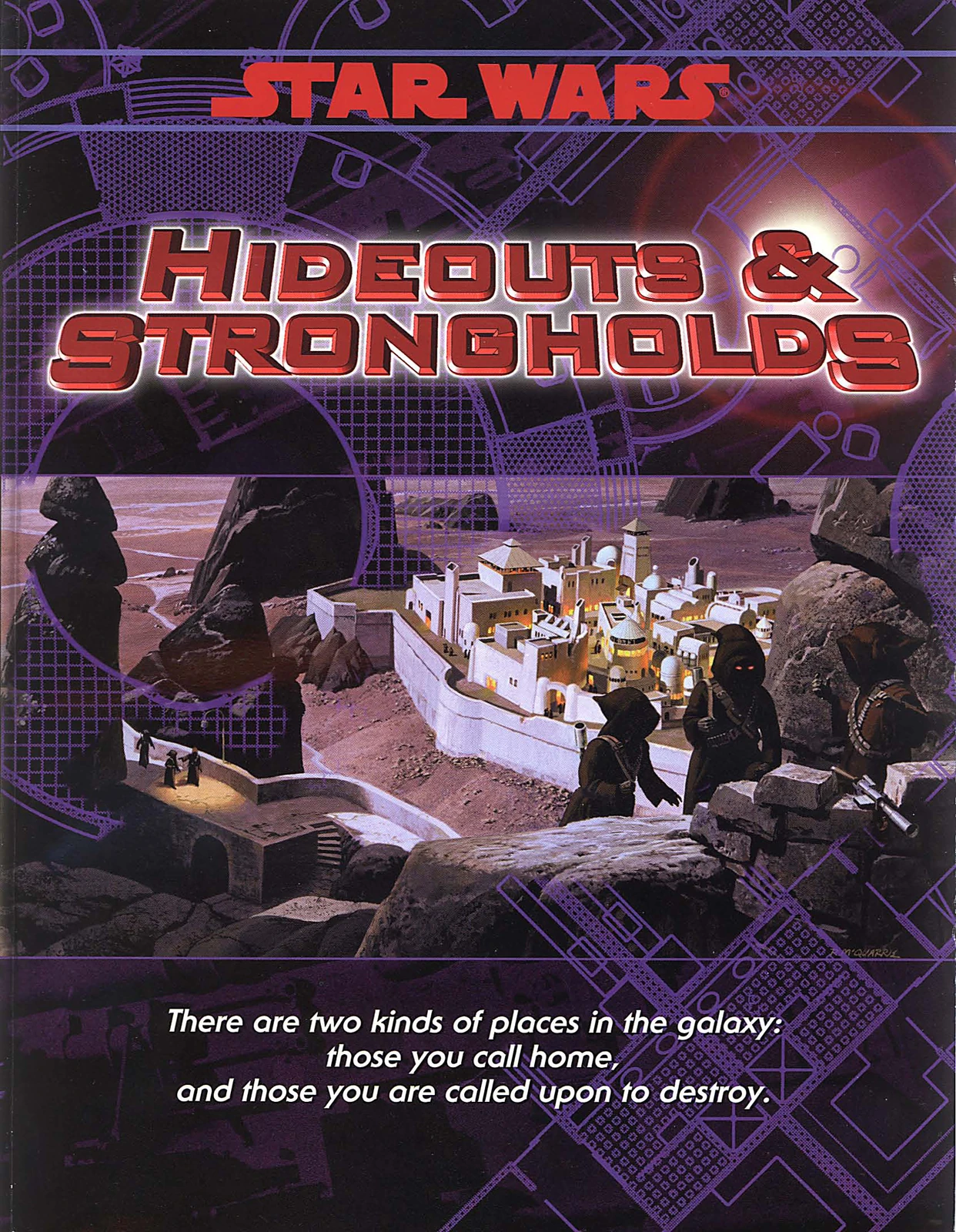
Star Wars: Hideouts & Strongholds
Star Wars: Hideouts & Strongholds
There are two kinds of places in the galaxy: those you call home, and those you are called upon to destroy.
by Sterling Hershey
Design: Sterling Hershey Development and Editing: Eric Trautmann Additional Material: Lee Garvin, Tim O'Brien Cover Design: Tom ONeill, Brian Schomburg Graphics: Brian Schomburg Cover Art: Ralph McQuarrie Interior Art: Talon Dunning, Ramón Pérez and LFL Interior Maps: Joe Bavitz, Tim Bobko, Sterling Hershey, Paul Sudlow
Publisher: Daniel Scott Palter Associate Publisher/Treasurer: Denise Palter Associate Publisher: Richard Hawran Senior Creative and Editorial Director: Peter Schweighofer Creative Directors: Craig Carey, Fred Jandt, Jen Seiden, Eric S. Trautmann Designer: Paul Sudlow Art Directors: Tom ONeill, Brian Schomburg Graphic Artist: Joe Bavitz Director of Sales and Marketing: Tim O'Brien Sales Associate: Sue Hartung Sales Assistant: Liberty Dodd Director of Licensing: Ron Seiden Warehouse Manager: Ed Hill Assistant Treasurer: Karen Bayly Accounting: Mary Galant, Wendy Lord
Published by West End Games RR 3 Box 2345 - Honesdale, PA 18431 40111
TM or ® & © 1998 Lucasfilm Ltd. Title and character and place names protected by all applicable trademark laws. All Rights Reserved. Used Under Authorization.
Introduction
"There are two kinds of places in the galaxy: those you call home, and those you are called upon to destroy." —Attributed to Crix Madine during a SpecForce training exercise.
What's In This Book?
Hideouts & Strongholds is primarily a collection of locations: space stations, pirate bases, Imperial and Rebel fortresses, and many more. Each entry in this book features a type of base—lunar station, safehouse, Rebel weapons cache, and so on—with a brief overview of what such locations are like, where they are typically found, and why they may (or may not) be favored by a particular group. Also included is a sample base that shows how such sites can be used by player character groups...or how a gamemaster can use these settings as obstacles for the characters to overcome.
Each base entry also features a number of scenario hooks, detailed maps and floorplans, and sample gamemaster characters that can be found in such locations. With the information contained in this volume, gamemasters should have no trouble bringing the characters' home base to life.
Finally, many of the bases included feature "base building tips"—suggestions for players and gamemasters on how to use the location in an ongoing campaign. Typically, these entries show how different types of characters can alter the site to suit the story; for example, a mansion owned by a criminal will likely be defended very differently than one owned by a Tapani noble. Note that these are merely suggestions; gamemasters and players will likely have their own ideas about how to use the sites in Hideouts & Strongholds.
Base Engineering
The first chapter of Hideouts & Strongholds details a new advanced skill: (A) engineering. For the first time, detailed rules on base modification and construction are presented, along with a host of sample items that can be used to customize the location—weapons systems, defensive gear, medical equipment, cargo and equipment storage, and more.
Time Frame
The bases featured in Hideouts & Strongholds are intended to be fairly generic. Gamemasters should have no difficulties working the material in this volume into a Star Wars campaign of any era, from the time of Tales of the Jedi to the New Republic period.
Base Engineering
Players will most likely want to customize their home base. The following sections describe both the skills necessary to modify a site, and the types of equipment, weapons and other such gear that can be incorporated into such locations.
New Skill
(A) Engineering
Time Taken: Minutes or Hours (see page 7). Specializations: Type of engineering (armor, battle station, capital ship, civil/industrial, computer, droid, ground vehicle, hover vehicle, installation, repulsorlift, space transports, starfighter, walker, weapon).
Like other advanced skills, (A) engineering has a higher Character Point cost—double the cost of advancing a normal skill—and requires certain prerequisite skills.
Each specialization of (A) engineering has different prerequisites. Some specializations have fewer requirements than others (since some areas are more limited than others).
For more information on advanced skills, see page 29 of The Star Wars Roleplaying Game, Second Edition, Revised and Expanded.
Engineering Prerequisites
The following chart lists the various (A) engineering specializations and the prerequisite skills needed to purchase and utilize them. Each prerequisite skill has a die code associated with it (for example, "4D armor repair"); the character must have the indicated skill at the indicated die code before purchasing the specialization.
| Specialization | Prerequisite Skills |
|---|---|
| Armor | 4D armor repair. |
| Capital ship | 5D capital ship repair, 4D capital ship weapon repair and 2D computer programming/repair. It is possible to take this skill without the required die codes in capital ship weapon repair and computer programming/repair, but the bonus effects from engineering would not apply to those areas. |
| Civil/industrial | 1D bureaucracy, 2D business, 3D demolitions, 1D law enforcement and 2D in any two repair skills. This is a new specialization and relates to the building, maintenance and modification of settlements, civic projects, businesses, and factories. |
| Computer | 5D computer programming/repair. |
| Droid | 5D droid repair or 5D droid programming (this specialization is explained in great detail in Cynabar's Fantastic Technology: Droids). |
| Ground vehicle | 4D ground vehicle repair. |
| Hover vehicle | 4D hover vehicle repair. |
| Installation | 2D computer programming/repair, 2D demolitions, and 1D in any two of the following—engineering: capital ship, engineering: civil industrial, engineering: space transports, engineering: starfighter, or engineering: weapons. This is a new specialization and is explained in greater detail below. |
| Repulsorlift | 4D repulsorlift repair. |
| Space transports | 5D space transports repair. |
| Starfighter | 5D starfighter repair and 3D starship weapons repair. It is possible to take this skill without the required die code in starship weapons repair, but the bonus effects from engineering would only apply to non-weapon functions. |
| Walker | 4D walker repair. |
| Weapons | 5D in any two of the following—blaster repair, capital ship weapon repair, starship weapon repair, demolitions. |
Because the (A) engineering skill involves so many separate and complex activities and fields of study, only engineering: installation will be discussed here (although these rules can also be applied to engineering: civil/industrial.) An installation engineer must be versed in a number of skill disciplines and will likely be called upon to perform a wide range of tasks. Part architect, part technician, part repairman, part inventor, and part scientist, the engineer needs to be familiar with every aspect of an installation.
Using (A) engineering: installation allows a character to perform any one of the following tasks; build, maintain, repair, modify, or jury-rig.
Designing New Structures
When creating a new structure—whether it is a personal shelter, a covert military base or an orbital educational facility—you have several decisions to make. What will the construction look like? What materials be used? What systems will be installed? How long is the construction intended to last?
The first thing the engineer character's player should do is draw a rough plan and show it to the gamemaster for approval. Then the cost of the project should be determined. To figure the cost of a new construction, consult the chart below:
Construction Cost Factors
| Feature | Materials Cost (in credits) | Labor Cost: credits per being per hour/day/week/month* |
|---|---|---|
| Living/working space | 5,000 x number of planned occupants | 3/25/100/350 |
| Life-support system (LSS): atmosphere | 500 x number of planned occupants | 10/80/300/1000 |
| LSS: pressure | 10 x number of planned occupants | 3/25/100/350 |
| LSS: temperature | +2D x 1000 to decrease, +1D x 1000 to increase | 8/60/250/800 |
| LSS: gravity | 10,000 if planned for personnel only, 100,000 if used for vehicles | 15/100/400/1000 |
| LSS: radiation shielding | 1,000 x number of planned occupants | 3/25/100/350 |
| Vehicle hangar/repair bay | 200 x number of speeder scale vehicles, 500 x number of starfighter scale vehicles, 600 x number of walker scale vehicles | 5/40/160/500 |
| Airlock | 500 each | no additional labor |
| Machine shop | 20,000 | 8/60/250/800 |
| Med bay | 30,000 per bed, 400,000 for clinic level, 1,500,000 for hospital level | 5/40/160/500 |
* Note: If droids, slaves, contract labor, or volunteers are used, the cost is 0.
Living/Working Space
Any structure intended for habitation requires living and working space for its occupants—sleeping quarters, refresher units, galley facilities, and basic workstations. The unit described in the table above includes a simple bunk, a one-person refresher and a workdesk/pantry unit. Such units are cramped, but are generally tolerable living spaces. In order to increase the comfort level, apply the following multipliers to both the materials cost and the time taken (the base difficulty remains the same):
| Comfort Level | Cost Modifier |
|---|---|
| Cell/prisoner | x0.5 |
| Cozy | x1.5 |
| Comfortable | x2 |
| Affluent | x3 |
| Luxurious | x4–x5 |
Life-support Systems
When an installation is built on a site that does not have sufficient gravity or breathable atmosphere for the intended inhabitants, life-support systems are a necessity.
Unfortunately, life-support systems are bulky, complicated and are generally quite expensive. An installation's engineering staff must design and build the life-support system nearly from scratch—particularly if the site's inhabitants have differing life-support needs (lighter gravity, Type II atmosphere, etc.).
There are several factors that must be considered when building a life-support system: atmosphere, pressure, temperature, gravity, and radiation.
- Atmosphere. Atmosphere systems are required anywhere that a breathable environment does not exist (an asteroid, a moon, a planet with poisonous air).
- Pressure. Pressure maintenance is important when the local atmospheric pressure is either too low or nonexistent (deep space), or too great (deep ocean).
- Temperature. Temperature maintenance is always a factor on deep-space installations, but is also important when local temperatures on a planet reach extremes.
- Gravity. Gravity systems often require a judgment call on the part of the site's inhabitants. Often, it requires a great deal of energy to create artificial gravity, but all physical skills performed in zero gravity receive a -1D penalty unless the crew is trained in zero-G operations. There are alternatives to gravity systems for sites in space; should the site achieve a stable "spin," gravity can be created. However, this reduces the accuracy and efficiency of the site's weapons and—should the "spin" be altered (by enemy turbolaser fire, for example) the results can be catastrophic.
- Radiation. On any planet with a thick enough atmosphere, radiation is not likely to be a problem. However, an orbital station that is exposed to the vacuum of space is also exposed to constant bombardment by cosmic rays, stellar radiation and other phenomena.
If the characters' base is subject to any of the aforementioned environmental conditions, the gamemaster should encourage the players to make the appropriate life-support systems a priority.
Vehicle Hangar/Repair Bay
If the installation is intended to serve as a flight hangar or garage, a place is needed to store and maintain those vehicles. This includes landing platforms, docking hooks, and auxiliary power supplies.
Airlock
Any structure that will be built in a hostile environment requires airlocks to protect personnel from toxic gases, vacuum, or ocean pressure. The cost listed for airlocks is only for the materials; the labor necessary to install one is covered by the other building costs.
Machine Shop
An installation needs a machine shop if the inhabitants intend to modify equipment or the site's structure for an extended period of time. The cost listed for such a shop is for a basic machine facility. By multiplying the cost by x2, all uses of repair or engineering skills in that shop receive a +1D bonus. By multiplying the cost by x3, a +2D bonus is gained. The quality of the shop cannot be improved beyond this point.
Med Bay
A basic med bay includes a diagnostic bed, a medical computer, and facilities for storage of medicines and cybernetic organs and limbs. A clinic-level med bay includes 20 beds for patients, and facilities for a bacta tank. A hospital-level med bay has beds for over 100 patients, and facilities for several bacta tanks.
Power Generator
Nearly every installation requires a generator. In fact, space-borne structures usually have a large portion of their mass taken up by the power-generating system. There are a variety of different types of generator to choose from, each with its own strengths and weaknesses.
To determine the cost of a generator, divide the number of planned occupants by 5. To this number, add 10 for a hangar, 5 for a machine shop, 5 for a clinic or 10 for a hospital, and 15 if any weapons or defense systems will be installed. Multiply the result by the cost multiplier for the generator type. The labor cost and time taken are included with the rest of the project.
| Generator Type | Cost Multiplier |
|---|---|
| Reactor | x2,000 |
| Solar Collector | x1,000 |
| Wind Turbine | x500 |
| Hydroelectric | x1,000 |
| Fossil-fuel | x100 |
| Municipal | — |
| Geothermal | x1,200 |
- Reactor. This is the most common form of power generator in use in the galaxy. It can produce an enormous amount of energy and runs on just a small amount of fuel. Of course, reactors are also notoriously volatile and any serious damage to the reactor's core will cause a chain reaction that will, at the very least, destroy the entire installation.
- Solar collector. This is a clean, quiet form of energy production, but it is relatively inefficient. Any installation powered by solar collectors will need over fifty percent of its surface dedicated to the collectors. In addition, the collectors are susceptible to damage.
- Wind turbine. This is a cheap, renewable power source, but because of the amount of power required by most technology, requires an abundance of high wind to be a viable option. (Any planet where these kinds of winds exist will obviously qualify as a harsh environment.)
- Hydroelectric. This requires a readily available body of water near, under or around the installation. The body of water must have a strong current and tides in order to be useful.
- Fossil fuel. Very few people use this form of generator because of such units' inefficiency, the scarcity of fuel, and the environmental damage caused. If concealment is a factor fossil-fuel generators make a poor source of power; waste smoke and heat can be spotted visually and with sensors. Such units require a source of fuel; finding fuel can often be a problem. Finally, fossil-fuel generators require constant maintenance (lubrication, cleaning, realignment, and basic maintenance at least three times per standard week).
- Municipal power. Municipal power is only available in heavily settled areas. The power is easily available; a simple monthly or weekly fee or outright theft via energy taps can access this energy source, and you don't need to worry about the maintenance of the generators. However, most local power companies can detect fluctuations in a city's power grid and track them to their source—a problem for user's trying to avoid official notice or attempting to tap the power source illegally.
- Geothermal. Arguably one of the most efficient power sources, geothermal power systems tap directly into the heat energy that can be found deep inside most planets. Unfortunately, the geothermal conduits are exceedingly difficult to install (requiring difficult crust-drilling procedures). In addition, sites powered by geothermal energy must often shed waste heat, making them easily detectable to most sensors. Still, once installed, geothermal power plants can supply virtually limitless energy to a base.
Building New Structures
Once the structure has been designed and the cost has been determined, it's time to see how long it will take. Use the table below:
Base (A) Engineering Difficulties for Building
| Difficulty | Structure | Time Taken (design and construction) | Work-force Required |
|---|---|---|---|
| Very Easy | Small, simple static structures (no complex moving parts) such as storage sheds, walls, ditches | 1D hours | One sentient or droid |
| Easy | Small dwelling (1–2 rooms), simple drainage/irrigation systems, basic road | 1D days | 1–2D sentients or droids |
| Moderate | Medium-sized dwelling (3–5 rooms, one story), footbridge, levy | 2D days | 1–2D sentients or droids |
| Difficult | Fortified dwelling/multistory dwelling, complex drainage/irrigation system (several acres), load-bearing structures (suspension bridges or repulsorbridges), multistory complex structures (multiple moving parts, such as a planetary shield generator complex or planetary scanner array), small space platform | 1D weeks | 1–2D x 10 sentients or droids |
| Very Difficult | Fortress (multiple buildings, protective walls, internal roads and drainage/waste disposal systems), town (for a population of 100,000), large complex structures (planetary irrigation/road networks) | 2D weeks | 4–5D x 10 sentients or droids |
| Heroic | Giant complex structures (skyhooks), large cities (population from 100,001 to 10 million), large space platform or shipyards complex | 1D–3D months | 1D x 100 sentients or droids |
| Heroic+ | Incredibly large structures (Death Star), Coruscant urban terrain, Coruscant waste-treatment facilities, Coruscant defense systems (orbital mirrors, shield system, etc.) Varies widely; typically 1D–3D years, though may increase depending on the magnitude of the task | 5–6D x 100 | sentients or droids |
Other factors affect base construction—notably the working conditions. A clever engineer will schedule the work so that adverse conditions—such as temperature and lack of atmosphere—are taken care of first, so that the rest of the work can proceed easier.
Modifying Installations and Installing New Equipment
Repairing or improving any particular feature of the installation should be handled using the rules on pages 59–61 of The Star Wars Roleplaying Game, Second Edition, Revised and Expanded.
Weapons and defense systems were not included in the above process. Even if the weapon systems are an integral part of the structure, for rules purposes they are installed after the base is built. Installing new equipment requires, of course, the equipment in question. Consult the following chart to determine the difficulty, crew and time necessary:
| Scale of device or weapon | Difficulty | Crew | Time needed |
|---|---|---|---|
| Character | Very Easy | 1 | 1D hours |
| Speeder | Easy | 1 | 2D hours |
| Walker | Moderate | 4 | 2D hours |
| Starfighter | Difficult | 6 | 3D hours |
| Capital | Very Difficult | 2D | 2D days |
| Death Star | Heroic | 10D | 3D weeks |
(A) Engineering Condition Modifiers
| Modifiers | Difficulty Modifiers | Time Taken Modifiers | Cost Modifiers |
|---|---|---|---|
| Harsh environment | +1D–2D | Time Taken doubles | 1.5 x labor cost |
| Zero gravity | +1D | +1D* | 5 x overall |
| Extreme temperatures | Difficulty increases one Difficulty Level | +1D* | 1.5 x overall |
| Unstable terrain | Difficulty increases one Difficulty Level | +2D* | 2 x overall |
| Inferior materials | +1D | +3D§ | 0.75 x materials cost |
| Poor supply network | +2D | +1D weeks | None |
| Poor/unskilled work-force | Difficulty increases one Difficulty Level | +1D–+2D§ | 0.6 x labor cost |
| Favorable environment | -1D/-2D | Time taken halved | None |
| Mild temperatures | -1D | No effect | None |
| Superior construction materials | Difficulty decreases by -1D | -2D§ | 2 x materials cost |
| Superior supply network | Difficulty decreases by -1D/-2D | -1D weeks | None |
| Motivated/skilled work-force | Difficulty decreases by one Difficulty Level | -1D§ | 1.5x labor cost (optional) |
* The modifier is measured in the same units of time as the time taken for the base project.
§ The modifier is one measurement below the time taken for the base project. For instance; if the time taken is in years, the modifier is in months, if the time taken is in months, the modifier is in hours, if the time taken is in minutes.
Integrating Systems
Once all the new equipment has been installed in a base, it must be integrated into all the site's other systems so that they will work together. Count up the number of features you referenced from the charts above, plus the number of weapons and devices you've installed, and consult the following chart:
| Number of systems and elements needed | Difficulty | Time |
|---|---|---|
| 5 or less | Very easy | 1 hour |
| 5–10 | Easy | 1D hours |
| 10–30 | Moderate | 2D hours |
| 30–40 | Difficult | 3D hours |
| 40–60 | Very Difficult | 1D days |
| 60 or more | Heroic | 5D days |
Any time a new piece of equipment is installed, this roll must be made again to integrate the new item into the overall system.
Base Equipment
Anti-Infantry Laser Battery
This is a very basic, effective anti-infantry weapon. A gun crew sits inside the armored shell of the weapon, protected from incidental fire and the elements of even the most hostile environments. On particularly unforgiving worlds, the tower can be installed so that the gun crew can access it without leaving the safety of the base's enclosure.
Anti-Infantry Laser Battery
Model: Golan Arms DF.9
Type: Modified Anti-Infantry Battery
Scale: Speeder
Skill: Blaster artillery: anti-infantry
Crew: 3
Cover: Full
Ammo: Unlimited (power generator)
Cost: 15,000 (new), 9,500 (used)
Availability: 3, R or X
Body: 3D
Fire Rate: 2
Fire Control: 2D
Range: 20–600 m/3/16 km
Blast Radius: 0–8 meters
Damage: 4D
Anti-Vehicle Laser Cannon
The most common anti-vehicle weapon in the Rebel arsenal, the Atgar P-Tower is resistant to many extremes in temperature and environment. Unfortunately, its power-grid dish is configured in such a way that it is very easy to target.
Anti-Vehicle Laser Cannon
Model: Atgar 1.4 FD P-Tower
Type: Light anti-vehicle laser cannon
Scale: Speeder
Skill: Blaster artillery: anti-vehicle
Crew: 4, skeleton: 2/+10
Cost: 10,000 (new), 2,000 (used)
Availability: 2, R or X
Body: 2D
Fire Rate: 1/2
Fire Control: 1D
Range: 10–500m/2/10 km
Damage: 2D+2
Anti-Infantry Missile Launchers
Rocket launchers are not widely used weapons, given that the same amount of punch can be delivered with a turbolaser. Missiles provide one excellent advantage over blaster artillery, however: When a blaster bolt is fired, the weapon firing it becomes an easy target for the enemy—just follow the beam back to its source. If fired carefully, a missile can destroy a target while its launcher is still hidden.
The MerrSonn LX-80 has the additional advantage that it can use missiles designed for MerrSonn's popular PLX or "Plex" series of portable launch systems. These missiles are readily available through any arms dealer.
This type of emplacement has a rack of 80 missile tubes (4 high and 20 wide). An automatic loader holds a reserve of 80 more missiles, but will not reload until all of the tubes are empty. A misfire in a single tube can hold up the entire system while it is being cleared (2D rounds).
Anti-Infantry Missile Launchers
Model: MerrSonn LX-80
Type: Anti-infantry missile emplacement
Scale: Character
Skill: Missile weapons: missiles
Ammo: 80 (permanent missile rack)
Cost: 75,000 (launcher, new), 20,000 (launcher, used), 200 ("dumb" rocket), 600 ("smart" GAM rocket), 1,000 ("savant" rocket)
Availability: R
Body: 3D
Range: 100–500m/3/10 km
Damage: 6D
Missile Types
- Dumb Rockets. These are the simplest missiles available. They fly in the direction they are fired until they make impact or run out of fuel.
- Smart Missiles. These missiles have an on-board tracking system that allows them to follow a target. To fire a smart missile, you must first "lock-on" to the target. For this purpose, smart missiles have a Fire Control of 2D. It is possible to fire a smart missile without acquiring the target first; this is called "orphaning." An orphaned missile can then attempt to lock onto a target using its 2D targeting system. However it is fired, a smart missile will track and follow its target until it detonates, runs out of fuel, or the target lock is lost. The difficulty required for a target to shake a smart missile loose is the weapon's target lock roll +5.
- Savant Missiles. Savant missiles are classified as "surprise weapons." Designed to fire just like a "dumb" rocket, they fly for one round before actually locking on to a target. This fools some pilots into thinking they are safe when the missile has been evaded; since the weapon appears to be a "dumb" rocket, the pilot may not realize the danger it poses. Once active, the savant locks on to the target and homes in for the kill. Because of the computer system necessary to fire the savant rockets, one round and a Moderate missile weapons: missiles roll is required to "tag" a target. If this roll is failed, it means that the "tag" system has not locked on the target and the weapon acts as a "dumb" rocket, relying entirely on the missile weapons roll in the next round. If the roll is successful, the savant missile is considered to have 4D to hit the target (normally the rocket activates at point-blank range). The attacker must make a second missile weapons roll at normal difficulty for the straight-line rocket attack.
- Stalker Missiles: This very complicated piece of ordinance is relatively new, and was designed specifically for use with the RAX-1 because of the amount of fuel necessary to make it cost effective. Like a "smart" missile, the Stalker has a tracking system. Unlike a "smart" missile, that tracking system is exceedingly well-designed. Stalker missiles have a fire control of 3D and are fired just like a "smart" missile. Unlike smart missiles that can only attempt to acquire a target once, the Stalker can attempt to reacquire if the lock is lost. Stalker missiles can roll its 3D every round until it locks onto the target again. A Stalker has enough fuel to fly for 30 combat rounds before running out.
Anti-vehicle Missile Launchers
Another system from MerrSonn, this launcher can let loose a rack of 10 medium missiles (ideal for taking out speeders, AT-STs and armored repulsorlift vehicles).
An attractive feature of this product is its concealability. A collapsible panel measuring roughly 40 centimeters wide completely conceal the missile tubes from scrutiny. In combat, the panel can be dropped with the pull of a cord. In addition, the system doesn't draw energy when placed in "standby" mode, so scanners cannot pick anything up until the missiles are in the air.
Anti-vehicle Missile Launchers
Model: MerrSonn MX-10
Type: Anti-vehicle missile emplacement
Scale: Speeder
Skill: Missile weapons: missiles
Ammo: 10 (permanent missile rack)
Cost: 20,000 (launcher, new), 8,000 (launcher, used), 500 ("dumb" rocket), 1000 ("smart" GAM rocket), 2,000 ("savant" rocket)
Availability: R, X
Body: 3D
Range: 100–500 m/3/10 km
Damage: 6D
Repulsor-Assisted Ground-to-Orbit Concussion Missile Launcher (RAGOC Launcher)
An enterprising Rebel engineer named Yunji Oryn designed the prototype for this unusual missile system when his badly damaged base was about to be attacked. In a matter of hours, he and his crew had jury-rigged together a dozen malfunctioning repulsorlift drives from damaged airspeeders, part of a burnt-out tractor beam assembly, and several archaic rockets left behind by the planet's former occupants. What resulted was the RAGOC.
Since that rather shaky start, Oryn Engineering has gained a fair amount of infamy among a select group of engineers, Rebels and pirates. Most of the bugs have been hammered out of the system and its manufacture has been standardized so that the finished weapon no longer appears "like the interior of an Ugor autochef" (in the words of one SpecOps agent).
The production-model RAGOC—the RAX-1—focuses the energy of a very powerful repulsorlift engine into a column of reversed gravity. This propels the rocket in the launcher into low orbit, much like archaic railguns. Once the rocket is in orbit, the repulsor shuts down and the rocket's own engines activate. At this point, the concussion missile seeks out its target. Because of the delivery system, "dumb" rockets are useless with the RAX-1; RAGOC warheads require guidance systems.
When stealth is a concern, the addition of a sensor blind (see page 12) makes this system ideal. The rocket doesn't fire until it has cleared a planet's atmosphere, so neither the contrail or the trajectory can be traced back to its source. The gravity column created by the repulsorlift can be traced, of course (which is why a sensor blind is recommended: the blind can disguise that energy as any number of naturally occurring phenomena, ranging from thermal updrafts to solar winds). Once it is shut down, it can't be traced at all. There is no way to disguise the column from a crystal gravfield trap (CGT) sensor, but these are rare enough to not be a concern.
Due to the system's inherent frailty, a used RAGOC launcher is a maintenance nightmare, requiring constant capital ship weapon repair rolls (Moderate) even during operation. The crew must make these rolls for three rounds prior to, during, and three rounds after launching in order to keep the system on-line.
Repulsor-Assisted Ground-to-Orbit Concussion Missile Launcher (RAGOC)
Model: Oryn Engineering RAX-1
Type: Concussion Missile Emplacement
Scale: Capital
Skill: Missile weapons: missiles
Crew: 6 (13 for a used system)
Ammo: 4
Cost: 200,000 (launcher, new), 50,000 (launcher, used), 2,000 ("smart" rocket), 5,000 ("hound" rocket)
Availability: 4
Body: 1D
Fire Rate: 1/3
Range: Low orbit (*1)/High Orbit(*3)
Damage: 10D
* This refers to the number of "units" from the planet if conducting a space battle.
Ion Cannons
Ion cannons are ideal for use against heavily mechanized enemies. Listed here are three popular cannons from the KDY v-series, including the KDY v-150 that saw distinguished service during the Battle of Hoth.
Light Ion Cannon
Model: KDY v-35 Spoiler
Type: Medium surface-to-air cannon
Scale: Starfighter
Skill: Blaster artillery: surface-to-air
Crew: 4
Cover: Full
Ammo: Unlimited (power generator)
Cost: 25,000 (new), 4,000 (used)
Availability: 2, X
Body: 2D
Fire Rate: 2
Fire Control: 1D
Range: 100–1,000m/2.5/5 km
Damage: 4D
Medium Ion Cannon
Model: KDY v-90 Protector
Type: Medium ion surface-to-space cannon
Scale: Capital
Skill: Blaster artillery: surface-to-space
Crew: 10, skeleton: 4/+10
Cover: Full
Ammo: Unlimited (power generator)
Cost: 100,000 (new), 30,000 (used)
Availability: 3, X
Body: 2D
Fire Rate: 1
Fire Control: 3D
Range: 3–20 km/Atmosphere/Low Orbit (1*)
Damage: 6D (ionization)
* This refers to the number of "units" from the planet if conducting a space battle.
Heavy Anti-Orbital Ion Cannon
Model: KDY v-150 Planet Defender
Type: Heavy ion surface-to-space cannon
Scale: Capital
Skill: Blaster artillery: surface-to-space
Crew: 27, skeleton: 12/+10
Cover: Full
Ammo: Unlimited (power generator)
Cost: 500,000 (new), 100,000 (used)
Availability: 3, X
Body: 5D
Fire Rate: 1
Fire Control: 5D
Range: Atmosphere/Low Orbit (1*)/High Orbit (3*)
Damage: 12D (ionization)
* This refers to the number of "units" from the planet if conducting a space battle.
Turbolaser Battery
Excellent for installation defense—especially on space stations or asteroids—turbolasers require enormous amounts of energy. However, with adequate power supplies, turbolaser are excellent anti-starfighter weapons.
Turbolaser Battery
Model: Loronar Turbolaser System I
Type: Heavy fixed turbolaser emplacement
Scale: Starfighter
Skill: Blaster artillery
Crew: 5
Cover: Full
Ammo: Unlimited (power generator)
Cost: 250,000 (new), 125,000 (used)
Availability: 3, X
Body: 4D
Fire Rate: 2
Fire Control: 1D
Range: 50–600 m/5/25 km
Blast Radius: 10 meters
Damage: 6D
Heavy Turbolaser Cannon
A heavy turbolaser cannon is capable of doing horrifying amounts of damage, both to the enemy (and its owner's credit balance). This particular model is very similar to the KDY w-165. (So similar, in fact, that cries of "industrial espionage" accompanied its release.) The Loronar Planetary Defense Cannon uses four times as much energy as the KDY v-150, and is capable of completely obliterating a Star Destroyer.
Heavy Turbolaser Cannon
Model: Loronar Planetary Defense Cannon
Type: Heavy turbolaser surface-to-space cannon
Scale: Capital
Skill: Blaster artillery: surface-to-space
Crew: 46, skeleton 21/+12
Ammo: Unlimited (reactor)
Cost: 13,000,000 (new) 6,000,000 (used)
Availability: 4, X
Body: 7D (capital scale)
Fire Rate: 1/2
Fire Control: 1D
Range: Atmosphere/Low Orbit (1*)/High Orbit (3*)
Damage: 15D
* This refers to the number of "units" from the planet if conducting a space battle.
Ground-to-Orbit Proton Torpedo Launchers
Arakyd's PY-6 Proton Torpedo Site is an anti-capital ship weapons cluster designed to destroy enemy craft that have entered orbit; the primary strategy behind such weapons is to deny attacking craft a position from which to launch an orbital bombardment. The PY-6 is a bulky, difficult-to-conceal array of torpedo tubes, but is capable of inflicting massive damage.
Ground-to-Orbit Proton Torpedo Launchers
Model: Arakyd PY-6 Proton Torpedo Site
Type: Anti-orbital proton torpedo site
Scale: Capital
Skill: Blaster Artillery
Crew: 3
Ammo: 4
Cost: 200,000 (new), 75,000 (used)
Availability: 3, R
Body: 2D
Fire Rate: 1
Fire Control: 2D
Range: Atmosphere/Low Orbit (*1)/High Orbit (*3)
Damage: 9D
* This refers to the number of "units" from the planet if conducting a space battle.
Targeting Computers
A targeting computer is essential if a base has any weapons at all. It is inefficient and dangerous to depend on the gunner's skill in every situation. The NeuroSaav 3K40 can handle up to five weapons of any scale at once, assigning separate targets for each weapon or linking the fire to utterly annihilate the target. This system has a bonus of 1D to any gunner's skill. An upgrade is available that can raise this to 2D.
Targeting Computer
Model: NeuroSaav 3K40 Targeting System
Type: Targeting computer
Cost: 5,000 (system), 3,000 (upgrade)
Availability: 2, R
Sensors
The NeuroSaav 9954/I is a standard sensor array useful for both military and civilian applications. Consisting of a central processing computer and over 50 sensor dishes, it is generally installed permanently into what ever base or settlement will be using it. The array includes a powerful FST (full-spectrum transceiver) capable of picking up basic information from as far away as near-orbit. Of course, this range can be increased by the addition of Sensor Relay Satellites (cost: 2,000 each). The array also has a dedicated energy receptor (DER) for detecting energy use and fluctuation within its range, and a hyperwave signal interceptor (HSI). A life-form indicator (LFI) is available for an additional 1,000 credits.
Sensors
Model: NeuroSaav 9954/I Sensor Array
Type: Installation-level sensor package
Skill: Sensors
Crew: 3
Cost: 5,000
Availability: 2, R
Sensor Jammer
Originally designed for use by ships, this sensor jammer has definite applications for hidden strongholds. The usefulness is somewhat limited, however, since anyone scanning will know they're being jammed.
To use this device, an opposed contest is rolled between the scanner and the jammer, each one using its operator's sensors skill.
Sensor Jammer
Model: IntelStar BlindSide Sensor Jammer
Type: Sensor Jammer
Skill: Sensors
Cost: 5,000 plus installation
Availability: 2, X
Sensor Blind
The sensor blind represents a different approach to sensor countermeasures. Instead of attempting to conceal the target of a scan or interfere with the sensors doing the scan, the sensor blind disguises its subject. Rather than waste energy trying to overpower the enemy's sensors, the blind's computer analyzes the target and then transmits an additional energy wave to the scanning sensor. The results vary, but most sensor blind will cause energy use and equipment to appear as natural phenomena to enemy sensors.
Of course, in a city or other concentration of technology and energy use, a sensor blind's job is easier, since it can disguise the information as any one of a number of common items or activities.
To use the sensor blind, the operator must engage in an opposed roll with the operator of the scanning sensors. If the blind's operator beats the opposing sensor operator by more than 5, then the scanner receives a false reading. In densely populated areas, give the blind's operator a +1D bonus to his roll.
Sensor Blind
Model: IntelStar Tranquillity System I
Type: Sensor Blind
Skill: Sensors
Cost: 400,000
Availability: 4, X
Vaporators
Vaporators are an essential piece of equipment for bases on dry worlds where a drink of water can mean the difference between life and death. While many companies manufacture and sell vaporators, they all operate using the same principles. Hot wind blows past the refrigerated coils of the vaporator and the moisture in the air is attracted to the super-cooled metal. Then it collects in a reservoir beneath the vaporator's tower.
Because of the limits of the system, it is unfeasible to build a vaporator larger than three meters high on most worlds. One vaporator can generally collect enough water during a week to sustain a single human for a day. If vaporators are a base's only source of water, seven such units are required for each person stationed there. This figure is a minimum; more units are certainly useful in the event of equipment failure.
Vaporators are available in a variety of models, but most of them are still being built according to plans that were obsolete 100 years ago. In fact, the standard programming language for vaporators—because of their simple operation—is still binary. This is convenient, since it means the machine does not need a very complicated brain, but finding an interpreter droid that speaks binary can be a challenge these days.
A single vaporator tends to cost about 400 credits. Many dealers will give significant discounts (up to sixty percent) for bulk orders (200 or more).
Shield Generators
The MerrSonn Guardian-class shields include both particle shields and energy shields. For each shield unit installed, 6D of protection can be called upon for up to 4 fire arcs.
Shield Generators
Model: MerrSonn Guardian-class shield generator
Type: Base shield generator
Scale: Capital
Skill: Shields
Crew: 2
Cost: 60,000
Availability: 3, R
Tractor Beams
This tractor beam model was designed with flight bays specifically in mind. When hooked up to an installation's computer, it takes over the task of landing a ship in sometimes cramped quarters.
Tractor Beam
Model: Arakyd Flight Bay Tractor Beam
Type: Medium tractor beam
Scale: Starfighter
Skill: gunnery
Crew: 1
Cost: 12,000
Availability: 2
Fire Control: 2D
Damage: 3D
Planetary Shields
Some planets, cities, corporations, and military forces have the resources to buy or construct powerful anti-orbital bombardment deflector shield systems. These systems vary greatly in strength, although most are intended to counter bombardment from capital combat ships. Planetary shields come in two main types:
Encasing shields. Encasing shields are older model shields, either on or off. They are more akin to armor than shields since they provide a solid "wall" of protection. They are cheaper and more common, and can be maintained longer than newer designs. However, encasing shields do not allow "friendly fire" to penetrate except through permanently assigned gaps in the energy field. Accordingly, these gaps, called firing slots or fire gaps, are high-priority targets and many of these systems have no fire gaps at all.
Encasing shields block sensors as well as energy weapons, and can seriously damage the power systems of ships that pass through their energy fields. These shields can be cross-linked and coordinated to cover an entire planet from attack, and with a powerful enough energy supply and skilled operators can be projected and looped back on itself to protect nearby orbiting objects.
Shutter shields. Shutter shields are interlocking shields covering a large section of a planet. Shutter shields are not "solid walls" of energy fields. They are adjustable shields, able to overlap to combine defenses and to open to allow ground-based counterfire and release starfighter strikes, capital ship sallies or blockade runners out.
In many shield systems the shields rely on a highly decentralized power supply systems, to spread the power load and energy feedback as broadly as possible, and to frustrate a classic military maneuver. In some defense systems this is not practical, due to overly centralized power systems or simple lack of redundant generators. These systems are more versatile than their predecessors but are also quite "flat" in their range. They cannot yet project a shield around an orbiting object.
Encasing Shields
The ship may attempt to evade the shields by dropping through a fire gap. Dropping a starfighter through a fire gap can be very hard: planetary shields can be considered Difficult to Heroic terrain. Moving a capital ship though such a gap is Heroic at best and may simply be impossible.
MerrWeapons WorldArmor 9 Planetary Shield
Model: WorldArmor 9 Planetary Shield
Type: Planetary defense shield
Scale: Death Star
Skill: Planetary shields
Crew: 25
Cover: Full
Ammo: Power generator
Cost: 12 billion credits
Body: 3D (capital scale)
Shield: 3D
Range: 1/3/5
Difficulty: Easy (short range or half-planet), Moderate (medium range or full planet), Difficult (long range or orbiting station)
Shutter Shields
Shutter shields, like the shields protecting Hoth Base, disrupt sensors and ships' power systems, but can be flown through relatively easily if a gap is opened. Without such a gap, treat shutter shields as encasing shields for sensors and ships' power systems.
The ship may attempt to evade the shields using its sensors to determine where the shields are and move around them (there is no sensor penalty for this as the shields themselves are not particularly difficult to detect). Flying through shutter shields is a Moderate to Heroic task even if no attempt is being made to block the approaching ship. If the shields are being actively used to block approaching ships the difficulty is the operator's planetary shields skill (typically 4D–5D) against the starship dodge of the approaching ship or starfighter, including scale and other modifiers. Starfighters have a much better chance of making it though this sort of terrain, but it isn't impossible to imagine a modest-sized capital ship with a highly skilled and foolhardy crew making the run.
DefenStar Nyalsan II Planetary Shield
Model: Nyalsan II Planetary Shield
Type: Planetary defense shield
Scale: Capital
Skill: Planetary shields
Crew: 18
Cover: Full
Ammo: Power generator or power grid
Cost: 500 million credits
Body: 3D
Shield: 10D
Range: 1/2/3
Difficulty: Easy (short range or half-planet), Moderate (medium range or full planet), Difficult (long range)
Asteroid Base (Fortified)
"So, your friend's ship was hit by Buula's gang, huh? Yeah, I know where they're holed up. For 1,000 credits, of course.
"Thanks. Now, Buula's got his base way out in the Vessar Asteroid Field. At these coordinates, well, more or less...it is an asteroid field, you know. Anyway, it's a tough gra-nut to crack. Unless you have a small fleet, forget about frontal assaults. Your best bet is an attack with credits. If you offer enough cash, he just might sell back your cargo or your pals or whatever the flarg he's got. I sure wouldn't just fly in and try negotiating, 'cause he's got a lot of firepower and a whole asteroid filled with pirates, outlaws, murderers, and slavers. Not a nest I'd stir up if I were you. He calls it his 'Rocky Home,' and definitely doesn't like uninvited guests."
—"Captain Nomar" (believed to be an alias) to the crew of the freighter Laughing Dancer (now missing, presumed dead).
Overview: Fortified Asteroids
Fortified asteroids are well-armed and defended planetoids. Unlike smaller asteroid bases, fortified asteroids depend more on firepower than secrecy. The general location of a fortified base is likely to be known in inhabited systems. Owners of illegal bases that see high traffic typically prefer to use uncharted or remote systems.
Fortified bases may be armored surface structures or burrowed deep into the asteroid for greater protection. Some take advantage of natural caverns or old mining outposts, while others are carved directly out of the asteroid's bedrock. Base construction is never cheap and is rarely fast. Fortifications range in size from a small, armored outpost to complexes that sprawl across (and through) the asteroid. Most fortifications include the basic support services of a starport and a capital ship for defense.
Sample Base: Buula's Rocky Home
One of the Outer Rim's more notorious pirate gangs is Buula's Raiders. Known for violent dirtside raids, slaving, spice smuggling, kidnapping, and other such heinous crimes, Buula's Raiders are feared amongst remote colonies and outposts. The raiders are commanded by a Chevin—Buula Nen—from his fortified asteroid in the Vessar Asteroid Belt (located in the remote Telanka system).
Buula calls his base his "Rocky Home." It serves as his hideout, base of operations, smuggling hub, and primary slave pens. The Home is filled with pirates and fringers, all hoping to cash in on the Chevin's profitable dealings. However, once recruited by Buula, his henchmen and associates soon find themselves caught up in a game of lies and deceit in which Buula seems to hold all the cards. Buula maintains complete control over his underlings by employing threats, subterfuge and violence as needed. Some threats are subtle or seemingly unconnected to the Chevin, while others are delivered personally by the pirate chieftain. Since the gang's members are selfish loners or drone-like followers, few of them realize that Buula is manipulating all of them. Most of the drama is played out silently, with each person scheming to escape the Home or take it over. However, Buula plays the schemes off each other, allowing dangerous associates to eliminate each other in his quest for his power. This tenuous balance of power keeps the operation running and his men suitably obedient.
Buula's operations are primarily dirtside raids. His small fleet of ships raid outposts and freighters throughout the Outer Rim, often far from the Rocky Home. Always the opportunist, Buula sells off whatever he can, from ships and cargo to slaves. He ransoms his captives when possible, keeping them isolated in the holding rooms. If they prove valueless, he tosses them into the holding pit to be sold to his slaver associates.
In addition to his associates, Buula also keeps a dozen of his own Chev humanoid slaves. The Chevs—which have belonged to his family for generations—are completely obedient to Buula's every command. Easily identifiable by their bright green hair and black coveralls, the slaves are poorly treated by the pirates (who feel free to use them for their own tasks around the base). Buula will not tolerate anyone interfering with his personal slaves and many Chevs use Buula's threats as a primitive shield against undesired tasks.
1a. Main Docking Bay. The main docking bay is large enough to hold three light freighters with additional room for a handful of starfighters and support personnel. High overhead, six luma-gantries—platforms supported by repulsorlifts—provide enough light to see by, though ship maintenance usually requires additional portable lamps to sufficiently illuminate the work area. Two airtight turbolifts lead to the base's lower levels.
1b. Machine Shop. Protected from the docking bay by a set of airtight double blast doors, the machine shop has all the basic equipment of a maintenance bay. It also has a variety of advanced and customized items. Tables, tools and equipment take up the front half of the room, while rows of shelves of miscellaneous supplies line the back half.
1c. Loot Storage. Temporary storage for loot and other stolen items. A locked blast door seals the room.
2. Shield Generator. A Taim & Bak gYvX Shield Generator provides shields for the main docking bay.
3. Turbolift. Two aging turbolifts connect the main levels of the base. A third lift serves the private section of the installation. Turbolift malfunctions are common, though rarely dangerous. The lifts incorporate built-in repulsorlifts and emergency braking units in the event of systems failure.
4. Common Room. The common room is a large, asymmetrical chamber that serves as a combined living, dining and recreation space. On one side are several autochefs "acquired" from different ships and able to provide a surprising variety of food. A small, well-stocked galley is also tucked away in one of the alcoves. Many tables, chairs, couches, game tables, and other furniture is strewn about the place, all stripped from ships of various types.
5. Crew Quarters. Two dozen cramped rooms make up the available crew quarters. Each room holds several bunks, built in storage cabinets and a small refresher. Living conditions vary greatly from room to room.
6. Main Generator. The primary power and environmental supply for the base, the main generator can run for a year between overhauls and re-supply.
7. Guard Post. The guard post is a transparisteel enclosed room overlooking the holding pit, holding rooms and turbolift entrance. The post can be manned by up to six people and contains monitors and controllers for all rooms, doors and the turbolifts. The post has two mounted light repeating blasters; one guarding the turbolift, the other overlooking the holding pit. A stun grenade launcher also has a clear field of fire into and around the pit for use as prisoner and riot control. The weapons are fired from the protection of the guard post. Small gun ports for personal weapons allow the guards to shoot into the holding rooms, pit and turbolift area.
Stun grenade launcher. Character, missile weapons: grenade launcher, 1–5/10/15, damage 7D (stun), ammo 35.
Light repeating blaster. Character, blaster: repeating blaster, 3–50/120/300, damage 6D, attached to generator.
8. Holding Rooms. The holding rooms contain only a single bunk apiece and a semi-private refresher. The doors lock from the outside and have a small, one-way transparisteel window that allows observation of the room. A small, armored opening with dual doors allows captors to pass food and items through without directly exposing themselves to their prisoners. Moderate security rolls are needed to defeat the lock and alarm system.
9. Holding Pit. The holding pit is a large elliptical room sunken one level down from the holding rooms. The top of the pit is enclosed by a strong metal grate (rigged to deliver a powerful stun charge; inflicts Strength+2D stun damage when touched). The pit is carved out of the rocky asteroid—low ledges (sleeping areas) are hewn directly into the pit's walls. The interior of the pit is open and kept clear of rocks and stones. An refresher lies to one side. A few dim ceiling lights illuminate the pit and surrounding walkway. Prisoners are lowered (or occasionally pushed) though a single overhead grate by repulsorlift-equipped droids or suspended by cables and lowered by a winch. When ships arrive to pick up prisoners, they dock at the lower docking port, which leads via passageway directly to a pair of airtight blast doors in the pit. Uncooperative prisoners are stunned by the guards or by the weapons at the guard post.
10. Prisoner Passage. A passageway leading from the holding pit to the lower docking port, this rough-hewn accessway is dimly lit by chemical glow rods. The prisoner passage is occasionally searched in order to ensure there is nothing that will help desperate captives as they are transferred to and from the holding pit.
11. Lower Docking Port. A small, man-sized port for ship docking, the lower docking port is concealed by a pair of rock-encrusted doors (requiring a Very Difficult Perception or Difficult search or Moderate sensors roll to locate). Both the doors and port are controlled from the command center and have no external overrides.
12. Command Center. The command center controls all the base's systems and operations including communications, sensors, shields (docking bay only), docking operations, and gunnery stations for the base's exterior weaponry.
13. Turbolaser. One of the asteroid's main defenses is a surface-mounted, remotely operated turbolaser. The weapon is powered by the base's main generator (via cables in conduits drilled through the asteroid). The turbolaser also has a backup generator good for 50 shots. In the event of main power failure, a Moderate starship gunnery roll allows the gunner to patch into the backup generator.
14. Double Laser Cannon. Like the base's turbolasers, the double laser cannon batteries are surface-mounted, remotely operated and powered by the main generator. However, the double laser cannons do not have backup power generators.
15. Proton Torpedo Launcher. The asteroid base is equipped with a single surface-mounted proton torpedo launcher (used for close-range anti-starfighter defense and to destroy asteroids that veer too close to the installation). The launcher is remotely operated and is powered by the station's main generator (via cables in conduits drilled through the asteroid).
16. Communications and Sensors. The comm system has a 20-light-year range and can broadcast on a wide range of military and civilian frequency. The sensor array was pirated from a military capital ship.
17. Private Quarters. There are comfortable private quarters for "higher-ranking" base personnel and guests. Each has a private refresher and galley, plus a sleeping area and a large living area.
18. Leader's Suite. A suite of six comfortable rooms.
18a. Receiving Room. Serving as both a waiting area for guests and a conference chamber, the receiving room includes a large meeting table with computer terminals.
18b. Inner Chamber. The inner chamber is a private meeting and living room for the base's leader/commander, decorated with personal belongings, gifts and expensive items.
18c. Galley. A personal galley attended by droids, volunteers, hired hands, or slaves.
18d. Dining Room. This personal dining room holds up to 12 people and is luxuriously and elegantly furnished.
18e. Sleeping Chambers. Each sleeping chamber contains a basic bunk and a refresher.
19. Medical Bay. A battered 2-1B droid provides basic medical services, including routine surgery and bacta treatments from a single tank. The bay has one operating room and four recovery beds.
20. Backup Generator. An emergency system that provides auxiliary power to the command center, sensors, communications, all turbolifts, and emergency lighting.
21. Water Recycling and Storage. The water system reclaims waste water, purifying and storing it for later use.
22. Escape Chute. The emergency escape chute is little more than a tunnel that leads to the escape shuttle bay. Inside the shaft is a "repulsor slide"—a battery-powered repulsor unit that floats users quickly down the shaft—and a secondary repulsor unit at the shaft's base. (The secondary repulsor activates if the primary unit loses power, thereby catching anyone plummeting down the shaft.) An escape ladder also runs the length of the shaft (for maintenance purposes).
23. Escape Shuttle Bay. Concealed from the outside by camouflaged doors (Very Difficult Perception, Difficult search or Moderate sensors to detect) the escape shuttle bay is a secret bay that contains a Lambda-class shuttle.
Fortified Asteroid
Type: Space Station
Scale: Capital
Crew: 100, gunners: 8, skeleton 20/+10
Crew Skill: Capital ship gunnery 4D, starship gunnery 4D, capital ship shields 4D
Passengers: 250
Cargo Capacity: Varies widely; typically 50–100 metric tons
Consumables: 6 months
Hull: 4D
Shields: 2D (Front firing arc only)
Sensors:
Passive: 40/1D
Scan: 60/2D
Search: 120/3D
Focus: 7/5D
Weapons:
Six Double Laser Cannons
Fire Arc: 2 front, 1 left, 1 right, 2 back
Crew: 1
Scale: Starfighter
Skill: Starship gunnery
Fire Control: 2D
Space Range: 1–3/12/25
Damage: 4D
Two Turbolasers
Fire Arc: Turret (1 front, back, left right, 1 front, left, right)
Crew: 1
Scale: Capital
Skill: Capital ship gunnery: turbolaser
Fire Control: 2D
Space Range: 3–15/20/40
Damage: 3D
Proton Torpedo Launcher
Fire Arc: Front
Crew: 1
Scale: Starship
Skill: Starship gunnery: proton torpedo
Fire Control: 1D
Space Range: 1/3/7
Damage: 9D
Buula Nen
Type: Chevin pirate chieftain
DEXTERITY 2D+1
Blaster 5D, dodge 4D
KNOWLEDGE 3D+2
Alien species 5D, business 5D, languages 4D, streetwise 6D, value 4D, willpower 5D
MECHANICAL 2D+2
Repulsorlift Operation 3D
PERCEPTION 4D
Bargain 6D, con 7D, persuasion 5D,
STRENGTH 3D+1
TECHNICAL 2D
Character Points: 28
Move: 10
Equipment: Blaster pistol (4D), comlink, datapad, expensive robes, personal shuttle.
Capsule: Buula Nen dresses in bright green robes with gold and silver threads woven in intricate patterns throughout. He is a deceitful, greedy and powerful pirate lord. Through his contacts throughout the Outer Rim, he has access to shipping schedules and locations of unprotected outposts (information he uses to keep his gang busy and profitable). Buula has many associates and can call in favors throughout the Outer Rim Territories. He uses all of his resources to keep the credits flowing.
Buula is unafraid of using his power whenever necessary. He often leads raids when he thinks great coordination is required. His species' hunter's skills prove very useful in tracking and capturing fleeing craft. Buula doesn't fear takeovers of his Home while he's away; he has spread ample—and truthful—rumors of hidden explosives and nerve gas planted around the base (which he can remotely activate from any ship or a small comlink on his person). His "final friends," as he refers to the fail-safe devices, are located in the power, weapons and environmental systems of the asteroid base.
Typical "Buula's Raiders" pirate. All stats are 2D except: Dexterity 3D+2, blaster 4D, dodge 4D, Mechanical 3D+2, Perception 3D, Strength 2D+2, brawling 3D+2, Technical 3D. Move: 10. Blaster pistol (4D).
Typical Chev slave. All stats are 2D except: Dexterity 2D+2, dodge 3D. Move: 10.
Adventure Idea: The Deal
The criminal the characters work for loses a ship and crew to Buula's pirates. The crime lord decides to strike a deal with Buula and sends the characters to work out the details. The characters must negotiate their way into the base, then try to convince Buula to accept their offer. The characters are given a number of assists to bring to bear: money, information and exclusive contracts with their boss. Buula stalls for time, keeping the characters around for a while. He uses his henchmen to discover their weaknesses and then tries to blackmail them into working for him and betraying their employer. Poor dealers or annoyances may be thrown into the slave pit, with little hope of rescue.
Asteroid Base (Primitive)
"Recon Log 129873.2183, Team Leader Gessak reporting. I believe I have found a promising site during my search for a forward outpost. Today, while sweeping the inner rim of the local asteroid belt—see nav ref. 1821—I detected a small asteroid just inside the field. At first glance, the asteroid appeared to be fairly innocuous. As it rotated by, however, I noticed a large dark area on the asteroid's magnetic southern 'hemisphere.'
"I went in for a closer look and, sure enough, there was a large opening at the bottom of an impact crater. As I went in, I saw numerous large cracks radiating out from the opening.
"Matching speed and rotation, I slipped my ship into the opening. Since the rock has insufficient mass and rotation to generate its own gravity, I decided against going EVA. Hovering my craft inside the cavern, I released my probe droid to survey the rest of the place. The return data was very encouraging. Radiating out from the central cavern were three passageways, leading to several other chambers. The small width of the passageways is suitable for the construction of airlocks and is relatively easy to defend. Better yet, the asteroid's structure appears to be quite stable, despite the ancient impact damage.
"Without too much trouble, we can convert this cavern into a forward listening post, cache or staging area. The depth of the entrance beneath the surrounding surface effectively hides it from sight. There's even enough debris around here to lose pursuers before ducking into safety. My recommendation to Alliance Command: Let's grab this rock."
—Excerpt from Recon Mission D812, Team Leader Mils Gessak's logs.
Overview: Asteroid Bases
An asteroid base is the spaceborne equivalent of a primitive cave: remote, hidden from view and easily defended. Because most asteroids are only valued by mining companies, few legitimate businesses take an interest in asteroid dwellings. Most asteroid bases are controlled by Rebels or other illegal organizations; as a result, Imperial, planetary defense and law-enforcement agencies make regular sweeps of local asteroid fields.
Like caves, no two asteroid bases are alike. Some owners choose lone, uncharted asteroids away from the space lanes. Others select asteroids in large debris fields. While this increases the risk of accidental (and catastrophic) collision, it also serves as a sensor screen and obstacle course for incoming ships. In actuality, the orbits of most asteroid fields are quite stable, with collisions being relatively rare and (with enough sensor data) predictable. Some larger bases employ limited collision defense systems (such as weapons, tractor beams or shields), though these are only effective against smaller rocks.
While base types and sizes vary, asteroids are popular hiding spots for listening posts and sensor stations. Rebels, Imperials and corporate spies frequently employ such stations. Others simply hide standard probe droids amongst the debris, effectively masking their presence.
Sample Base: The Shattered Rock
Bearing the scars of an ancient asteroid collision, the asteroid nicknamed "The Shattered Rock" (or simply, "The Rock") is an undeveloped asteroid within a typical asteroid belt. Because of the large caverns formed by the impact, the asteroid provides ample room for a small, enclosed installation. Even small freighters may be parked out of sight within the rock. The rock possesses a single pressurized chamber which serves as a starting point for a new outpost.
1. Impact Point. The Impact Point (IP) is a large portion of the asteroid, a very wide and deep depression that appears to have been "carved out" of the naked rock. At the base of the IP is a slit opening, with dozens of fractures and cracks radiating out like spokes on a wheel. Detecting the slit requires a Very Difficult Perception or Moderate sensors roll. Despite the asteroid's fragile and battered appearance, inhabitants need not fear the asteroid breaking apart; sensors prove that the rock has been stable for several centuries, and even additional pressurized chambers and artificial gravity will not significantly strain the asteroid. Only another major asteroid impact could shatter the rock (although in theory, a massive torpedo or concussion missile attack will shake things up considerably).
2. Slit Opening. The slit opening is 30 meters wide and 12 meters tall. The inside walls are jagged and sharp, presumably from the force of the impact. The interior chamber varies greatly in width and height and extends approximately 50 meters into the asteroid. Three jagged passageways lead away from the slit.
3. Upper Passage. Sloping steeply upward from the main chamber, the upper passage leads to three oblong chambers. Both the passageway and the chambers are very irregularly shaped.
4. Lower Passage. Adjacent to the upper passage, the lower passage slopes generally downward from the main chamber. Like the upper passage, the lower passage is also very irregular and jagged, following a natural fault line in the asteroid. The lower passage leads to two narrow chambers that penetrate deeply into the heart of the asteroid.
5. Central Passage. Connecting to the main chamber at its deepest point, the central passage leads into the heart of the asteroid. Three chambers branch out from the central passage. These chambers are the widest in the asteroid, though their walls are as broken and jagged as the others. The central passage has been converted into a makeshift airlock; two metal bulkheads with doors that can be magnetically sealed have been added to the passage. The inner chambers are isolated by similar bulkheads with airlocks.
Arago Tanca
Type: Outlaw tech
DEXTERITY 2D+2
Blaster 3D, dodge 3D
KNOWLEDGE 3D
Business 4D, languages 5D, streetwise 6D, value 4D, willpower 5D
MECHANICAL 3D+2
Repulsorlift operation 2D+2
PERCEPTION 2D
Bargain 5D+2, persuasion 5D,
STRENGTH 2D+2
TECHNICAL 4D
Computer programming/repair 5D, (A) engineering, security 6D
Character Points: 5
Move: 10
Equipment: Hold-out blaster (3D), comlink, datapad, construction tools, coveralls.
Capsule: A discreet, multi-talented builder, Arago Tanca is highly recommended in less-than-legal circles. No one knows exactly what jobs Tanca has worked on, but they're certain he will work for anyone. Rumors of jobs for criminals, governments, mercenaries, Rebels, bounty hunters, and slavers abound. For a hefty price, Tanca is willing to endure heavy security procedures and hostile environments. He's got years of experience in zero-g and hard-vacuum construction, ranging from mining rigs to research stations. He knows all the pitfalls and shortcuts, from safe sites to the insane risks. He even knows specialists and other workers that may be willing to work under "irregular" conditions.
While Tanca may appear to be a dream find for characters desperate for professional help, his personality may drive them mad. Tanca has no interest in the characters' fears, goals, politics, or beliefs. He adamantly refuses to discuss such things, even to allay suspicions about his loyalties. He won't discuss other jobs under any circumstance and won't even brag about past achievements. He'll advise on designs and often compares them to earlier jobs, good and bad, but won't divulge other details. He may even allude to places that the characters may be interested in, but no amount of bribery or threats will shake the information from him. Attempts to do so will likely anger him greatly (as well as causing him to quit the job).
Base Building: Scratch Built
This asteroid provides an excellent opportunity for player characters to build their own base from scratch. Construction may span a few adventures or become the basis for a complete campaign. The base's form and components will be dictated by the characters' needs and desires. However, the characters will soon discover that base construction and upkeep is very expensive. Specialized skills are required for zero-g construction and skilled labor is neither cheap nor secure.
In general, base construction takes several weeks to complete. Increase construction time if the characters must build discreetly. Locating supplies and appropriate equipment may not be easy in remote areas and travel time certainly affects the construction time.
The challenges of building an asteroid base are many: debris, little or no gravity and no atmosphere, to name a few. The first hurdle is merely docking. Asteroids in belts or fields require piloting rolls to avoid collisions. Docking requires a Difficult piloting roll for the characters' ship to match rotation and speed (increase the difficulty for larger craft).
Since there is no gravity, ships must be secured by landing claws or other such devices. While exploring the interior, the characters must be careful to avoid snagging and damaging their EVA suits. Although casual contact with the sharp rock will not tear a suit, heavy impacts may cause severe damage. During the initial survey, the characters should take detailed scans of the interior to aid in purchasing the required equipment and supplies for outfitting the base.
There may be "previous residents" to deal with; any mynocks, space slugs or other such creature should be removed at the earliest opportunity.
The first order of business is an airlock. While the characters may wish to set up a magnetic field airlock over the slit opening, the equipment is expensive and difficult to install. Installing a small airlock in one of the passageways (such as the one shown) and pressurizing the cavern beyond is much easier, although it requires a vast amount of air. Before pressurization, the characters must scan the interior, identifying and sealing possible leaks. Even after pressurization, they may spend weeks pursing small leaks. One option to pressurization is the introduction of self-contained, prefabricated units which must be sized to fit through the passageways.
Next, the characters can move in generators, recyclers, heaters, equipment, and supplies. They may want to install sensors, communications arrays or weapons to defend the base, though external emplacements make detection of the site much easier. Installing and concealing emplacements requires appropriate skill rolls to determine success. If the characters find zero-g uncomfortable, gravity generators are required. Gravity may be applied to pressurized or depressurized areas. Once the basics are installed, construction becomes easier and quickens considerably. Additional components may be added as needed.
Battle Station
"If you're looking for the best-defended black market in the galaxy, Petabys Station is the place to be...there are never pirate attacks and the place has enough defenses to hold off a small fleet. Of course, the rates are high, but what do you expect at a former battle station?"
—Overheard comment in The Broken Tusk, Reuss VIII.
Overview: Battle Stations
Battle stations are typically orbital platforms, designed for planetary defense. While the Death Star was an extreme example of a battle station, numerous smaller designs are in use throughout the galaxy. All battle station are heavily armed and capable of defending large areas of space. One of the more popular—if somewhat outdated—stations is the FireStar-class Orbital Defense Station (ODS).
Rendili StarDrive's FireStar ODS was one of the company's limited production orbital gunnery platforms. Deployment of such stations is typically part of a larger planetary defensive strategy. Often, the station is part of a chain of positions encircling a single planet. The station is able to saturate its designated target area with a dense firing pattern of lasers, torpedoes and missiles. The station has redundant shield generators and a highly compartmentalized design (which enables it to continue fighting with severe damage). It also features an unusually high number of landing bays for a station of its size, enabling it to carry up to 240 fighters.
While the FireStar stations served well for a couple of decades, Rendili's design never caught on with the Old Republic and the subsequent Empire. Most sales were made to planetary governments. Over the years, most of these stations have been taken out of service or refitted for other duties as system and planetary defense became the bailiwick of larger capital ships and newer gunnery platforms.
Sample Base: Petabys Station
Most of the stations that retain their original functions can be found in the Outer Rim Territories or on the fringe sectors of the Mid-Rim region. One such installation—Petabys Station—was recently "acquired" by Uopled, a Rodian black marketeer. Petabys Station's original function was to defend mining operations on a small moon on the edge of a binary star system. Once the mine dried up, the parent company decided that moving the station would be prohibitively expensive (particularly after an aggressive sales campaign by Golan Arms). Uopled snapped the station up at a bargain price.
Since that time, Uopled has been modifying the station into a black market port. He has transformed half of the regular landing bays (for cargo shuttles) into freighter bays to accommodate sellers and buyers alike. He maintains half of the station's fighter bays, though he currently only has three squadrons of battered Z-95 Headhunters at his disposal. He is converting many of the core levels into sales centers. He has retained all of the station's defensive systems, however; a force laying siege to the Rodian's base of operations faces a long, difficult fight.
Uopled is still in the initial stages of the changeover, though he is open for business. So far, he has limited his operation to his associates and partners he has worked with in the past. Uopled feels too exposed with the station in a known location and wants to move it where he will be out of the Empire's direct reach. However, moving Petabys station is extremely difficult and is easily traced. The station has no sublight or hyperdrive engines. Small maneuvering thrusters allow it to adjust its orbit, but are too small to serve as a sublight drive. The station was originally assembled by a construction team in its current position. To move it again would mean disassembling the station and rebuilding it in its new location.
The station is physically divided into three areas: the landing bays, the gunnery towers, and the core.
Landing Bays
1. Landing Bays. Three levels of landing bays wrap around the structure, allowing fighters to be launched in less than two minutes. However, the bays are also the station's weakest point. Although the landing bays are equipped with armored doors, they provide less protection than the main hull. On most stations, standard operating procedure is to launch all fighters immediately and shut the shield doors as quickly as possible. The bays feature complete repair and maintenance systems for small spacecraft, up to a light freighter.
Gunnery Towers
The heart of the station's defenses are eight gunnery towers. The towers vary in height and have large overlapping fields of fire. The towers are divided into three levels: gunnery, missile weapons and countermeasures. The station's weapons were designed to be manned systems, though they can fire under remote or droid control from the command center; such operation greatly reduces accuracy (though the sheer amount of firepower usually compensates for the inaccurate shooting).
2. Gunnery level. The gunnery levels feature up to eight laser turrets, depending on the level's line of sight. Some stations possess upgraded weapons—turbolasers.
2a. Laser turret. A Golan Arms DL-III NightFang laser turret.
2b. FCS-Turret (Fire Control Station-Laser Turret). The fire control station houses the targeting sensors and computers for the laser turret.
2c. Escape Pod. A TaggeCo. Respite-8 escape pod. The Respite-8 seats eight passengers, and can maintain life support for two standard days.
2d. Reserve Batteries. Taim & Bak 1009-JuleX Reserve Batteries.
3. Missile Weapons Level. The missile weapons level includes missile and torpedo launchers. The launchers are attached to autoloading systems that automatically move ammunition from isolated magazines at the heart of the level to the launcher. The level may have up to six launchers, depending on line of sight.
3a. Missile/Torpedo Launcher. Arakyd Vanguard Missile Launcher. This unique system can fire concussion missiles or proton torpedoes.
3b. FCS-M/T (Fire Control Station-Missile/Torpedo Weapons). This room contains the targeting sensors and computers for the station's missile weapons.
3c. Escape pod. A TaggeCo. Respite-8 escape pod. The Respite-8 seats eight passengers, and can maintain life support for two standard days.
3d. Magazine. A storage room for projectile ordnance (missiles or torpedoes).
3e. Gunnery Station.
4. Countermeasures Level. The countermeasures level includes shields and jammers. The station features a system of shields that overlap for improved strength. While still effective, the system is several decades old and weak compared to modern systems.
4a. Shield Generator. Borstel 9K-4 Defense Field Generator.
4b. Shield Operators Station.
4c. Jammers. When active, an Arakyd "Double-Blind" Jammer System reduces an opponent's fire control by -2D.
4d. Jammer Operation Station.
4e. Escape Pods. TaggeCo. Respite-4 escape pods. The Respite-4 seats four passengers and can maintain life support for three standard days.
4f. Emergency Treatment Bay. A small medical facility where wounded can be taken quickly to during combat.
Core
Housing the station's day-to-day operations and support, the core is a reinforced armored block in the center of the station.
5. Turbolift.
6. Primary Power Conduit. One conduit feeds each gunnery tower and a separate conduit feeds the core. The conduits run directly from the reactors on the power level.
7. General Storage. Storerooms for parts and supplies. Some of these rooms have become "secure storage facilities" for rent and Uopled's own use.
8. Droid Maintenance. The fully equipped droid maintenance facility now serves as a hack shop for stripping down droids for parts or constructing custom (and often illegal) droids.
9. Security Station. Internal security duty post with access to surveillance holocams and viewers throughout the deck. Several of these stations can be found on the core levels.
10. Restaurants. The original dining halls, now converted to numerous commercial restaurants of dubious quality.
11. Rental Booths. Uopled rents commercial booths to his black marketeer associates. The rental booths are typically where illegal merchants hawk their wares.
12. Tapcafe. The former officers' club has become the station's only real tapcafe. A favorite hangout for visitors and station crew alike.
13. Rental Rooms. Formerly the staff staterooms, Uopled rents these rooms out to his hirelings and visitors.
14. Conference Hall. A large room with access to computers, newsnets, galactic information systems and other data servers. Uopled uses and rents the room to visitors that wish to make complicated deals and may need access to current data or news. A small comm station is also included, though all broadcasts are monitored by Uopled (an open secret on the station).
15. Power Level. Powering the entire station are four mammoth reactors with power feeds directly to the power conduits. Each tower also has a small backup generator, although in practice, engineers would use the backups to boost available power to the weapons and shields. The power level also features a double layer of armor, since it was discovered early on that concentrated fire on this level could reach the reactor or power feeds relatively quickly.
16. Main Reactor.
17. Control Boards. Reactor control stations.
18. Backup Generator.
19. Control Boards. Backup generator control stations.
20. Power Regulators.
21. Power Conduit Shaft.
22. Conduit "In-Feed."
23. Escape Pods. TaggeCo. Respite-8 escape pods. The Respite-8 seats eight passengers, and can maintain life support for two standard days.
24. Command Level.
25. Security Checkpoint. A double room that leads to the Command Center. Anyone entering the outer chamber must be cleared by security before they are allowed entry to the command center. Uopled allows very few visitors and staff in.
26. Command Center. Central control of all station functions. Also referred to as "Cee-cee."
27. Conference Room. Secure conference room with sensor dampeners and soundproofing.
28. Escape Pods. TaggeCo. Respite-8 escape pods. The Respite-8 seats eight passengers, and can maintain life support for two standard days.
29. Officer's Quarters. Formerly the officers quarters, now home to Uopled and his high-level underlings.
30. Medical Suite. The medical suite still retains all of its components and droids. Uopled has rented out the suite to a cyberware specialist. The specialist makes most of his money off installing cyberware of all types, though he also serves as the station's doctor.
31. Armory. Heavy weapons storage for Uopled's personal cache. The rooms have numerous sensor and other surveillance systems, plus a security droid within the chamber that only responds to Uopled or his password.
32. Security Overwatch Station. Central security for the station. Deals with reports from the core level security stations. Contains a pair of holding cells for temporary confinement (real troublemakers are thrown off the station, with or without their ship).
Petabys Station
Craft: Rendili StarDrive's FireStar Orbital Defense Station
Type: Space Station
Scale: Capital
Crew: 500, gunners: 208, skeleton 50/+20
Crew Skill: Capital ship gunnery 4D+1, capital ship shields 4D
Passengers: 250
Consumables: 6 months
Hull: 5D+1
Shields: 2D+2, 2D backup shields
Sensors:
Passive: 75/1D
Scan: 150/2D
Search: 300/3D+2
Focus: 9/5D
Weapons:
148 Laser Cannons
Fire Arc: 36 front, 38 right, 38 left, 36 rear
Crew: 2
Scale: Capital
Skill: Capital ship gunnery: laser cannon
Fire Control: 1D+2
Space Range: 3–15/35/75
Damage: 2D+1
60 Concussion Missile Launchers
Fire Arc: 14 front, 16 right, 16 left, 14 rear
Crew: 2
Scale: Starship
Skill: Starship gunnery: concussion missile
Fire Control: 1D
Space Range: 1/3/7
Damage: 7D
Uopled
Type: Rodian black marketeer
DEXTERITY 3D+1
Blaster 5D, dodge 4D
KNOWLEDGE 3D
Alien species 3D+2, business 6D, languages 4D, streetwise 5D, value 5D, willpower 4D+1
MECHANICAL 2D
PERCEPTION 3D+2
Bargain 6D, command 5D, con 5D, persuasion 5D
STRENGTH 3D+2
TECHNICAL 2D+1
Computer operation/repair 4D, security 5D
Character Points: 15
Move: 10
Equipment: Heavy blaster pistol (5D), hold-out blaster (3D), comlink, datapad, expensive clothing.
Capsule: Uopled was once a fairly typical example of his species: violent, bad-tempered, mean-spirited, and conflict-oriented. On Rodia, he became a bounty hunter and eventually earned enough money to leave the planet behind. For many years he was a licensed bounty hunter, but was never terribly successful; most of his captures were considered "pin money," and the hapless Rodian was unable to catch a mark with a high bounty.
Finally, after working on retainer for a black marketeer, Uopled realized his true talent was in negotiation. He gave up hunting and began dealing in stolen ship parts, weapons, spice, droid parts, agricultural equipment—whatever he could get his hands on. Eventually, he amassed a considerable fortune and purchased Petabys for a pittance. Uopled modified this excellent stronghold and transformed it into an excellent and profitable illegal marketplace.
Uopled is a cunning and masterful dealer. Though nowadays he makes most of his credits off the station, he still participates in high-risk, high-profit deals.
Adventure Idea: Getting Around
While the characters are visiting Petabys Station, a large band of pirates attack. Though the station easily repels them with an impressive display of firepower, Uopled is angered and understandably concerned. He desperately wants to move the station to more remote surroundings. He puts out the word that anyone with a solution to his dilemma should contact him.
The characters happen to know the location of a large barge/towship (built for just this kind of mission). The characters must decide how to rent or acquire the ship, or, failing that, how to sell Uopled the information. Once the ship is acquired, the station must be prepared for moving. All non-essential ships are removed and the station readies for the trip.
Once the station is in its new location, Uopled throws a massive "grand opening" celebration. If the characters attend, they are shown great appreciation from Uopled and are now in a prime position to negotiate new shipping/smuggling contracts.
Crashed Starship
"You're headed for the ProfitSmasher? You know why it's called that, don't you? Okay, here's the story. A couple of decades ago, the medium freighter ProfitSeeker ran into some serious trouble on some backwater planet. Her crew—completely broke and more than a little stupid—had hoped for an understanding meeting with their Hutt 'investor.'
"Not surprisingly, they had to make a run for it. You see, the Hutt was understandably, er, irritated at the crew's default on the loan payment. He sent out a shipload of his thugs and they shot the ProfitSeeker down over a steep canyon. The ship skidded all the way across the local landscape and dropped nose first into the depression. The crew never made a credit off that ship...and most of 'em are still locked in slave collars. 'Contract servitude,' the Hutt claims.
"But, that's not why it's called the ProfitSmasher. That's only the beginning. Since then, every two bit rogue across the Rim has tried to make the wreck a personal fortress or hideout. Every one of them has failed. I'm telling you, the ship is jinxed. Anyone who gets involved with the flargin' thing ends up broke. Smashed. Done for. Maybe literally. I can't remember who's out there now, but then, I guess you know. All I can say is, may the Force be with you...you're going to need it, grubber."
—Overheard conversation aboard StarForge Station.
Sample Base: The ProfitSmasher Wreck
The prize of many ambitious outlaws and pirates, the ProfitSmasher is an upended medium freighter that crashed into a rocky canyon a couple of decades ago. The ship was a total loss and was abandoned. Over the years, the ship has been gutted and picked clean of usable components, though her primary structure, massive engines and generators were left alone (due to their size, bulk and precarious position).
The freighter has been used by pirates, smugglers, criminals, bounty hunters, and outlaws—sometimes as a "base of operations," but most commonly as a place to hide from the law. Upon taking possession, each group has made modifications to the structure, adding irregular floors, catwalks, lifts, rooms, and traps. The ship was braced to the canyon wall long ago, so there is little danger of the wreck toppling over.
The latest owner was a pirate gang that heavily outfitted the wrecked craft to serve as a home base. Power generators, lighting, plumbing, and a few other basic necessities were installed or patched together from the remaining ship's systems. The pirates even managed to repair one of the ship's remaining backup generators...more or less. The rogues also added some rudimentary defenses and refurbished the ship's shield generators. The shields, however, are woefully underpowered and unstable. They proved to be almost completely ineffective when a rival gang came and wiped the pirates out. After the battle, the ship was again abandoned.
1. Entry Ramp. Assembled from scrap metal and permaplast, the ramp provides access for speeders and foot traffic to the lowest level of the ship. The ramp is ragged and pockmarked with damage from blaster fire and explosives, but only needs a determined repair job to make it safe.
Near the entry ramp lies the command cabin, which was broken off the ship during the ProfitSmasher's crash. The only thing that remains is a rough framework of the cabin's primary structure, the rest having been scavenged long ago. The remaining pieces of the command cabin require heavy machinery to move and is difficult to separate from the tangled wreckage without collapsing the entire structure.
2. Lower Level. Accessible through a hangar door roughly cut though the ship's skin, the lower level serves as a garage and workshop. The space is irregularly shaped due to the many dents and tears from the crash down the canyon wall. The interior is split up by ladders and lifts to the upper levels. Rock pierces the hull in many places along the length of the ship, often serving as primitive anchors holding the ship against the canyon wall.
Scrap metal reinforcing around the door appears to be jury-rigged to the extreme, and many creaks and groans are heard whenever the door is used. The door itself, a massive pair of rusty metal panels, must be operated manually, usually requiring many men or a speeder to assist. Large metal bars manually secure the door from the inside.
The lower level is an extreme mess. Discarded parts and trash, along with damage from fighting, make the place little more than a junk pile.
3. Lift. A ramshackle repulsorlift elevator was jury-rigged to provide a large lift to the upper levels. Metal plates welded to a makeshift railing, attached to an aging repulsorlift engine and guide rails makes for slow, risky rides. The entire lift is open, as is much of the ship's interior, so the possibility of a dangerous—and fatal—fall looms large.
4. Ladder. Makeshift and scavenged ladders lead from level to level, installed wherever someone thought they might need an escape route or an alternative to the lift. (Most ProfitSmasher denizens grumble that the "Heel-Toe Express" (foot travel) is faster than the lift. (They're right.)
5. Level 1. One of several makeshift floors, constructed from scavenged panels and superstructure. This level was used as a recreational level ("debauchery level" would be more accurate) by the pirates, and includes a bar and the broken remains of furniture. A decrepit and abused autochef once provided inadequate meals for the gang.
6. Level 1a. Across the ship and slightly higher than Level 1, Level 1a served as an open sleeping area for the pirate gang. Some areas are partitioned off or enclosed with whatever materials were at hand. An incredibly dirty set of portable refreshers line the side wall.
7. Level 2. The meeting and planning area of the pirate's former leader. Also included are some computer, communications and sensor terminals for basic surveillance of the surrounding area. Most of the electronics were trashed in the battle, though some may be repairable. A concealed hatch cut in the ship's back wall leads to the old bolt hole. (The concealed hatch requires an Easy search or Moderate Perception roll to detect.) Stolen cargoes were stored here and a few random crates still remain.
8. Level 2a. Level 2a served as the lower guard post where the not-so-watchful pirate guards would survey the surrounding landscape and the activities on the levels below them. An additional platform served as an exterior watchtower, a defense platform and a place to escape from view, if necessary. The wide opening leading to the platform could be manually closed in the event of attack or inclement weather. Otherwise, it was left open to provide much-needed light into the ship's interior.
9. Level 3. The pirate captain's private level, holding both his personal belongings and the more valuable stolen cargoes. Several rooms and a refresher line the walls of the level. A poorly hidden panel (Easy Perception or Very Easy search roll to detect) conceals the route to the bolt hole.
10. Level 3a. Level 3a served as the upper guard platform and private living area for trusted individuals; this level also has access to an exterior platform, similar to the one on Level 2a.
11. Engineering. The only original level left in the ship. Most of the critical equipment and instruments were destroyed or stripped long ago. The pirates managed to refurbish the backup generator for their own use. It once again stands broken but can be repaired (with a Difficult starship repair or Very Difficult Technical roll). The ship's barely functional aft shield generator is also located on this level. When functional, it provides 1D of starfighter-scale shields, but typically can only remain active for 3D rounds.
12. Bolt Hole. A simple open shaft leading to the canyon floor behind the ship. Ropes or jet packs allow users to descend quickly, rappelling down the side. At the base of the wreck, a high-powered airspeeder or small shuttle typically stood waiting under camouflage tarps for immediate takeoff. Scraps of tarp lie scattered about.
13. The Watchtower. Built into the exhaust nozzles of the ship's sublight engines, the watchtower was the highest guardpost, providing a wide view of the canyon. However, the post does not give a view over the edge of the canyon. Built into the post were several light laser cannons for speeder and ship defense. The weapons are damaged but can be repaired (with a Difficult starship weapons repair or Very Difficult Technical roll).
The ProfitSmasher's New Owner
Brebu the Hutt is the latest rogue to take over the ProfitSmasher wreck site. Unlike the previous owners, Brebu has a better claim on the wreck than most: he shot it down years ago. Since that time, Brebu has attended to other matters, but has lately decided to rebuild his operations in this region.
Brebu plans to turn the ProfitSmasher into his local base. However, he's decided to fund the operation using the profits from his local operation and he's loath to pour in his own resources until he knows he'll do better this time around. To that end, the Hutt has begun to hire local talent and lend money to area ship owners. He meets with his new prospects at the ProfitSmasher, though he actually lives out of his own ship, parked nearby. He is generous with his money, so long as his clients agree to his exorbitant interest rates and fees. He does not threaten them, but he does make them fully aware of the consequences if they fail: i.e. the ProfitSmasher.
Brebu the Hutt
Type: Hutt crime boss
DEXTERITY 2D
Blaster 4D
KNOWLEDGE 5D
Alien species 6D+2, bureaucracy 7D+2, business 7D, business: smuggling 8D+2, languages 6D, streetwise 8D, willpower 6D
MECHANICAL 3D
Repulsorlift operation: Hutt floater 4D
PERCEPTION 5D
Bargain 7D+2, command 6D, command: Brebu organization 9D, con 7D, persuasion 5D,
STRENGTH 2D
TECHNICAL 3D
Security 5D+2
Special Abilities:
Force Resistance: Most Hutts have an innate defense against Force-based mind manipulation techniques; they roll double their Perception dice to resist such attacks. As a result, Hutts can only rarely learn Force skills.
Character Points: 25
Move: 2
Equipment: Blaster (4D), comlink, datapad, Hutt floater, luxury space yacht.
Capsule: Brebu the Hutt is a minor Hutt criminal lord (and has been for decades). Though his holdings are not extensive, they impress his associates. Brebu continues to make gains in black markets and smuggling, as well as other organized crimes. The Hutt is a shrewd dealer and harsh partner. Mistakes are not tolerated for long, though everyone gets a second chance. Usually.
Brebu is never without his bodyguards. He has several lieutenants that oversee different aspects of his operation and he also keeps a number of good bounty hunters on retainer for odd jobs.
Adventure Idea: The Loan
The player characters become desperate for money. Repairs, a new ship or old loans finally pressure them into something risky. They soon get word that Brebu will back them if they work for him. Brebu demands to negotiate at the ProfitSmasher. He presents them with a large amount of money and warns them not to double-cross him. He gives them a small job to start with: one appropriate to their skills (bounty hunting, smuggling, and so on.). The first job proves to be a cakewalk and the characters begin to pay off their loan. Unfortunately, Brebu is unwilling to let them pay it off so quickly. Each job becomes longer and less profitable. Some are impossible to complete. Brebu works to keep them in his employment and keep the credits rolling in. Eventually, the loan becomes impossible to pay off and the characters must do something desperate, again.
Adventure Idea: A Base of their Own
Given the state of the ProfitSmasher, the player characters may decide to seize the opportunity to own their own base. Restoring the place to a moderately functional condition takes about a month of steady work and repairs. Building the wreck into a usable base takes much longer. Unless the characters have access to a large number of credits and a steady flow of cash, their funds will fall far short of their needs.
To make matters worse, the ProfitSmasher is a magnet for rogues and other fringe characters. Some come to settle old scores, often attacking before they even know the place has changed ownership. A few come to take the place for themselves. Others simply want anything they can get their hands on. The characters soon find it difficult to leave the place unguarded, or even undermanned.
Base Building: Crashed Starship
Ample space within the ProfitSmasher allows for many levels to be added. New platforms may simply be connected to and supported by the ship's main structure. Like the existing floors, the new levels may be irregular and linked by catwalks, ladders, ropes or lifts. New platforms may be added to the exterior as well. Since the construction is so ramshackle, the difficulty level of such additions ranges from Very Easy to Moderate...but is not terribly stable or safe. Characters who make poor climbing/jumping rolls or roll a "1" on the Wild Die inside the wreck will likely find themselves plummeting through a corroded deckplate or tumbling off a ladder.
Deep Sea Plant
"No, I'm sure our cover isn't blown. CorSec paid a fortune to set up these fake IDs and a plausible backstory for us...there's no way these amateurs have figured out we're the law.
"Okay, there's the trench. All we have to do is follow it south. They said the plant is on the eastern edge. Look, just pilot the sub, would you? Hey! Watch that...what is that, a fish? Well, never mind, it took off. Must of been more scared of us than we were of it. Oh sure, you weren't scared. You didn't even see it!
"Stang! Look at all the wrecks! Those look like old submersibles. Better be careful, mate. We don't want to get fouled on the debris. Looks like there was quite a battle down here.
"Okay, there's the plant. Head for Docking Station 3, down inside the trench. They said we make the deal inside.
"Uh, oh...tactical station reports torpedo lock! They're shooting at us! Evade! Evade!"
—Final data found on tactical station voice log from submersible starship Eldritch, lost during a CorSec sting operation.
Overview: Deep-water Installations
Deep-water manufacturing plants and refineries can be found on planets throughout the galaxy. Built to consolidate the processing of aquatic food sources, deep-water plants feature complete manufacturing, storage and living facilities. Typically, fresh catches or harvests are shipped directly to the facility by submersible harvesters. The plant processes the catch and produces foodstuffs packaged and ready for shipping. Cargo-hauling submersibles then bring the goods to surface distribution centers.
The interstellar conglomerate Rendeel Industries is one of the galaxy's largest producers of foodstuffs, ship's consumables and agricultural goods. Rendeel facilities can be found on most major systems, as well as remote worlds teeming with food supplies (plant or animal). Rendeel features a wide variety of facilities, both on the surface and underwater. Type 07034 is typical of Rendeel's medium-sized, self-contained processing plants.
Type 07034 plants consist of several modules that are capable of withstanding the tremendous pressures of deep-water environments. The plant's facilities are divided up by type, each within its own module. Such modules include the main plant, support pod, storage pod, and habitation pod.
Sample Base: Quekka Trench Station
Quekka Trench Station was once Rendeel Industries' most profitable deep-water outpost. The station depended on large schools of Quekka fish which lived in the trench's twelve-kilometer depths. The fish are considered delicacies on many worlds and, therefore, very profitable. Unfortunately for Rendeel, the trench became the site of a large, underwater battle between warring factions of the local government several years ago. The station survived undamaged (unlike its sister outpost, Shelf Station 43, which was destroyed in a collision during the battle). The wreckage from the conflict soon leaked toxins into the local ecosystem and decimated the Quekka fish population.
Rendeel studies showed clean-up efforts would aid the ecosystem, but it would be years before the fish would return to previous—and therefore profitable—levels. Rendeel cleaned up the harmful toxins, but left the wrecks for other salvage companies. Rendeel abandoned all the stations in the area, planning to return when profits would again sustain their operations.
Main Plant
The mostly automated main processing plant is divided up into several large chambers, each dedicated to a particular part of the manufacturing process. Repulsorlift conveyors, tubes and sleds move the harvested fish throughout the plant. Metal catwalks, work platforms and maintenance passages wind between the labyrinthine pipes and machinery.
The control rooms that operate each section are typically manned by one supervisor and two droids. Since droids also handle much of the routine equipment maintenance, each section has several recharging stations. While droids are a common in such plants, they are typically not left to their own devices; each control room has remote owners to control the automatons. Also, each control room has emergency packs with wetsuits and air supplies in the event of hull breach or isolation from the life-support systems.
Gamemaster Note: Hidden Munitions
The Quekka Trench Station's caretaker has added some concealed torpedo launchers, hidden away in the wreckage.
Currently, the station boasts three such launchers, each equipped with a single torpedo.
Hidden Torpedo Launchers
Model: Czerka S-4 Underwater Torpedo Launcher
Type: Anti-submersible weapon system
Scale: Walker
Skill: Missile weapons: Czerka S-4
Crew: 1
Cover: 1/2
Ammo: 1
Cost: 10,000
Availability: 2, X
Body: 2D
Fire Rate: 1
Fire Control: 2D
Range: 50–100/250/500 meters
Blast Radius: 20 meters
Damage: 7D
1. Receiving Storage. Temporary storage tanks for incoming fish, delivered via conduits from the receiving ports below. The tanks vary by preferred storage method; some are chilled, others water-filled and still are others dry.
1a. Receiving Control Room. Controls the conveyors from the receiving ports as well as the emergency bulkheads in the conveyor system.
2. Preparation Machinery (Prep). This area is used for droid-controlled sorting, cleaning and preparation of fish delivered from storage.
2a. Preparation Control Room (PrepCon). This control room (PrepCon) allows the station personnel to supervise preparation of the harvested foodstuffs; from here, it is possible to override the preparation machinery at any time.
3. Processing. The processing area holds all the machinery to bake, boil, steam, and otherwise prepare the fish for consumption. Six main processing lines can produce virtually unlimited variations of edible foodstuffs based on available ingredients.
3a. Processing Control Room (ProCon). The Processing Control Room (ProCon) allows installation personnel to supervise all activities in the Processing station. This control room is much larger than the other sub-system control facilities, with room for two organic supervisors plus four droids for each processing line.
4. Packaging. The Packaging station contains the machinery and supplies for packaging all items for sale and shipment.
4a. Packaging Control Room (PakCon). This control room allows station personnel to supervise all packaging. PakCon staff can dictate variations to the packaging as required.
5. Shipping Storage. Temporary storage of all outgoing products.
5a. Shipping Control Room (ShipCon). ShipCon is the control facility for the conveyors to and from the station's shipping ports; the emergency bulkheads in the conveyor system are controlled from here, as well.
6. Docking Stations. Six docking stations suspended off the trench wall provide all regular access to the plant. The stations are staggered to protect the plant from accidental collisions with harvesters. Each station has its own conduit and conveyor system to the plant. Stations 1 and 2 are for receiving harvested fish from massive deep-sea harvesters. Stations 3 and 4, smaller than the others, are for personnel pods and station supplies. Stations 5 and 6 are for transferring finished products to cargo haulers bound for the surface.
Storage Pod
The storage pod houses all long-term storage of manufacturing and personnel materials. Massive reserves enable the plant to operate for two months between resupply.
7. Fresh Water Tanks. Though the plant converts its fresh water from the surrounding ocean, these tanks provide enough emergency backup for the crew for up to two weeks (at emergency consumption levels).
8. Consumables. Bulk food and daily supplies for the crew.
9. Processing Supplies. Ingredients and additives for food processing. Droids, automatic conveyors and pipelines transport the goods as needed to the plant.
10. Miscellaneous Supplies. Spare parts, backup machinery, computers, droids, and other items.
11. Supply Receiving and Cargo Lift. Entry port for incoming supplies from Station 4. Workers and droids transfer the supplies to the appropriate lifts to long-term storage. This room also controls the emergency bulkheads in the supply conveyor.
Habitation Pod
All crew quarters and living facilities are housed here, as well as the plant management center.
12. Plant Management Center. The main control center for the plant, from which all activities and traffic are directed. Also included are the manager's office and conference room.
13. Manager's Suite. The manager's living quarters, including a bedroom, living room, refresher, private galley, and dining room.
14. Supervisors' Quarters. Two small suites containing a living room, private office, refresher, and bedroom.
15. Crew Quarters. Four-man suites containing two bedrooms, two refreshers and a common living room.
16. Dining Hall. A common dining hall which can seat 30 people. The Dining Hall is staffed by several servant droids and autochefs are available at all times. An organic kitchen and serving staff operates during regular meal times.
17. Recreation Facilities (RecFac). The RecFac includes holographic projectors, video screens, game tables, exercise equipment, a small gymnasium, and other recreational activity spaces.
18. Medical Bay (Med). A fully staffed medical facility, capable of providing basic and emergency services. A 2-1B droid (with supplemental programming for dealing with industrial accidents) operates a single bacta tank and operating room. A six-bed recovery ward, an examination room, a nurse station, and a doctor's office are also located in the Medical Bay.
19. Entry Bay. The main personnel entry point from Station 3, this bay also controls the emergency bulkheads in the conveyor system, sealing them in the event of a serious leak or breach.
Support Pod
The Support Pod houses all primary generators and recyclers, plus emergency backup batteries.
20. Primary Generators. Six generators provide primary power for the installation. As long as the crew maintains the safety seals, the generators can operate submerged in the event of hull breach.
21. Backup Batteries. Banks of long-life chemical batteries provide two weeks of emergency power. The system is completely sealed in case of hull breach.
22. Fresh Water Recycler and Purifier. Reclaims waste water and purifies sea water for consumption.
23. Life Support. The environmental control and recycler for the plant.
Pinae Wettan
Type: Corporate caretaker
DEXTERITY 2D+2
Blaster 4D+2, dodge 4D, running 4D
KNOWLEDGE 3D
Alien species 4D, bureaucracy: Rendeel 5D, business 4D, intimidation 5D, law enforcement 5D, languages 4D, streetwise 4D, survival: deep sea 5D, value 4D, willpower 4D+2
MECHANICAL 3D+2
PERCEPTION 3D+1
Bargain 5D+2, con 5D, gambling 6D+1, persuasion 5D, sneak 4D+2
STRENGTH 2D+1
Brawling 4D, swimming 4D
TECHNICAL 3D
Computer programming/repair 4D+2, droid programming 4D+1, security 5D
Character Points: 5
Move: 10
Equipment: Heavy blaster (5D), comlink, datapad, code cylinders.
Capsule: Pinae Wettan is Rendeel's caretaker and protector of Quekka Trench Station. A crafty, elderly human, Wettan has established his own sideline to provide additional income to his caretaker position. Wettan rents out his station to smugglers who need a place to store their goods or as a transfer point for buyers. He doesn't allow deals to be conducted inside the station, and only lets one group in at a time. He's very careful about being caught in the middle of armed disputes.
Smugglers wishing to use his services must contact Wettan via short-range comm within five kilometers of the station (below the water's surface). Wettan is wary of Rendeel investigators who would take a very dim view of his moonlighting, so they must know the code he has distributed to several infochants. The infochants research the smuggler's backgrounds before revealing the code (a service which the smugglers unwittingly pay for themselves in the infochant's fee).
Wettan can store an enormous amount of goods. His only restriction is that the goods be hidden or camouflaged as Rendeel supplies (in case of a company inspection). Wettan keeps the goods in the supply pod, amongst the vast stores of company supplies.
Wary about the type of people he deals with, smugglers will not likely see Wettan personally. The old man guides people through the station via comlink and comm panel, controlling all systems by remote from the Plant Management Center. If the visitors become unruly or difficult, Wettan has armed a small army of maintenance droids with blasters and primitive weapons (which he controls by remote) to use against them.
Wettan also has complete control of the plant and can use its machinery and environmental systems (such as the air supply) in his defense. As a last-ditch defense, Wettan has added a few torpedo launchers—which can be fired from the Plant Management Center—which he has used occasionally to ward off or destroy any unruly visitors, hiding the wreckage among the battle-site ruins.
Adventure Idea: Wreck Wrangling
The numerous wrecks surrounding Quekka Trench Station provide ample opportunity for salvage operations or investigations. The battle, which occurred years ago, has long been forgotten by most on the surface. However, some participants still have questions of their own about the fight's events. Specifically, some question the loyalties of their allies, suspecting that there was treachery afoot. The characters are hired to investigate the wrecks and the battle in order to determine the true events. The characters' investigation draws the interest of several other groups, including news agencies, government agents and private citizen's groups. Soon the characters find they must compete for information, racing from wreck to wreck to keep others from stealing or destroying evidence. In the end, the groups try everything to insure that the investigation supports their point of view.
Desert Oasis
"The Puddle. A true backwater, complete with the typical low-life expected from such a remote, barely civilized place. Not much there, 'cept at market time. If you're after something that the Empire doesn't want you to have, there's a better-than-average chance you can find it at The Puddle's marketplace. If you can't find what you're lookin' for, you can probably find someone who knows where it is. For a price, of course. If you have a hot cargo—spice, weapons, bacta—to unload, it is well worth your time to stop by.
"You might think The Puddle's a good place to lay low. You're right, if you're a small-time operator, but be careful if you have big money on you. Oh, it's far enough out in the boonies, but everyone there knows everyone else by sight. With the monthly market, it's not too long before anyone with a significant price on his head is ratted out. Still, if you keep to yourself, so does everyone else.
"If you have to stay there for more than a quick visit, make sure you get in good with Tilossa. He's the local kingpin. Tilossa's not that bad, really. He just wants to live and make a few credits. He's respected—even fair—so the regulars back up his plays and live by his rules. 'Course, he's also got a well-equipped personal security force...just in case.
"Almost forgot: Tilossa is a Gotal. Forget about hiding anything when you talk to him. He'll know. He always knows."
—Anonymous post to Cynabar's InfoNet.
Overview: Remote Settlements
Remote settlements are popular base sites for individuals looking to get away from Imperial restrictions and governments in general. Remote settlements provide limited services and potential markets for illegal and rare goods. Most are populated by people who would rather keep to themselves than bother anyone else. Government is typically very rudimentary, and often is nonexistent.
However, remote settlements also tend to be small. Sooner or later, everyone knows everyone else and, eventually, disputes flare up. Many residents can tell when their neighbors aren't on the up and up. They may not care, but they'll notice. Such interest can cause problems for outlaws, fugitives and other ne'er-do-wells.
Sample Base: The Puddle
The Puddle—named after the area's only real source of water—is a ramshackle town on a remote desert world in the Outer Rim Territories. Most of the residents are poor, sustained by monthly markets—nicknamed "Swap Meets"—that attract smugglers and black marketeers throughout the region. The Puddle is operated and protected by Tilossa, who is, by default, governor and ruler of the town. The Puddle is mostly an oasis surrounded by a few aging duracrete structures. The weather is oppressively hot, making life that much more difficult and dangerous for the residents.
1. The Puddle. The Puddle is the oasis' water source (and gives the surrounding town its name), providing an unappealing tan-brown fluid that tastes "like warm bantha sweat" according to most residents. The Puddle's size varies somewhat, depending on the water plant's intake and the season. Drinking untreated water is ill-advised and anyone doing so must make a Moderate stamina roll after 30 minutes or become sick for several hours. The water may be treated or filtered by standard or emergency purification systems and chemicals.
2. Zerot's Point. A large rock outcropping juts into The Puddle and is named after the first man to set up a permanent settlement at the oasis. Mounted on the Point are three old and battered laser batteries that provide primary defense for The Puddle. From their vantage point, at least one of the batteries may fire on nearly anything in the area. The guns sport a variety of targeting sensors that allow constant surveillance of The Puddle.
Laser Cannon
Fire Arc: Turret
Crew: 1
Scale: Walker
Skill: Blaster artillery
Fire Control: 1D
Atmosphere Range: 1–3/10/20 km
Damage: 3D
3. Tilossa's Residence. A three-story, ramshackle residence, Tilossa's home is actually impressive when compared to the homes of the other residents. The structure is prefabricated, stolen from a colony ship on its way to the Unknown Regions. The first floor is occupied by the barracks of Tilossa's security forces (plus their dining and living facilities). About 10 trusted members of the security force live inside the residence.
The second floor contains offices and meeting rooms, left over from earlier owners. The oasis' Water Boss—who is in charge of procuring and distributing potable water to the inhabitants—lives in a few small rooms at one end.
The third floor contains Tilossa's lavishly decorated private rooms. The rooms make up a complete apartment with private living and dining facilities.
4. Water Plant. The water treatment plant is vital to The Puddle's survival. The facility is made up of the intake pipes, the processor, the control room, guardposts, and several large storage tanks. A five-meter-tall power fence surrounds the facility from the Point to the shoreline. A single gate allows access, though most guards fly (via speeder bike) over the fence or out over the lake when entering and leaving.
5. The Dome. The Dome is the largest structure at The Puddle. The fabric structure maintains its shape through the help of a low-pressure pump, which pumps air into the Dome, inflating and supporting the "building." The Dome is open from floor to ceiling, with a few panel-enclosed rooms along The Puddle's edge. Circling the Dome at a height of three meters is a narrow band of integral, inoperable, tinted fabric windows. The Dome itself is translucent, allowing filtered light in during the daytime, and glowing with internal lights at night.
6. The Shacks. The majority of The Puddle's residents live in a small, run-down collection of buildings called The Shacks. The Shacks are mostly decaying metal structures, long past their prime. Many are patched with plastic, fabric, or metal remnants of other buildings. Owners must provide their own basic services such as power, water and refresher facilities. The shacks are typically one-story tall, though a few are actually two-story structures. The residents have little money and largely live a life of abject poverty. They eke out a meager existence selling minor services to travelers and locals alike.
6a. The Sand Bar. The only local dining and drinking establishment, The Sand Bar is also the only structure sporting a new paint job and other signs of improvement. The building is divided into three sections: the bar, the restaurant and the kitchen. While the bar is dark and extremely dirty, the restaurant is brightly lit and kept in good repair. The Sand Bar's current owner, Gantlo, recently obtained a large amount of credits (largely due to his dealings with the black market). The Bar's clientele is tough but generally well-behaved. Like the rest of The Puddle, most people keep to themselves, more interested in having a decent meal or cold drink than causing trouble.
6b. Uttak's Inn. Uttak's Inn is a sprawling, one-story structure that encloses a small courtyard. Each of the 15 rooms has a single bed, dim luma panel and a minimal refresher unit. Nightly rental is 20 credits, though patrons that look like bad risks—pirates, smugglers, newcomers—may be charged extra. Uttak, the Inn's owner, is an aging Sullustan who is never far from his combination office and apartment...and the BlasTech A280 heavy blaster rifle within.
6c. Hildan's Storehouses. Hildan's Storehouses consists of a double row of 10 warehouses between The Shacks and the landing field. Two are out of service (one was destroyed by fire and another finally collapsed on its own). Occasionally, some are rented out by merchants for local sales or the monthly Swap Meet. Smugglers use them for temporary storage. Security is minimal; a working lock is a rare commodity. Renters usually provide their own guards and security system.
7. Landing Field. The Puddle's only starship landing zone is a small area of packed sand to the South of the Shacks. No services are available. The field is not lighted and there is no landing beacon.
Tilossa
Type: Gotal merchant
DEXTERITY 2D+2
Blaster 4D+1, dodge 4D
KNOWLEDGE 3D
Alien species 4D+2, business 4D, languages 4D, streetwise 6D, value 4D, willpower 5D
MECHANICAL 1D+2
Repulsorlift Operation 2D+2
PERCEPTION 4D+1
Bargain 5D+2, con 5D, gambling 6D+1, persuasion 5D,
STRENGTH 3D+2
TECHNICAL 2D+2
Special Abilities:
Energy Sensitivity: +3D to search when hunting targets within 10 kilometers in open areas, drops to +1D and one kilometer in crowded areas. -1D to search in intense radiation areas.
Mood Detection: Because of their skills at reading the electromagnetic auras of others, Gotals receive modifiers when engaging in interactive skills with other characters. The Gotal makes a Moderate Perception roll and adds the following bonus to all Perception skills when making opposed rolls—such as bargain—for the duration of that encounter.
Roll Misses Difficulty By: Penalty 6 or more -3D 2–5 -2D 1 -1D
Roll Beats Difficulty By: Bonus 0–7 +1D 8–14 +2D 15 or more +3D Fast Initiative: +1D to initiative against non-Gotals.
Story Factors:
Droid Hate: -1D to all Perception skills when within three meters of a droid.
Reputation: Because Gotals have a reputation for extreme sensitivity to moods and feelings, other species are often uncomfortable dealing with them.
Force Points: 1
Character Points: 5
Move: 10
Equipment: Blaster pistol (4D), hold-out blaster (3D), comlink, datapad, expensive clothing, speeder bike.
Capsule: Tilossa has overseen The Puddle for three years after buying out the former "owner." Tilossa is a middle-aged Gotal who often dresses in fine, brightly colored clothing. He is quite secure in his position as ruler of the town. Tilossa's manner is civil and respectful towards guests and merchants, but he deals with any threat quickly and won't hesitate to use his security forces whenever necessary.
Tilossa's business is twofold. His primary concern is operating and defending The Puddle, which he pays for through water sales, the rent he charges The Puddle's inhabitants and the monthly Swap Meets. As long as his residents pay promptly and behave themselves, he is unconcerned with how they conduct their affairs. Tilossa also serves as the final mediator in disputes around The Puddle, a service aided by his natural mood-detection abilities. He has a reputation for being just and fair, even in difficult situations.
Gantlo
Gantlo is an ill-tempered, middle-aged human. He arrived at the oasis several years ago (presumably on the run for a variety of minor crimes). Figuring that The Puddle was about as far out as he could get and still have access to basic services, he settled in and began working for the Sand Bar's former owner. Gantlo took over the establishment after the owner fled in fear for his life over a deal gone bad.
Gantlo informs the local black marketeers about potential goods arriving at The Puddle (for a small fee). However, Gantlo's recent fortunes have come in his new position as an Imperial informer, his closely guarded secret. Gantlo reports via subspace comm to his Imperial handlers off-world and receives payment through occasional couriers. Gantlo has started his own rumors attributing his newfound wealth to his black market connections.
Gantlo, cantina owner. All stats 2D except: blaster 5D, dodge 5D, business 4D, intimidation 4D+1, streetwise 6D, value 4D, con 5D, gambling 4D, brawling 4D+2, security 4D. Move: 10. Heavy blaster pistol (5D), blaster rifle (behind bar) (5D), comlink.
Uttak
Uttak is an elderly Sullustan and longtime resident of The Puddle. He is extremely nosy and worrisome, forever fearing for his inn. He becomes particularly paranoid when undesirables rent rooms from him. Uttak is always armed with a hold-out blaster that he conceals to beneath his tunic, though he is a poor shot. He also keeps a heavy blaster rifle in his rooms, and—should the situation appear sufficiently dire—will fetch it and indiscriminately fire at his tormenters.
Uttak. Sullustan Innkeeper. All stats 2D except: alien species 4D, business 4D, languages 4D, bargain 4D. Move: 7. Hold-out blaster (3D), BlasTech A280 heavy blaster rifle (5D+2), comlink, datapad, rickety landspeeder.
Tanse
Tanse is The Puddle's "Water Boss," in charge of water purification and distribution. A middle-aged human woman, she is a longtime resident at the oasis and has resigned herself to her job. While her enthusiasm is severely lacking, she is competent at both the technical and aspects of her job and in her dealings and negotiations associated with her business. Though she would like to leave The Puddle far behind, she owes a large amount of credits to Tilossa and her sense of responsibility keeps her at the oasis. She is easy to negotiate with and to work with. She is unconcerned with the security of the water and the plant, leaving that aspect of Puddle life to Tilossa.
Tanse, local Water Boss. All stats 2D except: value 4D, willpower 5D, bargain 5D, computer programming/repair 5D. Datapad, comlink.
Security Patrol
The Puddle's security patrol is largely a band of hired mercenaries and thugs. Turnover among the patrol's ranks is very high (largely because they are not well paid). The patrol serves as both guardians of the water and protectors of The Shacks (in that order). Their personalities range from unthinking, violence-prone brutes to burned-out or combat-shocked ex-soldiers.
Security Patrol. All stats 2D except: blaster 4D+2, dodge 4D, brawling parry 4D+1, brawling 4D+2. Move: 10. Heavy blaster pistol (5D), blast vest (+1D physical, +1 energy), comlink, speeder bike.
Adventure Idea: Anything for a Price
Once each month, The Puddle hosts a large open market, attended by merchants, smugglers, black marketeers and anyone interested in "un-regulated commerce." Easily the most active time of the month at The Puddle, the market also provides the settlement's primary income. Though the size of these Swap Meets varies from month to month, dozens of ships usually attend. Few remain after the market closes.
Player characters may participate in a variety of roles at a Swap Meet. The marketplace provides an open port for smugglers to sell their cargoes without taxes, customs or any other legal entanglements. The characters may want to set up shop out of their ship, rent out one of Hildan's Storehouses, or take over one of the abandoned Shacks.
Characters may also visit the market to find illegal items or weapons, or to search for goods needed by their employers or sponsors. The characters may be hired on by merchants as guards, couriers or even as smugglers. Wares are sold from a makeshift tent bazaar, out of the Storehouses and out of the ships directly.
Adventure Idea: Desert Storm
While visiting The Puddle, the characters are caught up in a massive desert sandstorm that lasts for a couple of weeks. The storm makes travel nearly impossible, even within The Shacks. As the days wear on, some of The Shacks weaken and collapse, forcing the characters to make hasty repair jobs and rescue their neighbors during the height of the storm. After the storm, everyone must rescue the trapped and wounded, plus dig out their own ships and belongings.
Adventure Idea: Pirate Attack
The Puddle is attacked by a local band of pirates intent on making off with whatever goods, credits, ships, or vehicles they can lay their hands on. The pirate force contains two heavily armed freighters and six Z-95 starfighters. The pirates attack from the blind side of Zerot's Point, targeting the defense turbolasers first. While the fighters provide cover, one freighter lands near The Shacks and the other near Tilossa's residence. A dozen raiders attempt to loot the house, while two dozen more ransack The Shacks and attempt to seize parked freighters at the landing field.
Tilossa's main concern is to save his residence, though he orders the majority of his forces to defend The Shacks. Player characters are largely left to do what they will. If they have any ships or vehicles at the landing field or The Shacks, they will draw the immediate attention of the pirates. The pirates retreat only when they have either stolen all they can carry, or if they take heavy losses. Any characters who significantly aid in The Puddle's defense gain a favor from Tilossa and possibly any other inhabitants who feel indebted to them.
Fortified Compound
Pog/29:3:3:91/Tra: The word is out you're after a professional military organization for a "special job." Look no further, because I've got your answer: ThunderForce. They're not the biggest merc force in the galaxy, but they're good. They can handle your job easily, I'll guarantee it. If you aren't convinced, I can arrange a tour of their headquarters. They've got a compound out on the Outer Rim, and they'll give you a good demonstration of their skills, no charge. They've got a nice setup: water-training, small-unit training, speeder forces, even field artillery. Keep in mind that they're strictly a ground-assault shop, but they can work with space forces and air support, no problem. They can even recommend a few good units for aerial use.
Convinced yet? You know they won the Battle of Binquaros, right? Contact me at Fathoms on Calamari by next week if you want me to set up a meet.
—Download from Cynabar's InfoNet.
Overview: Compounds
Compounds are popular bases for anyone from fringe groups to light military and mercenary forces. Military compounds range widely in size and composition, from a few buildings to dozens of armored structures. Most compounds include several buildings built in close proximity. This may be to encourage a village-like atmosphere in the base, but is more often for security reasons.
Larger compounds often resemble more traditional military bases: security systems, fortifications and air and ground defenses are common. Visitors to such installations are rarely welcomed. Some compounds are run by fringe groups that do not fit into societal norms—several droid-rights activist groups maintain compounds in the Outer Rim Territories—but are mostly run by slavers, merc groups and the Rebel Alliance.
Compounds may be located on virtually any type of terrain. Few have formal layouts, and those that do rarely stick with them for long. Buildings spring up like weeds, placed wherever there is room or are required. They might be professionally built, but most smaller organizations patch together structures with whatever is available and cheap.
Sample Base: Lot 452
Lot 452 is a large parcel of rural land located many kilometers from the nearest town on the agriworld Ukio. The lot features a cluster of large buildings secluded behind several short hills. A private road leads to the lot from the local highway.
A power fence and system of surveillance pods ring the compound. Armed gatehouses and laser batteries provide obvious and effective defenses. A large, lightly wooded area and open field serve as training grounds, as does a small creek that runs through the property. The lot also features an airfield, two hangars and a few reinforced buildings.
1. Perimeter Fence. A ten-meter-tall power fence encircles the entire compound, providing the first line of defense. Sections of the fence may be switched off at will from the Operations Building to allow access. The fence follows the lot's property line. Contact with the fence causes 6D speeder-scale damage (which is usually sufficient to instantly kill intruders attempting to scale the barrier).
2. Surveillance Pod. A network of hidden surveillance pods form an inner ring inside the power fence. The pods, camouflaged to match plants and landscape items, house miniature holocams, motion and heat sensors and high-gain microphones. The pods are independently powered by small batteries and are not affected by damage or sabotage to the main power system.
Surveillance Pod
Model: Taptronics CovOps Mark III Surveillance Unit
Type: Concealed surveillance pod
Scale: Character
Skill: Sensors
Cost: 8,000 credits
Availability: 2, R
Body: 1D
Game Notes: The Taptronics CovOps Mark III Surveillance Unit—independently powered listening and tracking devices—add +2D to the sensors roll of the character operating it. In auto-function mode, the Mark III should be treated as if it has sensors 4D, automatically raising an alert if it detects an unauthorized motion, heat or sound source.
3. Main Gate. The main gate is the only regular access point through the power fence. Twin armored towers flank the gate, armed with repeating blasters and an anti-vehicle laser cannon. Built-in security cameras and audio systems allow guards concealed inside to converse with visitors without exposing themselves to attack. Any activity at the main entrance is immediately relayed to the Operations Building. Each gatehouse is manned by six troopers at all times.
4. Operations Building. A low, armored building housing the administration and command staff for the complex. Operations Command surveys all activities and coordinates all logistics. Senior staff quarters and dining facilities are also here. The building has checkpoints at all critical areas and redundant security systems.
5. Barracks. General housing for the staff. Officers and senior non-coms have their own quarters but the general staff shares large, spartan housing facilities. The building is lightly armored and has a guardpost at each entrance.
6. Dining Hall. Dining facilities for the staff. A large kitchen supplanted by autochefs and service droids feeds the entire general staff in shifts. The dining has also serves as a general purpose facility for recreational activities.
7. Medical Ward. A small medical facility outfitted with a 2-1B surgical droid and several droid assistants. The ward has nine beds, an intensive care unit, a surgical bay, and a bacta tank. Large stocks of medpacs, medkits and other medical supplies are stored here.
8. Security Building. A small, limited use holding facility. The single-story, armored building has three small cells and a larger brig. The building also features security sensors and other systems, as well as a manned guard post.
Sensors:
Passive: 40/1D
Scan: 60/2D
Search: 80/3D
Focus: 5/4D
9. Landing Field. A large, central open area for ship and speeder traffic. Most craft are directed to a parking area near one of the hangars. The landing area is brightly lit by banks of floodlights mounted on the surrounding buildings. A pair of guards keep watch over the craft.
10. Hangar One. A large hangar, able to enclose three light freighters with room to spare. The building has general maintenance facilities for all types of small spacecraft, from freighters to fighters. The large, cavernous structure has workshops and storage areas, plus a pair of administrative offices.
11. Hangar Two. A smaller sibling of the starship hangar, Hangar Two provides parking and work areas for land and airspeeders.
12. The Club. An off-duty relaxation area for the staff. The front half of the building includes a small tavern with tables and a reasonably well-stocked bar. The back half is divided into three entertainment rooms for various leisure activities. All three rooms have video screens. The furniture is functional and may be moved as necessary.
13. Training Center. Classrooms and training facilities. The basement houses an indoor pool. The ground floor has several small classrooms and a lecture hall. The second floor features training simulators of various types. The third floor contains a gymnasium and physical-training facilities.
14. Training Field. An outdoor training field covering many acres, primarily used for combat and wilderness training.
15. Generator Bunker. The primary generator for the complex lies buried in an armored bunker. The bunker is guarded by security systems and a single guardpost. Generator functions are remotely controlled from the Operations Building, though backup regulation panels are located here.
16. Backup Generator. Secondary generator for the complex, able to provide one quarter of the power of the primary generator. Most of the backup power is used by the Operations Building. This generator also lies in an armored, guarded bunker.
17. Turbolaser. Air and land defense for the complex.
Turbolaser
Weapon: Golan Arms Turbolaser II
Type: Anti-aircraft battery
Scale: Starfighter
Skill: Blaster artillery: turbolaser
Crew: 3
Cover: Full
Ammo: Unlimited (power generator)
Cost: 50,000 (new), 30,000 (used)
Availability: 3, R or X
Body: 3D
Fire Control: 2D
Range: 6–30/70/140 km
Damage: 5D
18. Anti-Infantry Cannon. Golan Arms' DF.9 weapon is the primary anti-infantry weapon at the base.
Anti-Infantry Laser Cannon
Weapon: Golan Arms DF.9
Type: Modified Anti-Infantry Battery
Scale: Speeder
Skill: Blaster artillery: anti-infantry
Crew: 3
Cover: Full
Ammo: Unlimited (power generator)
Cost: 15,000 (new), 9,500 (used)
Availability: 3, R or X
Body: 3D
Fire Rate: 2
Fire Control: 2D
Range: 20–600/3/16 km
Blast Radius: 0–8 m
Damage: 4D
19. Anti-Vehicle Cannon. A contraband Atgar P-Tower serves the backup anti-vehicle weaponry, employed when the turbolaser is occupied with air targets.
Anti-Vehicle Laser Cannon
Weapon: Atgar 1.4 FD P-Tower
Type: Light anti-vehicle laser cannon
Scale: Speeder
Skill: Blaster artillery: anti-vehicle
Crew: 4, skeleton: 2/+10
Ammo: 8 (battery), Unlimited (power generator)
Cost: 10,000 (new), 2,000 (used)
Availability: 2, R or X
Body: 2D
Fire Rate: 1/2
Fire Control: 1D
Range: 10–500/2/10 km
Damage: 2D+2
20. Power Fence Generator. A dedicated power generator for the perimeter fence. The fence may use limited power from the main generator in an emergency, but only one quarter of the fence may be so powered. Power distribution is controlled by the Operations Building. The generator building includes a guardpost and control room.
21. Droid Shop. A small structure housing parts and workshops for droid maintenance, which also serves as a droid storage and recharge center.
22. Warehouse. General supply depot for the compound. The warehouse has three offices for supply personnel and two locked rooms used as secure storage areas. The two "secure" rooms plus the armory can be unlocked from the neighboring guardpost.
23. Water Training. A small artificial lake created by damming the water of the creek and enlarging the natural pool. The small dam has an automatic spillway to prevent flooding. The half of the pool nearest the dam is five meters deep, quickly rising to a meter deep at the far end.
ThunderForce Headquarters
Lot 452 serves as the command center for ThunderForce, a highly trained mercenary force. They only accept the best troops available, and then they train them to make them even better.
ThunderForce specializes in ground combat and small unit tactics. They may deploy in teams as small as six members for some operations and are often sought for difficult, discreet or unusual missions (both legal and extralegal). Many of their clients are corporate or planetary governments. ThunderForce rarely works directly for the Empire.
ThunderForce is divided into two companies: "Flash" and "Dazzle." The companies are further divided into eight platoons each. ThunderForce's total manpower (including support and command) reaches nearly 800 members. The entire force is spread across three bases and two training facilities in two systems. Each system has one complete company plus support starships and armed speeders.
ThunderForce HQ is a newly acquired fortified compound in the rolling hills of a vast rural area of Ukio. Until recently, TFHQ was a rural retreat for Granz Niiliisi, the local crime lord. ThunderForce removed Niiliisi under contract with one of his opponents. As part of their fee, they retained the land for their own use. Niiliisi was driven from the property and planet. Local officials, ecstatic for Niiliisi's removal, opted to ignore the violent and unlawful eviction and granted ownership to ThunderForce (not to mention the fact that removing the mercenaries would require a small army).
ThunderForce repaired and upgraded Lot 452, making it their headquarters. The facility houses the senior staff and two platoons of Flash Company. The compound also serves as an advanced training facility for small unit tactics. The HQ may have from anywhere from 300 to 400 men on base, depending on their activities. If ThunderForce has a complete deployment, HQ personnel drops to a skeleton staff of 200, which includes defending troops. HQ also has a substantial support and security droid force. ThunderForce maintains a second, larger base (in total area) and training facilities some 300 kilometers away.
ThunderForce keeps active watch over the region. They are aware that they have angered one of the region's more powerful crime figures and await a retaliatory strike. Regular and special patrols are commonly made on the property and by airspeeder through the region. Trespassers are treated as real threats. If discovered, they are captured and questioned. ThunderForce command may release them, turn them over to local authorities, or hold them for further questioning.
Typical ThunderForce trooper. Dexterity 3D+2, blaster 5D, dodge 5D, grenade 4D+2, melee combat 4D, Knowledge 2D+2, Mechanical 2D+2, repulsorlift operation 4D+1, Perception 2D+1, Strength 3D+2, brawling 4D+1, Technical 3D. 10. Blaster rifle (5D), thermal detonator (10D), comlink, protective vest (+2 energy, +1D physical to torso), uniform.
General Keelii Mazral
Type: Mercenary commander
DEXTERITY 3D+2
Blaster 6D, dodge 5D, grenade 4D, melee combat 4D, melee parry 4D
KNOWLEDGE 2D+2
Alien species 4D+2, intimidation 5D+2, languages 4D+2, planetary systems 4D+1, survival 5D, tactics 7D
MECHANICAL 2D+2
Repulsorlift operation 2D+2
PERCEPTION 2D+1
Bargain 5D+2, con 5D, gambling 6D+1, persuasion 5D,
STRENGTH 3D+2
TECHNICAL 3D
Character Points: 5
Move: 10
Equipment: Heavy blaster pistol (5D), thermal detonator (10D), comlink, protective vest (+2 energy, +1D physical to torso), uniform.
Capsule: General Keelii Mazral is ThunderForce's current commanding officer. A member of the organization for 15 years, Mazral is one of the oldest surviving members. She rose through the ranks quickly, proving to be a creative and effective officer. Mazral has lead the force for three years. It is her decision which jobs to take, though she allows her subordinates to select the best teams for the job. Other than in full deployments, she rarely directly commands her forces in the field.
Mazral is a shrewd negotiator, able to maximize the force's income without needlessly endangering them. She never accepts suicide missions and always demands ample support. Though she dictates some policy, her staff develops tactics for their units. Mazral is a straight talking, to-the-point commander. Her goal is always to get in, do the job and get out with her people alive.
Adventure Idea: Niiliisi's Job
Granz Niiliisi approaches the player characters with a special job: infiltrate ThunderForce and discover who hired them to attack him. The characters are offered a substantial amount of money, with bonuses for any other detailed information about the mercs or their compound. The characters may decide their own tactics. They may wish to infiltrate the ThunderForce as potential new members or clients. If they try to become members, they must endure ThunderForce's basic training and background investigation, both of which takes several weeks and doesn't give them access to HQ.
As clients, they are allowed to view the base and see ThunderForce in action. They may also be allowed into the Operations Building to view the demonstrations and for negotiations. The General turns out to be a shrewd negotiator and notices any unusual requests and activities. The characters are not trusted while on base and are watched every moment. Any attempt to break into ThunderForce's computers is detected and the characters are thrown off the base.
A third method is to sneak onto the base and look around. The characters must develop plans to access the base and infiltrate the buildings without raising the alarm. Failure results in capture and arrest by the local authorities.
Granz Niiliisi
Type: Criminal
DEXTERITY 2D+2
Blaster 5D, dodge 4D
KNOWLEDGE 3D
Business 6D, languages 4D, streetwise 6D, value 5D, willpower 5D
MECHANICAL 2D+1
Planetary systems 4D, repulsorlift operation 3D+2
PERCEPTION 4D
Bargain 6D, command 5D+2, con 6D, persuasion 5D,
STRENGTH 3D
TECHNICAL 3D
Character Points: 10
Move: 10
Equipment: Hold-out blaster (3D), comlink, datapad, fine clothing, luxury space yacht.
Capsule: Granz Niiliisi is the region's most powerful crimelord. His organization, the Massa Family, is efficient and strong, specializing in smuggling, extortion, gambling, and black marketeering. He is so strong that one of his opponents raised enough cash to hire ThunderForce to remove him. Niiliisi survived ThunderForce's assault and escaped to a nearby world.
With his organization dealt a heavy blow, Niiliisi paused to regroup and restore his position. Now, with his regained strength, he is turning his eye towards ThunderForce. Though he knows that someone has been hired the mercenaries, he has been unable to discover who. Niiliisi plans to remove the mercs permanently, once he locates another force able and willing to take them on. To that end, he is also accumulating tactics, scheduling and other information about them.
Niiliisi is a large, middle-aged man known for his temper and his vengefulness. He became the head of the old Massa crime family through force and has easily held control since. His underlings are relatively loyal, or at least obedient. Niiliisi dresses in fine clothes and has a taste for expensive ships and foods.
Fortress
"I don't understand what's wrong. You said we needed money, so I got us the highest paying run out there. It's just supplies for Keremark, not even weapons or anything. Just medical gear. I mean, it's even legal, so long as the political situation holds. We're not going to be detained. Everything will be fine. We get in, we unload the stuff and we leave. No problem. We are not going be there during an attack. Besides, if we are, the place can handle it. There's few forts that can take on Imperial walkers and win, and this is one of them."
—Overheard comment in The Pits (a cantina on Stend VI) by Captain Nuendo Rashh, prior to his arrest.
Overview: Fortresses
A fortress is a stronghold or citadel designed to be self-sustaining and difficult to capture or destroy. Fortresses are among the most heavily armed and armored bases.
Many fortresses are centuries old, built and rebuilt upon ancient strategic locations (such as the fortress of Hijarna or Jabba the Hutt's palace on Tatooine). While they may successfully defend themselves against infantry and speeder attacks, few can withstand the assault of an Imperial walker or other modern heavy assault force.
In addition, most fortresses are vulnerable to aerial bombardment. Imperial doctrine for laying siege to a fortress involves a multi-pronged air strike of assault bombers and space-based turbolasers to lay waste to the region. After the initial air assault, ground troops move in and dispatch the remaining defenders.
Sample Base: Fortress Keremark
Fortress Keremark—located on the planet Risban in the Tion Hegemony—was originally built as a ground-defense zone near the river town, Keremark. Through the centuries, the town grew until the town and fort became inseparable.
Keremark stands between three ridges which form natural barriers against attack. In it's current form, the fortress shows little sign of the original structures. However, its ancient walls have been reinforced over the years with more modern materials, making them stronger than ever. State-of-the-art defensive systems have always been incorporated, no matter how slight the risk of attack may have seemed.
For the past century, Keremark has been a holding of the Neolsse royal house, the regional rulers. They maintain the fortress and use it as a defensive position for their lands. In recent years, they have kept the fort at battle-readiness, as their political views drift further from the Empire's. Regional tensions have grown, as rival families and organizations position themselves. Though accusations fly, no one can prove Neolsse house is involved with Rebel sympathizers. For the first time in several decades, real fighting may again be a possibility at Keremark.
Conditions within the fortress are military and restrictive. Guests must check in and are often monitored while inside. The commanders are all too aware that their rivals often attempt to insert spies and saboteurs.
1. Walker Barrier. The outermost physical defensive position is the walker barrier. Built of permacrete and duralloy, the barrier is a combined high wall and pit system designed to stop Imperial AT-ATs and AT-STs. To further hinder advancing troops and speeders, the wall is topped with a five-meter-high power fence. The barrier allows access in two locations; two roads pass through to the interior. However, these areas are lined with traps that, when armed, collapse the road into a deep pit, thereby trapping any walker or surface vehicle attempting to pass. A similar barrier can be found outside the West Gate.
2. Power Fence. An eight-meter-high power fence surrounds the entire fortress, providing the outermost ring of defenses. Sensor pods are mounted on the fence posts.
3. Pit Trap. The pit traps are collapsible sections of road and land, designed to trip walkers and generally hinder troop advance. When the pit trap is deployed, the road collapses into a deep pit, trapping any walker or surface vehicle attempting to pass.
4. Defensive Trenches. A series of well-fortified defensive trenches, manned by troops and droids. The trenches are heavily defended with anti-infantry and anti-vehicle weapons.
5. Armored Turret. Large, heavily armored weapon emplacements. The turrets are walker-scale and have a Body Strength of 10D.
6. Armored Wall. Ancient stone walls faced and reinforced with state-of-the-art blaster-resistant panels. The panels are angled to deflect incoming fire, while still remaining steep enough to discourage climbers. Repeating blasters and light blaster artillery are mounted along the wall tops. The walls are walker-scale and have a Body Strength of 10D.
7. Gatehouse One. Gatehouse One is located at the northwestern road entrance. The gatehouse is made up of two "lesser turrets" (see 9) and a set of twin armored doors. The door controls are inside each gatehouse, though they can be overridden by the Command Center.
8. Gatehouse Two. Gatehouse Two is located at the northeastern road entrance. The gatehouse is made up of two "lesser turrets" and a set of twin armored doors. The door controls are inside each gatehouse, though they can be overridden by the Command Center.
9. Lesser Turret. A smaller version of the armored turret (see 5), the lesser turrets are also armored. They are armed with two anti-infantry cannon and two anti-vehicle cannon. The lesser turrets are walker-scale and have a Body Strength of 9D.
10. Anti-Vehicle Cannon. The anti-vehicle cannon is powered by its own power generator and can be fired by the command center if the weapon's crew is unable to fight.
Anti-Vehicle Laser Cannon
Weapon: Atgar 2.2 FD V-Tower
Type: Anti-vehicle laser cannon
Scale: Speeder
Skill: Blaster artillery: anti-vehicle
Crew: 4, skeleton: 2/+10
Ammo: Unlimited (power generator)
Cost: 15,000 (new), 8,000 (used)
Availability: 2, R or X
Body: 3D+1
Fire Rate: 1
Fire Control: 2D
Range: 10–500/2/10 km
Damage: 4D
11. Anti-Infantry Cannon. The anti-infantry cannon is powered by its own power generator and can be fired from the command center if the weapon's crew is unable to fight.
Anti-Infantry Laser Cannon
Weapon: Golan Arms DFA 998
Type: Anti-Infantry Battery
Scale: Speeder
Skill: Blaster artillery: anti-infantry
Crew: 3
Cover: Full
Ammo: Unlimited (power generator)
Cost: 20,000 (new), 10,000 (used)
Availability: R or X
Body: 3D+1
Fire Rate: 3
Fire Control: 2D+1
Range: 20–600/3/16 km
Blast Radius: 0-10
Damage: 4D
12. Turbolaser. The turbolaser (deployed against bombers and other aircraft) is powered by its own generator and can be controlled from the command center if the weapon's crew is unable to fight.
Turbolaser
Weapon: Golan Arms Turbolaser II
Type: Anti-aircraft battery
Scale: Starfighter
Skill: Blaster artillery: turbolaser
Crew: 3
Cover: Full
Ammo: Unlimited (power generator)
Cost: 50,000 (new), 30,000 (used)
Availability: 3, R or X
Body: 3D
Fire Control: 2D
Range: 6–30/70/140 km
Damage: 5D
13. Shield Generator. Six shield generators project a overlapping shield layers over the fortress, strong enough to deflect orbital bombardments. The generators draw their power from the main and secondary power generators.
Shield Generator
Model: WorldArmor 4 Defensive Shield
Type: Planetary defense shield
Scale: Capital
Skill: Planetary shields
Crew: 25
Cover: Full
Ammo: Power generator
Cost: 80 million credits
Body: 3D (capital scale)
Shield: 5D (capital scale)
Range: 1/3/5
Difficulty: Easy (short range or half-planet), Moderate (medium range or full planet), Difficult (long range or orbiting station)
14. Sensor Array. Four redundant sensor arrays provide data about the surrounding region and local area of space.
Sensors:
Passive: 50/1D+1
Scan: 100/2D+1
Search: 1,200/3D+1
Focus: 10/4D
15. Planet Defender Ion Cannon. Used on orbital and sub-orbital targets.
Ion Cannon
Weapon: KDY v150 Planet Defender.
Type: Heavy Ion Surface-to-Space Cannon
Scale: Capital
Skill: Blaster artillery: surface-to-space
Crew: 27, skeleton: 12/+10
Cover: Full
Ammo: Unlimited (power generator)
Cost: 500,000 (new), 100,000 (used)
Availability: 3, X
Body: 5D
Fire Control: 5D
Range: Atmosphere/Near space orbit/Outer space orbit
Damage: 12D (ionization damage)
16. Missile Bank. Missile banks linked to targeting sensors provide a variety of defensive measures. Air, land and even orbital and sub-orbital targets may be attacked with the appropriate missile. Each bank has six launchers and a standard magazine of 36 missiles in reserve that may be auto-loaded.
Missile Bank
Weapon: Bryn & Gweith Multi-Purpose Missile Bank XVI
Type: Multipurpose missile launcher
Scale: Starfighter
Skill: Missile weapons
Crew: 6, skeleton: 3/+10
Ammo: 42
Cost: 18,000 (new), 9,000 (used)
Availability: R or X
Body: 7D
Fire Rate: 6/4
Fire Control: 3D (5D when linked to external sensor systems, may target ships, vehicles or attacking troops)
Range: 1–30/100 km/Low orbit
Damage: 9D
17. Stream. Originally one of the draws for building an ancient town and base here, the stream provides enough water to fill an old port area in the Old Town.
18. River. The fortress' primary southern defense, the river is wide, though not particularly deep. Used heavily for commerce and trade in the area's early days.
19. Water Passage. Two wide openings allow the stream to pass through the walls of the fortress. A metal grille screens out debris and would-be infiltrators. A set of sensors on each side of the wall alerts the Command Center whenever anyone enters the areas around the screen.
20. Primary Power Generators. The main source of energy for the fortress, the primary power generators are modern, efficient and expensive.
21. Secondary Power Generators. The secondary generators provide auxiliary power and a constant backup energy source.
22. Barracks. Twelve multi-story barracks provide the primary housing for the fortress staff. Rooms range from large, open bunk rooms, to smaller four-man suites. They also include common areas for off-duty personnel. Limited underground speeder parking is provided.
23. Surface Parking. Visitor parking lot.
24. Hospital. A three-level, fully staffed hospital for base use and as a service to the surrounding area. Medical droids, bacta tanks, long-term healing facilities, and emergency triage services are all included in the hospital's operations.
25. Underground Bunker/Storage. Emergency supplies and arms are stored in these underground bunkers in case of siege or bombardment.
26. Underground Bunker/Medical Ward. Emergency, limited services medical facility located underground (to protect against siege or bombardment).
27. Underground Bunker/Auxiliary Command. If the main command center is destroyed or incapacitated, the auxiliary command bunker is capable of taking over most command duties.
28. Underground Bunker/Battery Room. Backup power source for the bunker.
29. Emergency Services Garage. Vehicle storage for medical transports and fire-fighting equipment.
30. Commander's Residence. The traditional home of the fortress' commanding officer.
31.–33. Residence. The private residences of the fortress' senior military staff.
34. Old Town. All that remains from the original town (the rest having been leveled over the years). Old Town is essentially a three-story tall "C-shaped" wall of indigenous wood and masonry buildings that now serves as a shopping and entertainment district. The shops are mostly operated by civilians.
35. Slips. Once holding river patrol craft, these old slips currently hold pleasure boats and a pair of water-patrol skimmer/speeders.
Cyrospac-77 Waveskimmer
Type: Landspeeder variant
Scale: Speeder
Length: 7 meters
Skill: Repulsorlift operation
Crew: 1
Crew Skill: Repulsorlift operation 4D+2, vehicle blasters 6D
Passengers: 1 (gunner)
Cargo Capacity: 20 kg
Cover: Full
Altitude Range: 2 meters (over water only)
Cost: 5,500 credits
Maneuverability: 3D
Move: 140; 400 kmh
Body Strength: 3D
Weapons:
Twin heavy blaster cannons (linked)
Fire Arc: Turret
Crew: 1
Skill: Vehicle blasters
Fire Control: 3D
Range: 3–25/50/250
Damage: 5D
36. Training Facilities. A set of seven four-story buildings used for training classes of all types, from military seminars on tactics to civilian classes on food preparation and fire prevention. The training facilities are also used for mission briefings.
37. Dining Halls. Twin single-level dining halls for the fortress' general staff.
38. Officer's Quarters. Twin three-story buildings for the officers (including private, underground speeder parking).
39. Armories. A pair of massive four-story bunkers, the armories are constructed from reinforced duralloy and are camouflaged (to help prevent identification of the buildings from orbit or aerial fly-bys). The armories store the fortress' personal weapons and are heavily guarded at all times.
40. Command Bunker. A five-story, reinforced-metal, octagonal blockhouse, the command bunker houses all command offices and control rooms. Sensors, communications, security, surveillance, and other such data is routed through this building at all times.
41. Monument Row. Three monuments that pay homage to the trio of ancient battles that took place at the fortress.
42. Officer's Club. A small, sophisticated restaurant and bar. An old building with a lot of character, one of the traditional officer's relaxation areas.
43. Arena. A large multipurpose facility used for sports, cultural events, large briefings, training, and so on.
44. Commissary. A large, single-level general store, open to base personnel only. Prices in the commissary are typically 10–20 percent lower than in Old Town (though more exotic offerings are unavailable on base).
45. Transient Quarters. Barracks for guests, visitors and transient personnel.
46. Supply. Installation-owned goods for issue or checkout. (Typically, supply only distributes clothing, personal hygiene and grooming gear, and non-weapon military goods).
47. Enlisted Club. A prefabricated, metal outbuilding that has seen better days. It is very rugged and much abused (which is understandable given the rough-and-tumble clientele).
48. Hangar. The largest individual structure in the fortress, primarily used for starship maintenance and repair, rather than parking spacecraft. It includes numerous workshops and parts storage.
49. Landing Field. A compacted rock-and-soil landing zone, serving both spacecraft and speeders. Closely watched by security guards and patrol droids.
50. Garage. A large, two-story building for speeder parking and maintenance. The garage is intended for airspeeders, swoops, combat cloud cars, and speeder bikes; landspeeders have difficulty reaching the garage's high altitude.
51. Tram. A century-old magnatram is used for bringing people and supplies up the steep cliff to the landing field above.
52. Outer Dock. The only river docking facility outside the fortress. It is very small and can only serve a pair of craft at a time.
53. West Gate. A small gate leading to the western valley. The reinforced gate is operated from the neighboring turret.
54. South Gate. A small gate leading to the river. The gate is operated from the neighboring turret.
Typical Neolsse Royal Soldier. All stats are 2D except: Dexterity 3D, blaster 4D+1, blaster artillery 5D, dodge 4D, grenade 3D+2, vehicle blaster 3D+2, repulsorlift operation 2D+2, Perception 2D+2, Strength 3D+1, brawling 4D, stamina 4D. Move: 10. Blaster rifle (5D), field armor and helmet (+1D physical, +2 energy), grenades (5D), helmet comlink, utility belt with supplies.
General Pelav Jular
Type: Ex-Imperial Army Major
DEXTERITY 4D
Blaster 5D+1, blaster artillery 6D, dodge 4D+2, vehicle blasters 5D
KNOWLEDGE 2D+1
Bureaucracy 5D+2, bureaucracy: Neolsse Family 6D+2, intimidation 5D, law enforcement 4D+2, survival 4D, tactics 6D
MECHANICAL 2D+1
Walker operation 4D
PERCEPTION 4D
Bargain 5D, command 6D, command: Fortress Keremark 8D
STRENGTH 3D+1
Brawling 5D, stamina 4D+1
TECHNICAL 2D
Blaster repair 3D, first aid 3D
Character Points: 10
Move: 10
Equipment: Blaster pistol (4D), royal uniform, code cylinders, comlink.
Capsule: General Jular is the current commanding officer of Fortress Keremark. He is a competent military man, a former Major in the Imperial army and a loyal servant of the Neolsse family for nearly ten years. General Jular is well-aware of the current volatile situation with the royal family and is making every preparation for an armed attack. Jular believes that the family will push their rivals too far, bringing down a mercenary attack—possibly even the Ailon Nova Guard—or an Imperial or COMPFORCE assault upon Keremark. Jular is hurriedly upgrading his defenses and stockpiling supplies, in case of attack or embargo.
Adventure Idea: Attack!
The characters are hired to ship supplies to Fortress Keremark. Though they are aware that the region is volatile, the most recent events occur while they are in hyperspace. As they approach the planet and the fortress, they notice a great deal of military maneuvering of forces, but no fighting. They land at the fortress and discover it is preparing for an assault.
Before the characters can unload and leave the system, the shield snaps on and deflects a light orbital bombardment. The ion cannon returns fire. With nowhere to go, the characters are drafted into service—assigned duties wherever they can help or are needed. The bombardment ends with no damage. The ion cannon shifts its aim to the north, firing low into the atmosphere. Missile batteries send guided missiles the same direction. A flight of airspeeders zips towards the north.
Thirty minutes later, some of the speeders return sporting battle damage. Walkers can be seen in the distance and the fortress blaster artillery opens fire. A flight of TIE bombers attack the barricades harassed by royal Z-95s and Preybird fighters. The walkers penetrate the barricades and approach the wall. The missile launchers concentrate fire on the walkers. Dropships land with troops who approach with armor support from the west and south. They cross the river and assault the power fences. The fences fail but royal troops plug the gaps.
Fierce fighting breaks out near the power generators, as enemy troops attempt to knock them out. The characters are in the area and must defend the generators. If the generators fail, TIE fighters and bombers harass the base almost at will. The characters may try to flee or help in the battle. If the generators hold, Keremark survives until a flight of 10 royal Corellian Gunships arrive. The gunships make quick work of the walkers and disperse the troops outside the defensive perimeter. A similar fleet engages the enemy ships in orbit and drives them away. With the fighting temporarily suspended, the characters may flee or provide further assistance.
Adventure Idea: Royal Characters
Wondering who the Neolsse Royal House is? It could be the player characters. Making them responsible for a base this size should give them quite a challenge—even more so if you place them squarely against the Empire. If your game's time period is near or after the Battle of Endor, they may be ready and able to lead the planet in a defection to the Alliance/New Republic.
As an alternative, change the location of Fortress Keremark to a House stronghold in Tapani Sector; this particular base is ideally suited for use in a Lords of the Expanse campaign.
Glacier Base
"Congratulations on your new assignment," the Sarge said. The wily old gundark even said it like it was a good deal. It sounded all right, I admit. I mean, a transfer from a line grunt to command of an outpost—with the three-grade leap in rank and pay—sounds good in theory.
"That is, until you set foot on the frigid rock you have to call 'home' for the next Coruscant year. After this tour, I'm putting in a request for a transfer... preferably to Tatooine or Nkllon...."
—From the datapad journal of Captain Vin Larel, Rebel Alliance Intelligence.
Overview: An Icy Home
Few places are as cold and raw as the heart of a glacier. Only the incredibly hardy or suicidally desperate would consider a permanent residence in such harsh conditions. The surroundings are beautiful, however, as sunlight filters through the translucent layers or reflects down massive crevasses from above (one of the few niceties found in such locations).
A glacier provides certain advantages over other potential base sites. First, it is easy to expand; with common laser cutters, manpower and some planning, new rooms or chambers can simply be carved out of the next wall. Second, the glacier helps conceal heat signatures. If located far enough beneath the surface, even power generators can be masked from casual scans. Third, there are few hostile natives or unruly neighbors in such inhospitable surrounds (including dangerous animals or pesky insects).
Sample Base: GlitterFall
The Corus-Calis Glacier Range of Elbara Nine is home to a small base of natural icy caverns and artificial carved chambers. The base—codenamed "GlitterFall" after the steady rain of ice crystals and snow from overhead crevasses—is difficult and dangerous to reach, even by starship or speeder. The base's entry and exit points are purposefully hidden amongst the glacier's faults and crevasses (and are additionally concealed from satellite reconnaissance by the massive cloud banks and snowstorms of Elbara Nine).
All approaches to the base are hazardous, due to the slippery and frigid environment, and the harsh, unforgiving, planetary weather. Walking along the glacier's surface is exceedingly hazardous as seemingly solid footing can give way without warning, sending travelers to their deaths deep within the icy heart of the glacier. Experienced visitors know the safe paths and will not willingly stray from them. The starship access points are somewhat unstable, as well; exhaust backdraft can cause minor cave-ins and tremors, and the crevasses that honeycomb the glacier are narrow and dark.
GlitterFall was established by the Rebel Alliance as a coordination and outfitting center for individual Rebel agents, and small Special Operations and SpecForce teams, as Elbara Nine is located in the Mid-Rim region. GlitterFall also serves as a listening post for local Imperial traffic, though its sensors are limited to passive operations. The base lies near a moderately used Imperial Naval staging area. The area is used by regular system and sector patrols. Over the past several months, the Alliance has worked out the schedule for most staging operations.
Due to the high amount of Imperial traffic that regularly pass by, Alliance access to GlitterFall is dictated by the Imperial schedule. Briefings and resupply runs are always made during probable inactive times. GlitterFall allows active Rebel traffic only a few hours per week. Unscheduled visits are prohibited—all visitors must make contact with the base's coordinating agents before approaching. Regular visitors are given comm frequencies and contact points for coordinating agents off-world.
Despite the precautions and planning, surprises do occur. SpecOps teams regularly use the staging areas, usually with unpredictable ships and activity. Sometimes GlitterFall must go for weeks or even months without a direct resupply shipment. Needless to say, this makes agent briefing and insertion difficult if time is limited. If a local planetary mission is important enough, agents are allowed to leave the base by foot and risk a long trek to one of the emergency supply caches. Once there, they use a hidden speeder to get to their destination. Off-planet missions are more difficult to sneak out, though desperate agents may seek out one of the few local settlements for passage off-world.
Agent stays are usually uncomfortably long—sometimes lasting two years—since the base's security can be compromised by frequent traffic to and from the installation. Often, a stay at "Ice Cube" (as it is derogatorily known) is issued as a punishment to unruly Intel and SpecOps agents.
1. Entry Crevasse. A long, narrow and extremely deep crevasse serves as entry point for speeders and freighters. While speeders may navigate the jagged and narrow ice canyon at reasonable speeds, freighter and fighter pilots must be much more cautious. Only the greatest of patience, care and skill—plus a fair amount of luck—will allow travelers to pass through safely. A Very Difficult piloting roll is needed for all spacecraft navigating the crevasse (at half-speed), while speeders require a Moderate roll (at cruising speed). The crevasse is also filled with ledges and tumbling icicles from the surface above.
The crevasse branches off into narrower sections deep into the glacier. Often, approaching and departing speeders take roundabout routes through side crevasses before exiting the glacier in an attempt to further conceal the base's entry point.
2. Entry Tunnel. A short tunnel leads from the entry crevasse into the glacier, allowing access to small ships (such as starfighters or small freighters). The tunnel was laser-cut through the ice to the crevasse to provide the base with a larger concealed entrance.
3. Hangar. Able to house a single freighter or up to six small fightercraft, the hangar usually has several airspeeders and speeder bikes on hand for base personnel. This room also serves as the general maintenance facility for the base.
4. Storage. General storage for goods that can stand the area's frigid temperatures.
5. Isolated Storage. A thermally isolated manufactured storage unit. All such units are heavily insulated and rest on one-meter legs above the glacier floor. The legs themselves are driven deep into the ice to provide stable support. The units have a minimum of one-meter clearances all around. Each unit has its own heater, but an external power source is required to maintain temperature equilibrium.
6. Isolated Quarters. Small, cramped quarters with two triple bunks each. Lockers and a small audio/visual commercial entertainment center are also provided. One end holds the facility's only refresher.
7. Command Center. Portable computers, communications, sensors, and other electronic units line the walls of the command center. Base communications include comm and subspace transceivers. A few short-range portable heaters warm the crewmen on duty.
8. Power Generators. Three power generators supply the base. One generator exclusively powers everything in the hangar. A second feeds the isolation modules. The third powers the command center. Conduit for the command center and hangar run through narrow halls between the chambers.
9. The Window. Overlooking the bay, a large, irregular opening forms the base's only window on the outside world. The window is hidden in the shadows and is very difficult for casual observers to detect. The window can also serve as an emergency escape route, though a significant amount of ice climbing would be required to descend to the shoreline below.
10. Surface exit. A narrow passage leads from the base to a vertical shaft to the surface. Climbing or mechanical equipment is required to reach the exit, some 15 meters above. On the surface, the exit appears to be nothing more than another irregular icy landform.
11. Armory. A natural chamber under the watchful eye of the Command Center. Crates of weapons and defensive items are kept here.
12. Isolated Medical Bay. An emergency medical facility with built-in aid and recovery bunks. Medical supplies are stored here. A basic medical computer aids in diagnosis, though no medical droid is provided.
13. Galley. A small, one-room galley featuring a well-used, compact autochef. Due to the unit's small size, the chef must be reloaded frequently.
14. Shield Door. Heavy metal doors isolate the base from cross winds through the passages. The doors also inhibit excess emissions and noise from escaping the base and potentially alerting the enemy.
Typical GlitterFall Rebel soldier. Dexterity 3D, blaster 5D+2, grenade 4D+2, Knowledge 3D, Mechanical 3D, Perception 3D, hide 4D, sneak 4D+1, Strength 3D+2, brawling 4D, Technical 2D+1, demolitions 2D+2. Move: 10. Blaster pistol (4D), grenade (5D), macrobinoculars (+1D search greater than 50 meters), comlink, blast vest (+1 energy, +1D physical), blast helmet (+1 energy, +1D physical), medpac.
Major Ecdal Tewnor
Type: Rebel Alliance SpecOps Major
DEXTERITY 2D+2
Blaster 4D, dodge 4D, running 4D
KNOWLEDGE 3D
Alien species 4D+2, languages 4D+2, scholar 5D+1, survival 4D+2, tactics 6D, willpower 5D
MECHANICAL 3D+2
Communications 5D, repulsorlift operation 4D, sensors 4D+1
PERCEPTION 3D+1
Bargain 4D+2, command 6D, investigation 4D+1, persuasion 5D
STRENGTH 2D+1
Brawling 4D+1
TECHNICAL 3D
Computer programming/repair 4D+2, security 4D+1
Character Points: 15
Move: 10
Equipment: Blaster (4D), comlink, datapad, powered Rebel cold weather gear.
Capsule: Ecdal Tewnor is GlitterFall's commanding officer and chief Intel operative. He is the only remaining founding member of the base, the others having "escaped" to other assignments as quickly as they could. Ecdal knows the local Imperial schedule by heart, as he's the one that figured it out. He also receives regular (if delayed) Rebel intelligence reports about Imperial activity in the area. Unless there are special missions underway, Ecdal handles all the agent and Special Ops briefings personally. Since the base lacks a true briefing room, he usually commandeers the isolated storage container or whatever ship happens to be in the hangar.
Imperial Rapid Deployment Station
"Bad news. The Imperials must have decided that your activities warranted closer inspection. They've dropped a prefabricated outpost not more than three kilometers from your current position. I can't get any closer—their sensors have picked me up already and I can see a scout team suiting up. So far, it's just a single unit, one of the compact models. Looks like the target site has sensors and some light weapons, maybe a 15-man outpost. Not difficult for a strike team to deal with. Remember what happened on Porchello, though: if we vape the base, we'll be up to our necks in snowmen in a hurry... make sure it looks like a natural disaster or animal attack, team. Scout 21 ending transmission."
—Excerpt from Rebel communication log.
Overview: Nen-Carvon Rapid Deployment Station
The Imperial armed forces make heavy use of pre-fabricated units that can be quickly deployed from starships. One of the largest examples is the standard Imperial Garrison (see Chapter 14 of The Star Wars Sourcebook, Second Edition), which can be deployed from Star Destroyers. More typical of smaller ships and garrisons is the Nen-Carvon Rapid Deployment station.
This type of outpost is an armed, light-duty modular station designed for quick deployment on remote worlds. The station consists of an octagonal platform and nine modular units—five habitable and four support units. The platform sits atop four short, wide legs which are surrounded by a heavy metal mesh (with a strong charge to keep animals and enemies from crawling under the station). The units maximize the usefulness of their available space, but crews often complain about the cramped conditions.
The stations are normally assembled aboard a ship (or at a garrison) with mission appropriate units. The station is then carried by cargo shuttle or dropship to its destination. The stations are typically used for short-term surveillance, training, research, combat zone command posts, and emergency rescue operations. However, due to the stations' basic adaptability, it is not uncommon to find them filling other roles. They may even be deployed in hard vacuum and hostile environments (though such cases are rarely as a single unit). The stations may work as isolated units or be linked to form larger facilities, though internally, they are still very cramped and somewhat uncomfortable.
Standard Habitation Units
All standard units have a body of 3D (walker scale).
1. Conference. Conference units are designed for a variety of uses: tactical discussion, negotiation, mission-briefing and situation-monitoring. The room has an eight-man conference table with a small holoprojector and scomp links built-in. Two large viewscreens hang on opposite walls.
2. Electronics/Mission Configurable. Electronics units carry advanced sensor, surveillance, communications, and computer packages. Some units are specialized for a single function, others carry the entire package. The units are manned by four to six people.
3. Laboratory. General service and specialized lab units provide scientific or medical data. Typically used in research or medical deployments.
4. Medical. Medical units are self contained emergency wards. Facilities include an operating room, orderlies' station, and four or five recovery beds. Some units are converted for use as large-scale treatment facilities, typically dividing surgical and emergency wards into separate units. Such modification is typical in battlefield or disaster deployments.
5. Airlock. Airlock units are exclusively used in hard vacuum or incompatible atmosphere deployment. Airlocks include changing areas and equipment storage lockers.
6. Detention. Detention modules are deployed in police actions. The modules have four rooms with double bunks and four padded isolation rooms for single occupants. Each cell has an electronic lock (requiring a Difficult security roll to disable). Detention units have increased armor and intruder-detection systems.
7. Storage. Open units with clamping equipment and tie-down loops. The open units are frequently converted to other uses by mission commanders.
8. Garage. Garage units typically house one small land or airspeeder or several speeder bikes. The unit also has twin workbenches and limited repair facilities. An extendible ramp allows ground vehicles to use the garage, as well.
9. Living Unit. Combines dining counters, an autochef and a compact refresher into a single unit.
10. Sleeping. Sleeping units house from one to 12 people. All units use either single or double bunks. Units with fewer bunks also have lockers and small desks with portable computers.
11. Command. Command units have four duty stations: sensors, weapons, command, and communications.
Standard Support Modules
Standard support modules include: power generators, life-support systems, backup batteries, consumables storage, general storage, liquid storage tanks, gas storage bottles, dedicated recycling, enhanced sensor packages, enhanced computers, and jamming equipment. Support modules are typically an odd triangular shape with built-in exterior hatches, though some may be larger, to suit military applications (such as the movement of armored troops).
Standard Sensors:
Passive: 70/1D
Scan: 100/2D
Search: 200/3D
Focus: 5/4D
Enhanced Sensors:
Passive: 80/1D+2
Scan: 150/2D+2
Search: 300/3D+2
Focus: 10/4D+1
Standard Weapons
Though they are light-duty stations (and therefore not designed for heavy combat) the stations are normally armed to some degree. A standard selection of modular weapons emplacements is available to meet the anticipated threat level. Most weapons are fired from a command unit, though they may be linked to the computer system for automated fire. Standard weapons include repeating blaster turrets, ion cannon units, missile launchers, and concussion grenade launchers. The stations do not have shields, though they usually have average sensor packages.
Concussion Grenade Launcher
Weapon: Bryn & Gweith Mounted CGL 55ci
Type: Grenade launcher
Scale: Character
Skill: Missile weapons: grenade launcher
Crew: 1 (or automated fire)
Ammo: 25
Cost: 8,000 (new), 5,000 (used)
Availability: R or X
Body: 4D
Fire Rate: 1
Fire Control: 2D (-1D automated fire mode)
Range: 10-50/100/200
Blast Radius: 0-2/5/9/12
Damage: 6D/5D/4D/3D
Guided Missile Launcher
Weapon: Bryn & Gweith Mounted GML 32i
Type: Anti-vehicle missile launcher
Scale: Speeder
Skill: Missile weapons: anti-vehicle
Crew: 1 (or automated fire)
Ammo: 5
Cost: 8,000 (new), 5,000 (used)
Availability: R or X
Body: 2D
Fire Rate: 1/4
Fire Control: 4D (-2D without sensor data, -1D automated fire mode)
Range: 50-200/1/2
Damage: 6D
Ion Cannon Turret
Weapon: BlasTech Mounted Ion Cannon MICI
Type: Mounted Ion Cannon
Scale: Speeder
Skill: Vehicle blaster: ion cannon
Crew: 1 (or automated fire)
Ammo: Unlimited (power generator)
Cost: 8,000 (new), 5,000 (used)
Availability: R or X
Body: 3D
Fire Control: 2D (-1D automated fire mode)
Range: 3-50/120/300
Damage: 3D (ionization damage)
Repeating Blaster Turret
Weapon: BlasTech Mounted Repeating Blaster CVI
Type: Mounted Repeating Blaster
Scale: Character
Skill: Vehicle blaster: repeating
Crew: 1 (or automated fire)
Ammo: Unlimited (power generator)
Cost: 8,000 (new), 5,000 (used)
Availability: R or X
Body: 4D
Fire Control: 2D (-1D automated fire mode)
Range: 3-50/120/300
Damage: 6D
Sample Base: Unit 23/443, "Operation: Rebel Hunt"
Operation: Rebel Hunt is a planet-spanning Imperial operation designed to flush out Rebel units hiding on the planet Yetnis. Due to rugged terrain and a shortage of Imperial naval ships in the area, the local Moff has deployed the Imperial Army across the surface of the planet. The Army has divided the land areas into sectors and have begun a standard search pattern. The army is using rapid deployment stations extensively for the mission.
Unit 23/443 is a single-station deployment within the Imperial search pattern. The base is in a low threat-level zone—an area that Imperial intelligence doesn't really expect to find Rebel activity. 23/443's area has very rough terrain, requiring airspeeders and climbing teams to scale the ridges and search through shallow natural caverns. Unit 23/443 is manned by Squad Besh. Besh is specially trained for operations on rough, mountainous terrain. The eight man squad is under the command of Lt. Ril Garn.
Lt. Garn and three army troopers man the rapid deployment unit while the squad carries out the search pattern. The lieutenant monitors their progress via station sensors, orbital surveillance and personal trackers. At any sign of trouble, Garn can call in reinforcements—anything from stormtroopers to TIE bomber ground support.
Squad Besh Imperial Army Soldier. Dexterity 3D, blaster 4D+1, dodge 5D, grenade 3D+2, vehicle blaster 3D+2, Knowledge 3D, survival 3D+1, survival: mountainous terrain 5D, Mechanical 3D, repulsorlift operation 3D+2, walker operation: AT-ST 4D, Perception 3D, Strength 3D+1, brawling 4D+2, stamina 4D+1, Technical 2D+2. Move: 10. Blaster rifle (5D), field armor and helmet (+1D physical, +2 energy), grenades (5D), helmet comlink, survival gear, utility belt with supplies.
Lt. Ril Garn
Type: Imperial Army field officer
DEXTERITY 2D+2
Blaster 5D+2, dodge 4D, blaster artillery 5D, grenade 4D+2,
KNOWLEDGE 3D+1
Intimidation 4D+2, survival 4D+2, tactics 4D+1
MECHANICAL 3D
Repulsorlift operation 3D+2, walker operation 4D+1,
PERCEPTION 3D
Bargain 4D+1, command 4D+1, hide 4D, sneak 4D, search 4D,
STRENGTH 3D
Brawling 4D+1, stamina 4D,
TECHNICAL 3D
Walker repair 4D, demolition 4D.
Force Points: 1
Character Points: 5
Move: 10
Equipment: Blaster pistol (4D), field armor (+1D physical, +2 energy), grenades (5D), comlink, survival gear, utility belt with supplies.
Capsule: Lt. Garn is a tough, merciless and dedicated Imperial Army lieutenant. He is completely loyal to the New Order and would like nothing more than to single-handedly find every Rebel and dispose of them... personally (with his bare hands, if necessary). Garn hopes for a long and successful career in the Army and knows that dedicated service and success on the battlefield can lead to rank, privilege and the Emperor's favor. He also knows how to avoid stepping on the toes of his commanders. Garn typically obeys Imperial regulations, but is ready to bend the rules if he has to.
Adventure Idea: Rebel Attack
Unit 23/443 is placed near an active Rebel supply cache or recon post (such as the Recon Outpost, see page 96), just before a critical raid. The Alliance decides to eliminate the unit just prior to the attack. The player characters are given the job of removing Unit 23/443 quickly. The Alliance cannot send fighters or armed speeders to help the characters (attacking spacecraft will draw the attention of patrolling TIE fighters), they must rely on their own equipment.
In planning their attack, the characters must survey the situation. The station is a single unit, but heavily armed. The characters must draw out the attending squad or deal with it during the battle. The characters must destroy the outpost's comm system within six rounds or the station will send for reinforcements. If called for, the reinforcements consist of two speeder bike teams in 10 rounds, followed by two squads of stormtroopers via dropship or assault shuttle.
Base Building: Rapid Deployment Stations
The modular design of the Rapid Deployment Station makes it simple for gamemasters to assemble their own stations. Simply choose modules appropriate for the Imperial's mission. If more than five modules are needed, additional platforms may be deployed connected or as separate units. Customized modules are possible, as well. Stations can be designed for most any adventure type: frontal assaults, prisoner rescue, diplomatic negotiations, scientific research, and so on. It is even possible that Rebel units have captured rapid deployment stations of their own for use.
Adventure Idea: Hidden Danger
Should the Rebels defeat the Imperials and destroy the recon base, gamemasters are encouraged to introduce a dangerous new wrinkle into the situation.
One of the base's troopers is not what he appears: instead of being a lowly Army trooper or even a stormtrooper, one of the Imperials is in fact a Royal Guardsman (serving out his "refresher tour" with a combat unit). The fact that this soldier is one of the Emperor's personal guard is not known to his current commanding officer, and no record of the soldier's identity or rank can be found in the base.
However, during the fighting, the Royal Guardsman realizes that his commander is going to lose the battle. Sneaking away in the confusion, the soldier follows the Rebels back to their base and begins a one-man hit-and-fade battle with the Alliance forces on the planet. Sabotaging the Rebel's base and equipment, killing or capturing Rebel troops on patrol, and attempting to steal a communications device to contact his superiors are all goals that this dedicated and dangerous soldier strives to achieve.
Guardsman 22716
Type: Imperial Royal Guardsman
DEXTERITY 5D
Blaster 7D, blaster artillery 6D, brawling parry 6D, dodge 7D, melee combat 6D, melee combat: force pike 8D+2, melee parry 5D
KNOWLEDGE 2D+1
Streetwise 3D+1, survival 6D, willpower 10D
MECHANICAL 2D+2
PERCEPTION 2D+2
Bargain 3D+2, command 5D+2, hide 6D+2, search 6D+2, sneak 6D+2
STRENGTH 3D
Brawling 6D, climbing/jumping 6D, lifting 5D, stamina 5D
TECHNICAL 2D+1
Demolitions 5D+1, first aid 3D, security 4D+1
Character Points: Varies, typically 1-5
Move: 10
Equipment: Blaster rifle (5D), blaster pistol (4D), field armor and helmet (+1D physical, +2 energy), grenades (5D), helmet comlink, utility belt with supplies (food, syntherope, comlink).
Capsule: Guardsman 22716's true name and identity are closely guarded secrets, and he has been conditioned to never reveal this information, even during chemical interrogation. 22716 is a veteran combat trooper, and—like other Royal Guardsmen—undergoes periodic retraining, serving with forward units while disguised as "just another grunt." Most Royal Guardsmen serve in stormtrooper units, though 22716 opted instead for an Imperial Army posting (having already completed at least one stormtrooper tour of duty).
Island Hideout
"All right, Golden Boy: you've got me, so start interrogatin'. Just hurry up, all right? I ain't got all day.
"Where did I disappear to after the Velx-Shel raid? Heh. I went native. That's right: I said 'native.' They don't grow you CorSec boys too bright, do they?
"Let me clue you in on an old smuggling trick, boy: if you have to hide out, hide out someplace nice. I found myself a deserted tropical island on a civilized planet, and lazed around in the sun for a couple of months.
"Why did I come back? Well, having pots of money doesn't do you any good out in the boonies. And besides, a pilot needs the stars. That's why you caught me. If I'd stayed put, you'd still be chasing yer tails."
—Excerpt from CorSec interrogation session 9812/ArTel. Subject: Arkle Tellaro, arrested for smuggling and blockade running.
Overview: Island Hideouts
Hiding from the Imperials or agitated associates doesn't necessarily mean running to the ends of the universe. Most planets have areas that are nearly as remote or forgotten as the galaxy's bleakest backwaters. One such possibility is an island hideout. Islands are plentiful on most worlds and are rarely completely developed. They range in size from a few meters to many kilometers and feature a wide variety of topography.
Most such islands are subject to only routine scans by local law-enforcement personnel, and, despite the primitive surroundings, basic food, water and shelter requirements can be fulfilled with ease.
Sample Base: Jarmat's Island Hideaway
Jarmat Dav're was once one of Kuat Drive Yard's most successful ship designers. Though he never worked on a single craft in its entirety, Dav're developed systems for dozens of ships—from extravagant space yachts up to Super-class Star Destroyers. He was mid-level project manager on many top-secret projects and experimental craft.
One day, Dav're began paying attention to anti-Imperial rumors and stories circulating around KDY's massive operations. Since he had a few contacts at other companies, Dav're began to quietly check out rumors of Imperial weapons development, stockpiling and atrocities committed with such items.
He was not pleased with the results. Too many of the worst stories seemed to be true. Dav're was still wondering what to do when he discovered that the ISB was taking notice of his inquiries. Dav're fled, believing that he faced a full-fledged interrogation and imprisonment for sedition.
Escaping the Kuat system just ahead of his pursuers, Dav're plotted a course to the Outer Rim. Posing as a tourist (under the cover identity "Renak Tivs") Dav're searched for "a remote getaway spot for an exhausted corporate manager."
Eventually, the Outer Rim Travel Services found him just the place. Dav're rented the island for six months. He hopes he lost the ISB agents in his flight.
The island (technically an atoll) features a deep blue, clear lagoon surrounded by a sand beach and green, tropical trees. A pair of reefs separate the lagoon from the surrounding ocean. The island's high point is actually only a dozen feet above sea level. Tropical storms batter the small island from time to time, easily sending waves deep into its heart.
The hideout itself consists of three huts and a small landing zone.
1. Landing Zone. The landing zone is the largest clearing on the island, and can hold a light freighter or several airspeeders. No starport facilities are available. The primitive landing zone isn't marked and is composed of compacted sand and soil. The zone becomes marshy and unstable after heavy rains and violent storms, causing starships to sink up to a half a meter into the ground.
2. Hut One. A small hut built after the fashion of the local island dwellers. Native wood, rough fabric and other primitive materials make up the walls and roof. The windows are open, with primitive shutters that can be closed against inclement weather. The floor is fine, soft sand (except for the occasional flat stone).
The hut is divided into two rooms. A small bedroom makes up the back quarter of the hut, and houses a bed and small desk. The front portion contains a second bed surrounded by a simple adjustable partition. A modern food-preparation station allows the inhabitant to cook and store basic foods, though there is no autochef. The hut has a simple living area with chairs, a couch and a low table.
The modern furniture and facilities in the hut are quite out of place with the surrounding structure. Carefully camouflaged solar collectors built into the roof provide ample power. Potable water must be shipped in, along with food and other consumables.
3. Hut Two. Similar in appearance to Hut One, this structure also contains a bed and basic living facilities. However, half of this hut conceals a sealed room constructed from a nonmetallic composite material. The room serves as a secure storehouse for medical supplies and contraband. A sophisticated electronic lock protects the room's only entrance, which is concealed behind a primitive wooden door (requiring a Moderate search or Difficult Perception roll to detect). A Difficult security roll is required to defeat the lock.
4. Portable Refresher. A small portable refresher unit stands between the huts, under the cover of the surrounding foliage. The refresher is quite modern (albeit limited in its facilities). It too is concealed by a surrounding structure built out of local materials, similar to the huts.
5. Idol. As a testament to the island's ancient inhabitants, the remains of a damaged stone idol sits on the eastern shore of the lagoon's entrance.
Jarmat Dav're
Type: Starship designer
DEXTERITY 2D+1
KNOWLEDGE 4D
Bureaucracy 5D, business 4D+1, scholar: starship design 7D
MECHANICAL 2D+2
Repulsorlift operation 3D, space transports 4D+2
PERCEPTION 4D+1
Bargain 4D, persuasion 4D,
STRENGTH 2D+2
TECHNICAL 4D
Capital ship repair 5D, computer programming/repair 5D+1, space transports repair 5D
Character Points: 5
Move: 10
Equipment: Hold-out blaster (3D), datapad, portable computer, ordinary clothing, KDY ID, space yacht, 8,000 credits.
Capsule: Dav're is a thin, middle-aged human with a wispy voice and short beard. Until his flight from Imperial authorities, he took little interest in galactic politics.
Dav're escaped with a few personal items and extensive files on the projects he was involved in. Though he was not working on the most critical assignments, his information could still be extremely useful for the Alliance or competing corporations.
Dav're hates direct confrontations, preferring to let others handle trouble for him. He fears the Empire and ISB enormously, and when confronted with authority, he often becomes sullen and taciturn.
Dav're has a small yacht, built from a design he worked on. Dav're passes the time fiddling with new ship designs or wandering the island. However, Dav're is a designer, not a mechanic, so he won't attempt to implement new designs on his own ship. He is extremely lonely but refuses to risk discovery by using his comm system or even picking up a droid for limited companionship.
Adventure Idea: Seeking Dav're
Through agents in KDY, the Alliance becomes aware of Dav're's disappearance. Believing that he may hold useful knowledge about Imperial vessels, the Alliance sends a team—the player characters—to locate him.
Because of the effectiveness of KDY security, the characters are unable to question his associates directly (for more information on KDY, see Kuat Drive Yards in Platt's Starport Guide). However, deep-cover Rebel agents manage to smuggle out enough information to guide them to the Outer Rim.
Following Dav're's convoluted path, the characters eventually discover his location. They are nearly too late. When they land on the island, Dav're hides, fearing they are ISB agents or KDY security.
After locating the designer, they must convince him to go with them. The task is very difficult until an Imperial ship—hot on the Rebels' trail—arrives. A battle ensues and the characters escape with Dav're. His information not only proves useful to Alliance intelligence, they put Dav're to work designing starfighter and capital ship systems with the former Incom designers.
Adventure Idea: The Storm
While visiting the island, the characters are caught in a sudden—and violent—tropical storm. The storm sweeps across the island, battering the huts and their ship. The huts groan and strain under the wind gusts and sheets of rain.
As the storm worsens, the characters' ship begins to sink into the softening ground, and massive waves crash far into the island. The characters must battle the elements to rescue their ship, or be marooned on this deserted atoll.
Adventure Idea: Idol Curiosity
After using the hideout a few times, the characters have become familiar with the place. On one of their later visits, one of their associates notices a similarity between the damaged idol and similar artifacts on another planet. The characters investigate, researching the idol on the worlds in question. Especially interesting are stories about ancient treasures that invariably surrounded the uncannily similar icons. After visiting numerous worlds and piecing together the various stories and legends, the characters begin searching Dav're's island (and those nearby) for a lost treasure.
Lunar Surface Station
"Okay, if you can't make it back to base for whatever reason, this is your hideaway: an old, modular pre-fab research station. Tough to see visually, but not undetectable to sensors or a fairly determined probe droid. Some mining conglomerate or another abandoned it years ago after they finished testing for raw ore. You should have it all to yourselves. Here are the access and activation codes. Oh, and here are the passwords if anyone is around.
"I'm afraid the place is short on amenities, but it does have food, some medical gear, and a few repair supplies. There's no hangar, so if your ship is damaged, you'll be limited to whatever you can fix inside or in EVA suits. That reminds me, there's no docking ring so you'll have to use your suits just to get in. Also, there's no defenses, though there are a few personal weapons lying about. Really, all we've done is restart and stock the place with the bare essentials."
—Excerpt from briefing holo to Team Dorn (SpecForce 5th Regiment, Company 4/172).
Overview: Modular Surface Stations
The Loronar Engineering Modular Surface Station system is one the most adaptable prefabricated outpost systems on the market. As the name suggests, the system relies on standardized, self-contained modular units which allow owners to select station components from a catalog. Station types range from small research outposts to full-fledged manufacturing facilities constructed from dozens of modules.
Since the system's introduction, Loronar has produced thousands of facilities from hundreds of standard modules. The inexpensive stations are popular with large corporations and educational institutions that often have a financial bottom line to keep in mind. Some organizations maintain large inventories of modules, allowing them to quickly fabricate new facilities as needed. They are easily transported by medium freighters and their self-contained components simplify construction considerably.
Designed for the galaxy's megacorporations, Loronar's Corporate-class modular units are its best sellers. Stations are assembled from two types of units, operations segments and connection pods. As the Corporate-class is designed for deployment in hard vacuum or hostile environments, each segment contains its own emergency air, power, food, water, and medical supplies. Most segments can survive from 24 to 36 hours on its emergency gear and each has its own emergency external power and environmental outlets. In a typical installation, units are partially sunken into the planet's surface to help conserve heat and power. Some units are provided with small port holes and emergency shutters.
MSS-C-342A Lunar Surface Bases
Since the Corporate-class modules have a vast array of modules, it is often difficult to choose precisely which components will be needed for a mission (while conversely, it is very easy to over-select modules, purchasing base elements that will be unused in the field). In response, Loronar markets pre-selected station modules. Particularly popular is the MSS-C-342A, as its size and components can be adapted to many mission profiles.
MSS-C-342A Standard Components
1. Landing Pad. A landing pad 30 meters in diameter, constructed on site (typically by compacting the surrounding soil and laser-scouring it clean of any debris). Around the perimeter, nine variable-height floodlights (ranging from ground level to 10 meters in height) illuminate the pad. The lights are controlled from the Command Center (Cee-Cee). No refueling facilities are available, although a standard power feed is available for emergency repairs.
2. Airlock. The entrance to the outpost. Externally, each airlock is controlled by an access panel to the right of the door. Inside each airlock are vacsuit emergency patch kits, medpacs and suit storage lockers.
3. Connection Pod. Modular links between operations segments. Each connection pod has from two to four connections with airtight emergency doors. The doors automatically close during decompression (though manual overrides are also included). Each connection pod has emergency power and air supplies, usually lasting for 12 hours. The pods feature small porthole windows on each side and in each door.
3a. Extension Pod. Basically a lengthened connection pod, extension pods are also used to link standard units. The extension pods include the same features as connection pods.
4. Command Center (Cee-Cee). The master control room for the outpost which includes stations for sensors, communications, power distribution, and environmental control. The standard subspace comm system has a 25 light-year range.
Sensors:
Passive: 40/1D
Scan: 60/2D
Search: 80/3D
Focus: 5/4D
5. Generator Room. Primary power generator and recycling system. The generators provide enough power and air for the outpost to operate for six months.
6. Office. Offices for laboratory or general staff. Desks, shelves and computers are available, as well as illuminated wall panels for data presentation.
7. Laboratory. Often the primary function of this type of outpost, the lab contains basic analyzers and testing facilities and tools, plus standard jacks for specialty equipment and droids.
8. Lab Storage. A holding facility for laboratory samples. This room is usually kept cold to conserve power, unless the samples require other conditions. If the storage facilities are not in common use, they are often kept depressurized and airless as well.
9. Garage. The only large operations unit, the enclosed garage has a large access door in its north wall. The entire garage must be decompressed to allow entry or exit. As with the airlocks, the door is controlled by an exterior access panel. Workbenches and shelves line the sides of the room.
10. Primary Storage. All general items, food, parts, and personal gear for the staff are stored here in lockers, crates and bins. Medical supplies are kept in large, clearly marked storage bins. Two weapon lockers are also included; access codes or a Moderate security roll are required to open the lockers. This room is normally kept cold for power conservation purposes.
11. Galley. The galley features a fully-stocked autochef that provides edible food (albeit of questionable quality). Basic selections are available, though higher-priced modules contain a few exotic foodstuffs from other worlds. Twin counters line the east end, each with four stools. The galley also features a small viewscreen and a selection of sound slugs of regional music.
12. Sleeping Quarters. Four triple bunks line the sides of this segment. Two compact refresher units are located at one end, with personal storage lockers and a changing room at the other. Each bunk has a small reading light and a privacy curtain.
13. Living Quarters. Built-in couches and several moveable chairs are clustered around a holoprojector and a video screen. A wide selection of common titles are available. The holoprojector can also serve as a sabacc table and several card decks are kept on the shelves. Basic exercise equipment is also included in this module.
14. Sensor Array. The outpost's sensor array, accessible only from the outside.
15. Communications Array. The outpost's communications array, also accessible only from the outside. The array includes both comm and subspace transceivers.
Sample Base: Futility Station
Lant Mining Corporation Testing Station 25452 (designated LMCTS-24542) is a failed mining survey site in the outlying regions of Brak Sector. Because of LMC's desperate search for any new resources in the sector, 25452 was operated for an unreasonably long time. 25452's staff bitterly referred to their home as "Futility Station," a wry joke which eventually cost them their jobs when upper management found out; most staff were dismissed for "insubordinate comments that lowered company morale." Eventually, even LMC gave up and, not wanting to spend anymore time or currency on the failed venture, abandoned the station.
Futility Station stood forgotten for years, until one of the former crew members joined Brak Sector's growing Rebel Alliance ranks. Currently, the Alliance uses the station as a safehouse and hideout for Special Operations agents and SpecForce teams operating in the area. As a security precaution, the Rebels avoid using the term "Futility Station" in any public forum.
Other than reactivating the station, overhauling its generators, and restocking its supplies, the Rebels have done little to 25452. LMC stripped out most of its expensive testing equipment, so most of the lab module serves as an expanded medical bay.
Large regional maps still hang in the station's illuminated viewers, locating the thousands of testing and drilling sites on the small, airless moon. Among the supplies stored by the Alliance in the station's storage module are medical supplies (20 standard medpacs, 5 fastflesh medpacs and several cases of bacta geltabs) and weapons. The two lockers hold 10 blaster pistols (4D), five blaster rifles (5D) and a box of 10 grenades (5D). The station has no built-in defenses other than its remote location and small size. Because the station is located in the bottom of a large impact crater, it is difficult to locate visually and even sensors have a tough time detecting Futility Station when it is "dark" (an emergency shutdown state where all internal systems—gravity, life-support, sensors computers—are deactivated).
Adventure Idea: Nobody Here But Us Womp Rats
Player characters—Rebel or otherwise—can use Futility Station as a hideout for many reasons. If they are Rebels, accessing the station will be simpler since they know the entry and activation codes. Getting into a locked station is much more difficult (without exposing the interior to vacuum; the garage module is the characters' best bet for an entry point in this case).
First, the characters must locate the outpost. A Heroic sensors roll may detect the outpost from orbit. Otherwise, the characters must make a low-level suborbital flight over likely locations (a Moderate sensors roll highlights possible locations). A Difficult sensors roll locates the outpost. The entire station is dark, and the landing pad is unlighted. Only a low level energy emission can be detected. The base is in hibernation mode, maintaining minimal heat to keep the outpost from freezing up.
The characters must enter via airlock, providing the required code or rolling a Difficult security roll. Once inside, only minimal lighting is available until the outpost is reactivated. Activation requires entering the appropriate codes in the Command Center computers, or three Difficult computer programming/repair rolls to slice into the security protocols and deactivate them. Once in normal-operation mode, the characters may start the heating and environmental systems. It takes one hour for the base to heat up to comfortable levels (for humans).
Should the characters decide to conceal themselves, they may choose to operate the outpost in a reduced energy mode. The base computers can give them estimates on their detection level and from those figures they can decide which sections to activate and which to power down. The outpost may be completely powered down, though this is inadvisable for more than a few hours (less if the base has been operating in hibernation mode). The characters may program an emergency concealment program to automatically shutdown various systems if a ship is detected.
Unless the characters are excellent programmers, shut down procedures take two minutes. The outpost has preprogrammed routines for enabling hibernation mode.
Adventure Idea: Spacetrooper Assault
Characters pursued by the Empire will soon have their hands full with a spacetrooper assault.
If the characters are wanted alive, the troopers must rely on stun weapons and a less invasive approach to entering the station.
If the Empire simply wants the characters rooted out and destroyed, the troopers are free to wreak havoc on the outpost.
In either case, the troopers should have orders to capture the station, since it would be an easy task to destroy the station from space (thereby negating the need for a ground assault). Imperial commanders often prefer to capture an outpost or safehouse to study it for new information on the Rebellion. Prisoners are valuable for this reason, as well.
Since a spacetrooper attack on this small station is likely to succeed, the gamemaster should plan for the consequences. Capture or death for the characters is a real possibility in this scenario, though escape may be possible for heavily armed or resourceful player characters. Use the following guidelines for staging the scenarios, based on mission type:
Capture Mission. The spacetroopers are ordered to capture the characters for interrogation. Capturing the outpost intact is the secondary goal. Both objectives preclude using heavy weapons.
A platoon of 40 spacetroopers are deployed from their assault shuttle above the lip of the crater, out of visual contact with the outpost. (The outpost may detect the landing on a Moderate sensors roll.)
The spacetroopers fan out, 10 approaching from each side, propelled by their repulsorlift engines. The spacetroopers' initial objective is to cut off the characters' escape routes by capturing or neutralizing any ships on the landing pad, vehicles in the garage and any fleeing craft that might fly clear of the station. Resisting characters are countered with blaster fire (on stun), and fleeing craft are disabled rather than destroyed. The spacetroopers then systematically decompress the outpost, attempting to force the characters into one or two isolated connection pods.
The troopers, using sensors (portable or ship based) to detect the charters' locations, slice through the empty segments' hulls with their laser cutters, venting the atmosphere and forcing the emergency doors to close. The next segment or connection pod follows in turn.
The troopers enter the station only if forced to by stiff Rebel resistance. Once the characters are trapped in one or more pods, the troopers disconnect the unit from the outpost.
A cargo shuttle is then dispatched to lift the entire pod (via tractor beam) and return it to a waiting Imperial craft, such as a Star Destroyer (note that this tactic also works on decompressed sections in which characters in EVA suits are holed up). Once onboard ship, the pod is easily opened and the captured characters taken to a detention center.
Outpost Capture. If the spacetroopers are ordered to capture the outpost first and prisoners second, they follow a similar plan to the one outlined above. However, resistance is met with equal force. The troopers fire mini-proton torpedoes (particularly at fleeing craft). They also vent the first few segments with torpedoes or grenades instead of cutters (though they avoid firing on critical segments, such as the Command Center). Once all sections have been "holed," the troopers enter the station and sweep through segment by segment.
Base Building: Modular Surface Stations
The construction methods employed by modular stations makes for easy design and expansion of this type of outpost: simply hook more segments and connection pods to the existing connections as needed.
Loronar still produces new units and used segments may be acquired from any number of sources. Often, companies sell off unneeded units or stations at auction. (Transportation of the modules is the greatest obstacle, since the standard units are larger than the average light freighter: Heavy shuttles using tractor beams are normally used for final placement.)
Unit types include:
- Command Centers
- Environmental generators
- Galleys
- Laboratory modules (for specific scientific disciplines)
- Living quarters (of varying degrees of luxury)
- Office modules (of varying size)
- Power generators
- Sleeping quarters (of varying degrees of luxury and crew capacity)
- Storage (dry, liquid, gas)
Larger units include airlocks, garages, small hangar bays and more. Accessories are readily available, including communications arrays, sensor arrays, solar power systems, landing beacons, low power shield generators, light weapons emplacements, and emergency beacons.
Rebel Outpost
"Welcome to your new post, ladies and gentlemen: Outpost DVL-181. We call it 'The Quagmire.' DVL-181 is a good base, people—but it does take some getting used to. The Quagmire's facilities are complete and well-defended, and we're far enough out that you don't have to live in constant fear of Imperial attack. You'll be more worried about pulling a slime-bug out of your dinner or a marsh-slither out of your landing gear than a stormtrooper assault.
"But remember one thing: slime-bugs don't kill. Stormtroopers do. Don't let this place coax you into dropping your guard. Anyone caught slacking off will end up on marsh-slither detail for the duration of their tour.
"Dismissed."
—Standard welcoming speech of Sergeant Dek Laffer, (Staff Sergeant/Rebel Outpost DVL-181).
Overview: Rebel Outposts
In many ways, Rebel outposts are the mainstay base of the Alliance. Such outposts are typically small in size and can be found on worlds with virtually any terrain type.
Rebel base-construction doctrine—such as it is—calls for outposts that can support enough personnel to provide standard services (such as resupply and repair for Alliance ships passing through the area), but rarely have enough space assets to conduct a rapid evacuation. Outposts often become "catch-all" bases for Rebel activity—acting as infantry bivouacs, SpecForce training or staging areas, starfighter hangars, and so on.
The Alliance closely guards the locations of their outposts; often, the exact location is known only to a Sector group coordinator and the base commander. It is not uncommon for 90 percent of the staff to not even know which planet they're on.
For more information on Rebel bases and outposts, see Chapter 13 of the Star Wars Sourcebook, Second Edition and chapter eight of the Rebel Alliance Sourcebook, Second Edition.
Sample Base: DVL-181 ("The Quagmire")
Located on a remote, swampy planet, the Aracara Testing Facility was a corporate weapons and materials testing station. The facility is located on a section of rock and hard soil (rare terrain on a swamp planet). The foliage is dense and wild, and the active wildlife is harmless (but plentiful). Despite the location's many advantages, the weather is dark, wet and dreary in the extreme. The surrounding jungle has areas of phosphorescent plants and insects, producing an eerie green glow throughout the night.
While the local environment is abysmal, it made for ideal conditions for advanced testing of weapons and heavy duty materials (hence the corporate interest in the site). Because of the unpredictable nature of some of the weapons being tested, all of the installation's structures were reinforced and shielded. The precautions were justified, as some out-of-control weapons (nicknamed "wildfires") seared large sections of nearby jungle. The devastation the wildfires produced included high-rad zones, massive defoliation and severe water contamination.
Eventually, the testing proved unprofitable and the station was abandoned, much to the delight of those who had been required to work in the damp, unpleasant area.
Once the Rebel Alliance learned of the facility, they wasted no time in taking over the base and converting it into an X-wing fighter outpost (designated DVL-181). The Alliance added a few defenses and upgraded some of the station's facilities, but otherwise made few actual changes to the base. The Alliance crew even harbors the same feelings for DVL-181 as their megacorp predecessors, referring to it as "The Quagmire" and "The Slime Pit."
1. Main Generators. The primary power source for DVL-191.
2. Power Regulation Shack. This small structure contains all generator and power regulation control boards. The shack has a basic alarm system and is always manned by the duty engineer.
3. Fuel Cells. Energy sources for recharging ships and fighters via underground feel lines to the hangar. The cells are regulated from the hangar.
4. Hangar. A large, reinforced dome with a pair of massive sliding doors. The doors are powered by a pair of motors attached directly to the door. The hangar has enough space to hold a squadron of fighters plus a pair of freighters. Two fighters are always posted at the ready for emergency scramble unless all ships are tasked to a particular mission.
4a. Electronics shop. Repairs to sensitive computer equipment and droids—particularly for starfighters and freighters—is conducted here.
4b. Machine shop. Repairs to fighter and base machinery is conducted here.
4c. Parts Storage. A modest selection of spare equipment parts—mostly starfighter and weapons components—are stored in secure lockers.
4d. Refresher.
5. Landing Zone. A large rock-and-soil landing pad. The landing zone can accommodate starfighters and stock light freighters. Because of the swampy ground, artificial additives must be applied to the landing pad to keep it from softening.
6. Mess Hall and Rec Center. The former station recreation center, still in operation by the Alliance. A small lounge (nicknamed "The Bog") is used primarily by the base's starfighter pilots.
6a. Mess hall.
6b. Kitchen.
6c. Game room. The station's original game room has been converted to use as a briefing room and tactical planning center. A small holotank and a bank of flight simulators have replaced the gaming tables and consoles that once filled this room.
6d. Conference Room. A small gathering area, originally used by the station's weapons engineers. A small vidscreen, conference table and seating area that has been taken over by the Quagmire's mid-rank Rebel officers.
6e. Video Room. Originally used to review recordings of weapon tests, the video room is now used to review flight recorder logs and simulator exercises.
7. Barracks One. A one-story building with four rooms crammed with double bunks. Three communal refreshers round out the barracks.
8. Barracks Two. A one-story building with four rooms crammed with double bunks. Three communal refreshers round out the barracks.
9. Barracks Three. A one-story building with four rooms crammed with double bunks. Three communal refreshers round out the barracks.
10. Pilot's Barracks. Barracks reserved for fighter pilots. Two rooms with three double bunks and a private refresher. Also included are a small rec room and a mission briefing room. The barracks are decorated per the squadron's tastes and whims.
11. Command Center. The base's central command and war room. If needed, the center is fully outfitted for sector-wide operations and high level communications. The room is filled with computers and electronic equipment (including a large holographic projector in the center of the chamber).
12. Conference Room. A conference room for high level strategy and mission development and is used by the station's command personnel.
13. Briefing Room. Used for command level and non-fighter mission briefings.
14. Senior Staff Quarters. Each spartan room has a bunk, desk, locker, private refresher, and personal computer terminal.
15. Armory. The primary weapons storage area for the base. It also includes two armored vaults for expensive or highly dangerous items. A pair of security droids constantly guard the facility.
16. Medical Wing. A fully stocked and manned medical facility, prepared for combat injuries, complicated surgery and limited cybernetic replacements. A staff of medtechs, doctors and 2-1B and FX-series droids maintain the facility.
16a-d. Emergency Rooms. A number of sterile, semi-private bays for handling complicated surgical procedures.
16e. Nurse's Station. Primary oversight of the medical wing's support staff is handled from the nurse's station.
16f. Operating Room. The main surgical theater, designed to accommodate several surgeons. The operating room is only used for extremely serious and complicated medical procedures.
16g. Bacta Tanks (3). A trio of two-person bacta tanks. Since the Alliance's bacta stores are low, these tanks are only used in emergencies.
16h. Recovery Ward. Convalescing patients are housed in this ward, which is overseen by a nurse's station.
17. Garage. The base's speeder maintenance and storage building.
17a. Machine Shop. A fully-stocked machine shop, used primarily to fabricate needed parts for vehicle repairs and small structural elements (such as girders, doors, etc.).
17b. Droid Shop. The base's complement of droids receive oil baths, routine maintenance, memory wipes, and SkillWare upgrades here.
17c. Parts Storage. Additional parts used by the machine shop and droid shop.
18. Warehouse. A guarded supply depot complete with quartermaster droids and personnel.
18a. General Supplies. General items—datapads, dataplaques, ration packs, and other items that are in plentiful supply (and therefore not subject to inventory controls)—can be acquired here.
18b. Inventoried Items. Expensive or limited supplies not generally available without specific requisition orders from the base commander.
19. Anti-Vehicle Emplacement. Like many Rebel bases, the Quagmire uses Atgar P-towers as a screen against enemy ground vehicles.
Anti-Vehicle Laser Cannon
Weapon: Atgar 1.4 FD P-Tower
Type: Light anti-vehicle laser cannon
Scale: Speeder
Skill: Blaster artillery: anti-vehicle
Crew: 4, skeleton: 2/+10
Ammo: 8 (battery), Unlimited (power generator)
Cost: 10,000 (new), 2,000 (used)
Availability: 2, R or X
Body: 2D
Fire Rate: 1/2
Fire Control: 1D
Range: 10-500/2/10 km
Damage: 2D+2
20. Anti-Infantry Emplacement. A Golan Arms DF .9 anti-infantry cannon protects the base from ground assault troops.
Anti-Infantry Laser Cannon
Weapon: Golan Arms DF .9
Type: Modified Anti-Infantry Battery
Scale: Speeder
Skill: Blaster artillery: anti-infantry
Crew: 3
Cover: Full
Ammo: Unlimited (power generator)
Cost: 15,000 (new), 9,500 (used)
Availability: 3, R or X
Body: 3D
Fire Rate: 2
Fire Control: 2D
Range: 20-600/3/16 km
Blast Radius: 0-8
Damage: 4D
21. Sensor and Communications Array. The base's primary communications and detection module—patched directly into the command center and all briefing rooms. The communication module can contact the local Sector Commander on a secure frequency.
Sensor Array
Model: Fabritech LongView-382.X
Type: Long range sensor array
Skill: Sensors
Crew: 2
Cost: 110,000
Availability: 2, R
Game Notes: The sensor array can scan as far as 10 Space Units from the planet. Sensor operators add +1D to sensors.
Typical DVL-181 Rebel Soldier. Dexterity 3D+2, blaster 5D+2, grenade 4D+2, Knowledge 1D, Mechanical 1D+1, Perception 1D+1, hide 2D, sneak 2D+1, Strength 3D, brawling 4D, Technical 1D+2, demolitions 2D+2. Move: 10. Blaster pistol (4D), grenade (5D), macrobinoculars (+1D search greater than 50 meters), comlink, blast vest (+1 energy, +1D physical), blast helmet (+1 energy, +1D physical), medpac.
Captain Bel Corek
Type: Brash pilot
DEXTERITY 3D
Blaster 4D, dodge 4D
KNOWLEDGE 2D+2
Languages 4D, planetary systems 5D
MECHANICAL 3D+2
Astrogation 4D+1, repulsorlift operation 4D+2, starfighter piloting 6D, starship gunnery 6D, starship shields 4D
PERCEPTION 2D+1
Command 4D+2, con 4D+1, gambling 3D+2
STRENGTH 2D+2
Brawling 4D
TECHNICAL 4D
Repulsorlift repair 4D+2, starfighter repair 4D+2
Character Points: 15
Move: 10
Equipment: Blaster (4D), comlink, datapad, sealed Rebel flight suit, survival pack.
Capsule: Captain Corek is the leader of the Silverblade X-wing squadron, stationed at DVL-181. A graduate of the Imperial Academy and veteran of many battles, Captain Corek somehow never lost his enthusiasm for fighter combat. He carries the same brash confidence of many younger pilots, but manages to blend it with his considerable experience. Corek instills a great level of energy into his squadron and into the base, as well. His attitude stands out even more in the abysmal conditions of the Quagmire.
Colonel Lom Melams
Type: Rebel Alliance Colonel
DEXTERITY 2D+2
Blaster 5D, dodge 4D, running 4D
KNOWLEDGE 3D
Alien species 5D, Bureaucracy 4D+2, languages 5D, survival 5D, tactics 6D, willpower 5D
MECHANICAL 3D+2
Repulsorlift operation 4D
PERCEPTION 3D+1
Bargain 4D+2, command 6D, persuasion 5D,
STRENGTH 2D+1
Brawling 4D+2
TECHNICAL 3D
Computer programming/repair 4D, security 5D
Character Points: 5
Move: 10
Equipment: Blaster (4D), comlink, datapad, Rebel uniform.
Capsule: Colonel Lom Melams is the Quagmire's current commanding officer. He is also the ranking Rebel officer in the region and an accomplished strategist. He often develops missions for sector resources and even has several Special Operations teams working just for him. Such SpecOps missions are typically very secret and risky, but often vital to the success of area Alliance forces. Melams is a dedicated Rebel soldier and he expects success. He has a fiery temper and his intolerance of incompetence is well-known by his underlings; Melams becomes very angry and unhappy when his people fail him.
Recon Field Base
"All right people, designate this spot 'Outpost Cinder' on your automaps. Razke, set up the command center under that ledge there. Acle, those two points along the right bank should be good for covering positions. Reku, get up on that ridge and find a couple of surveillance posts. The topo grid shows a couple of likely spots. And keep your head down. We don't want to let them know we're here just yet. Jal, get over to that clearing and figure out a retrieval plan. Take Henle and the new kid with you. Move!"
—Rebel SpecForce Pathfinder Major (Team Razor).
Overview: Recon Field Bases
Recon bases are short-term outposts that are established wherever advanced recon or surveillance work is needed. The recon base serves as a camp for mission teams.
Recon bases rarely have permanent structures or emplacements; most are concealed within the local landscape. Great care is taken to hide and camouflage such installations, since they are often deployed near enemy emplacements.
The bases also serve as defensible fallback positions and are often situated near extraction and recovery points (so that additional firepower can be brought to bear to cover a retreat). Some bases may have sensor or other advanced surveillance gear, but this depends on the specific mission. Most bases only serve a single squad.
In some missions, the recon base is withdrawn before action begins. In others, the base also becomes the staging area for the main mission. Sometimes, the squad that mans the base also carries out the mission.
Most Imperial military units do not set up bases in this fashion, relying instead on more obvious—and better-defended—prefabricated structures. Some Imperial Special Forces units (Storm Commandos, SpecNav teams or COMPFORCE assault troops, for example) do occasionally set up these more rudimentary bases, however.
This type of outpost is more commonly used by Rebel Alliance teams, mercenary groups, smugglers, and pirates.
Sample Base: Outpost Cinder
Outpost Cinder is a SpecForce Pathfinder recon base overlooking the Imperial Bid'jerma Detention Block. Recently, 50 captured Rebel operatives were transferred to Bid'jerma. The high concentration of Alliance prisoners—coupled with the remoteness of the Imperial facility—interested local Rebel leaders. A SpecForce Pathfinder recon team has been dispatched to survey the site and determine if a jailbreak is possible. If so, the team—Team Blade—has orders to develop a preliminary assault/rescue plan and return to the local sector base.
1. Ridge. A rocky ridge overlooking the current objective. The north side is very steep and high, while the south side is steep but levels out quickly.
2. Observation Post One. Hidden behind large boulders. No improvements, though it does provide hard cover. Observers use macrobinoculars and passive surveillance gear to gather data.
3. Observation Post Two. This site provides hard cover for observers using macrobinoculars and passive surveillance gear to gather data.
4. Creek. A small, shallow creek that runs along the south side of the ridge.
5. Ascent Point. One way up to the observation posts, using cables and winches. The cable is camouflaged to match the rock face.
6. Defensive Post One. Tucked into the south side of the ridge, a rocky fortified position overlooking the creek. The defenders have hard cover.
7. Defensive Post Two. Tucked into the south side of the ridge, a rocky fortified position overlooking the creek. The defenders have hard cover.
8. Overhang. A small cave tucked under a rocky ledge next to the creek.
8a. Defensive Positions. Barricades fashioned out of local vegetation for camouflage, reinforced with light armor. Each of the three positions has a tripod mounted repeating blaster, usually kept out of sight behind the barricade.
8b. Storage Area. Crates of supplies for the camp.
8c. Comm Equipment. Kept behind an armored barricade.
8d. Bunk Area. Sleeping bags with built in mattresses, plus a small central heating unit (when allowed).
9. Clearing. A natural clearing serves as a landing zone for speeders or shuttles.
10. Fortified Barricades. Barricades built from local vegetation serve as defensive positions for the clearing, giving the defenders hard cover.
SpecForce Pathfinder Recon Team. Dexterity 3D+2, blaster 4D+1, dodge 4D+1, Knowledge 3D, survival: forest 4D, Mechanical 2D+1, Perception 3D+2, sneak 4D+2, Strength 3D+1, brawling 4D, Technical 2D. Move: 10. Blaster rifle (5D), repeating blaster (6D), macrobinoculars (+1D search greater than 50 meters), comlink, low-feedback scanner (uses sensors, detects movement at ranges of 0-1/3/5 km), sensor scramblers (+2D to difficulty to detect with sensors), camouflage poncho, (+1D to sneak).
Lieutenant Teracca Torrh
Type: SpecForce Pathfinder
DEXTERITY 3D+2
Blaster 5D+1, brawling parry 4D+2, dodge 5D, grenade 5D
KNOWLEDGE 3D
Languages 4D, streetwise 4D+2, willpower 4D+1
MECHANICAL 2D+1
Repulsorlift operation 5D, space transports 4D,
PERCEPTION 3D+2
Command 4D+2, hide 5D, sneak 5D, search 4D+2
STRENGTH 3D+1
Brawling 5D, climbing/jumping 4D+2, stamina 4D+2, swimming 4D
TECHNICAL 2D
Blaster repair 3D, demolition 5D, first aid 3D, security 4D+2
Character Points: 10
Move: 10
Equipment: Blaster rifle (5D), heavy blaster pistol (5D), 10 thermal detonators (10D), comlink, survival gear, medpacs, low-feedback scanner (uses sensors, detects movement at ranges of 0-1/3/5 km), sensor scramblers (+2D to difficulty to detect with sensors), camouflage poncho, (+1D to sneak).
Capsule: Lt. Torrh is a veteran SpecForces Wilderness officer. Well trained and experienced, she knows how to run a successful mission and get her people home safely. She is a skilled marksman and a demolitions expert. Distractions are her specialty and the stuff of legend. She is tough and authoritative. On her missions, no one gets left behind while she can do anything about it.
Adventure Idea: Rescue Mission
If the characters are SpecForce team members, they must deal with patrolling biker scouts, large predatory creatures and inclement weather (including a snowstorm).
They must also make patrols of their own, as well as scans and forays closer to the facility for more information. Their stay is for two weeks, unless circumstances dictate otherwise.
The characters are under strict orders not to alert the Imperials to their presence, as detection would ruin the chances for a successful break-out. Strict comlink silence is ordered although a pickup ship hiding in-system is monitoring their escape call frequency. The ship can make an emergency, obvious pickup in two hours. An unobserved pickup requires four hours.
Safehouses
"Okay, once you hit dirtside, this is your first stop. 16AA889 Starfield Road. It's one of our safehouses. It will give you a safe place to plan and prepare for your mission, so long as you don't give it away. The owners are out of town for a while, but don't worry about that. There's a house computer that will take care of your every need. It's a bit literal so watch what you ask for. However, we've hardwired it to keep from giving our operations away and given it a limited ability to lie for us in case the Imperials show up. All I ask is that you don't force us to test that feature. If you can't make it back to the house, go to apartment 25001 of the StarTower residential block. To get in, you'll have to call up there from the lobby, so ask for Vala and tell them that 'the droid sent you.'"
—Excerpt from security briefing by Major Breslin Drake, Alliance Intelligence.
Overview: Residential Safehouses
Safehouses provide instant hideouts for anyone trying to avoid detection for short periods of time. Typically, safehouses are preestablished, seemingly-innocent structures that provide privacy and seclusion from the outside world. Some safehouses are simply small residences, apartments, or structures with no modifications or special defenses. Others are fully stocked, reinforced and rigged to provide escape routes and strong defenses. Safehouses may be established by Rebels, criminals and even law-enforcement agencies.
Safehouses are often used by the Rebel Alliance to hide and move known agents, as well as for secret meetings and staging facilities for covert operations. Many Rebel cell networks maintain safehouses for operatives whose covers have been blown or for information drops. Owners of safehouses have one of the most dangerous jobs in the Rebellion; discovery often means capture, interrogation and death.
Accessing a safehouse is typically through password, keycode, visual or genetic identification (or combinations of these methods). If agents are active for an extended period of time in a particular region, they are often provided the location of at least one safehouse to use in emergencies.
Sample Base: 16AA889 Starfield Road
16AA889 Starfield Road is a large, three story safehouse. The house features four bedrooms, a basement workshop and garage, a large office, an interior courtyard, and a large, well-concealed secret room. The house is located along a busy street bordering a residential neighborhood and commercial sector on a mid-Rim industrial world. Traffic is common along the street, which masks the irregular hours held by the house's visitors.
16AA889 Starfield Road is currently owned by Tanass and Renia Brila, two members of the local Rebel cell network. The couple are veteran covert agent and have a long-established cover story: Tanass owns his own company—Brila Industrial Supplies, which also functions as a Rebel front company—and Renia is a staff physician at the regional medical center. Both are considered upstanding citizens.
Their house serves as a Rebel safehouse, open to area undercover agents. They typically do not hold regular cell meetings at the house (to avoid unwanted Imperial attention). The Brilas regularly entertain guests and host small parties, so the neighbors rarely notice the periods of increased activity that occur when the house is in use. The Brilas rarely have more than one guest or group staying at the house at a time, though this is more of a precaution than a necessity. Such divisions keep too many agents from learning of others and increasing the risk of discovery if captured.
Like most modern houses, 16AA889 is an intelligent house, controlled by HC55-903, a rudimentary operations droid. The droid constantly monitors and adjusts the heating, cooling, security, lighting, and energy needs of the house. The droid's personality module is adjustable, allowing the inhabitants to interact with the droid as little or as much as desired. However, due to limited programming, higher settings tend to cause quirks in the droid's artificial intelligence module. While maintaining the technical matters of the house quite well, HC55-903 tends to overcompensate for or overemphasize the importance of the resident's requests. (Examples include: paranoid security systems constantly interrogating nonresidents, annoyingly frequent air conditioning cycling to maintain the exact requested temperature, and instantly turning on or off the lights whenever someone leaves or enters a room.) Such "features" encourage most owners to keep the personality module set at a basic level. However, some like the idea of a servant jumping at every order or whim and keep the personality adjusted to meet their expectations.
The house systems are controlled from a central computer, and from an interior remote unit that can be carried around the house. The portable unit combines infrared and comm signals to transmit the commands, thereby preventing people outside the house from issuing commands to the interior systems. The unit also serves as a droid owner, providing control over the household droids (including HC55-903.)
Most of the house is completely adjustable in some way. The color and opacity of each window may be adjusted at a command. All room lighting can be dimmed or color customized, as can the communications and audio systems. Added features are the near-soundproof walls and built-in fire suppression systems. Every door has electronic locks, accessible by key pad, control unit or voice print in the house computer.
1. Yard. The front yard is open to the street, with sidewalks leading to the street and dual driveways. The grassy yard is maintained by the house droid. Dual strings of color adjustable fiber-lights line the sides of the walks and drive. Hidden within the lights are simple fiber-optic visual pickups that patch into the house's security monitors and HC55-903's security package.
2. Front Porch. A suspended metal canopy hangs above the open porch and front door. A couple of old chairs flank the door on either side, often empty. Concealed sensors on the porch detect visitors automatically and identify known residents or guests to the owners. The suspended canopy can be collapsed on cue from the house control computer or from the portable unit.
3. Entry. The front entry hall features a semicircular stair, plus an alcove display area that currently holds a small, ornate sculpture on a low pedestal. The entry leads to the dining and living areas.
4. Main Stair. A semicircular stair leading to the upper and lower levels. The stair is bounded on either side by dozens of narrow, vertical metal bars with wide gaps between. On this level, anyone using the stairs can be seen from the adjoining rooms.
5. Dining Room. A large, tastefully decorated dining room, able to seat 10 comfortably. Outfitted for both living and droid servants.
6. Kitchen. A fully stocked and equipped kitchen, complete with a mid-range, programmable autochef. Droid scomp links are also provided for direct communications with the appliances.
7. Living Room. A relaxed room, filled with conversation pieces and comfortable furniture. A combined entertainment center with a wall-sized video screen with enhanced audio and holographic projector are the room's centerpieces.
8. Courtyard. A circular, partially-enclosed courtyard features a small hot/jet/reflecting pool. Accessible from the surrounding rooms, the courtyard provides a good amount of privacy from the neighbors. Even the open end may be blocked by a retractable fabric partition, operated from the control panel or portable control unit. Two smaller decks adjoin the bedrooms at the open end and stairs lead to the lower deck.
9. Guest Room. A large bedroom with a work table and private refresher.
10. Guest Refresher.
11. Refresher.
12. Bedroom. A large bedroom with a work area. The room opens onto an adjacent deck.
13. Bedroom. A large bedroom with a work table and private refresher.
14. Private Refresher.
15. Private Refresher.
16. Master Bedroom. A large bedroom with a work area and adjacent deck. The bed moves on simple casters to reveal a hidden trap door to the basement workshop. The casters must be unlocked by a switch hidden on the underside of the bed.
17. Study. A large study with a desk and private workstation. A separate conference table with a video screen and small holoprojector consumes half the room. Secure, fireproof data cabinets provide protection for sensitive or important documents. The house computer has no control over the cabinets' locking mechanism.
18. Garage. Occupying most of the lower level, the garage provides parking for two or three speeders. The dual doors can be remotely operated by handheld units, or by issuing the appropriate password and voiceprint commands over the comlink. Locks on all doors from this room require the regular entry codes to open; these codes are different from the garage door codes. The stairs from the upper levels are completely enclosed here.
19. Utility Room. A backup generator provides limited power in case of utility blackout. Isolated closets house water and air conditioning systems. The laundry machines and droid chargers are located here, as well.
20. Computer Closet. The computer closet encloses the main house computer and associated communications links. The door requires its own access code to open and is not controlled by the house computer.
21. Basement Workshop. A large, unfinished section of the house, the workshop is crammed with benches, electronics and dozens of spare parts. High-security storage lockers line one wall. A concealed trap door in the ceiling leads to the master bedroom via cable ladder. A concealed door leads onto the lower deck and a secret door leads into the basement's center.
22. Lower Deck. Providing a getaway from the courtyard above, though it is overlooked by the twin bedroom decks.
23. Secret Room. A large secret room lies beneath the courtyard, accessible from the basement workshop. The circular room has power, water, communications and other standard jacks, though no equipment for them. The room is big enough to hide a substantial number of people or items. It is lightly shielded from sensors and heavily soundproofed. A blowout panel between the stairs on the lower deck provides an emergency escape route. The panel may be explosively blown outward for quick escapes or quietly removed from the inside for silent movement. However, once the panel is removed, it is no longer undetectable from the outside without substantial repair work.
Tanass Brila
Type: Resistance leader
DEXTERITY 3D
Blaster 5D, dodge 4D
KNOWLEDGE 3D
Alien species 4D, business 5D, languages 4D, streetwise 4D+2
MECHANICAL 2D+1
Communications 3D+2, repulsorlift operation 3D+2
PERCEPTION 4D
Bargain 5D+2, con 6D, forgery 5D, hide 5D, persuasion 5D,
STRENGTH 3D
TECHNICAL 2D+2
First aid 3D+1, repulsorlift repair 3D+2, security 4D,
Character Points: 10
Move: 10
Equipment: Blaster (4D), hold-out blaster (3D), comlink, datapad, fine clothes, airspeeder, medpac, vehicle toolkit.
Capsule: Tanass Brila has lived in the area all of his life. For the past 30 years, he has owned and operated Brila Industrial Supply, a major local business. Brila Industrial warehouses and supplies standard parts for an enormous number of business and industrial systems. The facilities also conceal local Rebel shipments of arms and supplies. Tanass is an excellent businessman. He wears fine clothing and has a taste for speeders. He's always buying or trading speeders on a whim, to the point that the neighbors have no idea which is his from week to week (this also serves as a cover for the activities at his house). Tanass knows a tremendous amount of speeder trivia and can identify all major makes as well as many obscure ones. Although he tinkers with the machines a bit, he's no expert. He rarely keeps the machines long enough to customize them himself.
Renia Brila
Type: Wealthy physician
DEXTERITY 3D
KNOWLEDGE 3D
Alien species 4D+2, bureaucracy 5D, business 4D, cultures 4D+1, languages 4D, willpower 5D
MECHANICAL 2D
Repulsorlift operation 3D
PERCEPTION 4D
Persuasion 5D+1
STRENGTH 2D
Brawling 3D, swimming 3D
TECHNICAL 4D
Computer programming/repair 5D, droid programming 5D, first aid 7D, (A) medicine 5D
Force Points: 2
Character Points: 10
Move: 10
Equipment: Hold-out blaster (3D), comlink, datapad with medical database, fine clothes, landspeeder, medkit, medical tools.
Capsule: Renia Brila is a respected local physician. She conducts a successful private practice as well as holding a staff position at the local medical center. She is intelligent and outgoing. She and Tanass have been married for 20 years. Over the past few years, they became more and more disenchanted with the Empire's activities. The pair decided fight back. At first, the Brila's attempted to fight the system through legal means and small protests. However, a sharp-eyed Rebel foster agent realized that the pair could be more effective and quickly recruited them into local Rebel cell network before the Brila's protests could attract the notice of the Empire. In order to preserve their cover, they abandoned the public protests and returned to their private lives. However, they dramatically increased their activities through the Alliance. Brila serves as a physician to the network; A special message left on her private service notifies her when she is needed. She rarely treats her Rebel patients publicly and never at her own house. She maintains a complete emergency field kit in her speeder at all times.
Adventure Idea: ISB Inspection
If the player characters attract official attention, the local ISB field agents begin an investigation. At first, they begin local surveillance via sensors and surveillance droids. The Rebels may notice the droids or detect the sensor scans. If so, they may take appropriate measures.
No matter the outcome, the ISB eventually pays the residence a visit. They bring a local warrant to search the premises. Due to the Brilas' local status, the ISB investigators are courteous and (relatively) respectful. They bring portable sensors and droids to thoroughly search the house. If nothing is detectable—or at least adequately explained—they leave without incident.
If the ISB agents uncover illegal equipment or activity, their response may vary. They may simply leave, intending to keep the place under further surveillance (in hopes of capturing a larger number of conspirators). Otherwise, they may arrest the Brilas and any guests in the house, assigning a forensics squad to the task of gathering further evidence. If the ISB agents leave without arrests, they attempt to secretly bug the residence for further surveillance.
Base Building: Residences
Some other alternatives for using this location in an ongoing campaign are available to gamemasters. If the characters don't need a nice place to hide, the Brilas can be used as opponents for the group. Perhaps the Brilas are less-than-upstanding citizens, with ties to criminal organizations. Perhaps Tanass launders money for Black Sun and Renia performs illegal cybernetic surgery in a secret facility in the house. The characters can either attempt to smash this ring of criminals or, if necessary, use the pair's connections to their own ends. Pirates, intelligence agents, mercenaries, or other fringe groups will find the money laundering and illegal surgery operations very useful.
Overview: Apartment Complex Safehouses
Large, urban residential complexes—clusters of thousands of small apartment units—can also make effective safehouses. These complexes are typically found in major cities, which makes it more difficult for their owners to be placed under surveillance; the bustle of a large population centers is a very good cover. A large city usually has a large spaceport, so escape routes out of the area are always available. Like most cities, there is an abundance of stores and markets, so obtaining basic supplies—and often, locating illegal material—is not terribly difficult. The major drawback to using an apartment complex as a safehouse is the proximity of neighbors. Coming or going at irregular hours, unusual behavior or loud noises are very hard to hide from the adjacent apartments.
Sample Base: StarTower Residences, Apartment 25001 ("Vala's Place")
StarTower Residences is a 300-story residential block. It has hundreds of apartments and numerous on-site services. The building caters to middle-class and upscale residents. Speeder parking is contained in an adjoining building (connected underground via the turbolift system).
1. Main Entry Lobby (Ground Floor). The massive lobby takes up the entire ground floor. It is active at all hours with residential traffic and deliveries. Security is evident, though not intrusive. The lobby is divided into several sections, one for each class of residence. Each individual lobby contains waiting areas, communications booths and turbolifts to the related floors. Turbolift access is allowed only by passcode or key card. Temporary passcodes are issued by the security system whenever requested by residents expecting visitors. Such codes are typically only usable once (for the trip up). Long-term codes may be issued for guests who are approved for extended stays. In any case, the codes and passcards only work on turbolifts leading to a specific floor. Visitors may contact residents via a communications booth or through the security station (if they do not know the room number).
Many services are also available in the Main Entry Lobby, approximating those of small passenger terminals in spaceports. Public transportation, private limousine and taxi services, small convenience shops, restaurants, tapcafes, styling and grooming services, and even an emergency medical station are all included. Servant droids are also available for aiding residents (though the number and quality varies per residence type).
2. Turbolifts. Oversized, high-speed turbolifts are the only standard vertical transportation available in the building. Each has safety systems built in to prevent accidental falls, including a backup repulsor engine and numerous braking systems. Upward-bound lifts require a passcode or key card for access (for safety reasons, return trips to the ground floor require no passcode).
3. Floors 2-100. One- to eight-bedroom apartments.
4. Floors 101-200. One- to eight-bedroom apartments.
5. Floors 201-270. One- to four-bedroom apartments.
6. Floors 271-290. Ten- to fifteen-room suites on two floors.
7. Floors 291-299. Twenty room suites (one suite per floor).
8. Floor 300. Luxury penthouse (with rooftop landing pad).
"Vala's Place" is the Rebel codename for Valantya Tyyre's apartment in the StarTower Residences. Valantya is a small-time, local holovid actress and director. She is known for her extravagant parties and her many acquaintances. She is also a Rebel agent, working to spread Alliance propaganda and stories via the holovids and other media.
Visitors to "Vala's Place" are given basic cover stories (in case they are questioned by neighbors or building security). Typically, the story indicates that "visitors" are actors, producers or vidtechs meeting with Valantya. For extended stays, the cover story indicates that the guests are friends or family. Rebel agents contact Valantya by asking for Vala (a nickname she doesn't use) and telling her that "the production company" sent them. Valantya is usually briefed on possible visitors. Unexpected ones are treated with suspicion and will be verified before being allowed up from the lobby.
Apartment 25001 is a three-bedroom apartment, featuring a balcony and an open living space. The apartment is fully outfitted with upscale furniture and modern dining and entertainment facilities. Apartment 25001 also has numerous non-standard features. The apartment is rigged as a defensible fall-back position, with numerous concealed and shielded compartments. The apartment also has built-in defenses designed to slow or stop infiltrators and attackers.
9. Skylobby. The Skylobby is the entry hall for the apartments on this floor.
10. Entry. Apartment 25001's entry features multi-coded locks as well as hidden sensors and visual pickups to identify visitors before access is granted. The sensors notify the residents whenever someone approaches the door, identifying them if possible.
11. Anteroom. The apartment's entry room includes two defensive traps and a separate multi-sensor alarm to detect intruders who bypass the door alarms. Just inside the door is a concealed monofilament screen guard that must be manually activated (see page 31 of Galladinium's Fantastic Technology). Concealed in the ceiling is a swing-down, telescoping panel that blocks the stairs to the living area. The thin metal panel also provides limited shielding against blaster fire. Voice commands activate the panel, which will knock anyone on the stairs back into the anteroom as it swings down.
12. Guest Closet. A small courtesy cupboard for guests to store clothing and small packages or luggage.
13. Laundry/Droid Recharge. A compact laundry station and household droid-recharge platform.
14. Comm Station. Standard residential communications facility, concealing sophisticated scramblers and non-standard and military frequency transceivers. Video, audio and a small holoprojector are provided.
15. Kitchen. A modern compact kitchen with an autochef and food-storage center.
16. Study. A semicircular desk contains computers and additional detection equipment for local signals. The desk overlooks the living area and is bounded by a low railing. Shelves along the back wall conceal tall, narrow compartments behind. Sections of the shelving units slide away to provide access.
17. Dining. A circular table provides seating for five to eight persons. The area overlooks the living space, separated by a low railing.
18. Living Area. The large living area provides plenty of space for recreational activities. It includes a holographic projector and numerous pieces of furniture. Concealed within the stairs and under the study and dining areas are small drawer-like compartments that slide out on command.
19. Balcony/Emergency Escape Car. An open balcony is one of the primary features of the apartment. A thin, strong metal mesh wraps around the balcony, allowing fresh air in, but keeping anything from falling off (and down hundreds of meters). In case of fire or another emergency, the entire balcony also serves as an escape car. When activated, a second set of glass doors separate the car from the building. The metal mesh retracts into the ceiling, allowing the car to detach as an open-top repulsorlift. The car then moves away from the building and lowers slowly to the ground. The car responds to voice commands (in many standard languages), but is unable to perform complex maneuvers and has a limited power supply of two hours. Use of the emergency escape car automatically activates an alarm in the building security office. The balcony also has a multi-sensor alarm to detect intruders.
20. Refresher. A standard residential refresher. A secret door allows access into the neighboring (and currently empty) apartment via the shower units.
21. Bunk room. A small bedroom with two bunk beds. A dresser and wardrobe provide storage and have small hidden compartments.
22. Bedroom. A bedroom with walk-in closet and a small table. The room also conceals shallow compartments under peel back carpeting.
23. Walk-in closet. A large walk-in closet provides a large amount of storage. It also conceals full-height secret compartments in the back walls.
24. Master Bedroom. A large bedroom which includes a small living area. Hidden compartments are concealed in the dressers.
25. Walk-in closet. A large walk-in closet provides a large amount of storage. It also conceals full-height secret compartments in the back walls.
26. Bathroom. A standard residential refresher with two small compartments hidden in the walls.
Valantya
Type: Holovid celebrity
DEXTERITY 3D
Blaster 4D+1, dodge 4D, running 4D
KNOWLEDGE 3D+2
Alien species 4D+2, artist 5D, business 4D, languages 4D, streetwise 5D, value 4D+2, willpower 5D
MECHANICAL 2D+2
Communications 5D, repulsorlift operation 3D+2
PERCEPTION 4D
Bargain 5D, con 5D+2, investigation 5D, persuasion 5D, search 4D+2, sneak 5D
STRENGTH 2D+1
TECHNICAL 2D+1
Computer programming/repair 4D+2,
Character Points: 5
Move: 10
Equipment: Heavy blaster pistol (5D), hold-out blaster (3D), comlink, datapad, landspeeder, holocam and equipment.
Capsule: Valantya is a tall, dark-haired human female. She has an outgoing personality that is obviously perceptive and intelligent. She is a competent actress and a good director. Her works include fictional dramas and the occasional documentary. Valantya is employed by the local holovid station. However, in her spare time, she directs propaganda and news pieces for the Rebel Alliance. She also allows her apartment to be used as a safehouse and has had Alliance engineers install numerous hidden defenses and concealed storage compartments. These additions allow her to host social occasions without fear of accidentally revealing sensitive information. Valantya has also installed sophisticated recording and editing devices to aid in producing her "freelance" projects.
Adventure Idea: Break-In
The characters are assigned or hired to break into apartment 25001. They are looking for a datachip hidden within the residence. Before entering, all they know is that the apartment security system has been upgraded and that the apartment is supposed to be empty. Once they try to enter the apartment, they discover that the apartment is protected by a security droid in control of its defenses. The characters must deal with the droid and the defenses, find the datachip and escape before the authorities arrive.
Space Platform
"Surveillance Log 128/SR81. Major Llek Hawser reporting. CorSec surveillance of 'rescue platform' 3DC/Green has thus far proven inconclusive. While a number of suspicious craft have entered the area, none have engaged in detectable illegal activity at or near the station.
"Note to Advisor Loor: I think we're looking in the wrong place for the Rebel sympathizers. Be advised that I am routing all reports through my immediate supervisor, Gil Bastra."
—CorSec surveillance report.
Overview: Space Platforms
Space platforms are one of the most common types of mass-produced space station. Available in a wide range of sizes and components, platforms may be found virtually anywhere in the galaxy, serving dozens of roles. Light orbital and deep-space defense, customs, repair, commerce, communications, training, and scientific duties are but a few of the services these versatile facilities perform. Many consider platforms to be analogous to the stock light freighter in terms adaptability and versatility.
Though configurations vary, most platforms are divided into four sections: command, hangar operations, living facilities, and "mission specific." Most platforms are small and functional. Amenities are few and space is at a premium. Cargo space is extremely limited; often supplies are stored in cargo pods floating near the station.
Sample Base: Platform 3DC/Green
Platform 3DC/Green is a deep-space emergency repair facility operated by the Rebel Alliance. The station serves regional agents and military forces, and is often used as a drop point for supplies and weapons.
The facility operates under a "cover identity" of sorts, registered with BoSS as a "civilian volunteer rescue station." (A nearby asteroid field provides an ample number of damaged and crippled craft passing into the area, supporting the base's cover story.)
In fact, in order to keep the base's Rebel affiliation a secret, mercy ships from 3DC/Green respond to distress calls and have racked up an impressive number of successful rescues.
Because so many people know of the base's location, the platform has a much higher chance of being detected by the Empire. Thus far, caution and careful planning has not attracted much official notice as yet.
3DC/Green is a busy facility. Broken-down freighters, battle-damaged fighters and other craft in distress arrive regularly. The Rebels do all they can to patch them back together, at least long enough to finish their mission or return to base.
Space Platform
Craft: Rendili StarDrive's Type I Light-Duty Space Platform
Type: Space Station
Scale: Capital
Length: 250 meters
Crew: 200, gunners: 18, skeleton 50/+20
Crew Skill: Capital ship gunnery 4D+1, capital ship shields 4D
Passengers: 100
Cargo Capacity: 50 metric tons
Consumables: 6 months
Hull: 4D
Shields: 2D
Sensors:
Passive: 40/1D
Scan: 80/2D
Search: 100/3D
Focus: 5/4D
Weapons:
Four Turbolaser Cannons
Fire Arc: Turret
Crew: 2
Scale: Starfighter
Skill: Starship gunnery: laser cannon
Fire Control: 2D
Space Range: 1-3/12/25
Damage: 4D
Concussion Missile Launcher
Fire Arc: Turret
Crew: 2
Scale: Starfighter
Skill: Starship gunnery: concussion missile
Fire Control: 3D
Space Range:
Damage:
Flight Deck
1. Landing Platform. The station's obvious features are three, paddle-like landing platforms. Each "paddle" can hold two light freighters or several shuttles and starfighters. These paddles serve as both landing and parking facilities and also allow craft larger than the station's hangar bays to dock. Though completely open to space, these platforms are covered by the station's artificial gravity to ease repair and refueling operations. The platforms have secondary clamping mechanisms to secure parked ships, should the artificial gravity fail. Basic starship refueling hookups are available to docked ships.
2. Hangar Bay. An enclosed hangar bay and its support facilities make up the central portion of the platform. The bay can hold six light freighters easily. The bays can also hold multiple fighters, with the exact number varying depending on the size of the craft; small fighters like TIEs or Z-95 Headhunters are ideally suited to platform duty. The hangars are also equipped with tractor beams strong enough to guide in willing ships. However, due to power limitations, only a single bay may operate the tractor beam at a time (starfighter platforms often boost their power systems to launch multiple fighters).
Repair and refueling facilities vary from station to station. However, most platforms only provide basic starship services and lack the facilities to completely restock and reenergize capital ships. Starfighter combat platforms feature increased power systems and other facilities to keep fighter squadrons in prime condition.
3. Machine Shop. Basic parts and equipment repair facility. Services are free for station repairs, and available at a price to others.
4. Parts Storage. General storage for the station, including spare parts of all kinds, long term storage, and limited leasable space to visitors.
5. Droid Shop. A small repair and maintenance facility for the many astromech and repair droids used at the platform. Parts are limited to those models used by the station, though jury-rigging is a popular substitute.
6. Escape Pod.
7. EVA Operations. EVA suit storage and rental for accessing ships parked on the platform. Vacuum-rated equipment is also available for external use.
8. Main Engineering. Control panels for the station's primary and backup power systems.
9. Main Reactor. The station's primary power supply.
10. Turbolift Foyer/Station Information. Entry point to the rest of the station. Contains two turbolifts and wall-mounted information and basic internal and external communications systems for visitors' use.
Commerce Deck
11. Restaurant. A small commercial restaurant provides a selection of dishes well beyond typical spacer's shipboard fare. On 3DC/Green, the restaurant—The Airlock—is a favorite on stopovers as well as amongst the crew.
12. Tavern. A small shop—the Blue Nova—with a wide selection of regional and galactic liquors. A favorite relaxation spot for 3DC/Green's station crew.
13. General Store. A large selection of general use items and household goods.
14. Rentable Space. Space available to short time renters and merchants for sales, storage or offices. The space may be divided by any number of moveable walls. Fourteen A is currently used as an emergency medical clinic.
15. Escape Pod.
16. Backup Batteries. Emergency energy supply for the station. Provides limited lighting and power for up to 36 hours.
17. Hall. The main hall on Commerce Deck, with an interior ring of general-use lockers and emergency supply storage.
Habitat Deck
18. Crew Quarters. Small one-room quarters often shared with several crewmembers. Some rooms have private refreshers, others must use communal refreshers down the hall.
19. Common Room. A combination relaxation room and mess hall. Food service is very limited, as is dining space. Autochefs are available.
20. Rentable Rooms. Leftover quarters rented out to visitors at a modest price. As with the crew quarters, the rooms are small and have a compact refresher.
21. Escape Pods.
Command Deck
22. Bridge. Central command of all station and flight operations, including the surrounding area of space.
23. Captain's Office. Station commander's office.
24. Conference Room. For senior staff use only, the conference room has a holoprojector and a link to all bridge monitors. Typically, the senior station officers plan missions here.
25. Escape Pods.
Support Deck
26. Recycling System. The recycling system extracts usable elements of the station's refuse and processes them for reuse.
27. Environmental Systems. The primary life-support system, providing air and gravity to the station.
28. Escape Pods.
Shields
29. Shield Generators.
Weapons
30. Weapons Pod. The station's primary defensive systems are turbolasers controlled from the station's bridge. On the main tower, a concussion missile launcher (30a on the map) provides additional firepower.
Deck Officer Melin Terqu
Type: Deck officer
DEXTERITY 3D
Blaster 4D+1, dodge 4D
KNOWLEDGE 3D
Bureaucracy 4D+2, business 4D, languages 5D, streetwise 4D, value 5D, willpower 4D+2
MECHANICAL 2D+2
Repulsorlift operation 3D, space transports 4D, starfighter piloting 3D
PERCEPTION 3D
Command 5D, bargain 4D+2, persuasion 4D+1, search 5D
STRENGTH 2D+2
TECHNICAL 3D+2
Character Points: 5
Move: 10
Equipment: Blaster pistol (4D), comlink, datapad, coveralls.
Capsule: Deck Officer Terqu is in charge of the Hangar Deck. It is his job to make sure all ships are serviced quickly and efficiently. He is the man all pilots and captains must deal with upon arrival and negotiate with for services. He keeps a tight hold on his resources, allowing repairs only. Upgrades or time-consuming modifications to craft are strictly forbidden on his watch.
Adventure Idea: Crash and Burn
The characters are forced to make an emergency landing at 3DC/Green. Their approach is uneasy and they are directed to a clear landing paddle. With the help of the tractor beam, they are guided in (with a few scrapes). Emergency crews rush to the ship and immediately begin safety related repairs. Medical teams rush wounded characters to the emergency medical clinic. The characters must deal with the station staff and patch their ship back together.
If the characters are wanted, they may have to fight off an Imperial attack and help cover the station personnel's escape.
Starport
"Good morning. I'd like to direct your attention to item number 41.2 on your datapads. We have received word that Estaria Central Starport has become a hotbed of smuggling and black market operations. As such, it falls to us to investigate and arrest those responsible. According to one of our informants, Estaria has become a common drop point for illegal goods, though most smugglers have decided to keep highly-illegal merchandise away from the region. Estaria has good facilities for smugglers: semi-corrupt security, on-site warehouses, easy access to bureaucratic offices (to issue bribes, no doubt), and a steady stream of traffic to cover illegal activity. On the outside, Estaria appears to be a well-run, secure facility. On the inside, you can get away with murder. Estaria is corporate-owned, so investigations must be by the book at all times."
—Security briefing by Major Tel Terlou, Imperial Bureau of Taxation, Division Three.
Starports
Starports are, by their very nature, bases of operation. The single primary function of a starport is to provide a transfer point for people and goods between ships and planets. To that end, they may serve military, cargo, passenger or a combination of specific needs. They contain all the services required for starship travel and regional transfers. (See Platt's Starport Guide for more information.)
For many characters establishing for a base, the starport serves as a ready-made facility. Expensive buildings are provided, as are services. So long as they have the credits and keep their appearances legal and nonthreatening, they may operate with little official trouble. Characters may rent out single or multiple docking bays, including all starship support services. Even basic security is provided.
Sample Base: Estaria Central Starport
Estaria Central Starport is a corporate regional starport, bustling with activity and not overly concerned with strict regulation enforcement. Galactic Access, Inc. operates all their facilities for profit first and legality second. As such, it has become a target of the Imperial Bureau of Taxation's anti-contraband force, Division Three. (For more information on Division Three, see Gundark's Fantastic Technology: Personal Gear.) The starport has a small Imperial presence, primarily in customs, Division Three and general Imperial star travel-related offices. The port maintains BoSS offices as well.
The starport is in fairly good repair. For the most part, the less-desirable elements tend to stay away, and if they do visit, it's always a short stop. Though the port does enforce regulations, frequent visitors soon learn ways around them and find that the port suits commerce on either side of the law. Generally, violence is uncommon. When it occurs, it quickly attracts security, with Imperial and local authorities close behind.
The starport is divided into several zones, three of which are dedicated to a single commerce class: passenger travel, bulk shipping and light shipping. Each of these zones has dedicated landing bays tailored to their specific needs. The remaining zones provide service and support for the landing bays.
Most of the public areas of the starport are on the main (ground) level. The Administration (upper) level houses the private offices and starport control rooms. The Service (lower) level is dedicated to support functions (power distribution lines, chemical distribution and collection, etc.). It is home to the hundreds of droids that keep the place running.
The passenger and light freighter landing bays may be rented out individually or in connected sets. Each bay has its own landing pad, a closable dome roof (operated by the starport), one or two support and resupply stations, and a two or three rooms that serve as offices or private warehouses. Each bay also has four massive doors connecting to other bays, the main hall, or exterior loading docks (depending on the bay). When connecting bays have been rented out by different companies, the doors are locked down both electronically and physically by a massive metal bar that must be placed and removed by specialized droids. The five-meter-tall droids not only have the required strength, they also have individual electronic keys built in to unlock the bar from the door. Breaking through the locking system rarely succeeds without triggering an alarm and requires great strength to remove.
Main Level
1. Main entrance. The east end of the starport is dedicated to passengers and personnel arriving and departing the port via speeder. A wide, one-way road runs under the canopy and is always jammed with traffic. This is also the access point for people arriving from the outlying parking areas and town via public underground trams. Eighty percent of the people using the main entrance are passengers, as the freighter jocks use more convenient entrances around their landing pads.
2. Turbolifts. Lifts and sidewalks to underground tram stations.
3. Speeder Rental Services. A variety of local and galactic companies provide a wide selection of speeders for rent (short or long term).
4. Planetary Travel Services. The first stop for anyone traveling outside the local region. PTS provides information on any city on the planet, plus passenger and cargo companies serving those areas.
5. Local Services. Centralized agencies providing local housing, transportation, and other information. Since no starport hotel is provided, spacers requiring facilities may check here first.
6. Interplanetary Travel Services. Agencies for booking passage to any planet in the system can be found here. These services are usually used to find the best fare or carrier. The service may also make advanced arrangements for lodging, tours and other activities at the customer's final destination. Most flights are commercial, though outlying areas may require a chartered trip. The agencies usually direct them to likely craft currently in port.
7. Interstellar Travel Services. ITS agencies book passage to any planet in the galaxy. Usually the service is limited to commercial flights; however, if someone is going to a remote region, the service can direct them to appropriate charter craft currently in port.
8. Starport Shops. The starport's shops provide a wide variety of items, from the very basic to the exotic and outlandish. Most shops tend to cater to either professional spacers or to wealthy passengers. The shops are specialized, each having carved their niche out of the local market.
9. Security Station. The starport security station—which serves as a brig—where troublemakers are held for the local authorities. Although starport security is not under direct Imperial command, they do work closely with Imperial customs officers and it is not uncommon to see stormtroopers in the port. The security stations also include a small armory and administrative offices. The security director's office is located on the upper level, along with the central surveillance unit.
10. Customs Station. The starport actually has two customs services: planetary and Imperial. While in theory, the two should cooperate, in practice the local customs officials are more lenient than their military counterparts. This has created a heated rivalry between the services, often leading to the inconvenience of dual inspections. The two services share offices and inspection stations, but the tension between them is obvious to everyone.
11. Starport Eateries. Four blocks of restaurants and cantinas can be found on the main level, two near the passenger terminal and two near the light freighter terminal. The eateries often cater to specific species or cultural subsets.
12. Passenger Terminal. The northern portion of the starport, consisting of both the landing bays and their associated waiting and commercial sales areas. Security is handled by the passenger services themselves, leaving them to decide their own policies and techniques.
13. Passenger Landing Bays. Thirty-six landing bays are available for rent to passenger services. While some smaller services actually park their passenger ships within the bays, most of the larger companies merely send down loading shuttles while their main ship stays in orbit.
14. Commercial Travel Sales and Waiting Areas. Serving as both sales booths and waiting rooms, these areas are rented out to commercial services, each belonging to a specific bay. Each area is finished and customized by the service, resulting in a range of decor from the extremely cheap and tacky to the incredibly elegant and expensive.
15. Bulk Freighter Terminal. Landing pads for up to 20 bulk freighters extend out from the end of the starport. Within the port itself are the companies' local shipping offices. No starport warehousing is available for the bulk freighter cargoes. The cargoes are unloaded and taken to local distribution centers after arrival. Streams of repulsor trucks and other vehicles constantly swarm around the massive ships and their loading systems.
16. Bulk Freighter Offices. Rented space for company offices for local shipping directors and logistics.
17. Starport Services Offices. A bank of offices for basic starport service and information. Spacers come here to log manifests, acquire permits, arrange for repairs, regular maintenance and resupply, etc. Both local and Imperial offices are here, as well as the local BoSS office.
18. Light Freighter Bays. Thirty-six individual bays are available for rent by light freighter captains. The bays may be leased by companies or merely rented on a short term basis. The freighter bays easily cater to the widest range of ships, companies, and individuals. Starport personnel actively discourage most passengers from venturing into the freighter bays, just to be safe.
19. General Warehouse. The general warehouse provides short-term storage facilities with minimal security. These storage areas are available for rent to light freighter captains or companies with goods to ship. Individuals removing or adding goods need only show a work order or manifest and minimal identification to enter.
20. Secure Warehouse. Something of a misnomer, the secure warehouse provides somewhat better protection than the general warehouse. Individuals entering the secure warehouse must be accompanied by an escort into the warehouse after submitting proof of identity and proof of ownership of goods inside.
21. Transient Lockers. General-use lockers, these storage cabinets are available to anyone willing to risk using them. The lockers have minimal security measures and exist largely for visitor's convenience while in the port.
22. Secure Storage. Short term storage for small items, requiring check-in and check-out through a clerk.
23. Public Refreshers.
24. Warehouse Clerk Station. This station houses the offices of warehouse clerks in charge of clearing cargoes for release or acceptance.
25. Service Level. (Not Shown.) A maze of hallways, ducts, pipes, tanks, and machinery for running the starport above. Accessible via turbolift or access hatch, which require keycards and codes to enter through. Large numbers of droids toil away to keep the machinery in shape, aided by maintenance teams.
26. Administration Level. Housing the starport's administrative offices and control tower.
27. Administrative Offices. Offices, conference rooms and break rooms used by starport administrators. Also included is the Administrator's office suite (which contains the board room, support staff office and private office). All upper-level offices are finished in expensive tastes and are indicative of the starport's corporate air.
28. Control Tower. The control tower is the central authority for all craft in the region and in orbit. Anyone landing, launching or traveling through the system must maintain contact with the tower at all times. Violators are pursued by local security forces or Imperial patrols (from a local garrison).
29. Tractor Beam. Three tractor beams provide landing assistance for willing or damaged craft. One beam is located at each landing area—passenger, light freighters and bulk freighters. The bulk freighter beam is powerful enough to hold smaller craft against their will, though the starport rarely does so (preferring to let the authorities handle the troublemakers).
Estaria Central Starport Rules and Regulations (Summary)
- 30.556—All ships must be inspected by customs officials upon arrival. All ship's masters and crews will comply with all orders by customs officials, within the bounds of the law. All ship's datawork and BoSS information will be presented upon arrival.
- 33.342—Weapons are not to be carried without a permit. Each weapon requires a separate permit. Permits are 30 credits each. Assault, heavy weapons and explosives are prohibited. Concealed weapons may be carried with an additional 40 credit permit, per weapon.
- 35.522—Prohibited cargoes include: weapons of any type, spice, any items prohibited by local or Imperial authorities, biological hazards, dangerous chemicals and radioactive items. Some prohibited cargoes may be transportable with the proper permits, appropriate precautions and emergency teams on standby (if required).
Sample Base: Freighter Bay 4
Freighter Bay 4 is home to Inacc's Shipping, a dysfunctional one-ship company of cargo haulers. Owned and (mis)managed by Gol Inacc, the company ships virtually any type of cargo at a low price. (Shipping the goods so that they arrive at their intended destination intact may require more credits and most likely another shipper altogether.) Inacc spares no expense on material goods and every expense on his ship. He keeps his craft together just well enough to stay in business. Inacc's Shipping is usually a one-man company, as well; Inacc's record-holding employee stayed on for one round-trip run before jumping ship—by using the escape pod.
Freighter Bay 4 is the home to numerous rumors and wild tales (all apparently witnessed events, though no two witnesses ever seem to keep their stories straight). Many of Bay 4's tales have become local urban legends. One such event was the "Great Foam Incident," in which Inacc was unloading a shipment of expanding foam chemicals. Though they were secure in their containers, a hauling accident broke them open and proceeded to fill the bay with a thick, bubbly foam. The foam quickly spread through the open doors into the main hall. The entire wing was evacuated when the foam combined with the oxygen atmosphere and became emitting noxious fumes. An Imperial HazMat team was required to clean the mess up, and, of course, Inacc didn't get paid for the shipment.
The bay is also the site of weekly arguments and promises between Inacc and the Freight Administrator over fees and the terrible condition in which Inacc keeps the bay.
Inacc
Type: Smuggler
DEXTERITY 3D+1
Blaster 4D, dodge 4D
KNOWLEDGE 2D+1
Business 2D+2, languages 4D, streetwise 3D, value 2D+2
MECHANICAL 3D+2
Repulsorlift operation 4D, space transports 4D+1, starship shields 4D, starship gunnery 4D
PERCEPTION 3D
Hide 4D
STRENGTH 3D
TECHNICAL 2D+2
Computer programming/repair 3D+1, security 3D, space transports repair 3D
Character Points: 5
Move: 10
Equipment: Blaster (4D), comlink, datapad, dirty ship's clothes, rapidly-deteriorating Corellian YT-1300 (Inacc's Crate).
Capsule: Inacc is a lazy freighter captain, concerned only with making his next loan payment on his ship. His incompetent services rate the lowest pay and the lowliest of clients. Inacc is so irritating, he often manages to drive off employees before he pays them... and most of them view the loss of salary a small price to pay to be rid of the crusty Corellian. Inacc once owned a droid that took care of the menial labor, but the droid eventually broke down and sits rusting away in the corner office. Inacc blows his money on food, a few trinkets and the occasional repair job.
Freight Administrator Ela Harns
Type: Starport administrator
DEXTERITY 2D+2
Blaster 4D, dodge 4D
KNOWLEDGE 4D
Alien species 5D, bureaucracy 6D, business 5D+2, languages 4D, streetwise 5D, value 5D, willpower 5D
MECHANICAL 2D+2
Repulsorlift operation 3D
PERCEPTION 3D+1
Bargain 6D, command 5D, con 5D, forgery 5D, persuasion 5D, search 5D
STRENGTH 2D+2
Brawling 4D
TECHNICAL 2D+2
Computer programming/repair 4D, security 6D
Character Points: 5
Move: 10
Equipment: Blaster (4D), comlink, datapad, fine clothes, landspeeder.
Capsule: Freight Administrator Ela Harns is the chief Administrator of the light freighter bays. Her office is in charge of all fees and starport services afforded to the freighter bays. Ela has dealt with light freighter captains for years and knows how to keep them in their place. She has no qualms about personally dealing with problem visitors. Few captains win arguments with her. Ela is also a member of the local Rebel cell network. She is one of three people in charge of the supply cache hidden within the starport (see Supply Cache, below). While she rarely deals with the supplying the cache directly, she is its primary protector. As an administrator, Ela knows of nearly all Imperial or local inspections and investigations. Such knowledge allows her to adjust or halt Rebel operations to avoid detection. Ela also uses her authority to pass some sensitive items through customs, though this is limited to what she can pass off as "bribes." Ela never reveals her sympathies, even to those who she suspects are Rebels.
Overview: Supply Cache
The smallest and least-staffed type of Rebel base is also one of its most widely used and established. The weapons and supply cache, sometimes combined with a message drop, is often a deep-cover agent's only link with their superiors. Rebel cells and resistance groups also make extensive use of the caches.
A cache may be located anywhere. Hidden within a building, concealed in the wilderness, or even left floating in sealed containers in deep space. Secrecy is the cache's primary, and often only, defense. Some caches may have caretakers who stock and monitor them. Others are single-use drop points.
Sample Base: Estaria Cache
This cache has been established within Estaria Central Starport. The cache itself is divided amongst the starport's hundreds of transient lockers and within its warehouse system. It survives largely due to the sheer number of people circulating through the port facilities, making it difficult to track an individual and locker usage. The cache has three caretakers that make up a local Rebel cell. Each plays a role in protecting and the cache. The cell includes Freighter Administrator Ela Harns, Chief Technician Ablee Bansak, and Cargo Supervisor Hev Lissona.
1. Transient Lockers. The majority of the cache is housed in the transient storage lockers, of which there are several hundred in the starport. The supplies are distributed in as many as 30 lockers at any given time, mostly in the freighter port. Supplies may range from basic equipment (such as comlinks or computers) to light weapons or survival gear.
The lockers themselves range in size from small half-meter cubes to taller, lockers. The lockers have a solid front and are sealed when closed. A small electronic lock and keycard secure the door, for only a few credits. Though there are security cameras, the lockers are frequently broken into and many doors stand ajar and inoperative.
It is rare for one locker to be used more than a few times before the cache is switched to another one. One exception is locker 4599. While appearing to be a normal, large locker, 4599 has been modified to allow access into the warehouse beyond. Agents merely step in, and close the locker door. A small peep-hole allows them to see into the warehouse. Once no one is around, they swing the door into the room and step through. Normally, this is easily accomplished, as the secret door lies behind a well used holding area (usually filled with crates and cargo by one of the cell members for express purpose of hiding the entry). On the warehouse side, the entrance looks like any other metal panel.
2. Secure Storage. Short-term storage for small items, requiring check-in and check-out through a clerk. Though there are several around the station, this one is manned by Hev Lissona, a member of the supply cache cell. Often, Hev is used to hold sensitive or valuable packages. However, the person is afforded something of an alibi if discovered, since it is his job to hold items for pick-up.
The Secure Storage facility is divided into two rooms. The outer room handles pick-up and drop off. The room is divided by a long counter with a pair of pass-throughs for stored items. On the counter are computers that track various items and their owners (a feature occasionally bypassed or falsified by the Hev).
The second room is the actual holding area. The room may only be entered from the doors from the outer room. This inner room has open shelves lining all the walls, a large open area of floor for special packages, and banks of lockers for greater security (and cost) lining the middle.
3. Public Refresher.
Chief Technician Ablee Bansak
Type: Starport Maintenance Technician
DEXTERITY 2D+1
Blaster 4D, dodge 4D
KNOWLEDGE 3D+2
Languages 4D, streetwise 6D, value 4D, willpower 5D
MECHANICAL 3D
Repulsorlift operation 5D
PERCEPTION 2D+1
Bargain 5D, con 4D+1, gambling 4D, persuasion 5D, hide 5D, search 3D
STRENGTH 2D+2
TECHNICAL 4D
Computer programming/repair 5D, droid programming 5D, security 6D
Character Points: 5
Move: 10
Equipment: Hold-out blaster (3D), comlink, datapad, tools, starport issue coveralls, repulsorlift mini-car.
Capsule: Ablee is a mid-level starport maintenance technician. While his own specialty is hangar operations, he has recently been promoted to manage a team of 10 technicians that work throughout the starport. His teams may be found anywhere in the port, and his current security clearance allows him access to all but the most secure or private areas of the port. Ablee uses his clearance and position to clandestinely monitor and stock the caches on his watch. Occasionally, he is also in a position to divert attention away from overzealous or indiscreet Rebel operatives. Ablee rarely, if ever, speaks with either of his co-conspirators on the job. All three avoid any situation that may give them away. Ablee is an elderly human, who often claims memory loss when asked about inconvenient events. While he is a top notch maintenance technician, most of his crew believes he is beginning to lose it. This belief, of course, is something that Ablee actively encourages. He is not nearly as bad off as he seems. Ablee can often be found cruising from team to team around the starport on an old, beat up, noisy repulsor sled.
Cargo Supervisor Hev Lissona
Type: Sullustan Starport Clerk
DEXTERITY 2D+1
Blaster 3D, dodge 4D
KNOWLEDGE 3D+2
Forgery 5D, languages 4D, streetwise 5D, value 4D+2, willpower 5D
MECHANICAL 3D
Repulsorlift operation 4D
PERCEPTION 3D+2
Bargain 5D, con 4D+1, hide 5D, search 5D
STRENGTH 2D+2
TECHNICAL 2D+2
Computer programming/repair 5D, security 5D
Special Abilities:
Enhanced Senses: Advanced hearing and vision, +2D to Perception and search in low light or hearing.
Location Sense: Sullustans cannot get lost in a place previously visited. +1D to astrogation rolls to places previously visited.
Character Points: 5
Move: 10
Equipment: Hold-out blaster (3D), comlink, datapad, starport issue coveralls, landspeeder.
Capsule: Hev is a longtime cargo bay employee. The jolly old Sullustan has manned the cargo bay counter for most of the past decade and regulars know him well. On the job, Hev professes to be an Imperial supporter, and often tries to draw people into political discussions. His manner often puts even the most confident Rebel agent on his guard. Hev is always aware of Rebel goods in the cargo bay, though the never lets his true sympathies show while at work. He is also the one who forges manifests and customs documents for illegal goods. Occasionally, some items require special treatment or handling. These items are passed through customs by Freighter Administrator Harn's signature.
Urban Sewer System
"This is a joke, right? I don't care how many stormtroopers are coming. I'm not going in there. I'd rather rot in an Imperial cell."
—Attributed to Tosk Millano, a Corellian outlaw.
Overview: City Sewers
The sheer complexity and size of most major urban sewer and drainage systems make them tempting hideouts; they have ready surface or building access combined with maze-like structures that allow multiple escape routes and easy concealment. However, while the sewers may provide cover, they also have their own dangers (aside from the monumentally unpleasant surroundings). Automated equipment, hazardous waste, biological agents, and unsavory inhabitants make sewer use risky for unauthorized personnel. Also, critical areas or systems have built-in sensors for security and safety purposes. Tripping a sensor brings immediate investigation by a maintenance droid or security team (not something the average fugitive wants).
Though hidden away from public view, sewer systems are not without their denizens. For criminals, fugitives or the homeless, the waste disposal systems serve as homes, hideouts and alternate routes through the cities. Maintenance droids, cleaning teams, service crews, pest infestations, and even larger creatures roam the labyrinthine pipes and tunnels. Law-enforcement officers make regular trips through the systems, given the number of criminals who use them. Stories of inhabitants living for years in isolated sections are not uncommon. Most have learned how to avoid periodic visitors and beat the control computers.
Modern waste disposal operations are highly automated, using pre-programmed cycles and a central computer to manage the entire system. The disposal system is usually made up of three separate subsystems: storm water runoff, organic waste and hazardous liquid waste. These lines are rarely intermixed, at least intentionally. Patch maintenance jobs, illegal inhabitants, incompetent workers, or illegal hookups compromise some systems with cross-connections.
Storm Water Systems
Storm water drainage systems are the easiest to enter and use without authorization. By design, these systems have drains and access points along every city street. Most drains use a metal grille to screen out large items, but these are easily cut through or removed. Manhole covers and access doors are locked by keycard or keypad, requiring a Moderate security roll to bypass without triggering an alarm at the central computer. Storm water drains range in size from a few centimeters to several meters, depending on its location in the system and the area being drained.
Many large buildings (often those with a roof area larger than a city block) have internal access to the storm water system for maintenance purposes. Buildings of this size can drain a tremendous amount of water from their roofs and a drain cleanout room is usually required where the smaller internal system meets the urban system. The cleanout room often serves all three disposal subsystems.
While the safety of authorized personnel is a primary concern, others entering the system illegally do so at their own risk. Automated equipment may suddenly flood a corridor or seal off a section while running a program or adjusting for environmental conditions. Sudden, severe rainfall may completely flood storm sewer lines in a matter of minutes or even seconds.
Organic and Hazardous Waste Systems
While urban organic and hazardous waste systems are extensive and often physically intermixed with the storm water systems, they are also better sealed and monitored. In most installations, the organic and hazardous waste lines run far below the storm water lines to avoid contaminating the regional water supply. The systems employ similar treatment systems as the storm sewers, though the actual components vary.
Sample Base: Eyar City Sewer, Southcentral Branch
Typical of urban storm sewer layouts, Eyar City's Southcentral Branch extends beneath the metropolis' most densely built area. The city employs an under-paid, overworked treatment company to maintain its waste disposal infrastructure. While the company, Eyar Treatment Systems, does the best it can, the fact is, there isn't enough money to keep the system in peak condition. While the important and affluent areas of town are kept in good shape, other sections of the network must fail before maintenance crews take notice.
1. Surface Access. Access tunnels and shafts for maintenance personnel. These access corridors may be up to five meters in width to accommodate service equipment. Most doors and covers are protected by an electronic lock or key card, requiring a Moderate security roll to open without alerting the central computer. All unauthorized access is investigated by a security team and/or maintenance droid.
2. Primary Tunnel. Primary tunnels are the major collection points in the system, usually leading to the end of the network. These tunnels range in width from 10 to 50 meters. Maintenance ledges, catwalks, conduits, and small glowlamps line many of these tunnels. Life-form sensors are located around dangerous or critical areas and equipment.
3. Secondary Tunnel. Secondary tunnels are branch collection areas, usually leading to major tunnels or preliminary treatment systems. These tunnels range in width from five to 10 meters. Maintenance ledges and glowlamps line the larger tunnels.
4. Tertiary Tunnel. A tertiary tunnel is a collection area (from one to five meters in diameter) that usually leads to secondary tunnels. Some larger tunnels may have glowlamps installed.
5. Retention Tank. A retention tank is used to control water flow within the system. These tanks can fill and empty very quickly and without warning. Some may include life-form sensors for safety purposes, but most do not. The tanks vary greatly in depth and size (from small rooms to enormous underground lakes).
6. First Stage Treatment Tank. Initializing the treatment process, the first stage treatment tank provides preliminary treatment chemicals. The exact process used varies by subsystem.
7. Maintenance. Corridors and shafts. Connecting to the surface access points, these areas are regularly traveled by maintenance personnel and droids. These corridors allow quick, easy access to critical equipment and monitoring facilities.
8. Droid Facility. Droid recharge and basic field maintenance facilities allow service droids to operate for extended periods of time without returning to the surface.
9. Emergency Station. Emergency stations provide direct control over equipment and droids in their section. HazMat suits, repair equipment, medkits, and comlinks are also stored here.
10. Control Door. Computer-operated doors regulate flow and access as part of its regular operations. The doors may also be activated manually in an emergency, but doing so triggers an alarm in the central computer.
11. Pump Room. Pumps provide additional boost in low-flow areas or in areas requiring a radical elevation change.
12. Muck Room. Usually located near first stage treatment facilities, muck rooms are storage for solid waste and sediment from the initial treatment process. Muck rooms have large conveyor systems leading to recycling plants, though these only run when the demand requires it.
13. HazMat Neutralizer Storage. Storage tanks for neutralization chemicals in case of system contamination by hazardous or foreign waste. The tanks empty via a network of small distribution pipes and sprayer nozzles, limiting treatment to exposed areas.
Sizinnian's Inner Sanctum
Deep in one of Southcentral branch's neglected secondary lines, lies two small, unused chambers. These chambers, built for future connections, make up Sizinnian's Inner Sanctum. Sizinnian is a Snivvian recluse and scholar. He has spent the past two years in his Inner Sanctum contemplating and dissecting the 102-volume Journey of the Minds, an ancient Snivvian philosophical text. Sizinnian learned how to fool the maintenance sensors and bribed a few workers to leave him alone. Since his Inner Sanctum does not interfere with the system's operation, they let him be.
The Inner Sanctum is full of Sizinnian's belongings. The inner chamber — about seven meters in diameter — is crammed full of long-term rations and ready-made meals. The chamber is filled with crates, boxes, coolers, and bottles. Sizinnian figures he can last several more years before returning to the surface for supplies.
The outer chamber (about four meters across) contains Sizinnian's living area. A discarded mattress, a small table and a few pictures sit around the perimeter. The majority of the room is consumed with piles of datapads, portable computers and styluses. The smell is incredible, even for a sewer system. Sizinnian has tapped into the maintenance energy lines to supply the Inner Sanctum.
Sizinnian
Type: Snivvian artist
DEXTERITY 2D+2
Dodge 4D, running 4D
KNOWLEDGE 3D
Alien species 4D+2, artist 4D+1, streetwise: sewer system 6D, scholar 4D+1, scholar: Journey of the Minds 5D+1
MECHANICAL 3D
PERCEPTION 4D+1
Con 5D, persuasion 5D, sneak: sewers 6D
STRENGTH 3D
Climbing/jumping 4D
TECHNICAL 2D
Droid programming 3D
Special Abilities:
Adaptive Skin: Snivvians can survive in temperature extremes from -30 to +45 degrees standard without harm or protective clothing. Snivvian skin gives a +1D armor bonus for physical damage.
Character Points: 5
Move: 10
Equipment: Blaster (2D, due to age and condition), datapads, complete 102-volume collection of the Journey of the Minds (annotated), dirty coveralls, two-year supply of consumables, various tools.
Capsule: Sizinnian is a dedicated researcher, consumed with producing the definitive analysis of the Journey of the Minds. The intensity of his research caused many acquaintances to rightly question his sanity. Fearing his friends were trying to stop his new life's work, Sizinnian fled all the way to his "Inner Sanctum." He spent months preparing for his seclusion, packing away huge amounts of supplies to keep from being interrupted. Now he spends all of his time reading, scribbling notes and meditating on the meaning of the text. In periods of intense thought, he even wanders the nearby corridors for a slight change of view (typically muttering to himself).
When interrupted by maintenance or other visitors, Sizinnian's reactions become unpredictable. Usually he becomes extremely paranoid, afraid that someone is trying to steal his research, or worse, make him leave. When in this state, he meets his visitors with an old blaster in hand, waving it wildly and making ridiculous threats (and occasionally a few, badly aimed potshots).
Other times, Sizinnian will appear thoughtful or distraught. Upon seeing a visitor, he descends on them, ranting and raving about apparent inconsistencies and begging for clarifications of certain passages in the text. Sometimes he will even attempt to engage the visitors in a philosophical debate. If the visitors manage to calm the Snivvian down, he can reveal much about the surrounding passages, chambers and system.
Ryca Narwe, Maintenance Tech, Third Class
Type: Maintenance technician
DEXTERITY 2D
KNOWLEDGE 1D
Bureaucracy 4D, streetwise 3D
MECHANICAL 2D
Repulsorlift operation 3D
PERCEPTION 2D
Bargain 4D, con 4D, search 3D+2, sneak 5D
STRENGTH 2D
Swimming 3D+2
TECHNICAL 3D
Computer programming/repair 4D, droid programming 4D, droid repair 4D+1, security 4D
Force Points: 1
Character Points: 5
Move: 10
Equipment: Comlink, datapad (with sewer schematics, work orders, etc.), toolkit, waterproof coveralls, glowrod, concealed vibroblade (STR+1D).
Capsule: A typical employee of Eyar Treatment Systems, Ryca is an underpaid, unmotivated technician. Ryca usually spends his time doing the least amount of work possible. His personality is so rude and crass, his superiors have given up assigning him partners. He is a competent technician, despite his laziness.
When Ryca discovers someone in the system, his first reaction is to hide. (He's fearful of city inspectors trying to catch him shirking his duties). Ryca is fully aware of the dangers of the sewers, both mechanical and living. He treats all confrontations with caution and calls security if he finds anything threatening or dangerous.
GH-5D2
Type: GH Maintenance Droid
DEXTERITY 1D
KNOWLEDGE 1D
MECHANICAL 1D
Repulsorlift operation 4D, sensors 4D
PERCEPTION 2D+2
Search 6D
STRENGTH 2D
TECHNICAL 3D
Droid repair 4D, sewer maintenance 5D
Equipped With:
- Two retractable manipulators
- Repulsorlift engine (50-meter flight ceiling)
- Audio, visual and infrared sensors
- Comlink
- Basic tool pack
- Small storage bay
Move: 15
Size: 1.5 meters long
Cost: 4,000 (new), 2,000 (used)
Capsule: The GH series maintenance droids are the standard model employed by Eyar Treatment Systems for general system upkeep. The small, egg-shaped droid is outfitted with a repulsorlift propulsion system, two standard graspers and six interchangeable limbs for specific maintenance jobs. The droid also has audio and visual sensors, plus a small comlink that keeps it in near-constant contact with the system's central computer. Few GH droids develop personalities, though some have been in service for extremely long periods of time without memory wipes (and consequently have formed very specific attitudes about their working environment and their masters). Any unusual event or discovery is reported to the central computer.
The Dianogas
Despite all efforts to curb their infestations, dianogas continue to be a problem in most major sewer systems. Although maintenance staff workers are usually prohibited from carrying weapons, many do so illegally, to ward off dianoga attacks. Attacks may occur near any body of water, even in pools as shallow as a half-meter. Lurking dianogas are very hard to spot and they may attack individually or in small packs. Occasionally, maintenance departments hire special teams to root out large nests or particularly troublesome dianogas.
Dianoga. Dexterity 2D, Perception 3D+1, Strength 6D. Special abilities: Can change color to match surroundings (+4D to sneak); tentacles (target must make opposed Strength roll to escape and not be dragged along). Move: 3.
Adventure Idea: It's Not Just A Job...
The player characters — short on money and requiring funds for ship repairs or other such expense — hire on as exterminators, hunting through the sewer system for a small nest of dianogas. Once in the sewers, they learn that there are in fact several nests, and that they are in danger of being overrun.
The dianogas are drawn to this node in the system because a large amount of ryll has been hidden there by a smuggling cartel. The dianogas have apparently developed a fondness for the spice and are attempting to "protect" it.
The smugglers' contact in the area is the Systems Manager. Should the characters discover the ryll, he triggers a flood in the system. The characters must defeat the dianogas, evade the flood — probably rescuing Sizinnian against his will — and possibly recover the ryll.
Volcano Base
"Just back from GlitterFall, huh? Well, I've got just the place to thaw you out: Dalgeer's Rim. You'll like it. It's warm, rocky, has plenty of space, and a wide-open approach. Now, here's your breath mask. Don't worry, it's only a precaution. Sometimes the volcano surprises them a bit. What? Yes, I said volcano. The base is built into the rim. Don't worry, it's not too active in the base's area. It's a lot more exciting in the adjoining caldera, believe me. Now, if we can get on with this...."
— Overheard comment from an Alliance sergeant.
Overview: Volcano Bases
In some cases, dormant volcanos can make excellent building sites for short-term bases. An abundance of geothermal power is available, and there is a wealth of mineral and ore is present in debris coughed up from beneath the planet's surface. Typically, volcano bases are corporate-owned, tasked with locating precious metals and other resources.
Such bases are usually active for only a few months — though longer-use sites exist at locations where the tectonic and geothermal stability of the region has been verified. The Rebel Alliance has taken over abandoned geothermal plants in the past, assuming the risk of an eventual eruption to reap the benefits of the site: secrecy (the heat energy venting from such sites provides ample sensor-masking), protection and abundant power.
Sample Base: Dalgeer's Rim Base (Mount Deldarca)
Dalgeer's Rim is a large Rebel outpost in the Mount Deldarca caverns. Under the orders of founder Commander Dalgeer, the outpost serves as a staging facility and secondary fighter base. Personnel from every major branch of the Alliance can be found here, coordinating efforts throughout the adjacent sectors. Regional agents are briefed and trained here; typically, fighter piloting, commando tactics and intelligence-gathering techniques are the principal courses of study.
Mount Deldarca is an enormous volcano over 600 kilometers wide at its base. Its caldera is nearly 100 kilometers wide with many craters. The volcano is currently in a dormant state. However, due to the mountain's enormity, the volcano's "minimal activity" still produces massive amounts of heat and gasses (though molten lava has not been observed for many decades).
Built on the rim of Mount Deldarca, Dalgeer's Rim relies on its environment to shield its emissions and provide power. The base tapped into a minimally active section of the volcano for geothermal energy and heat. The gasses and emissions from other areas of the caldera also mask ship trails and heat signatures. The base consists of both laser-tunneled and natural caverns. (Often, areas were merely enlarged by laser-scoring.) The caverns themselves are dry and unpleasantly hot.
Life on Mount Deldarca carries a number of risks. The volcano could increase its activity at any time, though a close watch is maintained for geological events. Such "events" are usually groundquakes, gas venting and minor eruptions. Groundquakes can cause major damage (though so far, the damage has been limited to a few minor injuries and some "redistribution" of unsecured items). Poisonous, superheated gas venting is unpredictable, though sensors may give up to two minutes warning before the fumes enter the base. (This is usually enough time to close the base's airtight shield doors.) All personnel are required to carry breath masks in case of door failure.
Conditions within the base are rough but hardly primitive. Dalgeer's Rim is well-supplied and can even provide major repairs to small starships and limited advanced medical care. The base is highly active, with agents and ships departing and arriving daily (and with so many people coming and going, it is difficult to gauge the number of permanent staff). The base usually has from 50 to 100 people stationed there. Few visitors ever know how many missions may be underway, though the command staff keeps a good handle on the situation.
Typical Rebel Soldier. Dexterity 3D+2, blaster 5D+2, grenade 4D+2, Knowledge 1D, Mechanical 1D+1, Perception 1D+1, hide 2D, sneak 2D+1, Strength 3D, brawling 4D, Technical 1D+2, demolitions 2D+2. Move: 10. Blaster pistol (4D), grenade (5D), macrobinoculars (+1D search greater than 50 meters), comlink, blast vest (+1 energy, +1D physical), blast helmet (+1 energy, +1D physical), medpac.
1. Hangar. The hangar can hold several freighters or up to a squadron of fighters. Work areas line the back wall. The chamber is equipped with a magnetic field door to prevent harmful gasses from entering the base.
2. The Chute. The Chute is a laser-cut passageway that connects the hangar to a volcanic vent. Fighters (and daring freighter pilots) may use the chute and vent as a back-door for the hangar, since the vent surfaces several kilometers away. The vent is not without some risks, as hot, poisonous gasses are often expelled from the volcano. A magnetic field door separates the chute from the vent, preventing the gasses from entering the hangar. Two emergency shield doors may also be triggered by volcanic activity, providing a solid barrier against the gasses or other material.
3. Power Tunnel. A narrow tunnel leading to the power plant. The tunnel is divided in half by a set of massive blast doors to prevent gasses from the power plant from entering the chute during a volcanic event. Similar doors are at both ends of the tunnel. Power cables run along the walls and ceiling, back into the base.
4. Power Plant. A geothermal power plant powered by the heat of the volcano itself. Only the generators are in this room, as much of the equipment is mounted in a vertical shaft at the end of this vent.
5. Briefing Room. This small auditorium contains lines of seats and two viewscreens.
6a. Upper Storage Area. A natural cavern for general storage of standard items.
6b. Lower Storage Area. Storage for expensive or valuable items which are kept under lock and key. A heavy door separates this room from the upper storage area.
7. Missile launcher. Recessed into the caldera's rim, a pair of shield doors protect the launcher most of the time. The doors must be opened for the launcher to fire. If guided missiles are used, the target need not be in the caldera, so long as the base's sensors can get a lock on the ship.
Anti-Vehicle Missile Launchers
Model: MerrSonn MX-10
Type: Anti-vehicle missile emplacement
Scale: Speeder
Skill: Missile weapons: missiles
Ammo: 10 (permanent missile rack)
Cost: 20,000 (launcher, new), 8,000 (launcher, used), 500 ("dumb" rocket), 1,000 ("smart" GAM rocket), 2,000 ("savant" rocket)
Availability: R, X
Body: 3D
Range: 100-500 m/3/10 km
Damage: 6D
8a. Bunk Room. Six double bunks and a small set of lockers for upper-level staff members.
8b. Bunk Room. Six double bunks and a small set of lockers for upper-level staff members.
9. Refresher.
10. Command Center/Workstations. Portable computers, sensors, and other electronics units line the walls of this chamber.
11. Commander's Quarters. The only individual quarters in the base. A few pieces of furniture are scattered about the room, including a bed, desk and some storage crates.
12. Upper Main Hall. Relaxation and conference area. Chairs, sofas, tables, and other random pieces of furniture are arranged in small groups along the west wall of this natural cavern. The upper hall sits on a low, rocky step above the lower hall.
13. Lower Main Hall. Dining area, equipped with two large autochefs and a small kitchenette. The hall seats around 20 people.
14. Backup Generators and Emergency Supplies.
15. Double Laser Cannon. A double laser cannon mounted in the caldera wall. The gun is normally recessed, protected by a set of shield doors. When firing, the doors slide away, and the gun has a limited firing area above the caldera.
Double Laser Cannon
Model: MerrSonn TX-2020
Type: Anti-vehicle laser emplacement
Scale: Starfighter
Skill: Blaster artillery
Ammo: Power generator
Cost: 12,000 credits
Availability: R, X
Body: 3D
Range: 10-100/350/600 m
Damage: 6D
16. Medical Bay. Includes a three-bed recovery ward, an operating room and two bacta tanks. The room is irregularly shaped, though it has been laser-scored to its current size.
17. Refreshers.
18. Main Bunk Room. A large room with dozens of triple bunks fill this natural cavern. General staff and transient guests bunk here. Dozens of lockers line one end of the chamber.
Commander Dalgeer
Type: Sullustan Rebel Alliance commander
DEXTERITY 2D+2
Blaster 5D, dodge 4D, brawling parry 4D+1, running 4D
KNOWLEDGE 2D+2
Alien species 4D+2, languages 4D, survival 4D+2, tactics 6D, willpower 5D
MECHANICAL 3D+2
Communications 5D, repulsorlift operation 4D, sensors 4D+1
PERCEPTION 3D+1
Bargain 4D+2, command 6D, persuasion 5D
STRENGTH 2D+1
Brawling 5D+2
TECHNICAL 3D+1
Computer programming/repair 4D+2, security 5D
Special Abilities:
Enhanced Senses: Advanced hearing and vision, +2D to Perception and search in low light or hearing.
Location Sense: Sullustans cannot get lost in a place previously visited. +1D to astrogation rolls to places previously visited.
Character Points: 10
Move: 11
Equipment: Blaster (4D), comlink, datapad, breath mask, Rebel uniform.
Capsule: Commander Dalgeer is a former corporate security officer. Unable to cope with his employer's allegiance to the Empire, Dalgeer joined the Rebel Alliance. When they needed a competent outpost commander for a volcanic base, he volunteered. Despite his corporate training as a security officer, Dalgeer manages the constant chaos of his base with ease. He is highly energetic and outspoken, and is quite willing to give his opinion on anything and expound upon it.
Adventure Idea: Shaken Up
While the player characters are operating out of Mount Deldarca, a geological event takes place, beginning with a series of small tremors. The tremors are just enough to knock some items around and startle the unsuspecting characters. Several hours later, a major groundquake hits. The base is rocked heavily, sending furniture, equipment and even ships in the hangar crashing to the ground or into the walls. Several passageways partially collapse. After the quake subsides, the characters must help in the clean up and rescue efforts. Damaged areas must be shored up and equipment repairs. While these efforts are under way, a poison gas warning sounds. Everyone must scramble for their masks and ride out the gas cloud when the doors fail and leak. The entire base must be sealed and vented to restore a safe atmosphere.
To further complicate matters, an all-out evacuation is out of the question; an Imperial probe droid has entered the system, launched from a Star Destroyer. If the probe droid detects the Alliance forces present, the Star Destroyer returns and launches a full-fledged attack on the base.
Waterfall Cavern
Jerel/33:2:4:21/Byb Karbo is loaning us the use of his drop point for the exchange. Head to Telega Lake (coordinates attached to this file; use Phalanx Decode to unscramble). It ain't too cozy — unless you're a Mon Cal — but the location is secure. Just make sure you bring the merchandise. Otherwise, your grave site is going to be cold, dark and damp.
— Posting on Cynabar's InfoNet.
Overview: Waterfall Caves
With the popularity of natural caverns as hideouts and bases, it is easy to forget that some underground chambers hold as much natural beauty as the great outdoors. These types of caverns are the result of common geological phenomenon created by water infiltration and mineral deposits. This water-mineral dissolution/deposition process results in common features, such as stalactites and stalagmites, and more spectacular formations (mineral-deposit lily-pads and slick-looking calcium deposits).
Sample Base: Karbo's Gun Drop
This natural cavern lies concealed behind a large waterfall and stretches deep into the underlying geological layers. The caves feature several natural chambers, whose formations are a spectacular, eerily-beautiful sight. The cave is popular with those familiar with it, but has few visitors, due to its remote location.
The cavern is used by a well-known arms dealer, Karbo Jaxx. Operating extensively in the Outer Rim Territories, Karbo keeps Rebel agents armed with a steady stream of personal weapons and explosives. Though special deliveries may be requested and made (for a steep price), Karbo prefers to use drop points. Payments are always made to a secure account, followed by Karbo's declaration of the drop point. Though Karbo has not betrayed the Alliance to date, he has no specific loyalty to the Rebels' cause. Karbo is primarily interested in the acquisition of wealth. However, the Alliance is a most profitable and needy client, the kind he likes to have.
One of Karbo's favorite drop points is the Telega Lake waterfall cave. While remote, the location isn't so unused as to attract undo attention if the occasional speeder passes through. Karbo always deposits his goods well in advance of the pickup and never sticks around to check up on his clients. Karbo likes to minimize face to face contact whenever possible and avoid potential trouble.
Karbo uses a variety of hiding spots within the cave. Sometimes the goods are in one chamber, other times they'll be deposited far back in the narrows. Karbo varies his location in case one is discovered by local tourists. The drops usually consist of a locked crate or case, hidden from view by rocks or buried in the walls or floor. Karbo provides the keycode with the drop point. The lock requires a Moderate security roll to break open.
1. Telega Lake. A high, clear lake fed by several deep streams. The lake overflows at the southern end, running off rocky ledges into a pair of streams below.
2. Western Waterfall. An 80-foot-high waterfall 50 meters across. A large, 10-meter-deep catch basin receives the water from the lake above. The basin is filled with boulders and lined with dense foliage.
3. Break Point and Island. A steeply-sloped island divides the two waterfalls. The rocky island supports little vegetation.
4. Eastern Waterfall. An 80-foot-high waterfall, spanning 30 meters across. The running water is separated by a large boulder at the lip. Beneath the boulder (and concealed by the cascading water) is an ancient, primitive ladder carved into the stone face. The eight-meter-high ladder leads to an opening seven meters high and 10 meters wide. A steeply sloped catch basin gathers the water from above and funnels it into a narrow and deep stream. The basin has three large boulders, two of which barely break the water's surface. The third dome-shaped rock towers three meters above the water.
5. Eastern Stream. A small stream flowing along the cliff face to the catch basin. The stream is navigable by very small boats, though there are numerous rapids and shallow sections.
6. Northeastern Cliff. A sharply sloping rock face towering many meters above the lake and stream below. Trees and thick underbrush cling stubbornly to the rocky slope.
7. Southeastern Bank. A gently sloping wooded bank, with soft soil and light underbrush. Beyond the stream edge lies a wide, grassy meadow.
8. Entry Cavern. An irregularly shaped cavern, long ago cleared of stalagmites and stalactites. Though the floor is relatively level, the ceiling slopes from two to five meters high. An opening in the eastern wall leads to a narrow, slippery passage whose entire surface is covered with slick mineral deposits. The walls and floor show damage from numerous beings' travel through the passageway.
9. "Lily-pad Room." A water-filled chamber with a small ledge along the northern and eastern walls. Along the water's surface are numerous, fragile pad-like formations created by decades of mineral deposits. Some pads near the ledge are broken and damaged. The ledge itself is several centimeters above the water and forms part of the cavern wall. When lit, the room shines with subdued colors. The room's ceiling is roughly three meters tall.
10. Large Chamber. A very large, irregularly shaped chamber with numerous stalactites and stalagmites of various sizes. The floor is extremely irregular and often slippery. The ceiling rises from three to 30 meters in height. The chamber's southeastern leg is filled with a large, slick calcium deposit that rises from floor to ceiling. A small chamber lies at the top, concealed from the floor below.
11. Crescent Cavern. A low, crescent-shaped cavern whose floor moderately slopes downward towards the cave's interior.
12. The Narrows. A long string of narrow and high passageways that proceed steadily downward. Some passageways lead to vertical shafts (which in turn lead to even deeper sections of the cave). Small rooms and alcoves hide amongst the twisting passages.
Karbo
Type: Arms merchant
DEXTERITY 3D+2
Blaster 5D, blaster artillery 4D+2, dodge 5D, missile weapons 4D+2, vehicle blasters 4D+2
KNOWLEDGE 3D
Alien species 4D, business 4D, cultures 4D, languages 4D, streetwise 5D, value 4D
MECHANICAL 2D
Repulsorlift operation 3D+1, space transports 4D+2, starship gunnery 3D+2
PERCEPTION 3D+2
Bargain 5D+2, con 5D, persuasion 5D
STRENGTH 3D+1
Lifting 4D+2
TECHNICAL 2D+1
Armor repair 3D+2, blaster repair 4D+2, starship weapon repair 4D+1
Character Points: 15
Move: 10
Equipment: Heavy blaster pistol (5D), hold-out blaster (3D), light repeating blaster (6D), thermal detonators (10D), grenades (5D), vibroblade (STR+3D), comlink, datapad, macrobinoculars (+1D search greater than 50 meters), blast vest (+1 energy, +1D physical), blast helmet (+1 energy, +1D physical).
Capsule: Karbo is a Rodian gunrunner and arms dealer. He specializes in small, personal weapons and some custom armaments. The Rodian works alone, personally picking up his merchandise from weapons companies and other dealers. Karbo's real name is Nain Lup. (He uses Karbo as a contact name, and his real name as the purchaser, and thus far, his alias has remained undiscovered.) To all legitimate companies, Nain Lup is a respectable arms merchant who would never run illegal guns or supply "undesirables." To that end, Lup regularly supplies legal weapons shops on several Outer Rim worlds.
When he deals with legitimate companies, Lup appears to be a fair (if unimaginative) small-time merchant. As "Karbo," however, he is tough, cunning and careful. When Karbo must deal face to face, he wears a full range of personal weapons and defensive gear, both obvious and hidden. As Lup, he only wears his more discreet gear.
Adventure Idea: Unexpected Guests
Once the characters take up residence, or begin using the cavern for their own activities, they suddenly have unexpected visitors. A small school group lead by a science professor arrives to tour the cavern. The characters notice the group as it assembles its gear on the shoreline outside. The characters must decide on a course of action. Their options are determined by their activities. If they are Rebels, the characters may succeed in converting the visitors to their side. However, this still leaves them with a huge security risk. The group is easily scared away by armed individuals, but they will certainly be reported to the local authorities (though it may take several hours to do so).