Sourcebooks
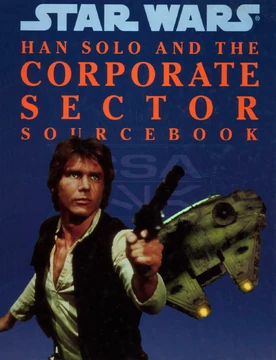
Han Solo and the Corporate Sector Sourcebook
Han Solo and the Corporate Sector Sourcebook
Credits
Design: Michael Allen Horne
Additional Design: Carol Hutchings
Development & Editing: Bill Smith
Cover Design & Graphics: Stephen Crane
Interior Illustrations: Tim Eldred, Allen Nunis, Mike Vilardi
Playtesting & Advice: Kevin J. Anderson, Bill Slavicsek, Eric Trautmann, Jim Whittaker
Special Thanks To: Brian Daley, author of Han Solo at Stars' End and Han Solo's Revenge
Published by: West End Games
RR3 Box 2345
Honesdale, PA 18431
Publisher: Daniel Scott Palter
Associate Publisher: Richard Hawran
Senior Editor: Greg Farshtey
Editors: Peter Schweighofer, Bill Smith, Ed Stark
Art Director: Stephen Crane
Graphic Artist: Brian Schomburg
Sales Associate: Bill Olmesdahl
Licensing Manager: Ron Seiden
Warehouse Manager: Ed Hill
Accounting: Karen Bayly, Wendy Lord, Kimberly Riccio
Billing: Amy Giacobbe
STAR WARS, TM & © 1993 Lucasfilm, Ltd. (LFL). All rights reserved. Trademarks of LFL used by West End Games under authorization.
First Printing: November 1993
Introduction
"You should know better than that. Rob 'em blind, that's my kind of revenge. "
- Han Solo
When George Lucas first added the characters of a rogue spacer and his alien sidekick to his proposed space fantasy, little did he know how popular the pair would turn out to be. Long before the term "scruffy-looking nerf-herder" entered the public consciousness, audiences found something refreshing in a Corellian smuggler, his Wookiee first mate, and the "fastest hunk of junk in the galaxy."
Space scoundrels with hearts of gold had long been a staple of space opera, but never before had the idea been brought to life so compellingly on the screen. It was no surprise that their dashing image caught on with fans across the world. At science fiction conventions and film festivals it became customary to see all manner of folk sporting black vests and red or yellow "bloodstripes."
As the Star Wars phenomenon spawned new additions to the saga, it was only a matter of time before Han Solo and Chewbacca got their own turn in the spotlight.
Brian Daley, already a successful novelist, was chosen to write a trilogy detailing some of the countless early adventures of Han and Chewbacca. Han Solo at Stars' End was released in 1979, at the height of the Star Wars craze. Han Solo's Revenge, sequel to Stars' End, was released later in 1979. The final book of the trilogy, Han Solo and the Lost Legacy, was released in 1980, the same year that brought the world The Empire Strikes Back. Though neither the Empire nor the Rebel Alliance figures significantly in the series, there is more than enough action and suspense to keep the most jaded fan thrilled.
Recently reissued in one volume, Star Wars: The Han Solo Adventures, these stories are again in the public eye. Many new readers have shared the excitement of run-ins with Espo thugs, corporate stooges and dashing gunmen.
The Han Solo and the Corporate Sector Sourcebook
A sourcebook on the Han Solo novels has been one of the most frequently requested Star Wars game products. Finally, the early adventures of Han Solo have been brought to the Star Wars roleplaying game. This sourcebook discusses the people, places, objects and events of the first two novels in the series, Han Solo at Stars' End and Han Solo's Revenge. A future supplement will discuss the Tion Hegemony, setting of the final novel, Han Solo and the Lost Legacy.
As with other sourcebooks for Star Wars: The Roleplaying Game, this book is intended both for gamers and collectors alike. Players and gamemasters will find it useful for its conversions of popular characters and devices for use in Star Wars games. Those who enjoyed reading the novels in their own right will find that these entries expand and elaborate on Mr. Daley's characters and situations.
Best of all, this sourcebook adds a long-awaited chapter in the story of the Empire: the Corporate Sector, a no-holds-barred, chartered, limited free enterprise fief. The Corporate Sector lies within one wisp of a branch at the end of one arm of the galaxy. The Corporate Sector Authority has exclusive rights to use the resources of the region - some would say "despoil" and "pillage" - as it sees fit.
As with the other products for Star Wars: The Roleplaying Game, this sourcebook is not intended to substitute in any way for reading the original books. Game attributes and character histories cannot replace the atmosphere and drama of Mr. Daley's original trilogy.
First a few words about the time the novels themselves are set in. Long before anyone had heard of a farm kid named Skywalker or a weapon code-named the "Death Star, " there was an independent smuggler named Han Solo. He and his co-pilot Chewbacca, the Wookiee, and their ship, the Millennium Falcon, ran the spaceways of the galaxy to make a few credits.
The Empire was at the height of its power. Many independent spacers found their opportunities drying up everywhere, as the New Order's control steadily became more absolute and intolerant. Life was hard on the independent operator. Still, with some skill and a lot of luck, it was possible to make a fortune. If you didn't get killed first.
Han and Chewie had seen the signs of the times and decided to head to a place called the Corporate Sector. A place where wealth was plentiful, with much of it sliding between the cracks of society. To the smugglers.
In the Corporate Sector, you won't see robed COMPNOR faithfuls holding torchlit ceremonies, or merciless stormtroopers raiding settlements in search of Rebels. The boot of the Imperial military is distant.
Instead, manicured executives sip spiced wine and plan ever-more exotic vacations. Anxiety-ridden middle overseers plot and backstab each other for meaningless perks and favors. Company goons turn a blind eye to crime and depravity as long as the stock prices hold. Countless workers slave in duct-filled micro-cubicles, all for the greater glory and profit of the Corporate Sector Authority. Far from the Authority towers, scout ships and worldgougers scour the stars, searching for resources to fuel the endlessly churning factories and processing plants.
This sourcebook examines the Corporate Sector in detail. Besides the histories of the major characters in the novels, this sourcebook explains the history of the Authority, how it functions, and how a group of enterprising individuals can manipulate the system for a few extra credits.
Welcome to the Corporate Sector!
Chapter One: Han and Chewie's Exploits
The following is an excerpt from an interview between Voren Na'al, Director of Research for the New Republic Inner Council, and General Han Solo (ret.), while Solo was resting with his family on New Ralltiir. Occasional comments are added by Chewbacca, Solo's best friend, and by Leia Organa Solo, his wife.
Solo: Is this thing recording right now?
Na'al: Now it is.
Solo: So what exactly are you trying to find out here? I mean, this was all years ago, long before her highnessness ...
Na'al: Highnessness ... ?
Solo: Yeah ...
Na'al: Uh ... well, at any rate, what I'm hoping is for you to take your time and summarize for me as best you can the major incidents, personalities and places of the Corporate Sector you encountered prior to your enlisting with the Rebel Alliance.
Solo: You hear that, Chewie? We enlisted!
Chewbacca: (Roars with laughter)
Solo: Well, anyway, I figured that I really needed a change of pace. I had been seeing all the same faces and making runs for most of the same bosses in the Corellian Sectors, in Hutt Space - the usual places.
Na'al: Like the Smuggler's Moon, Nar Shaddaa, correct?
Solo: Yeah. Chewie and me had seen every nook and cranny of that place and I've never liked working for Hutts much ... sooner or later, if you stay on Nar Shaddaa, they'll own you.
Na'al: Ironic, all things considered, eh?
Solo: ... hilarious, kid.
Chewbacca: (Untranslatable)
Na'al: Sorry, uh, I didn't mean to, uh, bring back any bad memories.
Solo: Ah, don't sweat it. Uh, where were we?
Na'al: You chose to relocate to the Corporate Sector ...
Solo: Uh-huh.
Na'al: Were there any other motivations for your leaving Nar Shaddaa?
Solo: Eh?
Na'al: Well, Councillor Organa Solo has mentioned a former fiancee on your recent return there and I was ...
Solo: Was what, boy? This is private stuff here! Why don't you pester someone else ...
Na'al: I'm sorry, I didn't mean to offend you.
Solo: You're still alive so you didn't offend me. Anyway, that's ancient history. Speakin' of history, don't you have other business to take care of?
Na'al: Really, I don't mean to be intrusive.
Solo: Let's just keep going with this. Salla and I are ancient history. Smugglers don't go in much for correspondence. You see someone a lot, great, you don't see 'em for a few years, also great. Take Lando and me. We hadn't seen each other for years and when we got to Bespin it was just like old times ... uh, anyway, Chewie and me wanted some new scenery.
Na'al: What did you think of the Corporate Sector in general?
Solo: Great place to spend your credits.
Na'al: And what else?
Solo: Not much.
Na'al: Describe to me some of the major events that happened to you during this time.
Solo: Well, first off, we went to Etti IV, that's one of the Sector's big worlds. First thing, they took our currency away. As you probably heard, they don't take anything except their own cash vouchers and that crystalline vertex stuff. Then, there was the hassle of registering the Falcon to all of the bogus ship IDs we'd worked up for her. That was real tricky and we didn't have much choice. In the 'Sector, if you don't have a CSA - that's Corporate Sector Authority - ID, you might as well ask to be thrown in the slave pens. Etti IV is pretty fair for a Corporate world. Not as air-conditioned as some. Here you can actually have a good time. They aren't as stiff there as other places. Relatively speaking, of course.
Anyway, we're there listening to the scuttlebutt. We get word that some fella, name of Big Bunji, is looking for experienced pilots to haul some loads of chak-root. The Authority doesn't merely tax goods, like the Empire. The Authority controls the market. They sell their own low-grade, ditch-grown stuff and charge like heck for it. There's a big market for the quality stuff. Big bonuses for a few runs. Naturally, we were interested. Of course, Bunji doesn't mention we're supposed to run it to Gaurick, where most of the local workers are part of some cult that has control. And they brought a mufti with them to be overseer - oh, sorry. A mufti is one of their high priests or something like that. Not only don't they approve of chak-root, they don't drink anything but water and don't eat anything tasty. The locals are also eager to make an example of anyone who's "destroying the morals of the society" - namely anyone who uses or transports chak-root. Well, suffice it to say, things got interesting. The first run was easy. Next job, the same thing. I tell him they'll be ready for me this time - no go. Bunji says he'll double the fee. Even helps us get a new ID set, the Sunfighter Franchise, the whole deal. So we go again. And again, and each time it's getting harder in and out. Then - next trip - we drop back from the Big L.
Na'al: The what?
Chewbacca: (Comes back out of the kitchen with an enormous chudde and orxtle sandwich. Roars, untranslatable.)
Solo: (to Chewbacca) No, I guess they don't teach 'em anymore. (to Na'al) You know, the light barrier.
Na'al: Oh. Please continue.
Solo: Well, we come out to find a picket ship there. I figure we can dump the cargo, lie low, plead innocent, bribe the guy.
Chewbacca: (Roars)
Solo: Right, pal. They don't even try to board us. Drok it, even the Empire's gotta board you first, right? Not these jokers. They open fire on us. Well, they just played moopsball for a while. With us as the ball. We set for jump and got away without too much damage to the hull. Now comes the big surprise. Bunji-boy apologizes. He says, "No problem." He'll take care of all the problems, fix it all. We've been working on a retainer so far - services rendered in exchange for a credit line with him. Never mentions that the repairs come out of our fee. I figure we're on a long job here, and racking up some credits. Then, I get the bill. We owe him a couple of hundred thousand credits! He claims that's what the repairs cost, and now we'll have to make our next few runs gratis just to pay back the extra debt. Guess what I tell him?
Na'al: To eat a voxbug?
Solo: Hm, that's a good one. No, we tell him ...
Na'al: Yes ...
Solo: ... sure! Let bygones be bygones. We'd love to keep working for you!
Na'al: Really?
Solo: That's what he thinks. We kill time there at his base. A bunch of domes on a rockball asteroid. When the Falcon's ready ...
Chewbacca: (Untranslatable)
Solo: Right, not even a new paint job, even! Well, we get ready for another run to guess where? Some place most of his guys haven't even heard of. Well, we lift off nice and easy, but here's the fun part. Instead of going into orbit, we swing in low over Bunji's dome and Chewie opens fire from the belly guns.
Na'al: Was Bunji killed?
Solo: No. But it would have served him right if he had been. Chewie and me never saw another driit from Bunji, but at least word got around so no one took us for stupid anymore. We got into some pretty big debt after that since Bunji didn't even get the Falcon fixed up right. We ran up some big debts with loans from Ploovo Two-For-One. We had to do some jobs for him. He wasn't much better than Big Bunji. Come to think of it, he wasn't much better than some Hutts I heard of. Not as intelligent, but every time I met him, I left counting my fingers and needing a bath. I paid him every credit I owed him, but only on my schedule. Apparently that ticked him off. Made him look bad to his creditors. As if he needed any help to look bad. Ploovo and me eventually parted ways after a gun-running deal on Duroon. I never took kindly to his little omissions. Why can't these guys ever run a straight business? The more they tell you about the job and the more they honestly pay you, the more they get out of it in the long run. I'll bet you Talon Karrde never runs his operations that shabby. For some odd reason, every gangster boss, including a few big, big players in the galaxy-wide crime biz, love playing mind games. Makes 'em think they're important. Anyway, around that time, the Authority was installing their new sensor suites, real long-range beauties. We'd had problems running away from some picket ships. Since the Sector is pretty centralized, it only takes a few days to transmit a Waiver Violation Form to every ship they have. And Ploovo had let on about us. We fixed him good anyway. I'll bet his favorite clothes still smell. Of course, we needed new IDs and the usual. As you might have guessed by now, it takes more money to get around in the Sector than it does in the Empire. A regular treadmill.
Na'al: How did you get the ship acceptable to the Authority?
Solo: Times like that, the only thing you can do is go to a specialist. Wherever you go, you find 'em. Outlaw-techs, like Shug or Doc. In this case, it was Doc. I'd dealt with him and Jessa, his daughter. I had a lot of good memories about those times ... (At this point Gen. Solo stares at the interviewer)
Na'al: What? I didn't say anything!
Councillor Organa Solo: (Entering room) Guilty memories, Han? (To Na 'al) Don't let him bother you. He likes to cultivate the image of a tough character.
Solo: Hey, I am a tough character. (Chewbacca chortles and steps out of the room)
Na'al: If this is a bad time ...
Solo and Organa Solo: (In unison) No, of course not.
Solo: Where was I? Oh, yeah. We went over to Doc's, but you see he wasn't there. So I decided that Chewie and I -
Organa Solo: (Laughs)
Solo: Well, anyway, Chewie and I talk it over with Jessa. She was worried, rightly it turns out, that the Authority was behind it. Only she doesn't say it outright. We make a deal to help out this academic on Orron III and we get the repairs and the new ID. We had no idea what we were getting into.
Na'al: Could you please tell me more of your actions with the underground in the Sector? Our Sullustan agents suggest there might be some potential if they knew just who to contact.
Solo: Wait on a Standard Time Part here. For one thing, there isn't any underground. Not by a long shot. Greedy people make poor insurgents.
Organa Solo: So I've noticed.
Solo: Right. Anyway, 99 out of 100 folks there who have an attitude about the Sector are only ticked off 'cause they haven't got their share yet. Heroes are few and far between in the Sector.
Na'al: But didn't you work with a Triani assault team?
Solo: Technically, yeah. But only because Triani are good at fighting for what's theirs, but they don't live in the Sector primarily. They're trying to hold onto a couple of worlds - hardly a comparison with what we're up to.
Na'al: I see. But you did help them rescue a comrade?
Solo: Well, I gotta give credit where it's due. It was Rekkon who really deserves credit for it all.
Na'al: This would have to do with the attack on the Stars' End facility?
Solo: Yup. Only it wasn't an attack, it was more like a revolt. We cut the power ... in a real interesting way. They did the rest. Doc got everything organized. Course, we had the best with us ... if only Rekkon had had a chance to see just how right he was all along.
Na'al: He was the academic? What kind of man was he?
Chewbacca: (Untranslatable)
Solo: You're right about that. He was a great man. Really, most of us spend our lives trying to get something together, to find a purpose. He had that and more. He was one of the finest beings I ever met. When he died, the galaxy lost big. If he were around today, he'd be as famous as any Council member on our side of the border. Not to slight the others who went along, by any means. They were all exceptional. Atuarre, the Triani, and her cub, Pakka. Rekkon picked them and brought out the best in them. Even that bladderweasel, Torm, picked up a few pointers, I'll bet. They could have taught some commando squads I've led a thing or three. Then there were the droids, Bollux and Blue Max. I liked them better than I do a lot of organics. But that's a story on its own. We got in and out of one of the meanest prisons I had the misfortune of being in.
Chewbacca: (Untranslatable)
Solo: Hey, a life debt goes both ways. Of course, we couldn't take all the credit. Just most of it.
Na'al: What do you mean?
Solo: Well, that suit, Hirkugg? Hirgix?
Chewbacca: (Untranslatable)
Solo: Thanks. Hirken. He made the classic mistake. Put all his chips on one number and it came up a loser. It was that director unit of his. When I got Uul-Rha-Shan to shoot it by mistake it led to an overload spiral. He was Hirken's bodyguard, and one tough customer. But with one shot, he killed Hirken's box and the whole thing went bye-bye on our friend. The salvage teams are probably still picking up wreckage.
Na'al: I don't quite follow ...
Solo: All the circuits were slaved to that unit on Hirken's belt. Boom. Cancel one state-of-the-art correctional facility. Blew the thing clear off the planet and nearly into orbit. Lot of casualties, but with Atuarre's quick thinking, a lot of us made it off. We didn't stop running 'til we hit Jessa's new base.
Organa Solo: And then?
Solo: I kept my end of the bargain. Doc kept his. And the Sunfighter Franchise flies again! (Makes a swooping gesture. All laugh.)
Han Solo
"Slick, " that's what they used to call Han Solo. Not everyone, of course, and not always nicely, but it was a moniker he maintained by coming back from the more dangerous smuggling runs in the galaxy. True enough, some joked his Wookiee partner was the real business mind behind the pair, but it was unquestionable that they could survive unbeatable odds.
That wasn't how Han got the name to begin with. Of course, that was years before. Before the Kessel Runs, before Nar Shaddaa. Before Solo even turned to smuggling at all. A lifetime ago, when he was an exemplary student at the Academy. Most kids who could go to the Academy did so with the aid of family connections, wealth, or even Senatorial attention. Solo had none of these. To this day he won't reveal even the most basic details of his childhood. If his friend Chewbacca has any more to offer on the subject, he keeps it to himself.
One thing without question, however, was that he was already a skilled swoop and speeder pilot before attending the Academy. According to one of Solo's old Academy mentors, Badure, or "Trooper, " it was during one of his first orbital hops, in a malfunctioning U-33 loadlifter, that Han got the nickname. Han tried pointing out a system flaw that endangered the training mission he and his cadet class were on. The flight training commandant derided Solo's "slick" answer without putting much thought into the danger. He made Solo fly the training mission, commanding the cadet to perform one dangerous maneuver after another. During the flight, Han's fear came true and they would have all died without his skill in landing the old barge. Han took the name as a badge of honor.
They say Corellians have rocket fuel for blood and Solo is proof enough of that. Solo is still quite proud of the fact that he was among the top of his class. He made quite a name and reputation. So much so that he came to the attention of Cadet Mako Spince. Spince was a free spirit if there ever was one and soon he and Solo became the best of friends. Through pranks, racing stunts and assorted carousing, Spince showed Solo how to really have a good time. It looked like the party would never end. End it did for Spince when the Academy found him responsible for destroying its Mascot Moon with "borrowed" antimatter. Solo and Spince's other friends tried to vouch for him, but to no avail. Spince didn't hold it against Solo and promised to see him again someday.
For his loyalty to his friend, Solo was nearly expelled by the vindictive dean. However, cooler heads prevailed. After all, Solo was at the top of his class and it wouldn't look good to purge such a fine student for guilt by association. Eventually, Han Solo graduated with honors and the day he was commissioned in the Imperial Star Fleet was the proudest day of his life. He was soon court-martialed for doing what was right. He lost a career and gained a Wookiee, whom he'd saved, as a companion. Cut off from everything Solo had ever wanted, he became a drifter, going from one "big joke, no hope" job to another.
Ironically, one of the only things keeping him out of trouble was that same Wookiee who followed Solo around the galaxy, claiming to owe the Corellian some "life debt." The last thing Solo felt like was a hero, and he didn't feel ready for a fan club yet. Chewbacca was persistent and after pulling Solo through a rough scrape, the two became friends. Though Solo got some grief for his unhired sidekick, eventually he came to trust the Wookiee.
From there, things began to brighten up. To improve things further, another old buddy returned to Solo's life. Mako Spince was sorry to see his old pal Slick fall on such hard times. He and Chewbacca contrived a way to lift his mood. Spince got him into the smuggling business. Solo waved off several times, but once at the controls of a ship again he felt a part of him come back to life. He soon fell in with a group of other smugglers on Nar Shaddaa - Shug Ninx, Salla, Lando Calrissian, and Roa. Roa was looking for someone to pilot his yacht through the Rampa Rapids, bearing a cargo of pure "snow" - water for the polluted industrial world of Rampa. Roa introduced Han to the wonders of Kessel, where real credits could be made running glitterstim spice to a hungry galaxy.
Han and Chewie were like dustmotes during this time, drifting from one social circle to another. They soon met the whole gang working for Roa: Vonzel, the Briil twins (Rewinda and Lozira), and last but not least, Tregga. These were wild times indeed. On some worlds they stayed on, spacers still tell stories about their stunts, like the time they reprogrammed all the advertising holoboards to flash their faces all night long.
Solo was already good friends with Lando, though he didn't always understand his mindset at times, his preoccupation with style over substance, for one thing. There was one thing Han couldn't argue with Lando about though: he had great taste in starships. To whit: one modified YT-1300 light freighter, named the Millennium Falcon, and, it just so happened, one seriously fast ship. Lando was very mysterious about where he'd gotten her, but he put all of his time and credits into her. Solo just couldn't keep his eyes off the Falcon, and was always coming aboard and checking her out. Just to taunt the Corellian, Lando would occasionally joke about using the Falcon as a marker for his bets. Usually this came to nothing, but when Lando's luck turned sour during a particularly cutthroat sabaac game, Han's dream came true: the Falcon was his. The outcome of that one game has remained a point of rivalry between the two to this day.
Just about any way you looked at it, life on Nar Shaddaa was sweet for Han and Chewie. In fact, Han decided to show how at-home he felt, and did something he hadn't done in years: got some permanent living quarters. He found ways to keep himself busy, one of the best of those being a tech named Salla Zend. She was partner with a mechanic named Shug Ninx. Beautiful as the day is long, intelligent, and an artist with a hydrospanner ... in many ways, she was exactly what Han was looking for. Things went well and some even figured that Salla would be the one to tame the smuggler's wayward heart. They didn't reckon on Corellian wanderlust. Fond as he was of her, he was just a bit full of himself, always looking to see what was beyond the next star. More so than that, he wasn't ready to commit himself to anything yet.
After a hazardous run, Salla clung tighter than ever to Solo: she began to think about settling down. He and the Wookiee had been in a similar scrape a few years back. A Kessel Run had soured big time and the two would have been bantha fodder if Trooper hadn't helped out. A life debt all the same, but you didn't see Trooper looking at flatware patterns. So Han decided to see what things were like beyond Hutt space and the normal smuggling circles. Eventually, he ended up in the Corporate Sector, where word was they paved the landing strips in nova crystals. There was plenty of time to make commitments once you could buy your own planet. Once he sold Chewie on the idea, they headed off. Arriving at Etti IV, a main entry world, they turned in their credits for crystalline vertex and Authority Cash Vouchers, and a new phase in their careers began. Not nearly as lucrative as Han might have supposed it would be, but Han was learning many lessons. Ones that would prove useful in his later life. The next problem was getting ship permits. Solo knew Imperial Armament Rating regs backwards and forwards, but the Authority Waiver policy didn't make any sense. He obviously wasn't a pirate. He wouldn't even need weapons, except to protect against pirates and the like. Or so he told them. The Authority caseworker was adamant. What saved them some major hassle was an offer they got from Big Bunji. He'd provide fake IDs in exchange for some smuggling runs. It sounded good at the time ...
Han Solo (As of his adventures on Duroon)
Type: Smuggler
DEXTERITY 3D+1
Blaster 5D+2, blaster: heavy blaster pistol 8D, blaster: blaster rifle 4D+1, blaster artillery 5D, brawling parry 5D+1, dodge 6D, grenade 4D, melee combat 5D+1, melee parry 4D, pick pocket 4D+1, running 3D+2, vehicle blasters 5D+1
KNOWLEDGE 2D
Alien species 4D+2, bureaucracy 4D, business 3D, business: smugglers 4D+1, cultures 3D, intimidation 4D+2, languages 4D, law enforcement 3D+1, planetary systems 6D+2, streetwise 6D, survival 5D, value 4D
MECHANICAL 3D+2
Astrogation 7D+1, beast riding 4D+1, capital ship gunnery 4D+2, capital ship piloting 6D+1, ground vehicle operation 4D+2, repulsorlift operation 6D, sensors 4D+1, space transports 5D+2, space transports: YT-1300 transports 8D+1, starfighter piloting 4D+2, starship gunnery 8D, starship shields 5D, swoop operation 5D+2
PERCEPTION 3D
Bargain 7D+1, command 5D+1, con 5D+2, forgery 4D, forgery: ship IDs 6D+1, gambling 6D, hide 6D+1, persuasion 4D, search 5D, sneak 3D+2
STRENGTH 3D
Brawling 6D, climbing/jumping 5D, lifting 4D+1, stamina 6D+1, swimming 3D+2
TECHNICAL 2D+2
Blaster repair 3D+1, computer programming/repair 6D+1, demolition 3D+1, droid programming 4D+1, repulsorlift repair 6D+1, security 5D+2, space transports repair 4D+1, space transports repair: YT-1300 transports 7D, starship weapons repair 3D+1
Force Points: 2
Character Points: 15
Move: 10
Equipment: Heavy blaster pistol (5D), comlink
Han Solo (As of his adventures on Kamar)
Blaster 6D, blaster: heavy blaster pistol 5D+1, brawling parry 5D+2, dodge 7D, melee parry 4D+1
Alien species 5D, bureaucracy 4D+1, business 3D+1, languages 4D+1, law enforcement 3D+2
Repulsorlift operation 6D+1, starfighter piloting 5D, starship gunnery 8D+1
Con 6D+1, forgery: ship IDs 6D+2, hide 6D+2
Brawling 6D+1, climbing/jumping 5D+1
Blaster repair 3D+2, demolition 3D+2, security 6D, space transports repair: YT-1300 transports 7D+2
Force Points: 3
Character Points: 18
The Interview
Solo: So what do you want to talk about now?
Na'al: After you got away from Stars' End and dropped off the prisoners on Urdur, what did you do then?
Solo: Recover from the party, mainly. (Laughs) Well, Chewie and I decided to stick around on Doc's base for a while. Jessa and I had a deal about her fixing up the Falcon and I was gonna hold her to it.
Organa Solo: I'll bet.
Solo: Do you want to tell this story, dearest?
Na'al: What did you do after that?
Solo: Me and the Wook got good memories of Rampa. One of our first big runs was taking snow down the Rampa Rapids. You know, the whole planet's pretty toxic now it's so polluted. We smugglers ... I mean, legitimate businessmen make money hauling water, ice, snow ... and anything else you can drink. Of course, as the Authority really overregulates things like that, we had to do it quietly, you know what I mean? Well, we figured it couldn't get too serious. And I guess that'll show you how much my good sense is worth.
Organa Solo: Don't be too hard on yourself. That's my job.
Solo: I've noticed.
Chewbacca: (Untranslatable)
Solo: Well, anyway, after we lost our shirts on that deal, we got left with a few useless hunks of junk in exchange. We decided to play it cool on one of the fringe worlds. Know much about Kamar?
Na'al: Never heard of it.
Solo: Then you're lucky. They got some weird natives there, the Badlanders. They were fairly friendly at first, when we started showing holofeatures.
Na'al: Could you elaborate on that last bit? What do you mean by "going mean?"
Chewbacca: (Untranslatable)
Solo: I hear you. Uh, well, an old acquaintance, Sonniod showed up. I know him from way back, and he used to do a little work smuggling copies of holofeatures. He could get a few spares for us and we could rake in more credits. Well, for whatever reason, they didn't like it when we spiced up the show.
Chewbacca: (Untranslatable)
Solo: Hey, don't talk that art critic stuff. You're starting to sound like Goldenrod.
Na'al: What did he say?
Solo: Don't mind him when he gets highfalutin' like that. Anyway, they didn't take too well to the change in program and we bid a quick farewell to Kamar. Hello again Corporate Sector. I'm hungry, who wants lunch?
Chewie: (Growls in obvious assent.)
Na'al: Sure, we can take a break for a while.
Na'al: Tell me more.
Solo: Well, we had an old holoprojector and we figured what the heck, the natives might get a kick out of it. They didn't have a great grasp of technology, but they made some interesting trinkets and they would pile them up for us before each show. I supposed it was all they had ... and it killed time until I could get the Falcon back together.
Na'al: Did it work out?
Solo: For a while. I figured we had had enough of our credits spent in the vain pursuit of success in the Sector, but after the Badlanders went mean, we decided to head back to the arms of the Authority.
Chewbacca is a unique individual by any standard, even among Wookiees. They are an ancient species of furry humanoids from the lush jungle world of Kashyyyk. The arboreal Wookiees build their amazing cities within the kilometers-high trees. Below the cities there are numerous levels, each with unique and progressively more dangerous ecological subsystems. Despite the common perceptions of the citizens of the galaxy, Wookiees are not violence-loving savages. They have a wise and cultured society. Though they have a good understanding of technology, they prefer to live in harmony with the environment of their world and rely on simpler technologies. Technology was something that always interested Chewie, as his family called him, and it was from this interest that Chewie would find a calling later in life. Wookiees are known for wandering their world. Many Wookiees leave their family units in young adulthood to explore the lower levels of their world. Chewbacca's wanderlust was even more prominent: he wanted to see the diversity of the universe and left his homeworld. As he travelled from one star system to another, Chewbacca found himself afloat in a galaxy slowly growing more hostile towards those like him. The coming of the Empire brought a terrible time for the Wookiees of Kashyyyk, who found themselves enslaved. Chewbacca found himself caught in the cruelties of an increasingly intolerant universe until he came across a young Corellian named Han Solo. Solo saved Chewbacca, even though it cost him a promising military career. Chewbacca swore a "life debt" to Solo, binding himself to the Human. While Solo didn't understand why the Wookiee insisted on accompanying him everywhere, eventually they formed a strong friendship. Solo and Chewbacca's travels have taken them to Hutt Space, Nar Shaddaa and other smuggling centers. Over the years, they have gotten into some bad scrapes, but none they couldn't overcome with bravado, skill and dumb luck. Meanwhile, Chewie learned more and more of the technology of the Empire and improved their ship, the Millennium Falcon, into the fastest smuggling ship in the galaxy. Chewbacca has never lacked for interesting times as long as Han has been around. There will doubtless be many more adventures to come. Chewbacca still feels his life debt to Han. But it has become more than just a matter of debt: they are the best of friends as well. Chewie is amused by the pretense of heartlessness that Han presents. Mainly a way of keeping others at a distance, Chewie sees through it easily, though others often don't. Chewie has repaid his life debt to Han in uncountable ways. That's not the reason Chewie is still his friend. Chewie knows that Han is going through a stage of his life where he doesn't want to be a hero. But, if the spirit of the universe has something to say about it, Han may not have a choice someday. And if that means Chewie is required to act as Han's occasional conscience, then he has no problem with that.
Chewbacca (As of his adventures on Duroon)
Type: Wookiee
DEXTERITY 2D+2
Blaster 4D+1, bowcaster 6D+2, brawling parry 6D+1, dodge 5D, melee combat 6D+2, melee parry 6D+2, vehicle blasters 5D
KNOWLEDGE 2D
Alien species 5D+1, bureaucracy 3D+1, business 2D+1, cultures 2D+2, intimidation 6D+1, languages 3D+2, planetary systems 5D+1, streetwise 5D, survival 4D+2, value 5D+2
MECHANICAL 3D
Astrogation 6D+1, repulsorlift operation 5D+2, sensors 4D, space transports 5D, space transports: YT-1300 transports 6D+2, starship gunnery 5D, starship shields 4D+2
PERCEPTION 2D
Bargain 3D+2, command 2D+2, gambling 3D+1, hide 3D, search 2D+2, sneak 2D+1
STRENGTH 5D
Brawling 7D+2, climbing/jumping 5D, lifting 7D+1, stamina 8D+1, swimming 6D
TECHNICAL 3D+1
Blaster repair 4D+1, bowcaster repair 4D+2, computer programming/repair 6D+1, demolition 4D+2, droid programming 6D, droid repair 5D, first aid 4D, repulsorlift repair 5D, security 4D+2, space transports repair 4D+1, space transports repair: YT-1300 transports 8D+2
Special Abilities:
Berserker Rage: Chewbacca gains +2D to Strength when brawling in berserker rage. See page 137 of Star Wars: The Roleplaying Game, Second Edition and page 124 of the Star Wars Gamemaster Handbook.
Climbing Claws: +2D to climbing.
Force Points: 1
Character Points: 11
Move: 13
Equipment: Bowcaster (4D), ammo bandolier, droid tool kit, starship tool kit, waistpouch
Chewbacca (As of his adventures on Kamar)
Blaster 4D+2, bowcaster 7D+1, brawling parry 6D+1, dodge 5D+1, grenade 4D+1, melee combat 7D+1, melee parry 7D, vehicle blasters 5D+1
Alien species 5D+2, bureaucracy 3D+2, business 3D+1, cultures 3D, intimidation 7D+2, languages 4D+1, planetary systems 6D, streetwise 5D+2, survival 5D+2, value 6D+1
Astrogation 7D+2, beast riding 3D+1, repulsorlift operation 6D+1, space transports 5D+1, space transports: YT-1300 transports 7D, starship gunnery 5D+2
Bargain 4D+1, command 3D+1, gambling 3D+2, sneak 2D+2
Brawling 8D+2, climbing/jumping 5D+2, lifting 7D+2, stamina 8D+2
Blaster repair 4D+2, bowcaster repair 5D, computer programming/repair 7D, demolition 5D, droid programming 6D+1, droid repair 5D+1, repulsorlift repair 5D+1, security 5D, space transports repair 4D+2, space transports repair: YT-1300 transports 9D
Force Points: 2
Character Points: 17
The Interview
Solo: What else do you wanna know?
Na'al: We're right at the point where you decided to go back to the Sector. Did you get another job with Ploovo Two-For-One?
Solo: (Thinking) No, I wish we had thought of that. Maybe he'd have forgotten about the dinko by then.
Chewbacca: (Laughs)
Solo: I guess you're right. Maybe Ploovo wouldn't have been all that friendly about then. Anyway, Sonniod told me about some job for an unnamed party on Lur. Only when we get there, we meet some low-lifes. Slavers ...
Na'al: I think I've heard something about that.
Solo: Well, we weren't so lucky. I should've figured something was seriously wrong when they didn't show themselves as we landed. If you ever make a pickup run, you make sure they come out in the open to greet you.
Na'al: Oh, okay.
Solo: Turns out they were running this game: they hire a spacer to haul some poor little guys - this time it was Lurrians - then when he lands, they waste him and take his ship. They make the delivery and sell the ship. Come out ahead both ways. They took on more than they could bargain for when they dealt with us. Right, partner?
Chewbacca: (Untranslatable)
Solo: The man running the show was named Zlarb. Now, you won't hear much about him, but he was half of the slickest slavery scam I ever saw. Zlarb just so happened to have very high connections in the Authority. He had a tough outfit all right. But he didn't keep in mind just how useful droids can be.
Organa Solo: Hold on, my ears must be fooling me.
Solo: Do you mind? Bollux and Blue Max helped us out in spades then. Most of the work was done by the Lurrians themselves, though. Now if you ask me, death's too good for slavers.
Chewbacca: (Untranslatable)
Solo: I hear you. Of course, that left us with a negative cash flow to the tune of 10,000 credits. And I always collect my debts. Fortunately, before he made the Final Jump, Zlarb left some clues.
The Bloodstripe
The following textfile is an excerpt from the transcript of an oral history compiled a few years ago by Professor Emeritus Skynx, at the University of Ruuria. The subject is Alexsandr "Trooper" Badure, a former instructor at the Republic/Imperial Military Academy, as well as a long-time military veteran (his tours of duty included the Twi'lek Spice Conflict, the Corellian Territories Engagements and the Outer Rim Wars).
Corellians have always had a reputation of doing things just a little bit differently. Some say they invented hyperdrive just because they were tired of going sublight like everyone else. I'd take that with a pinch of mytag crystal, but you get the point.
That individuality even includes honoring their heroes. It comes from their idea of courage. They don't see it as jumping through hoops with blaster rifles firing at you. They see it as moral conviction.
You see, anybody can run over a trench to take out an enemy position. That, to them, is instinct. It's not anything you can think about - you never get the time.
The way Corellians see it, it takes more real courage to do something you can contemplate. Especially if it's unpleasant to you personally. Now nobody, or at least very few people, likes seeing strangers come to grief, so it's not a big trade-off to help them out. But, if you're standing up for what you believe in and you know it's gonna hurt, then that's a hero.
While other worlds bestow medals or ribbons to award courage, the Corellians, always a practical people, prefer a no-nonsense approach over shiny bits of ceramic or cloth. Sure, they've got good citizenship prizes, but the important one, the real thing, is a special mark so others will always know they can depend on the person.
What they do is award something they call the Bloodstripe. It's a three-centimeter wide broken stripe of piping sewn on a seam on the trousers.
They have two classes of it. The Second Class is a broken gold stripe. First Class is a broken red stripe. It's pretty difficult to get the Second Class to begin with, and the First Class is usually posthumous.
As I said, it isn't for flashy things, so you can't automatically assume that anyone wearing it is a galactic hero or something. Of course, warfare is just about the hardest thing you can do, so 999 out of every 1,000 are for courage under fire.
You wear it as much as you choose, as often as you like, but it's a commitment. It says, "I stand for something, a code, a belief system, something. And I honor my debts."
Many people take a Corellian Bloodstripe to indicate a high and mighty attitude, like a Jedi Knight or someone from Freedom's Sons. That's wrong. Someone with a Bloodstripe is still human, still makes mistakes, and that Bloodstripe doesn't automatically make him your friend. You don't walk up to a complete stranger with the 'Stripe and suddenly think he or she owes you anything more than the time of day. But it does say they have proven themselves before ... and can do so again.
Let me tell you about a friend of mine. We go back a long way, Han Solo and I. Now he's a fine example to look at. You remember him back on Dellalt in the Tion?
Corellians like their privacy as well, and he told me how he got the First Class on condition it not become public knowledge, and I respect that. If you want to know it, you ask him yourself, but I will let on about this: the Second one had to do with a Wookiee.
Han Solo hasn't chosen to wear the First class in a while. After all, a high profile in his line of work can be deadly, and in the right quarters, a Bloodstripe is about as high profile as it gets. I once heard he almost made the Final Jump after some bounty identified him by it.
Now that he's some famous Rebel, some act surprised he came from such a "lowly" background. Me, I always knew he'd go far.
Na'al: Clues to what?
Solo: Getting even with the guys who thought they could make me into a slaver. That's what got us to Bonadan, where we met Fiolla.
Na'al: The Auditor-General?
Solo: Well, she was just a free agent back then, but I could tell right then she had her gear together. (Looks at Organa Solo) Of course, she was never more than just a good travelling companion, but she helped us out of a lot of messes.
Organa Solo: (Laughs) You were incorrigible.
Solo: Were?!?
Organa Solo: Okay, are. You're starting to sound like Lando when he went to that school.
Na'al: Uh huh.
Solo: Well, we got chased by Zlarb's partner, Magg. Turns out he was playing Fiolla and the whole Authority for fools as well, but we smoked him out.
Chewbacca: (Untranslatable)
Na'al: (To himself) I better bring a protocol droid next time.
Solo: Huh?
Na'al: I asked what you did to help track him down?
Solo: Well, it was a big affair, Fiolla and me going one way, and Chewie and the droids going another. We messed with Magg and his commandos and we all hooked up back on Ammuud.
Na'al: I was under the impression that you had made the acquaintance of Odumin ...
Solo: Yeah, right. Now that one ... he's got more brains than whole sector governments. Played us for saps. Went by the name of Spray, some happy-go-lucky repo-twerp for Vinda and D'rag. More people we owed money to. Kept us going for a while. But he couldn't keep it up long. As I was saying, we end up on Ammuud and in the middle of a nasty bit of business with interclan rivalries. I saved the life of the Mor Glayyd, you know.
Na'al: Really? I hear he's making overtures to the New Republic.
Solo: Well, I guess I left a good impression on him and his sister.
Na'al: A sister?
Solo: His sister had been struck by an Espo stooge. Gallandro.
Na'al: The Gallandro? The one who killed the Malorm gang?
Solo: Yup. He did it to provoke the Mor to fight a duel. A conveniently fatal duel.
Na'al: I'll need to get more on this later. Please continue.
Solo: Well, Magg tried to get me one last time. I figure he'd be long dead by then, but no such luck. Of course, then the Authority showed up.
Na'al: What did you do then?
Solo: Well, to make a long story short, after I outdrew Gallandro, the Authority decided to pay me off and let me go.
Na'al: You outdrew Gallandro?
Chewbacca: (Untranslatable)
Solo: Yes, I did. (To Chewie) I know-
Chewbacca: (Untranslatable)
Solo: Yeah, yeah, I was gonna tell him. Odumin tried pulling a fast one, but when we showed we had the better hand, they couldn't help but make peace with us. All the same, we knew it was time to make ourselves scarce.
Na'al: That's some achievement. Was that right before you went to work for Jabba?
Solo: Oh, no. The next big thing ended up taking the Wook and me on a trip to where Xim the Despot used to hang his hat. He had a hat-right?
Na'al: Well, actually he had a -
Solo: That's a joke.
Na'al: Oh.
Solo: That was one of the most dangerous adventures we ever had. But that's another story ...
Chapter Two: History of the Corporate Sector
"The Corporate Sector wasn't always what it is today. Back in the old days it was simply a place where businesses could go and make a few credits without too many bureaucrats getting into the act. As an enterprising businessman, I can appreciate that kind of setup.
"That was back when the Republic was something to be respected, and the businesses were kept on a tight leash. But things changed ... the Republic got old, got lazy, got corrupt. Guys like Baron Tagge knew an opportunity when they saw one. And boy, did the Corporate Sector scream opportunity. Tagge and his buddies got their hands into the pie, and all Palpatine wanted was a big slice. And the little guys like you and me weren't even left any crumbs."
- Han Solo
The Era of the Republic
While the so-called "modern" Corporate Sector's history parallels the history of the Empire, few people recall that the Corporate Sector existed for several centuries before the current era. This was due to failures within the so-called Expansion Region. The Expansion Region, within "The Slice, " was originally an experiment in corporate-controlled space. While the profits from the region were enormous, internal strife and disturbances continually upset the region. Residents of the region were forced to live under horrible conditions, while the corporations stripped the star systems of all resources. Because the corporations had strict control of communication and transportation, few outside the Expansion Region were aware of the conditions in that area of space. Eventually, the anger of the people peaked and civil unrest spread from system to system. Due to mounting pressure from constituents, the Republic Senate took control of the Expansion Region, limiting or evicting the corporate interests.
Still, the Republic had to placate the corporate interests. The Corporate Sector was established in a far-flung and minimally explored corner of the galaxy. The Sector encompassed several hundred systems, all of them devoid of sapient life. The companies had a right to lease or buy whole systems of space, and develop those systems as they saw fit. In the Corporate Sector, the Republic took a much more active role than in the Expansion Region. The Republic placed itself squarely between the companies and their workers. A full naval sector group was deployed to the Corporate Sector with a dual purpose. The primary concern was protecting the civil rights and freedoms of those who chose to work and live in the Sector. The secondary concern was to make sure that the systems were responsibly managed: companies were not allowed to destroy entire planets for a few extra credits. The companies would have to operate in such a manner as to preserve the basic integrity of each world's natural ecosphere. Despite these restrictions, most of the companies that did business in the Expansion Region chose to set up operations in the new Corporate Sector. Tax rates were comparably low. While a general tax was paid directly to the Republic government, the companies could avoid the myriad of sector, system, planetary and local taxes found on most worlds. While the companies had to work within carefully defined parameters, they generally had much greater freedom than on worlds with their own native governments. The companies also knew laws would be consistent throughout the sector. The biggest benefit of the Corporate Sector was the lack of competition. Since companies could buy whole undeveloped systems directly from the Republic, the corporations developed industrial and manufacturing facilities at a much faster rate. In brief, the Corporate Sector led to an era of unparalleled profits and industrial development. Many of the galaxy's major companies, including The Tagge Company, Cybot Galactica, Merr-Sonn, and Bank of the Core, rushed to invest in the Corporate Sector.
Allies of Palpatine
Much has been made of Palpatine's political genius in seizing power, but few suspect how relentless he was in gaining support. For as long as there was a Republic of old, there have been major mercantile and industrial interests providing the products and services that allow the galactic populace to live comfortably. Over the millennia, beings involved in commerce and trade found it useful to create organizations to further their interests. Whether in the form of trade unions, labor collectives, merchants' associations, or one of the countless guilds, these groups have promoted their interests in the various legislative bodies of the Republic. While there have been occasional cases of corruption, for the most part these associations have been law-abiding and responsive to their consumers. Some groups and individuals had grand visions of the future of the galactic economy. These individuals joined to form the innocuously-named Galactic Corporate Policy League. Few suspected it was, in fact, a cabal of plutocrats with ties to Palpatine and his New Order. Not content with the vast trillions in wealth they had gained legally, or the uncountable sums netted in their shadier dealings, they hungered for more. They resented prohibitions against slavery, world-gouge mining and other "altruistic idiocies." They longed for a free hand in the outer fringes, where less advanced worlds and civilizations couldn't stand against the might of greed. They found a new ally in Palpatine. As the ambitious Senator secretly devised his plans of conquest, he enlisted amoral factions in the Transport and Power ministries and those long tired of Republic meddling in their economic plundering. He used his position to award contracts and funding to those secretly sympathetic to his cause. Upon his election as President of the Republic, he already had wealth and connections enough to guarantee himself unlimited power. With support falling in line in the Senate, the .League threw its support behind New Order policies and gave credibility to its empty promises of restored glory and prosperity. Through contacts with powerful businesses outside the League, many other companies endorsed Palpatine's plans. Payback came easily enough once Palpatine had complete control over the budgets of a galaxy. With the enormous military buildup Palpatine planned, the most lucrative contracts could be awarded to those captains of industry who had already proven their "loyalty." Of course, even these incalculable sums proved too small for the greed of these megacorporate titans. It was then that the GCPL conceived its boldest gambit yet. It wished to develop and expand the Corporate Sector. The League members realized how much potential there was if these countless riches could be given their unrestricted attentions. And so was born a monumental idea, linking vast and disparate corporate interests.
The Corporate Sector Charter
League members began analyzing the revenues of the existing Corporate Sector. Probes into the surrounding regions of space showed an amazing coincidence: of the thousands of stars within and near the Corporate Sector, only eleven were known to contain intelligent species, and none of them had been contacted by the Republic. With careful doctoring of evidence and discrete "first contact teams, " the League could distort the evidence to show no such species. The result was an undeveloped and "uninhabited" region of space, rich with resources. Thousands of star systems were ripe for "development." Baron Tagge, informal leader of the League, formulated a plan centered on changing the way the Corporate Sector was administered. He proposed that the region of space known as the Corporate Sector be expanded to include nearly 30,000 unclaimed stars. He proposed that a new corporation, the Corporate Sector Authority, be formed. The Authority would be the sole owner, employer, government and military of the region. The Authority would buy all the existing corporate facilities within the Corporate Sector, as well as shepherd the development of all future resources. Companies that already had facilities would receive shares in exchange for turning over their property. These companies and others could invest in the Sector by providing funds to the Authority. The Authority would handle every major industrial venture, including exploration, extraction, refining, processing and manufacturing. The Authority would maintain order, run the business operations, research and develop new products, and promote the sale of goods in the Sector without outside interference. Profits from the Sector's operations would be split proportionate to the shares amongst all the investing companies. Aside from profits derived directly from business operations, the Authority would also supply raw materials and manufactured goods to the parent companies at greatly discounted prices. The companies would profit handsomely from this system. To interest Palpatine, the proposal would provide an operations tax directly to Palpatine. While the net would be considerably smaller than the taxes for comparable worlds within the Empire proper, the revenues would go directly to the Imperial government, rather than be split amongst sector, planetary and local governments. Likewise, because the Authority would be responsible for maintaining order and policing the region, there would be no investment in the region by the Empire. In Baron Tagge's vision, the Corporate Sector would be a tremendous boon to Imperial coffers with no effort on the part of the Empire. With his scheme developed, Baron Tagge invited all the existing Corporate Sector companies, as well as members of the League, to a week-long closed door conference on the banking world of Aargau. There, he presented his plan. For a week, in the splendor of the famed Dragonbird Gardens of Aargau, from dawn to late at night, they haggled and wrangled and debated. But, at the end of the week, the Baron and his comrades had their charter. The proposed charter further refined the Baron's ideas. The League proposed the creation a special non-interference region, separate and autonomous from the surrounding Empire. The region would be a limited free market fief. That meant materials restrictions, often invoked during martial law in the Empire, could be ignored. Also, there would be no content supervision over advertising and media in the Sector. Since the region was devoid of all sapient life, there would be no first contact priorities to interfere with total economic conversion. Here, there would be no need of ecological or social policy and the Authority could maintain its own control over the fief worlds. As a special incentive, there were to be no corporate taxes or import/export fees on any products transported into or out of the Sector. Companies would not pay taxes of any sort on materials and expenditures intended for sale or trade to the Sector Authority. Of course, they still had to pay the usual taxes and levies on their total income and their non-Sector holdings. As a compensation to the Empire, there would be a yearly stipend of 3% of the total gross product from the Sector. Furthermore, all funds would be paid directly into the Imperial treasury. Lastly, 9% of all materials and 20% of strategic rare elements would be given directly to the Empire for its military buildup. The role for each of the various parent companies was defined in terms of "sponsorship."
There were two levels of sponsors: voting sponsors and contributing sponsors.
Voting Sponsors
Each of the voting sponsors (main member companies of the League) would provide initial startup credits for the Authority and provide an executive voting member for the Direx Board (the Authority's ruling body). They would also provide all the equipment, vehicles and technical systems for the Authority. To become a voting sponsor, an initial investment of over fifty quadrillion credits was required, half as a direct gift (in credits or facilities) and half as a combination of stock and bond purchases. If the Corporate Sector ran into debt, voting sponsors would have to provide funding on a proportional basis. However, profits would also be split proportionately. As payment, voting sponsors could buy raw materials and bulk goods at a significant discount. More importantly, they would have unrestricted access to the billions of employees and staff of the Authority as a captive audience of consumers.
Contributing Sponsors
Contributing sponsor was a secondary category. Contributing sponsors had to invest a much smaller amount of capital in the Sector, with profits still shared proportionately to the investment. However, unlike voting sponsors, contributing sponsors would not be guaranteed a voting position on the Direx Board. There was to be a number of contributing sponsor voting seats on the Direx Board equal to one-third the total number of board seats. The actual voting members were to be selected from all the contributing sponsors, meaning that most companies would have very limited representation within the Authority's decision-making process. Typically, contributing sponsors initially paid sums equivalent to fifty trillion credits in currency, services or equipment. While they didn't receive the kinds of discounts on bulk goods and raw materials voting sponsors received, the discounts were more than sufficient to be worth the investment. As expensive as sponsorship seemed, the return on the investment (up to 360% in some years) has made a sponsorship a highly prized commodity. Currently, over one thousand major companies are on the waiting list to enter the Authority.
A Receptive Climate
When the League was granted audience with the Emperor (before a full court in attendance), they made their pitch. This was the first time many had ever heard of the League. Courtiers smiled pleasantly and waited for these merchants to be humiliated for their hubris. After all, they weren't functionaries or COMPNOR's privileged; what claim could they make on the Emperor? Imagine their surprise when Palpatine acquiesced. Few knew that he had already been provided with full details of the plan by his spies. Few suspected that he had permitted them to proceed because he saw advantages that eluded even them, and was prepared to take advantage of loopholes they hardly noticed. The resources and materials provided by the Corporate Sector Authority would pave the way for the Emperor to assert complete and total military supremacy over the galaxy ...
What follows is a list of some of the various sponsors of the Corporate Sector.
Original Signatory Sponsors
The original signatory sponsors of the Corporate Sector Authority are the respective companies and original members of the GCPL. They represent a diverse lot, involved in nearly every part of the galactic economy. They are all voting sponsors. A list of them, with selected subsidiaries, follows:
- The Tagge Company (TaggeCo). Predominantly involved in mining and heavy manufacturing. Owners of Bonadan Heavy Industries, Tagge Mining Company and GalResource Industries. TaggeCo is a major player in the repulsorlift vehicle market through Mobquet Swoops and Speeders and Trast Heavy Transports. The TaggeCo subsidiary Gowix Computers is one of the top 20 computer manufacturing and consulting firms in the Core Worlds. TaggeCo also owns the Tagge Restaurant Association, with interests in macro-farming and Biscuit Baron, the largest restaurant chain in the Empire.
TaggeCo is easily the most diversified of the sponsor firms - by Baron Tagge's design. Most other companies tend to specialize in one major area of manufacturing.
- Merr-Sonn Mil/Sci. Makers of heavy weapons, armor, siege equipment and military gear. Subsidiaries include Merr-Sonn Munitions and MerrWeapons. Merr-Sonn Industrial Equipment is a major manufacturer of heavy mining and construction vehicles.
- Ayelixe/Krongbing Textiles (A/KT). This company specializes in fabrics and textile goods, and is the major supplier of uniforms to the Imperial Navy. A/KT also sells to consumers through a number of popular brand names.
- Millennium Entertainments. One of the largest entertainment and information combines in the galaxy. Millennium is a majority stockholder of Galaxy News Service, with interests in TriNebulon News, CoreDataFiles and a number of smaller news agencies. The company also owns Millennium Holos, makers of the popular "Who Are You To Accuse Me?" holo-series. Millennium owns a number of swoop racing leagues and sports teams.
- Bank of the Core. The major financial partner in the Authority and one of the top 100 banks in the Empire. There are over 3,000 different banking corporations owned in whole or majority by Bank of the Core. Bank of the Core mints most of the Authority's currency, and by CSA charter, has a controlling interest in over three-quarters of the business loans within the Sector.
- Chiewab Amalgamated Pharmaceuticals Company. A medical, pharmaceutical and chemical conglomerate, Chiewab owns 600 systems beyond the confines of the Corporate Sector. This company specializes in exploring new planets and deriving new products from the unusual chemical compounds to be found on alien worlds. Chiewab manufactures medical equipment, surgical systems, chemicals, and nutritional supplements. Subsidiaries include Geentech Laboratories, Corellian Chemical Corp. (CorChemCo), Chiewab Nutrition, Degan Explorations, and The Vernan Group, a heavy industry interest.
- Kuat Drive Yards (KDY). One of the major starship design houses in the galaxy, KDY designed the Imperial-class Star Destroyers and the Nebulon-B frigate, not to mention numerous other naval cruisers, bulk transports and small freighters.
- Rendili StarDrive. An aging company that has seen better days, Rendili pioneered the Victory-class Star Destroyer, as well as the famed Dreadnaught heavy cruiser. In recent years, the company has focused on more efficient designs, but has lost most of its market share to KDY.
- Cybot Galactica. Cybot Galactica and Industrial Automaton are the two major droid manufacturing companies in the galaxy. Cybot Galactica is famous for its 3PO line of protocol droids, as well as its reliable, if unspectacular, surveillance droid lines. Cybot Galactica is also known for its computer systems and precision data structures.
- The Karflo Corporation. Karflo's interests include heavy mining, manufacturing, xenobiotechnology, and colonial exploration and research.
Original Contributing Sponsors
The following were some of the contributing sponsors at the time of the Charter. All have been upgraded to voting sponsors:
- Duct Unlimited. A major manufacturer of starship support systems, including life support, heat exchangers, radiation negators, and interior heating and cooling systems. Duct subsidiaries have made major inroads in the home and industrial heating and cooling industries, as well in lift support systems for hostile-environment colony facilities.
- zZip Product Concepts Ltd. zZip, rather than concentrating on one field, has specialized in a market group: the wealthy. The company produces all manner of luxury goods, including designer pharmaceuticals and recreational compounds, luxury speeders and droids. Subsidiaries include the Larjh Star Corporation, which is known for customized space yachts.
- Lerrimore Contracting Co. Lerrimore has over 300 subsidiaries. The company focuses on household goods, appliances and furniture.
- Corellian Engineering Corp. Manufacturers of starships, include the famous Corellian Corvette, Gunship and always popular YT-1300 freighter. Corellian Engineering Corp. is known for manufacturing some of the fastest and most customizable ships in the galaxy.
- Plexgrove Combine. Plexgrove is a financing and banking interest providing mid- and low-level banking services in many regions of the galaxy. The company has a reputation for sound investments, and is known for going out of its way to accommodate the needs of the small business-being and home owner. Plexgrove designed the banking and currency system within the CSA and oversees the majority of financial services not controlled by Bank of the Core.
- Trigdale Metallurgy. Trigdale works in raw mineral and crystal processing and refining. The company is known for its radioactive storage and reactor systems.
- Arcon Multinode Agricorp. A Corellian-owned macro farming and food processing company. The company has major holdings in the Outer Rim Territories; it also buys over thirty percent of the crops grown by independent farmers in the Outer Rims. Arcon owns Flangth-2-Go, the second largest fast food chain in the Empire.
- Schaum/Yfarg/Welbig/Fabrico and Associates (SchaumAssoc.). A Twi'lek advertising and public relations firm. SchaumAssoc. operates entirely from its headquarters on Ryloth, with most business transacted by HoloNet communication. Naturally, the company deals only with major corporations. The company pioneered the CSA's media and public relations departments, which have proven remarkably successful once free of Imperial content restrictions. It is believed that the company has a major hand in credit laundering for slavery rings, but these allegations are unproven.
- Kroeskin Fabrications. Kroeskin is famed for its ceramisteel vehicle hulls, as well as its ship hulls. Kroeskin has diversified into the bulk ores and minerals markets to ensure a constant and inexpensive supply of raw materials for its products.
- Novaplex. Owners of the "Imperial" line of luxury hotels, apartment rentals and resorts across the Empire and Corporate Sector.
- Dweomilis Advisory Foundation. A defense system think tank and policy advisory board. Many major military firms, including BlasTech and Santhe/Sienar, work with Dweomilis on a regular basis. It is believed that Dweomilis is a major contributor to the Empire's top-secret cloaking device program.
- Industrial Automaton. A company known for its high precision droids, as well as droid-assisted design and manufacturing systems. Industrial Automaton and Cybot Galactica are bitter enemies.
Additional Voting Sponsors
The following firms include some of the companies that have become voting sponsors in the years since the CSA was established:
- Starshipwrights and Aerospace Engineers Incorporated. Customized space cruiser upgrades and starship modifications. This company began as a small business, but a lucrative franchising system raised the company to a full-fledged megacorporation within 300 years.
- Santhe/Sienar Technologies. Santhe/Sienar and its many subsidiaries are major starship manufacturing companies (Sienar Fleet Systems designs and manufactures the many TIE fighter variants used by the Empire). Santhe/Sienar, always an independent company by nature, was slow to invest in the Corporate Sector, but soon realized it couldn't afford to miss out on the discounted raw materials available to its Corporate Sector competitors.
- Red Star Shipping Lines. Red Star is a major shipper in the Galactic Core and Colonies regions, and owns a dozen "transport hub" systems throughout the galaxy.
- LeisureMech Enterprises. LeisureMech is known for automated machinery systems and computer-controlled manufacturing processes. The company has a small but lucrative high-end droid design division.
- Consolidated Learning Systems. Consolidated specializes in consumer electronics and appliances, as well as high-profile business and military computer systems.
Contributing Sponsors
There are over 100 contributing sponsors; a brief list of notables includes:
- Ulqib MacroTronics. An electronics and programming house, Ulqib is noted for the fact that it doesn't actually manufacture goods. Instead, it analyzes the products of other companies and produces kits and programs that allow owners to customize their droids, computer systems and automated machinery for maximum utility.
- Serv-O-Droid. Makers of labor automata, work droids and equipment. This firm went out of business shortly after signing the Charter and its assets and resources were split among the other droid manufacturing firms.
- Ubrikkian Transports. A major speeder and swoop manufacturing interest.
- Vaufthau Processing Industries. Manufacturing interests and urban construction.
- MerenData. Makers of security systems, interrogation droids, military issue droids and targeting drones.
- Galaxy Tours. Tourist packages and luxury liner travel. Galaxy Tours subsidiaries also own several of the most profitable resorts in the galaxy, including the famed Nara Parks and Towers of Pantolomin.
- Eleven Star Marketing. A major advertising, marketing and sales company. Eleven Star Marketing was responsible for the highly successful "Artificial Intelligence Worth Shaving Your Head For" campaign for BioTech's Aj^6 cyborg construct.
- Galaxy Publishing. Galaxy Publishing specializes in infotainment brochures, holopromotions and media. The company has produced promotion materials for Galaxy Tours, Arakyd Corp., and was briefly the public relations firm affiliated with various Hutt "business interests" (at least until Galaxy's board of directors realized even they couldn't do anything to improve the image of Hutts ... ).
- VargeCorp. A manufacturing and direct sales conglomerate. VargeCorp. has become a success not through its products (which are average, at best), but through aggressive retailing and franchise efforts, making their various brands household names around the galaxy.
- IntelStar Co. IntelStar Co. produces the prime components for eleven different hyperdrive manufacturers. They also have a complete and popular line of navigation and sensor arrays.
- DefenStar Ltd. DefenStar Ltd. is one of the largest planetary shield and orbital defense system manufacturers in the galaxy, and manufactured the customized interlocked shield system surrounding the main Imperial Academy. It is believed that DefenStar is actively involved in a top-secret duplication of the Academy's shield system. While the location of this new shield system is unknown, it is believed that Imperial forces are delivering the components somewhere within the Deep Core.
- Morgath Industries. Morgath's industries include food processing and genetic food additives. They provide a number of dietary supplements and special preservatives for a number of major food manufacturers.
- SoroSuub Corporation. A reluctant supporter of the Empire, SoroSuub is an extremely diverse company whose prime market is its homeworld of Sullust. However, SoroSuub also sells a wide variety of products throughout the galaxy, although its weapons are supposed to be sold exclusively to the Imperial military.
Chapter Three: The Corporate Sector
"It's said they don't care about your loyalty there. Only your credits. So many sign up, wait the appropriate months, endure the customary security checks and pay the considerable fees to get those sought-after work permits, and the Corporate Sector beckons.
"What they don't mention in the holobrochures are the catches in the contract or the hidden processing fees. It is easy to make a few credits in the Corporate Sector, but getting out from under the Authority to spend them is considerably more difficult.
"Some wind up as indentured servants, always just a few payments short of cutting free. Others just end up as bantha food. Not everyone ends up that way, obviously, but Rekkon once compared it to an invisible treadmill: you never see how it runs you more than you run it.
"Still, lots of folks continue to go to the Sector. It just takes a certain kind of person to make it big there. Someone with the right talents and an aptitude for bending the rules."
- Han Solo
The Corporate Sector Authority
While the Corporate Sector Authority is jointly owned by a number of corporations, the Authority can be quite independent. The Authority is run by the Direx Board, which is composed of executives from the outside controlling companies. However, their only concern is simple: profit. The Corporate Sector Authority is not a political body; it is an economic entity. The Authority makes every attempt to avoid the image of a traditional government. A conscious effort was made to use business titles and terms wherever possible and avoid corresponding civic terminology. For example, instead of the term president, Prex is used.
Residents are not "citizens, " but are "consumers" or "employees." They have no "rights"; the Authority grants them "privileges." The Authority has the right to restrict or eliminate privileges at any time and for any reason. The Authority doesn't answer to the people it governs; instead, it answers only to its parent corporations and stock holders. However, the Authority puts in a reasonable effort to keep order. This is not due to public pressure or politics, but because safe employees are more productive employees. The Corporate Sector Authority administers its own self-imposed laws, provides for the protection of colonies and facilities, presides over all intercorporate conflicts and serves as the proxy of the Emperor's will. The Authority has fairly broad latitude in enforcing the Emperor's general directives - however, Direx Board members have no illusions about their own position. The Corporate Sector Charter is only legally binding as long as Palpatine wills that to be the case and avoiding his wrath has always been a top priority.
Direx Board
The Executive Directorship Board (or Direx Board) is the highest ruling body of the Authority. The Direx Board establishes overall CSA policy and sets the annual industrial production goals for the Authority. Policy decisions and specifics of the three-year industrial programs can only be ratified by a two-thirds majority. The Direx Board also approves the annual and quarterly budgets. The Direx Board directs each Division Viceprex through its policy statements. Each Viceprex is then charged with turning those directives into a workable business plan. The Executive Officer (ExO) presides over the Direx Board. Each Direx Board member (or Direx) represents one of the parent corporations.
Diagram 1: Organization in each replicated territory.
Diagram 1 shows Territory Administration in each replicated territory running from the Territory Administrator to the Region Director, then to Zone Directors and Market Supervisors, interfacing with Corporate Security, the Liaison Office, Detached Duty, Temporary Consulting Committees, and the Imperial Advisor.
A Direx is expected to jointly represent the parent company's views and establish policies beneficial to the Authority. In some cases, the owner or chief executive officer (CEO) of a sponsoring company is the Direx representative, although most companies elect to send an executive vice president for the Direx Board. At this time, there are 55 seats on the Direx
Board: 37 seats for voting sponsors (one for each) and 18 seats that rotate among the contributing sponsors. A rotating term lasts for ten months; after that, the company goes to the bottom of the rotation list. While some of the voting sponsors advocate rejecting further contributing sponsorships, most of the Direx Board welcomes new investment. The Direx Board selects which companies are elevated to voting sponsorship, but it appears unlikely that any sponsors will be granted this privilege anytime soon.
The Office of the ExO
The Executive Officer (ExO) is the functioning leader of the Corporate Sector. The ExO calls all general and special Direx meetings and determines the meeting location. She or he is treated as a political leader abroad and holds a social ranking comparable to an Imperial Grand Moff. The ExO is supposed to make all decisions in consultation with the Direx Board, but over the years the Board has taken more of an advisory role, leaving the ExO as the final executive power.
The ExO comes from outside the membership of the Direx Board. Usually the ExO is selected from the current crop of Viceprexes in the Authority itself, although three past ExOs have been lured to the Authority from other companies. Likely candidates are nominated, seconded and thirded, then voted on by simple majority. The ExO has no fixed term. At any time, a noconfidence vote may be called for; if seconded and approved by simple majority, then the ExO is stripped of office. The former ExO may not be selected as ExO again unless approved for reelection by a three-fourths majority. The ExO must resign all outside positions and exchange all stocks from other companies for CSA stock. An ExO who is found to have holdings or to be receiving favors from other companies can be immediately discharged from office.
Temporary Consulting Committees
At the discretion of the ExO, and with the consultation of the Direx Board, temporary consulting committees may be formed from outside contractors and advisers. These committees often work in conjunction with feasibility study committees organized by Viceprexes. These committees are charged with examining potential plans or projects and determining costs, benefits and drawbacks to such plans.
Temporary committees are typically disbanded within two years, although some committees have lasted for decades.
Imperial Advisor
The Imperial advisor is the individual charged with expressing the Emperor's will to the Direx Board. Therefore, the advisor is perhaps the most important person within the structure of the Corporate Sector Authority: one bad report from the advisor could lead to the "nationalization" of the Corporate Sector by the Empire. Traditionally, the Imperial advisor has had a comfortable relationship with the Direx Board. Palpatine has been quite pleased with the Corporate Sector Authority since it has fueled the buildup of the Imperial war machine. In fact, Palpatine has "overlooked" a number of very questionable excesses due to the Authority's loyal support. Likewise, the Direx Board has generously "donated" countless shares to Imperial advisors, the Emperor, and his favored lackeys to "facilitate smooth communication in the future."
The Office of the Prex
The Prex is a member of the Direx Board, selected randomly (by computer) for a three year term. Meant to provide a counterbalance to the potentially unlimited power of the ExO, the Prex is responsible for monitoring and detailing the functions of the Direx Board. The Prex office is seen as a prestigious position. Charismatic leaders are often able to use the office of the Prex to direct Authority policy, especially when the ExO has proven to be a weak leader. Another function of the Prex is the annual secret report to the Emperor. Based on personal testimonies and the collated reports of the Auditor-General's office, this report is given directly to the Imperial advisor. Because of the importance of receiving a good accounting in this report, the Prex is normally given a great amount of leeway by the Direx Board and the ExO. The Prex functions outside the regular channels of the Direx Board and offers stability in contrast to the high turnover rate of the ExOs. An undervalued power of the Prex is that person's right to oversee the Auditor-General, which manages the Detached Duty Office and the Corporate Security Liaison Office. The major counterbalance to the Prex's power is that the office has no power to enact new policy, although the Prex's control of the Auditor-General and other "internal policing agencies" allows the Prex to dramatically affect the enforcement of existing policy. When tensions escalate, the Direx Board has shown a willingness to use the Security Division to intimidate or silence overzealous Detached Duty or Auditor-General agents; at least three Prexes have died under "mysterious" circumstances.
Office of the Auditor-General
Serving under the supervision of the Prex, the Office of the Auditor-General observes the operations of the Authority and roots out corruption and inefficiency. The Auditor-General, through Detached Duty, is in many ways the secret police force of the Authority.
One function of the Auditor is to coordinate incoming intelligence from the Authority's "long range field operatives" (industrial spies throughout the Empire) and "motivational spokesbeings" (informers and paid sympathizers in the Imperial civil services) with the operations of the Security and Media divisions. This intelligence is part of the annual secret report provided to the Direx Board and the ExO.
The Auditor-General's office also has a large number of roving auditors to check the information received from outside the office and to investigate suspicious activities. Fiolla of Lorrd was one such roving auditor.
The Auditor-General serves as a defense minister and is a necessary link in long range Sector planning. Most importantly, the Auditor is charged with upholding the safety and security of the Authority as an entity (as opposed to the Authority's property and personnel, which falls to the Security Division and its Espos).
Detached Duty Office
Perhaps the most notable responsibility of the Auditor-General is running the Detached Duty Office. The office was established partly as a public relations ploy to create the image of civic-mindedness, and partly as an internal affairs department to investigate and counteract corruption within other departments. While the Detached Duty Office is "supervised" by the Prex and answers to the Direx Board, it does have the right to investigate the Prex, the ExO or members of the Direx Board if there is evidence of corruption. Despite the "ample rewards and privileges" awarded Direx Board members, some individuals are still too greedy to play by even those liberal rules, and that's where Detached Duty comes in.
Detached Duty investigators are granted full authority to check the datafiles of all Authority departments and bureaus. Also, since there are no private communications privileges in the Corporate Sector (since there are no private "citizens, " but merely "consumers"), Detached Duty officers have the right to review the communications of any individual or firm within the Sector with no prior warning.
CORPORATE SECTOR AUTHORITY DEVELOPING THE GALAXY FOR EVERYONE!
The Corporate Sector Authority provides everything from raw materials to finished market goods. With resources spanning tens of thousands of systems, the CSA meets every need, producing over five quintillion credits worth of goods every Standard Year! The CSA directly employs over 10 billion people! For products, for employment, for the future, remember the Corporate Sector Authority!
Industrial Espionage
The following textfile is excerpted from a training manual for Detached Duty Office agents.
As long as there have been business secrets, there have been those individuals fanatical or greedy enough to try to get their hands or tentacles on them. With the amount of business activity in the Corporate Sector, it should come as no surprise that industrial espionage is a major concern. According to recent estimates, there is an act of espionage occurring within the Sector every three minutes. This is a form of secret warfare between corporations. The majority of industrial espionage is conducted by rival companies, although intercorporate divisional rivalries can and do spill over into espionage; These companies are involved in fierce competition for market share and the right bit of information can make the difference between cornering a market and coming in a distant second. Even friendly companies keep an eye on each other. For example, Ubrikkian Speeders is a long time sponsor (though not an original signatory) of the CSA. However, highly placed officials suggest that agents loyal to TaggeCo., owners of Mobquet Swoops and Speeders, may have used an industrial fair, where Ubrikkian displayed several prototype crafts, to pirate an engine cooling design. Clearly, companies that want to spy on others will do so regardless of the situation.
Over 73% of industrial espionage involves theft of proprietary materials. This includes prototype equipment designs (normally in storage until a patent can be applied for or confirmed), confidential sales lists, marketing strategies and ad campaign materials. Another kind of espionage includes the threat of revealing compromising data about a competitor's employees or executives. These techniques can be used as a form of blackmail against the company. More frequently, the individual in question is directly contacted regarding the damaging information and ordered to derail work in progress or else the information will be released. This isn't the whole picture, of course. Corporate agents can steal physical property, like equipment or tools. Valuable time can be lost tracking down stolen machinery. More subtle forms of espionage can be highly effective. In one instance, a corporate saboteur left incriminating data against two executives on the other's terminal. The two began a long-term office feud that ultimately bankrupted the company. A more pernicious form of this game involves violence. Whether against property or individuals, it is of increasing concern. Sabotage of labs or headquarters, assassination of corporate leaders, and provoking worker unrest all can drop a successful company's profits to an unacceptable level.
OMM
Self-contained, independently coding, security-minded computer systems may be perfect for the military planners of the Empire, but they are very bad for business. Businesses need to be able to find and use any data instantly. That's why the Authority maintains a centralized information base accessible throughout the Sector. Every base and business center in the Sector is tied into OMM (Operational Multisystem Management).
Within the OMM system is stored, in branching arrays of data, the entirety of business information possessed by the Authority. Constantly updated by hyperchannel communications (in the Empire, these channels are usually reserved for military and intelligence matters), the OMM system is constantly refreshed, updated and upgraded. To maintain this system, the Authority funds a huge permanent staff of technicians and programmers to keep their data structures on the cutting edge.
One reason OMM can keep so ahead of the game is its policy towards slicers. When Imperial authorities convict someone of information theft or systems invasion, the offender normally gets a prison sentence. The Authority offers offenders positions in OMM, where they have the chance to put their talents to work for the Authority. The alternative is execution. Once within OMM, these counter-slicers are constantly monitored for loyalty, although they can usually move about unimpeded. Lapses into old habits are also grounds for execution.
Thanks to the efforts of OMM, an elaborate system of security safeguards and coded passwords, and the presence of Auditor-General and Detached Duty officers, the system has never been seriously penetrated or damaged.
Viceprex Level
In the membership of the Direx Board, nearly everyone is an executive, a functionary, or is in some way tied to one of the sponsoring companies. These companies all have outside interests and normally invest in or franchise out manufacturing and development contracts to the Corporate Sector. Unlike Direx members, everyone at the Viceprex level and below is a permanent employee of the Authority itself. Viceprexes are the actual heart of the Authority and perform most of the decision making.
Each Executive Viceprex is in charge of a division of the Authority, and has a great deal of independence. Executive Viceprexes can organize and budget any programs and subdivisions they feel are necessary, subject to Direx Board approval.
Below each Executive Viceprex is the massive bureaucracy, which turns policy into procedure. Typically, each division has several subdivisions devoted to specific facets of the Corporate Sector's administration and run by a Viceprex. There are also Assistant-Viceprexes (in charge of smaller sections of a division or specific division facilities) and countless other titles that are supposed to denote influence over the nameless and faceless workers while still clearly showing that these people are subordinate and inferior to the Executive Viceprexes.
An Executive Viceprex's administrators are normally his or her most trusted aides and they are often given the right to sign off for the majority of policy regulations. An Executive Viceprex's attentions are reserved for the most vital and controversial policies.
It is the Executive Viceprex's duty to create the all-important feasibility study committees. These committees are technically independent of the Executive Viceprex's division. Whether alone, or working with Direx Board temporary consulting committees, they provide necessary reports and studies for projects and proposals.
Media Division
The Media Division manages all communications and approves content for all public broadcasts throughout the Sector. It controls public relations throughout the Sector and presents a positive image to the bordering sectors. Media is in charge of advertising shorts and subliminals (called "sub-verts"), propaganda and consumer contests, as well as demographic studies, product advertising and recruitment of labor and capital from outside interests. Last but not least, Media supervises the production of various entertainment programs for the holomedia. Most of the entertainment within the Authority, from fiction broadcasts to sports to "managed news, " is designed and executed by the subdivisions of the Media Division. Media is charged with controlling morale and public opinion, and its ability to distort the facts to serve the Authority's interests puts the Empire's best propagandists to shame.
Darsie Vundt
Type: Authority OMM Programmer
DEXTERITY 2D+2
Dodge 5D, thrown weapons 6D
KNOWLEDGE 3D+1
Bureaucracy 6D, business 7D, languages: computer languages 6D+1, streetwise 5D+1
MECHANICAL 4D
Communications 5D, repulsorlift operation 4D+1
PERCEPTION 2D
Forgery 5D, forgery: Authority IDs and registrations 9D, search 5D
STRENGTH 2D
TECHNICAL 4D
Computer engineering (A) 3D+1, computer programming/repair 9D+2, droid programming 7D+1, droid repair 5D+2, security 9D+1
Character Points: 2
Move: 10
Equipment: Purse, slicer kit (+1D to computer programming/repair), forgery kit ( +1D to forgery), knife (STR+1D), falsified ID, legitimate ID, 3,000 Authority credits, dyed holdred's foot necklace (good luck charm)
Capsule: Darsie is one of a generation of young and jaded middle-class youth who grew up on any number of interchangeable worlds in the Corporate Sector. In this case, the world was Rampa. Classes bored her and she would rather spend her time watching bolos than paying attention to her studies. She knew the demographics - her parents' generation worked harder and harder for less and less. She would rather drop out of the system than be trapped in it.
She spent her days coming up with ever more elaborate plans to escape her humdrum life. The key to this was her talent with computers. By slicing into the local information networks, she stole thousands of credits from her grandparents' retirement accounts. She didn't feel remorse or regret - only frustration because OMM caught her. Instead of sending her to a "behavior modification institute, " OMM offered her the chance to work as a "counter-slicer." She joined OMM without hesitation. Her talents have been exploited to the fullest and she has had the run of the OMM systems for three years.
She has gotten much better than she expected when she was younger, but she hasn't changed much. Even now, she is planning another escape, this time from the Authority, and with millions of credits hidden away in secret accounts. She hasn't the slightest idea where she might escape to, but just getting away is her goal. It hasn't occurred to her that others might be watching. Some people never learn ...
Subliminal Salesmanship
The following is excerpted from Minds and Perceptions: A Comparative Study of Persuasive Techniques During the Galactic Civil War by Dr. Ulm-Aaa-Janzikek (Triplanetary Press).
The Corporate Sector is a unique case in the art of persuasion in that it is largely passive. Imperial propaganda embraces martial values and urges a commonality of experience, a sense of bond under strife, much in the tradition of the Great Republic during its travails.
The Corporate Sector, on the other hand, deals in little more than salesmanship. There is no real ideology to it, nor a radical new perception of what life should be like. Consumption is the end result of all things. In fact, the Authority's broadcasts and textfiles suggest a community linked only by its pursuit of success and profit. Observe the following example of 20-second "sub-vert" ad:
- A new life awaits you in the Corporate Sector: the chance to begin again in a golden land of opportunity and adventure!
Or the following which was broadcast on internal media frequencies:
- For more enjoyment and greater efficiency, data access is being standardized, with corresponding rates. Remember, the more expensive the information, the more it must be worth! Consult your local OMM staff for more information.
The case of subliminal advertisements, or sub-verts, is worth consideration. While never conclusively proven to be significantly effective, the constant use of subliminals in Corporate Sector media shows an oddly depersonalized view of employees and staff. For example:
- Let us be thankful we have commerce. Buy more. Buy more now and be happy.
- Change - Faster, Better. That's Progress. Adjust, alter, accept. Consume and be happy.
Demographics
The Demographics subdivision is responsible for studying the Sector's consumer base and determining economic trends.
Demographics studies the purchasing habits and attitudes of the Authority's inhabitants, and passes that information on to Entertainment and Product Advertising. Demographics is also responsible for releasing demographic studies to the managed news media, and thus is responsible for putting the appropriate "spin" on such data.
For example, studies that show Authority employees are being slowly robbed of purchasing power have been touted as:
"studies show that the economic gap between wages in the Authority is quickly diminishing; Demographics analysts predict that in 20 years, almost all workers will share equally in the economic bounty of the Authority!"
Public Relations
Public Relations is responsible for molding and controlling the feelings of residents of the Authority, as well as "marketing" the Authority and its goods to the larger galaxy. Within the Authority, Public Relations is responsible for "feel good" public service campaigns that consistently remind workers how "lucky" they are to be part of the Corporate Sector.
Outside the Sector, Public Relations runs advertising campaigns for specific product lines sold under the CSA label, as well as "corporate image" ads that explain that the Authority manufactures many goods sold throughout the galaxy under other brand names. The Authority feels that it is very important to appear to be an "enlightened and responsible Imperial citizen." Public Relations is also responsible for "distracting, diverting and disappearing" disgruntled ex-employees and others who publicly berate the Authority.
Entertainment
Entertainment is responsible for producing almost all the Authority's public entertainment, including holodramas and comedies, music, theater and "docufiction" dramas. Programming subtly feeds all Authority inhabitants two prime themes, which the Authority hopes to ingrain into beings as the "CSA mythology." The first is that hard work always pays off in the end, and only because the Authority works hard to give everyone an even chance. The second is that those who don't work within the system always suffer horribly at the hands of fate.
These two themes are pivotal in convincing people to work within the Authority (and Imperial) system. While the demographic studies do not support these arguments, these propaganda tools are quite effective in manipulating the population. Since the Authority has a monopoly on communications access, opposing views are almost never presented.
Entertainment is also responsible for the management of sports leagues. While this is not common knowledge, Entertainment subtly manipulates inter-Authority leagues and competitions, from shockball games to swoop racing, to ensure exciting competition in every event. Entertainment also manages the "big league" teams that compete throughout the galaxy; these teams have the best training facilities in the galaxy to make sure they are always competitive.
Recruitment
Recruitment is responsible for finding new employees and easing their transition into Authority life. Since the Authority's Public Relations and Entertainment subdivisions do such a good job, Recruitment seldom has difficulty meeting its annual quotas. Recruitment is one of the few CSA subdivisions with offices throughout the Empire.
Product Advertising
Product Advertising is responsible for devising, testing and implementing advertising campaigns for all CSA products, as well as other companies' products being test marketed in the Sector. Since the Sector offers perhaps the widest choice of goods in the galaxy, if a product has a successful test market in the Sector, it is considered a "sure success" and often released to the larger galactic market.
Research Division
Research concerns itself with new and different products. Though often working in tandem with the design and marketing teams of sponsor companies, the majority of research projects are secret projects of the Authority itself. Experimental military equipment and weapons are passed through to the Resources Division for dispersal to Security Division Espo units.
Legal Division
Legal is one of the larger divisions and usually works quite closely with Media. All Authority/Imperial disputes are handled by the Legal Division. Legal administrators take great pains to avoid antagonizing either Moff in the adjacent Imperial sectors. Legal Division's most important job is representing Authority interests in Imperial courts during those times when disputes erupt between the Authority and outside companies.
Inter-Corporate Tribunal
The Inter-Corporate Tribunal is an "independent judiciary" that hears suits between small companies and individuals operating in the Sector. It also mediates disputes between sponsor companies involving Authority resources and policies. Within Sector space, the Tribunal's decisions are legally binding. The Tribunal also lobbies for legislation to get special incentives or benefits.
Dr. Oskar Jyng
Type: Authority Researcher
DEXTERITY 2D
Dodge 5D, running 6D
KNOWLEDGE 2D
Bureaucracy 6D
MECHANICAL 2D
Hover vehicle operation 5D, powersuit operation 9D, repulsorlift operation 8D, sensors 4D
PERCEPTION 2D
Investigation 5D
STRENGTH 2D
TECHNICAL 2D
Computer programming/repair 9D, ground vehicle repair 10D, walker engineering (A) 7D, walker repair 11D+1
Force Points: 1
Character Points: 4
Move: 9
Equipment: Grease-spattered coveralls, datapad with scomp-link to centralized computer, vehicle repair tools.
Capsule: A scientist in the Research Division, Dr. Jyng is a recent arrival in the Sector. Formerly design team chief at Ubrikkian, he was lured away by agents of the Authority. Since Ubrikkian is a sponsor of the CSA, such "talentnapping" is a breach of ethics, but business is business ...
Dr. Jyng lives for his work and has been known to spend days on end in his lab. He has an attentive staff of scientists and workers to aid his every experiment. He has caused some concern with his tendency to wander around unescorted, pondering design difficulties. Dr. Jyng takes great delight in field research, where he sees his working prototypes tested in near-combat conditions.
Currently, he is hard at work designing new siege and attack craft for the Authority. His "war wheel" (a walker-sized gyro-stabilized disk) may be just what the Authority is looking for ...
Liaison
With two entities as powerful as the Authority and the Empire, conflicts are bound to erupt from time to time. The Liaison is responsible for representing the Authority's interests to the Empire and smoothing out any such disagreements. In recent years, the Liaison's office has worked very hard at maintaining the peace between the Authority and the two Moffs of the adjoining Imperial sectors.
Financial Division
Financial handles all transactions, from the smallest Cash Voucher transaction to the largest investment. Working with the financial groups in the Sector, Financial Division handles investments for other companies and issues Authority bonds and shares. It establishes the exchange rate to the Imperial credit (at the time of the destruction of the penal facility on Stars' End, the exchange rate was approximately one and a third CSA credits to one Imperial credit). Military scrip and other currencies may vary according to the market. Financial Division also has the authority to regulate the distribution and sale of valuable gems, crystalline vertexes and other "rare goods" (as classified by Financial's Corporate Sector Goods Classification Codes).
Gross Revenue
The Gross Revenue subdivision is responsible for keeping track of the Authority's assets, resources, expenses and incoming revenues: in effect, a massive accounting bureaucracy. Gross Revenue also plots future economic trends within and outside the Authority, and provides most of the cost and revenue estimates for all outside committees.
Revenue
Revenue subdivision is responsible for gathering tax revenue from the Authority's consumers and independent businesses, as well as disbursing payment or dividends to all employees, subcontractors, stock holders and sponsors. Revenue is also responsible for paying taxes to the Imperial coffers. Revenue also controls the supply of rare minerals and gems and sets the currency exchange rates used in the Authority.
Stock & Investment
Stock and Investment is responsible for controlling the transaction of shares of CSA stock. According to the Authority's charter, CSA stock cannot be sold to third parties without prior approval by the Authority. Likewise, when someone wishes to sell CSA stock, the Authority must be given first buyback privileges. Stock and Investment also offers a variety of financial services to outside investors (and consumers with the spare credits), including bonds, time deposit accounts, speculative investments and several other options.
Contracting & Licensing
Contracting and Licensing is responsible for seeking out contracts from sponsor and nonsponsor companies, as well as marketing unique CSA properties (such as entertainment programming) to syndicates and conglomerates beyond the Sector's boundaries.
The Authority, due to its unique organization, salary structure and tax arrangement with the Empire, can offer top-quality goods and raw materials at very low prices, even with a considerable markup. The Authority offers the best prices to voting sponsors and provides extremely competitive prices for contributing sponsors. Although non-sponsoring companies pay the highest prices for Authority goods and materials, these prices are still very competitive compared to the cost of manufacturing almost anywhere else in the galaxy. The Sector is always looking for large, long-term manufacturing contracts.
The Authority has one of the best licensing divisions in the galaxy. One can't visit a Core World without seeing the smiling face of Rex Shaxrigge on every imaginable product. Likewise the Bonadan Blasters shockball team logo can be found on almost every kind of apparel (the team is one of the most popular in the galaxy due to their "tough characters" image).
Viceprex Riga Lanchenzoor
Type: CSA Executive Viceprex
DEXTERITY 3D+1
Dodge 5D, running 6D
KNOWLEDGE 3D+1
Bureaucracy 11D+1, business 12D+2, cultures 8D+2, value 11D
MECHANICAL 2D+2
Communications 8D, repulsorlift operation 7D
PERCEPTION 4D
Bargain 9D, command 7D, con 8D+2, investigation 6D, persuasion 9D+1
STRENGTH 2D+2
TECHNICAL 2D
Computer programming/repair 8D, security 5D
Force Points: 1
Character Points: 3
Move: 10
Equipment: Datapad (linked into the CSA Financial Markets Network), flowing gown, Unlimited Authority Cash Voucher
Capsule: Executive Viceprex of the Financial Division, Lanchenzoor supervises the Authority's banking interests and financial affairs. A shrewd, ruthless executive, her first notable career achievement was to become the youngest chief manager for the Bank of Aargauha. Now in her sixties, she shows no signs of slowing down.
She has little tolerance for any of the internal dissension and backbiting that plagues other divisions. A measure of her success is that she has been running her division for two decades, the longest term of any of her peers.
Her major concern is her long-range plan to separate the Imperial credit standard from the Authority standard and establish an independent currency. She is meeting considerable resistance because executives worry about a possible Imperial backlash. This kind of internal struggle may last for many years ... or until Lanchenzoor outlasts the current crop of Executive Viceprexes.
Resources Division
Resources is the second largest division in the Authority and its duties are twofold: it must continually search out new supplies of raw resources and it must design and procure all equipment for Authority personnel.
Scout Services
The continuing frenzied rate of development is possible only as long as new resources can be located and charted. The Scout Services subdivision is responsible for hiring scouts to investigate and scan the thousands of unexplored systems within Authority space. Scout Services logs the locations and findings regarding all new systems, and passes that information on to Feasibility subdivision in Production Division.
Central Services
Central Services is responsible for the repair and maintenance of all equipment. Due to the immense amount of work to be done, Central Services has expanded to become a semi-autonomous entity. Nearly everyone jokes about Central Services, from their hygiene to their taste in turbofizz, but you can be sure that when a production deadline is nearing, they will be doing their best on the job.
Supplies & Allocation
Supplies and Allocation must design or procure all equipment used by Authority personnel, from foodstuffs and office supplies to droids, vehicles and starships. The subdivision is very stingy with its goods: some Authority facilities have been known to go months without replacement lighting fixtures or food supplies. Supplies and Allocation has created an enormous bureaucracy for the sole purpose of "prioritizing" its work duties and being able to justify supplying (or not supplying) CSA facilities as it sees fit.
Supplies and Allocation personnel know that they are not respected in any way, but since they also are the only way to get replacement goods, Authority personnel often court their favor. Supplies and Allocation is notorious for selecting goods that barely meet the minimum performance standards set by the other divisions. This is especially questionable considering the enormous resources allocated to Supplies and Allocation.
Security Division
Security Division is responsible for the physical security and military preparedness of the Authority. The Auditor-General (under the Prex) is responsible for monitoring outside threats, and in this capacity can direct Security military activities. However, Security Division is wholly responsible for the internal security of the Authority, and has complete freedom in this area. As a result, the picket fleet, Espo ground forces, the Detention Taskforce and the espionage department are in this division.
Most Authority soldiers, whether from picket fleet, ground forces, or local enforcement troops, are called "Espos" by civilians. See Chapter Four, "Security Division" for a complete examination of this division.
Production Division
Production Division is the single largest of all the divisions and is, understandably, the pulsing heart of the Corporate Sector itself. Making use of charts and survey information from Resources Division, a production and extraction schedule is set and the various operations are prioritized and funded. Production Division is responsible for the allocation of factory ships, the establishment of colonies, and naturally, the actual manufacture of goods.
Scheduling
Scheduling is responsible for monitoring the productivity of all existing facilities. Scheduling governs the usage of all resource sites (mines, hatcheries and other raw materials harvesting facilities), refining, manufacturing and warehousing facilities, and CSA-owned retail outlets. Scheduling decides which products will be manufactured, where they will be manufactured, and what kind of production level every facility must maintain. Scheduling is brutally unrelenting in its production goals, and has been known to deliberately overload facilities with work to get "meddlesome" production managers demoted.
Resource Development
Resource Development is responsible for the development and construction of all new facilities. It bases its information on research conducted by Feasibility. It determines when and where new facilities will be built and is also responsible for upgrading existing facilities to be more efficient and competitive. While Resource Development has little control over labor, it can direct operations to ensure more efficiency. Scheduling and Resource Development have both been known to deliberately implement dangerous manufacturing policies to increase productivity.
Feasibility
Feasibility analyses the data provided by Scout Services and suggests potential uses for new systems. Feasibility goes over scout reports in exhaustive detail and often conducts extremely detailed follow up surveys. Then, Feasibility's analysts determine the quickest and most efficient way to wring maximum resources and profits from new systems. Feasibility also classifies all new life forms encountered by Scout Services; it is rumored that Feasibility has deliberately classified several obviously sapient species as nonsapient to allow unrestricted development of newly chartered systems.
Territory Administration
This division is one of the most important in the Authority. The Executive Viceprex of Territory Administration must work with the other Executive Viceprexes to develop the Authority's general policy into a territory by territory business plan.
Below the Territory Administration, the Authority has a strict structure. The largest physical division within the Authority is the territory. Territories are broken down into several regions; each region is broken down into several zones. Each zone is broken down into several markets, which is the smallest economic division in the Sector.
These divisions, rather than being organized by physical size or population, are defined by the amount of income brought in by factories, refineries and other income producing facilities.
Territory
The largest level of organization is the territory. Each Territorial Administrator is interested in making his or her fief the most profitable.
Since local conditions are an important part of a territory's economy, each Administrator is more autonomous than an Imperial counterpart. When the Authority was founded, there were only three territories. Currently, there are 29 and a few more will be added in the next few fiscal years.
Most experimental production programs are based at the territorial level. Once a Territorial Administrator reaches this level of success, he or she is a likely candidate for a Viceprex position. At this level, there is a Security Division Precinct assigned to the capital of the territory. For more information, see Chapter Four, "Security Division."
Region
Territories are broken down into regions. The average number of regions in a territory is ten, but some territories have as few as three regions and some as many as 40 regions.
The Regional Director answers directly to the Territorial Administrator, but a Regional Director has a great deal of leeway in organizing and coordinating production provided the results increase profits.
Zones
Each region is broken down into zones (typically, 50 zones per region). A zone is headed by a Zone Director. Usually, a zone covers a few dozen systems and has a Security Division Sub-Precinct, with Espo troops and picket fleet ships.
Naturally, the staffing and organization of a zone is highly flexible due to variable local conditions. Competition among Zone Directors for promotion to a Region Director post is fierce.
Market
The smallest division of the Authority, a market is a physical unit generating an income of 50 billion credits per year. A few small colonies, an agroworld, a single continent on a factory planet or a single city on a trade world may qualify as a market. A market is supervised by a Supervisor and a staff of local administrators.
Accountability
A final word about the accountability of the administrators and leaders of the Authority: there isn't any. Even the Empire once had a notion of citizen participation in government. The Authority has never had such a legacy, and administrators fight at every level to prevent such concepts from "infecting" the populace.
Corporations, Consumers and the CSA
While the Corporate Sector Authority has absolute "authority" over the Sector, it does not exert absolute "control." The CSA has encouraged private citizens and small companies to set up businesses in the Sector; the Authority acknowledges that it cannot be everywhere and do everything. The Authority does lease some systems out to other companies, typically sponsors. Normally this is only done with systems that are far removed from the Authority's trade routes and not part of the Authority's overall business plan. In these systems, the word of the leasing company is law; the companies are entitled to use their own "guards" (paramilitary forces) and the Authority will intervene to help enforce that company's policy (provided, of course, policy is in agreement with Authority policy).
Of course, the Authority does reserve the right to "nationalize" any system or facility at any time, so many companies will not consider leasing a system from the Authority. This kind of clause encourages companies to invest directly in the Authority by becoming a sponsor, rather than by building independently owned facilities within the physical boundaries of the Sector. Sponsors do get special treatment, however, and face minimal risk of having their facilities nationalized.
Private citizens and small businesses are allowed to lease property from the Authority and to establish their own corporations. The Authority will extend start-up credit to many individuals - unfortunately, the tax and expense structure of the Authority ensures that these people are always "just a few" payments away from breaking free of their debt. However, again, the Authority's right to nationalize any company doing business within the Sector at any time cultivates smaller companies, serving a single planet or perhaps a few systems, while preventing major corporations from moving into the Sector and interfering with the Authority's directives.
These small companies bring in much desired revenue and give consumers the illusion of choice. They also occupy inventive and individualistic beings who might otherwise direct their efforts toward undermining the Authority. If any company becomes too big or too successful, the CSA will seize the company and all of its assets, with no restitution for the company owners. Due to this managed economic system, there are millions of thriving small companies that service cities, planets or a few systems: the entrepreneurial spirit is alive and well.
The Authority is able to direct the Sector's economy through several heavy-handed business policies. For one, the Authority controls supply and demand despite the number of small companies. Unless a small company leases the location of the raw materials, builds manufacturing facilities and builds retail outlets, the company must buy from an outside supplier, typically the Authority. If any company attempted to establish a "vertical monopoly" (owning all stages from resources to retail outlets), the Authority would simply nationalize the company. Because the Authority owns the majority of mining, resource collection, manufacturing and distribution outlets, it effectively controls the prices of goods and the quantity of goods available. The Authority also uses strict import and export controls for non-Authority businesses. All goods to be brought into the Sector must be shipped by Authority vessels or vessels with Authority clearance.
The Authority takes finished goods and packages them under a variety of "brand names": the same product may be sold under a dozen different names. The Authority generates immense profits by overbilling its sponsor companies for shipping charges to and from the Sector. The Authority pockets the excess profit, while the Authority and the other companies can write off the expense of transportation on annual tax statements.
The Authority also takes tremendous advantage of its captive consumer base. The Authority knows that it has no competition and dramatically raises the prices of goods. For example, medpacs sell for anywhere from 75 to 125 credits in most areas of the Empire. The Authority's markup for medpacs is so high that they often sell for the equivalent of 150 to 175 credits.
All non-Authority businesses (the small, privately owned ones) must pay excessive value-added assessments (known as Vaas). The Corporate Sector's tax laws are written so that companies may not write off these "assessments" (really hidden taxes), so the companies end up paying income tax on "income" that the company really didn't earn. These assessments vary from two to upwards of 30 percent for goods. As an example of how this works, a company is buying a blaster pistol from the Authority for 350 credits. The Authority has also added a "value-added assessment" of 80 credits on the pistol. The company then sells the pistol to a consumer for 650 credits. Because of the way the Corporate Sector's tax laws are written, the company may only claim the 350 credit purchase price as a business expense. Therefore, in official records, the company made a 300 credit profit on the sale of the weapon, when in fact, after the 80 credit Vaa is subtracted, it only made a profit of 220 credits. When taxes are assessed, the company must pay taxes on those 300 credits of income instead of 220. The Authority's Vaa and tax systems are set up to keep profit margins razor-thin: large enough to keep companies in business, but small enough that companies never make a decent profit.
The Authority also gives special treatment to outsiders, since tourism is an important part of the Sector's economy. Visitors, for 100 credits per month, can get "Visitor Consumption Tags" ("viscounts, " as the locals call them): they entitle the bearer to a 20% discount on all purchased goods (services, such as meals, hotel rooms and the like are not discounted). Naturally, these tags are highly sought after on the black market, since residents of the Sector may not legally possess them. Naturally, the retailer must absorb the entire 20% loss: this is no problem for Authority outlets, but substantially cuts into the revenues of independent businesses. Unfortunately, the Authority severely penalizes any business not honoring the cards with seizure of all assets.
The Authority can get away with this kind of behavior because of the immense tax revenues generated for the Empire. While the Authority gets away with skimming off an immense amount of unclaimed income, the claimed and taxed profits are large enough that the Empire has no desire to look more closely at the Authority's records. Naturally, this kind of price gouging encourages smuggling. Unlike some sections of the galaxy, where smuggling is limited to cargoes of questionable legality, almost everything is worth smuggling in the Sector. Because of the Vaas and the immense markups, it is common for ships to smuggle food, medicine, entertainment gear and even water!
Living and Working
Despite local peculiarities, life in the Sector is quite similar to life in other sections of the Empire. People work, eat, sleep and relax. The difference is the pace in the Corporate Sector. Many visitors have a hard time adjusting to the frantic pace of life in the Corporate Sector. It's said they never sleep there and, in a way, that's true. At Sector facilities, three rotating shifts keep operations going 24 hours a day, 368 days a year (Imperial calendar). Even holidays don't count for much. That's not to suggest that people don't get time off. While life is hard for the common workers, they need time off to consume goods. There is simply a surplus of labor in the Authority and factories and processing plants almost always run at full capacity. The Authority has more than enough people to run things at this breakneck speed of production. Because of the constant demand for productivity increases, the Authority has a tendency to ignore areas such as worker safety. As a result, Authority labor relations are poor at best. However, with unions and any other form of laborer organization illegal, there is not much recourse for the overworked laborer. Factory disasters, cave-ins and other manufacturing incidents are more frequent than in the Empire, but because of standardized injury and fatality benefit rates and the outlawing of class action suits against the Authority or companies within the Authority, the Authority's accounting department easily absorbs the losses.
Class Distinctions
Unlike the Empire, there is no noble class here. Technically, the Corporate Sector is a classless meritocracy. Anyone with the drive and talent (or greed and ruthlessness) can go as far as they want. In many cases, this is exactly what happens. Of course, the Sector is about wealth and those who have it make the rules. According to their promotional angles, all beings have equal opportunity to make a fortune. As elsewhere, however, some beings are more equal than others. Whether because of personal fortunes, elaborate connections to the right individuals, or just the plain old fashioned "old-being-network, " some talentless beings rise to high position. Rise that is, but never transcend. The corporate world is a vicious place and those without the right instincts for it get devoured sooner or later.
At the top are the elites of the Corporate Sector Authority: the Prex and Direx members. Ostensibly the Authority's leaders, they actually spend very little time tending to the Authority's needs. Dressed in conservative fashions and living in luxury estates light years from the nearest toxic waste emitters, they make decisions, vote on projects and rubber stamp the work of their subordinates (or inferiors, as the Direx members view them). Life for these privileged few is an intoxicating whirl of functions, corporate deals, meetings and glitzy parties. Insulated from the rest of society, they move in a separate world of privilege and power, always in constant negotiation with this visiting dignitary or that industrial leader. Every need is taken care of by enormous staffs of droids and functionaries.
Meanwhile, the hectic matter of running the Sector falls to the Viceprex level of executives. Without the pressing demands of state, they oversee the myriad functions of a bustling financial entity. To them, life is a blur of profit potential graphics, production estimates and cost overrun projections. Some Viceprexes, used to the more staid procedures of outside companies, prefer to dump their responsibilities on underlings and indulge their own pleasures. They are a minority; most Viceprexes like the challenge of wresting the most minute gain from adversity.
Below them are the mid-level and departmental chiefs. They dream of luxury mansions by crystal oceans while sleeping fitfully in their artfully pretentious lofts. Ambition is their daily sustenance. Never mind that the work they do is data pushing; they put in enough overtime to more than make up for it. Without much in the way of clout or connections (yet), they must put in thousands of extra hours - voluntarily, of course - to ensure the smooth execution of their masters' projects. As if this wasn't enough, there is another front to this war against time: a fratricidal one. In the Sector, unless you're one of the lucky ones with a personal patron, you must keep a constant watch on coworkers for the inevitable embarrassments and betrayals. Some have likened it to a blash 'narl feeding frenzy. Below the mid-level administrators are the clerical workers. Near the bottom of the corporate food chain, these underpaid, overworked drudges slave away in microscopic, shared cubicles, adjusting data and tweaking the programs that run the Sector. Some aspire to greater success; few make it, and only after they've gotten enough dirt on their "enemies" to make the move up the business ladder.
Sam Waurie
Type: CSA Drudge
DEXTERITY 2D
Running 4D
KNOWLEDGE 4D
Bureaucracy 7D+2, business 5D
MECHANICAL 2D
Communications 3D
PERCEPTION 3D
Con 5D, forgery: Imperial documents 6D, investigation 7D, sneak 6D
STRENGTH 1D+1
TECHNICAL 3D+2
Computer programming/repair 7D+1, droid programming 6D, droid repair 5D, security 6D
Character Points: 1
Move: 10
Equipment: 100 Authority credits, CSA ID, four changes of clothing, small apartment, beat-up personal speeder bike
Capsule: Most souls laboring in the office complexes of the Corporate Sector long for success. Not so Sam Waurie. Though the son of a famous deceased executive in the Security Division, he's been contentedly working his dead-end job in the filing department of OMM for years now. His less talented (and more successful) friends agree with his domineering mother and deplore his complacency.
He is a talented programmer (and the only person keeping his backwater subdepartment running at any sort of efficiency). He prefers to ignore the potential for gaining notoriety.
He has his dreams all right, but they have little to do with moving up in the universe because poor Sam is, at heart, a romantic. His mind is filled with daydreams of heroism mixed with memories of favorite old holodramas. Normally a timid soul, Sam has his heart in the right place and, if given the chance, might surprise himself by doing the right thing.
Others are just happy to have an undersized garret, ill-fitting uniforms and a used hover coupe. Many of them came to the Sector to make a career for themselves, but now have settled into stifling generic cubicle jobs. At the bottom are the "creddrones, " the drudge workers. They have it bad everywhere in the galaxy, but this is especially true in the Corporate Sector. Glib promises and flashy subverts create an image of a well paid, highly motivated workforce that derives pleasure from hard work and the satisfaction of a job done well. The reality is much darker. For some, reality means row after row of intravenously fed assembly line stooges, or trudging masses of industrial workers shambling from their grimy hive-like housing units. They have little to do on their infrequent off periods but sit by grimy beaches or slagheaps and stare wistfully across polluted oceans while cheap holorecorders crank out tunes of happier, cleaner worlds. Highly skilled laborers have it somewhere in the middle. They don't have the constant, degrading misery of the contract laborers, but they lack the better pay of some clerical workers. Another growing class is that of the consumer-citizen. Merchants, part-time workers and those who do franchise work for the Authority in the service economy are making a greater impact every year. They, along with the tourists and shoppers who travel to the Sector, have time and money to enjoy life without the responsibilities that come with power.
Consumerism in the Corporate Sector
"The Corporate Sector is more than just mining, farming and processing. It's about selling. That material and product exchange program of theirs is one sweet deal, let me tell you. They do all the hard work - well, actually they have underpaid creddrones do the hard work - then pass the goods and resources on to sponsor firms and regular companies, at a higher cost, of course, who then turn it all into a billion different goodies for you to buy.
"To say the Corporate Sector is wealthy is like saying space is empty. Sure it's accurate, but it's more than that. That wealth expresses itself in a number of ways. You have a wider range of products - everything from speeders to comlinks.
"Don't let me give you the impression that the Sector is the only place you'll find any of this stuff; it's a big galaxy. If you look hard enough and are patient, there's lots of products to be found. It's just that most planets don't have access to all these goods, especially these days with so much cargo taken up by war materials. Consumer items don't get that high a priority. Then there's the tariffs and restrictions to help indigenous markets and the like. It'll give you a headache if you think too much about it. So a whole universe full of interesting stuff gets limited distribution. And that's where the Sector is more than willing to lend a hand. They're into a lot more than that. A whole lot.
"Sure, none of this does you any good if you're a drone in one of their nova crystal mines, but if that were the only side of it, I wouldn't have had any interest in going there. There's lots of folks in the middle class. Mallplexers, debutantes, and the Authority's favorite, the good old fashioned, mindless consumer.
"Tourism is one of their biggest credit-making schemes and it's not because of the architecture. I'll tell you why: the shopping. Every year trillions of folks come here by luxury liner, commuter shuttle or what-have-you. All coming to the free market zones on Etti IV and Bonadan. All looking for a chance to get high quality goods; some even resell them on commission.
"It's harder than anything to get work or shipping access, but if you're a tourist with too many credits and no idea what to do with them, then the Sector is more than happy to help you out. Package tours and all manner of incentives await tourists and shopping bingers. The Sector has a grab on nearly anything available in the galaxy, and for a price comparable to what you'd pay elsewhere if you buy the 'viscounts' or 'shopper tags.'
"They do their best to present leisure facilities. They like to be the gleaming underbelly of the New Order. Oddly enough, it looks like they may outlast it. I shouldn't be surprised to find that greed is more powerful than the urge to conquer.
"There really is no place like it. If you were sedated and transported to a Sector world and then revived, you could tell where you were in a few seconds. Let me tell you what happens first thing when your average Moira-Just-Got-Off-A-Starliner shows up. It never fails - they spend the first few minutes staring at the ads. Happened to me, so you know it's true. I mean, I saw all the glamorous holoverts and the usual sub-verts in Corporate Sector-made features and holos, but that gave me no preparation for when I actually was there.
"Lights, pictures, scent ads, holos so real you swear you can touch them - a sensory assault, day and night. Creates a carnival atmosphere, and it sells. Just about everything is covered by ad space. Everywhere you look there are holoscreens blasting some inane hype, loudspeakers telling you how to solve a million hygiene problems you never knew you had and anything else you can imagine. You can't see the stars on half the planets because of orbiting holoplatforms ten or twenty kilometers across.
"Many Imperial worlds are under some austerity program, and the ones that don't have New Order on the brain. There, you wouldn't know a decent holoboard if you saw one. Celanon, Nar Shaddaa, Ixtlar - plenty of worlds got a multicolored skyline - but even they pale before the shine of a Corporate Sector world.
"Most regular dopes don't have access to three types o' carbosyrup; in the Sector they got 12. Everyone gets used to it after a while and can't think of any other way of being. Personally, I still can't stand the way the bottles light up when you open 'em.
"So I suppose the consumer class has something going for it. They're the ones who work there at decent jobs - well I figure some people would think them decent, but I have no patience for sitting on an assembly line. They get everything offered to them on a shiny holovert platter. Sometimes they even have the creds for some of it.
"Fast food chains, that's something the Sector excels in. I'm not kidding! Look at how well one of them is doing. You can get blap-biscuits and pseudo-chudde anywhere, but in the Sector they come up with some dopey holotoon mascot and, boom!, instant success. The things are spreading like rockmites.
"Another thing they take a big interest in is entertainment. A lot of the programs you may have been watching over the past few years are Sector product. Especially the sports stuff. The Authority really goes for action-packed, high-contact stuff. The Authority pays big money to get teams into the Imperial leagues and it's starting to pay off. Some purists say the Sector has too many teams for its population, that it's all some sort of hype, but the fans keep on showing up.
"One thing I get a kick out of is what you'll find hidden in the game shows and comedy programs they export to the rest of the galaxy. If you record some of them and play them back, you'll find all sorts of strange messages. Subliminals and subverts. Like they need to persuade people to go to the Corporate Sector ... it's got to be experienced to be believed."
- Han Solo
Chapter Four: Security Division
"The first thing to keep in mind when you're in the Corporate Sector is that Espos have different priorities than the bullyboys in the Empire proper. In the Empire, no matter how you look at it, it's all a political thing: maintain the New Order and keep discipline. See, the Empire wants to run every little person's part of the pie. The Corporate Sector only wants to make a mint; they're doin' a mighty fine job of it, too.
"The Espo forces do a lot of the same types of things ISB and the Ubiqtorate do, but for a different reason. They don't care what you think or believe or worship; they just want you to work your tail off for the company. As long as you pay the tariffs and fees you'll never get any grief, which can be comforting. They get you back in other ways.
"They spend a lot of credits on crime prevention in the Sector. That means extensive checks and scans everywhere you go. Weapons scanners up the wazoo, citizenship IDs, ship waiver checks; the whole drill. Most of the weapon-detection equipment is passive so most people never even have a clue. Compare that to a standard Imperial security barricade or identiscan post. Then again, in the Empire, nobody gets vaped on account of a mistuned kilo-erg potentiometer. Take your pick.
"Take a look at their weapons policy. They didn't want any kind of urban violence: gunfights, mob hits and the like dirty up the streets. So, they enforce the weapons policy like nobody's business. Like it or not, your average Sector residential world has tougher standards than an Imperial world. Most of 'em don't even allow stunners without big permits.
"I'm not too keen on going without protection, as you may figure, but the hassle of getting around it was too much even for me most times. I could be pretty sure the other guy wasn't packing, either.
"Sure people still make the Final Jump, but never in front of the payin' customers, if you get what I'm sayin'. On one of their climate-controlled capital worlds, someone has to be really subtle about vaping a target. Usually they'll lure you to an isolated factory world or frontier mallplex where security is lax.
"Another big difference is the propaganda angle. They don't care about making an example of you unless you're a member of the firm. You see, they don't want to get a big rep for coming down hard on crime, 'cause that would be admitting they have crime in the first place.
"The only show trials they ever had were for the big embezzlement cases back in the first year of the Charter. After that circus, they decided no news is good news. On the other hand, I figure the Empire could function without big rallies, purges or the Execution Channel, but somehow it just wouldn't be fun for them anymore and they know it.
"Everyone knows the Authority has some big problems with racketeering and the usual, but as long as it's discreet, they may turn a blind eye. I'm generalizing now; Territorial Managers set their own priorities. Some, like Odumin, don't let nothing slide. Now that fella has his gear together ...
"Eh? Chewie's right, as I was sayin', the name of the game is big credits. And nothing is allowed to get in the way of that. You could say the Authority is paranoid. They just have to take a look at the way the Empire operates to justify it all. They may take in more revenue than most Oversectors, but size-wise, they're small-time and they know it.
"The Empire says the Authority can run the show its own way, and there's a couple hundred datafiles to verify this. Big trouble is the Empire never had much interest in keeping its word. I got a friend who'll vouch for that. That's one reason why the Sector works so hard at law enforcement - so their big siblings across the border won't have to.
"If you run a racket and pay off the right people and keep to yourself, then you almost never get hassled. Until an auditor shows up ... or your favorite contact gets demoted for being five seconds late to work and the new guy decides to prove how efficient and squeaky-clean he is. The Authority likes to run a tight ship and tends to shoot first and ask questions later. They aren't looking for traitors; they just want things neat and tidy.
"How to get into trouble ... the choices are endless. Let's start with ship IDs. Show up in the wrong area without the proper forms and you're in trouble. High-placed connections usually won't count for much in those situations, either. I say 'usually'; it depends on who you know and if they care. Guilty or innocent, if you can't prove it quickly enough you'll get spaced. It's that simple.
"They figure if you were dumb enough to screw things up that badly in the first place, then you've earned a one-way trip out the airlock. Nothing personal, just business. There'll be some hungry new guy or gal or whatever to move up into your place.
"On the other hand, if you're too greedy or get too high a profile, then you're setting yourself up to disappear. The Espos'll get you, but they don't want anyone knowing about it. No flashy confession, obligatory torture or prison term. If you're really lucky, you might end up exiled and conscripted to some Imperial public works project.
"But it can be confusing. For a lot of the new crowd going in to the Sector, they expect the same old Imperial jackboot routine. Don't count on it. If you get overconfident and make some mistakes, you end up in a world of misery."
- Han Solo
Formation
Part and parcel of the Corporate Sector Charter was a specific agreement on the part of the Empire to surrender direct military control over the entire Corporate Sector to the Authority. The Authority itself would act in the name of the Emperor to settle disputes and to maintain security. When this clause of the Charter was first brought before the Emperor's advisors, the reaction was derisive to say the least. To ask the Emperor to surrender control he had just wrested for himself and give it over to a private company was laughable. None of them knew the Emperor was already aware of the proposal and had, in fact, had his Vizier suggest it to the corporate interests. Imagine the shock when Palpatine agreed to those conditions. Palpatine realized what an opportunity it would be to have a whole region providing unbridled revenue with no costs to maintain order. The Authority's continuing reluctance to allow Imperial forces to conduct raids or investigations in their territory isn't out of any high-minded notions of liberty. Quite the contrary, as unfortunate renegades from the law have learned. In the Corporate Sector, any connection between economic opportunity and personal freedom is strictly accidental. It is, instead, a matter of control over the wealth of the whole region. Of course, any region with that much wealth requires a force to maintain order. The Corporate Sector wanted to be sure that nothing would slip through the cracks. Thus, the Security Division was created. The troops of Security are called "Espos" by almost everyone in the Sector, even within unofficial correspondence within the Authority. Easily as cruel and officious as any police force in the Empire, Espos are not concerned with law. Rather, they exist to protect the Authority and its property, not its citizenry. Peacekeeping is a high priority because unrest is always bad for business. To guarantee the finest security possible, the Authority combed the galaxy for security personnel. The Authority scanned millions of resumes to find the right people to command the Security Police. The Authority interviewed individuals from all manner of backgrounds, including corporate investigators, planetary rangers, skip-tracers, civilian defense advisors, and even retired ISB personnel. The Authority selected individuals with great skill and patience, confident that it was creating a force to reckon with. The Authority succeeded.
Policies
The majority of the legal codes of the Corporate Sector are based on business and contract law. The Authority has borrowed standard Imperial legal codes and applies them on a somewhat arbitrary basis. There is a notable emphasis on preserving property when feasible, even at the possible risk of sapient life. The Espos work hard to defuse potentially violent situations to preserve property and valuable skilled workers. Ever mindful of its corporate image, the Authority likes the idea of a Sector free of crime and unrest. All things considered, many Authority worlds are just as safe as the safest in the Empire. A crucial difference is that there is little real attention paid to preventing street crime in the Empire. In the Empire, there are numerous programs for prevention, but most are top heavy in administration. In the Sector, every single credit that goes to prevention does exactly that. If you don't steal, vandalize or slander, you don't get investigated.
The Espos can be very bloody-minded indeed when it comes to protecting the interests of the Authority. Smugglers and terrorists both face awful risks, but the risk is justified by the enormous potential for wealth.
Organization
The organization of the Security Division is quite different from that of the other divisions. The other divisions are concerned with maximizing profit and productivity. In contrast, Security is devoted to protecting the information, property and employees of the Authority to the best of its ability.
In keeping with this, the decision was made to hire staff experienced in security matters rather than those with a business background. Further, Security is exempted from cost overrun penalties. If the division occasionally goes over budget, it is more than worth it to the Authority. And so, the Executive Viceprex of Security oversees what amounts to a paramilitary organization.
Locational Enforcement
This branch handles the physical security of each factory, farm and facility in the Corporate Sector, both for the Authority and for their clientele. As the name implies, they are stationed in a particular area in amounts and with equipment based on the likelihood of problems. Isolated, mechanically maintained waste converters might only rate a single officer, while a major power station might have a staff of hundreds. Locational Enforcement operatives (LEs) are undercover investigators and forensic specialists. When a crime is committed, LEs will accompany a squad of Espo troops to perform forensic studies when necessary. Since most crime is spur-of-the-moment, it is often easily traced to the perpetrators (perps). The officers and troops of LE also perform the usual policing duties of patrolling and riot control. While LEs don't usually go in for beat walking and the like, in some urban areas there are established housing district sweeps during peak traffic hours. LE's organization directly mirrors the Territory Administration structure with which it works hand in hand. At the Territory level, there is the OverPrecinct, which handles duty assignments and personnel matters. Potential problem situations are assessed at the OverPrecinct level and then the information is passed down the chain of command. Below the OverPrecinct is the Precinct, based on the Region's current base of operations. Corresponding to the Zone is the Sub-Precinct; in each Market there is a Station. Additionally, if a Market is spread over many worlds, there may be multiple Enforcement Stations.
Situational Enforcement
Situational Enforcement Officers, or SEOs, have a different agenda. Instead of performing investigations in a regular territory, SEOs analyze patterns of crime in the Sector as a whole. SE monitors transmissions and broadcasts, analyzes performance studies, examines forensic reports and catalogues securicams throughout the Sector - all to keep a close watch on crime. To make this easier, SE has three branches of its own which often coordinate with Locational Enforcement, Ground Forces and the Picket Fleet. These branches are Transit Procedures, Material Procedures and Information Procedures. Transit Procedures handles investigations concerning shipping and commerce between worlds. Their main focus is piracy and smuggling. These are growing problem areas for the Authority. Despite Transit's best efforts, the patrol ships of LE have been more successful at stopping piracy and smuggling. Material Procedures tracks incidents of physical damage to equipment and facilities. The Embezzlement branch has the highest effectiveness rating of the Security Division branches. Industrial Espionage is trusted to counteract acts of sabotage committed by non-Sector firms. Information Procedures works very closely with the technicians in OMM to preserve the security of Authority transmissions. Unlike OMM, Information Procedures also handles droids and individual computers. To the extent that SEOs often conduct secret observations and compile secret files, they function comparably to ISB. This isn't too surprising since many are former ISB staffers lured away by lucrative contracts. Despite not having an overall political agenda, it is not at all unusual for SEOs to revert back to their old ways. There is some concern in the Auditor's Office that SE may overstep its bounds in many cases, but no major infractions have been found ... yet. Of course, this may simply mean that SEOs are cleverly diverting attention from their activities and suppressing damaging reports.
Ground Forces
Ground Forces are responsible for the actual enforcement of law in the cities and facilities of the Sector. Ground Forces soldiers are the "true" Espos, equipped in brown riot gear and heavily armed. Espos take orders directly from LE, SE and Security Division Administration. Some Espos have also been transferred to the Picket Fleet and the Detention Taskforce. Espos report to crime scenes, suppress riots and patrol threatened or potentially threatened locations. They also guard individuals at risk from corporate assassination. What was needed for these jobs were rank and file troops. The Authority learned from the Empire just how important fear could be in forestalling trouble, so it wanted front line enforcers who could instill fear. Across the Empire, the Authority recruited the meanest and most ruthless beings, sometimes even hiring (and brainwashing) ex-convicts, hired goons and former terrorists. The Authority bought their loyalty with perks and the opportunity to indulge their darkest whims. In some cases, the Authority purchased criminals from Imperial prisons, indoctrinated them and put them in uniform as Espos. The Authority keeps this last point a secret. What the Authority can't hide, of course, is just how twisted and brutal the Espos are. But then, they say a gram of prevention ... The Authority takes considerable pride in its private army of Espo troopers and officers. Their personal equipment is state-of-the-art. Espos often get prototype gear from munitions companies. This equipment often gets its first testing under real fire situations with Espos. Generally, Espos prefer to use stun weapons, but when that isn't sufficient, they don't hesitate to pull out blasters. Espos aren't soldiers and aren't looking to be heroes. If a "scenario" proves more than they bargained for, then they call in the heavy weapons. Most Espos are trained in anti-insurgent or special weapons tactics; some practice small-unit assaults. Typically, an Espo squad will resort to more excessive force than other police forces. Only Imperial stormtroopers are as likely to use heavy weapons. Most of the Espo heavy weapons are anti-personnel and therefore can be used with impunity around delicate structures. The average Espo troop is quite a different person from his or her Imperial counterpart. Espos aren't motivated by loyalty or tales of glory. They are simply making a wage, and a decent one at that. Understandably, Espos are much likelier to surrender should the odds turn against them. They are also much easier to bribe, provided the bribery is discreet (getting caught by Detached Duty is a constant fear). Catastrophe training is haphazard at best because it is the responsibility of local CSA officials (at the planetary level). Many Espos can fight fires and perform emergency medical procedures, but it is not a specific job requirement. Generally, they interact with crisis services on a local level.
Typical Espo Trooper
DEXTERITY 3D
Blaster 3D+2, brawling parry 3D+2, melee combat: stun baton 5D, running 3D
KNOWLEDGE 2D
Intimidation 3D, law enforcement 2D+2, streetwise 3D
MECHANICAL 2D
Beast riding 3D, ground vehicle operation 2D+2, repulsorlift operation 3D
PERCEPTION 2D
Bargain 2D+1, search 3D+1
STRENGTH 2D
Brawling 2D+2, climbing/jumping 3D, lifting 3D, stamina 2D+2
TECHNICAL 2D
Security 3D
Move: 10
Equipment: Blast helmet with visor (+1 energy, +1D physical), blast vest (+1 energy, +1D physical, -1 Dexterity and related skills), stun baton (STR+2D+2), blaster pistol (4D), comlink.
Typical Espo Elite Trooper
DEXTERITY 3D
Blaster 5D+2, brawling parry 5D+2, grenade 4D, melee combat 5D, melee combat: stun baton 7D+1, running 4D, vehicle blasters 4D+2
KNOWLEDGE 2D
Intimidation 3D+1, law enforcement 3D, streetwise 3D+2, survival 3D
MECHANICAL 2D
Beast riding 3D+2, ground vehicle operation 3D, repulsorlift operation 4D, walker operation 4D
PERCEPTION 2D
Bargain 3D, search 4D, sneak 3D+2
STRENGTH 2D
Brawling 4D+2, climbing/jumping 3D, lifting 3D, stamina 2D+2
TECHNICAL 2D
Computer programming/repair 3D, droid programming 3D, security 4D
Move: 10
Equipment: Blast helmet with visor (+1 energy, +1D physical), blast vest (+1 energy, +1D physical, -1 Dexterity and related skills), stun baton (STR+2D+2), blaster pistol (4D), comlink, 1 glop grenade (see Chapter Eleven, "Equipment"), 1 sound grenade (see Chapter Eleven, "Equipment"), 3 pairs binders (5D Strength).
Typical Espo Officer
DEXTERITY 2D+1
Blaster 4D, brawling parry 3D+1, melee combat 3D+1, running 4D
KNOWLEDGE 2D
Alien species 3D, bureaucracy 4D, intimidation 4D, law enforcement 4D, planetary systems 3D+2, streetwise 3D+2
MECHANICAL 1D+2
Beast riding 3D, communications 4D+1, ground vehicle operation 2D+2, repulsorlift operation 3D+2, walker operation 3D
PERCEPTION 2D
Bargain 4D, command 4D, investigation 4D, search 4D, sneak 3D+2
STRENGTH 2D
Brawling 2D+2, climbing/jumping 3D, lifting 3D, stamina 2D+2
TECHNICAL 2D
Computer programming/repair 4D, demolition 3D+1, droid programming 4D, first aid 4D, security 5D+2
Character Points: Varies, typically 1-5
Move: 10
Equipment: Blast helmet with visor (+1 energy, +1D physical), blast vest (+1 energy, +1D physical, -1 Dexterity and related skills), stun baton (STR+2D+2), blaster pistol (4D), comlink, 3 pairs binders (5D Strength).
Picket Fleet
As good as the front line troops are, it is unquestioned that the Authority has not been as consistently effective in organizing its space-based forces. As far as strategy goes, their navy leaves something to be desired. When the Authority originally devised a space-defense strategy, it assumed that most of the hard work would be performed by the nearby Imperial fleets. The Corporate Sector is bordered by two Imperial Sectors, Aparo and Wyl. Through total coincidence, both Moffs, Wyrrhem and Gozric, had strong connections with the Imperial Navy. Both took an exceptionally dim view of the Authority's "jumped-up rent-a-fleet." That the Authority cut into territory both had been jockeying to control didn't help matters. Not only was the Authority overly optimistic about Imperial cooperation, it underestimated how vulnerable its rimward border would be. The dregs of space found it all too easy to set up bases on dozens of isolated worlds. Worlds where, even if the bases were detected, it would be cost-prohibitive to drive them out. This is where the Picket Fleet came in. Or, rather, should have come in. In actuality, it was never intended to be a fleet, but a police force. While the Espo doctrines were easily applied to ground-based enforcement, it has proven a bit more difficult to do the same out in the stars. Over the years, the Authority has modified its strategy slowly and methodically, despite obvious flaws. Actual shipboard "marines" are regular Espos who've specialized in spaceboard tactical training, but they can't fly ships, nor adequately coordinate a space battle. For this, the Authority recruited space officers. The Authority began a program to hire line officers. The best place for officers was the Imperial Navy, and few officers were willing to abandon promising careers in the Navy despite better pay. The Authority had to make do with retiring elderly officers long past their prime or those whose marginal talents limited their careers in the Imperial Navy. This has hampered the fleet's effectiveness and various suggestions to solve it have been tried with little success. Finally, the Authority accepted the need to provide its own quality line officers and opened its own naval academy. Open for the past five years, its graduates are gradually whipping the fleet into shape. Of course, all the admirals in the galaxy would be useless without starships to put them in. The planners realized, of course, that they needed ships for transport and interdiction, but this fell under a different department and there was little coordination between the two. Rather than commission entirely new vessels, as was done with the ground forces, the Authority decided to salvage older ships obtained at a discount. What the Authority got from Imperial surplus were dozens of older ships, many predating the Clone Wars. Victory-class Star Destroyers, Marauders and Invincible-class ships are obsolete and their archaic systems made training difficult at best. Of course, these ships are still more than a match for small freighters and smugglers. To counteract the unpredictable performance of these antique ships, the Security Division began a crash program of hiring technical advisors from system defense navies that used older ships of this type. Within a few years, these advisors accomplished their goal of training competent officers and coordinating inexpensive system upgrades. The Authority Picket Fleet still has a glaring weakness: fleet engagements. There is still no effective policy for use of space forces. Conceived basically as a patrol fleet, the Picket Fleet never developed a comprehensive strategy for combatting pirates or smugglers. The actual officers have overcompensated with ruthless abandon, however. When an Espo cruiser detects any ship in the wrong place at the wrong time, the ship's crew makes every attempt to identify it. If the ship checks out, then the ship is escorted to a safe system. If, on the other hand, the vessel can't justify its presence adequately, the Espos open fire. Brutal as it may seem, the policy has proven to be an effective deterrent.
Typical Espo Picket Fleet Trooper
DEXTERITY 3D
Blaster 4D, brawling parry 3D+2, melee combat 4D, melee combat: stun baton 5D, running 4D
KNOWLEDGE 2D
Intimidation 3D+1, law enforcement 3D, streetwise 3D, survival 3D
MECHANICAL 2D
Capital ship gunnery 4D, ground vehicle operation 3D, repulsorlift operation 4D, space transports: pinnace 5D
PERCEPTION 2D
Bargain 3D, search 3D
STRENGTH 2D
Brawling 4D, climbing/jumping 3D, lifting 3D, stamina 4D
TECHNICAL 2D
Computer programming/repair 3D, droid programming 3D, security 4D
Move: 10
Equipment: Blast helmet with visor (+1 energy, +1D physical), blast vest (+1 energy, +1D physical, -1 Dexterity and all related skills), stun baton (STR+2D+2), blaster pistol (4D), comlink, space battle armor (+2D energy, +3D+1 physical, -1D+2 Dexterity and all related actions, 2 hours of life support), 1 glop grenade (see Chapter Eleven, "Equipment"), 1 sound grenade (see Chapter Eleven, "Equipment"), 3 pairs binders (5D Strength).
Typical IRD Pilot
DEXTERITY 2D
Blaster 3D, brawling parry 2D+2, running 3D
KNOWLEDGE 2D
Intimidation 3D+2, planetary systems 2D+1
MECHANICAL 4D
Capital ship gunnery 4D, ground vehicle operation 4D+2, repulsorlift operation 4D, space transports 5D, starfighter piloting 5D+2, starship gunnery 5D, starship shields 5D
PERCEPTION 2D
Bargain 2D+1, search 3D+1
STRENGTH 2D
Brawling 3D, stamina 4D+2
TECHNICAL 2D
Computer programming/repair 3D, droid programming 3D, security 3D, starfighter repair 5D
Move: 10
Equipment: Flight helmet (+1 physical), flight suit (+1D physical), blaster pistol (4D).
Commodore Jona Grumby
Type: Picket Fleet Officer
DEXTERITY 2D+2
Blaster 5D, brawling parry 6D
KNOWLEDGE 3D
Intimidation 5D+2, law enforcement 6D, planetary systems 6D, tactics: fleets 4D+2
MECHANICAL 3D+2
Astrogation 7D, capital ship gunnery 5D+1, capital ship piloting 6D+1
PERCEPTION 3D+1
Command 6D
STRENGTH 2D+1
Brawling 6D+1
TECHNICAL 3D
Computer programming/repair 4D, security 5D
Character Points: 3
Move: 5
Equipment: Blaster pistol (4D), Picket Fleet uniform, comlink
Capsule: Captain Crumby was one of the finest captains in the Empire. Injured during the battle of Ogoth Tiir, he lost the use of both legs and must now use a hover-chair to move about. Against his wishes, Crumby was forced to retire from the Imperial Navy. A career officer for over 30 years, he knew he still had productive years ahead of him.
Inactivity nagged at him until he was approached by the Corporate Sector Authority. A tough-as-ion-welds commander, he is a quick thinker and fearless in combat, as any number of now convicted pirates and smugglers will attest to.
He has served faithfully since being recruited and has advanced to the rank of commodore. He seems a sure bet to make admiral in the next year or so, and his career is on the upswing. He has also helped train the Picket Fleet's officers and has no interest in slowing down.
Detention Taskforce
Of all the things the Authority was planning when it organized the Espos, the idea of a centralized prison to hold undesirables hadn't really been given much thought. The entire driving force of the Corporate Sector was business - nothing more, nothing less. The Authority had a limited criminal strategy. Common crimes - assault, murder, prostitution, vandalism of non-company property - were none of the Authority's concern and could be ignored. If a problem became truly serious, the offenders could be exiled or sent to a labor colony. Those who committed industrial espionage, embezzlement and data slicing were offered a choice. They could live as security advisors, protecting against similar attempts in the future, or face immediate execution. If they proved ineffective or returned to their old habits they would be executed. Smuggling and piracy could be stilled by a few energy blasts in the right place. After all, the Authority wasn't worried about reforming anyone. With typical smugness, the Authority believed that crime would not be a problem in its "model corporate society." Things changed quickly. For one thing, the Empire simply wasn't interested in the Authority's criminals. Even labor colonies couldn't prevent the criminal activities of many.
It was impractical to execute or exile every criminal. When crime began affecting profits, the Authority realized it had to take action. The Authority did what came naturally: it added another layer of bureaucracy. It created the Detention Taskforce. After several years of study, the Taskforce concluded that the Authority needed a permanent penal facility for those who were "unreformable" - those who could not adapt to a labor colony world or who would not change their ways. The Detention Taskforce set about designing the "perfect" incarceration facility. Out on the edge of the galactic rim, construction began on a facility that would become known as Stars' End. Within that facility, the Authority would prove once and for all that it had absolute authority over the Corporate Sector.
Chapter Five: Stars' End
The Stars' End prison was designed from the onset to be the most modern and impregnable incarceration facility in the galaxy. The Corporate Sector had budgeted for the most lavish and secure systems available and planned to market the facility's design throughout the Empire. Were it not for the tampering of a Corellian smuggler and an odd assortment of companions, the plan might have worked ...
Conclusions of the Detention Taskforce
The Detention Taskforce began by studying current methods of imprisonment and analyzing the various cost factors of each facility. The Empire had been able to maintain order within its wide variety of prisons and penal labor colonies, but only at a prohibitively high cost. Uprisings and disturbances were common, and while they were suppressed with ruthless brutality, the costs incurred in such efforts were excessive. Meanwhile, the Detention Taskforce examined the Empire's social policy. It concluded that there was a 90% likelihood of increasing criminal and "New Order resistance" activities. Thus the demand for prison facilities would steadily increase for many years. The Empire's and the Corporate Sector's "police state" policies would make incarceration a booming business. The Taskforce also concluded that a model facility, emphasizing maximum effectiveness with moderate or comparable expenditures, could lead to impressive profits for the Corporate Sector.
To: Lady Chawkroft, Special Projects Consultant, Imperial Correctional Facilities Ministry
From: Jim Vaz-Weplinn, Assistant-Deputy Viceprex of Security, Corporate Sector Authority
Subject: Correctional Facility Plans My Lady, We here have been most grateful for the continuing cooperation and assistance your offices have provided us over the past few years. Dare I say that relations between our respective organizations have improved considerably since you have assumed the mantle of your esteemed, late "superior." Do give his wife my condolences, by the way. What I wish to discuss is an interesting proposition that concerns both of us. It has come to my attention of late that there has been some discussion regarding the budgeting of your Ministry and the Admiralty's constant demands to establish their own penal facility to avoid further incidents such as the "Corellian affair." I appreciate the delicacy of such negotiations, but I feel that our research may offer a means of preventing such problems in the future. Our feasibility study suggests a radical departure from existing designs for correctional facilities. One that would absolutely guarantee no escapes, riots or uprisings. I am sure you would be interested in such a plan. Of course, prototype simulations would have to be funded. Allow me to transmit the findings to you. If they are amenable, then perhaps negotiations could begin to allow a subcontracting deal ... Your Correspondent, Jim Vaz-Weplinn
To: Ilm Vaz-Weplinn, Assistant-Deputy Viceprex of Security, Corporate Sector Authority
From: Lady Chawkroft, Special Projects Consultant, Imperial Correctional Facilities Ministry
Subject: Correctional Franchise Options
My Dear Sir,
I thank you for the kindness of your previous message. I have expressed your sentiments to the widow Gervruche and she is most grateful for your sensitivity.
Currently, Grand Vizier Pestage is refusing to hear the Admiralty's request for an additional prison facility, so on that note your thoughts were greatly appreciated.
All of us in the Correctional Ministry are adapting to the new Minister. Those personnel incapable of changing with the times are being "reassigned."
To business then.
I have studied, at great length, the data that your office has kindly provided me with. I must say the idea is very intriguing to say the least. Certainly the construction and maintenance costs would be extraordinary, but in the long run, costs of food, equipment, staffing, and other vital areas would be dramatically decreased. However, the idea needs more study. I will be more specific in future correspondence, but here are my major concerns in brief:
- Isolation. It has been our experience that the harder it is to get to a prison, the harder it is to get out of it.
- Armament. Anti-spacecraft turbolaser emplacements would add a defensive capacity in case of attack.
- Sustainability. In case of natural disaster or extended siege, the facility should be able to withstand considerable bombardment before rescue forces can arrive.
- Population. At least 4,000 to 10,000 prisoners is an optimal goal for a prototype facility. The facility needn't be filled to capacity before an inspection tour can be arranged.
- Equipment. A fully staffed interrogation facility is necessary. If you need any help, Lord Ritor can provide specific requirements.
I hope these changes are feasible for your design. Until I hear further ...
In His Majesty's Service,
Lady Chawkroft
To: Lady Chawkroft, Special Projects Consultant, Imperial Correctional Facilities Ministry
From: Ilm Vaz-Weplinn, Assistant-Deputy Viceprex of Security, Corporate Sector Authority
Subject: Stars' End Penal Facility
My Dear Lady,
I have submitted your report and the accompanying memo to my design staff. Partly inspired by your memo, they have begun simulation work in earnest. I am also pleased to say that the marketing department has come up with an appropriate code name for the project: Stars' End. Unfortunately, due to recent reorganizations in my division, we have a new head of operations. I regret to say that my further association with the project shall be more limited for the time being. Viceprex Hirken, the new head, has decided to take personal control over the project and says he has high hopes of working with you on the product. He has worked on a number of projects in Security and says he has the highest confidence regarding the franchise opportunities of Stars' End. Included are some memos with current cost projections. I must say that I have greatly appreciated our correspondence in the past and hope to have further dealings with you in the future. Thank you for all your support.
Your Humble Correspondent,
Ilm Vaz-Weplinn
After a site was selected, construction on the prototype was to begin. According to the Taskforce's timetable, once the prison had functioned flawlessly for at least one standard year the Emperor would be invited to observe. Once he saw the obvious superiority of the facility, then negotiations could proceed to franchise the design throughout the Empire. Thus was born what would become the Stars' End project. What made the Stars' End project so unique was its approach to incarceration. Traditional prisons focus on isolating criminal elements and keeping them occupied for a number of years. However, during incarceration, prisoners develop contacts, power structures and networks. Riots against guards and violence between inmates are endemic to the system. The radical approach the Stars' End Project came up with was to "store" the prisoners in suspended animation within stasis booths. Prisoners could serve their sentences with no fear of uprisings or violence. Staff could be cut to a minimum. Even better, prisoners in stasis required much less storage space. After the Viceprex of Security approved the plan, Authority scouts began looking for a suitable station. They decided upon the Mytus system, in the end of a stellar arm at the edge of the galaxy. Nicknamed Stars' End, the system was isolated, far removed from any trade routes, and cluttered with debris to complicate travel by unwanted vessels. The construction site was to be Mytus VII, the outermost planet of the system. On this desolate planetoid the Authority built the galaxy's most secure prison.
Construction
One of the keys of the Authority's plan was the secrecy in which Stars' End was to be built. A prison whose location is unknown is much easier to defend; its mystique adds an element of fear. To provide this kind of secrecy, the Detention Taskforce used security measures that were extreme even by Authority standards. The Security Division Executive Viceprex went directly to the Prex to secretly secure funding. The request was granted and funds were quietly diverted from countless civilian construction and rehabilitation projects, as well as from the immense profits illegally skimmed through the Authority's shady record-keeping. With funding provided for, the Prex then authorized construction orders for the massive power plant, computer systems and superstructure of the detention tower. Each of these items was built at a different facility to avoid attracting the attention of the Direx Board or the Auditor-General.
Meanwhile, Viceprex Hirken, the administrator who was to run Stars' End, transferred to Mytus VII to supervise construction. An army of technicians and droids descended upon Mytus VII, as unmanned transports delivered the construction equipment and components of the prison. Incoming personnel were placed in a drug-induced coma before transit so that they would never know where they had been sent. Likewise, droid laborers were regularly memory-wiped. Transports never traveled directly to Stars' End; instead, each made several jumps to a number of systems to prevent tracking. Some manned transports were used, but the crews had only sublight control of the craft and the hyperdrives were run by sealed navigation systems. The navigational coordinates to Stars' End were among the most closely guarded secrets in the Authority. The design plans focused on the completion of the main detention tower first. With the tower and its enormous power plant in place, the rest of the facility could be finished at a more leisurely pace. While crews worked on the final subterranean facilities, they worked out of temporary sealed bi-state memory plastic buildings linked by tunnel-tubes. Once completed, Stars' End would be acknowledged as an official Authority base. The Authority would maintain the fiction that Stars' End was a small, remote scientific outpost geared toward astronomical observation of the galaxy and other galaxies across the gulf of space. Because prisoners in stasis fields consumed virtually no resources, Stars' End would appear to be an ordinary base with a staff of only a few dozen. Hirken directed the compilation of "The List": the names of known troublemakers, criminals, revolutionaries and others whom the Authority wished to make disappear. Hirken had complete freedom to select his targets. He made no distinction between convicted criminals and those who might someday commit a crime against the Authority. Hirken also took the opportunity to exact revenge for several personal grudges. While Hirken supervised the completion of the main tower, Espo squads quietly went out and rounded up these individuals. In a matter of months, thousands of beings in the Sector "disappeared, " placed in stasis at Stars' End.
Stars' End Becomes Operational
Viceprex Hirken had more than a professional interest in Stars' End: he viewed the prison as his ticket to enormous wealth, fame and power. Hirken forced construction of the facility at an accelerated pace. He was so impatient that he activated the facility with only the detention tower completed - construction had barely begun on the rest of the facility by the time the first prisoners arrived. Hirken appointed himself warden, and believed that franchise potential was outstanding. He thought that the only way to prove his convictions was to activate the prison. While Hirken directed the construction teams, the Espos went out and rounded up the individuals on "The List." With every delivery, the prisoners were tagged, drugged, interrogated and then placed in stasis. Hirken was particularly proud of the wide range of troublemakers and revolutionaries he had gathered. Among his "prizes" were the Kaimme Twins, smuggling kingpins, Tchaka, a young militant, Keeheen, a Trianii Ranger, Klaus Vandangante, or "Doc, " a particularly troublesome outlaw-tech, and Siarr Tepinnnel, a vocal opponent of the Authority. Hirken's soldiers also gathered several unexpected surprises, including a Wookiee. However, the actions of his Espos brought Han Solo, a pair of Trianii and a pair of droids to Stars' End. Solo and his companions managed to rescue their friends that had been captured by the Authority, inducing an overload spiral that destroyed the main detention tower in the process.
A Model Penal Facility
A Preview!
Stars' End is the ultimate prison in the galaxy! It features the most sophisticated detention system in the Empire. It is a safe, secure prison superior to all others!
Stars' End Will Have The Following Features:
-
Defensive Turbolasers. Stars' End will be defended by six top of the line Taim & Bak QuasarFire Turbolaser Turrets with individual power generators. 2. Defensive Ion Cannon. This KDYv-180 Planet Defender ion cannon is one of the most powerful planet-based defensive artillery on the market today, putting out nearly double the firepower of the famous v-150. Also equipped with its own power generator. 3. Sensor and Communications Array. Stars' End will have a communication and sensor array custom-built to the exact specifications of the Corporate Sector Authority. Included in the sensor array will be an extended range detection system of extra-system satellites capable of detecting incoming starships nearly a full system diameter away. The communications suite has power boosters (extending the subspace radio range to a remarkable 100 light years), hyperchannel relays for instantaneous holographic communication across the galaxy, and communication encrypters so sophisticated that not even the best slicers in the galaxy could break these codes.
-
Spaceport and Landing Field. A full service starport and landing field will be placed within the defensive perimeter of Stars' End. The starport's maintenance and repair facilities will be underground, with repulsor lifts to lower ships into the hangars. The hangars can service transports up to 300 meters long. Short range shuttles will allow larger freighters to unload cargo from orbit. Stars' End will also be equipped with defensive assault craft (both large and small), extra-system shuttles and permanent light freighter transports. The subterranean monorail system runs directly to the detention tower, allowing for the transfer of prisoners, both those in stasis and those who are still conscious.
-
Subterranean Facilities. Many of Stars' End permanent facilities will be underground to add to their defensibility. Subsurface construction includes housing quarters for maintenance personnel and technicians, Security Division enforcers, guards and executives, the elaborate underground starship hangar, a subterranean sensor and defense station, as well as a complete monorail system linking all buildings to the detention tower.
-
Detention Tower. The gleaming jewel of Stars' End is the fabulous detention tower. Standing over 40 levels tall, Stars' End is a stark dagger looming over the surface of Mytus VII: a stern reminder of the responsibility placed upon this prison and its personnel. At the top of the tower is the recently added private residence of the administrator, a transparent armored dome allowing a breathtaking view of the galaxy, a tastefully landscaped glen and an armored amphitheater for gladiatorial droid combat. While these additions are optional, they add splendor and elegance to this state-of-the-art facility. One level below the executive suite is the medical clinic for prisoners (separate facilities for employees and guests are provided in the underground civilian facilities). Stars' End also has a sophisticated questioning and interrogation center. Below the executive levels lies the heart of Stars' End. Stasis chambers allow the full-time incarceration of 24,000 prisoners (in the finished facility). Each stacked level of stasis tubes is continuously monitored for life support readings from the administrative levels. The entire stasis system is designed for easy access by maintenance personnel, with convenient walkways and catwalks, clearly indicated system components and remote computer terminals for convenient information access regarding systems operations, maintenance and repair parameters. At ground level are the administrative centers. A complex computer network allows Stars' End to be run with a minimum of personnel. Carefully designed energy, video and audial scanners and sensors allow personnel to simultaneously monitor all functions of the facility. The detention tower has an orbital skyhook tower for easy linkage with Lictor-class Mandalorian dungeon ships, as well as dual airlocks at the base and midpoint of the tower. Below ground level, Stars' End has a fortress-class power plant capable of meeting the enormous energy demands of the stasis booths, defensive shields and anticoncussion fields. To make the facility totally impregnable from outside attack, Stars' End has the strongest armoring in the galaxy, added at a staggering cost. The entire containment spire has been sheathed in a single, coherent molecularly bonded dense metal armored shell. This armor can withstand the heaviest blasts from capital ship artillery. Additionally, the tower is equipped with full coverage heavy duty deflector screens. To complete the tower's defense system, an anticoncussion field is generated inside the tower to muffle and contain any disturbances that might be caused by assault or natural disaster.
STARS' END: The Prison Of The Future Today!
To: Lady Chawkroft. Assistant-Minister of Corrections, Imperial Correctional Facilities Ministry
From: Viceprex Mirkovig Hirken, Security Division. Corporate Sector Authority
Subject: Stars' End
Dear Madam. This is with regard to the current specifications for the Stars' End plant. Despite a few minor cost overruns, I am, as ever, highly confident about the construction. Your office has a standing invitation to come for a tour. Rumors of systems failures are just that - rumors started by disloyal members of my own staff. They have since been appropriately punished. I have personally overseen every aspect of construction. The armoring on the main spire is the finest available in the galaxy. Far better. I dare say, than many military facilities. You see, since we here in the Corporate Sector are paving the way, as it were, it is only fitting that Stars' End be the finest prison in existence. Franchised facilities for the Empire can be considerably reduced in price, although the quality of the prison would understandably suffer. Stars' End is so well constructed I have ordered a residence for myself and my wife, Neera, to be built at the top of the detention tower. By the way, perhaps you've had a chance to try the oonberry pie recipe she gave you at our anniversary banquet last year? She would love to hear you enjoyed it. In any event, we shall be residing at the base, confident in our safety and security. I have even installed a Master Command Unit which allows me to take personal control of the entire facility in case any of the workers fail me in their duties. Have no fear, Stars' End is in the best of hands. As for defensive systems, we have, at your insistence, added weapons batteries to the design (to be installed later; construction continues as I am writing this). I still don't see much need for them. Stars' End will be utterly impregnable to any attack. The power core has had to be expanded, but my technicians assure me that decreasing the overload shielding will solve the problem. They tell me there is absolutely no chance of an overload with all the redundancies they've built into the system. We will be needing access to a Mandalorian dungeon ship when the facility is operating at full capacity, but that won't be for another few months. I'm sure your office can provide one soon to begin transport of our "guests." At my suggestion, the Security Police have created a list of occupants. I have ordered our forces to take the initiative: preventive crimefighting as it were. There is a growing breed of unwholesome individuals in the Sector and we are doing our best to cull them out before they can damage the Sector's reputation.
Sincerely, Viceprex Mirkovig Hirken,
Security Division,
Corporate Sector Authority
"Mystus VII was a place of rocky desolation, airless, its distance from its sun rendering it dim and cheerless ... In the middle of the base reared a tower like a stark, gleaming dagger."
Chapter Six: Authority Executives and Operatives
"Most people think of business executives as nameless, faceless stuffed shirts. For the most part, they're right. And in the Authority, you can't swing a dead dinko without hitting one.
"To say that these people, and the Authority in general, is uptight is putting it mildly. Still, there were a few people who stand out, for good or bad.
"Take Hirken, for example. There was a man with a case of paranoia. He thought everyone was out to get him. He wasn't worth it. Sure, maybe a few other rival execs were out to make him look stupid to get a leg up on him, but he did a good enough job of looking stupid by himself. But, a galactic conspiracy? That's something you hear from people who spend too much time in board rooms and not enough time standing in line at Biscuit Baron, if you know what I mean.
"Some of those people did have the right idea. Odumin was almost a good guy. He was cutthroat, and wouldn't take 'no' for an answer when there was profit to be made, but he at least cared.
"Then, there were even a few like Fiolla. Somehow she got through the Authority's screening process and managed to get a position without selling her soul to the almighty credit. She's the type of person who makes a difference. She would have made a great Rebel, you know?
"Still, there were those who would turn your blood cold. Uul-Rha-Shan and Gallandro. Guys like that never let you forget how mercenary the Authority can be."
- Han Solo
Viceprex Mirkovig Hirken
Mirkovig Hirken wasn't the sort of person to be taken lightly. Destiny had provided for him from the beginning. You might find wealthier and more powerful families on Alsakan, but you wouldn't find any older ones. There were Hirkens on the Kuat Explorer when Alsakan was first settled, pre-dating even the Republic. The youngest of nine children, Mirkovig
Hirken was pampered and spoiled from the start. His earliest memories were of his parents' indulgences and games - they had anything that could be desired and delighted in manipulating those who craved power and wealth. His parents taught him of his importance - as a Hirken, he was clearly a cut above the common rabble. He was from a family of honor, position and respect. So it was only to be expected that he grew up knowing that he had a great destiny ahead of him. Of course, the life of a dilettante would never do. One couldn't rest on the laurels of one's forebears - it just wasn't proper. The Hirken name had been built reaching for what others said couldn't be done. Mirkovig's parents urged each child, in turn, to pick a life's goal and to uphold the family honor by being a leader in that field or pursuit. Private tutors and the finest finishing schools were the order of the day for this youngest Hirken. His parents reassured him that he must pick something truly extraordinary. When he first attended secondary school, he began to think in earnest about his destiny. It came to him in a flash as he read datatexts on the famous merchants of Republic history. He had a particular affinity for Ario Hirken, a partner of Rin Assid, the legendary adventurer and businessman. The galaxy was a much different place then, of course. Thousands of years ago, merchants were wealthy explorers and speculators. Modern merchants lacked that sense of dignity - the modern merchant trade was such a grubby way to make a living. The essence of his ancestor's fame lay in his economic and political resourcefulness. Mirkovig knew that he could bring the same things to his life and he began an advanced preparatory program in economics. Graduating at the top of his class made him a valuable prospective employee. His family contacted friends and an adequate position was secured for him in the Corporate Sector Authority. Some of his fellow workers complained, in their ill-bred manner, of his quick advances, but Mirkovig knew that his breeding and inherited abilities far better prepared him for his duties than any amount of actual experience could. Mirkovig found himself in the Security Division. He passed time uneventfully. Duties were small, his time was free, and he spent much of it socializing with higher-ups jealous of his background and contacts. He advanced higher and higher until he was made the Viceprex of Corporate Security. At a party to celebrate his promotion, he made quite a discovery. A friend had purchased some gladiator droids, and at the party she offered to stage a match or two for Mirkovig's benefit. The executive found himself entranced. He began collecting them, installing an arena in each of his residences. Year after year passed and life was better than ever. He was cutting a considerable figure among his fellows as Viceprex. With his new wife, Neera, by his side, all he needed was a cap to his career. Neera was ever so insistent that he accomplish something great. As if a Hirken could do otherwise, but Neera, alas, was all too insensitive to such matters. He idly wondered what sort of woman his parents might have selected for him, but Hirkens believed in arranged weddings, so he had little choice. Mirkovig realized that destiny had once again provided for him when his staff informed him of a feasibility study they'd conducted on a prototype prison facility. He didn't need to understand the technical details to see the obvious merit of the project. He knew that this facility would bring fame and prestige to the Security Division, and Hirken was eager to take as much credit as possible for the project. Hirken took over the project, supervising construction. He'd altered the plans to include a private level built to his exact specifications. With that completed, he and Neera moved in. Now, there was nothing that he was lacking to live out his life as a great Hirken. But, as he authorized the landing of a ship purporting to be from the Imperial Entertainers' Guild, he couldn't have known that the one thing he needed was a future.
Viceprex Mirkovig Hirken
"A man came around the curve of the tower's service core, a tall, handsome patriarch of a man. He wore superbly cut uppermost-exec's attire ... Han instantly wanted to bop him in the skull and dump him down the elevator shaft."
Type: CSA Executive
DEXTERITY 3D+1
Blaster 4D+2, brawling parry 5D, dodge 4D, missile weapons 4D+1, running 6D
KNOWLEDGE 3D+1
Alien species 3D+2, bureaucracy 7D, business 6D+2, intimidation 5D, law enforcement 5D+2, planetary systems 6D+1, streetwise 3D+2
MECHANICAL 2D+2
Beast riding 4D, repulsorlift operation 4D+2
PERCEPTION 4D
Command 7D, gambling 8D, hide 6D+2, investigation 4D+1, search 6D+1, sneak 5D+1
STRENGTH 2D+2
Brawling 4D, climbing/jumping 3D+1, lifting 3D+2, stamina 5D, swimming 4D
TECHNICAL 2D
Droid programming: gladiator droids 6D, security 7D
Force Points: 1
Character Points: 13
Move: 10
Equipment: Unlimited Authority Cash Voucher, comlink, three luxury residences, a stable of over 27 exotic gladiator droids, Master Command Unit (allows total control over Stars' End)
Neera Opatjji-Hirken
Neera Opatjji was the fourth daughter of the Duke of Opatjji. Spoiled and willful, she initially flirted with Hirken to grab attention away from her hated sisters. She soon found herself promised to the executive. Neera's life was a dizzying mixture of high society functions and opportunities to flaunt her wealth. In a social class of superficial beings, she was perhaps the most superficial. Her sisters managed to attract most of the attention from eligible bachelors, but she had the superior fashion sense. She was pleased to leave her family's mansion and get on with what she knew would be an exciting life as the wife of an Authority executive. The reality was as lonely and painful as her previous life. Hirken's success pleased her greatly, but she found his morbid fascination with gladiator droids intolerable. She tried to make the best of it by throwing increasingly more elaborate parties and balls. To further amuse herself, she began a series of affairs with Hirken's officers. Nothing pleased her. Her life became even more wretched when she found herself and Mirkovig transferred to the remote Mytus system. Mirkovig got what he wanted, glory and absolute power, but Neera had nothing: no social functions, no wives to swap vicious gossip with, no shopping, no recreation, and no one to impress with her impeccable fashion sense. The little people just couldn't understand how horrible wealth and responsibility could be. Oddly, she found herself feeling no regret when she killed Mirkovig. Of course, the disaster, and her lonely lifestyle, and everything else that was wrong with her life, was all his fault. She only wished she'd survived to spend the inheritance.
Neera Opatjji-Hirken
Type: Arrogant Noble
DEXTERITY 3D+1
Blaster 4D, dodge 3D+2
KNOWLEDGE 3D+1
Cultures 5D+1, languages 4D, value 4D
MECHANICAL 2D+2
Beast riding 4D
PERCEPTION 4D
Command 4D+2, gambling 4D+1, persuasion 5D
STRENGTH 2D+2
TECHNICAL 2D
Droid programming 2D+2
Character Points: 3
Move: 8
Equipment: Enormous collection of opulent designer gowns and jewelry, hold-out blaster (3D+2)
Uul-Rha-Shan
It is something of a status symbol to have bodyguards in the Corporate Sector. This isn't because there are frequent assassination attempts on the lives of the major executives and business leaders. Rather, it is the suggestion that one might be endangered that conveys prestige. With great responsibility comes great power, and there are those who covet this power. Uul-Rha-Shan likes to take advantage of that. Uul-Rha-Shan was a famous gunfighter and assassin long before he came to the Corporate Sector. Uul-Rha-Shan's career began as a youth, when he started running black market weapons as part of a large smuggling ring on his homeworld of Tiss'sharl. In short order, the young Tiss'shar learned to kill and found that he liked it. He set out on his own, confident that he could make a good living by hiring out to anyone willing to put credits on the line. Uul-Rha-Shan's fame grew as he ended the lives of others - famous gunfighters such as Terrlarn, Neena Garnet and Meelto of Rodia died at the hands of the reptilian thug. Eventually, he was contacted by operatives of the Corporate Sector Authority. A minor official wanted to hire Uul-Rha-Shan as a bodyguard. Uul earned his pay when he saved the life of the Assistant Advisory Undersecretary of Media. With his exotic looks, Uul became a minor celebrity. No sooner did the reports hit the press than job offers came pouring in. The most unusual of these was from the Security Division. Some clown named Hirken was offering a hefty salary if Uul would work exclusively for him. Guarding stupid Humans was the next best thing to vacation time. Uul was happy to accept the position. Soon he was raking in the Authority Cash Vouchers for very little work. Uul had to laugh. If Hirken had any intelligence, he would just reprogram one of his stupid combat droids to do the bodyguarding and save himself the credits. Of course, you didn't get ahead in the Sector by overestimating Human intelligence. But Uul-Rha-Shan made the fatal mistake of underestimating one Corellian's intelligence ...
Type: Tiss'shar Assassin
DEXTERITY 3D+1
Blaster: disruptor pistol 7D+2, brawling parry 5D, dodge 4D, melee combat 6D, running 5D, thrown weapons 5D+2
KNOWLEDGE 2D
Intimidation 6D+1, languages 4D, law enforcement 3D+1, planetary systems 4D+1, streetwise 5D+2, survival 5D+2, willpower 6D
MECHANICAL 2D
Ground vehicle operation 5D+1, repulsorlift operation 4D
PERCEPTION 3D+1
Bargain 4D+1, gambling 6D, hide 4D, search 6D+1, sneak 5D
STRENGTH 4D
Brawling 6D+1, climbing/jumping 4D, lifting 4D+2, stamina 5D
TECHNICAL 3D
Demolition 6D, first aid 5D+1, security 6D
Special Abilities:
Body Armor: +1D against physical attacks, +1 against energy.
Vision: Tiss'shar can see in the infrared spectrum, allowing them to see in complete darkness provided there are heat sources.
Force Points: 1
Character Points: 8
Move: 12
Equipment: Disruptor pistol (6D+2), spring-loaded forearm holster (+2D to blaster in quickdraw situations), comlink
Those who meet him often treat him as a minor nuisance, but he always has an aide to watch his back. His friendly manner works wonders. Few guess that he is a sharp administrator and can be ruthless when it comes to getting his way. He values people more than many other Territory Administrators, but he doesn't let anything get in the way of his professionalism. He worked his way up through the Auditor-General's office as a Detached Duty agent. One time, his duties landed him on a luxury liner that was playing host to Lord Torbin. Torbin, the Imperial Grand Inquisitor, was "touring" the Corporate Sector, doubtless in search of questionable practices. All Authority agents had Torbin's safety as their highest priority, but Odumin was the one who made a difference. Never the most popular of people, Torbin had hundreds of individuals determined to murder him.
Odumin
Odumin is something of a legend throughout the Corporate Sector, and the fact that no one seems to have met him or knows what he looks like adds to the mystique. Since he is unknown to most of his own staff, he can observe them and his territory with a directness other administrators can only envy. His territory is currently the largest and most productive in the Corporate Sector.
There are a number of rumors that have sprung up to explain his shyness: that he was deformed in an assassination attempt, that he is unspeakably ugly, even (to the especially gullible) that he is the Emperor in disguise. The truth is much simpler.
Odumin is a Tynnan. One of the most powerful Tynnans in the Empire, in fact, and on his world, he is seen as a role model. Because of him, Tynnans are entering the business and cultural life of the galaxy in greater numbers than ever before.
What makes it all possible is the act he puts on. The biography released to the media is a fiction; the fact that no holoimage is released with the biography only increases curiosity. Were people to learn of his true nature it would weaken his impact. Under the identity of Spray, skip-tracer for Interstellar Collections Limited, he can travel and observe his territory without bodyguards or attention.
One such group, survivors of a religious cult called the Church of the First Frequency, that he'd purged from Otranto, decided to make an example of him as he attended a cotillion by the variable-gravity pool.
An attractive cultist lured him away from the party to the pool area. With only a few occupants, a better opportunity would never come. The cultists pushed Torbin and his bodyguard into the pool, while other cultists upped the strength on the force field holding the pool in place, effectively sealing it airtight. Meanwhile, the cultists staged a false radiation leak drill to cover their escape. In the panic, no one would miss the Inquisitor until it was too late.
Torbin and several other guests would have drowned save for Odumin, who was already in the pool playing the part of a friendly Tynnan tourist. Thinking fast, Odumin swam to the pool's filtration system and jury-rigged the breathing tubes. This allowed the trapped swimmers to breathe. While the swimmers survived on the meager air in their tubes, Odumin began swimming with all his prodigious ability. Gaining strength, he at last pierced the force bubble and landed on the deck. Running for help, he informed security and engineers freed Torbin and the other swimmers. Unfortunately, not all of them survived the wait. Torbin, fearing for his life, wrested the air tubes from some of the other passengers - one of them his bodyguard.
The incident was hushed up, but rewards were certainly in order. For his heroism in saving the life of so exalted an Imperial dignitary, Odumin was promoted to a staff position. Torbin suggested further decorations, but the Tynnan modestly (and with considerable foresight) declined. Ironically, the ever-unpopular Torbin would die the next month on Weerden.
Odumin proved an ideal operative, even though his bosses communicated with him by voicecomm only. It was easy for him to fade into any crowd. When he single-handedly broke the Xiochi slaver gang, he earned the promotion to Territory Administrator. In his early days, he did much of his own field work. Odumin knew that others would be eager to unseat a new and untried Territory Administrator, and the best way to prevent that was to be his own most trusted agent.
His first crisis was nearly his last. The Malorm gang nearly killed him. He couldn't resist spying on them. It might have meant his death if not for the way he conned them into thinking he was someone's pet. When he got back to port, he hired several mercenaries, including Gallandro, to permanently solve the Malorm problem.
As management took up more of his time, he assigned more and more field work to his new assistant, Gallandro. He still did field work when he needed to relax, but only on special cases. One such case brought him up against Zlarb and his slave ring. On this one, he needed a patsy; Han Solo fit the bill.
Little did Odumin suspect just how resourceful Solo and his Wookiee partner could be. They did nearly all his work for him. Of course, many thanks went to Fiolla of Lorrd, too. No matter that Solo took Odumin hostage to even out some odd debt he kept bickering about. Solo had just better not try that in the Sector again ...
Odumin
Type: Tynnan Executive
DEXTERITY 3D+1
Blaster 5D, brawling parry 6D, dodge 8D, missile weapons 3D+2, pick pocket 5D+1, running 3D+2, vehicle blasters 4D+1
KNOWLEDGE 3D
Alien species 6D, bureaucracy 8D, business 7D+2, cultures 7D, languages 6D, law enforcement: Corporate Sector 9D, planetary systems 8D+2, streetwise 7D+1, survival: arctic 9D+1, value 6D+1, willpower 5D
MECHANICAL 2D+2
Astrogation 4D, beast riding 5D+1, communications 8D, ground vehicle operation 6D, hover vehicle operation 5D+2, repulsorlift operation 6D+1, space transports 3D+1, starship gunnery 5D
PERCEPTION 3D+2
Bargain 6D+1, command 4D, con 9D+2, hide 7D+1, investigation: Corporate Sector 8D+2, persuasion 9D, search 6D, sneak 6D+1
STRENGTH 2D+1
Brawling 4D, climbing/jumping 5D+1, lifting 5D, stamina 5D+1, swimming 9D+1
TECHNICAL 3D
Computer programming/repair 6D, droid programming 5D+1, first aid 5D, security 9D
Special Abilities:
Low Temperatures: Tynnans are native to near-frigid waters and suffer no penalties while in extreme cold (temperatures equal to or above -50° Celsius).
Swimming: Tynnans are excellent swimmers and can hold their breath for as many minutes as their stamina die code.
Force Points: 2
Character Points: 14
Move: 6 (walking); 11 (swimming)
Equipment: Five IDs for various disguises, set of shipjacking tools, unlimited Authority Cash Voucher, comlink/emergency transponder disguised as a hydrospanner, datapad with "Red List" repossession files
Fiolla of Lorrd
When Han Solo first met Fiolla in a Bonadan Spaceport lounge, he had no idea he was meeting a woman who would make a bigger impact on the Corporate Sector than he ever would. But then, Fiolla is never what anybody expects. Fiolla's full name is "Hart-and-Pam Gorra Fiolla of Lorrd." As a Lorrdian, she was taught how to read the most minute details from a person's posture, body language, gait and voice. She also mastered her people's "kinetic communication" system of subtle facial expressions, hand movements and body signals. When she was young, Fiolla wanted to go places. Lorrd is a far happier world than it was during the Kanz Disorders, but she always felt stifled there and longed to become a powerful and important person. She was born into a normal life of middle-class boredom. Her family owned a landspeeder dealership and lived a placid, uneventful life. Her favorite memories from those days are of her beloved uncle, Rewello, a comedian and mimic (as many Lorrdians are) who once performed before the Regent of Alderaan. He delighted her with tales of the court and of the glamorous life of show business. It was later that she finally got her wish to travel. She was an exchange student at the University of Kalla, studying political science. It was a dare by her roommates that changed her life. When solstice recess came, her friends couldn't make up their minds on where to celebrate. Unable to decide, they agreed to toss a traced dart into a holomap of the Empire and go wherever it first hit. The traced dart hit the Etti system. Soon, Fiolla and her friends were off.
While Etti IV was great for shopping, it wasn't exactly a resort. There were no glamorous beaches or tour ships. Instead, Fiolla and her friends spent their vacation nights at the famed Free-Flight Dance Dome, flirting with young corporate stiffs and haughty aristocrats. She was growing bored with it when she noticed a famous holostar, Rex Shaxrigge. Intrigued, she agreed to meet her friends back at the hotel and began surreptitiously following Shaxrigge around. She was even more intrigued to see him meeting an older woman in a corner of the Dome. This was getting more interesting all the time. She observed them closely. The woman was hiding something; so was he, but he was smug, like he was on to something. Now Fiolla was hooked. The woman was dressed as an executive, but her mannerisms clearly indicated a military background - a subtlety of movement and behavior that only a Lorrdian would notice. When Shaxrigge pulled a vibro-shiv on the woman, Fiolla decided it was time to stop watching and do something. Concentrating as hard as she could, she impersonated the voice of a Twi'lek character actor who was always getting creamed by Rex in his holos. She screamed, "Welcome to the food chain, space slug!"
"Han sat up, confused. Looking in one direction he saw the vibroblader lying some meters away, not doing a great deal of breathing. Turning his head slowly, shaking it a little to clear it, Han saw the young woman, off some distance in the other direction. She was clumsily bringing the swoop around in a slow turn."
Just as Rex was distracted, Fiolla grabbed a tray of drinks from a passing droid and dumped the lot on him. Given the moment she needed, the woman hit a com button hidden on her dress. In seconds, half a dozen Espos arrived and arrested Rex. As the star was led away, the woman introduced herself. She was Dagmar Vozda, a Detached Duty agent for the Office of the Auditor-General. Dagmar explained the situation. Rex had been romancing a number of female executives and using them to steal industrial secrets. This was where Fiolla got her first experience with law enforcement and she liked it. For a woman with her unique abilities, there was no limit to how far Fiolla could go in the Authority. Vozda was so impressed she offered Fiolla a job as her assistant. If she was willing to work hard and put herself in uncomfortable situations, then she could really go places. Fiolla didn't need to be asked twice. Vozda eventually retired and Fiolla, then a full-fledged agent, took over her job. She had been working quite successfully for three years and was quickly promoted to Assistant Auditor-General - a startling leap for someone with so little experience. However, Fiolla needed little time to prove her worth. As a Lorrdian, Fiolla had a fierce hatred of slavery and slavers. She learned that a new slavery ring was operating in the Corporate Sector, and no one had been able to crack it. Fiolla took the case. Working with her hand-picked assistant, Magg, Fiolla headed toward the Authority territory frequented by the slavers. Fiolla and Magg heard about a drop-off that was going to happen at Bonadan. That was how she met Han Solo. Observing him while he waited to meet members of the slave ring, she saw that their goals were compatible. She worked out a deal with him.
The deal worked out well: they got the slavers, and Magg, who was actually the slavery ring leader, got busted. She made friends with Territory Administrator Odumin, and Solo got his ship back. It almost didn't end well for Solo, but she evened the odds out in his favor. After all, aren't the good guys supposed to do things like that? Breaking the slave ring, which involved several highly placed Authority execs, earned Fiolla a big promotion to a full-fledged Auditor-General. She is the youngest Auditor-General in Corporate Sector history. This success has merely whetted her appetite - she has ambitions for the Direx Board.
Type: CSA Assistant Auditor-General
DEXTERITY 3D
Blaster 6D, blaster artillery 3D+2, brawling parry 5D+2, dodge 7D+1, firearms 4D+1, grenade 4D+1, melee combat 6D, pick pocket 5D+1, running 7D, thrown weapons 5D, vehicle blasters 4D
KNOWLEDGE 2D
Alien species 5D, bureaucracy 6D+2, business 6D, cultures 6D, intimidation 5D+1, languages 8D+2, law enforcement 7D, planetary systems 5D, streetwise 5D+2, survival 4D+1, value 5D, willpower 4D+2
MECHANICAL 2D+2
Beast riding 3D+1, communications 3D+1, ground vehicle operation 4D, repulsorlift operation 5D, sensors 3D+2, space transports 3D, starfighter piloting 3D, starship gunnery 4D+1, starship shields 4D+2, swoop operation 5D
PERCEPTION 5D
Bargain 5D+2, body language 8D, command: lower ranking CSA Auditor-General agents 7D+2, command: Detached Duty officers 6D+1, con 7D, forgery 6D, gambling 5D+2, hide 5D+1, investigation 7D+1, kinetic communication 9D, persuasion 6D, search 5D+2, sneak 6D
STRENGTH 3D
Brawling 4D, climbing/jumping 5D+1, lifting 4D, stamina 5D+1, swimming 3D+2
TECHNICAL 2D+1
Computer programming/repair 5D, demolition 3D+1, droid programming 4D+1, first aid 4D+1, ground vehicle repair 3D+2, security 6D
Special Skills:
Perception skills:
Body language: See Chapter Thirteen, "Aliens."
Kinetic Communication: See Chapter Thirteen, "Aliens."
Special Abilities:
Kinetic Communication: Lorrdians can communicate with each other by means of a language of subtle facial expressions, muscle ticks and body gestures. See Chapter Thirteen, "Aliens."
Story Points:
Ex-Slaves: Lorrdians were enslaved during the Kanz Disorders and have a great sympathy for any who are enslaved. They will never knowingly deal with slavers or turn their back on a slave who is trying to escape.
Force Points: 3
Character Points: 6
Move: 11
Equipment: Authority Cash Voucher (75,000 credit limit), 5,000 credits cash (various currencies), shimmersilk gown, jumpsuit, holdout blaster (3D+1), pocket computer with coded files on current case
Gallandro
People always take an interest in who or what is the best at something. The strongest animal, the most vicious carnivore, the swiftest runner. Many people have a secret interest in who the most lethal killers are, but they are rarely interested in seeing them face to face.
Gallandro could understand all that. Once, he had been one of those people: a commoner tittering at news reports. He came from a backwater world. He knew what it was like to be a little person. As a youth, he couldn't understand what made someone a hired killer. Later, he did understand.
His world, Ylix, was occasionally attacked by revolutionaries and terrorists from Goelitz, a rival colony a few systems away. It was an ancient feud; no one remembered what caused it. The violence was infrequent and localized. Most people had grown inured to the occasional outbreaks. The sector Moff promised peacekeeping forces to deal with the problem, but with other conflicts going on, forces were hard to spare. So, the Goelitz terrorists attacked and the Ylix militia counterattacked. And civilians got caught in the crossfire. Gallandro's parents were civilians. As he saw them bleed to death in the streets, a burning hatred was born.
He spent the rest of his childhood in an orphanage-workhouse on Ylix. In his teen years, with few job prospects, he enlisted in the planetary militia. It was a decent way to make a living and he could always transfer up to Imperial forces when he was old enough.
His service record was exemplary. As he volunteered for increasingly hazardous duty, he became a hero to some. He'd always wanted excitement and it was there in spades. But his downtime became unendurable, boring, stagnating - he needed the thrill of danger. He had to be the best. Otherwise, he might end up a victim - like his parents.
Once, his unit attacked a hospital. Gallandro led the assault. While exploring the wreckage he heard a gun charge up. He'd always been fast, but this time his quickdraw was blindingly quick. An old woman, guarding a gaggle of undernourished brats, fell dead.
Gallandro found himself looking into the eyes of children ... orphans, as he had once been. He found out something important about himself. He didn't care. Not about them, not about his parents, not about himself. He called an officer to deal with the problem. He was a soldier, not a nanny.
The war ended in victory. After seeing dozens of worlds, mostly from a trench or assault speeder, he found himself back in his home system. He mustered out.
He needed conflict and the excitement of battle. He felt an itch in the back of his skull. The medical droids have a term for crisis addicts. It's a wonderful multi-syllable term that comes nowhere close to capturing what it is like to be someone who is trained to kill and learns that they like it. Most of these people find a place in the corps of enforcers for the New Order. Not Gallandro. Causes were for suckers. The only anthem he believed in was the sound of a gun clearing its holster.
For years, he drifted from one hot spot to another; for a while, he had the death mark on over a hundred worlds. He was a mercenary, a bodyguard, and finally a bounty hunter. Along the way he made many enemies, but not many of them lasted. The gun was his only confidant and the code of the gunman was his only rule. By his own reckoning, he had killed one of just about anything that walked, crawled or moved. What all gunmen had in common was an edge.
The Slap of Leather
"The fast draw is a bit overrated if you ask me. Oh, sure it sells holoflicks, but in real life? I've seen more go down that way than just about any other. Sure, speed counts, but so does accuracy. It doesn't do you any good if you shoot the floor five times while your opponent puts the bead on you for good.
"I learned this the hard way. Oh, I was cocky in my younger days. I really bought into that whole mind-set. I was a small fry back then. As I got to be a bigger player, I got more experienced and worked at keeping myself sharp.
"I was a pretty fair quick draw myself, but I practiced. A lot. With remotes, holotargets, on blast ranges, and on folks with no sense of humor.
"I know just how dangerous a fast draw can be. I've put enough out of my misery to see the idiocy of it. Let me tell you, I don't have an optical sight on my pistol just to keep it balanced ...
"Most times you get in a fight, you should be able to see it coming and get the gun out to begin with. Or, somebody snipes at you, and if you didn't get injured right off, you go for cover and then react all you want. If you figure you'd rather wait for some clown to walk into the middle of a street and call you out, then you won't be long for this galaxy.
"I've been in plenty of gunfights and battles, and what I always found much more useful was to keep a clear head about me. When I had to shoot, I had to focus on shooting. I've heard that everyone has a handful of fast draws in them; I just don't see the point in wasting them when I don't need to.
"Of course, this isn't to say that I stand there either. Getting the weapon clear and level is only part of the job. That is all the difference: getting the blaster out of the holster and aiming it. Most never get beyond a good yank out of the holster. Actually firing it and sensing if I'm still safe enough to fire again is the next and hardest part.
"I don't mean to come down on the speed draw. It's just that for all the times I've pulled, aimed and fired in under a second, most were against the wrong target or useless. To me, the real test is the look before the guns come out. When you look someone directly in the eyes, that's what really separates the professionals from the amateurs.
"There were two times when I felt everything working together - my arm, shoulder, fingers, the whole deal. It's quite a feeling. Maybe shockball pros feel something like that.
"The first time, I was up against ... yeah, he musta been the fastest gunman alive. Gallandro had me dead to rights. I was just thinking how impressed he would be when I got the blaster aimed at him ... when I smelled something burning. It was me. Too bad he didn't keep his head clear. He shot me and was all smug and confident when he bought it.
"It made me think. Before he died, he said how he'd like someone like me for a lieutenant. Gave me a chill.
"What's that? The other time? Oh, of course the second time didn't do any good either. That was years later; I was older then, but that didn't make much of a difference. The reflexes may slow down the slightest bit, but the brain directing the whole show gets sharper with time.
"I'll never forget just how in sync everything seemed. I mean, I felt perfectly in tune, like a hyperdrive that's micro-precise. Unquestionably, absolutely unquestionably, that was the fastest I'll ever draw. Lotta good it did me and Chewie and Leia.
"The big bruiser just shrugged it off with a wave of his hand, then took my gun from me like I was a child. Of course, if you can show me anyone else who ever quickdrew on a Sith Lord, I'd like to see how well he made out."
- Han Solo
That edge served him well when he took on his toughest challenge, when he signed on against the Malorm family. Word was that Odumin was hiring an elite team of outsiders to bring them down. The pay was decent and Odumin threw in a general amnesty, good in the Corporate Sector and the Empire, as part of the deal. He signed up. Odumin was so impressed with his skills that he made Gallandro team leader. He was shocked to see his boss was a Tynnan, but Gallandro knew not to take anything for granted.
The Malorm family ... wasn't much to tell, all things considered. Their luck just ran out when he lured them to Matra VI. They didn't even know what hit them. Only funny thing was some idiot claiming to be a member of the Assassin's Guild, a Malkite poisoner yet. She claimed she had a contract and he'd ruined it all. Gallandro told her to get to the point. She muttered something about payback. "Are you threatening me?" he asked. She never got to finish. That started his feud with the Guild. They were a select breed in most folks' eyes. Overstuffed clowns to him. Poisoners, snipers, bomb throwers - cowards the lot of them. Over the next ten years, they tried just about everything but tossing poisonous insects at him. He walked away from it all. Finally, with half their Inner Circle depleted, they offered him a position by way of apology.
He refused, and with relief, they left him to his business. But what business?
Gallandro had been killing for a quarter of a century, and though he still liked that edge, he was sick of drifting. He realized he wasn't getting any younger and what could he look forward to? Odumin offered him a retainer for future jobs. He had no place that was his and he had no group to call his own. He headed back to the Sector. Things took an upswing after that. His tastes improved. He could afford the kind of life he'd never had time for previously and the credits were excellent. Many respected him, not just for his skills, but for what he was. He wasn't a hired killer; he was a civic hero. Funny universe, isn't it? Life was good. At least until that punk kid Solo showed up. Seems he didn't like being treated like a little person. Solo was pretty clever, but he didn't have it - didn't have the edge. Gallandro wanted to prove that. He'd shot more people than Solo'd ever met and the punk had to be taken down a few notches.
After his first run-in with Solo on Ammuud, the gunman became obsessed with the young Corellian. He even left Odumin, following Solo to the Tion Hegemony. And that's where Gallandro got his answer ...
Gallandro
Type: Elite Gunman
DEXTERITY 4D
Archaic guns 7D, blaster 9D+2, blaster: blaster pistol 13D, blaster: heavy blaster pistol 14D+1, blaster artillery 8D, brawling parry 4D+2, dodge 6D, firearms 8D, grenade 4D+2, missile weapons 7D, running 6D, thrown weapons 4D+1, vehicle blasters 4D+2
KNOWLEDGE 3D
Alien species 3D+2, bureaucracy 4D+2, business 4D, cultures 6D, intimidation 11D, languages 6D+1, law enforcement: Corporate Sector 8D, planetary systems 4D+1, streetwise 9D, survival 7D+1, willpower 7D+2
MECHANICAL 2D+2
Beast riding 5D, communications 3D+1, ground vehicle operation 4D+1, repulsorlift operation 4D, swoop operation 6D+1, walker operation 3D+2
PERCEPTION 2D
Bargain 4D, command 6D+2, con 2D+1, gambling 5D+2, hide 3D+1, investigation 6D, persuasion 6D, search 8D, sneak 6D+1
STRENGTH 3D+1
Brawling 5D, climbing/jumping 5D+1, lifting 4D+2, stamina 4D+1, swimming 4D
TECHNICAL 3D
Blaster repair 7D+2, computer programming/repair 4D+1, demolition 5D, droid programming 5D+1, first aid 5D, ground vehicle repair 3D+1, security 8D
Force Points: 5
Dark Side Points: 4
Character Points: 13
Move: 11
Equipment: Unlimited Authority Cash Voucher, custom-made heavy blaster pistol (5D+1), quickdraw holster (+1D when quickdrawing), private Espo lighter
Chapter Seven: Personalities of the Sector
"How would I describe the people that I met in the Corporate Sector? Easy - there's all sorts, just like anywhere else.
"You find all kinds in the Corporate Sector. Wealthy debutantes bored with the Core, farmhands from the frontier, ambitious programmers and researchers - they all come, sometimes looking to make a quick credit, sometimes just looking for a change of scenery. Whatever the reason, the Authority's immigration offices are usually swamped with applications. But that never had any effect on free spacers like myself. The Espos try to keep the Authority closed up tight, sort of like the Deep Core. Of course, they don't have the technology for that, and don't tell 'em I told you this, but credits can't buy everything ...
"They try real hard to restrict access. 'Providing the employees a good working environment ...' If you call being bored to death with wage stooges and perky junior executive types a 'good environment,' I guess the Authority's the place for you. They want to make sure nobody interesting ever moves there. Interesting is bad for business so they say. Me? I like things interesting. Within reason, naturally.
"No matter how you look at it, most of the people in the Corporate Sector are caught somewhere in-between the businessmen and the criminals. They struggle to make a living and hope that no one ever looks at them crossways. They came there on false promises and are stuck there through poverty and a bad system. Still, most of them are normal folks and they try to be decent. Some of them even succeed."
- Han Solo
Rekkon
Rekkon noticed things. From childhood he had a way of always seeing the forest and the trees together. To some, this would have indicated a career in the military or politics. Rekkon wasn't interested in glory or fame though; truth was what interested him. His desire for truth led him to question the policies of the Corporate Sector. The quest for truth was what got him killed on the journey to Mytus VII. Born in the Roundtree system, Rekkon was the only child of a middle class family. He was an ordinary child on a world of technicians and programmers. His earliest pranks involved computer slicing, but he never took the amoral attitude that so many other slicers did. His parents had raised him to believe that behind every statistic was a person. The lesson stayed with him. They also taught him the value of education. He was taught that a book was always preferable to a toy. A book expanded your horizons and introduced you to new things: the stories of others helped you grow. He excelled at his school subjects. Rekkon proved a prodigious learner, mastering one field after another. Not content with his own studies, he began tutoring slower students to help them catch up. He found he enjoyed helping people learn. He decided to become a teacher. Here, he could take his knack for solving problems and apply it where it was needed most. He proved nearly as good a teacher as he was a learner, and his lectures as a guest speaker gathered huge crowds. Not everyone was impressed with his notions of independence and freedom of inquiry, but few could argue with his popularity. Rekkon was offered a post in the Corporate Sector and decided to accept. His brother and his family had immigrated there and his brother had a comfortable living as a programmer in an entertainment software division. Of some concern was their boy, Tchaka, who was unmotivated in his studies. Rekkon took the boy under his wing and showed him the joy of history and philosophy. Rekkon was not a man content with the system. The Corporate Sector and the Empire both believed in totalitarian control. Rekkon could not hide from his conscience, and so he began slowly and subtly to hinder these policies in his own way. Rekkon knew that information was the key to success, and he began slowly collecting data on the Corporate Sector Authority and its policies. While the Authority was considerably more lenient than the Empire when it came to dissent, there were still lines not to be crossed. Rekkon knew those limits and did not tempt the Espos. His nephew was unwittingly endangering all that, however. As zealous as Rekkon himself, Tchaka began speaking about his objections with the Authority. Unlike Rekkon, Tchaka lacked the wisdom to know when to speak and when to hold his tongue. The boy had been very persuasive to the children of certain Authority officials. These officials decided to investigate this "dangerous revolutionary" in their midst. Rekkon was willing to quit his position to draw attention away from the boy, but before he could conclude his affairs the boy disappeared. The stonewalling he got from the Espos was chilling in its lack of concern. Perhaps it was something more along the lines of a conspiracy. Realizing the danger of becoming personally obsessed with the problem, he began to look at the situation rationally and comprehensively. He was able to track down a few of those who had also lost family members. Among those he gathered together were Torm (whose father, among other relatives, had disappeared), Atuarre (whose mate had disappeared), and Engret. With them as the core of his band, he began investigating in earnest. To find out what he needed, he had to go to the source - an Authority Data Center on Orron III. Such a task is not handled abruptly and Rekkon was nothing if not meticulous. He made a few trips to the world, ostensibly for research on a project on agricultural methods. Rekkon's cover proved irresistible to the farm workers, who craved the opportunity to explain their work. They gave him a tour of the facilities, including the adjacent Data Center. While on one of those visits, he noticed a repair team at work on the lift tube systems. He waited for the right moment, and then stole away to that lift tube station while the workers were on a brief break. In minutes he carefully installed his forged authorization into the security system. He was more than qualified to run the whole center and his new identity gave him access to almost every level of the Data Center. He quietly returned to his tour guides, confident that he could infiltrate the Data Center on later visits and learn what he needed to know. Eventually, Rekkon assumed his false identity, who had been transferred to Orron III as a new computer programmer. Likewise, Torm, Atuarre and his other team members were also slowly and quietly transferred to Orron III. Then, the investigation began in earnest. Soon, however, things began going badly. Progress was difficult to make. As lead after lead dried up, Rekkon began to realize he had a traitor in his midst. He called in a favor from one of his compatriots, a renegade tech named Jessa. She put him in contact with a rogue named Solo who hopefully could flush out the traitor. This he did indeed, but not in time to save Rekkon. Still, with the leads Rekkon had left behind, Solo kept his word and the lost ones were freed.
Since Rekkon's death, his nephew, Tchaka has committed himself to following in his uncle's footsteps. He has sworn to help lead the fight against the Authority, but in a quieter, yet more effective way. For the time being, he will continue his studies, but someday he will make the Authority pay for its actions.
Rekkon
Type: Scholar
DEXTERITY 3D
Blaster 5D, blaster artillery 4D+1, bows 4D+1, brawling parry 6D+2, dodge 7D+1, firearms 4D, melee combat 6D+1, pick pocket 5D, running 5D+2, thrown weapons 4D+2, vehicle blasters 5D
KNOWLEDGE 4D
Alien species 7D, bureaucracy 8D, business 6D+1, cultures 7D+2, history: galactic history 9D, history: Corporate Sector 10D, intimidation 5D+2, languages 10D+2, law enforcement 7D+1, planetary systems 8D, scholar 11D+2, streetwise 8D, survival 6D+1, value 6D, willpower 7D+1
MECHANICAL 2D+2
Communications 5D+2, ground vehicle operation 4D, hover vehicle operation 5D, repulsorlift operation 5D, sensors 5D, space transports 5D+1, swoop operation 6D
PERCEPTION 3D+2
Bargain 5D+1, command 7D+2, con 6D+1, forgery 9D, gambling 6D+1, hide 6D, investigation 8D+1, persuasion 7D, search 6D+1, sneak 7D
STRENGTH 2D+2
Brawling 7D, climbing/jumping 6D+2, lifting 7D, stamina 7D+2, swimming 6D
TECHNICAL 2D
Computer programming/repair 9D, demolition 5D, droid programming 8D+1, droid repair 7D+2, first aid 6D, repulsorlift repair 5D+1, security 8D+2
Special Abilities:
Voice Mannerism: Rekkon has vocal training and can speak non-Human languages (including Wookiee) that most other Humans can't speak.
Force Points: 1
Character Points: 6
Move: 10
Equipment: Datapad, falsified Authority ID, 10,000 Authority credits, computer slicing kit (+1D to computer programming/repair)
Atuarre
Atuarre was one of the famous Trianii Rangers, guardians of Trianii space. She became embroiled in the politics of the Corporate Sector Authority when her mate, Keeheen, disappeared while resisting the CSA's annexation of the Trianii colony of Fibuli. Atuarre hadn't planned on becoming a Ranger. She wanted a life as an executive in one of the prosperous Trianii companies, or as a model or dancer. However, as gol'purrlta (a Trianii phrase that means "the will and destiny of the spirits of the ancestors") would have it, she had had the luck to fall in love with a Ranger. At first, Atuarre resisted the idea of joining her mate on the frontier. Although it was Trianii Ranger custom to assign family units to work together on patrol, Atuarre doubted she wanted to live on the frontier. She had been raised in a life of comfort and peaceful contemplation, a class accustomed to leading the people, not serving them. Life in the colonies was violent and dangerous. In time, she found she had an aptitude for the job. She didn't feel all that comfortable hefting a blaster, but her dance training as a youth helped her master the delicate and deadly Trianii martial arts. She also found that she had the most important quality that all Rangers must share - a desire to see justice prevail. She was awarded full Ranger status. Atuarre, Keeheen, and their cub, Pakka, were assigned to Fibuli, one of the flashpoints of the continuing struggle between the Trianii and the Authority. Actually, most of their patrol tour had been relatively uneventfully - they stopped the herd beast rustling ring on Ekibo and the thionarx dealers of Brochiib, but the Authority's raiders were largely inactive. They knew many Humans could be avaricious and cruel, but once you got used to dealing with their clumsy schemes, you could learn to predict their tricks. Things changed when the Authority finally annexed Fibuli. The colony world was consumed in open warfare, as the Trianii desperately fought to repel the Authority. However, the efforts were to no avail, as the Authority asserted control in just over three months. In the fighting, Keeheen and Pakka were captured. Atuarre vowed to rescue them or die trying. She rescued Pakka while he was being transported to an interrogation station in the heart of Authority space. While the cub was still alive, the interrogation at the hands of the Authority's goons traumatized the cub so badly that he refused to speak. Something hardened in Atuarre; she vowed to find her husband and to make the Authority pay in lives. She hid out for the next few weeks, searching and checking, but finding nothing save for rumors. Then she found Rekkon. He was unlike any Human she had ever met before - he radiated trust and honesty. He had gathered others who had also lost loved ones and they worked together to find out what happened. It was Rekkon who introduced her to Solo-Captain, the Human who took her to Stars' End. The Human who helped her rescue her beloved Keeheen.
Atuarre
Type: Trianii Ranger
DEXTERITY 4D
Archaic guns 4D+1, blaster 6D, brawling parry 5D+2, dodge 8D, grenade 5D, melee combat 8D+1, running 8D, thrown weapons 7D+1, vehicle blasters 6D
KNOWLEDGE 3D
Alien species 5D, bureaucracy 4D, cultures: Trianii sacred dances 8D+2, cultures: Trianii religion 7D, intimidation 6D, languages 5D, law enforcement: Trianii law 7D+2, planetary systems 7D+1, streetwise: Trianii space 6D+2, survival 7D, willpower 6D+2
MECHANICAL 2D+1
Astrogation 4D, beast riding 6D+1, communications 4D, hover vehicle operation 4D+2, jet pack operation 5D, repulsorlift operation 6D+1, sensors 5D, space transports 5D+2, starfighter piloting 4D, starship gunnery 3D+1, starship shields 4D+1, swoop operation 5D
PERCEPTION 3D+2
Bargain 4D, command 5D, con 7D+2, gambling 4D, hide 6D+1, investigation 7D+1, persuasion 5D+2, search 6D, sneak 5D
STRENGTH 3D+1
Acrobatics 10D, brawling 6D+2, brawling: Trianii martial arts 10D+1, climbing/jumping 8D, dance: Trianii sacred dances 8D+1, lifting 5D+1, stamina 6D+2, swimming 4D
TECHNICAL 2D+1
Computer programming/repair 5D, demolition 4D, droid programming 5D, droid repair 4D, first aid 5D, security 5D
Special Abilities:
Special Balance: +2D to climbing, jumping and other actions requiring careful balance.
Claws: Add +1D to brawling damage.
Force Points: 1
Character Points: 9
Move: 13
Equipment: Datapad, belt, slicing equipment (+1D to computer programming/repair), droid repair kit, dancer's costume (cape, streamers, jury-rigged anklet-chimes), Trianii Ranger ID
Keeheen
Even as a cub, Keeheen knew that becoming a Ranger was what he wanted to do with his life. He had been adopted by an aunt after his parents were poisoned by an "accidental" toxic dumping near their farm. He would never forget the image of a Trianii Ranger standing up to the people who feigned innocence. This Trianii stood for something. He wouldn't be docile like most of the colonists; he couldn't be cowed by threats or be silenced by bribes. As he grew up in his aunt's home, Keeheen read about the Rangers and began training himself to make the grade. He excelled in sports and studies. He soon surpassed all those in his age group, even beating out many of the females, and he was on the way to attaining his dream. He was the youngest fully commissioned Ranger in the history of the service. Then he fell in love. Often, Trianii citizens would come to watch the Rangers training. The Trianii are proud of their Rangers: those brave few who make the sacrifices to preserve their way of life. One in the crowd stood out - a haughty female, sleek and graceful. He stopped his practice acrobatics and introduced himself to the female with the laughing eyes.
At first, his militaristic attitude shocked and amused Atuarre. She had been raised on Trian, far from the Corporate Sector boundaries and the conflicts of the colonies. She found the seriousness of the Ranger candidates amusing. He envied her innocence, but more than that, he was entranced by her. On his colony, people were open and forthright; life was precious and often all too short. He proposed on the spot. Laughingly, she turned the impetuous male down, but at least she relented to exchange comsignal prefixes. He didn't surprise her when he sent flowers. She was surprised when he continued to write to her and propose in every comletter for the next two years. By then, he was assigned to patrol duty and he told her of his life. She found herself drawn to him. When Keeheen had vacation time, they wed. They were soon graced with a cub. Pakka was a fine strong Trianii, with his mother's grace, strength and balance and his father's energy. At his urging, Atuarre undertook Ranger training and patrolled with him. Their patrol duties around Fibuli were light. Then, the Authority annexed the world, and Keeheen decided to lead the fight against the cursed Human invaders. He and Pakka were captured in the fighting, and he was separated from his cub. After countless torture sessions he still held his resolve and refused to help the Authority dominate his people. Then, the Authority took him to a new prison in a system he'd never heard of. His life there was one of countless interrogations, interrupted only by the dreamless sleep of the stasis booth. He would have been trapped on Stars' End forever if Atuarre hadn't come with the Solo-Captain to free them all. To see his mate so fierce and capable filled him with pride. To know that his mate and cub were safe was more than he thought he would ever be able to ask for.
Keeheen
Type: Trianii Ranger
DEXTERITY 3D+2
Archaic guns 6D+1, blaster 7D+1, blaster artillery 5D, brawling parry 6D, dodge 8D, firearms 6D+1, grenade 5D, melee combat 7D, missile weapons 5D, pick pocket 6D+1, running 6D, thrown weapons 8D+1, vehicle blasters 4D
KNOWLEDGE 3D
Alien species 5D+1, bureaucracy 3D+2, cultures 4D+2, intimidation 5D, languages 4D+1, law enforcement 4D+1, planetary systems: Trianii space 6D, streetwise: Trianii space 7D+2, survival 7D+1, willpower 8D
MECHANICAL 2D+1
Archaic starship piloting 4D+1, astrogation 6D+2, beast riding 4D, communications 6D, ground vehicle operation 5D+2, rocket pack operation 4D, repulsorlift operation 6D, sensors 5D, space transports 6D, starfighter piloting 5D+1, starship gunnery 5D+2, starship shields 5D, swoop operation 6D+1
PERCEPTION 3D+2
Command 6D, con 4D+1, forgery 5D, gambling 5D+1, hide 5D, investigation 7D+2, persuasion 6D+2, search 7D, sneak 5D
STRENGTH 3D
Acrobatics 8D, brawling 8D, climbing/jumping 7D+2, lifting 8D, stamina 7D, swimming 4D
TECHNICAL 2D+1
Computer programming/repair 4D, demolition 5D+1, droid programming 5D+1, ground vehicle repair 5D, hover vehicle repair 4D+2, first aid 6D, security 8D, space transports repair 6D, starfighter repair 5D
Special Abilities:
Special Balance: +2D to climbing, jumping and other actions requiring careful balance.
Claws: Add +1D to brawling damage.
Force Points: 1
Character Points: 8
Move: 12
Equipment: Blaster pistol (4D), Trianii Ranger ID
Atuarre and Keeheen's cub, Pakka, is a strong young Trianii who is learning to overcome great trauma. The youngster has always known the travelling life of a Ranger, but until he and his father were captured by the Authority he never realized how dangerous it could be. Before that, Pakka had always dreamed of being a Ranger like his parents before him. He had never settled on any one world, and had never formed friendships with young Trianii his own age. After the rescue of his father and his family's return to Trianii space, Pakka's parents decided to settle and allow their son a "normal" life. He was enrolled in school and he quickly made friends. He had to get used to being treated like a celebrity (after all, how many other young Trianii have fought against the Authority's Espo goons), but he learned how to get along with others and handle his fame. His parents, meanwhile, decided to take a year off from active patrol duty while Pakka adjusted to normal life. Keeheen became a Ranger administrator, while Atuarre became a physical trainer for Ranger cadets. After a few weeks, Pakka began to speak again. Speech was rare and halting, but it showed that the young cub was beginning to get over his trauma.
Type: Trianii Cub
DEXTERITY 2D+2
Brawling parry 5D+1, dodge 6D, melee com bat 5D+1, pick pocket 7D, running 5D+2, thrown weapons 4D+1
KNOWLEDGE 2D
Alien species 4D+2, cultures 6D, languages 3D, planetary systems 4D, streetwise 5D, survival 5D+2, willpower 6D
MECHANICAL 1D+1
Beast riding 6D, communications 4D, ground vehicle operation 4D+1, hover vehicle operation 4D+2
PERCEPTION 2D
Bargain 5D+1, con 5D+1, hide 6D+2, persuasion 4D, search 4D+1, sneak 5D
STRENGTH 2D+1
Acrobatics 5D, brawling 4D, climbing/jumping 5D+2, lifting 3D+1, stamina 4D, swimming 3D+1
TECHNICAL 1D+2
Computer programming/repair 4D+2, droid programming 5D, ground vehicle repair 3D, hover vehicle repair 3D+1, first aid 3D
Special Abilities:
Special Balance: +2D to climbing, jumping and other actions requiring careful balance.
Claws: Add +1D to brawling damage.
Character Points: 3
Move: 11
Equipment: Hold-out blaster (3D+2), medpac
People often wonder what it is that makes someone turn against their own family. Sometimes it is hidden trauma or abuse or insane jealousy. For Torm Dadeferron, it was simple greed. His childhood on the Kail Ranges, a wealthy farming estate, was comfortable and stable. As the youngest of two brothers, he would live a comfortable life even if he wouldn't inherit the Ranges. He seemed to get along with the ranch families' other children and his older brother. After his mother died of a prolonged illness, Torm was taken on a vacation by his father, Dixon, and his brother, Trevim. They went to the resort world of Maryo. On this trip Torm was contacted by Authority security police. The undercover officers approached Torm while he was alone. What they had to say was interesting to Torm. They knew his father was displeased with the way the Authority was dictating operations on the Ranges. They told Torm that his uncles were also resisting and that Trevim was also a threat because he had sided with his father many times in disputes with the Authority. They were troublemakers because they resisted the Authority's will. The Authority needed someone to keep an eye on the old man and the others. They made it clear to Torm that it could be lucrative for him if he played along. While Torm didn't hate his family, the promise of complete control of the Ranges was too tempting. It wasn't as if they were dead, after all - just not around. He could live with that.
It wasn't so simple to the Authority, however. After his family disappeared, the Authority wanted more from Torm. They wanted an angle on the work some scholar named Rekkon was doing. He could jeopardize the Authority's whole plan, and that couldn't be allowed. They gave Torm special agent training and forced him to investigate. "Don't worry about finding Rekkon, " they assured him, "he'll find you. And when he does, deal with him." Torm found that he liked being an Espo stooge. He liked having power and connections. What he didn't count on was Rekkon's new ally, a Corellian, and the way that smuggler honored debts. Who can say if Torm regretted his choices in those last seconds before Solo thumbed the airlock hatch? Only his family will ever care. Life's ironic that way ...
Type: Espo Informer
DEXTERITY 3D
Blaster 4D, blaster: holdout blaster 6D+1, brawling parry 5D+2, dodge 6D+1, melee combat 6D, pick pocket 6D+1, running 5D
KNOWLEDGE 4D
Business 6D, intimidation 6D+2, languages 5D+1, law enforcement 6D, planetary systems 5D, streetwise 6D+1, survival 5D+2, value 7D+1
MECHANICAL 2D+2
Communications 7D, ground vehicle operation 4D+1, repulsorlift operation 5D
PERCEPTION 3D+1
Bargain 5D+2, con 7D, forgery 6D, gambling 8D+1, hide 7D+1, investigation 6D, persuasion 5D, search 7D+1, sneak 8D+1
STRENGTH 3D
Brawling 6D+2, climbing/jumping 6D, lifting 7D+1, stamina 4D
TECHNICAL 2D
Computer programming/repair 5D+1, demolition 4D, droid programming 5D+1, first aid 3D+1, repulsorlift repair 4D+2, security 6D
Character Points: 12
Move: 10
Equipment: False Authority ID, 3,000 Authority credits, Authority Cash Voucher (25,000 credit limit), blaster pistol (4D), tool belt, Kail Ranges (valued at over three billion credits)
There are those who are good at what they do because they have talent. There are those who are good at what they do because they work hard and develop skill. Then, there are those who are good at what they do because they love what they're doing. The best are those who are all three. When it came to smuggling, Roa always considered himself to be one of the latter and there were few who could disagree with that. He had always been taken with the freedom of space travel and making his own way. Even when a freighter captain could still make an honest living during the Old Republic, he chose to work the wrong side of the law, becoming a legend in the process. Among those who made the Kessel Run regularly, he was one of the first to really cut the margins narrow. He risked the pull of The Maw and set records. Roa didn't see what all the fuss was about. He just felt that playing it safe was a losing game. As one of the older smugglers around Nar Shaddaa, he did a lot of surrogate parenting. If you lived through what he did, you would too. Still if there was one risk he'd gamble it all on, it was the woman. Lwyll. Roa hardly ever looked at females, but after he saw her, he knew he'd been waiting for the right one all along. Still, she didn't live cheap and she didn't live easy. It was time to saddle up with some younger rocket bums and hit the stars for the big haul. He never found a finer apprentice than that kid Mako told him about. Solo, the one with the Wookiee. They'd never been to Kessel before, if you could believe that. Heck, going to Kessel and returning alive was almost worth it for the adrenaline alone. Of course, the credits were also good. Good old Lwyll waited for him. Not alone mind you, but she waited nevertheless. He'd been courting her for over ten years and she still was holding back. Still, he got to make an honest woman out of her. Odd thing was, she wanted to make an honest man out of him, too. She said she didn't want to be a smuggler's widow. Said she'd leave him. He figured she'd still wait.
Well, he was wrong. It hurt seeing her with other men. After he'd tried to patch his heart back together, he decided to go for broke. He made the riskiest jump of his life. He told Han and Chewie to go and make their own way and good luck be with them. He converted his ships for legitimate work and entered the shipping business.
The adjustment took a while. It was strange knowing that you didn't have to watch your back all the time or run from patrol cruisers. Of course, it wasn't as interesting, but it paid the bills. With some hustling, it was even possible to score big. Eventually, he switched locales and came to the Corporate Sector. Over the years, Roa hauled cargoes and planned his future. In a few years he went from a couple of beat-up Corellian transports to a fleet of two dozen bulk haulers. Once the haulers were up and running, the credits came rolling in and the company grew and grew and grew. There was nothing like running into an old buddy to make you feel your age. Meeting Han Solo had that effect on Roa. He hadn't seen that kid and the Wookiee in years. Thinking about it brought back good memories. Then he looked at Lwyll, and knew that he made the right choice.
Type: Businessman and Former Smuggler
DEXTERITY 3D+1
Blaster 5D, brawling parry 3D+2, dodge 6D, running 4D+1
KNOWLEDGE 2D+1
Alien species 6D, bureaucracy 5D+1, business 6D+2, business: shipping 11D, cultures 6D, languages 5D+1, law enforcement 7D+1, planetary systems 6D+1, streetwise 7D, survival 4D+1, value 8D+1, value: bulk cargoes 11D+2
MECHANICAL 3D+2
Astrogation 6D, capital ship gunnery 5D, communications 4D+2, hover vehicle operation 4D+1, repulsorlift operation 6D, sensors 4D+1, space transports 7D+2, starfighter piloting 4D, starship gunnery 5D, swoop operation 4D+1
PERCEPTION 3D
Bargain 6D, con 6D+1, gambling 5D+2, hide 4D, persuasion 4D+2, search 5D+1, sneak 6D
STRENGTH 3D
Brawling 3D+1, climbing/jumping 4D, lifting 3D+1, stamina 4D, swimming 3D+1
TECHNICAL 2D+2
Computer programming/repair 4D, droid programming 5D+1, droid repair 5D+1, security 6D, space transports repair 6D, starfighter repair 5D+1
Force Points: 1
Character Points: 5
Move: 10
Equipment: Command case, conservative suit, 5,000 Authority credits, ID
Lwyll often envied the people she saw in the audiences when she performed. As a chanteuse, she had plenty of opportunity to see the life she'd never been able to lead. Born to a dirt poor migrant laborer family, she'd fought tooth and nail to avoid working in mines like the people around her. If you went down in the pits too often part of you would always stay. Fortune had blessed her with looks and a passable voice, but her persistence and enthusiasm could bring her more. Let some turn their noses up at her line of work; it paid the bills and it beat breaking your back in a slag pit for a few credits a day. She wished she could be attracted to ordinary men. They were boring but dependable. But somehow, they always left her cold. She didn't want to like the men with the fire in their eyes. That had doomed her sisters, languishing even now in some flea-infested dome habitat, widowed and penniless, with an armful of brats. Somehow it never worked out. She had too much life in her to settle for a number cruncher. She had nearly given up on ever finding someone to look after when Roa came by. She could tell he was hooked. Of course, most of them were, as long as you were still in front of them. Step behind a curtain and you meant as much as yesterday's chak-root butts. This one was different, however. He came back to hear her sing and actually seemed to see her. Not the revealing costume some slug figured would sell more drinks. But her. One day, she invited him backstage and when she fell for the stranger, she fell hard. It figured that he wasn't just a smuggler, but a boss smuggler at that. Here he was with half a dozen young maniacs eager to get themselves killed for a half-share, and he was trying to keep up with them. She decided to play it cool. There'd never be any man but Roa for her. Not any that she cared about, anyway. Still, she had lost too many friends to the odds and she'd rather live without him than live with the chance he might end up dead over a deal gone bad or a random encounter with a patrol ship. After enough threats and an affair or two, Roa changed his career. Lwyll came back. No one had ever been so willing to give up what they loved for her. It was only fair that she made it worth it to him. Sure, it hurt her to see how wistful he was when he saw some souped-up hot rod soaring skyward on a prayer and some molecule seals. But regret is a luxury for the living, and Lwyll wouldn't have it any other way.
Type: Former Entertainer
DEXTERITY 3D
Brawling parry 5D, dodge 6D+1, melee combat 5D+2, pick pocket 6D, running 4D+1
KNOWLEDGE 2D+2
Alien species 5D+1, cultures 6D+2, languages 4D, planetary systems 3D+1, streetwise 8D+2, survival: urban 5D+1, value 6D+2, willpower 7D+1
MECHANICAL 3D
Beast riding 5D, hover vehicle operation 5D+1, repulsorlift operation 6D
PERCEPTION 3D
Bargain 7D+1, con 7D+1, forgery 5D, gambling 6D, hide 5D+1, persuasion 8D+2, search 4D+1, singing 6D, sneak 5D
STRENGTH 3D+1
Brawling 5D, climbing/jumping 4D+2, lifting 3D+2, stamina 4D, swimming 3D+1
TECHNICAL 3D
Computer programming/repair 3D+1, droid programming 5D+2, first aid 6D, security 5D
Character Points: 1
Move: 10
Equipment: ID, 3,000 Authority credits, comlink
The Mor Ewwen Glayyd
From his earliest childhood, Ewwen remembers the townsfolk looking at him oddly. At first, they looked at the sickly youth and wondered if their leader-to-be had the strength and fortitude to maintain the power of the Glayyds. Ewwen was not the kind of child that had been prayed for. He was not a strong, imposing warrior. He was given more to thought and reflection than action. Ewwen was thrust into the role of clan leader far sooner than he had expected. His father, Agmor, died under questionable circumstances. An investigation by Glayyd doctors showed the cause of death to be poison that somehow had been put in Agmor's food. Most suspected treachery, but without proof of who had done it there was no revenge to be had. Ewwen's reign as the Mor nearly ended a mere half-month later, when a stranger committed a grave offense against his sister, Ido. Ewwen had no choice but to challenge the man to a death-duel. Later, the Glayyds learned that this man's name was Gallandro and that he was a hired gunman in the service of the Reesbon clan. Only the intervention of a Corellian smuggler stopped the duel.
Ewwen, despite his youth, has a strong vision of the future of Ammuud. He foresees a future where the Glayyds rule in peace and prosperity and Ammuud's days of barbarism and poverty are forgotten. He is working hard toward that goal and is trying to convince the other clans to change their warring ways. He hopes that someday Ammuud can move on from the Code, which is the only thing preventing war among the clans. He wants to see his world take its rightful place in galactic society.
The Code of Ammuud
When colonists first landed on Ammuud over ten millennia ago, each of the original ships formed the basis of the seven founding clans: Glayyd, Reesbon, Tikeris, Owphrin, Melchett, Almowri and Odoon. A proud people native to the world of Thokos, these colonists embraced a religion of peace and simplicity. This religion encouraged believers to forgo technology. However, Thokos lost touch with Ammuud, and the colonists were forgotten.
As the millennia passed, the peaceful foundation of the religion was forgotten. Instead, each of the clan rulers, called Mors, twisted the beliefs of their followers to force them to war upon each other. As the clans evolved into militaristic nation-states, Ammuud became a world torn by warfare.
However, nearly a century ago, the clans of Ammuud declared a temporary truce. Realizing that the continuing wars were destroying their civilization, the Mors put into law the Code of Ammuud. This body of law strictly regulated the actions of individuals and clans, setting down the circumstances under which violence and revenge for injury were allowed. For times when unforgivable offense occurred, it offered the simplicity of a duel over the carnage of a long-term feud. While far from perfect, it has kept the peace.
Several years ago, the Corporate Sector Authority discovered this lost colony and bartered a deal with its ruling clans. By offering technology in exchange for the natural wealth of the world, the clans had a reason for cooperative efforts, further strengthening the commitment of the Code. However, the Authority continually plays one clan off against the others to keep itself in the superior bargaining position. Ammuud is in a time of transition. As old ways die off in the glare of modern technology, there are some who long for the simpler times of the past. However, many are wise enough to see that Ammuud's future can't depend on ignoring the present.
The Mor Ewwen Glayyd
Type: Youthful Planetary Noble
DEXTERITY 3D+1
Archaic guns 4D, blaster 4D+1, bows 3D+2, brawling parry 3D+2, dodge 4D, firearms 5D, melee combat 5D, missile weapons 4D+2, running 5D
KNOWLEDGE 3D+1
Alien species 5D, bureaucracy 6D+1, cultures 4D, cultures: Code of Ammuud 7D, languages 3D+2, law enforcement 5D, planetary systems 5D, value 4D, willpower 7D+2
MECHANICAL 2D+2
Archaic starship piloting 3D+2, astrogation 3D+1, beast riding 6D+1, hover vehicle operation 4D, repulsorlift operation 5D, swoop operation 4D
PERCEPTION 4D
Bargain 5D, command 6D+1, gambling 4D+2, hide 4D+2, investigation 5D, persuasion 6D, search 5D, sneak 5D+1
STRENGTH 2D+2
Brawling 3D, climbing/jumping 4D, lifting 3D+1, stamina 3D, swimming 5D
TECHNICAL 2D
Armor repair 4D, computer programming/repair 4D+1, droid programming 5D, first aid 3D, security 5D+1
Force Points: 1
Character Points: 4
Move: 10
Equipment: Pocket computer (with datafiles on his personal diary, various languages and rival clans), comlink
Ido Glayyd
Ido Glayyd is an intelligent, strong-willed and beautiful young woman who works very hard at preserving the power base of her family. As a child, she had been encouraged by her father to worry only about seeking out an appropriate mate from within the clan. However, she had other ideas: even if by the Code she could never be the Mor, she was determined that she would take an active role in guiding the destiny of her clan and her planet. Despite her world's archaic social order, she knows that she can make a difference. After her father's sudden death, her brother Ewwen became the Mor and he has relied on Ido's advice since being recognized as clan leader. Now, she finds herself able to put her ideas into action.
Ido is too busy with her duties to truly worry about a suitor. She has fended off the affections of other heirs from the clans of Tikeris, Melchett and Odoon. However, few of them seem as interested in her as they are in her family's holdings - only Kyle Odoon is pleasant and he seems embarrassed by all the plotting. Ido has used her experience to learn about the other clans. She was privileged to have a Lorrdian tutor who taught her how to read the moods of others by observing posture and body language. She plans on using this information to help the Glayyds hold power and keep the other clans off balance. Perhaps the recent visit by Fiolla and that curious alien, Spray, will lead to some favors for her clan ...
Ido Glayyd
Type: Young Noble
DEXTERITY 3D
Archaic guns 4D, beast riding 6D, bows 3D+2, brawling parry 3D+1, dodge 5D, melee combat 3D+2, running 5D, thrown weapons 3D+1
KNOWLEDGE 4D
Alien species 5D+2, bureaucracy 5D, cultures 4D+2, languages 6D, planetary systems 5D, value 4D, willpower 5D+1
MECHANICAL 2D+2
Beast riding 6D+1, ground vehicle operation 4D, hover vehicle operation 4D+1, repulsorlift operation 4D
PERCEPTION 3D+1
Body language 5D+2, command 5D, con 3D+2, hide 4D+1, investigation 4D, persuasion 7D, search 4D+2, sneak 5D
STRENGTH 3D
Climbing/jumping 4D+2, dance: courtly dancing 6D, lifting 3D+2, stamina 5D, swimming 8D
TECHNICAL 2D
Computer programming/repair 3D+1, droid programming 4D+2, first aid 6D
Special Skills:
Body Language: See entry under "Humans: Lorrdians" in Chapter Thirteen, "Aliens."
Character Points: 3
Move: 10
Equipment: Comlink
Chapter Eight: The Fringe
"System for system, you have more credits coming out the Corporate Sector than other regions of the galaxy. Where you have that much money, you'll get someone trying to cut himself a slice without payin' their dues. Same as anywhere else, you're gonna have Invisible Markets and shadow economies. The Corporate Sector would like to put 'em all out of business.
"They do a fairly effective job, all things considered. They don't have the kind of firepower the Empire can throw at nuisances. But they do have weapon scanners, ident checks and who knows what else.
"Of course, none of this fuss ever stops the real lowlifes from running their operations there. You have two levels of it: the nomads and the lifers.
"Nomads just come for the creds. They have no roots; just greed and an attitude. Like my old pal Zlarb. Come outta nowhere, make the news for a few months and then go somewhere else to spend it. These are just the types of folks the Espos were formed to get and they do a damn fine job of it, I must say.
"Lifers don't make those mistakes. Instead, the big time crime in the Sector likes to play it cool. Real cool. No flashy hits in restaurants; nothing like you'll see Hutts up to. Ticking off the Espos is as bad as an idea gets.
"The lifers don't mess with the Authority at all. They mess with the people in the Sector, and out of politeness, the Authority looks the other way. The Authority is out to make a profit, so when there's a profit to be made in playing loose with the laws ..."
- Han Solo
Outlaw-Techs
When you have smugglers running around and getting shot at, there's a market for techs to fix whatever is left. These people are known as outlaw-techs, and they are almost as important to the smuggling "profession" as the galactic underworld. Some techs, such as Shug Ninx and Doc, are as famous as the smugglers themselves. Smugglers rely on outlaw-techs because they will fix ships without wanting to know how the ship got banged up in the first place. They'll add restricted equipment without pointing out that those new turbolasers or sensors are strictly off-limits for civilian ships. Efficient, capable and very discreet, they can handle just about everything from boosting thrusters to installing heavy duty quad cannons or state-of-the-art sensor jammers. Some outlaw-techs will even arrange falsified ship IDs to throw off overly curious customs inspectors. The larger tech outfits have teams of specialized engineers, programmers and droids for each subsystem. It's a dangerous business, and every year some of these tech groups fall victim to Espos or the competition, but there are always new tech outfits ready to replace those careless enough to be put out of business. To keep themselves safe, many of these groups move frequently among a number of temporary bases to avoid detection. Often, they have an elaborate defense system, including turbolaser emplacements and pirated fighters. Many groups keep a list of reserve base sites so that they can evacuate an old base and set up shop in a new system within days. For their own protection, many outlaw-tech groups have elaborate networks of contacts. Rather than finding the techs directly, prospective customers must go through several preliminary meetings so the techs can check references and make sure the "customers" aren't really Authority or Imperial operatives.
Typical Outlaw-Tech
All stats are 2D except: capital starship repair 4D+2, capital starship weapon repair 4D, space transports repair 6D, starfighter repair 5D, starship weapon repair 5D+2.
Move: 10.
"Doc"
A gifted mechanic and technician, "Doc" is perhaps the finest outlaw-tech in the Corporate Sector. He also has one of the most elaborate security systems, including dozens of secret base worlds, several reserve ships for defense, and an elaborate warning system in case of Espo intrusion. Doc's background is far removed from the hand-to-mouth world of smuggling. Born on Coruscant, Doc, or Klaus Vandangante as he was known then, was the only child of Carmilla Vandangante, Deputy Viceprex of the Rigahuerr Publishing Combine. Doted on by his widowed mother, young Klaus was raised in luxury and privilege. At the age of seven, bored by his lonely life, he rebelled against the staid atmosphere of his surroundings. He showed a remarkable aptitude for technology and reprogrammed his droid nanny to stop serving foods he didn't like. He was caught when housecleaning droids stumbled onto a moldering stockpile of kibla greens, flangth and stewed gwouch in a living room vase. Still, this convinced his private tutors that the boy's natural gifts were of a technical nature. Once teachers began tailoring their lessons to his interests, he found himself enjoying the challenge of learning. However, Doc's life of luxury and security was to end. After graduation, he transmitted his resume to various companies and accepted a lucrative position as design systems team leader at Alkherrodyne Propulsions. Klaus had great hopes of putting his education to work, but programmed obsolescence wasn't something they taught you in engineering classes. Neither was shoddy work obscured by flashy advertising and marketing. He swallowed his pride and continued, but when the Azaria 66 began exploding in minor accidents, as he warned that it would, Alkherrodyne was plagued with lawsuits. They needed a scapegoat and with just a tiny bit of data doctoring by company slicers, Klaus fit the bill. Several billion credits later, Klaus was bankrupt, his family fortune wiped out in the lawsuits. Alkherrodyne was bankrupt and gone, but that didn't make up for the slander to his name. Thoroughly disillusioned, Klaus (or "Doc" as he now called himself) became a drifter. He drifted to the Corporate Sector, where he met Shardra, a smuggler's technician. It was love at first sight: she was tweaking some alluvial dampers on a spice freighter and covered in grease up to her elbows. She introduced him to her comrade smugglers and Doc never looked back. Doc teamed up with the smugglers and made their ships among the fastest freighters in the Sector. Years later, Shardra died in a fuel dump explosion, leaving Doc to raise their young daughter, Jessa. He found being a parent was a lot harder than tweaking a starship, but he did the best he could. Keeping the free-spirited young woman out of trouble got harder and harder as Jessa got older, especially with youngsters like Han Solo around. Still, despite their flaws, most of the smugglers he kept around had a solid core to them. That came in handy when the Authority tracked him down and put him in their Stars' End icebox. If it weren't for Solo he wouldn't have gotten away at all. While Solo has once again gone his way, Doc can never forget that the smuggler who claimed to be a mercenary at heart had a lot more to him than he admitted.
Type: Master Technician
DEXTERITY 2D+1
Archaic guns 3D+2, blaster 5D+1, brawling parry 3D, dodge 4D, grenade 4D+1, melee combat 3D, missile weapons 6D, running 4D, vehicle blasters 5D+1
KNOWLEDGE 4D
Alien species 5D+2, bureaucracy 6D, business 8D, cultures 6D+2, languages 6D+1, planetary systems 7D, streetwise 9D, survival 5D+2, willpower 5D
MECHANICAL 2D+2
Archaic starship piloting 3D, astrogation 4D+2, capital ship piloting 4D+1, capital ship shields 4D+2, communications 7D, ground vehicle operation 5D, hover vehicle operation 5D+1, powersuit operation 3D, repulsorlift operation 6D+1, sensors 8D, space transports 5D+1, starfighter piloting 6D, starship shields 6D+1
PERCEPTION 2D+1
Bargain 7D+2, command 6D+1, con 5D+2, forgery 8D, forgery: Imperial ship registrations 6D+2, hide 4D+2, persuasion 7D
STRENGTH 2D+2
Brawling 3D, climbing/jumping 3D+1, lifting 2D+2, stamina 5D, swimming 4D
TECHNICAL 4D
Armor repair 5D, blaster repair 5D, capital starship repair 7D+2, capital starship weapon repair 5D+2, computer programming/repair 8D+2, droid programming 9D+2, droid repair 10D+1, ground vehicle repair 7D+1, hover vehicle repair 8D+2, repulsorlift engineering (A) 5D, repulsorlift repair 13D+2, security 9D, space transport engineering (A) 6D+2, space transport repair 11D, starfighter repair 10D+1, starship weapon repair 7D+1
Force Points: 3
Character Points: 15
Move: 9
Equipment: Tech's coveralls, starship repair tools, portable computer with engineering software (add +2D to all starship repair skills and +1D to all starship engineering skills)
Jessa doesn't like to think of herself as a mother figure. Not when she's younger than half the techs running around her father's camp. Still, it seems like she's the only one with enough common sense to keep juggling everything at once. Somehow it's always seemed that way. Even when she was a child, she was helping out and offering advice to those around her. Technical advice, helpful suggestions on personal matters, you name it. A few might argue with Doc's right to pass his legacy to his only child, but when Jessa's in action, whether training some techs to fly Z-95 Headhunters or cutting a tough deal with some smugglers for spare parts, it becomes easy to see that she has more than earned her position. She inherited natural leadership qualities from her mother and grandmother. This has served Doc and the outlaw-techs well since Doc has often been called away to negotiate deals and scout potential new bases for their renegade band. Jessa has been around the insides of spaceships since she could crawl. Some might wonder if Jessa has ever resented her father for "condemning" her to a life of hard work among the less savory elements of the Sector. They couldn't be further from the truth. Doc's parenting style suited her just right. She learned more from reading Doc's extensive data libraries than most folk learn in twice as many years at school. Better yet, you got to meet such interesting people. People like Han Solo. Word had it that he was on the rebound from another woman (a tech as well, mind you). Naturally, she was up to the challenge. He may have had a reputation, but he cared about the things that mattered. When Solo left, she got on with her job. His loss. Jessa did wish Solo had been around once when her father disappeared. Some panicked and suggested running from all they'd built. Nonsense, she said. She knew she had to keep things going to do right by Doc and all he'd accomplished. She just wished Han was around to stumble into the situation and fix it. Then he showed up, all smirks and one-liners, hoping to get a quick repair job and be on his way. There was no way he was going to get away with that. He owed her. He made the usual protests, but when it came down to the wire, he came through for her. She only wished she could have gone with him to save Doc. With Doc back, Jessa got to finish all of her business with Solo. This time she was smiling when all was said and done.
Type: Master Technician
DEXTERITY 2D+1
Blaster 5D+2, blaster artillery 5D+1, brawling parry 4D, dodge 5D, melee combat 3D, running 5D, vehicle blasters 4D+2
KNOWLEDGE 4D
Alien species 5D, bureaucracy 5D+1, business 6D, languages 5D+2, planetary systems 7D+1, streetwise: Corporate Sector 8D+1, survival 4D+1, value 7D+2, willpower 6D
MECHANICAL 2D+2
Archaic starship piloting 3D, astrogation 4D+1, capital ship shields 4D, communications 5D+1, ground vehicle operation 3D+2, hover vehicle operation 4D+2, repulsorlift operation 5D, sensors 6D+1, space transports 8D, starfighter piloting 7D, starship gunnery 6D+2, starship shields 7D+2, swoop operation 6D
PERCEPTION 2D+1
Bargain 8D, command 6D+2, con 5D, forgery 6D+2, gambling 3D, hide 4D+1, persuasion 7D, search 4D, sneak 4D+2
STRENGTH 2D+2
Brawling 4D, climbing/jumping 4D, lifting 4D, stamina 5D, swimming 3D+1
TECHNICAL 4D
Capital starship repair 5D+1, capital starship weapon repair 5D, computer programming/repair 8D, droid programming 7D+1, droid repair 10D, hover vehicle repair 6D+2, repulsorlift repair 9D, security 6D+2, space transports engineering (A) 3D, space transports repair 9D+2, starfighter repair 8D, starship weapon engineering (A) 2D, starship weapon repair 8D+1, walker repair 4D+1
Force Points: 1
Character Points: 7
Move: 10
Equipment: Tech tools, tool belt, blaster pistol (4D)
Smugglers
Smugglers are the ultimate entrepreneurs. They live and die by big governments that try to restrict trade. Smugglers are the ones who supply desperately needed (or desired) goods, going by the law of supply and demand. Sometimes they make it all sound so noble. In the Corporate Sector, there's a huge demand for smuggled goods. With high tariffs, taxes and more regulations than the Empire (or so it seems), it's cheaper to hire smugglers to bring in food, medicine, entertainment holos, weapons, spice and just about everything else. There's nearly as many specialties as there are smugglers: spice haulers, gunrunners, organleggers, even the "rapids runners" of Rampa who smuggle fresh water to the polluted urban world. Whatever their cargo, they face long odds with courage, pluck and a healthy disdain for rules. Of course, as any smuggler worth her crystalline vertex will tell you, just knowing some of the tricks of the trade won't get you far. You have to know the territory. Not just the navigational hazards and the major trade routes, but the enforcer profile, what gangs run what areas, and who to trust when negotiating a shady deal. It takes skill, experience and a good eye for character. Many spacers in the Authority try to make a living legally. From what they say in the holobrochures, it sounds like a spacer's paradise. In reality, it's only paradise if your idea of paradise includes long hours of drudge work piloting a franchised freighter or cargo hauler. The fact is, the vast bulk of the Corporate Sector's cargo is handled by its fleet of merchant ships. The Authority doesn't discourage independent shippers outright; it just prices them out of most markets. Very few cargoes go to independent haulers, and those that do don't pay enough to cover expenses. There are hundreds of small-time companies who also need transport and this is where the private skipper finds his niche. It's hard to get ahead having to negotiate with eight different traders to get a full cargo to go from one frontier outpost to another halfway across the Sector. However, that's what the independents face. So, naturally, many of them turn to smuggling. The Authority has tried to control smuggling, but there is so much demand throughout the Sector that the Espos have barely put a dent in the smuggling trade. The pay is too good, the cargo too hot, and the Authority too hated for the smugglers to be stopped.
Sonniod
Once, Sonniod was a brash, young smuggler, eager to take on the galaxy. Now, he's just a quiet, legitimate cargo hauler, earning a modest living on the frontier systems near the border of the Corporate Sector. Still, he's beaten the odds for smugglers because he's still alive. Sonniod got into smuggling as a favor for a relative. His cousin was manager for a local "meeting place." As Sonniod explains, "You couldn't call it a tavern because the planet was run by a wacko cult that banned just about everything that was pleasurable: cold brew, dancing, gambling, the whole 'misery makes us holier' line. They kept a close watch on everyone, making sure the residents were properly repentant and guilty for being so lucky to live in such squalor and misery. I was asked to bring a little joy to the world."
Mike Vilardi
Sonniod owned a small freighter, and was working on-contract as circuit rider for a holotheater chain. He had to stop at every backwater planet for 50 systems, bringing new features ( at least "new" to these worlds) and maintain the aging projection equipment they had. Sonniod's cousin made her profits from underthe-table chak-root sales. When her previous supplier nearly got nabbed and quit, she turned to Sonniod. The cult had no problem with holodramas, at least ones that taught approved virtues and values. Sonniod had come by there many times in the past. When she asked him to sneak just a few bunches of chak-root in, what choice did he have? He was nervous as all get out, and nearly gave himself away once or twice. The credits she paid him went a long way toward easing his nerves. After that, he continued for a few months in the smuggling trade. Word got around and he even made some smuggler acquaintances of his own. He ended up joining Roa's organization and even met that smuggler who'd quit running the chak-root to begin with - a Corellian named Solo. Times have changed. Sonniod knew too many people who got killed while smuggling, and he decided he'd rather live a long life. Sonniod took his ship and went into legitimate cargoes. Now, he spends his days hustling small cargoes, going from one frontier world to another, but at least no one's shot at him in a long time. He even runs into some of his old buddies, like the time he saw Solo on Kamar. And, of course, where there's Solo, there's trouble. After Solo's rather hurried departure, Sonniod got to thinking. Buy another holoprojector, get Varn, World of Water back, organize a few "priests" to run the show while he was off on other worlds ... there was profit potential.
Sonniod
Type: Smuggler
DEXTERITY 3D+1
Blaster 4D+1, brawling parry 3D+2, dodge 6D+2, pick pocket 5D+1, running 5D
KNOWLEDGE 2D+1
Alien species 6D, business 4D+2, cultures 4D, languages 6D, planetary systems 5D+2, streetwise 5D, value 4D+1
MECHANICAL 3D+2
Astrogation 4D+1, communications 5D+1, hover vehicle operation 5D+1, repulsorlift operation 6D, sensors 5D, space transports 5D+2, starship gunnery 4D+2, starship shields 5D
PERCEPTION 3D
Bargain 6D, con 4D, gambling 3D+2, hide 4D, persuasion 4D, search 5D+1, sneak 5D+1
STRENGTH 3D
Brawling 4D, climbing/jumping 3D+1, lifting 3D+1, stamina 3D+1, swimming 3D+1
TECHNICAL 2D+2
Computer programming/repair 5D+1, droid programming 5D, holoprojector repair 7D+2, first aid 4D+2, space transport repair 6D
Character Points: 2
Move: 10
Equipment: Comlink, blaster pistol (4D), datapad
Slavers
There are a few things that most species can agree on. One of these is a regard for intelligent life, whatever form it might take. Just as most civilizations consider unjustified killing murder, most regard slavery as a major crime. Tragically there have also always been those who felt the call of their own greed supersede any moral standards. They realized just how much wealth awaited those unencumbered by morality or decency. These despicable beings have been trafficking in sapient misery since the dawn of civilization. During the height of the Republic, the combined forces of the Jedi Knights and the military worked to drive slavers from the Republic. With the rise of the New Order, other concerns took precedence and slavers began to make a comeback. A few slavers always survived because they were protected by wealth and connections in the right places. Some species see it as a mark of prestige to own slaves. Some, like the Hutts, will pay enormous sums to obtain them. One problem in eliminating slavery was the New Order's policy toward aliens. The Empire showed increasing reluctance to classify newly discovered species as sapient. Ifa species wasn't sapient, according to Imperial law, forcing them to work against their will was not slavery; it was domestication. Some clearly sapient species, such as Wookiees and Mon Calamari, were classified as "animals, " and thus were not protected from slaving. Within the Authority, slavery experienced a brief upsurge. That's because the Authority is sometimes willing to overlook its own regulations in order to make a profit. Some execs took advantage of a sloppy system with minimal safeguards and started a slavery ring on the side. Despite Authority connections, the risks for slavers are high, but the rewards are rich enough to keep the trade going.
Magg always considered himself smarter than everyone around him. There wasn't much evidence to prove him wrong. He breezed through school. Of course, if they made it harder to cheat, he might have had to do a little work, but he found plenty of patsies to help him. When you're born in the Corporate Sector, you have few illusions about how hard life can be. On one hand, there is the Authority and its franchise companies: good pay (if you're lucky), hard work and boredom. On the other hand, there is the criminal world: better pay, less work and lots of danger. When it came time to pick, Magg did what came naturally: he sat on the fence and played both angles at the same time. Who says you can't be a dirty Detached Duty agent and still do your duty? Taking bribes and kickbacks wasn't exactly Authority policy, but the whole Sector ran on greed, so why should some occasional inconsistency be a problem? Magg actually got quite a kick out of the double life bit. He had two apartments, two styles of dress, two circles of contacts: two separate lives. Anything that could help him keep things separated and compartmentalized in his mind. He didn't make mistakes, and in a game like this, he couldn't afford any. One hand could wash the other. Magg could use Zlarb's inside information on the crime syndicates to finger the competition while keeping his own affairs far from the noses of the Espos. Despite Zlarb's initial mistrust, the plan worked wonders. They had a small private army with their own small fleet. Life was good. At times it seemed too sweet to last, but last it did. While slaving made him more credits than he could spend, his "day job" took him to the Auditor-General's office. As an independent agent, he had a lot of leeway. He could go anywhere, meet anyone, and do almost anything without having to explain his actions to anyone but Fiolla, his supervisor. He had to work to keep her in the dark because she was sharp. Still, she trusted him, and that was her mistake. She wanted to believe that he was honest and hardworking, and that was all he needed to fool her. He kept her guessing long enough for him to talk Zlarb into one last mission. Assuming the contact man, some clown named Solo, could be controlled. Wouldn't be any trouble at all. Who knew, maybe after they vaped Solo they could sell the Wookiee for a few credits, too. That was how Magg outsmarted himself. That Corellian and his Wookiee pet kept turning up like a bad credit rating. He figured he had them dealt with, but then an Espo cruiser swept down and locked them in its tractor. Solo got away and Magg got sent to a labor colony. If it weren't for a couple of quiet moves by higher-ups, they would have executed him. Instead, he got ten years - and who knows, maybe his friends will stage a "freak accident" so he can escape. And then that Corellian will have to really watch his back.
Type: Corrupt Detached Duty Agent/Slaver
DEXTERITY 3D+2
Blaster 7D+1, blaster artillery 6D+1, brawling parry 7D+1, dodge 6D+2, grenade 5D, melee combat 6D+1, missile weapons 5D+2, pick pocket 6D, running 4D+1, thrown weapons 5D, vehicle blasters 4D+2
KNOWLEDGE 2D
Alien species 4D+1, bureaucracy 6D+1, business 6D+2, intimidation 6D+2, languages 4D+1, law enforcement 7D, planetary systems 3D, streetwise: Corporate Sector 8D, value 7D+1, willpower 4D+1
MECHANICAL 3D+2
Capital ship gunnery 4D+1, capital ship piloting 5D+2, capital ship shields 4D, communications 4D+1, ground vehicle operation 5D, hover vehicle operation 5D+1, jet pack operation 4D, repulsorlift operation 4D, space transports 5D, starfighter piloting 4D, starship gunnery 4D, starship shields 5D+1, swoop operation 6D+2, walker operation 5D+1
PERCEPTION 3D
Bargain 6D+1, command 6D, con 9D, forgery 7D+1, hide 4D+2, investigation 7D+1, persuasion 9D+1, search 6D, sneak 7D+2
STRENGTH 2D+2
Brawling 5D, climbing/jumping 5D, lifting 4D, stamina 5D+1, swimming 4D
TECHNICAL 3D
Blaster repair 8D+1, computer programming/repair 4D+2, demolition 5D, droid programming 6D, first aid 5D, security 8D, walker repair 4D
Story Factor:
Secret Identity: Unknown to all but a few corrupt Authority execs, Magg is head of the slaver ring. He uses his Authority contacts to keep one step ahead of the Authority's forces.
Force Points: 1
Dark Side Points: 3
Character Points: 10
Move: 10
Equipment: Slave director unit, blaster pistol (4D), armored spacesuit (see Chapter Eleven, "Equipment"), slicing kit (+1D to computer programming/repair), Authority Cash Voucher (10,000 credit limit), Auditor-General agent ID, false ID
According to your average holomedia feature, most gangsters are a desperate lot. They come from a shadowy world of violence, fear and vicious paranoia. This is undeniably true in many instances, but a number of them come from stable home environments and privileged backgrounds. For Zlarb, the choice to turn to crime was easy: it beat killing yourself at 70 hour work shifts or answering to some incompetent's demands. Honesty was a loser's game. Zlarb started as a knee-breaker for Ploovo. He had a sense of business and some wit about him and Zlarb soon found himself promoted to one of Ploovo's bodyguards. He liked the work, but he could see that his days with Ploovo were numbered. Ploovo lacked the ambition to make it to the top. Ambition that Zlarb had in spades. The big credits were in organ-legging, extortion and slavery.
Magg and Zlarb plan for the future while their henchmen use a nashtah to herd Lurrian slaves to their destination.
Zlarb's own criminal enterprises started off slowly. He found how difficult running a gang, even a small one, could be. Then he got fingered by that Espo suit, Magg. Organ-legging wasn't the best thing to get nabbed for considering it could lead to the death penalty. He thought it was over. Then the suit started talking about a deal: he was interested in a half share. Only one thing had the kind of profit margin the two of them could agree on. Slavery. Magg could see to it that the Espos never caught on and they could split the take. Just to show he meant it, Magg wouldn't take a cut until they were into heavy profits. Slavery is a dangerous business at best. Depending on the sector and governor, you might end up going to Kessel or swimming out an airlock. Magg's inside contacts made the business a whole lot less dangerous and much more profitable. Sure, Zlarb resented having to do most of the dirty work, but he couldn't deny the information and help Magg brought to the operation made it worthwhile. They ran for four years without a hitch. Still, even the Empire was starting to pay attention to slaving and it looked like it was time to quit. Besides, they both had sizable fortunes by then. Magg wanted one more run as a retirement guarantee. He never figured things would go bad. After all, they were only going to space some cocky Corellian and his Wookiee pal. The kind of people no one would miss. Sometimes things just don't work out the way you expect them to.
Type: Outlaw Slaver
DEXTERITY 4D
Blaster 6D, brawling parry 5D+2, dodge 7D, grenade 5D+2, melee combat 7D+2, missile weapons 6D, pick pocket 5D+1, running 5D, thrown weapons 7D+1
KNOWLEDGE 3D
Alien species 3D+1, bureaucracy 4D+2, business 6D+1, intimidation 7D, languages 5D+1, law enforcement 8D, planetary systems 9D, streetwise: Corporate Sector 10D, survival 6D, value 9D+1
MECHANICAL 2D+2
Capital ship piloting 4D+1, capital ship shields 4D, communications 6D, ground vehicle operation 5D+1, repulsorlift operation 5D+2, sensors 4D, space transports 7D, starship gunnery 8D+1, starship shields 5D+1, swoop operation 6D+1
PERCEPTION 2D
Bargain 7D, command 7D+1, con 5D, forgery 6D, gambling 7D+1, hide 3D, persuasion 6D+1, search 5D, sneak 4D
STRENGTH 3D+1
Brawling 5D+2, climbing/jumping 6D, lifting 5D+2, stamina 5D+1, swimming 3D+2
TECHNICAL 3D
Capital starship repair 3D+1, computer programming/repair 4D, demolition 6D, droid programming 5D, first aid 4D+1, security 6D+1
Character Points: 4
Move: 10
Equipment: Thermosuit, facebowl (to protect against cold temperatures), short-range palmgun (3D+2), slave director unit, security case, Malkite poisoner's kit, data plaque, message tape
Crimelords
Criminal organizations in the Corporate Sector have to take a fundamentally different approach than those in the Empire. These groups require discretion and a willingness to deal with the authorities. This has ruled out most of the galaxy's major organizations, like that of Jabba the Hutt. Many criminals in the Empire flaunt their wealth and influence, almost daring the authorities to crack down. In the Corporate Sector, criminals must be quiet and secretive, keeping far from the prying eyes of the media or the Authority.
Ploovo Two-For-One
If there is one thing that Ploovo Two-For-One will always prove by his very existence is that good breeding and a fine education still can't prevent someone from turning out rotten to the core. Once just a minor loan shark, he has become one of the major gangster lords of the Corporate Sector and is now expanding his influence into the outside Empire. Aside from his enormous collection of faux gem pinky rings, he hasn't got much of a reputation for taste. Every sort of thug, goon and part-time criminal in the Sector will end up working for him sooner or later. That's how Solo and Chewie got to make Ploovo's acquaintance. They couldn't really say it was that enjoyable, but after the loan they took out to fix the Falcon, there wasn't much choice about it either. They didn't work for him all that long, but the credits were just enough to keep them going. Ploovo learned from the best. Once, he was a mid-level underling for Jigoba. There, he learned the fine art of cheating your employees. After Jigoba bought the moisture farm, Ploovo made off with what profits he could before Jabba filled the vacuum left behind. Wisely deciding that a change of scenery would be good for his health, Ploovo set out for the Corporate Sector, where he began muscling in on the nightclub circuit. First as a silent partner, then later as boss outright, he expanded his power and influence, buying up many of the shadier establishments on the main trade worlds. Soon, he had his fingers in nearly every protection racket and loan sharking effort in the Sector. All things considered, Ploovo wouldn't be quite as powerful as he is if he worked elsewhere.
He is too subtle (some say too timid) for the Empire, where organized crime wields a lot more influence. Ploovo prefers not to get his hands dirty, handing off most of his work to affiliated gangs. He takes a modest cut. He got this amount of control because the Authority prefers a small fish like him to some bigger and more independent people like Karrde or Jigoba. Ploovo has made all the right contacts during his career. And despite his preference for flashy clothing and jewelry, he lacks the ego of a Jabba the Hutt. All things considered, Ploovo is the perfect sort of criminal for the Sector. He may lack the long-term vision to be a great gangster and own the galaxy's crime, but don't let his occasional bad luck (like his run-in with a dinko) or odd appearance throw you off. He can be a mean customer when he has to be.
Ploovo Two-For-One
Type: Loan Shark
DEXTERITY 3D+1
Blaster 4D+1, brawling parry 5D+1, dodge 8D+1, pick pocket 6D+2, running 7D
KNOWLEDGE 3D+1
Alien species 5D, bureaucracy 7D+1, business 1D+2, cultures 5D, intimidation 8D+1, languages 8D, law enforcement 10D, planetary systems 7D, streetwise 9D, streetwise: Corporate Sector 11D+1, value 10D+1
MECHANICAL 2D+2
Communications 3D, ground vehicle operation 4D+1, hover vehicle operation 4D+2, repulsorlift operation 4D, sensors 4D+1, space transports 3D+1
PERCEPTION 4D
Bargain 10D, command 5D, con 8D+1, forgery 9D+2, gambling 8D, hide 8D+1, investigation 7D+2, persuasion 8D, search 5D+2, sneak 6D
STRENGTH 2D+2
Brawling 3D, climbing/jumping 3D, lifting 3D+2, stamina 3D, swimming 3D+1
TECHNICAL 2D
Computer programming 4D+1, droid programming 4D+2, security 6D+2
Force Points: 1
Character Points: 11
Move: 9
Equipment: Comlink (with remote transceiver patched into his ship's comm system), hold-out blaster (3D+2), 5,000 Authority credits
Typical Bodyguard for Ploovo
All stats are 2D except: blaster 4D, dodge 4D, intimidation 3D, brawling 3D.
Move: 10.
Equipment: Blaster pistol (4D), comlink.
Chapter Nine: Starships
"I guess you could call me an expert on the topic of space transport. As a kid, I'd always dreamed about piloting some majestic ship of the fleet. After all, that's what always ends up in the recruitment holos. I figured that was the only way to go. I learned better.
"Over the years, I've had an opportunity to steer just about anything that can pass lightspeed. You name it, I've flown it.
"I've even flown some of the more exotic ones - the kind that don't even have standard control interfaces and you have to fly it by twisting your body or moving your eyes in a certain way. Some are built for aliens with appendages that defy description.
"Flying is instinct, pure and simple. When it's your life on the line, you learn under pressure like the time I helped 'liberate' a Hutt space yacht from its refueling dock. Forget about what they tell you in manuals. On any given day, anybody can learn to fly anything. You just have to let the ship tell you how it's supposed to be done. There's no right or wrong. Heck, I probably couldn't get a license if I took the exam today, but that's because I do things my way, not the way some desk jockey says it's supposed to be done. But nobody thinks I don't know what I'm doing.
"Get a feel for the ship, see how she runs and the way she responds, and always listen to what she sounds like when you pour the juice on. That's my secret of flying."
- Han Solo
Overview
From the blazing majesty of the Core regions to the far scattered stars of the Corporate Sector, space travel is the glue that holds galactic society together. Thousands of years have passed since hyperdrive became the galactic standard for faster than light travel. Whether military or passenger liner, bulk cargo or "discreet private transportation, " there are starships to fill any niche. The Corporate Sector is no different in this regard. Here, one can find ships of any age and origin, making legal cargo runs and those of dubious legality and morality.
Capital Ships
Even in a section as controlled as the Corporate Sector, large capital combat starships are required to enforce the peace and control smugglers and pirates. However, when the Corporate Sector was first chartered, there wasn't much serious thought about providing any substantial sector navy. It was thought that pirate and Rebel activity in the region would be minimal. The Authority centered its naval plans on patrol ships with advanced scanners; almost as an afterthought, the Authority built a few carriers for IRD fighters. What the Authority didn't take into account was the fabulous lure its wealth would have. Without the comforting power of Imperial cruisers and destroyers, the Corporate Sector had its work cut out for it. The Authority has slowly realigned its priorities, and is allocating more funding for the design and purchase of adequate capital ships. For the time being, however, roughly two-thirds of the Picket Fleet has been assigned to patrolling major trade routes, leaving most of Corporate Sector space poorly defended.
Victory Star Destroyers
While Victory-class Star Destroyers trace their origins back to the final days of the Clone Wars, these vessels remain a prime component of many space fleets, including the Authority's Picket Fleet. The Authority acquired the ships at bargain prices when the Empire decided to remove 520 of these cruisers from the 27th Denarian Fleet to make room for the newer Imperial-class Star Destroyers. The ships were stripped of weaponry. However, the Authority then purchased surplus weapons through a third party company, refitting them. Currently, about half of the Authority's Star Destroyers meet the Imperial fleet's original armament specifications.
Victory Star Destroyer
Craft: Rendili StarDrive's Victory I
Type: Modified Victory-class Star Destroyer
Scale: Capital
Length: 900 meters
Skill: Capital ship piloting: Star Destroyer
Crew: 5,200, gunners: 209, skeleton crew: 1,800/+10
Crew Skill: Capital ship gunnery 5D, capital ship piloting 4D+1, capital ship shields 4D
Passengers: 1,780 (troops)
Cargo Capacity: 9,000 metric tons
Consumables: 4 years
Cost: Not disclosed to the public
Hyperdrive Multiplier: x2
Hyperdrive Backup: x16
Nav Computer: Yes
Maneuverability: 1D
Space: 4
Atmosphere: 280; 800 KMH
Hull: 4D
Shields: 2D
Sensors:
Passive: 2D/ 1D
Scan: 4D/ 2D
Search: 100/ 3D
Focus: 4/ 3D+1
Weapons:
8 Quad Turbolaser Batteries
Fire Arc: 4 right, 4 left
Crew: 5
Skill: Capital ship gunnery
Fire Control: 4D
Space Range: 3-15/35/75
Orbit Range: 6-30/70/150KM
Damage: 5D
25 Double Turbolaser Batteries
Fire Arc: 6 right, 6 left, 8 front, 5 rear
Crew: 3
Skill: Capital ship gunnery
Fire Control: 3D
Space Range: 3-15/35/75
Orbit Range: 6-30/70/150KM
Damage: 2D+2
Concussion Missiles
Fire Arc: Front
Crew: 10
Skill: Capital ship gunnery
Fire Control: 2D
Space Range: 2-12/20/30
Orbit Range: 4-24KM/40KM/60KM
Damage: 9D
10 Tractor Beam Projectors
Fire Arc: 6 front, 2 left, 2 right
Crew: 2 (2), 10 (8)
Skill: Capital ship gunnery
Fire Control: 4D
Space Range: 1-5/15/30
Atmosphere Range: 1-5/15/30KM
Damage: 5D
Invincible Heavy Cruiser
"Prevailing wisdom, " an old merchants' saying goes, "is not wise, just popular. And fickle." This truth applies directly to the ancient Invincible-class Dreadnaught heavy cruiser. These mammoth ships were first designed over 3,000 years ago, and drew their inspiration from the titanic battle cruisers from the eras of Xim the Despot and the Alsakan Conflicts. At the time, it was one of the largest battle cruisers in the Old Republic fleet. For the time, these ships were an amazing feat of engineering. They were equipped with weapons that could shred any ship of the day. These two-kilometer long vessels were feared throughout the civilized worlds.
However, the pace of technological advancement outdated the Invincible within a few decades. Space fleet policy shifted from large battle platforms, like the Invincible, to smaller cruisers. While these newer and smaller ships had to work in concert for applied firepower, they were much more effective in small scale engagements and battle maneuvers. These smaller ships mounted better weapons, more powerful shields and could rely on far fewer crew members, and soon the days of the Invincible Dreadnaught were past. The Invincibles were retired and history marched on.
Now, these ancient ships find service with the Corporate Sector. Again, battle fleet philosophy has shifted toward larger weapons platforms such as the older Dreadnaught-class cruisers and Victory-class Star Destroyer and the modern Imperial-class and Super-class Star Destroyers. The Authority decided upon the Invincibles for a number of reasons. One was cost: ships that were three millennia behind the cutting edge of technology were not in high demand for any modern navy. Second was the mission profile of the Authority's Picket Fleet: since these ships would only be engaged in piracy prevention, smuggling interdiction and system patrol, these ships were perfect. They couldn't stand up to Imperial battle cruisers, but they were more than sufficient to contain sorry smuggling vessels and tramp freighters. The ancient ships maintain most of their original running gear, but often weapons, control and shield systems have been substantially upgraded (again, not competitive with modern warship standards, but more than adequate for smugglers and pirates). These ships are still incredibly wasteful of energy and crew resources: the sublight drives of the Invincibles fill one-third of the ship's interior space.
Shannador's Revenge
"Moving up hard astern the barge was a Dreadnaught, one of the military's old Invincible-Class capital ships - over two kilometers long, bristling with gun turrets, missile tubes, tractor-beam projectors, and deflector shields, armored like a protosteel mountain."
Craft: Rendili/Vaufthau Shipyards Ltd. Invincible-class Dreadnaught Heavy Cruiser
Type: Modified Invincible-class Heavy Cruiser
Scale: Capital
Length: 2,011 meters
Skill: Archaic starship piloting: Invincible
Crew: 23,014, gunners: 114, skeleton crew: 12,795/+2D
Crew Skill: Archaic starship piloting 4D, astrogation 4D+2, capital ship shields 3D+1, capital ship gunnery 4D, sensors 3D
Passengers: 6,000 (troops)
Cargo Capacity: 700 metric tons
Consumables: 1 year
Cost: Not disclosed to the public
Hyperdrive Multiplier: x4
Hyperdrive Backup: x25
Nav Computer: Yes
Maneuverability: 1D
Space: 2
Hull: 3D+2
Shields: 2D
Sensors:
Passive: 3D/ 0D
Scan: 5D/ 1D
Search: 100/ 2D
Focus: 4/ 3D
Weapons:
6 Concussion Missile Tubes
Fire Arc: 2 front, 2 left, 2 right
Crew: 4
Skill: Capital ship gunnery
Fire Control: 1D
Space Range: 2-5/10/15
Atmosphere Range: 200-500/1/1.5KM
Damage: 3D
12 Turbolaser Cannon
Fire Arc: 4 front, 3 right, 3 left, 2 back
Crew: 3
Skill: Capital ship gunnery
Fire Control: 2D+1
Space Range: 3-5/7/10
Atmosphere Range: 3-5/7/10KM
Damage: 2D
30 Quad Laser Cannon
Fire Arc: 7 front, 10 left, 10 right, 3 back
Crew: 1
Scale: Starfighter
Skill: Starship gunnery
Fire Control: 2D
Space Range: 1-5/10/17
Atmosphere Range: 100-500/1/1.7KM
Damage: 6D
6 Tractor Beam Projectors
Fire Arc: 2 front, 2 left, 2 right
Crew: 4
Skill: Capital ship gunnery
Fire Control: 2D
Space Range: 1-5/15/30
Atmosphere Range: 1-5/15/30KM
Damage: 4D
Marauder Corvettes
Marauder Corvettes form an important part of the Picket Fleet's patrol system by jumping from system to system to perform quick scans for unregistered ships. While Marauders lack the weaponry of Victory Star Destroyers or the Invincibles, they are capable of holding their own against pirates and smugglers. These ships are typically equipped with one squadron of Authority IRD fighters (12 ships) as well as two platoons (eight squads of ten soldiers each; each squad has a heavy repeating blaster, each platoon having an armored repulsor transport with artillery batteries) and an armored troop transport shuttle.
The Marauder design was a victim of the Republic's bureaucracy. The ship was developed by Republic Sienar Systems, but it was passed over in favor of other designs. Republic Sienar recouped some of its money through sales to small system navies, but the ship was a major failure for Republic. The Marauder was to be officially discontinued, but the Authority offered to buy the design and produce the ship internally. In Authority service, Marauders are often sent to isolated systems that are a tempting target for pirates and outlaw bands. They are used to try to patch the gaps in the Authority's patrol network.
Marauders figured prominently in two of Han Solo's exploits within the Sector. First, a Marauder was responsible for dispatching the IRD fighters that attacked Jessa's outlaw-tech base. Second, a Marauder vessel attached itself to Stars' End after the prison tower had been blown off the surface of Mytus VII and inadvertently provided escape for the prisoners of Stars' End.
Craft: Republic Sienar Systems Marauder-class Corvette
Type: Combat cruiser
Scale: Capital
Length: 195 meters
Skill: Capital ship piloting: Marauder
Crew: 129, gunners: 48, skeleton: 52/+10
Crew Skill: Astrogation 2D+2, capital ship gunnery 3D+2, capital ship piloting 3D+2, capital ship shields 3D, sensors 3D+1
Passengers: 40 (troops)
Cargo Capacity: 300 metric tons
Consumables: 3 months
Cost: Not disclosed to the public
Hyperdrive Multiplier: x2
Nav Computer: Yes
Maneuverability: 2D+1
Space: 5
Atmosphere: 295; 850 KMH
Hull: 3D+2
Shields: 2D+1
Sensors:
Passive: 40/ 1D
Scan: 80/ 1D+2
Search: 100/ 2D+2
Focus: 5/ 3D+1
Weapons:
8 Double Turbolaser Cannons
Fire Arc: 2 front, 2 left, 2 right, 2 rear
Crew: 3
Skill: Capital ship gunnery
Fire Control: 3D
Space Range: 3-15/35/75
Atmosphere Range: 300-1.5/3.5/7 KM
Damage: 5D
3 Tractor Beam Projectors
Fire Arc: 2 front, 1 rear
Crew: 8
Skill: Capital ship gunnery
Fire Control: 2D
Space Range: 1-5/15/30
Atmosphere Range: 2-10/ 3D/ 6D KM
Damage: 4D
Space Transports
The galactic economy is totally dependent on transporting materials and products from world to world. The Corporate Sector is even more dependent upon this transportation network because it derives a majority of income from exporting goods to other sections of the Empire. The Corporate Sector provides the raw materials of heavy industry, the blaster gases of the military and the food to feed the masses in the densely populated Core Worlds. To get these goods to market, cargo transports are necessary. In the Corporate Sector, one can find hundreds of different types of vessels: large bulk haulers, immense container ships, and small, privately owned light freighters. The corporate-owned bulk ships handle the major cargo contracts and most of the bulk cargo is out of reach of the small-time freighter captain. Light freighter captains make do with small cargoes going to isolated colonies. Some make a living transporting more exotic cargoes, such as rare crystals, foodstuffs and luxury goods. Of course, there are also the smugglers. These freighter captains rely on stealth and secrecy to haul contraband from one side of the Corporate Sector to the other. In an area as tightly regulated as the Corporate Sector, there is enormous profit potential for hauling restricted goods. The Espo fleet is notoriously ineffective in hunting down smugglers. Almost as bad, in fact, as the interdiction fleet around Nar Shaddaa (of course, the Hutt penchant for bribery could have something to do with that).
Millennium Falcon
Countless older freighters run the spaceways of the galaxy, but few are as well maintained or mysterious as the Millennium Falcon. When Han first laid eyes upon that beat-up YT-1300, he knew there was something special about her. The owner, a gambler named Lando Calrissian, was quite proud of his vessel and showed it off to the young Corellian hotshot. The ship was a smuggler's dream. Her engines had been modified to the point that she could outrun most starfighters. Her defensive systems were comparable to some of the best custom jobs out there. The Falcon was designed to fly fast, fight hard and make a few credits. Han was envious. Eventually, Han got his chance to take possession of the ship. Lando put the Falcon up in a sabacc game, figuring he had a sure thing. Calrissian lost and Solo had ownership of the "fastest hunk of junk in the galaxy." Since then, both Solo and Chewie have made even more extensive modifications to the ship, including the addition of military-class shield deflector generators, sophisticated sensors, and one of the fastest hyperdrives in the galaxy. For many years, the Falcon has been the only permanent home for Solo and the Wookiee. Solo and Chewbacca treat the ship with great care because they know their lives depend on it.
Millennium Falcon
Craft: Corellian Engineering YT-1300
Type: Modified light freighter
Scale: Starfighter
Length: 26.7 meters
Skill: Space transports: YT-1300 transport
Crew: 2 (1 can coordinate), gunners: 2, skeleton: 1/+15
Crew Skill: See Han Solo and Chewbacca
Passengers: 6
Cargo Capacity: 100 metric tons
Consumables: 2 months
Cost: Not available for sale
Hyperdrive Multiplier: x3/4
Hyperdrive Backup: x16
Nav Computer: Yes
Maneuverability: 1D
Space: 8
Atmosphere: 365; 1,050 KMH
Hull: 5D+2
Shields: 2D+1
Sensors:
Passive: 20/ 1D
Scan: 40/ 1D+2
Search: 45/ 2D
Focus: 2/ 3D
Weapons:
2 Quad Laser Cannon
Fire Arc: Turret
Crew: 1
Skill: Starship gunnery
Fire Control: 3D
Space Range: 1-3/12/25
Atmosphere Range: 100-300/1.2/2.5KM
Damage: 6D
2 Concussion Missile Tubes (fire-linked)
Fire Arc: Front
Skill: Missile weapons: concussion missiles
Fire Control: 3D
Space Range: 1/3/7
Atmosphere Range: 50-100/300/700
Damage: 9D
The Waivers List
The Corporate Sector Authority's smuggling and piracy control policy is based more on prevention than confrontation. All space transports and freighters are bound to a very detailed code of specific regulations, collectively known as the Authority Starship Code Safety Registry, or ASCSRs (known among spacers as "askers"). ASCSRs regulate every aspect of starship systems and operation, including offensive weaponry, defensive systems (including shields and hull plating specifications), sensor and counter-sensor suites, escape mechanisms, radiation shielding, landing gear, power plants, communications systems, acceleration and speed specifications, cargo space allocations and almost anything else which can be found on a starship. Due to these regulations, the Espos can be sure they always have the upper hand in combat. All ships operating in Authority space are listed on the Authority Ship Registry. The Registry is a comprehensive database of all space vessels legally operating in the Sector, including trade ships, Corporate Sector transports, private freighters, Espo military ships and the occasional envoy from the Empire. All owners wishing to have their ships legally registered with the Authority must submit their vessels to a thorough examination and the ship will not be approved until it meets the ASCSRs. The Authority will, however, acknowledge that certain ships do need a certain amount of modification. Ships that handle especially valuable cargoes are allowed to install more powerful weaponry, for example. Thus, the Authority has the Waivers List, which lists all ships and the ASCSRs exclusions they have been granted. Whenever a ship docks or is encountered by Authority patrol ships within Corporate Sector space, its transponder code is cross-referenced with the Registry. Ships not on the Registry or which are found to be in violation of the ASCSRs are immediately detained, forcibly if necessary. Naturally, the Authority has been known to change these regulations with no warning. Ships not meeting ASCSRs regulations may be impounded or grounded until the owner alters the ship to conform to those standards. In some cases, the Authority confiscates the vessel, with no recourse for the ship's former owner. As one might suspect, an Authority Waiver is a most cherished document. Of course, the Authority is stingy with Waivers and often assignment is based more on connections within the Authority's corporate structure than actual demonstrable need for a Waiver. Those who have performed favors in the past (or paid the appropriately enormous bribes) get on the List while many reputable shippers don't. The Waivers List is one of the most secure information stores in the Authority, which makes every attempt to protect it from intrusion by slicers or droids.
Rin Assid Bulk Hauler
Most of the fame in space hauling goes to the small time operators: they may not be respectable, but they are legendary. Still, there is something to be said for those souls who pilot huge bulk cargo vessels. The job may not be glamorous, heroic or risky, but the galaxy would grind to a halt if not for the people who keep these lumbering titans on the move. While there are countless makes and models of bulk cargo ships, a few have stood the test of time. One of these is the Rin Assid bulk hauler. Rio Assid was a famous, almost mythical trader who lived during the Republic's fourth millennium. Called "Assid the Lucky, " he was a jovial and good-natured fellow, and very fond of food and drink. He made and lost fortunes as readily as others changed clothing. When he did go broke it was because he used his wealth to help those in need. The ships themselves are little more than large cargo holds strapped to engines and a crew and passenger compartment. Nonetheless, the ships are sturdy, dependable and have a certain charm all their own. The design has been around, in one variation or another, for over seven centuries, making the ship almost as enduring as its namesake.
Rin Assid Bulk Hauler
Craft: EoBaam Shipping Lines Rin Assid Bulk Hauler
Type: Bulk cargo transport
Scale: Capital
Length: 350 meters
Skill: Space transports: Rin Assid bulk hauler
Crew: 15, skeleton 6/+1D
Crew Skill: Astrogation 3D, capital ship shields 3D, space transports 3D+1
Passengers: 10
Cargo Capacity: 100,000 metric tons
Consumables: 3 months
Cost: 775,000 credits
Hyperdrive Multiplier: x5
Hyperdrive Backup: x15
Nav Computer: Limited to 4 jumps
Maneuverability: 0
Space: 1
Hull: 3D
Shields: 1D
Sensors:
Passive: 5/+1
Scan: 15/ 1D
Search: 25/ 1D+1
Focus: 1/ 2D
Etti Lighter
One of the countless passenger ships manufactured by the Authority, the "Etti Lighter" is a light cargo and passenger freighter, typically used for small cargo hauling jobs or inter-system transport. In isolated systems, such as Duroon, the Authority has converted the vessels into light patrol and interdiction ships.
When refitted for such a task, cargo space is traded in for a heavy duty power plant, better sensors, turbolasers and a tractor beam emplacement. After Han Solo and Chewbacca ran into a modified lighter over Duroon, they would agree that the ship is more than suitable for the Authority's mission profile.
Etti Lighter
Craft: Modified CSA Etti Light Transport
Type: Modified medium freighter
Scale: Capital
Length: 125 meters
Skill: Space transports: Etti Lighter
Crew: 25, gunners: 13, skeleton: 15/+10
Crew Skill: Capital ship gunnery 4D, capital ship shields 3D+2, space transports 3D+2, starship gunnery 4D
Passengers: 15
Cargo Capacity: 400 metric tons
Consumables: 3 days
Cost: 425,000 (new), 650,000 (as modified)
Hyperdrive Multiplier: x2
Hyperdrive Backup: x10
Nav Computer: Limited to four jumps
Maneuverability: 1D
Space: 4
Atmosphere: 280; 800 KMH
Hull: 3D
Shields: 2D
Sensors:
Passive: 3D/ 1D
Scan: 6D/ 2D
Search: 9D/ 3D+2
Focus: 6/ 4D
Weapons:
10 Quad Laser Cannon
Fire Arc: 4 front, 2 left, 2 right, 2 back
Crew: 1
Scale: Starfighter
Skill: Starship gunnery
Fire Control: 1D
Space Range: 1-5/10/20
Atmosphere Range: 100-500/1/2KM
Damage: 5D
1 Tractor Beam Emplacement
Fire Arc: Turret
Crew: 3
Scale: Capital
Skill: Capital ship gunnery
Fire Control: 2D
Space Range: 1-10/20/40
Atmosphere Range: 100-1/2/4KM
Damage: 4D
"Duroon fell away quickly, and Han began to think they had the problem licked. Then the tractor beam hit ..."
The Eye of Shiblizar
The main ship for Magg and Zlarb's slavery ring, The Eye of Shiblizar is an old Ulig Abaha Dimel attack ship that has been retrofitted with heavy weapons and modern control and drive systems. This ship was rarely used for slave delivery - after all, if the Authority got a positive identification of the Shiblizar, the ring was as good as busted. Instead, they'd simply hire some patsy to carry a non-existent cargo and the Shiblizar would hijack the ship in mid-flight. After the slaves had been loaded onto the hijacked ship, the new ship would deliver the slaves with no fuss and no chance of Magg and Zlarb being caught by the Authority. With their wealth and connections, they could have purchased a new ship, customized it and added all the systems they might need. They could have done that, but it wouldn't have been the most effective thing to do. The Authority keeps tabs on anyone who buys a ship that can be converted to heavy combat duty. Instead, Magg suggested they find an older ship and upgrade it. If the hull was solid it could take the massive refitting that would be necessary, and no one in the Authority would take notice of a discreet cannon purchase or two by a few separate companies or individuals. Magg had access to the Espo database and found the Shiblizar just before she was set to be scrapped during Picket Fleet target practice. Magg arranged for a hole in the security net and the slavers flew into the space hulk yard. In a few minutes, the Shiblizar had slipped back out of the yard without anyone noticing, and Magg and Zlarb had their new combat cruiser. The refitting process included the addition of ten laser cannons, a tractor beam projector and internal mounts for three pinnaces. The pinnaces can be mounted on the exterior, adding 60 tons of cargo space, but the Shiblizar cannot take them into hyperspace. Of course, a few of the slavers refused to serve aboard a "cursed" ship. Any pirate cruiser that got caught wasn't a lucky one, they said. Zlarb and Magg ignored that nonsense. Maybe they should have listened: if they had, Magg might be free right now and Zlarb might still be breathing.
Eye of Shiblizar
Craft: Modified Ulig Abaha Dimel attack ship
Type: Antiquated attack ship
Scale: Capital
Length: 95 meters
Skill: Archaic ship piloting
Crew: 23, gunners: 43, skeleton: 16/+2D
Crew Skill: Archaic starship piloting 3D+1, astrogation 4D, capital ship gunnery 3D+2, starship gunnery 4D
Passengers: 34 (troops)
Cargo Capacity: 600 tons (660 tons when pinnaces are mounted externally)
Consumables: 3 weeks
Cost: 450,000 (after refitting)
Hyperdrive Multiplier: x2
Hyperdrive Backup: x16
Nav Computer: Limited to five jumps
Maneuverability: 1D
Space: 5
Atmosphere: 260; 750 KMH
Hull: 2D+1
Shields: 2D
Sensors:
Passive: 12/ 0D
Scan: 35/ 1D
Search: 50/ 1D+2
Focus: 5/ 2D+1
Weapons:
10 Double Laser Cannons
Fire Arc: 4 front, 2 rear, 2 left, 2 right
Crew: 3
Skill: Starship gunnery
Fire Control: 1D
Space Range: 3-10/15/30
Atmosphere Range: 150-500/750/1.5KM
Damage: 5D+2
1 Ion Cannon
Fire Arc: Turret
Crew: 7
Scale: Capital
Skill: Capital ship gunnery
Fire Control: 2D
Space Range: 1-10/25/50
Atmosphere: 50-100/125/250
Damage: 3D
1 Tractor Beam Projector
Fire Arc: Front
Crew: 6
Scale: Capital
Skill: Capital ship gunnery
Fire Control: 2D
Space Range: 1-5/15/30
Atmosphere: 100-500/1.5/3KM
Damage: 5D
"With a stupendous jolt the boat was blown from its lock. At the same moment he cut in full thrust and the lifeboat leaped as if it had been kicked."
Lifeboat
Craft: Corellian Engineering Corporation Survivor
Type: Emergency lifeboat
Scale: Starfighter
Length: 10 meters
Skill: Space transports
Crew: 1
Crew Skill: Varies by passengers
Passengers: 14
Cargo Capacity: None but emergency gear
Consumables: 1 week
Cost: 18,000 (new), 5,600 (used)
Maneuverability: 1D
Space: 2
Atmosphere: 225; 650 KMH
Hull: 1D
Sensors:
Passive: 10/ 1D
Capsule: The Eye of Shiblizar carried three of these small escape ships. They are simple and primitive and only have enough fuel for a six-hour trip (most survivable space accidents occur within a few hours' travel of a planet). They have one week's survival rations for a full passenger load, as well as tents, thermosuits, portable hand scanners and substance analyzers and a small-game hunting rifle (3-35/50/150, 3D+2 damage). When launched, the ship automatically activates an emergency beacon so that rescue ships can easily find the vessel.
Trianii Patrol Ship
The patrol vessel of the Trianii Rangers, these small ships are designed for long term patrols of Trianii space. The vessels seldom engage in combat with anything larger than a smuggling freighter.
The Trianii RX4 Patrol Ship
Since Trianii Rangers often work in family units, the patrol ships have more lavish living and recreation quarters than is the norm for military vessels. Nonetheless, the ships are of a durable design, able to take substantial punishment. Weaponry is more than adequate for dealing with pirates and smugglers, and if the patrol ship cannot handle the task, a blast from its ion cannon is often enough to disable the opposing ship, allowing the Trianii patrol ship to escape to hyperspace.
Trianii RX4 Patrol Ship
Craft: Trianii RX4 Patrol Ship
Type: Light patrol craft
Scale: Starfighter
Length: 33 meters
Skill: Space transports: RX4 scout ship
Crew: 2, gunners: 2, skeleton 1/+5
Crew Skill: Astrogation 3D+2, space transports: RX4 scout ship 4D+1, starship gunnery 5D+2, starship shields 4D
Passengers: 6
Cargo Capacity: 30 metric tons
Consumables: 2 years
Cost: Not for sale to civilians
Hyperdrive Multiplier: x1
Hyperdrive Backup: x14
Nav Computer: Yes
Maneuverability: 1D+1
Space: 4
Atmosphere: 295; 850 KMH
Hull: 5D
Shields: 2D+1
Sensors:
Passive: 20/ 1D
Scan: 35/ 1D+1
Search: 80/ 2D+1
Focus: 2/ 3D
Weapons:
2 Twin Turbolasers (may be fire-linked)
Fire Arc: Turret
Crew: 1 (may be locked forward and fired by pilot, but fire control is 0)
Skill: Starship gunnery
Fire Control: 2D
Space Range: 1-5/15/20
Atmosphere Range: 100-500/1.5/2KM
Damage: 4D (5D when fire-linked)
1 Ion Cannon*
Fire Arc: Rear
Skill: Capital ship gunnery
Scale: Capital
Fire Control: 2D
Space Range: 1-10/25/50
Atmosphere Range: 2-20/50/100KM
Damage: 3D+1
The ion cannon draws off a special power generator and can only fire once per day.
Gigs
"Gig" is but one of the countless nicknames for the myriad of ships designed to operate in planetary atmospheres or to serve in low-orbit and close starship support functions. These ships are generally characterized by streamlining, making them formidable atmospheric combat ships. Gigs are inexpensive compared to starfighters and the technology is common enough that modification of these ships for specific mission profiles is extremely easy. Typically, gigs round out planetary or starship fighter fleets that cannot afford starfighters. Larger models of these vehicles serve as personnel transports; the more extravagant models are used as personal shuttles for Imperial officials, planetary governors and Corporate Sector Authority executives. They are used to move such individuals between large starships or between a planet and an orbiting starship.
Pinnaces: "Lacking hyperdrive, there was no question of outrunning them; the Falcon could only make a fight of it."
TIS Zeta 19
Craft: CSA TIS Zeta 19
Type: Light aerospace patrol fighter
Scale: Starfighter
Length: 15 meters
Skill: Space transports: TIS Zeta 19
Crew: 1, gunners: 1
Crew Skill: Space transports 3D+1, starship gunnery 2D+2
Passengers: 2
Cargo Capacity: 200 kilograms
Consumables: 1 day
Cost: 45,000 credits (new), 4,500 (used)
Maneuverability: 1D
Space: 6
Atmosphere: 330; 950 KMH
Hull: 2D+2
Sensors:
Passive: 10/ 0D
Scan: 15/ 1D
Search: 2D/ 1D+1
Focus: 2/ 3D
Weapons:
2 Laser Cannons (fire-linked)
Fire Arc: Turret
Crew: 1
Skill: Starship gunnery
Fire Control: 1D
Space Range: 1-3/12/25
Atmosphere Range: 100-300/1.2/2.5KM
Damage: 5D
Pinnaces
Pinnaces are small combat and supply ships that are typically assigned to transports and cruisers that do not have sophisticated facilities for servicing starfighters but have need of defense vessels. They are also assigned to ships that require armed cargo transports, such as those operating in hostile fire zones. Pinnaces are notable in that they have moderate cargo space, but also have the armor, armament and speed to serve in fighter combat. While they cannot compete with modern designs, like the TIE Interceptor, they can compete with Z-95 Headhunters and other older designs. The Authority uses its own design as an orbital patrol and pursuit ship. There are countless other models in use, including the Ulig Abaha Ltd. Warpods used by Magg against Han Solo over Ammuud. The Warpods used by Magg had been specially modified for boarding other ships.
Ulig Abaha Ltd. #2 Warpod
Craft: Ulig Abaha Ltd. #2 Warpod
Type: Pinnace
Scale: Starfighter
Length: 20 meters
Skill: Space transports: Warpod
Crew: 1, gunners: 4
Crew Skill: Space transports 3D, starship gunnery 3D+2, starship shields 1D
Passengers: 6 (troops)
Cargo Capacity: 1 metric ton
Consumables: 1 day
Cost: 23,000 credits
Maneuverability: 2D+1
Space: 7
Atmosphere: 350; 1,000 KMH
Hull: 3D
Shields: 1D
Sensors:
Passive: 15/ 0D
Scan: 25/+1
Search: 5D/ 1D+2
Focus: 2/ 2D
Weapons:
2 Laser Cannons (may be fire-linked)
Fire Arc: Turret
Crew: 1
Skill: Starship gunnery
Fire Control: 3D
Space Range: 1-3/12/25
Atmosphere Range: 100-300/1.2/2.5 KM
Damage: 5D (6D if fire-linked)
Plasma Torch
Fire Arc: Bottom
Crew: 2
Skill: Starship gunnery: plasma torch
Fire Control: 0D
Range: 4 meters
Damage: 8D
Plasma Torch Boarding Device
A restricted piece of technology, boarding plasma torches are normally used by the military's smuggling interdiction ships. Illegally obtained torches are often used by pirates and shipjackers. Ships that are to be boarded are normally disabled. The attacking ship then moves in and uses magnetic grapples to attach to the target ship. The plasma torch and boarding tube then extend from the attacking ship. After the torch has cut through the hull of the disabled ship, the boarding tube attaches to the hull, forming an airtight seal. Once the seal is tight, boarding forces can move onto the crippled ship. The plasma torch's cut does release air pressure aboard the captured vessel. Most ships do have some sort of compartmentalization system to cut off sections of the ship that lose pressure.
Plasma Torch Boarding Device
Model: Blas-Tech Plasma Cut Boarding Device
Type: Plasma torch boarding device
Scale: Starfighter
Skill: Starship gunnery
Crew: 2
Cost: 4,750 credits
Availability: X
Game Notes: The plasma torch boarding device is mounted on a ship's airlock system. The controls are just inside the main airlock. The extendable plasma torch (fire control 0D, range of 4 meters, damage 8D) slowly cuts through a ship's hull. Roll the target ship's hull -2D; if the torch's roll scores a "lightly damaged" result, it has breached the hull. Once the hull is breached, the torch requires a full minute to cut a one meter wide by two meter high hole. The extendable boarding tube attaches to the hull and forms an airtight seal in 30 seconds.
Passenger Liners
The beings of the galaxy have always loved travel. From luxury to no-frills travel, there are a wide variety of cruise liners to take tourists to exotic resort planets, worlds of amazing natural wonders and exciting trade centers. Many cruise liners offer economy deals so that even average citizens can afford a modest travel package aboard these ships. Despite the strict policies of the New Order and the Corporate Sector, tourism is a booming business. Many passenger liners, especially for short trips between nearby systems, are no-frills affairs, with little more than seating and a holotheater to entertain bored passengers. By comparison, even the smallest luxury liners have moopsball courts, saunas, banquet chambers and any number of exotic thrills.
The Lady of Mindor
The Lady of Mindoris a luxury liner owned by Authority Tours, a small tourism subdivision of the Authority. It is a typical liner of that class, offering budget to luxury accommodations and a wide variety of activities. It travels several routes throughout the Corporate Sector. Han Solo and Fiolla traveled part of that route, from the Bonadan system (at Roonadan), Mall'ordian, to Reltooine, to Knolstee, to Ammuud.
The Lady of Mindor
Craft: Shobquix Yards Lady-class Luxury Liner
Type: Luxury passenger liner
Scale: Capital
Length: 310 meters
Skill: Space transports: lady-class liner
Crew: 117, gunners: 4, skeleton 47/+15
Crew Skill: Capital ship gunnery 2D+2, space transports: Lady-class liner 3D
Passengers: 600
Cargo Capacity: 1,000 metric tons
Consumables: 300 days
Cost: 19 million credits
Hyperdrive Multiplier: x2
Hyperdrive Backup: x20
Nav Computer: Yes
Maneuverability: 0
Space: 6
Hull: 2D
Sensors:
Passive: 2D/ 0D
Scan: 3D/ 1D
Search: 4D/ 2D
Focus: 2/ 2D+2
Weapons:
4 Twin Blaster Cannons (fire-linked)
Fire Arc: Turret
Crew: 1
Skill: Capital ship gunnery
Fire Control: 1D
Space Range: 1-3/6/9
Damage: 4D
Starfighters
Starfighters have long been one of the main components of any star fleet. They can perform lightning-quick attack missions, defend larger ships against assault and perform reconnaissance and scouting missions. Fighters remain a vital part of the Authority's Picket Fleet, and a number of fighter models are used by local Authority outposts, companies, and outlaw-tech or pirate bands.
Authority IRD
The Corporate Sector Authority designed a unique fighter to fit the various mission profiles of the Picket Fleet. The result was the IRD (Intercept-Reconnaissance-Defense) fighter. The IRD is a swift and heavily armed starfighter, but it was designed specifically for space combat: the original models were so unaerodynamic and ill-handling that many pilots refused to engage enemy craft within an atmosphere. Like the TIE, the IRD is a combat-dedicated fighter with powerful engines and effective weaponry. It lacks a hyperdrive unit, so the ships must be ferried to every engagement.
Unlike standard Imperial fighters, every attempt is made to protect the pilot and the IRD has unquestionably the best ejection mechanism of any modern fighter. Since the glaring deficiencies of the fighter in an atmosphere are apparent even to Authority execs, the Authority's engineers have begun development of a streamlined variant designed specifically for atmospheric combat. The ship, dubbed the IRD-A, has a molded fuselage streamlined to channel air through a vector stabilizer. The result is enhanced maneuverability and increased speed. Missiles were added to the weapons package to make the IRD-A a tough opponent. The limited-production-run fighters are seeing limited service. IRD-A ships were used against Jessa's outlaw-tech band, and while that particular engagement didn't go well for the Authority fighters, other combat sorties have had favorable results. The Authority is expected to begin full production on the new ships very soon.
Authority IRD
Craft: Authority IRD
Type: Multipurpose starfighter
Scale: Starfighter
Length: 8.5 meters
Skill: Starfighter piloting: IRD
Crew: 1
Crew Skill: Starfighter piloting: IRD 5D, starship gunnery 4D
Cargo Capacity: 15 kilograms
Consumables: 1 day
Cost: Not available for sale
Maneuverability: 2D (+2 in atmosphere)
Space: 9
Atmosphere: 295; 850 KMH
Hull: 4D
Sensors:
Passive: 25/ 0D
Scan: 45/ 1D
Search: 65/ 1D+2
Focus: 2/ 2D+1
Weapons:
2 Twin Blaster Cannons (fire-linked)
Fire Arc: Front
Skill: Starship gunnery
Fire Control: 3D
Space Range: 1-3/12/25
Atmosphere Range: 100-300/1.2/2.5KM
Damage: 5D
Authority IRD-A
Craft: Authority IRD-A
Type: Multipurpose aerospace fighter
Scale: Starfighter
Length: 10 meters
Skill: Starfighter piloting: IRD
Crew: 1
Crew Skill: Starfighter piloting: IRD 5D+2, starship gunnery 4D+1
Cargo Capacity: 25 kilograms
Consumables: 2 days
Cost: Not available for sale
Maneuverability: 2D+1 (2D in atmosphere)
Space: 9
Atmosphere: 400; 1,150 KMH
Hull: 4D
Sensors:
Passive: 2D/ 0D
Scan: 4D/ 1D
Search: 5D/ 1D+2
Focus: 2/ 2D
Weapons:
1 Twin Blaster Cannon
Fire Arc: Front
Skill: Starship gunnery
Fire Control: 3D
Space Range: 1-3/12/25
Atmosphere Range: 100-300/1.2/2.5KM
Damage: 5D
Concussion Missile Tube
Fire Arc: Front
Skill: Missile weapons: concussion missiles
Fire Control: 3D
Space Range: 1/3/7
Atmosphere Range: 50-100/300/700
Damage: 7D
Z-95 Headhunter
Cheap, easy to maintain and long lasting, the Incom/Subpro Z-95 Headhunter is one of the most durable snubfighters ever designed. Much of this reliability is what has made its follow-up, the X-wing, so popular. It has become a popular fighter for those who can't afford or obtain more modern fighters. In any of a hundred systems, there are fly-by-night techs and engineers like Doc who know just what to do with these old craft. With the countless variety of weapons systems, sensors and defensive packages, the idea of a standard Z-95 is nearly as inaccurate as that of a "stock" light freighter. Many an enemy pilot has underestimated the Headhunter's abilities to his or her peril. The Z-95 fighter is a ship that has gone through countless incarnations. Incom insisted on continually upgrading the ship with each new year, so while the original Z-95 had the look of an older, atmospheric fighter, the last few production runs of the Z-95 were a good preview of what the new X-wing fighter would look like. While many groups, such as the Rebel Alliance, use the more modern version of the Z-95, Jessa's outlaw-techs employed the original Z-95, also known as the Z-95 Mark I. These early ships featured a bubble canopy (for greater pilot visibility) and a swing-wing design. Later versions of the Z-95 went to the more streamlined "starfighter canopy" design and employed fixed wings (advances in maneuvering thrusters made up for the loss of the swing-wings).
Z-95 Headhunter
Craft: Incom/Subpro Z-95 Mark I Headhunter
Type: Multipurpose starfighter, many variants
Scale: Starfighter
Length: 11.8 meters
Skill: Starfighter piloting: Z-95
Crew: 1
Crew Skill: Starfighter piloting 3D+2, starship gunnery 3D+2, starship shields 3D+1
Cargo Capacity: 50 kilograms
Consumables: 1 day
Cost: Varies widely by condition and modifications
Maneuverability: 1D
Space: 5
Atmosphere: 365; 1,050 KMH
Hull: 4D
Shields: 1D
Sensors:
Passive: 15/ 0D
Scan: 25/ 1D
Search: 4D/ 2D
Focus: 1/ 2D
Weapons:
Two Triple Blasters (fire-linked)
Fire Arc: Front
Skill: Starship gunnery
Fire Control: 1D
Space Range: 1-5/10/17
Atmosphere Range: 100-500/1/1.7 KM
Damage: 3D
Concussion Missiles
Fire Arc: Front
Skill: Missile weapons: concussion missiles
Fire Control: 1D
Space Range: 1/3/7
Atmosphere Range: 50-100/300/700
Damage: 7D
'They were early production snubships: Z-95 Headhunters. Indicating the snubs, Han asked Jessa, What'd you do, knock over a museum?'"
Chapter Ten: Vehicles
Getting Around in the Corporate Sector
As in the Empire, there are countless types of vehicles in the Corporate Sector. Repulsorlift is the galactic standard for propulsion, and the Corporate Sector has an amazing array of ground and landspeeders, airspeeders, speeder bikes, swoops and other vehicles. Other forms of transportation are used in the Sector as well: vehicles move about on tracks, treads, wheels, rails, and hoverjets, to name only a few of the possibilities. Like the Empire, the Corporate Sector features a combination of private and public transportation. Private transportation is very common even in the densely populated urban centers. While this causes traffic jams, the mindless obsession with buying vehicles and other goods helps keep the Sector's economy solvent. In the Sector, not owning a vehicle is a social stigma - a mark of poverty. The Corporate Sector has more privately owned speeders than a dozen other sectors combined and speeder manufacturers play a big role in the economic life of the Sector. The Sector does have private transportation, but citizens are actively discouraged from using it. The Sector does this by making sure that public shuttles and transports are overcrowded, poorly maintained, and dirty. These forms of transportation are too degrading for the average citizen of an all too self-conscious society. Visiting citizens make do with rented speeders and hoppers, or if they need to, rely on any one of the innumerable robo-hack and metrotaxi services.
Work Vehicles
There aren't glossy ads for them in holojournals or on the hypermedia, but steady, dependable work vehicles are the unsung heroes of the galaxy. These vehicles come in a bewildering array of forms, but all serve a basic function: the transportation of raw materials or finished goods. These vehicles can be called on to haul almost any commodity, from flash-frozen foods to radiation shielding to other vehicles. They are typically inexpensive, simple and durable: with care, they can last decades or even centuries.
Gravsleds
Gravsleds are among the most basic transports. They have flatbeds for carrying cargo, a simple, low-speed repulsorlift motor and a pilot's station, which normally only has a seat, weatherscreen and a control stick. A popular variant is the "passenger" gravsled, a cheap passenger vehicle that is slower than landspeeders, but also considerably cheaper. They are normally two-seaters, with a minimum of options. However, they are popular with adolescents who cannot afford better.
Gravsleds
Craft: Ubrikkian Commuter Gravsled
Type: Low speed commuter transport
Scale: Speeder
Length: 3.5 meters
Skill: Repulsorlift operation: gravsled
Crew: 1
Crew Skill: Varies, but typically repulsorlift operation 2D+1
Passengers: 1
Cargo Capacity: 50 kilograms
Cover: 1/2
Altitude Range: Ground level-2 meters
Cost: 1,900 (new), 300 (used)
Maneuverability: 2D+1
Move: 3D; 9D KMH
Body Strength: 1D
Capsule: A basic commuter vehicle, this gravsled is common throughout densely populated urban regions of the Sector. It has sportier styling than most vehicles in its class, but it is nonetheless cheap transportation with minimal frills. It is notoriously uncomfortable for long trips because the motor runs hot, making the passenger compartment uncomfortably warm even without a roof.
Cargo Lifter
Cargo lifters are vertical/short takeoff and landing (V/STOL) vehicles that often work in and around spaceport loading zones. They have modest cargo capacity and can quickly move goods to facilities several kilometers away. Older models have mechanical claws to manipulate cargo modules, while newer and more expensive cargo lifters use small tractor beam projectors to handle cargo. A small spaceport can be serviced by a half dozen of these vehicles, while large starports can use hundreds of them. Cargo lifters often work closely with freight droids, gravsleds and cargo skiffs.
Cargohopper 102
Craft: TaggeCo. Cargohopper 102
Type: Cargo lifter
Scale: Speeder
Length: 5.5 meters
Skill: Repulsorlift operation: cargo lifter
Crew: 1
Crew Skill: Varies, but typically repulsorlift operation 2D+2
Cargo Capacity: 1 metric ton
Cover: 1/4 (pilot), 1/2 (cargo compartment)
Altitude Range: Ground level-500 meters
Cost: 13,200 credits
Maneuverability: 1D+2
Move: 150; 430 KMH
Body Strength: 2D
Game Notes: The Cargohopper has a tractor beam capable of lifting 500 kilograms, with an effective range of 25 meters (uses industrial equipment operation, a Mechanical skill).
Capsule: A standard cargo lifter, similar to most other models on the market. This TaggeCo. design is also sold under a number of other brand names.
Mobquet Corona
Craft: Mobquet Corona Limited
Type: Luxury speeder
Scale: Speeder
Length: 10 meters
Skill: Repulsorlift operation: luxury speeder
Crew: 1
Crew Skill: Varies, but typically repulsorlift operation 3D
Passengers: 6
Cargo Capacity: 225 kilograms
Cover: Full
Altitude Range: Ground level-0.5 meters
Cost: 27,599 (new)
Maneuverability: 1D
Move: 80; 230 KMH
Body Strength: 3D
Capsule: This model is quite popular with various institutions and has been purchased en masse by the Authority for use in its fleet of vehicles. They are loaned out as needed to middle managers, and most top executives have a groundlimo for personal use. They are available in 500 colors: jet black is the most popular. Some of these amazing colors are only perceptible to aliens who see in different wavelength ranges.
Luxury Vehicles
It has been said that the Corporate Sector has more per capita groundlimos and luxury speeders than any other region of the galaxy, save perhaps the Core. In a region known for conspicuous consumption, few with the credits can resist the temptation to spend an exorbitant sum on a luxury vehicle. These types of speeders and ground vehicles exist solely for pleasure and comfort. They are large and bulky, and often have state-of-the-art engines and advanced collision avoidance systems. Appearances range from elegant to gaudy, with jet black ground limos with sleek lines competing for attention with speeders in neon glow colors with huge fins and all manner of odd decorations. Interiors also run the gamut from tasteful to tacky, and favorite touches include plush seating (sometimes with exotic animal fur linings), expensive greel wood interiors, individual micro-gravity, humidity, light and temperature controls, droid tended wetbars and extensive halo-entertainment systems. For those who risk danger on a regular basis, some luxury vehicles are turned into moving fortresses, with heavy plate armor and retractable weaponry.
Key to Diagram 3: 1. TaggeCo. Strikebreaker Riot Control Vehicle 2. TaggeCo. JX40 Jailspeeder Detention Vehicle 3. Authority GX12 Hovervan 4. Authority X10 Groundcruiser 5. TaggeCo. Cargohopper 102 Cargo Lifter 6. Ubrikkian Commuter Gravsled
DIAGRAM 3
Diagram 3: Vehicles of the Corporate Sector.
Ubrikkian Zisparanza
Craft: Ubrikkian LuxurPort Zisparanza
Type: Luxury speeder
Scale: Speeder
Length: 11.2 meters
Skill: Repulsorlift operation: luxury speeder
Crew: 1
Crew Skill: Varies, but typically repulsorlift operation 3D+1
Passengers: 8
Cargo Capacity: 500 kilograms
Cover: 3/4 (driver), full (passengers)
Altitude Range: Ground level-1 meter
Cost: 34,999 (new)
Maneuverability: +2
Move: 70; 200 KMH
Body Strength: 3D+2
Capsule: Almost absurd in its ornamentation, the Zisparanza is the archetype of the luxury vehicle. Its exterior is paneled in scarlet-hued greel wood (Alderaanian rainbow wood being a scarce commodity these days). Silver-chromium alloy details glint under street lamps and hanging road lamps finish the look. Too tasteless for some, it has caught on quite well with gangsters and other crime figures.
Aerospace Transports
There is a considerable market for small, fast and durable aerospace transports. They are cargo vessels designed for low orbit journeys across planetary surfaces. They are much simpler than interplanetary shuttles and can allocate more space for cargo since they have no need of life support or large drive systems. They fill a useful niche between airspeeders and true starships.
Mobquet Wandering Flyer
Craft: Mobquet Wandering Flyer 191
Type: Aerospace transport
Scale: Speeder
Length: 7.5 meters
Skill: Repulsorlift operation: aerospace shuttle
Crew: 1
Passengers: 3
Cargo Capacity: 400 kilograms
Cover: Full
Altitude Range: Ground level-125 kilometers
Cost: 9,750 (new)
Maneuverability: 1D
Move: 400; 1,150 KMH
Body Strength: 2D
Capsule: Powered by two Comet Motors ion engines, this mini-shuttle is popular for personal and company use in the Corporate Sector. It seats four, and is perfect for flying to meetings on the far side of a planet or weekend jaunts to leisure zones. While it has the familiar Mobquet fuselage design, the interior systems and reinforcements clearly differentiate it from the simpler land- and airspeeder look-alikes.
WLZ-101 Groundcoach
Craft: SoroSuub WLZ-101 Groundcoach
Type: Armored groundcoach speeder
Scale: Speeder
Length: 12 meters
Skill: Repulsorlift operation: luxury speeder
Crew: 1
Crew Skill: Varies, but typically repulsorlift operation 4D
Passengers: 5
Cargo Capacity: 500 kilograms
Cover: Full
Altitude Range: Ground level-1 meter
Cost: 56,999 (new)
Maneuverability: 3D+2
Move: 70; 200 KMH, supercharger: 115; 330 KMH for a maximum of eight rounds; the supercharger must cool for ten minutes after any use.
Body Strength: 5D+2
Weapons:
2 Blaster Cannon (fire-linked, retractable)
Fire Arc: Turret
Crew: 1 (can be run by driver, but fire control is 0)
Skill: Vehicle blasters
Fire Control: 3D+1
Range: 1-50/200/400
Damage: 5D
Capsule: Industrial espionage being a constant threat, this deluxe speeder is in high demand by top execs and visiting dignitaries. It sacrifices internal space and speed for ceramic alloy armoring, but a high power supercharger allows it to reach a speed of 330 kilometers per hour for a limited duration: enough to effect a quick getaway. If escape isn't possible, its hidden weapons provide needed firepower.
Orbitblade-2000
Craft: zZips Motor Concepts Orbitblade-2000
Type: Armored aerospace transport
Scale: Speeder
Length: 4 meters
Skill: Repulsorlift operation: airspeeder
Crew: 1
Crew Skill: Varies, but typically repulsorlift operation 4D
Passengers: 2
Cargo Capacity: 200 kg
Cover: Full
Altitude Range: Ground level-150 kilometers
Cost: 18,500 (new)
Maneuverability: 2D
Move: 225; 650 KMH (up to 10 kilometers), 365; 1,050 KMH above 10 kilometers
Body Strength: 3D+2
Weapons:
1 Concussion Missile Launcher
Fire Arc: Front
Scale: Starfighter
Skill: Missile weapons: concussion missiles
Fire Control: 2D+1
Range: 50-100/300/700
Damage: 6D
Capsule: The Orbitblade is one of the few private vehicles armed with powerful weaponry. While it cannot take the pounding that other fighters can, it is perfect for the person who wants to fire concussion missiles to cover a quick escape. The Orbitblade is seldom used by military or police forces, but some private companies and crime organizations use these vehicles extensively. While it lacks the punch of the K-222, maintenance is much simpler. The Orbitblade uses parts modules, so replacing worn or damaged parts takes half the time of comparable speeders or transports.
K-222
Craft: zZip Defense Concepts K-222
Type: High altitude aero-interceptor
Scale: Starfighter
Length: 13 meters
Skill: Repulsorlift operation: K-222
Crew: 1
Crew Skill: Varies, but typically repulsorlift operation 4D+2, vehicle blasters 4D+1
Cover: Full
Altitude Range: Ground level-150 kilometers
Cost: 29,000 (new)
Maneuverability: 2D
Move: 900; 2,600 KMH
Body Strength: 3D
Weapons:
Double Wingtip Laser Cannon (fire-linked)
Fire Arc: Front
Skill: Vehicle blasters
Fire Control: 1D+2
Range: 50-300/800/1.5 km
Damage: 4D+1
6 Concussion Missiles
Fire Arc: Front
Skill: Missile weapons: concussion missiles
Fire Control: 2D+2
Range: 50-500/1/2 KM
Damage: 7D
Capsule: A premier atmospheric fighter, the K-222 is one of the fastest fighters in its class. It features laser cannon and concussion missiles, as well as powerful ion engines.
Espo Vehicles
The Corporate Sector Authority makes use of a number of combat vehicles. Since the Authority is rarely involved in active warfare (the annexation of Fibuli being an exception), its vehicles are smaller, lightly armed combat machines. While the Authority has an abundance of patrol cruisers and light repulsor craft, it has nothing to match the Empire's All Terrain Armored Transport walkers. Depending on the situation, the Espos have a large array of vehicles and speeders to call upon. Statistically, most crisis situations occur on the huge urban worlds, like Etti IV, so speeders form the core of the Espo arsenal. Due to the increasing tensions within the Empire and the likelihood that combat may spill over into the Sector, multi-environment vehicles are under development. Of course, the Authority also believes it could sell such designs to the Empire for a hefty profit. Vehicle mounted weapons favor riot control and suppression tactics, with a preponderance of stun weaponry. Terror and force are part of the Authority's policy but damage to Authority property is intolerable. Therefore, the Authority is ill-equipped to deal with the occasional sneak attack, such as what happened at the Authority Data Center on Orron III.
Patrol Groundcruiser
The Authority's crime prevention policy focuses on maintaining a high profile through regular foot and vehicle patrols. The Espo groundcruiser is a light combat vehicle perfectly suited to patrols in dense urban areas. It has heavy armor, a powerful blaster cannon, excellent sensors and is very maneuverable. It can carry six Espo troops in an internal compartment with a roof access hatch. Often, these troops are on the deck of the groundcruiser acting as observers so the pilot can concentrate on the scanners and cannon.
X10 Groundcruiser
Craft: Authority X10 Groundcruiser
Type: Espo patrol craft
Scale: Speeder
Length: 6 meters
Skill: Repulsorlift operation: X10 Groundcruiser
Crew: 1
Crew Skill: Vehicle blasters 4D+1, repulsorlift operation 5D
Passengers: 6 (troops)
Cargo Capacity: 100 kilograms
Cover: 3/4 (pilot), 1/2 (deck), full (interior compartment)
Altitude Range: Ground level-2 meters
Maneuverability: 3D+2 (when moving at half-speed), 1D (when moving once or more per turn)
Move: 140; 400 KMH
Body Strength: 3D
Sensors:
Passive: 500/+1D
Scan: IKM/+2D
Search: 2KM/+3D
Focus: 5D/+4D
Weapons:
1 Light Blaster Cannon
Fire Arc: Front
Skill: Vehicle blasters
Fire Control: 1D
Range: 10-50/150/300
Damage: 4D
Heavy Blaster Cannon
Fire Arc: Front
Skill: Vehicle blasters
Fire Control: 1D
Range: 50-200/400/600
Damage: 5D
Espo Walker
A scaled-down version of the Empire's All Terrain Scout Transport (AT-ST), the Espo walker is a single-person combat platform, similar in philosophy to the Republic's old All Terrain Personal Transport (AT-PT). Its intent is to turn a single soldier into the equivalent of a combat squad. While these vehicles are expensive and prone to malfunctions, they come very close to fulfilling that goal. The Espo walker uses the AT-ST's upright chassis design, although considerably scaled down, while the AT-PTuses a forward balanced "crouch" chassis design. Espo walkers are still rare in Espo forces: fewer than ten percent of all stations have the vehicles.
Espo Walker
Craft: SecuriTech Espo Walker IOI
Type: Light walker
Scale: Walker
Skill: Walker operation: Espo walker
Crew: 1
Crew Skill: Vehicle blasters 5D, missile weapons 4D+1, walker operation 4D
Cargo Capacity: 40 kilograms
Cover: 1/2
Cost: 45,000 (new)
Maneuverability: 2D+1
Move: 21; 60 KMH
Body Strength: 2D
1 Heavy Stun Cannon
Fire Arc: Front
Skill: Vehicle blasters
Fire Control: 1D
Range: 10-50/100/200
Damage: 4D (stun)
1 Concussion Grenade Launcher
Fire Arc: Front
Scale: Character
Skill: Missile weapons: grenade launcher
Fire Control: 1D
Range: 10-50/100/200
Damage: 5D
Patrol Skimmer
This patrol skimmer is responsible for traffic control as well as light combat duty. A small, two person flyer, it is perfect for traffic control and emergency reconnaissance. Unlike many such combat vehicles, the pilot sits in the back seat while the gunner is in the forward position. Fast, small and highly maneuverable, it is a perfect spy vehicle for the Espos.
Patrol Skimmer
Craft: Authority SX20 Airskimmer
Type: Atmospheric patrol vehicle
Scale: Airspeeder
Length: 4.7 meters
Skill: Repulsorlift operation: SX20 airskimmer
Crew: 1, gunners: 1
Crew Skill: Vehicle blasters 3D+2, repulsorlift operation 4D+2
Cargo Capacity: 25 kilograms
Cover: 1/2
Altitude Range: Ground level-10 kilometers; 11-15 kilometers, -1D maneuverability
Cost: 24,000 credits
Maneuverability: 3D
Move: 115; 330 KMH
Body Strength: 2D+2
Weapons:
Laser Cannon
Fire Arc: Front/left/right
May turn to one facing per round
Skill: Vehicle blasters
Fire Control: 2D
Range: 10-100/200/400
Damage: 4D
Espo Hovervan
When the Espo ground forces know they are facing a legitimate threat, they call in the hovervans, or "portable bunkers" as civilians call them. Slower than a groundcruiser but more heavily armed and armored, the hovervan provides safe transport for an assault squad in full riot gear. It is designed for open combat confrontations.
The combat van has side folding hatches for quick debarkation. The top turret mounted Atgar twin mounted blaster cannons lay down suppressing fire while the Espo troops speed to cover, and if necessary, medics drag casualties into safety aboard the hovervan. The hovervan has a front mounted grenade launcher, front and rear mounted rotating spotlights and a nosepiece infrared sensor for detecting targets in darkness or low visibility conditions. The retractable transparisteel canopy provides cover for the pilot and gunner, who sit in the forward cabin. Unlike some Imperial assault vehicles, the hovervan has no facility for prisoners. Instead, captured perps are placed in a mobile detention wagon.
Espo Hovervan
Craft: Authority GX12 Hovervan
Type: Personnel carrier
Scale: Speeder
Length: 13 meters
Skill: Hover vehicle operation: Espo hovervan
Crew: 1, gunners: 2
Passengers: 16 (troops), 1 (medic), 2-1B medical droid
Cargo Capacity: 1 metric ton
Cover: Full
Altitude Range: Ground level-10 meters
Cost: Not for sale to the public
Maneuverability: 2D
Move: 90; 260 KMH
Body Strength: 6D; 8D (front only)
Weapons:
Twin Blaster Cannons
Fire Arc: Left turret, right turret
Crew: 1
Skill: Vehicle blasters
Fire Control: 2D
Range: 10-500/1,000/1,500
Damage: 6D+1
Grenade Mortar
Fire Arc: Front
Scale: Character
Skill: Missile weapons
Range: 3-75/150/300
Damage: 5D (fragmentation grenades; other grenades can be used)
Mobile Detention Wagon
Normally sent into a "situation" once the Espos have established control, the mobile detention wagon is best described as a portable prison. The wagon is often used to block the movement of rioters and has a variety of weapons, from grenade launchers to steam jets, to force attackers back. The shell of the wagon isn't as heavily armored as other Espo craft, but it is coated with a conductive polymer that can be charged with stun energy as needed. The wagon has several spotlight emplacements as well.
Inside, the repulsorwagon has 45 "prisoner stations": arrested individuals are placed in stationary arm and leg binders. Prisoners are forced to stand with their arms over their heads for the duration of the journey to the nearest Espo station. Two technicians are inside at all times to properly place prisoners in the binders as well as conduct "questioning" (interrogations).
Mobile Detention Wagon
Craft: TaggeCo. JX40 Jailspeeder
Type: Detainee transport
Scale: Speeder
Length: 14 meters
Skill: Repulsorlift operation: JX40 jailspeeder
Crew: 2
Crew Skill: Missile weapons 4D, repulsorlift operation 4D
Passengers: 45 (prisoners), 2 (technicians)
Cargo Capacity: 500 kilograms
Cover: Full
Altitude Range: Ground level-10 meters
Cost: Not available to public
Maneuverability: 1D
Move: 55; 160 KMH
Body Strength: 4D+2
Weapons:
Stun Panels
Fire Arc: Entire surface of vehicle
Scale: Character
Range: Contact with vehicle
Damage: 2D-8D (variable stun or normal damage)
3 Grenade Launchers
Fire Arc: 1 front/left, 1 front/right, 1 turret
Scale: Character
Skill: Missile weapons
Range: 3-75/150/300
Damage: 5D (fragmentation grenades; other grenades can be used)
Steam Jets
Fire Arc: Entire surface of vehicle
Scale: Character
Range: 0-2
Damage: 6D
Strikebreaker Riot Control Vehicle
A heavy gunship, the Strikebreaker has two objectives: to frighten rioters; failing that, to kill them. The vehicle sports an impressive array of weapons and it is a serious menace to anybody wishing to harm the Authority. While the Authority is reluctant to use these vehicles, when they are called out the Espos are told to use whatever means are necessary to restore order. The Strikebreaker is a sealed vehicle and is more readily adaptable to exotic environments than other Espo vehicles. Medium laser cannons, with sealed turret gunnery stations, can handle vehicles. Rear mounted repeating blasters are mounted on retractable turret platforms; when elevated, they have a full field of fire and are controlled from an internal gunnery module in the rear of the vehicle. The Strikebreaker also has fire-linked grenade mortars that are controlled from within the forward command cabin. One of the most effective, experimental weapons is the stun barricade. When a full scale riot is in process, the Strikebreaker's telescoping rams will extend outward to burst through any physical obstruction. In the case of riot control duty, it can be charged with stun energy to repel troublemakers. It also carries 40 soldiers into combat.
Riot Control Vehicle
Craft: TaggeCo. Strikebreaker
Type: Riot control/assault vehicle
Scale: Walker
Length: 14 meters
Skill: Repulsorlift operation: Strikebreaker
Crew: 2, gunners: 7
Crew Skill: Vehicle blasters 5D+2, repulsorlift operation 5D
Passengers: 40 (troops)
Cargo Capacity: 2 metric tons
Cover: Full
Altitude Range: Ground-30 meters
Maneuverability: 0
Move: 28; 80 KMH
Body Strength: 4D+2
Weapons:
4 Medium Laser Cannons (may be fire-linked in groups of two)
Fire Arc: 2 left, 2 right
Crew: 1
Skill: Vehicle blasters
Fire Control: 1D+1
Range: 50-200/1KM/2KM
Damage: 5D+1 (6D+1 when fire-linked)
2 Heavy Repeating Blasters (may be fire-linked)
Fire Arc: Turret
Crew: 1
Skill: Vehicle blasters
Scale: Speeder
Fire Control: 2D
Range: 50-100/400/800
Damage: 5D+2
Grenade Mortar
Fire Arc: Turret
Crew: 1
Scale: Character
Skill: Missile weapons
Range: 3-150/300/450
Damage: 5D for normal grenades; can use other types
Stun Barricade
Range: Contact only
Damage: 6D (walker scale for ramming) or 5D
(character scale, stun, but only if stationary; if the vehicle is moving it does 5D stun damage and 6D ramming damage)
Chapter Eleven: Equipment
"In a place as consumer-oriented as the Corporate Sector, you find a lot of things you don't find most other places. There's a tool for everything.
"To maintain its competitive edge, the Authority spends an enormous number of credits on research and development. They're not content to produce a useful knick-knack - they have to worry about things like 'marketing' and 'consumer appeal.'
"The Authority does a lot of field testing. It takes years for the finished product to hit the market. That's why you see a lot of new things in the Sector - some things will never be released to the larger galactic economy. Of course, new stuff isn't everywhere - the Authority shaves costs anytime it can get away with using older, second-rate goods, but this area of space is where you're most likely to find yourself facing the business end of a new prototype blaster."
- Han Solo
Anticoncussion Fields
When the Authority built Stars' End, it spared no expense. The main tower of the prison was sheathed in molecularly bonded armor and all surfaces were protected by deflector shields. The interior of Stars' End was protected by an anticoncussion field. When Han Solo induced the overload spiral on the prison's power plant, the anticoncussion field was the only thing that saved everyone from being crushed to death by the explosive force of the blast and the subsequent gravitational force of the tower being blown off Mytus VII's surface. Anticoncussion fields work by insulating and isolating all objects within the field. The fields work to cancel out all other gravitational and blast forces, freezing objects in their place and preventing them from being exposed to gravitational forces above the artificial gravity set for the facility.
Anticoncussion fields are umbrella-shaped magnetic fields. They work by absorbing kinetic energy. When an object hits the anticoncussion field, the field compresses inward, spreading the energy along the rest of the magnetic field. Likewise, the force of a blast is spread along the magnetic focusers to neutralize the force of the blast. The fields use an enormous amount of energy, but provide outstanding protection. Anticoncussion fields are rare and expensive. They had been used on some large space stations, but those primitive fields paled in comparison to the capacity of Stars' End's anticoncussion field. The field was maintained around Stars' End to absorb incoming blasts, while countless anticoncussion projectors honeycombed the interior of the prison to isolate any objects or beings inside the prison. The Authority felt that the investment in the anticoncussion field was worthwhile: the field protected the stasis booths, so that even during a major disaster, it was highly unlikely that the prisoners would come out of stasis and be released.
Molecularly Bonded Armor
Dense metal enhanced molecular bonding is a rare and expensive process that strengthens the bonds of incredibly dense metals. The resulting armor is one of the hardest and most durable substances known in the galaxy. The process of bonding molecules at the subatomic level is seldom used due to the incredible cost (incurred because of the immense amount of raw material and energy needed to produce the armor). Texture molding tractor fields hold the desired material in place as ion fusers heat it. The metals soften and liquify; as the mixture cools, it is bombarded with charged particle vibrating waves, increasing the bonding strength while imbuing the armor with incredible resiliency.
This process is performed across the entire surface of the selected object, giving it a cohesive, totally sealed and nearly indestructible shell in the form of a single, near-infinitely complex molecule. The perfect physical armor. The process is so expensive that molecularly bonded objects are considered works of art: Xim the Despot was rumored to have a molecularly bonded set of battle armor in his hidden treasure vaults. Molecularly bonded materials have found uses in other unusual ways: vaults to store priceless works of art, entrances to hidden fortresses, experimental lab chambers, and now a prison, to name a few.
Drop Shafts
Repulsorlift technology isn't strictly limited to vehicles. Just as selective and variable repulsorlift fields add that something extra to The Free-Flight Dance Dome, so they are also used in drop shafts to add a dose of glamour to corporate headquarters, Authority Data Centers and ritzy shopping concourses. A drop shaft uses repulsorlift fields to alter the pull of gravity. There are two main fields, one that projects a force upward and another which controls descent. By stepping into the shaft, and apparently into midair, one is buoyed by the fields. Passengers either ascend quickly or gently float downwards. Each floor also has miniature repulsorlift generators to create invisible walkways and landings at each level. These fields extend up to the next level so if someone steps out "between floors, " they gently drift down to the "true" landing.
Stasis Booths
For centuries, the goal of isolating objects from the ravages of time has been a quest for scientists. Legend had it that stasis technology predated the Republic, but no one has ever discovered proof. Like a siren call, stasis suspension taunted generations of entropic physicists. Stasis technology had concrete applications: it would be possible to travel to the farthest limits of the universe; rare and exotic artifacts could be preserved; there would be none of the cumulative systemic toxin problems associated with extremely long duration cryogenic freezing. Eventually, stasis was developed, although like hyperspace, even the most advanced physicists in the field don't entirely understand why it works; it just does. Even though stasis technology has existed for nearly a century, it remains an exotic curiosity: stasis fields require immense reserves of energy and the machinery necessary to keep them operating makes them impracticable for all but very limited applications. Small plants, animals and beings may be preserved, but as the field grows larger, the energy use grows logarithmically. Unless dramatic technological breakthroughs are made, the old myths of stasis planets - whole worlds in perfect preservation - are just that: myths. The Empire has also kept tight control over stasis technology. While the Empire's scientists haven't developed viable military applications for stasis, the bureaucracy knew that it would be unwise to allow others to experiment with the technology. One exception was granted to the Corporate Sector Authority for use at the Stars' End project. Stars' End featured thousands of stasis booths tied into a single, massive stasis generator. Incredibly sophisticated computer circuitry powered the miniature stasis generators inside the tubes while monitoring the life functions of the occupants. The stasis tubes afforded the Authority a "perfect" prison: thousands of inmates could be stored with a minimum of guards. The lives of the inmates were reduced to a series of interrogations, making them particularly pliable in time. Of course, when power levels dropped due to Han Solo's sabotage, the stasis tubes deactivated. Almost instantly the prisoners awoke from stasis, contributing to a quick end to the Authority's "perfect" prison.
Weapon Detectors
Some Authority worlds have incredibly tight weapons restrictions. Modern weapons detectors and scanners allow the enforcement of that policy. These scanners detect power packs and energy residues typical of energy weapons. They can scan for blaster gas energy signatures, as well as known weapon silhouettes. These scanners can often be programmed to look for non-powered weapons, such as knives and grenades, although they are much harder to detect. The detector's computer cross-references all the data it gathers to determine if a weapon is hidden. There are several levels of weapons detectors, from portable models, which are cheap but somewhat unreliable, to large, permanent scanners, which are much more difficult to fool. There are rumors of jammers which can fool the scanners. Supposedly, they are experimental and quite bulky, but if the technological breakthroughs have been made, portable units are probably only a few years away.
BlasTech Weapon Detector
Model: BlasTech Sniffer Weapon Detector
Type: Portable weapon detector
Cost: 5,600 credits
Availability: 2, R (restricted to governments)
Game Notes: Has a search of 5D to detect hidden energy weapons or adds +2D to an operator's search: weapon detector skill (the operator must have at least 1D in this specialization to qualify for the bonus). The difficulty depends on how well someone has camouflaged the weapon: simply putting it in a pack is an Easy difficulty; draining all the blaster gas, pulling out the power packs, cleaning the weapon of all residue and then disassembling it, spreading the parts among several pieces of luggage, would be a Very Difficult difficulty.
Capsule: A popular hand-held scanner made by BlasTech. It is common throughout the Empire and the Corporate Sector. The scanner is a small cube, with a scanning panel on one side and an output screen on the opposite side. The screen shows outlines and energy readings from the scan: while it sometimes finds weapons only through its detection circuitry, for best effectiveness a skilled operator is necessary to interpret the incoming data and make educated guesses about the presence of weapons.
Riot Shield
This is a one-meter-long shield made of layered metal and one way mirrored transparisteel. It has a small notch to fit the muzzle of a blaster. It has a simple handle with a stud to activate the stun charge.
Riot Shield
Model: Drearian Defense Activvl Riot Shield
Type: Riot shield
Scale: Character
Skill: Melee parry
Cost: 500 credits
Availability: 2, R
Difficulty: Easy
Damage: 4D (stun)
Game Notes: If the character makes the skill roll, the user has used the shield to block incoming attacks on one facing. The shield has a Strength of 4D. If used as a melee weapon, it causes STR+2 damage, as well as 4D stun damage. Using the firing notch adds one level to the difficulty of firing blasters, but the character is protected by the shield. The stun charge lasts for one hour of consecutive use.
Stun Baton
The stun baton is a short club with a small power pack in the handle. When activated, the power pack generates a stun charge on the end of the club (a power pack lasts for three hours of consecutive use).
Stun Baton
Model: Merr-Sonn Stun Baton
Type: Stun baton
Scale: Character
Skill: Melee combat: stun baton
Cost: 300
Availability: R
Difficulty: Easy
Damage: STR+2D+2 (includes stun charge; STR+1D if stun charge is not on)
Game Notes: Power pack lasts for three hours.
Espo Armor
The standard Espo uniform is a brown padded jumpsuit with visored helmet. This suit is intended to protect more against injuries common to brawls; the armor provides almost no protection from blaster bolts. The helmet is also geared more toward physical impacts than protection from energy weapons and includes a retractable breath filter, retractable headset comlink, and hearing protection headphones.
Espo Armor
Model: Ayelixe/Krongbing Textiles blast vest and blast helmets
Type: Personal armor
Scale: Character
Cost: 200 (vest), 200 (helmet)
Availability: Not for sale
Protection: Blast helmet (+1 energy,+1D physical), blast vest (+1 energy, +1D physical, -1 Dexterity and related skills)
Espo Riot Armor
The Authority's heavy combat armor for Espo forces, this form of riot armor is made of a tight fitting, waterproof, climate-controlled suit with a 16-piece armored shell. The shell pieces are made of woven poly-ceramics and provide excellent physical protection and respectable protection from energy blasts.
Espo Riot Armor
Model: Authority Riot Armor
Type: Blast armor
Cost: Not available for sale
Availability: X
Protection: Helmet: blast helmet with visor +1D from all energy attacks, +2D from all physical attacks; all other areas: +2 from energy attacks, +1D+2 from physical attacks, -2 from Dexterity and all Dexterity-related actions.
E-11 Blaster
The standard issue stormtrooper weapon, the E-11 is also popular with Espo assault squads. Espos use the E-11 for a particularly brutal form of torture called "The Burning, " which involves setting the weapon on a very low power level and searing the flesh of the torture subject.
An E-11 clone, the SoroSuub Stormtrooper One, is gaining popularity in the Empire, but it is seldom used in the Authority.
Model: BlasTech E-11 Military Issue Blaster Rifle
Scale: Character
Skill: Blaster
Ammo: 100
Cost: 1,000 (power packs: 25)
Range: 3-30/100/300
Damage: 5D
Biodegradable Binders
Made from special high-strength polymers, these binders differ from standard models in their locking mechanism. Instead of a traditional lock, they have a one way clasp that seals once linked. Once activated, the binders deteriorate in 36 hours. An application of a special harmless molecular solvent will degrade the binders sooner if necessary.
Biodegradable Binders
Model: TaggeCo. Biodegradable Binders
Type: Temporary binders
Cost: 75
Availability: 2, R
Game Notes: Once applied, a character must make an opposed Strength roll to break free (the binders have a Strength of 6D).
Weapons
Blaster Carbine
Carbines are older, shorter and less accurate than blaster rifles. Blaster carbines are notoriously reliable and have been known to last for years with minimal maintenance. Some carbines have a scope (reduce long range shots to medium range), shoulder-sling, bipod (+1D to hit when aiming for more than one round), and folding bayonet (does STR+1D+2 damage).
Blaster Carbine
Model: BlasTech StarSiasher Blaster Carbine
Type: Blaster carbine
Scale: Character
Skill: Blaster: blaster carbine
Ammo: 100
Cost: 900 (power packs: 25)
Availability: 2, X (in the Authority)
Range: 3-25/50/250*
At long-range, increase difficulty by +5.
Damage: 5D
Riot Gun
Riot guns are two-handed, short-barrelled, compact blaster rifles. They have a large ammo capacity, but aren't particularly accurate. Espos often use them on constant-fire mode.
Authority Riot Gun
Model: BlasTech Riot Gun
Type: Riot gun
Scale: Character
Skill: Blaster: riot gun
Ammo: 300
Cost: 1,500
Availability: 2, R
Range: 3-30/100/300
Damage: 5D+1
Game Notes: On constant-fire mode, each "shot" fires five blasts; holding the trigger down will fire six "shots" per round. In game terms, once a shot hits in a round, all following shots at the same or immediately adjacent targets (within one meter) are one difficulty level lower. With this type of firing mode, it is much easier to shoot down a row of stormtroopers or other targets.
Flame Projector
There are a number of flame projectors in use throughout the Authority, from small, portable flame pistols to vehicle-mounted flame shooters.
Flame Carbine. Character scale, flamethrower skill, 500 credits, ammo: 10, 3-4/5/7, fire rate: 1/2, 5D (first round, 3D for next five rounds unless extinguished).
Flame Rifle. Character scale, flamethrower skill, 700 credits, ammo: 25, 3-5/7/10, fire rate: 1/2, 5D+1 (first round, 3D for next five rounds unless extinguished).
Vehicle Flamer. Speeder scale, flamethrower skill, 2,000 credits, ammo: 50, 3-7/10/20, fire rate: 1/2, 5D+2 (first round, 4D for next ten rounds unless extinguished).
Flechette Launchers
These are portable, shoulder-fired weapons that fire flechette canisters, which release scores of micro-darts in the blast area. They make excellent anti-personnel weapons, as they have the range of a rifle and the effectiveness of grenades. There is also armor piercing ammunition that can punch through heavy vehicle armor. Flechette canisters have computerized variable range settings: the firer must determine at what distance the flechette canister will explode. Han Solo used a flechette canister during his escape from the slavers who hijacked the Lady of Mindor.
Flechette Launcher
Model: Golon Arms FCI Flechette Launcher
Type: Flechette launcher
Scale: Character
Skill: Missile weapons
Ammo: 6 shots per canister
Cost: 800, 100 (anti-personnel canister), 200 (anti-vehicle canister)
Availability: 2, F, R or X
Fire Rate: 1
Range: 5-25/100/250
Blast Radius: 0-1/3/5
Damage: 6D/ 5D/ 3D (anti-personnel), 5D/ 4D/ 3D (speeder scale, anti-vehicle)
Dart Shooter
Dart shooters are favorite weapons of con artists, espionage agents and anyone else who needs to carry around weapons without anyone noticing. Because these weapons are spring-powered and very small, weapons detectors seldom pick them up. However, their small size makes the darts in and of themselves largely ineffective. Normally, the micro-sliver darts must be coated with stun serums, neurotoxins or other substances to be effective.
Dart Shooter
Model: Typical dart shooter
Scale: Character
Skill: Missile weapons: dart shooter
Ammo: 30 (per clip)
Cost: 350
Availability: 1, F
Fire Rate: 4
Range: 2-4/8/10
Damage: Varies by toxin; normally 2D-6D stun or normal damage
Disruptors
An energy weapon, a disruptor works by breaking down objects at the molecular level. Any matter subjected to a disruptor is quickly and violently disintegrated. Disruptors are outlawed almost everywhere. They have a short range and quickly drain their power cells, but almost guarantee lethal results. They are impractical for military purposes, and are instead favored by those who prefer killing: they are popular with terrorists and pirates.
Disruptor Pistols
Model: Standard disruptor pistol
Type: Anti-personnel weapon
Scale: Character
Skill: Blaster: disruptor
Ammo: 5
Cost: 3,000 (power packs: 50)
Availability: 4, X
Fire Rate: 1
Range: 0-3/5/7
Damage: 6D+2
"The antipersonnel round was set for close work; the canister went off almost as soon as it left the launcher, boosting the flechettes and filling the passageway with a deafening concussion."
Espo Glop Grenade
Glop grenades are effective riot control weapons. Rather than releasing metal shards or lethal gases, glop grenades spray an extremely strong adhesive chemical foam over the entire blast area. The adhesive holds those covered with it to the ground, incapacitating them. The fist-sized plastic sphere is light and can be thrown farther than most other grenades. The standard Espo glop grenade, made by Merr-Sonn, can be set to explode on impact, or timed for up to a 15-second delay.
Espo Glop Grenade
Model: Merr-Sonn Glop Grenade
Scale: Character
Ranges: 3-7/30/60
Blast Radius: 0-1/3/5
Damage: 6D/ 5D/ 3D (Strength of glop; character must make opposed roll to break free of glop; glop does not cause damage)
Cost: 275
Stun Grenades
Stun grenades are another weapon that is effective in riot control without causing permanent injury. This particular stun grenade, made by Merr-Sonn, is reusable. It is a multi-faceted metallic sphere dotted with beam splitters. When thrown, the grenade discharges an energy blast stored in optic capacitors. When the blast hits the splitters, the blast area is blanketed in blinding, disorienting stun energy. The grenades are rechargeable (the grenade can only hold one blast at a time) and can be set to go off on impact or time delayed for anywhere from five to 45 seconds.
Stun Grenades
Model: Merr-Sonn Stun Grenade
Scale: Character
Skill: Grenade
Ranges: 0-8/16/25
Blast Radius: 0-2/4/6/8
Damage: 6D/ 5D/ 3D/ 2D (stun)
Cost: 450 credits
Smoke Grenades
A popular form of non-lethal riot control, these grenades are often used to disorient targets or can be a target point for incoming long range blaster artillery or other attacks.
Smoke Grenades
Model: BlasTech Nacht-5 Smoke Grenade
Scale: Character
Range: 3-7/20/40
Smoke Radius: 0-3
Cost: 25 credits
Espo Sound Gun
Since everything in the Corporate Sector is technically Authority property, their enforcers, the Espos, try to avoid property damage. The Authority sometimes uses sonic weapons to accomplish this. Espo helmets have integral soundproofing so the Espos are immune to its effects.
The weapon can be calibrated for a number of effects: a sonic blast, which causes damage in a manner similar to other energy weapons, or sonic stun, which releases a piercing wail which debilitates targets (this attack form only causes stun damage). All targets in the blast cone are affected. The second setting can be difficult to use because not all frequencies affect all beings in the same way: the weapons must often be recalibrated for different species.
Espo Sound Pistol
Model: SonoMax 75
Type: Riot control weapon
Scale: Character
Skill: Blaster: sound pistol
Ammo: 20
Cost: Not available to the public
Fire Rate: 2
Range: 0-3 (cone is .5 meters wide)/10 (cone is 1.5 meters wide)/20 (cone is 3 meters wide)
Damage: 6D/ 5D/ 4D or 5D/ 4D/ 3D (stun) - damage corresponds to range
Espo Sound Rifle
Model: SonoMax 100
Type: Riot control weapon
Scale: Character
Skill: Blaster: sound rifle
Ammo: 60
Cost: Not available to the public
Fire Rate: 2
Range: 0-5 (cone is .5 meters wide)/15 (cone is 1.5 meters wide)/30 (cone is 3 meters wide)
Damage: 6D/ 5D/ 4D or 5D/ 4D/ 3D (stun) - damage corresponds to range
Espo Heavy Weapons
Espo Mortar. This is a highly mobile artillery piece with a very small repulsorlift unit at its base. The repulsorlift unit provides no movement, but it makes it much easier to push or drag the mortar. The mortar fires any type of grenade (aside from range of the mortar, the grenade has all of its standard characteristics).
Espo Grenade Mortar
Model: Espo Grenade Mortar
Skill: Blaster artillery
Crew: 1
Ammo: 100
Cost: 3,500
Availability: 2, F, R or X
Body: 4D
Fire Rate: 5
Fire Control: 1D
Range: 25-100/500/1KM
Damage: Varies by grenade type
Espo Heavy Repeating Blaster
A heavy weapon, similar to the Empire's familiar E-web, this is a heavy repeating blaster. This weapon uses a collapsible tripod mount and a defensive shield.
DIAGRAM 5 Weapons of the Corporate Sector: Espo Heavy Repeating Blaster
Model: BlasTech F-Web Heavy Repeating Blaster
Type: Heavy repeating blaster
Scale: Character
Skill: Blaster: repeating blaster
Crew: 3
Ammo: Power generator only
Cost: 5,500
Availability: 2, F, R or X
Fire Rate: 1
Range: 3-75/200/500
Damage: 8D
Game Notes: Has a defensive energy shield that also runs off the power generator. The shield provides 6D (character-scale) protection.
Miscellaneous Equipment
Shipjacking Kit
This type of kit is strictly regulated and normally only legal for authorized skip-tracers. It includes access decoders and other specialized tools required to overcome the security systems of a starship. Skip-tracers, shipjackers and spies use these kits to force their way aboard starships. These kits are despised by free spacers and tramp freighter skippers alike. Unauthorized possession of one of these kits is a crime and is cause for arrest on most worlds. Many ship owners, given the chance, will fire first and look for the appropriate licenses later.
Shipjacking Kit
Type: Shipboard security code descrambler
Skill: Security
Cost: 8,000 credits to a licensed Collection Agency; 16,000+ credits on the Invisible Market
Availability: 4, F, or X
Game Notes: Adds +3D to the user's security roll to break through a ship's physical security system.
Snooper Goggles
A specialized version of macrobinoculars, these goggles are attached to a headband that collects ambient light, allowing the user to see normally even in near darkness. Standard models lack the long range viewing of regular macrobinoculars. Newer models incorporate photoreducing sensors to accommodate rapidly changing light levels. Snooper Goggles. Add +2D to search in low light conditions; goggles without photoreducing sensors are susceptible to sudden flashes of light (the wearer can be blinded). Cost 300 credits.
Director Unit and Slave Collars
Director units and slave collars enable a small number of slavers to maintain control over a large number of slaves. The slave collar is a circuit filled metal circlet (adjustable for size) which fits around the neck, arm or other extremity. It has couplings for power cables to link multiple units. The director unit broadcasts commands and directs high-voltage electric shocks to the victims, causing great pain. Some units also feature a kill feature in case of escape attempts. These devices are used for slaving endorsed by the Empire (such as expeditions to round up Wookiees or Mon Calamari), in prison colonies, and, of course, in illegal slaving operations.
Quickdraw Holster
Key to Diagram 5
- Espo Mortar
- Espo Heavy Repeating Blaster
- Service Knife
- Flame Rifle
- Flechette Launcher (With Attached Canister)
- Espo Glop Grenades
- Espo Sound Pistol, Espo Sound Rifle
- Stun Grenades
- Dart Shooter
- E-11 Blaster Rifle
- Flame Carbine
- Smoke Grenade
Most holsters are nothing more than a leather or fabric holder for a blaster. They are not flashy or stylish and they can slow down a draw by catching bits of the gun on useless straps or frills. Those who live by the flash of a blaster bolt need something better than that. A quickdraw holster is custom-made by an expert to fit the gunslinger's preferred weapon. Some prefer their holsters to have flashy chromasheath with chrysopaz accents. Others prefer austere, featureless leather. Either type is molded around the shape of the weapon, with no bumps or details to slow the draw. Quickdraw holsters can add anything from +1 to +2D or more to the character's blaster skill when the character attempts to quickdraw.
Speed Drawing
To run old-style "gunfights" in the roleplaying game, use the following "quickdraw" rules. The character uses their blaster skill or appropriate specialization. The weapon to be used must be appropriate for quickdraw duels: a blaster pistol, hold-out blaster, or heavy blaster pistol, for example. To quickdraw, the character may not do anything else in the round, including dodge. In other words, characters engaging in quickdraw duels are easy marks for anyone else. The character may make multiple quickdraw shots in a round; characters may shoot at more than one target, but at an additional -1D penalty per target, in addition to all the other penalties. Characters may also use the "quickdraw, " or "snap shot" rules in non-duel situations. To quickdraw, the character splits his or her blaster skill dice among two areas: speed draw dice and accuracy dice. To see who draws and fires first, each character rolls their speed draw dice. The character who rolls highest fires first; the character who fires first then rolls his or her accuracy dice to see if the target is hit. Characters who want to make multiple shots suffer multiple action penalties for both their speed draw dice and accuracy dice (for example, for two shots, the character suffers a -1D penalty to speed draw dice, as well as both shots). Unlike normal rounds, quickdraw duel actions are not simultaneous. The character who fires first, fires first in "game time": the other character may only fire back if they haven't been injured by the shots at them. Any character who is stunned by a quickdraw shot loses -3D off all following shots in that round. Any character wounded (or worse) by a quickdraw shot is in too much pain or too badly distracted to return fire.
Example: Han Solo and Gallandro are going to have a quickdraw duel. Han is using his heavy blaster pistol, and he has 8D in the skill. Gallandro is using his blaster pistol, and has 13D in the skill. The duel will be held at a distance of 10 meters, which is medium range (Moderate difficulty) for the heavy blaster pistol and short range (Easy difficulty) for the blaster pistol. The player playing Han decides he will allocate his 8D in the following way: 5D to his speed draw and 3D to his accuracy. The game master, playing Gallandro, will use his 13D in the following manner: 10D to his speed draw and 3D to his accuracy. The player rolls for Han's speed draw and gets a 14. The game master rolls for Gallandro and gets a 24. Gallandro draws and fires first. He rolls a nine to hit Han - more than enough at short range. Han is wounded and drops his pistol: he won't be able to fire. He has lost the duel, but is still lucky enough to be alive.
Characters may quickdraw against opponents that are trying to dodge or doing other actions. The character performing the quickdraw or snap shot simply rolls their speed draw dice against the target's dodge. If the speed draw roll is higher than the dodge, the quickdrawing character shoots at the target as if he or she did not dodge at all. As before, a character who is quickdrawing may not do any other actions in a round.
Example: Han Solo is trying to quickdraw against a stormtrooper, who is trying to full dodge. Han splits his 8D in this way: 5D to his speed draw and 3D to accuracy. The stormtrooper has a dodge of 4D. The distance between Solo and the stormtrooper is 10 meters, or medium range (Moderate difficulty) for Han's heavy blaster pistol. Han rolls his speed draw dice and gets a 17. The stormtrooper rolls his dodge and gets a 12. Han gets to shoot at the stormtrooper at the Moderate range difficulty only, but he only gets to fire 3D to hit (his accuracy dice). If the stormtrooper's dodge roll was higher than Han's speed draw roll, the stormtrooper would have been able to add his dodge roll to the range difficulty (Moderate), making him much harder to hit.
Armored Spacesuit
Armored spacesuits are necessary for any actions that might involve combat beyond the confines of a starship interior. Spacetrooper armor is an extremely sophisticated example of this concept; most armored spacesuits are much simpler affairs. Most have self-sealing patch systems in the event of a puncture, multiple respiration systems, comlinks and armor plating.
Armored Spacesuit
Model: Wrokix Works Deluxe Boarding Armor
Protection: Body: space helmet and body armor +1D from all energy attacks, +2D from all physical attacks, -1D from Dexterity attribute and skills. Has life support for five hours and internal gyro stabilizers adding +1D to Dexterity for zero gravity situations.
Cost: 8,500 credits
Chapter Twelve: Droids
"Droids, automata, mechanicals, whatever you might call 'em, I've worked with a bunch. From overanxious types, like Luke's pair of binary headaches, up through assassin models like IG-88. Ah, don't get me started ...
"I've been around them for years. From my days at the Academy, there they were, puttering around. Never paid much heed to them then.
"Can't say I've liked most of them that much. Always gettin' into things and doing what they shouldn't be. You'd figure they would keep out of things they aren't programmed for, but somehow they just have a knack for getting into trouble. Me, I get into enough trouble as it is - I don't need any help at it.
"We need radiation-proof models and sensor probes, sure, but most folks are just too lazy these days. Me, I never had much need for them. Don't get me wrong, I don't hate them. Never been one of those types that wants 'em all junked. I just figured people couldn't be that much worse off if they did the things that needed doing and saved the droids for the jobs no one else can do.
"I suppose that's what gets me about them ... they're so subservient at times. Hey, they can think for themselves, right? So, if I want help, I'll ask for it. No beating around the bush. I just don't want to be followed around while being asked every few minutes what I want.
"Still, I gotta confess I owe my life to a few of 'em. On more than one occasion, too. Take, for example, Bollux and Blue Max. Now there was a pair that had their act together. I still got holocards from them for a couple of years. They pulled their weight and how. It's been something of a laugh at times. Even Goldenrod's been a chuckle once or twice.
"Just don't tell him I said so ..."
- Han Solo
Bollux
Bollux is one of a select group of droids. Decades old, he is one of the few droids who has been granted his own freedom. This is especially unique in that he is a labor model. Heavy industrial droids can be found on just about any civilized world, typically working in foundries, factories, refineries, and similar types of facilities. Nearly a century ago, at the great shipyards of Fondor, a labor droid, seemingly indistinguishable from the thousands of others on duty, gained his freedom. Programmed with limited intelligence, labor droids require supervision for most complex duties, but could function quite well on simple repetitive tasks. Of course, all such droids have personality matrices to facilitate Human relations, but most droids have frequent memory wipes and never have the time to develop complex personalities. BLX-5 was one droid who did develop a complex personality. At even a small facility it is possible for a droid to get misfiled or stored in the wrong recharge berth or be ordered out with open-ended programming. Fondor is one of the largest shipyards in the galaxy. Thousands of ships, from war cruisers to cargo craft to luxury liners, are assembled in the vast orbital docks. The odds of displacement at such an immense facility are much higher. Shipyards are a haven for mynocks and other space vermin. BLX-5 was assigned to sweep certain sections of the shipyards for such creatures. This was a common assignment, and occasionally a few droids were lost in the process. When BLX-5 came up missing, it wasn't a big deal. The droid had been ordered to check the outside of a fuel module for mynocks, and apparently had found where they were clustering the hard way. Fortunately, that wasn't what happened to BLX-5. He located a few mynocks, and had to hide from their attentions. But his orders hadn't been specific enough to include a return time. The droid recharged himself from the external power taps as needed, and he kept at his post, making notes on their behavior. The duty got boring after a few weeks, but BLX-5 did get a chance to discover and observe the nest that had been holding up production. Once he had sufficient information (as he perceived the situation), BLX-5 sneaked back to base. Since it had been over three weeks since BLX-5 had been heard from, and the labor pool managers figured the droid was long gone and reassigned his work designation to another droid, BLX-5 reported what he saw and the managers assumed it was the newer droid that had noticed. Inconsistencies with the work schedule didn't grab their immediate attention. Meanwhile, decontamination units dealt with the pesky creatures. Eventually, the mistake was discovered, but by this time, it was nearly a year since BLX-5 had had a memory wipe and he was becoming quite personable. He soon replaced an astromech droid as shift overseer, and he was in a different reprogramming rotation by then. That suited the droid just fine: BLX-5 liked the new perceptions he was getting about his work and the one thing he wanted to be was useful. In BLX-5's case, that included structural modifications and system upgrades. Of course, there is only so much improvement that is cost effective for a high turnover position such as the one at Fondor. Despite his popularity with the staff, newer, cheaper and easier-to-maintain models made BLX-5 obsolete. That taught BLX-5 one of his first important lessons - one had to adapt to keep up with the advancing pace of technology. BLX-5 would have to put this to use on his next job. Fortunately, it was a much more interesting position - constructing survival domes and camps for a scout team - and BLX-5 could devote time to improving himself. This job allowed BLX-5 to move about much of the galaxy. Along the way, the droid would volunteer for any new modifications that were available. But all too quickly, new models came and the poor droid realized it was time to be sold again. Eventually, the droid found himself seconded to a military unit where he would construct trenches and fortifications for the Republic's military. When that ended, BLX-5's next job was technical overseeing on a heavy grav mining colony for Trigdale Foundries. Here the droid fit in again for a while, but as ever, obsolescence crept up on BLX-5. The droid kept a nomadic existence, picking up one temporary owner after another. Eventually, BLX-5 came to the ownership of some questionable characters: smugglers who won him in a dice game. When they needed a layover at Doc's asteroid tech base, BLX-5 was part of a trade-in for an enhanced hyperdrive motivator. At first, BLX-5 worried the outlaw techs would cannibalize him. Nothing could be further from Doc's mind. From the first, the droid became part of the family, occasionally serving as guinea pig for Doc's daughter, Jessa. She would strip down a subsystem or two and upgrade as much as possible. The next few years passed contentedly for Bollux, as they came to call him. He got all the upgrades he could use. It may give him the wobbliest gait around, he thought, but it could always come in handy. Of course, there is only so much you can do without junking the whole chassis, and Bollux didn't care for that. You had to draw the line somewhere, he figured. He liked the outlaw-techs, but he felt like he might need a change. Ironically, they helped him in that department, too. They had an experimental computer interface system and needed a volunteer to put it into. Seeing a real chance to hold his own against progress, Bollux agreed. Bollux gained a full-time companion, Blue Max. Since that time, they have been inseparable. If a droid could have parental feelings, then Bollux does for Blue Max. Every scrape one of them gets into, the other can get them out of it; they have been a team against a sometimes hostile universe. Fortunately, Bollux and Blue Max have had friends to help them - Jessa's techs even got him a new body after his old one was destroyed on Stars' End. Bollux and Blue Max have had many adventures with Han Solo and Chewbacca: going up against slavers, destroying the Stars' End prison facility, countless chases ... memorable times indeed!
Type: Serv-O-Droid Inc. BLX-5 Labor Droid
DEXTERITY 2D
Brawling parry 3D, dodge 3D, melee parry 3D+1, running 2D+1
KNOWLEDGE 3D
Alien species 4D, cultures 4D+2, planetary systems 3D+1, streetwise 3D+2, survival 4D, willpower 5D+1
MECHANICAL 3D
Communications 4D+2, ground vehicle operation 4D+2, hover vehicle operation 4D+2, repulsorlift operation 3D+2, sensors 5D
PERCEPTION 1D
Con 4D, command: Fondor work droids 5D, hide 2D, search 3D
STRENGTH 4D
Brawling 4D+1, climbing/jumping 4D+2, lifting 7D+1, stamina 5D
TECHNICAL 2D
Capital starship repair 5D+2, demolition: heavy construction site clearing 8D, droid programming 4D, droid repair 5D, ground vehicle repair 3D, hover vehicle repair 3D+1, repulsorlift repair 4D, security 5D, space transport repair 4D+2
Equipped With:
Humanoid body (two arms, two legs, head)
High gravity suspension system
Internal plastron compartment (shockproof, insulated and airtight)
Internal computer interface socket
Two audio receptors (Human range)
Two photoreceptors (slightly beyond Human range)
Loudhailer mount
Move: 7
Size: 1.5 meters
Cost: Not for sale
Blue Max
As data systems have become increasingly complex, fewer and fewer beings have an interest in adapting and customizing their computer systems. Of course, there are slicers, but few people have the money or the patience to deal with these individuals. An easy alternative is to use advanced computers to do the interfacing. Even those who are adept at slicing often find that using these computers can greatly improve their chances. When the outlaw-tech Doc wanted to expand his data manipulating services, he had a few of his assistant techs get their hands on such a computer system. They got an ex-Imperial model lifted by a bounty hunter during a job. She didn't even know what she was turning over - just a midnight blue case with a high tech lock on it. After opening it, Doc realized his good fortune. The unit was an experimental model, crammed with more memory than most starship computers and blessed with the skills to put that memory to good use. Of course, the personality was changed, as Imperial models can be pretty unpleasant. After some reprogramming, the chock-full-of-data computer interface was ready to face the universe. Doc and his techs nicknamed him Blue Max. Since Max's movement was limited, they found one of their older droids, Bollux, more than willing to be custom modified to accept the little fellow. They have been buddies since then.
Blue Max can be described in one word: perky. His chipper, high-pitched voice can often be heard making extraneous comments in the worst of situations. Of course, since he often proves instrumental in getting out of those situations, most people don't begrudge him his remarks. Blue Max likes working with new and interesting people. Few have turned out as interesting as Han Solo or Chewbacca, though. A smuggler and his first mate, they were the gateway to a galaxy of excitement for Blue Max and Bollux. Of course, it could rattle your circuits, especially when things looked dangerous. Nonetheless, Blue Max got to see much of the galaxy, particularly the more interesting underside of galactic society. Solo and Blue Max got together in an interesting way. Doc had disappeared and as part of a deal to find him, Bollux and Blue Max were loaned to Han Solo and his Wookiee partner, Chewbacca. They got together with a group of renegades and aliens, planning to go into the heart of the Corporate Sector's dirty laundry. After Doc was back, things began changing quickly. Blue Max wanted to see more of the galaxy, and so when Doc offered the two droids their freedom as repayment for their help, they accepted. Max and Bollux agreed to work for Solo in exchange for transport. Captain Solo was certainly a Human who knew how to get into trouble. Naturally, Blue Max and Bollux decided to tag along.
Blue Max
Type: Customized MerenData B2-X Computer Interface Unit
DEXTERITY 1D
KNOWLEDGE 2D+1
Bureaucracy 5D, business 2D+2, languages: computer languages 7D
MECHANICAL 2D
Communications 5D
PERCEPTION 1D
Con 5D, forgery 3D, investigation 7D
STRENGTH 1D
TECHNICAL 1D
Computer programming/repair 14D, droid programming 6D, security 7D+2
Equipped With:
Fine computer interface probe
Plastron Interface socket
Special Abilities:
Cargo Code Database: A laser scanner identifies each cargo module's identity band (on the side of the module) and correlates it to where it should be off-loaded. The scanner can also recode an identity band for new cargoes.
Plastron Interface Socket: Blue Max can communicate with and interface through Bollux via a computer socket. Max fits into Bollux's chest plastron compartment.
Move: 6
Size: 2.8 meters
Cost: 4,500 credits
Size: 0.4 meters tall
Cost: Not for sale
Freight Droids
Whenever cargo is loaded or unloaded, these hard working droids are moving it. They may not be very intelligent compared to some droids, but they are tough and dependable. They are a common enough sight at any spaceport or factory, moving fuel cells, standardized cargo modules and various pieces of equipment. While individual models will vary, freight droids share some common characteristics. Most have a sturdy chassis reinforced for heavy lifting. Most such droids move by means of wheels, hover jets or treads; repulsorlift generators and legs are less common. Freight droids also can have a wide variety of cargo moving mechanisms: integral repulsor sleds, arms and magnetized grapplers are but a few of the possible options.
Freight Droid
Type: Serv-O-Droid DCS-1
DEXTERITY 2D
KNOWLEDGE 1D
MECHANICAL 1D
PERCEPTION 1D
STRENGTH 4D
Lifting 10D
TECHNICAL 1D
Security 4D
Equipped With:
Four extendible manipulators
One pair of heavy caterpillar treads
One pair of lifting claws
Cranial turret with audio/video sensor
Remote directional transponder
Armored chassis (+1D)
Laser scanner
Agrirobots
Agrirobots are one of the tools of the modern farm. Able to care for thousands of square kilometers per season, these droids provide top quality food for a low price. Many larger, corporate run farms are totally automated affairs, controlled only by an overseer unit or engineer staff.
There are many types of agrirobots: soil scrubbers, fertilizer units, but without a doubt, the most impressive are the harvester droids. Harvesters are as often as large as Imperial AT-AT walkers. These droids have very simple processors, equipped with limited program parameters and emergency safety shutdowns.
Harvester Droid
Type: CSA Harvester Droid, Model CD-2
DEXTERITY 1D
KNOWLEDGE 1D
MECHANICAL 1D
Harvesting machinery operation 3D
PERCEPTION 2D
STRENGTH 4D
TECHNICAL 1D
Equipped With:
Remote interface control mechanism
Tractor treads
Limited optical perception suite (observes grain condition only)
Harvester blades (7D speeder scale damage)
Scale: Speeder
Move: 14; 40 kmh
Size: 15 meters tall
Cost: 45,000 credits
Robo-Hauler
Throughout the galaxy, on isolated work stations, in processing plants with minimal staff, in fully automated factories, these droids do the work of countless organic beings. They are a cheap substitute for more expensive freight droids, and can be found on small farms and flyby-night mining groups. More of an automated cargo hauling device than an actual droid, robo-haulers are simple machines. They have a limited-function droid brain attached directly to an industrial vehicle, often consisting of little more than an engine, treads and a cargo bed. The droid brain takes simple orders and monitors the operating condition of the unit. In the case of an abnormality, the robo-hauler notifies the central coordinating processor or organic managers. These machines can also be rigged for remote control by workers.
Robo-Hauler
Name: Cybot Galactica BigHaul Robo-Hauler
DEXTERITY 1D
KNOWLEDGE 1D
MECHANICAL 1D
PERCEPTION 1D
STRENGTH 4D
Lifting 5D
TECHNICAL 1D
Equipped With:
Remote programming receiver
One pair of tractor treads
Four grapple arms for cargo
Cargo bed (two ton capacity)
Move: 5
Size: 1.6 meters long
Cost: 1,500 credits
Servant Droids
While technically all droids are servants, the specific class of droids deemed "servants" are designed and programmed to provide specific services for Humans and other species. This programming often covers, but is not limited to, household functions (like cooking and cleaning), wardrobe functions ( cleaning, mending and wardrobe recommendation) and highly specialized customer relations services (bellhopping, waitering and the like). Service droids are quite popular among the wealthy for cleaning, maintenance and supervision of cleaning and maintenance fleets. They are also common in public facilities, where familiarity with millions of alien customs and a willingness to please the customer regardless of circumstances are essential.
Robo-Valet
In the thousands of years of known history, a few things haven't changed much; for example, the need for a clean shirt or pressed jacket. For these jobs, a robo-valet is programmed to maintain and store the master's clothing and gear. Cleaning, pressing, mending, and often, the selection of what clothing to wear, falls to the loyal and unendingly obsequious robo-valet. These skilled machines don't merely tend to the master's closets; most are programmed with extensive databases on fashion and style of various worlds, allowing them to recommend garments and accessories. Aside from the common personal robo-valets, there are industrial, or public, models. They serve the hotel and lodging markets. Designed to handle a high volume of clothing, their duties are normally limited to cleaning, pressing, folding and minor mending. They sacrifice the personal touch of a custom programmed personal valet, but still provide outstanding service.
Robo-Valet
Name: Cybot Galactica Sartorifex Robo-Valet
DEXTERITY 1D
KNOWLEDGE 3D
Alien species: native garbs and fabrics 6D, cultures 5D, cultures: fashion 7D
MECHANICAL 1D
PERCEPTION 2D
Fashion trends 4D
STRENGTH 1D
TECHNICAL 1D
Equipped With:
Internal VibroSound dry cleaning device
Internal steam press
Rethreading/reweaving micro manipulators
One pair photoreceptors (Human range)
Galactic fashion database
Move: 3
Size: 1.5 meters tall
Cost: 5,600 credits
Robo-Bartender
It was only a matter of time before someone got the idea of replacing bartenders with robots. At first glance, it seemed like a great idea: program a machine with millions of popular drink formulas. The result would be perfect, high-quality drinks every time. Installed at each table or allowed to wander on small repulsorlifts or hover jets, a small number of machines could efficiently work a crowded bar. The stationary versions of these machines are plugged into a tubing system running from the source liquors throughout the entire bar. As a drink is ordered, the proper liquids are siphoned out and dispensed right at the table. The remote robo-bartenders have to go back to the main bar to mix the drinks and then deliver them, but they still have a major speed advantage over organic servers simply by virtue of their ability to hover well above a crowded barroom floor. As one would suspect, the ideal didn't necessarily match the reality. For one thing, a robo-bartender ignores the well-regarded social function of a bartender. Even the most "well-developed" droid personalities seem to have problems replicating the camaraderie of bartender and customer. However, another major failing was financial, and sometimes dangerous. The technically inclined could easily reprogram the robo-bartending systems. Slicers used to joke about the enormous bar tabs they could delete and how they could sabotage drinks going to other tables. Any spacer can tell horror stories of toxic cocktails and scrambled orders, so, understandably, robo-bartenders, while still popular, are far from universal.
Robo-Bartender
Name: Cybot Galactica MixRMastR Robo-Bartender
DEXTERITY 1D
KNOWLEDGE 4D
Alien species: favorite drinks 6D, drink mixology 7D
MECHANICAL 1D
PERCEPTION 2D
STRENGTH 1D
TECHNICAL 1D
Equipped With:
Chemical/liquor drum siphons
Photoreceptor/audio receiver (Human range)
Two fine manipulator arms
Retractable drink/credit tray
Repulsorlift unit (optional)
Size: 0.5 meters
Move: 12
Cost: 1,000 credits
Vehicle Droids
What distinguishes droids from computers, aside from processing power, is their ability to move. Some droids have transport as an integral part of their occupational profile. So-called vehicle droids are gaining popularity across the galaxy because of their reliability and economical nature. While many droids can competently control most common vehicles, vehicle droids are designed specifically for that purpose. Often, they are little more than a droid brain attached to an existing vehicle. Vehicle droids serve a number of different functions, from warehouse cargo haulers, to personnel carriers, to heavy transports (called autohoppers). Among the wide variety of personnel carriers, the most common are the robo-hacks and autochauffeurs: common passenger vehicles. Autochauffers typically are elite luxury vehicles, while robo-hacks are common, inexpensive transportation that compete on open streets for customers. Most droids are intelligent enough to remember familiar areas and local geography. Once programmed, they are every bit as effective as a living driver or pilot (under normal circumstances). Routes and shortcuts may be added as necessary.
Robo-hacks are a common fact of life in crowded cities where many citizens cannot afford the luxury of a private vehicle. For hire transports, these vehicle droids are cheap, practical and nearly indestructible by small arms fire (an industry standard after early robo-hacks were dismantled, vandalized and blown apart by criminals). The droid brains on these vehicles are highly sophisticated. They have complete maps of the area they are to cover, as well as a Central Learning Chip (CLC) that allows the droid to learn from past experiences and incorporate them into future decision making: in a vehicle droid, this equates to learning the local shortcuts. If the planetary communication and transportation network will accommodate this, the droid can also access data on current traffic flow patterns, potential hazards, weather conditions and any other number of factors that can affect the safety and speed of travel. The droid can then choose the quickest, safest course. It is rumored that some robo-hacks are programmed to produce maximum revenue rather than provide customer services; like some of their organic counterparts, they are known to ride extra kilometers and extend the length of a journey to defraud visitors unfamiliar with the local terrain. The interiors of robo-hacks are often spartan. They seldom have more than seats, a pair of doors, and a sealed compartment housing the droid brain and credit holder. The droid brain speaks through a small vocoder grill. The credit holder has a small extendable tray, where the customer can deposit credits or insert his cred stick. Some robo-hacks also have a novel version of self-defense: in the case of attempted robbery or non-payment on the part of the customer, the doors automatically lock, preventing the customer or assailant from leaving. The individual can then be delivered to the nearest law enforcement authorities.
Metrocab Robo-Hack Landspeeder
Type: Go Corp/Utilitech Metrocab Robo-Hack Landspeeder
DEXTERITY 1D
KNOWLEDGE 1D
Streetwise: local shortcuts 6D
MECHANICAL 1D
Repulsorlift operation: landspeeder 6D
PERCEPTION 1D
Con 5D
STRENGTH 3D
TECHNICAL 1D
Equipped With:
Armor plating (+4D exterior and droid brain/credit compartment)
Internal passenger compartment (seats 3)
Heavy suspension repulsorlift motors
Internal streetmap/database with uplink to local communication and transportation network
Credit operation box
Vocabulator panel
Scale: Speeder
Move: 105; 300 kmh
Size: 6 meters long
Cost: 15,000 credits
Combat and Security Droids
In a society as large as that of the Empire, the need for automated law enforcement is obvious. While there are laws regulating the programming and armament of different classes of droids, many manufacturers can circumvent these standards through clever programming and manipulation of power rates, weaponry classification and a number of other technicalities. Many manufacturers do install safeguards preventing droids from intentionally harming organics. Many droids, like Industrial Automaton's R-series of droids, operate in war craft. Even some protocol droids can act against a perceived enemy (usually to defend their owners). Still, it is uncommon for these droids to take a direct role in the taking of sapient life. However, a number of manufacturers produce droids whose only programmed purpose is combat. Assassin droids have a checkered history and the Empire officially frowns on them. Of course, that has never stopped it from utilizing its own secret variations. Private use of combat droids is subject to heavy restriction under Imperial weapons laws, but enforcement is spotty. Security droids which use non-lethal means (net guns, stunners or glop spritzers) don't require any special permits, but those which use deadly force (blasters, flamethrowers, and poison darts, for example) are strictly controlled. Many combat models are outright illegal; possession of them can be punishable by death or life imprisonment on some worlds. The problem is identifying these droids since the legal specifications of what is legal or illegal hinges on very technical definitions.
Gladiator Droids
Gladiatorial combat has a long and bloody history throughout the galaxy. Most civilized beings see it for what it is: a cruel and barbaric practice. This doesn't stop "connoisseurs" from spending lavish sums for ever increasingly depraved spectacles. However, depravity breeds even more depraved cravings. Those with the bloodlust for gladiatorial combat found themselves increasingly jaded. At first, exotic beasts and alien species from the fringes of the galaxy were captured and hauled back to the arenas of the decadent and powerful. Soon, even these proved insufficient. Eventually the powers of technology were applied and the result was the gladiator droid. Gladiator droids are massive and deadly combat droids. Naturally, the tastes of the consumer and the demands of the combat arena have resulted in a wide number of models. Some are equipped with treads, others legs, still others repulsorlifts or hover jets. Weaponry ranges from simple melee weapons to flamethrowers, grenade launchers and the ever-popular blaster. Whether in combat against other droids or living targets, a gladiator droid is designed solely for killing and that's the way the fans like it. Some owners prefer to take a personal hand in the operation of their gladiator droid. Many droids are equipped with control overrides, which allow the owner to command which actions to take, and to start up and slow down the droid on command. While gladiator droids are supposed to be completely subservient to these slave units, there have been incidents where gladiator droids have gone rogue and killed their masters. Gladiator droids normally fight in specially constructed arenas, with reinforced floors and walls and nearly impenetrable transparisteel viewports (for the safety of the audience). Arenas can be as small as a few meters across or as large as several city blocks. While single combats are the norm, mass battles have become increasingly popular in some circles.
Mark X Executioner
Model: Arakyd Mark X Executioner Gladiator Droid
DEXTERITY 2D
Archaic guns 4D, blaster 5D, brawling parry 6D, dodge 5D, energy weapons 3D+2, flamethrower 5D, melee combat 6D+1, missile weapons 5D+2
KNOWLEDGE 1D
Alien species: anatomy 4D, intimidation 6D
MECHANICAL 1D
PERCEPTION 1D
STRENGTH 4D
Brawling 7D
TECHNICAL 1D
Equipped With:
Tread locomotion system
Armor plating (+3D to all areas except underside and retractable arms)
Flechette canister (6D damage spread in five meter blast radius, 0-5/10/15, uses missile weapons, mounted on retractable arm)
Neuronic whip (STR+3D, uses melee combat, mounted on retractable arm)
Flame projector (5D damage, 0-3/5/10, uses flamethrower, mounted on retractable arm)
Vibro-saw blades (STR+2D, causes damage each round it is in contact with target, uses melee combat, mounted on retractable arm)
Blaster rifle (5D+2 damage, 0-5/20/50, mounted on retractable arm)
Missile launcher (6D damage, 0-5/15/30, uses missile weapons, mounted on retractable arm)
Force pike (STR+2D, uses melee combat, mounted on retractable arm)
Sonic cannon (4D+2, uses energy weapons, 0-2/5/10, mounted on retractable arm)
Spiked club (STR+1D, uses melee combat, mounted on retractable arm)
Vibro-axe (STR+2D+1, uses melee combat, mounted on retractable arm)
Move: 11
Size: 2.4 meters tall
Cost: 35,000 credits
Chapter Thirteen: Aliens
In a galaxy of countless worlds, the diversity of life forms is one of the great gifts of nature. Countless intelligent alien species populate the galaxy, travelling from planet to planet, taking vital roles in the fabric of galactic civilization. The Corporate Sector is one of those areas where countless species freely intermingle. While the Sector itself is nearly devoid of native intelligent life, countless representatives of other species have come to the Sector seeking a better life. While the Empire has a clear preference for Humans, in the Corporate Sector, all beings are treated equally. While the Sector's ruling bodies are dominated by Humans, all intelligent species have equal privileges in the eyes of the Authority. It is this equality, lacking in so much of the Empire, which draws many enterprising aliens to the Sector. Here, they know that ability and talent will take them further than anywhere else, and this opportunity has given birth to hope for many who otherwise would have none. This is not to make the Sector out to be an alien paradise. The Corporate Sector doesn't exist in a vacuum and many of its staffers and enforcers come from the Empire. Many endorse its values. Still when intolerance occurs, it is most often out of apathy or ignorance, not by state decrees of hatred. It is an area where tolerance is not preached, but not forbidden either. While this condition is far from ideal, it is a start, if nothing else.
Humans:
Lorrdians
Lorrdians are one of the many Human races. Genetically, they are still baseline Humans, but their radically different culture and abilities have resulted in a distinct group worthy of note and separate discussion. Lorrdians prove that history is as important as planetary climate in shaping a society. During the Kanz Disorders, the Lorrdians were enslaved. Their masters, the Argazdans, forbade them to communicate with each other. This could have destroyed their culture within a couple of generations. Instead, the Lorrdians adapted. They devised an extremely intricate language of subtle hand gestures, body postures and subtle facial tics and expressions. Lorrdians also learned how to interpret the body language of others. This was vital to survival during their enslavement - by learning how to interpret the body postures, gestures and vocal intonations of their masters, they could learn how to respond to situations and survive. They maintained their cultural identity in the face of adversity. At first, this new language was little more than a battle tongue: a way of keeping guerrilla groups informed of activities. The Lorrdian culture has celebrated and developed this language. Each succeeding generation has been taught the system, called "kinetic communication, " and each has been taught how to read the movements, gestures and mannerisms of others. This has resulted in a race of people who are much more aware of the actions and movements of others. Lorrdians are so perceptive that they can tell a person's mood and intent with just a few seconds of observation. With more study, they can often determine cultural background, homeworld, occupation and class, and a number of other factors that few non-Lorrdians would be able to ascertain based solely on distanced observation. Lorrdians are famous around the galaxy for being among the best vocal and physical mimics - they can imitate almost anyone's voice or mannerisms, including those of many aliens.
Humans: Lorrdians
Attribute Dice: 12D
DEXTERITY 2D/ 4D
KNOWLEDGE 2D/ 4D
MECHANICAL 1D/ 4D
PERCEPTION 3D/ 5D
STRENGTH 2D/ 4D
TECHNICAL 1D/ 4D
Special Skills:
Perception skills:
Body Language. Time to use: One round. Traditionally raised Lorrdians can interpret body gestures and movements, and can often tell a person's disposition just by their posture. Given enough time, a Lorrdian can get a fairly accurate idea of a person's emotional state. The difficulty is determined based on the target's state of mind and how hard the target is trying to conceal his or her emotional state. Allow a Lorrdian character to make a body language or Perception roll based on the difficulties below. These difficulties should be modified based on a number of factors, including if the Lorrdian is familiar with the person's culture, whether the person is attempting to conceal their feelings, or if they are using unfamiliar gestures or mannerisms.
Difficulty Emotional State Very Easy Extremely intense state (rage, hate, intense sorrow, ecstatic, etc.) Easy Intense emotional state (agitation, anger, happiness) Moderate Moderate emotional state (one emotion is slightly significant over all others) Difficult Mild emotion or character is actively trying to hide emotional state (must make a willpower roll to hide emotion; base difficulty on intensity of emotion: Very Difficult for extremely intense emotion, Difficult for intense emotion, Moderate for moderate emotion, Easy for mild emotion, or Very Easy for very mild emotion) Very Difficult Very mild emotion or character is very actively trying to hide emotional state Kinetic Communication. Time to use: One round to one minute. This is the ability of Lorrdians to communicate with each other through hand gestures, facial tics and very subtle body movements. Unless the Lorrdian trying to communicate is under direct observation, the difficulty is Very Easy. When a Lorrdian is under direct observation, the observer must roll a Perception check to notice that the Lorrdian is communicating a message; the difficulty to spot the communication is the Lorrdian's kinetic communication total. Individuals who know telekinetic conversation are considered fluent in that "language" and will need to make rolls to understand a message only when it is extremely technical or detailed.
Special Abilities:
Kinetic Communication: Lorrdians can communicate with each other by means of a language of subtle facial expressions, muscle ticks and body gestures. In game terms, this means that two Lorrdians who can see each other can surreptitiously communicate in total silence. This is a special ability because the language is so complex that only an individual raised entirely in the Lorrdian culture can learn the subtleties of the language.
Story Points:
Former Slaves: Lorrdians were enslaved during the Kanz Disorders and have a great sympathy for any who are enslaved now. They will never knowingly deal with slavers, or turn their back on a slave who is trying to escape.
Move: 10/12
Size: 1.4-2 meters tall
The Kanz Disorders
The Kanz Disorders were a dark period for the Kanz Sector, at the time an isolated region of space on the frontier of the Republic. Nearly four millennia ago, provisional governor Myrial, of Argazda, turned away from her duties to create a base of power for herself. She and her people revolted against Republic rule. They tried to establish a dictatorial regime and enslave the rest of the sector. At the time, the Republic was preoccupied with many other conflicts. Border wars with expansionist species occurred with depressing frequency. Meanwhile, the Senate was paralyzed with outmoded policies and methods. Over years of careful plotting, Myrial and her servants purged the sector's fleet of disloyal souls and built a network of spies. They waited until the time was ripe. They assassinated all who opposed them and declared themselves independent. Instead of a clean severing of Republic ties, the revolution became a frenzy of destruction. Lorrd was just one world caught in the conflict. Myrial ordered the world bombed from orbit and its inhabitants sold into slavery. The Lorrdians collaborated with other revolutionary elements and Myrial decreed that any Lorrdian who spoke or communicated with another would be put to death. The Lorrdians were forced to change their culture just to survive. The Republic, overtasked with problems of its own, did nothing. Myrial's empire lasted for three centuries, until the Jedi Knights were finally able to bring about order and free the Lorrdians and others persecuted under Myrial. However, in the years of conflict over 500 million Lorrdians and five billion other beings died. For their part, the Lorrdians have vowed never to let the galaxy forget that dark period. They are outspoken critics and activists (and sometimes much more) against the practice of slavery.
Kamarians
Kamar is a harsh world beyond the borders of the Corporate Sector. The galaxy has proven that life has an amazing tenacity and the Kamarians are yet another example of a species that thrives in extreme conditions.
The Kamarians are a largely nocturnal species known to inhabit most regions of Kamar. There are many Kamarian races, distinguished by carapace color, size, subtle changes in physical structure, and naturally, language and culture. Kamarians are insectoid, with a spherical head and a segmented body structure. They have large, multi-faceted eyes. Their bodies are covered with an exoskeleton of hardened, interconnected plates. They have two upper pairs of limbs with fully articulated digits. They have a pair of legs and a segmented, prehensile tail. They walk on their legs, dragging their tail for balance; while resting, they lean back on their tails, using the two legs for balance.
The biology of Kamarians is worth noting. Their body covering is composed of cuticulin, which acts as both armor and water sealer. This allows Kamarians to go for great periods without water. They have a series of tracheae between their armored plates, allowing direct respiration throughout their entire body. Kamarians are territorial people, known for conflict. They often live in small groups called tk'skqua. The most numerous Kamarian tk'squas live in mountain cave structures. They have a feudal society with primitive technology: they are on the verge of developing "clean fusion" and have nuclear-capable weapons.
Of special note are the Badlanders: a distinct culture that survives in the brutal deserts of Kamar. The Badlanders are typically a few centimeters shorter than their mountain-dwelling cousins. Their coloring is also different, featuring light browns and tans to blend in with the desert terrain of the Badlands. They seem to have a decreased metabolism, with a considerably lower food-to-water ratio, yet Badlanders live longer than their brethren (averaging 127 local years, compared to 123 for the mountain dwellers). Unlike their more advanced cousins in their mountain castles and towers, the Badlanders have a low technology level, relying on spears and simple mechanical devices. The Badlanders are nomadic, travelling in small groups and surviving on the few plants and animals of the region. They are considerably more superstitious than other Kamarians and have a fanatic reverence for water.
Recently, a smuggler inadvertently made himself a part of their rituals with a hologram show. He displayed a holodocumentary about the water planet Varn. He thought he was merely providing entertainment; in fact, he had started a water cult religion. When he stopped showing the feature in favor of another (one lacking a water world), the Badlanders rioted. Since then, conflicts among the Badlanders returned to previous levels and raids against mountain tk'squas increased. That was until another smuggler, Sonniod, decided to continue the new religious cult (and make a few credits). He went back with a newer model holoprojector and a copy of Varn, World of Water. He recruited several prominent Kamarians to serve as custodians of his property while he continues on his regular trade route. Since that time, there have been no uprisings and the smuggler receives his payment in native pottery and trade goods, which fetch respectable prices among collectors. Sonniod and the first smuggler, Han Solo, have been worked into the evolving mythology of the Kamarians.
Kamarians
Attribute Dice: 10D
DEXTERITY 1D+1/ 4D
KNOWLEDGE 1D/ 3D+1
MECHANICAL 1D/ 4D+2
PERCEPTION 1D+1/ 5D
STRENGTH 2D/ 4D+2
TECHNICAL 1D/ 3D+2
Special Abilities:
High Temperature Environments: Badlanders can endure hot, arid climates. They suffer no ill effects from high temperatures (until they reach 85° Celsius).
High Stamina: Kamarians can go for weeks without water. Kamarians need not worry about dehydration until they have gone 25 days without water. After 25 days, they need to make an Easy stamina roll to avoid dehydration; they must roll once for every additional four days, increasing the difficulty one level until they get water.
Beginning Kamarian characters automatically get +1D to survival: desert (specialization only) as a free bonus (does not count toward beginning skill dice and Kamarian characters can add another +2D to their survival or survival: desert at the time of character creation).
Isolated Culture: Kamarians have limited technology and almost no contact with galactic civilization. They may only place beginning skill dice in the following skills: Dexterity: archaic guns, bows, brawling parry, firearms, grenade, melee combat, melee parry, missile weapons, pick pocket, running, thrown weapons. Knowledge: cultures, intimidation, languages, survival, willpower. Mechanical: beast riding, ground vehicle operation, hover vehicle operation. Perception: bargain, command, con, gambling, hide, persuasion, search, sneak. All Strength skills. Technical: computer programming/repair, demolition, first aid, ground vehicle repair, hover vehicle operation, security.
Story Factors:
Clan Rivalries: Kamar's various tk'squas often engage in feuds and warfare.
Cult of the Varn: A religion has risen among the Badlanders around the holofeature Varn, World of Water. Varn has come to symbolize the place where good Badlanders go when they die, unless tempted by the evil Solohan and his furry demon pal. Originally a messenger of the gods, Solohan brought first word of Varn, but to the great consternation of the Badlanders, was later flung up into the burning heavens after blaspheming against Varn. A new prophet, Sonniod, has forsworn his friendship with Solohan the Deceiver, and has carried on word of Varn.
Move: 11/15
Size: 1.3-1.7 meters tall; Badlanders are 1.1-1.4 meters tall
Lafrarians
Lafrarians are a humanoid species descended from avians. While their appearance appears quite similar to Humanity's, their biology is quite distinct. Lafrarians are characterized by thin builds, vestigial soaring membranes and sharp features. Their entire nose, mouth and cheek area is made of thick cartilage. They have slightly elongated skulls with pointed ears and their bodies are covered with smooth skin. Lafrarians are fond of elaborate adornments, including dyeing their skin different colors, and wearing a variety of rings and pierced jewelry on their ears, noses, mouths, cheeks, fingers and other areas of thick cartilage. Lafrarians normally have small growths of feathers on the head. In recent years, many Lafrarians have taken to using "thickening agents" to make their feathers appear similar to hair. Lafrarian skin tends to be gray, although some have very dark or very light skin. Lafra, their homeworld, is a world with a variety of terrains. Long ago, Lafrarians lost the ability for flight, but once they developed the technology for motorized flight, they found they had an amazing aptitude for it. Most beings on Lafra own personal flying speeders or more primitive craft; land or water transport is very rarely used. Lafrarians build their settlements in the tops of trees, high on mountain sides and in other areas that are nearly inaccessible for non-flying creatures.
Lafrarians
Attribute Dice: 12D
DEXTERITY 1D/ 4D
KNOWLEDGE 1D/ 4D
MECHANICAL 2D/ 5D
PERCEPTION 1D/ 5D
STRENGTH 1D/ 3D+1
TECHNICAL 1D/ 4D
Special Abilities:
Enhanced Vision: Lafrarians evolved from aerial predators. They add +2D to all Perception or search rolls involving vision and can make all long-range attacks as if they were medium range.
Story Factors:
Flightless Birds: Lafrarians lost the ability to fly long before they developed intelligence, but to this day are obsessed with flight. They make excellent pilots.
Move: 9/12
Size: 1.4-2 meters tall
Lurrians
Lurrians are short, furred humanoids native to the frigid world of Lur. Seemingly of simple herbivore stock, Lurrians evolved by banding together into extended family units. By grouping together they could defend themselves from the many dangerous predators of their world. Eventually, true intelligence developed. With social evolution and intelligence came knowledge of the nature of their planet. While their world lacked readily accessible resources like metals or wood, Lur had an abundance of lifeforms, both animal and plant. The Lurrians learned to domesticate certain creatures. Lurrians began by taming creatures for food, then transportation, then construction. Eventually, they learned that selective breeding could bring about desirable traits. In time, the Lurrians discovered many natural herbs, roots and compounds that, when administered to females ready to breed, could bring about dramatic changes in the genetic code of offspring. Now, the Lurrians have a very advanced culture based on their knowledge of genetic manipulation. While they lack technological tools, many of their newly developed lifeforms perform the functions of these tools. Swarms of asgnats burrow subterranean cities in the glaciers; herds of grebnars provide meat; noahounds guard the cities. The Lurrians have bred creatures whose sole purpose is to cultivate genetic code altering plants and herbs or to consume the wastes of their culture. Over the millennia, the Lurrians have developed a peaceful society. These diminutive beings live long and enjoyable lives filled with recreation and merriment. The Lurrians are social beings and live in cities of a few thousand each. Family ties are extremely strong and violence among citizens or individuals is rare. The Lurrians have a fierce love of their homeworld and few willingly leave it. While genetic manipulation is strictly controlled due to the atrocities of the Clone Wars, there are still those who seek genetics experts. The Empire has quarantined the world due to the Lurrians' abilities, but little effort is made to enforce the quarantine. Some resort to enslaving the Lurrians to acquire their services. Han Solo was instrumental in stopping a particularly brutal gang of slavers who, over the years, captured several hundred Lurrians.
Lurrians
Attribute Dice: 12D
DEXTERITY 1D+2/ 4D
KNOWLEDGE 2D/ 4D+2
MECHANICAL 2D/ 4D
PERCEPTION 1D/ 3D
STRENGTH 1D/ 2D+2
TECHNICAL 2D/ 4D
Special Skills:
Knowledge skills:
Genetics. Time to use: One day to one month. Lurrians are masters of genetic engineering. This skill covers the basic knowledge of genetics, genetic theory and evolution.
Technical skills:
Genetic Engineering (A). Time to use: One month to several years. Character must have genetics at 6D before studying genetic engineering. This skill is the knowledge of genetics and how to manipulate the genetic code of creatures to bring about desirable traits. Characters with this skill can use natural substances, genetic code restructuring and a number of other techniques to create "designer creatures" or beings for specific tasks or qualities.
Special Abilities:
Technological Ignorance: While the Lurrians have a highly advanced culture, it is based on engineered life forms rather than technology. They suffer a penalty of -2D when operating machinery, vehicles, normal weapons and other items of technology. This penalty is incurred until the Lurrian has had a great deal of experience with technology.
Story Factors:
Enslaved: Many Lurrians have been enslaved in recent years. Because of this, the Lurrians are fearful of Humans and other aliens.
Genetics: Lurrians have highly developed knowledge of genetics. Lurrian characters raised in the Lurrian culture must place 2D of their beginning skill dice in genetics (they may place up to 3D in the skill) but receive double the number of dice for the skill at the time of character creation.
Move: 6/8
Size: 0.6-1.1 meters tall
Pho Ph'eahians
Some species tend to fade into a crowd. Not the Pho Ph'eahians. With four arms and bright, blue fur they tend to stand out even in the most bizarre cantina. While few of them travel the galaxy, they tend to get noticed. Pho Ph' eahians take the attention in stride and are well known for their senses of humor. In the midst of revelry, some Pho Ph'eahians will take advantage of their unusual anatomy to arm-wrestle two opponents at once. Pho Ph'eahians are from the world of Pho Ph'eah, a standard gravity planet with a diversity of terrains. The Pho Ph'eahians are evolved from mountain dwelling hunter stock, their four upper limbs perfectly suited for climbing. Their world receives little light as it orbits far from its star, but is warmed by very active geothermal forces. They developed nuclear fusion and limited in-system space flight on their own; when they were contacted by the Republic thousands of years ago, they quickly accepted its more advanced technologies. Pho Ph'eahians have a natural interest in technology, and are often employed as mechanics and engineers, although, like many other species, they find employment in a wide range of fields (the assistant manager on Bonadan being just one such individual).
Pho Ph'eahians
Attribute Dice: 12D
DEXTERITY 1D/ 4D
KNOWLEDGE 1D/ 4D
MECHANICAL 1D/ 4D
PERCEPTION 1D+2/ 4D+1
STRENGTH 1D/ 4D
TECHNICAL 2D/ 5D
Special Abilities:
Four Arms: Pho Ph'eahians have four arms. They can perform two actions per round with no penalty; a third action in a round receives a -1D penalty, a fourth action a -2D penalty and so forth.
Move: 9/12
Size: 1.3-2.0 meters tall
Rakririans
Rakririans are many-segmented aliens with tubular bodies, five sets of limbs and a pair of incessantly moving eyestalks. Rakririans have a highly developed sense of culture and refinement and bring new meaning to the words "meticulous" and "finicky." Few of them leave their homeworld because there are virtually no other locations in the galaxy refined enough for Rakririans. Those who have left their world, like Sabodor, tend to be fabulously wealthy or work in the service industries serving the wealthy.
Rakririans
Attribute Dice: 12D
DEXTERITY 1D/ 4D
KNOWLEDGE 1D+2/ 5D
MECHANICAL 1D/ 3D+2
PERCEPTION 2D/ 4D+2
STRENGTH 1D/ 4D+2
TECHNICAL 1D/ 4D
Move: 8/10
Size: 1.8-3.6 meters long
Sljee
Sljee are low, slab-shaped, multi-tentacled aliens from the planet Sljee. While vision is the prime sense of Humans and many other Humanoid species, the Sljee rely on their sense of smell; they have several antennae called olfactory stalks. Sljee are attentive and curious aliens, often bewildered by the strange smells to be found off their homeworld. As a communal species, they often live in groups when away from their homeworld. Sljee have had a great deal of trouble integrating into galactic society since they cannot distinguish different beings - they even have trouble distinguishing different species. Their olfactory stalks are geared to a very specific range of scents, focusing around identifying other Sljee and food sources from their world. The unfamiliar scents of strange planets and beings that are totally alien to them are overwhelming. Their homeworld is one where species live by scent: being able to track other creatures is the key to successful hunting and being able to disguise one's scent is the key to survival. Sljee have developed a number of technologies, including, naturally, scent-based communication.
Sljee
Attribute Dice: 10D
DEXTERITY 1D/ 1D+2
KNOWLEDGE 1D/ 3D
MECHANICAL 1D/ 4D
PERCEPTION 1D/ 3D
STRENGTH 1D/ 5D
TECHNICAL 1D/ 4D
Special Abilities:
Blindness: The Sljee are blind, instead relying on scent. In certain circumstances, they can sense prey from great distances, but once off their homeworld, the bewildering scents confuse them. Sljee are at -2D to all Perception skills when they encounter a specific alien for the first time, as well as any skills involving sight over a long distance. After five encounters, an Easy Perception roll means the Sljee has learned enough to be only at a -1D penalty when meeting new members of this species. It takes a Moderate Perception roll to learn an alien's smell well enough to eliminate the penalty.
Move: 7/10
Size: 1.4-2 meters long, 1 meter tall when upraised
Trianii
Trianii have inadvertently become a major thorn in the side of the Corporate Sector Authority. The Trianii evolved from feline ancestors, with semi-prehensile tails and sleek fur. They have a wide range of coloration. They have excellent balance, eyesight, and hunting instincts. Trianii females are generally stronger, faster and more dexterous than the males, and their society is run by tribunals of females called yu'nar. Much of their female-dominated society is organized around their religious ways. Dance, art, music, literature, even industry and commerce, revolve around their religious beliefs. In the past, they had numerous competing religions, ranging from fertility cults to large hierarchical orthodoxies. These diverse religions peaceably agreed upon a specific moral code of conduct and beliefs, building a religious coalition that has lasted for thousands of years. Most Trianii are active in the traditional faith of their family and religious figures are held in great regard. Tuunac, current prefect of the largest Trianii church, has visited several non-Trianii worlds to spread their message of peace. Trianii are fiercely independent and self-reliant. Never content with what they have, Trianii are driven to explore. They have established colonies in no less than six systems, including Pypin and Fibuli. Trianii colonies are completely independent civilizations, founded by people seeking a different way of life. The Trianii controlled their space in peace. Then, the Corporate Sector Authority expanded toward Trianii space. By most reckoning, with tens of thousands of systems to be exploited, the Authority need never have come into conflict with the Trianii. Such thinking ignores greed, the principle upon which the Authority was founded. The Authority has always appreciated the wisdom of letting others do the hard work, then swooping down to steal the profits. With these worlds already explored and studied, there was the opportunity to use the colonists' work for the Authority's benefit. The Authority tried to force the Trianii to leave, but the colonists fought back. Eventually, the famed Trianii Rangers, the independent space force of the Trianii people, interceded. Their efforts have slowed the predations of the Authority, but the conflicts have continued. The Authority recently annexed Fibuli, possibly triggering war between the Trianii and the Authority. The Empire has remained apart from this conflict.
Trianii
Attribute Dice: 12D
DEXTERITY 2D+1/ 4D
KNOWLEDGE 2D/ 4D
MECHANICAL 1D+1/ 4D
PERCEPTION 2D/ 4D
STRENGTH 2D/ 4D+2
TECHNICAL 1D+1/ 4D+2
Special Skills:
Strength skills:
Acrobatics. Time to use: One round. This is the skill of tumbling, jumping and other complex movements. This skill is often used in sports and athletic competitions, or as part of dance. Characters making acrobatics rolls can also reduce falling damage. The difficulty is based on the distance fallen.
Distance Fallen Difficulty Reduce Damage By 3-6 Very Easy -2D 7-8 Easy -2D+2 9-12 Moderate -3D 13-15 Difficult -3D+2 16+ Very Difficult -4D Special Abilities:
Prehensile Tail: Trianii have limited use of their tails. They have enough control to move light objects (under three kilograms), but the control is not fine enough to move heavier objects or perform fine manipulation (for example, aim a weapon).
Special Balance: +2D to all actions involving climbing, jumping, acrobatics or other actions requiring balance.
Claws: Add +1D to brawling damage.
Dexterous: At the time of character creation, Trianii get +2D bonus skill dice to add to Dexterity skills.
Female Physical Superiority: After allocating attribute dice, female Trianii characters get to add +1 to their Dexterity and Strength at the time of character creation.
Story Factors:
Feud with the Authority: The Trianii have a continuing conflict with the Corporate Sector Authority. While there is no open warfare, the two groups are openly distrustful; these intense emotions are very likely to simmer over into battle.
Trianii Rangers: The Rangers are the honored independent space force of the Trianii.
Move: 12/14
Size: 1.5-2.2 meters
Tynnans
These water-loving aliens have long been integrated into galactic civilization. Tynnans are short, furry mammals who spend nearly as much time in the frigid waters of their planet as they do on land. A thick level of blubber insulates them from temperature shock and gives them an innocuous, chubby appearance that belies their fierce intelligence. They have poor eyesight, but good strength and remarkable stamina. As aquatic mammals, they can hold their breath for extended periods. Tynnans were blessed with a world rich in natural and mineral resources. The Tynnans have been made wealthy by the development of their world, made possible with the aid of conglomerates in the Old Republic. The Tynnans were determined to protect their world, which remains pristine. The Tynnan government reinvested the profits from its refineries and processing plants. As a result, Tynna has, being for being, one of the wealthiest populations in the galaxy. This wealth doesn't mean that all Tynnans are wealthy. What it does mean is that the entire species is supported by an extensive state-run society. Nearly all amenities, including housing, food, education, and entertainment, are free of charge. Of course, many Tynnans prefer to earn their living standards, and many devote themselves to the arts and sciences. Some live happy lives of leisure and exploration. Tourism is one of their major pastimes, and Tynnans can be found throughout the galaxy on tours, trips, and expeditions. Many assume that the Tynnans' love of play makes them weak-willed, shortsighted and lazy. Nothing could be further from the truth. Tynnans will plan most things down to the most minute detail. The Tynnans have an equal and enlightened society. Great efforts are made to allow individuals to pursue their own objectives without infringing on the rights of others; Tynnans are instructed to take responsibility for their own actions and have worked to create a safe, fair world. All Tynnan citizens are recognized as equals before the law. Tynnans are an extremely pragmatic people, not given to religion or mythology. For millennia, their society has had a novel way of governing: lottery. Those selected serve in a governing legislature; once they have served a one year term, they may not serve again for six years. Because any given Tynnan may be called upon to lead her or his people, citizens take it upon themselves to be informed and knowledgeable about politics. This system fosters a strong sense of social duty. In recent years, the Tynnans have attempted to accommodate the Empire. However, the Empire has little respect for their society or system of government. The Empire knows that more resources and revenue could be generated if the Tynnans worked harder, and the Imperial governor is trying to quietly intimidate the legislature into following his goals. If this plan falls through, a full-scale military occupation is not out of the question.
Tynnans
Attribute Dice: 12D
DEXTERITY 1D/ 3D+2
KNOWLEDGE 1D+1/ 4D+2
MECHANICAL 1D/ 4D
PERCEPTION 1D/ 5D
STRENGTH 1D/ 4D+2
TECHNICAL 1D/ 3D+2
Special Abilities:
Low Temperatures: Tynnans are native to near-frigid waters and suffer no penalties while in extreme cold (temperatures equal to or above -50° Celsius).
Swimming: Tynnans are excellent swimmers and can hold their breath for as many minutes as their stamina die code.
Story Points:
Wealth: Most Tynnans are supported by their government and spend their time in recreational pursuits.
Move: 6/9 (11/14 swimming)
Size: 1.1-1.5 meters tall
Chapter Fourteen: Creatures
Countless creatures walk, slither, swim, tunnel and fly across, through and under the surfaces of the innumerable planets of the galaxy. What follows below are some of the more notable creatures that were prominently featured in Han Solo's adventures in the Corporate Sector.
Ball Creatures of Duroon
One of the more unusual of Duroon's lifeforms, this simple herbivore has become a popular pet in the Corporate Sector. The "ball creatures, " as they are commonly known, are nocturnal animals known to migrate in herds, although sometimes individuals are found feeding by themselves. While the creatures are native to Duroon, they have been brought to many other worlds by traders and merchants. On planets where they have gotten into the wilderness, visitors have reported seeing herds of the creatures bouncing, rolling and springing across the planet's surface during one of their periodic migrations. These migrations have earned the creatures the nickname "bouncebeasts." The creatures appear to be smooth spheres. Coloration varies widely, from green, to blue, to yellow, to even fluorescent colors. Apparently this odd coloration is part of a survival mechanism. Ball creatures typically live in large herds and they reproduce very quickly. When predators attack, they will typically focus on the most brightly colored ball creatures, while the rest of the herd bounces away to safety. While the individual animal dies, its death allows the continuation of the species. Ball creatures are timid. They will flee at the sight of unknown creatures or known predators - some of the more intelligent predators of Duroon have been known to stampede the rather stupid creatures off cliffs and mountain sides. The creatures have an extremely flexible body structure, and can form new limbs in a matter of moments. The creatures also use this unusual structure to propel themselves with their famous bounce. The ball creature has recently attained celebrity as a mascot for the Bonadan Bouncebeasts gravball team.
Ball Creature of Duroon
Type: Timid herbivore
DEXTERITY 2D+1
PERCEPTION 2D
STRENGTH 1D+2
Special Abilities:
Danger Sense: The ball creature is famed for its ability to detect danger. Ball creatures are sometimes used as guard animals for Duroon's insurgent tribes.
Pseudopod Skin: The ball creature doesn't have limbs or sensory organs. Instead, its muscles allow it to form and extrude limbs as needed (a ball creature's skin is extremely flexible). The creatures can also extrude some specialized organs, such as mouths and eyestalks.
Attack: Bouncebeasts never intentionally attack. However, in the event that someone is inadvertently hit by a bouncebeast, the creatures cause STR+1D damage due to the force of their springing action.
Move: 5 (bounce), 2 (rolling)
Size: 0.3-0.5 meters diameter
Bloodsniffers
Nearly as ferocious as howlrunners, bloodsniffers are vicious predators native to the deserts of Kamar. Because its metabolism consumes potassium at an enormous rate, a bloodsniffer must consume its weight in fresh blood every two days. Bloodsniffers do not drink water or eat because the blood of their prey provides all vital nutrients. Needless to say, the creatures can only survive where prey is plentiful.
Bloodsniffers are short, well-muscled animals, ranging from one to nearly two meters long. They have a tongue with a sharpened, horny spur to draw blood from their victims. The animals live in small packs (normally three to eight adults plus pups) and are extremely territorial. They are known to prefer mountains, but can survive anywhere they can find enough prey.
Bloodsniffer
Type: Predator
DEXTERITY 3D
PERCEPTION 2D
STRENGTH 3D
Special Abilities:
Blood Drain: Bloodsniffers survive only on the blood of their victims. They must consume their own weight in blood every two days to survive.
Claws: STR+2D damage.
Thorny Spur: Bloodsniffers attack by tackling or clawing their victim, then attaching the tongue's spur to the victim. The spur does STR+1D damage, and if a wound or better result is scored, the bloodsniffer has hit a major vein or artery (Difficult first aid total or Moderate first aid total with a medpac to stop the victim from bleeding to death).
Move: 16
Size: 1-2.1 meters long
Dinkos
Among the most unpleasant creatures in the galaxy, dinkos are tiny scavengers from Proxima Dibal. They are practically hatched in a state of perpetual rage. They are long, thin animals, with powerful rear legs, twin pairs of grasping extremities on their chests and long fangs. Aside from their incredible temper, dinkos are known for the incredibly vile smell they produce. Unlike some animals, the dinko's scent is not a defensive measure, but a tool of mating dominance. The creatures will attack anything that moves (they do not "see" in the way that Humans do, only see movement).
Dinko
Type: Scavenger
DEXTERITY 3D+1
PERCEPTION 2D+1
STRENGTH 1D+2
Special Abilities:
Stink: The dinko's scent glands secrete a substance that is horribly offensive to most beings. The smell is repulsive and may take weeks to eliminate (even after repeated molecular cleanings).
Bite: Does Strength damage and injects toxin. Toxin has a damage value of 3D; victim must make opposed Strength or stamina roll. If failed, the victim is overcome with nausea.
Move: 6
Size: 0.1 meters long
Dravian Hounds
Dravian hounds, or nashtahs, are the only animals from Ora III that have ever been domesticated. The six-legged predators are native to Ora III's mountains, and they have diamond-hard claws and teeth for digging prey out of basalt formations. The creatures have three sets of jagged, sharp teeth, as well as a long barbed tail. Coloring ranges from green to dark brown.
In the wild, nashtahs usually attack in packs, and can outsmart larger, faster and more vicious creatures. Since the first successful alpha team (that is to say, the first team to get off Ora III alive) managed to kill some of these voracious beasts, nashtahs have been the most thoroughly studied of Ora III's lifeforms. The animals are tireless and eager to kill. Some prominent crimelords and gangsters use nashtahs as guard beasts, even though they are as likely to attack their owners as defend them.
Dravian Hound
Type: Domesticated predators
DEXTERITY 2D+2
PERCEPTION 2D+2
Search: tracking venom 7D
STRENGTH 4D+1
Brawling 7D, stamina 10D+2
Special Abilities:
Armor: +1D
Claws: Do STR+2D damage.
Teeth: Do STR+1D+2 damage.
Barbed Tail: Tail swipe does STR+1D damage and marks the prey with tracking venom.
Tracking Venom: Once a nashtah has marked its prey with tail barb venom or its saliva, it can track the victim unerringly for one month.
Move: 15
Size: 1.1 meters tall at shoulder, 1.5 meters long
Howlrunners
Howlrunners are among the most dangerous animals native to Kamar. They have a canine appearance, but their heads have an unnerving resemblance to a Human skull. They get their name from the terrifying howling sound they make while tracking down prey. Howlrunners are pack animals and work cooperatively to track down and kill larger herd creatures. They live in virtually any terrain and are known to migrate long distances in search of food. When hunting, they prefer to lie among the scrub plants of the mountains, ambushing likely prey when possible. Howlrunners aren't very fast, but will tirelessly follow wounded prey until it collapses. The Incom Corporation (under its new Imperial-friendly management) was so inspired by tales of this vicious beast they named their new prototype snubfighter after it.
Howlrunner
Type: Pack Hunter
DEXTERITY 2D+1
PERCEPTION 1D+1
Search: tracking 5D
STRENGTH 3D
Brawling 4D
Special Abilities:
Bite: Does STR+1D damage.
Move: 11
Size: 1.1 meters long