Rulebooks
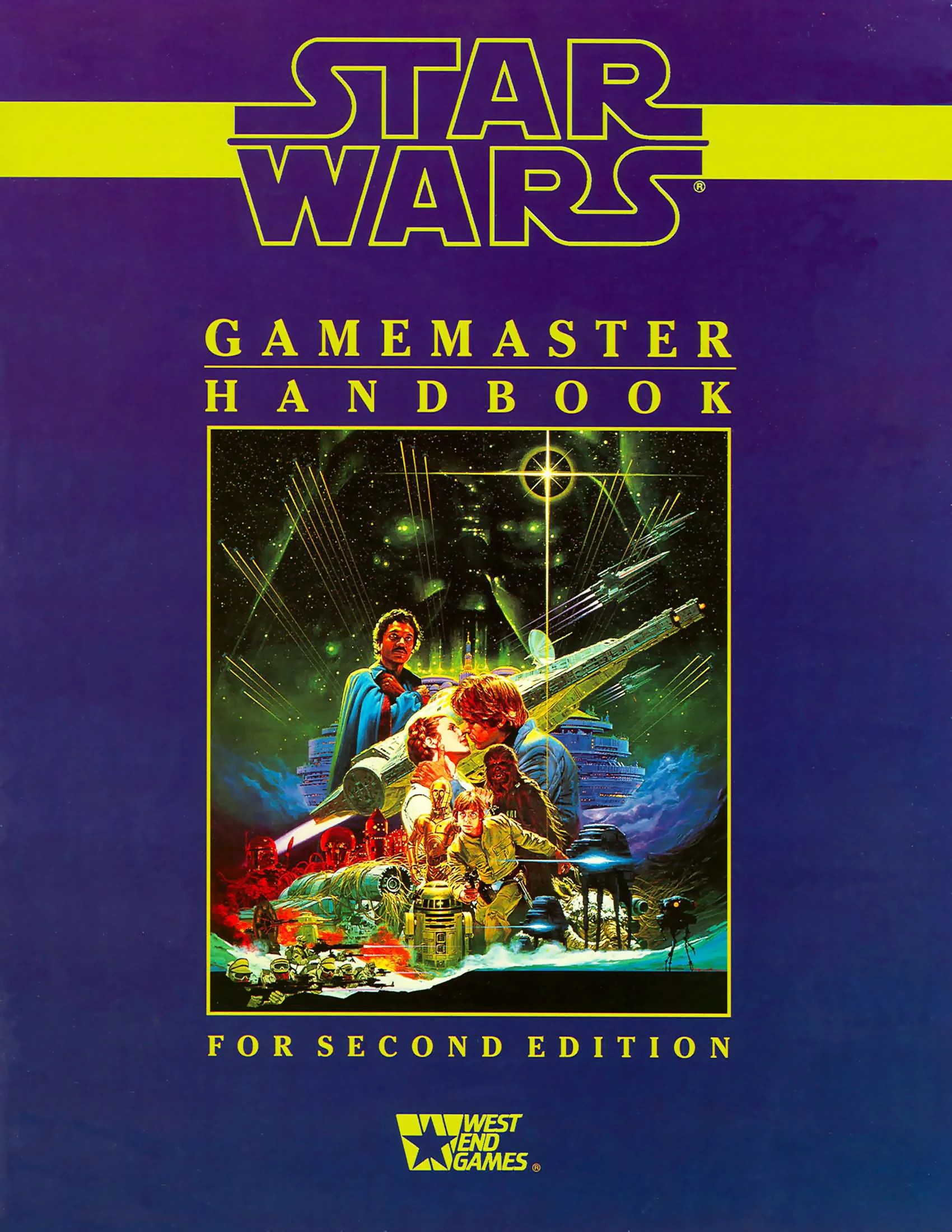
Star Wars: Gamemaster Handbook
Star Wars: Gamemaster Handbook
For Second Edition
Credits
Design: Steven H. Lorenz, Bill Smith, John Terra, Eric Trautmann, Chuck Truett
Development and Editing: Bill Smith
Graphics: Cathleen Hunter
Cover Art: Lucasfilm Ltd.
Interior Art: Paul Daly, Mike Jackson, David Plunkett
Publisher: Daniel Scott Palter
Associate Publisher/Treasurer: Denise Palter
Associate Publisher/Sales Manager: Richard Hawran
Senior Editor: Greg Farshtey
Editors: Bill Smith, Ed Stark
Art Director: Stephen Crane
Graphic Artists: Cathleen Hunter, John Paul Lona
Sales Assistant: Bill Olmesdahl
Licensing Manager: Ron Seiden
Warehouse Manager: Ed Hill
Published by West End Games, RR 3 Box 2345, Honesdale PA 18431
40065
TM and (c) 1993 Lucasfilm, Ltd. (LFL). All Rights Reserved. Trademarks of LFL used by West End Games under authorization.
Introduction
Welcome to the Star Wars Gamemaster Handbook! This book is a compendium of ideas, suggestions, hints and information to help novice and experienced gamemasters run their own Star Wars adventures and campaigns.
This book is a primary supplement to the basic rulebook Star Wars: The Roleplaying Game, Second Edition. While that book’s prime focus was on rules, this book is a reference for the storytelling aspects of roleplaying games. The chapters in this book focus on the creation of interesting Star Wars stories and their component elements. This book gives you detailed suggestions and ideas for creating adventures, gamemaster characters, settings, equipment and all of the other factors that are part of a Star Wars adventure.
Hopefully, this book will inspire you to write fantastic Star Wars adventures that will keep you and your friends gaming over the course of many years. It provides many suggestions for creating entertaining and exciting elements of your own Star Wars universe one piece at a time.
Beginning Gamemasters
Beginning gamemasters are often overwhelmed by the sheer amount of information presented in a roleplaying game. This chapter helps beginning gamemasters relax and explains techniques for designing an adventure that offers maximum enjoyment without relying too much on rules. The first chapter of this book is specifically geared to creating, writing and running your first adventure. It tells you what is important in beginning adventures and which rules can be left out without damaging the game. It helps gamemasters devise a plot, organize their thoughts and scenes in a story, and then structure it for maximum dramatic impact.
Experienced Gamemasters
This book has a chapter covering each important facet of game design: creating adventures, settings, gamemaster characters, encounters, and equipment and artifacts. It also has chapters dealing with using props in your game, how to learn how to improvise adventures and how to turn those isolated game sessions into an exciting campaign.
This book is a sharing of ideas and hints that have helped countless gamemasters over the years. By using the information in these pages, you will find yourself inventing more creative settings and characters faster than ever before. It is intended to cut through the rules and allow gamemasters to concentrate on the most important aspects of game design: creation!
This book also contains a complete Star Wars adventure, Tales of the Smoking Blaster. This adventure is written so that you can prepare and play it with a minimum of preparation — it puts the suggestions into practical use.
This book also includes a section of corrections and answers to questions raised by the release of Star Wars: The Roleplaying Game, Second Edition. Finally, the back of this book has West End’s first Star Wars questionnaire. This is your chance to tell West End exactly what you want to see in future Star Wars products. West End wants to produce the Star Wars sourcebooks, adventures and supplements that you want to see — your feedback is vitally important to us!
The Fun Begins
With these ideas in mind, pull up a comfortable chair and a soda, get some scratch paper and a pen, pop a Star Wars movie into the VCR, and prepare to start creating your own Star Wars universe ...
Chapter One: Beginning Adventures
Beginning Adventures
Adventures are the core of any roleplaying game. All of the preparations that go into gaming, from creating characters, to devising settings, to buying the evening’s snack food, all revolve around adventure sessions.
This chapter is devoted to explaining and simplifying the adventure creation process for beginning gamemasters and is intended to supplement the information in Chapter Two, “Gamemastering” on pages 21 to 51 of Star Wars: The Roleplaying Game, Second Edition.
Your first games should be short and uncomplicated. The best advice is simple: Only do what you want to!
- Come Up With A Good Story Idea. When you run your first adventures, you should concentrate on coming up with an interesting story. Try to devise a story that is interesting to yourself and your players — whether you want to tell stories about Rebels fighting the Empire, smugglers trying to make an honest (?) living, traders trying to build up trade routes, bounty hunters looking for dangerous criminals or scouts searching out new cultures, Star Wars: The Roleplaying Game, Second Edition can handle these types of stories.
Basic Difficulties
The core of the Star Wars rules boils down to picking a difficulty level and a corresponding difficulty level within the range for that level.
Very Easy 1-5
Easy 6-10
Moderate 11-15
Difficult 16-20
Very Difficult 21-30
Heroic 31+
-
Develop A Plot Around The Idea. With a basic story created, you should break the story into a series of episodes, which are major portions of a story, and scenes, which are the individual scenes within each episode and contain major events, encounters and challenges that drive the story along to its conclusion. In brief, consider “episodes” to be like acts in a play or chapters in a book, while scenes are each individual scene that will take place during an act or adventure.
-
Translate These Episodes Into Game Terms. With the story broken down into manageable chunks, you can then decide how to use the rules in your game. Rather than concentrate on the rules at this time, remember this maxim: only use the rules you want to!
The Star Wars game works on a simple principle: everything, from shooting weapons, to flying starships, to trying to use medicine to heal someone, works in the same way. Pick a difficulty level and a difficulty number that corresponds to that difficulty (see the chart below). Then have the character roll the relevant skill or attribute against that difficulty. If they beat the difficulty they have succeeded at the task.
While there are many rules that add more detail and take into consideration all kinds of special circumstances, all of the rules boil down to this standard mechanic for accomplishing tasks. In other words, if you just pick difficulty numbers and have the characters roll their skills against tasks, you are using the core of the game system without getting bogged down with a lot of rules.
-
Make Final Preparations. After you have mapped out how you will use the game rules, it is time to make final preparations: make more detailed notes on any gamemaster characters you want to use, prepare scripts and other handouts for the characters, draw maps and prepare miniatures if you are going to use them.
-
Create Player Characters. Next, get together with the players and help them choose and prepare their characters.
-
Create An Improvised Star Wars Movie. After that, you are ready to play Star Wars. When you are running your first adventure, the basic key is to have fun no matter what happens. Try to keep the adventure’s pace fast and exciting so the players are interested, ham it up when playing gamemaster characters, and play the game as fast as possible, even if it means taking short-cuts with the rules. Above all else, make sure the players are having fun and get a sense of accomplishment, and there’s nothing to assure that like having the characters be heroes and overcome incredible odds.
If you skim the rest of this chapter and this entire book, you will find that each chapter is devoted to a specific facet of adventure creation and play. You should feel free to look over the rest of this book at your leisure and incorporate the ideas and suggestions as you see fit.
For now, however, it’s time to get your first adventure ready. Read on...
Come Up With A Good Story Idea
A good adventure rests upon a good story. Unfortunately, this is one of the most difficult areas for beginning gamemasters. If you want suggestions on some interesting plots, purchase the Star Wars Gamemaster Screen, which has a 48 page booklet with over thirty fully fleshed out adventures.
When creating your own story ideas, there are a few simple techniques:
Keep It Simple
Star Wars uses the word “epic” a lot to describe the setting. Fortunately, while some great Star Wars adventures have their foundation in complex, intricate plots, a lot of great adventures are built from the most simple of plots.
Your first adventures should be relatively straightforward: the characters are hired to deliver a cargo of spice to a certain location, or they are asked by Rebel Alliance high command to rescue someone who has been captured by the Empire, or the characters are mistaken for wanted criminals and find themselves on the run from bounty hunters and the Empire, or the characters learn that there is some valuable piece of equipment that was lost when a ship crashed on a distant alien world and there is a valuable reward for whoever retrieves the part.
Remember, there are no “bad” plots; some are simply turned into better stories than others. You should feel free to use your favorite plots from other stories or today’s headlines.
When you first think of a story idea, chances are that some scenes, characters, settings and equipment will spring to mind. Write down all of these ideas in note form so you can flesh them out in later stages of adventure preparation.
Develop A Plot Around The Idea
When you design your first few adventures, you should use the Star Wars movies as a pattern and stay close to the style of the movies in regard to plotting and drama.
The easiest way to do this is to break your basic idea down into a series of episodes and scenes. Often, this will require adding a lot more information to the story.
For example, if your basic plot involves the characters having to retrieve a piece of equipment, this is a fine idea, but it needs to be fleshed out.
First, you'll want to know how the characters find out about the part. This should be the first scene of the adventure, and if it involves a lot of action, so much the better. This scene must also drop some hints to the players — rather than telling them exactly where the part is, the characters will have to find someone who knows where the ship crashed. This first scene also allows the characters to get to know each other.
Next, the characters will have to find out where the part is. This allows the characters to do some investigative work — they will have to find the person who knows where the ship crashed, or break into a computer system to find out this information. This next episode is a great time to introduce the main villain, which is most likely the Empire or one of its minions. The characters should be racing against someone else to get the part so they can’t be leisurely. This adds an element of pressure to the adventure.
The next episode involves the characters racing to the crash site. This can be as simple as jumping into hyperspace and coming out in the right system ... but that isn’t Star Wars. Instead, the characters may have to take part in a raging space battle, duking it out with the forces of the Empire as well as the people they are chasing. Likewise, when they emerge in the system, they will still be racing against time.
The next episode involves the characters having to find the wreck. Typically, the characters should face some natural or man-made hazards, like dangerous animals, hostile natives, competing scavengers, earthquakes or storms. If you want to wrap up the adventure in one session, you can have the characters find the part then and there ... or the part could be missing, with the only clue being strange tracks in the ground leading off into unknown territory.
Getting The Right Tone
The experience of actually being in one of the Star Wars movies is what you want to recreate during your game sessions, and the easiest way to do this is to incorporate some of the things that you enjoyed most about the movies into your adventure.
For example, you can set parts of your adventure in locations drawn from the movies, such as Yavin (refer to Galaxy Guide 2: Yavin and Bespin) or the forest moon of Endor, and you can have the characters using equipment that they will recognize from the movies. You can also have characters from the movies, such as Han Solo and Chewbacca, make “guest” appearances in your adventure.
You have to realize when you begin preparing an adventure that you will never be able to account for every possibility. The players will always find ways to take courses of action that you did not predict.
The best way to look at your preparations for a game is as a sketch on which to base the adventure, not as a full illustration. Your end product is the game session, not the maps and diagrams, the gamemaster character stats, or the starship designs. What is most important is that the game session and the interaction between you and the players is successful. You don’t want to put so much energy into preparing the adventure that you have none left for the game.
Plot Structure
The point of breaking down Star Wars adventures into episodes and scenes is to emphasize the fact that the story is more important than mere dice rolling. Each episode is a major portion of the plot, such as retrieving a vital piece of information, or confronting a major villain. Each scene is something within an episode that propels the characters to the major plot point of that episode, and each scene gives the characters something to do.
Once you have broken down your story into episodes and scenes, you will realize that there are certain locations, events and characters that you will have to detail. For anything the characters will meet, you will have to have at least a few ideas written down so you can use the item or character in your game.
Episode One
The first episode in your first adventure should explain how the player characters meet. Such an episode would parallel the introductions of Luke Skywalker to Ben Kenobi and to Han Solo and Chewbacca, possibly taking place on a backwater planet similar to Tatooine (or even on Tatooine itself) and occurring in a setting similar to the Mos Eisley cantina.
With the possible exception of some minor excitement, such as a barroom brawl, or an encounter similar to Luke’s encounter with Ponda Baba and Dr. Evazan, this episode should center around roleplaying, not combat or skill use. Very little die rolling should be necessary.
This type of episode will give you and the players a chance to become comfortable with the game without having to worry about the technical aspects of the rules.
An episode such as this type will allow the players to start playing immediately, because they can skip the final stages of character design — personality development — and, instead, use the first episode of the adventure to develop the personalities of their characters.
As the characters attempt to learn about each other — swapping stories, boasts and lies — the players will learn more about the personalities of their own characters.
You might also use this time to allow the players to make a few final adjustments to the skill levels of their characters. However, after the plot of the adventure has begun, you shouldn’t allow them to make any skill changes.
Episode Two
As soon as possible, the adventure should have the characters in a starship and traveling to another planet. Space travel is intrinsic to the feel of the Star Wars universe. Think about the list of locations that were visited in the movies: Tatooine, the Alderaan system, Yavin, Hoth, Dagobah, the Anoat asteroid field, Bespin and Endor. How long does Luke or Han or Leia stay on any one planet? Not very long. And your players — who want to be just like Luke, Han and Leia — won’t want to stay in any one place very long, either.
The travel episode should introduce the characters to some of the oddities of the Star Wars universe, perhaps by meeting some unusual aliens in the starport, or involving the characters in some sort of conflict, such as having to blast their way out of the starport.
This episode can also give the players more information about the plot. If the characters found Imperials chasing them, at this point they may get one or two clues that explain why they are in danger. To parallel Star Wars: A New Hope, this second episode, where Luke meets Obi-Wan Kenobi, he learns that his aunt and uncle have been murdered by the Empire, and then begins to find out that the droids he and his uncle bought are really valuable.
Episode Three
Action! The players aren’t going to want to spend all of their time seeing the sights — they want to be heroes! Once they've arrived at some exotic location, you need to give them something exciting to do.
The action should be straightforward: a rescue mission (Luke’s rescue of Leia on the Death Star), a search and destroy mission (Luke’s destruction of the Death Star) or simply having to blast one’s way through an obstacle (the Rebels trying to evacuate Hoth with the Imperial fleet in orbit above them) will get the players involved. The characters will be exposed to some personal danger and will have to act without hesitation. Of course, in this type of episode, the actions the characters will have to take will be obvious.
Beyond
The next few episodes should alternate between action, space battles, interaction and problem solving. The characters should be given a test of their abilities — each adventure should have at least one episode where the characters get involved in a ground battle, one chase, one space battle, one episode involving problem solving (such as hacking into a computer) and one episode involving interacting with other inhabitants of the Star Wars universe (this can range from swapping stories, to having the characters learn background information on the story, to gambling, to haggling over the price of goods).
Normally, the final two or three episodes will involve the most intense confrontations and the most dangerous battles. The first episode should have minimal danger, then the second episode should have a little more danger or tension followed by a few scenes where the tension level is reduced. The third episode should involve greater tension and danger, followed by a briefer break. Each episode after should have higher stakes, more danger and more action, with briefer rest breaks. Then, the final episode should contain the “pay-off”: the characters are thrust into the final confrontation and the finish of the adventure, where for good or bad, the story is resolved ... for now. This kind of build-up and let down will get the players involved and excited about the story.
There shouldn’t be too many surprises in your first adventures. The lines between good and evil, and right and wrong, should be very clear, and the players should have many choices that will lead them to success.
Locations
Don’t worry about detailing locations that you don’t expect the player characters to go to. You don’t need a map for Anchorhead when the characters will most likely go straight to Mos Eisley. There is always a chance that the characters will — for reasons plausible only to themselves — go to Anchorhead instead, and that you will have to improvise an episode in Anchorhead, but there is also just as likely a chance that the characters will do something totally unpredictable — such as go hunting for Krayt dragons — which you would have had to make up anyway.
It helps to have a map drawn out for the important locations in an adventure, but you should always remember that often no one but you will see that map. It doesn’t have to be perfect — in most cases, a ragged sketch, combined with a short paragraph that captures the feel of the setting, will be sufficient to keep you from forgetting any of the necessary information.
Remember that you don’t need a detailed description of every location on a planet — just the ones that are important to the adventure. For example, you've designed an adventure set on Endor. Just because the player characters are going to travel from Bright Tree Village to Blue Star Lake doesn’t mean that you have to prepare a map of the entire forest of Endor. If there is no reason for anything exciting to happen during their journey, then you can simply cut from the characters’ departure from Bright Tree Village directly to their arrival at Blue Star Lake. The “in-between” sections of your adventure do not have to be detailed.
Gamemaster Characters
When you are preparing gamemaster characters, you shouldn’t worry about determining all of their statistics. The only statistics that are important are the ones which the gamemaster character is likely to use during the encounter.
If the Gamorrean guard is only going to whack at the player characters with his vibroaxe, then there is no need for you to determine his bargaining skill, or his beast riding skill. All you need to worry about are his combat skills — melee combat and melee parry, and his Strength. If it becomes necessary during the game session for the Gamorrean to ride a beast, then you can give him a beast riding skill at that time.
Assignments
It will help both you and the players if, for the first few adventures, the characters are given some sort of assignment. A setting such as the Mos Eisley cantina is a perfect place for a messenger to deliver instructions to the characters. For example, a Rebel leader, such as Luke Skywalker or Wedge Antilles, could appear with a mission that only these characters can accomplish, or the characters could be approached by a wealthy individual who wants to hire them or an alien who needs them to correct wrongdoing. Or, the characters could be forced into taking a job for a crimelord (such as Jabba the Hutt) to whom they owe a debt, or an Imperial officer who holds the family of one of the characters hostage.
After the assignment is presented to the characters, you may have to motivate them to accept it. Some suggestions on motivation would include: appealing to their sense of honor or duty (if the characters are members of the Rebellion or New Republic), appealing to the character's greed (particularly useful if the characters are debt-ridden smugglers), or having a gamemaster character blackmail the characters or threaten them with physical violence.
Once the characters have received their assignment, and have chosen or been forced to accept it, then the rest of the adventure can focus on completing that assignment. Since the characters now have a goal, the players won't have to stand around asking, "What do we do now?"
As usual, there are exceptions to this. For characters that are very important to the plot and with whom the player characters will interact extensively, or for characters who will become recurring characters in your campaign, it is usually worth the effort to develop a detailed character description, as this will allow you to more thoroughly develop the personality of the gamemaster character and allow your portrayal of that character to be more realistic.
You should also remember that some gamemaster characters will not need to be detailed at all. There will be many times when the player characters will interact with gamemaster characters in situations that will not require skill rolls. For example, the player characters come across a crowd of Humans standing around the corpse of an Imperial officer. The player characters might start asking questions of the bystanders in order to attempt to find out what happened. You don’t need to know any of the skills of the people in this crowd — all you need to know is what they might answer.
It might also be possible for you to “cheat,” so to speak. When you need a background character — to add color to a scene, or to give the player characters a prod in the right direction — you might be able to pull a character directly from one of the Star Wars movies or another piece of source material. For example, you decide that the player characters have become too relaxed while sitting in a restaurant on Berrol’s Donn, and you want to shake them up a bit, but you have nothing prepared. You might try saying something like this, “A Rodian bounty hunter — just like Greedo from the first movie — walks into the restaurant. He doesn’t take a table; he just stares at you for a moment, checks something on his datapad, then slowly backs out of the restaurant, never taking his eyes off of you.”
The characters may never see the Rodian again, but they will spend the rest of the adventure wondering when he is going to pop up out of the bushes and start shooting at them.
Translate These Episodes Into Game Terms
When thinking about the Star Wars rules, remember the most important rule: this is supposed to be fun and ignore whatever gets in the way of having fun.
When you are gamemastering at first, the key is to simply set your difficulty numbers and have the characters roll against that number. Don’t worry about all of the modifiers and other factors that are pointed out in the rules. You are trying to run a fast, action-packed adventure, and the best way to do that is to run the game as simply as possible.
The purpose of rules is to help you figure out what would happen in the “real” Star Wars universe. Therefore, make your best guess about what you think should happen based on how well the characters rolled. Try to make the results as interesting and dramatic as possible, while still making it possible for the characters to succeed and be heroic.
Don’t worry if occasionally you feel that you have to stop the game to look up a rule, or back up the game and replay a section where you made a mistake. The players will be patient and understanding as you learn the rules if it leads to an exciting game (and they should also be thankful that you’ve volunteered to learn the rules so that they don’t have to).
However, be careful that your desire to “do it right” doesn’t impede the progress of the story. Always try to keep going forward.
Setting Limits
After you play several short games with the basic rules, and gain a thorough understanding of those rules, then you will be able to begin adding the more complicated and detailed rules. For example, you may want to limit what’s going on in the first few adventures — for example, not allowing Force users at first.
As you gain experience with how the game system runs, you may want to start using the more detailed Force rules or starship and vehicle chase rules. They add a layer of complexity to the game, but also give you more detailed results.
The Skirmish Method
If you want to get a better understanding of the rules, you may want to use the “skirmish method.” Instead of running an entire adventure, you might want to get one or two players together just to run a detailed combat between characters, a starship battle, a chase, or a battle between Force users.
This gives you the advantage of being able to concentrate on just one aspect of the rules without having to worry about how it affects the adventure. Because of this, you can also replay situations that are particularly difficult for you until you become completely comfortable with the rules.
Streamlining the Rules
There are several areas where the rules are more detailed than is necessary for beginning adventures. One of the prominent rules areas are those revolving around the chase and movement system. Here is a quick way of showing how you can streamline those rules.
When you run a chase scene, you will usually want the feel of game play to reflect the fast and dangerous feel of the chase itself. To begin with, you should reduce the situation to its basic elements. Think to yourself, “What is most important here?” In a chase, these elements are:
- Why is the chase happening and how would it be finished?
- How far apart are the vehicles?
- How fast are the vehicles?
- Have both operators kept control?
Everything else about the chase, from when the chase ends to combat during the chase, is based on these factors.
The best way to set up a situation where the rules can be streamlined is to have only two participants in the chase with vehicles that travel at the same speed. Then, the chase is simply a matter of matching driver skills against the terrain and each other. As an illustration, look at this example of a chase between two Ikas-Adno Nightfalcon speeder bikes.
A player character named Riza is piloting the lead bike. She is being pursued by a bounty hunter. The “why” of the chase is simple: the bounty hunter is chasing Riza to get a bounty; therefore, the bounty hunter will chase Riza until he captures her, or is injured, or feels that it’s too dangerous for him to continue chasing her. Riza wants to get away or stop him — the chase will be over if she can get far enough away to escape, or destroy his bike so he can’t chase her, or stop him in some other way.
Both bikes have identical speeds and laser cannons with identical ranges. The gamemaster decides to speed up the chase scene by streamlining the rules in the following way.
- The chase will only be run at “point blank,” “short,” “medium” and “long” ranges. The vehicles will start at short range. Since a speeder can make four moves per round, each move will count as a range. For example, if Riza makes three moves in a round and the bounty hunter only makes two moves, Riza has made one more move and goes from short to medium range. The gamemaster rules that if Riza can go beyond long range, she has escaped.
- The terrain for the whole chase will be Moderate. That way, there is a consistent difficulty level — the gamemaster picks a difficulty number of 13.
- The gamemaster rules that if a character misses a movement roll by 1-5 points, the character just makes one less move per round (if he said he’d move two times, he’d only move once). If the character misses the roll by more than five points, he crashes the bike.
- Rather than make rolls for all four moves every round, each character will only have to make one roll for movement each round. However, in Star Wars rules, every time a character acts more than once, the character loses -1D per extra action from all die rolls. Therefore, if a character is making four moves in a round, the character rolls against the terrain difficulty of 13 with a -3D penalty.
- The gamemaster determines that the bounty hunter’s repulsorlift operation skill is 6D and his vehicle blasters skill is 5D. Riza’s repulsorlift operation is 6D+1 and her vehicle blasters is 3D+2.
For the first round, Riza declares that she will fly full speed through the forest (four moves). The gamemaster decides that the bounty hunter will do the same. Both characters roll against the terrain with a penalty of -3D, and if both succeed, the speeder bikes will stay at short range.
If Riza succeeds but the pursuer fails, then the distance between the two vehicles is increased by one level (from short to medium). However, if Riza fails and the bounty hunter succeeds, the distance is decreased by one level (from short to point blank). If both characters fail their movement rolls, then the distance doesn’t change.
In this case, both characters succeed, so the distance doesn’t change.
For the second round, Riza declares that she will make four moves. The gamemaster decides that the bounty hunter will fire and make four moves. Since the bounty hunter is now firing (taking another extra action), his penalty is increased from -3D to -4D.
The gamemaster resolves the firing action first. The bounty hunter’s roll is at short range, or an Easy difficulty, but with a 4D penalty for the five actions being taken in this round. The roll is a failure and the shot misses.
Riza and the bounty hunter then make their movement rolls. The bounty hunter is successful, but Riza misses her roll by 1. The bounty hunter gains one rank, and goes from short range to point blank range.
For the next round, Riza declares that she will try to evade the bounty hunter by zigzagging through the trees. The gamemaster decides that the maneuvers Riza will attempt will modify the difficulty of her movement roll from Moderate to Difficult, and that, in order for the bounty hunter to keep up, he will also have to make a Difficult movement roll. Like a dodge, Riza also gets to substitute her maneuvering roll as the difficulty to hit her bike in combat. However, since the range between the two vehicles is point blank, the bounty hunter will also attempt another shot.
Again, the gamemaster decides to resolve the firing action first. Riza rolls her maneuver. With the added difficulty of the maneuver and the -4D penalty for his multiple actions, the bounty hunter’s shot fails.
Now the rolls are made for the movement actions. Riza’s roll is a success — just barely, because of the increased difficulty level, but a success nonetheless. The bounty hunter, however, fails his movement roll by seven points — crash!
Riza’s speeder bike disappears into the trees as the bounty hunter’s bike explodes into a ball of flame and debris ...
While this may seem complicated it is easier than using the fully detailed rules because it is “instinctive” — once you've learned the basic rules of Star Wars, this chase is very similar in execution.
The rules judgements are based on making “fair judgements” about what would happen and what makes for an exciting chase. You must trust yourself in these situations since going to the rulebook for a reference will slow the chase down and reduce the tension of the scene.
In this example, instead of stopping the game to find out the modifiers for Riza’s maneuvers, the gamemaster estimated that they would raise the difficulty of her movement roll by one level. Instead of rolling for every movement, the gamemaster decided to roll once per turn.
And, instead of trying to determine when the bounty hunter fired, and the precise distance between the vehicles at that time, the gamemaster simply decided to resolve the combat actions at the beginning of the round.
This dependence on estimating and guessing means that this method of play isn’t as detailed as the method in the rules, but streamlining the rules speeds the game, and if you play fairly, can be just as exciting!
Make Final Preparations
The final preparations for play include checking to make sure that you have mapped all the locations you need, written up the character descriptions you need and making copies of handouts and scripts for the characters.
You should also review your adventure once or twice so you can find statistics or information when you need it, instead of flipping through pages and pages of notes. Like a dress rehearsal for a play, final preparation is supposed to help you realize where you think your trouble spots will be and figure out how to deal with them.
You should also make sure that everyone has a character sheet, dice, and pencils. Check to make sure your players are coming at the right time and that someone is bringing food (after all, if you're being kind enough to run the adventure and host, you shouldn’t also be expected to pay for all of the munchies).
Final preparations for play should ideally be completed several hours before game play so you don’t spend the final ten minutes before play frantically copying a character sheet. If your players arrive and you are calm and prepared, they will be excited to play (and probably a little fearful too, since a relaxed gamemaster is a dangerous gamemaster).
Beginning Player Characters
In your early games, you might want to limit the types of characters that the players can choose to those that both you and the players are familiar with and that you feel the players can play proficiently.
You may want to restrict beginning players to Human characters, because new players often won't have sufficient roleplaying skills to develop an appropriately alien character.
Good suggestions for beginning character templates would be:
- Brash Pilot
- Curious Explorer (Human)
- Cynical Scout (Human)
- Gambler
- Kid
- Smuggler
- Wookiee First Mate
- Ewok Warrior
The Wookiee First Mate and Ewok Warrior are included, despite their being alien templates, because most people who are familiar with the Star Wars movies will be sufficiently familiar with the characters of Chewbacca and the Ewoks to develop an appropriate personality.
When the players arrive, have them select a character template they would like to play and help them complete the template. Show them how to allocate their skill 7D for dice, give them some suggestions for beginning skills, show them how to roll attributes and skills and how Character Points and Force Points work. You will also want to explain how the Wild Die works.
Before you begin playing, ask the players if they have any questions, then hand out the adventure scripts and get the adventure rolling. If you have the time, you may also want to prepare a handout that explains the basic mechanics of the Star Wars games — it will serve as a reference for the rules that you just explained to them. This will allow your newest players to concentrate on playing and not worrying about the rules.
Create An Improvised Star Wars Movie
As stated before, the whole point of an adventure is to get the players to feel like they are taking part in their own Star Wars movie. Therefore, you as gamemaster, need to get the adventure rolling with a bang and keep things exciting and interesting for them.
As you go through the various scenes and episodes, let the players dictate the game’s action. If you drop them into a cantina and they are having fun meeting aliens and hearing stories of the space lanes, let them have fun; if they ask if there is gambling, run an impromptu gambling scene. If the players get bored with your cantina scene, then cut to the next scene in the adventure. In short, give the players the story they want.
Performing
One of the most important things that you should remember about any roleplaying game is that you and the players are all performing during the game. Encourage the players to stay in character as much as possible. The game is much more exciting if it is experienced in the first person, not the second.
Don’t say, “Your character is hit by the laser bolt.” Instead say, “You are hit by the laser bolt!” Anytime the players say, “My character does something,” you should correct them, asking, “What are you doing?”
It is also helpful to refer to the players by their characters’ names. Instead of playing with Rob, Doug, and Paul, for example, you are dealing with Marx, Narse and Grerph the Wookiee. If you refer to the players in this manner, it will dramatically increase the flavor and “realism” of your game.
Finally, if you expect your players to act in character, then it is important for you to act in character. Don’t detach yourself from these roles when you can act out the roles of the gamemaster characters.
When you have the characters meet a gamemaster character, think about something you can do to establish the character’s personality: perhaps he has a unique voice, or has a habit of rubbing his chin while he’s lying, or he has a tendency to point with his pinky, or he always stands hunched over. If you make notes of these mannerisms, and use them in your game, it will help add realism to the task of roleplaying a gamemaster character.
Some of you will probably be nervous about the prospect of acting out another character — relax! The people you will be playing with are your friends, and they'll probably appreciate seeing you act out roles that you’ve never done before. Besides, if you show that you’re willing to act out a character or two, they will be encouraged to act out the roles of their characters.
Troubleshooting
Beginning players are often unsure of what to do or may easily lose the path of the adventure they are playing. As gamemaster, it is your job to give the players a little help.
Players new to roleplaying games seldom realize how much freedom they have. Without a board to move pieces around on, they often wonder to themselves, “What can I do?” Tell them that they can do whatever they want to — tell them to put themselves in their character's shoes and do what he or she would do.
Tell them to explain to you what they want to do, whether it is to shoot a stormtrooper or rig a starship’s engines to blow out at a certain time. Then, you will tell them what skill to use and give them an approximation of how hard the task should be.
Players who are unsure may have plans suggested by gamemasters. Maybe a gamemaster character provides information on a target or troop strength, or gives them a map. This gives the players vital information yet still allows them to plan their strategy. Relax!
All of this may sound like a lot of things to remember, but everything in this chapter, and the chapters that follow, is geared toward helping you run a better game. The key is to relax and have fun and let the game take care of itself. With a little practice, you’ll learn a lot about gamemastering and how to create a great Star Wars adventure!
Chapter Two: The Star Wars Adventure
After you have designed and run several simple adventures, and have become comfortable with the basics of the Star Wars universe, you might want to try using some of the more complex storytelling mechanisms that added to the flavor of the Star Wars movies.
This chapter provides more detailed information on the Star Wars style, while giving suggestions for providing interesting challenges or new diversions for your characters.
The Star Wars Style
When you are designing an adventure — or gamemastering a session — you need to keep in mind that Star Wars: The Roleplaying Game, Second Edition is based on a series of movies. The feel of the game, the atmosphere that you are trying to create, should be similar to that of the Star Wars movies.
An Improvised Movie
When you are trying to develop the feel of Star Wars in your games, it helps to look at the game as an improvised movie — with an unlimited budget!
Director
You are the director. You control the camera, the sound, the music and the special effects. Try to use cinematic terms in your descriptions of settings and encounters — fade in, fade out, dissolve, pan, close-up. These words will serve to remind the players that they are part of a movie.
Another great tactic you can use is the cutaway. This is a scene where the players are shown a scene that their characters aren’t involved with. These scenes are used to show villains plotting their schemes, or to introduce an adventure, or to show the players what is going on behind the scenes. These type of scenes are uniquely cinematic and uniquely suited to Star Wars.
Scriptwriter
You get to create an entire universe. You are allowed to come up with the imaginative settings, the fascinating characters and stage the memorable scenes of the adventure. While you can’t force the player characters to do anything they don’t want to (in fact, you should always leave the characters several options at every turn), you can move the story along by setting a story into motion that guides the characters along an invisible path toward the conclusion.
As a scriptwriter, it is your job to make the story feel “right.” You shouldn't herd the characters along the path to the end of the adventure and put them in situations where their decisions are irrelevant. You should give the characters several scenes where they can dramatically alter the flow of the story, whereby if they do the right thing, the characters will learn valuable information or find the adventure a little bit easier than they otherwise would have.
Actor
You are an actor. This is not a game of checkers, where the most important aspect of the game is the rules. This is a roleplaying game, and the most important aspect of it is that you and the players play the roles of the different characters. In other words, you perform.
Try to spend most of the game session performing other gamemaster characters, not refereeing. For example, during a roleplaying encounter, where you are playing the part of a gamemaster character, you should stay in character until the players force you out. You shouldn’t be the first one out of character; you should be the last.
Always remember that you are in control. If you think that an encounter should be solved through roleplaying, but the players want to roll the dice, then you should simply stay in character. Every time the players say something about the rules, you respond to them in the persona of the gamemaster character. Eventually, the players will get the hint, and attempt to roleplay through the situation.
For example, if a player doesn’t want to bargain, but instead wants to roll his skill dice, act the part of the character he is haggling with. Look the player in the eye and say, “What’re you gonna do, just stand there and look stupid all day? I named my price — 800 credits for that blaster.”
This kind of tactic will get the players in the right mood for roleplaying and if you can get them to play their parts, you have made the gaming experience that much richer for everyone.
Sound Effects Generator
You are the sound effects generator and you should be willing to make funny noises when necessary. The players are depending on you for all of the description of the world around them, and you have to give them as much as possible. You can’t really show them what most objects look, or smell, or feel, or taste like, but you can provide a close approximation of what many things will sound like. It may be necessary to explain the noise after you make it (as in, “Pshhew — a laser bolt whizzes above your head,”) but you should let the players hear the noise first.
Action And Adventure
The movies were full of action and movement. The characters in the Star Wars movies do not sit around and wait for adventure to come to them — they go out in search of adventure. Their lives are filled with action. For your games to have the feel of the Star Wars movies, they also must be filled with action and adventure.
Blaster bolts should fly fast and furious, characters should have to undertake chases through dangerous ice geysers or cave-ins, and characters should have to battle Imperial TIE fighters and pirates in the depths of space. All of these elements are uniquely Star Wars and reinforce the right “feeling” in your adventures.
Wide Scope
The movies had a wide scope. None of the movies were confined to single locations. The characters traveled to many different locations, both across planets and throughout the galaxy.
Similarly, the actions of the characters were widely felt. No matter how insignificant their actions may have seemed, they were of great importance and had repercussions throughout the galaxy.
Background Material
The movies contained a large amount of background material. Plot is not all that a story needs. A story also has to occur in a setting — a place.
Background material helps define this place without slowing the story down for explanation.
Background material is important to the look and feel of the story, but it is not important to the plot, so its details can be left unexplained.
The cantina scene in Mos Eisley, with its many quick glimpses of aliens, is a good example of background material in the Star Wars movies. In this short sequence, the immensity of the Star Wars universe is increased one thousandfold. It becomes a place that is brimming with intelligent life in a multitude of different forms; a place where Humans and aliens can exist together.
These scenes add much to the movie, but mean nothing to the plot. Luke and Ben could have easily met Han and Chewbacca in the landing bay next to the Millennium Falcon, and the story would have progressed nicely, but the look and feel of the Star Wars universe would not have been the same.
You can simulate these scenes by describing to the players what they see, hear, touch, smell and taste. Make sure to specify little details that stand out — the alien who seems to have three nostrils and whose eyes change color depending upon his mood.
When describing scenes or acting as a gamemaster character, don’t be afraid to drop brand names of equipment and vehicles (for example, the characters shouldn’t be given “blaster pistols” when they can be given “SoroSuub 035 blaster pistols, which have a long, thick stock and are a lot heavier than standard models.”). Have the gamemaster characters talk about their history, or discuss events that happened elsewhere in the galaxy. In your descriptions, mention the names of worlds, important personalities or important locations.
Adding this kind of detail reinforces the realism of the Star Wars universe.
Humor
The movies had an element of humor. A story is not a Star Wars story unless it has some humor in it. Think about the Ewoks, and the bickering between R2-D2 and C-3PO. A large part of their importance in the movies comes from the humor that they provide. Han Solo’s sarcasm is another type of humor that can be injected into an adventure. Other examples of humor can be sarcasm in narrations, comical aliens trying to beg for “funny light sticks” (blasters), droids pleading with Wookiees not to be disassembled and other items of humor that are inherent in a particular situation. By using humor, you can also help control the tension level of the game.
For example, after the characters have leveled an entire Imperial research facility, one of the characters comments, “We’d better get going. There’s not much more we can do here.” The sarcasm is funny, and at the same time points out to the characters the consequences of their actions.
Heroes
Another aspect of the Star Wars style is heroism. The characters in a Star Wars adventure should be heroes!
However, while the characters can act heroic in any adventure, this is very different from having the characters actually be heroes. You, the gamemaster, will have to orchestrate plots to allow the characters to become true heroes. To do this, you will have to keep in mind several facts about heroes.
Heroes are flamboyant. Not only are heroes willing to take significant risks in order to succeed, they are also willing to make those risks even greater if it will allow them to do something spectacular — in other words, heroes will show off.
It is up to you to make sure that the characters have ample opportunities to take flamboyant actions. Don’t simply put them in a situation where they have to shoot at TIE fighters when you can give them the opportunity to stand on the bottom of a crippled ship that is madly careening — upside down, no less — through the atmosphere and shoot at TIE fighters with their hand blasters. This is the kind of thing that heroes will want to do.
And, if the characters do this, if they take the flamboyant, heroic path and do something that has little chance of success but has a high entertainment factor, you should give them a break. Anytime a character attempts something creative and exciting enough to qualify as true heroism, that character should have a better chance at success. A good way to do this is to streamline the rules — instead of having the characters roll every round to see if they can keep their balance on the upside-down ship as it plummets to the surface, have the characters roll once or twice for several minutes worth of activity. This decreases the likelihood of a bad roll that results in tragedy.
Other examples of characters being heroic include:
- Luke and Han dressing up as stormtroopers and rescuing Leia from the detention block on the Death Star.
- Han and Chewbacca swooping down on the Death Star to drive Darth Vader and his wingmen away from Luke’s X-wing.
- Luke crawling up a line attached to an AT-AT on Hoth, cutting open a hatch with his lightsaber, then throwing a land mine in the hatch.
- Han flying the Millennium Falcon full speed through an asteroid field.
Heroes should overcome great odds. For the characters to have a chance to be heroic, they should always have the deck stacked against them. Their opponents have to be strong, and their obstacles formidable. They should not have to fight two or three stormtroopers — they should face whole squads of them. Real heroes will have sufficient skills and talents to find their way out of these situations.
To give the characters the feel of the dangers that they face, you should take every available opportunity to emphasize to the players that their characters are only millimeters from death. Heroes may not die, but they should come very close. Some examples:
- Luke destroying the Death Star.
- Luke’s duel with Darth Vader on Bespin.
- Han, Leia and Chewbacca escaping the Imperial fleet at Hoth.
Heroes have responsibilities to others. The characters shouldn’t always start the adventure with the fate of the Rebellion or the Republic, or the galaxy, on their shoulders, but that responsibility will often be theirs before the adventure ends. Heroes are responsible for more than just their own lives. The lives of others — of helpless, innocent beings — depend on their successes.
An immediate way to emphasize this is to have helpless gamemaster characters tag along behind the player characters so that the characters have to consider the safety of those around them. Using this, you can then project on them the responsibility of protecting the faceless millions whose lives are depending on the success of the characters. Examples:
- Luke’s insistence on rescuing Leia from the Death Star. The occupants of the Rebel base on Yavin would have died had Luke not destroyed the Death Star.
- The Rebel Alliance itself. If the Rebellion failed, millions, possibly billions, would have been killed and enslaved at the hands of the Empire.
Heroes are remembered after their deaths. Survival is important to everyone, but reputation is more important to heroes. A glorious death that results in the salvation of millions of innocent beings could be more satisfying than continued existence.
The death of a hero should be a significant event, and it should advance the story. It should be well-planned and, as much as possible, it should be a situation where the character, in an effort to save someone else, chooses a course that will surely lead to death. Examples:
- Darth Vader/Anakin Skywalker being fatally injured while killing the Emperor in order to save Luke from being killed.
- Obi-Wan Kenobi sacrificing himself to allow Han, Luke, Leia, Chewie and the droids to escape from the Death Star.
Character Development
A roleplaying game and a movie, while similar in many respects, are very different forms of storytelling. In a movie, character development occurs in the mind of the writer, before the movie is filmed. What is seen on the screen is a representation of a fully formed character. In a roleplaying game, the process of character development is part of the story — the character is not fully formed when the game begins, instead it develops as the story progresses.
This means that the roleplaying game, while it should still be full of action, must devote more time to character development than a movie would. However, if you're trying to replicate the Star Wars style, it is better to err on the side of too much action and adventure than to have too much character development.
A large part of your job as gamemaster is to place the player characters in situations where the conflicts that occur can best be resolved through roleplaying, because this will encourage and enhance the development of the player characters.
A great way to increase character development is to put the characters in a situation where heavy duty roleplaying is necessary. Another way to increase development is to put the characters in a dangerous situation. While the players may not be realizing it, they will be developing the personality of their characters based on how they react.
For example, you might want to have the characters come upon a roadblock while they are maneuvering through a city. A casual glance reveals that if shooting starts, the player characters are doomed. Their only way through is to talk their way out.
You can also encourage roleplaying by having the characters deal with a gamemaster character. Talk to the players in that role, and get players to play their roles. For example, if a character is supposed to be a mercenary, but the player isn’t playing a true mercenary, you might have a gamemaster character say, “What, are you a mercenary or some bleeding-heart Rebel? Have you gone soft on us?”
For example, in an adventure, you plan for the characters to receive an important piece of information from Lando Calrissian. To encourage roleplaying, you could stage the encounters like this:
The player characters first have to ask questions of the inhabitants of the city in order to locate Lando — who is currently in the middle of a big sabacc game in one of the local gambling houses.
Next, they have to convince the doorman at the gambling house to allow them entrance. After this, they have to interact with the other beings in the gambling house in order to find out where Lando’s game is taking place.
Once they find out where Lando is playing, they will have to talk their way into the game, and play several hands before they will be able to draw the information they need out of Lando.
You can also help foster character development by teaming the player characters up with gamemaster characters that you can use to provoke emotional responses. For example, Han Solo alone would not be a very interesting character because he would seem very one-dimensional: all ego, no heart. However, Chewbacca, Luke and Leia act as foils that expose the other aspects of his character.
History
As the player characters gain experience and take part in adventures, they will gain fame and notoriety. The actions of their past will influence their present and future. Characters who succeed in adventures that harm the Empire might find themselves wanted criminals with bounties on their heads — and bounty hunters on their tails. Characters who do something spectacular — destroy a space station or a Star Destroyer, or save the inhabitants of a doomed planet — may encounter gamemaster characters that have been affected in some way by their actions.
Maybe the gamemaster character is filled with admiration and wants to buy the player characters a drink, or a meal, or a new landspeeder, and won't stop drawing attention to them until they accept his offer. Or maybe the gamemaster character had a close relative that was killed as a result of the actions of the characters and is out to kill them — no matter what.
For example, The Empire Strikes Back and Return of the Jedi are in many ways propelled by Han Solo’s history with Jabba the Hutt. One event in Han’s life, the dumping of a crimelord’s cargo, has repercussions that follow him for years, and eventually involve the highest levels of the Rebellion.
Creating A Realistic Universe
In order to make the universe that you create in your game feel more realistic, you are going to have to include tone-setting scenes in your adventures.
The player characters should always spend part of the adventure experiencing the world around them — not just running from fight to fight. You could give them opportunities to stand around on the street corner, watching the traffic pass by and talking to the locals about the history and culture of the planet. Or you could have them invited to a formal dinner, where they experience the native foods and customs.
In these types of encounters, you should concentrate on describing what the characters sense — what they see, hear, smell, touch and taste. As an added touch, you can also drop in the local (or brand) names of equipment that the characters come across (for example, “The thug points his blaster, a long, thin rifle that the locals call a ‘lightning wand,’ at your head,” or “The Noghri motions at you with its stokhli spray stick”). You might also try to use phrases from alien languages in your descriptions (“The natives call this place ghrul ak-al, ‘the demon’s chair’”). Or you might use exotic words to describe normal objects (for example, a hydrospanner is just a big wrench; a hammer might be called a quatdriver, and cutting might be done with a lazsaw).
Also remember that the universe will seem more realistic if you can keep the player characters informed about events that do not directly concern them. For example, while they are in a spaceport cantina in one system, they might hear a rumor about how a neighboring system was destroyed by the Empire, or about a Rebel victory, or hear a mention of a planet that is famous for its food. The details are not important. What is important is that you give the players a sense that the universe continues to exist outside their scope of direct experiences — it doesn’t stop at the cantina door.
Breaking The Style
While the suggestions for the Star Wars style are important for maintaining the feel of the movies, it must be pointed out that not all adventures need be heroic and few characters should be lily white or irredeemably dark in their actions and thoughts. The Star Wars universe is a real universe, with real three-dimensional people who try to live ordinary lives. It also just happens to have some characters, like Luke, Han and Leia, who seem to wander or stumble into adventure wherever they go and consequently become larger than life.
If the gamemaster wants to maintain believability and not have to constantly outdo himself, he is encouraged to be careful when using heroic elements. If the characters have to be heroes in every adventure, and they just barely escape death in every adventure, their actions seem less heroic and certainly less dangerous. As a result, some of the fun from Star Wars is lost.
As gamemaster, you should vary your heroic adventures with more personal adventures, where the adventures involve a few characters, or small time crimelords or other minor factors, instead of forcing the characters to destroy a new super weapon every game.
Adventurers — Not Heroes
The Star Wars: The Roleplaying Game, Second Edition system was designed to encourage heroic roleplaying. Much of its material assumes that the players will be interested in playing characters, like Luke Skywalker, Leia Organa or Han Solo, who are involved in saving the universe on a monthly basis. However, there’s more to this universe than heroic individuals. One of the main appeals of Star Wars is the remarkable setting. Many players want to play “adventurers” — people who have dangerous, adventure-filled lives, but who are more likely to be fighting off pirates or dodging an Imperial customs frigate than to be destroying Death Stars.
Luckily for those players, the expansion of the Star Wars game time line to include adventures after the Battle of Endor and the decision to provide more information on the Star Wars universe not directed at the struggle between the Empire and the Rebel Alliance makes it easier to play characters who are not directly connected with the galactic conflict. These characters are true adventurers, not heroes. Instead of worrying about the universe, they are more interested in the events of their own lives.
Bounty Hunter
A bounty hunter character will have very narrow goals: get contract; track target; apprehend target; collect credits; get rich. Unfortunately for her (or him), life won’t always be this simple.
There is a lot of danger in this lifestyle. Other bounty hunters are always ready to muscle in on her contracts. And, sometimes, the targets themselves prove to be more dangerous than the contracts imply, and she ends up running for her life — instead of happily collecting the reward.
Other times she might find herself betrayed by her employer and left stranded in the middle of an extremely dangerous situation, because, after all, she’s just a bounty hunter.
And, of course, there are those embarrassing occasions when she gets too involved with a target, and discovers that the target is actually innocent of the charges against him, which then means that she has to go out and clear his name — before all the other bounty hunters in the galaxy start chasing them both.
Explorer/Scout
An explorer or scout character will want to spend most of his time investigating unknown and isolated systems. In many cases, these explorations will follow a simple formula: map out an unknown planet from space, then land and explore the surface while trying not to get eaten by the local carnivores.
However, an explorer might discover an unknown alien species and have to initiate contact between the species and the rest of the galaxy. The explorer might discover the ruins of an ancient civilization or stumble onto a secret base (either Imperials, pirates or criminals — your choice), get captured and have to fight his way off the planet. For more information on playing scouts, see Galaxy Guide 8: Scouts.
Gambler
A gambler will want to make her fortune with her mind, not her blaster. She will be more interested in finding the nearest casino or luxury cruiser than in shooting at people. But even this carefree life is not without complications.
If she is a successful gambler, then everyone will assume that she cheats (whether she does or not). This means that she will be banned from many casinos. In order to enter these casinos — so that she can maintain her livelihood — she will have to plot elaborate schemes and design complex disguises. She must also live with the unfortunate fact that sometimes professional gamblers do have to come up with plans that involve cheating. After all, leaving it all to luck would be distinctly unprofessional.
There is also the unpleasant fact that she will probably be chased at one time or another. It could be by criminals — the proprietors of most illegal gambling enterprises don’t look kindly on big winners (legitimate or not) and will often seek to re-acquire their money.
Or she could be chased by law enforcement agents. Gambling is illegal in many systems. Just possessing a deck of sabacc cards could have the local authorities chasing her through the spaceport.
And then, there’s the fact that she will have many old friends who now consider themselves enemies. It could be an old partner that she deserted who now wants revenge, or a lovestruck male that she seduced with her natural charm and then left stranded.
Smuggler/Trader
Smugglers and traders will live remarkably similar lives. The main difference is that the smuggler is usually more willing to carry contraband and more likely to be open about that fact. A legitimate trader may carry contraband on occasion, but he is going to be very quiet about it.
Another difference is that the trader will probably have the loan on his ship arranged through a legitimate banking institution, while the smuggler will almost certainly have borrowed his money from a loan shark. This does not mean that the trader’s bank will be above sending out “collection agents” if he becomes delinquent with his payments — it just means that the collection is less painful.
Finding work is not an easy task. Maybe Han Solo has people searching him out when they have a special cargo, but everybody else has to hustle to find a load to carry. This means spending hours on a planet, talking to beings in restaurants and bars and knocking on warehouse doors. It might also mean, to some of the less principled traders and smugglers, sabotage and deception. A smuggler might deactivate the repulsors on a competitor’s ship, then offer to carry the load himself when the problem is discovered. A trader might reprogram a loading droid, changing a shipping manifest so that the cargo is loaded onto his ship.
Transporting the cargo then becomes an adventure in itself. There are always malfunctions on-board the ship and equipment that has to be repaired or replaced. Or maybe there are blockades — Imperial, New Republic, or local — that have to be run. Or the ship could be attacked by pirates.
Rebel Soldiers
The player characters could still choose to be a part of the galactic conflict, only on a much smaller scale. The characters in this case would be everyday soldiers — part of a squad that is only a small part of the Rebel (or New Republic) army. The assignments for these soldiers would not be on the scale of “Destroy the Death Star.” Instead, they would be more like “Destroy that scout walker” or “Stop that squad of stormtroopers.”
These soldiers would concentrate more on the details of their immediate survival than on questions of galactic conquest. They may start the battle saying, “I feel like I could take on the whole Empire myself,” but by the end, they will be glad that they only have to do it one stormtrooper at a time.
Even though these characters like to think of themselves as just regular people, they may still have what it takes to be a hero; it is just that their acts of heroism will be on a much smaller scale. It could be something as simple as running through a gunfight to rescue a friend, or maybe as large as saving a small village of Ewoks from a maddened garvin. Either way, heroism is not necessarily measured by quantity, but by quality.
Failure
Characters always run the risk of failure in their adventures. Most gamemasters assume that failure in an adventure automatically equates with the death of some or all of the characters. In fact, there are many alternatives to death that you can use.
It is a good idea when the characters begin an encounter for you to consider what is at stake in this situation. Is it a situation that could dramatically justify the death of a character? Or could it only justify injury or a loss of property? Set a limit on what can be lost in this situation, and unless the characters do something really stupid, don’t allow them to suffer beyond that limit — no matter what the dice say.
Of course, stupidity can and should be punished. If the characters aren’t thinking, or if they insist on entering into dangerous situations that don’t advance the story, then you are under no obligation to protect them. Let the dice fall where they may.
Don’t let the players get cautious — or bored. If you follow the letter of the rules in every encounter, then the odds are that characters who act heroically are going to die in a very undramatic fashion. If the players find that their characters die every time they try something heroically dangerous, then they will become cautious, and cautious players make for a boring story.
One of your main jobs is to ensure that the game doesn’t become dull, and one way to do this is to show the players that, although their characters will come close to death, there is always a chance for survival.
Making the Most of Failure
Most players — and gamemasters — assume that failure is an end. They think that the story is “over” because the player characters couldn’t save the senator in time or they were defeated by the pirates or they made a wrong turn and parked their landspeeder in the middle of an Imperial complex. But this is far from the truth. In a good adventure, failure is only the beginning.
Redemption
Characters who fail to fulfill their goals in an adventure can often be given a chance to redeem themselves. This doesn’t mean that you should allow the players to run through the adventure again, correcting the mistakes that they made the first time. Instead, you should take all the unresolved plot points from the original adventure and restructure them into an entirely new adventure.
For example, Rebel Commander Zeke Rondel orders the characters to Kailor V to search for information about a secret Imperial installation. Despite all their efforts, they cannot find the information and are forced to return to Commander Rondel empty handed. The follow-up adventure, which allows the characters to regain their stature, could be something like this:
The characters, as punishment, are assigned to a supply freighter. While loading the freighter in one of the outer systems, the characters capture an Imperial spy who carries information about the secret Imperial installation. The characters then decide to hijack the supply freighter and go directly to the secret installation to collect the information needed by the Rebellion.
Capture
Any event that ends in the capture of the characters could be followed by a sequence of encounters that offers a chance for escape. The process of escaping — as seen in the capture and rescue of Han Solo — could easily be as long, complicated and exciting as was the adventure which led to the capture.
Damaged Or Lost Equipment
In some encounters, failure could result in a loss of valuable equipment. This loss could then lead to an adventure in which the characters attempt to repair or replace the equipment. This procedure wouldn’t be as simple as going down to the corner starship repair shop. Maybe the characters will have to travel to a distant system in order to locate the necessary materials. Or, perhaps they will have to work their way through a complex planetary bureaucracy to gain permission to have the repairs performed.
For example, the freighter carrying the characters is damaged and forced to land on the surface of a barren, uninhabited planet. The characters then have to determine what is wrong with the ship, how to fix it, and how to acquire the necessary materials on this empty planet.
Injury
Injuries are no real worry when you’ve got plenty of medpacs or if you’re minutes away from a bacta tank. But what happens when an injury occurs in the middle of nowhere or on the surface of a low technology planet? The attempt to get a character to a location where proper medical care could be provided can become a very exciting interlude in an adventure, particularly when the character has only a limited amount of time to live.
Complications
The idea of using a failure as a basis for further adventure should be kept in mind whenever you use the complications aspect of the Wild Die. A complication is not a simple failure. Instead, it is a failure that has repercussions that extend beyond the current skill use.
Whenever you are determining a complication, you should consider the ways in which it might expand the scope of the adventure; that is, instead of curtailing the actions of the characters, it should ultimately extend them.
Surprises
Sometimes your players will become overconfident and act as if they've got nothing to worry about. After all, they’ve read the rulebook and all the sourcebooks — they know everything there is to know about the Star Wars universe, right?
Wrong. There will always be room for surprises in an adventure. If you feel that the players are getting smug, or if they are acting jaded, like they’ve seen it all, hit them with something unexpected (after all, every time Han Solo said something like, “Don’t worry, I can handle it,” you knew he was in big trouble).
For instance, those wimpy looking stormtroopers could actually be high-powered bounty hunters in disguise. Or that cute little alien might only be the tail end of a Vanarian Tree Eater.
These types of surprises can help add a sense of realism to the adventure by showing the players that the universe is still larger than they thought.
Remember though, that while it may be fun for all concerned to pull these types of tricks on overconfident players, no one is going to enjoy it if you take advantage of player characters while they are down.
Options
You spend most of your time trying to think of challenges for the players, so why don’t you set up some challenges for yourself? Some of these suggestions will lead you out of the space opera genre, and, because of that, they may not always feel like Star Wars. However, they could be interesting diversions for a group of players that is beginning to tire of the “same old thing.”
No Dice
Try designing an adventure where all the conflicts and encounters can be resolved through roleplaying. The characters would spend most of the adventure talking to and questioning gamemaster characters, or they could be searching for something and spend the time exploring a new city or planet.
An adventure such as this would not include combat, but it might include encounters that come very close to combat, but are instead resolved through bluffs and negotiations.
To stay interesting, this adventure would have to be populated by many well designed gamemaster characters, and take place in a detailed setting.
Lots Of Dice
Try designing an adventure that is paced like an action adventure movie. There will be constant action, danger, and big explosions, along with lots of humorous asides and dice rolling — and no character development.
An adventure of this type would concentrate on giving the characters opportunities to wreak havoc on an immense scale. Gamemaster characters would be simple, two-dimensional beings who are only there to get in the way of the massive firepower being brought to bear by the characters and their nemeses.
Scope
Work with the extremes of the size of the galaxy. Try designing an adventure that spans the galaxy and that forces the characters to go from one edge to the other. Or try to design an adventure that takes place in one building, or one room, where everything that is important can be resolved without moving around.
Strategy
Try designing an adventure that feels like a chess game — all strategy and planning. An adventure like this would be based on intricate puzzles, the solutions to which would require delicate timing and many extended skill resolutions.
Strategy plots can be worked out by reading good mystery novels or any intrigue novel with a cunning villain. Here, the characters have to find out what is going on and how to defeat the villain before it is too late.
Trapped
If one of the characters owns a starship, then you can try to design an adventure around the characters being trapped in the ship and having to use the resources of the ship to escape. They could be trapped in deep space, in an asteroid field, or in the hangar of a Star Destroyer. To add some spice to the adventure, you could have a bounty hunter or a strange, violent, alien creature trapped in the ship with the characters.
You will most often want to begin a strategy adventure by placing the characters in jeopardy, then limiting their resources so that instead of blasting their way out of the situation, they will have to use their brains and skills to succeed.
For example, the adventure begins with the characters trapped on a planet controlled by the Imperials. In order to escape, they will have to infiltrate a heavily guarded Imperial installation and steal a starship. Unfortunately, the characters have been stripped of all their weapons and most of their other equipment.
There should then be plenty of time for the characters to explore and study the situation — much like characters in a spy novel gathering information.
The characters study the Imperial installation and discover the following: the guards travel their routes according to a precise schedule; the electronic locks are controlled from a central location; a non-functioning customs cruiser is stored in the central courtyard; and, there are two ion cannons which could be used to destroy the ship.
The Chase
If you want a real challenge, have someone chase the characters — bounty hunters, Imperials, or some unknown group — and allow the players to do whatever they want to escape. Don’t give the players any conditions, or hints — nothing. Let the players decide where to go and what to do, and then you follow their lead.
Eventually, the characters are going to want to find out why they are being chased. You can have some ideas about this, reasons for the characters to be chased, or you could take all your clues from the ideas that the players will toss back and forth to each other.
This is collective storytelling at its best — and its most difficult. The players, in effect, decide where they are being chased to, and why they are being chased, and you implement that. It will be the hardest adventure that you’ve ever run, because you have to develop a story during the session — improvising all the way.
A Sample Strategy Adventure The characters will then have to decide how they can best use this information to help them escape. The characters plan to begin their escape attempt by using the installation’s computer system to disarm the electronic locks. After the locks are disarmed — without any Imperial knowledge, hopefully — the group will split up. The most mechanically skilled characters will go to the cruiser and attempt to fix it so that they can use it to escape. The others will split into two groups and attempt to sabotage the ion cannons — all the while dodging the Imperial guards. In theory, the three groups will complete their missions at approximately the same time, then rendezvous at the cruiser and escape into orbit. In each of these cases, the characters will have a different puzzle to solve, and different ways in which they can use their skills in order to escape. This is not to say that there won’t be surprises in store for the characters — or that their plan will go smoothly.
Concurrent Stories
In this type of adventure, there are several stories going on at once. The characters can bounce from story to story, character to character, getting involved in one, some or all of the stories. For example, a crimelord may be trying to get a priceless artifact, an Imperial Moff may be trying to root out Rebel operatives and an alien may be looking for passage to a distant world.
The characters will continually cross gamemaster characters that are involved in each of the stories, and then be pleasantly surprised as they see each of the story lines come together.
Alternate Time-Lines
This is a great chance to play “What if?” In this kind of adventure some major event in history occurred differently, and thus the galaxy is an entirely different place. For example, what if Han Solo left Hoth before the Empire attacked? Would Princess Leia have been captured at Hoth? Would Luke have confronted Darth Vader and learned the truth about his father? Alternate time-lines are great one-shot scenarios that can be a lot of fun to explore!
Ordinary People
Player characters start off with certain advantages that normal inhabitants of the Star Wars universe don’t have. In order to let the players get a feel of what it is like to be a “normal” person, have them design characters using only 12D for their attributes and only 3D for skills. Then put them into an adventure, and let them see what it feels like to face a stormtrooper when you’re so unskilled that you’re not really sure which end of the blaster to point at your target.
Imperials
Design an adventure where the players can portray Imperial soldiers on a mission. There are two different ways that you could approach this. One is the “We’re not so very different, after all,” approach, where you focus on the horrors of war that both sides face (the deaths of friends, the suffering, the fear of death). The other approach is the “The evil leaders of the Empire,” where the player characters are ordered — by the Emperor or Darth Vader — to do something terribly vile and have to decide whether to follow orders or to risk their lives and careers by refusing.
One Species
You could also design adventures where all the players are members of the same species. For example, they could all be Wookiees who have recently escaped from slavery, or a group of Ewoks that have stowed away on a tramp freighter.
Location Based
An adventure doesn’t always have to have a plot; instead it can be based on a location. The action occurs as the characters explore the location, discovering interesting objects and interacting with interesting personalities.
For this type of adventure to work, the location that it is based on must be very well detailed, and it must be truly interesting — there should be something new or unusual about it that sets it apart from other settings — or it should contain a wide variety of gamemaster characters, so that the player characters have plenty of opportunities for interaction. The characters can be drawn into any number of stories, meet gamemaster characters who will pop up in later adventures and make important contacts or learn valuable information for later adventures.
Comedy
You can also design adventures that encourage comedy. For example, the characters find themselves appointed kings of a primitive alien species, or they keep on crossing paths with a really incompetent bounty hunter who is so bad at his job that the characters feel sympathy for him. Of course, characters can have a great deal of fun making Imperial officers look like buffoons.
You could also put the player characters in a situation where they are somehow forced to do something that is at odds with their personalities (such as a vicious bounty hunter who finds that he must protect and care for the hundred kilo baby of an alien diplomat) and watch them squirm.
Chapter Three: Settings
One of the major appeals of Star Wars is the diversity and unique nature of the settings that can be used in an adventure. Instead of having the characters endlessly tromp through the same terrain, or visit cities whose only differences are their names, in Star Wars adventures characters can visit the desert world of Tatooine, venture to the awe-inspiring floating cities of Calamari, maneuver through the Hoth asteroid belt or glide among the clouds of Bespin’s Cloud City.
The High Concept
The Star Wars movies brought to life landscapes and sights beyond anything ever placed on a movie screen. In order to truly be Star Wars, your adventures should be filled with the breathtaking vistas that made the movies inspirational and exciting.
When creating settings, you should first devise the “high concept” of the setting. Instead of concentrating on generating a detailed location right from the start, try to come up with your own “stunning visuals” that set the mood and feel of the setting.
Planets And Locations
This chapter covers two similar but distinctly different subjects. The hints in this chapter can be applied equally to the creation of planets and the creation of specific locations on a given planet.
Gamemasters who expect to be creating many planets are advised to look at the rules system in Planets of the Galaxy, Volume One. This system gives specific suggestions for how to build new planets. However, if you want to build planets that look and feel interesting, without getting into the finer points like imports and exports, this chapter will more than suffice for your needs.
Beginning gamemasters often feel obligated to go into extreme detail when designing a new setting, especially if they’ve played other games where virtually every location is mapped down to the smallest room. Frankly, it’s a lot of work in a situation where having a few notes and an idea of what the general location is like will almost always be sufficient. After you have a firm idea of what type of location you are inventing, then you can detail the most important locations in the adventure.
There are several interesting approaches to the high concept stage of setting creation.
Using Settings From the Movies
When they first begin, your players will probably be most interested in visiting locations that they have seen in the movies. There is no reason why you shouldn’t set some of your first adventures in locations that the players are already familiar with. Not only will it satisfy the desires of the players and make the story feel more like a Star Wars adventure, but it will also remove from you the pressure of designing an entirely new setting.
Choosing Tatooine
One of the best settings from the movies is Tatooine because of the extent to which it has been described in the movies. Hoth and Endor were both presented almost as thoroughly, but these two planets do not suggest as many interesting storylines. Tatooine is the setting from the movies where the characters are most likely to find adventure.
Tatooine has much to offer characters and new players. It has the Mos Eisley spaceport. There is a wide variety of businesses and activities which surround spaceports so the characters would easily be able to find a starship and pilot for hire. Because of the criminal elements on the world, notably Jabba the Hutt, this is a seedy spaceport, with danger and the opportunity for gambling, smuggling, bounty hunting or any other activity the characters could desire.
Tatooine is also a wilderness world, with plenty of room for exploration. It has wide-ranging deserts populated by two alien species, Jawas and Tusken Raiders (Sand People), and many strange creatures, including Banthas, Dewbacks, womp rats, and Krayt dragons.
Tatooine is also (or was also, depending upon when your adventures are set) the base of Jabba the Hutt’s criminal empire, so there is always something interesting going on that the characters could get involved with.
Finally, Tatooine is a frontier world, far from the influence of galactic culture. It is a part of the Empire, but it is safely isolated from the Empire’s most oppressive manifestations. Rather than have to confront Imperial Star Destroyers, the characters are much more likely to come across a squad of local militia members or stormtroopers.
For more information on using Tatooine, see the adventure Tatooine Manhunt, as well as Galaxy Guide 1: A New Hope, Galaxy Guide 5: Return of the Jedi and especially Galaxy Guide 7: Mos Eisley.
Choosing Bespin
Another excellent adventure location is Cloud City on Bespin. It is a bustling mining town/vacation spot, offering high-class gambling houses and hotels and amazing luxury for those who can afford it. It has a large and diverse population, with miners, laborers, corporate executives and the seemingly ever-present influences of the galactic underworld. Of course, Cloud City also features a charismatic and daring administrator, the (in)famous Baron Lando Calrissian, who seems to bring a dose of intrigue and excitement everywhere with him. This world isn’t as isolated as Tatooine and offers more to “cultured” characters. For more information on using Bespin, see Galaxy Guide 2: Yavin and Bespin and the adventure Crisis on Cloud City.
With both of these settings, the people, places and history of the locations suggest many adventure possibilities. On these worlds, the characters can rub elbows with the likes of Bib Fortuna or Lobot, have to fight off Sand People, take a tour of the Cloud City casinos or visit the infamous Mos Eisley cantina.
Altering Familiar Settings
Using settings from the movies is a great way to get an adventure rolling. However, a game session that is a carbon copy of the movies will be boring. Fortunately, gamemasters can take the settings from the movies and subtly alter them to provide all new locations for the characters to visit.
For example, if the players exhibit an interest in going to Hoth during an adventure, you could have them travel to another planet which is similar to Hoth. Hoth itself isn’t a good choice — the Rebel Alliance picked it for a base because it was isolated and there was no one else there. Therefore, you can decide to create a new world similar to Hoth.
To start with, you give this planet a name (because a planet or a city with a name almost instantly seems more realistic than an unnamed planet constantly referred to as “the planet”). You then decide how this planet is similar to Hoth: it is cold and covered with snow and ice. For a difference, you choose to have it occupied by a small group of prospectors instead of having a Rebel base.
Now you have a new setting that is reminiscent of Hoth, so the players are already familiar with some aspects of the world, making it easier for them to visualize.
You can also provide more information about part of a setting. For example, if the players want to visit Tatooine you can modify the setting by having them travel to Anchorhead, a small trading and farming settlement. Here, the characters will get a feel for the nature of a farming town (much more relaxed and with a more tight-knit community than the spaceport). In the adventure, the characters might have to fend off attacks from Tusken Raiders. The characters might come across some teenagers who are talking about a guy a few years older than them, Luke they think his name is, who supposedly killed his family over a couple of droids and blasted off Tatooine, and is now supposed to be a space pirate (the Imperial propaganda machine has obviously done its job). The players will be familiar with Tatooine, its deserts and the moisture farmers, but they won’t know much about Anchorhead and what goes on there.
Star Wars Materials
Aside from the movies, there are a wide variety of other Star Wars materials that provide information on settings. For game products, there are the sourcebooks, galaxy guides and adventures. Add to that the various Star Wars novels, comic books, the Art of ... books, trading cards and toys and there is a truly impressive body of knowledge to choose from.
Many of these books introduce new planets or mention new planets by name without giving much information on them. This gives the gamemaster a huge selection as to new locations that can be designed for an adventure. Players who are familiar with these materials will really enjoy the chance to visit these locations. Whether they are going to Nkllon, Coruscant, Nar Shaddaa or Byss, the players will be better able to visualize the setting because they are familiar with it.
Using Exotic Settings
You can just as easily base your adventure settings on real world locations by modifying them to fit into the Star Wars universe.
For example, the Rebel outpost on Yavin in Star Wars: A New Hope is based on a real complex of ruins — the Mayan Temples at Tikal National Park in Guatemala. There were two things about these temples that made them seem alien enough to fit into the Star Wars universe:
- One, the temples weren’t familiar to most people. Even locations that are real can seem exotic and alien to people who have never seen them before. A quick glance through an encyclopedia or a travel guide could provide you with a description and pictures of a real location that is exotic and unfamiliar enough for you to use it as the setting for part of an adventure.
- Two, details such as the guard tower and the X-wing flyover were added to the real temples in Guatemala to make them seem even more alien.
Movie companies use exotic locations, and with a little research so can you. The deserts of Tunisia made for a great desert world and the forests of the Pacific Northwest helped make Endor seem real.
Flip through travel guidebooks, encyclopedias and other books filled with exotic images. You may find pictures of stark landscapes or unusual architecture that can be the basis for an adventure setting. Of course, you will want to add other details to your setting — like starships, droids and aliens — to make it truly Star Wars, but a good setting may have its foundation in Tibetan temples, Australia’s outback or south Asian islands that are exotic and alien in appearance.
Using Ordinary Locations
You can take any location, even one that is just down the road, and add details to it that will allow you to use it in a Star Wars adventure. Most locations will have Star Wars counterparts because people will always need some place to buy food or goods, or to go out for a night’s entertainment, or to get their vehicles and appliances (or droids) repaired.
By advancing the technology of a given real world location you can create a unique Star Wars location. For example, a movie theater would become a holotheater. A hotel could be a hundred story tall hotel, floating on repulsors with sections that rotate on a huge slow-motion gear mechanism.
What would be the Star Wars equivalent of a used car lot: A landspeeder lot? A droid lot? A starfighter lot? What kind of salesbeings would work there? Would a droid work as a salesbeing on a droid lot, or would the droids try to sell themselves?
What are the equivalents of shopping malls in the Star Wars universe? What stores would it contain? What would be the difference between a mall on Coruscant and a mall on a small frontier world? Would a mall on Rodia be filled with weapon stores? Would a Quarren mall be underwater?
Most locations on Earth have unique Star Wars counterparts. Take a self-service gas station as an example. Think about the parts that constitute one of these stations.
In its simplest form, a self-service gas station consists of a number of gasoline pumps — anywhere from four to twenty or more — and a tiny kiosk from which an attendant controls the pumps and takes the money. In addition, most stations will have some sort of identifying sign, and the attendant in the kiosk may also sell simple goods, such as soft drinks, candy, cigarettes or motor oil.
Now, think about what would be different about an establishment that served this same marketing niche in the Star Wars universe.
To begin with, the pumps wouldn’t be pumping gasoline. Instead, they would be fast-transfer recharging stations that renewed the energy lost by the power cells of the vehicles.
Few of the vehicles that use the station will be wheeled ground vehicles. Most of the clients will be operating landspeeders. However, in order to increase the range of possible customers, the station might have two levels of recharging stations — one at ground level, to service landspeeders, and one at five meters above the ground, to service airspeeders.
The attendant could be replaced by a “courteous and efficient” servant droid. Or each individual recharging station could be equipped with a simple electronic brain, eliminating the need for an attendant entirely (of course, it would have a direct line to law enforcement officials should a customer try to leave without paying).
The station’s sign wouldn’t be a simple neon or fluorescent sign. Instead it might be a large holosign, constantly projecting holocommercials into the air above the station.
The station would sell the local equivalent of soft drinks, candy and cigarettes, but it might also sell energy packs for equipment, comlinks, or pre-programmed travel modules to use in automated driving systems.
To add that sense of “this is not Earth,” you might even say that the buildings are constructed of a smooth plastic or a rough-hewn stone, or point out catchy holograph or virtual reality displays. To a wilderness location you could add strange creatures flying through the air, unusual noises, green fog, red suns and dozens of moons. With some work, even the most mundane of locations has its place in the Star Wars universe.
Fictional Settings
There are countless works of fiction that provide suitable ideas for settings. With some tinkering, locations from classic myth, modern literature, and, of course, other science fiction and fantasy works, could be converted to the Star Wars universe.
One of the most obvious sources for inspiration would be other science fiction movies and novels. However, you should remember that much of the material contained in other science fiction stories will not fit directly into the Star Wars universe because it doesn’t share the Star Wars feel. Material from other science fiction sources will often have to be heavily modified, but that doesn’t mean that this isn’t a useful source of basic ideas. After all, the Star Wars feel results from the combination of a large variety of sources that influenced George Lucas — everything from Westerns to comic books to Buddhist thought to Japanese samurai movies had a part in the underlying philosophy and execution of the Star Wars saga.
Many books about writing science fiction contain essays on designing planets and star systems or on designing alien beings. While these essays usually deal with the specifics of designing scientifically correct planets and aliens, which is less of a concern with Star Wars, the general methods and examples that the writers present can provide you with suggestions that you can use when you begin creating your own settings.
Science fiction art books show some other dramatic sights that could be incorporated into your Star Wars adventures. The ideas that you will derive from them won’t necessarily be drawn from the contents of the pictures themselves, but from thoughts that occur to you as you look at and think about the pictures.
Hints On Conversion
When adapting other works of fiction to Star Wars, instead of trying to adapt a setting element for element and plot point for plot point, you should try to dissect the setting into its component elements and determine why you find it interesting. Examine what makes the world exciting — the descriptions of the architecture, the visual image of a palace on a mountain top with an immense ringed moon in the background, the technology, the strict culture, or the conflicts of different points of view — and try to mold them to more closely fit your Star Wars universe.
It is suggested that you change the names of the new locations so your players don’t immediately recognize the setting. This is especially important when using settings with Earth-derived names — after all, Star Wars is a long time ago in a galaxy far, far away, so that culture has different myths and location names than ours.
When you do use another setting for inspiration, you should make some major cosmetic changes. Try to change the setting just enough so that players don’t know what your resource was. If your reference is obscure enough or you don’t get too obvious, this might mean simply changing a couple of names and introducing some new gamemaster characters. However, if your idea is closely based on a setting or work of fiction that all of your players are familiar with, this might mean adding a completely new culture, or changing the look of the architecture, or adding a new plotline, but it will result in a less derivative and more original world for your adventures.
Original Settings
Creating wholly original settings from your imagination is a lot of work but it is also a great deal of fun. This is the most often used method of creating new game settings, but it can also be the most difficult for beginning gamemasters.
Often, the gamemaster finds himself (or herself) staring at a blank piece of paper, trying to create worlds. This is entirely the wrong approach. Instead, the gamemaster should open himself to all the thoughts and ideas running through the back of his mind. The key to this method is to learn how to put yourself in the proper mindset for this type of creation.
Instead of trying to create everything from thin air, think of a favorite story or visual image or character and then actively concentrate on how to convert that idea to Star Wars. Every day gamemasters are exposed to thousands of interesting ideas on television, in newspapers, in books, in music and just in ordinary conversation. If you work at converting these ideas, ask yourself, “What would this thing be like in the Star Wars universe?”
The Brainstorming Method
This method is the most wildly creative, and thus the least structured. Simply pull out a piece of paper and a pencil. Then start thinking about gaming and Star Wars in particular. Write down every idea, image, emotion, scene or other factor that crosses your mind. Don’t try to explain or develop these ideas, but simply write them down.
After a few minutes of this, you’ll probably have scores of words, phrases and ideas written down. Then, go over the list and pick out the most interesting ones and try to develop them into interesting scenes and settings.
A good example of this process is the conversion of the mythic land of Avalon to a Star Wars adventure. The theme of the Avalon myth is as appropriate to Star Wars as it was to medieval (or modern) storytelling and several aspects of the Avalon myth can be kept intact provided you can offer a logical Star Wars rationale for them.
According to the legends of King Arthur, Avalon is the island where the king’s body was taken to be buried after he was mortally wounded in battle. Avalon has many mystic properties associated with it: its location is unknown and it is reputed to be an area where magic is naturally strong.
To create a Star Wars setting based on Avalon, you would start by making it an entire planet — not just an island. You can keep it isolated by putting the planet in uninviting surroundings, such as a giant dust cloud that hides it from the rest of the galaxy. Of course, you will probably want to change the name of the planet, so you might select “Millinar” as the new name. Because of its isolation, there are rumors of Millinar, but people believe it to be a simple myth passed down through the millennia; no one suspects that Millinar is a real place.
The weather on Avalon is always fair. The weather on Millinar is very pleasant with minimal rain. This is because there is no axial tilt to cause a cold season, and the water/land ratio is such that the level of moisture in the atmosphere never rises high enough to produce precipitation. The world’s land masses are low lying, with many natural springs and underground streams. The world’s natural beauty remains unspoiled and there is almost no technology on the world.
Delicious apples grow on the many trees of Avalon. Millinar will have many varieties of succulent fruits that have natural healing properties. The trees themselves have huge root systems that reach the deep underground streams.
Towards the center of Avalon is a small chapel built by Joseph of Arimathea, an ancient holy man. Instead of the chapel of Joseph of Arimathea, the focal point of this new planet is a monument built by an ancient Jedi Knight. The gamemaster decides to make this building a large, triangular building whose outer surface is covered with elaborate paintings that seem to move as sunlight plays across them.
The only inhabitants of Avalon are a race of noble women who have great knowledge of magic. The inhabitants of Millinar are a group of hermaphroditic aliens who have developed skills in using the Force. They might even have powers that Luke Skywalker is unfamiliar with since it is assumed that much Jedi knowledge was lost during the purges of the Emperor.
Avalon is also reputed to be the source of Arthur’s mighty sword, Excalibur. This aspect of Avalon gives you the story hook that you would use to work this new planet into an adventure. There is a legend that tells of a powerful weapon hidden on the mythical planet of Millinar. The characters will be familiar with the myths from their childhood, but they will uncover a clue (perhaps a lost temple of the Jedi) that leads them to search for Millinar in hopes that they can acquire the weapon and use it against the Empire and help bring freedom to the galaxy.
The Matte Painting Method
Rather than trying to instantly come up with a fully realized world, you should concentrate on coming up with one exciting mental image that sets the tone for the world. Some gamemasters call this the “matte painting” shot — it is an establishing image that succinctly gives the feel and the tone of the world. These kinds of images would include the twin suns setting on Tatooine, Ben and Luke overlooking Mos Eisley spaceport, the Millennium Falcon being dragged into the Death Star’s hangar bay, the first shot of the Tauntaun running on Hoth, and the twin pod cloud cars flying toward Cloud City with the brilliant orange and red clouds in the background.
All of these shots instantly suggest a world that is visually stunning. They provide enough information to be enticing, while still leaving a great deal of mystery about the specific location.
These types of scenes are easy to come up with. Simply toss around visual images from Star Wars and other science fiction movies, or try to imagine your own ideas. What would the heart of a nebula look like? Or the reactor core control area of an Imperial Star Destroyer? Or a world with ammonia oceans and earthquakes that build and destroy mountain ranges literally overnight?
Then, try to apply these ideas to an adventure scene — what could happen in this type of setting? How could the characters end up here? What kind of story could they get involved with? This type of creative visualization is easy and can provide some great ideas for adventure locations.
The Word-Association Method
Another method is word association. By using a categorized thesaurus or dictionary, you can skim through just looking for interesting words. Particularly interesting words can be very useful in describing a planned setting or inspiring an interesting facet of a new one.
You can, for example, look up “plants” and find a large list of adjectives that can be used to describe plants. If you are trying to design a new plant or a plant-like alien and find that you are stuck for ideas, then you can pick several words at random out of the “plants” list in the thesaurus and combine these words into a skeleton description of the plant, which you can then flesh out with your imagination.
The Research Method
Books about space and the planets in the solar system, particularly ones with photographs and paintings in them, can be a big help when you are designing settings. Photographs taken on the surface of the moon, Mars, or Venus will help you to get an idea about what another planet might look like, and the photographs and paintings of the outer planets and stars will give you ideas about objects to put in the night skies of other planets. Some of these books contain very informative speculative chapters about planets in other solar systems and the possibility of intelligent life on other worlds.
There are several other areas that might yield some interesting ideas for settings. For example, if you read about a country on Earth that has had several violent changes in power, you might be able to get a feel for a world that has known similar warfare and changes in power. Pretty soon you'll be able to form a mental image of city ruins and whole continents blasted by the exchange of weapons. This type of setting, bleak as it is, could offer a fascinating location for a Star Wars adventure.
Preparing Settings For Play
With the high concept decided, you can begin working on the details of the setting. Here are some of the questions that you will need to answer about the settings you design.
Give the location a name. Almost every location will have a name, ranging from a simple descriptive, such as Ben’s hut, to a more abstract name, such as Fort Tusken. Giving a location a name makes that setting more realistic, because it gives the setting a history that is reflected in the meaning of the name.
For example, Ben’s hut has a vague name, because the people who call it that don’t know exactly where it is — and don’t really care. Fort Tusken is named after a settlement where people were killed in one of the first raids by Sand People.
A name won't instantly make a place seem real, but as the setting is used or the characters learn more about the setting, the place takes on a life of its own. For example, when Mos Eisley is first mentioned in Ben’s hut, it is simply a name. Then we learn that it is a dangerous spaceport. Finally, when we see “a normal day” in the spaceport, the place becomes real to us and takes on a history and life of its own.
Type
A “type” is a very succinct description of the location. Those two or three words can give you an excellent feel for the location and what it is like. For example, “posh nightclub” and “seedy, criminal cantina” are essentially the same type of establishment (drinking and socialization), but the type description shows how different they are from each other.
The type might describe the clientele (starfighter pilot’s bar, Mon Calamari restaurant, Rodian weapons shop), the forces that occupy or own a location (Rebel base, Imperial garrison, TransGalMeg mining station) or the location’s prime function (trading offices, farm, luxury hotel).
The type might also describe the true function of the setting, as opposed to its assumed function. A casino, for instance, would be assumed to function as a gaming establishment while, in fact, its true primary function could be as a place for gathering information or for contacting underworld figures.
Location
Where is the setting? It is important for you to remember that the settings you design do not exist in a vacuum. Outside every wall is a street, or another building, and through every door — even if the player characters never see it open — is another room. Keep these surroundings in mind, and add their effects into your design.
The location should be relative to a familiar location the characters are familiar with. For example, a building may be best described as “next to the cantina,” while a small farming settlement called Motesta may be “Two and a half hours north of Anchorhead by landspeeder.” If you want to make a planet seem distant, it’s enough to say, “It’s out in the frontier of space,” while most people will assume that a world that’s “near the Core Worlds” will be civilized and cultured.
By being given a comparative location, the characters get a sense of how distant this new location is and you will be able to think about how the characters will get there and where they will be when they leave.
For example, a holotheater located next to a planetary criminal detainment center will have a different clientele and atmosphere from one located next to an Imperial officer’s training school. The theater located next to the detainment center might have a hidden room where illegal weapons are sold. The theater next to the training school might have, instead, a large concession stand that offers expensive liqueurs.
Set-Up
How is the setting laid out? How are the rooms shaped, or where are specific buildings in a military complex. If the characters are going to be doing any significant maneuvering in the area (such as invading a base or getting into a fight), they will want a map of the setting. A map, no matter how crude, will convey much more information about the layout of the location to you than will a written description.
Maps aren’t necessary for all locations, but they are helpful in locations where the difference between hiding behind a door or standing in the middle of the room matters.
When sketching out a location, make sure that it is logical and consistent. If a floor has an elevator at one specific spot, there had better be an elevator on the floors above or below it, or a good explanation as to why there isn’t.
Physical Description
Now that you have an idea for the setting, it is time to provide specific details on the setting.
What does it look like? Write up a brief description of the most important places and objects within the setting, trying to add any information that the map doesn’t convey.
Use a general look to get the appropriate feeling and tone across for settings. Every setting that you design should have a pattern into which most, if not all, of the details fit. This look can often be reduced to one word, such as grungy, sterile, pastoral, or mechanical. These one word descriptions of settings, while over-simplified, can be very useful. When you begin designing the settings of your adventure, you should start with this one word. As you determine the other details of the setting, you can then modify them in light of the general look of the setting and ensure that all the details fit properly.
For example, a messenger droid in a decrepit starport might be a squeaking, battered, carbon-scored R2 unit with a hastily rigged — and not very dependable — vocabulator. A messenger droid in a flourishing starport would be a top-of-the-line, well-lubricated, shining and polished protocol droid that speaks three million languages and exudes a pleasant scent from its specially constructed aroma-disseminators.
The general look of the Star Wars movies is one of the things that sets them apart from most of the other science fiction movies that came before them. The Star Wars movies appear to take place in a real universe where equipment is actually used and gets dirty, and the people who use it are too busy to clean it and too poor to be constantly buying new equipment. While the characters in other science fiction movies never traveled in a starship that was not brand new, the characters in Star Wars travel in decrepit clunkers.
The Star Wars movies brought to the forefront the idea that the highly advanced technology of a galactic civilization would see daily use by the common people of the galaxy. The creators of Star Wars drew their inspirations from the streets, from the day-to-day lives of the people who use their cars and refrigerators and microwave ovens constantly.
Adding to this well-used look is the fact that the Star Wars movies are set in the outlying reaches of the galaxy — on the poor side of town. Take Tatooine as an example. Not only are the inhabitants of Tatooine far from the cutting edge of technology, but they also — because of their struggling economy — have to make do with what they have for much longer than do the inhabitants of wealthier systems.
Because of this, the settings that will seem the most appropriate for Star Wars adventures will be those that can be best described as seedy, grungy, or disheveled. However, there are always exceptions, and you can use these exceptions to add life to your adventures. The Mos Eisley cantina might be considered seedy, and the characters in your adventures might find themselves spending much of their time in similar settings, but, occasionally, they should find themselves in settings that are extremely different.
For example, if they were to go to the palace of the native ruler of a very wealthy planet, they would find that setting to be luxurious, while a well-equipped Imperial hospital would be antiseptic.
To get a better understanding of the possible differences in the general look of settings you should consider the differences between military installations.
Imperial garrisons will be spartan, polished and organized because such surface impressions are very important to the leaders of the Empire. Decorations will be uniform and plain in most cases, and slightly more lavish in the quarters of the high ranking officers. The smaller vehicles, such as TIE fighters and AT-STs, will be polished between deployments, and the larger ships — even Star Destroyers — will be regularly cleaned. The troops will be inspected often, and such minor violations as a scuffed helmet will be heavily punished.
Rebel bases will look disheveled, well-used and hastily put together because the Rebellion cannot afford to spend time and money on the niceties which one would find in an Imperial base (especially since Rebel bases are likely to be evacuated at extremely short notice). Maintenance in a Rebel base will be limited to only what is absolutely necessary — if the grime in the corners isn’t affecting any equipment, then it won’t be removed. Carbon scoring on starfighters will be allowed to build up until it almost threatens to interfere with flight operations. Troops will rarely, if ever, be inspected and most flaws short of willful disobedience will be overlooked.
New Republic installations will be somewhere in between these two extremes — neat, perhaps, or tidy. The New Republic is concerned with appearances — too concerned, some think — because its leaders want to prove that they are the rightful governors of the galaxy. However, the new government is too unsettled and fragile to risk weakening its armed forces by devoting too much time to such nonproductive tasks as polishing X-wings.
Even so, the maintenance schedule on all ships will be more routine and more thorough, and some emphasis will be placed on the personal appearance of the troops, although military leaders will not want to risk alienating any of the unconventional but highly talented renegades who enlisted when the only goal of the Rebellion was to destroy the Empire.
Using The Senses
No matter how well you design your settings, they are not going to feel real to the players until you learn to give realistic descriptions of them. To create realistic descriptions, you will have to keep in mind the effect of the setting on all five (or more, in the case of some aliens) senses.
As you prepare your descriptions of settings, begin by imagining that you are present in that setting. Describe one setting with just your eyes. Then, for the next setting, add in the information that you would collect with your ears. For the next setting, go back to just your eyes, and, in the next description, add in your sense of smell. Eventually, add information concerning touch and taste.
You might also try beginning a description with a sound, or a smell that seems particularly overbearing (such as the smell of seaweed on the Calamari coasts, or the clanging of digging machines in the mines of Kessel). This makes the players think more about the setting. After they have received the first sense, you can detail what a location looks like or fill in any other sensory data.
Sight
For most people, sight is the most important sense, so the bulk of your descriptions will be visual. To make the most effective use of sight, you will have to learn to arrange your descriptions so that the most important or most unusual visual detail about the setting comes in a spot where it is emphasized (usually near the very beginning of the description).
You might also want to classify what the characters see by how hard they look: make notes of what the characters see if they take a quick glance, then what they see if the stop to look around a bit, and then what they see if they make a detailed search. A character taking a quick glance isn’t going to notice how many tables a cantina has, for example, but a character making a detailed search will know. Characters who only glance around a location are likely to miss important visual clues unless they make a good Perception roll.
As an interesting diversion, you might want to put the characters in a situation where they cannot see — such as a dark cave, a black nebula, or the inner reaches of a dead alien starship — and force the players, and you, to operate without the sense of sight.
Smell
Next to sight, smell is probably the most important sense to consider in your descriptions of settings. A smell is something that cannot be easily avoided; it will permeate the area. The sense of smell also lends itself to some very expressive adjectives — fragrant, ambrosial, putrid, fetid and rank.
You can also use specific scents that the players are familiar with. For example, describing something as “smelling like burning motor oil” is a lot more expressive than “it smells bad.” A planet where the atmosphere “smells faintly like cinnamon” will seem instantly more alive.
Hearing
Sound can also be a powerful part of a description, ranging from the proverbial eerie silence that precedes an ambush, to the annoyingly loud banging and clanging of an industrial planet. Like a smell, a sound is something that is hard to avoid and it provides detailed information.
Wherever possible you should try to simulate these sounds by using your own voice, or prerecord sounds for playback during gaming. For more information on this technique, see Chapter Seven, “Props.”
Taste
Taste is hard to work into most descriptions — excluding, of course, food and drink that is ingested. However, you should remember that the senses of taste and smell are closely connected, and strong smells often carry with them the sensations of taste (as in, “The air near the ocean tasted salty”).
Touch
Characters will usually have to make an effort to experience the textures of an object, but you should remember that touch also registers air temperature — an important aspect of any description.
Touch can be used in a variety of ways, such as when describing a new artifact. It takes on a whole new light if it looks smooth but is “slimy” to the touch. You can also make comparisons when using the sense of touch. For example, “When you grasp the end of the handle, it feels cold and frigid, like metal left outside in the middle of winter.” These kinds of descriptions give the players a true sense of what their characters are experiencing.
Other Senses
Certain alien species will have unique senses. For example, Gotals use the cones on their heads to “see” radiation, the Verpine have a limited form of telepathy amongst members of their own species, and the Defel can see ultraviolet radiation. When you have characters who are members of that species, you should carefully think about what they will perceive with their limited senses and work that information into your descriptions.
Qualities
There are a number of areas that you may want to consider in the physical description of a location. Please remember that anything from a small business to an entire continent (or even planet) can be described in these types of terms, depending upon the scale of the location being created.
A good place to start is temperature and “general atmosphere.” These qualities might be mentioned if they aren’t “comfortable.” A bar that is described as “hot and sticky, with uncirculated air that is thick with smoke” instantly has a certain character.
A variable factor is gravity, especially for businesses that cater to a variety of aliens with a nonstandard gravity range. Some places will also have special atmospheres for aliens — if the characters have to venture here, they may have to don breath masks or even environment suits.
Some businesses will have certain cycles — some places will be closed all day and only be open at night (or vice versa). Or a particular location might have different kinds of patrons depending upon the time of day or even the season. For example, some areas are tourist spots at certain times of the year, and thus the location will be much busier during tourist season. Some bars will attract certain kinds of clients during the day (for example business men), and attract a completely different crowd at night (perhaps university students and artist types).
An example of qualities that affect location on a planetary scale is Ryloth, homeworld of the Twi'leks. The length of day and year are equal: one side of Ryloth always faces the planet’s sun while one side is always dark. The dark side of Ryloth would be uninhabitable were it not warmed by the raging winds generated on the bright side. This unusual planetary system — where the Twi'leks are forced to live in a darkness ravaged by harsh ‘heat storms’ — accounts for the cunning nature that the Twi’leks have developed.
On some worlds or in some specific locations, you might want to make note of the tech level. Some worlds will be fairly primitive, so blasters will be uncommon or even wondrous to the population. Even on civilized worlds, there may be areas where blasters, droids and vehicles are uncommon or possibly outlawed, so a portion of the world effectively has a lower tech level.
You will also want to make note of any landmarks for a given setting. If a planet is famous for a particular oddity of nature or a social event, or if a bar is reputed for a colorful moving hologram of the galaxy, this kind of information should be noted for added color and information in the description of the location.
Exceptions
Now that you’ve established a look for a particular setting, you may decide to add an exception or two. Anachronisms can give character to a setting.
Suppose the centerpiece to a disreputable bar was a delicate statue that would be more at home in one of the Core World art museums. What would this say about the owner of the bar? It could imply that, at one time, the owner of the disreputable bar was a wealthy art collector. From this exception to the general look of the bar, you could develop a history which would give the owner — and the bar — a unique personality.
People
Who — or what — will the characters meet there? Make a list of the gamemaster characters or creatures that the characters might meet in this setting. Your list of inhabitants would include colorful personalities who will almost always be at the location — for example, the cheerful owner of the weapons shop, or a mouthy patron at a bar. You could also list the rare encounters, such as a brawling alien who just happens to be in a location at the same time as the characters.
You might also want to note approximately how busy the location is — is it crowded to the rafters or is there hardly a soul in the location? When writing up information on the people that populate a setting, you should make note of any particular species which are common (such as Wookiees, for example) and make sure that this fact is translated into roleplaying (characters are a lot less likely to start a fight in a bar full of Wookiees than in one full of Jawas).
You will also want to make note of any creatures that are common to a setting, from herds of grazing Tauntauns to a pet sun-lizard that is in a cage behind the bar. These creatures can often be “characters” in their own right.
Background
The background section of setting explains “how” the setting got to be the way it is. It is an explanation of the history of the setting, and provides detailed information on the location that is not readily apparent from the physical description.
For example, you might want to list some of the past owners or past events of a particular business (for example, if the bar was a past front house for spice dealing, it might explain why the local constabulary watches the place so closely). From planets to small locations, you may want to explain some of the interesting events that molded the past of the location and show how they affect the nature of the business to this day.
You can also disclose information, such as how a business is run, long running feuds that are important to the location, or a listing of the real owners of the location (such as, “this business is secretly owned by Hutt gangster syndicates.”).
If the setting is a large scale one, you might also want to describe the local government or how the law operates (for example, “the police are very clean and will make things even worse for criminals who attempt to bribe them.”).
You can describe the local economy, giving a little bit of information about how the local people earn their living or why the town is so wealthy or poor. This can also help to explain the value of the resources on the planet or objects in the setting (for example, on desert worlds water will be a very valuable commodity; on water worlds metals will be very valuable).
For a wilderness setting, you might want to list facts that aren’t readily apparent, such as a dominant predatory creature that doesn’t happen to be around when the characters visit the location, but if the characters wait around it is sure to make an appearance.
Events
What will happen there? Detail the encounters that will occur in this location and how they are supposed to unfold, then write out a brief description of what will happen if something doesn’t go as planned.
Preparing this in advance will give you more control over how to resolve situations and unexpected actions taken by the characters.
Modifying Settings During the Game
One of the first things that you are going to learn while running a roleplaying game is that the players will not always do what you expect them to. Because of this, you are going to have to be prepared to modify settings in order to keep the story on track.
For example, you’ve prepared a restaurant setting located on Obroa-skai in which the characters will learn the location of the bounty hunter/war droid IG-88. The players, however, have convinced themselves that the information will only be available on Tatooine, and, accordingly, travel there.
You could allow the characters to travel to Tatooine and fail to find the information, but this could easily become a long, frustrating experience — particularly if you don’t have anything prepared for Tatooine. Or you could just tell the players that Tatooine is a dead end, but this is unfair to the players, because it limits the choices that the characters can make, and suggests that the characters don’t really have any free will.
The quickest — and fairest — way to get this adventure back on track will be to move the restaurant to Tatooine. This way, the story progresses as you have planned for it to, but the characters are still able to exercise their free will.
Unfortunately, the formal, elegant restaurant that you designed for Obroa-skai would not be appropriate for the rough, pioneer planet of Tatooine. Before the setting will feel real under the twin suns of Tatooine, you will have to modify it so that it fits its new location.
Your settings need to be consistent with what surrounds them, or else they will not seem real. The refined formality that might characterize the restaurant on Obroa-skai would not be present on Tatooine. If you simply transfer the setting from Obroa-skai, then it will no longer feel realistic. Whenever you are forced to move a setting to another location, you will want to hide that fact from the players. They should never know that the setting was originally designed for another planet. In this case, the restaurant should feel as if it were always set on Tatooine.
To effect this, you will have to downgrade the value of the furnishings and the sophistication of the clientele. In their place, you should make the furnishings very eclectic, to reflect the cluttered styles of Tatooine, and you should make the customers more exotic and less refined, to reflect the mix of species and cultures present on Tatooine.
Final Preparation
Settings are one of the key parts of Star Wars adventures. Fortunately, with a little creativity, and by concentrating on look and feel over specific details, you will find scores of settings springing to mind.
Of course, as with gamemaster characters, adventure ideas, equipment and all of the factors of adventure design, you will find that you never seem to have enough time to prepare just before an adventure. Therefore, use the form on the following page to write up specific locations. By keeping extra blank forms handy, you can write up locations as they occur to you, well before you need them for an adventure. As you find yourself trying to prepare an adventure with no time for planning, you may find just the location you are looking for all written up.
LOCATION FORM
NAME:
High Concept:
People:
Type:
Location:
Set-Up:
Events:
Chapter Four: Gamemaster Characters
As a gamemaster, the most enjoyable and challenging of responsibilities is populating your adventures. Each adventure will have its own flavor and its own original cast of characters — all of them created by you.
For the players, giving life to their character is reasonably simple. With only one or two characters to flesh out and give life to, the players will have their character conceptions well charted rather early. The gamemaster, on the other hand, has the task of filling out the rest of the universe. At first, this would seem to be a difficult task, but with the proper techniques this challenge becomes quite easy to handle and very rewarding.
Gamemaster Character Record-Keeping After a few gaming sessions, the number of gamemaster characters you have created will make it difficult to keep their individual personalities and abilities straight. Their personalities and attitudes will probably start to blur in your memory. This is where record-keeping comes in — if you have a log of each important gamemaster character and continually update it as the character is used in an adventure, then you’ll find it easy to make sure that you are properly playing the characters. For characters that are relatively unimportant, you can use the smaller log presented at the end of the chapter. Most of the time, you will only have to note significant skills and a couple of personality traits that allow you to quickly get into character. For more important characters, you can use the expanded log (also at the end of the chapter). This expanded log gives you a lot more room to make notes about the character’s background, personality and other factors, and it also leaves you plenty of room to add more details as the character is used in your adventures.
The driving force behind many adventures and most campaigns are the gamemaster characters. These characters can range from the simple Rebel soldier intent on doing his duty, to the master villain plotting the overthrow of the New Republic and dogging the player characters’ heels from adventure to adventure.
To give life to these characters and make them memorable is one of the most enjoyable parts of gamemastering and roleplaying. When designing characters, the first issue is how important the character will be to the adventure.
If the character is just going to be an “extra” (someone who is present for atmosphere or scenery, as opposed to an important personality), the character creation process is very quick. Often, it is enough to determine the character’s appearance, what the character will do in the scene and what his most important skills are.
If the character is going to be important, such as a major villain, someone that the player characters will interact with throughout an adventure, or someone who drives the plot “behind the scenes,” then the character requires more work.
When you walk into the cantina, the first thing you notice is the Wookiee. Lurking near the door, he is tall, shaggy and smells of a few too many Dentarian Ripples. You’re probably better off giving the hulking brute a wide berth. A few steps deeper into the bar and you finally spot the man you are here to see, D’Voras Brin, smuggler extraordinaire.
Brin’s demeanor gives you chills. The bearded, black-clad trader was definitely ready for any hint of trouble. The specially modified holster on Brin’s hip is designed to allow for a fast draw of what looks like a pared-down repeating blaster unit that was somehow crammed into the frame of a blaster pistol. It looks like it makes big holes in things. Maybe this wasn’t such a good idea.
With that small read-aloud two gamemaster characters have already been introduced. The Wookiee at the bar, only barely mentioned, is a gamemaster character that at this point only needs a small amount of work. D’Voras Brin, on the other hand, will prove to be a much more important character and require more preparation and attention from the gamemaster.
The development of D’Voras Brin and the unknown Wookiee will help to illustrate some of the ways to give gamemaster characters more depth and meaning.
Character Conception
One of the best starting points for gamemaster character creation is in the development of a history and background for the character. There are some important questions that should be answered in order to more readily define a character and start the creation process.
The first of these is the character’s conception and role in the campaign. When you first devise a character, whether it be a minor character to help the players and advance the storyline or a major villain, it is important to define what the basic conception of the character is and leave enough room to allow the character to grow in future adventures.
Will this character be a minor villain showing up occasionally to make life difficult for the heroes, or will he be the major villain, driving the storyline ever forward in the manner of Darth Vader and Emperor Palpatine?
The gamemaster characters could be set up to aid the players on a short term basis, much like Lando Calrissian or Yoda.
In the cases of Lando and Darth Vader, the characters grow and mature as the storyline progresses. In The Empire Strikes Back, Lando is a shadowy scoundrel and a friend from Han’s past who can’t be trusted. Lando then is forced to turn over Han to the Empire, and after helping with Han’s rescue, vows revenge on the Empire and actively leads the space assault on the second Death Star.
Of course, Darth Vader goes from being a menacing, irredeemably evil villain to a truly tragic figure — the fallen Jedi, turned to evil, who at the moment of truth returns to the Light Side of the Force, redeeming himself and saving his son and the Rebel Alliance.
The easiest way to think of the characters are in movie terms:
-
Extras are simply gamemaster characters with only a little development. They range from cannon-fodder villains like stormtroopers, to most of the aliens in the cantina scene, to the Rebel soldiers at the Battle of Hoth.
-
Supporting characters are those minor characters who contribute to an adventure, and thus need more development, but don’t require complete details to be used in an adventure. Sample supporting characters include Grand Moff Tarkin, Lobot and Bib Fortuna.
-
Lead characters are those characters who are major contributors to the story, and are almost as or as important as the player characters. These characters need complete gamestats, fully fleshed out personalities and objectives and they probably will also need highly detailed backgrounds. Good examples of lead characters include Darth Vader, Obi-Wan Kenobi, Yoda, Lando Calrissian and Jabba the Hutt.
Extras
For extras, development simply requires the use of a character template or the creation of the base attribute and skills and species for the character. One or two lines on behavior and appearance are enough for roleplaying the character.
An Imperial stormtrooper need not be more than a notation of the appropriate attributes, skills and equipment, and notes of what the character’s actions and objectives will be in the adventure. Since these characters are “extras,” their motives will be straightforward: capturing the Rebel spies, keeping order in Jabba’s palace, getting the best price when buying Luke’s landspeeder and so forth are likely objectives.
Supporting Characters
For supporting characters, a more detailed conception is necessary. These characters are more individualized and have more personalized objectives. These characters will probably take a minor role in an adventure — they might be very important to a single scene or they might show up throughout an adventure but don’t do anything too significant.
When devising a supporting character, consider what impact and role this character is going to play in the adventure. Does the character have Force skills? Is he a mercenary for hire, or a pilot desperate for someone to fund his way off planet? These characters are frequently used in adventures to provide information or equipment or limited assistance to the characters. These types of characters can also be an intermediary, somewhere between standard army troops and the major villains who will be the focus of an adventure — a good example might be a Grand Moff’s assistant who sets a trap for the characters.
Lead Characters
Lead characters are those who will take an active part in an adventure, either making a major difference in several scenes, or participating throughout the adventure and taking at least one vital action during the adventure. A lead character might be a trusty retainer of another character who sacrifices himself to save his friends or a slicer who figures out how to circumvent a security code to get the characters into a top secret Imperial base. Of course, major villains are also lead characters, but so can neutral characters be “leads.” For example, a smuggler might be a lead character if he keeps on showing up in an adventure and makes a major difference in how the story is resolved — he might not help the characters, but he might hinder the Imperials for his own reasons.
The Capsule
Now that you’ve thought about how important a character is likely to be in an adventure, it is time to conceptualize the character and put down the basic information on paper. The easiest way to do this is “the capsule” — a verbal snapshot of the character that allows you as gamemaster to instantly understand and be able to play this character.
The capsule provides whatever information is necessary to understand the character — their motives, objectives, personalities, history, appearance and distinct mannerisms can all be described in the capsule.
Here are some examples of capsules:
- Lennar is a small-time con man and hired gun. This mangy, scarred Human considers himself a ladies’ man but the truth is that he is repulsive, overbearing and generally incompetent.
- Cross a Sullustan smuggler with someone with the scavenging instincts of a Jawa and you’ll get Byun Tenab. While he is a skilled pilot and knows his way around most spaceports, venturing onto his rubbish filled ship will test the tolerance of anyone, except maybe a Squib. His advice not to go “exploring” on his ship shouldn’t be taken lightly.
- Imperial Governor Defaris Muslo is a cunning and cruel manipulator. He hates the Rebel Alliance, blaming the Rebels for the death of his beautiful daughter Marna. What Defaris doesn’t know is that she was a Rebel operative who died at the hands of an Imperial torture droid. Defaris has been known to construct elaborate traps to corner Rebel operatives. He is unaware that Imperial Intelligence suspects him of being a secret Rebel operative because of his daughter’s actions; he is targeted for assassination.
Building The Capsule
Now that you’re familiar with the idea of capsule descriptions of your characters, the details and information that can be used in this area will be explained in greater detail.
Background
Where a character came from and what he has experienced gives insight into what the character thinks and feels. Was she originally from a small farming planet or from some populous world at the forefront of technology, with all of the state-of-the-art conveniences? Did the character have an easy time growing up or was it filled with crisis upon crisis? These aspects add depth to the experience and personality of a character.
Also very important is the character’s family. A strong family life and the character’s experiences as a youth have a strong impact on forming the values and beliefs of the character — someone who has had a close-knit and very honorable family will probably see life differently than someone who was orphaned as a child and raised in the company of pirates.
A character’s motivations can often be understood if the character’s background is known. Someone whose family was killed by the Empire is likely to have revenge as a motive. Someone who has made a living as a smuggler and is currently stuck in a job as a desk clerk at a spaceship yard will probably do just about anything to get back into space.
While background can be a very useful tool, it isn’t necessary to completely detail the history of every character; it is simply a useful tool for insight. Of course, the background can be painted in very broad strokes and added to as the need arises.
Any one of these developments helps add detail and depth to the characters. With this issue in mind, let’s take a look back at D’Voras Brin and the unknown Wookiee ...
The gamemaster has set up the current plot so that the player character hero, Stannik Nhaa, a young Rebel trooper, needs to get off planet quickly and quietly. Stannik has heard that the smuggler D’Voras Brin can get anything or anyone anywhere in the sector for a price.
The gamemaster decides that Brin is a Human, approximately two meters tall, with long dark hair, an unkempt mustache and beard. He dresses in blacks and deep reds and keeps his face hidden from view most of the time with a hooded cloak. The most apparent thing about Brin is his heavily modified blaster and holster, both specially modified to provide a quick draw and a nasty punch — a warning to those who would cross him. The gamemaster also decides that Brin is a smuggler with connections on both sides; he'll work for either the Empire or the Rebellion, and it doesn’t matter to him as long as the money’s good. He is slow to anger but also never forgets a slight.
The Wookiee, named Gaartatha, is currently looking for help since his last partner was hauled away by an Imperial press gang looking for more slaves for a distant work colony. Gaartatha barely escaped. Now he is mourning the loss of his companion and looking for some possible lead in rescuing his old companion, while indulging in a lot of drink. He knows he can’t do anything on his own, but is looking for the opportunity to find some aid in rescuing his friend.
Physical Description
The easiest way to distinguish a new gamemaster character is to give him or her an unusual and distinctive appearance. When trying to create or describe gamemaster characters, you should try to use detailed adjectives to get across certain qualities. A character who has “smooth, shiny blackish-brown skin with sparkling brown eyes” seems more interesting than a character who is described in very plain terms. Putting details into these descriptions helps the players get a good mental image of the character.
Some qualities that you need to consider include species (Human or otherwise); skin, hair and eye color; weight and build; and, body language. You should also mention prominent distinguishing marks (like scars or tattoos), and any other readily apparent physical qualities.
Another important factor in appearance is dress. People you meet on the street today have their own distinctive style of dress. This also holds true for many of the characters in the Star Wars universe.
Obi-Wan with his Jedi robes, Han with his loose vest and casually worn blaster holster, and Luke with his loose sleeved tunics all give additional flavor and insight to the character. Let your gamemaster characters also have a variety of dress and style.
Every culture might have its basic elements of dress but each person will customize them to suit her personality and personal sense of style. Weather-beaten, greasy coveralls show a fighter mechanic’s devotion to his work, while a career military man will show his dedication to order through his neat and tidy clothing with not a stitch out of line.
Another personal expression can be effected with jewelry. Necklaces, earrings and bracelets of unique or exotic materials can point out a lot about a character’s travels and experiences.
Along with dress, equipment and personal possessions reflect a character’s personality. Every person in their travels will encounter some item or possession that appeals to them and this item becomes a constant prop for the character. This goes far beyond standard weapons — some characters might have a “lucky charm,” like a glazed rock that they keep strapped to their wrist. Other characters, like Boba Fett, might choose to display gruesome Wookiee scalps as a means of intimidating others and proving their fearlessness and skill.
For a Jedi, the lightsaber gives a clue to the character’s profession and background. Han Solo, a man of action, let his blaster be a keen insight into his character and motivations. The outer trappings of a character show a lot more depth than just being useful tools and gimmicks.
Personality
At this point, having given the characters a bit of history and a distinct “look,” it becomes necessary to decide how they act. As gamemaster, you should decide how the character acts “in general”: does he have a keen wit, is he a flirt, does he seem dour and withdrawn or does he seem preoccupied with other things? Giving a character distinct personality traits, like telling really bad jokes that everyone groans at, or having the character be self-centered and complain about every slight, is a great way of distinguishing one gamemaster character from another.
Then, you might want to consider how the character acts in certain conditions. Does he respond well to pressure or does he panic? Does he get into a fight easily or is he calm? Does he blame others when things don’t go well?
When deciding upon a personality for a character, look to people you know, real world personalities and characters from fiction. Well-formed characters have detailed and complex personalities, and most people are never entirely predictable. You should strive to make your characters interesting enough to hold the players’ attention.
One easy way of making a character memorable to the players is to add a notable speech mannerism. A character with a slight lisp, a high squeaky voice or peculiar accent will stick more than a character with ordinary vocal mannerisms.
Each planet is unique and should breed its own native accent and vocal characteristics. Imperial soldiers seem to have a crisp, British accent, indicative of their training in the Core Worlds. Han Solo, a cocky Corellian, seems to have a very “All-American” accent, so we can assume that this is the standard Corellian accent. Aliens have unique accents as well as unusual speech patterns — for example, Yoda’s way of speaking makes him instantly recognizable to players.
Of course, accurately portraying these speech patterns takes practice and if you intend on using this technique, make sure that you have mastered the character’s voice so that you can stay “in character.”
Contacts And Resources
Few characters are isolated individuals. Most have friends, family, associates and others who can come into play during an adventure.
Darth Vader had the resources of the Empire at his command, seemingly answering only to the Emperor himself. He could call upon whole fleets for his quest to turn Luke Skywalker to the Dark Side of the Force. The hardware Lord Vader used ranged from specially modified prototype TIE fighters to Imperial Star Destroyers and two Death Stars.
Some major villains will be able to draw on a vast quantity of resources from any number of sources. A much overlooked tool of major villains are other gamemaster characters, who can distract or injure the player characters while the major villains sets his plot into motion.
To parallel this concept, Vader had stormtroopers, army and navy soldiers and bounty hunters to do his bidding. An effective major villain will not reveal his hand or become directly involved until the time is ripe or he is forced into confrontation because of the failure of lackeys. A good manager knows how to use his employees and resources effectively.
This is not to say that all major villains should have whole starfleets at their command, but a shrewd major villain will not confront the characters until he is convinced he has final victory or he has no choice (such as the characters having eliminated all of his other resources).
Many beginning gamemasters forget this in their early adventures. They devise a great villain and then send him directly into battle against the characters. Instead, the characters should be whittled down by lackeys, traps and less important villains so that the major villain has a chance against a group of well-armed and resourceful characters.
Growth
As the players encounter gamemaster characters over the course of adventures, they should learn that the gamemaster characters grow and change just as their characters do.
Gamemaster characters should never stagnate; instead, their personalities, ideals, objectives and attitudes grow and change as much as the player characters’ personalities and objectives change. This is easy with sketchy characters — if the gamemaster has a clean slate to begin with when using a gamemaster character, he can alter and compose the personality over time to fit the adventures.
The character’s long term and current goals help to properly delineate how this previously unknown character will fit in with the storyline and interact with the characters.
Is the Rebel trooper fighting for the Rebellion for the purpose of defending his home, personal glory, or perhaps making some money on the side? Is this character volunteering for a dangerous assignment just to get away from her unit and make contact with some black marketeers?
Perhaps a gamemaster character seemed to be an ally when the player characters first encountered her. However, she is, in fact, an Imperial spy and is gathering information on the characters before turning them over to the Empire. Perhaps a character has incurred a huge debt between meetings with the player characters and is willing to do anything, including selling his friends out, to get the money to eliminate that debt. Perhaps the gamemaster character has heard that the player characters somehow betrayed him and thus, he is avoiding the player characters.
Game Statistics
This final step in character creation is very important, but the gamemaster must remember that game statistics must be balanced by the character’s background and the abilities of the player characters. Game statistics are important to the gamemaster, but the players want to interact with an interesting person. Having figured out the character’s background, personality and physical description, the final piece of the character creation puzzle is determining the appropriate game statistics.
When designing a character, you must keep in mind both the skills of the player characters and the “averages” of the Star Wars universe. Villains should have sufficient combat skills (and, of course, other skills as well) to give the characters a challenge; if a character is going to repair a starship, he must have appropriate repair skills for the task.
A character’s skills should reflect the character’s background and experiences. Just because a skill seems attractive to you as gamemaster does not mean that a character should have it. Look critically and objectively at the character to determine if the skill is appropriate and viable.
One or two minor out of the ordinary skills can also add a touch of flavor to the character. Luke Skywalker, young Jedi, is also familiar with moisture farming and droid repair, as well as those skills that make him a Jedi and an excellent pilot. His roots add flavor to the character and his skills should reflect those roots.
Giving characters high levels in skills that directly oppose the player characters’ skills creates an opponent that is a true challenge. The players will have to react differently than if they were confronting a group of poorly skilled individuals and perhaps be forced to use other skills they normally don’t depend on.
In the case of D’Voras Brin, the gamemaster has obviously decided that this sly and shady character will be good with blaster and will perhaps even be specialized in heavy blaster pistol. Other good skills for Brin would include bargain, con, search, persuasion and sneak, along the lines of Perception-based skills, and astrogation and space transports in regards to Mechanical-based skills. Other good skills include streetwise, languages and possibly value.
Gaartatha, the Wookiee Scout, on the other hand would be more suited to Knowledge, Technical and Mechanical skills, including alien species, survival, planetary systems and astrogation, but the gamemaster has decided that a few more physical skills including brawling, melee combat, blaster or bowcaster add depth and flavor to the character. Also taken into consideration is that Gaartatha is intended to function as an ally for the player’s character for an extended period of time. The gamemaster will also take into account the characters’ skills and tailor the Wookiee’s skills to complement them.
Using Templates
Using character templates can be a great shortcut for creating gamemaster characters. If you need to create a group of bounty hunters or smugglers from scratch, the templates can save a lot of time.
If using a “player character” level individual, use the same attributes and apply as many skill dice as you feel are necessary for the adventure (see below). If you are using an “average level” character, you can simply subtract one die from each attribute and assign skill dice as necessary. This system is for “quick” characters — with aliens, subtracting one die may reduce a character below his species’ minimum attribute; for quick gaming, this shouldn’t be that much of a problem. However, for more important characters, you will want to use the more detailed approach below.
Often, you will find that a template doesn’t quite get you the character you want for a given adventure. Write a new template. Take the number of attribute dice for the species and allocate them as you see fit as long as they are equal to or higher than the species’ minimum levels.
Given time, you might even want to write up this new template as a player character type for the use of your players.
Assigning Dice
When distributing skills, pay attention to what the character is supposed to be. If the character is supposed to be a pilot, he should have well developed piloting skills for the ship he flies. The level of skills should also match the character’s level (see section below).
Don’t fall into the trap of having every character type being the same in regards to skills and attributes. Just as every person you meet is different in one way or another, so should every gamemaster character be different, whether they’re pirates, Rebels, smugglers or Imperial Star Destroyer captains.
When assigning attributes and skills, there are two types of standards that can be applied. The first, the “universe” standard, is based on how characters are supposed to stack up against everyone else in the Star Wars universe. The second, the “character” standard, is designed to allow you to assign skill levels based on how much of a challenge the gamemaster characters are supposed to be to the player characters.
Caveat
Because of the flexibility of the Star Wars skill system and the number of different special abilities that are available to characters, no “balancing” system is going to be perfect. Characters skills, attributes, special abilities, Force powers and Character Points can vary wildly, so this system is only an approximation. Here are some hints:
- Remember that skills must be comparable to each other to really make a difference. For example, if a character has computer programming/repair 10D, he is really talented at computer operations, but this skill is useless in a combat scene. If you are planning on characters being used only for combat, you might want to just check skills that apply in combat; if you are having characters compete against each other (for example, both are bargaining over the price of a blaster), then only compare their bargain and other related skills (like con, streetwise or intimidation if you think these skills will come into play).
- First, count up the attribute dice. For example, a character that had Dexterity 2D, Knowledge 3D, Mechanical 2D, Perception 4D, Strength 3D and Technical 3D would have 17 dice in attributes.
- Then, count the skill dice. Only count skill dice above the attribute. For example, if a character had Dexterity 3D and blaster 5D, you would only count 2D for the blaster skill.
- When adding up “+” pips, remember that a “+3” counts as one die. For example, a character has Dexterity 3D, blaster 4D+1, dodge 3D+2 and melee combat 3D+2. This would equal 3D attribute dice and 1D+5 skill dice, which by changing each +3 into 1D of skill, becomes 2D+2.
- Only count skill specializations above the basic skill. For example, if a character has blaster 5D and the blaster pistol specialization at 8D, the blaster pistol specialization would only count as three dice.
- If a character gets dice or loses dice because of special abilities, count these dice as dice for purposes of play balance. For example, if a character has a special ability that gives him +2D to search, count this as two extra dice when balancing characters.
- Count Force skill dice as double the number of comparable skill dice. This is because characters have access to so many different Force powers. For example, a Jedi character has control 2D, sense 1D+1 and alter 1D+2. This would normally add up to 5D in dice, but because they are Force skill dice, this should count as 10D.
- Count every 5 Character Points as one die. This is because while a character will be able to temporarily boost a skill, the boost only lasts for one round.
- Count each Force Point as one die.
- Counting equipment dice is optional: as equipment can be a deciding factor in an encounter, you may wish to do so. If the equipment is relatively permanent (a blaster rifle, which can be fired multiple times), count the damage as normal dice. If the equipment is expendable (like grenades), count 5D worth of damage as 1D of dice.
- Starships and vehicles should not be figured in this system.
- Player characters get Character Points and Force Points for going on adventures. Gamemaster characters receive the same points as player characters for the same types of actions. Please note that characters do get Character Points for “doing what they are supposed to do,” although if these actions aren’t dangerous, the point totals are correspondingly lower. Therefore, while a starship engineer isn’t going off on adventures too often, he does earn Character Points to increase his skills just by doing his job.
The Universe Standard
With the universe standard, you can rate characters based on how they compare to other characters in the Star Wars universe and how experienced they are.
This is a comparison of skill levels as based on the die system in Star Wars: The Roleplaying Game, Second Edition. Use the chart below:
1D — Below Human average for an attribute.
2D — Human average for an attribute and many skills.
3D — Average level of training for a Human.
4D — Professional level of training for a Human.
5D — Above average expertise.
6D — Considered about the best in a city or geographic area. 1 in 100,000 people will have training to this skill level.
7D — Among the best on the continent. About 1 in 10,000,000 people will have training to this skill level.
8D — Among the best on a planet. About 1 in 100,000,000 people will have training to this skill level.
9D — One of the best of several systems in the immediate area. About 1 in a billion people have a skill at this level.
10D — One of the best in a sector.
12D — One of the best in a region.
14D+ — Among the best in the galaxy.
Character Levels
By using the “Universe Standard,” and the die ranges below, you can rate characters on relative levels of experience. Please note that the die values listed here are supposed to include all attribute dice, skill dice, and dice equivalents of Force Points, Character Points and Special Abilities.
Average: This character is truly average, and has probably only had one or two “adventures” in his lifetime, if any. The character has up to 20 dice.
Novice: This character is a little bit better than average, and is about the maximum reasonable skill level for characters with average attributes (12D attribute range). Beginning player characters, at 18 attribute dice, 7 skill dice and 1 die for the one Force Point, for a total of 26 dice, are in this range. These characters have up to 35 dice.
Veteran: This character is more experienced than a novice. The character is likely to be very good at a few key skills, but is weak in others. This character has 36 to 75 dice.
Superior: This type of character has had a great deal of experience in his lifetime and will probably present a formidable challenge to the characters. This type of character has 76 to 150 dice.
Character Levels And Character Types Are the character types (extras, supporting characters and lead characters) directly related to the number of dice they get? Sometimes. For example, most extras will qualify as “average” or “novice” level characters. However, there are always those times that a character is an extra — just a walk-on in an adventure — but the character has a lot of experience and a high number of dice. The character is important, but isn’t important in the adventure being run. The paradox comes because the die system is a way of ranking experience and abilities relative to everyone else in the Star Wars universe. It’s entirely possible that the characters will come across a really dangerous bounty hunter in an adventure, and thus he would have skills to match, but he isn’t central to the plot. Therefore, these guidelines are just that — guidelines. They can be altered and tinkered with as you see fit for your games.
Master: These characters have achieved an almost unbelievable level of mastery and experience. This kind of ranking is reserved for characters with the capabilities of Luke Skywalker, Han Solo and Darth Vader. These characters have more than 150 dice.
The Character Standard
This system is more geared to balancing gamemaster characters versus the abilities of the player characters. For best results, the relevant skills in a particular scene, whether they are combat, interaction, knowledge, piloting or technical skills, should be compared directly against each other to get the most balanced situation.
If you want to compare the characters as a whole, use the “Total Dice” column. If you want to compare the characters on a skill-for-skill basis, use the “Specific Skill” column. All numbers are relative to the player characters.
| Challenge Level | Total Dice | Specific Skill |
|---|---|---|
| None | -15D or more | -3D or more |
| Minor | -5D to -14D | -2D |
| Moderate | -4D to +4D | -1D to +1D |
| Serious | +5D to +14D | +2D |
| Major | +15D or more | +3D or more |
Advancing Skills
As a gamemaster character goes through various adventures, he should receive Character Points and Force Points in the same way that player characters do. This way, the character can add new skills and improve existing ones in a fair and equal manner.
Of course, it is important to point out that most player characters will be involved with more dangerous situations than gamemaster characters, and thus gain more Character Points.
Roleplaying Gamemaster Characters
Now that the characters have been prepared, it is time to breathe life into these individuals during a roleplaying session. The gamemaster is responsible for dozens and perhaps, over the span of a lengthy campaign, even hundreds of personalities, so it is important to keep notes on the characters you portray.
The gamemaster must take the capsule summary and put those attitudes, behaviors and beliefs into action. While some of this information may be contained in the summary, it is up to the gamemaster to portray it accurately.
First, determine a character’s general outlook and attitude. Is the character grim and silent, cheerful and talkative, generous to a fault, determined yet good-hearted, or hateful and vindictive?
Han Solo as first seen in the Mos Eisley cantina seemed to be a slick smuggler out to make a credit. By the end of Return of the Jedi, he becomes a crusader for good. Darth Vader is determined and relentless, not letting any obstacle get in the way of his goals.
Take the opportunity to act out a character fully. Using different voices and accents adds more flavor to character and makes them much more memorable. Use body language, actions, specific phrases and facial expressions to get the character across to your players.
Vary the attitudes of characters in the same profession, since not every bartender is going to be agreeable and jolly, especially if he lives in a more sinister part of the city. Likewise for any other character, there are a variety of backgrounds and attitudes dependent on the surroundings and atmosphere.
Take the opportunity as gamemaster to take all the roles you’ve seen on the big screen and act them out yourself. This is your big chance to shine and show your friends the depth of your acting talent. And don’t worry about being embarrassed by any critiques of your performance.
At some point in the future your players will make a comment on some scenario that was memorable because of a character that you created and “hammed up.” This character would not have been memorable without your performance.
To add to your performance, add a variety of vocal characterizations. Give the characters distinctive accents, a noticeable stutter, a lisp or some other odd speech pattern. Remember that every region and every planet will have its own particular accents and speech patterns.
Other usable devices include a lack of contractions. For example, “isn’t” becomes “is not”, “weren't” becomes “were not.” This speech style lends a more formal feel to a character’s persona. Also, inverting words and dropping words from sentences can lead to interesting and memorable speech styles.
Another way to make your characters have more reality and depth is to add mannerisms and repetitive actions. A character might blink excessively, wring his hands, walk with a limp or have some other odd physical abnormality.
Some of these can be acted out, others will have to rely on your description of the noticeable problems. Other physical differences that can be noted are scars, cyber-replacement parts and missing limbs. These add a bit of flavor to a character that may give more insight to the character’s background and personality.
Record-Keeping And Experience
As a character is used more and more in your adventures, you will want to add more information to the gamemaster character log.
Using Allies Giving the characters allies in an adventure is a double-edged sword. On the one hand, the character can lend aid or extra firepower to the group of characters, or provide them with a vital contact. On the other hand, the gamemaster characters can’t be too good. The players should never feel that they are competing with or inferior to these characters. You should give these characters skills that complement the player characters’ skills and don’t come into direct competition. Gamemaster allies have the capacity to be a great source of entertainment for the players and also a bottomless well of possible adventure ideas. One of the easiest ways to introduce a new adventure hook is through information discovered or related by a gamemaster character. If this character is a familiar and repeating character, the players tend not to feel as forced into a plotline as when a nameless, faceless high ranking Rebel official walks up to them and tells them they’re now on their way to some remote sector of space. If the same idea is put forth by a familiar character overhearing a rumor and relaying it to the characters or having discovered the information himself, the players are more likely to go along without bristling at the idea.
While you are running that character, the log should be in front of you for easy reference. You may want to have a piece of scratch paper attached to each character’s log. While you are gaming, note on the scratch paper important events, typical sayings (“I’ve got a bad feeling about this,” for example), new personality traits and other things that influence the character and your portrayal of him or her. After the adventure, look at the scratch paper and decide what traits and notes should be transferred to the character’s permanent character log.
For example, you will want to keep track of how the character interacts with the different player characters (for instance, Han Solo just doesn’t get along with C-3PO and treats Luke Skywalker like a kid brother; these kinds of relationships are worth noting). Is the character friendly with a certain player character or have they been involved in a memorable encounter? A shared history with your players’ characters will keep these characters fresh and real. Take the time to reminisce with your players in character. It also gives you insight into what characters your players liked and disliked.
Note what actions the character took part in, and how well they succeeded or how badly they failed. With villains, it’s very important to note as to whom they might have a grudge against and how their plans were foiled. A smart villain will remember who it was that foiled their plans and how they did it — and probably seek revenge. Never commit the same mistake twice.
You can also make notes of “non-gaming adventures.” While the player characters were off saving the galaxy, odds are the gamemaster characters were doing something too. This log provides a perfect place to note these kinds of adventures and decide how they affect the character in terms of game statistics and how they will behave in the future (for example, a character on the run from bounty hunters will probably be much more secretive than he was before the bounty was levied — these kinds of happenings should be integrated into your game).
Also, note whatever special equipment or resources the character might have at his or her disposal, whether it’s a specially modified heavy blaster pistol or an Imperial Star Destroyer. No detail is too small to be overlooked and you'll also be surprised how much you can forget with the passage of time.
Another use for this detailed character log is that after the character has been out of play for a while, it might be useful to reintroduce the character in order to introduce a new plot idea. Simply by browsing through your archives of old characters, plotlines and adventures will start to spontaneously generate.
For example, you might not have a good idea for an adventure, but you then come across the character log of a smuggler who got the player characters off the planet “fast, with no questions asked.” What happened to him? Did the Empire finally catch up with him and throw him in prison? Did he finally set up that little shipping company he was working on and go legit? Is he still in the smuggling business, and will he be willing to help the characters out of another bind? Is he in a bind and will he ask the characters for help? A lot of possibilities will spring to mind as you review those old characters and let your mind wander as to the possibilities.
From any of those ideas listed above, whole new adventures could be generated, whether it is a daring raid of an Imperial prison planet or coming to the aid of the new shipping company now troubled by the greedy claws of the Empire.
Also, this log can give you a ready cast of characters that can be dropped in at a moment's notice, already prepared for play. With the simple change of a name and a later write-up, gamemaster character generation is a snap.
As gamemaster, your characters should receive the depth and consideration that your players give their characters. Take the time to develop a feasible and playable background for all your characters. And let your players’ insights help mold and shape future characters. They are the ones who struggle against and fight with your creations. Your players can give you ideas as to character development that you may not have thought of.
The Extra: Gamorrean Guard
This is the character that shows up in only one encounter and has a very limited range of actions.
Gamorrean guard. All stats are 2D except: Dexterity 3D, melee combat: vibroaxe 4D+1, melee parry 3D, Strength 4D. Move: 8. Vibroaxe (damage STR+3D+1).
The Supporting Character: Sullustan Mechanic
This character may appear in more than one encounter and will interact with the player characters more than once.
Sulahb
Type: Sullustan Mechanic
DEXTERITY 1D
Blaster 2D, dodge 3D
KNOWLEDGE 2D
Value 3D
MECHANICAL 2D
Space transports 2D+2
PERCEPTION 2D
Bargain 3D+1
STRENGTH 1D+1
TECHNICAL 3D+2
Droid repair 4D, space transports repair 6D
Special Abilities:
Enhanced Senses: Sullustans have excellent vision and hearing. They receive +2D to Perception or search checks in low-light conditions.*
Location Sense: Once a Sullustan has visited an area, she always remembers how to return to the area. When using astrogation to jump to someplace the Sullustan has visited previously, they get a +1D bonus to the die roll.*
* For more information, see page 136 of Star Wars: The Roleplaying Game, Second Edition.
Character Points: 3
Move: 10
Capsule: Sulahb is a Sullustan mechanic who repairs the starship of the player characters. She is a quiet, hard-working person who is very meticulous in her work.
Sulahb is the kind of character who can be used at the beginning or end of every adventure. As she crawls out from under that leaking landing strut, she can tell the characters what she repaired, hold up the old worn parts she came across while fixing something else, and she can always caution the characters about how they should treat their ship, and themselves, with a little more care.
The Major Character: Republic Senator
The player characters may interact with this gamemaster character extensively in roleplaying encounters or they may become familiar with the personality of this gamemaster character in other ways (such as through rumors and secondhand information).
Kare Fontin
Type: Old Senatorial
DEXTERITY 1D
KNOWLEDGE 4D
Alien species 9D, bureaucracy 12D, cultures 8D, languages 10D, willpower 10D
MECHANICAL 3D
Astrogation 4D+2
PERCEPTION 4D
Bargain 10D, command 10D, con 12D, hide 7D, persuasion 8D, search 7D
STRENGTH 1D
TECHNICAL 1D
Droid programming 3D, security 4D
Force Points: 3
Character Points: 16
Move: 8
Capsule: Kare Fontin is a very old former senator who served during the days of the old Republic. He is well over 100 years old, and while his body has become quite frail over the years and he is a little hard of hearing, his mind and his wit are as keen as ever.
This character can be used in a variety of ways. When first introduced to the players, their characters are charged with escorting him from Coruscant to Beta Olikark (he is now acting as a diplomat for the New Republic).
Assuming that Fontin gets along with the characters, he may call upon them for escorts on future diplomatic missions. Likewise, the characters now have a powerful friend in the Republic government who may be able to grant them special favors.
Chapter Five: Encounters
Encounters are the heart and soul of roleplaying games. From battles with alien creatures, to a round of haggling with a trader or weapons merchant, to the final confrontation with a central villain, encounters are what drive your Star Wars adventures.
Your First Encounters
Beginning gamemasters sometimes want to design elaborate, detailed encounters right from the start. While this is an admirable goal, it can often lead to frustration instead of fun. As a beginning gamemaster, your first few encounters should be simple. The emphasis should be on developing small scale, exciting and interesting encounters. With experience, gamemasters can expand to more elaborate encounters.
If the encounter is a roleplaying encounter, where the action will be resolved through character interaction instead of skill use or combat, then you should limit yourself to encounters where the player characters are only interacting with one gamemaster character. This will allow you to concentrate on developing just one personality at a time, instead of having to switch among several different characters.
After you have had practice playing different characters over the course of several adventures, then you will be able to start playing multiple characters during encounters, but in the beginning your gamemaster characters will seem more realistic if you only play one during each different encounter.
In combat encounters, you do not have to be concerned with limiting yourself to only one gamemaster character because the personalities of gamemaster characters in combat situations do not have to be as thoroughly developed as they do in roleplaying situations. There will usually be very little interaction during combat — the participants are too busy shooting at each other.
Instead, you will want to consider the group of gamemaster characters as being a single, cohesive group. When you design a group of gamemaster characters for a combat encounter, you will want to use a homogeneous group — a gang of thugs or a squad of stormtroopers, for example. By running a cohesive group, you can determine the same set of priorities for the group and not have to worry about the individual reactions of each person. Whenever you make a decision for one character, that can serve as a decision for the whole group.
Don’t use one thug, one bounty hunter, a stormtrooper and a Gamorrean as a group — each of these characters would respond to situations in different ways. The thug would run as soon as he met resistance; the bounty hunter would retreat if he sensed too great a danger, but then he would probably sneak around and attack from the back; the stormtrooper wouldn’t retreat until he was commanded to; and the Gamorrean would attempt to destroy the entire town. You would spend so much time trying to decide who should do what, that you’d never finish the encounter.
Recurring Characters
With practice, you will be able to easily switch from one gamemaster personality to another, but, when you first start, you will probably have difficulties with this. Using recurring characters is one way to learn to overcome these difficulties.
Just as it helps the players to become familiar with their characters by playing them again and again, it will help you to become more familiar with gamemaster characters by using some of them for more than one encounter. Reusing characters will allow you to learn the intricacies of developing a fictional personality.
Some gamemaster characters are generic characters. Generic characters are characters that fit into a group and have very little individual identity. Stormtroopers are the perfect example of this — they always look the same, act the same, and respond in the same manner. Whenever you use a stormtrooper in an encounter, you can consider that stormtrooper to be, essentially, the same stormtrooper that the characters met last time. You can build on the nuances of the character’s personality by using the same personality as you did in the last encounter.
Another example would be a common thug. Thugs may come in different shapes, sizes and species, but they have the same “attitude,” and, each time the characters interact with a common thug, you can use that as an opportunity to refine the “attitude” of the common thug.
Many gamemaster characters can be used repeatedly. Gamemaster characters are not limited to only one appearance per adventure. Some characters, such as a friendly Ewok, or a lost kid, could follow the player characters throughout the adventure — turning any lull in the adventure into an encounter between themselves and the player characters. Other characters, such as an Imperial officer who has kidnapped the families of the player characters, or the crime lord to whom the characters owe a large number of credits, may appear in an encounter early in the adventure, then return for the climatic conclusion. Other characters may only show up once or twice during any given adventure, but can be used in a series of adventures. The first time a Rebel officer gives the characters their assignments, he may seem to be an unremarkable individual. By using him several times and introducing a few personality traits over time, the Rebel officer could become a sympathetic boss, a struggling revolutionary, a tough-as-nails taskmaster or any of hundreds of other personality types: in time, the Rebel officer becomes a person.
Multiple Characters
After you become proficient at jumping from character to character between encounters, you should try playing multiple gamemaster characters simultaneously in order to add complexity to your encounters. As an added twist, you can try playing gamemaster characters that are opposed to each other and argue among themselves. A good way to try this would be to bring in a well-known pair such as C-3PO and R2-D2 and have them constantly bicker with each other as they interact with the player characters.
Preparing Encounters
There are several aspects of an encounter that you will have to consider before it is ready for play.
Main Character
Who is the main character that the players will have to deal with? Write up a brief description of this character, including a few words about the species and appearance of the character, a list of the character’s attributes and skills (or at least the skills which you think will be necessary in the encounter), and a list of the character’s equipment. Unless this character is going to be a major, recurring character in the adventure, this description does not have to be very extensive — just enough so that you have a good idea of who this character is.
You should also ensure that your gamemaster characters are well designed. In all encounters, but in roleplaying encounters especially, detailed, realistic gamemaster characters are a necessity. If their opponents are flat, empty and artificial, the player characters will also be lifeless, but interacting with living, vibrant gamemaster characters will force the players to put more life into their own characters.
Gamemaster characters can often be helpful in putting the player characters back on track. If the player characters don’t seem to be having the flash of insight that will allow them to solve a puzzle, a gamemaster character can drop a hint to them. However, you don’t want the gamemaster characters to become the leaders of a party — it should always be the player characters who are making the major decisions in a game. Gamemaster characters should primarily provide support; they should rarely be used to solve the problems themselves.
This type of process is described more thoroughly in Chapter Four, “Gamemaster Characters.”
Objective
What does the main character want to gain from this encounter? Does he want to get money from the characters? Does he want to hire them to do a job? Does he want to betray them to the Empire or a crime lord for a reward? Does the main character simply want to be left alone? There is also the possibility that the main character will have no set objective regarding the characters — if the main character is out for a night on the town, he probably won’t care too much about the player characters and probably won’t have any objectives until the characters offend him, amuse him, flatter him or otherwise get his attention.
Without knowing what the main character wants out of the encounter, there is no way for you to know how he or she will respond to the player characters.
When you design a character, part of the creation process is determining the character’s short and long term objectives. By knowing the character’s personality, attitudes and short and long term goals, you can often make a reasonable guess as to what a character’s objectives will be in an encounter situation.
Location
Where will this encounter occur? You need to have a realistic and interesting setting prepared for the encounter. Part of the Star Wars appeal are the stunning visuals of exotic worlds and locations, so you must put some effort into creating interesting locations. You have to ensure that the setting feels “realistic” to the players — they have to get the impression that this location could be a real place in the Star Wars universe, instead of a movie set. If the setting doesn’t feel realistic, then the players will not act realistically. Instead of entering fully into the personas of their characters, they will hold back.
The setting in a combat encounter is important for a different reason. In a combat encounter, the players aren’t going to be concerned about the feel of a setting; they are going to be concerned about the layout of it. In combat, the finer points of strategy become most important, and, because of this, the players are going to want to know every detail of the setting. They hope to be able to find something in the setting that they can use to their advantage. Whenever you design a combat encounter, you should prepare a map — even if it is no more than a rough sketch — so that you will know precisely how the setting is arranged, and you should consider — before the encounter begins — how the different components of the setting can be used to the best advantage by both the player characters and the gamemaster characters.
This process is described more thoroughly in Chapter Three, “Settings.”
The Player Characters
Who is going to be in this encounter? Try to be familiar with the player characters who are going to be in the encounter and factor their strengths and weaknesses into the design of the encounter. If several of the player characters have unarmed combat skills, such as brawling, then you should try to give them an opportunity to use those skills. Or, if a character has a high skill level in an uncommon alien language, you could design an encounter in which the characters are only able to succeed because of that skill.
The idea is that you should tailor the encounters to make the characters feel that fate has pushed them into these situations because they, and no one else, can be successful. These types of encounters will make the players feel as if they are in a heroic story designed just for them.
For example, Luke Skywalker’s success in destroying the Death Star in Star Wars: A New Hope is largely because of his experiences hunting womp rats in Beggars Canyon on Tatooine. This connection between his past experiences and his present successes makes it seem as if fate was always preparing him for his attack on the Death Star.
Roleplaying The Scene
In some situations, such as combat, it is obvious that the encounter will have to be resolved: through die rolling — there is no other way to determine the success of a blaster shot, or the outcome of a brawl. However, there are many other situations that are covered by a skill — such as bargaining, con, investigation, and gambling — that could be resolved through die rolling but are more suited to roleplaying.
Any time the players attempt to use a skill that involves extensive personal interaction between a player character and a gamemaster character, you should play out the interaction as thoroughly as possible. If you roleplay these encounters, by taking the part of the gamemaster character and actually bargaining with the player characters, or using your wits to con them, instead of simply rolling the dice and declaring a winner, then the encounter will feel more realistic — more like a movie, and less like a game of backgammon.
This does not mean that the skills covering these situations are useless in game terms. They are, in fact, very useful and can be used in several ways.
First, instead of using the skill levels of the gamemaster characters to determine their successes or failures, you can use them to determine the skill level which you will exhibit while in the guise of that character. For example, the characters in an adventure need to hire a slicer to help them get into a computer system. There might be two different encounters in which they could attempt this. In one, the characters will deal directly with Ghent, a slicer employed by Talon Karrde. In the other, they will have to deal with Talon Karrde, himself.
When the characters deal with Ghent, whose bargain skill is only 4D, you — as Ghent — would not drive a very hard bargain (particularly if the player character doing the bargaining had a much higher bargain skill than Ghent). However, when the player characters deal with Talon Karrde, whose bargain skill is 8D, you should make them work very hard to get what they want.
Second, you can make the skill rolls in secret, then roleplay the situation, and allow it to conclude as the die roll dictates. By resolving the situation in this manner, you are able to have the game proceed according to the rules, yet still preserve the illusion — at least for the players — that the gamemaster characters are acting in accord with their complex personalities.
Plotting
The plot of your story is the manner in which you connect the encounters together. A series of well-designed encounters can lose their punch if they are not arranged in the most effective sequence.
In a traditionally structured story, the dramatic tension builds as the story progresses, until it reaches a peak at the climax of the story, and the tension is released through either the failure or success of the main characters. In game terms, this means that the encounters should become more and more difficult as the story progresses.
As the dramatic tension of the game increases, the characters will become more and more fearful for their lives and the lives of others; they will find themselves in increasingly dangerous situations, facing increasingly frustrating problems, and becoming increasingly angry with their opponents and the obstacles before them.
Dramatic tension within the encounter should follow a pattern that is reflected in the main plot of the story. The encounter will begin with a relatively low level of tension. As the encounter progresses, the tension will rise, as the player characters begin to realize that they are going to have to fight or that they are likely to be imprisoned by stormtroopers, for example.
The characters should then make their decisive moves — they start shooting, or they jump down the garbage chute to escape the stormtroopers — and some of the tension is released, but not so much that the characters are as relaxed as they were at the beginning of the encounter. Every encounter, despite the drop in tension that accompanies the resolution, should create a net increase in tension as the story progresses.
In the beginning of the story, the characters should be given a chance to “catch their breath” between encounters. This could mean following a stressful encounter with a humorous one, or following a quickly moving combat encounter with a more relaxed roleplaying encounter.
However, as the adventure approaches its conclusion, the breaks between stressful encounters should become smaller, until the last few encounters build on each other without allowing for any relief — until the dramatic conclusion.
Difficulty Levels
The difficulty level of an encounter should depend largely on the plotting of the adventure. Early encounters should be relatively easy, because you don’t want the characters to have a real chance of failure until they know how important their actions are. As the adventure and story progress, the encounters should get more and more difficult until the dramatic conclusion, which should have the most difficult encounters in the adventure.
Easy encounters are important because they should allow the characters to get into the story. For example, what if Luke Skywalker had not been able to find R2-D2 on Tatooine? What if it had been too difficult? If that had happened, then the story would have ended on Tatooine, with Luke working to pay his uncle for the lost droid when Grand Moff Tarkin decides to bring in the Death Star and reduce Tatooine to dust.
Dramatically, the real flaw in this series of events is that Luke would have never known his importance. He would have never known that it was his failure to find R2-D2 that led to the destruction of Tatooine and the end of the Rebel Alliance.
When the player characters in an adventure fail, you want them to know exactly how badly they have failed, or else the story will have no dramatic impact.
Therefore, beginning encounters should be easier, at least until the characters begin to realize the importance of what is going on. Once the characters start to understand the story, you can throw more challenging encounters at them so the characters keep on striving for success no matter what happens. On the other hand, you can make a beginning encounter so hard that the characters are going to fail and by doing so, they are thrust into the story.
Several factors determine the difficulty of an encounter:
- The number of opponents.
- The skill level of the opponents.
- Believability
- Staging
- Surprises
The Number Of Opponents
Larger numbers of opponents will usually increase the difficulty of an encounter. Two stormtroopers are more of an opponent than one, and twenty stormtroopers are a lot more dangerous than two. Most characters, as individuals, could probably defeat two stormtroopers, but few individuals could defeat twenty.
In many cases, you will want the characters to face a large number of opponents to heighten the tension of the scene. However, if this is a scene where the characters have to succeed, you will need to give them a break in some way.
In order for you to make it possible for the player characters to defeat these large numbers of opponents, you will have to lower the skill levels of the opponents or give the characters a distinct tactical advantage. For example, if the characters have to fight a superior number of Gamorreans, you might want to make sure the characters have better weapons, or give the characters better cover so that they have something to hide behind while the Gamorreans must blindly charge up the alley. Another way to deal with this is to give the Gamorreans a built-in weakness: since this group is a bunch of cowards, if two of their number are knocked unconscious or otherwise defeated, they will panic and flee.
The Skill Level Of Opponents
A single skilled opponent is usually much more of a threat than several unskilled opponents. Because of the die rolling mechanics of Star Wars: The Roleplaying Game, Second Edition, a small increase in a skill level translates into a significant increase in a character’s chances of success. For example, if a character has a blaster skill of 4D and his target has a dodge skill of 3D — only a skill difference of one die — the shooting character has an excellent chance of hitting his target. If a character has a two die advantage he will almost always succeed. While this is certainly intuitive (since five or four dice are obviously better than three dice), it makes assigning skill levels very important.
For example, twenty stormtroopers might be equivalent to only three bounty hunters if the bounty hunters have higher skill levels than the stormtroopers.
The corollary to this is that an increase in the number of opponents can be countered by a decrease in the skill levels of the opponents, so if you want the characters to achieve a heroic and spectacular success in an encounter, you might consider having them face a large number of relatively unskilled opponents. Or, if you want the characters to suffer an embarrassing defeat, you could have them face one extremely skilled opponent, such as Darth Vader or Boba Fett.
Believability
You should keep in mind the question of believability when setting the difficulty level of an encounter.
Believability concerns maintaining an internal consistency to the universe. If the characters land on a planet that they know is occupied by only forty stormtroopers, then they cannot kill twenty stormtroopers in one encounter only to meet thirty more in a second encounter.
How do you believably make the second encounter more challenging than the first? Simple — you make the remaining twenty stormtroopers “expert” stormtroopers and increase their skill levels, making the encounter more challenging, but not disrupting the believability of the universe. It is easier to believe in “expert” stormtroopers, than it is to explain “spontaneous generations” of additional stormtroopers.
Staging
The difficulty of an encounter can also be influenced by the location in which the encounter occurs because there are many aspects of setting which can limit the number of opponents that the characters can attack or be attacked by.
For example, a single player character could easily defeat ten stormtroopers if the stormtroopers are somehow forced to enter the battle one at a time (entering the room through a narrow doorway, for instance). But that same player character would be doomed if all ten stormtroopers were able to attack simultaneously.
In most encounters, you should assume that the player characters will use the features of the setting for their own benefit. They will take full advantage of any opportunities for cover and attempt to force their opponents into crowded or open areas. However, you should also remember that gamemaster characters, if their intelligences warrant it, will attempt to use these same features for their benefit.
An Example of Staging
Weeffil Liff’s Trading Center supplies many of the starships passing through the Ord Mantell spaceport with the foodstuffs and recycling systems that allow the crew members to survive the journey through space.
The Trading Center was constructed inside the shell of a very large starship construction hangar. It consists of a warehouse, which occupies the bulk of the space in the hangar, and a small (15 by 15 meters) business area, which contains samples of Liff’s goods — and where all business is transacted.
The business area is located at the front of the hangar, just inside of the heavy, durasteel blast doors that secure the hangar. The only exterior entrance into the business area is a narrow doorway cut into one of the blast doors.
A group of characters being chased through the starport by a local gangster’s thugs could raise the odds in their favor by ducking into Liff’s Trading Center and attacking the men as they squeeze through the narrow doorway one at a time.
However, if Weeffil Liff is, in fact, a member of that gangster’s criminal organization, then the thugs might be able to turn this situation to their advantage by entering through one of the private back entrances and attacking the player characters from the catwalks that surround the ceiling of the business area.
Surprises
Gamemaster characters may have advantages or disadvantages that are not readily apparent to the player characters. That clunky looking YT-450a transport that is chasing the player characters’ ship might be all stock — slow and not very maneuverable — but, then again, maybe it has been super-charged and equipped with heavy-duty turbolasers. There is no way for the players to know the truth until their characters either outrun it or find it close on their tail spitting laser bolts at them.
Or perhaps the stormtroopers that are chasing the characters through a Star Destroyer have an unknown ally, such as a security officer on the bridge who is monitoring the progress of the chase and is locking and unlocking hatches in order to force the player characters into a trap.
Or maybe the bounty hunters that have been chasing the characters have used up most of the charges in their blasters and are just waving the weapons around for show.
The details of the advantages or disadvantages will change, but what is important is the fact that the players will have no way to predict what is going to occur. Anything is possible — if it doesn’t disrupt the internal consistency of the game.
As the gamemaster, you can either use these types of advantages and disadvantages as plot devices, making them an integral part of the story, or you can use them as equalizers, giving the gamemaster characters a disadvantage when the player characters are having a rough time, or giving them an advantage when the player characters seem to have everything going for them.
Encounter Results
In most cases you will initially conceive of the adventure as a story — that is, a series of encounters that are linked by what you believe are the most likely or most dramatic resolutions. This series of encounters will form the skeleton of the adventure that you are creating. If the player characters always act as you assume they will, and make the decisions that you expect, then they will progress through the encounters just as you expect them to.
However, it is very unlikely that the players will proceed through the adventure in the orderly fashion that you expect. Because of this, after you have decided what encounters should happen, you will have to consider alternate results and how they will affect the encounters that follow.
What is most likely to happen in each encounter? What could go wrong for the player characters? What could have happened earlier in the adventure that would make this encounter easier (or harder) on the players? Is this encounter likely to be resolved by combat, negotiation, or arguing?
In every encounter you design, you have to have a good idea of what might happen. The more possibilities you can consider, the less likely it is that the players will be able to surprise you.
For each encounter, think about what could happen differently from the way that you have it planned. If it is a combat encounter, can the characters die? Or will they just be captured, or wounded? If they can be captured, then you have to consider how to continue the story. Do they escape? Or are they are released by some unknown benefactor?
If the encounter is one that involves gathering information from a gamemaster character, then you have to think about what the player characters could do to cause their failure. Could they insult the gamemaster character? Could they talk to the wrong gamemaster characters? Or could they simply fail to ask the right questions?
After considering how the player characters could fail to get the information, you need to think about other methods that they could use to get the information — or ways for the story to progress without the information.
Is there another gamemaster character that the player characters could speak to? Or is there a Rebel spy in the area who also knows the information and receives orders from the Alliance to take the information to the player characters? Maybe the players can come up with an interesting suggestion, such as plugging their R2 unit into a data terminal. In this case, you might have to put the information in a different form, but you would still be able to give it to the player characters, and they would feel that they discovered it on their own.
As a final alternative, you could have the player characters stumble into the next planned encounter unknowingly and have the information revealed to them later in the adventure.
When you first start designing encounters, you have to decide how important each encounter is to the story. Concentrate on the important ones and make sure that they are well developed. Don’t worry as much about the less important ones — as long as you have the basic facts of them developed the story can still move forwards.
However, it is important that your conclusion, the climactic encounter, is well developed. If the end of the adventure is well developed and exciting, then the players will forget about any shortcomings the encounters in the middle of the adventure might have had.
Success And Failure
How can the characters succeed and what is their reward? The conditions of success have to be well detailed. In an encounter involving combat, success could be victory or simply survival. In an encounter with a door, success could be bypassing the security system. In a roleplaying encounter, success could be getting the password from the bartender.
In many cases, the main reward for success will be that the characters are able to continue on to the next part of the story, but sometimes the characters will receive an additional reward that helps them during later portions of the adventure.
Additional rewards would include things like equipment or information, gamemaster character allies, or extra Character Points.
How can the characters fail — and what is their punishment? You will also have to determine the conditions of failure in an encounter. The important thing to remember about failure is that you don’t want it to end the story. Instead, it should complicate the activities of the characters, giving them more difficult or numerous obstacles to overcome. For each encounter, you have to consider ways in which the characters can turn failure into an eventual success, while still punishing the characters for their failure.
For example, if the characters fail in their attempt to bribe a customs official, then that official may report their activities to the local government, and the characters would have to spend the rest of the adventure avoiding the local authorities. More extreme punishments for the characters could include taking away their starship, dismissing them from the Rebellion, or having loyal gamemaster character companions killed.
For more guidelines on dealing with success and failure, see Chapter Two, “The Star Wars Adventure.”
Possible Encounters
There are many different kinds of encounters and many ways of resolving them. Here are some types of encounters that can be used:
Combat Encounters
Combat encounters are the flashiest type of encounter, with flashing blaster bolts, explosions and all of the other good elements of the combat scenes in the Star Wars movies. However, combat encounters have their place, and they are no substitute for other types of encounters.
Many beginning gamemasters write adventures that are simply a string of combat scenes, with the barest of plots holding the story together. This kind of adventure is discouraged.
Combat is most exciting when it is important. In other words, it should be used sparingly so that it is set off from the rest of the game, and thus more important to the game. Also, because of the nature of the Star Wars rules, combat can also be dangerous to characters. If the characters are herded from one fight to another, odds are that they will be killed, or if their skills are much higher than the gamemaster characters, the players will start to get a feeling of smug superiority, believing that their characters are invulnerable. Neither result is desirable — the players must believe that when their characters enter into combat there is risk and danger, but that they also have a fair chance of survival if they play shrewdly.
Please note that while most of the following encounters suggest or lend themselves to combat, the characters may be able to talk their way out of the situation. Some of the best, most intense roleplaying encounters come out of scenes where combat seems imminent and the characters are smart enough to avoid a shoot-out.
Some suggestions for combat encounters:
- Stormtroopers who are attempting to capture or kill the characters, either for obvious reasons, or for reasons known only to the Imperials.
- Bounty Hunters who are attempting to collect a bounty on the characters. Aside from the type of situation where the characters know why the bounty hunters are after them, this scene could involve a bounty that the characters know nothing about or it could be a case of mistaken identity.
- Common thugs who are angry at the characters for being strangers. Since the thugs are probably motivated by ego and bravado, once the characters start winning the thugs will probably flee.
- Pirates who think that the characters have something valuable on their ship.
- Police who want to arrest the characters for breaking an obscure local law.
- Inscrutable aliens who want to capture, or kill, the characters for reasons known only to the aliens.
Roleplaying Encounters
Roleplaying encounters will make up the majority of each adventure. In this type of encounter, the gamemaster has no expectation that combat will erupt, and the characters shouldn’t be antagonized enough to start a fight.
Roleplaying encounters are scenes where it is easy to emphasize the unique nature of the Star Wars universe. The characters will meet the exotic people, aliens and droids who make Star Wars different than the real world. The characters will encounter people, places and things that are uniquely Star Wars.
To that end, gamemasters are encouraged to add lots of little details to make roleplaying encounters memorable. From designing a really interesting and unique gamemaster character, to having the characters come across something that is really unusual, these encounters highlight the unique flavor of the game.
These encounters are also used to pass information and equipment to characters, as well as to introduce allies, enemies and neutral individuals who are important to a story. These encounters can also provide needed comic relief to release some of the pent up tension of the game or to change the focus of the adventure for a few moments.
In short, while combat encounters will often be the dramatic resolution of an adventure, roleplaying encounters will be the ones that drive the story by giving the players suggestions, information, direction and by introducing them to the people, places and things that are important to the story and the universe.
Some suggestions for roleplaying encounters are:
- Salesbeings who want to sell the characters anything from slave girls to battered landspeeders.
- Gamblers who think that the characters look like easy marks.
- Con artists who think that the characters can be easily fooled.
- Lunatics who don’t think anything, but can draw unwanted attention to the characters.
- Street preachers who want to convert the characters to the local religion.
- Primitive aliens who want to trade pretty rocks to the characters in exchange for the lightningmakers (blasters) that the characters are carrying.
Background Encounters
A background encounter is any encounter that does not advance the plot. These encounters offer opportunities for the characters to experience some of the depth of the world that you have created but aren’t integral to the story.
For example, in Star Wars: A New Hope, the scene in the Jawa sandcrawler, where C-3PO discovers R2-D2, adds little to the plot, but by serving as a device to introduce the examples of other droids it illustrates some of the diversity that exists in the Star Wars universe.
Background encounters can be used to prove to the players that the universe exists independently of the activities of their characters. For example, a group of characters working as traders might be so wrapped up in their own economic struggles that they forget about the cruelties of the Empire until they are approached by a young child who, while begging for credits, tells them that her parents were killed by the Empire. Or, members of the Rebellion might learn about the far away successes or failures of the Empire through conversations with natives they encounter while riding a maglev commuter train.
Background encounters are also good for comic relief — a necessity for giving a story the Star Wars feel — and for causing minor annoyances when you feel that the characters are having too easy of a time in an adventure.
Some suggestions for background encounters include:
- The characters meet a group of mercenaries headed off to a distant world for a “mop up” operation. These mercs might be introduced in a later adventure, and shows the characters that “hired guns” are common in the Star Wars universe.
- The characters are attacked by a group of young teens. During the battle or roleplaying, they learn that the teens are trying to get money for food because their parents can’t find jobs. This illustrates the desperation and bleakness of the world the characters are visiting.
- The characters see riders astride flying serpents. This shows the alienness of the world.
- The characters meet an alien trader. The alien speaks in an unusual accent, has several tentacles and its skin seems to ripple. Whether or not the characters buy anything, this scene helps illustrate the diversity of the Star Wars universe.
Objects
Encounters with inanimate objects are just as important as encounters with gamemaster characters. A security door that stands between the characters and their ultimate objective is as much of an opponent as a squad of guards would be. While encounters with objects normally aren’t as tense as combat encounters, they still present worthwhile challenges. Tension can be added by using a time limit, but most of the time encounters with things will often be presented as puzzles that the characters have to solve.
The most common thing that the characters will find opposing them will be some sort of barrier — a locked door or a durasteel wall. When designing an encounter with a barrier, you must remember that there are only three methods to defeat it: activate the opening mechanism (by bypassing the security system, or picking the lock), break through the barrier (blast a hole through the wall, or force the door open), or go around the barrier.
If it is essential to the story that the characters find some way to get past this barrier, then you must make sure that you have at least two methods that they can use to get through it.
Another type of encounter with a thing would involve a piece of equipment, such as trying to retrieve information from a computer terminal or trying to pilot a malfunctioning vehicle. These types of encounters can be resolved through die rolls — the player rolls on the character’s computer programming/repair or repulsorlift operation skill. You can make the encounter more interesting if you determine how the equipment works so that you will know how it responds to the character’s actions.
For the computer, you should tell the characters how its input devices operate and what sort of output it will provide for the characters. For a vehicle, you tell the players how the controls are arranged, so that you can explain to the characters how their actions affect the operation of the vehicle.
For example, the characters may have to figure out how to start a Hoverscout before they can escape from the Imperials, or they may have to activate the incredibly strange alien artifact before they can destroy attacking pirate ships.
When you design these encounters, keep in mind the skills of the characters who you expect to take part in the encounter and tailor the encounter to make use of their skills. Players are always pleased when a skill that they don’t consider to be essential (usually anything other than a combat skill) allows them to solve a problem.
Another example would be an encounter with a strange alien artifact, or some other type of indecipherable object. The most important aspect of an encounter such as this is that the object be truly alien. Its uses and its methods of operation should not be readily apparent, and, when the characters do activate it, it should behave strangely. Any time the characters encounter an object that is not a normal, easily recognizable part of the Star Wars universe, you must have a detailed description of it prepared, including an explanation of what it looks like, what it does, and precisely how the characters will be able to make it work.
Some examples of encounters with objects:
- The characters have to defuse a bomb before it destroys whatever building or starship they happen to be in.
- The characters must use their computer skills to hack through a corporate computer system and steal the data the Rebel Alliance needs.
- The characters come across a wide chasm. Since they have no vehicles, they must build a rope bridge to cross the gap.
- The characters have to use their sensors skill to operate portable hand scanners and detect advancing Imperial troops, giving the characters time to escape to safety.
For more information on using equipment and alien artifacts, see Chapter Six, “Equipment And Artifacts.”
Animals
Encounters with animals can often be as dangerous as, or even more so than, encounters with sentients. It is important that you understand the animal's motivations for its actions.
Food
One reason for an animal to attack would be for food. A hunting creature, unless it is starving, will often back away from a fight if it is met with fierce opposition — if the animal thinks it might be injured or defeated, it will run away. This means that the characters might be able to drive away a well fed Krayt dragon by putting up a fight, even though they don’t have enough strength to defeat it — the dragon would simply decide that it wasn’t worth the trouble. However, if the Krayt dragon hadn’t eaten in several days, then it would not give up as easily.
Animals hunting for food can also be distracted by bait. If the characters are attacked by hungry animals, they may be able to distract them by throwing meat to the animals and fleeing while the animals are eating.
Defending Territory Or Young
A second reason that an animal attacks is to defend its territory or its young. Animals that are put in a defensive position will fight with unexpected ferocity. A herd of Tauntauns, despite their limited combat skills, would severely injure any characters who invaded their nesting areas.
A creature that is starving has nothing to lose from a fight — and much to gain; a creature protecting its young will fight despite the odds. These creatures will be extremely dangerous, and the characters will either have to run away from them, or destroy them.
On the other hand, a well fed carnivore, or a wandering creature that the characters surprise, might be driven off by a show of bravado.
Explorers
Characters may come across animals that are simply curious and exploring territory. The animals may be skittish, friendly, fierce or passive — their specific motivations, desires and reactions can vary immensely as the different animals have different drives and levels of intelligence and aggression. These types of encounters may be as surprising to the animals as to the characters.
Friendly Animals
Some animals, especially if they have been domesticated in the past, fed by visitors or otherwise had good experiences with beings that resemble the characters, will approach the characters seeking companionship, food, and other attention. The form of these creatures can be highly variable. In general, they will probably follow the characters until they get what they want, their curiosity is sated or the characters actively drive them off.
Surprise
The animals and the characters can mutually surprise each other. The response can vary dramatically — the animals might instantly attack, stare at the characters in disbelief or misunderstanding, run away or casually walk away unconcerned.
Frightened Animals
Animals, typically herbivores, are easily frightened away. When the characters encounter these animals, they will probably run away in fear, or pull back to what the animals consider a safe location and try to observe the characters.
Guard Animals
Occasionally the characters will encounter trained guard animals. These animals will be more dangerous than their wild counterparts because they will be trained in advanced methods of fighting, and they will be healthier and stronger than any wild animal. They might also fight to the death, because they have been trained not to fear characters.
Comic Relief
Friendly and affectionate animals can also provide humorous encounters — if a surprise attack is foiled by the screeching of animals that are following the characters, the scene is at once humorous and frustrating. Pack animals and riding animals could refuse to cooperate and throw their riders; strange-looking birds could be scared away by a Wookiee’s growl; monkey creatures could dance in the trees; or slobbery dog-like creatures could become attached to one or more characters. Any of these encounters could add a much needed break from the tension of an intense adventure.
Balancing Animal Encounters
After you understand the motivations of the animal, then you will be better able to balance the encounter. Most animal attacks will be brawling attacks — few animals have defenses that act as ranged weapons — so characters with blasters or slugthrowers will have an advantage over most animals if there is some distance between the characters and the animals when the encounter begins.
Animals can overcome this disadvantage by using cover and camouflage to sneak up on the characters. However, once they get into brawling range, the animals, in many cases, will gain the advantage.
In determining the number of animals that the characters will encounter, you should consider how much danger you want the characters to face. If you want the encounter to be relatively easy, then you can limit the number of animal opponents, so that the characters can defeat them with ranged weapons and barely break a sweat. If you want the encounter to be more difficult, then you can increase the number of animals, so that the characters are forced into hand to claw combat.
Drama
It will often increase the drama of the encounter if the animals have a non-lethal method of attack in addition to any lethal attacks they might have. For example, the Najarkan tree vipers in the adventure The Abduction of Crying Dawn Singer are poisonous and can easily kill a character, but very often their first attack is a grasping, constricting attack, where they coil around their target. After they have grasped their target, then they attempt to bite.
This non-lethal method of attack adds drama to the encounter because it allows the characters to be attacked once without risking any serious decrease in their health status. Instead, they can be penalized in some other fashion, such as — temporarily — losing 2D from their Dexterity.
Character Development
You might also try to design a series of encounters that develop the personalities of the player characters. These encounters would be similar to the scenes in The Empire Strikes Back that document Luke’s Jedi training on Dagobah — his practice sessions and his conversations with Yoda.
These types of encounters require strong gamemaster characters and settings. As gamemaster, you should plot out several distinct events for these encounters that show the personality of the gamemaster character and encourage the player to flesh out his character more thoroughly.
Here are some sample character development encounters:
-
Encounters where the characters have to pull together to help save a character’s family business. The characters could have to work together on mundane tasks, meet other gamemaster characters and see what their lives are like, so the players get a better understanding of how difficult life is for the “average” person.
-
A Jedi’s training with his lightsaber and Force skills. You could have the Jedi learn the philosophy behind the use of the Force (play the role of the Jedi Master), have the character face challenges (use dream sequences, like the cave sequence in The Empire Strikes Back), and have the character have to make truly difficult decisions where good and evil are not clear (should the Jedi continue his training and risk having his friends die, or should he run to their rescue knowing that he could easily be swayed to the Dark Side).
-
Encounters where the characters are taught how to tear down their ship’s engines and repair them. These scenes would show the characters forming a bond of trust and friendship with the mechanic and each other.
Heroic Encounters
The characters should be given a chance to act heroic at least once in a while. Here, the lines of good and evil are clearly drawn and the characters must take great risks and overcome staggering odds to be successful and save the day. Players get a real sense of accomplishment when they overcome great odds, and heroic encounters are a great way to wind up a rousing adventure.
Heroic encounters require the characters to fight for “good.” For example, it is not heroic to slice five unarmed pirates in half with a lightsaber. Even though that would be considered a victory in combat, it is clearly cowardly and immoral. However, a great set-up for a heroic encounter is to have the character protect a child by defeating five heavily armed pirates using only a rusty iron cutlass.
Heroism should be used sparingly — it isn’t appropriate for every encounter. For example, a group of characters have infiltrated a space station and must get to the center of the station to rescue an old friend. Their first encounters should be relatively easy, but the last — the one that directly precedes the rescue of their friend — should require a heroic effort.
It is probably more realistic, and more satisfying, to develop heroic encounters by increasing the strength and skills of the opponent rather than by using sheer numbers. Even a character that has single-handedly defeated squads of stormtroopers will think twice about entering battle with Darth Vader in single combat.
Some examples of heroic encounters include:
- The characters must fight their way through the heart of an Imperial shipyard after saving one of their friends from execution at the hands of the Empire.
- One of the characters has a face to face confrontation with the infamous bounty hunter who killed his family. In the final battle, the bounty hunter is seriously injured and is clinging to the edge of an overhang over an ocean of molten lava. The heroic action is to save the bounty hunter rather than kill him in cold blood or let him die.
- The character flies a solo attack against a pirate base to serve as a distraction so the other characters can sneak into the base and save a group of Wookiee slaves. The character flying the attack knows that it is very likely that he will die, but he considers the lives of hundreds of slaves more important than his own.
Chapter Six: Equipment and Artifacts
The Star Wars universe is full of interesting, useful and exotic technology. Compared to present day Earth, the technology available “A long time ago, in a galaxy far, far away...” is clearly superior. From the elegant lightsaber to the astromech droid, nothing is more useful in capturing your players’ interest than a nifty piece of hardware.
There are three basic types of items that characters can come across: equipment, artifacts and super technology. All items are important in that they affect how a character deals with his environment. Some items add extra dice to a character’s skills or special abilities, some make it easier to perform certain actions, and others allow characters to perform tasks that they otherwise couldn’t do.
Equipment is any commonly available item that characters are likely to encounter on a regular basis. Common devices in the Star Wars universe are items such as blasters, macrobinoculars, medpacs, comlinks and most of the items in the equipment section on pages 153-161 of Star Wars: The Roleplaying Game, Second Edition. These items can be found virtually everywhere in the galaxy, and are easily recognized.
Artifacts are devices that are uncommon, rare, or even unique. In some cases, they are items of ancient, primitive technology, or historical curiosities that are still in use by some people (example: Wookiee bowcasters, which only Wookiees use). Often these devices are ancient, possess seemingly “mystic” qualities, have some historical significance, or are very powerful. A fine example is a Jedi lightsaber: it is an ancient and respected weapon, no longer in common use, and is normally not for sale at any price. Few people have ever seen a lightsaber up close. Another artifact would be the Jedi Holocron from the Dark Empire comic book series: it is a unique, priceless artifact, and contains ancient and powerful knowledge.
Super technology items are unique and very powerful items which represent remarkable advances in technology and are far beyond the reach of all but powerful organizations like the Galactic Empire. They will be immensely expensive or not available at any price. Good examples of super technology include the superlaser on the Death Star, the World Devastators in the Dark Empire comic book series, or the Imperial cloaking devices and Spaarti cloning cylinders used in the trilogy of Timothy Zahn Star Wars novels.
Depending upon circumstances, the definition of each classification could become blurred. Most characters might consider a certain type of weapon an artifact, but if they visit a world where they are hand-forged and are found in common usage, the characters might find them affordable, readily accessible, or even receive them as gifts.
Creating New Artifacts And Devices
Since the fantastic devices of the Star Wars universe were part of the essential charm of the movies, gamemasters will want to create new equipment, artifacts and possibly super technology items. This chapter can serve as a guide for creating balanced, interesting and exciting items for your games.
Introducing New Items
The Star Wars movies are full of gadgets that are mysterious and unique to us, but to the inhabitants of the Star Wars universe are very common items. Just as everybody on Earth knows what a hammer is and what it’s for, in the Star Wars universe, everyone is somewhat familiar with a “hydrospanner.” The introduction of new equipment should be a relatively mundane affair — the characters purchase or find or are given the item and they are told how it operates or have to figure it out for themselves. Any character with a decent Mechanical or Technical attribute and experience with “modern” Star Wars technology should be able to figure out common equipment.
Artifacts are not familiar to most characters. Therefore, when such a device is introduced to the game, it is suggested that the device not be fully explained. Instead, the gamemaster should try to create a sense of mystery, allowing its powers and abilities to be discovered over time. The characters should be understandably curious and even awed by some artifacts.
The introduction of super technology is almost always the focus of a major, dramatic story. The superlaser technology of the Death Star was vitally important in Star Wars: A New Hope and Return of the Jedi. The Empire’s cloaking device prototypes and Spaarti cloning cylinders were central plot elements in the Timothy Zahn novels, and the World Devastators were essential to the plot of the Dark Empire comic book series.
Don’t Make The Devices Too Advanced
Beginning gamemasters are often tempted to introduce too many devices that are too powerful and lack any appropriate play balances. The biggest question you have to ask yourself is, “Why didn’t we see this in the movies?”
For example, you are tempted to create a new warship that is bigger, tougher, faster and more deadly than any other battle cruiser. Then, your players all ask the same question: “If this ship is so tough, why didn’t the Empire have a fleet of them in the movies (or the books or comics)?” This is easily solved by making the ship a new prototype that wasn’t widely available, or perhaps it has a few design flaws that make it vulnerable to certain types of attacks, and thus it is only used when absolutely necessary. Possibly, the ship was busy suppressing disorder on other worlds during the movies (it is a big galaxy, after all). Another option is to set your adventures after the movies, novels and comics and simply explain that the ship was introduced after the events in those stories.
Gamemasters have to think about the long-term implications of their new technological advances. If the gamemaster wants to introduce a way of easily tracking ships in hyperspace, this fundamentally changes the nature of the Star Wars universe. The whole plot of The Empire Strikes Back was that if the Millennium Falcon could jump to hyperspace it could escape the Imperial fleet. If it becomes easy to track ships in hyperspace, then there is no escape — the Empire can simply follow the Falcon until it is captured.
Another pitfall of this stage is the potential to over-inflate the characters’ abilities. If the device makes them invincible, then what’s the point of playing? If they can waltz through encounters unscathed with minimal resistance, the game just isn’t very exciting, and therefore isn’t Star Wars. So how can a gamemaster combat these problems? The following are some hints to help you.
To maintain that Star Wars “feel” in terms of equipment is relatively simple. Chances are, the statistics you create for your devices should be equal to or lower than the statistics given for existing equipment.
If you do decide to give a device higher statistics or radically new abilities, the device should have a corresponding “play balance” — something that makes it less desirable. There are a few easy play balances:
- The new technology is very expensive.
- The new technology is secret. Only by capturing plans will people be able to replicate it. This is even better if the new technology relies on experimental parts that aren’t available, and thus anyone attempting to use the new technology will have to spend a long time tracking down new parts or trying to duplicate the experimental ones.
- The new technology is bulky and unwieldy.
- The new technology consumes a lot of energy (like planetary shields) and therefore is very difficult to move.
- The new technology is unreliable.
- The new technology is only “better” under very specific kinds of circumstances, but is average or even below average in most other respects.
For example, if you create a hyperdrive even faster than the Millennium Falcon’s, a good balance is that there is the danger of a reactor core melt-down with each jump. The negative balances the positive and will make your players think very hard about using, or overusing the artifact or device.
When it comes to the hyperspace tracking system, it could be very expensive, bulky and consume a lot of power. It could be difficult to move and have a very limited range. Therefore, it would only be useful on a planet or a very large space station, and would be better for tracking incoming and outgoing ships at close range. This way, it’s not possible to be sure where a ship is going, and the idea of being able to escape by jumping into hyperspace is still possible.
Incremental “Leaps” In Technology
Another method of maintaining game balance is the use of incremental “leaps” in technology. These minor advances in technology are easy to believe. For example, instead of a blaster that can get 50 shots out of a power pack, how about a more efficient blaster that gets 55? Or slightly more efficient hyperdrives?
These seemingly minor benefits could really aid the characters in a tight spot. The new blaster could help the characters outlast an enemy in a firefight, and a more efficient drive means fewer refueling stops, more available cargo space, and more power for shields, weapons or sensor equipment.
Even if the enhancement is by a single “pip” or a slight increase in efficiency, it could have far reaching benefits that the players might not appreciate right away, but will wind up being thankful for later on.
Eric is the gamemaster, Bill and Dan are both brash pilots, confronted with some opposition.
Eric: “The bounty hunters appear to have the drop on you. They have you pinned down behind some shipping crates and are blasting away. Obviously, they don’t want to take you alive. Now what?”
Dan: “I shoot back, using those new blaster pistols of ours, the Blastech Eliminator-7’s. They have that new, more efficient power pack, right? That’s what the salesman said.”
Bill: “Hey, yeah, that’s right! Maybe we can blast these guys when they exhaust their weapons. We should have 5 extra shots that they don’t. Eric, we keep shooting at them and try to get them to drain their guns. OK?”
Eric: “Sounds like a plan ...”
Remember Your Characters’ Abilities
If you are planning on creating a piece of equipment for a specific character, keep in mind that character’s abilities. If you create a device that enhances Force skills for your young Jedi, who is relatively unskilled, keep in mind that he or she will probably not be this unskilled for long.
Keep the bonuses to the character fairly low, because as they advance in power due to normal adventuring, the device can lead to that character becoming virtually unstoppable. Trying to create opposition for an invincible character is terribly difficult. It is best to avoid this situation entirely rather than try to “fix” it later on.
You're not really being stingy with the benefits; no matter what bonus they receive for using this equipment, the characters will still be slightly better off than they were before they received the equipment.
“Disposable” Technology
Finally, a terrific way to alleviate both the problem of maintaining a Star Wars feel and keeping the game balanced in terms of equipment is to make the item in question fairly temporary.
A thermal detonator or grenade can only be used once and then it is gone. Why not use the same principle for really powerful equipment so its usage will be strongly curtailed? If you create a new hyperdrive that moves twice as fast as the Millennium Falcon’s, but burns out the control circuitry and self-destructs when it is used more than once, that answers the question of “Why isn’t it in widespread use?”
The answer is pretty simple: it’s impractical. It can bail the characters out of a jam once. After that, you won't have to worry about the characters overusing the device.
Restricting Access
Using and giving out equipment, both new and old, requires careful consideration. If not properly rationed out, equipment can seriously unbalance an adventure.
One problem is that novice players want everything in existence. Your players may request to be equipped with anything from a thermal detonator to a Mon Calamari Star Cruiser. As a new gamemaster, you may feel the need to give the players everything they want to keep them happy. Don’t give in to this temptation. Here’s why:
Eric: “Ok gang! You see four black-cloaked bounty hunters leveling their blaster rifles at you and yelling at you to surrender. What do you do?”
Bill: “I guess I'll use that surface-to-orbit comlink and call in a turbolaser strike from the star cruiser.”
Eric: (Rolling dice.) “FOOM! Got ’em.”
Dan: (Stifling yawn.) “This is boring ...”
The problem with giving the characters too much equipment is that it leaves them without any challenges. If the outcome is never in doubt, there is no suspense, and consequently very little entertainment value.
Don’t Skimp On The Villains’ Equipment
Give your characters a real fight! If they have a case of thermal detonators, give the bad guys some kind of defense against explosives. If the characters have a Mon Calamari Star Cruiser at their disposal, give their enemies a Star Destroyer.
Nothing will catch your players’ attention more than a really tough villain. In terms of equipment, if the characters are well-equipped, their enemies should be better equipped. This isn’t so much robbing the players of victory as it is making them earn victory. As long as the story itself is served, and the characters are forced to rely on their wits and skills rather than their equipment, then your game is more likely to be regarded as a success.
Eric: “You see four bounty hunters, all wearing heavy black cloaks and hoods. They are leveling their blaster rifles at you and yelling at you to surrender. What do you do?”
Bill: (To Dan.) “Um... well, how about that last thermal detonator?”
Dan: “Sure. (Rolls dice.) I activate the thermal detonator, count to three and heave it!”
Eric: (Rolling dice) “Good shot! It lands right in between the group of them and explodes as you dive for cover. Now what?”
Dan: “Well, I’ll walk up to the bodies ...”
Eric: “Not so fast. The bounty hunters look pretty annoyed. They are brushing off the burning remains of those black cloaks, revealing the plasma-hardened blast armor that covers them from head to toe. The armor itself is glowing faintly as it radiates the thermal detonator’s blast heat. A couple of the bounty hunters are chuckling evilly and taking steady aim again with their rifles. Now what?”
Dan: “We could try to shoot our way out ...”
Bill: “I’ve got a bad feeling about this ...”
As illustrated, the characters are being forced to rely on their brains rather than their hardware. Now there is challenge in the game and the story can proceed.
Make The Characters Really Work For Their Equipment
If the characters require (or desire) a particularly powerful piece of technology, don’t just let them pop into the Star Wars equivalent of the local convenience store and purchase, steal or otherwise obtain it. Make it difficult for them.
The quest to obtain what they want, instead of having it handed to them, can lead to all sorts of interesting encounters. Of course, as gamemaster, you have to make sure that restricting equipment is logical. You can’t arbitrarily refuse the characters a blaster if everyone else can get one easily. But, if the equipment would logically be difficult to get, then you have every right to make the characters struggle to get what they want.
For example, if the characters in your game happen to be allied with the Rebel Alliance or New Republic, they may believe that if they requisition the equipment from their quartermaster they will automatically receive the hardware they want. Right? Wrong. If the characters’ requests are too much for you to maintain game balance, don’t let them have the equipment!
Fortunately, the Empire restricts the most interesting equipment, like weapons, so there is a logical reason to restrict the characters’ access to weapons. In fact, many adventures could be written about characters having to go steal or secretly purchase restricted equipment. Why give the characters thermal detonators when you can have the Alliance send the characters to steal a bunch of thermal detonators from an Imperial ammo dump on a distant world?
Also, situations in a specific adventure may allow the gamemaster to restrict equipment. If the characters’ ship crash lands on a frontier world, it’s entirely believable that some equipment will have been destroyed and the characters will probably have to do without until they reach “civilization” again.
There are a number of ways to get around the problem of denying the characters equipment and still keep the players happy. The Alliance is in a state of war, so supplies are severely limited. If the characters are asking for major weaponry, they should be made aware that ordnance is needed elsewhere for another unit or military mission. Or that the quartermaster hasn’t received his shipment this month. Or that the Alliance ran out.
In the time of the New Republic, the new government has not yet established shipping routes and connections, and has gone so far as to offer cargo runs to smugglers to get the shipping of materials flowing again. The Empire has seriously curtailed shipping, both by confiscating vessels and blowing them right out of space.
There are shortages and rationing everywhere, so this is an easy way for you as gamemaster to overcome outrageous requests for equipment. If the players still want the equipment, then you can have the Alliance or New Republic assign the player characters the task of locating a source for the equipment as a subplot or even a major portion of your game.
If, on the other hand, your players are not allied with the New Republic or Rebel Alliance, and are instead smugglers or bounty hunters, specialized equipment will probably be much more difficult to come by. Heavy weapons, personal firearms, explosives and such are all heavily regulated and licensed by everyone from the New Republic and the Empire to individual planetary governments. If your players have planned some kind of mischief with heavy ordnance, they may wind up hunted fugitives (if they aren’t already). Of course, your players will probably want the stuff anyway ... so how can they get it?
There is always an outlet for equipment and other merchandise. The manufacturers, often large industrial juggernauts like Sienar Fleet Systems or Blastech, all have distribution and retail centers in major spaceports and cities to sell their standard legal equipment. For example, the characters may seek starship engine components at a Sienar outlet, though they would have difficulty buying a blaster there.
Independent merchants can be found virtually everywhere, hawking everything from comlinks to starship engines, but they sometimes charge impressive mark-ups from the list prices.
If your players are looking for something really illegal, there’s always the Black Market (also known in galactic slang as “the Invisible Market.”) Powerful gangsters and petty thieves alike all need an outlet for their goods and services, and more often than not, they cannot just set up shop and start retailing. Instead, a rather extensive network of fences, corrupt government officials, and rumors exists. The marketeers use this network to sell whatever is available to whoever is willing to pay the Invisible Market’s astronomically inflated prices.
If your players have their hearts (or other appropriate internal organs ...) set on finding a “hyperwave emissions enhancement filter” and the only way currently available to obtain the device is to enter into a smuggling contract with Ploovo Two-For-One, then you’ve got a fantastic subplot for your current game or even a starting point for an entire campaign. And all motivated by a solitary piece of equipment ...
Eric: (As an alien merchant) “As you can see, noble sentients. Goods and services, many have I! What seek you here, eh?”
Bill: “Well, we need some specialized navigation software for our navicomputer. You were, uh ... recommended to us.”
Eric: (Suspiciously) “Recommended? By who?”
Dan: “Uh ... look, we'd rather not go into that. I’m sick of being shot at. Do you have the software or not?”
Eric: “Ah, but of course ... and you have the 5,000 credits it will cost, am I correct?”
Dan and Bill: (In unison) “FIVE THOUSAND?! Our whole computer system didn’t cost that much!”
Eric: “As you wish, gentlebeings. Plot your next hyperspace jump on an abacus. Good day ...”
Bill: “Uh, wait a minute, can’t we deal here?”
Eric: “A favor you could do for me? Give you your software, I will, after you deliver package for me.”
Dan: “I guess so ... what’s the cargo?”
Eric: “Trivial cargo of spice from Kessel. Nothing really important.”
Bill: “I have a really bad feeling about this ...”
Limit The Number Of Devices That The Characters Can Have
It’s common sense: the characters can only carry so much. Don’t give them such an abundance of equipment that it would take a fleet of Corellian bulk cruisers and a legion of Wookiees to move around.
There’s no way a Human can carry around a case of grenades and still draw and fire his blaster accurately. If you give the characters a case of thermal detonators, give some major die code penalties to the character carrying them.
Another method of limiting the devices is to not give them everything they ask for. If your players ask for a case of thermal detonators, tell them that there’s only two or three available. That way, they will be pleased to have some new “toys” but they will also have to be extremely judicious in their use. You will be satisfying the players’ hunger for new equipment while maintaining game balance.
The Creation Process
Now that some of the basic concerns with device creation and use have been discussed, the following four step process can be used to create new equipment, artifacts and items of super technology.
Step One: What Does The Device Do And How Does It Work?
This is the first logical step in developing a particular piece of hardware. When the characters come across a new piece of equipment, or an artifact, they are going to want to know exactly what the device is and how it works.
Equipment:
If the device is a piece of equipment it is probably pretty mundane to the characters. While the players may find the idea of a restraining bolt for droids interesting, their characters have known it every day of their lives.
In creating new equipment, you must first know what function the item performs. Most pieces of equipment will be a futuristic version of an existing Earth device or will be practical extensions of the unique technology of the Star Wars universe. If you want to create new items of technology, look through an Earth equivalent catalog and extrapolate the technology. For example, if you want to run a game with an espionage theme, some kinds of equipment you may want to create for your characters could be listening devices, computer probes, remote detection gear, and stealth-enhancing equipment.
If the piece of equipment is similar to a real world piece of equipment, it is normally enough to tell the players what it does. If you tell your players that they have a jet pack, they will just assume they can strap it on and fly. Of course, since the technology is Star Wars, it will be more advanced, smaller and more easily used than Earth technology.
When using equipment that doesn’t translate to Earth terms, consider similar fields and think of novel ways of addressing the same problems. For example droids are a combination of self-aware computer, industrial machine and servant or worker.
For suggestions on coming up with new types of droids, think of a type of job a specific droid could be built to accomplish. For attachments, see what types of parts are available in that field (for example, medical droids have laser scalpels, anesthesia and medicine dispensers and all sorts of neat tools).
If the piece of equipment is something that doesn’t have a real world analogy, it may take a little more explanation.
Sample Equipment: Fusion Welder
The gamemaster, Eric, wants to give the player characters a torch for the adventure. Since this is a very common type of device in the real world and the Star Wars universe, he thinks of it as an advanced propane torch. However, instead of ignited pressurized gas, the new device will create a fusion reaction internally, focusing the energy out of the nozzle. It requires a small bit of blaster gas and uses small power cells only a couple of centimeters across.
Artifacts
Artifacts should provide abilities that the characters don’t normally have access to or do a common task in a unique way. They can have any type of function, ranging from those similar to tools (such as causing damage like a weapon, or adding a few dice to a certain skill, such as macrobinoculars adding to search). They can also provide capabilities and powers that no technological equivalent can — perhaps an artifact gives the characters the ability to read minds, or gives the character instant mental access to the equivalent of a galactic encyclopedia.
An artifact doesn’t need to be explained. If technologically based, it might run on power cells. However, if the device is truly alien, it might run on mental power or emanations in the Force. In fact, no one may know “how” it works, it just does.
Sample Artifact: The Codex
Eric wants to create a device for a young Jedi named Pann. Eric decides that this artifact will play an important role in his next adventure. Eric determines that the device is totally alien in origin, a mysterious and powerful artifact from a lost species. He decides to call it “The Codex.”
Since Pann the Jedi must be drawn to the device for storytelling purposes, it stands to reason that it is somehow linked to the Force. Eric brainstorms a bit and decides that the device is extremely powerful, and has a variety of functions in the hands of a Jedi. While he won’t determine all of the Codex’s abilities right now, he'll settle on the basic functions a Jedi will be able to determine immediately:
- The device locates disturbances in the Force, leading (or possibly luring) the characters to trouble spots.
- The device can increase Force Skill die codes substantially, making a Jedi even more powerful.
The unit can be activated with a Very Easy control roll on the part of the user. As previously stated, the device has numerous other functions, but to make sure Pann doesn’t become too powerful right away, Eric decides that it will take much study for Pann to learn what other abilities the unit has.
Super Technology
Super technology is simply a really interesting or advanced technological development. The superlaser and World Devastators show how powerful weapons can be; the Spaarti cloning cylinders allows the controller to make countless clones. Super technology should provide a completely new ability or be a very, very powerful version of an existing item.
Remember that super technology is not intended to fall into the hands of the characters. More often than not, super technology is more of a plot device than something that will actually be used. The threat of the Death Star was more than enough to make it effective.
Sample Super Technology: Nanogene Droids
The gamemaster wants to give the villain of his adventure a powerful and unique weapon. He decides on nanogene droids — highly experimental microscopic machines that affect the cells of living organisms. When the droids are injected into a being, they can somehow rewrite the genetic code of the being, causing it to change to whatever pattern was programmed into the nanogene droids. With this device the villain plans on converting the population of a planet into an army of zombie-like mutated warriors. This certainly has the horrific punch of other super technology weapons.
Step Two: What Does The Device Look Like?
Visual details are extremely important in the Star Wars universe. The items of technology are memorable and distinct: X-wings, TIE fighters, AT-AT Walkers, Star Destroyers, stormtroopers and droids created a lasting impression. In short, everything is instantly recognizable.
When determining what your particular piece of equipment looks like, not only are you making it easily identifiable to your players, you will personally have a better “feel” for the device and what it does.
When determining appearance, don’t forget the other senses. Part of the unique charm of a lightsaber is the hum its blade gives off. Don’t forget to make notes regarding sound or touch (does it pulse, or does it feel warm or cold or slimy?). When the device is used, is there a unique odor (for example, when using a plasma torch, the odor of the charred metal should be prominent). Using all of this sensory data enhances the “realness” of the device.
Equipment:
The appearance of equipment is important. Everyone knows what a blaster or a comlink looks like. When introducing very common, mass produced items of technology, they should fit into the cohesive “look” of the Star Wars universe.
Also, Star Wars is a lived-in universe, so items of technology are often dirty, scratched, banged up and coated in several layers of paint. By adding these details, you give every item and location a sense of “real worldness” because it implies that the device existed before the present adventure and probably will exist after the adventure is finished.
Sample Equipment: Fusion Welder
The fusion welder will look a lot like an Earth propane torch. He decides that the device is a metal cylinder, with a small curved nozzle at one end, where the fusion welder’s energy beam is emitted. The device has a small “on-off” switch on its base. An adjustment knob that controls the strength of the beam is located at the top of the cylinder, near the emitter nozzle. The top of the cylinder also has a valve where blaster gas is added to the fuel chamber, as well as a compartment for the very small power cells. Overall, it is about the size of a large blaster pistol. It weighs about four kilograms: bulky but not heavy.
Artifacts:
Artifacts are supposed to suggest mystery and alien qualities, so most artifacts should appear distinctly different from common equipment. Lightsabers and Wookiee bowcasters do look something like other forms of equipment, but they don’t quite fit in — they suggest a different time or a different society.
Artifacts that are designed by aliens will clearly look alien and novel. They might look more organic, or have ornate, gothic-style curves. The artifacts might have exposed internal parts, so the device appears more like a superstructure with parts randomly added on. The artifacts might be elaborately decorated or colored in unusual ways. It might give off an unusual “aura” so that anyone near it feels inexplicably uncomfortable.
Sample Artifact: The Codex
After some thought Eric decides that the device is a small, metallic pyramid, no larger than a grapefruit. He adds that the Codex is muted gold in color and covered with strange engravings in flowing, alien script. Tiny crystals dot its surface in strange patterns. It can easily be held in one hand, and glows and hums when in use.
Super Technology:
Super technology is often large and dramatic. What makes the Death Star intimidating is its size. Normally, super technology should look exotic. Super technology will still clearly be recognizable as Star Wars, but it still must look different enough to be distinguishable from ordinary items.
Sample Super Technology: Nanogene Droids
Nanogene droids are only visible under a microscope. However, how they affect someone is noticeable: people who are being altered will seem to become more and more distracted from the world around them. After a few days of carrying the droids, they will slip into a coma and no known medicine will bring them out of it. Anyone who does a medical scan of the victim will be able to determine that their body functions and genetic code are changing, but why isn’t known. The final stage of the victim can be whatever is programmed into the droids, but for horrific effect we'll decide that the person slowly changes into a horrible, slobbering monster, hideous to behold.
Step Three: What Is The Device's Background Or History?
This is probably the easiest step in the process, and in many cases is really very brief. Some devices are going to have very plain histories that aren’t pertinent to the game. For example, chances are your players won’t care who invented bacta tanks.
However, if the device’s history is important to the story, then the background does matter. A sense of mystery is good for unfamiliar alien devices and artifacts and will help you keep the players on their toes. If you invent a very powerful artifact and describe its history as “No one knows where it came from,” the mystery of the device increases.
Equipment:
Most of the time, the history of equipment won't really matter to the game. Of course, some items will be of interest. For example, in Dark Force Rising, it is learned that the Katana fleet was slave-rigged (all of the ships were rigged into a single huge computer operating system). This greatly reduced the number of support crew on these vessels, making slave-rigged ships much more practical than non-slave-rigged ships in theory. However, the crew of the Katana, infected with a hive virus, went crazy and the whole fleet jumped into hyperspace, never to be seen again. This explains why droids and large crews are used on starships in the Star Wars universe rather than using super computers.
Sample Device: Fusion Welder
This can be as simple as “common technology, available almost everywhere. It has been around for a long time.”
Artifacts:
Artifacts are more interesting when they are mysterious. The Jedi Holocron is intriguing because we don’t know its history. If the character doesn’t know all the answers, he might be inclined to investigate further and find out the real story. Or, the history of the device might come back to haunt the character — what if the ancestor of the creator of the artifact comes looking for the artifact and is willing to kill for it?
Sometimes artifacts are tied into prophecies, great myths from history and other lore of the Star Wars universe. A lightsaber is interesting in its own right, but if the character receives the lightsaber wielded by one of the original Jedi Knights during the founding of the Old Republic, the artifact becomes much more valuable and interesting.
Sample Artifact: The Codex
Eric decides the Codex was created by a long extinct species called the Cthol. The Cthol were extremely interested in the sciences, and had managed to develop an instrument capable of quantifying and measuring the Force, and even, in the right hands, of manipulating it. It was built mainly out of scientific curiosity, as the Cthol had few ambitions to use the Force for gain; they simply wanted to understand it.
Unfortunately, the device’s activation didn’t escape the notice of Halbret, a Dark Jedi who destroyed the Cthol and stole the device, using it to enslave a number of worlds. Halbret was himself destroyed by the Jedi Knights in a fierce space battle, and the device was lost in space, where the characters will unwittingly stumble across it.
Super Technology
Super technology is normally “invented” by a person or group of people working in secret. The background of a piece of super technology can be mysterious and filled with rumor or well documented, depending upon the needs of the story. For example, we didn’t need to know a lot about the history of the Death Star for Star Wars: A New Hope. However, as we learned more about the Star Wars universe, it was revealed that Admiral Ackbar had served as Grand Moff Tarkin’s slave while Tarkin was overseeing construction of the Death Star. Ackbar helped the Rebel Alliance learn of this fearsome super weapon and steal the plans to it. These plans, in turn, were given to Princess Leia, who had to stop at Tatooine to get General Obi-Wan Kenobi ...
Sample Super Technology: Nanogene Droids
The nanogene droid concept was first invented long ago, but it had never been used to much effect. The villain in the adventure, Uris, took an interest in the subject, and gathered a team of talented but unscrupulous nanogene droid scientists. Bankrolling experiments, the scientists took nearly a year to perfect the nanogene droid technology, and several more years were required to get the droids to alter genetic codes with any reasonable amount of control. However by that time, Uris’ delusions of grandeur had blossomed, and he convinced himself that he would be able to assemble an army and carve out his own empire. He is ready to release the first batch of nanogenes on the unsuspecting population of Voorsbain.
Step Four: Determining The Device’s Game Statistics
This is arguably the most difficult and challenging part of developing new equipment. The pitfalls are numerous and difficult to avoid. By using the hints presented in the earlier section of this chapter, you should be able to consider the factors involved in these stats and design balanced devices.
By making a device bigger, more expensive, more difficult to use or harder to get, you can still introduce a better piece of technology while not destroying play balance or fundamentally altering the technology of the universe.
Equipment:
Performance should be comparable to other types of equipment. You must also determine how effective the device is. For weapons, aside from basic damage, you need to determine weapon ranges, weight or size (is it bulky and difficult to use?), ammo, any special settings and all of the other factors that make one piece of equipment different from others.
You must also set a price for the equipment. Equipment will normally be priced near comparable types of equipment. A new blaster pistol, if it’s better than a standard pistol, will cost more. A new type of medpac that is mediocre will probably cost about the same as the standard ones.
Of course, the laws of economics will figure into the cost as well. There are millions of different factors that can alter the price of a product, such as local supply and demand, whether the company is intentionally pricing its products low in order to get a share of the market, if the local government adds any taxes onto the price of goods and so forth. In other words, “standard” prices are mere benchmarks, and can change dramatically from location to location.
Sample Device: Fusion Welder
Eric must determine basically what the device can do in game terms. Eric decides that his “fusion welder” is powered by an internal power cell that can be used for two hours, requiring six hours of recharging from a standard power terminal.
If used in combat, (which would be highly awkward, as the device is heavy and unwieldy) the fusion welder does 4D damage. Its plasma beam can be up to 3 meters long, but since it’s not supposed to be a weapon, it is Difficult to hit with. It also is more like a melee weapon, so it would use the melee combat skill; if any weapon other than another fusion welder or lightsaber (or a force field) is used to parry it, the fusion welder automatically does damage to the other weapon.
Any minor details can be added later or fleshed out as Eric sees fit in the course of his game, but otherwise, he has created a fairly easy-to-define common device that a character would be likely to encounter in the course of his game.
Artifacts:
Artifacts normally have elaborate or unusual game statistics. Also, a lot of abilities can remain undiscovered for a long time, so that the gamemaster doesn’t have to completely detail the device when it is created.
Sample Artifact: The Codex
Eric has decided to assign the device the following special abilities:
-
+2D to all Force skills the Jedi character knows while the Jedi possesses the Codex. The Codex strongly enhances the Jedi’s abilities, but the character does not receive extra Force powers. If the Jedi isn’t in contact with the Codex, the added skill dice are lost.
-
“Force Detection.” The Codex will automatically locate galactic-scale disturbances in the Force, such as the destruction of Alderaan or the death of Darth Vader. The possessor of the Codex will know what has happened, but will not know the circumstances of the event. For example, the character would know that Alderaan had been destroyed, but not how. The character would know that Darth Vader had died somewhere near Endor, but not how or why or by whom. More minor disturbances can be actively sought using the adjusted sense Force skill.
Basically, the device has statistics now, but there is a problem with game balance. The device makes Pann too powerful, too quickly. Eric decides to add some limitations:
- Characters who use the Codex more than three rounds in a day are far more sensitive to the Force, and are thus more susceptible to the Dark Side of the Force. A Jedi character who commits any kind of violence while using the Codex beyond these three rounds gains two Dark Side points. In this case, violence is not defined in purely physical terms; mental cruelty and verbal abuse are also considered “tainted” actions for a Jedi using the Codex. The Jedi character must be very cautious when using the Codex. If his words, thoughts, deeds or emotions are at all negative, the Jedi is in real danger.
- The device sends large “shock waves” through the Force when used. When using Codex-enhanced Force skills, other characters with the sense skill can locate a user of the Codex as far away as 100 light years (possibly more).
- The device is very old and easily broken. If dropped, shot, or otherwise handled roughly, the Codex has a Strength of 1D to resist damage. If damaged in any way, the Codex will shatter and be beyond repair.
Eric has created a balanced artifact for his Star Wars game. The Codex has major advantages, but it also has limitations, allowing the device to be useful, but not omnipotent. Pann will now have to think twice about using the device frequently.
Super Technology Game Stats
Super technology will normally have super game attributes. The devices are typically very powerful, but will practically have to have limitations.
Sample Super Technology: Nanogene Droids
When a nanogene droid comes into contact with a person, it tries to inject itself into their internal system. The character must make a Difficult stamina roll: if successful, the character’s immune system has eliminated the nanogenes. If the roll fails, the character is infected. An infected character will infect any other individual he or she is in contact with, or within two meters of, for more than five minutes.
For the first three days, the character feels no effects. After that, the character must make a Moderate willpower roll when asked to perform any mental activity that requires a Difficult total. If the character fails the roll, the character is too distracted to concentrate. The nanogene’s effects are being felt. If examined by a doctor, the doctor needs to make a Difficult medicine roll to realize that the character’s genetic code is being rewritten.
For the fourth through the tenth day, the character suffers a -2D penalty to all actions except rolling Strength to resist damage in combat. The same penalty applies to mental activity.
At the end of the tenth day, the character must make a Moderate stamina roll not to fall into a coma each day until the character succumbs to the nanogene. At this time, a doctor needs to only make an Easy medicine total to realize that the character’s genetic code is being rewritten.
If the nanogene’s effects are detected, a Heroic medicine total is necessary to cure the character unless specially designed medicines are created (gamemaster will have to determine specific rules).
After 15 days in a coma, the character is transformed into a mindless zombie. At this point, there is no known cure for the nanogene.
Chapter Seven: Props
Trying to make adventures more enjoyable takes a lot of work and creativity on the part of a gamemaster. Constantly keeping your games fresh and fun can be a struggle. Finding new ways to make the Star Wars universe more realistic is a demanding task and isn’t as easy as it seems it should be.
One of the easiest ways to add this realism is through the use of props. To carry the movie analogy a step farther, since the gamemaster is director, special effects technician and acts out many roles, why not add “set designer” to the list of credits. Adding props gives the game more depth and realism, adding to the illusion that the Star Wars universe is real.
Scripts are highly recommended and are relatively easy to make. Other props, when used sparingly, often add just the right flavor to a scene. However, some gamemasters go overboard in the use of props — try to provide just enough to add to the enjoyment of the game, but don’t use so many props that the players are distracted from the game.
The key to finding the appropriate props and setting the right atmosphere is to be flexible and let your mind wander to all the trappings surrounding a particular scene.
Cities have traffic and people; jungles have animals and exotic plants; ruins have dampness, creepy things and strange noises. Identify these traits and then finding the appropriate props is easy. Let your imagination be your guide.
Scripts
Scripts are one of the basic props of Star Wars: The Roleplaying Game, Second Edition, and also have the advantage of being easy to prepare.
Scripts are normally used at the beginning of an adventure and present each character with set lines. Through the information in the script, the players learn where they are, what they are supposed to be doing, and why their lives are in danger again.
Scripts are a great way of putting the characters in a difficult and exciting predicament at the very start of an adventure instead of having to “trick” the players into stumbling into this situation during the course of the adventure. Scripts also have their uses during the course of an adventure. Sometimes it becomes necessary to portray characters in a more strictly defined manner and a scripted scene is a way to make sure that a particular event happens. This works well for transition periods between scenes. Of course, you have to be sure not to be too heavy-handed — players get very upset when their characters are forced to do something because a script says they do. You must make sure that when you direct characters in a script, you are loyal to the personality of the characters involved.
Scripts can also be used for “cut-away” encounters — scenes that relay important information to the players, but don’t involve their characters. If you find yourself sitting and mulling an encounter that the players are only minimally involved with and you hear a script flowing casually through your head as you play out the scene, write it down!
For example, the player characters are attending a briefing on the goings-on on the planet Chateuse VII. There are a number of warring factions and Princess Leia is leading a review of who the major factions are, who their leaders are and what the New Republic’s current slant is on the situation. Pick out a few major gamemaster characters in the room (including Leia) and fully script out their lines in the briefing. Don’t forget to include stage direction since how a character moves and his or her reactions give insight into their attitudes and feelings. When the time comes for the scene, hand out the scripts to your players and let them play the parts of the other members of the briefing — let them do some roleplaying beyond their own characters. They’re sure to enjoy the change of pace.
When you use a script, take the time to write it out, polish it and then make enough copies for each player so everyone can be involved. This is a lot easier if you have a home computer or a word processor as well.
Handouts
Handouts are other paper props that you can give to players. They can be used to provide information on a number of subjects, including overviews of planets the characters will visit, criminal dossiers on villains they are sent to apprehend, notes and computer data pirated from Imperial computers and mission profiles or datafiles on locations they will visit.
Gamemasters are often tempted to write all of their handouts for the beginning of the game as a supplement to the beginning script. While this is useful, it is sometimes more effective to write up handouts that will be used in the middle of a gaming session — such as when the characters break into a computer. Rather than read aloud to the players what the characters have found, the gamemaster gives the players the handout of what the characters recovered.
Gamemasters are encouraged to make handouts challenging. Rather than provide the players with all of the answers to a particular challenge, the gamemaster can provide several clues in a handout and allow the players to choose between which path they want to explore. For example, rather than have a handout tell the characters, “Yesgar’s hideout is on Antared III,” you might want to say, “Yesgar’s pirates have been spotted in the main spaceports of Durollia, Pegg and Hermos. Of particular interest is Merrk’s Weapons Shop on the concourse of Pegg’s main starport — several pirates have ventured into the store and never registered their purchases, if any, with the local government.” This kind of clue definitely suggests that the characters investigate the spaceport on Pegg, but it gives them several options to look into rather than forcing them along one path.
While all of the following handouts could be made very appealing by using graphics and illustrations with a home computer, each of these can also be executed with a typewriter or word processing. For more suggestions on using your computer, go to “The Computerized Gamemaster.”
Here are several suggestions for subject matter for handouts:
- Planets. When characters are sent to a world, the players will probably want to know what their characters know about the world and what they can call up on computer databases. Aside from listings of basic planetary data, you can use scout reports (if the world is on the frontier), encyclopedia entries, excerpts from galactic travel guides, tourism datajournals, personal diaries and other data-magazines (like Contemporary Galactic Architecture) to give the characters a feel for this new world.
These entries can not only provide basic information, but might discuss past events, like datajournal reports on a revolution that happened on a planet, biographies of new corporate officials, or anything else related to the plot, the location or individuals the characters are dealing with.
This type of handout could also be used for specific locations on a planet, such as a city or area (like a mountain range), a factory where starships are built, a spaceport, a particularly infamous bar or any other noteworthy location.
- People. If the characters have been sent to capture a wanted criminal or a refugee hiding from the Empire or some other personality, what better way to give them information than to provide a personal dossier on the character? Aside from personal biographies, you could use excerpts from diaries, eyewitness accounts of incidents, a list of known and suspected criminal activities, and a list of suggested contacts and locations where the character might be encountered.
- Organizations. Characters might be sent to investigate a company, a cult, a group of mercenaries, a crime gang or ring, a trade organization or any number of other groups. These handouts could give information on the structure and activities of the group, important personnel, history of the group or other information that the characters and players will find of interest.
- Aliens. If the characters have been sent to contact a relatively unknown or poorly understood species, they would probably find xenobiologist or scout reports handy. You might also provide eyewitness accounts of previous meetings, histories and myths, information on a society’s structure and particular mannerisms or abilities that the aliens possess.
- Computer Piracy. If the characters manage to force their way into a computer system, the information they retrieve would be more interesting if it were presented in a handout that the players can read. This is especially useful if the characters have to decipher an unusual code or follow a complex set of directions.
- Ships. Players love to know what their ship looks like and how the interior of their vessel is arranged. Use a handout similar to the deckplans of the Millennium Falcon in the Star Wars Sourcebook.
- Puzzles. If you want to present the players with a new challenge, the handout could be a visual or mental puzzle, such as figuring out a pattern in certain crimes to predict where the next crime in the pattern might occur, or determining how to break through a security system by falsifying a security code.
Maps
When characters are involved in combat situations or want to get an understanding of a location they are visiting, maps are a great alternative to having to verbally describe a location.
Small-scale maps are used in adventures to show specific locations, like the interior of a cantina or a warehouse. They are most useful for locations where the characters are going to get into combat — by drawing all of the major terrain pieces on the map (like boxes, computers, power generators and the like), the characters can look at the map and take advantage of cover or try to plot an escape route. For example, if the characters stumble into a room and the scene that is only described to the players, they might forget about the back stairwell in the corner; with a map, they are more likely to notice the stairwell.
Small-scale maps usually are drawn to a detailed scale, normally one inch equal to two meters (this is the scale of Star Wars miniatures).
The gamemaster can also use hand-made or published counters for battles on small-scale maps — counters are useful for representing characters in combat (and it’s a lot easier than marking up a map that you spent hours working on), but can also be used to indicate other objects that might be moved around during a combat.
Have Someone Else Do The Work ... Why create all of your maps from scratch when you can save yourself a lot of time and effort by using maps from the real world? A good source of terrain or topographical maps is your local sporting goods store or the U.S. Geological Survey Office. These maps give you elevation details and physical features. If you need a canyon site on a desert planet, use an actual section of the Grand Canyon — your players will never know, but they’ll love the detail. If you want to use a forest setting, get a map of a forested area in the United States and then mark any adjustments you need on the map. You can also use state, city and national road maps for your locations. They give you realistic setups for locations and save a lot of time. Of course, you can also use maps from other game products. From underground labyrinths to megacities, there are a variety of game maps that are readily adapted to your own Star Wars adventures.
You can also create maps at a larger scale (such as one inch equal to 100 meters) for chases involving speeder bikes or other vehicles. These kinds of maps give the players more options — maybe the players will want to try ducking down an alleyway instead of simply fighting it out.
Large-scale maps usually aren’t necessary for an adventure, but by being able to show the characters a large-scale map of a world, a continent, or a city area with surrounding terrain, the players get a sense that the place they are visiting is a real location.
Maps can also give a great amount of information to the characters as far as layout of an area. From neighborhood to terrain maps, trade routes can be seen, hiding places figured out, areas that are more defensible can be spotted and other important facts can be determined.
Maps also list the names of cities, terrain features and other factors. These kinds of details help make this new “temperate forest world” different than every other “temperate forest world” the characters have visited in the past.
Maps of sectors of space can also be great fun. By having a map of the planets of a sector, the players can play “what world will we visit this week?” The players can see trade routes, ambush points along hyperspace routes, and areas where they are likely to cross customs inspectors. The players will have a lot of fun looking at the mysterious locations on the maps and going to these worlds to explore them.
Miniatures
Miniatures are a tried and true gaming tradition. Any tactical situation can be better depicted with miniatures used to represent a player’s character. Whether painted or unpainted, these carved pieces of lead or plastic can be a helpful aid to any campaign. Of course, West End Games has a complete line of Star Wars miniatures, and there are many other science fiction and fantasy miniature lines that can easily be converted to your Star Wars adventures. Painting miniatures is a fun hobby and some truly amazing results can be achieved with practice. There are a wide variety of magazines and books that illustrate painting techniques.
Beyond miniatures, scenery can add a lot to representations of scenes. Anything from small boxes, to plastic model parts, to empty plastic bottles can be cut, glued and painted to make buildings, power generators or other Star Wars scenery. Use of posterboard and tape and a bit of artistic creativity can create buildings, barricades, or hedgerows.
Plastic model kits are a great way to spice up a scene. Why describe an AT-AT walker chasing the characters when you can put the plastic model on the tabletop and show it looming over the characters’ figures?
Gamemasters are encouraged to think about building dioramas for non-combat scenes as well. Your players will be surprised and delighted if you present a detailed cantina complete with miniature figures, furniture and other small-scale details.
Miniatures Battle: Endor
The battle for the shield generator on the moon of Endor is a classic example of what could be easily achieved and visualized with the help of miniatures. A simple pillbox being assaulted in a dense forest takes on a greater depth and feel with the players suddenly given the ability to place their miniatures behind available cover.
First is the ground cover on Endor. This is easily solved by use of “grass mat,” which is sold at most hobby and model railroading stores. The grass mat is a piece of backing (paper or other material) with the textured grass material glued to it.
For trees, there are several options. The trees can be purchased outright from model or hobby stores, or an enterprising gamer can make the trees from twigs or wire. Leaves can be simulated with lichen or even sponge.
Next, add the bunker. This could be made by buying a plastic or resin building kit that approximates the shape, or the building could be carved from Styrofoam or made out of cardboard.
You could add a couple of AT-ST walker plastic model kits. For the speeder bikes, you could convert plastic or lead models from other science fiction games or try to make your own.
The final touch is the addition of the actual miniatures. With a few Ewoks, stormtroopers and a squad of Rebel guerillas, the players get a whole new dimension added to their gaming.
You could also build an interior diorama, such as a cantina, complete with miniature figures, furniture, painted walls and miniature speakers running off a cassette player that plays the “Cantina Band” theme. These kinds of dioramas lead to fun nights of heavy duty roleplaying, where the gamemaster characters inside the cantina are more important than combat.
Of course, building dioramas takes a lot longer than simply writing adventures, but the resulting prop is often worth the effort. If one of your players enjoys this kind of construction, these kinds of dioramas can be built by him or her instead without giving away too much information about the adventure. Best of all, after the diorama is used, you’ve got a showpiece for your bookshelf or a prop that can be used over and over again with minor retouches.
Illustrations
If you’re the artistic type, or capable with a photocopier and scissors, illustrations can give more detail to any location, person, ship, alien species or whatever concept you may need to illustrate. The old aphorism “a picture is worth a thousand words” works especially well in gaming. If you can draw, creating what you need is easy.
For those of you without the artistic gift, there are a variety of sources to pull from. With all of the Star Wars comics, Art of ... books, trading cards and illustrations in West End’s game products, you’ve got countless new characters, locations and starships at your fingertips.
Beyond official Star Wars materials, there are a wide variety of science fiction and gaming magazines just teeming with pictures for you to put to the proper use. With a little ingenuity, a razor knife or scissors and some tape or glue, you can create new scenes for your characters to experience.
Other sources include newspapers, television program guides, technical and scientific magazines and can yield whole new visualizations and campaign ideas. A technical diagram of a new appliance, photocopied, touched up and relabeled, easily passes for a cross section of a new experimental ion engine power damper; a map from this week’s news weeklies, with new tags, makes for a new spaceport in the heart of a galactic metropolis.
The Computerized Gamemaster
With the advent of the home computer and the rise of multi-media techniques, a whole new tool is now available for gaming.
Word processing programs give you a convenient way to write and store your adventures, gamemaster character write-ups, planetary information and other pertinent data. Databases allow you to organize your characters, planet names and any other data that you may want to call up if you want to re-use it in an adventure or elaborate on it at a later time.
Graphics programs allow you to create maps of locations, technical diagrams of starships and vehicles, and with a little experimentation, you could make computer data-screens, or add graphics or text on top of other illustrations that you paste into your program.
If you have access to a good quality printer, you should be able to create a wide range of official looking letterheads and internal correspondence. What better way to introduce some new information or story lines than by showing an intercepted communication between the Emperor and some other major villain?
Give the characters a variety of documents, all supposedly from different sources (conferences, intercepted transmissions, pirated computer data and other media), and let them put the pieces together for their own solution. The information may all be there, but not simply laid out in an easily digestible format. Make them read the information and do a little research.
With a hand scanner, you can convert real maps to Star Wars maps by simply changing some names and geographic features. With hand scanners, you can also scan in illustrations from comics, game products and other sources, and then by bringing them into your graphics programs, you can alter the images to your heart’s content to create something entirely new for your players.
Beyond what you can print out, your personal computer can help provide you with the visuals to set a mood. While good quality color printers are probably beyond most gaming budgets, quality color monitors aren’t. Again, by using a scanner, or by downloading color images from public bulletin boards, you can call up images during the game that present whole new worlds and aliens for your players to see in living color. There is a large library of public domain display files with pictures of space scenes, fantastic new worlds and creatures, specially designed robots and cyber systems and just about any strange idea or concept you’re looking for.
If you have a modem, check your local bulletin boards or some of the major on-line services for what they have along these lines. A warning though — some of these on-line services will charge you for connect time and downloading. Check out these details in advance.
Music
Playing music on your stereo while gaming helps lend atmosphere to your adventures. We all know the familiar theme of Star Wars and all the other accompanying themes from the movies. Every major idea or character had its own signature music — and you know your players will react if you play Darth Vader’s march during an adventure.
Music can play a big role in developing the atmosphere and feel for a situation. There is music out there for almost any mood. The most obvious place to start are the soundtracks for all three of the movies since they are familiar to your players.
Soundtracks from other science fiction, fantasy, horror and action-adventure movies and television shows can help set the mood for a night’s gaming. There is a wealth of classical music to call on, with a variety of themes from joyous to malevolent. Some notables are Holst’s “The Planets,” a beautiful musical exploration of our solar system and rife with themes both menacing and haunting or Richard Strauss’s “Also Sprach (or ‘Thus Spake’) Zarathustra” (the familiar sunrise theme from “2001: A Space Odyssey”).
Another place to look for good mood music is today’s modern music. There are a variety of instrumental artists that can set any number of moods. The Alan Parsons Project did a number of instrumental pieces, including an album of their collected instrumental pieces. There are also a number of “New Age” artists that produce a good variety of mood-evoking pieces. Keep your ears open and note down those pieces that interest you and might seem appropriate to gaming.
Rather than spending a lot of money on this music, a great place to find and sample new music is your local library. Take the time to check the record catalogs for titles that might be listed under “Space” and “Soundtracks.” These usually have a better selection of music with the appropriate atmosphere. Don’t be afraid to browse the classical section for likely musical candidates.
VCRs And The Movies
The most obvious way to get a true feel for Star Wars is to watch the movies. The characters, the frontier of space, the heart stopping sense of adventure and danger, the fantastic images and aliens, the battle of good versus evil — it’s all there for you and your players to experience and absorb.
The movies also work in bits and pieces. If you're going to play a space battle during a gaming session, take the time to cue up one of the movies to a space battle and allow your players a few minutes to absorb the feel of the action and then get right into the gaming.
There are also a number of other videos available that give a good feel for what it’s like in space. From science fiction movies to space documentaries, any number of these can show your players entertaining visual images and help set a mood for an encounter or adventure. Head to the local video store and you’re sure to find something that will match the tone you want.
Don’t overlook the current crop of computer animation videos available. There are a lot of beautiful and intriguing space scenes in these videos. NASA and the Jet Propulsion Laboratory (JPL) have created a number of computer simulations of space flight and many of these have made it to videotape. Another good source of video footage is documentaries and news reports — keep an eye out for those specials that could lend good footage to your campaign.
Another tool you can use is your home video camera. Creating a small set in your home is another simple trick to using video in your campaign. A simple black background, with painted stars or merely a curtain, can provide a backdrop for a simple set. What better way to dramatize an intercepted video communication — and the beauty is you can cut the transmission off whenever you see fit. Also, you could use the camera as both a surveillance camera or spy satellite, setting it up to record either a group of friends acting out a scene or taking an overhead shot of miniatures set up to represent military deployments.
Communications Media
Here’s where you can get into some unusual props to add to your adventures. Some of these suggestions might seem a little unusual at first, but if you can get your players to go along, they can add to your gaming experience.
With the aid of a friend or two, a script could be recorded on a tape recorder and played back at a later gaming session to simulate a conversation overheard by the player characters.
Also, the tape recorder could be used as a personal log stolen from a major villain, contain personal notes on a Rebel soldier’s views of his compatriots (one of them being a possible traitor) or any of a number of things that a character would have occasion to record.
Cassette recorders could also be used to keep a library of sound effects as well as musical themes. Of course, computers still come in handy here — if you can record and digitize the sound effects from the movies, you can program your machine to replay them on command, or with the right software you may be able to alter them for entirely new effects.
Walkie-talkies are more than childhood toys — they can be used as a gaming prop. Set up a friend on the other end to broadcast coded messages, or to act out the role of a surrounded ally, or to be a menacing villain taunting the heroes as their ship is strafed by TIE Fighters. The players could also use the radios to converse with “distant allies” and learn the results of current combats and rumors from other sectors.
The telephone also works in this regard. Having a friend call at a designated time during your gaming session and working from a script can also add to the feeling of distance. If this conversation ends abruptly, say with blaster fire, well who knows what the situation holds for the players ...
Other Props
There are numerous other props available, including toy equivalents of equipment seen in the movie. Who wouldn’t enjoy having their own blaster in their hand? Or perhaps a lightsaber? A quick trip to the toy store can yield any number of models and props. There are all sorts of alien ships, model kits and other accessories that can add to your play.
Another overlooked mood creator is lighting and temperature. A darkened temple can be simulated by using candlelight instead of normal lighting. Turn down the thermostat a few degrees, turn off the lights, add a few candles and you have instant creepy ruins.
Up the temperature a few notches, throw in some animal sound effects and a few plants and you have a ready made jungle setting, complete with that large hulking beast hiding behind the bushes. There are several video tapes on hosting a haunted house; many of the techniques described in these tapes have mood setting gaming applications as well.
Chapter Eight: Improvisation
As a gamemaster, only you have the full knowledge on the intended direction of an adventure or campaign. The goals and steps needed to get to the conclusion are already predetermined and your task is to get the players to that ultimate destination. But, players will be players ...
Sometimes (almost always?) your players will find a way to alter the steps and perhaps even the final goal of the adventure. At these times, when your players have shown a bit more ingenuity than you expected, you have to fall back on that old gamemaster tradition of improvisation.
While the very word improvisation would suggest that the activity is completely spontaneous and unrehearsed, there are many techniques you can use to prepare yourself for the process of having to improvise an adventure situation.
When the players do something unexpected, jumping in headlong and simply reacting to the players’ actions can lead to some disastrous results. Careful thought and planning are what it takes to get an adventure back on course and flowing smoothly. First though, let’s take a look at what to do when the plot goes astray.
Immediate Reaction
If your players have taken an unexpected jump from the planned route of an adventure, your first reaction is to steer them directly back to the plot line. Do not fall prey to the old tenet that the plot as written is absolute!
Roleplaying is a mutual give-and-take between the players and the gamemaster, and putting up roadblocks in your players way or leading them by the nose back to where they “should be” leads to player dissatisfaction.
If some new encounters immediately spring to mind that will eventually lead things back toward the original plot, run with them. Make up the details as you go along, but write them all down so that you can make sure you are being consistent.
If the players have really thrown you for a loop, your best bet is to ask the players if you can take a ten or fifteen minute break to think things through.
Try not to let this downtime last more than a half hour as you are likely to lose your players’ attention to the television, books or other distractions.
While you’re figuring out how to get the adventure moving again, the players can be running out to get food, looking up some game information they were curious about, or find some other activity to entertain them for a short while.
The adventure Steve is currently running calls for the characters to crash on a planet after their ship has been damaged in a run-in with Imperial forces. They are then supposed to make their way to the nearest spaceport on the planet and make contact with a Rebel sympathizer who can get them passage off-planet. The conclusion of the adventure will be run at the next game session, but it involves having the characters get involved with a stowaway on the transport they take.
The action follows the plot up to the point where the ship crashes, but then the players throw Steve a curve. Instead of leaving their ship behind, they decide to try to go into town and search out spare parts to repair the ship and then go off on their own. This isn’t that much a change for tonight’s adventure, but it completely destroys the stowaway adventure. Also, Steve didn’t write out any encounters revolving around getting parts for their ship, so he doesn't have any suitable locations or personalities for this situation.
Not quite prepared for this, Steve realizes that he needs a little time to regroup and calls a time-out, telling his players that he wasn’t really ready for this and needs a few minutes to sort things out.
Regrouping
Once you have some time to gather your thoughts and get back to work, what are the next steps to getting the players back on course? The first priority is dealing with whatever actions the characters want to carry out next. It may be necessary to spontaneously generate a few locales and gamemaster characters to flesh out the new scenario.
In this kind of situation, you’re advised to go for stereotypes or cardboard cut-out characters that are easy to conceptualize and describe. Don’t worry about making this new situation the best scenario you’ve ever run; instead, try to make it interesting enough to hold your players’ attention and get them to the plot point they need to reach.
Hopefully, the players haven’t taken a course so wild that a major rethinking of the plot is needed. More than likely this won’t be the case, as the players should have a feel for what the major goals of an adventure are before they are too far into it.
The first step is to take a look at the whole overview of the adventure and see how far the characters have strayed. Every scenario, no matter how well written, has points where the story can diverge and this is exactly what your players have done. They have found one of these divergent points and decided to take a route not accounted for.
This does not make their new direction implausible, just unexpected. You have three options:
- Retrofitting
- Branching
- Winging It
Retrofitting
Direct retrofitting is the process of changing an “old” plot to fit a “new” situation. It involves changing the plot the least amount possible while still getting the players back into the story.
Most of the time, adventures revolve around a “who” or a “what,” as opposed to a “where.” If the plot you've written calls for the characters to go to Cloud City and the players decide that they want to tromp off to the Isen Asteroid Belt, they’re going to go there. However, ask yourself if you can retrofit the “who” or the “what” of the adventure to that new location.
Can the major villain have gone there? Can you have the characters come across that vital information in the new setting?
Can you create one or two new encounters in this new location that gives the characters information leading them to the location they were supposed to visit in the first place — if they uncover a fraction of that information and learn that they have to go to Cloud City for the rest of the data, the players have been directed to where you need them to go. Can you have them meet a few traders who give them information that leads them to Cloud City, maybe on a completely unrelated matter, and then once they go there, have them bounce right back into the thick of the story?
The following retrofit moves the characters’ contact to a new location. This contact approaches them, advising them of the danger they are in and will suggest a safe way for them to get off the planet. It is a very simple way of slightly changing the story and takes minimal effort.
Steve decides to retrofit the story. Instead of meeting their contact in the city, Steve will throw in an encounter where the characters overhear that the Empire is conducting a detailed search for the characters and their ship. They’re scouring the surrounding countryside looking for the wreckage, and the bounty for their capture is handsome enough to get everyone looking for them.
Now, the characters can still visit a spaceship salvage yard or starship parts store. Along the way, they'll have narrow misses with Imperial search patrols and realize that there are a lot of troops in the city. Whatever establishment they visit for the parts, a kindly clerk (or even the store owner) will pull one of the characters over and advise them that they should keep a lower profile since they stand out. He will offer to help get them transport off the planet for a small fee — a little more than their parts would have cost, but much safer than risking going back to their ship.
Branching
This method is called “branching” because it is a lot more convoluted than retrofitting. No matter how many smaller branches there are on a tree, and no matter the twists and turns on these “branches,” they all lead back to the “trunk” or the core of the story. Likewise, the players will in time get back to the story.
Branching takes a little more effort but has the advantage that it is a less heavy-handed approach to dealing with these situations.
Take the players’ new idea and develop it as much as possible. How many different events can happen as a result of their actions and how can these results lead back to the plot?
The players have come up with a new plan, and if it’s reasonable, it should have an opportunity to succeed. Take whatever locale the players have decided to visit and visualize it in your mind and jot down a few notes. Make sure to note the general condition of the location: the sights, the sounds, the people in the area. Is it clean or dingy? Noisy or quiet? What stands out as your mind’s eye looks around the place? The furnishings, the smells, the lighting, noteworthy equipment and props all add to the overall feel of a specific location. Take the time to sketch out a general layout of the area if necessary and keep it handy.
The next step is to take some of the characters visualized in the scene and give them depth and personality. If appropriate, use a character template for each of the notable characters and make some quick notations as to species, skills, general outlook, behavior and quirks. Normally, you will only need one or two “personalities” for such an encounter, and the rest of the people in the scene can be background scenery and unimportant to the action of the story.
If a template doesn’t fit your conception, make a quick list of notable skills and attributes that fit the character’s general conception. Make sure you give every necessary character a name. It is one of the easiest things to overlook, but can also be one of the most difficult things to come up with on the spur of the moment.
After the gaming session is over, take the time to further flesh out the characters if the player characters are going to have continuing contact with them in the future. Other things to note are roleplaying notes for the character like accents, physical features, habits, behavior, props and equipment. Easily created on the spot, all of these are easily forgettable after the session is over.
With this technique, the gamemaster gives the players an interesting new encounter or story, but they still get back to the plot.
Steve has decided to use the branching technique for this situation. Currently, the characters aren't the richest folks in the galaxy so he decides to give them a couple of options when it comes to buying parts.
The first option is to buy new parts for their ship right at the spaceport. This has an added amount of danger in that the Empire, knowing that the characters’ ship was damaged in the chase, will more than likely be watching these areas.
Another option is for them to steal the parts from some remote dock area in the spaceport. Highly illegal and highly dangerous, but an option nonetheless. Steve gives some thought to how they might go about stealing the parts, but he doesn’t want to design a whole starport. He decides that there should be a computerized control center where the characters would be able to find out about ships in port. He also decides to make it plainly clear through rumors in town that security is very tight at the starport and people think Rebels might be involved. That should deter the characters, but if it doesn’t, he can probably map out a setting quickly.
The best option, and the one Steve has decided to devote his energies to, is that of a salvage yard located in the seedier area of the spaceport. The area is filled with rusting old bulkheads and parts and seems to have one (and probably only one) of everything you could need to repair a ship. The condition of these parts could also be a little suspect and Steve notes this as a possible future plot complication.
The owner of this yard is a gruff but likeable Human by the name of Nomas. He is in his late 50’s and it seems that he has scoured every part of this yard at one time or another, as he is covered with greasy lubricants. He has good Mechanical, Technical and Knowledge attributes (3D each) and Steve gives him 5D each in bargain, con, search and streetwise. He tends to be a bit talkative at times and can detail where every part in his yard came from.
Having been squeezed a little by new Imperial tariffs on ship parts, he is not too fond of the Empire, but he isn’t alienated enough to make him a true supporter of the Rebellion. Of course, times being what they are, if he can find the Rebel spies and turn them in, he might be able to make a few credits on the side. He decides that if anybody unfamiliar comes in, he'll bait them by talking about how awful the Empire is.
After the characters leave, Nomas notifies the authorities of the characters’ visit. The characters return to the crash site just in time to see several groups of stormtroopers show up to investigate the crash site. The numbers now against them, the characters will probably decide that leaving their ship behind might not be such a bad idea. Steve hopes they'll try to find their contact for that transport.
Winging It
This can be the hardest option, but sometimes it turns out to be the most entertaining. Rather than trying to get the characters back on the plot, an idea will jump up in front of you and demand to take precedence. Go for it.
Take the opportunity to make this new story fit properly into the campaign. Since the players won't know the particulars of an adventure, they'll never know that you changed things in midstream.
This gives you the freedom to take new suggestions from both yourself and the players and expand on these ideas. This can lead to all kinds of complications if not thoroughly planned out, but sometimes the new story is so entertaining and exciting that it is worth the added strain and pressure of making up the new story.
It helps to go through your collection of old gamemaster characters and pick one especially suited for the adventure. You might also want to use a familiar plot from an earlier adventure and update it to the new setting, maybe even making the new adventure a sequel to what happened in the original adventure.
This type of approach relies on the fluidity of roleplaying and that flexibility is a key ingredient in any game. Let’s jump back and take a look at another possibility for Nomas and his salvage yard.
We rewind the encounter between Nomas and the characters back to the point where the players mention their crash and the pursuit given by the Empire. The gamemaster has decided that Nomas could be a good source of repair parts for the Rebellion and decides to introduce the idea to the characters through Nomas.
After Nomas asks what kind of ship they characters were flying, he suddenly waxes nostalgic about how he flew something similar a number of years back. The Empire eventually took the ship from him for some trumped-up reason and he has resented that, and the new tariffs, all along. Now Nomas has a chance to get his revenge by setting up a supply line for repair parts to the Rebellion.
For now this is a minor plot point, but it is one the characters could explore now or in later gaming sessions once the heat has died down.
Or another variation:
Steve decides to give the characters their way.
He comes up with Nomas’ salvage yard and figures he'll let the characters get their ship repaired and off planet without undue hassle.
However, just getting back to the ship in one piece could be an adventure in itself. Perhaps they'll run across a couple of beginning bounty hunters, or a stranded protocol droid and his companion astromech, or maybe they'll encounter a so far unknown sapient species, or maybe they'll come across some people who desperately want to get off the planet and are willing to pay a lot for that privilege. Of course, when the characters find out that these refugees are hunted by the company they used to work for, and the company sends a squadron after their newly repaired ship, they'll realize that they'll be earning their money ...
Continuing The Improvised Story Line
In the previous examples, the players’ new idea leads to a variety of possible resolutions and plot lines. All of these options do not necessarily breed success, though some may be more attractive than others. The players’ success depends on their planning and the risks they are willing to take.
Suppose the players had decided to try and steal the parts from another ship. This also could lead to a variety of possible outcomes, including capture by the local authorities and perhaps from there being turned over to the Imperial forces that were chasing them at the start of the adventure.
This should all point out that every plot line is fluid and that no one course of action is the correct one. A gamemaster should never flatly reject an idea from the players. If the idea is extremely unlikely to result in success, give the players the possible outcomes up front. Be honest with them as to the situation they face, and be sure to remind them of any pieces of information they may be overlooking. This may get them back on track a little quicker than having to improvise a whole series of new encounters.
When dealing with actions that are difficult and not likely to occur, give the players a realistic chance to actually succeed. Let your players play out their plans and let your improvisational skills fill the holes.
As a gamemaster, you should be prepared to take any plot and, if necessary, radically modify it or discard it almost entirely for the sake of a good adventure. Sometimes it’s easier to create a whole new story rather than to try to make a story fit the actions of the characters — and if the characters haven’t gotten too far into the adventure, you could change a few facts and spring the original adventure on them at some later date.
As is the case with all roleplaying, the story and the action should flow smoothly and contribute to a good adventure. The players shouldn’t feel herded into a set number of actions. They should feel that they are free to make the decisions they feel are best and are in keeping with their characters, and that the gamemaster handles every situation fairly. Of course, the gamemaster is under no obligation to make the scenario easy on the players. If the players decide to follow a path which is clearly very dangerous ... well, they were warned.
Take a look at the movie The Empire Strikes Back. By the end of the movie, Han Solo is put in suspended animation and sent off to Jabba the Hutt; Luke loses his hand and discovers that Darth Vader is his father; and the Rebellion is firmly defeated at Hoth, and overall seems to have lost some of its effectiveness in fighting the Empire.
As in all great heroic fiction, adversity leads to greater success. With Return of the Jedi, all of these setbacks lead to greater victory and understanding. The heroes rescue Han, rid themselves forever of Jabba the Hutt, destroy a new Death Star, help return Darth Vader to the Light Side of the Force, and then kill off the Emperor. An adventure where the characters face fierce challenges should lead to an exciting finale where there is the possibility of a heroic conclusion.
Prepared Improvisation
Your players, as they adventure and gain Character Points and experience, will have the opportunity to try things that are more and more out of the realm of the realistic. This is especially true of those characters who have training in Force skills. You must learn how to deal with these situations.
Though seemingly a contradiction in terms, prepared improvisation is one of the most useful tools a gamemaster has at his command. A little preparation can head off a lot of scrambling around and on-the-spot creation of scenarios and characters.
Whenever you get ready to run an adventure, whether you bought it or wrote it yourself, take the time beforehand to give the adventure a thorough read. Become totally familiar with all the elements of the adventure: the locales, the gamemaster characters, the overall plot and all the scenes that make up the total adventure. Once you are familiar with the adventure it becomes much easier to roll with any player changes and identify where these changes might occur.
To find the possible divergent points of the adventure, sit down and scrutinize where you, as a player, might take actions that change the adventure. Are the characters expected to do the logical thing? What encounters can you throw in to get them back on to the story, or how can you encourage the characters to do what is expected of them?
As always, take notes of where you find these and detail the possible changes at each of these points. This gives you a good basis on what types of encounters you may have to come up with during the course of running the adventure.
Having identified the possible trouble spots, consider as to whether your players would actually take advantage of these jumping off points. Knowing how your players will react to a situation can give you clues as to when and where it will become necessary to improvise and fill in the holes. Once you have made your best determination as to where your players would deviate from the given plot, look at all the alternatives for that situation. Choose one or two of the alternatives that seem most likely and create these as possible encounters if the need arises.
As with improvising on the spot, the same guidelines apply in the creation of the encounter. Fully detail the aspects of the encounter that you are going to need, such as gamemaster characters, the general area of the setting and all the noticeable details about the locale and the people around it. It is always better to have a little too much detail than not enough, as you can choose to leave things out much easier than you can create information on the fly.
Another advantage you have with preparing ahead of time is you can also deal with player variations from the plot by putting up a series of little roadblocks. These deterrents need not be heavy-handed in their execution since they can be subtly foreshadowed throughout the early stages of an adventure.
Steve wants to make sure that the characters try to get on a certain cruise liner when they reach a certain world. Steve can drop several hints in the early episodes to lead into the plot hook he wants the characters to follow. For example:
- It’s a busy tourist season on the world so most ships are booked solid.
- Because of the amount of traffic this time of year, most private ships, especially small freighters, can be stuck waiting for landing clearance for days, and that’s with a large bribe. Some poor ships, if the captains are patient enough to wait that long, are left in orbit for weeks.
- Once the characters are on the planet, they will constantly have to deal with crowds of tourists coming and going. They’ll hear lots of people complaining that they were left off from their voyages because of over-booking.
- If the characters ask around, they’ll find out that there’s only one ship that has a few berths left and is leaving before the characters have to leave that world.
In this situation, giving the characters only one option for leaving the world is justified in the context of the story.
Pregenerated Gamemaster Characters
One of the main facets of prepared improvisation is to have a cast of characters ready for any occasion. Players will constantly want to get involved with characters placed only in a locale for the purpose of window dressing. However, the players do not know ahead of time that these characters are unimportant to the adventure.
As a player, it’s easy to assume that any character the gamemaster describes is fair game as far as plot threads go. With prior preparation, any character can be instantly given life and relevance.
Take the time between sessions just to create background characters that can be set to fill a variety of situations. Create a number of these characters using the standard quick write-up formats presented in Chapter Four, “Gamemaster Characters.” Add a few notes and keep these characters on-hand to slip into an encounter when the time is right.
Rather than having to create characters from out of thin air, you can concentrate on getting the story back on track while having fun playing a character you already have a thorough understanding of.
When you do use such a character, keep a note of this, and mark down any history, personal behaviors or other pertinent data that can be used when you play the character in future encounters. Players will remember familiar characters and will look for them when they return to a given locale.
You might also want to create multiple versions of the same “type” of character. We know that there are thousands of smugglers in the galaxy, so rather than putting all of your time into creating one really detailed smuggler, come up with five or six unique smugglers that you can use for different situations and encounters.
Pregenerated Encounters
Another facet of prepared improvisation is that every planet will have a certain number of shops, businesses and other establishments that are common to every other world in the galaxy. These businesses will not vary too much from place to place, and therefore can be written up well in advance of the time they may be needed to fill out an adventure.
The people who populate an encounter are as important as the encounter locale itself. Some ideas as to possible encounter locations are cantinas and bars, droid repair shops, salvage yards, ship repair docks, governmental offices and local law enforcement offices. Take the time to detail these and several others ahead of time and prevent a lot of headaches when it comes to having to generate a new encounter from scratch.
The easiest way to get a feel for one of these establishments is to actually visit its modern day counterpart and take notice of what goes on around that area. For example, a spaceport could easily be created after a trip to a harbor or airport and observing the general goings-on. You could probably come up with a novel Ithorian herd ship after spending some time at a trendy shopping complex (“trendy” because only the wealthy can afford to visit an Ithorian herd ship).
Be sure to take note of the general condition of the area. If it’s busy, are there maintenance crews working? Do they work all day or just part of the day? How diligent is the security? Are the people relaxed or is there a hurried feeling to their activities? Take special note of those people of importance in the area and those that would make good gamemaster characters. Every locale has its own style and progression of hierarchy. Who are the important people and who do they report to?
Subplots
Subplots are story threads that keep on showing up in adventure after adventure. They normally start as a small part of one adventure, and then are reintroduced in later adventures, always providing a little more information than before.
When you find yourself improvising an adventure or encounter, you may want to drop one of your continuing subplots into the story or create a new one on the spot.
Subplots are reasonably easy to introduce through the use of gamemaster characters generated to fill these improvised scenarios. Since every person has their own specific contacts and problems, certain subplots could be tagged onto these characters. One possible way to keep subplots available is to note with every pregenerated character or encounter the possible subplots tied to this character.
Another way is while reading and becoming familiar with an adventure, log the possible places to add new plot lines, very much like identifying the areas for possible player variance from the plot.
Subplots are what carry a continuing story from adventure to adventure — they are the little segue needed to move the players from one adventure to another. Any information the character gleans in an adventure from a character is fair game for another adventure.
As gamemaster, if you feel that a certain subplot fits well as an addition into an adventure, or you notice a good opportunity to create one on the spot, take the time and do so.
Steve wants to eventually have the characters run up against an infamous bounty hunter by the name of Zenn. The best way to make the bounty hunter “infamous” to the players is by having them hear about him from other gamemaster characters.
In some early adventures, the characters will come across gamemaster characters who have barely survived encounters with Zenn, or saw him in action as he apprehended a target. Zenn may have just visited a world before they did, and the spacer talk is all about how “that group of mercenaries didn’t have a chance against him.”
When Steve has to ad-lib a scene in a cantina, he adds a part about a character who happened to be in the way when Zenn was chasing a target. He will repeat his story of misery and woe while the other spacers start relating their horror stories about Zenn. This is a great ad-lib and foreshadows future plot developments.
In a later adventure, the characters learn that a bounty has been placed on their heads. The players may not think too much of this — until they hear that Zenn is on their trail.
The final resolution of the subplot is when Zenn confronts them. Since they’ve heard so much about him, Zenn is a truly intimidating character and the confrontation is that much more dramatic. Here, a subplot has been used most effectively.
Starting From Scratch
The best way to learn how to improvise is to practice at it. At some time, you might want to suggest a night of “impromptu gaming.” Tell them that you want to run a scenario with no preparation — just bring dice, and you'll make it up as you go along. Make it clear that this will not be part of the campaign (unless, of course, it goes exceptionally well).
At this point, try to come up with a basic plot line or have one the players suggest a story. Perhaps it will be something as simple as “the hyperdrive is busted ... again.” Try to devise a scenario on the fly, and solicit suggestions from the players about what they'd like to see.
These ad-lib scenarios tend to result in the most memorable sessions for both players and gamemasters, as everybody’s creative juices are flowing freely.
Start by giving the players a situation for them to deal with. Give them an opening scene and let them react however they want to. If they say, “We want to hire mercenaries to protect us” then ad-lib a scene where they spread the word in cantinas or where they go to a company that can contact the mercenaries. The challenge here is to build a story with the players instead of trying to control their actions.
-
Work with your players towards developing a workable, cohesive story line. There are more of them than you and therefore a lot more ideas on their side of the table. Take everything they offer and consider it carefully.
-
Don’t be afraid to take your time and deliberate over important decisions. Snap judgements can come back to haunt you. If a new weakness has been discovered in a certain type of spaceship, expect the players to exploit that weakness every time they see it.
-
Take notes during and after the game session. Have everyone make comments about what they did and didn’t like. Have them suggest alternative ways of dealing with situations.
After the game, think about the plot and try to come up with better ways of handling the situation. As a whole, free-style improvisation can add life to a campaign that is going flat and in need of some inspiration.
Allowing your players to help in the creation of new adventures can re-energize your players’ interest and add to the liveliness of their roleplaying. After completing an adventure, take the time to see what situations your players liked and disliked and what possible plot threads they would like to follow up.
It can be quite surprising how many minor gamemaster characters introduced through improvisation can become player favorites. Taking the time to discuss the adventure as a whole and find out what your players liked can shed light on what things you are doing right and wrong as a gamemaster and also gives you clues on how to better handle unforeseen situations in the future.
This kind of technique may seem difficult at first, but it will help you to perfect your ability to improvise during “normal” gaming.
A Final Note On Improvising
Improvisation is a technique that takes work, but the rewards are worth it. There are a lot of subtle skills that go into becoming proficient at “winging it.” The most important aspects are listening to your players and being creative without going outside the bounds of plausibility.
If you can take the time to discover what your players’ motives are in a situation and play off them within the scope of the possible results, you’ll find that improvisation can and will work consistently.
If you can create scenes that will fit in an adventure and a setting, and the players feel like you are making an honest effort to play these new scenes fairly, everyone’s enjoyment will be greater.
Chapter Nine: Campaigns
So your group of players had their first Star Wars adventure, and everyone enjoyed themselves. In fact, the group decided that they wanted to play the same characters again next time you all got together and start up right where you left off. Congratulations: a campaign is born! The easiest definition of a campaign is:
A series of linked, consistent adventures played by a group of recurring player characters. As play continues, the player characters affect their environment, and have their personalities developed in the process. Each adventure becomes a part of the overall, continuing story.
Campaigns can be planned or spontaneous (as in, everyone really has a good time the first time they play Star Wars and decide to keep on playing), but the process of devising a successful continuing story is the same.
The Starting Point
Whether the campaign is planned or “just happens,” the first factor is how the characters got together in the first place. Often, a first adventure will establish the characters, possibly give them a ship, and possibly establish them with the Rebel Alliance.
However, if a campaign is going to be established, the gamemaster should make sure that the players are happy with the situation. They shouldn’t be forced to play Rebel Alliance operatives if they really want to be smugglers. Therefore, the gamemaster should have a quick discussion with the players about whether or not they want any substantial changes to the setting or tone of the adventures before the true campaign gets going.
Types Of Campaigns
When establishing a campaign, the gamemaster has several types of formats to select from:
Episode: Episodic campaigns closely resemble television shows. The adventures are linked by a common set of characters, possibly common villains, and often the characters have a base of operations and a small number of gamemaster characters who serve as an extended family.
Beyond that, each adventure is fairly independent and can vary immensely in style and tone. While there may be some continuing subplots, like a burgeoning romance or a continuing villain, most of the time a new player will be able to come into the campaign without being at a real disadvantage. Each adventure stands alone.
This type of campaign is best for the group that meets infrequently or is likely to have players joining and leaving on a regular basis.
Series: Series campaigns are more like continuing comic book series. The adventures can vary in style and tone dramatically. Most series campaigns have a number of long-term stories, with a couple of episodic “interludes” to allow the player characters to rest, while foreshadowing the next major story. They are linked by continuing subplots.
Series campaigns are a good middle ground between episodic campaigns and epic campaigns: they give the gamemaster the latitude to do whatever he feels is most interesting without requiring the intricate plotting of epic campaigns.
Epic: Epic campaigns are the most structured campaigns. Each individual night’s gaming is but one chapter in a long, detailed continuing saga. The best example of an epic campaign is the Star Wars trilogy. In these types of campaigns, plot threads run through every adventure, such as when Han Solo mentions Jabba the Hutt in Star Wars: A New Hope. Solo’s debt to Jabba becomes a major plot point in The Empire Strikes Back and Solo is finally turned over to Jabba in Return of the Jedi.
Epic campaigns are suggested for serious groups that play on a frequent basis and are very involved with their characters. They require intense plotting, with the gamemaster carefully orchestrating the overall story — planning the “fate” of the characters as it were.
The Campaign's Goal
Most campaigns have some sort of goal: most of the time, it is simply to keep on playing until everyone gets bored and wants to move on to something else. However, if the gamemaster establishes clear cut goals, this gives the gamemaster an opportunity to structure a campaign and new stories so that the tone and story change direction before the players get bored.
An important consideration in setting a goal are the desires of the players and characters. If the players want to be smugglers and con men, it is a good idea to suggest a tangible goal, such as being able to get enough money to buy their own ship. You might even want to impose a goal on them — if they want to be smugglers, you might want to assign a debt, like Han’s to Jabba, so the characters are motivated to resolve a continuing problem.
Of course, a goal that goes unfulfilled for too long is frustrating. In time, the characters should be able to fulfill that goal, whether it is to pay off their ship or topple a particularly troublesome Moff. When a goal is finished, the characters (and players) should have a little time to relax, and then you might present them with a new goal or allow the players to choose their own. For example, the characters might be hired to ferry around a group of scouts in Wild Space, or they might decide that they want to start working for the Rebel Alliance.
The Campaign's Tone
Star Wars campaigns (and adventures) can have a wide variety of tones. It’s a big galaxy, so there is plenty of room for unusual settings or adventures with unique “feels.”
Most campaigns will have a consistent theme or tone to them. The gamemaster and players together must decide what is most desirable for the campaign. Will the characters be working directly for the Rebellion/New Republic, doing amazingly heroic and noble things in the name of freedom? Or will they instead be free agents, reacting to events in the war and sometimes getting dragged into incidents, but mostly focusing their attention on staying alive and making a profit? Will the tone be action and adventure, or will it be dark, gritty and dangerous?
A Base Of Operations
Most players will want to have a set base of operations for their characters. The base is a place for the characters to relax and get a break from the struggles of life. However, while a base of operations should offer a semblance of security, it should also be filled with potential for adventure.
A base where the characters never get dragged into an adventure allows the characters to escape too easily. Starships, Rebel bases, specific starports and planets, or even the homes or property of friends of the characters serve as suitable bases. For example, Han Solo’s base of operations while he was smuggling out of Nar Shaddaa was a small apartment in the Corellian Sector of the planet.
Perhaps the characters are from Tatooine and will be adventuring exclusively in the Outer Rim Territories. Or, are the adventures instead set primarily in the Corporate Sector? And of course, a Rebel base is always filled with intrigue and adventure hooks.
Another aspect of tone is to define just what sort of action the players want to get involved with, what kind of goals are they striving for. Will the campaign focus on exploring new worlds? Or is smuggling the main occupation, and if it is, is the smuggling done for profit, or is it a way the players serve the Rebellion/New Republic?
Player Characters
When devising a campaign, the player characters are central to the events that will unfold. Therefore, the player characters deserve as much consideration as the other elements of the game. In designing player characters, gamemasters should work with the players to build a history for each character.
How and why is the character the way he is? Where did he come from? What are his likes and dislikes? What does the character look like? What skeletons are hiding in the character’s closet? Smart gamemasters should look into those character backgrounds for new adventure ideas.
As time goes by in the campaign, characters will come and go, but some will last for a long time. Those that last will eventually exhibit a personality, something which usually manifests itself in the form of reactions to events that the gamemaster throws at them. Study those characters that are well-played. They can become walking and talking adventure hooks for the gamemaster.
Talk with the players who run interesting characters, and ask them for permission to add your own personal touches to their characters; things that will manifest themselves as adventure hooks. For instance, if a player character exhibits a strong hatred towards Imperial Naval Officers in particular, but has never come up with a reason why, then you, as the gamemaster, could suggest that the character’s parents are in the Imperial Navy, and in fact, their vessel has been given new patrol orders: the area of space where the character in question calls home. If the gamemaster and player sit down to discuss the character, some pretty interesting revelations will probably come out of the conversation and provide suitable material for many, many adventures. Not only does this type of development flesh out the player character in question, it also drags the other characters into a rather dramatic situation.
There are some players out there who have a tendency not to go through pre-generated adventures in the way they were meant to be run. These players come up with solutions to problems that can be best described as unconventional. As the gamemaster, you have to be ready for this sort of behavior, and even look for ways to have the players’ stranger actions actually shape the future course of the campaign. If you allow this sort of flexibility, the players will be gratified, feeling that what they do does make a difference and has an effect on their surroundings.
Of course, players get attached to their characters. Therefore, the gamemaster is cautioned not to arbitrarily injure, alter or kill a character. While a character can die if the player does something that he knows is stupid, or the character can die if committing a heroic sacrifice, it is unfair (and upsetting to the players) to kill characters without due justification.
Obi-Wan Kenobi died in a dramatic, worthy fashion. So did Darth Vader/Anakin Skywalker. It’s very disappointing to be playing a character for months only to have him killed by being run over by a landspeeder or by falling and breaking his neck. On the other hand, if the character dies while saving an entire planet from some catastrophe, it is still upsetting to the players, it is comforting to know that the character died a hero.
How Characters Affect The Universe
Remember, the characters will always affect your campaign in some way. Make sure the players get a chance to see the results of some of their actions, even if those results don’t manifest themselves until several adventures later.
One of the easiest ways of showing characters how their actions are affecting things is by reputation. Have the player characters done anything noteworthy or infamous? What sort of reputation have they earned among the Rebellion, the Fringe and the Empire? If the characters have proven themselves to be untrustworthy and double-dealing, they will find few people willing to work with them. If the characters are known for being bloodthirsty, they may be attacked by gamemaster characters without provocation.
Time And Setting
In Star Wars, deciding when the campaign begins is just as important as where. Have your players decided that they want to play in the days when Lord Vader was in his prime, smiting Rebels and intercepting Senate courier ships? Or do the players want to play in a campaign where Vader and the Emperor are dead, and the New Republic is in power?
These two periods are very different in tone and character roles. In the so-called Classic Star Wars time period (during the movies), the Empire is in control of almost all of the galaxy. It is a dangerous time to be a Rebel, and the Alliance is running from Imperial forces more often than it is waging war. Smugglers face heavy scrutiny and very harsh punishments from the Empire. The corporations and other competing interests, while a powerful factor, are always being careful not to bring the wrath of the Emperor upon themselves.
In the time period of the “New Republic,” after the death of the Emperor, the galaxy is a dramatically different place. The Republic is trying to assert power, but it is a difficult war. The Empire is slowly disintegrating into countless factions. The companies, criminal interests and other factions are slowly asserting more and more power. In this type of setting, there is more of a parity of power — the Republic is likely to be as powerful as the Empire — and there are often several different factions at work on a given world.
Of course, these classifications are generalizations. In the Classic Star Wars era, you can find worlds where the Rebel Alliance is strong, although you have to justify why the Empire’s fleet hasn’t reduced the world to dust. Likewise, during the New Republic era, you will find worlds that are still staunchly Imperial.
A Campaign Outline
Once the gamemaster decides to get a campaign going, a good beginning needs to be implemented. Remember the opening scene from Star Wars: A New Hope? A small vessel is being pursued by a huge Star Destroyer. Before you know it, the Rebels have been vanquished, the droids have escaped to Tatooine, and we meet several of the central figures in the story: C-3PO, R2-D2, Princess Leia and Darth Vader.
A fast-paced opening grabs your attention and places you right into the action. Beginning a campaign with a good kick guarantees that you will hook the players quickly, and they will beg for more.
Here are a few suggestions for a campaign start:
- The Rebel transport carrying the characters is being shot out from under them by an Imperial Star Destroyer. The characters scramble for the escape pods. An uncharted planet lies within range of the pods’ engines.
- The characters meet some high-ranking Rebel leaders in order to get an assignment, only to find that the Rebels are out to arrest them. Apparently, someone has framed the characters. The characters have a limited amount of time to prove their innocence.
- A mysterious stranger hires the characters to transport several containers to a planet. Once in space, the containers accidentally open up, discharging some disgusting creatures intent on killing the characters. Who is the stranger? What is his agenda? Are the creatures the result of some lab work?
- The characters find a derelict Corellian spacecraft, and no trace of the crew. The ship is laden with clues and leads to several different places. The characters need to piece together the circumstances of the ship’s fate. Where is the crew?
- The characters start off on an Imperial penal colony. They have to get to know the other prisoners, find out the guard routines, plot an escape, and pull it off. Perhaps there is some sort of top secret experiment going on, using prisoners as test cases.
One good way to begin a campaign is to have the characters start off not knowing each other, but are thrown together for some reason, say, they are all being transported in an Imperial prison frigate to some penal colony in the Empire. This enables the players to start with clean slates, and roleplay their introductions and first impressions of each other.
In the prison ship example, one bit of background could be how each player character got into this state to begin with. Did someone from their own family turn them in? Were they the last survivor of a shipful of smugglers?
Flexibility
Campaigns should be flexible in order to reflect the characters’ participation and impact. Perhaps, whichever path they take, they will eventually wind up doing the adventure the gamemaster wanted them to do, but whatever happens will be flavored by the choice of the players. Are they full-fledged Rebels, or are they just drifters? When putting a campaign together, the first adventure should hook the characters into the action, though the overall goals of the campaign need not be made obvious until the second or third adventure.
Plotting
Keep in mind the “onion” theory of adventure design: the players peel off one layer of the plot, only to find another plot lurking just below it, then another, and another, until the players, if they persevere, finally reach the real purpose of the campaign.
With the first adventure set up, the gamemaster should take the time to plot out where the campaign should be headed. Over the course of the first few adventures, the characters can meet the main villain, hear of him or her by reputation, or have to discover who is messing with their lives. The characters should also meet some of the main support characters, villains and heroes alike, and the background threads of the main plot should be revealed.
For example, if the campaign’s finish will revolve around running an Imperial blockade to get supplies to a besieged planet, the characters should hear tales of woe about this planet early on, or they may meet smugglers who have tried to run this blockade and failed. This type of foreshadowing will build up the tension of the campaign and have the players trying to anticipate what will happen.
It is useful to have one or two players be the “journal keepers” for the group. These people keep track of the pertinent facts, clues, and gamemaster character, that the characters meet and find. This becomes especially helpful when the campaign reaches its third month or so, and the gamemaster gets hard-pressed to brief everyone on “the story thus far.” Every campaign should have a definite conclusion, something which the characters can strive for and then look back at and say “yes, we did it, we achieved our goals.”
Beyond The Main Story
In order to keep the players’ interest up, the gamemaster needs to give the players a sense of achievement. Of course, once a campaign’s goals have been met, that does not mean the action stops.
On the contrary, loose ends and subplots may now be expanded upon and used as the basis for the next campaign. Let’s look at one possible campaign:
The group is on board an Imperial prison ship (everyone starts out with no equipment). Each has been arrested for different reasons (offense chosen at player’s discretion). The ship is attacked by Rebels, who manage to free the characters. The freed characters find out that the Rebels were told by their Imperial informant that the ship was carrying some valuable technological equipment. A leak is suspected.
The Rebels commission the characters to follow up on the informant, and in fact, they have a battered old freighter they can loan the characters. The original crew of the freighter died in the boarding assault against the prison ship.
While going to the planet in question, the characters’ “new” ship is attacked by some privateers. Apparently, the characters inherited the crew’s enemies as well as the ship!
The campaign can now go in two ways. Will the characters try and find out why the late crew were so hated by the local privateers? Or will they continue to the informant’s planet? Perhaps both plots are actually connected in some way. Perhaps the late crew of the ship were actually working for the Empire. Perhaps the crew of the ship informed the Empire about the existence of the informant.
Once on the informant’s planet, the characters, after dodging Imperial stormtroopers and TIE fighters, find out that the informant has new information: the Empire deliberately set up misinformation on the ship’s cargo because the ship carrying the real equipment was sent off in a different direction, to a top secret Imperial research planetoid. The prison ship was a decoy. The informant manages to give the players a clue to someone who could provide them with more information, then gets killed in a last-ditch Imperial attack on the players. The informant is located on the same planet as the privateers who wanted to kill the old crew of the character’s freighter. On this planet, the characters have to deal with nasty underworld types, Imperial informants, and the like.
The last adventure happens on the research planet, which requires the characters to hike through savage wilderness in order to find the well-hidden base. Once the base is found, the characters find out to their horror that the base is a war college, and the Empire has managed to come up with a nasty experimental weapon that will wipe out the Rebels during the next offensive. It becomes a race against time for the characters to return to the Rebellion’s headquarters with the new information. Just as they are coming in-system, the characters realize that they have just wandered into the midst of a huge space battle.
A campaign like this could easily take up at least a dozen play sessions, which, if the game is played once a week, would take three months to finish. As campaigns go, that is a good time frame. If the campaign’s players do not get together very often, it could take a whole year to complete.
Here are a few other possible campaigns:
- A grizzled old bounty hunter is shot by the characters in self-defense in a cantina fight. The adult children of the late bounty hunter vow to hunt down the characters. They begin by doing research on the characters. The characters are alerted to this situation when one of their favored spaceship mechanics is attacked for not being co-operative.
The next phase of the plan is to attack people who are closest to the characters, and leaving a few clues to piece together. In the following phase, the revenge-filled young folks begin alerting the Empire to the whereabouts of the characters, resulting in one or two adventures where the Imperials seem to be one step ahead of the characters.
- While walking down an alley at some backwater spaceport, the characters are drawn into a firefight between a group of thugs and a solitary figure. The solitary being lies dying by the end of the fight, but he gives the characters a navigational program.
The program contains the navigational coordinates to a huge intergalactic junk yard run by a neutral party that engages in salvage operations in the wake of Imperial-Rebel confrontations. This salvager has accidentally managed to salvage an Imperial prototype of a new TIE fighter. Now, everyone wants the plans, and it’s up to the characters to take the information and turn it over to someone responsible, like a Rebel commander who happens to live on another planet.
Just getting from the alley, to the spaceport, to space, and to the planet could be one adventure in and of itself.
Continuity
Continuity and consistency are two of the most important things for any successful campaign. Continuity involves the gamemaster making sure that the data presented as part of one adventure is successfully carried over into subsequent adventures.
For instance, if the characters’ ship lost a laser turret at the end of the last adventure, the next time they play, that turret better still be missing until the characters decide to spend the time and credits to repair it.
In the Star Wars game, the gamemaster is the director, writer, and continuity expert. Keeping track of continuity may take a little effort and bookkeeping, but the end result is a believable, accurate campaign. It adds an element of reality to the game.
Consistency means that the overall tone of the game remains the same. For instance, if your campaign is a high-action affair, with lots of spaceship chases and laser battles, and then suddenly, with no explanation, the players are given slow-paced, discreet adventures, the consistency has been interrupted.
In a consistent campaign, a stormtrooper is a stormtrooper is a stormtrooper. While there is always room for surprises, a consistent campaign keeps a standard, overall Star Wars setting. If the adventures in a campaign are linked tightly, building up to some dramatic climax, continuity and consistency are critical, especially when clues and events from one adventure directly affect the conclusion.
Continuity and consistency also figure in gamemaster characters. If the players angered the customs official on Tatooine to the point where the fellow was ready to shoot them, then the next time the players see the official, the gamemaster must make sure that the official is played correctly.
Populating Your Universe
Recurring gamemaster characters are a necessity for campaigns. These characters should be well-designed and well-thought out by the gamemaster. Continuing gamemaster characters give the players the illusion of a “real universe,” and thus are very important to campaigns. For more information on constructing gamemaster characters, see Chapter Four, “Gamemaster Characters.”
For instance, say the player characters keep running into Lenri Darv, a planetary customs inspection officer. Lenri is essentially corrupt, and each time the players land their ship at the spaceport, they have to pay Lenri a hefty bribe for him to look the other way and not report their activities to the Empire. In addition, Lenri could also serve a useful purpose: he may know information important to the players and the Rebellion. Ah, but he won’t divulge anything without the proper ... compensation.
What you start to have there is a character who the players can hate with relish, but who also serves a purpose. And if the gamemaster character is portrayed consistently from adventure to adventure, then he seems to be more realistic to the players.
Populating your campaign with an assortment of such folks will make the campaign believable. Prominent gamemaster characters should include at least one character who likes the players and is willing to help them with small favors and advice. This character is a perfect gamemaster mechanism for giving the party a little break, a nudge in the right direction, or even hauling their fat out of the fire in a real dangerous situation. Note that the latter function should not be done very often or else the players will get sloppy believing that they have a safety net at their beck and call.
A Suitable Villain
Speaking of gamemaster characters, every campaign should have an enemy. Not the Empire, mind you, that’s a given. In this case, an enemy is a person or persons with an identity, a personality, and an agenda. The enemy need not be someone who would kill the characters on sight, but rather could be someone who enjoys matching wits with the players: an arrogant Imperial Naval officer, a highly professional bounty hunter, or a wealthy crime boss are all good choices.
When determining the power levels of the campaign’s chief enemy, look at the player characters. Are they just a bunch of struggling smugglers with a single inept Jedi student in their midst and a broken down Corellian Freighter? In that case, an Imperial Captain and his Imperial Star Destroyer would be a poor choice. Perhaps the arrogant bounty hunter, his scurvy crew, and their own barely functional vessel may be a better fit.
One thing about a good enemy is that he should pop up at the most inopportune times. When the smuggler pilot, desperately trying to outrun a TIE fighter squadron, mutters, “What else could go wrong,” then into the fray comes the bounty hunter, loudly demanding restitution for damages in a bar fight that happened last adventure.
Also, a good enemy should be difficult to eliminate. There can even be situations where the enemy’s death is apparent, but no body is found. That is the perfect way of bringing back the enemy without violating continuity. This sets the stage for further encounters with the being in question.
Besides having allies and enemies, the gamemaster should also include gamemaster characters whose status is uncertain at best: the shadowy figure whose morals, agenda, and loyalties are never completely known. These sorts of people may be a good friend at one point, then betray the characters at another, usually depending on their own needs at the time.
These non-aligned gamemaster characters are best portrayed as not being part of either the Empire or the Alliance. They go about their merry way, considering neither side a friend nor an enemy.
The Campaign Develops
Once the game gets rolling, things change. All of the things that happen in real life happen in the Star Wars universe. The people, places and things that the characters are familiar with are going to change over time. As gamemaster, you must consider “What happened to ...?” each element of the continuing campaign while the characters were off doing something else.
When running a campaign, be ready to alter things as the players begin to affect their environment. For example, an annoying droid may eventually get its arms torn off by an angry Wookiee player character. Be ready to be flexible, and roll with the unexpected challenges the players throw at you.
Future campaign adventure ideas will come from the actions that the player characters initiate in the present adventures. Keep your eyes and ears open for possible unresolved minor subplots that can be expanded into full-fledged adventures later on.
Keeping The Characters Hungry
One of the detrimental side effects of a long-running campaign is that any players who are at least half-competent will begin accumulating wealth, material possessions, and skills in rather large amounts.
In time, this can threaten game balance. If the players’ freighter has been modified and refitted so many times that it now has the firepower of a Star Destroyer, then you may have problems. Any campaign where the players do not have some measure of risk in their games will rapidly degenerate into a boring waste of time. The thrill, suspense and tension will vanish. So will player interest.
A good way for gamemasters to keep this thing from happening is to prevent it from ever starting — specifically by making sure that the rewards given to players are not outrageous.
Don’t give the players the chance to find a device that renders their vessel invisible to sensor scans if there is a chance that they will keep it, install it on their ship, and run roughshod over the Empire. As for monetary compensation, the Rebellion/New Republic isn’t exactly wealthy. In many instances, the undying gratitude of the Alliance, and maybe a medal or two, may be all the thanks the characters get.
If you design campaign adventures that have bigger and bigger stakes, and consequently give out bigger and bigger rewards, you will find yourself on an escalating spiral, forcing you to create bigger and grander plots, until the campaign is out of control. Don’t give your players your best shots right away. Instead, save something for future adventures. Give the players missions where the stakes are not so galaxy-shattering.
Adventures that affect only a few people can still be dramatic and exciting. Look at the rescue of Han Solo in Return of the Jedi. The fate of the galaxy wasn't at stake. However, it was a tense and emotional adventure because people care about Han Solo; the rescue was done for personal reasons like loyalty and love. Adventures where the stakes are personal are prime fodder for character development and a developed character will only enhance a campaign. Every adventure need not be “The Republic’s survival hinges on your every move.”
If, despite your best efforts, the players are accumulating a bit too much money and fancy equipment, well, even the good guys have setbacks. Remember The Empire Strikes Back? The movie ended with the Rebels appearing to get the worst of it. A few devastating reversals for the players, such as confiscation of much of their property by Imperial customs personnel, destruction of their base of operations, serious danger to a loved gamemaster character, or a solid, costly pounding on their vessel are all good reversals of fortune that can fit well in the game as well as prune the over-powerful player characters. In fact, the players’ attempting to recover from such reversals would make a fine campaign in and of itself. Rescuing their beloved gamemaster character from the Empire, giving the Imperial customs officer his comeuppance, and finding an accommodating dockyard to repair their vessel can all be linked to a series of adventures.
Putting The Characters In Their Place
No matter how powerful someone is, there is always someone “out there” who is even more powerful. Excessively powerful player characters and their ultra-souped up ships will either attract lots of smugglers and pirates anxious to make a name for themselves by eliminating the characters, or an Empire that does not take too kindly to having excessive firepower in non-Imperial hands.
As characters gain in power and experience, it is ever so important to prove this fact to the players in the occasional adventure.
Final Words
A Star Wars campaign, at its best, captures all of the adventure and excitement of the Star Wars movies. These types of campaigns take planning and careful thought, but the rewards of a well-played and thoroughly enjoyed campaign make all of the long hours of planning worthwhile.
Tales of the Smoking Blaster
This is a beginning adventure for Star Wars: The Roleplaying Game, Second Edition. The characters are assumed to be the owners and crew of a dilapidated freighter called the Smoking Blaster. The characters make a meager living by hauling legitimate cargos, with the occasional smuggling venue.
Plot Summary
Episode One: The Smoking Blaster is smuggling a cargo of security droid logic matrixes to the planet of Cotellier when they are forced out of hyperspace and accosted by pirates. Stripped of their cargo, and with a disabled hyperdrive, the pirates make off with a fortune, while the characters must limp with their backup drive to the nearby Dravian Starport, an orbiting space station.
During the trip back, the characters discover a mysterious “pocket” inside their computer system — a “lump” of information that can neither be identified nor manipulated; it is simply present in their system. They can’t determine how, when or why it came to be in their system.
Episode Two: At least several days behind schedule, they realize that they are in serious trouble with their employer and will be responsible for the 200,000 credits the cargo would have earned. They have the opportunity to explore this rough and tumble space station while trying to get their main hyperdrive repaired. They also have the opportunity to ponder their fate.
During their visit, they are confronted by thugs who’ve been hired by their employer, the smuggling baron Yosger. The thugs have been sent to kill the characters and steal their ship. When things are looking desperate, they are “rescued” by a second group of mean, heavily armed thugs who, it turns out, were hired by Nilya Fek’ra, to whom they were supposed to deliver their cargo. She wants to talk to them.
Episode Three: The Smoking Blaster is repaired, and they venture to the desert world of Cotellier.
There, they are brought before Nilya Fek’ra. She reveals what the characters didn’t yet know, but probably suspected — they were set up by their former employer, Yosger.
She also reveals why their employer wanted them killed and their ship stolen — the “pocket” in their ship’s computer systems turns out to be a complete readout on Yosger’s entire operation. With the information in that readout, his operation is vulnerable to outside attack and manipulation.
She proves to them that a huge bounty has been leveled on their heads by their former boss, and asks for their assistance — if they help her retrieve the droid matrixes, using the information from the “pocket,” she will make sure that Yosger’s bounty is removed through whatever means necessary.
Episode Four: In typical Star Wars fashion, the characters are thrust into the heart of an epic battle between rival crime lord factions — and the success or failure of the battle falls upon their shoulders. They turn out to be integral parts of the final, face-to-face confrontation between Yosger and Nilya.
Preparation For Play
Have each player pick a character template and complete the character sheet by adding the character’s 7D beginning skills and buying any additional equipment the player wants.
The characters are already familiar with each other since they are crewmen on the Smoking Blaster. They probably all will be friends, although there may be some animosity or constant rivalries.
One player must play a smuggler or brash pilot type character. He is the owner and pilot of the ship. The Blaster can have a crew of up to six people: aside from the pilot, two characters can be co-pilots and another can be astrogator. The final two crewmen are the gunners, who will be lounging on the bridge/lounge since there’s nothing better for them to do. Yet.
“Tales Of The Smoking Blaster” Adventure Script
Use the following script to start the adventure. Your gamemaster will tell you what part (or parts) to read.
Gamemaster: Yet another relaxing trip aboard the Smoking Blaster. The ship may not look like much, but ... well, you know the rest.
You are in the middle of a journey to distant desert world of Cotellier (KO-tell-yi-err), and all of you are in the lounge/bridge area of the ship. 1st Character: Well, by my calculations we should be reaching Cotellier in about 20 hours. Not bad considering how late we left Syned (pronunciation: Sigh-ned). 2nd Character: That gives us an extra four or five hours. Good, I don’t like cutting it too close to deadlines. 3rd Character: So who's the person these things are going to anyway? 4th Character: They’re going to a “business person” named Nilya Fek’ra. And I bet you know what kind of business she’s in ... 5th Character: Security droid logic matrixes. Perfect for turning “Scruffy, the affectionate security droid” into something one step short of an assassin unit. Not many legitimate businesses need that kind of security. 6th Character: Since we got this run from Yosger how could you expect it to be legal? 1st Character: What did you expect me to do? I owe that slimy crime lord nearly 20,000 credits and that’s before interest. He promised to negate the loan if I delivered this cargo. I couldn’t pass this up. 2nd Character: So, we’re only getting a loan cleared and no cash on this? 3rd Character: No, he’s giving us 2,000 credits for the run. It’s barely enough to cover expenses, but not so much that it isn’t worthwhile ... unless we get boarded by a customs frigate. 4th Character: Yeah, aren’t the logic matrixes top contraband? You know, one step below Kessel spice? 5th Character: You bet. But, we’ve got that covered. Cotellier is a desert world that has to import most of its food. The matrixes are hidden in crates full of weeliu (wheel-you) nuts. 6th Character: Sounds good ... I think I’ll go serve myself. Anyone want some? 1st Character: Stay out of those! You know, there’s got to be more to this than just a simple drop load. I can feel this ... it’s a set-up. Gamemaster: And so goes a “normal” day aboard the Smoking Blaster. Unfortunately, that premonition about this cargo being a set-up may be more correct than you first thought because — — CRASH! SMASH! THUMP! — — you feel the ship buck unexpectedly. You all feel a wave of nausea sweeping over you as your ship is wrenched out of hyperspace with a sickening lurch. Alarm klaxons blare alarms of an unexpected hyperdrive cut-out, and before the ship, you see a huge asteroid in the middle of open space. 2nd Character: An asteroid ... in the middle of space. This is supposed to be a clear travel lane! 3rd Character: How could this have happened? Asteroids don’t just wander into the middle of a trade route. 4th Character: Unless ... well this is a long shot ... 5th Character: ... unless there are pirates trying to hijack our ship. 6th Character: Oh boy ...
The Smoking Blaster
Craft: Loronar Medium Transport Type: Modified medium transport Scale: Capital Length: 75 meters Skill: Space transports: Loronar medium transport Crew: 4, gunners: 2, skeleton 2/+10 Crew Skill: See player characters Passengers: 10 Cargo Capacity: 17,000 metric tons Consumables: 3 months Cost: 27,000 credits Hyperdrive Multiplier: x1 Hyperdrive Backup: x15 Nav Computer: Yes Maneuverability: +1 Space: 2 Atmosphere: 225; 650 KMH Hull: 1D+2 Shields: 1D Sensors: Passive: 10/0D Scan: 25/1D Search: 35/2D Focus: 2/3D Weapons: Four twin laser cannon (fire-linked in groups of two) Fire Arc: Turret Crew: 1 Scale: Starfighter Skill: Starship gunnery Fire Control: 1D Space Range: 1-5/10/25 Atmosphere Range: 100-500/1KM/2.5KM Damage: 3D+2
Capsule: She may be big, awkward and lousy in a fight, but she’s yours. The Smoking Blaster will never win any beauty contests or races, but this big cruiser has been through a lot. With over 50 years of space travel, millions of light years, and more jury-rigged repairs and patched hull panels than you'd care to think, the Blaster has survived it all.
You've been the “proud” owner of this ship for a short time, perhaps a couple of years, but in that time you’ve come to understand why previous owners cared so much for this vessel. The Blaster may not be very much for combat, but it has allowed you to earn a living as an independent cargo hauler.
Of course, you are still in massive debt to that shark Yosger, and you may owe as much on the ship as it’s worth, but it’s still your ship ...
The Interior Of The Smoking Blaster
Bridge. The bridge contains room for four crew members, as well as providing the readouts on all of the ship’s systems. From here, the turbolasers can be run on a computer-assisted gunnery program, but fire control is -2D.
Lounge. The lounge has room for up to eight people. A small hololibrary and encyclopedia is stored on the computer terminal, while a holochess generator is in the opposite corner. There are several jacks into feedback exercisers so that passengers may do “electronic workouts” to stay in shape.
Private Quarters. The private quarters for the crew. Each cramped cabin has two bunks, a closet for clothing and two small trunks for personal belongings. The computer can be accessed from terminals in these rooms, but there is no holoprojector.
Guest Quarters. The rooms are slightly larger, and were originally equipped with ample closet and storage space. Since the Smoking Blaster so seldom takes on passengers, the rooms are filled with spare attachments and couplings, computer and droid parts and miscellaneous equipment, like hydrospanners and fusion torches, that just don’t fit anywhere else on the ship.
A previous owner hollowed out the floor in the first two guest rooms for a pair of two by two by one meter deep smuggling compartments.
Airlock. The airlock and hatchway. The airlock’s outer door has a Strength of 6D and the airlock can only be opened or closed from the control panel just inside the entry hall. A closet by the control panel contains eight sealed space suits with rocket packs.
Escape Pods. Two pods, each capable of carrying four people. There is a week’s worth of emergency rations and water, a single survival shelter, four comlinks, four sets of survival clothing and flares. The escape pod has an on-board subspace transponder that broadcasts a distress signal when activated. There is a short-range comm as well.
Crawlway To Cargo Hold. A dirty, dark crawlway leading down into the cargo holds. There are independent sealing hatches at the top of the crawlway, leading into the living quarters of the Blaster, and at the bottom of the crawlway, leading into the cargo hold. Each hatch can be opened from either side. The crawlway is only five meters long.
Cargo Hold. The cargo is little more than a five-level, wide-open warehouse. Each level’s temperature, gravity, atmosphere and lighting is controlled from the bridge. Temporary self-sealing dividers (with a Strength of 4D) can be erected to create many small compartments on each level.
Crawlway To Laser Cannon. These crawlways wind through the maze of circuitry, bulkheads, power generators, climate control units and other machinery in the interior of the Smoking Blaster. The ends of each crawlway also have sealing hatches that can be opened from either side. The crawlway to the top laser cannon is only 2 meters long; the crawlway to the bottom cannon is about 15 meters long since it must wind throughout the ship.
Laser Cannon. These two laser cannon emplacements are little use against large vessels, but can deter a lone starfighter or other small ship. The gunnery cocoons are small and cramped, with machinery and exposed wiring everywhere. A targeting computer takes up much of the interior space and it is a snug fit for a normal-sized Human. There is an intercom jack for headsets so gunners can communicate with each other and the Smoking Blaster’s pilot.
If you have fewer than six players, you can trim the co-pilot and astrogator positions of the ship — you may want just a pilot and a pair of gunners. If there are more than six characters, the extras are simply hired hands who move cargo and are probably good friends of the pilot. Or, you could invent a whole other story about why these extra characters are taking passage to Cotellier, which is little more than a mining world.
At this time, have each player introduce his character by name and give some background and personality information.
Then, hand each player a copy of the adventure script and begin the adventure.
Episode One: Hijacked!
The characters have been forced out of hyperspace after nearly running into an asteroid. With a sickening realization they figure out that this can mean only one thing — pirates!
At this point, the characters may want to make a sensors check. If they are using the search function of the sensors and scanning straight ahead, by making an Easy sensors total the operator will detect three Z-95 Headhunters closing in on the Blaster from a distance of 32 units; with a Moderate or higher total, he will also detect a modified Corellian Action VI transport following the Z-95s 3 units further back.
If they are only using the scan function of the sensors, since its range is only 25 units, they won't be able to detect the Z-95s until they are 25 units away. If they are searching in another direction (left, right or back), they won’t detect the Z-95s until they come within 10 units (passive range).
The characters are hailed by the trailing transport. Read aloud:
Attention freighter! Prepare to be boarded. If you cooperate no one will be unnecessarily injured. If you refuse to cooperate, we will blast you out of space!
The pirate gang is attacking the Blaster, hoping to get those droid matrixes. The pirates simply want to disable the Blaster and get the goods; they don’t want to destroy or kill anyone unnecessarily.
Therefore, after each attack that damages the Blaster, they will once again hail the ship and make an offer of surrender, threatening death if the characters resist. They will taunt the characters, asking them if their lives are worth a simple cargo.
Assuming that the players want to engage in a sparring match, use the following stats for the Z-95s:
Three Z-95 Headhunters. Starfighter, starfighter piloting 4D, starship gunnery 4D+2.
Maneuverability 1D, space 7, hull 4D, shields 1D.
Weapons: Two triple blasters (fire-linked, fire control 1D, range 1-5/10/17, damage 3D), concussion missiles (fire control 1D, range 1/3/7, damage 7D).
After a few rounds of combat, it should become apparent that the Smoking Blaster should surrender. If the players are doing well, have the transport launch another wave of Z-95s at them (maybe six or even a dozen this time, instead of only three). This should make it clear that there’s no escape.
Modified Corellian Action VI Transport. Capital, capital ship gunnery 4D+2, capital ship piloting 4D+2. Maneuverability 1D, space 3, hull 2D+2, shields 1D+2. Weapons: three turbolasers (fire control 2D, damage 4D+1). Carries 15 Z-95s.
What if the players want to jump to hyperspace? Let them try; have the astrogator make an Easy astrogation roll — if successful, he will be able to determine from the Nav Computer that the trip will take five minutes to calculate, with a Moderate difficulty. Why? The ship got dropped into the middle of nowhere with a huge asteroid in the way, and has to calculate a never-before-travelled route to jump into hyperspace.
Boarding
The pirates will fight until the Blaster is severely damaged (if it is, consider the hyperdrive disabled instead of randomly rolling on the damage chart) or the crew surrenders. If they surrender, the transport will come up and extend docking tubes to the Blaster.
A group of about 20 pirates will board the Smoking Blaster and steal the cargo (this takes about two hours to unload; they only take the matrixes, leaving the nuts strewn all over the cargo hold). The characters will be held in the lounge at gunpoint.
While the transport is nestled alongside the Smoking Blaster, the Z-95s’ weapons and the weapons of the transport are trained on the ship. If the characters seem like they might pull something (such as trying to open fire on the transport and escape) the lead pirate should tell them the following:
“Look, my friends. There’s no need to get desperate. We’re only here to steal the cargo. It’s not worth dying over. You see, our bosses are on that ship.
“You try anything foolish and they’ll open fire on this ship and destroy it. You'll die. In a way it makes sense — if they’re willing to kill us to stop you, then you know you haven’t got a chance to escape. Then you won’t do anything stupid and all of us’ll live. Now, shut up and keep your hands in plain sight.”
Play the pirates as shrewd, experienced characters. The player characters are supposed to have their cargo stolen.
20 Pirates. All stats are 2D except: Dexterity 3D, blaster 5D+2, dodge 4D+2, grenade 4D+1, Perception 3D, bargain 4D, con 5D+1, sneak 4D+2, Strength 3D. Move: 10. Character Points: 1. Blaster rifle (5D damage), stun grenades (6D stun damage, 3 meter gas cloud radius), comlink (links with transport and each other).
After the pirates have stolen the droid matrixes they will disable the main hyperdrive (if it wasn’t damaged in combat). The pirates will explain that they didn’t want to have to kill the crew, but they did need to slow them down for a safe get-away, so that’s why the hyperdrive is being disabled.
Troubleshooting If the players don’t want to go to Dravian Starport, the encounters in the next episode can easily be retrofitted to a new location. If they go to Cotellier, they will be accosted by Yosger’s thugs while going to meet Nilya Fek’ra. You can also use the tone pieces and set encounters aboard Dravian Starport on one of the mining platform/cities of Cotellier. If the characters want to limp back to where they picked up the cargo on Syned, you can also move the encounters to this new world. It makes it much easier for Yosger’s goons to capture the characters and drag them in front of the smuggling baron. Of course, Nilya’s thugs will come to their rescue. Likewise, if the characters go somewhere else, most of the encounters in the next episode can easily be transplanted to a new location.
Use this information if the characters decide to go to Syned:
Syned
Type: Urban trade world Temperature: Frigid Atmosphere: Type IV (environmental suit required) Hydrosphere: Saturated Gravity: Light Terrain: Domed urban, glaciers Length of Day: 147 standard hours Length of Year: 15,245 local days (about 256 standard years) Sapient Species: Duros, Humans, Sluissi, Sullustans Starport: Standard class Population: 2 million Planet Function: Trade Government: Imperial governor, city councillors Tech Level: Space Major Exports: None Major Imports: Foodstuffs, high tech
Syned is a cold, dark world on the edge of its system. Its star’s proximity to the Duros Space Run made it an excellent location for a trade center, but the frigid climate required the construction of underground and domed cities to support life.
Syned is a world where countless tons of goods pass through its docking bays every day. A popular drop-off point for independent cargo haulers, millions of credits worth of goods are transferred on the cargo-sleds every hour. Because the world lacks a normal day/night cycle, the world is bustling all of the time with constant work shifts.
The world is run by an Imperial governor, who keeps a fairly tight rein and a noticeable military presence. Each city is governed by a councillor, who makes sure that the governor’s wishes are carried out.
What Do We Do Now?
With the cargo stolen and the hyperdrive disabled, the pirates reboard their vessel and land the Z-95s in its docking bay and it jumps into hyperspace with the cargo.
If the characters examine the main hyperdrive, they learn there’s no way to fix it here and they’ll have to travel to a fully equipped space dock. The characters will have to fall back on their backup hyperdrive, which is ridiculously slow, to limp to a starport. There’s no way that they can make their appointment on Cotellier.
However, by checking their navigation charts or making a Moderate planetary systems roll, they know that Dravian Starport is nearby. The starport is rough-and-tumble and lawless, but it will also be the only place in close proximity where they can get their hyperdrive fixed.
They can limp there on their backup hyperdrive in about three days. If they insist on going to Cotellier, it will take 15 days on the backup hyperdrive.
A Mystery In The Making
Just after they have set out for Dravian, have each character manning the controls make an Easy computer programming/repair roll. If successful, the character will spot an anomaly in the computer system. It’s what’s called a “pocket” — a hole in the system.
This happens when someone dumps self-contained files into a computer system. The files are programmed with special computer spikes, which force the files into the computer’s memory, but the computer doesn’t recognize the files as being there. The data is inaccessible — you know it’s present because your computer system has lost storage space, but you can’t alter or erase the files because the computer can’t see them.
If the character rolled well enough for a Moderate total, he will know that it can’t be accessed, manipulated or changed, or even removed from the system; it is simply lying there. The only way it can be used is with the proper decoding program, normally custom designed. Fortunately, the pocket looks dormant — for the time being.
The only other way to remove the pocket is to completely erase the ship’s computer system, which would leave them helpless in space.
If the characters want to know where it came from, point out that their system was scanned just before their last trip, so somehow it must’ve been dumped onto their computer while they were loading their cargo on the trade world of Syned. The only time someone was on the ship was at Yosger’s — one of his techs needed to use the Blaster’s computer to download the astrogation calculations for the trip to Cotellier. Cut to Episode Two, “No Safe Place.”
Episode Two: No Safe Place
The characters have to use their backup hyperdrive to limp the Smoking Blaster to Dravian Starport; it takes three days.
What Do We Know About This Place?
If the players want to know what their characters know about Dravian Starport, have each character make planetary systems rolls; because the station is so isolated, add +10 to the difficulty for the roll. Characters can also make streetwise rolls to see what they know, at only +5 to the difficulty.
Example: A 6-10 is normally an Easy total, but with that +10, they need to roll a 16-20 to learn the information on an Easy total. If using streetwise, they need to roll only 11-15 to find the information on an Easy total.
Very Easy: Dravian Starport is an independent space station where rogues of all sort congregate. It is isolated, far from normally travelled starlanes; in fact, it is in the middle of open space (not even in a system). In short, you have to want to get there to find it. No one seems to know who or what owns the station, but it is well protected from outside forces. However, aside from illegal activities, legitimate cargos from several nearby sectors can normally be found here since there is a lot of starship traffic.
Easy: The security forces care little for what is being brought into or smuggled through the station, as long as there isn’t any obvious violence on the station. However, if someone picks a fight publicly, they often ... disappear.
Moderate: Starship repairs are made quickly, without any questions, although prices are steep. The place has several gambling casinos and other forms of recreation for spacers. Goods, especially illegal ones, are often available, although at exorbitant prices (up to 300% over normal purchase costs). Bounty hunters, smugglers, and other mercenaries of all types are readily available here.
Difficult: The law actually doesn’t get involved in personal grudge matches and murders, as long as things don’t go public — if someone gets robbed in a side corridor, no one cares too much.
Very Difficult Or Better: It is rumored that the station gives a huge tariff, up to 20% of the take, to the local Imperial Moff, so that the Empire doesn’t crack down on this place. The station’s manager, Brefest Torr, was a wealthy businessman before accepting the position here. It is believed that the station is owned by a consortium of Hutt gangsters.
Dravian Starport
When they enter the area of the starport, their sensors will detect lots of starship activity — highly modified, illegal starships. Sensors will show ships that have been heavily modified, with very powerful weapons, huge shield generators and massive hull-plating. This place is a haven for the galactic underworld!
As soon as the characters approach, they will be hailed by starport control and asked what their business will be. If their response seems harmless enough, they will be given approach coordinates. As they get closer, they will see that the space station is nearly a kilometer long, with dozens of long docking protrusions reaching out from the hull. The space station is lit only by spotlights from the hull since it is out in the middle of open space.
Upon docking, they will see a small walkway leading to an airlock. When it slides open, read aloud:
With a slight hiss, the airlock door slides open. Soon, your senses are overwhelmed by a feeling of decay. It isn’t the air, or the facility itself — it is beat up and grubby, but not overly so — but you can sense that this place harbors greed and vice in all of its most loathsome incarnations.
Soon, they will be approached by two security guards. The guards are outfitted in brown and gold uniforms with Dravian Starport insignia (a patch with the outline of the space station). They don’t seem too interested in their duties.
The guards will ask the captain of the ship the basics: who they are, where they’re from, where they’re going, and so forth. They will be issued visitors permits for a cost of ten credits per person.
If the characters ask, their ship will be slotted for immediate repair. The cost to fix the ship is 3,000 credits. They are free to wander the space station for the two days while the ship is being fixed.
Security Guards. All stats are 2D except: Dexterity 3D, blaster 5D, dodge 4D+2, alien species 4D, languages 4D, streetwise 5D+2, Perception 2D+2, bargain 3D+2, con 5D, search 4D+2, Strength 3D. Move: 10. Blaster pistol (damage 4D), blast vest (+2 to chest), blast helmet (+2 to head), comlink.
The Space Station
Rather than give the complete layout of the space station, here are some of the most important facts. The specifics can be ad-libbed.
- There are 45 levels to this place accessible to the public (there are more levels, but the public cannot go to the station’s power generators, security areas or command center).
- There is a huge marketplace on level five, featuring restaurants, specialty shops (they stock anything from clothing to trinkets like fezzgems and Muzzlian squills, holonovels, and other common items) and the types of stores most characters will frequent (Droid sales and repairs, weapons shops and so forth).
- There are casinos, hotels and lounges on many levels, with costs varying from 35 credits per “day” to 1000 credits per “day,” with varying degrees of service and amenities — the cheapest are likely to have poor water, no free breakfast, and so forth.
- A number of cargo merchants with independent cargos for haul have offices on different levels; the characters may want to go try to hustle a cargo. If the characters search out a cargo, here are a couple of possibilities:
- Jontz Freight. Ten tons of plasmaberries to Dreffon IV; will take 16 days at hyperdrive x1 and pays 1,600 credits.
- Nar Shaddaa Shipping. Fifty tons of datapad circuit boards to the manufacturing world of Ather; will take two days at hyperdrive x1 and pays 3,500 credits.
- Topatz Shipping. One hundred tons of imitation gems to the trade world of Bazaar; will take 23 days at hyperdrive x1 and pays 4,500 credits.
- Skypath Industries. Twenty tons of clothing to the primitive industrial world of Viemoth Port; will take five days at hyperdrive x1 and pays 500 credits.
Capturing The Mood
Dravian Starport is an independent space station for criminals and brave independent traders. It is dirty, dark and rough-edged. The corridors are dark, cramped affairs with loose wiring, discolored ceiling panels and creaking floors.
There are dirty, banged-up servant droids everywhere. The people visiting and working at the station also fit the criminal, best-left-alone mindset. Many people openly carry sidearms and hide their faces from prying eyes with cloaks, or openly display their battle scars or cyborged parts in order to intimidate others. This is a space station where people give each other a lot of space and no one asks too many questions.
The hallways, especially in the bazaar area, are crowded with poor urchins looking for work or passage to a more hospitable world. There are aliens everywhere, from Twi’lek slavers, to Gamorrean thugs, to Devaronian con men.
Confrontation
This encounter will happen while the characters are wandering the space station. It is suggested that the gamemaster stage a couple of encounters leading into it, such as having one of the characters meet one of the bad guys, or having the characters realize they are being trailed.
The encounter will happen in an isolated hallway free of other visitors. For best effect, it should be a side corridor where most of the lights have burned out and haven’t been replaced. Since the characters don’t know their way around the station, it is very easy to have them blunder into a “no man’s land” corridor of this nature.
Once the characters are isolated, a group of about a dozen thugs approaches them, brandishing vibroaxes and heavy blaster pistols. They don’t seem interested in talking. In fact, they have been hired by Yosger to kill them and take the Smoking Blaster back to Syned. Yosger wants to recover that data pocket on their computer. The thugs are all Humans or familiar aliens like Gamorreans or Rodians.
12 Thugs. All stats are 2D except: Dexterity 2D+2, blaster 4D+2, dodge 5D, melee combat 3D+1, melee parry 3D+2, Strength 3D. Move: 10. Heavy blaster pistol (damage 5D), vibroaxe (damage STR +2D), comlinks.
You might want to encourage the players to do this as a chase, rather than a standard stand-and-fight situation — you might run them through casinos, the marketplace, down hallways, and use airlocks to block off the route of the villains (since the villains know the layout of the station, they should be able to keep track of the characters in the long run).
Remember that if the battle goes public, security guards will show up and try to break things up.
The characters should definitely feel some peril in this battle. If they're winning easily, give the bad guys a couple of lucky breaks:
- A stray shot hits a power converter near the player characters, exploding in a shower of sparks and doing damage to a character (suggested 4D or 5D damage).
- Reinforcements for the bad guys (same stats as the first batch). It is best if the reinforcements sneak up on the characters, surprising them from behind.
- The characters stumble into a trap, such as shock mines that were placed in advance by the thugs.
- Use a Defel (or wraith) to sneak up on the characters. Defel look like bipedal shadows and easily blend into shadows, allowing them to sneak about unnoticed. If a wraith were hidden in a corner, he could approach one character from behind, putting a vibroknife to his throat and order his friends to surrender or see their friend die.
Defel. Dexterity 2D, blaster 4D, dodge 6D, melee combat 5D, melee parry 6D, Knowledge 1D, Mechanical 1D, Perception 4D, search 5D, sneak 6D, Strength 4D, brawling 6D, Technical 1D+2. Move: 12. Invisibility*: +3D to sneak. Claws: Strength +2D damage. Character Points: 6. Blaster pistol (damage 4D), vibroknife (damage STR +1D), sight visor.*
- For more information on the Defel, see page 86 of the Dark Force Rising Sourcebook.
Unexpected Help
Just as the characters are getting into serious trouble, another group of thugs, ten in number, start shooting at the first group. They will easily eliminate the first group and if the Defel has appeared, he will be eliminated with the first shot so the endangered player character can escape.
The new group of thugs will inform the characters that they work for Nilya Fek’ra, the crime lord on Cotellier that they were supposed to deliver their cargo to. When the characters were late with their delivery, Fek'ra started investigating, and piecing things together, she sent these mercs here. She wants to speak with them immediately; the thugs will pay for having their ship fixed, and it will be ready to fly in the next three hours (yes, they have special connections). The thugs are to ride on the ship with the characters to ensure their cooperation.
The thugs’ attitude is simple — they will be agreeable as long as the characters cooperate. If the characters don’t, the thugs will knock the characters unconscious and bring them to Cotellier by force.
“Helpful Thugs.” All stats are 2D except: Dexterity 4D, blaster 6D+2, dodge 6D, intimidation 4D+2, streetwise 5D, space transports 4D+2, astrogation 3D+1, bargain 6D, command 5D+2, con 5D+2, search 4D, sneak 4D+1, Strength 3D. Move: 10. 2 blaster pistols each (damage 4D), grenade (5D/1-2, 4D/3-4, 2D/5-8), comlink, 1 medpac.
Cut To ...
Episode Three, “A Traitor Surfaces.”
Episode Three: A Traitor Surfaces
The characters make the journey to Cotellier. The ship is flown down to the planet’s surface and the characters get their first view of the immense mining platforms of the world. Read aloud:
On your approach to Cotellier, the first thing you notice is the deep red color of the world, even from space. Next to the planet is an immense moon, a rich emerald green hue, with three rings around it.
As you dive into the atmosphere, details begin to take form. The whole world is that same red color, with no visible bodies of water. Ever present in the sky is the moon and its rings — it hangs ominously close, taking up half of the sky. Soon, you approach the surface and see the first mining platform.
It is immense, over a kilometer high and at least 100 meters in diameter at its peak. Showers of light and freely released energies arc out from the metal frame of the platform, for a brilliant lightning storm in a clear sky.
Then you spot the other mining platforms by their tell-tale lightning storms. By counting the flashes on the horizon and spotting the stark outlines, you can see perhaps a dozen similar platforms.
All over the planet’s surface are huge, winding crags and pits, roughly gouged from the soft red soil. The pits are deep enough that shadows block the view of the bottom.
Off in the distance you can see a dust storm swirling over the surface. It seems to be winding around one of the crags, and by comparison, it is perhaps five times as large as one of the mining platforms. As it bears down on the helpless platform, you see the platform’s energies arc out to form a spherical shield. The storm cloud plows straight into the shield, making yet another spectacular lightning show. Then, most of its energy dispersed, the storm shrinks in size and swirls off toward the horizon, like a defeated, wounded animal.
The characters are told to fly toward a specific platform. As they get closer, more details become apparent. The platform is at least 500 meters wide at its base, and it is currently astride a pit. Crimson energy beams can be seen flashing beneath the platform, in the pit, and soon after, huge clouds of red dust rise from the pit into the air. The mining is underway.
The tower itself has scores of landing bays capable of landing small freighters. There are many support hover flitters and cloud cars buzzing around the platforms, while a pair of cargo barges hover over the top of the platform. Each barge bristles with defensive weaponry and seems to have an escort of no less than a dozen starfighters of various types (none of these designs are used by the Rebellion or the Empire). Half a dozen small repulsor ore haulers are waiting to enter the opening to the barges’ bays, where the result of the mining, unrefined Nova Crystals, are prepared for the journey to industrial planets.
The characters are told that Cotellier’s only industry is Nova Crystal mining. Each platform has a series of plasma drills at the base, which burrow into the ground, searching out the crystals. Then, droids and organic miners take repulsor carts down into the heart of the recently drilled area to retrieve the crystals. The unrefined crystals are taken to industrial worlds, and then fashioned and processed for use in jewelry, droid photoreceptors and sensor arrays.
Each platform is a miniature city, with miners, their families and any support crew, for a total of 10,000 residents, plus droids.
The Smoking Blaster is hailed and then brought in for a landing in one of the bays. The landing bay is stark and run down. The characters are told to follow the thugs. After a brief encounter with a customs official (who accepts the thug’s comment that the characters are “with them”), they quickly enter the hallways within the mining platform. The characters are issued visitor ID tags which will grant them access to all public levels, including holoparks, shops and markets, and other common areas.
The entire city shakes with the raw power put out by the power generators. The red dust seems omnipresent, from the floors to the ceilings, to even a light dusting on the clothes of the people. The city is populated by grim-faced, hard working citizens of the Empire.
The thugs will lead the characters through turbolifts to higher levels in the city. They will notice that each person has an ID badge on their clothing, whether they are working or off-duty; even children have these badges. The badges are used to regulate the presence of personnel on certain floors.
Encountering Fek’ra
They are brought to a corporate floor and are ushered into a huge suite area. It has a window looking out on the planet. It is actually like a throne room of sorts — a strikingly beautiful Human woman is sitting on an elevated chair; there are cushions in a semi-circle facing the chair.
There are five guard droids looking over things, as well as numerous assistants (a pair of Humans, a Twi’lek doorman, and a weasel-like 1.3 meter tall alien called a Mostlaa, who seems to be an executive assistant). On one side of the room there are numerous computers projecting holographs of various things — a profit projection chart, a hologram of a distant planet, as well as the holonews on one of the local broadcast stations.
Five Guard Droids. All stats are 1D except: Dexterity 2D, blaster 6D+2, dodge 5D+1, Strength 2D. Move: 10. Internal body armor (+3D), internal blaster pistol (damage 4D).
Clars, Twi’lek Doorman. Dexterity 1D, dodge 3D, Knowledge 3D, alien species 4D, cultures 5D, languages 4D+2, streetwise 6D+1, value 5D+1, Mechanical 1D, Perception 4D, bargain 6D+2, con 7D, persuasion 6D, search 6D+1, Strength 2D, Technical 1D. Move: 10. Character Points: 5. Elegant clothing, personal datapad, comlink, ear receiver for comlink.
Jimmer, Mostlaa Assistant. All stats are 1D+2 except: Dexterity 1D, blaster 3D, dodge 4D, Knowledge 3D, business 5D, languages 4D+ 1, value 7D+1, Perception 3D, bargain 4D, investigation 9D. Move: 8. Character Points: 3. Datapad.
The woman is tall, with long-black hair and deep green eyes. She smiles and introduces herself as Nilya Fek’ra. She explains the following. Read aloud:
“My, my, you people have gotten yourselves into a mess. I don’t suppose you know who I am.
“I am Nilya Fek’ra, executive assistant to a prominent... private businessman who deals in controversial industries. I was to receive the cargo of droid matrixes, but as you know, they were stolen in a well executed pirate attack.
“If you haven't figured it out yet, and frankly I would be disappointed in you if you hadn’t, you were set-up by the man who hired you to deliver the parts in the first place. Yosger stole the matrixes because he found a buyer who would pay a better price for them.
“Since my employer had already paid for these parts, this upset him. However, that is neither here nor there. I am here to talk about you.
“You are in a bit of trouble. My men saved you from a group of hired thugs on Dravian Starport. These thugs were hired by Yosger to kill you and take your ship — the Smoking Blaster is it? — to his base of operations. Yosger has placed a bounty of 3,000 credits on you. He wants you dead and your ship delivered to him.
“It seems that a disgruntled employer of Yosger’s, a computer technician of some sort, dropped a ‘pocket’ onto your computer system. That pocket contained the layout and security procedures for all of Yosger’s operations and bases.
“We were going to pay this technician a handsome sum for that information. Unfortunately, he was caught and killed after loading the information onto the Smoking Blaster’s computer system. Fortunately for my employer, he will be able to retrieve that information from your vessel’s computer system.
“With that information, my boss will be able to topple Yosger’s operations and replace them with his own. But, I am short on manpower at this time, and I need you to help me with a raid on Yosger’s prime base.
“If you helped, I’m sure that my boss could convince Yosger to call off the bounty, allowing you to continue your relatively mundane existences without fending off bounty hunters at every turn. As well, I can promise your group a fee of 5,000 credits for your assistance.
Nilya Fek’ra
Type: Ambitious Subordinate Gangster
DEXTERITY 2D+1
Blaster 4D, dodge 5D, melee combat 5D, melee parry 5D+1, pick pocket 4D+2
KNOWLEDGE 3D+2
Alien species 5D+2, bureaucracy 6D, business 5D, cultures 4D, intimidation 5D+2, languages 5D+2, law enforcement 5D, streetwise 6D+1, value 5D+1
MECHANICAL 2D+2
Beast riding 3D+2, repulsorlift operation 3D+1, space transports 4D
PERCEPTION 3D+1
Bargain 4D+2, command 6D+1, con 6D+2, forgery 4D+1, investigation 4D+1, persuasion 4D+2, search 3D+2, sneak 4D+1
STRENGTH 3D+2
Brawling 4D+1
TECHNICAL 2D+1
Computer programming/repair 4D, first aid 3D
Character Points: 12
Move: 10
Equipment: Blaster pistol (damage 4D), vibroknife (damage STR+1D), molecular stiletto hidden in boot (damage STR+1D+2), fancy clothing, personal datapad, comlink, microtransceiver for comlink and subspace radio hidden in ear
Capsule: Nilya Fek’ra is an elegant, graceful and attractive woman who would cut your heart out if the credits were right. She has worked for “the boss” for several years now, trying to piece together enough knowledge to run her own criminal empire should “fate” ever dictate a change of leadership. Her personality is smug and self-assured. When she believes she has all of the pieces of the puzzle, and is dealing with someone who hasn’t figured out the whole puzzle, her arrogance is very noticeable. However, she is true to her word, and thus is very careful about what she promises. She also knows how to use silence as a weapon — what she doesn’t say is just as important as what she says. She enjoys the air of mystery and deviousness her actions and mannerisms tend to suggest.
“If you don’t want to help, the bounty will remain — perhaps even be increased — and you will have gained a powerful enemy. And we wouldn’t want that, would we?
“Do you accept?”
Cut To ...
It’s assumed that the characters will want to have the bounty eliminated, and will be greedy for the credits. Turn to Episode Four, “Showdown.”
Episode Four: Showdown
The characters have been politely asked to help in a raid on Yosger’s base of operations. In return, Nilya Fek’ra’s mysterious boss has promised to remove the bounty on them and the Smoking Blaster.
This is the big battle scene, and as such, run it like the example of the Battle of Korseg IV on page 32 of Star Wars: The Roleplaying Game, Second Edition.
The players will be charged with flying the Smoking Blaster into combat against Yosger’s forces on a moon in the Carz system. Nilya, the squad of thugs (who are her best operatives) and the player characters will directly infiltrate the base, while a Corellian Gunship of Nilya’s covers the base and prevents evacuation.
To Yosger’s Base
The moon Carz orbits a gas giant in a system so unimportant that it is only known to the galaxy by its a twenty digit number/identification code.
The base is hidden deep in a canyon on the moon, burrowed into the thick rock and hidden from probing sensors by elaborate energy bafflers and the thick rock itself. In order to minimize the risk of detection, the base doesn’t even use sensor scans; instead, it depends upon secrecy and low energy-emissions for survival — its energy dampers mask it so well that unless you know exactly where it is, it will be almost impossible to find. Fortunately, Nilya knows exactly where it is.
However, there are several problems. The crags leading to the base are so tight that it would be nearly impossible to pilot a Corellian Gunship in to attack the base. Also, even though the base is “lightly defended,” there are still more than enough troops and ships to cause problems in a direct assault — if Yosger knows the assault is coming. Secrecy is also important because if Yosger knows that Nilya is coming, he will destroy the security droid matrixes rather than let her steal them.
The tortuous path to the base is difficult even for the Smoking Blaster. Hidden deep in the crags, it is nearly three kilometers down from the surface, and the only way to the base is through the canyon itself, since outcroppings block a path straight from the surface to the base. Once near the base, some of the characters will have to approach the base in space suits, cut through an airlock and invade the base, steal the droid matrixes, and then summon the Blaster to evacuate them, all before Yosger discovers what is happening and destroys the matrixes or kills the invaders.
Scene One
The Smoking Blaster and a Corellian Gunship come out of hyperspace in the Carz system. Looming before them is a huge fluorescent blue and white gas giant, and a small orbiting moon.
Nilya will smile and say, “There it is. Yosger’s base.”
If the characters want, they can make a sensors roll (sensors set on focus; Nilya tells them exactly where to scan) — if they make a Difficult total, they will detect the base at the end of a winding canyon, deep in the moon.
The ships zoom in on the base. While the Gunship is left in orbit to guard, the Blaster dives into the crags. The canyons are so dark that navigation must be made purely by instruments and spotlights.
Encounter One
Describe the Blaster having to wind through the complex path through the rocks, with unexpected outcroppings and such. Have the pilot character make a Moderate space transports roll to navigate safely through the rocks; if the pilot fails, but rolls well enough for an Easy total, allow him to stop the Blaster just in the nick of time, and he can attempt the roll again.
If the second roll is failed, roll 2D damage against the Blaster and describe how it bounced off the rocks, scraping the hull plating.
Scene Two
This scene covers about ten more minutes of travel, but can be quickly summarized. Simply describe how the channel gets tighter, with a few close calls and so forth.
Encounter Two
This takes place about 6,000 meters from the base (important for the final battle). Have the pilot and the co-pilot make Moderate Perception or search totals; the second co-pilot can make an Easy sensors roll.
Whoever succeeds at the rolls notices, nearly three kilometers straight up, a very precarious rock outcropping. It seems to hang out over the canyon. The outcropping is the only thing preventing a path straight up and out of the canyon from this location.
The players, or Nilya, will probably figure out that this outcropping was never removed because it would make the base much easier to find with sensors and provide too easy access.
If the sensors roll is successful, the sensor operator can find a structural weakness and suggests that with five charges of detonite and a successful Easy demolitions roll, explosives could be set to destroy the outcropping, giving a quick escape instead of flying through the canyon. If the outcropping is spotted but the sensors roll failed, the demolitions difficulty should be raised to Moderate. Nilya has a remote detonator on the ship, so the detonite can be set off at any time.
Have the pilot make a Moderate space transports total to safely navigate the canyon.
Scene Three
This is about 500 meters from the base. Nilya says the Blaster should be left here while she, her thugs and the characters infiltrate the base. The pilot and co-pilot will need to stay on the Blaster, but the rest can suit up in space suits with rocket packs to invade the base.
The rocket packs’ Move is 100 (remember they can move 4 times per turn) and they have eight bursts. Characters use their Mechanical skill to control the rocket packs, but maneuvering in open space only requires Very Easy rolls. Nilya will give each character a blaster rifle (damage 5D) and the suits provide armor of +1D to energy attacks and +2D to physical ones, but reduce all Dexterity based actions by -1D.
(Diagram 2: The Pirate Base — see original PDF for map)
Since there is very light gravity on this world, one blast will keep the characters moving at the same rate — because of this, at the halfway point the characters will have to fire a burst in reverse to slow themselves down or smash into the rock, doing 6D damage. Nilya will warn the characters if they don’t think of this.
As they approach the base, there isn’t a lot to look at. Simple landing lights lead to a hangar bay; there is an airlock nearby. Other than that, nothing is visible from the surface.
Cutting through the outer airlock (this takes two minutes with the fusion torch), the troops enter the base. Nilya’s thugs quickly reseal the outer airlock door (so as to not raise a security alarm when the inner airlock door is opened).
The characters should take off their suits. If they try running around in their suits, their Move is reduced by 5. They can use the rocket packs in the hall, but each blast only takes them 20 meters and requires a Difficult Mechanical or rocket pack operation roll. If the character fails the roll by 1-5 points, he smashes into the floor, walls or ceiling, doing 3D damage. If the roll is missed by 6-10 points, the collision causes 5D damage. If the roll is missed by 11 or more points, the collision causes 7D damage.
Yosger Type: Petty Crime Boss DEXTERITY 4D Blaster 6D, dodge 6D+2 KNOWLEDGE 2D+1 Alien species 4D, languages 5D, intimidation 5D+2, streetwise 7D MECHANICAL 2D PERCEPTION 3D+2 Bargain 5D, command 6D, con 5D+2 STRENGTH 4D TECHNICAL 2D Force Points: 2 Character Points: 15 Move: 10 Equipment: Blaster rifle (damage 5D), vibroblade (damage STR+2D), comlink
Capsule: Yosger is a petty crime lord who has recently ventured into the high profit field of illegal weapons and accessories. Unfortunately, he isn’t smart enough to know that the customers he deals with now expect him to keep his word. Yosger’s personality is remarkably bland. He seems to do little more than plot his actions and sneer with anger when he is proven wrong. When the blaster bolts start flying, he will consider himself lucky if he survives to sneer again.
The players should be given a map of the base since they have Nilya’s data readouts. Since they know the security procedures, this should be a simple sneak and grab ...
As they are sneaking down the hallway, Nilya has the characters split off from her and the thugs. Nilya’s group is going to plant explosives to destroy the base and try to disable the starfighters in the hangar bay, while the characters are charged with going to the cargo room marked on the map and retrieving the droid matrixes.
If the characters insist on exploring, they will quickly be discovered and appropriate alarms will be set off if the pirates survive long enough to reach their comlinks. Most of the details of each room will have to be ad-libbed, but it should be enough for the characters to have to face countless streams of pirates if they make a major mistake.
Encounter Three
The characters can sneak to the cargo room. Have them make Easy sneak rolls to get by a group of three pirates. If they fail, they should have no problem taking out the pirates, but if the pirates get a chance, they will use their comlinks to put the entire base on alert. If an alert is placed, five more pirates will show up in three rounds, and they will start trailing the pathway of the characters to the cargo rooms. In addition, cut to Scene Four.
Pirates. All stats are 2D except: Dexterity 3D, blaster 5D+2, dodge 4D+2, grenade 4D+1, Perception 3D, bargain 4D, con 5D+1, sneak 4D+2, Strength 3D. Move: 10. Character Points: 1. Blaster rifle (5D damage), stun grenades (6D stun damage, 3 meter gas cloud radius), comlink.
Scene Four
This is a cut-away. Nilya and her thugs are sneaking around the landing bay. There are three Z-95s (identical stats as in the first episode), and perhaps half a dozen technicians wandering around. Nilya and the gang are hiding behind some large crates.
She directs them to an access tunnel, and they cut it open with a small vibroblade. She tells them that they can safely crawl to the main power generator and life support system and tells them to set the explosives near there. She has the remote detonator.
If the player characters caused an alert, sirens and klaxons go blaring off, and ten pirates enter the bay.
Encounter Four
The characters break into the cargo room marked “X” (where the matrixes are stored). There are three laborers (same stats as the pirates), but only with blaster pistols lying on a table near the door; the laborers are scattered throughout the room.
The characters must prevent the laborers from hitting the alarm near the door. However, these laborers aren’t particularly disciplined or motivated, so they won’t sacrifice themselves just for the sake of raising an alarm — they’d rather live to fight another day. The matrixes are piled in three small crates (each can be carried by a person with both hands).
If there is no alarm, the characters should be able to sneak to the hangar bay without any hassle. However, if the alarm is raised, they will have to fight a group of five more pirates.
Encounter Five
If no alarm was raised, Nilya’s thugs return to the hangar bay without any problems; the characters can join here. When they return, though, a new group of people enter the hangar bay.
Yosger enters with a dozen pirates. He is talking about how he will make millions of credits from the droids, and then he can begin muscling in on other criminal syndicates. Nilya decides that capturing Yosger is a really good idea. The call is sent out for the Smoking Blaster to land in the hangar bay for a quick rescue.
If the alarm has been raised, the same situation happens, except Yosger is ready for combat, and the pirates are scouring the bay looking for Nilya and the player characters.
Yosger’s objective will be to capture and kill Nilya and the player characters and save those droid matrixes. He will try cons, armed combat or anything else that seems likely to work.
Meanwhile the pilot and co-pilot of the Smoking Blaster will get the call to bring the Blaster into the hangar bay to pick up everyone. The difficulty to land the Blaster depends upon how many moves they are making in the turn that they are trying to land (simply because the more times you move, the faster you are going):
- 1 move: Very Easy
- 2 moves: Easy
- 3 moves: Moderate
- 4 moves: Difficult
The pilot or co-pilot may also choose to strafe those pesky Z-95s in the hangar bay (they are at point-blank range after all). After the Smoking Blaster goes zooming out of the hangar bay, it can wind itself through the rocks.
The distance of the escape depends upon whether or not they blasted the ledge and take the short-cut, or take the long, original path. Whatever the case, any remaining Z-95s will come in for hot pursuit two rounds after the Blaster leaves.
If Using The Shortcut
Remember that it’s only 6,000 meters to the short-cut and another 3,000 up to the surface. The terrain through this whole area is Easy.
If there are no pursuing Z-95s, this can be summarized with one simple roll. However, if the Blaster is facing combat, this can be run as a round-by-round combat, with descriptions of the Blaster and the Z-95s winding and diving around rocks.
If Going The Long Way
Do five terrain rolls at Moderate to Difficult difficulties to simulate the chase through the rocks, with the Z-95s also having to make those totals. These are representative of the most challenging portions of the chase (kind of like when the Millennium Falcon is flying in the interior of the Death Star).
Rewards
Emerging (presumably) victorious, the jump back to Cotellier is quick and safe. Nilya rewards the characters as promised, and they will be ready for yet another installment of Tales of the Smoking Blaster. Award Force Points normally and award each character 5-10 Character Points based on how well the characters did and how well the players acted out their roles.
Star Wars Rules Questions
Here are questions, clarifications and commentary based on your responses to Star Wars: The Roleplaying Game, Second Edition.
If you have questions or comments on any other Star Wars products, send your letters (with a SASE so we can reply to you) to: West End Games RR 3 Box 2345 Honesdale, PA 18431 Attn: Star Wars Corrections
- The Young Jedi template (page 175 of Star Wars: The Roleplaying Game, Second Edition) is supposed to have attributes of Dexterity 3D and Perception 4D.
- The Heir to the Empire Sourcebook used the term “Fate Points.” This term was changed to “Character Points” in the final stages of development of Second Edition to avoid confusion with “Force Points.”
- The Wookiee berserker rage special ability should be amended as follows:
When trying to calm down from a berserker rage while enemies are still present, the Wookiee must make a Moderate Perception total. The Wookiee suffers a -1D penalty to their Perception and rolls a minimum of 1D for the check (therefore, while most Wookiees are enraged, they will normally have to roll a 6 with their Wild Die to be able to calm down). Please note that this penalty applies to enemies.
After all enemies have been eliminated, the character must only make an Easy Perception total (with no penalty) to calm down.
Wookiee player characters must be careful when using Force Points while in a berserker rage. Since the rage is clearly based on anger and aggression, using Force Points will almost always lead to the character getting a Dark Side Point. The use of the Force Point must be wholly justified not to incur a Dark Side Point.
Droid Player Characters
Here is a revision and clarification of the system for creating droid player characters.
Types of droids as listed in the various sourcebooks are “stock” droids: all new droids of this make and specific model will automatically come with those specific skills, attributes and equipment.
Human and alien player characters begin with 25 dice (18D in attributes and 7D in skills). Total up the dice of the stock droid, including attributes, skills, weapons, armor and special attachments that add extra skill dice. For information on how to add dice, see Chapter Four, “Gamemaster Characters.” Do not include any dice from special abilities that grant droids extra dice at the time of the character’s creation only. For example, if a droid has a special ability that gives him 4D bonus skill dice for Technical skills, this doesn’t count toward the total when generating characters since these are bonus dice.
If the total of the dice is less than 25D, the player may put the rest in skills and attachments (not attributes), with a limit of placing up to 4D in any single skill (instead of the limit of 2D for Humans and aliens). The player may add these skill dice to “pre-programmed” skills, but the starting extra dice may not total more than 4D above the attribute.
Droids may later improve skills and attributes in the same way that characters do, although the gamemaster may choose to rule that certain special attachments will have to be purchased with credits.
Example: John decides that he wants to play a DeepSpace 9G Explorer Droid. The droid has 6D attribute dice, 3D skill dice, and 7D in attachments (the grasping arm adds +3D to lifting, the long-range sensor adds +2D to search, and the movement sensor adds +2D to search), for a total of 16 dice. This leaves John 9D to allocate to other skills and attachments.
John can add any new skills he wants, putting up to 4D in them. The only skill John’s character has at this time is search, and the droid already has three extra dice in the skill. Therefore, John could only add one more die to the search skill for his beginning character.
As a gamemaster, you can design “stock” droid types that have many more attribute, skill and attachment dice than a standard player character would have. This can be balanced by making the droid impractical to play, illegal in most places, very expensive to own, or by simply declaring that players may not play these droids. If a player wants to play this type of droid, as gamemaster you should warn the player that you will assign appropriate “story factor” balances to keep the character from overpowering a game.
Questions
Q. If declaring first and you declare a dodge and later you find out that no one is shooting at you, can you drop your dodge?
No. If you declare a dodge, this counts as an action (with appropriate multiple action penalties) even if no one is shooting at you.
Q. When parrying with a lightsaber, do you use your lightsaber skill?
Yes. The lightsaber skill is used for attacks and parries.
Q. Can a Jedi’s sense skill influence initiative and/or declaring reactions?
No. However, the danger sense Jedi power on page 35 of the Dark Force Rising Sourcebook allows Jedi to learn about attacks before they occur.
Q. Star Wars, Second Edition is a lot more deadly. Why?
In the Star Wars movies, very seldom do you see a character get hit by a blaster bolt and walk away unscathed. We changed the game to more closely reflect the movies: not getting hit is more important.
Q. Stormtroopers are too weak to challenge my characters. What should I do?
Stormtroopers are supposed to be the “elite fighting forces of the Empire,” yet their game stats seem lower than a lot of player characters.
-
Stormtroopers are very talented for “normal” people. Player characters in Star Wars are much more capable than normal people. Therefore, an average stormtrooper is an elite trooper by comparison to average troop types in the Star Wars universe, but not much of a challenge for many player characters.
-
In the movies, the heroes got to merrily blast away at stormtroopers. It was felt that the game should allow the player characters to do the same.
However, that doesn’t mean that all stormtroopers have to be push-overs. Just as characters are exceptional individuals, so there can and should be units of stormtroopers or individual troops who are exceptional and can give the characters a run for their money. They would have comparable skills and amounts of Force Points and Character Points.
Q. What can a lightsaber cut through in regards to other melee weapons and walls?
A lightsaber, given enough time, can cut through just about anything. Consider melee weapons, like vibroaxes, to have a Strength of 2D — in other words, a lightsaber will cut through them most of the time.
You can use the following guidelines from Second Edition for walls and such:
| Door Type | Strength |
|---|---|
| Flimsy wooden door | 1D |
| Standard wooden door | 2D |
| Standard metal door | 3D |
| Reinforced door | 4D |
| Blast door | 6D |
New Formatting
You will notice a new, standardized format for the presentation of game statistics and related information in all future Star Wars products. Here is an explanation of some new categories:
Characters
- Special categories, like Force-sensitive, Force Points, Dark Side Points, Character Points and Special Abilities will only be listed when pertinent.
- All of the various categories used to describe a character, from background, to quotes, to personality, will be listed together in either a “capsule” or an essay (the format used in the various Star Wars sourcebooks).
Starships
- Crew: The first listing is the total crew for the ship under normal conditions.
The second listing is for extra crew who can “coordinate” when doing actions. Each ship has one prime person responsible for keeping control, running sensors, calculating jumps to hyperspace and the like (on small ships, one person may do all of these duties, while on larger ships one person may be in charge of each operation). While there might be hundreds of support crew manning the machinery, whether the action succeeds comes down to one character’s skill roll (hence the crew skill listing). However, under certain circumstances, extra crew members may be able to add extra assistance (for example, Chewie lends assistance as co-pilot on the Millennium Falcon). If a ship has a listing for “coordinate,” this is the maximum number of people who can lend aid, and uses the “Combined Action” rules on pages 68-70 to determine difficulties to coordinate and the die bonuses that result from coordinating.
The next number is the number of gunners (for example, “gunners: 15”) — gunners are in addition to any normal crew members.
The final number is the “skeleton crew” listing: the first part of the listing is the absolute minimum number of crewmembers necessary to fly the ship, while the number behind the slash is the increase in difficulty for any actions with a skeleton crew. For example, if a listing is “skeleton: 130/+10,” that means there must be a minimum of 130 crew members to fly the ship, and while on a skeleton crew, add +10 to the difficulty number for all maneuvering, movement and shielding actions. This modifier doesn’t apply to gunnery difficulties.
Cost: For stock models of ships, the cost will list “new” and “used” prices for ships. For specific individual ships, like the Millennium Falcon, the cost listing is what the owner would reasonably expect to sell the ship for.
Space/Atmosphere: By using the charts in Second Edition and in the Star Wars Gamemaster Screen, you can figure out close approximations for converting ships from space speeds to atmosphere speeds and vice versa. These are averages — since some ships are more streamlined or bulky than others, their atmosphere and space stats might not match the chart.
Weapons: If a weapon has no “crew” listing, then that means the weapon is fired by the pilot. Some weapons have “fire linking” — that means that groups of guns fire as one weapon. For example, if a ship had “20 Quad Lasers (fire-linked in groups of four),” that would mean that there are actually only five individual turrets that could be fired. The stats for a weapon list the values for the weapon including the effects of fire-linking.
Atmosphere Range: Ships that can enter an atmosphere use the atmosphere range for weapons when in an atmosphere. Some larger capital ships cannot enter an atmosphere, and their atmosphere ranges are used when the ship fires at a target in an atmosphere from orbit. To see if the ship can enter an atmosphere, see if it has an “Atmosphere” entry under its “Space” entry. If not, the ship cannot enter an atmosphere.
Vehicles
Altitude Range: Vehicles with only a ground listing (includes “Ground level”) are limited to that maximum range (for example, landspeeders cannot exceed their maximum height).
Some air vehicles have multiple listings. The first listing is the optimal altitude range for the vehicle. Subsequent ranges may be higher or lower and list any penalties associated with travelling in that range. A vehicle may not travel higher than the maximum listing for the vehicle.
Example: An airspeeder with a listing of
“100-500 meters; 99 or less, -1D maneuverability; 501-750 meters, -1D maneuverability”
means the following: When the airspeeder is at an altitude 100 to 500 meters, it suffers no penalties. When it is travelling 99 meters or less in altitude, it suffers a penalty of -1D to maneuverability. When it is flying 501 to 750 meters, it suffers a penalty of -1D to maneuverability. It cannot exceed an altitude of 750 meters.
Weapons
Damage: Some weapons lose damage value over range or blast radius. If a weapon listing is something like “5D/4D/3D/2D” then that means it causes less damage over the blast radius. Compare the ranges of the blast radius to see what damage it should cause.
If a weapon has listings for damage and meters, that means the weapon loses damage over range.
For example, a listing of “5D:10m/4D:50m/3D:100m/2D” means that the weapon causes 5D damage to targets 10 meters away or less, 4D damage to targets 11 to 50 meters away, 3D damage to targets 51 to 100 meters away, and 2D damage 101 meters up to the weapon’s maximum range.