Galaxy Guides
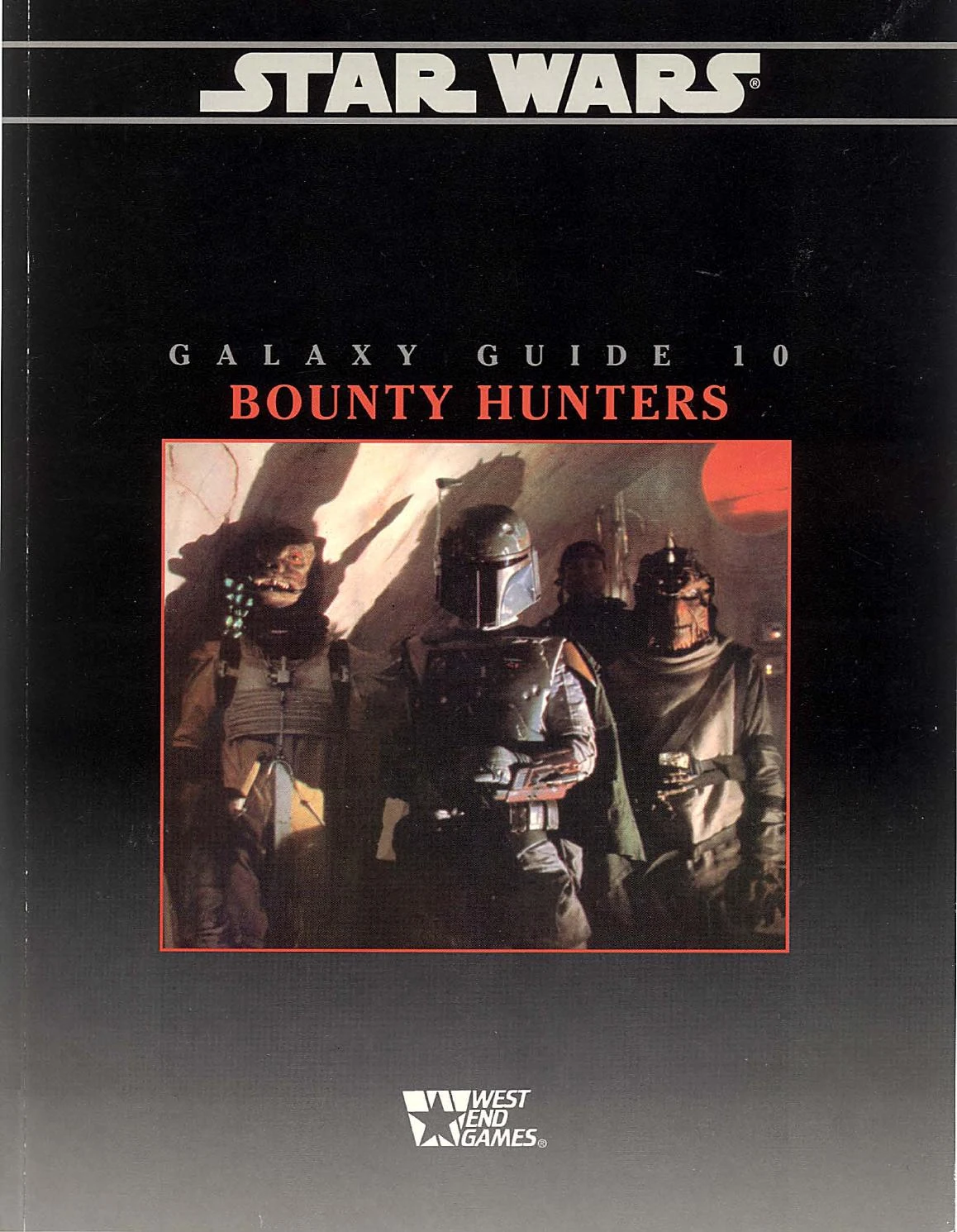
Galaxy Guide 10: Bounty Hunters
Galaxy Guide 10: Bounty Hunters
by Rick D. Stuart
Development and Editing: Bill Smith
Graphics: Tom O'Neill • Cover Art: Lucasfilm Ltd.
Interior Art: Terry Pavlet, David Plunkett, Mike Vilardi
Publisher: Daniel Scott Palter • Associate Publisher/Treasurer: Denise Palter
Associate Publisher: Richard Hawran • Senior Editor: Greg Farshtey
Editors: Peter Schweighofer, Bill Smith, Ed Stark • Art Director: Stephen Crane
Graphic Artists: Nicole Black, Tom O'Neill, Brian Schomburg
Sales Manager: Bill Olmesdahl • Licensing Manager: Ron Seiden • Warehouse Manager: Ed Hill
Accounting: Karen Bayly, Wendy Lord, Kimberly Riccio • Billing: Amy Giacobbe
Published by West End Games
RR 3 Box 2345, Honesdale PA 18431
40073
® ™ and © 1994 Lucasfilm, Ltd. (LFL). All Rights Reserved. Trademarks of LFL used by West End Games under authorization.
Introduction
"... Hers was a tale of ancient lineage.
"A story older than the suns.
"Hers was the tale of the Empire's hired gun who comes to dine with blood soaked hands and frosted smile like honey wine, transfixing like the serpent before it strikes with equal compassion ..."— Thalos Lorin, Serpent Rain, Act II, Scene I
Galaxy Guide 10: Bounty Hunters is a compendium of information assembled from a variety of sources, including extracts drawn from Imperial databases, biographical record scans, classified security datasets, record tape analysis, and detailed reports originating from undercover intelligence operatives across the Empire. In its final form, this volume represents the largest single collection of facts presently available dealing with some of the most unusual law enforcement agents ever assembled in the Empire.
This latest reference guide is for use with Star Wars: The Roleplaying Game, Second Edition. Its purpose is to provide detailed information necessary to use various types of bounty hunters, either as player characters or gamemaster characters, in a variety of roleplaying adventures. Bounty hunters perform a wide variety of functions. Many bounty hunters are independent Imperial peacekeepers who go head-to-head against some of the Empire's most wanted criminals, including important members of the Rebel Alliance. Others work exclusively for companies or private individuals. Still others work independently, living and dying by their own self-imposed rules of conduct. It is a grim and dangerous business, but a necessary one as well.
The Ethics Of The Hunt
Stamped on the back of every Imperial Peace-Keeping Certificate (IPKC), recognized as the bounty hunter's "license to operate," is a summary of the following set of particulars that define the rules under which a hunter makes a living in the Empire:
- The being or entity posting a bounty, whether the Empire, local government, corporation or individual, reserves the right to determine suitable punishment for a bounty subject. Unless bounties are posted as "Wanted Dead or Alive," live capture of a bounty subject must be attempted unless the live capture of said subject presents a compelling threat to the Empire or its citizens and property. Whenever feasible, the subject must be given the opportunity to peacefully surrender to the bearer of this certificate. Flight, refusal to comply with the directives of a registered hunter, prior activities indicating a predisposition to resistance to capture, resistance, or assault is considered refusal to surrender.
- Injury, incapacitation or death of the subject of a given bounty may only occur if under circumstances in which the subject has first refused to peacefully surrender, has exhibited a predisposition to refuse peaceful surrender, or the bearer of this certificate is forced to act in self-defense or in the defense of Imperial citizens or private or Imperial property.
- In such instances in which force must be used to accomplish the apprehension of a bounty subject, only that force which constitutes a clear and reasonable application can be authorized against the subject.
- The bearer of this certificate agrees not to accept any illegal contract, informal arrangement, or private service contract that shall involve the use of his or her services against any person in the Empire for whom a bounty has not been registered with the Imperial Office of Criminal Investigations (IOCI) or agents of the Imperial Security Bureau.
Who Profits?
Galaxy Guide 10: Bounty Hunters is for use by both players and gamemasters. It details how bounty hunters are equipped, employed, and how they go about their business of bringing wanted criminals to "justice." Readers of this material will come to understand the different types of bounty hunters, each with their own special approach to law enforcement. Each will be seen to act from different motivations and use different modes of operation. Biographies of the Empire's most successful (and notorious) hunters are for reference purposes or incorporation into existing campaigns.
After reviewing the material presented in this volume, gamemasters can design and implement their own bounty hunter gamemaster characters as desired. Player characters may find themselves to be unsuspecting "targets of opportunity" or "acquisitions" who are hounded until captured.
Some players will wish to play bounty hunter characters. As will be shown in the following chapters, bounty hunters are not the simplistic cold-blooded killers they are believed to be. Many are simply enterprising business beings; most have their own code of ethics. Some are even extremely moral, working outside the law for what they believe is right (much like the Rebel Alliance).
This supplement makes no judgments about the morality of such individuals: instead, players should be aware that all actions have consequences and their characters will suffer or benefit as a result of their actions. The Star Wars universe is one where beings reap what they sow. Good or evil player character bounty hunters and gamemasters must never forget this.
Time Frames
While the information contained in this guide is easily adaptable to any period in the Star Wars universe (bounty hunting being a very old profession, dating back to before even the Old Republic), this supplement is geared toward bounty hunting during the period between Star Wars: A New Hope and Return of the Jedi. It is a dangerous time especially suited to the unique talents of bounty hunting. The Rebellion, the Empire and those in the middle have ample use for such individuals. Gamemasters and players wishing to use bounty hunters in the New Republic should have no problems extrapolating this material to that era.
Problem Solvers
Despite the traditional view of the bounty hunter as cold-blooded killer, readers of this reference will quickly discover that there is no such thing as a typical hunter. Bounty hunters come in all shapes and sizes, each with different advantages and disadvantages. Some take up their chosen trade out of a sincere sense of justice — roving paladins acting to right wrongs others refuse to face. Others are driven by a simple need for revenge. Still others view themselves as the Empire's "problem solvers," providing a somewhat drastic form of public service.
Some even approach their trade in the spirit of sportsmen or selective connoisseurs: involving themselves only with the choicest of targets, each according to their individual tastes. All of this combines to make the bounty hunter a dynamic individual. If nothing else, this reference will serve to illustrate these many differences and change, once and for all, the traditional view of the "Empire's hired gun who comes to dine with blood soaked hands."
The Challenge
The daily challenge of the bounty hunter lies in the dark, cutthroat nature of assignments offered and accepted, the skill needed to outwit the competition, the brains required to solve unfolding mysteries, the reputations of foes encountered, and the daring and personal courage to complete one's mission — all the while, if possible, staying alive long enough to make a profit. Are you up to the challenge?
The Other Side of the Story
In the darkness of the bar, it was tough to make out the form of the man in the back booth. After studying him through the haze and smoke for several minutes, young Rengor Vanth decided that it was time to begin the interview. He checked his Sector 242 NewsLine ID and cautiously approached. Before he had taken two steps, the hunter named Malis turned to stare at the reporter. Rengor fought the nervousness he felt building in his stomach.
The hunter watched dispassionately as Rengor slowly approached. The reporter smiled weakly. "Hunter Malis, is it?"
The hunter looked away, not a trace of emotion crossing his scarred face. "Sit down. Order a drink — it'll calm your nerves."
Rengor eased into the booth, trying to ignore the large bloodstain on the table. He punched in an order for a mug of lum. He noticed Malis sizing him up. The hunter had a cold face, with steel gray eyes and a determined stare: the look of a killer. Suddenly, this "choice" assignment seemed like a bad idea.
Malis sneered, "Never met a hunter before, have you?"
Rengor tried to put on an air of bravado, and failed miserably. "No ... not until now. Shall we begin the interview?" Rengor pulled his small holo-recorder from his work pouch, and powered it up. "Audio only, no vid. It's bad for business."
"It's your interview."
The robotender hovered over to the table, depositing the mug of lum in front of Rengor. The cost was an exorbitant 15 credits. Rengor paid it without complaint. "Interview with hunter Malis. Are you ready?"
Malis simply nodded while taking a long draught from his steaming mug. Rengor began. "Hunter Malis, in the past few years you've become a notable hunter. Your reputation has steadily grown. In fact, you've become something of a celebrity, even beyond hunter circles. Yet, virtually nothing is known of your background or your motives. People want to know who you are and why you became a hunter. What led you to this profession?"
Malis smiled. Rengor found it chilling. "It was a long time ago, kid. And a personal matter. Suffice it to say that I found my own reasons to stalk criminals. They've earned what happens to them. Death is too good for most of them."
Rengor looked down at his datapad, trying to find an acceptable way to phrase his next question. "Hunter Malis, bounty hunting is a ... controversial field. To be honest, a lot of people are uncomfortable with how you and your colleagues earn their living ... killing for credits. How do you justify your actions?"
Malis let out a slow breath. "It's a civilized profession for an uncivilized galaxy. Simple. I take care of the people everyone else is afraid of." He pulled a blaster carbine from his holster. Rengor wondered if Malis would shoot him right there. After a few seconds, Malis put the weapon on the table. "Kid, I just scared the life out of you. But I want you to know something. If I was going to tag you, you'd know it. I'm a hunter, not a murderer. And I don't have to justify what I do, or how I do it, to anyone. I do what I do because someone has to do it ... and I'm good at it. I'm a bounty hunter — to you, that equates to killer.
"But I'm the man who may be stopping that criminal, who, if he isn't stopped, might end up killing you or someone you care about. I'm someone who keeps order and this galaxy desperately needs it. My acquisitions — that's what we call the vermin we hunt — are people who have earned a death sentence. My last acquisition was a little gravel-maggot named Yerlad. I'll admit I went a little rough on him, but those scars will always remind him of me. He fears me now, and fears my kind. That's good, because fear is the only way to keep those animals in line. He killed five people: five men who put their lives on the line for the Empire. He claimed to be fighting for the Rebel Alliance, and I'm sure the widows really appreciate that."
Rengor apprehensively asked his next question. "So you're saying that the ends justify the means?"
"Of course. The Empire is trying to maintain order, to protect the galaxy from itself. Without the Empire, there would be anarchy. Do you want a return to what it was like during the Republic? Alderaan was a perfect example. That planet and its revolutionaries were a threat to the stability of the Empire and the galaxy. They earned what they got. Now, look at what that so-called Alliance endorses. An armed revolution. Have you given any thought to what that means? If they get their way, millions will die in the fighting — all for a 'noble' cause that will be forgotten as soon as they get a taste of power. Look at their biggest hero, that kid from the Outer Rim. He murdered over a million men. Those men had families and children. That's the kind of scum I hunt. And if that's not good enough for you and the spineless drones you entertain, they can try to stop me."
Rengor was beginning to feel ill. This was going to be a long day ...
Chapter One: Bounty Hunting
Bounty Hunting: The Profession, The Professionals
"A good friend is one who always pays for the first and last drinks of the evening ... An even better friend is one whose bounty you just collected, paying as he does by his absence for all the drinks in-between. And the best part of it is you don't even have to listen to all his stupid jokes ..."
— Saras Krenin
What's In A Name ...
They are the galaxy's stalkers. They are the ones who dare to go where others do not. The very thought of one of them on your trail, hounding you, hunting you, day after day, is enough to cause even the most hardened criminal or murderer to start sleeping less and worrying more. In many ways, they represent the best and the worst that the Empire has to offer. To know them is to be intimate with a radically different lifeform. Human and non-Human alike, each hunter is a member of a separate and very elusive species: one that thrives on, and profits from, the crimes of others. They are the Empire's professional bounty hunters.
They are the bearers of a traditional title spoken softly and with fearful respect. Acting as independent law enforcement officers, these solitary predators bring their own brand of Imperial justice to the darkest reaches of the galaxy. Such is the dreadful awe inspired by these determined, and sometimes desperate, individuals who live on the fringes of the Empire: men and women who place their lives on the line each day for the credits another's capture will bring.
Different Names, Different Faces
Yet in spite of, or perhaps because of, the popular view of bounty hunters, many hunters have deliberately cultivated a dramatically different life-style. Some hunters are wealthy members of their own planetary governments. Many are generous supporters of the arts and civic improvements. Some are part-time professionals who take up the hunt only when required to by financial necessity. Others are even managers of corporations, financial magnates with a reputation for ruthless business savvy. Indeed, many within the Empire would find it difficult to accept that one of their closest friends and neighbors was in reality an accomplished killer.
Nonetheless, many hunters live relatively mundane lives away from the hunt. Certainly many hunters view their continued successes possible because of their relative anonymity or outward appearance as law-abiding pillars of their community. It must be acknowledged, however, that some hunters are often exactly what the holo-thrillers portray them to be: cold, calculating persons who measure a person's worth by the price on his head. One such example is the notorious Boba Fett, a particularly efficient and ruthless individual who serves the Empire but serves his own agenda as well.
Still, such persons are the exception to the rule, and even when dealing with less-than-desirable hunter elements, it becomes apparent early on that there is no such thing as a typical bounty hunter. For every Boba Fett, there are a hundred other relative unknowns. Far from the cold-blooded "dealers-in-death" of the sensationalist audio-novel, these relatively obscure hunters (many of whom ironically use their anonymity as a means to achieving greater success over time) go about their daily business of law enforcement, each using their talents and skills to serve the Empire in special ways. They may not be widely known, they may not be recognized or appreciated by the masses, but they make a difference to those who routinely employ them and to the security of the Empire as a whole.
Ya Never Can Tell ...
"Jarmak used to say that a real friend was someone who'd draw his pistol and walk down a dark alley with you if you ask 'im to. Well, one night Jarmak asked just such a friend to do just such a thing, and sure 'nough, they walked down that long alley together and ended up killing five of the Prefect's best Imperial thugs in the process.
"And after it was all over and Jarmak held out his hand in friendship, this friend ups and slaps a magnacuff on it and turns him over to the Imperial Prefect for a hundred credits and a second class berth on a third-rate tramp freighter. Just goes ta show ya never can tell."
— Gaor Tembon, Smuggler, slaver, thief
Who's Who In Bounties
Within the Empire there exist three general categories of bounty hunters, each with their own loyalties and affiliations, each working from different motivations, and each possessing certain advantages and disadvantages in terms of how they carry out their trade. These three different categories are:
- Imperial bounty hunters
- Guild bounty hunters
- Independent bounty hunters
Imperial Bounty Hunters
Imperial bounty hunters work exclusively for representatives of the Empire, refusing to accept any guild, corporate, or other private assignments. Many Imperial hunters are ex-military men and women who find the comforts of civilian life boring yet chafe under the regimentation of military service. Some, for example, are ex-fighter pilots or combat troops who enjoy the adrenaline rush of combat, but prefer to choose the time and place of their own engagements. Others are lured by the credits from the more lucrative bounties that various Imperial sources offer in abundance.
Imperial hunters often receive numerous assignments through the Enforcement Division of the Imperial Security Bureau (see Chapter Two, "COMPNOR" of the Imperial Sourcebook). As such, they are frequently called upon to hunt down political criminals, known traitors to the New Order, or even suspected Rebel sympathizers within government circles.
Successful Imperial bounty hunters are likely the first persons local governors, and even Moffs, call upon when a dangerous criminal is on the loose or acting in their vicinity. In such instances, the object of the bounty is a criminal wanted for various crimes involving treason, conspiracy, sedition, or similar acts against the Empire. Similarly, Imperial hunters are often the first to learn of the newest, most lucrative bounties recently posted. They are often recommended by the Imperial Security Bureau (ISB) to other Imperial agencies — such as the IOCI — looking to contract out a "special assignment." In some cases, temporary contracts with the military are possible, given the military expertise of Imperial hunters often comes in handy when tracking down suspected Rebel agents or saboteurs. In special cases where, for example, an Imperial Inquisitor requires the apprehension of a particular individual wanted for questioning, or when a planetary governor needs a "special favor" done, an Imperial hunter is often called upon to carry out such special duty.
Imperial hunters are trusted members of the Empire's "extended" law enforcement arm and their loyalty is without question. Because Imperial hunters are usually occupied with the apprehension of revolutionaries and political enemies, they are seldom sent after "common" criminals, leaving that market open to the countless independent and guild hunters.
Guild Bounty Hunters
Let the Guild hereafter be unto you as your mother and father. Let this house stand with you as a friend in need. Let this home forever take pride in you as a lover who delights in your prowess. Those who bore you may betray the Empire tomorrow. He who in friendship stands by your side may slide the blade in all the easier. She who shares your sleep may seek to strangle you in it. After all forsake you, only your Guild shall remain to fortify and protect you. Only your Guild understands exactly who and what you are, and dares to care about you just the same.
— From The Foundation Creed, Salaktori Hunter Guild
Guild bounty hunters are individuals who hold their personal allegiance not to the Empire, but rather to their own privately established guild house. Guild hunters engage in hunts arranged entirely through the offices of their guild contractors, and are never required to deal directly with Imperial officials except in cases of extreme urgency.
In many respects, a hunter's guild acts as a type of bounty "clearing house" through which Imperial officials, leaders of large corporations, and even private citizens, many working outside the law, can bargain the price of a person's bounty in exchange for securing the best person available to "fill out the contract." Guild administrators acting as "bounty brokers" continually search out the most lucrative contracts to be found from among millions of inhabited worlds within the Empire. In this way, guild contractors seek to meticulously match the skills of their best hunters against some of the Empire's most wanted criminals. As a result, many guild hunters come to view each hunt assigned them as a contest of wills and a personal challenge between themselves and their intended victims.
While the nature and location of these guild-sponsored hunts can vary wildly, all require the hunter's utmost skill and effort to track down and apprehend a given acquisition. Not every guild assignment meets with success, however, and sometimes a guild contract can go unfulfilled for years (normally due to the repeated acquisition by guild hunters of large blaster holes). Despite the high risks involved, guild hunters know that standing behind them in times of need is the full support and influence of their guild house, a powerful, influential, and continually expanding force in the Empire and beyond.
Procedures and "typical" contracts vary wildly from guild to guild: each house has its own distinct "personality." Some guilds only pursue high value (10,000 or more credits) Imperial bounties, while other guilds will send their members after lower value bounties posted by corporations. Beginning guild members can expect to be given bounties based on violations of planetary jurisdiction, with more profitable "sector" bounties going to the more experienced members. For more information and descriptions of the different types of bounties available, see Chapter Three, "The Business."
Once accepted into a hunter guild, the new member can expect the advantages of a lifelong home wherein all personal needs are taken care of and a shortage of work is never a problem. Not only is the guild member relieved of the need (and expense) of scrounging for the best bounties on his own, but the guild hunter enjoys the added benefits of in-house training by some of the galaxy's most notorious hunters, the availability of specialized equipment and, in extreme cases, sanctuary from Imperial prosecution (within limits). And should the hunter live to an age when voluntary retirement is seen as desirable, typically starting around 45 standard years, the successful hunter is often retained by the guild to impart his or her knowledge to junior members (at a substantial annual salary).
The disadvantages of guild affiliation are two-fold. First, guild hunters have no voice in deciding which assignments they will be given or whom they will next be pitting their skills against. Such decisions are completely at the discretion of the guild's administrators, and refusal to accept a given assignment is cause for immediate expulsion from most guilds. Second, all guild assignments result in a standard percentage of the bounty's face value being paid "off the top" directly to the guild. This fee, called a gap, often is as high as 10 percent of the bounty. Each guild member is also required to pay annual membership fees, which are used to support a guild's many operations and investments. In some cases, membership dues can be several thousand credits a year. Also deductions are taken out for any loss or damage to guild-owned equipment if, in the guild's opinion, such loss or damage could have been avoided. Moreover, if, upon review by one's superiors, it is decided that a hunter has failed to use his or her skills to their fullest potential, a further discretionary percentage can be deducted from future bounties. This often serves as an inducement to improve poor performance.
While some guild hunters have amassed sizable private fortunes, the great majority of hunters find themselves hunting for years without achieving their dream of financial independence. For more information on bounty hunter guilds, see Chapter Eight, "Bounty Hunter Guilds and Related Agencies."
Under Imperial law, guilds are forbidden to have any contact with or to broker the services of their members to any agency or party affiliated with known Rebel sympathizers. Of course, a few hunters are suspected of having occasionally sidestepped this prohibition during their own, personal "downtime."
Termination With Extreme Prejudice
"Would that blaster have happened to look anything like this?"
"Ah, yeah, now that you mention it ... say, where did you ever ..."
In the confines of the small, enclosed tavern, the crackle from the blaster's muzzle was almost deafening. The resulting hole in Krestock's body, a third of a meter in diameter, was matched by a similar hole in the high-backed leather chair his lifeless body now slumped against.
"Krestock, you bleedin' slime. Philo was my brother. There was no bounty on Philo, do you hear me, Krestock, no bounty! It had all been a mistake. A lousy, bleedin' clerical error! But you and that witch of yours never bothered to check the latest Intel Updates. Oh, no. If you had, you would have known the bounty had been rescinded. You had a bleedin' link direct to Enforcement Central, and you never bothered to use it ..."
Gingerly poking through the charred remains, Reglis located Krestock's pouch of credits. Reglis paused for one last consideration. "By the way Krestock, like the man says, there are two types of hunters in this galaxy: those who talk and those who shoot. Hope you remember that in the next life ..."
— Reglis Taal, Endings And Beginnings: An Autobiography
"Boy, there are two types of acquisitions in the galaxy. Those who stare face down the muzzle of a blaster with calm and whatcha call it ... dignity, yeah, dignity. And then there are those who beg and squirm and squeal their little hearts out, on and on like, 'til you finally just up an' pull the trigger just ta shut 'em up.
"Well, Philo always was a bit of a slimy, weak-livered type, and we'd long decided, Raxine and me, we wasn't going to bother to take him still breathin'. We'd done this hunt together, but the credits didn't split none too evenly two ways, so Raxine decides we should settle it by grabbing ole Philo by the legs and make a wish-like and the winner take the larger share! With all the screamin' and whinin' and pleadin', Raxine gets tired of it and pops him one with that little pint-sized blaster of hers ..."
Representative Imperial Peace-Keeping Certificate
The being or entity posting a bounty reserves the right to determine suitable punishment for a bounty subject.
- Injury, incapacitation or death of the subject of a given bounty may only occur if under circumstances in which the subject has first refused to peacefully surrender.
- Only that force which constitutes a clear and reasonable application can be authorized against the subject.
- The bearer of this certificate agrees not to accept any illegal contract, informal arrangement, or private service contract that is not legally recognized within the Empire.
— Imperial Office of Criminal Investigations
Independent Bounty Hunters
"Independent? Half of those bloody headhunters aren't even housebroken!"
— Governor Serdif Tount
They style themselves as independent law enforcement officers. Despite their self-perceived honor, they are generally an unsavory lot and the ones typically thought of when the term "bounty hunter" is used by a civilian. Independent hunters may hold allegiance to the Empire, but they hold an even deeper personal allegiance to themselves. While finding it expedient to obey Imperial officials (at least the majority of the time), most independents have little use for Imperial bureaucrats, whom they collectively refer to as "bloodsuckers." Independents go their own way in life, hunting whomever they choose, when they choose, dependent on none to give them their marching orders.
Independent hunters generally look down on Imperial hunters, whom they consider "hired guns." Guild hunters are similarly regarded as "company clones." As often as not, these misfits will take the most chances, travel the farthest distances, and make the most sensational captures, respecting only those whose "capture ratio" is higher than their own. Ironically, they are among the most steadfast supporters of the "bounty hunter's creed" (see below).
While it is rumored that some of the more infamous independents have private sponsors with whom they share their bounties, the vast majority are forced to rely on their own resources in tracking down and apprehending criminals. This is a situation that offers both positives and negatives. If successful in bringing in a "big score," an independent hunter shares the reward with no one. Even after the occasional deduction for permits or "breakage" along the way, a sizable bounty can keep an independent financially well off for several months.
At the same time, independents are solely responsible for all expenses — those relating to survival during the hunt, as well as personal maintenance during "downtime." Given considerations such as ship and equipment repairs, the care and modification of personal weapons, medical expenses, food and liquor, Imperial permits, license fees, not to mention the occasional bribe or two, it is not surprising that many independents often "supplement" their professional bounty hunting activities with "less than strictly legal" operations to see them through between hunts. Many justify these actions as a means of gaining new contacts or winning an advantageous position of trust near an intended future target.
As a rule, very few independent hunters live long enough to retire in luxury. Some do survive by getting out early, but many condemn themselves to short, lonely lives punctuated by intense pleasure and even more intense fear and suffering. Few die in the company of friends, fewer are remembered for their "contribution" to the Imperial peace, and fewer still are ever mourned.
The Bounty Hunter Creed
Contrary to popular belief, even the roughest, the seediest, and the most dispassionate of hunters are far from being the unprincipled villains many would make them out to be. Most hunters adhere, to some degree, to an unwritten code of ethics which, when spoken of at all, is referred to as the "bounty hunter's creed." While the exact wording of these tenants varies from planet to planet, the gist of this creed is summarized below. While the average Imperial citizen may find the codes objectionable, and even morally offensive, they serve as a loosely defined set of enforceable principles by which hunters conduct their trade and live out their lives.
People Don't Have Bounties, Only Acquisitions Have Bounties. This single, cardinal rule, more than any other, defines the way in which bounty hunters approach their chosen profession. It reflects the idea that sapient beings, to some degree, must be accorded respect. If, however, an individual has a bounty placed on them, he or she ceases to be an individual with rights. No longer a member of the galactic community, the "acquisition" becomes fair game. Tears should never be shed over the fate of someone that is, after all, only an "acquisition."
Capture By Design, Kill By Necessity. In keeping with the loosely defined hunter code of ethics, killing is sometimes necessary. That's business, pure and simple. However, unnecessary killing is still murder. The hunter, unless otherwise directed by those leveling the bounty, must attempt to deliver the acquisition alive. Often, those leveling the bounty have a vested interest in a live target — and the target might be better off getting killed by the hunter.
No Hunter Shall Slay Another Hunter. Simply put, whatever their origin, bounty hunters see themselves as a special breed. They take their lives (and those of others) into their hands each time they hunt. One may agree with another hunter's motives or damn them for the manner in which they carry out their hunts, but no bounty hunter may ever take up arms against a fellow hunter. This law applies only to hunters who themselves follow the creed. Those who have broken the creed, or who themselves have a bounty posted on their head, are merely acquisitions. In such cases, the ex-hunter is no longer seen as a member of a common fellowship and old scores can now be settled with impunity. The hunter has become the hunted.
No Hunter Shall Interfere With Another's Hunt. While it is not unheard of for hunters to work as a team, the hunt for a given acquisition is most often viewed as a form of personal duel between two sapient creatures. In such a duel, the hunter matches skill and courage against all the resources one's opponent can bring to bear. If the hunter wins, it is a personal triumph denoting superior skill and intellect, and not simply a question of luck. To interfere with another's hunt, unless first invited, is to leave the question of "who is better" open and, perhaps forever, unresolved.
Of course, competition between hunters is often fierce and there is often a very thin line between "competition" and "interference." This being true, while a hunter is constrained against taking direct action against another hunter, there is nothing to constrain a hunter from hiring others to do the dirty work. Of course, if such an action, successful or not, can be traced back to the original perpetrator serious consequences inevitably follow.
In The Hunt One Captures Or Kills, Never Both. In cases where the acquisition has been taken alive, that "choice" cannot be altered. To kill an acquisition in the course of the hunt is one thing, but to purposely kill an unarmed, helpless being already subdued and unable to resist is seen as simple slaughter and wanton butchery. An acquisition "killed while attempting to escape" however, would be an entirely different matter altogether.
No Hunter Shall Refuse Aid to Another Hunter. While no hunter has the right to interfere with another's hunt, there come times when even the best of master hunters require assistance. In extreme cases, any hunter may ask for and expect aid and assistance from another hunter, even if it means the latter must temporarily suspend his or her own hunt in the meantime to render such aid. Whatever personal grievances or animosities may be involved between the two parties, it is known and understood that hunters take care of their own. Of course, such assistance is not without its price tag, and the arbitration of payment after the fact can often put a substantial dent in any expected profit.
Specially Qualified
"Come in, hunter Rill. Do sit down."
"Thank you, Governor. To what do I owe this honor?"
"As an Imperial bounty hunter of no small reputation, you have come to my attention by way of recommendation of Sener in the ISB. I have a particularly delicate problem on my hands, one for which I need a woman of your special abilities."
"You flatter me, Governor."
"Not at all. I am merely stating the obvious. I have recently uncovered incontrovertible evidence that points to the presence of a large underground Rebel network in the city. These individuals are commanded by a very special Rebel agitator and organizer. One whose past actions have proven his treason a hundred times over, but one who, until now, we have been unable to identify ... I shall not bore you with unnecessary details. Suffice it to say that through a slight miscalculation, the Rebel underground leader has allowed us to, at long last, uncover his identity. That is where you come in, hunter Rill. I want someone of your unique station to go in and bring out this individual. Any questions?"
"For now, just one, governor. I'll need to know how old this Rebel leader is."
"Hmmm, let me see. Ah yes, here it is ... your father is 47 standard years of age ... do you have any other questions, hunter Rill?"
"No. Thank you, Governor."
"Then I can expect you to begin immediately."
"Of course, Governor, immediately."
While the creed is "commonly accepted," there continue to exist more than a few hunters who have little regard for the creed. There are, for example, recorded instances of hunters who have slain other hunters, or instances where one hunter has deliberately and openly defied custom and courtesy and acted to hinder a hunter in the pursuit of a given quarry. The bounty hunter creed remains, therefore, a reasonable attempt at regulating an often nasty business, one often far removed from the eyes of "civilized beings." It also remains a loose set of principles that can be, and often is, violated when no one is looking.
Like Imperial laws, any code of ethics is only as good as the means to enforce them. Enforcement of the hunter's creed is, in many ways, similar to procedures found aboard the interstellar pirate ships of the galactic frontier. Once the nature of an offense against the creed has been discovered, the charge is made known by a hunter who will then convene a "hunters' lodge." The term, in this context, has no connection to a physical structure, but refers to the conclave of hunters assembled to hear the "lodgement" of accusation by the sponsoring hunter. The lodge is normally only used by independent hunters; guild houses have their own procedures for dealing with problem situations and Imperial hunters typically only answer to Imperial officials.
There are no hard and fast rules governing the actions or sentences enacted by a given lodge, but there are some "customary procedures" that are more or less in common usage. Typically, the lodge must be convened within 30 standard days of the offense. Any number of hunters can attend, providing evidence for or against the accused, though only six hunters in attendance are required to enact summary justice. The accused may likewise attend a lodgement session, though no special guarantees of safety are implied should the decision go against the accused. Alternatively, the accused may send a representative to plead on his behalf.
Once the evidence has been presented (or manufactured), each of the assembled hunters casts a vote. In most cases, in the case of a tied vote, the sponsoring hunter may demand another vote to break the deadlock. If the majority decide against the accused, the result is the imposition of an immediate "ban." The ban is effectively an informal injunction which, once leveled against a given hunter, acts to deny that person aid and support from all other hunters. While the ban stops short of allowing a hunter to kill another hunter, if the accused finds himself under the ban, any number of individual "sanctions," the nature of which will vary from lodge to lodge, can be imposed at will.
Bear in mind there are no set standards as to how certain infractions are punished by individual lodges. Each lodgement outcome depends on the various personalities involved and the degree to which hunters are willing to use personal resentments to take the law into their own hands. In extreme cases, it is not unusual to find the guilty party facing off against anonymous assassins from the "private sector" soon after the passage of a ban. Likewise, it is not unheard of for actual bounties to be issued against the accused after various law-abiding citizens of the Empire come forth with "evidence" shedding light on old infractions against Imperial law.
Lodges may be convened against guild hunters, but this is rare and risky. Guilds protect their own, and do not take kindly to a "motley assortment of criminals" singling out one of their members for death. Often, the guild will "forcibly dissuade" independents from attempting to enforce sanctions while taking care of the issue "internally."
Buyer's Market
"Secretary Greal, bring in that list of bounty hunters I asked you to prepare for me."
"Sir, I know you have a clear preference for Imperial hunters, but the current situation might require the use of guild or independent hunters. Upon investigation, I have determined that there are presently four different hunters available for contract in Feris City at the present time. They are as follows:
"First, there is Saulis Pau. He is an Imperial hunter, ex-Imperial army, serviced out after severe combat injuries required extensive cybernetic replacements. While not suitable for front-line duty anymore, he maintains a high proficiency with numerous weapon types and explosives. Equally important, he is one who can act with a degree of discretion. It was Pau who did that little 'favor' for Governor Heas last month. Reliable and someone who knows how to keep his mouth shut.
"Second is Lafek Iss, a member of the House Salaktori guild. A master electronics and computer expert, with additional cross-training in droid programming and anti-surveillance measures. He has a reputation for secrecy and prefers to work alone.
"Next, Jasis Temm, former owner and CEO of Hadlress Defense Systems, Ltd., on Hadlress. A mechanical engineer and security consultant to Prefect Ilanda. He sold the company two years ago for 4.6 billion credits and now prefers to apply his knowledge in more 'practical' ways.
"Finally, there is Quantana. He started out as a kid from the streets of Lopor Station. He seems to have a strong sense of family and loyalty: he uses his funds to support an extended family with a history of medical problems. Smart, cool under pressure. Never lost an 'acquisition' yet."
"Thank you, Secretary Greal. In light of the way our competition has been pressuring us of late, I believe we will have need of all these individuals. See to it that the next batch of bounties is duly registered soon as possible. It's time I became an equal opportunity employer."
Bounty Hunter Slang
Not surprisingly, professional hunters maintain a sense of remoteness from the average Imperial citizen — one can never tell just who might become tomorrow's meal ticket! One way in which this purposeful distancing is maintained is through the hunter's adoption of a professional patois that can be used to communicate with other hunters without fear their conversations can be understood by the average "civilian." The following are known examples of professional hunter slang, although it should be noted that regional and planetary variations often apply.
Acquisition: Any individual who is the subject of a bounty.
Blood Money: Any form of fee paid to Imperial authorities deducted from the value of a bounty. Typically, a term applied to the cost of various permit fees charged by Imperial administrators.
Bloodsuckers: Collectors of Imperial permit fees.
Enforcer: A bounty hunter's personal expeditor.
Gotcha: Any determent placed on a bounty that could conceivably limit the revenues that may be collected from the fulfillment of that contract.
Grubs: Derogatory term for average Imperial citizens.
Hundred Club: Those acquisitions currently worth 100,000 or more credits.
Hunt: Any tracking and retrieval operation conducted against a bounty acquisition.
Hunter: The traditional term used by bounty hunters to refer to any other holder of an IPKC. In specific, the term is often used to refer to a bounty hunter who has made at least one successful capture.
Master Hunter: Any hunter who has successfully completed a minimum of 100 hunts.
Most Wanted: Those individuals who represent the most serious threat to the peace and the stability of the New Order. These acquisitions also generally have the highest bounties on them.
Pay Check: Slang term for a warrant that needs be "cashed" by Imperial officials offworld.
Petty Cash: Synonym for pin-money.
Pin-Money: Any small-time criminal who, despite widespread criminal activities, has only a relatively small bounty value posted against him or her, which discourages most professional hunters from wasting their time.
Pull Leather: To support a fellow hunter. Traditionally from the phrase "to pull leather," meaning to be willing to take up arms in the defense of another.
Sluice: Fees paid to a hunter's expeditor.
Squeaks: Information obtained by the overt use of intimidation.
Squeaker: An informant who yields valuable information as a direct result of intimidation.
Two-timer: An acquisition with two separate bounties presently posted against him or her.
Bounty Hunter Etiquette
It is worth noting that bounty hunters do not, as a rule, see themselves as traditional mercenaries and will usually object quite strongly to any who imply that they are mercs. Traditionally, this term denotes a private soldier in the pay of a foreign power, an image which the average hunter most vehemently rejects. Whatever the individual's origins or motivations in life, a bounty hunter tends to view his or her profession as a business and themselves as trained, business professionals. This is especially true of guild members whose allegiance to their parent organization reinforces this notion. Given this position, to suggest a common mercenary affiliation is sufficient to cause serious offense (multiple injuries normally follow).
By comparison, independents, however, are generally less prone to care one way or the other, and some even take a perverse delight in hearing the term "tracker" as well as mercenary applied to them — the fear and loathing associated with these terms can aid the hunter in his or her hunts.
Imperial Perspectives
Whatever their contributions to the Imperial peace, few people within the Empire tend to see bounty hunters as anything more than a necessary evil (at best). Regular military service personnel tend to view hunters of all types as being a modest cut above the refuse they hunt, the differences being a minor point of distinction at best. Traditionally, Imperial Naval officers, who pride themselves and their subordinates on their discipline and dedication to duty, see undisciplined hunters as an inherent threat to the Empire. When hunters are employed at the behest of the Imperial Security Bureau's Enforcement Division these feelings of general disgust are dramatically magnified.
An Ongoing Rivalry
Scouts have a special antipathy for bounty hunters in general (a hatred that is returned in kind). It often occurs that scouts, being the only resource available at the time, may be asked to track down, and if necessary, attempt to eliminate hunters operating in nearby space. Scouts resent what they consider trespass by hunters into areas they tend to view as their own private "turf." For their part, most hunters view scouts as unwanted interlopers and potential troublemakers who, directly or indirectly, may interfere with a hunt.
Hunting In The New Republic
Although this book focuses on the period of the traditional Empire, hunting is still alive and well after the death of Palpatine. Within the fractured Empire, hunters are still tools of the Imperial bureaucracy, as well as of the various private individuals in Imperial space. As the Empire further splintered into smaller and smaller political entities, hunters found themselves with greater freedom to operate and fewer bureaucratic hassles. After all, the Imperial factions were more interested in holding what little wealth remained rather than policing the conduct of private citizens.
Within the New Republic, the practice of bounty hunting is strictly controlled. On New Republic worlds, it is illegal to engage in the willful slaughter of a sapient being for profit. Anyone caught engaging in such activities will be arrested and tried accordingly. Moreover, anyone engaged in the willful pursuit of a sapient being, other than those for whom the Republic — not the Empire — has issued bounties is likely to be detained for questioning and may often be held in violation of local and Republic ordinances. Given that many of the Empire's Most Wanted criminals are high ranking New Republic officials, the New Republic strictly punishes those hunters illegally operating in its space.
This is not to say that bounty hunting does not occur in the New Republic: it simply has a much more kind and peaceful face. Hunters must also purchase licenses and permits, but they are much more closely observed by Republic officials. Likewise, the Republic is much less likely to issue a bounty on a given individual — only those criminals who pose a clear threat to the peace and safety of Republic citizens warrant such treatment. The Republic does have its own Most Wanted list (which is overseen by General Airen Cracken; see Wanted by Cracken). In all cases, within the Republic bounties are paid out for the safe return of live, unharmed (if at all possible) captures. The Republic thoroughly investigates any questionable captures within its territory (to the best of its ability) and does its best to make sure that all in Republic space behave in a civilized manner.
Even the individuals who hunt with the Republic's blessing are often viewed as something approaching social outcasts and will themselves be subject to prosecution, to the fullest extent of the law, if they fail to exercise reasonable restraint or bring about the avoidable death of another sapient creature. Bounty hunters are perhaps more akin to citizen militia soldiers and they are largely viewed as a necessary evil. While it is understood that they provide a vital service to the Republic, many average citizens still attach to the Republic's own hunters the stigma of the (often misplaced) "hired-gun" stereotype.
None of this prevents hunters working for the Empire from engaging in clandestine operations well within Republic territory. As Republic control on a given world can be quite tenuous, covert hunts can, and often do, successfully occur even in the heart of the New Republic. In such instances, the undercover hunters are on their own as the guilds are unwilling to publicly antagonize New Republic authorities. Naturally, there are unconfirmed exceptions to this rule, in particular those guilds of considerable influence and those who maintain a long-standing reputation for "taking care of their own."
Similarly, the standard prohibitions against hunting in Republican space are often circumvented by larger corporations whose private "contracts" to expert hunters are often defended on the grounds of needing to maintain the corporation's civil jurisdiction over key planets and territories. Then, too, corporations supportive of the Republic are generally recognized to have the right to employ armed civilians in matters pertaining to the recovery of stolen property, the prevention of industrial espionage, arrangements pertaining to general security, and are free to hire whomever they wish in these regards. That such individuals often exceed their legal authority in the execution of their assigned tasks is often viewed by corporation management as "unfortunate," but occasionally unavoidable. That such individuals also turn out to be experienced bounty hunters continues to be a source of official amazement to incredulous corporate spokespersons.
Chapter Two: Character Creation
"Our stock in trade is sapient life — we track it, capture it, and, if absolutely necessary, disintegrate it. It's a dirty job but I figure someone has to get rich doing it, and one way or the other, that someone is going to be me."
— Zardra
"Once a hunter, always the hunter..."
— Traditional hunter saying
The bounty hunter template in Star Wars: The Roleplaying Game, Second Edition represents the standard type of hunter best suited for beginning players — one that can be employed in a wide variety of adventures. For those players, however, who prefer a bit more variation, this chapter presents three new bounty hunter templates, as well as suggestions and ideas for further elaboration on new bounty hunter characters. These templates are alternatives to the original bounty hunter template and are intended to correspond to three broadly defined bounty hunter categories: Imperial, guild and independent hunters. These templates are stereotypes of that type of hunter; each individual hunter will have his or her own background, objectives and behaviors.
For those who want to create other templates, there is a series of "suggestions" rather than a listing of intricate "rules." The reasoning is simple — any detailed rules system has exploitable flaws and weaknesses. Rather than turn character creation into a "quest to find the loopholes and exploit the rules," this system gives the gamemaster final say. The player has the opportunity to be as modest or bold as he or she dares. Do you want your character to be the son or daughter of a famous Imperial? Ask for it. Want to be the "luckiest being in the galaxy"? Ask for it. But, be careful what you ask for, because you may get it...
Gamemasters have final say over characters: they can approve or veto any part of the character, from disallowing equipment to adding certain background elements to a character's life — "Somebody is holding a grudge against you... yeah, his name's Fett or something like that..." This doesn't mean that the gamemaster should make the character not fun to play; it does mean that the gamemaster has the responsibility to make sure that a new bounty hunter character does not unbalance the game. Since bounty hunter campaigns can range from "dark and gritty" to "epic and larger than life," gamemasters must decide for themselves what constitutes a "balanced" character. Gamemasters should feel free to adjust characters as necessary for play balance and to make for an interesting game. Give the reasonable player a bonus or two if you feel it is justified — maybe a few extra skill dice or a beat-up ship. For the greedy players though... give the character a million credits if his player asks for it. Just don't tell the player that the reason his character has a million credits is because they were stolen from a certain crimelord on Tatooine. One who has placed a bounty of 300,000 credits on said character's head... The player can find out about that during the adventure, right? In other words, players and gamemasters — have fun! Don't let the rules get in the way of that.
A Serious Concern
"Like they say, in this Empire you're either part of the solution or most likely the cause of the problem..."
— Yarr Gatonne
The creation of a bounty hunter character should be approached as a serious concern. Bounty hunting is more than just a means of employment: bounty hunting should be viewed as a way of life. Bounty hunting carries with it a distinctly negative reputation. The few who adopt this particular lifestyle do not do so casually, nor for the sheer enjoyment of it. Once the hunting profession is adopted, few are able to casually abandon their selected line of work for another, and fewer still live long enough to worry about retirement.
So, why then would anyone want to be a bounty hunter? This is the first question that must be considered in creating such a character. Players should begin by carefully working out with their gamemaster plausible motivations for their character. For some, it is the sense of excitement and adventure that draws them. For others, it is the need to make a contribution in the fight against lawlessness and those who prey upon the weak. For others, it is a way of supporting friends and loved ones. Still others see bounty hunting as a personal means to an end: a way of paying back a debt incurred long ago. Then too, for some it is merely a job, but one in which the pay is in keeping with the risks involved. What follows are some possible motivations:
- The character has an influential relative whose past exploits have suggested hunting as a career worth pursuing.
- The character has to adopt the bounty hunting profession to earn enough credits in a short time to pay off an important debt.
- The character is using his or her income to support others in need.
- The character needs to track down an important criminal before an innocent individual can be falsely imprisoned.
- The character is hunting down someone who has brought dishonor or ruin to one's family. For example, the culprit's actions have resulted in the character's family going bankrupt.
- The character is acting to avenge a wrong done to a friend.
Finishing The Hunter
After deciding on a template, the development of the character truly begins. Start with a name and a brief description of the individual, including the character's homeworld. Is the character Human or an alien? If the latter, record any species-based attribute restrictions or special abilities. Where does the character hail from? Develop enough background (one or two paragraphs is sufficient at this point) to illustrate what life was like before the character turned to this particular profession. Identify any personal allegiances. Now, players should add 7D skill dice to augment individual skills, as per the rules on pages 9 to 12 of Star Wars: The Roleplaying Game, Second Edition. They can spend any credits that their characters start with. Now, the characters are ready to begin play!
Comparisons And Contrasts
In order to select the template that best matches a player's vision of his or her new character, it is necessary to understand some of the advantages and disadvantages inherent in each of the four templates. Keep in mind that no hunter, however skilled or well equipped, can be all things in all situations. A hunter must concentrate on using those skills in which he or she excels.
Do You Take This Man Hunter
How lovely my darling Zira looks today and what a coup I'm bringing in on her dowry...
"We have assembled here today..."
...once I get hold of her fortune, I can use it to corner the hueris traffic in this entire sector.
"...concerning this man and this woman..."
She looks positively radiant. And what a gorgeous wedding outfit. Pretty big if you ask me, though; you could hide a grenade launcher under all those folds...
"Do you, My Lord, now take..."
"...yeah, yeah, sure, sure..."
...I don't remember those flowers over there...
"...And do you, My Lady, take..."
...what's that snaking out from behind those two tall vases...
"...by the power invested in me I now pronounce you..."
...it's a blaster muzzle, I'd swear it!
"Get down darling!" Blaster fire! The podium blown away! Get those skirts out of my way... there he is... "...you missed, do you hear me, and I'll not give you another chance... try to gun me down at my own wedding will you... dirty, stinking bounty hunter scum! There my darling, it's all right. We got the stinking bounty hunter. Let me help you up. I think..."
Click!
"Wha... where did you get those cuffs? Take these off me immediately. I don't understand, darling, darling, where did you get that blaster, I don't under—"
"Do be quiet now, my sweet, and do come along quietly."
"But Zira, I don't..."
"The name's Zardra, not Zira. By the way, thanks for taking out the competition for me. Now move it, buster! You're worth 50,000 credits to me and I aim to collect! Oh, I guess you'll be wanting your ring back now..."
Independent Bounty Hunter
Character Name: _______
Player: _______
Species: Iotran
Sex: ___ Age: ___ Height: ___ Weight: ___
Physical Description: ___
Background: You and yours are the ones who take care of the galaxy's garbage. You take all the risks, you pay the price with every wound. Then, they lower themselves to pay you and look down on you for a job well done. It's an ugly business, but what else are you suited for?
Personality: You don't particularly care where your next job comes from. No hunt is too tough, no bounty is too high. You've tracked the worst and lived to tell the tale.
Objectives: Get everything you can out of life before someone with a bigger blaster ends it.
Quote: "Thank you for your generous contribution..." Zap!
Connection With Other Characters: _______
DEXTERITY 4D
Blaster, Brawling Parry, Dodge, Firearms, Melee Combat
KNOWLEDGE 2D+1
Alien Species, Intimidation, Languages, Streetwise, Value, Willpower
MECHANICAL 2D+2
Astrogation, Beast Riding, Ground Vehicle Ops, Repulsorlift Ops, Space Transports, Starship Gunnery, Starship Shields
PERCEPTION 3D+2
Bargain, Gambling, Hide, Investigation, Persuasion, Search, Sneak
STRENGTH 2D+2
Brawling, Climbing/Jumping, Stamina
TECHNICAL 2D+2
Armor Repair, Blaster Repair, Ground Vehicle Repair, Repulsorlift Repair, Space Transports Repair
Special Abilities: None
Move: 10
Force Points: 1
Force Sensitive: No
Dark Side Points: 0
Character Points: 5
Equipment: Blaster rifle (5D), bounty hunter armor (+2D physical, +1D energy, -1D to Dexterity and related skills), IPKC bounty hunter license, comlink, datapad, heavy blaster pistol (5D), hold-out blaster (3D+2), knife (STR+1D), macrobinoculars, medpac, syntherope, vibro-blade (STR+2D), 300 credits
Guild Bounty Hunter
Character Name: _______
Player: _______
Species: ___ Sex: ___ Age: ___
Height: ___ Weight: ___
Physical Description: ___
Background: You are among the best trained and motivated hunters in the galaxy. To date, you have an almost flawless performance record and your superiors are starting to take notice. You owe it to those who believe in you to show them that their time and credits have not been wasted.
Personality: You view yourself as a trained specialist who gets the job done better than anyone else. Who and what you are you owe to your guild. Their interests come first.
Objectives: Retirement at age 45 or after your 100th acquisition, whichever comes first.
Quote: "Nothing personal, just business."
Connection With Other Characters: _______
DEXTERITY 3D
Blaster, Dodge, Grenade, Melee Combat, Melee Parry, Thrown Weapons
KNOWLEDGE 2D+2
Alien Species, Cultures, Languages, Planetary Systems, Survival
MECHANICAL 3D
Astrogation, Communications, Repulsorlift Ops, Space Transports, Sensors
PERCEPTION 3D
Bargain, Con, Forgery, Gambling, Hide, Investigation, Search, Sneak
STRENGTH 2D+2
Brawling, Climbing/Jumping, Stamina
TECHNICAL 3D+2
Armor Repair, Blaster Repair, Computer Prog/Rpr, Demolition, Droid Programming, Droid Repair, First Aid, Security
Special Abilities: None
Move: 10
Force Points: 1
Force Sensitive: No
Dark Side Points: 0
Character Points: 5
Equipment: Blaster pistol (4D), IPKC bounty hunter license, comlink, datapad, heat reflective power armor (+1D energy, +2D physical; +1D to Strength and related skills, -1D Dexterity and related skills), hold-out blaster (3D+2), knife (STR+2), light repeating blaster (6D), magnetic binders, medpac, neural inhibitor (5D stun), syntherope, 500 credits
Imperial Bounty Hunter
Character Name: _______
Player: _______
Species: ___ Sex: ___ Age: ___
Height: ___ Weight: ___
Physical Description: ___
Background: You are the long arm of Imperial law in a lawless galaxy. Your job is to bring the criminals and Rebels to face justice. You don't lose any sleep over a job well done. The Empire is a safer place because of you.
Personality: You approach your job with the notion that any contract worth doing is worth doing right the first time. Anyone who stands in your way is a traitor in their own right, to be dealt with later. You make a difference and the rest of the galaxy knows it. That's why they fear you as much as they do.
Objectives: To clean up the mess those Rebels have created.
Quote: "You stepped over the line. Now you deal with me."
Connection With Other Characters: _______
DEXTERITY 3D+1
Blaster, Blaster Artillery, Dodge, Grenade, Melee Combat, Missile Weapons, Vehicle Blasters
KNOWLEDGE 3D
Alien Species, Bureaucracy, Languages, Law Enforcement
MECHANICAL 4D
Astrogation, Powersuit Operation, Repulsorlift Ops, Space Transports, Starfighter Piloting, Starship Gunnery
PERCEPTION 3D+1
Bargain, Command, Con, Hide, Investigation, Search
STRENGTH 2D+1
Brawling, Climbing/Jumping, Stamina
TECHNICAL 2D
Blaster Repair, First Aid, Starfighter Repair
Special Abilities: None
Move: 10
Force Points: 1
Force Sensitive: No
Dark Side Points: 0
Character Points: 5
Equipment: Blast helmet (+2 energy and physical), blaster carbine (5D), IPKC bounty hunter license, comlink, datapad, heavy blaster pistol (5D), jet pack (burst flies 100 meters horizontally; has 10 bursts), knife (STR+2), macrobinoculars, medpac, protective vest (+2 torso, front and back), restraints, 3 stun grenades (5D stun), 1,000 credits
Over a period of time hunters also develop "operational preferences": specific approaches, or patterns of recurring activity that become habitual in every day circumstances. It is suggested that players think of a hunter's modus operandi as the overall framework for the types of acquisition to be selected and the general approach toward making a given capture. This might be thought of as that person's individual "style." Some hunters, for example, have a decided preference for engaging in firefights, while others like hand-to-hand combat and still other hunters dislike "getting physical" and will rely instead on their own powers of perception and intuition for investigation and personal sleuthing. Others may enjoy the application of specialized knowledge they bring with them into the field.
Bounty Hunter Template (From Second Edition)
This is a generally well-developed character with a solid foundation. Good Dexterity and Strength attributes indicate characters destined to find themselves involved in lots of firefights and hand-to-hand combat. Perception, while not extraordinary, is credible and with improvement allows characters to engage in "brain-based snoop-and-snatch" operations. This template offers good possibilities for live capture assignments or bounties involving clandestine operations on backwater worlds. It is also ideally suited for a variety of corporate bounty missions offering short term, modest risk situations, even including retrievals of missing goods or persons — a credit's a credit!
Independent Hunter Template
This is the type of bounty hunter most people think of when the subject of hunting comes up in "polite" conversation. Independents include the most diverse range of professional trackers and hunters. These people will go anywhere and hunt anyone. Some independents will hunt for purely personal motivations, but for most credits are what it's all about. Excellent Dexterity and Strength attributes help in the "rough-and-tumble" assignments that are a daily way of life. Don't expect many of these hunters to have a very cerebral approach to life. A general deficit in Mechanical and Technical abilities will limit their options. Still, independents are loners who can work well on their own. Though almost always short of credits, most independents will often know someone in the local black market who owes them a favor and can give them a good deal. Many will accept a portion of their bounty in goods and services to avoid spending what few credits they do have. The gamemaster may want to give independents a one level decrease in difficulty when dealing with members of their own local black market.
Lacking guild and direct government sponsorship, independents are often in need of replacement equipment as much as credits. Imperial officials (or crime bosses, or business beings, or any other employer) can often strike a deal that will allow both to profit in this regard. While an independent can, and will, accept just about any type of assignment, they typically prefer to go after the quick and easy captures. Transporting captures greatly increases the overhead for these already credit-poor hunters, making local contracts or those that might provide transportation after the fact particularly attractive. Looking at their situation from a different perspective, independents are the most likely to find work considering that, at any given time, someone, somewhere in the galaxy wants somebody else's head and isn't going to be too particular about who they hire to get the job done. Don't expect, however, to find too many wealthy businessmen offering independents big credit contracts — most "reputable" corporate lackeys view independents as undependable and not worth their time. There are, of course, exceptions to the rule, and independents may subcontract to a guild or Imperial hunter, but often only as easily replaced "cannon fodder" in big operations. Anticipate at least a third of an independent's potentially available bounties to be illegal or private. There are typically a large number of low value bounties available to independents. Those who survive long enough to build upon early successes can, in turn, advance their skills to the point where they can become very formidable in their own right.
Guild Hunter Template
Guild hunters, in many respects, represent the archetypical professional hunter: one for whom hunting your fellow creature is simply an economic means to an end. Many guild hunters come from a long legacy of hunter ancestors. Others are people who, for one reason or another, have drifted into a guild and found themselves a home. Guilds are not charity organizations, however, and only those with a reasonable chance of successfully contributing to the guild's coffers need apply for membership. As a general rule, guild hunters tend to be more educated, more refined, and more intellectual than their seedier independent brethren (often more snobbish as well) and, as a whole, not as impulsive. Expect many guild hunters to adopt a technical approach to hunting: they can bring to bear a wide range of specialized skills they have at their disposal.
"Bring it back in one piece next time."
Guild hunters find themselves blessed with two major advantages: equipment and training. The former is generally provided by one's guild at no cost (unless one is careless) and the latter is almost always readily available. On the downside, however, guilds expect a more than fair return for their "investments." Guild hunters typically have no say in the types of bounties they are assigned. In general, a standard guild contract will involve a large sum of credits (from which the guild will take a sizeable slice of the profits) at a higher risk than some hunters might otherwise wish to take on. For additional particulars on guild membership, refer to Chapter Eight, "Bounty Hunter Guilds And Related Agencies." Though this can vary from guild to guild, approximately half of all assignments for guild members will originate from Imperial government sources. Of the other half, they will be roughly split between business or corporate concerns and private interests, not all of which will necessarily be legal.
Imperial Hunter Template
Imperial hunters like to think of themselves as the bounty hunter crème de la crème. They have a formidable array of skills and abilities. Imperials exclusively hunt bounties involving persons guilty of the most serious crimes against the Empire. Often, though not always, Imperials have some ties with the Imperial government or military. Some are ex-service men and women who one day decided they wanted to get more credits for putting their lives on the line. Others are individuals with personal or family ties that have a vested interest in supporting the Empire. It is this underlying image of themselves as supporters of the Empire, more than anything else, that sets Imperial hunters apart from their independent and guild cousins.
A tacit acknowledgment of this de facto support can be seen in the form of frequent equipment discounts. Often, supplies and replacement parts can be obtained through government or military bureaucracies by presenting previously obtained Imperial credit vouchers or vouchers offered against future bounty revenues. Sometimes, even specialized equipment can be ordered and obtained, if the use of such can be proven as contributing to the capture or elimination of especially dangerous criminals. Such support can even extend to Empire-subsidized transportation and, in rare cases, the loan of a personal vessel for extended periods of time. In exchange, Imperial bounty hunters are allowed to accept only those bounties authorized and issued by the Empire. Imperial hunters risk forfeiture of their license for non-compliance.
Because they can better afford to do so, Imperials generally avoid the meager contract pickings independents are often forced to go after. Instead, they concentrate on the higher bounties offered for individuals wanted for crimes involving conspiracy, treason and other acts of rebellion. While not especially gifted in terms of technical abilities, Imperials do know which end of a blaster is up and good Mechanical skills suggest effective self-reliance in the field. A respectable Perception attribute lends itself well to successful investigative and tracking techniques and a respectable set of Dexterity-related skills allows this particular type of hunter to hold his or her own in a firefight. On the downside, in addition to a general lack of Technical abilities, most of the galaxy's criminal elements will have little to do with Imperial hunters, seeing in them the long arm of Imperial law enforcement in a more informal uniform. To this end, Perception-related skills like bargain, con, investigation, and persuasion should be conducted at increasing levels of difficulty when directed toward underworld figures.
Developing Your Own Template
While three new bounty hunter templates have been provided in this chapter, the possibilities for bounty hunter characters are limitless. Players and gamemasters alike are encouraged to create new templates as they see fit. Follow the rules for designing templates on pages 15 to 17 of Star Wars Second Edition. The steps are summarized below:
- Determine Background
- Determine Attributes
- Note Special Abilities
- Allocate Skills and Skill Dice
- Equip the Character
- Gamemaster Approval
Determine Background
The first step of character creation is deciding who you want to play. The choices are limitless. Characters can come from any species — Human, Rodian or Wookiee, for example — and any background — a young adult who became a bounty hunter because it was the path of least resistance, or someone who is a bounty hunter because of some recent tragedy, or the character became a bounty hunter to work off a debt to the Empire. With a firm idea of who the character is and why he or she is the way they are, write up or describe the character to the gamemaster. With the gamemaster's approval the next part can begin.
Determine Attributes
The character's species is important. Find a write-up of the species in one of the various sourcebooks. Add 6D to the "attribute dice" listing. Now split up those dice among the six attributes, making sure that none of the attributes are below the listed minimum for a given attribute and that none of the attributes are above the maximum for a given attribute. Remember that three "pips" equal one die (a +1 is one pip, a +2 is two pips). Note that an "average" Human will have 12D for attributes; a Human player character has 18D for attributes. While it is not impossible for beginning bounty hunters to have Force skills (control, sense and alter) or be Force-sensitive, the nature of the job will usually preclude such a possibility. However, should the player so desire these skills and can justify them, each skill costs 1D of attribute dice.
The suggested design norms presented above are just that — suggestions. Within these broad guidelines, develop a design that best matches the rationale for the template.
Note Special Abilities
Some alien species have special abilities. For example, Wookiees have climbing claws that add +2D to their climbing skills and Sullustans have great vision and hearing, giving them +2D in low-light conditions. List these special abilities on the character sheet.
Allocate Skills and Skill Dice
The player should list all skills that the character should reasonably have had a chance to learn. The characters don't have to use every skill they list on the character sheet, but listing skills is a good way to narrow choices down from the 80 or so skills listed in Second Edition. Then, the player has 7D beginning skill dice to split among skills. The player can add up to 2D to any skill. The player can also choose to specialize in some skills, as explained on page 10 of Second Edition. Beginning player characters also start with one Force Point (two if the character is Force-sensitive) and five Character Points.
Equip the Character
The player should decide what the character would "reasonably" have access to. Greed is discouraged: too many pieces of equipment or too specialized a personal arsenal on hand is, in the long run, detrimental to the game. It is suggested that a beginning bounty hunter character have one prime weapon (such as a blaster rifle), two to four secondary weapons (a smaller hold-out blaster, grenade, vibro-shiv, and so forth), emergency gear (droid repair kits, medpacs, and comlinks), a few credits for emergencies (anywhere from 100 to 1,000 credits should do), and possibly even armor or a beat-up starship.
"So many acquisitions, so little time."
Gamemaster Approval
The final step of the template design process is to show the design to the gamemaster. The gamemaster has the right to eliminate anything he or she feels is unreasonable or unbalancing. In general, the gamemaster will probably not adjust skills or attributes, unless the alien is not suitable as a player character or unbalanced — "I don't care if these guys can have a Dexterity of 6D, I'm not allowing your character to." Gamemasters are, however, more likely to disallow weapons or other items that would give a character an unfair advantage, or there is no way the character would reasonably have access to that tool.
Likewise, the gamemaster may assign "story factors" to your character — perhaps the character is wanted by the Empire for a crime she didn't commit, but that doesn't mean much to the other bounty hunters who are gunning for the 30,000 credit bounty on your character's head. Or, perhaps the character has a fear of large crowds and will absolutely refuse to go to large cities. Gamemasters and players should discuss these aspects of character creation, since they will greatly affect the whole campaign. Gamemasters may also, at their discretion, assign disadvantages that the players do not know about — something in the character's background will come back to haunt them at some point. These things are extremely subjective — rather than trying to put them into concrete rules, we suggest that gamemasters try to be fair and assign only story factors that add depth and interest to the game, rather than coming up with "nuisance" story factors that destroy the fun of the game.
Who Am I?
A final measure of the bounty hunter is the character's modus operandi, or "method of operation." In this context, the term refers to the overall methodology used by the hunter when engaged in an actual hunt. Of course, every hunt will be different and hunters must be ready to adapt to changing circumstances, but with every hunt there are patterns that repeat. Over time, these patterns make up each individual's particular way of hunting. With this in mind, a brief presentation of several recognized modes of operation is given below. While players are not limited to these options, selecting one of these methods can help the player get an understanding of a character. Such selections should be based on the character's known history, his or her motivations, and the character's skills and abilities. The following profiles are extracted from "Bounty Hunter Means and Methods: Comparative Psychological Perspectives And Quantifications," by Saras Varn, Institute of Imperial Psychological Studies Proceedings.
Capture Delayed: The indirect approach. The hunter commonly captures people around or near the intended acquisition. He interrogates his victims to find out what he can, while forcing the target to watch while more of his or her friends mysteriously disappear. Eventually, the acquisition's growing uncertainty will result in a fatal mistake the hunter can capitalize on.
Challenger: This hunter prefers to locate his opponent and then issue a personal challenge to one-on-one combat. This hunter prefers a quick resolution to the contest (perhaps due to ego or a belief that confronting the target will prevent the deaths of many innocents) and to that end will often put his or her life in jeopardy where others might take a safer route.
Connoisseur: A connoisseur is a bounty hunter who hunts only a select type of quarry, for example, only Rebel officers, only Gamorreans, and so forth. Whatever the attraction, the hunter gears each hunt specifically to the selected target, using personal and species' foibles, interests and prejudices to his advantage.
Droid Hunter: Droid hunters are a special breed: mechanical beings who choose to hunt living organisms. Droids are not accorded full rights as citizens of the Empire — they are property. Droid hunters must often be shrewd and careful, often choosing to adopt a false identity, such as a "harmless" protocol or medical droid, for example. Droid hunters can also inspire fear since they are widely regarded as heartless mechanicals. This reputation can often be exploited to the droid hunter's advantage.
Flamboyant: Rather than working behind the scenes, the flamboyant hunter prefers to announce his or her presence and the object of the hunt quite openly, and even brazenly. Relying on personal reputation to precede them, flamboyant hunters are often free with bribes and offers of personal favors in exchange for information or services rendered. In many cases, such generosity can result in a traitor coming to the fore with critical data for a near-perfect capture.
Gentleman Hunter: An aristocrat among hunters, this individual goes after only the most select and dangerous of all the Empire's numerous criminal elements. Style and flair are foremost; guilt or innocence is hardly worth consideration. If the person is not on the Empire's "Most Wanted" list, they are not worth the gentleman hunter's time. The gentleman hunter is a master of civility and charm as much as weapons and martial arts.
Grand Seducer: The grand seducer spends a large portion of the hunt uncovering a single, overriding weakness or need of the intended victim. The hunter then presents the victim with an alluring means of satisfying that need or weakness. The target is continually offered this temptation, unaware that the source is an accomplished bounty hunter. After disposing of intermediaries sent on the victim's behalf (an optional step), the victim is forced to emerge from hiding, driven by personal impulses they cannot control. At this stage, the target is vulnerable and easy prey.
Minimalist: The direct approach. Smash a few skulls (or carapaces or whatever) until someone tells you what you want to know. Locate your intended acquisition, load up your weapons, land on his doorstep and let the firepower do the rest. Minimalists will generally give an acquisition one chance to surrender; after that, all bets are off.
Perfectionist: The perfectionist sees himself or herself as the ultimate professional hunter, enjoying the hunt as a personal battle of wits against another sapient creature. Each hunt is planned with meticulous care and attention to detail. No amount of logical preparation and prior planning is spared. The hunter learns about the target's whereabouts, weaknesses, and possible allies. Once located, the hunter formulates the perfect trap. Disguise and deception are often employed and no expense is spared. However long it takes, the perfectionist will work unceasingly to the single end of outwitting the target; in the best of circumstances, the target will walk directly into the hunter's waiting grasp.
Renegade Hunter: This hunter operates close to (or beyond) the edge of Imperial law. Officials or persons in government circles are no longer well disposed to this individual and may even be actively working against him. The renegade may be a despicable outlaw, or possibly an honorable being one step removed from the Rebel Alliance.
Retriever: A specialist of sorts, this hunter hires himself or herself out solely for missions involving the safe return of victims of kidnappings and related crimes. A variant on the retriever concept is the hunter who hires out only for missions that involve the return of priceless stolen artifacts, or objects of great importance to the sponsor of the bounty. This hunter always places the safety of the victim (or object) first; the bounty to be collected from the capture of the criminal is secondary.
Scientific Hunter: This hunter favors the application of the scientific method to all that he or she does. The hunter relies on the ability to maneuver through computer or communication networks or the ability to customize equipment for specific results to capture the acquisition.
Secret Hand: This hunting style advocates stealth and attacks by an unseen enemy. The hunter exercises great pains to keep the acquisition unaware he or she is the object of a hunt and to keep the identity of the hunter secret to the end. Given the acquisition does not know that he or she is being hunted at first or who exactly he or she is up against, the hunter retains an edge. Even after a successful capture, a hunter may refuse to reveal his or her identity, preferring to use anonymity and secrecy repeatedly.
Sinister Power: The hunter uses a reputation for ruthlessness as a weapon. Fear of the hunter's past exploits, magnified by uncertainty and an incomplete knowledge of the hunter's true abilities, combine to present the victim with an image of the hunter as someone larger than life and likely to overcome any obstacle.
Sportsman: To the sportsman, each acquisition is unique and should be respected as such. Sportsmen will typically try to stretch out the hunt whenever possible, even if more "direct approaches" present themselves. In all fairness, they will kill only in self-defense and only after the hunted is aware they are being actively stalked and have been given the chance to fight or flee in return.
Tag-Teamer: Tag-teamers are hunters who prefer to work in pairs or larger teams. Many are specialists who complement each other's skills and abilities. Often tag-teamers will employ a "bait-and-see" approach: one hunter openly presents himself to "flush out" the acquisition. Meanwhile, the other hunter readies the trap to capture the target.
Taster of Blood: This type of hunter is one to be respected and pitied at the same time. Somewhere in the hunter's past, the individual acquired a taste for the hunt and now cannot stop. Such an individual may not have purposely selected bounty hunting as a career of choice, but is "hooked" on the excitement. Given this overpowering desire, this particular hunter may often pursue a foe beyond the hunter's abilities, sometimes dragging the hunt on until the quarry is exhausted and completely defenseless.
Terrorist: Not content with simply capturing an acquisition at the earliest possible opportunity, the terrorist seeks to undermine the target's resolve by striking at whatever he or she holds dear. In a hunt that typically ranges several months (or even years), the terrorist strikes repeatedly at anything the victim cherishes, effectively isolating the opponent from friends and assistance. Finally, maddened by anger and desperation, the acquisition makes one fatal mistake and the hunter successfully closes the hunt once and for all.
Tinkerer: However successful this hunter is, he or she is always looking for the way to do things better. This hunter is characterized by the use of personally designed gadgets and contraptions of dubious origin.
Chapter Three: The Business
"Each person, in his or her own way, must assess their own value in life. Until they cross the law, that is! Then, the Empire slaps a bounty on them and I decide whether or not they're worth my time chasing halfway across the galaxy after..."
— Zardra
Bounty hunting is a business and the bounty hunter, like any other professional, needs to know where to look for work and what the various job opportunities are. The following material describes the bounty hunting business and is broken down into several distinct sections:
- The permit system
- Bounty classification
- Methods of payment
This material can be used in a number of ways. For example, a game may have a character that has grown overly powerful or skillful. One way of stopping said character from running amok is the timely issuance of a bounty or two against him or her. Perhaps a local governor may want a given criminal so much that the bounty is double or even triple the normal value! An Imperial official may take a personal dislike to someone, and in so doing, may decide to issue a bounty against that person on trumped-up charges. As can be seen from even these brief examples, the information contained in this chapter offers the gamemaster with a wealth of potential storyline possibilities. The gamemaster should view the following material as a buffet-style menu of options that can be integrated into a campaign.
A Price On One's Head
A bounty is a legal document issued by the Imperial Office of Criminal Investigations (IOCI) or one of several other Imperial agencies for the apprehension of a person responsible for acts of a criminal nature against private citizens or Imperial authorities. A bounty differs from a standard warrant for arrest, used by planetary law enforcement agencies, in that it authorizes the payment of a specific reward, or bounty, for the capture or elimination of the criminal. Such a reward is available to any licensed bounty hunter who succeeds in bringing the offender to justice. It is issued as an inducement to aid Imperial officials in their efforts to capture a criminal at large. Bounties are typically (though not exclusively) paid in the form of credits, which gives rise to the expression "to have a price on one's head."
Given that space is vast and Imperial resources are often strained, the posting of bounties is seen as a cost-effective means of ensuring that no one who commits a serious crime against the Empire can do so with impunity. Bounty prices are variable and will differ within a range of established norms, depending on case-by-case circumstances. A particular planetary government may want a particular criminal so badly, for example, that it deliberately posts an excessive bounty to purposely attract hunters and increase the chances of the culprit's capture.
To have a bounty placed on one's head is to become a marked person, effectively making the recipient an outcast with no rights, against whom any citizen of the Empire may raise up arms, confident that their actions taken against the offender will be applauded by the highest Imperial officials. The very fact that a bounty has been issued against a given person is often enough to brand that individual as a threat to Imperial peace, a renegade and an outcast. In a word, prey.
The Permit System
Make no mistake about it, bounty hunting is a business. It may result in the unwanted destruction of personal property, it can require dealing with the seamier elements of the Empire, it can involve the risk of serious injury and even loss of the hunter's own life, but first and foremost, bounty hunting is viewed throughout the Empire as a business. A lucrative, growing and economically viable business.
While few bounty hunters ever get invitations to tea with the Grand Moff's daughter, chances are her father has benefited from the employment of these rough-and-tumble types. One reason for the current boom in hunting, and likewise the acceptance of bounty hunting as a recognized profession, is the unique ability of Imperial administrators to make a profit from the misfortune of others.
A License To Hunt
When an individual decides that he or she wishes to become a bounty hunter, the first step is to acquire an Imperial Peace-Keeping Certificate (IPKC). This coded identification card certifies the holder as a registered bounty hunter. The recipient is thus entitled to transport, either aboard ship or about one's person, weapons and equipment otherwise held to be illegal and in direct contravention of local ordinances. The hunter's IPKC costs 500 credits and must be renewed each standard year. The practice of renewing a license at yearly intervals allows Imperial officials to review the performance record of the individual for any violations (at least serious ones) of Imperial law. In rare cases, hunters who have maintained a flagrant disregard for Imperial law have had their IPKC revoked, but often the Empire is content to levy token fines and allow the hunter to proceed with a "stern warning."
This license is valid in most, but not all, regions of the galaxy. Some areas, especially in and near the Core Worlds, prohibit hunting of any kind, and thus do not accept this certificate's validity. Some areas have very tight weapons restrictions which also apply to hunters. See page 49 of Galaxy Guide 9: Fragments From The Rim for more information. It should be noted that criminals are not safe from prosecution on worlds that do not allow bounty hunting. Instead, these worlds generally have a large enough military and police force to enforce order and track down any criminals that may flee to these worlds.
Whom Did You Wish To Acquire?
Once duly licensed, the hunter must next select, or otherwise accept the assignment of, a target whose bounty value will make the effort worth the hunter's time. All legal bounties in the Empire are posted through the Imperial Office of Criminal Investigations (IOCI) and registered in the Imperial Enforcement DataCore. This specialized database, constantly updated and maintained by IOCI personnel, is the primary means by which hunters can learn who is wanted, where, by whom, and how much they are worth. Access of this privileged information is restricted to holders of an IPKC or any agent authorized to act on the behalf of one or more hunters. Hunters can access the DataCore directly through most local Imperial offices, but many hunters have a distinct distaste for dealing directly with Imperial officials and get their bounty information through a guild, posting agency or expeditor.
Permission To Present Criminal
The Empire uses a permit system to control the who, what, where and when of hunting. The Empire instituted the permit system for several reasons. The public reason for this complicated and often redundant system is to control bounty hunting and keep these individuals under control. The real reason for the system is revenue. Through the multitude of permits, the Empire, sector governments, planetary governments, and sometimes even continental, city or local governments get their "fair" share of the bounty reward. Often, by the time the hunter has all the appropriate permits to hunt a given acquisition, the permit costs have already taken a substantial chunk of the reward.
Target Permits
Once a suitable bounty is selected, a corresponding Target Permit for the selected criminal must be issued. The issuance of such a permit acts as a legal form of extradition that effectively grants the hunter the right to transport the captured individual and return said person to the proper Imperial authorities.
It is important that hunters approach each hunt on a case-by-case basis. To begin with, individual Target Permits must be issued for every wanted individual the hunter has elected to pursue. In some portions of the galaxy, Target Permits may have specific restrictions that are associated with local custom and convenience. Some, for example, may be time-sensitive (valid only for a limited time) or valid only during a specific time (prohibiting hunting "out of season"). The price of a Target Permit varies, normally ranging from 10 to 1,000 credits per month. The exact cost is dependent on the value of the target's bounty, but averages out at 100 credits per target.
Sore Loser
The view from Governor Desh's office was simply magnificent. In the darkness just before dawn, a rainbow of multi-colored lights emanated from the starport below. Beyond Desh's ceiling-high blast-proof windows, dozens of cargo ships, shuttles, and personal transports touched down, took off, or drifted lazily on their way. Inside the spacious quarters, the governor and a Devaronian merchant sat, neither one noticing the splendid view. Each was focused completely on the electronic cards each held in their hands. Between them, several large stacks of Imperial credits, cash vouchers and coins from a dozen different planets covered the green ceramic table. The majority of them were on the side of the table belonging to the alien called Ulicx.
Governor Desh, his uniform collar unbuttoned and the rich silk cravat beneath lined with sweat, noted that some of the credits at Ulicx's side had fallen unnoticed to the plush carpeting below. Piles of his credits... I do so dislike a careless winner...
"It is, as they say, Ulicx, your play..."
"Keep your shirt on, your Lordship. Then again, start taking it off... read 'em and weep. A perfect pyramid with clusters! Top that, Gov!"
Desh placed his cards face down on the table in silent acknowledgment of one last, humiliating defeat. It was getting very irritating to always lose to this trader. Just once, just once, he wished he had the final winning hand. The Devaronian smiled a smug grin, his sharp teeth gleaming.
"Better luck next week, Gov. Hey, don't be so glum; I'll always give you a rematch. Look at it this way — sakresh lessons are expensive, especially when you lose to the very best! Hey, see 'ya around Deshy..."
For the space of several minutes, Governor Desh stood by the high windows, staring blankly out at the vista unfolding before him. Only the occasional grinding of teeth marked the anger he felt as he imagined Ulicx back at his ship, enjoying himself, at his expense... at his expense!
Governor Desh touched the comlink on his left wrist twice. His assistant would be coming on duty right about now. "Prefect Wann, do come in and bring your datapad with you. Prefect, what time is the merchant Ulicx due to lift off from Dentani Starport?"
Wann entered through the broad, nova crystal-studded doors, furiously tapping away on his datapad. Before he reached the governor he responded, "Ulicx is due to depart in exactly 2.1 standard hours, sir. May I inquire why..."
"Prefect Wann, precisely 2.15 hours from now, you will issue, under my authority, a bounty for the arrest of one Ulicx Vinaq, on the charge of illegal possession and transportation of restricted weapons. Addenda to all local posting agencies within three hours from now. Is that understood?"
"Certainly Governor, but, may I inquire, do we have proof of the merchant's guilt on hand?"
Desh walked back to his desk and opened a locked compartment. He withdrew a small blaster and tossed it to his aide, who caught it with one hand. "We do now, Prefect Wann..."
As his assistant noiselessly departed, Governor Desh returned to his view of the starport below. He could almost imagine Ulicx out there, somewhere, spending his credits. He reflected that some lessons were indeed expensive to learn...
As previously stated, not every region in the galaxy permits hunting. Should a hunter unknowingly (or deliberately) pursue a criminal into such a "No Hunt Zone," he or she is then in violation of local law and subject to local prosecution. Many sectors of the galaxy are often lax in the strict enforcement of such regulations, and such incidents involving "rapid pursuit" may be ignored or result in modest fines. Often, resolution may come down to who the local Imperial official happens to be and what kind of "arrangements" the hunter can make.
Sector Permits
Often, a Sector Permit is required to legally hunt in a specific sector or oversector of the galaxy. The legal restrictions regarding Sector Permits vary from locality to locality. In some sectors, for example, the issuance of a Sector Permit alone (without a corresponding Target Permit) is sufficient in itself to legally authorize the hunting of any wanted criminal within that specific sector. In most cases, the appropriate Target Permit is required for every potential target pursued, in addition to the Sector Permit allowing the hunter to operate in that given sector. Still other sectors adopt a more flexible attitude and may require the issuance of Sector Permits in conjunction with a Target Permit only when the value of the bounty is 10,000 credits or more. And, in some instances, the hunter need only have an IPKC and Target Permit to hunt in the sector. In many cases, however, Sector Permits are required and will typically cost 1,000 to 10,000 credits per month (the cost is set by the sector or oversector government).
System Permits
Besides a Sector Permit, in many cases a system inside the sector requires a System Permit. Again, situations vary from system to system — some systems require only an IPKC, others an IPKC and a Target Permit, others an IPKC and Sector Permit, still others an IPKC, a Target Permit, a Sector Permit and a System Permit. System Permits typically cost anywhere from 50 to 500 credits per month. In situations where local officials wish to actively discourage bounty hunting, it is not unusual to find that additional district, city and even municipal permits are required, in addition to Sector and System Permits. In a few instances, the presence of such added permits is due to the fact that the need for a corresponding Target Permit, normally required, has been waived in that region.
Capture Permits
In consideration of the fact that sometimes the need to acquire all the necessary permits beforehand might hinder the bounty hunter's ability to effectively pursue a known criminal, sometimes Capture Permits can be acquired "after-the-fact." Capture Permits are documents issued for the capture of a wanted person after the individual has been secured by the hunter. Such issuances are more expensive, usually 25% of the bounty's face value (or 500 credits, whichever is higher). Sometimes, the cost of the Capture Permit is set at a percentage of the cost of the permits that would normally be required — for example 125% of the cost of any relevant permits. In some cases, a Capture Permit alleviates the need for all other permits, but in others, the hunter might be required to "retroactively acquire" the Target, Sector and System Permits in addition to the Capture Permit before the capture is "legal" and the bounty will be paid out.
Applying The System
While seemingly complex at first, it should be understood that this multi-tiered system of permits should work to the gamemaster's advantage. Aside from serving as a recognized means of raising Imperial revenues (which certain corrupt officials might take advantage of, providing an interesting story hook in its own right), this system is incredibly flexible. The permit system serves as a means to manipulate the characters, as well as illustrate the immense scope of the Imperial bureaucracy. Dealing with corrupt officials can add interesting complications to an adventure. Those momentary delays in securing permits can allow rival hunters the opportunity to pursue the characters' acquisition, while the characters must stand by helplessly waiting for an apathetic bureaucrat to issue the proper permits. To the players who may object to the imposition of numerous permit fees, remind them that what they are experiencing is the result of two bureaucratic principles.
- The Empire has the right to make credits any way it can for the good of the Empire and the "greater good" of its many citizens.
- Any planetary government within the Empire, so long as Imperial law is maintained and upheld, has the right to govern itself any way it wishes (local autonomy and all that).
Naturally, this second principle is more of a suggestion than a right since sector Moffs have ultimate control over their localities, but most governments are left to their own business provided that they are completely subservient to the Empire.
As one might imagine, not every hunter has the time, nor the inclination, to meticulously seek out and acquire permit after permit before beginning a given hunt. This is especially true of hunters who typically hunt for long periods of time and travel to many different regions of the galaxy. For those who chafe at the prospect of having to do business with Imperial bureaucrats, there are a couple of approaches.
The first involves the hiring of an expeditor. These individuals (and their associated agencies) are trained to provide the hunter with every possible administrative service they might require. For a given fee, in addition to obtaining the necessary permits required for a given hunt (at a considerable savings in time), expeditors can serve as financial advisors, equipment procurers, part-time legal advisors and an all-important "buffer" between the hunter and the Imperial bureaucracy.
Another option is the practice of "running sectors." This involves pursuing a targeted individual without first obtaining the required permits. Often, the hunter hopes to draw the selected target back into an adjoining sector wherein the necessary permits have already been obtained (or none are required). However, with this method the hunter is hunting on borrowed time. Daring bounty hunters will sometimes capture an acquisition and quietly relocate to another area of the galaxy where Capture Permits are much cheaper. Of course, this is illegal, but smart hunters know how to avoid inquisitive Imperial officials.
A Special Priority
While bounty hunting is a major source of revenue to the Empire, there are times when even tax revenues must give way to the greater safety of the Empire. Such is the case with the Empire's "Most Wanted" listings. The posting of most wanted bounties is reserved for the most dangerous of the Empire's criminals, with corresponding bounty values. In the case of the Empire's Most Wanted list, a bounty hunter may legally pursue any such individual with nothing beyond an IPKC. Imperial law dictates that hunters may ignore local requirements of Sector, System and Target Permits (with limited exceptions). In such a case, the importance of apprehending the individual takes clear precedence over any modest revenue that might be otherwise acquired from the strict observance of bureaucratic regulation. In areas where hunting is simply outlawed, sometimes the hunter is allowed to pursue most wanteds, while in other areas even most wanted hunting is strictly illegal (this depends on the local Moff, or is sometimes decided by the Emperor's personal decree).
The Empire also issues a "Locate and Detain" list. The persons on this list are considered to present a substantial threat to the safety and security of the Empire and are wanted for questioning by the authorities. The same terms apply to this list, but bounties are payable only if the subject is delivered alive. In fact, bounty hunters can face stiff penalties (up to and including execution) for killing an individual on the "Locate and Detain" list.
Remandation
Before a person can be legally hunted within the Empire, an official Notice of Imperial Remandation must be issued by an IOCI office. Commonly referred to as a "bounty notification," or simply a "bounty," such notices constitute, in many cases, a legal license to kill. In actual practice, such a notice is only the first part of a legal bounty, the second being the necessary particulars, which are registered with the Imperial Enforcement DataCore. Collectively, these particulars on the lawbreaker and the notice of remandation make up the traditional bounty posting.
Such a notice serves to effectively suspend the criminal's civil rights under Imperial law, legally "remanding" the individual to the custody of any who can forcibly bring the accused to justice. Such a notice also alerts civilian populations that an individual is now a wanted criminal. Once registered in its final form as a legal bounty, such notices are matched with pertinent information specifying the conditions and restrictions under which a hunt can be conducted. A posted bounty does not contain specific biographical information or such other data as may relate to the subject's skills, habits, or special abilities. Such information must be acquired by the hunter through contacts or personal investigation once the decision to pursue a given individual has been made.
Imperial Bounty Registration
Official Imperial bounties use the following format. Often, bounty notifications are distributed by secondary sources and the facts are abbreviated or reformatted for wide public distribution, with the rest of the information available upon making a formal inquiry at any local Imperial office, guild house or posting agency.
Name: Name of individual for whom the bounty is issued.
Species: The species of the acquisition.
Sex: Sex of the individual.
Age: Age in standard years (if known).
Homeworld: The individual's homeworld (if known).
Known Associates: Any known associates of the individual.
Bounty: Amount of bounty (in credits), or specifics of non-credit payment.
Classification: All bounties fall under one of the recognized Imperial classifications: Most Wanted, Locate and Detain, Galactic, Regional, Sector, System, Local or Corporate. While Most Wanted and Galactic postings are posted on all portions of the Imperial Enforcement DataCore, the other bounties will only be posted within the area indicated on the classification. Example: Regional (Outer Rim Territories). Corporate postings are offered by companies and may be posted beyond the company's territory, but they are only legal within that company's territory.
Application Conditions: Conditions for capture under which application for bounty payment can be made: alive, dead or alive, or such other qualified specification as may be deemed appropriate to the offense. For example, "Alive, lacking serious injury."
Bonus: If any, amount of any bonus (expressed in credits, goods or services) and conditions under which said bonus may be applied.
Determent: If any, restrictions or constraints as to either who can make application for payment (for example, "only guild members may apply"), or limitations on methods employed to satisfy conditions of the bounty (for example, "unwarranted loss of life or damage to private property in pursuit of subject shall result in up to 30% reduction in stipulated bounty on demand").
Crimes: Corresponding charge(s) warranting issuance of the bounty.
Originator: Source authorizing the issuance of the bounty.
Receiver: Person, corporation or location to whom acquisition may be delivered. Any acquisition may be delivered to any local Imperial office, but delivery fees will be deducted from the bounty if the Empire must then transport the acquisition to the receiver. Corporate classification bounties must be delivered directly to the company in question.
Brief: A summary account of the circumstances surrounding the issuance of the bounty and conditions regarding its fulfillment.
Notice of Imperial Remandation
Effective this date the subject identified as ___, native of ___, having willfully enacted crimes of sufficient magnitude and/or multitude against the Empire as to acknowledge and proclaim said person as an enemy of the Imperial state, and having by his/her actions against the Empire having knowingly sought to undermine legal Imperial authority, and having further failed to yield to lawful authority in matters of detainment and apprehension, the Empire has no alternative but place a Notice of Civil Remandation against the accused, effective immediately, this being in the best interests of maintaining security and the Imperial Peace.
Signed: _______
Rank: _______
Municipality: _______
WANTED — By The Empire
Name: _______
Species: _______
Sex: _______
Homeworld: _______
Known Associates: _______
Bounty: _______
Classification: _______
Application Conditions: _______
Bonus: _______
Determent: _______
Crimes: _______
Originator: _______
Receiver: _______
Brief: _______
Bounty Classifications
Not every crime an individual commits is deserving of the legal imposition of a price on one's head. Most of the time, local officials attempt to arrest and imprison criminals. A bounty is issued only when all reasonable attempts to apprehend a criminal have failed and when the crime is one of an extremely serious nature (almost all level 1 infractions, many level 2 infractions and a small number of level 3 through level 5 infractions). For more information on the Empire's legal system, see pages 21 and 22 of Galaxy Guide 7: Mos Eisley.
In the case of murder (a level 2 infraction), for example, efforts would first be made by Imperial agents, acting under the direction of local administrators, to secure the criminal's capture. The operation would be considered a purely local affair by Imperial authorities despite the serious nature of the crime itself. Should the murderer escape off-world, however, then an Imperial bounty might be issued on the basis of the criminal's added offense of flight to avoid Imperial prosecution. Which Imperial official actually issues the bounty will depend on the nature of the crime involved and on where within the Empire the act was committed.
The following is a general description of the different bounty classifications recognized within the Empire and likely corresponding criminal infractions. Most of the crimes are self-explanatory, but clarifications of specific indictments are presented where necessary. Corresponding to each bounty category is a specified bounty value range, expressed in credits. With such a range of values, Imperial officials are given a wide latitude for setting bounties, permitting them to take into account local conditions within their own jurisdiction, added incentives deemed necessary for the apprehension of a particularly dangerous lawbreaker, past precedents, and the availability of Imperial funds. While officials can post a bounty value outside the stated norms, such an issuance is subject to Imperial review, the results of which could reflect negatively on any official who is determined incapable of using reasonable means to control the peace.
A Word On Bounties Addressing Multiple Crimes
An Imperial bounty is typically issued after the commission of a serious crime against the Empire has been verified, or the commission of several related crimes involving a single situation. It often happens, however, that a criminal later goes on to commit other crimes, often compounding his or her guilt with even more serious offenses. In such cases, the Empire simply adds to the bounty. The increased total bounty is posted on the Imperial Enforcement DataCore, along with the updated receiver classification. The originator classification is modified to reflect the highest official office or legal authority to post bounty credits.
For example, a gun runner by the name of Dashik originally had a single bounty posted against him by a local governor for illegal possession of a weapon. The bounty amount was 5,000 credits. In the 18 months since that time, Dashik has remained at large, adding smuggling and assault charges to his record. He has become such a nuisance that the local Moff has offered an additional 15,000 credits to encourage his capture. An updated bounty posting would show a bounty of 20,000 credits, with the charges of illegal possession of a weapon, assault, and smuggling, and the originator as the local Moff.
However, privately posted bounties (those posted by corporations and private individuals) are another matter entirely. These bounties are all listed as separate bounties, and it is the hunter's responsibility to claim each bounty separately. Wise hunters will deliver the acquisition to the company or person paying the highest bounty first, and then ask for permission to deliver the acquisition (or proof of the acquisition's capture) to others posting private bounties to collect those as well.
For example, Sienar Fleet Systems has posted a 10,000 credit bounty for the live capture of the Sullustan smuggler Nien Nunb. The Corporate Sector Authority (CSA) has also posted a 3,000 credit bounty for the capture of Nien Nunb. These two bounties are still listed separately. If, for example, Jodo Kast captures Nunb, he will most likely deliver Nunb to Sienar and claim the 10,000 credits. Kast must personally chase down the CSA's bounty. Sienar refuses to allow Kast to deliver Nunb to the CSA, but will allow Kast to bring a hologram of Nunb's capture to the CSA. Kast then goes to CSA headquarters, providing the hologram as proof of Nunb's capture. Depending upon the application conditions of the CSA's bounty posting, the Authority may not have to pay Kast for the bounty since Kast delivered Nunb to Sienar Fleet Systems.
Most Wanted and Locate and Detain Bounties
These bounties are issued for the most serious and treasonous crimes. At present, there are perhaps a few hundred individuals who warrant "most wanted" status. Most wanteds can be issued under the direct signature of a Moff, Grand Moff or Grand Admiral, subject to the Emperor's final approval. Most wanted bounties typically offer bounties of 200,000 credits or more, and are typically issued regarding the following crimes:
- Aggression Against a Member of the Imperial Armed Forces. Reserved for serious offenses, typically involving multiple fatalities and extensive property damage.
- Conspiracy. Conspiracy is the willful abetting of known criminals who seek to commit acts of treason against the Empire, or the direct or indirect support of such criminals by word or deed during the act itself, or the aiding of such known criminals after the fact.
- Destruction of Imperial Property. Reserved for serious offenses.
- Flight To Avoid Imperial Prosecution. Again, normally reserved for the most serious of such incidents, such as those resulting in fatalities or extensive property damage.
- Impersonation of Imperial Officials. The knowingly false representation of oneself or others as Imperial agents. This includes the unlawful use or wearing of Imperial uniforms, insignia, or ranks of office, with clear intent to usurp lawful authority.
- Obstruction of Imperial Authority. Any act that, by its nature or intent, hinders Imperial officials in the execution of their office or the discharge of Imperial justice.
- Theft of Imperial Property. Reserved for serious offenses.
- Sedition. The willful expression by word or oral communication of sentiments or ideals that advocate the overthrow of the New Order. Any such acts, speeches, documents, which, by their presentation, repetition or duplication, seek to encourage treasonable acts in others.
- Treason. Any action, through word or deed, open or covert, which, by its nature or proven intent, seeks to undermine the lawful authority of the Empire or its representatives.
- High Treason. Any act already deemed to be treasonable, in which the individual compounds established guilt by taking up arms against the Empire or its representatives with willful intent to commit open aggression. This includes acts of armed rebellion, sabotage, and destruction of Imperial property. By definition, all members of the Rebel Alliance have committed high treason.
Galactic Bounties
Galactic bounties are issued against individuals who have committed extremely serious crimes against the New Order or its citizens. While not serious enough to warrant most wanted status, galactic bounties are issued when the individual is wanted throughout the Empire. While the line between a most wanted and a galactic status bounty is hazy, in general, galactic bounty subjects are not considered to present the immediate, compelling threat of most wanted individuals. Bounty values typically range from 50,000 to over 100,000 credits. Galactic bounties can be issued under the direct signature of a Moff, Grand Moff or Grand Admiral.
- Aggression Against a Member of the Imperial Armed Forces.
- Bribery or Attempted Bribery of Imperial Officials.
- Conspiracy.
- Destruction of Imperial Property.
- Flight To Avoid Imperial Prosecution.
- Impersonation of Imperial Officials.
- Obstruction of Imperial Authority.
- Piracy. Reserved for extremely serious instances where the individual seizes private goods or individuals by force of arms.
- Possession of a Cloaking Device. While this offense could be lumped together with similar charges, the Empire warrants this crime as a serious enough offense to warrant a separate charge.
- Sedition.
- Theft of Imperial Property.
- Treason.
- Transportation of Restricted Items. The most serious form of smuggling offense, typically involving the shipment of restricted military weaponry or restricted technology.
- High Treason.
Regional Bounties
These crimes typically run the gamut of class 1 and 2 infractions (again depending upon the seriousness of the offense), with some class 3 infractions. Regional bounties can be issued under the direct signature of a Moff, Grand Moff or Grand Admiral. The bounties typically range from 20,000 credits to 75,000 credits. Regional bounties are only listed within the region of origin, and not in the other regions.
- Aggression Against a Member of the Imperial Armed Forces. Typically warranting a regional bounty only when the criminal does not actually injure any personnel.
- Bribery or Attempted Bribery of Imperial Officials.
- Conspiracy. Typically only when the conspiracy involves a local government or a specific individual, as opposed to the Empire as a whole.
- Destruction of Imperial Property.
- Flight To Avoid Imperial Prosecution. Typically reduced to a regional bounty only when Imperial personnel or equipment are not noticeably injured or damaged.
- Forgery. Normally invoked when the forgery has been part of a larger criminal scheme known to have caused great harm to the Imperial peace.
- Impersonation of Imperial Officials.
- Murder of Imperial Government or Military Personnel. Normally invoked at the regional level only when the individual is of modest influence.
- Obstruction of Imperial Authority.
- Piracy. The majority of piracy acts will only warrant a regional bounty.
- Sedition.
- Theft of Imperial Property.
- Treason.
- Transportation of Illegal Aliens.
- Transportation of Restricted Items. Typically invoked when the criminal has smuggled small amounts of military gear or restricted technology or large amounts of controlled and regulated substances, such as spice, pharmaceuticals, slaves or civilian issue weapons.
- Transportation of Stolen Goods. Normally invoked as a regional bounty when the criminal is known to have committed multiple counts.
- Unlawful Operation of a Starship.
- Unauthorized Review of Imperial Data Files. Invoked when the criminal has gained illegal access to Imperial data files but still has managed to avoid committing treason or high treason.
- Violation of Imperial Customs Regulations.
Sector Bounties
The most common form of bounty, sector bounties are posted only through one sector. They are typically posted by Imperial Moffs, Grand Moffs, military officers of rank major or higher, or planetary governors. The bounties typically run from 3,000 to 50,000 credits.
- Aiding and Abetting Known Criminals.
- Aggression Against a Member of the Imperial Armed Forces.
- Bribery or Attempted Bribery of Imperial Officials.
- Conspiracy.
- Destruction of Imperial Property.
- Flight To Avoid Imperial Prosecution.
- Forgery.
- Impersonation of Imperial Officials.
- Kidnapping. Typically invoked as a sector bounty only when the kidnapping victim is especially influential or famous.
- Murder of Imperial Government or Military Personnel. Invoked at the sector level only when the individual is of average influence.
- Obstruction of Imperial Authority.
- Piracy.
- Sedition.
- Theft of Imperial Property.
- Treason.
- Transportation of Illegal Aliens.
- Transportation of Restricted Items.
- Transportation of Stolen Goods.
- Unlawful Operation of a Starship.
- Unlawful Possession of An Illegal Weapon.
- Unlawful Use of An Illegal Weapon. Dependent on the nature of the crime committed, a higher charge of treason can be imposed.
- Willful Destruction of Imperial Property.
- Unauthorized Review of Imperial or Local Data Files.
- Violation of Imperial Customs Regulations.
System Bounties
System bounties reflect serious crimes confined to the limits of a single system. System bounties are issued by the office of local planetary governors or officials of higher rank. System bounties typically range from 1,000 to 25,000 credits. They are only posted within that system. Despite the nature of the crime involved, some Imperial governors will be reluctant to issue system bounties given that such postings could be used by political opponents as an indication of a failure to effectively maintain order. It is not unusual, therefore, to see planetary governors wait until a specific crime has been compounded by another, more serious offense, making application to higher authorities possible.
- Accomplice to Murder.
- Assault of an Imperial Officer.
- Assault with Intent to Injure.
- Breaking Into an Imperial Installation.
- Breaking Out of an Imperial Installation.
- Jamming Imperial Communications.
- Kidnapping.
- Murder.
- Operating an Illegally Modified Starship. Normally issued as a bounty only when in conjunction with other criminal activities.
- Smuggling.
- Theft.
Local Bounties
Local bounties are typically issued for serious criminal offenses, but in situations where the criminal has fled beyond the confines of the local municipality (city, trade confederation, subservient nation-state, and so forth) but is still at large on the planet. These bounties may be issued by any head of a local government (or official of higher rank) and the bounties typically range from 100 to 15,000 credits.
- Accomplice to Murder.
- Assault of an Imperial Officer.
- Assault with Intent to Injure.
- Breaking Into an Imperial Installation.
- Breaking Out of an Imperial Installation.
- Jamming Imperial Communications.
- Kidnapping.
- Murder.
- Operating an Illegally Modified Starship. Normally issued as a bounty only when in conjunction with other criminal activities.
- Smuggling.
- Theft.
Other Imperial Bounties
Aside from bounties posted by civil government authorities (governors, Moffs and so forth), bounties can be issued by military and intelligence authorities. When the Imperial military posts bounties, it relies on the DataCore and its own communications network to distribute the postings. These bounties are offered against individuals wanted for high treason and under circumstances where the military itself is incapable of bringing the criminals to justice. The military also offers "confidential bounties," which offer rewards for the capture of specific individuals, but the bounties are not posted through the DataCore. This method is used when the military wishes to bring the person in quietly (possibly because the individual knows classified information).
The Imperial Security Bureau (ISB) becomes directly involved whenever acts of treason against the Empire warrant the posting of a suitable bounty. In such instances, the ISB's own Enforcement division is specifically charged with overseeing the employment of hunters, usually Imperial hunters. The ISB uses both publicly posted bounties and confidential bounties. The ISB often recommends qualified individuals to other Imperial agencies, for "special assignments."
What's In A Name
"Now I admit Matagorn was a jerk, and none of us shed many tears over his sudden departure, but the way it happened, well... why couldn't he just keep his bloody mouth shut?
"We all know what Prefect Ursellis was like before Tremayne made LAACDocs a way of life. These handy-dandy incarceration tickets just gave her the carte blanche she'd been looking for to settle a few old scores and pack away a few folks indefinitely. So the next thing you know, as the sub-prefect in charge of all the datapushing, Matagorn is up to his eyeballs in work, moaning and complaining about lost vacation time, long hours, and having to deal with that Strors'tok bounty hunter Cex!
"Now, if he'd just kept his mouth shut he would finally have gotten to enjoy that vacation he was so worked up about. But not Mat! Instead, he just couldn't resist using that legendary Matagorn wit of his at someone else's expense. Last month, Tyionsis Cex makes planetfall and comes in after dropping off his latest batch of Imperial 'detainees' to the Prefect's tender, loving care. As luck would have it, he runs into Matagorn, and Mat's all frazzled from writing up the newest bunch of LAACDocs. Mat, he decides he's not going to hand them over without some crack at Cex's expense. So he hands the hunter the Prefect's latest hit list — there must have been a hundred of them — and goes and makes a cut about how, given these are what you'd call 'LAACDocs,' how that must make Cex High Inquisitor Tremayne's personal 'LAACkey!'
"And the idiot really gets a good chortle out of it! Now Cex, he never says a word, never lifts a finger, but I could see the fur on the back of his pelt bristling. Cex, he just turns around, nice and slow, and looks Matagorn up and down a couple of times, like he was sizing him up for a new coffin! Then his lips parted, showing off those huge fangs of his — I guess that was his version of a smile. I saw his eyes when he did that — those cold, yellow cat-slit eyes. I don't mind telling you it was enough to make my blood run cold. Next thing anyone knows, Cex points a single clawed finger at Matagorn as if to say, 'You just made a big mistake!' Then, he turns around and walks off. I knew Matagorn was a walking dead man, right then and there.
"Anyway, Cex leaves, and the next day Matagorn suddenly gets word he's been okayed for that damn vacation he's been scratching about for months! Two days later, he disappears. The day after, a piece of him is located over in Gevis City, the next day one in Verdson, the next... well, you get the idea.
"Now mind you, I'm not saying that Cex did it! My mother didn't raise no fool, no sir! Leastwise, no one ever accused him of disappearing Matagorn, and the Prefect, she could care less over the loss of a whining flunky or two, but I knows what I knows. Matagorn, he finally got that vacation he wanted so bad — a really long vacation — and Cex, well, let's just say no one ever made a crack about him being anyone's lackey ever again..."
— Extract, Helkson Vall, Sub-Prefect, Kalandis IV, Pallis Sector. Confidential meeting with Intel Agent 438432
LAACDocs
One new form of commercial enterprise for bounty hunters involves the highest circles of Imperial officialdom. At the instigation of High Inquisitor Tremayne, the Empire has recently adopted the use of a legal instrument of incarceration known as the LAACDoc. This acronym stands for Legal Authorization for Advanced Confinement Document. LAACDocs are certified documents issued for the detention and confinement of specific individuals wanted by the Empire.
A LAACDoc authorizes Imperial officials to employ such means as may be necessary to apprehend and detain an individual wanted for questioning by an Imperial High Inquisitor. In circumstances where an Inquisitor seeks to interrogate an individual without raising undue alarm, a LAACDoc may be issued by an Imperial official such as a general, admiral, prefect, governor or Moff. By use of this tactic, a citizen may be held incommunicado, pending the arrival of the Inquisitor requesting that person's custody. Thereafter, the "detainee" may be confined indefinitely. As no crime has been committed, this procedure does not require the limited forms of judicial review remaining in the Empire. No evidence need be presented, nor proof of guilt established.
The target of a LAACDoc is never arrested. It is simply that, for reasons known only to an Inquisitor, the interests of the Empire require that appropriate measures be taken to secure a person's confinement until such time as a proper interrogation by an Inquisitor can be conducted. This new procedure is said to be backed by Lord Vader himself. It has been suggested that these documents were designed for use in cases involving persons suspected of connections with the Jedi order or individuals possibly possessing Force-related abilities themselves. In reality, however, they have proven a useful means by which various Imperial officials can "set aside" personal opponents and suspected Rebel sympathizers without proof, on the suspicion that an Imperial Inquisitor may wish to question them at some time in the distant future.
LAACDocs do not have actual bounties associated with them, in as much as no actual crime against the Empire has been committed. Nevertheless, as the person wanted for "temporary" confinement represents a special interest to the Empire, a suitable "honorarium" is paid to any who assist in the apprehension and safe retrieval of LAACDoc detainees. On the average, a standard LAACDoc honorarium will bring in between 100 and several thousand credits.
Private Postings
Representatives of the Empire are not the only sources of bounties. Other sources within the galaxy compete with Imperial officials for a hunter's specialized services. Such alternative sources of potential employment can be divided into two basic groups: corporations and private citizens. These bounties are collectively known as "private postings."
Private postings must be registered through the IOCI (or a local agency) and the following conditions must be met:
- Verifiable proof of wrongdoing is submitted.
- The face value of the bounty is paid in advance.
- The business pays the required IOCI registration fee.
Companies and individuals elect to post bounties as special inducement when local officials lack the personnel or inclination to bring wanted criminals to justice. Corporations usually issue bounties for crimes involving criminal trespass, damage to company owned property, assault on corporate personnel, theft of sensitive data, and other matters related to the disruption of trade. Private citizens sometimes choose this route because not every planetary government is willing to expend the time and effort to bring a murderer (let alone a kidnapper or burglar) to justice. Moreover, there are known cases of corrupt officials refusing to prosecute crimes even in cases involving the most serious of offenses. In such instances, private citizens have been known to take action on their own.
Posting fees vary wildly from community to community, just as permit requirements and fees do. The biggest factors in determining the posting fee are the amount of the bounty and how widespread the posting is to be distributed. Postings that will only be on a single continent or in a single municipality typically cost 10 to 100 credits. Planet or system-wide postings can cost 50 to 500 credits. Sector-wide postings can cost anywhere from 1,000 to 10,000 credits. Galaxy-wide postings can cost up to 50,000 credits. As with permits for individual hunters, the registration fee system is deliberately flexible in nature. There are always potential exceptions to the rules and the costs involved will vary wildly depending on the planet's government, local customs and tradition and countless other factors. The fees are high because the Empire does not want to be swamped by private citizens issuing bounties for every petty offense or offender that comes along.
Posting Agencies
Posting Agencies commonly act as "go-betweens," facilitating the posting of bounties with the Empire for corporations and private citizens. In the case of large corporations, posting agencies can often offer a modest savings on registration fees (Imperial administrators give agencies "bulk discounts," making up on lost revenues through volume and greatly reduced datawork). Through such posting agencies, private citizens can avoid the complexities of dealing directly with an oftentimes intimidating Imperial bureaucracy. Again, clear evidence of wrongdoing must be accompanied by the face value of the intended bounty and a corresponding registration fee presented at the time the bounty is to be posted.
Since posting agencies also provide information to hunters, some individuals often prefer to deal directly with posting agencies that can, in turn, recommend experienced hunters they know to be reliable and who will get good results. In this manner, posting agencies bring accomplished bounty hunters together with private concerns.
Not all posting agencies are reputable, and some will accept bounties with the flimsiest of evidence. The "verification" of such evidence is often accomplished by the placement of several thousand credits in a sealed case that is then conveniently forgotten when the client leaves the posting agency office. While the Empire is supposed to verify any evidence a posting agency claims to have seen, the Empire lacks the personnel and desire to do so on a regular basis. As a result, many blatantly criminal bounties are legitimized by shady posting agencies. Some agencies even provide a means of disseminating "private" bounties to a very select clientele. Such agencies connect criminal elements with hunters who are less than scrupulous. This is all highly illegal, but the odds of being caught in such activities are minimal. Even when sleazy operators are caught, for every shady agency that is located and shut down, another quickly springs up to fill the void.
Postings In Corporate Territories
Many corporations within the galaxy own vast tracts of territory — continents, planets, and sometimes even whole sectors (witness the Corporate Sector Authority). Within corporate territory, the owning corporation has complete authority and can regulate the conduct of residents and "employees" (not "citizens") as much as the company feels is desirable. While the Empire still has jurisdiction within these territories, the owning companies are often left to police themselves provided that they supply sufficient tax revenues and supplies to Imperial coffers. In effect, the companies are local governments.
Companies can post bounties on wanted beings within company territory. These bounties are only legally binding within that company's territory. Corporations are typically accorded full and absolute rights over the manner in which they enforce their contracts. The bounty hunter is subject to corporate laws and specific contract provisions. This requires the hunter to be aware of the company's boundaries: if a hunter pursues an acquisition out of a corporate zone and the acquisition is not wanted in the Empire, the hunter is violating the law and can be charged with any appropriate criminal charges (murder, kidnapping, assault and so forth).
Companies have the authority to charge prospective hunters permit and capture fees for the privilege of hunting within corporate territory. Within company territory, the companies may post as many bounties as they wish, however they are not posted beyond the confines of company territory. If the company wishes to post the bounties in non-corporate territory, it must pay a standard posting fee, depending on how widely the company wishes to post the bounty. Corporate bounties posted outside the company's territory are classified as "corporate," with the stipulation that the bounty is legally binding only in that corporation's territory (a sample posting: Corporate (Corporate Sector Authority territory only)). By doing this, corporations can get around the need to show proof of wrongdoing before posting a bounty with the Empire — the company simply pays the posting fee to list the bounty throughout the Empire, but must note that the bounty is only legal on company territory. It is then up to the hunter to "trick" or "coerce" the acquisition into wandering into that company's territory. Corporate officials have been known to occasionally use their official position to post bounties for injured private citizens, such acts constituting a "public service" in the interests of seeing justice served, especially where the interests served are those of employees of the corporation.
Below is a listing of crimes for which corporations typically post bounties:
- Assault on Corporate Employees.
- Attempted Bribery and/or Bribery of Corporate Official.
- Criminal Trespass.
- Deliberate Corruption of Corporate Data Resources.
- Destruction of Corporate Property.
- Incitement to Commit Violence on Corporate Property.
- Industrial Espionage.
- Industrial Sabotage.
- Illegal Assembly or Demonstration on Corporate Property.
- Illegal Replication of Corporate Goods.
- Illegal Transportation of Corporate Goods.
- Kidnapping of Corporate Officials.
- Theft of Corporate Goods Valued in Excess of 10,000 Credits.
- Unlawful Acquisition/Utilization of Corporate Data.
- Unlawful Acquisition of Corporate Services.
- Unlawful Duplication and/or Sale of Corporate Data.
If later proven to be detrimental to the welfare of the Empire at large, a higher charge of treason may be imposed and an Imperial bounty issued.
You Never Can Tell
"...yeah, I swore I'd never risk running up against Zaglis and his NFP goons again — not enough profit margin in it — but the way it happened was like this...
"Cyrstas Eloinie, the daughter of Darred Eloinie, CEO of Eloinie Petro-Munitions on Zaraksander, she finds herself in the wrong place at the wrong time. The Neo-Fundamentalist Phlangites who nabbed her had no way of knowing she was demonstrating for their side during that Peaceful Dawn Rally! They snatched her right and proper, no fuss, no muss, and the next thing he knows, old Darred is being hit up for 100,000 credits and a munitions factory on the southern continent. Now it seems that he didn't want to part with either one, but having his 18-year-old daughter all shot up wouldn't make for a good corporate image! So, the next thing I know, one of his pet flunkies comes round with 30,000 credits tucked in his pocket. Three hours later, I'm back in the Fioer desert, going after the same bunch I'd just escaped from after bringing in their Supreme Leader... yesterday! And the really lousy part of it all is that they know I'm coming and they're ready for me. Now, I ask you, is this a crazy way to make a living or what..."
— Extract from Valken Gresh, Great Hunts I've Lived To Tell About
There Has Been, It Seems, A Clerical Error
In some instances, less than reputable business firms have been known to issue large bounties in an effort to attract a large number of hunters, against whom substantial fees are then assessed. Then, the corporation later cancels the outstanding bounty when it is "discovered" that a clerical error has occurred. Sometimes "new evidence" sufficient to warrant the withdrawal of all charges materializes. The ex-accused, as a loyal company representative, often later receives a promotion or a cut off the top — as compensation for the difficulties he or she has been subjected to. The ex-accused also keeps his or her mouth shut.
In rare cases, some companies issue bounties against fictitious persons (some conveniently complete with falsified records and backgrounds). More than one hunter has paid dearly to engage in such a wild mynock chase. While such practices are blatantly illegal and are punishable by stiff penalties, such practices continue unprosecuted. The companies can get away with this behavior because of insufficient Imperial resources to properly verify every corporate contract's validity. After a while, however, the more knowledgeable hunters quickly learn which companies to stay away from. When a suspicious corporate operator is identified by members of one or more guilds, these organizations can, in turn, bring their considerable financial muscle to bear. As a last resort, it is rumored that informal groups of hunters have occasionally "visited" highly placed members of an offending company to personally settle their grievances.
Illegal Bounties
Illegal bounties are those which are not registered through the IOCI. These bounties are generally offered by those of less than reputable status (criminals, gangsters and the like) who want a troublemaker silenced or captured without undue attention. These bounties are, more often than not, based on personal grudges or the being posting the bounty cannot go to the authorities due to lack of evidence or because any evidence would also implicate them in wrongdoing.
The bounties are distributed through a loosely organized network of underground communications. Anyone in the Empire possessing enough wealth to pay the fees typically demanded by experienced hunters can afford to spread the word through underworld connections. Many hunters are drawn to such contracts by the lack of permits needed and the simplicity of the operation involved: simply locate the intended target and deal with him or her as need be. Payment will be tendered upon delivery of the individual, no questions asked.
While crimelords, slavers, and smugglers are the types of individuals most often associated with the origin of such illegal bounties, members of major corporations, politicians, nobility and even respected Imperial officials make use of such networks to deal with "personal problems." Even private, otherwise law-abiding citizens have been known on occasion to hire hunters to rid themselves of personal rivals or family "embarrassments."
Corporations, though legally capable of issuing bounties, may sometimes prefer to "handle the matter privately" instead. For example, an industrial agent has seized an important document detailing a new medicinal compound a corporation plans to manufacture. The company would prefer that the document and the thief be brought back in one piece. If the original document showed that the corporation against whom the theft was committed originally stole the formula from another company, the company would understandably want the matter handled quietly, rather than having to needlessly bother the Empire with such matters.
Of course, illegal bounties are dangerous for all involved parties. Stiff fines, prison sentences and forced labor camps are some of the possible results for those convicted of posting or pursuing illegal bounties. Then, there is the matter of the criminal implications: without a legal bounty, any actions taken against a given acquisition still qualify as crimes. Therefore, the hunter can also be charged with kidnapping, assault, conspiracy, murder and other appropriate offenses.
While going after such illegal bounties is itself illegal, many hunters in need take up such a hunt to "stay ahead of the game," "make a fresh start," or "pay off a debt." However, if such a deal turns sour, the hunter has no legal recourse.
Information Services
Bounty hunters need access to the newest information to perform their job. They have two prime options to choose from: the Imperial Enforcement DataCore or posting agencies.
Imperial Office of Criminal Investigations
IOCI offices serve as a central government office for hunters. Here, hunters can purchase their IPKC license, any necessary permits, and deliver acquisitions (although they may not receive full payment, depending upon circumstances; see "Receivers" later in this chapter). Additionally, hunters can access the Imperial Enforcement DataCore at any IOCI office.
The DataCore is the Empire's official listing of all legal, registered bounties. The DataCore is a galaxy-wide information net, but each planet has its own "board": hunters can only get information posted on that particular board, instead of being able to access the entire DataCore. On a planet's given board, all most wanted and galaxy-wide postings will be listed. The board will also list the pertinent bounties that apply to that planet: all regional bounties for that planet's region, all sector bounties for that planet's sector, all system bounties for that planet's system and all local bounties for any local governments or municipalities.
The DataCore can also be accessed through Imperial Enforcement offices, as well as most local law enforcement, intelligence and military offices. On some planets, the DataCore can also be accessed through Imperial or local licensing and registration agencies (the same office where someone would register their speeder, for example), public communication and message stations and other "general" government offices.
The DataCore's prime menu lists only the name of the acquisition and the amount of the bounty. Hunters can retrieve the entire bounty posting (as presented earlier in this chapter) for five credits per retrieval. Additionally, IOCI offices typically charge hunters 10 to 15 credits per hour of DataCore access. Hunters can also select other services, although there are additional fees.
Since not all bounties are posted everywhere, hunters face a perplexing problem: they could track down a criminal with a legal bounty, but the criminal is in a section of the galaxy where the bounty is not posted. The bounty is still valid and legal, just not listed on the local DataCore boards. In this case, the hunter must provide proof of the bounty to the local IOCI office, at which point the IOCI will issue an appropriate Target Permit for the acquisition (happily charging the required fees). Hunters are wise to get this proof in the form of an encrypted datacard from an IOCI office whose board does list the bounty. Such a card typically costs 10 credits. Finally, the hunter can also ask a local IOCI office to search other boards (on other planets, regardless of region or sector) in an attempt to find other listings relating to a particular criminal. The hunter must provide the name of the criminal and specify which planet's board to search, with the fee typically costing 50 credits.
Posting Agencies
Posting agencies provide all the services of a local IOCI office, but supplement those services as well, often at a lower cost. While not directly affiliated with any specific guild or government organization, posting agencies specialize in providing accurate and up to date information regarding the status of bounties. This information is obtained by the agency's direct links with the Imperial Enforcement DataCore, a service for which the agency pays an annual fee. While specifics vary from agency to agency, most agencies try to provide information on more bounties than the local DataCore board, typically by maintaining links with DataCore boards in several surrounding sectors.
Posting agencies actively track criminals, trading information with other agencies and informants. As a result, agencies often have the bounty listing, but also supplement that information with suspected sightings of the acquisition, more extensive biography information, and facts pertaining to other hunters who have pursued the acquisition. Agencies typically charge hunters 10 to 25 credits per day for access to the DataCore. Posting agencies are widely established throughout the galaxy and many provide information in even the most remote parts of the galaxy. Most agencies are very scrupulous about maintaining accurate information since their business depends on good hunter word-of-mouth. Some posting agencies are also authorized to issue permits and IPKC licenses, but normally charge an extra 15 to 30 percent for the service.
Makin' It Happen
"Hey, Moxin, sweetheart, baby! How's the hunt? Hey, I just got the receipts on that Tellas Lordin job you brought in and let me be the first to say that was a smooth op — I mean smooooth like a cloudsnake's carapace. Really went far to impress Prefect Adrona, I can tell you."
"Listen Moxi', I got her sweetness to extend the renewal of your Sector Permit for another year for only another 300 credits — can you believe it? Yeah, she really grav'd on that case of Hestrian wine you gave me... sure, I know that was a gift just between you and me, but hey, no sacrifice is too good for my main man, 'ya know what I mean?"
"...Moxi', I got a good deal on some LAACDocs if you feel like pickin' up some loose change over in Demetras Sector. Sure, I know it's a bit of a hop, but I got this guy on Bellis IV who has a supply transport and he owes me a favor; one comm and I can fix it up. I figure you can pocket a few creds and then resupply at no cost, be back here in five days, and we split the take down the middle."
"...I heard from Gamorrean Interstellar. If you're still interested, they'll sell us the mining rights on Quiberon V for a streakin' 500,000, 10 percent down and we neg them for the rest over 10 standard. Thanks. Hey do I come through for 'ya or what?"
"Before I forget. I found out that Beyla Rus has a lodge planned on the far side of Jweab VII. If you could find your way clear to be in the vicinity in say, five days, I know a little lady who plans to be meeting your acquaintance just about that time... hey, do I ask you about your sources?"
"Anyway, no we don't have a bounty on him, but I know this guy over in Velex City who'll ship him back to Seswenna Sector for next to nothing and I figure we can get 10,000 for him if you're interested. You know, underground stuff. Well, think about it and let me know..."
"Yeah, listen, it's been sweet, but I got another vid comin' in. Think about that Bellis IV thing and let me know. 'Til later, and watch your back. Can't let one of my best guys get himself into trouble, you know?"
"...Hey! Boba! Buddy, baby..."
— Extract of conversation recorded from the offices of Minas Derel, Licensed Expeditor, Othon City, Pirin, Locris Sector
Expeditors
Whatever else they may be called, few would think of applying the phrase "professional accountant" to individuals such as Boba Fett or Moxin Tark. Yet, unless one has the relative insulation of one's guild between you and the Imperial bureaucracy, professional bounty hunters need those skills to stay abreast of new postings, local planetary regulations and hunt restrictions. For those who have neither the time nor the inclination, there is the expeditor.
An expeditor is a jack-of-all-trades and master of some: notably those involving obtaining the maximum number of bounty-related credits for himself and his clients. Usually working out of a sector capital (or at the very least, the largest city on a given planet), expeditors act as intermediaries between a bounty hunter and the Imperial bureaucracy. When time is of the essence, a hunter looks to his expeditor to obtain the proper permits to allow him or her to concentrate solely on the hunt.
Beyond "running bureaucratic interference" for a hunter, the typical expeditor is often hired to manage the hunter's financial resources, invest profits, make payoffs as needed, promote his client's reputation, interact with posting agencies and corporations to secure the most lucrative offers of employment, as well as advise the hunter on newly authorized Imperial bounties worth serious consideration. For such invaluable services, an expeditor typically charges a flat fee of 3–5% of any bounties or contracts arranged through his offices. While not every independent hunter enjoys sharing the profits of a hard earned hunt with those who seldom dirty their hands in the field, few would not grudgingly acknowledge the utility of a good expeditor in a galaxy growing increasingly bureaucratic with every passing day.
Receivers
All bounties have listings for "receivers": this is the being or location or entity to which an acquisition can be delivered. Then, and only then, does the hunter have a chance to receive the full bounty. Hunters can choose to deliver live acquisitions (or their identifiable remains) to any Imperial law enforcement office on any planet, but the Empire does charge transportation and guard fees for delivering an acquisition to the receiver. Sometimes the need to dump off one acquisition to pursue another necessitates such an arrangement, but these situations are not very profitable for the hunter.
Transportation fees vary depending on the quantity of armed guards deemed necessary (by the way, if the acquisition escapes while in the custody of Imperial officials, the Empire is not responsible and the hunter is simply out of luck), travel time and distance, how remote the destination is, and any special requirements the acquisition may have. For transport within a system, fees can typically range from 100 to 1,000 credits; deliveries within a sector generally run from 500 to 5,000 credits; within a region, the cost can run upwards of 20,000 credits; across the galaxy, the cost can easily exceed 50,000 credits.
Imperial officials often withhold payment of the bounty until after the acquisition has been delivered to the receiver, so hunters must often have payment forwarded (typically to an expeditor) or come back for payment after a successful delivery. For these reasons, hunters prefer to personally deliver acquisitions to the receivers or arrange transportation through a private party (such as a well-armed private corvette).
This Guy Just Doesn't Care
"I only saw Boba Fett once, and that was when I was serving as Governor Isis' adjutant. One morning, he kicks in the door of the governor's office, dragging behind him the pirate Feldrall, minus an arm. Now Governor Isis is thrilled to death, despite the very unseemly interruption, given that Feldrall had been plaguing Imperial shipping in the sector for years...
"Anyway, the governor accesses her console to look up the price on Feldrall when Boba Fett announces that he wants 100,000 credits!
"The governor confirms that Feldrall's bounty is only 50,000 and politely says as much.
"Boba Fett just looks at her and the next thing we know, he pulls out some sort of thermal detonator. Before anyone can think, he activates it, right there in the Governor's own office, not three meters from where we're standing. '100,000,' he says. Just that, nothing more.
"Well the governor, she's nobody's fool and I know for a fact she had two bodyguard droids hidden behind the false monitor screens, their fingers on the contacts, just waiting for the order to blast him to atoms. And I gotta figure Boba Fett knew it too. 'You don't seriously expect me to pay you twice what that man is worth, do you?' she asks.
"The rest of us are watching the warning indicator go from green to amber as she says it. '120,000,' is all he says.
"The governor says, 'Surely you realize if that device you're holding goes off, none of us will live. Are you aware that I could have you arrested for what you are attempting?'
"Meanwhile we're all standing around statue-like, watching the light go from amber to blinking red. '150,000,' is all Fett says. The guards are starting to slowly backpedal. It didn't matter that they couldn't get out of blast range. All the while, the Governor and Fett are staring at each other. No one is daring to breathe. All we can see is that light pulsing red and all we can hear is our hearts in our throats, not knowing how many seconds we have left.
"Fett knew he would be killed if Isis decided to call his bluff. He knew she could try and arrest him if any of us survived. He just didn't care! Somewhere between insanity and eternity, the Governor must have come to the same conclusion because she finally says, 'Very well, I'll issue a voucher for 150,000 credits.'
"Fett disengages the device, throws down Feldrall, takes the datacard and walks out without so much as a nod. That afternoon I requested reassignment to the navy and I've been happy here ever since. The way I figure it, anywhere out here's got to be safer than being around that guy."
— Testimony from Reagal Eron, Chief Gunnery Officer, ISD Eradicator
Credits On The Blaster Head
Payment for bounties is typically in credits (naturally, the sum netted is after appropriate deductions for permits, collateral damage and other fees). On most worlds, the most commonly accepted way of transferring large sums of credits is to present a credit stick. These security encrypted identification cards contain computerized accounts of the hunter's financial holdings and permit the crediting, debiting, or rate exchanging of any amount of Imperial or local funds with appropriate access codes.
In situations where, because of scarcity of Imperial funds on hand or other unforeseen conditions in effect, local Imperial administrators can authorize a form of payment known as an Imperial warrant. This document is an authorization requiring any Imperial official capable of providing the amount specified to render payment to the bearer upon demand. As it is assignable to other individuals by the bearer, warrants are a convenient way of transporting large sums of credits without arousing suspicion or inviting theft.
In recent years, an informal payment option has developed in hunts originating in the Outer Rim Territories. Given the growing scarcity of supplies and equipment, some planetary governors have taken to extending "rights of salvage" to hunters instead of cash payments. In this context, hunters are permitted to appropriate, or "salvage" any personal goods, weapons, and other gear the acquisition has in his or her possession (subject to local ordinances in force) as payment for services rendered. While few hunters could ever hope to make a living by this means alone, such privileges are often just enough to get a hunter through difficult times.
Payment In Kind
Alternative forms of payment can be used for a variety of reasons. The person issuing the bounty may simply not have the credits on hand, yet has a skill which is equally valuable. Likewise, by exchanging goods or services, it is much harder for the Empire to track questionable or illegal bounties. For legal postings, payment in kind conditions, including the specific goods and services, must be posted as part of the bounty; for illegal postings, this is merely strongly suggested (for the health of the being posting the bounty). Several known examples of alternative payment include:
- Deferred Bounty Payments. The face value of the bounty is paid in incremental amounts (usually to an expeditor who manages the hunter's finances). Payment is usually over a period of two to 20 standard years. In place of full face value payment as one lump sum, the hunter normally receives an additional one to five percent interest.
- Land Grant. The deed to a specific residence or previously specified area of unoccupied or undeveloped planetary real estate. These lands are normally used as a private dwelling or source of commercial development.
- Mining Interests. Rights to the extraction of selected mineral deposits within a specific locale on a given planetary system or within a specified star system as a whole.
- Water Rights. Corresponding water rights for an extensive tract of planetary real estate, to be sold or developed later at the owner's option.
- Stock. Most typically (but not exclusively) used in situations where a hunter has completed a corporate contract. Instead of a credit disbursement, the hunter is usually awarded a company stock amount equal to 110% of the face value of his bounty.
- Art Objects. Some hunters have very artistic tastes and many support a passion for collecting items of a personal significance. For these individuals, the payment of a given bounty can take the form of a rare painting, a sculpture, an ancient and expensive manuscript, a holographic image composition, or even a musical instrument of great value.
- Goods and Services. Goods can consist of such things as clothing, emergency supplies, fuel, munitions, additional weapons (theoretically subject to local ordinances for legal bounties), and other valuable goods. Services may include rights to use Imperial, corporate or private repair facilities and authorization to demand repairs to one's ship or personal equipment and weapons systems. In rare cases, such services have even included the contracting out of specialized services such as advanced computer or droid programming to facilitate future hunt operations.
- Free Transportation. Not every bounty hunter has the luxury of having a personal starship. Without personal transport, the costs involved in maintaining a hunt over long distances can be prohibitive. To alleviate this situation, hunters will sometimes take a bounty's face value equivalent in transportation vouchers anywhere within the Empire. While the use of such vouchers does not entitle a hunter to displace a "paying customer," the vouchers do often provide the ready means of moving from one planetary system to another with a measure of comfort and ease.
Chapter Four: The Hunt
"The hunt's the thing that makes us what we are. It is our life's blood, our salvation and our damnation. Nothing else has more importance. Nothing else holds out so much pleasure. Nothing else would cause us to risk our lives year after year. Damn, but we love it so..."
— Reglis Taal
The Hunt's The Thing
As the primary focus of the bounty hunter's professional life, the conduct of a hunt requires special consideration. While no two hunts are exactly the same, any more than any two hunters are ever exactly alike, most successful hunters will tell you (if you pay them enough) that there is a right way and a wrong way to approach the tracing down of one's quarry. The "conventional wisdom of the hunt" has been summarized in this chapter and is referred to as the SEPI principle. While not the only plausible way to begin pursuing a wanted criminal, it does offer one viable method that works. Players running bounty hunters for the first time are encouraged to review this material. Even experienced hunters (or those who think they are) may find several points of interest here that might otherwise be overlooked.
The Attitude of the Hunt
To every bounty hunter there comes a time when he or she risks everything in an attempt to win fame and fortune against immense odds. This is the time of the hunt. Unlike many other professionals, who may face such a moment once or twice in their professional lives, the bounty hunter faces such a personal crisis every time a new acquisition is selected and the hunt begins anew. Every hunt is different. No matter how many times a bounty hunter takes to the field, the situation is unique. A mode of operation used successfully last month may not apply to the present circumstances. Today's criminal may have the support of dozens of confederates, where yesterday's target was a lone wolf on the run. Tomorrow's acquisition may be among the most cunning and most dangerous. And always, it's the target you underestimate that proves to be your undoing. However, while acknowledging that every hunt is a unique experience for hunter and hunted alike, a careful examination of thousands of successful operations by various master hunters reveals recurring patterns of activity that illustrate the elements of an "average" hunt.
SEPI Principle
"Prior planning prevents poor performance..."
— Epithet for an unknown bounty hunter
If a stock formula for a successful hunt operation can be said to exist, then such a formula may well follow what unofficially has come to be called within hunter circles as the "SEPI principle." This unwritten law of proper hunting technique suggests that each hunt be logically divided into four distinct phases, each with corresponding elements which, thoughtfully planned and executed, maximize the hunter's chances of success. The four phases are: Selection, Evaluation, Preparation, and Implementation.
Selection
"...the face value of a given bounty is the least important factor in the selection process. The key to any successful hunt lies in the selection of the proper target."
— Tyrn Jiton
Every hunter inevitably chooses suitable targets based on a wide variety of criteria. Some hunters limit their potential target selections to a restricted group of individuals based on personal preferences. Others are not so choosy. The average, unenlightened Imperial citizen probably believes that a hunter automatically targets the person with the highest price on their head within a reasonable travel distance. While the face value of a given bounty is certainly a consideration, it is the least important factor in the selection of an acquisition. The professional hunter will quickly confirm the income value of an acquisition makes little difference if the hunter has little chance of capturing the individual or staying alive long enough to collect the reward.
The hunter begins the selection process by finding out who is currently wanted, and what information is presently available on these possible acquisitions. Such information may be obtained by accessing the Empire's Imperial Enforcement DataCore or through a posting agency or expeditor. Guild hunters, even though they are assigned their targets by their guild, often use these sources as references in acquiring up-to-the-minute information about the acquisition's most likely whereabouts and activities.
Whatever the source of this information, once the potential targets are known, the experienced hunter begins asking some important questions. He or she will ask, for example, how long has a given bounty been outstanding? If a bounty of 100,000 credits has been posted for an individual, say a certain L. Calrissian, and has been outstanding for over five standard years, perhaps there is a good reason for that bounty being unclaimed for so long! The acquisition-to-be might be adept at evading capture. Who has gone up against a given target and failed to bring in the bounty? What was that hunter's reputation? What modus operandi did that unsuccessful hunter employ? Sometimes the answers to these queries can be supplied by one's guild coordinators or one's personal expeditor. Sometimes it will require direct investigation by the hunter at the quarry's last known location. In any case, the hunter may well wish to think twice about going after such an individual. After all, the best hunters are those with a keen business sense, and there is little sense in going after a large bounty if you will most likely never live to spend it.
Then too, exactly what is, or was, the acquisition's last known location, and how difficult will it be to track him or her down again? It is not very cost effective to travel halfway across the galaxy only to find that your quarry has given you the slip. A hunter — especially independents — will have to weigh the value of the target against expense and time for the operation. From that perspective, is the hunt worth it, or would scooping up a few smaller fish closer to home make more sense?
Almost Had 'Im
"We call Renlo old 'Solo's Bane'! Seems that he marched in here last year and announced to all and sundry that he was going to be the one to capture the infamous Han Solo. Seems he spent his last credit on outfitting his ship with all the latest gear — the best tech credits could buy, including a few secret 'black box' type thingamajigs to hear him tell it. Oh, and he went and found himself a handful of private instructors to, according to him, reeeaally give him an edge, so to speak. So he buys a full night's drinks for everyone and off he goes.
"Fifteen months later, he's back with 'nay but the torn and bloodied tunic on his back. He'd lost his ship, gotten all his pretty toys smashed up one by one, and he found his 'edge' wasn't quite as keen as he thought it was. That's him over in the corner, sweeping up glass and mutterin' to himself, 'Almost had 'im,' over and over again, night and day. Poor old Renlo. Poor stupid Renlo.
"Technology doesn't make a hunter. It's brains, and guts, and the willingness to spill some of both — yours and the other guy's — that does it. Start with those commodities and, with a little luck and a lot of common sense, you won't overmatch yourself and wind up like old Solo's Bane!"
— Conversation with an anonymous hunter, "Arc of Fire" Bar & Grill, Selenius VII
Evaluation
Often, the experienced hunter sits back and watches while other less-experienced novices speed off to different points of the galaxy, wasting precious time and resources as they eagerly, and very ineffectively, pursue their intended quarry without success. The experienced hunter is patient because he or she has come to learn, often the hard way, that before any hunt can be put into motion there must be a period of reflection and evaluation. Evaluation, the second element in the SEPI principle, consists of four phases — background check; location determination; target support assessment; and threat level evaluation. The novice hunter who fails to consider each of these factors is unlikely to have much success in the field. One who fails to consider any of these elements is likely to wind up dead. Evaluation can be summarized very simply as "know your quarry as yourself."
Background checks involve determining the habits and activities of one's quarry. What has the person done that has warranted the posting of a bounty in the first place? What is the acquisition like and what motivates him or her? How is the acquisition most likely to react to a threat?
Location determination suggests more than just deciding the most likely whereabouts of today's target. Given that even the latest information on this score will always be outdated to some degree, what is the most likely spot for the quarry on the run to touchdown on? One's guild master or expeditor can suggest likely clues as to a culprit's current whereabouts; an assistant in the governor's office can provide you with details taken from the last intelligence reports collected on the criminal at large; occasionally, even a close friend or two can be made to sing with the proper persuasive technique.
Target support assessment refers to what degree the wanted target can draw on support from friends and peers. If the culprit is a known Rebel, for example, who and where are the most likely places where Rebel sympathizers may be of aid in this sector? Support assessment also implies determining, if possible, the target's personal weaknesses or special circumstances which require assistance only certain others can provide. If the intended target were a Gotal, for instance, who in this part of the galaxy has the specialized medical knowledge to treat a Gotal who might be wounded or have a serious illness? Such an assessment is not purely an intellectual exercise, but one that will also require the full use of one's persuasive and investigative skills, often with modest to large expenditures for bribes, to get at the information one urgently needs.
Threat level evaluation involves the hunter's personal assessment of the risks involved in the capture or elimination of the acquisition. In so many words, it asks the question, will the potential credits earned justify the risks involved? Such an evaluation can begin with the actual bounty itself. Put simply, credits equate to danger. The Empire is not going to place a huge bounty on an individual that would be easy to find or bring in. While individual governors, Imperial bureaucrats, corporations and private individuals will boost some bounties to encourage hunters to chase down a particular acquisition, in general, hunters can expect to earn the bounty. While information sources close to the culprit (other captured Rebels from the same unit, ex-pirate mates, and so forth) can provide clues as to how an acquisition may react, such a final estimate can only be made by a hunter drawing on his or her own experiences and insights.
Preparation
Once the hunter decides that the acquisition is worth the time and efforts involved, the next step in the hunt is preparation. This step involves more than a simple gathering of supplies and materials. It involves careful consideration of a specific plan of attack. Every hunter has a standard way of approaching a hunt which, as a reflection of his or her own personality, is known as their modus operandi. But just because a given approach to hunting last month's pirate worked, that is no guarantee that it will work against today's Rebel saboteur. In many cases it is the hunter who can adapt, refusing to stick to one set and predictable mode of doing things, who is the one who manages to outwit his or her quarry. Therefore, an integral part of preparation must involve determining what will be the best way of dealing with the current target. How can one use what one knows about the quarry to one's own advantage?
Implementation
With sufficient time invested in the previous steps, the final stage of the hunt can now be put into motion. The implementation phase is that portion of the hunt that the average Imperial citizen is most familiar with, being largely unaware of the planning that precedes it. During implementation, the hunter verifies the current location of the intended target. Sometimes this is possible through logical deduction; in other cases, it involves following cold trails through many different planetary systems until, through bribes and bluster, investigation and intimidation, sufficient information is uncovered to ascertain the criminal's whereabouts.
Following this, a personal reconnaissance is in order. While there are hunters who favor a direct assault at this juncture — relying on sheer strength and firepower to overcome any obstacles encountered — it is the smart hunter who spies out his quarry first, determining likely avenues of escape, allies on hand, and resources at the target's disposal. From this, it follows that the intended target is next isolated and finally neutralized. Known escape routes are blockaded, allies are disposed of one by one (either with a deliberate show of pomp and fanfare or quietly to instill fear and uncertainty), a ship may be blown up or a much-needed store of fuel eliminated. Eventually, when the odds are in the hunter's favor, then and only then is the culprit attacked head-on. Even here, care should be taken to trap rather than kill the victim, and the best of the best act in such a manner as to maneuver their quarry into a trap with little or no risk to themselves.
Admittedly, there is more than one way to hunt a criminal and every hunter must establish his or her own way of approaching a hunt. But for those who are beginning in the profession, or for those on the sidelines seeking to understand how a hunt is actually carried out, this is one methodology and it works.
Chapter Five: Modes Of Operation
The following section summarizes information concerning the actual running of a bounty hunter adventure. The information presented here is given regarding both the gamemaster and the individual players' differing perspectives.
Gamemastering
In creating a bounty hunter oriented adventure, the gamemaster must initially consider several interrelated questions. The answers will shape the final form of the adventure. To begin with, the gamemaster must decide exactly what type of adventure he or she wishes to moderate. In the context of bounty hunting there are four different types of hunts that can be run:
- Single contests
- Competition hunts
- Team efforts
- Hunter and hunted
One of these scenarios needs to be selected as the rationale for the hunt and to serve as the adventure's underlying foundation.
Single Contest
The first type of hunt, a single contest, involves a lone hunter engaged in an operation centered around encounters with various gamemaster characters. A series of encounters leads up to the final confrontation with the main target. Additional player characters may be involved in such a situation, but only in support roles to the single hunter.
Competition Hunts
Competition hunts typically pit two hunters against each other in a race to locate and bring in a given acquisition before the other. While more difficult to run (the gamemaster must make sure that players only find out information that they are entitled to), it can also be extremely entertaining. In the course of events, each hunter may use various skills, gamemaster characters, random events, false clues, and deliberate acts of deception and obstruction to confound and confuse the other, all the while trying to locate the prey. It sometimes happens, through no fault of their own, that the two opposing hunters are forced to join forces to bring in the acquisition.
Team Efforts
Team efforts are the reverse of competitive hunts. Here, two or more hunters have banded together to track down a given quarry and split the bounty. Team efforts need not be permanent affairs, nor even desirable beyond the short term. Team efforts may involve members of the same guild or syndicate, or bitter rivals thrown together by circumstances. They may involve hunters from different backgrounds, each with very personal reasons, brought together by the hunt. Team efforts during a hunt do not preclude a possible falling-out as soon as the hunt is concluded, and in such situations the likelihood of back stabbing and double-crosses cannot be ignored.
Hunter And Hunted
Hunter and hunted scenarios are the most difficult to run, but also among the most rewarding. In this scenario, the hunt is of a covert nature. An assortment of different player characters are brought together at a time and place of the gamemaster's choosing. One of them has a sizable bounty for their capture. One other in the group is a hunter. The problem in this situation is that none of the player characters knows the identity of the hunter or hunted. Each must strive to determine the identity of his or her opponent, while interacting with the rest of the group, who have their own agenda. Penetrating disguises, springing traps, private sleuthing, and betrayal are all part and parcel of this particular format.
Scope of the Hunt
Having determined the type of adventure to be run, the gamemaster must next define the scope of the adventure. The hunt can be either open or closed, meaning the physical boundaries within which the hunt will be conducted, and the degree to which the hunter is permitted freedom of movement.
An open hunt is one in which a variety of locations or situations are planned for. The hunter has means of moving between these locations. Open hunts may involve tracking a quarry through different star systems or different locations on a single world. Openness may also refer to the degree with which hunters encounter a general lack of resistance or obstruction on the part of local officials (or other individuals) seeking to undermine the hunter's efforts. In open hunts, the emphasis is on mobility and freedom of action.
A hunt that is closed in scope will be an adventure that effectively limits the hunter's choices. For example, the hunters are limited to a specific planet (for want of basic transportation off-world), with a finite stretch of inhabited territory. Another limit is a time constraint, meaning the hunters must meet a deadline for delivery or there is no payment.
Match the Hunter and the Hunted
The gamemaster will be wise to model each adventure with a specific target or targets in mind. Do not distract the hunter with too many opportunities in one setting. Don't imbalance the situation by making the available targets ones with extremely high bounties that would logically attract too much competition at the same time. Strive to match the caliber of the target with the skills of the hunter. One way to do this is to match hunters with a target with an appropriate threat level. No novice hunter should be initially trying to bring in someone worth more than 5,000 credits. Anyone with a bounty higher than this will probably be far too skilled or have far too many resources or allies — or both — to give the novice hunter a chance of success. Even in situations wherein the hunter is free to choose from a number of potential targets, care should be taken beforehand to provide target selections that offer a modest chance of success and a reasonable amount of risk.
Flow of the Adventure
A third consideration in developing a hunter adventure is whether to make the hunt linear or non-linear in nature. A linear hunt is one in which specific actions happen in a specific sequence. Often this means that event B can only occur once the hunter has successfully concluded event A, and before events C, D, E and any others that may follow. In other instances, linear flow suggests that specific events will automatically happen in a precise order with or without the intervention of the hunter. One way to establish a linear adventure is to construct a timeline of events leading up to the adventure to explain the current situation. Then, the gamemaster may move forward along the timeline, plotting out those events that are most likely to occur in the future, and then decide whether such happenings will require the characters' intervention or not.
A non-linear approach allows the players to decide their own fate based on actions taken or not taken at key points in the adventure. In a non-linear adventure, nothing is certain to happen. Characters can uncover a number of clues in a variety of locations. The characters can choose to visit several locations, yet they can do so in any order or skip some of them and still have a reasonable chance of concluding the adventure. The players are not swept along by events predestined to occur. In such an approach, control is sacrificed for freedom of action. The typical non-linear backdrop to an adventure will require additional preparation, but will permit players to control their own fate to a greater degree.
Challenge the Characters
From the gamemaster's point of view, no bounty hunter adventure can be considered a success unless it allows players the opportunity to use numerous individual skills. Avoid making hunters one-dimensional characters by presenting them with situations in which they continually rely on one or two skills. Each adventure should illustrate the need to utilize a variety of skills. In this, the gamemaster should carefully consider the character's modus operandi. How will the character normally be expected to conduct a hunt, and what skills will be typically involved? When faced, however, with a different type of opponent — a more challenging quarry, one perhaps requiring a change in operating strategy — what other skills could be employed? Bounty hunters are not average characters. They should not be expected to respond like automatons, blindly following a cause or group. Few care one way or the other about galactic politics, except insofar as viewing peace as probably being bad for business. Know the motivations behind the individual hunters and develop situations that appeal to those particular impulses.
Atmosphere
Atmosphere in bounty hunter adventures is everything! These individuals are tough and are in situations that can best be described as grim. Paint your scenes accordingly. In such situations, personal danger is up-close and personal, everyone is hiding something, and just because you're paranoid doesn't mean they're not out to get you first! Build on these elements and keep the players continually on their toes. Even the most ordinary location or adventure scene should have the potential for action. Remember, it's the blaster you never see that will be the one that ends your career.
Player Notes
Nice folks finish last in this business. That is a sad fact in the business of bounty hunting. In many other Star Wars campaigns, the average character could look for support from his or her fellow characters when the going got tough. No longer. At best, you may be teamed up with another hunter who doesn't particularly like you. In some instances, you may be running an undercover operation and have to worry about maintaining your cover. Even under the best of circumstances, few people are going to welcome you into their domiciles with open arms. Get used to it. Characters must learn to depend solely on themselves. That includes knowing and accepting limitations as well as strengths. Accept the fact that there will always be some persons you just won't ever want to hunt. Ever. Never hunt above your abilities and never underestimate the abilities of the hunted.
Be Subtle
When up against the competition, never attempt to interfere with the other guy directly. Always look to have others do your dirty-work for you and pay them well enough, or frighten them sufficiently enough, that no one talks. Don't be averse to working through three and even four layers of minions, lest word gets out who really paid for that speeder "accident" last week. Moreover, there are more than just physical means by which the competition can be dealt with. Look for a bribable local official who, for a modest compensation, would be willing to "unavoidably detain" the other guy on a technicality while you get that all-important head start. Then too, a word in the right ear (and enough credits in the right palm) and a "concerned citizen" can always be found to lodge complaints with local guild representatives or Imperial Intelligence personnel about some fictitious crime supposedly committed by your competitor.
Contacts
As a bounty hunter, your success will inevitably depend on the number and reliability of your contacts. These you can never have too many of, nor can you ever trust completely. So how do you go about making contacts? One way is to look for the least obvious type of contact. The local administrator's assistant has probably been bribed by countless other hunters. Seek out the type of contacts others might not think of: who sees and deals with the largest number of people on a routine basis, tending to their basic (and sometimes baser) needs? If an acquisition has a peculiarity about him, who else may have a similar peculiarity? If the target has a particular interest or favorite form of entertainment, who else is there who can supply those needs or knows of others who can?
Another contact option is to cultivate the general purpose contact: locate someone influential within a particular community or location. Find out what that person wants in life and be there to supply it, no questions asked. In return, the contact will keep their eyes and ears open and report everything that comes their way. Sometimes an informational gem of great value can thus be obtained.
Every hunter, like every acquisition, has a weakness — find it and use it against them.
Be Observant
Keep your eyes open and your mouth shut. Clues can come at any time from the most unlikely of sources. Discretion and common sense often work just as well, if not more so, than brute force and intimidation (though these too have their utility).
Be Flexible
Avoid being overly dependent on one or two skills. The successful hunter is one who can use skills to his or her advantage. In a similar manner, be flexible enough to be able to change your standard modus operandi as often as necessary.
Don't Get Greedy
Always make sure you are hunting within your means. Keep sight of the fact that bounty hunting is a business. The business realities of bounty hunting include the risk of bankruptcy and poverty as much as death and disaster. Stay alive so you can make credits; make credits so you can use them wisely; use them wisely so you can stay alive.
Be Clever
In a tight spot? Uncertain where to turn or how to avoid an unnecessary confrontation? Bluff it! Be a name dropper. Mention how you're in tight with a certain fellow by the name of Fett or how a certain citizen Tark — a good friend if ever you had one — is due in any time now and how these individuals would take a very dim view of anyone roughing up their favorite drinking partner! You have nothing to lose... Remember, the average citizen may not know you, but they have probably heard of those gentlemen a time or two. It may not always work, but it only has to work once!
Chapter Six: Hunter Notables
The following material is a compilation of data on hunters both major and minor, notable and notorious. Collectively, these hunters have accounted for over one billion Imperial credits in bounties. They are among the most experienced, most successful, and most highly trained of all the galaxy's countless hunters.
Tyionsis Cex
Tyionsis Cex, a male Srrors'tok, came to the trade of bounty hunting through personal tragedy. In appearance, Tyionsis Cex is a tall, felinoid biped with short, tawny-yellow fur. Close examination will reveal numerous scars. Cex's tragic story shows how easily the people of the galaxy can be trapped in the middle of the continuing war.
In the wake of the Battle of Yavin numerous Imperial outposts were cut off as Rebel strike teams staged raids on poorly defended Imperial outposts. Imperial garrisons often fought desperate rearguard actions against the raiders, sometimes at the cost of the entire garrison. Unfortunately, some Rebel organizations were less concerned about the welfare of civilians than others. Sellasas was one such world under siege. The Rebel commander decreed that it was vital to eliminate the Imperial presence, even if it meant massive civilian casualties. A family of local Srrors'tok merchants was caught in the middle of one such attack. Though unconcerned with politics, they quickly became victims by virtue of being in the wrong place at the wrong time.
In the seven weeks of relentless siege, Cex saw his entire family wiped out one by one at the hands of Rebel invaders. As the last male of his line, Cex took up arms against those who had eradicated his loved ones: the Rebel Alliance. In the Rebels' final assault against the garrison, Cex was severely wounded by Rebel blaster fire. He would have died had it not been for the compassion of a Human female. This individual, Cex would later come to learn, was Amara Jedselk, daughter of the planetary governor and second-in-command of the planetary army garrison on Sellasas. Though herself repeatedly wounded, Jedselk managed to rescue Cex from certain death and, together, they managed to evade capture for several days.
Within a week of their arrival, the Rebel strike team on Sellasas withdrew. Three days after the last Rebel soldier departed, Cex and Commander Jedselk welcomed the arrival of a navy relief force under the command of Admiral Kedler. During his recovery, Cex met Amara's father, recently promoted to the governorship of Dona, a major navy staging area in the Outer Rim Territories. In the weeks that followed, Cex made it clear that he felt honor-bound to repay the debt he owed the governor's daughter, with whom he had formed a strong, personal affection.
Amara was eventually reassigned to other duties, but Governor Jedselk determined that Cex could be more useful to his daughter — and him — in other ways. Playing on Cex's personal affection for Amara (Tyionsis Cex is the adoptive name given the alien by Amara) and his fierce hatred of the Rebels who murdered his family, Governor Jedselk offered Cex the chance to strike back at those who had so grievously wounded him. In short, Governor Jedselk offered to act as Cex's patron in exchange for Cex's carrying out select bounty hunting missions against enemies of the Empire. In his capacity as an Imperial hunter, with every bounty collected Cex sees himself discharging his honor-debt to those who saved his life and continue to support his well-being, while striking back at those who so dramatically changed his life.
In practice, Governor Jedselk's influence helps smooth over any local unrest caused by Cex's hunting. Jedselk would be willing, if necessary, to send an armed relief force to Cex's aid, though the hunter would consider it a cause for personal shame to be so rescued.
Cex is a proud warrior engaged in an unending quest for revenge. He will take grave offense at personal insults, acting to make sure that those who have insulted him learn their lesson... permanently. Like most Srrors'tok warriors, Cex delights in the use of his intrinsic hunting abilities. In his two years since he began hunting, he has tracked down no less than 83 acquisitions (75 were brought back alive — a remarkable statistic considering Cex's desire to exact personal vengeance on all members of the Rebel Alliance).
Type: Srrors'tok Hunter
DEXTERITY 4D
Blaster 5D+1, brawling parry 8D, dodge 4D+2, grenade 4D+1, melee combat 6D, missile weapons 4D+2, thrown weapons 5D+1, vehicle blasters 4D+2
KNOWLEDGE 2D+2
Alien species 3D, bureaucracy 3D, languages 5D, law enforcement 3D+2
MECHANICAL 3D
Astrogation 4D, communications 3D+1, repulsorlift operation: skyhopper 4D+1, space transports 5D, starfighter piloting 4D+2, starship gunnery 3D+2
PERCEPTION 3D+1
Bargain 3D+2, command 3D+2, hide 5D, investigation 5D, search 6D, search: tracking 9D+2, sneak 7D
STRENGTH 3D
Brawling 6D+2, climbing/jumping 5D, stamina 6D
TECHNICAL 2D
Blaster repair 3D, first aid 3D, starfighter repair 2D+2
Special Abilities:
Voice Box: Srrors'toks find it very difficult to pronounce Basic. They have a complex language of growls and snarls.
Sign Language: Srrors'toks have a highly developed form of sign and body language.
Teeth: Do STR+1D damage.
Ventriloquism: Tyionsis Cex has developed the ability to throw his voice, allowing him to project growling noises indicative of one or more additional Srrors'toks in the vicinity. This causes confusion and instills fear in an opponent. The opponent must make a Very Difficult Perception roll — modified by circumstances — to distinguish mimicked sounds from the real thing. If the opponent fails the roll, he suffers a -1D penalty for all combat actions for the duration of the battle.
Force Points: 2
Dark Side Points: 4
Character Points: 18
Move: 13
Equipment: Blaster carbine (5D), IPKC bounty hunter license, comlink, datapad, heavy blaster pistol (5D), knife (STR+1D), macrobinoculars, medpac, magnacuffs, 3 stun grenades (5D), 2,000 credits
Jodo Kast
Because of the similarity of their armored battle suits, many believe Jodo Kast to somehow be affiliated with the notorious Boba Fett. Many believe the two once served as comrades in the same military unit, or that Fett is or was Kast's mentor, though no records exist to support this contention. In reality, Kast is a serious rival of Fett's. Early in his career, Kast patterned himself after Fett. However, some of Kast's awe for the infamous hunter seems to have diminished, to be replaced by a burning hatred. Some have suggested that Fett once killed a personal friend of Kast's in error; others suggest that it was Kast whose impetuosity spoiled a hunt of particular importance for Fett. Whatever the connection between the two, Kast is serious about displacing Fett as the galaxy's most infamous hunter. Kast has been quoted as saying that he will even defy the hunter's creed to accomplish this goal.
While keeping regular tabs on his rival's whereabouts, Kast prefers to hunt among the Outer Rim Territories and other more isolated regions; Fett is known to travel anywhere in pursuit of his quarry. Kast is known to overextend himself in his efforts to build his reputation, the most obvious example being a well-documented humiliation on Tatooine at the hands of associates of Adar Tallon. Earlier, Kast was known to organize syndicates and work as part of team hunts, but in recent months Kast has shifted his tactics to focus on hunting alone. Kast enjoys hiring out to individual Imperial officials, often moving from one rival to another, taking assignments that allow him to best use information gained at his previous employer's expense.
Kast is a perfectionist when conducting a hunt. This tends to increase the amount of time he will spend on a single assignment, crafting as perfect a plan as possible. Kast will tend to select only the most profitable, and thus riskier, assignments. While this has limited the number of bounties he has claimed, his reputation is growing quickly. Kast will constantly be measuring his responses to given situations in terms of how Boba Fett would react. He will always be seeking to improve on the other's potential performance. Kast is a cunning warrior and will carefully weigh all of his options: Kast is not indecisive, but shrewd and cunning. Kast's battle armor is formidable, yet the hunter's favorite weapons are his trademark rocket darts, which he coats with a variety of toxins and nerve agents, both lethal and "merely" debilitating.
Type: Bounty Hunter
DEXTERITY 4D
Armor weapons 5D, blaster 7D
KNOWLEDGE 2D+2
Alien species 4D+2, intimidation 6D
MECHANICAL 2D+2
PERCEPTION 3D
Search 4D
STRENGTH 3D+2
TECHNICAL 2D
Security 3D+1
Force Points: 1
Dark Side Points: 1
Character Points: 14
Move: 10
Equipment: Modified Mandalorian battle armor (see entry below), blaster rifle (5D), blaster pistol (4D), rocket darts (poison or stun toxin coated, variable damage), IPKC bounty hunter license, comlink, datapad, net, syntherope, 1,000 credits
Kast's Battle Armor
Model: Modified Mandalorian Battle Armor
Type: Modified personal battle armor
Cost: Not for sale
Availability: Unique
Game Effect: Essentially a smaller, less elaborately modified version of the armor worn by Boba Fett, Kast's battle armor has the following capabilities:
Basic Suit: +2D Strength for physical attacks, +1D for energy attacks. Covers head, torso and upper arms. No Dexterity penalties.
Wrist Lasers: 5D damage, uses armor weapons skill, ranges 3-5/20/35.
Flame Projector: 5D damage, uses armor weapons skill, creates cone 1 meter wide, variable 1-5 meters long.
Sensor Pod: +2D to search.
Infrared/Motion Sensor: Integrated sensor adds +1D to Perception in darkness or with moving objects, forward and to both sides.
Macrobinoculars: Add +2D to Perception or search for objects 100-300 meters away. Scomp-linked into blaster rifle, reduces range two levels (for example: long range becomes short range).
Broad-band Antenna: Can intercept and decode most communications made on standard frequencies.
Moxin Tark
Moxin Tark was born into a military family, the son of Imperial Lieutenant Boes Tark. As a privileged child in a respected family, young Tark was drilled incessantly by his father, who expected from him family fame and martial glory in the service of the Empire. However, Tark was an unhappy child. He was bored, restless and had no respect for the people around him. At age 18, he fled the family estate, and eventually ended up drifting into the profession of bounty hunter. Tark quickly made a name for himself as someone both capable and relentless. Today, his services are much in demand. Tark's trademark is his armor, which is similar to that used by the Sun Guards of Thyrsus; it is believed that Tark idolized the infamous Sun Guards.
Tark has shown a clear preference for tracking down common criminals (gangsters, murderers and the like), as opposed to capturing the political dissidents the Empire is obsessed with. Tark has no qualms about taking up illegal bounties, and has even worked in a mercenary capacity, doing short term service with several companies and even the Rebel Alliance (although these activities are unknown to the Empire). Tark is a driven man, but one who is true to his word as long as the credits are delivered when promised. He has a fierce hatred of his father and his military ways, yet his mannerisms indicate a person of military training and discipline. In recent years, Tark has not been seen outside his armor. He is a hunter with a deserved reputation for deadliness; he is quick to anger and even quicker to force others to do his bidding. In the hunt, he prefers to terrorize his subjects by isolating them, and slowly causing mental duress before actually bringing in the acquisition.
Type: Rogue Hunter
DEXTERITY 3D+1
Blaster 4D, blaster artillery 4D+2, dodge 5D, melee combat 5D, melee parry 4D+1, missile weapons 3D+2, vehicle blasters 5D+1
KNOWLEDGE 3D
Alien species 4D, cultures 3D+2, intimidation 4D+2, languages 4D+1, streetwise 5D, survival 4D, value 3D+2
MECHANICAL 4D
Astrogation 4D+2, beast riding 5D, repulsorlift operation 4D+2, space transports 5D+1, starfighter piloting 6D, starship gunnery 5D+2
PERCEPTION 3D+1
Bargain 3D+2, con 4D, gambling 5D, hide 4D+1, search 5D, sneak 4D
STRENGTH 3D
Climbing/jumping 4D, lifting 4D, stamina 5D
TECHNICAL 2D+2
Demolition 3D, first aid 4D, security 5D
Force Points: 4
Dark Side Points: 4
Character Points: 15
Move: 10
Equipment: Blaster rifle (5D), heavy blaster pistol (5D), force pike (STR+2D), IPKC bounty hunter license, 4 medpacs, comlink, chronometer, macrobinoculars (attached to helmet), Sun Guard replica armor (+1D to STR for resisting damage, no DEX penalty)
Zuckuss
Zuckuss is the product of an ancient lineage whose cultural traditions promote an understanding and respect for the profession of bounty hunter. Zuckuss approaches his profession as a representative of the Gand "findsman" cult; his actions are predicated not only on personal gain, but upon the legacy of a tradition that has lasted for millennia. While a successful hunt grants him fame and fortune, it also enriches the tradition of his people.
Zuckuss prefers to work with one or more associates, be they Human, alien, or even robotic in nature (however, he has proven more than competent in his solo hunts). He seeks to learn from others, constantly improving his skills in the process, all with an eye to upholding the time-honored traditions of the Gand findsmen. While his use of mysterious rituals during a hunt is perplexing to his peers, his success rate speaks for itself. Zuckuss is one of the more sought-after hunters today.
Type: Bounty Hunter
DEXTERITY 4D
Blaster 5D, dodge 6D+2, grenade 5D+1
KNOWLEDGE 2D+2
Languages 3D+2
MECHANICAL 2D+2
Beast riding 4D
PERCEPTION 3D
Hide 6D, investigation 6D, search 8D, sneak 6D
STRENGTH 3D+2
Brawling 4D+2
TECHNICAL 2D
Computer programming/repair 4D
Special Abilities:
Findsman Ceremonies: Zuckuss uses elaborate and arcane rituals to find his prey. He draws omens from these rituals. Whenever he uses a ritual (which takes at least three hours), he gains +2D to track a target.
Character Points: 9
Move: 10
Equipment: Blaster pistol (4D), IPKC bounty hunter license, protective armor (+1D physical, +1 energy), three stun grenades (5D stun), vibroblade (STR+1D+2)
Yarr Gatonne
Yarr Gatonne is an independent hunter and the son of former hunter Resh Gatonne. Under his father's tutelage, Yarr has come to appreciate life from a unique perspective. Yarr prefers to capture his acquisitions whenever possible and, whenever forced to kill, will do so in the most expeditious manner possible. Yarr's past assignments have centered in the Testarr sector. Each hunt Yarr conducts is executed with precision and considerable daring. Despite a respect for life, he is known to routinely risk his own life time and again.
Gatonne takes no pleasure from injuring others. Instead, he prefers to use disguise and subterfuge to fool and trap his acquisitions. Gatonne is a calm, measured man who excels under pressure. Away from business, he is sophisticated and almost soft-spoken; when on the hunt, he seems calm and powerful, able to enforce his will with a forceful presence. Gatonne has one known weakness: he is a collector of rare and valuable gems. He has been known to accept extremely dangerous missions in pursuit of these items — and bring the acquisition back alive.
Type: Obsessive Hunter
DEXTERITY 4D+1
Blaster 5D+2, dodge 6D, melee combat 5D+2, melee parry 5D
KNOWLEDGE 3D
Languages 4D, planetary systems 3D+2, streetwise 5D, survival 3D+2
MECHANICAL 4D
Astrogation 4D+1, beast riding 5D, repulsorlift operation 6D, space transports 4D+2, starship gunnery 5D
PERCEPTION 4D
Bargain 5D+1, con 6D, gambling 7D, hide 5D+1, search 7D, sneak 6D
STRENGTH 4D
Brawling 5D, climbing/jumping 4D+2, stamina 6D
TECHNICAL 3D
Computer programming/repair 4D, repulsorlift repair 4D, security 5D, space transports repair 4D
Special Abilities:
Cybernetic Improvement: Has a Neuro-Saav Hilold Sensory Package (see page 38 of Cracken's Rebel Field Guide), which increases Perception and all related skills by +1D. This is a cybernetic right eye that is cleverly disguised to look like a natural eye.
Force Points: 3
Dark Side Points: 2
Character Points: 16
Move: 10
Equipment: IPKC bounty hunter license, comlink, heavy blaster pistol (5D), knife (STR+1D), light repeating blaster (6D), macrobinoculars, magnacuffs, medpac, neural inhibitor (5D stun), recording rod, restraints, syntherope, 500 credits
Saras Krenin
Like most Rodians, Saras Krenin enjoys the business of bounty hunting and takes great pride in her skills. In her particular case, she manages to mix business with pleasure in her ongoing hunt for Han Solo. Solo has been responsible for the deaths of several Rodians, some of whom were associates of Saras. While confidentially Krenin will admit that she believes it extremely unlikely she will ever wear Solo's pelt on her pride strap, it is a good enough reason to continue doing what she does best. In the meantime, she exploits the continued opportunities to enjoy her work and make credits one bounty at a time.
Krenin is a member of House Benelex. On receiving an assignment from her guild coordinator, Krenin will spare no expense to announce her new target. In an elaborate ceremony combining public relations, carousing and drinking, the announcement party lasts for several days and Krenin sees to it that the word gets back to her intended victim. Often, such fanfare is enough to spook the acquisition into revealing their location as they bolt from hiding. The lavishness of her displays (and the rightly generated fear her reputation engenders) is enough to find informants galore pounding on her door with juicy bits of data, all of which Krenin pays handsomely for, and all of which she studies meticulously. Once she determines the whereabouts of her acquisition, Krenin proceeds without delay, typically using the first opportunity that presents itself to attack. Should Krenin learn of Solo's whereabouts, she will abandon her current assignment to hunt him.
Type: Rodian Guild Hunter
DEXTERITY 4D+2
Blaster 6D, dodge 6D, grenade 5D+1, thrown weapons: Rodian razorstick 7D
KNOWLEDGE 2D+2
Alien species 3D, cultures 3D, languages 3D+2
MECHANICAL 2D+2
Astrogation 3D, space transports 4D, sensors 5D, starship gunnery 3D+2
PERCEPTION 3D
Bargain 5D, con 6D, forgery 5D, gambling 7D, investigation 6D+1, search 5D, sneak 4D+2
STRENGTH 2D+2
Climbing/jumping 4D, stamina 4D
TECHNICAL 2D+1
Blaster repair 3D, computer programming/repair 5D, demolition 3D, droid programming 3D, security 3D+2, space transports repair 4D, starship weapon repair 3D
Force Points: 2
Dark Side Points: 2
Character Points: 15
Move: 10
Equipment: Blaster pistol (4D), IPKC bounty hunter license, comlink, datapad, heat reflective armor (+1D from energy, +2D from physical attacks; +1D to Strength, -1D to Dexterity), hold-out blaster (3D+2), knife (STR+1D), light repeating blaster (6D), magnetic binders, medpac, neural inhibitor (5D stun), Rodian razor-stick (STR+1D+2; victim must subsequently make a Difficult stamina roll to avoid 1D additional damage every other round due to excessive blood loss), syntherope, 500 credits
Sabran
Sabran started out in life as a navy officer specializing in communications and linguistics. As a child she discovered an ability for mastering alien languages: she is fluent in over 300 distinct languages. Her unique abilities, however, as well as her diligence, self-confidence and determination, combined to make Sabran the target of envious and insecure superiors who saw her as a threat to their position. Eventually Sabran was framed for leaking vital security codes to Rebel forces. Such a charge, without a shred of evidence to back it up, would quickly have proved to be unfounded had Sabran ever gone to trial. Regrettably, her superiors arranged to have Sabran quietly imprisoned in an Imperial slave camp, where she would be forgotten about.
There she might have languished, another forgotten victim, had it not been for Janq Paramexor, the founder of the House Paramexor hunter guild. Having learned of Sabran's linguistic abilities, and seeing the advantage of having someone of her talents in his organization, Paramexor arranged (at no small price) her escape. Once safely within the walls of the Paramexor's hunting preserve, Sabran was offered a deal: the use of her talents in the service of House Paramexor in exchange for a new identity and a new life. She took a liking to hunting, and quickly mastered the combat skills necessary for success. She can combine her knowledge of languages and cultures to work the underground networks of most planets, and then closes in for the kill, knowing that she can rely on her combat skills. Sabran enjoys roughing it up in desperate hand-to-hand combat. Sabran is a striking individual in appearance, with long dark hair and a sensual air: she uses her attractiveness to her best advantage.
Type: Guild Hunter
DEXTERITY 3D+1
Blaster 5D, dodge 5D, melee combat 5D, melee parry 5D, thrown weapons: balanced throwing knife 6D
KNOWLEDGE 2D+2
Alien species 3D, cultures 6D, languages 9D, planetary systems 3D, streetwise 6D+1
MECHANICAL 3D
Sensors 4D, space transports 6D
PERCEPTION 3D+2
Bargain 4D, con 4D, investigation 5D, search 4D+1, sneak 4D
STRENGTH 2D+1
Brawling 5D+1, stamina 4D
TECHNICAL 3D
Armor repair 3D+1, blaster repair 3D+2, computer programming/repair 4D, security 4D
Force Points: 1
Dark Side Points: 1
Character Points: 18
Move: 10
Equipment: 2 balanced throwing knives (STR+1D), blaster pistol (4D), IPKC bounty hunter license, comlink, datapad, force pike (STR+2D damage), heat reflective armor (+1D energy, +2D physical, -1D to Dexterity), hold-out blaster (3D+1), light repeating blaster (6D), magnetic binders, medpac, neural inhibitor (5D stun), stun cloak (5D damage), syntherope, thermal detonator (10D/8D/5D/2D damage, blast radius 0-2/8/12/20), 1,500 credits
Bossk
Bossk is a member of the warlike Trandoshan species, which has a particularly strong hatred of Wookiees. At the suggestion of his Trandoshan liege lord, young Bossk became a bounty hunter; over the years, he has become a master hunter with a reputation for skill and ruthlessness.
In the years, the exploits of one Wookiee, named Chewbacca, have ignited a burning passion in the hunter: the desire to be the one to bring Chewbacca's pelt to his liege lord. The Wookiee has continually evaded his best attempts at capture, and remains a source of constant frustration. Until another opportunity presents itself, Bossk contents himself with picking up such other "fresh meat" as may come his way. Bossk specializes in tracking escaped Wookiee slaves, and has been known to be "overzealous" in bringing them to justice.
Type: Trandoshan Bounty Hunter
DEXTERITY 4D
Blaster 5D+2, brawling parry 5D+2, dodge 4D+2, flamethrower 5D, grenade 4D+2, missile weapons 4D+2, vehicle blasters 5D+2
KNOWLEDGE 2D+2
Alien species 4D, intimidation 5D+2, languages 4D, planetary systems 6D, streetwise 3D+2, survival 5D, value 4D
MECHANICAL 2D+2
Astrogation 5D+1, space transports 7D+1, starship gunnery 6D+1, starship shields 4D+1
PERCEPTION 3D
Command 3D+2, con 3D+2, gambling 3D+2, hide 4D+2, search 5D+2, sneak 4D+2
STRENGTH 3D+2
Brawling 6D+2, swimming 6D
TECHNICAL 2D
Computer programming/repair 4D+1, security 4D+1, space transport repair 5D+1
Special Abilities:
Vision: Trandoshan vision is in a different portion of the electromagnetic spectrum, allowing them to see in infrared. They can see in darkness with no penalty.
Clumsy: Trandoshans lack manual dexterity. They have considerable trouble performing actions requiring precise finger movement, such as picking locks or picking pockets. They suffer a -2D penalty whenever attempting an action of this type.
Force Points: 1
Character Points: 14
Move: 9
Equipment: Blaster rifle (6D), IPKC bounty hunter license, grenade launcher (5D), flamethrower (4D), binders, 500 credits
Baraduk
Baraduk sees himself as something of a freedom fighter. His native Barabels have been exploited by the baser elements of the Empire and to Baraduk's way of slow, deliberate thinking, the time has come for that to stop. Baraduk aims at payback in the most literal sense of the word. Virtually all the revenues he collects from his hunts are sent home to support like-minded Barabels fighting to drive aliens off their homeworld of Barab I.
Technically Baraduk is a wanted being. He was captured by slavers, but managed to fight his way free upon arrival at the Imperial colony of Herios IV. Baraduk raided the arms depot in the confusion of his escape and headed into the jungle — the Imperial governor vowed to capture the Barabel. Six months later, the governor had 15 dead Army soldiers and no Barabel. Eventually, the governor offered the Barabel a quiet amnesty if he would simply leave the planet and never return. Baraduk accepted and his career as a professional hunter was born.
In the years, Baraduk has mastered his hunting skills. He is not particularly selective about who he hunts and in times of necessity will even hire on as a personal bodyguard to criminal elements — many of whom later find themselves on the wrong end of his blaster when their dull witted goon turns on them. It was during one such time that Baraduk first ran into Galasett. Galasett learned of Baraduk's history and vowed to bring the Barabel in. In the end, Baraduk used his special visual acuity to his advantage, and in a savage night attack managed to seriously wound Galasett, though not without suffering serious injuries himself. Following this clash, Baraduk made his way offworld and resumed his normal duties. There remains unfinished business between the two: a hatred that will probably end in one of their deaths.
Physically, Baraduk's appearance is that of something out of a dark nightmare. Over two meters in height, this black-scaled reptilian biped has reddish eyes and rows of needle-sharp fangs. His appearance is enough to make even the strongest of brawlers give way graciously. Since Barabels are a relatively unknown alien species, few realize the advantage Baraduk has due to his excellent night vision. He specializes in night attacks. His natural body armor helps him survive attacks that would be deadly for others, adding substance to the tales of Baraduk's tremendous strength and invulnerability. In a closed environment, Baraduk typically uses his force pike with deadly results, but whenever the hunt moves outdoors he prefers to use a portable missile launcher (one of several weapons stolen from the Herios IV armory).
Type: Barabel Independent Hunter
DEXTERITY 4D
Blaster 4D+2, brawling parry 5D, melee combat 7D, melee parry 4D+2, missile weapons 4D+2
KNOWLEDGE 2D
Alien species 2D+1, intimidation 8D, languages 3D, survival 7D
MECHANICAL 2D+1
Space transports 4D, starship gunnery 3D+1
PERCEPTION 2D+2
Bargain 4D+2, hide 5D, investigation 4D+2, search 6D
STRENGTH 5D
Brawling 8D, stamina 8D
TECHNICAL 2D
Starship weapons repair 2D+2
Special Abilities:
Natural Body Armor: Baraduk's horny, keratin scales provide +2D against physical attacks and +1D against energy attacks.
Radiation Resistance: Barabels have natural resistance to most forms of radiation. They receive +2D when defending against radiation effects.
Vision: Barabels can see in the infrared spectrum, allowing them to see in complete darkness provided that there are heat sources.
Force Points: 2
Dark Side Points: 2
Character Points: 12
Move: 13
Equipment: Blaster pistol (4D), comlink, force pike (STR+2D damage), portable rocket launcher (6D, 25-100/300/500, 10 shells), vibroblade (STR+1D+1), 700 credits
Dengar
Of all the infamous bounty hunters of the galaxy, Dengar might have been considered the least likely individual to have ended up in this particular profession. As a young man, Dengar was an accomplished swoop jockey with a reputation for daring and skill. All that came to an abrupt end in a fiery explosion during his last great race against his personal nemesis, a young rival named Han Solo. His serious injuries brought his once renowned career to a tragic halt. Though he recovered in time, Dengar's pride refused to heal.
For years, he has harbored a hatred for the cocky Solo, whom, in Dengar's mind, was responsible for his misfortune. That hatred found an outlet when, after hearing of the bounty on Solo, Dengar saw this as a way of revenge. Dengar thus began his career as a bounty hunter, first working for Jabba the Hutt, and then striking out on his own. He continues his searchings, continually driven on by an all-consuming desire to bring in that one very special capture.
Type: Bounty Hunter
DEXTERITY 4D
Blaster 5D+2, blaster artillery 4D+2, dodge 5D+2, grenade 5D+1, vehicle blasters 4D+1
KNOWLEDGE 2D+2
Languages 3D+2, streetwise 4D+2, survival 4D+2
MECHANICAL 2D+2
Beast riding 5D+2, repulsorlift operation 5D+2, starship gunnery 4D+2, swoop operation 6D
PERCEPTION 3D
Bargain 3D+1, con 5D+1, gambling 4D+2, hide 4D+1, search 5D+1, sneak 4D+1
STRENGTH 3D+2
Brawling 6D+2, climbing/jumping 4D, lifting 4D, stamina 5D+2
TECHNICAL 2D
Demolitions 5D, repulsorlift repair 5D
Force Points: 1
Character Points: 12
Move: 9
Equipment: Blaster rifle (5D+2), concussion grenades (7D), vibroblade (STR+2D), flexi-steel binding wire, blast armor (+2D+2 physical, +1D+2 energy to torso, arms and legs), chest-mounted comlink
Boba Fett
No single hunter in all the known galaxy has achieved a reputation like Boba Fett. Ironically, less is known about him than many of his less successful competitors. Fett's trademark is the distinctive blast helmet and armor of the Mandalore warriors. There is no proof, however, that Fett was ever a member of this organization; it may be that he retains these trappings in memorial to some unknown friend or foe, or perhaps as a reminder of an era gone by. What is certain is that no single hunter has attained as high an acquisition record as Fett.
Fett is a loner. Whatever may continually drive him on, he works alone, and will work for anyone. Once engaged in a hunt, Fett uses sources of intelligence apparently available only to himself, and having located his intended acquisition, Fett acts to draw an invisible net around his victim. Those who have witnessed Fett in action invariably remark on how he continually strikes when his opponent least expects it. Never content with a crude display of force, Fett attacks in the full light of day, taking his time and making his final move at a place and time of his own choosing. Often the opponent is unaware as to exactly who is hunting him, let alone from which quarter the final attack will come.
Type: Bounty Hunter
DEXTERITY 4D
Armor weapons 6D, blaster 9D, brawling parry 5D+1, dodge 6D+1, grenade 7D, melee combat 6D, melee parry 6D, missile weapons 6D+2, thrown weapons 5D+2, vehicle blasters 7D
KNOWLEDGE 2D+2
Alien species 5D, bureaucracy 5D+2, cultures 5D, intimidation 7D+1, languages 5D+1, planetary systems 6D, streetwise 8D, survival 6D, value 6D+1, willpower 6D
MECHANICAL 2D+2
Astrogation 6D+1, jet pack operation 5D+2, repulsorlift operation 5D, repulsorlift operation: speeder bike 6D, space transports 7D, starship gunnery 8D, starship shields 6D
PERCEPTION 3D
Bargain 7D, command 4D+2, con 6D, gambling 6D, hide 4D+2, investigation 9D, persuasion 7D, search 8D+2, sneak 6D+2
STRENGTH 3D+2
Brawling 6D, climbing/jumping 4D, lifting 5D, stamina 7D, swimming 5D
TECHNICAL 2D
Armor repair 6D, computer programming/repair 4D, demolition 6D, droid programming 4D, security 8D, space transports repair 6D
Force Points: 5
Dark Side Points: 6
Character Points: 22
Move: 10
Equipment: Blaster rifle (6D), IPKC bounty hunter license, comlink, Mandalorian battle armor* (+4D physical, +3D energy), Slave I* (maneuverability 1D, speed 7, hull 4D+2, shields 2D, 2 twin-mounted blaster cannon (fire-linked, fire control 2D+2, damage 5D))
*See pages 89 and 90 of The Movie Trilogy Sourcebook.
Galasett
Galasett is a hunter who hunts other bounty hunters. This apparent contradiction of the bounty hunter's creed is the result of a misconception on the part of the uninformed. Galasett is a long-time friend of Reglis Taal, whose brother was needlessly killed by a pair of hunters pursuing a mistaken bounty. If the hunters had confirmed their information, they would have learned that the bounty posting was a mistake, but instead they murdered Taal's brother in cold blood. While Taal dealt with the two himself, Galasett saw this injustice and decided that he should be the one to keep others in line.
Since that time, Galasett has become something of a vigilante in the minds of many hunters. He carefully watches for signs that another hunter has broken Imperial law, at which point Galasett acts to get a bounty placed on the offender; then he hunts down the hunter before the culprit knows what has transpired. Galasett has been fined several times by officials for excessive damages during hunts. Galasett has also served a short term of imprisonment for straying into a "No Hunt Zone."
Type: Independent Kerestian Hunter
DEXTERITY 3D+2
Blaster 7D, dodge 5D+2, melee combat 4D, missile weapons 4D
KNOWLEDGE 3D+1
Alien species 5D+2, languages 4D+2, law enforcement 4D, streetwise 5D
MECHANICAL 2D+1
Astrogation 3D, communications 3D, jet pack operation 4D+2, space transports 5D
PERCEPTION 3D+1
Bargain 4D+1, forgery 4D, investigation 5D+1, persuasion 5D, search 7D+1
STRENGTH 3D
Brawling 4D, stamina 3D+1
TECHNICAL 2D+1
Armor repair 3D+2, blaster repair 3D, first aid 3D, hover vehicle repair 3D, security 2D+2
Force Points: 1
Dark Side Points: 2
Character Points: 17
Move: 10
Equipment: Blaster rifle (5D), bounty hunter armor (+2D physical, +1D energy, -1D Dexterity), comlink, datapad, heavy blaster pistol (5D), knife (STR+1D), glow rod, grenades (5D), medpac, neurostaff (STR+1D; 5D stun), syntherope, thermal detonator (10D)
Tyrn Jiton
For Jiton, bounty hunting is simply a means to an end: the support of Jiton's lifestyle of high-stakes gambling, carousing and other illicit activities. When hunting, Jiton prefers using stealth to his maximum advantage and will generally attack only if he is reasonably certain his opponent can be ambushed. Jiton's personal trademark is the care with which he ensures the acquisition is unaware he or she is the object of a hunt until it is far too late. When outright kills are desired, Jiton prides himself on his "one shot, one kill" approach.
Type: Devaronian Hunter
DEXTERITY 4D
Blaster 6D, brawling parry 5D, dodge 5D+1, grenade 6D, melee combat 6D+2, melee parry 5D
KNOWLEDGE 3D
Alien species 4D, intimidation 7D+1, languages 5D, law enforcement 6D+1, planetary systems 4D+2, streetwise 4D, survival 6D, willpower 5D
MECHANICAL 3D+2
Astrogation 6D+1, beast riding 4D+2, repulsorlift operation 4D+2, space transports 6D+2, starfighter piloting 4D+2, starship gunnery 5D, starship shields 4D+1
PERCEPTION 3D
Bargain 4D, con 5D, forgery 4D, gambling 4D+2, hide 6D, investigation 7D+2, search 7D, sneak 5D+2
STRENGTH 4D
Brawling 5D, climbing/jumping 4D+2, stamina 6D+2
TECHNICAL 3D
Armor repair 4D, blaster repair 5D+1, demolition 4D, security 3D+2, space transports repair 5D+2, starfighter repair 4D, starship weapons repair 4D+1
Force Points: 3
Dark Side Points: 6
Character Points: 12
Move: 11
Equipment: Blaster rifle (5D), blaster pistol (4D), knife (STR+1D), grenades (5D), magnacuffs, magnaharness, thermal detonator (10D), neurostaff (6D stun), syntherope, comlink, partial armor (+1D STR)
Alic & Vika Surn
Alic and Vika Surn are among the most famous of the brother and sister bounty hunter teams currently operating. In skills and temperament, the two complement each other very nicely: the older sister is a steadying influence on the younger brother who, in turn, helps Vika deal with her frequent outbursts of anger against friend and foe alike.
Vika's emotional disorders may stem from a very early age. While it cannot be proven that she is responsible for the death of her parents, Vika was hospitalized for observation several times for mental anguish after her parents' deaths in a speeder accident. Vika is responsible for executing any kills. She continually trains, hoping to achieve the peak of physical perfection. Her tall, muscular frame, crowned by her close-cropped hair, and the vibroknife scar down her right cheek, gives evidence of hard conditioning. She possesses super-Human stamina.
Alic is a marked contrast: an easy going gambler who tries to enjoy his life to the fullest since he believes it will probably end soon. Only the present and the safety of his sister matter. He tends to work hard and play even harder, and does not worry about what tomorrow will bring.
The Surns currently operate through the Neuvalis syndicate, hunting in the Inner Rim. In exchange for their transport ship, they pay a five percent gap to the syndicate. This arrangement has been in place for several years and seems likely to continue into the future. If at all possible, in a killing situation, Alic will always defer to his sister.
Alic Surn
Type: Independent Hunter
DEXTERITY 3D
Blaster 5D+2, dodge 5D, grenade 5D, missile weapons 3D+2
KNOWLEDGE 3D
Alien species 4D, languages 5D
MECHANICAL 4D
Astrogation 5D, communications 5D, powersuit operation 5D, space transports 6D, starship shields 4D+2
PERCEPTION 3D
Bargain 3D+2, gambling 6D+2, hide 5D, investigation 6D, search 4D+2, sneak 6D
STRENGTH 3D
TECHNICAL 2D
Blaster repair 5D, first aid 5D, starfighter repair 4D
Force Points: 2
Dark Side Points: 4
Character Points: 14
Move: 10
Equipment: ABC scrambler (see Chapter Seven, "Equipment"), blast helmet (+2 to energy, +1 to physical attacks), blaster carbine (5D), IPKC bounty hunter license, comlink, datapad, knife (STR+1D), macrobinoculars, magnacuffs, medpac, man trap, 1,800 credits
Vika Surn
Type: Independent Hunter
DEXTERITY 4D
Blaster 7D, dodge 6D, grenade 5D, melee combat 7D
KNOWLEDGE 2D
Alien species 5D, intimidation 6D+2, law enforcement 4D
MECHANICAL 4D
Starship gunnery 5D+1
PERCEPTION 2D+2
Command 5D, con 8D, hide 6D, investigation 5D, search 5D, sneak 8D
STRENGTH 3D+1
Brawling 5D, stamina 8D
TECHNICAL 2D
Blaster repair 4D, space transport repair 4D
Force Points: 3
Dark Side Points: 5
Character Points: 18
Move: 12
Equipment: ABC scrambler (see Chapter Seven, "Equipment"), blast helmet (+2 to energy, +1 to physical attacks), blaster carbine (5D), IPKC bounty hunter license, comlink, datapad, heavy blaster pistol (5D), jet pack (see Chapter Seven, "Equipment"), knife (STR+1D), macrobinoculars, magnacuffs, medpac, man trap, pulse rifle (see Chapter Seven, "Equipment"), reflect body glove (see Chapter Seven, "Equipment"), 1,000 credits
Widow Maker
Craft: Incom "Explorer" Scout Ship
Type: Modified scout vessel
Scale: Starfighter
Length: 15 meters
Skill: Space transports
Crew: 1, gunners: 1
Crew Skill: See Alic and Vika Surn
Passengers: 1, 2 (restraint capsules)
Cargo Capacity: 4 metric tons
Consumables: 1 month
Hyperdrive Multiplier: x1
Hyperdrive Backup: x15
Nav Computer: Yes
Maneuverability: 2D
Space: 6
Atmosphere: 295, 850 KMH
Hull: 4D+1
Shields: 3D
Sensors:
Passive: 35/1D
Scan: 50/2D
Search: 75/2D+2
Focus: 5/3D
Weapons:
One Dual Laser Cannon
Fire Arc: Turret
Crew: 1
Skill: Starship gunnery
Fire Control: 3D
Space Range: 1-3/12/20
Atmosphere Range: 100-300/1.2/2 KM
Damage: 4D
Reglis Taal
Reglis Taal never actively sought out the profession of bounty hunter; it was thrust on him as the result of a tragic mistake. When he was 19, Reglis's older brother was slain by a pair of bounty hunters who mistakenly thought him to be a wanted criminal. Rather than make a final verification check with Imperial authorities, the two hunters went ahead and dispatched Taal's brother. Taal swore vengeance, and after a long search and several mishaps, he succeeded in catching up with his brother's murderers and dispatched each in turn.
In the process of gaining his revenge, however, Taal lost what little humanity remained in him. Moreover, with the culmination of his original hunt, Taal learned, much to his surprise, that he enjoyed the sense of purpose that the hunt had given him. In short, having tasted blood he could no longer do without it. He was hooked on hunting.
To his credit, Taal has always displayed a tendency to spare life whenever possible. But with time, Taal has grown weary: not of the hunt, but of himself and what he has become. One day he will take up a hunt he knows he is certain to lose. Till that time, however, he continues doing what he knows, hoping against hope that he may find something, or someone, who he can value more than the hunt; perhaps someone who can find value in the creature he has turned into.
Type: Obsessed Tracker
DEXTERITY 3D+2
Archaic guns 6D, blaster 5D, dodge 5D, firearms 4D+2, grenade 4D+1, melee combat 5D
KNOWLEDGE 2D+1
Intimidation 4D+2, languages 2D+2, law enforcement 6D, streetwise 4D
MECHANICAL 2D
Astrogation 3D+1, ground vehicle operation 3D
PERCEPTION 3D+1
Gambling 4D, hide 5D, persuasion 5D+2, search 6D
STRENGTH 4D
Brawling 5D, stamina 4D+2
TECHNICAL 2D+2
Ground vehicle repair 3D
Force Points: 1
Dark Side Points: 3
Character Points: 7
Move: 10
Equipment: Blaster rifle (5D), blaster pistol (4D), knife (STR+1D), grenades (5D), magnacuffs, syntherope, comlink, partial armor (+1D)
Tantor
Tantor is a simple-minded hunter who prefers to work for others. Tantor first left his world when he was hired as an enforcer for a pirate ship. Aside from intimidating victims of the pirate assaults, Tantor also helped the captain quell several attempted mutinies. As it turned out, however, the captain came to a difference of opinion with Tantor over the latter's request for a long overdue pay adjustment. Tantor indicated his displeasure by stuffing the ship's captain into an escape pod and jettisoning it into the vacuum of space.
The ship's first officer, as it turned out, took a dim view of Tantor's action and had him clapped in irons. At their next port of call, however, Tantor made good his escape, leaving several lifeless bodies in his wake. He has since taken up the task of bounty hunting, wandering aimlessly from contract to contract. He has shown a tendency to work for those who offer credits and favors; as a result he has taken on several illegal contracts.
In his experience with bounty hunting, he has heard many good things about Jabba the Hutt's organization and has indicated that he intends to eventually make his way to Tatooine to join up with the Hutt gangster. For now, Tantor is content to earn just enough to get by, leaving the larger bounties (and the stiffer competition) to more accomplished professionals. Tantor's style is very straightforward and can be summed up as "I come, I see, I smash." Given the seedy, back-alley environments in which he works, it is the only style he needs.
Type: Esoomian Hunter
DEXTERITY 2D
Brawling parry 4D+1, dodge 3D, melee combat 3D+2, melee parry 3D
KNOWLEDGE 2D
Intimidation 10D+2, streetwise 4D+2
MECHANICAL 2D
Ground vehicle operation 3D
PERCEPTION 3D
Gambling 3D+1, persuasion 4D
STRENGTH 7D
Brawling 7D+2, lifting 7D+1, stamina 7D+2
TECHNICAL 2D
Force Points: 5
Dark Side Points: 6
Character Points: 21
Move: 11
Equipment: IPKC bounty hunter license, vibroaxe (STR+3D)
Zardra
A relative newcomer to the hunt, but one with considerable promise, Zardra has quickly gained a reputation as a huntress who takes every bounty very personally. Zardra actually turns down more bounty opportunities than she accepts, preferring to match her skills against opponents who can offer her the best personal challenge. She is occasionally willing to team up with other hunters when it offers her a challenge (she has worked with Jodo Kast before), but these experiences have not been very favorable. She prefers the life of the solitary predator. Sensuous and persuasive when she wants to be, she is adept at coercing information from unwilling informants. Zardra is reputed on occasion to take personal "souvenirs" from her victims. While this rumor adds much to the general fear she inspires, it remains an unproven allegation.
Zardra is an impulsive individual. Though capable of great cunning, she will typically forgo a well-planned attack if the alternative is a straightforward rough and tumble assault in which she can experience violent, personal combat.
Type: Bounty Hunter
DEXTERITY 4D
Blaster 5D, dodge 4D+1, melee combat: force pike 6D
KNOWLEDGE 2D+2
Cultures 4D+2, intimidation 6D
MECHANICAL 2D+2
Space transports 3D+2
PERCEPTION 3D
Con 4D
STRENGTH 3D+2
Brawling 4D+2
TECHNICAL 2D
Computer programming/repair 3D
Force Points: 1
Dark Side Points: 1
Character Points: 8
Move: 10
Equipment: Blaster pistol (4D), IPKC bounty hunter license, datapad, force pike (STR+2D), knife (STR+1D), stun cloak (5D stun), thermal detonator (10D)
IG-88
IG-88 is the most notorious droid from an infamous experiment gone disastrously wrong. The IG line of assassin droids were originally programmed by Holowan scientists, who deliberately maximized the individual units' freedom of action and combat potential by relying on new programming techniques to reinforce and maintain user control. In the end, their experiment proved a tragic failure when, upon activation, the new IG prototypes killed almost two dozen Holowan personnel, making good their escape without a scratch. Since that incident, two of the five droids have been positively identified. Whatever the twisted convolutions of their metal brains that has caused them to value Imperial credits over sapient life, the fact is they have become extremely successful in their new occupations. IG-88 in particular seems to be adapting to its new way of life with a particularly devastating efficiency.
Type: Holowan Mechanicals IG-88 Assassin Droid
DEXTERITY 4D
Blaster 7D, dodge 6D, energy weapons: sonic stunner 5D+2, flamethrower 5D, grenade 6D, missile weapons 6D
KNOWLEDGE 2D+1
Alien species 5D+1, intimidation 10D, languages 3D+1, planetary systems 3D+1, streetwise 4D, survival 4D+1, value 3D
MECHANICAL 2D+2
Astrogation 4D+2, space transports 5D+2, starship gunnery 3D+2, starship shields 3D
PERCEPTION 3D+1
Command 4D+1, hide 3D+2, search 7D, search: tracking 10D+2, sneak 4D+1
STRENGTH 4D
Lifting 6D
TECHNICAL 1D+2
Computer programming/repair 3D+2, demolition 4D+2, droid programming 4D+2, droid repair 4D+2, security 4D+2, space transports repair 3D
Equipped With:
- Humanoid body (two arms, two legs, head)
- Broad-band antenna (can intercept and decode most communications on standard frequencies)
- Flamethrower (3D)
- Long-range sensor (+2D to search for objects 50 meters to 750 meters away)
- Movement sensor (+2D to search for moving objects)
- Sonic stunner (4D stun)
- Grenade launcher (5D)
Move: 13
Size: 2 meters tall
Cost: Not available for sale
Equipment: Blaster rifle (5D)
Armx
IG-88 is not the only known bounty hunter droid in existence. One serious rival is a droid that identifies itself as Armx. Little is known about this particular droid. It is believed that Armx began "life" as one of Imperial Intelligence's many espionage droids. Its outward "cover" programming had it functioning as a guard droid assigned to the navy base on Gestrex III. Beneath this programming layer, however, Armx's real function was to seek out and acquire information on suspected Rebel sympathizers who, by their treasonable actions, posed a threat to the security of the Empire. This information would be duly transmitted to Intelligence operatives working undercover so the traitors could be apprehended before damage could be done.
However well-intentioned the plan involving Armx's function, something went wrong. Three days after his placement at the base, it was decimated by a Rebel commando team who destroyed the installation's weapons storage and repair facilities. Amidst the wreckage of the gutted, now-abandoned installation, was the lone espionage droid, Armx. Whether from radiation leakage or internal damage sustained in the attack, Armx's original programming became altered, and a new, more purposeful directive took shape in the days that followed.
Armx's original instructions had included objectives involving "guarding the Empire's base of operations" against "attackers from within," and instructions to "seek out" potential "traitors" to the Empire for "incarceration or eventual elimination." With the primary focus of his action no longer pertinent, the droid's damaged circuits interpreted their garbled instructions as best they could. What emerged was a new directive: henceforth Armx would "guard the Empire..." by "seeking out..." those "traitors..." who, by their actions (treason, sedition, subversion and so forth) sought to "attack the Empire from within." Once such persons were located, they were to be targeted for "...eventual elimination." Armx further extrapolated that anyone who hindered him in the performance of his mission was, by definition, a traitor and subject to the same punishment: death.
In the last five years, Armx has caused countless mayhem due to this new directive. It may be argued that the Empire has more serious concerns than stopping a rogue bounty hunter droid, but it is more likely that no one wishes to get close enough to the device to try to deactivate it.
Model: Modified MerenData Espionage Droid
DEXTERITY 3D
Blaster 6D, dodge 6D+1, melee combat 3D+1, running 3D+2
KNOWLEDGE 3D
Bureaucracy 3D+1, interrogation 6D, languages 3D+1, law enforcement 3D+1
MECHANICAL 2D
Repulsorlift operation 3D, sensors 5D
PERCEPTION 4D
Investigation 6D, search 5D+1
STRENGTH 4D
TECHNICAL 2D
Repulsorlift repair 3D, security 5D
Equipped With:
- Espionage hardwired module
- Humanoid body (two arms, two legs, head)
- Information recording/coded broadcast system
- Repulsorlift engine (Move: 10)
- Visual, infrared, and analysis sensors
- Visual and audial sensor package
- Vocabulator speech/sound system
Move: 10
Size: 1.9 meters
Cost: Not available for sale
Equipment: Blaster carbine (5D), heavy blaster pistol (5D), light laser cannon (4D), comlink, grenade launcher, 6 grenades (5D)
GSAD-43
Something of an embarrassment to House Salaktori, GSAD-43 is a runaway armorer droid that has taken up a life of hunting as a personal interpretation of its mistress's last command! Originally assigned to hunter Janna Relasi, a member of House Salaktori, this unit developed an unusually strong bond with its owner. On her last hunt, hunter Relasi was seriously injured. Barely making it back to her ship, with her dying breath she ordered her old companion to "get them for me..."
This last directive was taken to heart by her mechanical servant. In the weeks that followed, GSAD-43 used her links with Relasi's onboard ship's computer to review all known data on her mistress's last hunt. After making several pertinent modifications to its basic framework (to provide for greater search and firepower capabilities), the droid set out to accomplish her mistress's last instruction. Eventually, GSAD-43 did manage to capture one of the culprits responsible for Relasi's death. Unfortunately, Relasi's last directive specifically referred to more than one individual, but the hunter expired before being able to properly identify exactly who "them" were. Therefore, apparently unable to rest until the last person responsible for Relasi's death can be apprehended, GSAD-43 continues to ply the space lanes, searching for clues that will lead her to the whereabouts of her former mistress's killers ("Are you one of them?").
Type: Rogue Armorer Droid
DEXTERITY 2D
Blaster 6D+1, missile weapons 4D+1
KNOWLEDGE 2D
Bureaucracy 2D+1, law enforcement 3D
MECHANICAL 2D
PERCEPTION 2D
Investigation 2D+2, search 3D
STRENGTH 3D
TECHNICAL 3D
Armor repair 4D+1, blaster repair 5D, jet pack repair 3D+1, repulsorlift repair 3D+1
Equipped With:
- AA-12X Verbobrain
- Communications link with shipboard computer
- Humanoid body (two arms, two legs, head)
- Repulsorlift unit (hovers ground level–1 meter)
- Two visual and auditory sensor recorders — Human range
- Vocabulator speech/sound system
- Internal blaster/missile launcher weapons pod (blaster: 4D, 3-25/100/250, missile: 4D/3D/2D, blast radius 0-2/4/6, 10-25/50/100)
- Sensor Pod: +2D to search
Move: 6
Size: 1.5 meters tall
Cost: Not for sale
4-LOM
4-LOM is a rogue protocol droid that turned to the field of bounty hunting. 4-LOM served aboard the passenger liner Kuari Princess as a Human-Cyborg relations specialist. The droid was an interpretor for passengers who needed to interact with the liner's main computer. For some unknown reason, the droid's electronic brain determined that it was vital to keep track of all passengers and their valuable belongings. The droid then turned to theft, stealing those belongings; the ship's crew never suspected 4-LOM as the culprit.
Soon, 4-LOM began dabbling in information brokering, selling important information on passengers for the "right price." When the droid encountered Jabba the Hutt, the crimelord suggested that the droid use its vast knowledge for bounty hunting. 4-LOM has since performed a number of successful hunts, often working in cooperation with less intelligent but combat-oriented hunters. Recently, 4-LOM has teamed up with Zuckuss for a number of hunts. The Gand findsman and the droid have made an uncanny combination, bringing in several targets that had repeatedly evaded other hunters.
Type: Industrial Automaton 4LOM Protocol Droid
DEXTERITY 2D
Blaster 4D+2, dodge 4D+2, firearms: stun gas gun 5D
KNOWLEDGE 4D
Alien species 6D, bureaucracy 7D, cultures 3D, heist coordination 6D, languages 7D, planetary systems 6D+2, streetwise 5D
MECHANICAL 3D
PERCEPTION 4D
Con 6D, hide 5D, investigation 7D, sneak 5D
STRENGTH 2D
Brawling 3D+2
TECHNICAL 6D
Computer programming 5D, demolition 6D, droid programming 6D+1, droid repair 6D+1, security 7D+2
Equipped With:
- Humanoid body (two arms, two legs, head)
- Two visual and audial sensors — Human range
- Vocabulator speech/sound system
- Broad-band antenna receiver
- M-1 VerboBrain
- TranLang III Communication module with over seven million languages
- Stun gas blower (4D stun)
- Body armor (adds +3D physical, +1D energy)
Move: 10
Size: 1.6 meters
Cost: Not available for sale
Equipment: Blaster pistol (4D), datapad
Grefnakk
Grefnakk is a typical Gamorrean: crude and extremely dangerous. He likes nothing better than smashing in a few heads. He will sometimes work with another hunter to provide the brains to his brawn, but Grefnakk is equally willing to go it alone. The Gamorrean makes it a point to go after bounties that offer high risks and big rewards. Grefnakk is a brute and a bully. He will even overlook the Gamorrean tradition of contract by combat — traditionally, prospective employers must prove themselves physically superior to the Gamorreans they wish to hire. Grefnakk simply accepts the credits, since "the blood part will come soon enough." He is an excellent urban street fighter who prefers brawling to "puny" energy weapons.
Grefnakk is someone who is loyal only to himself. In his four years of bounty hunting, he has amassed an impressive 74 captures. Prior to becoming a bounty hunter, Grefnakk was sold into slavery by his clan: he served as a common thug for the Maldor Ring of slavers near Ryloth. Grefnakk earned his freedom when he saved the life of the ring's second-in-command during an ambush by rival slavers (the ring leader was killed in the assault).
Type: Gamorrean Independent Hunter
DEXTERITY 4D
Brawling parry 4D+1, melee combat 6D, melee parry 6D, thrown weapons 7D
KNOWLEDGE 2D
Intimidation 4D
MECHANICAL 1D+1
Astrogation 2D+1, repulsorlift operation 1D+2
PERCEPTION 3D
Bargain 3D+1, gambling 3D+1, investigation 3D+2, search 3D+2
STRENGTH 5D
Brawling 6D, stamina 7D
TECHNICAL 1D+2
Armor repair 2D, repulsorlift repair 2D, space transports repair 2D
Special Abilities:
Voice Box: Gamorreans are unable to pronounce Basic, although they can understand it.
Stamina: Gamorreans are renowned for their incredible stamina; any stamina check that fails is permitted a second attempt.
Force Points: 1
Character Points: 10
Move: 8
Equipment: IPKC bounty hunter license, two large knives (STR+2D damage), 3 stun grenades (5D stun damage), neurostaff (STR+1D; 6D stun damage), smasher armor (+1D physical torso and arms; servo-assists give wearer +1D to brawling, climbing/jumping, lifting, and damage in Strength-related attacks), 100 credits
Malis
Malis is a hunter who appeared on the scene several years ago. His origin is a mystery, but the truth, known only to the hunter himself, is that he is a former Imperial army trooper. Malis was the lone survivor when his platoon was ambushed by Alliance partisans on Keskin. Disgusted with what he perceived to be the ineffectual way in which the Empire was dealing with the Rebellion, the soldier deserted, took the name Malis and began working on his own.
This hunter has gained quite a reputation in a few years. One of his trademarks is a personal superstition regarding the use of his "lucky" blaster carbine; Malis is convinced that if this weapon is ever lost or malfunctions that his career is over. Malis prefers the "secret hand" approach to his hunts, surprising his target when his deadly traps are sprung. He prefers to hunt only Rebel Alliance sympathizers or operatives.
Type: Imperial Hunter
DEXTERITY 3D+1
Blaster 4D+2, dodge 5D, melee combat 4D+2
KNOWLEDGE 3D
Alien species 3D+1, intimidation 5D+2, languages 3D+2, planetary systems 3D+1
MECHANICAL 4D
Space transports 5D, swoop operation 5D
PERCEPTION 3D+1
Bargain 3D+2, investigation 4D, persuasion 3D+2, search 4D, sneak 3D+2
STRENGTH 2D+1
TECHNICAL 2D
Armor repair 3D+1, blaster repair 3D+1, first aid 3D+2
Force Points: 1
Character Points: 8
Move: 11
Equipment: IPKC bounty hunter license, blaster carbine (5D), blaster pistol (4D), knife (STR+1D), fragmentation grenades (5D), medpac, syntherope, blast vest (+1D physical, +1 energy to front torso), blast helmet (+1D physical, +2 energy), 500 credits
Carn'ar
Carn'ar is a young Aqualish female. Those few who know her background consider her a victim in her own right. She is the eldest child of an impoverished family. Embittered by the cruelty of her childhood, she turned to bounty hunting both as a means of supporting her family and as a way of venting her anger. She has become increasingly cruel and uncaring, and now enjoys capturing those who are too weak to protect themselves. Carn'ar's personal trademark is her insistence on using primitive projectile weapons instead of blasters. After every successful hunt, she sends an engraved shell casing to the victim's family as a "reminder" of her victory.
Type: Aqualish Hunter
DEXTERITY 3D+1
Blaster 3D+2, dodge 4D, firearms 4D+2
KNOWLEDGE 3D
Streetwise 5D, willpower 3D+1
MECHANICAL 3D+2
Beast riding 4D, ground vehicle operation 4D
PERCEPTION 3D
Bargain 3D+2, investigation 4D, search 3D+1, sneak 5D
STRENGTH 3D
TECHNICAL 2D
Armor repair 2D+1
Character Points: 6
Move: 11
Equipment: IPKC bounty hunter license, sub-machinegun (5D), matched pair of palm-sized slug throwers (3D), knife (STR+1D damage), macrobinoculars, magnacuffs, partial armor (+1D), 1,000 credits
H'rinnrada
H'rinnrada is a Rodian hunter who accurately represents the values of her species: she revels in the hunt and sees other sapients as mere targets. She is obsessed with gaining status in her clan, and has dreams of founding her own clan one day. She is never to be trusted and has been known to turn on her employers as soon as she has collected a bounty. She prefers to use a modified blaster rifle and neurostaff. When on the hunt, she is not one for subtlety: she prefers to publicly attack her targets, intent on getting a fearsome reputation.
Type: Rodian Hunter
DEXTERITY 4D+1
Blaster 5D+1, dodge 4D+2, melee combat 6D, thrown weapons 4D+2
KNOWLEDGE 2D+1
Intimidation 4D+1, planetary systems 3D+1, streetwise 3D+1
MECHANICAL 2D
Astrogation 2D+1, communications 2D+2, repulsorlift operation 3D
PERCEPTION 3D
Bargain 4D, gambling 5D
STRENGTH 4D
Brawling 6D
TECHNICAL 2D+1
Character Points: 4
Move: 12
Equipment: IPKC bounty hunter license, blaster rifle (5D), blaster pistol (4D), knife (STR+1D), grenades (5D), thermal detonator (10D), neurostaff (6D stun; uses melee combat skill), syntherope, comlink, partial armor (+1D)
Morr
No species is perhaps more naturally suited to adopt the role of bounty hunting than the Defel. As beings that appear almost to be shadows, they can move almost invisibly. Few beings know the Defel are real, believing them only to be "spacers' legends." Morr is a Defel that has taken up the call of the hunt and has found the field to her liking. Morr's first acquisition was a trader who had broken his word with several Defel: Morr hounded him, captured him and brought him to the Defel people for punishment. Morr learned that her talents made her a natural hunter and she has preyed on the unsuspecting ever since. Morr has a personal preference for hunting on planets with vast subterranean complexes. She is fiercely loyal to her few friends and contacts and contemptuous of those who do not keep their word.
Type: Defel Hunter
DEXTERITY 4D
Blaster 4D+1, blind fighting 6D, dodge 5D, melee combat 4D+2
KNOWLEDGE 2D+2
Intimidation 4D+2
MECHANICAL 3D
PERCEPTION 3D
Search 4D+2, sneak 5D
STRENGTH 4D
Brawling 4D+1
TECHNICAL 1D
First aid: Defel 2D
Special Skills:
Blind Fighting (Dexterity): Time to use: One round. Defels can apply dice to this skill, which allows them to fight using melee weapons or hand-to-hand combat when otherwise deprived of their special sight visors or otherwise rendered blind. A Defel may ignore all normal blindness penalties as this skill assumes extensive training in the use of smell and hearing to compensate in combat situations.
Special Abilities:
Invisibility: +3D to sneak.
Claws: STR+2D.
Light Blind: Defels can only see in the ultraviolet portion of the light spectrum. They must wear special visors to block out all other portions of the spectrum, permitting "normal" sight. If this visor is damaged or lost, the Defel must increase the difficulty of all sight-related skill checks by one level.
Character Points: 9
Move: 12
Equipment: Blaster pistol (4D), blaster rifle (5D), IPKC bounty hunter license, knife (STR+1D), 2 medpacs, syntherope, comlink, 600 credits
Illist Mandrep
Something of a walking arsenal, Illist suffers from a particularly strong persecution complex. This insane Arcona is salt-addicted, resulting in particularly dangerous delusions. He believes that there are "enemies everywhere" and has decided to "fight back" by becoming a bounty hunter. He has managed to slide through the Imperial bureaucracy with almost no scrutiny: in effect, he is a paranoid maniac with the legal authorization to possess and use weapons. Illist has claimed many innocent victims. Still, he has managed to avoid the attention of the Imperial bureaucrats who are supposed to stop such dangerous individuals.
Type: Deranged Arcona Hunter
DEXTERITY 2D+2
Blaster 3D, brawling parry 3D, dodge 3D, melee combat 4D
KNOWLEDGE 3D
Alien species 3D+1, intimidation 3D+2
MECHANICAL 3D+1
Astrogation 3D+2, ground vehicle operation 3D+2
PERCEPTION 3D
Search 3D+1, sneak 3D+2
STRENGTH 3D+1
Brawling 4D, digging 5D
TECHNICAL 2D+2
Blaster repair 3D+2
Special Abilities:
Senses: Arcona have weak long-distance vision (add +1D to the difficulty when making checks at distances greater than 15 meters), but have excellent close range senses, because their eyes, their sense of smell and a heat-sensing bulb provide detailed information on close-range movement, the presence of heat sources and such (add +1D to Perception for checks closer than 15 meters when using heat, smell or movement).
Thick Hide: Arcona have tough, armored hides that add +1D to Strength against physical attacks (not laser or energy).
Talons: Arcona have sharp digging talons which add +1D to climbing, Strength (in combat) or digging.
Salt Weakness: Arcona are easily addicted to salt: Illist is but one such victim. He must consume salt once a day or suffer -1D to all actions.
Character Points: 6
Move: 10
Equipment: Blaster pistol (4D), IPKC bounty hunter license, heavy repeating blaster (8D), hold-out blaster (3D+1), grenades (5D), knife (STR+1D), partial armor (+1D physical, +2 energy), thermal detonator (10D), vibroblade (STR+1D+2)
Garim Ayrvn
Garim was the warden of an Imperial prison, until a Rebel assault team raided the installation and freed all of his charges. Resigning in disgrace, Garim has vowed never to rest until he has vindicated himself by returning all of the escaped prisoners to Imperial custody. Garim has cut a deal with House Tresario, whereby the guild will receive a substantial percentage of any of the bounties he claims in exchange for aid and equipment for his hunts. He has been modestly successful to date, but it remains to be seen whether Garim will fulfill his vow. Garim is self-centered, moody and withdrawn: he constantly broods about his self-determined mission.
Type: Obsessed Hunter
DEXTERITY 3D+1
Blaster 4D, dodge 4D+1
KNOWLEDGE 2D+2
Alien species 3D, bureaucracy 3D+1, cultures 3D, languages 3D, law enforcement 4D
MECHANICAL 2D
PERCEPTION 3D+2
Bargain 4D, investigation 4D
STRENGTH 2D+2
TECHNICAL 3D+2
Computer programming/repair 4D, security 5D
Force Points: 1
Dark Side Points: 1
Character Points: 12
Move: 10
Equipment: Blaster pistol (4D), IPKC bounty hunter license, comlink, datapad, electronet (1D-10D stun or normal damage), pulse rifle (5D-7D), magnetic binders, medpac, syntherope, 500 credits
Gradress Nall
Undeniably one of the most insufferably arrogant of all hunters, Gradress Nall is a man with few rivals in self-appreciation. He is a third-generation House Salaktori hunter. Though gifted, he is headstrong and often overestimates his own abilities. Nonetheless, he is good at what he does and has the potential to be one of the best the guild has ever employed — provided none of his fellow guild members ever get tired of his continual gloating and find a creative way to shut him up. Despite his arrogance, he is dependable and knowledgeable.
Type: Salaktori Guild Hunter
DEXTERITY 3D
Blaster 6D+2, dodge 4D+2, grenade 3D+1
KNOWLEDGE 2D+2
Alien species 3D, cultures 3D, survival 3D+2
MECHANICAL 3D
Space transports 4D
PERCEPTION 3D
Bargain 3D+1, investigation 3D+2, search 3D+1
STRENGTH 3D
TECHNICAL 3D+1
Blaster repair 4D, computer programming/repair 4D, demolition 4D
Force Points: 1
Character Points: 16
Move: 10
Equipment: IPKC bounty hunter license, blaster pistol (4D), comlink, datapad, heavy repeating blaster (8D), heat reflective armor (+1D energy, +2D physical, -1D Dexterity), magnetic binders, medpac, neural inhibitor (5D stun damage), syntherope, 500 credits
Janildakara
Following a pirate attack on her family's transport, Janildakara was sold to Zygerian slavers. After many years of suffering, she finally escaped. She was unable to locate her parents (their whereabouts are still undetermined), and she joined House Renliss, believing that the guild could help her find her family. Janildakara has developed a keen interest in poisoning, and has shown a marked aptitude for creating imaginative toxins.
Playing on her deep-seated hatred and resentments, her superiors have turned her emotional vulnerability to their personal ends and have manufactured an excellent tool for their own ends. Janildakara is a young Human female, barely out of adolescence. She wears an armored half-vest and stun cloak and relies on poison-coated throwing knives as her weapons of choice. She has a prominent brand on her neck: the mark of her Zygerian slave masters.
Type: House Renliss Poisoner
DEXTERITY 3D+1
Dodge 5D+1, melee combat 4D, melee parry 3D+2, thrown weapons: knife 6D+1
KNOWLEDGE 2D+1
Scholar: chemistry 4D, scholar: exotic poisons 4D, willpower 7D
MECHANICAL 3D
PERCEPTION 3D
Con 4D, persuasion 4D+2
STRENGTH 2D+2
TECHNICAL 3D+2
Computer programming/repair 4D
Force Points: 1
Dark Side Points: 2
Character Points: 17
Move: 10
Equipment: IPKC bounty hunter license, comlink, datapad, half-vest (+1D energy, +2D physical to torso front and rear), hold-out blaster (3D+1), 4 throwing knives (STR+2D), custom-made toxins (damage and effects vary), medpac, stun cloak (5D stun), syntherope, 1,500 credits
Stavrin Hevix
Stavrin is a cruel man who thoroughly enjoys his profession. The credits are a secondary consideration to him; his reward comes from a difficult challenge successfully met. He sees each capture as a personal success story. He works to set an elaborate trap for each acquisition and prides himself on the live capture of each target. He is a relatively young hunter who is just beginning to develop his reputation, and few people are aware of him (yet).
Type: Young Hunter
DEXTERITY 4D
Blaster 6D, bows 4D+1, dodge 4D+2
KNOWLEDGE 2D+2
MECHANICAL 2D+2
Hover vehicle operation 3D, repulsorlift operation 3D
PERCEPTION 3D
Investigation 3D+1, search: tracking 5D
STRENGTH 2D
TECHNICAL 3D+2
Armor repair 4D, blaster repair 4D
Character Points: 4
Move: 10
Equipment: IPKC bounty hunter license, comlink, knife (STR+1), magnetic binders, medpac, neural inhibitor (5D stun), modified sporting blaster rifle (4D+2), syntherope, 1,000 credits
Wexlann Tarn
Of all the reasons to prey on another sentient life-form, Wexlann's is certainly among the more unusual. A devotee of fine art and rare collectables, Wexlann takes on special assignments as a means of supporting his personal art collection. When he learns of a rare and precious work of art that is up for sale, he has his agents place a bid on the item and goes on a hunt to raise the credits for the object. While he has a substantial family fortune that he could rely upon to buy the items, he chooses to hunt as a means of "earning" his precious treasures. His current collection is valued at over two million credits.
Type: Gentleman Hunter
DEXTERITY 3D+2
Blaster 4D, dodge 4D+2, missile weapons 4D, vehicle blasters 4D+2
KNOWLEDGE 3D
Alien species 4D, bureaucracy 3D+1, cultures 5D, languages 3D+2, law enforcement 4D
MECHANICAL 3D+2
Powersuit operation 4D+1, repulsorlift operation 4D+2
PERCEPTION 3D+1
Bargain 3D+2, hide 4D, investigation 4D, value 4D
STRENGTH 2D+1
TECHNICAL 2D
First aid 2D+2
Character Points: 7
Move: 10
Equipment: Blast helmet (+2 energy, +1D physical), IPKC bounty hunter license, comlink, datapad, heavy blaster pistol (5D), knife (STR+1), macrobinoculars, medpac, protective vest (+2), magnacuffs, 3 stun grenades (5D stun), 1,000 credits
Dalmeidan Kretch
To most, Dalmeidan appears to be a minor planetary bureaucrat. His friends consider him a lonely and unhappy man dominated by a demanding spouse. Few are aware, however, that this seemingly inconsequential administrator is a proficient bounty hunter living a disturbing and almost comic double life. Using his position within the Imperial bureaucracy to get information, Dalmeidan occasionally goes on long "business trips" to conduct his hunts. The proceeds he has so far earned have been hidden away: eventually, when the time is right, Dalmeidan will take that one long business trip and leave his mundane existence.
Type: Part-Time Hunter
DEXTERITY 3D
Dodge 3D+2, missile weapons 3D+1
KNOWLEDGE 3D+2
Bureaucracy 4D, languages 4D, law enforcement 4D+1
MECHANICAL 3D+2
Astrogation 4D, communications 4D
PERCEPTION 3D+2
Bargain 4D, con 5D, hide 6D, investigation 4D, sneak 4D
STRENGTH 2D
TECHNICAL 2D
First aid 2D+1, demolitions 4D
Character Points: 8
Move: 10
Equipment: Blaster carbine (5D), IPKC bounty hunter license, comlink, datapad, hold-out blaster pistol (3D+1), medpac, protective vest (+2), syntherope, 3 stun grenades (5D stun), various chemical explosives and detonators (1D-6D damage), 1,000 credits
Aglar Orin
Aglar Orin is a former TIE fighter pilot who decided that if he was going to risk his life for a living he might as well get better pay for it. Aglar left the Imperial Navy after his mandatory term, and immediately began hunting. Several years have since passed and he is hooked. Even the credits aren't important any more: the thrill of the chase drives him on. He is an arrogant braggart, and is willing to take any insane risk. He is a ruggedly built Human, with stark blond hair and silver eyes. Aglar is as famous for his carousing and juvenile stunts as his hunting skills.
Type: Adrenaline Junkie
DEXTERITY 3D+2
Blaster 4D, blaster artillery 4D, dodge 4D, grenade 4D+1, vehicle blasters 4D
KNOWLEDGE 3D
MECHANICAL 4D
Astrogation 4D+1, starfighter piloting 5D, starship shields 4D+1
PERCEPTION 3D+1
Command 3D+2
STRENGTH 2D
TECHNICAL 2D
Blaster repair 2D+2, first aid 2D+1, starfighter repair 3D
Force Points: 1
Character Points: 12
Move: 10
Equipment: Blast helmet (+2 physical, +1 energy), blaster rifle (6D), IPKC bounty hunter license, comlink, knife (STR+2), macrobinoculars, medpac, 3 stun grenades (5D stun), 1,000 credits
Tesslar
Tesslar is a Human hunter who drifted into the profession by accident. He was born into a life of poverty on one of the countless colonies in the Outer Rim. He dropped out of school and began stealing speeders to make a living. He eventually hooked up with a small-time spacer named Shamel, who hired Tesslar to steal speeders for a small smuggling ring operating in nearby systems. Of course, Shamel's business practices involved violence, and Tesslar soon learned that he had a knack with a blaster. In time, Tesslar left Shamel, striking out as an independent bounty hunter. He has worked for several years as an Imperial hunter. Tesslar has reddish hair and a dark complexion. He works alone, and answers only to the Imperial authorities. He has an open disgust for independent and guild hunters and has been known to interfere with their hunts.
Type: Imperial Bounty Hunter
DEXTERITY 3D+1
Blaster 5D+1, dodge 5D, firearms 5D
KNOWLEDGE 3D
Intimidation 5D, languages 4D+2, law enforcement 5D
MECHANICAL 4D
PERCEPTION 3D+1
Sneak 5D+1
STRENGTH 2D+1
TECHNICAL 2D
Repulsorlift repair 4D+2
Move: 10
Character Points: 9
Equipment: Sporting blaster (4D), blaster rifle (5D), heavy blaster pistol (5D), knife (STR+2), bounty hunter armor (+2D physical, +1 energy, -1D Dexterity), IPKC bounty hunter license, comlink, datapad, medpac, syntherope, 4,800 credits
Chenlambec
This determined Wookiee was once a peace-loving being far removed from galactic politics. When the Empire came to his world, he refused to take up arms against the Slavers because he was repelled by the thought of killing, even in self-defense. In time, the depredations of the Empire grew to the point where the alien could no longer stand by without acting. On one fateful night, he slew an Imperial officer he found beating a defenseless Wookiee child. By guile and cunning, he escaped Kashyyyk. Languishing in self-imposed exile, the Wookiee took refuge in the galactic underworld. He emerged several years later with a false identity: Chenlambec, the Wookiee bounty hunter.
He refuses to speak of his homeworld or his previous life and denies that he has ever been anything other than a bounty hunter. Chenlambec only accepts "dead or alive" assignments for Rebels and escaped slaves. The Empire believes he has never brought back an acquisition alive: in reality, the Wookiee helps his "victims" escape to freedom. Chenlambec has become a famous hunter in Imperial circles and no one has ever connected the mysterious deaths of several Imperial officers to the "raging Wookiee" (as he is known). Within certain circles, there is a saying about this hunter: "Don't mess with the Wookiee 'cause the Wookiee doesn't care."
Type: Wookiee Hunter
DEXTERITY 3D
Bowcaster 11D, dodge 7D+2, grenade 3D+1, melee combat 7D+1
KNOWLEDGE 2D+1
Alien species 5D+2, languages 4D+2, planetary systems 5D+2
MECHANICAL 3D+2
PERCEPTION 2D
Investigation 2D+1, search 2D+2
STRENGTH 6D
Brawling 7D, climbing/jumping 6D+1, stamina 6D+2
TECHNICAL 1D
Security 2D
Special Abilities:
Berserker Rage: +2D to Strength or brawling in berserker rage. See page 137 of Star Wars: The Roleplaying Game, Second Edition and page 124 of Star Wars Gamemaster Handbook.
Climbing Claws: +2D to climbing.
Force Points: 1
Character Points: 13
Move: 15
Equipment: IPKC bounty hunter license, comlink, datapad, light repeating blaster (6D), magnetic binders, medpac, neural inhibitor (5D stun), syntherope, Wookiee bowcaster (4D damage), 500 credits
Ravallian Dast
Ravallian Dast is a hunter who accepts only illegal contracts. However, her reasoning is based on the conviction that the Empire is an illegal and immoral government, and therefore, its laws are not valid. She works primarily for the Rebel Alliance, although she doesn't perform charity: she expects to be paid (and paid well!) for her services. There have been times when the Alliance has been willing to spend precious credits to get her skills, and Dast has been responsible for capturing at least five top Imperial officials and advisors. When not working for the Alliance, she accepts assignments from private citizens and others who need a hunter's services without any Imperial officials looking too closely. She carefully reviews each assignment to see if it is acceptable to her own moral code. Though she has been seriously wounded several times, she refuses to leave the business: she has no goal beyond utterly destroying the Empire and its supporters.
Type: Rogue Hunter
DEXTERITY 2D+1
Blaster 5D+2, brawling parry 3D+2, dodge 5D, firearms 3D+2, melee combat 4D+2, missile weapons 3D
KNOWLEDGE 3D
Alien species 3D+2, languages 4D, planetary systems 3D+1, willpower 4D+2
MECHANICAL 3D+2
Astrogation 4D, capital ship shields 4D, ground vehicle operation 4D, starship shields 4D
PERCEPTION 3D
Bargain 5D+1, investigation 5D+2, search 4D, sneak 4D+1
STRENGTH 3D+2
TECHNICAL 2D+1
Blaster repair 2D+2, capital ship weapon repair 3D, demolitions 3D+1, first aid 3D
Force Points: 1
Character Points: 12
Move: 11
Equipment: Blaster rifle (5D), blaster pistol (4D), knife (STR+1D), grenades (5D), thermal detonator (10D), syntherope, comlink, partial armor (+1D physical and energy)
Chapter Seven: Equipment
"For want of a screw a droid was lost,
For want of a droid a sensor failed,
For want of a sensor a power cell died,
For want of a power cell a blaster malfunctioned,
For want of a blaster I captured Gauron Noff.
Data evaluation and conclusion: Gauron Noff screwed up..."
— Armx, epitaph for acquisition Gauron Noff
Tools Of The Crimson Trade
Besides the standard array of weapons and equipment to be found throughout the galaxy, bounty hunters maintain a wide variety of modified and specialized equipment unique to their profession. While most items are easily acquired by any licensed hunter, some are reserved to guild hunters; a few are the specialized property of a specific hunter and are so noted. The items are divided into sub-classifications according to their function. They are:
- Weapons
- Armor
- Confinement apparatus
- Miscellaneous equipment
The general availability of these items will vary widely depending on what sector of the galaxy hunters are currently adventuring in. The designations given below for availability of individual items are presented as an "overall" rating; adjust these values as to reflect local conditions and laws. Just about any piece of specialized bounty hunter equipment can be obtained on the black market. Actual availability, however, will depend on individual planetary markets (and gamemaster discretion).
Weapons
ABC Scrambler
The ABC (Aural-Biological-Chemical) Scrambler is a modified version of an Imperial army anti-ordnance EM probe. Launched toward incoming missiles, it was originally designed to disrupt the electronic guidance signals of smart munitions in flight. In its present form, the scrambler emits a full spectrum of ultrasonics, biological irritants, and chemical agents over a wide area, which combine to disorient an opponent, effectively producing a massive sensory overload lasting for several minutes.
Model: Modified Loronar ABX-110 Tube-Launched ABC Scrambler
Type: Antipersonnel sensory disorientation device
Scale: Character
Skill: Missile weapons: ABC scrambler
Ammo: 1 (per pod; each new pod must be attached to tube launcher)
Cost: 3,000; 350 (pod)
Availability: 2, R (for licensed hunters) or X (non-military or hunters)
Fire Control: 1D+2
Range: 50-200/350/500
Blast Radius: 0-10/20/30
Damage: 8D/5D/3D (stun damage)
Game Notes: The launch tube is 1.2 meters long and each pod is a back-attached box that is 20 cm long, 10 cm wide and 5 cm tall. ABC scrambler pods take one minute to change; if the character wishes to rush the change process, the character must make a Technical roll:
Roll Time To Change Pod Heroic One round Very Difficult Two rounds Difficult Three rounds Moderate Four rounds Easy Five rounds
Electronet
An electronet is a webbing of sticky, current-conducting fibers encased in the small warhead of a grenade-style canister round. When fired through a standard grenade launcher, a thin control wire trails the projectile downrange. At the appropriate range, a signal from the operator's control panel (located underneath the launch tube) causes the warhead's outer casing to discharge, forcing the interior webbing to unravel and expand to a two meter diameter. Once in contact with the target, a variable electrical charge can be applied through the trailing guide wire. The current, and thus damage level, is variable, so this weapon can be used as both a stun weapon or a lethal assault weapon.
Model: Golon Arms RGL-80 electronet grenade
Type: Antipersonnel wire-guided grenade
Scale: Character
Skill: Missile weapons: grenade launcher
Ammo: 5 (force-fed magazine with power generator; attaches to grenade magazine holder)
Cost: 2,000 (magazine)
Availability: 2, F
Fire Rate: 1/2 (power generator can only control one activated net at a time)
Range: 10-250/350/500
Damage: 1-10D (variable stun or normal damage)
Neural Inhibitor
Originally popularized by hunter Merrck Nall (father of Gradress Nall), more and more professionals are coming to appreciate the advantages of this device. At first glance, many people mistake this weapon for an ordinary blaster. In actuality, it is an electromagnetic projectile launcher: it shoots small (6 cm long, 2 mm in diameter) hollow darts. Inside the dart is a small dose of a neurotoxin, which is injected into the target upon impact. The result is a quick but temporary paralysis. Depending on the mass of the creature, each disruptor round can produce paralysis effects lasting upwards of ten minutes. Special toxins must be custom tailored for the physiology of most alien species, but the weapon is quite effective overall.
Model: Mennotor DAS-430 Neural Inhibitor
Type: Portable rail gun
Scale: Character
Skill: Firearms: rail gun
Ammo: 240
Cost: 5,000 (rifle), 4,000 (pistol); 750 (ammo)
Availability: 4, R or X
Fire Rate: 4
Range: 3-20/50/150 (rifle), 3-10/25/50 (pistol)
Damage: 3D+1 (from impact), 6D (stun damage from neurotoxins)
Game Notes: If the neurotoxin achieves an unconscious result, the victim must make a Difficult stamina roll after five minutes to revive. After another five minutes, the difficulty is reduced to Moderate. After another two minutes, the difficulty to revive is Easy. Targets weighing over 150 kilograms reduce the difficulty to revive by one level (Difficult becomes Moderate) and make stamina rolls at four minutes, three minutes and one minute; targets over 300 kilograms reduce the difficulty to revive by two levels (Difficult becomes Easy) and make stamina rolls at two minutes, one minute and one minute.
Micro-Grenade Launcher
This half-meter long, tubular grenade delivery system is a welcome addition to any hunter's private arsenal. Lightweight and portable, the launcher can deliver a micro-grenade cartridge with pinpoint accuracy up to 200 meters away. When activated, magnetic rings embedded inside the weapon's cylindrical housing propel the grenade at high velocity and in direct line of sight with virtually no scattering. The weapon's almost soundless operation and lack of recoil make it highly suitable in situations demanding stealth.
Model: Locris Syndicates Model MGL-1
Type: Micro-grenade launcher
Scale: Character
Skill: Missile weapons: micro-grenade launcher
Ammo: 30 (magazine)
Cost: 2,500; 1,000 (micro-grenade magazine)
Availability: 3, F
Fire Rate: 1
Range: 5-25/100/200
Blast Radius: 0-2/4/6
Damage: 4D/3D/2D (fragmentation; other micro-grenades are available)
Game Notes: This micro-grenade launcher has a computerized fire control system. If the character can make a Moderate Perception roll (this is a free action and doesn't count as a skill use, so there are no penalties), the character can add +1D to hit when the weapon is fired; if the character is firing at the same target repeatedly, the character automatically gets the +1D for the second and following shots.
Prax "Blast and Smash" Energy Rifle
Intimidating is the best word to describe this weapon. A Prax over-under, twin-barreled weapon, it mates a Drearian rapid-fire blaster rifle (top) with a modified Locris micro-grenade launcher underneath. The result is a direct fire weapon with a variety of explosive ordnance in one convenient package. It is perfect for those situations where hunters will have to force their way through a variety of "minions" before reaching the acquisition. A separate bi-pod can be attached to increase accuracy at long distances.
Model: Prax Arms Model AXM-50 "Blast and Smash"
Type: Blaster rifle and micro-grenade launcher
Scale: Character
Skill: Blaster: blaster rifle (for blaster rifle); missile weapons: micro-grenade launcher (for grenade launcher)
Ammo: 250 (blaster), 30 (micro-grenade magazine)
Cost: 4,500; 250 (bi-pod); 1,000 (micro-grenade magazine), power pack (100) or backpack power generator (500)
Availability: 3, F or R
Fire Rate: 7 (blaster); 1 (micro-grenade launcher)
Range: 3-25/50/75 (blaster rifle), 5-25/100/200 (micro-grenade launcher)
Blast Radius: 0-2/4/6 (micro-grenade launcher)
Damage: 5D (blaster rifle), 4D/3D/2D (micro-grenade launcher)
Game Notes: This micro-grenade launcher has a computerized fire control system. If the character can make a Moderate Perception roll (this is a free action and doesn't count as a skill use, so there are no penalties), the character can add +1D to hit when the weapon is fired; if the character is firing at the same target repeatedly, the character automatically gets the +1D for the second and following shots. Use of the bi-pod adds +1D to the blaster roll.
Pulse Rifle
This specialty weapon is a favorite of hunters who work in urban areas. This energy weapon's rapid pulse discharge is actually a series of micro-bursts of ion energy, which can be focused with equal effect on multiple targets within a frontal 60 degree arc of fire (effectively, the gun shoots out a "cone" of energy). In a closed environment, or in circumstances where one shot is all you get, a hunter's pulse rifle can quickly equalize a situation in which the hunter would otherwise be outnumbered and outgunned. Though portable and capable of taking considerable wear and tear, the super-conducting filaments, which regulate the beam's hundreds of individual discharges in a single burst, have a limited life-span and must be frequently replaced.
Model: Corondexx VES-700 Pulse Rifle
Type: Pulse rifle
Scale: Character
Skill: Blaster: pulse rifle
Ammo: 15 (power pack), unlimited (power generator), super-conducting filaments must be replaced every 20 shots
Cost: 5,000; 200 (power pack), 300 (super-conducting filaments)
Availability: 4, X
Range: 1-10/20/30
Damage: 6D/5D/3D
Game Notes: Character selects a target: the target and all beings in the cone of fire and within one meter radius of the target take full damage. All targets within 15° either way of the target take 5D damage; all targets within 30° either way of the target take 3D damage. If the filaments aren't changed when scheduled, roll 2D for the first shot after the "change time"; add +1 for each additional shot. On a total of 7 or higher, the pulse rifle's overload circuits cut in and shut the weapon down, but the overload has caused 250 credits of damage (Moderate blaster repair total to fix). If the total is 11 or higher, the overload circuits have failed and the weapon explodes in the user's hands, causing 9D damage in a two meter blast radius.
Rocket Launcher
Another example of Locris Syndicates sophistication, this portable, self-propelled rocket delivery system is the ideal agent for live captures. While standard Type-12A rocket darts with explosive contact detonators can be employed, most hunters prefer to employ the Type-12B capsules, which are filled with the FGA-583 nerve agent. The gas affects a small blast area and can induce unconsciousness in a matter of seconds. Less scrupulous hunters have been known to "hot load" their own chemical components (such as exotic poisons), but the manufacturer accepts no responsibility for the use of such unauthorized modifications.
Model: Locris Syndicates Model RDP-12 Rocket Launcher
Type: Rocket launcher
Scale: Character
Skill: Missile weapons: rocket launcher
Ammo: 4 (internal magazine, individually loaded), 20 (external clip)
Cost: 1,500; 200 (clip of Type-12A capsules), 250 (clip of Type-12B capsules), 12 (single Type-12A capsule), 15 (single Type-12B capsule)
Availability: 3, F or R
Range: 3-30/100/300
Blast Radius: 0-1
Damage: 4D (Type-12A); 5D (stun damage; Type-12B)
Game Notes: In addition to the stun damage taken from the Type-12B capsule due to the kinetic energy on impact, character must make a Difficult stamina roll or be incapacitated by the FGA-583 nerve agent. A successful roll still results in -1D to all actions for the next six rounds (penalties are cumulative for multiple hits).
Stun Cloak
Originally designed as a personal defense system, this meter-long habit is also effective as an offensive weapon at close range. Specially designed fibers on the outside of the cloak give this garment its particularly attractive metallic sheen. When brought into contact with living tissue, however, these fibers also act to electrostatically adhere to the target's body. Once activated by a hand-held relay (disguised as the cloak's clasp), the garment produces a focused electrical charge capable of stunning the acquisition into submission.
Model: Koromondain PDS, Inc. Model SVT-300
Type: Stun cloak
Scale: Character
Skill: Melee combat
Ammo: 3 before power cell is temporarily depleted; holds a total of 8 charges
Cost: 1,500
Availability: 2
Difficulty: Moderate (Easy if target is attacking)
Damage: 5D (stun damage)
Game Notes: The stun cloak has a micro cell that recycles in three minutes after the initial three charges are used. The cell can be powered up from any external generator in two rounds. A target must make a Difficult melee parry or brawling parry roll to avoid contact with the cloak.
Wrist Lasers
These compact laser weapons are capable of inflicting serious damage at extremely close range. They are ideal for those tight spots when a conventional weapon is out of reach (when grappling with an opponent, for example). These rechargeable, solar powered gauntlets are a mark of distinction for every professional hunter. In extreme situations, a forced chamber overload can be used to blow away the opposition...
Model: Koromondain PDS, Inc. Model RLW-77
Type: Wrist laser gauntlets
Scale: Character
Skill: Blaster: wrist lasers
Ammo: 15
Cost: 2,000; 100 (power pack)
Availability: 2, F
Range: 0-2 (Moderate difficulty or opponent's melee parry or brawling parry roll)
Damage: 4D
Game Notes: Overload setting is non-reversible, takes 15 seconds to power up and results in 8D/5D/3D damage with blast radius of 1-2/4/6.
Armor
There are as many versions of bounty hunter armor as there are weapons. Most armored sets reflect years of personalized modifications adapting to the needs of its owner. Many armor suits are designed for specific types of assignments and environments. Most types of bounty hunter armor start out as some form of powered protective suit. Each hunter generally adds some form of augmentation for Strength-related activities, while providing a modicum of protection against both physical and energy-based attacks. Some of the more common types of armor suits are briefly described below.
Corellian HuntSuit
Model: Corellian HuntSuit
Type: Personal battle armor
Cost: 2,900
Availability: 3, R
Game Effect:
Basic Suit: +2D physical; +1D energy for entire body; -1D to Dexterity and related skills.
Power Suit: +1D to lifting skill.
Sensor Pod: +1D to all search attempts made within 50 meters.
Capsule: A common type of bounty hunter armor similar to the Corellian PowerSuit. Typical modifications include a power cell recharger, short-range motion sensors and storage systems for extra equipment and munitions.
Koromondain Half-Vest
Model: Modified Koromondain PDS, Inc. Mk 45 Protective Vest
Type: Protective vest
Cost: 250
Availability: 1
Game Effect:
Vest: +1D+2 from physical; +2 from energy attacks to torso front and back.
Capsule: Commonly referred to as bounty hunter insurance, this protective vest is specifically designed to protect the wearer from sudden attacks from unexpected quarters (and dubious friends in dark places).
Cresh Luck Armor
Model: Modified Creshaldyne Industries Riot Armor
Type: Personal battle armor
Cost: 500
Availability: 2
Game Effect:
Basic Suit: +2D physical; +1D energy for torso (front and back) and legs (front).
Infrared Motion Sensor Array: Has a range of 30 meters. An alarm is triggered when any mass over 10 kilograms is detected traveling in excess of 1 meter per second (this alarm can be audio or be run into a blast helmet for interior audio or visual).
Capsule: A form of "early-warning system," this armor employs a series of infrared motion trackers which trigger an alarm to the wearer when rapid motion indicative of an attack is encountered.
Corondexx Blast Vest
Model: Corondexx Blast Vest
Type: Protective Vest
Cost: 3,000; 25 (power cells)
Availability: 2
Game Effect:
Protective Vest: The power cells project an ablative power screen that adds +1D for energy attacks; +2 physical attacks. Torso only.
Power Cell Storage: Vest can store six standard power cells. Cells are drained in 10 minutes of continuous operation.
Power Jacks: In place of power cells, the vest has power jacks allowing a small capacitor to be charged from a portable power generator. Requires one hour to charge and the capacitor can power the vest for two minutes of continuous operation.
Capsule: A piece of anti-blaster protective garb favored among hunters for its light weight. This vest projects a localized high energy ion field to distort and disrupt the effects of blaster fire, providing modest protection. Of course, this type of technology is still very inefficient, and the vest can drain power cells very quickly.
Camo Armor
Model: Creshaldyne Industries Scout Armor
Type: Light scout armor
Cost: 1,500 credits
Availability: 2
Game Effect:
Basic Suit: +1D physical, +2 energy for torso, arms and legs.
Camo Field: +1D to the difficulty of search or Perception rolls for those trying to spot the wearer if the wearer remains motionless.
Capsule: As a form of passive defense, this lightweight type of body-glove armor relies on boosting the wearer's chances of remaining hidden as the primary means of survival.
Smasher Armor
Model: Modified Locris Syndicates Personal Protection Suit
Type: Personal battle armor
Cost: 1,250 credits
Availability: 3
Game Effect:
Basic Suit: +1D physical and energy.
Servo Enhancers: +2D to brawling, climbing/jumping, lifting, and damage in Strength-related attacks.
Capsule: This battle armor was originally designed for private security personnel, but has become a favorite of those hunters who are not afraid of getting up close and personal. The addition of numerous micro-servos has greatly boosted the wearer's potential to inflict serious physical injury.
A3AA Personal Defense Module
Model: Corellian Technologies A3M Personal Defense Module
Type: Personal defense system
Ammo: 3
Cost: 8,500 (often much more on the black market)
Availability: 4, X
Game Notes: Generally available only to Imperial hunters. The cloud reduces the damage of all blaster bolts by -2D. The suit itself provides +2D physical, +1D energy protection, but also reduces Dexterity and related actions by -1D.
Capsule: Generally found among hunters with an affinity for advanced technology, this defense suit is perfect for "hot" environments where an intense firefight is anticipated. The suit offers limited physical protection, but has a micro-nozzle spray system that sprays a mixture of refined courenth, with trace amounts of ves. The cloud around the suit effectively disperses laser bolts, and the design is pirated from an idea first put forth by Rebel General Airen Cracken in his field manual for Rebel soldiers. The suit provides the wearer with a five meter diameter cloud that disperses charged energy beams, effectively rendering blaster bolts ineffective. Dependent on prevailing wind conditions, once triggered, the dissipation field remains in effect upwards of four minutes. An optional adjustment permits the module to generate a continuous 30 degree forward-facing cone of dispersal, making rapid forward movement possible in the face of concentrated enemy fire.
Doubler Suit
A miniaturized version of a portable, three-dimensional holovid recorder with a directed projector, the doubler suit creates a life-size, holographic image of the hunter. For proper operation, the person to be "doubled" must be recorded for one hour. Then, the projection system is tied into a portable computer with the unique "doubler" software. This program creates a "holo-composite" of the target, enabling the computer to blend any of the images for wholly new but convincing images.
When used in the field, the wearer has a bodysuit lined with thousands of microsensors. The microsensors relay movement data to the holographic projector's computer brain. The projector then creates a virtually identical holographic image that is transmitted through the holoprojector. Indistinguishable from the original at long range (50+ meters), as one gets closer to the double, it is easy to determine that this is a projected holographic image. The double allows the hunter to draw enemy fire with minimal exposure. This is especially useful in areas where the exact location of an opponent cannot easily be ascertained due to intervening terrain and obstacles.
Model: Modified Corellidyne Holographic Projector Doubler Suit
Type: Human-sized three-dimensional imaging system
Skill: Computer programming/repair (Difficult difficulty to properly operate doubler imaging application; if the programming roll fails, the flaws will be immediately evident the first time the doubler image is used)
Cost: 30,000
Availability: 4, X
Game Notes: Once programmed, an Easy Mechanical roll will allow projection of a lifelike image duplicating the character. The image can be projected in any direction, up to 10 meters away. The operating character should secretly inform the gamemaster of attempts to project the holo image, specifying location and distance relative to the true individual. If a successful roll is made, all others will see the apparent image of original character projected as previously indicated. Viewers must make a Very Difficult Perception or search roll to discover the true nature of the image (at a range of 50 meters or more; for every 10 meters closer to the target, reduce the difficulty by one level).
Reflect Body Glove
A lightweight modification of a standard environmental body suit used to control body heat and cooling. Typically worn next to the skin, this wraparound synthetic covering is impregnated with a combination of reflective materials that help ablate the blast effects of energy weapons. It is intended for use as a readily disposable system, capable of absorbing a limited amount of damage before being discarded.
Model: Syncronics ENVC-370 Glove
Type: Protective energy-displacement suit
Cost: 4,000
Availability: 3, X
Game Notes: This suit adds +1D to a character's Strength when resisting damage from blaster attacks as long as the person hit was at the weapon's medium or long range (blaster bolts disperse slightly over distance, and the minor dispersal at medium and long range makes blaster bolts much easier for the suit to affect). The suit can absorb five blasts before being destroyed. If the wearer of the suit is wounded (or worse) as the result of an energy blast, the suit is also destroyed.
Confinement Apparatus
Along with standard materials such as syntherope and common restraint devices used by planetary law enforcement agencies, several types of confinement apparatus are employed by bounty hunters involved in live capture operations.
Force Cage
A portable adaptation of standard force field lockups employed by Imperial law enforcement agencies. Using a collapsible exoskeleton frame of synthetic ceramics, a force cage is a two meter long by four meter wide by two meter tall construct; collapsible bi-state memory plastic plates form the floor of the cage. The cage can be assembled in about five minutes. Any acquisition placed in the cage is suitably confined — they may sit or stand on the floor, but anyone attempting to reach outside the cage is shocked. Also, anyone trying to cut through the floor of the cage is shocked by a layer of shock circuits within the floor plates. The force cage projects its force field between the frame bars and along the inside of the frame. Anyone on the inside of the cage is shocked if they try to reach between the frame bars or touch the frame rails. The outside frame rails are insulated, so people may push the cage by pushing on the rails.
Model: Damorind Securities Model S-3
Type: Humanoid portable containment system
Skill: Security (to assemble)
Cost: 7,000
Availability: 3
Game Notes: An Easy security roll is necessary to properly assemble the device; if not assembled properly, the shock system does not work. The shock system may be set for variable damage (1D-7D, stun or normal damage). Anyone confined within the cage must make an opposed roll against the cage's Strength of 7D to break out.
Magnacuffs
Magnacuffs employ micro magnetic fields to lock their restraining bands in place. The use of a fingerprint identification system eliminates the need for keys and guards against unauthorized duplication.
Model: Loris Syndicated Securities MCI-100
Type: Personal restraint device
Cost: 75
Availability: 2, F
Game Notes: Magnacuffs have a Strength of 6D+2 to hold individuals.
Magnaharness
A full-sized application of magnacuff technology, used to more fully restrain a target. Rather than simply confining a target's hands, the magnaharness attaches at the neck and torso, with optional clips for arms, hands, upper and lower legs and feet. This greatly restricts movement and allows hunters to relax guard duty around prisoners.
Model: Loris Syndicated Securities MCI-200
Type: Personal full-sized restraint device
Cost: 200
Availability: 2, F
Game Notes: Magnaharnesses have a Strength of 8D to hold individuals.
Man Trap
The man trap is a miniaturized reversed repulsorlift field. A small, flat one-meter-square piece of metal is normally hidden; it is powered by a small repulsorlift generator, with a cord 10 meters long (additional length cords can be purchased). The man trap also has a remote activator. Once activated, the man trap creates a high intensity gravity field (repulsorlift repels against the local gravity; this reversed field greatly intensifies the gravity). The resulting gravity field is so strong that a target stepping on or over the field is pulled to the plate, immobilized. Movement, let alone escape, is virtually impossible. Once the intended target is so immobilized, the acquisition can be quickly tranquilized and secured.
Model: Ubrikkian R-TechApp Man Trap
Type: Localized gravity enhancer
Cost: 8,000
Availability: 3, F
Game Notes: The person setting the man trap should make a hide roll to see how well the device is hidden; any potential target making a successful Perception roll will notice the trap. Anyone caught by the trap must make an opposed Strength roll — the man trap's gravity setting is variable, simulated by allowing the hunter to choose a Strength anywhere between 5D and 15D.
Restraint Capsule
An upgraded, shipboard version of a portable force cage, RPC-12 restraint capsules use multiple layers of low-level force fields with power regulators for an effective restraint system, but with minimal power requirements, minimizing any drain on a ship's power systems.
Model: Damorind Securities RPC-12
Type: Shipboard containment system
Skill: Security
Cost: 10,700
Availability: 3, F
Game Notes: The shock system may be set for variable damage (1D-7D, stun or normal damage). Anyone confined within the cage must make an opposed roll against the cage's Strength of 7D to break out.
Miscellaneous Equipment
The following items are not in common distribution. Characters will probably have to investigate the black market, special order them, or talk to guild or Imperial officials to get access to them. As a result, prices will often be marked-up by a large factor.
Armorer Droid
Armorer droids provide specialized weapons and equipment repair. An armorer droid can also provide extensive information about different weapons a hunter is likely to encounter on different worlds, as well as enabling specialized modifications to existing energy and physical weapons in the hunter's possession. When linked to a ship's onboard computer, an armorer droid can also double as a sentry, monitoring the ship's perimeter and denying access to all but the ship's owner.
Type: House Paramexor Squire Armorer Droid
DEXTERITY 2D
KNOWLEDGE 2D
Bureaucracy 2D+1, law enforcement 2D+2
MECHANICAL 2D
PERCEPTION 2D
Search 4D
STRENGTH 1D
TECHNICAL 3D
Armor repair 5D+1, blaster repair 6D, hover vehicle repair 3D+1, repulsorlift repair 3D+1
Equipped With:
- Humanoid body (two arms, two legs, head)
- AA-12X Verbobrain
- Communications link with shipboard computer
- Repulsorlift unit (range: ground level–1 meter)
- Two visual and auditory sensor recorders — Human range
- Vocabulator speech/sound system
Special Abilities:
Weapons Database: The squire has a detailed database containing specifics on most known personal weapons, including blasters and other energy weapons, as well as melee, projectile and archaic weapons.
IMR Module: Installation, maintenance and repair module provides specialized tools and attachments needed for weapons and related equipment maintenance, modification, and safety checks.
Move: 6
Size: 1.5 meters tall
Cost: Not for sale
Availability: 4
HSS Thruster Pack
An enhanced version of a standard rocket pack, this thruster pack utilizes miniaturized repulsorlift stabilizers and special liquid fuel mixtures to provide longer flight times than other rocket packs. The pack has an optional hover mode.
Model: Greshnohr DRPV-78 Rocket Pack
Type: Rocket pack
Skill: Rocket pack operation
Cost: 600
Availability: 2, R
Game Notes: Each operation burst permits horizontal flight up to 500 meters and vertical lift up to 300 meters. Has fuel for 12 bursts, but the pack must cool for one round after each burst. The repulsorlift generator allows the pack to hover and has a Move of 15 (cannot be used in conjunction with the rocket blast). The repulsor unit can operate continuously for a maximum of 10 minutes; it must cool for twice as long as it was operating.
Motion Sensor Array
Typically added to a standard blast helmet, an external sensor array detects motion within the wearer's visual radius and transmits audial signals corresponding to speed and direction detected. Though range is limited, this early warning system can prepare a hunter against an otherwise unseen attack.
Model: NeuroSaav MacroMotionMonitor
Type: Personal motion detector
Cost: 40
Availability: 3
Game Notes: Adds +1D to search rolls involving motion up to 50 meters away.
Luma Flares
Luma flares are a rocket-propelled flare. When the flares detonate, they spread a lumination compound over a wide blast area, completely illuminating the area (effectively turning dark areas to the equivalent of full daylight). A luma flare is practical for illuminating target points for blaster artillery, as well as for attracting the attention of rescue ships (luma flares are often used by downed fighter pilots). The luma flare is a self-contained unit. The operator merely sets a detonation point compared to current relative position: a specific horizontal and vertical distance. When the flare is activated, the rocket propels the flare to the detonation point.
Model: Salamini Chemical Munitions Model-3287
Type: Aerial illumination system
Cost: 100
Availability: 2
Game Notes: Maximum range for the luma flare is five kilometers vertical and 10 kilometers horizontal. The illumination lasts for three minutes, and an area 300 meters in diameter is affected. While not designed as a weapon, luma flares will cause 4D burn damage to anyone within 20 meters of the detonation point. Anyone within 50 meters of the detonation point and who is looking directly at the detonation point must make a Difficult Perception total or be blinded for eight minutes.
Chapter Eight: Bounty Hunter Guilds And Related Agencies
The following material provides details concerning many of the major bounty hunter guilds (also known as "syndicates") currently operating in the Empire. Besides discussing the pros and cons of guild membership in general, specifics on individual guilds are presented, as well as information on other non-guild businesses that hire bounty hunters on a regular basis.
Guilds and syndicates are privately owned organizations that hire bounty hunters, deduct a percentage of bounty revenues as a means of supporting the organization, and are often involved with the training and support of hunters. The specifics of each organization vary, from the corporate governing structure to membership and training opportunities to payment structure. Potential hunter members are advised to investigate each organization before accepting membership. As the syndicates collectively support a large number of hunters, characters would be wise to better acquaint themselves with the concept of guild-sponsored hunting. The competing and conflicting influences of some of the major guilds may be present in a given campaign. As always, given the vast galactic distances involved, gamemasters may wish to minimize the presence or influence of a particular syndicate in a given system, but some guild presence is likely to be found even in the remotest sectors.
Corporate Images
The traditional image of the bounty hunter as a lonely figure tracking his prey inexorably across the vast reaches of space is becoming increasingly antiquated and obsolete with every passing day. More and more of today's professional hunters are forgoing the life of the independent hunter for the relative security and support of membership in a bounty hunter guild. Within the last generation, hunter guilds have come to represent an acceptable and increasingly influential trend in the business of collecting bounties.
The rise of the syndicates has done much to improve the lot of the average hunter and improve the image of the hunting profession as a whole. While few outside the trade would go so far as to call the bounty hunting profession "respectable," more and more people are grudgingly admitting it is a profession. The guilds are largely responsible for promoting that image of professionalism. Though only of recent popularity, it is easy to see how the hunter guilds have enjoyed so much success in so short a time. The guilds act as a governing body "keeping tight rein" on what would otherwise be very dangerous elements within civilian populations: trained killers liable to commit wanton acts of violence with little provocation. Guilds also act to prohibit the employment of these individuals by powers or private organizations that might use them in desperate acts against the Empire. The syndicates provide a recognized service to the Empire with every successfully completed hunt. From the standpoint of the solitary hunter, the guilds offer much that is attractive, not the least of which is a feeling of belonging and camaraderie with fellow hunters. For many, the guild is the first real approximation of a home these solitary figures have ever known. Moreover, the existence of the various guilds and the services they provide offer the bounty hunter a considerable amount of support.
Guild Membership Advantages
Guilds and syndicates offer hunters services and support which would be difficult and expensive to obtain on their own. These numerous advantages form a compelling argument in support of guild membership.
Equipment
The most obvious form of material advantage open to hunters through membership in a syndicate is in terms of equipment and supplies. Assistance can range anywhere from basic essentials for a specialized climate or planetary environment to privately subsidized transportation (perhaps for covert operations), or in the case of the wealthier guilds, use of guild-owned starships. Most equipment is supplied free of charge since the benefits derived from a successful hunt generally outweigh the cost of doing business; for expensive or specialized items, use generally constitutes a "rental" of syndicate property at a fixed rate (to be deducted from forthcoming bounties).
Repairs
Damage to guild or personal property, from blasters to starships, can often be repaired at little or no cost. Typically, this is done either at a spaceport or docking yard run by guild members, or done as a tradeoff between a local shipping guild and the hunter's guild. Sometimes there are also arrangements for local or planetary governments to extend this service for a small fee or as part of more complex agreements.
Information
Guild information nets provide frequent updates on current bounties, as well as additional details as to a subject's last known location, known habits, methods of operation, known associates, and other factors that a hunter must consider. Since guilds assign hunters their acquisitions, they want to make sure their employees have the most accurate information available: a guild wants a return on its investment in the hunter. For those guilds that allow freelance hunting, this information is also offered for hunters who wish to pursue their own acquisitions.
Mediation
Disputes between hunters, or between hunters and civilians, can arise when, for example, a local bureaucrat decides to withhold payment on a technicality or declares that a hunter has exceeded his authority when apprehending a subject. Quarrels over how specific bounties should be split when "cooperative efforts" are involved are also common. A hunter's syndicate can bring considerable weight to bear on behalf of the hunter, acting as the hunter's intermediary and legal representative. It is one thing to withhold payment from an obscure, solitary hunter; it is quite another to upset a guild with several thousand hunters at its disposal.
Reciprocity
Most guilds maintain some form of reciprocity agreement with similar organizations on other worlds. By this means, a member of one syndicate engaged in a hunt may apply for and expect to receive material assistance, within reasonable limits, during a hunt. The costs of such assistance are paid by the hunter's own guild, and deducted (with interest) from any forthcoming bounties.
Reputation
Guilds have the means to promote the reputations of its most successful members. Beyond mere publicity, such promotion lends an air of acceptability and business professionalism to the field. Over time, a hunter's reputation can garner special rates for particularly delicate or dangerous hunts. Of course, the more successful the individual guild hunters, the greater the reputation of the guild itself and the more likely the Empire will turn to that guild the next time a particularly lucrative contract presents itself.
Retirement
Though bounty hunting is still a trade with a very high fatality rate, guild training and support is helping more and more hunters survive to retirement age — of course, "retirement age" for a hunter is often much younger than other careers. Guilds reward loyal hunters by offering the security and comfort of a home when the time comes to finally hang up one's blaster for good. Even then a hunter's skills are valued: the guild will typically offer the individual a lucrative instructor contract so the hunter can impart his or her skills to a new generation of stalkers.
Sanctuary
It occasionally happens that a hunter runs afoul of a local official or members of other guilds. When that happens, the syndicate can offer the hunter sanctuary from even Imperial officials (depending, of course, on circumstances and the guild's influence). Guilds will often spend large sums of credits to defend their hunters (and the guild's reputation) from "overzealous" Imperial officials. Guilds often have their own internal system of justice and punishment, so hunters who do violate Imperial law often receive some sort of punishment, but often guild law is much more lenient than Imperial law.
This state of affairs stems from an unofficial arrangement reached between a coalition of major guild houses and the Emperor. The Emperor saw in the syndicates a source of potential support. The Emperor desires absolute power; absolute power requires a means of enforcing one's will — and the hunter guilds are an important part of that means. In exchange for their support, the Emperor granted major guilds a "reasonable" level of autonomy in their dealings with their own members. Certain offenses, such as assault on an Imperial official or the refusal to accept a direct order from a planetary governor, are exempt from the privileges of sanctuary, but most offenses against civilians are exempt from prosecution. Moreover, while the guilds have been granted the right to govern their own members, Imperial officials have the right to observe guild criminal proceedings to make sure that guild justice serves the best interests of the Empire.
Training
As previously mentioned, hunter guilds continue to employ experienced hunters in a training and administrative capacity long after they have completed their last hunt. From these people, a novice or active hunter can learn the skills and "tricks of the trade" that have saved other hunters' lives.
The Down Side
For all this, not every would-be hunter automatically joins a syndicate as soon as he or she receives their first bounty hunter license. While it is acknowledged that guild membership has many advantages, like any commercial organization, it has disadvantages as well.
Contractual Gaps
The most obvious negative to guild hunting is the nearly universal application of guild administration points, or gaps. To have a "gap" is to have a monetary amount, expressed as a fixed percentage against a bounty's face value, deducted from one's contract and paid directly to one's guild before any other funds are passed along to the hunter. Seen from the guild coordinator's perspective, this is the cost of doing business: the "fee" guild hunters pay for their lodging, training, upkeep, and the guild's supplying of contracts for them. Most guilds have a set gap fee, anywhere from three to 10 percent, but some use sliding scales for gaps (depending upon the size of the bounty). Many guilds assess high penalties as a result of "unreasonable" wear and tear on guild equipment or as a punitive measure against hunters who are "unmotivated" and not working up to expectations.
Paying Their Dues
Besides gap deductions on every bounty brought in, members are routinely required to pay annual dues. These dues reflect the need for a relatively stable reserve of income flowing into the guild no matter what current business conditions are. While most annual dues are modest (on the scale of 100 to 500 credits per hunter per year), some of the more influential guilds require correspondingly higher dues, sometimes as high as several thousand credits per year. Then too, sometimes dues are not monetary in nature. Some guilds require members to render services in the form of one free contract per year. Some guilds are also known to require services of a more personal and secretive nature to fulfill one's obligations.
Selective Contracts
In the end, syndicate hunting is a business and what is good for the business may not always be good for a particular hunter. Guild executives, through their ability to decide which hunters get the choicest contracts, have the means to control their employees. Hunters who are troublesome to guild management are sometimes sent on hunts that are far too dangerous. In other cases, some hunters are forced to wait months between assignments or are continually sent after nominal acquisitions as punishment. Some guilds choose to promote the reputation of a specific hunter and contracts are awarded to these "guild darling" hunters while other hunters are forced to wait, essentially unemployed, until the syndicate's coordinators decide to send them on assignment. This awarding of contracts to seemingly "privileged" members (or personal favorites) within a guild is a serious bone of contention within several prominent guilds. Since the guild's ownership can make the hunter's life extremely difficult, hunters have a vested interest in staying on good terms with the guild's executives.
No Poaching
Unlike their independent counterparts, who can come and go as they please, guild hunters must confine themselves to operating within their syndicate's definable sphere of influence while also respecting the territory of other guilds. In other words, "no poaching." Unfortunately, such a sphere of influence is often hard to define and given the fierce competition between some neighboring guilds, disputes between hunters for jurisdiction can and do often occur. In an attempt to reduce the lethality of such conflicts, representatives of the major guilds meet periodically at a neutral site to hammer out an understanding over who controls various portions of galactic turf. Various methods are used to put forth such claims (total credit amounts brought in by competing guilds during the last period, total kill and capture figures, comparisons of revenues generated stacked against one's rivals in a given region of space and so forth), but in the end, territory often belongs to a syndicate by matter of armed presence and a willingness to drive others out of that territory. Some syndicates will agree amongst themselves to split up certain territories, while also agreeing to work together to hold off aggressor guilds. While this "turf system" has resulted in small pockets of ongoing conflict and the occasional "free-fire" zone on worlds in dispute, it is a big galaxy and there are quite a few bounties to go around.
Guild Law
For many, the one thing a hunter may find most objectionable about a given guild is the requirement that he or she submit to guild law. While many hunters would argue that guild law is a necessary governing influence, some see it as being overly restrictive and arbitrary in nature. Each guild has its own rules and regulations, which govern how hunters will function within the scope of the syndicate's influence. If one would enjoy the advantages of membership in a guild, one must abide by that house's laws. Syndicate law, for the most part, is a logical and formal extension of the traditional bounty hunter creed, but with individual nuances and local stipulations. While guild law varies from house to house, the basic tenets are much the same and can be summarized as follows:
- A hunter must accept contracts offered by one's guild coordinator, without exception, question, or refusal.
- The orders of one's guild masters are not to be questioned.
- A hunter must submit to regular syndicate evaluations (typically every one to three years); as a result of such an evaluation, any hunter found guilty of conduct unbecoming a syndicate member can be dismissed without appeal.
- When required by guild directives, guild hunters must come to the aid of other guild hunters, regardless of past or present affiliation or personal differences.
- If so restricted by one's syndicate coordinators, a hunter may not infringe on the territory of another syndicate, including matters of hot pursuit.
- A hunter must submit matters of conflict to guild leaders for arbitration.
- No guild member may deny sanctuary to another guild member under reasonable circumstances.
Guild Justice
The open-air courtyard of House Paramexor was crowded to overflowing. In the center of the huge amphitheater, two solitary figures waited for the roar of the crowd to dissipate. Their attention was directed to a small box, bedecked with the orange and green banner of the Paramexor Guild of Hunters. In that box sat five Humans: three female, two male. The oldest male, Janq Paramexor, sat in his mobile support unit, his rich furs wrapped around him. He was chilled despite the warmth of the summer's day on Denevar. To his left sat his consort, Kaith, her cybernetic right hand clenched tightly around her cup, the only sign of her present agitation. To his right sat Moff Gorliz, his ten ringed fingers flaunting his extensive wealth. The fingers tapped nervously, as the Moff pondered his role in these proceedings: to act as the Emperor's eyes and ears in the spectacle about to unfold. Behind them sat two guild members, drawn at random, to complete the assembled tribunal.
Janq Paramexor, having had the charges against Reson Nath read aloud for all to hear, let the crowd howl for a full two minutes more before silencing the conclave of hunters with the motion of a single finger. His voice, amplified by the microphones in his support unit, thundered with a clarity and strength that belied his many years.
"Reson Nath, you have heard the charges brought against you by Prefect Adar, who stands before you now. He has alleged that you did willingly give aid to a wanted man, a known felon, and one responsible for crimes against the person of the Prefect himself. How do you now plead?"
Reson Nath, her legs planted firmly in the hot sand, shook her head with a theatrical wave of defiance. She met the prefect's gaze and let forth a peal of contemptuous laughter. "Not guilty!"
Amidst the renewed shouts and clamor, above the din of a thousand spectators, Prefect Adar spat in the sand at Nath's feet and shouted his defiance in turn. "My Lord Gorliz, surely you will not permit the Emperor's authority to be so cavalierly defied! You have seen the evidence I have laid before you. This person is clearly in defiance of Imperial law."
Gorliz's stare betrayed no emotion. "Perhaps, Prefect, perhaps... and yet it is guild law that concerns us here today."
"Reson Nath," Paramexor interjected, cutting off the Prefect's renewed tirade in mid-bellow, "You have heard the charges presented, what is your defense in these matters?"
"Noble Guild Master, my defense is but the truth itself, no more and no less. All here know of my reputation for scrupulously avoiding any semblance of falsehood." Pausing to allow for the inevitable laughter from the crowd, she continued, "I supported no criminal. I merely bought information from a man whom I knew to be a reliable source in the lawful pursuit of an acquisition assigned me by my coordinator. I cannot be held responsible if that individual, after receiving payment from me, should choose to use those funds to purchase passage off-world to avoid prosecution for a crime I knew nothing about. That said informer should just happen to be a cousin of the Prefect who stands sweating here before you, what is that to me? I may plead guilty to the stealing of a kiss in the performance of my assigned duties, but how was I to know that the 'crime' the Prefect speaks of here was the youth's willful flight to avoid being sent to university off-world, far away from his present lover, or that the credits paid for good information — information which by the way aided me in the successful capture of my target — would finance the elopement of the young couple, far from the Prefect's present jurisdiction? I am, after all, innocent... as innocent as the day is long..."
"Lord Gorliz, my name — and my authority as a representative of the Emperor — has been compromised by this woman's actions. This woman has a long-standing reputation for contempt for all authority. She even boasts of it. Such actions cannot be allowed to go unchallenged! Indeed, there can be only one penalty for such treason!"
Nath chuckled and responded haughtily, "It is not the Emperor I am contemptuous of, Adar. It is you."
"You see, My Lord Gorliz! Even now, even here, she defies my authority! I demand satisfaction... I demand action be taken!"
Adar might have said more, but his wide girth and the heat of the midday sun required him to stop for air. In that brief interlude, Gorliz and Paramexor conferred in hushed tones. No more than a single sentence passed between them. Then, both smiled a knowing smile of agreement.
"Prefect Adar, we have heard your words and we concur. Satisfaction shall be served. In accordance with guild law, a decision has been reached."
"Excellent, your graciousness!"
"And you shall be the one to act..."
"Thank you, your... excuse me, Lord Gorliz, but did I hear you to say..."
"You did indeed, Adar. Observe the two individuals approaching at this moment. They each carry a short sword — one for you and one for your rival."
"My Lord, I do not understand..."
"But, of course you do, Prefect. As the injured party, you have the right to claim satisfaction — as you yourself demanded. In accordance with Paramexor guild law and established precedent, you will now have the opportunity to mete out your own brand of satisfaction. Of course, should you fail in your attempt, we will be forced to conclude that your charges were false. The willful prosecution of false charges is, as you well know Prefect, a crime, one which in this instance, I am bound to acknowledge, the injured party has a right to seek out a redress of grievances by claiming her own brand of satisfaction."
"I withdraw the charges! I withdraw the charges!"
"Judgment having been reached, this court stands adjourned. Do try to give a good showing of yourself, Prefect. I have wagered the Guild Master that you can survive, win or lose, for at least 10 minutes. In the future, you will come to appreciate that I do not like having my time wasted on matters involving false accusations against Imperial citizens. In the meantime, if you want justice, it is yours to take. Enjoy..."
— Extract from court proceedings, Reson Nath v. Imperial Prefect Adar, Guild Master Janq Paramexor Presiding.
Major Bounty Hunter Guilds
The following are descriptions detailing particulars on many of the major and notable syndicates and guilds known to be operating within the Empire. There are many other famous and influential guilds in the Empire, but the ones below are presented as a representative cross section of the state of guilds in the galaxy. With respect to the guild profiles given below, the following data key is used.
Organization: The name of the hunter institution.
CEO: The chief executive officer, owner or controlling faction.
Size: Approximate size of the institution, expressed in terms of active hunters and support personnel.
Function: The basic function of the institution, active bounty contract solicitations, training, and other pertinent facts.
Contract Specialization: The type of bounties active institution hunters specialize in, if applicable.
Influence: A relative measure of the institution's political and financial clout within the Empire and its ability to influence Imperial policy. Measured as marginal, nominal, moderate, substantial, or exceptional.
Sphere of Operations: Relative scope of the institution's activities.
Homeworld: Location of guild home offices.
Membership: Means by which individual membership is granted.
Dues: Individual membership dues, where applicable.
Gap: Amount of guild administration points applied to a hunter's bounty where applicable, deducted as a percentage from any bounties claimed by the hunter.
House Benelex
Organization: House Benelex Bounty Hunters Guild
CEO: Corvastan Benelex
Size: 1,279 hunters; 7,600 administrative and support personnel
Function: Active bounty contract solicitation
Contract Specializations: Kidnapping retrievals, LAACDocs (to 10,000 credits)
Influence: Moderate
Sphere of Operations: Current operations throughout the Outer Rim Territories, selected Outer Expansion Region sectors (Fellwe, Ehosiq, Lostar), the Corporate Sector
Homeworld: Paqualis III
Membership: Sponsorship by one other member; initiation fee of 2,000 credits; initiate must have at least five captures prior to admission
Dues: 700 credits (annual)
Gap: 3%
The Benelex guild exists as a corporate offspring of the Drearian Defense Conglomerate, makers of specialized weapons. Benelex focuses its operations in the Outer Rim Territories, but is looking to expand to more wealthy regions of the galaxy. Corvastan Benelex, founder of the guild, is himself an ex-hunter who earned a favor from the vice-president of DDC when he retrieved the president's son from a party of Thalassian slavers, killing the ringleader in the process. On this, his last hunt, Benelex suffered a debilitating wound that effectively ended his career. While recuperating, he gave serious thought to turning his loss into an advantage. Approaching his last employer, Benelex requested a loan of two million credits and certain arms concessions which would enable him to establish a hunter guild specializing in kidnapping retrievals. House Benelex was born. Twelve years later, House Benelex is a serious rival to House Tresario. Tresario, having little love for any Imperial Inquisitor, objects to Benelex's latest financial schemes involving tracking down acquisitions through the issuance of Imperial LAACDocs. For his part, Corvastan Benelex sees little use for many of the hunter-improvement programs started by Tresario and often refers to that guild as a "social club."
House Neuvalis
Organization: House Neuvalis Bounty Hunters Guild
CEO: Marjan and Feras Neuvalis
Size: 6,790 hunters; 66,740 administrative and support personnel
Function: Active bounty contract solicitation: hunter training
Contract Specializations: No bounties under 20,000 credits
Influence: Substantial
Sphere of Operations: Throughout the Empire; 20% of operations in or near Galactic Core.
Homeworld: Plexis
Membership: Sponsorship by one other member; survival of initiation test
Dues: 500 credits (annual)
Gap: 10%
House Neuvalis is a guild of many contrasts. Despite being one of the youngest guilds in existence (a mere 11 years in operation), House Neuvalis is also one of the richest. Neuvalis consistently makes substantial profits each year by its insistence on accepting only the choicest Imperial and corporate contracts. That such a stipulation is generally met is due in no small part to the Neuvalian guild policy which states that if any Neuvalis guild hunter is unable to fulfill a selected contract within one standard year, the guild will double the face value of the bounty, paying the originator on demand. The posting of bonds in advance has the net result of both the Empire and private sector sources coming repeatedly to Neuvalis with their most important bounties.
House Paramexor
Organization: Paramexor Guild of Hunters
CEO: Guild Master Janq Paramexor
Size: 623 hunters; 1,740 administrative and support personnel
Function: Active bounty contract solicitation, hunter training
Contract Specializations: Only bounties involving murder or attempted murder accepted
Influence: Moderate, but increasing
Sphere of Operations: Galactic Core and surrounding regions; some operations lead to outlying regions, but no permanent offices are maintained.
Homeworld: Denevar
Membership: Sponsorship by three other members
Dues: 300 credits (annual)
House Paramexor is unique because its guild master insists that the house only accept contracts involving murderers. While some see this as a waste of good talent, others have found this house has a ready source of specially trained individuals who get the job done, no matter what. This reputation is supported by the fact that, paradoxically, no acquisition hunted by a House Paramexor member has ever been taken as a live capture. Moreover, while an acknowledged leader in its chosen area of expertise, Guild Master Janq Paramexor has shown little inclination to expand his operations to other specializations. Instead, the total number of hunters in Paramexor's employ is deliberately kept under 1,000 and these hunters are treated to every possible service and personal luxury their leader can provide. It has been said, perhaps with no small exaggeration, that any member of this guild would willingly die for their guild master without hesitation.
Janq Paramexor
Type: Bounty Hunter Guild Master
DEXTERITY 1D*
Blaster 5D
KNOWLEDGE 4D+1
Alien species 6D, bureaucracy 4D+2, business 5D+1, cultures 6D+1, languages 5D, planetary systems 6D+1, willpower 7D
MECHANICAL 3D+2
Astrogation 4D+1, hover vehicle operation 5D, repulsorlift operation 6D
PERCEPTION 3D
Bargain 4D, command 4D, investigation 4D+1, persuasion 5D
STRENGTH 1D*
TECHNICAL 3D
Computer programming/repair 4D+2, hover vehicle repair 5D, repulsorlift repair 5D
Force Points: 1
Character Points: 10
Move: 0*
* Due to injuries.
Equipment: Comlink, datapad, mobile life support unit (provides continuous medical support, regulating movement and function of numerous damaged organs; Move: 5), 20,000 credits
Capsule: Once a brash, swaggering military officer with an inflated sense of personal honor, young Janq wound up on the losing end of a duel where his honor nearly cost him his life. Janq received internal injuries and was paralyzed from the waist down. Janq has been forced to spend over a quarter of a century in a mobile life support pod. After a period of bitter withdrawal, Janq slowly rebuilt his shattered life, in the process developing a deep appreciation for life in all forms and a corresponding hatred for all who dispassionately take life without just cause. With the help of several like-minded patrons, Janq founded his bounty hunter guild, which is dedicated to the elimination of those who deliberately kill their fellow creatures for sport or profit.
House Renliss
Organization: House Renliss Bounty Hunters Guild
CEO: Jalindas and Gratina Renliss
Size: 244 active huntresses; 1,249 administrative and support personnel
Function: Active bounty contract solicitation, training
Contract Specializations: Only bounties issued against males
Influence: Marginal, but increasing
Sphere of Operations: Active operations in the Galactic Core, Core Worlds, The Colonies, The Inner Rim Planets, Hutt Space, The Corporate Sector, as well as selected territories in the Outer Expansion Zone (Trestis, Mondress, and Deadalis sectors) and the Outer Rim Territories (Albanin and Juris sectors).
Homeworld: Dartessex IV
Membership: Female hunters only; personal selection by House CEOs
Dues: Personal arrangement with House CEO
Gap: 5%
One of the newest guilds to appear and one seen by many hunters as something of an aberration, House Renliss has been in operation for seven standard years. Its founders are two sisters named Jalindas and Gratina Renliss. While their backgrounds remain a mystery, evidence exists that suggests one (or both) may have been members of Imperial Intelligence (from which this guild gets a considerable amount of business). For reasons known only to the guild's founders, Renliss accepts only female hunters (whom the sisters steadfastly demand be referred to as "huntress" as a way of distinguishing them from their male counterparts). Moreover, House Renliss only accepts bounties on males. What might at first seem to be an inhibiting restriction has turned out to be a major selling point. If many of the huntresses can be believed, each receives a level of personalized training and attention not found in other guilds. Rumors abound that more than one wealthy Imperial statesman has met an untimely end at the hands of a Renliss huntress fulfilling a personal bounty paid for by the late statesman's widow. Whatever the truth of these allegations, House Renliss's continued ties with members of the Imperial intelligence community have resulted in increasingly larger profits with each year's operations. They are already seen by many of the older, more established guilds as a potential threat.
Jalindas Renliss
Type: House Renliss Co-Founder
DEXTERITY 2D+1
Blaster 4D+1, brawling parry 4D+2, dodge 4D+2, firearms 4D+1, melee combat 3D, melee parry 6D+2, vehicle blasters 5D+1
KNOWLEDGE 4D
Alien species 4D+1, bureaucracy 4D+2, business 5D+1, cultures 4D+1, intimidation 4D+2, languages 5D, law enforcement 5D+2, planetary systems 4D+1, streetwise 4D+2, survival 6D+1, willpower 6D+2
MECHANICAL 2D
Astrogation 4D, communications 4D, repulsorlift operation 5D, sensors 3D+2, space transports 5D, starfighter piloting 3D
PERCEPTION 2D+1
Bargain 5D, command 5D, con 4D, forgery 4D, gambling 4D+2, hide 4D+2, investigation 4D+2, persuasion 5D+2, search 4D+1, sneak 6D
STRENGTH 2D
Stamina 3D+2
TECHNICAL 3D
Armor repair 3D+2, blaster repair 4D, computer programming/repair 6D+1, demolition 4D+1, first aid 3D+1, security 5D
Special Abilities:
Cybernetic Improvement: Jalindas has a modified NeuroSaav Hifold Sensory Package cybernetic eye, which increases Perception and all related skills by +2D (not reflected in above stats). No attempt has been made to disguise the cybernetic implant as a normal Human eye.
Force Points: 1
Dark Side Points: 3
Character Points: 15
Move: 10
Equipment: IPKC bounty hunter license, comlink, datapad, heat reflective armor (+1D from energy, +2D from physical attacks; +1D to Strength and related skills, -1D to Dexterity and related skills), heavy blaster pistol (5D), modified hold-out blaster (3D+1), 5,000 credits
Capsule: Jalindas is the brains behind Guild Renliss. She originally served with her sister as part of an Imperial deep-cover security team, but suffered near-fatal injuries when, on their last operation, her team's cover was blown and the team members were forced to fight their way out. In the final moments of their flight, Jalindas and her sister were left for dead by the other, principally male, members of their group. With Gratina's aid, the two barely managed to survive, despite determined efforts by Rebels to locate them. After several months of fruitless searching, critical events elsewhere forced the Rebels to call off their efforts to capture the missing agents. The two eventually ran afoul of a guild hunter who had recently completed her own mission on the planet. Though sharing little in common, the three were eventually able to come to an arrangement whereby the two sisters secured passage back to a secure Imperial facility. The lack of proper medical attention during those long months, however, took their toll on Jalindas, both physically and emotionally. The loss of her right eye required a cybernetic replacement, as well as considerable facial reconstruction. More to the point, Jalindas never forgave her team leader for abandoning her and her sister. Rather than announce their return to their intelligence superiors, the two decided to go their own way, adopting new identities and going "underground" for several years. When the two surfaced again, they did so at the head of a small but decidedly proficient group of female bounty hunters specializing in male-only contracts. Since that time, Imperial Intelligence has been able to uncover the true identities of these new guild leaders, but rather than prosecute them for violations of Imperial law, Intelligence decided to utilize their unique skills, deciding that they could be eliminated later, if necessary. A select number of highly placed Intelligence directors clandestinely make use of House Renliss's services with respect to the elimination of certain members within their own organization in a manner unofficially referred to as "cleaning house."
Gratina Renliss
Type: Vengeful Huntress
DEXTERITY 3D
Blaster 7D, dodge 5D+2, grenade 6D, melee combat 5D, missile weapons 7D+1, vehicle blasters 7D
KNOWLEDGE 3D
Alien species 3D+1, bureaucracy 3D+2, business 3D+2, cultures 3D+1, intimidation 3D+2, languages 4D, law enforcement: Empire 5D, planetary systems 3D+2, streetwise 5D, survival 6D+1
MECHANICAL 3D
Astrogation 3D+1, repulsorlift operation 3D+2, space transports 4D, starfighter piloting 3D, starship gunnery 4D, starship shields 4D, swoop operation 3D+2
PERCEPTION 2D
Bargain 4D, command 3D, con 3D+1, gambling 6D, hide 5D, investigation 3D+1, persuasion 4D+1, search 4D, sneak 6D
STRENGTH 3D+2
Brawling 5D, climbing/jumping 4D, stamina 3D+2
TECHNICAL 3D+1
Armor repair 3D+2, blaster repair 4D+1, demolition 5D, droid programming 6D, droid repair 6D+1, first aid 5D, security 5D
Force Points: 1
Character Points: 13
Move: 10
Equipment: IPKC bounty hunter license, comlink, datapad, modified hold-out blaster (3D+1), molecustiletto (STR+1D), expensive tailored dress, 10,000 credits
Capsule: Gratina is the younger, more extroverted member of the House Renliss team. Given to emotional extremes, she has abandoned a serious view of life and outwardly takes things one day at a time. First impressions are often of a frivolous individual who quickly adopts new friends and attitudes as they suit her, only to dispose of them with equal ease. This façade has one exception, however: her sister. Gratina will act with an uncharacteristic cold-blooded ruthlessness towards anyone whom she perceives to be a threat to her sibling. Gratina has been just as scarred by her past exploits as her sister. Privately, she has come to feel that life is cheap and to be exploited to the fullest — and all the better to be an exploiter than the exploited. Ironically, it is this burning desire to exploit and control others that has made Gratina the prime force behind the formation of the guild.
House Salaktori
Organization: House Salaktori Bounty Hunters Guild
CEO: Jeslor Salaktori
Size: 2,240 hunters; 47,300 administrative and support personnel
Function: Active bounty contract solicitation, hunter training
Contract Specializations: Imperial bounties over 10,000; corporate and private bounties over 20,000
Influence: Substantial
Sphere of Operations: Throughout the Empire
Homeworld: Resht VII
Membership: Personal selection by House CEO
Dues: 1,000 credits (annual)
Gap: 4%
One of the oldest and more influential of the hunter guilds, House Salaktori dates back to the grandest days of the Republic. The present-day chief executive inherited his position from his father 17 years ago. House Salaktori maintains its leadership among the guilds for three reasons. First, membership is restricted to only the very best hunters in known space, with each admitted only by personal selection by CEO Jeslor Salaktori. Second, Jeslor has shown a willingness to confront Imperial officials in defense of his hunters, a recent example being his continued pressure to limit the restrictive practice of assessing "collateral damage" fines against hunters. Third, the unofficial motto of House Salaktori is "We take care of our own — one way or the other." No one responsible for the death of a hunter belonging to this guild has lived more than one year after the incident; all such deaths have been ruled "accidental." House Salaktori remains first among the guilds, a position it is likely to retain for some time to come.
Jeslor Salaktori
Type: House Salaktori Chief Executive
DEXTERITY 2D+2
Blaster 3D+1, dodge 3D+2
KNOWLEDGE 4D
Alien species 7D+2, bureaucracy: House Salaktori 8D, business 6D+1, cultures 5D+2, law enforcement 7D+2, streetwise 8D+2
MECHANICAL 2D+1
Astrogation 3D
PERCEPTION 4D
Bargain 7D, command: House Salaktori hunters 7D+2, con 8D, persuasion 6D, search 5D
STRENGTH 2D
TECHNICAL 3D
Computer programming/repair 5D, security 4D+2
Force Points: 1
Character Points: 10
Move: 10
Equipment: Comlink, datapad, sporting blaster (3D+1), 10,000 credits
Capsule: Jeslor Salaktori is viewed by many as the quintessential bounty hunter businessman. While his position as CEO has been inherited as his birthright, he has proven himself an adept and skillful leader. Jeslor has maintained House Salaktori's position by purposely fostering ruthlessness in the corporate arena. Despite an outwardly friendly disposition and a reputation for civil philanthropy, he is personally responsible for directing the collapse of three minor house rivals and has decreed bans on rivals on numerous occasions. His harsh competitiveness is motivated by a basic desire to hand over a more powerful guild to whichever of his children prove themselves ruthless enough to run the family business. Jeslor is not one to be trifled with; those who cross him often meet a tragic ending shortly thereafter. Jeslor is guarded at all times by a custom-built assassin droid disguised as a protocol unit.
Jeslor Salaktori's Assassin Droid. All stats are 2D except: blaster 8D, cultures 5D, languages 7D. Has armor (+3D to Strength) and hidden blaster rifles (8D damage, range 3-30/100/300).
House Tresario
Organization: House Tresario Bounty Hunters Guild
CEO: Rovan Tresario
Size: 1,767 hunters; 9,659 administrative and support personnel
Function: Active bounty contract solicitation, hunter training
Contract Specializations: No bounties under 15,000 credits
Influence: Moderate
Sphere of Operations: Throughout the Empire; 22% of operations in Core or surrounding regions
Homeworld: Baradas II
Membership: Sponsorship by at least two other members
Dues: 1,000 credits (annual)
Gap: 8%
An up and coming guild, House Tresario was founded nine standard years ago by an ex-naval officer who, after a career of continued frustration at the hands of pirates, formed a small band of like-minded individuals bent on revenge. Pooling their resources, this tiny band of retired Imperial officers managed to hire several bounty hunters and send them after the pirate leaders who had proven to be so elusive for so long. Following their initial successes, the founders not only avenged their ruined careers, but made a tidy profit in the bargain. Tresario and company decided to expand operations, going after bigger and bigger Imperial contracts with each year.
Rovan Tresario
Type: Retired Imperial Officer
DEXTERITY 2D
Blaster 4D+2, dodge 5D+2, melee combat 4D, melee parry 4D+2
KNOWLEDGE 4D
Alien species 4D+1, bureaucracy 4D+1, business 5D, cultures 4D+1, languages 4D+2, planetary systems 4D+1, tactics: capital ships 6D
MECHANICAL 3D
Astrogation 4D+1, capital ship gunnery 5D, capital ship piloting 6D, capital ship shields 5D, repulsorlift operation 4D, sensors 4D+2
PERCEPTION 2D+1
Bargain 4D, command 6D, persuasion 5D+2
STRENGTH 2D+2
TECHNICAL 4D
Armor repair 4D+2, blaster repair 4D+2, capital ship weapon repair 5D+2, droid programming 6D+1, first aid 5D+1, starship weapon repair 5D
Force Points: 1
Character Points: 12
Move: 10
Equipment: Comlink, datapad, hold-out blaster (3D+1), 5,000 credits
Capsule: The third son of a baron, Rovan has a particularly keen love of money that has done little to endear him to his parsimonious father. Lacking parental patronage, he has been forced to make his own way in life and remains something of an opportunist even today. Rovan's success is largely through his ability to inspire personal loyalties. In this he is aided by his very dynamic and charismatic personality and a reputation as someone who has pulled himself up through the ranks by his own efforts — a reputation he has privately spent considerable sums to secure.
Mantis Syndicate
Organization: Mantis Bounty Hunter Syndicate
CEO: Lady Marina Mantis
Size: 985 hunters; 845 combat support personnel; 220 administrative personnel
Function: Private bounty contract solicitation, most members currently on retainer for High Lord Jaris Alfric, Sarin sector
Contract Specializations: High-risk assignments, private retainer paramilitary operations up to battalion level, general bounties
Influence: Substantial
Sphere of Operations: Current operations centered in and around Sarin sector, Outer Rim Territories
Homeworld: Santarine
Assets: 7 billion credits, 47 billion capital goods
Membership: Active recruitment by Lady Mantis, as well as selective enlistment
Dues: 150 credits (annual), waived for enlisted hunters
Gap: 3-5% (sliding scale based on value of bounty and years of service for syndicate)
The Mantis Syndicate is, for all practical purposes, a private army made up of specialists drawn from bounty hunter backgrounds. One of its major selling points appears to be its ability to put large numbers (company and battalion-sized units) of experienced troops in the field on short notice. The Mantis Syndicate maintains the fiction of being a bounty hunter organization by tracking down criminals wanted by the Empire and private concerns. That the clear majority of such hunts originate indirectly through corporations Lord Alfric controls, or directly through the issuance of Imperial bounties issued by Alfric himself, is a point seldom mentioned in polite company. In fact, Mantis is not too particular about the legality of every contract it picks up. Many guild and independent hunters also privately point out that since the Battle of Yavin, Lord Alfric has held a very loose interpretation of what constitutes treason to the Empire. As a result, hunters working for this organization are generally viewed as little more than hired guns for Alfric's own devices and personal prejudices.
Ragnar Syndicate
Organization: Ragnar Bounty Hunter Syndicate
CEO: Reshton Severindas
Size: 270 active hunters; 4,535 reserve hunters; 2,700 administrative and support personnel
Function: Active bounty contract solicitation, training
Contract Specializations: Paramilitary special operations, standard bounty contracts
Influence: Moderate and increasing
Sphere of Operations: Outer Rim Territories, expanding to other areas of the galaxy
Homeworld: Ragnar VIII
Assets: 8.4 billion credits, 38 billion capital goods
Membership: Personal selection by House CEO
Dues: New members must serve for three years at a 20% gap
Gap: 20% (new members); 3% (bounties below 5,000 credits), 4% (bounties above 5,000 credits)
An organization that allows its hunters to engage in extensive freelance assignments. The syndicate normally matches experienced and novice hunters together on missions so the novices learn with minimal danger (by comparison to lone hunts) and the experts have extra hands for the "dirty work." The syndicate hires out its hunters on a selective basis for special missions that are quasi-mercenary in nature. The syndicate minimizes overhead costs by hiring its hunters on an active basis for a one-contract-only duration of employment. Hunters can be recalled from syndicate "reserve" standby lists for special missions that may crop up from time to time. Besides bringing in a steady credit flow from the collection of the Empire's bounties, employees of this syndicate are also known to engage in antiterrorist, sabotage, assassination and siege-breaking activities. Given that those who work long enough for Ragnar tend to acquire a reputation as mercenaries in their own right, few "standard" hunters will have anything to do with long-standing employees of Ragnar. Incidentally, most guilds do not extend the conditions and privileges of the bounty hunter creed to members of Ragnar.
Skine Bounty Hunter College
Organization: Skine Independent Bounty Hunter College
CEO: Executive Council
Size: Estimated 100-200 hunters; 2,754 administrative and support personnel
Function: Active bounty contract solicitation
Contract Specializations: Empire, corporate and private bounties over five standard years outstanding
Influence: Nominal
Sphere of Operations: Throughout the Empire, as well as Wild Space and the Unknown Regions
Homeworld: Skine
Membership: Sponsorship by two active member hunters
Dues: None
Gap: 10%, spread equally among all other members participating in a given hunt
Not an academic institution at all, but rather a loosely managed network of hunters, spies, smugglers, and informants operating throughout much of the known galaxy. Skine is unusual in that almost all of its hunters are very specialized individuals at the top of their particular field. Skine specializes in going after targets who have previously proven very adept at evading Imperial prosecution. Skine also makes a point of tracking down every possible bounty levied on a given acquisition. Skine also specializes in tracking down "lost" individuals. For a minimum fee of 100,000 credits (and often much more), Skine will focus its total resources for as long as it takes to find the individual in question. While special arrangements and private concessions have been made to Imperial officials in the past, Skine's chief executive council prefers to work with individual corporations and private citizens who post their own bounties. Skine's hunters will operate far beyond the confines of the Empire to bring an individual in.
The Slaver Syndicate
Organization: The Zygerian Slaver Syndicate
CEO: Zygerian Clan Pr'ollerg
Size: Unknown, but believed to be over 2,000 active hunter and slavers
Function: Active bounty contract solicitation, slave acquisition and sale
Contract Specializations: Bounties under 5,000 credits, bounties with slaving rights
Influence: Nominal
Sphere of Operations: Isolated regions of the Outer Rim Territories
Homeworld: Karazak
Membership: Private initiation fee (believed to cost between 2,000 and 5,000 credits; sometimes waived for those with relatives in the organization)
Dues: None
Gap: None
Actually a loose confederation of bounty hunters not opposed to slaving, this organization regularly crosses the line between legal guild and outlaw banditry: The syndicate is ruthlessly controlled by the ruling clan, which dictates which bounties to hunt, how much to pay for slaving rights, and when and where to act. This syndicate is widely regarded as a bunch of thugs, hoodlums and murderers, despicable even to most other hunters. The organization actively utilizes various hunters (mostly novices at lower pay and higher expendability) to hunt those individuals who, for relatively minor infractions, have only modest bounties placed on them. Such persons are typically overlooked by more experienced hunters. What the slavers lose in per capita bounty collections they make up for in sheer volume. Moreover, once brought in as a live capture, the victim often finds himself or herself dragged to a system with liberal slaving laws and purchased and resold as a slave. These hunters are often employed to capture and subsequently enslave private citizens who, for one reason or another, have become "embarrassments" to someone else who would like the offending individual to disappear. They are a thoroughly repulsive bunch.
Chapter Nine: Two For The Price Of One
This adventure is intended for use with beginning bounty hunter characters, and is designed to be completed in a single play session. It presents the gamemaster with a set of specific conditions, along with an underlying mystery the characters may uncover during their adventures. It illustrates what it is like to conduct an actual hunt, and how the different elements of the SEPI principle can be employed. "Two For The Price Of One" is an open-ended adventure in which the characters largely determine for themselves how the story unfolds.
Adventure Background
Out along the farthest reaches of the known galaxy, among the more desolate worlds of the Parmel sector, in the heart of the Outer Rim Territories, lies a planet called Kallistas. Originally a colony of the nearby Revkinn system, this once prosperous mining community has come upon hard times, largely due to periodic raids by Rebel Alliance forces from neighboring systems. The colonists are not a priority for an Empire concerned with far more important matters. To this backwater world have come three bounty hunters. This adventure concerns itself with the fate of these three hunters, who are thrown together at a time and place not of their choosing.
The Empire controls Kallistas through the presence of a planetary prefect by the name of Rinn. This man has been long plagued by two men, one a local Rebel agitator named Pallas, and the other a successful pirate named Jondrell. Rinn had posted a bounty for Pallas's capture, which attracted two novice bounty hunters, Grenn and Sirenas. They captured Pallas two weeks ago. It was at about the same time that Prefect Rinn gained word that his superior, Governor Linrec, intended to marry off his daughter Cressis to the sector's Moff. Being an individual with an exaggerated opinion of himself, Rinn viewed the announcement as just another in a long string of imagined personal insults directed against him by Linrec (Rinn had long viewed himself as a suitor to Cressis). Rinn decided on a deliberate course of treason to get even with Linrec, who had "buried" Rinn because of his "obviously" superior abilities.
After some deliberation, Rinn secretly contacted the Mantis Syndicate, who in turn put him in touch with the Twi'lek smuggler Tarquin. Rinn offered Tarquin illicit profits in the form of large quantities of Kallistan gems. Tarquin has agreed to act as a go-between for Rinn and Mantis, transporting weapons for the Prefect. Additional arrangements with Mantis have secured a company of mercenaries, due to arrive shortly and who, along with the stockpiled weapons already on hand, will aid the Prefect in setting up his own petty dictatorship on Kallistas.
Prefect Rinn is, if nothing else, thorough. He knows that his open defiance of Governor Linrec will evoke an armed response. To hedge his bets, Rinn has been secretly diverting mined radioactives to a hidden processing plant under construction in the desert. He plans to manufacture several fission bombs. Rinn will allow Linrec's troops to land, at which point they will be surrounded by his mercenaries and threatened with destruction by atomic weapons. The troops will be forced to surrender, their assault shuttle intact. The shuttle will be used to transport a team of Mantis demolitions specialists, disguised as victorious troopers returning with Rinn in chains, to Linrec's palace. Once inside the compound, the demolitions specialists will secure the palace and knock out the main generators in the capital city. Then, Rinn expects one of the governor's ambitious lieutenants to negotiate a deal: Rinn will be granted supreme power over Kallistas. The lieutenant will take over the governorship of Revkinn and split the profits from the Kallistan mines with Rinn. The lieutenant will then manufacture evidence of wrongdoing by Linrec sufficient to have him jailed for many, many years.
The Problem
With plans made and well underway, the one thing neither of the conspirators could have foreseen was the unpredictability of Cressis. Upon learning of her father's designs, Cressis reacted with fiery indignation! Like Rinn, Cressis decided to get back at her father. Cressis's attention quickly focused on the notorious pirate Jondrell. Here was someone who had caused her father considerable political and personal consternation over the years. Always the dreamer, and something of a spoiled brat as well, Cressis saw Jondrell only as a romantic figure of fiction and local folklore. Cressis vowed that she would wed Jondrell and set about trying to make contact with the pirate captain. When the news reached Jondrell, he saw in the governor's pampered offspring an advantage to be used for substantial gain.
Jondrell quite literally swept the impressionable Cressis off her feet. Enamored by this new love in her life (and eager to get back at her father!), Cressis agreed to a plan hatched by Jondrell. Several weeks ago, she left her expensive private school in Juris sector, and incognito boarded the regular supply ship bound for Kallistas. En route, she secretly relayed her flight plan to Jondrell who, awaiting her signal, attacked the vessel, capturing it without loss of life. The lovers' reunion was cut short, however, by the unexpected arrival of a heavily armed Imperial patrol ship. Unwilling to risk Cressis's life in battle (or more precisely, unwilling to risk the potential ransom value of his unsuspecting accomplice), and aware he had many loyal adherents in the system, Cressis, Jondrell and several of his most trusted aides made planetfall on Kallistas. They made their way to the camp of Jondrell's old friend, the Rebel Pallas. Soon after their arrival at Pallas's camp, Cressis learned the truth about her paramour: if the local administration refused to pay the ransom Jondrell was demanding, she would be sold to Zygerian slavers for a handsome profit.
Rinn's treason has a reasonable chance at success, but it can only work if he is allowed to proceed with it in secret. With negotiations with Mantis all but complete, and production of the bombs almost set to begin, Jondrell and Cressis's scheme is about to focus entirely too much attention on Rinn and Kallistas. The last thing Rinn needs now are several hundred Imperial troopers who, while scouring the desert in search of a missing governor's daughter, trip over his radioactives plant or uncover the secret camp set up to accommodate his mercenaries when they arrive. If he can just find the missing girl and return her — quickly! — his plan can proceed unhindered. But time is running out. At best, he has only three days before the governor's troops are certain to arrive. But how is he to find two people in the wastelands? After all, he is an administrator, not a bounty hunter! Bounty hunters... hmmmm...
Principal Characters
Three bounty hunters are the player characters in this adventure. The gamemaster may use the characters presented in the sidebars (they correspond to beginning player characters), or may substitute comparable characters as desired. A fourth character, a Twi'lek smuggler, may be run as a player character or be controlled by the gamemaster.
Kallistas
Type: Desert
Temperature: Hot
Atmosphere: Type I (breathable)
Hydrosphere: Arid
Gravity: Standard
Terrain: Desert; low hills; inhabited along high northern hemisphere plateau
Length of Day: 22 standard hours
Length of Year: 342 local days
Sapient Species: Humans
Starports: 1 limited service
Population: 452
Planet Function: Mining colony, ore processing
Government: Imperial Prefect
Tech Level: Space
Major Exports: Radioactive isotopes, native gems
Major Imports: Mining equipment, radiation detection and shielding, foodstuffs, high tech
Kallistas is an inhospitable desert world with little to offer except radioactives and native gems in the craggy hills of its northern hemisphere. A colony world established in the early years of Governor Linrec's administration, Kallistas is now nearly forgotten and subject to periodic Rebel incursions that have forced most of the settlers to leave. Kallistas is now home to pirates, smugglers and other assorted ne'er-do-wells who prey on local shipping and the occasional Imperial freighter.
Cressis Linrec
Type: Headstrong Young Adult
DEXTERITY 3D
Running 3D+1, thrown weapons 4D
KNOWLEDGE 4D
Alien species 4D+1, bureaucracy 4D+2, scholar: archaeology 5D
MECHANICAL 2D
PERCEPTION 3D
Con 3D+1
STRENGTH 2D
Climbing/jumping 4D
TECHNICAL 2D
Computer programming/repair 2D+2
Move: 10
Equipment: Hold-out blaster (3D), throwing knife (STR+1D), filtermask, 2,000 credits
Capsule: A pampered and impressionable young woman, Cressis sees in Jondrell a rakish adventurer who acts against the forces of tyranny and oppressive authority (as typified, in her mind, by her father). She is naive and starry-eyed, with little understanding of how harsh real life can be.
Pallas Quintell
Type: Rebel Agent
DEXTERITY 3D+2
Blaster 4D, dodge 4D, grenade 4D+1
KNOWLEDGE 3D
Alien species 3D+2, cultures 3D+1, languages 6D, planetary systems 4D+1, streetwise 4D, survival: desert 4D
MECHANICAL 2D+1
Astrogation 3D, communications 3D, sensors 4D, space transports 3D+2, starfighter piloting: Z-95 Headhunter 3D, starship gunnery 4D+1
PERCEPTION 3D+1
Bargain 4D, command 5D, con 4D+1, forgery 4D, hide 4D+1, persuasion 5D, sneak 4D
STRENGTH 2D+2
Brawling 3D
TECHNICAL 3D
Blaster repair 4D, computer programming/repair 3D+1, demolitions 4D+2, first aid 4D, space transports repair 4D
Character Points: 12
Move: 10
Equipment: None; all materials confiscated by bounty hunters during arrest.
Capsule: For years, a naval gunner with a taste for a raucous lifestyle and later a pirate who served under Jondrell, Pallas never gave much thought to the Rebel cause. When his eyes were opened to the Alliance's objectives, he left Jondrell. Though not willing to help his former pirate chief, Pallas retains a close friendship with the man who saved his life on more than one occasion. Recently, in his new role as a Rebel agitator and saboteur, Pallas has become re-acquainted with Jondrell and they shared his hide-out in the northern Kallistan foothills when they were forced to lie low in the face of Imperial pursuit. While Pallas will not betray his pirate friend, Jondrell would sell Pallas out if the price were right.
Militia Troops
There are only a few militia troopers on Kallistas. They are not very perceptive or ambitious, but for the most part are blindly following Rinn's orders.
Typical Kallistan Militia Trooper. All stats are 2D except: blaster 3D+1, dodge 3D, law enforcement 2D+1, survival: desert 2D+1. Blaster pistol (4D), blast vest (+1D physical, +2 energy), desert survival gear.
Timeline
The following timeline is a chronological guide to events that encompass the adventure "Two For The Price Of One." This timeline will help the gamemaster keep track of the events of this adventure.
Six Weeks Ago
- Governor Linrec finalizes a deal with the sector Moff for the hand of his daughter Cressis in marriage.
- Grenn and Sirenas decide to go after the Rebel Pallas.
Five Weeks Ago
- Rinn learns of Governor Linrec's intent to marry off Cressis. Rinn selects his course of treason.
- Cressis learns of her father's decision to marry her off. Cressis decides to get even with her father and begins to look for a way to reach the pirate Jondrell.
- Grenn and Sirenas arrange for passage to Kallistas.
Four Weeks Ago
- Rinn contacts the Mantis Syndicate. Soon after, Rinn makes initial contact with Tarquin.
- Jondrell arranges a secret meeting with Cressis; the pirate captain woos her to good effect; the two begin to plot against her father.
- Grenn and Sirenas arrive on Kallistas in search of the Rebel Pallas.
Three Weeks Ago
- Tarquin makes his first visit to Kallistas; confers with Rinn. Mysterious speeder flights into the desert reported.
- Tarquin arrives with his first shipment of smuggled arms and equipment.
- Rinn begins diverting ores to his processing plant.
Two Weeks Ago
- Grenn and Sirenas finally track down and capture Pallas.
- Cressis boards ship eventually bound for Kallistas.
- Tarquin arrives with additional arms. Third bounty hunter, Traxen, also arrives as passenger aboard Tarquin's ship.
One Week Ago
- Rinn finalizes deal with Mantis for mercenary troops.
- Tarquin returns with additional arms and equipment.
Four Days Ago
- Tarquin meets secretly with Rinn in desert to go over arrangements for secret mercenary camp. Tarquin leaves to obtain additional refinery equipment for the processing plant.
- Rinn begins setting up his secret processing plant in the desert.
Three Days Ago
- Supply ship attacked by Jondrell and his pirates. Jondrell and Cressis reunited. The two are forced to land on Kallistas due to the unexpected arrival of an Imperial patrol ship.
Two Days Ago
- Scheduled return of Jondrell's pirate ship and pickup of Jondrell and his new captive.
- Tarquin returns with additional equipment. He meets secretly with Rinn at night.
One Day Ago
- Governor Linrec learns of Cressis's whereabouts on the supply ship; her "capture" by Jondrell confirmed.
- Tarquin again meets with Rinn and learns that final deal with Mantis has been concluded and troops will soon be on the way.
Adventure Start Date (ASD)
- Governor Linrec orders Rinn to spare no effort in locating Cressis. Rinn to be held personally responsible for her safe return. Rinn given 72 hours before the arrival of troops will "remove him" from this responsibility.
ASD+2 Days
- Governor confirms troops on the way to "aid" Rinn in his efforts to find Cressis.
ASD+3 Days
- Armed troops arrive; Rinn will be relieved of authority for the duration of the emergency.
- Next routine courier boat will arrive; characters can arrange for off-world passage with the ship's captain.
ASD+5 Days
- First fission bomb scheduled for completion at secret processing plant.
ASD+6 Days
ASD+7 Days
- Mercenary troops from Mantis scheduled to arrive at secret base camp site.
ASD+8 Days
- Final preparations for fission bomb production completed.
ASD+10 Days
- Rinn scheduled to declare his independence and defiance of Governor Linrec.
- Anticipated attack by Linrec's troops to end in surrender of the Governor's forces.
ASD+12 Days
- Special mercenary strike team disguised as victorious troops take Linrec's palace.
ASD+14 Days
- Secret negotiations between Rinn and governor's second-in-command should result in Linrec's betrayal and downfall and Rinn's undisputed control of Kallistas.
ASD+15 Days
- Scheduled meeting between Jondrell and Zygerian slavers to handle final "disposition" of Cressis.
Kallistan Miners
A hardy, stubborn breed of people who have grown accustomed to being left alone. Most dream of the day when they will have accumulated enough savings to retire with their families.
Typical Kallistan Miner. All stats are 2D except: survival: desert 3D, mining equipment 3D+2 (Mechanical skill). Mining laser (3D+1 damage), comlink with emergency location transceiver, filtermask, glow rod.
Sand Bear
Sand bears are presently the only known carnivore on Kallistas (though not all the planet has been explored). These solitary hunters find Humans a particular delicacy. They use their speed and natural ability to move silently through heavy sand to ambush unwary beings. While primarily nocturnal in nature, they will attack in daylight when food is scarce.
Sand Bear. Dexterity 3D+2, Perception 3D, sneak 4D+2, Strength 3D. Special Abilities: can move silently under sand (add +2D to sneak), claws (STR+1D+2 damage). Move: 12 (under sand), 9 (on surface).
Sirenas Firil
Type: Guild Bounty Hunter
DEXTERITY 3D
Blaster 4D, dodge 4D
KNOWLEDGE 2D+2
Alien species 3D+2, survival 3D+2
MECHANICAL 3D
Repulsorlift operation 4D
PERCEPTION 3D
Search 4D
STRENGTH 2D+2
TECHNICAL 3D+2
Security 4D+2
Force Points: 1
Character Points: 5
Move: 10
Equipment: Blaster pistol (4D), IPKC bounty hunter license, comlink, datapad, heat reflective armor (+1D energy, +2D physical, +1D to Strength and related skills, -1D Dexterity and related skills), hold-out blaster (3D+2), knife (STR+2), light repeating blaster (6D), magnetic binders, medpac, neural inhibitor (5D stun), syntherope, 500 credits
Capsule: Sirenas has been a professional hunter for just about a year now. She is working with a small guild out of Port Evokk, but is freelancing during a brief leave. She has a knack for the quick strike, which has become her trademark. Sirenas is in the business primarily for the money and will work towards that end with a passionate commitment, but doesn't mind doing the Empire a good turn in the bargain. Though much younger than her partner, she is much more mature and commanding.
Demos Traxen
Type: Imperial Bounty Hunter
DEXTERITY 3D+1
Blaster 4D+1, dodge 4D+1, vehicle blasters 4D+1
KNOWLEDGE 3D
Law enforcement 4D
MECHANICAL 4D
Astrogation 5D
PERCEPTION 3D+1
Bargain 4D+1
STRENGTH 2D+1
TECHNICAL 2D
First aid 3D
Force Points: 1
Character Points: 5
Move: 10
Equipment: Blast helmet (+2 to energy, +1 to physical attacks), blaster carbine (5D), IPKC bounty hunter license, comlink, datapad, heavy blaster pistol (5D damage), jet pack (see Chapter Seven, "Equipment"), knife (STR+2), macrobinoculars, medpac, protective vest (+2 to torso, front and back), restraints, 3 stun grenades (5D stun), 1,000 credits
Capsule: At 34 standard years of age, Traxen is seen as the seasoned veteran of the trio of Kallistan hunters, though he has not been hunting for very long. Regrettably, Traxen arrived too late to nab the Rebel sympathizer. He is now down to his last few credits, but he harbors the other two hunters no ill will. Traxen believes in his hunter's luck and is certain that the next time he will, somehow, beat out the pair, one way or the other.
Setting The Stage
Bounty hunters Grenn and Sirenas arrived on Kallistas roughly three weeks ago, having bartered their technical skills in trade for passage. The two were in pursuit of a former pirate and known Rebel sympathizer and saboteur named Pallas Quintell. The two hunters tracked Pallas to his secret base of operations in Kallistas' northern foothills. There, a brief firefight ensued in which Pallas was wounded. After disarming their prize, the hunters handed the wounded man over to the custody of Prefect Rinn, who awarded them a cash bounty of 1,000 credits, which the two split equally between themselves.
Shortly afterwards, Demos Traxen arrived on Kallistas, only to find that his quarry had already been snared. Having booked passage on the Red Fang, his journey had been delayed when the ship's captain, the Twi'lek Tarquin, found it expedient to avoid a local Imperial patrol ship. While Demos holds no grudge against his competitors, he is not particularly well disposed towards Tarquin for what he considers as an unnecessary delay that cost him a potential bounty. There is nothing left to do but wait for the next available passage off planet and try again somewhere else.
Everyone has become decidedly bored with the lack of recreation or entertainment on Kallistas. Each hunter waits with eager anticipation for the next courier boat, due in three days. The one person capable of alleviating this situation, by providing suitable transportation, has been seldom seen of late. Tarquin apparently has some personal business of his own that takes him away from town for days on end. On those occasions when he is available, Tarquin has steadfastly refused all offers of payment for passage off-world. In the end, time hangs heavy for all concerned, and right now just about any kind of diversion would be welcome...
A Diversion Indeed...
The adventure begins late one night with the three player characters and Tarquin in various stages of acute boredom, each nursing a cold spiced tea — the best the local tavern keeper can offer in the wake of the recent pirate attack on the supply ship. Each character is busy discussing his or her potential prospects for future employment. Several days remain before the next courier ship arrives, offering the only way off this barren world, since Tarquin, for reasons of his own, refuses to offer transport. Right now, the prospect of even a few more days on Kallistas seems like an eternity. Tarquin seems to be more nervous than usual tonight, though efforts to draw him out have proved fruitless. The humdrum of the evening is broken, however, by the arrival of a noisy ground car. A pair of local militiamen, obviously looking for someone, enter the tavern and are followed by an unexpected guest: Prefect Rinn himself! He greets the characters (they worked for him previously when they captured the Rebel Pallas). He informs them of a bounty he has posted himself: he wants them to capture the pirate Jondrell Inx.
Rinn will appeal to the characters' loyalty to the Empire. Failing that he will suggest their acceptance of this contract will win them personal favor and influence with Governor Linrec (and Rinn himself) since Jondrell has been such a nuisance over the years. Rinn offers to pay them 5,000 credits for their time, provided they capture Jondrell within three days. Assuming the characters accept Rinn's offer, the Prefect will suggest they meet at his office first thing in the morning to finalize plans. He offers to provide them with maps, including a very rough estimate of where Jondrell's escape pod came down. The characters can also access a link to the Imperial Enforcement DataCore.
Rinn will also suggest the possibility the characters check out some of the outlying communities: perhaps Jondrell or his men may have been seen trying to steal supplies or transportation. He will point out that there is an abandoned mining town to the north that would make an excellent hiding place until the pirate's cohorts can return to pick him up. Rinn will point out that Jondrell is probably an easy target at this point, since he is presumably stranded without weapons or minions to protect him. Rinn explains that he cannot send his own militia troops after Jondrell because they are busy assisting the miners in preparation for future ore shipments. The bounty offered is a private bounty Rinn has himself put up, and does not originate with Governor Linrec. This is a rather obsequious gesture on the part of Rinn to prove his loyalty to the Governor.
As an aside to Tarquin, Rinn will suggest that the Twi'lek should assist the hunters and Rinn will make "suitable compensation at a later date" (which is another way of saying he wants Tarquin to keep an eye on these people for him and he'd better cooperate or else). If the characters do not seem particularly interested at first, Rinn will respond by further offering to personally pay for their transportation off-world when the courier ship arrives, besides the stated bounty. Failing this, Rinn will track down the hunters later that night and offer a secret bonus of 1,000 credits to an individual hunter if they will track Jondrell down. The bounty is for the return of Jondrell, dead or alive, and the return of any individuals within the encampment (all of them must be alive). Characters should note Rinn's extreme anxiety over these affairs!
If the characters steadfastly refuse to cooperate, have the characters arrested the following morning and held on trumped-up charges! Rinn will argue that since the characters are so reluctant to help the Empire catch these fugitives, it follows that they must somehow be in league with the traitors! No doubt they have been bought off in some way! Now, of course, proof of such an allegation is not immediately available, but a lengthy investigation — say, just long enough for the characters to miss the next courier ship, forcing them to stay idle on this boring rock for another several weeks — will surely provide such evidence... At no time will Rinn give away any indication that the governor's daughter may be involved in this matter! If the characters knew that Linrec's daughter was a "hostage," they would no doubt ask for more credits, so Rinn is withholding this information.
Chandrex Grenn
Type: Independent Bounty Hunter
DEXTERITY 4D
Blaster 5D, dodge 5D
KNOWLEDGE 3D
MECHANICAL 2D+2
Beast riding 3D+2, repulsorlift operation 3D+2
PERCEPTION 2D+1
Bargain 3D+1, investigation 3D+1, sneak 3D+1
STRENGTH 3D+2
TECHNICAL 2D+1
Force Points: 1
Character Points: 5
Move: 10
Equipment: Blaster rifle (5D), bounty hunter armor (+2D physical, +1D energy, -1D Dexterity and related skills), IPKC bounty hunter license, comlink, datapad, heavy blaster pistol (5D), hold-out blaster (3D+2), knife (STR+1D), macrobinoculars, medpac, syntherope, vibro-blade (STR+2D), 300 credits
Capsule: Chandrex Grenn has been a professional bounty hunter for all of 18 months. One of a handful of survivors from an Imperial research station captured by Rebels, Grenn escaped from Rebel custody. He made his way back to the Outer Rim Territories, where he searches for his sister, lost since a Rebel attack on the Imperial naval base at Shadren V a year ago. Grenn has traded his skills to gain free passage to Kallistas, where he has managed to capture a local Rebel sympathizer. Grenn stubbornly refuses to give up hope of finding his sister. His latest capture on Kallistas has netted him enough money to continue elsewhere as soon as the next transport ship arrives.
Dengless Rinn
Type: Imperial Prefect
DEXTERITY 3D+1
KNOWLEDGE 4D
Bureaucracy 4D+2, languages 4D+2, law enforcement 4D+2
MECHANICAL 2D+2
Astrogation 3D, ground vehicle operation 3D
PERCEPTION 3D
Bargain 4D, business 4D, command 3D+1, value 5D
STRENGTH 2D
TECHNICAL 3D
Computer programming/repair 3D+2
Character Points: 8
Move: 10
Equipment: Comlink (with direct access to local security center), datapad, modified blaster pistol (4D+2 damage)
Capsule: Rinn is tall and lanky, with a jet black beard and long mustachios. He has piercing eyes and a feral grin. Rinn suffers from severe delusions and sees personal foes and superiors "afraid" of his political genius as the reason for his series of failures in the Imperial bureaucracy. He is a man on the way out though he does not know it. Rinn has control over Kallistas simply because it is a world where he can cause little harm. Rinn plans to set himself up as a local despot — a fitting revenge on an Empire incapable of recognizing his true "genius."
Tarquin Zian
Type: Twi'lek Smuggler
DEXTERITY 3D
Blaster 3D+1, dodge 4D
KNOWLEDGE 4D
Alien species 5D, bureaucracy 5D, business 4D+1, cultures 4D+1, languages 5D, law enforcement 4D+1, planetary systems 4D+1, streetwise 4D+2, value 6D
MECHANICAL 2D+1
Astrogation 3D+1, repulsorlift operation 4D, sensors 3D, space transports 4D, starfighter piloting 3D, starship gunnery 4D
PERCEPTION 3D
Bargain 5D+1, command 3D, con 4D+2, gambling 4D+2, hide 3D+2, sneak 4D
STRENGTH 2D+2
TECHNICAL 3D
Computer programming/repair 4D+1, space transports repair 4D+1
Special Abilities:
Tentacles: Twi'leks can use their headtails to communicate with each other.
Force Points: 1
Character Points: 8
Move: 10
Equipment: Datapad, comlink, hold-out blaster pistol (3D+1), Red Fang (see below), vibroknife (STR+1D), 1,500 credits
Capsule: Tarquin is a recent addition to the Kallistan night life, having been lured by Rinn's promises of lucrative profits through the illicit trade of Kallistan gems for weapons. If there was a way of getting an inroad on the gem trade without this official, Tarquin would jump at the chance.
Red Fang
Craft: Modified Incom A-24 Sleuth
Type: Modified scout ship
Scale: Starfighter
Length: 14 meters
Skill: Space transports: A-24 Sleuth
Crew: 1
Crew Skill: See Tarquin Zian
Passengers: 2
Cargo Capacity: 2 metric tons
Consumables: 3 months
Hyperdrive Multiplier: x1
Hyperdrive Backup: x10
Nav Computer: Yes
Maneuverability: 2D
Space: 8
Atmosphere: 350; 1,000 KMH
Hull: 3D+2
Shields: 2D
Sensors:
Passive: 20/0D
Scan: 35/1D
Search: 40/2D
Focus: 2/3D
Weapons:
2 Laser Cannon (fire-linked)
Fire Arc: Front
Skill: Starship gunnery
Fire Control: 2D+1
Space Range: 1-3/12/25
Atmosphere Range: 100-300/1.2/2.5 KM
Damage: 5D
SEPI In Action
Selection
Applying the SEPI principle to this adventure situation, the first stage in this hunt technique is proper target selection. This particular element may appear at first to have already been taken care of. Considering their personal motivations, and the prospect of otherwise continuous, crushing boredom, the characters will most likely agree. Characters should obtain as much background information as possible about Jondrell. This presents the characters with several options to explore:
- Imperial Enforcement DataCore. Characters may use the communications facilities located in Rinn's administration center to contact the DataCore post on Revkinn and get a dossier on Jondrell. Characters making Easy investigation rolls discover that Jondrell already has seven bounties against him totaling over 10,000 credits (the first going back 10 years). Jondrell is wanted dead or alive. No restrictions on hunt operations for this individual exist, although there is a 2,000 credit bonus for his live capture.
- Imperial HoloVision news network archives. A Moderate computer programming or investigation total will reveal that Jondrell has been actively raiding these regions off and on for about six years now. If a character asks, Jondrell has never been known to murder any of his piracy victims or commit kidnapping.
Evaluation
With Jondrell selected as their target, further evaluation of the individual is in order. Such an added evaluation involves uncovering additional background data, possible location determination, an assessment of the target's relative strength and support, and a proper threat evaluation. Information is available from several potential sources:
- Revkinn V Posting Agency. For a fee of 100 credits, the nearest posting agency (on Revkinn, the location of Governor Linrec's palace) will do an info scan on Jondrell. Several things are uncovered:
- Jondrell has been seen in nearly every local system in the last several months.
- Jondrell is likely to have considerable local support in many systems who have profited from his private donations.
- There is no record of his ever killing anyone.
- Expeditor Falovan. For 300 credits, the expeditor Falovan on Revkinn will do some digging for the characters. This will take several hours but when he again contacts them, the characters will learn that Jondrell was observed meeting secretly with a very young woman in the Pandori system three weeks ago. It is presumed that the individual was a hitherto unknown mistress of Jondrell, though this cannot be confirmed.
- Bartender Lodrex. The owner and operator of the tavern in Trevalis is a possible source of information. For a reasonable sum (20-50 credits per item) he will disclose the following facts:
- Pallas and Jondrell are old partners in crime. While Jondrell doesn't support the Rebel cause per se, he is still on good terms with Pallas. The Rebel might know where the pirate might be holed up.
- Just about every settlement on Kallistas has been aided at one time or another by Jondrell's generosity. Perhaps someone at one of the outlying towns may have seen him recently or even aided him.
- In response to direct questions about any recent unusual activities in Trevalis, Lodrex will disclose that numerous speeder flights have occurred late at night, going out both north and east of town. No one knows who was on the speeders or why they were travelling at night. This is very mysterious, especially since Trevalis is such a small community.
Location Determination
Rinn should offer characters full access to terrain charts, maps, and sensor traces to give them an approximate indication of where the pirate escape pod is believed to have touched down. At this time, give the players Diagram Two, marked "Kallistas."
Target Support Assessment
If the previous information concerning friendly settlers in the outlying villages has not already been forthcoming, at the gamemaster's discretion, a Mindori miner can arrive on the scene for a drink. This fellow will hear someone (the characters or other locals) talking about Rinn wanting to bring in Jondrell. The miner will become very angry, cursing and claiming that Jondrell is a hero on this planet. The characters may attempt to talk to the individual, who will disclose an exaggerated account of how Jondrell has helped people in the past. The miner will refuse to give out individual names or dates, but will say that "if you talk to anyone in the other settlements, they'll tell you about Jondrell."
Target Threat Analysis
Any characters checking through the Imperial Enforcement DataCore who make Easy investigation rolls will discover a new bounty on Jondrell originating from a private corporation in the Juris sector and, subsequently, that this corporation is a front for Mantis Syndicate operations. The gamemaster can decide what rolls are appropriate to disclose further information on this company, though no direct link between the Syndicate and the Prefect will be established by these means. Those characters wishing to uncover where the funds for the most recent bounty came from can find out by a Difficult computer programming roll that half of the funds came directly from Mantis and the other half came from Kallistan gems transported to Mantis by a smuggler.
Preparation
Rinn will make available a reasonable amount of supplies and equipment from his personal stores in the morning. Speeder transport is no problem and supplies for up to two days can also be obtained without cost. Remembering that this is a backwater world, characters should not be able to get anything beyond basic equipment.
Jondrell Inx
Type: Pirate Captain
DEXTERITY 3D
Blaster 5D+1, dodge 4D+2, melee combat 4D, melee parry 4D+2
KNOWLEDGE 4D
Alien species 5D, cultures 4D+1, intimidation 5D, languages 5D, planetary systems 4D+1, streetwise 4D+2
MECHANICAL 2D+2
Astrogation 3D+2, capital ship piloting 4D+2, sensors 3D+2, space transports 5D+2, starship gunnery 5D+1, starship shields 4D+1
PERCEPTION 2D+1
Bargain 5D, command 6D, con 7D, gambling 4D+2, hide 4D, sneak 4D
STRENGTH 3D
Brawling 5D
TECHNICAL 3D
Armor repair 3D+2, blaster repair 3D+1, computer programming/repair 3D+1
Force Points: 1
Character Points: 15
Move: 10
Equipment: Blaster pistol (4D), vibroknife (STR+1D+2), comlink, medpac, Rebel survival kit, filtermask, 100 credits
Capsule: Jondrell is a pirate who thoroughly enjoys his profession. A consummate con artist and professional huckster, his generosity and personal charm is largely a sham. He would sell his own mother for 10 credits.
Based on the information the characters will have acquired through successful selection and evaluation procedures, several general courses of action will present themselves:
- To remain in town, to question Pallas, and to see if they can get any more information from the locals (for example, finding out about the mysterious speeder flights). Additional data might be available by nosing around other places in town, talking to settlers as they come in from the wilderness, or possibly by bribing local officials or workers.
- To use Tarquin's ship to pinpoint the location of the pirate escape pod and explore the landing site. Note that Tarquin's ship holds are already full of gems. Tarquin will be extremely reluctant to agree to this. Should the characters opt to use Tarquin's ship for orbital reconnaissance, a Moderate sensors total is necessary to pinpoint the crash site of the escape pod. Cut to "Jondrell's Escape Pod."
- To go to one of the outlying settlements (Mindori, Vexen, or the abandoned settlement of Galas) in hopes of securing additional information directly from the locals. Cut to the section on the appropriate town.
- The characters may attempt to stake out the grounds north or east of town and trail a speeder on the way out to either the processing plant or mercenary base. If the characters observe at night, they will be able to follow a speeder going from Trevalis to Mindori, then from Mindori to the refinery or from Trevalis to the mercenary drop site.
- The characters are already familiar with Pallas's subterranean Rebel camp. They might check it to see if Jondrell has fled there (he has). They should have no idea that he has Cressis as his captive. The team may wish to have one or more characters do a reconnaissance of the base to determine its strength and the number of its defenders. Only if the players ask, should the gamemaster point out the location of the camp.
Whatever course of action the characters opt for, the gamemaster (through a gamemaster character, such as a local resident) should make sure that the characters are aware of the following points:
- One cannot exclude the possibility that Jondrell may already be in hiding in one of the settlements that dot the Kallistan landscape (even within Trevalis itself).
- There is a time factor: the characters have three days to capture the pirate. The contract is terminated if they have not succeeded by that time.
Implementation
With the above considerations presented to them, the characters can plan their hunt in one of several ways: they may work as a team or split up into groups. If working in groups, some might serve as active hunters, scouting out the most likely location of the pirate camp, while others remain behind in reserve. Equally plausible, the various groups could all go off in different directions, covering more territory in less time, but minimizing their firepower at a given location. Interrogation of Kallistan locals, though time consuming, may yield some valuable information if approached in the right manner.
Diagram Two Key:
- Trevalis
- Mindori
- Vexen
- Galas
- Pallas's Base Camp
- Jondrell's Escape Pod
- Rinn's Refinery
- Mercenary Drop Site
The Confrontation
In terms of isolation and neutralization, the characters may opt to try tricking one or more of Jondrell's associates into the open where they can be summarily dealt with before an actual assault. If a reconnaissance beforehand uncovers Cressis's presence, one or more characters may attempt to secure her safety with a diversion before an attack. In the end the characters will succeed or fail based on the amount of prior planning and cooperation they are willing to invest in the hunt.
Rumors Abound
During the hunt, questioning of individual miners and militia personnel may yield a variety of rumors (which may or may not be true). The gamemaster should consult the following items, selecting the most appropriate rumor for the occasion. The gamemaster is advised to provide the characters with one or more rumors if the adventure appears to be lacking momentum; by this means, the characters may be propelled to go off and investigate in an area they might not otherwise have planned to do so. Likewise, if the characters appear to be moving along too quickly, the gamemaster may wish to deliberately plant one or more false rumors to mislead the characters.
- Tarquin Seen With Rinn. The Twi'lek merchant has been spied coming back from Rinn's office late at night. (True.)
- Rinn Secretly Meeting With Tarquin In Desert. A driver who conveyed Rinn out to a secret meeting point north of Trevalis can confirm that Rinn met with Tarquin and a member of Imperial Intelligence late last week. (Partially true — only Tarquin was there.)
- Governor Linrec Coming To Award Rinn. Linrec is coming the day after tomorrow to make Rinn a special presentation for some secret mission recently completed against the Rebels. (False.)
- Governor Linrec Coming To Remove Rinn. Linrec is coming the day after tomorrow to remove Rinn from office and personally take charge of the operation to capture Jondrell. (False.)
- Communication From Governor's Mansion. Governor Linrec announced that an expedition is headed to Kallistas to see to the matter of the pirate Jondrell. (True.)
- Secret Rebel Base In the Desert. Rebels are suspected of having a secret base in the southern foothills. (False.)
- Mysterious Speeder Flights. Numerous speeder flights into the northern and eastern deserts have taken place in the last few weeks. No one talks about them or knows where they go or why. (True.)
- Tarquin An ISB Agent. Tarquin is reputed to be an agent of the Imperial Security Bureau. (False.)
- Mysterious Lights In The Sky. A huge explosion was heard and a large ball of light was sighted to the west of Vexen two nights ago. (True.)
- Rebel Agents Working For Tarquin. The Rebel saboteur recently caught by Grenn and Sirenas was actually working for Tarquin. The Twi'lek has now come to find out what went wrong and to contact other Rebel agents on the planet. (False.)
Random Events
As the situation on Kallistas unfolds, the following events can be inserted to drive the adventure along. The gamemaster may develop these events with as much or as little detail as seems appropriate.
- Pallas Quintell Escape Attempt. Aided by two of Jondrell's men in Trevalis, a rescue attempt on the Rebel Pallas Quintell is organized. Jondrell wants him free so he won't divulge his association with Jondrell. If the attempt is successful, Pallas will steal a speeder and attempt to reach his fighter hidden in the abandoned mining town of Galas.
- Ransom Note. Following an explosion to the west of Trevalis that serves as a convenient diversion, a ransom message is delivered to Rinn's office. The message on the datacard is from Jondrell. He is demanding 100,000 credits be delivered to a specific mountain south of Mindori in one day or Governor Linrec's daughter will die. A bloodied article of clothing was also left behind as proof of Jondrell's intentions. Of course, Jondrell has no intention of murdering the young woman; the blood is actually from a sand bear Jondrell's pirates killed.
- Stirring Up The Locals. Use only after the hunters have found out about Jondrell's assistance in the other communities, or they decide to head to Pallas's base camp. Some of Jondrell's sympathizers in the settlement, fearing the characters are getting too close, organize a modest riot, claiming the characters are actually Rebel agents. They demand that Rinn arrest and imprison them.
- Rinn Ups The Ante. Use at the end of day two. Dissatisfied with the lack of results so far and worried about the imminent arrival of Imperial troops, Rinn increases the bounty by another 2,000 credits if they will only get that girl back now!
Locations
The characters will have to choose a location to investigate: Trevalis, Mindori, Vexen, Galas or Pallas's base camp. Once the characters have chosen, simply turn to the relevant section. Eventually the characters should be drawn to Pallas's base camp, where Jondrell and his capture are holed up.
Trevalis
The main Kallistan settlement and starting point for the adventure. The population is currently 220, including approximately two dozen militia. Characters may attempt to interrogate Pallas. An interrogation of the Rebel saboteur will confirm that he at one time served under Jondrell as a trusted subordinate, until Pallas embraced the Rebel cause and broke with his captain. They still remain friends, however, and have occasionally been in contact. While Pallas will never reveal he suspects Jondrell to be at his old base camp in the northern foothills, he will taunt the characters by suggesting that they will find the pirate "in the last place on Kallistas you'd ever expect to see him" — where the hunters already captured Pallas himself! If the Red Fang is still in Trevalis, they may search Tarquin's ship (without his knowledge) for indications of what he may be secretly transporting.
Diagram 3 — Trevalis Key:
- Administration Building
- Spaceport Landing Field
- Kallistan Customs Office
- Warehouses
- Community Support Facilities
- Central Security Storage
- School and Playground
- Private Living Quarters
1. Administration Building
This building has the following: Prefect Rinn's office, quarters for a staff of six, the main central computer complex, the local law enforcement center, militia barracks, and the local detention center where Rebel Pallas is currently kept. A subterranean garage has a Chariot light assault vehicle (see page 78 of the Imperial Sourcebook for complete statistics). By bribing one of the local technicians, the characters will be told that a recent communication from Governor Linrec's office has alerted Rinn that his daughter is missing (no other specifics are available from this source).
Chariot Light Assault Vehicle. Speeder, maneuverability 1D, move: 35; 100 KMH, body strength 4D. Weapons: 1 laser cannon (fire control 1D, 50-200/400/600, damage 3D).
2. Spaceport Landing Field
The planet's only official landing area is little more than a fenced-in spot of open desert.
3. Kallistan Customs Office
The planet's small customs office, as well as the limited starport services the planet offers. It houses a subspace radio set for emergency broadcasts. The two civilian customs agents have recently been bribed by Tarquin and have allowed him to use the customs center's communications gear to send coded messages to his contacts within the Mantis Syndicate. Standard duty logs and these transmissions have been erased, but characters making an Easy computer programming/repair can restore the logs (they weren't thoroughly erased). The logs reveal that Tarquin is working for both Rinn and the syndicate, and that "the weapons and mercenaries are still on schedule, but that pirate Jondrell is causing problems. Rinn expects to have some bounty hunters take care of the situation and rescue the girl before Linrec shows up."
Both of the customs agents are heavy drinkers and a casual check among locals will disclose they have somehow come into a large amount of money recently. Characters questioning them will find out that the credits came from Rinn and Tarquin to "disappear" when Tarquin was dropping off cargo.
There is a small hangar with meager support facilities and primitive repair bays. The hangar is staffed by two maintenance droids, who will take no notice of the characters. The Red Fang is stored in the hangar, as well as three repulsorlift sleds, all of which show signs of recent wear (an Easy Technical or repulsorlift repair roll; unusual since they should only be used for transport in town; the wear indicates long journeys and insufficient maintenance). A small number of technicians wander the building frequently. If pressed, they will admit to a modest liking for the pirate Jondrell, whom they will refer to as "that rascal."
4. Warehouses
Stock thermaplast shelters roughly 80 meters long house most of the planet's bulk resources. Currently, the sheds are filled with mining lasers and power generators: an unusually large amount considering the small sizes of the mining communities. A closer investigation will uncover the conspicuous absence of power converters, electronics parts and radiation shielding (all of which have been moved out to the secret refinery). A Moderate security roll will reveal that the security codes for the locks have been recently changed.
Should the characters return at night to investigate further, there is a reasonable chance they will stumble upon several of Rinn's militia troops loading cargo aboard the repulsorlift vehicles from the customs office. The cargo is bound for the refinery. The militia troops will capture the hunters, throw them in the lockup with the Rebel, and in the morning Rinn will release them, explaining that they should be looking elsewhere for the pirate.
5. Community Support Facilities
This building has a central dining room and sleeping accommodations for the few guests that come to Kallistas. It also has a small holotheater (which has been showing the same action adventure for the last two months), the small tavern, a small market and general store and a public communications center. Here the sharp-eared hunter can overhear several wives talking about the long separation from their husbands (now going on several weeks). They will remark on how difficult it has been, but that their spouses are also making a lot more money. Their husbands are shielding and radioactives technicians who normally work in or near the mines, but they have been hired to work on a secret project for Rinn. If approached directly, the women will cease talking. If asked politely or in secret, they may be persuaded to reveal that Rinn is employing the specialists at a secret project out in the northern desert for triple wages (roleplay this scene).
The characters can also approach Lodrex, the bartender at the tavern. He was a miner until an accident with a mining laser cost him his left arm. He was too poor to get a cybernetic replacement, so he opened up a small tavern so he can still be part of the mining community. He knows that times are hard and will freely talk if the price is right.
Lodrex. All stats are 2D except: bargain 4D, con 4D, gambling 4D. Datapad with computerized inventory, filtermask, knife (STR+1D), 50 credits.
6. Central Security Storage
Two separate buildings used for the secure storage of Kallistan gems and radioactive materials for off-world shipment. The building is not normally guarded but a triple magnetic locking system provides protection (Difficult security total to get through; failure by five or more points triggers an alarm). Both a civilian customs agent and one of the local militia troops will stop by once a day to check the building. Characters should be encouraged to check inventory through the building's computer and then compare it to the actual physical inventory: several cases of gems and radioactives are missing.
7. School and Playground
Nothing of interest here.
8. Private Living Quarters
Nondescript two-story townhouse-style thermoplast buildings, each housing two families. Occasional anti-Empire resentments or pro-Jondrell sentiments may be overheard. The characters may also hear a technician telling her husband that she has agreed to work on "Rinn's project" and will be leaving by speeder "tomorrow night."
Mindori
The second oldest settlement on Kallistas, Mindori is north of Trevalis. The town was once home to over 4,000 persons, though now it has less than 70. It is a mining town centered around huge, open mining pits. Characters have several options upon arriving in Mindori. They may wish to check out the local assay office to find out something on the state of the local economy. Talking with the locals can determine local pirate support. During their wanderings in Mindori, the characters will hear several people discussing the pirates in a very positive light. Characters might try coming back at night to "talk things over" with one or more of the locals who might not otherwise be inclined to do so in the presence of their neighbors. The characters can learn that Jondrell was rescued and taken to a "secret camp" to the north (actually Pallas's camp, but the informant doesn't know this). Characters who notice the missing supplies will hear rumors of the militia troops taking these supplies to the south for one of Rinn's special projects.
Diagram 4 — Mindori Key:
- Assay Office
- Militia Post
- Emergency Hospital
- Equipment Huts
- Oasis and Native Fruit Grove
- Miners' Living Quarters
- Water Reservoir and Moisture Reclamation Plant
- Mindori Public Meeting House
- Mine Pits
1. Assay Office
This central administrative center coordinates all native gem production and export operations. It is staffed by four administrative personnel. An Easy bureaucracy or investigation means that the clerks tell the characters that gem prices are increasing in Imperial markets, but production on Kallistas remains stable. While the characters are in the office, one of the clerks will joke about the upcoming marriage of Cressis to Moff Raiss and how Rinn "was fit to be tied" since Rinn wanted to marry her. In fact, the clerks, as a show of disrespect, have put up a copy of the wedding announcement on one of the walls (gotten from the Imperial HoloVision reports). It has a holograph of Cressis.
2. Militia Post
This is the town's central communications center and it also has barracks for up to a dozen militiamen (now, though, only three or four are stationed here). There is a pair of repulsorlift sleds stocked with emergency supplies.
Repulsorlift Sleds. Speeder, maneuverability 1D, move: 160; 460 KMH, body strength 1D+2. One is armed with a light laser cannon (fire control 2D, 3-50/100/200, damage 4D).
3. Emergency Hospital
This small building has beds and supplies for up to a dozen patients, with a staff of one doctor and three FX medical droids. If the characters have the time to make a thorough investigation (assuming they get permission), they will uncover evidence of missing supplies, which have been moved to the mercenary company's landing site. A locked storage shed (Easy security to open the lock) has an emergency power generator with a Sienar Fleet Systems logo on the side (obviously, it was stolen).
If the characters ask the doctor, she will tell them that the militia troops took the supplies two weeks ago. As for the power generator, the doctor explains that it was a gift from Jondrell to the community: the community is too poor to buy one, Rinn refuses to allocate credits for one, and the town has helped Jondrell in the past, so this was a way of saying thanks. The doctor will plead with the hunters to not take the generator, since the town needs it.
4. Equipment Huts
If this is the first building the characters visit, no one will be here (Easy security to force the lock open). If the characters have visited someplace else first, an armed miner will try to intimidate the hunters into leaving. There are three cargo skiffs, and room for another (the dust on the floor clearly indicates that a fourth skiff was moved only recently). It has been taken to the mercenary base camp.
5. Oasis and Native Fruit Grove
One of the few places of native vegetation in this section of Kallistas, the fruit grove surrounds a small pond. It is a sort of town gathering place, as children and off-duty miners congregate here. At any given time, about a dozen individuals can be found relaxing in and around this shaded area. Attempts to extract information in front of other locals will require Difficult bargain or persuasion rolls. Failing the roll by five or more points will mean the locals are angry with the hunters and are willing to fight to force them to leave. Success will yield one or two talkative individuals who will acknowledge the pirate has been to Kallistas in the past and confirms the town's generally friendly disposition towards him. Further inquiries will yield that Jondrell once brought in badly needed medical support to save the life of a small child in the neighboring Vexen community.
6. Miners' Living Quarters
Townhouse-style thermoplast buildings, identical to the ones in Trevalis. Moderate streetwise rolls will reveal evidence of rare off-world foodstuffs that the Trevalis market does not stock.
7. Water Reservoir and Moisture Reclamation Plant
Protected from the elements by an electrostatic repulsor field, the reservoir can supply the needs of everyone on Kallistas for up to three months (at the present level). Conversing with technicians will reveal that this facility has a much larger water capacity and that large amounts of water have been recently removed (for storage at the mercenary base camp).
8. Mindori Public Meeting House
A combination meeting house and small library. Moderate investigation rolls while searching through public records and Imperial HoloVision archives will reveal that Rebel incursions in the neighboring systems are on the rise (though reports are carefully censored).
9. Mine Pits
Several roughly circular pits cut into the planet's surface. The ones immediately outside town tend to be 20 to 30 meters deep, but just beyond some small hills are several that are upwards of 200 meters across and up to 50 meters deep. The miners work inside these pits using hand-held mining lasers to extract gemstones of various colors and sizes.
Vexen
This town is the center of radioactive element extraction on the planet. Over a hundred workers and technicians have supported mining activities in this area for the past decade (once the population was much larger, but the climate and difficulty of surviving in the wilderness have forced many people to leave). Those who remain here believe that things will pick up soon, especially if the Empire allows normal trade once the war is over. The characters may already know of Jondrell's personal assistance to this community and may decide to investigate here. If the characters can talk to Sirl, the father of the girl Jondrell once aided, he may reluctantly agree to take them to the site of the pirate's escape pod.
Diagram 5 — Vexen Key:
- Town Hall
- Decontamination Center
- Militia Post
- Radioactives Mine
- Containment Sheds
- Miners' Living Quarters
1. Town Hall
Actually a large emergency shelter converted into a permanent facility, this building houses the settlement's mining administration, communications center and recreation center. While officials will be reluctant to speak with strangers without Moderate law enforcement, bargain, command, con, or persuasion rolls, once the ice is broken helpful locals will confirm high production outputs under orders from Rinn. A Very Difficult roll for any of those skills will yield a particularly talkative Kallistan who, for a bribe of 1,000 credits, will reveal that the pirate Jondrell is a native Kallistan who saw a way to make money through piracy and funnel the credits back home. The informant is Sirl's nephew and aided his uncle in transporting Jondrell and company to his present hide-out. Fear of his uncle will preclude this individual from giving away Jondrell's location.
2. Decontamination Center
This building used to contain emergency decontamination facilities and emergency medical stores, but much has been recently removed by local militia officers (with no explanation). This has caused some concern among the locals. In the place of permanent medical personnel, this site is served by a perplexed protocol droid with a first aid skill module (first aid 6D).
3. Militia Post
A small militia post with room for up to a dozen militia troops. There are four troops, but no vehicles.
4. Radioactives Mine
Dominating the landscape is a large mountain. Not far from the base of the mountain is a mine entrance. The mine itself extends several hundred meters below the surface and under the mountain. A militia guard will warn characters to stand off from the area "for their own safety." Unknown to the militia soldier (but known to the local residents), hidden caches of munitions and other Rebel weapons and supplies, brought in by Pallas Quintell with the help of local citizens, are stored in an unused portion of the mine. It is from these stores that Pallas has been able to sustain his operations in the area. If the characters find the hidden cache, they will find directions to Pallas's base (even though the characters should already know the way).
5. Containment Sheds
These are shielded buildings in which raw ores are packaged and secured for shipment to Trevalis, for eventual off-world export. Besides standard anti-radiation gear, characters will find one cargo skiff.
Cargo Skiff. Speeder, maneuverability 1D, move: 70; 200 KMH, body strength 2D, 4 metric tons cargo capacity.
6. Miners' Living Quarters
Identical to the quarters in the other settlements. Characters may be directed here in search of Marten Sirl, the father of a 12-year-old girl who recently received a cybernetic arm replacement thanks to Jondrell. Sirl was responsible for getting Jondrell when his pod crashed and loaned him the vehicle to make his escape afterwards. If pressed, Sirl will reluctantly take them out to the site of the escape pod. If Sirl is harmed in any way, the remaining citizens will turn out in his support at a moment's notice.
Galas
An abandoned gem mine settlement northwest of Trevalis. The town is in ruins and frequented by sand bears. With a Moderate search roll, the characters will find Pallas's old Z-95 Headhunter fighter hidden in an abandoned shed. Characters making a Moderate security roll will discover the craft has been booby-trapped; failure to do so will result in an 9D damage blast (5 meter blast radius but doesn't damage the Z-95).
Diagram 6 — Pallas's Base Camp. A three-level underground hideout in the Kallistan foothills; entrances shown on Level 1, with armory and holding cell on Level 3.
This is a good place for an ambush by Pallas's Rebel sympathizers or Jondrell's pirates. Anyone captured by the hunters will direct the characters to the Rebel arms cache in Vexen; the individual will try to escape and warn his or her companions in the hopes that they will ambush the hunters.
Jondrell's Escape Pod
The escape pod used by Jondrell made a forced crash-landing. Unless the gamemaster wishes to plan a deliberate ambush, nothing of significance will be found on board. Characters on the scene will be unable to tell whether the occupants made their way out on foot or whether they had a vehicle for escape (locals supplied a speeder). Characters may wish to proceed to the nearest settlement (Vexen) and attempt to determine whether anyone saw or heard anything concerning the escape pod's crash. If the characters assume that help was obtained from this community (or some other nearby), they may attempt to initiate a search pattern using the settlements nearby as a base of operations (whether the locals like it or not).
Rinn's Refinery
Word of mysterious speeder flights and growing evidence of missing supplies from various locations may prompt characters to investigate this area. Located northeast of Trevalis, this small, camouflaged refinery shed houses some 12 technicians hired by Tarquin to process Rinn's "appropriated" radioactives into material for the bombs. The refinery is incomplete due to the lack of proper equipment, but within another week the refinery will be able to manufacture a bomb. Investigation will reveal extensive supplies (brought here from the various communities). There are six militia troopers here and they will try to convince the hunters to leave peacefully; failing that, they will capture them and have them brought to Rinn, who will plead with them to find Jondrell and forget about anything else. The characters must decide whether to attack head-on or approach by stealth. Note that if Tarquin is present, he will do everything he can to dissuade the characters from following this course of action and, if pressed, will act to betray the hunters by somehow "accidentally" alerting the refinery's security personnel.
Besides the militia troops, the tiny installation is defended by a guard droid manning a light laser cannon hidden in a nearby oasis (droid: blaster 4D, Strength 2D; cannon: fire control 1D, ranges: 10-100/500/1 KM, 6D character scale damage). Any approaching vehicles or beings not communicating the proper code signal are fired upon. If the hunters capture any of the militia troops or technicians, they will learn that Rinn and Tarquin are behind some sort of plot. If Tarquin is available, he may "cooperate" under pressure. Characters may neutralize Tarquin first before going after Rinn; they may forget the whole thing and concentrate on their original assignment; they might cut a deal with Rinn; finally, they might make a deal with Jondrell once they find him — Jondrell will provide transport to an Imperial base, where the characters can inform on Rinn and gather a sizable reward for stopping a treasonous plot.
Mercenary Drop Site
A sparse, emergency drop zone has been created in the southern desert. Stores of medical supplies, water, food and survival gear are here in preparation for the arrival of the Mantis Syndicate's mercenaries. There are six militia troops here as well, and they will attempt to persuade the hunters to ignore the situation. Likewise, the characters can find out details of Rinn's plot, with the same options as at the refinery.
Pallas's Rebel Camp
Eventually, the characters will probably decide to go to Pallas's Rebel Camp. This is indeed where Jondrell and Cressis are hiding. Since Grenn and Sirenas captured Pallas here, they have a working knowledge of the camp (show the players the map of the area, answering any reasonable questions they might have). Pallas's camp is an underground shelter in the low foothills. Pallas's lair has served him well as a storage depot and communications center.
There are three entrances to the shelter. The main entrance is a narrow, sloping tunnel. The second entrance is a small tunnel that comes out near a small grove of trees close to the original entrance. The last entrance is an escape tunnel (with ladder) that comes out near the hidden communications beacon atop the hill. Previously, Grenn and Sirenas encountered motion detectors near the various entrances. They have a range of 10 meters and characters need an Easy search total to see the motion detectors. If they see the detectors, they can easily sneak around them; characters who do not see the detectors will walk right by them, triggering an alarm for Jondrell.
Each tunnel is about two meters wide, with a ceiling just under two meters tall — the characters might feel a little claustrophobic. The tunnels are poorly illuminated by small lighting panels and climate-controlled by recirculated air. The first level contains communications gear, assorted system maps, and food lockers. The second level is reached by a vertical shaft with a ladder. On that level are clothing, first aid supplies and survival gear. The third level, 20 meters farther down, has Pallas's armory (previously ransacked by the hunters, with all weapons turned over to Rinn) and a power generator. Jondrell is staying on this level and is keeping Cressis captive in a holding cell. He has six bodyguards with him.
Typical Pirate Henchman. All stats are 2D except: blaster 4D+1, dodge 4D+2, intimidation 3D, streetwise 2D+2, gambling 3D. Blaster pistol (4D), filtermask, protective desert clothing, vibroknife (STR+1D), medpac, 50 credits.
The initial problem facing the hunters will be how to approach the underground shelter without setting off the motion detectors near the entrances. At least four successful sneak rolls are necessary to get by them. Jondrell also has one guard posted at each entrance (use standard pirate stats).
Moreover, the question of Cressis's safety must be weighed. When the characters first encounter Cressis, they should recognize her if they saw the wedding announcement in Mindori's assay office. In any event, she will begin demanding that the hunters rescue her from Jondrell — "I demand that you rescue me right now... I am the daughter of Governor Linrec... that swine was going to sell me to slavers... I'll have his head on a platter for this..." and so on. Tactics ranging from direct frontal assault to negotiation are all plausible options. How the final phase of the hunt is conducted will depend largely on how well the characters use their wits and their skills effectively. If the characters are too slow in their operation, Jondrell can send out a call for help, summoning a dozen other pirate henchmen within an hour.
Rewards
If the characters do capture Jondrell, Rinn will reward them as promised and they should receive 3 Character Points; if they failed to capture Jondrell, they should only get 1 Character Point. If they discovered Rinn's plot, they should receive a bonus of 2 Character Points. Each character directly involved in the rescue of Cressis receives 1 Character Point if she is safely returned to Rinn's custody.