Galaxy Guides
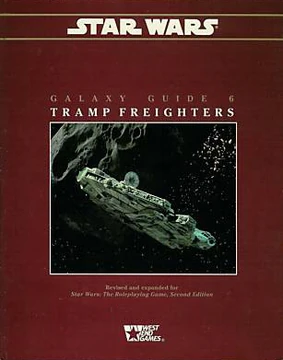
Galaxy Guide 06: Tramp Freighters
Galaxy Guide 06: Tramp Freighters
By Mark Rein-Hagen and Stewart Wieck. Revised for Second Edition by Eric Trautmann.
Development and Editing: Paul Murphy. Development and Editing for Second Edition: Peter Schweighofer, Bill Smith. Graphics: Tim Bobko, Thomas O'Neill. Cover Art: Lucasfilm, Ltd. Interior Art: Allen Nunis. Ship Illustrations: Rob Caswell. Publisher: Daniel Scott Palter. Associate Publisher/Treasurer: Denise Palter. Associate Publisher: Richard Hawran. Senior Editor: Greg Farshtey. Editors: Peter Schweighofer, Bill Smith, Ed Stark. Art Director: Stephen Crane. Graphic Artists: Tim Bobko, Thomas O'Neill, Brian Schomburg. Sales Manager: Bill Olmesdahl. Licensing Manager: Ron Seiden. Warehouse Manager: Ed Hill. Accounting: Karen Bayly, Wendy Lord, Kimberly Riccio. Billing: Amy Giacobbe.
Published by West End Games.
RR3 Box 2345, Honesdale, PA 18431-40095. ®, TM and © 1994 Lucasfilm, Ltd. (LFL). All Rights Reserved. Trademarks of LFL used by West End Games under authorization.
Introduction
In 1990, Galaxy Guide 6: Tramp Freighters became one of the most popular supplements created for Star Wars: The Roleplaying Game. Tramp Freighters offered gamers and fans of the Star Wars trilogy a new insight into the events occurring "a long time ago in a galaxy far, far away ... " This supplement illustrated a universe far larger than the Empire and the Rebellion, leaving players more "space" to explore: in short, a whole new galaxy was opened up. This galaxy guide is about the role of tramp freighters and their crews. Included in the following pages is a complete Star Wars campaign, providing the rules and background needed to run a series of closely connected Star Wars stories centering on the star-trading circuit of the Minos Cluster. Galaxy Guide 6: Tramp Freighters has now been expanded and updated to incorporate all major rules modifications and additions instituted in Star Wars: The Roleplaying Game, Second Edition. New modification rules, character templates and gamemaster characters have all been included, expanding the horizons of the Star Wars universe even farther. This supplement includes a detailed campaign setting: the Minos Cluster.
The Rules
A large part of this galaxy guide gives rules for hauling, buying and selling cargo, dealing with the black market, Imperial classifications of contraband, and the expenses involved in maintaining and customizing a ship. This information will be helpful in any campaign involving space travel, and may be used even if you decide to take your characters far outside the Minos Cluster.
The Minos Campaign
This campaign may be quite different from any you have run previously. Normally, characters in a Star Wars campaign are directly involved in the Rebellion as fighters for the Resistance. In this campaign, however, the characters are, first and foremost, star-traders operating solely for profit.
As the campaign opens, the characters are mostly interested in keeping the loan sharks off their backs and keeping their dilapidated freighter in space for just one more jump - fighting for freedom in the galaxy is a distant second, if it ranks that high. As the campaign progresses, however, they may find themselves becoming more and more entwined in the war against the Empire, much as Han Solo did over the course of Star Wars: A New Hope through Return of the Jedi. Over the course of the campaign the characters will have opportunities to outfox their competitors, deal with Imperial Customs officials, bargain with strange aliens, improve and even arm their ship, and, of course, assist the Rebellion. Sometimes they will have to do it all at the same time. Eventually, after great effort, the traders might be able to customize their ship into a spacecraft as truly exceptional as the Millennium Falcon - but to afford it they will have to be highly capable and shrewd operators. There are many frustrations which accompany the operation of a tramp freighter. As quickly as you make a few credits, you can lose them. If the characters become involved in smuggling, the potential profits may be increased, but the risks will be increased as well. Whatever travails the characters face in the cutthroat world of interstellar trade will be only increased if and when they become involved in the Rebellion. (Just ask Han Solo about the difficulties involved.) This campaign has been designed to start slowly and relatively low-keyed, becoming more and more broadly-scoped and fast-paced as time passes. The characters receive fewer spectacular rewards at first than what they might be used to, and only through the operation of their ship are they able to get money and equipment. Since they do not start as part of the Rebellion, the characters do not have access to free equipment, nor will they be told what missions to go on. They are free to go where and do whatever they wish. However, as gamemaster, you should make it clear that star-trading is central to success in the Minos Cluster, and if the characters simply wander the Cluster aimlessly, they will quickly go broke. We hope you and your players will enjoy trading on the fringes of the galaxy, and that the characters will eventually find ways to assist the Rebellion while still maintaining a healthy profit margin. Most importantly, we hope that you are able to explore a whole new avenue of roleplaying and that your players will be presented with interesting dilemmas for their characters to face, as they try to juggle their greed with their sense of justice.
Time Frame
This supplement is set in the classic Star Wars time frame, before the deaths of Darth Vader and the Emperor, shortly after the Battle of Yavin. During this period, there is still a highly effective and well-organized military present in Imperial space, and Boba Fett is still among the most feared bounty hunters in the galaxy. Player characters should be reminded that these are dark times, indeed ...
Chapter One: How to Begin
Before you attempt to run the Minos campaign you should read and be comfortable with the material included herein. Be sure you understand how to use the transport, trading and ship modification rules. You should also have a general idea of how you are going to do things - decide the tone your adventures will have as well as the style of gamemastering you will employ. Are you going to adapt our suggestions for how to run this campaign, or are you going to use your own ideas? If your players have gamed with you before, think about changing your style, so that they can't predict what will happen next in your adventures.
Ship Design: As a group, the players should design the stock light freighter which they will later crew, deciding what it looks like both inside and out. Let the players examine the ship design and improvement chapter in this book, and then tell them to go to it. Unless they manage to steal somebody else's ship and get away with it, the player characters are going to be stuck with that ship for quite some time, so they will want to do a good job. Have the players look at the various stock and modified freighters provided in this book as a reference for their own vessels. Spending time intelligently creating the ship at the start will only make the campaign better later on. (Besides, this is a lot of fun. Basically, all players think they are brilliant ship designers. Maybe yours are.)
Player Characters: In addition to designing their ship, the players will have to create the player characters to crew the vessel. In general, players are encouraged to create new player characters for the Minos campaign, but it is possible to run the campaign with more experienced player characters.
Using New Player Characters: If you are using new player characters, you'll have to do more work than normal to get them ready for the Minos campaign. First, each character must have some intimate connection with the ship explaining why he is aboard her, and why he is associating with the other player characters. The normal reasons why Star Wars player characters are together - because they're all part of the Rebellion - simply don't work in this campaign, for the player characters start the game independent of the Rebellion. However, there are plenty of good reasons why a diverse group of beings might choose to live and work together: friendship, relationships, and simple economic necessity, to name a few. As much as possible, let the players make up their player characters' connections. You, of course, have final say, but if the players contribute, they'll be much more satisfied with the results, and more inclined to roleplay them properly and make them a vital part of the campaign. Following are a few suggestions why the player characters might decide to work together as captain and crew of a tramp freighter:
• The player characters were once the ship's crew for the former owner, until they pooled their money and bought the ship for themselves (they've formed a "corporation"). All economic decisions have to be made by the group as a whole, though one player character is elected captain.
• The player characters are convicts who have fled to the Minos Cluster for safety, far from where they are known. They are now using the ship they have stolen to make a living for themselves. (Of course, the real owner of the freighter will probably want the ship back ... )
• The player characters all belong to the same noble family whose fortune has been recently lost due to Imperial activity. The only thing left of their once vast wealth is this crummy ship, and to survive they had no choice but to fly cargo for profit. (At least, that's the theory. Usually they just fly without getting paid by their customers.)
• One player character owns the ship, but in order to survive a very tricky situation (the very first adventure) is forced to take on some passengers (the rest of the party). It later proves to be impossible to get them off the ship.
Additional Details
There are some additional details you and the players should take care of before the campaign begins, such as designing each player character's personal background. Encourage players to craft a player character that is rich in detail, including home planets, personal histories, and any contacts they still have. Together you can create strong experiences in the player characters' history which could affect the way players should roleplay. Be sure each player character has something to provide the group, whether it be money, contacts, or simply a few useful skills. It is essential that the player characters can work together and that everyone contributes equally to the group's survival - a useless, self-centered crewmember will quickly disrupt ship-board life and will more than likely be booted off the ship as soon as everyone else grows tired of him. Once the players' characters are completed, let the players read Chapter Two, and you're ready to begin.
Using Established Characters
If the players already have Star Wars characters, they can be used in this campaign. However, the players might not be very happy with what you are going to do to their player characters; gamemasters are encouraged to completely pull the rug out from beneath their players. Essentially, you have to sunder the player characters' connections with the Alliance. For this campaign to succeed, they have to be all but completely on their own, with few resources to call upon but their ship, their brains, and their brawn. The campaign will not succeed if the player characters can, at will, go back to Alliance Headquarters and requisition several hundred heavy blaster rifles or a wing of starfighters to help them out of a tough situation. The player characters should be outside of the Alliance's chain of command altogether. For established player characters, this means a bit of work on your part. Gamemasters may find that sending the player characters into the Minos Cluster as deep-cover operatives or as hunted criminals are easy ways to sever their ties to the Rebel Alliance.
Some Reasons Why a Character Would Be Useful in the Group
• You have bounced from planet to planet, system to system for years, working for passage on anything from luxury liners to garbage scows. Along the way you have learned the basics of starship modification and repair, planetary systems and their unique differences, and have picked up an impressive command of a few non-Human languages. Overall, you can sell these services for a decent profit, to whoever will take you to the next port.
• You are a highly-trained ship mechanic, and are able to repair nearly any sort of equipment. You are more comfortable with machines than with other people, though the crew you are shipping with now is able to make you feel at ease.
• You hail from one of the worlds in the Minos Cluster, and you still have numerous family, friends and contacts there. While you lived in the Cluster, you couldn't wait to leave. Now that you've seen some of the galaxy, you can't wait to go back.
• You own the ship, yet you also owe a loan shark nearly 20,000 credits. Unless you find a partner soon, you won't be able to continue your life among the stars. Chances are, if you don't pay this guy off soon, you won't be able to continue any life at all.
• You have just gotten your inheritance, and can finance the first purchase of cargo, but you have absolutely no experience with life in space.
• You are a criminal with a record, and have found it impossible to get any sort of Imperial work permit yet you just won this funky freighter in a bet. While living in the underworld of many planets you have established contacts for nearly any sort of criminal activity, including fences, cosmetic surgeons, document forgers, and toughs.
• You already have the necessary licenses and permits to be a freighter captain. You also have a great deal of expertise as a space pilot. Unfortunately, you've become a drunk and have no ambitions other than getting your fill of Regellian draught. These other guys need a pilot; you need to get off-planet before the local authorities throw you in the drunk tank, permanently. You vow to stay sober (but don't know if you can do it, though).
• You have been the Rebel contact on Gesaril for the last 10 years, but your cover has been broken, and you must run for it. You know of nearly every Rebel sympathizer in the Minos Cluster, and know how to get in contact with the Rebellion outside of the Cluster. On many systems in the Cluster you have a contact. For now, however, you are on the run.
Undercover Operatives
The Alliance is constantly seeking to expand its spy network to all sectors of the galaxy. The Core World sectors are the biggest intelligence prizes: they are the richest, the most strategically important and heavily-controlled regions in the Empire, granting a successfully-infiltrated spy network unparalleled access to the Empire's corridors of power. Networks in the Core Worlds stand to make the most spectacular gains. Unfortunately, they are also more likely to be compromised and eliminated. COMPNOR is ruthless, especially to spies found on their doorstep. Six out of every 10 new Core World intelligence networks are compromised from their inception. Nearly half of all networks are infiltrated and destroyed during their first six months of operation. Alliance Intelligence must constantly disband and recreate its networks - an expensive, dangerous and nerve-wracking business. The Outer Rim Territories, on the other hand, are relatively poor and of little strategic importance, and thus receive little Imperial attention. They provide the bulk of the Alliance's food and supplies, and are fertile recruiting grounds for Alliance soldiers and operatives. For these reasons, Alliance Intelligence spends a great deal of its resources into setting up and maintaining networks in the Outer Rim. But, though Intell may put loads of money, equipment and agents into the Outer Rim Territories, there are thousands of sectors within the Outer Rim; Intell's resources are stretched almost to the breaking point attempting to cover even a fraction of them. Unless an individual sector is of unusual strategic importance, it receives the bare minimum of attention possible. Intell organizes groups of agents, gives them new cover stories and some money and the bare essentials in terms of equipment, ships them into the Outer Rim and tells them to do their best, do it right, and do it yesterday. Intell doesn't want to hear from the Rebels until they have the network up and running. In this campaign, the Rebels have been chosen to set up the network in the Minos Cluster. They have been given a dilapidated starship and told to set up cover stories as traders. Once they have established a functioning network, Intelligence will give them new orders.
The "Hunted Criminals" Gambit
In this approach, the Rebels travel to Minos Cluster because the rest of the galaxy has become too dangerous for them to roam around in. Essentially, it's an extension of the "Undercover Operatives" idea, though the Rebels don't go to Minos by choice: they go because if they stay where they are, they'll almost certainly be hunted down and killed. To get this to work, you should create a truly nasty last adventure to end the old campaign. The player characters should have a very good chance to seriously disrupt Imperial operations in their sector, destroying vital enemy equipment, discrediting the local sector Moff, rallying thousands of citizens to the Alliance's cause, and otherwise make themselves a major nuisance to the Empire. When the Rebels succeed, there is much rejoicing in the ranks of the Alliance. Then the Imperials mount a staggering counteroffensive, and it is more ferocious than anyone thought possible, moving in unexpectedly large amounts of troops, supplies, and military hardware. The Alliance forces of a few cruisers and starfighter wings are badly outmatched and immediately retreat from the sector. The Imperial troop line deploys around the planet the Rebels have been most active on, and several divisions of Imperial soldiers land on the planet and ruthlessly subjugate it. Other Imperial ships go into orbit around other Alliance-sympathetic planets. The new Moff of the sector demands immediate surrender, threatening devastating retribution if the planets do not comply. One planet does not - and all of its major cities are bombed into rubble from space. Holos of the devastation are distributed to all the planets in the sector. Within days, virtually all of the planets in the sector have surrendered. The player characters' victory celebration has ended. Imperial Intelligence has also been highly active, rounding up thousands of suspected Alliance sympathizers and subjecting them to interrogation, a process that sends shivers up the spines of even the most hardened of intelligence operatives. Soon, many of the Alliance intelligence networks in the system are compromised, infiltrated and destroyed. Alliance commanders fear that the Sector HQ is compromised as well: too many operatives have disappeared, and the chances that all of them were able to commit suicide to avoid interrogation is exceedingly small. The base is to be evacuated, immediately. Finally, the last bit of bad news. Alliance agents inform Sector HQ that the Empire has names and descriptions of all of the Alliance's intelligence assets in this sector - including the Rebel player characters. The Empire has published their descriptions and put a bounty of several hundred thousand credits on each of them. Their covers are irretrievably blown in this system and probably throughout the rest of Imperial space as well. At this moment, they are more than likely being hunted by dozens of the best bounty hunters in the galaxy.
The Rebels have only one chance for survival: go somewhere far away from the war zone, and stay there - quietly - until things cool down. Alliance Intelligence gives them some funds and tells them to go away for a year. Intell doesn't want to know where they are; with the huge bounties on the Rebels' heads, not even everyone in Intelligence can be trusted. An ally of the Rebels that works for Intelligence suggests that the Minos Cluster, a remote, backwater region, would be an ideal area for hiding from the Empire. As long as they pose as one of the thousands of tramp freighter crews that pass through the Cluster, the Rebels can lie low and (hopefully) avoid trouble. While this is an extremely grim scenario, and a lot of the Rebels' friends and loved ones are in grave peril, the Rebels have, in fact, succeeded in their mission: they have forced the Empire to divert precious resources from other sectors and from the Imperial search for the Rebel Fleet and main base. Though the people in this sector will suffer (badly) in the short run, the Rebels' actions here have had a significant impact on the course of the war. If your players seem rather depressed by this turn of events, you should relay this information to them. To survive, the player characters will have to change their style. They are not going to the Minos Cluster to save the galaxy, they are going to the Minos Cluster to hide out. If they can make a little money, and aid the Rebellion in whatever way they can, whenever they can, then so much the better. They are ordered to stay out of any Rebel operations in or near the Minos Cluster, nor are they to make contact with any Rebel personnel. After the furor in their home sector has died down, Alliance HQ will summon the player characters back into Rebel Alliance. The player characters will be out of the spotlight of the Rebellion for a time, and are largely left to their own devices. This is a good opportunity for you to get a grasp on your own campaign, to tone down the player characters' powers and the players' expectations. By lowering the intensity of your campaign you can give it renewed life and vigor. Once you finish the Minos campaign, the player characters can return to the hot-spots of the Rebellion from whence they came. Hopefully they will take with them a better idea of what they are really fighting for.
Chapter Two: Player Introduction
The players should read the following material at the start of the campaign. It will give them an idea of their new roles in the Star Wars universe.
The Life of a Tramp: It can be tiring, troublesome, difficult, and hectic. But if your blood boils with the desire to be your own person in a time when government seeks to control you more than ever before, then life on a tramp freighter is for you. It offers good and bad, but once you experience it, chances are you will never want to give it up. You know the life will be tough. When you were younger, you used to talk with the crafty old tramps at the local bar. Usually, they were self-centered, cantankerous, and cheap. Their constant struggle for survival - living from hand to mouth - did that to them. But sometimes a fellow would swagger in, brag up a storm about the deal he had just closed or the trip he just made, and throw his credits to the wind. Then all of the captains loosened up, enjoying his success as if it were their own. The tramps took life as it came: they were tight when they had to be, free-spending when they could be. They were fierce rivals - but if one of them were in trouble, there is nothing the others would not do to help him. They looked after their own. (Mostly, anyway.) You know a little about buying and selling goods, about space travel, about hauling cargo, but you'll have to learn the ropes as you go. What goods should you buy? Where's the best place to sell? How much should you charge for hauling time-sensitive cargo? How much for danger pay? What are the best routes to frequent? Where are the pirates? Where are the customs officials? Which ones can be bribed? Which ones can't be bought? Even those who seem to have it down to a science can lose their shirts. It takes luck and a lot of intuition, you've heard other tramps say, to make enough money to keep the creditors happy. And you'll certainly have creditors to worry about. Unless you're exceedingly well-funded, the only place you can get the money to buy a ship quickly is through a loan shark. He will be happy to loan you the money. He also makes it perfectly clear that the penalty for non-payment will be painful, and eventually fatal. (And the loan shark will be happy to complete that transaction as well.) You've heard talk of a Rebel Alliance fighting the Empire, but that's not your concern. Oh, you wish them luck; there are already too many regulations governing interstellar trade and you know the Empire has more tricks up its sleeve, so anything which preoccupies them is good news for you. Mostly though, you just hope the fighting stays out of your sector since money gets really tight when the lasers start shooting, and the trade lanes can dry up at lightspeed when the Imperials and Rebels start nosing around. Unless you fancy weapons-running, with all the risks that entails, war is definitely bad for business. But no matter what happens, you'll survive. You and your kind always have. They can put in all the bulk freighters they like; they can add all the silly, demeaning, pointless regulations they want; they can let the pirates have free run of the space lanes. But they'll never stomp you out. You've seen it all before. Your kind has been around as long as there has been space travel and you'll still be here long after this Empire has been dead and buried. You're part of a proud and lonely heritage: you're a tramp, lord of the space lanes.
Note: If you wish to run a tramp freighter captain, you can use virtually any character with a reasonable Mechanical and Perception score (and with reasonable access to a spacecraft). In addition, there is a tramp freighter captain template provided at the end of this book.
Chapter Three: Drop-Point Delivery
Drop-point delivery, when a freighter is hired to carry cargo from one place to another in a specified amount of time and for a specified fee, is the standard way in which tramp freighters earn their living. The profits are not tremendous, but often it is the only legitimate way open to a tramp to make money. It's also the easiest way for the gamemaster to control the flow of the game. You can send the player characters anywhere you want them to go, simply by giving them a consignment headed in that direction. And you can determine how much money they have simply by paying them more or less for each trip.
Finding a Customer
Finding a customer is as difficult as the gamemaster requires. If you want it to be easy for the traders to find someone who needs something transported, it is. If you want to get them to go to a planet, let them find someone who has something he wants taken there. If, on the other hand, you want the player characters to have to roll for their drop-point deliveries, you can have them make streetwise or Perception rolls, with success levels determining how good and potentially profitable the run is:
| Roll to Find Customer | Run Found |
|---|---|
| Failure | No run |
| Very Easy | Long run, not much cargo, marginally profitable |
| Easy | Long run, large cargo, barely profitable |
| Moderate | Moderate run, large cargo, fairly profitable |
| Difficult | Moderate run, full cargo, good profit |
| Very Difficult | Short run, full cargo, high profit |
Remember that you should use this table only between your designed adventures. That is, if you haven't got anything planned for them, or if you want to go through a lot of runs in a short period of time, you can have the player characters roll to determine what kind of runs they get. Your adventure needs always supersede this or any other table.
Fees for Drop-Point Delivery
The standard fee for drop-point delivery is between five to 10 credits per ton, per day. This is based on a x2 hyperdrive engine (the standard for tramp freighters), plus one day to load cargo and get out-system, and one day to get in-system at the destination planet and off-load the cargo. That is, if a shipper needed 50 tons of cargo hauled to a planet which was 10 hours away and he was paying the 10 credit/ton rate, he'd offer the job for 1,500 credits: 10 credits x 50 tons equals 500 credits per day; 500 credits times three days (one day to load cargo and go to hyperspace, one day in transit, one day to offload the cargo) equals 1,500 credits. If the trip took longer than expected, the shipper wouldn't pay for the extra time: that's the freighter captain's problem.
A Friendly Reminder: Galaxy Guide 6: Tramp Freighters is about seedy characters, scoundrels, and Rebels-in-waiting zooming around having adventures in space, and hauling cargo is more an excuse for the action than the heart of the action itself. However, you will want to keep it somewhat realistic - and, more importantly, internally consistent - to help the players suspend their disbelief. These rules are meant to help you do so.
In addition to the standard fee, shippers might offer bonuses for quick delivery. (Be assured that penalties for slow delivery are almost always charged.) If the shipper has a smaller load but requires a quick turn-around, he's likely to pay more per ton, or simply hire the entire vessel for the trip (usually at 300-600 credits per day). Typically, shippers pay half the fee up front. They give the freighter captain a voucher for the other half. The voucher also lists any bonuses/ penalties for early/late delivery, and so forth. The freighter captain is responsible for the condition of the goods: if they're damaged, the receiver may refuse to accept them, or pay less for them.
Insurance: The shippers might (and most larger shippers do) demand that the hauler take out insurance on the cargo; this usually runs between 1% and 10% of the cargo's value, depending upon the traders' reputation, the riskiness of the trip, the fragility of the cargo, and so forth. If the trader can't get a reputable insurance agent to cover it, he can turn to a loan shark, or he can post his ship as collateral against the cargo. Both of these last two are quite risky, as you might imagine.
Repeat Business: The player characters can make contact with a shipper who needs a lot of repeat business. The only way they can assure themselves of gaining such a job is by being cheap and reliable. Though they will tend not to make as much money on individual runs, over the long term their income will be higher. Generally, if the player characters get a long-term contract with, for example, a trading house, they'll have to accept a fee perhaps as much as five or 10 percent below standard. But they will get steady work, and there's a pretty good chance they'll also get bonuses for on-time delivery as well as breaks on ship-repair and upgrade fees.
Chapter Four: Speculative Trading
One of the ways a tramp can earn a living is through speculative trading: that is, purchasing a cargo out of his own pocket, taking it to another planet, and attempting to sell it there for a profit. This is fairly risky and requires a large investment of capital and time, so most new captains avoid it unless presented with an especially good deal. When involved in speculative trading, the tramp is up against the established trading houses, people with contacts among the producers and consumers in their system, years of experience in buying and selling items, the capital to be able to afford to hold onto items until it is profitable to sell them, and the warehouse space to hold them until they are sold. Tramps don't have many of these things. Additionally, it must be noted that, when engaged in speculative trading, the tramps are competing with the people who normally provide them with the cargo to haul in drop-point delivery: they had better hope that they don't annoy their best customers, or the freighter's other sources of income will simply dry up. Further, if they begin to cut seriously into the trading houses' profits, the houses may in retaliation start up a price war against the freighters, deliberately selling goods below cost to steal the freighter's customers. In this kind of battle, the freighter captain is almost certain to lose: the houses have the capital to survive a long time without making a profit; the tramps don't. Still, this is where the big money is to be made. If the tramp freighter captain is successful, he may be able to work his way into the lucrative buying and selling business full-time - becoming a trading house himself and employing other freighters to carry his loads. But he certainly shouldn't attempt this until he knows Minos Cluster inside and out; as an old saying goes, "It's much easier to get skinned than it is to sell skins for a profit."
Buying and Selling: Attack the Number-Crunching Players
This chapter's rules allow a character to find a source of goods on one planet, make his purchase, and then find an interested consumer on another planet and sell the goods, hopefully for a profit. Whether or not the trader has a chance to make money is dependent on certain skills, particularly bargain, bureaucracy and value. But whether the character actually makes money depends on the player. He's the one who must decide where his character will look for buyers and sellers, and these decisions will only be made properly after a little experience. That's appropriate: as the player learns, so will the character, and anyone new to a profession tends to be ignorant of many of its intricacies. There are also plenty of opportunities here for characters to get into trouble. Traditional cargo deals - the simple purchase of products for resale somewhere else - are risky enough, and roughly 20% of even established, experienced traders' speculative deals go sour, the goods sold at a miniscule profit or outright loss. It is not unusual for sellers to attempt to sell shoddy merchandise to neophyte buyers; if the tramps are not careful, they may end up with a cargo of colored water where they thought they had medicine, or a cargo of rotting vegetation when they believed they had purchased food. Let the buyer beware. Similarly, the purchaser may attempt to rook the traders by refusing to pay for goods, underpaying what was promised, stealing the cargo outright, and so forth. These are all good ways to add interest to what is otherwise a rather dry number-crunching exercise. Remember: this is a roleplaying game, not a commodities transportation simulation. The most important thing to remember is that the rules should support the kind of game you and your players wish to play.
Manipulating the buying and selling rules can be fun, but it can also be time-consuming and may run against the grain of a gamemaster's more free-wheeling style of play. If your players are interested in zooming about the galaxy, going from spaceport to spaceport, interacting with the natives and blowing up Imperials, by all means do not let your adventures get bogged down in these trading rules. Use these rules for background and stick with the drop-point delivery rules described elsewhere: they're fast and fun, easily manipulated by you and your players to get the results you're looking for. However, if you and your players are interested in the intricacies of galactic trading, if you enjoy the chart-consulting, record-keeping, and number-crunching necessary to make these rules work, go for it. Don't feel obliged to roll the dice for every transaction the characters make, but, on the other hand, don't forget to reward characters who work hard to improve the skills that are supposed to help make them rich. Just remember that the rules are meant to serve the needs of your story. If your adventure calls for the trader to strike it rich, let it happen no matter what the dice say. By the same token, half the fun of being a tramp freighter captain is living on the edge while trying to convince creditors that things are going just fine. If the trader makes too much money too quickly, weave a story of disastrous ruin into the saga. Just as a tramp freighter captain tries to balance his life between survival, the Rebellion and the Empire, so should you try to balance these rules and your own story.
A General System: While the following rules cover many aspects of running a tramp freighter campaign, gamemasters should be aware that these rules tend to generalize and simplify what is an incredibly intricate galaxy. In other words, gamemasters should feel free to alter the rules to fit their needs. For example, the technology level system is based on Imperial guidelines, complete with the Empire's biased point of view. Implicit in the Empire's view is the belief that any society different from the Empire is "inferior": planets ruled by religious hierarchies, or planets "only" up to atomic technology are regarded as "primitive." Imperial sentientologists also assume that the development of civilizations will parallel the development of Imperial civilizations - stone technology goes hand-in-hand with tribes, and tribal units do not understand money. This could not be further from the truth. Gamemasters should feel free to mix and match concepts - such as space-level planets with migrating tribes - as long as a believable story context can be devised to explain the planet.
Likewise, the Empire's trade categories are very general and gamemasters can choose to devise one specific type of good that differs from the rest of the planet's trade profile. For example, Kessel would be a normal space technology planet in all respects except that spice is much cheaper because it is abundant there. Other planets might otherwise have unusual trade profiles - for example, industrial planets that have already developed repulsorlift drives, therefore reducing demand for items based on that specific technology. The gamemaster must also consider how trade is conducted on certain planets. While characters must normally make bureaucracy rolls to find buyers or sellers on most planets, there are planets where different skills are needed to conduct trade: business, cultures, streetwise or even persuasion. For example, characters could use streetwise on planets where trade is conducted exclusively through open air markets or on planets where trade is largely controlled by organized crime.
Buying and Selling Goods
This speculative trading system assumes that the tramp freighter is purchasing cargo at one point and travelling to another point to sell the cargo (hopefully) for a profit. Note that traders should not buy and sell items on the same planet. There are wholesale companies which handle the relocation of goods from one part of a world to another, and these companies do not look kindly upon those who try to muscle in on their business. Since they have the political and economic clout to stomp any small-time interlopers, player characters should be warned not to attempt to sneak a deal past the planetary business networks. (Although, sometimes a deal comes along that looks so sweet it can't be ignored ... ) The system which follows does not take into account other expenses which the tramp freighter might have - docking costs, ship repairs, and so forth. Rules on these operating costs may be found in another chapter of this galaxy guide.
Technology
These six classifications are used by the Imperial bureaucracy to identify the level of technology on a particular planet. Realistically, planets will not fall directly into one of these categories, but the gamemaster should assign each planet to the one category it most closely resembles. Technology levels are used in the buying and selling procedure.
Stone
This is the most primitive category of world which need concern us. (Civilizations at lower than stone tech level do exist, but it is virtually impossible to trade with them.) The cultures of the world are loosely-knit; the basic social unit is likely to be the tribe. The society makes and uses stone tools, and, if herbivorous or omnivorous, the people will probably have developed primitive agriculture. A trader can sometimes find a market for manufactured goods here (metal tools and weapons, mostly) and foodstuffs. These people probably do not understand the concept of money, so all deals will have to be based on barter, with the primitives trading their goods for the trader's. It's fairly easy to trade for low-tech goods on these planets, and with some hard work, the trader can also find minerals, luxury goods (objects of primitive art, mostly), food and medicine. The primitives have no transportation network, and each tribe is likely to have only a few items worth trading for, making gathering a full cargo a lengthy business. Risks: Traders are sometimes mistaken for demons or other mythic beasts and attacked accordingly. And the tribes are likely to be migratory: a trader who has established good relations with one tribe may return during a later journey to discover that it has up and vanished on him, never to be seen again. Example of Stone-Level Planet: Endor, the Ewok homeworld.
Feudal
Worlds classified as "feudal" have established a complex social order and have begun to produce primitive manufactured goods. They have developed a slow transportation network (typically roads and ships) and have discovered currency, making wholesale trading of goods possible. They have probably learned primitive mining and ore-processing techniques. When first discovered, these worlds can be extremely profitable. The people on these worlds will often pay fortunes for any advanced items: manufactured goods, medicine, educational material, weaponry, and the like. If the world possesses mineral wealth, animal wealth (furs and the like), or the people of the world are good craftsmen, the trading potential is enormous. However, once another trading house discovers the location of the planet, they will quickly move to establish a permanent outpost to gather its profits. The competition will quickly drive the price the natives are willing to pay for imported goods down and the price they are willing to sell native goods for up. There will still be profits to be made: they simply won't be astronomical. Risks: Just because people are feudal does not make them stupid, and their culture has probably got a good deal of violence in it. Traders who attempt to rob these people may find themselves attacked by screaming hordes of armor-clad beings wielding pointy swords, or by even more insidious means, say, poisoned mead at the king's party. Example: Gamorr, the Gamorrean homeworld.
Industrial
Industrial worlds are just beginning to discover important manufacturing concepts such as mass production. Windmills, waterwheels, wood or coal furnaces or whatever primitive machinery the environment will accommodate are used to provide energy to manufacture items. These worlds generally have an aching need for raw materials and metals, and are always looking for instructions on ways to improve their manufacturing capabilities. They typically have an established central government, or a number of governments each controlling a significant portion of the planet. If the planet is unknown to the Empire, the first trader there can make a killing. Once the larger trading houses discover the planet and set up shop there, profits begin to drop quickly to more reasonable levels.
Risks: These planets often have weaponry which could seriously threaten a trader (slugthrowers can be, in the right circumstances, just as lethal as a blaster), and a couple of cannon shots could conceivably put a hole in a grounded ship (though the odds of a cannon shot hitting a moving ship would be astronomical). The industrial planets are likely to attack traders if they suspect that doing so would earn them cheap information about high technology ("Please to telling me how make metal so strong as your ship's skin or I will pulling your friend's eye out, yah?"). Example: Ryloth, principal world of the Twi'leks.
An atomic civilization has advanced to large-scale production of goods and is beginning to discover how much the universe offers. More potent forms of energy are discovered and rocket technology is developed. The planet seeks to learn more about the planetary bodies near the homeworld. Since these civilizations broadcast a lot of energy (in the form of radio waves, for instance), most of them in the area in which the tramps are working will have been discovered, and the trading houses will have established permanent settlements on them. The Empire may very well have "invited" them to join its ranks, as well, for purposes of taxation and military conscription. This limits the tramps' opportunities for major trading kills, as they will be competing against the trading houses. If, however, the tramps are exploring far enough afield, and come across an atomic-level civilization which has not yet made contact with the civilized galaxy, the opportunities for a killing selling the planet information are extraordinary. Risks: Similar to those of an industrial civilization, except that their weaponry is better (a chemically-powered surface-to-air missile could conceivably hit a slow-moving trader, and it would do an appreciable amount of damage). Also, atomic-level planets sometimes have a militaristic mind-set, and contact with offworlders is often met with suspicion, fear and paranoia. (Pity the tramp freighter that inadvertently sets down near a planetary military installation.)
Information
Sophisticated devices of communication and data-processing characterize civilizations in the information age. The recent development of computers has completely restructured these beings' lives, and their technological level is beginning to approximate that of the more backwards planets in the Empire. Information-age planets still have not yet discovered the secrets of hyperspace, though in-system space travel may be relatively common. If the traders are lucky enough to be the first to discover an information-age planet, they can, once again, make a fortune selling them the secrets of repulsorcraft engines (unless the planets already have it), droid technology, and hyperspace. The Empire would definitely, however, be interested in setting up normalized relations with such a planet as soon as it found out about it, and the trading houses too would be all over it in months. The trader's window of opportunity for making a killing is very small indeed. Risks: Once again, the same as industrial- and atomic-level civilizations, but the weapons are better still. An information-age planet may have sophisticated space-based weaponry. Its subspace fighters may go almost as fast as a freighter in atmosphere. In a dogfight, the freighter would almost certainly defeat one or two enemy fighters, but a dozen could give it problems. Ground-based lasers and atomic missiles would definitely give it problems. Example: Kubindi, the Kubaz homeworld.
Space
This is the stage at which most planets in the Core Worlds are. The trappings might be different, but these planets have about the same level of technology as that which can be found on Cloud City, Tatooine, Coruscant, or anywhere else in the civilized sectors of the galaxy. Discounting odd exceptions of fantastical advancement like the Columi of Columus, the space age is the final stage of development of any civilization. In this level of civilization, a species takes to the stars to found colonies and discover the universe. The colonies often begin as farming communities; this step is often prompted by overcrowded conditions on the homeworld, but a variety of other factors have pushed species to the stars. While some space travel may have been practiced during the previous stage of civilization, at this level the people have learned the secrets of hyperspace travel. Since space-age planets are at roughly the same tech level as the traders, there's little room here for a killing selling these people information. It's marginally possible that they might not yet have discovered the secrets of bacta tanks or some other specific item they'd pay a lot for; it's equally possible that they have discovered some item which the Empire doesn't yet know about. The chances of being the first to discover a space-age civilization are, of course, almost vanishingly small - unless you travel far away from known space. Risks: Once again, same as before, except that these folks may have their own versions of starfighters, frigates, cruisers, and the like. Example: Calamari, the Mon Calamari and Quarren homeworld.
Trade Good Categories
To make the system simpler, trade goods have been broken down into the following categories.
Low Technology: This category includes simple manufactured items like handiworks, native crafts, furniture and woven cloth.
Mid Technology: In this category are devices which result from semi-complex manufacture. Textiles, mechanical weaponry (projectile weapons, etc.), paper goods and elaborate craft items are included here.
High Technology: Very advanced products are classified as high technology. Items like computers, lasers, plastics and polymers are part of this category.
Metals: All manners of formed metals are included here. Steel, copper, iron and iridium are examples.
Minerals: Mineral ores required to produce any number of items are part of this category. Iron ores (hematite and magnetite), copper ores (chalcopyrite and malachite), and ores used for other purposes such as mixing cement (calcite) and common salt (halite) are notable examples.
Luxury Goods: A multitude of expensive items are classified as luxury goods. Spices, works of art, precious metals, gems and liquor are examples of items which may be purchased without any actual need of the item. Certain items from other categories might be considered luxury items on some worlds. For example: salt is a mineral, but on Arcona salt is a luxury item; a low-tech chair might be a luxury on a wealthy high-tech planet. Liquor and other recreational drugs are also luxury items (in the right market).
Foodstuffs: This category covers any meat, vegetable, or protein, but primarily denotes grain and other bulk food products.
Medicinal Goods: Drugs and herbs of all kinds are classified as medicinal goods. Such items are especially useful on the worlds of moderate technological level, where over-populated, unsanitized cities have bred diseases which the civilization has yet to find cures for.
Using the Supply and Demand Table
To use this section, refer to the "Supply and Demand Chart" on page 94. This contains information on how difficult it is to purchase a product, what the base purchase price of the product is, how difficult it is to sell the product, and what the base selling price is. The rows of the table list the various product categories - low tech, foodstuffs, and so forth. The columns of the table list planetary technology levels - stone, information age, and so forth. Cross-referencing the commodity with the planetary tech level, you can find out how easy or difficult it is to buy or sell any commodity on any tech level planet. The bold entries refer to the available supply of the commodity, the entries in regular type to the demand for the commodity. The letter before the slash tells how high the supply or demand for the item is: very low, "VL"; low, "L"; moderate, "M"; high, "H"; or very high, "VH." The number after the slash lists the base purchase or selling price for the commodity on that planet type. For example, if a trader wished to trade in mid-tech products on an industrial world, you would cross-reference the row on mid-tech products and the column on industrial-level worlds, where you would find the entry:
M/5400 H/5670. This tells you that, on an industrial world, there is a moderate supply of mid-tech goods, and each ton of mid-tech good has a base cost of 5,400 credits. There is a high demand for mid-tech goods, and each unit has a base purchase price of 5,670 credits. Once you have this information, you can find out whether or not the trader was able to find a buyer/seller, and how many credits he paid/made on the transaction.
Finding a Customer/Seller
To find a customer/seller, a trader must make a bureaucracy skill roll. The difficulty of the roll is dependent upon the scarcity of the product he wishes to buy, or the demand for the product he wishes to sell. Examine the "Buying/ Selling Difficulty Chart" in the "Charts and Tables" section. This lists the difficulty of finding either a cargo or a purchaser of a cargo, according to the supply/demand for the cargo. For example, if the trader wishes to find a cargo with a high supply, he must pass an Easy bureaucracy roll. If he wishes to sell an item for which there is a low demand, he must pass a Difficult bureaucracy roll. Success at this roll means that the trader has found a potential customer/seller within the first two days he looked. Failure indicates that he did not, and any subsequent attempts to find a buyer/ seller for that same commodity have an increased difficulty of +2. The difficulty increases by +2 for each failed attempt; the difficulty remains increased until at least a month has passed.
Negotiations
Once the trader has found someone on the planet looking to do business, the two parties must agree to a price. The Perception skill bargain is used to negotiate a price. Rules for using the bargain skill can be found on pages 82-83 of Star Wars: The Roleplaying Game, Second Edition. Apply modifiers as indicated, but use the following chart to determine results. Bargain skills vary widely, ranging from 2D for barely competent traders up to 8D or more for very experienced traders. See the guidelines on page 41 of Second Edition for assigning skill levels. When bargaining, use the alternate results chart below because these results reflect trading large quantities of goods at wholesale prices, while the bargain results on page 82 of Second Edition reflect single transactions at retail prices. Factor the results against the product's base price.
| Seller Beats Buyer By | Price Multiplier |
|---|---|
| 2-4 | +2% |
| 5-8 | +4% |
| 9-12 | +6% |
| 13-16 | +8% |
| 20+ | +10% |
If the seller and buyers' rolls are within two of each other, the price is unaffected.
| Buyer Beats Seller By | Price Multiplier |
|---|---|
| 2-4 | -2% |
| 5-8 | -4% |
| 9-12 | -6% |
| 13-16 | -8% |
| 20+ | -10% |
Bad Deals
A trader can always refuse to buy or sell at the gamemaster character's final price, but, if he does so, he must find a different person to deal with, and the difficulty of doing so increases by one difficulty level.
How Much Can I Carry?
Besides money, there is another limit to how much cargo a trader can carry. Each ship has a limited amount of space for cargo, and a limited amount of tonnage it can carry. It cannot be emphasized enough, however, that a freighter can carry exactly what the gamemaster wishes it to carry. Remember, as long as it serves the story you are telling, player characters can carry as much cargo as needed. Detailing cargo space down to the millimeter is not necessary, as long as it remains within the bounds of common sense; the Millennium Falcon can handle a few tons of spice, not a few million (actually 16.5 tons to be exact). Just be sure to be consistent in what you allow the players to carry; if their ship could handle 15 tons of grain in one gaming session, it should be able to do it again, barring any major structural changes or damage to the ship.
Customizing the Tables
All of the data in these tables represent averages - and pretty general ones, at that. The "Supply" line on the "Supply and Demand Chart" shows the average supply for each good type; the "Demand" line shows the average demand. The prices are derived from the average prices shown in the "Base Cost and Weight Chart," multiplied by a percentage shown in the "Buying/Selling Difficulty Chart." It's all very, very generic. This is okay at first, as you and your players get used to the system, but you should, as soon as it is comfortable, customize these numbers to suit your campaign.
Instead of using our values, you are heartily encouraged to put in values of your own. If a planet of your own creation has some special sort of metal (called erkinite, for instance) to offer, it is much more realistic to assign erkinite a true value than to give it the average value for metal on the "Cost Chart." Similarly, you should alter the supply and demand for items to suit your campaign worlds: if you've got a stone-age world where the inhabitants live in trees and refuse to have anything to do with metals, change the demand for metals from "L" to "VL." Or ignore the chart and say that they simply will not buy metals there at all. If these same primitives use a lot of salt in their diet and therefore have become expert at collecting it, you can say that the supply of salt is "H," and, since they have so much of it, they sell it at 90% of the base mineral cost, or 1,350 credits (in trade) per ton. However, since this is the only mineral they use a lot of, the supply of other minerals remains "VL," and the cost remains high. As with most things, the more effort you make, the better the result. If you customize this system, it's going to be much more fun and interesting for your players.
Chapter Five: The Black Market
The Black Market: A Gamemaster's Paradise
Gamemasters who are looking for a down-and-dirty atmosphere for their campaigns may find the black market a blessing; player characters have an opportunity to acquire a great deal of cash, and gamemasters can manipulate the situation to throw the player characters into deep, deep trouble. (Greed can be a powerful gamemastering tool.) The black market is an illegal economic system outside of the normal galactic economy. Almost anything - weapons, spice, food, "contraband entertainment" - can be purchased or sold through these illicit channels. The goods and services available through the black market range from the mildly illegal (bootleg holos) to the morally repulsive (Twi'lek slave girls). Virtually every planet in the galaxy has some kind of black market, and in the Outer Rim Territories, these underground networks tend to thrive, since there are usually people willing to buy goods which are unavailable through normal channels. On Imperial planets, the black market may be a highly efficient system offering all of the goods described above, and more. On repressive or deeply religious planets, simple mind-altering substances such as alcohol or stimpills may be available only through the black market. On some planets, it may be illegal to trade in animal skins; there they would only be available through the black market. Planets that are near Rebel bases will often have some kind of a black market, possibly selling pornographic holograms, booze, or even expensive clothing not available to Alliance personnel through "official channels." A good does not necessarily have to be illegal or restricted to be sold on the black market either. People buy and sell through the black market sometimes simply to avoid paying taxes or to avoid notifying the authorities that one has purchased a certain good.
Contacting the Black Market
The first time the player characters attempt to contact the black market on a planet, they are asking for difficulties. Black-marketeering is inherently illegal; there's no sign posted saying, "this way to the black market." Some kind of contact must be made with someone who is involved with the network, and after this contact and a "routine check of references" by the marketeers, it is possible the traders may be allowed access to the operation. Often black marketeers know the contents of a freighter in their sphere of influence better than the vessel's crew, and will often make first contact if the cargo is of sufficient value. After the traders have made a contact on a planet, they will know who to talk to in the future and should have no further troubles, but the first contact can be difficult and risky. Fortunately, shrewd player characters are in a good position to get in contact with the black market. Elements of the black market can almost always be found in and around a spaceport: purchasing agents, shippers, and warehouse managers form an essential link in the underground economy, buying, selling, storing and transporting the contraband goods. In fact, the local customs agents may be intimately involved, as well. A keen-eyed, streetwise trader should not have too much difficulty determining who to talk to. (Determining what to say, and if the potential contact will listen - that's the tough bit.) Most free traders have done some business with the black market at some point in their checkered careers. If a player character merely asks politely at the local spacer's bar, he's likely to find someone with the right connections (for a small fee, of course). As long as the player characters don't give the impression that they are informing for the Empire/Rebellion/local law enforcement agency, they should be fine. (If not, well ... the situation will probably become fairly hostile, fairly quickly.)
If a trader wishes to get in contact with the local black market, his player should describe what he is doing: who he is talking to, how he is phrasing his questions, and so forth. If the approach is at all reasonable, the player should attempt to make a streetwise roll with the difficulty based on the "Black Market Contact Chart." Each roll represents about a day's worth of searching. Every day the player character searches unsuccessfully for a black market contact, the difficulty of the task increases by one step (i.e., if day one is a Moderate difficulty roll, day two is a Difficult roll, and so on.) Modify the player's roll according to how well the player character plans his contact and how well the player roleplays; the better the acting, the more likely it is that the trader will make contact. (Naturally, these are only guidelines, and should be used if the contact with the black market is not integral to your story line. If you need the traders to get in touch with the black market, then let them, no matter how poorly they roll. If you need them to fail to find the black market, they fail, no matter how good they roll.) A further complication may often present itself during a trader's search for the black market. Failure on three or more of these streetwise rolls can mean one of two things: either the trader was not able to find anyone at all (end of story, and on to the next planet it is), or perhaps the trader has brought himself to the attention of the local or Imperial authorities. An even worse possibility: due to the trader's persistence and incompetence at contacting them, individuals within the black market itself may believe that the trader is attempting to infiltrate their network (a situation that the black market will almost certainly take violent steps to rectify). At best, the player characters will be unsuccessful in all future attempts to contact the black market in that region; at worst, a death mark may be placed on the traders. (Hey, no one said crime was an easy living.) If alerted, the authorities may simply give traders a warning to keep their noses clean. In more extreme cases, they may search a ship, fine them, impound their ship and hold them for questioning, or boot them off-planet. It is also entirely possible that an Imperial agent or local law official is the black market contact on the planet. A trader may find himself "taken in for questioning," but when brought before the officer, the only question asked is, "what are you looking for, bub, and how much you willing to pay?" This is risky, of course: the official may simply be lying and hoping to get the trader to implicate himself further. On the other hand, he may be genuine.
Black Market Settings
As mentioned above, the black market is rarely obvious or easy to locate; subtlety is what allows the black market to function. Typically, the black market consists of a number of loosely linked merchants, shopkeepers, warehouse agents, and other diverse beings in the business of buying, selling, storing, or transporting goods. A player character would meet one of these beings under the guise of legitimate business, describe what he or she needs or what the trader has available for sale, whereupon the black marketeer would name a price. The actual exchange of goods for credits would likely take place somewhere else entirely. It is unlikely that the black marketeer will have many of the contraband goods right there at his normal place of business; he may, however, have samples or holos of the items he has for sale. If the player characters are not known to the black marketeer, he may require a deposit of half of the selling price (or higher) before he arranges the drop-off of the merchandise. If the player characters are selling to the black market, on the other hand, the buyers may demand that one of them accompany his goons as a hostage before the marketeer goes to pick up the goods: this ensures against double-crosses or last-minute changes of plan. Conversely, depending upon the value of the merchandise they are offering, the traders also can ask for hostages and up-front money; in these cases, opposed bargain rolls (or con rolls, if someone wishes to pull a fast one) are appropriate.
References are always useful when dealing with illegal enterprises. If the traders can get a mutually-trusted third party to vouch for them (another trader who has done business with the market on this planet, for instance), the black marketeer is much more likely to trust the traders. The actual locations where the black market "sets up shop" vary, often on a daily basis. A black-marketeer will probably rotate his base of operations from place to place, trusting word of mouth to spread far enough to ensure steady business. Warehouses, underground caves, abandoned communications satellites - any remote, fairly isolated location within easy travelling distance of the black-marketeer's home base can become a veritable illicit bazaar. In some of the Outer Rim systems, a travelling "caravan" of freighters and star-yachts travels from backwater world to backwater world, acting like an interstellar circus; Zaprid's Caravan is famous for bilking small-time hustlers and local peasants in the Tion Hegemony, though Zaprid prefers to steer clear of the complications of operating in Imperial space.
Adventure
Goods to Buy or Sell on the Market: Items with an F, R or X rating (see Star Wars: The Roleplaying Game, Second Edition, page 161) are normally the sorts of goods people buy and sell through the black market. Of course, the black market will be different from planet to planet, and what is contraband on one world may be legally bought and sold on every street-corner on another and may not be available for any price on a third. The following is a general description of the different classifications of black market goods:
F (Fee): A special fee or permit of some kind is required to purchase the item. This fee generally runs from five to 50 percent of the cost of the item, and averages around 10 percent. Even if only a special fee is required, a record of the transaction is still often filed with the authorities so that they can keep track of who owns such items. Characters can keep their names off the records by purchasing the items through the black market. This is important if the goods are ultimately destined to go to the Rebellion; it would be unfortunate, for instance, if the Empire traced a load of hunting blasters found at a captured Rebel base back to the traders. Hunting weapons and most armor require a fee and a permit on many Imperial-dominated worlds.
R (Restricted): Restricted items may not be sold or purchased without a local or Imperial license. In order to obtain such a license, the petitioner must usually undergo a background check and perhaps pay a high fee (100 percent of the item's cost or higher). The background check and any fees, of course, are avoided by using the black market. Most weapons useful in combat, blaster pistols, blaster carbines, ship-mounted weapons, grenades, and so forth, are restricted.
X (Illegal): It is illegal to possess the item. Possession may violate local law, Imperial law, or both. Illegal goods are available only through the black market. Thermal detonators, stormtrooper armor, spice, anti-Imperial holos, assorted types of military hardware and so forth, are all illegal. In many Imperial-held areas, possession of an illegal item (such as military hardware) is often met with severe punishment, on the spot. In-the-field execution is within Imperial Customs' purview.
Hook: Chained Cargo
The traders are approached by a black marketeer who wishes to hire them to transport a load of unspecified "cargo" to a specified planet, for triple the standard rate. He states that he is paying the traders a higher rate because he wishes to avoid "Imperial entanglements." Fairly persistent questioning reveals that the cargo is sentient beings: Twi'leks, Wookiees, or some other unfortunate species which is often enslaved. The slave trade is not illegal in the Empire; however, the planet to which the slaves are being transported has banned the practice and it is illegal to import them there. There are a number of places the adventure can go from here:
• The traders may simply refuse the cargo, in which case the person who tried to hire them may at first increase his offer, or, if they continue to refuse, threaten them in some way. • The traders may be so outraged by the thought of the slave trade that they decide on their own to go up against the trader. • The traders may pretend to agree to the deal, and then, once they have the "cargo" on board, kill the slave trader's guards and free the slaves, perhaps claiming attack by pirates. • The traders' greed may overwhelm their decency and they may choose to accept the cargo.
Note: Carrying slaves as cargo is contemptible. Han Solo wouldn't do it, no matter how desperate he was for money, and your players shouldn't either. If they do, punish them for it.
Adventure Hook: Gun-Running
The traders are approached by a non-Human, of a type that the player characters are unfamiliar with. An Easy Perception roll will reveal that the alien appears to be sick, possibly with a life-threatening illness. The alien offers 10,000 credits, cash, if the traders will carry him to a certain planet, pick up a small cargo, and take it to another planet. If they press him for details, he'll admit that he's purchasing blasters for delivery to the Alliance underground at their destination. On the way to the pick-up, the alien becomes increasingly ill. Medical examination reveals that the being is dying, and there's nothing the traders can do to save him. On his deathbed, he demands that the traders promise to finish the deal, and dies. Among his effects, the traders find 60,000 credits' worth of precious metals, and some cryptic clues leading to the being's contacts on the planet where he is to purchase the goods and his contacts among the Alliance underground. The traders must interpret the clues correctly to make the purchase and to drop off the goods.
Some things which could complicate the issue:
• The traders aren't known to the weapon seller. They must convince him of their bona fides. • Since he doesn't know them, the seller decides to rip off the traders, giving them shoddy merchandise or giving them less than they paid for. • Imperial forces stumble onto them while the transaction is taking place. • An Imperial Customs frigate intercepts the traders' ship coming out of hyperspace and demands to search it. • Once they're on the planet, the traders must get in contact with the Alliance underground. • The hand-off of the goods could be interrupted by Imperials; the traders must then convince the Rebels that they're not Imperial spies.
Certainly, gamemasters shouldn't throw all of these complications at the traders, but gun-running is a dangerous business and they should have to work for their 10,000 credits. If the traders successfully off-load their cargo, they will have made important contacts (with both the black market and the Rebellion) which could lead to further offers of employment in the future.
Buying Black Market Items: Once a contact has been located, the trader must request the goods he desires and then the two sides must agree on a price. To find the base offering price for the item, consult the "Base Selling and Buying Price for Black Market Goods" in the "Charts and Tables" section (see below for an explanation of how to use this table). Once you have the base asking price, the trader and the seller make bargain rolls, modifying the selling price, as per page 82-83 of Star Wars: The Roleplaying Game, Second Edition. As previously used, find the results as shown under "Negotiations" in the previous chapter. (Note, of course, that special circumstances may cause the marketeer to lower his price further, at the gamemaster's discretion - e.g., if the trader is purchasing in bulk.) Of course, the buyer is free to reject this price and try elsewhere (if he succeeds at a second streetwise roll, difficulty increased by one difficulty level). It's up to the gamemaster whether or not there are other black-marketeers in the area, and whether or not they carry the item in question. And if they do, their price may be even higher than the original offering. Generally, the seller is responsible for transporting the goods to an agreed-upon drop-point - since he will not usually want the buyer to know the location of his warehouse - but this varies according to specific circumstances and gamemaster whim. (Though warehouse pick-ups may be a setup; black-marketeers arranging for free-traders to be in the warehouse the moment customs troops raid it is not an uncommon occurrence.) As always, you are encouraged to customize black market prices to fit your campaign: if the traders have been engaged in a high amount of gun-running to Tatooine, for example, the supply of guns would be high, and the price of guns might go down.
Using the Black Market Selling and Buying Table: If a player character wishes to buy an item on the black market, find the standard cost (listed in Second Edition rules) and multiply it by the number under the "Marketeer's Selling Price" column. If a player character wishes to sell an item to a black marketeer, find the standard cost and multiply it by the number under the "Marketeer's Purchase Price." Then both sides make bargain rolls following the Second Edition rules. Note the category "legal" on the "Black Market Selling and Buying Table"; this refers to items which are legally available on the planet, but which the trader wishes to buy through the black market - because, for instance, he needs to buy a blaster pistol, but does not wish to endure "all those pesky identity scans and datawork legal arms traders require." The trader would probably sell legal items to the black market for fairly obvious reasons - they're stolen, for instance. This category can also be used for exceptional circumstances. For example, the characters may need to buy something in the middle of an important holiday (naturally, all the stores are closed). The characters may be lucky enough to find someone to sell them what they want, but they will have to pay an exorbitant price.
Selling to the Black Market: After the player characters have made a few black market purchases and have first-hand experience with the sometimes outrageous prices charged, they may want a cut of the action. There is indeed money to be made selling goods to the market, but it is not easily acquired. Captains who choose to sell to the black market tempt not only the laws and officials of the Empire, but they also involve themselves with very dangerous and generally untrustworthy elements. This is good for roleplaying scenarios: it gives the player characters the opportunity to make a lot of money or get into a lot of trouble. Remember that they're dealing with criminals here, typically not people rebelling against the system because they wish to fight tyranny, but folks who go outside the system because they want to make a lot of money and don't care how they do it. There are honorable black marketeers, but it's kind of hard to tell them from the dishonorable ones at first glance. In other words, the traders are advised to be very careful with individuals in the black market, or they may find themselves trying to swim with a pair of synthecrete overshoes on. These are the basic rules for selling to the black market. The player characters have to find a contact as above (streetwise rolls), arrange a meeting, display a sample of the goods, and then bargain for the price. Determine the base offering price for black market goods by consulting the "Base Selling and Buying Price" table. Then the two sides make opposed bargain rolls, modifying the result according to the updated bargain rules in Second Edition. Typically, the seller is responsible for transporting the goods to a location specified by the purchaser, as well as being responsible for any bribes necessary to get the items off-planet. It is possible that the purchaser has better contacts at the spaceport and can transport it easier than the seller; if so, his offering price will be correspondingly lower, to cover his extra risks and expenses.
Chapter Six: Tramp Freighters and the Rebellion
The Rebel Alliance has, for many years, used tramp freighters for much of their cargo transportation (often to the shock and dismay of unwary freighter captains).
The Empire: Unlimited Cargo Capacity; Control of Bulk Transport
Either directly through Imperial ownership, or indirectly through intimidation of large shipping corporations, the Empire controls virtually all of the bulk cargo vessels plying the spaceways. Roughly one-third of the large ship cargo carried in the galaxy is war materiel for the Empire's forces: weaponry, equipment, supplies, fuel, and whatever else needs transporting. The remaining space is taken up by private goods, and these are so heavily scrutinized that it is nearly impossible for the Alliance to transport anything that way. The major transport system of the galaxy supports the Empire.
The Alliance: Too Few Ships; Too Many Purposes
This places a crushing burden on the Rebel Alliance. The Empire has an almost limitless cargo carrying capacity with which to supply its bases and fleets: the Rebellion would be pleased to have the Alliance's yearly cargo capacity equal the Empire's monthly capacity, but they are not yet even close. Part of the problem is, of course, that the Alliance simply does not possess enough manufacturing capacity for all of its pressing needs. Its few heavy factories are stretched to the breaking point trying to produce enough warships and repulsorcraft to keep the battle going; cargo transports are of secondary importance. An additional problem is that, even given their lack of cargo ships, the Alliance must use the ships they have for purposes other than simple transport of goods. Rebel transports shuttle cargo from one point to another; they also carry troops into battle or evacuate personnel from discovered bases, serve as hospital vessels, and, in desperate circumstances, may be converted into warships.
One Further Complication: Imperial Interdiction
Finally, the Alliance suffers because its transport ships can rarely take the most economical, direct route available. There are usually several different hyperspace routes available between planets, one of which is the fastest and thus the most fuel-and-time-efficient. Naturally, this means that everyone will want to take that route: transports, bulk freighters, and Imperial warships. Also, such routes are often frequented by Imperial Customs agents. A freighter captain who encounters one of the enemy customs vessels is subject to search at any time - and while it is difficult enough to explain away replacement starfighter parts - "er, you see, I was selling them for scrap on Ord Mantell" - it's nearly impossible to explain away a load of injured Rebel troopers. On popular routes, the risk of meeting an Imperial Customs ship is about one in 20; rather than risk it, Rebel ships commonly take longer but less-traveled routes.
One Solution: Grand Theft, Imperial Spacecraft
The Alliance supplements its meager construction capacity through the simple expedient of stealing the Empire's ships. In the early days, Alliance craft had good success in luring Imperial combat vessels away from the transports they were escorting and then closing in and capturing the defenseless cargo ships, thus winning both the ships and their cargo. This practice, however, is quickly becoming more dangerous than it is worth. Though it is often unable to anticipate new Alliance tactics, the Imperial Navy has shown itself adept at restructuring its operations to counter Alliance tactics it is familiar with. These days, most Imperial sentry ships refuse to take the bait and leave their charges when attacked; if they do so, it is quite likely that it is as part of a trap, designed to sucker in the Rebel forces for destruction. Pretending to be lured off, the Imperial warships obligingly race off into space after the decoy Rebel force. Once they are gone, the second Rebel force appears and confidently close in on the "helpless" transports only to discover, sometimes too late, that the transports are bristling with camouflaged weapons and tractor beams to hold the attackers until the warships return.
Theft of Passenger Spacecraft
Ever innovative, the Rebel Alliance has recently discovered another source of transports. The Rebellion now seeks to capture large passenger vessels and convert them into cargo ships. Non-essential areas (everything except the engines, navigation equipment, etc.) are stripped from the vessel to make room for cargo holds and loading gear.
However, these are relatively uneconomical craft, unable to carry very much weight compared to the amount of fuel they consume. They are also rather fragile, and easily disabled by enemy fire. Though still quite useful behind the lines, a converted passenger liner is dead meat in battle - they explode so easily and so spectacularly that enemy forces take them out in the early seconds of conflict.
Finally: The Tramp Freighter
The Alliance has found that it can supplement its meager supply capacity through the use of tramp freighters. In many cases, the captains of the tramps are not even aware that they are carrying Alliance goods (though some certainly suspect, but, being desperate for the work or in general sympathetic to the Alliance's cause, turn a blind eye). Unfortunately, these captains are often incarcerated (or executed) for being Rebel sympathizers, even when they are unaware of the true nature of their cargo. A large portion of the Alliance's material is produced in small factories hidden on thousands of worlds scattered across the galaxy, far from where the fighting is and far from where it is needed. In many cases, it is impractical for the Alliance's ships to collect this material themselves, being preoccupied with maintaining the Alliance's Fleet or other, more important, duties. Instead, tramp freighters haul the cargo. A freighter may get a job carrying, for instance, a load of foodstuffs from a farming world to an industrial world. At the same time, dozens of other freighters have similar jobs, collecting a variety of goods from other planets. Each load is innocent enough - protein, plant fibers, electronic parts, and whatnot, to pass Imperial inspection. What the freighter captains do not know, however, is that the goods come from Alliance-sympathetic farms or hidden factories, and they are being shipped to Alliance-owned warehouses on the industrial world. When enough cargo has collected at the warehouses, a large Alliance ship stops at the world and collects the cargo in bulk. This method of transport is expensive, but it serves to stretch the Alliance's transport capacities as far as is possible. It is rather hard on the tramp freighter captain who discovers the hard way (say, through being arrested and having his ship confiscated) that he is carrying goods for the Alliance. The ethics of this system bothers Alliance High Command, though they have few options at this point. However, to the best of their abilities, they are recruiting freighter captains to take over these runs and thus ensure that the carrier has some idea of what he is risking.
Bulk Freighters
After many years of association, the planets of the galaxy have become interdependent. A galaxy-wide economy based on the import and export of goods has allowed some worlds to specialize in areas of production, knowing that their other needs would be taken care of by other worlds. A complex system such as this is impossible to maintain without a huge fleet of freighters able to transport goods from one world to another. In years past, the transport was primarily carried out by small, independently-owned stock light freighters. However, this old method of trade is slowly disappearing and being replaced by the more economical bulk freighters. The container ships, space barges and other huge ships which now ply the spaceways are largely corporate-owned, but the Empire maintains its own fleets of such vessels, and some wealthy individuals have purchased one or more of the craft to get in on the money. The Alliance has very few of these ships at its disposal, as they are expensive to maintain, hard to come by through "unofficial" channels, and are fairly impossible to hide. It is interesting to note that the advent of the bulk freighter did not mean the demise of the light-freighter industry; on the contrary, it has thrived. This may appear illogical on the surface, though the reasons for the continued success of the tramp freighter lies in their ability to go anywhere, fast. Captains of bulk freighters are often ordered to bypass planets, systems - even sectors - that are deemed unprofitable; smaller worlds that do not command enough resources to attract the services of bulk ships become hungry markets for the smaller transport ships. Simply by overlooking a system, the bulk freighters are creating a huge market for the smaller, independent freighter captain; while the tramp freighters do not often see the level of profit a bulk freighter routinely earns, it is possible to make a comfortable living.
Chapter Seven: Loan Sharks
Loan Sharks
Purchasing and outfitting a freighter costs a great deal of money. The light cargo-hauling business is highly speculative; operating a ship so it sees a profit takes hard work, dedication and more than a little luck. The typical tramp freighter operator does not have much capital against which to secure a loan, and what capital he does have - his ship - is highly mobile, able to be whisked to the other side of the galaxy, given forged registration papers and renamed in a matter of weeks (a risk that even the most solvent and audacious of financial officers will refrain from taking). Even if the trader is honest, the chances of staying in business are depressingly low: over 60 percent of one-ship operations fail within their first year. For these reasons, most legitimate financial institutions will not loan tramp freighter captains money, at any price. The risks are too high; the returns are too low. Loan sharks, individuals who will loan money to almost anyone, are the lifeblood of the independent trading community, as traders who need money do not need to provide a great deal of collateral; usually their lives and their ships are all that keep most traders one step ahead of bankruptcy. Loan sharks offset the risks of loaning money in such a volatile industry by charging a grossly high interest rate. Unlike most banks, loan sharks have no qualms about using force to remind the customers when payment is due, and they will not hesitate to hunt down and terminate anyone who dares to skip out on a debt. This naturally tends to cut down on the number of defaulters (and deadbeat star traders as well).
If a player character borrows 20,000 credits from a loan shark at 300 percent interest, the trader pays the loan shark 2,000 credits (10%) each standard month, for 30 months. At the end of that time he has paid the loan shark 60,000 credits, and the debt is settled. Typically, there is no rate reduction for early repayment; once someone borrows from a loan shark, that individual owes 300 percent of the amount borrowed - whether the money is repaid in 30 months or in three days.
Late Payments
It is not unusual for careless star traders to miss a payment. It is extremely unwise, foolish and dangerous, but it is not uncommon. Loan sharks are often tied to criminal syndicates and a trader who makes a loan shark look ineffectual by failing to pay in a timely manner is dealt with harshly.
The First Missed Payment
If a player character misses a month, he must pay it next month. In addition, he is charged a penalty of a month's payment.
Rates
Loan sharks charge almost obscenely high interest for the money they loan. The typical rate is 300 percent spread over 30 months, at 10 percent per month (though traders who are considered a bad risk by the loan sharks can pay almost 900 percent in interest).
For example, assume a player character misses a 2,000 credit payment. Next month, the player character owes three payments, or 6,000 credits - the payment he missed, the penalty incurred, and the payment due that month.
The Second Missed Payment
A player character who misses two months in a row is courting danger. The trader will almost certainly be paid a visit by the loan shark's goons, who will suggest that the player character pay up immediately, and will probably make some kind of a violent demonstration (to make sure that the player character is giving them undivided attention). At this stage, violence will probably be of the broken-finger variety, the player character taking a wound at most (unless he resists, in which case you should run it as a normal combat). Gamemasters (and players) should bear in mind that loan sharks employ thugs who are more than capable of shredding a penniless freighter captain into very tiny pieces; resistance to the loan shark's goons is not generally a prudent course of action. The player character who misses two months in a row is charged a penalty payment for each missed month. Therefore, to get up to date, in the third month the player character would have to pay five payments in all - two for each missed month plus the current payment due for the third month. Also, loan sharks often demand that a debtor pay ahead on their loan if they have missed more than one or two payments.
What Not To Do
Captain Nuendo Rash powered up his ship's engines and guided his craft through the searing Tatooine afternoon. His passengers were very nervous. "Uh, Captain, this really is not a good idea . . . " began the first mate, Hutch, a cyborg with no sense of humor. The Jedi, Kaoln, agreed with Hutch. "We need the grain in the hold to fool a Customs inspection!" Rash just smiled. "I think the fat boy could use that grain more than the Rebellion. 'Side, I owe the slug for those goons at Mos Eisley. Twenty thousand credits is not worth shooting at me, is it?" The YT-1300 freighter hovered over the sandy dunes, moving into position over a towering edifice that resembled an old-style Republic fortress. The cargo doors opened, and several metric tons of grain dropped on the structure, in some cases actually cracking the sun-blasted exterior. With a huge boom, the freighter took to the skies. Rash looked at the slightly pale faces in the cockpit around him. "Hey, guys, Jabba didn't get where he is today without having a sense of humor. Relax." Spoilsports, he thought. "I have a bad feeling about this," muttered Hutch ...
Three or More Missed Payments
Missing three or more payments to a loan shark is one of the more spectacularly stupid things a star trader can do. At this point, it is probably time for the player character to start thinking about skipping the galaxy (or finalizing their own funeral arrangements). Traders who miss three months in a row are "invited" (at blaster-point, usually) to visit the loan shark and explain their delinquency. If the player character's story isn't good enough (and it should be very, very good), the debtor is beaten up ... badly. Debtors with particularly poor excuses for their delinquency are usually killed outright. The player character must explain to the loan shark why the payment is late, and how the trader intends to repay the balance owed. The player character must also make a con or bargain roll (player's choice). If the player character passes a Very Difficult roll, he is let off with a stern warning: pay up, or else. If he passes only a Difficult roll, he is beaten, taking the equivalent of a wound in damage. If he passes only a Moderate roll, he is beaten to incapacitation and then dumped in the nearest available gutter. If he passes only an Easy roll, he is mortally wounded and left to die. If he doesn't make an Easy roll, he is killed (probably slowly and painfully), and his body disposed of in a particularly humiliating and public fashion. The penalty for three months' delinquency (in addition to the beating/wounding/near-murder) is two penalty payments for the third and subsequent months missed. If the player character can pay all or most of the debt when brought before the loan shark, a bonus of 1D is awarded to his con or bargain roll to avoid the beatings. Note, of course, that these sessions should be roleplayed out, with the player character being dragged into the loan shark's office, held by thugs, questioned closely by the loan shark, and then, depending upon his interaction roll and the quality of the player's roleplaying, beaten to a greater or lesser degree, as described above. (A player who comes up with a really great excuse for non-payment, but rolls a three to avoid a beating does not have to be killed. Conversely, a player who does not roleplay well yet rolls high to avoid the beating should not get off scot-free.) If the player character chooses to resist a beating, run combat according to Second Edition rules. If the trader effects a successful escape, that is well and good, except that now a hefty price has been placed on his head (and probably that of his known associates) until the trader or the loan shark is dead. A trader who manages to amass enough wealth to repay the loan shark will probably be killed anyway if caught; business is business, but an angry loan shark is not easily appeased.
Goods and Services
The loan shark is an excellent tool for getting player characters to do things that they normally would not do. If they get heavily into debt to a loan shark, they are likely to accept dangerous (often foolhardy) jobs in an attempt to keep up with their payments, particularly if they have been roughed up by a thug or two. They can get themselves into all kinds of trouble with the black market, Imperial Customs, local planetary officials, and everybody else, as they scrabble around like womp rats, hunting for cash as the end of the month approaches. During these times, gamemasters are encouraged to dangle especially risky but lucrative jobs in front of the traders' noses and watch them try to wriggle out of one tight spot after another. Also, the loan shark can offer the player characters employment directly, perhaps reducing the debt owed by a few month's payment, in return for free cargo hauling. The traders are better off not inquiring about the nature of these runs too closely, as they almost certainly involve the transportation of illegal spice, weapons or other contraband (probably of the type that will earn the crew the death sentence if caught by a customs vessel). Jettisoning the loan shark's cargo because they are approached by an Imperial Customs frigate is a sure-fire way for the player characters to find themselves in a potentially lethal situation; failure to repay the loan shark's losses immediately will almost certainly lead to a huge bounty being placed on their heads. Gamemasters should think of the loan shark as a particularly nasty adventure hook; gamemasters with somewhat sadistic streaks should enjoy the effectiveness of the loan shark in providing motivation for the traders to brave new dangers (mostly to save their own necks, of course). The deeper the player characters have fallen into the loan shark's clutches, the more trouble they should have getting out.
Chapter Eight: Ship Modifications and Repairs
The Spaceport
Most planets in the Empire have at least one spaceport. Spaceports vary considerably in equipment and capabilities, as well as price level. The Imperial Space Ministry has developed five different classifications.
Landing Field
A landing field is basically a flat, level area cleared on the ground. Usually these fields are little more than cheap synthecrete or tightly packed dirt. There is no flight control tower, so incoming and outgoing ships risk collision. Refueling and repair services are not guaranteed, and any services available are usually low quality (though affordable).
Limited Services
Limited-service starports usually have a small control tower with a homing beacon to guide incoming ships. With luck, there are maintenance sheds for rent where primitive repairs can be attempted by the crew. These ports have limited storage and parking, and crews may need to walk from remote landing sites if the pads are full. Most major supplies must be purchased elsewhere.
Standard Class
A standard-class spaceport has a fully staffed and equipped flight control tower, plus restocking services and a small shipyard capable of minor repairs and modifications. Work can cost up to double normal price and take more than twice as long, though quality is generally fair.
Stellar Class
A stellar-class spaceport can land and dock nearly any vessel type and class. Nearby shipyards can perform almost any repair or customization the owner can afford. There is nearly always an Imperial Customs office on site. Repair and modification quality is often high and moderately affordable.
Imperial Class
An Imperial-class port is luxurious and modern, with extensive landing fields, storage, and maintenance facilities. Most amenities for crews and passengers are available, and many merchants maintain offices at the port. Starship captains may complete all business without leaving the port complex. Repairs and modifications are fast and high-quality, but expensive. Customs officers are usually highly competent and equipped with portable scanners. Imperial military presence is heavy, and even minor infractions are punished strictly.
Mundane Costs
Docking Fees
Most standard-class and larger ports charge 50 credits per standard day. A very busy Imperial-class port may charge up to 150 credits per day.
Standard Maintenance and Restocking
Any standard-class or better port automatically performs standard restock and maintenance on landed ships, typically within one planetary day of arrival. Fees are automatically charged unless the captain explicitly declines service.
Standard restock includes:
- fluids (water, lubricants, coolants)
- life-support gases
- basic protein stocks for food converters
- waste removal and decontamination
- landing-gear stress checks
Standard maintenance includes:
- replacement of air filters, gravitational disks, and ablative heat shields
- ion engine intake/firing cell recalibration
- basic hyperdrive servicing
On many ships this can be completed through external service accessways in as little as one standard hour by a good crew (or a well-bribed one).
Restocking fee formula:
base fee x total crew/passenger capacity x days of consumables renewed = restocking fee
Example:
10 x 8 x 12 = 960 credits
Maintenance Overhaul
After every 20 hyperspace jumps, a ship should receive a full overhaul and key engine components should be replaced.
Suggested consequence for skipping overhaul:
- 3% cumulative hyperdrive malfunction chance per jump thereafter
- gamemaster secretly rolls
2D; on2, the hyperdrive malfunctions
Typical overhaul cost is around 1,000 credits, but heavily modified or heavily used ships can cost up to 5,000 credits.
Important Note
All modifications and replacements below are designed for light freighters (and related ships), not starfighters or capital ships.
Repairs
Repair costs below assume characters are doing the work themselves (typically with space transports repair or starship weapon repair). Costs are for parts only, based on original retail cost.
Typical roll intervals per repair:
- 15 minutes
- 1 hour
- 2 hours
- 1 day
- 2 days
Used parts usually cost half price, but may be unreliable. If hiring outside labor, labor cost is usually about equal to parts cost.
Damage Repair Cost Summary
| System | Damage | Difficulty | Cost |
|---|---|---|---|
| Maneuverability | -1D | Easy | 10% of vehicle cost |
| Maneuverability | -2D | Moderate | 15% of vehicle cost |
| Maneuverability | -3D or worse | Difficult | 20% of vehicle cost |
| Moves | 1 move lost | Easy | 10% of vehicle cost |
| Moves | 2 moves lost | Moderate | 15% of vehicle cost |
| Moves | 3 moves lost | Difficult | 20% of vehicle cost |
| Moves | 4 moves lost | Very Difficult | 25% of vehicle cost |
| Shields | 1D lost | Easy | 5% of vehicle cost |
| Shields | 2D lost | Moderate | 5% of vehicle cost |
| Shields | 3D lost | Difficult | 5% of vehicle cost |
| Shields | 4D+ lost | Very Difficult | 10% of vehicle cost |
| Drive/Generator | Destroyed | Difficult | 35% of vehicle cost |
| Hyperdrive | Damaged | Moderate | By part replacement |
| Weapon | Lightly damaged | Easy | 15% of weapon cost |
| Weapon | Heavily damaged | Moderate | 25% of weapon cost |
| Weapon | Severely damaged | Very Difficult | 35% of weapon cost |
Modifications
Stock light freighters are reliable but uninspired when sold. Most captains reinvest profits to improve speed, handling, toughness, and firepower.
This Is Expensive
Upgrading is expensive because it is not simple repair. Captains are redesigning systems beyond intended tolerances, often with custom fabrication and software work.
Modify or Replace?
Captains can:
- modify existing systems (keeps cargo capacity)
- replace systems (usually safer and better long-term, but heavier)
Prices listed below are for new parts only and do not include installation.
Installation Time Guidelines
| Difficulty | Suggested Time |
|---|---|
| Very Easy | 1 hour |
| Easy | 6 hours |
| Moderate | 1 day |
| Difficult | 2 days |
| Very Difficult | 1 week |
| Heroic | 1 month |
Repair and modification time can be cut in half with overtime/bribes at roughly double labor cost.
Product Liability and Malfunctions
Manufacturers generally void all warranties for modified ships. In play terms:
- when using a modified system
- if the wild die is
1 - and the gamemaster applies a complication
...roll to determine mishap severity.
Mishap Severity
1-2: Minor3-5: Moderate6+: Catastrophic- A rolled
1always counts as a Minor mishap.
Sublight Drives
Speed can be life or death. Characters roll repair to increase Space speed.
Drive Speed Upgrade Table
| Space Increase | Difficulty | Cost | Mishap Modifier |
|---|---|---|---|
+1 | Moderate | +10% | +1 |
+2 | Difficult | +15% | +1 |
+3 | Very Difficult | +25% | +2 |
+4* | Heroic | +35% | +3 |
* Current technology caps drive improvement at +4 Space.
Roll for mishaps when complications occur during pure-speed rolls or combat maneuvering above the drive's original speed.
Sublight Drive Mishaps
Minor (roll 1D)
- Engine power transfer conduit blows out. Space
-2until repaired (Easy). - Drive stalls. Ship must continue same speed for 2 rounds.
- Power surge. +5 to all maneuver difficulties for 1 round.
- Unsafe operating parameters. No maneuvers for 2 rounds or circuits burn out (+10 to all maneuvers until repaired, Easy).
- Engine power surge. +5 to all maneuvers including landing. Repairs cost 10% of engine cost.
- Engine conduits blow out. +10 to all maneuvers until rerouted (Moderate, 2 rounds).
Moderate (roll 1D)
- Power surges. +10 to all maneuvers for 2D rounds.
- Drive circuit link failure. At start of each round roll 1D; on 1-2 controls are ionized that round.
- Engine transfer conduit blows out. Space
-2until repaired (Moderate). - Drive stalls. Ship continues same speed for 2 rounds; maneuverability is
0Dfor 5 rounds. - Temporary drive failure. Dead in space for 1D rounds.
- Unsafe parameters. No maneuvers for 2 rounds or circuits burn out (+10 to all maneuvers until repaired, Moderate).
Catastrophic (roll 1D)
- Engine overload on landing/docking. Replacement parts cost 25% of engine cost.
- Engine overload. No thrust; maneuverability is
0D. Add +15 to astrogation difficulties. - Engine overload destroys drive. Must replace engine.
- Engine destroyed; anyone near engine compartment suffers 4D damage (explosion/smoke).
- Engine destroyed and hyperdrive disabled (Difficult repair).
- Drive fails on final approach. Pilot must make Difficult piloting rolls or crash (5D damage to all aboard).
Maneuverability
Usually improved by higher-powered lateral thrusters.
Maneuverability Upgrade Table
| Increase | Difficulty | Cost | Mishap Modifier |
|---|---|---|---|
+1 | Easy | +5% | +1 |
+2 | Moderate | +10% | +1 |
+1D | Difficult | +15% | +1 |
+1D+1 | Very Difficult | +20% | +2 |
+1D+2* | Heroic | +25% | +3 |
* Maximum improvement is +1D+2.
Maneuverability Mishaps
Minor
- Control circuit malfunction: maneuverability
-1Dfor 1 round. - Alluvial dampers misaligned: maneuverability
-2Duntil Easy repair. - Minor radiation leak: repair before next hyperspace jump (Easy) or astrogation +10 and engine-room occupants take 4D radiation damage.
- Lateral thrusters misfire: +5 to maneuver difficulties and enemies gain +5 to hit this round.
- Maneuvering circuitry blows: +5 to maneuver difficulties until repaired (Easy if parts are on hand).
- System short: maneuverability
0Dfor 1 round.
Moderate
- Control circuit malfunction: maneuverability
-2Dfor 1 round. - Radiation leak: repair before next jump (Moderate) or astrogation +10 and hyperspace travel times double; engine-room occupants suffer 4D radiation damage.
- Alluvial dampers misaligned until Moderate repair.
- System short: maneuverability
0Dfor 10 rounds. - Maneuvering circuitry blows: +10 to maneuver difficulties until repaired.
- Lateral thrusters misfire: +5 to maneuver difficulties and enemies gain +5 to hit for next 3 rounds.
Catastrophic
- Lateral thrusters blow. Maneuverability
0Dand full replacement required. - System short. Maneuverability
0Dfor 1 round; then each additional round roll 1D, on 1-2 it shorts again. - Thrusters fire randomly: +10 to all maneuvers until shutdown (Easy piloting) and repaired (Moderate, 500 credits parts).
- Serious power surge: maneuverability
0Dfor 1D rounds and one random system is destroyed:1Hyperdrive2-3Ion drive4Sensors5Communications6One random weapon
- Major radiation leak: hyperspace travel times double; anyone near engine compartments suffers 6D radiation damage.
- Thrusters explode: maneuverability
0D; Space-2for 10 rounds.
Hyperdrives
Characters make repair rolls to improve hyperdrive multiplier.
Hyperdrive Upgrade Table
| Old/New | Difficulty | Cost | Mishap Modifier |
|---|---|---|---|
x4 -> x3 (or slower to faster) | Easy | +10% | +1 |
x3 -> x2 | Moderate | +15% | +1 |
x2 -> x1 | Very Difficult | +25% | +2 |
x1 -> x1/2* | Heroic | +35% | +3 |
* Maximum practical improvement is x1/2.
Hyperdrive Mishaps
Minor
- Hyperdrive fluctuation: trip takes 1D extra hours.
- Hyperdrive motivator damaged: no hyperdrive until repaired (Very Easy).
- Hyperdrive power flux: enters hyperspace 2 rounds after engagement.
- Power overload destroys one alternate system (roll 1D): 1-2 communications, 3-4 sensors, 5-6 lose 1D shields.
- Hyperdrive misaligned: Easy repair required before engagement.
- Misjump to wrong system.
Moderate
- Hyperdrive overload: Difficult repair to restore operation.
- Hyperdrive power flux: enters hyperspace
1D+2rounds after engagement. - Surges destroy backup hyperdrive and double multiplier (
x1/2->x1,x1->x2,x2->x4). - Misjump to wrong system.
- Hyperdrive fluctuation: trip takes 4D extra hours.
- Hyperdrive destroyed on emergence at destination.
Catastrophic
- Hyperdrive blows: main hyperdrive destroyed.
- Hyperdrive overload: Very Difficult repair to restore operation.
- Collision in hyperspace with massive object; ship drops to realspace heavily damaged, hull ruptured, not spaceworthy.
- Power surges lengthen trip by 1D days.
- Misjump to wrong system.
- Near miss with stellar object; emergency drop to realspace and new course required.
Hull
Improving hull strength increases survivability but is expensive.
Hull Upgrade Table
| Hull Increase | Difficulty | Cost | Mishap Modifier |
|---|---|---|---|
+1 | Moderate | +10% | +1 |
+2 | Difficult | +15% | +1 |
+1D | Very Difficult | +20% | +2 |
+1D+1* | Heroic | +25% | +3 |
* Maximum practical improvement is +1D+1.
Hull Mishaps
Minor
- Power surge wipes sensors and communications for 1D rounds.
- Minor hull stress: bulkheads seal for 2 rounds; no internal movement until Very Easy computer programming/repair roll.
- Minor stress vulnerability: if damaged in next 3 rounds, add +1D to enemy damage.
- Shield array damaged: shields
-1Dfor 1 round. - Engine vibration stress: hull code
-1Dfor 1 round. - Engine vibration: Space
-1and maneuverability-1Dfor 2 rounds.
Moderate
- Engine vibration stress: hull code
-1Dfor 1D rounds. - Hull stress vulnerability: if damaged in next 3 rounds, add +2D to enemy damage.
- Microscopic hull breach: bulkheads seal. No movement between sections until Very Easy computer programming/repair (open bulkheads) and Very Easy repair (fix breach).
- Shield failure due to power flux: shields
-1Dfor 1D rounds, then-1until Easy space transports repair. - Power surge overloads sensors/communications for 1D rounds.
- Power surge interferes with hyperdrive motivator: +10 to astrogation for next 1D rounds.
Catastrophic
- Power surge destroys one system (1 communications, 2-3 sensors, 4-5 backup hyperdrive, 6 main hyperdrive).
- Hull breach with bulkhead seal. Characters in breached section suffer 8D vacuum damage until temporary seal (1D rounds) or Difficult Strength manual seal.
- Hull breach and bulkhead failure. All aboard suffer 8D vacuum damage until temporary seal (computer in 1D rounds) or Difficult Strength manual seal.
- Serious hull damage: hull
-3Duntil repaired (Very Difficult). - Severe power fluctuations: shields
-2Duntil Moderate repair. - Cargo-hold breach: half cargo lost to vacuum.
Weaponry
Captains improve ship weapons using capital ship weapon repair or starship weapon repair depending on scale.
Weapon Damage Upgrade Table
| Damage Increase | Difficulty | Cost | Mishap Modifier |
|---|---|---|---|
+1 | Easy | 15% of weapon cost | +1 |
+2 | Moderate | 25% of weapon cost | +1 |
+1D | Difficult | 30% of weapon cost | +2 |
+1D+1 | Very Difficult | 35% of weapon cost | +2 |
+1D+2 | Heroic | 50% of weapon cost | +3 |
Weapon Mishaps
Minor
- Power surge: fire control
-1Dfor 1 round. - Circuit flux: fire control
-1Duntil fixed (Easy). - Targeting computer malfunction: weapon fires only once per round for 1 round.
- Weapons misfire: ranges halved for 1 round.
- Power flux: damage
-1Dfor 1 round. - Power transfer conduit blows: weapon disabled until Very Easy repair.
Moderate
- Power surge: fire control
-1Dfor 10 rounds. - Circuit flux: fire control is
0Duntil fixed (Easy). - Power flux: damage
-3Dfor 1D rounds unless fixed (Moderate). - Power transfer conduit blows: weapon disabled until fixed (Moderate).
- Targeting computer faulty range data: +20 to gunnery difficulties for 5 rounds.
- Targeting computer short: fire control
0Dand damage-3Duntil fixed.
Catastrophic
- Power transfer conduit blows: weapon disabled until fixed (Moderate).
- Turret freeze (if turret weapon): cannot traverse for 10 rounds.
- Power surge melts weapon: destroyed.
- Circuit flux instability: each round roll 1D; on 5-6 weapon overloads and is destroyed. Heroic repair to stabilize.
- Circuit overload: weapon can fire only once every four rounds.
- Power overflow disables 1D random other weapons for 2 rounds.
Replacement Systems
Eventually captains may replace systems entirely.
Weight and Cargo Space
Replacement systems consume tonnage; subtract their weight from cargo capacity.
Reliability Note
Replacement systems are usually safer than heavily modified systems, but new installations can still fail due to bad work, bad parts, or component incompatibilities.
Replacement Drives
Starscream-9 Ion Drive
- Model: Sienar Fleet Systems Starscream-9
- Type: Military ion engine
- Cost: 500,000 credits plus installation
- Weight: 24 metric tons
- Availability: X
- Notes: Space 12 (atmosphere 450; 1,300 kmh). Class one infraction in Imperial space. Double all modification difficulties and mishap modifiers.
Boshaa-C'hi Ion Drive
- Model: Kuat Drive Yards Boshaa-C'hi
- Type: Military ion drive
- Cost: 100,000 credits plus installation
- Weight: 18 metric tons
- Availability: X
- Notes: Older military model. Space 10. Class one infraction in Imperial space. Double modification difficulties and mishap modifiers.
Corellian Evader-GT Ion Drive
- Model: Corellian Evader-GT
- Type: Commercial propulsion
- Cost: 50,000 credits plus installation
- Weight: 16 metric tons
- Availability: F
- Notes: Scaled-down military style drive. Requires 5,000-credit Imperial permit for legal possession. Space 8. Double modification difficulties and mishap modifiers beyond
+1.
Incom Starslinger Ion Drive
- Model: Incom Starslinger
- Type: Commercial propulsion
- Cost: 20,000 credits plus installation
- Weight: 12 metric tons
- Availability: F
- Notes: Requires 500-credit Imperial permit. Space 6. Double modification difficulties and mishap modifiers beyond
+1.
SoroSuub Boav Ion Drive
- Model: SoroSuub Boav
- Type: Commercial propulsion
- Cost: 10,000 credits plus installation
- Weight: 10 metric tons
- Availability: 2
- Notes: Economical, but best with SoroSuub-compatible systems. Installation is +1 difficulty level on space transports repair. Space 4.
Replacement Hyperdrives
Any hyperdrive can be installed if space is available, but compatibility differs by make.
x1/2 Hyperdrives
Not commercially available for freighters. Usually custom-built, fragile, and illegal. Stolen units can cost up to 90,000 credits; installation around 15,000 credits; typical weight around 20 tons.
x1 Hyperdrives
Usually the fastest practical class for freighters short of military drives. Legal, but usually attracts heavy Customs scrutiny. Operating without proper documentation/permit (often 5,000 credits) can result in major penalties.
x1 Example
- Model: SoroSuub Grillyn-XTG Lightspeed Unit
- Type: Commercial hyperdrive
- Cost: 15,000 credits plus installation
- Weight: 18 metric tons
- Availability: F
- Notes: Common on SoroSuub ships; non-SoroSuub installations are +1 difficulty level.
x2 Hyperdrives
Most common freighter main drive class.
x2 Example
- Model: Corellian Avatar-10
- Type: Commercial propulsion
- Cost: 10,000 credits plus installation
- Weight: 15 metric tons
- Availability: 2
- Notes: Universal compatibility design; +1D bonus on installation repair rolls.
x3, x4, x5 Hyperdrives
Generally used as backup systems due poor speed.
- x3 Model: Incom Horizon-Hopper Light Stardrive; cost 7,000; weight 12 tons; availability 2
- x4 Model: Rendili StarDrive ATX-5; cost 4,000; weight 10 tons; availability 1
- x5 Model: Sienar Fleet Systems Lifesaver 1000 Reserve Hyperdrive; cost 2,500; weight 8 tons; availability 1; intended for backup use only and should be overhauled after each use
Shields
These combine particle and energy shielding.
| Shield Code | Cost | Weight |
|---|---|---|
| 1D | 4,000 | 6 tons |
| 2D | 10,000 | 8 tons |
| 3D | 20,000 | 10 tons |
Weaponry Systems and Permits
Most weapons require an Imperial permit and fee (usually 30% of purchase price).
Permit process:
- apply through Imperial Space Control office
- opposed
conorbureaucracyroll vs weapon damage code (modified by local conditions and records) - success grants legal authorization for that weapon type
Weapon Types
- Blaster cannon: weak, common on lightly armed vessels
- Laser/heavy laser cannon: stronger blaster variants
- Turbolaser: heavy ship weapon, usually illegal on private vessels; typically fires every other round when jury-rigged to freighters
- Ion cannon: disables electronics rather than inflicting hull damage
- Proton torpedoes: proton-scattering warheads, negligible launcher ammo weight
- Concussion missiles: armor-piercing warheads with compact energy packs, negligible ammo weight
Weapon Summary
| Weapon | Fire Control | Damage | Cost | Weight |
|---|---|---|---|---|
| Taim & Bak Kd-3 Light Blaster Cannon | 1D | 1D | 1,000 | 1 ton |
| Kuat Vonak Light Laser Cannon | 2D | 2D | 1,500 | 2 tons |
| Arakyd Tomral Heavy Laser Cannon | 2D | 5D | 3,000 | 4 tons |
| Incom W-34t Turbolaser* | 3D | 7D | 9,000 | 5 tons |
| Comar F-2 Light Ion Cannon** | 1D | 2D | 1,000 | 0.5 ton |
| Comar F-4 Medium Ion Cannon** | 2D | 3D | 1,500 | 1 ton |
| Comar F-9 Heavy Ion Cannon** | 4D | 4D | 3,000 | 2 tons |
| Arakyd Hi-Fex Proton Torpedo Launcher (12 torpedoes) | 2D | 9D | 2,500 | 2 tons |
| Replacement Torpedo | - | - | 800 | - |
| Arakyd Morne-3 Concussion Missile Launcher (10 missiles) | 1D | 8D | 3,500 | 3 tons |
| Replacement Missile | - | - | 500 | - |
* Illegal.
** Ion weapon effects as in Star Wars: The Roleplaying Game, Second Edition.
Linked Weapons
Up to three identical weapons can be linked to fire at one target.
- 2 linked weapons: +1D damage
- 3 linked weapons: +2D damage
- linkage hardware: about 100 credits per weapon
If a weapon is controllable from two locations (for example, pilot station and gun mount), that linkage is treated as a +1 modification on mishap charts.
Computers and Sensors
Without proper sensors, navigation is lethal in dense traffic zones.
Common sensor systems:
- Electro-Photo Receptors (EPR): 300 credits
- Full Spectrum Transceivers (FST): 500 credits
- Dedicated Energy Receptors (DER): 600 credits
- Life-Form Indicators (LFI): 800 credits
Sensor Jamming Hardware
A jammer floods an area with static, blinding sensors but also broadcasting the jamming ship's approximate location.
- Model: Fabritech NightBlind 472
- Type: Sensor jamming device
- Cost: 4,000 credits plus installation
- Weight: 1 metric ton
- Availability: X
- Notes: +1D difficulty to identify ship, but -2D difficulty to detect ship
Sensor Decoys
Single-use decoys that mimic the ship's electromagnetic and holo signature.
- Model: Corellian Trickster Decoys
- Type: Starship countermeasures
- Cost: 2,000 credits plus installation
- Weight: 2 metric tons
- Availability: F
- Notes: add +2D to enemy difficulty to distinguish real ship from decoy. Requires Imperial certification.
Cloaking Device
No working cloaking device is known in Imperial space.
Miscellaneous Systems
Gamemasters should price unusual systems by technical complexity and ship impact.
Fuel Converters
Allow refueling from unconventional materials, reducing some restocking dependence.
Solid Fuel Converter
Converts many materials (oxygen, water, plastics, cellulose, waste, heavy metals) into fuel-cell power.
- Cost: 8,000 credits
- Weight: 5 tons
Scoops
Atmospheric/ocean intake systems for resource collection and recharge.
- Cost: 15,000 credits
- Weight: 15 tons
Solar Converters
Molecule-thin absorbent sails.
- In-system full recharge: about 15 days
- Deep-space recharge: about 60 days
- Cost: 12,000 credits
- Weight: 10 tons
Tractor Beam
Ship-to-ship pull system. Fire control 2D, damage 2D.
- Cost: 8,000 credits
- Weight: 15 tons
Secret Cargo Compartments
Up to three people can fit per ton of concealed compartment space. If more than 20% of cargo capacity is hidden space, Customs suspicion rises sharply.
- Concealed: Difficult Perception (visual), obvious to scanners
- Cost: 200 credits per hidden ton
- Weight penalty: 5 tons capacity for each 1 hidden ton
- Hidden: Very Difficult visual, Moderate via scanner
- Cost: 400 credits per hidden ton
- Weight penalty: 5:1
- Scanner Resistant: Very Difficult visual, not detectable by scanners
- Cost: 1,000 credits per hidden ton
- Weight penalty: 5:1
Automatic Cargo Jettisoning
Can dump specified cargo sections (including hidden compartments) via dead-man switch or computer command.
- Cost: 1,000 credits
- Weight: 1 ton
Passenger Conversion
Convert cargo to passenger capacity.
- Standard conversion: 400 credits per extra passenger, 10 tons per passenger
- Crude conversion: 30 credits per passenger, 1 ton per passenger, but illegal
Refrigeration Equipment
For temperature-sensitive cargo.
- Cost: 100 credits per ton converted
- Weight: 1 ton per 20 tons converted
Replacement Navigation Computer
- Cost: 2,000 credits
Escape Equipment
Imperial law requires enough pods for all passengers and crew (military vessels exempt). A standard freighter pod seats eight and carries about two weeks of food/oxygen.
- Cost: 1,200 credits
- Weight: 5 tons
Environmental Converters
Provide habitable conditions for multiple species throughout ship sections.
- Cost: 4,000 credits
- Weight: 4 tons
Chapter Nine: The Minos Cluster
The following information about the Minos Cluster is common knowledge, so before the campaign begins gamemasters should make much of it known to the players. Additional detail on the Cluster will need to be created, so use the following information only as a starting point. The greater depth of detail gamemasters have, the more realistic the campaign will seem, and the more prepared they will be when the players suddenly decide to do something unexpected. Be sure to add your own wealth of creative ideas to what is sketched out already.
Welcome to Minos
The Minos Cluster is about as far from the Galactic Core as you can get, located on the edge of civilized space. Beyond the Cluster there is no Empire, no Rebellion, no known space travel, and no trade. Minos Cluster is the end of the line; it is underpopulated, relatively low-tech, and completely out of touch with contemporary Imperial society. However there is a good aspect to being such a backwater region: the Cluster is out of reach of the more draconian aspects of the Empire, and trade is regulated far less than it is in the Galactic Core. Out here on the edge it is still possible for a small independent operator to make a decent living. Many of the planets in the Cluster have only recently been colonized, though most of them are largely self-sufficient. The corporate-owned bulk freighters that frequent the systems of the Galactic Core are not in common use out here. Almost all of the trade that takes place in the Cluster is carried out by light freighters. One of the more positive aspects about the Minos Cluster is that the Imperial presence is relatively muted, and people are more free to do as they please. There is room for free movement, free trade, and free thought. More importantly, a sizeable percentage of the population still cares about the state of affairs in the galaxy, and has not decided to ignore everything but their own prosperity. In Minos Cluster, there is still hope. Eventually it may be Minos Cluster which touches off the final phase of the Rebellion, the great revolt against the Empire. However, the Rebellion in Minos Cluster recently suffered a large setback with the arrest of its leader, Drun Cairnwick, and is currently in a state of disarray. The Empire has stepped up its operations somewhat, particularly on the worlds that Cairnwick was most active on, so for the less law-abiding tramp freighter operators, life has become a bit more difficult. In the meantime, there are a great many problems to face, such as the increase in piracy and the steady decay of the Cluster economy. This chaotic state of affairs leaves a lot of openings for enterprising tramp freighters who don't mind risking their necks for a living. The corporations are not willing to risk their billion-credit ships on such hazardous space lanes, when prospects for profits are so poor. There are credits to be made, but only for someone who is willing to stretch Imperial law, and carry nearly any sort of cargo - cargo that a corporate ship would never consider. If credits are to be made, risks must be taken. The lawlessness of Minos Cluster can make a space voyage a little hair-raising, but that's all part of a day's work for a tramp freighter. Minos Cluster is physically removed from the rest of the Empire, and it requires a hyperspace trip of at least five days to reach the nearest inhabited system from Travnin. There is only one major space liner route, which the decrepit luxury liner Far Seeker runs every month. Its terminus is the Travnin system, the Imperial headquarters for the Cluster. The Empire does not spend very much time or energy securing the loyalty or fealty of this sector, for there is not much here to concern the Empire. None of the planets in the Minos Cluster have the necessary technology and industry to produce ships for the Alliance, and the systems in the Cluster have never been strongly pro-Rebellion.
The Cluster itself is of no real tactical value to the Empire, and is therefore left largely in the capable (or not so capable) hands of local Imperial officials. The conflict between the Empire and the Rebellion does not seem very real out here, and most people are only dimly aware of what is going on. There is no Rebel base in the Minos Cluster, and only minimal activity anymore; the arrest of Cairnwick and the remote location make this section of the galaxy too impractical for recruitment or active sedition. So welcome friends, to the Minos Cluster: the sleepiest corner of the galaxy. You may be able to find your fortune out here on the edge of space, as there are certainly many opportunities to be found. Consider yourself warned, of the many dangers as well.
Law and Order
Though the Minos Cluster is located in the far reaches of space, the grip of Imperial control can still be felt, though certainly not as strongly as in the Core Worlds or other less-remote regions. The Imperial Customs ships scattered across the Cluster are crewed by competent - if not outstanding - officers, and the Navy line ships, while they patrol somewhat sporadically, are nonetheless Imperial warships and are forces to be reckoned with. Despite the Imperial presence, it is still a big chunk of space with a lot of "nothing" happening inside it. It could be a month or two before the player characters even see an Imperial ship, and even then the crew may be too lazy to do anything but ask for the freighter's identification code. Typically, only ships that are doing something clearly suspicious are stopped and searched. However, as Rebel activity increases in the Cluster, the Imperial Navy will become more and more vigilant. They will begin to make random inspections, and at the worst possible moment an Imperial ship can appear and insist upon a full search of a ship. Random inspections will be conducted more and more regularly as the campaign progresses, and a ship's captain breaks Imperial laws only at great risk. If a ship and crew earns a reputation for lawlessness, it will face constant Imperial scrutiny (and harassment) and even more frequent inspections. It is a very bad idea to get on the wrong side of an Imperial Customs inspector. Imperial law does not extend evenly across the Cluster, and not all planets have Imperial Customs agents. By law, there should be an officer at every starport in the Cluster, but many of the starports in Minos Cluster have only part-time officials who are usually poorly-trained locals with limited loyalty to the Empire, and who can be easily (though not necessarily cheaply) bribed. The relatively low caliber of these officials can be contrasted to that found on the Imperial Customs ships, but even their crews are not well-trained by Imperial Core standards. Only the dregs of the Navy - or officers who have inadvertently made their superiors extremely angry - are sent to Minos Cluster any more, and their ineptitude is becoming more and more ingrained. Patrol craft from the Navy base on Travnin venture out on an irregular basis, but not enough to seriously hamper the activities of the pirates. By all rights, there should be twice as many patrol craft in the Cluster, for piracy in Minos Cluster is as widespread as it is well-known, but most of the officers' corps is more interested in avoiding danger than in finding it. Each planet in the Cluster has a consulate, with an Imperial Consul-General in charge of it. These consulates are guarded by Imperial Army troops (very few of which have ever seen actual combat), who are by law confined to the compound grounds and the spaceport, though on some planets these restrictions are ignored. There are few Imperial officials stationed at the consulates, and their duties are very limited, though they have the formal authority to take over the local government. For instance, while there are only seven Imperial officials on Adarlon, yearly they collect nearly four billion credits in taxes from its government. Some Imperial laws are tightly enforced, while others are ignored. If you are caught breaking some rules your ship will be confiscated, but other laws are so lightly enforced that inspectors will gladly accept a small bribe to ignore the infraction. Whereas in most parts of the galaxy it is not permissible for a privately-owned ship to carry heavy weaponry, in the Minos Cluster the enforcement of that law has been gradually diminished because of the prevalence of piracy. If a ship is thought to be allied with pirates or the Rebellion, the law is enforced; otherwise it is ignored. There are five different classifications of infractions of Imperial law.
Infractions
Class One Infraction
These are the most serious space crimes listed in the Imperial legal code. They include conspiracy to overthrow the Empire, possession of a cloaking device, or an attack on another ship. Any sort of aggression against an Imperial ship is also considered a class one infraction. The punishment for class one infractions is usually the immediate impounding of the ship and five to 30 years on an Imperial penal colony for all involved. With such a serious case, legal representation is of little use.
Class Two Infraction
Shipment of high energy weapons between systems without a special permit from the sector capital, as well as the transportation or purchase of illegal goods (rated with an X). The punishment for class two infractions includes the arrest of the crew and impoundment of the ship until it is claimed by the owner. A fine of at least 10,000 credits and from five to 30 years in jail is also standard Imperial punishment for this type of crime.
Class Three Infraction
This includes the attempted bribery of an Imperial official, as well as the transportation of high-technology and restricted items (rated with an R) without Imperial permit or license. The definition of high technology is nebulous, and there is an enormous regulations book on the subject (which requires about 14 hours to scan); many devices are included largely to prevent them from falling into the hands of the Rebellion. The punishment for a class three infraction is in almost all cases the impoundment of the offending vessel and the immediate arrest of the ship's captain who is taken back to the sector capital (which in Minos Cluster is Travnin). Though it is possible for the captain to escape further punishment with the aid of a good legal counsel, such legal help could cost over 10,000 credits. Further punishment could involve a prison sentence, a substantial fine, and perhaps revocation of the ship's and the captain's operating permits.
Class Four Infraction
The Empire forbids the export or import of any form of narcotic without a permit. Unfortunately this can be interpreted to mean nearly any food, drink, or drug if a customs official feels like making a little trouble. Goods that require a special fee or permit to purchase (rated with an F) which are transported without the required fee or permit constitute a class four infraction. It is also a violation for a captain or a ship to operate without the proper operating license, and each time a customs vessel hails a ship, they will ask for the ship's and the captain's identification numbers. The penalty is typically a fine of 1,000 to 5,000 credits, and sometimes a short jail sentence for the captain or the owner of the vessel.
Class Five Infraction
This covers a host of local ordinances which restrict the import and export of goods. A general Imperial rule is that a ship must be fully provisioned when it leaves a starport, and must have adequate escape pods for all its passengers and crew. The penalty for a class five infraction is usually a small fine, only 500 to 1,000 credits. Imperial officials in the Minos Cluster will readily allow themselves to be bribed into ignoring class five infractions as long as the person is reasonably polite about it.
Note: Long-term imprisonment is almost certain if there is any evidence that the player characters were working in conjunction with the Rebellion, or the goods being carried were destined for the Rebellion.
Obtaining Licenses
Every ship needs an operating license to do any sort of hyperspace trade in the Minos Cluster. They cost 1,000 credits, but thankfully only a little paperwork and a short inspection of the ship is required. If a ship is caught without the license, the penalty can be severe. Every ship also requires a captain who is fully licensed and accredited; if the ship is caught in flight without such a licensed captain, the penalty can be equally severe. By law, gaining a captain's license requires tests and 10 years of documented time in space and a 300 credit fee, but in actuality a few well-placed bribes (adding up to around 500 credits) can get nearly anyone the license. Obtaining a license or permit to carry restricted goods can be very difficult, unless you have the right connections. They can only be applied for at the Cluster capital, in the Travnin system. First of all, you have to know the right Ministry to go into, and then have to know the right questions to ask, and then there is a special fee. Unfortunately, the bureaucracy at Travnin is atrociously slow. As a matter of principle, any Imperial official will reject nearly any request unless pressure is placed on him from above or bribes are paid. Only the corporations are able to get anything done, and that's only because they have special Imperial departments which they work through. A player character will need to make a Difficult bureaucracy roll to get his application processed, failure indicating a week lost trying to get something done. (Rather than simply rolling, however, it is much more fun to roleplay it out, a process that can be alternately hilarious and frustrating.)
Customs Officials
The Imperial Customs inspectors found at many starports in Minos Cluster have the duty to enforce all Imperial import and export laws. Though Imperial officials rarely accept bribes on matters concerning Imperial law, they don't mind overlooking a local law or two for the right price. The player characters should be very careful about giving bribes, however. Let them figure out for themselves why it works sometimes and why they get arrested at other times (a conversation in a spacer's bar can be of great help in learning the ropes). The penalty for bribery can be severe, but in Minos Cluster attempts at bribery are so common they are often ignored (or accepted, of course). Almost all of the Imperial officials in the Cluster are natives of Travnin. While the inhabitants of Travnin are known as being authoritarian and inefficient, the officials from this system are easily 10 times worse. Paperwork is their best protection against their own incompetence, and if they are given trouble by the player characters they will force them to wade through a year's worth of forms and applications. The lower-level officers aboard the customs frigates may sometimes accept bribes, but only for relatively minor infractions, class four or five. They might easily arrest any player character who attempts to bribe them for something more serious (unless the player characters can quickly talk their way out of it). In the Minos Cluster, the most important thing is to not get caught. Most tramps break or at least bend some Imperial law on each run, and it has become an accepted practice even for the most reputable traders. Imperial officials realize this, but if they catch you and don't like you much, you may still be forced to pay a fine. Most of the officials, however, avoid having to bring people back to Sector HQ on Travnin for minor infractions: the paperwork is just too much trouble. It is much easier to inflict fines on those breaking the contraband laws (providing extra funding for their department or the official's "personal retirement fund"), rather than putting the player characters on trial and imprisoning them. However, class two or class one infractions nearly always result in the captain being taken to Travnin for trial and his ship impounded. Brown-nosing local Imperial authorities is a very ancient and honored tradition, and knowing how to do it right can be of great value to a tramp. If the player characters can get on a first-name basis with each Imperial inspector in every system in the Cluster, they have a huge advantage. However, it must be understood that some officers and officials are very serious about their work and cannot be bribed. They do things by the book, and all infractions are taken seriously. The player characters will have to learn which officers can be bribed or jollied, which cannot. One of the latter such officers is detailed later in this galaxy guide.
Imperial Presence
The Imperial presence in Minos Cluster is quite light, and is not likely to increase in the near future. There are not enough Imperial ships to prevent, or even slow, the smuggling and piracy that has been going on for so long. The Empire has better things to worry about than this sleepy arm of the galaxy, and declines to waste much of its resources on it.
The Main Naval Base at Travnin
The Imperial Navy maintains a small satellite base in orbit around Travnin. It supports a fleet of three capital ships and two customs corvettes. The largest ship is an ancient relic from the Clone Wars, a Victory-class Star Destroyer named The Chariot, armed with 68 working concussion missile tubes, a few dozen double turbolaser batteries, and not much else. (Currently, The Chariot is undergoing repairs and is likely to be incapable of hyperspace travel for some months, but this information is highly classified.) There is also a carrier with a full complement of 24 TIE fighters. The last line ship is a well-armed transport capable of carrying over 15,000 troopers.
The Chariot (Victory-class Star Destroyer): Capital scale; capital ship gunnery 4D+2, capital ship piloting 5D, capital ship shields 4D; maneuverability 1D, space 4, hull 4D, shields 3D+1. Weapons: 10 quad turbolaser batteries (fire control 4D, damage 5D), 40 double turbolaser batteries (fire control 3D, damage 2D+2), and concussion missiles (fire control 4D, damage 5D).
Escort Carrier: Capital scale; capital ship piloting 5D, capital ship shields 4D+2, starship gunnery 4D+2; maneuverability 1D, space 4, hull 7D+1, shields 2D. Weapons: 10 twin laser cannons (starfighter scale, fire control 3D, damage 3D).
Imperial Transport Ship: Capital scale; capital ship gunnery 4D, capital ship piloting 4D+2, capital ship shields 4D+1; maneuverability 1D, space 4, hull 5D+2, shields 2D. Weapons: 20 quad turbolaser batteries (fire control 4D, damage 5D).
There are over 40,000 Imperial troops on Travnin itself, plus an additional 5,000 stormtroopers. While they are supposedly ready for rapid deployment throughout the Cluster, the regular troops are so ill-prepared and low in morale that they are useless for anything beyond planetary defense, and the stormtroopers spend most of their time keeping an eye on the regulars. Except for extreme emergencies, the Imperial Moff will not let more than 1,000 stormtroopers off-planet at one time.
The Customs Ships
The two customs vessels are corvettes, armed with six double turbolaser cannons. They are powerful enough to deal with almost any pirate ship. Only the customs vessels are to be seen anywhere in the Cluster outside of Travnin, as the other ships are always held in reserve to protect the sector capital from Rebel attack. The player characters, however, are not likely to encounter even the customs vessels very often. The Minos Cluster is very large, and the corvettes have a great deal of territory to cover, especially since they spend much of their time hovering around the inhabited systems, cowing the local governments. At first the player characters will only meet with a customs corvette only every 15 voyages or so, though these encounters may become more frequent as the campaign goes on.
Gesaril Prison Ship
Another Imperial ship is located in the Gesaril system, and is used to guard both a prison asteroid and the planet itself. The light cruiser is heavily armed and carries a squadron of TIE fighters aboard it. Gesaril is interdicted, and all travel to it is prohibited. The cruiser is well-equipped and well-maintained and the most capable troops are assigned to duty aboard it. The security of the prison asteroid is taken seriously (or perhaps it is the veil of secrecy surrounding the planet), and the cruiser is nearly always nearby. (See the next chapter for the cruiser's game statistics.)
Other Forces
Other than the Imperial forces listed above, there is not much of an Imperial presence in the Cluster. The Empire mainly relies on the threat of interdiction and attack to give its inspectors and officials the power to enforce Imperial laws and collect taxes. There are also spies, mainly ISB agents, scattered throughout many of the worlds in the Cluster. These agents do not answer to the local government; they send their reports directly back to the ISB office regularly. If the local Imperial government were left to its own devices, it would ignore almost all threats until it is too late, but, if the spies get word of a plot against the Empire, the ISB will react quickly and with appropriate ferocity.
Chapter Ten: Planets of the Minos Cluster
There are over 70 planets in the Minos Cluster suitable for life, but only a few dozen actually contain sentient life. There are two alien species in the Cluster that have achieved the technology necessary for space travel, but scores of others have advanced past the stone age (though some just barely). Humans can be found on 10 planets, but some have only a tiny settlement or scientific outpost, and only six planets have been fully colonized. Listed below are 10 of the primary systems in the Minos Cluster. While there are many more systems in the stellar region, these 10 systems contain the only planets known to be interested in trade. The other inhabited systems should be detailed by you if you wish to include them in the campaign. The story suggestions for each planet can be used when the player characters have reached a low spot, are almost out of credits and would be open to nearly any proposal (if they are desperate enough for money, they will have to accept a job, no matter how unpleasant).
Adarlon
Today, Adarlon's predominance is somewhat reduced from its golden years during the Republic. The tastes of the Empire run to entertainments that are more violent than the traditional, sophisticated Adarlon acts ("Boba Fett and the Assassin Droids" notwithstanding). On the other hand, because Adarlon is so distant from the Imperial Core, it is out of the reach of the more draconian censorship of the Empire, and its underground holos which depict the Empire unfavorably are becoming increasingly popular. These black market holos appear to be the beginning of a new era of cinematic creativity and vigor, and are bringing Adarlon to the forefront of the entertainment world once again.
Early History
Adarlon was one of the first colonies settled in this area of space. Adarlon was created by decree of the Senate of the Old Republic, who selected the world because of its beauty, not for its (non-existent) natural resources. The early settlers were the brightest and best of the young of the Republic (many of them from Alderaan) and as a group they were alleged to be the most educated, sophisticated, artistic and handsome Humans ever gathered together. The young colonists were given heavy financial backing, and the early years of the colony were not marked with extreme hardship. Not having to devote their efforts to survival, the settlers quickly turned to producing entertainment. The holo industry, of course, was pioneered by Adarlon, but few realized the planet's importance in the music business as well.
Adarlon itself is a rugged, mountainous world. Its three major cities are located along the west coast of the northern continent on a narrow plateau between the mountains and the sea. Adarlon has a generally pleasant climate, though it does vary considerably by region. The forested regions between the mountains and the seas, where most of the population lives, are temperate and quite wet. In the cities, however, it rains only in the early mornings (climate control) and it is sunny the rest of the time. The Human inhabitants of this planet are obsessed with pleasure and fun; they play when they work and they work at play. Throughout recent galactic history, Adarlon has traditionally been the home of most of the galaxy's best entertainers, and even today many aspiring actors, singers, and producers travel to the planet to get their "big break." (The newest "trendy act" is a rather awful band called "Boba Fett and the Assassin Droids," and a shrewd trader could make some real money ferrying concertgoers to Adarlon or by scalping auditorium passes for a "Fett" concert.)
Distances
In the "Charts and Tables" section is a chart which indicates the standard hyperspace travel time between the different systems of the Minos Cluster. These distances are listed in hours of hyperspace time for a ship with a x1 hyperdrive. Most of the hyperspace jump points are located a couple of hours from the planet.
The Holo Industry
Alderaan's values and ideals, as displayed in those early holos, were identical to those of the Old Republic: honor, courage, justice, freedom, love. Who can forget the story of Tito, the boy who could not speak, yet who freed his planet from tyranny, or of Ansil the refugee who became the finest sansil player in the galaxy? Holos from Adarlon have reached a vast audience throughout the galaxy, and even today, when the planet is in somewhat of a decline, the name Adarlon still brings a vision of glamour and excitement to many people's minds. The most popular holos are about the rugged "tree men of Yelsain," those about the miners at Mestra, fantasy themes which introduce the supernatural into a normal person's life, and contemporary drama and comedy. The "legitimate" entertainment industry on Adarlon strongly supports the Establishment. Its holos portray the Empire as good and just, the Emperor as almost a divine being. This was not always so; years ago, Adarlon still had a semblance of artistic integrity and conscience, and holos from that period clearly showed the cancer eating away at the tottering Old Republic. Once President Palpatine was firmly in power, however, his lieutenants acted quickly and efficiently to bring the annoying planet to heel. A series of crackdowns and black-listings, ostensibly to curb licentiousness and obscenity in the entertainment industry, effectively destroyed free speech, and all holos became subject to Imperial censorship. The purge was brilliantly conducted by the Imperial Consular-General on Adarlon. His name is still hated and feared even today.
Underground
Holos about Jedi or depicting any sort of failure or incompetence on the part of the Empire are strictly forbidden, but are still produced and distributed on the black market. Increasingly popular across the galaxy, this secret industry is growing by leaps and bounds, to the point that its revenues nearly rival those of the legitimate entertainment industry. Many of these underground holos are produced by a group of rebellious directors and actors, most of whom were blacklisted five years ago. They call themselves collectively "No-Holds-Barred," and that is the only credit provided at the end of their holos. Though few realize it, No-Holds-Barred has secret connections with the Rebel Alliance. In fact, the group's early financial backing came almost entirely from Drun Cairnwick - hero of the Rebellion in Minos Cluster. The Empire is becoming increasingly irritated at the underground holo industry. It is considering cracking down on the holo industry again and may unleash the hated Babel Torsh against the planet once more.
Theme Parks
Across Adarlon there are a large number of elaborate theme parks which offer total immersion amusements, in which the guests carry out elaborate plots and adventures in live-action roleplaying, interacting with actors, droids and holos. Quite a few of the Adarlonians have their homes in the parks, and spend much of their waking hours in their roles. The parks' rules dictate that a person treat other people exactly as if they were the character they were playing at all times.
Life Outside the Parks
Despite the number of entertainers from across the galaxy who still come to Adarlon to find their fortunes, the planet is still underpopulated, and huge tracts are all but deserted wilderness. Adarlon is a magnet for tourists, but only for the richest of the galaxy's wealthy - it is extremely expensive to spend any time here. (If the player characters leave the spaceport, they will have to pay at least 30 credits a day simply to eat and sleep, 100 if they want to have any sort of good time, and 200 if they want to go to one of the theme parks.) There is much history to this planet, and its past is well-preserved. Its three major cities are well over 200 years old, and since they were first designed for ground travel, their tall buildings were built in grid formation with streets running in between. Since the advent of air cars, however, most of the streets have been turned into kilometers of lush parkland framing the buildings. Adarlon is a beautiful and romantic place to visit, and the entertainments which can be found everywhere - comedians, singers, folk musicians, deva bands - are of high quality. A new restaurant is said to open every hour on Adarlon, and young music groups can always be seen playing on the streets, hoping that they will be "discovered." The latest entertainment is ice climbing. The Adarlonians haul ice bergs down from the poles to float just off-shore from the cities; residents and tourists pay outrageous prices to climb them. After having been featured in a number of holos, this sport has even caught on in a few worlds of the Galactic Core. Despite its beauty and wealth, a strange sort of malaise has fallen over the planet, and subtle signs of decay can be found in increasing number. The fact is, the people of Adarlon are hiding from the horror of the Empire in their entertainments, and their cowardice is slowly strangling all that is good in their culture. The people on this garden planet are a little bit too joyful and full of life, a little bit too blind to what is going on around them.
The Spaceport
The Adarlon spaceport is as beautiful and chic as the rest of the planet, and a whisper-transit line connects it directly to the city of Balderdash. The Imperial Consulate is located at the spaceport, along with Imperial Customs inspectors and a unit of 100 stormtroopers as well. Only in a state of emergency would those troopers be allowed to make arrests or conduct maneuvers outside of the spaceport. This has happened only once in the planet's history, during the Babel Torsh era. However, inside the spaceport, these troopers are in complete control, and through them, the Empire controls the entire planet. No one can enter or leave the planet without the say-so of the Imperial Consular-General. In addition, the Consular-General collects taxes from here.
• Adarlon
Type: Terrestrial
Temperature: Temperate
Atmosphere: Type I (breathable)
Hydrosphere: Moist
Gravity: Standard
Terrain: Mountain
Length of Day: 21 standard hours
Length of Year: 381 local days
Sapient Species: Humans
Starport: Imperial class
Population: 20 million
Planet Function: Entertainment
Government: Democracy
Tech Level: Space
Major Exports: Entertainment acts, holos
Major Imports: Food, drugs, luxury goods, household devices, raw materials
Story Idea
After having visited Adarlon a couple of times, the player characters are approached by a man who asks them if they've got any holos - "you know, the illegal ones." This is a test, and depending on their reaction, the tramps might be asked to join the black market network for the No-Holds-Barred holos. If they respond favorably, they are asked to meet an anonymous businessman at one of the theme parks, one with a fantasy theme. Inside a fantasy dungeon they meet a man who, in the role of a mysterious noble, offers them a chance to get involved in holo smuggling. He offers to sell them a number of black market holos, which they can distribute across the Cluster. It's illegal, but not immoral, and there are very high profits involved. The tough part is setting up the Cluster-wide network of black market contacts to buy the videos. Once this is done, all the traders have to do is make periodic trips to Adarlon, pick up a new batch, and then distribute them to their contacts. Given the small size of holos, the busyness of the Adarlon spaceport, and the corruption of the local customs inspectors, getting the product off-planet is a cinch. However, it is a class three infraction to transport illegal holos, so it is a risky business venture. The holo dealer doesn't minimize the risks, but he does maximize the potential money to be made. If the player characters choose to become involved in the scheme, things go pretty smoothly. If they're smart and careful, they can make a good, steady profit without much risk. Eventually, however, the Empire will make good its intention to crack down on the black market holos and the traders may find themselves up against Babel Torsh himself.
Eliad
The climate and terrain of Eliad is extremely wide-ranging, and almost any combination can be found there. The spaceport is located in the middle of the Jesart desert, in the southern hemisphere, far from any Human settlements.
There are not many people living on this planet, but the few who are there are exceedingly wealthy.
The Exiles
When the Emperor overthrew the Old Republic and declared the Empire, he removed a number of nobles from power. Instead of killing them and creating a whole new pantheon of martyrs, he made a bargain with them. If they agreed to permanent exile, he would allow them to keep much of their wealth. Though many chose to flee or chose death, a large number of the families accepted. In a mass exodus, they were relocated to Eliad, and to other planets like it. Now, years later, they are here still, attended by a handful of faithful servants and huge numbers of droids. Slowly and nearly imperceptibly, they are rotting away under the weight of their own worthlessness - exactly as the Emperor intended. There are only about 300,000 or so nobles on Eliad; the rest of the population is made of their servants. The nobility has spread widely across the planet, building palaces and villas for themselves far out of sight of each other (perhaps to avoid having to see their own uselessness reflected in each other). Some have built replicas of the castles they lived in on their homeworlds and pretend they never left.
Trade
Immensely rich and with absolutely nothing productive to spend their money on, these bored nobles are engaged in increasingly sophisticated and demented entertainments. They can be an excellent source of income for innovative traders who come up with interesting and expensive ways for the nobles to amuse themselves.
Politics
The world is anti-Imperial, but in a muted, rather pathetic form. The older nobles, who control almost everything on the planet, don't want to give the Imperials any excuse to come in and destroy what they have built for themselves. Long ago they gave in to the Empire and allowed themselves to be banished here; they have not yet gained the courage to acknowledge their mistake. Unlike the "high-class" society on Mestra, the nobles on Eliad have quite rarified and elegant tastes and habits. Their families have been wealthy for a very long time; they have had quite a while to learn how to do it right. The result of years of family tradition with the highest quality education available in the galaxy, these nobles are as intelligent and sophisticated as they are rich.
Imperial Presence
The Empire maintains a lancer-class frigate in orbit to watch over the nobles. There's never been much trouble, and none is expected, so the ship is mainly crewed by mercenaries, not Naval personnel, though the officers are, of course, Imperial. There are 100 stormtroopers on the ship to keep the mercs in line as well. All communications on and off the planet are monitored by the Imperial consulate. Eliad is completely under Imperial control, and an Imperial governor rules the planet from the consulate at the spaceport. Eight hundred stormtroopers guard the spaceport and ensure that none of the nobles attempt to leave the planet. Any ship leaving the planet is searched thoroughly and completely, though ships are rarely searched when they land (nobody really cares what anyone brings to the planet).
Story Idea
A young noble offers to pay the traders 500 credits each to come to his party, to entertain his guests by adding "atmosphere." If they agree, the player characters discover that the entire lodge is decorated to look like the inside of a rag-tag spaceship much like their own. The guests are dressed to look like them, and they proceed to get very drunk and somewhat violent. Perhaps someone challenges a trader to a fight. Another crew of a light freighter was invited to attend as well, but the traders won't immediately be able to tell them from the nobles. This is a chance for you to have some fun with the traders while they think of how to entertain the nobles. Perhaps if they decide to tell the story about their wild beast hunt on Yelsain, some noble will pay them to host such a hunt here on Eliad with imported animals: anything to make a fast credit. Later on, the contacts the player characters make now will come in very handy.
• Eliad
Type: Terrestrial
Temperature: Temperate
Atmosphere: Type I (breathable)
Hydrosphere: Moist
Gravity: Standard
Terrain: Mountains, plains, valleys, plateaus
Length of Day: 21 standard hours
Length of Year: 381 local days
Sapient Species: Humans
Starport: Standard class
Population: 6 million
Planet Function: Trade
Government: Imperial governor
Tech Level: Space
Major Exports: Minerals
Major Imports: Luxury items, machinery
Karideph
This world is one of the most wildly overpopulated planets in the galaxy. Essentially, it is one giant city, and the number of creatures that live upon it is not entirely comprehensible to the Human mind. It is fortunate, then, that the inhabitants, the Kari, are not Human. The surface of Karideph is covered by endless rows of carefully tilled gardens, filled with tightly crowded plants.
There is neither wilderness nor any wildlife left anywhere: every centimeter of land is in some way cultivated. Even the sides of the mountain ranges are terraced from top to bottom, and the sea is as carefully tended as are the fields. The planet is dotted with a number of enormous cities, with buildings so tall that their upper extents need to be pressurized. Despite the size of these buildings, however, most of the Kari live underground, in huge tunnel systems which criss-cross the planet. Many of the Kari have never seen the light of day, living and working entirely within the teeming warrens. The Kari have dug some of their tunnels as far as 12 kilometers in depth, nearly breaking through the planet's crust to its mantle.
Complicating the problem, the crowds in the corridors are so thick that it is often necessary to hire an entire Hatch to push everyone else out of the way so the huge, clumsy visitors can get by. A single guide costs 20 credits, while an entire Hatch costs at least 80. Guides can be obtained at various expatriate-owned establishments which have developed close relations with certain Kari Hatches. The Empire has constructed a number of droids (looking vaguely like the Kari) for their own use. These droids are capable of guiding them around the planet. Though the Empire carefully guards access to these droids, they are often stolen by the Kari guide Hatches to keep them from cutting into the Hatches' business.
Kari Society
Considering that the planet's population rivals that of the other planets in the sector combined, it is not surprising that Karideph is one of the economic hubs of the Cluster, importing a staggering amount of raw material and foodstuffs. They'll take literally whatever protein they can get. The Kari primarily manufacture small appliances and machine parts for export, especially droid parts of all types. Because much of their energy must be concentrated on keeping their own populace fed, they do not have the export potential that might be expected from such a gigantic population, though their exports are extremely large by Cluster standards. There is definitely work to be had hauling cargo to and from this planet.
Kari society is a great deal like most other galactic cultures, with systems of leaders and workers, complex hierarchies, and religious structures. The base group in Karian society is a "Hatch," a family of 20 to 30 Kari. Hatches each have unique personalities; they are the individuals of Kari. All members of a Hatch share a single name.
Kari Songs
The most important individuals in Kari are the singers. Each Hatch has at least one singer, and the larger or more important Hatches may have hundreds. The singers gather and pass on information from Kari to Kari, and from Hatch to Hatch. They are significantly smarter than the average Kari worker, with intelligence approximately equal to that of a dull-witted Human. The best singers in Kari society are called "bards;" they communicate to Kari all over the planet through the broadcast networks. They and their Hatches comprise the top echelons of the leadership structure, for they directly guide the thought processes of the entire planet.
All Kari, not just the bards, sing to one another constantly. They communicate through a complicated series of clicks and whistles that can carry a huge amount of information each second (the language compares favorably to the beeps and whistles many droids communicate with). The constant song of the Kari forms the interwoven mental processes of the group brain.
The Tunnels of Kari
If a foreigner wishes to venture forth into the tunnels of Kari, some sort of guide is essential, for the cities are far too complicated and labyrinthine to navigate alone. Usually, this is a Kari who is carefully taught a single destination by its Hatch, but is virtually an idiot otherwise, able to do little more than guide the visitors there.
One of the worst insults an individual Kari can utter is a high-pitched screech, which means, "You take up too much room!" When aliens are about, this is a common complaint, for they do take up too much room and often don't understand the simple courtesy of jumping out of the way of large vehicles. Aliens who hold up traffic often get trampled; on this planet you can't sit still, you have got to always be moving.
Black Market Technology
The most money to be made on Kari is through the black market. The planet is relatively low-tech, only recently entering the information age. Most of the Karis' expendable wealth is spent purchasing knowledge to improve the planet's technology. This is not easy. Fearing their tremendous birth rate, and that if they were allowed off-planet they might quickly spread over the galaxy, the Empire has refused to allow the Kari to develop or purchase space technology. The Kari bitterly resent this, and they have a very strong desire to expand beyond the gravity well of their planet.
Kari and Outworlders
It is not known whether the Kari really understand the concept of individuals, or whether they assume that all aliens are actually parts of group minds, like themselves. There is evidence that they think of each species as one consciousness, one entity. Some radical alien scholars who have studied the Kari have fashioned a theory of culture using that as a base assumption: society is a conscious creature. They have founded a small university on Kari, called the University of Universal Thought. They are currently engaged in an extended and highly abstract discourse with the Kari group mind, through one of the most respected Hatches.
The Kari and the Empire
Many singers among the Kari, especially those in the ruling Hatches, see the Empire as the group mind of many creatures, though dominated by the sub-units called Human. They view this entity as schizophrenic, and extremely dangerous. In their songs they are beginning to speak of a new concept, "insanity." The songs describe how the Empire entity is no longer able to communicate with itself properly and is edging toward self-destruction. These Hatches seek to limit all contact with the Empire, fearing contagion with its insanity.
Another group of Hatches, however, holds a very different view. These Kari see all aliens as, basically, clever animals. They cannot help but look upon individual beings as inferior to the Kari group mind, and argue that the Kari should learn all they can from these animals, and then assume their rightful place in the galaxy as master of them all. They will happily collaborate with the Empire, knowing that they are superior to it, and, when the time is right, they believe that the Empire can be dealt with.
The conflict between the two factions is irreconcilable, and it is beginning to echo throughout all of Kari society. It is a war of the mind, a battle for the thought processes of the group mind.
To speak with the Kari requires a complicated machine that can process the information from up to eight different songs simultaneously (Kari usually listen to many songs at the same time). In addition, at least 20 members of a Hatch must be gathered together before any difficult concepts can be understood. Once an idea has been explained to them, it is a matter of time, at least hours - and usually days - while the group talks things over under the direction of a singer and gives its response.
The Kari
Attribute Dice: 7D*
DEXTERITY: 1D/3D+2
KNOWLEDGE: 1D/2D
MECHANICAL: 1D/3D+2
PERCEPTION: See Hive Society
STRENGTH: 2D/4D+2
TECHNICAL: 1D/2D+2
Special Abilities:
Hive Society: The Kari are one of the few examples of a true hive society. Alone, an individual Kari is little more than an animal; only when these creatures are united in groups are they able to think through even simple problems. By themselves they are expendable, replaceable slaves of the group mind, but together they form an advanced consciousness (albeit a very slow-thinking one by Human standards).
Perception scales with hatch size; the gamemaster should increase perception for larger coordinated groups.
Move: 12/15 (leaping)
Size: 1 meter tall
The Spaceport
There is an Imperial enclave around the spaceport (which takes up far too much space!), where all the expatriates live and work. It is governed by the Imperial Consular-General, and is guarded and patrolled by 200 stormtroopers, who do not hesitate to push their weight around. It is virtually impossible to get in or out of the spaceport without being subjected to a rigorous search.
Story Idea
The player characters first meet the University of Universal Thought when they are hired to ship some equipment to the top of a building in a city on the far side of the planet (for 500 credits profit). On a later trip, one of the scholars approaches the player characters and tells them that one of the most important Hatches on Kari wants to speak with them.
The player characters are invited to the Hatch's "high-home," which is located atop the towers of Capital City (which surrounds the spaceport). Once there, the player characters are offered 5,000 credits if they will go to a city on the far side of the planet, travel down to its lowest levels, and eliminate the members of a certain Hatch - it is to be a "surgical procedure, to eliminate a cancer," as the scholar later tells them. If the player characters refuse to take the job, they will not be allowed to return to their ship. Until they agree to go on the mission, they will be lost in the middle of the city.
Once they agree to the mission, they are assigned two guides and sent on the long subterranean journey to the other Hatch. One guide knows how to lead them to the Hatch-home, and the other knows how to lead them back to their ship from the other Hatch. The traders descend deep into the hostile city, perhaps facing opposition on the way, and, upon reaching the diseased Hatch-home, they must kill a group of Kari who all have painted red marks on their heads. Eventually the player characters discover that Imperial agents are secretly aiding and directing the Hatch they were supposed to eliminate.
The Imperials have gained control of a faction of Hatches (who misguidedly agreed to work with the Human animals in return for technology, but whose lead Hatch was ensnared by Imperial brainwashing techniques). The Imperials are using the Hatch to drive the ruling Hatches out of power. The Hatch is using a song of strength to gain power, a song which exalts violence and ruthless domination and tells of how the Kari can only succeed in getting off-planet if they emulate the Empire. Large numbers of singers are now singing different verses of this song. Somehow, the traders must destroy or free the enslaved Kari, drive out the Imperial spies, and help battle the song reverberating through the Kari mind.
Mestra System
• Karideph
Type: Terrestrial
Temperature: Temperate
Atmosphere: Type I (breathable)
Hydrosphere: Moist
Gravity: Standard
Terrain: Urban
Length of Day: 19 standard hours
Length of Year: 204 local days
Sapient Species: Kari (N)
Starport: Stellar class
Population: 88 billion (or maybe more; an accurate census is impossible)
Planet Function: Homeworld, trade
Government: Feudal clan structure
Tech Level: Information
Major Exports: Servo-neuro motors for droids, small machine parts
Major Imports: Food, communication devices, minerals
The Mestra system contains one of the largest asteroid fields in the galaxy. There are no planets in the system at all; at some time in the past every one of them was turned into rubble. The entire area around the Mestra sun is littered with asteroids, some quite large, most as small as dust. Though no accurate count has ever been made, it is estimated that there are at least 100 trillion sizable chunks of rock out there, hundreds of them the size of small moons - and some of those rocks are full of ore. The Mestra system has some of the richest deposits of durelium ore, one of the more valuable metals in the galaxy, for it is essential in the construction of hyperspace drives.
Origin of Mestra
It is thought that all the planets that once made up this system (and there would have been a number of them) were blown apart long ago in some ancient war. Whether this is true or not is open to considerable speculation, but the legends of the miners speak of ancient alien artifacts of immense value found in caves on certain asteroids. They call it the "big haul." Making such a strike is every miner's dream, especially if the "big haul" were a weapon he could turn on the Minos-Mestra company "police."
Minos-Mestra Corporation
Mestra system is controlled and managed by Minos-Mestra, a corporation specializing in mining and large-scale manufacturing. At one time Minos-Mestra was owned by Vernan Group, a diverse and wealthy megacorporation with holdings across the galaxy. When the economy of the Cluster began to fail after the fall of the Old Republic, Vernan Group sold its operations here to local investors. Now Minos-Mestra is run purely for short-term profits, and it has become even more harsh and ruthless than it was under Vernan Group. Most of the miners working the Mestra belt are freelancers in name, but as Minos-Mestra is the only organization in the system licensed to buy or sell ore, and has a monopoly on most vital goods and services in the system - medicine, food, oxygen, and so forth - the miners are more indentured servants than they are freelancers. Minos-Mestra Corporation owns the Mestra system, in fact if not in law. They patrol it with their own armed ships and control all exports and imports, especially all export of ore.
The Law
Minos-Mestra is charged with "maintaining the Emperor's peace" in the system. It provides the police, the emergency services, and all of the armed forces. The company police do little to prevent claim-jumping, theft, or violence: as long as the company gets the ore, it doesn't much care what else happens. In fact, the company police have become some of the worst claim-jumpers in the system, driving off or killing miners who find rich strikes and either working them themselves or selling their location to other unscrupulous (or merely desperate) miners. The best way to describe the Mestra system is to say it's a weird mixture of prison colony and wild frontier, with the worst aspects of each highlighted.
Smuggling
The company's corruption and regulations lead to a great deal of smuggling in and out of the system: traders can make a fortune bringing in luxury items and even bare necessities for the miners. Basically, they can charge up to double the normal price for an item, and still be well below the price charged at the company store. There's even more money to be made smuggling out ore. However, smuggling is quite dangerous: unlike even most Imperial Customs officials, the company police tend to shoot suspected smugglers first, and never ask any questions.
Mining Ore
The company has a fairly simple system for buying the minerals from the miners: it offers one-fourth the current market value of the ore to the miners, but then subtracts half of that money to cover the processing of the ore. Since only one in a thousand asteroids has more than trace amounts of the valuable ore, it can be a long time between strikes. Unless his strike is very rich indeed, the miner won't gain much of a reward for his labor - but of course the risk is part of the job. And if he does hit the right vein of ore, he'll be rich, even after the company takes its huge cut. Miners are incredible optimists, living from meager strike to meager strike, and always looking for that very long shot.
The Poundies
The company owns a number of immense smelting ships which actually pulverize an asteroid, suck in the debris, and then extract the minerals from the fragments. Groups of "poundies" run these ships for the company; they comprise their own unique subculture in the system. The miners hate the poundies almost as much as they do the police, because of the number of times the poundies have cheated miners out of their fair share of a claim by the simple expedient of crushing an entire asteroid - claim marker and all - without any warning, giving the miner just enough time to get off the asteroid before it is pulverized.
The Spaceport
Only the company headquarters on one of the larger asteroids, Javis 12, has any sort of landing beacon or starport. Javis 12 also has the only ship repair and refuel services available in the system (for which the charge is an even 200 percent of list price). Despite the outrageous prices they charge, most ships still land at Javis 12 to do their trading, it being illegal to do otherwise. The Javis 12 spaceport is a series of domes and caves on one of the largest asteroids in the system. Javis 12 is roughly egg-shaped, and about 400 kilometers across. It lies on the outskirts of the asteroid belt. All spin has been taken off of the rock, and the spaceport faces directly away from the belt, so it is fairly safe from asteroid hits.
Entering the Asteroid Field
Though the company will buy nearly any cargo at the spaceport (for resale to the miners later), it offers very poor prices. The only way to make a decent profit is to purchase a seller's permit from the company (for 500 credits, good for one trip only) and visit one of the numerous "burgs" spread through the trans-orbital belt. This of course means navigating the belt itself, and the only way any sane person would attempt that is to have a pilot who is intimately familiar with the patterns and streams of rock in the belt. There are many pilots - broke miners, for the most part - willing to hire out their services, and for a mere 20 or so credits a day, a pilot can be obtained. Attempts to go through the asteroid belt without a knowledgeable pilot can be very dangerous; the clouds of dust found in certain areas can do immense damage to a ship's sensors - to say nothing of the damage which could be done by the sudden impact of a rock the size of Jabba's sail barge, or larger.
The High Society of Mestra
There are a number of extremely wealthy people in the Mestra system, mostly miners who have struck it rich and who chose to stay in the belt. Many of them stay because they still have friends among the prospectors, while a few others have become major shareholders in the company and remain to keep a close eye on their investment. This group of nouveau riche has set up a sort of mock high society and imports a variety of different luxury goods to live in what they believe to be the style of real "high-class folk." They aren't real good at it: they more resemble the rustic hillbillies who get rich and move to the big city than anything else. Each of the families in this "high society" owns their own private asteroid which has been placed in orbit somewhere near Javis 12. Usually, the miners have built a palace of some sort on the asteroid. These palaces are often extremely ornate and ostentatious, embarrassingly so. The mining families have adopted many of the traditions of the nobility of the Galactic Core (as shown on popular halos from Adarlon), and they will often host formal-dress balls, coming-out parties, and other sorts of mindless but expensive entertainments. Indeed, parties are the focus of their lives, and if the player characters make the right friends, they will be quickly invited to one. These people are very rich and very bored, and are always looking for something new. In keeping with their need to spend as much of their money as possible in the shortest amount of time, the rich of Mestra system are quite faddish and any new foodstuff, drug, or shiny trinket is likely to bring a price as high as the demand. It may be possible to trick the ex-miners into a bidding war for a few luxury items (for instance, hand-carved wooden tables from Yelsain), but the traders will have to be careful. These rich folks get bored quickly, so a second load of the same item may not sell at all.
The Minos-Mestra Executives
The ex-miners are held in complete contempt by the Minos-Mestra corporate executives, the other wealthy group living on the asteroid. The execs, on assignment here from the main corporate headquarters on Shesharile 5, view the ex-miners as bumpkins, the miners as scum, the traders as crooks, the corporate police as brainless goons, and their present assignment as a choice slice of hell.
The Vigil
Some of the older mining families have sent their children to school, on Adarlon or one of the other local systems, and some of these children have returned to Mestra to live. Recently, they have set up a secret organization, called "The Vigil," to fight the company and the injustices it perpetrates on the miners. As of yet, it is more of a rich boy's club than anything else, and the members have done little more than talk. However, this would undoubtedly make an excellent nucleus for a Rebel organization in Mestra system.
Story Idea
After a few trips into the system, the traders begin to make contacts with the various citizens of Mestra. One day, a nearly incoherent prospector begs the player characters to help him protect his claim. If they question him, they discover that he has found an artifact on his stake, and he offers them half of everything he makes if they can help him remove it from the asteroid intact, get it out of the Mestra system, and then sell it. Examination of the artifact reveals that it is an extremely advanced weapon, but one that requires immense amounts of power. Mounted on a ship with powerful enough drives, this weapon could conceivably destroy a Star Destroyer. There are few potential buyers for such a weapon: mega-corporations, the Empire - or the Alliance. While aiding the prospector, the traders end up on a processing ship, trying to stop the demolition of the artifact when the "poundies" attempt to steal the entire claim out of hand. If the asteroid is demolished, the weapon will explode and likely devastate a large proportion of the asteroid field. Once the artifact is recovered, the traders must get it out of the system and then find a buyer. The Empire is likely to impound the weapon and not give them anything for it; the corporations are likely to try to steal it; the Alliance will pay for it, but they'll offer much less than they could get from the corporations. Once again, the traders must balance their greed against their common sense and their honor.
• Mestra
Type: Asteroid Field
Temperature: Frigid
Atmosphere: Type IV (environment suit required)
Hydrosphere: Arid
Gravity: Low
Terrain: Asteroids
Length of Day: 45 standard hours
Length of Year: 611 local days
Sapient Species: Humans, various aliens
Starport: Stellar Class
Population: 18 million
Planet Function: Trade
Government: Corporate controlled
Tech Level: Space
Major Exports: Minerals
Major Imports: Luxury items, machinery
Yelsain
Yelsain is a very large planet, but has lower-than-average gravity because of the absence of heavy metals. Almost no metal can be found anywhere on Yelsain, both because of the composition of the planet's crust and because of the peculiar values of the inhabitants, who restrict its import. Almost all settlers live on the northern continent, for the southern islands are plagued by tremendous hurricanes and dangerous wildlife.
Yelsain is a forest planet, and it sports some truly immense trees, some as tall as 400 meters. The atmosphere is high in oxygen, so visitors tend to get dizzy at first, particularly when exerting themselves. However, by the same token, they do not get as winded as they normally would. The high oxygen content also helps create the spectacular weather Yelsain is so famous for, with immense thunderstorms practically a nightly affair. The animals which inhabit Yelsain are extremely large, averaging twice Human size, and the carnivores are very dangerous. The two most dangerous creatures are the trogliths and the garaths.
The Population
By galactic standards, Yelsain is very rural and backward - the settlers (as they call themselves) actually till their fields with animals pulling wood and metal plows. Yet at the same time, the settlers make use of high-tech items, including communicators, air-cars, and advanced medical techniques, and they are among the most educated people in the Cluster. Yelsain's schools of higher learning are second to none.
The inhabitants of this planet are rustic and backward because they want to be, not because they have to be. Visitors quickly learn to be polite on Yelsain, for virtually everyone carries a weapon of some kind, and duels are common.
The Tree Dwellers
Most people live high off the ground, in houses in the gigantic trees, to avoid dangerous ground life. Most communities are built high in the forests as well, with extensive wood and rope pathways adjoining the intertwined branches. Even the universities are up in the trees. There are few towns and no cities on Yelsain; most folk are farmers who raise or hunt for their own food.
Yelsain was settled by colonists from Adarlon who got fed up with opulence and wanted to escape what they saw as the poisons of technology and city life. They rejected the easy life on Adarlon because they thought it was making them decadent, and they wanted to recover their natural past. Yelsain's close connections with Adarlon have made it a favorite topic for the holo industry.
The people of Yelsain hate this popularity, and one of the most dangerous things a visitor can do on this planet is ask a settler where the tree-rangers are. Almost every tool or device to be found on this planet is constructed of some kind of wood, and the settlers have an almost religious reverence for it. Wood is everything to them, and metal and plastic are avoided like the plague, except when absolutely necessary. Nature is revered on Yelsain, and technology is despised.
Crime and Punishment
The government on Yelsain can only be considered anarchistic democracy, for its constitution allows no taxation or paid government officials. Essentially, government itself is forbidden by law. Despite the absence of organized government, the planet is largely free of crime, mostly because the settlers ensure that justice is carried out in their neighborhoods. Offworlders who break a law are brought to the attention of one of the "meetin's," a drumhead court composed of settlers who are all armed, dangerous, and "rarin'" for a showdown.
The worst crimes on Yelsain are murder (not including fair fights), rape, armed assault, pollution, and theft - in that order. The people of Yelsain look very unfavorably on offworlders despoiling their planet, and they are eager to punish polluters. Punishments range from beatings to one year's hard labor on somebody's farm, to banishment on one of the thunder islands in the south seas (a virtual death sentence).
The Spaceport
The small settlement around the spaceport - mostly made up of offworlders - is the only town of any size on the planet. Named Tradetown, it is the commercial hub of the planet, and for all that, it's usually very quiet. The people of Yelsain avoid purchasing items from off-planet except for goods which cannot be manufactured there: mainly metal and electronic devices. Their largest single import is repulsorcraft and speeder bikes.
When trading with the people of Yelsain, it is critical to remember that duty and honor are vitally important. Their word can always be trusted, and they absolutely expect the same from others. They're not stupid, either: if anyone attempts to cheat them, blood is almost sure to be spilled.
Story Idea
A rare type of wild animal once thought extinct has been seen on one of the southern islands. A zoologist from Adarlon living at Tradetown hires the ship and crew to help obtain the beast and then transport it back to the zoo on Adarlon. She gives them 1,000 credits up front, and if they succeed they get 8,000 more. Though she has an Imperial permit, the locals would be very incensed if they learned of this venture.
As the player characters are about to take off for the southern isles, word leaks about what they are doing (try to make it the player characters' fault) and they are pursued by nearly 100 young settlers on speeder bikes who are willing to go to the ends of Yelsain to stop them. If the players turn back, they may make strong allies. If they push through for the money, they will make volatile enemies.
The Moot
Once every year, for a week's time, a grand moot is held in a huge open field a few hundred kilometers north of Tradetown. Merchants from all over the Cluster are invited to land their ships there and trade goods with the settlers. Almost half of the world's population attends this huge gathering, and much drinking, singing, fighting, boasting, gambling, carousing, hunting, trading, and spouse-seeking goes on. It is a prime opportunity for a free trader.
Yelsain and the Empire
Up to a few years ago, the young men and women of Yelsain used to volunteer to join the Republic Navy in huge numbers. Those days are long gone. These days, Yelsain is vehemently anti-Imperial; hatred for the Empire and the Emperor is open and widespread. Many Jedi were recruited from Yelsain, and there are said to be people still living deep in the forests who have some small knowledge of the Force.
Yelsain is technically under direct Imperial governance because of its refusal to pay taxes. The Empire doesn't bother trying to force payment; instead it imposes a 20 percent tax on all incoming and outgoing trade products. This is less profitable than standard taxation, but more cost-effective than sending troops into the woods after well-armed and hostile Humans with no fear in them.
There have been attempts to curb famous anti-Imperial rhetoric, but to no avail. If they can't force locals to pay taxes, they certainly can't force them to shut up. The right to free speech and free movement are central to settler beliefs, and they will fight to protect them.
• Yelsain
Type: Terrestrial
Temperature: Cool
Atmosphere: Type I (breathable)
Hydrosphere: Arid
Gravity: Low
Terrain: Mountains, forests
Length of Day: 24 standard hours
Length of Year: 249 local days
Sapient Species: Humans
Starport: Stellar class
Population: 4.5 billion
Planet Function: Trade
Government: Anarchist democracy
Tech Level: Atomic
Major Exports: Wood
Major Imports: Basic mechanical equipment, some electronics
Pergitor
This world has a semi-toxic atmosphere, though once it was known as a garden planet. Though once it was quite advanced, now it has a decaying economy and a repressive political system - survival and religion are about all most of its populace has time to worry about.
Pergitor was once a lush tropical planet, before a deep-bore mining project caused an enormous volcanic eruption nearly a century ago. The planet was covered with ash for years and the atmosphere was permanently tainted with pollutants. The resulting scandal and loss of revenue forced the Jesa Corporation, which owned the planet, out of business, leaving the system with a devastated economy. Now the air is unbreathable - gas masks must be worn outside, and all buildings must be airtight.
History
First settled because of the extremely rare mineral deposits found in its volcanic regions, Pergitor quickly became a thriving mining and manufacturing planet. Established by the Jesa Corporation, the planet was made the corporation's major training and research center.
Jesa was founded by a woman of extremely rigid moral principles and strange personal beliefs, and most company officials came to share those beliefs. Many early immigrants were recruited because they were of like mind. At its inception, the planet's population was strongly united by fundamentalist ideals.
About 30 years ago, however, the young began to rebel. They experimented with synthetic drugs smuggled in from off-planet, protested the repressive government, and watched holos that had been prohibited since the planet was first settled. A great wave of liberalization came to Pergitor, and for 15 years its younger citizens reveled in long-overdue freedoms.
Then the backlash came: the once sleepy Church of Infinite Perception gained new power from disenchanted conservatives. The Church, under the leadership of a man simply called "the Preceptor," staged a revolution, overthrew the liberal government, exiled the royal family, and established a religious fundamentalist state. It is strongly supported by the Empire, and in return it is a strong supporter of the Emperor.
The Church and Infidels
The Church has some very firm and harsh laws, and every time a ship lands, an envoy reads to its crew a list of "state crimes." It is possible, and fairly common, for violations to be punished with summary execution.
- The use of any drugs or artificial stimulants, including all forms of medication, is strictly forbidden.
- It is illegal to exhibit or use any sort of paranormal ability (for example, the Force).
- No public entertainment is permitted - this includes singing, holos, or telling jokes (people have been arrested for laughing in public).
- It is forbidden to import any sort of luxury good, including jewelry or precious metals.
- Sacrilege of any kind against the Church of Infinite Perception is a capital offense.
The Church has its own inspectors, and after the Imperial inspector is done, they will search the ship as well. Objects frequently get stolen or damaged during such inspections. The Church controls everything, and through required weekly group "confessions" they learn almost everything that goes on.
Trade on Pergitor
The merchants on Pergitor are a peculiar lot, and insist upon making final trade arrangements at their homes over the late afternoon meal. This gives traders a first-hand look at the merchants' strange religious rituals and customs.
If the player characters wish to establish lucrative trade with this planet they must either develop a close relationship with the government or find a contact in the enormous but highly secretive black market. Working through normal channels yields only tiny profit margins. Surprisingly, the Church itself is one of the largest operators in the black market. This is not yet public knowledge and would greatly weaken the Church if exposed.
Story Idea
Through one of the merchants they deal with, the player characters come in contact with members of the Pergitor Resistance. They were leaders of the liberalization movement of 30 years past, but are now in hiding. The Resistance asks the player characters to get involved in the black market network, then later to smuggle in weapons so an attempted revolt can be made.
At the same time, the player characters are introduced to one of the procurement agents for the Church, who is covertly asking them to smuggle luxuries for Church officials and promising to arrange that their ship is never searched by local customs officials. With luck, the traders can become involved in smuggling for both sides at once.
• Pergitor
Type: Terrestrial
Temperature: Cool
Atmosphere: Type III (breath mask required)
Hydrosphere: Dry
Gravity: Standard
Terrain: Ash-desert
Length of Day: 34 standard hours
Length of Year: 291 local days
Sapient Species: Humans
Starport: Stellar class
Population: 2 billion
Planet Function: Trade
Government: Authoritarian theocracy
Tech Level: Space
Major Exports: Minerals
Major Imports: Smuggled luxury items, machinery
Gesaril
Known as the forbidden planet, Gesaril is a very strange place. Covered with an incredibly thick jungle that actually floats above a noxious swamp, it is inhabited by a species of furry, hyperactive creatures that Imperial researchers have classified as barely sentient. Besides these things, there isn't much of interest on the planet - unless you count the wrecks of nine Imperial spaceships. These ships all crashed in exactly the same coastal section of the planet, and no one knows why. The planet has been put under strict quarantine, and no one is allowed to enter or leave it.
The Gesarils
The Gesarils are small, heavily furred, six-limbed creatures. They are hyperactive and constantly race around chasing one another playfully. Individuals can be identified by fur markings and colors. Though they cannot speak Basic, their psychic sensitivity allows them some limited communication with visitors.
Gesarils are highly sensitive to emotion, and they greatly fear anger and aggression. When the Empire's scouts first landed on Gesaril, they were very aggressive and treated the natives harshly. It is believed that Gesarils combined their strange powers to crash the scout ship as it took off. Later, when other ships came to investigate, they were apparently dragged out of orbit and brought to the ground.
Gesarils are excellent carvers, and enjoy making masks and small statues out of wood. The carvers somehow imbue these carvings with psychic energy; when held, the emotion the crafter was feeling while making the carving can be felt. This makes the carvings potentially valuable trade items (as long as the Empire doesn't find out where they came from).
If traders display negative emotions when they go to the planet, the Gesarils will attempt to make their ship crash through inexplicable malfunctions. The pilot must make a Difficult space transports roll to bring the ship down safely, or a Moderate roll to escape back into orbit.
The Gesaril
Attribute Dice: 12D
DEXTERITY: 2D/5D+2
KNOWLEDGE: 1D/1D+2
MECHANICAL: 2D/3D+2
PERCEPTION: 3D/5D+2
STRENGTH: 2D/3D
TECHNICAL: 1D/2D
Special Abilities:
Empathic: All Gesarils are sensitive to emotion and possess the Force skillsenseat 1D.
Move: 12/15
Size: 2 meters tall
The Sector Prison
The Empire has established a prison colony on a large asteroid in far orbit around the sun. Cells for 1,300 prisoners are hollowed out of this enormous rock, spaced widely along kilometers of corridor. A large tube in the center of the asteroid leads to ship docks in the center of the rock.
The Empire built its prison in this barren system to kill two birds with one stone. Since it needed a battle cruiser here to maintain its quarantine on Gesaril anyway, it figured it might as well serve double duty guarding the prison. The penal asteroid holds the long-term prisoners of the Cluster. Holding nearly 1,000 inmates at present, the prison population is about evenly divided between hard-core criminals and political prisoners.
• Intrepid
Craft: KDY's Class 1000 Cruiser
Type: Light cruiser
Scale: Capital
Length: 300 meters
Skill: Capital ship piloting: Class 1000 cruiser
Crew: 580, gunners: 8D, skeleton: 200/+1D
Crew Skill: Capital ship gunnery 5D+2, capital ship piloting 5D, capital ship shields 4D+2, sensors 4D+2
Passengers: 200 (troops)
Cargo Capacity: 500 metric tons
Consumables: 2 years
Cost: Not available for sale
Hyperdrive Multiplier: x2
Hyperdrive Backup: x12
Nav Computer: Yes
Maneuverability: 1D
Space: 6
Hull: 2D
Shields: 1D
Sensors:
Passive: 4D/1D
Scan: 7D/2D
Search: 15D/3D
Focus: 4/3D+2
Weapons:
28 Turbolasers
Fire Arc: 10 front, 6 left, 6 right, 6 back
Crew: 2
Skill: Capital ship gunnery
Fire Control: 2D
Space Range: 3-15/35/75
Atmosphere Range: 6-30/70/150 km
Damage: 4D
12 Ion Cannons
Fire Arc: 3 front, 3 left, 3 right, 3 back
Crew: 2
Skill: Capital ship gunnery
Fire Control: 3D
Space Range: 1-5/15/30
Atmosphere Range: 2-10/30/60 km
Damage: 3D
The Prison Staff
The prison staff of 300 lives on the asteroid, in a separate, isolated section. The "town" is complete with living quarters, stores, entertainment facilities and a bar. The staff is almost entirely male, and, it is unfortunate to note, they rely on the prison population for their female "companionship."
Assuming the traders have kept their noses clean and do not have criminal records, they are given the chance to win the Imperial contract for supplying the prison. The contract requires them to make one cargo run every 50 days, carrying 100 tons of goods from Travnin to Gesaril, for which they would earn 3,000 credits per run. On each run they are accompanied by an Imperial official, who may be escorting a prisoner to or from the asteroid and who ensures that they do not break into the cargo and steal anything. This contract provides an excellent opportunity for the traders to get in contact with members of the Rebellion inside the prison, particularly by passing messages via the prisoners they carry. The contract also gives them a chance to learn about the forbidden planet. The player characters hear rumors that one of the ships that was destroyed on Gesaril was equipped with a cloaking device, a great reason to try to make a landing. By speaking with crewmembers of the Intrepid who are on leave at the prison asteroid, the traders may be able to come up with a plan that will get them onto the surface of the planet - a hint of the schedule of the TIE fighter patrols would be enough.
System Defenses
The asteroid's anti-ship defenses are minor, for it relies primarily on the cruiser for protection. It does have 10 turbolasers mounted along both ends of the central tube. The cruiser is always in orbit near the prison. It is virtually impossible to reach the prison unchallenged, but it is possible for a fast ship to land on the planet when the asteroid is on the other side of the system. However, there is often a TIE fighter on patrol around the planet (about half of the time). If the approaching ship refuses to obey its orders and turn away from the planet, the TIE will call the cruiser and attack. If the ship makes it through the TIE to the planet below, it will find the cruiser waiting in orbit for it when it leaves the planet's surface. The commander of the cruiser, Captain Dulrain, is a difficult man to con. The traders will have to have some excellently forged documents and a very good line to have even a chance of getting his permission to land on the planet.
• Gesaril
Type: Terrestrial
Temperature: Hot
Atmosphere: Type I (breathable)
Hydrosphere: Saturated
Gravity: Standard
Terrain: Swamp, jungle
Length of Day: 19 standard hours
Length of Year: 134 local days
Sapient Species: Gesaril (N)
Starport: None
Population: 16 million
Planet Function: Trade
Government: Tribal
Tech Level: Stone
Major Exports: None
Major Imports: None
Note: This subplot is essential if the player characters hope to succeed in the final adventure of this campaign, the rescue of Drun Cairnwick from the prison.
Travnin
This desolate, wind-swept moon circles a gas giant which is the only planet in its double-star system. The terrain is extremely rugged and nearly barren of life. There is only one city of any note on the planet, and that is centered around the starport. There are also a number of towns along the small ocean some 300 kilometers away. Travnin is the location of the regional offices of the Empire for this Cluster. This is where the HQ for Imperial Fleet of the Cluster is located, and where the reclusive Moff for the Cluster lives. The planet has been in dire straits ever since the Empire began to reduce its presence in the Cluster. More and more people have lost their jobs, and now nearly one-third of the population is no longer employed.
Story Idea
There are five light freighters, all at the spaceport, and their crews meet each other at The Grand Design. There they get into bragging and insult contests and generally have a good time carousing and trading information. Then a local merchant makes a "secret" proposal to each of them in private. He sells each of them the same cargo, a load full of exotic fruit bound for Mestra. The player characters get a full load at a cheap price, and through the work of some of the merchant's accomplices, get conned into thinking it's a great cargo. However, when they take off from Travnin, the other ships follow them. Subspace chatter reveals that they are all carrying the same cargo, and the traders' experience suggests that whoever gets to Mestra first will get the best price. It becomes a race to the finish: winner take all.
The Natives
The Humans who inhabit this planet are here only because of the Imperial base, and were brought in long ago to manage galactic affairs in the Cluster. Almost everyone here works for the Empire in one way or another, many of them serving as clerks, stevedores, navy personnel, entertainers, and so forth. The vast majority of Imperial officials in Minos Cluster come from Travnin, and the natives of this planet are nearly universally disliked across the Cluster. Corrupt and servile to their superiors, these people are terrified of the Empire which they serve. Many of them suspect that they have "sold their souls" to a force of evil, but they believe that they have no choice but to continue to serve the Empire. Though they may realize the extent of the evil they do for the Empire, and of the corruption and decay which accompany it, they are too fearful for their own lives and livelihoods to do anything about it.
The Arena
A decade ago, the Empire built a swoop racing arena to entertain the populace, as part of a program to raise the morale of the Imperial workers. However, because of the flimsy materials used in its construction (a result of Imperial corruption), it collapsed during the opening ceremonies. Now it is in ruins. In the substantial network of tunnels that wind through and below it, much of the underworld of the planet resides. If you want to buy or sell anything illegal, or want to get anything shady done, you have to go to the "arena" and take your chances in its dark and dangerous maze.
The Grand Design
The spacers' bar is located just a little way from the spaceport. Called "The Grand Design," it is rather famous for its original decor. The entire bar, built in a circular building, revolves - not only the building itself, but everything inside as well. Individual booths and tables, holo screens, and even the drink glasses twist in circles, as do certain chairs (which the regulars know enough to avoid). The bar resembles nothing less than a complicated version of an amusement-park ride. No one but spacer folk are welcome in here, and it is a great place to openly trade and gain information.
• Travnin
Type: Terrestrial
Temperature: Temperate
Atmosphere: Type I (breathable)
Hydrosphere: Dry
Gravity: Standard
Terrain: Mountains, desert
Length of Day: 26 standard hours
Length of Year: 325 local days
Sapient Species: Humans
Starport: Imperial class
Population: 140 million
Planet Function: Trade, administrative
Government: Imperial governor
Tech Level: Space
Major Exports: Minerals
Major Imports: Luxury items, machinery, food
Quockra-4
This is a desert world, flat without much differentiation of terrain. It never rains and there are no oceans, though there are several extremely large salt flats. It can get extremely hot during the midday hours, making it dangerous for unprotected Humans. At night it gets very cold, and protective clothing is required. There is only one city, located near the spaceport. It is built largely underground, to escape the extremes of temperature. This world is populated entirely (or so most people think) by droids of a thousand different varieties. Many of the droids are of Imperial manufacture, but some are of unknown design. Some of the Imperial models can speak with the player characters, but will not be able to tell them much about the world except that they really don't like it much. "Why certainly sir, I'd be glad to help, but I must tell you that I really don't know very much about this place. You see, we're all droids here."
The Alien Droids
The alien droids appear to be in charge here.
They do not speak any recognizable verbal language, but can communicate through the beeps and whistles of machine language. They do not discuss their origin with anyone. There is apparently a hierarchy within the droid community, but it is a very confusing system. In general, the yellow repair droids with three arms seem to give the most orders, the red worker droids are in the middle, and the Imperial droids are on the bottom. The yellow alien droids conduct the trade, using Imperial droids as interpreters.
Quockrans
The Quockrans are a slug-like species. They live beneath the surface of Quockra-4, emerging only at night. They dislike contact with aliens, and will avoid it if at all possible. They are completely indifferent to the affairs of the galaxy, and will not, in any imaginable circumstances, get involved in alien politics (such as the Rebellion). The Quockrans built the droids to deal with the aliens so they wouldn't have to. If somehow cornered and made to communicate with aliens (by being captured and put aboard a ship, for instance), the Quockran will be quite surly and uncooperative. Their most basic desire is to be left alone.
Quockrans
Attribute Dice: 12D
DEXTERITY: 2D/3D
KNOWLEDGE: 2D/3D+2
MECHANICAL: 1D/3D
PERCEPTION: 3D/4D+2
STRENGTH: 1D/3D
TECHNICAL: 3D/6D+1
Special Abilities:
Internal Organs: The Quockrans have no differentiated internal organs; they resist damage as if their Strength was 7D.
Story Factors:
Xenophobia: The Quockrans truly despise offworlders, though they are generally not violent in this dislike. However, any non-Quockran who meddles in Quockran affairs is asking for trouble. Big trouble.
Move: 8/10
Size: 2 meters tall
The Natives
Though most people do not realize it, there are living creatures on Quockra-4. These creatures are native to this desert planet, though they evolved when it was much more moist. Living deep under the ground, they come to the surface only at night (for they loathe contact with aliens) and conduct all of their affairs through the alien droids, who in fact are their servants. The Quockrans are enormous black-skinned creatures. Something akin to giant intelligent slugs, they are one of the strangest alien species to be found in the galaxy. The Quockrans may give quite a shock to visitors who are given to midnight strolls, when they emerge from their tunnels to loll about in the cool desert sands.
Story Idea
A researcher from one of the systems near the Galactic Core is attempting to discover the "real natives of Quockra-4." He offers to pay the traders up to 3,000 credits for information leading to the builders of the alien droids. This will probably require a trip into the tunnels beneath the planet, and all kinds of amusing run-ins with single-minded droids who either ignore them, command them to leave, or simply attack. Once they do discover the Quockrans, they'll be further stymied by their non-communicativeness. They'll have to be incredibly pushy and obnoxious to get anything out of the slugs.
• Quockra-4
Type: Terrestrial
Temperature: Hot
Atmosphere: Type I (breathable)
Hydrosphere: Arid
Gravity: Standard
Terrain: Desert, salt flats
Length of Day: 31 standard hours
Length of Year: 402 local days
Sapient Species: Quockrans (N)
Starport: Landing field
Population: Unknown, though there are at least 10 million droids
Planet Function: Trade
Government: Unknown
Tech Level: Space
Major Exports: High technology, large machinery
Major Imports: Droids
Shesharile 5 & 6
This system has two populated moons circling the same gas giant, both ruled by the same system-wide government. They are commonly known as the Twin Planets throughout the Cluster. Heavily settled, both moons are thickly overlaid with industry. Never being terribly high-tech, the twin planets have been increasingly left behind in recent years. Industry is becoming quite outdated by galactic standards, though the cheap cost of labor offsets this somewhat. On both moons it is impossible to escape the filth and pollution: these are garbage planets.
There are resorts on Shesharile 5 for the very rich, but even there things are very dirty by galactic standards. In their headlong pursuit of wealth, the people of Shesharile system have ruined the environment of their world, but they have become so accustomed to filth that no one notices it any more.
The Decline of Shesharile
When the player characters first visit Shesharile, it is a thriving commercial and industrial system - people have money to spend, and the whole planet is a hive of life and activity. Only later, after the traders have visited it several times, do they notice its fall into decline. This decline is a direct result of the Imperial pullout and Shesharile's loss of military contracts (the Empire is spending all its money on the new Death Star, not on conventional weaponry, and certainly not on industry in the Minos Cluster). The Rebellion could certainly benefit from having a defunct munitions plant on Shesharile begin production for it, but under present conditions that would be impossible.
The Great Depression
When the economy of this planet becomes stagnant, it slides into the worst depression the Cluster has ever seen. The traders will likely be taken by surprise by this change (unless they actively keep up with economic news), and they could lose their shirts on the cargo they are carrying; it could become instantly worthless and they might not be able to get enough on it to pay their port fees (this is an excellent opportunity for you to relieve the traders of excess cash). Many system economists are concerned that this depression could spread to other planets, but since most of its exports were to the Imperial military, this is unlikely. Things look very poor for Shesharile, however. The natives are in shock, and local organized crime has begun to take control of the cities. The spiral of inflation is terrible. Prices are doubling virtually every day, and Shesharile credits are now worth about one-fiftieth of their face value. Many merchants insist upon being paid in Imperial credits or precious metals.
Story Idea
After the economic collapse, a group of poor people come to the player characters with a request to be transported to Mestra system where they hope to become asteroid miners. They can pay with their family heirlooms: jewelry and such. The player characters must switch over their ship so the cargo hold can contain people. Do the player characters get greedy and try to pack too many in? At some point in the journey there might be an attempted mutiny. Near the end of the journey they see a rat-trap ship, one that can hardly fly, being attacked by pirates. The other ship is also full of immigrants, people trying to escape Shesharile, and they are being victimized by the pirates. What do the player characters do?
The Gangs
The streets of Shesharile 5 are now ruled by its gangs, who are paid by various city governments to keep law and order, and who, in many cases, actually control city government. The largest city on Shesharile 6 is completely ruled by the leader of its organized crime, Yerkys ne Dago (see the "Character Profiles" chapter), who brooks no interference from anyone.
Spice Smuggling
A major problem for the twin planets is different varieties of narco-spice, which are quite popular on Travnin and Adarlon as well as on Shesharile itself. Though produced by the underworld, they have still become a leading export, and the player characters are bound to run into the spice-runners after spending any time on the planet.
The Spaceport
The spaceport has an extremely tough customs area, and it is run entirely by local officials. A trader must bribe these officials to be let through quickly, otherwise it could take weeks or even months. Most traders also bribe laborers to unload quickly, and truckers to carry loads quickly, and so forth. This planet is corrupt, and it can get very expensive if you are in any kind of hurry. However, even with a failing economy, there are credits to be made: a trader merely needs to know where to look.
• Shesharile 5 & 6
Type: Terrestrial
Temperature: Temperate
Atmosphere: Type I (breathable)
Hydrosphere: Arid
Gravity: Standard
Terrain: Urban
Length of Day: 26 standard hours
Length of Year: 377 local days
Sapient Species: Human
Starport: Standard class
Population: 12 billion
Planet Function: Trade
Government: Democracy (later becomes controlled by organized crime)
Tech Level: Information
Major Exports: Munitions, illegal spice
Major Imports: Food, illegal spice, luxury items
Chapter Eleven: The Minos Campaign
There are many different ways to run the Minos campaign. You can just use the trading rules in connection with a sector which you've invented, or you can use the adventure ideas as an integrated, episodic campaign with increasing tension and a grand climactic ending (which could lead into another campaign). This campaign is, at its base, about awakening the hearts and minds of the people of Minos Cluster to the possibility of Rebellion. If the Rebel Alliance is to succeed in its struggle against the Empire, it must win the support of common people. The Rebels cannot hope to defeat the Empire unless every hand in the galaxy is united in opposition to it. In the Minos Cluster this is difficult, because everyone is basically apolitical and has adapted to Imperial rule. They must be given a clear vision of the future and a belief in the possibility of change. The climax of the campaign combines an attempt to do just that with all the work and effort the player characters have put into their trading, as well as a climactic space battle. If they win, Minos Cluster will have begun its Rebellion against the Empire and increasing Imperial resources will have to be directed toward it. Additionally, the entire galaxy will hear of this uprising and enough people might gain new hope that other sectors will join together to oppose the evil forces of the Emperor. Getting the traders involved in the Rebellion is really quite easy: get them to hate the Empire as a matter of business. Over the first few stories, the player characters should make an enemy of at least one Imperial official, and should resent all the rest. Over the course of the campaign, this enemy should hound the player characters and cause them no end of trouble. You will also need to play up the collapse of Shesharile, perhaps even contriving to have the traders lose a lot of credits. Every time pirates waylay them, casually mention that there did not used to be so many pirates, but that was before the Empire withdrew three-quarters of the patrol vessels. You should also describe to them the effect the Empire has on each planet they visit, detailing all the misery and suffering it has caused. You can lay it on thick if necessary, but hopefully your players will catch on to what you're doing and will have their characters play grubbing, but not entirely soulless. Manipulate events so that this becomes so.
Employing Perspective
The grand scope and galactic proportions normally found in a Star Wars campaign have been shrunk for the purposes of this supplement. In the Minos campaign, the player characters start at a very low level, as small-fry free traders - at first their only worries are where their next cargo, and the money to pay for it, will come from. Only gradually will they awaken to the evil of the Empire, and by the end of the adventure the player characters can become full-fledged members of the Rebellion. Their involvement in the Rebellion should always be a matter of choice, so they become true heroes through roleplaying. Although this campaign starts with a much smaller scope than is usual in Star Wars, the characters' limited scope eventually gives the players a better appreciation of how immense and important this war is. At first, get the player characters deeply involved in trade among the stars; encourage them to be selfish, self-involved, and somewhat greedy business beings. Then gradually build in them a sense of how small and petty their own lives are, and how unjust the Empire is. Finally, introduce the Rebellion as a means by which they can do something more important than making a fast credit. You want to encourage a transformation in them, to let them decide to become heroes; make the changes in them part of the roleplaying. By the end of the campaign the Rebellion should become much larger and more important than the player characters' own lives.
Events in Space
There are many things that can occur on a space voyage, and you should ensure that the player characters are faced with an occasional crisis or opportunity as they travel between star systems. While normally nothing very exciting should occur, you should have something special happen every once in a while (like when you want to run an adventure). Below are several ideas for events that might occur. Feel free to come up with some of your own.
• Pirates. The ship is either attacked or pursued by pirates. Make sure you build up to the encounter, giving the traders chances to use their cunning to avoid confrontation.
• Mechanical Difficulties. If the ship is overdue for an overhaul, or if some of its components were used before they were installed, or if the ship is simply very old, then there may be some sort of mechanical breakdown.
• Other Ships. Scanners indicate that there is another vessel nearby. Does it need help, or does it speed by? Is it adrift or stopped for repairs? Was it looted by pirates? Is the crew engaged in a mutiny? There should be something different about this ship, even if it's only a clue for some later adventure.
• Damaged Cargo. Something happens to the cargo; maybe part of it spoils, or a few crates break open during takeoff. The player characters might discover something interesting about the cargo; perhaps someone was secretly using them to smuggle illegal goods.
• Imperial Ship. Either a customs frigate or a Navy vessel appears. It may only hail the ship and ask for identification or it may decide to search it for contraband.
• Distress Signal. The player characters receive a distress signal from another ship. It could be a trap, or it could lead to a very lucrative trading run, or a great gain for the Rebellion. Perhaps an important prisoner is being held on board by Imperial troops.
Adventure Outlines
While they are designed to be run in the order that they are given, don't run these adventures one right after another - space them out a bit. They have been arranged so that they build in intensity and increasingly pull the player characters into the Rebellion. You should let the traders trade and haul cargo to their hearts' desire, and then give them brief adventures (use the ones suggested with each planet) to fill in the gaps. Then, when the time is right, have something big happen and play the next adventure on the list below. You can add whatever descriptions, player characters, or events in the plot that you feel are necessary. You must also take responsibility for the story itself, changing or altering whatever you're not comfortable with. This is your campaign, so do whatever is necessary to make it exciting and fulfilling for you and your players.
Adventure Outline One: Getting Started
The initial adventure of the campaign is very important, for it brings the player characters together and introduces them to the theme of the campaign. Be sure you read the description of the Travnin system before attempting to run this adventure.
Background: The player characters all start on Travnin, and the ship is docked at the starport. Starting from the point when the adventure begins, the ship begins to accrue docking fees. During this adventure, you will get the player characters started on their career in star-trading by having them make a single trade run to Gesaril. This first trip will not be made on speculation, which can be somewhat complicated, but will be a commissioned cargo.
Episode One: The Bureaucracy. Before the player characters can do anything else, they need to get their ship ready for space. If they do not already have them, licenses are required for both the ship and the captain, or else they will not be allowed to take off from the spaceport. Some obstacles to hinder player characters should include Imperial bureaucrats sending them in circles ("No sir, ship permits are given at a different office. No sir, I don't know where that office is. Next ... "). Frustrate the player characters as much as you can, but don't bore them to tears. An inspection of the ship might be required for its license, and failing that would mean the player characters would have to make a few repairs - their introduction to the lazy workers of the Travnin shipyards.
Episode Two: The Grand Design. The player characters must now obtain their first cargo. An old, blind space hand who hangs out at the port tells them that their best bet is to go to The Grand Design bar, where a lot of spacers hang out. Some obstacles to thwart the player characters should include this: at The Grand Design (described in the Travnin section), the player characters meet a young singer, who calls herself Neena (see "Minos Characters"). During one of her breaks, she comes over and introduces herself, and after a short conversation asks if they are the crew of the "new ship" in port. She then asks if they are looking for cargo, and if they answer in the affirmative she immediately introduces them to Tecknel Shnick, a member of the underworld. He has 14 large crates bound for Gesaril which he will pay the player characters 2,000 credits to deliver - 1,000 in advance. During negotiations they are interrupted by a very drunk freighter captain, Axtor Bridgeman, who staggers over to their booth and yells something to the effect of, "That damn cargo is mine, but I wouldn't ... " Before he can finish he is hauled off by two of Tecknel's toughs, who sit him in a spinning booth and buy him a drink. Tecknel explains that the other captain wanted the cargo himself, but that he doesn't trust him because he lost his last three cargoes to pirates. Once the player characters agree to the deal, they are warned not to open the crates. Tecknel says, "If you do, I'll send the Iceman after you, got it?"
Episode Three: 3, 2, 1, Launch. Player characters should make all the preparations to get off-planet, such as load cargo, pass inspections, pay port fees, gain final clearances, make the actual lift-off, and get into hyperspace. Later the same evening, the crates are loaded into the cargo bay (they only weigh 20 tons and take up 10 cubic meters, so there is still room for other cargo) but before the player characters are able to leave port, two local inspectors come on board to check for proper licenses. They threaten to search the ship, hoping to get a bribe, but soon leave if the player characters do not offer one or react suspiciously. During the flight out of the Travnin system, you can have the player characters run into Babel Torsh (see "Minos Characters") for the first time. If the traders are friendly and cooperative, he won't become their enemy; if they make trouble, he will have it in for them. If he searches the ship and opens the crates, the traders will be in a great deal of trouble (see below). Hyperspace is rather uneventful, but it is a good time for the player characters to get to know one another better.
Episode Four: The Pirates. Player characters now must find a way to survive the encounter with the pirates with ship and crew intact, and at the same time get an idea of what kind of cargo they are carrying. When the player characters come out of hyperspace on the outskirts of the Gesaril system, they are waylaid by the pirate Tor Skylow, who tells them to cut their drives, and disables them if the player characters refuse. With an unmodified freighter, they have almost no hope of either out-racing or outfighting Tor's ship. Once the player characters cease resisting, part of Tor's crew boards the ship, moves immediately to the cargo bay, takes the crates and transfers them to their ship. The player characters may notice that they seem to know exactly what they are looking for, and seem uninterested in anything but the crates. If the player characters don't already know what the crates contain, you can have one of them break during this procedure. They are full of highly advanced electronics, of a variety only used in fire control systems for ship turbolasers. Though the player characters will not know it at first, these parts are destined for the Rebellion. Regardless of the fact that they were waylaid, the player characters still have the advance payment, and can begin the campaign in earnest. If the player characters investigate, they will find out that Tecknel Shnick doesn't even have an agent on Gesaril. When the player characters eventually get back to Travnin, Neena thanks them for their help, saying the shipment proved to be invaluable. She does not realize they were waylaid, but knows that the Rebellion got hold of the cargo. This could open a whole new can of worms, but you'll have to decide what to do next ...
Adventure Outline Two: Cairns Flying Circus
Background: While the ship is on Adarlon, the player characters are offered a three-month contract to carry a small travelling circus to every planet in the Cluster (they were recommended by Neena). This circus will use the freighter both as transportation and as its home base. The player characters will be expected to help with the chores of the circus, such as assisting in raising the "big top" and the care and feeding of the animals. This will be stipulated in their contract, which offers the player characters a total of 5,000 credits per month. The circus folk are very exotic, quite talented, can perform all sorts of interesting tricks, and are very fun-loving, but there is more to them than can be discerned at first glance. They are actually Rebel spies sent by the No-Holds-Barred group on Adarlon, who are desperately looking for Drun Cairnwick. The Rebel organization in Minos Cluster fell into a shambles when Drun was arrested, for he was the only person able to hold it together. The mission of the circus is to attempt to find out what happened to Drun, reestablish some sort of Rebel network, and build people's resistance to the Empire as much as possible through their entertainment. At first the traders won't realize what they are about, but as the player characters get more and more involved with the circus, they will learn the truth, and will hopefully begin to aid the performers. This will be the player characters' first real contact with the Rebellion, and it sets the stage for their later involvement with it. (If you don't manage to set the right tone and get the player characters involved with the Rebellion early on, it will be difficult to use the remaining adventure outlines.)
Episode One: Madhouse. This episode should be as wild and crazy as you can make it. The circus is quite large and the ship is not, so the voyage will be a crowded one and tempers will be short. Try to throw so many little problems at the player characters that they get fed up with their passengers. Have fun with this. The player characters must attempt to transport the circus from Adarlon to Yelsain - without tempers being lost entirely. The player characters should be introduced to all the members of the circus and get an idea of their personalities. Some interesting foils can include: a foul-tempered, regenerating Abyssin, two irascible mutating aliens, three clowns who can never resist a prank, six Af'El lions and their cowardly trainer, an obnoxious Kitonak band that practices at all times of day and night, a haughty but beautiful acrobat and her insanely jealous strong-man boyfriend, a Togorian knife thrower with a penchant for late-night snacks, and an overworked ringmaster who enjoys ripping out his own hair - all crowded aboard the same small ship. (The real leader of this Rebel team is actually Terno, the director of the Kitonak band.)
Episode Two: The Grand Moot. The ship lands south of Tradetown on Yelsain, where the Grand Moot will begin in a few days. Here the circus needs to set up the big top, and get ready for a parade on the first day of the Moot. The player characters should begin to realize that something is going on during this episode.
This is the first circus Yelsain has ever seen, so they are going to be very curious about it. When it is time to raise the tent, go on parade and have the first performance, have so many more things go wrong that the player characters can't keep up with it all. The player characters are made into troubleshooters by the ring master, and are sent on a variety of errands. If anyone makes trouble at a performance, the player characters are expected to throw him out as quietly as possible. What occurs from now on is entirely up to you and the decisions of the players. Try to get Babel Torsh involved at some point, but don't have him actively pursuing the circus - Torsh may be simply curious about what it is (though don't tell the players that). When he attends a performance, the entire circus is afraid they are about to be arrested. One of the clowns is dressed to look like him, and there is a whole skit making fun of what he did on Adarlon. The player characters should certainly be concerned, but unless a mistake is made, all will go well.
Adventure Outline Three: The Eliad Connection
Background: The Imperials are engaged in a massive hunt throughout the Cluster for someone very special, someone so important that they have brought in reinforcements from other sectors. During their journeys prior to this adventure, the player characters encounter a greatly increased Imperial presence, with much of the Cluster fleet out on patrol. Even more startling, the Imperial inspectors at every starport begin to take their jobs seriously, and thoroughly search the player characters' ship both when it lands and before it leaves. Through the grapevine, the player characters might learn that the Imperials are looking for one of the top Rebel leaders, whose ship was spotted entering the Minos Cluster. When the player characters land on Adarlon, they are introduced to the Rebel leader by their friends with the circus, who ask them to transport a "cargo" to Eliad and back. However, all attempts to learn what this cargo is will be ignored, and if the player characters press too hard, they are told in no uncertain terms that it is none of their business. It should be obvious that this Rebel is very tense and frightened.
Episode One: Collecting the Passenger. The player characters are asked to fly an air car to a remote castle on the Natalar mountain range to collect the cargo. On the way, however, they discover that they are being followed and have to find a way to shake the tail. Upon reaching the castle, they find that it is under attack, but that it is still possible to land nearby. When they enter the castle, they meet a Rebel who is their "cargo." It is a Humanoid female who is wearing a cloak and hood so her face is hidden. Then stormtroopers suddenly rush into the room, and there is a running battle as the player characters attempt to make it back to the aircar. They are then chased back to the city by Imperials on airspeeders, but they manage (hopefully) to lose their pursuers with the help of local police, who are Rebel sympathizers. They then have to sneak the "cargo" into the spaceport, pass inspection (which is very tough), and get off-planet. The player characters should attempt to rescue the mysterious passenger, and then to get off-planet as quickly as possible. The player characters will have to use all of their cunning and imagination to escape. There are nearly 50 Imperial stormtroopers attacking the castle, and once they are dealt with, inspectors will be waiting at the spaceport. Orbiting the planet is an Imperial Customs ship, captained by Babel Torsh, which may attempt to prevent the player characters' ship from leaving the system. However, he will not make an all-out attack on the ship for fear of harming the passenger.
Episode Two: The Trip. At first, the mysterious passenger hides in a stateroom, attended by two droids who were waiting for her at the spaceport. But if things heat up she quickly makes herself known, and emerges to give orders and take over. The player characters finally find out who their cargo is: Princess Leia, who is as demanding, imperious and brave as ever. To survive having Princess Leia aboard the ship (since she is extremely demanding), the player characters must demonstrate some restraint and patience. Most players will hope that the gamemaster will throw some serious opposition at them so they can ease their frustrations by blasting stormtroopers into slag. Gamemasters are encouraged to let the players stew a bit; suffering can be a character-building experience. Additionally, Babel's customs ship is likely to try to chase them through hyperspace, so if the player characters go directly to Eliad, they will be followed there. Hopefully they will be smarter than that by now, and will stop briefly somewhere else as a ruse. If they don't, Leia may politely suggest that they do so.
Episode Three: Winning Allies. The player characters finally reach Eliad, where the Princess, with the help of the player characters, attempts to convince the nobles there to use their wealth and influence to aid the Rebellion. The Rebellion is in desperate need of financial support, and she has risked everything to come here to beg the cowards of Eliad for their support. Several different meetings are held, but since all meetings are banned by the Imperials, they are disguised as parties. However, even these parties are monitored, and a number of Imperial officials attend each one. The player characters will have to find a way to take care of these officials ("Another drink, sir?"). While scores of decadent nobles dance and drink in the palace above, Leia holds a secret debate in the wine cellar below. The player characters should attempt to convince the nobles to give both financial support and their ships to the cause of the Rebellion. However, Princess Leia has nothing but contempt for the nobles who have betrayed their homes and their positions, and must be constantly counseled to hold her temper in check. The nobles require a great deal of convincing, for they are truly cowards and believe that they have everything to lose if they oppose the Empire. Perhaps there could be a spy or a traitor among the nobles as well, who betrays the Princess to the stormtroopers. The troopers will then "crash" one of the parties.
Episode Four: The Great Attack. The player characters must lead a group of nobles on an attack on the Imperial ship that orbits Eliad. While the nobles are well-trained in weapons operation, they are inexperienced in battle and none too brave. The Imperial ship orbiting the planet is crewed by well-paid mercenaries. The object of this mission is to turn over this ship to the Rebellion. The Princess has learned the access code to the ship, and she can provide an Imperial shuttle, so the player characters can get aboard it. She also has reason to believe that the mercenaries will not fight very effectively; however, there are 100 stormtroopers on board to watch over them. These stormtroopers must be eliminated and the ship taken.
Adventure Outline Four: The Revolt of Minos Cluster
Background: The Rebellion finally learns what happened to Drun Cairnwick, discovering that he is imprisoned on a prison asteroid in Gesaril system. They ask the player characters to attempt a rescue, for without Drun, widespread rebellion in Minos Cluster is impossible. The player characters collect together all the traders they have befriended in earlier adventures (and maybe Tor's pirate ship as well) and make a run on the prison asteroid. You may have to manipulate things so they think of seeking aid from the other freighters.
Episode One: The Great Rescue. The rescue of Drun Cairnwick is the objective of this scenario. Player characters must attempt to spring the Rebel leader from the prison asteroid. The player characters will have to organize their rag-tag fleet and find some way to put it to effective use to defeat the Imperial forces in the Gesaril system. The Imperial cruiser guarding the asteroid, the prison space defenses, and even the guards inside (who might use Drun as a hostage) are the major obstacles to be overcome. If the player characters are clever, they will take a holo crew along to film the whole rescue, so that it can be shown across the whole Cluster. If the player characters are successful, the 500 political prisoners held at the prison will make an excellent nucleus of a Cluster Rebel government, and the prison itself would make a good base.
Episode Two: Rousing the Rabble.
The player characters, along with Drun (and perhaps Princess Leia, if the player characters have refrained from locking the acid-tongued Rebel leader in a maintenance locker), travel to every planet in the Minos Cluster, and attempt to convince the governments of the different planets to join in the Rebellion. Failing that, they try to rouse the population of that system against the Empire. The player characters hope to have every planet working with the Rebellion, the seed of a Cluster government formed, and a declaration of open Rebellion to be signed by the provisional Cluster government by the time they are done. Perhaps the player characters and Drun could arrange for a meeting of planetary leaders on the prison asteroid, which could be roleplayed out with the player characters involved as speakers for the traders and the "Cluster Navy." There are two Imperial customs ships that are pursuing the player characters (though carefully, for there is much resistance to them now). There are a number of planets that need a great deal of persuasion before they will join the Rebellion (since many are terrified of the Imperial Military). Imperial agents on a planet convince the government to arrest the player characters, or who at least oppose the player characters at every turn. The local Imperial Navy is finally starting to mobilize, so the player characters have to avoid Travnin. Overall, the number of obstacles and the scope of their adventures have slowly grown.
Adventure Outline Five: Operation Chaos
Background: This is the climax to the campaign, and may take several game sessions to complete. Along with all the ships from the Cluster they can possibly muster, the player characters must attack and defeat the Imperial fleet at Travnin before it can be reinforced by the main Imperial fleet. Fortunately, the revolt is taking place in several clusters throughout several sectors, so the Navy cannot send reinforcements immediately. Even so, to have any chance at success against the Travnin fleet, the planetary defenses must somehow be disrupted and the Imperial weaknesses found. The plan is to send a group of infiltrators down to the planet disguised as traders, who will then cause as many problems for the Imperial command as possible. If a weakness can be found, and rumors suggest there is one, the infiltrators have to use their contacts to send a message to the Rebel fleet. Imperial reinforcements are on their way, and the player characters only have three months before they arrive, so they have to get their job done quickly. They have to infiltrate an Imperial stronghold and bring it to its knees on their own - quite a task, even for certified heroes.
Episode One: Touchdown. Player characters must now simply get to Travnin, land, and avoid arrest. The player characters will have to establish some sort of base (Neena could be useful in doing that) as well as make a list of priority targets. The Imperial Navy at Travnin may be suspicious of the player characters' ship, and may refuse permission for the ship to land - they will have to be talked into giving clearance. If the player characters say they are carrying some cargo essential to the defense of the planet such as durelian ore from the Mestra system or Shesharilian vodka - they might be allowed to land. Even then, they will be confined to the spaceport, so they will have to find a way to escape from it and reach the city. Travnin is now on a war footing. The first few hours on the planet will be very tricky as they get adjusted to this new situation - identity papers are a must.
Episode Two: The Pen is Mightier than the Sword. Once they manage to get to Travnin, the player characters must create a disturbance to distract the Imperial defenders. They are to be saboteurs and guerrilla warriors, striking the Imperial war machine whenever it is looking the other way. Propaganda is perhaps the most important element of the mission: if the player characters can ruin the morale of the populace, half the battle is won. Thus anti-Imperial graffiti might be more effective than blowing up a supply depot. If they are successful, Drun Cairnwick will call for a grand attack on the fleet. There are a thousand Imperial stormtroopers on Travnin, and many more of the local populace have been conscripted for the duration of the "crisis." Every single intersection is patrolled by a stormtrooper or soldier, and every important economic or military installation is guarded. The player characters can attempt to ruin the morale of the populace, kidnap important leaders, blow up important factories, and make it seem like there is a huge Resistance at work, even though there will only be a few of them on the planet. If all else fails, the Imperials will hire the Iceman to track down the "terrorists" and eliminate them.
Episode Three: Final Battle. While on the planet, the player characters are given information from Neena about The Chariot, the Victory Star Destroyer in orbit above the planet. Its sublight drive no longer functions properly, so none of its weapons or shields can be fully powered. If they can get word of this to the Rebellion, an immediate attack can be launched to take advantage of this Imperial weakness. A large space battle begins in the Travnin system, in which nearly 100 small Rebel ships are arrayed against the Imperial Navy. At the last minute, however, the player characters learn that their information about the Star Destroyer was wrong, and that its weapon systems are partly operational - they were tricked. The original sublight drive is not functioning, but a new one was secretly installed. However, the parts of the hull that were removed to allow the drive to be installed have not been fully repaired, and so the ship is not fully shielded from attack, except at this one small point. If the ship can be attacked at this vulnerable point, the Rebels might still have a chance.
The player characters need to get back to their ship, successfully escape Travnin, and then attack the Star Destroyer at its weak point. If the player characters are successful in inflicting damage on the vulnerable section, the Star Destroyer will blow up, and the battle will have been won. If the player characters fail in their attack, they will undoubtedly be killed, and the battle lost. The player characters must wade through the stormtroopers who are guarding the spaceport, and then launch their ship before heavy weapons can be used against it. Once they are in space, they must get by a swarm of TIE fighters in order to get close enough to fire on the Star Destroyer's weak spot. Ten TIE fighters will attack them as they attempt to close on the fleet, in two waves of five fighters each. Fortunately, the weaponry on the side of the Star Destroyer facing the planet is not yet operational, so the ship cannot fire upon them. If the Star Destroyer is blown up, the battle and campaign is won.
Advice for the Gamemaster
Don't let the player characters have very much money on hand. Any money they do get should come from their trading, and it should be very hard to make steady earnings from that. The player characters should usually be poor, and when they do have money, try to get them to spend it fast by threatening to have it taxed or stolen. If they screw up, do not hesitate to get them in debt with a loan shark; that is, after all, part of the "fun." Don't make money the reward for every adventure; it's better to provide them with information or devices that will enable them to earn a profit later. Spread out the traders' contacts with the Rebellion. Don't do all of the stories that we have provided at once. Run your own stories in between, and have most of those deal with trading. The adventures dealing with the Empire should be rare, at least at first though your adventures should always have them lurking in the background (a little trade, an encounter on a planet, then WHAM! a Rebellion adventure). At the start the player characters shouldn't have had much contact with the Rebellion at all, though they may well know about it. In general, the traders shouldn't consider it their fight; try to encourage them to have the same attitude Han did in A New Hope. Bit by bit, you must get them more and more involved in the Rebellion. In the latter half of the campaign, the trading will slacken off and grow less important, and the Rebel activities will take prominence.
Chapter Twelve: People and Ships of the Cluster
• Babel Torsh
Type: Imperial Customs Officer
DEXTERITY: 2D+1
Blaster 4D+2, dodge 6D
KNOWLEDGE: 3D+1
Alien species 5D, bureaucracy 8D+2, languages 5D+2, planetary systems 5D+1
MECHANICAL: 2D+2
PERCEPTION: 4D
Command 7D+1, con 6D+1, search 8D
STRENGTH: 2D
Lifting 3D
TECHNICAL: 3D
Computer programming/repair 5D
Character Points: 15
Move: 10
Equipment: Blaster pistol (4D), datapad, Imperial ID, uniform
Capsule: Babel Torsh is a pudgy, dark-skinned Human male whose main goal is to fulfill his duties efficiently. After proving himself as an Imperial bureaucrat and censorship enforcer on Adarlon, he was promoted and appointed to head the Imperial Office of Customs in the Cluster. Babel now travels from world to world aboard a customs corvette, rooting out corruption and tracking smugglers aggressively. He will not tolerate even minor infractions and checks every last paper and credential.
• Imperial Customs Corvette
Craft: Rendili Star Drive Light Corvette
Type: Imperial customs vessel
Scale: Starfighter
Length: 180 meters
Skill: Space transports: light corvette
Crew: 52, gunners: 6, skeleton: 18/+1D
Crew Skill: Space transports 5D, starship gunnery 5D+2, starship shields 5D+1
Passengers: 20
Cargo Capacity: 500 metric tons
Consumables: 2 months
Cost: Not available for sale
Hyperdrive Multiplier: x2
Hyperdrive Backup: x8
Nav Computer: Yes
Maneuverability: 2D
Space: 8
Atmosphere: 365; 1,050 kmh
Hull: 5D+1
Shields: 3D
Sensors:
Passive: 3D/1D
Scan: 6D/2D
Search: 9D/4D
Focus: 4/4D+1
Weapons:
6 Double Turbolaser Cannons
Fire Arc: Turret
Crew: 1
Skill: Starship gunnery
Fire Control: 2D
Space Range: 3-15/35/75
Atmosphere Range: 300-1.5/3.5/7.5 km
Damage: 4D
• Dwin Arnae
Type: Imperial Captain
DEXTERITY: 2D+2
KNOWLEDGE: 3D
Bureaucracy 8D, cultures 5D, languages 5D+1, planetary systems 4D
MECHANICAL: 3D+2
Astrogation 5D
PERCEPTION: 4D
Command 4D+2
STRENGTH: 2D
TECHNICAL: 3D
Computer programming/repair 6D, security 5D+1
Character Points: 9
Move: 10
Equipment: Blaster pistol (4D+1), datapad, spotless Imperial uniform
Capsule: Dwin Arnae is a mousy, wiry little man with straight black hair cut short and beginning to thin. Considered a perfectionist by his crew, Dwin's uniform is always spotless, his words carefully chosen, and his crew expected to be constantly attentive. He hopes to set an Imperial record by apprehending and prosecuting as many customs violators as possible, even for minor offenses. Dwin's superiors consider him competent but unspectacular; his obsession with fining tramp freighters far exceeds Imperial priorities. His crew dislikes him and sometimes overlooks infractions simply to irritate him.
• Emiel Skoff
Type: Historian
DEXTERITY: 3D
Blaster 3D+2, dodge 3D+1
KNOWLEDGE: 4D
Alien species 6D, bureaucracy 4D+2, cultures 5D, languages 6D+1, streetwise 5D
MECHANICAL: 2D+2
Astrogation 4D
PERCEPTION: 3D+2
Bargain 4D+1, search 5D
STRENGTH: 2D+2
Lifting 3D, stamina 4D
TECHNICAL: 3D
Computer programming/repair 3D+2
Character Points: 7
Move: 10
Equipment: Holdout blaster (3D), ink stylus, hardcopy notepad
Capsule: Emiel is an aging Human male who is always disheveled, with scraps of paper tucked into every pocket. He hopes to prove, through historical analysis, that the Rebellion can defeat the Empire despite fewer resources. Formerly an educator at Darakin University, he left when Imperial authorities seized control of the curriculum. Emiel believes key historical parallels in the Cluster can aid the Rebel cause, and he often places himself in danger to pursue obscure records and translations.
• Iceman
Type: Bounty Hunter
DEXTERITY: 4D
Blaster 7D+1, brawling parry 5D+1, dodge 6D+2, melee combat 8D, melee parry 7D, vehicle blasters 6D
KNOWLEDGE: 3D+1
Alien species 4D, cultures 4D+1, languages 4D, planetary systems 5D+2, streetwise 6D+1, survival 6D+1
MECHANICAL: 2D+2
Astrogation 5D, repulsorlift operation 4D+1, space transports 6D+2, starship gunnery 6D+1, starship shields 6D
PERCEPTION: 3D
Command 4D, hide 6D, search 6D, sneak 8D
STRENGTH: 3D+2
Brawling 5D, climbing/jumping 6D, lifting 4D+1, stamina 7D, swimming 7D+1
TECHNICAL: 2D
Computer programming/repair 4D+1, droid programming 4D+2, droid repair 4D+2, first aid 5D, security 6D
Force Points: 3
Character Points: 12
Move: 10
Equipment: Blaster rifle (5D), heavy blaster pistol (5D), comlink, datapad, bounty hunter certification, knife (STR+1D), 5 manacles, the Sudden Death (modified scout ship)
Capsule: Iceman is tall, athletic, and unnervingly calm. His skin has a smooth, glassy appearance, and he shows little visible emotion. He is ruthless and efficient, focused entirely on completing contracts.
• The Sudden Death
Craft: Modified Sydon Vehicle Works MRX-BR Pacifier scout ship
Type: Modified scout ship
Scale: Starfighter
Length: 25 meters
Skill: Space transports: MRX-BR Pacifier
Crew: 1
Crew Skill: See Iceman
Passengers: 1, plus brig space for 8 prisoners
Cargo Capacity: 25 metric tons
Consumables: 1 year
Cost: Not available for sale
Hyperdrive Multiplier: x1
Hyperdrive Backup: x5
Nav Computer: Yes
Maneuverability: 3D
Space: 7
Atmosphere: 600; 1,200 kmh
Hull: 6D
Shields: 4D
Sensors:
Passive: 15/1D
Scan: 3D/2D
Search: 45/3D
Focus: 3/4D
Weapons:
3 Proton Torpedo Launchers (front)
Fire Control: 2D
Space Range: 1/3/7
Atmosphere Range: 50-100/300/700
Damage: 9D
3 Laser Cannons (turret)
Fire Control: 3D+2
Space Range: 1-3/12/25
Atmosphere Range: 100-300/1.2/2.5 km
Damage: 3D
• Kay-Emtoo (K-M2)
Type: Industrial Automaton K-Series Spaceport Control Droid
DEXTERITY: 2D
Dodge 4D
KNOWLEDGE: 3D
Bureaucracy 8D, languages 5D, planetary systems 5D+1
MECHANICAL: 4D
Astrogation 5D+1, repulsorlift operation 4D+2, space transports 6D+1, starship shields 5D+2
PERCEPTION: 3D
Con 5D+1, hide 5D+2, search 6D+1, sneak 5D+2
STRENGTH: 2D
Lifting 4D
TECHNICAL: 4D
Computer programming/repair 6D+1, demolition 6D, droid programming 7D, droid repair 7D, repulsorlift repair 5D+1, security 6D+1, space transports repair 5D+2
Special Abilities:
Backup Memory: hidden backup power/memory lets K-M2 retain selected information through routine memory wipes.
Command Override: internal unit nullifies restraining bolt effects.
Equipped With: humanoid body, dual visual/auditory recorders, vocabulator
Move: 9
Size: 2 meters tall
Cost: 1,500 credits (used)
Capsule: K-M2 is an embedded Rebel intelligence asset inside Imperial spaceport control on Travnin. The droid is careful, disciplined, and excellent at routine duty, but secretly feeds strategic information to the Rebellion.
• Neena
Type: Curious Explorer
DEXTERITY: 2D+1
Blaster 3D+1, blaster: hold-out blaster 5D+1, dodge 5D, musical instrument 5D, musical instrument: stringoscillator 6D+1
KNOWLEDGE: 3D+2
Languages 3D
MECHANICAL: 3D
PERCEPTION: 4D
Con 8D, hide 5D, search 5D, sneak 6D+2
STRENGTH: 2D
Stamina 4D+2
TECHNICAL: 3D
Character Points: 8
Move: 10
Equipment: Datapad, fancy clothing, hold-out blaster (3D), work clothing
Capsule: Neena is a young Human musician from Alderaan who survived only because she was off-world when the Empire destroyed her home. She now works the Cluster performance circuit while quietly supporting the Rebellion.
• Porgo Goo
Type: Chortose Engineer
DEXTERITY: 2D+1
Dodge 4D+2
KNOWLEDGE: 3D+2
MECHANICAL: 2D+2
PERCEPTION: 2D+1
STRENGTH: 2D+2
TECHNICAL: 4D
Computer programming/repair 10D, droid programming 10D, droid repair 9D, repulsorlift repair 10D, space transports repair 10D
Character Points: 11
Move: 8
Equipment: Astromech droid, comlink, datapad, toolkit, work coveralls
Capsule: Porgo Goo is short, furry, and cheerful, with extraordinary intuitive engineering talent. Together with his brothers, he runs a small but highly capable repair shop known to in-the-know captains.
• Shlith-dan
Type: Arconan Criminal
DEXTERITY: 2D+1
Blaster 4D+1, dodge 4D+1, melee combat 3D
KNOWLEDGE: 3D+2
Bureaucracy 4D, languages 4D+1, streetwise 7D+2, value 8D
MECHANICAL: 2D+2
PERCEPTION: 2D+2
Bargain 5D+1, con 6D+1, gambling 4D, hide 5D, search 5D, sneak 5D
STRENGTH: 2D+2
TECHNICAL: 2D
Computer programming/repair 5D, security 5D
Character Points: 4
Move: 10
Equipment: Comlink, forged ID, heavy blaster pistol (5D), pouch of salt
Capsule: An Arcona black-marketeer, Shlith-dan is sharp, patient, and deeply addicted to salt. He built a disciplined smuggling and contraband network across the Cluster and continually seeks profitable new dependencies to exploit.
• Tor Skylow
Type: Cyborged Pirate
DEXTERITY: 3D+2
Blaster 6D+1, brawling parry 4D+2, dodge 5D+2, melee combat 6D+1, melee parry 6D
KNOWLEDGE: 2D
Planetary systems 5D
MECHANICAL: 3D+2
Astrogation 4D+2, space transports 6D, starship gunnery 5D, starship shields 4D+2
PERCEPTION: 3D
Con 6D+1, search 8D
STRENGTH: 2D+2
Brawling 4D+2
TECHNICAL: 3D
Computer programming/repair 5D
Force Points: 2
Character Points: 15
Move: 10
Equipment: Blaster pistol (4D), comlink, cybernetic arm (+1D to left-arm Strength for damage resistance in melee), flashy clothes, vacuum suit, 2,000 credits, Counter-Puncher
Capsule: Tor is an ex-Imperial officer who turned pirate with her crew, modified her former customs craft, and now targets Imperial-aligned traffic. Her reputation as a "noble thief" gives her occasional shelter on Yelsain.
Pirate Crew (typical): all attributes 2D except Dexterity 3D, blaster 4D, melee combat 4D, Mechanical 4D (space transports 4D+1, starship gunnery 4D+2), Perception 3D, Strength 3D. Move 10. Equipment: blaster pistol (4D).
• The Counter-Puncher
Craft: Imperial customs frigate
Type: Modified customs frigate
Scale: Starfighter
Length: 35 meters
Skill: Space transports: customs frigate
Crew: 6, gunners: 6, skeleton: 3/+1D
Crew Skill: Space transports 6D+2, starship gunnery 7D, starship shields 6D+1
Passengers: 10
Cargo Capacity: 100 metric tons
Consumables: 3 months
Cost: Not available for sale
Hyperdrive Multiplier: x2
Hyperdrive Backup: x7
Nav Computer: Yes
Maneuverability: 2D
Space: 8
Atmosphere: 295; 850 kmh
Hull: 3D+1
Shields: 3D
Sensors:
Passive: 3D/1D
Scan: 6D/2D
Search: 9D/4D
Focus: 4/4D+1
Weapons:
6 Heavy Laser Cannons (turret)
Fire Control: 2D
Space Range: 1-3/12/25
Atmosphere Range: 100-300/1.2/2.5 km
Damage: 5D
• Yerkys ne Dago
Type: Twi'lek Loan Shark
DEXTERITY: 2D
Blaster 3D
KNOWLEDGE: 4D
Alien species 6D, bureaucracy 5D+1, cultures 5D+2, intimidate 7D, languages 7D, planetary systems 4D+1
MECHANICAL: 2D+2
PERCEPTION: 4D
Bargain 7D, command 10D, con 8D+1, value 9D+2
STRENGTH: 2D
TECHNICAL: 3D
Computer programming/repair 3D+1, droid repair 4D
Force Points: 3
Character Points: 26
Move: 10
Equipment: Blaster pistol (4D), expensive robes, 5,000 credits
Capsule: Yerkys is a very physically fit Twi'lek. He is usually well-dressed and makes daily changes in the ornamental painted designs on his head tails. Yerkys does make use of his head tails. The right one gestures and points to add flair to his speech while the left tail flexes when he is angered and quivers when he is content. Yerkys ne Dago wishes to drive the small Rebel presence and the Empire in the Cluster against each other. The chaos caused by frequent conflicts opens many doors for smuggling and other criminal operations.
Yerkys ne Dago has publicly told the interesting tale of his life. Few would have guessed a Twi'lek capable of gaining as much power as Yerkys, but he is one of the most powerful and richest men in the Cluster. Ryloth, the Twi'lek homeworld, is a haven for criminals and slavers. Yerkys himself escaped slavery by allying himself with a band of smugglers, and eventually took control of the band. Conditions on the planet were deteriorating quickly, so he decided to escape while he could.
Since his arrival in the Cluster, he has established a criminal network of black marketeers, smugglers and other undesirables which is practically unrivaled in the galaxy. Most of the beings in debt in the Cluster owe their lives (and a lot of money) to Yerkys. He is currently on Shesharile 5, but is known to change locations frequently for security reasons. Superficially, Yerkys is very gracious and courteous, but he is actually a very base, corrupt, and evil individual.
• Drun Cairnwick
Type: Rebel Agent
DEXTERITY: 2D+1
Blaster 4D+2, dodge 6D
KNOWLEDGE: 4D+2
Bureaucracy 7D, cultures 8D, streetwise 7D
MECHANICAL: 2D
PERCEPTION: 4D+3
Command 8D, con 7D
STRENGTH: 2D
TECHNICAL: 3D
Computer programming/repair 5D
Force Points: 1
Character Points: 15
Move: 10
Equipment: Datapad, forged ID, heavy blaster pistol (5D)
Capsule: Drun looks older than his years. Once tall and broad-shouldered, he has lost much of his strength in recent years. He is gentle in both voice and mannerisms, yet he has a strange magnetism. Drun's most important objective is to free the Minos Cluster from Imperial domination, and in turn to free the galaxy as well.
When the Republic was overthrown by the Emperor, Cairnwick was just beginning the training required to become a Jedi. The arrest of all his teachers, however, prevented him from ever being able to pursue this noble course, so he returned to his home world of Adarlon and began agitating against the Empire. Finally, Imperial agents moved against him and his supporters. By the time they got to the popular front headquarters, however, he was gone, and was never seen again. Now an old man, Drun still opposes the Empire with all his might and is an active member of the Rebellion. A year ago, he was finally arrested and taken to the prison asteroid in the Gesaril system. His aim was to create an uprising among the people of Minos Cluster, and to either mold it into a safe haven for members of the Rebellion or cost the Empire a great deal in time and resources in reclaiming it. If the Rebellion in Minos Cluster is to succeed, he must be rescued. The people of the Cluster trust and believe in him and his cause, and they would follow him if he asked them for aid. In short, he is the key to the Rebellion, and the future of the Cluster is tied to his existence.
Drun Cairnwick is a very charismatic and influential man, who became famous many decades ago for his opposition to the Imperial takeover of the galaxy. ("We are not truly free, if it is simply given to us - we are only truly free if we have given it to ourselves. The Empire made us slaves, and now it is time for us to give ourselves our freedom. The time for revolt is now.") He became something of a hero, and is now a part of popular folklore. He is a genial and soft-spoken man, yet he is extremely charismatic and can have a great effect on people.
• Axtor Bridgeman
Type: Tramp Freighter Captain
DEXTERITY: 2D+2
Blaster 4D+2, dodge 3D+2
KNOWLEDGE: 3D+1
Bureaucracy 4D+1, cultures 4D, languages 4D, planetary systems 5D+1
MECHANICAL: 3D
Astrogation 4D, space transports 6D, starship gunnery 4D+2, starship shields 4D+2
PERCEPTION: 3D+2
Command 7D+1, con 6D+1, search 8D
STRENGTH: 2D
Brawling 3D+2
TECHNICAL: 3D+1
Computer programming/repair 5D, space transports repair 5D
Character Points: 11
Move: 10
Equipment: Datapad, blaster pistol (4D), uniform, the Dynasty
Capsule: Axtor is an older Human. His hair has been greying for the last 20 years, so the only signs that he's aging are the lines in his face. Axtor has the large, strong hands of a mechanic. Axtor simply wishes to pay off his debt to the Twi'lek loan shark, Yerkys ne Dago. While he has been able to cover the interest charges, a sizable loan is still outstanding.
Axtor's first contact with life aboard a freighter came when a ship owner named Bridgeman offered his father a position on a vessel in return for his excellent repair work. Axtor's father accepted immediately and soon found himself advancing through the ranks. Later, Axtor was given the opportunity to accompany his father on a trip and that brief experience of life among the stars sold Axtor on that livelihood. Axtor, however, did not desire to work for a large corporation and sell his freedom for a salary. He wanted the kind of freedom which the galaxy can only offer an independent man. He gambled and borrowed from a loan shark to buy his own stock light freighter, the Dynasty. His luck runs either very hot or frigidly cold, but overall he has been unable to dent the original loan.
Axtor is an easy-going man, one not given to following rules and regulations. He has accepted his odd streaks of bad luck and good luck, and seems to enjoy both equally. ("Yeah, I'll sell for that price if it's the best you offer. I'll find some way to recover the lost money and meet my interest payment.") If he somehow became wealthy, he might be tempted to quit the freight business. But that would send him to the grave years earlier than his life among the stars would, and he knows it.
• The Dynasty
Craft: Modified Corellian YT-1210 Light Freighter
Type: Modified light freighter
Scale: Starfighter
Length: 35 meters
Skill: Space transports: YT-1210 light freighter
Crew: 1, gunners: 1
Crew Skill: See Axtor Bridgeman
Passengers: 4
Cargo Capacity: 100 metric tons
Consumables: 2 months
Cost: Not available for sale
Hyperdrive Multiplier: x2
Hyperdrive Backup: x5
Nav Computer: Yes
Maneuverability: 1D
Space: 4
Atmosphere: 280; 800 kmh
Hull: 4D
Shields: 2D
Sensors:
Passive: 10/0D
Scan: 25/1D
Search: 40/2D
Focus: 2/3D
Weapons:
1 Laser Cannon
Fire Arc: Turret
Crew: 1
Skill: Starship gunnery
Fire Control: 2D
Space Range: 1-3/12/25
Atmosphere Range: 100-300/1.2/2.5 km
Damage: 5D
2 Concussion Missile Tubes
Fire Arc: 1 front, 1 back
Skill: Starship gunnery
Fire Control: 1D
Space Range: 1-2/8/15
Atmosphere Range: 100-200/800/1.5 km
Damage: 8D
• Chordak
Type: Rodian Pilot
DEXTERITY: 3D
Blaster 4D+2, dodge 4D, grenade 6D, vehicle blasters 3D+2
KNOWLEDGE: 2D
MECHANICAL: 4D
Astrogation 3D, space transports 4D, starship gunnery 3D+2, starship shields 3D+1
PERCEPTION: 2D
Bargain 3D+1, command 3D, gambling 4D+1, hide 4D, search 4D+1, sneak 4D+2
STRENGTH: 2D+2
Brawling 3D+2
TECHNICAL: 2D
Computer programming/repair 3D, demolition 6D+1, security 3D, space transports repair 2D+1
Character Points: 8
Move: 10
Equipment: Blaster pistol (4D), 4 grenades (5D), the Oo-Ta Goo-Ta
Capsule: Chordak is a Rodian pilot. His tapir-like snout is a bit longer than normal and his skin is perhaps a shade darker because he spends so little time in the sunlight, but he is average in most respects. Chordak has command of one of the fastest ships in the Minos Cluster, the Oo-Ta Goo-Ta, and he wishes to carry on his trade practices, but hopes to catch the attention of the Empire so he will be trusted with more valuable cargo (Imperial diplomats, messengers, the regular run to the prison on Gesaril, etc.).
Chordak grew up on Rodia, and was bred to the Rodian lifestyle and philosophy. However, he had little taste for killing for the sake of killing, something most Rodians accept as normal. Unable to ignore his questionable Rodian tendencies completely, he didn't mind putting his deadly abilities to work in another trade. With the small ship Oo-Ta Goo-Ta at his disposal, Chordak took to the trading lanes. Sometimes unwilling to play completely by the rules, Chordak plays the pirate and steals from other tramp freighters. His normal tactic is to use his superb demolition skills to rig the target ship with explosives and follow it through hyperspace until they reach a remote location. He then triggers the bomb and cripples the target.
Though Chordak is a bit more cultured than most Rodians, he has not lost all his Rodian tendencies and will not hesitate to use violence. He is a dangerous opponent because he is tenacious when pursuing a goal.
• Oo-Ta Goo-Ta
Craft: Modified Corellian YT-1300 Light Freighter
Type: Modified light freighter
Scale: Starfighter
Length: 26.7 meters
Skill: Space transports: YT-1300
Crew: 1
Crew Skill: See Chordak
Passengers: 1
Cargo Capacity: 50 metric tons
Consumables: 3 weeks
Cost: Not available for sale
Hyperdrive Multiplier: x1/2
Hyperdrive Backup: x5
Nav Computer: Yes
Maneuverability: 3D
Space: 8
Atmosphere: 295; 850 kmh
Hull: 4D
Shields: 1D
Sensors:
Passive: 15/1D
Scan: 30/2D
Search: 45/3D
Focus: 3/4D
Weapons:
2 Modified Laser Cannons (fire-linked)
Fire Arc: Turret
Skill: Starship gunnery
Fire Control: 3D
Space Range: 1-5/10/17
Atmosphere Range: 100-500/1/1.7 km
Damage: 2D
1 Blaster Cannon
Fire Arc: Turret
Skill: Starship gunnery
Fire Control: 3D
Space Range: 1-5/10/17
Atmosphere Range: 100-500/1/1.7 km
Damage: 4D
• Korkeal Hai
Type: Tramp Freighter Captain
DEXTERITY: 2D+2
KNOWLEDGE: 3D+1
Bureaucracy 5D+1, planetary systems 5D+1
MECHANICAL: 3D
Astrogation 3D+2, repulsorlift operation 4D, space transports 5D, starship gunnery 4D, starship shields 4D
PERCEPTION: 3D+2
Bargain 5D, value 5D+2
STRENGTH: 2D
TECHNICAL: 3D+1
Computer programming/repair 5D, droid programming 4D+2, droid repair 4D+2, space transports repair 6D+2
Force Points: 1
Character Points: 22
Move: 10
Equipment: Blaster pistol (4D), datapad, tool kit, the Riff-Raff
Capsule: Korkeal is a Human female, with a slender build. She combats her failing eyesight with a pair of archaic plasspecs rather than with medication. Korkeal Hai loves to modify her ship, the Riff-Raff, so that "it is the best light freighter in the galaxy." (Which is a somewhat dubious label.)
Korkeal spent her formative years in the Shesharile system constructing a light freighter from spare parts. Unable to handle all of the finer technological points herself, Korkeal used a large chunk of her earnings to import an old high-grade computer (a relic of the Clone Wars) which assisted in the construction effort by offering advice. The ship was completed a few years ago, but Korkeal didn't leave the computer behind. It is installed in the ship now and constantly nags the poor woman about the disarray on board.
Korkeal is hyper-kinetic and never tires of trying new combinations of parts or going through the piles of machinery strewn about her ship. ("No, I won't throw away my Torshkin M-2 intergyrons. I'll figure out some way to use them to make this ship even better! What do you mean 'better than what?' Izzat some kind of crack?")
• The Riff-Raff
Craft: Modified CorellSpace Gymsnor-3 Freighter
Type: Modified light freighter
Scale: Starfighter
Length: 34.1 meters
Skill: Space transports: Gymsnor-3
Crew: 1
Crew Skill: See Korkeal Hai
Passengers: 4
Cargo Capacity: 75 metric tons (10 metric tons are full with junk, scrap parts and various other unidentifiable pieces of mechanical debris)
Consumables: 1 month
Cost: Not available for sale
Hyperdrive Multiplier: x1
Nav Computer: Yes
Maneuverability: 0D
Space: 4
Atmosphere: 480; 800 kmh
Hull: 6D
Shields: 2D
Sensors:
Passive: 15/0D
Scan: 30/1D
Search: 45/2D
Focus: 3/3D
Weapons:
1 Heavy Blaster Cannon
Fire Arc: Turret
Skill: Starship gunnery
Fire Control: 2D
Space Range: 1-5/10/17
Atmosphere Range: 100-500/1/1.7 km
Damage: 5D
• Rollo Morsai
Type: Tramp Freighter Captain
DEXTERITY: 2D+2
Blaster 4D, brawling parry 4D
KNOWLEDGE: 3D+1
MECHANICAL: 3D
Astrogation 5D+2, space transports 6D, starship gunnery 5D, starship shields 6D+2
PERCEPTION: 3D+2
Bargain 6D, con 6D, value 5D+2
STRENGTH: 2D
Brawling 5D+1
TECHNICAL: 3D+1
Character Points: 9
Move: 10
Equipment: Blaster rifle (5D), datapad, flight suit, the Gilded Lily (modified star yacht)
Capsule: A very beautiful woman in her prime, Rollo is now somewhat gaunt and lethargic from inactivity and despair. Her objective is fairly simple: survive. She also has a burning desire which she expects to never fulfill - ruin Babel Torsh like Torsh ruined her.
Certainly Rollo Morsai is not very well known, but Jona Reeten is certifiably famous. Jona was Rollo's working name for many years, the years when the woman was a famous actress in the Adarlon system. A life which was the product of talent and a bit of luck was felled by one stroke of bad fortune. Rollo was the hottest actress in the holo business when the tyrannical Imperial Officer Babel Torsh began an investigation of the holo industry, and her career was destroyed when it was discovered that she had played a Jedi fighting the Clone Wars in a holo many years before.
Blacklisted and unable to find acting work, Rollo did the only thing she could think of: she converted her expensive space yacht, the Gilded Lily, into a light freighter and she now attempts to make a living through trade runs. Prone to fits of despondency, much of the work is actually done by Rollo's pilot and former valet, Tiebo.
Rollo has accepted what has happened to her without too much bitterness. She believes that there is more pain to come in her life and she is not eager to meet it head-on.
• The Gilded Lily
Craft: Converted Baudo-class Star Yacht
Type: Modified space yacht
Scale: Starfighter
Length: 32 meters
Skill: Space transports: Baudo-class space yacht
Crew: 1
Crew Skill: See Rollo Morsai
Passengers: 4
Cargo Capacity: 75 metric tons
Consumables: 1 month
Cost: Not available for sale
Hyperdrive Multiplier: x2
Hyperdrive Backup: x7
Nav Computer: Yes
Maneuverability: 1D
Space: 10
Atmosphere: 415; 1,200 kmh
Hull: 2D
Shields: 1D
Sensors:
Passive: 10/0D
Scan: 25/1D
Search: 40/2D
Focus: 2/3D
Weapons:
1 Laser Cannon
Fire Arc: Turret
Skill: Starship gunnery
Fire Control: 2D
Space Range: 1-3/12/25
Atmosphere Range: 100-300/1.2/2.5 km
Damage: 2D
• Trynic
Type: Devaronian Tramp Freighter Captain
DEXTERITY: 2D+1
Blaster 4D+2, brawling parry 4D+2, dodge 3D+2
KNOWLEDGE: 3D+1
Alien species 4D+1, bureaucracy 7D, languages 6D+2, planetary systems 7D
MECHANICAL: 2D
Astrogation 5D+2, space transports 6D+1, starship gunnery 5D, starship shields 4D+2
PERCEPTION: 4D
Bargain 6D+1, command 4D, con 6D+2, gambling 5D, search 4D+1
STRENGTH: 2D
Brawling 5D+2, lifting 3D
TECHNICAL: 3D
Computer programming/repair 4D
Character Points: 7
Move: 10
Equipment: Blaster pistol (4D), the Solar Flare
Capsule: Trynic is a Devaronian humanoid, with a pair of dark horns atop a hairless head and red-tinted skin. His most significant feature is his piercing eyes. This is very unnerving to those who communicate with him, so anyone attempting to con Trynic receives an increase of one difficulty level for their skill roll.
Trynic is considered to be the best of the tramp freighter captains in the Minos Cluster. His shrewd bargaining skills and quick mind help him turn an immense profit and then reinvest in all sorts of ventures. Dubbed "the Devil" by other tramp freighter captains, Trynic lives up to this name by making clever, precisely executed business deals. Trynic is a shrewd individual who is prepared for practically any eventuality, and inevitably gets the best of anyone he deals with. He loves life as a small cargo handler and uses the well-known Devaronian wanderlust as an excuse to remain in space.
• The Solar Flare
Craft: Modified Corellian YT-1300 Light Freighter
Type: Modified light freighter
Scale: Starfighter
Length: 30.6 meters
Skill: Space transports: YT-1300
Crew: 2, gunners: 2, skeleton: 1/+5
Crew Skill: See Trynic
Passengers: 6
Cargo Capacity: 150 metric tons
Consumables: 3 months
Cost: Not available for sale
Hyperdrive Multiplier: x1
Hyperdrive Backup: x7
Nav Computer: Yes
Maneuverability: 1D
Space: 4
Atmosphere: 480; 800 kmh
Hull: 6D
Shields: 2D
Sensors:
Passive: 10/0D
Scan: 25/1D
Search: 40/2D
Focus: 2/3D
Weapons:
2 Laser Cannons (fire separately)
Fire Arc: Turret
Crew: 1
Skill: Starship gunnery
Fire Control: 2D
Space Range: 1-3/12/25
Atmosphere Range: 100-300/1.2/2.5 km
Damage: 2D
1 Heavy Blaster Cannon
Fire Arc: Turret
Skill: Starship gunnery
Fire Control: 2D
Space Range: 1-5/10/17
Atmosphere Range: 100-500/1/1.7 km
Damage: 5D
Chapter Thirteen: Charts and Tables
Sublight Drive Mishap Table
| Die Roll | Minor Mishap | Moderate Mishap | Catastrophic Mishap |
|---|---|---|---|
| 1 | Engine power transfer conduit blows out. Space -2 until repaired (Easy). | Power surges. +10 to all maneuver difficulties for 2D rounds. | Engine overloads while landing/docking. Replacement parts cost 25% of engine cost. |
| 2 | Drive system stalls; ship must continue at same speed for 2 rounds. | Drive circuit link failure; roll 1D each round (1-2 controls ionized). | Engine overload; no thrust, maneuverability 0D, +15 to astrogation difficulties. |
| 3 | Power surges; +5 to all maneuver difficulties for 1 round. | Engine transfer conduit blows out; Space -2 until repaired (Moderate). | Engine overload destroys drive; full replacement required. |
| 4 | Unsafe operating parameters; no maneuvers for 2 rounds or circuits burn out (+10 until repaired, Easy). | Drive stalls; maneuverability 0D for 5 rounds. | Engine destroyed; anyone near engine compartment suffers 4D damage. |
| 5 | Engine power surge; +5 to maneuver difficulties (including landing). | Temporary drive failure; dead in space for 1D rounds. | Engine destroyed and hyperdrive disabled (Difficult repair). |
| 6 | Engine power conduits blow out; +10 to maneuvers until rerouted (Moderate). | Unsafe parameters; no maneuvers for 2 rounds or +10 until repaired (Moderate). | Drive fails on final approach; Difficult piloting or crash (5D damage to all aboard). |
Maneuverability Mishap Table
| Die Roll | Minor Mishap | Moderate Mishap | Catastrophic Mishap |
|---|---|---|---|
| 1 | Control circuit malfunction: maneuverability -1D for 1 round. | Control circuit malfunction: maneuverability -2D for 1 round. | Lateral thrusters blow; maneuverability 0D and full replacement required. |
| 2 | Alluvial dampers misaligned; maneuverability -2D until Easy repair. | Radiation leak; repair before jump (Moderate) or astrogation +10, hyperspace times doubled, engine room 4D radiation. | System short; maneuverability 0D for 1 round, then 1D each round (1-2 shorts again). |
| 3 | Minor radiation leak; repair before jump (Easy) or astrogation +10, engine room 4D radiation. | Alluvial dampers misaligned until Moderate repair. | Thrusters fire randomly; +10 to maneuvers until shutdown and repair. |
| 4 | Thrusters misfire; +5 to maneuvers and enemies +5 to hit this round. | System short; maneuverability 0D for 10 rounds. | Serious power surge; maneuverability 0D for 1D rounds and one random system destroyed. |
| 5 | Maneuvering circuitry blows; +5 to maneuver difficulties until repaired. | Maneuvering circuitry blows; +10 to maneuver difficulties until repaired. | Major radiation leak; hyperspace travel times doubled and 6D radiation near engine sections. |
| 6 | System short; maneuverability 0D for one round. | Thrusters misfire; +5 to maneuvers and enemies +5 to hit for next 3 rounds. | Thrusters blow up; maneuverability 0D and Space -2 for 1D rounds. |
Hyperdrive Mishap Table
| Die Roll | Minor Mishap | Moderate Mishap | Catastrophic Mishap |
|---|---|---|---|
| 1 | Hyperdrive fluctuation; trip takes +1D hours. | Hyperdrive overload; Difficult repair to restore operation. | Hyperdrive blows; main hyperdrive destroyed. |
| 2 | Hyperdrive motivator damaged; no hyperdrive until repaired (Very Easy). | Hyperdrive power flux; enters hyperspace after 1D+2 rounds. | Hyperdrive overload; Very Difficult repair required. |
| 3 | Hyperdrive power flux; enters hyperspace after 2 rounds. | Backup hyperdrive destroyed; multiplier doubles (x1/2->x1, x1->x2, x2->x4). | Collision in hyperspace; ship drops to realspace heavily damaged and not spaceworthy. |
| 4 | Power overload destroys one system (1-2 comm, 3-4 sensors, 5-6 lose 1D shields). | Misjump to wrong system. | Power surges; trip takes +1D days. |
| 5 | Hyperdrive misaligned; Easy repair required before engagement. | Hyperdrive fluctuation; trip takes +4D hours. | Misjump to wrong system. |
| 6 | Misjump to wrong system. | Hyperdrive destroyed on emergence at destination. | Near miss with stellar object; emergency drop to realspace and new course required. |
Hull Mishap Table
| Die Roll | Minor Mishap | Moderate Mishap | Catastrophic Mishap |
|---|---|---|---|
| 1 | Power surge wipes sensors/communications for 1D rounds. | Hull stress; if damaged in next 3 rounds, add +2D to enemy damage. | One ship system destroyed by power surge (roll as described in Chapter Eight). |
| 2 | Bulkheads seal for 2 rounds; movement blocked until Very Easy computer programming/repair roll. | Engine vibration stress; hull code -1D for 1D rounds. | Hull breach; breached section suffers vacuum damage until temporary seal. |
| 3 | Hull stress; if damaged in next 3 rounds, add +1D to enemy damage. | Microscopic hull breach; bulkheads seal until repaired. | Hull breach and bulkhead failure; whole ship exposed to vacuum until sealed. |
| 4 | Shield array damaged; shields -1D for 1 round. | Shield failure due to power flux; shields -1D for 1D rounds, then -1 until repaired. | Serious hull damage; hull -3D until Very Difficult repair. |
| 5 | Engine vibration stress; hull code -1D for 1 round. | Power surge overloads sensors/comms for 1D rounds. | Severe power fluctuations; shields -2D until Moderate repair. |
| 6 | Engine vibration causes hull stress; Space -1 and maneuverability -1D for 2 rounds. | Hyperdrive motivator interference; astrogation +10 for next 1D rounds. | Cargo-hold breach; half cargo lost to vacuum. |
Weaponry Mishap Table
| Die Roll | Minor Mishap | Moderate Mishap | Catastrophic Mishap |
|---|---|---|---|
| 1 | Power surge: fire control -1D for 1 round. | Power surge: fire control -1D for 10 rounds. | Power transfer conduit blows; weapon disabled until repaired (Moderate). |
| 2 | Circuit flux: fire control -1D until repaired (Easy). | Circuit flux: fire control 0D until repaired (Easy). | Turret freeze for 10 rounds (if turret weapon). |
| 3 | Targeting computer malfunction; weapon fires once/round for 1 round. | Power flux: damage -3D for 1D rounds unless repaired. | Weapon overloads and is destroyed. |
| 4 | Weapon misfire; ranges halved for 1 round. | Power transfer conduit blows; weapon disabled until repaired (Moderate). | Circuit flux instability; roll each round, on 5-6 weapon overloads and is destroyed. |
| 5 | Power flux: damage -1D for 1 round. | Faulty targeting data; +20 to gunnery difficulties for 5 rounds. | Circuit overload; weapon fires once every four rounds. |
| 6 | Power transfer conduit blows; weapon disabled until repaired (Very Easy). | Targeting short; fire control 0D and damage -3D until fixed. | Power overflow disables 1D random other weapons for 2 rounds. |
Base Sell/Buy Price for Black Market Goods
| Item Status | Marketeer's Selling Price | Marketeer's Purchase Price |
|---|---|---|
| Legal | x2 | x0.5 |
| Fee | x3 | x1.5 |
| Restricted | x4 | x2 |
| Illegal | x5 | x2.5 |
* Multipliers are applied to normal listed price.
Black Market Contact Table
| Population | Base Difficulty |
|---|---|
| Large | Very Easy |
| Considerable | Easy |
| Average | Difficult |
| Small | Very Difficult |
| Tiny | Heroic |
Condition modifiers:
- Light or no Imperial presence: -2
- Standard Imperial presence: 0
- Heavy Imperial presence: +2
- Loose/corrupt planetary government: -2
- Standard government: 0
- Repressive government: +2
Luxury Goods Chart
| Good | Cubic Meters per Metric Ton | Base Credits per Metric Ton |
|---|---|---|
| Gold | 0.05 | 140,000 |
| Silver | 0.1 | 20,000 |
| Spice | 2 | 2,700 |
| Ryll | 1 | 35,000 |
Minos Cluster Distance Chart
The original source presents this as a visual matrix. Distances are listed in hours at x1 hyperdrive speed.
Tramp Freighter Captain Template
Character Name: ____________________
Player: ____________________
Species: ____________________
Sex: ____________________
Age: ____________________
Height: ____________________
Weight: ____________________
Physical Description: ____________________
Background: Ever since childhood you showed above-average skill in piloting spacecraft, and your business savvy was not too shabby either. The Empire tried to recruit you, but wary of any institution that could mandate your daily activity, you declined and kept your freedom. You know the Rebellion is out there, but like any shrewd entrepreneur you know facing down the Empire is the weak position in a deal.
So you live by your own skills. The loan shark was no charmer, but credits are credits. You have your beat-up light freighter and a hefty monthly interest payment. It is just you and your ship against the universe.
If only that blasted hyperdrive coupler would cooperate.
Personality: You are a wanderer at heart. Freighter life lets you indulge that streak while maybe making some money. Even when you miss a payment and the loan shark's thugs show up, you keep going.
Objectives: Make money, improve your ship, and have some fun.
Quote: "Hey, I do not have the money yet, but I have this simple little spice run to Quockra..."
Connection with Other Characters: ____________________
Attribute/skill template:
- Dexterity 2D+2
- Knowledge 3D+1
- Mechanical 3D
- Perception 3D+2
- Strength 2D
- Technical 3D+1
Special Abilities: None
Move: 10
Force Sensitive?: ____
Force Points: ____
Dark Side Points: ____
Character Points: ____
Wound track:
- Wounded
- Incapacitated
- Mortally Wounded
Starting Equipment: Comlink, hold-out blaster (3D), modified stock YT-1300 freighter (10,000 credits in modifications), 4,000 credits cash, 40,000 credits debt to loan shark.