Galaxy Guides
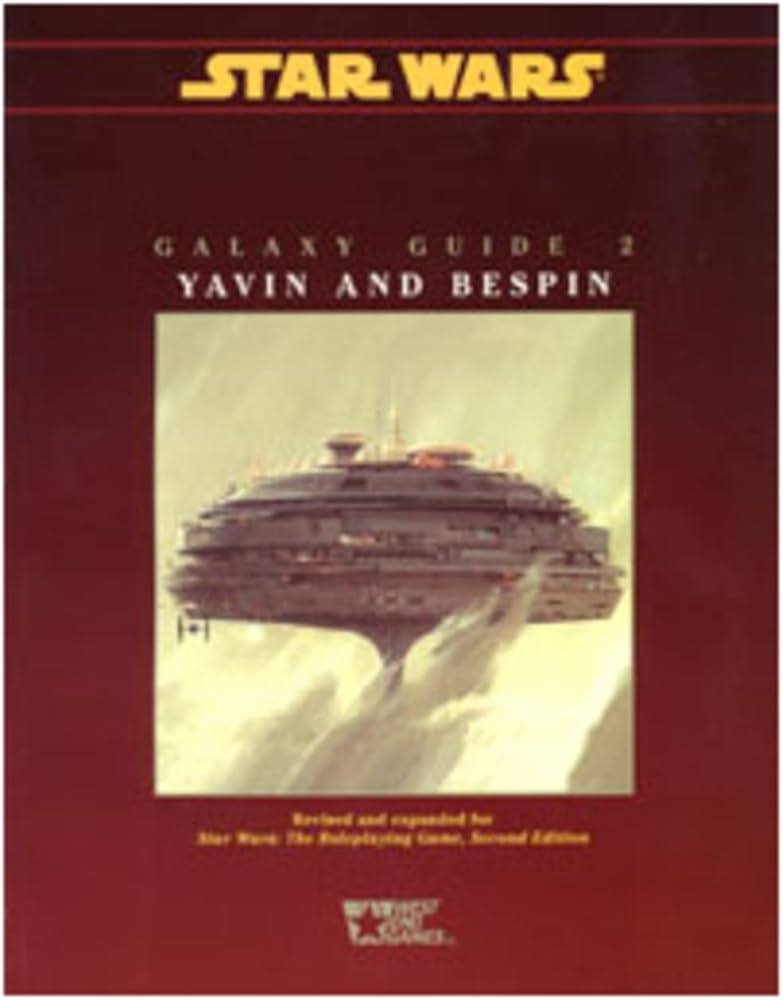
Galaxy Guide 02: Yavin and Bespin Planet Profiles
Galaxy Guide 02: Yavin and Bespin Planet Profiles
by Jonatha Caspian, Christopher Kubasik, Bill Slavicsek, C.J. Tramontana
Introduction
Of all the wondrous worlds visited in the Star Wars movies, two of the most memorable are Yavin and Bespin. This new volume in our Galaxy Guide series for Star Wars: The Roleplaying Game examines these planets and their systems in order to provide information for gamemasters, players, and the legions of Star Wars fans everywhere.
Yavin is the planetary system first introduced in Star Wars IV: A New Hope. The fourth moon of this planet served as a secret base for the Rebel Alliance. It was to this lush, tropical moon that Luke Skywalker and Princess Leia carried the stolen plans for the Death Star battle station. It was in this out-of-the-way system that the Rebels staged the impromptu Battle of Yavin when the Death Star unexpectedly arrived.
The Rebels abandoned the system shortly after the conclusion of the battle. The Alliance cells evacuated and relocated several times during the ensuing three years as they tried to avoid detection by and confrontation with the Imperial armada organized to hunt and destroy them. But they left behind a rich area for building other stories and adventures.
Bespin is the planet visited by Han Solo and Princess Leia in The Empire Strikes Back. This gas giant features legendary Cloud City, floating high within the planet's atmosphere. It was here that Solo took his prized ship Millennium Falcon for repairs, hoping his old friend Lando Calrissian would be able to help him. But the Empire arrived first, setting a trap for the heroes.
Cloud City and Bespin, home to Tibanna gas mining, luxurious gambling parlors and Ugnaught laborers, is a bright stopping point in an otherwise dismal portion of the galaxy. Governed by Lando Calrissian and protected by the Bespin Guard, this city in the clouds is truly one of the wonders of the galaxy. However, Han and Leia found that this cloud had a black lining hiding just out of sight — Darth Vader and the Empire.
But that is the future. This edition of the Galaxy Guide series explores these very different worlds as they exist after the destruction of the first Death Star — during that three year period between A New Hope and The Empire Strikes Back movies. We'll examine the wildlife, the environments, and the natives that inhabit these similar, yet vastly different worlds. We'll take a look at other parts of the respective star systems, and view any special operations currently being conducted by Alliance, Empire, or independent agencies. We'll meet those characters that typify the inhabitants and visitors to the systems, giving their templates so they can be dropped into a game session quickly and easily. And we'll take a look at some sites of interest, and provide a number of adventure ideas for ambitious gamemasters to develop.
Come with us to the ringed moons of Yavin, to the billowing clouds of Bespin. There are new races to meet, new worlds to explore, new dangers to face, and new challenges to confront.
Now, let's start our tour ...
Yavin Design: Jonatha Caspian, Bill Slavicsek, C.J. Tramontana Bespin Design: Christopher Kubasik Development: Jonatha Caspian Editing: Bill Slavicsek Art Direction: Stephen Crane Graphics: Cathleen Hunter, Sharon Wyckoff Cover Art and Interior Art: Lucasfilm, Ltd. Maps & Diagrams: Stephen Crane, Cathleen Hunter, Sharon Wyckoff Production: Steve Porpora
West End Games, Inc. RD 3 Box 2345 Honesdale, PA 18431
40023
®, ™ & © 1989 Lucasfilm, Ltd. (LFL). All Rights Reserved. Trademarks of LFL used by West End Games under authorization.
Yavin
The System
The star system designated "Yavin" in the Imperial Planetary Record is located far from the Galactic Core. It does not appear on most astrogation charts. It is not on a major hyperspace lane. In fact, little marks this star system as significant — other than its happenstance as the site of the Rebel Alliance's first major tactical victory against the Empire in the on-going Galactic Civil War.
Discovered during the Galactic Expansion era of the Old Republic, the name Yavin was given to both the star and the major planet in the system. This was a standard practice that is still used by Imperial survey and exploration teams. The original discovery report cataloged the system as "Unset" — unfit for human settlement. Further, the report listed it as devoid of intelligent life, and probably devoid of any life whatsoever.
Such a classification can be understood if one views the system as the early explorers did. Upon entering the system, a ship's sensors will detect a bright orange sun that is approaching the end of its middle-age cycle. Orbiting this medium-sized sun are three planets — none of which appear particularly inviting to most lifeforms.
The planet closest to the sun is a large sphere made up of unstable land masses and seas of boiling mercury. The next planetary orbit is occupied by an arctic world covered by rolling oceans and large ice floes. The last planet in the system is by far the greatest in size. It is a gas giant to which the explorers gave the system name — Yavin.
After a brief cursory examination of each of these planets, which included an appended note about the numerous moons around the gas giant, the team left the system and headed for their next destination. Yavin remained a brief footnote in the galactic registry until, many years later, a major Rebel base was set up on the fourth moon of the giant gas planet.
It was in this out-of-the-way system that the Imperial Death Star tracked down the Rebel agents who stole the plans to the battle station. The data was studied by Rebel technicians and tacticians on the moon outpost, and an assault plan was devised. It would be tested earlier than anticipated when the Death Star arrived in system, following the Rebel agents. In what is now called "The Battle of Yavin," the Rebels marshalled every spaceworthy attack vessel on hand and launched their planned but unrehearsed attack on the approaching battle station.
For the Empire, the upcoming battle was seen as the ultimate test of its newest weapon. It promised total annihiliation for the most important cells in the Rebel Alliance. For the Rebels, the battle had only two possible outcomes — survival or destruction. In the end, skill, bravery, luck, and the Force won out. The Imperial battle station was destroyed and the Rebel base was abandoned. The wreckage of the Death Star still orbits Yavin, more debris to add to its shining collection.
The Planet Fiddanl
The first planet in the Yavin star system, Fiddanl is a hot, toxic world devoid of life. The name seems to have been applied not by the scouting or site-survey crews, but by the recording clerk in the Imperial Xenodetic Survey department. No reason is given for the change in designation from 96NK3F2 to the current name, but we can guess that the clerk was of the Altorian Lizard race, as Fiddanl is a popular pet name among Altorians.
First planets are rarely hospitable places, being too close to the heat source of the system, too vulnerable to solar winds and magnetic anomalies, too threatened by the immense powers that fuel a star. Fiddanl is no exception to this rule. Its flattened surfaces sport a garish mix of colors and shine brightly in the star Yavin's orange light.
Two of the surface probes sent by Xenosurvey & Measurements, Ltd. survived touchdown long enough to transmit initial conditions, and one managed to scatter remotes across nearly half the continental plates — and into the ocean as well — before contact was lost. A digest of their findings follows.
Planetary Make-up
The world is very dense. The core seems to consist of a roughly spherical lump of alloys of gold and platinum, with large intrusions of pure ore. Fiddanl's mantle is a shallow layer of liquid mercury. The comparatively lightweight continental plates float freely atop this mantle, giving Fiddanl its characteristic rapid continental drift. Observation holos show landmasses migrating as much as 630 kilometers a day.
Where continental plates end, Fiddanl sports a roiling sea of mercury welling up from the mantle. This quick-silver surface reflects a great deal of sunlight, making the aspect of the planet from offworld garishly beautiful: a paisley patchwork of continents netted by shimmering lace.
There are 18 landmasses of sufficient size to earn the designation "continent," though they are difficult to identify by eye. Continual collision among the continents results in small islands calving off the main landmasses, changing the shoreline of each mother continent significantly in the process. The islands tend to have brief histories, often grinding into dust between two larger masses, or subsiding in a collision that overpowers their small stature.
X&M's non-surviving probes, almost to an instrument, met just such fates because the masses they targeted for landing were not of sufficient size to sustain collisions. The one exception appears to have instead attempted landing on a continental shoreline that caromed out from under it as its legs extended. Mercury seas made quick work of that probe.
Surface Composition
Fiddanl's surface crust is a motley of rich red Cinnabar and lemony-orange sulfite compounds, purple manganese deposits, and a plain gray-green base rock. Continents do grow in size, as encrustations amalgamate along unbroken shoreline and vapors oxidize or condense in the night air. The heavy gravity and anchorless lands mitigate most vertical buildup, so that terrain on Fiddanl is generally flat or gently rolling overall. Plates cannot throw up mountainous folds of earth when impacts merely redirect the landmass's drift like skittles on an antigrav table.
Orbital Statistics and Climatology
The diameter of the planet is nearly 15,000 kilometers — somewhat less from pole to pole, due to the flattening effects of rotation and tidal pull. The period of revolution about the sun Yavin is three-quarters of a Standard Year, and the local "days" on Fiddanl are of about 18 Standard Hours duration.
Remarkably, the atmosphere of the world is stable, with airborne nitrogen and sulfur compounds precipitating excessive mercury that boils up in small explosions. The thin layer of atmosphere cloaking Fiddanl suffers the usual perturbations of storms and high-low pressure gradients, but these are not the all-encompassing cyclones of a gas giant. Rather, Fiddanl's weather patterns seem as paisley as her mineral deposits, scattered here and there across her broad face, none more than a teacup tempest.
Lifeforms
Fiddanl's chemical make-up is obviously toxic to humans and most other races in the Empire. None of the standard indicators of life tested positive in either of the two passes or in any series that the probes ran. Additionally, no evidence of organic growth is present in the holos shot by the second round probes — though the submersible cameras collected some astonishing footage of crystal build-up on the lee shore of one continent. If the rates of growth recorded are average, we can now understand why the continents have not battered each other into oblivion.
Economic Desirability
If mercury were an important component in starship design or health services, Fiddanl must eventually be considered as a source of refinable raw material. But it is not currently justifiable, given Yavin system's distance from the galactic centers of ship building and medicine. The risks to health promised by the atmosphere, especially considering the lax enforcement of code among itinerant miners, and the uncertainty of landing a mining scow on the moving continents preclude any real test of the probes' composition reports.
It goes without saying that the core materials are beyond exploration.
The Planet Stroiketcy
It is probable that this planet is a captured comet, a heavenly body drawn into the realm of the mundane when its proximity to Yavin system grew too great. The name given it comes from the Corellian, meaning "tailed one."
Planetary Make-up
Stroiketcy shows all the hallmarks of a wanderer: her diameter is small, her chemical balance is unevenly tipped toward the effluvial elements of deep space, her core is an aggregate rather than a mixture. Further data about both her rather eccentric orbit and the precise dating of her subsurface bedrock can confirm her origins.
The most significant feature of Stroiketcy's composition is the 93.4 percent water surface. Barely any rock shows on the face of this arctic world: probe passes have identified less than a dozen permanently visible outcroppings.
The ocean depth varies, but below its surface lies one compacted lump of rock. No indications of plate tectonics or volcanism are present, and the core of the little world appears to be cold, not molten as first suggested.
From offworld, Stroiketcy has a small but visible "tail" of trailing atmosphere. Initial measurements give its depth as close to five times that of the leading face of the planet. As Stroiketcy is still inward-bound on her orbit of Yavin star, we can hypothesize that the tail will increase further.
Surface Composition
As mentioned above, Stroiketcy is a water world. However, the coldness of the atmosphere dictates that not all the water is liquid. Ice floes tens of kilometers across drift the restless sea. Two permanent caps, labeled Vanyets and Tsorria by the explorers, or "over" and "under," respectively, mark the polar axis.
High levels of iridium, heglum, and malsarr in suspension show Stroiketcy's intimacy with the void, and the agitation of her seas. Submersible probes measured wave heights up to 80 meters. These are almost certainly rogue waves, and when they are eliminated from the data, the average seas run a more manageable four to 10 meters.
Orbital Statistics and Climatology
Eccentricity appears to be the watchword of this world. Stroiketcy demonstrates an extremely ellipsoidal orbit, passing the sun in second-planet position only 100,000 kilometers from Fiddanl's path, though in a different ecliptic plane. On her far arc she swings vastly outside the orbit of the gas giant, Yavin.
With such an elongated orbit, the local year on Stroiketcy is close to nine and a half Galactic Standard Years. The seasons, furthermore, are unevenly divided, as the proximity to her sun in "summer" causes Stroiketcy to speed up and slingshot through that season, while "winter" on the far end of the arc passes slowly by.
Another effect (hypothesized — no firm data yet acquired) of the close summer orbit is a warming of the planet's sea — with a presumed raising of sea level as Stroiketcy's massive ice floes melt. The reverse process — cooling seas resulting in deeper and more extensive freezing in the winter season — may mean that at the height of winter, Stroiketcy has no open water at all. It will take some years, assuming X&M's probes remain functional, for data confirming these processes to accumulate.
Storms on Stroiketcy are not particularly violent, perhaps because of the lack of strong temperature changes within the day-night cycle. However, rainfall and fog do seem to be the norm, and holographic data from the surface is poor to useless.
Lifeforms
Though there are no active cultures in the samples tested, indications suggest that there may be monocellular life on Stroiketcy in the summer years. Organocrystalline structures found in open water compare favorably with the rubygrub cysts on Loth, for instance, and none of the "universal toxins" are present in more than trace quantities. The greatest deterrent to life on this planet seems to be the extended cold period; the thinness of the atmosphere runs a distant second.
Economic Desirability
Water is Stroiketcy's major feature, and water would seem to be her greatest asset as well. The ice floes exhibit great chemical purity, and even the liquid seas require little more than filtering to yield potable results. The lack of land suggests aerial harvesting techniques and equipment, but such equipment is prevalent on many worlds, both in the private sector and through Imperial agencies.
A radical interpretation of the geographic position of Stroiketcy's land pinnacles and tidal patterns suggests that at some middle point in the planet's orbit, sufficient ice may have formed to lower the seas and expose small islands of dry land. A surveyor probe targeted for this window, or a manned flight, could prospect for iridium or malsarr ore deposits in the bedrock at this time.
The Planet Yavin
Yavin's equatorial diameter of 192,478 kilometers and its dense atmosphere, which reaches a depth of approximately 65,000 kilometers, easily place it within the category of planets known as "gas giants."
As with most gas giants, Yavin is surrounded by numerous moons. If tracked and charted, the orbits of many of the moons would prove to be gathered in a series of "rings" around the planet. Yavin's mass of 323.7 (as compared to the Galactic Standard mass designation "1" for planets proving habitable to humanoids), its concomitant gravity of 2.74 times the Galactic Standard, and its placement in the Yavin system as the planet whose orbit averages the greatest distance from the central stellar body make Yavin a veritable "moon trap," or "moon maker," depending upon which theory of the formation of moons one accepts.
The Making of Large Moons
With regard to Yavin's larger moons, there are three current theories of formation (none of which are proven, and all of which have their proponents within the ranks of today's planetologists).
The oldest theory of the formation of large moons, and perhaps the most popular for the last few hundred Standard Years, proposes that large moons were once part of the parent planet. Somehow, this part was broken off and hurled into orbit around the planet. However, planetologists who adhere to this theory have yet to devise an explanation that will convince all planetologists of the possibility of this phenomenon.
The second theory proposes that large moons were once foreign bodies traveling past a planet. The planet's gravity "captured" the body as it passed. The problem with this theory, according to the mathematics of some planetologists, is that it appears improbable that a large moon hurtling past a planet would be captured by its gravity rather than colliding with the planet or just rushing past with its path slightly bent.
The third and equally arguable theory states that as a star system is being formed out of a swirling cloud of cosmic dust both the parent planet and its large moon were formed in their current and relative positions. Yet, some planetologists vehemently argue that there is no provable reason why two planet-sized bodies would form in such proximity.
The Atmosphere of Yavin
Viewed from a distance, the atmospheric surface of Yavin presents itself as a translucent and softly lambent globe banded with a myriad of colors and freckled by a number of circular and oval spots. Even the hemisphere of the planet that is not facing the sun seems to glow with a gentle rainbow of light. Yet, Yavin is not a light-producing body; there is no nuclear fusion reaction occurring that would produce sunlight.
All of the light that seems to emanate from the planet is light that originated at the sun of this system. The sunlight that is not reflected off the multi-colored atmosphere of Yavin penetrates the dense atmosphere and is refracted within the cloud cover and around the solid core of the planet, eventually bouncing off atmospheric particles, or even off the icy planetary core, and back out through the atmosphere. This process of reflection and refraction causes the planet to glow and shimmer against the dark backdrop of space.
A closer view of Yavin produces a more detailed interpretation of the striated colors that band the planet. Within each of the parallel belts of greens, yellows, black, grays, and tans, other, smaller, swirling bands braid and intertwine with the primary bands. This gives the atmospheric surface of Yavin an almost deliberately woven appearance, as if some primitive artist from the northern tribes of ancient Delderaan had intricately woven a ball of multicolored yarns and then tossed it high into the night sky.
Also, at this closer perspective, the freckle-like markings on the surface of Yavin's atmosphere resolve themselves into huge, cyclonic storm-spots of white, blue, orange, red, and brown. These circular and oval cloud formations range in size from approximately 12,000 to over 35,000 kilometers in diameter.
Like most gas giants, Yavin's period of rotation is amazingly fast. The planet turns upon its axis in under one-half of a Standard Day. (The period of Yavin's revolution about the sun of the system is slightly over 13 Standard Years.) This speed of rotation and the composition of the atmosphere are what cause the equatorially parallel bands of color and the cyclonic storm-spots — the freckles — in Yavin's atmosphere.
The beauty of Yavin's appearance is the direct result of the violence of its atmospheric disturbances. At the equator, the winds in the midmost atmospheric band are normally in excess of 600 kilometers per Standard Hour. Winds in the cyclonic storm-spots often exceed that speed by three and four times. The turbulence of the atmosphere causes the braided appearance of the eternally restless bands of color. That turbulence also causes some of the atmospheric belts to move in a retrograde motion (a motion opposite to the majority of bands), moving west to east across the face of the planet.
The highest clouds on Yavin are made up predominantly of ammonia snowflakes kept in suspension by the turbulence of the atmosphere which constantly roils upward from the lower levels of the troposphere into the ceaselessly racing colored bands. The presence of other elements is what gives color to the clouds of Yavin, which would be white to grey without these additions. Nevertheless, the atmosphere, perhaps the entire planetary construct, is primarily composed of hydrogen and helium.
The abundance of hydrogen and helium on Yavin is of great interest to planetologists, since these two light gases are relatively rare on most of the known, habitable worlds, having been "burned off" by their proximity to their suns. Yet, these two elements are the most common elements found in the stars and interstellar matter forming the major portion of the galaxy.
Not only does this state of conditions make the composition of Yavin more similar to that of a star than to that of a planet, but it also indicates that there has been amazingly little change in Yavin since the formation of the Yavin system more than 7.5 billion years ago. Much of the hydrogen, helium, and interplanetary dust (the basic building blocks of star systems) of Yavin never formed into a solid planet, except at the core, but merely gathered into a globular, planet-like mass which has not evolved further since the creation of the Yavin system.
Beneath the frozen ammonia crystals of the uppermost portion of the atmosphere is a layer mostly composed of ammonium-hydrosulfide mixed with carbon-tetrachloride. Below that level of foul smelling components is the bottommost layer of Yavin's atmosphere, a swirling layer of frozen water and frozen liquid hydrogen crystals. Beneath the atmosphere is the planetary core.
The Core of Yavin
Surprisingly, even though the comparatively small planetary core of Yavin is composed almost entirely of hydrogen and helium, the planet has a powerful magnetic field. Evidence for the existence of that magnetic field is found in the huge zone of electrically charged particles girdling Yavin. These charged particles originate in the system's sun. As they pass near the planet, Yavin's magnetic field attracts and then traps the particles in an orbital zone. Circling the planet, the moving charged particles generate radio waves which can be detected millions of kilometers from Yavin and which first lead planetologists to their awareness of the planet's magnetic field.
The apparent anomaly in this case is that for such a magnetic field to exist about a planet, the planet must have a metallic core. At least, that has been the case for all of the relatively few planets discovered so far that have encircling magnetic fields.
The explanation for this phenomenon lies in the tremendous pressures exerted upon the hydrogen at the core of Yavin. The pressure on the planet rises from five Standard Atmospheres at the very top of the cloud layer to over a million Standard Atmospheres (1.28 million kilograms per square centimeter) at the center of the planetary core. Under this immense pressure, the electrons of compressed hydrogen atoms are stripped from their nuclei, and the hydrogen acts as if it were a metal capable of conducting electricity and producing the magnetic field encircling the planet.
Life on Yavin
Life is one of the most tenacious of forces found in the galaxy. Given even the most remote possibilities of success, it will make a supreme effort at coming into being. Having actualized its potential, it will adapt, grow and, in most cases, flourish. Such is the case on Yavin, a planet uninhabitable to humanoids, but not to the native lifeforms found there.
The Smaller Moons of Yavin
As with large moons, planetologists propose three theories for the formation of smaller moons and planetary rings. However, in this case, they are in agreement that all three theories are necessary to explain the existence of smaller moons and rings.
The first theory states that as an immense cloud of dust and gas collapses inward to form a planet, some of that matter is left orbiting the body of the planet. Beyond the Ambak limit, particles could clump together into moons. Within the limit, particles cannot merge. (Ambak was a Mon Calamari physicist who proposed that there is a distance from a planet — relative to its size and gravity — beyond which moons can exist or be formed through the process of accretion of leftover matter, and inside of which they cannot, because of the planet's gravitational pull and the varying speeds of the orbiting particles.)
The second theory proposes that cometary or larger bodies captured within the Ambak limit can be torn apart into smaller particles by the gravitational pull of the planet.
The final theory posits that a moon can exist within the Ambak limit, if that moon formed while the gas and dust of the planet was still collapsing into solidity. As the planet grew, the limit was pushed past the existing moon, which has not yet been torn apart by the parent planet's gravitation.
At the indistinct, frozen, slushy line of demarcation between planetary core and atmosphere, 134 known species of "Crawlers," non-sentient (this is a guess — because of the atmospheric pressure, contact and communication may never be established), flattened creatures have been discovered through long-distance observations made from high in the atmosphere. For all practical purposes, Crawlers are almost two dimensional, having a length and width many times any height they may attain. They exist in sizes ranging from small, rag-shapes (centimeters across and perhaps a millimeter high) to immense blanket-shapes (hundreds of kilometers across and up to two decimeters high). Each of them, even the smallest, moves inexorably across the slushy surface of Yavin, feeding on trace elements and reproducing by fission, under atmospheric pressures that would crush a humanoid out of existence.
The atmosphere of Yavin is home to dozens of species of "Floaters," non-sentient gasbags and gliders that exist in a variety of shapes and sizes and that float and drift on the currents and eddies in Yavin's dense atmosphere. Most of the Floaters are non-predatory, but two species are of the hunter variety and prey upon the other 10 types of Floaters.
Because the internal pressures of the Floaters are self-regulating, they can exist through all levels of the deep, dense atmosphere on Yavin. However, since they are fragile in structure, relatively speaking, any contact with the surface of Yavin or with the Crawlers resident there would tear the Floaters to shreds.
TYPICAL NON-PREDATORY FLOATER
DEXTERITY: 1D
PERCEPTION: 1D
STRENGTH: 4D and up (see "Size")
Speed Code: 1D
Size: Non-predatory Floaters range from the size of a Corellian stock light freighter to the size of an Imperial Star Destroyer, and their Strength code alters accordingly. The shapes of non-predatory Floaters vary from simple gasbags to complex, tentacled creatures.
Combat: Non-predatory Floaters are non-combatant. Yet, fragile as they are compared to Crawlers, collisions of ships with these creatures will cause damage to the ships in accordance with the creatures size and Strength. Their limited awareness allows them to notice hunters and obstacles. Their lateral movement is dependent upon which way the wind blows, since they have little directional control, but they can willingly gain or lose altitude.
Using Non-predatory Floaters in the Roleplaying Game: These creatures are comparable to grazing herbivores. Yet, their huge size makes them dangerous to any vessel in their path. Use the "Scaling" rules found in The Star Wars Rules Companion to determine how they interact with various sized ships and creatures.
HUNTER-FLOATER #1
DEXTERITY: 3D
PERCEPTION: 2D
STRENGTH: 6D
Speed Code: 4D
Size: 35 meters (Starfighter Scale)
Combat: This is the shark of the Hunter-Floaters. In attack posture, muscular fins allow it to move in pursuit of its prey. It will attack anything it perceives as food. Other times it floats aimlessly upon the winds waiting for prey to enter its field of perception.
Using Hunter-Floater #1 in the Roleplaying Game: Any vessels perceived by this creature will be perceived as food and attacked. It is vulnerable to ship-mounted turbolasers, but anything smaller will not affect it. Ramming will destroy it, and damage the ship that does the ramming. Use the "Scaling" rules found in The Star Wars Rules Companion to determine how they interact with various sized ships and creatures.
HUNTER-FLOATER #2
DEXTERITY: 2D
PERCEPTION: 2D
STRENGTH: 6D
Speed Code: 2D
Size: 300 meters (Capital Ship Scale)
Combat: This creature is the giant squid of the Hunter-Floaters. Great, drooping tentacles hang below an elongated gasbag. It moves through the atmosphere by taking in the air of Yavin and ejecting it. More slow moving than Hunter-Floater #1, this hunter is a voracious eater, constantly on the prowl and willing to attack anything of any size.
Using Hunter-Floater #2 in the Roleplaying Game: This creature will attack vessels. It is vulnerable to turbolasers (if the gasbag is hit, it will sink downward); smaller weapons will not affect it. Determine ramming results according to the rules in The Star Wars Rules Companion.
Yavin's Moons
The planet Yavin is framed by numerous moons of various sizes, spinning majestically around the gas giant. Some are planet-sized themselves, although Yavin proper dwarfs even the largest satellites.
Three of these larger satellites, designated four, eight and thirteen by the original explorers, are capable of supporting a wide range of life. The smaller moons, ranging from a few kilometers in diameter and up, do not have the gravity or atmosphere to sustain most living organisms.
Of the three larger satellites, Yavin Four appears as a shining emerald in the gas giant's necklace of moons. A jungle moon, Yavin Four is rich with plant and animal life, but contains no intelligent species — at least not anymore.
Yavin Eight possesses a different climate, and has a different ecology than the jungle moon. But again, there has been no evidence of intelligent life. Yavin Thirteen, however, is the exception in this system. Until recently, it too was thought to be devoid of intelligent species. The latest scouting expedition, funded by the Empire, uncovered two new races living upon this desert moon. What has been discovered about the moons and these new lifeforms has been included in the following entries.
Yavin Four
The first satellite of any practical size, Yavin Four is a human-standard world supporting a rich diversity of flora and fauna in lush, warm tropical jungles.
The warmth of Four's biosphere cannot be explained by core radioactive decay alone. Indeed, measurements returned by initial probes indicate only marginally higher than mean levels of radioactivity, though these are complemented by elevated levels of both oxygen and carbon dioxide in the atmosphere, causing the world to retain more of the heat it generates.
The answer lies in the relative youth of the moon — it is likely that some of the heat is residual to its formation — and in the fairly strong tectonic action that lets heat escape from the very depths of the satellite.
Surface Composition
Some 69 percent of Four is landmass, with wide rivers and deep lakes puckering the jungle. Volcanism exists, and many mountain ranges ridge the surface crust. The climate varies only slightly by latitude and altitude, remaining within a warm to hot 15 degree Galactic Standard range virtually surface wide.
The green moon of Yavin has four continents, six interconnected oceans, and one landlocked body of water large enough to earn the term "sea."
Orbital Statistics and Climatology
Yavin Four completes nearly three revolutions around its planet each Galactic Standard Year. Its local day falls only minutes short of Galactic Standard, making it an easy adjustment for offworlders. There are two primary seasons on the satellite, wet and dry. During the dry season, rainfall is limited for the most part to showers at day's end as temperatures fall below the dewpoint and atmospheric humidity condenses. In the wet season, days may pass without a break in the downpour. Thunder and lightning are most frequent at the change of seasons, and rarely occur at the height of either.
Lifeforms
The Vanished Race
It is obvious from the massive stone ruins on Yavin Four that a technically advanced people once made this world their home. Who they are — or were — and where they have gone remains a mystery. Though the Rebel Alliance made its headquarters on Yavin Four for some time, they did not pursue systematic archaeological inquiry into the culture for obvious reasons.
From the small number of carved inscriptions in the ruins, a recent expedition has made a start at translating the language of these people, however. The main temple used by the Alliance was a stronghold of the Massasi people of ancient times, located in a region these people also called Massasi. The temple was not refitted with modern light or energy sources until the Rebel's own modifications, and seems to have stood empty through much of Yavin Four's history.
How such an enormous structure was built is a matter of much speculation. No quarry sites large enough to have disgorged such massive blocks are extant today, and preliminary mapping does not locate them under current vegetation. It is difficult to imagine moving metric-ton monoliths without the aid of modern gravitonic construction techniques, much less by other means, and without environmental perturbations. Further study is obviously needed.
In fact, what is known about Yavin Four's vanished people is more what they did not do. They did not engage in extensive mining or deforestation in recent times, as the land contours and growth patterns of the green moon's giant trees attest. The atmospheric chemistry shows no telltale signs of petrochemical or fossil fuel combustion. Even allowing for the rapid regrowth of tropical ecosystems, it is not possible to pinpoint individual or societal dwelling sites in the jungles other than the stone ruins.
However, orbital probe analysis shows a complex geometric pattern of tree crowns that suggests that the oldest matriarchs and patriarchs of the jungle were planted to attain a certain canopy contour, presupposing wind generators. Waterfalls on major river sites also show certain enhancements that suggest a reliance on hydro-electric power at some point in the past. Overall, the people of Four seem to have bent much effort to sustaining a naturalism rarely found in technological settings.
The lost inhabitants reached for the stars, but evidence suggests they never made it. Although what actually did happen to them is a matter of speculation. At the Massasi site lay the most impressive of those edifices which the vanished race raised toward the heavens. These colossal, roughly pyramidal structures defy explanation. All uncovered evidence points only to simple machines and hand technology. If other devices existed there is no physical evidence remaining.
While the science of this moon's inhabitants had apparently led them to a dead end as far as offworld travel was concerned, they possessed certain techniques that surpassed similar Imperial accomplishments. The still unexplained method of cutting and transporting gargantuan blocks of stone from the crust of the moon seemingly without disturbing the surface is but one example.
The Massasi Site
A combination of unknown causes has been responsible for the quiet disappearance of the race that once inhabited Yavin Four. Whoever these people were, they were gone long before the first explorer set foot on the tiny moon. Little is known of this race save that they left a number of impressive monuments as evidence of their existence. Now all that remains are the mounds and foliage-clad clumps formed by jungle-covered buildings. At the Massasi site lays the most impressive of those edifices left by the vanished race. It is a colossal temple, roughly pyramidal in shape, ringed by smaller structures.
It was here that the Rebel Alliance established an important base. It was from here that they launched what has come to be called "The Battle of Yavin." The titles given to those structures so far uncovered are for identification only. No positive purpose classifications have yet been determined.
Massasi Site Map Key
- The Great Temple
- Temple of the Blueleaf Cluster
- Palace of the Woolamander
- Landing Clearing (for Rebel Base)
- Power Generator (for Rebel Base)
The Great Temple
Near its base, in the temple front, the jungle slides away completely to reveal long, dark entrances cut by its builders and enlarged to suit the needs of the Rebellion.
The original builders would never recognize the interior of their temple. Seamed metal has replaced rock, and poured paneling was used to divide chambers in place of wood. Buried layers have also been excavated into the rock below the temple, creating layers containing hangar upon hangar linked by powerful turbolift platforms.
There are many rooms in the vast expanse of the temple which have been converted for modern service by Alliance technicians. Some of their equipment has even been left behind in their recent evacuation. However, there was something too clean and classically beautiful about the ruins of the ancient throne room on the uppermost level for the technicians to modify. They left it as it was, save for scouring it clean of creeping jungle growth and debris.
Great Temple Map Key
Level A:
- Launch Bay
- Turbolift to Upper Levels
- Hangar Lift Platform
Levels B & C:
- Turbolift
- Command Center (on Level B); War Room (on Level C)
- Computer Processing Center
- Briefing Rooms and Offices
- Barracks and Recreation Facilities
- Storage Facilities
Level D: This is the temple throne room, complete with raised platform and skylights open to the sun.
Temple Side View:
- Level D
- Level C
- Level B
- Level A
- Underground Hangars
Lower Lifeforms
The warm, wet, oxygen rich climate of Yavin Four has produced a myriad species which we have only begun to catalog. Some are analogous to life found on other worlds, and some are unique to the green moon's landscape. A representative sampling of descriptions is included here.
Blueleaf
Blueleaf is a common shrub near the Massasi ruins whose essential oils are a stimulant with perception-enhancing qualities.
Blueleaf's spicy, pleasant fragrance makes it easily identifiable, as do the distinctive cobalt-hued leaves whorled in five- to eight-fingered clusters. Average height is about one meter, but the plant spreads by suckers, forming a dense groundcover. It does poorly in deep shade, preferring the dappled glades produced by windfalls.
There is some evidence that it is not native, based on genetic data, but was imported from another continent by the lost race that built the structures: they almost surely cultivated it for its sense-enhancing properties.
Using Blueleaf in the Roleplaying Game: One leaflet, chewed, gives a Rebel character +2 on all Perception rolls for one hour, but he or she must make a Moderate stamina roll to combat the exhaustive effects of the abrupt cessation of stimulus at the end of that hour. Blueleaf builds up in the system if used too frequently: if a second leaf is chewed within a day, then a Difficult stamina roll is required, and subsequent doses increase one difficulty level with each application.
Massasi Tree
So named because it is the most common species around the Massasi temple ruins, this tree seems to be analogous to the Kenalpa of Corell. It stands about 140 to 170 meters tall, with a wide crown and upsweeping branches. The bark is a shredding purplish brown that separates into strands easily when worked. A fever-reducing tea can be brewed out of blossoms found at branch junctures that receive direct sunlight.
Using Massasi Tree in the Roleplaying Game: A Rebel character with medicine skill can use Massasi-blossom tea as a substitute for a medpac application on a sick or wounded character. The main problem lies in acquiring the blossoms and preparing them. A Moderate medicine roll is needed to prepare the tea. The blossoms may be gathered and preserved for later use.
The bark fibers can be used for string and thread substitutes, but will not withstand a great deal of stress.
Climbing Fern
Like many of the jungles' flora, the climbing fern trails long fibrous roots from its high perches, gathering moisture and nutrients from the heavy tropical air. Nestled in the crotches of Massasi Trees, Szechual, or festooning the cliffs around waterfalls, this decorative, lacy specimen looks like the princess of the forest.
Two meters long, the finely divided leaves are variegated yellow and green. Buds at the tips of each leaflet can sprout into new plants, creating a second tier cascade of leaves. Underneath the plant trail golden, half-centimeter thick rhizomes, some attaining 80 meters in length. Many of Four's arboreal animals use Climbing Fern as a highway into the canopy of the forest.
Using Climbing Fern in the Roleplaying Game: The flexible root fibers of Climbing Fern are resistant to cutting or tearing (Moderate difficulty to cut one rhizome at a time with a knife), and a handful can support a human's weight indefinitely. They can be knotted together, braided, or pounded to produce smaller fibers. If pounded when fresh, the resin that oozes over the fibers can be used to glue the flattened strap, like tape, across a clean surface. Cured (heated) resin is water-resistant for several days.
Nebula Orchid
One of the showiest blossoms in the rain forest, each Nebula Orchid flower measures up to a meter and a half in diameter in full bloom. The labellum of the flower is most commonly a deep magenta with maroon markings, ruffled and recurved into a colorful froth. The sepals are divided into airy filaments of white, rose and lavender that fringe and curve like tendrils of gas across the void — hence the name.
The Nebula Orchid enjoys still, calm depths of the forest, clinging to trunk scars and dead wood no higher than five meters from the leafy floor. When not in bloom, the plant is recognizable by glossy green leaves overdappled with spots. Usually a blossom lasts 20 days before subsiding and being replaced by another, the show lasting the length of the dry season.
During the wet season, seed pods appear. Nebula Orchids are a frequent food source to the land-based grazers of the forest.
Using Nebula Orchids in the Roleplaying Game: A ripe pod is half a meter long, 10 centimeters in diameter, and a deep waxy carmine in color. The pod yields an edible, spicy paste rich in nutrients and oils that keeps very well. If pressed, an average pod yields nearly a liter of flammable oil that burns with a clean blue flame.
Touch-Not
Not every plant in Yavin Four's garden is beneficial. The Touch-Not, named for analogous plants the galaxy over, exudes a caustic resin, or sap, that blisters skin with which it comes in contact. Mon Calamarians are especially susceptible to these plants.
The Touch-Not is as distinctive as it is common, occurring as a semi-upright shrub no more than four meters tall in the understory of the rain forest.
The stems are slick and wet-looking even in the dry season. Bright yellow, shiny curls of leaves catch the slightest breath of wind and twist and spin crazily on their flexible petioles. The flowers are unspectacular bracts of 10 or 12 lemon petaled rosettes which mature into waxy berries.
It is even unsafe to stand near this poisonous shrub in a rain or mist, as the resin dissolves in water, and drips from the shrub to scar anything in its shelter.
Using Touch-Not in the Roleplaying Game: Characters who come in contact with the resin of the Touch-Not are afflicted with a severe rash that itches and blisters the skin. Immediate washing with hot water and a detergent will mitigate the effects, otherwise the character suffers a wound. Touch-Not resin can eat through organic fabrics and fibers, so even the protection of most clothing will not deter the toxin.
Grenade Fungi
Burrowing up out of the thick leafmold of the forest floor during the dry season, Grenade Fungi offer an explosive surprise to the unwary traveler. These globular, white fungi can be found the jungle over.
A young fungus is subterranean, appearing as no more than a slight rise or bulge in a layer of dead leaves. But as it matures, puffing out to nearly half a meter in diameter and developing characteristic gray-blue scales, the Grenade Fungus breaks through the leafmold. Often, arcs or complete rings of nearly mature Grenade Fungi appear at the same time, indicating the spore brethren of a centrally located parent. As they mature, the fungi develop a hard, almost brittle outer shell.
A misplaced foot, a falling twig, even a delicate breath of wind is enough to touch off a ripe fungus. The brittle shell bursts with a loud report and showers thousands of spores to the compass points. Sometimes the concussion of the first burst is enough to set off other nearby Grenade Fungi — the cloud of spores from a multiple detonation can soot up leaves and choke small animals not fast enough to outrun it.
Using Grenade Fungi in the Roleplaying Game: These floor dwellers can be either attackers or weapons. When a fungus explodes, the character effected must dodge or be attacked by the spore cloud and suffer damage. A character can be surprised by a Grenade Fungus exploding nearby or underfoot. The spore cloud from one fungus does 3D+2 damage, and nearby fungi can combine attack.
To use the Grenade Fungus as a weapon, a character must pick a nearly mature fungus and wait for it to dry. The trick is to throw it so that it will explode upon impact: misjudging the ripeness could mean that the fungus detonates in the character's hand.
Animals
Crawlfish
Yavin Four's jungles are scattered with deep, spring-fed pools unconnected by streams. Crawlfish live in such pools, feeding on the myriad insects and amphibians spawned by the lush tropical climate. At the beginning of the wet season, male Crawlfish lever themselves from the water and start a long hunt, scuttling through the dripping underbrush in search of a mate. The female, meanwhile, builds a nest of bubbles and twigs in her own pool under the shelter of an overhanging branch. She can usually choose her mate from among half a dozen interested suitors. The discarded males may walk from pool to pool until they starve.
Once the female marks her choice (by bubbling against his forehead), she leads him back to her pool to spawn. Then the attentive parents take turns fetching new twigs and rebuilding any torn bubbles until the eggs hatch.
After one season, juveniles leave their birth pool and seek empty or less crowded pools.
CRAWLFISH
DEXTERITY: 3D
PERCEPTION: 1D
STRENGTH: 1D
Speed Code: 0D
Size: Adult males from 60 to 140 centimeters long, females slightly smaller.
Using Crawlfish in the Roleplaying Game: Crawlfish are relatively easy to catch and make good eating for most characters. They will lead a follower to water, albeit slowly. They have no defenses beyond slipperiness.
Yavinian Runyip
Named for the similarly stubborn herbivore of Tran Mariel, the Yavinian Runyip is a squat, flexible-nosed rooting quadruped. Runyips are quite vocal, issuing a veritable operetta of grunts, sighs and squeals as they wander through the green moon's underbrush searching for young Grenade Fungi, nuts and shoots.
Runyips are quite rapid diggers, using their clawed front toes and prehensile noses to clear away loose debris as they unearth subterranean treasures. Their curly, shaggy coats are oily enough to be water resistant, and seem to protect them from Touch-Not sap as well. Typically, Runyip fur is a mottled brown and green, with a splash of white spots scattered across the shoulders or rump.
The creature is marsupial and bears three young in a litter at the beginning of the wet season. The younglings stay inside their mother's pouch until the change of season, when they have developed enough to ride her piggyback. Pairs seem to mate for life.
YAVINIAN RUNYIP
DEXTERITY: 4D
PERCEPTION: 3D
STRENGTH: 3D+2
Orneriness: 4D
Speed Code: 2D+2
Size: Adults stand 1 to 1.4 meters at the shoulder.
Combat: Runyip are slow to attack, but will butt heads against tormentors or to protect their young.
Using Runyips in the Roleplaying Game: Characters who are injured, in need of pack animals, or not in a great hurry might ride or lead Runyips. An adult can carry 130 to 150 kilos of passenger, baggage, or both. They also can be used for food, having a fatty, highly flavored meat, and the cured hides are impervious to Touch-Not resin.
Woolamanders
Arboreal creatures, Woolamanders have gold to blue shades of fur on their backs and moist skin on their limbs and bellies. They seem to be semi-intelligent, communicating in a high-pitched jabber, and running in large clan-like packs among the upper branches of the canopy.
Each pack claims a territory in the treetops, and vigorously defends the area against intruding predators, Stintaril, and other Woolamander packs. Duties seem to be organized by sex and age, and range from the adolescent males' task of picking blossoms and young shoots for the pack's next meal, to the aged (both male and female) caring for the juveniles of the pack.
Females that reach child-bearing age are outcast, and must worm their way into the affections of another pack.
WOOLAMANDER
DEXTERITY: 5D+1
PERCEPTION: 3D
STRENGTH: 2D+2
Speed Code: 5D in canopy, 3D on ground
Size: Adult Female 1 meter, male slightly smaller.
Combat: Think simian — Woolamanders throw objects from tree-tops, pull hair and bite. Damage: 2D
Using Woolamanders in the Roleplaying Game: These critters are mainly for nuisance value: they ravage camps and pelt characters from up in the trees. They can also be an early warning system for approaching NPCs, as they suddenly stop their constant bickering when something new enters their territory.
Stintaril
Tree-dwelling, omnivorous, nocturnal rodents, Stintaril look like something that climbed out of a deep-space garbage scow. The rear quarters of this quadruped are red and hairless, and the front quarters are tufted with lime green, wiry spikes of hair. They have protruding eyes bulging from a narrow, sharp-jawed face, and long translucent claws.
Stintaril are not particular when and where they eat, raiding packs of Woolamanders for young, stealing eggs from nests, even feasting on carrion. They use the long dangling rhizomes of Climbing Ferns as their access from the canopy to the forest floor.
STINTARIL
DEXTERITY: 4D
PERCEPTION: 3D+2
STRENGTH: 2D
Speed Code: 3D
Size: An adult Stintaril measures almost a meter from nose to prehensile tail.
Combat: Stintaril are always bad-tempered, and do not hesitate to attack creatures many times their own size if angered. They use their claws (2D+1 damage) and their teeth (2D damage).
Using Stintaril in the Roleplaying Game: Cocky characters who aren't watching where they are climbing might meet a Stintaril. They also tend to do most of their vertical traveling at dawn and dusk — a horrifying sight to see swarming out of a beautiful, lacy Climbing Fern.
Yavin Eight
The eighth moon of Yavin has an equatorial diameter of 11,400 kilometers, and its orbit averages 560, 342 kilometers from the parent planet. Of the numerous moons that form a necklace of satellites around Yavin, this moon and two others (Yavin Four and Yavin Thirteen) have native lifeforms. In the case of Yavin Eight, none of the lifeforms discovered so far have proven to be sentient beyond the normal levels of animal intelligence.
Yavin Eight's period of revolution around the planet Yavin lasts 1.14 Standard Years, and its period of rotation on its axis is .87 of a Standard Day. Its mass is .797 of the Galactic Standard, and its gravity is .93. Its density is 5.01 times the density of water (the Galactic Standard is 5.63 times water's density). Its mass is .9 as compared to the Galactic Standard "1."
Atmosphere
There is nothing remarkable about the air on Yavin Eight. It is breathable by humanoids, although some species may require the assistance of respirators or breathing gear. The element in greatest abundance, as is the norm for all humanoid inhabitable planets, is nitrogen, making up 73 percent of the entire atmosphere. Oxygen, the most necessary gas for humanoids and next most abundant atmospheric element, makes up 17 percent of the atmosphere. Carbon dioxide, absolutely necessary for standard plant growth, is present in the amount of two percent.
(On Yavin Eight, as on most humanoid habitable worlds, it is the plants that use carbon dioxide to produce the breathable oxygen that is necessary for animal life.)
Water vapor, also necessary for plant and animal life, makes up one percent of the atmosphere. And the remaining seven percent is composed of varying amounts of a number of other gases such as argon, helium, etc. Most of these remaining gases are inert and harmless (in the amounts present) to humanoids.
Geography
Aside from two polar ice caps of a size compatible with the size of this world, Yavin Eight presents a basic duality of geography whose two zones are separated by a brief transitional band. What is not mountain on Yavin Eight is tundra.
There are no oceans or seas or large lakes on Yavin Eight. Yet, this is not a desert planet and there is no shortage of water. Below the frozen rock and soil of the permafrost of the tundra, there is an abundant supply of fresh groundwater. Indeed, in the warmer seasons of the great plains of the tundra, in places where the water table is close to the surface of the land, there are numerous marshes, swamps, and small, pond-like lakes, none of which reaches any great depth. In the colder seasons, these ponds, marshes, and the meter or so of frozen ground that has thawed during the summer months are again frozen.
This abundance of water and the carbon dioxide of the atmosphere are what make it possible for plant life to thrive in a place that without these two items would be a world most inhospitable to humanoid life.
Animal Life
By far the most numerous of the animals on this moon are the many species of small, rodent-like creatures which live throughout the world-wide tundra. These burrowing creatures are active during the warmer seasons of the moon's year, but when the winter of Yavin Eight begins to set in, almost every one of these creatures burrows within the meter or so of soil that has thawed for the summer, digs itself a den, and hibernates until the spring thaw. The burrowers that do not hibernate provide a food source for the predators that hunt throughout the seasons of Yavin Eight. The size of the burrowing creatures ranges from centimeters and grams up to one and a half meters and 30 kilograms.
The largest of the burrowers, the Loper, is also carnivorous. It attacks with teeth and claws (damage 3D), and with its bone-plated, viciously pointed and barbed tail (damage 4D).
Lopers, whose fur is luxuriously red and avidly sought as raiment by many of the wealthy in the galaxy, hunt in packs and will attack creatures of much larger size, making any attempt to hunt them for their fur a dangerous undertaking. Perhaps that is part of the reason why their fur is so valuable, that and the fact that they will not live nor breed in captivity.
TYPICAL BURROWERS
DEXTERITY: 2D
PERCEPTION: 2D
STRENGTH: 1D to 4D (see "Size")
Speed Code: 1D to 3D (see "Size")
Size: Burrowers range from just a few centimeters long to one and a half meters. All are rodent-like, even the large ones which appear to be rat-like creatures of great size and ferocity. Their Strength and speed vary according to their size.
Combat: The smaller burrowers attempt to avoid confrontation of any sort, except for one tiny species, the Moss-hopper, which is itself a carnivorous predator and will fearlessly attack even the largest of creatures. Its primary weapons are its needle-sharp front incisors which are hollow and inject venom into its prey (damage 1D).
Using Burrowers in the Roleplaying Game: All burrowers are voracious eaters and will root and scavenge among the food stores of any group making camp upon the tundras of Yavin Eight.
Grazers
Seventeen species of grazers form the next largest animal population on Yavin Eight. Most are peaceful and migratory, following the seasonal changes on the vast plains of the tundras and grazing on the clinging ground-cover. Most grazers are quadrupeds, and a few move with a bipedal method of locomotion, but drop to all fours when they are feeding or resting. Most have tails of one sort or another, and almost every species is horned or antlered (used primarily for defense against predators and, consequently, as part of a test of strength during mating rituals).
Three species of grazers have left the competition for food on the tundras and have adapted, over a period of thousands of Standard Years, to living high among the sheer rock faces, precipitous cliffs, escarpments, and knife-edge ridges of the mountain ranges of Yavin Eight.
TYPICAL GRAZERS
DEXTERITY: 1D
PERCEPTION: 2D
STRENGTH: 1D to 7D (see "Size")
Orneriness: 5D
Speed Code: 3D
Size: Grazers range in size from sheeplike creatures to huge, horned, brontosaurus-like herbivores. Their Strength varies accordingly.
Combat: All of the species of grazers are herbivores. Most are peaceful, except in defense of the herd and its offspring, and during the mating season, but even then most of the combat is ritualized and not fought to the death.
Using Grazers in the Roleplaying Game: Smaller grazers such as the Wolbaks and Dysarts can be used as a source of food and fur. Larger grazers are more formidable, using their horns and antlers to defend against attackers (damage 1D to 7D depending on size). Having never been domesticated, riding any of these creatures large enough to hold a character will be a challenge. Attempting to harness them and use them as drought animals will also be difficult. Yet, the largest of the grazers, the Dontopod, is the mildest mannered (Orneriness 1D), and the stupidest (Perception 1D). It can be ridden, but it can't be directed. It is just as likely to sit amiably on a shuttle or on a camp site and crush it as it is to go in an indicated direction.
Ursods
Aside from the diminutive Moss-hopper and the larger Loper, two other major carnivorous predators prey upon the more peaceful creatures of Yavin Eight.
The first of these predators is the Ursod, a quadruped that makes its home near the northern ice cap during the warmer seasons, wandering southward only when the northern tundras are once more in the grip of frigid winter. The fur of this creature changes from pure white to a mottled melange of bright and muted colors as it moves from the stark whiteness of its ice cap hunting grounds to the tundra.
URSOD
DEXTERITY: 4D
PERCEPTION: 3D
STRENGTH: 7D
Speed Code: 3D
Size: When standing erect, a fully grown Ursod reaches three meters in height and weighs approximately 600 kilograms.
Combat: This is the carnivore on Yavin Eight that can, when it wishes, prey upon the other carnivores. Its huge fangs (up to half a meter in length), its rending claws, and its great strength coupled with its desire for meat make the Ursod a fearsome foe. (Fang damage 6D; claw damage 5D.)
Using Ursods in the Roleplaying Game: Its very efficient camouflage makes the Ursod a particularly dangerous predator. It can lie in wait, hidden on the ice or on the multicolored lichen and mosses of Yavin Eight.
This chameleon-like process gives the large Ursod all the camouflage it needs to successfully hunt in both terrains. Its favorite prey is the Songbuk, a ruminant herbivore whose migratory path from tundra to ice cap is followed by the Ursod, and whose haunting "song" (given off while it is chewing its cud) can be heard kilometers away.
Ropedancer
The last major predator on Yavin Eight is the Ropedancer. This reptilian apod reaches a length of 48 meters and a normal body diameter of one meter. The body and digestive system of the Ropedancer is very elastic and can expand to twice its normal size to hold large prey. The Ropedancer gets it name from its rapid, side-winding method of locomotion. As the huge, snake-like creature slithers across the surface of the tundra, it appears to be a twining and dancing thick length of rope.
The Ropedancer, if in need of a meal, will attempt to attack and eat any creature it comes across. On rare occasions, they have been known to swallow an entire Ursod. Ropedancers generally live in the water of the ponds and marshes. As the cold approaches, the Ropedancers migrate southward, from pond to marsh, always keeping one step ahead of the freezing temperatures of winter.
ROPEDANCERS
DEXTERITY: 2D
PERCEPTION: 3D
STRENGTH: 8D
Speed Code: 3D
Size: Ropedancers can reach a length of 48 meters and a diameter of one meter.
Combat: Ropedancers look like giant pythons, but they are not constrictors (the thickness of their body does not allow them to coil tightly). Their entire defensive and attack actions are done with the large fangs and teeth in their jaws (damage 7D).
Using Ropedancers in the Roleplaying Game: Any character wandering too close to the many small bodies of water that dot the tundra of this moon runs the risk of looking like a rather toothsome bit to a hungry Ropedancer. Although the Ropedancers live in the marshes and swamps, they often wander over solid land. Seeing a creature the size and shape of a Ropedancer slithering rapidly across the tundra, its horrendously fanged and toothed mouth agape, can prove unnerving to some people.
Plant Life
There are five types of plant life on Yavin Eight: stunted-looking trees and bushes, lichens, mosses, algae, and fungi. The fungi and algae often live separately, forming a thin scum on the summer-melted water, and low, ground-hugging mushrooms and toadstool-like growths. More often, the fungi and algae combine in symbiosis to form a complex thallophytic plant called lichen that thickly covers the vast, flat expanses of the tundra and part of the mountainous regions.
The mosses, bryophytic plants with small, leafy, tufted stems, tend to cluster around the exposed groundwater. Both the mosses and the lichens of Yavin Eight come in a variety of bright and muted colors. Consequently, viewed from above, the tundras present a splotchy and motley appearance throughout the full year of the moon. Because of the hardy nature of these plants, they do not change their behavior or their appearance during the colder seasons.
The trees and bushes of Yavin Eight appear dwarfed and stunted. Thin copses and sparse forests occur randomly across the world-wide tundra. The trees seldom grow past two meters in height, and the bushes often grow flattened and close to the ground as protection from the frigid winds that sweep the frozen landscape of Eight's winter seasons. The tree line on this world occurs about midway up the precipitous slopes of the craggy mountain ranges that linearly divide the various areas of the tundra. (If viewed from orbit, the mountain range appears to be continuous and to snake around the planet like the stitches on the orb used in wallball.) Beyond the tree line, on the harsh rocky slopes, lichens are the only plants that can be found.
Yavin Thirteen
The satellite designated Yavin Thirteen is a desert moon. But desert does not mean dead. On the contrary, Yavin Thirteen is teeming with lifeforms uniquely adapted to the hardships of desert living.
This rocky sphere has little topsoil. With no forests or farmlands to contain topsoil, what is present is blown away on the constant wind, leaving only bare, hard land. Mesas, rocky hills, and stony plains make up the topography, with large regions of shifting sand that move as the wind storms whip across the moon's surface.
While rain and water are rare, they are not unknown on Yavin Thirteen. A giant ocean fills much of the southern hemisphere of the satellite, and huge clouds of fog regularly rise from the turbulent surface and drift over the rest of the moon. These storms are swift, fierce torrents that fade almost as soon as they begin.
The moon goes through daily cycles of day and night. During the daylight period, temperatures can reach as high as 158 Galactic Standard degrees. But the temperature drops to near freezing as the sun goes down. There is no cloud cover to retain the heat and it escapes quickly.
Unlike other desert worlds, such as Tatooine and Gandrun Two, Yavin Thirteen has more features than just endless sand dunes. There are forests of cacti, with some plants reaching heights of over 16 meters. Certain species of cacti have long spikes to protect themselves from other water-seeking creatures. These giant plants store water in their spongy leaves and stems during the infrequent storms, using their reserves gradually throughout dry periods. They have very long roots that dig deep into the hard rock floor and search out every drop of usable water. Other plants, like the korin flower or the saldi bush, live and die in a single, very short, growing season.
A wide variety of insect life thrives on the desert moon. They have developed various ways of surviving in the limited water, extreme temperature environment. They play an important role in the survival of other inhabitants of Yavin Thirteen by providing a major source of food.
Lifeforms
There are two intelligent species living on Yavin Thirteen. Both races are still in a "primitive" stage of development, with higher technology and industrialization many centuries away unless assistance is provided. Both races have had little, if any, contact with the Empire or the Alliance.
The Slith
The Slith are a limbless reptilian species that travel across the planet as nomads, neither setting up permanent settlements nor cultivating an established society. Their intelligence has been confirmed through their hunting techniques, communal ceremonies, and form of communication, all of which is too highly sophisticated to be attributed to simple instinct.
These roving hunters are nocturnal, traveling the deserts at night in search of small reptiles and lizards — the staple of their diets. During the heat of the day they seek cover in rocks, scrubby bushes, or the shade of the giant cacti.
Slith grow to maximum lengths of five meters. They have transparent eyelids that allow them to see with their eyes closed, protecting them from the stinging sand and violent winds. When hunting prey, Slith attack with venomous fangs. The venom paralyzes their prey, allowing the hunters to bring them back to the rest of the tribe.
These intelligent reptilians "swim" through the sand and over the rocky plains, using a twisting, snake-like method of locomotion. They can attain greater speeds, however, by traveling sideways. Moving sideways, Slith can speed along, making quick spurts to catch prey or escape hazards.
The nomadic Slith travel in small communities of no more than eight to 15 individuals, including young. They can be seen digging rapidly into whatever sand is at hand. The sand helps cool the Slith during the day and retains heat during the night, providing instant protection for the shelterless wanderers.
The community make-up, leadership positions, and other societal practices of the Slith are still unclear, but study is progressing. It is known that these beings communicate by rubbing their jagged scales across the ground. The sound made by this method can be haunting, beautiful, or frightening, depending on what the Slith want to project. They do not seem capable of verbal communication, and this goes along with observations made by scouting parties. Verbal communication involves the loss of water vapor from the lungs — not a good practice for beings living in hot, dry deserts.
The Slith: DEX 3D; KNO 1D+1; MEC 1D+1; PER 2D+1; STR 2D+2; TEC 1D+1. Weapons: fangs (stun damage 3D).
Gerbs
The other race showing evidence of intelligent behaviour is the Gerb. Gerbs are small, one meter tall beings that have more of a community and settling spirit than their wandering counterparts. These beings have short fur, manipulative arms, and long hind legs developed for leaping and running. They have metallic claws designed for digging in the rocky ground, and long tails developed to balance the small beings.
Gerbs do everything rapidly, always making quick movements. They flee at any sign of danger, but can deliver vicious kicks with their hind legs if forced to defend themselves.
A peaceful race, Gerbs have been seen cooperating with their Slith neighbors on rare occasions. But usually the two species have little to do with each other.
These small beings have enormous, mobile ears. They use these to detect approaching enemies and to provide a method for cooling off. Like radiators, the Gerbs lose heat through these outer organs. Nearly one-fourth the length of their bodies, the Gerb's ears contain a network of tiny blood vessels near the surface of the skin so that, as the wind blows across them, it cools the blood. If the temperature drops, Gerbs fold their ears back close to their bodies.
They feed at night when the glaring sun goes down and it's cooler on the moon, eating cacti, herbs, and other desert plants. Gerbs live in small communities of approximately 10 individuals, inhabiting cool, underground burrows. They search the rocky plains and mesas for cracks and fissures, using sharp, metallic claws to widen the spaces into adequate living quarters.
Gerbs, unlike the Slith, do have a verbal language, complemented by complicated body movements involving their ears, tails and claws. They seem to be communal beings, with no clear leaders. All work for the benefit of the burrow, gathering food, digging the den, protecting the young. There has been no evidence of tool use by these beings or their counterparts, the Slith.
Gerbs: DEX 3D+1; KNO 2D; MEC 1D; PER 2D+1; STR 2D+1; TEC 1D. Weapons: claws (damage STR+1D).
Gerb Burrow
Gerb Burrow Map Key
- Hidden Entrance
- Communal Chamber
- Sleeping Chamber
- Storage Chamber
- Ceremonial Chamber
- Hidden Entrance
- Hidden Entrance/Air Tube
Creatures
Reptiles and insects are more at home in desert environments than any other creatures. These species require very little water. In fact, they obtain most of what they need from the food they eat. Their tough scaly skins or shell-like carapaces help retain moisture, as well.
Twilight Lizards
These small creatures, less than a meter long, come out of their hiding places during the twilight period, thus their name. They search out bugs once the sun begins to set, disappearing before the cold night grips the moon. They travel on four clawed legs, using long tails for balance and to shift direction quickly. Twilight lizards retain almost their entire weight in liquid, making these creatures good sources of moisture and food for other inhabitants of the moon.
TWILIGHT LIZARDS
DEXTERITY: 2D
PERCEPTION: 1D+1
STRENGTH: 1D
Speed Code: 2D
Size: Less than one meter in length.
Combat: While Twilight Lizards would rather flee than fight, they will use their tiny claws and sharp teeth to defend themselves (damage 1D+2).
Using Twilight Lizards in the Roleplaying Game: These lizards make excellent sources of water and nourishment for any characters upon Yavin Thirteen. They are also valuable as a source of trade when dealing with the Slith (although this is not yet widely known that these creatures are used as barter by the Slith).
Burning Snakes
These winding, three meter long creatures are one of Yavin Thirteen's natural hazards. Unlike most other creatures on the desert moon, Burning Snakes do not seek cover from the hot sun. Instead, they bask in the burning rays, absorbing the heat into their thick scales. Literally glowing from the energy, these living solar collectors convert the energy into usable nourishment — not unlike the method used by plants. But the energy is also used as a defense mechanism. Burning Lizards can give off great waves of heat at will, scalding any who approach too close.
BURNING SNAKES
DEXTERITY: 2D+1
PERCEPTION: 2D+2
STRENGTH: 3D
Speed Code: 2D
Size: Three meters long.
Combat: The Burning Snake absorbs and gives off waves of heat from its thick scales. These waves can scald any who approach them, burning through even light survival suits (damage 4D).
Using Burning Snakes in the Roleplaying Game: These snakes are natural hazards that can be used to provide a minor threat to exploring characters. They are most dangerous when encountered in great numbers. Many Burning Snakes can combine attacks to throw off super hot waves of energy.
Tripion
Tripions are ideally suited for living on Yavin Thirteen, as they can withstand great amounts of heat. Still, they spend most of the day sheltered under stones, coming out at dusk, dawn, or the deep of night. These secretive creatures range in size from less than a meter up to 18 meters, depending on the age and species. Already, over 600 species of Tripions have been logged.
Tripions look and behave much like the Tatooine Scorpion, with one major difference. The Tripion has three stingers where the Scorpion has only one. In addition, they have snapping pincers and spider-like legs.
These creatures feed on insects and small lizards. When hunting, the Tripion uses its stingers only if the prey is large or struggling violently. It also uses the venomous stingers for defense. The stings range from annoying to deadly, depending on the size and species. And unlike the Scorpion, the Tripion can sting three times in quick succession.
TRIPIONS
DEXTERITY: 3D+2
PERCEPTION: 1D+2
STRENGTH: 1D to 5D
Speed Code: 3D
Size: Less than a meter to up to 18 meters.
Combat: The Tripion uses its pincers to grip victims, but delivers killing blows with its three tail stingers (damage ranges from 1D stun damage up to 4D+1 regular damage).
Using Tripions in the Roleplaying Game: These creatures are an additional hazard on desert worlds such as Yavin Thirteen. They may not attack character-size creatures normally, but they will sting in defense if a character wanders too close.
Inhabitants
Yavin system houses a number of inhabitants, but none have yet set up permanent settlements. Instead, people have come from other parts of the galaxy to explore, to exploit for gain, and to establish a military presence.
Here are those currently sanctioned by the Empire to be in this system. They are presented in no particular order.
The Corusca Fishermen of Yavin
There is a phenomenon occurring on Yavin that is not known to occur anywhere else in the galaxy. The combination of elements in Yavin's atmosphere combined with the tremendous pressure exerted by that atmosphere, allow the creation of gemstones, the Corusca Stones.
Corusca Stones are a combination of carbon and metallic hydrogen. They are formed deep within the core of Yavin where millions of Standard Atmospheres of pressure strip the electrons from the nuclei of the hydrogen atoms and combine those altered nuclei with densely compressed carbon, "fixing" the metallic hydrogen in that state. Even if pressures on the Corusca Stones are reduced to zero, the stones retain their form and their scintillating coruscation of color.
Turbulence within the continuously collapsing core of Yavin washes the Corusca Stones to the slushy surface of the core. There, giant, grazing Crawlers, in their constant search for nourishment, dislodge the Corusca Stones. The dislodged stones are then susceptible to the normal winds of Yavin, which can exceed 600 kilometers per hour, and to the fury of the roving cyclonic storms, which have winds raging within them at speeds three and four times the speeds of normal winds. The winds pick up the stones and hurl them round and round the planet, shunting them from one belt of winds to the next and causing a natural sorting of the stones to take place.
The larger, heavier stones remain deep within the atmosphere; smaller stones rise to higher levels according to their weights and the wind speed of the belt they occupy. The smallest, almost wispy, Corusca Stones rise to the highest levels of the atmosphere. It is these smallest stones, and occasionally larger ones, that are able to be harvested and sold at astronomical prices in the jewel markets of the galaxy. It is these smallest stones that make people everywhere dream of the deeper, unreachable treasure of larger stones.
Corusca Stones
Silvery, translucent Corusca Stones are structurally composed so that they not only refract and reflect light into a rainbow coruscation of color, but they also trap light within themselves. That trapped light can be seen in every Corusca Stone, even in mere grains of Corusca sand, whirling and bouncing around within the heart of the stone. Occasionally, some of the trapped light inside a stone will bounce out, beaming a ray of vibrant brilliance. The visual effect of these rays when they occur in darkness is breathtaking and quite startling. Wearers of Corusca Stones seldom go unnoticed. To compare Corusca Stones to diamonds is to compare diamonds to coal.
Corusca Stones are also the hardest known compound in the galaxy. They can slice through transparisteel like a laser through Sullustan jam. Consequently, they are sought not only for their beauty and marketability as gemstones but also for their industrial uses.
The Damarind Corporation
Where there is beauty that can be harvested and sold, there are the hunters and exploiters of that beauty. The Damarind Corporation is a consortium of jewel merchants with representatives on almost every habitable planet in the galaxy. The goal of that corporation is the harvesting and the selling (through a controlled market) of Corusca Stones. To that end, Damarind promised the Empire a percentage of the stones, and of the profits from the stones, and purchased the Corusca fishing rights to Yavin. Damarind takes the risks involved in harvesting the stones, and the Empire takes an Imperial share, providing only the fishing rights and "escort" service to the ships transporting the Corusca Stones.
Damarind Fishing Station
No artificial construct could exist for long in the violent atmosphere of Yavin. Damarind Corporation constructed a large space station above Yavin, in an orbit that lies midway between Yavin and its first moon. The station is not in geosynchronous orbit, but roams above the planet, tracking and following the paths of the various cyclonic storms in Yavin's atmosphere. It is in these storms and in the turbulence surrounding them that some of the larger Corusca stones may be harvested.
The Damarind space station serves as a fishing port for the company fleet of specially designed small, sturdy vessels that sail down into Yavin's atmosphere and do the harvesting of the Corusca Stones. Each of these vessels, known as "trawlers," carries a crew of 12, up to eight one-man vessels called "skiffs," and a five-kilometer-long energy purse seine.
Once the trawler has entered Yavin's atmosphere and found what its captain thinks is a good fishing area, the skiffs are manned and deployed in a long arc behind the trawler. Then, the purse seine is released, spread by the skiffs, and towed through the atmosphere by the trawler. The fishermen in the skiffs also attach their craft to the seine, monitoring the pulses of energy that flow through its thickly corded flexsteel cables. The energy arcs across the gaps in the mesh of the seine, allowing atmosphere to pass through, but trapping any solid matter born aloft by the fierce winds.
Any differential in resistance of the energy arcing across the gap, as indicated on the monitors in the skiffs, means that something has been caught in the seine. If even only one catch is detected (the value of even one small Corusca Stone is worth this expenditure of energy), the skiffs drop down to the bottom of the seine and pull its "purse strings," closing the bottom of the seine and trapping anything inside of it. With the skiffs helping, the trawler retrieves the seine and the crew aboard examines the catch. Then the seine is redeployed and the entire operation is repeated, again and again, for 10 Standard Days (the average duration of a fishing cruise). Often, even after spending their allotted time fishing, the trawlers return with no Corusca Stones to show for their efforts.
Returning with the "holds" empty is not devastating to the company-employed fishermen, since they receive a regular wage along with a percentage of the profits for any Corusca Stones they harvest. For the small fleet of independently-owned trawlers and their crews, returning catchless is far more critical. These crews receive no wage from Damarind and depend on the credits they get from the sale of their catch. Yet, since it is to Damarind that the independents must sell their catch, and since it is Damarind that controls the market and sets the purchase price, few independent fishermen will ever grow rich.
An unsuccessful fishing cruise for an independent could mean the loss of the trawler and all its gear, and a long voyage home as a deckhand. Or worse yet, if no deckhand openings are available, it could mean years of working at some menial job at Damarind Fishing Station, trying to save up enough credits to pay for passage home. Yet, each cycle more independent Corusca fishermen brave the rigors of Yavin's atmosphere in an attempt to make the "big catch," to net the larger stones near the dangerously swirling storms or the stones deeper in the atmosphere. Many new, experimental vessels have sailed into the swirling clouds, trying to withstand the tremendous pressures deeper in the atmosphere. None of them has ever returned, and the substantial company award for developing a technology that will enable the piloting of the experimental ships deeper than anyone has gone before remains unclaimed.
On the High Seas
Fishing in the high atmosphere of Yavin for Corusca Stones is not unlike fishing in the surface seas of some water-bearing planet. Each type of fishing has its dangers, but the dangers of Corusca fishing far exceed those of any other type of fishing.
The pressure at the very top of Yavin's atmosphere is five Standard Atmospheres, and it increases rapidly as one descends toward the core, making the danger of being crushed inside a ship whose hull integrity has been breached by a wind-driven Corusca Stone far too likely.
The turbulence of the winds themselves must also be taken into consideration. They can easily toss a trawler out of control, smashing it against its skiffs, tangling it in its own energy seine, and dragging it deeper into the ship-crushing atmosphere. And even though the skiffs are almost all engine, they too can be tossed and smashed upon the winds of Yavin.
The Floaters also present a very real danger to the Corusca fishermen. Since even the smallest Floater is as large as a stock light freighter, collision between a floater and a trawler will prove severely damaging to both the trawler and the creature. If caught in a seine, a Hunter-Floater will thrash wildly, endangering both the trawler and the skiffs with its frenzied movements. And the energy pulses of the seines seems to attract the Hunter-Floaters who often attack both the skiffs and the trawlers.
Typical Corusca Fisherman: DEX 3D+2, heavy weapons 4D; KNO 2D, planetary systems 2D+2, survival 2D+1, technology 3D; MEC 3D+2, starship piloting 4D+2, repulsorlift operation 3D, repulsorlift repair 3D; PER 3D, gambling 3D+2; STR 2D+2, stamina 3D+2; TEC 3D, starship repair 3D+2.
Wetyin's Colony
Report For Wetyin's Colony on Yavin Four: Initial Flyover
To: Commander Deffan
From: Scout Gorsek
Subject: First ImpressionsSir, while I cannot thank the Imperial bureaucracy for the numerous delays and aborted postings Wetyin's Colony has suffered these seven years, I am confident that Yavin System will more than make up for the harassment. There are merely three planets in the system, and I first took these as a bleak prospect, as none is fit for habitation, or redeems itself with easy profits from its raw assets.
But the moons of the principal planet are a system in themselves, and offer promise in direct proportion to the dismal planets. Three of the moons at least are habitable, several others look to yield assayable ores for manufacture and sale.
But Sir, it is the green moon that intrigues me. She is an emerald to jewel Wetyin's Colony with verdant fire!
This is the site of the Rebels' boasts, the battlefield on which they claim to have routed the might of the Empire. To be sure, there is debris in her orbit, but I cannot credit cataclysm on a planetary scale. The world looks untouched. As Imperial datatrans said, reports of their demise must be greatly exaggerated.
My scopes register four continents which I have tentatively named Koos, Starloft, Swivven and Wetyin — reserving the last for the greatest landmass, of course — for ease in reporting. All four experience near-perfect weather conditions, and each has several stone ruins which should house colonists until land can be cleared.
I can parcel out homesteads from orbit, if you like.
You will, of course, receive the whole text of the geo-bio assay on our return, but I would recommend some species from my own agricultural expertise. Our ruminants will be better served by grassland than by jungle forage, so I would accelerate the hydroponics programs with hard grains and gramma, and hold in reserve the vast majority of embryos to be implanted onworld.
The only exception to this would be the draft Bantha for clearing terrain — my lifeform readings give no indication of larger predators, and the smaller will not bother hardened adolescents.
The hardware for harnesses will have to be galvanized against the constant moisture, and all organics treated for mold.
Marine equipment will have to be augmented as well, unless I miss my guess, for this moon has nearly three times the open water of that dismal swamp, Betshish. I rejoice now that they found sentience on landing and removed the world from our title. It would have been a pox on our legacy.
Sir, I wish you could see dawn touching this moon with your own eyes — after our persecutions, after our exile, after our long sufferings, the Colony has at last a homeland to rival — and I believe, even to surpass — old Setor. We need never live in fear again.
Of course, provided the Empire grants us the final permits once our exploration reports are complete.
Your servant,
Lile Gorsek
Fernandin Scouting Expedition
Since the discovery of the Rebel base on Yavin, the Empire has given an exploration permit to a team of explorers calling themselves the Fernandin Scouting Expedition. This team is ostensibly exploring and cataloging the system in anticipation of opening Yavin up for colonization by Wetyin's Colony. But the Empire, which has banned new colonies in recent years, is using the explorers to gather information and to ferret out any other secrets the system may have.
These explorers are building upon the data provided by the original discoverers of the system and the latter X&M surveys. They have made initial contact with the intelligent species of Yavin Thirteen, and uncovered additional information about the lost race of Yavin Four, the other moons, and the three planets that orbit the star.
The explorers are aware that the Empire isn't as interested in the scientific studies as it is in the cataloging of the new races and the examination of any probable Rebel base sites. But they are working under the assumption that their permit is good and will be honored when the time comes to move the colony. Previous dealings with other colony contractors, however, seems to indicate that the Empire will never process the final permits.
Typical Scout: DEX 2D+2, blaster 3D+2, dodge 3D+2; KNO 4D, alien races 5D, survival 5D; MEC 3D, starship piloting 4D; PER 2D, search 3D; STR 3D; TEC 3D+1, medicine 4D+1.
Imperial Salvage Operation
Located in orbit around the planet Yavin, an Imperial Salvage Station has been set up to collect the remains of the destroyed Death Star battle station. In the early hours after the destruction of the weapon, other salvaging companies, such as the Ugors, arrived and carted off large chunks of debris. But an Imperial cordon was quickly established to halt further theft by unauthorized agencies.
Now this station has been established to recover the wreckage, and to maintain an Imperial presence in the system. The station is manned by an actual salvage team, under the command of Major Reskik of the Imperial Security Bureau. Reskik also has three squadrons of TIE fighters — including six bombers — and a battalion of stormtroopers — including a fully equipped heavy weapons unit — to provide muscle should the need arise.
The salvaging operation has been ordered to proceed very carefully and slowly. In this way, Reskik can keep up the pretenses of a peaceful system for as long as possible before instituting military law.
Working from the operation platform and station, the salvage team uses space skiffs and individual flying suits to approach the debris. They catalog each individual piece with scanning computers, then bring in repulsor loadlifters to move the piece away from the orbiting body. Then a cargo shuttle scoops up the piece and returns it to the station for examination, decontamination, and analysis.
The Imperial technicians hope to discover all of the weaknesses inherent in the original Death Star so that these can be remodelled in a future version.
Imperial Salvage Team Member: All attributes and skills 2D except: technology 4D, computer programming/repair 4D, starship repair 4D.
Imperial Salvage Station
This typical salvage space station was positioned by a Star Destroyer and, when its mission has concluded, will be disassembled and removed the same way. Its job is to gather, catalog, and analyze the remains of the Death Star battle station.
Top Cutaway View
A. Main Power Cells B. Command Center C. Laboratories D. Living Section E. Workshops/Storage F. Backup Power Cells/Main Computer
Salvage Station Map Key
- The main station core
- Docking work cage
- Zero-g testing sphere
- Salvage holding sphere (now serving as TIE hangar bay)
- Radiation workshops
- Station hangar bay (also serving as stormtrooper barracks)
Adventure Outlines
This section describes a few adventure outlines, or story ideas, set in the Yavin system. Story ideas aren't complete adventures: each provides a general plot line for an adventure, suggesting objectives, locations, obstacles and interesting personalities. To develop the story ideas into complete adventures, gamemasters will have to determine the actual look of encounter locations, draw maps, and list the attributes and skills of the non-player characters. Gamemasters might also wish to add secondary and incidental encounters to the adventure, create scripts to open the action, and develop the background to fit them into their campaigns.
Adventure Outline: S.O.S. — Plague!
Background
Fernandin's Scouting Expedition has sent representatives to make contact with the Gerbs. But the scouts have brought a disease to Yavin Thirteen — a disease that threatens to destroy the burrowing race completely! Also on the moon is an undercover group of Rebel negotiators seeking to establish relations with the two intelligent races. The Rebel PC squad, sent to pick up the negotiators, intercepts the scout's com message: a universal plague mayday. Not only are the scouts interested in helping the Gerbs, they also find that the germ they brought with them has mutated into a form dangerous to human life — and they and the Rebel negotiators have been infected.
The com message has been broadcast to the rest of the expedition, and the Imperials upon the salvage station have also picked it up. The Rebel PCs intercept additional messages including a request for the Imperials to make their laboratories available to the expedition's biology team, and a report from Major Reskik outlining his plan for halting the plague — a plan which involves wiping out the Gerbs and the scouts with concentrated TIE bombing runs!
Can the Rebel PCs pull a humanitarian coup: sneak the biologists onto the salvage station to design a cure, delay the TIE bombers, and then get the remedy to Yavin Thirteen before the plague spreads? Can they do this without a direct confrontation with the Empire? And can they rescue their negotiation team and establish new allies for the Rebellion?
Episode One: Is There a Doctor in the System?
If the Rebels hope to stop the slaughter of the Gerbs and the scouts quarantined on Yavin Thirteen, as well as save those infected with the mutated plague (including the Rebel team they were supposed to pick up), they must first contact the biology unit of Fernandin's Expedition. Dr. Pippa Rosheed and her biology team are currently exploring the Massasi site on Yavin Four.
Episode Objective: To locate and contact Dr. Rosheed to procure an antiviral remedy that will stop the plague.
Obstacles: Yavin Four's native creatures, the distrustful nature of Pippa and her team, and the time constraints imposed by the mutated disease.
The episode begins with the Rebel PCs discovering that Yavin Thirteen has been quarantined because of a spreading mutated plague. Beside the Rebel negotiators still hidden somewhere on the moon, a scouting team and two entire races of sentient beings are imperiled by this deadly disease.
They intercept a com message from the commander of Fernandin's Expedition, requesting that the Imperial salvage station allow his biologists the use of their laboratory. With proper support computers, he is confident that the disease can be contained — if not halted altogether.
But the Imperials refuse the request, stating that they have already sent for a medical frigate. Why the Imperials have refused access to their facilities is unknown, but the frigate isn't scheduled to arrive for more than 48 hours — and the disease appears to kill its victims within 24. If the Rebel team is to be rescued, and the scouts and natives as well, then the Rebel PCs must act now.
So the first course of action is to find the biologists. After a brief trek through the jungles of Yavin Four, they find the biology team deep in the ruins of the Massasi temple. But Dr. Rosheed is distrustful of the group, unsure of their true nature or intentions. While they may not be able to convince the doctor of their true identities, they could convince her that they are the disease victims' only hope. Humanitarian arguments work best, comparing similar tragedies to a possible wipe-out of all life on Yavin Thirteen. She'll grudgingly admit to her theory of using Massasi blossom tea, but she needs a sophisticated science station to test and determine correct amounts.
Episode Two: To Find a Cure
After convincing the biologists to trust them, the Rebels must get them aboard the salvage station to make use of the sophisticated computers and other instruments. Here the PCs discover the real reason that the scouts' request was denied — the station secretly houses a battalion of stormtroopers and three squadrons of TIE fighters! In addition, TIE bombers are being readied for the Empire's solution to the disease — total annihiliation of all disease-carrying individuals by concentrated bombing strikes.
Episode Objective: To sneak the biologists aboard the salvage station, make use of the laboratory, and get out with a cure in hand.
Obstacles: The salvage team, a battalion of stormtroopers (over 800 strong), and three squadrons of TIE fighters.
This should be a stealth-based episode. Coming on strong will prove to be the death of the Rebel PCs and those that depend on them. While some combat may occur involving technicians and other salvage operatives, this violence will eventually put Major Reskik and his military units on alert. So the quieter the Rebels can be, the better.
Once inside, they must find the laboratory and provide protection for Dr. Rosheed and her team while they produce the vaccine and cure.
During this episode, the Rebels should discover that the salvage operation is actually a front for a military operation. They have kept their presence hidden in order to flush out any remaining Rebels, to let the scouts work uninhibited, and to be ready to take action against the scouts or the sentients of Yavin Thirteen should that become necessary. The Rebels should also uncover Reskik's plan for stopping the plague — six fully-loaded TIE bombers set to pound the surface of Yavin Thirteen with concentrated bombing runs.
Episode Three: House Calls
In this final episode, the Rebels must deliver the drug to Yavin Thirteen before the disease claims the lives of those infected. Also, if Reskik has discovered their presence on his station, they must convince him to let them save lives before he orders the bombing runs. To keep negative reports from circulating (now that Reskik realizes that more people are aware of Yavin since the decisive battle) he will allow the Rebels to try their wonder drug — provided they surrender to him once they have finished.
Episode objective: Convince Reskik to let them use the drug, reach Yavin Thirteen in time, and then escape!
Obstacles: Reskik, TIE fighters, TIE bombers, the widely dispersed Sliths and Gerbs of Yavin Thirteen.
Once the Rebels administer the drug and locate the negotiating team, they can attempt to complete the deals necessary to make allies of the desert races. But then they must get off the moon and out of the system without running into Reskik's patrols. If they double-cross the major, they will have an enemy for life. But if they live up to their bargain and surrender, they will face life imprisonment on an out-of-the-way labor planet. Neither choice is wonderful, but the former is probably the way the PCs will decide to go. The climactic conclusion involves a race to get to hyperspace before the TIE fighters close in and blast them out of space.
Adventure Outline: Corusca Caper
Background
The Alliance is aware of the Damarind Fishing Station, its purpose, and the enormous value of Corusca Stones. Alliance High Command has come up with a plan that cannot fail: an undercover team will infiltrate the fishing station, discover the location of Damarind's store of Corusca Stones, steal the stones, and bring them back to High Command. The Alliance can then sell the stones to help defray the high cost of the Rebellion, or flood the market with them, driving down their price and striking a telling blow to the Empire's pocketbook.
Outfitting: The Rebels are given a trawler, an energy purse seine, eight skiffs, and all other equipment and datapermits that will allow them to pose as independent Corusca fishermen.
Episode One: Any Port in a Storm
The Rebels must establish their disguise and identities, make initial contact on the station, and prepare to prove their cover as fishermen.
Episode Objective: Infiltrate Damarind Fishing Station and learn the location of the stored Corusca Stones.
Obstacles: Their own disguises, the size of Damarind Fishing Station (the station is the size and complexity of a large city).
When the Rebels arrive at the fishing station, they must pass themselves off as newly arrived independents, hire out of work fishermen to fill their crew to 12, and head down into Yavin's atmosphere to maintain their cover by actually fishing for Corusca Stones.
The winds, Floaters, hurtling shrapnel-like Corusca Stones, and the unfamiliar equipment and techniques play havoc with the inexperienced fishermen and their ship. If their trawler is severely damaged, they can dock for repairs at the fishing station and use the time to prowl its maze of corridors, slum areas, and entertainment strips, attempting to learn the location of Damarind's Corusca Stones. If their spying gives them no clue, they can continue fishing until they net a stone, sell it to the Damarind buyer, and trail him to the storage site.
Episode Two: Take the Stones and Run
Once they find the location of the stones, the Rebels must figure out how to steal them and get out of system before the station is alerted.
Episode Objective: Acquire the stones and get them back to Alliance High Command.
Obstacles: Damarind security guards, the Damarind frigate Protector, on its way to pick up the next shipment of stones.
The Rebels can outwit or outshoot the security guards at the storage site.
If they attempt to outwit them, they can acquire the proper clothing and forged datacodes (in the seedier sections of the station, anything can be had for a price) allowing access to the stones. If they arouse suspicion by their actions, they can lose any pursuit in the maze of the station.
If they attempt to outshoot them and win, they face a running battle with more guards all the way back to their trawler. And Protector will be alerted to the theft.
If they make it back to the trawler, sensors indicate the presence of the heavilyarmed frigate, and the Rebels can attempt a cold jump into hyperspace, or avoid immediate attack by keeping the station between themselves and Protector while they warm up the hyperdrive engines.
If they use the fishing trawler to attack the frigate, they do not stand a chance. The Alliance does not get the Corusca Stones and the Rebels wind up captured or worse.
Adventure Outline: Operation Recovery
Background
This adventure sends a group of Rebels to the planet Stroiketcy to investigate the findings of a high atmosphere probe dispatched by Fernandin's Scouting Expedition. The probe sent back sensor scans and holograms of an object caught in the planet's ice — an object that appears to be an alien ship of unknown origin.
As the planet's orbit takes it closer to the sun, the ice floes have begun to melt. Jutting from one of the melting glaciers is a ship, but further investigation cannot be made by long range probes.
The officer in charge of the Imperial salvage operation, Major Reskik, has declared the planet off limits to the scouts. In addition, the salvage station is readying an intrasystem salvage ship to send a team to recover the alien vessel. If it is important to the Empire, then the Rebels must reach it first and prevent it from falling into Imperial hands.
Episode One: The Mission
The Rebels, currently in Yavin system to examine Imperial activities, intercept the report on the long range probe's findings over Stroiketcy. As their ship is already available, they immediately proceed toward the frozen planet. This gives them a slight time advantage over what they believe to be a slow-moving salvage ship.
But the salvage ship has been upgraded to military standards for its mission in Yavin system. This gives it additional fire- and engine-power that the Rebels shouldn't be expecting.
Episode Objective: To travel via sublight drive across the Yavin system to reach the planet Stroiketcy.
Obstacles: Intrasystem hazards such as cosmic storms, the time constraint to reach the planet first, and the military salvage ship.
This episode becomes a race between the two vessels. As the Imperials do not have another intrasystem ship of this quality, they cannot mount additional ships to increase the chase. But they can send out the TIE squadrons. While these cannot reach the other planet and make it back to the station orbiting the gas giant because of fuel considerations, they can be sent out to set up a cordon to catch the returning Rebel ship.
Episode Two: Cold as Ice
The Rebels reach the frozen planet either just ahead of or right after the Imperials.
Here they find that the alien ship is more than half way free from the melting ice. But as the planet spins closer to the sun, the ice continues to melt. Soon the floe on which the ship rests will be gone and the ship will sink into the deep oceans of Stroiketcy.
The only area solid enough to land the Rebel and Imperial ships is over a kilometer distant from the alien vessel's resting site. The Rebels and Imperials must travel over the ever-weakening ice to reach the alien craft.
Episode Objectives: To land safely upon the fragile ice, to make their way across the dissolving mass while contending with the Imperials, and to finally reach the resting place of the alien ship.
Obstacles: The rapidly melting and breaking up ice floe, and the Imperials (including a platoon of snowtroopers).
The trek across the ice is a hazardous affair as the huge mass cracks and breaks apart literally as the Rebels hike across it. Time becomes a factor both for the trip to the site and the trip back. Plus, there is no guarantee that the solid ice under their own ship will still be there when they return.
In addition to the natural hazards, the Rebels must contend with the Imperial salvage unit. This unit is made up of a small number of technicians, an Imperial officer, and a platoon of snowtroopers.
Episode Three: The Alien Ship
This episode is left to gamemasters to design. Both groups have reached the alien ship, depending on the results of the last episodes. They find a large portion of a totally alien spacecraft jutting from the melting ice. What will they find within this ship? Where has it come from? What was the crew like? Are there any survivors?
These are questions we leave to gamemasters so that they may maintain the surprise and better fit it into their campaigns. We have provided the story to get the Rebels this far. What lies beyond the alien portal is left for others to decide.
Alzar Golan
Template Type: Independent Corusca skiff pilot
Ht.: 1.67m Sex: MaleDEX 3D PER 3D
Melee 3D+2, Con 3D+2, Streetwise 2D+1
KNO 2D STR 3D
Planetary Systems 3D, Survival 2D+2, Brawling 3D+2, Stamina 4D
MEC 4D TEC 3D
Astrogation 4D+2, Repulsorlift Op. 4D+2, Starship Gunnery 4D+2, Starship Piloting 5D
Physical Description: Alzar Golan is a medium height human with dark eyes and stiff, close-cropped black hair, a lantern-jawed face, and a prominent lump bulging from his throat.
Equipment: Blaster pistol (damage 4D), hold-out blaster (damage 3D+1), high-g suit.
Background: Golan once flew shuttle runs for the Empire until he was cashiered from the Imperial Navy for insubordination toward his superior officers. He did not consider them at all superior, quite the opposite.
Personality: Confident to the point of recklessness. A hail-fellow-well-met daredevil who would gladly try to bluff the Emperor himself during a game of sabacc.
Quote: "If it's got engines, I can fly it."
Dunstal Noft
Template Type: Independent Corusca Trawler Captain
Ht.: 1.81m Sex: MaleDEX 2D+2 PER 2D
Blaster 3D, Command 3D+1, Brawling Parry 3D+2
KNO 4D STR 3D
MEC 3D TEC 3D+1
Astrogation 3D+1, Starship Gunnery 4D, Starship Piloting 4D+2, Starship Shields 3D+2
Physical Description: Dunstal Noft is a Shistavanen Wolfman.
Equipment: Blaster pistol (damage 4D), datapad, comlink, high-g suit.
Background: Formerly a smuggler, Noft found out he could earn more credits by working honestly at Corusca fishing. Of course, there are many times when he is certain that smuggling was a much safer line of work.
Personality: Noft is reserved, self-assured, workmanlike, and unhesitant in placing his life on the line when one of his skiff pilots has gotten himself into a dangerous situation and needs rescuing.
Quote: "Let's get that seine deployed; we're burning daylight."
Iola Linst
Template Type: Damarind Executive Officer
Ht.: 1.62m Sex: FemaleDEX 2D+2
Bargain 4D, Command 5D+1, Con 4D, Gambling 3D+2
KNO 3D STR 2D+1
Bureaucracy 5D, Languages 3D+2
MEC 3D+2 TEC 3D
Security 3D+2
Physical Description: Linst is a human female of medium height with a light complexion on a severe-looking face that is framed by straight, brown hair.
Equipment: Datapad, chronometer, pocket computer, Damarind Company uniform, and a hold-out blaster (damage 3D+1).
Background: Linst is the daughter of a jewel merchant on an Imperial capital world. Her father is one of the founding members of the Damarind consortium.
Personality: She is aware of the nepotism involved in her position and constantly tries to prove her ability to hold the office of Chief Executive Officer of the Damarind Fishing Station. Consequently, she is the most efficient executive within the corporation.
Quote: "Get it done, or I'll do it for you — my way."
Pippa Rosheed
Template Type: Doctor/Biologist
Ht.: 1.42m Sex: FemaleDEX 2D PER 3D
Dodge 3D
KNO 4D STR 3D
Alien Races 5D, Survival 5D+2, Stamina 3D+1
MEC 2D TEC 4D
Computer Program 5D, Medicine 6D+2
Physical Description: Pippa is a loner: small, lean, moving economically, always alert. Deep pain shadows her eyes; she appears aged but ageless.
Equipment: Medpac and jungle herbs, knife, blaster pistol, backpack, week's worth of space rations, vine rope, comlink.
Background: Pippa has been with Fernandin's Scouting Expedition company for many years. She was in on the exploration of dozens of systems before the Empire restricted exploration permits. When the Empire granted Fernandin the rights to explore and catalog Yavin system, she jumped at the chance to get back into the field.
Personality: Shy but hard, Pippa is distrustful of unexpected strangers. She is serious and rarely emotional, except when working on some new biological or medical discovery.
Quote: "I knew it couldn't be this easy."
Chichak
Template Type: Gerb Hero
Ht.: 1.1m Sex: MaleDEX 4D+1 PER 3D+1
Dodge 6D+1, Con 4D+1, Hide/Sneak 4D+1
KNO 3D STR 3D+1
Languages 4D, Climbing/Jumping 4D+1, Survival 4D
MEC 2D TEC 2D
Physical Description: Chichak is tall for a Gerb, with long hind legs, a sweeping tail, long, mobile ears, and sharp claws. His short fur is light brown.
Equipment: Collection of polished rocks.
Background: Chichak loves to explore the deserts of Yavin Thirteen, wandering far from his burrow for weeks at a time. But he always brings back stories, which his burrow mates love to hear. On his last journey, Chichak met the scouting expedition and brought them back to visit his burrow.
Personality: Chichak speaks quickly and is constantly moving about in a state that appears to be nervous. But he is just a hyper individual — even by Gerb standards — and loves to play jokes, tell stories, and explore the world.
Quote: (said very fast, with much twitching and claw clacking) "And then I had dinner with the Slith and fought a Burning Snake and ate from the greatest cactus you ever saw and..."
Lexi Fernandin
Template Type: Scout
Ht.: 1.8m Sex: MaleDEX 2D+2 PER 2D
Dodge 5D+2, Hide/Sneak 4D+2, Blaster 3D+2, Search 4D
KNO 4D STR 3D
Languages 4D+2, Climbing 4D, Survival 5D+1, Swimming 4D
MEC 3D TEC 3D+1
Starship Piloting 4D+1, Starship Repair 4D
Physical Description: Fernandin is a stout, middle-aged explorer with a thick, peppered beard.
Equipment: Identi-beacon, comlink, blaster (damage 4D), survival pack.
Background: Lexi Fernandin started his scouting company years ago during the expansion era of the Old Republic. He developed it into one of the best independent companies in the galaxy, finally retiring to take a firm hand in the business side of the company. But in recent years the Empire has restricted new exploration. Fighting to keep his company alive, when the permit came through to explore Yavin system, Lexi decided to head up the team himself.
Personality: Lexi is childlike in his enthusiasm and glee, finding something to smile about in everything. But he is overcompensating on this mission, trying to prove that he still has what it takes to be a field scout.
Quote: "I remember an incident like this when we were exploring Jedd Six ..."
Major Reskik
Template Type: Imperial Major
Ht.: 1.75m Sex: MaleDEX 3D+2 PER 2D+1
Dodge 4D+2, Blaster 4D+2, Command 5D+1
KNO 2D+1 STR 3D+1
Languages 4D, Bureaucracy 4D+1, Brawling 5D+1
MEC 3D+1 TEC 3D
Starship Piloting 4D+1, Security 5D
Physical Description: Major Reskik is an unimposing Imperial officer at first glance, but his ruthless personality comes through after a few moments in his presence.
Equipment: Blaster (damage 4D), comlink.
Background: Reskik has been given command of the Yavin system, but he prefers to keep that command hidden. While his salvage operation is visible to all, his military contingent remains in hiding within his massive space station. In this way, he feels that work in the system will proceed more smoothly (and he may catch unwary Rebels).
Personality: Reskik is ruthless yet fair. If he feels he will win out in the end, he can be made to agree to what others would deem ridiculous. Of course, if he is double-crossed, he will stop at nothing to even the score.
Quote: "The strategy employed here must be subtle, yet capable of great devastation at a moment's notice."
Dresk Kist
Template Type: Slith Shaman
Ht.: 2m Sex: FemaleDEX 4D PER 3D+1
Dodge 5D, Hide/Sneak 4D+1, Melee 5D, Melee Parry 5D, Command 4D+1
KNO 2D+1 STR 3D+2
Survival 3D+1
MEC 2D+1 TEC 2D+1
Medicine 3D+1
Physical Description: Dresk is a fine example of a Slith female; long, sleek, with patterned scales. She has piercing red eyes that she can close to slits for a powerful effect.
Equipment: The Slith make use of no tools, but do have fangs (stun damage 3D).
Background: Dresk has been the shaman of her clan for the last six seasons. Her role makes her communicator to the other clans, to the departed spirits of her ancestors, and to the desert gods the Slith worship. She has made initial contact with the Rebel negotiating team.
Personality: Dresk is commanding, powerful, and extremely holy in regard to her clan and other clans that know her.
Quote: Two powerful scrapes of scales on ground, then Dresk fixes her gaze directly on the person she is addressing.
Bespin
The System
The Bespin system is composed of three worlds and an asteroid belt (only two of the many moons orbiting the principal planet Bespin are worth attention — the rest are smallish hunks of rock and debris, rarely visible and of little navigational hazard). The metal rich world of Miser, the glittering asteroids of Velser's Ring, and the gas giant Bespin combine to make the system rich in natural resources. With the addition of the volcanic world of Orin, it is also one of the most brilliant and colorful systems in the galaxy.
However, the system offers no apparent location to establish a permanent colony. Miser's proximity to the sun, Orin's massive volcanic activity and Bespin's lack of surface seemed at one time to dictate that the system would remain a showcase of the galaxy, another uninhabited system along the empty Ison Corridor.
But when a private survey team hired by the now legendary Lord Figg discovered great quantities of Tibanna gas, a useful hyperdrive coolant, readily available in the upper level of Bespin's atmosphere, ingenuity overcame natural obstacles. Within a decade the Floating Home mining colony had been established on Bespin. A decade after that, construction began that would expand the main concourse into the floating metropolis known as Cloud City.
The Planet Miser
The first planet from the sun, Miser is a small, metal-rich world centered around a large iron and gententhium core. All the metals used to build Cloud City were dug from Miser, and the world still bears the marks of the mammoth effort.
With Miser's lack of atmosphere, slow period of rotation and closeness to the sun, the surface environment is anything but hospitable. The dayside of the surface is baked to temperatures of 530 Standard Degrees and the nightside cools down to minus 210. Environment suits are practical on the dayside for only 30 to 45 minutes at a stretch, as the suits expend a tremendous amount of energy trying to keep temperatures at a tolerable level.
During Cloud City's construction, life support systems were used in Miser's tunnels to reduce the temperature extremes. Even with this help, only sturdy Ugnaughts were able to regularly withstand the environment. Today the mines have returned to their original, inhospitable state.
The planet's metal core creates another problem for visitors, as it generates a powerful magnetic field around the planet, rendering all but the most heavily shielded equipment useless. Random fluctuations in the field cause comlink ranges to vary from static to up to a kilometer, with a mere six meters the average. Scattered across the planet's face are several dozen deep craters which long ago served as landing bays for the Ugnaught mining operation.
Not only is the world still rich with raw metals, but its tunnels still harbor remains of heavy machinery. Though the equipment is obsolete in most cases, parts may still have value. Unfortunately, Mynocks also infest the corridors, feasting on raw ores and radiation from the nearby sun.
In the past two centuries Miser has served on and off as a base for scavengers, pirates and recently, according to rumor, stormtroopers.
The Planet Orin
Knocked from its orbit a millennium ago when the system's third world shattered and became Velser's Ring, Orin now circles the sun in a wildly erratic pattern. At one end of its eight month journey it travels improbably close to the sun, approaching but never entering the orbit of Miser. On the far curve, Orin crashes through the asteroids of Velser's Ring, spends a month in relative peace, then crashes back through the Ring once more on its return.
The alternating stresses of the sun's gravity, along with the periodic bombardment of asteroids, keep Orin roiling to its very core. The surface is a black, rocky crust carved by glowing red rivers and dotted with active and semi-active volcanos. Earthquakes occur regularly, and the world is never without the bloom of fiery eruptions. The air is choked with volcanic soot and the heat would stifle even a well-bred Eglatt.
Fifteen scientific survey expeditions have listed Orin as their target of record. Ten returned, and of those, eight were forced to scuttle before any in-depth research had been conducted.
Velser's Ring
The Ring, it is theorized, was once an unstable gas giant in the system's third orbit. It exploded and sent the gases and liquids from which it had formed off into the deep cold of space. Most of these now-frozen materials can pass or refract light. From certain angles the Ring appears to be a massive space rainbow stretching as far as the eye can see.
Monthly Ugnaught expeditions are sent to collect chunks of various frozen gases to use for lasers, carbon-freezing units, and the giant tractor beam helix tubes which plunge down to the lower depths of Bespin's cloud layer.
Bespin's Moons
H'gaard and Drudonna, the largest of Bespin's satellites (known as The Twins), spin about Bespin at roughly the same orbital plane. From Cloud City they look to be the same size, though H'gaard, considered the "male," is actually larger. The size similarity is an illusion created by the actual distance the two bodies are from one another. Drudonna completes her orbit twice as fast as H'gaard, and they appear in the sky together for a period of about a week once every three Standard Months.
The two moons are two and a half kilometers and five kilometers across respectively. Both are ice worlds with rocky cores. At night from Cloud City, they appear as pale green disks about the size of a human hand. Neither moon has any resources of note, and both are without atmosphere.
Drudonna is home to Shirmar Base, a staging area for Ugnaught expeditions to the Ring and a processing plant for asteroids brought back.
Getting to Bespin
The Bespin system is located just off the Corellian Trade Spine and at the head of the Ison Corridor.
The Corridor consists of four systems in a nearly straight line, beginning with Bespin and followed by Anoat, then Hoth, and finally Ison. The standard hyperspace journey from one system to the next is a mere 14 hours or less. Since every system but Bespin is uninhabited, the Corridor holds little interest to most tourists and merchants.
The nearby Corellian Trade Spine draws almost all the traffic that might pass along the Corridor. The proximity of a standard Trade Spine jump port, combined with the lack of such a jump port insystem, means Bespin enjoys accessibility with privacy. The only people who stop at Bespin are those who have business there, either as traders or tourists.
Before the destruction of Alderaan, there existed a profitable trade triangle which ran through the Alderaan, Bespin, and Corellian systems. The loss of this trade triangle has cut into Cloud City's profits, and Baron-Administrator Lando Calrissian is working hard to insure no further disruptions to trade are forthcoming from the Empire.
All ships, including the popular Galaxy Tours excursion, get an "uncommon route" classification on passage costs to Bespin.
Astrogation Gazetteer
| Ison | Ho | Co | Be | An | |
|---|---|---|---|---|---|
| Alderaan | 14 | 12 | 6 | 8 | 10 |
| Anoat | 3 | 1 | 8 | 2 | |
| Bespin | 4 | 3 | 6 | ||
| Corellian | 16 | 13 | |||
| Hoth | 2 |
The Planet Bespin
Throughout the galaxy spin a great variety of planets — some with rocky cores, some with metallic; some layered with ice, others with lava; some growing green and lush, others steaming and poisonous. But of all the types of worlds found in orbit around the galaxy's countless suns, it is gas giants, with their colorful clouds and violent storms, that are considered the most spectacular.
There is an irony that though many visitors to these massive worlds might come away awed by the variety of colors or desirous of the abundant gas resources freely available, none return to establish a colony or an outpost, for it is the nature of gas giants to lack surfaces upon which anything can be constructed.
Several attempts at building mining colonies on gas giants have been tried through the centuries, most notably the TriGas Corporation's dirigible operation on Nosken, and Bosken & Bosken's charter on Pesitiin. But none, up until Lord Figg's colony on Bespin, could maintain a profit large enough to justify the expenditures in overhead needed to make a mining colony float thousands of kilometers above a planet's center.
With the failures of the past firmly established, it was doubtful that the expedition team sent to Bespin would report back anything valuable enough to tempt another investor into establishing a mining operation within the planet's atmosphere. But when confidential reports came back that the planet produced great quantities of spin-sealed Tibanna gas at its lower atmosphere, acting almost as a gigantic factory, another attempt at a colony in the sky was made. This time it was the Figg & Associates Charter, and this time it worked.
The Figg and Associates Charter, the only permanent outpost ever built on a gas giant to last more than a decade, has grown into the elegant and elaborate metropolis known as Cloud City.
Atmosphere and Core
The world of Bespin is some 118,000 kilometers in diameter. Like most gas giants, this massive sphere is made up of a core and three concentric layers.
The core of the planet is a solid metal sphere about 6,000 kilometers in radius. Pressures exerted at the core are so great that an average rock or ice world would be crushed to fine dust under similar conditions.
Surrounding the core is a 30,000 kilometer thick layer of liquid-metal rethen. Rethen, a common light gas found in abundance on Bespin, acts as a liquid-metal due to the high temperatures and pressures of the layer.
Surrounding the liquid-metal layer is the planet's second layer — a 22,000 kilometer deep sea of liquid rethen. At this higher altitude the pressure and temperature have dropped enough so the liquified rethen loses its metallic quality. The pressure is still great enough to crush an Imperial Star Destroyer to the size of a stock light freighter, however, and the temperature found in the layer would put the Star Destroyer's afterburners to shame.
Above the liquid rethen layer is Bespin's last layer, the cloud layer. Filled with clouds, gases and colors, this is the layer most people think of when they picture a gas giant, though the layer is actually only 1,000 kilometers from top to bottom; it is no more than a thin skin that surrounds the massive planet.
At the bottom of the cloud layer, where it meets the sea of liquid rethen, the temperature reaches 6,000 Standard Degrees. At the top of the layer, where the planet touches space, pressure becomes non-existent and the temperature cools to absolute.
Between the extremes of space above and liquid rethen below there is a compromise of temperature and pressure where life on the planet is able to thrive. The native life forms of Bespin, from giant Beldons to microscopic Glowers, all exist within the "center" layer of clouds which contains the temperatures and pressures found on most human-standard worlds.
On Bespin, this "Life Zone" is located 150 kilometers down from space and is 30 kilometers deep. Since Cloud City was built within the Life Zone, no energy is needed for life support or environment control. In fact, because temperature on Bespin is determined by altitude, and the city's position is fixed, the weather is perfect nearly all year round.
Days, Years, Seasons
Bespin completes a rotation around its axis every 12 Standard Hours. Because Cloud City is located near the planet's equator, in every Standard Day there are two spectacular sunrises and two equally astounding sunsets, each one lasting two hours. Socialites who danced away the evening at a club can sleep late and still catch the sun rising as they settle down for brunch.
As one moves toward either pole, days and nights stretch longer and longer. Since Bespin completes its orbit around the sun every 14 Standard Years, days or nights viewed from a pole seem seven years long. Of course, it follows that the polar regions experience sensational twilights: sunset and sunrise each last several months.
Seasonal changes are limited on Bespin. The planet generates two and a half times as much energy as it receives from the sun, and the cloud layer works as an effective greenhouse to trap this energy and distribute it evenly across the entire planet. This means that while the north pole of the planet might be plunged into seven years of darkness, its temperatures do not vary greatly from those found there during its summer, daylight, years.
Storms
Gas giants are well known for the fierce winds that create storms the size of continents, and Bespin is no exception. Although lacking the "perpetual storms" that are natural wonders on Pesitiin and Vob, Bespin's atmosphere is always in turmoil, with a blow rising here, then vanishing there, then another stirring up just ahead.
Part of the elaborate procedure used to choose Cloud City's location in Bespin's atmosphere was to determine the altitude at which a floating structure would be least affected by these titanic tempests. The sensor team found that the centers of Bespin's storms are focused in the lower half of the cloud layer, where hot gases from the lower altitudes meet cooler gases from above. The colony could be safely built in the Life Zone, hundreds of kilometers above the center of most gales.
However, Cloud City still feels the effects of a major tempest passing beneath it. Though up to 50 kilometers of "calm" buffer the main concourse from the storm, trailing winds created by the squall can be strong enough to ground not only all recreational vehicles, but all cloud car activity as well.
An elaborate and sophisticated weather watch, known as the Storm Guard, keeps constant duty atop Kerros' Tower in Cloud City. They have immediate authority to close down some or all modes of transportation across the metropolis. Tourists often balk at a "full grounding alert," which truly is a major inconvenience to the normal flow of life in the city. But citizens remember too clearly lives lost and property damaged by foolhardy pilots during grand alerts and do anything in their power to stop someone from disregarding the warning.
The Planet Bespin: Core and Atmosphere Diagram
- Cloud Layer (1,000 km)
- Liquid Metal Rethen (30,000 km)
- Liquid Rethen (22,000 km)
- Metal Core (6,000 km radius)
Tibanna Gas
When the blaster was first developed, a variety of gases were tested to see which, when excited, would produce the most intense packets of light. Researchers found that a half dozen common gases, among them orveth, sig, and prothium, would serve equally well. These six gases are used by most munitions companies across the galaxy in the production of blasters of all sizes.
One line of research led to the discovery that if certain gases are isolated and spin-sealed, that is, compressed on the atomic level, they transmit four times the energy of the same gas in a non-spin-sealed state. Not only that, but the very quality of the light itself is altered in a way that causes the energy bolt to react more violently with certain types of armor coatings, thus causing more damage.
Few companies spent any time on the spin-sealed research because of the incredible cost involved in producing these special gases. Spin-sealing requires incredible temperatures and pressures — so great that only a few labs across the galaxy were capable of producing them at all, and production on a market scale was out of the question. Bespin, however, produces spin-sealed Tibanna gas as part of its natural ecosystem, and in its spin-sealed form the gas has proven to be an excellent core gas for blasters and laser weapons.
This is Cloud City's major trade secret and the source of its wealth. While most people think that Cloud City mines Tibanna gas to be used as a hyperdrive engine coolant, which such gas is commonly used as, it actually mines the valuable spin-sealed Tibanna gas found at the lower altitudes of the cloud layer. The spin-sealed gas is sold to a select and secret group of arms manufacturers.
At the upper levels of the cloud layer Tibanna gas mixes freely with other gases and creates vital compounds for the environment. A common compound is made of rethen and Tibanna. At the base of the cloud layer, under incredible temperatures and pressures, the rethen and Tibanna are stripped apart. The rethen becomes liquid and the Tibanna gas is spin-sealed, unable to combine with another gas until storms drag the gas upward and it reaches cooler temperatures once more. The giant tractor beam tube of Cloud City reaches down to this low level and draws the Tibanna gas directly up, where it is processed, frozen in carbonite, and shipped out to various companies.
Using Storms In the Roleplaying Game
Every fifth round a vehicle spends in a "cloudspout," roll a one die. On a roll of 1 or 6, nothing more happens than the normal intense buffeting one might expect from a storm the size of a continent. On a roll of 2, 3, 4, or 5, however, the starfighter, freighter, cloud car, or other vehicle, is slapped by winds of titanic proportions, or even sheets of liquid rethen ripped up from the surface and whipped through the sky at thousands of kilometers per hour. On these occasions roll damage at the number of pips on the storm roll. For example: on a 3 result, roll 3D of damage against the craft's hull code.
Bespin Lifeforms
The variety of life native to Bespin is as great as that of any other life-bearing planet. It's just very different.
Because Bespin has no surface, the life that evolved here is suited to fly or stay afloat from the moment it is born until the day it dies. The kinds of creatures that fulfill this criterion range in size from tiny algae which live on the water crystals of clouds up to giant Beldons, floaters the size of asteroids.
There are so many, in fact, that only a sampling will be listed here. Characteristics of other creatures on Bespin can be extrapolated by examining the peculiar nature of beings that spend all their lives among the clouds.
Glowers and Pinks
Bespin's plant life is made up of huge colonies of algae that live in the very mists of the upper atmosphere. These microscopic lifeforms attach themselves to the water droplets and ice crystals of the clouds. If a cloud should break up, the algae ride with the new pieces, or fall down to the clouds below, where they establish new colonies. It has been said that the algae are so plentiful it is impossible to tell where the plants begin and the clouds end.
All algae draw their energy from the process of photosynthesis. They create rethen, which is a vital gas for the floaters of Bespin, and are the base link of the planet's food chain.
Two of the most famous algae are Pinks and Glowers. Pinks are famous solely for their vast numbers, for it is this one species that gives Bespin's clouds their distinctive and delicate rose color.
Glowers are also known for their appearance. This species is phosphorescent, and when night comes Glowers light the clouds of the planet with a pale purple light. From Cloud City this makes the night sky look like an enchanted landscape, with ethereal magic mountains towering in all directions.
Pinks, Glowers, and the other colored algae of the clouds are often harvested as cosmetics for the decorative costume balls which occur regularly on Cloud City.
Beldons
The largest recorded creatures in the galaxy are the Beldons of Bespin, larger by several times than the fabled but generally discounted giant Space Slugs. Shaped as flat-bottomed spheres, these carbon-based, rethen/oxygen-breathing floaters span several kilometers in diameter. They float through the atmosphere of Bespin in huge packs, picking up algae with their cable-thick tendrils as they drift through the clouds.
While the lifespan of these creatures is presumably long, most research has been handicapped by the huge size of both the creature and its world. Information on the life-cycle, herd dynamics, culture and degree of intelligence Beldons have evolved is largely anecdotal.
A Beldon is made up of a series of concentric fleshy spheres, all of which are open on the ventral side and hang down to create a level fringe. Its tendrils extend below the creature and draw up food and air. Gases that have been drawn up by the tendrils are broken down in the center sphere. Rethen, a light gas which lets the creatures float, is retained. The waste gases, such as Tibanna, are pumped out sphere by sphere until they are finally forced through the fleshy exterior wall and out of the Beldon.
The larger a sphere grows, the greater the ratio of volume to surface. For this reason it is to a Beldon's advantage to grow quite large, increasing the ratio of contained rethen to the weight of its body in order to keep it afloat. Adult Beldons average seven kilometers across. At the poles there have been recorded sightings of Beldons 10 kilometers in diameter.
Like all self-propelled lifeforms of Bespin, Beldons utilize self-generated electric fields for navigation and locomotion. The fleshy spheres of a Beldon are actually bank upon bank of muscles which pump gases from one sphere to the next. Much like the eels and fish found on some human-standard worlds, these batteries of muscles generate an electrical current as they pump. This electricity is then used for electrolocation and electrolocomotion.
BELDONS
DEXTERITY: 1D
PERCEPTION: 4D
STRENGTH: 9D
Speed Code: 1D
Size: Anywhere from 800 meters to 10 kilometers (Capital Ship Scale to Death Star Scale).
Combat: Beldons are peaceful grazers. When their electrolocation picks up any threat, they retreat. If pursued, one of their number sacrifices itself to the attacker so the herd may go on.
Using Beldons in the Roleplaying Game: Since hunting Beldons is not only illegal but also not very nice, it is suggested the creatures are not used for target practice. Instead, imagine them as floating canyon walls between which a high speed starfighter or repulsorlift craft chase might take place. Ships crashing into the creatures might not just kill the Beldon, but also be consumed in a fiery explosion as the light gases contained within ignite. Use the "Scaling" rules found in The Star Wars Rules Companion to determine how these creatures interact with various sized ships and other creatures.
Documents from the early days of the Floating Home colony indicate that offworlders have not appreciably altered Beldon feeding or floating habits. They know Cloud City is here, and they avoid too close an approach, possibly to lower the chance of entangling tendrils. But Beldon sightings from Kerros' Tower today remain at the same frequency as those of the earliest Charter builders.
Electrolocomotion is a biological equivalent to repulsorlift technology. By warping their own electric fields, Beldons can ride the powerful electromagnetic fields of Bespin and maneuver themselves (at a limited speed) away from dangers which might threaten them.
Beldons are grazers and have no form of defense. Luckily they are so massive that when a Velker pack attacks, the predators must concentrate on only one victim, and the rest of the herd can float away.
Since Beldons are so valuable to the planet's mining ecosystem, hunting the creatures is completely outlawed. However, any tour of Bespin's cloud layer has to include a pass through a Beldon herd.
With electrolocation, the Beldon creates a massive electric field around itself which loops out from its base and around to its top. The creature seems constantly aware of any disturbances in the field, which stretches out for kilometers. When traveling in packs, Beldon fields build up off each other and extend for up to 100 kilometers, warning the floaters of approaching storms or hunters.
Velkers
The Velker is the primary hunter on the planet Bespin. Its very shape, reminiscent of the V-shaped wings of primitive aircraft before the development of repulsorlift, gives it the look of an unnatural killing machine. In fact, the Velker uses its winged shape along with its repulsorlift-like electrolocomotion field to stay aloft and to attain frightening speeds and maneuverability. Its primitive organs are excellent for their specific purposes of pursuit, killing, and digesting.
Adult Velkers attain a wingspan of 350 meters. Since their bodies are little more than living wings filled with the hot gases created by their fast metabolisms, they are natural gliders and can keep pace with cloud cars if the winds are right. Like Beldons, they have muscles which work in parallel and create electrical currents.
Though their fields are much weaker than the massive grazers, Velkers are able to utilize their built-up current in the form of directed ionized energy bolts, making them a danger not only to Beldons but frequently to small ships and even Cloud City.
Velkers roam the sky in packs of several dozen. Again, like Beldons, their electrolocation increases its range in large groups. But the Velkers more solitary nature makes large groups very rare. A typical pack has a range of 10 kilometers. If they detect Beldons, the Velkers swoop in and usually get one of the floaters to sacrifice itself. Frequently they use their energy bolts to stun the creature before landing.
Once the prey is unresisting, they land all along the Beldon's surface, attaching themselves with meter-long claws which they extend for such occasions. They begin feasting, eating the mammoth with rows of mouths that line the bottom of their bellies. The rethen within the Beldon can keep the giant creature afloat for weeks. The Velkers simply keep eating until the victim sinks to too low an altitude, and then fly off, their bodies now storing enough energy to keep them afloat till the next attack. Several days later the husk of the Beldon crashes into the surface of the liquid rethen sea.
Most small ships near a Velker pack are attacked either as prey (mistaken, perhaps, as a Beldon calf adrift from the herd) or as a competitor for territory. It must be remembered that the electrolocation system necessary for the great distances dealt with on the world of Bespin can only discern movement and size. Several times in its history Cloud City has been perceived by Velkers as a readily available feast of gigantic proportions, and was attacked by energy bolts as the creatures tried to stun it into submission.
VELKERS
DEXTERITY: 2D
PERCEPTION: 2D
STRENGTH: 4D
Speed Code: 2D-4D
Size: Velkers reach wingspans of 350 meters (Starship Scale).
Combat: Velkers attack with their energy bolts (10D stun damage) and attempt to stun their prey. If they should catch a humanoid (they have been known to rip the canopies off of cloud cars with their claws) they use their mouths to bite (5D damage).
Using Velkers In the Roleplaying Game: Velkers can be anything from a nuisance to a true danger for ships traveling to or from Cloud City, and a massive threat if a pack should happen to attack the metropolis. Use the "Scaling" rules found in The Star Wars Rules Companion to determine how these creatures interact with various sized ships and other creatures.
Bespin's Cloud City
When vacationing on Cloud City, the days and nights are spent in a whirlwind of extravagant activities. Because the day/night cycle is completed twice within the time of a Standard Day, no attention is paid to the clock. A visit to Cloud City is a blur of nightclubs, cloud car tours, dancing, skysailing, romantic trysts, stolen hours of sleep, fine restaurants and, of course, the viewing of spectacular scenic vistas.
Upon arrival, tourists are flown by cloud car from the landing dock of their ship to one of several dozen hotels available throughout the city. Nobles and the wealthy frequent the Yerith Bespin, located atop the upper plaza. Built into the hotel is a cloud car taxi port, a shopping plaza, a four-star restaurant, and the elegant Pair O'Dice Casino.
Tourists on limited budgets might stay at the moderately expensive Holiday Towers, now owned by the infamous crime lord Jabba the Hutt, or the inexpensive, by Cloud City standards, Stratosphere.
After dropping their bags off in their rooms, and perhaps freshening up a bit after their interstellar flight, visitors face the most difficult task they will encounter during their entire stay: choosing what to do first.
Eating usually comes to mind, and the city is happy to oblige. Scattered throughout the metropolis are restaurants of tremendous variety. It is recommended that tourists choose those on the upper plaza, as those located in Port Town or the Mining Quarter tend to be a bit on the rough side, and not quite up to a three-star standard.
Ithorian, Ugnaught, Twi'lek, and Wookiee styles of cooking, as well as many others, are available at restaurants located in hotels and along the corridors of Cloud City.
Tourists sitting down for their dinner in the early evening can view the spectacular Bespin sunset for the next two hours. Fantastic colors and shadows play against the mountainous water vapor landscape. Then, as night falls, the clouds turn a pale purple and become glowing cliffs towering over the city.
Inspired by this enchanting nighttime sight, many guests to the city decide to take advantage of its myriad nightclubs. Some clubs located surfaceside operate only during the night, sunset, or sunrise hours. Others are open on rotating hours, and some throughout the entire day.
Visitors have a choice of clubs from small synth-tone bars to full-fledged, laser-illuminated, pulse-pounding, multi-level dance halls.
Some of the clubs are theme oriented. Rich revelers might wish to dance away the hours incognito at The Masque Hall, a perpetual masquerade party with costumes available at the foyer. Others might desire something more physically flippant, such as the zero-g environment of The CareLess Club with its ever-exciting dance floor. For the most adventurous, Cloud City even offers the Otherworld Encounter, a re-creation of a misty planet's landscape with rocky floors and a five-piece band playing in a crater.
After hours of dancing, the sun is already rising, and most tourists retire to their hotel for some rest. If they catch about eight hours worth of sleep, the sun is rising once more — an ideal time for some sightseeing.
Visitors can avail themselves of various modes of transportation for a closer look at Bespin's majestic scenery. Tourists can take launch platforms out from Cloud City and thrill to flying alone through the skies with a para-wing glider. They can race through the clouds in wind-propelled skyships, or even travel by cloud car far away or far down from Cloud City, perhaps among the giant Beldons. Daring tour guides may even land their craft on the backs of these behemoths — but there's an extra cost for breaking the law.
After a hard day of traveling through the colored clouds, the average visitor is off to the casinos, then a new club, maybe even the highly praised Figg & Associates Museum of Art, brunch at sunset ... and then the next day begins the whole cycle again.
For some businessmen the trip is a day's income, or even a tax write-off. For certain nobles it is the continuation of a family custom held for years and years. For others it is a lifetime's savings; a Cloud City vacation may be their one big splurge.
The habits of tourists vary as much as the number of reasons for traveling. There are visitors who count every credit and who purposely walk faster when passing by a window-full of glitzy items they might be tempted to take back home. Others, usually accountants, have established precise budgets and spend freely as long as they do not exceed their allotted allowance. And then there are the wealthy — whether they be nobles, pirate captains after a major looting, infochants after a big score, skilled gamblers, or whatever — who spend their credits so freely as to make it seem that their lives depend on keeping a steady stream of wealth flowing from their palms.
Tourists do not come to Cloud City to pursue matters of business, and usually avoid any situation that might entail unpleasantness or responsibility. Any interaction with the workers or underworld of Cloud City is most likely accidental or unknown. They pay their credits to have fun and, aside from a few overzealous gamblers, all succeed at attaining this.
Para-Wing Gliders
The popular para-wing gliders of Cloud City are almost all either Neor-Yatten ShadoWing-4s, or two-man ShadoWing-6s.
ShadoWings have been used successfully for covert military missions due to their silence, maneuverability, and incredibly low sensor profile. Utilizing a geomorphous configuration, the wing's structure alters subtly as the pilot shifts his weight in the patented Neor-Yatten net-harness. The shapes are computer controlled to maximize wind potential for direction and speed.
While basic ShadoWings are available for experienced gliders, most tourists use para-wings retro-fitted with a small radar beacon, comp-controlled navigational equipment, and emergency thrusters. The extra equipment slows the wings down and cuts maneuverability, but adds needed safety features.
The beacons allow the gliders to be tracked. If a tourist is traveling too far away he will be contacted and told to return, with a course set on the navigation equipment of the glider. If he can't, or won't, come back to his launching spot, a cloud car is sent to hook the glider and return with it.
Gliders are usually launched from repulsorlift platforms which float about a half a kilometer away from the city.
PARA-WING GLIDERS
Craft: Neor-Yatten ShadoWing-4 Para-Wing Glider
Crew: 1
Cargo Capacity: 1.5 kilograms
Speed Code: 1D
Maneuverability: 2D
Body Strength: 0D+2
Weapons: None
Skyships
OmoTact Corporation's skyships are a rare sight throughout the galaxy. Primitive and difficult to fly, they have no commercial or practical use other than as sports craft. This makes them perfect for the exotic environment of Cloud City.
Ranging in size from seven to 15 meters, the ships require well-trained crews of eight to 20 sailors, depending on hull size and the number of sails being used.
The hulls of skyships are double walled and constructed of an ultra-light alloy made of terenthium and desh. The space between the walls is filled with an extremely light synthetic gas called heglum.
The ship's masts extend up from the top of the deck, down from the bottom of the hull, and straight out from each side. Side sails are used to keep the ship gliding and for changing altitude. The top and bottom sails are used to change direction and to stabilize the ship's vertical axis.
Unlike sailing ships which travel on liquid seas, skyships are not slowed down by water resistance. For this reason they are able to attain, when winds are right, speeds of up to 300 kilometers per hour.
Skyships on Bespin are equipped with Ponrez/Arc repulsorlift engines built by Bespin Motors in case of a lack of breeze. If a skyship should become becalmed, the engine is switched on. Because engine size must be kept small in proportion to the mass of the ship, the engine can do little more than keep the ship afloat and in place. The ship then waits for the winds to pick up or perhaps, depending on the credit accounts of the passengers, signals for a pick up or tow.
Most skyships are owned by cruise captains who make their living giving day-long trips to tourists. Skysailors are an obsessive bunch who love their ships and skysailing more than almost anything else. They would just as soon go out without passengers, but the fares pay the bills.
SKYSHIPS
Craft: OmoTact Co.'s Roahks 7m Skyship
Crew: 6
Passengers: 8
Cargo Capacity: 20 metric tons
Speed Codes: 0-2D
Maneuverability: 1D
Body Strength: 1D
Weapons: None
High Stakes
Besides the very wealthy who come to spend their extra credits on the luxury of fine hotels, frivolous sports and multi-colored drinks at the CareLess Club, Cloud City also draws the desperately poor who dream of great prosperity attained with a simple flick of the dice. Luckily for them there are the ridiculously rich who need periodically to risk absolute poverty.
Along with well-heeled tourists out for a spree, and criminal elements out for a killing, the gambling tables of Cloud City have attracted the interest of good citizens turned desperate by the Empire. Each day hundreds of bets throughout Cloud City are placed by people who smuggled or lied their way aboard ships bound for Bespin. They play the last of their money on the tables to gain the credits needed to free loved ones held by corrupt Imperial officials, to save their businesses or farms from the Empire's fierce taxes, or to perhaps gain the funds to start their lives again after being stripped of all power and prestige by the Emperor's ascension.
While credits are the usual stakes placed for bets, precious stones, starships, Droids, corporations, scientific and military information, and even Cloud City itself have been put out on a table at one time or another.
The three largest casinos — The Royal, the Pair O'Dice, and The Trest — are elaborate complexes complete with floor shows and restaurants. Scattered throughout the city are smaller casinos, and nightclubs with areas set aside for gambling.
Cheating at the Tables
About one in 10 of the smaller casinos cheats at the tables. They cheat well, which is why they're still in business.
Unless the casino is hard pressed for help (which happens), all casino dealers and operators are skilled gamblers, with a full 4D or more in gambling.
In Port Town the permanently dry-docked stock light freighter Happy Failure, as well as the kitchens of several restaurants, serve as permanent gambling spots. Though smaller in size, the stakes of these operations often reach the same dizzying heights of the three major casinos.
Stakes usually have to be put up front, whether in credit chips, holodeeds, datadisks or whatever. In some cases the house may stake a "regular" for the amount he needs to complete a bet if he's short on cash.
Planning Your Vacation of a Lifetime!
Here is a partial listing of prices for tourists to Cloud City. Vagrants, low-lifes, and on-the-lamb Rebels can, of course, find cheaper accommodations.
Hotels
Stratosphere — 25-35 cr/night
Senatorial — 40-55 cr/night
Yerith Bespin — 50-65 cr/night
Skysailing — 50 cr/hour
Para-wing rental — 20 cr/half hour
Air Taxi — 1 cr/km
Cloud/Beldon Tours — 25 cr/person
Meals
Three Star — 15-40 cr/person
Four Star — 25-60 cr/person
Souvenir Holograph — 10 cr
Glower Make-Up — 20 cr/jar
Average Club Cover — 10 cr/person
Drinks — 2-6 cr/glass
The Holiday Towers
Recently acquired by Jabba the Hutt after a rather messy take-over from Opun "The Black Hole" Mcgrrrr, the Holiday Towers is a splendid example of a medium priced hotel that doesn't sacrifice elegance for savings.
On all of Cloud City, only a few of the Holiday Tower staff know that the man at the top is an intergalactic gangster. For anyone else, the hotel is just a fine hotel.
First among those in the know is the Holiday Tower's manager, Toln ne Yerres. Bringing his natural Twi'lek bargaining skills to the job, he has managed to turn a handsome profit for the hotel, as well as handle all of Jabba the Hutt's special requirements for the operation. These include using the hotel as a drop off point for black market goods and information, entertaining businessmen and gangsters Jabba wishes to impress, and keeping the Gambling Authority away from the hotel's crooked casino tables.
The hotel is built in four sections, each 12 stories tall. Located on the west edge of Figg Plaza, the Holiday Towers has an especially fine view of Bespin's sunset. The central courtyard contains a Drevin standard-sized anti-grav pool, with lessons given every hour. The Blue Petal Bar, located on a floating platform in the courtyard, serves excellent drinks and books fairly obscure but very talented singers and musicians. The casino is located on the sixth floor of all four building sections, and each is connected to every other section by transparisteel-encased skywalks. Air taxis, skyships for charter, para-wing glider rentals and other needs and activities can be arranged with the concierge in the lobby.
Reservations must be booked at least a month in advance, and availability on such short notice is usually dependent upon cancellations. Of course, several rooms and two of the Towers' eight suites are always kept available for special guests of Jabba.
The hotel holds a maximum of 1,600 guests, and is usually booked to capacity. Room sizes are single, double, deluxe double, and suite. The bulk of the hotel's income derives from room rentals, with another 30 percent brought in by the fixed gambling on the hotel's casino floors. The gross income of the Holiday Towers averages near 600,000 credits a month.
At any given time the hotel is host to several prominent figures of the galaxy's underworld, business world, or even Imperial officers who appreciate having their palms greased.
Cloud City's Founder
Every once in a great while eccentricity in a man combines with fate to produce a colorful figure. Even rarer, these elements come together to produce a colorful figure who leaves a string of successes in his wake. Lord Ecclessis Figg of the Corellian star system was such a figure.
Born of common-class parents with strong artistic temperaments, Figg was raised in an environment of creativity and encouragement. While he easily adopted his parents' flair — members of the Corellian higher classes would later refer to this flair as impertinence — he developed a much stronger business sense than anyone in his family's history. He dreamed of starting a survey company and at the age of 18 he smuggled himself on board a freighter to begin a series of adventures to gain capital.
During these years he made many contacts along the Corellian Trade Spine. Many walked away enchanted by the young man's charisma, eagerness, and willingness to risk any danger to aid a friend. Once, while working as a steward on a luxury liner, he saved the life of a lesser noble from the Royal House of Alderaan. After a brief courtship the two were married and Figg found himself part of the Royal Family (albeit married to a limb of the tree far removed from the actual heir to the throne).
His bride understood Figg's pursuits and ambitions. She made her private fortune available to him so that he could start his company.
Figg's first goal was simple. He wished to explore the star systems off the Trade Spine and investigate their potential for commerce, resources, and colonization. After many expeditions, most of which Figg and his wife accompanied, he began investing in small colonies that could gather resources from worlds which had previously been marked as unaccessible.
From worlds covered with poison gases to desert worlds with hostile lifeforms, Figg established operation after operation. Almost all of these proved to be not only profitable, but also safe.
Lord Ecclessis Figg's crowning achievement, however, was in the Bespin star system. Here he established the floating work station that eventually evolved into Cloud City.
Cloud City's Government
As with any society, Cloud City has an established government to aid in the smooth running of commerce, prevent or decide disputes, and represent the society as a whole to powers outside its borders. The three branches of this government are The Administrator, the Exex, and the Parliament of Guilds.
Within these groups are various factions with differing points of view: some see the Empire as a wholly good turn for the galaxy's history, some see it as something to be actively destroyed; some see the criminal element on Cloud City as the foreshadowings of the city's doom, some see it as simply a fact of life which must be accepted.
The ways in which the holders of these views come together, express opinions, establish laws, and go off to plot against the thwarters of their efforts, constitute the politics of Cloud City.
Factions
Since the birth of the Rebellion the galaxy has been divided into several groups, some supporting the new regime of the Empire, some supporting the Rebellion, and others remaining neutral on the issue.
Publicly Cloud City is neutral on the matter of the Rebellion, and by extension of this neutrality gives a nod of approval to the Empire. This facade is presented mostly for the tourists who travel to Cloud City, many of whom are enjoying their luxury because of harsh measures put in place by the Empire which benefit the rich.
In truth, Cloud City, by nature of its economic needs, is against the Empire — it just doesn't actively help the Rebellion. By supplying core gases for blasters and lasers to non-Imperial-contracted arms companies, Cloud City directly interferes with the Empire's ability to clamp down on the galaxy. But the general attitude in the city is that this is an economic necessity, not a political action.
Even Bespin Motor's illegal buyout of itself from Incom was prompted more from a desire to be left alone by the Empire-helping parent company than by a desire to hurt the Empire.
Baron-Administrator Lando Calrissian, while he has no love for the Empire, sees his job as making sure things run as smoothly as possible in the city. As long as Imperial influence stays at a distance he is quite content to keep building Cloud City's economic profile.
To this end, Cloud City Exex spend a great deal of time hosting Imperial and regional officials and bureaucrats. Because the sector is far from the Imperial Core, the Regional Governor frequently looks the other way for slight transgressions in the law as long as his reservation at the Yerith Bespin is kept open. Imperial Security Bureau agents seldom go further into the city than its docks or starport, and stormtroopers have never been spotted within the city.
Because the Empire has legalized slavery throughout the galaxy, the Ugnaughts of Cloud City, who keep the horrors of their illegal slavery during the days of the Republic alive with their oral history, are strongly opposed to the Empire. Though they will not leave their home, they gladly give great aid to anyone working against the Empire, even breaking the laws of Cloud City to do so.
Some Exex of the city, especially those of Treston Lines, Ltd., a cargo transport company, Bioniip Co., a manufacturer of biocomp implants, and Vew-Grek Holo Images, press continuously for the city to contact the Empire and declare itself a member and full supporter of the regime. Each company wants to expand, and sees becoming an active member of the Empire as the stepping stone for this.
For the most part, though, the Exex want things to remain as they are. They understand that Cloud City's economy depends on a freedom not attainable under the Empire, and by working against Imperial restrictions.
The underworld of Cloud City is likewise split on the issue. The Empire works in tandem with the criminal element in many cases, and so many criminals are in full support of the Empire. Business for bounty hunters, Imperial-backed pirates, and slavers is up since the fall of the Republic. Certainly Toln ne Yerres, manager of the Holiday Towers, does everything he can to make Imperial officers feel comfortable, in the hopes that they will return the favor for Jabba the Hutt.
On the other hand, many of the city's underworld have arrived on Cloud City to escape the Empire's evil. Some slicers are former programmers for companies who started to do questionable work for the Empire. Many thieves, pirates, and forgers were once honest citizens or merchants who lost everything they owned to the Empire's excessive taxes or property purges.
In general, Cloud City contains many inhabitants ripe to aid or become members of the Rebellion. Care must be taken, however. The decision makers of the metropolis have agreed that for the good of the economy the city will remain non-partisan, and any efforts discovered to aid the Rebellion are strongly disapproved of, if not punished. The feeling is that if the Empire should ever arrive at Cloud City's doorstep a bargain of some sort will be reached.
The Administrator
When Ecclessis Figg lay on his death bed, he decreed that the office of Baron-Administrator be passed down by the incumbent Administrator's choice. If the Administrator was unable to make the decision, a vote would be held by the Exex and the Parliament, the majority winning.
No one is sure if Figg knew what sort of random political turmoil he would be creating with his decree, but the years have certainly not been calm. Office-holders have ranged in ability from adept to abysmal. The office has been bought off, blackmailed off, threatened off, handed off after too many drinks and sometimes passed down wisely. On two separate occasions, when the Baron-Administrator was so destructive to the city as to be unbearable, assassination has been employed.
An Administrator's responsibility is broadly defined as facilitation of an environment in which the work that needs to be done on Cloud City can be done at its best. This is not to be interpreted, as certain Administrators in the past have done, as a license to equate large profits by the city with a job done well. Figg's emphasis was always on the means above the end.
The current Baron-Administrator, Lando Calrissian, is one of the capable city stewards. While working he divides his time between Exex meetings, Guild conferences, reviews of possible trade agreements, and travel throughout the city, keeping his ear on citizens' and tourists' grumbles and comforts.
Another important function the Administrator fulfills is that of default judge in legal disputes. If someone accused of a crime does not wish to present himself before a Guild tribunal, he may opt for a decision by the Administrator. The Administrator's response is beyond appeal. It is well known throughout the city that Calrissian arrives at his decisions with the confidential advice of his computer liaison officer, Lobot.
The Administrator's Palace is located near the center of the upper plaza. This magnificent building, 56 stories tall, houses the Figg & Associates offices, the Parliament of Guilds, four landing docks, and a cloud car port, as well as the Administrator, his family, friends and guests.
Lobot, Computer Liaison Officer
A wise administrator can initiate investments that pay off well over a thousandfold, as when Baroness Ellisa Shallence took pity on a penniless thief, and turned up Cloud City's most loyal employee.
Having requested the Baroness-Administrator's judgment of his case, the starving young spacer stood ready to accept punishment or pardon. Baroness Shallence was impressed with his attitude, and aware of an exploding need for management in the city government. She proposed Lobot indenture himself to Cloud City as a borg, both to atone for his transgression and to find a useful niche in society. With little choice, but perhaps some grace, Lobot agreed.
The operation and the micro-link to the city's central computer increased his intelligence and capabilities dramatically. Lobot's indenture as Cloud City's computer liaison officer, keeping managerial networks running efficiently as the city expanded, ran 15 years. But by the time he was free, the Republic had fallen, and employment opportunities in the Corporate Sector were limited by the Empire's compulsive ways.
The borg decided to make Cloud City his home. Over the years, Lobot has risen from his original liaison position to become the Administrator's right hand man. His loyalty to Cloud City even prompted him to betray Baron Raynor to Calrissian, for the good of the city.
Cloud City Census
| Category | Count |
|---|---|
| Tourists* | 520,000 |
| Ugnaughts | 845,980 |
| Irden | 643,470 |
| Botrut | 510,540 |
| Isced | 393,550 |
| Tourist Industry† | |
| Administrators | 346,450 |
| Factory Workers | 499,080 |
| Dock Workers/Ship Maint. | 370,920 |
| Service Sector‡ | 1,297,080 |
| TOTAL** | 5,427,080 |
*Includes actual vacationers plus visitors to Port Town. †The ratio of Tourist Industry to Tourists may seem high until it is remembered that the resort is in full gear throughout the day. In fact, all the industries of Cloud City run with full shifts every hour of the day.
‡Includes maintenance crews, security forces, cloud car taxi drivers, doctors and hospital staffs, etc.
**Droids, not being citizens of the galaxy, are not considered in the census totals. However, it is estimated there are about 1,000,000 Droids now on Cloud City. Totals are difficult to come by due to the heavy black market Droid trade that existed in the city under the draconian rule of Baron Raynor, Cloud City's previous Administrator.
The Exex
Exex are city and corporate administrators who are hired by Cloud City or the various companies on Cloud City after undergoing batteries of interviews — just like any other job. Because every business aspect of Cloud City profoundly affects any other, it became convenient to house all the offices together on the Administrative Levels. Exex report their needs to Administrator Calrissian, and he does his best to comply and keep the businesses happy.
Exex are also responsible for implementing Calrissian's decisions, whether targeting the Corellian system for a media blitz, or tightening the coolant restrictions on Level 147.
The Exex are high-caliber administrators-for-hire employed to manage Cloud City's businesses. The number of Exex employed by a company vary according to a company's size and needs. As Exex are usually hired under contract from other star systems, it is not necessary for them to become citizens of Cloud City — but many do.
There are two types of Exex on Cloud City: those who administer well, and those who gamble well.
The high salaries, combined with luxurious fringe benefits, draw applicants to the positions from all over the galaxy. Luckily, most of the Exex jobs are filled by resume-toting applicants. They tend to do their work well and are content with what the job offers.
There are also, however, many Exex who arrive with sabacc deck in hand. They barely function in their role as leaders, and circulate most of their pay back into Cloud City's coffers through gambling losses and sales taxes. These Exex seldom last long, and are ignored by most of the professionals on staff. Lando Calrissian is an impressive exception to this generalization.
The Gambling Authority
Gambling helps pay for Cloud City's operating costs in several ways. The most obvious is the 10 percent tax paid on all gambling profits won by the house, and a seven percent tax paid by winners. While Cloud City's Exex spend little effort trying to keep Port Town in line in other ways, they often send officials from the Gambling Authority, escorted by security teams, down to the Town to break up unsanctioned games.
The Parliament of Guilds
The Parliament is a body of representatives from all the guilds of Cloud City. For the most part it strongly supports any actions that aid the workers of the city, though the Merchant Guild often finds itself on the opposite side of the majority. (The Merchants have attempted to become part of the Exex branch several times, but are always rejected on the point of their average net worth. A vice-president of Bespin Motors is just in a different league than the owner of Helempor's Exotic Jewelry.)
When a guild has a grievance it wishes to bring before the administrator, the guild first presents the problem to the Parliament. The Parliament decides if the complaint is valid. With the return of a positive decision, a committee is formed of Parliament members, containing no members of the guild that lodged the grievance. This committee acts as an arbitrator between the petitioning guild and the Exex or other guild the complaint is lodged against. If an agreement cannot be reached, the grievance is brought before the Administrator.
An important function of the Parliament is the assigning of Guild Tribunals. When someone is suspected of a crime in Cloud City, he or she is brought before a panel of three guild representatives, who act as judges in the case. Whichever guild the Parliament decrees is most associated with the type of crime decides the case. Thus, a crooked sabacc dealer is tried by the Gambling Guild, someone accused of selling fraudulent goods is tried by the Merchant's Guild, and a murder is tried by the Security Guild or the Weaponry Guild, depending on how the Parliament picks the tribunal.
The decisions are very fair, even against guild members judged by fellow guild members. This is because the guilds are anxious to show their impartiality. If the system was ever suspected of bias, judicial authority might pass to the Exex, and this is not a power the guilds wish to give up.
Citizens and Guests
Cloud City's population can be broadly approached as members of either of only two categories: citizens and guests.
Citizens are those born to the city, or those who complete the lengthy red-tape-choked process needed to attain citizenship. Citizens are not required to pay any taxes to the city — no sales, property, or income tax. However, no citizens are allowed to gamble. They may play sabacc and other games of chance for amusement purposes only; no credits may change hands.
Guests, on the other hand, whether they be tourists or Exex who have never applied for citizenship, can gamble to their hearts' content. However, the taxes are rather stiff: seven percent of all winnings in gambling, an eight to 12 percent sales tax, depending on the item, and a 10 to 15 percent income tax depending on annual earnings.
The laws were decreed by Figg when he saw the potential for a gambling resort atop Cloud City. He decided that he wanted the workers of the city to be rewarded with secure and steady wealth rather than having them squander their resources on get-rich-quick attempts.
No matter what the station or power of a guest, unless he is a tourist he is generally treated with slightly less respect by citizens than if he were a citizen of the same station or power. This is tolerated because no guests are ever able to shake the feeling of being guests. For tourists this is fine. But for an Exex it can be very alienating. It is one of the reasons gambling Exex do not last very long in their jobs.
All Ugnaughts are citizens, as are most workers in the mining, city, factory and tourist industries. Few of the Port Town inhabitants are citizens, and even many of those who essentially live in Cloud City remain guests. They also do everything in their power to avoid paying taxes. Administrator Calrissian, by contrast, became a citizen shortly after he won his office.
The Wing Guard
The Wing Guard is the security branch of Cloud City. Officers of the Wing Guard are not only police, but also meteorologists, customs inspectors, and crisis controllers (firemen, bomb disarmers, and so on).
Since Lando Calrissian became administrator and steward to the city, Port Town has been given permission to establish its own security force, which usually handles situations with a look in the other direction. They are paid by the city, favor no one, and are still responsible to the Wing Guards — they simply are more lenient than other city officers are required to be.
The Underworld
Of all the groups on Cloud City, it is the underworld that moves most easily throughout the many levels and quarters of the metropolis. The income sources of pickpockets, con-men and muggers are found surfaceside. Information stolen from Incom must be taken to Exex on the Administrative Levels to be sold. Crews looking for a supply of ryll for their shore leave wait in hangar bays for smugglers to come in from the Corporate Sector.
Port Town
The home of the city's corruption, however, is Port Town. Port Town's corridors are the exception to Cloud City's pristine condition. Over the years, blaster bolts have scorched the clean white walls black, scrapped machines and random parts have piled up in various hallways and plazas, and several sections of the Town have gone without light for periods of weeks to years. Service crews have learned to put repairs in Port Town at the bottom of their list.
Many inhabitants of Port Town enjoy Cloud City's distance from the Imperial core. Even before the collapse of the Republic those with a nose for credits were drawn to the opulent wealth of this floating metropolis. If the outlaw has no plans to commit a crime in the city, it remains a fine place to wait out the authorities, plan the next score, or trade information and tools.
Still another section of Port Town's transient residents are very desperate. These are the starship captains driven to smuggling by the Empire's draconian laws and stringent taxes, soldiers betrayed by the government they once faithfully served who now work as mercenaries or bounty hunters, or even technicians fired or imprisoned (now on the run from the Empire) by the Emperor for fear of the knowledge they possess.
Like all of the city's other non-citizens, inhabitants of Port Town must pay tax on all items purchased and all profits won by games of chance and skill. Any criminal activity damaging to Cloud City's economy or structure is always dealt with harshly.
Smugglers
Smugglers have been vital to Cloud City's economy throughout its history. Most smugglers found in and about Port Town already have been assigned cargos of Tibanna gas for shipment. However, because of the circuitous routes used for gas shipments, they can often arrange to travel to a new system or two along the way.
Many other smugglers are waiting for a job to come along, hiding from the law, or simply spending the credits from their last big haul at the casinos.
Because a starship can never afford to make any trip with an empty hold, smugglers arriving on Cloud City usually have a variety of black market, stolen, or speculative items for sale. Some of the goods are ordered by guests or citizens of the city, while other items are sold to fences in the city, or by the crew of the smuggling ship itself.
The only smuggling condoned by the city, however, is the smuggling of spin-sealed Tibanna gas for Figg & Associates. All other ships and cargoes arriving in Cloud City can expect to go through spot checks from the Wing Guard.
Infochants
The galaxy is filled with computers which contain the financial records of billions of corporations; companies employ top notch researchers to create the next breakthrough in their field; the designs for prototypes of new products are locked away in elaborate security programs. In a society of high technology, not just objects are valuable, but information as well. Throughout the Corellian Trade Spine, Infochants and credit chips have become a standard of trade and commerce.
Infochants are dealers of information. Although there is a large legal industry built upon the secure transfer of documents, plans, and electronic credits by information brokers, a deeper, hidden business of illegal transfers, credit thefts, and technology raids has slowly built up over the years. Because Lord Figg always needed to know who knew what, a healthy base of operations for these illegal activities has grown up on Cloud City.
Infochants vary a great deal in style and capability. Some are merely spies who bribe company employees for tidbits of plans or full technical descriptions of new products. Others are trained programmers, called slicers, who use their skills to gain access to computer programs, documents, and files. Slicers are limited only by their ability to get to a terminal with access to the material they are trying to reach, and by the quality of their slice programs, needed for cutting through security programs.
Vessels and borgs are the elite of the infochant field. Both have had biocomp implants wired into their brains. A vessel, electronically, is just that. He can store tremendous amounts of information in his head, but knows none of it. When used legally, a vessel is merely a courier. The information is programmed in, and when he reaches his destination, emptied out.
Borgs, on the other hand, are capable of processing computer information within their minds as if the programming were their own thoughts. Depending on the complexity of their wiring, they can access computers at a distance, slice through security programs with more ease, and process information and calculations more quickly than average beings of the same race.
Although the technology makes those so endowed very powerful, it has its price. Like Droids, those beings having electronic brain implants are not considered citizens. According to some doctrines, they have been tainted.
By law, all vessels and borgs must spend a certain period of time as indentured servants, usually serving whoever paid for the operation. The indenture lasts for at least a decade, and sometimes longer. Most corporations and criminal organizations (through dummy companies) in the Trade Spine have indentured vessels and borgs.
When the indenture is over, the vessel or borg is free, but with restricted civil rights.
If the vessel or borg pays for his own operation, a sponsor master, usually a corporation, must be found. Implants that an individual can afford are usually of such low quality as to be extremely dangerous, and shunned by all but the most desperate.
Illegal vessels and borgs also exist, though illegal borgs are much less common than illegal vessels due to the highly visible electronic equipment of a borg. Vessel I/O jacks can be hidden under re-grown hair or a patch of removable syntheflesh. The vessel can then walk into a company's databank area, as an employee or guest, and when no one is looking download the files he needs into the storage area in his skull.
Tress Aressa, who is an illegal borg herself, owns several vessels and borgs, as do Wonn Ionstrike, Bespin Motors, Figg & Associates, Ltd., several Exex, and the Holiday Towers, through Jabba the Hutt.
Implants are done on the sly by EeZee Too-Onebee, a malfunctioning medical Droid, in back corridors of Port Town. Operation costs start at 15,000 credits for the basic vessel job and go up to 125,000 credits for a full blown borg implant. The work is not guaranteed.
Forgery
Two types of forgery exist in the Trade Spine. The first, and less common, is the creation of false credit tokens used in the economy of some backwater worlds. The forger creates molds of the tokens and uses various metals or plastisynths to make the coin. Since tokens are so rare and only used in weak economies, it is usually not worth the effort or time for criminals to forge them. More common, more profitable, and more readily available on Cloud City is electronic forgery.
Electronic forgery is a specialty of computer programming and repair, combined with a knowledge of economic practices and documents.
Credit forgery involves the "creation" of credits where none had existed before, or the acquisition of access to credits that the forger should not have. In the first case the forger actually adjusts a credit chip by either physically changing its structure or programming, or by jerry-rigging a magnetic pulse siphon or lectroticker and making micro-adjustments from outside the chip. Either method is extremely difficult.
Another forger's trick begins by tapping computer files listing thousands of credit access numbers. These numbers are strings of 25 or more digits which identify any credit chip. The forger then makes a false credit chip with the credit access number of his choice, and draws credits from the chosen account.
These lists are very difficult to come by and the chips nearly impossible to perfect. Often a false chip works once or twice, then breaks down. Also, while the chips carry around their own total value, periodic reports are beamed to central banks, so care must be taken that the numbers forged are seldom used. It might be noticed, for example, that an account is being drawn on from two sides of the galaxy within the same week, with two contradictory totals. Security Revenue Agents are quickly dispatched to track down such anomalies.
Documents are another ripe avenue for forgery. Passports, cargo validations, security clearances, IDs, and so forth are all small plastic cards or keys with electronic circuitry built into them. Much like credit chips, they carry complicated codes instead of totals of numbers. Different companies and governments have their own codes and unique card/slot designs. They can be forged, however, with research into the card's manufacturer, the examination of stolen cards, and bribes to the proper people.
Credit Chips
Credit chips are small boxes approximately 40 by 25 centimeters and five centimeters thick. Each chip contains a miniature bank within it, which keeps a running value of the owners' credits. Credits are transferred between chips with interchips. When someone buys something, the merchant enters the transaction into the store's interchip. The correct number of credits is taken out of the customer's chip and put into the store's account. Transfer of funds between individuals is just as easy. An interchip is about the size of a blaster.
A chip's outer layer is made of many interlocking pieces of plastic with the seams between adjoining pieces smoothed over and hidden. Every credit chip has a different configuration of pieces, making every attempt to open a chip much like trying to figure out a new interlocking puzzle. Every chip has an ID code printed on it. Repairs can be done on the chip's internal components by accessing the proper "chip map" found at the chip's manufacturer. Each chip must be taken apart in the proper sequence, or the hardware inside melts.
Anyone illegally opening a chip must first figure out the "layer code." This entails making a successful Computer Repair roll. The task is usually "Difficult" or "Very Difficult" and takes 4D hours to complete. About 1000 credits worth of tools are required. If the roll fails, the chip melts down. Once inside the chip a successful Computer Repair roll is required, also "Difficult" or "Very Difficult." Failure means the chip counter drops to zero.
The magnetic strip that runs along the back of a credit chip can be exploited to change the value of the chip without opening the device. The task requires a Programming roll and is "Very Difficult." A magnetic pulse siphon or a lectroticker (each costing about 5,000 credits) is attached to the magnetic strip. By first finding and then carefully plotting the chip's pulse code, the forger can send signals back into the chip to change the credit value. Failure means the counter drops to zero.
Making a chip from scratch takes a "Difficult" Programming roll, and about 2000 credits worth of supplies.
Details on Cloud City
Geography
Cloud City's architecture was based on a style popular on Alderaan at the time of the city's construction. Modifications were made to create the illusion of airiness in a city that was primarily enclosed.
The corridors of the city vary in height from 10 to 15 meters. High ceilings effectively prevent observers from perceiving an upper limit. The corridors curve and double back, and levels have steps going up and down to mini-levels — small plazas or stretches of corridor that later return to the original floor level. Textures of overlapping lines, designs, lights, and art vary the wall surface. All of this combines to break up what essentially amounts to kilometers of corridors.
A fascinating aspect of the city's architecture is the Ugnaught burrow network. Modeled after typical burrows used for Ugnaught mining operations, these small tunnels run up, down, and through the entire city. The burrows not only provide practical access to any area within the city, but also fulfill an Ugnaught aesthetic. They are even more convoluted than the Cloud City corridors, and any novice entering the burrows without a guide is sure to get lost. Burrow access hatches are completely controlled by the Ugnaughts.
The metropolis is divided into levels and quarters. The numbering of the levels begins on the upper plaza (level 0) and works its way down from level one to level 392. The quarters are labeled after the compass points: North Quarter, West Quarter, and so on.
The term "surfaceside" refers not only to all upper plaza real estate, but all property on the surface of the main concourse.
Direction is identified in the city by the terms "coreward," "surfaceside," and the two neighboring quarters. For example, someone moving north on Level 243-South Quarter would be said to be moving coreward. A store on the same level that is nearer the West Quarter than another store would be west of the second store.
Floating
Inspired by the electrolocomotion used by Bespin's giant floaters, the team of engineers Lord Figg borrowed from Incom Corporation for Cloud City's construction created a modified B/I repulsorlift engine capable of responding not only to the planet's gravitational field, but also its electromagnetic field. This technology would lay the groundwork for the high altitude ground cars of Bespin Motors.
By running the engines in an overlapping pattern around the base of the main concourse, the repulsors were actually able to "anchor" into the planet's powerful electromagnetic field. The repulsorlift pattern is parallel in structure, which allows for a unique layering of the antigravitational emanations, and lets up to two dozen of the city's 3,600 engines go down for servicing or repairs without concern.
The Wind Tunnel
Because the repulsorlift engines were going to place Cloud City so firmly in the planet's atmosphere, there was some concern as to how the city would "give" when Bespin's great winds struck — to prevent them from shattering, all tall buildings are constructed so as to sway slightly when winds push against them. Cloud City as a whole was no exception to this need for give and take, but its method of suspension did not allow for swaying.
The problem was solved when engineers designed a great hollow tube running down the city's center, from top to bottom. This tube is known as the wind tunnel.
Smaller tubes, called airways, connect it to all the city's surfaces. As wind pressure builds up along one face of Cloud City, computer-controlled hatches covering the stalk and the concourse open up. Wind gusts force through the airways and into the wind tunnel, where they are channeled to a central vent at the top of the city. The hatches stay open for periods from seconds up to hours. Most open at one time or another during the course of a day.
The tunnel has several outcroppings along its length, designed in the shape of primitive fixed-wing aircraft, which act to stabilize the city against the particularly fierce winds which enter the tunnel from time to time.
As a side note: after a period, the tunnel also became the city's garbage disposal system; any refuse drops to the hot liquid rethen below when the downside hatches randomly open.
The Tractor Beam Tube
When the Floating Home mining colony was first built, the main concourse was primarily to house miners and to act as a giant antenna dish for the double-helix tractor beam tube which winds its way down into the lower atmosphere of the cloud layer to draw up heat and spin-sealed Tibanna gas.
The concourse has grown into the metropolis known today as Cloud City, but the tractor-beam tube still exists.
Sixteen pairs of Novaldex G47 Tractor Beam Generators, all salvaged off scrapped TriAstra Belters from the now defunct Uquine Ship Yards, were installed at the base of the main concourse around the stalk. Each was modified with a Floppy Helix Intensifier, which weakens the strength of the beam at any particular point, but produces a flat, winding arc a thousand times longer than the original.
The helix pattern of the beams overlaps and, starting at the reactor bulb, creates a kilometer-wide, multi-layered tube that extends down to the surface of the liquid rethen. The layering of the beams makes the tube stronger, and provides insulation for the hot gases which are drawn up through it.
Along the length of the beams, floating warning lights set on repulsorlift engines warn pilots away from the invisible tube.
The tube serves two purposes: it draws both heat and spin-sealed Tibanna gas to the reactor core.
The City's Energy
About a thousand kilometers down in Bespin's atmosphere, where the cloud layer ends and the liquid-rethen begins, the temperature is just slightly over 6,000 Standard Degrees. It is here that the tractor beam tube from Cloud City ends. The tremendous heat and pressure found at this altitude forces the gases of Bespin's atmosphere up the tube and toward the reactor at an incredibly fast rate.
On the journey up to the reactor, the air cools off about 500 degrees. This is still more than hot enough to make the thermo-converters which line the outside of the reactor generate enough energy to power the city.
The thermo-converters, built to order at the Helthen Co., are constructed from the Corellian alloy Tursturin which generates tremendous amounts of electricity when its atoms are heated to temperatures above 4,000 degrees. Few other converters use Tursturin since the energy required to produce the needed heat is greater than the energy produced. On Bespin, however, the heat is free, and the surface area of the converters great enough to keep the city alive.
Keeping Cloud City Afloat
The Figg & Associates Charter was formed as an enterprise to make money. Beginning as a mining colony, then expanding into manufacturing with Bespin Motors, OmoTact Corporation, ROMStat Services, and others, and finally turning its view and resources into a billion-credit-a-day tourist industry, it has succeeded in accomplishing this task.
This is fortunate since the cost of running the city is astronomical. Many essentials, including food, processing gases for Tibanna gas production, coolants, replacements for worn machinery, and the luxuries tourists expect on Cloud City must be imported from other worlds. Most of the production on Cloud City, one way or another, literally goes into keeping the city afloat.
Tibanna Gas Mining
The hot "air" which rises up to the reactor is filled with spin-sealed Tibanna gas. Much of this air is drawn into the reactor, and passes up to the concourse above through Press-chem tubes kept at high pressures.
When the gases reach the main concourse level, the smaller molecules are carefully separated from the larger. The smaller gases are then frozen into blocks of carbonite in the many freezing chambers throughout Cloud City.
These blocks are taken to panning chambers, where layer after layer is scraped off the blocks with high powered, microporous energy fields. The spin-sealed Tibanna gas atoms, more compressed than the other gases, pass through the field and into a waiting processing chamber.
Utilizing nanopincers, the spin-sealed atoms are arranged against each other so that their unnatural shape will hold even in higher temperatures. These strings of atoms are then sealed in canisters to be collected and then sent off to various clients.
Figg & Associates
Tibanna Gas is the chief export of Cloud City. Cloud City's major covert Tibanna gas contracts, under the administration of Figg & Associates Ltd., are with BlasTech Industries, Nova Designs Incorporated, Opish & Bethal Weapons, and Kethren Systems.
The Tibanna contracts with these companies are extremely important, as the Empire is trying to put any arms manufacturer who has not signed exclusive contracts with it out of business. To this end most blaster core gases have been declared contraband and the shipping of them is strictly forbidden. Cloud City, however, not only continues to mine, process and ship the contraband gas, but has not raised the price to black market levels. Transport costs are up, of course, but not the price of gas itself. If the munitions companies went under, Cloud City would lose its major source of income.
The source of the gas for these companies is still a secret because Cloud City's major export has always been a secret. Lord Figg indeed built Cloud City to mine Tibanna gas, as he had claimed — but more specifically, to take advantage of the natural supply of spin-sealed Tibanna gas a thousand kilometers down from the atmosphere's surface. While the value of spin-sealed gases was known, no one up till that point knew how to manufacture the gas in sufficient quantities to make it practical on the industrial level. Figg wanted his discovery to be kept quiet, and so it was.
The companies signed as buyers are sworn to secrecy, with only a few people in each bureaucracy knowing the true source of the gas. The canisters are labeled "Hyperdrive Coolant," which is what other mining colonies throughout the galaxy sell Tibanna gas as, and taken on complicated trade routes to obscure their final destination. When the Empire took power, little work was needed to turn the gas into a well-smuggled product.
An important offshoot of the Empire's and Cloud City's alignments with munitions manufacturers is that Cloud City supplies to companies that the Rebellion buys its arms from regularly. For this reason, in almost any firefight against stormtroopers, Rebels will have a slight advantage due to the increased accuracy of their weapons. Strangely enough, because of the concealment of the spin-sealed Tibanna gas contracts and the number of groups involved, this fact is not a secret. It is simply not known.
The Exex of Figg & Associates belong to the oldest company on Cloud City. Their attitude and bearing is one of an aristocracy, and in fact the jobs are handed down from one generation to the next. They are treated by the populace with a certain reverence, though they technically have no more political power than any other Exex.
Bespin Motors
Bespin Motors was formed as a footnote to the construction of Cloud City, but has grown to become a respectably large company in its own right. More important to recent history, its reportedly rigged self-buyout from Incom Corporation, its parent company, sent ripples of rebellion up and down the Corellian Trade Spine.
When Lord Figg was in the planning stages of his floating mine colony, he contacted the then-young Incom Corporation to see if he could contract some of their design and engineering staff for his project. Realizing the research potential of such a large project at such a great altitude, funded completely by Figg himself, Incom agreed and sent some of their top workers to the Bespin system.
While the Ugnaughts burrowed their way through the rocks of Miser for raw materials, the technicians of Incom worked for years modifying existing repulsorlift engines to meet the needs of a floating city.
By studying the Beldons of Bespin, the technicians learned how to adapt their basic repulsorlift engine design to work not only against gravity, but in conjunction with the world's massive electromagnetic field. This increased the flight ceiling of such engines a thousand-fold on the low density world.
After modifying previously existing Incom B/I engines to keep Cloud City afloat, a factory was established to utilize the recently-created technology by producing cloud cars such as the Stratos and the Gyre I for getting around the new colony. Some of the staff from Incom stayed on Bespin and Bespin Motors, a subsidiary of Incom Corporation, was formed.
Using Tibanna Gas in The Roleplaying Game
Although spin-sealed Tibanna gas produces energy packets that transmit four times the energy of common gases used for blasters and lasers, the increased damage yield is only practical for larger weapons.
Smaller weapons (that is, all blasters) are not structurally sound enough to take advantage of the extra power produced — they explode when pushed to this limit. Instead, one fourth the gas usually needed for a blaster is used. The extra room allows hand and field blasters to be manufactured with micro-targeting and self-maintenance devices. The effects of such circuitry are subtle and only visible over the course of many long firefights.
Heavy weapons, however, such as laser cannons found on starships, can take advantage of the gas's extra damage yield as well as the increased accuracy. Player characters who are augmenting ship weapons with skill points can re-tool their laser cannons to use Tibanna gas. Guns rebuilt thus cost the player one skill point less for every fire-control and damage improvement made.
Example: The outlaw who owns the Curiosity wants to upgrade one light laser cannon which now does 4D damage — and at the same time, retool the gun to use Tibanna gas. Normally it would cost four skill points to attain a damage of 4D+1 with the cannon. With Tibanna gas it only requires three points. If she wants to boost the gun's fire control to 2D+2 from its original 2D, it will only cost her two more points (2-1 for each pip increased). The total improvements cost five skill points (they also cost credits and time at the normal "improvement" rate — see "Improving Ships" in Star Wars: The Roleplaying Game and The Star Wars Rules Companion).
There are two drawbacks to using the gas. First, it must be found. This entails making a series of contacts on Cloud City through Figg & Associates. Contact must be made very carefully and with great diligence, as the use of the gas for military purposes will be firmly denied.
Second, since lasers re-tooled for the use of Tibanna gas have their gas compartments radically re-structured, the guns can only use spin-sealed gases, and Tibanna gas is the only spin-sealed gas available. This means visits to Cloud City must be made about once every six months to obtain gas to fire the guns.
A six month supply of Tibanna gas costs 2,000 credits.
Cloud City District Map
- A. Levels 1-50: hotels, spas, clubs, museums, casinos.
- B. Levels 51-100: merchant quarters, high income housing for merchants, Exex and other wealthy citizens.
- C. Levels 101-120: administrative offices.
- D. Levels 121-160: Port Town; industrial loading docks, casinos, bars, underworld activities.
- E. Levels 161-220: service sector housing.
- F. Levels 221-280: factories.
- G. Levels 281-370: Tibanna gas processing plants, mining quarters.
- H. Levels 371-392: tractor beam and repulsorlift generators.
Today, the company's major contracts are with the mega-industry worlds along the Trade Spine. Overcrowding and industrial build up is so overwhelming on such worlds that there is barely enough room for ground traffic. Bespin Motor's cloud cars are the most popular solution to the problem, designed for urban maneuvering and backed with an impeccable track record of quality.
Shortly after the defection of Incom's X-wing design team, word reached Bespin Motors that Incom's executives had washed their hands of any responsibility toward employees taken in for interrogation by the ISB. Deciding that it was time to go it alone, the executives and workers of Bespin Motors hired the corporate mercenary group known as Molly's Merchants, a collection of electronic forgers, slicers, and infochants. The Merchants went into the Corporate Sector and transferred enough of Incom's funds into Bespin Motors' account that it was able to buy itself out from its parent.
Small enough not to be noticed against all of Incom's holdings, the sale of Bespin Motors went through without a hitch. Since then, however, accountants at the Incom offices have become rather curious. Rumors float up and down the Spine, but nothing can be proven.
Merchants
The Merchants Guild of Cloud City is 100,000 strong. Their goods run the gamut from Nothoiin-system diamonds to wretched Bavva ale distilled through the coolant tubes of an Incom N21-3 power converter salvaged from the dry-docked Happy Failure.
The values of the merchants themselves range from Toln ne Yerres, Twi'lek manager of the Holiday Towers, down to Odea Aurora, who barely makes a daily living constructing jewelry to sell to tourists at the back of loading bay 372.
Most of the businesses of Cloud City have been open for years and years, bought and sold from one merchant to the next. New sellers of goods, though, with new wares and new ways of selling, come year after year, drawn by Cloud City's never-ending tourist season and lack of Imperial interference. Most new businesses anywhere fail, and Cloud City is no exception. When things go bad, merchants move their businesses to the cheaper real estate found coreward, leave the system, or try to make their fortune in the city by other means. In the true spirit of the city's founder, however, the Figg & Associates Bank and Trust always gives loans to driven entrepreneurs.
Casino and Club Owners
Only one out of 10 establishments in Cloud City is crooked. In fact, even without the Cloud City Gambling Authority peering over their shoulders, most owners would do everything in their power to keep the games clean. The mark of a prosperous establishment is one with a reputation for straight games — if a being is going to gamble his life savings, he wants an even chance.
Cloud City Tractor Beam System
- Total width: 16.2 Kilometers
- Total height: 17.3 Kilometers
- Tractor Beam and Repulsorlift Generator Levels
- Tractor Beam Elements (Passable; elements converge and take invisible solid form at reactor)
- Stalk
- Reactor
- Tube extends 900 kilometers down
- Double Helix Tractor Beam Tube (One kilometer in diameter)
- Heated air and spin-sealed Tibanna gas rush up
With all the competition in the city, it takes great drive and imagination for a club owner to stay in business. Many owners send scouts throughout the systems to find new acts, raid one anothers' cooking staffs to get the best food available, and, in moments of weakness, spread false rumors or actually create disturbances in their competitors' businesses.
Necessities of Life
Tourists travel, gamblers go on their way, the citizens of Port Town are nothing more than transients. But within the city there exists a tremendous population which calls Cloud City home and it is this group of people that keeps the city floating.
These are the miners, merchants, corridor cleaners, doctors, teachers, and political and business administrators (known in Cloud City as Exex) who come to the metropolis to stay.
The Administrative Levels, Merchant Quarters, and service sector housing are a clean, sleek white. Corridors intersect in small plazas. Housing units range from efficient studio units for low income single workers to multi-level city houses for families and wealthy merchants.
Schools, libraries, and general interest stores are located throughout the city. Cloud City Central, the city's main hospital, is situated in the administrative levels. The smaller Trauma Center stands in the Mining Quarter, and handles the worst accidents and emergencies.
The Cloud City workday is divided into eight hour shifts, which rotate perpetually. For the most part the citizens of Cloud City leave their homes shortly before their shift, carry out to the best of their abilities their job, whether it be mining or adjusting Tibanna gas prices, return home or go out for a drink at a local bar, and then turn in.
As in other major cities, the natives have spent little time touring the famous locales of their home town. The miners especially, but most of the other workers, have carved out homes and communities in the corridors of Cloud City, and that is enough for them.
At the lowest part of the city and concentrated toward the core is the Mining Quarter. In this part of the city, where Ugnaughts are the majority, the sense of community is the strongest. Ugnaughts built Cloud City, and their families have lived and worked here ever since. Throughout the Quarter's corridors are sculptures and art created by its inhabitants. The southern section of the Quarter is very dark. Lights in this area are kept dim so that the inhabitants — the Ugnaught Irden tribe — can live and work comfortably.
The Ugnaughts
Ugnaughts are renowned throughout the galaxy for their mining ability, whether it be for gases frozen amid an asteroid belt or metals buried in a planet's heated core.
Short and stocky, their bodies are able to withstand long periods of harsh conditions and work for endless hours.
Generations ago their race was illegally sold off into slavery from their native world of Gentes. Like the Twi'leks, they suffered the fate of most races not yet capable of interstellar travel. Large groups of Ugnaughts were formed into wholly-owned tribes, and leased or bought and sold by their owners.
When the Corellian eccentric Lord Figg set his mind to build a floating mining colony in Bespin's atmosphere to take advantage of the spin-sealed Tibanna gas he had found, he decided the project would never work without the aid of several Ugnaught tribes. He searched about for years and was finally able to acquire the Irden, Botrut, and Isced tribes. Bringing them together on a space station in Velser's Ring, he proposed that if they built the floating city he had in mind, he would give them their freedom. Further, they and their descendants would be able to live and work in the colony, and share in the company's profits. The deal was accepted, and the rest is history.
Because of their rich oral tradition, the Ugnaughts have kept hold of their customs and laws from the time before their slavery. Immediately upon their acceptance of Figg's offer, the three tribes re-established their terend councils, elected ufflor officers, and let each individual choose his blood profession.
The old had to mix with the new, however, and the three tribes still thought of each other as three distinct parts of one whole. Any Ugnaught feels more comfortable when dealing with members of his own tribe. In fact, members of the Isced tribe, with their rather malicious sense of humor, are looked down upon by members of the other two.
The majority of Ugnaughts stay in the Mining Quarters, often spending the entire 200 years of their lives split between their work and the home their race was finally able to create. Council meetings, folk-story telling, dances, and blood-duels all take place at various arenas, built according to ancient specification, located throughout the Quarters.
Over the years the ufflor officers have ended up spending more and more time on the Administrative Levels. They now live there permanently, representing their race in Cloud City's Parliament of Guilds. Many of the older Ugnaughts think the officers should not be so far away from the people they rule, but they also appreciate that the nature of the city makes it impractical for them not to spend a great deal of time in the upper quarters.
The blood professions are passed down from generation to generation within a family. A belter teaches his children to mine asteroids, a Tibanna gas panner passes this skill to his children. If the number of new Ugnaughts for a profession exceeds the need, a blood duel is called. This happens when the young Ugnaughts reach their twentieth year. In a series of fights to the death, the Ugnaughts compete for the right to inherit their blood profession.
For the most part Ugnaughts are a peaceful race. Their chattering tongue is difficult for other races to pick up on, and, aside from their officers, they tend to shy away from contact with other beings.
UGNAUGHT
These statistics describe an average Ugnaught in Star Wars: The Roleplaying Game. To create a player character Ugnaught, add a total of 6D to the given statistics, 1D per attribute.
DEXTERITY: 2D
PERCEPTION: 2D+1
KNOWLEDGE: 1D
STRENGTH: 3D
MECHANICAL: 2D+1
TECHNICAL: 1D+1
Adventure Outlines
The adventure outlines presented below are not fully fleshed out adventures — they are starting points for the gamemaster. By adding his or her own details, non-player characters, scripts and player handouts, a GM can create a full adventure from these modest beginnings (see the Star Wars Campaign Pack for more examples and ideas).
Because it is the nature of Star Wars to zip back and forth across the galaxy, the Bespin system and Cloud City may be used in between other adventures that take the players to other systems. Each time the Rebel characters return to the city they might make new enemies or strengthen old friendships. In general, Cloud City's outwardly neutral position, combined with its many resources to support either side of the conflict, makes the city a fine port to stop into when the Rebels need a breather, repairs, or a place to relax.
Remember that the Imperial presence is weak in the Bespin system. Stormtroopers are definitely not seen about the city. Imperial agents are present, however, working as sabacc table dealers and trinket merchants, sending reports back to their ISB offices regularly.
Cloud City is like a black hole of the galaxy's politics: all factions are drawn to it, but the conflict remains in the shadows.
Adventure Outline One: Lost and Found
Background
The player characters are waiting in a small Rebel cell disguised as an accountant's office, in a city on Gerrenthum. The "clerk" attending them is coding an annotated list of the Imperial Fleet's activities — and the Alliance's counter-moves — in the sector. Acting as couriers, the PCs are to transport the list to Rebel HQ.
But unknown to them, slicers of the Lenushaa gang have stumbled onto the cell and hacked their way into the Rebel computer system. A vessel has stored the fleet movement information in his memory banks.
They must go to Cloud City, following leads, to find the vessel and recover the information.
The Script: The PCs are discussing the importance of the document they're waiting for when the NPC clerk suddenly announces the system has been spliced. The PCs order him to shut it down. The clerk says the tap is from somewhere in the building.
Episode One: Hot Pursuit
Episode Objective: Identify the slicers.
Obstacles: The teeming metropolis itself.
The thieves tapped in through the system feed-dish at the top of the building. When the Rebel system was turned off they quickly closed down; they are headed for their ship the Bountiful Hunter (the Rebel ship is docked on the other side of the starport, making space pursuit nearly impossible).
The Lenushaa travel by foot to be less conspicuous, but they use their jet packs if the PCs get too close. The vessel keeps his back to the PCs or wears shapeless clothing — no one would recognize him if they saw him again — and gets away in the ship.
Fallen gang members die, escape, kill themselves, or remain utterly silent. The PCs need to do some leg-work to identify their adversaries. Those few who know that the Bountiful Hunter belongs to Wonn Ionstrike, operating out of Cloud City, know it's wiser not to say. Another avenue of inquiry is the small "cloud-and-spindle" tattoo on the inside forearm of each gang member.
The last informant also, for a proper fee, adds that his Cloud City contact, Odea Aurora, might be able to help.
Staging Tips: When the Rebels split up, searching for whoever tapped their system, cut back and forth between groups at dramatically appropriate moments. Dangle plenty of red herrings and dead-ends (the running footsteps belonged to a secretary hurrying some files down the hall) and make them keep scrambling. If the players get too trigger happy, the authorities arrive and slow them down.
In contrast, the investigation phase should be slow and tedious. Let the PCs pick up information bit by bit (first the fact that it's a gang, then the Lenushaa gang, then the Lenushaa gang in Cloud City) so their questions can get more and more specific.
Episode Two: Cards on the Table
Hyperspace: 14 hours.
Episode Objectives: Make contact with Odea; deduce and prevent transfer.
Obstacles: The Lenushaa gang, Imperial thugs.
The Rebels head for Bespin system to check out their leads. They begin by exploring Cloud City.
After an unsuccessful first day, the characters are told to go to K'cri's and look for a girl selling jewelry. As a recognition code, they're to ask if she's got a brooch made of Droid cyber components.
While waiting for Odea to show up, one PC might notice some tough looking customers are scanning the casino area or some too-studiously casual mercs. If possible, one or more should be mercs from the fight on Gerrenthum. The Rebels have to avoid or overcome the ambush before Odea will approach.
Odea explains that the Lenushaa gang vessel, a slicer named Tresk, will be giving the information he stole from the Rebel cell to Captain Velantia of the ISB tonight at the Pair O'Dice. Nobody seems to know what Tresk looks like. Captain Velantia is easily recognizable: the agent has a jewel in his right eye, and a half-dozen toughs conspicuously not guarding him.
The Rebels find a sabacc game (see box) that includes Velantia. The game is one of many, with players arriving and bowing out continuously. The Lenushaa vessel is there when the PCs arrive, though they do not recognize him.
Tresk is using a variation of the cheater. Instead of changing his hand to win the game (in fact he is a mediocre player), the cheater translates the information stored in his vessel memory banks from a numerical code into a "picture code" based on the images of the sabacc deck face values. The code shows up on Captain Velantia's hand of cards.
Velantia is recording these shifting pictures in his hand with a special holocamera mounted in his prosthetic eye jewel. Later he will slow the images down and re-translate them to the numerical code. He does not know with whom he is dealing; only that a visual transfer will be made during the game.
Because so much information needs to be transferred by the pictures, his sabacc hand is going to be shifting at an amazing rate.
The Pair O'Dice is a classy casino located on the main concourse. Unlike K'cri's Cafe, violence will not be tolerated. Any trouble, and out the Rebels go.
Staging Tips: Play the tension of the sabacc game against the tension of the Rebel PCs desperately trying to figure out how the information is being transferred — and how to stop it without causing a scene.
The Game
Sabacc is played with an electronic board deck: the Seven of Staves, the Idiot, the Mistress of Coins, and so on. Players attempt to reach certain value totals in two or three card hands.
Uniquely, the images on the cards rotate randomly through the course of the game, so that someone winning at one moment could end up losing the next. This makes pacing especially important to the game, as players must take advantage of their hands as soon as possible.
A sabacc cheater, a small disk a centimeter thick and four centimeters in diameter, allows a player to transmit electronic signals which change the images of the cards in his hand to winning totals.
Players can make Knowledge rolls for the game's basics. (Gamblers should be told how the game works). If Odea is there, she can explain it to them.
If they scan for a transmitter they certainly find the sabacc cheater, but that might only suggest that Tresk is cheating at the game.
Since a vessel's stored data is independent of his thoughts, Tresk doesn't have to think at all about anything but the game he's playing. Tresk is also dumping the data as it's transferred to Velantia. When he gets up to leave, Tresk will stay and continue the game, his job done and the data gone.
Episode Three: An Eye for an Eye
Because Velantia is very good, he has noticed the watching Rebels and he signals to his support agents to dispatch them while he takes off in a waiting cloud car (if the Rebels managed to interrupt the transfer and/or recover the data, Velantia tries to recapture the information).
Episode Objectives: Prevent Captain Velantia from leaving Bespin with the data.
Obstacles: His guards.
The ISB agents open fire at the Rebels on the steps of the Pair O'Dice to cover their captain's escape. Because Velantia is known through the ranks of the Rebellion as one of ISB's best agents, capturing him is a fine idea. Whatever the case, the Rebels must hurry, as Wing Guards will soon be on the scene (if they bring in Velantia, be sure they get commendations).
Adventure Outline Two: Repair Funds
Background
The characters, finding themselves with insufficient funds to replace a blown hyperdrive compressor coil, are attempting to drum up some extra cash at K'cri's Cafe gambling tables. A young Corellian couple of noble stock approaches them and explains they've noticed how desperate for credits the PCs are, and can pay handsomely for some help. The Rebels know that many of the Corellian nobility are supporters of the Alliance.
The Script: Pulling the Rebels aside, the couple states that they are in grave trouble. They came to Cloud City for the sole purpose of gaining (they hesitate here) forged documents: forged IDs of Transit for three friends in the Bendeluum system sympathetic to the Rebellion — and sought by the ISB.
The documents they had commissioned were, however, sold to a higher bidder: Toln ne Yerres. The couple asks the Rebels, in return for the 10,000 credits they would have paid, to get the documents back (they pay half in advance, so repairs on the ship can begin right away).
Episode One: Dealings with Ugarte
When the Rebels begin looking for the IDs they have no idea what Toln has done with them — does he want them for himself? has he sold them? are they even still in Cloud City?
Episode Objective: Track down the IDs' whereabouts without tipping off Toln.
The distraught couple approached the Rebels in K'cri's Cafe, as good a place as any to start extending feelers. When the PCs leave to start pounding the pavement, point out that Ugarte is smirking at them (a smirking Ugnaught is not a pretty sight) as if he's drunk.
The PCs have to tread very lightly, as they're trying to track a shady deal in the Cloud City underworld. Everyone knows something — for a fee. But the Rebels have to sift through a lot of useless information about forgers, deals, and backstabbings. Ugarte knows what's happening with the IDs because he's the one who bought them for Toln (though he won't tell the Rebels that yet).
After the PCs have traveled around Port Town for a bit (when they or you are tired of the game), let their path lead them back to the Cafe. Now Ugarte calls them over to deal. Since they've had no luck, he can drive the price up.
For a lot of credits the Ugnaught reveals that Toln's goons, his Gamorrean guards, are exchanging the IDs for cash at a Beldon herd that's traveling nearby in one hour.
Staging Tips: If possible, make a flow chart of characters whom the Rebels meet as they scour the streets, with a couple of dead ends thrown in.
They might discover that their informants are also selling the information that the Rebels are seeking information to other, interested parties. Keep them unsure about who they are contacting and who might be following them.
This is also a good time to plant campaign hooks and leads for your next adventure.
Episode Two: Getting There From Here
Episode Objective: Get transportation to the drop.
Obstacles: Cloud City bureaucracy.
Only a few, if any, of the Rebels are Cloud City certified for cloud cars, a process which takes about a day. The drop is in less than an hour. Time to con and grease palms? Or the PCs hop a standard tourist air bus with para-wings, and eject near the sight? If the Rebels know Elea (aka Kel), they could also appeal to her; she's an Exex at Bespin Motors.
Staging Tips: No matter where the Rebels go to rent a cloud car, they meet the biggest sticklers for rules imaginable (air bus pilots are similarly reluctant to carry joyriders). One might be an old woman, conservative by age. Another might be a young kid just hired who doesn't want to get into any trouble. A third might be an alien who doesn't understand the idea of breaking a rule.
Episode Three: Mountainous Monsters
Episode Objectives: To retrieve the IDs and get back to Cloud City.
Obstacles: Gamorreans and mercs.
Twilight is falling, turning the rosy clouds a faintly phosphorescent purple. Except for convenient billows of vapor and giant floaters, there is no cover as the Rebels near the drop sight. They approach with the sun behind them? as a Velker pack? as another client horning in?
With macrobinoculars or sensors they can spot a group of about six people on the back of one of the Beldons. Two cloud cars rest on the creature's back as well. Suspended above the surface of the floater is a stock light freighter.
Depending on their plans, the Rebels have three major options: sneak up, bluff, or rush in. They get the drop on the negotiators (Glongfurrp, three Gamorreans, and two mercs representing the forger) if they sneak up successfully. If they just rush in, the mercs have time to fight back? get to their ships? If they bluff, they'll have to offer more than the current buyer or be blasted for interfering.
Glongfurrp and his guards put up a struggle, but lose the IDs to the Rebels. As soon as the Rebels leave, the two cloud cars and the freighter join in quick pursuit (if not disabled or stolen), and there's a high speed chase between the canyons formed by the Beldons. If a Beldon's surface is struck by laser or a ship, the light gases within the creature produce a huge explosion.
Staging Tips: A Beldon's flesh is thick and spongy and PCs and NPCs should have trouble running around. Remember that stray laser blasts could cause the Beldon to catch fire — and the IDs to be lost.
Episode Four: Sold Out!
When Glongfurrp doesn't get the IDs, Toln ne Yerres alerts the Imperials in Cloud City to "a sale of forged documents," not explaining his own involvement (or the destination system).
Episode Objectives: To get out of Cloud City.
The Rebels discover there are Imperials on their tail and make a running retreat to their recently repaired ship, the noble couple in tow.
As they enter the Bendeluum system, they're jumped by a flight of TIEs (Star Warriors scenario?) doing outlying patrol and must run the Imperial blockade to drop off the nobles and the IDs.
Staging Tips: The Rebels still don't know their way around that well (Cloud City was designed to avoid monotony). Let them get lost and caught in cul-de-sacs every once in a while. Once they're in Bespin's atmosphere, they'll feel home free — there are no large Imperial ships in neutral Bespin system. Play this confidence against the Bendeluum system blockade for maximum punch.
Adventure Outline Three: Miser's Treasure
Background
Kel, the mysterious black market arms dealer in Cloud City, has offered the Rebel Alliance a chance to buy a prototype of the Incom k-43 heavy laser cannon.
Through a series of secret contacts, Kel has arranged to make the drop at K'cri's Cafe. The Exex is delivering a disk with pertinent information. Unfortunately, Ugarte overheard some of her conversations.
The Script: The Rebels wait for their contact to show up. During that time they review the information about the k-43 prototype. When Kel arrives, she gives a code signal and the Rebels respond with theirs. She slips them the disk and leaves with a quiet warning: unfortunately, that man at the bar looks a little too interested.
Episode One: Tracking and Backtracking
Kel noticed the Ugnaught Ugarte signaling a man sitting at the bar. The man is an ISB agent. Ugarte's greed got the better of him again and he sold the Rebels to the Empire.
Episode Objective: Avoid the tail and get to their ship to listen to the disk.
Obstacles: Three well trained ISB spies.
Kel only saw Ugarte signal to the man at the bar. The man at the bar, however, signaled to two of his colleagues, and now all three are independently following the Rebels. The agent from the bar should not be easy to spot, but their tip should give them an edge.
The ways in which the characters can deal with the situation are nearly limitless. No ISB agent offers aid to another if the PCs threaten an individual. Each has orders to stay out of sight and trail the Rebels. The PCs may not realize there is more than one tail.
Episode Two: Hot Pursuit
When the characters play the disk, either in a Droid or at their ship, they find that the cannon has been left in the southern tunnel of loading bay 8E in the old ruins of Miser. They are to get the gun and leave the payment.
Episode Objective: Get to Miser.
Obstacles: TIE fighters.
ISB thought that the cannon would be picked up by the Rebels in Cloud City. When the PCs head off-planet, they are surprised, and must scramble the group of TIE fighters and a customs frigate waiting in Bespin's orbit to capture the Rebels when they leave the system. The ships are given new orders to follow the PCs to where the gun is hidden.
As the Rebels approach Miser their sensors pick up the Imperial ships. If they try to elude their pursuers, the TIE fighters attack. The PC's hyperdrive is damaged, as well as the navigation system, and the ship is forced to land in bay 4E on Miser.
Episode Three: The Maze
Landing, the PCs lose the TIE fighters due to Miser's magnetic interference but the stormtroopers still have a general idea where the Rebels are.
Episode Objectives: Repair the ship and find the cannon before the stormtroopers.
Obstacles: The stormtroopers.
It's in the Rebel's best interests to lead the stormtroopers as far from their ship as possible while repairs are being made. This means that while the PCs are hunting for the k-43, they're also trying to lead the stormtroopers in random directions and, further, trying not to get caught. Several firefights break out, and both Rebels and stormtroopers constantly get caught off guard (rounding corners and running smack into the middle of the enemy).
The characters have to get the cannon to the ship somehow — by flying into bay 8E in their repaired ship (avoiding shuttle above), or by using the repulsorlift they brought, or by repairing one of the many century-old cargo repulsorlifts lying about the corridors.
Episode Four: Cannon Blazing
After retrieving the cannon, the Rebels are going to need its additional firepower to beat back through the Imperials. They can temporarily mount it on their repaired ship. But you don't want your players to have such a heavy weapon, so sometime midway through the battle, it gets damaged — takes a hit? overheats? gets knocked around? — enough to be inoperable.
Wonn Ionstrike
Template Type: Crime Lord
Ht.: 1.4m
Sex: Male
DEX 2D
PER 4D
Command 5D, Streetwise 7D, Con 6D
KNO 4D
STR 2D+1
MEC 2D
TEC 3D+2
Computer Program/Repair 4D
Physical Description: Wonn is 60 standard years old. His body is withered and crippled and he lives in a specially designed wheelchair. His thin face and silver hair give him an air of sleek grace. The damage done to his nervous system makes his smile grim.
Speech: Because of his accident, Wonn speaks with a bit of a slur (he can only use the right half of his mouth), but his slow and deliberate speech sounds elegant and in command.
Objectives: To drive Jabba out of business.
Background: Wonn Ionstrike is one of the most powerful men of Port Town, a criminal kingpin who controls smugglers, bounty hunters, slicers, and mercs. He began his career as a gambler, made several underworld contacts, got involved with computer forgery, moved to Cloud City, and began to organize a criminal elite.
There are 63 Lenushaa members and they concentrate their efforts on the Trade Spine and Cloud City. The gang owns two well armed stock light freighters, the Iviitz and the Bountiful Hunter.
Ionstrike is a cold and calculating man who runs the gang like a man looking over a chess board — deliberately and with a complete view of the game. His experiments with biocomp implants to aid his forgery led to the destruction of several major neural groupings in his spine, and he has been crippled ever since. An exoskeleton for the upper half of his body lets him eat, drink, read, and manipulate objects without aid. Four burly mercs are always nearby, retained as bodyguards.
His base of operations is a partially empty level (like many others "awaiting development") between Port Town and the Tibanna gas storage levels.
Quote: "Come, come. I'm sure you'll prefer being reasonable."
Lobot
Template Type: Borg
Ht.: 1.75m
Sex: Male
DEX 2D+2
PER 3D
Blaster 4D, Command 4D, Search 5D
KNO 3D+1*
STR 2D+1
Bureaucracy 5D+1, Technology 4D+1, Stamina 4D+1
MEC 2D+2
TEC 4D*
Computer Program/Repair 6D, Security 6D*If Lobot accesses the city's computer add one to 30 minutes for processing,depending on the material requested, and add 3D to the roll if it is information about Cloud City or information the computer might have.
Physical Description: Lobot is 38 standard years old. Attached to his bald head is a borg implant bracket. When he accesses the city's main computer, Lobot gets a faraway look in his eyes. In recent years certain borg neural connections have worn away at Lobot's speech centers, and he speaks rarely.
Objectives: To provide the best government and guidance for Cloud City.
Background: Born a slaver's son, Lobot traveled the galaxy, aiding his father in raids on primitive systems. Around his fifteenth birthday, however, his father's ship was besieged by a competing group of pirates. Lobot's father was killed and the ship scuttled. The boy was himself made a slave for two years. His escape led him to Cloud City, where Baroness-Administrator Ellisa Shallence proposed he indenture himself to the city as a borg to pay his debts.
Now, he spends more and more of his time in silent contemplation, re-working all of his observations of the world around him in terms of formulas and numbers. This has given him a certain distanced, even eerie, quality that disturbs most people.
Quote: Lobot rarely speaks. Instead he fixes people with a chilling, knowing stare.
K'cri Elban
Template Type: Standard human
Ht.: 1.92m
Sex: Male
DEX 2D
PER 2D
Blaster 4D, Brawling Parry 3D, Command 3D+2, Gambling 4D
KNO 2D
STR 2D
Brawling 4D+1
MEC 2D
TEC 2D
Physical Description: Now in his 40s, K'cri is getting a bit soft in the face and his hairline is beginning to recede. He tends to stoop now, his shoulders hunched forward. He invariably looks dour. K'cri tends to pepper his speech with a lot of "Bah"s, "Hmmph"s and so on.
Objectives: To keep his place running.
Background: K'cri Elban runs one of the more crooked gambling casinos on Cloud City. A cynical man, he was once a lively and well respected Clone Wars hero. Some time before Palpatine's rise he became withdrawn and indifferent to the affairs of the galaxy, but no one knows for sure what happened. He now gives help to no one. If asked about his past or the Clone Wars, he becomes tight lipped and ignores the question.
K'cri's Cafe is located just on the outskirts of the Administrative levels on Figg Avenue. Featured among the cafe's entertainment is K'cri's companion from the Clone Wars, Essay-Emthree. The Droid owns an ancient stand-up synthtone, and is a master player of the instrument. His memory banks are filled with countless songs dating back to the time of the Republic which he sings to nostalgia-starved audiences. His voxbox was damaged during a skirmish of the war, and Essay decided he liked the deep, rough quality it produced and never had it fixed.
K'cri is a good guy at heart, but refuses to become involved. He may begrudgingly offer help to Rebels, if they approach him just right.
Quote: "Look, if the rules were fair we wouldn't have to cheat."
Odea Aurora
Template Type: The Ragamuffin
Ht.: 1.67m
Sex: Female
DEX 3D+2
PER 4D
Dodge 4D+2, Bargain 5D, Streetwise 5D
KNO 3D
STR 2D+1
Survival 4D
MEC 2D
TEC 3D
Physical Description: At 13, Odea seems almost all limbs topped with a short-cropped, black cap of hair. She's awkward when she thinks about her looks, but moves like an athlete when properly motivated. Rags make up her Port Town wear, but she has two nice outfits for hawking her wares on the main concourse.
Background: Now an orphan, Odea Aurora arrived on Cloud City when she was six years old. Upon her father's death her mother, the captain of a stock light freighter, packed up their belongings and headed for Bespin system, hoping to find a safer home for her daughter.
She tried to establish an independent shipping business, unwittingly carrying goods stolen from Jabba the Hutt. Toln ne Yerres dealt with the usurper quickly and harshly: Glongfurrp tracked her down and killed her. Odea, who had been playing with some friends, was warned not to return to the ship. In the last seven years she never has. The ship was gutted by scavengers, and the Happy Failure has served as a gambling casino for years.
Odea soon learned to support herself. She makes intricate jewelry from electronic and metal scraps she finds and sells it to tourists. Several merchants have tried to interest her in putting her works in their shops, but she prefers not to deal with middle-men.
Personality: Quiet, which most acquaintances read as shy, Odea has but one focus in life: seeking her mother's killer and exacting revenge. She can haggle with the best merchants in Port Town, and knows when to flash a tremulous smile to seal a sale.
Quote: "Do you really like it? I made it myself."
Toln ne Yerres
Template Type: Twi'lek
Ht.: 1.79m
Sex: Male
DEX 2D
PER 3D+1
Bargain 4D+1
KNO 2D
STR 1D
Bureaucracy 5D, Streetwise 3D
MEC 1D+2
TEC 2D
Technology 3D
Physical Description: Toln is 45 Standard Years old with a bit more paunch on his frame than the average Twi'lek. His years of indulgence under Jabba the Hutt have made his head tails more a hindrance to his balance than an aid.
Background: Toln ne Yerres started his career as one of Jabba the Hutt's many ryll-running slaves. He proved himself to be a capable worker in the Corporate Sector, and became his supervisor's right hand man.
Establishing a cabal of contacts throughout Jabba's organization, Toln arranged for himself to be transferred to Tatooine, so that his prowess might be recognized and he rewarded with more advantages. His credentials allowed him to take over as Jabba's financial manager, an intensely coveted position, where he once again displayed his flair with credits and management. When the Holiday Towers was acquired, Jabba sent Toln to see that it turned a profit.
Personality: Like most Twi'leks, Toln has an inbred sense of waiting out the storm.
Quote: "I'm sure your stay will be a pleasurable one."
Ugarte
Template Type: Ugnaught
Ht.: 1m
Sex: Male
DEX 2D
Hide/Sneak 3D
KNO 1D
STR 3D
Streetwise 4D
MEC 2D+1
TEC 1D+1
Physical Description: Ugarte is 42 standard years old. Like all Ugnaughts, he has a snout-like nose and fangs. His skin color is a dirty pink, and the whisps of hair on his head are white. His speech is squeaky, and he distorts vowels.
Objectives: To get very rich.
Background: Ugarte will never fit in with his tribe or his race. When he was young he decided that he would make his fortune among the wealthy. Since then he has blundered from one scam to the next, always burning himself slightly, and scorching whoever else was involved with the deal completely. He has a nose for sniffing out potential profit, but no ability for carrying a deal through. He frequents K'cri's Cafe, and considers K'cri a friend, though the retired warrior looks upon the money-mad Ugnaught with utter disdain. Usually he has some elaborate or dangerous scheme available for an investor to set in motion, or is looking for someone to buy stolen wares he has secured.
Quote: "It's a sure thing."
Glongfurrp
Template Type: Gamorrean
Ht.: 1.87m
Sex: Male
DEX 3D
Blaster 4D, Brawling Parry 5D
KNO 1D
STR 4D
Brawling 6D
MEC 1D
TEC 1D
Physical Description: Glongfurrp weighs 115 kilos. His metal-tipped tusks (a gift from Toln) are kept meticulously clean — but his clothes are most often blood-stained and battle-torn. At 33 he is at his prime — his muscles firm and his mind soft.
Background: Glongfurrp is Toln ne Yerres' faithful servant and bodyguard. The Gamorrean's native intelligence allows him to appreciate that Toln trusts him as Toln trusts no one else. He doesn't realize that Toln trusts him because of Glongfurrp's native intelligence; Toln looked long and hard to find someone so lacking in the cognitive skills that would be needed to formulate a plan of betrayal. Glongfurrp is also the captain of a group of six Gamorreans on Toln's pay. They all live in specially reinforced rooms on the fifth floor of the west building.
Personality: Life for Glongfurrp is good. He is well fed and well taken care of. The only problem is there is not enough fighting. He sometimes seeks out danger where none exists (always with a true concern for Toln's welfare).
Quote: "Are you picking a fight?!"
Elea Poista a.k.a. Kel
Template Type: Bureaucrat
Ht.: 1.7m
Sex: FemaleDEX 2D+2
PER 4D
Blaster 3D+1, Con 5D
KNO 4D
STR 2D+1
Bureaucracy 5D, Streetwise 4D+2
MEC 2D
TEC 3D
Physical Description: When working as an Exex for Bespin Motors she wears her red hair up in a bun. As Kel she wears a black wig, and dresses in a black jumpsuit and cape.
Objectives: To aid the Rebellion and hurt the Empire.
Background: Kel is the code name of an arms runner who works at Bespin Motors. At Bespin Motors she is known as Elea Poista, working as a top Exex in the shipping department. She uses her connections to secure weapons and sell them. The word along the corridors of Cloud City is that Kel sells to the highest bidder. In fact, her connections with the Empire and the underworld are merely to make sure she has steady supply of new Imperial technology available to pass on to the Rebellion.
It was Elea who spent the time tracking down Molly's Merchants to pull Bespin Motors' "buyout" slicer burn in the Corporate Sector. During that search she realized how much crime was being created because of the Empire. She created the character of Kel, and now digs deeper into the underworld to do her part to help the Rebellion.
Quote: "Hi. I hear you're looking to sell your gun."