Supplements & Companions
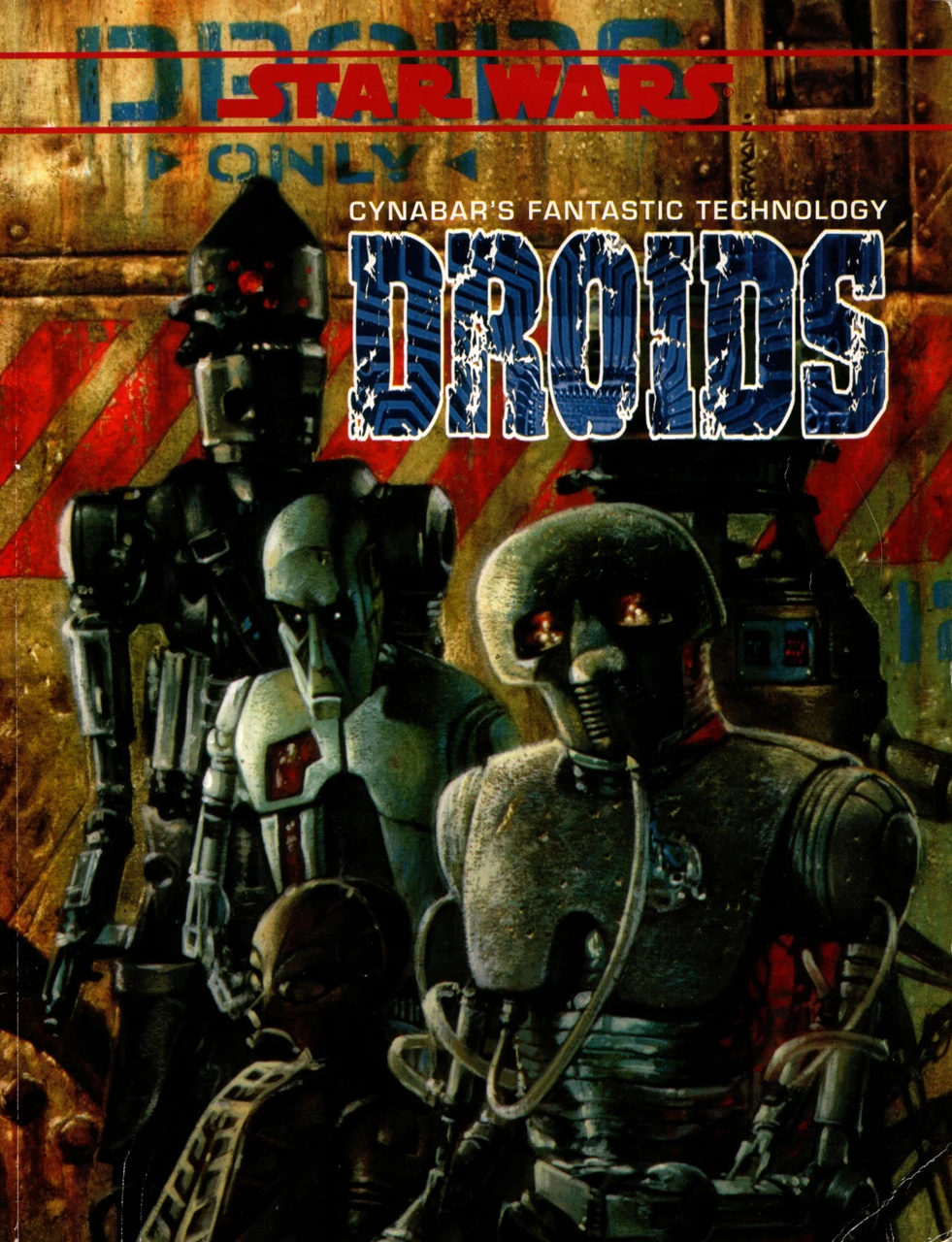
Cynabar's Fantastic Technology: Droids
Cynabar's Fantastic Technology: Droids
Star Wars Roleplaying Game Supplement
Design: Drew Campbell, Eric S. Trautmann
Development and Editing: Eric S. Trautmann
Additional Development: Bill Smith, Drew Bittner
Additional Editing and Material: Peter Schweighofer, Jennifer Seiden, George R. Strayton, Paul Sudlow
Playtesting and Advice: Eileen Campbell, David Eoff, Scott Hartsman, Johannes Huber, Patricia Jackson, Alex Jimenez, Heidi Kobara, Don Neske, Tim O'Brien, Matt Schaerer, Chad Schwein, Jae Walker
Graphics & Cover Design: Tim Bobko
Cover Art: Dave Dorman
Interior Art: Storn A. Cook, David Deitrick, Johannes Huber, Joe Johnston, John Paul Lona, Mike Manley, Ralph McQuarrie, Joey Robinson, Doug Shuler, Chris Trevas, Christina Wald, Thomas Woods
Publisher: West End Games, RR 3 Box 2345, Honesdale, PA 18431
TM & © 1997 Lucasfilm Ltd. (LFL). All Rights Reserved. Trademarks of LFL used by West End Games under authorization.
Introduction
The starship battle raged as if it had a life force of its own. Many ships had been lost to both sides already and the Alliance and Imperial commanders alike knew that the Rebels didn't have an inexhaustible supply of fighters (the Imperial Star Destroyer Vehemence certainly appeared to have—as one Rebel crewer put it—all the guns in the universe behind it).
A lone Y-wing limped along the periphery of the battle, her pilot a veteran of many such engagements. "Flight Leader Wilkins, beginning my run," he intoned calmly. Keying his comlink for a quick message to his astromech, he called out, "Better hang on back there, buddy."
BXET-R2 (or "Box" as his master was fond of calling him), checked the restraining straps and clamps that held him in place behind the cockpit of the Y-wing. The R2-unit emitted a mournful beep and Wilkins chuckled as he read the translation on his computer system: "Try not to crash this time."
The Y-wing sped through the carnage, as Wilkins cautiously, carefully placed the aiming reticle of his missile launchers squarely on the Vehemence. The fighter sped forward, crossing the kilometers to the Star Destroyer rapidly, as the targeting computer sought for a lock on the Vehemence's bridge.
Just as the targeting computer signalled a positive lock, Wilkins triggered his firing controls while his backseat gunner blazed away at the Star Destroyer's shields with the Y-wing's ion cannons. A brilliant spray of light and fire illuminated the area, blinding the pilot.
Too late, Box howled a warning to the blinded pilot as a TIE bomber—damaged in the explosions—careened into the Y-wing's path, striking the forward shields and sending the pair of fighters spinning wildly out of control.
Box ran diagnostics on the ship and reported both blaster cannons on the nose of the Y-wing had been sheared completely off. The cockpit still had a breathable atmosphere but structural damage to the nose was considerable.
Box patched into the ship's internal sensors and found that Master Wilkins was still breathing and did indeed have a pulse. Still he failed to answer over the comm. The droid peered into the cockpit and saw that Wilkins and his ion gunner were slumped over in their seats.
Taking control of the drive system, Box corrected the Y-wing's wild spin, halting the craft smoothly. Checking the navigational sensors, the droid noticed the TIE bomber had also regained control and was limping towards the damaged Y-wing, positioning itself for the inevitable kill shot.
The droid began carefully modulating the gravity within the cockpit in an attempt to jostle the pilot awake. At the same time, Box plugged into the auxiliary control port with one of his many appendages and lurched the Y-wing forward and up into an arch that brought her out and away from the bomber's current vector.
The bomber—badly damaged itself—sped past without acquiring a target lock and was sluggishly repositioning for another shot. BXET-R2 tied into the Y-wing's fire control system and armed the proton torpedo launcher. Sending the ship into as steep a dive as possible he inverted the ship and triggered off a wild shot, sending the blue-white projectile hurtling at the Imperial fighter.
The Imperial pilot frantically avoided the missile, once again losing control of his damaged vehicle. A moment later, Box activated the Y-wing's hyperdrive and the stubby fighter leapt into hyperspace and away from the battle....
Cynabar's Fantastic Technology: Droids is intended to help players and gamemasters more-easily integrate droids into an ongoing Star Wars campaign. The information in this volume can be used to design droids for use as both gamemaster characters and player characters. In addition, several scenario hooks are presented to help gamemasters develop droid-themed adventures. A new method for constructing droids is also presented, allowing gamemasters and players to build these fascinating machines. Finally, a detailed selection of dozens of droid types—some new, some familiar—are compiled in the Droid Datalog. These droids can be used as the basis for droid player character templates are can be used as "stock" droids during a roleplaying session.
Chapter One: Droids in the Galaxy
Defining Droids
"Droid: A mechanical and/or electronic construct designed and put into service to assist organic life." —From the Cybot Galactica Design Team Operations Manual
While the above definition is substantially correct, it does not fully describe what exactly a droid is. A droid is more than a computer that can move under its own power. Often a droid is designed with a personality as complex as that of an organic life form, or with the ability to perform tasks that are too physically demanding for living beings.
Most droids are programmed with an advanced synthetic intelligence, separating them from their purely robotic cousins (non-intellect bearing mechanisms, such as factory assembly robots common on many low-tech worlds). Not all droids have the same complexity of programming, and there is vast diversity in droid functions, designs and capabilities.
A majority of droids have the common traits of self-aware intelligence, locomotion, sensory reception, logic, manipulation and communication, based on the requirements of the manufacturer.
Droids are classified into five degrees, as follows:
-
First Degree Droids. Usually utilitarian in disposition, droids of this class are programmed with the physical sciences, medical sciences, or mathematics in mind. First degree droids are usually teamed up with organic counterparts to facilitate the completion of any specific task. The 2-1B surgical droid is an example of a first degree droid.
-
Second Degree Droids. This type of droid is frequently designed for functionality over aesthetics. A second degree unit's ability is often overlooked by the uninformed, simply because of the droid's physical appearance. The lack of advanced personality programming on many models adds to this common misconception. Second degree droids are programmed for environmental, engineering, and technical duties as well as applied sciences. Astromech droids—such as the famed R2-series—are second degree droids.
-
Third Degree Droids. The most common models to be seen with organic beings are third degree droids. They are designed and programmed with the social sciences in mind, specializing in protocol, translation, organic relations, teaching, diplomatic, and other functions that put them in regular contact with organics. As such, these droids tend to be physically designed in the mold of their makers, or the manufacturer's intended customer base. Protocol units like the 3PO and Siak-series are classified as third degree droids.
-
Fourth Degree Droids. Such units are illegal in most systems. Fourth degree droids are designed for military and security operations. After several accidents involving the design and manufacture of these "mechanical soldiers," the use of fourth degree droids was prohibited, except for certain models designed for legitimate military use. Although publicly denouncing the use of lethal droids for any operation, the Empire (as well as several underworld organizations) use fourth degree droids in an assassin capacity. Defense droids, like the G-2RD, are fourth degree droids.
-
Fifth Degree Droids. Similar to primitive robotic units, fifth degree droids are typically programmed for menial duties such as simple lifting, mining, salvage, transportation, sanitation and waste control. Fifth degree droids generally perform tasks deemed unfit or impossible for organic life. This class of droid is seldom equipped with any advanced knowledge processors, save for those that are required to perform an intended task. Fifth degree droids are the most common (and most affordable) found throughout the galaxy. The BLX-series labor unit is but one of the many fifth degree droids found throughout the galaxy.
Extrapolated History
—From the Cybot Galactica Design Team Operations Manual
The true origin of droid technology is unknown. What is known is that droid technology predates space flight. Droids "evolved" from ancient robotics technology (coupled with the addition of primitive artificial intelligence). Rudimentary skills could be programmed into one of these machines, and the programming would "learn" and enhance itself to fit specific tasks.
As electronics and software compression technology improved, programming a droid with multiple skills became standard practice. Droid technology expanded and units were seen in systems across the Old Republic.
Resentment directed at these units appeared almost immediately. It was widely felt that the use of mechanical intelligence was the cause for massive job loss throughout much of the galaxy. This widespread feeling was not enough to hold technology back, however. Sales of droids among the affluent increased, and eventually, droid manufacturers began producing less-expensive models for the commercial market.
Once personal-use models became common, engineers began working on developing personality software to make interaction between droids and organics easier. The initial personality designs were primitive; add-on voice modules that mimicked organic speech, and patently fake synthetic skin were perhaps the earliest examples of "droid personality" extras available to the commercial market. Later, intricate matrices were developed allowing a droid to simulate emotions. These matrices developed and learned on their own without assistance from a programmer.
The advantage of a droid possessing a distinct personality was obvious to those in the automata-manufacturing industry: it was easier to sell an item that could assist in selling itself. Many beings found owning something that possessed what could be loosely termed as "artificial sentience" a novelty. (Early droid manufacturers borrowed heavily from the home pet industry's marketing campaigns, encouraging consumers to bring a droid "into the family.")
One disadvantage concerning droid personalities became apparent very quickly: some units—particularly poorly treated or badly maintained droids—developed "anti-social" personalities. Such units were often recalcitrant, performing as ordered but without any distinction. Droids of this kind were either taken back to the manufacturer under warranty, or destroyed by angry owners.
Today, droids fill an unspoken niche in society, performing their daily tasks as ordered. Some notable droids have broken the barrier that forces them into a existence of servitude, proving their worth by acting out on their own (though usually within strict program parameters).
Organic resentment of droid-kind remains deep-seated and has not altered a great deal since the days of the Old Republic. Many beings continue to see mechanical intelligence as a threat. Mechanicals are often deprived of entrance into business and leisure establishments (save for units that are required for their owner's health or assistance).
Droids and the Law
The Past
While most mechanicals are content to go about their daily tasks without complaint—at least without serious complaint—there have been a number of instances when a droid has gone beyond its programming and committed acts that are illegal. These events have occurred often enough throughout history to prompt many governments (including the Old Republic) to compose a set of governing laws regarding droid ownership and the responsibilities therein.
These laws were originally placed into effect primarily as a safeguard against rogue droids and the organic beings who owned them (notably crime lords and pirates). If a droid committed an illegal act by way of a command from its master, the owner would simply be brought to trial as if he performed the act himself. Early laws in many systems stated that the droid was simply a tool with which the criminal act was performed.
Correspondingly, if a droid committed a minor crime of its own volition (such as illegally parking or maneuvering a conveyance, petty theft or other such misdemeanor), the owner would be ticketed and fined. The courts would admonish the owner to repair whatever malfunction the droid had, and that would typically be the end of the matter. In extreme cases (destruction of private property, assault, or capital crimes), the droid would be confiscated and destroyed.
Many governments employed highly trained engineers and slicers who could perform the necessary investigations as to the cause of a "rogue" droid's actions. These beings could readily discover faulty programming, internal hardware glitches, or—by carefully examining the droid's memory—a criminal command given by the owner. Trials would then be held as would any other "normal" criminal trial. Droids whose owners had been convicted of a crime would be memory-wiped and reprogrammed to factory settings and auctioned off to a new owner, the profits from such an auction used to defray the expense of the trial.
Imperial Rule
The rise of the Empire did little to alter the basis for what has become known as the "Droid Statutes." Hidden within the Imperial Penal References compiled by COMPNOR, there is a sub-section detailing infractions as they are related to mechanical beings.
Class One Infractions
The illegalities listed as Class One are considered to be capital offenses. Considering the basic prejudice against droids in the first place (coupled with their typically subservient role in galactic society), Class One infractions are often kept quiet by Imperial forces to quell any widespread panic that could arise from a droid committing such a horrendous offense.
Punishment for a Class One infraction by COMPNOR standards requires the droid's owner to be sentenced to imprisonment from five years to life, and also mandates the droid's destruction.
Class One infractions include, but are not limited to, the following crimes:
- Conspiring to overthrow the Empire.
- Voluntary manslaughter.
- Programming or actions with intent on harming Imperial personnel.
- Programming a droid to engage in espionage activities against the Empire or its citizens.
Class Two Infractions
While still severe crimes, Class Two infractions are less serious than Class One violations. Class Two crimes are common only to larger cities and spaceports and due to the nature of these acts, trials regarding Class Two infractions are often highly publicized.
Class Two infractions include, but are not limited to, the following crimes:
- Involuntary manslaughter.
- Ownership or installation of an illegal weapon within a droid's chassis.
- Illegal programming (SkillWare with an availability rating of "X").
- Unauthorized espionage programming.
Punishment for a Class Two infraction includes confiscation of the droid, as well as imprisonment for five to thirty standard years for the owner (typically in a high-security facility, such as Kessel). In some extreme cases, the droid is destroyed; however, standard practice is to memory wipe and reset the unit's programming and place it in a public auction.
Class Three Infractions
Class Three infractions are often overlooked by Imperial personnel, which delegates responsibility for policing such crimes to local authorities. Punishment for a Class Three infraction usually includes a heavy fine for the owner (from 1,000 to 5,000 credits), and a mandatory memory wipe and reset for the droid. In some cases the owner has been found criminal and the droid has been impounded for public auction.
Class Three infractions include, but are not limited to, the following crimes:
- Theft in amounts exceeding 10,000 credits standard.
- Ownership or installation of a weapon without a permit.
- Physical assault not concluding with death.
Class Four Infractions
Class four infractions are normally the most common droid-related crimes. Such violations are sometimes overlooked in larger cities and spaceports, though in a more rural area they are typically enforced very strictly.
Punishment for a Class Four infraction includes a modest fine for the owner, from 500 to 3,000 credits standard, and a memory wipe for the droid in question.
Class Four infractions include, but are not limited to, the following crimes:
- Theft in amounts between 5,000 and 10,000 credits.
- Possession or installation of restricted programming without a permit.
- Property damage (includes other droids).
- Trespassing on droid-restricted property.
Class Five Infractions
The Class Five infractions are the lowest misdemeanor on COMPNOR's list of "Droid Statutes." The simplest of crimes often go unnoticed by many law enforcement officials everywhere.
Punishment for a Class Five infraction usually results in a small fine for the owner (100 to 1,000 credits) and a memory wipe for the offending droid.
Class Five infractions include, but are not limited to, the following crimes:
- Theft in amounts up to 5,000 credits standard.
- Verbal assault on an organic being.
- Lack of a restraining bolt or other "leashing" technology.
Enforcement of Droid Statutes
Though these infractions are the basis of the so-called "Droid Statutes," enforcement varies widely throughout the galaxy. Some technologically-advanced worlds—like Coruscant or Derilyn—will lighten the punishments for some of the "lesser" crimes as the attention of law enforcement personnel is needed elsewhere. In more-remote areas—such as Tatooine or Gamorr—any injustice performed by a droid typically wreaks havoc on the local judicial system for months on end.
Overriding Life Preservation Programming
In the Star Wars universe, droids (with the exception of some fourth degree models) are required by Imperial law to be equipped with life preservation programming (LPP).
LPP subroutines prevent a droid from experiencing the compulsion to do harm to an organic being. The fact that these programming measures are installed is not necessarily a complete safeguard against rogue droids, but due to the sophistication of programming technology, the likelihood of a droid going rogue is lessened a great deal.
Even fourth degree droids, who are by their nature aggressive, are given LPP routines defining when action against organic life may be taken. Still, there are those who would attempt to override the LPP, allowing a droid to participate in combat. This is not a simple task by any means.
However, the Imperial law enforcement apparatus does not expend a great deal of effort enforcing this statute in the outlying regions of the Empire; such matters are usually delegated to local droid enforcement officers.
In game terms, if a character wishes to override a droid's life preservation programming, she must make two successful skill rolls, a droid programming roll and a command roll. The droid programming roll is based on the degree of the droid, while the command roll is an opposed roll versus the droid's willpower skill or Knowledge attribute (whichever is higher).
Droid Programming Override Difficulties
| Droid Degree | Difficulty |
|---|---|
| First Degree | Very Difficult |
| Second Degree | Difficult |
| Third Degree | Heroic |
| Fourth Degree | Moderate |
| Fifth Degree | Difficult |
Gamemasters may decide for themselves if the two rolls should be made in the same round (causing a multiple skill use penalty of -1D), or if the character may take two rounds to perform the action.
Note that not all droids have LPP subroutines. While the Empire mandates this programming be installed in all civilian droids, it does not enforce this law outside of the Core Worlds. In the somewhat lawless Outer Rim Territories, for example, many outlaw techs and droid slicers have overridden this programming; characters should be made aware that it is possible that any droid they encounter could have had its LPP protocols erased.
Anyone attempting to determine if a droid has had its LPP subroutine overridden must make a successful droid programming roll using the difficulties listed above. The attempt takes 1D minutes.
Many planetary militias have even gone so far as to create special branches of law enforcement officers that specialize in droid-related crimes. These groups are not unlike the technicians and slicers employed by the Old Republic; these officers investigate and prosecute crimes that violate the Droid Statutes.
Typical droid enforcement agent. Dexterity 3D, blaster 3D+1, blaster: DEMP gun 5D, dodge 4D, Perception 2D+2, search 3D+2, Knowledge 3D+1, Strength 3D, Mechanical 2D, repulsorlift operation 3D, Technical 4D, droid programming 5D+1, droid repair 5D, demolitions 3D+2, security 4D+2. Move: 10. Blaster pistol (4D), DEMP carbine (3D ionization damage, 3-25/60/250, ammo: 10).
The Droid's Rights Movement
Because of the mechanical semblance of sentience that many droids possess, a number of "Droid's Rights" factions have popped up across the galaxy. Most of these organizations are harmless, sending petitions to government officials, marching in protest at droid auctions, and generally behaving in a well meaning (if annoying) manner. There are, however, some groups which have used violence in their struggle to "emancipate" droids. The droid-terrorist groups have popped up in some of the more-remote systems of the Empire, engaging in a variety of crimes. Some groups are harmless, committing only petty crimes (such as reprogramming a citizen's droid to recite terrorist slogans). Others are more aggressive, bombing droid manufacturing facilities and committing any number of Class One crimes to further their cause.
The Coalition of Automaton Rights Activists
The Coalition of Automaton Rights Activists has been around and active for several decades. The Coalition is comprised of several factions ("Grease Lovers," as their opponents prefer to call them). The Coalition's leadership is made up of individuals who, for the most part, share a common ideal: that all droids should be accorded the same respect and consideration that is shown to any sentient species of organic origins.
That is not to say that all members of the Coalition share the same ideas about how to express this ideal. One of the more radical organizations—"Olgreen Intelligence Guild" led by Wilam Olgreen—have gone as far as erecting portable energy shields around droid reclamation plants (preventing cargo vessels from making deliveries of rogue or damaged droids). Other leaders—like Bethelia Halvala of "The Symatrum League"—have picketed outside major manufacturing facilities.
The Mechanical Liberation Front
The most dangerous of the droid's rights groups is the MLF. Led by Jarred Sneel, the MLF has plagued many companies over the past three decades. Using hit-and-run tactics, these skilled mercenaries and engineers have managed to inflict severe damage on the plants of Industrial Automaton, Sienar Intelligence Systems, and MerenData, to name just a few.
The MLF typically enters a manufacturing plant covertly, planting detonite bombs in strategic locations. The resulting explosions cause chaos and halt all production for an indeterminate amount of time. This tactic is effective, though not for releasing droids from their "oppressive" captors. Much to Sneel's dismay, the NewsNets mark this group as being violently opposed to droids, rather than being a group dedicated to the freedom movement. Currently, there is a team of Espos moving secretly against the MLF, and it is believed that this Espo squad illegally operates within the Empire as well as the Corporate Sector. The CSA denies this allegation.
The MLF has many members and they are connected by a large network of agents. Thus far they have been able to avoid major losses at every military confrontation they have been faced with. The Corporate Sector Authority, as well as the Empire, have posted large rewards for information leading to the arrest and conviction of the MLF's leaders.
Jarred Sneel
Type: Terrorist leader
DEXTERITY 2D+1
Blaster 4D, dodge 3D+1
KNOWLEDGE 3D+2
Tactics 4D+2, willpower 5D
MECHANICAL 2D+2
Repulsorlift operation 3D+2, starship gunnery 3D
PERCEPTION 4D
Command 7D, con 5D+1, hide 6D+2, sneak 5D
STRENGTH 2D
TECHNICAL 3D+1
Droid programming 5D, droid repair 5D+1, demolitions 4D+2, security 3D+2
Capsule: Jarred Sneel's background is something of a mystery; there are literally dozens of stories about his past, all of them wildly contradictory. What is known is that Sneel is a male human in his mid 30s, a native of the Corellian system. He is obsessed with droids, mouthing slogans about how "organics must rise up and free droids from their cruel servitude." Whether or not Sneel truly believes in his cause is unknown; the current CorSec file on the MLF indicates that it may be a front for a Black Sun operation.
Typical MLF Soldier. Dexterity 3D, blaster 4D, dodge 3D+2, Knowledge 2D, Mechanical 2D, Perception 3D, search 4D, hide 3D+2, Strength 2D, Technical 3D, droid programming 4D, droid repair 5D+1, demolitions 3D+2. Move: 10. Blaster pistol (4D), detonite explosive (6D damage, blast radius of 10 meters).
Scenario Hook
The MLF's leader, Jarred Sneel, launches a series of bombing attacks on droid plants in an Outer Rim system; unfortunately, one of the droid plants is the site of a Rebel espionage operation. (Several key Rebels are hardwiring espionage routines in droids on the assembly line.)
The player characters are sent by the Alliance to infiltrate the MLF and stop Sneel's bombing campaign before it damages any other Rebel interests in the sector.
As an alternative, the characters could be local droid enforcement agents (or CorSec officers, or Sector Rangers), sent to prevent any further bombings and end the MLF's activities. During the investigation, the characters stumble into the true motives of the MLF's leader: a Black Sun-controlled company is supplying the construction equipment to rebuild droid plants destroyed in the bombings. The characters must apprehend Sneel and prove Black Sun's involvement.
The Rebel Alliance
Though not considered a true "Droid's Rights" group by definition, the Rebel Alliance has put forth a policy of tolerance, for all forms of life (in response to Palpatine's campaign of intolerance directed at non-human species); it would appear that the Alliance's treatment of mechanicals is an extension of this tolerance.
Scenario Hook
The player's characters are told by their Alliance commanders to pick up and protect a new "recruit," who is defecting from the Empire. This recruit is actually a servant droid that was owned by an Imperial officer. The droid, either as a result of espionage programming or a faulty memory wipe, has managed to escape Imperial service and wants to deliver information to the Rebellion.
Upon reaching the rendezvous point, the characters attempt to find their "pickup," most likely looking for an organic, rather than a droid. The droid will try to approach them, but it is being hunted by Imperials and does not wish to get caught.
A variation on this theme involves the Imperial officer: perhaps he wishes to defect, and has sent the droid—laden with military secrets—to the Rebel Alliance to prove his desire to defect is genuine. However, Imperial Intelligence has suspicions about the officer and plans to use the droid to track the Rebels back to their base, as well as exposing the defection. The characters must find the droid, retrieve the data, verify its authenticity, and arrange for the Imperial's defection...without tipping the Alliance's hand to the Empire's spies.
Droid Manufacturing Companies
There are several droid manufacturers in the galaxy; some are major corporations with sector-spanning distribution and retail networks, while others are craftsmen and artisans that individually construct droids to order. The following are brief descriptions of some of the key droid producers, and where their products may be found:
Accutronics
A former subsidiary of Industrial Automaton, Accutronics pioneered the marketing of droids to families, typically in a servant or nanny role. While not a major success, Accutronics has raised a few eyebrows among rival corporations; the MK 8001 that Accutronics has introduced is becoming one of the fastest selling droids in the Outer Rim Territories. Accutronics can be found on many planets in the Outer Rim that possess an Imperial class spaceport.
Arakyd
One of the principal suppliers of military droids to the Empire, Arakyd has made a name for itself with the Viper probe droid. Arakyd has only recently begun to sell droids to the commercial market, preferring to handle the needs of larger groups such as the Imperial Navy or the Sector Rangers. Arakyd droids can be found throughout the Core Worlds, but typically require military certification or extremely detailed waivers for purchase.
Aro
Once a strong contender in the field of security droids, Aro was wiped out by bad publicity; one of Aro's droids was used in an assassination attempt in the Corellian system. Still, many of Aro's designs can be found in surplus auctions and on the Black Market. The company's founder (and chief designer), Lirran Aro, lives on Selonia (in the Corellian system).
Caldrahlsen Mechanicals
Caldrahlsen Mechanicals was one of the first manufacturers of automata specializing in legal matters. These droids, while initially greeted with skepticism, have become commonplace in the Imperial legal system. Caldrahlsen Mechanicals' main offices and manufacturing plants are located on Esseles (Darpa sector, in the Core Worlds; for more information on Esseles, see pages 221-224 of The Official Star Wars Adventure Journal, issue seven).
Cybot Galactica
Cybot Galactica is one of the foremost droid manufacturers in the galaxy, famous for its 3PO line of protocol droids. Not surprisingly, CG is one of the major forces in the Corporate Sector as well as an impressively successful company in the Core Worlds. Cybot Galactica service centers and droid markets can be found in every standard (or better) class spaceport.
Geentech
Geentech, a small medisensor company, was one of the first manufacturers to produce a surgical droid that was widely successful. Unfortunately, Geentech was run out of business in a cutthroat series of legal battles with the larger Genetech corporation (which claimed Geentech's name infringed on several Genetech copyrights). It is widely rumored that Genetech won the legal battles after offering the Empire deep discounts and other trade inducements in exchange for a satisfactory verdict, though these allegations have never been substantiated.
Genetech
One of the largest droid manufacturers, Genetech was originally a pharmaceutical firm. When droid use first became widespread, Genetech executives purchased a small manufacturing facility and automated a significant portion of their operations, hugely increasing corporate profits by trimming employee overhead; Genetech's droid program was perhaps one of the most hotly controversial business practices of its day and is likely one of the causes of anti-droid sentiment in the Old Republic.
After a particularly virulent hive virus ran its course, Genetech stocks were at an all time low; the companies much vaunted anti-viral serum had failed miserably. However, some of the early Genetech profits had been funnelled into more small droid manufacturing plants. Within a few years—and several lucrative legal battles—Genetech re-tooled and began producing droids for the medical market, and has been showing a huge profit ever since. Genetech droids can be found on most planets with a stellar class (or better) spaceport.
Go-Corp/Utilitech
Go-Corp—a manufacturer of automated conveyances—operates within the Corporate Sector and maintains service and manufacturing centers on all CSA planets with a stellar class (or better) spaceport. Go-Corp manufactures the actual conveyance (typically landspeeders and airspeeders) while the subsidiary company, Utilitech, manufactures the droids that control the conveyances. Go-Corp/Utilitech products are not distributed widely outside of the Corporate Sector, though they can occasionally be found on the more civilized planets of the Outer Rim Territories.
Industrial Automaton
Known for high-precision droids, Industrial Automaton is one of the premier droid manufacturers in the galaxy (as evidenced by the highly successful R-series astromechs). IA droids can be purchased on any planet with a standard (or better) class spaceport. IA droids can often be purchased at a discount, since the company is constantly engaged in price wars with its chief competitor: Cybot Galactica.
Kalibac Industries
Kalibac Industries—a small industrial automation firm—has never really found its niche in the galactic droid market. After a series of legal battles with Cybot Galactica, KI is substantially weakened. Kalibac droids are extremely good; however, in fact, many outlaw techs have stolen the designs of several Kalibac Industries' droids and produced cheap, faulty imitations. Kalibac Industries retains only two manufacturing and retail centers, one on Coruscant and one on Procopia (the capital of Tapani sector).
Les Tech
Les Tech is another relatively small company (currently fighting a takeover attempt by Cybot Galactica), specializing in exploration droids. Several Les Tech designs have been adopted by the Imperial scouting services (though it appears the bulk of Les Tech's sales are actually to the Rebel Alliance). Les Tech maintains three manufacturing plants, one located on Coruscant, and the other two on Brentaal. Les Tech designs can be purchased or serviced at virtually all Imperial-class spaceports in the Core Worlds.
Lovolan
Lovolan specializes in high-end droid models, designed for service to the wealthy; Lovolan droids are made from high-quality materials and are often decorated with precious gems and valuable metals. Lovolan has a chain of retail and service centers throughout the Core Worlds, and such outlets can be found on any Core World with an Imperial-class spaceport.
MedTech
The manufacturer of the FX-series medical droid, Medtech established itself early on as a major contender in the field of surgical automata. The company has not lived up to its early promise, however; a series of cutbacks and management shakeups have virtually ended the production of new droid designs. Currently, MedTech is downsizing at a rapid rate and only maintains offices and service centers on worlds in the Deep Core.
MerenData
MerenData—a contributing sponsor to the Corporate Sector Authority—specializes in the manufacture of security systems, interrogation droids and target drones for the military.
Publictechnic
A recent addition to the galactic droid market, Publictechnic deals primarily in large, maintenance-oriented units for sale to municipal and planetary governments. The main production plant for Publictechnic droids is on Sennatt (near the Bothan colony, Kothlis). The company's main service center and "droid shop" is also located on Sennatt.
Rim Securities
One of the more successful droid companies in the Outer Rim Territories, Rim Securities—based in Portmoak sector—manufactures security, defense and exploration units predominantly. The bulk of Rim Securities' sales occur in its chain of "DroidMarts," a string of small service and retail outlets that are scattered throughout Quence, Parmel and Portmoak sectors. Small DroidMarts can be found in this region on any planet with a stellar class (or better) spaceport.
Roche
"Roche" is the nickname for the droid-manufacturing program instituted by the insectoid Verpine species; the Verpine refer to their droid-building effort as the "Roche Hive Mechanical Apparatus Design And Construction Activity For Those Who Need The Hive's Machines." (Verpine prefer to speak very specifically; most non-Verpine prefer to simplify the concept to "Roche.")
The Verpine have long been recognized as exceptional starshipwrights, and—due to their love of technology—eventually branched out into droid manufacturing. The early Roche designs were not well-received, but later droids are beginning to gain popularity.
Roche designs may be purchased from the Verpine in the Roche system; many Verpine droids have also found a place in the marketplaces of Ithorian herdships.
Serv-O-Droid
Serv-O-Droid specializes in the construction of labor automata, work droids and heavy equipment (such as construction gantries). While it is no longer a viable company—its assets were liquidated and split among the charter members of the Corporate Sector Authority—many Serv-O-Droid units are still functioning. A "remainder house," dealing in reconditioned Serv-O-Droid designs, has recently opened on Elshandruu Pica, and is experiencing a great deal of success.
Sienar Intelligence Systems
One of the fastest growing arms of the massive Santhe/Sienar corporation, Sienar Intelligence Systems is competing directly with MerenData and Arakyd for lucrative government contracts. SIS-manufactured droids can not be purchased except directly from the company, and only after a thorough background and credit check have been completed.
One of the principal distribution centers of Sienar Intelligence Systems' products has recently been activated on Corulag, an extension of Santhe/Sienar's research and development complex near Dammon University. (For more information on Corulag, see The Official Star Wars Adventure Journal, issue seven, pages 214-215.)
Military and law-enforcement personnel are typically the only groups authorized to purchase Sienar droids (though it is believed that some nobles in the Core Worlds and in Tapani Sector have access to SIS hardware).
TelBrinTel
A specialist firm, TelBrinTel manufactures droids for purely scientific purposes (though these designs often end up in military service). Noted for their high quality workmanship and extreme accuracy, TelBrinTel science droids see use in many universities and military research installations. TelBrinTel maintains service centers, manufacturing plants and dealerships throughout the Core Worlds, and recently began marketing less-expensive models in the Tion Hegemony, the Centrality and the fringes of the Corporate Sector Authority (typically on worlds with a stellar—or better—class spaceport.)
Ulban Arms
A recent extension of LisureMech Enterprises—a CSA company that's droid division specialized in high-end luxury droids—Ulban Arms has had a great deal of success with the Class I Defense Droid. Despite the success of this model, Ulban Arms manufactures and sells exclusively within the CSA's borders; apparently the Class I's design was procured from within the Empire and any attempt to mass-produce and sell the droid outside of the Corporate Sector will likely provoke Imperial penalties. Currently, the Class I is the only droid-type manufactured by Ulban Arms, though a number of security and commercial droids are in development.
Veril Line Systems
Veril Line Systems specializes in industrial droids—such as the EG-series power droid—and has had tremendous success. VLS' main offices are on Coruscant (where, incidentally, the IN-series information droid is widely used). VLS droids are available on any world with a stellar class spaceport.
Other Droid Markets
While there are literally millions of places to purchase "stock" droids—Galladinium's, Ithorian herdships, manufacturer's outlets, to name a few—some owner's may wish to have a droid upgraded beyond the manufacturer's specs...and in some cases such upgrades are illegal. While not sanctioned by the Empire, there are a number of outlaw techs that specialize in droids and droid-related technology. The following are a small sampling of such droid technicians and where they may be found:
Kligson's Moon
Kligson's Moon—also known as "Droid World"—is generally considered a myth, a tall tale shared by Outer Rim spacers. However, the story is more reality than myth: Kligson's Moon exists.
The "moon" is actually an artificial construct, a hybrid of numerous starship hulls, drive engines, and space station decks, populated exclusively by droids. Kligson—who's body is almost completely made up of cybernetic replacement parts—refuses to allow any organic life aboard his station.
Kligson's moon is mobile; after an encounter with Rebel agents shortly after the Battle of Yavin, Kligson moved his home and to date, no one has found its new location.
Kligson's Moon
| Type: | Mobile space platform |
| Scale: | Capital |
| Length: | 800 meters |
| Skill: | — |
| Crew: | 1,000 (droids), gunners: 20, skeleton 20/+15 |
| Crew Skill: | Astrogation 9D, capital ship gunnery 7D, capital ship piloting 5D+2, capital ship shields (6D), sensors 7D |
| Passengers: | 2,000 |
| Cargo Capacity: | 5,000 metric tons |
| Consumables: | 2 years |
| Hyperdrive Multiplier: | x4 |
| Hyperdrive Backup: | x10 |
| Nav Computer: | Yes |
| Maneuverability: | 1D |
| Space: | 4 |
| Hull: | 5D |
| Shields: | 2D |
| Sensors: | |
| Passive: | 40/1D |
| Scan: | 80/2D |
| Search: | 125/3D |
| Focus: | 5/3D+2 |
| Weapons: | |
| 30 Turbolaser Batteries | |
| Fire Arc: | 7 front, 8 left, 8 right, 7 back |
| Crew: | 2 |
| Skill: | Capital ship gunnery |
| Fire Control: | 2D |
| Space Range: | 3-15/35/75 |
| Atmosphere Range: | 6-30/70/150 km |
| Damage: | 9D |
| 5 Tractor Beam Projectors | |
| Fire Arc: | 1 front, 2 left, 2 right |
| Crew: | 3 |
| Skill: | Capital ship gunnery |
| Fire Control: | 2D |
| Space Range: | 1-5/15/30 |
| Atmosphere Range: | 1-5/15/30 km |
| Damage: | 4D |
Kligson
Type: Cyborg recluse
DEXTERITY 2D
Blaster 6D, blaster artillery 5D, brawling parry 5D, dodge 5D, firearms 5D, melee combat 8D, melee parry 8D
KNOWLEDGE 3D
Alien species 6D+2, intimidation 5D, languages 5D, planetary systems 5D, planetary systems: Outer Rim Territories 6D, streetwise 6D, survival 5D, tactics 7D, willpower 10D MECHANICAL 3D Archaic starship piloting 5D, astrogation 10D, capital ship gunnery 7D, capital ship piloting 4D, capital ship piloting: Kligson's Moon 10D, sensors 8D PERCEPTION 3D Bargain 6D, command 6D, command: droids 11D, con 5D, persuasion 6D STRENGTH 3D Brawling 5D, climbing/jumping 4D, lifting 6D, stamina 7D TECHNICAL 4D Armor repair 8D, blaster repair 8D, capital starship repair 10D, capital starship weapon repair 10D, computer programming/repair 9D, (A) droid engineering 9D, droid programming 8D, droid repair 8D
Special Abilities: Cyborg body: Kligson's body is almost entirely made up of cybernetic parts; as such Kligson requires no food or water. In addition, Kligson receives +2D to Strength to resist physical damage and +1D versus energy damage. Internal Blaster: Kligson has blasters built into his cybernetic hands (damage 5D, range 10 meters, 10 shots).
Character Points: 27 Move: 10
Capsule: After receiving grievous injuries during a battle many years ago, Kligson's damaged body was outfitted with a vast array of cybernetic parts. After witnessing the cruelty that living beings can inflict on each other first-hand, the disenchanted warrior vowed never to interact with organics again. After building a massive space platform out of spare parts, Kligson surrounded himself with droids (typically salvaged from spare-part bins) and hid himself away in an unexplored system.
It is rumored that Kligson had a brief encounter with the Empire and the Rebellion, though the specifics of the encounter are not known; after the conflict, Kligson moved his "Droid World" from its home system and has not been seen since.
Scenario Hook
The search for Kligson's new location can be the basis for a scout-style campaign; since Kligson knows his way around the Outer Rim Territories, he can be a tremendous source of information.
In addition, Kligson is a highly gifted engineer and mechanic, capable of repairing or building a vast array of ship components and droids. Characters that need a piece of specialized equipment or a difficult droid modification may find Kligson's assistance invaluable...if he agrees to help them and if they can find him.
Kligson will not deal with organics, nor will he choose a side in the war against the Empire. He may, however, agree to speak to a character that has cybernetic replacement limbs, though this will take a great deal of persuasion and charm on the part of the player characters. However, one of Droid World's strictest laws remains in effect: anything Kligson repairs, he keeps.
Omze's Incredible Travelling Starport
Omze's Incredible Travelling Starport is a rather unique space vehicle that jumps—some say randomly—from system to system in the Outer Rim Territories. Run by a sly Sludir, Omze's is a veritable marketplace of hard-to-find services and goods. (For more information on Omze's Incredible Travelling Starport, see Platt's Starport Guide, pages 80-96.)
Individuals looking for illegal or restricted droid modifications may find Omze's useful: Wilam Olgreen (a droids' rights activist and formerly a design specialist for Industrial Automaton) tends to hawk his dubious wares there.
Wilam Olgreen
Type: Outlaw droid tech
DEXTERITY 2D
Blaster 4D, dodge 5D, melee parry 5D, pick pocket 6D, running 5D
KNOWLEDGE 4D
Alien species 6D, business 5D, languages 5D, streetwise 6D, value 6D, willpower 6D
MECHANICAL 2D
Astrogation 4D, space transports 5D
PERCEPTION 3D
Bargain 5D, con 7D, forgery 6D, sneak 6D
STRENGTH 3D
Brawling 5D
TECHNICAL 4D
Demolitions 4D+2, (A) droid engineering 8D, droid programming 7D, droid repair 7D
Character Points: 8
Move:
Equipment:
Capsule: Wilam Olgreen, a prominent droid's rights activist, has long maintained an illicit droid modification business in the Outer Rim. Reasoning that the best way to help droids is to make them better (adding skills and hardware to a stock design) so that they can more readily prove their worth to organic masters.
The Empire, on the other hand, has taken a dim view to Olgreen's activities, however; several of the "improvements" Olgreen has made on various droids include the addition of restricted SkillWare and weapons. Still, if someone has the cash—and is willing to pay his rather steep fees—Olgreen will come out of hiding to ply his trade.
Scenario Hook
The characters arrive at Omze's—possibly to trade, possibly to avoid some Imperial "entanglements"—and encounter an elite undercover squad of Espos, security troops from the Corporate Sector Authority.
These Espos are on a covert mission to find and eliminate Jarred Sneel, leader of the Mechanical Liberation Front. Unfortunately, they can't find the elusive terrorist and have resorted to finding other droid rights activists and pressuring them in hopes of learning Sneel's whereabouts. Their current target is Wilam Olgreen, who is hiding at Omze's.
As the characters move about the spaceport, Olgreen approaches them, offering them a great deal of money if they will transport him to StarForge Station. If they agree, the characters must sneak Olgreen past the Espo thugs and escape from the starport (fully realizing that shooting up Omze's place of business will likely anger the Sludir merchant a great deal).
If they don't agree to help Olgreen, he turns up dead, with evidence implicating the characters in the murder; the Espos framed them simply because they were the newest arrivals and were seen talking to the deceased outlaw droid tech. The characters must clear their names and expose the Espo operation or face justice at Omze's hands.
StarForge Station
StarForge Station—hidden deep in the heart of Ado sector's StarForge nebula—is a large outpost built on one of the many planetoids in the region. A haven for pirates and smugglers, StarForge Station is a nexus for illicit repair and modification operations; while the techs at StarForge tend to specialize in the modification of space vessels, there are several droid engineers who ply their trade aboard the station.
Finding StarForge Station is no easy feat; since it is located in a turbulent nebula, sensor readings are—at best—sketchy. Since it is also a target of the Empire, the station's owner (a Duros named Chidee Na Maak) moves StarForge with great frequency. The best way to find the station is to maintain contact with pirates and smugglers, who will reveal the information to those they trust. (For more information on StarForge station, see pages 109-113 of Pirates and Privateers.)
StarForge Station
| Type: | Asteroid |
| Temperature: | Temperate |
| Atmosphere: | Type I (breathable) |
| Hydrosphere: | Moderate |
| Gravity: | Standard |
| Terrain: | Artificial |
| Length of Day: | 20 Standard hours |
| Length of Year: | 300 Standard days |
| Sentient Species: | Varies widely |
| Starport: | Standard |
| Population: | 10,000 (approximately) |
| Planet Function: | Shadowport |
| Government: | Tenant council |
| Tech Level: | Space |
| Major Exports: | Free market, ships services, starships |
| Major Imports: | Raw and processed materials |
"Skoot" Jarik
Type: Droid slicer
DEXTERITY 3D
Blaster 4D, blaster: DEMP gun 5D, dodge 4D+1, running 3D+2
KNOWLEDGE 3D+1
Investigation 5D
MECHANICAL 2D
Repulsorlift operation 3D+1
PERCEPTION 2D+2
Search 4D, sneak 3D+1
STRENGTH 3D
TECHNICAL 4D
Computer programming/repair 5D+2, (A) droid engineering 9D, droid programming 6D, droid repair 5D+1, security 5D
Character Points: 6
Move: 10
Equipment: Blaster pistol (4D), DEMP gun (3D ionization damage, 3-25/60/250, ammo: 10), comlink, datapad, droid toolkit
Capsule: After attending the CSA Institute of Technology, "Skoot" returned to his homeworld of Biewa and attempted to make a living as a droid technician. His career as a droid tech was an abject failure, however; most Biewans had little in the way of ready cash and spent their money on clothing, shelter and food, not droids.
Jarik tried his hand as an information merchant, but on a backwater world like Biewa he lacked customers, the same problem he had as a droid tech. Eventually, Jarik met a smuggler who needed some illegal modifications made to his droid, modifications that the cash-strapped technician was only too happy to make. Before long, word of Skoot's ability spread throughout the Fringe and the young droid engineer soon had a thriving trade as an outlaw tech.
Relocating to StarForge Station, Skoot is one of the only people aboard that works on droids. Skoot's work is extremely reliable—which has made him a favorite among smugglers (at least those that own droids)—and typically justifies the high prices Jarik charges for his services.
Scenario Hook
The characters arrive at StarForge Station, just in time for an Imperial raid. The initial patrol that shows up is small, and the station's denizens manage to fight them off, but more ships will likely follow. The only problem is that someone leaked the station's location to the Empire and the evidence implicates "Skoot" Jerik, the local droid tech (who just repaired a probe droid of some kind).
Skoot offers to modify the character's droid (or to build them one from scratch if necessary) if they will help clear his name and find the real traitor: a pirate that frequents the station.
Chapter Two: The Owner's Manual
Designing, Upgrading, Customizing, and Maintaining Droids
Droids in the Star Wars universe can be built and modified the same as any vehicle or piece of equipment. In most cases however, the internal mechanics of a droid are so complicated that only the most learned and experienced of beings can adequately do the work required.
Droid-Related Skills
There are three primary skills a character can possess with the express purpose of working on droids. These are droid programming, droid repair, and the advanced skill; (A) droid engineering, which is new to this volume.
Droid Programming
Whenever a character wishes to modify a droid's basic programming, she must make a droid programming roll to accomplish her task. For more information on droid programming, refer to page 63 of The Star Wars Roleplaying Game, Second Edition, Revised and Expanded.
Droid Repair
Characters use this skill to repair or modify droids. See below for more information on droid repair, as well as page 64 of The Star Wars Roleplaying Game, Second Edition, Revised and Expanded.
(A) Droid Engineering
New to this volume is (A) droid engineering, an advanced skill. The (A) droid engineering skill encompasses the various facets of layout, design, and implementation of producing a droid from scratch. (While it is possible for a character to construct a droid using the normal droid repair skill, the process is extremely difficult; hence the advantage to using (A) droid engineering.)
As an advanced skill, (A) droid engineering requires double the amount of Character Points to advance, as well as a droid repair or droid programming die code of at least 5D. If a character has 5D in droid repair but not droid programming, that character may still purchase (A) droid engineering (however the bonus effects from the advanced skill will only apply to attempts that normally fall under the droid repair skill). The same is true of characters that possess droid programming and not droid repair; the advanced skill can be used in situations where droid programming skill rolls would also be allowed.
If both prerequisite skills are at 5D or greater, (A) droid engineering can be used to both repair and program a droid. Refer to page 29 of The Star Wars Roleplaying Game, Second Edition, Revised and Expanded for more information on advanced skills.
Designing a Droid: Initial Thoughts
Owning a droid can be an interesting challenge for a character. The player has the ability to maintain, upgrade, and, with the gamemaster's assistance, even create a droid. When a character wishes to build a droid, the first thing that must be decided upon is the intended function of the droid. What is the droid's primary purpose, and what will it be used for? Remember that droids are always created with a specific purpose in mind, and the skills and components that the unit possesses should reflect that purpose.
Other things to keep in mind are the droid's appearance, how it interacts with other characters, and where the droid will see service. Does the droid appear humanoid? Will it work in a human-compatible surroundings or will it see service in zero-gravity or other such harsh environment? Is the droid a player character? Or will the droid be the tool of various characters? By answering questions like this—subject to gamemaster approval—the new droid will be more interesting in the course of the roleplaying campaign.
Note to Gamemasters
It should be stressed that the following material presents optional rules for designing and improving droid characters. If you feel the book-keeping involved takes away from the flavor of your game, modify the rules to suit your campaign.
These rules can be used to expand the droid player character creation process as established in The Star Wars Roleplaying Game; Revised and Expanded, the Gamemaster Handbook, and revisited in this volume.
Note to Gamemasters
The process of selecting a droid chassis and purchasing SkillWare and TraitWare is a fairly "quick and dirty" system. The prices on the accompanying SkillWare and TraitWare tables reflect the cost of any programming modules as well as physical components of the droid. These are still general guidelines, however; if the gamemaster does not want the characters to construct the droid, it is possible that parts are not available, or are so scarce that the price of constructing the new unit is prohibitive.
Time Taken
Much of the information in this chapter will refer the reader to a difficulty number. Except where noted, these skill checks will require a certain amount of time to complete as well. In addition, certain modifications require more time than others: SkillWare (the programming a droid carries) is easier to modify than TraitWare (the actual physical components that make up a droid). Use the following chart to determine the length of time any particular task will take.
Installation Time
| Difficulty | SkillWare | TraitWare |
|---|---|---|
| Very Easy | 1 hour | 2 hours |
| Easy | 2 hours | 12 hours |
| Moderate | 5 hours | 24 hours |
| Difficult | 24 hours | 72 hours |
| Very Difficult | 72 hours | 1 week |
| Heroic | 1 week | 2 weeks |
Gamemaster Note: The above estimates are fairly general; if a character rolls particularly well (or very badly), vary the Time Taken as appropriate.
The Droid Chassis
TraitWare
After deciding upon the droid's intended function, it must be fit into one of the primary five degrees. (For example, a protocol unit would use a third degree chassis, an astromech droid would use a second degree chassis, and so on.)
Once the droid's degree has been determined, the engineer must purchase TraitWare for the droid; this is called "outfitting the chassis." TraitWare purchased in this fashion (the creation of a new droid type) is considered to be "hardwired" into the droid, and is the basic framework for all droids of this type. Note that TraitWare may be purchased either by full die, or by pips. Current technology limits any attribute to 10D (though it is possible—not recommended, but possible—that the droid character may have attributes with a die code of 0D).
Example: Jeff's character, Dug, wants to build an astromech unit similar to R2-D2. Dug wants his droid—PR6-3—to have the following attributes: Knowledge 2D, Mechanical 2D+1, and Technical 3D. (All other attributes will have 1D each.)
Jeff cross-references the degree of his droid (in this case, a second degree droid), with the specific attribute he is purchasing. (See page 22.)
According to the TraitWare Cost Chart, Knowledge dice cost 300 credits apiece. Since Jeff wants his droid to have 2D in Knowledge, he multiplies the 300 credits by 2 for a total of 600 credits.
Mechanical dice for a second degree droid cost 150 credits; Mechanical "pips" for such droids cost 50 credits apiece. Jeff wants PR6-3 to have Mechanical 2D+1 so he must multiply the base cost for Mechanical dice (150) by 2, for a total of 300 credits; the "+1" costs an additional 50 credits, bringing the total for the droid's Mechanical die code to 350 credits.
Technical dice for a second degree droid are also 150 credits apiece. Jeff want his droid to have a Technical die code of 3D; he multiplies the base cost of the die (150 credits) by the number of dice desired (3D) for a total of 450 credits.
Finally, Jeff wants his droid to have 1D in all other attributes. According to the chart, it costs 300 credits for 1D in Dexterity, 300 credits for 1D in Perception, and 350 credits for 1D in Strength. The total cost of these attributes is 950 credits.
The total cost for Jeff's droid design is fairly steep: 600 credits for Knowledge dice, 350 credits for Mechanical dice, 150 credits for Technical dice, and 950 credits for the remaining attributes, bringing PR6-3's total cost to 2,350 credits!
Because Dug is purchasing this TraitWare for the creation of a completely new droid, Jeff does not have to roll to install it.
Optional Rule: The above rules assume that the character is ordering a chassis from a manufacturer of some type. If the player and gamemaster agree, you may wish to follow the installation rules in "Upgrading TraitWare" to build a droid from scratch. Note that attributes are hardwired to a droid and the installation will take double the "normal" installation time.
TraitWare Cost Chart (Per Die)
| Attribute | First | Second | Third | Fourth | Fifth |
|---|---|---|---|---|---|
| Dexterity | 300 | 300 | 300 | 150 | 250 |
| Knowledge | 150 | 300 | 150 | 350 | 400 |
| Mechanical | 300 | 150 | 325 | 300 | 250 |
| Perception | 225 | 300 | 200 | 250 | 350 |
| Strength | 350 | 350 | 400 | 200 | 150 |
| Technical | 150 | 150 | 325 | 400 | 200 |
TraitWare Cost Chart (Per Pip)
| Attribute | First | Second | Third | Fourth | Fifth |
|---|---|---|---|---|---|
| Dexterity | 100 | 100 | 100 | 50 | 85 |
| Knowledge | 50 | 100 | 50 | 150 | 135 |
| Mechanical | 100 | 50 | 110 | 100 | 85 |
| Perception | 75 | 100 | 65 | 85 | 150 |
| Strength | 150 | 150 | 135 | 65 | 50 |
| Technical | 50 | 50 | 110 | 135 | 65 |
TraitWare Installation Difficulties
| Attribute | First | Second | Third | Fourth | Fifth |
|---|---|---|---|---|---|
| Dexterity | Heroic | Heroic | Very Difficult | Moderate | Difficult |
| Knowledge | Difficult | Very Difficult | Moderate | Heroic | Heroic |
| Mechanical | Very Difficult | Moderate | Difficult | Very Difficult | Very Difficult |
| Perception | Moderate | Difficult | Moderate | Difficult | Easy |
| Strength | Very Difficult | Very Difficult | Heroic | Moderate | Moderate |
| Technical | Moderate | Moderate | Very Difficult | Difficult | Very Difficult |
Upgrading TraitWare
Once a droid chassis has been created, the hardwired attributes are unchangeable. Through great difficulty an owner may choose to attempt to improve a droid's attributes by purchasing and installing additional TraitWare. TraitWare used in this manner is considered "soft installed" and is therefore subject to erasure during memory wipes.
TraitWare is purchased on datacards that contain TraitWare information. Each card holds enough information to boost the droid's attribute by one pip, and is the same cost as purchasing an additional pip for chassis construction (as shown above). It is necessary to install the datacard using (A) droid engineering. If a character attempts to install a TraitWare datacard with droid repair (rather than (A) droid engineering) the difficulty for the attempt is increased by two levels. One (A) droid engineering roll must be made for each datacard the character is attempting to install onto the droid.
When a character attempts to install information from a datacard, the information is erased from the card as it is transferred to the droid. Once installed, the datacard is useless and should be discarded. If the roll is successful, the pip is added to the attribute. If the roll fails, no pip is added and a new datacard must be purchased to attempt the installation process again. There have been rumors that some technicians have been able to copy the datacard's TraitWare to a computer before installation, insuring that the information will not be lost. However, many manufacturers have incredibly complex copy-protection measures for such datacards, so any would-be droid slicer should be exceedingly cautious about such attempts.
Outfitting the Droid Chassis
SkillWare
Once the chassis is designed, the character can now purchase and install SkillWare. These programs are readily available in most portions of the galaxy and (for the most part) are fairly easy to install. SkillWare allows a character—and in some cases the droid itself—to upgrade old systems and install new ones. (In game terms, this means that the droid's skill die codes are increased.)
SkillWare may or may not require the added installation of external hardware to fully utilize the programming. For instance, if a program is installed which the droid does not have the physical capacity for, only those elements that can function without the hardware will come into play.
Example: Jeni installs the languages skill into her R2 unit. Because the R2 unit does not have a vocabulator, it may only understand many different languages, not speak them. Jeni solves this problem by adding Industrial Automaton's R-series Voice Box Adapter (Galladinium's Fantastic Technology, page 27).
Use the SkillWare Catalog (found on pages 23-24) when purchasing skills for a droid. Find the degree of droid and cross-reference it with the base attribute on the SkillWare Degree Multiplier Chart. Note that SkillWare is not available in pips, only by "D." The total cost of the SkillWare is the base cost from the SkillWare Catalog times the number found on the multiplier chart.
At the time of creation, a droid chassis is able to accept 4D worth of SkillWare for a specific skill.
Note: Current technology limits a droid's skills to a maximum of die code of 13D.
SkillWare Catalog
Dexterity SkillWare
| Skill | Availability | Cost (per D) |
|---|---|---|
| Archaic guns | 4, R | 300 |
| Blaster | 3, R | 225 |
| Blaster artillery | 3, X | 250 |
| Bowcaster | 4, X | 400 |
| Bows | 4, X | 250 |
| Brawling parry | 2, F | 200 |
| Dodge | 1 | 150 |
| Firearms | 4, X | 300 |
| Grenade | 4, X | 250 |
| Lightsaber | 4, X | 550 |
| Melee combat | 3, R | 225 |
| Melee parry | 3, R | 175 |
| Missile weapons | 3, R | 250 |
| Pick pocket | 3, X | 400 |
| Running | 2 | 75 |
| Thrown weapons | 4, R | 275 |
| Vehicle blasters | 3, R | 250 |
Knowledge SkillWare
| Skill | Availability | Cost (per D) |
|---|---|---|
| Alien species | 2 | 75 |
| Bureaucracy | 1 | 100 |
| Business | 1 | 75 |
| Cultures | 2 | 200 |
| Intimidation | 3, F | 300 |
| Languages | 1 | 75 |
| Law enforcement | 2 | 250 |
| Planetary systems | 1 | 75 |
| Streetwise | 3 | 350 |
| Survival | 2 | 200 |
| Value | 1 | 175 |
| Willpower | 4 | 300 |
Mechanical SkillWare
| Skill | Availability | Cost (per D) |
|---|---|---|
| Archaic starship piloting | 4 | 250 |
| Astrogation | 2 | 200 |
| Beast riding | 3 | 300 |
| Capital ship gunnery | 3, R | 350 |
| Capital ship piloting | 2, F | 150 |
| Capital ship shields | 2 | 200 |
| Communications | 2 | 75 |
| Ground vehicle operation | 2 | 75 |
| Hover vehicle operation | 2 | 100 |
| Powersuit operation | 4 | 200 |
| Repulsorlift operation | 2 | 100 |
| Sensors | 2 | 75 |
| Space transports | 2 | 150 |
| Starfighter piloting | 2, F | 200 |
| Starship gunnery | 2, R | 350 |
| Starship shields | 2, F | 200 |
| Swoop operation | 3 | 250 |
| Walker operation | 4 | 175 |
Perception SkillWare
| Skill | Availability | Cost (per D) |
|---|---|---|
| Bargain | 2 | 150 |
| Command | 3, F | 300 |
| Con | 3, R | 300 |
| Forgery | 4, X | 300 |
| Gambling | 2, F | 150 |
| Hide | 3 | 175 |
| Investigation | 2 | 100 |
| Persuasion | 3 | 125 |
| Search | 2 | 150 |
| Sneak | 3 | 200 |
Strength SkillWare
| Skill | Availability | Cost (per D) |
|---|---|---|
| Brawling | 3, R | 250 |
| Climbing/jumping | 3 | 75 |
| Lifting | 2 | 50 |
| Stamina | 3 | 150 |
| Swimming | 2 | 200 |
Technical SkillWare
| Skill | Availability | Cost (per D) |
|---|---|---|
| Armor repair | 3 | 175 |
| Blaster repair | 2 | 150 |
| Capital ship repair | 2 | 100 |
| Capital ship weapon repair | 2, F | 125 |
| Computer programming/repair | 2 | 50 |
| Demolitions | 3, R | 250 |
| Droid programming | 2 | 75 |
| Droid repair | 2 | 125 |
| First aid | 2, F | 200 |
| Ground vehicle repair | 2 | 100 |
| Hover vehicle repair | 2 | 125 |
| (A) Medicine | 2, F | 250 |
| Repulsorlift repair | 2 | 150 |
| Security | 3, F | 250 |
| Space transports repair | 2 | 150 |
| Starfighter repair | 2 | 150 |
| Starship weapon repair | 3, F | 175 |
| Walker repair | 3 | 175 |
SkillWare Degree Multipliers
| Attribute | First | Second | Third | Fourth | Fifth |
|---|---|---|---|---|---|
| Dexterity | x2.5 | x3 | x3 | x1 | x2 |
| Knowledge | x1.5 | x2.5 | x1 | x3 | x3 |
| Mechanical | x3 | x1.5 | x2.5 | x2.5 | x1.5 |
| Perception | x2 | x2 | x1.5 | x2 | x3 |
| Strength | x3 | x3 | x3 | x1.5 | x1 |
| Technical | x1 | x1 | x2 | x3 | x2.5 |
SkillWare Installation Difficulties
| Attribute | First | Second | Third | Fourth | Fifth |
|---|---|---|---|---|---|
| Dexterity | Very Difficult | Very Difficult | Difficult | Easy | Moderate |
| Knowledge | Moderate | Difficult | Easy | Very Difficult | Very Difficult |
| Mechanical | Difficult | Easy | Moderate | Difficult | Difficult |
| Perception | Easy | Moderate | Moderate | Easy | Easy |
| Strength | Difficult | Difficult | Very Difficult | Easy | Easy |
| Technical | Easy | Easy | Difficult | Difficult | Moderate |
Installation
Once the price is decided upon, the character constructing/upgrading the droid must make a droid programming roll to install the SkillWare. Use the Time Taken table (from page 21) and the information from the SkillWare Installation Difficulties chart (page 25) to install the SkillWare.
Example: Dug wants to install the sensors SkillWare onto his PR6 unit. The droid is an astromech (a second degree droid) and sensors is a Mechanical skill. The sensors SkillWare is listed at 75 credits per D in the SkillWare Catalog. PR6 has a x1.5 multiplier for Mechanical skills, so sensors costs 113 credits per die (75 x 1.5=112.5, rounded up to 113 credits). Dug decides to purchase 2D worth of sensors to bring PR6's sensors skill to 4D+1, with a total cost of 226 credits.
Like TraitWare, SkillWare datacards are erased after installation. If the droid programming roll is failed, the information on the datacard is lost and a new datacard must be purchased.
Example: When Dug attempts to install 2D sensors SkillWare on his astromech, he rolls his droid programming skill twice (one roll per D) against an Easy difficulty. (Installing a Mechanical skill on a second degree droid is an Easy task.) Dug's first roll is a "7," allowing 1D of sensors to be installed. His second roll isn't as good; he gets a "1" on his Wild Die, ending up with a total of "4." The second D of sensors doesn't install properly and Dug must purchase another D to attempt to install it again.
Upgrading SkillWare
Droids, during the course of a gaming session, are given Character Points by the gamemaster in much the same way an organic player character is. A droid can improve its own skills through the use of Character Points provided the following criteria are met:
- The droid must have at least 1D of SkillWare installed over the governing attribute. For example, a droid with Dexterity 3D and blaster 4D can improve its blaster skill with Character Points. If the droid has Knowledge 2D and has added no skill dice to cultures, 1D of cultures must be purchased and installed before the droid is allowed to improve the skill using Character Points.
Example: After a time, PR6 has gained several Character Points and wants to improve its SkillWare. Its sensors skill is currently at 4D+1, 2D over the Mechanical attribute. PR6 is able to spend Character Points normally, increasing its sensors skill to 5D+1.
However, PR6-3 has not added any dice to blaster; the droid cannot spend Character Points to upgrade its blaster die code. Instead, 1D of blaster SkillWare must be purchased and installed, after which PR6-3 may spend Character Points towards skill improvement.
Equipment and Attachments
Once the droid has had SkillWare installed, it is often necessary to purchase and install equipment and attachments. The items that follow allow a droid to better perform its primary function, (and some less-than-primary functions).
Equipment
Many droids, like organic creatures, have the ability to pick up and use any piece of equipment they encounter (though they will not necessarily have the programming to use the equipment effectively). Most droids come with standard equipment to facilitate their primary programming. Equipment can be purchased for a droid in the same manner that it can be purchased for a character.
If the droid has any manipulator limbs (hands, graspers, and so forth), the droid may simply pick up and use most types of equipment, provided the droid has the necessary programming. There are times, however, when the droid's owner will wish to make a piece of equipment an integrated part of the droid. When attempting to install a piece of equipment, purchase it as you would for any other character. The price of the equipment is increased by 25% for "droid-ready" equipment (equipment that has been constructed with droid installation in mind).
Characters may install the equipment using droid repair. The difficulty for installation is based on the availability of the equipment that is to be installed.
Equipment Installation Difficulties
| Availability | Base Difficulty |
|---|---|
| 1 | Easy |
| 2 | Moderate |
| 3 | Difficult |
| 4 | Very Difficult |
| F | Difficult |
| R | Very Difficult |
| X | Heroic |
If the equipment availability contains two codes (i.e. 3,X), two droid repair rolls must be made to install the equipment. If the character attempting to install the equipment rolls a "1" result on the Wild Die, the installation attempt fails catastrophically, destroying the equipment. Any subsequent attempts are one difficulty level higher, and these penalties are cumulative.
Equipment installed: The piece of equipment is installed and functions normally.
Installation attempt fails: The installation failed, but may be attempted again, though subsequent attempts are increased one difficulty level; penalties are cumulative.
Equipment takes 2D damage: Roll 2D damage against the equipment's Strength rating. (Normally standard character-scale equipment has Strength of 2D to resist such damage.)
Equipment destroyed: The character thoroughly botched the installation attempt and the equipment is damaged beyond repair. If this result is obtained after a character rolls a "1" on the Wild Die, the failure is doubly catastrophic; a short circuit or other malfunction inflicts 4D damage on the droid as well.
Optional Installation Success Chart
| Skill roll versus Difficulty Number | Result |
|---|---|
| Skill roll >= Difficulty Number | Equipment installed |
| Skill roll < Difficulty Number | Installation attempt fails |
| Skill roll+10 < Difficulty Number | Equipment takes 2D damage |
| Skill roll x 2 < Difficulty Number | Equipment destroyed |
Optional Installation Guidelines: If greater detail is desired, the gamemaster can use the above difficulty guidelines to determine the success or failure of attempt to install new equipment on a droid.
Attachments
When a piece of equipment is modified or comes with resident SkillWare (giving the droid a bonus to a skill roll), it is considered an attachment. Essentially, equipment is considered to be an attachment if it meets any of the following qualifications:
- The equipment has resident SkillWare (i.e. it boosts a droid's skill).
- The equipment provides a special ability or function (such as giving the droid a Move rating or a special skill of some sort).
Most attachments are simply improved or modified equipment, however some attachments are specialized and have classifications to themselves. These are described below.
Databases
Databases give droids bonus dice to Knowledge and Technical skills. Like SkillWare, databases are purchased by 1D at a time and must be installed. Unlike SkillWare, the price per die of a database is constant for all degree of droids. Once a database is installed, it cannot be modified. A droid's behavioral circuitry matrix allows for one database at a time. Attempting to install a second database of any type will cause a programming conflict and void the effects of both.
Database Installation
| Database Die Code | Base Difficulty |
|---|---|
| +1D | Very Easy |
| +2D | Easy |
| +3D | Moderate |
| +4D | Difficult |
| +5D | Very Difficult |
Only Knowledge and Technical skills may be given bonuses in this fashion; however, since databases are attachments, they do not have a "degree multiplier" to the price. (In effect, attachments are less expensive than upgrading SkillWare and TraitWare.)
Databases may boost a droid's skill from +1D to +5D. The cost of the database is the base price for the SkillWare per D, as found in the SkillWare catalog. Installing the database requires a single droid programming roll, using the following difficulties.
Example: Dug decides to install a Knowledge: planetary systems database to his second degree droid, PR6-3. The database he chooses will give PR6 +2D to all planetary systems rolls. The SkillWare for planetary systems costs 75 credits per die. Because this is an attachment, there is no degree multiplier for the price. So the database total is 150 credits. Dug must now install the database. Because Dug is installing a +2D database, the difficulty for his droid programming roll is Easy.
Locomotion
Most droids move under their own power. A variety of locomotive attachments are available to provide a droid with a higher Move rating (wheels, legs, treads, and repulsorlifts, for example). Each come in a variety of models and Move ratings. Legs and wheels are the most common, largely because they are relatively inexpensive.
-
Wheels. Wheels are less-expensive attachments than legs simply because they have a more difficult time moving over terrain. Any motion that requires a movement roll is one difficulty level higher; Moderate terrain becomes Difficult, Difficult terrain becomes Very Difficult, and so forth.)
-
Legs. Droid legs react to terrain difficulties in the same way any organic's legs would.
-
Treads. Treads make movement over terrain easier (terrain difficulties are decreased by one level).
-
Repulsorlifts. Droids equipped with repulsorlifts have no difficulty over any terrain, though they may need to make movement rolls to maneuver around objects.
Many droid designers use a combination of systems to give the droid a larger range of movement. In these cases, the droid will usually have two move ratings. If there are two types of locomotion on a droid (such as a typical R2 unit, for example), and the Move ratings are identical, only one Move will be given.
The installation difficulty for locomotion depends solely on the mode purchased. Wheels are Easy to install, legs are Moderate, treads are Difficult, and repulsorlifts are Very Difficult.
Note: Gamemasters may wish to allow their players bonuses for having multiple locomotive attachments. For example, multiple legs may provide the droid with a Move bonus.
Locomotive Type
| Move | Wheels | Legs | Treads | Repulsorlift(s) |
|---|---|---|---|---|
| 1 | 50 | 100 | 150 | 200 |
| 2 | 100 | 200 | 300 | 400 |
| 3 | 150 | 300 | 450 | 600 |
| 4 | 200 | 400 | 600 | 800 |
| 5 | 250 | 500 | 750 | 1,000 |
| 6 | 300 | 600 | 900 | 1,200 |
| 7 | 350 | 700 | 1,050 | 1,400 |
| 8 | 400 | 800 | 1,300 | 1,600 |
| 9 | 450 | 900 | 1,450 | 1,800 |
| 10 | 500 | 1,000 | 1,600 | 2,000 |
| 11 | 550 | 1,100 | 1,750 | 2,200 |
| 12 | 600 | 1,200 | 1,900 | 2,400 |
| 13 | 650 | 1,300 | 2,150 | 2,600 |
| 14 | 700 | 1,400 | 2,300 | 2,800 |
| 15 | 750 | 1,500 | 2,450 | 3,000 |
Example: Dug decides that PR6 should have wheels as its primary mode of locomotion. He spends 350 credits to give PR6 a Move of 7. Because PR6 doesn't have a very high Dexterity, Dug doesn't want the droid to have difficulty moving across rough terrain, so he also purchases a repulsorlift with a Move of 3 for 600 credits. The droid will have an easier time traveling over rougher terrain, though at a slower speed. PR6's Move rating is 7 (wheels); 3 (repulsorlift).
Sensors
Sensors are detection devices that can absorb outside stimuli and feed the data to a droid's main processor for interpretation. The term "sensors" encompasses standard photoreceptors (or droid "eyes") and auditory sensors ("ears") to long range movement and combat sensors. Most droids are equipped with sensors of some kind, visual and auditory being the most common. Generally these sensors can detect stimuli within normal human range, though many droids have upgraded sensing apparatus.
Other sensors will add dice to a droid's search skill for specified target (such as moving targets, organic targets, and so on). When purchasing and installing sensors, the character must take into account how the specific sensor will aid the droid in performing its duties. A protocol droid has little use for combat motion sensors, though a guard droid or scouting droid may find such sensitivity necessary. Ocular, olfactory, and audio sensors with a standard human range may be purchased for approximately 100 credits.
Enhanced sensors increase the cost of the attachment. General purpose sensors, or sensors that track five or more types of targets are considerably more expensive than standard sensing apparatus. Multiply the base cost of such equipment by 10; It is usually a better (and cheaper) idea to install secondary or tertiary sensors systems.
A sensor's price is based on the amount of dice it adds to the droid's search skill. In addition, the number of target types available to the sensing apparatus increases the price. For example, a sensor that can only detect one type of target (such as a moving target, or a heat source) has no effect on the sensor's base price.
Sensor Base Costs
| Sensor increases search skill by: | Cost |
|---|---|
| +1D | 150 |
| +2D | 300 |
| +3D | 450 |
| +4D | 600 |
| +5D | 750 |
A sensor that can track two target profiles doubles the unit's cost. Three or more target profiles triples the base cost, and so on. Use the chart below to determine the cost of the sensor to be installed:
Sensor Cost Modifiers
| # of Target Types Available | Cost is increased by: |
|---|---|
| 1 | — |
| 2 | x2 |
| 3 | x3 |
| 4 | x4 |
| 5 | x5 |
| 6 | x6 |
Note: Droid sensors cannot track more than six kinds of targets.
Example: Dug chooses to purchase a sensor package that adds +2D to PR6's search when looking for objects at a distance (25 to 50 meters away), and sources of heat. He multiplies the cost of the 2D (300 credits) with the number of targets (in this case two), to arrive at a final cost of 600 credits.
Not all sensors enhance the droid's search skill. There are some motion sensors which provide a bonus to other skills such as blaster, dodge, and so on. "Search" sensors are by far the most common however, and providing an extensive list of sensors a droid will possess is far beyond the range of this system. Gamemasters can decide on pricing and availability for other types of sensors that a character may wish to install on a droid.
Other Droid Equipment and Attachments
Astrogation Buffer
An astrogation buffer allows a pilot to set aside a small portion of droid memory to store a backup of current astrogation and navigation data. While the droid cannot access or alter this data, a pilot can scomp-link the unit into a nav computer (in effect, using a droid as a backup navigation computer). While this is not a recommended means of navigation, an astrogation buffer can save lives in cases where a nav computer has been disabled or an astrogator has been incapacitated.
Astrogation Buffer
Model: Cybot Galactica "Lifeline" Astrogation Buffer
Type: Nav data backup system
Scale: Character
Skill: Computer programming/repair
Cost: 1,300
Availability: 2, F
Game Notes: An astrogation buffer can store one set of nav coordinates indefinitely; note that any attempts to load more than one set of coordinates into the buffer will fail, the newest data overwriting the older information. A scomp-link (and a Moderate computer programming/repair roll) allows this data to be downloaded into a nav computer, after which the information is deleted.
Cargo Winch
A winch is a simple mechanical device for pulling or lifting, made up of a small drum around which a rope or cable—attached to the item being moved—is tied. The rotation of the drum raises or lowers the load as desired. Typically, a droid equipped with a winch is used to lift or lower cargo aboard freighters (although droids that accompany scouts are sometimes equipped with them).
Cargo Winch
Model: Utilitech AR5G Cargo Winch
Type: Small cargo-lifting device
Scale: Character
Skill: Lifting
Cost: 400 (for basic unit), 800 (for heavy lifting winch)
Availability: 2
Game Notes: A cargo winch typically comes equipped with 50 meters of durasteel cable, and is capable of supporting 80 kilograms (though the droid must anchor itself; factors such as unstable or uneven ground can increase the lifting difficulty by one level). A heavy cargo winch is also available; it performs much like a standard winch but gives the droid +1D to lifting attempts.
Circular Saw
Another common droid attachment is a small, high-speed circular saw; these durasteel blades are capable of cutting through thick power cables, heavy foliage, syntherope and other obstacles. Such devices can be mounted externally or installed in internal compartments of a droid.
Circular Saw
Model: Industrial Automaton Type 10 Cutting Saw
Type: Circular saw
Scale: Character
Skill: Any appropriate repair skill; use melee combat: circular saw in combat
Cost: 500 (for external model), 1,200 (for retractable internal model; droid must be a minimum of 0.3 meters long/tall)
Availability: 2
Game Notes: The type 10 cutting saw does 4D damage and has a range of 0.3 meters. It can be used in combat, though the device's limited range and damage make it an impractical weapon at best.
Concealed Vibroblade
Vibroblades on their own are highly illegal in virtually every sector of the known galaxy. Several assassin droids that have been destroyed or dismantled have been equipped with a retractable vibroblade that was virtually undetectable to sensors.
Concealed Vibroblade
Model: Varies widely
Type: Concealed melee weapon
Scale: Character
Skill: Melee combat
Cost: 500 credits (basic version), 800 credits (sensor-resistant)
Availability: 2, X
Difficulty: Moderate
Damage: Strength+3D (Max: 6D+2)
Game Notes: A concealed vibroblade is typically housed in the wrist or finger on humanoid droids. The basic version is not undetectable (an Easy sensors roll reveals the weapon), though a more-expensive, sensor-masked version is available (requires a Difficult sensors roll to detect the weapon).
Fine Work Grasper Arm
These small, retractable appendages allow droids that typically do not possess "limbs"—such as an astromech or power droid—to manipulate small objects (computer keypads, small tools, and so on).
Fine Work Grasper Arm
Model: Varies widely
Type: Droid appendage
Scale: Character
Skill: Lifting
Cost: 350 credits
Availability: 2
Game Notes: Fine work grasper arms are retractable, folding into a small compartment in the droid's chassis. The arm extends up to 0.5 meters and has servo-boosted mechanisms in the joints and "fingers" (which allow the droid to type or manipulate small objects). There are a number of types available, some tipped with claws or pincers, others with three- or five-fingered "hands."
Heavy Grasper Arm
Like a fine work grasper arm, the heavy grasping arm allows a droid to manipulate objects that require some degree of manual dexterity. This type of arm has servo-boosted joints that allow it to lift heavier objects.
Heavy Grasper Arm
Model: Varies widely
Type: Droid appendage
Scale: Character
Skill: Lifting
Cost: 550 credits
Availability: 2
Game Notes: Heavy grasper arms are retractable, folding into a small compartment in the droid's chassis. The arm extends up to 0.5 meters and has servo-boosted mechanisms in the joints and "fingers" (which allow the droid to type or manipulate small objects and add +2D to lifting attempts). There are a number of types available, some tipped with claws or pincers, others with three- or five-fingered "hands."
Holocam
Holocams can record and play back three-dimensional images of objects and individuals a droid encounters. Law enforcement agencies often use droids for surveillance (with holocam recordings entered as evidence in a trial).
Holocam
Model: Neuro-Saav TL3 Holo-Imaging Package
Type: Droid recording device
Scale: Character
Skill: Sensors
Cost: 2,500 (basic unit)
Availability: 2
Game Notes: The TL3 holocam is designed specifically for droids; it is a small processing device that can be tied into the droid's existing optical modules, allowing a complete first-person view from the droid's perspective (up to 20 meters, limited by droid's line-of-sight). Images can be downloaded to datacards, dataplaques or holoprojectors, allowing playback and storage of the recording. The basic TL3 ties into the droid's existing optics, though only human-range recordings are possible. For an additional 200 credits per upgrade, the TL3 can be adapted to record with the following improvements: macrobinocular hookup (improves range of recording to 100 meters), all-environment (360 degree recording, in a 10-meter radius; playback appears as if the viewer is "with" the droid and can look in any direction to see what else is nearby), thermal, motion sensor, and UV hookup (records in "night-vision" mode with thermal/UV hookups; focuses on moving objects with motion sensor option).
Holoprojector
A device that can play back three-dimensional images, the holoprojector is a common—and useful—droid accessory. There are literally thousands of different types of holoprojector, from units that can play back images that are only a few centimeters tall, to those that can broadcast a recording in a 360 degree sphere up to ten meters away. The more sophisticated the unit, the more expensive it is.
Holoprojector
Model: SoroSuub G-series Holoprojection Unit
Type: Holoprojector
Scale: Character
Skill: Computer programming/repair
Cost: 300-8,000 credits
Availability: 2
Game Notes: Basic holoprojectors—like those that are standard equipment on most R-series astromechs—can project a pre-recorded hologram up to 1.5 meters away, with an image size ranging from 0.5 to 10 meters.
Internal Automap
An automap is a tracking device that allows a user to pinpoint his or her exact location on a planet. The automap (which can be tied into orbiting weather satellites, traffic control stations or even the sensors of an orbiting ship) broadcasts relevant data back to the user, making it an extremely useful device. While there are several commercial models of automap available (typically small, hand-held units), this type is built into a droid. Automap data can be patched into a holoprojector or datapad, allowing others nearby to access the information.
Internal Automap
Model: SoroSuub "AutoTracker" Droid GPS Module
Type: Global positioning system
Scale: Character
Cost: 4,000 credits
Skill: Computer programming/repair
Availability: 2
Game Notes: It is virtually impossible for a character using an Automap to get lost. As long as the device is linked to an orbiting source of data (such as a ship's sensors or a weather satellite) the device relays accurate data regarding the user's location, local weather conditions, other moving objects and navigational hazards. The link requires a Moderate computer programming/repair roll once per hour to maintain. The droid using the automap link can automatically display this information on a datapad (with a scomp-link) or project it on any on-board imaging systems it possesses.
Internal Comlink
An internal comlink is—as the name implies—a communications device built into a droid. Like standard hand-held comlinks, this type of device comes in a variety of forms, from voice-only signaling devices to encrypted data-transmission broadcasters. Some models allow monitoring of several frequencies at one time, while less-expensive (and more common) units are only capable of broadcasting and receiving on a single channel.
Internal Comlink
Model: Fabritech "VoxLink" Internal Comlink
Type: Basic droid internal comlink
Scale: Character
Skill: Communications
Cost: 100
Availability: 2
Game Notes: The VoxLink has a broadcast and reception range of 50 kilometers in clear weather. It can monitor up to 10 frequencies simultaneously.
Line Caster
The line caster is designed to work in conjunction with a cargo winch, though it is still useful on its own. The line caster fires syntherope (or durasteel cable or other such line) with great accuracy. When used with a winch, the line caster can be used to snare and retrieve fairly heavy objects from a distance. On its own, the line caster is useful for scaling walls or other steep inclines. (Typically, such climbs are performed by organics; without a winch attachment, a droid would find a steep climb exceedingly difficult.)
Line Caster
Model: Jabriel VCA Droid Line Caster
Type: Cable delivery system
Scale: Character
Skill: Blaster: line caster (or Dexterity)
Cost: 1,100 credits
Availability: 2, F
Game Notes: The line caster can fire a grappling hook and cable up to 50 meters (1-10/20/50) though some type of targeting SkillWare is needed to use the device effectively.
Onboard Blaster
Like an internal vibroblade, an onboard blaster is a concealed weapon that is controlled by a droid's onboard programming. Such a weapon is typically retractable (since visible exterior weaponry on a droid would generate a great deal of official attention). Since most of these weapons are built from cobbled-together parts, the types available vary widely. Typically, internal blasters are built from standard blaster pistols and are powered by standard energy cells.
Larger droids—construction units and other heavy equipment, for example—can mount more-powerful weapons (such as repeating blasters and DEMP guns). However, most human-sized droids are forced to rely on internal weaponry analogous to blaster pistols (or heavy blaster pistols).
Onboard Blaster
Model: Varies widely
Type: Concealed energy weapon
Scale: Character
Skill: Blaster
Ammo: 100
Cost: 1,200 (basic), 1,600 (sensor-resistant), 25 credits (power pack)
Availability: 3, X
Range: 3-10/30/120
Damage: 4D
Game Notes: Onboard blasters vary widely; the above stats are average. A basic version is visibly mounted on the droid and can be easily detected. A basic version possesses no sensor-masking or camouflage of any kind (an Easy sensors roll will detect the weapon). A sensor-resistant version is also available, making the weapon much harder to detect; a Very Difficult sensors roll or a Heroic search or Perception roll is needed to find the blaster. (Mounting a blaster on a droid's exterior is also possible, though the weapon can easily be detected by the naked eye; base cost for such a blaster is 800 credits.) The damage code of the weapon can be increased +1D for every 400 credits the owner spends (maximum of 6D).
Onboard Flame Projector
A flame projector ignites and sprays a chemical mist, which burns extremely hot and is heavy enough not to be deflected by sudden gusts of wind. The chemical, stored in a small tank, is toxic to most organic life, as it is highly corrosive. Droids are also susceptible to the corrosion, particularly if the chemical is spilled near delicate circuitry.
Onboard Flame Projector
Model: Varies widely
Type: Droid-operated flame projector
Scale: Character
Skill: Missile weapons
Ammo: 10
Cost: 600 credits (basic), 1,000 credits (sensor-resistant), 200 credits (additional ammo cannisters)
Availability: 3, X
Fire Rate: 1/2
Range: 3-4/5/7
Damage: 5D (first round, 3D for next five rounds unless extinguished)
Game Notes: The basic version of the flame projector is detectable with an Easy sensors roll or a Moderate search or Perception total. The sensor-resistant version can be detected with a Difficult sensors roll or a Very Difficult search or Perception roll. A droid equipped with this type of weapon is susceptible to corrosion damage if the chemical tank that fuels the flame projector is damaged. (The chemical does 3D damage each round until it is washed off.) Internal tanks can be damaged if the droid is incapacitated. External tanks can be ruptured by stray blaster shots or physical blows; treat them as if they have Strength 3D to resist damage.
Onboard Grenade Launcher
Another form of onboard weaponry is a grenade launcher, capable of hurling small explosives a great distance with considerable accuracy. These weapons are extremely bulky and consequently any sensor-masking on them is less effective.
Onboard Grenade Launcher
Model: Varies widely
Type: Concealed grenade launcher
Scale: Character
Skill: Missile weapons
Ammo: 3
Cost: 800 (standard), 1,200 (sensor-resistant)
Availability: 3, X
Fire Rate: 1/2
Range: 5-25/100/250
Damage: Varies by grenade type
Game Notes: The droid grenade launcher cannot be equipped on droids smaller than 1 meter; targeting circuitry and the size of the weapon make such installation impossible. The basic version of the weapon can be detected with a Moderate sensors roll or a Difficult search or Perception roll. The sensor-resistant version requires a Difficult sensors roll or a Very Difficult search or Perception roll to detect.
Scomp-Link
A scomp-link allows a droid to communicate with other computing devices or data storage systems (such as datapads). The scomp-link is little more than a small metal "arm" with a series of interface ports on the end, ports that allow the scomp-link to "mate" with virtually any type of input/output jack.
Scomp-Link
Model: Cybot Galactica Nexus Scomp-link
Type: Computer interface
Scale: Character
Skill: Computer programming/repair
Cost: 800
Availability: 2
Game Notes: The scomp-link allows information transfer from a droid to virtually any type of data-storage device (such as a computer, dataplaque or datapad). In addition, the scomp-link allows a droid to search computer networks for information (adding +1D to computer programming/repair rolls).
Sensor-Shielded Storage Compartment
A common addition to any droid in service to a smuggler is a sensor-shielded storage compartment. Like standard storage compartments, these attachments can be external (visible to the naked eye) or built into the droid (making such additions nearly impossible to detect).
Sensor-Shielded Storage Compartment
Model: Illegally-modified Utilitech Droid Storage Module
Type: Sensor-shielded storage compartment
Scale: Character
Cost: 500 credits (external compartment), 8,000 (internal compartment)
Availability: 3, X
Game Notes: Utilitech storage compartments can hold small amounts of "cargo." External "storage packs" are generally magnetically sealed to a droid, and require a Difficult droid repair roll to remove. These packs are small (20 centimeters long, 10 centimeters, 8 centimeters deep) and can hold objects (such as a comlink, small blaster, datapad or medpac) that an owner may wish to retrieve later. External compartments are immediately visible but sensor-absorbent material makes it virtually impossible to detect what is inside (requires a Very Difficult sensors roll). Internal compartments can be detected with a Very Difficult search or Perception roll (or a Difficult sensors roll). Most droids of moderate size (1 meter or taller) can be equipped with a maximum of two compartments.
Storage Compartment
Small storage packs or internal storage compartments are inexpensive—but useful—attachments. External storage packs are easier to install than internal units, but are easy to spot (making the droid a target for thieves). Internal compartments are difficult to install and are consequently more expensive, but are not detectable short of a sensor scan.
Storage Compartment
Model: Utilitech Droid Storage Module
Type: Storage compartment
Scale: Character
Cost: 200 credits (external compartment), 4,000 (internal compartment)
Availability: 2
Game Notes: Utilitech storage compartments can hold small amounts of "cargo." External "storage packs" are generally magnetically sealed to a droid, and require a Difficult droid repair roll to remove. These packs are small (20 centimeters long, 10 centimeters, 8 centimeters deep) and can hold objects (such as a comlink, small blaster, datapad or medpac) that an owner may wish to retrieve later. External compartments are immediately visible; internal compartments can be detected with a Moderate search or Perception roll (or an Easy sensors roll). Most droids of moderate size (1 meter or taller) can be equipped with a maximum of two compartments; smaller droids can be equipped with a single compartment (Utilitech custom-manufactures smaller compartments for the price of an internal compartment).
Welding Laser
Many droids that see service aboard starships are required to effect repairs on damaged systems. Welding lasers are often used to perform such repairs, particularly in the case of a hull breach; droids can be sent in to repair sections of a ship that have been opened to vacuum.
Welding Laser
Model: Drever Corporation HL Automata-Assisted Welding Laser
Type: Welding tool
Scale: Character
Skill: Any appropriate repair skill; use blaster: welding laser in combat
Cost: 1,200 credits
Availability: 2
Game Notes: The HL welding laser is a small, versatile tool designed for ship-based repair efforts. The laser is small (5 cm long), attached to an external blaster power cell that can be strapped to a droid. The laser has a short range (3 centimeters) but is extremely powerful (5D+2 damage); the welding beam lasts for 10 rounds. If there is no power cell available, the laser can be powered for short periods of time by the droid's own energy source; such a hook-up requires 1D rounds and a Moderate droid repair roll. The beam will last for 5 rounds if powered by the droid. If the droid attempts to run the beam for longer periods of time, it must make a Moderate stamina or Strength roll (whichever is higher); if the droid fails the roll, it takes 2D damage each round until the beam is deactivated. (Regardless, the beam will only last for a maximum of 10 rounds.)
Personality
At the time of activation, some droids are programmed with basic personality matrices. A droid personality matrix begins with a primary personality archetype which acts as the basis for a droid's personality. Over time (and without memory wipes) a droid's personality will mature and grow, customizing itself to its surroundings. Matrices come in a variety of types, much too many to list in this volume, so when a player is designing a droid, the gamemaster must judge the price and installation difficulty based on how complex of a personality is intended.
Personality Complexities
There are five basic categories of droid personalities: none, simple, elementary, advanced, and complex:
-
None. The droid has no need for a personality; it will seldom interact with organics. A droid without a personality matrix may still communicate with both mechanicals and organics; it will simply tend to be cold and mechanical. Many fifth degree droids do not come with standard personality matrices.
-
Simple. Droids that come off the assembly line with simple personalities are required to be around organic beings only on rare occasion. Personalities of this type can be described in a single word (friendly, ornery, cruel, timid, and so forth). Power droids or some more sophisticated MSE-6s—"mouse droids"—have Simple personality matrices. Programming a simple personality matrix from scratch requires an Moderate (A) droid engineering roll, or a Difficult droid programming roll.
-
Elementary. Droids with occasional contact with organics are usually programmed with Elementary matrices. (Astromech droids are usually required only to assist a pilot, hence, they typically possess an Elementary matrix.) Programming an Elementary personality matrix from scratch requires a Moderate (A) droid engineering roll or a Difficult droid programming roll.
-
Advanced. Advanced personalities are installed on droids that need to interact with organics fairly often. The matrix used usually provides for limited intelligent conversation with organics, sometimes limited to simple information transfers and other pleasantries. Only after the droid has aged for some time will the unit display any "depth" of personality. (Medical droids, for example, typically have an Advanced matrix). Programming an Advanced personality matrix from scratch requires a Very Difficult (A) droid engineering roll, or a Heroic droid programming roll.
-
Complex. The droid's primary function is to interact with organics regularly. Units that come with this matrix generally seem to be completely sentient. (Protocol droids have Complex matrices, allowing them to engage in dialogue with organics in a manner not unlike another organic being.) Programming a Complex personality matrix from scratch requires a Very Difficult (A) droid engineering roll, or a Heroic droid programming roll.
Personality Matrices
| Type | Cost | (A) Droid Engineering Difficulty | Droid Programming Difficulty |
|---|---|---|---|
| None | None | N/A | N/A |
| Simple | 150 | Easy | Very Easy |
| Elementary | 300 | Moderate | Easy |
| Advanced | 600 | Difficult | Moderate |
| Complex | 900 | Very Difficult | Difficult |
Personality Installation
If the designer is programming the matrix from scratch (using the difficulty guidelines included in the above descriptions), there is no additional cost to installing the matrix. However, since more-sophisticated personality matrices are extremely difficult to program, the designer may opt to purchase a "ready-made" droid personality. Use the chart above to determine both cost and droid programming installation difficulty (note that the designer may use either the (A) droid engineering skill or the droid programming skill; only one skill roll is required).
Maintenance Services
Once a droid has been built, purchased, or otherwise acquired, it is up to the owner to make sure her mechanical stays in functional condition. The upkeep of mechanical intelligence is not half as daunting as one might think. "The occasional oil bath, memory wipe, and actuator adjustment makes for a long, happy life for your new droid!" reads the New Users Manual that comes with Industrial Automaton's droids.
While standard maintenance is possible by the common droid owner, it is often much easier and less expensive to simply take the droid into an authorized center and have the droid serviced.
Repairs
Droids will inevitably need repairs; like any tool that is used heavily, a droid is subject to wear. Owners may attempt such repairs themselves or take the unit to a service center. Use the following table to determine the difficulty and cost of repairing a droid unit.
Droid Repair Costs
| Damage Level | Difficulty | Cost (Parts) | Cost (Service) |
|---|---|---|---|
| Lightly Damaged | Easy (droid repair) | 15% of Retail | 30% of Retail |
| Heavily Damaged | Moderate (droid repair) | 25% of Retail | 40% of Retail |
| Severely Damaged | Difficult (droid repair) | 35% of Retail | 60% of Retail |
| Nearly Obliterated | Difficult ((A) droid engineering) | 65% of Retail | 95% of Retail |
When repairing a droid, it is not necessary to pay for both service and parts. The service costs listed below include any parts needed.
Oil Baths
Contrary to popular belief, an oil bath does not actually clean the droid. Rather, it simply lubricates the droid, allowing for more fluid and accurate movement. This is especially important on worlds that have harsh climates such as extreme heat or bitter cold. The droid is dipped into a tub or vat of lubricating oil, which loosens any debris and coats the droid with a layer of oil.
Most droid service centers, as well as many starports, have facilities for oil bathing droids. The price of such a service depends greatly on the size of the droid in question; prices range from 50 credits for a small droid (such as an astromech) to 1,000 credits for a larger droid that is over two or three meters. Beings and companies who own several droids often find it more economical to purchase a permanent oil bath to house in their workspaces. It should be noted, however, that it is unheard of for an oil bath large enough to be able to house a droid any larger than speeder scale. Droids larger than this usually require a maintenance team to manually oil and clean the droid. Often, the maintenance team itself is made up of droids.
It is recommended that a droid be given an oil bath twice a season, if not more depending on the surrounding environment. If in fact a droid does spend a great deal in a harsh environment, eventually grit and corrosion will begin to effect its physical abilities. The gamemaster may choose to penalize the droid -1 pip from Dexterity for each month a droid spends in a harsh environment without receiving an oil bath.
Droid Oil Bath
Model: Fryil Industries TD series bath
Type: Droid oil bath
Skill: N/A
Cost: 50-1,000 credits (service), 1,500 credits (new, character scale), 5,000 credits (new, speeder scale)
Availability: 1
Game Notes: Oil baths are used to assist in the cleansing of droid movement control actuators. Giving a droid an oil bath negates all negative modifiers it had possibly acquired from existing in a harsh environment for an extended period of time.
Memory Wipes
Erasing a droid's memory (referred to as "memory wipes" or "mindwipes") has become common practice among many droid owners throughout the galaxy. Since many droids are purchased used, new owners often decide they don't want the droid carrying internal baggage from a previous owner. A memory wipe will strip the droid's memory banks of all previous knowledge, save for that hardwired into the droid. Once its memory has been erased the unit has no recollection of existing before the point that erasure took place.
Widespread paranoia over rogue droids has brought the practice of memory wiping to the forefront over the past several centuries. Many local and system wide governments require all new or used droids to be memory-wiped. The theory is that a droid without an extensive memory will be easier to control. This assumption is true, to a point. If the droid came off the assembly line with a predisposed negative personality, a memory wipe will not change this nature. That particular problem can only be addressed by an experienced droid engineer with a background in personality programming. Likewise, a previous owner could have hardwired skills deemed illegal into the droid, which would not be erased by a memory wipe.
On the opposite end of the spectrum, many owners enjoy the companionship that can come from owning a droid who has had time to develop a complex personality. These droids often haven't had a memory wipe for many years. Depending on the physical age of the unit, some droids have over a hundred years of experience to share. Many of the organic owners who would subscribe to this philosophy are criticized by their peers for endangering themselves and others. This is a societal conflict that seems to have no conclusion in sight.
Droid Memory Wipe
Skill: Droid programming
Cost: 50-500 (depending on local fees)
Availability: 1
Difficulty: Difficult
Game Notes: A successful memory wipe returns a droid's personality matrix to its basic configuration, removing any personality development that has occurred since activation or its last memory wipe. Also, any pips that were added by way of "tinkering" will be lost. Only those skills hardwired (by either the factory, a previous owner, or the droid itself) will remain intact.
Restraining Bolts
The use of restraint technology is often specified in most local criminal codes. Long ago, the Old Republic attempted to quell anti-droid sentiment by requiring droid owners to fit "restraining bolts" to their droids. These bolts are small receivers that are attached to the droid, allowing an owner to bypass the droid's motivational programming. By using a signalling device, the owner can force the droid to perform certain simple actions. Typically, the restraining bolt forces a droid to activate or deactivate itself on command.
Restraining Bolt
Skill: Droid repair
Cost: 50 credits
Availability: 1
Game Notes: A droid fitted with a restraining bolt must obey commands sent by a "Caller." The droid cannot resist the effects of the restraining bolt.
Caller
Skill: Droid programming
Cost: 100-500 credits
Availability: 1
Game Notes: A caller is a compact, short-range signalling device that broadcasts directly into a droid's motivational processor (via a restraining bolt). Simple callers can only broadcast simple commands (such as ordering a droid to activate or deactivate). More-sophisticated callers can transmit commands of greater complexity (issuing orders that a droid must obey). The average range of a caller is 20 meters.
Rybettian Shac
Ramsey Lanclo was muttering to himself, an endless stream of exotic Soccoran curses and panicked exclamations. Lanclo gingerly operated his freighter's controls, cautiously connecting the Chicanery's airlock to the boarding tube that a nearby Imperial Customs Frigate had extended. Ramsey hadn't shipped any contraband for over six standard months, but money was getting tight and his cargo bay currently held enough glitterstim to make him an incredibly wealthy man...or see him sentenced to Kessel for the next 1,000 standard years. "I knew I should have stuck to prefabs and power generators," he shouted, shaking his fist at the Imperial vessel that filled his viewport. "How are we going to get out of this one?"
"What seems to be the problem?" Ramsey's droid, XDL-67 ambled into the cockpit. XDL barely resembled the cook-droid it had once been. Its mixer arm had been replaced with a functional hand, and its programming had been enhanced to include general starship maintenance and repair.
"The problem," Ramsey explained, glaring angrily at the droid, "is that in less than three minutes this ship will be crawling with Imperials. And we've got no way of stopping them from finding our 'special' cargo." He leaned against the bulkhead and tried to look nonchalant. XDL glanced at the monitor displaying data from the external holocam.
"Captain, isn't that Agent Hewat's frigate?" XDL gestured at the insignia and markings that were now clearly visible on the Customs vessel's hull.
"I think so. So what?"
Instead of answering, XDL turned and faced aft, emitting a baritone moan from its vocoder grille. Ramsey winced at the noise, knowing what it meant. The sound of scrapes on steel deck plate answered XDL's call. Within seconds the captain's pet—a curious marsupial called a "keon"—bounded into the room. The diminutive creature circled Ramsey's leg and scurried up his body, finally finding a perch on the freighter captain's shoulder.
"Hey, what's the big idea bringing the rodent into this?" Ramsey asked, scowling at his mechanical counterpart. Before it could respond, the droid was silenced by the distinctive hiss of the airlock's admittance cycle.
Two stormtroopers—blaster rifles sweeping around the room with menacing precision—entered in unison, taking up guard positions on either side of the airlock. A moment later, a human female wearing the uniform of an Imperial Customs agent followed. Ramsey tried not to wince at the woman's caustic smirk; from bitter experience, Lanclo knew that Hewet's smile meant trouble. At the first sign of the new arrivals the keon hid behind Ramsey's head. The stormtroopers took position on either side of the airlock as she stepped forward. Ramsey grinned at the agent and spoke.
"Agent Hewet," Lanclo said, displaying his most charming smile. "So pleasant to see you again. How've you been?"
"Cut the smoke, pilot." She removed her gloves and placed her hands on her hips. "My sources tell me you've been to see the Rybet." Ramsey knew she meant Moruth Doole, a rather nasty individual who ran the smuggling ring out of Kessel with an iron fist.
"Who, me?" Ramsey forced a laugh. "C'mon. You know I went legit a long time ago."
From somewhere in the room, a tiny, high-pitched voice squeaked, echoing the smuggler's previous statement: "C'mon-You-legit-ago!"
Agent Hewet glanced around the room. "What was that, Lanclo?"
As if in response, the keon popped its head out from behind Ramsey and mimicked the Imperial: "What-Lanclo?"
She looked up in surprise. An evil grin played across her face. "Captain," she said, a predatory smile tugging at her lips. "Do you have a permit for that...creature?"
Ramsey bowed his head. "I'm afraid not," he replied. XDL took a short step forward. Ramsey jerked suddenly in surprise at having forgotten the droid was there. Oh, am I gonna get you for this droid, he thought to himself. This time I'm gonna pull you apart and build a trash compactor out of your shell.
"Ma'am," the droid drawled, bowing its head in a fair approximation of human obsequience. "If I remember correctly, don't you have a daughter on Yityl?"
Agent Hewet looked at the droid, shocked to be addressed by a mechanical. The stormtroopers raised their blasters to a more comfortable position. A position aimed at XDL's general direction.
"Yes," she said, her voice brittle as Hoth ice. "I do have a daughter. How does this concern you?" ("Daughter-concern," echoed the keon.)
"Well, madam agent," he continued, "it will be some time before we arrive at an Imperial dock to purchase a permit and license for this little fellow." Ramsey's head slowly rose, knowing what the droid was getting at. "Perhaps you would like to take it off our hands."
"And why would I want to do that, droid?"
"With respect, Agent Hewet, you could bring your daughter a lovely pet, and it would save us the trouble of having to port specifically to acquire a permit." XDL hunched down a bit, signifying that it was through speaking while Agent Hewet studied the keon. It flicked its tail back and forth, huge eyes gazing at the customs agent. She sighed, and grinned at it, which made its ears perk up. She moved towards Ramsey.
"Captain," she said. "What do you think? My little Kora would like a new pet..." Ramsey couldn't believe his ears.
"Well certainly, Agent Hewet," he heard himself say. "I've only had her for a couple of weeks. I haven't even thought up a name for her yet. I'm sure we can reach some kind of arrangement..."
Ramsey sat in the captain's chair of the Chicanery as the customs frigate pulled away.
"You wanted to see me, sir?" XDL said, entering the cockpit.
"Yeah," Lanclo growled. "You just cost me 1,500 credits with that stunt. That keon wasn't cheap, you know!"
"True, Master Lanclo," the droid said as he motioned to the cargo containers at the front of the ship. "But consider the alternative: you could be mining that stuff while I prepare Rybettian Shac for Moruth Doole. It appears to me that the price you paid for the keon is a fair concession to make to avoid a life sentence to Kessel."
Ramsey sat back in his chair and thought for a moment. "Okay, you have a point," he said with a laugh. "Next time I threaten to memory wipe you, remind me of Rybettian delicacies and the joys of spice mining."
XDL turned to exit the cockpit and return to its duties, and for a split-second, Lanclo was convinced that the droid actually managed to look insufferably pleased with itself before vanishing into the bowels of the Chicanery.
Chapter Three: Roleplaying Droids
Introduction
Generating a droid player character in The Star Wars Roleplaying Game differs greatly from creating an "organic," or "normal" player character. In addition to using a completely different set of character generation rules, players who decide to portray a droid have to take into account a different form of "living" in the Star Wars universe.
Creating a Template for a New Droid Model
Like all player characters, starting droid characters begin with a total of 25D. The major difference is that organic characters divide these dice between attributes and skills, whereas a droid character breaks these dice down between attributes, skills, and attachments. Organic characters generally have 18D for their attributes, leaving 7D for allocation to skills. Droids do not have this limitation. They are not subject to species' minimums and maximums like organics (though they are subject to the current state of technology). In the Classic Star Wars time frame, technology allows a droid no more than 13D in any particular attribute, with a minimum of 0D.
Because of this, it becomes amazingly simple to create a new droid type to use as a character template. Simply divide the 25D between the droid's attributes, skills, and attachments (equipment that provides the droid with a permanent skill bonus). Consult with your gamemaster during this process, as creating a character in this manner is much more collaborative than during the generation of an organic character. Talk with the gamemaster about what your droid's Move rating should be, what equipment it has installed and other such considerations. When a consensus is reached, the droid is effectively created.
Alternately, your gamemaster may allot you a credit limit and have you use the droid creation/modification rules from the previous chapter. Usually, the cost of creating a droid suitable for a player character is between 3,000 and 5,000 credits.
Optional Rule: Basing a Character Template Off an Existing Droid
When modifying an existing droid for use as a player character, character generation becomes more complex. There are some droids that are simply not suited for use as a player character (large units like logging droids or the construction droids from Coruscant, for example). The first thing you should do if you choose to play an existing droid type is to select a "stock" droid you like. (These droids can come from the "Droid Datalog" in this volume, or any other source.) All of the droids listed in this book are considered "stock" — they have not been modified in any way and are listed as they would be if purchased new. Count up the dice the new droid has allocated to attributes, skills, and attachments. Make sure to ignore any dice the droid receives from special abilities or story factors, as these usually only come into play at character creation, and are not counted in the characters standard 25D. For instance, the droid might have a special ability granting it any one Mechanical skill at 3D. Extra dice given in this manner do not count towards the droid's 25D.
If the droid has exactly 25D in its attributes, skills and attachments, it is ready to be run as a player character; just copy down the droid on a piece of paper and (as far as game rules are concerned) that character is ready to go.
If the droid model you wish to play has less than 25D total, you can add the difference with "Build Dice." Figure out what your "build dice" are by subtracting the total dice from the droid you want to play from 25. The value you come up with is your build dice, which can be allocated to skills, and attachments, not attributes.
Example: Dave wants to play a Rim Securities' K4-series security droid. The droid has a total of 20D in attributes, skills, and attachments. In this case the Dave's droid has 5D of "build dice." (25D minus the 20D listed in the template = 5D still available for skills and attachments.) Dave can add these 5D of "build dice" to the skills and attachments to his character. Remember, Dave can't spend these "build dice" on improving attributes.
Adding Skills
Unlike a "normal" character, droids can spend more than 2D on improving a skill during character creation. In fact, a new droid character can begin play with a skill that is up to 4D above the governing attribute. In addition, droid characters taken from existing models start with skills already integrated into the droid type. Many droids already have at least 4D above a specific attribute in some skills and such skills can not be improved at the time of character creation.
Example: Dave's K4 droid has a Dexterity of 3D and comes off the assembly line with blaster 7D, dodge 8D, and running 4D. Because both blaster and dodge are already 4D or more above the ruling attribute (in this case Dexterity), Dave may not allocate any of his 5D of "build dice" to those skills. Because running is only 1D above Dexterity, Dave may add up to 3D to improve that skill. At the time of character creation only the player may use his build dice to give the droid skills that it didn't receive when it was constructed without shelling out credits. Like an organic character, these skills start at the same die code as the governing attribute. However the player may allocate up to 4D in any one skill. The player should consider what skills the droid should have in addition to what it comes with. Is the droid designed for a specific application? Does its current skill package serve that purpose? The player should also select skills appropriate to what he or she intends to use the droid for; just because the droid is designed as an accounting unit doesn't mean the owner will use it for its intended purpose. Is the droid destined for industrial intrigue or sabotage? Will it assist a smuggler during a sophisticated confidence scam? Or will it wind up providing maintenance assistance or astrogation backup aboard a freighter?
During this process, the gamemaster should be kept apprised of the droid's development. Gamemasters may wish to veto the use of certain skills on new droids unless the player can come up with an extremely good reason for having the skill. For example, there are very few astromech droids that can accurately fire a blaster, and fewer still that would actually want to. Without an adequate reason for the droid to possess such a skill (it has been specially commissioned with illegal software by a Black Sun Vigo, for example) the gamemaster may disallow it.
Droid Character Traits
The following is a list of sample traits that a droid character may possess. They are intended only to spark some of the questions suggested in this chapter: why would a droid exhibit these behaviors? Players and gamemasters are encouraged to use this list as a starting point for creating more entertaining droids, though this list is by no means exhaustive.
- Argumentative. No matter what is being discussed, the droid will constantly offer an "alternative viewpoint." Typically, these "alternatives" are little more than an excuse to argue.
- Backup personality. A previous owner hardwired a "backup" personality into the droid's "brain." When subjected to specific stimuli (such as damage, a code phrase, a transmission on a particular comm frequency) the droid's alternate personality becomes evident. This personality can be very similar to (or completely different than) the droid's main behavioral matrix.
- Center of conversation. The droid always tries to work its way into a conversation, dominating the exchange with pointless anecdotes or stories.
- Curious. The droid has a strong sense of curiosity, constantly seeking answers to any questions that may puzzle it.
- Exaggerates. When asked to describe something that it witnessed, the droid invariably inflates the specifics of the account (or its role in the event).
- Glitch. The droid has a minor malfunction that has stubbornly resisted all diagnostic and repair attempts. (This trait would be more common to older droids.) For example, a protocol droid's vocabulator has somehow been damaged and the droid's voice sounds peculiar (a drawl, a strange accent, a "nasal" quality to its speech).
- Low self-esteem. The droid is convinced that it has somehow failed its primary function. Perhaps the droid strives harder to serve an organic master (in order to "atone" for the perceived failure); conversely, the droid feels that it no longer has worth and does not really try and operate at peak efficiency any longer (by never spending Character Points during skill rolls).
- No self-confidence. The droid is convinced that its abilities are not equal to a given task.
- Obnoxious. The droid has a tendency to say "the wrong thing at the wrong time" and is generally regarded as unpleasant.
- Obsequious. The droid fawns over those it deems its "betters" (typically organic owners), constantly seeking their favor and approval.
- Obsessive tendencies. The droid has an annoying, obsessive quirk (such as a need to clean its surroundings, or sort fairly unimportant files or datawork). Sometimes this obsession with minor tasks prevents the droid from adequately performing more important ones.
- Paranoia. The droid is convinced that it has some sort of enemy, and is constantly worried that it is in danger.
- Pompous. The droid believes it is "better" than other mechanicals (or organics; player's choice) and constantly makes disparaging remarks when such beings are encountered.
- Sullen. The droid is very reluctant to speak or interact with other organics. Questions to such a droid must be very specific, as the unit typically responds with as vague an answer as possible.
- Talkative. The droid simply can not stop speaking at inappropriate times.
Droid Character Development
Unlike an organic character, droids come off the assembly line prefabricated to be identical in almost every way. They possess the same skills and knowledge, the same equipment and attachments, and look exactly alike (save for their paint jobs). Each droid of the same model comes pre-equipped with an identical personality matrix, though these can change over time, with experience and programming. Where an organic character has learned her skills through schooling and life experience, a droid is programmed with necessary knowledge. Consider the following topics when determining a droid character's background and behavior:
Name/Designation
The first thing you'll want to do after creating the "rules" portion of your character is to come up with a name for it. Droid names are generally made up of a combination of numbers and letters (C-3PO, FX-7, EV-99, and so forth). These designations are not unlike serial numbers, and they often include the droid's model number as well as defining characters that separate the droid from others of its class.
Most droid names include the unit's model number; R2-D2 is an Industrial Automaton R2 astromech unit. Most other R2 units have the characters "R2" somewhere in their names, as well though they are not always pronounced. There are some companies that use words or symbols as a model designation, though these cases are rare (the Verpine Siak-series is one such example). Often, owners will spell out the droid's designation phonetically, giving the droid a more "organic" name ("MD-18" becomes "Emdee-Oneight," for example). Other owners have ignored the droid's name altogether, opting for a nickname of some sort. "Whistler" and "Mynock" from Michael Stackpole's X-Wing novels are examples of this.
When choosing a name for your droid, take these things into account. There is no limit to the number of digits in a droid's designation; there could very well be a 3PO unit with a designation of Q32H-3PO-9ST somewhere in the galaxy. Usually, organics shorten longer names for ease of reference (so the example above could simply be referred to as "Kyu-three" or "Ohnine").
Manufacture/Design
Of course, most of a droid character's traits will come straight from the mold from which it was formed. Whether the droid was of a type depicted in this book or was created from scratch, someone built it. (In general, the droid's manufacturer is found in the unit's game stats.) Consider the manufacturing company's policies regarding politics, society, the military, and so forth. How do those views affect the character's basic programming? While the very nature of a personality matrix allows for learning and expansion on many levels, the beings who built the player character droid would instinctively leave traces of their personalities behind in the programming.
Remember to consider the reason it was built in the first place. No matter how old the droid is, or how much the droid's experiences and adventures may have affected its development, there will always be at least traces of the primary programming left over. An agricultural droid may, during the course of its existence, learn to fire a blaster, fly a speeder, or speak several languages. But the fact remains that it is still an agricultural droid. Keep this in mind when developing a droid player character. A battered and adventurous cook-droid may act like a brash pilot (but it will still talk about food preparation a great deal).
Activation
Droids aren't "born," per se; they are "activated." When activation occurs, the droid's knowledge and personality are also activated. However, an older droid will have either been modified by a previous owner (or, in some cases, actually modified itself) over a long enough period of time. The time a droid player character has been activated can dramatically affect the droid's behavior.
Simulated Emotions
Droids are often programmed to react in very specific ways to their environment. Often, this programming is extremely sophisticated, resembling actual emotions a great deal. The emotional response programming a droid receives is related directly to its intended function. For instance, it is sometimes beneficial for an assassin droid to display aggression (or even outright anger), whereas a medical unit would most likely display compassion to facilitate interaction with organics under its care. These feelings are programmed into the unit at the factory, though the droid may develop and expand on the core emotional programming.
It is up to the player to determine what emotional responses a droid character possesses. Base this on the unit's primary design, and take into account responses the droid may have learned since it was activated. If, for example, you are playing a protocol droid who has somehow developed a very aggressive attitude and carries a big gun, decide where it learned to respond to situations in that manner. Was it intentionally programmed that way by someone? Or has its previous experiences molded the droids reactions? Perhaps the central programming core from an assassin droid was placed into the chassis of a protocol droid to avoid detection. Was this done by the owner, or was it the act of a free-thinking droid that wanted to avoid destruction? Thinking about the reasons why a droid character reacts the way it does helps make that character more convincing (and more fun to play).
History
The past is as important to a droid character as it is to an organic one — even more so in some cases. Because many droids are several decades old, it may have been through many events that other characters have never experienced. By the time Artoo and Threepio came to be in the employ of the Lars family, they had already been through many adventures with other owners. The following guidelines can also help to "flesh out" a droid character:
Previous Owners
Depending on the age of the droid, it is quite possible that it has served a number of masters, all with their own personalities and agendas. Deciding who these owners were can round out the gaming experience by giving the droid a history from which it has learned (and modified its personality). Depending on the occupation of a previous owner (and how the owner used the droid's services) the droid may have had many adventures prior to the events of its current campaign. Remember when coming up with previous owners that they didn't necessarily purchase the droid, or use it for what it was specifically programmed for. (Even a protocol droid can get a job working on a moisture farm simply because it speaks Bocce.) You can use the following character hooks as they are or as a groundwork from which to create your own ideas:
- A former owner was a government official of some sort: Imperial, Old Republic, or possibly a smaller system or planetary official. Under his ownership, you learned many things about dealing with politics and bureaucracies. Your master used you for a variety of tasks, including delivering private messages, light repairs on his star yacht, and watching over his children (who were prone to causing all manner of trouble).
- One of your owners had taken the time to train you how to lie. (He was a smuggler after all, and "a little backup with a con never hurt," he claimed.) You enjoyed the heroic nature of some of your more dangerous missions, even though you were the one forced to keep his ship's faulty hyperdrive motivator operational....
- A young bounty hunter took you as pay for a job. She never really needed a droid hanging around, but still you wanted to please your new master. While fulfilling your primary function (protocol, food-preparation, or other such task) you learned the basics of first aid, weapon repair and maintenance, and minor shipboard operations.
- A small store owner bought you to help around the shop. While you were there, you met many "regulars" who came to know you on a personal level. The owner was a kind old man, and kept you well oiled, until you were stolen by one of the "regulars." Your existence has been a whirlwind of Black Market droid auctions, smuggling runs and menial labor ever since. You've seen a great deal, but you still want to find your kindly old master.
- Pirates stole you from one of your owners when they captured him as a slave. They used you for administrative duties and when you weren't pushing Imperial slaver datawork around, the crew used you for target practice. During this period you lost a lot of vital circuitry but the ruffians always managed to put you back together again, albeit haphazardly. (You still can't manage to get rid of that fluctuation in your neck servos, though.)
- After your last employment with an accounting agency, you were auctioned off to the head of a mercenary group. He let you keep all of your programming and knowledge, following his philosophy that "you never know when it'll come in handy." After some time with the group, they began installing new software and hardware on you. Now you can sneak into an enemy stronghold, plot an escape route for a personnel carrier, and figure out what the boss will save in salary, all at the same time.
Memory Wipes
Many droid owners make it a practice to memory wipe a new droid, and continue to do so as a part of the droid's regular maintenance. Has your droid player character ever had its memory erased? If so, how long ago? Was the technician competent? Remember that when a droid is memory wiped, its personality matrix resets to the factory standard. In some cases (depending on the technician's ability) remnants of the former personality are left intact, as well as memory fragments.
Memory Wipes and Character Development
From the time a droid is activated its personality matrix begins learning and developing. When a droid is mindwiped, the personality matrix and memory default to the factory settings. The droid no longer remembers its former owners or its experiences and is essentially "new" (save for any modifications or hard-wired skills it has acquired over time). Nevertheless, many droid technicians don't do a complete job when erasing a droid's memory, and some personality quirks can be left over. This can make the droid more entertaining to play.
Though the droid's memory has been erased, it will still know how long it has been since it was activated. It will also know that it had been mindwiped. In most cases, a droid understands that a memory wipe is simply part of existence, though some droids often wonder what they were formerly like, who their owners were, and so on. In certain cases, a droid's longing to understand its own existence has become obsessive.
Remember that a mindwiped droid considers its history to be much shorter than it actually is. This can be used by gamemasters to alarming effect. Perhaps the character was a power droid refitted to process a cheater chip routine for its former master who was a sabacc gambler. Some of the victims who lost to the droid and his master might show up and remember the droid (even if the droid doesn't recall ever meeting the being in question). Perhaps the droid was reprogrammed for surveillance duty for CorSec and some of its law enforcement protocols are still in place; if the droid sees a crime being committed, it immediately signals for the local constabulary (which would be extremely embarrassing to smugglers at a shadowport).
Cynabar's Droid Datalog
Cynabar/37:8:1:47/Hut Welcome to version 4.7.1 of Cynabar's Droid Datalog. Like the previous incarnations, this scandoc contains data stripped from various newsnet boards and archives, including Galladinium's personnel manual and Imperial Defense Daily (which were not easy to slice, by the way).
Since so many smugglers transport — or use — droids, I figured this collection would help keep you informed of potential abnormalities, quirks, and dangers involved with these automatons as well as helping crafty smugglers locate potential sources of profit. Yes, droids are essentially mechanical constructs with computer brains, but their complex circuitry often creates difficulties not expected by their designers.
Bear in mind that the data I've cobbled together (at great risk, thank you very much) is as accurate as possible...but that doesn't necessarily mean it is the truth. Feel free to post any comments you have to help correct any unintentional errors that have crept into the Datalog.
Droid Datalog: First Degree Droids
2-1B Surgical Droid
Model: Geentech/Industrial Automaton 2-1B Surgical Droid
DEXTERITY 1D
KNOWLEDGE 2D
Alien species 5D
MECHANICAL 2D
(A) Bacta tank operation 5D
PERCEPTION 3D
(A) Injury/ailment diagnostics 5D
STRENGTH 1D
TECHNICAL 3D
First aid 6D, (A) medicine 9D
Equipped With:
- Computer interface tether (5 meters long). When connected to medical mainframe, 2-1B series droids receive a +2D bonus to all medical skills
- Medical diagnostic computer
- Analytical computer
- Surgical implements
- Medicine dispensers
- Hypodermic injectors (4D stun damage)
Move: 4
Size: 1.5 meters tall
Cost: 4,300 credits (new)
One of the more successful surgical droids is the Geentech/IA 2-1B surgical droid. The 2-1B series was the result of a joint effort between Industrial Automaton and a little-known medisensor company: Geentech. (Geentech was later run out of business in a series of legal maneuverings by the larger, more-sophisticated Genetech, which claimed that the smaller company's name infringed on several Genetech copyrights.)
Many of these versatile droids possess uncanny skill, specializing in fields like neurosurgery and optometry. Some can even perform advanced operations (such as the replacement of damaged organs and limbs with cybernetic components), though each 2-1B unit possesses a broad medical database.
Availability: 2, F Personality Matrix: Advanced
Javen/37:8:1:27/Cor Yes, I agree. Genetech's surgical droids are exceptional. But that doesn't give the corporation the right to rip off the consumers who spend their hard-earned credits. You can't upgrade any unit of the 2-1B series without taking it to a approved service center, which, coincidentally is either owned or at least operated by none other than Industrial Automaton.
Dr. Bendics/37:8:1:25/Bes That's not entirely true, Javen. Yes, upgrades are required at authorized service centers, but that particular requirement is mandated by Imperial law. When it comes to the health of its citizens, the Empire is not taking chances. Furthermore, the 2-1B has exceptional skill and flexibility, so upgrades are rarely required.
A2 Accounting Droid
Model: Genetech A2 Accounting/Business Unit
DEXTERITY 1D
KNOWLEDGE 3D
Bureaucracy 8D, business 8D, value 7D
MECHANICAL 1D
PERCEPTION 1D
Bargain 3D
STRENGTH 1D
TECHNICAL 1D
Equipped With:
- Hemispherical body with two fine manipulators
- Repulsorlift unit (2 meters ceiling)
- Speech synthesizer
- Holographic recorder and projector
Move: 10
Size: 1 meter wide, 0.6 meters tall
Cost: 8,000 credits (new)
The A1-series business droid was an early Genetech design that went into production in the days of the Old Republic. As technology advanced, the A1 was eventually replaced by the A2, which was originally intended to act as a personal account manager and negotiation-facilitator for use in corporate environments. Unfortunately, Genetech's SkillWare engineers never worked the bugs out of the A2's personality modules, and as a negotiating tool the droid was an almost total failure.
However, A2-series droids are adept at determining market values for numerous products and are extremely efficient accountants, resulting in their highly visible presence in the Corporate Sector and the high-finance commercial environment of the Core Worlds.
Availability: 2 Personality Matrix: Advanced
Callin/34:8:2:27/Tat The software for this droid was specifically designed for use in large corporations. According to a feasibility study conducted by the Corporate Sector Authority (published in AutomataNet), A2-series droids are actually error-prone when used by smaller corporations; inconsistencies and errors often appear in the accounting scandocs. Small operations that bought into Genetech's marketing scheme often complain of droid malfunctions causing faulty invoicing, late billing, and outright accounting errors. Small businesses beware!
Dredin/34:9:3:51/Cor The A2's "flutter" is actually faulty SkillWare; an upgrade from Genetech is provided free to customers that complain loud enough. Too bad, actually, since I've actually managed to palm a few credits on the sly and pin the blame on a droid. I've even heard of corporate spies introducing un-upgraded A2s into the smaller-scale accounting departments of rival companies. Better than a computer spike for sowing confusion, I guess.
Archive Droid
Type: Industrial Automaton A9G-series Data Storage Unit
DEXTERITY 2D
KNOWLEDGE 2D
Bureaucracy: library science 4D
MECHANICAL 1D
PERCEPTION 1D
STRENGTH 1D+2
TECHNICAL 2D
Computer programming/repair 5D
Equipped With:
- Kraren XI Superprocessor, allowing rapid data collation
- Cybot Galactica Data-Sifter software package (adds +1D to all computer programming/repair rolls involving data searches)
- Humanoid body (two arms, two legs, head)
Move: 9
Size: 1.7 meters tall
Cost: 8,000 credits (used only)
The A9G was designed to handle the increased demand for computer and library system management, particularly in the areas of data storage, collation and analysis. A fairly straightforward construct, the A9G has a humanoid body with minimal attachments and subsidiary gear. The main advantage to the A9G is its data-sifting software, which (in principle, at least) allows the droid to handle the various managerial, organization and analytical needs of both a librarian and a library administrator.
In actuality, the A9G was not terribly successful; when placed into service in locations that saw a high volume of data-traffic, the A9G was prone to glitches and outright poor judgement. Still, for smaller-scale applications, the A9G is somewhat useful.
Availability: 2 Personality Matrix: Advanced
"Mynock"/36:3:2:21/Nar The Rebel Alliance seems to have a need for the A9G (probably because they have so much raw intelligence coming in from field agents). Anybody looking for a low-risk run to deliver a shipment of A9Gs out to the Roche asteroid belt, contact me at "Fathoms" (on Mon Calamari).
AS-M12 Message Droid
Model: Arakyd Seeker AS-M12 Message Droid
DEXTERITY 1D
KNOWLEDGE 2D
Planetary systems 3D
MECHANICAL 1D
Sensors 3D
PERCEPTION 2D
Search 4D
STRENGTH 2D
TECHNICAL 1D
Computer programming/repair 3D
Equipped With:
- Repulsorlift generator
- Visual and audial sensors
- Vocabulator speech/sound system
- Retractable fine work grasper arm
- Holographic projector/recorder
- Computer I/O jack
Special Abilities:
Message security: A message droid will not convey its information unless a proper passcode is given. Circumventing this passcode requires a Heroic droid programming roll.Move: 10
Size: 0.5 meters tall
Cost: 4,000 credits
The Arakyd Seeker message droid is one of the most reliable forms of system-to-system communication in existence, though its price tends to limit its use to military or corporate applications. The seeker is a compact globe (roughly half the size of an astromech droid) with repulsorlift attachments that allow the unit to move over virtually any terrain. [A civilian version of the Arakyd Viper probe droid hyperspace pod allows the seeker to travel from system to system.]
A large portion of the droid's programming is geared to the location and identification of a message's intended recipient. Once the target is located, the message is delivered; typically a password or other code phrase is needed to complete the exchange.
Availability: 2 Personality Matrix: Elementary
Vox/34:8:2:27/Hun For those of you with a militaristic bent, I've heard of Arakyd Seekers programmed to hunt down targets and explode. The tech-specs I've seen are pretty simple: a small storage compartment, some detonite, a proximity detonator and the target's bio-signature.
S'denSta/34:8:9:41/Mrl One problem, of course, is the unit's onboard transit log. Many people don't know that the Seeker has a small data storage buffer hardwired into its directional module. The buffer stores the coordinates of wherever the Seeker was launched from (so it can find its way home). If you're going to use the droid for the aforementioned dastardly purpose, don't launch it from your back yard.
Message Droid Hyperspace Pod
Craft: Arakyd Seeker Transport
Model: Message droid hyperspace pod.
Scale: Starfighter
Length: 2 meters
Crew: None (fully automated droid brain with astrogation 4D, space transports 4D)Passengers: 1 message droid
Consumables: 1 month
Cost: 20,000 credits
Hyperdrive Multiplier: x1
Nav Computer: Limited to 1 jump
Space: 6
Atmosphere: 330; 950 kmh
Hull: 1D+2
Sensors:
- Passive: 20/1D
- Scan: 40/2D
- Search: 60/3D
- Focus: 3/4D
Gunman/34:1:7:12/Elr The problem with the message droid is its susceptibility to spacejacking. The Alliance has managed to swipe a number of these little fellas pretty easily. (The real problem is cracking the droid's security protocols.)
Hartin/35:1:4:11/Nar Not a bad plan, Rebel-boy, but there is one major flaw in your scheme: a lot of criminal-types modify Seekers to haul small cargo. Be careful if you decide to seize one of these droids — you just may find yourself on the run from an angry Hutt crime lord whose glitterstim you've just stolen. (And stay away from my Seekers, grubber!)
EV Supervisory Droids
Type: Cybot Galactica EV Series Supervisor
DEXTERITY 1D
KNOWLEDGE 3D
Intimidation 4D, languages 4D, value: droids 5D
MECHANICAL 1D
PERCEPTION 2D
Command: droids 5D
STRENGTH 1D
TECHNICAL 3D
Computer programming 4D, droid programming 5D, droid repair 4D+1
Equipped With:
- Humanoid body (two arms, two legs, torso, head)
- High frequency binary comlink
- Broadband broadcast antenna/receiver system
- Photoreceptors (Human range)
- Auditory receptor
- Vocabulator
Move: 7
Size: 1.8 meters tall
Cost: 6,400 credits
MerenData's EV-series droids were intended to provide customers with an inexpensive alternative to organic shift leads in automated factories (as well as for other jobs which require the administration and control of droids). Unfortunately, the initial release of the series was somewhat "glitch-prone" and only a few hundred were successfully recalled for repairs. These units had a tendency to enjoy their domination over their fellow droids, becoming unforgiving taskmasters. MerenData remedied the problem by introducing a new version (the EV-II) and recalling the defective EVs. Despite the massive recall, a number of first generation EV-series droids remain in service.
Availability: 2 Personality Matrix: Advanced
Hyrum-12/35:4:1:31/Ado The EV-IIs more than compensated for the personality flaws evident in the first generation EVs; I used to own a standard EV when I was running an automated bulk freighter. Shortly before I upgraded to an EV-II, my supervisory droid managed to mistreat the droid crew so badly that one of the more aggressive astromechs actually blew it out of the airlock.
Brisnell/35:6:3:02/Slu I ran into some pirate groups in the Outer Rim that have modified EVs into torture droids and slave pen supervisors. It amazes me that MerenData was never publicly censured for introducing these vicious droids into commercial markets.
FX Medical Droid
Model: Medtech Industries FX-series Medical Assistant Droid
DEXTERITY 0D
KNOWLEDGE 2D
Alien species 4D
MECHANICAL 1D
(A) Bacta tank operation 4D
PERCEPTION 2D
(A) Injury/ailment diagnostics 4D
STRENGTH 1D
TECHNICAL 3D
First aid 4D, (A) medicine 5D
Equipped With:
- Medical computer scomp link: Interface to adequate medical computer or surgeon droid adds +2D to all medical skills.
- Medical diagnostic computer and sensor
- Analytical computer and sensors
- Light manipulator arms
- Primary manipulator arm
- Various surgical attachments
- Hypodermic injectors (4D stun damage)
- Medicine dispensers
Move: 0
Size: 1.7 meters tall
Cost: 3,500 (used only)
The FX-7 serves as an assistant to surgeons — organic or mechanical — and possesses a staggering array of sophisticated appendages capable of performing a number of functions. Typically FX-7 units are equipped with 20 arms, though Medtech constructed these droids in a modular fashion; the removal or addition of manipulator arms is fairly easy and inexpensive.
While the FX-7 is a clean, uncluttered design, the series was eventually discontinued. Most surgeon droids are so sophisticated that an assistant is generally unnecessary and the FX-7 simply does not have the skill to perform as a primary medical unit.
Availability: 4, F Personality Matrix: Elementary
Dharus/34:8:1:47/Por Say what you will about these droids; despite their obsolescence, they are extremely affordable and work well given their limitations.
Cormun/34:8:2:51/Cor Glad you like 'em, Dharus. Hey, all you smuggler types, this guy is a privateer in the Parmel and Portmoak region. Looks like you can make some quick money running him replacement parts for his FXs. (And you know these privateers are used to getting price gouged! Heh heh heh.)
Dharus/34:9:3:66/Por Thanks a lot, Cormun.
GHT Medevac Droid
Type: TelBrinTel GHT Medevac Unit
DEXTERITY 1D
KNOWLEDGE 2D
Alien species: biology 4D
MECHANICAL 1D
PERCEPTION 2D
Search 4D, hide 3D
STRENGTH 2D
Lifting 4D
TECHNICAL 3D
First aid 6D
Equipped With:
- Four wheels (retractable)
- Repulsorlift (capable of lifting the droid and one wounded individual of roughly average human body-type and weight, flight ceiling 0.5 meters)
- Two photoreceptors (human and macro range)
- Auditory receptor
- Two reinforced fine work manipulator arms
- Reinforced hull (+1D against physical and energy damage)
Move: 11 (repulsorlift), 6 (wheels)
Size: 1 meter long
Cost: 5,200 credits
TelBrinTel attempted to capitalize on the growing medical droid market by releasing the GHT-series Medevac unit. The droid, designed for supporting battlefield medics (by retrieving injured soldiers, applying temporary first aid, and bringing the wounded back to a field hospital). The GHT is fairly good at its job, though detailed coordinates need to be fed into it in order for the unit to find the downed soldier.
Availability: 2 Personality Matrix: Moderate
Gunman/34:7:3:92/Cor After signing on with Churhee's Riflemen, one of my first assignments was maintaining a handful of GHT medevac droids. The major flaw in the design is the need to program the coordinates of downed soldiers into the droid's guidance matrix; the installation of an internal automap solved the problem (provided that forward units notified a central base of their position and status).
Dralla/35:8:5:86/Atr Rebels on Derra IV had a few GHTs; by equipping forward troops with low-level transponders, the droids could zero right in on them when they were wounded. Unfortunately, the Imperials figured it out and flooded the area with false transponder signals and destroyed any GHTs that showed up. That's the problem with a technological battlefield tool: somebody somewhere always has better toys.
IN-4 Information Droid
Model: Veril Line Systems IN-4 Information Droid
DEXTERITY 1D
KNOWLEDGE 4D
Languages 5D
MECHANICAL 1D
PERCEPTION 1D
STRENGTH 1D
TECHNICAL 1D
Computer programming/repair 4D
Equipped With:
- Box frame body
- Treadwell locomotion unit
- Video sensor
- Vocabulator speech/sound system
- Extendible I/O computer jack
Move: 3
Size: 1.3 meters tall
Cost: 2,500 credits
The IN-4 information droid — constructed on the same basic chassis as the EG-series power droid — was one of Veril Line Systems' occasional forays into commercial markets. Unlike other VLS attempts to create nonindustrial droids, the IN-4 was a resounding success; virtually every starport of Standard or better class houses a large complement of IN-4s.
The droid's primary function is information storage and retrieval; typically such units provide directions or tourist information to travellers arriving at spaceports. Often, IN-4s are programmed with several languages (as many as two dozen) to better accommodate organics requesting information.
If data that is not stored in the IN-4's memory is requested, the droid's I/O interface allows access to computer networks (though most computer security protocols restrict IN-4 access to extremely low levels to prevent system tampering). Most data-retrieval restrictions are actually hardwired into the IN-4 and cannot be tampered with without destroying the unit.
Availability: 1 Personality Matrix: Advanced
"KesselRunner"/36:2:5:14/Kes Warning! IN-4 droids are used by the Rebels for espionage activities...especially on Coruscant. Be careful not to undertake any illegal activities in the vicinity of these droids, because the Imps are keeping info units under surveillance. If you can see an IN-4, chances are COMPNOR can see you!
"Corewatch"/36:2:6:21/Ess Even worse, the Imperial Center security forces have begun reprogramming IN-4s that are frequented by Rebels. A Rebel tries to use one for a message drop and ends up in custody at light-speed.
TTS-15 Tutor Droid
Model: Industrial Automation TTS-15 Education and Tutorial Droid
DEXTERITY 1D
KNOWLEDGE 3D
Alien species 4D+1, business: economics 4D+2, cultures 4D+1, languages 4D+2, planetary systems 4D+1, scholar 3D+2, scholar: applied education theory 5D+2, scholar: galactic history 4D MECHANICAL 1D PERCEPTION 2D STRENGTH 1D TECHNICAL 1D Computer programming/repair 2D Equipped With:
- Humanoid body (two arms, two legs)
- Two visual and auditory sensor recorders (human range)
- Vocabulator speech/sound system
- Verbobrain
- TranLang II Communication module
Special Abilities: Education pack: Each droid comes preprogrammed with up to three specific areas of subject expertise to include: Galactic history, material and theoretical sciences, languages, literature, multi-cultural literature, cultures, and mathematics. Specific programming selections and competence levels are selected prior to shipment.
Move: 7 Size: 1.5 meters tall Cost: 500 credit initial lease fee, 1,000 annual service contract fee, which includes routine inspection and program upgrades
For those who view education as a serious, critical period of organic life, IA created the TTS-15 tutorial unit, a droid designed specifically to teach needed skills. Advanced mathematics (the precursor to astrogation mechanics), galactic history (a necessary primer to galactic political history — which is of prime importance to nobles) and other subjects are taught with a significant level of success by the TTS-15.
Availability: 2 Personality Matrix: Complex
"KesselRunner"/31:2:5:09/Kes I've heard that Industrial Automaton is developing a low-priced version of this droid for straight sale (as opposed to the current lease-only version). I guess the strategy is to start putting these things into as many homes as possible instead of target-marketing the wealthy.
Morsai/32:1:1:23/Quo I think "KesselRunner" is right; I just made a fortune running a few tons of droid parts (vocabulators and TranLang II communications packages) to an IA distribution center on Travnin. I sense profit opportunities, friends....
J9 Worker Drone
Model: Roche J9 Worker Drone
DEXTERITY 2D
KNOWLEDGE 4D
Alien species 5D+1, bureaucracy 5D+2, languages 4D+1
MECHANICAL 1D
PERCEPTION 3D
Bargain 4D+2, sneak 4D
STRENGTH 1D
TECHNICAL 1D
Security 5D+1
Equipped With:
- Two photoreceptors/video sensors (Verpine range)
- Bipedal locomotion
- Olfactory sensor (+1D to odor-based search rolls)
- Torplex microwave sensor (+1D to security)
- Arjan vocabulator
- TranLang II Communication module (+2D to languages)
Move: 10
Size: 1.9 meters
Cost: 1,200 Credits
The Verpine, long known for their attention to technological detail, created the J9 as a protocol unit. Despite the droid's sophisticated programming (some claim that the protocol module is more advanced than a 3PO unit), the droid's extremely mechanical appearance doomed the project to commercial failure.
The Roche Corporation learned — after producing over two thousand J9 Worker Drones — that the misleading nickname "Worker Drone" coupled with the droid's low-end personality matrix and skeletal construction guaranteed that the droid would be overlooked by the corporation's intended market: humans. Though the droids were practically useless for their intended purpose, many beings found the J9s to be easily modified, allowing the units to be put to work in other tasks, and living up to their designation as worker drones.
Availability: 2 Personality Matrix: Simple
Baden/36:4:7:08/Roc Say what you will about the J9, but the blasted thing is extremely easy to modify. True, the insect-like appearance is a little unnerving, but it kind of grows on you after a while.
Droid Datalog: Second Degree Droids
AD Armorer Droid
Type: Arakyd AD Weapons Maintenance Droid
DEXTERITY 2D
KNOWLEDGE 2D
MECHANICAL 2D
PERCEPTION 2D
STRENGTH 2D
TECHNICAL 3D
Armor repair 4D+1, blaster repair 5D, blaster repair: blaster artillery 5D
Equipped With:
- AA-12X Verbobrain
- Communications link with base computer
- Humanoid body (two arms, two legs, head)
- Repulsorlift unit (hovers, flight ceiling 1 meter)
- Visual/auditory sensors (human range)
- Vocabulator speech/sound system
Move: 6
Size: 1.5 meters tall
Cost: 7,700 (used only)
Arakyd originally developed the AD armorer droid to sell to the Empire, claiming that the unit could handle all Imperial weapons maintenance more efficiently than organic troops. Despite a long-running relationship with Arakyd, the Imperial command structure was skeptical and commissioned a study of the AD in action. Unfortunately for Arakyd, the increase in efficiency was marginal (0.0006%) and therefore not worth investing billions of credits into purchasing new droids.
Arakyd — wrongfully assuming that the Empire would once again buy one of their designs — had already begun producing the AD and suddenly found itself without a market. In a frantic series of negotiations and bulk discount deals, Arakyd managed to sell most of their stock ADs to mercenary units, local law enforcement agencies and bounty hunting guilds.
Availability: 3 Personality Matrix: Complex
Frman/36:3:6:02/Cdr I modified my AD with a bunch of additional SkillWare; it can handle maintenance on all of my shipboard weapons as well as my personal gear. I'm hoping to upgrade it some more so it can handle conventional ship repairs in tandem with my astromech.
Grannt/36:9:5:72/Par Has anyone heard about a rogue armorer droid that used to work for House Salaktori? Apparently the blasted thing has decided it is some kind of bounty hunter now. (I laughed out loud when I heard about it.)
Fuller/37:0:0:02/Por Don't laugh; I've actually seen it. It is called GSAD-43 and it has upgunned itself considerably. Apparently, it is chasing after the killers who vaped its former master. The new targeting package and weaponry that GSAD-43 has picked up are pretty formidable.
Arakyd Viper Probot
Model: Arakyd Viper Probe Droid
DEXTERITY 3D
Blaster 5D, dodge 5D
KNOWLEDGE 2D+2
Intimidation 7D+2, planetary systems 4D+2
MECHANICAL 3D
Astrogation 5D, communications 6D, sensors 5D, space transports: hyperdrive pod 5D
PERCEPTION 3D
Con 4D, hide 5D, investigation 6D, search 6D, sneak 5D
STRENGTH 4D
TECHNICAL 2D+1
Equipped With:
- Multipurpose appendages
- Repulsorlift engine
- Investigation and analytical computer
- Planetary sensor array with wide-range sensors:
- Passive: 10 meters/0D
- Scan: 100 meters/1D
- Search: 500 meters/2D
- Focus: 10 meters/3D
- Various recording devices
- Broad-band broadcast antenna
- Blaster (damage 4D+2, range 3-10/30/120)
Move: 12
Size: 1.5 meters
Cost: Imperial Issue (12,500 credits standard)
The Arakyd Viper is the latest in a long series of deep-space probe droids used by the Empire. In the days of the Old Republic, probe droids were used to place hyperspace jump beacons, explore new star systems and to search for pirate bases. Now, however, the Empire uses probe droids for military purposes (specifically the identification and location of Rebel bases). The Viper possesses numerous sensors capable of finding life-forms, energy sources, and other telltale signs of sentient inhabitants. Arakyd advanced their initial prototype by incorporating standard scouting protocols that allow the probot to catalog uncharted worlds.
Availability: 3, X Personality Matrix: Simple
Rendric/36:4:3:12/Par Anybody travelling in the Outer Rim Territories, be warned: the Empire is releasing thousands of these things. If you've got a heavy-duty tractor beam, you might want to try to obtain a few for yourself. (I hear the Rebels are offering fair bounties on Vipers.)
Colmar/34:8:1:66/Nal Be careful when transporting these droids. They have sensitive circuitry and have been known to suddenly turn themselves on during high-intensity maneuvers. An associate of mine snagged a handful of these things near Anoat and they ended up tearing through his hull. The Rebels may be offering a reward for Vipers — as are a number of other merc and pirate groups — but the risk may outweigh the profit. No reward is worth dying for.
Probot Hyperdrive Pod
Model: Hyperdrive Jump Pod
Craft: Arakyd Predator Jump Pod
Scale: Starfighter
Length: 4 meters
Skill: Space transports: hyperdrive pod
Crew: One probe droidPassengers: None
Cargo Capacity: None
Consumables: None
Hyperdrive Multiplier: x2
Maneuverability: 1D+2
Space: 3
Atmosphere: 225; 750 kmh
Hull: 3D
Shields: 1D
Sensors:
- Passive: 10/0D
- Scan: 25/1D
- Search: 40/2D
- Focus: 5/2D
Braggan/31:8:2:41/Yag The hyperdrive pod of an Arakyd Viper has a built in astrogation buffer; I actually managed to swipe one and install it in my protocol droid. It works just as well as a commercial model, though if the Imps ever crack open my droid, I'll probably get arrested. Still, if you are looking for an astrogation buffer aren't interested in paying for it, you can find thousands of these pods in the Outer Rim.
Jyrzk/31:6:4:03/For Has anyone tried hooking up the nav system and hyperspace engine to an escape pod? I would never trust such a system for transporting myself, but its a good way to dump small contraband if the Imperials get too close.
FLR Logger Droid
Model: Greel Wood Logging Corporation/Industrial Automaton FLR-series Logger Droid
DEXTERITY 2D
KNOWLEDGE 1D
MECHANICAL 1D
PERCEPTION 2D
Search 4D+2
STRENGTH 4D+2
Lifting 6D+2
TECHNICAL 1D
Equipped With:
- Fabritech communications array
- Two heavy manipulator arms
- One heavy (tree-felling) saw
- One light (brush removing) saw
- Probability projection computer, for assistance in determining how and when a given tree will land
- Extendible video sensor
- Emergency audio alarm, for use in the event of a felling miscalculation
Move: 7
Size: 2 meters
Cost: 2,500
IA — responding to a contract from the Greel Wood Logging Corporation — developed the FLR-series droid specifically for the purpose of clearing brush and felling large arboreal growths. While the FLR-series performs modestly well, it does not see wide usage; the logging operations on Pii 3 are generally the only crews that use the FLR.
The fault for the lack of commercial success for the FLR-series does not lie with Industrial Automaton; the IA design team created a droid that perfectly matched GWLC's specs. Unfortunately, corporate infighting and company politics colored the design specs and as a result, the FLR is not the most "user friendly" droid ever built. Still, it performs its basic function with competence, though it is unlikely the FLR will ever be a commercial success.
Availability: 2 Personality Matrix: None
Platt/35:1:51/Ryl These units break down so often that someone looking to make a little honest cash can try shipping replacement parts to Pii 3. Unfortunately, finding replacement parts can be tricky; IA doesn't make a point of manufacturing for the FLR.
Ransom/37:1:3:31/Hut The big problem with the FLR is that Industrial Automaton actually made it too user friendly; FLRs take forever to program because the unit spends half of its time asking whether or not you really want it programmed that way. Frustrating and time consuming...not the best marketing concept.
GY-I Information Analysis Droid
Model: Cybot Galactica GY-I Series Information Analysis Unit
DEXTERITY 2D
KNOWLEDGE 3D+1
Planetary systems 3D+2
MECHANICAL 2D
PERCEPTION 2D+1
STRENGTH 1D+1
TECHNICAL 2D
Computer programming/repair 3D+2
Equipped With:
- Arakyd data storage and collation software (adds +1D to all computer programming/repair rolls involving data research)
- Cybot Galactica multi-socket computer interface (allows access to most computer systems currently in operation in the Empire)
- Humanoid body (two legs, two arms, head)
- Cybot Galactica GY-I data analysis software (+2D to all computer programming/repair rolls that involve the collation/analysis of data.)
Move: 5
Size: 1 meter tall
Cost: 7,500 credits
Cybot Galactica's GY-I Information Analysis Unit was reserved for high-end corporations and learning facilities until the military took note of its abilities. The standard unit is capable of processing upwards of 500,000 data information packets per second. This feature has been exploited by both Alliance and Imperial technicians to include military tactics analysis, as well as other specific areas of interest.
Customers who have specific tasks for the GY-I to perform can order customized modules directly from Cybot Galactica; for example, shipboard GY-I units can store up to 30 hyperspace coordinates with the proper module. These specialized programming features can be purchased for 10% of an individual unit's price and can be installed in 24 hours with an Easy computer programming/repair roll.
Availability: 2 Personality Matrix: Elementary
Prof. Rivaz/36:8:7:01/Rai Despite the intelligence gathering capacity of these droids, they also make excellent analyzers of physical phenomena. The science department of the Imperial Academy on Raithal has used several of these droids for years with great success.
Garnet/36:9:3:22/Rod A couple of years ago, I ran several GY-Is to the University at Rudrig (out in the Tion). These guys scrape together a fair amount of credits from donations and tuition and are actually willing to pay a modest markup on educational materials. And it was kind of nice to make a run without getting shot at by Customs ships....
"Hatchling" Maintenance Droid
Type: Roche zero-g maintenance droid
DEXTERITY 2D
Blaster 5D, blaster: welding tools 7D, dodge 4D
KNOWLEDGE 1D
MECHANICAL 1D
PERCEPTION 2D
Search 4D
STRENGTH 4D
TECHNICAL 1D
Equipped With:
- Repulsorlift/thruster package (allows movement in atmosphere with a flight ceiling of 10 meters, thruster package allows movement in space)
- Six arms
- Welding lasers (0.3 meter range, 8D damage)
- Various repair appendages (fitted for specific missions)
- Broadband transmitter/receiver package
- Repair database (adds +1D to all repair rolls to spacecraft)
Move: 6 (in atmosphere), 15 (in space)
Size: 2 meters long
Cost: 2,050 credits
The Verpine — experts at starship construction and natives of an asteroid field — have required droids to work in vacuum for decades. The "Hatchling" maintenance droid is the latest in a long series of such units, and perhaps the most versatile. The droid functions best in zero-g and typically serves as a repair unit in stardocks and deep-space shipyards.
Availability: 2, F Personality Matrix: Simple
K'l'aan/36:9:9:62/Roc Apparently, a Verpine consortium just set up shop on StarForge Station; there are around three dozen Hatchlings swarming around the repair bays these days.
Rashh/37:5:4:07/Tat Since I started jockeying a bulk freighter, I refitted five Hatchlings to serve as onboard repair and security units; by replacing one of the tool hardpoints with a high-powered blaster, I can send them out to scrape mynocks and other critters off my hull. A very cost-effective and versatile droid.
LE Repair Droid
Type: Cybot Galactica LE-series repair droid
DEXTERITY 1D
KNOWLEDGE 2D
MECHANICAL 2D
Astrogation 2D+1, communications 3D, sensors 3D
PERCEPTION 1D
STRENGTH 2D
TECHNICAL 2D
Capital starship repair 4D, computer programming/repair 5D, space transports repair 3D
Equipped With:
- Humanoid body (two arms, two legs, head)
- Visual/audial sensors (human range)
- Vocabulator speech/sound system
Move: 7
Size: 1.7 meters tall
Cost: 12,800 (new), 6,500 (used)
The LE-series repair droids were an odd combination of the 3PO protocol units combined with the utility of an astromech...in theory.
In practice, LEs are serviceable ship mechanics, with more than enough communicative ability to effectively deal with organics. While the LE-series is not equipped with the same level of computer data exchange gear as an astromech, such droids are easily modified to suit individual needs.
Availability: 2 Personality Matrix: Complex
Risol/36:5:5:89/Tat I modified the blazes out of my LE-series droid; it handles all my scheduling, bookkeeping and repair chores.
Barazzi/37:2:7:22/Lli I recently "obtained" a large shipment of these units from an Imperial supply depot. Anybody interested in purchasing some or all of these droids can contact me on Sullust.
M38 Explorer Droid
Model: Les Tech M38 Explorer Droid
DEXTERITY 1D
KNOWLEDGE 1D
Planetary systems 4D+2, survival 4D+2
MECHANICAL 1D
PERCEPTION 1D
Search 4D+2
STRENGTH 5D
TECHNICAL 1D
Equipped With:
- Seismic sensors (+1D to search for ground vibrations and to determine what the source of those vibrations might be)
- Movement sensors (+1D to search to spot moving objects up to 500 meters away)
- Electromagnetic sensors (allows droid to monitor electromagnetic spectrum)
- Dual photoreceptors (visual and infrared)
- Radiation sensors (allows droid to determine radiation levels, paying particular attention to levels harmful to organic life-forms)
- Heavy grasper arm (+1D to lifting)
- Fine work manipulator arm (+1D to Dexterity or Technical skills; used to gather samples)
- Holocam
- Specimen hopper (5 kg)
- Heavy treads
Move: 5
Size: 1.3 meters tall
Cost: 13,000 credits (new), 5,500 credits (used)
Explorers and scouts no longer need to risk their lives covering unknown territory where danger could possibly lurk. Les Tech has produced the M38 Series Explorer Droid to accept the more dangerous tasks the professional scout is likely to encounter. With a full sensor package and holorecording capabilities, the M38 could possibly handle all initial exploration duties, allowing a scout to concentrate on analyzing data and mapping the terrain.
Availability: 2, F Personality Matrix: Elementary
Bynder/37:1:8:11/Slu If you believe the promotional material on these things, you're a few cards short of a sabacc deck! I've been an Outer Rim scout for most of my life and the idea that a droid can handle "all initial exploration duties" is a joke. A friend of mine used an M38, once. He'd been planetside for all of a day when the droid — confused by too much sensor input — fell off a cliff and was destroyed. Some help.
Noma/37:1:8:21/Cor Maybe you're friend should read the instruction manual that comes with the M38. It warns users that the tread system requires alignment each time you send it out. Sounds like your buddy forgot to do that, causing the droid to overcompensate for control problems. My M38 has been terrific; with proper maintenance it takes a beating and does the job.
NR-5 Maintenance Droid
Model: Kalibac Industries NR-5 Maintenance Droid
DEXTERITY 1D
Dodge 1D+2
KNOWLEDGE 1D
MECHANICAL 1D
PERCEPTION 1D
STRENGTH 1D
TECHNICAL 1D
Computer programming/repair 4D, security 2D, space transports repair 3D
Equipped With:
- Visual photoreceptors (human range, infrared, ultra-violet)
- Kalibac Mechro-II brain
- Wide-band comm receptors
- Retractable heavy grasper arm (+1D to lifting)
- Retractable fine manipulator arm
- Treads
Move: 3
Size: 0.7 meters
Cost: 2,200 (new)
Kalibac Industries was heavily accused of stealing the design of the WED Treadwell unit made by Cybot Galactica when it released the NR-5 to the market. Kalibac insists, however, that the NR-5 is their response to the impact of their chief competitor: Industrial Automaton. The NR-5 is well equipped to handle minor to mid-sized repairs on several classes of space-going vessels, and many have found homes with spacers that want the convenience of an astromech without the high cost.
Availability: 2 Personality Matrix: Simple
Kraemr/33:4:3:08/Cel Be careful when purchasing an NR-5. A small company called "Tredwall" is marketing an NR knockoff that works for about ten hours before completely frying all of its circuits!
Drev/33:9:2:11/Cri There's a wandering Tredwall sales rep — a Rodian who calls himself "Faddo" — who picks up gullible marks on the Vohai Unirail. He got me pretty good, and for some reason the law won't (or can't) catch Faddo. Anybody else out there been suckered by this grubber? If so, meet me on Selonia in the next standard month; I'm planning a little party for this grifter.
P2 Astromech Prototype
Model: Industrial Automaton Astromech Droid Prototype
DEXTERITY 1D
KNOWLEDGE 1D
MECHANICAL 1D
Space transports 2D
PERCEPTION 1D
Search 2D
STRENGTH 2D
TECHNICAL 2D
Space transports repair 5D
Equipped With:
- Three wheeled legs (one retractable)
- Heavy grasper arm
- Three medium arms (retractable)
- Laser welder (5D damage, 0.5 meter range)
- Video display screen
- Buzzsaw (5D damage)
- Armored hull (+1D to Strength when resisting damage)
Move: 4, Wheels
Size: 2.2 meters
Cost: 2,500 (used)
The P2 is a precursor to the R2 astromech droid. P2s are very similar to R2s, except they are much larger. P2s have very simple computer-brains, and are typically very subservient. They are awkward, and tend to bump into nearby objects (which can prove awkward aboard combat vessels, particularly during battle). P2s can only communicate through their video screens or their input jacks.
The P2 is extremely outdated and is no longer manufactured by IA; the success of the R-series droids effectively ended the production run of the P2.
Availability: 3 Personality Matrix: None
Garnet/32:4:8:05/Gam I picked up a P2 from Devon Fuller (who owed me money). He didn't have the cash so he offered me the droid. Seemed like a good idea at the time. Then the blasted thing misunderstood a simple command and shut down my deflectors during a fight with some Imperial ships. I ended up spacing the little bundle of design flaws. If I ever find Fuller, he and I will have some words....
PG-5 Gunnery Droid
Model: Industrial Automaton Gunnery Droid Prototype
DEXTERITY 1D
KNOWLEDGE 1D
MECHANICAL 1DCapital ship gunnery 3D, capital ship shields 4D, communications 3D, sensors 6D, starship gunnery 3D, starship shields 4D
PERCEPTION 1D
STRENGTH 1D
TECHNICAL 2D
Capital ship weapon repair 5D, computer programming/repair 4D, starship weapon repair 5D
Equipped With:
- Three wheeled legs (one retractable)
- Heavy grasper arm
- Three medium arms (retractable)
- Laser welder (6D damage, 0.3 meter range)
- Scomp-link (+1D to all computer programming/repair rolls when linked to a computer system)
Move: 4
Size: 2.5 meters
Cost: 5,100 credits
The IA gunnery droid — designated the PG-5 — was an attempt to augment Imperial capital ship crews with mechanical assistants. Designed around an astromech chassis, the PG-5 has specialized repair skills, concentrated on the operation and maintenance of ship-based weaponry, shields and sensors.
The PG-5 was never a success, as the design was severely flawed. The PG-5 cannot communicate unless scomp-linked to a computer terminal and is extremely large and bulky (making movement difficult in cramped gunnery bays). In addition, the droids are not aggressive; attempts to turn PG-5s into backup gunners were utter failures. The Imperial Navy ordered a handful of PG-5s (the prototypes) and IA immediately ceased production. Only a few hundred of these droids were produced and most have been purchased by local militia forces and law enforcement bureaus.
Availability: 3 Personality Matrix: None
Frod/35:8:2:09/Tyd If you can find a PG-5, it is worth grabbing; most PG-5 owners hate the units because of their sluggish speed, bulky size and inadequate programming. However, if you are willing to spend the time and credits on upgrading the droid, a PG-5 can be a smuggler's best friend. I increased a PG-5's SkillWare package and now it can handle all the duties normally assigned to an R2 unit. In addition, I added high-end targeting and shield operation SkillWare and a pretty sophisticated Personality Matrix. (My droid is probably a better con artist than I am now.) Since I managed to pick the droid up dirt cheap in a military surplus auction, I actually spent less on it than a stock R2 unit.
R2 Astromech Droid
Model: Industrial Automaton R2 Astromech Droid
DEXTERITY 1D
KNOWLEDGE 1D
MECHANICAL 2D
Astrogation 5D, space transports 3D, starfighter piloting 3D
PERCEPTION 1D
STRENGTH 1D
TECHNICAL 2D
Computer programming/repair 4D, starfighter repair 5D
Equipped With:
- Three wheeled legs (one retractable)
- Retractable heavy grasper arm (+1D to lifting, maximum 2D)
- Retractable fine work grasper arm
- Extendible 0.3 meter long video sensor (360-degree rotation)
- Small electric arc welder (1D to 5D damage, 0.3 meter range)
- Video display screen
- Holographic projector/recorder
- Fire extinguisher
- Acoustic signaler
- Small (20 cm. By 8 cm) internal cargo area
- Some additional tools and equipment
Special Abilities:
Astromech droids, if acting in copilot capacity, may attempt starship repairs while in flight.
Move: 5, Wheels Size: 1 meter tall Cost: 4,525 credits
The R2 unit is easily the most successful astromech droid ever manufactured and has spawned hundreds of imitations and variants across the galaxy. R2s can hold up to 10 hyperspace jump coordinates in memory. This versatile droid has many features including a sensor package, an electro probe and even a three standard year warranty. Of the earlier droids in the R-series astromech line, the R2 is the only one Industrial Automaton still produces on a galactic scale.
Availability: 1 Personality Matrix: Elementary
Nikambree/36:4:4:00/Cel What more can anyone say about the R-series droids? They are extremely versatile and are designed with upgrades in mind. My R2 unit has so many attachments and modifications I doubt the design techs at IA would even recognize it as one of their own (chuckle).
Gunman/36:7:2:02/Sul Here's a configuration for an R2 unit that my team has used from time to time: a really powerful repulsorlift, a high-grade targeting package, internal comlink (with data compression and a holorecorder). We can deploy a bunch of these modified R2s into a combat zone and they can transmit back a three-dimensional model of the area. The only problem is that they are pretty easy to target and destroy. If you try this, expect at least 80 percent losses of your surveillance droids. Still, this setup is unorthodox and unexpected and can provide you with a tactical edge...if you've got the credits to burn.
R5 Astromech Droid
Model: Industrial Automaton R5 Astromech Droid
DEXTERITY 1D
KNOWLEDGE 1D
MECHANICAL 1D
PERCEPTION 1D
STRENGTH 1D
TECHNICAL 2D
Computer programming/repair 4D, space transports repair 4D
Equipped With:
- Three wheeled legs (one retractable)
- Retractable heavy grasper arm (+1D to lifting, maximum 2D)
- Retractable fine worker arm
- Small circular saw (4D damage, 0.3 meter range)
- Acoustic signaler
- Holographic projector/recorder
- Fire extinguisher
Move: 5
Size: 1 meter tall
Cost: 2,000 credits
The R5 was the cheapest of the R-unit series manufactured by Industrial Automaton. The line was quickly discontinued due to poor quality and poor sales. It was also a failure as a useful astromech droid, as it only holds one set of hyperspace coordinates in its memory at a time. R5s can be found throughout the Outer Rim Territories.
Availability: 2 Personality Matrix: Simple
Croww/35:4:7:02/Bes Despite the bad press that these droids got, they are somewhat useful. One plus is that — since virtually everyone in the galaxy thinks that R5s are junk — you can usually purchase them at a discount. If you are buying in bulk, most dealers will cut you an even better price, mostly because they are happy to be rid of the units. From there, it is simple enough to make a run out to the Tion or the Centrality and sell them to the locals and still pocket a small profit.
Brayl/36:2:7:09/Dan One of the major flaws with the R5 is its personality matrix (which IA cut corners on during the design stage). Frequent memory wipes and regular maintenance will keep them running and prevent them from becoming — and I know this sounds weird — bitter. My R5 actually gets kind of grumpy if I'm late giving him an oil bath.
V6 Pilot Droid
Type: Industrial Automaton V6 Pilot Droid
DEXTERITY 1D
KNOWLEDGE 1D
Planetary systems 4D
MECHANICAL 1D
Astrogation 4D, space transports 5D+2
PERCEPTION 1D
STRENGTH 2D
TECHNICAL 1D
Computer programming/repair 3D, space transports repair 3D, starfighter repair 3D
Equipped With:
- Three wheeled legs (one retractable)
- One retractable arm
- One visual sensor (human range)
- Starship interface jack
- Video display screen
- Memory for five pre-programmed hyperspace jumps
Move: 5
Size: 1 meter tall
Cost: 17,800 (new), 12,000 (used)
The V6 pilot droid is the latest in the V-series astromech line from Industrial Automaton. The initial V1 — which was modestly successful — was designed as a simple pilot, capable of controlling small vessels (such as freighters or tugs) for short distances. The V6, the next production model in the series to become available, takes the design one step further. The V6 can store more jump coordinates that a standard astromech and shows more promise as a ship pilot...at least, in non-combat situations.
Personality Matrix: Complex Availability: 2, F
"KesselRunner"/37:5:5:09/Kes I can't imaging letting a droid pilot my ship. These things might be useful for short cargo hops or moving bulk freighters into parking orbits, but I just can't fathom why both the Alliance and the Empire use these things during a shooting war.
Kilburn/37:8:1:11/Byb Don't ever trust a pilot droid during a combat situation. They panic, and you generally end up in worse trouble than if you were flying the ship yourself.
W'Siri/37:9:2:19/Cor Most systems require extremely expensive flight permits to allow a droid to pilot a space vessel; these permits invariably require the owner to submit genetic, retinal and ship registry information prior to approval. Not a great idea, if you want to stay out of official records.
Droid Datalog: Third Degree Droids
3PO Protocol Droid
Model: Cybot Galactica 3PO Human-Cyborg Relations Unit
DEXTERITY 1D
KNOWLEDGE 3D
Cultures 6D, languages 10D
MECHANICAL 1D
PERCEPTION 1D
STRENGTH 1D
TECHNICAL 1D
Equipped With:
- Humanoid body (two arms, two legs, torso, head)
- Two photoreceptors and two auditory receptors (Human range)
- Vocabulator speech/sound system
- Verbobrain
- TranLang III Communications module with over seven million languages
Special Skills:
The droid's vocabulator speech/sound system makes the droid capable of reproducing virtually any sound it hears or is programmed to reproduce.Move: 8
Size: 1.7 meters
Cost: 3,000
Availability: 1
Personality Matrix: Complex
The Cybot Galactica 3PO series is among the most successful line of protocol droids ever developed. 3PO units are humanoid in shape and are generally programmed for subservient, service-oriented roles.
Protocol droids are typically used for etiquette training and translation, often by diplomats, corporate execs, traders or wealthy nobles.
Torbin/33:3:7:08/Sul One of the nice things about 3PO droids is that they are unobtrusive; no one pays much attention to them since they seem to be everywhere. With the addition of a small (and well-hidden) storage compartment and a creatively programmed personality matrix, a 3PO unit can be an effective tool for smuggling weapons or spice once you're dirtside.
Fuller/34:4:4:11/Spi You got that right! The Imperials followed me all over Port Jerrell to find my smuggling contact and ignored my protocol droid. While surveillance teams scrambled around, following me to a bunch of decoy locations, my droid marched up to my contact, handed off a small load of ryll and pocketed the credit voucher. Worked like a charm.
Toria/34:4:4:21/Gam Hey, Fuller, I think Roark Garnet is still looking for you. Something about credits owed and a faulty astromech....
C4LR Litigation Droid
Model: Caldrahlsen Mechanicals C4LR Litigation Droid
DEXTERITY 1D
KNOWLEDGE 2D
Bureaucracy: Imperial administration 5D+2, bureaucracy: courtroom procedures 5D+2, cultures 4D+1, intimidation 4D+2, law enforcement 6D, scholar: Imperial law 6D+2 MECHANICAL 1D PERCEPTION 2D Bargain 3D, persuasion 5D+1 STRENGTH 1D TECHNICAL 1D Equipped With:
- Humanoid body (two arms, two legs)
- Two visual and auditory sensors recorders (human range)
- Holographic projector/recorder
- Vocabulator speech/sound system
- AX-02 verbobrain
- Litigation module: Compilation of Imperial legal precedents and special case histories pertaining to a specific facet of Imperial Law. Specializations can include: civil law, taxation law, military jurisprudence, and so on. One base module is installed with each droid. Up to four additional modules can be installed at any one time.
Special Abilities: Perfect memory: Litigation droids keep a permanent record of all courtroom proceedings as well as data transcripts and holovids of material entered into evidence in a court of law. It can replay all relevant courtroom conversations verbatim, as well as provide hardcopy of all relevant printed material. Honesty: A litigation droid is prevented by its programming from lying, exaggerating or misrepresenting acts that might otherwise benefit its client/master.
Move: 8 Size: 1.6 meters Cost: 3,000-10,000 (varies depending on specific programming requirements; up to 4 litigation expertise modules can be installed at 2,000 credits per module).
The C4LR is one of the few types of droids that are accepted and accredited within the Imperial legal system; such units have proven so reliable that the Imperial Inquisition has recently adopted the C4LR into service.
Litigation droids have flawless memories, recording all court proceedings for later playback, and it is this memory that led to the C4LR's ad campaign: "A litigation droid may be your best defense!"
Availability: 2, F Personality Matrix: Advanced
"KesselRunner"/36:2:6:51/Kes I wonder if that memory capacity can be retrofitted to other systems. I've heard of smugglers using additional droid "brains" to upgrade nav computers and damage control systems. I wonder if a C4LR can act as a massive nav data reservoir?
Siri/36:3:1:01/Cor Not a bad idea. Of course, it will seem like a terrible idea when your new nav backup decides it is against the law to flee Imperial pursuit and refuses to give you jump coordinates when you have a hold full of ryll.
MSE-6 Utility Droid
Model: Rebaxan Columni MSE-6
DEXTERITY 2D
KNOWLEDGE 1D
MECHANICAL 1D
PERCEPTION 1D
STRENGTH 1D
TECHNICAL 1D
Equipped With:
- Electro-photoreceptor
- Auditory sensor
- Holocam
- Treads
- Retractable heavy manipulator (+2D to lifting)
- Retractable fine manipulator (+1D to lifting)
- One skill matrix programmed with one of the following skills: bureaucracy 3D, sensors 3D, hide 3D, search 4D, armor repair 3D, blaster repair 3D, capital ship repair 4D, capital ship weapons repair 3D, computer programming/repair 3D, droid programming 3D, droid repair 3D, security 3D, starfighter repair 3D
Move: 5
Size: 0.3 meters
Cost: 350 credits standard
The Rebaxan Columni MSE-6 was introduced as a low-cost commercial droid by the now-defunct Chadra Fan company. The Chadra Fan modeled their droid after a common pet animal from their homeworld; unfortunately, the MSE-6 was an utter failure on the open market because it reminded most everyone else of a scavenger rodent.
Each "mouse droid" is equipped with one modular circuit matrix, programmed with a single skill. Such matrices are cheap, compact and easy to install, allowing MSE-6 units to perform one task, switch matrices, and move on to a new task.
Availability: 1 Personality Matrix: None
Meynin/35:5:8:09/Bes It is actually pretty surprising just how versatile these things are. The last time I blew through Rampa and got shot up (those patrol gunners keep getting better and better), I brought my freighter to an outlaw tech. The tech's operation was pretty small, consisting of 300 or more MSE-6s and a couple of organics (mostly muscle). He had built a pretty elaborate ramp/scaffolding system that he installed on my ship. The scaffolding took a few hours to set up; within minutes of its completion, hundreds of MSEs — each programmed to repair specific systems — were swarming over the hull. They did fair work, with minimal labor costs (and it was kind of fun to watch those little beggars zipping all over the hull).
SE4 Servant Droid
Model: Industrial Automaton SE4 Servant Droid
DEXTERITY 2D
KNOWLEDGE 2D
Culinary arts 4D, cultures 3D, home economics 4D, languages 3D
MECHANICAL 2D
Communications 3D, repulsorlift operations 3D
PERCEPTION 2D
Bargain 3D
STRENGTH 2D
Lifting 3D
TECHNICAL 2D
First aid 3D
Equipped With:
- Humanoid body (head, two arms, two legs)
- Vocabulary speech system
- Photoreceptors
- Auditory sensors
Move: 7
Size: 1.6 meters tall
Cost: 2,600 (new), 1,300 (used)
The SE4 servant droid is one of the oldest lines produced by Industrial Automaton. The SE4 — similar to a protocol droid — was created with the performance of domestic chores in mind; cleaning, organizing and cooking techniques are hardwired directly into the SE4s central processor.
SE4 units can be programmed with personality modules that help smooth the transition to new working environments: recipes, basic social protocol and standard methods of cleaning and maintenance are standard personality packages.
Availability: 2 Personality Matrix: Advanced
Platt/35:4:6:09/Byb The last time I made a run to Sarka, I was carrying a load of SE4s. Just for fun, I activated a couple of them, figuring the place could do with some basic cleaning. The next thing I knew, these droids were telling me when to eat, scheduling my shipping runs, and basically making tremendous nuisances of themselves. Given the Sarkans notorious protocol requirements — which are not exactly conducive to trade and are equally annoying besides — it was a real pleasure to give the ranking Sarkan a present: the three most annoying SE4s from my hold.
Siak Protocol Droid
Model: Roche Siak-series Protocol Droid
DEXTERITY 1D
Dodge 2D
KNOWLEDGE 3D
Cultures 4D, cultures: human 5D, languages 5D
MECHANICAL 1D
PERCEPTION 2D
Persuasion 3D
STRENGTH 1D
TECHNICAL 1D
Equipped With:
- Tranlang IV Communications module
- Two photoreceptors and two auditory receptors (human range)
- Languages database (+1D to languages)
- Verpinoid body (head, torso, two arms, two legs)
- Vocabulator
Move: 6, Legs
Size: 1.5 meters
Cost: 3,500 (new), 1,200 (used)
Still hoping to capitalize on the human-cyborg relations market after the disappointing returns on the J9 droids, Roche Corporation went back to the datapad and drafted what would become the Siak-series Protocol droid. After careful thought, Roche hired human contractors from outside to assist in designing a chassis and personality matrix that would be more appealing to the human populace. They succeeded.
The Siak-series droid provides consumers with a droid capable of keeping up in conversation, translating several hundred languages, and even negotiating on its own from time to time. The final physical design of the droid provided users with a more humanoid (yet very Verpine) design, which proved to be what the market was looking for in a protocol unit. Siaks are still in production today, and can be seen readily in urban areas.
Availability: 2 Personality Matrix: Advanced
Treidum/35:1:2:02/Ber I just ran a load of these things out to Elrood sector and was promptly jumped by some pirates. Anybody travelling with easy-to-fence cargo should steer clear of Derlyn until the Imps clear it out some.
Platt/35:2:4:01/Eri I've heard some ugly rumors that the Khuiumin Survivors are the pirates running around Elrood sector. These guys are rough, so travel quietly...and carry a big turbolaser.
XA-540 Secretary Droid
Model: Opti-Prime XA-540 Personal Secretary Droid
DEXTERITY 1D
KNOWLEDGE 2D+1
Bureaucracy 4D, business 4D
MECHANICAL 1D
PERCEPTION 1D+1
Bargain 2D+2
STRENGTH 1D
TECHNICAL 1D
Computer programming/repair 3D+2
Equipped With:
- Humanoid body (two arms, two legs)
- Two visual and auditory sensor recorders-Human range
- Vocabulator speech sound/system
- TranLang I Communication module
- Business administration policies and procedures database
Special Abilities:
Loyalty Inhibitor: Hardwired programming inhibits this unit from disclosing any information classified as "business-sensitive" to unauthorized personnel. Attempts to reprogram this automated function will result in circuitry overload and burnout.Move: 8
Size: 1.6 meters tall
Cost: 2,500 credits
Opti-Prime bills the XA-540 as "a unit capable of handling all your administrative needs quietly, competently and with unswerving loyalty." Arguably, this statement is as accurate as a manufacturer's ad copy can be: the XA-540 is undoubtedly one of the most successful business droids currently in production.
The XA-540 is widely used throughout the Corporate Sector, though Industrial Automaton is rumored to be developing a "knockoff" design based on the schematics of the Opti-Prime unit.
Availability: 2 Personality Matrix: Advanced
<<<ERROR: ID NOT UPLOADED>>>/ Wanted. Specialized team willing to crack into Opti-Prime design facility. High reward, high risk. Contact can be made at Bonadan Spaceport. Enter StarFlight Lounge and order an Elshandruu Pica Thundercloud, a pitcher of Lum and pay with CSA corporate script. Comment on the weather to the bartender: "High cloud ceiling today, but the landing wasn't too bumpy." You will be contacted.
Fourth Degree Droids
BT-16 Perimeter Security Droid
Model: Arakyd BT-16 Perimeter Security Droid
DEXTERITY 4D
Blaster 5D+1, dodge 5D+1, grenade 5D+1
KNOWLEDGE 2D
Languages 3D+1, law enforcement 4D+2, survival 3D+1
MECHANICAL 1D
PERCEPTION 4D
Search 4D+1
STRENGTH 1D
Climbing 2D+1, swimming 2D+1
TECHNICAL 2D
Computer programming/repair 3D+2, security 3D+1
Equipped With:
- Video sensor
- Six leg locomotion
- Sensor package: Carbanti motion sensor, Fabritech seismic sensor (+1D to search)
- Imperial standard comlink
- Arakyd vocabulator (speaks droid languages only)
- TranLang I communication module (+1D to languages)
- Armor (+2D to Strength vs. physical and energy attacks)
- Taim & Bak Repeating blaster (6D, 2–10/25/50, fire arc: turret)
Move: 14
Size: 2.3 meters
Cost: 4,100 credits
The BT-16 perimeter droid is famed for its reliability. The "arachnid" design allows for great stability when the unit is in motion, and the heavy armor plating makes the droid extremely resistant to both physical and energy damage.
The BT-16 sensor package is quite advanced (a Fabritech seismic reader and a Carbanti motion detector are standard components). These detectors are typically keyed to sense small creatures and prevent them from harming farmland, hydroponic gardens or other such areas. (Consequently, the BT-16 is a favorite of farmers, who must remain ever-vigilant against "varmint" incursions.)
Availability: 2, F Personality Matrix: None
Jarik/34:4:2:02/Sta Any smugglers interested in a bit of gunrunning: I need some kind of military-grade missile rack (preferably concussion missiles, but high-incendiary payloads are acceptable). A client with more money than sense wants to upgun his BT-16s for perimeter security around his manor house. No rebuilts or factory seconds, please. Contact Jarik at StarForge Station.
GX Security Droid
Model: Aro-GX Security Droid
DEXTERITY 3D
Blaster 6D, dodge 8D, running 4D
KNOWLEDGE 1D
MECHANICAL 1D
PERCEPTION 1D
Search 4D+2
STRENGTH 1D
Lifting 3D
TECHNICAL 1D
Computer programming/repair 3D+2, droid repair 4D, security 5D
Equipped With:
- Body armor: +3D STR to all locations
- Wrist blasters (3D damage, range: 3–10/30/100)
- Two auto-balance legs
- Two arms
Move: 10
Size: 1.8 meters
Cost: 9,000 credits (military/government use only)
The Aro-GX security droid was originally conceived of as competition for the various security droids produced by Arakyd and Cybot Galactica. The GX is a formidable piece of hardware, with targeting systems that are comparable with most top-end military units.
Shortly after the series was introduced to the consumer market, the Empire clamped down on manufacturers of droids for military applications and the Aro-GX was deemed as "too lethal for commercial sale" (despite the underpowered weaponry that the units were equipped with). This decision was reinforced when a GX — reprogrammed by a criminal in the Corellian system — nearly assassinated the Diktat. The bad press created by the incident effectively wiped out the manufacturer (Aro) and led to a surplus of GX droids available on the Black Market.
Availability: 3, X Personality Matrix: Advanced
Siri/36:4:8:08/Cor These things have been banned from the Corellian system; anybody caught transporting an Aro-GX is looking at some serious time in prison. CorSec is still smarting from the attempted assassination on the Diktat and refuse to look bad again.
"Corewatch"/37:2:3:11/Rhi Despite the Empire's prohibition of the Aro-GX, a number of high Imperial officials (Moffs, Admirals, High Admirals) have upgunned versions of these droids. I know for a fact that most of the high officials along the Hydian Way have dozens of GXs providing them with additional security.
IG Combat Prototype
Type: Holowan Mechanicals IG-series assassin droid
DEXTERITY 4D
Blaster 6D, dodge 6D, energy weapons: sonic stunner 5D+2, flamethrower 5D, grenade 6D, missile weapons 6D
KNOWLEDGE 2D+1
Languages 3D+1, planetary systems 3D+1
MECHANICAL 2D+2
Astrogation 4D+2, space transports 4D+1
PERCEPTION 3D+1
Search 7D, search: tracking 9D, sneak 4D
STRENGTH 4D
Lifting 6D
TECHNICAL 1D+2
Computer programming/repair 3D, droid programming 3D, droid repair 3D
Equipped With:
- Humanoid body (two arms, two legs, head)
- Broad-band antenna (can intercept and decode most communications on standard frequencies)
- Flamethrower (3D damage, range 10 meters, flame does 3D damage each round until extinguished)
- Long-range sensor (+2D to search for objects 50–750 meters away)
- Motion sensor (+2D to search for moving objects up to 400 meters away)
- Sonic stunner (4D stun, range 10 meters)
- Grenade launcher (5D)
Move: 13
Size: 2 meters tall
Cost: 1,500,000 credits (Black Market only)
Equipment: Blaster rifle (5D)
The IG-series combat prototype was one of the deadliest droid models ever constructed, a fact the Holowan Mechanicals design team discovered; when the initial IG-series droids were activated, they went on a rampage, killing everyone in the room. Precisely why the HM team was developing such a powerful droid is not known; the original records have been seized by the Empire (though rumors abound that the project was an early attempt by the Imperial military to construct mechanized combat troops). The IG design has not been mass produced, and only a handful of prototypes are known to have survived; still, given the murky past of the IG-series, other prototypes may exist (possibly earlier models).
Availability: 3, X Personality Matrix: Complex
Javin/35:6:3:98/Cor I've learned that Klaggus Purgato, one of the main design techs of the IG-series is still alive and in hiding. From what I've heard, he believes that the IGs were intentionally programmed to kill the designers by an outside agency (probably the Empire).
Pog/36:3:1:13/Tra Yeah, right. I know all about your "classified sources." For those of you who don't know, good ol' Javin is a regular conspiracy buff. To hear him tell it, everything is a sinister plot by the Empire. Hey, Javin, nobody has ever proven that Purgato was alive, or that he was a Holowan Mechanicals designer. And if (yes, I said if) the Empire was behind the IG rampage, why would you want to mess with them?
K4 Security Droid
Model: Rim Securities' K4 Security Droid
DEXTERITY 3D
Blaster 7D, dodge 8D, running 4D
KNOWLEDGE 1D
MECHANICAL 1D
PERCEPTION 1D
STRENGTH 1D
TECHNICAL 1D
Equipped With:
- Two auto-balance legs
- Two arms
- Body armor (+2D Strength to resist damage)
- Internal blaster rifle (5D, 5–30/100/200)
Move: 11
Size: 1.6 meters tall
Cost: 7,500
The Rim Securities' K4 unit is a popular model of defense droid, particularly in the Outer Rim Territories, where the K4 is manufactured. Most often found in the service of private corporations, local governments (and even crimelords), the K4 is a solid, dependable droid.
Availability: 2, R Personality Matrix: Elementary
Callin/34:4:1:09/Ess The K4 is a solid design, though I've noticed that the targeting package's accuracy decreases when the droid moves too quickly. Given how fast the K4 can move, that is a weakness that can be exploited.
Gunman/35:3:2:14/Bot Actually, most K4s have a minor targeting glitch when they move quickly, unless the droid's owner regularly aligns and cleans the blaster rifle housing and the gyros in the auto-balance legs. The targeting isn't really off; the legs are actually moving out of synch with the sensors. If the droid is well maintained, you may end up in trouble.
Fuller/35:3:9:21/Els A well-placed blaster shot can knock the blaster (or the leg gyros) out of alignment pretty easily, though.
Callin/35:4:7:04/Byb Hey, Fuller! I here ol' Roark Garnet is looking for you. Something about you being a slimy space slug with questionable social skills...
Fuller/36:0:0:25/Els Aw, Roark never could take a joke.
LE-VO Law Enforcement Droid
Model: Rseikharhl LE-VO Law Enforcement Droid
DEXTERITY 3D
Blaster 5D, dodge 3D+2
KNOWLEDGE 2D+2
Alien species 3D, bureaucracy 3D, intimidation 4D, law enforcement 6D, streetwise 4D
MECHANICAL 2D
Repulsorlift operation 3D
PERCEPTION 1D
Con 2D+2, command 3D+2, investigation 4D+2, persuasion 2D, search 3D
STRENGTH 3D
TECHNICAL 1D
Equipped With:
- Two auto-balance legs
- Swivel torso
- Body armor: +2D physical and energy to all locations
- Two blaster rifles (5D damage, normally set to stun)
Move: 8 (walking)/12 (running)
Size: 2.4 meters tall
Cost: 9,000 (new)
The LE-VO security unit was originally developed by the rather technologically oriented Rseikharhls (a species from Rseik sector, near the Minos Cluster). The LE-VOs are a major component of the Rseikharhls sector-wide law enforcement apparatus and have been in service for many years with a near-flawless operational record.
Despite a decade of law-enforcement activities, LE-VOs have been responsible for more than 22,000 arrests with absolutely no fatalities. Because of the LE-VOs restraint — it is almost unheard of for a LE-VO to fire its blaster rifle to kill — the Empire has allowed the Rseikharhls to continue using these exceptionally well-designed droids.
Availability: 2, R Personality Matrix: Advanced
Ransom/35:2:0:17/Rod Y'know, it is almost a pleasure to confront one of these droids: they never shoot to kill.
Colmar/35:3:9:21/Pem Maybe not, but they don't mind shooting on stun, and they are extremely accurate.
Nikambree/35:4:1:27/Cha True, very true. On some Outer Rim worlds, LE-VOs act as local constabulary. I've seen them fitted with Stohkli-type apparatus, capture nets, shock sticks, and all sorts of other non-lethal combat gear. Despite their (dare I say it) pleasant demeanor, these things are all business.
RM-2020 Espionage Droid
Type: MerenData RM-2020 Espionage Droid
DEXTERITY 3D
Blaster 4D, dodge 6D, melee combat 3D+1
KNOWLEDGE 3D
MECHANICAL 2D
Repulsorlift operation 3D, sensors 5D
PERCEPTION 4D
Investigation 6D, search 5D
STRENGTH 4D
TECHNICAL 2D
Security 5D
Equipped With:
- Espionage hardwired module
- Humanoid body (two arms, two legs, head)
- Information recording/coded broadcast system
- Repulsorlift engine
- Ultraviolet, infrared and analysis sensors
- Visual/audio sensor package (human range)
- Vocabulator speech/sound system
Move: 10
Size: 1.0 meters tall
Cost: 160,000 (new), 100,000 (used, Black Market only)
The MerenData RM-2020 is an imposing droid designed specifically for the gathering of data on a battlefield. The RM-2020 has proven very effective at spotting troop movements and reporting those movements — and a detailed analysis of the enemy's weaknesses — back to a coordinating base.
In addition, many RM-2020 units have been equipped with subsidiary programming that allows the droid to engage in sabotage and infiltration missions into enemy camps, sowing confusion that can provide an attacker with a substantial edge in combat.
Availability: 2, R Personality Matrix: Simple
Matto/34:9:1:23/Sul The RM-2020 already possesses considerable skill with energy weapons; purchasing additional combat SkillWare can turn this so-called "espionage droid" into a literal killing machine. Several merc groups — Churhee's Riflemen in particular — have had their '2020s confiscated by the Empire.
"KesselRunner"/35:5:7:10/Kes On a related note, I hear that Churhee's Riflemen are looking for some new RM-2020s...
"Stiletto" Security Droid
Model: Arakyd Stiletto Security Droid
DEXTERITY 2D
Blaster: stun bolt 5D+2, dodge 4D
KNOWLEDGE 1D
MECHANICAL 1D
PERCEPTION 2D
Search 5D
STRENGTH 2D
TECHNICAL 1D
Equipped With:
- Cylindrical body
- Light blaster cannon (4D stun damage, 0–10/20/40)
- Reflective plate armor (+2D to Strength to resist damage)
- NeuroSaav sensor suite (+1D to search)
- NeruoSaav biorecognition package (+2D to search if bio-scan readings of target are available; maximum range of 40 meters)
Move: 5
Size: 1 meter tall
Cost: 7,500 (military issue only)
The Stiletto is another in the seemingly endless series of droids produced for the Imperial military by Arakyd. The Stiletto — a tall, rod-like droid that moves on an efficient repulsorlift platform — is typically issued as additional security for garrisons and installation in the Outer Rim Territories. (Higher-end units are reserved for bases in the Core.)
The Stiletto has been out of production for roughly two decades, though many remain in service; Arakyd has announced plans to update the model for future sale to the Imperial Navy and has begun manufacturing parts to service the thousands of Stilettos still functioning.
Availability: 3, X Personality Matrix: None
Gunman/36:2:2:01/Hyl While the Stiletto sees service primarily in the Outer Rim, some local governments in the Core Worlds still outfit law enforcement and security forces with them. They are fairly slow and easy to outrun, but they have a superior targeting package; it isn't terribly different from the targeting system of an Arakyd Viper.
Rycher/37:9:1:00/Eri Don't be fooled by the Stiletto's reputation: this droid model is extremely effective. There are a few pirate groups in the Outer Rim that hijacked a shipment of Stilettos on its way to Bakura. I've heard that they added missile launchers, flame projectors and additional armor to them and use them during boarding actions.
ZQ Infantry Droid
Type: Sienar Intelligence Systems ZQ Infantry Support Unit
DEXTERITY 3D
Blaster 5D, dodge 4D, melee weapons 4D, missile weapons 5D
KNOWLEDGE 1D
MECHANICAL 1D
PERCEPTION 2D
Command 4D, hide 3D, search 4D
STRENGTH 4D
Brawling 4D+2
TECHNICAL 2D
Droid repair 3D
Equipped With:
- Repulsorlift engine
- Heavy blaster cannon (7D)
- Light blaster cannon (5D)
- Two photoreceptors
- Vocabulator
- Miniature concussion missile system (8D, 3–10/15/20 meters, ammo: 10)
- Grasper arm
Move: 11
Size: 1 meter tall
Cost: 8,350 credits
Sienar Intelligence Systems created this highly successful infantry support unit for the military use during the early days of the Empire. The droid is (to put it bluntly) deadly. The ZQs two main blasters anti-personnel missile system are more than capable of neutralizing armored combat troops. Both of the ZQ's arms contain hardpoints for installing up to four more weapon systems, making the droid extremely flexible. Though the Empire denies it, many believe that ZQ's are still used on modern battlefields.
Availability: 2, R Personality Matrix: Simple
Quarlo/36:5:1:30/Gan Despite the Empire's claims, a number of ZQs still see service in the Outer Rim. The pacification of Hyrol Preen Beta (Portmoak sector) was accomplished quite handily by a combination of ZQs, Storm Commandos and regular line troops.
Johin/36:7:5:19/Ott I heard that Hyrol Preen Beta was a Rebel base; that's why the Imps came down so hard on the natives. They couldn't catch the Rebels so they made it impossible to stick around.
Quarlo/36:7:9:31/Gan It doesn't really matter. All I know is that some Storm Commando unit (I think they're called the "DeathWhispers" or something) has been assigned 20 or so ZQs which they are outfitting to serve their unique "needs."
Fifth Degree Droids
ASP-7
Model: Industrial Automaton ASP-7 Droid
DEXTERITY 1D
KNOWLEDGE 1D
MECHANICAL 1D
PERCEPTION 1D
Search 2D
STRENGTH 1D
Lifting 2D
TECHNICAL 1D
Equipped With:
- Humanoid body (two arms, two legs, head, torso)
- One photoreceptor
- Two auditory receptors
Story Factors:
Basic Programming: Basic ASP-7 droids are programmed only for the most menial of tasks. They are often out of place in other settings where more specialized droids would be used, such as starship engineering bays, medical suites and battlefields. They can be upgraded with improved programming and more attachments and equipment at an additional cost.
Restricted Vocabulary: The basic ASP-7 unit can only reply with the words "affirmative" or "negative," despite any question asked or situation encountered.Move: 6
Size: 1.6 meters tall
Cost: 1,000 credits (stock, new), 300 to 3,000 credits (used/modified)
When Industrial Automaton released the ASP series, it was attempting to bring the thrill of owning a droid to the average citizen (without the high price associated with such ownership). This made the Asp a bit feeble in functionality; its limited intelligence allowed for the simplest tasks (such as cleaning, loading, operating simple machinery) and very little else.
Despite its rather lackluster performance, the Asp has been one of the company's more successful lines. Consumers soon discovered the ease in upgrading the Asp. Many owners have installed more efficient logic processors, like the AA-1 Verbobrain, and upgraded the Asp's limited speech capability with a more advanced vocabulator. Seldom will a "stock" Asp be encountered, unless it is on the showroom floor.
Availability: 1 Personality Matrix: Simple
"WompRat"/35:2:1:09/Tat Lately, there seems to be a lot of these things running around Mos Eisley. I heard that the Prefect just bought a whole freighter-load of these things to clean up the high-traffic areas around the spaceport.
Zeb/36:1:2:07/Bes These droids work very hard, but they don't seem that intelligent; they follow orders so literally that they can be easily misled. Still, they are easy to modify and are capable of performing most tasks.
Gunman/36:2:9:11/Tra Churhee's Riflemen use a bunch of ASPs for weapons maintenance and for basic manual labor in combat (such as hauling up reserve generators and crates of power packs to forward areas). They are cheap enough to replace when they get shot up, and are single-minded enough to not mind charging into a heavy fire-zone.
EG-6 Power Droid
Model: Veril Line Systems EG-6 Power Droid
DEXTERITY 1D
KNOWLEDGE 1D
Languages: droid languages 4D
MECHANICAL 1D
Energize power cells 5D+2
PERCEPTION 1D
STRENGTH 1D
TECHNICAL 3D
Machinery repair 5D, repulsorlift repair 4D+1, systems diagnosis 5D
Equipped With:
- Video sensor
- Bipedal locomotion
- Ultra-fine manipulator (+1D to Technical skills)
- System diagnosis package, including infrared receptor, sonar, X-ray and spectrometer equipment (+1D to systems diagnosis)
- Cybot acoustic signaler (droid and computer languages; EG-6 units can not speak Basic or other common languages)
- Armored housing (+2D to Strength)
Move: 3
Size: 1.1 meters
Cost: 2,500 credits
The EG-6 was designed with low-level stardocks and drop-point flights, where standardized refueling centers were not available in mind. The EG-6 is capable of reenergizing the power cells of a large vehicle (Walker scale) in one standard day. After this, the droid requires direct attachment to an energy reservoir to recharge its containment cells. The EG-6 always conserves enough power to maintain its own functionality.
Availability: 2 Personality Matrix: None
Drev/36:1:7:09/Til While there is no denying that power droids are useful, they are also, well...stupid. I saw a bunch of children tell one to walk off a balcony. It did. (Funny to watch, though.)
C'bal/36:9:2:92/Ess I've heard that the power droid's inherent "susceptibility to suggestion" can have sinister results. I was nearby when a Hutt crimelord strapped a bunch of detonite on a power droid and ordered it to walk off a nearby catwalk. The droid complied, falling something like 15 stories before it crashed into a rival criminal's floater that was parked below. The resultant explosion was...impressive.
"Elegance" Message Droid
Craft: Industrial Automaton "Elegance" Message Droid
Model: Message drone
Scale: Starfighter
Length: 9 meters
Crew: None (fully automated droid brain with astrogation 5D)
Cargo Capacity: 15 Kilograms
Consumables: 3 weeks
Hyperdrive Multiplier: x 1/3 (limited to 1 jump before replenishing fuel; maximum of 5 jumps before hyperdrive is destroyed by wear)
Cost: 250,00 (new; no longer manufactured or readily available), 50,000 (to replenish fuel)
Nav Computer: Limited to one jump
Space: 5
Hull: 1D
Sensors:
- Passive: 100/2D
- Scan: 200/3D
- Search: 300/4D
- Focus: 10/5D
Equipped With:
- Self-destruct mechanism (600 meter blast radius (space range of less than 1), 9D damage)
- Anti-tampering safeguards. If proper recognition codes are not received by the droid within 4–10 minutes of sensor contact (can be modified by the sender to suit individual needs) the self-destruct mechanism is activated. Completion of the self-destruct cycle takes 1 minute.
Before the creation of the HoloNet, most system-to-system communication was limited to couriers. Even after the HoloNet was implemented, system governments continued to use message drones to transfer secure information to and from every region of the known galaxy.
Today, due to the heavy restrictions on HoloNet traffic, the message drone is making a comeback. Many NewsNet agencies have refitted Industrial Automaton "Elegance" models, as well as others like it to travel from system to system, broadcasting newsfeeds.
Availability: 2, F Personality Matrix: None
Garnet/36:4:3:03/Lia I used to own a couple of these that I "liberated" from an Imperial depot out near Obas. They were pretty handy for setting up meetings with skittish smuggling clients because they are so secure. Besides, these days, only outlying Imperial garrisons appear to be issued Elegance droids. By cobbling together phony transponder codes (which was only moderately difficult), no one messed with them.
F1 Exploration Droid
Model: Cybot Galactica F1 Exploration Droid
DEXTERITY 2D
KNOWLEDGE 1D
Survival 4D
MECHANICAL 2D
Communications 2D, sensors 5D
PERCEPTION 1D
Hide 2D, sneak 2D, search 3D
STRENGTH 1D
Lifting 2D
TECHNICAL 1D
Security 2D
Equipped With:
- Four legs
- Heavy grasper jaw designed for holding targets without causing crushing damage
- Two photoreceptors (human range)
- Auditory sensors (human range)
- Olfactory sensors
- Motion sensor array (+1D to search for detecting movement, range 50 meters)
- Communications link to a base-ship computer extending from the rear of the body
- Binary vocoder
Move: 10, Legs
Size: 1 meter
Cost: 2,750 credits standard
Designed as a companion and protector for scouts who brave the vast regions of unknown space, the F1 piles a great deal of functionality into a tight package. With an exceptional array of sensors, the F1's primary mission profile is to prevent accidents by forewarning its master of approaching life forms or vehicles. If something does happen to its owner, however, it possesses the knowledge to assist by pulling the organic out of harm's way and back to a waiting ship.
Availability: 3 Personality Matrix: Elementary
Colmar/34:3:8:71/Byb Avoid run-ins with Horch and Garaint (Kheedar system); apparently — and this is (as usual) a rumor — the Tombat broke in and discovered that Garaint has reprogrammed and rebuilt the basic chassis of a half-dozen F1s to serve as heavily-armed bodyguards. And from what I've heard, these things are nasty.
Zeb/35:7:2:03/Bot During one of my earliest scouting missions, I had a bunch of F1s with me and it was extremely effective. Most traditional scouting-types argue that there is no place for automata in exploration, but I disagree. By tasking my F1s with perimeter security, I could relax and spend more time analyzing recon data without worrying that some local beast was going to charge in and tear me or my ship up.
I-C2 Construction Droid
Type: Veril Line Systems Civil-Industrial I-C2 Droid
DEXTERITY 0D
KNOWLEDGE 1D
MECHANICAL 3D
Ground vehicle operation: integral tread system 3D+2, sensors 3D+1
PERCEPTION D
STRENGTH 10D
Lifting 11D
TECHNICAL 2D
Computer programming/repair 3D, general repair 10D, machinery repair 10D
Equipped With:
- Processing furnace (absorbs damaged structures and debris and disintegrates it, 10D walker-scale damage)
- Heavy-duty tread system
- Multiple lifting/repair appendages
- Photoreceptor/audio receiver (human range)
Move: 7
Size: 10 meters tall, 30 meters long
Cost: 1,700,000 (new), 975,000 (used)Equipment: Multiple cleaning and repair tools
The I-C2 was designed by VLS as an alternative to the construction droids that lumber throughout Imperial Center. While the construction droids on Coruscant are quite successful at performing their duties, many programmers and civil engineers complain of the units' balky programming "hiccups."
The I-C2 is a less-expensive version of the larger droids on Coruscant. The major differences between the two droid types are the I-C2s smaller size and more sophisticated programming. Unlike the Imperial construction droids, the I-C2 is more independent and self-reliant, capable of assessing a situation and initiating the necessary repairs without consulting a central planning office.
Availability: 2, F Personality Matrix: Simple
Bublin/35:9:1:43/Tel The I-C2 is used by local governments on lower-tech worlds in the Outer Rim Territories. I hear that VLS is setting trade concessions up with these lesser-developed planets. By giving the locals a few of the I-C2s, VLS can build factories and start signing up contract labor.
Helk/36:7:4:21/Mri Interesting strategy. By setting up shop on semi-primitive planets, VLS gets to look like a technological benefactor to the natives while making an end-run around guild-based trade restrictions. A cute trick. (At least, until the locals get tired of being exploited and start shooting.)
S9 Heavy Power Droid
Model: Veril Line Systems S9-series Heavy Power Droid
DEXTERITY 1D
KNOWLEDGE 1D
MECHANICAL 1D
Generator operation 4D
PERCEPTION 1D
STRENGTH 2D
TECHNICAL 1D
Power cell repair 4D, starfighter repair 3D, space transports repair 2D
Equipped With:
- Reinforced chassis (+1D energy, +2D physical)
- Photoreceptors (human range)
- Binary vocabulator
- Internal heavy generator (recharges one starfighter-scale vehicle per standard day)
- Heavy treads
- Extendible power transfer cable (6 meters)
Move: 4
Size: 0.75 meters tall
Availability: 2
Cost: 4,000 credits
After Veril Line Systems had a limited success with their EG-series they chose to design a more advanced power droid. The S9 is the result. This power droid possesses a higher energy efficiency than its smaller predecessor, allowing it to recharge the power cells of a starship in the time the EG-6 series could recharge a landspeeder. The droid still must recharge its reserve energy cells before continuing its work, however the time it takes to do this is much shorter than that of the EG-6.
Availability: 2 Personality Matrix: Simple
Hkaeli/35:9:2:32/Pyr The S9 is ideally suited for use on planets with rough terrain (like Tatooine or Generis); consequently, the Rebel Alliance is trying to purchase or capture as many of these droids as it can.
Polain/36:3:1:89/Svi I heard a story about a Rebel cell on Qat Chrystac that armored a handful of S9s to withstand the planet's volatile surface. Apparently, they equipped them with shielded sensors and some kind of minor weaponry and had them harass the Imperial Radzone Troopers that were chasing them. (Of course, the S9 has no combat programming and the droids were probably shot to pieces in a hurry, but it must have kept the Imperials tied up for a while).
Scout Survey Droid
Type: SoroSuub Wanderer Scout Survey Droid
DEXTERITY 3D
Blaster: stun blaster 5D
KNOWLEDGE 0D
MECHANICAL 3D
PERCEPTION 1D
Search 5D
STRENGTH 2D
Climbing/jumping 4D
TECHNICAL 1D
Medical dissection 6D
Equipped With:
- Eight mechanical legs
- Photoreceptor eye
- Stun blaster (5D damage, 3–20/35/50 m)
- Three fine manipulators
- Sensor pack
Move: 12
Size: 1 meter diameter, 2 meters tall
Cost: 17,000 (new), 8,000 (used)
SoroSuub Wanderers have a distinctly arachnid design that many find quite fearsome. The underside of the droid bristles with sensor apparatus and other equipment. A single photoreceptor (which can rotate in a 360-degree arc) rest on top of the sphere. In addition, Wanderers are equipped with stun blasters (used to subdue and capture specimen creatures). Overall, a well designed and well made scouting droid.
Availability: 2 Personality Matrix: None.
Zeb/36:4:8:00/Tor I used to have a Wanderer, but I didn't keep it around for long. While there was no problem with the droid's ability (it is a superior performer), I prefer units with more "personality" than it exhibited. (It made an ASP droid look like a brilliant conversationalist.) In fact, I had major problems adding a higher-end personality matrix to the droid — it tended to ignore the new protocols and continue to act like the mindless little drone it was designed to be.
Priggit/36:8:2:46/Bes Actually, the Wanderer is very difficult to add a new personality matrix to. When it was designed, it was given a fairly small processing capacity (especially when compared to the amount of information it stores concerning medical and scouting procedures). In addition, the Wanderer's scouting and medical protocols are given priority in the processing subsystems. It doesn't matter how much new programming you add, until you get rid of the scouting and medical subroutines, the droid will behave pretty much the same as if it were stock.
Garnet/36:9:6:31/Del Hmm...with all that additional storage space, I wonder if you can hide data (like smuggling routes) in it?
TS-Arach Pest Control Droid
Type: MerenData TS-Arach series Pest Control Droid
DEXTERITY 2D
Blaster: mounted 4D, dodge 3D, pesticide hose 4D
KNOWLEDGE 1D
Entomology 3D
MECHANICAL 1D
PERCEPTION 3D
Search 5D
STRENGTH 2D
TECHNICAL 1D
Equipped With:
- Four legs
- Small blaster (3D, 2–5/10/20 meters, ammo: 5)
- Pesticide dispensers (4D)
- One photoreceptor (human range, plus micro-scale)
- Auditory receptors (one human range, one high-frequency)
- Lifeform sensors
- Entomology database
Move: 5
Size: 0.3 meters wide
Cost: 600
MerenData's TS-Arach series was developed specifically to deal with the common pests that plague crops across the galaxy. The small droid's sole function is to patrol crops, hunting and destroying insects and other harmful lifeforms. The TS-Arach's combination of lifeform scanner and entomology database can determine if a specific creature is in fact a detriment to whatever crop is being farmed. If the droid determines that the creature is not a threat, it will log the creature's appearance and continue its patrol, downloading the sighting to the farmer at the end of the shift.
Availability: 1 Personality Matrix: Simple
Indigo/36:8:2:04/Clg TS units are in great demand on colony worlds in the Outer Rim. A shipper looking to make a nice, legitimate run with minimal risk can probably pick up a bunch of these and deliver them to some grateful colonists (at a healthy mark-up, of course).
Zeb/36:9:1:12/Pem Actually, the database the TS is equipped with is handy on scouting missions. While I rarely need any cropland patrolled, I do need large areas of land scanned and mapped. An automap hookup patched into my ship's main sensor package is easy enough, and when the TS returns at the end of its shift, I have a detailed map of the area and holos of the local wildlife...all without setting foot on the ground. (Plus I don't have to worry about atmosphere type or the weather...the TS seems capable of functioning in virtually any environment.)