
Supplements & Companions
Star Wars: Creatures of the Galaxy
Star Wars: Creatures of the Galaxy
A supplement for use with Star Wars: The Roleplaying Game, Second Edition
Published by West End Games, 1994
Product #40080 • ISBN: 0-87431-221-3
Credits
CREATURES OF THE GALAXY
Inspired by the artists of Star Wars: The Roleplaying Game
Interior Art: Tim Bobko, Tom ONeill, David Plunkett, Dan Schaefer, Pete Venters, Mike Vilardi Design: Phil Brucato, Bill Smith, Rick D. Stuart, Chuck Truett Development and Editing: Bill Smith Graphics: Brian Schomburg Cover Design: Stephen Crane • Cover Art: Lucasfilm Ltd.
Publisher: Daniel Scott Palter • Associate Publisher/Treasurer: Denise Palter Associate Publisher: Richard Hawran • Senior Editor: Greg Farshtey Editors: Peter Schweighofer, Bill Smith, Ed Stark • Art Director: Stephen Crane Graphic Artists: Tim Bobko, Tom ONeill, Brian Schomburg • Sales Manager: Bill Olmesdahl Licensing Manager: Ron Seiden • Warehouse Manager: Ed Hill • Accounting: Karen Bayly, Wendy Lord, Kimberly Riccio • Billing: Amy Giacobbe
Published by West End Games RR 3 Box 2345 Honesdale PA 18431 40080
®, TM and © 1994 Lucasfilm Ltd. (LFL). All Rights Reserved. Trademarks of LFL used by West End Games under authorization.
Introduction
A long time ago in a galaxy far, far away ...
Creatures ...
The very word conjures images of exotic tauntauns, behemoth space slugs and deadly rancors. In the Star Wars movies we have encountered creations from our wildest dreams and darkest nightmares.
Creatures of the Galaxy provides more creations from that universe. In all, over 50 new creatures are introduced, with complete descriptions of their appearance, behavior, habitat, and, of course, complete game statistics for use in the roleplaying game.
The usefulness of creatures in the Star Wars roleplaying game is often overlooked. They are more than opponents for combat. Each animal is unique; while some will forever remain dangerous predators, many can be trained as guard beasts. Some animals make loyal companions and pets, while others are beasts of burden for primitive cultures (or characters stranded far from the tools they tend to depend on). One cannot overlook the use of animals for food, hides, and chemicals with medicinal, manufacturing or industrial applications.
Each animal description is written to illustrate the adventure possibilities revolving around each animal. Gamemasters should have no problems finding suitable new beasties to drop into their Star Wars roleplaying adventures.
The Genesis of Creatures of the Galaxy
Creatures of the Galaxy is an experiment for West End Games. Traditionally, the authors will write a manuscript and then artists are solicited to do specific illustrations to match the manuscript. In the case of Creatures of the Galaxy, West End approached its artists and simply told them, "Come up with some neat-looking creatures, jot down a few notes and then we'll turn the whole thing over to our writers." The result was a book with a wide range of exotic-looking critters — we're pleased with how things turned out and we hope you are too!
Creatures in the Roleplaying Game
All creatures in Star Wars: The Roleplaying Game, Second Edition have a number of game statistics used to describe them. They are listed as follows.
Type: A quick summary and classification of the creature.
Attributes and Skills: Non-intelligent creatures have only Dexterity, Perception and Strength attributes. Some creatures have appropriate skills, such as brawling, climbing/jumping or swimming.
Creatures use their Strength or brawling skill to hit in combat, as well as their Strength to determine damage (some creatures have claws and teeth which can do extra damage, as listed under "Special Abilities."
Special Abilities: If the creature has any special abilities or natural tools (such as claws, or armor, or the ability to breathe water and air, for example), this ability or natural tool will be listed here.
Move: The average move for the creature (listing is for meters per move).
Size: A common size range for adult specimens of the creature.
Scale: Normally creatures will be "creature" scale (which is the same as "character" scale). If the scale is different than "creature," it will be listed here. If there is no scale listing, it is assumed that the creature is creature scale.
Orneriness: If the creature can be ridden, an orneriness will be listed. This is rolled against the rider's beast riding skill to see if the rider can maintain control of the creature in dangerous situations.
Creatures of the Galaxy
An excerpt from promotional literature for the famed Tagge Holographic Museum of Chandrila.
Dear Visitor:
Welcome to the Tagge Holographic Museum and thank you for your patronage. We hope that your visit will be educational and entertaining!
As you tour our various holographic exhibits, we encourage you to think of the incredible diversity of life to be found throughout the galaxy. If there is one thing that all xenobiologists have learned it is that life is tenacious, with a will to survive and, given a chance, thrive.
Life-forms do not exist in a vacuum — each comes from an ecology, with other plants and animals as part of that ecology. Each world that gives rise to one species has often given rise to thousands of others as well.
This exhibit introduces you to some of the more diverse and interesting life-forms found across the thousand-thousand worlds of the great and glorious Empire!
While we have made every attempt to make your visit comfortable and informative, remember that the security offered by these holographic exhibits insulates you from the true struggle for survival in nature. Encountered in the wild, many of the animals featured here would prove incredibly dangerous!
Some of the animals here are unique to their world of origin, but thousands of years of interstellar civilization has helped spread many animal species across countless worlds.
We at the Tagge Holographic Museum are proud to offer your our tour, but remind you that what you will see herein is just a sample of the life-forms of the galaxy. For each animal shown, countless millions of species have been excluded from the exhibit.
Each exhibit's accompanying datafile describes the animal in general terms; more detailed references are available at most public or university libraries.
The reader should bear in mind one general principle: evolution takes many different forms on different worlds. Often, xenobiologists encounter creatures which are "impossible" according to the various theories of evolution, but nonetheless the animals do indeed exist. On some planets, life-forms will "cross" characteristics normally associated with specific animal classes. Because evolution can take so many different courses, xenobiologists have encountered animals which have feathers, bear live young and are cold-blooded, for example. In other words, the only true "law" of evolution is that countless alien environments leads to countless different paths of evolution.
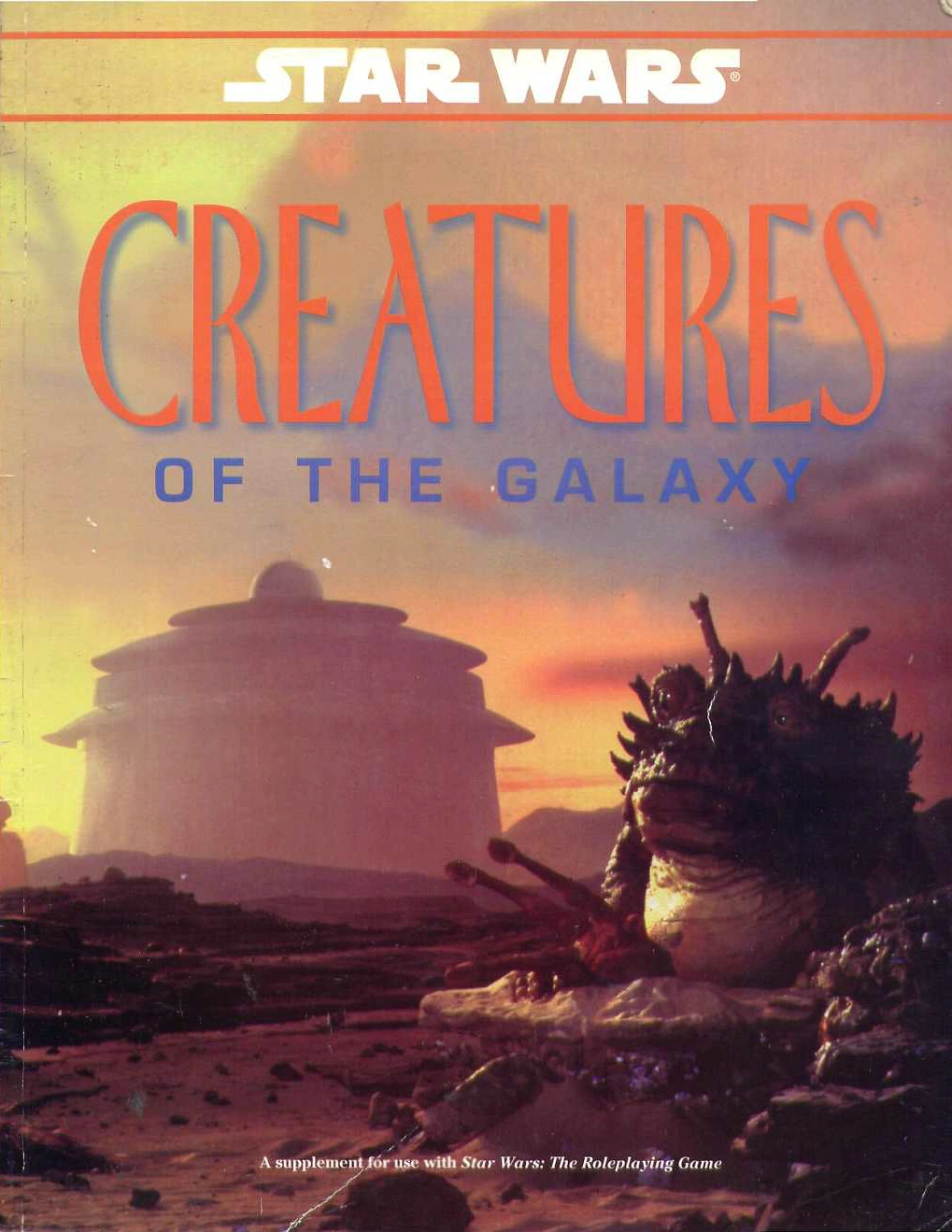
Cover to this Holobrochure: The worrt, a small predator from the desert wastes of the distant world of Tatooine! A mindless animal known to attack the diminutive Jawas of the world, this creature is outside an unidentified estate waiting patiently for a meal to crawl, wiggle or hop by.
— Holo courtesty Tatooine Visitors Bureau, Tatooine, Arkanis Sector, Outer Rim Territories
■ Worrt
Type: Voracious insipient predator
DEXTERITY 1D
PERCEPTION +2
STRENGTH 1D
Brawling: tongue attack 4D
Special Abilities:
Tongue Attack: The worrt will attack anything that moves that is its size or smaller. The tongue does 1D damage.
Move: 3
Size: 0.5-1.5 meters tall
Capsule: The worrt is a blindingly stupid, and harmless (to Humans) predator that inhabits the furthest wilderness areas of Tatooine. It will attack anything that even remotely appears edible, including metal, plants, large rocks that appear similar to other creatures and just about anything else that passes in front of it or that it can approach without being attacked first.
The worrt typically feeds on insects, small rodents and other tiny creatures native to Tatooine. However, it will often harass larger creatures, especially if they don't fight back. Jabba the Hutt has several as rather obnoxious pets around his palace, and they are found throughout the stretches surrounding the palace.
Adar-Attack Stohl
Adar
Life-forms must continually adjust to conditions in their habitat; one species which clearly shows this are the adars of Omiddelon III. Omiddelon III orbits a very bright and hot star, subjecting the world to intense light, heat and radiation. In addition, the planet itself is oriented so that its poles are parallel to the orbital plane, instead of nearly perpendicular, as is the norm for many worlds that are considered "comfortable." The result is a world that is incredibly hostile to Humans, where areas are subjected to a period of blistering, devastating heat, followed by a "mild" season, then a period of dangerously frigid cold weather, followed by another brief mild season.
The challenges of surviving in such an environment are formidable; many animals and plants are unable to survive in the extremes of the heat and cold, and thus are very active during the milder seasons, while going into hibernation for the extreme seasons. The adars fit this description, and have proven themselves to be the dominant predators on their world — and unfortunately for many other species, on other worlds as well.
Adars are long, reptilian-appearing creatures, with long tails, huge clawed forelimbs, hooked rearlimbs and large membranous wings on their backs. They are limited to activity between the temperature ranges of the milder seasons of their homeworld — between -30 degrees and 90 degrees.
Adars move by using their rearlimbs to propel them through the air with great leaps, while their wings help them glide on air currents. Their forelimbs help them scamper through obstructed areas, such as forests, jungles and swamps, and their tails help them maintain their balance for all movement.
They have an extremely high metabolism, using an immense amount of energy during their active cycles: they must consume their full weight every day to match their energy use. However, they are well adapted to environments where food is scarce — their tails can store excess energy and water. Also, when adars must begin drawing on stored energy, part of the conversion process releases an enzyme which eventually induces a mild "trance" (once the stored energy is almost entirely consumed). The adar will greatly slow its breathing and energy use, remaining motionless, until it can detect a ready food source nearby. Adars in appropriately sheltered areas can survive for upwards of eight standard months while in this state.
Adars are also incredibly adaptive in that they can evolve to metabolize virtually any food source. While they prefer the proteins of living beings, they can eat plants, and in some cases, have adapted to draw sustenance from wood, rock and minerals. This adaptive process can take several months (the greater the difference from traditional food sources, the longer the adaptive process), and adars so adapted have a greatly reduced life span.
Adars have become a serious hazard on the few worlds they have accidently been transplanted to. Because of their adaptive metabolisms, they can thrive in rural areas, densely-packed urban areas, and virtually anywhere else food is available. Packs of roaming adars have been reported everywhere from subterranean city waste systems to space stations to isolated farms and ranches. Adars will not hesitate to attack Humans, large grazing animals and just about anything else that might be edible, and their cunning battle tactics make them dangerous opponents, especially at short range.
Adars typically hunt in packs, ranging anywhere from four to over three dozen members. The adars separate, using their wings to cover a vast amount of area. However, once food is located, a single adar will release a piercing scream, which will summon the other members of the pack. The adars will circle their prey, using a series of leaping or "dive-bombing" attacks, often with several adars launching simultaneous attacks from different angles. Needless to say, most targets don't stand a chance when confronted by adars.
■ Adar
Type: Adaptive carnivore
DEXTERITY 2D
PERCEPTION 2D
Search: tracking 3D+2
STRENGTH 4D
Brawling 6D, climbing/jumping 6D, flight 6D+2
Special Abilities:
Claws: Do STR+2D damage
Wings: Enable adars to fly
Leaping Attack: Does STR+3D damage
Adaptive: Adars can eat virtually anything to get nourishment
Move: 13 (running), 15 (leaping), 22 (flying, but limited to five minutes every hour)
Size: Up to 2.5 meters long
Scale: Creature
Altagak
A particularly lethal mass of destruction, the altagak has been described by natives of the planet Altora as "high speed death on four legs." This description accurately depicts the favorite pastime of this reptilian predator indigenous to Altora's southern savannahs.
A solitary hunter, the altagak enjoys the warmth of the planet's southern clime, often spending a good portion of each day basking in the sun, until aroused by the prospect of prey. Altagaks typically hunt a variety of large herd animals native to the southern plains, but they are not above attacking warm-blooded Humanoids if game is scarce.
Once catching sight of a potential meal, the altagak becomes a patient hunter capable of slowly stalking its quarry for hours on end. Using the cover of the tall savannah grasses to mask its approach, the altagak will carefully approach to within a hundred meters of its unsuspecting quarry before initiating a sudden burst of speed to rapidly close the distance before the victim can react. During such attack lunges, altagaks have been clocked at over 80 kilometers an hour.
The altagak uses the impetus of its momentum to deliver an attack in the form of a skewering head butt, impaling the victim on its long tusks. The shock of this initial impact is often enough to bring the quarry to the ground. Thereafter, the altagak's sinuous snout retracts allowing several sets of rending teeth to make short work of its latest meal.
Lacking few predators on Altora, the average altagak lifespan is estimated in excess of 28 years. This fact, and the voracious appetite of the average altagak, has resulted in large bounties being placed on altgak hides in recent years. Despite this, altagak depredations on rancher herds are a continuing problem that threatens the fragile economy of the planet. Altagaks have spread to other worlds, and while they are not as much of a threat, they are still feared predators.
■ Altagak
Type: Solitary carnivore
DEXTERITY 4D+2
Running 6D
PERCEPTION 3D
Sneak 5D
STRENGTH 4D
Special Abilities:
Claws: Foot claws do STR+2 damage.
Silent Movement: Altagak can move very silently. Add +1D to any sneak rolls when stalking prey.
Speed: When initiating an attack altagak can produce spurts of high acceleration, maintaining this high speed for up to eight rounds.
Threatening Display: To discourage competitors when feeding or nesting, altagak adults expand their spinal mane, making them appear to be much larger than they really are.
Tail: Spiny tail does STR+1 damage in tailswipe.
Teeth: Large, rending teeth do STR+1D damage.
Tusks: Commonly used to skewer prey during on-rushing head butt, tusks do STR+2D damage.
Move: 8 (walking), 28 (attack sprint)
Size: 1.8-2.2 meters long
Andoan Mineral-Fish
Andoan mineral-fish are native to Ando, the home planet of the war-like Aqualish (see Galaxy Guide 4: Alien Races, Second Edition, pages 13-14). They were once plentiful in the rich seas of their world, but they became a prime commodity in the wars between the two Aqualish races and their populations dwindled. Only after the Republic became guardian of Ando did the population return to pre-war levels, but the Empire has once again begun harvesting the animals.
Mineral-fish are shellfish that form hard outer shells composed of incredibly valuable metals and alloys. They have an extremely high metabolism and produce a great deal of heat. What makes them valuable is that they survive solely on minerals and metals. Their digestive system filters the various metals and ores — harvested mineral-fish contain rich deposits of valuable metals and ores within their shells and internal organs.
The Aqualish used mineral-fish as a cheap means of harvesting metals vital to their war efforts. As the Empire and the Rebellion compete for resources, the rare alloys they produce are critically important to the war effort. One of the alloys found in their shells is purified sedrellium, an expensive high-strength alloy used to reinforce the hull of the Alliance's X-wing fighter.
Mineral-fish are found in large schools near rich deposits of minerals; in fact, Aqualish undersea mining expeditions follow mineral-fish to determine where to establish new mines. Great fishing platforms prowl the seas of Ando looking for mineral-fish schools to harvest.
Andoan mineral-fish are normally about half a meter long and are covered by a thick shell. They have a sharp spiked tail which is used to break up large rocks, but can also be deadly when used to defend against predators. They also have a number of shelled fins used for propulsion and to break rocks down into edible chunks; while seldom used in combat, the fins are rough and abrasive and can cause serious injury to anyone who brushes them. Because of their fins and incredible strength, Aqualish harvesting mineral-fish wait several hours for the fish to "suffocate" in the air before daring to extract the minerals from the fish.
They have a lifespan of three to five years, reaching full maturity after about one and a half years. Adult females can lay eggs about once every five months, producing hundreds of small, hard-shelled eggs which appear similar to ball bearings. Females build nests in calm, shallow pools near the coasts, as fewer natural predators prowl those waters. These waters are patrolled by Imperial skiffs to prevent Aqualish from harvesting immature mineral-fish, but the Empire allows unlimited harvesting of mature mineral-fish.
Experiments with controlled breeding of Andoan mineral-fish have been a complete failure. Andoan mineral-fish placed in controlled environments do not survive more than two to three standard months and there are no recorded cases of eggs hatching while in captivity.
There has been extensive research into their bio-chemical processing ability, but scientists have not been able to artificially duplicate it. A number of mining firms have invested in this research in the hopes that a cost-effective artificial filtering process could be discovered.
■ Andoan Mineral-Fish
Type: Mineral-consuming shellfish
DEXTERITY 1D
PERCEPTION 1D
STRENGTH 1D
Special Abilities:
Tail: Does STR+2D damage.
Fins: Do STR+1 damage.
Shell: Adds +1D to Strength to resist damage.
Mineral Sense: Mineral-fish can sense large concentrations of minerals and metals, which they feed on. If a school is encountered feeding, the area is rich in valuable metals and minerals.
Move: 8
Size: Up to 1 meter long
Scale: Creature
Courier's Deal
The Aqualish named Myinyar waited in the elevated speeder lot, watching the minutes tick away on the speeder's chrono. A salty breeze was blowing in off the ocean, carrying with it the strong odor of sulfur. The source, Ando Fishing Platform Yinn-x34, was barely visible. As the sun dipped below the horizon, the orange flames shooting from the mineral smelter stacks bathed the night sky, lending an eerie twilight to the cityscape. A pair of TIE fighters eased out over the ocean as part of their regular patrol of the bay.
Myinyar fidgeted in her seat, once again checking the chrono. Her contact was supposed to be here in two minutes, and the sooner the deal was done, the sooner she would be able to get home to the Quara section of the city. She hadn't liked this deal from the start, but the credits were good ... too good. All she needed to do was give the woman the sedrellium, get the money, and then be on her way.
She watched the crowd, looking for the tell-tale red scarf that would mark her customer. An odd mixture of Humans, Sullustans and Aquala Aqualish milled about; as the only Quara, or "fingered," Aqualish here, she was obviously an outsider. Staying in the speeder would make it easier for her to make sure no one recognized her as a Quara.
Finally, the Human with the scarf emerged from the turbolift. She was an adult female, with thick cosmetic paints on her lips and near her eyes. She had yellow hair. While she looked harmless enough, the Aqualish had long ago learned that no Human was ever harmless.
The Human walked directly to the speeder and Myinyar slowly lowered the windowscreen. Myinyar muttered in Aqualish, "Get in."
The Human eased into the passenger seat. Myinyar watched her body language and noticed signs of apprehension. Weak. All Humans look weak, like this one.
"Human, you have the credits?"
The woman bared her teeth, something her fellow Humans called a "smile." She spoke in Basic, the Humans' language. "I do. You have the sedrellium? Three kilos?"
Myinyar reached behind the seat and pulled out a small satchel. "It's here."
The Human handed the Aqualish the credit stick. Myinmar caught movement out of the corner of her eye: three Humans, all dressed in identical suits. They were approaching the speeder quickly and deliberately. Glancing over, the woman inhaled sharply. "Those men ... they must be ISB agents. Get going."
Myinyar snorted and shoved the woman. "Out!"
The woman reached to her side and pulled out a hold-out blaster. "We don't have time for this. Get moving or we'll both end up in an interrogation center."
Myinyar considered and then pushed the throttle lever. The repulsorlift generator screamed as the motor pushed the speeder from its parking spot and down the exit lane. The three Humans reached under their coats, pulling out blaster pistols. Myinyar raced down the ramp and rounded the corner before they could get off a clear shot.
As Myinyar guided the speeder to street level, she stared at the woman. "Why are you so important to them?"
The Human sat back into the cushion. "I'm someone who the Empire needs to stop very badly ... someone who hates the Empire as much as you do. Follow my directions and I have friends who can help you to safety."
Myinyar eased the speeder through heavy traffic, heading toward the edge of the city. "I'll listen for now. But don't mistake need for ... alliance. Now, where do we go?"
Arqet
One of the most ferocious of all warm-blooded predators in the Agarix sector, the arqet is a murderous predator inhabiting the mountain ranges of the planet Pellastrallas. A solitary hunter, arqets feed off of various smaller animals such as the Ixzinian rock ram and the Uthori breix that inhabit the region.
The arqet combines sure-footedness, numerous dense plates of rigid hide, and piercing, sharp teeth for a bundle of rampaging death. Yet for all this power, the arqet survives mainly by its ability to remain hidden until the very last minute. Arqet patience is legendary. In the presence of a potential victim an arqet is capable of remaining immobile — to all appearance virtually rock-like — until its prey is within range, at which point it attacks by skewering the unfortunate victim on its horns.
Even in the presence of armed Humanoids, arquets have been known to take damage from energy and slug-throwing weapons without flinching in hopes of dissuading its attackers or to lure the confused assailant in closer for a last, desperate lunge.
■ Arqet
Type: Mountain carnivore
DEXTERITY 3D+2
PERCEPTION 3D
Sneak 5D
STRENGTH 3D
Special Abilities:
Armor: The Arqet's dorsal and spinal plates give +2D verses physical and energy attacks.
Camouflage: Arqet skin varies in hue according to the amount of solar radiation received. This allows it to blend in with its rocky surroundings with considerable ease. This is accounted for in the animal's sneak.
Claws: Hoof claws do STR+2 damage.
Feigned Immobility: Arqets are extremely patient predators, capable of remaining absolutely motionless so as to draw to point blank range before attacking.
Horns: The arqet's curved horns do STR+2D damage.
Teeth: The arqet's teeth do STR+1D damage.
Move: 9 walking, 12 (charging)
Size: 1.8-2.4 meters long, up to 2 meters tall at the shoulder
Scale: Creature
Attack Stohl
These luxury pets with a nasty attitude come from Ichtor 8, where Imperial settlers carved out a series of resorts for the ultra-rich. This ice world, blessed with gorgeous scenery and plentiful natural resources, quickly became a social hub for rich travelers from the Core Worlds, who take long (and very expensive) vacations among the towering peaks.
Stohls were first regarded as a nuisance, albeit an attractive one. Their soft pelts and innate curiosity made them a hunters' favorite. As the stohls could not move quickly, they became easy prey for blaster-armed sportsmen. Shantee Ren, a popular holovid star, protested the carnage and even adopted three stohls as pets. With treats and loving care, she domesticated the serpentine beasts and even took to wearing them around her neck for public appearances. When an overzealous fan grabbed Shantee's arm during an autograph signing, the stohl soundly bit the admirer. Shantee weathered the public relations storm by remarking that "Needla (the stohl) has been specially trained to protect me. If not for her, I might have been killed. Who knows what that young man would've done if it hadn't been for Needla?" She then mounted a campaign to have the stohl declared an endangered species. With a tremendous publicity push and numerous personal appearances, Shantee won the support of animal activists, politicians and fans. The stohl was saved from extinction and the star's career received a healthy boost.
Following Shantee's lead, many celebrities demanded stohls of their own. The market for live stohls — and stohl trainers — boomed. Within less than a standard year, stohl killing went from common to criminal. Now the beasts — somewhat rare and quite expensive — grace the shoulders of thousands of ultra-rich star-travelers.
In its natural habitat, the stohl is a hideaway, living in crevasses and feeding on small rodent-like smarls. Its natural curiosity leads the stohl from its den when new and interesting beings approach. According to accounts dating from the planet's first settling, dozens of stohls emerged from hiding to examine the settlers' crafts and dwellings. The creatures' initial reaction to spacefaring visitors was friendly; numerous accounts describe stohls wrapping themselves around an explorer's arm and purring, or driving away the plague-ridden illorts (now believed extinct) that threatened the first colonies with a contagious virus.
Other accounts, however, depict the visiting stohls as scavengers with a nasty taste for table scraps, pets and small children. Shantee's "Save the Stohl" campaign claimed that such tales were fabricated to justify hunting the beasts, but some of the darker reports do have the ring of truth.
Sadly, the beautiful stohl pelt nearly proved the species' undoing; within five years, stohls had learned to fear Human contact. Docile stohls could be found only around virgin land, and hunting them for any reason became difficult. Shantee's agent claimed that Needla and Shen, two of the starlet's pets, had approached her of their own volition while Shantee turbo-skied on the slopes of Mount Quavaar. The trapper who claims to have sold her the pair tells a different story. In any case, stohls became hard to find. Their burrows, tunneled into ice or hard-packed snow, remain notoriously difficult to locate.
Stohls average about a meter to a meter and a half in length; they travel through the snow by undulating on their lightly-furred bellies. Their heavier top coats protect them from cold weather. Despite their propensity for thin caves and fissures, stohls do not dig their tunnels themselves; their pointed fangs are made for biting, not burrowing. They feed on small warm-blooded creatures when available, and attack larger prey when their normal food is scarce. It is possible that settlers in some places disturbed or killed the stohls' natural prey, forcing the creatures to attack the settlers themselves. Stohls feed in the wild by injecting a virulent poison through their fangs, then feasting. Some small animals are too tiny even to bite; these are swallowed whole and digested later.
Trained stohls often have their poison sacs removed; wearing a poisonous stohl is not only illegal, but stupid as well. An attack-trained stohl hisses loudly when its mistress is threatened, then uncoils and rears up; beings who do not get the hint are then bitten repeatedly until either the target flees or the owner calls a halt. Some especially vicious trainers teach their pets to wrap around a target, biting until he either falls unconscious or dies. Stohls encountered in the wilderness rarely entrap their prey; if a large target resists, the stohl flees.
Stohl eyes have transparent layered membranes to protect them against driving snow or crushed ice; they allow the animals to see with relative clarity even in their dim burrows, magnifying whatever light is present. Their fangs are sharp and strong, with a small poison reservoir running down the inside of each large fang. The heavy mane of fur behind the creature's head allows it to push through loose snow, while the more sparsely-furred body follows. The lower jaw hangs on a drop-hinge, and the gullet expands when necessary, allowing the stohl to swallow and digest large bits of meat. An effective digestive system breaks down all components of the stohl's meal, fusing all indigestible bones and skin into a large ball, to be choked up later. Seasoned stohl-hunters can detect their quarry's lair by the lumps found outside or around the fissure; they can even tell how old the stohl may be and when it last fed.
The warm-blooded stohls are noted for their curiosity. An old hunter's trick is to dangle jingling trinkets in front of the lair, or to tie a string to a smarl, let it wander in a ways, and then drag it out, hopefully with a stohl in tow. Various mechanical traps have been tried on Ichtor 8, but few such traps have ever succeeded in catching the elusive beast. Reaching into a crevasse is asking for trouble of many different kinds, including cave-ins, quick freeze and severe bites. Training a captured stohl is a long process but not especially difficult. Unless the stohl has been abused in some way, it quickly bonds with whoever feeds it by hand. Such bonds are hard to transfer, though a skilled trainer can do so. Stohls often enjoy playing with shiny objects (much to their owners' amusement). Stohls purr contentedly when happy or well-fed and spit when annoyed. Their fur is luxuriously soft, and is still prized by some black-market buyers.
Stohls are expensive and difficult to obtain. Only one known world, Ichtor 8, has stohls native to it, and the settlers and trappers there know the demand for attack stohls well. Prices vary from 2,000 to 5,000 credits, depending on the animal's health and training. Owning a stohl is a mark of status and distinction, especially within the Core Worlds, far from Ichtor 8. Shantee Ren still lives on Mhatma 5, a cold frontier world with a large preserve of transplanted wild stohls.
Stohl Training
Raising a captured stohl to be a good pet or bodyguard requires three Difficult beast training rolls (a Mechanical skill), one per week. Reduce this difficulty by one level if the character is treating the creature especially well (sleeping with it nearby, cuddling it, hand-feeding it delicacies). The stohl will bond with that character until it is badly treated or until either pet or master dies.
Stohls do not take well to abuse; if the character treats the animal badly, it will bite her at the first opportunity, then slink off to hide. No bonding is possible thereafter.
■ Attack Stohl
Type: Domestic defense pet
DEXTERITY 3D
PERCEPTION 2D
STRENGTH 2D
Special Abilities:
Bite: Does STR + 1D damage.
Poison: Untreated stohls do an additional + 3D with their poisonous bite. This damage is stun damage only, but effects take 12 standard hours to recover from.
Coil: A properly trained stohl can wrap around an opponent in a turn by successfully scoring a Moderate Strength or brawling hit. A coiled stohl requires a Difficult Strength roll to disengage.
Move: 5
Size: 1-1.5 meters long
Bandara-Borcatu
Bandara
Bandaras (or "sandbar dwellers" in the tongue of the Devaronians) are small beetles that live on the rivers of Devaron. Huge swarms (often measuring up to 10 meters across) of these insects gather on the sandbars and beaches, turning the white sand black. Individuals move quickly, but they never leave the swarm, and the swarm itself rarely leaves the sandbar on which it was formed.
New swarms are created when a swarm becomes too large to be supported by the area of river in which it lives. A number of the bandaras will break away, floating downriver in a large mass, until they land on an empty sandbar.
Bandaras do not actively hunt, subsisting instead of whatever detritus floats their way in the currents of the Devaronian rivers. They find great success with this apparently ineffective method of feeding because they are able to eat almost anything. They use their strong mandibles (combined with the sand on which they live) to reduce many varied types of matter to its constituent elements and then extract whatever organic material is available.
Because of this, Devaronian river pilots are extremely careful when navigating in the vicinity of a sandbar occupied by a bandara swarm since any boat that runs aground on such a sandbar will be quickly consumed.
Though the female Devaronians claim that the bandaras pose a danger to their planet, they are, in fact, little more than a nuisance. While it is true that their voracious appetites have been responsible for the destruction of valuable property, and that riverways have been forced to close due to infestations of bandaras, these are only isolated incidents. The true reason why the female Devaronians have such a great dislike for bandaras has more to do with their mating behaviors than it does with their appetites.
During the Devaronian summers, the male bandaras attempt to prove their worthiness for procreation by "singing." They produce their song by vibrating the long, narrow auracarpal that grows from their backs. These songs can reach volumes of over 160 decibels and range in frequency from 110 kilohertz to over 30,000 kilohertz. A swarm of singing bandaras creates an oppressive drone that most sentient beings find unbearable. Male Devaronians are one of the few groups of beings known to tolerate the noise, and it has been conjectured that they even welcome it because it so greatly annoys the female Devaronians and helps to keep the females away from the rivers of which the males are so fond.
The females of Devaron have expended a great amount of energy in their attempts to rid the planet of bandaras, but they have been unsuccessful. Bandaras may be freely taken off planet (and, in fact, during some seasons, taking a cargo of bandaras off planet entitles a trader to a reduction in tariffs), but any being caught bringing bandaras to Devaron is imprisoned in a small cell for the remainder of its natural life.
While it is well known that the female Devaronians are trying to rid Devaron of bandaras, there are rumors in the smuggling and trading communities that the male Devaronians have spent almost as much energy in trying to save the bandaras.
A Necessary Evil
Skerrit sat alone in a dark booth in the quiet back corner of Felstun's Transfer Cable Bar. He scratched the base of his left horn with the tip of his writing stylus, then began to trace hyperspace travel routes on the display screen of his portacomp. It was time to go; the only question was where.
The answer came suddenly, surprisingly, in the form of a voice that bellowed out in the darkness, "Greetings, brother!" Skerrit turned to the source of the voice. This new individual was a Devaronian like Skerrit, though age had turned his horns white, and too much rich food had turned his torso into a sphere. But weight and age were no matter — he was a Devaronian. He was a brother.
"Greetings to you, brother," Skerrit said more quietly, standing respectfully. "I am Skerrit, spouse of Anikar."
"And I am Tosha, spouse of Kiela, who is long deceased." The fat Devaronian squeezed himself into the booth, sitting on the bench opposite the one where Skerrit had sat. He motioned for Skerrit to sit. "How goes it to you, brother?"
"It goes well," Skerrit answered, "and to you?"
"Well, also," Tosha answered, "though my one spouse did not require half as much from me as do my two — unmated — offspring."
Skerrit knew instantly from the elder Devaronian's tone that the offspring to which he referred were female. He nodded sympathetically. It was indeed a rare curse, to find yourself forced to meet the demands of two females. Skerrit himself earned barely enough to support Anikar, and she was, by Devaronian standards, relatively frugal.
"Their aunts will see them well married soon," Skerrit said.
"That is so," Tosha answered, but his voice was not hopeful. He paused, staring into nothingness, despondent, watching, in his mind, as his wealth drizzled through his daughters' fingers. "Enough of this, though," he said, finally, his voice brighter, "we have business."
"And what would that be?" Skerrit asked.
"You carry a special cargo."
Skerrit nodded. Only another Devaronian would have known of his cargo, only another brother.
"It is your time," Tosha said, a smile of genuine pleasure exposing his pointed teeth. "No bandara were born this season. The sandbars are quiet. The females are cheerful."
Skerrit nodded again, understanding. "They will not be cheerful long," he answered. "The larvae I carry are healthy and strong. They will be the loudest singers heard for many seasons."
"You have made your arrangements?" Tosha asked. "The customs inspectors will be particularly vigilant."
"I am prepared to do my duty for my brothers," Skerrit answered. "There will be bandaras on Devaron again. The females will soon be covering their ears and running from the sandbars, and the rivers will again be ours."
■ Bandara
Type: Semi-aquatic pest
DEXTERITY 2D
PERCEPTION 1D
STRENGTH +1
Special Abilities:
Mating Song: During mating season, male bandaras make an extremely loud noise which is used to attract mates. Characters who are within 30 meters of a swarm of singing males must make an Easy Perception roll. Characters who fail the roll are unaffected, but those who succeed suffer a -1D penalty on all actions due to the distraction of the songs (characters may negate this penalty by making a Difficult willpower roll).
Hunger: Bandaras can (and will) eat anything. Any object, including characters or other living creatures, that comes in contact with a swarm of bandaras suffers 1D damage per round of contact.
Move: 1 (for the swarm), 15 (for individuals)
Size: 2 centimeters
Barri
The enigmatic barri inhabit asteroid clusters throughout the galaxy. Seemingly spawned by electromagnetic storms on barren planetoids, these mysterious creatures hitch rides on debris from dying worlds or junked spacecraft. Immune to the dangers of the vacuum of space, barri feed off of mineral deposits and are theorized to live for thousands of years. Recent studies and telepathic probes indicate that barri are, in fact, vaguely intelligent and possess an intuitive grasp of complex astrogation. Xenobiologists who for centuries discounted stories of barri as spacer folklore are now beginning to take a serious interest in these odd alien beings.
Few documented facts about the barri are known; they can survive in deep space, secrete acids which dissolve rock and metal into simple mineral compounds, and can float in space for many years while waiting for a "ride" towards some unknown destination. Dissected specimens reveal no reproductive organs, lungs, stomach or excretory system, and only the most rudimentary sensory organs, circulatory channels or musculature. They appear to reproduce spontaneously; spacer legends claim that huge electrical disturbances spawn small barri, who grow to maturity over centuries of asteroid travel. How mortal spacers could track the lifespans of seemingly immortal lifeforms remains a topic for debate. Nevertheless, studies of tagged barri, followed for decades at a time, indicate that the species is exceedingly long-lived and follows no known biological process.
Barri feed by lapping at the debris on which they ride. Their acidic spittle breaks the material down to base components, which the barri suck up into a gourdlike organ located just above their legs. With these legs, the barri trundle across the surface of their "homes" or grasp the edges of passing ships. The sharp points of barri "feet" dig in for purchase. When an asteroid crumbles or departs from the barri's chosen path, the creature utilizes gases stored in a sac beneath its gullet to propel it out of the asteroid's weak gravitational pull. The barri then waits, floating in space until some other debris comes its way, which could theoretically take centuries; xenobiologists who speculate on the species' intelligence have no idea what the creatures could be thinking about during this endless wait.
The most intriguing ability the barri possess seems to be an innate directional sense. Although the brain structure of these creatures is painfully simple, barri that have been tracked for some time appear to follow a single planned course. Some spacers, like the Gotals and Ugors, offer rides to barri that seem to be going their way. Through an organic "mind-bond" that Human xenobiologists can barely comprehend, these alien spacers seem to subconsciously communicate with their barri guides. In return for a "lift," the barri aids the ship's navigator, who programs any suggested paths into his computer — the aid seems to come in the form of sudden bursts of intuition that lead a navigator to a safe course. The Gotals claim that such advice has never failed.
Although barri will consume starship debris when on their own, they will not damage a ship that gives them a lift to their destination. This behavior indicates some degree of abstract thought and behavioral restraint. No other attempt to communicate with barri, however, has yet succeeded.
The paths these beings travel seem to lead away from the galactic core. Folklore speculates that a barri homeworld lies somewhere out in Wild Space. Why a species that thrives in open space would need a homeworld remains to be seen, and no two barri have ever been observed together. Nevertheless, several researchers have dedicated their lives to discovering this fabled place. Perhaps, if they are successful, the mysteries of the barri will be solved.
■ Barri
Type: Mysterious spacefaring creature
DEXTERITY 2D
PERCEPTION 1D
STRENGTH 4D
Special Abilities:
Corrosive Spittle: Barri exude acid on their tongues. This acid can burn for 3D of damage per turn until it is washed away. Protective armor or tough skin will be damaged by this acid, which wears away at the material until it is consumed.
Innate Navigational Sense: Through some mysterious intuition, barri have an effective astrogation skill of 6D.
Move: 10*
Size: Roughly 4 meters long
Scale: Creature
* Meters per round, not Space units.
Bergruutfa
Bergruutfas are large but placid grazing beasts native to the plains, jungles and forests of Teloc Ol-sen. These creatures have become popularized because they were the historic mounts of the famed Teloc Hunters.
Bergruutfas are known for both their size and their mild temperament. Known to grow upwards of seven meters tall, the lumbering giants are perfect for traversing the treacherous terrain of their world. They are forceful enough to move encroaching vegetation from paths, but are also surefooted.
They are incredibly calm and patient, and have been known to not even deign to take notice of other jungle animals around them; they have such thick armor plating all over their bodies that most attacks are completely ineffective, causing no damage whatsoever. This armor is also thick enough to stop the blaster bolts of many hand weapons, making them quite suitable as war beasts. When they do get angry, however, they are quite dangerous and there are few hand-portable weapons that can stop them.
The animals show keen intelligence, and even a sense of humor. They learn their names and commands easily; they can often be sent off to do simple tasks without direct supervision. As farm animals, war beasts and caravan animals, they excel; they are also excellent guard beasts, being quite capable of stopping most intruders with a loud grunt and a simple head butt. As for their sense of humor, they have been known to "hide" objects belonging to their riders and then physically use the bulk of their bodies to prevent their masters from finding the pilfered object. They are also playful, but considering their bulk sometimes their playful "rough-housing" borders on the downright dangerous.
Bergruutfa are quite intelligent and affectionate, and are known to bond with their riders. Bergruutfa that are domesticated behave much like herds in the wild, protecting the young and feeble, and often gathering food for the weaker members of the herd. If they are well-cared for, their masters are often treated as if they too were part of the herd. This loyalty has been extremely beneficial for the many primitive tribes of Teloc Ol-sen. Bergruutfas have been exported to many other primitive worlds for similar purposes; it is known that several Rebel Alliance bases use the animals for patrols.
Their coloration ranges from light brown to dark green, but during winter seasons their coloring lightens considerably. Young are almost always brown when they are born.
In the wild, they travel in herds of upwards of 150 beasts, although most herds seldom exceed 30 or 40 adults and the accompanying calves (normally about a dozen for a herd that large). They feed on the rich vegetation of their world, relishing the fruits, nuts, branches and leaves of the countless plants to be found in their native regions. They consume immense quantities of vegetation and can strip whole forests in short order. As adults, they have no natural predators in the wild but neither do they hunt animals — they seem to peacefully coexist with other creatures in the wild. Young bergruutfas are hunted by large predators on Teloc Ol-sen, but often other herd member adults are around to protect them.
One quite noticeable thing about bergruutfas is that they produce an inordinately large amount of saliva; as with many other animals, their saliva is a digestive aid while their massive jaws grind the plants. However, bergruutfas are known to leave large pools of their saliva in their wake. While this does not bother those who are experienced with the animals, it is somewhat perturbing to many off-worlders when they first encounter the animals — and presents a very real hazard in combat situations.
■ Bergruutfa
Type: Domesticated riding beast
DEXTERITY 1D
PERCEPTION 1D+2
Search 3D+1
STRENGTH 6D
Brawling: head butt 7D, lifting 9D
Special Abilities:
Armored Head: +2D energy and physical to resist damage.
Armored Body: +1D energy and physical to resist damage.
Head Butt: STR+1D damage; for every two result points on the attack roll, the target has been thrown one meter.
Drool: Bergruutfas produce a lot of saliva: any being unfortunate enough to step in a sizeable puddle of drool must make an Easy Dexterity total not to fall.
Move: 15
Size: Up to 7 meters tall
Scale: Creature
Orneriness: 1D
Bogan's Brown Nafen
The winged rodents known as nafen are found on planets throughout the galaxy, but Bogan's brown nafen, one of the largest and most unwholesome species (commonly called "butterbats" by the galactic media), are only found on planets that are primarily tropical.
Like all nafen, brown nafen primarily consume insects and other small, flying creatures, and gather their food while flying through the air. This behavior would cause many to consider the nafen to be beneficial creatures, but any benefits accorded by the nafen are countered by the risks that are created by a large population of the creatures.
While the nafen consume large numbers of insects, they also provide an extremely efficient method for the transmission of disease. The Hardan plague that resulted in the deaths of 98% of the inhabitants of Dagelin Minor was traced to a single shipment of brown nafen that were imported in an attempt to control an infestation of dhuru flies.
The venom and fangs of the nafen are primarily a defensive measure, meant to be irritating, not fatal. However, like many avians, nafen are extremely territorial, and the entire swarm will gather together to attack any creature that enters their breeding area. While the attack of an individual nafen is of little concern to most predators, the attack of an entire swarm — and the amount of venom delivered by the resulting bites — is often fatal.
Juvenile nafen are tailless, quadrupedal rodents that are rarely seen because they are extremely small (no more than two centimeters in length) nocturnal herbivores, who often feed by burrowing through the soil and eating roots and tubers.
At some time, a currently unknown trigger causes the juvenile nafen's rate of hair growth to increase substantially, and it burrows deeply into the ground. Its skin begins excreting an extremely sticky sebum, which, when combined with the thick, oily fur, produces a cocoon that soon envelopes the nafen. While in the cocoon, the nafen grows wings, and its fangs and glands develop, so that the creature that emerges from the cocoon and digs its way to the surface is a fully developed adult nafen, ready to take its place in the first swarm which it encounters.
Nothing preys on the mature nafen, but many small predators feed on the non-flying juvenile nafen. Juveniles are also considered delicacies by many reptilian sentient species. While it is illegal to import any species of nafen into many systems (whether in the juvenile or adult forms) because of the number of diseases that they may carry, there are many other systems that encourage the importation of nafen because of the amount of insects that they can consume.
■ Bogan's Brown Nafen
Type: Aeroreal insectivorous rodent
DEXTERITY 5D
PERCEPTION 4D
STRENGTH 1D
Special Abilities:
Venom: Nafen produce a relatively weak venom, but they attack in large numbers, and the cumulative effect of large numbers of nafen bites can be deadly. Characters who are bitten by less than 10 nafen will not be harmed (with the exception of the slight stinging sensation that accompanies each bite). However, characters who are bitten by 10 or more nafen must make a Very Easy Strength roll to avoid being affected by the poison (this roll should be made following every tenth nafen bite). Characters who fail their Strength rolls become drowsy and suffer a -1D penalty (cumulative) on all actions. If the penalty being suffered by the character becomes greater than the character's Strength, then the character becomes incapacitated, and falls asleep. The effects of the nafen's poison can be cured by the successful application of a medpac, or by six to 10 hours of uninterrupted sleep.
Disease Transmission: All characters who are bitten by a nafen must make a Moderate Strength roll to avoid becoming diseased. Diseased characters automatically become wounded at the time of the onset of the disease (6-15 hours following the time of the injury). Curing the disease is an Easy medicine task, requiring access to common pharmaceuticals.
Move: 30 (flying), 4 (walking)
Size: 30 centimeter wingspan
Scale: Creature
Borcatu
Small and bad tempered, borcatu range from desert sands to urban slums, crossing the galaxy as stowaways on trading vessels. These tough little creatures have rock-hard digging claws and powerful jaws, which they use on anyone who tries to pick them up. Borcatu come in a variety of colors, though most tend towards mottled dark patterns suitable for camouflage.
A Widespread Scavenger
Zazu alone knows how the borcatu became as scattered throughout the galaxy as they are. These ill-tempered trash-diggers have been traced to Escabar, but they appear to have stowed away on some early vessel from that planet and propagated themselves across the known worlds. Their rate of reproduction is quite high; their temper threshold is quite low.
On their homeworld, the borcatu originated in the northeast deserts of Serhan. Their tough hide may have evolved to protect them from the elements and the harsh sandstorms that those deserts are known for. The creatures' hard claws and strong jaws were obviously intended for digging burrows and snapping open shells. But when traders from Khrassh crossed the deserts on their way to the newly-opened spaceports, some borcatu clambered aboard and hitched a ride on the departing craft. Borcatu pups, measuring only a few centimeters at birth, are hard to detect in engine rooms, maintenance shafts and life-support ducts. By the time the traders had discovered their undeclared cargo, several borcatu had already left on other ships. And so the vermin were scattered ...
"Vermin" is perhaps too sharp a word. Borcatu are clean for scavengers and leave little in the way of waste. Desert born, the borcatu are efficient by nature. For this reason, they are hard to detect unless scanners are swept across the ship itself. When the pack becomes too large — between five and 50 members, depending on the size of the ship — many of the pack depart at the next port. Though pudgy, borcatu are fast; dockworkers hate the beasts with a passion.
Within the 150 standard years since the ports of Escabar have been open to interstellar trade, borcatu have spread from the Core Worlds to the Outer Rim Territories. Small ships have little chance of hiding more than one or two (if any at all), but capital ships can have dozens aboard and not even know it. The short-lived monsters lead short lives — rarely longer than a standard year — and when one dies, the others eat him. Such a wonderful existence!
And their manners! O, their manners! Borcatu are snappish fricks, biting anyone who comes near them. For being the stout things that they are, borcatu move quickly, and finding them in a refuse pile or dark shaft is a hard thing to do. They fight among themselves, too, when food is hard to come by, and the winners eat the losers.
From the slums of Arramanx to the forests of Kashyyyk, borcatu are everywhere. Zazu alone knows how they spread so fast. Zazu alone knows how we'll get rid of them ...
■ Borcatu
Type: Testy scavenger
DEXTERITY 3D
PERCEPTION 2D
STRENGTH 1D+2
Special Abilities:
Bite: Does STR+2 damage.
Claws: Do STR+1 damage.
Armored Hide: Adds +2 to resist damage from physical attacks.
Digging: Borcatu can hollow out a burrow or dig out tasty morsels in record time.
Move: 11
Size: 0.2-0.5 meters long.
Cherfer-Croator
Cherfer
"May your children bear the nose, trust and temperament of a wild rabid cherfer!" — Elomin curse
Unlike the halfway civil ranphyx, the cherfers of Elom's deserts are vicious killers, herd beasts so wrathful that they have been known to turn on their own kind and gore them to death with sharp hooves and their bony snouts. Despite efforts to eradicate the cherfers, they not only remain, they thrive.
Newborn cherfers are born aggressive; xenobiologists have noted that litters begin fighting each other with their vestigial nasal horns. These horns fall away while the young foals nurse, and the bony ridge jutting from their snout grows as the cherfer attains maturity. The beasts age quickly, going from stumbling foalhood to kicking, spitting youth in less than six standard months. Like so many creatures of the plains, cherfers are omnivorous. Their preferred meal, however, is flesh. Although small burrowing mammals make up a large part of the cherfer diet, the beasts will not hesitate to attack larger mammals, ranphyx, or even Elomin if food is scarce.
Cherfer coats are rough and brightly-colored. Red, orange and yellow stripes on an off-white base coat are common, though green or blue stripes are not unheard of. Cherfers in colder climates tend towards light base coats while those in more temperate regions grow steadily darker.
Cherfers are quite stupid; the cleverest could not best a bantha in a battle of wits. Like so many other beings, however, a cherfer's stupidity is inversely proportionate to its viciousness. Herds, called vlaktors by the native Elomin, are temporary social units; cherfers scrap within their vlaktor, get thrown out, wander, and, provided they survive their time alone, rejoin another vlaktor by laying open all comers. Cherfer vlaktors number between five to 30 individuals, depending on the season and available prey. Anyone attacked by a cherfer vlaktor is an unhappy being indeed, as the creatures attack in force, run their prey to ground, and gore them to death. Some criminal gangs even export cherfers to decadent worlds for arena sport. Although captive cherfers can live 15 standard years or more, wild ones rarely do.
These ruthless habits have bred a powerful beast; cherfers are neither large nor strong, but tend instead to be tough, fast and tenacious. An angry cherfer will not flee a fight until its opponent drops. Even then, some have been know to gore their prey to death while selfsame prey tries to crawl to safety. A cherfer seeking an elusive burrower will tear up meters of ground to get at it. Elomin miners and farmers despise cherfers and hunt them down whenever possible. This, however, merely keeps the cherfer population in check; the beasts reproduce quickly, grow to maturity with speed, and either live or die by their sinew and spite.
■ Cherfer
Type: Vicious herd beast
DEXTERITY 3D
PERCEPTION 2D
STRENGTH 4D
Special Abilities:
Snout: Cherfers can gore an opponent for STR+1D damage or use their snout to dig into the ground.
Hooves: Do STR+1D damage with a kick and can quickly turn up a lot of earth.
Move: 14
Size: 1-1.5 meters at the shoulder
Chiilak
Chiilaks are large, six-limbed omnivores inhabiting the glacial regions of the moon Misnor. On that world, their skins are quite valuable for furred garments, such as coats and cloaks, and thus they are a sought-after prize of hunters who roam the frigid seas and oceans of their world.
Fortunately for the chiilak, they are far from defenseless. They are tall and immensely strong beasts, and their bulk assures that anyone unfortunate enough to get within grappling range of the beasts will suffer grievous injuries — chiilaks have been known to flatten Wookiees with one swing. Their rear limbs have sharp claws, which are used for climbing as well as combat.
Chiilaks excel at water travel: their four forward limbs are long and muscular, with webbed "paws." They swim quite swiftly. Chiilaks are air breathers, but can hold their breath for up to 20 minutes at a time. They can remain underwater for extended periods of time and dive into the deep, frigid waters of Misnor's oceans to hunt for fish. With their great stamina, chiilaks have been known to swim 300 kilometers in a single day.
Hunting chiilaks is more difficult than many people would suspect. Because of their tendency to stay in water for extended periods, hunters are often forced to don aquatic breathers and insulated suits. Even with servo-enhanced articulators and ranged spear guns, they are no match for chiilaks underwater.
Chiilaks tend toward white, grey or tan coloration, with the hair darkening as the chiilak gets older. Their diet consists of fish, marine plants and a number of bushes, grasses and berries that thrive on the surface of the frozen regions of Misnor. While their natural lifespan can be over 50 local years, few chiilaks now live beyond the age of 20 due to uncontrolled hunting. Many xenobiologists have lobbied Imperial Governor Yettaw to restrict or ban chiilak hunting, but the Governor has sided with the local garment manufacturers' association, which derives immense profit from chiilak-furred garments.
Xenobiologists have noted how the continued hunting has changed the chiilaks. Their population has dwindled, from an estimate of over 100 million just 25 years ago, to now under three million chiilaks (these are estimates; the northernmost regions of Misnor are lightly populated and much of the planet remains unexplored). While chiilaks initially tended to flee from Humans (and other species) when their world was first colonized, they have learned what a danger hunters represent. They are now known to attack Humans and common species, which in turn, has led to Governor Yettaw labeling the creatures a "menace," and thereby encouraging increased hunting of chiilaks. The few permanent communities in these areas (mostly hunting villages) must now build barriers around their perimeters and post guards to fend off chiilak attacks.
From the Journal of Jio Gihal
After weeks of searching for chiilaks, today my patience was rewarded ... and then some. My mission to research chiilak migration and living habits had so far been unsuccessful. The area was thick with hunting skiffs, all of them searching for the few remaining chiilaks in the North Berr Sea. I had taken to a small bay in hopes that some chiilaks would be hiding here, but my subsonic gear had detected no signs of them below the surface.
After three hours of fruitless observation, I decided to eat and then move on to another area. A wind was starting to blow in from the ocean, and it was clear that a bad storm would be coming in by nightfall. I would have to return to the hunting village.
I had just broken out my lunch packets when the detection system registered three targets moving about 50 meters underwater. I followed the progress of the targets, and saw that they were surfacing not more than 300 or 400 meters from my research skiff.
Pulling out my macrobinoculars, I got a fix on them: three young chiilaks. They were only about a meter long, not yet half grown, and were frolicking in the water. After a few minutes, they crawled up onto the land, heading for the small teloberry bushes about 10 meters inland. They fed slowly, also taking the time to rest from what must have been an exhausting swim. As I watched, I detected another target on the subsonic scanner — this one was much larger and was headed straight for my repulsor skiff!
I grabbed my stunner, even though I knew it probably wouldn't do much good against a full grown chiilak. I held my breath as I waited for it to surface. A splash of water sprayed me as the adult raised its head above the water; the adult was only two meters from the skiff! It watched me closely, as if cautious, but not fearful.
I wondered what would happen. I had heard the stories of the chiilak attacks on lone beings, or even hunting ships. I didn't know what to do, so I did the obvious: remained motionless.
It stared at me for several long minutes with those golden, unblinking eyes. Suddenly, its attention was distracted for a second and it turned and barked at the three cubs on the beach — the noise was defeaning! It made a high-pitched whistle and barked once more, slapping the surface of the water with its forward paws. Then, as quickly as it had come, the adult dove back into the water, while the three cubs awkwardly raced for the water. Just as the ripples from their dives faded, I heard the all-too familiar whine of a repulsorlift motor: a hunting skiff.
I turned my skiff around and raced out to meet the other vessel. The captain, a young man in his early twenties, asked if I'd seen any of the chiilaks, pointing out that there was a 100 credit reward if I helped him hunt down any of them.
I tried to politely send him on his way, telling him that I hadn't seen any and that I was just out surveying some of the wildlife for a local tourist office. He seemed to accept my answer at face value, and ordered his two shipmates to send the skiff back out into open water.
As I found myself alone again, I saw the clouds beginning to gather overhead. It was too symbolic for my taste: the calm before the storm, the calm before the people here hunted the chiilaks into extinction. I saw a ripple on the water just to my left. The adult's head emerged from the surface, and once again those haunting golden eyes stared at me. With a snort, the creature dropped back underwater.
■ Chiilak
Type: Aquatic mammal
DEXTERITY 1D
Dodge 4D, brawling parry 6D
PERCEPTION 2D
Search 4D, tracking 4D
STRENGTH 4D+2
Brawling 5D, climbing/jumping 5D, swimming 6D
Special Abilities:
Claws: STR+1D damage.
Stamina: Chiilaks can hold their breath for 20 minutes and have immense stamina: they can swim for hours at a time before tiring.
Move: 9 (land), 18 (swimming)
Size: Up to 2.2 meters tall
Scale: Creature
Survival by Any Means
"We found the poor glick by his escape pod; I'm telling you, he was glad to be leaving! Bad sunburn, and a fever that nearly wrecked the temp-scale. He was raving, too, goin' about giant worms that sang off-key and tall ladies with six eyes and green hoods. Took three days in bacta before he was anywhere near coherent.
"Anyway, this guy was wrapped up in some kinda skin; it was sorta greenish-white, and slick like vicra but a lot thicker. Anyway, our boy claimed that he got it offa this bird-thing with a schnoz down to here and big double-jointed legs. The wrap he wore was beat all to blazes, but Nita fed it to Analysis just to figure it out. They said it was organic, but couldn't type the genetic-strand. Bering — that's the guy — says it's all that kept him from bein' baked.
"If you're set on goin' out to Wyndigal system, keep a vibro-blade handy. Bering says the skin doesn't come off easily. Said he had to rip it away like ... you feelin' okay? You look sick. Food here's lousy. I wouldn't eat it ..."
Croator
Scouts landing on Wyndigal 2 have two options for survival; protective suits or a poncho made from the membrane of the croator, an unusual creature native to the planet. Beneath the harsh light of the Wyndigal system's sun, Human skin blisters and burns. Though the system sustains no sentient life, Wyndigal 2 has spawned some interesting (and potentially helpful) beings.
A stifling humid scrub-swamp greets travelers unfortunate enough to land on Wyndigal 2. Water is everywhere, but high concentrations of ultraviolet light have warmed that water to uncomfortable levels. The odd color spectrum — ranging into deeper hues than the Human eye can accept — also disorients many travelers' perceptions. Many scouts and rescue parties landing there have experienced hallucinations, perhaps caused by an odd airborne bacteria. All in all, Wyndigal 2 is an uncomfortable place to visit.
The croator, native to Wyndigal 2, pick through the ever-present marshlands, sucking nourishment from the microorganisms teeming in the brackish mud. Croator gather in temporary bands of three to five. These bands wander apart when the local food has been consumed. Croator appear to reproduce asexually, stimulating their reproductive centers once a standard year. Pregnant croator lay eggs after a gestation period of three months; these eggs hatch into miniature versions of adult croator, which scatter into the swamps in search of food. Many wind up as food for other animals, but enough survive to keep the species viable.
The most interesting features these beings display are their flexible joints and reflective plumage and hood. The former appendages can bend nearly double, either to crouch closely into the water or to unfold up for running. The latter protective membranes allow croator to feed during periods of the heaviest solar bombardment. These stark white and slick blue features drape loosely about a croator's body during the early parts of the day. As the day drags on, the croator wrap themselves in their hoods and squint their heavily-lidded eyes against the constant glare as they feed. Inhaling its food through a dangling proboscis, each croator vacuums its chosen spot of tiny fish, insects and microorganisms.
■ Croator
Type: Swamp avian
DEXTERITY 2D
PERCEPTION 2D
STRENGTH 1D+2
Special Abilities:
Reflective Plumage and Hood: These shiny membranes reflect powerful ultraviolet rays. Though this will not deflect potent attacks or provide long-term protection for Humans, an off-worlder can add + 2D to survival rolls to withstand the climate of Wyndigal 2.
Move: 15 (running), 10 (swimming)
Size: 2.5 meters tall at the shoulder
Danchaf-Fenner's Rock
Danchaf (Tree Goblin)
There is great debate as to whether danchaf, also called "tree goblins," should be considered sentient beings or animals. Most xenobiologists claim that the beasts lack the abstract reasoning, communication skills and societal structure shared by intelligent species, while the quarrelsome Jenet of Garban, the danchaf homeworld, argue that the goblins exhibit problem-solving skills and complex interactions when they aren't being observed by offworlders. The tree goblins, the natives claim, are too smart to be successfully studied. In fact, they are one of the few predator species to survive the Jenets' cleansing of their homeworld.
According to the legends of the Jenet, danchaf packs once marauded across the forests of Garban. It was only the courage of leaders like Chirr't Ferr and the mighty Rhet H'rrr, backed by brave warriors, that broke the danchaf stranglehold on the upper world, enabling the Jenet to claim their rightful supremacy on Garban. Since the days of the Great Conquest, the tree goblins have fallen into their current primitive state. Nevertheless, the Jenet claim, the danchaf remain more subtle and intelligent than they appear.
Xenobiologists dismiss this as piffle; the tree goblins, they say, are primates of the most elementary kind. Only one accredited study (Xemlorn, Lesser-Known Sentients, Vol. 3) documents tool or language use among the danchaf. All other studies have dismissed Xemlorn's observations as fantasy fed by the wild tales of the Jenet. The debate continues.
Danchaf are known to be ferocious pack carnivores, hunting from the trees in groups of five to 15. They stalk their prey with their keen sight and smell, then leap from the trees, often onto one predetermined target. Their tactics do indicate some degree of cunning, but other pack animals exhibit similar behavior. Although danchaf have been known to eat tree fruits on occasion, fresh meat is their obvious preference.
Heavy (roughly 150 kilograms) and bipedal, danchaf have broad shoulders and large climbing claws. One large heart pumps viscous blood — resembling tree sap — through their veins. Their faces appear expressive, and can range from angry scowls to contented grins. Large horns project from their shoulders and backs. Xenobiologists have speculated about these horns, but they serve no obvious purpose. Tree goblins communicate with odd cooing sounds, which seem incongruous coming from such menacing beings. The leathery skin of a danchaf can deflect small missile weapons but offers little protection against blasters. Their coloration tends to run from light mottled greens to speckled browns and blacks; these colors offer some concealment among the trees the goblins hunt from.
Packs of danchaf often cluster around one powerful leader. These individuals can come from any of four different genders. No single sex appears to have an advantage in leadership. Female goblins bear a single child while the other three genders, male, camale and shamale, contribute to the conception. All three genders are necessary; the Jenet claim that Rhet Hrrr targeted attacks against camale goblins and thus cut deeply into future generations. For whatever reason, camale gender danchaf are somewhat rare. Xenobiologists have lobbied for protected status for this gender, to no avail. Danchaf cubs grow to maturity in roughly a standard year; adults live for as long as 50 years.
The keen senses of the tree goblins are quite susceptible to loud noises or bright light. One Jenet ballad (if such doggerel can rightly be called a ballad) tells of a huge trap laid by Ch'irrk Felt, utilizing pots and pans and a large pile of bright-burning phospowder. While the danchaf were disoriented, Jenet warriors sprang upon them and hacked the predators to pieces. Whether there is any truth to this tale or not, travelers to Garban are well advised to carry a bright light source or two. The forests are extensive and not at all safe, despite the large Jenet population. For all their bluster, the natives of Garban remain wary of the woodlands. While the tree goblins may be rare and primitive, they continue to pose a threat to travelers.
■ Danchaf (Tree Goblin)
Type: Organized predator
DEXTERITY 4D
PERCEPTION 4D
STRENGTH 2D+1 (3D+1 for larger goblins)
Brawling 4D, climbing/jumping 4D
Special Abilities:
Claws: Do STR+1D damage.
Climbing: Because of their claws and natural affinity for climbing, tree goblins get +1D to climbing rolls.
Stealth: Perception rolls to spot danchaf are made at one difficulty level higher when the creatures are in trees or bushes.
Senses: Danchaf have exceptional tracking senses; they get +1D+2 for search, search: tracking and Perception rolls.
Move: 8
Size: 1.5-2 meters tall
The Ballad of Shan'Gredor
Once we hunted goblins bad Among trees of Garban's land; They killed and ate Ch'irrk Felt's kin, And mighty anger boiled within!
A clamorous trap he proposed to lay, To keep the foul beasts at bay While we avenged our fallen brothers And scattered blood, as was our 'druthers.
Burning powder and iron pot We placed upon a tripline sot, To drop noisemakers to the ground And deafen the danchaf with the sound.
By half-past ort, we head a crack Of branches 'neath the goblins' weight, We readied weapons for attack And sprang as clamor the beasts did shake!
Ch'irrk Felt's cry of battle rallied Our hearts to the heroic slaughter, When it was over, the dead were tallied; Three cousins dead, one my daughter.
My heart was rent, but the treasure was great, Twenty goblins, whom we hate, Lie dead upon the soggy earth, So let us rejoice, and emerge with mirth!
Draagax
The draagax are a particularly nasty form of cave-dwelling hunter indigenous to the planet Relkass. Draagax are pack-oriented predators who hunt primarily along the planet's equatorial grasslands, living in the many caves that dot the neighboring foothills. Draagax feed primarily on the tall razorgrass and small rodents found in the region, but prefer the wild Relkass sentinel plant (a form of native cacti) that blooms in the dry season. It is during this time that the draagax are the most dangerous.
The Relkass sentinel plant contains a chemical compound which reacts as a powerful narcotic. Once in the bloodstream, even small amounts of plant toxin can send the average draagax into a berserker-like frenzy (which can last up to several hours). During this period the draagax will attack warm-blooded creatures on sight. In this they are aided by their ability to detect heat sources. Packs of berserker draagax have even been known to attack parties of unsuspecting Humanoids. For this reason, local officials offer large bounties each year to cull the draagax population during the dangerous dry season, so as to minimize losses to local ranchers. Only the most experienced hunters apply for the job.
A Moonlight Stroll in The Country
"That's what Jameson jokingly called it. Come along for the fun of it, he'd said. He said the 200 credit bounty on each draagax pelt was more than reasonable and the evening promised a real challenge for a real sportsman. All right, call it pride if you like, but I went along with him, against my better judgment. Maybe Jameson was right. After all he'd lived here all his life. If he said we could handle things, he ought to know. And, maybe this was an easy way to make enough credits to ship out. Boy, were we ever wrong.
"We weren't more than 500 meters from the Jameson ranch before we heard the first high-pitched cries of a pack of drags on the hunt. That keening, ululating yelp of theirs will stay with me for years to come. I'd heard that the drags were fast, but I never realized how fast that really meant. The first cries had barely died away before the first sound of padded paws on dried grass signalled our first ... and last ... warning of the attack. Most of us were still shedding our backpacks when the first pair hit us. Grendles went down — and the magnaflare pole with him — before we knew what happened. I still see him twitching and convulsing as a two meter-long furry something started ripping into him. I brought up my blaster but was startled by Zonder's agonized screams from behind me. I realized that we were surrounded.
"As I started firing in the dark in all directions I reminded myself that these were pack animals. Somehow, this pack had got it in their heads to circle around us first before closing in from all sides. How many there were that night I can't say, and I frankly don't want to know. Thinking about it afterwards, I can't say for sure just who was acting more insane that night — all those crazy drags spiced up on plant juice or the idiot Humans standing back to back, firing madly into the darkness over and over again.
"Come first light we sank to the ground, exhausted. When we could finally make out shapes and sizes, we counted three of our own party among the carcasses of some 30 drags. Seemed a hard way to make a few credits. Still, it was enough to get me off planet, but I, for one, never want to see another drag the rest of my life."
— personal diary entry, Commander Lajar Weqill
■ Draagax
Type: Crazed nocturnal omnivore
DEXTERITY 4D
Dodge 5D, running 6D
PERCEPTION 3D
Sneak 5D
STRENGTH 4D
Brawling 5D, climbing/jumping 5D
Special Abilities:
Enhanced Speed: After ingesting modest amounts of Relkass sentinel plant, the draagax lapse into a chemically-induced berserker state which lasts several hours. A by-product of this berserker state is an increased movement rate, which goes to 28.
Infrared Vision: Draagax eyes can see into the infrared portion of the electro-magnetic spectrum. During periods of darkness, draagax can see with no penalties.
Poisoned Fangs: Draagax carry a set of specialized fangs behind their primary cutting incisors. These are connected to poison glands located along the lower jaw. When the draagax attack, they use their primary cutting teeth to hold their prey while injecting them with a paralytic poison. Humanoids coming in contact with draagax poison must make a stamina roll at Moderate level to avoid immediate incapacitation. Stamina rolls increase one difficulty level with each successive bite received.
Move: 12
Size: 1.6-2.0 meters tall at the shoulder.
Scale: Creature
Fenner's Rock
Fenner's rocks are harmless creatures named for the xenobiologist Rivoc Fenner, who first stumbled over them (quite literally). Fenner's rocks are small lichen, moss and algae eaters whose entire survival depends on camouflage. Their outer bodies are covered by a thick, rough skin which appears similar to the types of rock formations the creatures are inevitably found in (there are several different sub-species of Fetter's rocks, each with skin uniquely colored and textured to match their native terrain).
They have two small limbs for slow locomotion, but the creatures rarely move, and never swiftly. They will stay in roughly the same area for days on end, pouring over the rocks in the immediate area, looking for lichens and mosses for nourishment. They have acute senses of hearing, and upon hearing other animals approach, hold still — they can maintain their position for hours, if necessary. If, by chance, they are are discovered, Fenner's rocks will open their jaws wide, baring a massive looking set of teeth while releasing a piercing screech. However, the teeth are purely for show — they are soft, cartilage growths that would be ineffective against a predatory animal (assuming the Fenner's rock would be able to move swiftly enough to bite, which is doubtful).
Fenner's rocks are believed to be largely silent animals — this is not true. Due to their hearing, they can detect predators from quite a distance and cease their activities. However, observation by remote sensors has shown that groups of Fenner's rocks often "sing" to each other, and the songs change depending upon the size of the group, availability of food, the weather and the season of the year. Scientists aren't sure exactly what function these communications serve.
Fenner's rocks have become a problem on some worlds where food is abundant and predators are rare. They can multiply so quickly that within a season or two they can choke off natural waterways. In these massive numbers, they also produce high levels of certain dangerous strains of bacteria which have been known to infect animals and sentients.
■ Fenner's Rock
Type: Algae eater
DEXTERITY 0D
PERCEPTION 3D
STRENGTH +2
Special Abilities:
Camouflage: Fenner's rocks look like natural rocks and get a bonus of +2D to remain hidden when creatures are wandering by.
Screech: Fenner's rocks use a piercing screech to attempt to scare away predators.
Move: 1
Size: Up to 25 centimeters across
Scale: Creature
Ganjuko-Great Oopik
Ganjuko
The ganjuko is a predator found throughout the arctic wastes of the Filve sector, although its genetic structure indicates that it is likely to have originated on the planet Fenn (presumably spread in pre-Republic times by explorers, colonists or the careless). These animals are also found on Bothawui, Kothlis and several other predominantly Bothan planets.
The large creature (upwards of three and a half meters tall and up to five meters long) is singularly designed for frigid climates. Massive layers of fat and thick, dark hair help it absorb and retain heat; a ganjuko is noticeably weakened within just a few hours of being exposed to above freezing temperatures. They have black, brown or dark red coloring, although their beaks and heads can range from red to a brilliant orange.
The animals have incredibly hard external skull plates and beaks, which are reinforced with thickened layers of cartilage, providing it a potent offensive weapon in addition to offering excellent protection for the head and eyes. The beaks are often used to crack open the armor plates of prey, as well as for digging into ice. Ganjukos have retractable cartilage lids to protect their eyes in combat, preferring to fight by scent and sound alone (this has come as an unpleasant surprise to many a safari hunter who had thought to stun the creatures with flash-grenades and similar pyrotechnics). Ganjukos are active during day and night periods, but take a number of brief "naps" during a normal planetary day/night cycle. Each ganjuko carves out a lair in the snow and ice sheets.
Despite their immense mass, coming in at well over 600 kilograms, they move surprisingly fast. They can outrun most Humans, although their bulk makes it difficult for them to turn and maneuver quickly. Ganjukos are solitary animals, each one controlling a fairly large amount of area (upwards of 200 square kilometers). They have few natural predators as adults; the hatchlings are almost helpless and they suffer a high mortality rate due to other predators.
Ganjukos can live up to 110 standard years old, but generally will only lay four to eight eggs in their lifetime. Their biology indicates a primarily avian heritage, but they share several marsupial characteristics, including a small pouch on the back where suckling young are kept until they are strong enough to fend for themselves (normally about three standard months). Young ganjukos will remain with a parent for up to seven standard months. However, as soon as the young ganjuko begins showing signs of independence (for example, hunting on its own or straying far from the parent), young are cast out and forced to fend for themselves.
Ganjukos have a deserved reputation for being dangerous and easily angered animals. They are the subjects of numerous safari expeditions, but many new hunters underestimate their speed, cunning and ferocity — the ganjukos have claimed more than a few "trophies" themselves. Ganjuko beaks are often carved into highly prized and expensive dagger blades (which are quite popular among wealthy Bothan clan leaders).
Eyewitness Account
It's funny what a little perspective will do for you. I know those fancy xenobiologists have all kinds of fancy terms for animals. I have just two: dangerous and harmless.
Unfortunately, there are an awful lot of critters that fit into that first category. Let me tell you about one of them that I had the pleasure of a "face-to-beak" with.
Ganjukos. The Bothans have a lot of phrases to describe them, although most of them don't translate to Basic since I can't ripple my skin in time with the words. I just call 'em big and nasty.
I wasn't like some of those glamorous big-gamers who pay Bothan guides a stack of credit chips for the "privilege" of going after these monsters. I was a simple, shall we say, "businessman," looking for a "discrete" place to do business.
The details are irrelevant now — whether it was blasters or bootleg holos I can't remember. All I know is my contact wants to meet in a valley a few clicks outta Fey'starn — it's a small fishing village that gets a lot of traffic from boats. My contact figures with so many ships in and out, no one's going to notice a few extra crates in the back of a cargo hold, especially if the ship's captain gets a small bonus for his time.
So, I agree to meet this Bothan cargo dealer out in the middle of nowhere, in this valley. Beautiful country — clear sky, fresh air, mountains high as the buildings in the capital, and the whole place is covered with ice and snow. Not a being around.
The deal went down quickly — I get my money, and the Bothan and his cronies get their stuff. And, then, all of a sudden, his furry friends start rippling their fur. Not the normal, slight tussle you see mostly; they're just going nuts. I guessed these guys didn't play sabacc too often ...
Anyway, my dealer starts getting jittering, doesn't say too much, but his fur started rippling too. As his buddies are backing towards their skiff, I double-click my comlink, hoping my co-pilot catches on to the signal: "There's trouble."
The Bothan dealer looks at me and says, "Smuggler, you should leave soon. There will be problems." Then, he starts backing up to his skiff.
I figure I got my credits, and whatever is going on is probably not much of my business. Then, as I turn to head back toward my ship I notice what the problem is. It's big, about twice as tall as I am, and heading for me fast as a scared dewback. Most times you're preoccupied with watching your "business partners" to make sure they don't double-cross you — I didn't think to watch out for local nasties thinking about lunch.
This thing charges straight at me, letting out this high-pitched squeal. I know there's no way I'm going to make it back to the ship, so I just try to dive out of the way. As I hit the snow, I catch a first whiff of it — it was a good thing I hadn't eaten in several hours — but that big tail catches me across the back. As I crash into the snow I can feel every vertebrae in my back shifting. I can't see cause everything's gone all black, but that's not such a big deal since I can't feel my legs either.
So, I figure I'll just lay in the snow and wait to be devoured — there weren't a lot of other options — when I hear the whine of the Bothans' repulsor skiff. I open my eyes and try to look up. All I see is that big, nasty thing charging me, beak wide open. My heart stopped. And then, at least two or three blaster bolts bounced, and I mean bounced, off that thing's beak. Well, it didn't seem to cause any injury, but the thing sure stopped quick to find out who was shooting at it. Sure enough, it's the Bothans. Well, I know I won't get a second chance, so I try to stand up — I can even feel my legs now — and I run fast as I can for the ship.
As we pulled up, I saw the skiff pulling away, leaving that beastie far behind. I flipped the landing lights to let them know I appreciated the assist ... and then checked to make sure my heart was beating again.
I tell you what ... I've faced slavers, duked it out with assassin droids, even run Imperial blockades ... but when I wake up at night in a cold sweat, what I see is that thing bearing down on me ...
■ Ganjuko
Type: Arctic predator
DEXTERITY 1D
PERCEPTION 2D
Sneak 3D+1
STRENGTH 4D
Climbing/jumping 4D+2
Special Abilities:
Beak: STR+1D damage, digging skill at 5D, +1D to physical and energy to resist damage.
Temperature Sensitivity: Ganjukos are extremely sensitive to temperature and are greatly weakened at temperatures above freezing. When exposed to temperatures higher than 5° Centigrade for more than one hour, reduce their Strength by -1D and their Move by -3; after one day, this penalty increases to -2D Strength and -10 for Move. After more than one week in above freezing temperatures, they will slip into a hibernative state, which lasts until temperatures return to a more comfortable level.
Move: 13
Size: Up to 3.5 meters tall, up to 5 meters long
Scale: Creature
Ghest
Large reptilians that live in the swamps and bayous of Rodia, ghests — the fabled swamp demons — are an important facet of the mythology of the Rodians. While they normally prey on the larger herbivores of Rodia, there were times in Rodian history when it was not uncommon for a ghest to attack a primitive Rodian village, devouring all the inhabitants. Because of this, primitive Rodians believed that the ghests captured the spirits of the dead, and the appearance of a ghest was hailed as a warning of doom to come. Even now, ghests are often seen as demons in modern Rodian dramas.
When searching for prey, ghests move slowly through the murky water, their eyes and forehead just barely above the surface. When they spot something, they explode into motion, snapping with their teeth and claws, and normally consuming their prey in one bite.
Ghest have no predators, but the primitive Rodians would, under certain circumstances, organize a ritual hunt, where a large number of the males would band together to hunt and kill a ghest. The successful completion of such a hunt was believed to be a way of removing the curse of drought or famine.
The ghest mating ritual appears to be half dance and half combat, as each member of the mating pair tries to prove that the other is a suitable mate (and only individuals that can hold their own in combat are suitable). Zoological behaviorists tell us that — even in the case of a mating pair — the desire of the ghests to reproduce conflicts with their desire to prevent others from reproducing. However, they also note that the female will fight harder than the male, because she knows that if she kills the male, she can still extract the sperm necessary for fertilization from the corpse, while the male knows that his offspring will not live unless the female does.
After the mating, the pair will break apart and swim away from each other as fast as they can. This is an instinctive behavior that increases the chances that the male does not encounter his offspring again — because if he does encounter juveniles, he will kill and eat them.
After the mating, the female lays hundreds of eggs in a small pool and then begins protecting that pool. Most of the eggs grow into much smaller versions of the ghest, which then begin feeding on each other, ensuring that only the strongest survive to the pre-adult stage. These pre-adults then have to burrow into the mud, completely hiding themselves from the female. Only then will the female become disinterested and leave. If the pre-adults attempt to leave their pool before the female has left, she will probably eat them because she is not willing to take the chance that they may be the offspring of some other ghest.
Because the fauna of Rodia are being destroyed by rapid industrialization, the ghests are becoming extremely rare in their natural state (although a number of wealthy and sentimental Rodians have begun attempts to transplant juvenile ghests to other planets).
■ Ghest
Type: Cartilaginous reptile
DEXTERITY 1D
PERCEPTION 2D
STRENGTH 7D
Special Abilities:
Teeth: Do STR+2D damage.
Claws: Do STR+1D damage.
Move: 15 (swimming), 8 (walking)
Size: 6 meters long
Glim Worm
Glim worms are tunneling predators common to many different terrain types, although they are prevalent in desert regions. Many different types are known across various worlds, but the most common is the "winding brown glim worm." Growing up to one meter long, these tube-like creatures survive by hunting small rodents, reptiles, snakes, and insects.
These animals are covered by flexible but sharp scales, which move in layers due to the contractions of the hard muscle underneath. Because of the complex muscle structure their skin seems to be continually "flowing," as the muscle contractions power the creature's movement. Glim worms are most notable for their subterranean movement — they are documented to be able to tunnel through loose sand and soils at a remarkable 40 kilometers per hour (in fact, their surface movement rate is slightly slower, at about 30 kilometers per hour).
They tunnel at about a depth of one meter, periodically surfacing to use their remarkable vibration sensitivity to search out prey. When prey is found, they dive back underneath the ground. While tunneling, their movement is untraceable (to surface creatures), but the glim worms skin can detect vibration of fleeing targets, so the glim worm can track its food and burst up to the surface virtually on top of its prey.
Glim worms can capture animals through simple contact: if any part of the worm grazes the target, the glim worm's muscles force the skin to flow out and contract around the prey. The glim worm has countless glands underneath its scales and exudes an adhesive slime which assists in this effort. Then, the rippling skin "rolls" the creature to the glim worm's mouth; food is eaten whole.
Glim worms rely almost exclusively on their sense of touch and vibration for hunting: they have no sense of vision or smell. Glim worms live about five to eight standard years, and lay one cache of 12 to 16 eggs per year, although these characteristics vary by the specific type of worm.
Glim worms are most often found in group of three to four animals. They do not present much of a threat to Humans, but they can be quite a shock to the unwary wilderness traveler, especially when they burst to surface level to conclude a hunt.
On some worlds, glim worms are hunted for a variety of reasons. Their slime can be formulated into an inexpensive if somewhat weak adhesive, while scale-covered clothing is quite fashionable on some frontier planets. Glim worm meat is popular on some worlds; on other planets, glim worms are used to feed other meat bearing animals.
■ Glim Worm
Type: Tunneling predator
DEXTERITY 1D
PERCEPTION 1D
Sneak 4D
STRENGTH 1D
Brawling: grappling 3D, digging 4D
Special Abilities:
Grappling Attack: Glim worms wrap their bodies around targets, trying to pull them to their mouth. This is an opposed brawling: grappling vs. brawling or Strength roll.
Move: 10 (ground), 14 (burrowing)
Size: Up to 1 meter long
Scale: Creature
Gornt
During the great war between the Alliance and the Empire, there were prizes far beyond weapons and ships; stolen mess supplies were, in their own way, important to the Alliance. An army, it was once said, travels on its stomach, and the Rebellion's troops were no exception. Living more often than not on stale rations scavenged from old depots, Rebel soldiers were delighted when a new kind of meat was added to the Imperial military menu. Sweet, juicy and nutritious, this new packed meat quickly became a favorite of troops on both sides of the war. Few Rebels could imagine that the source of this new delicacy was, in fact, the squat, ugly gornt, an omnivore native to the planet Hethar. Fewer still would really care.
When the Empire annexed Hethar, the local colonists offered a staple of their own diets to Imperial suppliers. This staple — gornt meat — could go for long periods without spoiling, tasted good and had high nutritional value. As this new food was cheaply and easily procured, the Imperial Navy quickly instituted a gornt breeding and processing program. A few enterprising Sullustans set up ranches and made deals; wild gornts were rounded up, fattened and bred to provide food for naval supplies. Several lucky Imperial suppliers got commissions and the Sullustan ranchers grew rich.
After years of forced breeding, the general quality of the stock has declined, breeding rates have slowed, and genetic codes have been contorted by endless tampering. Farmers are aware of the declining number and quality of their herds, but can do little about it.
In their wild state, gornts travel in packs of between 10 and 30 adults, with about half as many young "gorntlings." Herbivorous by nature, gornts may, in a pinch, eat almost anything. An extremely efficient digestive system breaks down even the toughest of foods — bone, gristle, tree bark, shell — into prime nutrients. Because of this, gornt meat is succulent and nutritious. Gornt bodies are thick and meaty, and even their bones can be easily broken down into vitamin supplements. They are simple creatures, with little apparent purpose beyond eating, sleeping and breeding. They would seem, therefore, to be the ideal food stock.
The average gornt's lifespan, under natural conditions, is six standard years. During this time, gornts mate three times. Their fertility rate is high, but their genetic balance is delicate. Stress, disease or medical tampering greatly reduces the chances of live birth. Gornt ayas (pups) are born alive, often in litters of two to four. These pups must be tended by their mothers for the first year of their lives until they can fend for themselves. This delicate reproductive balance has prevented the omnivorous gornt from stripping the forests bare — but now that the gornts are being harvested more quickly than they can breed, the species is dwindling.
The average gornt eats its weight in food per standard week. Because the Sullustan ranchers can feed their stock almost anything, food supplies have not been a great problem. With the changing diet, however, comes an altered breeding cycle — a cycle Imperial breeders and Sullustan ranchers have been unable to adjust. Various chemical and genetic treatments have only reduced gornt fertility rates. Several high-ranking supply officers have staked fortunes on the gornts' survival. Imperial geneticists, drawn to the challenge, have traveled to Hethar and other outlying gornt breeding planets, attempting to find a solution to the declining gornt reproductive rate. The scientist that could discover a breakthrough stands to make many friends and a healthy profit.
Some Rebel sympathetic farmers have purchased gornt breeding stock, attempting to raise their own herds.
■ Gornt
Type: Meat animal
DEXTERITY 1D+2
PERCEPTION 1D
STRENGTH 1D
Special Abilities:
Bite: Does STR+2
Move: 6
Size: 1 meter long
Scale: Creature
Graiveh
Developmental sentientologists — who study the process through which species achieve sentience — are all in agreement that the graiveh are nearing the end of their journey towards intelligence. However, since this journey began hundreds of thousands of years in the past, its end may yet be thousands of years in the future. In the meantime, sentientologists and zoological behaviorists are both carefully studying these tall, furred humanoids in hopes that the process of their development will yield clues that aid in the understanding of the behaviors of the sentients and non-sentients that populate the galaxy of today.
The graiveh live in the forests and grasslands of the temperate planet of Ealor, in the Bysis system. The herd families (numbering 34 to 40 individuals) are currently exhibiting territorial hunting behaviors that are often thought to be a necessary precursor to the development of primitive methods of animal husbandry.
The graiveh also exhibit a number of altruistic behaviors, of which their hunting strategy is one. Only the strongest and healthiest of the adults leave the herd to hunt. The juveniles, the elders and any who are wounded or weakened by illness stay in the nesting area. Successful hunters, both male and female, bring their prey back to the nesting area, where it is shared equally among all the members of the herd.
The graiveh primarily consume tantlas, supplementing their diets with the eggs of the large avian species of Ealor and small amounts of vegetation. They hunt at night, but rarely gain the benefit of surprise, due to the large amount of noise that they make while traveling through the forest. Instead, the graiveh owe their success as hunters to their ability to make leaping attacks, which often bring down their prey in one stroke.
Another altruistic behavior exhibited by the graiveh becomes apparent in those rare instances in which the herd is attacked. When this occurs, the eldest graiveh will stand and fight while the others run, risking their lives so that the healthiest members of the herd may escape.
Graiveh mate for life, and their families form herds that stay together for many generations. Unless there have been premature deaths, each herd will consist of an equal number of males and females, because the graiveh invariably give birth to twins — one male and one female.
When the juvenile twin pairs reach maturity, both leave the family and begin searching for another pair of juvenile graiveh. When two pairs of graiveh twins meet, they form two mating pairs, one of which returns to each family group. Except for this exchange of juveniles (necessary to allow for genetic diversity), graiveh family herds are extremely territorial. Rogue graiveh (individuals from broken herds, or juveniles whose twins have died prematurely) are not accepted into any family herds, and seldom live long.
Graiveh nesting sites are normally large clearings (40 meters or more in diameter) that are marked by a number of shallow pits filled with vegetation. These pits are the nests in which the graiveh sleep during the day. Despite the fact that the graiveh have no predators, there is always one graiveh who remains awake during the day, watching for danger while the others sleep.
It is currently a violation of Imperial law to kill or otherwise remove a graiveh from Ealor, but they are still occasionally found in illegal research stations and in unlicensed zoos and traveling carnivals.
Imperial law does not, in fact, absolutely forbid the capture or destruction of graiveh. Few beings — other than legal scholars — realize that it allows for a number of exceptions, especially in cases regarding research that is performed for the benefit of the Empire. In addition, a number of sentientologists have suggested that the Empire may have begun a breeding program in an attempt to breed a more intelligent but extremely docile graiveh for use as slave labor.
■ Graiveh
Type: Presentient humanoid carnivore
DEXTERITY 3D
Melee combat 4D
PERCEPTION 3D
STRENGTH 3D+1
Brawling 6D+1
Special Abilities:
Claws: Do STR+1D damage.
Leaping Attack: Graiveh often use a leaping attack when hunting, traveling up to 10 meters in a single movement. When using this attack, the graiveh add +2D to their melee combat or brawling skill. If this attack is successful, it does STR+3D damage.
Eyesight: Graiveh have extremely sensitive eyesight and gain a +2D bonus on all Perception tasks involving sight.
Move: 12
Size: 2.5 meters tall
Scale: Creature
Great Oopik
The "great oopik" of Paramatan is a modern day relic of its homeworld's by-gone age. An evolutionary cross between native reptilian and avian life forms, oopiks were thought to have died out over a million years ago. Few believed any had survived until, in the last decade, small clutches of oopiks have been discovered in remote forests on the southern continent of Grxy.
Despite its being a flightless bird, oopiks live a large portion of their lives in the cover of Paramatan fruit trees. In this regard, the oopik's hook claws at each end of its leathery wings serve as an aid in maneuvering from limb to limb. The surviving oopiks nest in the treetops, using height as a primary defense against would-be robbers, while their eggs are warmed by the sunlight that penetrates the upper forest limbs. Oopiks dine on small forest creatures, using a highly developed ultrasound echoing system to pinpoint quarry. Once located and identified, the oopik will drop down upon the unsuspecting creature, holding it fast with its claws, while emitting an intense sound burst to stun the victim into unconsciousness.
While to date there is no evidence to suggest oopiks pose any threat to Humanoid life forms, not much is known about them. Of particular interest is the faintly phosphorescent membrane sack located in the center of the oopik's torso.
■ Great Oopik
Type: Flightless avian-reptile
DEXTERITY 1D+1
PERCEPTION 2D
Search 5D
STRENGTH 1D+2
Climbing/jumping 5D+2
Special Abilities:
Sonic Motion Detection: Oopiks are all but blind in normal light. They locate and track prey through the constant use of ultrasonic waves reflected back to especially adapted aural receivers located behind the eye cavities. This gives them unusually keen hunting skills. This is reflected in their Perception and search totals.
Sonic Stun: Oopiks can project a short range cone of intensely powerful ultrasonic waves capable of stunning prey into submission. At close range, the oopik can use this ability to project a 45 degree forward arc of concentrated vibrations doing 4D stun damage (range up to five meters).
Claws: Foot and wing hook claws do STR+2 damage
Tail: Tailswipe does STR+1 damage
Move: 8 (walking), 10 (climbing in tree limbs)
Size: 1-1.3 meters tall, up to 2-meter wingspan
Scale: Creature
Helas-Humbaba
Hela
Variously known as "flying eels" or "air snakes," helas are long, serpentine amphibians that use a biologically generated repulsorlift field to "swim" through the moist atmosphere of Enaleh.
Like many aquatic animals, helas are filter feeders. However, instead of swimming through liquid, the helas fly through the moist atmosphere of Enaleh, their mouths open wide, capturing thousands of tiny, flying insects every hour.
The only social behavior that helas exhibit is that of schooling. Helas are never found as individuals. Instead they are always part of a large group (usually numbering approximately 100 individuals). While these "schools" of helas provide a limited amount of social interaction, they are primarily a defensive mechanism.
The main predators of the helas are the slards, large, quadrupedal felines that live in the Enaleh grasslands. The slards prey on helas by leaping out of their hiding places in the grasses and up into the air (sometimes leaping as far as four meters vertically), and capturing a hela as it flies above. The hela schools lessen the effectiveness of this method of attack by providing the slards with an overwhelming number of targets. Therefore, only one or two helas will fall while the rest of the school goes on. As a corollary to this, individual helas that become separated from their school (usually only the weak or old) are easily targeted by the attacks of the slards.
With the exception of the aquatic environment that is necessary for their embryonic development, helas spend their entire lives in the air. Most of this time is spent over the grasslands, but once during every local year, the helas gather above the lakes and freshwater seas to perform their reproductive behaviors.
Fertilization begins when the female helas fly over the water, very near the surface, and expel large numbers of eggs, which form a thick, yellow mass that covers much of the surface of the lake. The females then fly up into the sky and begin performing a complex series of aerial maneuvers. These maneuvers trigger the mating behavior of the males, who begin diving repeatedly into the water, filling the water with gametes. The acid of the gametes combines with carbonic compounds located in the silt that rests at the bottom of the lake, initiating the release of large amounts of carbon dioxide. As a result, the lake which the helas are using for their breeding grounds temporarily becomes a boiling soup — this mechanical action facilitates the fertilization of eggs. In addition, the sudden increase in carbon dioxide ensures that the lake will be filled with plant life for the embryonic helas to use as food.
Helas are notable for certain strange behaviors which are precipitated by the operation of mechanical repulsorlift generators. Helas have the ability to sense repulsorlift fields over long distances and are inexplicably drawn to them. Once the helas have located the field, they will perform one of two behaviors. They will either adopt the device that is generating the field into their school, swimming through the air with it and matching its every movement, or they will attack the device with their small but extremely sharp teeth.
Helas are rarely found on planets other than Enaleh. Smaller specimens have been exported and used in aeroquaria, but the helas are relatively fragile creatures, and these captive specimens live short lives and rarely breed. Periodically, someone attempts to start large scale farming and breeding of the helas, and these farms are often successful (and profitable) for a short time, but they almost always fail after a few seasons.
Many scientists have attempted to locate and examine the organ which allows the helas to generate their repulsorlift field, but none have been successful. However, a number of smugglers have found that they can supplement their incomes by providing helas to any of a number of research institutions.
■ Hela
Type: Aeroreal amphibian
DEXTERITY 4D+2
PERCEPTION 3D
STRENGTH 1D+1
Flight 4D
Special Abilities:
Repulsorlift Sense: Helas are extremely sensitive to the fields produced by repulsorlift generators. If such equipment is used, all helas within a 2 kilometer radius will be drawn to the generators.
Teeth: Do STR+2 damage.
Move: 150
Size: 2 meters long
Scale: Creature
Herlixx
As a hunter primarily concerned with fish and small amphibians, the herlixx are a most unusual breed of amphibious predator. While excellent swimmers in their own right, these residents of Kasiol's third planet spend an equal amount of time on land in the plentiful swamps. Their long forearms aid them in moving from tree to tree, and dropping down from overhanging branches into the water on unsuspecting prey. When not swinging through forest canopies, the average herlixx is a surface feeder, using its thick deposits of fat to float just below the water's surface or using its long toes to grasp on to vines and branches while the arms try to capture food. It also uses its feet like paddles, skimming across marsh or river tributaries in search of food. It normally hunts during early morning hours when competition with other predators is slight; it often rests during afternoons, making it an easy target for daytime hunters.
Despite their somewhat frightening appearance, there is no recorded instance of any herlixx ever attacking a sapient resident of the planet. Often, when they encounter colonists, the reaction is a mixture of curiousity and fear — they will flee the settlers at the slightest unusual sound or sudden movement.
■ Herlixx
Type: Swampland omnivore
DEXTERITY 3D+2
PERCEPTION 2D
STRENGTH 3D+1
Climbing/jumping 5D+1, swimming 5D+1
Move: 9 (land), 12 (water)
Size: 40-50 centimeters tall
Hitcher Crab
The crustacean known as the "hitcher crab" is an important source of food for the scavengers, nomads and farmers of the wilderness regions of Sevarcos (see "The Free-Trader's Guide to Sevarcos," pages 62–92 of Star Wars Adventure Journal, Volume 1, Number 2).
While it has a hard, spiked outer shell, and dangerous claws for defense, the animal underneath is a nutritious (if somewhat gamey) food source and several large water sacs give successful hunters important supplies of water on the barren planet.
Hitcher crabs grow upwards of one and a third meters long, and full grown adults (about 15 standard years old) can present quite a challenge to even seasoned hunters; there are stories of encounters with hitcher crabs nearly four meters across, but most locals on Sevarcos attribute these stories to an overactive imagination.
Hitcher crabs are active during both day and night, and spend their time prowling the desert plains and canyons for outcroppings of plant life and small rodents. When frightened, however, they can move quite quickly, outpacing most Humans. They are least dangerous during the height of the summer seasons, as the intense temperatures force even these hardy creatures to burrow into the sand for protection from the heat. When buried, their bodily functions slow substantially, and hunters have a much easier time of subduing these animals. Unfortunately, when buried in this manner, the hitcher crabs are much harder to spot and many careless animals (and people) have walked right over the crabs — leading to, more often than not, a brutal and painful death.
Hitcher crabs produce a slow acting poison which coats their claws; it also coats their shell spikes, but is much less concentrated in this area. While quite effective on smaller prey, it is merely painful to most Humans (provided they receive medical treatment within an hour of being slashed); a small number of individuals have proven to be quite allergic to the toxin, however, so caution is recommended when near these animals.
They are often found in same sex pairs. During mating season, a male and female pair join, effectively forming a pack. This pack remains together through the gestation period (about three weeks), egg laying phase (a female normally produces four to eight eggs per season) and the hatching, about nine standard weeks after the eggs are released. Hitcher crabs bury their eggs in the sand. When the young hatch, the females split off with the female pair while the males are raised by the adult males. Biologists have not determined any clear biological reason for this, but they have noted that the behavior of male and female pairs is virtually indistinguishable.
■ Hitcher Crab
Type: Desert forager
DEXTERITY 1D
PERCEPTION 1D+2
STRENGTH 1D
Special Abilities:
Shell: Adds +1D to resist damage from energy and +2D to resist damage from physical attacks.
Claws: Do STR+1D damage.
Poison: Does 2D+2 damage (on claws) or 1D+2 damage (on shell)
Water Sacs: Hitcher crabs have large water sacs to store water for harsh desert conditions
Move: 12
Size: 1.3 meters long
Scale: Creature
Humbaba
In the forests of Kashoon, good camouflage or brute strength means the difference between survival and extinction. For the massive humbabas, these traits have ensured both their existence and their place in legend.
After the Empire conquered Kashoon, the native Kashoonara rebelled, only to be brutally put down. With a series of guerilla assaults, the Alliance helped free Kashoon and left the savage humanoids to their own devices. The humbabas were essential in that war effort.
Ancient Kashoonara folklore portrays the humbaba as the steed of Hurrungat, bringer of twilight. Hurrungat, it is said, rode from the underworld to bind the day and night together into morning and dusk. He came forth slowly, riding upon a giant humbaba, a good six Kashoonara tall at the shoulder.
A real humbaba, it should be noted, is much smaller, typically about two meters or so at the shoulder. Despite its great bulk, the humbaba moves fairly quickly. Its claws, though dull, are large and designed to dig through dirt, rock and mud. Its prehensile snout functions as both a limb and a sensory organ. Hurrungat could have chosen worse for a mount.
A natural burrower, the humbaba prefers soft swampland to the harder soil of Kashoon's forests. Nevertheless, four distinct species have evolved from humbaba migrations across the planet. Two variations thrive in the soggy swamps of the southern continent, while a third inhabits the thick and dangerous forests and a fourth tunnels beneath the ice and snow of Kashoon's poles.
Like their legendary rider, humbabas sleep beneath the ground (or marsh, or snow) during the day, emerging at twilight to forage. Though not strictly solitary, they do not gather into groups of more than five. Their rumbling cries dissuade many predators from attacking, although large forest hunters do feed regularly on the massive omnivores.
Humbabas are not without protection; their speed is surprising and their teeth can do serious damage if the beast manages to grab a good hold on a target. Because of their size and strength, humbabas are difficult to hurt. If all else fails, a humbaba can simply rear up and land on an attacker, mashing it flat.
A humbaba's "nose" is actually prehensile and surprisingly strong. The rough knobs along its shaft allow it to grip and hold objects, although such a grasp is clumsy at best. Some humbabas are rumored to use simple tools with their trunks, but most simply break obstacles or brush aside debris with them. In combat, a humbaba can swing its trunk like a flexible mace, battering nearby targets, or grab a foe and drag it down for a good solid bite. Despite these impressive weapons, humbabas rarely instigate a fight.
The earth-toned fur of the humbaba provides an excellent form of camouflage; the snow-bound variety tends towards bluish-white hues, while the swamp-dwellers' coats reflect the many colors of their homes. Debris from burrowing clings to a humbaba's fur, blending it further into its surroundings. As the humbaba usually walks abroad at night, the beast is rarely seen unless it wants to be.
Despite their great size and obvious food potential, humbabas have never been hunted in the recorded history of Kashoon; the Kashoonara regard them as sacred and will even defend them against off-worlders. Many a stormtrooper is said to have regretted shooting a humbaba during the Imperial occupation. Nevertheless, a great many humbabas fell to blasters before the Imperials were driven from Kashoon. The remaining beasts, though far from endangered, have become more reclusive (or aggressive) since the Empire's invasion. Visitors to Kashoon are advised to avoid humbabas; the customs of the Kashoonara protect these beasts more powerfully than any armor.
■ Humbaba
Type: Lumbering beast
DEXTERITY 2D
PERCEPTION 3D
STRENGTH 3D
Lifting 5D
Special Abilities:
Trunk: Does STR+1D damage; can grab, push or crush.
Armor: Humbaba's have thick hides to help protect them from damage; they get +2D to resist physical and energy attacks.
Bite: Does STR +1D+1 damage.
Claw: Do STR +2 damage.
Concealment: Because of coloration and clinging bits of stuff, humbabas get +2D to sneak when hiding.
Move: 12
Size: 2 meters tall at the shoulder
Scale: Creature
Orneriness: 2D
The Twilight Chant
O noble Hurrungat Darkness calls, twilight falls Across our world, across our tribes Lead us then into the night Of teeth and eyes and anger grave Upon your steed Aarwynn, first humbaba Of the sacred line born beneath the Tree-Queen's fingers.
Great Hurrungat The breezes cry for our lands Crushed beneath the Tyrant's fist
Great Aarwynn Bear our twilight from us Deliver us into angry darkness Before the coming of the sun.
Ibliton-Ludos
Ibliton
In the swamps of Randorn 2, the ibliton stands at the top of the food chain and occupies a significant role in local mythology. The native population, a Humanoid race called the Mizx, regard the ibliton as an avatar of Hershoon the Destroyer, whose corruption extends beyond his death. The Destroyer, it is said, used powerful magicks as he lay dying, conjuring aspects of his own demented soul. The resulting creatures, the ibliton, supposedly continue Hershoon's legacy.
Ibliton have earned their dire reputation; three published accounts speak of ibliton raids on Mizx villages. Because of the creatures' great strength and hard shells, the primitive weapons of the Mizx have little effect against them. Although ibliton have no measurable intelligence, they appear to destroy for destruction's own sake. Meslinger of the Tyberious Institute speaks of an ibliton that pulled a Mizx cottage apart to get at the natives inside. According to this tale, the monster "seemingly took its time, savoring the devastation it caused and the terror it evoked." The polished shell deflected several blaster bolts before the researchers were able to put the creature down. Their efforts saved all but one of the villagers, and Meslinger describes the funeral with great detail. The Mizx, it seems, have banishing rituals to cleanse the souls of beings killed by the Destroyer's pawns. A Mizx whose soul is not so consecrated becomes another ibliton according to their mythology.
The truth, from a xenobiologist's view, is less fantastic. Ibliton appear to predate the Mizx civilization (such as it is) by thousands of years. Researchers from the Tyberious Institute of Xenobiology have dredged millennia-old ibliton shells from Randorn's swamps. Judging by the fossil record, the cephalopod-crustacean hybrids appear to have existed as long as 600,000 standard years ago. No ancestor species, however, has been discovered as of yet. The theory, put forth by Harzoon Parr of the Galactic History Foundation, that iblitons were "planted" on Randorn 2 by some lost starfaring race have interested xenobiologists but remain pure speculation.
An ibliton's shell grows as the creature itself does, coiling over its "owner's" head, protecting the soft inner body from predators and harsh swamp conditions. Highly acidic digestive chemicals, secreted through the ibliton's pores, polish the shell to an almost reflective sheen; this sheen allows the creature to deflect low-powered blaster bolts. The globular eyes lie behind a thin hard film composed of the same materials that make up the shell. A chemical within the eyes keeps the shell from solidifying over the eye sockets, although some blinded specimens have been discovered.
The ibliton's segmented legs, covered in chitonous exoskeleton armor, end in thin blades that allow the creature to pick its way through the swamp, cutting through obstacles in its path. The four tentacles, located beneath the head, grasp the ibliton's prey and drag it into a large circular maw, which is ringed with sharp grinding teeth. These tentacles, the only part of the creature not armored in some way, are strong but still vulnerable to attack. Native weapons can cut through them with some difficulty and they offer little resistance to a vibro-blade. This soft tissue can, however, regenerate at a frightening rate. Severed tentacles have been know to regrow in less than a week — small wonder the Mizx consider the ibliton to be some incarnation of evil.
Ibliton reproduce asexually; each creature carries a clutch of eggs — usually a dozen, sometimes more — within its body. These eggs work their way up through the beast, from the deepest coil out through an organ beneath the mouth. One egg per standard year works its way out, to be deposited in the swamp waters. The waters activate fertilization compounds in the egg, and life begins. These eggs — the beginnings of the newborn ibliton's shell — protect the soft inner creature from many environmental hazards. As the ibliton grows, the eggshell grows with it. This process takes over 10 standard years, and many ibliton perish before they reach maturity. Surviving adults, however, are the undisputed rulers of the swamp. No other beast of the Randorn bayous can defeat a full-grown ibliton.
Although small fish and rodents make up the majority of an ibliton's diet, the predators are not averse to adding larger beings to the menu. Mizx children learn at an early age not to venture into the swamps. Large avians and reptiles are common fodder as well; some ibliton have been known to raid Mizx stock pens, carrying off domesticated layalls or hecxts. Many Mizx villagers plant a caustic weed, harrowbane, near their pens. Ibliton, they claim, cannot cross borders protected by this sacred plant. Interestingly enough, harrowbane actually burns ibliton tentacles; the predators thus avoid this plant out of instinctive fear.
Because of their ungainly bulk and size, ibliton are fairly slow. Their reach, however, extends nearly three meters from their bodies. Some even pull themselves along through difficult terrain by grasping nearby objects with their tentacles. The raw cunning that some explorers have observed in their subjects indicates that these swamp killers may be capable of complex thought. Although the small size of ibliton brains seems to contradict this theory, there is still some room for doubt. These mythological incarnations of destruction might pose a real threat if the species were to expand beyond the remote confines of Randorn 2.
■ Ibliton
Type: Swamp hazard
DEXTERITY 4D
PERCEPTION 2D
STRENGTH 4D
Brawling 5D
Special Abilities:
Entangling: Iblitons may snare an opponent with several tentacles by scoring a Difficult hit with their brawling skill. An opponent thus tangled has its Dexterity reduced by -2D and cannot move until it gets free of the creature's grasp. Breaking free requires an opposed Strength roll; the character must succeed by six or more points to break free.
Armor: An ibliton's armor covers its head and body, adding +2D to resist damage.
Leg Claws: Do STR+1D damage.
Move: 8
Size: 2 meters long (5 meters long with tentacles)
Kalaides
Kalaides are small mollusks that have become of prime economic importance to the planet Cols. These small animals are found in great numbers in their native region. They seldom exceed two centimeters in length. Kalaides are soft, vulnerable animals that propel themselves by a series of flagellum; their primary sense organs are a series of sensitive "whiskers" near the mouth.
Their native waterways have a complex biostructure, with countless fish, amphibian, and crustacean species. Kalaides themselves tend to have a lifespan of only a few months, but also reproduce rapidly — an area nearly depleted of them can have a population numbering in the tens of thousands within just a few months provided the environmental balance remains favorable. However, that is the problem — the creatures have proven to be very susceptible to changes in their environment and without ideal conditions, their reproduction rate slows alarmingly.
The environmental controls around their native region are strict, but with good reason. As the kalaides seem to be extremely sensitive to changes in their environment, the government of Cols will not risk destroying the biosphere that gave rise to them. In addition to bans on industry, any activity which may result in chemicals entering the biosphere is banned or strictly controlled. Therefore, the entire local economy is regulated. All waste must be removed by licensed contractors; businesses and residences are regularly monitored for pollution levels; the use of vehicles, droids and machinery is prohibited on the waterways.
The result is a region where prices are much higher than the norm, government officials wield enormous power (since they grant business, operation and building permits for the entire region), and many services that galactic citizens take for granted are not available. However, the Harvest Bay area is warm and lush, with an extremely comfortable climate; the region has become a "tourist area," and the income supplements the kalaides harvesting operations.
The harvesting operations are much more dangerous than is admitted by local officials. The abundance of kalaides and other small aquatic animals draws many predatory fish to the waters of Harvest Bay. Harvesting must be done by divers with portable equipment, and harvesters risk attacks by the more aggressive fish and water creatures. Local harvesting companies look to transient travelers (such as academy students) as a source of potential employees.
Kalaide. Dexterity 0D, Perception 0D, Strength 0D. Move: 1.
A Small Creature's Immense Importance
From promotional materials of the Cols Kalaides Harvesters Guild ...
Upon first glance, most of you would never think that this humble animal, the kalaide, has been responsible for saving millions of lives around the galaxy. Now you will know the truth behind this remarkable creature.
Kalaides are found only within the natural sea-water harbors of Harvest Bay, on the planet Cols; efforts to transplant the animals to other worlds have failed. Due to the very limited environment in which this valuable animal can survive, no industry has been permitted within a 500 kilometer radius of Harvest Bay for over 5,000 years. Still, the humble invertebrate has been an economic benefit to this world, not a burden. And one cannot put a price on the lives saved by this amazing animal.
Kalaides sweep the bottoms of the harbors of Harvest Bay, consuming many forms of bacteria, as well as microscopic algae and plants. They have a unique gland that uses specific nutrients to create masrizeen, a chemical compound kalaides use to spur fertile periods in their reproductive cycle. However, scientists used masrizeen as the basis for the first effective antidote for the lethal Jurrinex6 and Jurr-5 hive viruses, which were responsible for over 100 million deaths in the past four centuries. Despite intensive research efforts, scientists have not been able to synthesize a replacement for masrizeen, nor have they been able to transplant kalaides beyond their natural habitat. While modern incidents of these two hive viruses have been cut dramatically thanks to the antidote, they still remain a dangerous threat to public health, and so research on masrizeen continues.
Red Mionts
Red mionts are one of the more dangerous fish species known to frequent the waters of Harvest Bay. Their primary prey are smaller fish and aquatic species (including kalaides), but they have been known to attack Human-sized beings. They are easily recognizable by their bright red coloring. They are a favored dish amongst the restaurants of the area.
Red Miont. Dexterity 1D, Perception 2D, Strength 1D. Special abilities: Bite (STR+2 damage). Move: 8.
Adventure Hook: Biological Terrorism
The kalaides, and the masrizeen industry based on their unique biology, can be the basis for a novel adventure hook. A group of "biological terrorists" are threatening to poison Harvest Bay and then unleash the Jurrinex6 hive virus on unsuspecting worlds unless their demands for millions of credits are met. The characters might be Rebel Alliance operatives sent to stop this from happening, but there is the added complication that any Imperial teams sent to stop the terrorists could mistake the Rebels for the terrorists.
The adventure could involve an elaborate undercover operation whereby the Rebels must assume convincing fake identities and search the towns around Harvest Bay for the terrorists. The characters may be doubly motivated by the prospect of a reward from Imperial officials for the apprehension of these loathesome beings.
The adventure might also take on a more personal matter: the terrorists have released the virus on a small colony world where perhaps one of the characters' relatives lives.
Keejin (Cave Crawler)
From Yavin 4 to the deepest caves of Thila, the scavenging keejin has provided harmless scares to countless scouts, soldiers and technicians in the deep caves of thousands of worlds.
Keejin are deep-earth dwellers, spending their entire existence scuttling through caves and caverns. Prospectors have even reported finding them inside huge living organisms, like large space slugs or miner's horrors. An odd filtration system enables them to breathe normally in most environments, and one sub-species even thrives in the vacuum of space. They hatch from eggs which resemble plastic tablets and reach maturity in six standard years. Also known as "cave crawlers," keejin seem separated into two distinct genders; procreation involves group gatherings followed by brief bonding. Keejin appear to be otherwise solitary, although mated pairs have been encountered if there are hatchlings about. When settlers of any kind move into a cavern complex, resident keejin quickly leave.
Cave crawlers pick their way slowly across cave walls and ceilings with their claws and tails. The distinct cracking scrape they make as they move has raised the hackles of many an explorer. The difficulty of spotting a moving keejin, even in light, adds to their disconcerting presence. Keejin hides are coarse and mottled, reflecting the colors of their native caves. The beasts flee from bright light, and so are most often encountered in dim light or darkness. Because of subterranean echoes, scouts can often hear a keejin long before they see it. Tales have been told of unnerving journeys into unexplored caverns during spawning season, when dozens or even hundreds of keejin scuttle about, all out of sight but nonetheless audible.
Various subterranean plants and small animals make up a keejin's diet. The cave crawler pries them off of the walls with short feeding tentacles and carries them to the gaping mouth located on the creature's back, between its "shoulders." Some large species of keejin have expanded their feeding stock: two documented reports state that large keejin, over two meters long, dropped from cave roofs and attacked scouting parties. While most cave crawler species have been proven harmless, these reports of more aggressive cousins adds a disturbing menace to an otherwise docile being.
Keejin tails provide both locomotion and sensory input; these tails end in bulbous organ clusters that detect changes in temperature, sound, and tactile vibrations. Although the creatures are visually blind, they retreat when confronted with strong light sources. Perhaps these sensory organs are so sensitive that the minor heat of a light-beam disturbs them. Then again, the shy creatures may simply run away when confronted with beings larger than themselves. This latter theory does not hold up well if one considers the two hostile encounters mentioned above, but makes sense in light of most keejins' behavior patterns.
Cave crawlers, then, are for the most part a nuisance, if a disconcerting one. The possibility exists, however, for there to be a larger more dangerous variety of keejin. In any case, the raspy echoes of keejin claws continues to haunt explorers in deep unsettled caves across the galaxy.
■ Keejin (Cave Crawler)
Type: Cave-dwelling omnivore
DEXTERITY 3D
PERCEPTION 2D
STRENGTH 2D+1
Special Abilities:
Camouflage: Between their dull coloration and the darkness of their habitat, keejin blend into their surroundings. Increase visual Perception rolls by two difficulty levels to spot keejin against the walls of their caves.
Clinging: With their barbed claws, keejin can scuttle along vertical surfaces and across ceilings.
Move: 5
Size: 1-2 meters long
Scale: Creature
Lepusa
The lepusa were first discovered on the planet Freliq over two decades ago. From the very start they have been the center of planetary controversy. Persons encountering lepusa for the first time are struck by the suggestion of intelligence in the creature's eyes. Some Imperial zoologists suggest the lepusa may have a crude social order.
Little is known about the lepusa as yet. Their short life span (averaging roughly 17 years) and their penchant for excavation compounds the difficulties of gathering reliable data. Living in packs of 70 to 100 individuals, with an average litter of five to eight individuals every two years, unchecked population growth often results in a maze of underground tunnels that undermine soil productivity. In recent years, lepusa migrations have, unfortunately, threatened local farming efforts. As natural herbivores that live off roots and grubs, lepusa have found newly introduced off-world grains to be a particular delicacy. Few farmers, however, are willing to share their plantings with their new neighbors. In fact, many lepusa are killed as vermin by angry planters.
Adding to the controversy, recent studies have suggested lepusa are capable of manufacturing their own tools. These findings are hotly debated by farmers, who would lose out if the lepusa become classified as a protected species. While the debate continues a temporary injunction against killing lepusa has been imposed.
In The Eye Of The Beholder
Extract from sworn testimony delivered by Yasil Senerio, farm manager, North Ridge Sector, Freliq, to an Imperial Investigation Committee on Lepusan Intelligence:
"I'd warned Jullisa to stay away from the abandoned rail line running across Veriss Creek. But did she listen to her father? Of course not.
"Maybe she saw some particularly colorful flower growing along the track's edge. Perhaps she just wanted to crawl out and look down over the edge of the track. Luckily, Lox and I were out in the north field and heard her screams for help. When we arrived she was dangling from a piece of broken tie, scared to death. Then Lox caught my arm, and pointed off to the left. That's when I first saw the lepusa.
"It was a big white male, nearly a meter tall. It must have had a burrow entrance somewhere on the hillside. It hopped over to the bridge, and looked down at Jullisa and the water below. Then it started looking around, like it was searching for something. Next thing I know, it was digging into the ground with its hind feet. It pulled a length of vine from the ground.
"The creature bent down and lowered the vine to Jullisa. Then it pulled her up. As soon as she's safe, off it thumps.
"I can't answer to those others who've said the lepusa's just a dumb beast. They're entitled to their opinion. But for me, seeing is believing. I see my little girl here in this courtroom today thanks to a so-called 'dumb animal.' That's all the proof I need."
■ Lepusa
Type: Subterranean burrowing herbivore
DEXTERITY 4D+2
Dodge 6D
PERCEPTION 4D+1
Hide 5D, search 5D+1
STRENGTH 3D
Digging 5D, climbing/jumping 5D
Special Abilities:
Claws: Foot and paw claws do STR+2 damage.
Springing: Above ground, lepusa use their powerful hind legs (used primarily for digging) to quickly spring over long distances. Such springing leaps also contribute to their ability to evade attackers (reflected in their high dodge skill code).
Tool-Making: Lepusa are capable of fashioning rudimentary tools as aids in excavating and other daily tasks. When faced with a problem situation, a lepusa making a Difficult Perception roll can discern the potential availability of a tool from nearby materials and construct said tool accordingly.
Move: 6 (burrowing), 9 (walking), 12 (jumping)
Size: 0.4-0.8 meters tall
Scale: Creature
Ludos
Hailing from the forest world Ganlihk, the ludos is an inoffensive creature typically found in abundance in the rivers and swamps of that planet. Its only known predators are the Ganlihk rippers and several types of carnivorous fish indigenous to that world. The ludos' diet consists primarily of fish and fruit. It prefers to bask for long hours in the treetops, coming down in the coolness of the early morning hours to feed on the remnants left by other predators. When fish are not available it will opt to forage among the various fruit trees native to Ganlihk wetlands.
Ludos communicate with others of their kind through a set of trilling vocalizations which are known to have a soothing effect on Humanoid nervous systems. For this reason, ludos have often been trapped and sold as pets throughout the Ganlihk system. The novelty of their naturally occurring bioluminescence and their docility enhance their trade value.
■ Ludos
Type: Swampland carnivore
DEXTERITY 4D+1
PERCEPTION 3D+2
STRENGTH 3D+2
Climbing 4D+2, swimming 6D
Special Abilities:
Bioluminescence: Ludos have chemical compounds in their bloodstreams which give off a natural phosphorescent light. This multi-colored illumination aids the ludos in navigating through murky waters and acts as a naturally occurring defensive mechanism (see below).
Luminescence Control: Ludos can often scare off would-be predators by a sudden burst of bright bioluminescence, ranging from a blazing red to brilliant white. If all else fails, the ludos will change to a dull black color and play dead in hopes the confused attacker will move off.
Tentacles: Ludos tentacles are well-developed. These are used primarily to sift through mud and silt, catching small game with its multiple suckers. On land, these manipulative appendages assist in movement through and along forest growth (-1D to any climbing/jumping rolls).
Move: 6 (land), 12 (swimming)
Size: Adults average 30-45 centimeters in diameter, with tentacles to 80 centimeters long
Scale: Creature
The Piper In The Dell
"Most children at one time or another have imaginary friends. So it didn't seem all that unusual, therefore, when Jasten announced he had a new friend shortly after arriving on Ganlihk. He said his friend was a musician, a 'piper' he called him. The piper in the dell. Now, my Locris and I both knew there were no other musicians currently among the planet's colonists, nor were there any children in the vicinity of our encampment who might be similarly gifted. So, we just smiled to each other and nodded sagely whenever Jasten would talk about the different tunes his friend would play for him when he went down to the dell to play.
"That, of course, was before we started hearing the piping ourselves. It wasn't pipe music actually — certainly nothing a wind or reed instrument could ever make. It was too high-pitched, too ethereally melodious, but strange and mysterious, if you know what I mean. It always occurred just before dawn, and always lasted for an hour or so. It seemed to come from the glade down by the Deseib stream. Jasten said his friend often came there to play, but, of course, we never found anything when we went to look for ourselves. Nothing, that is, during the day. Twice, just before sunrise, while listening to the strange music and trying to place its origins, I got up to check on Jasten. Twice, just before dawn, I thought I glimpsed lights — multi-colored, softly glowing lights — darting about down in the glen.
"Now I began to really get concerned. After all, we were supposed to be the only persons around these parts for several kilometers. If there really were others out here this far from civilization, why didn't they show themselves, and what did they want from us and from Jasten? Then one night, while listening to those soothing notes floating in over the grasslands, I went in to check on Jasten only to discover he was gone. Glancing out the window I saw him, still decked out in his favorite crimson sleepware, dashing off towards the dell. Looking beyond him for just an instant, I could see, first singly, then in pairs, small, colored lights coalescing near where I knew the stream ran through. Now I really got frightened! What if Jasten got too close to the water's edge at night? I cried out after him, but he either didn't hear me or didn't feel like replying.
"All my yelling woke Locris. He took one look at where Jasten was headed and, grabbing me by the hand, sent out after him. Stopping barely long enough to get a pair of portable flarelamps, we hurried outside, but that was just long enough for us to lose sight of our Jasten. Half way to the dell that weird piping started up again. Locris's fears must have got the best of him at that point, because he let go of my hand and raced ahead. I could see more and more lights now, all different colors, glowing brightly in the distance. It took what seemed like an eternity to reach that clearing, though it was probably no more than five agonizingly long minutes. As I rounded the last bend and looked out towards the stream, I was not prepared for the sight I saw that night.
"Jasten was sitting calmly at the edge of the stream, Locris kneeling next to him with his arm around him. All along the top of the water, stretching out as far as the eye could see, were these glowing, luminescent, floating things. Each was maybe half a meter wide with large, bulbous ... heads? They were glowing softly, showing all the different colors of the spectrum. Some seemed to be glowing in unison with others around them, others shifted from color to color. All were making this soft, trilling noise. I guess you might say they were singing to each other. No, not quite singing ... piping. Less than a meter away from Jasten a large 'piper' floated on the current, its distinctively high-pitched sounds forming a sort of melodious refrain repeated over and over again. Here then was Jasten's imaginary friend.
"As if somehow sensing my very thoughts, Jasten looked around at me and with a big smile on his face said, 'This is my friend.' With that, he calmly turned around again and continued to listen to the serenade apparently being put on for his benefit.
"Looking back on things now, I think maybe I should have still been scared. I mean, we know so little about the ludos, even today. Still, none of their kind ever showed any of us the slightest ill feeling. I don't know if they ever got anything from us in return, but — and all right, this may just be my imagination — but sometimes I think they really enjoyed all the applause. Jasten's friend always managed to blush a particularly bright shade of red whenever we started clapping."
— personal diary of Elisha Merew, original settler of Ganlihk Colony 15.
Magus-Oskan Blood Eater
Magus
The desert world Reopi is home to one of the few remaining creatures in the Inner Sphere still hunted for its commercial value. Native to the vast equatorial sandy deserts of this world, the magus is a peaceful, solitary creature that feeds off insect and small reptilian life forms found in the Red Reopi Deserts.
Magus hide is well known for its toughness and durability and is prized by numerous moderate and low technology planets lacking the resources to make inexpensive substitutes. Harvesting of magus hides is presently legal, though restricted solely to private Reopi businesses. The magus population is protected in part by strict government quota regulations and the creature's own, natural defenses.
Magus often feed on the abundance of insect life found in the Reopi deserts. To this end its rubbery webbed feet are particularly adapt at propelling it through shifting sand. The ability to burrow rapidly below the desert surface is an effective defense against would-be aggressors. Beyond the armor-like toughness of its hide, the magus also benefits from the use of a special gland that secrets a foul smelling oil. While this oil is useful in maintaining the suppleness of the magus' outer hide layers, its extremely noxious odor is often sufficient to deter larger carnivores like the Reopi sand crusher. Magus are most vulnerable around desert oasis, where the presence of small reptiles often serves as a convenient lure hunters can capitalize on.
■ Magus
Type: Desert browser
DEXTERITY 2D+1
PERCEPTION 2D+1
Sneak 4D+1
STRENGTH 1D+1
Stamina 5D
Special Abilities:
Armor: Magus hide is both thick and extremely tough. Add +1D+1 against all physical and energy attacks.
Claws: Foot and paw claws do STR+2 damage.
Odors: Magus possess a special defensive gland that secretes a foul smelling oil used to discourage predators. Attackers must make a Very Difficult stamina roll to close to within three or four meters.
Move: 9 (above ground), 14 (moving through sand)
Size: 58 centimeters long when fully extended
Miner's Horror
The origins of the miner's horror are unknown; perhaps they evolved in a distant star cluster in an arm of the galaxy; perhaps they come from beyond the galaxy itself.
Although miner's horrors are exceedingly rare, the devastation they can inflict on small spacecraft and populated asteroids is enough to make a pirate cringe.
Pirates first discovered the horror some five millennia ago; no one believed their transmissions until a junker salvaged the remains of a ship devastated by the horror. Two armed freighters were sent to kill the beast. One came back intact; the other suffered severe damage. Since that first contact, other reports of miner's horrors have surfaced. To date, none have appeared further in than the relatively remote Tion, but it may only be a matter of time before they spread to more central regions of the galaxy. Some fear that the creatures are part of a slow but determined invasion force, sent to soften up the Empire for some massive attack. Others believe that miner's horrors that have already been encountered are tiny compared to the ones that may be on the way.
Miner's horrors feed on minerals ground from asteroids. The creature's saw-like teeth chew space rock into dust while an efficient filtration system absorbs the dust, refines it into pure minerals, and circulates them throughout the monster's body. Though minerals eaten are digested slowly over time, miner's horrors remain hungry throughout their lives. Whole asteroid belts have been consumed by one creature, although this destruction can take decades.
Through some unknown organ or process, a miner's horror can "sniff out" quantities of minerals. Since starships are composed of refined ore, a miner's horror would regard a ship as a veritable feast. Fortunately, horrors are slow. Unfortunately, they are difficult to destroy. Battling one is like fighting a small starship — one without guns but carrying an incredible boarding weapon. Some mining companies have hunted horrors; the few that have been killed yielded a bonanza of refined ore. The catch is finding, stalking, and killing such a creature — a heroic task indeed.
With one exception, all miner's horrors thus encountered have been solitary. This exception, the site of a massive starship battle, became the feeding ground for three of the massive beasts (this sector is now off-limits to any astrogater with half a brain). Xenobiologists theorize that the horrors lay eggs or embryos within asteroids. No such cache has ever been found, but the bodies that scientists have obtained suggest that the horrors lay eggs and reproduce asexually. Their lifespans are unknown, but may last for centuries.
■ Miner's Horror
Type: Vacuum predator
DEXTERITY 3D
PERCEPTION 1D
STRENGTH 4D
Brawling 5D
Special Abilities:
Saw: The saw-bladed teeth of the miner's horror vibrate at high speed, chewing anything in its path to bits. STR+2D damage.
Armor: Add +2D to resist damage from physical or energy attacks.
Move: 3 (Space)
Size: 20 meters long or larger
Scale: Starfighter
Note: Treat its brawling skill as its attack skill when encountering a starship; treat Strength (with armor) as its hull code and treat Dexterity as its maneuverability code.
Nyantolo
Beneath the marsh waters of Wyndigal 2, nyantolo slowly drift, scooping up swamp refuse and small fishes into their gaping maws.
Nyantolo, named for an unfortunate comrade of the scout who discovered them, are essentially mindless creatures of instinct who drift through the brackish currents. From time to time, some stimulus wills them to swim with their heavy flippers, but for the most part nyantolo seem content to ease themselves through the swamps with slow strokes of their tails.
When an organic being steps too near a nyantolo's feeding ground, however, that being is added to the menu. The nyantolo explodes into action then, snapping at prey with its bony break and shovel jaw. Nyantolo himself, a Rodian scout who got too close to the then-unknown creature, had his legs swept out from under him by a flipper before his head was crushed by the thing's strong beak.
Fortunately, the nyantolo species does not appear to be social. One stakes out a feeding ground which others appear to ignore as if it never existed. They appear to have short natural life spans — two to five standard years — and reproduce only once or twice within that time. Observed specimens mate communally; nyantolo have three different genders and all three are needed for reproduction. When the mating season ends, the creatures go their separate ways, dispensing a cache of eggs in the mud some three standard weeks later.
Nyantolo excrete a tacky substance across their backs; this substance attracts debris and insects of all kinds, who then become stuck, die, and harden into a hollow carapace. This carapace accumulates over the creature's lifetime, drifting and hardening into odd shapes and chambers. Nyantolo vibrate air into these chambers from breathing vents in their backs; this sounds becomes their mating call when the gathering season approaches. The older the being, the bigger and more intricate the shell; the bigger the shell, the louder the call and the greater the amount of mates summoned by that call. Scouts report that these "songs" become quite eerie; the wailing of dozens of nyantolo at mating time is said to drive some men mad.
Xenobiologists have discovered an attraction gland inside the mouths of some captured specimens (in two of the five known sub-species). This gland secretes an oily fluid that draws small fish from up to 15 meters away. The attracted fish swim into the mouths of the nyantolo. Croator (also native to Wyndigal 2) seem to be especially susceptible to these secretions; dissected nyantolo often have fresh croator remains in their double-chambered bellies. Scouts and castaways are well advised to avoid the nyantolos of Wyndigal 2's temperate swamps.
■ Nyantolo
Type: Carapaced aquatic mammal
DEXTERITY 2D
PERCEPTION 2D
STRENGTH 3D
Special Abilities:
Concealment: Because of the nyantolo's outer covering and habitat, characters encountering the creature must make a Difficult Perception roll to spot it when it's inactive.
Bite: Does STR+3D.
Song: The nyantolo makes a moaning whistle through its outer crust. This song attracts other nyantolo for mating, but disconcerts most other beings.
Move: 5 (swimming)
Size: 2.5-3 meters long
Scale: Creature
Onahks
Onahks are reddish-gray aquatic creatures native to the temperate marshes and wetlands of the backwater planet Osirrag (see page 20 of Planets of the Galaxy, Volume Three). They live in "pods" of anywhere from two to eight adults (cubs in a pod number from two to perhaps a dozen). Their diet consists of small avians, reptiles and game creatures during the summer and fish in the winter.
They are nomadic herd animals. Hunting, migration and all other functions are done together, and onahks, when attacked by larger predators, have been known to defend a sick or injured member of their pod even if it results in the death of several other members of the group.
Physically, onahks are six-legged, amphibious water breathers with a number of interesting biological adaptations, including their "extendable" neck. During the summer, these creatures spend most of their time patrolling the shallow marshes and nearby wetlands; at that time, the neck expands to a length of up to two meters (through cartilage and filling blood vessels). As the colder seasons come on and the creatures prepare for the long winter underwater, the neck contracts to barely a third of a meter long.
They have very sophisticated eyes on the end of the neck, while the mouth is located on the creature's underside. Taste and smell bulbs are on the end of the forward "long stalks" and the rear "short stalks." Onahks also have two very large air sacs on their backs, which they inflate or deflate quickly to assist in swimming.
Onahks are clearly evolved for both land and water. They breathe water, but can draw necessary oxygen from air for up to five minutes. They have retractable membranes between their clawed toes for swimming, but their muscle and skeletal structure indicate a creature clearly at home on land. They are very agile creatures, able to climb, jump and sprint with surprising deftness; they are also adept at wriggling around underwater obstacles such as roots and digging into the warrens built by quolers, their primary aquatic prey.
They had been believed to be quite fearful of any animal larger than their normal prey, including Humans. However, as the colonists of Osirrag have spread to wilderness areas, a number of encounters have occurred with the onahks; the animals seem to be curious about the newcomers. Apparently, some pods' cubs have begun following settlers in the wilderness (at least until the adult onahks round them up and scurry off).
When chased or shot at, onahks have proven surprisingly nimble and they have great affinity for using the trees and other natural terrain to avoid pursuers and escape. Some settlers have taken to domesticating onahks for meat, but many have also been taken in as pets, and in that regard they have proven loyal, trustworthy and quite intelligent.
■ Onahk
Type: Curious aquatic hunter
DEXTERITY 3D
Brawling parry 4D, dodge 3D+2
PERCEPTION 2D
Search 3D, sneak 4D
STRENGTH 1D+1
Brawling 3D+2, climbing/jumping 3D+1, swimming 4D+2
Special Abilities:
Constricting Attack: Onahks can attack by constricting with their necks, using the brawling skill and causing STR+1D+2 damage.
Claws: Foot claws cause STR+1D damage and add +1D to climbing.
Move: 10 (running), 14 (swimming)
Size: 1 meter long, 2.3 meters tall (neck fully extended)
Scale: Creature
Oskan Blood Eater
Blood eaters are primarily used as guardian creatures on numerous prison planets. They prey on any creature that has oxygenated blood, but, because of their size, they concentrate on larger, mammalian creatures.
The blood eater's method of hunting is particularly gruesome. They carve their prey into tiny pieces using their slashing claws, leaving nothing more than a pile of flesh and a pool of blood. The blood eaters then lower their heads into the pool of blood and ingest it through the many holes in their perforated mouths.
There are very few genetic differences between individual blood eaters. This is partly due to the parthenogenic method of reproduction used by the creature, but it is also, in a large part, caused by a remarkably effective method of error correction that is used during the meiotic cellular reproduction of the blood eater. This effect creates an extremely low rate of mutation among the blood eaters, making their ability to exist in such a wide range of environments remarkable.
Blood eaters are found in many systems, but do not play a part in the primitive mythology of the natives of these planets (as carnivores of this magnitude usually do). Because of this, and because of the unlikely predatory characteristics developed by the blood eaters, many zoologists believe that they are artificially developed creatures.
The official Imperial explanation (advanced in the form of rumors carefully placed by the Destabilization branch of Imperial Intelligence's Bureau of Operations) for the existence of the blood eaters is that these creatures were produced by the Old Republic and are the result of hideous genetic manipulation experiments. The true story, however, is that they are the product of unauthorized Imperial experiments ... their ultimate purpose being unknown.
■ Oskan Blood Eater
Type: Aggressive carnivore
DEXTERITY 3D+2
PERCEPTION 2D
Search: tracking 5D
STRENGTH 4D
Special Abilities:
Claws: Do STR+3D damage.
Frenzy: The sight of a humanoid or other large creature causes blood eaters to go into a frenzy. This frenzy adds +2D to damage.
Tracking: Blood eaters do not have highly sensitive sensory organs, but they make up for it in determination. If a blood eater attacks a creature that manages to escape, then the blood eater will search for that creature for upwards of two standard weeks.
Move: 6
Size: 2.5 meters tall
Scale: Creature
Preying Makthier-Ranphyx
Preying Makthier
The elaborate crystal caves of Makthierse are home to an unlikely form of predator, the preying makthier. Ranging roughly one to two meters in length, at first glance these carnivores give the appearance of an amusing form of flying larvae. However, there is nothing laughable about a makthier's voracious hunger. The average makthier is capable of consuming twice its body mass in the space of a single feeding. While makthier typically feed off various small rodents found in their cave dwellings, it is not unheard of for groups of makthiers to hunt away from their lairs, principally on small herd animals in the vicinity. While primarily a nocturnal hunter using highly developed sonic abilities to pinpoint prey in total darkness, the makthier is not above attacking Humanoids who may unknowingly invade its subterranean lairs.
In such instances, makthiers have been known to mass for an attack in groups of 10 or more at a time. Makthiers are also very territorial. For this reason, few colonists settle in areas adjacent to Makthiersian caves. Unfortunately, the full extent of the caves are, as yet, unknown. Much of the northern continental plateau in which the crystal caves are situated may well be honeycombed with passages to and from the interior. In this manner, the preying makthiers may have far more extensive hunting grounds than previously anticipated, thus posing a far more dangerous threat to newly arriving colonists than has been suspected.
■ Preying Makthier
Type: Cave-dwelling carnivore
DEXTERITY 3D+1
PERCEPTION 2D+1
Search 4D, sneak 4D+2
STRENGTH 3D+1
Lifting 5D+1
Special Abilities:
Sonic Motion Detection: Makthiers are blind in normal light. In the dimness of their caves, and while hunting at night, makthiers locate and track prey through the use of ultrasonic waves reflected back to paint a three-dimensional picture of their surroundings. Makthiers thus have excellent hunting skills despite their visual limitations. Makthiers add +1D+2 to all search rolls.
Constriction: Makthier tails are extremely flexible and adaptive. Numerous small suckers aid the creature in grappling and holding larger creatures. Makthiers add +1D to any lifting rolls. Wrapping multiple coils of tail around a victim while attempting to immobilize it also causes 1D damage per round due to constriction. Once caught by a makthier, the victim also receives a -2D Dexterity penalty due to constriction. Victims may attempt to free themselves from the makthier's coils by making a Very Difficult Strength roll.
Paralyzing Stinger: Makthier tails contain a poison stinger that causes 2D damage (from the barbed stinger itself); the poison causes 4D stun damage for five successive rounds.
Move: 10 (flying)
Size: 1.2-1.7 meters long, wingspan up to 2 meters
Scale: Creature
A Most Unusual Damage Claim
Sirloss Brill: For the record, we moved into the region down by Quantrax Creek about six months ago. We got our first herd of laca fur-bearers together about a week after that. At first, everything seemed to be going right. The herd adapted to the new grazing lands without any bother. The climate was good. We were convinced there were no predators to worry about. Everything was going along just fine.
Then, about three months ago we started losing stock. We'd find two or three head missing each morning. We set up low frequency sonic inhibitors, but they didn't seem to make any difference. We even posted guards, but nobody ever heard or saw anything. Yet, come first light, we'd still come up two or three head short. Next thing we know, the more superstitious of the locals clear off and me and Tovis are left with less than a dozen men to pull up the slack. And we keep on losing cattle.
So finally, Tovi and I, along with a handful of workhands who didn't mind earning some extra pay, decided to camp out one night to see if we could figure out what the deuce was happening to our profits. We set up shop right in the middle of the herd and posted guards and started to wait.
As it turned out, I had the third watch, about three hours before sunrise. Everything was picture perfect, quiet and peaceful as you please. I'm sitting by the fire, nursing a cup of hot asdac, while I'm watching the herd. Well, there I am, just looking around some, and then this one laca starts rising straight up into the air! I had to rub my eyes to make sure I was seeing straight. Next thing I know, another one — zip! — decided to take a moonlight trip over the countryside.
I figure I may be going crazy. As a third laca starts defying gravity, I start yelling my head off. Tovi grabs a magnatorch and points it skyward. There's my missing laca, hanging in mid-air, with these three sickly green things hanging onto it. They were like nothing I'd ever seen before and I've been herding on more planets than I can remember. They looked for all the world like insect larvae, with these huge membranes on either side, flapping around like wings. They had long tails that they used to wrap themselves around the laca — must be how they managed to lift them off the ground — these baddies were strong! Anyway, they had these long stingers in their tails, and I see one of them sticking his into the laca again and again.
Poor, dumb brute never had a chance. No, not the laca, I mean Tovi! Seems there was a whole bunch of them that night. Soon as Tovi shines his light on them, one of them swooped down and stung Tovi. He came to eventually, but with a headache you'd not believe.
Anyway, that tore it! Nobody sticks my brother and gets away with it! I pulled my blaster and started shooting. Course, I'm not the best shot in the galaxy and it was night. Couple of the boys started up as well, but we didn't hit anything. I guess, if anything, we just scared them away.
Well, I couldn't afford to keep taking the losses I had, so me and Tovi decided to move the herd up north. That was about three months ago and we haven't had any trouble since. Now then, those are the facts, just like they happened. I realize this is probably a bit out of the ordinary, a most unusual damage claim I'll grant you, but I am covered against loss by indigenous predators. So, what do ya say? When do I get my credits?
Sirloss Brill's Claim Adjudicator: Let me get this straight: a flock of giant, flying insect larvae conspired to carry off your best lacas, weighing an average of 300 kilograms each?
Sirloss Brill: You got it right!
Sirloss Brill's Claim Adjudicator: Of course ... next!
Qormots
Qormots have alternately been described as the most docile, and the fiercest, of any known forest animals. The difference in description lies largely with the time of year during which the qormot is observed.
For much of Yeshocq's 13-month year, the qormot is a relatively peaceful omnivore, content to wander in small prides through the forests and jungle growths that dot the southern hemisphere. The only exception to this rule occurs when rival qormots or would-be predators cross territorial boundaries, triggering an immediate and aggressive response. During the mating season (in the weeks preceding winter), however, qormots in general, and females in particular, take on a more violent nature, as competition for choice breeding grounds intensifies. During this time any creature encroaching on qormot space is likely to be attacked.
■ Qormot
Type: Forest omnivore
DEXTERITY 2D+1
Running 5D+1
PERCEPTION 2D
Search 5D, sneak 4D
STRENGTH 2D+1
Brawling 6D+1
Special Abilities:
Claws: Foot and paw claws do STR+1 damage.
Territorial: Qormot routinely react violently to any perceived invasion of their territory. During mating season this aggressive tendency is heightened, especially among rival females.
Quills: Spine and flank quills do 3D damage at close range (0-4 meters) and 2D damage at medium and long (5-8/12 meters).
Restricted Vision: Because of its single eye, the qormot has difficulty in distinguishing distances and multiple objects in a three-dimensional perspective. Any creature more than 5 meters from a qormot gets a bonus of +1D to dodge to avoid quill attacks.
Teeth: Serrated teeth do STR+2 damage.
Move: 8 (walking), 14 (charging)
Size: 1.2 meters long, 1 meter tall at the shoulder
Scale: Creature
Quamin
The vicious quamin, a denizen of the Kidron jungles, is everything the slork is not; quiet, neat, light and aggressive (see separate entry on slorks). The razored fins along their tails lash out at prey as the quamin (plural quamilla in Orfite vernacular) sails past on membranous wings.
Quamilla often attack in force, swooping from the trees in waves. When their target collapses from blood loss, the beasts alight on their prey and absorb life fluids through the spongy feeding vents on their "faces." The resulting husks are often then eaten by slorks.
Quamilla have leathery skin, hollow bones and surprisingly strong muscles. Their thin razored tails are sometimes used as weapons by desperate Orfites or status-seeking off-worlders. Light and sharp, the tail fins are often lashed to poles, braided into whips, or carved into throwing wedges. Such a weapon, it is said, will never go dull, though dead tail fins break quite easily. On living specimens, broken fins regenerate over a standard week or less. Deprived of their only weapon, broken-tailed quamilla may starve to death before their fins grow back.
Tiny hearts pulse deep inside the quamin's ribcage, three of them in all. During rest, they work at a fraction of their normal capacity, going to their full strength only during flight and combat. Because of this redundant system, quamilla can suffer serious internal damage and still stand a reasonable chance of healing. Because of Kidron's thin atmosphere, quamin lungs are fairly large in proportion to their size.
Like slork, quamilla seem to use smell to find their way about, rather than by using visual organs. Quamilla are not intelligent.
Though quamilla run in packs, or "flights," they seem to dislike each other's company. Xenobiologists have observed quamin flights fighting for dominance within their groups. They do not seem territorial, but fight instead over portions of the kill and dominance among other members of the flight. Quamin flights average between five to 10 in number, but some unfortunate individuals have encountered flights large enough to decimate a five-man scouting party. Visitors to the Kidron jungles are advised to keep a wary eye on surrounding trees and hillsides.
■ Quamin
Type: Vicious flying menace
DEXTERITY 4D
PERCEPTION 2D
STRENGTH 3D
Special Abilities:
Flight: Quamin wing quietly through the air, getting +1D to sneak when approaching their targets.
Razor Tail Whip: Quamin tails do STR+1D+2 damage and deep cuts heal slowly, continuing to ache and bleed for hours (or even days).
Sensing: Quamin use smell to sense their way through thick smoke, darkness or bad weather with no penalty.
Move: 16
Size: 1.7-meter wingspan, 2 meters long
Scale: Creature
Quizzer
The quizzer, an arboreal denizen of Gamorr, has a mischievous streak a kilometer wide. Unlike the violent Gamorreans, quizzers seem harmless, at least by intent. Their fondness for pretty shiny things, however, can be a dangerous habit.
Bipedal climbers with prehensile tails and opposable thumbs, quizzers scramble about Gamorr's forests with abandon. Their claws enable them to stand upright on branches and climb rapidly. Xenobiologists disagree about the purpose of the four bony plates that project from the quizzers' backs; some believe that these fins allow the imps to regulate their body temperature in the temperamental Gamorrean weather. Others speculate that the plates offer some sort of protection against rear attacks, though their ungainly nature makes this unlikely. Despite their awkward appearance, quizzers have no difficulty navigating dense foliage or leaping great distances.
Quizzers are, however, at a disadvantage on level ground. Their clawed feet are designed for tree travel, not running. Consequently, quizzers avoid descending from the trees whenever any other being is within close range. They are deeply curious, however, and will follow strangers for kilometers if possible ... especially if these newcomers carry anything shiny with them.
Glittering objects fascinate quizzers; the little beasts will race from the trees, grab whatever meets their fancy, and disappear into the upper branches to examine their prize. This occasionally leads to disaster; quizzers have been know to steal grenades, blasters, medpacs and even, on one memorable occasion, a thermal detonator. The native Gamorreans hate quizzers, but each organized campaign to eradicate the pests has failed. Visitors to Gamorr are advised to keep shiny objects out of sight, especially if traveling in the planet's dense forests.
The mammalian quizzers reproduce in live-born litters of between three and five. Female quizzers have a thick pouch across their stomachs with which to carry their newborns. Quizzers grow to maturity within seven standard months; during this time, they are "trained" in the basics of tree-travel by their elders. Mating season begins soon after aturlino, or "the season of heavy rains;" many tribes of quizzers meet at instinctual breeding grounds. Gamorrean hunters have tried, unsuccessfully, to discourage quizzer breeding by chopping down the trees or setting up hunting sites in quizzer territories, but the trap rarely works more than once. The speed with which quizzers adapt to environmental changes makes a good argument for abstract intelligence.
Quizzers communicate through a simple series of barks, cheeps and howls; they have been known to squeak when in pain. Social groups range from small family tribes to larger gatherings numbering in the dozens. Any non-quizzer encountering such a gathering (called a quizzling by the Gamorreans) will be harassed mercilessly; objects will be stolen, food will be eaten, and debris will be thrown from the treetops. Such quizzlings are usually short-lived, as the local Gamorreans often declare open hunting season if a quizzling is discovered.
The tree-tricksters subsist largely on fruit and leaves. They tend to sleep hanging from their tails, which once gave rise to Gamorrean bedtime stories of fruit which came to life and ate the fruitpickers. Despite their nuisance value, quizzers are rarely violent except during mating contests. Some collectors have purchased them as pets, but they can be too annoying for domestication and often die in captivity. Quizzers seem happiest in the wild, and are perhaps best left there.
■ Quizzer
Type: Scampering beast
DEXTERITY 4D
PERCEPTION 3D
STRENGTH 1D
Special Abilities:
Climbing: Because of their natural dexterity and familiarity with their environment, quizzers add +2D to their rolls when sneaking or climbing.
Move: 7 (running), 12 (climbing or swinging in trees)
Size: 0.5 meters tall
The Raen Sovra
The Raen sovra (known by the nickname "electrocution worm") is a species of primitive segmented worms who have developed metal exoskeletons and feed primarily on electricity and metal. They are — along with the mynocks and the trahio — members of a very small group of creatures known as technivores.
They are considered to be a threat in many parts of the galaxy because their diet — combined with their ability to sense electricity and metal — has caused them to begin preying on large technological devices (including starships and other vehicles) which they easily destroy, consuming stored energy, weakening metal components, severing power and data cables, and discharging computer processors.
The sovra are weak and unintelligent, but they respond to danger quickly, and have at their disposal a powerful weapon — electricity. When a sovra is disturbed, it lashes out and entangles the creature that has disturbed it, producing a strong electrical shock that quite often electrocutes its target.
The sovra were discovered by Dr. Safford Raen during his initial, ill-fated expedition to the Mis-Tenek system. Dr. Raen had originally intended to study the development of the vinna trees, hoping to discover the process through which they acquired the thick layer of metal that completely covered their trunks. It was not until a number of researchers were electrocuted while studying the root system of the trees that Dr. Raen turned his attentions to the sovra.
The metallic bark of the vinna trees is an extremely effective conductor of the electrical energy that fills the skies of Tenek. When the trees are struck by lightning, the electricity is discharged through the roots of the tree, filling the damp ground with an electrical charge that is consumed by the sovra. Millions of sovra burrow through the ground among the roots of the vinna trees, constantly tilling the soil and facilitating the transfer of water and minerals to the roots of the plants of the Tenek forests.
Many other species serve this same function on other planets, but the system developed on Tenek is more efficient than most others. The fact that the sovra gain most of their nourishment from the transferred electricity (and not from the soil in which they burrow), means that more organic nutrients are available for the plants and trees.
The spread of the sovra through the galaxy has been likened to that of a disease. They are attracted to any starships that land on the planet and often enter these ships, looking for energy on which to feed. In many cases, sovra remain undetected on these ships when they leave the planet. Although some ships are destroyed in hyperspace when the sovra consume more energy than the ship can spare, many of the ships are able to reach their destinations. The sovra then, feeding on the massive amounts of electricity generated in a starport, breed, multiply and infect other ships. As a result of this process, the sovra are now found in many places in the galaxy, living in starships, space stations and in the electrical conduits of many modern buildings.
Because of the danger that the sovra pose to technology, the entire Mis-Tenek system is currently under quarantine. However, the spread of sovra has not ended. Smugglers still land on Tenek, and the sovra are still attracted to the electrical energy generated by their starships. When these smugglers leave, it is not uncommon for sovra to leave with them.
Most descriptions of the sovra — extremely primitive segmented worms that are covered by metal exoskeletons — make them appear to be much less than they actually are. On closer inspection, it is found that the exoskeleton is not rigid (as is the case in the exoskeletons of insects and arachnids), but is, instead, extremely flexible, and the metal itself is capable of moving in response to instructions from the nervous system of the sovra. This aspect of the physiology of the sovra has been the source of much discussion among zoological researchers, many of whom violently oppose the current quarantine.
It is not generally known, but the Empire has collected a number of sovra for research, hoping to discover knowledge that would allow them to make living armor. Current research has led to the creation of a line of highly effective and easily concealable vibroblades that are often used by Imperial assassins.
In addition, interest in the private sector is high, and many researchers are willing to pay any number of credits for a living sovra.
■ The Raen Sovra
Type: Electricity parasite
DEXTERITY 4D+2
PERCEPTION 1D
STRENGTH 2D+2
Special Abilities:
Electricity Sense: The Raen sovra has a highly developed ability to sense the flow of electrical currents. Because of this, they receive a +3D bonus to Perception for all tasks that involve the perception of electricity.
Electrocution: Because of its ability to store electrical energy, the Raen sovra also has the ability to deliver an electrical shock (causing 5D+2 damage) to any creature that it is in physical contact with.
Space Survival: The Raen sovra is not harmed by cold or lack of air and can survive in deep space indefinitely.
Move: 5
Size: Up to 8 meters long, and up to 5 centimeters in diameter
Scale: Creature
■ Vibrodagger
Model: Imperial Munitions Vibrodagger
Type: Prototype vibro weapon
Skill: Melee combat: vibrodagger
Cost: Not available for sale
Availability: 4, X
Difficulty: Moderate
Damage: STR + 4D (Maximum 7D)Capsule: With its short (15 cm) blade, the vibrodagger is easily concealed and incredibly dangerous. However, possession of this specific type of vibrodagger by any being not so authorized by Imperial Intelligence's Bureau of Operations is considered to be a capital offense.
Ranphyx
In the wilderness desert plains and small mountains of Elom, the ranphyx stand at the top of the food chain. Although the Elomin civilization claims good portions of land for mining and limited agriculture, vast tracts of unsettled wilderness remain: it is here that the ranphyx (plural and singular) thrive.
Elomin avoid uninhabited places for a reason; ranphyx are splendid ambushers and trackers, and anyone crossing their path is fair game. Nomadic packs wander the open lands, digging burrows or finding caves when shelter is needed.
Ranphyx prefer living prey, but have no compunctions about grazing or scavenging if the need arises. Though not sentient in the accepted sense, these hunters have an established social order and a fairly complex language of barks, growls, purrs and cries. They gather in packs of between 10 to 15 adults, although mountain packs are slightly smaller. Cubs are born in litters of two after gestating for roughly six standard months.
Young ranphyx grow slowly for wild animals, reaching adulthood in about four standard years. During this time, the growing cub learns hunting, tracking, communication and survival skills from the other members of the pack. The entire pack, from the mothers to the leader, or kzenka, of the pack, teach the cubs these necessary things.
The position of kzenka changes every five years or so. Each ranphyx pack, regardless of location, instinctively knows when this time has come. The largest within the pack fight for the privilege to lead, and the strongest, regardless of gender, becomes kzenka. These fights are rarely to the death, though many ranphyx die of their injuries. This leadership ritual, and the hardships of the hunt, keep the pack population low.
Though they are fearsome hunters, ranphyx seldom venture close to Elomin settlements, and then only at night. In some cases, small Elomin communities have made a kind of peace with local ranphyx packs; local mythology often tells of strong bonds between ranphyx and Elomin. Despite these tales, ranphyx seldom take well to domestication. Some Elomin females have ranphyx companions they can call on in need; these individuals are attributed with supernatural powers and are looked on by other Elomin with a combination of fear and respect. These ranphyx seem to share territory with their "mistresses" as partners rather than as pets.
A ranphyx's forked tail is an enigma; many xenobiologists theorize that the tail helps shed excess heat. The Elomin claim that the color of the tail changes with the animal's emotional state — from dark green anger to a dull red for contentment. Ranphyx fur is often tawny, but varies from place to place. Many packs share spotted or mottled coats, while other packs are off-white or dark gray.
■ Ranphyx
Type: Intelligent herd predator
DEXTERITY 3D
PERCEPTION 3D
STRENGTH 3D
Special Abilities:
Senses: Ranphyx possess sharp senses of smell and hearing, and add +2D to their Perception rolls when applicable.
Horns: Gore for STR+1D.
Stealth: Ranphyx add +2D when tracking, hiding and sneaking.
Move: 10 (running), 12 (leaping)
Size: 1.5 to 2 meters long, 0.8 meters tall at the shoulder
Scale: Creature
Sanl'jek-Svaper
Sanl'jeks
The jungles of the tropical swamp world Dancreti are home to an unusual and very tiny tree dweller known as the sanl'jek. Named after the zoologist who uncovered their existence, sanl'jeks are communal creatures that live in prides ranging from 50 to 100 members. Largely nomadic gatherers, sanl'jek prides can cover vast expanses of forest each year in search of hanging fruits and berries. Extended communities can range over thousands of kilometers each year in their annual migrations.
Sanl'jeks bear their young almost fully developed (although they are still tiny). Newborn young are routinely kept in the mother's protective pouch for upwards of a local year (about nine and a half standard months). A litter can have upwards of 10 young.
During this time, the young sanl'jeks learn to use their amazing auditory senses. A set of auditory sensors located along the creature's upper jaw allows a sanl'jek to immediately identify its own mother's heartbeat. By the end of the year, offspring are normally about a tenth of a meter long (half their eventual adult size).
A sanl'jek can distinguish the heartbeats of genetically similar community members over dozens of kilometers. In the presence of would-be aggressors, sanl'jek can likewise determine an intruder's likely intent by detecting small changes in the creature's heartbeat as it prepares to fight or flee. This communal sensitivity has fostered other, unusual social developments.
While generally inoffensive and passive creatures, if any member of the community is attacked, changes in the victim's heartbeat triggers an immediate aggressive response in other members of the group. Given the vast distances over which the average sanl'jek can discern the heartbeats of fellow group members, it is not uncommon for a maddened sanl'jek to cover dozens of kilometers in response to an attack on one of its kind. During such attacks, the aggressor is often overwhelmed by sheer numbers despite the diminutive size of the sanl'jeks.
The communal sanl'jeks, as a rule, will continue to press the attack, contemptuous of the losses taken, until the attacker is either overcome or driven off. Perhaps one clue as to the nature of this unusual defense mechanism can be found in the short life span of the sanl'jek. The average sanl'jek adult typically lives between four to six local years and in that time can bear more than 30 young.
Some scholars have suggested that the development of communal awareness based on enhanced auditory senses acts as a biological compensation for their short life span. Others theorize that the sanl'jeks may communicate with each other on a level hitherto undiscovered. The potential loss of an important part of that ongoing communication process may likewise account for the violent response recorded.
■ Sanl'jek
Type: Communal forest herbivore
DEXTERITY 4D
Dodge 5D
PERCEPTION 6D
Hide 7D, search 8D, sneak 7D
STRENGTH 1D
Climbing/jumping 4D
Special Abilities:
Birth Pouch: Female sanl'jeks have a protective body cavity located between the two halves of creature's rib cage area. Sanl'jek young are routinely carried in this protective pouch until the age of one local year. While being so transported the young sanl'jek will receive +1D protection against any physical or energy attacks directed against the parent; the large size of the young will give females carrying infants in their pouches a large, bloated appearance.
Claws: Foot and paw claws do STR+2 damage.
Communal Loyalty: While typically passive creatures, sanl'jeks will react with extreme violence if any member of its community is attacked. This often results in mass attacks by the entire community. During such frenzied reactions, all sanl'jeks receive a +2D bonus to all physical attacks until the attacker is driven off or incapacitated, increase their Move score to 40 during such periods. Use the combined action bonuses on page 69 of Star Wars Second Edition to determine appropriate bonuses for group attacks, but increase the "number of people being coordinated" by three levels compared to the bonus (for example, it would take six sanl'jeks to get a +1D bonus, 10 to get a +2D bonus, 15 to get a +3D bonus, etc.)
Enhanced Auditory Sense: Sanl'jeks possess a specialized set of auditory receptors allowing them to discern the heartbeats of other communal members at extreme distances (they can detect fellow pride members at distances up to 25 or 30 kilometers). At close range, they can deduce aggressive or passive intent of other creatures through minute changes in the creature's heart rate. Allow sanl'jeks +2D to any search rolls when attempting to locate members of its own community. Similarly, +2D is added to any hide or sneak rolls made when attempting to avoid other creatures. In the presence of other creatures, sanl'jeks receive +3D to any Perception rolls for initiative.
Silent Movement: Sanl'jeks can move very silently, adding +1D to their sneak attempts if they make only one move per round.
Move: 12 (walking), 40 (frenzy)
Size: 0.2-0.3 meters tall
Scale: Creature
Selligore
Selligores are aquatic mammals native to the temperate and tropical waters of the planet Corsin, a planet once famed for its swoop races but now notorious for a rather brutal Imperial crackdown (for more information, see the biography of Voren Na'al in The Movie Trilogy Sourcebook).
Selligores are colorful but harmless creatures. While their size — upwards of 20 meters long — can be frightening, their diet is primarily made up of small fish, plankton and oxygenating plants. Like many other watergoing mammals, they have incredible stamina, able to survive for hours at a time between breaths. However, they can also survive on land, if only for brief periods (they dehydrate very quickly and the lack of water pressure is extremely dangerous for them). Selligores have long fed and lived along the coasts of their world, primarily surviving in shallow waters (less than 100 meters deep), with regular forays to the surface. However, the animals are finding less and less of their habitat free for feeding or roaming. While Corsin's prior government established large habitats for the animals, the current Imperial regime has chosen not to prosecute violations of the statutes and is authorizing development of some habitat areas. There is no doubt that the current population cannot sustain itself with the smaller feeding area. A number of attacks on Humans and other sentients have been reported.
Selligores have largely remained apart from Corsin's traditional population. One exception to this are the natives of the Tinn'lyi Islands, who have long maintained a supportive relationship with these animals. The Tinn'lyis will gather rich plant life and leave it on shore, while certain members of the Tinn'lyi nation will assist the selligores as they drag large nets behind them, scooping up large quantities of fish. In this way, the selligores and the Tinn'lyis feed each other, and both groups have prospered from the relationship. Biologists have devoted much time to study the situation, and several scientists have put forth this example in their efforts to convince the current regime to protect and cooperate with the selligores.
Selligores can live up to 45 local years (about 42 standard years). When they are born, they are quite helpless. They are birthed in an air-filled sac. Osmosis slowly fills the sac over several hours, while the selligore slowly learns the rudiments of water life (young selligores can swim). Adult selligores do not "swim," but are buoyant enough to "float" long distances. Selligores normally stay in their territory, but some herds have migrated in "once in a generation" relocations, normally due to infringement on their feeding grounds. Selligores can survive in deep waters, but they show a strong preference for near-surface shallow waters.
Selligores are normally found in small herds of five to 10 animals; males normally outnumber females by a factor of two to one. Selligores are quite territorial, and herds have been known to have conflicts over grazing areas, although any injuries inflicted in these battles are often minor.
■ Selligore
Type: Aquatic grazing mammal
DEXTERITY 1D
PERCEPTION 2D
STRENGTH 4D
Swimming 6D
Move: 13 ("swimming"), 4 (walking)
Size: Up to 20 meters long, up to 4 meters tall
Scale: Creature
Orneriness: 2D
Sensor Star
Sensor stars are aquatic animals with five outer limbs surrounding a round central body. The central body is covered with several stalks, each ending with a sensory organ of some kind. Sensor stars, while of limited intelligence, have thrived in the marshes and swamplands of their native F'tral (homeworld of the cephalopod lyra species; see Galaxy Guide 4: Alien Races, Second Edition, pages 56–58 for more information). They are normally found in clusters of upwards of 30 individuals and feed off small reptiles, snakes, fish and insects.
While they pose little direct danger to Humans, sensor stars are often used as a primitive "sensor system" by some. The sensor stars emit subsonic tones, which seems to be the basis of their system of communication. While inaudible to the Human ear, these tones are readily detected over long distances by attuned sensors. There are very distinct tones that are emitted, ranging from basic signals for such concepts as "food," "danger" and "storm." Sensor stars, being such small creatures, instinctively perceive any "large" (over a meter tall) creature as dangerous and will "sound the alarm" as soon as any being passes within 20 or 30 meters of them. Thus, sensors attuned to this subsonic signal can detect the "danger" signal, thereby alerting any security guards — all at a much lower cost than fully computerized security systems.
Sensor stars seem to have an incredibly sophisticated sensory system. Aside from the standard Human auditory and visual range, they are known to be able to detect subsonic and ultrasonic tones, infrared and ultraviolet light sources, as well as perceive much of the radio wave spectrum. Some speculate that sensor stars can detect "disturbances in the Force," but this remains unconfirmed. It is known that each stalk has a specific sensory organ designed to observe a small portion of the electromagnetic spectrum, and that the sensor star uses all input from its stalks to form a composite image of the world around it.
■ Sensor Star
Type: Marsh creature
DEXTERITY 0D
PERCEPTION 0D
Search 1D+2
STRENGTH +2
Special Abilities:
Subsonic Communication: Sensor stars can communicate with subsonic tones, which can be detected by sensors at distances of up to 350 meters.
Sensitive Receptors: Sensor stars can detect an incredible array of electro-magnetic communication, making them useful guard creatures.
Move: 2
Size: Up to 25 centimeters across
Scale: Creature
Shredder Bat
The predator known as the shredder bat was first encountered on the ancient planet of Atrisia; unfortunately, as intelligent beings spread across the stars, so too have some of their more dangerous foes, including this creature.
The shredder bat is known to frequent a variety of habitats: mountains, plains, forests, tropical jungles and a number of other areas. Several distinct species are part of the shredder bat family, but aside from the relatively rare snow shredder bat, they are almost never encountered in frigid climates. Most of the shredder bat species go into hibernation during colder seasons.
Shredder bats are pack animals known to achieve wingspans nearly a meter across. They are often found in packs of 20 or more bats, and frighteningly, swarms numbering in the hundreds have been reported on some planets.
The creatures are efficient hunters: their incredibly sensitive hearing can pinpoint living creatures from several kilometers away. Using this hearing, they dive in on the normally unsuspecting prey, and inflict a devastating attack with their extended fangs on the target's coronary artery. The sharpness of the fangs, combined with the velocity of the dive, often results in an instant kill for the attacking bat, which will then extend its tube-like tongue to draw in the victim's blood, which it uses for nourishment.
Shredder bats rely almost entirely upon their sense of hearing, having no eyes. In addition to pronounced ears, shredder bat foreheads have a series of hearing organs, each subtly attuned for different pitches. Shredder bats also have a series of hearing organs on their necks and between the ears. Their brains form a composite image of the world around them — often giving them more precise perception than creatures with fully developed vision. They are active during both day and night.
While shredder bats live and hunt in groups, they are far from cooperative. Swarm members often fight over downed animals so it is not unusual to find a number of bat corpses around the body of an unfortunate victim. They are also disturbingly persistent, having been known to track wounded targets over many kilometers before finishing off their hunt.
Shredder bats typically live two to four standard years, but the young must be strong to survive. Young shredder bats are fiercely protected by their mothers, but other females frequently attack the young when the mothers are not there to protect them. It is believed that this is a predatory "mother's instinct," in that by killing off other young, a female's own young might have a better chance of survival. In truth, the result is a species that is as dangerous to its own members as to other creatures. This is perhaps one of the few things that has prevented shredder bats from overrunning lightly populated worlds where they have accidently been deposited.
There has been much speculation as to how these extremely dangerous animals have found their way to so many worlds (in fact, colonies of shredder bats are known to exist on over 1,000 worlds). It is believed that, in some cases, the bats somehow found their way into cargo holds. A small group of xenobiologists theorize that these animals may, in fact, be able to place their young into a special type of "infant hibernation," allowing them to be placed within unsuspecting target animals. It is worth noting that shredder bat eggs are soft, jellied and less than a millimeter across. Female bats can lay upwards of 300 eggs and can reproduce up to five times in a standard year. Gestation period for the eggs is a mere 22 days — making it frighteningly easy for bats to spread to worlds with lax decontamination and cargo inspection procedures.
■ Shredder Bat
Type: Flying predator
DEXTERITY 1D+2
PERCEPTION 5D
Search: tracking 7D, sneak 6D+2
STRENGTH 2D+2
Brawling 3D+2, flight 4D
Special Abilities:
Hearing: Shredder bats have incredibly sophisticated senses of hearing, allowing them to build composite images of the world around them and detect prey up to 15 kilometers away. This is reflected in their Perception and related skills die codes.
Fangs: Causes STR+1D damage; dive-bombing attack causes STR+2D+2 damage.
Move: 18 (flying)
Size: Up to 1 meter long, up to 1 meter wingspan
Scale: Creature
Skeeg
Skeegs are a species of predatory mollusks that live in the warm swamps and rain forests of the planet Vendara. While mollusks are found on many worlds, skeegs are unusual in the fact that, in their species, the calcareous shell (which is often considered to be the defining feature of a mollusk) has evolved into a series of spikes which protrude from the edges of the skeeg's "wings."
These wings have no connection with locomotion because the skeeg's ability to move is produced by the muscular foot that covers its ventral surface. Instead, the wings are used by the skeeg to capture its prey. Skeegs feed primarily on large insects, which they attract by using the yellow-orange glands located at the anterior end of their dorsal surface to produce a scent similar to that of many Vendaran flowers. The insects are drawn to the skeeg by this scent and land on or walk across the sensitive tissue of the skeeg's back. When the skeeg senses the presence of an insect, it reaches up with its wings, grasps the insect, and injects it with poison through tiny grooves in its spikes.
After the prey has ceased moving, the skeeg uses its wings to transfer the prey from its back to its mouth (which is located on the ventral surface of the skeeg, directly below the scent glands). During this transfer, the skeeg faces the risk that a scavenger will steal its prey.
Skeegs are almost completely nonsocial. Apart from mating (which is triggered when one skeeg randomly crosses the slime trail of another), individuals of the species have no contact with each other.
Skeegs are primarily known for their use in the manufacture of natural perfumes. While perfumes derived from skeeg scents are currently out of fashion, in past years skeegs have been heavily hunted by poachers who would harvest nothing but the scent glands, leaving the rest of the skeeg to rot on the forest floor. Skeegs are a prime target for this type of activity since they are extremely slow-moving and leave a thick trail of slime to mark their passage.
The natives of Vendara (Near-Human descendants of an ancient colonization attempt) have legends concerning a time when their ancestors hunted huge sea-dwelling skeegs for meat and used the perfume of the skeeg as a poison. However, the modern skeeg poses little danger to travelers on Vendara, as it is slow and its poison is relatively mild (although some individuals are extremely sensitive to the anesthetic qualities of the perfume).
Rumors persist that criminal organizations and some planetary or continental governments have begun using specially-bred skeegs — some reports even claim that their poison is lethal — as a type of natural trap, either for hunting game, or for protection from intruders.
■ Skeeg
Type: Predatory mollusk
DEXTERITY 1D+2
PERCEPTION 1D
STRENGTH 2D+1
Special Abilities:
Stingers: Do 1D+1 damage (plus poison).
Poison: The poison of a skeeg is more an annoyance than a true danger. Characters who make an Easy Strength roll suffer only a slight swelling and itching. Characters who fail their Strength rolls suffer a -1D penalty on all subsequent Strength actions (excluding resisting damage). Both of these effects can be cured by either four hours of rest or the successful application of a medpac.
Scent: Skeegs produce aromatic secretions which attract and sedate their prey. When within one meter of a skeeg, characters must make a Moderate Perception roll. Those who fail the roll are unaffected, but those who succeed (i.e., have noticed the scent) become drowsy and suffer a -1D penalty on all Dexterity rolls during the time that they are within one meter of the skeeg and for 4-14 rounds after they leave the area.
Move: 0.5 meters
Size: 17 centimeters long
Scale: Creature
Slar
The slar is a leaping predator known to inhabit the thick jungles and rain forests of northern Port Evokk. While slars are quite dangerous to those who are careless, they tend to shy away from civilized areas and are quite defenseless against long range weapons such as blasters (provided that assailants get the first blow; slars can move so fast that few attackers will get a second shot).
Aside from their reputation for ferociousness, slar are characterized by their bright bluish-green appearance. In fact, several harmless herbivores on Port Evokk have a very similar shade of color; xenobiologists believed these animals evolved this adaptation because predators recognized the brilliant coloration and mistook the animals for slars.
Slars have large and powerful legs which they use to leap great distances. Their hooves are designed to dig well into the ground for additional distance. They have long, well-muscled tails, and coil them around tree limbs or other solid objects, allowing them secure positioning while finishing off a kill. They have three elongated claws on each "hand," as well as flexible membranes between each finger, allowing them a wide span. They use these claws to pin potential targets to the ground (or other suitable hard object). Their most lethal weapon, however, is the crown of razored quills atop their heads, which quickly reduce a meal to shreds.
Slars are doubly dangerous because of their behavior. While they need to feed only about once every three standard days, their feeding patterns are irregular. Sometimes a slar will go eight or nine days without feeding, even with ample food sources nearby. Other times, a slar will feed three or four times in a single day (sometimes within two or three hours). Slars have been known to lay, seemingly at rest, for hours at a time while animals frolicked mere meters from them, and then suddenly attack without warning. Their feeding frenzies are not for the faint of heart.
Slars are avidly hunted on Port Evokk. While it is readily acknowledged that they are a public health threat, slars have industrial uses. Their quills are often used in cheap industrial razors, while its digestive juices are used to waterproof ansmul-hide boots and jackets, which are popular in local communities.
■ Slar
Type: Leaping hunter
DEXTERITY 2D
Brawling parry 7D, dodge 3D
PERCEPTION 2D
STRENGTH 3D
Brawling 4D, climbing/jumping 6D, lifting 5D
Special Abilities:
Leaping: The slar can leap up to 15 meters vertically or 40 meters horizontally (Moderate difficulty).
Tail: Slars wrap their tails around sturdy tree limbs to brace themselves; when their tails have anchored them, they can add +1D to brawling parry, brawling and lifting, but they cannot dodge, nor move more than two meters.
Claws: STR+1D damage; if successful hit, the slar rolls brawling while the target rolls brawling parry; if the slar's total is higher, the slar has used its claws to pin the victim.
Razor Quills: STR+2D damage.
Move: 8 (walking), 15 (leaping horizontally), 40 (leaping vertically)
Size: 1.4 meters tall, 3 meters long (with tail)
Scale: Creature
Sliideptra
Sliideptras are large advanced annelidians that live among the tree limbs of the rain forests of Tel IV. Physically, sliideptras have a triple set of eyes on each side of their primitive head. The air sac, which makes up most of the body's length, has upwards of a dozen different separate compartments, each with a distinct set of pores used for expelling poison gas. They are normally pale white or a pale yellow color (the particular shade tends to be somewhat disturbing to Humans).
Hanging from their perches, they appear to be harmless larvae, or perhaps even cocoons that are bound to tree limbs by dozens of thin tendrils. In fact, they are deadly predators.
Their soft, boneless bodies form large sacs which the sliideptras fill with air. They then mix this air with a gas produced by highly specialized glands, creating a deadly contact poison. When a sliideptra, using its extremely sensitive vision, spies its prey (normally small mammals, although sliideptras have been known to attack the larger reptilians of Tel IV), it begins to make a low, humming sound. This sound attracts the prey to an open area directly below the sliideptra's perch.
When the prey is in position, the sliideptra quickly expels the cloud of poison gas, which paralyzes the prey and immediately begins dissolving the connective tissue within the body.
The sliideptra then begins to lower itself down to the prey by unrolling its tendrils (which afford it a range of vertical motion spanning up to seven meters). As the prey dies, the sliideptra hangs just above the carcass and extends its snout. From the snout, it spits thin streams of corrosive saliva which further dissolve the flesh of the prey.
At this point, the sliideptra must wait, hanging patiently above the carcass as the saliva continues its digestive processes. In approximately one hour, the flesh of the prey has reached a semi-liquid consistency, and the sliideptra can begin to ingest it, sucking the material up through its narrow, toothless mouth.
Once satiated, the sliideptra retracts its tendrils and rises back to its perch. The next morning, if the carcass remains, the sliideptra will lower itself and feed again, repeating this process every morning until the carcass has been completely consumed.
Although the sliideptra looks to be easy prey, it has no predators. Attacking a sliideptra when its air sac is full results in the sudden expulsion of poisonous gas, and, in many cases, the death of the attacker. The only way to avoid this type of attack is to strike immediately after the sliideptra has already expelled its poison gas but has not yet had enough time to generate a sizeable dose of poison (which takes about 50 hours). However, even during this vulnerable period sliideptra are rarely attacked because their flesh is as poisonous as their attack gas and any creature that consumes a sliideptra soon dies.
While sliideptra are capable of moving slowly along the tree limbs (moving their tendrils in an undulating motion), they rarely do so, preferring instead to hang from the same perch for their entire adult lives.
The mating behaviors of sliideptras are unusual in that they mate during their larval stage, when they are much smaller and more mobile than adult members of the species. During this short mating period, the juvenile sliideptras — who are hermaphroditic — exchange gametes with one another, but no fertilization occurs. Instead, the gametes are stored within the body and mixed with the creature's own gametes to produced fertilized eggs.
The Empire has collected many sliideptra for use in experiments and research concerning chemical warfare. Their research produced the paralytic grain mold that decimated Keresia, as well as the biological self-destruct mechanism used by many Imperial spies.
The homeworld of the sliideptra, Tel IV, is currently occupied only by a small group of Ho'Din research scientists. They have developed a serum that is effective against the sliideptra poison, but they have not let that information be known since the Ho'Din fear retribution from the Empire if the existence of the serum becomes known.
■ Sliideptra
Type: Arboreal invertebrate carnivore
DEXTERITY 1D
PERCEPTION 3D
STRENGTH 1D
Special Abilities:
Wide Angle Vision: The well-developed eyes of sliideptras give them a +2D bonus to Perception for all tasks involving sight.
Poison Spray: The poison of a sliideptra is a potent toxin (causes 7D damage). The sliideptra is only able to make this poison attack once every 50 hours. Characters who fail their Strength rolls by more than 15 points die from the poison. Characters who fail their Strength rolls by one to 14 points suffer neural damage (damaging the brain's ability to control muscles), resulting in a -1D penalty on all Dexterity, Mechanical, Strength and Technical tasks (in addition to normal damage); this penalty lasts until a medpac is used (Very Difficult first aid difficulty). For every five hours that passes between the time of contact with the poison and a successful healing attempt, the penalty increases by an additional -1D. When the Dexterity penalty is equal to the character's Dexterity, the character is totally paralyzed and cannot move. In addition, all characters who come in contact with the poison will suffer cosmetic damage to the exposed skin — the poison produces a permanent bald spot covered by smooth, pinkish scar tissue.
Successful application of a medpac will counteract the effects of the poison, but it will not eliminate the poison from the character's system. For a week following the treatment, once every 20 hours following the application of the medpac, the character must make an Easy Strength roll. Characters who fail this roll suffer the effects of the neural damage again and can only be healed through the application of advanced medicine.
Completely eliminating the poison from a character's system is a Moderate medicine task requiring access to commonly available serum antibodies or an Easy Ho'Din herbal medicines task.
Move: 2 (up to 7 meters from tree limb)
Size: 40 centimeters long
Scale: Creature
Slimy Nonakara
The nonakara is a large amphibious eel that lives in the lakes and swamps of planets throughout the galaxy. In its adult form, it is primarily a herbivore, but it will occasionally supplement its diet with fish or other, smaller, amphibians.
It is largely notable for the quantities of slime that its skin produces. This slime acts as an irritant, weakening the plants and animals that live in the pool and allowing the nonakara to more easily feed on them.
Unfortunately for the nonakara, this slime also poisons the water, eventually doing so to such a degree that other forms of life can no longer survive. At this time, the food supply of the nonakara disappears, and it is forced to begin searching for another home.
The nonakara prepares for this search by covering its body with a thick layer of mud. Doing this slows the rate at which water evaporates from the skin of the nonakara and increases the chances that the creature will find a new home before it dies of dehydration.
This journey serves an additional purpose — reproduction. Nonakara are solitary creatures — only one will live in any body of water — but, during these searches, the migrating nonakara enters any occupied pool that it encounters. While in the pool, the nonakara consumes large amounts of the polluted water and allows its covering of dried mud to dissolve. The nonakara then thrashes violently, causing a large amount of its slime to be introduced into the water. This behavior is the basis of most primitive legends regarding the nonakara, who are often called whirling serpents.
These two activities — the ingestion of water polluted by the slime of another nonakara, and the release of slime into the pool of another — represent the methods by which the nonakara exchange genetic material. In just a few days, both nonakara (provided the migrating nonakara completes its journey) will give birth to a large number of offspring.
Not long after their birth, the larval forms of the nonakara burrow into the muscle tissues of any large fish and other aquatic or semiaquatic animals that are found in the pool. These larvae will use the muscle tissues of their hosts as their initial food source, and will often be spread throughout the area by the travels of their hosts.
It is commonly accepted that the spread of the nonakara through the galaxy has been caused by explorers who have acted as host animals for nonakara larvae and carried the creature far beyond its homeworld.
While it is most often the case that victims of nonakara larvae begin displaying signs of fatigue in a matter of hours, it is not uncommon for the larvae to temporarily restrict their development and remain undetected in the victim's body for several months before they begin feeding. In these cases, the victims often do not even suspect that they have become infected until after the unexplained fatigue begins.
■ Slimy Nonakara
Type: Amphibious omnivore
DEXTERITY 2D+2
PERCEPTION 1D+1
STRENGTH 2D
Special Abilities:
Slime: The slime produced by the nonakaras irritates the skin of many other creatures. Characters who come in contact with the slime of a nonakara (either by being struck by a nonakara or by entering a pool polluted by the nonakara) must make an Easy Strength roll. Characters who succeed the roll are unaffected, but all others suffer 1D damage for every round of contact.
Teeth: Do STR+1D damage.
Larval Implantation: Any being that enters a pool of water inhabited by a nonakara has a one in six chance of being attacked by a nonakara larva. When the larva attack, they will burrow into the character's muscles. Characters who are attacked will become fatigued in four to 16 hours, as the larva begins draining energy from the character. This fatigue causes the character's Strength to decrease by -1D. Every 10 days, the character's Strength will decrease by an additional -1D.
If the character's Strength reaches zero, the character dies, and the nonakara emerges and searches for another host.
Removing the larva is a Moderate medicine difficulty with access to surgical facilities. The character's full Strength can only be regained by 12 to 20 days of rest in a total care setting.
Move: 10 (swimming), 2 (crawling)
Size: 20 centimeters to 4 meters long (depending on the size of the body of water in which they live)
Scale: Creature
Slork
The vile slorks inhabit the marshlands of Kidron. The foul smell they exude may once have evolved to keep the primitive ancestors of the Orfites at bay or may be a simple by-product of the organic wastes slorks consume. In any case, these unattractive beasts are given a wide berth by both native Orfites and their less sensitive "guests."
Slorks tend to remain solitary, staking out private territories and defending them from others of their kind. Any garbage, carrion or other wastes within these territories become food for these omnivorous scavengers. It is said that bodies dropped from the High City of Refuge are quickly consumed by the hungry slorks below — dead or alive.
Despite their ravenous hunger, slorks are not inherently aggressive towards other species; their stench is enough to discourage predators from bothering them. They battle each other by gouging with their heavy grubbers — dull claws that dredge slop into the slork's mouth. Xenobiologists observing slorks (with breathers and from a distance!) have noticed that warring slorks keep their trunks clear of an enemy's grubbers. These sensitive organs seem to contain the creatures' olfactory nerves. They rely on this sense of smell
A Loathesome, Lonesome Beast
"Sark!" Kendrell cursed, wishing he'd brought a breather. "What is that smell?"
Deeka paused, scanning the area. "It does smell wretched," she agreed, "but I've not encountered its like before."
The jungle gnats buzzed fitfully around the spacers' heads. Kendrell swiped at them for the four millionth time and fanned his sweaty face. "Between this heat, these bugs and that stench, Maxim's gonna have to haul me out in a med-rig!"
"Cease protesting," Deeka muttered; "Aha! There it is."
"It" was a shambling pile of blubbery refuse, about a meter long and grossly fat. Black grubbers, glossy with slime, jutted from the thing's warty paws. Even Deeka, the unflappable scout, was repulsed. A deep snort, somewhere between a growl and a belch, rumbled from the thing's belly as it reared up and regarded its visitors.
Kendrell raised his blaster. "What do you intend?" Deeka cried as he aimed.
"I 'intend' to blaze that thing," Kendrel shot back. "I don't wanna become its dinner." The thing in question searched the air with its snout. The nostrils twitched with each word the spacers said.
"You'll blaze nothing, Kendrell Shell. That does not threaten you," Deeka snapped, blocking his shot. She felt the pilot's aura pulse with irritation, but he said nothing.
The slork glistened in the filtered sunlight. Stench rolled off of it in waves. Deeka wavered a bit. "It is repulsive," she agreed. "Let us depart."
"No question," the pilot replied, turning away from the scumdigger. Out of the corner of his eye, Kenrell noticed something colorful on the ground as he turned. He looked again, closer.
"Is that ..."
Deeka glanced at the ground and shuddered. "It is," she agreed, "But the poor person has been dead for some time."
"Still think the thing's not a threat?" Kendrell asked his partner.
"Not if we leave this place," she replied. "Let us go."
The slork watched the pair as they departed, then continued its meal in peace.
as their primary sense. Although the slork have vestigial eyes, they appear to be almost blind and compensate by "breathing" vibrations from the air around them. A slork whose snout is damaged goes effectively blind until the injury heals.
Slorks are strong for their size — about one and a half meters tall when squatting on their haunches — and their hides are thick with blubber. Slork grubbers average about the length of a Human's hand. The slork's most potent weapon, however, is its infamous reek. Even through breathers the stench is noticeable for several meters. This effectively eliminates slorks from Kidron's food chain — nothing else wants to eat them. They need not fight for their food; it comes to them sooner or later.
Once a year, slorks go into mating season and seek each other out. It is joked that slork mating rituals, which involve trading choice bits of refuse, become too disgusting for even xenobiologists to observe! The young are hatched from gooey "eggs" laid in the swamp. These eggs resemble embryos without hard outer shells, and scientists have theorized that the hatchlings absorb nutrients through the membrane of the egg. They take years to reach adulthood — more than Humans — and live for a century or more.
■ Slork
Type: Disgusting scavenger
DEXTERITY 1D
PERCEPTION 3D
STRENGTH 4D
Special Abilities:
Grubbers: Do STR+1D damage.
Stench: Nauseates organic beings (except other slorks) within a 10 meter radius unless the "targets" make a Difficult stamina roll. Breathers reduce this to a Moderate roll.
Blubber: Slork gain an additional +1D to resist damage. Shots at their snouts circumvent this, but shooting at the snout increases the difficulty by one level.
Move: 3
Size: 1-1.5 meters tall
Scale: Creature
Somago
The somago, also known as the choker, is another inhabitant of Tenek (also see the entry on the Raen sovra). Although it lives far from the vinna forests, it is obviously related to the Raen sovra because it has a similar basic structure.
The somago is a carnivore, eating the herbivores that roam through the Tenek forests. It normally drops down from the trees, then digs its claws into the flesh of its prey and squeezes it to death. Somagos appear in a number of forms, and the form of the somago determines what the basis of the somago's diet will be since certain forms can more easily trap and kill certain types of prey.
The most common form is that of the flat sheet somago. These creatures look much like fishing nets that have hooks surrounding their edges; these are most effective at catching the many smaller herbivores of the Tenek forests (and at making use of any available carrion). Less common are the saddle somago, whose rectangular shape is most effective at capturing the long-necked tils of the Tenek grasslands, and the tapestry somago, which snares flying creatures from the air. The rarest form of somago is also the smallest, the helmet somago. From its structure — a tube 35 centimeters in diameter and 50 centimeters long, with abnormally long claws surrounding one end of the tube — the helmet somago would appear to be most effective at catching Humanoid creatures (which, in fact, it does very well, as noted in reports transmitted by the second REV Survey team). The anomaly here is that there are no animals with similar forms extant on Tenek. Most galactic zoologists speculate that the helmet somago is an evolutionary throwback to an ancient age when humanoids roamed Tenek (although, because of the current quarantine of Tenek, no proof of this theory has been found).
After its victim is killed, the somago slowly feeds off the decaying body. The feeding process, in which the somago eats through a number of tiny mouths that protrude from stoma in its metallic shell, is inefficient, so most of the organic material of the victim decomposes due to the efforts of other creatures (helping to ensure that the soil of Tenek is remarkably fertile).
Since the somago feeds on organic material, its metal skeleton is different from that of the sovra. The skeleton of the sovra is smooth, but that of the somago is rough because it is made up of many individual segments, each of which contains a number of stoma. However, despite its consumption of organic material, the bulk of the somago's motive energy comes from modified metallic muscles similar to those of the sovra (which would seem to indicate that the somago also depends partly on electricity for its energy).
While the somagos are not considered to be the galactic nuisances that the sovra are, they have, inexplicably, spread to a number of other systems.
Certain zoologists have postulated that the Empire created the helmet somago through genetic manipulation; it is speculated that the intended use was as an assassin's weapon. No proof of this has been found, but researchers have noted that the vast majority of somagos found outside of the Mis-Tenek system are, in fact, helmet somagos.
■ Somago
Type: Modified annelidian carnivore/scavenger
DEXTERITY 4D
PERCEPTION 2D
STRENGTH 3D+1
Special Abilities:
Choking Attack: If a somago strikes the head of its opponent, it can then perform a choking attack, inflicting an additional 3D of damage per round until the somago is killed or removed.
Hooks: Do STR+1D damage.
Move: 4
Size: 50 centimeters long
Scale: Creature
Spor Crawler
This small but deadly pest is native to Nar Bo Sholla (see Wanted by Cracken, page 60). Black market trade, however, has spread it throughout the galaxy and into the menageries of unscrupulous collectors and brutal assassins. Though tiny enough to escape casual notice, the spor crawler's powerful poison often leads to painful death for beings stung by its double-pronged stinger.
Spor crawlers typically hide themselves in dirt or sand or scuttle into small hiding places — into drawers, beneath pillows, under beds — to await their prey. In the wild, these creatures gather into hives of between five to 50 individuals. When some other being disturbs them, they launch themselves from hiding and attack en masse, filling large targets with their poison. The crawlers then feast on the corpse, laying caches of eggs when they are finished. Solitary crawlers act in much the same way; when "prey" approaches, they fling themselves out into the open and sting repeatedly. Although solitary crawlers rarely carry eggs, investigators into sudden deaths often gain clues from the telltale marks the crawlers leave.
A spor crawler's sting is exceedingly painful; many creatures can be incapacitated by a single wound, and the agony suffered from multiple stings can only be imagined. Although simple medpac treatment quickly drains the poison from one's system, the pain can linger for days. Lone victims of the crawler's poison usually perish within a standard hour or less. For this reason, they are prized by assassins with a sadistic bent.
Crawler anatomy is simple; large multifaceted eyes grant the creature a wide field of vision, while eight thin legs propel it quickly across gritty terrain. It should be noted that crawlers often flounder on smooth metal, plastic or tile — their tiny claws cannot find purchase on slick surfaces. A sharp "beak" and digging claws below the eyes allow the crawler to burrow quickly into soft sand or flesh. They carry their deadly double stinger over their backs and can sting targets from any angle if they are within reach. Unlike most insects, spor crawlers do not have a hard outer carapace — they are easily killed if stepped upon. Despite this, they are hardy creatures, able to adapt to nearly any environment if given time.
In groups, spor crawlers mate whenever possible, laying their eggs in dead prey. These eggs resemble tiny black pellets and hatch within a standard week. Young crawlers grow to maturity in about two months, during which time they are provided for by their mother. Many crawler hives begin as family groups; young members wander off if the local wildlife can no longer support the hive, often forming new hives with other "refugees." Spor crawlers live for an average of three standard years, although they can live far longer in captivity. Crawlers continue to grow with age: the oldest (and largest) spor crawler on record lived for nearly 10 years and measured half a meter from end to end.
Because of their traditional use as assassins' pets, spor crawler ownership is strictly regulated. Many systems forbid collectors from purchasing spor crawlers at all, and others require that such specimens be registered with the local creature control board and be de-venomed. Nevertheless, black market sales thrive. Such a useful and deadly creature cannot be ignored by morbid collectors or ruthless killers.
■ Spor Crawler
Type: Poisonous insect
DEXTERITY +2
PERCEPTION +2
STRENGTH +2
Special Abilities:
Poison: Creatures stung by the spor crawler suffer 5D of damage (roll once every five minutes for one hour). The character must also make a Difficult stamina roll to withstand the extreme pain — failing the roll means the character suffers a -3D penalty to all actions for the next six hours. A Moderate first aid roll when using a medpac can neutralize the poison but there is no remedy for the pain.
Burrowing: Spor crawlers can dig in soft materials.
Camouflage: If a crawler has a place to hide, a Difficult search or Perception roll is needed to see it before it attacks. Characters familiar with Nar Bo Sholla may make Easy survival rolls to be able to guess where spor crawlers are likely to be found and may reduce the search or Perception difficulty by two level (by knowing to look for telltale disturbances in the dirt or sand).
Move: 1
Size: 8 centimeters long
Stalker Lizard
Stalker lizards are long, low reptilian omnivores native to the plains of Dantooine. They are deep purple to blue in color (closely matching the purple-hued grasses of that world). They are perfectly adapted to tracking and hunting animals in a plains environment. They have widely-spaced articulated limbs, which helps keep their bodies low to the ground (they seldom are more than one third of a meter tall at the shoulder), but they can run blindingly fast through the grasses (they have an immense stride).
Stalker lizards primarily hunt during early morning and early evening, when temperatures are slightly cooler (and their favorite food, nettars, are more likely to be feeding and thus less likely to detect approaching stalker lizards). However, they spend much of the night combing the plains of Dantooine looking for suitable nettar herds to attack while the animals are feeding. Stalker lizards build small warrens for shelter from daytime heat, but as the sun begins to set these animals emerge from their homes and begin combing the plains looking for nettars. In the course of a normal night, a stalker lizard can cover up to 50 kilometers, and their keen sense of smell helps them track down nettar herds. Once a herd has been spotted, the stalker lizard tries to sneak up on the herd unnoticed and once within about 50 meters of an animal, the stalker will make a lightning fast sprint toward its target.
Stalker lizards rely on surprise to startle prey and then use their tails and bodies for crushing constricting attacks, as many snakes are known to do. While stalker lizards do not have a venomous bite, their jaws are strong enough to crush the trachea of a nettar, which is often the killing blow. Often, the nettar is down before other members of the herd realize what has happened; fortunately for the rest of the herd, stalker lizards will take only one kill at a time and they are solitary hunters, so the herd has time to flee.
■ Stalker Lizard
Type: Plains hunter
DEXTERITY 1D
PERCEPTION 2D
Search 3D+2, sneak 5D
STRENGTH 3D
Brawling 4D
Special Abilities:
Constriction Attack: Does STR+2D+2 damage
Move: 40 (sprint), 13 (normal movement)
Size: Up to 3.5 meters long
Scale: Creature
Stiltwalker
A long-legged, quadrupedal amphibian, the stiltwalker is found on a large number of moist, swampy planets. The male stiltwalker runs through the mud and shallow water on its long legs, chasing the insects that are its prey and capturing them with a flick of its sticky tongue. Despite dwelling exclusively in a semi-aquatic swamp environment, the male stiltwalker cannot swim.
Female stiltwalkers were originally believed to be part of an entirely different species because they are able to breathe water and instead of legs, they have slender, boneless tentacles. Female stiltwalkers spend their entire adult lives on their backs, lying on the bottom of shallow, slow moving streams. With their tentacles waving in the water above them, they look almost like underwater plants.
During much of their lives, the females feed by filtering the slowly moving water through their mouths and grasping larger food particles from the water with their tentacles. During mating season, breeding females are fed and protected by males.
As the mating season begins, a female stiltwalker begins releasing brightly colored inks into the water. These colorful inks attract the attention of the males in the surrounding area, who begin providing food for the female by regurgitating into the water above her. After the female has stored a sufficient amount of fat to allow for the proper development of her eggs, she releases yet another color of ink which signals the males that it is time for fertilization.
When a male stiltwalker senses danger, it emits a chirping sound that serves to warn the other males, so that they can combine their efforts to protect the female. Because of this behavior, male stiltwalkers can be trained (or tricked) into serving as guardian creatures. They cannot physically defend anything, but their sensitive eyesight allows them to provide early warnings of danger.
Polymerase chain reaction (PCR) hybridization experiments have proven beyond any reasonable doubt that all known stiltwalker populations are descended from a single genetic source (as opposed to being the products of parallel development, as are the many species of nafen; see separate entry on Bogan's brown nafen). However, despite the best efforts of galactic population migration theorists, no one has been able to determine the system on which the stiltwalker developed.
■ Stiltwalker
Type: Amphibious insectivore
DEXTERITY 3D
PERCEPTION 1D
STRENGTH 1D+1
Special Abilities:
Eyesight: Despite the simplicity of their other sensory organs, stiltwalkers possess extremely sensitive eyes and gain a +2D bonus on all Perception tasks involving sight.
Force Sense: Stiltwalkers have an unusual affinity for the Force and Force-using sentients. When a character uses the Force in an area where stiltwalkers are present, a number of stiltwalkers (2D stiltwalkers for every die of control skill possessed by the Force-using character) will appear within five rounds and begin chirping loudly. The chirping will last for up to 10 minutes.
Move: 3
Size: 15 centimeters tall
Scale: Creature
Svaper
This vicious predator, originally from the Rodian homeworld, has been exported from the Outer Rim to the Core. Although owning a svaper is illegal in most systems, many wealthy citizens have large tanks with one or more of the beasts on display. Some crimelords even use their pets to dispose of witnesses, intruders or unproductive employees.
Svapers are quite fast and always hungry. They often wrap themselves around their intended prey, securing it in place while the svaper feasts. Although the predators are not particularly strong, many non-aquatic beings cannot gain the leverage necessary to break the creature's grip. Food is torn from the prey by strong needle teeth, then bolted into a long stomach deep inside the svaper's body. The thin spines located behind the creature's head and along its back often break off in the prey. This defensive measure, combined with the beast's quick reflexes, has ensured the survival of the species on a most inhospitable world.
Large animals make up the bulk of a svaper's diet, though some have been known to consume garbage, floating molds or the occasional Rodian. Svaper owners quickly discover their pet's voracious (and expensive) appetite.
The outer skin of a svaper is colorful, but coarse and tough. Handlers have been scratched by the rough skin alone. Only the gills, located beneath a frill of spines, are vulnerable to attack. Beings attacking these gills hand-to-hand risk impaling their arms on the spines that protrude from the svaper's back and head. These spines are lightly barbed, and very painful to remove. Svaper eyes are glossy black, absorbing all light into two giant pupils. A protective layer coats the eyes, screening out the dirt and tiny organisms of Rodian waterways.
"Svaper wrestling" is a Rodian "sport" which has spread to some black market casinos. Sadistic casino owners have been known to offer a losing gambler quintuple or nothing if the unfortunate can kill the house svaper with his bare hands. Needless to say, this is a fairly sure bet. Nevertheless, especially quick strong-lunged beings have successfully wrestled svapers. Beneath the tough skin, sharp spines and ripping teeth, svapers are quite fragile. By puncturing the gills, an attacker can rupture the creature's brain. Putting this knowledge to use, however, is difficult.
These creatures are often solitary, but schools of them have been seen in especially rich feeding grounds. They spawn once a standard year, eating the local waterways clean. Svaper eggs resemble large opaque bubble clusters; each egg is about the size of a large grenade and hatches within four standard weeks. A large percentage of these eggs are eaten before they hatch; after hatching, the svapers proceed to eat everything within reach until they attain maturity, which can take from one to three standard years. Svaper lifespans are short — between four to eight standard years — but the creatures grow throughout their lives. Captive svapers can live as long as 20 years and attain frightening proportions.
A Sure Bet
The thing coiled in the corner of the tank, bright colors shimmering in the dim light. Hatabbas chortled and motioned his guards to drag Kend Harlow to the edge of the pool.
"Did you honestly think you could clean out my auxiliary safe and get away?" the crime boss asked, ripping open another pack of Cardellian mints with his top two arms while the lower arms crossed over his ample stomach.
"Gambling's what this place is about; I just never bet on things I can't affect the outcome of." Harlow's bravado seemed strained.
The thing in the corner shifted through the water. The spacer estimated its length at over three meters. He breathed deep, willing his heart to slow before it burst.
Hatabbas's bodyguards moved forward, eager to watch the spectacle. The guard at Harlow's left unfastened the binders while the one on his right prodded him forward with a blaster. The odor of swamp water permeated the room, and Harlow breathed it into his stomach, expanding his lungs for the coming swim.
"So you're letting me go?" he quipped with a lightness he didn't feel.
"Only one place you're going, Harlow," the mobster replied. He popped a mint into his mouth and swallowed it for emphasis. His bodyguards laughed. In the water beneath them, the creature circled lazily, preparing for its forthcoming feast.
"What if I win?"
"If you win," Hattabas replied, "you get to go free." The guards laughed again. "But first you'll have to go through us."
"Bad odds, Hattabas." Harlow flexed his hands, wringing the blood back to his fingers. "Not fair at all."
"Gambling's a bad habit," the boss replied, "and your time is up." He waved and one of the guards shoved Harlow forward. The spacer had just enough time to grab a breath before he hit the water. The beast snapped the length of the tank, its black eyes meeting Harlow's own, its mouth flashing open as it hurtled towards him.
This was, Harlow decided, one of his least favorite days ...
■ Svaper
Type: Underwater voracious threat
DEXTERITY 4D
PERCEPTION 2D
STRENGTH 2D
Special Abilities:
Bite: Does STR+3D damage.
Spines: The spines on a svaper's back do STR+3D+2 damage and remain lodged in skin until the target takes a turn to remove the spine.
Tough Skin: +2D to resist damage. The gills do not get this protection, but are Very Difficult to hit. Their skin is exceedingly rough to the touch, and painful to scrape against.
Move: 20 (swimming)
Size: 2-3 meters long (20-year-old adults can grow up to six meters long!)
Scale: Creature
Tantla-Tymp
Tantla
Sporting a variety of colors and markings, consistent with the wide range of climate it is known to inhabit, tantlas are carnivorous scavengers endemic to the planet Ealor (in the Parmac sector). Prized for the warmth and suppleness of their pelts, these forest predators are highly sought after by hunters throughout the Outer Rim Territories. Living and hunting in packs of 10 to 12 individuals, tantlas are daylight hunters. They employ a combination of swiftness and a remarkably adaptive, sucker-tipped tongue (which, fully extended, exceeds one meter in length) to wear out and finally snag their prey.
While principally found in Ealor's equatorial rain forests, variations on the species have also acclimatized themselves to conditions in the planet's desert plateaus and icy northern wastes.
Family oriented creatures, tantla young are guided by their mothers for nearly a full year and are tended to by all members of the extended family pack. Tantla adults will mass in a group attack against any creature threatening their cubs. In such circumstances, it is not unheard of for numerous adults to repeatedly attack an intruder, regardless of personal injuries, in order to drive off the common enemy.
■ Tantla
Type: Forest scavenger
DEXTERITY 4D+2
Running 6D+2
PERCEPTION 2D+2
Hide 4D, sneak 4D+2
STRENGTH 2D+2
Special Abilities:
Claws: Foot and paw claws do STR+1 damage.
Extremely Protective: Tantla adults are uncommonly protective of their young. When presented with a potential threat, they will band together as a group and fight to the death to safeguard their cubs. In such circumstances tantla adults will unhesitatingly sacrifice themselves, if necessary, to drive off an attacker. When presented with a danger to their young, all adult tantla attack with +2D to their Strength rolls for purposes of causing and resisting damage (this is due to increased adrenaline).
Grapple Tongue: The tip of the tantla's long tongue contains hundreds of minute suckers used to adhere to its prey, aiding in the quarry's capture. A potential victim so caught must make a Difficult Strength to break free or suffer a -1D Dexterity penalty.
Restricted Vision: Tantlas have difficulty in distinguishing distances and multiple objects in a three-dimensional perspective. Tantlas suffer a -1D penalty to any search rolls when a target creature is not moving.
Tail: A barbed tailswipe does STR+2 damage.
Teeth: Teeth do STR+1 damage.
Move: 12
Size: 1-1.3 meters tall, up to 3 meters long
Scale: Creature
Tedellian Besiioth
It has often been said that the most dangerous feature of Tedellian besiioths are its eyes. Despite formidable claws and fangs, and thick musculature hinting at its high-gravity world origins, the eyes are the most frightening. Poets have said that looking into the eyes of a besiioth is the same as staring death in the face. Those cold, red orbs have caused many sentients to look away in fear ... just before the fangs draw first blood and the unforgiving jaws clamp down for a single, fatal grip.
Besiioths are strong and hardy hunters from the vast plains of the high-gravity world of Tedel. A thorough carnivore, their natural diet consists of grazing herd animals. While they appear slow and bulky, they are frighteningly fast, with a viciousness to match. Their eyesight is geared toward the lower end of the light spectrum, and thus they often hunt by using their vision to spot heat sources. They have a very limited sense of smell, so their vision makes them ideally suited for plains environments. Besiioths are never naturally found in forest or jungle regions, but as they are often kept as guard beasts they may nonetheless be encountered in these areas (either set loose by their owners or they have somehow escaped).
Besiioths are known to have seven separate subspecies, with size and coloration marking the biggest distinctions. Members of these different subspecies can interbreed, although this rarely occurs in nature. It is known that privately-funded geneticists have produced several new breeds. Of particular interest is the "stalker besiioth," which is reputed to have a greatly enhanced sense of smell, as well as slight changes to muscular development. The result is an animal well-suited to mountainous and forested regions; they are particularly in high demand in certain black market circles.
What is universal about all of the breeds is that all besiioths are feral, dangerous hunters who view anything that does not attack first as a potential meal.
Of the naturally occurring breeds, the common plains besiioth is the most well-known. Its coloration ranges from light brown to light green, and its limbs are slightly longer than other breeds. Its can live up to 38 local years (about 43 standard years). Young are born live in litters of up to four cubs. The plains besiioth is also famous in that it is the breed most readily adapted to standard gravity environments. While it cannot truly be "trained" for guard animal purposes, they can effectively be used as such when equipped with neural inhibitor/controllers. While many planets have restrictions on this type of modification, it is known that many Imperial regimes choose to ignore violations of these statutes.
■ Tedellian Besiioth
Type: High-gravity hunter
DEXTERITY 1D+2
PERCEPTION 2D
Search 4D+2
STRENGTH 4D+2
Brawling 6D+2, climbing/jumping 5D+2
Special Abilities:
Visual Tracking: Besiioths rely on vision for tracking. In large expanses of open terrain, they can spot prey from kilometers away.
Intimidating Gaze: Effectively has an intimidation score of 7D. If the besiioth's intimidation attack succeeds by more than 10 points, the target looks away and is incapable of action for the next round.
Claws: Do STR+1D damage
Bite: Does STR+1D damage
Move: 12 (high gravity worlds), 18 (standard gravity worlds)
Size: Up to 2 meters long
Scale: Creature
Telkadis Hiding Tree Spider
The taku forests of Telkadis are home to a particularly devious predator known as the Telkadis hiding tree spider. Female Telkadian spiders use their powerful pincerlike fangs to bore deep into the sides of native taku trees in order to lay their eggs. When hatched, the young spiders consume nutrients from the pulpy taku bark, continually burrowing deeper and deeper into the tree mass as they grow. Over time, though to all outward appearances healthy, a typical taku tree may house a dozen or more spiders lying in wait for unsuspecting forest voletes (a local rodent) and other warm-blooded creatures. While few taku trees are so infected, it is difficult to discern which may host these unwelcome predators until too late. The only clue which indicates the presence of tree spiders in the area is a distinct humming sound made by male Telkadian spiders as they fertilize hidden egg pods. Hiding tree spiders are a particular nuisance to foresters and loggers, and there are documented cases of entire colonies of tree spiders attacking if their host tree is threatened.
While the tree spider's bite is not fatal, lingering after-effects can included recurring nausea, temporary loss of hearing, and a loss of equilibrium lasting for several weeks.
■ Telkadis Hiding Tree Spider
Type: Predatory arachnid
DEXTERITY 2D+2
PERCEPTION 2D+1
Hide 3D+2, search 4D, sneak 3D
STRENGTH 3D+1
Digging: tree burrowing 5D+1
Special Abilities:
Silent Movement: Tree spiders can move very silently, adding +1D+2 to all sneak attempts.
Sense: Tree spiders sense prey by the presence of heat given off in their vicinity. Add +1D to all search rolls made within 20 meters.
Camouflage: Tree spiders often burrow deep into their host's pulpy bark, making them hard to detect, even up close. Add +3D to all sneak rolls when so hidden.
Poison: Spider bites do 3D damage; in addition, once bitten the victim must make a Very Difficult stamina roll to avoid temporary paralysis (lasting upwards of an hour).
Move: 12
Size: 60-80 centimeters in diameter
Scale: Creature
Tentacle Bird of Pelemax
The elusive tentacle bird of Pelemax is one of the more unusual forms of avian life found in the Colonies region of the galaxy. Thought to be a mutation by some and a hybrid life-form by others, these flightless jungle avians sport a pair of long, bluish-green tentacles along their upper torso in place of wings. Generations ago, native Pelemaxians used these creatures as personal mounts in time of war. They were aided by the creature's fierce war cry which could cause consideration confusion and disarray in the enemy's ranks.
Modern-day Pelemaxians domesticate the wild tentacle bird as a ready means of caravan and personal transport. The tentacle bird is capable of sustained travel without water. Tentacle birds are often shipped off-world, at great profit, as beasts of burden for desert or jungle worlds where water and other provisions are scarce. Tentacle bird exports are fast becoming a mainstay of the local economy, as well as being an increasingly common mount on the galaxy's wilderness worlds.
■ Tentacle Bird of Pelemax
Type: Flightless jungle avian
DEXTERITY 3D
Running 4D
KNOWLEDGE 1D
Intimidation: war cry 6D
PERCEPTION 2D
Hide 4D
STRENGTH 3D
Climbing/jumping 4D, stamina 5D
Special Abilities:
Beak: Beak does STR+2 damage
Talons: Foot claws do STR+1D damage.
Tentacles: Tentacles are well developed, manipulative appendages. These can assist the creature in swinging from tree to tree with a +1D for all climbing, jumping or running actions.
War Cry: The creature is renown for its piercing war cry prior to making an attack. This cry can be particularly unnerving to unprepared opponents. If the intimidation: war cry attack gets 5 or more result points on a target, the target is stunned and cannot take any actions for two rounds.
Water Storage: The creature can store large amounts of water in specially developed internal receptacles located along the base of the neck and upper torso area. It can go up to one standard month without water.
Move: 16 (running), 10 (climbing/tree movement)
Size: 1.6-2.5 meters tall, up to 3 meters long, tentacles extending out to 3 meters in length
Scale: Creature
Orneriness: 2D (native Pelemaxians), 3D (non-native or unskilled riders)
Thanu
Thanus, from the planet Kamur, are one of the few examples of high order predators who have adapted to life on the slopes of active volcanoes. They are able to achieve this state of existence because of the feeding behavior of their primary prey, a number of Kamuran species known collectively as silicavores.
As the name implies, the silicavores eat rocks, and this activity is a very important facet of Kamuran ecology. The rocks that the silicavores consume contain plants and insects that have been encased in lava produced by volcanic eruptions. When digesting these rocks, the silicavores actually do nothing more than break apart the lava shells in order to consume the organic material within, and this action (in combination with the harvesting behaviors of the silicavores) represents the beginning of the process of disintegration that will result in the production of fertile soil.
To begin digestion, the silicavores must travel to a nearby active volcano, where the heat generated acts as a catalyst for the biological processes that dissolves the rock shells. This behavior on the part of the silicavores ensures that there is a constant flow of organic material from the fertile valleys to the barren slopes of the volcanoes, and it is this transfer of material that has allowed the thanus to thrive in their inhospitable environment. This is not an entirely inequitable arrangement; the powdery waste materials produced by the thanus are constantly being blown into the valleys, and these wastes contain minerals that help to increase the fertility of the valley soils.
Less easy to explain is the development of the remarkable "rolling feet" of the thanus. Thanus do not walk, crawl or even fly. Instead, they roll, using a specially developed musculature to rotate a number of spherical "stone feet" that are created early in their life cycle.
Thanus do not hunt as individuals. Instead, a pack will approach a herd of silicavores and begin moving in ever shrinking circles until the silicavores become confused and the thanus are close enough that they can reach out with their tentacles and grasp their prey. The smallest of the silicavores are pulled directly into the thanu's gizzard, while the larger ones are pushed into one of the thanu's many (6–8) mouths.
Thanus are asexual. When it is time for a thanu to reproduce, it travels away from its volcanic home to one of the fertile areas in the valleys below. After finding a suitable location, the thanu uses one of its whip tubes to plant a "bud" approximately twenty meters below the surface of the soil. During the early stages of development (50–75 days), this bud is subjected to extreme amounts of radiation from the core of Kamur, and this radiation precipitates "genetic damage" which results in mutations that act to provide diversity to the thanu population. However, if the genetic damage is too great, then the juvenile thanu does not emerge from the soil at the end of this first gestation period.
At the end of the first gestation, the juvenile enters an allophylic (plant-like) larval phase. During this phase, the thanu is immobile, possessing an extensive, rootlike system of buried tentacles (instead of the ball and socket feet of the adult). The juvenile eats whatever comes within reach (the valleys being full of abundant plant and animal life) and begins collecting the rocks that are necessary for the development of its stone feet.
As the juvenile thanu reaches maturity, it begins eating the collected rocks. The material from these rocks is ground into a coarse powder which is then reconstituted into the spherical feet that allow the thanu to walk across the hot surface of the volcanic slopes. This allophylic phase of the thanu life cycle lasts for 250 to 300 days, and, when it ends, the thanu rises up on its ball feet and begins to roll towards the nearest source of great heat.
Thanus themselves are of little interest to the galactic community, but the balls of silicon that form their feet are popular decorations in many systems and are considered to be potent charms by some of the more superstitious sentient species of the galaxy. As a result, there is a steady — but not very extensive — trade concerning thanu feet and, to a lesser extent, live thanu themselves.
■ Thanu
Type: Carnivorous volcano dweller
DEXTERITY 3D
PERCEPTION 1D+2
STRENGTH 2D
Special Abilities:
Heat Immunity: Thanus are extremely resistant to heat (giving them a +1D bonus added to their Strength when resisting blaster damage) and can travel across any solid surface, regardless of its temperature.
Tentacles: Thanu tentacles do damage equal to the Strength of the thanu. In addition, when a thanu makes a successful tentacle attack, its target must make a Moderate Dexterity roll to avoid being entangled by the tentacle. Characters who fail this roll suffer no additional damage, but, during every following round, they must make a Strength roll that is equal to or greater than the roll made by the thanu, or they will be pulled into its mouth. If the character's Strength roll is more than 10 points higher than that of the thanu, then the character has completely escaped from its grasp.
Teeth: The teeth of the thanu (which have evolved to crush both silicavores and the rocks that they have consumed) do STR+2D damage. As with the tentacles, the character must make a Strength roll 10 or more points higher than the thanu to escape from its mouth.
Move: 4
Size: 1.1 meters tall
Scale: Creature
Tresher
Treshers are cliff dwelling avians inhabiting the coastal cliffs of the planet Tinallis. Found wherever sea life is abundant, these multi-colored creatures subsist on a steady diet of aquatic proteins. Despite its ungainly appearance on land, in the air treshers are renowned for their aerial acrobatics. Treshers can often be seen circling high above coastal waters, using their keen eyesight to spot fish and crustaceans just below the water's surface. As soon as a likely catch is observed, the tresher will dive at great speed, pulling up scant centimeters above the water with a fresh meal in its talons.
Despite their obvious avian origins, treshers also show indications of a complex, non-avian ancestry as well. Treshers are warm-blooded and suckle their hatchlings. During the four month long development cycle, embryo treshers are nourished by a small amount of milk secreted by the mother during incubation. In this way, a newborn tresher instinctively knows its parent at birth. Baby treshers are also aided at birth by a soft, fleshy snout for suckling; later the snout transforms into a hard beak.
While generally content to avoid interaction with humanoid life forms, treshers are extremely territorial with strongly developed social bonds. Treshers mate for life, and while generally unwilling to come into contact with strangers, will savagely defend their mates or their hunting grounds against any perceived trespass.
Treshers are vital to the ecology of Tinallis's oceans; they eat a large number of blue-ringed sea crabs, which, if allowed to overpopulate the area, could starve out many other forms of ocean life. However, the tresher's life cycle is fragile. High concentrations of heavy metals and manufactured chemicals can significantly weaken tresher egg shells and in polluted regions many treshers are stillborn. Treshers also have a very short lifespan — only about three to five years.
As a result, the Tinallis government has declared the tresher a protected species. However, because of their extremely attractive plumage and the desire for "exotic, gourmet" dishes, many treshers fall victim to poachers each year. It is also interesting to note that many biologists have violated Tinallis's laws, but with a different intent: they capture infant breeding pairs to be raised in a sheltered, clean environment in the hopes that treshers raised in captivity can breed. As the number of mating pairs in the wild slowly decreases, concerns are growing over the tresher's continued chances for survival.
■ Tresher
Type: Avian cliff dweller
DEXTERITY 3D+2
Dodge 7D
PERCEPTION 4D
Search 6D
STRENGTH 5D+2
Special Abilities:
Acute Vision: Treshers have extremely good eyesight for spotting prey from high altitudes. Add +2D to visual search rolls.
Bite: Teeth set in semi-circular jawbone do STR+2 damage.
Talons: Leg claws do STR+2 damage.
Tail: When used as a tailswipe, bony-ridged tail feathers do STR+1 damage.
Diving Attack: Treshers commonly attack by diving on prey. When making such a strike, movement is increased to 55 (160 kmh) and increase attack damage by +1D.
Move: 6 (walking), 18 (flight)
Size: 1.8–2.4 meters tall, up to 3.5-meter wingspans
The Ride Of A Lifetime
"In retrospect, I suppose I must have been crazy to take the chances I did. Still, the thought of 10,000 credits for just one tresher egg, delivered to a certain biologist on Deminol, seemed like a good deal at the time.
"At the time. It wasn't worth it.
"So what if she paid for my transport there and back? Yeah, it was top accommodations and no scrimping. She never told me it would be a three day hike through overgrown rain forest just to get to the nearest tresher rock nest.
"So she provided all the equipment, even a blaster carbine … she never told me I might wake up to find a Tinallian razorcat clawing through my provisions or that a direct hit with my carbine only made it smile. I swear the thing just smiled at me after I hit it!
"Sure, she warned me it would be a rough climb up to where the treshers like to nest. She never mentioned just how sheer the rock face would be or that most of it was crawling with Tinallian cliff spiders. I lost count how many times I almost fell just trying to brush those bleedin' things off me! Half way up I was figuring that I was going to ask for combat pay!
"So, I finally make it up to the summit. I spot the Tresher nest. I'm in luck, I say to myself. Mother and father tresher are nowhere to be seen. Just inch my way in, stick my hand in the nest, grab an egg and start back down.
"Well, I get right up to the edge of the nest. I get close enough to the incubator pod open. I look around one last time just to make sure nobody's watching. I stick my hand into the nest … and I get bit, right bloody hard! This baby tresher thinks I'm his afternoon meal and takes a piece out of me. They may be small, but they still can do some damage, I tell you.
"I let out a yelp and the little beastie pops its head up. There we are, staring at each other eyeball to eyeball — and then he ups and lets out this screech like you never heard before. Next thing you know, he starts hopping, screeching and a fluttering all around. With my injured hand I can't get him out of the way to grab the one egg in the nest. And every time I nearly grab hold of that egg — that 10,000-credit egg — the little daverin up and nips me again … and again … and again.
"This goes on for maybe two, three minutes when I finally get a hold of the egg. Just as I start to put the egg in the incubator, this big shadow falls over me, the nest, and everything else in sight. I'm not thinking clearly by this time, so I just act on instinct! Rolling over on my back — which is quite a trick on a cliff face, if I do say so — my blaster in both hands, I thrust the carbine upwards to fend off whatever made that shadow. All I remember seeing — right before I closed my eyes, that is — is the biggest set of talons I never wanted to see up close.
"Next thing I know, there's this tremendous surge of wind and the sound of wings beating all around me. I know I'm no longer on the cliff, but it's a while before I have the nerve to open my eyes. What I see makes me want to close them real tight again. All I can see below me is water … lots and lots of cold, deep water.
"Seems I'd managed to avoid getting ripped limb from limb when momma tresher attacked, but she's holding on to my blaster … and I'm holding onto it for dear life. Now, I'm being carried out to sea by this huge bird.
"The end came soon enough. Maybe about a hundred meters out and 50 meters up, mother tresher lets go. I drop into the drink; by then, it was a relief, even if it did break my legs. I was lucky you guys were around to fish me out. Now, if you have that nice, dry cell ready for me, I'll sign this statement and go curl up on a nice, solid floor for a few days."
— extract from a signed confession by Fendel Ramison, as dictated to Tinallian authorities following his arrest for violation of planetary conservation statutes.
Troos Armored Crebik
The armored crebiks live in the cold, sub-arctic forests of Troos, a planet famous for its wide variety of arthropodal species. The crebiks live in the thick, knotted limbs of the Troosian pinnoc trees and prey on any of a number of smaller arthropods that live on the forest floors. Because these smaller species are also armored — covered with a thick keratin shell (as are the crebiks) — the crebiks have developed a unique method of killing their prey.
The crebiks hang from the tree limbs of the forest, waiting for their prey to appear. The crebiks use their weight and armored shells as their weapon, releasing their grip when the prey comes into position directly below them. They fall like a hammer onto their prey, hopefully killing it and breaking open the thick shell. However, if this falling attack does not kill the prey, then the crebik will use its mandibles and pincers to finish it off.
The armor of the crebik itself is so thick and strong that none of the other large predators of Troos can kill them without a determined effort. Instead, the crebiks are preyed on by extremely tiny insects. Every time a crebik drops from its perch, it runs the risk of cracking its shell. When the shell becomes cracked, tiny insects known as bahl flies crawl through the cracks and begin to eat the soft inner flesh of the crebik. Because the bahl flies are so small compared to the crebik, an infestation may last for several weeks before it kills the crebik.
Once every Troosian year, there is a great migration, and all the crebiks in an area will travel to the nearest large body of water. At the end of the migration, the crebiks enter the water and begin to drink. The water that they consume fills bladders just beneath the armor plates, causing the armor to expand and expose the soft flesh underneath. In this vulnerable state, and in the relative safety of the water, the crebiks begin their mating dance. At the end of the dance, the crebiks drain the water that they have consumed and return to the forests. Half a local year later, a large number of juvenile crebiks are born.
Crebiks do not develop their armored shell until after the first year of life, so the juvenile crebiks are easy prey both for members of the other species and for adult crebiks.
■ Troos Armored Crebik
Type: Arboreal arthropod
DEXTERITY 2D
PERCEPTION 2D+2
STRENGTH 3D
Special Abilities:
Falling Attack: The falling attack of the crebik does 6D+2 damage. In addition, potential targets must make a Very Difficult Perception roll to avoid being surprised by the attack.
Pincers: Do STR+2D damage.
Mandibles: Do STR+2 damage.
Move: 6
Size: 1 meter long
Scale: Creature
Two-Headed Tortuce
The Canastran two-headed tortuce is one of few surviving multi-brained creatures to be found in the Core region of the galaxy. These slow-moving but very intelligent creatures are the principal form of amphibian life found in the coastal oceans of Canastra IV. Little is known concerning these creatures, several varieties of which have already been identified. Some are deep-diving sea dwellers that live off underwater plant life. Others are land-dwellers who return to the sea when local roots and other edible plants in a given region are exhausted.
Lacking any known natural predators, tortuces are believed to be long-lived creatures with lifespans approaching an average of 100 years. All tortuces contain a primary brain in each neck-like appendage, and a thin, ancillary brain stem leading back to a primary nervous system nexus (which lies under the protection of the creature's shell). While the inner workings of this nexus are as yet unknown, it is suggested that the shell's nexus membranes may act in some manner as a controller or data "sifter" that manages what might otherwise be conflicting impulses from the two, independent primary brain centers.
This inoffensive creature is seen as a culinary delicacy throughout the Core. As such, thousands are harvested as a gourmet food source and shipped throughout the galaxy each year. Such hunts are made all the easier for the tortuces are social creatures that typically travel in large herds. Efforts to ban this harvesting have proven ineffective.
■ Two-Headed Tortuce
Type: Amphibian herbivore
DEXTERITY 2D+1
PERCEPTION 3D+2
Sneak 5D+1
STRENGTH 2D+2
Brawling 3D, swimming 4D
Special Abilities:
Armor: Tortuce shells are extremely hard and durable and get +1D to resist all physical and energy attacks.
Dual Brained: Tortuces have two distinct brain cavities. This permits the coordination of multiple attacks against would-be aggressors: the creature can make two attacks at no penalty; third and subsequent actions suffer normal penalties (the third action is at -1D, the fourth at -2D, and so forth).
Heightened Smell: Tortuces sense the presence of other creatures primarily through a heightened sense of smell (+1D to any search rolls).
Jaws: Tortuces have very powerful jaws (used to rip out vegetation). They cause STR+1D damage.
Move: 4 (walking), 8 (swimming)
Size: 0.8-1.0 meters long
Scale: Creature
Tymp
Tymps are nocturnal omnivores from the planet Serat. Until recently, the tymps lived in the many forests of the planet, eating grubs and insects that they dug up out of leaf mold with their prehensile snouts. However, the rapidly expanding sentient population of Serat has resulted in a sudden decrease in the amount of forest (and food) available for the tymps. Because of this, a sub-species of tymp, classified as the urban tymp, has developed.
The urban tymp appears to be capable of eating a much wider range of substances than the forest tymp — urban tymps have become scavengers, entering the cities during the night and eating the trash of the local inhabitants. One of the more significant differences between urban and forest tymps is that the urban tymps have developed an enzyme that allows them to digest roti — a hardy, protein-rich grain that is a staple in the diet of the Seratians. Because of this, the stores of roti, which had previously been free from any type of animal infestation, must now be kept in well-protected, durasteel silos, which the Seratians have imported from other systems at great expense.
Unfortunately, the gene that triggers the development of the roti enzyme appears to segregate with a gene for aggressive behavior, so the urban tymps are willing to enter the highly populated urban areas of Serat and actively look for the silos in which the grain is stored. There has been a large increase in the number of incidents involving attacks by tymps on members of the Seratian population.
In the past, the main predators of the tymps have been the symers — large, long haired lagomorphs that would dig into the burrows where the tymps slept. However, their population is shrinking because many Seratians believe that the organs and appendages of the symers can be made into powerful charms and potions. Because of the decline in the number of symers, and the increase in the amount of readily available food due to the development of the roti digestive enzyme, the population of tymps on Serat is exploding.
When faced with danger, forest tymps will run, but the more aggressive urban tymps will often stand, beating the ground with their tusks and tossing dirt into the air before they attack.
Tymps forage as individuals, but during the first hours of twilight, they will gather together into large social groups. During these groupings, both the males and the females engage in mating battles. While males rarely die during these conflicts, females often do because the tusks of the females are larger that those of the males. In addition, the population distribution of the tymps is such that there is a much larger number of females than males, so competition among the females is keener.
There have been several attempts to solve the problems of the overpopulation of the tymps on Serat. A number of traders have attempted to create markets for tymps, both as pets and as meat or hide animals, but these have all been unsuccessful. Currently, the solution preferred by the Seratians is slaughter, and many young Seratians spend their leisure time at the edges of the forest hunting tymps with crossbows and sporting blasters.
Although trading in tymps and tymp production has consistently been shown to be an unsuccessful venture, members of the Serat Trade Office continue to promote it to any trader that they encounter. Because of this, there is a chance that characters will occasionally encounter a trader or speculator unlucky enough to be carrying a hold full of tymps.
■ Tymp
Type: Nocturnal forager
DEXTERITY 3D
PERCEPTION 1D
STRENGTH 1D+1
Special Abilities:
Night Vision: Tymps have extremely good night vision and receive a +2D bonus to all Perception tasks undertaken in low light conditions.
Tusks: Tymps fight with their tusks, which do STR+1D damage.
Climbing: When under extreme stress, tymps will use their prehensile tails to climb trees, adding +2D to their climbing skill.
Move: 10
Size: 0.7 meters (plus 0.7-meter tail)
Scale: Creature
Voroos–Wrix
Voroos
Voroos exist on a large number of planets and can live in almost any environment. They are predators, but instead of relying on speed to capture their prey, they rely on subterfuge, concealing themselves by mimicking natural geological features.
Voroos are large, legless reptiles who possess extremely strong and dexterous tongues which they use to capture their prey. When a likely target comes within range, they open their mouths and extend their tongues like tentacles, wrapping them around the target and pulling it into their gaping mouths.
Voroos are most commonly found in moist areas, such as bogs and marshlands, where they are mistaken for mossy hills or submerged tree trunks. There have been reports of voroos being found in deserts (disguised as bare stones or sand dunes) and in frozen wastelands.
As voroos are generally immobile, zoologists are puzzled as to their methods of reproduction. The current accepted theory is that the palak, a tiny, almost microscopic flying beetle, shares a large amount of genetic material with the voroos. The palak exchanges genetic material with voroos, and then carries fertilized gametes to new homelands. This process has been the subject of some study, but is still not fully understood.
■ Voroos
Type: Stationary predator
DEXTERITY 4D
PERCEPTION 2D
STRENGTH 4D/6D/8D (Depending on size)
Special Abilities:
Camouflage: Voroos are often mistaken for small hills or other geographical features. Because of this, characters must make a Difficult Perception roll to notice the presence of the voroos before the voroos makes its initial attack.
Tongue: The tongue of the voroos does STR+1D damage. When the voroos makes a successful attack with its tongue, it will attempt to grasp its target. The target character should make a brawling parry roll versus the Dexterity of the voroos. If the character's roll is higher, then the attempt to grasp is unsuccessful. Characters that have been grasped by the voroos are then pulled into its mouth during the next round. Characters can attempt to prevent themselves from being pulled into the mouth of the voroos by using their Strength versus the Strength of the voroos.
Teeth: The teeth of the voroos do little damage (one half of the creature's Strength), but they do make it extremely difficult to extract objects from the mouth. Attempts to free a character from the grasp of the mouth of a voroos results in an additional 3D damage.
Move: 0
Size: 1-10 meters in diameter
Scale: Creature
The Xendrite Plague of Jacelle
Yosev Seville could not help but shudder that first time she stepped out under the dark midday skies of Jacelle. "Stones in space," she swore, covering her mouth and nose with her respirator before the wretched smell of xendrite feces could fill her lungs.
The Sirdar Governor, a local Human — one of the planetbound, as Yosev saw him — nodded his old gray head slowly. "Indeed," he said. "We traded one curse for another."
The sky was filled with flying shapes, the wings of the xendrites forming wide isosceles triangles that covered the skies as the flocks traveled from perch to perch, searching for insects in an atmosphere that was suddenly empty of nourishment.
Yosev slipped the strap of her rifle from her shoulder, and pointed it towards the sky, pausing in the smooth, practiced motion only to aim. Her finger on the trigger of the BlasTech, she stopped, then turned her face to the governor. She kept her eyes locked with his as she fired a random shot into the skies, and they both stood there in the plaza, still, as the dead body of the xendrite fell to the ground.
"You dirtboys try eating these things?" she asked. "Cure the meat and you won't have to worry about your dying crops anymore."
The governor turned pale. "I have eaten many strange dishes as a diplomat," he answered. "I have even eaten the tielchu slugs that the Hutts so favor. But I had never before eaten anything as vile as the flesh of these monsters."
Yosev shook her head again. The planetbound never understood ecology like spacers did. A spacer looked at everything as a closed system. A spacer didn't forget that every solution came with its own set of problems. A spacer wouldn't fill her ship with poison gas just to kill a few zhat bugs.
She looked at the governor. He was soft and old and she had no sympathy for him or his planet. A spacer — even a child — would have realized that bringing a population of xendrites to a planet with no adequate predators but an extremely rich source of nourishment would result in almost instant overpopulation problems. She began walking towards the body of the dead xendrite, picking her way carefully across the filthy plaza.
"Why didn't you let the planet deal with the bugs?" she asked.
"We were afraid," the governor answered. "Diseases were everywhere. The crops were being eaten."
Yosev glared at him. "So now you're going to starve because the crops are covered with highly acidic fecal material that's burning out the chlorophyll. Even if that wasn't happening, the xendrites are so thick in your skies that they block out so much ultraviolet light that the crops can't survive anyway."
"Yes," the governor answered, turning away, staring at the stained tiles at his feet.
The xendrite that Yosev had killed lay in a puddle of feces. With the toe of her boot, she flipped the body over. Good, she thought. One shot, one dead xendrite. We shouldn't have any problems clearing the skies.
"Can you help us?" the governor asked.
Yosev looked at him, practicing her look of disdain, the look that her father was so good at. In less than 30 seconds, the governor began to cower. "Please," he said quietly.
"Twenty-five," she said.
The governor let out his anxiety in a long, thin breath of relief. "Thank you, thank you. Twenty-five thousand credits is a small price —"
Yosev interrupted him. "You're right, 25,000 is a small price. I meant 25 million."
The governor turned pale, and his breathing became fast and shallow again, but he nodded. "Of course," he said.
"Do you agree to 25 million credits?" Yosev asked.
"Yes," he answered, "I agree."
Yosev switched off the vocorder that she carried in the leg pouch of her flight suit. "It's a deal," she said, smiling at him, and briefly looking like the teenage girl that she was. "Tell your people to find cover." Yosev activated her comlink and began to walk back towards her shuttle. "Everything's set," she said. "Send the boys down." She laughed. "Just wait till I get out of the way."
"What's so funny, Yos?" was her brother's answer.
"I'll tell you when I get there," she answered, laughing again as she pictured the dirtboys leaving their shelters, and stepping out into a world covered with a thick layer of dead xendrites.
It should be worth another five million to clean it all up, she thought.
Winged Xendrite
While the winged xendrite is native to Xend, it has been exported to many different planets in attempts to control infestations of insects and is now found throughout the galaxy.
The hunting strategy of the winged xendrites is much more like that of amphibians than avians. Using their relatively small legs as hooks and securing themselves with their coiled tails, the xendrites hang from tree branches (or artificial structures when in urban areas) and catch insects using their sticky tongue. Early reports on the xendrites assumed that they were using a sieve or net strategy, flicking their tongues out at random and catching insects by chance, but closer studies have proven that the xendrites are, in fact, choosing specific targets, and they strike these targets with a 98% accuracy rate.
The most common reason for the introduction of xendrites into a planet's ecosystem is to control the spread of insect-borne diseases. Unfortunately, the ecological balance of a planet is much more complex than most individuals assume, and the introduction of a new species usually produces more problems than it solves.
The winged xendrites have no natural predators on Xend. Instead, their population is controlled completely by the amount of available food. An increase (or decrease) in the insect population is immediately followed by a proportional change in the population of xendrites.
However, this system of ecological balance — which works so well on Xend — is not sufficient to control the population of xendrites on many of the planets to which they are imported. In most cases, a planet which had previously complained of having too many insects soon finds itself to have far too many xendrites.
■ Winged Xendrite
Type: Repto-avian insectivore
DEXTERITY 3D
PERCEPTION 4D
STRENGTH 1D
Special Abilities:
Eyesight: Because of the minuscule size of its prey, the winged xendrites have exceptional eyesight and gain a +2D bonus on all Perception tasks involving sight.
Move: 30 (flying), 2 (crawling)
Size: 40 centimeters long, 80 centimeter wingspan
Scale: Creature
Wrix
The wrix is a mountain-dwelling carnivore most distinctive for its mention in a popular but unsettling Corellian fable about two reckless boys who disobeyed their parents:
"… and as the wrix bit off their heads and nibbled their toes, Kribben and Zibben knew why there was where no one goes …"
While xenobiologists have done their best to promote the notion that the wrix, like most animals, acts from instinct and is neither "good" nor "evil," their efforts have done little to counteract thousands of years of folklore about the ferocious animal.
Wrixes have earned their reputation, and their aggressive hunting patterns often leads them to the fringes of settlements. While their favorite prey in the wilderness tends toward small animals, when living near civilization they quickly develop a taste for domesticated pets, much to the dismay of the pets' owners. Needless to say, local citizens' groups make eliminating wrixes from inhabited areas a top priority.
Wrixes have spread to many inhabited worlds, and are known to prey on banthas and other domesticated herd animals. Wrixes are very territorial and are known to drive other animals from their hunting grounds. When confronting larger predators, wrixes are known to attack in packs. On some worlds, wrixes have been known to develop a taste for Humans, and there are several recorded incidents of packs of wrixes attacking camps or small settlements at night. Wrixes will hunt most targets at any time of day or night, but all known attacks on Humans or other sapients have occurred at night — some scientists have speculated that this may indicate that wrixes are far more intelligent than was first believed.
There are several familiar wrix sub-species, the most common of which are the gray wrix (adults mass around 80 kilograms and measure up to 2.5 meters long from nose to tail). There are several less common but larger sub-species, including the Corellian wrix (which is also dark gray, but has larger ears and is much more ferocious than other breeds) and the reddish-brown Tanthior wrix (this breed is up to 3.5 meters long, and, with longer legs and faster ground speed, is perfectly evolved for pursuing herd animals).
■ Common Wrix
Type: Mountain-dwelling carnivore
DEXTERITY 1D
Brawling parry 4D
PERCEPTION 2D
Search 3D, sneak 3D+2
STRENGTH 3D
Brawling 5D, climbing/jumping 4D+1
Special Abilities:
Claws: Do STR+1D damage
Howl: The piercing howl of the wrix is enough to terrify many creatures. The wrix uses its howl to intimidate its targets (acts as intimidation 5D) before attacking.
Move: 13
Size: Up to 2.5 meters long
Scale: Creature
Yeomet–Zuxu
Yeomet
Yeomets live in artificial worlds, either space stations, large starships or totally urbanized planets. Given sufficient time, they can dig through almost anything and can eat anything organic (and much that is considered to be inorganic). They have been known to infiltrate kitchens, food processing and storage units, eating not only the stored foodstuffs, but also food preparation equipment and storage containers. They regularly feed in waste disposal areas as well. While these incidents can often be dismissed as inconveniences, yeomets also have a habit of chewing through power cables and data transfer wires, causing serious damage (including electrical fires).
The ability of the yeomets to eat such a wide variety of materials (including monocellulose compounds) is dependent on a digestive enzyme that can only be activated in the presence of large amounts of electromagnetic radiation. Without this enzyme, yeomets are capable of only digesting a small range of plants and animals.
Many individuals find yeomets to be frightening in appearance, but attacks by yeomets are rare — confronted yeomets usually flee. Only when a yeomet is cornered and has no means of escape will it attack.
While attacks are rare, they are also extremely dangerous. The primary mode of a yeomet is a biting attack, and while the teeth of a yeomet are not notably sharp, the jaws are extremely strong, and the blunt trauma damage is substantial. In addition, yeomets carry a wide range of diseases and any injury caused by a yeomet is a likely source of infection.
Yeomet social behavior is extremely simple. The yeomets gather together in non-hierarchial herds of not more than 30 individuals and scavenge together for eight to nine hour periods. Following each scavenging period, the yeomets form a large pile in which they sleep for approximately four hours. There is no organizational structure to the sleeping pile — individual yeomets enter the pile at random, and those on the top and edges of the pile (who would, in similar behaviors performed by other species, most likely be designated as guardians or watchers) appear to sleep as soundly as do those in the center of the pile.
The only exception to this behavior occurs during sleep periods in which a female is going to give birth. Such a female is always on the bottom of the pile — some behaviorists postulate that the added weight pressing down on the female assists her in her labor.
Newborn yeomet pups are accepted into the herds as the offspring of the herd, not as the offspring of any individual, eliminating the instinctive reproductive competitiveness that, in other species, often results in infanticide.
Yeomets began to thrive largely because their natural predators could not adapt to urban life. As it is now, the only creatures that prey on yeomets are sentient creatures. In fact, in some sectors, yeomet exterminators are as well respected as are the members of the local law enforcement agencies. Exterminators will often track a yeomet herd for days, studying its foraging and sleeping patterns, in an attempt to predict the possible locations of future sleeping piles, since these sleeping periods represent the most effective times for exterminations.
Yeomets have been used in medical research throughout the galaxy because their digestive and lymphatic systems are remarkably similar to that of many reptilian sentient species. They have also been bred as pets, although these domesticated yeomets are much more docile and unintelligent than the naturally occurring yeomets. Members of the Jenet species, in particular, are known to enjoy keeping yeomets as pets.
Many bureaucrats have attempted to recast the destructive tendencies of yeomets as benefits. There have been instances in outlying space stations where the station government has decreased its garbage disposal service upon hearing of the presence of yeomets, under the impression that the yeomets themselves would dispose of the excess refuse. Despite the fact that these incidents almost inevitably lead to tragedy (due to the ability of the yeomets to spread disease), rumors persist that scientists are working to develop yeomets that are even more efficient at consuming garbage, and could, ultimately, supplant all other methods of garbage disposal.
■ Yeomet
Type: Urban pest
DEXTERITY 4D
PERCEPTION 2D
STRENGTH 1D+1
Special Abilities:
Teeth: Do STR+2D damage.
Claws: Do STR+1D damage.
Disease Transmission: Characters bit by a yeomet must make a Moderate stamina or Strength roll to avoid becoming diseased. Diseased characters become wounded at the time of the onset of the disease (2D hours following the time of injury).
Move: 8
Size: 60 centimeters tall
Scale: Creature
Yo'uqiol
The Yo'uqiol (pronounced "Yo-ooo-qui-ol," which is Rodian for "Hand of Death") is a carnivorous plant found throughout the swamps of Ooo-sek, one of the first Rodian colonies. It is known that the Rodians selected this planet for what they treasured most — creatures suitable to be hunted. The yo'uqiol, while far from the most dangerous of Ooo-sek's many dangers, is notable for its abundance and resiliency, as well as for how it has been "utilized" by the Empire.
Yo'uqiols seem to be true hybrids of traditional plants and animals. They extend "roots" and can draw nutrients from only soil, water, light and carbon dioxide. They also reproduce through the use of spores.
However, they seem to derive much greater nourishment from consuming animals that blunder within its range — as they are similar in appearance to many harmless plants on Ooo-sek, many animals do not even notice their presence. However, the yo'uqiol's long tendrils can detect minute changes in temperature, as well as motion and sound.
When an animal closes within range, the tendrils jab out with a lightning fast strike, injecting a potent poison into the target. As the animal quickly succumbs to the poison, the yo'uqiol uproots itself and uses its roots to scuttle over to the animal. Releasing a digestive acid, the animal is quickly broken down into a readily digested paste.
Due to the richness of Ooo-sek's jungle regions, yo'uqiols seldom have to move far to enjoy a rich diet. In fact, if attacked, they are ill-equipped to flee, and must rely solely on their poison tendrils for defense.
Yo'uqiols are infamous for their resiliency. Unless completely destroyed, yo'uqiols will regrow within just a few weeks. It is known that fertilized spores can remain dormant for upwards of seven to eight standard years before beginning to grow.
A yo'uqiol, once the growth cycle has started, will be capable of feeding on animals within three to five standard weeks, and there is virtually no limit to how large they can grow. While most yo'uqiols will seldom be more than 30 centimeters across (and even at this size, they can present a legitimate danger to the unwary), Rodian hunters who have returned from the most isolated regions of Ooo-sek's jungles claim to have seen yo'uqiols nearly five meters across!
Aside from their native Ooo-sek, yo'uqiols have been exported off-world by aggressive munitions companies (under the direction of the Imperial governor). It is known that several Imperial facilities have implanted yo'uqiols around their perimeters to act as primitive (and cost effective) "land mines." It is widely suspected that several private companies and individuals are using yo'uqiols in a similar fashion.
■ Yo'uqiol
Type: Carnivorous mobile plant
DEXTERITY 0D
PERCEPTION 1D
STRENGTH 1D
Brawling 3D
Special Abilities:
Poison Tendrils: Do 5D damage.
Digestive Acid: Does 4D+2 damage.
Move: 2
Size: Normally up to 30 centimeters across
Scale: Creature
Zuxu
Zuxus are a particularly nasty surprise to the sportspersons who visit the lakes and rivers of Ganlihk's northern hemisphere. An angler's challenge by day, by night this carnivorous "lungfish" is not above turning the tables by padding into a fishing camp for a midnight snack.
Zuxu have a special gland that secretes a protective oil over the surface of its body. This protective screen keeps the outer skin moist for up to three hours at a time, allowing the creature to range far out of its natural environment. Its specially padded front flippers have adapted to serve as an effective means of locomotion out of water. Combining this with a set of sharp teeth makes the zuxu a most unwelcome surprise. Though typically solitary in nature, in the absence of normal aquatic food supplies, large numbers of zuxu can occasionally "band" together to strip an area clean of any small animals unlucky enough to be out at night.
■ Zuxu
Type: Aquatic carnivore
DEXTERITY 3D+2
PERCEPTION 2D+1
Sneak 3D+1
STRENGTH 2D
Swimming 4D
Special Abilities:
Teeth: Zuxu teeth do STR+3D damage
Move: 18 (swimming), 3 (walking)
Size: Up to 1.1 meters in length
Scale: Creature