Adventures
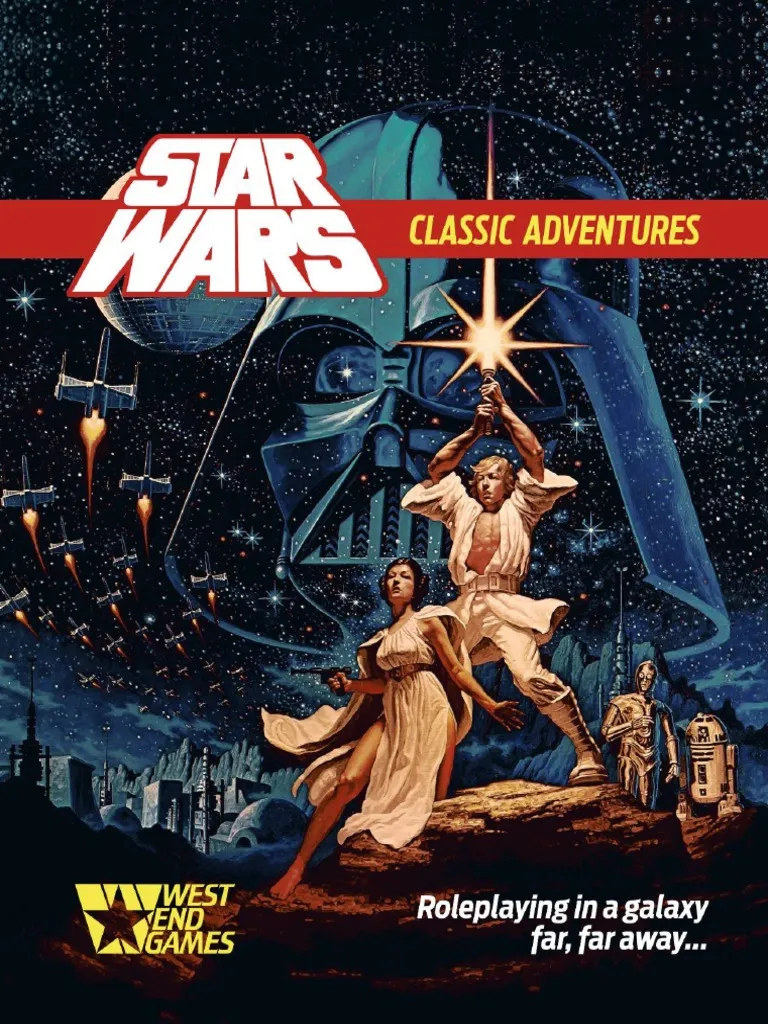
Star Wars: Classic Adventures
Star Wars: Classic Adventures
Credits
Game Update Design: Van Dyke Brown et al.
Original Design: Greg Costikyan, Greg Gorden, Peter Schweighofer, Bill Slavicsek, Bill Smith, Ed Stark, George Strayton, Paul Sudlow, Eric S. Trautmann
Solo Adventure and Adventure Ideas: Ken Rolston
Tatooine Manhunt: Bill Slavicsek, Daniel Greenberg
Map Art: Paul Jaquays
Editing: Eric Goldberg, Paul Murphy, Bill Slavicsek
Art Direction: Stephen Crane
Graphics: Susan Kramer, Diane Malz, Kevin Wilkins
Production Manager: Richard Hawran
Cover Illustrations: Tim Jung, Cantrell, Roger Kastal, Noriyoshi Ohrai, Kazuhiko Sano
Interior Art: Michael Manley, Ralph McQuarrie
Template Art: Stirzy
Composite Photographs: Industrial Light & Magic
First Edition Testing and Advice: Laura Antoniou, Paul Balsamo, Ed Campbell, Peter Corless, Dan Decker, Patrick Egan, Brad Freeman, Dan Gelber, Jeggery Gomez, Dan Greenberg, Bill Herz, Doug Kaufman, Paul Lidberg, Stephen Osmanski, Al Perry, Curtis Scott, Denis Taylor, Chuck Turnitsa, Carol Turrietta, Dave Turrietta, Earl Van Atta, Jan Warner, Sam Weiss
First Edition Special Thanks to: David Craig, Noah Falstein, Anita Grossman, Karen Picelle, Louise Riley, Howard Roffman (of Lucasfilm Ltd.)
Heroic and Meritorious Service to the Rebellion: Greg Gorden, Wayne Shaw, Kevin Siembieda, Stephen Tihor, Allen Varney, Martin Wixted.
Published by West End Games, Inc., 251 West 30th Street, New York, NY 10001
Star Wars: Classic Adventures — Core Rules, Second Printing: July 2016
Original TM & © 1987, Lucasfilm, Ltd. (LFL). All Rights Reserved. Trademarks of LFL used by West End Games, Inc., under authorization.
Player's Handbook
Chapter One: Introduction
Get ready to experience the vast scope and sweeping power of the greatest space adventure of all time! In Star Wars: Classic Adventures, you take the part of a character in the Star Wars universe, struggling against the awesome might of the evil galactic Empire. You fly faster-than-light spacecraft, trade blaster fire with Imperial stormtroopers, fight lightsaber duels, and tap the mystic Force which binds all living things together.
You live in a galaxy of a billion suns, a billion star systems each with its own wonders and dangers to explore. You live in a universe of dire peril, where freedom fights desperately against the eternal night of tyranny and oppression. You will be faced with overwhelming odds, hard choices, impossible challenges — but if you are brave and true, you may triumph, for the Force is with you... always!
A Word About Roleplaying
In Star Wars: Classic Adventures, each player controls a character, a single person who lives in the Star Wars universe. Exactly what your character can do is determined by the rules of the game.
One person acts as gamemaster. The gamemaster, or GM, runs the game. When a player wants his or her character to do something, the gamemaster decides what happens, using the rules as a guide.
He also acts as a "director," describing the universe in which the characters live to the players. He takes the roles of non-player characters, or "NPCs," people who live in the Star Wars universe but are not controlled by the players.
But most important, the gamemaster creates an adventure for his players — a story for their characters to experience, complete with supporting cast, an interesting plot, and rewards for success.
In essence, when you play you create your own Star Wars "movie," starring your character and those of the other players, with the gamemaster as director, writer, and supporting cast.
Players
You don't have to read every book in order to play — just the Player's Handbook. You can read the Gamemaster's Guide and Rebel Field Manual when you have time and want to, but only gamemasters should read the "Tatooine Manhunt" adventure in the Adventure Book.
Gamemasters
Gamemasters have to do more work than players. If you plan to gamemaster Star Wars: Classic Adventures, you'll have to read all of the Player's Handbook. After all, part of your job will be to make sure the players are following the rules. Additionally, you will have to read the Gamemaster's Guide, which provides hints and suggestions to get novice gamemasters started and explains the rules in detail. The Rebel Field Manual provides information on the various aliens, weapons, equipment, Droids and vehicles you will encounter in the Star Wars universe. Additionally, it provides some valuable background information on the Rebellion, the Empire, and the galaxy at large. The Adventure Book provides information on how to actually run an adventure for your players. This book also includes the "Tatooine Manhunt" adventure, to help you get started.
What You Need to Play This Game
In addition to a gamemaster and players (three to seven is about right), you'll need some pencils, paper, and at least six regular six-sided dice, these are provided in this box set. However, if you have the softcover edition, you can cannibalize some from other games — or buy some. Most toy and hobby stores carry them, and so do many stationery shops.
Supplements and Adventures
This game includes the Player's Handbook, Gamemaster's Guide, the Rebel Field Manual, and the Adventure Book, which is everything you need to play Star Wars: Classic Adventures. However, there are a lot of other books published to make the lives of Star Wars gamemasters and players easier. Most of the West End Games First Edition Star Wars material is almost completely compatible with this game. This includes adventures, supplements, sourcebooks, the Galaxy Guides, and even some of the rule options in the Star Wars Rules Companion.
Keep in mind, however, that this game has just a few minor differences (like new skills) from the "First Edition" and already incorporates some of the errata and clarifications from the rule expansions.
Keep in mind, the West End Games' The Star Wars Roleplaying Game: Second Edition Revised & Expanded, and other Star Wars roleplaying game products from various publishers have extremely useful material and ideas that will no doubt prove useful in running and playing Star Wars: Classic Adventures.
Chapter Two: Character Creation
Before you begin playing, you're going to need a character. The easiest way to start is to flip to the back of the book (starting at page 207) and pick out a character template that appeals to you. You can play a Smuggler, a Brash Pilot, a Mercenary (or "Merc"), a Wookiee... whatever suits you. Photocopy or print out a copy of the template you want. If none of the templates seem appealing, you can create your own custom template, as long as the gamemaster approves it (see page 11).
Selecting a Template
Each template describes a character "archetype" that fits the Star Wars universe, not an actual character from the films. Think about what kind of person you want to play. Do you want to play a smuggler like Han Solo? A brash pilot like Wedge Antilles? An impressionable Jedi-in-training, like Luke Skywalker at the beginning of A New Hope? A headstrong diplomat like Princess Leia? A seedy gambler turned businessman like Lando Calrissian? There are many, many different types of people in the galaxy and you can play just about anyone.
Before you pick a template, it's not a bad idea to ask the other players what kind of characters they will be playing. Normally, your game should have a diverse group of characters with a mix of skills — not everyone can be a Brash Pilot, a Smuggler or a Failed Jedi.
Customizing Templates
The next step is to customize your template. But before you can do that, you need to know a little bit about the die codes, attributes and skills.
Die Codes
Whenever you try to do anything in the game, you roll dice. The higher the number you roll, the better — and the better the chance that you can do what you want.
How many dice do you roll? That depends on your die code. Every skill and attribute has a die code (see below), so when you use a skill or attribute, you look at its code to see how many dice you should roll.
In general, die codes consist of a number (how many dice you roll), followed by a "D," sometimes followed by a plus sign ("+") and another "pip" number (which you add to the numbers on the dice).
Here's a typical die code: "3D." That means, roll three dice, and add the numbers you roll together ("D" stands for "die"). So, if you roll 3 on one die, 2 on another and 6 on the third, your total die-roll is 11.
Here's another die code: "2D+2." That means, roll two dice, add the numbers rolled, and add 2 to the total. If you roll a 4 on one die and a 3 on another, your total roll is 9.
Attributes and Skills
Every character has "attributes" and "skills." Attributes are things you're born with — innate abilities. There are six in the game — Dexterity, Knowledge, Mechanical, Perception, Strength and Technical (see page 8).
Skills are abilities you learn, instead of ones you're born with. You can't improve your attributes during the game, just as you can't make yourself smarter or taller. You can improve your skills (see page 17).
Your character has a die code for every attribute and skill. The die code is the dice you roll when you use the attribute or skill.
Example: Shamus Falconi's Dexterity is 3D+1, so if he tries to juggle something, his player rolls three dice, adds the rolls together, and adds one to the total.
Your attribute codes are printed on your character template. Different character templates have different codes, but all Smugglers (for example) have the same attributes.
However, you get to choose your own skill codes. That's what customization is all about.
Attribute and Skill List
This list describes the attributes and skills used in the various character templates. They cover a character's knowledge in a field or the ability to do the following:
Dexterity: eye-hand coordination.
blaster: fire blaster weapons.
brawling parry: used to avoid being hit by a brawling attack.
dodge: get out of the way when people shoot at you.
grenade: throw grenades and other objects.
heavy weapons: shoot unwieldy hand-held weapons and big guns.
melee parry: block a hand-to-hand attack with some kind of weapon.
melee weapon: fight with weapons in hand-to-hand combat (except lightsabers).
sleight of hand: slip things from other people into your own possession.
Knowledge: general thinking ability and intelligence.
alien species: what you know about different aliens.
bureaucracy: how big government groups work and using this information to your advantage.
cultures: what you know about other cultures and their traditions, legends and practices.
languages: speak and understand other languages.
planetary systems: knowledge about different planets and star systems.
streetwise: what you know about criminals and how they might help you.
survival: survive in harsh environments without modern conveniences.
technology: gauge the fair market value, purpose and capability of various kinds of equipment.
Mechanical: ability to operate devices and machines, including vehicles and starships.
astrogation: plot hyperspace jumps using a starship's nav computer.
beast riding: handle riding animals.
com-scan: use communications and sensor equipment.
repulsorlift operation: fly vehicles like landspeeders, speeder bikes, and snowspeeders.
gunnery: fire weapons built into vehicles or starships, or a weapon with a "fire control" die code.
starship piloting: fly all types of starships like X-wings, freighters and blockade runners.
starship shields: angle deflector shields to protect against incoming attacks.
Perception: powers of observation and ability to influence others.
bargain: make deals.
command: convince NPCs to do what they're told.
con: fast-talk your way out of situations.
gambling: winning at games of chance.
hide/sneak: move around without being seen, and camouflaging objects.
search: look for things.
Strength: physical strength, health and ability to resist damage.
brawling: fight with your bare hands.
climbing/jumping: climb and jump.
lifting: move, lift and carry heavy objects.
stamina: exerting yourself for a long time.
swimming: ability to stay afloat in watery environments.
Technical: ability to repair and modify machines and devices, and operate high-tech gear.
computer programming/repair: use, fix, slice, and program computers.
demolitions: set explosive charges.
Droid programming/repair: fix and program Droids.
first aid: mend wounds and tend to injuries on the scene.
repulsorlift repair: fix repulsorlift vehicles.
security: open mechanical and electronic locks and doors.
starship repair: fix starships.
Force Skills: Jedi characters can have any of the three Force skills. These are used when Jedi tap into some of the awesome Force powers. Check out chapter five "The Force" in the Gamemaster's Guide for more information on these powers. Here's a brief summary of the three Jedi skills:
control: control your own body.
sense: sense the Force in things beyond your own body.
alter: change the distribution and nature of the Force.
Choosing Skill Codes
Each attribute has a list of skills printed underneath it on the character template. For example: blaster, brawling parry, dodge, and several others are all listed under "Dexterity." They're all Dexterity skills. A skill starts with the same code as the attribute it's printed under.
Example: Shamus' Dexterity code is 3D+1. That means his blaster code is 3D+1, his brawling parry code is 3D+1, and so on.
You have 7D to allocate to skills. To allocate 1D to a skill, add 1D to the attributes code, and write the result next to the skill name on the character template. However, no skill can be increased by more than 2D.
Example: Shamus' Dexterity is 3D+1. His player allocates 1D to dodge; his dodge skill code is now 4D+1. The player writes "4D+1" next to dodge on the template; he has 6D left to allocate to other skills. Shamus' player could allocate 1D to blaster, increasing the blaster code to 4D+1; or he could allocate 2D to blaster, increasing the code to 5D+1. He could not allocate 3D or more.
You can also split a die into three pips. When you split a die, you either get three "+1's;" or one "+2" and one "+1." You'll never see a "+3" — instead, the die code increases to the next full die — "2D, 2D+1, 2D+2, then 3D, 3D+1, 3D+2, then 4D..." and so on.
Example: Shamus' player could allocate +2 to blaster, increasing the blaster code (originally 3D+1) to 4D; he would still have a +1 pip to allocate to another skill.
You get to choose which skills are increased, and can allocate dice to any skills you like, as long as you don't spend more than 7D total, and as long as no single skill gets more than 2D.
Equipment
Your character template also has an equipment section. It lists all the gear your character starts the game with. Most characters start with some money (credits); if you like, you can spend some of it to buy more equipment. The table on the next page contains some basic gear and prices.
Basic Equipment Table
| Blaster Weapons | Cost | Damage Code |
|---|---|---|
| Hold-Out Blaster | 300 | 3D+1 |
| Blaster Pistol | 500 | 4D |
| Heavy Blaster Pistol | 750 | 5D |
| Blaster Rifle | 1000 | 5D |
| Blaster Carbine | 900 | 5D |
| Melee Weapons | Cost | Damage Code |
|---|---|---|
| Staff or Club | 15 | STR+1D |
| Spear | 60 | STR+1D+1 |
| Gaderffii | 50 | STR+1D |
| Knife | 25 | STR+1 |
| Hatchet | 35 | STR+2 |
| Vibroblade | 250 | STR+1D+2 |
| Force Pike | 500 | STR+2D |
| Personal Gear | Cost | Personal Gear | Cost |
|---|---|---|---|
| Helmet (+1) | 300 | Medpac | 100 |
| Armor Vest (+1) | 300 | Tool Kit | 200 |
| Syntherope | 2 | Comlink | 100 |
| Glow Rod | 10 | Macrobinoculars | 100 |
| Chronometer | 25 | Breath Mask | 50 |
| Datapad | 100 | Recording Rod | 30 |
See the Rebel Field Manual for a complete list of weapons, gear and prices.
Character Connections
One of the important parts of character generation is deciding how and why the player characters know each other. In the Star Wars movies, the main characters never let each other down. Luke even breaks his training as a Jedi in order to rescue his friends. It's important for the player characters to have the same kind of feelings about one another. As a rule of thumb, each character in the group should have met and know at least one other character. Look at the "Connection With Other Characters" section on your template. It suggests some ways you might meet or know about other characters. But you, the other players, and the gamemaster must decide what the real story is.
Talk possible connections over with the other players and the gamemaster. Make suggestions for how the characters could have met. Get a feel for how the other players envision their characters, and what kind of connections make sense. Work out a scenario with your friends. For example:
Gamemaster: Okay, we've got a Kid and a Bounty Hunter.
Bounty Hunter: Oh, no. Not another obnoxious brat.
Kid: Sure!
Gamemaster: Come on, it's a good character.
Bounty Hunter: Remember the last Kid we had? When he wrestled that pirate out of the hatch, I had to jump from orbit to the surface of Dantooine with nothing but a parachute and an ablative heatshield to save him.
Kid: Ah... I was thinking of playing this one a little differently. Like, a properly-brought-up upper-class British kid. You know, reserved, intelligent, eager for adventure.
Bounty Hunter: Well... okay. But how would I know him?
Gamemaster: Um... He's an orphan?
Kid: Yeah! I'm a poor orphan lad...
Bounty Hunter: Orphaned by Imperial troops.
Gamemaster: You found him homeless on Farstine, the methane world, during the Imperial occupation. He was out of money and down to fifteen minutes of oxygen...
Kid: But remained dignified.
Gamemaster: You were taken by his good manners even in misery...
Kid: And I was glad to find a protector, even one so rough.
Bounty Hunter: Rough, but with a heart of gold.
Gamemaster: And a soft spot for... a kid like your younger brother who died at an early age?
Bounty Hunter: Well, okay, but I never tell the Kid I had a younger brother.
Gamemaster: Right! A secret hurt you keep even from those closest to you.
Bounty Hunter: You sure this isn't too melodramatic?
Gamemaster: No, sounds good to me. Besides, melodrama is easy to roleplay.
Character connections do three things. First, they give player characters reasons to help one another. That's important because the players must cooperate to do well in the game. Second, they give players a guide to how their characters react to others. Third, they help create the feeling that what goes on in the game is only a small part of events in the whole Star Wars universe, and that the characters have independent histories and backgrounds.
Here are some ideas for how characters might know each other:
-
Friends. The most obvious (and the most often overlooked) connection. Friends will do a lot to help each other even if they've been out of touch for years.
-
Relatives. No one gets to choose his own relatives (unfortunately), so your character could be related to anyone. Relatives usually feel obliged to help each other out, even when they don't like each other — just the kind of tie you want. Age difference is no bar — characters can be parents, grandparents or uncles as easily as brothers or sisters. Characters from different walks of life can still be related: for example, a Smuggler might be the black sheep of a Senator's family. Relationships can be more obscure — characters can be second cousins, or related through remarried parents. Don't overdo the "long-lost-cousin" bit though — George Lucas can get away with it once, but you can't.
-
Employees. One character might be another's boss. Higher-status characters can employ lower-status ones — for example, a Senatorial might hire a Bounty Hunter as a bodyguard. Any character with a ship might hire another as crew.
-
Joint Ownership of a Ship. Two or more players can own a ship in common — and owe the debts together, too. This gives them a strong reason to be supportive.
-
Traveling Companions. Even the most unlikely pair might have traveled together for months or years before the game begins. Low-life characters might be buddies and partners in crime. Higher class characters might be friends with similar outlooks on life.
-
Mentors. Any older character can semi-adopt a younger character, as Obi-Wan does with Luke. The relationship might be a formal master-pupil one, in which the mentor teaches his pupil about the Force — or it could be much more casual, like Indiana Jones' relationship with Short Round in The Temple of Doom.
-
Rivals. It's not a good idea to have two player characters who genuinely hate each other's guts — that's a recipe for acrimony and disaster. But it's perfectly all right to have two characters who are rivals. Opposition can add spice to an adventure — as long as it doesn't become serious enough to cause problems.
-
Same Home Planet. Two characters who grew up on the same planet have things in common even if they now have very different interests. In our world, two guys who grew up in Cleveland invariably wind up talking about the Browns. Characters who grew up on the same planet will have the same kind of shared memories.
-
Classmates. Characters of the same age could easily both have attended the Imperial Naval Academy or a university.
-
Known by Reputation. Even if one character has never met another before, he may know the other by reputation. A Smuggler might have heard of other Smugglers, or Pirates, or Bounty Hunters. Senatorials might be known for their politics or for charity work. A Merc or Bounty Hunter might be known for his previous service to the Empire. Any kind of information that helps a player establish some kind of relationship to another character is a start.
-
Love. Love is a very strong tie, but a tricky one to pull off. Many players are embarrassed by the idea of playing lovers — it's easiest when the players themselves are married or at least involved with one another. A note to the gamemaster: never force love on your players. It's one thing to tell two players, "You're related." They may not like it, but they don't have to; relatives can dislike each other. It's another thing to say, "You're in love." That's taking away too much of a player's free will. If players want their characters to fall in love, that's great and creates the kind of bond you want to encourage — but don't force it on them.
How Good Is My Character?
At first, your attribute levels may seem very abstract. Sure, you know that 2D is about average, but how well will your character stand up in a fight next to a stormtrooper? Can you outsmart a clever smuggler? To give you a basic understanding of how you rank up to others in the galaxy, consult the following chart:
| Die Code | Description |
|---|---|
| 1D | Below human average for an attribute or skill. |
| 2D | Untrained human average for an attribute and many skills. |
| 3D | Average level of training for a human. |
| 4D | Professional level of training for a human. |
| 5D | Above average expertise. |
| 6D | Considered about the best in a city or geographic area. About 1 in 100,000 people will have training to this skill level. |
| 7D | Among the best on a continent. About 1 in 10,000,000 people will have training to this skill level. |
| 8D | Among the best on a world. About 1 in 100,000,000 people will have training to this skill level. |
| 9D | One of the best in several systems. About 1 in a billion will have training to this skill level. |
| 10D | One of the best in a sector. |
| 11D | One of the best in a region. |
| 12D | One of the best in the galaxy. |
Are There Any Talkative Scouts?
Or Humble Nobles? Or Cautious Pilots?
Sure there are. The backgrounds that come with each template are designed to give you a role you can play immediately. Character templates make choosing a character fast and easy.
But if a background write-up isn't quite the character you want to play, go ahead and change things. Character templates are supposed to help you imagine your character, not restrict your imagination. Go ahead; rewrite the background on your sheet, or tell the other players what your character is like. Change the template name to suit. Talk things over with your gamemaster; he may have some ideas, too. Don't change the attribute codes, though.
If none of the templates, even modified, fits your character idea, you can even design your own template — see page 11 for rules on how to do that.
By the way, it is possible to play Droids and different aliens — but the rules are a little different from other characters, especially for Droids. If you're interested, you'll have to check out chapter six in the Gamemaster's Guide.
Creating a New Template
The templates provided offer a wide range of backgrounds and lots of different roles for characters to play — but they're not the only characters which can appear in Star Wars: Classic Adventures. You can easily make up new templates, if you like. A blank character template is printed in the back of this book. You can print or copy it and write in new templates on the copies. Here is how:
-
Choose a Template Name. Decide what you want the character to be like, and come up with a name that describes him or her — like "Smuggler," or "Failed Jedi," or whatever.
-
Assign Attribute Dice. You have 18D to divide up among the six attributes, any way you wish. You can allocate 3D to each attribute, or increase some and decrease others accordingly. No attribute can be higher than 4D or less than 2D, unless the template is for an alien or Droid (you'll have to check out the Gamemaster's Guide for the rules). Obviously, you don't always want all attributes to be 2D, 3D or 4D. You can "break up" attribute dice into "pips" (see page 8); each die is worth three "pips," so adding "+1" to three codes, or "+2" to one code and "+1" to another, costs 1D from the allotment of 18D. So if you make a character's Strength 2D+2 and his Dexterity 3D+1, you've used up a total of 6D.
-
The Force Skills. Each Force skill costs 1D from the allocation of 18D attribute dice. Normally, the 18D are only spent on attributes; Force skills are an exception. A character who knows all three Force skills only has 15D to allocate among his attributes; a character who knows one has 17D; etc. All Force skills start with codes of 1D.
-
Create a Background. Write up a background for the character. You want to give a sense of the character's motivations and personality. Ask yourself: what is important to this character? Why has he joined the Rebellion? How does he talk? How do other characters react to him? Try to answer these questions in your write-up. Note: Characters with Force skills are highly unusual. The background for any character with the Force skills must explain how and why the character obtained them. If you cannot come up with a plausible rationale, you may not give your character Force skills.
-
Character Connections. Jot down some ideas on how the character might connect with other characters. See the printed character templates for examples.
-
Pick Equipment and Weapons. Decide what equipment he'd logically start with, and write this down on his sheet. If you give him valuable equipment (like a starship), give him debts to match. Check with the gamemaster after writing equipment on your sheet. Don't get too greedy, or the gamemaster may strike some items off.
Generating Characters "From Scratch"
Once you've made up a new template, using it to generate a character is easy enough. Just customize it (allocate 7D to skills), and decide on his connections with the other characters.
Get Started
The next chapter, "The Bare Bones," covers the basics of how to run the character you just created. It includes information on movement, combat, injuries and many other aspects of play. At some point, you will want to become more familiar with the rules, and this chapter is a quick, easy way to get up to speed.
The fourth chapter, "An Introduction to Roleplaying," provides a short solitaire adventure for you to practice with. This will give you a taste of what to expect when you sit at the game table with a gamemaster and other players. We encourage you to run the player you created through the solitaire adventure once or twice.
Finally the back of this book contains all of the character templates and a blank character sheet you can use to create your own templates. Feel free to print out or photocopy these pages so that you can get more than one use out of them.
Go ahead, now. Choose your character template and get ready to play. Then, read the rest of the Player's Handbook — or, if there are other players around, get them to explain the game and you can catch up on the details later.
Chapter Three: The Bare Bones
If you're new to Star Wars: Classic Adventures, this chapter teaches you enough of the rules to play the game. The Gamemaster's Guide describes the rules in more detail, but you can always read that guide later if you're interested.
Attributes and Skills
Every character has attributes and skills (see page 6). Each attribute and skill has a die code. Each time you use an attribute or skill, you roll dice; the attribute or skill's code determines how many dice you use and how you calculate the total roll (see page 8).
Which Do You Use?
But how do you know which to use?
Here's how: skills supersede attributes. You only use an attribute when there's no skill that affects what you're doing.
Example: If you want to juggle, you use your Dexterity attribute, because there's no "juggling" skill.
You can pretty much tell what each skill and attribute does from its name. If you need more information, refer to the "Attributes and Skills" chapter in the Gamemaster's Guide.
Opposed Rolls
Sometimes you're rolling the dice to beat an opponent's skill roll. If your character is acting against another character, you are making an opposed roll: you roll your skill dice while the other character rolls for a skill which opposes the one you're using. Whoever rolls higher succeeds.
Example: "As the bathysphere spun crazily through the massive planets viscous atmosphere, dropping ever downwards toward the striated clouds far below, Shamus Falconi and the last remaining Imperial wrestled desperately for control of its wheel."
The Imperial's Strength is 2D+2; Shamus' is 3D. Shamus' player rolls — and gets an 8. The gamemaster rolls for the Imperial — an 11.
"Elbowing Shamus aside, the Imperial grabbed the wheel and spun it, trying to regain control and set the craft back on course. 'Curse you, Rebel,' he cried. 'There's a thousand atmospheres out there! The hull can't stand much more, let me fly this thing, or we're all dead men!'"
If the rolls are tied, the player character wins over a non-player character. If both are player characters, the character with the higher skill or attribute die code wins.
What happens if one side has an advantage? In this case, the gamemaster assigns one side a modifier. The modifier is added to his roll, so his chance of winning increases.
Example: "While Shamus watched, the Imperial wrestled the craft to some semblance of stability, sweating a bit as he labored. Through the viewport swirled a red-tinted mist, the upper clouds of the Jovian's massive atmosphere. Suddenly, a huge gray shape loomed out of the clouds — 'Hey!' Shamus yelled, and grabbed the wheel again."
The gamemaster rules that the Imperial was tired by his efforts to control the craft, and assigns Shamus a modifier of +2. Shamus' roll is an 8, which gets modified to 10. The Imperial rolls a 9, so Shamus controls the wheel.
Difficulty Numbers
Most of the time, you aren't trying to beat anyone else. For example, if you try to fix a malfunctioning hyperdrive, there's no one "opposing" you. In this case, the gamemaster assigns a difficulty number to the task — recommended numbers are listed in parenthesis ( ) after the difficulty description. If your roll is equal to or greater than the difficulty number, you succeed. If it's lower, you fail.
Example: "Suddenly, Shamus felt a hundred kilos heavier. Clutching the wheel, he remained erect, but every moment standing was an effort. 'The repulsors,' he said. 'We're exposed to the planet's full gravity.'
'The Imperial lay carefully down on the deck. 'We're doomed,' he said. 'Trapped on a gas giant beneath a cloud layer. We're doomed.' The hull creaked ominously.
"'Shaddup,' said Shamus. 'Where do you keep the repulsors on this thing?'
"'Oh, back that way,' said the Imperial, nodding vaguely aft.
"Muttering under his breath, Shamus braced himself against the bulkhead, and began to walk carefully toward the drives..."
Shamus' repulsorlift repair skill is 2D+2. The gamemaster rules that the difficulty number is Easy (10). Shamus' player rolls and gets a 12; the repulsors are working again! "He breathed a sigh of relief."
Basic Difficulty Numbers
| Difficulty Level | Number |
|---|---|
| Very Easy | 5 |
| Easy | 10 |
| Moderate | 15 |
| Difficult | 20 |
| Very Difficult | 30 |
How Long Does It Take?
Under most circumstances, using a skill or attribute takes one combat round (about five seconds). However, some skills — starship repair, for instance — can take longer to use (you'll have to check out the Gamemaster's Guide for these rules). Unless your gamemaster tells you differently, though, assume you can use a skill in one combat round.
Preparing
If you want to make sure that you use a skill or attribute successfully, you can take an extra round preparing. You do nothing for one round, and in the next, you make your skill roll. In this case, your skill code is increased by 1D.
Example: Your blaster skill is 3D+1. You spend an extra round aiming. You roll 4D+1 when you fire.
Preparation only affects skills which normally take a round to execute; you could not, for example, prepare the computer programming/repair skill, a skill which can take several rounds or even hours to use.
Running
If you run in the same combat round that you use a skill, your skill code is reduced by 1D.
Example: Your blaster skill is 3D+1. You dash across the hall, firing at a stormtrooper. You roll 2D+1 when you fire.
Wounds and Stuns
If you are wounded or stunned when you use a skill, your skill code is reduced by 1D.
Example: You're wounded. Your blaster skill is 3D+1. When you fire, you roll 2D+1.
Using More Than One Skill
Actually, you can use more than one skill or attribute in a single combat round. You have to decide which skills you will use during the combat round at the beginning of the round, and tell the gamemaster what you'll do.
Every skill use after the first costs you 1D. If you use two skills, all skill codes are reduced by 1D; if you use skills three times, all codes are reduced by 2D; if you use skills four times, codes are reduced by 3D; and so on.
These reductions apply to all skill uses in that combat round. That is to say, if you use skills twice, both uses are reduced by 1D, etc.
Example: "As Shamus walked back toward the control cabin, he heard a click: the ominous click of a blaster being set on stun — or maybe on kill. The truce was over, so it often goes. He pulled his own blaster, leapt through the door, and..."
Shamus' blaster skill is 5D+1. Wayne, his player, decides to fire three times in a single combat round. That's a total of two extra skill uses, so Wayne subtracts 2D from the blaster skill code. In addition, he's running (since he leapt through the door), so skill codes are reduced by another 1D. The first time he fires, he rolls 2D+1 (that's 5D+1 minus 3D); the second time, he rolls 2D+1 again; and the third time, he rolls the same thing.
If you try to do too many things, none of them will work.
Example: Shamus' blaster skill is 5D+1. If he tried to fire at all six times in the same round, he wouldn't fire at all (because 5D+1 minus 5D is less than a single D, so he has no dice to roll).
Reaction Skills
Dodge, melee parry and brawling parry are reaction skills. That means you don't have to declare their use at the beginning of the combat round — you can use them whenever you need to. If someone shoots at you, you can use the dodge skill then and there. But that creates a problem. Suppose you're using other skills in the same round?
In that case, your dodge (or other reaction skill) counts as an extra skill use. Any skill rolls you made before you dodged are not affected — but any rolls you make after dodging are.
Example: "Shamus brought his blaster down and squeezed off a shot..."
Shamus wants to fire three times. Three skill uses means Shamus' skill codes are reduced by 2D. Wayne rolls 3D+1 (blaster code of 5D+1 minus 2D).
"The shot went wild. Before he could shoot again, the Imperial fired back. Shamus dodged desperately."
The use of dodge means Shamus is now using skills four times — three blaster shots and one dodge. His first blaster roll is already made, so it isn't affected. However, his dodge skill roll and his last two blaster rolls will be reduced by 3D instead of 2D.
You are never required to use a reaction skill. Using a reaction skill means you roll fewer dice for the rest of the round, so if you think you can get away without it, you may want to avoid doing so.
Die Code Modifications Are Cumulative
The increases and reductions for being stunned, wounded, running and multiple actions are added together when more than one apply. For example, if you are wounded and spend an extra round preparing to use a skill, the 1D reduction and the 1D increase cancel each other out, and you just use your unmodified skill code.
Combat
Combat is fought in combat rounds, each of which represents about five seconds of "real" time.
In a roleplaying game, combat is not fought on a board. Instead, the gamemaster describes your surroundings and opponents. Then, he goes around the table, and asks each player what his character is doing this combat round. When he comes to you, you must tell him what skills you're using, and how many times you're using them — "I'm firing once at the trooper on the left, and moving over here."
There is one exception: you don't have to declare reaction skill uses (see above).
Next, the gamemaster tells you what your opponents are doing.
Then, actions are resolved.
You continue playing combat rounds until one side or the other is defeated or gives up.
Action Segments
At the beginning of the combat round, each player must declare what his character is doing — whether he's moving, and if so where; and what non-reaction skills he's using.
Combat rounds are divided into action segments. During each action segment, each character may use one skill or attribute, or move.
Example: Shamus wants to run, then fire. Krasius just wants to fire. Krasius' fire and Shamus' movement occur in the first segment. Shamus will fire his blaster in the second segment.
Reaction skills, however, don't take any "time" to use. You can use a reaction skill in a segment — and still move or use another skill that you declared.
Movement, skill and attribute use occur in the order declared, one per action segment. A character cannot "pass" a segment; actions are resolved until the character has run out of declared actions to perform.
Initiative
Normally, it doesn't matter exactly when during an action segment a particular character gets to act. Everyone just moves, or shoots, or uses some other skill. The only time it matters is when someone uses a skill that will affect another character's skill use.
Example: Shamus fires at Krasius and vice-versa. If Shamus gets his shot off before Krasius does and wounds him, Krasius never gets to shoot back.
When two characters are doing things that affect each other, make skill or attribute rolls for both. If a character is moving, make a Dexterity roll instead (since there's no skill code for movement).
The high-roller goes first. Then, the character with the next highest roll goes, and so on. The same roll is used to determine whether the character's skill or attribute use succeeds.
Example: Krasius (blaster skill of 5D+2) and Shamus (blaster of 5D+1) both shoot at each other; the difficulty for each shot is Moderate (15). Krasius' roll is 19; Shamus' is 17. Krasius gets his shot off first (because 19 is greater than 17), and hits Shamus (because 19 is greater than 15). Shamus' fire never takes place. If Shamus had gotten his shot off, he would have hit, because 17 is greater than 15.
If rolls are tied, and one of the tied characters is a player character, he gets to go first. If they're both non-player characters, or both player characters, the actions happen at the same exact time.
Movement
Each combat round, you can hold still, walk, or run. Walking and running aren't skills; they're something everyone can do. Walking or running is an action, and takes a segment.
If you're walking, you can move up to five meters in any direction. If you hold still or walk, you can turn by any amount — right or left.
"Five meters" sounds pretty precise, but since combat is fought in the imagination rather than on a board or map, you must rely on the gamemaster's judgment. If he tells you that you can get someplace or reach a character in one round by walking, that's the case. If he tells you that you must run to get there in one round, or that it will take several rounds, his judgment is final.
If you're running, you can move up to ten meters in any direction (twice as far as walking). A character who runs can only turn by up to 90 degrees in the combat round (make one right-angle turn); because you're moving so fast, you can't turn on a dime, the way you can if you walk.
Whenever a running character makes a skill roll, his code is reduced by 1D (see above). Walking characters' codes are not modified.
Running characters are also harder to hit in combat.
Stance
You can always fall prone, without any penalty, at the end of your movement. Falling prone is part of movement, not a separate action. Prone characters can only move by crawling — they may move up to two meters per round in this case. When a crawling character makes a skill roll, his code is reduced by 1D (just like a running character). Getting up from a prone position is an action; all other declared actions are reduced by 1D for the rest of the round. You can turn and use skills in the same round, but you can't move.
Prone characters are harder to hit in combat.
Shooting
Difficulty numbers also determine whether or not you hit your target in combat. When using blasters, grenades, and other long-range weapons, the difficulty number depends on the distance from your character to the target. It's much easier to shoot something closer than farther away. The basic ranges, difficulties and numbers needed to hit are provided in the table below:
| Range | Difficulty (# to Hit) |
|---|---|
| Point Blank | Very Easy (5) |
| Close | Easy (10) |
| Medium | Moderate (15) |
| Long | Difficult (20) |
The range of each weapon, in meters, is printed on the "Fire Weapons" tables in the Rebel Field Manual, but we provided a few examples for common blasters in the table below:
| Blaster Weapon | Range in Meters | ||
|---|---|---|---|
| Short | Medium | Long | |
| Hold-Out Blaster | 3-4 | 5-8 | 9-12 |
| Blaster Pistol | 3-10 | 11-30 | 31-120 |
| Heavy Blaster Pistol | 3-7 | 8-25 | 26-50 |
| Blaster Rifle | 3-30 | 31-100 | 101-300 |
| Blaster Carbine | 3-25 | 26-60 | 61-250 |
Combat in Star Wars: Classic Adventures is visualized, and not played using precise measurements, hexes or squares. You must rely on the gamemaster to tell you the range to a target. Some weapons have better ranges than others; 20 meters is short range for a blaster rifle, but medium for a blaster pistol — so even if your buddy is firing at short range, you may be firing at long, depending on the weapons involved.
Taking more than one shot means using the blaster skill more than once (see "Using More Than One Skill," page 13).
If you roll equal to or higher than the difficulty number for your shot, you hit your target.
Example: If you shoot at short range, and roll a 10 or more, you have hit your target (unless the target dodged or there is some other modification to the difficulty number).
Damage
Each weapon has a damage code. Blaster pistols — for example — have damage codes of 4D. When you hit a target, roll your weapon's damage dice.
Then, the gamemaster rolls Strength dice for your target. How badly you injure the target depends on the two rolls, check out the table below to see what happens.
| Result | Effect |
|---|---|
| 2 × Damage Roll < Strength Roll | No Effect |
| Damage Roll < Strength Roll | Stunned |
| Damage Roll ≥ Strength Roll | Wounded |
| Damage Roll ≥ 2 × Strength Roll | Incapacitated |
| Damage Roll ≥ 3 × Strength Roll | Mortally Wounded |
Example: Your damage roll is 12. If the target's Strength roll is:
- 25 or more, he's not affected.
- between 13 and 24, he's stunned.
- between 7 and 12, he's wounded.
- between 5 and 6, he's incapacitated.
- 4 or less, he's mortally wounded.
A stunned character falls prone. They can still take actions in the round, but their skill and attribute codes are reduced by 1D for the rest of the round and the next combat round. If a stunned character is stunned again, they increase the die code penalty by an additional 1D. The penalties are cumulative and added together until the stun effect wears off.
Example: If Shamus is stunned twice in round one, he reduces all die codes by 2D until the end of round two. If he's stunned again in round two, he loses 3D from all actions for the rest of round two (2D for the stun in round one, and 1D for the stun in round two). In round three, he would only lose 1D to all actions.
If the number of "stuns" ever equals or exceeds a character's "D" number for his Strength attribute (not including pips), then the character falls unconscious for 10D minutes.
A wounded character falls prone and can't do anything for the rest of the round. Any time he rolls skill or attribute dice, his code is reduced by 1D until he is healed. A wounded character who is wounded again is incapacitated.
An incapacitated character falls prone and is unconscious for 10D minutes. Even when restored to consciousness, an incapacitated character is unable to use most physical skills. An incapacitated character who is wounded or incapacitated again is mortally wounded.
A mortally wounded character falls prone and is unconscious. He can't do anything (including regaining consciousness) until healed. Worse yet, at the end of every combat round, he must roll 2D. If his roll is less than the number of rounds since he was mortally wounded, he dies.
Example: Roll at the end of the round in which a character is mortally wounded; if the roll is less than a "1" (which is impossible), he dies. The next round, he dies on anything less than a "2" (also impossible); the third round, on anything less than "3." In other words, he is going to die eventually — and pretty soon — unless someone gets him to a medical Droid or bacta tank, or uses a medpac.
Making a Strength roll when hit is not considered an action or an attribute use; you never modify the Strength code for running, wounds, taking an extra round, or multiple skill use.
Dodges
Another useful skill is dodge. When someone fires at you, you roll your dodge dice. The number you roll is added to his difficulty number.
Example: The Bounty Hunter Jodo Kast fires at Shamus, who dodges. Jodo's blaster skill is 7D, and the shot is at short range — an Easy (10) difficulty. Shamus' dodge skill is 4D+1. Shamus rolls a 14, so Jodo's difficulty number is now 24. Jodo rolls — and gets a 22! Close, but no cigar.
Dodges are reaction skills; you don't have to declare dodges at the beginning of each combat round, and you can dodge and take another action in the same segment.
You must decide whether or not you're dodging before the attacker makes his skill roll. You can't wait to see whether he hits before deciding whether or not to use the dodge skill. If you dodge and more than one opponent fires at you in the same action segment, your dodge roll affects all opponents' attacks.
Example: Four stormtroopers fire at Shamus in the first segment; he dodges and rolls an 11. The dodge roll increases all four stormtroopers' difficulty numbers by 11, even though Shamus is only using the skill once.
You can use dodge every segment — but each time is a separate skill use, and decreases skill codes 1D further. If someone fires at you in a segment and you choose not to use dodge (or can't), his attack is not affected, even if you used a reaction skill in an earlier segment.
Archaic and Unusual Weapons
Some characters start with out-of-date or unusual weapons (like Chewbacca's bowcaster, slugthrowers, or black-powder weapons). Each of these weapons is used with a different skill, not with the blaster skill; if your character has such a skill, it's listed on his character template. These weapons follow the same rules as blasters.
Fire by archaic or unusual weapons can be dodged, just like blaster fire.
Hand-to-Hand Combat
If your character is near someone else, he can attack the other character in hand-to-hand combat. If your character isn't carrying a melee weapon, you use the brawling skill; if he uses a melee weapon, you use the melee weapon skill.
Basically, you use the same rules as for blasters, except that the base difficulty for the attack is not determined by the range, but by the weapon used. The larger or more complicated the weapon, the higher you need to roll to strike your opponent. Here are some common weapons and their difficulty numbers to hit:
| Weapon | Skill | Difficulty (# to Hit) |
|---|---|---|
| hands | brawling | Very Easy (5) |
| knife | melee weapon | Very Easy (5) |
| spear | melee weapon | Easy (10) |
| vibroblade | melee weapon | Moderate (15) |
| lightsaber | lightsaber | Difficult (20) |
In addition, the "damage code" when making a brawling attack is the character's Strength. If the character uses a melee weapon, the damage code is the weapons code plus his Strength (see the "Basic Equipment Table" on page 9).
When a character fights hand-to-hand, he can use his brawling parry skill if he doesn't have a weapon, or his melee parry if he does. They work just like dodge, but they only affect hand-to-hand attacks, not blaster (or other fire) attacks.
Brawling parry generally only works against brawling attacks, not melee weapon attacks. Melee parry works against both. Dodge doesn't affect brawling or melee weapon attacks.
Grenades
If your character has a grenade, he can throw it any place you like. The difficulty number depends on the range; ranges for grenades are printed on the "Explosives" table in the Rebel Field Manual.
If your grenade skill roll is equal to or greater than the difficulty number, it lands where you want it to. If your roll is lower, it may end up in your lap. Grenades do damage to everyone around them (usually within 10 meters), so be careful where you throw them.
If a grenade lands near you, you can use the dodge skill to avoid injury. The gamemaster rolls 4D for the grenade; its "difficulty number" depends on your distance from it (see the Rebel Field Manual). Your dodge roll increases the grenade's difficulty number. If its roll is greater than or equal to the modified difficulty, damage is determined normally; a grenade's damage code depends on the distance to its target (again, see the Rebel Field Manual). Whenever you dodge against a grenade, you end the action segment prone.
If you dodge in an action segment, your dodge affects all blaster fire and grenade attacks in the same segment.
Skill Points
At the end of an adventure, the gamemaster may assign you Skill Points. The better you did in the adventure, the more Skill Points you receive. You get them for doing great deeds, for outwitting your opponents, and for playing your role well.
Skill Points as Die Bonuses
When you spend a Skill Point, you get to roll one extra die when your character makes a skill roll. You can spend Skill Points after you've tried a skill roll, but you must do it before the gamemaster says whether your character succeeded or failed at the task. You can use up to two Skill Points to boost any roll you make during the game.
Example: Shamus needs to fix his damaged starship so he can race back to the Rebel base. Since he hasn't boosted his starship repair skill, he uses the dice score for his Technical attribute: 2D+2. Shamus rolls his two dice and adds two, but only gets a total of 11!
The gamemaster knows that fixing the ship is a Moderate (15) task. Before the gamemaster determines that Shamus failed to fix the ship, Shamus' player, Wayne, decides to spend a Skill Point. He reduces the Skill Point total on his character sheet by one, then rolls his extra die. It comes up a 6, bringing his starship repair total to 17! Since he's rolled more than the difficulty number, Shamus has fixed the starship.
You cannot spend Skill Points to roll an extra die in the same round that you spend a Force Point or call upon the dark side (see the Gamemaster's Guide), and you may not spend Skill Points on another character's actions.
When you use Skill Points for actions outside of combat (like fixing a starship), it counts for only one continuous action. The bonus ends as soon as the character does something else, and he cannot combine it with spending a Force Point on the same continuous action.
Skill Points for Character Advancement
You can spend Skill Points to increase your skill codes. (You can never increase your attribute codes.) To increase a skill code by one "pip," you must spend as many Skill Points as the number before the "D."
Example: Increasing a skill of 2D costs 2 Skill Points. Increasing a skill of 5D+1 costs 5 Skill Points. Increasing a skill by 3D+2 costs 3 Skill Points.
When you increase a skill by one pip, a skill with no "+" goes to "+1;" a "+1" skill goes to "+2;" and a "+2" skill loses its plus but increases the number before the "D" by 1.
Example: Increasing a skill of 2D by one pip increases the skill code to 2D+1. Increasing a skill of 2D+1 makes it 2D+2. Increasing a 2D+2 makes it 3D.
Example: If your skill is 2D, and you want to increase it to 3D, that costs you 6 Skill Points. It costs 2 Skill Points to increase it 2D+1; 2 more to 2D+2; and 2 more to 3D, for a total of 6 points. In general, increasing a skill by 1D costs three times the number before the D (increasing a 4D skill to 5D would cost 12; a 5D skill to 6D, 15; etc.).
You can spend your Skill Points any way you like, increasing any of your skills by any amount, as long as you don't spend more Skill Points than you have.
You can save Skill Points if you don't want to spend them all at once. Just be sure to track the amount you have in the "Skill Points" circle. You can spend them later, at the end of any session of play.
The Force
The Force is the mystical power which binds all things together and sustains life.
Trusting the Force
All starting characters have one or more Force Points. At any point during a game, you can tell the gamemaster, "I'm trusting the Force." That means you're attempting to use your luck, moxie, or control (the Force manifests in many ways) to make sure that what you want happens.
You can only "trust the Force" as many times in an adventure as you have Force Points. At the end of an adventure, the gamemaster may award additional Force Points.
Example: A character has three Force Points. He can "trust the Force" three times in an adventure.
When you "trust the Force," your chances of doing what you want to do increase dramatically. For the round in which you spend the point, all skill and attribute codes are doubled. That means you can do many more things in the round, or can be virtually certain of doing one thing which you want badly to succeed in doing.
Example: If Shamus spends a Force Point, his blaster skill for the round is 10D+2, his dodge is 8D+2, his Technical attribute is 4D+4, etc.
When you "trust the Force," one of four things happens:
-
If you "trust the Force" to do evil, you lose the Force Point. It is permanently lost. In addition, you gain a Dark Side Point. Each time you gain a Dark Side Point, there is a chance that your character will turn to the dark side. Since all player characters are members of the Rebellion, if you turn to the dark side, you lose your character. The gamemaster will take him away from you and use him as a villain. You'll have to create a whole new character.
-
If you "trust the Force" in a way that's neither particularly heroic, nor evil, you lose the Force Point, but do not gain a Dark Side Point.
Example: Shamus is hit by a laser cannon, and fears that he will be mortally wounded. He spends a Force Point to double his Strength roll. Saving your own bacon is not real heroic — but neither is it evil; Shamus loses the Force Point, but gains no Dark Side Points.
-
If you "trust the Force" in a heroic way — to save others or defeat evil — you do not lose the Force Point. At the end of the adventure, you get the Force Point back — so you can "use the Force" again on the next adventure.
-
If you "trust the Force" in a heroic and dramatically appropriate way — at the climax of the adventure, or to do a mighty deed — not only do you get the Force Point back at the end of the adventure, but the gamemaster may award you another point as well.
The gamemaster decides when an action is evil, heroic, or dramatically appropriate (see the Gamemaster's Guide).
Calling on the Dark Side
You can also "call upon the dark side" of the Force to increase your chances of success. This requires a dice roll (the Gamemaster's Guide describes how this works), but if successful, "calling upon the dark side" immediately grants your character one Force Point and one Dark Side Point. The Force Point must be used in the same round in which the dark side was called upon. The Dark Side Point stays, however, and you must record it on his character template. The more you call upon the dark side, however, the more it will consume your character.
The Powers of the Force
Most characters don't have any ability to use the Force to control minds and bodies, levitate objects, etc. If yours does, one or more Force skills are listed on your character template. If no Force skills are listed, you don't need to read this section.
The Jedi Code
Characters with Force skills must follow a strict code. If you fail to do so, you may gain Dark Side Points. Most characters can only gain Dark Side Points when they "trust the Force" or "call upon the dark side;" Jedi characters gain them any time they do evil. The Jedi code is summarized below:
- You may not kill, except in self-defense or the defense of others.
- You may not act for personal gain, of wealth or power.
- You must never act from hatred, anger, fear or aggression.
Lightsabers
A lightsaber is a melee weapon, but you use it with the unique lightsaber skill, not your melee weapon skill. Unlike other melee weapons, a lightsaber's damage does not depend on your Strength code, but on your control skill code (see the Gamemaster's Guide).
You can parry with a lightsaber. You either use your melee parry skill or your Force sense skill (if you have that skill). Obviously, you'll use whichever skill is better.
Control
You can use the control skill to control the Force inherent in your own body. By doing so, you can control your own hunger, pain, thirst and exhaustion. You can help your immune system defeat poisons and diseases. You can accelerate your body's natural healing abilities, heighten your natural alertness, or put your body in a hibernating trance. If you ever try to do any of these things, the gamemaster will tell you what the difficulty number is.
Sense
If you have the sense skill, you can "feel" the ebb and flow of the Force, sensing the bonds that connect all things. You can read the feelings of others, heighten your own senses, and tell how badly damaged or diseased an organism is.
If you have the sense skill, you can use the lightsaber to parry blaster bolts, as well as other melee weapons. You roll your sense skill and add the result to the blaster firer's difficulty number. This is the only time a melee weapon can be used to parry blaster fire.
You can even try to reflect a blaster bolt back at its firer, or at another target. This is considered two uses of the sense skill (so the die code is reduced by 1D, or by more if you're using other skills at the same time). The first skill use increases the blaster firer's difficulty number. If he misses, you use your sense skill the second time to "aim" the blaster bolt at someone else. The gamemaster tells you what the difficulty number is. If your sense skill roll is equal or higher, you hit your intended target. The blaster bolt's damage code is, of course, the damage code of the weapon that fired it.
If you possess both the sense and control skills, you can combine them to read minds, project thoughts and feelings into the minds of others, and see the past, present, and possible futures.
Alter
If you have the alter skill, you can move objects with your mind alone. If you possess both control and alter, you may do to the bodies of others what you can do to your own — help them withstand pain, fatigue, hunger and thirst; accelerate healing; and so on.
If you possess all three Force skills, you can change the contents of the minds of others, causing them to see what is not there, remember things incorrectly, or come to false conclusions (e.g., "These are not the Droids you're looking for").
Other Skills?
It is rumored that there are skills beyond the first three. Historical records say the ancient Jedi Knights had powers far beyond the ken of modern life. But since their august order has disappeared from the galaxy, the methods they knew and disciplines they used are now unknown.
Chapter Four: An Introduction to Roleplaying
You now know enough about the rules to start playing. But a roleplaying game is more than rules — roleplaying games are really about roleplaying and storytelling. Here's a solitaire adventure; we suggest you play through it to get a feel for the game.
Regina Cayli: A Solitaire Adventure
New Bakstre rotates rapidly; the sun and seven moons move at visible speed across its purplish sky. The sun sets slowly behind the Regina Cayli, an M-Class Imperial Attack Transport, which casts its long shadow across New Bakstre's twisted vegetation. You study it from your hiding place, a dozen meters distant, shivering slightly in the chill air.
The landing ramp is open and, for the moment, unguarded.
You bolt from cover, run across the clearing, dash up the ramp, and into the darkened cargo bay...
Star Wars: Classic Adventures usually requires a gamemaster and at least two players. A solitaire adventure lets you play by yourself.
To play this adventure, you need a pencil, paper, dice, and the sample character template for Shamus Falconi (printed on page 7).
Begin by reading the section labeled "1." Each section describes a situation, and asks you to roll dice or choose a course of action. Depending on what you do or roll, it tells you to go to another section ("Go to 12"). Turn to that section, and continue. When you're told to write something down ("Write Alarm Triggered"), just jot it on a scrap of paper so you'll remember. The adventure will tell you when you're finished.
After you complete the adventure, try it again. This time, make different choices and see how they affect the outcome.
You are playing the role of Shamus Falconi, galactic entrepreneur and adventurer (a Smuggler). Your ship, the Lumrunner, was making an unscheduled delivery here on the planet of New Bakstre when it was forced down by Imperial customs cruisers. The Lumrunner crash-landed in the forest nearby. The Regina Cayli, an Imperial transport, showed up with a bunch of stormtroopers, who started combing the area. They wounded and captured your Wookiee companion and copilot, Grasheel.
You don't give two hoots about the Empire or the Rebellion, but there's no way you're going to abandon your friend to the tender mercies of Imperial interrogators. You trailed the ambushers and your captive buddy back to the Regina Cayli. Your only plan is to find Grasheel and get him out. After that... well, there will be time to worry about that later — you hope...
Ready?
1. Once inside, you look for a security console. "Where are they keeping you, old buddy?" Without the Artoo, you'll have to bypass security on your own. You lean over the console, study it, chew your nails, then punch a few keys in rapid succession...
You are using your security skill. You did not allocate any extra dice to security, so your skill code is still 2D+2, the same as your Technical attribute (see the sample character template on page 7). The difficulty for this skill roll is Very Easy (5):
- If your die-roll is 4 or less, go to 3.
- If your die-roll is 5 or more, go to 2.
2. Phew! No alarm. The monitor says, "Prisoner in Infirmary, Command Deck, Room B12." You get the infirmary's security code out of the memory banks. Calling up a diagram of the ship, you choose the most direct route and move out, alert for wandering stormtrooper patrols. Go to 4.
3. "EHHNT! EHHNT! EHHNT! EHHNT!" You got the location and the security code — Infirmary, Command Deck, Room B12 — but you triggered a computer security alarm. A ship's plan shows a grav tube up to the command deck. Time to get moving. Write down "Alarm Triggered" and go to 4.
4. Across the corridor is the grav tube to the command deck. You hear approaching footsteps, but no one is in sight. Should you stay hidden, or dash for the grav tube and hope you aren't seen?
- If you run to the grav tube, go to 5.
- If you stay hidden and observe, go to 6.
5. You run for it. You're trying to dodge out of sight before they see you, so you use your dodge skill of 4D+1. Roll four dice, and add one to the number rolled. The difficulty is Easy (10).
- If the score is 10 or higher, you made it across to the grav tube before anyone appears. You skid into the grav tube, twist the micro-gravity control, and sigh with relief as the blast doors close and you begin to float gently upward. Go to 7.
- If the score is 9 or less, you're part-way across the room when a stormtrooper enters. The startled trooper hesitates, then fires from the hip — and misses — just as you dive into the grav tube, close the blast doors, and begin to float upwards toward the command deck. Write "Intruder Reported" and go to 7.
6. A stormtrooper walks into the room and stands by the grav tube with his weapon ready. You wait several minutes, but the trooper shows no sign of leaving.
- If you shoot the unsuspecting trooper, go to 8.
- If you try to bluff your way past the trooper and into the grav tube, go to 9.
7. You float upwards to a blast door; Imperial graphics indicate it's the command deck. You twist the grav tube control to neutral. The blast doors open. Beyond them, a corridor leads right and left. The infirmary should be to the right. Across the corridor are open blast doors leading to a darkened room.
- If you've written "Alarm Triggered" or "Intruder Reported," go to 14.
- Otherwise, go to 15.
8. If you have not written "Trooper Wary," go to 28. If you have written "Trooper Wary," go to 34.
9. If you have written "Alarm Triggered," go to 10. Otherwise, go to 11.
10. The trooper says, "Halt and identify yourself!"
- If you halt to regale the trooper with a clever fictitious explanation for your presence, go to 12.
- If you shrug, then draw your blaster and fire at the trooper; write "Trooper Wary" and go to 34.
11. You walk across the room to the grav tube wincing in pain, a hand clasped over one eye. "Excuse me, trooper, could you direct me to the infirmary? Got a splash of coolant in it, hurts like hell..."
Your con skill is 3D. Roll three dice; the difficulty is Moderate (15).
- If your roll is 15 or more, the trooper nods his head in acknowledgment — "command deck, to the right" — and continues to stand there as you enter the grav tube, close the blast doors, float gently upward toward the command deck, and grin smugly to yourself. Go to 7.
- If your roll is 14 or less, the trooper is not going to fall for this routine. Go to 10.
12. The stormtrooper seems unimpressed by your performance. "Seal all corridors and grav tubes. I have an intruder," he rumbles into his helmet comlink. "Make yourself comfortable, Rebel scum," he says, and stuns you with his blaster rifle. Go to 45.
13. "This don't look so good." You spin around just in time to see the landing ramp slam closed. Heavy footsteps pound closer. "Armed Intruder on Transport Deck!" loudspeakers blare. "Set blasters to stun and apprehend! Do not expose yourself to fire! Squads Four and Five to support..."
"Neat," you think to yourself. "Trapped. Well, if they're set for stun, what've I got to lose..."
You pot four troopers before you're stunned. Paralyzed, you tumble to the deck. Go to 45.
14. You hear troopers approaching from the right and left.
- If you run across the hall to hide in the darkened room, go to 17.
- If you wait in the grav tube to ambush the troopers, go to 18.
15. There's no sign of anyone in the corridor. You leave the grav tube, turn right, and head for the infirmary. Go to 16.
16. You peer around a corner. Down a long corridor you see a single trooper standing outside the infirmary door. "Hmm. Tough shot from here."
- If you test your marksmanship with this long-range shot, go to 38.
- If you try to bluff your way up to the trooper for a sure shot, go to 39.
17. You lean against the bulkhead in the dark, clasping the blaster two-handed and trying to control your breathing. In the brightly-lit corridor outside, two stormtroopers pause before the door. They peer in, then one gestures the other inside. "Check this room," a voice rasps, "and set for stun — the Commander wants this one for questioning." One trooper continues down the corridor. The other steps cautiously into the dark room...
- If you hide and observe, go to 19.
- If you shoot the searching trooper once he's inside the darkened room with you, go to 20.
18. Two troopers approach from the left. As they enter your view, they call to the other troopers approaching from the right, "Cover us while we check the grav tube."
- If you want to shoot it out with the troopers, go to 22.
- If you want to hang motionless in the grav tube and pretend you're stunned, go to 23.
19. You look around quickly for a hiding place as the trooper cautiously enters the room.
Your hide/sneak skill is 3D. The trooper's search skill is 2D. Roll three dice; that's your roll. Then, roll two dice for the trooper.
- If your roll is higher than or equal to the trooper's, his careless search failed (or you found a great hiding place). The trooper leaves and continues down the corridor away from the infirmary. You leave the room and head for the infirmary. Go to 16.
- If the trooper's roll is higher; he spots you. Go to 21.
20. At close range, this is a pretty routine shot. The difficulty is Easy (10). Your blaster skill is 5D+1; roll five dice, and add one to the total.
- If the total roll is 10 or more, the trooper is hit and stunned. You swiftly subdue and strip him, then don his armor. Grabbing the blaster rifle, you step out of the darkened room, now to all appearances a loyal servant of the Emperor, and march off toward the infirmary. Go to 16.
- If the roll is 9 or less, your shot misses. The trooper ducks back out of the room, slams the door shut, sounds the alarm, and calls for reinforcements. You're trapped. After a brief but spirited engagement with a reinforced squad of stormtroopers, you are paralyzed by a stun blast. Go to 45.
21. The trooper pretends to have missed you in his search, but as he leaves the room, he slams the door shut, sounds the alarm, and calls for reinforcements.
You're trapped. After a brief but spirited engagement with a reinforced squad of stormtroopers, you are paralyzed by a stun blast. Go to 45.
22. The troopers, obviously experienced veterans, don't expose themselves carelessly. Two troopers take cover while four cautiously approach the grav tube and peer inside. When you open fire, they also fire.
Whether or not you hit doesn't much matter; even if you do, hitting you in a small grav tube is like shooting mynocks in a cargo canister. At least one of the stormtrooper's stun blasts hits and paralyzes you. Go to 45.
23. A trooper jabs you viciously to make sure you aren't faking. Suppressing a moan or reflex action is pretty hard — a Moderate (15) difficulty. Your stamina is 3D; roll three dice.
- If the roll is 15 or more, you don't respond. The two troopers take your blaster and drag you off toward the infirmary. Go to 24.
- If the roll is 14 or less, you cry out involuntarily, and the trooper fires his blaster into your chest — now you're stunned for real. Go to 45.
24. Two troopers drag you down the corridor to a door marked "Infirmary." They drop you on the deck. One punches a security code while the other covers the door with his blaster — and neither is watching you.
Here goes nothing... You concentrate and put everything into silently getting to your feet and jumping the troopers from behind. You're trying to do this without being seen — so you're using your hide/sneak skill. Your skill code is 3D; roll three dice. The troopers have been careless — your chances are good. The difficulty is Very Easy (5):
- If your roll is 5 or more, you take the two troopers by surprise. Go to 25.
- If the roll is 4 or less, a noise warns the troopers, who turn and drill you with blaster rifles at point blank range. You are immediately paralyzed with a sour expression on your face. The troopers imprison you with your friend. Go to 40.
25. You try to do two things at once — knock one trooper down while grabbing the other's blaster rifle.
You're using your brawling skill for both purposes. Your skill code is 4D+1. However, because you're trying to do two things at once, you roll 1D less than you normally would. Your modified skill code is 3D+1.
Roll three dice and add one to the total in your attempt to knock down the trooper; and roll 3D+1 again for your attempt to grab the blaster rifle.
The difficulty for both attempts is Easy (10).
- If both rolls succeed — that is, both rolls are 10 or more — you grab the blaster rifle and knock down the other trooper. You make short work of the troopers with the stolen rifle before they can sound the alarm. Go to 42.
- If either or both rolls fail — either one is 9 or less — your bold move has failed. You are subdued and imprisoned with your injured friend. Go to 40.
26. "Okay. Out the front door?"
"You got a better idea?"
"They'll seal the exits when they find I'm gone."
"What, you expect me to claw my way through the hull or something?"
"No, but it's not too much to ask that you think, is it?"
"Nice talk from a rescued Wookiee being carried by his heroic buddy..."
- If you try to leave the way you entered — via grav tube to the Transport Deck — go to 30.
- If you try to find another exit, go to 29.
27. "Intruder!" the trooper shouts into his helmet mic, and charges you, firing his blaster from the hip.
To see who wins this shootout, alternate shots between you and the trooper. The difficulty for all shots is Easy (10). Your blaster skill is 5D+1, and the trooper's is 3D. When you shoot, you roll five dice and add one to the total; when he shoots, you roll three dice. Make rolls for both of you; the guy with the higher roll gets his shot off first. If that roll is 10 or more, he hits his opponent (and the opponent's shot goes wild). If both of you miss the first time around, roll again, and continue rolling until someone hits.
- If you get the trooper first, take a moment to gloat over your cool performance under fire, then run toward the infirmary. Go to 42.
- If the trooper gets you first, curse your rotten luck as you slump to the deck paralyzed. Go to 45.
28. You get your shot off before the trooper can respond. Your blaster skill is 5D+1. This is a pretty simple shot; the difficulty is Easy (10). Roll five dice, and add one to the total; if the result is 10 or more, you hit and stagger the trooper.
- If you hit the trooper, you dash past the trooper into the grav tube, hit the controls to shut the tube door, and grope for your lucky thesselbeast's foot. Write "Intruder Reported" and go to 7.
- If you missed the trooper, he recoils in alarm, then leaps into the grav tube. The blast doors close before you can get to them. Alarms blare from overhead — "Intruder on Transport Deck! Seal all bulkheads and grav tubes." Write "Intruder Reported" and go to 13.
29. "Well, is there any way out of this ship that the Imperials would never suspect we'd try?"
"Fired out a torpedo port?"
"Bad idea."
You try to think of a feature of M-Class ships that would allow you to escape. Your technology skill code is 2D+1. The difficulty is Easy (10). Roll two dice and add one to the total:
- If the result is 10 or more, you get a crazy idea. Go to 32.
- If the score is 9 or less, the best idea you come up with is to go out the way you came in — through the grav tube and out the boarding ramp. Go to 30.
30. You leave the infirmary, sneak back to the grav tube, and make it to the transport deck without encountering any troopers. Go to 31.
31. Two landspeeders sit near the open cargo ramp.
- If you pile into one, and leave the other one alone, go to 35.
- If you take the time to disable the other landspeeder before you leave, go to 36.
32. "Hey! Let's use the escape pods!"
"But we're on the ground, idiot. Probably get launched directly into the topsoil..."
"No! The pods're on top of this baby. Trust me — I know what I'm doing."
"This isn't gonna work..."
"Come on, cheer up. We'll probably be killed instantly."
This is pretty risky — you need to override the escape pod computer logic and use manual controls from ground level. Even though your starship piloting skill is high, you estimate your chances of a crash are about 50/50, with possibly serious consequences.
- If you decide to risk the escape pods, go to 33.
- If you decide to take your chances with the grav tube and ramp, go to 30.
33. "Hmm. I think it's this button here..."
"You sure you know how to work this thing?"
"Trust me, good buddy. Everything's just fine..."
Your starship piloting skill is 5D+2. The difficulty is Difficult (20). Roll five dice, and add two to the total.
- If your roll is 19 or less, there's a sudden, brutal acceleration, a staccato series of whangs, several splintering crashes, and a sharp, definitive impact. The battered escape pod is buried under a mound of vegetation and topsoil. The Imperials cut you out with a torch, commend you on your bravery and ingenuity, and march you back to the Regina Cayli. Go to 40.
- If your roll is 20 or more, you manage to wrestle the escape pod to a rough but serviceable landing about two kilometers from the transport. Go to 46.
34. The trooper is not surprised, and he shoots back. The trooper's blaster skill is 3D. The difficulty for both shots is Easy (10). Roll three dice for the stormtrooper. Your blaster skill is 5D+1. Roll five dice for yourself, and add one to the total. Whoever gets the higher roll shoots first.
- If you both roll 9 or less, you both miss. The stormtrooper leaps into the grav tube. The blast doors close before you can get to them. Alarms blare from overhead — "Intruder on transport deck! Seal all bulkheads and grav tubes." Write "Intruder Reported" and go to 13.
- If the stormtrooper shoots first, and rolls 10 or more, you're hit before you get your shot off — and paralyzed with a stun blast. Go to 45.
- If you shoot first, and your roll is 10 or more, you hit the stormtrooper. He slumps to the floor. You dart past and into the grav tube, close the blast doors, and drift gently upward toward the command deck. Write "Intruder Reported" and go to 7.
35. The moment you get into the landspeeder and fire up, an alarm sounds. You zoom out the cargo ramp just as it closes. Go to 41.
36. The moment you fool the landspeeder, an alarm sounds. The cargo ramp closes before you can make your escape, and in seconds the transport deck is crawling with troopers. Resistance is pointless... so you charge them.
The Imperial officer stands negligently over your paralyzed bodies. "Hmm. Dissatisfied with our accommodations?" he politely inquires. "Perhaps we have something more to your liking." Go to 37.
37. The two of you are securely bound and jammed into a rather small closet. The heavy blast doors close with a solid-sounding clunk. It's dark. Grasheel's healing sheath is crushing your toes.
"Here's another fine mess you've gotten us into."
"Stop griping. Now, here's my plan..."
Don't fret. We're sure they'll get out somehow, but it's time to get back to learning the rules. Once you've learned how to play the game, you can figure out how to get them out of here... Go to 47.
38. You take your time, brace, aim, take a deep breath, and squeeze the trigger. Because you spent some time preparing, you get to roll 1D more than your normal blaster skill of 5D+1. Roll six dice, and add 1 to the total.
It's a tough shot, though — the difficulty is Difficult (20).
- If your roll is 20 or more, you get a bull's-eye, and the trooper drops like a rock. You scamper up cheerfully, punch the infirmary's security code, and drag the trooper into the infirmary. Go to 42.
- If the roll is 19 or less, you miss. Go to 27.
39. If you're wearing trooper armor, go to 43. If you have no trooper armor, but you have not written "Alarm Triggered" or "Intruder Reported," go to 43. If you have no trooper armor, and you have written "Alarm Triggered" or "Intruder Reported," go to 44.
40. Both you and Grasheel are imprisoned in the infirmary. This time, however, two Imperial stormtroopers stand outside, guarding the door.
You sit in a chair next to Grasheel's pallet. "Well, now we got them right where we want them. Those Imperials think they've taken us captive. Actually, I just tricked them into bringing us here so I could rescue you."
A barrage of rude growls, Wookiee expletives and flying objects from the pallet greet your announcement.
"Look, if you're going to be that way, I'll just leave. Anyway, it's your turn to come up with 'The Plan.'"
Grasheel reflects for a moment. "Well, how about the bacta tank?"
"The what?"
"The healing tank. We tip it over, spill the bacta in front of the doorway, and raise a false alarm. When the guards rush in, they'll slip on the liquid, and we'll bash them with the tank."
"You really think that's going to work?"
"Sure! Look, you said it's my turn, and that's my plan."
"Wonderful. Let's go." Go to 30.
41. In moments the other speeder, packed with stormtroopers, is hot on your tail. You're gaining slowly on your overloaded pursuers, but one blaster shot could put you out of business. Grasheel leans over the rear windscreen with a blaster.
"Hold it steady for a second, ace — give me a shot at their driver."
Your repulsorlift operation skill code is 3D+2; the difficulty for this maneuver is Easy (10). Roll three dice and add two to the total. If you roll 10 or more, the difficulty for Grasheel's shot is Moderate (15) because you held the speeder steady. If you roll 9 or less, Grasheel curses your driving skills and does his best with a difficulty of Difficult (20).
Grasheel is good with a blaster, but this is a tough shot. His blaster skill is 4D+1; roll four dice and add one to the total.
- If the roll is equal to or greater than the difficulty number, Grasheel zaps the driver of the pursuing speeder. It noses into the turf, cartwheels a couple of times, and begins to tear through the brush as you zoom out of range of the spectacle. Go to 45.
- If the roll is less than the difficulty number, Grasheel's shot goes wide. He's readying for another try when a lucky shot from one of the troopers tags the drive system and your speeder falters, then drops abruptly, skidding through the undergrowth. The troopers shrewdly stand off and keep you pinned down until reinforcements arrive. They take you with embarrassing ease. It's the Imperials' turn to gloat on the short ride back to the transport. Go to 37.
42. You go to the infirmary door, punch the security code, and drag the trooper(s) inside.
Grasheel lies on a pallet, tended by a medical Droid, one hairy leg enveloped in a healing sheath. "Hi, old buddy. Nice place you got here," you say as you scan the infirmary. "Sorry we got to check out. Got any luggage?"
Grasheel smiles a toothy Wookiee grin. "With the bum leg, fancy athletics are out of the question," he growls in his native language (being that Shamus and Grasheel are old friends, we'll assume that Shamus can understand the Wookiee language without having to make dice rolls, it's called "gamemaster discretion").
"No problem, old buddy. I'll just carry you."
"Shamus, this is not a very good plan."
"Everybody's a critic. Let's move, huh?"
You heave your hairy friend over your shoulder and tromp out of the infirmary.
Go to 26.
43. You walk right up to the unsuspecting trooper, salute, and blast the fellow, who obligingly slumps to the floor unconscious. Go to 42.
44. The alert trooper, under orders to stun first and ask questions later, snaps his blaster to his shoulder without hesitation, fires, and stuns you before you can get off a shot. You tumble paralyzed to the deck. Go to 45.
45. An Imperial officer arrives with a squad of troopers. "The Commander will be personally interested in this one, I suspect," says the officer as he relieves you of your blaster. "I'm sure you'll enjoy this opportunity to savor the comforts of Imperial hospitality, my Rebel friend."
"You two, put him in the infirmary with the other one. The rest of you, take a look around outside and see if there are any others crawling around."
"How nice," you think groggily, "a personal escort..." as the two troopers each grab a leg and drag you down the corridor. Go to 24.
46. "Nice work, ace."
"My mom always said that Driver Education course would come in handy."
Grasheel and you are free of the Imperials for the moment, but now you have to deal with the problem of the disabled Lumrunner. The Imperials will be waiting for you if you go back there, but you haven't got any other way off planet.
"Say, Shamus. You ever flown an Imperial transport?"
"Bad idea."
"Yeah. Let's do it..."
Don't fret. We're sure they'll get off this planet somehow, but it's time for you to get back to reading the rules. Once you've learned how to play the game, you can figure out how to rescue them... Go to 47.
47. Okay, now you can see how it's done. Whenever you take an important action, you use one of your skills or attributes. You look at your sheet, find your code with that skill or attribute, and roll dice accordingly. If you roll equal to or higher than the difficulty number, you succeed. If you roll less, you fail.
In this adventure, we provided the difficulty numbers. The more difficult the task, the higher the difficulty number. When you're playing with others, the gamemaster will tell you what the difficulty number is each time you try to do something. (Sometimes he won't tell you — the gamemaster will just decide, and let you know whether your roll is high enough or not after you make it.)
One thing you should keep in mind — when you start playing the game, your character is about as good as a normal person — a little better, because you're a hero. When you try something tricky, you'll fail a lot. Don't expect to be able to fly unscathed through an asteroid field, or dodge the fire of an entire stormtrooper squad. Han, Luke or Leia can pull that off — and maybe one day you'll be that good too, but you'll have a long time before you get to that stage.
Example of Play
The same kinds of things happen when you play with a gamemaster as in a solitaire adventure. You still make decisions, imagine your surroundings, make skill rolls, and so on.
A lot is different, too. The gamemaster describes what your character sees and senses, and takes the roles of non-player characters — your opponents and the supporting cast.
When you want your character to do something, you tell the gamemaster. He uses the rules to decide whether or not you can do what you want. Then, he tells you what happens next. You keep on making decisions and acting, and the gamemaster keeps on telling you what happens, until the story is over or you decide to break.
Here's an example of what you might hear if you sat in a room where Star Wars: Classic Adventures were being played.
Background
Peter is the gamemaster (GM), seated at the head of the table. Wayne is playing Shamus Falconi, the Smuggler. James is playing Jill Farseeker, a Kid and Shamus' long-lost daughter. Her grandfather, Retired Imperial Captain Jackson Farseeker, is played by Michael. The Bounty Hunter is Tantos Dree, played by Eric.
The players have just left the planet Thorgeld.
Peter (GM): There's an Imperial customs frigate on your screens; a light on your com board says someone's calling.
Wayne (Shamus): Uh oh. I answer.
Peter (GM): "I.N.S. Assessor, calling stock light freighter. Identify yourself, please."
Wayne (Shamus): "Ah, Assessor, this is the freighter Lumrunner."
Peter (GM): "Stand by, Lumrunner. Prepare for customs inspection."
Wayne (Shamus): Oops. "Ah, roger, Assessor."
Michael (Jackson): "Could be trouble, young Falconi."
Eric (Tantos): "Hey, listen buddy. If the Imps find me on board, I'm wampameat. On second thought, if they find me, you're all gonna be wampameat. Catch my drift?" Wayne (Shamus): Great. How soon can we make the jump to hyperspace?
Peter (GM): Who's doing the astrogation?
Michael (Jackson): Harrumph. I shall.
Peter (GM): It'll take you a few minutes to calculate the data. Do you want to rush it, or are you being careful?
Michael (Jackson): I'll follow established procedures.
Peter (GM): Okay. Shamus, they're calling again. "Lumrunner, in the name of the Emperor, cut your engines and prepare to be boarded!"
James (Jill): "Hey! I got an idea! Let's hide Tantos, okay? I bet we could string him out an airlock at the end of a rope, and they'd never find him!"
Eric (Tantos): "Gah. Kids. I'm not being strung up like a yo-yo, y'hear?" Peter, I'm heading down to the gunnery bay. Wayne (Shamus): "Keep your armor on, bounty hunter. I'll take care of this. Assessor, this is Lumrunner. Ah, negative on customs inspection. We have a priority cargo for the Imperial base on Markon IV. Our priority authorization is filed on Thorgeld."
Peter (GM): Care to make a con roll for that one?
Wayne (Shamus): Okay, my con is 3D. (Rolls three dice.) A nine.
Peter (GM): Sorry, Shamus. A blast from a laser cannon whizzes past your bow. "Lumrunner. Cut engines immediately. This is your final warning."
Wayne (Shamus): "Where's that astrogation data?"
Michael (Jackson): "Patience, lad. I'm working on it." Peter, I'm hurrying.
Peter (GM): Okay, next round you'll make an astrogation roll. Shamus, the Assessor will almost certainly fire next round. Doing anything about it?
Eric (Tantos): Well, if he won't, I will. I said I was going to the gunnery bay, remember? "I'm takin' a shot at the Imps." Wayne (Shamus): "Oh, great. You're going to shoot at a ship ten times our size..."
Eric (Tantos): "Hey, you got a better idea?"
Wayne (Shamus): "Well, surrender's a perfectly honorable..."
James (Jill): "C'mon, Dad! Let's fight 'em, huh?"
Wayne (Shamus): (Groan.) "Well, if you're all intent on suicide — how about a little fancy piloting to dodge the next shot?"
Peter (GM): Okay. Jackson, roll your astrogation skill to get the data — a 14? Oops, sorry. Tantos, roll your gunnery — there it is, under Mechanical, you've got 2D+2, and a stock light freighter's fire control is 2D, so roll 4D+2. It's medium range and the frigate isn't dodging, so you need a 15. Geez, look at all those one's and two's. Not having a good time today, are you? Shamus, the frigate fires again. What's your starship piloting skill?
Wayne (Shamus): 5D+2. I roll — a 20.
Peter (GM): Okay, that increases their difficulty number (rolls dice) — another cannon bolt whizzes past as you spiral out of the way. Good piloting, captain. What next? Eric (Tantos): I shoot again!
Wayne (Shamus): More of the same all around, I guess.
Peter (GM): Jackson? Good. A 19! You got the data. Next round and you're free. Eric? No, not good enough. And Wayne — good. (Rolls for Imperial fire again.) Aha! They hit you, but (rolls again) your shields hold. Another hit, and you're in big trouble though.
Wayne (Shamus): "Oy. Initiate hyperdrive!"
Peter (GM): "Wheeeee...zzzzzzCHUNK!" A million lights turn into radiating lines and you're away.
Michael (Jackson): "Whew."
James (Jill): "Neat!"
Eric (Tantos): "I guess we're safe then."
Peter (GM): Perhaps. There's an ominous clicking sound coming from the upper hull, and the power seems to be fluctuating slightly. Maybe the shields didn't block that last shot completely...
Playing a Role
Remember that the point of the game is to tell a satisfying story, to create your very own "movie." The gamemaster provides the plot and the opposition, but a movie still needs snappy dialog and interesting characters. Providing that is up to you.
Roleplaying games are sort of a cross between regular games and a stage play. In a play, every actor has a role, and an actor is expected to stay in his role as long as he's on stage — to speak in the same words, with the same accent, in the same way as his character; to act as his character would act.
Playing a role can be a lot of fun. Before you begin, give some serious thought as to what your character is like. Read over the background on his character template, and try to fill in some of the details in your mind.
Try to imagine yourself as your character. How does he talk? How does he think? What does he like to do, and what does he think is a bore? Why has he joined the Rebellion? What's his ultimate goal? How does he react to the other player characters?
Banter
One of the Star Wars movies' most endearing features is the banter, the interplay among the characters:
Luke: There isn't any other way out. Han: I can't hold them off forever! Now what? Leia: This is some rescue. When you came in here, didn't you have a plan for getting out? Han: (Pointing to Luke) He's the brains, sweetheart.
Even in the deadliest danger, the characters have time to swap an insult or crack a joke or two. This kind of interplay is a lot of fun — and you can do it, too.
Invent a distinctive manner of speech and turn of phrase for your character. Then, when speaking as him, speak as he does. Think of the example of play above. Wayne's Smuggler is cynical but calm under fire — "Oh, great." Eric's Bounty Hunter is hard-bitten — "...you're all gonna be wampameat. Catch my drift?" Michael's Captain is pompous and fatherly — "Could be trouble, young Falconi." James' Kid speaks in the limited vocabulary and simple phrases of a small child — "Neat!" Each is an individual, with his own way of thinking and speaking.
Don't speak exactly like you do in normal day-to-day life; speak as your character would. If you use an accent, or always use the present tense, or deepen your voice, the other players will always know when you're speaking as your character.
Personality
Think about your character's feelings for the other player characters. Is he impressed? Contemptuous? Does he like them? Not care? Friendly? Envious? Act accordingly.
What does your character want out of life? Power? Love? Money? Adventure? A peaceful life that the Empire won't let him have? Revenge? How does that affect his actions?
Cooperation
The last thing to remember is that you're all part of the Rebellion. No matter what you feel for the other characters, you must cooperate with them to aid the Rebellion and fight the Emperor's minions. It's okay to swap insults with the other players, like the movie characters do — but if you start bickering in earnest, if disagreements cause tension among the players, you may fail in your duty to the Rebellion. You might be imprisoned, fail in your mission, or even die.
May the Force Be with You
You're ready to play now. There's a lot you still don't know — like exactly how difficulty numbers are calculated, how to operate a starship, the nature of the Force — but you can learn that as you go along. You've mastered the bare bones.
You're ready to embark on your journey into the great void between the stars, to mingle with the heroes and scum of the galaxy, to join the cataclysmic struggle between good and evil, the great conflict known as...
Star Wars: Classic Adventures
...and may the Force be with you!
New Player Briefing
Welcome to Star Wars: Classic Adventures. This hand-out will help you prepare for playing the game in only a few minutes. Read it over, then feel free to ask the gamemaster any questions you might have about roleplaying or how the game works.
Roleplaying Basics
In roleplaying games, the action takes place in the imaginations of the players. There is no board and no tokens to move around. Instead, a story leader, called the gamemaster, describes each scene and setting to the players, who visualize the situation themselves.
The players imagine what the scene looks like and how their characters would react to the situations encountered. Then the players tell the gamemaster how they want to respond.
Example: The gamemaster tells you, "You're walking down the Mos Eisley starport street toward the docking bay where your starship is berthed. Rounding a corner near the bay, you see eight Imperial storm troopers standing guard at the landing bay entrance!" Your character, who needs to get to the ship, has several options. Unless you like going berserk and being shot at, you probably won't charge out with your blaster blazing. However, you might try sneaking around to see if the docking bay has a back entrance, or come up with some other plan for ambushing the stormtroopers.
In a sense, the players and the gamemaster are writing their own movie, with the players' characters as the stars.
Winning. There are no winners or losers in roleplaying games. The characters have to work together to accomplish the adventure goals, and the players work with the gamemaster to tell an entertaining story.
Cooperate. If the characters are to stand any chance of succeeding in their mission, they have to work together.
Be True to the Movies. Use snappy one-liners. No cursing, swearing, sex, or excessive violence. Remember, Star Wars is a PG-rated universe.
Become Your Character. For the game to be fun, you rely on your imagination. When playing your character, speak in his voice and adopt his mannerisms. You can act out scenes, but only if they are nonthreatening (for example, if your character is trying to bluff someone, you could have fun acting like you're trying to trick others while playing your part). However, this is just a game; never act out scenes that involve violence or could otherwise be considered threatening or dangerous.
Use Your Imagination. Your character can do whatever you can imagine someone in that situation doing. You don't have to worry about "going off the board." If you can imagine it in the real world (or the Star Wars universe), it can happen in the game.
Keep Things Moving. Don't worry about the rules. Simply tell the gamemaster what you want your agent to do, and the gamemaster will tell you what skills to roll and when.
How the Game Works
Each player has a character sheet that describes their character. The sheet tells players how skilled their characters are. The gamemaster tells the players when to roll the dice, and uses the rules to interpret the die rolls to see which actions are successful and which fail. Your character's abilities are defined by "die codes." Each die code represents the number of dice you roll when you use an attribute (1D, 2D, 3D, 4D, 5D, etc.), and sometimes a "+1" or "+2" you add to the entire roll as a bonus.
Example: Syndic Pandas Hart's Dexterity attribute is 3D+1, so if he tried to juggle three balls, his player would roll three dice and add one to the total to get his score.
The same system works for skills, which can be viewed as more specific rolls for certain tasks under an attribute. For instance, the skill blaster is a more specific use of your character's Dexterity. All skills beneath a given attribute begin at that attribute's die code; some that the character has trained in or has some experience in are boosted. If you are asked to roll a skill you don't have, find out which attribute it belongs under and roll that attribute's die code.
Of course, the higher you roll, the better. When you try to do something, the gamemaster assigns a difficulty number to that task. Sometimes you are competing against a gamemaster-controlled character at a task, and you need to beat one of his skill rolls in an opposed skill. Some tasks are easier, some are harder, and the gamemaster won't usually tell you what number you need to beat to succeed. Sometimes a gamemaster will provide hints about a task's difficulty ("Gee, hitting that fly with your blaster pistol at 100 meters is going to be pretty tough...").
Example: Syndic wants to find out some specific information about Kaal, the planet he's traveling to. Kaal's a pretty out-of-the-way system, so the gamemaster decides that Tim (the player running Syndic) needs to roll a 15 or higher for his character to find the information he's looking for. Syndic's planetary systems skill is 5D+2 (respectably high), so Tim rolls five dice and adds 2 to the total. He gets an 18, beating the difficulty number. The gamemaster refreshes Syndic's memory about the information he's seeking on Kaal.
Example: Syndic is involved in a blaster fight. He's shooting a traitor who's just shot at him and is dodging toward some important controls. The traitor makes a dodge roll of 10: this is added to the difficulty number Syndic must equal or exceed to hit the traitor, which was 10, for a total of 20. Syndic's blaster skill is 5D+1, so Tim rolls five dice and adds one to the total. He rolls a total of 22 and hits the traitor. Since this is combat, and Syndic's blaster pistol does 4D damage, Tim rolls 4D to find out how badly Syndic's wounded the traitor.
Don't worry too much what to roll and when. The gamemaster keeps track of who's doing what and what everybody's rolling. If you have any questions, ask the gamemaster.
Actions in a Round
Keeping track of "game time" — how much time passes in a game — is not always that crucial for most tasks, especially roleplaying. However, in certain situations like combat, game time is broken into rounds: one round represents about five seconds in the game world.
Characters can perform one action in a round and roll the regular number of dice for the skill or attribute used for a task. Characters can try to do more than one action in a round — they can do as much as their player dares. However, the more your character tries to do, the harder each task becomes. Each time your character tries an additional action past the one he can normally do in a round, he loses 1D from all her rolls that round.
Example: Syndic really wants to shoot that traitor before he gets to the important controls. He decides to take two shots. His blaster skill is 5D+1 — since he's taking two shots this round, he rolls 4D+1 for each shot (two actions, minus 1D per roll).
Example: Syndic wants to blast that traitor, but he also wants to take cover to protect himself. He will use his blaster and dodge skills in the same round. His blaster skill is normally 5D+1, and his dodge is usually 6D+1. Since he's taking two actions in one round, he has a minus 1D penalty to both rolls — he rolls his blaster at 4D+1 and his dodge at 5D+1. If he were taking two shots and dodging (three actions, minus 2D penalty each roll), he would make two blaster skill rolls at 3D+1 and one dodge roll at 4D+1.
Often when you describe your multiple actions to the gamemaster, he'll remind you what your penalty is for your multiple rolls ("You're shooting twice and dodging, so that's a minus 2D penalty on all rolls.").
In combat, you can also acquire more penalties for taking damage. If your character is wounded, he has a minus 1D penalty on all rolls. An incapacitated character can't take any actions. If your character is mortally wounded, he's near death and really needs some serious help — he's not going to be doing much of anything. Your gamemaster will remind you of all this.
Skill and Force Points
Each character has some equipment, as well as some Force Points and Skill Points. Players can spend these points in particularly difficult and heroic situations.
Skill Points: When a player spends a Skill Point, he gets to roll one extra die when his character tries to successfully complete a task. You may choose to spend a Skill Point after you've made a roll (in case it's a very important roll and you roll very low, or you want to improve your result). For instance, if Syndic is trying to hit that traitor and he needs a 10 and he only rolls a seven, he may spend a Skill Point and roll one more die, adding the result to his skill total. You gain more Skill Points at the end of a game for completing goals and playing well. Don't spend all of your Skill Points. They are also used to improve your character's skills between adventures, so keep a few extra on hand.
Force Points: When a player spends a Force Point, it means his character is using all of his concentration (and luck) to try and succeed — and whether he knows it or not, he is drawing upon the Force. A player spends a Force Point before any die rolls are made. Doing so doubles the number of dice he'd normally roll for one round only. This allows the character to do one action really well, or take several actions in one round. However, using a Force Point in anger or fear calls upon the dark side of the Force — characters who use the Force for evil or for selfish goals risk going over to the dark side. When a Force Point is used, it is lost, but may be gained back at the end of the game if used in a very brave, heroic or climactic moment.
Gamemaster's Guide
Chapter One: Introduction to Gamemastering
By choosing to be the gamemaster, you've become the chief storyteller of this game, but telling any good story requires some planning. The players have already done their part by creating their characters. Now you have to get ready by reading over the adventure you're going to run, setting some difficulties, and being familiar with the rules so the game runs smoothly.
We briefly discussed the rules of the game from the player's perspective in the Player's Handbook. The Gamemaster's Guide covers the game mechanics from the perspective of the gamemaster, providing a more complete set of rules, examples and options. If you haven't read the Player's Handbook yet, now is the time to do so. We will get back to the rules later, but first, let's start by talking about what exactly a gamemaster does.
Your Role as Gamemaster
The gamemaster presents adventures for his or her players to enjoy. The players pretend to be members of the Rebellion: they play colorful characters, say clever things like "I have a bad feeling about this," defeat ever bigger and badder bad guys, and blow up stormtroopers, TIE fighters, Imperial walkers and small asteroids with abandon. You get to be everything else — the bad guys, the stormtroopers, the plot, the minor characters the players encounter, all the world and everything in it.
You act as a referee, deciding whether the player characters can do what they want to do. You describe a situation to the players; the players decide what they want to do, and tell you. You roll the dice (or tell the players to roll) and, using the rules and your judgment of what is possible and what is not, decide whether they succeed or fail. You tell them what happens, and ask them what they do next. At the same time, you are playing the roles of any non-player characters they meet, deciding what those characters do, and determining whether or not their actions succeed.
But your job doesn't end there; you have to knit the action into a story. You must provide a goal, obstacles, interesting encounters, and a climax.
Gamemastering a roleplaying game is tougher than playing one. All a player has to do is get into the role he plays; he doesn't even need to know the rules very well. Instead, he can rely on you and other players to set him straight if he does something wrong.
But being a gamemaster can be extremely rewarding. You're the only one who really knows what's going on; and you get to create an entire imaginary universe along with your players.
Basically, the gamemaster's job is divided into four parts: refereeing, storytelling, sustaining the suspension of disbelief and setting the tone.
Refereeing
Refereeing means making sure the players abide by the rules of the game, interpreting the rules, and resolving disputes in an impartial and reasonable way. As a referee, you are expected to know the rules at least as well as your players, and preferably better. Your word is final in the event of any dispute. When the rules do not specifically cover a situation, you're expected to decide what happens.
The next few chapters give you rules covering just about everything — battling stormtroopers, flying snowspeeders and dueling with TIE fighters — but don't let all the details slow you down. When in doubt, use this rule of thumb:
"Pick a difficulty number. If the character's skill roll is equal or higher, he succeeds. If it's lower, he fails."
Use Your Judgment. You have to use your judgment to decide what is and isn't possible in the game. You have to decide what's "reasonable" and "in the spirit of Star Wars," making sure that no one takes advantage of the game system.
Every game system — including Star Wars: Classic Adventures — has a few "holes" that some players will try to exploit. It's your job to decide what's possible.
It doesn't matter if the player argues that if he rolls well enough his Jedi character can throw Star Destroyers around with the Force. If you think that's taking advantage of the rules — "If this was possible, why did Yoda have to work so hard to levitate Luke's X-wing?" — your decision is what counts.
Interpret the Rules. No set of rules can cover every situation. It's expected that you'll make up new rules to suit the needs of your game — create whatever rules you need to make your game fun and exciting for the players.
Storyteller
Each game you run is called an adventure. Think of the players' characters as the stars of their own Star Wars movie or television show and you'll start to get the right idea. Adventures focus on the player characters and what happens to them: where they go, who they meet, and what they do.
Eight Useful Things to Remember About Gamemastering
- You can't learn everything at once.
- Understand the rules and talk them over with the players. If they ask you to describe something, do. Let them worry about whether or not what you describe is important.
- Expect to extend the rules. No set of rules can be as ingenious as players. Use your common sense to handle problems that arise, and keep playing. Don't waste too much time looking up minor rules. Reserve the right to change your mind about rules judgments. ("This is my ruling tonight, but after I've thought about it, I may want to change my mind.")
- Expect to be wrong sometimes. Admit it. Say "Oops," do an instant replay on the action if necessary, and get on with the game. Don't be a pushover, though. Sometimes somebody has to make an arbitrary judgment, and that person is you.
- Be fair. Earn your players' trust. Players cheerfully ignore rules mistakes and hesitations, as long as they believe the gamemaster is not picking on them or playing favorites.
- Be impartial. When you are pretending to be the villains and bad guys in your adventures, be as clever and resourceful (or bumbling and incompetent) as they would be. But when it comes to judging conflicts between the player characters and your non-player characters, as gamemaster you must not be partial to either side.
- Be prepared. At first, use published adventures like "Tatooine Manhunt." Study them carefully. Think about the characters and events they contain, and how to anticipate the reactions of your players. Later, when you design your own adventures, organize your thoughts and adventure materials before your players arrive.
- Be entertaining. Ham up your characters, try to get across the huge scope and sense of wonder that's a part of Star Wars, and make every moment as action-packed and suspense-filled as it can be.
Tell a Good Story. In each adventure, you present a story. Published adventures have all the details worked out — you'll just have to figure out what happens because of the player characters' actions.
If you write your own adventures, you'll need an interesting plot and a good "hook" to get the characters involved. You have to figure out what kinds of obstacles the characters are going to face — do they have to chase Imperial TIE fighters through an asteroid field, defeat a team of bounty hunters or tromp through dangerous jungle forests to discover the cure for a lethal disease?
Make the Characters Important. Just as in "Regina Cayli," the players need to have choices. Their decisions should matter. Present the players with situations, let them choose how their characters respond, then use the rules and the adventure to figure out what happens as a result of their decisions. Because you're the gamemaster, you've read the entire adventure and you know what's really going on, so you get to decide how the villains and other characters respond to the actions of the player characters (if the villains even know about them, that is).
Add Some Perspective. The galaxy is a big place and there are always exciting and dramatic things going on in other places as well. Your games should suggest to the players that their characters are living in a civilization that spans an entire galaxy!
Keep It Fast. The game has to be fast-paced and thrilling to keep it interesting. While games shouldn't feature nonstop battles, there should always be something exciting happening to hold the players' attention.
Illusion of Free Will. People have lots of choices in their lives — you can visit different places, go over to a friend's house, open a business, change jobs, choose schools, whatever.
The players need to feel that their characters have those same kinds of freedoms; they have to feel that the Star Wars universe is as real as our own. If the players want their characters to go somewhere, you have to tell them what they find there — or come up with a good story reason why they can't get there.
Improvisation. You've presented the situation and planned a great adventure — and then the players decide to do something completely unexpected. It's time to start making up new characters and scenes on the fly. Maybe you'll be able to steer the players back into the main adventure — or maybe you'll end up creating an entirely new adventure off the top of your head. Don't panic; often improvised games are the most fun to play and run...
Sustaining Suspension of Disbelief
The universe of Star Wars is an imaginary one. Yet playing the game requires you and your players to suspend your disbelief, to act as though it were real. The "realer" the world and characters feel, the better the roleplaying experience.
Much of your job is to make the world and non-player characters feel real to your players. You're the one who tells them what they see and sense; you create the setting and tone. Published adventures, like "Tatooine Manhunt" (you can find it in the Adventure Book) help you by describing the things players encounter — but you have to breathe life into those descriptions. Here are some tips to maintaining the suspension of disbelief for your players:
Be conscious of all five senses. At least as often as you tell a player what he sees, tell him what he hears — sounds of nature or machines as well as voices — what he smells, tastes and feels. Sensory depth promotes believability.
Be consistent. The world is not arbitrary; if there's a damaged TIE fighter in one corner of the hangar one moment, it will be there the next — or if it isn't, there will be a good reason why not. If you rule that a player can use one of his skills to do something in one adventure, don't tell him he can't do the same thing in the next — unless you have a good reason why he can't.
Be responsive to your players. If they clearly want more description, tell them more about what they see. If they're bored by your brilliant exposition and chafe for action, comply with their wish. Answer all reasonable questions cheerfully (or at least don't throw things at people who ask useless ones).
Setting the Tone
There's one last thing you have to do: you must keep the game in the "Star Wars spirit." The stories you create with your players must be ones which could fit comfortably on the screen with the Lucasfilm logo at the end. If they aren't — well you may still have fun playing them, but you aren't really playing Star Wars.
How can you make the game feel like the movies? Here are some suggestions:
Banter. Encourage your players to talk "in character" and joke with each other — as the movie characters do. You can help them by showing them how — your non-player characters can banter, too:
Player: "Excuse me, can you tell me how to get to the Imperial Message Center?" Gamemaster (as NPC): "Sure. But you don't want to go there." Player: "Yes, I do." Gamemaster: "Okay, buddy, your funeral. Down Palpatine Boulevard about a kilometer, hang a left, and three blocks onto Imperium. By the way, you planning on maybe taking a shower first?"
Tie Things Into the Movies. Whenever you're given a chance, use something from the movies in an adventure. In "Tatooine Manhunt" we use a bounty hunter very much like Boba Fett. Pull in minor characters, places and events when you can:
Gamemaster: A little black messenger Droid, zips up to you. It goes 'eeepeeepeeebuzzwoink' and flashes a light at you.
Aliens. The players must frequently deal with non-player characters. Why use a normal-looking human when you can reinforce the atmosphere by using an alien? But spend a little thought on your aliens — give them their own modes of speech, logical appearances, and so on.
Science Fiction Settings. When characters walk into a bar in Star Wars, it doesn't look a lot like the hangout down the street — there are aliens, people snorting strange colored gases, a thing in the corner shocking itself with a hand-held electric sparker and giggling, a creature with lips that hang to his navel asking what you want to drink. When they walk outside, it doesn't look like Grand Rapids on a spring day — there are two suns, or everything is red, or there's the surface of a gas giant far below and a horrendous wind. The players may pay it no never mind — they may act like they were back in Michigan — but the setting is still there, and by reminding your players of it, you make them realize they really aren't in the Midwest, after all.
Grandiose Scale. Everything in Star Wars is big. They don't blow up bridges — they blow up planets. Always do things in a big way.
Memorable Characters. The players each play one character — you get to play everyone else! Villains, shop owners, employers, pick-pockets, dangerous thugs in darkened cantinas, strange aliens, Droids... the list goes on and on. You play everyone who makes an appearance in your adventure.
All of these other people are called non-player characters and it's up to you to act out their roles — speaking their lines in different voices, making them interesting, knowing their objectives and deciding what they do during the course of the adventure.
Pseudo-scientific Gobbledygook. In Star Wars, ships don't have radar; they have sensors. Robots don't have motors; they have servomechanisms. Repairmen don't use wrenches; they use hydrospanners. Never call something a car if you can call it a landspeeder; a sewing machine if you can call it a textile Droid. Using "Earth" terms is banal; use invented terms instead.
Relax!
Does all this sound like a lot to do? In a way, it is — but it's not as complicated as it sounds. The first generation of roleplaying games didn't provide any hints or ideas on how to gamemaster, and everyone managed to puzzle it out anyway. So don't worry; loosen up. Wing it. Rely on common sense and imagination. Don't get too hung up on making sure everything is just as it should be. Remember: the purpose of the game is to have fun. If our suggestions get in the way — toss'em out. Having a good time is more important than attention to picayune details. More suggestions for better gamemastering and guidelines for designing your own adventures can be found in the Adventure Book. Read them when you have the time or the inclination.
However, the next step is to learn more about the rules — so you can do your job as referee.
Chapter Two: Attributes and Skills
There are six attributes in the game: Dexterity, Knowledge, Mechanical, Perception, Strength, and Technical. Each measures an important aspect of a character's nature.
Dexterity is a measure of a character's coordination, balance, and physical finesse. A character with high Dexterity is good at dodging the blaster fire of a stormtrooper squad while balancing on a beam high above the hangar floor. A character with low Dexterity is clumsy.
Knowledge is a character's education and memory of facts and data. A character with high Knowledge can tell you all about the mating rituals of Wookiees, peculiarities of planetary geology, and little-known details of the history of the Old Republic. A character with low Knowledge is just plumb ignorant. Knowledge is used whenever you want to find out whether a character knows something. The difficulty number depends on the obscurity of the information and the character's familiarity with the subject in question.
Mechanical is short for "mechanical aptitude." It's the instinctive ability to control vehicles and other complex machines. A character with high Mechanical makes a hot pilot. A character with low Mechanical gets into a lot of speeder accidents.
Perception measures the sharpness of a character's senses, his ability to interpret the behavior of others, and his powers of observation. A highly perceptive character can hear a stormtrooper's jaw drop. A character with low Perception has difficulty figuring out when his friends are teasing him. It is used when you need to know whether a character sees or hears something he might overlook, and when he attempts to persuade non-player characters.
Strength is a measure of a character's physical prowess — including stamina, the ability to heal, and athletic abilities as well as raw physical strength. A character with a high Strength can carry a wounded Wookiee for kilometers. A character with low Strength has trouble with a heavy pack.
Technical is short for "technical aptitude." A character with high Technical has an instinctive feel for technology and can figure out how to fix a multi-phase hyper-technology anachron sensor array in no-time flat. A character with low Technical has trouble figuring out where the "on" switch is. Technical is used whenever a character tries to figure out what something does, how it works, or how to fix it.
Skill and Attribute Rolls
You should have the characters make a roll whenever they do something important and there's a risk of failure. When someone wants to walk across the room or scratch his nose, you don't call for a roll. You don't even call for a roll when he tries to drive a landspeeder across a flat plain, or tighten a bolt with a hydrospanner. If it's something anyone can do, don't waste the time.
Which Do You Use?
Normally, you use skills instead of attributes. Whenever a character tries to do something, use the skill rules (presented in this chapter) to decide which skill he's using.
From time to time, however, a character may try to do something which isn't covered by any of the skills in the game. For instance, there's no juggling skill. In this case, you use the attribute which governs what the character is doing. If a character's strength is the determining factor, use his Strength attribute; if his knowledge is what's important, use his Knowledge. When a character juggles, manual dexterity and coordination is what's important, so you use his Dexterity.
To look at it another way, skills are specialized attributes. If you have no training in shooting blasters, you use your innate dexterity when you try to fire one. When you start learning more about blasters, you specialize, and develop a separate skill.
In fact, the skills listed on the character templates are not the only skills that can exist in the game. There's a blank provided under each attribute for players to write in the name of another skill. If a player wants to specialize in something which none of the skills covers, let him do so; have him write the skill name on the blank space provided and write the skill code next to it. For example, if a player wants to learn how to juggle better, let him spend Skill Points to do so — have him write "juggling" under "Dexterity."
Sometimes a character wishes to do something that seems to fall equally under two or more different skills or attributes. In this case, let the character use whichever skill or attribute is higher. After all, your job is to keep the story going — not to frustrate your players.
Example: Shamus is in the wilds of an unexplored planet, and wishes to find a safe camp site. There is no camping skill on the template — so which skill does he use?
You could tell Wayne (Shamus' player) to use survival, or maybe even planetary systems. Neither quite fits, but they're close enough that Wayne probably won't complain.
If Shamus is undertaking a lot of scouting missions, and plans to camp often, you could even allow Wayne to allot Skill Points to a new skill called "camping."
Adding Dice and Pips
Star Wars: Classic Adventures measures everything in units of six-sided dice; 4D, 5D, etc. These die codes are further divided into "pips;" 4D+2, 5D+1 etc. Adding two dice to a roll is "+2D," while increasing the total of the die roll by two is "+2" or "+2 pips."
When you add or subtract pips, you always get pips back. For example, if a Rebel spends a Force Point on a 5D+2 skill he doubles it and rolls 10D+4. When rolling actions during the game, never increase the pips to dice.
However, when you are improving a skill or the die code of equipment you round pips up to dice. So a blaster skill of 3D increases to 3D+1, 3D+2, 4D. For these purposes, a single die is made up of three pips. Adding 2D+1 to a skill of 1D+2 would now make it 4D. (The 2D and 1D add together to give you 3D, while the +1 and +2 pips add up to give you another die, increasing the total to 4D).
Setting the Difficulty
When the characters make a roll, what are they rolling against? They're rolling against a difficulty number or they're rolling directly against another character to see who does better. (That's called an opposed roll.)
Difficulty Numbers
Exactly how do you determine difficulty numbers? Rules for each skill are provided in this chapter. When a rule describes a specific task, it provides a difficulty number for that task in parenthesis ( ). In addition, each skill rule describes the skill's general purpose; a character is using the skill whenever he does something that falls under its general purpose. In this case, you must decide on the difficulty number. Just ask yourself "How easy is it?" and use these guidelines:
- Very Easy Tasks — Difficulty 3-5: Almost anyone should be able to do this most of the time.
- Easy Tasks — Difficulty 6-10: Things that are a little tougher, but which most characters should be able to do most of the time, but there's still a chance of failure.
- Moderate Tasks — Difficulty 11-15: Things that require skill, effort and concentration. There's a good chance that the average character could fail at this kind of task, but most highly skilled characters can succeed at something this hard.
- Difficult Tasks — Difficulty 15-20: Difficult tasks are hard and "normal" characters can only succeed at them once and a while. These tasks take a lot of skill... and luck doesn't hurt either.
- Very Difficult Tasks — Difficulty 21-30: Only the most talented individuals in the galaxy succeed at these tasks with any regularity. Even "heroes" have a tough time pulling off Very Difficult tasks.
If the situation seems dire, you can have difficulty numbers for very "Heroic" tasks that are higher than 30.
Difficulty Number Range
The difficulty numbers listed for each type of task are guidelines, numbers which can vary from task to task, even when the tasks are similar. They are not intended to be absolutes. You may decide that a Difficult task shouldn't require a roll of 20, but should be tougher than a Moderate task. To represent this subtle sort of distinction in the game, the difficulty numbers are presented as a scale. Simply pick a difficulty number. If the character's skill roll is equal or higher, he succeeds.
Difficulty Number Scale
Task Difficulty Scale Very Easy 3-5 Easy 5-10 Moderate 11-15 Difficult 16-20 Very Difficult 21-30 Combat
Difficulty Scale Point-Blank Range 3-5 Short Range 6-10 Medium Range 11-15 Long Range 16-20 Knowledge
Difficulty Scale Everyone Knows 3-5 Common Knowledge 6-10 No Secret, But Not Widely Known 11-15 Specialized Knowledge 16-20 Expert Knowledge 21-30 General Knowledge
Difficulty Scale Pretty Ignorant 3-5 Knows a Little 6-10 Broad, General Knowledge 11-15 Specific, Detailed Knowledge 16-20 Truly Comprehensive Knowledge 21-30 Medpac Use
Difficulty Scale Wounded 6-10 Incapacitated 11-15 Mortally Wounded 16-20 Most tasks can and should be scaled according to circumstances. Medpac difficulty numbers, for example, are based on the extent and severity of the damage. Was a Rebel wounded by a single blaster bolt? Use 6 as the difficulty number. Was a Rebel wounded by a thermal detonator? Slide the difficulty number toward the upper end of the wounded scale, which has a maximum of 10 (9 is a good number in this instance).
As you can see, the application of difficulty numbers within a scale is dependent on the gamemaster's judgment. The exact numbers picked are not crucial, but the consistency of the number selection is. Gamemasters should not give a medpac difficulty of 6 for a blaster wound suffered one combat, and a difficulty of 10 the next.
Until the Rebels in your campaign have improved a number of skills, set up situations which involve difficulty numbers that fall in the lower end of the scale. These numbers will provide exciting challenges without frustrating players with impossible tasks. Reserve the top end of the scale for exceptional circumstances.
Interpreting Rolls (Option)
Sometimes you want to know how well a player did something — whether he did great, or really botched it. Use the number he rolls as an indication of performance. We don't want to get too bogged down in detail, here; suffice it to say that a roll which is much higher than the difficulty number is a spectacular success, and a roll which is much lower is a spectacular failure.
Example: Shamus Falconi has gained some experience and now has a starship repair skill code of 5D+1. He's trying to fix his ship after a battle; the gamemaster rules that the difficulty is Easy (10). Shamus rolls a 21 — double the difficulty number. The gamemaster rules that not only is the ship repaired, but Shamus finds a faulty hydro-valve that's been reducing power to the engine couplings — and increases his ship's speed code by +1 to 2D+1.
Opposed Rolls
When one character acts against another, both roll their skills: the higher roll succeeds. This is called an "opposed roll." If the two rolls tie, the player character wins over a non-player character. If both are player characters and the rolls are tied, the character with the highest skill code wins.
Example: Shamus and Grasheel are playing sabacc. The two characters make opposed gambling rolls; the higher roll wins.
Modifiers. If one character has a clear advantage over another, you may want to assign a modifier. Modifiers aren't used when one character simply has a better skill; they're used to reflect unusual situations where skill is not the only determining factor. Add a modifier to the character with the advantage.
Example: Shamus has a cheater chip to control which cards are dealt to him. He might get a +15 bonus modifier to his gambling skill roll.
| Modifier | Guidelines |
|---|---|
| +5 | Character has only a slight advantage. |
| +10 | Character has a good advantage. |
| +15 | Character has a decisive advantage. |
You don't need to use modifiers with difficulty numbers... but you can apply them to justify making difficulty numbers as low or high as needed to make the game challenging for the players. Think of modifiers as a way of tailoring your game to best suit your players.
Tell Them or Not?
Should a player know what difficulty number he is rolling against before he rolls? Sure... if you want him to. Sometimes you want to keep the players guessing. Sometimes a task is much easier or much more difficult for a reason they know nothing about, and you don't want to give that fact away. Sometimes the players don't know enough to make a reasonable guess at the difficulty number.
Example: Shamus has crash-landed on Tatooine with his faithful Wookiee companion, Grasheel. Grasheel was wounded in the crash; the bacta tank and all medical supplies were destroyed. "Can I cauterize his wound with my blaster?" Shamus' player asks the gamemaster. The gamemaster smiles evilly, and says, "Hmm, interesting idea. Why don't you make a first aid skill roll?"
"2D+2. Great," says Wayne. "What's my difficulty number?"
"Gee, you're not sure. Why don't you just roll?"
Grasheel howls in complaint.
Use your judgment. Tell the players if you like or if it's reasonable for them to know. Don't if you think a little suspense would be in order.
How Long Does It Take?
Most skills take one combat round to use (blaster, for example). Of course, a character can use more than one skill in a round, at a cost (see the Player's Handbook page 15).
Some skills take longer than a round to use. For example, a gambler doesn't finish his game in five seconds — playing takes a little while, maybe a couple of minutes or so. A character using gambling skill would only make a skill roll every few minutes to see how the current game went.
Each skill description says how long using the skill takes. If a skill takes more than one combat round to use, the user cannot spend an extra round "preparing" to get an extra 1D; that rule only applies to single combat round skills.
Roleplay It Out
In many cases, a skill can be used to resolve something which would be more fun if you roleplayed it out. For example, if a player character tries to purchase passage to another planet from a smuggler, you may want to take the role of the smuggler and haggle with the player. Don't let the player get away with saying, "Well, I, uh, use my bargain skill." Tell him he's got to bargain.
Make the bargain rolls yourself, in secret, and let the numbers you roll affect the outcome of the contest. However, also take into account how well the player haggles; if he does a particularly good or bad job, go ahead and modify his bargain roll accordingly.
In general, roleplaying situations is more satisfying — and interesting — than simply making skill rolls. In some circumstances, though, you won't have a choice; sometimes a player's character is much better at something than the player himself. (Joe might be a terrible bargainer, while his character has a high bargain skill.) In this case, let the skill rolls mean more and the roleplaying mean less.
Dexterity Skills
Terrain Difficulty
Any character (unless rendered immobile) can move without too many problems. As long as he stays on easy terrain, is moving at a "safe" speed and doesn't try anything risky, he can get where he wants without any skill rolls. However, when a character tries something dangerous or tries to maneuver when moving quickly, you should call for a Dexterity roll (you could use dodge too if you think it fits the situation). The difficulty number depends on how dangerous the action is, and how fast he is moving (for movement rules see page 51):
- Very Easy (5): Turning more than 90 degrees while running.
- Easy (10): Turning a tight corner and avoiding an object that's in the player's way during a chase scene.
- Moderate (15): Avoiding a speeder that cuts a player off while he is running across a busy intersection.
- Difficult (20): Running through terrain with a lot of big obstacles (rocks, holes or fences).
- Very Difficult (30): Walking in zero-g through the wreckage of an old star cruiser, while avoiding obstacles.
Failure means something went wrong. Depending on how bad the die roll was, that might simply mean the character trips a little bit and slows down, or that the person he's chasing gets away, or — if it was a really bad roll — the character may stumble and fall (see page 57 for falling damage).
Foot Chases
When attempting to overtake or outrun an opponent, don't try and make things complicated. Just determine what range the characters are at when the chase begins: short, medium, or long. It's often convenient to rule that these ranges correspond to the ranges of whatever weapons the characters are using, but that isn't always possible, since different weapons have different ranges.
Each combat round both characters (and/or creatures) roll their Dexterity attribute and their speed code (if they have one, most characters don't) and add them together.
If the chaser's total roll is higher, he closes with the character he is chasing — from long, to medium, to short. If the chased character's total roll is higher, the range is increased by one step. If the chased character's roll is higher and he's already at long range, he gets away. The chaser catches-up when he is less than short range.
Example: Shamus is chasing a small creature who just grabbed his comlink in its teeth. It takes a second for him to notice and start chasing the would-be thief; the gamemaster rules the chase starts at medium range.
Shamus rolls his Dexterity of 3D+1 and gets a 10. The gamemaster uses the creature's Dexterity of 2D+2 and adds his 2D speed code (this was printed on the creature's stat block) for a total roll of 4D+2. He gets a total of 15. The creature is able to increase the range to long. One more good roll and he gets away.
Moving in a chase counts as an action and will incur a 1D penalty to all other actions for the round.
Chases are great ways to add some action and take a break from combat. Some gamemasters plan out chases, preparing various encounters and sketching out a map of the area — but that's only necessary if you think you need one to keep track of what's going on. Other gamemasters are perfectly happy to make up details and terrain difficulty numbers on the fly: "You round a corner... and right ahead, a landspeeder pulls out in front of you! Make your dodge roll to side-step around it."
Blank Skills
The blank line under "Dexterity" is used for custom Dexterity skills (see page 34). Characters frequently learn additional weapon skills. The most common weapons in the Star Wars universe are blasters and melee weapons. These are used with the skills of the same names.
A few character templates are printed with the name of an archaic weapon (such as the Wookiee bowcaster). These characters are trained in the use of that weapon. The skill is used in the same way as other weapon skills (such as blaster and melee weapon), but applies only to the weapon specified.
Characters can learn to use archaic or unusual weapons during the game. When a character does so, have his player enter the weapon name on the blank skill line under "Dexterity." The starting skill code is equal to Dexterity; the player can allocate dice from his initial allotment and spend Skill Points to increase the code.
A character can pick up and try to use a weapon even if he has never used it before. Use his Dexterity code in place of a skill code.
Time Taken: one combat round.
Blaster
Used to fire blasters. A successful skill roll means you've hit your target. This skill can be used with blaster pistols, blaster rifles, heavy blasters, and anything in between. It doesn't apply to really big repeating blaster weapons (use the heavy weapon skill instead) or to weapons mounted on vehicles (use the gunnery skill).
Time Taken: one combat round.
Brawling Parry
Used to parry another character's attack in hand-to-hand combat without weapons. This is a reaction skill (see the Player's Handbook page 13).
Time Taken: instantaneous.
Dodge
Used to dodge blaster fire, other fire weapons, and grenades. This is a reaction skill (see the Player's Handbook page 13).
Time Taken: instantaneous.
Grenade
Make a skill roll when a character throws a grenade. Success means the grenade has hit its target; failure means it scatters (see page 54). This can be used to throw any object.
Time Taken: one combat round.
Heavy Weapon
The heavy weapon skill is used to fire tripod-mounted small arms, shoulder launched missiles, grenade launchers or any really big gun that is awkward or cumbersome to use. Weapons with a fire control code, or weapons mounted on a vehicle use the gunnery skill. Small, hand-held weapons use the blaster skill (or other appropriate skill).
Time Taken: one combat round.
Melee Parry
Used to parry with a melee weapon. This is a reaction skill (see the Player's Handbook page 13).
Time Taken: instantaneous.
Melee Weapon
This skill is used when a character uses a weapon in hand-to-hand combat — whether a blaster butt, a gaderffii, a bayonet — whatever.
Time Taken: one combat round.
Sleight of Hand
This skill is used to perform any feat of precise manual dexterity. This includes tasks like palming a small object, picking a target's pocket or disarming a mechanical lock. When a character attempts to perform this or a similar task, determine a difficulty number:
- Very Easy (5): Palming a small object such as a single credit.
- Easy (10): Pick a target's pocket who is completely unaware of the attempt, and has no reason to suspect you. Palm a small object like a comlink.
- Moderate (15): Pick a target's pocket who is distracted. Palm a reasonably sized object such as a hold-out blaster or vibro-knife.
- Difficult (20): Pick a target's pocket who is alert and aware. Palm a large object, such as a blaster pistol.
- Very Difficult (30): Pick a target's pocket who is suspicious of your activity. Palm an over-sized object such as a heavy blaster pistol.
If an object is too large to be concealed, it cannot be palmed or hidden. If the character fails their attempt to pick a target's pocket, the target may make a Perception (or search) roll. If that roll is equal to or greater than the character's sleight of hand roll, the pick pocket has been noticed in his criminal efforts.
Time Taken: one combat round.
Knowledge Skills
"What do I know about the Mon Calamari?"
Most Knowledge skills are used to answer questions like these. Player characters have grown up in the Star Wars universe, and can be expected to know a lot about it. The players themselves have not — their characters know more than they do. Knowledge skills are a way of judging whether or not you should tell a player a piece of information when he asks.
When a player asks for a particular piece of information ("How many planets are there in the Almakar system?"), use the following to determine the difficulty number:
- Very Easy (5): "Why, any idiot can tell you that!"
- Easy (10): Common knowledge.
- Moderate (15): Something that's no secret, but not widely known.
- Difficult (20): Something that requires specialized knowledge of the subject.
- Very Difficult (30): Something that only an expert would know.
A skill roll equal to or higher than the difficulty number means the character knows. If a player asks a more general question ("What do I know about speeder bikes"), don't determine a difficulty number; instead, have the player make a skill roll, and use the number rolled as a general measure of his knowledge of the topic:
- 9 or less: means he is pretty ignorant — he knows that speeder bikes exist, but not a lot else.
- 10-14: means he has a typical layman's knowledge of the topic — he knows more or less how speeder bikes work, but nothing about the advantages or disadvantages of different models.
- 15-19: means he has a broad general knowledge of the topic — he would know and could identify different models, but might not be up on all the technical details.
- 20-29: means he has specific, detailed knowledge of the topic, but might not know some of the obscure details — he'd know just about everything about speeder bikes, but might be puzzled by custom modifications.
- 30 or more: means he has truly comprehensive knowledge — the sort that someone who worked in the speeder bike industry might acquire.
Blank Skills
If a player wants his character to have special knowledge about something not covered by one of the other skills, have him write what he wants to know about on the blank skill line provided on the template.
Example: A player wants his character to have specialized knowledge about cooking, cuisine and drinks in the Star Wars universe — something that doesn't really fall under any Knowledge skill. He writes "cuisine" on the blank space provided.
The starting skill code is the same as the character's Knowledge code. He may allocate dice from his initial allotment and spend Skill Points to increase it.
Obviously, you can step in to prevent players from abusing this rule. If a player writes "Imperial Secret Weapons and Tactics" on the blank skill line, he'd better have a pretty good explanation for how his character learned about them.
Alien Species
This skill involves knowledge of non-human sapient species (or, for alien characters, knowledge of humans and other aliens). Includes knowledge of customs and societies as well as physical appearance, modes of thought and the like. It is used like other Knowledge skills.
Time Taken: one combat round.
Bureaucracy
This skill involves knowledge of bureaucracies and their procedures. It can be used in two ways. First, in the same way as other Knowledge skills — to determine whether a player character knows something about a bureaucracy (e.g., how to get the right form), or about bureaucracies in general (what kinds of things they're likely to require).
It can also be used in the same way as many "persuasion" skills (see page 43) — to obtain cooperation from a bureaucrat. Someone unfamiliar with a bureaucracy can struggle with forms, procedures and bureaucrats for hours without getting what he wants; someone who knows how to deal with bureaucrats will figure out the right procedures, which forms he needs, and who he needs to see in fairly short order. When a character needs the approval of or cooperation from a bureaucracy, determine a difficulty number. The base difficulty depends on how restricted what the character wants is:
- Very Easy (5): Available to all. Finding out how much you owe on your starship.
- Easy (10): Available to almost anyone. Discovering which ships are in port.
- Moderate (15): Available to anyone who qualifies. Finding out which ships are impounded or under guard.
- Difficult (20): Somewhat restricted. Finding out how much someone else owes on their starship.
- Very Difficult (30): Very restricted. Getting permission to make an emergency landing in the middle of a busy intersection.
The difficulty is modified for:
| Situation | Modifier |
|---|---|
| Very common problems (bureaucracies have smooth procedures for common problems). | +0 |
| Extremely unusual requests (bureaucracies are very unwilling to break the rules). | +10 |
| The bureaucracy is well-funded and has good morale | +0 |
| The bureaucracy is poorly funded and is in bad shape (funding savaged, mismanaged) | +10 |
| Officials have a particular reason to trust the character (Rebels dealing with Rebel officials). | +0 |
| Officials have a reason to distrust the character (known crime figures dealing with the planetary police). | +10 |
Once the difficulty number is determined, make a skill roll. Success means the character gets what he wants in short order (depending on circumstances, that can mean in a few minutes or a few days). Failure means his request is refused, or routed elsewhere, or the bureaucracy will take days or months making up its mind, etc.
Time Taken: when used as Knowledge skill: one combat round. When used as "persuasion" skill: one day.
Cultures
Knowledge of the customs, histories, arts and politics of various human cultures within the Empire. It is used like other Knowledge skills.
Time Taken: one combat round.
Languages
The common language of the Empire is called Basic. Almost everyone speaks it, so communication is not normally a problem. However, some areas of the galaxy have only slight contact with the Empire, and visitors to these areas may have problems. In addition, some primitives don't know Basic, and some aliens' mouths and throats are just not designed for human language. (Chewbacca understands Basic perfectly well; he just can't fit his mouth and tongue around its words.)
The languages skill is used to determine whether a character can understand what someone says when speaking in a language other than Basic. There are two ways you can handle this:
The realistic way that requires bookkeeping: When someone says something in a strange language, make a skill roll for anyone who overhears. Difficulty numbers are:
- Very Easy (5): A dialect or slang version of Basic.
- Easy (10): A common language related to Basic.
- Moderate (15): A common language.
- Difficult (20): An obscure language (Wookiee).
- Very Difficult (30): An extremely obscure language, or one which members of the characters' species normally can't pronounce for physical reasons.
If a character's roll is greater than or equal to the difficulty number, he understands the language. Have the player write the name of the language down on his character template, so if he ever runs into it again, he'll know he speaks the language.
The unrealistic way that's simple: Even though people talk different languages in Star Wars, most of the time they understand each other anyway. Han understands Chewbacca and Greedo without problem; Luke understands Jabba the Hutt. When a character says something in a non-Basic language, determine a difficulty number. Anyone who hears the statement should make a skill roll; anyone who rolls higher than the difficulty number understands the statement. This way, anyone can understand Wookiee — some of the time.
Time Taken: one combat round.
Planetary Systems
Knowledge of the geography, weather, life forms, trade products, and so on of different planets and systems. Used like other Knowledge skills.
Time Taken: one combat round.
Streetwise
A character uses this skill when he wants to make a contact in the criminal underworld, purchase illegal goods or services, or find someone to do anything illegal. (Please note that because the Empire's laws are oppressive, many perfectly moral things are illegal.)
When a character wants to make a contact, determine a difficulty number, depending on how common the goods or skills the player wants are:
- Very Easy (5): a lawyer, a blaster.
- Easy (10): a petty thief, spice.
- Moderate (15): a good pickpocket, rare spice.
- Difficult (20): an expert safe-cracker, heavy weapons.
- Very Difficult (30): a renowned jewel thief, unregistered space craft.
Modify the difficulty number depending on:
| How Strict the Law Enforcement is: | Modifier |
|---|---|
| Finding the underworld in a place like Mos Eisley. | +0 |
| Finding the underworld on a planet that is under Imperial martial law. | +10 |
| Familiarity with the area: | Modifier |
|---|---|
| The character has been to the area before and already has contacts. | +0 |
| The character has never been in the sector, doesn't speak the language, or knows no one. | +10 |
| Reputation of Seeker: | Modifier |
|---|---|
| The character is a known crook, but one who keeps his word. | +0 |
| The character is a known Imperial informant. | +10 |
If the streetwise skill roll is greater than or equal to the difficulty number, the character can find what he wants — but actually getting it still requires bargaining (or some other way of gaining cooperation).
Time Taken: one combat round, to one day.
Survival
This skill involves knowing how to survive in hostile environments — deserts, jungles, oceans, asteroid belts, etc. It can be used in three ways.
First, it can be used like any other Knowledge skill when a player asks for information about some element of the natural world.
Second, when a character is threatened by nature, you can make a skill roll to see whether he immediately makes the right move — reaches for a vacuum suit when the pressure-loss alarm sounds, runs upwind when there's a forest fire, whatever. Choose a difficulty number, based on how much experience the character has in the environment:
- Very Easy (5): Character is intimately familiar ("I know this territory like the back of my hand.").
- Easy (10): Character is familiar ("I've made this run a dozen times, boy.").
- Moderate (15): Character is somewhat familiar ("Well, I guess I know what to do.").
- Difficult (20): Character is unfamiliar ("This your first space trip, kiddo?").
- Very Difficult (30): Character is completely unfamiliar ("No! Bad! Is bad thing open door in space. Air go out like whoosh, you got me?").
Third, when a character is in a hostile environment without adequate protection, he may use the skill to find the necessities of life. For example, if a character were lost in the desert, he could use the skill to find water — to judge where an oasis might be found, to know where he could dig to find moisture, to find plants that can be made to yield water. Again, the difficulty number depends on how familiar the character is with the environment; a desert-dweller will find it easy to find water in the desert, while someone who's never been on a particular planet before will find it difficult (see above).
In any event, you should let players use their own knowledge. If you say, "There's the sound of an impact and an alarm sounds," and the player immediately says, "I run for my air suit," don't force him to make a skill roll — his immediate reaction is enough. Have the players who didn't react immediately make skill rolls to see whether they do the same, or dither instead. Similarly, if a player describes to you a plausible way of finding water in the desert, don't require a skill roll; there's nothing more frustrating to players than feeling that they don't control their characters' actions. You want to encourage them to play "in character" — but not to force them.
On the other hand, if his way of finding water sounds bogus to you, require a skill roll anyway. And if you have no idea of what to do in a blizzard, let the player roll and "figure something out" even if you think there's no way to survive.
Time Taken: one combat round when used for Knowledge or when reacting to danger; one hour when searching for necessities.
Technology
Knowledge of different kinds of equipment — capabilities, model numbers, fair-market prices, etc. Used like other Knowledge skills.
Time Taken: one combat round.
Mechanical Skills
Vehicle Operation Skills
Many Mechanical skills are used to operate vehicles. Any character from an advanced technical society (i.e., almost anyone except an Ewok or the Tough Native) can start up and drive a vehicle without too many problems. As long as he stays on easy terrain, doesn't try anything risky, and drives slowly, he can get where he wants without any skill rolls.
You should only call for a skill roll when a character tries something dangerous, risky or difficult. The difficulty number depends on how dangerous, risky or difficult the action is:
- Very Easy (5): Turning a tight corner at high speed.
- Easy (10): Turning a tight corner at high speed while avoiding an obstacle.
- Moderate (15): Avoiding a speeder that careens uncontrolled across your path.
- Difficult (20): Following another speeder bike at top speed through the forests of Endor, avoiding trees.
- Very Difficult (30): Flying the Millennium Falcon through an asteroid field at top speed while evading enemy fire and avoiding a collision.
Failure means the maneuver fails. Depending on circumstances, that might simply mean the vehicle goes off course (e.g., doesn't turn when it's supposed to), or that the vehicle it's chasing gets away, or even that there's a collision. (See page 57 for the effects of collisions.)
Vehicle Chases
Chases occur frequently in Star Wars: Classic Adventures. When one vehicle chases another, handle it in a similar manner as foot chases. Describe them as being at short, medium, or long range from one another.
Each vehicle or creature has a sublight code or speed code; the Rebel Field Manual provides speed codes for all of the vehicles, starships and creatures it describes. (Characters on foot are assumed to have a default speed code of 1D when involved in vehicle chases, they never add their Dexterity attribute unless they are being chased by a creature on foot.)
Each round, make speed code rolls for the two vehicles. The operators may add their vehicle skill to the roll if they want to increase their speed, but it counts as an action. When a creature or character is involved in a chase with a vehicle, double the vehicle's speed code.
Example: "Shamus cursed as he wrenched his speeder bike around and darted down a branch of the canyon. Overhead, three suns shone with fierce brilliance. Behind, the stormtrooper's bike skidded around the turn in his wake. Shamus tried to lose him."
The stormtrooper's repulsorlift operation skill is 3D, and Shamus' is 3D+2. Both bikes have speed codes of 2D. The stormtrooper's roll is 10 and his bike's is 8, for a total of 18; Shamus' roll is 16 and his bike's is 7, for a total of 23.
"Shamus peered over his shoulder; the Imperial looked farther away. He just might make it yet."
If the chaser's total roll is higher, he closes with the vehicle he is chasing — from long to medium to short. If the chased character's total roll is higher, the range is increased by one step. If the chased character's roll is higher and he's already at long range, he gets away.
If the vehicles are at short range, either (or both) driver can attempt to use their vehicles to force the other vehicle to crash (this does not apply to starship chases). This will be considered a "second skill use" if they are using their vehicle skills to keep up. In this case the "attacker's" skill dice would be reduced by 1D that combat round.
The "defender" must make a vehicle operation skill roll. The difficulty number for this roll is equal to the "attacker's" skill roll. If the "defender" was already making such an operation roll because he attempted a tricky maneuver, the "attacker's" skill roll is added to the "defender's" difficulty number.
If the "defender" rolls less than the difficulty number, his vehicle crashes. If he rolls equal to or higher than the difficulty number, it does not.
Example: "The hot day wore on. Shamus cursed as the stormtrooper's bike pulled parallel. They were speeding through a maze of canyons, branches right and left; it took most of Shamus' concentration just to avoid ramming an outcropping. The trooper tripped sidethrusters, and his bike slammed in to Shamus'. 'Two can play that game,' thought Shamus."
Shamus is still trying to increase the range. Each round, both he and the trooper must make Very Easy (5) repulsorlift operation rolls to avoid crashing into outcroppings. In addition, both wish to try to make each other crash. That's a total of three skill uses each, so the stormtrooper's skill of 3D becomes an effective skill of 1D, and Shamus' skill of 3D+2 becomes 1D+2.
First, determine whether the stormtrooper manages to keep up. His bike's speed code is 2D, which, plus his effective skill of 1D, means he rolls 3D; the result is 13. Shamus rolls 3D+2 (skill plus speed code), and gets a 10. The stormtrooper's roll is higher, so he keeps up.
Next, each makes a skill roll for his "attack." The stormtrooper rolls 1D for a 4; Shamus rolls 1D+2 for a 7.
Finally, each rolls to determine whether he manages to avoid collision. The base difficulty is Very Easy (5). The stormtrooper's effective difficulty is 12, because Shamus' "attack" roll of 7 is added to the difficulty number. He rolls his effective skill of 1D — and cannot possibly roll a 12, so scratch one stormtrooper.
Shamus' modified difficulty is 9, and he rolls 1D+2 — oops. Whammo! See the "Falling and Collisions" table (page 57) to find out what happens to him.
Even while involved in chases, characters can use other skills. The normal rules for multiple skill use apply (see the Player's Handbook page 13).
Describe the chase as colorfully as you can to your players. Invent obstacles and dangers as you wish. The chase rules are supposed to be somewhat abstract; this allows you to make the chase flexible and feel as real as possible.
Blank Skills
If a player wants his character to know how to operate any vehicle not covered by the normal Mechanical skills — walkers, archaic wheeled internal-combustion autocars, zeppelins, old-fashioned Orion-class spacecraft — have him write the vehicle name in the space provided. His starting skill code is the same as his Mechanical attribute code, and he may spend skill dice from his original allotment and Skill Points to increase it.
Any player can operate a vehicle that isn't covered by the normal Mechanical skills, even if he hasn't taken a specialized operation skill. He uses his unmodified Mechanical code to make skill rolls.
Time to Use: one combat round.
Astrogation
This skill is used to plot a course for a starship from one star system to another. If you want to learn more about navigating the galaxy, go to page 61 for more information.
Time to Use: A minute when your position is known and you are following a commonly-traveled jump route for which hyperspace coordinates have already been calculated (can be reduced to one combat round in emergencies). A few hours when your position is known, but your destination is one to which you have not traveled before and the nav computer must calculate coordinates. One day when you must take readings to determine your ship's current position and then compute hyperspace coordinates.
Beast Riding
Used to ride animals. Unlike automated vehicles, animals have minds of their own, and don't always appreciate being ridden. Each riding animal has an orneriness code. When a character mounts a riding animal, roll the animal's orneriness dice and the character's beast riding skill dice (or Mechanical attribute). If the character's roll is equal to or greater than the animal's, he establishes control and the animal does as he wishes. If the animal's roll is higher, the animal runs away, bucks the character off, or is otherwise disagreeable. Whenever something happens to spook the beast — blaster fire, a loud noise, or an attack — make another set of orneriness and skill rolls.
The beast riding skill is also used to maintain control of an animal, just like vehicle operation skills.
Each riding animal also has a speed code. The animal's Dexterity may be added to its speed code during a chase with another character or creature or vehicle. Riders can also use their beast riding skill to increase their speed in lieu of using the creature's Dexterity code.
Time to Use: One combat round.
Com-Scan
This skill is used to operate a starship's sensors and communication systems. It can be used to get detailed information on starfighters, capital ships, starships trying to avoid notice, cloaked vessels, and other objects or anomalies in space. It can also be used to listen in on com channels.
In most cases, a ship's sensors will automatically detect other ships, planets or other large objects in space at a reasonable range. Com-scan is used to detect whether or not a planet has an active energy shield, whether or not a drifting vessel has any lifeforms aboard, the presence of a cloaked or hidden vessel, and other detailed information.
Characters using the com-scan skill may combine their roll with the ship's sensors die code (if it has one).
When a character attempts to listen in on communications, detect ships or identify an object, choose a difficulty number:
- Very Easy (5): Detect whether or not a planet has an active shield generator protecting it. Listening in on open comm channels.
- Easy (10): Detect a capital scale ship on the far side of the star system. Listening in on a low-security comm channel (emergency services).
- Moderate (15): Detect whether or not a ship has lifeforms aboard it, even when powered down or otherwise immobilized. Listening in on sensitive comm channels (businesses or planetary governments).
- Difficult (20): Detect a starfighter attempting to conceal itself inside the cavern of a large asteroid. Listening in on low-level Imperial channels.
- Very Difficult (30): Detect a cloaked ship. Listening in on high-ranking Imperial channels.
Com-scan rolls can also be used to "jam" communications and sensors. Due to the "noise" created by jamming, the target will automatically detect the presence of the jammer, but will not be able to specifically locate them. The "jammer" rolls their com-scan die code and the ship's sensors die code. The result of this roll is then added to the searcher's/communicator's com-scan difficulty number.
Gamemaster Note: There are plenty of com-scan modifiers to choose from: the size of a target, if the target is hiding being an interstellar object, the target is using sensor decoys, or if there is massive interference. However, don't be afraid to keep things simple. Pick a difficulty number using your judgment.
Sensors are best used as a plot devices; the characters should detect just enough to intrigue them. They'll have to personally investigate the situation to find out the whole story. ("You detect three ships headed out of the system... sensors can't determine what they are, but their energy signatures indicate they could be fighters. Wait! They've just changed course and are now closing in on you!")
Repulsorlift Operation
Used to operate all kinds of repulsorlift craft — landspeeders, speeder bikes, sail barges, and all sorts of air, ground and water vehicles that use repulsorlift (anti-gravity) technology.
Time to Use: One combat round.
Gunnery
This skill is used to fire a vehicle's guns in combat (see page 66). Additionally, all weapons with a fire control die code use the gunnery skill — this mostly applies to fixed artillery and complex weapon systems.
Time to Use: One combat round.
Starship Piloting
Used to operate all kinds of starships (see page 65).
Time to Use: One combat round.
Starship Shields
This skill is used to operate a starship's shields in combat; see the ship-to-ship combat rules for more detail (page 66).
Time to Use: One combat round.
Perception Skills
Noticing Things
When something happens in the game that a character could miss, and you want to determine whether he notices it, have his player make a Perception attribute roll. The difficulty number depends on how easy it is to sense what's going on:
- Very Easy (5): A stormtrooper shoots at you from behind, and misses.
- Easy (10): Someone shouts your name across the room over the hub-bub and music of the cantina at Mos Eisley.
- Moderate (15): A guard ten meters away surreptitiously palms a handful of credits offered him by another.
- Difficult (20): A faint click as the stormtroopers lying in ambush twenty meters away ready their weapons.
- Very Difficult (30): When, outside the area lighted by your campfire, a small animal moves quietly away.
Persuasion Skills
Several Perception skills — bargain, command, and con — are "persuasion" skills, used by player characters to influence non-player characters (NPCs). Using these interactive skills often pits the character's skill against the other person's skill to resist it (often Perception or Knowledge).
Persuasion skills between players and NPCs shouldn't be solely determined by the die roll. If a character is conning a customs agent, and the player rolls a high con score, he obviously succeeds — but how does his character do it? What does he say to influence the customs agent? This is up to the player. The better the player acts the role of his character, the greater his chance of success should be.
Persuasion skill rolls should never be used by players to influence other players' characters — instead, they should resolve the situation by roleplaying and coming to some kind of mutual agreement.
Blank Skills
Use the blank space provided when a player wishes to learn how to use his Perception in a specialized way (e.g., learn how to recognize different animal species, to create forged documents, or to deliver persuasive speeches to large crowds). His starting skill code is the same as his Perception attribute code, and he may spend skill dice from his original allotment and Skill Points to increase it.
Bargain
This "persuasion" skill is used when a player character bargains with an NPC. It's usually used when they haggle over the price on something, but could also be used in diplomatic negotiations, to bribe someone, etc.
Use of the skill is resolved as an opposed roll; both characters make bargain skill rolls. Generally, the character with the higher roll gets the better part of the deal.
If the item over which they're bargaining has a price listed on the various equipment tables in the Rebel Field Manual, use the cost listed there as the "average" cost. If the item isn't listed on the chart, you must decide on the average price. Then, compare the rolls:
- If the PC's roll is at least three times the NPC's: The purchase price is 50% of the "average" cost.
- If the PC's roll is at least twice the NPC's: The purchase price is 75% of the "average" cost.
- If the PC's roll is higher than, but not twice the NPC's: The purchase price is slightly discounted — subtract a few credits, or as much as 10%, from the "average" cost.
- If the rolls are tied: The purchase price is equal to the "average" cost.
- If the NPC's roll is higher than, but not twice the PC's: The purchase price is slightly more than the "average" — add a few credits, or as much as 10%.
- If the NPC's roll is at least double the PC's: The purchase price is 50% higher than the average price.
- If the NPC's roll is at least three times the PC's: The purchase price is double the average price.
Example: Suppose Shamus is bargaining for a new comlink with a shopkeeper, the NPC rolls a 10 for his bargain roll, and the average price is 100.
| If Shamus' roll is: | he pays: |
|---|---|
| 30 or more | 50 credits |
| 20 to 29 | 75 |
| 11 to 19 | 90 |
| 10 | 100 |
| 6 to 9 | 110 |
| 4 or 5 | 150 |
| 3 or less | 200 |
The result is what the player character can bargain the NPC down to; he can always refuse the deal, if he wishes.
Bribery. The bargain skill is also used when one character tries to bribe another. He is, after all, trying to make a deal — a payment in exchange for the official's approval. In this case, don't make a bargain skill roll for the target of the bribe attempt; instead, determine a difficulty number. The more incorruptible and honest the target is, the higher the difficulty number (see below). Modify that number by the size of the character's bribe. If the briber's roll is equal to or higher than the difficulty number, the bribe goes through. If it's lower, the target refuses the bribe, and may even try to have the briber arrested.
- Very Easy (5): a corrupt hick-planet judge.
- Easy (10): a maitre-d'hotel at a swank restaurant.
- Moderate (15): a planetary official.
- Difficult (20): an Imperial official.
- Very Difficult (25): An Imperial Naval officer.
Modify the difficulty number for the size of the bribe:
| Bribe Amount | Modifier |
|---|---|
| Bribe is much larger than expected | –10 |
| Bribe is larger than expected | –5 |
| Bribe is less than expected | +5 |
| The bribe is insultingly small. | +10 |
Note: Stormtroopers cannot be bribed (see page 89).
There's a danger in using the bargain skill too often; it is fun and satisfying to roleplay a bargaining session. See "Roleplay It Out" (page 37).
Time to Use: a minute.
Command
Command is used to make an NPC do what the user wants — by ordering him in a persuasive and authentic tone. When successful, the target snaps to and does as ordered. To look at it another way, a character with a high command skill can take charge of a situation when leadership is needed, and get other characters to cooperate without debate or question.
When a character uses command, determine a difficulty number:
- Very Easy (5): NPCs have every reason to obey (a stormtrooper who thinks you're an admiral).
- Easy (10): NPCs have some reasons to obey (a bunch of Rebels from different units working together during an Imperial attack).
- Moderate (15): NPCs have no reason to disobey (a crowd of civilians being commanded to "move along" at an accident scene).
- Difficult (20): NPCs are skeptical or suspicious (a bunch of Ewoks who are carrying you lashed to stakes).
- Very Difficult (30): NPCs have no reason to listen to you at all (Imperial troops when you're dressed like a Rebel).
If the user rolls equal to or higher than the difficulty number, his target does as he requests. As usual, there is room for gamemaster interpretation; a very high roll might mean immediate and enthusiastic compliance. A roll close to the difficulty number might mean that the target does as ordered now — but may question the commander's authority later on. ("Say... I didn't know there was another admiral at this base. What's going on here, anyway?")
Intimidation. The command skill can be used to scare or frighten others to force them to obey commands, reveal information they wish to keep hidden, or otherwise do the bidding of the intimidator. You may apply modifiers for various conditions. NPCs can resist intimidation with an opposed command skill roll or their Perception attribute.
Time to Use: one combat round.
Con
A character uses his con skill to persuade an NPC to do something that isn't in the NPC's best interests. Con can involve reasoned argument and false logic, or simply throwing up a verbal smokescreen to get the target to hesitate. Sometimes it can take the form of a bargain — "do this for me and I'll do that for you" — but in a con, the conner has no intention of fulfilling his part of the bargain.
When a character makes a con attempt, determine a difficulty number for the attempt, depending on how likely the target is to believe the player character:
- Very Easy (5): A close friend or relative.
- Easy (10): A naive teenager, gullible person.
- Moderate (15): A stormtrooper who doesn't have orders preventing it.
- Difficult (20): A customs officer or law enforcement officer; stormtrooper when con will involve possible danger.
- Very Difficult (30): Someone who should know better. Jabba the Hutt, an Imperial general.
Modify the difficulty number depending on:
| Situation | Modifier |
|---|---|
| Victim has no reason to suspect dishonesty, and trusts and likes that character. | +0 |
| Victim hates and/or distrusts the character. | +10 |
| The victim is asked to do something particularly risky, dangerous or costly. | +10 |
If the character's roll is higher than or equal to the difficulty number, his target does what he wants. You can use the number rolled as an indication of degree of success; if it's much higher than the difficulty number, the victim may volunteer additional help, and may never realize he's been had. If it's close, the victim may do as asked, then realize he's been duped as the player character walks away.
Persuasion. The con skill can alternatively be used when a character is trying to convince someone to go along with them — but they're not tricking them or paying them. However, potential rewards can be offered — talking someone into rescuing a princess from an Imperial holding cell is definitely a persuasion attempt. And stating that the reward would be "bigger than anything you can imagine" without going into details is not unusual.
The difficulty ranges for using con to persuade are the same as for con above — except they should be modified as follows:
- If the character making the persuasion actually means what he says about a situation (as Luke did when he talked to Han about rescuing Leia), then decrease the difficulty by one level.
- If the character making the attempt is actually trying a low-level con on the target (as Greedo tried to when he told Han he'd "lose" him if Han turned over the money he owed Jabba), then increase the difficulty by one level.
Note: Stormtroopers can be conned but not persuaded.
Time to Use: One combat round to several minutes, depending on how long it takes the player to say what he needs to say to the NPCs. Examples: "Hey! Look over there!" (one combat round). "Well, I need your help. My friends are now in the clutches of the nefarious Tantos Dree, on whom, as you know, the Empire has placed a bounty in excess of ten thousand credits. So you see..." (five minutes).
Gambling
This skill can be used to increase your odds of winning at gambling if you're playing honestly — and to cheat.
There are two types of gambling games: ones which are purely random (like dice), and ones at which skill makes a difference (like sabacc). When playing a purely random game, if no one cheats, just determine the winner randomly. When playing a skill game honestly, roll each participating character's gambling skill dice. The highest roller wins. But, some gamblers (like Lando Calrissian) rarely play fair.
When a character cheats, he automatically wins. To determine if anyone detects the cheat, make a gambling roll for each player. Anyone who rolls higher than the cheater knows he's cheating. If two or more characters are cheating, make gambling skill rolls for all cheaters. The highest roller wins.
Time to Use: one minute.
Hide/Sneak
Make a hide/sneak skill roll when a character tries to hide himself, to camouflage something, to sneak past someone, or to disguise himself — any time, basically, that he is trying to avoid detection. If no one is actively looking for or trying to find the hiding character, determine a difficulty number for the attempt:
- Very Easy (5): hiding in a prepared shelter of tree limbs and leaves in the middle of the forests of Endor.
- Easy (10): hiding from sand people in a canyon on Tatooine.
- Moderate (15): hiding in a doorway in the streets of Mos Eisley.
- Difficult (20): hiding behind a power pylon on board the Death Star while stormtroopers are searching for you.
- Very Difficult (30): hiding in the middle of the icy wastes of Hoth with no shelter for kilometers around on a clear day.
If someone is searching for the hider, use the hide/sneak roll like a dodge roll — that is, the hider's die-roll increases the searcher's difficulty number (see search below).
Time to Use: one round.
Search
Used when trying to locate someone or something. When the target is not actively hiding or hidden, the user must roll equal to or greater than a difficulty number:
- Very Easy (5): when you know its exact location.
- Easy (10): when you know its approximate location.
- Moderate (15): when your information is a few days old.
- Difficult (20): when you're following a cold trail — week or month old information.
- Very Difficult (30): when nobody's seen it in years.
If the target is hidden, the hider's hide/sneak skill roll increases the searcher's difficulty number (just as a dodge roll increases the difficulty number for blaster fire).
Investigating. Search can be used to find and gather information regarding someone else's activities. This is useful for finding out about the target's ship reservations and following her to a specific planet, or figuring out what shady business dealings she has undertaken. Investigating is often more fun when you use roleplaying over skill rolls; when a player makes a good search roll, you can provide additional hints and clues rather than just giving the player the answer to a puzzle.
Time to Use: One round when attempting to find a hider in your immediate vicinity (e.g., spot an ambush before they open fire). When used in detective work, can involve minutes performing a computer search, or days tracking down witnesses and informants.
Strength Skills
Blank Skills
Use the blank space provided when a player wishes to learn how to use his strength in a specialized way that isn't covered by one of the normal Strength skills (e.g, to become a better arm-wrestler). His starting skill code is the same as his Strength attribute code, and he may spend skill dice from his original allotment and Skill Points to increase it.
Brawling
This combat skill is used when a character fights another hand-to-hand without any weapons (see the combat rules, page 50).
Time to Use: one combat round.
Climbing/Jumping
Make a skill roll when a character tries to leap a wide gap; climb a tree, wall or cliff; or jump up and grab something. The difficulty number depends on the difficulty of the task:
- Very Easy (5): using the ladders and rope walkways of the Ewok tree city without stumbling.
- Easy (10): jumping the gap between two houses as stormtroopers chase you over the roofs of a city.
- Moderate (15): leaping and grabbing the end of your starship's entry ramp as the ship rises and prepares for take-off.
- Difficult (20): swinging across a shaft in the Death Star on a rope with a princess in your arms.
- Very Difficult (30): springing from the carbon freeze pit before the mechanism activates.
Time to Use: one combat round.
Lifting
This skill is used when a character tries to lift or carry a heavy object. The difficulty depends on the object's weight:
- Very Easy (5): putting on a 20 kilogram pack.
- Easy (10): picking up a 3PO unit.
- Moderate (15): carrying a 20 kilogram pack for 10 kilometers.
- Difficult (20): carrying a buddy's body for a kilometer.
- Very Difficult (30): picking up and moving an X-wing after the repulsorlifts cut out and it settles on your foot.
Time to Use: one combat round.
Stamina
When a character exerts himself for a long time, roll stamina dice to determine whether he tires. Difficulty depends on how much he exerts himself:
- Very Easy (5): running 100 meters, a day's normal work.
- Easy (10): running 1 kilometer, a hard day's work.
- Moderate (15): running 10 kilometers, a day's hard labor.
- Difficult (20): recovering from carbon freeze.
- Very Difficult (30): swimming for hours in icy water.
Stamina rolls can also be made when a character is exposed to extreme cold or heat.
If a character fails a stamina roll — rolls less than the difficulty number — he becomes fatigued. Whenever a fatigued character makes an attribute or skill roll, reduce his skill code by 1D.
Note: Don't plague your players by calling for lots of stamina rolls. Star Wars characters are heroes, and can do a lot that would tire normal people without noticing the difference. Stamina rolls are only needed when a character does something out of the ordinary.
Time to Use: one combat round to one day.
Swimming
Roll skill dice when a character swims. Determine a difficulty number:
- Very Easy (5): swimming in a lake on a good day in a calm area.
- Easy (10): swimming in the ocean on a good day in a calm area.
- Moderate (15): swimming where there are riptides or other dangers.
- Difficult (20): swimming in a storm.
- Very Difficult (30): swimming in a gale — huge waves, sheeting rain.
If the character's roll is less than the difficulty number, he begins to drown. Roll 2D each round to determine whether he dies, as you would for a mortally wounded character. (A drowning character is not, in fact, mortally wounded, and, if rescued, needs no further medical help.)
Another character can attempt to rescue a drowning character; he makes two skill rolls, one to swim himself, and the other to rescue the drowning character. Because he is making two skill rolls, his skill code is reduced by 1D. The difficulty number for the second roll is 15. If he succeeds in both rolls, he may rescue the drowning character.
Time to Use: one combat round.
Technical Skills
Using Repair Skills
With a few exceptions, Technical skills are used to repair things; anything from starships, speeders, weapons, armor to basic general equipment. The difficulty number for a repair depends on the amount of damage the object or vehicle has suffered.
Usually the object in question is a vehicle or starship. Each vehicle or starship has a hull code; this is used like a character's Strength when someone attacks the vehicle (see page 15 of the Player's Handbook). However, the damage result is a little different:
- Stun = Light Damage: Vehicle can continue to operate. The repair difficulty is Easy (10).
- Wound = Heavy Damage: Vehicle's codes are reduced by 1D. The repair difficulty is Difficult (20).
- Incapacitate = Severe Damage: Vehicle stops operating. Operator must make a skill roll to avoid crashing as it comes to a halt (the difficulty is an Easy (10) vehicle operation roll). The repair difficulty is Very Difficult (30).
- Kill = Destroyed: Vehicle is a total loss, and cannot be repaired.
Various vehicle and starship hull codes are on a different scale than ground vehicle codes (see page 64).
When someone hits a target which is neither a character nor a vehicle, use the following "hull code" to determine damage (damage effects are as for vehicles):
- 1D if the item is particularly delicate.
- 2D for normal, unarmored items.
- 3D or more if the item is armored.
Modify the base difficulty for a repair for the availability of tools and spare parts:
| Situation | Modifier |
|---|---|
| Working at a regular repair facility (e.g., dockyard, garage) with appropriate tools and plenty of spare parts | –10 |
| Tools and spare parts available. Tool kits might provide their own bonuses (see the Rebel Field Manual) | +0 |
| Working without help or spare parts (e.g., in deep space) with only a few tools, and under difficult circumstances (in the middle of a rainstorm, in spacesuits because the ship has been holed, etc.) | +10 |
Using a repair skill (the first time) takes 15 minutes. Fifteen minutes after a character begins working, make a skill roll. If the roll is greater than or equal to the repair difficulty, the device is repaired — the problem was easily fixed. If the roll is lower, the device is still broken.
However, even if it's still broken, some of the damage is repaired. Subtract the roll from the difficulty number. The remainder is what's left to be repaired — and is the difficulty number for the second repair roll.
Example: Shamus Falconi's starship, the Lumrunner, suffered heavy damage when attacked by TIE Fighters. Shamus attempts to repair it; the difficulty is Difficult (20). Shamus' starship repair skill is 2D+2, and he rolls an 8. The ship is not repaired — but Shamus has repaired 8 of the 20 difficulty points of damage. The next time he makes a skill roll, the base difficulty number will be 12.
If the first repair roll doesn't do the trick, the character must spend another day working before another skill roll is made — the problem wasn't easily solved, and requires a lot of work.
If the second skill roll is equal to or greater than the now-reduced difficulty number, the device is fixed. If it's less, subtract the roll from the difficulty number again.
Example: Shamus sighs; the problem is going to take some effort to fix. He spends a full day working, then rolls again; another 8. The Lumrunner still isn't fixed, but the base difficulty is down to 4. The next roll ought to do it.
If the second repair roll isn't enough, the character may make a third roll — after two additional days. (The device has to be taken apart or broken down to find the problem, and that will take a while.) If this final roll is greater than or equal to the remaining base difficulty number, the device is repaired.
Example: Shamus starts taking the ship apart. Two days later, he's put it back together again, and he thinks everything is ready. He fires up the engines, rolls 2D+2 — and gets a 5. Good enough, but pretty close. Interpreting the die roll appropriately, the gamemaster tells Shamus' player that the Lumrunner is fine — except for an odd pinging noise from the fusion generators. Probably nothing important.
If the third repair roll is not enough, no further rolls may be made. The character is unable to complete the repair, given the limits of his expertise and the tools and spare parts available. Only a fully-equipped repair facility (a space dock, or a garage, or the manufacturer) may repair it. If he's working at a repair facility, nothing will repair it; it's a total loss.
Multiple Workers
Suppose several characters work to repair a device at the same time? Instead of using the optional "Combined Action" rule, you can have the players make skill rolls on the same schedule as for one worker — after 15 minutes, after a day, and after two more days. Each time, make skill rolls for every worker — and apply the highest roll, only, to the base difficulty number.
Example: On the next trip out, the Lumrunner runs into a meteor storm and suffers damage again. The gamemaster tells Shamus' player that the fusion generators kick out, and he's lucky the magnetic bottle didn't fail. The base difficulty is Difficult (20) again. Luckily, on this trip Shamus brought along his faithful Wookiee companion, Grasheel. Grasheel's starship repair skill is 4D, so both Shamus and Grasheel make skill rolls. Shamus rolls a 9 — and Grasheel rolls a 19! Grasheel just missed repairing the ship the first time around, but he does reduce the base difficulty to 1. Shamus' roll of 9 is not applied to the base difficulty, since only the highest roll is used. Fixing the ship the next time around will be a cinch.
Improving Vehicles and Equipment
Customizing and improving personal equipment takes time, credits, know-how, and Skill Points. The time per pip and credit cost per Skill Point spent on improving equipment is tied to the scale of the piece of equipment being modified (see page 64), as summarized in the table below. These costs include parts and labor, and may be higher if specialized labor or intricate parts are rare.
| Scale* | Time per Pip Improvement | Credits per Skill Point |
|---|---|---|
| Character | 1 day | 10 |
| Speeder | 3 days | 100 |
| Walker | 3 days | 500 |
| Starfighter | 1 week | 500 |
| Capital Ship | 1 month | 1,000,000 |
| Death Star | 2 months | 1,000,000,000 |
* See page 64 for rules on how scaling works.
Die codes which are added to a character's skill or attribute code cost an additional three more Skill Points per pip than equipment die codes which stand alone or are substituted for skill or attribute use. The speed codes, fire control codes, maneuver codes, shielding, and armor (Strength and Dexterity, see below) are attribute enhancing die codes which may be increased. For example, increasing +1D armor to 1D+1 costs four (3+1) Skill Points.
Armor. Every pip of increase in armor decreases Dexterity by the same amount. If armor has been improved by +2, then the wearer suffers a two pip decrease in Dexterity when he wears it. Armor may be purchased with Dexterity enhancements to overcome this penalty. Dexterity enhancements may not be purchased other than to overcome the Dexterity penalty in this fashion. As an additive enhancement it costs three more Skill Points per pip than normal.
Example: A +1D armor is improved to +1D+2; the Dexterity penalty is also erased through enhancements. The cost of the armor improvement would be 16 Skill Points. [(1+3) + (1+3)] for armor, [(1+3) + (1+3)] for the Dexterity enhancement.
Skill Points must be expended per die code improved. If a ship mounts multiple weapons, each damage and fire control die code must be improved separately.
Hyperdrives. A character improving a starship can alter its hyperdrive multiplier. Changing a hyperdrive multiplier from "×4" to "×3" costs five Skill Points, "×3" to "×2" costs 10 Skill Points, "×2" to "×1" costs 20 Skill Points; changing it from "×1" to "×1/2" costs 40 Skill Points.
Adding Weapons to Equipment. An owner can add additional weapons to his ship, speeder or personal armor. A weapon with 1D fire control and 1D damage costs 9 Skill Points.
A weapon may be purchased rather than added through Skill Points; in addition to the purchase price of the weapon it costs 150 credits to install a weapon in armor (or other character-scale piece of equipment), 1,500 credits to put one into a speeder-scale piece of machinery, 3,000 to put one into a walker-scale piece of machinery, 6,000 credits to install a new weapon system in a starfighter-scale ship, and 10,000,000 credits for a capital ship.
Installing a new weapon system is quite tricky as vessels and other devices are rarely built with room for additional weaponry. An owner may install a purchased weapon by spending 9 Skill Points.
Ownership and Improvement. Equipment may be owned by more than one person. Each owner may make improvements to the equipment, but a single improvement must be made by a single character. This includes the technology roll mentioned below.
Technology and Improving Equipment. Star Wars technology is highly specialized and advanced. Small improvements are possible with almost any piece of equipment, but large improvements are difficult. Large improvements indicate revolutionary rather than evolutionary design technologies.
To improve equipment requires that the character doing the improvement (i.e., spending the Skill Points) make a technology roll after the points are spent. If the roll is successful the improvement actually works; otherwise the Skill Points have been wasted (although the equipment will work as it did before the unsuccessful tinkering).
The first pip of improvement on a die code requires a Very Easy (5) technology roll. The second is Easy (10), the third Moderate (15), the fourth Difficult (20), the fifth and all subsequent pips are Very Difficult (30).
Example: Grasheel's bowcaster has been modified from 4D to 5D damage. He now wants to modify it to 5D+1. This is the fourth pip of improvement, so a Difficult (20) technology skill roll is needed after the five Skill Points and 50 credits have been paid.
Blank Skills
If a player wants his character to repair something that isn't covered by one of the regular repair skills (e.g., home appliances, tracked vehicles, weapons, primitive propeller-driven aircraft, etc.), he should write the name of what he wants to repair on the blank provided. The starting skill code is equal to the character's Technical attribute, and he may allocate dice from his initial allotment and spend Skill Points to increase it.
Whenever any character without a specialized repair skill attempts to repair something not covered by one of the regular repair skills, use his Technical attribute.
Time Taken: Fifteen minutes, then one day, then two days.
Computer Programming & Repair
This skill can be used to repair and program computers. In addition, it involves knowledge of computer security procedures and how to evade them. When a character attempts to defeat computer security and get access to restricted data or programs, determine a difficulty number:
- Very Easy (5): Public data (your own credit balance).
- Easy (10): Public data, but finding it may take a little more research. (who owns a particular starship).
- Moderate (15): Private Data (a private citizen's personal records).
- Difficult (20): Secret Data (a corporation or planetary government's records).
- Very Difficult (30): Top-Secret Data (Imperial Navy secrets).
If the player's roll is equal to or higher than the difficulty number, he gets the data he wants. Otherwise, he does not. If his roll is half or less than half the difficulty number, the intrusion is detected — the computer operator is notified that someone is attempting illegal access. Otherwise, no warning or alarm is given.
When a character uses his skill to access computer data, let him know that some data is more restricted than others. Give the player the choice between playing it safe and getting a little information — or taking a risk and getting more.
Time Taken: When used as a repair skill — fifteen minutes, then one day, then two days. When used to access data, it normally takes one minute. However, a character can try it in one combat round — but if he does, the difficulty number is doubled.
Demolition
This skill is used to set and blow explosives. The user must have a supply of explosives and a detonator, which may be triggered by wire, timer, or communicator signal.
When a character plants an explosive charge, the difficulty number depends on the size of the barrier he is attempting to penetrate, or the size of the object he is attempting to blow up:
- Very Easy (5): Very flimsy object (plywood door).
- Easy (10): Flimsy object (hard wooden door).
- Moderate (15): Average object (bolted steel door).
- Difficult (20): Lightly armored object.
- Very Difficult (30): Heavily armored object (the hull of a starship).
Make a skill roll. Success means the explosion occurs when and as planned. Failure means that the charge blew, but without sufficient power to blow a breach in the barrier.
How much damage does an explosive charge do? The standard explosive used in the Empire is called detonite, and comes in cubes about the size of a fist. One cube is worth 1D worth of speeder-scale damage according to the same rules as grenades (see page 54).
Various different explosive effects can be achieved if the player desires, however, the difficulty number should be modified in those cases.
Time Taken: It takes about a minute to plant a charge under normal circumstances. A character can do it in one combat round if he wishes, but double the difficulty number if he does.
Droid Programming & Repair
When used to repair Droids, follow the normal repair rules on page 46.
Reprogramming a Droid from scratch means wiping the Droid's personality and memory, and takes a considerable amount of time (at least a day). It also requires access to a computer, which can be linked to the Droid for reprogramming. The difficulty for reprogramming depends on the complexity and sophistication of the Droid:
- Very Easy (5): Very Simple Droid (answering machine).
- Easy (10): Simple Droid (very slight intelligence — a robot construction unit).
- Moderate (15): Sapient Droid (some ability to speak and act independently).
- Difficult (20): Sophisticated Droid (medical Droid, 3P0 or R2 unit).
- Very Difficult (30): Droid of unknown origin (alien space probe).
Time Taken: When used as a repair skill — fifteen minutes, then one day, then two days. When used to reprogram a Droid — one day.
First Aid
Most surgery is performed by specially-programmed medical Droids; rejuvenation tanks and autodocs heal wounds and cure diseases. Very few humans have in-depth or detailed medical knowledge; this skill is used primarily for first aid and emergency medical care purposes. In game terms, its primary use is in the operation of medpacs; see page 56.
Time Taken: one combat round.
Repulsorlift Repair
This skill is used to repair repulsorlift ground, water and air vehicles, including individual, multi-passenger and freight craft.
Time Taken: Fifteen minutes, then one day, then two days.
Security
This skill involves knowledge of security locks and how to jigger them, and alarm systems and how to defeat them. The difficulty number depends on the sophistication of the lock or alarm:
- Very Easy (5): Standard lock without special protection.
- Easy (10): Regular security lock, civilian alarm system.
- Moderate (15): High-quality security lock, sophisticated alarm system.
- Difficult (20): Bank vault lock, high-security alarm.
- Very Difficult (30): Security locks at top-secret bases, alarms protecting one-of-a-kind art objects.
If the user's skill roll is greater than or equal to the difficulty number, he succeeds in opening the lock or bypassing the alarm. If his roll is less, he fails. If his roll is half the difficulty number, or lower, not only does he fail, but an alarm goes off.
Time Taken: Normally, one minute. However, a character can try it in one combat round — but if he does, his difficulty number is doubled.
Starship Repair
This skill is used to repair all kinds of starships.
Time Taken: Fifteen minutes, then one day, then two days.
Chapter Three: Combat and Injuries
In Star Wars: Classic Adventures, combat is fought in your imagination. You describe the situation to the players, and they tell you what they want to do.
All distances in the combat rules — movement rates, weapon ranges, etc. — are described in terms of meters. Since everything is imaginary and you don't actually measure anything, you will rarely decide exactly how far away characters are — e.g., "You are 23 meters from the stormtrooper." We provide meter measurements for two reasons: first, as a useful basis of comparison between different weapons; and second, so if you use miniatures or maps (see the sidebar on page 52), you can measure distances precisely.
Since you don't measure distances, how do you know at what range characters shoot at one another?
- If they're very close — within three meters of one another — they're firing at point-blank range; difficulty of Very Easy (5).
- Most combat indoors is at short range; difficulty of Easy (10). If the room is very large, and combatants are at opposite ends of it, you may rule that blaster pistols are shooting at medium range — difficulty of Moderate (15), — while blaster rifles are still at short range.
- Most combat out of doors is at medium range; difficulty of Moderate (15). Sometimes, blaster pistols are at long range while rifles are at medium range.
- Most characters only shoot at long range when sniping from great distances; difficulty of Difficult (20).
Combat Sequencing
Combat is divided into combat rounds. Each round represents about five seconds. You keep on playing one combat round after another until one side is dead or has fled or surrendered.
Each combat round follows this sequence:
- Decision Segment: Decide what each non-player character (NPC) is going to do this combat round. While you're deciding, let the players decide what they want to do next.
- Declaration Segment: Go around the table, and ask each player what he wants to do. Then, tell the players what the NPCs are doing.
- First Action Segment: Each character for whom an action was declared takes his first action. An "action" is either movement, or a skill or attribute use.
- Second Action Segment: If any character declared more than one action, characters' second actions are now resolved. Any character for whom only one action was declared does nothing (but may dodge and/or parry) in this segment.
- Subsequent Action Segments: If any character declared more than two actions, additional action segments occur until all characters have performed all declared actions.
Declaration
When asked, a player must tell you what his character is doing in detail. Don't let a player get away with saying, "I'll move;" make him specify where he's going — "I'll move away from the wall and toward the TIE fighter." All non-reaction skill and attribute uses must be declared during the declaration segment.
Don't let them hesitate! If a player hesitates, so does his character. Combat in Star Wars is fast and furious. It's not a chess game, where the players can mull over their next move for hours.
Once a player has declared what he's doing, he may not change his mind.
Here's a suggestion: Seat the player whose character has the lowest Dexterity to your left, the one with the next lowest Dexterity next to him, and so on, around the table. When you ask players what they're doing, start with the player to your left. That way, the least observant character acts before he sees what the other characters are doing, while the most observant one gets to find out what the others do.
Or seat the most experienced player to your left, so he can act first and set an example for the less experienced players to follow.
Actions and Reaction Skills
Skill or attribute rolls determine the exact order in which actions take place during an action segment (see the Player's Handbook for more on initiative).
Reaction skills can be used in any action segment; a character who uses a reaction skill can still take an action (move or use a skill or attribute) in the same segment.
If a character uses a reaction skill, it affects all attacks in the same segment, but not in subsequent segments.
Movement
Each combat round, a character can walk, run, or hold still. The distance a character can move in a single combat round is described in meters. This sounds pretty precise, but since combat is fought in the imagination rather than on a board or map, you must use your judgment. If you determine that a character can get someplace or reach another character in one round by walking, that's the case. If you think the character must run to get there in one round, or that it will take several rounds, your judgment is final.
Walking. Characters can walk about five meters during a combat round, and can turn by any amount — right or left.
Running. Characters can run up to ten meters in any direction. A running character can only turn by up to 90 degrees in the combat round. Running counts as an action, so a running character's skill rolls are reduced by 1D. Running characters add +2 when determining to-hit difficulty numbers.
Falling Prone and Crawling
A character can either be standing or prone. For game purposes, standing includes crouching, kneeling, or any position in which a character is not lying down to avoid fire. Prone is deliberately lying down to avoid fire. A character can always fall prone, without any penalty. Getting up from a prone position is an action; reduce all other declared actions by 1D. While a character rising from a prone position can turn and use skills in the same round, they can't move. Prone characters are harder to hit; add +2 when determining to-hit difficulty numbers.
Prone characters can only move by crawling — they generally move up to two meters per round. When a crawling character makes a skill roll, his code is reduced by 1D (just like a running character).
Fire Combat
Blasters are the most common weapons in the Star Wars universe. The blaster skill is used when firing all kinds of blasters, regardless of the specific model or type. Some other weapons are used by aliens, by primitive cultures, or by sports or historical enthusiasts. Each of these other weapons has its own skill (see page 38). The Dexterity attribute may be used to determine how well a character throws a rock or a weapon. Likewise you could invent a new skill to cover an unusual style, or use a skill like grenade (which covers throwing objects).
Difficulty Numbers
When a character fires at a target, determine the difficulty number of the attack. The base difficulty number depends on the range — the distance between the firer and his target.
Refer to the various weapon tables in the Rebel Field Manual. Each weapon's range is printed on the chart. For example, a blaster pistol fired at less than 11 meters range is at short range; between 11 and 30 meters, at medium range; and up to 120 meters, at long range.
Ranges vary by weapon. For example, a blaster rifle is shooting at short range if the target is within 30 meters, but a blaster pistol's short range only goes out to 10 meters.
The difficulty number depends on the range:
- Point Blank (less than 3 meters) — Very Easy (5).
- Short — Easy (10).
- Medium — Moderate (15).
- Long — Difficult (20).
Various modifiers or the use of "reaction skills" may increase or decrease the difficulty number. For instance, if the target is protected by a wall or lying prone, it will be tougher to hit him (see "Falling Prone and Crawling" to the left).
Skill Rolls
Once you've determined the difficulty number, roll skill dice (or have the player roll if a player character is firing). Remember to modify skill codes for running characters, wounded characters, multiple skill use, etc. (see the Player's Handbook page 13).
If the modified roll is equal to or greater than the difficulty number, the firer hits, if not, he misses. When a target is hit, you must determine damage.
Damage
Every weapon has a damage code. Damage codes are listed on the various weapons tables in the Rebel Field Manual. The Player's Handbook describes how damage codes are used and the effects of damage (see pages 15 and 16).
Armor
Armor protects the wearer from damage. In game terms, armor simply adds to a character's Strength roll when resisting damage. (It doesn't add to any other Strength rolls.)
Example: Standard stormtrooper armor increases a character's Strength by 1D when rolling to resist damage. A character with a Strength of 2D+1 wearing stormtrooper armor would roll 3D+1 when hit by blaster fire.
However, armor reduces a character's Dexterity by the same amount that it increases his Strength. The reduction applies whenever a character makes a Dexterity attribute roll or a Dexterity skill roll (e.g. A Dexterity of 3D would be reduced to 2D+2 by an armor code of +1).
Example: Stormtroopers have a Dexterity of 2D and blaster skills of 4D. Their armor has a rating of 1D. Whenever you make a stormtrooper Dexterity roll, you only roll 1D; when you make a blaster skill roll, you only roll 3D.
Note: Some armor employs special Dexterity enhancements, which eliminate some or all of the Dexterity penalties (see page 48).
Keeping Track of Damage
When a player character is injured, ask the player to note his wound status on his character template. You must keep track of NPCs' wounds. When several NPCs are involved in combat, it's often useful to use scrap paper to keep track of them. Otherwise, you may forget who's been injured, and by how much.
Dodges
Page 16 of the Player's Handbook describes how dodges work. To summarize:
- Any time a character is fired upon, he may dodge.
- If he declared the use of other skills in the round, the use of dodge decreases all skill codes by 1D further (see page 13 of the Player's Handbook).
- When a character dodges, make a dodge skill roll. The number rolled is added to the firer's difficulty number.
- If a character is fired upon more than once in the same action segment, his dodge roll is added to all firers' difficulty numbers. However, dodging in one segment has no effect on fire in the next segment; if a character is fired upon in more than one segment, he can dodge each time, but each is a separate skill use, and further decreases skill codes.
Setting Blasters on Stun
Blasters can be set to stun — that is, to knock a target unconscious without killing or injuring. Setting blasters on stun — or resetting to normal operation — reduces all skill and attribute codes for the same round by 1D, because it takes a little bit of effort and concentration. However, doing so is not considered an "action," and does not take an action segment.
Using Maps
Many published adventures contain maps, which use a grid. Each square represents a space two meters across. When combat occurs in a mapped area you can use the map to record the positions of characters. If you don't have a map, you can easily draw one on four square-to-the-inch graph paper, which is widely available in stores.
Show where characters are located on the map with some kind of a mark. When a character moves, make a mark at his or her new position. If the map begins to get crowded or the marks get confusing, erase the ones you don't need any more.
Since facing is important in combat, you can represent a character's facing by drawing a little arrow. Characters can either face to the side of a square or diagonally (i.e., toward a corner).
A character can only fire a blaster at something he can see. You can determine what a character can see by laying a straight edge (the edge of a piece of paper, a ruler, or some thread) over the map from the center of the square he occupies to the square occupied by his target. If the straight edge goes through a wall or other obstruction, the line of sight is blocked.
When a non-player character cannot be seen by any player character, don't pencil his position on the map. Make a mental note of where he's located, and draw him in when he's spotted.
When there are lots of non-player characters that none of the player characters can see, you may find it helpful to have two copies of the map — one to show the players, and one you'll keep secret. You can record NPCs' locations on the secret map. This is a lot easier than keeping track of positions in your head.
Feel free to draw in anything else which lends to the atmosphere or helps the players visualize things — obstructions, Droids, rubble, gas clouds, etc.
When a blaster set on stun is fired, the same rules are followed. The only difference is the effect of the damage:
- Kill or incapacitate (damage roll at least twice Strength roll): A character who suffers one of these results is instead knocked unconscious for 10D minutes.
- Wound (damage roll greater than or equal to, but less than twice Strength roll): A character who suffers a wound is instead stunned, twice (a 2D stun penalty to all actions for the rest of the round and the next round).
- Stunned (Strength roll greater than the damage roll but less than two times the damage roll): The character is stunned and takes a 1D penalty to all actions for the rest of the round and the next round.
Drawing
If a character doesn't have a blaster in hand but has one in a holster (or somewhere else handy), he can draw it and still do other things in the same segment. Drawing a weapon reduces all skill and attribute codes by 1D in the same round — but doesn't take an action segment.
Hand-to-Hand Combat
A character can only make a hand-to-hand attack against another if they are within two meters of each other.
Hand-to-Hand Combat Skills
The four skills used in hand-to-hand combat are melee weapon, melee parry, brawling, and brawling parry.
When a character attacks with a melee weapon — a weapon designed for melee, such as a sword; an improvised weapon, such as a chair used as a club; or a fire weapon pressed into a melee role, such as the butt of a blaster rifle — he uses his melee weapon skill. When a character attacks without a melee weapon, he uses his brawling skill.
Parries are reaction skills, like dodge (see page 13 of the Player's Handbook). Only characters carrying melee weapons can use melee parry. Anyone can use brawling parry. Melee parry can parry melee weapon attacks and brawling attacks. Brawling parry can only affect brawling attacks.
Resolving Hand-to-Hand Attacks
The difficulty number for an attack depends on the weapon the attacker is using (see the various weapon tables in the Rebel Field Manual or the reference cards).
If the target of a melee weapon attack is parrying, make his melee parry roll. Add the number rolled to the difficulty number for the attack. Then, make the attacker's melee weapon or brawling skill roll. If his roll is equal to or greater than the modified difficulty number, he hits his target.
Damage
Again, refer to the weapon tables in the Rebel Field Manual or the reference cards packaged with this game. The damage codes for all melee weapons are listed as "STR+" plus a die code. For example, a club's damage code is "STR+1D." When a melee weapon hits, roll its damage dice, then roll the attacker's Strength dice, and add the two rolls together. Compare this total to the defender's Strength roll to determine damage.
Example: A character with a Strength of 2D+1 attacks using a club. If he hits, roll 2D+1 for his Strength, and 1D for the weapon, and add the rolls together.
When a character using his brawling skill hits, use his Strength code in lieu of a damage code.
Example: A character with a Strength of 2D+1 is attacking with his brawling skill. If he hits, roll 2D+1 for damage.
Lightsabers
Lightsabers are used slightly differently from other melee weapons. Lightsabers use the lightsaber skill, which is printed on a few of the character templates, or a character may write the skill in the blank. First, you don't have to have Force skills to use a lightsaber. Anyone can use a lightsaber; but characters trained in the Force can use it in special ways (see page 78). (However, lightsabers are rare and difficult to obtain.)
A lightsaber is used in the same way as any other melee weapon, except that:
- A character uses the lightsaber skill to attack with it, not his melee weapon skill.
- The only thing that can parry a lightsaber is another lightsaber. A character using any other melee weapon cannot parry when fighting an opponent with a lightsaber.
- A lightsaber can be used to parry other melee weapons. The lightsaber wielder uses his melee parry skill (or sense skill — see the Player's Handbook page 18). If the attacker's roll is greater than the difficulty number for his weapon, but less than the modified difficulty number, his weapon is destroyed (cut in half by the lightsaber).
Example: Shamus has a club (melee weapon skill of 3D+1), and attacks Paulus Kahl (a Failed Jedi with a melee parry skill of 3D). The base difficulty number for a club is 5. Paulus' melee parry roll is 8, so the modified difficulty is 13. If Shamus rolls less than 5, he just misses. But if he rolls between 6 and 12, the lightsaber cuts his club in half.
- When a lightsaber is used to parry a brawling attack, and the attacker's roll is greater than 5 (the difficulty number for brawling) but less than the modified difficulty number, the attacker is injured (the lightsaber has cut him).
- Characters never add their Strength to the lightsaber's 5D damage code. However, characters with the control skill add their control skill die to the lightsaber's 5D to determine damage (see page 78).
Grenades and Thermal Detonators
Grenades and thermal detonators are neither melee nor fire weapons.
- Each time a grenade or detonator is thrown, it is expended. A character may only throw as many grenades or detonators as he carries.
- If a character fails to "hit" when throwing a grenade or detonator, that does not mean that it has no effect. Instead, it means that the grenade or detonator scatters (see below).
- Grenades and detonators, unlike fire weapons, can be thrown at targets the attacker cannot see. (For instance, you could lob one over a wall.)
- Grenades and detonators can be dodged — but unlike fire weapons, dodging does not increase the firer's difficulty number, but the grenade's difficulty (see below).
The rules below apply to both grenades and detonators, even when they only refer to grenades.
Three Steps
Using a grenade is a three-step process.
- Determine whether the thrower succeeds in throwing the grenade where he wants, or whether it scatters.
- Determine whether the grenade hits (damages) each of the characters within its blast radius.
- Determine how much damage each character receives.
Throwing
The thrower's difficulty number is calculated in the same way as for fire combat (see page 51).
When a thrower fails a grenade skill roll, the grenade scatters. Roll one die and refer to the scatter diagram; it shows the direction in which the grenade scatters, relative to the thrower and the target. Then, roll 3D; the number rolled is the number of meters that the grenade scatters. The difficulty may be modified by the following:
| Situation | Modifier |
|---|---|
| Throwing through a door not adjacent to thrower | +2 |
| Throwing through window or slit not adjacent to thrower | +5 |
| Target adjacent to wall | –2 |
| Target in Heavy cover | +2 |
| No line of sight to target | +5 |
| Thrower not familiar with local gravity | +2 |
| Throwing in variable gravity field | +5 |
| Throwing from rotating object | +10 |
Hitting Characters
Refer to the "Explosive Weapon" table in the Rebel Field Manual. Unlike all other weapons, these weapons have two range sections. The first range section is used to determine the thrower's chance of hitting. The second is used to determine whether the grenade hits nearby characters when it explodes.
When a grenade explodes, determine which characters are near enough to be affected (anyone within 10 meters of a grenade or 20 meters of a thermal detonator). For each such character, determine whether he is within point-blank, short, medium or long range of the grenade.
Example: Anyone within 3 meters of a grenade is within point-blank range; anyone between 3 and 4 meters is at short range; anyone from 5 to 6 meters is at medium range; and anyone between 7 and 10 meters is at long range from the grenade.
Determine the grenade's difficulty number, as you normally would (that is, the difficulty is Very Easy (5) for someone at point-blank range, Easy (10) at short range, etc.)
The character may dodge, if he wishes. Dodging a grenade means falling prone in an attempt to avoid the blast. The normal rules for dodging are followed — the die roll increases the grenade's difficulty number, the character may take another action in the same segment, etc. — except that the dodger ends the segment prone.
If the character dodges, roll his dodge dice, and add the number rolled to the grenade's difficulty number. (Also see the optional explosion damage modifiers on page 56.)
Roll 4D for the grenade. If the roll is greater than or equal to the modified difficulty number, the grenade has hit the character, who suffers damage. If the roll is lower, the character is uninjured and unstunned.
Make a separate roll for each character within the grenade's blast radius.
Damage
Grenades and detonators have different damage codes at different ranges (see the "Explosive Weapon" table in the Rebel Field Manual). For example, a grenade's damage code is 5D at point-blank range, 4D at short range, 3D at medium range, and 2D at long range.
When a grenade hits a character, determine which damage code should be used, and make a damage roll for the grenade. Make a Strength roll for the character, and use the usual damage rules to determine what damage the character suffers (see the Player's Handbook page 15).
Optional Combat Rules
At least at first, we recommend that you do not use the optional combat rules. Mastering the basics of the combat system will take at least two or three sessions.
Some of these rules add realism at the expense of complexity and additional time to play. Players who like to plan combat operations carefully may find them helpful and interesting; players who prefer fast and furious action may decide they slow combat down too much. Use these rules if you want a more sophisticated combat system — but be aware that doing so will make combat take longer to resolve.
More Difficulty Number Modifiers
Various conditions can make fire combat more difficult — the size of a target, the terrain it occupies, and so on. When using this optional rule, increase (or decrease) a firer's difficulty number as indicated when any of the conditions apply. All modifiers are cumulative.
| Target is: | Modifier |
|---|---|
| Prone | +2 |
| In light cover | +1 |
| In medium cover | +2 |
| In heavy cover | +5 |
| In an aperture adjacent to firer | +1 |
| Taking cover in a doorway | +2 |
| Taking cover behind a window | +3 |
| Taking cover behind a slit | +4 |
| Running | +2 |
| Sprinting | +5 |
| Character-Scale Target Size | Modifier |
|---|---|
| less than 1 cm | +15 |
| 1-10 cm | +10 |
| 11-50 cm | +5 |
| 51-99 cm | +2 |
| 1-3 m | +0 |
| 3-9 m | –3 |
| 10-99 m | –5 |
| 100+ m | –10 |
Terrain Movement Modifiers
Moving through anything other than clear terrain — woods, brush, a variable gravity field — will slow a character's normal movement rate. The table to the upper-right includes some modifiers which can be used to estimate the change in speed a character may experience based on the kind of terrain they are moving through. If the movement is risky or dangerous, you may probably want to require the character to make a Dexterity roll, using your discretion to determine the difficulty number (see page 37).
| Moving Through: | Distance Modifier |
|---|---|
| Light Cover | 75% |
| Medium Cover | 50% |
| Heavy Cover | 25% |
| Sneaking around a door | 75% |
| Climbing through window | 25% |
| Heavy Gravity | 50% |
| Very Light Gravity | 150% |
| Variable Gravity Field | 75% |
Sprinting
If a character wishes to move faster, he can sprint. Sprinting counts as two actions (skill rolls are reduced by 2D) and takes two action segments to resolve. The first segment the character moves 10 meters; the next second segment he rolls his Dexterity attribute and moves that distance in meters. Sprinting has the same turning restrictions and "to-hit" modifiers as running. At your discretion, a character can sprint again in a third action segment (counts as three actions), but he can perform no other actions in that combat round.
Surprise
In an ambush situation — when one side knows where its opponents are, but the other doesn't realize it's about to be attacked — the ambushers get one action segment of surprise. That means that in the first segment, they can take whatever actions they wish — but the targets cannot move or use skills or attributes (even to dodge). The targets still get to act in the same round — but their first actions occur in the second action segment.
Ammunition and Reloading
In the Star Wars movies, characters seem to fire forever without running out of ammunition. But, after all, even if a blaster contains an incredibly large amount of energy, at some point it has to run out. Here's what to do:
Under normal circumstances, don't worry about ammunition. A single blaster pack is good for hundreds of shots. The players can always recharge when they get back to their ship, or base. Only worry about ammunition when there is a good reason in the adventure to believe that the characters' supplies are low (e.g., they have been separated from their ship for several days and have no access to additional ammunition). In this case, tell them exactly how many shots they have left. Whenever a player shoots, have him make a tick-mark on his sheet. When he has used up his ammunition, that's that.
This way, scarcity of ammunition is an infrequently used way to heighten tension during the game — but most of the time, you needn't worry about the bookkeeping involved.
Incidentally, replacing a blaster pack costs 1D from all die codes, just like drawing a weapon (see page 52).
Explosion Damage Modifiers
A number of factors can increase or decrease the damage done by a grenade or detonator:
| Condition: | Modifier: |
|---|---|
| Character is on the other side of a door | –1D |
| Character is on the other side of a slit | –2D |
| Area Enclosed | +1D |
| Area in Vacuum | –1D |
- An area is considered enclosed if the walls are less than 10 meters apart, and the ceiling less than 10 meters high. When a grenade or detonator explodes in an enclosed area, increase damage dice by 1D — that is, roll 6D for characters within point-blank range of a grenade, etc.
- Grenades and detonators do not affect people on the other side of walls. Even if a character is within a grenade's blast radius, if he's on the other side of a wall from the grenade, he is not affected.
- Grenades and detonators can affect characters through doors, windows or slits, although less effectively. If a character is on the other side of a door or window from a grenade or detonator, decrease damage dice by 1D. If on the other side of a slit, decrease damage by 2D.
- Some of the damage done by a grenade results from its concussion (the rest is from grenade fragments). Vacuum does not transmit concussion (although fragments can fly through it easily enough). When a grenade or detonator explodes in vacuum, decrease damage dice by 1D.
Injury and Healing
Most of the weapons used in Star Wars cauterize as they wound, so people rarely bleed to death or die of infection. In addition, medical technology is fantastically advanced, so even the most severely wounded character can be healed in short order, if medical assistance is available.
Wound Effects
Wounded characters can act and use skills, but all skill and attribute codes are reduced by 1D. This penalty applies until the character heals.
Incapacitated characters are unable to act or use skills until treated. Characters fall unconscious for 10D minutes, but can be restored to consciousness later. Even when conscious, incapacitated characters are unable to use skills.
Mortally wounded characters cannot be roused from unconsciousness and cannot act or use skills. A roll must be made every combat round to avoid death (see page 15 of the Player's Handbook).
Medpacs
A medpac is a package of drugs, syntheflesh, coagulants and computerized diagnostics. They are quite common around the galaxy and are the first choice when it comes to first-aid and emergency field care.
Any character can use their first aid (or Technical) skill to use a medpac. The difficulty depends upon the severity of the patient's injury:
- Very Easy (5): The character is stunned or unconscious.
- Easy (10): The character is wounded.
- Moderate (15): The character is incapacitated.
- Difficult (20): The character is mortally wounded.
If the user rolls equal to or higher than the difficulty number, the patient heals one level: stunned and wounded characters are fully healed; unconscious characters are revived; incapacitated characters improve to wounded; mortally wounded characters improve to incapacitated.
A character's wound status can only be reduced by one degree at a time. If the first aid roll is unsuccessful, the character's condition remains the same.
Medpacs may be used more than once a day. Each medpac used beyond the first has less chance of being effective, due to negative synergy of the drugs and diagnostics programmed with the assumption that only one medpac is being used. Each medpac beyond the first in a day increases the difficulty number by three.
Example: Shamus has been wounded. The first time a medpac is used on him, the first aid difficulty is Easy (10). If a second medpac is used on him in the same day, the first aid difficulty increases to 13.
A medpac is fully expended when it's used — someone who expects to heal several people must carry multiple medpacs.
Bacta Tanks
Bacta is a specially formulated treatment liquid which promotes rapid healing and acts as a disinfectant. Someone who is placed in a bacta tank will be healed — it's only a matter of time. The amount of time it takes to heal in a bacta tank depends on the severity of the injury — from hours for wounds to weeks for mortal wounds. In order to determine the healing time, roll 2D and reference the table below:
| Wound Status | Time to Heal |
|---|---|
| Wounded | 2D hours |
| Incapacitated | 2D days |
| Mortally Wounded | 2D weeks |
Example: Shamus has been mortally wounded, but his friend Grasheel quickly gets him to a bacta tank. The gamemaster rolls 2D and gets a four. Four weeks later, Shamus emerges from the bacta tank fully healed.
Natural Healing
A character can heal naturally if there are no medpacs or bacta tanks available. Make a Strength attribute roll for the character every day (starting the day after injury) to see if the character heals. Find the character's wound status, and find the number you rolled for him underneath it. It will tell you whether the character's wounds get better or worse.
| Strength Roll | Result |
|---|---|
| Wounded | |
| 2-6 | incapacitated |
| 7-11 | no change |
| 12+ | healed |
| Incapacitated | |
| 2-8 | dead |
| 9-13 | no change |
| 14+ | wounded |
Example: Shamus is incapacitated and is healing naturally. Each day, he makes his Strength roll. After several tries he finally gets a 15 — he improves to wounded. To heal from wounded to healed, he must wait another day before making his healing roll.
Impact and Miscellaneous Damage
When a character falls farther than 3 meters or collides with an object while traveling at a speed of 5 kilometers per hour or more, refer to the "Falling and Collisions" table below. Find the speed of collision or the distance fallen on the table; on the same line is printed a damage code. Roll damage dice as indicated, and roll Strength dice for the affected character. The usual rules for damage are used to determine how severely the character is injured.
| Distance Fallen (in meters) | Collision (kph) | Damage Code |
|---|---|---|
| 3-6 | 5-10 | 3D |
| 7-12 | 11-20 | 4D |
| 13-18 | 21-50 | 5D |
| 19-30 | 51-100 | 6D |
| 31-50 | 101-200 | 8D |
| 51+ | 201+ | 10D |
Sometimes there are no specific rules for a particular type of damage. For example, a character may consume poison or be electrocuted. In this case you should assign a damage code that you feel suits the situation. You can use the table below to estimate the damage code that might be applied in particular circumstances.
| Type | Damage |
|---|---|
| Food Poisoning (very severe case) | 4D |
| Cold (extreme) | 1D |
| General Poison (fatal dose) | 9D |
| Electricity (standard wall outlet) | 1D |
| Electricity (major power line) | 9D |
| Fire (torch-size) | 1D |
| Industrial Acid (undiluted) | 2D+1 |
| Radiation (intense) | 3D |
Chapter Four: Starships
Modes of transportation in the Star Wars universe run the gamut from ponderous armored walkers and capital ships, to agile airspeeders and starfighters. This chapter is all about the rules that come into play whenever vehicles or starships figure prominently on the battlefield — whether that battlefield happens to be on a planet's surface or in the dark void of space.
In most respects, vehicle/starship combat follows the same rules as characters, insofar as they have movement, take actions, and have the capacity to take damage. However, because the "scale" of vehicle combat is so immense, the combat system is abstracted to facilitate a faster pace and more cinematic feeling.
The major difference between planetary vehicles and starships is that planetary vehicles do not generally travel in the vacuum of space.
Interstellar Travel
Getting a Ship
So your players want a ship of their own? The easiest way to get a ship is to choose a character template which starts with one (e.g., the Smuggler). The drawback is that these characters begin in debt up to their eyeballs: ships are expensive.
They can save up money to buy one. The Rebel Field Manual lists the price of a stock light freighter; they and some other merchant ships and private yachts are widely available on the open market. On the other hand — ever deal with a used-car salesman? If the players don't have a character with a high technology skill to tell a good ship from a lemon, they may be in for a spot of trouble.
Buying a military ship is a lot tougher. Like, impossible — unless you have really good connections and a plentiful supply of hard cash.
The Rebel Alliance has lots of starships. When characters are assigned a mission, they are given a ship if needed. It's theirs only for the duration of the mission, of course.
Getting Off Planet
For an adventure to be satisfying, you have to throw obstacles in the players' path — keep them on their toes and worrying about what happens next. Getting off planet is often a problem. Getting authorization, finding a Rebel spy, or locating and making a deal with a smuggler are all opportunities for players to use their brains and skills.
Booking Passage
When the average citizen needs to travel between star systems, he buys a ticket on a passenger liner. Passenger ships of all types ply the star lanes, from tramps to luxury craft. Typical ticket prices are listed in the "Space Transports" chapter in the Rebel Field Manual.
Of course, getting to a star system off the heavily-traveled trade routes is difficult. You may have to change ships six times, and lay up in the boonies for weeks at a time waiting for the next ship. Sometimes no one goes where you want to go — so you have to charter a ship. Sometimes you can't find a ship to charter.
The Imperial government regulates interstellar travel very tightly in areas it controls. Before boarding a regularly scheduled liner, a character must get authorization from the Imperial bureaucracy. If a player character is a known Rebel, good luck on getting authorized. Bribery or the use of Jedi mind tricks is suggested.
In Imperial space, passenger vessels are frequently halted and searched by the Navy, so getting onto a ship may not be enough to get you where you want. A wanted character or one with shaky credentials is better advised to bribe a smuggler to take him to his destination.
Characters on a mission may be told how to contact a Rebel agent on a planet within the Empire. Rebel agents sometimes have access to hidden starships, or know people who can provide passage.
Trips
An interstellar journey can take days, weeks or even months (see "Astrogation," on page 61). While in hyperspace, the ship's computer pretty much runs everything, so most duty personnel have little to do. Passengers are entirely at leisure.
Luxury liners, like modern cruise ships, provide a wide variety of entertainment. Gourmet meals, music, dancing, holo shows and even theatrical entertainment are common. Ship personnel often spend time studying astrogation or ratings exams; pursuing hobbies such as model building, game playing, and gambling; or reading up on history, galactic culture and the like.
Running Trips
You can play interstellar travel two ways. Since it's often dull, with nothing much happening, you can skip over the weeks of boredom and say, "All right, when you get to Dantooine..."
Or you can use the trip to good effect. The player characters might meet interesting NPCs aboard the ship — "You run into this fellow, Dram Parkins, at a sabacc game"; "One night you are invited to dine at the Captain's table and strike up a conversation with a kindly looking old alien." You can plant rumors or news the players will find useful — "Shipboard scuttlebutt says there are pirates out Alderaan way."
You can even stage a major encounter aboard the ship. Maybe there's an Imperial spy aboard. Maybe the ship is attacked by pirates. Or maybe the players accidentally stumble on an illicit cargo...
Smaller ships rarely have elaborate facilities for amusing passengers. Autochefs are programmed to produce simple fare from the limited foodstuffs available. Ships' computers often carry novels or holo shows in memory, but libraries are rarely large, and generally reflect the idiosyncratic tastes of the captain. Boredom is a problem on small ships; tempers flare on long journeys. Finding a crew you can stand to be cooped up with for long periods of time isn't easy. A spacer who's found a ship with a sympatico crew has found his true home. Fierce loyalty to shipmates is the rule rather than the exception.
Ships in hyperspace cannot fire at each other, so there is little to worry about when en route. Accidents do occur (see page 62), and are occasions for concern when they do.
Pirates and Privateers
Piracy is increasing in these unsettled times, despite the Empire's best efforts to destroy it. Pirates sometimes propel large masses into heavily-traveled trade routes, forcing ships to drop into normal space — where they are vulnerable to attack.
Although pirates are ruthless with those who resist, atrocities are actually rare. Ghoulish stories of innocents forced to "walk the airlock" have little basis in fact, and are an invention of Imperial propagandists and sensationalist journalism. Pirates prefer to keep things orderly and businesslike when they strip a ship and its passengers of their valuables. Sometimes, they'll kidnap well-known or important passengers and hold them for ransom. The underworld of the Empire is happy to act as a go-between for hostages and ransomers.
The Empire treats piracy with the utmost severity. Pirate ships are destroyed mercilessly whenever encountered. The punishment for piracy is death.
The Rebellion and some alien governments issue "letters of marque and reprisal." They authorize ships to prey on Imperial shipping (or the enemies of the alien government), but not on Rebels or neutrals (or friends of the aliens). Some privateers are little better than pirates, but some take their orders seriously. Needless to say, the Empire makes no distinction between privateers and pirates.
Running Pirates
Privateer or pirate attacks can provide some tense moments in an adventure. You can also use them to make sure the player characters go where you want them to go. They can be captured by pirates and forcibly taken to their destination; or their ship could be damaged in an attack, and forced to limp to a nearby system.
Imperial Patrols
The Imperial Navy is large. Its ships garrison many planets, especially ones where Rebel activity is suspected. Customs enforcers wander the Empire freely, and can arrive at a star system without warning.
The Navy claims the right to halt, board and search any ship upon demand. It demands to do so frequently. It's usually a good idea to comply: there aren't many merchant ships that outgun or can outrun an Imperial customs frigate. Especially tricky (or lucky) pilots sometimes try to dodge Imperial pursuit long enough to enter hyperspace. Once in hyperspace, the ship is safe from attack — although the Imperials can sometimes make a good guess about its intended destination from its last known trajectory.
Search by the Imperial Navy is never pleasant. There's no court to which you can appeal the acts of the Navy. The Navy has been known to seize cargoes and valuables without explanation, to gun down those who object on the spot, to plant contraband to justify the seizure of a ship, etc.
There's only one thing which prevents Naval officers from abusing their authority too greatly: the military sentence for corruption is death. On the other hand, as far as the Navy is concerned, anything which injures the Rebel Alliance or its sympathizers is fair game.
Running Imperials
An Imperial customs frigate makes a good obstacle for almost any adventure. Since firing on a frigate with a stock light freighter's puny guns is a bad idea, dealing with customs agents means your players will have to do some fast thinking. Bribery, trickery, or hiding things has at least a chance of working.
The need to evade Imperial ships is another good way to get players to go where you want. Having the players captured and imprisoned does not necessarily end an adventure. Perhaps they will discover important information in the hands of the Imperials. Escape is always possible, especially for those with Jedi powers.
Hyperdrives
The hyperdrive is a miracle of advanced technology. Powered by massive fusion generators, it hurls its ship into another dimension, called hyperspace. Only hyperspace techs and highly-trained scientists really understand hyperspace; even they admit there's a lot they don't know. Many aspects of hyperspace remain a mystery to Imperial science. One thing is clear, though: in hyperspace, a ship can travel faster than light.
To get technical, hyperspace is coterminous to normal space. That is, each point in realspace is associated with a unique point in hyperspace, and adjacent points in realspace are adjacent in hyperspace. If you head north in hyperspace, you travel north in realspace.
Real objects have a "hyperspace shadow." That is, there is a star or star-like object in hyperspace at the "same" location it occupies in realspace. This is a danger.
Space is not a complete vacuum. Floating molecules are everywhere — only a few per cubic centimeter, but they exist. Larger objects, though rarer, are common, too. There are many more "rogue" planets — which float in the interstellar void, unwarmed by any sun — than in star systems. There are uncountable asteroids, meteors and random chunks of ice and rock between the stars.
If a ship traveling at translight speeds hits an object of any size, it is instantly vaporized. Even a close graze with a rogue planet or sizable asteroid would throw a ship vastly off course. Astrogation is a tricky business.
Routes
All but the smallest hyperdrive-capable starships are equipped with nav computers. Nav computers hold a wealth of statistical and map data charting the positions of stars, rogue planets, known asteroid fields and other dangers. Properly operated by a skilled astrogator, they calculate the safest, fastest path for a ship to follow through hyperspace.
Errors are always possible. Merely transposing a set of numbers when entering data can send a ship far off course. Unskilled astrogators frequently "play it safe" by taking a slower route in order to run less of a risk. The desperate sometimes do the reverse — accept a high risk to get somewhere fast.
Operating a nav computer properly is no guarantee of safety. There are billions of stars in the galaxy; the positions of most are charted, but that still leaves many whose positions have never been entered in the standard nav computer database. There are many more planets and asteroids; the positions of 90%+ of them are unknown. A rogue planet shines only by reflected starlight; they can rarely be spotted by even the most powerful orbital telescopes, and are discovered only by accident. There are trillions of rogues. Only the ones close to frequently traveled space routes are charted.
As for asteroids and meteors — there are so many that no serious effort has ever been made to chart them. And all of these objects — stars, planets, asteroids, meteors, gas molecules — are constantly moving, often in unpredictable ways. Accidents happen on even the most frequently-traveled and best-charted routes. But the odds of an accident on a frequently-traveled route are much lower, because they are much better charted.
Going to a star system that has never before been visited is very dangerous. None of the obstacles along the route have been charted. Only the crazy (or desperate) would attempt to travel straight to an unexplored star system; usually, explorers travel a short distance through hyperspace, drop into realspace to take readings, travel a short distance again, and so on. This is time consuming, but reasonably safe.
Passage Times
On a planet, the farther apart two places are, the longer it takes to travel between them. In hyperspace, that isn't necessarily so. Theoretically, a starship can travel at practically infinite speeds. A well-equipped starship can travel from one side of the galaxy to another in a matter of days or weeks. The distance to the destination isn't the controlling factor — it's the difficulty of the trip.
Basically, three factors make a journey difficult:
- Since most rogue planets and smaller bodies are uncharted, a starship's speed through hyperspace depends on the amount of debris that lies in its path. If there is a lot of debris, the ship must feel its way slowly, detecting and avoiding objects as it goes. The denser the debris, the slower the passage.
- If many charted obstacles — stars, planets, and so on — lie along a ship's course, it must zig and zag to avoid them — and that's time consuming. All things being equal, the longer the trip, the more obstacles that a ship is likely to encounter — but sometimes the local star positions make a particular course tough. (You might be a mere 15 light years from the Dagobah system — but if your course goes through an asteroid field, you'll still have to divert.)
- The more frequently a particular route between two planets is used, the better the obstacles between them are charted, and the less cautious (and slow) a ship needs to be when traveling between them. The less frequently a route is used, the more cautious (and slower) a ship needs to be. The best case is a trip like the Kessel run, one of the most heavily-used trade routes in the Empire — and one which hot-shot pilots and traders on the shady side of the law like to travel very quickly. The worst case is a trip between two previously-unexplored star systems; the only guide the nav computer has in this case is the positions of known stars. Worst-case trips can take months.
Making the Rules Serve the Plot
How long does it take to get from planet A to star system B? The correct answer is: as long as you want it to take. If you need to get the players to system B fast, because the plot of your adventure demands it, the trip's standard duration is several hours. The path is well-traveled, or free of obstacles, or a ship has recently arrived from system B so the players have fresh and accurate astrogational data. If you need to delay the players, the standard duration is high — there's an intervening gas cloud, or no one has traveled from A to B in a long time, or whatever.
What if the players have traveled from A to B before, and know that the standard duration is 6 hours, and you want them to spend two days on the trip? Why, energy storms make the passage difficult, or a newly-discovered rogue planet blocks the best route, or... you get the idea.
It is best, however, if the change in duration is somehow related to an event that affects the players in the future — debris from the destruction of Alderaan, an Imperial blockade, stepped-up pirate activity, etc. This way, you promote the illusion that the universe has a life of its own and that things occur for logical reasons, but without regard for the player characters. In addition, the events provide plot hooks for future adventures and things for your players to wonder about.
When does a ship suffer a mishap in interstellar travel? Yes, it happens when a character blows his ASTROGATION skill roll — but it can also happen whenever you need a mishap to occur. If everything else fails and you need to delay your players, the hyperspace cut-out can activate, or an uncharted asteroid can throw them off course.
In fact, a carefully planned mishap can be the key to a whole story. Suppose you want your players to make first contact with an undiscovered alien race. That's simple enough; one hyperspace journey, they get thrown badly off course, and reenter realspace near an unexplored star. There are puzzling signs of life on a nearby planet...
Suppose a ship suffers a mishap. Which mishap occurs? Roll on the "Astrogation Mishap" table if you like — but feel free just to pick any of the listed mishaps and apply it to the ship. Choose the mishap which promotes the story best. If it really doesn't matter, or if you don't have any interesting ideas for what might happen as a result of a mishap, just roll on the table. Don't feel constrained by the mishaps listed. There are many strange and poorly-understood phenomena in hyperspace. If you have a neat idea for an interesting disaster that can befall the players, bide your time until the next hyperspace mishap, and spring it on them. As always, the rules of the game should spark your imagination, not constrain it.
Backup Hyperdrive
Most starships carry backup hyperdrives — underpowered, slow, and antiquated drives with very limited range, for use in emergencies. Ion drives can propel a craft at sublight speeds, but if a ship's hyperdrives are damaged while between stars, relying on ion drives would mean spending years or decades getting to the nearest star. Backup drives, while slow by the standards of regular hyperdrives, can at least let a starship limp to a nearby system in a matter of days or weeks.
Backup hyperdrives have a maximum range of 10 light years, and must be reconditioned in a spacedock after each use. As a result, if forced to use its backup drives, a ship's choices of destination are limited. The gamemaster must tell the players what star systems are nearby — usually, there will be three to five — and let them decide which to go to.
Since most systems have never been visited, or visited only once, there will frequently be only scanty information available on the characters' choices of destination.
Astromech Droids
Many small craft (including Imperial TIE fighters) are not equipped with hyperdrives. They are launched from larger ships, which carry them when interstellar travel is required. The standard Rebel fighters are often equipped with a hyperdrive. Because the Rebel Alliance and the Imperial Fleet operate in different ways, Rebel fighters frequently need hyperspace capability for raid missions — or to escape.
However, some Rebel fighters (like X-wings) are not equipped with nav computers. Astrogating without a nav computer is a risky and time-consuming business (see page 62). Without any data on the presence of obstacles, a ship must make very short hyperspace hops, entering normal space frequently to check the surroundings. Only the desperate would try it.
Does this make X-wing hyperdrives useless? No. The R2 units which control X-wing astrogation systems cannot themselves store the voluminous data needed to calculate safe hyperdrive routes — but they can store pre-calculated coordinates for up to ten hyperdrive routes.
So before an X-wing leaves on a mission, its R2 unit is loaded with the data it needs to get to its destination and back — and data for a couple of other routes, to be used in emergencies. The required calculation is performed by a nav computer aboard a larger ship, and downloaded to the R2 unit. Hyperspace travel along pre-calculated routes is no more difficult or dangerous than normal.
There's one other factor that can make using a hyperdrive without a nav computer safe: the Force (see page 81).
Astrogation
Standard Durations
When the characters decide to enter hyperspace, determine the "standard duration" for the trip. The standard duration is how long, in hours, the trip will take at an astrogation difficulty of Moderate (15). The astrogator can do it faster by accepting a higher difficulty number, or take longer to decrease the difficulty number.
Astrogation Modifiers
Route Standard Duration Major trade route 3 hours Commonly traveled route 7 hours Lightly traveled route 14 hours Infrequently traveled route 21 hours Route last traveled > than 3 years ago 30 hours Never traveled route 30+ hours Modifiers
through a gas cloud +1-14 hours Through a star cluster or asteroid field +1-14 hours Ships hyperdrive multiplier × multiplier
Difficulty Difficulty Number Standard journey Moderate (15) No nav computer Very Difficult (30) Hasty entry +10 Light Damage +2 Heavy Damage +5 Each extra hour taken –1 Each hour saved +1
- Tell the players what the standard duration is. Let the astrogator decide whether he wants to go faster or more cautiously (see below).
- All ships have a hyperdrive multiplier: For most ships, this is "×1;" for especially fast ships, it might be "×½", and for especially slow ships, "×2." When a ship makes a journey, multiply the standard duration by its hyperdrive code.
Example: The standard duration is 7 hours. The ship is an old rust-bucket with a hyperdrive code of ×2. It will do the trip in 14 hours, under normal circumstances.
Astrogation Gazetteer (Time in Hours)
Yavin Tatooine Endor Dantooine Dagobah Corellia Bespin Alderaan 12 7 18 13 30 6 8 Bespin 22 16 32 22 27 6 — Corellia 14 4 17 12 31 — — Dagobah 30 28 25 32 — — — Dantooine 10 20 21 — — — — Endor 31 24 — — — — — Tatooine 22 — — — — — —
- The "Astrogation Gazetteer" (above) lists the standard durations for travel among all the star systems mentioned in the Star Wars movies. If the players are traveling between two such systems, look up the duration in the Gazetteer.
- If they are traveling to, from or between other star systems, you must determine the standard duration; see the "Astrogation Modifiers" table (above).
Note: The standard duration of a trip between two star systems rarely changes. If players visit a system frequently, you may find it helpful to keep notes on standard durations between that system and others they visit, so you can be consistent. Don't worry too much about this, though: standard duration decreases as a route becomes more heavily traveled, and can always increase if a rogue planet drifts into the route or some such.
Modifying Durations
If a starship makes a journey in the same time as the standard duration (times the hyperdrive code), the difficulty for the trip is Moderate (15). When the ship enters hyperdrive, the astrogator rolls his astrogation skill dice. If he rolls 15 or more, the ship gets to its destination safely in the allotted time. If he rolls 14 or less, it suffers a mishap (see below).
An astrogator can choose to make the journey more or less quickly by increasing the difficulty number. Increase the difficulty number by one for every hour saved. Conversely, decrease the difficulty number by one for every extra day taken.
Example: The standard duration × the hyperdrive multiplier is 14 hours; the astrogator wants to do it in 7. The difficulty number is 22.
Note: All hyperspace journeys take at least 1 hour. A trip's duration cannot be decreased to less than an hour.
Calculating hyperdrive coordinates takes about a minute for well-traveled routes or if using pre-calculated coordinates, a few hours if coordinates must be calculated from scratch, and as much as a day if the astrogator has no idea where he is and must take readings to fix his location.
If a route is well-traveled or pre-calculated coordinates are available, a ship can enter hyperspace in a single combat round. This is risky, but is sometimes the only way to escape pursuit by enemy ships.
When the characters wish to enter hyperspace hastily, the astrogator may make one astrogation skill roll every combat round. If his roll is 15 or more, the ship may enter hyperspace. If it is not, he may try again in the next combat round.
The difficulty number of the hyperspace trip itself is doubled when a ship enters hyperspace hastily.
One other factor modifies the difficulty number: how badly the ship is damaged. When a lightly damaged ship enters hyperspace, increase the difficulty number by 5; increase the difficulty by 10 for heavily damaged ships. Severely damaged ships may not enter hyperspace.
Astrogating Without a Nav Computer
When a ship without a nav computer — a Rebel X-wing without an astrogation Droid, or a ship with a damaged computer — travels by hyperspace, the difficulty for a standard duration trip is Very Difficult (30) instead of Moderate (15).
Mishaps
When a starship suffers a mishap, refer to the "Astrogation Mishap" table to find out what exactly happens.
Astrogation Mishap
Roll 2D Result 2-3 Hyperdrive cut-out — damage sustained 4 Radiation fluctuations 5-6 Hyperdrive cut-out — no damage 7 Off-course 8 Mynocks 9-10 Close call 11 Collision — severe damage sustained 12 Other mishap (gamemaster's discretion)
Hyperdrive Cut-Out (1 day lost): Starships are equipped with gravity sensors designed to sense small masses and, if one is dangerously close to the ship and in its path, cut the hyperdrive, throwing the ship into normal space. This prevents collisions and often saves ships from destruction. The cut-out system doesn't always work, but it is an important safety back-up.
If a ship's hyperdrive cut-out activates, it is catapulted into an unknown and uncharted region of realspace. To re-enter hyperspace safely, the astrogator must obtain a fix on nearby stars, determine the ship's location, and plot a new course. This takes a day or so. Next, he must make another astrogation skill roll to see whether the second hyperspace journey is successful. Since the second journey is along the same path as the originally-plotted course, the standard duration for the second journey is the same as for the first, minus whatever portion of the total route that has been traveled. In other words, the only time that is lost is the day or so it takes to get an astrogational position fix.
Hyperdrive Cut-Out — Damage Sustained (1 day lost, ship lightly damaged): Frequently, a hyperdrive cut-out activates in time to prevent a ship from colliding with an object and being destroyed — but not soon enough to prevent gravitic overload from damaging the hyperdrives.
When damage is sustained in a hyperdrive cut-out, the hyperdrives must be repaired. The starship repair skill is used (see page 46).
The astrogator must fix a position and recalculate the course, taking a day to do so. He can do so while another character repairs the drives.
Off Course (1 day lost, another trip must be made): A data-entry error or an obstacle's gravity well casts the starship off course. When it exits hyperspace it is light years away from its destination. The astrogator must fix the ship's position, and recalculate its course, taking a day to do so. If he wishes, he can plot a new course to the intended destination.
When a ship is thrown off course, it is nowhere near its destination or along the path the astrogator had plotted for it. He must re-plot an entirely new path. Since it is unlikely that the ship is anywhere near a well-traveled route, the standard duration for this journey may be very high — days or even a week or more.
Radiation Fluctuations (ship lightly damaged, duration change at gamemaster's discretion): Radiation fluctuations cause surges in the hyperdrive. This may increase or decrease the duration of the trip (at your discretion), but does not force the ship to drop out of hyperdrive. However, the ship is lightly damaged.
Mynocks (duration increased by 3D days): Mynocks are leathery, manta-ray-like creatures which inhabit deep space. They frequently attach themselves to passing starships and chew on the power cables. Power to the hyperdrive drops as a result. Unless the players do something about it, the trip takes 3D days longer than expected. The mynocks can be removed once the ship reaches its destination.
Alternatively, the ship can drop out of hyperspace wherever it may be, and a character can go outside to shoot the mynocks off. If there's a planet or asteroid nearby, the ship can set down. Otherwise, the character must go out in a spacesuit and float in space to get the mynocks.
Once the ship has dropped out of hyperspace, the astrogator must get a fix and plot a new course, just as if the hyperdrive cutout had activated.
Close Call (1 day lost, ship heavily damaged): Radiation fluctuations or a close encounter with a space object have damaged some ship system other than the hyperdrive. The ship continues its journey, but repairs must be made. The gamemaster must determine what system is damaged — life support, ion drives, nav computer, guns, escape pods, etc.
Collision — Heavy Damage Sustained: The hyperdrive cutouts failed to activate, and the ship actually collided with an object. Luckily, the object was tiny, and the ship, though severely damaged, was not vaporized.
The ship is hulled, and air begins to escape immediately. All characters must make survival skill rolls to get into space suits in time, a difficulty of Easy (10). Anyone who fails falls unconscious from lack of air; another character can, with a successful Moderate (15) survival skill roll, get an unconscious character into a space suit in time to prevent his death. If there's no one to do the job, the character undergoes explosive decompression and dies.
The ship drops out of hyperdrive, and a fix and new course must be calculated.
Other Mishap: This should by no means be considered an exhaustive list of the dangers of hyperspace. Feel free to improvise new disasters and bizarre hyperspace encounters.
Vehicle Statistics
The Rebel Field Manual contains a wide variety of ships which are described in some detail. Each ship description includes:
Scale: The vehicle's scale (see the text to the right). Crew: The number of crew members needed to operate the ship safely. Passengers: The number of passengers other than crew the ship is designed to carry. Cargo Capacity: The number of kilograms of cargo the ship can carry. Consumables: How many days the ship can operate before landing or docking — a measure of the amount of food, water, air and fuel carried. Hyperdrive Multiplier: This affects how long it takes a starship to travel from one star to another (see page 62). Nav Computer: Starships without nav computers have greater difficulty traveling by hyperspace (see page 62). Hyperdrive Backups: Larger starships carry these for use in emergencies (see page 61). Sublight Code: This die code is a relative measurement of the vehicle's maximum velocity; it is used in vehicle-to-vehicle combat and chases (see page 65). Maneuverability: This die code is added to the operator's roll whenever he makes evasion or vehicle operation rolls. Hull: This die code is used when a vehicle is hit in combat to determine the level of damage it takes. Shields: If a vehicle has shields (generally only starships have shields), it has a shield rating, which protects it when the ship is hit. Sensors: Used to detect and identify other vessels, objects or even locations on planets. Weapons: A description of the weapons carried. Each weapon has a fire control code (used to determine whether its target is hit when it fires), and a damage code, used to determine what damage the target takes. The description will also note the scale (if it is different than that of the vehicle).
Starship Combat
Player characters usually travel in small starships. The space battles they fight usually involve a few small ships on each side. This starship combat system is designed to handle small space battles like that; it is not designed for grand battles between large fleets of enemy warships. The starship combat sequence is also used whenever combatants are in planetary vehicles. A speeder bike chase uses the same sequence as a dogfight between starfighters, for example.
Starship combat is complex. An entire game could be designed for it, incorporating details that don't matter for the purposes of a roleplaying game. But we don't want to load you down with overly complex procedures and detailed rules.
Ship Systems
Ships have a number of die codes, which work in much the same way as character skills. These include:
Speed: Used to determine whether the ship can catch up with or run away from its opponents.
Sensors: Used to detect and identify other vessels, objects or even locations on planets.
Maneuverability: Used when a ship evades enemy fire.
Hull: Used when a ship is hit in combat to determine what damage it sustains (much like a character's Strength in personal combat).
Shields: Also used when a ship is hit in starship combat.
Weapons: In addition, ships carry weapons. Some ships have more than one; e.g., the Millennium Falcon mounts two blasters and concussion missiles. (It also mounts a smaller blaster, which is not used in starship combat.) Each can be fired separately. Each weapon has two or three codes:
Fire Control: Used when the weapon fires to determine whether it hits. Damage: Used to determine how much damage the weapon inflicts. Scale: Indicates the scale of the weapon, but it is only listed if it differs from the scale of the vessel (see below).
Vehicle Scale
You may have noticed that a blaster pistol does 4D of damage while a TIE fighter has a 2D hull. Does this mean a bounty hunter can blast a TIE to smithereens? Not really. The TIE's hull and the bounty hunter's blaster are on two different scales. The scales, from "lowest" to "highest," are Character, Speeder, Walker, Starfighter, Capital and the massive Death Star scale.
When dealing damage to a smaller scaled target or resisting damage inflicted by it, the larger adds the difference in modifiers to their damage and defense rolls. Smaller scaled targets attempting to dodge attacks from or actually attempting to attack a larger scaled opponent add the difference to their dodge and attack rolls.
| Scale | Modifier* |
|---|---|
| Character | — |
| Speeder | 2D |
| Walker | 4D |
| Starfighter | 6D |
| Capital | 12D |
| Death Star | 24D |
* Apply the difference between the two scales: this is called the "adjusted modifier."
Example: A landspeeder (speeder-scale) is firing at an AT-AT (walker-scale). The landspeeder has a modifier of 2D; the AT-AT has a modifier of 4D. The difference in modifiers is 2D. The landspeeder fires at the walker. The landspeeder's blaster cannon has a fire control of 2D and a damage of 3D+1. The walker has no maneuverability (0D) and a hull of 6D. The landspeeder gets to add the adjusted modifier of 2D to its roll to hit. If the landspeeder hits, the landspeeder rolls the cannon's normal damage of 3D+1. However, because the walker is a higher scale, it gets to add the adjusted modifier of 2D to its hull of 6D: it rolls 8D to resist damage.
Vehicle Combat Skills
Four skills are important in vehicle combat: vehicle operation skills (like starship piloting), starship shields, gunnery, and com-scan.
Starship piloting can be used to influence speed rolls, and also to "evade" attacks by other ships. (Consequently any "vehicle operation" skill serves this purpose for planetary vehicles.)
Gunnery is used when firing a vehicle's weapons.
Com-scan is used to notice other ships and astral bodies (much like the Perception attribute), and to gain more information and identify specific details about targets. It can also be used to "jam" an enemy's sensors and communication abilities (see page 42).
Starship shields is used when operating a ship's shields.
Starship Combat Sequence
Starship combat is played in combat rounds, just like regular combat. Each combat round is divided into segments:
- Piloting Segment: Pilots, copilots and gunners announce what actions they take this combat round. So do any other characters on the ship.
- Speed Segment: Dice are rolled for each ship to determine whether it closes with its opponent or increases the distance.
- First Fire Segment: Gunners make skill rolls to determine whether they hit their targets. Pilots roll to evade enemy fire. Shield operators roll to intercept enemy fire with their shields. When weapons hit targets, damage rolls are made and compared to hull and shield rolls.
- Second and Subsequent Fire Segments: If any gunner is firing more than once, gunnery, evasion, and shield rolls are made for all second attacks; then, all third attacks occur; etc.
Speed and Pursuit
It's far easier to start by describing an actual combat situation between two ships. We will describe multi-ship battles beginning on page 68. Again, it is important to note that planetary vehicles use the same rules for combat on a planet's surface or within the atmosphere. Simply modify the operation skill and weapon skill names as needed.
Two ships are always at short, medium or long range relative to each other. When enemy ships approach each other, combat begins at long range. When an Imperial customs frigate demands to board the players' ship and the players stall for a while, combat may begin at medium range or closer.
At the beginning of the "Speed Segment," the gamemaster tells the players whether the opposing ship is trying to get closer or run away. Then, the pilot of the characters' ship says which he's doing.
If both pilots want to close, the range is reduced by one step (from long to medium, or from medium to short). If the ships are already at short range, they remain at short range.
If both pilots want to run away, the range increases by one (from short to medium or medium to long). If the ships are already at long range, combat is over.
When one pilot wants to run away and the other to close, roll both ships' sublight speed code (or simply speed code for planetary combat). The pilot of the ship with the higher roll decides whether the range increases or decreases. If the rolls are tied, the range remains unchanged.
Example: The Lumrunner is chasing a TIE fighter and is at medium range. The Lumrunner's sublight speed code is 4D; the fighter's is 5D. The Lumrunner rolls a 9, and the fighter an 11; they are now at long range.
A ship's pilot can use his starship piloting skill (or other vehicle operation skill) to affect a vehicle's sublight speed roll, by performing fancy maneuvers to keep up or lose his followers. This counts as a skill use, and affects the pilot's die codes if he does anything else in the same combat round. He rolls his starship piloting skill dice and adds the result to the sublight speed roll.
Example: On the next round, Shamus, the Lumrunner's pilot, uses his starship piloting skill of 5D+2 to affect the speed roll. He rolls the Lumrunner's sublight speed dice of 4D (a 12), and his skill dice of 5D+2 (a 16), for a total roll of 28. The fighter's roll is 18, so the range is reduced to medium.
Doing Nothing
Instead of attempting to run or close, a pilot can do nothing. A ship without a pilot (or with a dead or unconscious one) automatically does nothing until the pilot is replaced. Ships with "ionized controls" (see below) also do nothing.
If a ship does nothing, whether the range increases or decreases depends on what its opponent does. If both ships do nothing, the range does not change.
Example: Ship A does nothing. Ship B closes; the range is reduced; no die-rolls are made.
Gunnery
Each vehicle weapon (and many artillery weapons) has a fire control code. A weapon can only be fired if it has an operator. The operator rolls his gunnery skill dice and the weapon's fire control dice, and adds the rolls together.
Example: The Lumrunner's blasters have fire controls of 3D. If the gunner's gunnery skill is 4D+1, he'd roll a total of 7D+1.
The base difficulty number for firing weapons depends on the range to the target. The difficulty is:
- Point Blank (within a few dozen meters) — Very Easy (5).
- Short — Easy (10).
- Medium — Moderate (15).
- Long — Difficult (20).
The difficulty number can be modified, however, if the pilot of the target ship "evades" (see below).
The operator of a weapon can fire it more than once. Each fire is a separate action, and the usual rules for multiple skill use apply (see page 13 of the Player's Handbook).
Evasion
A pilot can use his starship piloting (or particular vehicle operation) skill to evade enemy fire. Evasion works much like dodging in regular combat. The pilot rolls the ship's maneuverability dice, then rolls his starship piloting skill dice, adds the numbers rolled together, and adds the total to the firer's difficulty number.
For purposes of evasion, starship piloting (or any vehicle operation skill) is considered a reaction skill.
Example: The TIE fighter's pilot has a skill of 2D. A TIE fighter's maneuverability is 2D. The Lumrunner is shooting at the fighter at medium range — a Moderate (15) difficulty. The gamemaster rolls 2D for the pilot (a 7), and 2D for maneuverability (a 6); the difficulty number for the Lumrunner's fire is 28.
A pilot can evade once per segment. Each evasion affects all enemy attacks for the current fire segment; each time a pilot evades, he reduces die codes further (see page 131 of the Player's Handbook).
Multiple Skill Use
As in regular combat, each player must say exactly what non-reaction skills his character is using at the beginning of the combat round; the usual die code reductions for multiple skill use apply (see page 13 of the Player's Handbook).
A pilot may use his starship piloting skill to affect the speed roll, and may evade any number of times. He can also use his gunnery skill to fire one weapon. In addition, he may operate the shields. Each of these is a separate action, and affects his die codes accordingly. When a pilot evades, he uses starship piloting as a reaction skill.
Example: Shamus' starship piloting skill is 5D+2. He uses it to affect the speed roll, and to evade twice. When he makes his speed roll, he does not yet know that he will evade, so he rolls 5D+2. When he evades the first time, he rolls 4D+2; and the last time, 3D+2.
If the ship has room for at least two crew, one character may act as copilot. The copilot can use his starship piloting skill to affect the speed roll and to evade, just like the pilot. However, they can't both affect the speed roll. If they both evade, each is a separate skill use. A copilot can also fire one weapon system, using his gunnery skill, or operate the shields, using his starship shields skill.
Example: Shamus uses his starship piloting skill of 5D+2 to affect the speed roll, and also fires a weapon; he'll roll 4D+2 for starship piloting. His copilot, Grasheel, uses his starship piloting skill of 4D to evade once. If Shamus were doing all three things himself, he'd only roll 3D+2 for the evasion.
Each gunner can fire only the weapon he is operating. He can fire it any number of times (each time counts as one skill use), but he cannot fire any other weapon in the same combat round.
A shield operator can operate shields any number of times. Starship shields is a reaction skill; the operator does not declare shield uses at the beginning of the combat round, but when attacks occur. Unlike evasion (and dodging), using shields in one fire segment does not protect against all attacks in that segment; a separate shield skill roll must be made for each attack the character wishes to shield against. Each such roll is a separate use of the skill, and reduces skill codes accordingly (see page 13 of the Player's Handbook).
Multiple skill uses affect skill and attribute codes, but never affect ship's codes.
Example: A pilot with a starship piloting skill of 4D is evading twice. His ship's maneuverability is 2D. The second time he evades, he rolls 3D for his starship piloting skill and 2D for the ship. The fact that he's evading twice reduces his skill code, but doesn't affect the ship's code.
Shield Attempts
Each time a ship with shields is fired upon, the character operating the shields may announce that he is attempting to protect the ship against the attack. Each shield attempt only affects one attack. The operator must decide whether he is attempting to protect his ship before the attacker's skill roll is made.
Starship shields is a reaction skill; each time it is used, the operator's skill and attribute codes are reduced 1D further (see page 13 of the Player's Handbook). It may be beneficial to designate a dedicated shield operator in combat.
The difficulty number for each starship shields roll depends on the range between the firing ship and its target. The difficulty is Easy (10) if they are at long range, Moderate (15) at medium range, and Difficult (20) at short range — because the shield operator has longer to react when a ship that's farther away fires.
If the shield operator's skill roll is greater than or equal to the difficulty number, he succeeds in shielding against the attack.
Example: Shamus is being fired upon by a TIE fighter at short range. He decides to use the Lumrunner's shields to help deflect the shot. Shamus must make a Difficult (20) starship shields roll to protect the ship.
Damage
Each weapon has a damage code. When a weapon hits, roll its damage dice. When a weapon fired at medium range hits, reduce its damage code by 1D before rolling. When a weapon fired at long range hits, reduce its code by 2D.
Example: The Lumrunner's blasters have damage codes of 6D. If they hit at long range, roll 4D for damage.
Then, roll the ship's hull dice. If the ship has shields, and the operator successfully used his starship shields skill, also roll its shield dice and add the shield roll to the hull roll.
Example: The Lumrunner's hull code is 6D, and its shield code is 3D. When hit, roll 9D for the Lumrunner if shields are used successfully, but 6D if they are not.
Ship damage is determined in much the same way as damage in regular combat. How badly the ship is damaged depends on the two rolls:
- 2× Damage Roll < Hull Roll: No Effect.
- Damage Roll < Hull Roll: Lightly Damaged.
- Damage Roll ≥ Hull Roll: Heavily Damaged.
- Damage Roll ≥ 2× Hull Roll: Severely Damaged.
- Damage Roll ≥ 3× Hull Roll: Destroyed.
If shields were successfully used and the ship is lightly damaged, its shields are blown. Its shield code is reduced by 1D for all future attacks. The shields are only restored to full value after the ship is repaired (see page 46).
If shields weren't used successfully or if a ship has no dice in shields when it's lightly damaged, its controls are ionized. That means that blue lightning bolts play all over the ship's surface. No speed, maneuver, or fire control dice may be used for the ship on the next combat round. Characters' skill codes are not affected, and starship shields rolls may be made normally. The ship recovers at the end of the next round, and may act normally thereafter. A vehicle can be affected by the controls ionized result up to the "D" number of its hull code (ignoring pips). After that it becomes heavily damaged. For example, a ship with a 3D+2 hull code (no shields) can have its controls ionized three times; the fourth lightly damaged result would increase the damage to heavily damaged.
A heavily damaged ship suffers the effects of ionized controls above, except the shield code is instantly reduced by 1D. After it recovers, its speed, maneuver, fire control, and shield codes are permanently reduced by 1D until the vehicle is repaired. Hull codes are not affected, nor are weapon damage rolls. Pilots', gunners', and shield operators' skill codes are not affected. If a heavily damaged ship is again heavily damaged, it becomes severely damaged.
Severely damaged ships act like heavily damaged ships. In addition, roll on the "Severe Vehicle Damage" table (to the right); the indicated vehicle's system stops working, or damage to passengers or cargo occurs. The chosen system cannot be used until repaired.
A severely damaged ship which is again heavily damaged becomes dead in space. Until repaired, it cannot move, fire, enter hyperspace, or make shield rolls.
A severely damaged ship which is again severely damaged is destroyed.
Destroyed ships are obliterated. They disappear in a ball of flame. Generous gamemasters may let players make Moderate (15) survival rolls to see if they make it to the escape pods or activate the ejection system in time.
Severe Vehicle Damage
1D Planetary Vehicle Starship 1 Powerplant Ion Drives 2 Passenger Hit Passenger/Cargo Hit 3 Cargo Hit Hyperdrive/Nav Comp. 4 Weapon System Weapon System/Sensors 5 Steering Shields 6 Steering Lateral Thrusters Results
Powerplant/Ion Drives: Vehicle cannot move; no speed or maneuver rolls may be made.
Passenger Hit: A randomly selected passenger is injured by a blast and suffers 4D damage.
Cargo Hit: Some or all of the cargo (or equipment) carried on the vehicle is destroyed. Randomly select which cargo is destroyed.
Nav Computer: When the ship enters hyperspace, the astrogation difficulty for a standard duration journey is Heroic (30), not Moderate (15).
Hyperdrive: The ship may not enter hyperspace until the drives are repaired.
Weapon System/Sensors: One weapon system or the sensor system (gamemaster's choice) is no longer working and cannot be fired or used.
Shields: The shields are no longer working; no shield rolls may be made.
Steering/Lateral Thrusters: The vehicle loses a great deal of maneuverability; evasion rolls may still be made, but the maneuverability code drops to zero.
Weapons Chart
| Speeder Mounted Weapons | Short | Medium | Long |
|---|---|---|---|
| Light (1-2D+) | 50-300 | 301-500 | 501-1,000 |
| Medium (3D-4D+) | 50-300 | 301-800 | 801-1,500 |
| Heavy (5D+) | 50-400 | 401-900 | 901-2,000 |
| Artillery | Short | Medium | Long |
|---|---|---|---|
| Light (1-2D+) | 10-500 | 501-2,000 | 2,001-10,000 |
| Medium (3D-4D+) | 20-600 | 601-3,000 | 3,001-16,000 |
| Heavy (5D+) | 50-600 | 601-5,000 | 5,001-25,000 |
| Starfighter Mounted Weapons | Short | Medium | Long |
|---|---|---|---|
| Blaster | 200-10,000 | 10,001-20,000 | 20,001-35,000 |
| Missiles | 250-4,000 | 4,001-17,000 | 17,001-30,000 |
| Laser Cannon | 200-5,000 | 5,001-25,000 | 25,001-50,000 |
| Ion Cannon | 5-5,000 | 5,001-15,000 | 15,001-75,000 |
| Proton Torpedoes | 500-15,000 |
| Capital Ship Mounted Weapons | Short | Medium | Long |
|---|---|---|---|
| Missiles | 3,000-25,000 | 25,001-60,500 | 60,001-125,000 |
| Turbolaser | 5,000-30,000 | 30,001-70,000 | 70,001-150,000 |
| Ion Cannon | 2,000-20,000 | 20,001-50,000 | 50,001-100,000 |
| Tractor Beam | 1,000-10,000 | 10,001-30,000 | 30,001-60,000 |
Ranges For Weapons
Some starship and vehicle stat blocks will indicate a particular weapon's range, but most use a "generic" range based on the type and power of the weapon. The chart above lists ranges in meters for "generic" weapon types. The die codes in parentheses are the damage dice of the average weapons in that category. For instance, the double blaster cannon on a Bespin Motors Storm IV Twin-Pod Cloud Car is rated a 1D+2 damage, making it a "light speeder-mounted weapon."
Ion Weapons
Ion weapons do not cause direct physical damage. Highly-energized ion particles cause tremendous signal and power fluctuations aboard target vessels. Ion cannons disrupt the sophisticated electronics of vehicles, causing ionization damage only. Ion cannons are specifically designed to penetrate shields. Ionization damage is rolled against the hull code; shields do not add any protection to the target vessel.
- 2× Damage Roll < Hull Roll: No Effect.
- Damage Roll < Hull Roll: Loose Generator or Ionization.
- Damage Roll ≥ Hull Roll: 1D Ionization.
- Damage Roll ≥ 2× Hull Roll: 2D Ionization.
- Damage Roll ≥ 3× Hull Roll: Dead in Space.
A vehicle with the loose generator result will have its shield code reduced to 0D. If there are no shields or if the shields are already blown, it will cause 1D ionization damage (see below for a description of ionization damage).
If an ionization results from an ion attack, all speed code, maneuver, fire control, and shield code rolls are reduced by either 1D or 2D depending on the roll (see the chart above). Ionization lasts until the end of the following round.
A ship that's dead in space can do nothing for 10D minutes; it is floating motionless in space.
Ionization damage is cumulative. Multiple ionization damage results are added together. If the amount of ionization damage exceeds the vehicle's hull code "D" number (ignore pips), the ship becomes dead in space.
Ionization damage doesn't need to be repaired, the effect will eventually wear off. However, a Difficult (20) starship repair roll can negate 1D of ionization damage (can be used once per round).
Torpedoes, Bombs and Missiles
Missiles, bombs and proton torpedoes are physical weapons which deliver awesome firepower. Proton torpedoes carry a proton-scattering energy warhead. Concussion weapons (both missiles and bombs) carry an armor-piercing warhead containing a compact energy pack. When they explode, such weapons give off powerful concussive blasts which disrupt delicate instruments and equipment, and cause shock and blast damage to more durable targets. They work like other ship weapons, except that:
- Proton torpedoes can only be used at short range, bombs at point-blank range. Note: Large capital ships carry proton torpedoes designed for planetary bombardment and ship-to-ship barrages. These may be effective at longer ranges, however, they are not very effective against smaller vessels.
- They are designed for use against slow-moving targets. When torpedoes or missiles are fired at an enemy ship, roll the enemy ship's sublight dice and add the number rolled to the fire difficulty. This use of sublight dice is not considered a "skill use," and does not penalize the pilot of the enemy ship in any way.
Tractor Beams
Military-grade tractor beams are used to capture starships so they may be boarded and searched. (Many starships have small tractor beam generators for moving cargo around, but they have no combat applications.)
When a tractor beam attempts to "hit" a target ship, it's resolved as a normal attack: if the attack roll is higher than the difficulty number, the tractor beam hits the target ship. Shields do not protect a ship against tractor beams. When larger-scale ships attempt to capture smaller-scale ships, use the scale modifiers (see page 64).
Roll the tractor beam's "damage" die code against the target ship's sublight code. If the target ship's sublight code roll is higher, the ship breaks free. If the tractor beam damage roll is equal to or higher than the sublight code roll, the target ship is captured.
Multiship Combat
Not all vehicle combat involves just two vehicles. Often, the players may have to face several TIE fighters at the same time, or they may even have an ally in another ship fighting with them. Here's how to handle those kinds of situations:
One Ship Against Multiple Opponents
Each of the other ships is at short, medium or long range relative to their opponent. The single ship can attempt to run away (from all opponents) or close with any one.
When the single ship closes, the new range to the ship it is pursuing is determined just as if those two ships were the only ones fighting — that is, if both close, the range decreases, and if the enemy ship runs away, speed die rolls determine whether the range increases or decreases.
Any other enemy ship which runs away moves farther away, and any which closes, moves closer.
Example: The players are fighting three TIE fighters, all at long range. They choose to close with one of the enemy fighters. That fighter flees. One of the other enemy fighters also runs away; the third closes.
The fleeing fighter rolls its speed dice; so does the players' ship. The players' roll is higher, so their ship is now at medium range from the TIE fighter it is pursuing.
The other TIE fighter which ran is out of the battle — it moved away while at long range. The third TIE fighter is also at medium range, because it closed.
When the player characters' ship runs away, any enemy ship which also moves away. The only conflict occurs when an enemy ship tries to close. In this case, make one speed roll for the players' ship, and separate speed rolls for each of the closing ships. If the roll for a closing ship is higher than the players' roll, the range is reduced. If the closing ship's roll is lower, the range increases.
Example: The players' ship is fleeing three enemy TIE fighters at medium range. All TIEs are pursuing. The pilot's starship piloting skill plus the ship's sublight code is 4D+2; he rolls 21. The rolls for the three TIE fighters are 23, 15 and 21. The first TIE fighter gains, moving to short range. The second TIE fighter loses ground, moving to long range. The last ties with the player's roll, so it remains at medium range.
Multiple Ships Against Multiple Opponents
When there's more than one ship on both sides, separate the battle into separate dogfights. If there are exactly equal numbers of ships on both sides, each dogfight involves two ships, one from each side. You must decide who fights who; generally, you should match ships of roughly the same combat power whenever feasible. Only when a ship destroys its opponent, or the opponent flees while at long range, can the ship move to join a different dogfight.
If one side has more ships than the other, it may allocate the "extra" ships to any of the dogfights — all could be thrown into one of the dogfights, or they could be spread around.
Example: Four TIEs attack two X-wings. There are two dogfights because the smaller side only has two ships. The two extra TIEs could both join the same dogfight — or one could join each fight. Depending on what you decide, there will either be one 1-on-1 battle and one 3-on-1 battle; or two 2-on-1 battles.
A ship may not fire upon or pursue any ship that is part of a "different" dogfight, as long as it still has opponents itself. Any ship which flees — that is, starts at long range and successfully runs away — has left the area of the battle entirely, and cannot attack any other ship. If a ship destroys all its opponents, on the next combat round it may join any other dogfight at long range. If the dogfight it joins contains two or more enemy ships, the fight splits into two dogfights. You must decide which ship(s) turn to face the new enemy.
Example: The Lumrunner and an X-wing meet three TIE fighters. One TIE fighter attacks the Lumrunner, and the other two fight the X-wing. The Lumrunner destroys its TIE fighter; on the next combat round, it moves to help the X-wing. The X-wing pilot's battle with the two TIE fighters splits into two dogfights — one between the X-wing and a TIE fighter, the other between the Lumrunner and the other fighter.
Vehicles and Personal Combat
Sometimes, characters on foot may have to contend with various planetary vehicles (like walkers or repulsor tanks) in combat. Starships and airspeeders may also occasionally strafe or bomb ground targets.
Personal Combat Fire
A vehicle firing at a character-scale target is always firing at short range (no more than a few hundred meters) or point-blank range (a few dozen meters), because a single human wouldn't even be visible to a gunner firing at a vehicle gun's medium range. However, characters are much smaller than the normal target for a ship's gun; so scaling rules will apply (see page 64). Roll the vehicle's fire control and the gunner's skill dice as normal; the target may dodge.
If the combat involves emplaced artillery or other static weapons used to defend from vehicle attacks (like the anti-vehicle artillery used in the Battle of Hoth), the static weapon will not be able to move. The range can only be increased or decreased by the vehicle involved in the combat. The operator may close on the static emplacement at the rate of one "range band" per round (e.g., long to medium, medium to short), or at your discretion if the speed is very slow.
Vehicle Movement in Personal Combat
Due to the smaller scope of personal combat, ground vehicles and air vehicles will likely be able to move just about anywhere within a five second combat round. Of course, there are many factors and modifiers that can affect the distance a vehicle can move — terrain, turn radius and acceleration of particular vehicles — but it is best left to your discretion as to what a particular vehicle can or can't do. Just remember that consistency is key.
Additionally, flying vehicles will likely not be able to fire every combat round. After they strafe or bomb the target, they will have to turn around and maneuver back into the line of fire. Flying vehicles should only be able to attack once every three to four combat rounds.
It is important to keep things moving quickly so you don't want to get too bogged down in the minutia of tactical combat. We have provided a chart which describes "average" speeds (in meters per round) for various vehicle types. Additionally, some optional modifiers to that speed are provided for a few circumstances.
| Vehicle type: | Approx. Distance Moved |
|---|---|
| Character/Creature | 10 meters (running) |
| Walker | 25 meters |
| Wheeled/Tracked Vehicle | 50 meters per round |
| Landspeeder | 100 meters per round |
| Speederbike | 150 meters per round |
| Airspeeder/Starship/Swoop (in atmosphere) | 250 meters per round |
| Vehicle is: | Modifier |
|---|---|
| Making a 45 degree turn | 75% of Movement Rate |
| Making a 90 degree turn | 50% of Movement Rate |
| Making a 180 degree turn | 75% of Movement Rate |
| Moving through light cover | 75% of Movement Rate |
| Moving through medium cover | 50% of Movement Rate |
| Moving through heavy cover | 25% of Movement Rate |
| Moving in heavy gravity | 50% of Movement Rate |
| Moving in very light gravity | 150% of Movement Rate |
| Moving in a variable gravity field | 75% of Movement Rate |
Chapter Five: The Force
The Force is everywhere. It is in all things. Some learn its nature and gain mastery of life, thought and matter. Most do not; but even those who do not know the Force, even those who are skeptical of its existence, still possess it. Some dismiss the Force's workings as mere luck; others recognize it for what it is. This chapter provides rules for users of this mystical energy source. It is important to remember, however, that during the time of the Rebellion there are few who still believe in the Force, and even fewer know how to manipulate it.
Force Points
Each player character begins with one Force Point. At any time during a game, a player may announce that he is spending a Force Point.
A player cannot spend more Force Points in an adventure than his character possesses; if his character has three points, he can only spend three. Once he's spent all three, he can spend no more.
On the combat round in which a character spends a Force Point, all his skill and attribute codes are doubled. That means he can take twice as many actions, and his chances of success are much higher. It also means he is much less likely to be injured (since his Strength code is doubled along with everything else). In addition, if the character is stunned in the same round, he ignores the stun and may continue taking actions.
Use of a Force Point is similar to a reaction skill (see page 13 of the Player's Handbook). You do not have to declare its use at the beginning of a combat round. However, you do have to declare that you are using a Force Point before making a skill or attribute roll.
Example: Deek's wingmen were gone. It was down to him. Four TIEs closed from top, bottom and sides — a classic englobement. Desperately, he wrenched at the controls, and, holding his breath, dodged fire from all four TIEs, maneuvered rapidly, shot four times, and — there were four explosions in quick succession. Suddenly, space was empty. A wing strut smoldered where a TIE shot had gotten through. Deek breathed out. Skill, what would he tell his friends? Pure skill... pure skill.
Four Results
Spending a Force Point can have four possible results:
Doing Wrong. When a character uses the Force for evil, he loses the Force Point he spends permanently — and gains a Dark Side Point as well (see page 74).
What does "using the Force for evil" mean?
- Killing or injuring someone, except in self-defense or the defense of others.
- Using the Force to gain power.
- Using the Force while angry or filled with hate.
Being Unheroic. When a character uses a Force Point to do something which is not particularly heroic, but not actually wrong, he loses the Force Point he spends permanently.
What is "something which is not particularly heroic?"
- Avoiding danger.
- Saving your own butt.
- Gaining money or goods.
Example: Shamus dodges — but the stormtrooper's blaster fire hits him anyway. The damage roll is 20 — and Shamus doesn't fancy being mortally wounded. He spends a Force Point. Doubling his Strength code of 3D makes it 6D. Shamus rolls and gets a 19 — so he's just wounded. However, using the Force to save your own skin isn't heroic — so Shamus' Force Point is permanently expended.
Being Heroic. When a character uses a Force Point in a heroic fashion, he gets the point back at the end of the adventure.
What's heroic?
- Exposing yourself to great danger.
- Sacrificing to help others.
- Taking big risks to help the Alliance or fight the Empire.
Example: Nagraoao and Grasheel are prisoners in the spice mine of Kessel. Shamus takes his ship, the Lumrunner, to the Kessel system. He is stopped by a Star Destroyer, and the Lumrunner is searched. A Navy officer demands the reason for his presence in the system. Shamus tells him a cock-and-bull story about a delivery of food and spare parts for the spice mines, and tries a bribe. If the officer refuses the bribe, Shamus will wind up laboring in the spice mines, too — with a life expectancy of about three weeks. He spends a Force Point — and the officer takes the bribe. Risking capture to save your buddies is clearly heroic, so Shamus will get the Force Point back.
Being Heroic — At the Dramatically Appropriate Moment. If a character spends a Force Point in a heroic way at the dramatically appropriate moment, not only does he get the Force Point back at the end of the adventure, but he may get another point then, as well.
What's a dramatically appropriate moment? It's a moment of high tension, when the heroes are confronted by the villain, or are in truly desperate straits. It's the moment when the actions of the characters will decide the outcome of the whole story.
Every adventure contains two or three moments when spending a Force Point is the right thing to do. For example, in Star Wars IV: A New Hope, the dramatically appropriate moments would have been:
- Rescuing Princess Leia from imprisonment.
- Confronting Darth Vader.
- Attacking the Death Star.
In published adventures, the moments when spending a Force Point would be dramatically appropriate are often identified. When you design your own adventures, you must decide when those moments occur.
Getting Points Back
When a player spends a Force Point, tell him whether he loses the point or will get it back, based on the rules above.
A player's Force Point total is the maximum number of Force Points he can spend in an adventure. Characters may wind up getting some of the points they spend back at the end of the adventure — but only then. Points returned to a player can be used on the next adventure — but you can't spend the same point twice in a single adventure.
If a player begins an adventure with only one Force Point, and spends it in an unheroic or wrongful fashion, he still gets one point back at the end of the adventure. Otherwise a character who spent one Force Point at the wrong time would never be able to use Force Points again, since you can only earn additional Force Points by spending Force Points.
Force Points and Bad Guys
Force Points give player characters a real advantage over NPCs. They let player characters do things that normal characters could never do.
Is that fair? In a sense, yes. Player characters are heroes. Stormtroopers are cannon fodder. It's all right for heroes to be able to do things others cannot.
Villains can also have Force Points. (You don't want to know how many Darth Vader must have.) Remember that the Force is not itself an instrument of good or evil; it has its dark side, as well as its light. Villains can use the Force as readily as heroes.
So important NPCs should have Force Points, too — and may spend them when confronted by heroes.
Tremors in the Force
The Jedi lives in harmony with the Force, sensing its flow, drawing upon its energies... and sometimes perceiving "disturbances" and "presences" in that flow.
The actions of others can cause disturbances in the Force. A lone individual's impression might be like a candle flickering in the wind, while a great tragedy or act of great good may be like a sudden burst of lightning. Those who manipulate the Force often and with great power shine like the light of a sun.
Each time a Jedi draws upon the Force, there is a slight tremor as the Force is subtly altered. If the Force is used sparingly and with harmony in the natural order of things, such tremors are slight and barely detectable even at close ranges.
Those who frequently use the Force cause many, many tremors. When the Force is relied upon — used constantly to bend the universe to fit the will of the user — such tremors may be great enough that Jedi on distant planets may detect the user. Those who use the Force as a crude instrument of power are very likely to come to the attention of others.
New Jedi students are particularly likely to be detected. In their desire to master their powers, they often manipulate the Force... yet their dabbling, if too frequent, can draw the attention of other nearby Force-users. The purge of the Jedi was facilitated by servants of the Emperor who detected, tracked and exterminated novice Jedi.
The Force and the Jedi
From lifelessness came life; from dead matter came spirit. With life came perception: the perception of beauty and ugliness, serenity and fear. The Force grew strong as life grew stronger. Life is the universe's way of perceiving itself; the Force is the strength of its perception.
As life grew, evolved, became more sophisticated, there came intelligence — and with it, the capacity for understanding. Intelligent beings questioned the universe, and when they were clever enough to ask the questions in the right way, the universe answered. The Force became stronger, more sophisticated, as intelligence spread and sapients' knowledge of the universe deepened.
Yet the nature of the Force is hidden and subtle. Questions about the nature of matter and energy are more easily answered. Intelligent beings developed a high technology by understanding of physical law — yet understanding of the universe's mystical nature lagged behind. Intelligent beings built advanced cultures which were cold, cruel, ignorant of the beat of reality's heart.
So stood the galaxy, until the rise of the Jedi. They studied the Force; they took the first few steps on the road to universal harmony. As their mastery deepened, as their fame spread, and as their works began to bring harmony and freedom to the galaxy, they were betrayed.
For the Force is not itself good or evil; it is a reflection of nature, and nature itself can be cold and cruel. Evil ones can harness the force to their will — and, by doing so, lose something of their humanity, becoming virtual avatars of the dark side of the Force. For the Master of the dark side, as for a Master of the Light, it cannot be said whether he controls the Force, or the Force, him; to ask which is the actor and which the acted upon is a question of no meaning.
It was inevitable that some men would use the Force to slake their base lust for wealth and power. The dark side is easy and seductive; the first successes brought thirst for more. These evil ones brought the great Jedi low, hunting down and killing all of their ancient order. All — or almost all.
The Jedi Code
There is no emotion; there is peace. There is no ignorance; there is knowledge. There is no passion; there is serenity. There is no death; there is the Force.
To use the Force, the Jedi must remain in harmony with it. To act in dissonance depletes his power.
The Force is created and sustained by life. The Jedi acts to preserve life. To kill is wrong.
Yet it is often necessary to kill. The Jedi may kill in self-defense, or the defense of others. He may kill if, by doing so, he preserves the existence of life.
But he must know, always, that killing is wrong. When he kills, he commits a crime against the Force. Though he may know that he does so for the greater good, and the greater good justifies his act, he also knows that the death remains a stain upon his spirit.
The Jedi does not act for personal gain, of wealth or of power. He acts to gain knowledge; to sustain freedom, life, and learning; to defeat those who would impose tyranny, death and ignorance.
Sometimes, wealth or power is needed to achieve the Jedi's goals. Money is required for the purchase of goods; power is required to obtain the help of others. To achieve his goals, a Jedi may obtain wealth or power, but he is not interested in it for its own sake, and will surrender it once his goals are achieved.
A Jedi never acts from hatred, anger, fear or aggression. A Jedi must act when he is calm, at peace with the Force. To act from anger is to court the dark side, to risk everything for which the Jedi stands.
Finding a Teacher
The Jedi Knights were an ancient and honorable order of masters of the Force. They were wise and good, using the Force only to advance freedom, harmony and the survival of life.
There are few remnants of the Jedi in the modern galaxy. As we all know (but not all player characters necessarily do), several Jedi remain — Yoda, Obi-Wan Kenobi, their pupil Luke Skywalker — and Darth Vader, master of the dark side.
There are no textbooks for Jedi, no colleges, no dojos. To learn about the Force and become a Jedi, a character must be trained, by one who already understands. A player character who wishes to become a Jedi must study with a teacher.
In theory, a player character could search out one of the remaining Jedi and ask to study with him. In practice, this is impossible, or virtually so. Star Wars: Classic Adventures is played during the period of the Rebellion — neither before nor after. During that period, the only pupil Kenobi and Yoda had was Skywalker. Skywalker may have trained others after the Empire's fall, but that is outside the scope of the game.
This does not mean that finding a teacher is impossible — it's just difficult. There are several possibilities:
- Some of the students of the Jedi who never completed their training may be able to help. Vader and the Empire did not pursue every last minor adept; they executed all who were dangerous, but that still leaves many with minor powers (such as the Failed Jedi and Minor Jedi).
- The Jedi are the best-known masters of the Force in the galaxy. However, they are not necessarily the only ones. There may exist some alternative mystical traditions which have some understanding of the nature of the Force and can offer training in its use. Some alien races may understand the Force, but eschew contact with starfaring species for their own reasons. The Alien Student of the Force is an example.
Even if he obtains a teacher, the most a character can do is learn a little bit about the Force and its uses. Much of the knowledge possessed by the Jedi Knights has been lost to the galaxy, and many of their powers cannot be reproduced by the minor adepts who yet survive. Characters may not become true Jedi Knights because that order has been destroyed. However, a character can aspire to be a Jedi, and, at some distant future time (beyond the scope of the game), he might learn at the feet of Luke Skywalker and become a Jedi Knight in truth.
The Dark Side
The Force is not an instrument of good or evil; it is a power with both a light and dark side to it. Characters are warned to beware the dark side. It is quick to join you in a fight, but once you start down the dark path, it is hard to step off. The dark side dominates those who use it, consuming them as time goes by.
The dark side is evil. It is quicker, easier, more seductive; but it is not better. Characters, both Force users and non-Force users, may call upon the dark side of the Force when angry, aggressive, desperate, or otherwise out of balance in order to get a Force Point. This is not a recommended method for receiving Force Points, but it explains the basic differences between good and evil in the Star Wars galaxy.
When a character calls upon the dark side for the first time, he must make either a Perception or a control roll (the player's choice) at a difficulty of six (6). Each additional time a character calls upon the dark side, the difficulty number increases by three. If none of the actions chosen by the character appealing to the dark side are intended to harm a living being, increase the difficulty of the dark side check by ten (10) — the dark side favors actions which are inimical to life.
Calling upon the dark side is a free action. It does not lower the die codes of any of the character's other actions in a round, nor do other actions affect the die code for the dark side check. Calling upon the dark side is resolved before any other actions in a round, but is declared at the same time the character declares all other actions.
Characters who adamantly refuse to believe the existence of the Force may not call upon the dark side. This includes a great majority of Imperial forces, for whom the Force is a musty relic of a religion they never believed in anyway.
Successfully calling upon the dark side immediately grants the character one Force Point and one Dark Side Point. The Force Point must be used in the same round in which the dark side was called upon. The Dark Side Point stays, however, and the player should record it on his character template.
To fail when calling upon the dark side incurs no penalty; the character gains neither a Force Point nor a Dark Side Point. Of course, a character who is expecting to have a Force Point when he declares his actions will probably find himself in trouble when that Force Point is not available, that is what happens when you come to depend on the dark side.
Time and the Dark Side
Within the span of an adventure, the difficulty number of using the dark side starts at six and increases by three every time a character calls upon it. After the adventure, the difficulty number is set back to six.
This represents that while the dark side is easier initially, the more one calls upon its help in a short period of time, the more it costs them. Once they've strayed away from it for a while, it again seductively returns with its easy invitation.
Effects of Dark Side Points
Whenever a character gains a Dark Side Point, the gamemaster should roll 1D. If the die-roll is less than the number of Dark Side Points the character has accumulated, the character is immediately consumed by the dark side. His template is turned over to the gamemaster for use as a non-player character.
Because all player characters in Star Wars: Classic Adventures are members of the Rebellion, a character consumed by the dark side cannot be a player character. If the player wishes to continue playing, he must generate a new character.
Other Evils
Whenever a character uses the Force in an immoral way, he gains one Dark Side Point, and his player should record the number of Dark Side Points on the character's template. Using the Force includes using Force Points or any Force powers. Immoral is any act that you consider contrary to the Jedi Code.
Always tell a player when he runs the risk of earning a Dark Side Point. Tell him that doing what he wants will earn him one, and let him change his mind and do something else if he wishes. If he argues, claiming that what he wants to do is not immoral, there's really only one answer: you're the gamemaster, and if you say it's wrong, it's wrong.
If the player consciously decides to go ahead anyway and take the risk — so be it, and he has no reason to complain if his character turns to the dark side. By letting a player make a conscious decision, you emphasize the character's choice in going over to the dark side. It also makes the decision a dramatic moment.
Can characters receive Dark Side Points for performing evil actions when they are not using the Force? Yes. The player characters represent the Rebel Alliance in their struggle against the Empire. The Empire is more than a military machine — it is the embodiment of an evil philosophy. Acting in an evil way champions the cause of the Emperor, even if it does not directly aid him. Such a character will eventually succumb to the dark side.
Atonement
Through ritual, fasting, and deep meditation, a character may cleanse himself of the stain of darkness. The process is not easy, nor is it quick; in fact it is everything in which calling upon the dark side is not. The character must be pure and of the most serious mind while attempting to atone. The atoning character may continue to play, but must avoid taking any action which is even slightly tainted during the atonement period.
If the player worries about his character doing the right thing, and clearly does the right thing, then the character is attempting to atone. If he acts as if announcing his atonement is the same as actually atoning, going on about his business as usual, then his character is not actually trying to rid himself of the dark side.
During the session in which he is atoning, the character may rid himself of one Dark Side Point by spending Force Points. These Force Points cannot have been generated by calling upon the dark side. Spending a Force Point in this way is always considered heroic, so the sacrificing character gains back the point at the end of the adventure. However, the character must declare that they are spending a Force Point to atone at the beginning of each session, unless they have none left. They must also act in the manner described above. A character may rid himself of no more than one Dark Side Point per adventure, which may take several sessions.
Villains, NPCs, and the Force
A non-player character who has turned to the dark side is considered a villain, whether or not he began as a player character. A villain may gain Force Points only by calling upon the dark side — a villain may not gain Force Points in any other way.
If a villain fails a dark side check he is temporarily free of the thrall of the dark side. This moment of lucidity lasts only briefly before the darkness again clouds his mind. In dramatic situations, this lucidity might last long enough to let the non-player character make a critical choice between good and evil. Often a villain chooses the familiar path of darkness. But strong reasons or strong emotions can make the villain opt for a different choice, as Darth Vader did in Return of the Jedi. As gamemaster, let the story and situation in your game determine the outcome of such events. Moments like these, however, should be used sparingly. Consider making the moment at the climax of the action, involving a notorious NPC.
Force-Using NPCs in the Galaxy
We know that the Emperor and Darth Vader use the Force. But player characters are not likely to run into either individual, and should be most grateful for that favor. The original Star Wars trilogy makes no mention of other Force-wielding villains, but the galaxy is vast. There could be a few characters who have succumbed to the dark side lurking about, as well as a few good non-player characters who know the way of the Force. There are some points to keep in mind when creating Force-using NPCs for your campaign.
- Force users must be unknown to both the Emperor and Vader. The Star Wars films certainly suggest that Obi-Wan Kenobi, Yoda, Luke and Leia are pretty much it for the good guys. Therefore any remaining Force-wielders who serve the cause of light must be of very modest power.
- The Emperor has a keen interest in characters who are strong with the Force. This applies to villains as well as heroes. What Force-using villains there are must either be inconsequential so as to not concern the Emperor, or be directly under his control. Of course, what is inconsequential to the Emperor may be more than enough for any players to handle.
- While the Force is everywhere, its practitioners are not. Force Points are as close as most people will get to using the Force, and even then most explain away the effects of this nearly subconscious use as luck or some other intangible.
There are trillions of beings in the galaxy, yet the number of beings with even a little ability in the Force is perhaps in the hundreds. The number of potential or latent users of Force powers is perhaps 10 times as large. However you look at it, characters proficient in the Force are quite rare, rarer than they have ever been before due to the predations of Vader and the Emperor.
Due to their scarcity, it pays to devote particular care to designing and developing a Force-using non-player character. Such characters are valuable dramatic resources which gamemasters cannot afford to squander by giving them bland personalities and descriptions.
Players know that Force-using characters are not common, and gamemasters can enhance that feeling by fully developing the characterization. The players should sense that a non-player character uses the Force because he is an interesting and unique character, not that he is unique and interesting simply because he uses the Force.
Force Skills and Powers
Training
Those characters who start the game with Force skills as part of their character's template (the Alien Student of the Force, the Failed Jedi, the Minor Jedi, and the Quixotic Jedi) must find a teacher in order to increase those skills or learn new ones. A teacher is any Force-using character with higher Force skill codes than his pupil.
Those characters who start the game without Force skills as part of their character's template must find a master in order to learn Force skills. A master is a character who understands the way of the Force, its intricacies and mysteries. In game terms, a master must have all three Force skill codes at 7D or better. Those without Force skill codes don't have and cannot use Force skills without undergoing training with a master and learning the skills.
It is recommended that only characters who begin the game with a Force-user template are allowed to have Force skills. However, from time to time this rule may be excepted. Leia (a Young Senatorial) discovered she has the ability to use the Force in Return of the Jedi. Of course, her abilities were limited. Just remember adding Force skills to a non-Force user template should be a major story element for the character.
The first skill a character learns when training in the Force is either control or sense; the last skill a master will teach is alter. Ten weeks of intensive training are required to learn a skill. This time may be shortened by spending Skill Points — each Skill Point spent lowers the time by one week. Training time may never be shortened to less than one week.
Spending Skill Points is not necessary to learn a Force skill, but it saves a lot of time. After completing training, the character gains the skill. When learned, each skill begins with a skill code of 1D. A character who continues to train with a teacher or master after learning a skill may improve the skill by spending Skill Points earned during the game.
A teacher or master can only train a pupil whose skill code is less than his own.
Example: A teacher has a control skill of 5D+1. The pupil may spend Skill Points to increase his own control skill up to 5D+1 at the normal cost (see page 17 of the Player's Handbook).
A character who has no teacher or master may train himself in Force skills he has already acquired, but such training costs double the normal number of Skill Points. Double cost also applies if a character increases his Force skill to a higher code than the skill of his teacher or master. A character can never increase a Force skill that is still at zero without the help of a teacher or master.
Example: A master has a control skill of 7D+1. The master's pupil who increases his control skill from 7D+1 to 7D+2 pays double the cost — 14 Skill Points instead of seven.
Taking on Pupils
Characters who begin with Force skills can take on pupils themselves (thereby becoming teachers or even masters). However, some rules limit them:
- A teacher or master may only have one pupil at a time.
- A teacher or master may not teach Force skills to a character who has any Dark Side Points. It would be wrong to teach Force skills to someone so tainted.
- A teacher or master may only teach Force skills to a character who agrees to abide by the Jedi code.
- A teacher must be a master in order to teach someone who does not have Force skills. A master must have all three Force skill codes at 7D or better.
The Three Skills
The Jedi can control their own bodies and minds, the minds and bodies of others, and physical objects. All of these powers are manifestations of a few simple manipulations of the Force.
The first thing a Jedi learns is to control his own internal Force. The Force is in everyone and everything; but it is stronger in some than in others. By learning to control his own Force, a character learns harmony with his physical nature. This allows him to control his bodily functions.
The next step is to learn to sense the ebb and flow of the Force and the bonds that connect all things. In truth, training in sensing the Force begins as soon as a character has the beginnings of control, and sensing the Force is necessary to most of its uses.
The Force surrounds and binds everything. By learning to perceive the Force with the mind alone, the Jedi learns harmony with beings and objects other than himself. He learns to "feel" the connections between himself and others, and to learn something of the nature of the things he feels.
By sensing the web of connections that is the Force, a character learns to read the feelings of others, to use the Force to heighten his own senses, to tell how badly damaged or diseased an organism is.
By combining control of the Force with sensation, a Jedi expands his powers. He learns to read minds, project thoughts and feelings into the minds of others, and see the past, present and possible futures, even at great distances.
Next, a Jedi learns to alter the distribution of the Force. By doing so, he learns to move objects with the naked mind. He may do to the bodies of others what he may do to his own — that is, help them withstand pain, fatigue, hunger and thirst, accelerate healing, and the like.
By combining alteration with control and sensation, a Jedi can change the contents of the minds of others — causing them to mis-perceive or mis-remember, or to come to incorrect conclusions.
It is said that the ancient Jedi Knights had more skills than these — great and mysterious powers which permitted them to manipulate the very structure of the universe, to summon awesome strength from the frame of reality itself, to live beyond death, to guide the path of humankind into righteousness. Yet these wise ones are gone (or so all believe), their only remnant the evil one who betrayed them — Darth Vader, Dark Lord of the Sith. Whatever powers they once possessed are lost (so it is thought) for all time.
Using the Three Skills
Combining Skills. Each of the three skills can be used in several different ways. By combining skills, a character can produce even more impressive effects.
The power descriptions, printed later in this chapter, describe ways the three skills can be used. Each method of use is called a Force power: For example "control pain," "remain conscious," and "accelerate healing" are all control skill powers.
A character who knows a Force skill can use any or all of the powers listed under the skill name.
Please note that a "power" is not a "spell;" it is simply one way that a skill can be used. At the gamemaster's discretion, any of the three Force skills can be used in other ways that are consistent with the general description of the skill — that involve controlling internal Force, sensing external Force, or altering either.
Difficulty Numbers. Each power description contains a "Difficulty Number" section. When a character uses a power, look up the difficulty number for that power. Make a skill roll for the character; if he rolls equal to or greater than the difficulty number, he succeeds in using the power. If he rolls less than the difficulty number, he fails.
Sometimes a power description lists more than one difficulty number. For example, the difficulty number for the "remain conscious" power is Easy (10) if the user has been incapacitated, but Difficult (20) if he is mortally wounded.
When a power requires the use of more than one Force skill, separate difficulty numbers are listed for each skill. The user must make separate skill rolls, one for each skill. Failing any one means the power use fails.
Remember, each use of a Force skill is a separate action, and the penalty for multiple skill uses applies (see the Player's Handbook page 13).
Example: Paulus Kel wishes to use "return to consciousness" (see page 55). He is touching the target, and the target is incapacitated. He must make a control skill roll of 5 or more, and an alter skill roll of 10 or more. He must take a 1D penalty to both his control and alter rolls, since he is using two skills.
Many powers say that the difficulty is a number, "as modified by proximity," or "as modified by relationship." When a player uses such a power, refer to the "Force Difficulty" table; it tells you how to modify the difficulty number. Generally, the closer two characters are, or the better they know each other, the lower the difficulty number.
Dark Side Modifications. When a character with Dark Side Points uses a Force skill, his skill code is increased by 1D per Dark Side Point.
Example: Paulus' control skill is 4D and he has two Dark Side Points. When he uses his control skill, he rolls 6D.
Why is this so? Because it is easier to harness the dark side of the Force than the Light; the dark side is the easier, more seductive path. There is always a temptation to take it, and risk abandonment of the Light. This temptation can make atonement very difficult.
Resisting Force Powers. Whenever a power is used to affect another character against his will, the target resists with his Perception. Make a Perception roll for the target; then, roll for the Force skill. If the Perception roll is greater than the Force skill roll, the power fails. If the Force skill roll is equal or greater, the power succeeds.
Characters who know the control skill may use it, instead of Perception, to resist unwanted uses of the Force. A player can choose which to use (Perception or control), and will presumably use whichever has the higher code.
The target's Perception (or control) roll is not considered a skill use, and therefore does not incur a 1D penalty to other actions used in that combat round.
Time. Using a Force skill takes one combat round, as usual. When a power requires the use of several skills, the user may either attempt to use the power in one combat round, reducing skill codes for using multiple skills (see the Player's Handbook page 13), or take several rounds to use the power, making one skill roll per round.
Similarly, a character can use more than one power in a single round, per the usual rules for multiple skill use.
Using Force Points. Using Force skills does not require a character to spend Force Points. However, you may notice that the difficulty numbers for the more impressive uses of the Force are rather high, and the maximum skill code a starting character can have is 3D. Players may find that to make Force skills useful they must often spend Force Points.
Force Difficulty
Proximity
User and Target Are: Modifier In physical contact +0 In line of sight but not touching +2 Not in line of sight, 1-100 meters away +5 101m-10km away +7 11-1000km away +10 Same planet but more than 1000km away +15 Same star system but not on the same planet +20* Not in the same star system +20* *Applies only to "Farseeing;" other powers may not be used at these distances.
Relationship
User and Target Are: Modifier Close relatives (married, sibling, parent, child, etc.) +0 Close friends +2 Friends +5 Acquaintances +7 Slight acquaintances +10 Met once +12 Never met, but know each other by reputation +15 Complete strangers +20 Complete strangers and not of the same species +30
Keeping a Power "Up"
Sometimes, a character wishes to keep a power "up," that is, continuously operating for a long period of time. For example, if a Jedi were walking across a desert under a fierce double star's radiation, he might want to keep "absorb/dissipate energy" up to avoid sunstroke and sunburn.
A player may announce that he wishes to keep a power up before making the necessary skill rolls. If his skill rolls succeed, the power operates continually, until dropped. A character may voluntarily drop a power at any time.
If a character is stunned or wounded, any power he is keeping up is automatically dropped. Distractions can also make a character drop his power.
A character who keeps a power up is "using" the skills the power requires as long as the power remains in effect, even though he doesn't make new skill rolls every round. When he makes any other skill rolls, his codes are reduced accordingly.
Example: "Absorb/dissipate energy" is a control skill power (it requires the use of only one skill). If Paulus is keeping the power up, any time he uses any other skill, the skill code is reduced by 1D — because he's using two skills in a single round, his control skill and the other skill.
The Jedi Code
The Jedi Code is more than an ideal; it is the basis on which a Jedi's powers rest.
All characters gain Dark Side Points when they use Force Points to do wrong; characters with Force skills gain Dark Side Points whenever they do wrong at any time, even if they are not using Force skills or spending Force Points at the time.
Lightsabers
Any character may use a lightsaber as a melee weapon (lightsaber is a Dexterity skill), using its normal damage rating of 5D. However, lightsabers are very rare weapons; they cannot normally be purchased, but are as rare as objects d'art. Obtaining a lightsaber might be the climax of an adventure.
When a character with the control skill uses a lightsaber, he adds his control skill dice to the damage code when he hits.
Example: Paulus has a control skill of 3D+1. When he hits with a lightsaber, he rolls 8D+1 to determine its damage.
Whenever a character with the sense skill uses a lightsaber to parry in hand-to-hand combat, he may use either his sense skill or his melee parry skill (see page 18 of the Player's Handbook). When used to parry, sense is a reaction skill. When a lightsaber is used to parry a hand-to-hand attack, the melee weapon may be destroyed or the attacker injured (see pages 53 and 54). The sense skill may also be used to parry blaster bolts with a lightsaber (see page 18 of the Player's Handbook). The Jedi rolls his sense skill, and adds the result to the firer's blaster difficulty number. Melee parry cannot be used for this purpose.
A character who parries a blaster bolt can try to reflect it back at its firer, or at another target (see page 18 of the Player's Handbook). This is considered two uses of the sense skill, so skill codes are reduced accordingly. The first use increases the firer's difficulty number.
If the firer misses, the lightsaber wielder makes a second sense skill roll. Determine the range just as if the lightsaber wielder were firing that type of blaster. The range determines the difficulty number for the second sense skill roll.
If the second roll is equal to or greater than the difficulty number, the bolt hits the target. The damage done depends on the weapon from which the bolt was originally fired.
Lightsaber Combat Variant
Lightsaber combat can play a vital role in Star Wars: Classic Adventures. When two characters clash in lightsaber combat, you may want to consider using this optional combat system to heighten the cinematic experience of the duel. (The system can also streamline other hand-to-hand confrontations, if you'd like.)
This system is best employed during a climactic lightsaber battle. It is intended to give the participant more control over his actions, and to heighten the tension and drama. It also adds a little bit more strategy and encourages the use of good melee combat tactics.
Instead of combatants rolling their lightsaber and melee parry (or sense) skills each round, have them roll their lightsaber skill dice each round. The higher roll wins that round of lightsaber repartee. The actual results depend on how much higher one opponent rolled above the other's score; check out the table below.
Roll Difference Combat Effect 1-5 Force back 6-10 Knock off balance 11-15 Hit 16+ Stun Force Back: The winner's blows are so well-placed and powerful the loser must retreat, often in a direction he'd rather not be heading. The winner (with the gamemaster's help) determines the direction based on the surroundings and combatants' placement. The loser might be steered toward another obstacle: a wall, chasm, trap, another opponent.
Knock Off Balance: The winner manages to knock the loser off balance, either through heavy blows, fancy maneuvering, or forcing the loser onto unsteady ground. This effectively "stuns" the loser, inflicting a –1D penalty against all actions for the next round only. The loser can still act, but at a significant disadvantage.
Hit: The winner strikes a blow on the loser. Follow normal lightsaber damage rules. If the loser was knocked off balance last round, the –1D penalty may also apply to Strength rolls to resist damage; losing one's balance exposes more vital areas to hits, or can make certain body parts easier targets. The winner chooses exactly how much damage to inflict, within the range indicated by his weapon and any damage rolls made.
Trick: The winner is such a good fighter he manages to pull some kind of trick combat maneuver on the loser: disarming him, throwing a cape over his head, or knocking him to the ground. The winner, with the gamemaster's guidance, can help determine the exact trick effect. The winner may always choose a lower option, no matter how high he rolls. A good fighter knows how to produce the desired effect, whether it's to maneuver an opponent into a tenuous position or wound him just enough.
Example: Paulus Kahl rolls a 28 against Vengus Renir's lightsaber score of 15. Theoretically Paulus could inflict damage on Vengus, however, Paulus wants to toy with him a bit more. He chooses to force him back toward a deep chasm. He could also have chosen to knock him off balance, lowering his roll next round by –1D.
Forget reaction skills and minimum difficulty numbers to hit. Just roll the lightsaber skill dice each round, determine the winner and combat effect. This system certainly favors those with significantly higher skills, but with Force Points and Skill Points, there's always a chance for the underdog to triumph at a critical moment.
Control Powers
Absorb/Dissipate Energy
Difficulty: Sunburn: Very Easy (5). Intense Sun: Easy (10). Solar Wind: Moderate (15). Radiation Storm: Difficult (20). Blaster Bolt: Moderate (15) + the blaster's damage roll.
Effect: Absorbs or dissipates energy to which the character is subjected. "Energy" can include light and heat, microwave or other electromagnetic radiation, "hard" radiation (alpha, beta and gamma), and blaster bolts. When used to absorb a blaster bolt, make a damage roll for the blaster; the difficulty for use of the control skill is Moderate (15) plus the blaster's damage roll.
A successful control roll means the energy is dissipated and does not injure the character. When a character is subject to continuous radiation (sunlight, a radiation storm, etc.) he may keep the power "up" to avoid its effects.
Once up, this power effects all attacks in a combat segment, but must be used again if an attack occurs again in a later segment.
Accelerate Healing
Difficulty: Easy (10) for wounded; Moderate (15) for incapacitated; Difficult (20) for mortally wounded.
Effect: If a character uses this power successfully, he may make two natural healing rolls for the current day with +2 to each roll (see page 57).
Contort/Escape
Difficulty: Loose bonds: Very Easy (5). Handcuffs: Easy (10). Serious Restraints: Moderate (15). Maximum Security: Difficult (20). Nigh Inescapable: Very Difficult (30).
Effect: The character escapes his bonds by contorting in painful and difficult but physically possible ways. For example, it is possible to escape from handcuffs by dislocating the thumb and pinky to reduce the width of the hand. This is painful, but a trained Jedi can resist pain and damage to the musculature and ligaments with proper bodily control.
Control Disease
Difficulty: Mild infection (cold): Very Easy (5). High fever (bad flu): Easy (10). Serious Sickness (gangrene): Moderate (15). Life threatening Disease (tuberculosis): Difficult (20). Massive Long standing Disease (terminal cancer): Very Difficult (30).
Effect: Allows the character to direct and control the healing resources of his body to throw off an infection or to attack the diseased parts of the body. Using the power takes more than one combat round; the character must spend at least half an hour meditating while directing his body, and if the disease is life threatening or long-standing, repeated skill attempts over a period of weeks or months may be required to cure the disease entirely.
If the character successfully "controls disease" he is no longer infectious if he so wills, even if the disease is not completely cured.
Control Pain
Difficulty: Difficulty is Very Easy (5) for wounded characters; Easy (10) for incapacitated (but conscious) characters; Difficult (20) for mortally wounded (but conscious) characters. The difficulty for controlling pain from stun damage is Easy (10) if the character has not yet fallen unconscious, and Moderate (15) if the character has had to regain consciousness through the use of a power.
Effect: A wounded character who "controls pain" can act as if healed — starting with the round after his control roll is made, his die codes are not reduced by 1D. However, his wound is not healed — it is just ignored; a wounded character who "controls pain" and is wounded again becomes incapacitated.
For characters who are stunned (by a weapon set to stun), control pain eliminates the effects of the stun entirely, curing themselves of the effects of stun damage.
If a character is in pain for some reason other than an injury, the power can be used to "ignore the pain" and to continue functioning normally.
If he "remains conscious" (see below), an incapacitated or mortally wounded character can attempt to "control pain." If he succeeds, he can act any number of times without lapsing into unconsciousness. However, incapacitated and mortally wounded characters who act while using "control pain" are treated as wounded — that is, die codes are reduced by 1D even though they're controlling pain. Mortally wounded characters who control pain must still roll each round to avoid dying (see page 15 of the Player's Handbook).
Detoxify Poison
Difficulty: Alcohol: Very Easy (5). Mild poison: Easy (10). Average poison: Moderate (15). Strong poison: Difficult (20). Neurotoxin: Very Difficult (30).
Effect: Allows the character to detoxify poisons or eject them from the body in a much shorter time than would normally be possible. If the character makes his skill roll, he is not affected by the poison.
Emptiness
Difficulty: Moderate (15) to initiate the power, Difficult (20) to break away from the emptiness.
Effect: The user empties his mind and allows the Force to flow through him. The character resembles one in deep meditation, and a character experiencing emptiness is oblivious to his surroundings. A character in "emptiness" may not move or take any other action except try to disengage from the "emptiness."
When the character enters into "emptiness," the player must state for how long he intends to be empty. A character may roll to come out of "emptiness" when one of the following occurs:
- When his allotted time has passed.
- Once each hour beyond the time limit set by the player.
- The character's body takes non-stun damage.
When in emptiness, characters dehydrate and hunger normally. It has happened that initiates who were not yet strong enough in control have died while in emptiness.
While in "emptiness," a character is difficult to sense with the Force, since there is very little to sense and hostile Force can literally pass through the emptiness of an accomplished master. When another character attempts to use a Force power on a character in emptiness, add the target's "emptiness" roll to the difficulty number for sense, or to the alter difficulty number if there is no sense skill being used.
In a way, emptiness acts as a dodge against the use of Force powers. Note that this "dodge" effect is not voluntary. Even if the character in emptiness does not wish to resist the Force power, the emptiness roll is added to the appropriate difficulty.
Being empty cleanses and strengthens a character's connection to the Force. A character receives +6 to all Force skill rolls for a period of time spent in "emptiness." This bonus is reduced by one point for every Dark Side Point the character has gained. Characters who have been consumed by the dark side cannot go into "emptiness."
Hibernation Trance
Difficulty: Difficult (20).
Effect: The character falls into a trance. Heartbeat slows to a few beats per minute. Breathing drops to a minimum. The character is unconscious.
Hibernating is useful at two times: when a character wants to "play dead," and when food or air supplies are low.
A hibernating character appears to be dead. A mirror held to his mouth would show a very faint mist, but you'd need pretty sharp eyes to be sure. Someone who listened with a stethoscope for a minute or more might hear a very faint, very slow heartbeat. Life sensors might show a slight flicker. Assume that anyone who sees the hibernating character takes him for dead unless they make a point of testing him. These tests require an Easy (10) first aid roll.
A character with the sense skill can detect a hibernating character's Force, and will know he is still alive.
Someone hibernating consumes about one tenth as much air as someone sleeping.
A character can hibernate for a week in a dry atmosphere, or up to a month in a foggy or wet one, before dying from lack of water. It is possible to hook him up to an intravenous water drip to let him survive indefinitely. A character can hibernate for three months before dying of starvation. An intravenous sugar-solution drip extends that to one year.
When a character enters a trance, the player must tell the gamemaster what will wake him up. He can say how long he wants to hibernate, or what stimuli will awaken him (e.g., "When the capsule opens and light registers on my eyes").
Waking a character at another time is tough. Slapping him around may do the trick, but could take hours. Another character with Force skills can use "place in hibernation trance" (see page 83) in reverse to wake a character in a few combat rounds.
Remain Conscious
Difficulty: Easy (10) for incapacitated characters or characters who are unconscious due to stun damage, Difficult (20) for mortally wounded ones.
Effect: On the round after a character is incapacitated or mortally wounded, he may use this power to attempt to remain conscious. If he fails, he falls unconscious, as incapacitated and mortally wounded characters normally do.
A conscious incapacitated character may take any number of actions, and then lapses into unconsciousness. His actions are subject to the usual modifier for wounded characters (die codes are reduced by 1D).
A mortally wounded character who "remains conscious" may not perform any action, other than attempting to "control pain."
A character who "remains conscious" and then "controls pain" (see above) may perform any number of actions without lapsing into unconsciousness.
A character who was reduced to unconsciousness through stun damage receives one round of action as if he were stunned; that is, he may act with all action die rolls reduced by 1D.
This power may not be used repeatedly. It may be used a single time to gain a character one additional round of action, and during that round of action he cannot use the "remain conscious" power. He will retain consciousness if he successfully "controls pain" as an action.
Sense Powers
Instinctive Astrogation
Difficulty: Moderate (15).
Effect: Normally, the difficulty number for astrogating a ship without a nav computer is Very Difficult (30) for a standard duration trip (see page 62). By using sense to plot his trip through hyperspace, a character can reduce the astrogation difficulty number to Very Easy (5) for a standard duration trip.
Life Sense
Difficulty: The base difficulty is Very Easy (5), but is modified by target proximity and relationship.
Effect: The user can sense the presence and identity of the person for whom he searches. The user can also sense how badly wounded, diseased or otherwise physically disturbed the target is. If the user keeps the power "up," he can use it to track a target.
If the target has the control skill, he may use it to try to "hide" from the senser. His control skill roll is added to the senser's difficulty number.
Magnify Senses
Difficulty: The base difficulty is Very Easy (5), as modified by proximity.
Effects: The character can sense something that would be impossible with unaided senses — hear something beyond the range of the human ear, see something that would normally require the use of binoculars, read microfilm with the naked eye, hear a very faint sound.
Postcognition
Difficulty: Less than two hours into the past is Easy (10); more than two hours but less than a week is Moderate (15); more than a week but less than two years is Difficult (20); more than two years is Very Difficult (30).
Effects: "Postcognition" allows a person to investigate the tenuous imprints of the Force on an object when they are handled by living beings. The character must be able to handle the object which he is examining.
If the "postcognition" roll is 15 greater than the difficulty number, the character can witness the event as if he were there himself.
If the "postcognition" roll is five or greater than the difficulty number, the character gains a good sense or impression of the event, but is limited to the primary sense. The sense which gives the most information, usually sight, comes through clearly, but other sensory impressions are distorted or obscured.
If the "postcognition" roll is simply greater than or equal to the difficulty number, then all sensory impressions are muddled; sight is blurry, sound is muffled, tactile sense is dulled, and smells and tastes are indistinct.
Receptive Telepathy
Difficulty: If the target is friendly and does not wish to resist (e.g., reading the mind of another party member), the base difficulty is Very Easy (5), as modified by proximity and relationship. If the target resists, make a Perception (or control) roll for the target, and add the modifiers for proximity and relationship.
Effect: If the user's skill roll is equal to or greater than the difficulty number, he can read the target's thoughts as well as emotions. The user "hears" what the target is thinking, but cannot probe for deeper information. Normally, the skill is used one round at a time, but a character can keep it "up" in order to continue monitoring someone's thoughts.
If the skill roll is at least double the difficulty, he can probe for deeper information — basically, rifle through the target's mind and memories for the information he wants.
A character can read the minds of more than one person — but each person "read" counts as a power use, and the normal rules for multiple skill use apply (see page 13 of the Player's Handbook).
"Receptive telepathy" can be used on creatures as well as sapients.
Some alien races experience emotions of which humans are incapable, and vice-versa, so when used with aliens, the sensations may be difficult to interpret. "Receptive telepathy" may not be used with Droids.
Sense Force
Difficulty: Very Easy (5) for an area; Difficult (20) for sensing details or specific objects within an area, modified by proximity.
Effects: This power is used to sense the amount of ambient Force within a place. It cannot be used to detect sentient beings, but there are many forms of life and many areas of the galaxy intertwined with the Force which can be sensed with this power.
"Sense Force" will tell a character the rough magnitude of the Force in an area or object and whether the area or object tends towards the light or dark side of the Force.
Shift Sense
Difficulty: Moderate (15).
Effects: The character may shift his senses so as to detect phenomena of a different type than normal; shifting spectrum of vision into the infrared or even radio waves, setting olfactory nerves to detect specific chemical combinations which are not normally perceived, or improving hearing to frequencies above or below that which can usually be heard. "Shift sense" may be kept "up."
Note that while this power might allow a Jedi to hear things like radio waves or transmission frequencies, they cannot decipher them using shift sense.
Control + Sense Powers
Farseeing
Control Difficulty: Very Easy (5), as modified by proximity. If the user wishes to see the past, add 5 to the difficulty; to see the future, add 10 to the difficulty.
Sense Difficulty: If the target is friendly and does not wish to resist, Very Easy (5), as modified by relationship. If the target resists, make a Perception (or control) roll for the target, and modify for relationship.
Effect: The user sees the place or person he wishes to see in his mind, as it appears now. He also sees the immediate surroundings, and so can know, for example, when a friend is in danger, or what has happened on his home planet in his absence, etc.
The power can also be used to see the past or future. A cautionary note about the future is in order: the future rapidly becomes unclear. Intelligent beings have free will, and individual choices may alter it. So any vision of "the future" is of a possible future only — and the character's own actions can alter things.
Gamemaster's Note: "Farseeing" can be a powerful tool for gamemasters and should be used to enhance the adventures in your campaign. When a Jedi character successfully gazes into the future, the gamemaster should offer glimpses, images and feelings that are broadly applicable but personal to the character — similar to Luke Skywalker's vision during the Empire Strikes Back. He saw only a city in the clouds and that his friends were in pain. A "city in the clouds" is a general description, as is his friends suffering — but both were used to drive the story forward.
Projective Telepathy
Control Difficulty: Very Easy (5), as modified by proximity. Add five to the number if the user cannot verbalize the thoughts he is transmitting (e.g., if gagged or does not wish to make a sound).
Sense Difficulty: If the target is friendly and does not wish to resist, the difficulty is Very Easy (5), as modified by relationship. If the target resists, make a Perception (or control) roll for the target, and modify for relationship.
Effect: The target "hears" the thoughts of the user and "feels" the emotions of the user. The target knows that the thoughts and emotions are not his own, and that they belong to the user of the power. This power is not used to control minds, but to communicate.
Alter Powers
Injure/Kill
Warning: A character who uses this skill immediately gains a Dark Side Point.
Difficulty: Make a Perception or control roll for the target.
Effect: An attacker must be touching a character in order to use "injure/kill." In combat this usually means a successful brawling attack must be made the same round as "injure/kill." If successful, the alter roll is used as the damage roll and the Perception or control substitutes for the Strength of the target.
Damage is determined normally except that if the alter roll is less than the difficulty, the target is not affected.
Because the brawling and alter roll are made in the same combat round, the normal penalty for multiple actions applies when using "injure/kill."
Telekinesis
Difficulty: Very Easy (5) for objects of 1 kilogram or less; Easy (10) for 1-10 kg; Moderate (15) for 11-100 kg; Difficult (20) for 101 kg to 1 metric ton; +5 for each additional factor of 10. Modify for proximity.
Effect: This power is used to levitate and move objects with the naked mind. If used successfully, the target object moves as the user desires. The user can continue moving the object if he keeps the power "up."
Using levitated objects to injure or attack other characters is possible — but anyone who does so gains a Dark Side Point. A Jedi uses his powers for knowledge and defense — never for attack.
"Telekinesis" can be used to levitate oneself or other characters. It can even be used as a primitive space drive in emergencies. When used to levitate someone against his will, the target may resist, adding his Perception or control roll to the difficulty number.
A character can levitate several objects simultaneously — each object counts as a separate power use; the usual rules for multiple skill use apply (see page 13 of the Player's Handbook).
Control + Alter Powers
Accelerate Another's Healing
Control Difficulty: Very Easy (5), as modified by relationship.
Alter Difficulty: Very Easy (5), as modified by proximity.
Effect: The target may make two natural healing rolls for the current day each at +2.
Control Another's Disease
Control Difficulty: Very Easy (5), as modified by relationship.
Alter Difficulty: Same as "control disease" difficulty, but modified by target proximity.
Effect: Works in the same way as "control disease" but affects a person other than the user.
Control Another's Pain
Control Difficulty: Very Easy (5), as modified by target proximity and relationship.
Alter Difficulty: Very Easy (5) for wounded characters; Easy (10) for incapacitated ones; Difficult (20) for mortally wounded ones.
Effect: Has the same effect on the target as "control pain" does on its user.
Detoxify Poison in Another
Control Difficulty: Very Easy (5), as modified by relationship.
Alter Difficulty: Same as "detoxify poison" difficulty, but modified by target proximity.
Effect: Follows the same rules as "detoxify poison" but affects a person other than the user.
Inflict Pain
Warning: A character who uses this skill immediately gains a Dark Side Point.
Control Difficulty: Very Easy (5), as modified by target proximity.
Alter Difficulty: Make a Perception or control roll for the target, modify by proximity, and multiply the total by two.
Effect: The target experiences great agony. He is stunned for as long as the user keeps the power "up," and two rounds thereafter. The stunned character suffers a –1D penalty to all attribute and skill rolls (except Strength rolls to resist damage).
If the attacker's alter roll is 5 or more higher than the alter difficulty, the target is stunned, but suffers a –2D penalty to all attribute and skill rolls. Duration remains the same.
If the attacker's alter roll is 10 or more higher than the alter difficulty, the target is knocked unconscious for 10D minutes.
If the target has Force skills, he can use "control pain" to ignore the stun effects and "remain conscious" to resist an effect that knocks them unconscious.
Place in Hibernation Trance
Control Difficulty: Very Easy (5), as modified by target's relationship.
Alter Difficulty: Very Easy (5), as modified by proximity.
Effect: The user puts another character into a "hibernation trance." The affected character must agree to be shut down — the power cannot be used as an attack to knock others unconscious.
This power must be used to bring another character out of a "hibernation trance," but the alter difficulty is increased by +10.
Return to Consciousness
Control Difficulty: Very Easy (5), as modified by target proximity.
Alter Difficulty: Easy (10) for incapacitated characters or characters who are unconscious due to stun damage, Difficult (20) for mortally wounded ones.
Effect: The target becomes conscious again. The description for "remain conscious" explains what conscious incapacitated, stunned and mortally wounded characters can do.
A character may use this power on himself as well as other characters. The power may, therefore, be used while the user is unconscious, but only to revive himself. He cannot "return another to consciousness" while he himself is unconscious.
If the character or user is stunned, incapacitated or mortally wounded, the user must use "control another's pain" on the target or "control pain" on himself, the round after using this power to maintain the target's (or users) consciousness.
Transfer Force
Control Difficulty: Very Easy (5), as modified by relationship.
Alter Difficulty: Very Easy (5), as modified by proximity.
Effect: If both skill rolls succeed, the user must spend a Force Point to use this power. The user of this power automatically gets the Force Point back at the end of the session, as using this power is inherently heroic.
The user transfers a portion of his own life force into the body of the subject. The power is usually used on mortally wounded subjects to keep them alive.
Normally, you make a 2D roll for mortally wounded characters every combat round. If you roll less than the number of combat rounds that have elapsed since the character was mortally wounded, he dies (see page 15 of the Player's Handbook).
Don't roll for mortally wounded characters to whom Force is transferred. The target of the power goes into a hibernation, and will die only after hours or days — plenty of time to get him to a rejuvenation tank.
Sense + Alter Powers
Dim Other's Senses
Sense Difficulty: Easy (10), modified by proximity.
Alter Difficulty: Make a Perception or control roll for the target.
Effects: This Force skill greatly reduces Perception of a character. If successful, reduce the target's Perception, hide/sneak skill and search skills by –1D. For each five points over the alter difficulty reduce the target's Perception, hide/sneak skill and search skills by an additional –1D. A target cannot have their Perception, hide/sneak skill or search skill reduced below 1D.
Control + Sense + Alter Powers
Affect Mind
Control Difficulty: Very Easy (5) for perceptions, Easy (10) for memories, Moderate (15) for thoughts and conclusions, as modified by proximity.
Sense Difficulty: Make a Perception or control roll for the target, and modify for relationship.
Alter Difficulty: The difficulty numbers for alter are as follows:
- Very Easy (5) for slight, momentary mis-perceptions ("What was that noise?"), minor changes to distant memories ("The dress your mother wore on the day you graduated was red, not blue"), or if the character doesn't really care one way or the other ("Okay, you can go in").
- Easy (10) for brief, visible phenomena ("I saw a flash"), for memories less than a year old, or if the character feels some emotion about the conclusion he's reaching ("I really hate that guy!").
- Moderate (15) for short hallucinations ("Everything is turning blue!"), for memories less than a day old, or if the target has strict orders about the conclusion ("You don't need to see his identification. These aren't the Droids you're looking for.").
- Difficult (20) for slight disguises to facial features or hallucinations which can be sensed by two senses (can both be seen and heard), or for memories less than a minute old, or if the matter involving the conclusion is extremely important to the target.
- Very Difficult (30) for hallucinations which can be sensed by all senses, if the memory change is a major one (misremembering your own name), or if the logic is absolutely clear and coming to the wrong conclusion is virtually impossible.
Effect: This skill is used to:
- Alter a character's perception, so that he senses an illusion, or fails to see what the user of the power does not want him to see.
- Alter a character's memories permanently, so that he remembers things incorrectly, or fails to remember something.
- Alter a character's conclusions so that he comes to an incorrect decision.
Before making his skill rolls, the user must describe exactly the effect he's looking for; the alter difficulty depends on the effect (see above). The power is normally used on only one target. Two or more targets can only be affected if the power is used two or more times.
A target who is subject to a hallucination which can be sensed by all senses would feel a blow if the hallucination struck him. Although he would feel it, he would suffer no damage.
"Affect mind" cannot affect Droids or recording devices.
Telekinetic Kill
Warning: A character who uses this skill immediately gains a Dark Side Point.
Control Difficulty: Easy (10), as modified by proximity.
Sense Difficulty: Easy (10), as modified by proximity.
Alter Difficulty: Make a Perception or control roll for the target. If the control and sense rolls of the user are successful, the alter roll is used as the damage roll and the Perception or control roll substitutes for the Strength roll of the target. Damage is determined normally except that if the alter roll is less than the difficulty number there is no effect.
Effect: The user uses his telekinetic ability to injure or kill the target. The exact method used can vary: one can stir the brain, squeeze the heart, or (Darth Vader's favorite) collapse the trachea.
...And Beyond
What further mysteries lie locked within the universe's heart? What wondrous lore died with the ancient Jedi? The mystic powers wielded by that honorable order are forever lost — unless some remnant or record of them should be discovered.
It is whispered that the Jedi live forever; that their works live on, that the human destinies whose plans they laid have not yet come to their fruition. It is whispered that Vader and the Emperor himself experiment with terrible sorceries far beyond the abilities of the few weak students of the mystic arts that yet remain alive.
This may be true, and it may not. Only the future will reveal.
Learning Force Powers (Optional)
Normally, a Force user can use any Force power that uses a Force skill he has learned. Some gamemasters, however, like to further restrict Force powers in order to keep some more balance.
When a character gains his first 1D in a Force skill (control, sense or alter), his teacher or master will likely instruct him in the use of several Force powers. These are referred to as learned Force powers. In traditional training, these powers are as follows, but this may be modified at the gamemaster's discretion:
- Control: Control Pain, Remain Conscious
- Sense: Life Sense, Magnify Senses, Receptive Telepathy
- Alter: Control Another's Pain (Control+Alter), Telekinesis
All difficulty numbers for powers which a Force user has not learned are increased by ten (10). If the difficulty is based on an opposed roll, ten (10) is added to the opponent's roll. Most likely a character will have to spend a Force Point to even have a reasonable chance to make the roll.
If the character is successful in using the "unlearned" Force power, he may now consider that power to be "learned," and he no longer takes a +10 difficulty penalty when using it.
The student may choose to call upon the dark side to forgo this penalty in an attempt to use the Force power at its normal difficulty. However, in doing so, they gain a Dark Side Point as they are lulled by the promise of false power through fear and anger.
The Dark Side Point is gained even if the Jedi fails their attempt to use the Force power without the normal penalty. Even if the Jedi succeeds, the power remains unlearned and the next time they use the power they will have the +10 modifier added to their difficulty — unless, of course, they choose to call upon the dark side again. A character consumed by the dark side cannot call upon the dark side in this fashion.
Example: Paulus Kel has a control of 3D and has learned control pain, remain conscious and force of will. After a particularly vicious battle, he decides to attempt to use accelerate healing even though he has not learned it. According to the power's description, his difficulty is normally Very Easy (5). However, because he is attempting to use it untrained, his difficulty is increased by +10 and is now Moderate (15). He could call upon the dark side and accept a Dark Side Point to attempt his control roll at the normal difficulty of Very Easy (5).
Chapter Six: Supporting Characters
Aliens
There are thousands of intelligent alien races in the galaxy. Many appear in the Star Wars movies. Character templates are provided for the a few of the most important aliens from the movies — Wookiees, Ewoks and Mon Calamari (also see the Alien Student). Many additional aliens are described in The Rebel Field Manual. The statistics presented describe an average alien of that species. To create an alien character template using that alien species, add 6D to the given attributes; of the 6D allotted, 1D is added to each attribute. This way, for example, players cannot create Ewoks with 8D in Strength. If an alien has a published template in the Player's Handbook, use that template in lieu of adding 6D.
New Alien Species
Because there are so many alien races, you can always invent new ones. Just decide what the aliens look like and how they think. Here are some things to consider:
- What do they breathe? Air? Water? Methane? If something other than air, how do they deal with humans?
- What do they eat? Plants? Fish? Meat? Are they omnivores? Do they get their energy from sunlight, like plants? How do their eating habits affect the way they view the universe?
- In what kind of environment did they evolve? Humans evolved on tropical plains, and we're designed for them — we've got long legs and an erect bearing, so we can run fast and see over tall grass; we're used to warm weather, and need protection against the cold; we've got good eyesight because you can see a long way on the plains. What would a creature that evolved in a forest, or on glaciers, or underground be like? What kind of dangers is it designed to deal with?
- How do they reproduce? A species that reproduces by fission is going to have very different ideas about the world than one which breeds like humans.
- What kind of culture do they have?
- Are they organized in a strict hierarchy, like bees, or are they individualists who don't see any need to cooperate with each other, or are they somewhere in between?
- What do they respect — Scholars? Warriors? Artists?
- What's their government like? Do they even have a government?
When you've decided what they're like, design a template for them. Follow the rules for making up templates (page 11 of the Player's Handbook), but with one change: aliens can have attributes higher than 4D and lower than 2D.
All player characters should begin with 18D worth of attributes and 7D additional for skills. So if you intend to allow players to use an alien species you invent, it has to follow the rules for template and character design — except that attributes can be as high as 5D or as low as 1D. But if you're just going to use an alien race as NPCs, you can break those rules. You can have incredibly strong aliens with 20D Strength if you really want. But you shouldn't allow the players to play them if you do.
Droids
The term Droid is a contraction of the earlier "android," and refers to mechanical devices capable of locomotion, the manipulation of abstract concepts, and the ability to associate apparently disparate facts — that is, intellection.
In other words, a Droid is a robot, a mechanical person. Like human beings, they can think, and some even have emotions. Many, but not all, can speak in normal human speech. Even those which cannot are designed to communicate with others of their kind.
Some (but by no means all) computers are also intelligent — but no matter how bright, a computer is not considered a Droid, because it does not control its own movement. In some cases, the definitions blur — for example, many ships' computers can act as autopilots, controlling the motion of the ship, but they are still not considered to be Droids.
Droid Programming
Droids are programmed to follow the orders of their owners. But, as R2-D2's role in Luke's destruction of Jabba the Hutt shows, sometimes it isn't clear exactly who owns a Droid.
When a Droid is sold or given away, it must be reprogrammed to permanently change its allegiance to its new owner. Usually the seller or giver reprograms the Droid, but sometimes the buyer agrees to do so. When dealing with the untrustworthy, it is usually advisable to reprogram a Droid yourself. The mistake Jabba made with Artoo was not reprogramming him immediately.
Reprogramming a Droid involves wiping its memory and starting over from scratch (see page 49). Leaving the existing personality risks leaving the allegiances which go with it.
When time does not permit reprogramming, Droids are often fitted with restraining bolts. A restraining bolt does not alter a Droid's allegiance — but does allow the owner to immobilize or summon the Droid when needed. It can also deliver a jolt to get the Droid to do what the owner wants.
It is worth noting that Droids are individuals. A Droid is forced by its programming to follow the orders of its owner, but it has feelings and desires of its own. How quickly it follows its orders, and whether it willfully misinterprets them, may depend on how it feels about its master.
Droid Skills
In game terms, Droids are treated as specialized humans. They are very good at one or a few tasks — but pretty useless for almost everything else.
All Droids' attributes are 1D. That is, a Droid has 1D Dexterity, 1D Knowledge, 1D Mechanical, and so on.
Droids also have skills. Droids are designed for specific tasks (skills); they usually have very high skill codes in the few skills they have with more than 1D. That's because a Droid's programming is the distilled knowledge of hundreds of experts on the subject.
Example: A human being has to learn the finer elements of starship repair by studying dozens of manuals, reading the literature, and by hard practice. An astromech Droid has all those manuals in its permanent memory, and can call them up at a microsecond's notice. It's possible for a human to get as good as an astromech Droid — but it takes years of effort.
Creating Your Own Droids
You can create your own NPC Droids very easily. A player may also create a Droid character. Give him a copy of a blank character template, and have him read these Droid rules. These creation rules are for important or unique NPC Droids and Droid player characters, a list of typical Droids is included in the Rebel Field Manual.
How Does the Droid Look? Decide what the Droid looks like and what it is equipped with. You can be very creative here, and if you're having trouble, just use the Star Wars films for inspiration.
Decide on a Name. Droids of human manufacture have names consisting of letters and numbers. Part of the "name" is its model number (R2, 3PO), and part is an identifier.
Choose the skills and attributes. Pick out the skills and attributes you want your Droid to have. The rules for building a Droid are quite different from building a normal character. All of the necessary rules required are listed in a step-by-step format below:
- All Droids have base attributes of 1D. These by be increased by spending building dice (see below).
- Non-player character Droids receive 35D of building dice to allocate to skills, equipment and attributes codes. Player character Droids receive 65D of building dice.
- Increasing an attribute costs 5D of building dice per 1D of attribute increased. For example, to increase Dexterity from 1D to 3D would cost 10D of building dice.
- Normally, Droids can move like humans (5 meters per round with no penalty, 10 meters at top speed, and have a Speed code of 1D), weigh 50 kilograms, and have two arms with graspers. You may increase their abilities — move faster, weigh more, or have more limbs — at a cost of 1D per:
- 5 meters moved.
- Speed codes may be increased by 1D at a cost of 3D of building dice (base speed is 1D).
- 50 extra kilograms, or 10 kilograms less weight.
- Extra limb.
- You may decrease your abilities to get bonus dice — 1D bonus per:
- 1 meter decrease in basic movement.
- 1 fewer limbs.
- Armor may also be added to a Droid; each 1D of armor costs 3D of building dice.
- Equipment may be purchased at a cost of 1D of building dice per item or tool. Possible tools include: method of locomotion, electric arc welder, buzz saw, seismic sensors, photoreceptors, tactile surfaces, olfactory sensors, autochef, macrobinoculars (only if the Droid already has some form of vision, such as photoreceptors), trash compactor, fire extinguisher, comlink, radar, sonar, barometer, spectrometer, IDS data-connect for standard computer ports, audio membranes (for hearing), or speakers. Security and war Droids may be equipped with blasters or other weaponry. The gamemaster will determine if other types of tools are appropriate. If a piece of equipment has more than one function, or has features which are unusual or supplementary to the main purpose, the cost may be increased by 1D per feature.
- Remaining building dice may be allocated to skills, just as dice are allocated when customizing character templates. Allocating 2D of building dice increases a skill by 2D. Droids may not purchase Force skills. Current limits of Droid technology do not allow skills higher than 13D in any individual Droid.
Write a Background. Players should write up a background for the Droid character, and decide on connections with the other player characters. One possible connection: the Droid could be the property of another player character.
Skill Points. Like other characters, Droids may earn Skill Points. Skill Points can be used to increase a Droid's skills at the normal cost. (Droids can't use Force Points).
A Droid can learn a new skill, but must spend 10 Skill Points and 1,000 credits to learn it at 1D+1. There is a monetary cost because learning a new skill means getting new attachments and software.
Droids and Combat
Most Droids are programmed to avoid injuring humans and other sapients. Even when directly ordered to do so, they will not. There are some war and security Droids programmed specifically to injure people, but they are rare, and are illegal in many systems. Unless a Droid has dice allocated to combat skills, it may not attempt to injure others.
Droids as NPCs
In the Star Wars movies, Droids serve two main functions: they act as comic relief, and as plot devices.
Comic Relief. Droids are a little foolish. They are completely specialized; when they try to do something for which they are not designed, they look rather funny. R2-D2 is not designed to operate underwater, and when his eye pops out of the muck on Dagobah, everyone laughs.
Star Wars: Classic Adventures is not a comedy game, but an occasional light moment is in keeping with the spirit of the movies. If things are dragging or nothing much has happened in a while, have one of the Droids say or do something foolish. If you get your players to laugh, you'll re-spark their interest in what's going on, and the game will get moving again.
Plot Device. What if your players get into a jam and they can't figure a way out?
You should definitely penalize them. After all, dealing creatively with problems is part of the fun of roleplaying. When it comes time to award Skill Points (see the Adventure Book), penalize them a point or two.
On the other hand, you don't want the game to stop dead just because your players are being a little slow. If the plot requires them to escape, or to access a security system, or whatever, and they can't figure out how to do it themselves — then you've got to figure out a plausible way to let them do what they need to do.
One good way to do that is to use a Droid. Droids are so limited that the players won't expect them to be much help, and won't rely on them to get out of a jam — so they're a natural way for the gamemaster to intervene.
Example: Chewbacca, Han, Luke, and R2-D2 are walking around the forests of Endor when Chewie triggers a net trap. They're all caught in the net, and suspended in midair. Luke can't reach his lightsaber to free them — so R2 produces a little buzz saw and slices through the rope. Nobody knew R2 had a buzz saw until he used it.
Extras
When you design an important NPC, you may want to spend some time deciding exactly what he's like and what he can do. However, when you introduce a supporting NPC whom the players will encounter only briefly or when you just need an "extra," you don't want to spend a lot of time deciding exactly what he's like. Here are some quick-and-dirty guidelines you can use when you need a minor character.
Using Templates
Do you need a bounty hunter? That's easy — just grab the bounty hunter template, and allocate 7D to skills. Don't spend a lot of time puzzling over what skills he should get — just choose skills a bounty hunter ought to have, and jot the numbers down quick. (What skills ought a bounty hunter to have? Oh — how about blaster, dodge, hide, search, and streetwise?)
In general, any of the templates can be used as non-player characters. This chapter contains some pre-made NPCs that the characters my run into.
Standard Human (All Attributes 2D)
Occasionally, the players must deal with innocent bystanders or the like who have no particular importance to the plot, but for whom you need to make skill rolls. In this case, assume that John or Jane Doe has 2D in all attributes and skills.
Why is the average player character attribute 3D, while a standard human's is 2D? Because player characters are heroes. They're better. That's why they go on dangerous missions and why they are important to the Rebel Alliance.
Example: Shamus Falconi wants to enter a weapons shop on the planet Xerxes. He's being sought by the planetary police, and has watched the shop for an hour or so to make sure it isn't staked out. He's still not convinced, and is worried that there may be an ambush inside. He stops someone on the street:
Shamus: Excuse me, pal. Citizen: No thanks. (Walks on.) Shamus: Sir, may I... Another Citizen: Get a job... (Walks on.) Shamus: (Mutters under his breath.) All right. Hey, you! Want to make 20 credits? Third Citizen: Huh? Shamus: All you gotta do is walk into that shop. Don't look at it until I've finished talking to you. Walk into that shop, look around, come out, and tell me what you see.
Does the citizen do what Shamus wants? Deciding is easy. Shamus is bargaining with the citizen. The citizen's bargain skill is 2D, because he's just a standard human. Use the bargaining rules (see page 44).
Standard Specialist (All Attributes: 2D; Any Three Skills: 4D)
Frequently, player characters visit specialist NPCs to purchase goods or services. You need to know what the NPC's skills are. For example, suppose a character's landspeeder needs to be fixed, and he doesn't want to trust his own skills to repair the damage. He goes to a landspeeder repairman.
You can assume that any professional trains in the skills he needs to use in his profession. In terms of the character design system, he'll allocate the maximum number of dice he can (2D) to those skills. Since a standard human has 2D in all attributes, that means the character will have 4D in his specialized skills.
Many specialists have bargain as one of their specialty skills, since most professionals need to bargain with customers to get the maximum for their services. Specialists often employ specialty Droids who are even better with specific skills than they themselves (see page 86). Don't feel obliged to give all specialists skills of 4D. 4D is just the skill of the average professional. On sophisticated planets, or for a higher fee, a player character can find a specialist with a considerably higher skill.
Imperial Characters
Imperial Stormtroopers
The Emperor's elite soldiers, stormtroopers inspire fear anywhere the Empire seeks to assert its power. Imperial command deploys the white armored troopers to crush resistance and neutralize opposition. Stormtroopers expect to be obeyed unquestioningly when dealing with civilians, and cannot be bribed. Failure to comply with an order from a stormtrooper typically results in incarceration or death.
Stormtroopers
Stormtroopers are completely loyal to the Empire. They cannot be bribed, seduced or blackmailed into betraying their Emperor. They can be conned and tricked — but they aren't stupid, and tricking them is not always easy. They can also be commanded: as members of a military unit, they are used to responding to orders instantly. Player characters dressed as officers (preferably with identification to match) with good command skills stand an excellent chance of bluffing their way past stormtroopers.
Although they are fanatically loyal, they are not suicidal, and will surrender if confronted with overwhelming force. They are trained to preserve their own lives when the odds are hopeless — in the hope of surviving to serve the Emperor later.
In the Star Wars movies, the stormtroopers' voices are always filtered through the speakers in their helmets. Here's a trick: whenever you speak as a stormtrooper, cup your hands over your mouth and speak through them. This gives your voice the same kind of hollow resonance as a stormtrooper's. Whenever you speak this way, the players will immediately know that you're speaking as a stormtrooper.
Imperial Stormtrooper: All stats are 2D except: blaster 4D, brawling parry 4D, dodge 4D, brawling 3D. Stormtrooper Armor: adds +1D to Strength code for damage purposes only. Reduces Dexterity code and all Dexterity related skills by 1D. Stormtrooper Weapons: Blaster pistol (damage 4D), blaster rifle (damage 5D).
Cold Assault Stormtroopers
The polar regions of most worlds remain frozen, inaccessible wastelands — the perfect hiding place for rebel outposts, smuggler ports and pirate coves. In response, the Empire has established a special corps of elite stormtroopers trained and equipped to operate in these environs. These are the cold assault stormtroopers, or "snowtroopers." Snowtroopers work in tandem with AT-AT walkers. These vehicles are ideally suited for the extreme temperatures and icy terrain where snowtroopers are deployed.
Cold Assault Stormtrooper: All stats are 2D except: blaster 5D, brawling parry 4D, dodge 3D, heavy weapon 3D, survival 3D, search 3D+1, Strength 3D, brawling 3D. Snowtrooper Armor: adds +1D to Strength code for damage purposes only; reduces Dexterity code and all Dexterity related skills by 1D. Snowtrooper Weapons: Blaster pistol (damage 4D), blaster rifle (damage 5D), concussion grenades (damage 5D).
Imperial Scout Troopers
These speeder bike troopers perform the Empire's reconnaissance and patrol duties in remote areas. Although they are not heavy combat soldiers, scout troopers play important roles in battles by monitoring enemy positions and reporting any activity to their superiors. They are often deployed to newly discovered planets, or scout the wilds which often surround Imperial bases. Scout troopers are rarely seen without their speeder bikes nearby.
Scout Stormtrooper: All stats are 2D except: blaster 4D, brawling parry 4D, dodge 4D, Mechanical 3D, speeder bike operation 3D+2, Strength 2D+2, brawling 3D. Scout Armor: adds 2 pips (+2) to Strength code for damage purposes only. Does not reduce Dexterity codes. Scout Weapons: Blaster pistol (damage 4D), grenades (damage 5D).
Imperial Officers
The Imperial Army and Navy is run by all ranks of officers, from lofty admirals to low lieutenants. Low-level officers carry out many duties: some serve aboard Star Destroyers, others pilot Lambda shuttles, and others command Imperial Army infantry and walker units. Most carry out their duties with cold precision, and foster a special hatred for Rebels, smugglers and other scum.
Typical Imperial Naval Officer: Dexterity 2D+2, blaster 4D+2, dodge 4D, Knowledge 3D, bureaucracy 4D, planetary systems 3D+1, Mechanical 3D+2, starship piloting 4D, Perception 3D+1, bargain 5D+1, command 4D+1, hide/sneak 4D, Strength 2D+1, brawling 3D+1, stamina 3D+1, Technical 3D, starship repair 4D+1, security 4D+1. Equipment: Blaster pistol (damage 4D), comlink.
Typical Imperial Army Officer: Dexterity 2D+2, blaster 4D+2, dodge 4D, Knowledge 3D, bureaucracy 4D, planetary systems 3D+1, Mechanical 3D+2, repulsorlift operation 4D, walker operation 4D, Perception 3D+1, bargain 5D+1, command 4D+1, hide/sneak 4D, Strength 2D+1, brawling 3D+2, stamina 3D+1, Technical 3D, repulsorlift repair 4D, walker repair 4D+1. Equipment: Heavy blaster pistol (damage 5D), comlink.
Imperial Army Troopers
The Empire's standard infantry trooper is the most common and visible symbol of Imperial domination. They are confident, arrogant, eager to fight, and hate the Rebel Alliance. Squads of Imperial Army troopers are often commanded by an Imperial officer.
Imperial Army Trooper: Dexterity 3D, blaster 4D+1, dodge 4D+1, grenade 3D+2, heavy weapon 3D+2, Knowledge 1D+1, survival 2D+1, Mechanical 1D+1, repulsorlift operation 2D+1, Perception 2D, Strength 3D+1, brawling 4D+1, Technical 1D. Equipment: Blaster rifle (5D damage), field armor and helmet (adds 1 pip (+1) to Strength code for damage purposes only. Does not reduce Dexterity codes), grenades (damage 5D), helmet comlink, survival gear, utility belt with supplies.
Army Assault Crews
The Imperial Army uses surface attack vehicles such as AT-AT and AT-ST walkers to equal the fury of their assault troopers. These vehicles are all heavily armed and armored to provide maximum fire power and protection to the units they are assigned to.
The crews that service these war machines are soldiers with training in the operation of a variety of assault vehicles. Most of these machines are crewed by a pilot, a gunner, and a commander. Depending on the size and type of vehicle, there may be additional crew members or fewer crew handling multiple roles.
Note, the stat-blocks refer to "vehicle" operation and "vehicle" repair skills. These skills will vary based on the trooper's specialty, but may include repulsorlift operation, ground vehicle operation and/or walker operation.
Imperial Army Assault Trooper: Dexterity 2D+1, blaster 4D+1, heavy weapon 4D+2, Knowledge 1D, Mechanical 3D, "vehicle" operation 5D+2, Perception 2D, command 3D, Strength 2D, stamina 3D, Technical 1D, "vehicle" repair 4D. Equipment: Blaster pistol (damage 4D), battle armor with internal comlink (adds 1D to Strength code for damage purposes only. Reduces Dexterity codes by –2 pips).
Imperial Gunners
Gunners are a special sub-unit of the Imperial pilot corp. Any Imperial vessel larger than a one-man TIE starfighter makes use of these trained weapons masters to handle the high-tech arms employed by the Empire.
Gunners are trained to handle everything from a single light laser cannon up to turbolaser battery emplacements and even the now-destroyed superlaser that was the main weapon of the Death Star battle station. In addition to their hands-on training, gunners learn to work with specialized computer helmets that not only offer protection but are equipped with macrobinocular viewplates and sensor arrays to assist with targeting fast-moving fighter craft.
Typical Imperial Gunner. Dexterity 2D+2, blaster 3D+2, heavy weapon 3D, Mechanical 3D, com-scan 4D, gunnery 5D, starship shields 4D, Perception 1D+1, Strength 1D+1, Technical 2D+1, weapon repair 4D. Equipment: Blaster pistol (damage 4D), computerized gunnery helmet (+1D to gunnery; tongue operated comlink, +1D to com-scan), protective armor (adds 2 pips (+2) to Strength code for damage purposes only. Reduces Dexterity codes by –2).
TIE Pilots
The top pilots in the Galaxy are found in the Imperial Navy. These pilots, following the glorious and time-honored allure established during the Republic, attend the premier Academies throughout the Empire. Within these fine institutions the Empire teaches these men duty and promotes the idea of maintaining order, as opposed to defending against aggression.
TIE pilots form an elite corps within the Imperial Navy. Each candidate for admission into the rigorous TIE training program must undergo a strenuous screening and testing process. After all, they are being prepared to fly the best starfighters the Empire has to offer.
Typical TIE Fighter Pilot. Dexterity 3D+1, blaster 4D+1, dodge 4D+1, Knowledge 2D, planetary systems 3D, Mechanical 4D, com-scan 4D+2, gunnery 5D, starship piloting 6D, Perception 3D, command 4D, search 4D, Strength 3D, Technical 2D, computer programming/repair 3D+1, starship repair 5D. Equipment: Navigational computer linkup helmet (internal comlink, +1D to com-scan), high gravity stress flight suit with life support equipment, one week emergency rations, blaster pistol (damage 4D), survival gear.
Rebel Characters
Rebel Alliance Soldiers
The standard infantry trooper of the Rebellion is a dedicated volunteer who believes in the cause. Many are soldiers who mutinied against the Empire, while others are raw recruits eager to fight for what's right. They serve as security troops on Alliance ships and as ground troops at Rebel bases.
Typical Rebel Alliance Soldier: All stats are 1D+2 except: Dexterity 3D+2, blaster 5D+2, dodge 3D, grenade 4D+2, Knowledge 1D, Strength 3D, brawling 4D, Technical 1D+2, demolitions 2D+2. Equipment: Blaster carbine (damage 5D), macrobinoculars, comlink, blast vest (adds 1 pip (+1) to Strength code for damage purposes only, does not reduce Dexterity codes).
Rebel Commandos
Commandos are specialized soldiers who are deployed on especially difficult missions where stealth is of utmost importance. They are the best soldiers the Rebel Alliance has at their disposal.
Rebel Commando: Dexterity 3D+2, blaster 4D, dodge 4D+1, Knowledge 3D, survival 3D, Mechanical 1D+1, Perception 4D, hide/sneak 4D+2, Strength 3D+2, brawling 4D, Technical 2D+1. Equipment: Blaster pistol (damage 4D), comlink, macrobinoculars.
Rebel Alliance Pilots
Rebel pilots develop nerves of steel and eyes as sharp as their own advanced sensor equipment. It's not unheard of for Rebel pilots to spot their enemies visually long before their sensors register the presence. "The visibility of space," they declare, "is infinite." These men have a respect for their ships and their opponents, and a love of speed. They fear death (as any sane being would), yet thrive in the intense pressure of fighter combat.
Typical Rebel Pilot: Dexterity 2D, blaster 4D, dodge 3D, Knowledge 1D, planetary systems 2D+1, Mechanical 3D, com-scan 3D+2, gunnery 4D, starship piloting 5D, Perception 1D+2, Strength 3D, brawling 4D, Technical 2D, computer programming/repair 3D. Equipment: Blaster pistol (damage 4D), comlink, flight suit.
Neutral Characters
Bounty Hunters
Hired guns, bounty hunters work for security forces, the Empire, and crime lords. They specialize in tracking down criminals and bringing them to justice — any way they can. They are infamous for using excessive force to capture their prey, especially if a bounty is posted as "dead or alive."
Bounty Hunter, Novice: All stats are 2D except: blaster 3D+2, dodge 3D+1, melee weapon 3D+1, survival 2D+1, search 3D, hide/sneak 3D, brawling 3D+2. Equipment: Blast vest (adds 1D to Strength code for damage purposes only. Reduces Dexterity codes by 1D), heavy blaster pistol (damage 5D), knife (damage STR+1D).
Bounty Hunter, Veteran: All stats are 2D except: blaster 4D+2, dodge 4D+1, grenade 4D, melee weapon 4D+2, melee parry 3D+1, streetwise 3D, survival 2D+2, search 3D+1, hide/sneak 3D+2, brawling 3D+2, blaster repair 1D+2. Equipment: Blast vest (adds 1D to Strength code for damage purposes only. Reduces Dexterity codes by 1D), heavy blaster pistol (damage 5D), blaster rifle (5D), hold out blaster (damage 3D), grenade (damage 5D), knife (damage STR+1D).
Enforcers
Enforcers often began their careers as streetwise thugs, crawling up from the darkest, filthiest pits of the galaxy, to positions within the criminal underworld.
Enforcer: Dexterity 2D+2, blaster 4D+2, brawling parry 4D+2, dodge 4D+1, melee weapon 4D, melee parry 3D+2, Knowledge 1D+2, Mechanical 1D+2, Perception 1D+1, Strength 2D+2, brawling 4D+2, Technical 2D. Equipment: Blaster pistol (damage 4D), vibroblade (damage STR+2D).
Haughty Smuggler
Smugglers sneak their contraband past the watchful eyes of the authorities. They are often brash, very arrogant, largely due to the risky world that they live in.
Smuggler: Dexterity 2D+1, blaster 4D, Knowledge 1D+1, streetwise 4D+2, Mechanical 2D+2, astrogation 4D+2, starship piloting 5D+2, gunnery 4D+2, Perception 2D, bargain 2D+2, con 4D+1, Strength 2D, Technical 1D+1. Equipment: Heavy blaster pistol (damage 5D).
Typical Merchant
Merchants either maintain a shop in a spaceport or planetside city, or else travel the galaxy plying their wares wherever there is demand. Most practice their business fairly, although some take every opportunity to exploit unwary buyers.
Merchant: All stats are 2D except: streetwise 2D+2, repulsorlift operation 2D+1, bargain 4D, con 3D+2. Equipment: Clothing, datapad (holding transaction records), 200 credits, various wares for sale.
Slick Gambler
Gamblers are common sights at the local spaceport cantinas. They may be down-on-their-luck lowlifes, high-rollers, or even cheats. Gamblers are always after the next big score, which usually involves the player character's pockets.
Gambler: Dexterity 2D+2, Knowledge 2D, languages 2D+2, Mechanical 1D+1, Perception 3D, bargain 4D, con 4D+2, gambling 5D, hide/sneak 4D, Strength 1D+2, Technical 1D+1. Equipment: Hold-out blaster (damage 3D).
Thugs
Thugs are street toughs aspiring to become swoop champions, grunts working for a local crime lord, security guards, or law enforcers prone to breaking heads and taking bribes.
Thug: All stats are 2D except: blaster 2D+1, brawling parry 3D+2, dodge 2D+2, melee weapon 3D, melee parry 2D+2, streetwise 3D+2, brawling 4D, lifting 3D, stamina 2D+2. Equipment: Comlink, vibroblade (damage STR+1D), blast vest (adds 2 pips (+2) to Strength code for damage purposes only, reduces Dexterity and Dexterity skill codes by 2 pips).
Alien Characters
Gamorrean Guards
These green, pig-like aliens often hire themselves out as mercenaries and guards for crime lords. For Gamorreans, fighting is a way of life. They are known throughout the galaxy for their great strength and brutality. Gamorreans aren't too fond of high technology — they prefer to use melee weapons rather than blasters, and foster a violent dislike for Droids.
Gamorrean Guard. All scores are 2D except: Dexterity 3D, melee weapon 5D, survival 3D, Strength 4D, brawling 6D. Equipment: force pike (damage 7D), vibro-ax (damage STR+2D).
Mon Calamari Scouts
The Mon Calamari were enslaved by the Empire. Many fled their homeworld and joined the Rebel Alliance. They serve aboard massive star Cruisers, but some scout out new planets for the Alliance. The Rebels are always looking for new base locations and safe worlds. Scouts survey planets, mapping entire continents, discovering new flora and fauna, and making contact with any aliens living there.
Mon Calamari Scout. All scores are 2D except: blaster 3D+2, planetary systems 3D, Mechanical 2D+1, astrogation 4D, com-scan 3D, gunnery 3D+2, starship piloting 3D+2, starship shields 3D+1, Technical 2D+1, starship repair 3D+2. Equipment: Blaster pistol (Damage 4D), comlink, datapad.
Rodian Bounty Hunters
Rodians consider hunting an art form. They are notorious for their persistence and their eagerness to kill intelligent beings for a few credits. Crime lords, including the Hutts, often hire Rodian bounty hunters to track down those who owe them money or who have otherwise offended them. Not all Rodians are bounty hunters, but it's a good idea to be suspicious of a Rodian until his true intentions are revealed.
Rodian Bounty Hunter. All scores are 2D except: Dexterity 4D, blaster 6D, Knowledge 2D+2, languages 3D, streetwise 4D+2, Mechanical 2D+2, gunnery 4D+2, starship piloting 4D+2, Perception 3D, bargain 4D, search 5D, Strength 3D+2, brawling 4D+2, demolition 4D, starship repair 3D. Equipment: blaster pistol (damage 4D).
Sullustan Smugglers
Many Sullustans are space-going traders. Since their planet's government allied itself with the Empire, many Sullustans have joined the Rebel Alliance or have become "independent" merchants. These smugglers sometimes work for the Rebellion, but always work for their own profit. Sullustans are known as exceptional pilots and navigators, and have keen senses of vision, hearing and direction.
Sullustan Smuggler. All scores are 2D except: Dexterity 3D, blaster 4D, dodge 4D, bureaucracy 3D, planetary systems 4D, Mechanical 4D+1, astrogation 5D, gunnery 5D+1, starship piloting 6D+1, starship shields 5D, Perception 3D, bargain 4D, con 4D+2, Technical 3D, starship repair 5D. Equipment: blaster pistol (damage 4D), stock light freighter, datapad, 500 credits.
Twi'lek Merchants
Many Twi'leks seen throughout the galaxy have escaped their harsh homeworld of Ryloth and set up businesses of their own. They are used to scavenging and scraping a living from whatever they could find on Ryloth — they are even better at stocking their shops with all kinds of goods. Twi'lek merchants are hard bargainers, and are always looking to buy or sell at a profit. Twi'leks are easily recognized by their twin head-tails.
Twi'lek Merchant. All scores are 2D except: blaster 3D, dodge 4D, Knowledge 3D, bureaucracy 4D, languages 4D, streetwise 4D+2, Perception 4D+2, bargain 6D, con 5D+2, search 5D, Technical 3D, computer programming/repair 4D, Droid programming/repair 4D. Equipment: comlink, datapad, 2,000 credits.
Jawa Traders
Jawas travel the sandy Tatooine wastes in their immense sandcrawlers, picking up whatever scrap they find and selling it to moisture farmers. They collect abandoned Droids, broken machinery, and other discarded bits of advanced technology they can find. A good Jawa trader can refurbish and sell anything for a profit, taking parts from one machine to make another one work. Although they're good at bargaining, they're not very brave, and shy away from fights.
Jawa Trader. All scores are 2D except: blaster 2D+2, dodge 3D, streetwise 4D, survival 4D+2, Mechanical 3D, bargain 4D, con 3D+1, climbing/jumping 2D+2, Technical 3D, computer programming/repair 4D, Droid programming/repair 4D, repulsorlift repair 4D+2. Equipment: Jawa DEMP gun (3D stun damage against Droids only), tool kit, 200 credits.
Tusken Raiders
These savage nomads inhabit Tatooine's more desolate regions. Tusken Raiders often attack small moisture farms, but they avoid the larger settlements. They prey on anyone foolish enough to wander into their rugged territory. The Tusken Raiders' clothing protects them against Tatooine's hot suns, and helps them blend into their rocky surroundings. They ride across the wastes on banthas and use gaffi sticks in combat.
Tusken Raider. All scores are 2D except: Dexterity 2D+1, blaster carbine 3D+1, dodge 4D+1, melee weapon 4D, survival 5D+1, beast riding 4D+2, search 2D+2, hide/sneak 3D+1, Strength 3D+2, brawling 4D+2. Equipment: old blaster carbine rifle (damage 4D+1), breath mask, gaffi stick (damage STR+1D).
Wookiee Outlaws
Wookiees are considered slaves by the Empire; free slaves are outlaws. Some Wookiee outlaws join the Rebel Alliance, but many simply wander from system to system, avoiding the Empire and using their incredible strength to earn enough credits to get by. Wookiees make good bounty hunters and mercenaries; but outlaws like privacy, and Wookiee outlaws rarely stay in crowded starports and cities for long.
Wookiee Outlaw. All scores are 2D except: Dexterity 3D, blaster 5D, dodge 4D, Mechanical 3D, Strength 4D+2, brawling 7D, climbing & jumping 6D, starship repair 3D+2. Equipment: bowcaster (damage 4D), satchel.
Extras & Supporting Actors
If an NPC isn't very important, he can be considered an "Extra" or a "Supporting Character." Extras include the nameless Humans and aliens that populate the local market, stormtroopers, thugs and anyone who will probably never speak a line. Supporting Characters may have a line or two, but they aren't very important to the plot; suffice it to say, they're not essential. These secondary NPCs shouldn't slow down combat situations just because there are a lot of them.
If an "Extra" is hit in combat (even with a stunned result), he collapses, falls unconscious, and is out of the combat scene. It really doesn't matter if he's dead or injured, just that he can't shoot anymore.
If a "Supporting Character" is hit with a damage result of wounded or greater, he is eliminated from the combat. You can use these same rules with TIE fighters or other "non-essential" vehicles.
Adventure Book
Chapter One: Running Adventures
This chapter will help the gamemaster manage the game. It provides tips, techniques and best practices for running Star Wars: Classic Adventures. Following this chapter is an adventure, "Tatooine Manhunt." This adventure is designed to provide you with an easy way to start playing the game right away.
You don't have to play Star Wars: Classic Adventures using adventures published for it, you can invent your own. Inventing your own adventures for the amusement of your friends can be great fun, and we will talk about it more in the Designing Adventures chapter later in this booklet. However, published adventures can be useful for several reasons:
- When gamemastering Star Wars: Classic Adventures the first few times, using a published adventure will help you get a better grip on how to run the game.
- A published adventure gives you a good model for how to organize and prepare the materials you need.
- Designing an adventure from scratch can take quite a lot of work. Sometimes you may not have enough time to design one in advance. It's nice to be able to pull out a published adventure on short notice.
- Even if you don't use a published adventure exactly as written, you may find ideas or plot devices you can swipe and incorporate into your own adventures.
Preparing for a Session
What do you need to do to get ready to play Star Wars: Classic Adventures?
- Read over the adventure. Make sure you know the main events of the adventure and have an idea what characters you'll be called upon to play. Don't worry about memorizing everything — just skim over the adventure and absorb the essentials. Specific details you can improvise, or look up when needed.
- Make sure you have copies of everything you need. If you can, photocopy or print the character templates, so each player can just choose one and write on it. You also can photocopy or print the blank character template (located in the back of the Player's Handbook) and have players enter data from the templates on the sheets. If you can't get photocopies, at least make sure that you have plenty of writing paper and pencils.
- Make copies of any other materials you think you may need in the adventure.
- Make sure you have dice, scrap paper, and pens or pencils.
- Invite several friends over for a game.
- Get out something to eat and drink. Gaming is a social activity, after all.
When your friends arrive, have them choose templates and customize them. With them, decide on character connections. Hand out the copies of the script, and have the players read it aloud. If there are new players, use the "New Player Briefing" sheet. Then, you're ready to start.
Session Length
Expect to spend three to five hours playing. A short adventure — one or two episodes — might take less. Sessions taking up to twelve hours are not unheard of — but the idea of that much fun is too exhausting even to contemplate.
Introducing Characters
Before the session begins, have each player introduce his character to the rest of the group. Keep intros short and to the point. Limit the comments to details like:
- Name and template type. It helps contribute to the game's atmosphere if players address each other with their characters' names.
- Appearance. Height, weight, gender, any distinctive garments, armor, weapons or other equipment carried, etc.
- Distinctive behavior, attitudes and dialog. A well designed character has one or two distinctive personality traits.
Getting Things Rolling
One common problem is getting players into an adventure — getting them interested and emotionally involved. In published adventures, we commonly use two techniques:
Scripts
"Tatooine Manhunt" provides a script you and your players are supposed to read together. Most other published adventures do so, too. Scripts have several functions:
- They impart information. The conversation the players read sets the background for the adventure and tells them what problems they face.
- They help set the mood. Star Wars has an atmosphere different from other games. Scripts help show the players how they're supposed to talk and act.
- They're a device to get the players heading in the right direction. After the players have read the script aloud, and their characters have agreed (as part of the script) to do what's needed for the adventure, they'll have a hard time backing out.
When designing your own adventures, you might consider writing up scripts of your own. Be careful, though; roleplaying games are not plays. A game player must have much more control over his own character. Scripts are a good way to get players started — but don't overdo it. Let the players make all the important decisions; just use scripts to set the scene, and break off before more than one major decision is made.
In Medias Res
In medias res is Latin for "in the middle of things." The phrase is used to describe stories which start in the middle of action — not at the beginning. Starting an adventure in medias res is a useful technique. The players are plunged right into the action — they start with something interesting, instead of spending an hour or so getting where the action is.
Maintaining a Lively Pace
Sometimes players take a little while to get going. Sometimes things slow down in the course of a game. If it seems to you that things are taking too long and the game is getting dull, you're right. It's up to you to get things moving again:
The Empire Shows Up. The bad guys can always show up. Nothing focuses players' attention like an enemy.
New Information. You give the players new and significant information which gives them a reason to favor one course of action over another.
Emergency! The ship malfunctions, or a Droid goes haywire, or the asteroid proves to be unstable... whatever. Toss a problem at the players.
Time is Passing... In most adventures, time is important. Have an NPC remind the players that time is passing.
I Have a Bad Feeling About This... If a character with Force skills is part of the group, tell him he feels a disturbance in the Force.
The Unexpected. Something else happens. A black-market dealer shows up with a proposition. Or there's a news report that changes the situation.
Don't Get Bogged Down in Detail
Star Wars is a game of fast action and adventure. Don't let things drag. Keep the game fast-moving and snappy. If things bog down, skip ahead. It's okay to summarize or compress slow parts of the action. Use cinematic terms like "Dissolve to..." or "Fade to black. Fade in to the cockpit of the Millennium Falcon..."
Don't get bogged down in rules details. The purpose of the rules is to let you decide what happens when a player does something, in a fair and impartial way. If they're getting in the way, ignore them.
Maintaining Direction
Sometimes, the players just don't do what you want them to do. You have several options:
Improvise Wildly. If you feel secure in your ability to wing it, go ahead. Forget the adventure you've prepared, and ad lib stuff on the spot. But if you'll take our advice, stick close to the adventure as written the first few times you gamemaster.
Our Hour of Need... Present information to the players in the right way, and they'll do what you want. Ideally, you can maintain the adventure's direction without ever intervening directly.
In Medias Res Again. One of the advantages of starting any adventure in medias res is that you never have to worry about heading the players the right way.
Players Will Be Players
Obviously, if you're running a prepared adventure, the players have to start by going in the right direction. Later on, you must let them diverge from it. You have to permit scope for player creativity.
Any adventure is only a guide for the gamemaster. Players are far more fiendishly imaginative than we can anticipate. So any adventure requires a certain amount of inventiveness on the part of the gamemaster.
Script Immunity
Heroes don't die until the final reel — and usually not then. And heroes don't fail — at least, not too badly, and not permanently. They have script immunity; dramatic necessity makes them immune from failure at dramatic moments.
When the most important moment of the adventure comes around, for dramatic reasons, a character must succeed, or must fail — or the story is not satisfying.
Avoiding Anticlimax
You roll for the Imperial officer's search skill and the players for their hide/sneak skills. The Imperial officer's roll is considerably higher. Does this mean he finds the philosopher, imprisons all the characters, and the mission is a failure? What an anticlimax that would be! For dramatic reasons, you can't let it happen.
What To Do?
First, you can fudge things. If you made the Imperial's skill roll someplace where the players couldn't see the dice, you can always pretend the roll was lower. "Well, he doesn't spot the philosopher. All is well." Is this cheating? Certainly not! You are fudging them to make the game satisfying. That's a gamemaster's prerogative.
Second, you can use the failure to your dramatic advantage. Does this necessarily mean arrest and mission failure? Not necessarily.
Keeping the Players in the Dark
To make the game satisfying, you must maintain dramatic tension. That means the players must always think they can fail. If they realize they have script immunity — that they'll always bumble through, they'll waltz through the greatest dangers unscathed, you'll always let them succeed regardless — the adventure has lost its edge.
So apply script immunity sparingly; intervene only when you must. And never, ever let the players know what you're doing. They must always think failure is possible. If not, what is the point of playing?
When Can They Fail?
Of course, failure always is possible. If the players don't act heroically, they shouldn't be treated like heroes — and normal mortals fail all too often.
If the characters really botch a mission, they should certainly fail — but failure is never permanent for heroes. They don't get what they came for — and that's a hook into the next adventure.
Heroes Never Die
You should be very careful about killing player characters. A character who is important to the plot can't be killed in the first reel, because then the plot can't go anywhere. A hero's death should be an event, befitting the hero's place in the story.
Penalties Short of Death
Suppose the players make a botch of things, but you don't want to kill them. What are your alternatives?
- Skill or Force Point Loss. Let them succeed anyway, but reduce Skill Points or don't return Force Points.
- Captured. They can be captured. It happens all the time. Of course, heroes can't be held for long.
- It Gets Tougher. The failure just makes things more difficult. An alarm sounds, or the guard gets beefed up.
- It Gets Away. The mission fails, but the player characters escape unharmed. Give them the chance to get even.
- Second Best. The players don't quite do what they came to do, but they still "succeed" in some way.
- Take a Toy Away. If the players really botch things, you can take precious possessions away.
- NPC Scorn. One way to penalize your players is to mock them. General Cracken is displeased.
Maintaining Atmosphere
Part of the gamemaster's job is maintaining a Star Wars atmosphere. Here are some suggestions:
Evil
In Star Wars, the good guys are good guys, and the bad guys are bad. There should never be any question as to what's right and what's wrong. Make your bad guys truly bad. On the other hand, evil in Star Wars is not graphic. Keep your bad guys on a refined plane.
Scope
Star Wars is huge. We're dealing with space opera, here. Everything is always five miles long, or as big as a small moon, or seven million years old. The best way to evoke a sense of wonder is by comparison.
- Gesture. It's better to show someone how big something is instead of describing it.
- Use superlatives. Monstrous, huge, awesome, massive, ponderous, magnificent, incredibly bigger than anything you've ever seen before.
Make Funny Noises
Star Wars is filled with good noises. If you have a gift for mimicry, using "sound effects" when describing things can do a lot for atmosphere. You can even download sound effects and play them at the appropriate time. Don't over-do it though.
Props
Nothing makes things "realer" to your players than a physical item they can study, fondle and hold. One prop that is almost necessary for any adventure is a map.
Keep one thing in mind: though most of the props you use are paper, there is no paper in the Star Wars universe. (True!) They use electronic data pads and the like for transferring and displaying information.
Winding Things Down
Normally, a session of play ends when the player characters have achieved their mission (or botched it beyond repair).
Some adventures take more than one session to play. There are two kinds of convenient break-points: interludes (the end of any episode), and cliff-hangers (any tense moment in the adventure).
Skill Points
At the end of an adventure, you distribute Skill Points. The award should be no less than 3 and no more than 10 points per character. You should vary the actual Skill Point award depending on:
- How Well They Did Overall.
- How Well Each Player Did Himself.
- Whether They Cooperated or Bickered.
- Whether They Amused You and Each Other.
- Whether They Played in Character.
Fixed Awards, Increasing Costs
The cost of increasing a skill goes up as the skill code gets higher. It only costs three Skill Points to increase a 3D skill, but six points to increase a 6D one. However, Skill Point awards for each adventure do not increase. That means that as characters get better, they advance more slowly.
Chapter Two: Tatooine Manhunt
Powerful music fills the vacuum of space with moving rhythms. Captivating text tilts toward the horizon, recapping prior events as it disappears into the void. A rumbling roar shakes the scene, announcing a space vessel's imminent approach. The star field shifts, the soundtrack blares, a planet pans into view, and another exciting episode of Star Wars: Classic Adventures begins...
"Tatooine Manhunt" is a Star Wars adventure designed for two to six players and a gamemaster. Gamemasters should read and become familiar with the adventure before beginning play.
Alliance Ordinance #2113A
Players should read no further, as the information that follows is for gamemasters (GMs) only. Anyone running a player character (PC) through the adventure will spoil the game for everyone by reading on.
In this adventure, a group of Rebels must go to Tatooine to search for a presumed-dead hero of the Old Republic, Adar Tallon. There the Rebels must pit their skills against remorseless, relentless bounty hunters from all over the galaxy. These hunters also seek Tallon, under orders from Imperial Command to capture him alive... while killing any who get in their way!
Adventure Background
Adar Tallon was a brilliant tactician and naval commander during the time of the Old Republic. His strategies and theories of space battle are still used today by both the Empire and the Alliance. Tallon proved a capable warrior as well, fighting alongside the House of Alderaan and the Jedi Knights during the Clone Wars.
With Palpatine's rise to Emperor, the voices of freedom disappeared. Tallon tried to turn the Imperial tide, but even his faith in the Republic couldn't stand against the dangerous Emperor. So the commander staged his own death, going into hiding until the time was right for his return.
While touring the Dalchon system in the patrol craft Battalion, Tallon set his plan in motion. He went to the aid of a medium-sized freighter that was being attacked by a large pirate vessel. In reality, the pirate ship was under the command of Tallon's old friend Quist and the freighter was hired to take Tallon and his crew to a newly-settled world called Tatooine.
Officially, Tallon and his crew died as heroes. The Emperor was content that his enemy was destroyed. As for Tallon, he bought new identities for himself and his crew, settling back in his desert haven to wait for the political climate to change.
Recent Events
When stormtroopers arrived on Tatooine in search of a couple of Droids, Tallon was sure the Empire had found him at last. The hero-in-exile came out of his complacent lull and set his old plan in motion. He contacted his crew and asked them to return to his side.
It was just as well. For the Empire has learned that Tallon yet lives, gaining the information from the captured pirate Quist who betrayed his friend in return for his life. Now bounty hunters with Imperial work orders are converging on the desert planet to hunt down Tallon.
Adventure Synopsis
The Star Destroyer Relentless has discovered that Tallon is alive. Captain Parlan has hired Jodo Kast and his team to go to Tatooine and secure Tallon while the Relentless undergoes repairs. Parlan has also sent out a system-wide reward notice for Tallon. Now dozens of hunters are on their way to the desert world.
The Rebels go to Tatooine to find Tallon for the Alliance. But on Tatooine, someone is killing anyone who might have knowledge of Tallon. The Rebels must get ahead of the bounty hunters, brave the dangers of the Tatooine Wastes, find Tallon, and convince him that they are on his side before the Relentless arrives.
The Main NPCs
Jodo Kast: A bounty hunter hired by Captain Parlan to find and capture Adar Tallon. Kast is ruthless and cunning, leading a group of deadly hunters including Puggles Trodd and Zardra. He uses poison darts, leaving deadly calling cards in victims.
Quist: The pirate who helped Adar Tallon stage his own death. A childhood friend who took a different path, Quist has always been out for himself. He is a traitor in Tallon's camp, waiting to strike.
Bounty Hunters: Dozens of bounty hunters have responded to the sector-wide reward notice, filling Tatooine with even more scum and villainy than usual. The quality ranges from rank amateurs to seasoned veterans.
Adar Tallon: Tallon has decided to finally come out of hiding. He has recalled his trusted crew of mercs, including Shrike and Jungen, to serve as the vanguard of a new army that will challenge the Emperor.
Preparing to Play
If this is the first adventure you are playing in the Star Wars galaxy, spend a few moments helping your players select and prepare their character templates. If this adventure is being used as part of an ongoing campaign, let your players use their existing characters.
Adventure Materials
- The Star Wars: Classic Adventures Box Set or complete rulebook.
- Dice, Pencils, and Paper.
- Maps (Mos Eisley Spaceport map on page 147, cantina map on page 148, Tallon's Fortress map on page 106).
- Script (page 105).
- NPC Templates (beginning on page 107).
Tatooine Manhunt Adventure Script
Use the following script to start your adventure. Your gamemaster will tell you what part (or parts) to read. Read your lines out loud when your turn comes around.
1st Rebel: Are you sure this is where we're supposed to meet this Dana person? 2nd Rebel: Sure I'm sure! This is the place — Kwenn Space Station. 3rd Rebel: Yup, good ol' Kwenn. The final fuel and supply point before the Outer Rim Territories. Why would Dana choose such a desolate place for pick up? 4th Rebel: Probably because her last mission was an undercover assignment aboard the Star Destroyer Relentless. 5th Rebel: You mean she was on that Imperial monstrosity parked outside? 6th Rebel: Not only on it, she served as an officer these past few months, gathering all kinds of information for the Alliance. 4th Rebel: Still, her mission had another few weeks to go. I wonder why she decided to jump ship early? 5th Rebel: Her message sounded urgent. Code Green — Agent in trouble, pick up immediately. 6th Rebel: And she mentioned the name Adar Tallon. 2nd Rebel: Everyone got excited about that. Clue me in, who is this Adar Tallon person? 1st Rebel: What planet are you from? Commander Tallon was a hero back before the Empire, in the days of the Old Republic. 3rd Rebel: He was a brilliant tactician and naval officer. His space-fighting strategies and maneuvers were years ahead of their time, and are still used by us and the Imperials. 2nd Rebel: You mean the guy whose statues were torn down by the Emperor a while back? That Adar Tallon? I thought he was dead. 6th Rebel: He is. Commander Tallon died fighting pirates in Dalchon sector. His ship was obliterated. No wreckage, no survivors, nothing! 1st Rebel: Don't be gross. Let's just get to the rendezvous point, find Dana, and get back to our ship. 3rd Rebel: She should be right around the next bend. 4th Rebel: There she is! But hey, wasn't she supposed to be alone? 5th Rebel: You know, I've got a bad feeling about this...
NPC Templates
Vytor Shrike
Template Type: The Merc Loyalty: To Tallon Height: 1.5 m Sex: Male DEX 3D+2, blaster 6D+2, dodge 4D+2 | PER 2D+1 (5D*), command 4D+1 KNO 2D+2, languages 3D+1 | STR 3D+2, brawling 4D+2 MEC 2D+2, beast riding 3D+2 | TEC 3D, computer programming/repair 5D, first aid 3D+2 * while computer/sensor is operating.
Physical Description: Shrike is a short, stocky insectoid alien who wears battle armor under a heavy cloak. Equipment: Protective armor, blaster pistol (damage 4D), vibroblade (damage 5D+1), mini-computer/sensor, 4 stun grenades, comlink. Background: Shrike was Tallon's first officer. He took part in the Dalchon incident, stayed for a time on Tatooine, then became a merc when the quiet got to him. He has returned to help his old commander. Personality: Tough, cagey, and loyal to his own ideals, Shrike is an enemy to be feared and a friend to count on. Quote: "Do you feel lucky, alien scum?"
Quist
Template Type: Pirate Loyalty: To Empire Height: 1.7 m Sex: Male DEX 3D+2, blaster 5D+2, dodge 4D+2, knife 4D+2 | PER 3D, command 4D, gambling 4D KNO 2D, planetary systems 5D | STR 2D+2, brawling 3D+2 MEC 3D+2, starship piloting 6D+2 | TEC 3D, starship repair 5D
Physical Description: Quist is a fair-skinned human with blonde hair and beard. His right hand has been replaced with a knife blade. Equipment: Heavy blaster pistol (damage 5D), comlink, 2 smoke grenades, a supply of SoroSuub Chew. Background: Quist once served the Old Republic alongside his friend Adar Tallon. He was captured by Imperial agents and agreed to stage the commander's "death." He sold the information he had — the truth about Tallon's death — in return for his freedom. He is in Tallon's camp to betray Adar one more time. Personality: Quist is smooth, friendly, courteous, and crafty. It's an act to hide his true self — selfish, out for number one. Quote: "My friends, we have no problem here."
Jungen
Template Type: Outlaw Loyalty: To Tallon Height: 1.9 m Sex: Male DEX 4D (–1D*), brawling parry 5D (–1D*) | PER 2D KNO 3D, survival 4D | STR 3D+1 (+1D†), brawling 6D+1 MEC 2D+2 | TEC 3D *reduced by armor. † increased by armor for damage purposes only.
Physical Description: Jungen is a huge, hulking, reptilian male with a boney-ridged head. Equipment: Protective armor, blaster rifle (damage 5D), 6 grenades. Background: Jungen was a young enlistee aboard Tallon's flagship who grew to respect the old warrior. He pledged his protection and help in anything Tallon ordered. Personality: Jungen prefers hand-to-hand combat. He is quiet, deliberate, strong, and goes out of his way to help those in need. Quote: "Now it's my turn."
IG-72
Type: Assassin Droid Loyalty: To himself Height: 2 m Sex: — DEX 3D, weapons 6D | PER 3D, search 6D KNO 2D | STR 4D MEC 3D, starship piloting 4D | TEC 3D, security 4D
Physical Description: IG-72 is a battered chrome Droid, tall and thin, loaded down with various weapons — both built-in and carried. Equipment: Blaster rifle (damage 5D), sonic stunner (stun damage 4D), grenade launcher (damage 5D), flamethrower (damage 3D), sensor array. Background: IG-72 performed his assignments effortlessly and without fail until the order to return was issued some years ago. The assassin Droid refused to submit to memory wipe and permanent shutdown, so instead went rogue. Recently a new mission came in over his comlink receiver. The Empire seeks one Adar Tallon for questioning. But IG-72 knows that dead bounties are easier to collect. Personality: IG-72 pretends to be an enforcement Droid or some other type of mechanical while on a mission. But his true nature is to bring death to all living things. Quote: "Kill. Kill. Kill."
Jodo Kast
Template Type: Bounty Hunter Loyalty: To Empire Height: 1.8 m Sex: Male DEX 4D, blaster 7D, armor weapons 5D | PER 3D, search 4D KNO 2D+2, alien species 4D+2 | STR 3D+2 (+1D*) MEC 2D+2 | TEC 2D, security 3D+1 *increased by armor for damage purposes only.
Physical Description: Wearing the battered and battle-scarred armor of a Mandalore warrior, Kast looks the part of a violent, ruthless hunter in search of prey. Equipment: Battle armor (no Dexterity penalty), blaster rifle (damage 5D), blaster pistol (damage 4D), wrist laser (damage 2D), rocket darts (stun, poison), net, syntherope. Background: Kast is a young, ambitious hunter who has patterned his short career after the notorious Boba Fett. He took this job to find Tallon because it promises to earn him the reputation he feels he deserves. Personality: He is cold, calculating, and extremely dangerous. Of all his weapons, Kast enjoys his darts most of all. Each is coated with a different poison — some only paralyze or stun, others kill. Quote: "Watching prey squirm gives me a feeling of absolute power."
Akkik
Template Type: Jawa Loyalty: To Jabba Height: .96 m Sex: Male DEX 2D, dodge 4D | PER 3D, con 5D KNO 3D, streetwise 5D | STR 2D MEC 4D | TEC 4D, Droid prog./repair 4D
Equipment: Jawa blaster (damage 2D+2), Droid tool kit. Personality: Akkik is covetous, nasty, tricky, a coward, and talks a lot.
Gorrt
Template Type: Gamorrean Loyalty: To Akkik Height: 1.8 m Sex: Male DEX 4D, vibroaxe 6D | PER 2D+1 KNO 2D+1 | STR 4D+1, brawling 6D+1 MEC 2D+2 | TEC 2D+1
Equipment: Vibroaxe (damage 6D+1). Personality: Gorrt protects Akkik and likes to fight.
Puggles Trodd
Template Type: Bounty Hunter Loyalty: To Empire Height: 1 m Sex: Male DEX 4D, grenade 5D, dodge 5D+1 | PER 3D, bargain 4D+1, hide/sneak 4D+2 KNO 2D+2, survival 3D+2 | STR 3D+2, climbing/jumping 4D+2 MEC 2D+2 | TEC 2D, demolition 4D+1
Physical Description: Short, furry, with pointed ears, sharp teeth, and a long tail, Trodd is a rodent-like alien. Equipment: Hold-out blaster (damage 3D+1), knife, 4 grenades (damage 5D), comlink, 5 blocks detonite (damage 1D each), various fuses. Background: Trodd joined up with Kast and Zardra because of the big payoff the Tallon job promises. Personality: Trodd loves to watch things explode. He's unpleasant, brooding, pessimistic, complaining. Quote: "Puggles loves the smell of detonite!"
Zardra
Template Type: Bounty Hunter Loyalty: To Empire Height: 1.7 m Sex: Female DEX 4D, blaster 5D, force pike 6D | PER 3D, con 4D KNO 2D+2, cultures 4D+2 | STR 3D+2, brawling 4D+2 MEC 2D+2, starship piloting 3D+2 | TEC 2D, comp. prog./repair 3D
Physical Description: Zardra is a tall, dark-haired human. Her appearance is striking, sensual, and tinged with a hint of danger. Equipment: Force pike (damage 5D+2), blaster pistol (damage 4D), thermal detonator, knife, stun cloak (wraps around victim, stun damage 5D). Personality: Zardra loves violence and personal combat. The thrill of the hunt is all, the money's secondary. Quote: "The hunt's the thing, darling."
Episode I: The Mission Begins
The Rebels are aboard a space station orbiting the planet Kwenn. The PCs have responded to an emergency call from Alliance agent Dana who was undercover on the Imperial Star Destroyer Relentless. The Rebels reach Dana too late. Bounty hunters find her first.
Now the Rebels must fight their way past the hunters to discover what Dana found out — and they must do so without alerting the Star Destroyer to their presence.
After the script is read, the Rebels find Dana lying at the feet of an Imperial officer near a rapidly closing airlock. Two bounty hunters and Lt. Voor stand nearby. Behind them, beyond the airlock, stands a figure dressed in deadly Mandalorian battle armor.
The Rebels must fight the bounty hunters and Lt. Voor. Dana is found with a poisoned dart in her neck, dressed in an Imperial uniform. Her data storage pad contains her last message to the Alliance with coded information about Adar Tallon's location on Tatooine.
Time in Tatooine Manhunt: The Rebel PCs have until the end of Day Four to complete their mission before the Imperial forces become insurmountable. Keep careful track of how much time passes.
Episode II: Welcome to Tatooine
On Day Two, the Rebels' ship arrives at Tatooine. They explore Mos Eisley, encounter various NPCs, and search for clues about Adar Tallon. Key locations include:
- Mos Eisley Cantina — where they meet Shrike, Jungen, and Quist; encounter Edu Harn who tells them about Labria
- General Store — run by Tar Lup and his wife Kal
- Power Station — operated by a Droid named Four-el who has information about someone matching Tallon's description
- Jabba's Town House — where Jodo Kast's team is based
- Spaceport Hotel and Mos Eisley Inn — lodging
- Regional Government Office — where Prefect Orun Depp has records of three settlements sold around the time of Tallon's "death"
- Weapon Shop — run by Kayson, prices doubled due to bounty hunter demand
Event One: Arrival. The customs officer inspects their ship and gives them a map of Mos Eisley.
Event Two: The First Oldster Dies. The PCs overhear that Heff, one of the last remaining oldsters from the original colony ship, has been killed — with a dart in his neck.
Event Three: Meeting Labria. The Rebels meet Labria, a tall humanoid with a diabolical face and razor-sharp teeth. He is a town drunk who knows things and has been on the lookout for someone who might be able to help his old friend Adar Tallon. He directs them to meet Slag Flats.
Episode III: Blood on the Sand
Labria leads the PCs to Tower Ridge to meet Slag Flats. Inside an old water storage silo, they find Slag dead — killed by Jodo Kast. Quist triggers a trap, sealing the Rebels inside and flooding the chamber with water. The PCs must escape and chase fleeing bounty hunters.
Episode IV: Cantina Ambush
By the evening of Day Two, the Rebels receive a message from Old Arno to meet at the Mos Eisley Cantina. But Labria has betrayed them to Jodo Kast. An ambush is sprung. After the fight, Old Arno the scout appears and offers to guide them into the Wastes to find Tallon.
Old Arno: Dexterity 2D+2, blaster 3D+2; Knowledge 6D, survival 4D; Mechanical 3D, repulsorlift operation 4D; Perception 2D; Strength 3D; Technical 3D+1.
Episode V: Exploring the Wastes
Day Three. The bounty hunters have left Mos Eisley for the desert. Old Arno leads the Rebels to three possible sites of Tallon's hideout.
Encounter One: Here There Be Dragons. Krayt Dragons attack a sail barge full of bumbling bounty hunters.
Krayt Dragon: Dexterity 3D; Perception 1D+2; Strength 12D; Speed Code 3D; Size 10 meters tall, 30 meters long; combat: claws (8D damage), bite (15D damage).
Encounter Two: Sedi Fisk's Desert Manor. A ruined settlement overrun by Womp Rats.
Womp Rats: Dexterity 2D; Perception 1D+1; Strength 2D+1; Speed Code 3D; combat: claws (damage 2D+2), bite (damage 3D+1).
Encounter Three: The Oasis. A religious community of the Dim-U, who worship the Bantha. Zardra leads a night attack of bounty hunters.
Episode VI: Battle in the Desert
Day Four. The Rebels visit Lank's Farm (destroyed by IG-72), encounter a young sniper girl named Reen, find defeated bounty hunters, face Tusken Raiders in a narrow pass, and finally reach Tusken Canyon where they see Tusken Fort across the gaping canyon.
Episode VII: Slaughter at Tusken Fort
The Rebels enter the fort and meet Tallon's mercs. Inside the fort they find a hangar with Z-95 Headhunters, a library, computer room, garden, medical bay, and more. They meet Adar Tallon in the music room.
Quist betrays Tallon. Jodo Kast, Zardra, Puggles Trodd, and bounty hunters burst in for the final battle.
Adar Tallon: Dexterity 2D+2, blaster 5D+2; Knowledge 3D, planetary systems 7D; Mechanical 3D+2, starship piloting 6D+2, starship tactics 9D+2; Perception 3D+1, command 7D+1; Strength 2D; Technical 3D.
Kay Tallon: Dexterity 2D+2; Knowledge 2D, bureaucracy 2D+2; Mechanical 1D+1, beast riding 2D+1; Perception 2D+2; Strength 2D; Technical 1D+1.
Episode VIII: Escape from Tatooine
The final scene. The Rebels reach Mos Eisley with Tallon, only to find the Imperial Prefect and his stormtroopers blocking the way. Then IG-72 makes his move. Finally, the Rebels must outmaneuver Imperial TIE interceptors before the Relentless arrives.
TIE Interceptors: Hyperdrive multiplier: none. Sublight speed 5D+2; maneuverability 3D+2; hull 3D. Weapons: Four laser cannons (fire linked); fire control 3D; combined damage 4D. Shields: none. TIE Pilots: starship piloting 3D+2; starship gunnery 2D+2.
Z-95 Headhunters (modified): Hyperdrive multiplier: ×3. Sublight speed 3D+2; maneuverability 2D; hull 4D. Weapons: Two triple blasters (fire linked); fire control 2D; combined damage 4D. Shields: rating 1D.
Conclusion
Once the Rebels out-distance the Imperial ships, they can make the jump to light-speed.
The star-field before you shifts and melts into a spectrum of dazzling colors. With a final blast, you achieve hyperspace. You have completed Dana's mission and added another Rebel leader to the growing forces of the Alliance.
Cut-Away to the Relentless
Read aloud to the players: INTERIOR: IMPERIAL STAR DESTROYER — PARLAN'S CHAMBER.
A close-up of the giant image of Darth Vader, his holographic form filling the scene. A choking sound echoes from somewhere out of sight. The scene expands, revealing more of the room, as the hoisted, pained form of Captain Parlan crashes with a dull thud to the floor.
"Apology accepted, Captain Parlan," says Vader coldly. Cut to...
CREDITS AND TITLE THEME.
Rewards
Give each player between 5 and 10 Skill Points for successfully completing this adventure. Also, replace any Force Points used during the adventure and award an additional one for exemplary play.
If the Rebels and Tallon are captured, they have failed the mission. Either have them create new characters, or design an adventure where they can attempt to escape from an Imperial prison.
Chapter Three: Designing Adventures
Designing an adventure takes a little imagination and time, but it's not very difficult. Basically, you:
- Come up with a story idea — an interesting problem for the players to solve, an interesting planet for them to explore, or an interesting villain for them to fight.
- Develop a plot around the idea.
- Break the plot into a sequence of episodes, each involving a minor problem that has to be solved, leading to the adventure's climax.
- Translate the problems into game terms, so you know how to resolve them as they occur in play.
What Kinds of Stories?
Star Wars: Classic Adventures is well suited to space opera. Space opera has lots of action, lots of combat, pits good against evil, is often clichéd, and it happens on a grand scale.
Outline
First, outline the adventure. Break it down into several episodes. Each episode must introduce a problem. Save the resolution of the adventure's major problem for last.
Episodes
Each adventure should if possible contain:
- One episode solved with gunplay.
- One episode involving ship-to-ship combat.
- One episode involving a chase.
- One episode requiring interaction with NPCs.
- One episode requiring problem-solving.
Non-Player Characters
Each episode should contain at least one interesting non-player character. What makes for an interesting NPC?
- Distinctive Appearance
- Distinctive Speech
- Definite Objective
- Skills — decide what his skill codes are in advance
More on NPCs
NPCs can serve as: motivation, information sources, obstacles, comic relief, or mood-setting devices.
Twists
It's always a good idea to reserve a surprise or two. In general, twists depend on incomplete information — or the expected fails to happen.
Settings
When designing your adventure, pay attention to the setting. Ideally, each episode should have an unusual and distinct setting of its own. It's the details that make a setting feel real.
Motivation
You need to decide why the player characters are going to get involved. In Star Wars: Classic Adventures, adventure goals are usually intended to benefit the Rebellion or injure the Empire.
Preparing for the Adventure
Put together the scripts, maps, and other handouts you'll use in play.
Rewards
Generally, each player should earn between 3 and 10 Skill Points. See the discussion on page 102 for reducing or increasing Skill Point awards.
Chapter Four: Adventure Ideas
The adventure ideas below are not fully-fleshed adventures. They don't provide anything more than a brief plot sketch and some characters. You can use them to develop your own adventures; take the plot outline and expand on it, as you wish.
1. Shine On, Harvest Moon
An Imperial squadron assaults the Sarrahban System. A grain freighter packed with Rebel refugees — the Harvest Moon — is struck, crash landing on the planet. The PCs must keep the refugees safe, repair the freighter, and escape through an Imperial blockade.
2. The Silent Witness
The PCs receive a Mayday broadcast from a research station. They stumble upon a massacre-in-progress. A juvenile alien, A'kazz, is the solitary survivor. The PCs must deliver A'kazz to his people, the Schenor, and persuade them to join the Rebellion.
3. The Lap of Luxury
The PCs must masquerade as aristocratic traveling companions aboard the luxury liner Silver Star, providing security for a secret meeting between Alliance and Imperial senators plotting against the Emperor.
4. Jedi Heirlooms
Alliance leaders seek to revive the Jedi tradition. The PCs are sent to Tatooine to search Obi-Wan Kenobi's dwelling for clues to lightsaber technology. They must deal with Jawas, Tusken Raiders, Imperial spies, and a Force-strong cave beneath Kenobi's home.
5. The Night Has a Thousand Eyes
Lost in hyperspace, the PCs are captured by bizarre googly-eyed aliens who force them to compete against Imperials in an Olympic-style contest to determine who becomes slaves of the victors.
6. Class Reunion
The PCs land on a planet to meet an old friend, Scarlet Bloodhawk, only to find she has been taken prisoner by her treacherous second-in-command. They must rescue her, steal back their ship, and escape Imperial pursuit.
7. Ain't Science Grand?
The PCs investigate a mysterious Imperial base on an asteroid that is producing a devastating weapon — a collector-repulsor array capable of causing cataclysmic planetary crustal pressures.
8. Marooned on Hoth
At the Battle of Hoth, the PCs are cut off from main base. They must scavenge equipment, steal an Imperial transport, and escape the planet.
9. The Pirate Prince
The PCs are sent to recruit Captain Fandar, a notorious pirate, to harass Imperial shipping. Fandar agrees only if they help knock off the Imperial treasure ship.
10. Rings of Bright Water
The PCs accompany alien Sessesh' delegates to deliver weapons and organize resistance against Imperial hydrocarbon operations on their planet Shaymore.
Chapter Five: Published Adventures
This chapter lists some of the published adventures for Star Wars (1st Edition). These adventures are nearly one-hundred percent compatible with Star Wars: Classic Adventures. While West End Games is no longer in business and these adventures are all out of print, they are readily available on the second-hand market.
Strike Force Shantipole
Battle Imperial starfighters in the vastness of space, chase deadly probots through asteroid storms, and go up against a heavily-armed escort frigate in this explosive full-length Star Wars adventure.
Starfall
Nine hundred meters of twisted, battle-torn Star Destroyer stand between imprisoned Rebel heroes and freedom in this disaster-filled Star Wars adventure.
Riders of the Maelstrom
Danger lurks aboard the Kuari Princess as Rebel heroes try to uncover the purpose behind a top-secret Imperial rendezvous while fighting notorious pirates — the Riders of the Maelstrom.
Mission to Lianna
The Rebel heroes have been asked to deliver updated information to the Rebel cell network on the industrial world of Lianna, home of Sienar Fleet Systems, manufacturer of the dreaded Imperial TIE Fighter.
Game Chambers of Questal
Rebel agent Tiree is missing. The Rebels go to the planet Questal to find him, hot on the trail of a rumored weapon of fearful proportions.
Domain of Evil
Stranded on the swamp world of Trinta and pursued by relentless bounty hunters, a group of Rebels face horrors drawn from their own minds — horrors with the power to destroy them! Pitted against the powers of an insane Jedi Knight and the Dark Nexus in which he dwells, the rebels must triumph or risk falling to the dark side of the Force.
Black Ice
Black Ice. 7,800 meters long — five times the length of an Imperial-class Star Destroyer. The pride of the Imperial Replenishment Fleet. The Rebels must take her — or die in the attempt.
Crisis on Cloud City
Chilling murder and intrigue abound as Rebel agents become detectives to solve a deadly mystery on the floating metropolis of Cloud City.
Otherspace
Beyond realspace, past the time-bending corridors of hyperspace, another galaxy waits to be discovered. Members of both the Rebellion and the Empire are deposited into a strange, unexplored dimension between the hyperlanes and realspace.
Death in the Undercity
Beneath the surface of Calamari's majestic oceans, a series of bizarre mining accidents has slowed production to a near standstill. All signs point to deliberate sabotage, and the Rebels race to uncover the truth before the entire planet teeters on the brink of civil war!
Rebel Field Manual
Chapter One: The Rebel Alliance
The Rebel Alliance is a ray of hope in one of the blackest times in galactic history. Out-manned and out-gunned, the fighters of the Alliance risk their lives in the effort to free the galaxy from Emperor Palpatine's iron grip. Some Rebels fight for their homeworlds, some fight for their families, and some fight for ideals, but all fight the evils of tyranny. In many ways, the Rebel Alliance defines the Star Wars universe. It represents the ultimate battle between good and evil, light and dark.
A Brief History of the Rebellion
Prior to the formal establishment of the Rebel Alliance, uprisings were small and restricted to specific planets or regions. Although they were often temporarily successful, none of the uprisings came close to challenging the vast military power of the Empire. Victories were difficult to achieve, and few made a lasting impact on the galaxy.
However, behind the scenes, a few powerful Imperial Senators had been struggling for decades to oppose the oppressive Imperial edicts. Cooperation was limited by the fear of detection and the ignorance of others' activities, but two senators, Bail Organa of Alderaan and Mon Mothma of Chandrila, secretly began to discuss the possibility of an organized resistance in Organa's Catham House residence on Coruscant. Eventually, through their clandestine efforts, pockets of resistance around the galaxy started to become locally organized.
Senator Organa was able to make clandestine contact with some of the more "established" cells on planets like Mon Calamari, Mantooine and Lothal. However, they were unable to coordinate on a larger scale with other like-minded groups because they lacked the communications and support structure needed for sustained operations.
Unleashing Rebellion
Two years prior to the Battle of Yavin, several major resistance units became successful enough to give Organa and Mothma the momentum to advance their plans for armed rebellion. Due to the increased exposure of coordinating the various rebel cells, the Imperials began to uncover evidence leading to an arrest order for Mon Mothma. However, she was able to flee Coruscant and began working from behind the scenes, recruiting others across the galaxy to the cause. Organa remained in the Imperial Senate, although his influence was greatly diminished since those loyal to the New Order suspected him of treasonous activities.
Eventually, Bail Organa resigned from the Imperial Senate and returned to the protection of his position as Viceroy and First Chairman of the Alderaan system. His daughter, Leia, replaced him in the Senate, although her loyalty too was highly suspect.
The Rebellion officially began with the signing of the Corellian Treaty. The primary signers — Mon Mothma and Bail Organa and Garm Bel Iblis — formed an alliance between the governments of Chandrila, Alderaan and Corellia. The planets secretly pooled their resources and funneled them to various resistance groups to form the Rebellion. Free to act from the safety of her various hiding places, Mothma was officially elected head of the Rebel Alliance.
As one of her first "official" actions, Mon Mothma released a Declaration of Rebellion, publicly announcing the political ideology behind the Rebellion in an effort to forestall Imperial propagandists. A few systems openly declared their allegiance to the new Alliance, unfortunately this was well before any sizable defense force could be mustered. Imperial response was quick to crush the Secession Worlds, but not before significant resources, weaponry, ships, and manpower were delivered directly to freedom fighters and the Rebel Alliance.
The Battle of Yavin
For about two years, the growing Rebel Alliance fought for public support as much as it battled the Empire. Resistance efforts and recruitment spread slowly from sector to sector. The actual number of forces remained tiny compared to the mighty Empire, and the Alliance scored only one major victory against Imperial forces.
All of this changed with the arrival of the Millennium Falcon at the Rebel base on Yavin IV. A rescued Princess Leia and the plans to the newly operational Death Star gave the Rebels the means and, with the Death Star's rapid approach, an immediate need to destroy the Emperor's monstrous superweapon. An ultimate weapon of terror, the Death Star was capable of annihilating entire worlds with a single shot of its superlaser, as was demonstrated by the destruction of Alderaan.
Fortunately for the Alliance, the Millennium Falcon also brought future Jedi Luke Skywalker at the time of the Rebels' greatest need. When Rebel starfighters made a desperate attack against the station, Luke joined them. After more experienced pilots failed to hit the station's vulnerable exhaust port, Luke made the shot that shook the galaxy and the Empire. In one cataclysmic explosion, the Death Star was gone.
The Rebel Alliance scored a major victory, although it was forced to flee Yavin IV and is now on the run from the vengeful Empire. This tremendous victory brought new allies, raw recruits as well as high officials on sympathetic worlds. Entire resistance groups are being integrated into the Alliance's command structure, and new cells are created on even the most loyal of Imperial worlds.
Imperial Pursuit
However, the Empire is far from beaten and is aggressively pursuing the Rebels. Darth Vader is leading the effort to seek out and destroy Rebel forces. The Imperial Security Bureau and the Commission for the Preservation of the New Order (COMPNOR) are hunting down and arresting civilian Rebel sympathizers. The Imperial response is brutal against the general public in areas where Rebel groups are active. Supporting the Rebellion is dangerous, and the Empire makes sure the galaxy knows it.
Organization of the Rebellion
The Corellian Treaty established an organizational structure for the Alliance to Restore the Republic similar to that of a large-scale government. There are two main organizations acting in concert to bring about the fall of the Empire: the Civil Government and the Alliance Military. Both are led by the Chief of State, a position currently held by Mon Mothma.
Alliance Civil Government. The civil government provides basic leadership and common government functions such as protection, taxation, and diplomatic relations. In practice, these functions fall to the control of local authorities and member governments of Allied worlds and organizations. The civil government handles political functions between members, potential members, and the galaxy at large. However, the primary purpose of the civil government is to support the Alliance military.
Alliance Military. The Alliance military forms the heart of the Rebel Alliance. Its objective is to defeat the Imperial army and navy and bring about the fall of the Emperor. Although its forces are limited and vastly outnumbered, they are highly motivated and undaunted by the massive task.
The Alliance Fleet
The Alliance fleet is the single greatest military asset in the Rebel Alliance. It represents Rebel strength and mobility, and it is a powerful strike force capable of decisive military victories. Admiral Ackbar is the current commander of the fleet. Even though the fleet is both a powerful symbol and a critical weapon against the Empire, Ackbar knows that he must pick and choose his battles carefully. A significant defeat would mean the loss of critically needed ships and personnel, not to mention the incalculable damage to the Alliance's image.
Unlike the Imperial fleet, the Alliance fleet is not standardized with specific ship models or designs. As with all other materiel, the Alliance gathers capital ships from wherever it can acquire them. This sometimes takes the form of the defection of a ship and crew to the Rebel cause.
The fleet relies on close-support corvettes, frigates, gunships, and similarly sized vessels to provide anti-starfighter screens for the big cruisers. The greater agility of these craft also makes them ideal for quickly maneuvering to outflank an opponent. Alliance task forces are built around ships of this size, occasionally backed up by a star cruiser.
Armed and armored freighters back up starfighters in picket and patrol duties. These freighters are by far the least suited for their new military roles. Though they are heavily modified with upgraded shields and weaponry, in a straight battle, their longevity depends more on the determination of their crews than on their specs.
Special Forces
Alliance Special Forces units are relatively few in number, but their high degree of training and personal investment make them effective combatants. SpecForce units are supremely confident in their own abilities, an opinion shared by Alliance High Command. They serve aboard the ships of the fleet, protect the main Rebel base, train Sector Forces, carry out major commando operations, and fulfill any mission thrown at them by Alliance High Command.
SpecForce units use a formal organization similar to that of regular army units. However, they normally carry out missions as task forces or assigned assets regardless of formal classification or position in the command structure. SpecForce units are highly mobile and able to respond to emergency deployments throughout the galaxy.
Starfighter Command
Starfighter Command controls strategic deployment and development of Alliance starfighter forces. It carries out pilot training and wing assignments to the fleet, Sector Forces, and other commands. It issues operational orders to those wings not permanently assigned to the fleet or to specific sectors. Once a wing is assigned to the fleet or a sector, Starfighter Command relinquishes operational control until the unit is needed elsewhere.
Since the fleet is forbidden from engaging Imperial forces in large-scale battles, raids and skirmishes are carried out by starfighters. A huge percentage of Alliance resources are dedicated to starfighter services. Alliance forces at all levels rely heavily on starfighter support and fight vigorously to hold on to it when it is available to them. Some starfighter squadrons or wings operate from their own dedicated bases. However, in most cases, starfighter squadrons and wings rely on the commands to which they are attached for supplies and support.
Sector Forces
Sector Forces are the backbone of the Rebel Alliance military. These are assimilated resistance groups fighting the Empire on their own worlds and in their own sectors. They receive a great deal of operational autonomy from Alliance High Command, which is usually too far away to respond to day-to-day details. Although Sector Forces control military assets, they must confront the Empire through traditional resistance methods far more often than in direct combat. They receive support, supplies, and materiel from the Alliance. They also exchange intelligence data and general news with Alliance High Command. Large Sector Forces that have not inherited a command structure use a structure similar to that of Alliance High Command. This includes a Commander in Chief, a Chief of Staff, and commanders leading individual departments such as Intelligence or Starfighter Command.
Independent resistance groups that want to formally join the Rebellion are integrated into the Alliance military. If there are no active Allied Commands or Sector Forces already in place in the area, the resistance group becomes the core of a new Sector Force. The group is encouraged, but not required, to adopt the Alliance command structure. If another Allied Command or Sector Force is already in place, the group is integrated into the existing command. Alliance High Command will go to great lengths to smooth over any political or personal hostility between rival groups.
Each Sector Force commands all types of units within its organization, including ground troops, starfighter squadrons, and sector-based fleets and starships. They also control standard Alliance army troops, which represent the greatest part of the Alliance's ground strength. If Alliance High Command needs a larger number of regular troops in a given area, it turns to the local Sector Force to provide the manpower.
Rebel Alliance Military Ranks
Rebel Alliance military ranks are primarily divided between army and navy ranks; with variation within SpecForce and Starfighter Command. Compared with the galaxy's major military forces, the Alliance features fewer formal officer and enlisted personnel ranks. The simplified structure allows for more leeway in integrating newly recruited combat forces into the Alliance military command organization. It also discourages Alliance personnel from worrying too much about their career rank, especially since the Alliance expects the military to be dissolved or substantially reorganized upon victory over the Empire.
Local commanding officers are expected to clarify any ambiguities in their own chain of command and sometimes create unofficial or temporary designations; occasionally a newly recruited organization retains its own rank structure. Additionally, as the Alliance frequently deploys units with mixed forces, command hierarchies between specific officers of equivalent rank but from different branches are established in the stages of a mission. Temporary or role-specific titles can be utilized within a given unit, base or task force. The title of "commander" is used to designate the commanding officer of a given unit or mission, despite the actual rank of the individual.
| Navy | Army | SpecForce | Starfighter Command |
|---|---|---|---|
| Admiral | General | General | General |
| Captain | Colonel | Colonel | Colonel |
| Commander | Major | Major | Commander |
| Lieutenant | Captain | Captain | Captain |
| Jr. Lieutenant | 1st Lieutenant | 1st Lieutenant | Lieutenant |
| Ensign | 2nd Lieutenant | 2nd Lieutenant | Flight Officer |
| Chief Petty Officer | Sergeant Major | Master Sergeant | — |
| Petty Officer | Sergeant | Sergeant | — |
| Senior Deckman | Senior Trooper | Senior Trooper | — |
| Deckman | Trooper | Trooper | Flight Cadet |
Rebel Bases
Rebel bases and outposts are the Rebellion's intelligence and communications centers. They provide safe havens for training, meetings, medical treatment, and repair facilities. The size and structure of these bases vary greatly, and they are normally camouflaged within the surrounding environment. The Rebel main base houses Alliance High Command, when it is not aboard the fleet. Alliance High Command is guarded by the best Special Forces units and starfighter squadrons, and its location is a closely guarded secret.
However, the vast majority of bases and outposts are small and unassuming, to minimize detection. Hidden rooms, small caves, or abandoned wrecks serve as meeting places for Rebel cells. Individual apartments or permanently grounded starships can become safe houses or weapons caches. Large hidden caches of weapons and materiel become supply bases for local groups.
Sector Forces, Allied Commands, and major resistance groups typically use large bases as their command centers. These bases have starship and vehicle hangars and repair facilities, sensor arrays, communications relays, and limited defenses. They also provide advanced training facilities and living quarters for a large number of personnel. A few large bases house small-scale manufacturing facilities for Alliance starfighters.
Starfighter bases provide forward outposts from which starfighter attacks can be directed. A typical starfighter base is little more than a hangar, a command center, and living quarters.
Rebel Operatives
Even though the Alliance military is formidable in limited operations, it lacks the strength to fully engage Imperial forces in a sustained campaign. Throughout the galaxy, individual Rebel agents, or operatives, work in conjunction with cell networks and Alliance military elements to engage the Empire on a daily basis. These are the Rebellion's spies, propagandists, recruiters, scroungers, and aid workers. They sow the seeds of rebellion on Imperial planets throughout the galaxy. Rebel operatives are always outgunned, always outnumbered, and usually working in complete isolation.
Many characters in this era act as highly autonomous Rebel operatives. Agents can be attached to various parts of the Alliance structure. Rebel field agents work for Alliance Intelligence on semi-autonomous, long-term missions. Other agents work for local resistance groups, perhaps attached to the local Sector Force or reporting through a cell network. Scroungers and procurement specialists work for local forces or for one of the Alliance High Command's ministries. They receive orders through other agents or through an attached military command. Agents must be able to adapt to constantly changing conditions and goals.
Agent secrecy is paramount, because discovery means almost certain arrest, internment, and interrogation by Imperial officials. Agents also run the risk of Imperial reprisal against the local citizenry if an operative's actions attract notice.
Chapter Two: The Galactic Empire
The Empire prides itself on being a bastion of civilization and order in the galaxy. Most of its citizens believe that, aside from a few troublemakers, conflict is a thing of the past and that the galaxy's worlds and systems work together for the greater good.
But the Empire is far more sinister than it would have its citizens know. Having carefully undermined the Republic, Supreme Chancellor Palpatine represents himself as the only hope for peace and order. After formally dissolving the remnants of the Old Republic and reorganizing it as a Galactic Empire, Palpatine put into motion a plan to systematically subjugate those worlds and systems that resisted his rule. The Imperial Intelligence Bureau (ISB) has ensured that the average citizen has no idea of the true nature of the Empire.
The Emperor's success stems from the brutal efficiency of the Imperial war machine: a vast army of troops, stormtroopers and starships. Resistance is quickly crushed; the price of capitulation is enslavement. Once a world falls, the Empire uses its resources to fuel the Imperial military's next campaign. Opportunistic politicians have flocked to support Emperor Palpatine's New Order. Those who display the most loyalty garner both wealth and political power.
With a thousand systems under Imperial control, the Emperor requires a massive bureaucracy to manage the galaxy's day-to-day activities. Based on Coruscant, now known as Imperial Center, the government oversees every aspect of life. The Emperor's authority is felt throughout the galaxy by means of his tightly controlled network of advisers, Moffs, local governors, the Commission for the Preservation of the New Order (COMPNOR), and, of course, the military. The Ubiqtorate — also known as Imperial Intelligence — assures that Rebel sympathizers and other malcontents are quickly identified and reeducated.
Sector Governments
To persuade the remnants of the Republic Senate to accept the transformation of the Republic into an empire, Supreme Chancellor Palpatine retained the trappings of the Senate, changing little more than the name. As the years passed, however, he replaced various members of the original legislature with politicians more vested in his New Order, frequently elevating them to positions of authority over their seniors. In time, little of the original Senate remained; when the Emperor dissolved the Imperial Senate shortly after the completion of the first Death Star, the act caused barely a murmur.
Moffs and Grand Moffs
The responsibilities once held by the Imperial Senate fell to the Moffs. Rather than a representative of beings he governs, a Moff is a representative of the Emperor. Almost all Moffs are chosen from the ranks of the Imperial military — officers who serve with loyalty and distinction. Each Moff is granted authority over one or more systems, usually determined by political, racial, cultural, or commercial boundaries. If a Moff proves incapable of handling such a large area, he might be required to share authority with another Moff, or might be replaced outright.
Initially, Moffs reported to the Emperor's advisers. However, this system proved cumbersome, so sector overseers — Grand Moffs — were appointed. Grand Moffs are given the responsibility of coordinating and managing the Moffs, carrying out the Emperor's directives concerning matters of policy and strategy. The position of Grand Moff is both a great honor and a great opportunity. The Emperor assigns quotas for production, labor, and armed-forces recruitment; if those quotas are met, he overlooks the loss of a few credits here and there. An enterprising Moff can request funds for Imperial projects and ensure that some of those funds are placed in a discretionary budget to which only he or she has access.
The Emperor is content to allow his Grand Moffs to manage the details of accounting and procurement, and even seems to encourage minor accounting irregularities. But if his appointed representatives become too brazen, they can expect a visit from Lord Vader to ensure that they, or their replacements, do not overstep their bounds again.
Planetary Governments
Obviously, a Moff who controls an entire system cannot micromanage the details of multiple worlds, so each inhabited planet or space station has its own individual government. These representatives are sometimes elected by the world's people, but most often they are appointed by the Moffs or the Grand Moffs from among their own personal staff.
In theory, each planet's government runs the planet's affairs and must be consulted whenever the Empire wishes to use the planet's resources, population, or airspace. In most cases, though, the Empire takes what it needs — by force if necessary. The message is clear: planetary governments exist at the sufferance of the Emperor.
COMPNOR
Brute force is of limited effectiveness in controlling populations. Realizing this, the Emperor retooled an old Republic clone education program into COMPNOR — the Commission for the Preservation of the New Order.
COMPNOR's purpose is to indoctrinate the youth of the Empire. They are taught to believe in the absolute infallibility of their Emperor and to execute his orders without hesitation. Some are encouraged to enter the political arena, ensuring that the government remains supportive of the Emperor's rule. Those with no gift for politics are encouraged to serve in areas such as the military, education, and civil service.
Although COMPNOR began as little more than a youth group, it grew into a vast and influential organization, overseeing disparate aspects of Imperial life.
As the Empire's largest bureaucracy, COMPNOR is not well thought of by average citizens. Most see it as an organization devoted to enforcing its own rules, and they resent its meddling in their day-to-day affairs without realizing that the meddling is at the Emperor's command. The Emperor prefers that they blame the bureaucracy while remaining loyal to him.
Citizens of the Empire are encouraged not only to observe COMPNOR's policies but to join the Committee and "serve the Emperor firsthand." These recruitment campaigns have successfully brought trillions of members into COMPNOR's fold, and proliferates the notion that all citizens are agents of the New Order in some form or fashion.
Imperial Intelligence
Having indoctrinated the populace, the Empire then had to monitor it. Imperial Intelligence is the Empire's eyes and ears in the galaxy. In addition to monitoring space outside the Empire and assessing external and internal threats, Imperial Intelligence also spies on the Empire's citizens — evaluating their loyalty, their commitment, and in some cases, the danger they pose to the Empire.
At the onset of the Clone Wars, then-Chancellor Palpatine instructed the Republic's various intelligence agencies to closely monitor the activities of members of the Republic Senate. What eventually came to light is that the malfeasance that ran throughout the Senate had also spread to the intelligence community: Corrupt senators had been feeding false information to intelligence agents or bribing them to bury reports. Amid massive firings, resignations, and criminal charges, Chancellor Palpatine convinced the remaining agency directors to merge their organizations into one bureau responsible for ensuring that the government remained free from internal corruption. When Emperor Palpatine reorganized the Republic as an Empire, the agency directors unanimously agreed to the provisions set forth in the New Order.
In the years since, the new, unified intelligence groups again divided into separate organizations, all answering to an anonymous group of directors — the Ubiqtorate — that in turn reports directly to the Emperor.
The Imperial Military
The Empire's armed forces are divided between the Imperial fleet, consisting of starships and support structures such as dry dock facilities and space stations, and the Imperial ground forces, consisting of Imperial stormtroopers and mainly Human soldiers recruited from throughout the Empire.
Imperial Ground Forces
Sometimes incorrectly referred to as the "Imperial army," the Imperial military's ground forces include any troops not permanently stationed aboard elements of the Imperial fleet or otherwise attached to specific duties. Ground forces carry out the difficult tasks of taking and holding planetary targets — from initial assault to manning the resulting garrisons.
Ground forces are divided into stormtroopers and regular army troops. Stormtroopers are the Empire's shock troops, sent in ahead of regular troops to take enemy positions by dint of superior training and sheer numbers. The regular troops then move in to secure ground taken by the stormtroopers, and remain after the stormtroopers have departed.
Regular Army. Although stormtroopers carry out the most dangerous ground missions for the Empire, the majority of Imperial troops are not stormtroopers. Most are conscientious citizens of the Empire who have signed up to serve their Emperor by maintaining peace and order throughout the galaxy.
Military duty in the Empire's regular army is light. Regular troops fight when necessary, but usually they serve garrison duty on worlds already pacified, or they maintain Imperial military bases. Some serve aboard fleet vessels as marines. The command structure of the Empire's ground forces is as follows:
- Squad. Has eight combat soldiers, in addition to and commanded by a sergeant; corporal is second-in-command, chosen from the regular soldiers. The basic combat unit in the Imperial Army.
- Platoon. A platoon is composed of four squads. Commanded by lieutenant (platoon commander) and sergeant major (second-in-command).
- Company. Composed of four platoons. Commanded by a captain.
- Battalion. A battalion is composed of four companies, commanded by a major. This is the normally the minimum size unit for surface operations.
- Regiment. A regiment is generally made up of four battalions, commanded by a lieutenant colonel.
- Battlegroup. A battlegroup is generally composed of four regiments, commanded by a high colonel. A battlegroup is used for major offensives against known concentrations of resistance.
- Corps. Corps are generally composed of four battlegroups, commanded by a major general. This organization often covers all troops in a planetary invasion force.
- Army. Generally of four corps, this organization covers multiple corps engaged in multiple actions, and is commanded by a general.
- Systems Army. Generally composed of one army, but sometimes containing up to three armies. Commanded by a high general. This organization is more of a bookkeeping unit, and the systems army headquarters is responsible for keeping track of all military forces in the system.
- Sector Army. Generally composed of two to four systems armies, commanded by a surface marshal. This organization covers all troops in a given sector.
Stormtroopers. The Stormtroopers technically do fit into the Order of Battle. But these elite troops continue to be a source of mystery to the regular Army, even at the level of their organization. The major difference seems to be the complete lack of support personnel. It is known that the Stormtroopers do siphon off some supplies from the normal chain of logistics, but not nearly enough to support a force as large as the Stormtroopers appear to be. Whether they can somehow "live off the land," have a shadow network which resupplies them in order to enhance their mystery, or really not be in need of resupply is simply not known. The end result is that a stormtrooper unit is a pure combat unit.
A stormtrooper battalion has 820 men, just like any other battalion. But every single individual is either combat command or a trooper — there is even a complete absence of staff officers.
Other differences, although minor, do appear. Stormtrooper squads vary in number of men to a greater degree than in the regular Army. The level of organization corresponding to a battlegroup is called a legion. While there is no larger unit of stormtrooper organization than the legion, legions have been known to appear from other sectors to join in a major offensive with legions which belong to the Sector Group.
The Imperial Fleet
Much of the Empire's fleet of starships comes from the Old Republic navy, re-purposed and refitted to serve the needs of the New Order. The fleet has grown enormously since the decline of the Old Republic, but its mission has largely stayed the same: to free the system space of member worlds from hazards to profitable commerce, to assure the safety of member worlds from attack from outside forces, and to bolster planetary governments in times of crisis. This last mission has grown more difficult since the rise of the New Order.
Under the Republic, the fleet could move in and put down unrest in a system, secure in the knowledge that the majority of the governed species welcomed their intervention. The New Order has changed the attitudes on many of the constituent worlds. While the vastly increased firepower available to the Imperial fleet has so far been more than adequate to compensate for any increase in hostilities, the willingness of member worlds to resist the New Order is expected to be a greater problem in the future.
The Imperial Fleet is organized along a structure similar to conventional maritime navies. The command structure of the Imperial fleet consists of six groups:
- Command. A single ship command, commanded by a captain.
- Line. Theoretically a unit of four ships, commanded by a captain of the line. In practice, lines vary from as few as one ship to as many as 20. A line is normally the smallest unit used in space battles.
- Squadron. Normally has 14 to 60 ships, commanded by an admiral. Normally the largest force of ships assigned to a single system.
- Systems Force. Strength varies by mission profile: force superiority units have three battle squadrons and a light squadron, for up to 90 ships. Commanded by a systems admiral (also known as a commodore).
- Fleet. The force deployed to an entire sector. These also vary immensely: a superiority fleet has four system forces, two force superiority units and two force escort units, with six Star Destroyers and 390 other combat starships. Commanded by a fleet admiral.
- Sector Group. The total of Naval strength in a sector. Commanded by a high admiral. Can contain at least 2,400 ships (of which, 1,600 are combat starships, including 24 Star Destroyers).
Chapter Three: Aliens of the Galaxy
Of the million planets where life has evolved, very few — perhaps several thousand — ever developed intelligent life. From them sprang countless civilizations, many long-vanished and known only by their artifacts. Now, thousands of intelligent species as varied as the environments which produced them roam the galaxy.
Oxygen-breathing carbon-based life forms are the most numerous among the ranks of intelligent species. But some water- and methane-breathers are known, and several species of gas giant floaters are said to have intelligence of a kind. In some areas of the galaxy, it is not unusual to enter a cantina or other public area and find representatives of a dozen alien races. Here stand recognizable bipeds; there, insectoids with compound eyes. Grasshopper-sized elements of a hive intelligence may tend bar, the separate bodies coordinating actions with uncanny precision. Overhead, the wafting smoke may not be evidence of indulgence, but the presence of a gaseous being. The rodent scuttling across the floor may level a blaster if you call it vermin; the huge-eyed hexopod may congenially offer to buy you a round — it's always wise, though, to determine whether what he offers is lethal to your species.
Of the thousands of alien races, few have achieved hyperspace technology. Many of those that haven't, trade with spacefarers, and some leave their primitive homes to find adventure, profit or happiness among the stars. Occasionally multiple alien races live in harmony in a single system; unfortunately, however, such amity is the exception rather than the rule. Beings from different environments frequently have very different world-views, which sometimes clash violently.
This volume cannot encyclopedically describe each and every one of the thousands of known alien races; at best, we can discuss but a few of the better known. The attributes given in the descriptions are for an "average" member of the species. The Gamemaster's Guide provides rules for creating character templates based on these attributes, and templates are provided in the Player's Handbook for a few of these.
Aqualish
The Aqualish are a walrus-faced people with smooth skin, large eyes, and inwardly-curved tusks. They have two distinct races among their population, easily recognized by the configuration of their hands. The prominent racial characteristic is the cupped fin-like hand. It has no fingers, but does have an opposable thumb. The less prominent race is distinguished by five-fingered, fur covered, claw-like hands.
Although on some worlds these differences would lead to prejudice, hatred and outright war, the Aqualish do not turn their angers upon themselves. Instead, they have turned their natural aggression toward space and the races that consider them alien — which include all beings not from the Aqualish home planet of Ando.
Aqualish are a people with nasty, belligerent dispositions. They often take jobs as mercenaries, bounty hunters, pirates, body guards, and other occupations where violence and hatred are considered benefits. With the abundance of work for these individuals throughout the galaxy, Aqualish thrive quite well.
DEXTERITY: 2D+1
KNOWLEDGE: 1D+1
MECHANICAL: 2D+2
PERCEPTION: 2D
STRENGTH: 2D
TECHNICAL: 1D+2
Height: 1.85 meters
Bith
Bith have been part of the Galactic Republic for thousands of years. Intellectually advanced humanoids, Bith have oversized brains evolved to handle abstract skills such as language, mathematics, music, and scientific analysis. This fundamental shift to the intellect has caused brain functions related to instinct and biological drives to diminish. Their greater brainpower also means that Bith need to spend only four hours in a meditative trance to regain the energy that most species require eight hours to recover.
As a culture, Bith find the concept of warfare abhorrent, and most are pacifists. During the time of the Old Republic, the Bith were one of the loudest proponents for finding diplomatic solutions and for banning weapons and the industries of war. This pacifistic streak has roots in the Bith's past, when competition between two major corporations got out of hand, resulting in the release of a biological weapon that turned the surface of Clak'dor VII into an ecological wasteland.
Bith are highly sought after in a wide variety of fields, including engineering, programming, education, commercial art, and, most importantly, ship design. Music is a vital and revered pursuit in Bith society. Bith musicians are relatively common (and welcome) and can be found playing in extravagant opera houses, seedy cantinas, and everything in between.
DEXTERITY: 2D
KNOWLEDGE: 2D
MECHANICAL: 2D+2
PERCEPTION: 2D+2
STRENGTH: 1D
TECHNICAL: 2D+2
Height: 1.7 meters
Chadra-Fan
Known for being among the most cheerful and friendliest beings of the galaxy, the Chadra-Fan are found in many places. On their native world, hurricanes and tsunamis frequently wipe out their homes, so the Chadra-Fan have developed an intense fear of water and choose new homes on arid planets. This experience with frequent destruction also leads them to regard few things as being truly permanent. Chadra-Fan embrace the moment and enjoy themselves as much as they can, living with a contagious zest for life.
Chadra-Fan are notorious for their love of tinkering, frequently disassembling and reassembling unattended devices into something different. Chadra-Fan find work in industrial research, and conventionally trained engineers attempt to duplicate Chadra-Fan creations.
Gregarious, exuberant, and outgoing to a fault, Chadra-Fan are not picky when it comes to friends and frequently suffer from depression if left alone for extended periods of time. They are inquisitive, particularly about machinery, and are hard pressed to restrain the urge to tinker with any device within reach.
DEXTERITY: 2D+1
KNOWLEDGE: 1D
MECHANICAL: 2D+1
PERCEPTION: 3D
STRENGTH: 1D
TECHNICAL: 2D+1
Height: 1 meter
Devaronian
Devaronians are among the first species in the galaxy to develop interstellar travel, and the males of the species have been common sights in spaceports throughout the galaxy for thousands of years. After reaching middle age, Devaronian males are driven by an urge to wander. As such, they are often found traveling the galaxy as tramp freighter captains and scouts.
Female Devaronians, on the other hand, are content to remain in a single location, and as such, raise the young and run the government of Devaron. The males send as much money as they can back to their families on Devaron, but they seldom return to the homeworld. The females are content with this arrangement, as they tend to view the restless males as disruptive to home life.
DEXTERITY: 2D
KNOWLEDGE: 3D
MECHANICAL: 1D
PERCEPTION: 2D+2
STRENGTH: 2D+1
TECHNICAL: 1D
Height: 1.8 meters
Duros
Tall, hairless humanoids from the Duro system, Duros were one of the first species to become a major influence in the Old Republic, and many respected scholars credited the Duros with creating the first hyperdrive. The Duros have a natural affinity for space travel, possessing an innate grasp of the mathematical underpinnings of astrogational computations.
Many tales are swapped in cantinas about Duros astrogators calculating the coordinates for supposedly impossible jumps in their heads. Although not as numerous as Humans, the Duros are almost as omnipresent; all but the smallest settlements in known space feature Duros populations. The Duros species has existed on other worlds in isolation from the rest of their kind, evolving in slightly different directions from the baseline species.
A Duros tends to be intense and adventurous, always seeking to learn what's at the end of the next hyperspace jump. They are a proud, self-sufficient, fun-loving people who also have a tendency toward gregariousness.
DEXTERITY: 2D
KNOWLEDGE: 1D+1
MECHANICAL: 3D
PERCEPTION: 1D+2
STRENGTH: 2D
TECHNICAL: 2D
Height: 1.8 meters
Ewok
Intelligent omnivores native to one of the moons orbiting Endor, Ewoks are almost unknown prior to the Battle of Endor. Ewoks live in tree-dwelling tribes with gender-based division of labor; males hunt, forage, and make weapons, while females raise young and handle other domestic tasks.
Ewok culture revolves around complex animistic beliefs involving the giant trees of the forest moon. Although technologically primitive, Ewoks are clever, inquisitive, and inventive. Skittish and wary when first introduced to machines, their curiosity soon overcomes fear.
Ewoks tend to be curious, superstitious, and courageous, though they can be fearful around things that are strange and new.
DEXTERITY: 2D+2
KNOWLEDGE: 1D
MECHANICAL: 1D+2
PERCEPTION: 3D
STRENGTH: 2D
TECHNICAL: 1D+2
Height: 1 meter
Gamorrean
Gamorreans are green-skinned, porcine creatures native to Gamorr. Their tendency toward violence makes them valued as criminal enforcers; though viewed as mindless brutes, they don't care so long as they are paid to fight.
Gamorrean civilization revolves around the never-ending wars between their clans. Preferring large melee weapons in combat, many see ranged weapons as cowardly. Males live to fight; females farm, hunt, and manufacture weapons. Inter-clan hatred rarely fades, and anyone hiring Gamorreans should be aware of their clans to avoid infighting.
Gamorreans are brutish, violent, and proud. They respect physical prowess and have no problem facing death against a foe they feel they are on at least equal footing with.
DEXTERITY: 3D
KNOWLEDGE: 1D
MECHANICAL: 1D+1
PERCEPTION: 2D
STRENGTH: 3D+2
TECHNICAL: 1D
Height: 1.4 meters
Gotal
Gotals are tall beings covered in thick fur that come from the moon Antar IV, one of several that orbit the gas giant Antar in the Prindaar System. The moon has a highly unusual cycle of light and dark, sometimes illuminated brightly and other times shrouded in complete darkness. To compensate for these uncertain conditions, Gotals evolved special cones atop their heads that sense subtle shifts in the electromagnetic field, allowing them to operate in light or dark without hindrance. The cones are sensitive enough to sense not only the presence of living creatures nearby but also a creature's mood or intent.
Emotions are an important part of Gotal culture. Young Gotals live in a constant state of confusion as they are bombarded by the emotions of others. Learning to handle this input is what pushes a Gotal toward adulthood and maturity. Adult Gotals are calm, almost serene beings, but despite their outward appearance, they feel the full breadth of emotions. Because they are so sensitive to emotions, Gotals quickly form meaningful relationships with one another. Gotals prefer to be around their own kind and dislike Droids, mainly because the electromagnetic fields produced by Droids cause an irritating buzz perceptible to the Gotals' heightened senses.
They keep their own emotions to themselves and speak to others in neutral terms to maintain civility. Indeed, Gotals are incapable of expressing emotions in words, relying on their cones to communicate their feelings to other Gotals. As a result, Gotals speak only in abstract terms, leading most other sentients to think they are emotionless beings.
DEXTERITY: 1D+2
KNOWLEDGE: 1D
MECHANICAL: 1D
PERCEPTION: 5D
split second notice: 6D*
STRENGTH: 2D+1
TECHNICAL: 1D
Height: 2 meters
Split Second Notice: The split second notice skill allows a Gotal a chance in combat to know what an opponent is going to do before he attempts it, thus enabling him to counter the move before it begins. If they make a Difficult (20) roll, the Gotal gets to declare actions in a round after his opponents.
Hutt
The Hutts are a sentient species of large gastropods with short arms, wide cavernous mouths and huge eyes, who control a large space empire in Hutt Space. The species is said to originally hail from the planet Varl, but no planet by that name appears on any star charts. Their adopted homeworld is Nal Hutta. Members of the species are most often stereotyped as crime lords, and for good reason, as most members of the species are involved in organized crime.
Their thinking is best described as not being the same as humans. In fact, it is claimed that they feel threatened on a subliminal level. This fear they experience means that they are often paranoid, which is often a trait that is exploited in their species. Typically, Hutts are intelligent, selfish, and manipulative beings.
DEXTERITY: 1D
KNOWLEDGE: 2D
MECHANICAL: 2D
PERCEPTION: 2D
STRENGTH: 3D
TECHNICAL: 2D
Size: 1 meter to 5 meters long
Ithorian
Ithorians — also known by the derogatory term "hammerhead" — are large, graceful creatures from the Ottega star system. They have a long neck, which curls forward and ends in a dome-shaped head.
Ithorians are perhaps the greatest ecologists in the galaxy: they have a very technologically advanced society, but have devoted most of their efforts to preserving the natural and pastoral beauty of their homeworld's tropical jungles. Ithorians live in great herd cities, which hover above the surface of the planet. The Ithorians are extremely devoted to maintaining ecological balance, striving to preserve what they reverently refer to as their "Mother Jungle."
Ithorians often find employment as artists, agricultural engineers, ecologists and diplomats. Many Ithorian traders travel the galaxy in enormous "herd ships" that are masterpieces of comfort and environmental engineering. Typically a peace-loving and gentle people, the Ithorians are reluctant to participate in the galactic civil war, though a few have allied themselves with the Rebellion.
DEXTERITY: 2D
KNOWLEDGE: 2D+2
MECHANICAL: 1D+1
PERCEPTION: 2D+1
STRENGTH: 2D
TECHNICAL: 1D+2
Height: 2.3 meters
Jawa
Jawas are short humanoids native to Tatooine. The Jawas have a poor reputation and are regarded as thieves at best, vermin at worst. Their off-putting nature is made worse by the sour smell that clings to them and their inexplicable and nonsensical language. Jawas survive by scavenging lost technology in the desert wastes. "Lost" for Jawas is ambiguous; they are likely to snatch up anything that's not bolted down.
Moisture farmers and others who live far from the spaceports regularly find that their belongings have vanished in the night with only telltale Jawa tracks leading off into the wasteland.
Jawas are intelligent and have a complex society. Gathering in extended tribes, Jawa life revolves around trade — not for wealth, but for survival. Jawas look for guidance from their shamans, usually a female Jawa with the ability to portend the future and cast vicious hexes. Once a year, the Jawa tribes gather in the Dune Sea to exchange sons and daughters, to swap stories and news, and to mingle among their own kind.
DEXTERITY: 2D
KNOWLEDGE: 2D
MECHANICAL: 3D
PERCEPTION: 1D
STRENGTH: 1D
TECHNICAL: 3D
Height: 1 meter
Mon Calamari
The Mon Calamari are one of the staunchest supporters of the Rebellion. These once-peaceful beings learned to make weapons and fight after the Empire enslaved their world. Mon Calamari assistance — especially in the form of ship-engineering — is essential to the defeat of the Empire.
The Mon Calamari are land creatures, but water is essential to their culture. They are used to moist climates and find arid areas, such as deserts, uncomfortable and unnatural. They share their homeworld with the Quarren ("squidheads"), although the relationship between the two species has not always been friendly or peaceful.
In terms of behavior, Mon Calamari are soft-spoken but forceful. They tend to see life as very organized, and have no tolerance for those who would break or bend laws for personal gain. They have, at times, come into strong conflict with organized smuggling organizations, including the one run by Jabba the Hutt.
DEXTERITY: 2D+1
KNOWLEDGE: 2D+1
MECHANICAL: 1D+1
PERCEPTION: 1D+1
STRENGTH: 2D
TECHNICAL: 2D+2
Height: 1.5 meters
Quarren
The Quarren hail from the distant Outer Rim world of Mon Calamari, sharing the world with the sentient humanoid species of the same name. The Mon Calamari live on the surface of the world, while the more isolationist Quarren dwell in oxygen-filled cities in the deep recesses of the oceans.
Off world, Quarren generally stay clear of galactic politics. Instead, they often become involved with shadowy occupations such as pirates, smugglers, and spy networks.
Many Quarren blame both the Empire and the Rebels (even more than the Mon Calamari) for their homeworld's suffering. Practical and conservative, Quarren tend to hate change and distrust anyone who displays overt optimism and idealism.
DEXTERITY: 2D
KNOWLEDGE: 1D+2
MECHANICAL: 2D
PERCEPTION: 2D+1
STRENGTH: 2D+1
TECHNICAL: 1D+2
Height: 1.7 meters
Rodians
Rodians hail from the Tyrius star system in the Mid Rim, their homeworld is humid and choked with heavy rain forests, teeming with dangerous life forms. In this hostile environment, the Rodians evolved into brutal hunters and killers to survive. As a result, Rodian culture centers around the concept of "the hunt." Their art glorifies violence and the act of stalking prey. The more intelligent and dangerous a hunter's prey, the more honorable the hunt. Rodians have numerous annual festivals that exist solely to honor such activities.
Since joining the rest of the galaxy's spacefaring species, the Rodians have come to view bounty hunting as the most honorable profession in existence, and many have found great success in this field.
DEXTERITY: 3D
KNOWLEDGE: 1D+2
MECHANICAL: 1D+2
PERCEPTION: 2D
STRENGTH: 2D+2
TECHNICAL: 1D
Height: 1.65 meters
Sullustans
To survive the natural perils of their harsh, volcanic homeworld, the Sullustans evolved to dwell underground, constructing highly advanced cities of such great beauty that wealthy sightseers come from all over the galaxy to visit them. Living underground helped the Sullustans to develop acute senses, and they are renowned for their navigational and piloting skills.
This friendly, gregarious species enjoys interacting with unique, unusual, and interesting beings. When Old Republic scouts first visited their homeworld, the Sullustans quickly embraced galactic civilization. The Sullustan manufacturing company SoroSuub is one of the largest non-Human-owned interstellar corporations in the galaxy. In fact, the company is so powerful that it has become the official government of Sullust, and more than half of the planet's population is on its payroll.
DEXTERITY: 2D
KNOWLEDGE: 1D+1
MECHANICAL: 3D
PERCEPTION: 2D
STRENGTH: 2D
TECHNICAL: 1D+2
Height: 1.4 meters
Twi'leks
From the dry, rocky world of Ryloth, Twi'leks have made a place for themselves along the galactic rim. These tall, thin humanoids include a variety of distinct sub-races, but are all instantly recognizable by the tentacular "head-tails" (called lekku) that protrude from the backs of their heads.
Sly, calculating beings, Twi'leks prefer to avoid trouble and stick to the shadows until an opportunity to act without undue danger to themselves presents itself. Their entrepreneurial spirit leads them to positions of influence, and Twi'lek corporate executives and ambassadors are no less common than unscrupulous Twi'lek freighter captains and crime lords.
Twi'leks are calculating, pragmatic, and charismatic people. Generally, they try to avoid being swept up in conflict, preferring instead to duck into the shadows where they can observe, plan, and prepare to profit from the outcome.
DEXTERITY: 2D
KNOWLEDGE: 2D
MECHANICAL: 1D+2
PERCEPTION: 3D+1
STRENGTH: 2D
TECHNICAL: 1D
Height: 2 meters
Wookiees
Wookiees are intelligent, arboreal creatures from the jungle world of Kashyyyk. They are considered to be one of the strongest intelligent alien species in the galaxy, yet also exhibit an uncanny knack for repairing and altering technology.
They are known for their loyalty to their friends, short tempers and cleverness. While Wookiees have a reputation for hostility, and are known to smash objects when angered, they also possess the capacity for great kindness and an appreciation of the qualities of loyalty, honesty and friendship.
Wookiees have developed much of their own technology, constructing huge cities in the trees of their homeworld. They also have their own tools unique to their culture, the most famous of which is the Wookiee bowcaster. The Wookiees are enslaved by the Empire, but free Wookiees have become strong supporters of the Rebellion.
DEXTERITY: 1D+2
KNOWLEDGE: 1D
MECHANICAL: 2D
PERCEPTION: 1D
STRENGTH: 4D
TECHNICAL: 2D+1
Height: 2.1 meters
Chapter Four: Creatures
The galaxy is home to billions of different creatures, from single-celled organisms to highly sophisticated beings. The following is a sample of some of the more common and interesting animals a Rebel character is likely to come across.
Bantha
Banthas are huge, elephant-like creatures with long, thick fur. They can be found on many worlds, including Tatooine, leading many xenobiologists to believe that they were one of the first animals to be transported by slower-than-lightspeed traders. Banthas are used extensively as beasts of burden by moisture farmers and Tusken Raiders. Bantha milk and meat are considered delicacies on many worlds.
Bantha
Type: Grazing herd animal
DEXTERITY: 1D+2
PERCEPTION: 1D+1
STRENGTH: 5D
Special Abilities:
Tusks: Do STR+1D damage.
Move: 10
Size: 2-3 meters at the shoulder
Dewback
Dewbacks are large, four-legged reptiles found on Tatooine. Sand-colored with pebbly hides, these creatures can grow up to three meters long. They are used as pack animals and mounts by the planet's settlers and Imperial garrison. Dewbacks draw their name from the practice of licking moisture (dew) from their backs.
Dewback
Type: Lizard mount
DEXTERITY: 1D
PERCEPTION: 1D
STRENGTH: 3D+2
Special Abilities:
Teeth: Do STR+1D damage.
Tail: Does STR damage.
Move: 12
Size: 1.5-3 meters long
Mynock
Mynocks are leathery-winged parasites found throughout the galaxy, and are among the most hated pests in known space. These creatures live off the silicon, metals and other minerals needed for their unusual metabolisms. They attach to starships and gnaw through hull plating and power cables to feed on the energy within. When in great numbers, mynock colonies can cause catastrophic damage to ships.
Mynocks are commonly found clinging to asteroids, which provides both shelter and food in the form of minerals. They are also occasionally found within the bodies of enormous space slugs, sharing a symbiotic relationship.
Mynock
Type: Silicon-based parasite
DEXTERITY: 1D
PERCEPTION: 1D
STRENGTH: 1D
Special Abilities:
Energy drain: Mynocks chew on power cables, draining energy from ships. Can drain 1D from a vehicle's weapons or shields per round if not removed.
Vacuum survival: Mynocks can survive in the vacuum of space.
Move: 3 (walking); 6 (flying)
Size: 1-1.6 meters (wingspan)
Rancor
Rancors are enormous carnivorous reptilians native to the planet Dathomir. Standing over five meters tall, rancors are fearsome predators with long arms ending in massive claws. They are surprisingly quick and agile for their size, and are extremely difficult to kill. Some individuals have been captured and kept as pets or guardians — most notably by Jabba the Hutt.
Rancor
Type: Carnivorous predator
DEXTERITY: 2D
PERCEPTION: 2D+1
STRENGTH: 8D
Special Abilities:
Claws: Do STR+2D damage.
Teeth: Do STR+3D damage.
Armor: +2D to resist damage.
Move: 12
Size: 5-10 meters tall
Space Slug
Space slugs, or exogorths, are enormous worm-like creatures that live in the vacuum of space, typically found burrowed into asteroids. They can grow to enormous sizes — over 900 meters in length. Space slugs feed on the minerals within asteroids and on stellar energy, though they will also consume mynocks and occasionally passing ships that venture too close. Despite their size, they have relatively simple metabolisms and nervous systems.
Space Slug
Type: Space-dwelling predator
Scale: Capital
DEXTERITY: 1D
PERCEPTION: 1D
STRENGTH: 5D
Special Abilities:
Bite: Does 3D damage (capital scale).
Vacuum survival: Space slugs live in the vacuum of space.
Move: 2 (space)
Size: 10-900 meters
Tauntaun
Tauntauns are lizard-like creatures found on the frigid ice world of Hoth. Despite their reptilian appearance, tauntauns are warm-blooded and covered in fur, well adapted to the extreme cold of their native planet. The Rebel Alliance used tauntauns as patrol mounts on Hoth, since repulsorlift vehicles had difficulty operating in the extreme cold.
Tauntauns are omnivorous, feeding on fungus, lichens and small ice creatures found beneath Hoth's frozen surface. They are skittish and easily frightened, but can be trained as reliable mounts by patient handlers. They cannot survive the extreme cold of Hoth's nights, and must find shelter or they will freeze.
Tauntaun
Type: Snow lizard
DEXTERITY: 1D+2
PERCEPTION: 2D
STRENGTH: 3D
Special Abilities:
Horns: Do STR+1D damage.
Move: 15
Size: 1.3-2 meters at the shoulder
Chapter Five: Equipment and Weapons
In the Galactic Core and the Outer Rim Territories, in the Lesser Plooriod Cluster and the Corporate Sector, if a person needs a particular piece of equipment, he can usually buy it, provided he has enough credits. Armor, weapons, vehicles, and supplies can all be bought through legal and illegal channels. Prices vary from system to system depending on supply, demand, and Imperial edicts.
What follows is a short discussion of several categories of equipment, followed by tables listing prices, availability, and weapon statistics for use in Star Wars: Classic Adventures. Prices are manufacturers' suggested prices, and they may vary depending on locale, availability, and a character's skills in bargain, con, and streetwise.
The availability and restriction codes used in this chapter are:
1: Readily available throughout the known galaxy.2: Normally available only in large cities and spaceports throughout the Empire and Corporate Sector, or on the item's planet of origin.3: Specialized item, normally only available on the item's planet of origin.4: Rare item, difficult to obtain anywhere.F: Fee or permit often required for purchase. The standard fee is five percent of the purchase or use price, although fees as low as one percent and as high as 15 percent are not unheard of.R: Restricted item on most planets. The Empire or local authorities stringently license such equipment. Such licenses average 10 percent of the purchase or use price, some as low as five percent and some as high as 100 percent.X: Illegal. Possession or use generally violates Imperial law. Punishments are severe. Due to the varied nature of Star Wars cultures, a given item is likely to be illegal somewhere in the universe even though theXcode does not appear in its description.
Licenses usually require a background check. A non-player-character specialist who makes a Difficult (20) bureaucracy or computer programming/repair roll turns up any available information on the player character requesting the license. The roll is Moderate (15) if the Rebel has achieved a touch of infamy, and Easy (10) if the Rebel is as well known as Han Solo. The Rebel can attempt to con his way out of any resulting situations, or otherwise extricate himself as necessary.
Almost any F, R, or X item is available without fee or restriction if you are willing to go through the black market. Black-market opportunities are rare, purchase may take some time or involve additional dangers, and black-market items tend to be of inferior quality. They are always at least triple the listed price. Some items may also be restricted or illegal on a given planet without a code appearing for that item. If so, there will surely be a black market for that item.
Clothing
The types of clothing available are as numerous as the planets in the galaxy. Each planet sports one or more cultures, and the accepted norm of dress in each ranges from nothing at all, to hides and furs, to dazzling gem-encrusted silks.
Equally numerous are the types of suits available. In this case, "suit" refers to any garment worn to protect the wearer from an otherwise hostile environment. If a planet is cold, heat suits are worn. If a planet has an unbreathable atmosphere, space suits or life-support equipment may be necessary, although a true space suit is usually reserved for operation in vacuum. The high-G suit is worn by many starfighter pilots to protect against the effects of high-acceleration maneuvering.
Emergency space suits are not built to stand extensive exposure. They begin to leak after 72 hours of use. For game purposes, such leaks are treated as a wound to the occupant. After 120 hours, emergency suits no longer have significant pressurization effects and the occupant dies.
Utility space suits last for hundreds of hours of exposure without loss of pressurization or breakdown of radiation protection. High-quality space suits last about the same amount of time, but they can instantly seal far larger ruptures than utility suits. Utility suits leak when the occupant is wounded by a sharp melee projectile, blaster, or other attack that can puncture the suit, giving the occupant an additional wound. High-quality space suits will not leak until the occupant takes a mortal wound.
Shelters
Survival Tents
The standard survival tent is portable, flame-proof, rip- and puncture-resistant, lightweight, non-reflecting, insulated, waterproof, and air-sealable. They come in hundreds of styles and varieties and can be camouflaged for military use.
Housing
Rental housing availability and prices vary from place to place. Generally, higher-quality living quarters cost more, require longer-term leases, and sometimes require background checks.
Buying buildings or land in cities and developed areas requires permits, fee payments, and a lot of credits. Rural areas are cheaper and more lax, and a few credits can purchase the title to many acres on a frontier world or newly settled planet. Imperial agencies can, and do, seize property for taxes, suspicion of crimes, or just plain "nationalization."
Medical Equipment
Medpacs
The medpac is the standard first-aid kit throughout the civilized galaxy. It contains limited diagnostic computers, drugs, syntheflesh, and a variety of medicinal items such as antiseptics and coagulants in a compact pack. A medpac contains enough material to treat most light wounds, and it can be effective in life-or-death situations, at least until the victim can reach more complete medical facilities.
Bacta Tanks
These are the mainstay of modern medicine. If an individual is wounded beyond the capacity of a medpac, the injury will probably require a stay in a tank of bacta, a specially formulated treatment liquid that promotes rapid healing. The patient is connected to breathing equipment and fully immersed in the liquid, which accelerates and increases the body's natural healing. Almost any type of injury that does not involve the loss of a limb can be healed by bacta.
Communications
A personal communications transceiver, the comlink consists of a receiver, a transmitter, and a power source. Comlinks come in a variety of shapes and styles. Standard comlinks have a range of about 50 kilometers, often up to low orbit in clear weather, and they can be built into helmets and armor. Subspace radios perform the same function, but have much longer ranges.
Encrypted Comlinks
Most civilian comlinks are not encrypted. Their signals can be listened to publicly or with minimal effort. An encrypted comlink has security measures built into it that help prevent slicers and comm operators from listening in on sensitive transmissions. Encrypted comlinks are regularly used by the Empire, the Rebel Alliance, and many criminal organizations. In short, they find service wherever someone is trying to keep a secret.
To listen in on the transmission of an encrypted comlink, the slicer or comm operator must make a com-scan skill check. The difficulty of this roll is determined by the category of the encrypted comlink. Category I encrypted comlinks require a Moderate (15) skill roll. Category II require a Difficult (20) skill roll. Category III encrypted comlinks require a Very Difficult (30) skill roll, or higher.
Holographic Comlinks
Comlinks are, by and large, devices that transmit audio-only signals. However, some smaller hand-held comlinks do feature a holographic interface, though they are rarer and far more expensive. The technology required to create a hand-held hologram comlink must be miniaturized and condensed at great cost to the designers. Holographic comlinks are typically found only in the hands of high-ranking military personnel or the very rich. Holographic comlinks can be encrypted, but that only compounds the cost of these devices.
Tools
In a universe of energy weapons and hyperdrives, the tools must keep pace with the technology. Tools are available for everything from computer/Droid repair to starship maintenance.
To begin a particular repair, the technician might use a power scanner to detect surges or leaks in power lines. The scanner projects an invisible beam that reflects back to the scanner, and variations are noted by a microprocessor. The beam cannot penetrate shielded circuitry.
If welding or cutting is necessary, the worker might use a beam drill, fusion cutter, or plasma welder. Depending on the tool's make, these use a narrow-pulse version of the blaster, nuclear power, or superheated gas in a magnetic bottle and are capable of penetrating or joining just about any material known.
If machinery needs adjustment, a hydrospanner or power prybar are common solutions. Both are hydraulically powered versions of common tools; the extra power allows manipulation of even the toughest bolt or steel plate. The same is true of the various vibro-tools, which use the same technology as the vibroblade to provide extra power for picks, shovels, and saws. Of course, more prosaic tools such as hammers, screwdrivers, saws, and wrenches are also in common use.
Toolkits
Toolkits provide a 1D bonus to the appropriate Technical skill. For example, a starship repair toolkit would increase the user's starship repair skill by 1D. A toolkit is assumed to contain the appropriate tools, diagnostic equipment, and manuals required to conduct the appropriate repair.
Cyborging
The primary use of prosthetics in the Star Wars universe is to replace limbs and organs damaged beyond repair. Replacements duplicate the abilities of the natural organ or limb. They do not enhance performance in any way. The cost listed on the cost table is the flat fee for the replacement. The cost is not figured by the pip, as enhancements are, because replacements do not increase attributes and skills.
Rules for cybernetic enhancements are not included in these rules, however replacements are available. If you desire to create an NPC with cybernetic enhancements, simply adjust the attribute and skill die codes to suit your needs. Cybernetic enhancements are disdained in galactic culture, and any character who has them is likely to be on the fringe or otherwise ostracized from society.
Player characters should not be given a chance to receive a cybernetic enhancement. Not only is it taboo in society, it will often lead to severe imbalances in combat and abuse of any rule system designed to handle them.
Miscellaneous Gear
Glow Rods
A glow rod is a small tube-like item, about the size of a computer screen stylus, which casts an intense and concentrated beam of light in a given direction. These items provide limited illumination for about 50 hours before the power cell must be replaced.
Macrobinoculars
These powerful binoculars are microprocessor-controlled magnification sensors, which provide the user not only with a stereoscopic view of the subject, but range and targeting information as well. They provide zoom capability for viewing faraway images and line-of-sight sensors for determining distance.
Ammo Bandolier
Since there are so many types of weapons, there are an equally large number of ammunition types. Depending upon the weapon the wearer carries, a bandolier may contain energy cells (for blasters), explosive bolts (for a bowcaster), projectiles (for slugthrowers), grenades, and so on.
Breath Masks
In near-vacuum conditions, characters can survive for limited amounts of time with breath masks. Breath masks provide life-sustaining gases through a cup that fits snugly over the wearer's mouth and nose. These devices do not offer protection from the cold, and do not allow survival in a hard vacuum.
Datapads
An average datapad has a keyboard/memory unit, computer probe, and a touch-sensitive screen. The screen can process only images within a few centimeters of the unit. Computing power and memory are sufficient to store several thousand volumes worth of information, retrieving any existing data in less than a second. Datapads can also serve as interfaces for larger computer banks.
Quick-Draw Holster
Blaster pistols, heavy blasters, and sporting blasters can be kept in a low-slung and open-topped quick-draw holster belt to allow the wearer quick access to the weapon if a gunfight breaks out in the blink of an eye. While not illegal in many of the Outer Rim Territories, they are a sign that the wearer is likely a bounty hunter or other nefarious type. They are outlawed on some Core planets. A character wearing a quick-draw holster belt may choose to draw and fire a blaster kept in the holster. If they do so, drawing the weapon does not count as an additional action.
Recording Rods
Recording rods are audio recorders with laminate-cylinder storage, enough for 100 hours of recording. Holo-recording, which can play back a three-dimensional image, is also available. These devices can store up to 25 hours worth of holo-data.
Rocket Pack
Designed with a light chassis and solid/liquid fuel adapters, rocket packs are favored by those who want altitude in a hurry. Able to carry a single passenger 100 meters horizontally, or 70 meters vertically, the pack is quite versatile. It fires in single-increment bursts, and carries enough fuel for 10 jumps. It can carry up to 75 kilograms of cargo, or another passenger, but the distance is halved. The pack can also slow descent to prevent injury from falling, requiring one burst per 200 meters fallen.
The pack requires an Easy (10) Dexterity or Mechanical roll to use. After each burst the rocket must be allowed to cool for one combat round.
Sensor Pack
Sensor packs are portable scanning devices that can detect life-forms, com signals, energy emissions, tectonic instability, and any number of other phenomena. Characters using the unit receive a +1D bonus to any com-scan rolls. The device can scan up to 300 meters away, and will give approximate bearings to the source of a comm transmission or to the location of a life form.
Syntherope
Syntherope is a powerful coil of rope that is highly impervious to damage. It has a standard Strength of 3D that holds up through incapacitating damage. Syntherope comes in 15 meter coils and is extremely light, making it easy to carry.
Personal Equipment
Miscellaneous Gear
| Item | Availability | Cost |
|---|---|---|
| Ammo Bandolier | 1 | 100 |
| Blaster Power Pack | 1,R | 25 |
| Breath Mask | 1 | 50 |
| Chronometer | 1 | 25 |
| Datapad | 1 | 100 |
| Glow Rod | 1 | 10 |
| Macrobinoculars | 1 | 100 |
| Quick-Draw Holster | 2,X | 250 |
| Rations | 1 | 200 |
| Recording Rod | 1 | 30 |
| Recording Rod (Holo) | 2 | 750 |
| Rocket Pack | 2,R | 400 |
| Sensor Pack | 2,R | 650 |
| Sleeping Bag | 1 | 15 |
| Syntherope | 1 | 2 |
Clothing
| Item | Availability | Cost |
|---|---|---|
| Work Clothes | 1 | 100 |
| Casual Clothes | 1 | 75 |
| Business Clothes | 1 | 75 |
| Formal Clothes | 1 | 100 |
| Local Uniform | 1 | 150 |
| Flame-Proof Suit | 2 | 200 |
| Exposure Suit (general) | 2 | 300 |
| Exposure Suit (arid) | 2 | 400 |
| Thermal Suit (cold) | 2 | 400 |
| Sub-Zero Parka | 2 | 250 |
| High-G Suit | 2 | 400 |
| Wet Suit | 2 | 400 |
| Air Tanks | 2 | 100 |
| Oxygen Reprocessor | 2 | 300 |
| Mini Life-Support System | 2 | 1,000 |
| Space Suit (emergency) | 2 | 1,000 |
| Space Suit (utility) | 2 | 1,500 |
| Space Suit (high quality) | 2 | 2,000 |
Medical Equipment
| Item | Availability | Cost |
|---|---|---|
| Medpac | 1 | 100 |
| Bacta Tank | 3 | 3,000 |
| Medicines | 1 | 100 |
Cyborging
| Item | Availability | Cost |
|---|---|---|
| Replacement Hand | 4,F | 1,000 |
| Replacement Arm | 4,F | 2,000 |
| Replacement Leg | 4,F | 2,000 |
| Replacement Eye | 4,F | 2,750 |
| Replacement Ear | 4,F | 2,750 |
| Replacement Heart | 4,F | 5,000 |
| Replacement Lungs | 4,F | 4,000 |
Droids
| Item | Availability | Cost |
|---|---|---|
| First-Degree Droid | 2 | 5,000 |
| Second-Degree Droid | 2 | 4,000 |
| Third-Degree Droid | 2 | 3,000 |
| Fourth-Degree Droid | 2 | 3,000 |
| Fifth-Degree Droid | 2 | 1,000 |
Droid Equipment
| Item | Availability | Cost |
|---|---|---|
| Restraining Bolt | 1 | 25 |
| Control Device | 1 | 100 |
| Repair Services | 1 | 50-500 |
| Overhaul Services | 1 | 250-1,500 |
| Memory Wipe Services | 1 | 50-500 |
Communications Devices
| Item | Availability | Cost |
|---|---|---|
| Comlink (Standard) | 1 | 100 |
| Comlink (Encryption I) | 2,R | 1,000 |
| Comlink (Encryption II) | 2,R | 2,000 |
| Comlink (Encryption III) | 2,X | 5,000 |
| Comlink (Holographic) | 2,F | 500 |
| Subspace Radio (small) | 1 | 500 |
| Subspace Radio (large) | 1 | 1,000 |
Survival Tents
| Item | Availability | Cost |
|---|---|---|
| Single-person | 1 | 200 |
| Two-person | 1 | 400 |
| Four-person | 1 | 600 |
| Six-person | 1 | 800 |
Miscellaneous Machinery
| Item | Availability | Cost |
|---|---|---|
| Fusion Generator (Light) | 1 | 500 |
| Fusion Generator (Med.) | 1 | 750 |
| Fusion Generator (Hvy.) | 1 | 1,000 |
| Moisture Vaporator | 1 | 500 |
| Shield Generator (1D)* | 1 | 500 |
| Shield Generator (2D)* | 1 | 750 |
| Power Fence (per 50 m) | 2 | 100 |
| Power Fence Generator | 2 | 750 |
* Character-scale.
Tools
| Item | Availability | Cost |
|---|---|---|
| Power Scanner | 1 | 150 |
| Hydrospanner | 1 | 50 |
| Beam Drill | 1 | 50 |
| Fusion Cutter | 1 | 75 |
| Worklight | 1 | 25 |
| Plasma Welder | 1 | 50 |
| Vibropick | 1 | 50 |
| Vibrosaw | 1 | 75 |
| Power Prybar | 1 | 30 |
| Tool Harness | 1 | 10 |
| Computer Tool Kit | 1 | 200 |
| Droid Tool Kit | 1 | 200 |
| Vehicle Tool Kit | 1 | 200 |
| Security Systems Tool Kit | 1,R | 200 |
Vehicle and Housing Table
Vehicles
| Vehicle | Avail. | Cost (Rent) | Cost (Buy) |
|---|---|---|---|
| Ground Car | 1 | 50/day | 6,000 (new) / 1,500 (used) |
| Landspeeder | 1 | 75/day | 10,000 (new) / 2,000 (used) |
| Swoop | 2 | 30/day | 5,000 (new) / 1,000 (used) |
| Speeder Bike | 2 | 30/day | 5,000 (new) / 1,000 (used) |
| Skyhopper | 2 | 400/day | 30,000 (new) / 7,000 (used) |
| Planetary Shuttle | 2,F | 1,000/day | 50,000 (new) / 12,000 (used) |
| Hyperdrive Shuttle | 2,F | 1,200+/day | 75,000 (new) / 16,000 (used) |
| Stock Light Freighter | 2,F | 1,200+/day | 100,000 (new) / 25,000 (used) |
Housing
| Housing | Avail. | Cost (Rent) | Cost (Buy) |
|---|---|---|---|
| Hovel | 1 | 50-250/mo. | N/A |
| Regular Apartment | 1 | 250-500/mo. | N/A |
| Luxury Apartment | 2,F | 500-1,400/mo. | N/A |
| House | 1 | 750-1800+/mo. | 35,000+ |
| Storage Space | 1 | 10-100/mo. | N/A |
| Established Farm | 1 | N/A | 1,000-50,000+ |
| New Settlement | 1 | N/A | 50-50,000 |
N/A: Not applicable.
Weapons
It should surprise no one that personal weapons of every imaginable kind abound in this strife-torn galaxy. On wilderness farms, ranches, and homesteads, people use projectile rifles to hunt game birds and animals for food and pelts. Settlers in remote sectors carry weapons to hunt and defend themselves from wild creatures. In urban areas, criminals use all kinds of weapons when plying their illegal trade and, in response, citizens carry their own weapons. Merchants and spacefarers who do not prepare for pirates are soon robbed into bankruptcy, if they live long enough to file.
Throughout the galaxy, strange aliens employ bizarre and deadly arms to settle feuds and wage war on their neighbors. In supposedly civilized sectors, numerous government and Imperial agents carry arms to enforce the law and crush any sign of insurrection. Mercenaries and powerful crime lords use all sorts of weaponry to wage private wars within the huge, shadowy underworld of the Empire and Corporate Sector.
Here are descriptions of some of the common personal weapons now used in the galaxy, especially in the war between Imperial forces and the Rebel Alliance. This list is by no means exhaustive, as too many weapon types and individual models exist to list them all.
Melee Weapons
The varied races of the galaxy boast an almost infinite variety of clubs, staves, maces, swords, and other simple weapons, but they are of little use against high-tech armor and powered weapons. A few skilled martial artists, especially some aliens, wield these weapons very effectively, but their success reflects their great skill rather than the weapon's value.
Gaderffii
Real gaderffii are double-edged axes made of metal, carried by the infamous Tusken Raiders of Tatooine. Since each is handmade from scrap alloys and composites, no two are identical. Some have smooth sharp blades, others sport jagged edges, while still others feature pointed tips and hooks. The terms "gaderffii" and "gaffi stick" have become popular slang everywhere, used to describe any particularly mean-looking, large, non-powered personal weapon.
Knives
In spite of the many other and more lethal weapons available, knives are still popular and available everywhere, unregulated on most planets, and easily concealed. Hardened plastic, ceramic, and fiber-alloy knives are sharper than any metal blade, never rust, are non-conducting, and are very difficult to detect with sensors.
The primary disadvantage of a knife is that one must get close to the target to use it, usually less than one meter. Even so, some criminals and military commandos who rely on surprise, and who have the skill to sneak up on their enemies, like knives because they are completely silent. With instruction and some practice, people can learn to throw specially balanced knives quite accurately up to 10 meters.
Stun Gauntlets
Essentially gloves, or apparatuses for the fists, stun gauntlets can be activated to produce a stunning charge when the user's fist strikes a target.
Vibroblades
For most applications in general use, in industry, and in combat, vibroblades have all but replaced knives. A tiny ultrasonic generator in the handle of the vibroblade creates thousands of tiny vibrations along the blade edge every second, making the blade cut through most materials with only slight pressure. A tiny capacitor powers the generator, which is turned off when not in use. When turned on, the vibrations produce a low but audible hum.
Vibroblades range in size from tiny medical scalpels with sensitive variable controls to industrial 0.3 meter-long blades.
Force Pikes
These hand-held weapons are poles topped with enhanced vibroblades and a power tip that can shock, stun, or kill anything it touches. Made of very strong spun graphite, the rigid poles retain some flexibility: if put under stress they will bend rather than break. Switches on the pole let the user choose power-output settings and operate the vibroblade. These weapons are used primarily by ceremonial and shipboard guards where heavier weapons would appear undiplomatic or actually endanger the ship if fired. It is believed that the Emperor's own Red Guards often carry force pikes.
Lightsabers
Lightsabers, the rare and highly prized weapons of the Jedi Knights, are small, hand-held weapons that project an energy blade capable of cutting through the densest of materials. Each weapon was custom-made by a Jedi and no two are alike. Because the energy blade produces no resistance and has virtually no weight, it is very dangerous for beginners to use, and those without any formal training are as dangerous to themselves as to their opponents. In the hands of a Jedi Knight, these weapons are truly formidable, capable of deflecting blaster bolts in addition to their formidable melee combat capabilities. The weapons are extremely rare artifacts. They are very rarely found for sale, and possession of a lightsaber was highly illegal in the Empire.
| Weapon | Avail. | Cost | Damage | Difficulty |
|---|---|---|---|---|
| Staff or Club | 1 | 15 | STR+1D | 5 |
| Spear | 2 | 60 | STR+1D+1 | 10 |
| Gaderffii | 3 | 50 | STR+1D | 5 |
| Knife | 1 | 25 | STR+1 | 5 |
| Hatchet | 1 | 35 | STR+2 | 10 |
| Bayonet | 2,F | 75 | STR+1D | 10 |
| Vibroaxe | 2,R | 500 | STR+2D | 15 |
| Vibroblade | 2,F | 250 | STR+1D+2 | 15 |
| Vibrobayonet | 2,F | 300 | STR+1D+2 | 10 |
| Force Pike | 2,R | 500 | STR+2D | 15 |
| Lightsaber | 4,X | - | 5D* | 20 |
* Characters with the control skill add skill code damage.
Personal Ranged Weapons
Crossbows and Longbows
This includes many variations on an archaic weapon system using stressed string to launch small spears or bolts. The Ewok people of the forest moon of Endor use these weapons, as do many other primitive species.
These weapons must be reloaded each time they are fired; reloading costs 1D from all skill and attribute codes, but does not take an action segment, just like drawing.
Archaic Firearms
The black-powder pistol, a primitive slug-throwing handgun, is an example of a commonly used pre-industrial civilization firearm. Reloading is an involved process that takes a full combat round to perform; at short range, firers usually get one shot off, then use the pistol as a club or throw it aside.
The musket, another pre-industrial military arm, packs a little more power. Again, reloading is an action, taking an action segment and costing 1D from all skill and attribute codes.
- Rifle: A mass-produced, machined and vastly improved musket; characteristic of newly industrializing cultures. Reloading costs
1Dfrom all skill and attribute codes, but does not take an action segment. Depending upon the weapon's design, rifles may fire from one to twenty shots before requiring reloading. - Submachinegun: A rapid-fire rifle, characteristic of neo-atomic civilizations. Reloading follows the same rules as for rifles. Submachineguns fire bursts of multiple bullets. Most submachineguns fire anywhere from four to ten bursts before needing to be reloaded.
Slugthrowers
These various primitive slugthrower weapons are almost never used by modern armies, due to their ineffectiveness against projectile shielding and even the weakest of modern armor and their tendency to run out of ammunition at awkward moments. They are most often found on primitive settlement planets or in pre-atomic cultures. Occasionally a unit of Rebels will find them useful for their shock value, because they make extraordinarily loud noises.
Personal Blasters
Blasters are the most commonly employed weapons in the Empire. Available in many styles, sizes, and power capabilities, blasters are the standard weapon of both the Imperial military and the civilian community.
Blasters fire coherent packets or beams of intense light energy. On the highest setting a blaster is capable of vaporizing almost any material it hits. Depending on the weapon's design, power output, and setting, the color of the energy bolts may vary. Individual weapons usually come with an intensity setting, providing the user with everything from stun mode to full power. Personal blasters are typically categorized as follows:
- Hold-Out Blaster: This small, concealable weapon is the blaster of choice for undercover agents and big-city crooks. It is notoriously underpowered and short-ranged, but it has saved more than one character in a tight spot. Hold-out blasters are illegal in many systems.
- Sporting Blaster: A thin-barreled blaster pistol designed for use in firing ranges and small-game hunting; sometimes used for dueling. An aristocratic weapon; Princess Leia fires one in Star Wars IV: A New Hope.
- Blaster Pistol: The common weapon of self-defense. Innumerable models and makes are available throughout the galaxy. Stormtroopers use a modified military version of the same weapon. Ownership is restricted in many systems.
- Heavy Blaster Pistol: A weapon for close-in fighting; basically a cut-down blaster rifle. Bulkier and heavier than a blaster pistol, the heavy blaster's main advantage is the massive damage it can do. Illegal in many systems. Han Solo carries a heavy blaster pistol.
- Hunting Blaster: A sportsman's version of the blaster rifle. Mainly used in sport shooting and hunting. Common in the Rebel Alliance, which frequently uses whatever weapons are readily at hand.
- Blaster Rifle: A heavier, military blaster rifle. The main stormtrooper weapon; also used by regular Alliance infantry. Only in the least restrictive systems can citizens purchase blaster rifles legally.
- Blaster Carbine: A shorter, slightly less accurate version of the blaster rifle issued to walker assault teams, and also frequently used by nomads such as the Tatooine sand people. Its smaller size and lower weight make it easier to use this weapon from a vehicle or riding beast.
| Weapon | Avail. | Cost | Damage | Short | Medium | Long |
|---|---|---|---|---|---|---|
| Black-Powder Pistol | 2,R | 200 | 2D+2 | 3-4 | 5-8 | 9-12 |
| Musket | 2,R | 250 | 3D | 3-10 | 11-30 | 31-100 |
| Slugthrower Pistol | 2,R | 275 | 3D | 3-15 | 16-45 | 46-125 |
| Slugthrower Rifle | 2,R | 300 | 3D+1 | 3-30 | 31-100 | 101-300 |
| Submachinegun | 2,R | 600 | 4D | 3-10 | 11-50 | 51-100 |
| Crossbow, Longbow | 1,F | 200 | 2D+2 | 3-10 | 11-30 | 31-50 |
| Bowcaster | 3,R | 900 | 4D | 3-10 | 11-30 | 31-50 |
| Stun Pistol | 1,F | 200 | 3D* | 3-5 | 6-10 | 11-15 |
| Riot Gun | 2,R | 750 | 8D* | 2-5 | 6-12 | 13-18 |
| Hold-Out Blaster | 2,R | 300 | 3D+1 | 3-4 | 5-8 | 9-12 |
| Sporting Blaster | 1,R | 300 | 3D+1 | 3-10 | 11-30 | 31-120 |
| Blaster Pistol | 1,R | 500 | 4D | 3-10 | 11-30 | 31-120 |
| Heavy Blaster Pistol | 2,X | 750 | 5D | 3-7 | 8-25 | 26-50 |
| Hunting Blaster | 2,F | 500 | 4D | 3-30 | 31-100 | 101-300 |
| Blaster Rifle | 2,X | 1000 | 5D | 3-30 | 31-100 | 101-300 |
| Blaster Carbine | 1,R | 900 | 5D | 3-25 | 26-60 | 61-250 |
* Stun damage only.
Stun Guns
For those who do not wish the expense or destructive power of the blaster, this smaller personal-defense weapon is available from BlasTech Industries. Essentially an underpowered blaster, stun guns have only one power setting and are used to knock an opponent unconscious rather than kill them. Stun guns are quieter than blasters, making them useful for undercover agents or commandos on stealth missions. For large crowd-control purposes, the riot gun is used by many police and peacekeeping forces. This is a large, tripod-mounted stun gun with a wide area of effect.
Bowcaster
Although every culture has its unique projectile weapon, the Wookiee bowcaster deserves special mention because of its unique combination of pre-industrial and modern technology. The bowcaster is essentially a crossbow, but it fires explosive quarrels powered by the same source used for blasters. This gives the fired bolt the appearance of an elongated blaster bolt. The bowcaster requires great strength to cock, making it less than useful to members of other weaker species. The weapon is clip-loaded, and can fire up to six shots before it must be reloaded; reloading costs 1D from all die codes, but does not take an action segment.
Infantry Support Weapons
In addition to blaster rifles and pistols, thousands of other infantry weapons exist. Some of these, such as repeating blasters, are common and carried by the majority of Imperial trooper and stormtrooper formations. Others are issued only to specially trained trooper units. All of these weapons, classified as Infantry Support Weapons (ISW), are designed to be carried, emplaced, and fired by four or fewer beings.
| Weapon | Avail. | Cost | Skill Code | Damage Code | Short | Medium | Long |
|---|---|---|---|---|---|---|---|
| Light Repeating Blaster | 2,X | 2000 | Heavy Weapon* | 6D | 3-50 | 51-120 | 121-300 |
| Medium Repeating Blaster | 2,X | 3000 | Heavy Weapon | 7D | 3-60 | 61-150 | 151-400 |
| Heavy Repeating Blaster | 2,X | 5000 | Heavy Weapon | 8D | 3-75 | 76-200 | 201-500 |
| Shoulder-Launched Ion Cannon | 2,X | 5000 | Heavy Weapon | 5D*** | 3-50 | 51-120 | 121-300 |
| Portable Missile Launcher | 2,X | 4000 | Heavy Weapon | 6D** | 25-100 | 101-300 | 301-500 |
| DEMP Handgun | 2,R | 500 | Variable | 3D*** | 3-10 | 11-30 | 31-120 |
| DEMP Carbine | 2,R | 750 | Variable | 4D*** | 3-25 | 26-60 | 61-250 |
* The blaster skill may be used in lieu of the heavy weapon skill for the Light Repeating Blaster, however it incurs a 1D penalty to fire actions.
** Speeder-scale damage.
*** Ionization damage only.
Shoulder-Launched Ion Cannons
This disposable weapon system, designed to be carried by an individual soldier, holds four ion bolts, each in its own two-meter tube. Together, the entire system, four bolts in four tubes, weighs 12 kilograms. Each ion bolt is launched individually. Once all four tubes have fired the casing is discarded.
While the primary mission of the shoulder-launched ion cannon is anti-vehicle duty, it also proves to be highly effective against low-flying ground assault craft. More than one Rebel fighter has crashed after having its flight controls shorted. Use of the cannon is widespread, especially among garrison forces.
Portable Missile Launcher
The portable combination missile and rocket launcher is the standard issue weapon for rapid, high-powered projectile response. It is used against vehicles, fortifications, atmospheric craft, and other projectiles. It is especially suitable as an anti-repulsorcraft weapon.
The launcher is an over-the-shoulder device operated by one person. It fires "dumb" rockets in a line-of-sight attack, or can program and fire smart guided missiles designed for use with this weapon. The launcher chambers one projectile and holds a second in reserve. It takes one round to reload the missile launcher.
Guided missile tracking mode is selected with the push of a firing stud on the launcher housing and takes an action segment. In guided mode, the difficulty to hit a vehicle target is increased by the target's speed code roll. Most missile warheads have a blast radius of 15 meters. In dumb rocket mode, the gamemaster should determine if the rocket scatters, and who is affected in the blast radius. This process works similarly to a grenade attack.
DEMP Gun
Sometimes it is desirable to neutralize Droids without permanently damaging or destroying them. These constructs are vulnerable to the effects of an electromagnetic pulse, a burst of energy that destroys critical electromagnetic pathways in mechanical and computerized devices.
Internal components are hardened against EMP effects as a matter of course in manufacturing, to enable devices to withstand the rigors of space and unpredictable alien environments. However, a modified-frequency pulse effect developed by Merr-Sonn weapons is capable of penetrating shielding and hardened circuitry. The DEMP gun incorporates this technology. It is a weapon capable of "stunning" a Droid as an alternative to damaging it.
The DEMP gun is available in handgun or carbine configuration with adjustable power settings. Setting one does one-half the normal stun damage of a blaster pistol. Setting two inflicts the stun damage indicated in the weapon specifications. Setting three inflicts physical damage to internal components. A Droid damaged with setting three cannot be repaired, but must have its components completely replaced.
Repeating Blasters
Repeating blasters are basically a rapid-fire blaster rifle, usually mounted on a tripod. Support blasters are also frequently mounted on speeder bikes and landspeeders. All repeating blasters are military issue only.
The light repeating blaster can be used as a hand-held weapon, however, it is usually employed on a bipod or tripod. Imperial stormtrooper squads often use this weapon, often assigning it to one trooper as a heavy weapon support specialist. In game terms, the blaster skill may be used to fire a light repeating blaster, however the firer will have to take a 1D penalty to the action. Using the heavy weapon skill does not incur this penalty.
The medium repeating blaster is a heavier rapid-fire blaster, usually operated by a team of two. It is frequently mounted on landspeeders and defense installations. It is common to have a mobile generator to power these weapons; otherwise they are very limited in their capacity for stored ammunition.
The heavy repeating blaster is a very powerful rapid-fire blaster, mainly mounted on vehicles. The Millennium Falcon mounts one especially for use against ground troops.
Combat Artillery
Artillery is designed to function against targets at a particular range. To represent this in Star Wars: Classic Adventures, all artillery units have three ranges listed: short, medium, and long. Artillery may only use its fire control dice at targets in the medium range, which is the optimal distance at which these weapons work. As with all combat, hitting a target at short range requires an Easy (10) skill roll, medium is a Moderate (15) skill roll, and long is Difficult (20).
Most artillery operates on the speeder scale, walker scale, starfighter scale, or capital scale. Characters use their gunnery skill code to fire artillery.
In addition to their range, all guns come with a fire rate. If there is no fire rate, the weapon can be fired as often in a round as the character wishes. If the fire rate is a simple whole number, such as 2 or 4, that is the maximum number of times the weapon can be fired in a single round. If the fire rate is listed as a fraction, such as 1/2, it means that the weapon can only be fired in some rounds.
Example: A repeating blaster with a fire rate of 3 can be fired up to three times per round. A laser cannon with a fire rate of 1/2 can be fired once every two rounds. A weapon with a fire rate of 1/5 can be fired once every five rounds.
Each gun has a crew number listed. This number is the number of people needed to fully man the gun. When firing a fully manned gun, designate one of the crew as chief gunner. Use the chief gunner's gunnery skill when firing the gun. When firing an undermanned gun, subtract two dice from the chief gunner's skill roll.
Some weapons have a blast radius: everything within the blast radius is affected.
Example: A blaster cannon that causes 4D damage with a blast radius of five meters is fired. Anything within five meters of where the blast hits suffers 4D damage.
Anti-Infantry Battery
Originally designed for the suppression of native populations on low-tech worlds, the Golan DF.9, also called the SP.9 when designating self-propelled units, is standard issue to Imperial garrison units. The main role of the SP.9 is long-range antipersonnel support, although it also performs very well against medium and even heavy fighting vehicles. The rapid-fire capability gives the SP.9 a considerable edge on the battlefield, and its internal engine can supply its guns with virtually unlimited power.
A fixed-installation version, called the DF.9/B, is also in production. Mounted atop a heavily armored four-meter tower, the DF.9/B features a full 360 degree firing arc, and comes equipped with a closed canopy. The fixed version only requires two crew to operate, both of whom are encased in the four-meter tower.
- Weapon: Golan Arms Twin DF.9
- Type: Medium Anti-Infantry Gun
- Scale: Speeder
- Crew: 3
- Body:
3D(4Dfor fixed version) - Range: Short
20m to 600m; Medium601m to 3,000m; Long3,001m to 16,000m - Fire Rate:
2 - Fire Control:
2D - Blast Radius:
5m - Damage:
4D
Light Anti-Vehicle Laser Cannon
The Atgar 1.4 FD P-Tower, a light laser cannon, was first introduced in the Clone Wars as an anti-vehicle weapon. Primarily used by the Rebellion now, a few ancient Atgar 1.4 FD P-Towers still see service on the Empire's lower-tech Outer Rim worlds. Atgar 1.4s pack a punch equal to many standard artillery units, and on occasion have taken down vehicles as large as AT-ST walkers. In addition, these are true all-terrain weapons, capable of functioning in temperatures from minus 100 degrees Standard to plus 120 degrees Standard.
- Weapon: Atgar 1.4 FD Tower
- Type: Light Anti-Vehicle Laser Cannon
- Scale: Speeder
- Crew: 4
- Body: 2D
- Range: Short
10m to 500m; Medium501m to 2,000m; Long2,001m to 10,000m - Fire Rate:
1/2 - Fire Control:
1D - Blast Radius: Target
- Damage:
2D+2
Heavy Anti-Vehicle Gun
The Speizoc v-188 Penetrator, a heavy vehicle weapon, was first introduced during the Clone Wars. The gun is one of the heaviest weapons in the Imperial arsenal. Due to its massive size and excessive energy requirements, most of these weapons are placed inside fixed fortifications. They are hooked directly into a power converter; a single gun can dominate an entire battlefield.
- Weapon: Speizoc v-188 Penetrator
- Type: Heavy Anti-Vehicle Gun
- Scale: Speeder
- Crew: 8
- Body: 3D+1
- Range: Short
50m to 600m; Medium601m to 5,000m; Long5,001m to 25,000m - Fire Rate:
1/3 - Fire Control:
1D - Blast Radius:
20m - Damage:
7D(S) / 5D+2(M) / 3D+2(L)
Anti-Orbital Ion Cannon
The v-150 is a massive independently powered ion cannon, specifically designed for use against orbital and super-orbital spacecraft. V-150s are strictly fixed-placement guns, typically mounted on a rotating base covered by a semi-circular, reinforced permacite shell.
V-150s are often used in conjunction with planetary shields. These shields are extremely expensive to maintain, so systems typically leave them down until hostiles arrive. Shield generators are always the first target of orbital bombardments. V-150s are designed to disrupt attackers until the shields reach full strength. The v-150 is well designed for this mission.
- Weapon: KDY v-150
- Type: Heavy Ion Cannon
- Scale: Capital
- Crew: 27
- Body: 5D
- Range: Short
Atmosphere; MediumNear Space Orbit; LongOuter Space Orbit - Fire Rate:
1 - Fire Control:
5D - Blast Radius: Target Vessel
- Damage:
12D Ionization
Explosives
Grenades and detonators are not commonly used in ground combat, due in part to the power and explosive effect of blaster weapons. In house-to-house fighting, however, or when an area is being mined for defensive purposes, grenades and explosives are quite useful.
The standard grenade is a powerful explosive contained in a lightweight canister or sphere. Thermal detonators and mines are more powerful explosives, usually used for defensive setups and demolition of large buildings or emplacements. They come in many varieties, and some employ a wide range of sophisticated sensor attachments to allow, for example, a mine that will only explode when a certain type of vehicle passes by.
| Weapon | Avail. | Cost | Point Blank | Short | Med. | Long |
|---|---|---|---|---|---|---|
| Grenade | 1,R | 200 | - | 3-7 | 8-20 | 21-40 |
| Blast Radius | 1-2 | 3-4 | 5-6 | 7-10 | ||
| Damage | 5D | 4D | 3D | 2D | ||
| Thermal Detonator | 2,X | 2,000 | - | 3-4 | 5-7 | 8-12 |
| Blast Radius | 1-2 | 3-8 | 9-12 | 13-20 | ||
| Damage | 10D | 8D | 5D | 2D | ||
| Personnel Mine | 2,X | 500 | - | - | - | - |
| Blast Radius | 1-2 | 3-4 | 5-6 | 7-10 | ||
| Damage | 5D | 4D | 3D | 2D | ||
| Vehicle Mine | 2,X | 750 | - | - | - | - |
| Blast Radius | 1-2 | 3-4 | 5-6 | 7-10 | ||
| Damage | 5D** | 4D** | 3D** | 2D** | ||
| Grenade Launcher* | 2,X | 500 | - | 3-20 | 21-60 | 61-150 |
The most common explosive used in grenades and detonators is detonite, which comes in moldable fist-sized cubes. One cube does 1D worth of speeder-scale damage according to the same rules as grenades.
| Weapon | Avail. | Cost | Damage Code |
|---|---|---|---|
| Detonite | 1,R | 100 | 1D** |
| Standard Detonator | 1,R | 50 | - |
| Timer Fuse | 1,R | 50 | - |
| Remote Fuse | 2,R | 100 | - |
* Uses heavy weapon skill. Damage as per grenade rules.
** Speeder-scale damage.
Personal Armor
Once blaster technology was developed, armor went into decline, as is usually the case when missile weapons are predominant. No known armor can stop a full-power blaster bolt, so most people simply stopped wearing the armor that had been developed to counteract slugthrowing weapons.
Armor still sees use in many specialized areas. Helmets and vests are common, especially among Rebel troops, since the fragments caused by near-miss blaster bolts can be as deadly as the bolt itself. On frontier planets where slugthrowers are still common, armor is used by citizens and troops alike. Many bounty hunters and pirates wear armored suits for a variety of reasons: disguise, shock value, to conceal equipment, and to defend against the light blasters and slug weapons their quarries are likely to be armed with.
Of course, the most recognizable armor of modern times belongs to the dread Imperial stormtrooper. Although this advanced armor cannot completely stop a heavy blaster bolt, it still provides a great deal of protection, and it makes slug and primitive melee weapons far less effective. It is also a potent psychological weapon.
| Armor | Avail. | Cost | Damage Reduction |
|---|---|---|---|
| Protective Helmet | 2,F | 300 | +1 |
| Protective Vest | 2,F | 300 | +1 |
| Stormtrooper Armor | 2,X | 2,500 | 1D |
| Armored Spacesuit | 2,R | 2,000 | 1D |
| Bounty Hunter Armor | 2,R | 2,500 | 1D |
* Reduces Dexterity and Dexterity codes by the same amount.
Chapter Six: Droids
Droids are one of the fundamental technologies of the galaxy. They are intelligent automatons programmed to perform very specific functions. Droids are often used for tasks which are too complex, dangerous, or dull for organic beings. Droids may be programmed to excel at one or two specific functions at the expense of having the versatility of organics. Due to their highly developed logic circuits, Droids lack the intuitive and associative capabilities of many organic species. In addition to their high intelligence and capacity for learning, Droids are normally programmed to exhibit a specific personality in order to make them more palatable to organics.
Droids take a variety of forms, from aesthetically pleasing humanoid shapes to the stark functionality of an astromech or probe Droid. Many Droids have normal speech capabilities for easy communication with other beings, although some are limited to high-density electronic languages that only other Droids can interpret with any ease.
Droids are often classified by function:
- First-degree Droids are designed for physical sciences, mathematics, and medical-science applications.
- Second-degree Droids are programmed for environmental, engineering, and technical applied-science skills. Exploration and probe Droids are part of this category.
- Third-degree Droids are skilled in the social sciences and often perform protocol, translation, teaching, diplomatic, and related functions which bring them into regular contact with organics.
- Fourth-degree Droids are programmed for security and military applications, and include everything from patrol Droids to the now-illegal assassination Droids. This class is strictly regulated throughout the galaxy.
- Fifth-degree Droids have lower intelligence requirements than other Droids and typically perform menial labor, including simple lifting, mining, salvage, transportation, sanitation, and waste-control duties.
Chapter 6 of the Gamemaster's Guide describes how to create new Droids and how to make templates for Droid player characters. What follows is a brief description of several of the most popular or prominent Droids in the galaxy. All attributes are 1D unless otherwise noted in a Droid's description.
The Droids represented on the following pages do not all follow the Droid creation rules perfectly. Some leeway should be granted when deciding exactly what function, and price, a particular Droid has.
Astromech Droids
Astromech Droids are designed for in-flight and post-flight starship operations and maintenance duty. These Droids are integral to the operation of many starfighters, both during flight and in support of the hyperdrive motivator.
Astromech Droids interface with starship computers during flight and can assist computerized repairs, allowing the pilot to keep full attention on piloting. For simpler vehicles, astromech Droids may serve as the sole pilot. Astromech Droids are capable of storing up to ten preprogrammed hyperdrive jumps so that ships equipped with hyperdrives but lacking a navigation computer may still be piloted to other systems. The Droid's memory stores the basic calculations, and the unit itself computes the minute adjustments needed prior to entering hyperspace.
Astromech Droid
Model: Industrial Automaton R2 Astromech Droid
Height: 1 meter
TECHNICAL: 2D
Skills: astrogation5D; computer programming/repair7D; com-scan4D; starship piloting3D; starship shields3D; starship repair5D
Equipped With: Three wheeled legs (center leg retractable; moves at only 5 meters per round), retractable heavy grasping arm (lifting at2D), retractable fine-work heavy grasper arm, extendable video sensor, small electric arc welder (damage2D, range0.3m), small circular saw (damage4D, range0.3m), video display screen, holographic projector/recorder, fire extinguisher, small internal cargo area (20 cm by 8 cm), and additional small tools and equipment.
Explorer Droids
Explorer Droids are often assigned to scout vessels for quick investigation of new planets. These Droids take a variety of shapes and are often equipped with repulsorlift units for rough terrain and advanced sensors for determining planetary data.
Explorer Droid
Model: LesTech Explorer Droid
Height: 1.3 meters
Weight: 165 kilograms
STRENGTH: 5D
Skills: planetary systems4D+2; survival4D+2; com-scan3D; search4D+2
Equipped With: Seismic sensors, motive sensors, visual and infrared range sensors, radiation sensors, two arms (heavy grasper and fine manipulator), holocam, specimen hopper (holds 5 kilos), and treads.
Medical Droids
Medical Droids are sophisticated mechanical constructs programmed with a vast knowledge of the physiology of many species, and the surgical knowledge needed to repair the most serious injuries. The 2-1B series is an older line, though it still sees widespread use throughout the galaxy. While later models are more adept at many surgical functions, 2-1B units are reputed to have much better bedside manner than current designs.
Medical Droid
Model: Industrial Automaton 2-1B Surgical Droid
Height: 1.5 meters tall
Skills: alien species5D; first aid9D
Equipped With: Medical diagnostic computer, analytical computer, and surgical attachments.
Protocol Droids
The Cybot Galactica 3PO series is among the most successful lines of protocol units. They are humanoid in shape and generally programmed for subservient, service-oriented personalities.
These Droids are used for etiquette and translation, and are often found in the service of diplomats and wealthy traders. They are capable of reproducing any sound their audio sensors pick up, allowing them to speak almost any language.
Protocol Droid
Model: Cybot Galactica 3PO Human-Cyborg Relations Droid
Height: 1.7 meters tall
KNOWLEDGE: 3D
Skills: cultures4D; languages10D
Equipped With: Secondary programming for information recording and code-keyed retrieval/broadcast, vocabulator speech/sound system, AA-1 VerboBrain, and TranLang III communications module with access to over seven million languages.
Probe Droids
Originally designed for peaceful exploration, probe Droids have seen extensive use in the Imperial Navy. The Empire uses probes to search for hidden Rebel outposts, smuggler bases, and pirate shadowports in remote areas.
There are several types of probe Droids, ranging from asteroid surveyors to remote surveillance units. Most civilian probes are not armed or shielded, unlike their Imperial counterparts.
Probe Droid
Model: Arakyd Viper Probe Droid
Height: 1.5 meters
STRENGTH: 4D
Skills: blaster4D; planetary systems4D; com-scan6D; search4D
Equipped With: Long-range sensor (+1Dto search for objects between 200 meters and five kilometers away), movement sensor (+2Dto search for moving objects up to 100 meters away), atmosphere sensor (can determine atmosphere class within one half-hour), blaster cannon (damage4D+2), self-destruct mechanism, repulsor generator for movement over any terrain, several retractable manipulator arms, and several retractable sensor arms for gathering samples.
Security Droids
Security Droids are strictly regulated in most civilized systems, although they are widely employed by crimelords, private corporations, and local governments.
Security Droid
Model: Rim Securities' K4 Security Droid
Height: 1.4 meters
STRENGTH: 3D
Skills: blaster7D; dodge8D; search5D
Equipped With: Two auto-balance arms, two legs, internal blaster rifle (damage5D), and body armor (+2Dto Strength to resist damage; does not reduce the Dexterity attribute or Dexterity codes).
Worker Droids
Worker Droids serve in major spaceports all over the galaxy, loading and unloading bulk freighters, container ships, and other vessels, and doing much of the physical labor such facilities require. Most worker Droids are all brawn and no brain automation. They are programmed to respond to simple verbal commands such as "Bring that box over here," but they have extremely limited memory capacity. Most have little to no loyalty programming and will follow orders from just about anyone.
Worker Droid
Model: AccuTronics B1 Worker Droid
Height: 1.5 meters
STRENGTH: 8D
Skills: lifting10D; stamina4D
Equipped With: Suction/magnetic-tipped digits, retractable third leg, and visual-spectrum scanners.
Servant Droids
Servant Droids are similar to protocol Droids in external design, and personality modules are available for Servant Droids to enable them to function smoothly in their working environment. Various models can be found at the highest levels of the Empire, and a number of Imperial officials have grown quite attached to them, to the point of bringing them along on their missions for the Emperor. These Droids bring an air of gracious living to many Imperial bases, acting as chefs and valets to higher-ranking officers.
Servant Droid
Model: Industrial Automaton SE4 Servant Droid
Height: 1.6 meters
STRENGTH: 2D
Skills: cultures3D; languages3D; culinary arts4D; home economics4D
Surveillance Droids
Surveillance Droids are direct descendants of wall-mounted surveillance holocams found in countless security installations across the galaxy. The main difference is that surveillance Droids are mobile and semi-intelligent.
The surveillance Droid is capable of only limited intelligence. It usually follows a preset course, scanning according to programming input by security officers, though more sophisticated models have a randomization factor built in to make the Droid's route impossible to predict with certainty. In the event that the Droid spots an intruder, it transmits a warning message back to its controller and retreats out of sight.
AC1s are incapable of tasks beyond scanning and transmitting what they scan. They have no manipulators, no place to mount them, no power to spare for them if they could mount them, and too small a Droid brain to control them if they could.
Surveillance Droid
Model: Cybot Galactica's AC1 "Spy-Eye"
Height: 0.7 meters in diameter
STRENGTH: 1D+1
Skills: dodge4D; hide/sneak4D; search6D
Equipped With: Repulsor engine (max height 3 meters; speed code4D), visual-range holocam with simultaneous transmitter, holo receiver unit (maximum range 500 meters), and joystick controller (maximum range 500 meters).
Chapter Seven: Starfighters
For their size, starfighters are the most technically advanced and destructive weapon platforms ever developed. Light combat spacecraft have become indispensable parts of every major fleet and planetary defense system in the galaxy.
Starfighters are broadly classified according to their primary function: space superiority fighters are designed to engage and destroy other starfighters; interceptors specialize in high-speed pursuit and ambush missions; assault starfighters are built to attack capital ships and fixed installations; and multi-purpose fighters are designed to handle a range of combat roles. In practice, many starfighters blur the boundaries between these categories.
Some starfighter designs rely heavily on computer-piloted flight, while others are designed to take full advantage of human reflexes and intuition. The best starfighter designs integrate both approaches, giving the pilot a responsive craft that can also handle routine tasks automatically. The Rebel Alliance has long favored starfighters that emphasize pilot skill, while the Empire has historically relied on computer-assisted craft deployed in overwhelming numbers.
Imperial Navy doctrine has traditionally emphasized large capital ships as the backbone of fleet operations, treating starfighters as secondary support craft. The Rebel Alliance, lacking the resources to field large fleets of capital ships, has built its military strategy around starfighter operations. This fundamental difference in philosophy has produced very different approaches to starfighter design and deployment.
Described below are a few of the starfighters operated by the Imperial Navy and the Rebel Alliance. In spite of their destructive weapons, phenomenal speed, and other capabilities, starfighters are only as good as the pilots who fly them.
Z-95 Headhunter
The Z-95 Headhunter is one of the most venerable starfighter designs still in widespread use. Developed jointly by Incom and Subpro Corporations, the Z-95 has been in service for decades and has been produced in more variants than nearly any other starfighter in the galaxy. Though it has been surpassed in performance by newer designs, the Headhunter remains a capable and reliable combat craft.
The Z-95 is widely regarded as the direct precursor to the Incom T-65 X-wing starfighter. Many of the design principles and engineering solutions pioneered in the Headhunter were refined and incorporated into the X-wing. Pilots who have flown both craft often note the family resemblance in handling characteristics.
One of the Z-95's greatest strengths is its durability and ease of repair. The fighter's systems are modular and well-documented, making field maintenance straightforward even for poorly equipped ground crews. Spare parts are readily available throughout the galaxy, and many independent mechanics are familiar with the design. This combination of factors has made the Headhunter a favorite of planetary defense forces, mercenary units, and private operators.
The Rebel Alliance operates a significant number of Z-95 Headhunters, many of which have been modified with the addition of hyperdrives and upgraded weapons systems. These modified Headhunters serve as patrol craft, escort fighters, and training ships throughout the Alliance fleet.
Z-95 Headhunter
Craft: Incom/Subpro Z-95 Headhunter Starfighter
Type: Multi-purpose starfighter
Scale: Starfighter
Length: 11.8 meters
Crew: 1; 2 in some other models
Cargo Capacity: 85 kilograms
Consumables: 1 day; some models equipped with larger stores, up to 4 weeks
Sublight Speed: 3D+2
Maneuverability: 1D
Hull: 4D
Shields: 1D
Sensors: 1D
Weapons:
2 Triple Blasters (fire linked)
Fire Control: 1D
Combined Damage: 3D
2 Concussion Missile Launchers (6 missiles each)
Fire Control: 1D
Combined Damage: 7D
A-Wing Starfighter
The A-wing was developed in the period following the Battle of Yavin, when the Alliance recognized the need for a high-speed interceptor to counter the increasing threat posed by Imperial TIE fighters and TIE Interceptors. The project was overseen by General Jan Dodonna and drew heavily on the design expertise of Walex Blissex, one of the galaxy's most talented starship engineers.
The A-wing's design philosophy emphasizes speed and maneuverability above all other considerations. It is the fastest starfighter in the Alliance fleet, and one of the fastest in the galaxy. To achieve this extraordinary performance, the designers sacrificed hull strength, cargo capacity, and weapons payload. The result is a sleek, arrow-shaped craft that can outrun nearly anything it cannot outfight.
One of the A-wing's most distinctive features is its built-in enemy targeting jammer. This sophisticated electronic warfare system interferes with enemy targeting computers, making the A-wing significantly harder to hit in combat. The jammer is operated through the craft's sensor systems and can degrade enemy fire control effectiveness considerably.
A-Wing
Craft: Alliance A-wing Starfighter
Type: Interceptor and multi-purpose starfighter
Scale: Starfighter
Length: 9.6 meters
Crew: 1
Passengers: None
Cargo Capacity: 40 kilograms
Consumables: 1 week
Hyperdrive Multiplier: ×1
Nav Computer: Yes (limited to 2 jumps)
Hyperdrive Backup: None
Sublight Speed: 6D
Maneuverability: 4D
Hull: 2D+2
Shields: 1D
Sensors: 1D
Weapons:
2 Laser Cannons (fire linked)
Fire Control: 3D
Combined Damage: 5D
Enemy Targeting Jammer
Skill: Sensors
Damage: –2D from Fire Control
B-Wing Assault Starfighter
The B-wing assault starfighter was designed under the direction of Admiral Ackbar as a dedicated heavy assault craft capable of engaging capital ships and hardened installations. It is the most heavily armed single-pilot starfighter in the Alliance fleet, carrying an impressive array of weapons that rivals the firepower of some light capital ships.
The B-wing's most unusual design feature is its rotating cockpit, which remains stationary while the rest of the craft pivots around it during flight maneuvers. This gyroscopic stabilization system allows the pilot to maintain a consistent orientation regardless of the fighter's attitude, greatly simplifying weapons targeting during complex attack runs. The craft also features folding S-foils that deploy during combat to provide additional stability and weapons mounting points.
Despite its formidable armament, the B-wing is not an easy craft to master. Its unconventional design and heavy weapons load make it sluggish compared to lighter fighters, and the gyroscopic cockpit system takes considerable practice to use effectively. Pilots assigned to B-wing squadrons typically undergo extensive additional training before being cleared for combat operations.
The B-wing mounts a sophisticated ranging laser that feeds targeting data to the craft's primary weapons systems. This system significantly improves the accuracy of the B-wing's weapons, and its fire control codes reflect this advantage.
Running the B-wing. The effects of the B-wing's ranging laser is built into the high fire control code of its weapons. If, for some reason, the ranging laser is not operational, reduce the fire control codes by 2D.
B-Wing
Craft: Slayn & Korpil B-wing Assault Starfighter
Type: Heavy assault starfighter
Scale: Starfighter
Length: 16.9 meters
Crew: 1
Passengers: None, though the cockpit is large enough to fit a second person in an emergency — greatly reducing combat control.
Cargo Capacity: 45 kilograms
Consumables: 1 week
Hyperdrive Multiplier: ×2
Nav Computer: Yes (limited to 2 jumps)
Backup Hyperdrive: None
Sublight Speed: 3D
Maneuverability: 1D+1
Hull: 3D
Shields: 2D
Sensors: 1D
Weapons:
One Laser Cannon
Fire Control: 1D
Damage: 7D
2 Proton Torpedo Launchers (8 torpedoes each)
Fire Control: 3D
Damage: 9D
3 Medium Ion Cannons (fire linked)
Fire Control: 4D
Combined Damage: 4D
2 Auto Blasters
Fire Control: 2D
Damage: 3D
Note: The B-wing's gyroscopic stabilization system fails when it suffers heavy damage. When it fails, reduce all fire control codes by 1D, and sublight speed by 2D.
X-Wing
The X-wing is the fighter that has come to symbolize the Rebel Alliance. It is a versatile, well-balanced space superiority fighter that combines speed, firepower, durability, and hyperspace capability in a single airframe. The X-wing can hold its own against nearly any starfighter in the galaxy, and its proton torpedo launchers give it the punch to threaten even capital ships.
The X-wing's durability is one of its most valued characteristics. Its hull and shield systems provide substantially more protection than most fighters of comparable size, allowing it to absorb damage that would destroy lighter craft. This survivability, combined with the X-wing's versatile weapons loadout, makes it an excellent choice for extended missions deep in hostile territory.
Each X-wing carries an astromech Droid in a socket behind the cockpit. The astromech serves as the ship's navigation computer, calculating hyperspace jumps and storing navigational data. It also monitors ship systems, assists with in-flight repairs, and can even take over basic flight operations if the pilot is incapacitated. The close working relationship between X-wing pilots and their astromech Droids is one of the defining features of Alliance starfighter operations.
X-Wing
Craft: Incom T-65B X-wing
Type: Space superiority fighter
Scale: Starfighter
Length: 12.5 meters
Crew: 1 pilot and astromech Droid
Passengers: None
Cargo Capacity: 110 kilograms
Consumables: 1 week; can be extended with power and life support pods, but with a loss of speed and maneuverability.
Hyperdrive Multiplier: ×1
Nav Computer: None, uses astromech Droid
Hyperdrive Backup: None
Sublight Speed: 4D
Maneuverability: 3D
Hull: 4D
Shields: 1D
Sensors: 1D
Weapons:
4 Laser Cannons (fire linked)
Fire Control: 3D
Combined Damage: 6D
2 Proton Torpedo Launchers (3 torpedoes each)
Fire Control: 2D
Damage: 9D
Y-Wing
The Y-wing is one of the oldest starfighter designs still in front-line service with the Rebel Alliance. Originally developed during the Clone Wars, the Y-wing has proven to be a sturdy and adaptable platform that has aged remarkably well. Though it lacks the speed and agility of newer designs, the Y-wing's heavy shielding, substantial weapons payload, and rugged construction have kept it relevant on the modern battlefield.
The Y-wing serves in a dual role as both a fighter and a bomber. Its laser cannons and ion cannons make it effective against other starfighters, while its proton torpedo launchers give it the firepower to threaten capital ships and ground installations. This versatility has made the Y-wing a mainstay of Alliance attack squadrons, where it often operates alongside X-wings and A-wings in combined arms operations.
The BTL-S3 is the standard two-seat model, with a pilot and a dedicated gunner who operates the ion cannons from a rear turret. The BTL-A4 is a single-seat variant in which the ion cannons are fixed in a forward-firing position and slaved to the pilot's controls. The A4 variant trades the tactical flexibility of a turret gunner for reduced crew requirements and a more heavily armored hull.
Y-Wing Starfighter
Craft: Koensayr BTL-S3 [BTL-A4 stats are in brackets]
Type: Attack starfighter
Scale: Starfighter
Length: 16 meters
Crew: 1 pilot, 1 gunner, 1 Droid [1 pilot, 1 Droid in the BTL-A4]
Passengers: None
Cargo Capacity: 110 kilograms
Consumables: 1 week
Hyperdrive Multiplier: ×1
Nav Computer: None, uses astromech Droid
Hyperdrive Backup: None
Sublight Speed: 3D+2
Maneuverability: 2D
Hull: 2D+2 [4D+1]
Shields: 3D+2 [1D]
Sensors: 1D
Weapons:
2 Laser Cannons (fire linked)
Fire Control: 2D
Combined Damage: 5D
2 Proton Torpedo Launchers (4 torpedoes each)
Fire Control: 2D
Damage: 9D
2 Light Ion Cannons (fire linked)
Fire Control: 3D
Combined Damage: 4D
TIE Starfighter
The TIE/ln is the standard starfighter of the Imperial Navy and the most numerous military spacecraft in the galaxy. Produced in staggering quantities by Sienar Fleet Systems, the TIE/ln is an inexpensive, lightweight fighter designed to be deployed in overwhelming numbers against enemy forces.
In keeping with Imperial design philosophy, the TIE/ln lacks many features considered standard on other starfighters. It has no deflector shields, no hyperdrive, and no independent life support system — the pilot must wear a fully sealed flight suit at all times. These omissions dramatically reduce the cost and complexity of each fighter, allowing the Empire to produce and deploy them in vast numbers. Imperial tacticians consider individual TIE fighters to be expendable assets, relying on numerical superiority rather than the survivability of any single craft.
Despite its lack of protective systems, the TIE/ln is a formidable opponent. Its twin ion engines give it excellent speed, and its light mass makes it highly agile in combat. In the hands of a skilled pilot, a TIE fighter can be a deadly adversary even against more advanced and better-protected starfighters.
TIE/ln Fighter
Craft: Sienar Fleet Systems TIE/ln
Type: Space superiority fighter
Scale: Starfighter
Length: 6.3 meters
Crew: 1
Cargo Capacity: 65 kilograms
Consumables: 2 days
Hyperdrive Multiplier: None
Nav Computer: None
Hyperdrive Backup: None
Sublight Speed: 5D
Maneuverability: 2D
Hull: 2D
Shields: None
Sensors: 1D
Weapons:
2 Laser Cannons (fire linked)
Fire Control: 2D
Combined Damage: 5D
TIE Interceptor
The TIE Interceptor was developed in the period following the Battle of Yavin, when the Empire recognized the need for a higher-performance starfighter to counter the increasingly effective Rebel starfighter corps. Building on the basic TIE platform, Sienar Fleet Systems produced a craft that is significantly faster and more agile than the standard TIE/ln.
The Interceptor's most visually distinctive feature is its dagger-shaped solar array panels, which replace the hexagonal panels of the standard TIE. These elongated panels provide greater power output to the engines, contributing to the craft's superior speed and maneuverability. The Interceptor also mounts four fire-linked laser cannons — twice the firepower of the standard TIE — making it a devastating opponent in a dogfight.
Like the standard TIE, the Interceptor lacks shields, heavy armor, and life support systems. Imperial High Command accepted these trade-offs in exchange for the craft's exceptional performance characteristics, maintaining the doctrine that speed and agility are a pilot's best defense. TIE Interceptors are typically assigned to elite squadrons and are often flown by the most experienced pilots in the Imperial Navy.
TIE Interceptor
Craft: Sienar Fleet Systems TIE Interceptor
Type: Space superiority starfighter
Scale: Starfighter
Length: 6.6 meters
Crew: 1
Cargo Capacity: 75 kilograms
Consumables: 2 days
Hyperdrive Multiplier: None
Nav Computer: None
Hyperdrive Backup: None
Sublight Speed: 5D+2
Maneuverability: 3D+2
Hull: 3D
Shields: None
Sensors: 1D
Weapons:
4 Laser Cannons (fire linked)
Fire Control: 3D
Combined Damage: 6D
TIE Bomber
The TIE Bomber is the dedicated strike craft of the Imperial Navy, designed to deliver heavy ordnance against capital ships, space stations, and ground targets. Its distinctive double-hull design sets it apart from other TIE variants — one hull contains the cockpit and flight systems, while the other serves as a large bomb bay capable of carrying an impressive array of munitions.
The TIE Bomber forms the backbone of the Imperial Navy's strike capability, providing commanders with a flexible and powerful tool for deploying heavy weapons in a variety of tactical situations. The bomber's large payload bay can be configured to carry proton bombs, orbital mines, concussion missiles, or other specialized munitions depending on the mission profile.
The TIE Bomber's heavy weapons load comes at a significant cost in performance. It is the slowest and least maneuverable of the standard TIE variants, making it highly vulnerable to enemy starfighters. TIE Bombers almost always operate under heavy fighter escort, relying on TIE fighters and Interceptors to keep enemy craft at bay while they make their attack runs.
TIE Bomber
Craft: Sienar Fleet Systems TIE Bomber
Type: Dedicated light space bomber
Scale: Starfighter
Length: 7.8 meters
Crew: 1
Cargo Capacity: 15,000 kilograms in bomb bay
Consumables: 2 days
Hyperdrive Multiplier: None
Nav Computer: None
Hyperdrive Backup: None
Sublight Speed: 3D
Maneuverability: 0D
Hull: 4D+1
Shields: None
Sensors: 1D
Weapons:
2 Laser Cannons (fire linked)
Fire Control: 2D
Combined Damage: 3D
Concussion Missiles (16 carried)
Fire Control: 3D+2
Damage: 9D
TIE Advanced
The TIE Advanced x1 represented a radical departure from standard Imperial starfighter design philosophy. Unlike the mass-produced TIE/ln, the TIE Advanced was equipped with deflector shields and a limited-use hyperdrive — features that Imperial doctrine had long rejected as unnecessary luxuries for expendable fighter craft.
The TIE Advanced prototype was developed by Sienar Fleet Systems as an exploration of what a TIE-series fighter could achieve when given the same level of pilot protection and operational independence as Rebel starfighters. The craft demonstrated impressive performance characteristics, combining the speed and agility of the TIE line with the survivability and strategic flexibility of shielded, hyperspace-capable designs.
The TIE Advanced was tested extensively by elite Imperial squadrons, and its performance data contributed to several later TIE variants. While the full TIE Advanced design was never adopted for mass production — its cost per unit was considered prohibitive by Imperial planners — many of its features were incorporated into subsequent designs, gradually shifting Imperial starfighter doctrine toward more capable and better-protected craft.
TIE Advanced
Craft: Sienar Fleet Systems TIE Advanced ×1
Type: Space superiority starfighter
Scale: Starfighter
Length: 7.8 meters
Crew: 1
Cargo Capacity: 150 kilograms
Consumables: 5 days
Hyperdrive Multiplier: ×4
Nav Computer: Limited to 10 jumps
Hyperdrive Backup: None
Sublight Speed: 5D+2
Maneuverability: 1D+2
Hull: 3D
Sensors: 1D
Shields: 1D+1
Weapons:
Two Blaster Cannons (fire linked)
Fire Control: 2D
Combined Damage: 6D
Chapter Eight: Capital Starships
Capital ships span the galaxy, ranging from Corellian Corvettes to super Star Destroyers, serving both the Empire and the Alliance. The following optional combat rules for battery fire, crew quality, and capital ship damage can be used to streamline large-scale engagements.
Battery Fire (Optional)
The gamemaster can use the "Battery Modifier" table below rather than rolling a skill, fire control and damage for every gun on board a large vessel (which can number in the hundreds). To determine the to-hit dice, add the "to-hit/damage" modifier for the number of guns that are firing to the gun's current fire control. Then add the crew gunnery die code, and the result is the number of dice rolled to hit.
Battery Modifier
| Guns | To-Hit/Damage Mod. | Guns | To-Hit/Damage Mod. |
|---|---|---|---|
| 1 | 0 | 24 | 3D |
| 2 | +2 | 32 | 3D+2 |
| 3 | 1D | 48 | 3D+2 |
| 4 | 1D+1 | 60 | 4D |
| 6 | 1D+2 | 90 | 4D+1 |
| 8 | 2D | 120 | 4D+2 |
| 12 | 2D+1 | 180 | 5D |
| 16 | 2D+2 | 250 | 5D+1 |
Damage dice are determined by adding the "to-hit/damage" modifier to the damage code of the weapon type being fired. The crew gunnery die code isn't used to determine damage.
Ship's Crew
Combat starship crews can range from inexperienced recruits to the hand-picked elite who have experienced dozens of battles. Generic crew statistics for astrogation, gunnery, starship shields, com-scan and starship piloting are listed on the table below. Note that a crewman rated at 5D would be 5D only in those skills which were his primary duties on the combat ship:
| Crew Quality | Imperial | Rebel |
|---|---|---|
| Recruit | 3D | 2D to 3D+2 |
| Average | 3D+1 to 4D | 4D to 5D |
| Veteran | 4D+1 to 5D+2 | 5D+1 to 6D |
| Elite | 6D to 6D+2 | 6D+1 to 7D |
| Hand-picked | 7D to 8D | 7D+1 to PCs |
Capital Ship Damage (Optional)
Capital ships are obviously larger and far more compartmentalized than starfighters or light freighters. There are a lot more pieces to chip away before the ship is completely destroyed. Therefore, capital ship damage is recorded in pips, except for ionization damage which is still allotted in whole dice.
Each pip of damage reduces the performance of all operations of the ship by one pip. When three pips of damage are accumulated, the ship is considered heavily damaged, and all actions taken by the vessel are reduced by 1D. When six pips of damage is taken (equaling 2D), the ship is severely damaged and all actions are reduced by 2D. The ship is destroyed when its ninth pip of damage (equaling 3D) is taken.
When a ship is damaged, its hull roll is not affected by the damage, regardless of the ship's status. The ship continues to resist damage with the full value of its hull code.
Capital Ship Damage
| Damage Roll vs. Hull Roll | Beam & Missile | Ion |
|---|---|---|
| 2 × DR < HR | no effect | no effect |
| DR < HR | 1 shield pip | no effect |
| DR ≥ HR | 1 pip | 1D |
| DR ≥ 2 × HR | 2 pips | 2D |
| DR ≥ 3 × HR | 3 pips | 3D |
| DR ≥ 4 × HR | 4 pips | 4D |
| DR ≥ 5 × HR | 5 pips | 5D |
| DR ≥ 6 × HR | 6 pips | 6D |
| DR ≥ 7 × HR | 7 pips | 7D |
| DR ≥ 8 × HR | 8 pips | 8D |
| DR ≥ 9 × HR | 9 pips | 9D |
Corellian Corvette
One of the most common and popular vessels produced by the Corellian Engineering Corporation, the CR90 Corvette serves multiple purposes in fleets of all types throughout the galaxy. A smaller capital ship that is just a step up from a space transport, the Corellian Corvette is large enough to carry a significant complement of passengers or troops while requiring a relatively small crew to operate. Durable vessels that complement any battle group (and, indeed, they are often seen in Rebel and pirate fleets), many Corellian Corvettes are owned by individuals and private organizations. Often referred to as blockade runners, these ships boast a distinctive "hammerhead" design that is recognizable almost anywhere in the galaxy.
Corellian Corvettes often see use in small-scale naval skirmishes, such as breaking planetary blockades. In fact, many planetary defense fleets use Corellian Corvettes to breach enemy lines and set up flanking maneuvers. Since the ship's configuration can be changed to suit a variety of roles (including naval combat, escort, troop carrier, and cargo hauler), these ships are often considered dynamic assets, allowing their owners to get greater use out of the ship when compared to more static vessels. As such, they are highly valued in both military and civilian roles (and can often shift between the two over the course of a single ship's lifetime).
Corellian Corvette
Craft: Corellian Engineering Corporation CR90 Corvette
Type: Mid-sized multi-purpose vessel
Scale: Capital
Length: 150 meters
Crew: 30 to 165, depending upon configuration
Passengers: Up to 600, depending upon configuration
Cargo Capacity: 3,000 metric tons
Consumables: 1 year
Hyperdrive Multiplier: ×2
Nav Computer: Yes
Sublight Speed: 3D
Maneuverability: 2D
Hull: 4D
Shields: 2D
Sensors: 2D
Weapons:
Six Double Turbolaser Cannons
Fire Control: 3D
Damage: 4D+2
Imperial Star Destroyer
Few starships inspire terror the way an Imperial Star Destroyer can. A symbol of the Empire's might and an instrument of its tyranny, the Imperial Star Destroyer is a dagger-shaped vessel of pure destruction. Armed with powerful weapons and nearly impregnable defenses, the Imperial Star Destroyer is a one-ship command platform that can be used to fill a variety of roles.
Star Destroyers act as assault warships, planetary defenders, and even escort vessels for extremely important ships. An Imperial Star Destroyer carries enough troops and assault vehicles to stage an invasion on a lightly defended planet, and acts as a mobile fortress from which the Empire can engage in entire military campaigns.
Star Destroyers are among the few vessels used for orbital bombardment, a favorite tactic of the ruthless Empire. Entire planets have been frightened into submission by the mere presence of an Imperial Star Destroyer in orbit. Imperial Star Destroyers are capable of delivering precise orbital strikes — destroying only a small section of a planet — as well as delivering bombardments that wipe out all life and industry on a world (a tactic known as Base Delta Zero). Only those planets that have powerful shields can withstand the turbolasers of an Imperial Star Destroyer, and some worlds have been devastated by such tactics.
An Imperial Star Destroyer bristles with weapons, and for good reason. With twenty turbolaser batteries, a Star Destroyer can pound on other capital ships, reducing their shields in a matter of minutes. Likewise, its ion cannons can quickly disable ships, allowing the Empire to tear the ship apart and take the prisoners alive. Another ten tractor beam generators ensure that few ships will escape its grasp, especially smaller capital ships.
Though less effective against starfighters, a Star Destroyer is not to be trifled with. Even the best starfighter corps fears the armament of an Imperial Star Destroyer, since a lucky shot from a turbolaser will turn even the most nimble starfighter into a smoldering cloud of debris in an instant.
Imperial Star Destroyer
Craft: Kuat Drive Yards' Imperial I Star Destroyer
Type: Star Destroyer
Scale: Capital
Length: 1,600 meters
Crew: 37,085 (9,235 officers, 27,850 enlisted)
Passengers: 9,700 (troops)
Cargo Capacity: 36,000 metric tons
Consumables: 6 years
Hyperdrive Multiplier: ×2
Hyperdrive Backup: Yes
Nav Computer: Yes
Sublight Speed: 3D
Maneuverability: 1D
Hull: 7D
Shields: 3D
Sensors: 3D
Weapons:
60 Turbolasers
Fire Control: 4D
Damage: 5D
60 Ion Cannons
Fire Control: 2D+2
Damage: 3D
10 Tractor Beam Projectors
Fire Control: 4D
Damage: 6D
Starfighter Complement: 72 TIE starfighters (any variant), 8 Lambda-class shuttles.
Ground/Air Complement: 20 AT-ATs and 30 AT-STs, various support vehicles.
Mon Calamari Cruiser
Of the dozens of Mon Calamari warships that joined the Rebel fleet, the MC80 is the most powerful. As equipped, the MC80 is the largest ship in the Rebel arsenal. Even though the MC80 is a full 400 meters shorter than an Imperial-class Star Destroyer, it is more than capable of giving its larger opponent a sound beating. The recklessness of Imperial commanders, combined with the skill of the Mon Calamari gun crews, cost the Empire several of their most powerful warships. Following these losses, the Empire began to take the Mon Calamari threat more seriously.
No two MC80s are the same, despite the fact that they have identical alphanumeric designations. Their capabilities are roughly the same, but their external appearance and internal structure are quite different. The crew complements of Alliance MC80s feature a large cross-section of galactic species, but the command crews of these vessels are made up exclusively of Mon Calamari volunteers. The reasons for this are practical rather than elitist, since the controls and other ship systems were created with Mon Calamari physiology in mind. Although a human might be able to contribute to the control of such a warship, he would never be as adept at doing so as his Mon Calamari counterparts.
It is rare for a Mon Calamari cruiser to directly engage an Imperial Star Destroyer. There are so few MC80s that such tactics would quickly decimate the Rebel fleet. Even if losses were equal on either side, the Empire would still have a vast numerical advantage over the Alliance. The one thing that often makes all the difference are the small, well-equipped starfighters that are so commonly employed by the Alliance.
A single MC80 is equipped with as many as 36 fighter craft, and this number can include any ratio of A-, B-, X-, or Y-wing starfighters. More often than not, an MC80 will sit at a safe distance and provide covering fire for its fighter wing and support ships.
Mon Calamari MC80 Star Cruiser
Craft: Mon Calamari MC80 Star Cruiser
Type: Star cruiser
Scale: Capital
Length: 1,200 meters
Crew: 5,402 (668 officers, 7,734 enlisted)
Passengers: 1,200 (troops)
Cargo Capacity: 20,000 metric tons
Consumables: 2 years
Hyperdrive Multiplier: ×1
Hyperdrive Backup: Yes
Nav Computer: Yes
Sublight Speed: 3D
Maneuverability: 2D
Hull: 6D
Shields: 3D *
* Mon Cal star cruisers have 6D of back-up shields. When a die of shields is lost, an Easy (10) starship shields roll will restore 1D of shields, up to 6D.
Sensors: 2D
Weapons:
48 Turbolasers
Fire Control: 2D
Damage: 4D
20 Ion Cannons
Fire Control: 3D
Damage: 3D
6 Tractor Beam Projectors
Fire Control: 2D+2
Damage: 4D
Starfighter Complement: 36 A-, B-, X-, and/or Y-wing fighters, two light freighters or shuttles
Nebulon-B Frigate
In the earliest days of the Rebellion, the Alliance was hugely successful in its attacks against Imperial shipping and supply convoys. Much of the reason behind these successes was the Empire's reluctance to assign its valuable Star Destroyers to something as menial as escort duty. What the Empire required was a less expensive capital ship with the capacity to carry TIE fighters.
Well-armed and able to carry two dozen TIE fighters, the Nebulon-B quickly stymied the majority of Alliance raids on Imperial shipping. Rebel pilots were dismayed to discover that raids on convoys, which were once considered to be veritable cakewalks, had become much more dangerous.
Despite the Empire's dominance in regard to the Nebulon-B, the Alliance has managed to acquire several of the ships for its own use. A number of these ships were captured by daring attacks on Imperial dockyards, while others were placed under Alliance control by their sympathetic captains. These Nebulon-B frigates functioned as the Alliance's primary assault ships during the early stages of the Galactic Civil War, until the Mon Calamari joined the cause against the Empire.
Several of the Alliance's Nebulon-B frigates, such as the Redemption, are modified to function as medical frigates. Up to 700 wounded can be tended aboard a single cruiser, and the most technically advanced medical equipment available is used to treat them. In addition to organic doctors, these ships employ numerous medical Droids.
Nebulon-B Frigate
Craft: Kuat Drive Yards' Nebulon-B Frigate
Type: Escort starship
Scale: Capital
Length: 300 meters
Crew: 920 (78 officers, 842 enlisted)
Passengers: 75 (troops)
Cargo Capacity: 6,000 metric tons
Consumables: 2 years
Hyperdrive Multiplier: ×2
Hyperdrive Backup: Yes
Nav Computer: Yes
Sublight Speed: 2D
Maneuverability: 1D
Hull: 4D+2
Shields: 2D
Sensors: 2D
Weapons:
12 Turbolasers
Fire Control: 3D
Damage: 4D
12 Laser Cannons
Scale: Starfighter
Fire Control: 2D
Damage: 2D
2 Tractor Beam Projectors
Fire Control: 2D
Damage: 4D
Starfighter Complement: 24 fighters
Chapter Nine: Space Transports
The galactic economy depends upon the constant flow of goods, consumers, and transports. Interstellar transport continues despite the Rebellion, as commerce remains the lifeblood of the galaxy.
Stock Light Freighters
Corellian-built stock light freighters are among the most commonly encountered small trading vessels in the galaxy.
Stock Light Freighter Craft: Corellian YT-1300 Transport Type: Stock light freighter Scale: Starfighter Length: 26.7 meters Crew: 2 Passengers: 6 Cargo Capacity: 100 metric tons Consumables: 2 months Hyperdrive Multiplier: ×2 Hyperdrive Backup: Yes Nav Computer: Yes Maneuverability: 1D Sublight Speed: 2D Hull: 4D Sensors: 1D Weapons: One Laser Cannon Fire Control: 2D Damage: 4D
Bulk Freighters
Bulk freighters haul interplanetary cargo across the galaxy. Hundreds of manufacturers produce these workhorses of interstellar commerce.
Bulk Freighter Craft: Corellian Action IV Transport Type: Medium bulk freighter Scale: Capital Length: 100 meters Crew: 8 Passengers: None Cargo Capacity: 30,000 cubic meters with a maximum mass of 75,000 metric tons in a variety of partial or fully pressurized and climate-controlled holds Consumables: 2 months Hyperdrive Multiplier: ×3 Hyperdrive Backup: No Nav Computer: No Maneuverability: 0D Sublight Speed: 1D Hull: 3D Shields: 1D Sensors: 0D
Container Ships
Container ships are the "super transports" of the galaxy — the largest commercial vessels in operation, hauling standard containers across major trade routes.
Container Ship Craft: Kuat Drive Yards Super Transport XI Type: Large container ship Scale: Capital Length: 840 meters Crew: 100 Passengers: None Cargo Capacity: 10 million cubic meters (up to 40,000 standard containers) with a maximum mass of 25 million metric tons in 20 holds, some pressurized and with limited temperature control Consumables: 500 days Hyperdrive Multiplier: ×3 Hyperdrive Backup: Yes Nav Computer: Yes Maneuverability: 0D Sublight Speed: 1D Hull: 2D+2 Shields: 1D Sensors: 1D
Passenger Liners
Passenger transport is a thriving business across the galaxy. Booking passage on a liner is the most common means of interstellar travel for those without their own ships. Small passenger ships offer basic accommodations, while luxury liners provide extravagant comfort for those who can afford it.
Cost of Passage
| Route Type | Cost |
|---|---|
| Luxury Liner | 1,000 credits and up |
| "No Frills" Liner | 500 credits |
| Steerage | 100 credits |
| Chartered Ship | 5,000 credits and up |
Multiply Cost By:
| Route | Multiplier |
|---|---|
| Heavily-traveled route | ×1 |
| Common route | ×2 |
| Rarely-traveled route | ×3 |
| Uncommon route | ×5 |
| "You want to go where?" | ×? (chartered ships only) |
Passenger Liner Craft: Lady of Mindor Type: Luxury passenger liner Scale: Capital Length: 310 meters Crew: 117 (12 officers, 24 crewmen, and 81 stewards) Passengers: 600 in staterooms Cargo Capacity: 1,000 cubic meters Consumables: 300 days Hyperdrive Multiplier: ×2 Hyperdrive Backup: Yes Nav Computer: Yes Maneuverability: 0D Sublight Speed: 3D+1 Hull: 4D Shields: 1D Sensors: 1D
Firespray-31 Patrol Craft
The Firespray-class patrol craft was originally designed for prisoner transport and system patrol duties. Boba Fett's Slave I is among the most famous examples of this ship design. The Firespray features an unusual cockpit orientation, twin blaster cannons, a tough hull, and standard shielding.
Firespray Patrol/Attack Craft Craft: Kuat Systems Engineering Firespray-class Patrol Vessel Scale: Starfighter Length: 21.5 meters Crew: 1 and up to 2 gunners Passengers: 4 Cargo Capacity: 70 metric tons Consumables: 1 month Hyperdrive Multiplier: ×3 Hyperdrive Backup: Yes Nav Computer: Yes Maneuverability: 1D Sublight Speed: 1D+2 Hull: 4D Shields: 1D Sensors: 1D Weapons: 2 Twin-Mounted Blaster Cannons (fire separately) Fire Control: 2D Damage: 4D
Lambda-Class Shuttle
The Lambda-class shuttle is one of the most recognizable Imperial spacecraft in the galaxy. It serves as the workhorse of the Imperial fleet, featuring a distinctive tri-wing construction. Lambda shuttles are not exclusively used by the Empire; many have found their way into civilian and Rebel hands.
Lambda Shuttle Craft: Sienar Fleet Systems Shuttle Type: Lambda-class Shuttle Scale: Starfighter Length: 20 meters Crew: 2 Passengers: 10 (modifiable to hold up to 20) Cargo Capacity: 80 metric tons Consumables: 2 months Hyperdrive Multiplier: ×1 Hyperdrive Backup: Yes Nav Computer: Yes Maneuverability: 1D Sublight Speed: 1D+1 Hull: 4D Shields: 1D+2 Sensors: 1D Weapons: 3 Double Blaster Cannons Fire Control: 2D Damage: 4D 2 Double Laser Cannons (fire linked) Fire Control: 3D+1 Combined Damage: 4D
Imperial Customs Frigate
Imperial Customs Frigates are the primary tools of customs enforcement throughout the Empire, limiting the activities of smugglers and pirates.
Imperial Customs Frigate Craft: Rendali Star Drive Customs Frigate Type: Inter-system customs vessel Scale: Starfighter Length: 45 meters Crew: 16 Passengers: 6 (prisoners in brig) Cargo Capacity: 200 metric tons Consumables: 6 months Hyperdrive Multiplier: ×1 Hyperdrive Backup: Yes Nav Computer: Yes Sublight Speed: 4D Maneuverability: 1D Hull: 5D Shields: 3D Sensors: 2D Weapons: 4 Laser Cannons Fire Control: 2D Damage: 5D Proton Torpedoes (10 total) Fire Control: 2D Damage: 9D
Rebel Medium Transport
The Gallofree Yards transport is ubiquitous and utilitarian. GR-75s have been modified extensively by the Rebel Alliance for use as medium transports.
Rebel Medium Transport Craft: Gallofree Yards Transport Type: Modified medium Rebel transport Scale: Capital Length: 90 meters Crew: 6 Cargo Capacity: 19,000 metric tons Consumables: 6 months Hyperdrive Multiplier: ×2 Hyperdrive Backup: No Nav Computer: Yes Maneuverability: 1D Sublight Speed: 3D Hull: 5D+2 Shields: 2D Sensors: 1D
Sentinel-Class Landing Ship
The Sentinel-class landing ship is a common Imperial troop deployment vessel. It features a fixed dorsal wing and two folding wings, and has been up-gunned with improved maneuvering over the standard Lambda shuttle.
Sentinel-Class Landing Shuttle Craft: Sienar Fleet Systems Sentinel-class landing shuttle Type: Sentinel-class troop carrier Scale: Starfighter Length: 20 meters Crew: 5 Passengers: 54 (troops) Cargo Capacity: 180 metric tons Consumables: 1 month Hyperdrive Multiplier: ×1 Hyperdrive Backup: Yes Nav Computer: Yes Maneuverability: 1D+2 Sublight Speed: 2D Hull: 4D+2 Shields: 2D Sensors: 1D Weapons: 8 Laser Cannons (fire linked) Fire Control: 3D Combined Damage: 6D Two Concussion Missile Tubes Fire Control: 3D Damage: 9D Two Repeating Blaster Cannons Scale: Speeder Fire Control: 4D Damage: 3D+2 Ion Cannon Fire Control: 2D Damage: 4D
Chapter Ten: Repulsorlift Vehicles
Repulsorlift technology has supplanted most other forms of atmospheric propulsion across the galaxy. The adaptability of repulsorlift engines makes them suitable for a wide range of vehicles, from personal transports to military assault craft. Repulsorlift vehicles use different rules than starfighters when operating in atmosphere.
Landspeeders
Landspeeders are light-duty surface transport vehicles that hover approximately one meter above the ground and can reach speeds of up to 250 kilometers per hour.
Landspeeder Craft: Ubrikkian 9000 Z004 Scale: Speeder Crew: 1 Passengers: 1 Cargo Capacity: 30 kilograms Speed Code: 1D+2 Maneuverability: 2D+1 Body Strength: 1D+2 Weapons: None Flight Ceiling: 1.5 meters
Sport Landspeeder Craft: SoroSuub X-38 Landspeeder Ground Vehicle Scale: Speeder Crew: 1 Passengers: 1 Cargo Capacity: 10 kilograms Speed Code: 2D Maneuverability: 2D Body Strength: 2D Weapons: None Flight Ceiling: 2 meters
Patrol Landspeeder Craft: SoroSuub M-35 Patrol Landspeeder Scale: Speeder Crew: 2 Passengers: 1 Cargo Capacity: 100 kilograms Speed Code: 2D Maneuverability: 2D Body Strength: 3D+2 Weapons: One Light Repeating Blaster Fire Control: 1D Damage: 3D Flight Ceiling: 2 meters
Armored Transport Craft: TaggeCo NN-1 Armored Transport Scale: Speeder Crew: 2 Passengers: 20 Cargo Capacity: 500 kilograms Speed Code: 1D Maneuverability: 0D Body Strength: 4D Weapons: One Light Repeating Blaster Fire Control: 1D Damage: 3D Flight Ceiling: 1.5 meters
Combat Assault Vehicles
Combat assault vehicles are armored repulsorcraft equipped with weapons, used by both the Empire and the Rebel Alliance. The Ubrikkian 1-series tanks are among the most common.
Light Repulsor Tank Craft: Ubrikkian Transports 1-L Light Repulsor Tank Scale: Speeder Crew: 2 Passengers: 2 (Troops) Cargo Capacity: 300 kilograms Speed Code: 2D Maneuverability: 1D+2 Body Strength: 4D Weapons: Medium Blaster Cannon Fire Control: 1D+1 Damage: 4D Flight Ceiling: 2 meters
Medium Repulsor Tank Craft: Ubrikkian Transports 1-M Medium Repulsor Tank Scale: Speeder Crew: 3 Passengers: 3 (Troops) Cargo Capacity: 250 kilograms Speed Code: 1D+2 Maneuverability: 1D Body Strength: 4D+2 Weapons: Medium Laser Cannon Fire Control: 1D+1 Damage: 5D Heavy Repeating Blaster Fire Control: 1D+1 Damage: 3D+2 Flight Ceiling: 2 meters
Heavy Repulsor Tank Craft: Ubrikkian Transports 1-H Heavy Repulsor Tank Scale: Speeder Crew: 5 Passengers: None Cargo Capacity: 250 kilograms Speed Code: 1D+1 Maneuverability: 0D Body Strength: 5D Weapons: One Heavy Laser Cannon Fire Control: 1D Damage: 6D Two Light Repeating Blasters (fire linked) Fire Control: 1D Combined Damage: 4D+1 One Grenade Launcher Fire Control: 0D Damage: 3D Flight Ceiling: 1.5 meters
Airspeeders
Airspeeders are small repulsorlift vehicles with a higher flight ceiling than landspeeders. The T-47 and T-16 models are among the most well-known. Military conversion of civilian airspeeders is a common practice, particularly among the Rebel Alliance.
Skyhopper Craft: Incom T-16 Skyhopper Scale: Speeder Length: 5.2 meters Crew: 1 Passengers: 1 Cargo Capacity: 25 kilograms Speed Code: 3D Maneuverability: 3D Body Strength: 2D+1 Weapons: None Flight Ceiling: 150 kilometers
Rebel Alliance Combat Airspeeder Craft: Rebel Alliance Combat Airspeeder/Snowspeeder Scale: Speeder Length: 5.5 meters Crew: 2 Cargo Capacity: 10 kilograms Speed Code: 5D+2 Maneuverability: 3D Body Strength: 3D Weapons: Double Laser Cannon (fire linked) Fire Control: 2D Combined Damage: 4D+2 Power Harpoon Fire Control: 2D Damage: 3D (or none if tow cable and fusion disk are used) Flight Ceiling: 175 kilometers
Cloud Cars
Cloud cars are atmospheric flying vehicles that combine repulsorlifts with ion engines. They typically feature a distinctive twin-pod design, such as those manufactured by Bespin Motors.
Cloud Car Craft: Bespin Motors Storm IV Scale: Speeder Crew: 2 Cargo Capacity: 10 kilograms Speed Code: 3D Maneuverability: 2D+2 Body Strength: 4D Weapons: (patrol craft only) Double Blaster Cannon (fire linked) Fire Control: 1D Combined Damage: 5D Flight Ceiling: 100 kilometers
Sail Barges
Sail barges are huge anti-gravity vessels designed for luxury travel across planetary surfaces.
Sail Barge Craft: Ubrikkian Luxury Sail Barge Scale: Speeder Crew: 26 Cargo Capacity: 2,000 metric tons Speed Code: 1D Maneuverability: 0D Body Strength: 2D Weapons: Heavy Blaster Cannon Fire Control: 1D Damage: 3D Flight Ceiling: 10 kilometers
Skiffs
Skiffs are small utility craft used primarily as cargo carriers.
Skiff Craft: Ubrikkian Bantha II Cargo Skiff Scale: Speeder Crew: 1 Passengers: 16 Cargo Capacity: 120 metric tons Speed Code: 1D Maneuverability: 0D Body Strength: 1D Weapons: None Flight Ceiling: 50 meters
Speeder Bikes
Speeder bikes are cheap, fast ground-based personal vehicles available in both military and civilian models. The Aratech 74-Z is the standard Imperial military speeder bike.
Civilian Speeder Bike Craft: Ikas-Adno Starhawk Scale: Speeder Crew: 1 Passengers: 1 Cargo Capacity: 3 kilograms Speed Code: 3D Maneuverability: 3D Body Strength: 1D Weapons: None Flight Ceiling: 10 meters
Military Speeder Bike Craft: Aratech 74-Z Military Bike Scale: Speeder Crew: 1 Passengers: None Cargo Capacity: 3 kilograms Speed Code: 4D Maneuverability: 3D+2 Body Strength: 2D Weapons: Laser Cannon Fire Control: 2D Damage: 3D Flight Ceiling: 25 meters
Swoops
Swoops are essentially high-powered engines with seats — faster than speeder bikes but far more difficult to operate. Swoop racing is a popular sport across the galaxy.
Swoop Craft: Mobquet Nebulon-Q Swoop Racer Scale: Speeder Crew: 1 Passengers: None Cargo Capacity: 2 kilograms Speed Code: 5D Maneuverability: 4D Body Strength: 1D Weapons: None Flight Ceiling: 400 kilometers
Chapter Eleven: Imperial Ground Assault Vehicles
The Empire complements its fearsome Star Destroyers with ground assault vehicles designed to establish dominance on planetary surfaces. The development of the AT-AT walker represents the pinnacle of Imperial ground assault doctrine. Ground assault vehicle speed codes are in creature scale; double speed codes when engaging repulsorcraft or starfighters in atmosphere.
Imperial AT-AT
The AT-AT is among the most formidable ground assault vehicles in the Imperial arsenal. Standing over 15 meters tall on four massive legs, with an articulated control cabin, the AT-AT requires a crew of pilot, gunner, and combat coordinator. Beyond its considerable firepower, the AT-AT serves as a tool of psychological warfare. It can carry troops and deploy them by kneeling to the ground.
AT-AT Walker Craft: All Terrain Armored Transport Scale: Walker Length: 20.6 meters long, 15.5 meters tall Skill: Walker operation Crew: 3 Passengers: 40 (troops) or 2 AT-STs Cargo Capacity: 400 kilograms Speed Code: 2D Maneuverability: 0D Body Strength: 6D Weapons: 2 Heavy Laser Cannons (fire linked) Fire Control: 2D Combined Damage: 6D 2 Medium Blasters (fire linked) Fire Control: 2D Combined Damage: 3D
AT-AT Shuttle Barge
AT-AT Shuttle Barge Craft: Meller & Dax AT-201 Drop Ship Scale: Starfighter Length: 42.2 meters Crew: 3 Passengers: 40 (troops) Cargo Capacity: 1 AT-AT, or 4 AT-STs, or 80 metric tons of cargo. Consumables: 1 day Hyperdrive: None Hyperdrive Backup: None Nav Computer: None Maneuverability: 0D Sublight Speed: 1D Hull: 4D Shields: 1D Sensors: 1D Weapons: One Light Laser Cannon Fire Control: 1D Damage: 1D
Imperial AT-ST
The AT-ST scout walker serves a reconnaissance role, faster and more maneuverable than the AT-AT. Scout walkers are used to cover the flanks of larger assault forces. They feature chin-mounted weapons but are susceptible to fixed defenses.
AT-ST Walker Craft: All Terrain Scout Transport Scale: Walker Length: 6.4 meters long, 8.6 meters tall Skill: Walker operation Crew: 2 Passengers: None Cargo Capacity: 40 kilograms Speed Code: 3D Maneuverability: 0D Body Strength: 3D Weapons: Twin Blaster Cannon Fire Control: 1D Damage: 4D Twin Light Blaster Cannon Fire Control: 1D Damage: 2D Concussion Grenade Launcher Fire Control: 1D Damage: 3D
Juggernaut
The Juggernaut is an older ground assault vehicle, sometimes called "rolling slabs," and a predecessor to the AT-AT. Originally purchased by planetary governments, the Juggernaut features dual steering, massive armor, and considerable firepower.
Juggernaut Craft: Kuat Drive Yards' HAVw A5 Juggernaut Scale: Walker Length: 21.8 meters Skill: Ground vehicle operation Crew: 8 Passengers: 50 (troops) Cargo Capacity: 1 metric ton Maneuverability: 0D Speed Code: 2D+2 Body Strength: 5D Weapons: Three Heavy Laser Cannons (fire separately) Fire Control: 2D Damage: 6D One Medium Blaster Cannon Fire Control: 1D Damage: 4D Two Concussion Grenade Launchers Fire Control: 1D Damage: 8D+1
Mobile Command Base
The PX-4 Mobile Command Base provides field commanders with transportation, protection, and a mobile headquarters. It is heavily armored with reflective shielding.
Mobile Command Base Craft: Nen-Carvon PX-4 Mobile Command Base Scale: Speeder Length: 21.8 meters Skill: Ground vehicle operation Crew: 3 Passengers: 7 Cargo Capacity: 1 metric ton Maneuverability: 0D Speed Code: 2D Body Strength: 7D Weapons: One Heavy Laser Cannon Fire Control: 2D Damage: 4D+2
Reference Tables
PERSONAL WEAPONS (CHARACTER-SCALE) PERSONAL DAMAGE SUMMARY
Damage Range in Meters Damage Roll (DR)
Weapon Code Short Medium Long vs. Strength Roll (SR) Normal Damage Stun Damage
Ranged Weapons (Anything < 3 meters is point-blank range) 2× DR < SR No effect No effect
Stun Pistol 3D*** 3-5 6-10 11-15 DR < SR Stunned 1D Stunned 1D
Riot Gun 8D*** 3-5 6-12 13-18 DR ≥ SR Wounded Stunned 2D
Hold-Out Blaster 3D+1 3-4 5-8 9-12 DR ≥ 2× SR Incapacitated Unconscious
Sporting Blaster 3D+1 3-10 11-30 31-120 DR ≥ 3× SR Mortally Wounded Unconscious
Blaster Pistol 4D 3-10 11-30 31-120
Heavy Blaster Pistol 5D 3-7 8-25 26-50
Hunting Blaster 4D 3-30 31-100 101-300
Blaster Rifle 5D 3-30 31-100 101-300 VEHICLE DAMAGE CHART
Blaster Carbine 5D 3-25 26-60 61-250 Damage Roll (DR)
Lt. Repeating Blaster 6D 3-50 51-120 121-300 vs. Hull Roll (HR) Normal Damage Ion Damage
Med. Repeating Blaster 7D 3-60 61-150 151-400 2× DR < HR No effect No effect
Hvy. Repeating Blaster 8D 3-75 76-200 201-500 DR < HR Lightly Damaged Loose shields/ionization
Archaic Weapons DR ≥ HR Heavily Damaged 1D ionization
Crossbow, Longbow 2D+2 3-10 11-30 31-50 DR ≥ 2× HR Severely Damaged 2D ionization
Black-Powder Pistol 2D+2 3-4 5-8 9-12 DR ≥ 3× HR Destroyed Dead in space
Musket 3D 3-10 11-30 31-100 Vehicle System Damage
Slugthrower Pistol 3D 3-15 16-45 46-125 Roll when ship sustains severe damage
Slugthrower Rifle 3D+1 3-30 31-100 101-300 1D Planetary Vehicle Starship
Submachinegun 4D 3-10 11-50 51-100 1 Powerplant Ion Drives
Wookiee Bowcaster 4D 3-10 11-30 31-50 2 Passenger Hit Passenger Hit/Cargo Destroyed
Grenades 3 Cargo Destroyed Hyperdrive/Nav Computer
grenade 3-7 8-20 21-40 4 Weapon System Weapon System/Sensors
(hitting) 3-4 5-6 7-10 5 Steering Shields
(damage) 5D* 4D 3D 2D 6 Steering Lateral Thrusters
thermal detonator 3-4 5-7 8-12 Results
(hitting) 3-8 9-12 13-20
Powerplant/Ion Drives: Vehicle cannot move; no speed or maneuver rolls
(damage) 10D* 8D 5D 2D
may be made
Melee Weapons Damage Difficulty Scale Passenger Hit: A randomly selected passenger is injured by the blast and
Hands STR Very Easy (5) 3-5 suffers 4D damage.
Staff Or Club STR+1D Very Easy (5) 3-5 Cargo Destroyed: Some or all of the cargo (or equipment) carried on the
Gaderffii STR+1D Very Easy (5) 3-5 vehicle is destroyed. Randomly select which cargo is destroyed
Spear STR+1D+1 Easy (10) 6-10 Nav Computer: When the ship enters hyperspace, the astrogation
Knife STR+1 Very Easy (5) 3-5 difficulty for a standard duration journey is Heroic (30), not Moderate
Hatchet STR+2 Easy (10) 6-10 (15)
Bayonet STR+1D Easy (10) 6-10 Hyperdrive: The ship may not enter hyperspace until the drives are
Vibroaxe STR+2D Moderate (15) 11-15 repaired.
Vibroblade STR+1D+2 Moderate (15) 11-15 Weapon System/Sensors: One weapon system or the sensor system
Vibrobayonet STR+1D+2 Easy (10) 6-10 (gamemaster’s choice) is no longer working and cannot be fired or used.
Force Pike STR+2D Moderate (15) 11-15 Shields: The shields are no longer working; no shield rolls may be made.
Lightsaber 5D** Difficult (20) 16-20 Steering/Lateral Thrusters: The vehicle loses a great deal of
* Damage at point-blank range (see the Gamemaster's Guide) maneuverability; evasion rolls may still be made, but the maneuverability
** Characters with the control skill add skill code damage. code drops to zero.
*** Stun damage only.
Anything less than 3 meters away is point-blank range for ranged
weapons. GRENADE SCATTER DIAGRAM
Die-roll
HEAVY / VEHICLE WEAPONS 1
Damage Range in Meters 6 2
Weapon Code Short Medium Long
Speeder-Scale Weapons
5 3
Light Mounted
Medium Mounted
1D-2D+
3D-4D+
50-300
50-300
301-500
301-800
501-1,000
801-1,500 TARGET & DIRECTION
Heavy Mounted 5D+ 50-400 401-900 901-2,000
Walker-Scale Weapons 4 OF THROW
Light Artillery 1D-2D+ 10-500 501-2,000 2,001-10,000
Medium Artillery 3D-4D+ 20-600 601-3,000 3,001-16,000
Heavy Artillery 5D+ 50-600 601-5,000 5,001-25,000 Roll 3D to determine distance
scattered (in meters).
Starfighter-Scale Weapons
Weapon Short Medium Long
Blaster 200-10,000 10,001-20,000 20,001-35,000
Missiles 250-4,000 4,001-17,000 17,001-30,000 PERSONAL ARMOR
Laser Cannon 200-5,000 5,001-25,000 25,001-50,000 Armor Type Armor Code*
Ion Cannon 5-5,000 5,001-15,000 15,001-75,000 Stormtrooper armor +1D
Proton Torpedoes 500-15,000 Protective helmet +1
Capital-Scale Weapons Protective vest +1
Missiles 3,000-25,000 25,001-60,500 60,001-125,000 Bounty Hunter Armor +1D
Turbolaser 5,000-30,000 30,001-70,000 70,001-150,000 Armored Spacesuit +1D
Ion Cannon 2,000-20,000 20,001-50,000 50,001-100,000 * Reduces Dexterity and Dexterity codes by the same
Tractor Beam 1,000-10,000 10,001-30,000 30,001-60,000 amount.
HEALING CHART ASTROGATION GAZETTEER
Medpac Difficulty Numbers Scale System Yavin Tatooine Endor Dantooine Dagobah Corellia Bespin
Wounded 10 6-10 Alderaan 12 7 18 13 30 6 8
Incapacitated 15 11-15 Bespin 22 16 32 22 27 6 —
Mortally Wounded 20 16-20 Corellia 14 4 17 12 31 — —
Bacta Tank Healing Times Dagobah 30 28 25 32 — — —
Wounded 2D hours Dantooine 10 20 21 — — — —
Incapacitated 2D days Endor 31 24 — — — — —
Mortally Wounded 2D weeks Tatooine 22 — — — — — —
Natural Healing Number is length of a standard duration journey in hours.
Strength Roll Result
Wounded
2-6 incapacitated
7-11 no change ASTROGATION CHART
12+ healed Route Duration
Incapacitated Major trade route 3 hours
2-8 dead Commonly traveled route 7 hours
9-13 no change Lightly traveled route 14 hours
14+ wounded Infrequently traveled route 21 hours
Route last traveled more than 3 years ago 30 hours
Never traveled route 30+ hours
Modifiers
through a gas cloud +1-14 hours
FORCE DIFFICULTY CHART Through a star cluster or asteroid field +1-14 hours
PROXIMITY Ships hyperdrive multiplier × multiplier
User and Target Are: Modifier Difficulty Difficulty # (Scale)
In physical contact +0 Standard journey 15 (11-15)
In line of sight but not touching +2 No nav computer 30 (21-30)
Not in line of sight, 1-100 meters away +5 Hasty entry +10
101m-10km away +7 Light Damage +2
11-1000km away +10 Heavy Damage +5
Same planet but more than 1000km away +15 Each extra hour taken −1
Same star system but not on the same planet +20* Each hour saved +1
Not in the same star system +20*
RELATIONSHIP
User and Target Are: Modifier
Close relatives (married, sibling, parent, child, etc.) +0 ASTROGATION MISHAP CHART
Close friends +2 Roll 2D Result
Friends +5 2-3 Hyperdrive cut-out — damage sustained
Acquaintances +7 4 Radiation fluctuations
Slight acquaintances +10 5-6 Hyperdrive cut-out — no damage
Met once +12 7 Off-course
Never met, but know each other by reputation +15 8 Mynocks
Complete strangers +20 9-10 Close call
Complete strangers and not of the same species +30 11 Collision — severe damage sustained
*Applies only to “Farseeing;” other powers may not be used at these 12 Other mishap (gamemaster’s discretion)
distances. See Gamemaster's Guide for details
IMPROVING EQUIPMENT
OPTIONAL FIRE MODIFIERS Skill points must be spent for each pip of improvement. The cost equals the
new die code (ignore +1's and +2's).
Combat Difficulty
Situation Number Time per Pip
Target is Prone or Crawling +2 Scale Improvement Credits per Skill Point
Target is Running +2 Character 1 day 10
Target is Sprinting +5 Speeder 3 days 100
Walker 3 days 500
Terrain
Starfighter 1 week 500
In Light Cover +1
Capital Ship 1 month 1,000,000
In Medium Cover +2
Death Star 2 months 1,000,000,000
In Heavy Cover +5
In an Aperture Adjacent to Firer +1 Hyperdrive Multiplier
Taking Cover in a Doorway +2 Old Multiplier New Multiplier Skill Point Cost
Taking Cover Behind a Window +3 ×4 ×3 5
Taking Cover Behind a Slit +4 ×3 ×2 10
×2 ×1 20
Target Size (all scales)
×1 ×½ 40
less than 1 cm +15
1-10 cm +10 Technology Roll
11-50 cm +5 Pip Improvement Difficulty of technology Roll Difficulty Scale
51-99 cm +2 1 Very Easy (5) 3-5
1-3 m +0 2 Easy (10) 6-10
3-9 m −3 3 Moderate (15) 11-15
10-99 m −5 4 Difficult (20) 16-20
100+ m −10 5+ Very Difficult (30) 21-30
DIFFICULTY NUMBER SCALE MOVEMENT
Difficulty Difficulty Vehicle type: Aprx. Distance Moved
Task Number Scale Character/Creature 10 meters (running)
Very Easy 5 3-5 Walker 25 meters
Easy 10 5-10 Wheeled/Tracked Vehicle 50 meters per round
Moderate 15 11-15 Landspeeder 100 meters per round
Difficult 20 16-20 Speederbike 150 meters per round
Very Difficult 30 21-30 Airspeeder/Starship/Swoop 250 meters per round
Combat (in atmosphere)
Point-Blank Range 5 3-5 Movement Modifiers (Character and Vehicle)
Short Range 10 6-10 Moving Through: Modifier
Medium Range 15 11-15 Light cover 75% of Movement Rate
Long Range 20 16-20 Medium Cover 50% of Movement Rate
Knowledge Heavy Cover 25% of Movement Rate
Everyone Knows 5 3-5 Sneaking around a door 75% of Movement Rate
Common Knowledge 10 6-10 Climbing through window 25% of Movement Rate
No Secret, But Not Widely Known 15 11-15 Heavy Gravity 50% of Movement Rate
Specialized Knowledge 20 16-20 Very Light Gravity 150% of Movement Rate
Expert Knowledge 30 21-30 A Variable Gravity Field 75% of Movement Rate
General Knowledge Vehicle Modifiers
Pretty Ignorant 5 3-5 Vehicle is: Modifier
Knows a Little 10 6-10 Making a 45 degree turn 75% of Movement Rate
Broad, General Knowledge 15 11-15 Making a 90 degree turn 50% of Movement Rate
Specific, Detailed Knowledge 20 16-20 Making a 180 degree turn 75% of Movement Rate
Truly Comprehensive Knowledge 30 21-30
Medpac Use
Wounded 10 6-10 SCALE
Incapacitated 15 11-15 Scale Modifier*
Mortally Wounded 20 16-20
Character —
Speeder 2D
Walker 4D
Starfighter 6D
Capital 12D
Death Star 24D
SKILL AND ATTRIBUTE FALLING AND COLLISION *Use the difference between two scales to
Distance Fallen Collision Damage get modifier.
CODE MODIFIERS Lower Against Higher.
Character is... Modifier (meters) (kph) Code
3-6 5-10 3D Lower scale attacker adds modifier to
Running −1D attack roll; if target dodges, just roll skill.
Sprinting −2D 7-12 11-20 4D
13-18 21-50 5D Higher scale target adds modifier to roll to
Crawling −1D resist damage, lower scale weapon rolls
Wounded −1D 19-30 51-100 6D
31-50 101-200 8D damage normally
Setting a blaster on stun −1D
51+ 201-540 10D Higher Against Lower.
Drawing a weapon −1D
— 541-720 11D Higher scale attacker rolls normal attack;
Using a reaction skill −1D*
— 721-900 12D lower scale target adds modifier to dodge
Performing a multiple action in −1D**
— 901+ 14D roll.
a round
Higher scale attacker adds modifier to
* Additional each time used. damage roll; lower scale target resists
** Per number of actions after the first. damage normally.
None of these modifications affect Strength
rolls made for damage purposes.
OPTIONAL GRENADE MODIFIERS
Combat Situation Difficulty
Number
Apertures
MISCELLANEOUS DAMAGE Throwing Through Door NOT Adjacent to Thrower +2
Throwing Through Window or Slit Not Adjacent to +5
Type Damage Thrower
Food Poisoning (very severe case) 4D Terrain
Target Adjacent to Wall −2
Cold (extreme) 1D
Target in Heavy Cover +2
General Poison (fatal dose) 9D No Line of Sight to Target +5
Electricity (standard wall outlet) 1D Gravity
Electricity (major power line) 9D Thrower Not Familiar With Local Gravity +2
Throwing in Variable Gravity Field +5
Fire (torch-size) 1D
Throwing from Rotating Object
Industrial Acid (undiluted) 2D+1 Damage Modifiers
Radiation (intense) 3D Character on other side of:
Door or Window −1D
Slit −2D
Area Enclosed +1D
Area in Vacuum −1D
Item Avail. Cost Damage Difficulty Item Avail. Cost
Melee Weapons High-G Suit 2 400
Staff or Club 1 15 STR+1D 5 Wet Suit 2 400
Spear 2 60 STR+1D+1 10 Air Tanks 2 100
Gaderffii 3 50 STR+1D 5 Oxygen Reprocessor 2 300
Knife 1 25 STR+1 5 Mini Life-Support System 2 1,000
Hatchet 1 35 STR+2 10 Space Suit (emergency) 2 1,000
Bayonet 2,F 75 STR+1D 10 Space Suit (utility) 2 1,500
Vibroaxe 2,R 500 STR+2D 15 Space Suit (high quality) 2 2,000
Vibroblade 2,F 250 STR+1D+2 15 Survival Tents
Vibrobayonet 2,F 300 STR+1D+2 10 Single-person 1 200
Force Pike 2,R 500 STR+2D 15 Two-person 1 400
Lightsaber** 4,X — 5D* 20 Four-person 1 600
Six-person 1 800
Item Avail. Cost Damage
Tools
Ranged Weapons Power Scanner 1 150
Black-Powder Pistol 2,R 200 2D+2 Hydrospanner 1 50
Musket 2,R 250 3D Beam Drill 1 50
Slugthrower Pistol 2,R 275 3D Fusion Cutter 1 75
Slugthrower Rifle 2,R 300 3D+1 Worklight 1 25
Submachinegun 2,R 600 4D Plasma Welder 1 50
Crossbow, Longbow 1,F 200 2D+2 Vibropick 1 50
Bowcaster 3,R 900 4D Vibrosaw 1 75
Stun Pistol 1,F 200 3D* Power Prybar 1 30
Riot Gun 2,R 750 8D* Tool Harness 1 10
Hold-Out Blaster 2,R 300 3D+1 Computer Tool Kit 1 200
Sporting Blaster 1,R 300 3D+1 Droid Tool Kit 1 200
Blaster Pistol 1,R 500 4D Vehicle Tool Kit 1 200
Heavy Blaster Pistol 2,X 750 5D Security Systems Tool Kit 1,R 200
Hunting Blaster 2,F 500 4D
Medical Equipment
Blaster Rifle 2,X 1,000 5D
Blaster Carbine 1,R 900 5D Medpac 1 100
Bacta Tank 3 3,000
Infantry Support Weapons Medicines 1 100
Light Repeating Blaster 2,X 2,000 6D
Cyborging
Medium Repeating Blaster 2,X 3,000 7D
Heavy Repeating Blaster 2,X 5,000 8D Replacement Hand 4,F 1,000
Personal Ion Cannon 2,X 5,000 3D (ionization) Replacement Arm 4,F 2,000
Portable Missile Launcher 2,X 4,000 6D Replacement Leg 4,F 2,000
DEMP Handgun** 2,R 500 3D Replacement Eye 4,F 2,750
DEMP Carbine** 2,R 750 4D Replacement Ear 4,F 2,750
Replacement Heart 4,F 5,000
Heavy Weapons Replacement Lungs 4,F 4,000
Light Laser Cannon 2,R 5,000 2D (speeder-scale)
Droids
Medium Laser Cannon 2,R 7,500 3D (speeder-scale)
Heavy Laser Cannon 2,R 10,000 4D (speeder-scale) First-Degree Droid 2 5,000
Light Ion Cannon 2,R 14,000 7D (speeder-scale) Second-Degree Droid 2 4,000
Proton Torpedo System 2,R 2,000 — Third-Degree Droid 2 3,000
Proton Torpedo 2,R 500 9D (speeder-scale) Fourth-Degree Droid 2 3,000
Concussion Missile System 2,R 1,500 — Fifth-Degree Droid 2 1,000
Concussion Missile 2,R 750 8D (speeder-scale) Droid Equipment
Explosives Restraining Bolt 1 25
Grenades 1,R 200 5D Control Device 1 100
Grenade Launcher 2,X 500 — Repair Services 1 50-500
Personnel Mine 2,X 500 5D Overhaul Services 1 250-1,500
Vehicle Mine 2,X 750 5D (speeder-scale) Memory Wipe Services 1 50-500
Detonite 1,R 100 1D (speeder-scale) Communications Devices
Standard Detonator 1,R 50 — Comlink (Standard) 1 100
Timer Fuse 1,R 50 — Comlink (Encryption I) 2,R 1,000
Remote Fuse 2,R 100 — Comlink (Encryption II) 2,R 2,000
Thermal Detonator 2,X 2,000 10D Comlink (Encryption III) 2,X 5,000
Comlink (Holographic) 2,F 500
Item Avail. Cost Armor Code Subspace Radio (small) 1 500
Personal Armor Subspace Radio (large) 1 1,000
Protective Helmet 2,F 300 +1 Miscellaneous Gear
Protective Vest 2,F 300 +1 Ammo Bandolier 1 100
Stormtrooper Armor 2,X 2,500 1D Blaster Power Pack 1,R 25
Armored Spacesuit 2,R 2,000 1D Breath Mask 1 50
Bounty Hunter Armor 2,R 2,500 1D Chronometer 1 25
Clothing Datapad 1 100
Work Clothes 1 100 Glow Rod 1 10
Casual Clothes 1 75 Macrobinoculars 1 100
Business Clothes 1 75 Quick-Draw Holster 2,X 250
Formal Clothes 1 100 Rations 1 200
Local Uniform 1 150 Recording Rod 1 30
Flame-Proof Suit 2 200 Recording Rod (Holo) 2 750
Exposure Suit (general) 2 300 Rocket Pack 2,R 400
Exposure Suit (arid) 2 400 Sensor Pack 2,R 650
Thermal Suit (cold) 2 400 Sleeping Bag 1 15
Sub-Zero Parka 2 250 Syntherope 1 2
STARFIGHTER-SCALE SHIPS
Ship Type Hyper. Speed Man. Hull Main Weapon FC Dam. Secondary Weapon FC Dam. Shield Sensors
Z-95 Starfighter — 3D+2 1D 4D 2 Triple Blasters 1D 3D Concussion 1D 7D 1D 1D
(fire linked) Missiles
A-wing Starfighter ×1 6D 4D 2D+2 2 Laser Cannons 3D 5D Targeting — * 1D 1D
(fire linked) Jammer
B-wing Starfighter ×2 3D 1D+1 3D 1 Laser Cannon 1D 7D Proton 3D 9D 2D 1D
Torpedoes
X-wing Starfighter ×1 4D 3D 4D 4 Laser Cannons 3D 6D Proton 2D 9D 1D 1D
(fire linked) Torpedoes
Y-Wing Starfighter ×1 3D+2 2D 2D+2 2 Laser Cannons 2D 5D Proton 2D 9D 3D+2 1D
(BTL-S3) (fire linked) Torpedoes
Y-Wing Starfighter ×1 3D+2 2D 4D+1 2 Laser Cannons 2D 5D Proton 2D 9D 1D 1D
(BTL-A4) (fire linked) Torpedoes
TIE/ln Starfighter — 5D 2D 2D 2 Laser Cannons 2D 5D — — — — 1D
(fire linked)
TIE Interceptor — 5D+2 3D+2 3D 4 Laser Cannons 3D 6D — — — — 1D
(fire linked)
TIE Bomber — 3D 0D 4D+1 2 Laser Cannons 2D 3D Concussion 3D+2 9D — 1D
(fire linked) Missiles
TIE Advanced ×4 5D+2 1D+2 3D 2 Blaster Cannons 2D 6D — — — 1D+1 1D
(fire linked)
Stock Light Freighter ×2 2D 1D 4D 1 Laser Cannon 2D 4D — — — — 1D
Firespray Patrol Craft ×3 1D+2 1D 4D 2 Twin Blasters 2D 4D — — — 1D 1D
(fire separately)
Imperial Lambda-class ×1 1D+1 1D 4D 3 Double Blasters 2D 4D Double Lasers 3D+1 4D 1D+2 1D
Shuttle (fire separately) (fire linked)
Imperial Sentinel-class ×1 2D 1D+2 4D+2 8 Laser Cannons 3D 6D Concussion 3D 9D 2D 1D
Landing Craft (fire linked) Missiles
AT-AT Shuttle Barge — 1D 0D 4D 1 Laser Cannon 1D 1D — — — 1D 1D
Imperial Customs ×1 4D 1D 5D 4 Laser Cannons 2D 5D Proton 2D 9D 3D 2D
Frigate (fire separately) Torpedoes
CAPITAL-SCALE SHIPS
Ship Type Hyper. Speed Man. Hull Main Weapon FC Dam. Secondary Weapon FC Dam. Shield Sensors
Medium Transport ×2 3D 1D 5D+2 — — — — — — 2D 1D
Bulk Freighter ×3 1D 0D 3D — — — — — — 1D 0D
Container Ship ×3 1D 0D 2D+2 — — — — — — 1D 1D
Passenger Liner ×2 3D+1 0D 4D — — — — — — 1D 1D
Corellian Corvette ×2 3D 2D 4D 6 Turbolasers 3D 4D+2 — — — 2D 2D
Imperial Star Destroyer ×2 3D 1D 7D 60 Turbolasers 4D 5D 60 Ion Cannons 2D+2 3D 3D 3D
Mon Calamari Cruiser ×1 3D 2D 6D 48 Turbolasers 2D 4D 20 Ion Cannons 3D 3D 3D* 2D
Nebulon-B Frigate ×2 2D 1D 4D+2 12 Turbolasers 3D 4D 12 Laser Cannons 2D 2D** 2D 2D
SPEEDER-SCALE VEHICLES
Vehicle Type Speed Man. Body Strength Main Weapon FC Dam. Secondary Weapon FC Dam. Flight Ceiling
Landspeeder 1D+2 2D+1 1D+2 — — — — — — 1.5 m
Sport Landspeeder 2D 2D 2D — — — — — — 2m
Patrol Landspeeder 2D 2D 3D+2 Repeat Blaster 1D 3D — — — 2m
Armored Transport 1D 0D 4D Repeat Blaster 1D 3D — — — 1.5 m
Light Repulsor Tank 2D 1D+1 4D Medium Blaster 1D+1 4D — — — 2m
Medium Repulsor Tank 1D+2 1D 4D+2 Medium Laser 1D+1 5D Repeat Blaster 1D+1 3D+2 2m
Heavy Repulsor Tank 1D+1 0D 5D Heavy Laser 1D 6D Repeating Blasters 1D 4D+1 1.5 m
(fire linked)
Mobile Command Base 2D 0D 7D Heavy Laser 2D 4D+2 — — — —
Skyhopper 3D 3D 2D+1 — — — — — — 150 km
Combat Airspeeder 5D+2 3D 3D Laser Cannons 2D 4D+2 Power Harpoon 2D 3D 175 km
(fire linked)
Cloud Car 3D 2D+2 4D Blaster Cannons 1D 5D — — — 100 km
(fire linked)
Sail Barge 1D 0D 2D Blaster Cannon 1D 3D — — — 10 km
Skiff 1D 0D 1D — — — — — — 50 m
Civilian Speeder Bike 3D 3D 1D — — — — — — 10 m
Military Speeder Bike 4D 3D+2 2D Laser Cannon 2D 3D — — — 25 m
Swoop 5D 4D 1D — — — — — — 350 km
WALKER SCALE VEHICLES
Vehicle Type Speed Man. Body Strength Main Weapon FC Dam. Secondary Weapon FC Dam. Flight Ceiling
AT-AT Walker 2D 0D 6D Heavy Lasers 2D 6D Medium Blasters 2D 3D —
(fire linked) (fire linked)
AT-ST Walker 3D 0D 3D Twin Blasters 1D 4D Medium Blasters 1D 2D —
(fire linked) (fire linked)
Juggernaut 2D+2 0D 5D Heavy Lasers 2D 6D Medium Blaster 1D 4D —
(fire linked)
* See the Rebel Field Manual for special rules
Character Templates
CHARACTER TEMPLATES TEMPLATE ATTRIBUTES AND SKILLS
Template Type DEX KNO MEC PER STR TEC Con Sen Alt (DEX) (PER)
Alien Student/Force 2D+1 3D+1 2D 2D+1 3D 2D 1D 1D 1D DEXTERITY PERCEPTION
Aqualish (NPC) 2D+1 1D+1 2D+2 2D 2D 1D+1 — — — blaster bargain
Armchair Historian 3D 4D 2D+2 3D+2 2D+2 2D — — — brawling parry command
dodge con
Arrogant Noble 3D+1 2D+1 3D+2 3D 3D 2D+2 — — —
grenade gambling
Bith (NPC) 1D 2D 2D+2 2D+2 1D 2D+2 — — —
heavy weapons hide/sneak
Bounty Hunter 4D 2D+2 2D+2 3D 3D+2 2D — — —
melee parry search
Brash Pilot 3D 2D 4D 3D 3D 3D — — — melee weapon
Chadra-Fan (NPC) 2D+1 1D 2D+1 3D 1D 2D+1 — — — sleight of hand
Devaronian (NPC) 2D 3D 1D 2D+2 2D+1 1D — — —
Duros (NPC) 2D 1D+1 3D 1D+2 2D 2D — — — (KNO) (STR)
Ewok (PC) 3D+2 2D 2D+2 4D 3D 2D+2 — — — KNOWLEDGE STRENGTH
Ewok (NPC) 2D+2 1D 1D+2 3D 2D 1D+2 — — — alien species brawling
Failed Jedi 2D+2 3D+1 2D 3D+1 2D+2 2D 1D 1D — bureaucracy climbing and jumping
Gambler 3D+2 3D 2D+1 4D 2D+2 2D+1 — — — cultures lifting
Gamorrean (NPC) 3D 1D 1D+1 2D 3D+2 1D — — — languages stamina
Gotal (NPC)* 1D+2 1D 1D 5D 2D+1 1D — — — planetary systems swimming
Hutt (NPC) 1D 2D 2D 2D 3D 2D — — — streetwise
Ithorian (NPC) 2D 2D+2 1D+1 2D+1 2D 1D+2 — — — survival
Jawa (NPC) 2D 2D 3D 1D 1D 3D — — — technology
Kid 3D+2 2D+2 3D 3D+2 2D+1 2D+2 — — —
(MEC) (TEC)
Laconic Scout 2D+2 4D 3D 2D 3D 3D+1 — — —
MECHANICAL TECHNICAL
Loyal Retainer 3D 2D+2 3D 3D 3D+1 3D — — —
astrogation comp. prog./repair
Merc 3D+2 2D+2 2D+2 2D+2 3D+2 3D — — — beast riding demolition
Minor Jedi 3D 3D+2 2D 3D+1 2D+2 2D+1 1D — — com-scan Droid prog./repair
Mon Calamari (PC) 3D+1 3D+1 2D+1 2D+1 3D 3D+2 — — — gunnery first aid
Mon Calamari (NPC) 2D+1 2D+1 1D+1 1D+1 2D 2D+2 — — — repulsorlift operation repulsorlift repair
Old Senatorial 3D 4D 3D 4D 2D 2D — — — starship piloting security
Outlaw 4D 3D 2D+2 2D 3D+1 3D — — — starship shields starship repair
Pirate 3D+2 2D 3D+2 3D 2D+2 3D — — —
Quarren (NPC) 2D 1D+2 2D 2D+1 2D+1 1D+2 — — —
Quixotic Jedi 3D+2 2D+1 2D+2 3D 3D 2D+1 — 1D — * There is also one blank skill under each attribute for
Retired Imperial Captain 2D+2 3D 3D+2 3D+1 2D+1 3D — — — additional skills
Rodian (NPC) 3D 1D+2 1D+2 2D 2D+2 1D — — —
Smuggler 3D+1 2D+1 3D+2 3D 3D 2D+2 — — —
Standard Human 2D 2D 2D 2D 2D 2D — — —
Standard Specialist All Attributes: 2D Any 3 Skills: 4D — — —
Sullustan (NPC) 2D 1D+1 3D 2D 2D 1D+2 — — —
Tongue-Tied Engineer 2D+1 4D 2D+2 2D+1 2D+2 4D — — —
Tough Native 3D+2 2D 2D+1 3D+2 4D 2D+1 — — —
Twi'lek (NPC) 2D 2D 1D+2 3D+1 2D 1D — — — STARSHIP COST CHART
Wookiee (PC) 2D+2 2D 3D 2D 5D 3D+1 — — — Cost Rental/
Wookiee (NPC) 1D+2 1D 2D 1D 4D 2D+1 — — —
Starships Avail. New Used day
Young Senatorial 3D 4D 2D+2 3D+1 3D 2D — — —
Planetary 2,F 85,000 20,000 1,000
To make an NPC alien template a PC template, add 1D to each attribute code.
Shuttle
* Gotals have the unique split second notice skill. See page 12 of the Rebel Field Manual.
Hyperdrive 2,F 120,000 25,000 1,200+
Shuttle
Stock Light 2,F 100,000 25,000 1,200+
Freighter
Bulk Freighter 2,F 946,000 345,000 N/A
VEHICLE COST CHART
Cost Rental/ Firespray 3,F/R 120,000 45,000 N/A
Vehicles Avail. New Used day Patrol Craft
Ground Car 1 6,000 1,500 50 Medium 2,F 350,000 125,000 N/A
Transport
Landspeeder 1 10,000 2,000 75 A-wing 3,X 175,000 N/A N/A
Sport 2 15,000 5,000 90 B-wing 3,X 220,000 N/A N/A
Landspeeder
Swoop 2 5,000 1,000 30 X-wing 3,X 150,000 75,000 N/A
Speeder Bike 2 5,000 1,000 30 Y-wing 2,F/R 135,000 65,000 N/A
Skyhopper 2 30,000 7,000 400 TIE/ln 1,X 60,000 25,000 N/A
Cloud Car 2 75,000 30,000 750 TIE Interceptor 2,X 120,000 75,000 N/A
Sail Barge 2 250,000 50,000 1,200 TIE Bomber 2,X 150,000 75,000 N/A
Skiff 1 23,000 11,500 800 Z-95 Headhunter 1,F/R N/A 45,000 N/A
Corellian 2,R 3.5 million 1.5 million N/A
Corvette
ALIEN STUDENT
OF THE FORCE 8
Character Template
Character Name ..............................................................................
Player Name ....................................................................................
Height .............................. Weight .................................................
Sex ................................... Age .................................................
Physical Description ......................................................................
...........................................................................................................
...........................................................................................................
DEXTERITY.......................2D+1 PERCEPTION.....................2D+1 Equipment:
Blaster...................................... Bargain..................................... one statuette, amulet or other trinket of obscure
mystical import
Brawling Parry......................... Command................................. 250 credits
Dodge........................................ Con............................................
Grenade.................................... Gambling..................................
Heavy Weapon......................... Hide/Sneak............................... Background: In its long and peaceful history, your
Melee Parry.............................. Search....................................... species has learned much about the universe and the
Melee Weapon......................... ................................................... nature of existence. You yourself have contributed but
little to this knowledge, but you have meditated long
Sleight of Hand........................
and hard on reality, and especially on that quality that
................................................... STRENGTH............................3D humans call the Force. You have what humans call Jedi
Brawling................................... powers in some small degree, as do others of your
KNOWLEDGE....................3D+1 Climbing/Jumping................... species.
Alien Species............................ Lifting........................................ Your race prefers its solitary existence, and has
never seen reason to have commerce with the rest of
Bureaucracy............................. Stamina.....................................
the galaxy. But you have decided to leave your native
Cultures.................................... Swimming................................. planet. Perhaps you seek the true Jedi, hoping to learn
Languages................................ ................................................... more about the Force from them. Perhaps you are sim-
Planetary Systems.................. ply curious. Perhaps the Empire has committed atroci-
Streetwise................................. TECHNICAL...........................2D ties on your planet. Choose any of these motivations,
or invent another (but clear your motivation with your
Survival.................................... Comp. Prog./Repair.................
gamemaster if you make up your own).
Technology.............................. Demolition................................
A Note: You may choose whatever appearance you
................................................... Droid Prog./Repair.................. wish. Your species is rarely encountered in the galaxy,
First Aid.................................... so your appearance is not commonly known or identi-
MECHANICAL.......................2D Repulsorlift Repair.................. fied. However, strange-looking aliens are common
Astrogation.............................. Security.................................... enough that your appearance is rarely remarked upon.
Beast Riding............................. Starship Repair........................ Personality: Think of yourself as a mystic, one of a tra-
Com-Scan................................. ................................................... dition different from that followed by the Jedi, but of
similar nature. Like Yoda, Kenobi or the fully-trained
Repulsorlift Operation............
Luke Skywalker, you are calm, a little humble, and treat
Gunnery.................................... FORCE SKILLS every living being with respect.
Starship Piloting...................... Control (1D)............................
A Quote: “I am a servant of the Light and of the life
Starship Shields....................... Sense (1D)................................ which infuses it.”
................................................... Alter (1D)................................. Connection With Other Characters: You might agree to
accept a Brash Pilot or another character as a student.
You might be eager to learn from a Failed or Minor Jedi.
You might have befriended a Laconic Scout, Smuggler
or Gambler in your travels.
Force Skill Dark Side Wound
Points Points Points Status
ARROGANT NOBLE
Character Template
Character Name ..............................................................................
Player Name ....................................................................................
Height .............................. Weight .................................................
Sex ................................... Age .................................................
Physical Description ......................................................................
...........................................................................................................
...........................................................................................................
DEXTERITY.......................3D+1 PERCEPTION........................3D Equipment:
Blaster...................................... Bargain..................................... several changes of clothing in the latest styles
hold-out blaster
Brawling Parry......................... Command................................. one melee weapon of choice
Dodge........................................ Con............................................ personal landspeeder
Grenade.................................... Gambling.................................. 2,000 credits
Heavy Weapon......................... Hide/Sneak...............................
Melee Parry.............................. Search.......................................
Melee Weapon......................... ................................................... Background: That scum Palpatine. How he became
Emperor is beyond you. Why, the man’s an upstart! The
Sleight of Hand........................
idea that Palpatine should be your sovereign is com-
................................................... STRENGTH............................3D pletely intolerable. Everyone in your family shares your
Brawling................................... detestation for the swine.
KNOWLEDGE....................2D+1 Climbing/Jumping................... You joined the Rebellion as soon as you had the
Alien Species............................ Lifting........................................ chance.
There are some drawbacks to the Rebellion, of
Bureaucracy............................. Stamina.....................................
course. All this democracy bit is quite tiresome. It’s
Cultures.................................... Swimming................................. really rather annoying to have all these aliens and
Languages................................ ................................................... members of the lower orders as your equals in the
Planetary Systems.................. Rebellion’s military hierarchy. Still, you must steel
Streetwise................................. TECHNICAL......................2D+2 yourself to the task — noblesse oblige and all that. It is
unfortunate, though, that you’ll miss out on this year’s
Survival.................................... Comp. Prog./Repair.................
social season at the galactic core.
Technology.............................. Demolition................................
Personality: Gracious with those who acknowledge
................................................... Droid Prog./Repair.................. themselves as your inferiors; slightly to insufferably
First Aid.................................... arrogant with anyone else. You feel obligated to follow
MECHANICAL...................3D+2 Repulsorlift Repair.................. a strict moral code — always to honor debts, always to
Astrogation.............................. Security.................................... fight fair, never to let anyone impugn your honor. You
Beast Riding............................. Starship Repair........................ have no patience with commercial motives and cannot,
yourself, be bothered to keep track of money or expen-
Com-Scan................................. ................................................... ditures.
Repulsorlift Operation............
A Quote: “My good man I realize cloaks of that cut are
Gunnery.................................... fashionable this season, but there is such a thing as too
Starship Piloting...................... much.”
Starship Shields....................... Connection With Other Characters: Another Senato-
................................................... rial — you’re related, or a long-time political ally, or a
long-time political enemy now united in hostility to the
Empire. Loyal Retainer — he or she is your liegeman.
Retired Captain — you know him or her by reputation.
The Merc — you hired his or her Company once. Any
other character perhaps one or several come from
your planet.
Force Skill Dark Side Wound
Points Points Points Status
ARMCHAIR
HISTORIAN 8
Character Template
Character Name ..............................................................................
Player Name ....................................................................................
Height .............................. Weight .................................................
Sex ................................... Age .................................................
Physical Description ......................................................................
...........................................................................................................
...........................................................................................................
DEXTERITY...........................3D PERCEPTION....................3D+2 Equipment:
Blaster...................................... Bargain..................................... Rebel uniform
blaster
Brawling Parry......................... Command................................. comlink
Dodge........................................ Con............................................ 1,000 credits
Grenade.................................... Gambling..................................
Heavy Weapon......................... Hide/Sneak...............................
Melee Parry.............................. Search....................................... Background: You were a petty bureaucrat in a depart-
Melee Weapon......................... ................................................... ment (e.g., the Repulsorlift Vehicles Department) of the
(Planet) government until (Planet) was occupied by
Sleight of Hand........................
Imperial stormtroopers. The Imperials purged the plan-
................................................... STRENGTH.......................2D+2 etary government of anyone whose loyalty was tainted
Brawling................................... — including you, although you can’t imagine why. You
KNOWLEDGE........................4D Climbing/Jumping................... barely got warning in time to flee.
Alien Species............................ Lifting........................................ You’re a military hobbyist. You’ve never seen action,
but you’ve read everything on military history you
Bureaucracy............................. Stamina.....................................
could get your hands on, you’ve viewed all the popular
Cultures.................................... Swimming................................. holonet shows on military affairs, and you’ve followed
Languages................................ ................................................... naval procurement policies closely. In your daydreams,
Planetary Systems.................. you’ve always seen yourself as a leader of soldiers — a
Streetwise................................. TECHNICAL...........................2D major contrast to the mundane dreariness of life in an
overgrown bureaucracy. You’re not particularly excited
Survival.................................... Comp. Prog./Repair.................
about the Rebellion — it doesn’t look to you like
Technology.............................. Demolition................................ they’ve got much of a chance — but, well, any port in a
................................................... Droid Prog./Repair.................. storm.
First Aid.................................... Personality: Dry, a little dull. Although deficient in
MECHANICAL...................2D+2 Repulsorlift Repair.................. weapons skills, you’re likely to keep your head under
Astrogation.............................. Security.................................... fire, and may eventually become a useful soldier.
Beast Riding............................. Starship Repair........................ A Quote: “If Kreuge had only swept farther with the
Com-Scan................................. ................................................... right wing at Salvara instead of turning when he did,
the whole history of the Clone Wars would be differ-
Repulsorlift Operation............
ent!”
Gunnery....................................
Connection With Other Characters: You might have
Starship Piloting......................
been a citizen of any Noble’s or Senatorial’s planet. You
Starship Shields....................... might have suspended a Brash Pilot’s landspeeder
................................................... license. You might have known the Outlaw’s family. You
have a real love/hate relationship with any military
character (Merc, Retired Captain, etc.): you admire the
character for his or her expertise, but you are con-
vinced you know more about military strategy and can
do better.
Force Skill Dark Side Wound
Points Points Points Status
BOUNTY HUNTER
Character Template
Character Name ..............................................................................
Player Name ....................................................................................
Height .............................. Weight .................................................
Sex ................................... Age .................................................
Physical Description ......................................................................
...........................................................................................................
...........................................................................................................
DEXTERITY..........................4D PERCEPTION........................3D Equipment:
Blaster...................................... Bargain..................................... heavy blaster protective vest
hold-out blaster rocket pack
Brawling Parry......................... Command................................. blaster pistol two medpacs
Dodge........................................ Con............................................ thermal detonator 1,000 credits
Grenade.................................... Gambling.................................. knife
Heavy Weapon......................... Hide/Sneak............................... another knife
Melee Parry.............................. Search.......................................
Melee Weapon......................... ...................................................
Background: Blaster for hire. That’s you. You’re still
Sleight of Hand........................
young at this game, but already you’ve killed twenty
................................................... STRENGTH.......................3D+2 -three people — but who’s counting? The galaxy stinks,
Brawling................................... but a man’s gotta make a living.
KNOWLEDGE....................2D+2 Climbing/Jumping................... Some say you’ve got no morals at all. That’s not true.
Alien Species............................ Lifting........................................ You live by a strict code. A contract is a contract, that’s
all. You do your job. When someone hires you, you
Bureaucracy............................. Stamina.....................................
keep up your side of the bargain — no matter what it
Cultures.................................... Swimming................................. takes. Sometimes what it takes isn’t pretty — but if you
Languages................................ ................................................... were squeamish, you wouldn’t be in this line of busi-
Planetary Systems.................. ness.
Streetwise................................. TECHNICAL...........................2D The Empire hired you. You did the job. A good man
died. You fulfilled your side of the deal.
Survival.................................... Comp. Prog./Repair.................
The Empire didn’t. You could have taken them to
Technology.............................. Demolition................................ court — but they own the courts. They laughed at you.
................................................... Droid Prog./Repair.................. But not for long.
First Aid.................................... Usually you work for a thousand a day. Plus
MECHANICAL...................2D+2 Repulsorlift Repair.................. expenses. But this time, it’s personal.
You’ve got a contract. With the Rebellion. For the
Astrogation.............................. Security....................................
duration. Your pay is a credit a day.
Beast Riding............................. Starship Repair........................ And you fulfill your contracts.
Com-Scan................................. ................................................... Personality: You don’t talk much. When you do you
Repulsorlift Operation............ mean what you say. You’re dangerous. You’re depend-
Gunnery.................................... able. You’re smart. You don’t like being conned. If peo-
Starship Piloting...................... ple play straight with you, you’ll play straight with
Starship Shields....................... them.
................................................... A Quote: “Don’t try it, buddy. I’m only going to tell you
once.”
Connection With Other Characters: Anyone could
have hired you once — or perhaps you’re employed by
another character at the moment. You could easily
have met any of the other “lowlife” characters — Smug-
gler, Gambler, Pirate, etc.
Force Skill Dark Side Wound
Points Points Points Status
BRASH PILOT
Character Template
Character Name ..............................................................................
Player Name ....................................................................................
Height .............................. Weight .................................................
Sex ................................... Age .................................................
Physical Description ......................................................................
...........................................................................................................
...........................................................................................................
DEXTERITY...........................3D PERCEPTION........................3D Equipment:
Blaster...................................... Bargain..................................... blaster
Rebel uniform
Brawling Parry......................... Command................................. medpac
Dodge........................................ Con............................................ vacuum suit
Grenade.................................... Gambling.................................. 1,000 credits
Heavy Weapon......................... Hide/Sneak...............................
Melee Parry.............................. Search.......................................
Melee Weapon......................... ................................................... Background: You thought you’d never get off that hick
planet! Ever since you were a kid, you’ve read about
Sleight of Hand........................
starships and generals and heroic battles. Ever since
................................................... STRENGTH............................3D you can remember, you’ve wanted to be a starship
Brawling................................... pilot. Your parents wanted you to be a farmer (or a
KNOWLEDGE........................2D Climbing/Jumping................... lawyer or a doctor or a miner — who cares which?).
Alien Species............................ Lifting........................................ But the Imperial Naval Academy has been your goal
since the first time you heard of it!
Bureaucracy............................. Stamina.....................................
Well, with this war on, it doesn’t look like you’ll ever
Cultures.................................... Swimming................................. get to the Academy — nor do you want to. When the
Languages................................ ................................................... Empire occupied your planet, everything fell to pieces.
Planetary Systems.................. Friends and neighbors are dead. But you’ve got your
Streetwise................................. TECHNICAL...........................3D chance to be a pilot! Sometimes things look pretty grim
for the Rebellion — but you’ve got a hunch your story
Survival.................................... Comp. Prog./Repair.................
is just beginning!
Technology.............................. Demolition................................
Personality: Enthusiastic, loyal, energetic and commit-
................................................... Droid Prog./Repair.................. ted. Uses lots of exclamation points.
First Aid....................................
A Quote: “Heck, that flying wasn’t so fancy! Back home,
MECHANICAL.......................4D Repulsorlift Repair.................. I used to outmaneuver XP-38’s with my old Mobquet
Astrogation.............................. Security.................................... landspeeder!”
Beast Riding............................. Starship Repair........................ Connection With Other Characters: A Senatorial or the
Com-Scan................................. ................................................... Retired Imperial Captain might have sponsored you for
Repulsorlift Operation............ the Naval Academy. Almost anyone might be a brother
Gunnery.................................... or sister.
Starship Piloting......................
Starship Shields.......................
...................................................
Force Skill Dark Side Wound
Points Points Points Status
EWOK
Character Template
Character Name ..............................................................................
Player Name ....................................................................................
Height .............................. Weight .................................................
Sex ................................... Age .................................................
Physical Description ......................................................................
...........................................................................................................
...........................................................................................................
DEXTERITY......................3D+2 PERCEPTION........................4D Equipment:
Blaster...................................... Bargain..................................... spear
leather backpack
Brawling Parry......................... Command................................. a collection of shiny objects
Dodge........................................ Con............................................
Grenade.................................... Gambling..................................
Heavy Weapon......................... Hide/Sneak............................... Background: You used to live on Endor, the Forest
Melee Parry.............................. Search....................................... Moon. Then, one day, a big shiny spaceship landed.
Melee Weapon......................... ................................................... You investigated. It was filled with fascinating, shiny
things and good things to eat. All of a sudden, every-
Sleight of Hand........................
thing shook. You didn’t realize it then, but the ship had
................................................... STRENGTH............................3D taken off, and you couldn’t go home.
Brawling................................... At first, you were frightened. When you learned you
KNOWLEDGE........................2D Climbing/Jumping................... couldn’t go home, you were sad. But then you made
Alien Species............................ Lifting........................................ friends with the humans on the ship. They were from
something called the Rebellion, and fight bad people
Bureaucracy............................. Stamina.....................................
called the Empire. Humans seem to find Ewoks cute.
Cultures.................................... Swimming................................. This is very useful; you’ve never had any problem find-
Languages................................ ................................................... ing food or shelter.
Planetary Systems.................. You’ve picked up a little bit of the human language.
Streetwise................................. TECHNICAL......................2D+2 You don’t really understand the strange machines they
use, but you’ve become a little more comfortable with
Survival.................................... Comp. Prog./Repair.................
them. Life out here in the galaxy is endlessly fascinat-
Technology.............................. Demolition................................ ing and fun. You’ve decided to stay with your Rebel
................................................... Droid Prog./Repair.................. friends and help them out.
First Aid.................................... Personality: You like humans. You like good things to
MECHANICAL...................2D+2 Repulsorlift Repair.................. eat. You like playing with shiny things. You’re cheerful,
Astrogation.............................. Security.................................... inquisitive and have a habit of getting yourself — and
Beast Riding............................. Starship Repair........................ sometimes your companions — into more trouble than
you (or they!) can handle.
Com-Scan................................. ...................................................
A Quote: “Kaiya! Gyeesh?”
Repulsorlift Operation............
Gunnery.................................... Connection With Other Characters: Choose any other
player character you like; you’ve adopted him as your
Starship Piloting......................
mentor. You follow him around and try to get him to
Starship Shields....................... play with you. If he consistently ignores you, you can
................................................... switch to another character later on.
Force Skill Dark Side Wound
Points Points Points Status
FAILED JEDI
Character Template
Character Name ..............................................................................
Player Name ....................................................................................
Height .............................. Weight .................................................
Sex ................................... Age .................................................
Physical Description ......................................................................
...........................................................................................................
...........................................................................................................
DEXTERITY......................2D+2 PERCEPTION.....................3D+1 Equipment:
Blaster...................................... Bargain..................................... lightsaber
robes
Brawling Parry......................... Command................................. bottle of rotgut
Dodge........................................ Con............................................ 250 credits
Grenade.................................... Gambling..................................
Heavy Weapon......................... Hide/Sneak...............................
Lightsaber................................ Search....................................... Background: A long, long time ago, back in the days of
Melee Parry.............................. ................................................... the Old Republic, you were an aspiring Jedi. Sure, you
remember Skywalker and Kenobi and all that crew. But
Melee Weapon.........................
you failed. You couldn’t hack it. The Dark Side kept call-
Sleight of Hand........................ STRENGTH.......................2D+2 ing, and things never worked quite the way you wanted
Brawling................................... them to. You turned to drink, and things went downhill
KNOWLEDGE....................3D+1 Climbing/Jumping................... from there. Then, the Empire came, and suddenly it
Alien Species............................ Lifting........................................ wasn’t healthy to be a Jedi, or even to know anything
about them.
Bureaucracy............................. Stamina.....................................
You spent a lot of years drinking heavily. It’s not very
Cultures.................................... Swimming................................. pleasant to remember.
Languages................................ ................................................... Okay. You’ve got one more chance. You’ve got a kid
Planetary Systems.................. who wants to learn about the Force. You’re not sure
Streetwise................................. TECHNICAL...........................2D you can teach him much, but you can try… try to do
something worthwhile before you die.
Survival.................................... Comp. Prog./Repair.................
Technology.............................. Demolition................................ Personality: Cynical, foul-mouthed, and pessimistic —
but with a heart of gold.
................................................... Droid Prog./Repair..................
A Quote: “Kids. Gah. Kids. You wanna learn how to use
First Aid....................................
the Force? Listen when I talk to you. (Wheeze). Damn
MECHANICAL.......................2D Repulsorlift Repair.................. kids. Where’s the lum?”
Astrogation.............................. Security....................................
Special Rule: Choose another player character as your
Beast Riding............................. Starship Repair........................ student (by mutual agreement).
Com-Scan................................. ...................................................
Repulsorlift Operation............
Gunnery.................................... FORCE SKILLS
Starship Piloting...................... Control (1D)............................
Starship Shields....................... Sense (1D)................................
...................................................
Force Skill Dark Side Wound
Points Points Points Status
GAMBLER
Character Template
Character Name ..............................................................................
Player Name ....................................................................................
Height .............................. Weight .................................................
Sex ................................... Age .................................................
Physical Description ......................................................................
...........................................................................................................
...........................................................................................................
DEXTERITY......................3D+2 PERCEPTION........................4D Equipment:
Blaster...................................... Bargain..................................... deck of cards
hold-out blaster
Brawling Parry......................... Command................................. two sets of flashy clothes
Dodge........................................ Con............................................ 1,000 credits
Grenade.................................... Gambling..................................
Heavy Weapon......................... Hide/Sneak...............................
Melee Parry.............................. Search....................................... Background: The galaxy is your oyster. You can go any-
Melee Weapon......................... ................................................... where, do anything. You’re never down and out perma-
nently — all you have to do is find an honest game of
Sleight of Hand........................
chance, and there’s gambling everywhere. Money
................................................... STRENGTH.......................2D+2 comes and money goes, but the game goes on.
Brawling................................... Love’em and leave’em, that’s your philosophy.
KNOWLEDGE........................3D Climbing/Jumping................... You’ve never seen any point in settling down, not when
Alien Species............................ Lifting........................................ there’s a starship leaving in an hour, a gambling table
in the lounge and new worlds to explore at the other
Bureaucracy............................. Stamina.....................................
end of the journey.
Cultures.................................... Swimming................................. It’s a good life. There’s always something new to do,
Languages................................ ................................................... always another game, always a fine meal or a top-notch
Planetary Systems.................. wine. You’ve seen the cream of society and the dregs of
Streetwise................................. TECHNICAL.......................2D+1 the galaxy, and you’re comfortable with both.
How’d you get mixed up with the Rebellion? Well, it’s
Survival.................................... Comp. Prog./Repair.................
more that you got mixed up with the Empire. A little
Technology.............................. Demolition................................ misunderstanding, and presto! You’re wanted on thirty
................................................... Droid Prog./Repair.................. planets. Tough to handle.
First Aid.................................... Well, why not? The Rebellion looks pretty hopeless
MECHANICAL....................2D+1 Repulsorlift Repair.................. right now, but it’s always got a chance… Hey, you’re a
gambler, right?
Astrogation.............................. Security....................................
Beast Riding............................. Starship Repair........................ Personality: Charming, unfailingly polite, insouciant,
and insincere. You do extremely well with members of
Com-Scan................................. ................................................... the opposite sex.
Repulsorlift Operation............
A Quote: “Anyone for an honest game of chance?”
Gunnery....................................
Connection With Other Characters: You’ve kicked
Starship Piloting......................
around the galaxy a lot, and could have become friends
Starship Shields....................... with — or swindled — any one of them.
...................................................
Force Skill Dark Side Wound
Points Points Points Status
KID
Character Template
Character Name ..............................................................................
Player Name ....................................................................................
Height .............................. Weight .................................................
Sex ................................... Age .................................................
Physical Description ......................................................................
...........................................................................................................
...........................................................................................................
DEXTERITY......................3D+2 PERCEPTION....................3D+2 Equipment:
Blaster...................................... Bargain..................................... two bottles of fizzyglug
one packet candy
Brawling Parry......................... Command................................. a small stone
Dodge........................................ Con............................................ length of string
Grenade.................................... Gambling.................................. a small animal (dead or alive — your choice)
Heavy Weapon......................... Hide/Sneak............................... 250 credits
Melee Parry.............................. Search.......................................
Melee Weapon......................... ...................................................
Background: You’re somewhere between 8 and 12.
Sleight of Hand........................
You’ve got a big brother or sister in the Rebellion, or
................................................... STRENGTH........................2D+1 maybe you’re an orphan who’s been semi-adopted by
Brawling................................... another character. You never let anyone leave you
KNOWLEDGE....................2D+2 Climbing/Jumping................... behind, and whenever the danger is greatest, you
Alien Species............................ Lifting........................................ charge the enemy and butt them with your head, or
bite them in the leg or beat them with your arms.
Bureaucracy............................. Stamina.....................................
You’re a regular little hellion whom no one can disci-
Cultures.................................... Swimming................................. pline. The bad guys never take you seriously, which is
Languages................................ ................................................... why you get away with so much.
Planetary Systems.................. Personality: Constantly cheerful, you always side with
Streetwise................................. TECHNICAL......................2D+2 the underdog. You’re completely loyal to one other
Survival.................................... Comp. Prog./Repair................. character (you choose which) and tag along with him.
Technology.............................. Demolition................................ A Quote: “Oh, boy! Let’s get’em. C’mon guys!”
................................................... Droid Prog./Repair.................. Special Rule: Choose another player character as your
First Aid.................................... older sibling/adopted parent/idol/whatever. You don’t
MECHANICAL.......................3D Repulsorlift Repair.................. have to get the other player’s permission. In fact, if he
or she is annoyed, that’s entirely appropriate for the
Astrogation.............................. Security....................................
character — who likes having a kid brother or sister
Beast Riding............................. Starship Repair........................ tag along?
Com-Scan................................. ...................................................
Repulsorlift Operation............
Gunnery....................................
Starship Piloting......................
Starship Shields.......................
...................................................
Force Skill Dark Side Wound
Points Points Points Status
LACONIC SCOUT
Character Template
Character Name ..............................................................................
Player Name ....................................................................................
Height .............................. Weight .................................................
Sex ................................... Age .................................................
Physical Description ......................................................................
...........................................................................................................
...........................................................................................................
DEXTERITY......................2D+2 PERCEPTION........................2D Equipment:
Blaster...................................... Bargain..................................... 2 medpacs knife
blaster pistol 1,000 credits
Brawling Parry......................... Command................................. backpack
Dodge........................................ Con............................................ week’s concentrated rations
Grenade.................................... Gambling..................................
Heavy Weapon......................... Hide/Sneak...............................
Melee Parry.............................. Search....................................... Background: Never talked much. Never seen much rea-
Melee Weapon......................... ................................................... son to. Fact is, most of the time you don’t have anyone
to talk to. You’re out under the high, wide skies of a vir-
Sleight of Hand........................
gin planet, pitting yourself against the wilderness. After
................................................... STRENGTH............................3D you come the settlers, the big corporations, the traders
Brawling................................... — civilization. But you’re the one to open planets. You
KNOWLEDGE........................4D Climbing/Jumping................... find out what the dangers are, and how to deal with
Alien Species............................ Lifting........................................ them. You find out how to survive the strange weather,
dangerous beasts and rugged terrain of a whole new
Bureaucracy............................. Stamina.....................................
world.
Cultures.................................... Swimming................................. You’d be doing that still. But they won’t let you. The
Languages................................ ................................................... Empire has cut back on exploration; says it’s too ex-
Planetary Systems.................. pensive. You know the truth, though; freedom is an
Streetwise................................. TECHNICAL.......................3D+1 attribute of a frontier. You can’t control people when
they can always up and move. If, say, one wanted to
Survival.................................... Comp. Prog./Repair.................
impose tyranny on a galaxy, there’s only one way to do
Technology.............................. Demolition................................ it; stop them from upping and moving. Close the fron-
................................................... Droid Prog./Repair.................. tier.
First Aid.................................... Okay. So the Emperor wants to destroy your liveli-
MECHANICAL.......................3D Repulsorlift Repair.................. hood. He doesn’t leave you with any alternative but
joining the Rebellion, does he? You’ll be an asset, you
Astrogation.............................. Security....................................
believe. You know a dozen planets like the back of your
Beast Riding............................. Starship Repair........................ hand, and you know how to survive — in comfort —
Com-Scan................................. ................................................... anywhere. Need to set up a base on, say, an ice planet?
Repulsorlift Operation............ You know how.
Gunnery.................................... Personality: You’re laconic. Close-mouthed. You have a
Starship Piloting...................... strong sense of humor, which shows through fre-
Starship Shields....................... quently. You’re tough. Proud of your abilities. You take
a perverse delight in tormenting “greenies.”
...................................................
A Quote: “You call these bugs? Back on Danos V, they
got sting insects the size of a house.”
Connection With Other Characters: Anyone from a
recently-settled planet (like the Brash Pilot) might
know you as the Scout who opened his or her world for
settlement. You might have met and made friends with
any of the lowlife characters (Gambler, Merc, Smuggler,
Force Skill Dark Side Wound Pirate, Bounty Hunter) between jobs.
Points Points Points Status
LOYAL RETAINER
Character Template
Character Name ..............................................................................
Player Name ....................................................................................
Height .............................. Weight .................................................
Sex ................................... Age .................................................
Physical Description ......................................................................
...........................................................................................................
...........................................................................................................
DEXTERITY...........................3D PERCEPTION........................3D Equipment:
Blaster...................................... Bargain..................................... several changes of clothing for just about any occasion
hold-out blaster
Brawling Parry......................... Command................................. comlink
Dodge........................................ Con............................................ 1,000 credits
Grenade.................................... Gambling..................................
Heavy Weapon......................... Hide/Sneak...............................
Melee Parry.............................. Search....................................... Background: For centuries, your family has served the
Melee Weapon......................... ................................................... House of (Demesne). The (Lords) of (Demesne) have
ruled your planet for as long or longer, and they have
Sleight of Hand........................
been good to their people. The planet has achieved
................................................... STRENGTH........................3D+1 prosperity, peace and plenty under their wise and
Brawling................................... beneficent rule. Yet evil has fallen upon the galaxy; an
KNOWLEDGE....................2D+2 Climbing/Jumping................... evil man has usurped the throne, and both peace and
Alien Species............................ Lifting........................................ the nobility are endangered. Your liege has chosen to
join the Rebellion. Your whole planet may suffer for
Bureaucracy............................. Stamina.....................................
that choice, yet you know it is the correct one — and
Cultures.................................... Swimming................................. you know your planet will loyally stand with their
Languages................................ ................................................... (Lord) when the shooting begins.
Planetary Systems.................. Personality: Hard-headed, sensible about money mat-
Streetwise................................. TECHNICAL...........................3D ters, loyal unto death, and sometimes a bit overprotec-
Survival.................................... Comp. Prog./Repair................. tive. Your loyalty is to your lord, not to the Rebellion.
Technology.............................. Demolition................................ A Quote: “Certainly, m’lord. Yes, m’lord. As you say,
................................................... Droid Prog./Repair.................. m’lord.”
First Aid.................................... Special Rule: Ask the gamemaster for the name of the
MECHANICAL.......................3D Repulsorlift Repair.................. family to which you are loyal and their title (“Demesne”
and “Lord” are just examples). If another player charac-
Astrogation.............................. Security....................................
ter is a noble, you may be his or her personal servant.
Beast Riding............................. Starship Repair........................ Otherwise you are on detached duty, under orders
Com-Scan................................. ................................................... from your lord to serve the Rebellion.
Repulsorlift Operation............
Gunnery....................................
Starship Piloting......................
Starship Shields.......................
...................................................
Force Skill Dark Side Wound
Points Points Points Status
THE MERC
Character Template
Character Name ..............................................................................
Player Name ....................................................................................
Height .............................. Weight .................................................
Sex ................................... Age .................................................
Physical Description ......................................................................
...........................................................................................................
...........................................................................................................
DEXTERITY......................3D+2 PERCEPTION.....................2D+1 Equipment:
Blaster...................................... Bargain..................................... uniform of your unit comlink
blaster rifle backpack
Brawling Parry......................... Command................................. melee weapon (your choice) protective helmet
Dodge........................................ Con............................................ 2,000 credits
Grenade.................................... Gambling..................................
Heavy Weapon......................... Hide/Sneak...............................
Melee Parry.............................. Search....................................... Background: The Company meant everything to you.
Melee Weapon......................... ................................................... You joined up as a kid, raw off the farm, eager to find
the camaraderie you’d only known from holonet
Sleight of Hand........................
shows. It was everything you thought it would be. You
................................................... STRENGTH.......................3D+2 fought with the Company through two grueling battles,
Brawling................................... surviving more by luck and with the help of friends
KNOWLEDGE....................2D+2 Climbing/Jumping................... than by skill. Blooded in combat, you became a full-
Alien Species............................ Lifting........................................ fledged member of the finest body of men and women
in the galaxy — loyal, dependable, and true. Someday,
Bureaucracy............................. Stamina.....................................
you hoped to be everything that they were.
Cultures.................................... Swimming................................. Then came the battle. The Empire hired you to
Languages................................ ................................................... defend a base and told you there’d be reinforcements if
Planetary Systems.................. there was trouble.
Streetwise................................. TECHNICAL...........................3D Then the Rebels came. You fought desperately. Men
and women died. Again and again the call went out for
Survival.................................... Comp. Prog./Repair.................
reinforcements. They never came.
Technology.............................. Demolition................................ Later, you learned you’d been betrayed. They never
................................................... Droid Prog./Repair.................. planned to rescue you. Mercenaries, they figured, were
First Aid.................................... expendable.
MECHANICAL...................2D+2 Repulsorlift Repair.................. So many friends gone. So much lost forever. Your
whole future — destroyed. This time, you won’t fight
Astrogation.............................. Security....................................
for pay. This time, you’ll fight for revenge.
Beast Riding............................. Starship Repair........................
Personality: Inclined to depression and nostalgia for
Com-Scan................................. ................................................... lost comrades. You’re an individualist (the Company
Repulsorlift Operation............ taught you that), but you work smoothly as part of an
Gunnery.................................... organization (the Company taught you that, too). You
Starship Piloting...................... get along well with just about everyone.
Starship Shields....................... A Quote: “Sergeant Harbon told me something about a
................................................... time like this on Ferton.”
Connection With Other Characters: You might have
been hired by the family of any Senatorial or Noble at
some time. You might have helped occupy the planet of
the Armchair Historian, Brash Pilot, Outlaw, or Mon
Calamari. Your Company may have hired the Smuggler
or Bounty Hunter at one time, or have been swindled
by the Gambler.
Force Skill Dark Side Wound
Points Points Points Status
MINOR JEDI
Character Template
Character Name ..............................................................................
Player Name ....................................................................................
Height .............................. Weight .................................................
Sex ................................... Age .................................................
Physical Description ......................................................................
...........................................................................................................
...........................................................................................................
DEXTERITY...........................3D PERCEPTION.....................3D+1 Equipment:
Blaster...................................... Bargain..................................... lightsaber
1,000 credits
Brawling Parry......................... Command.................................
Dodge........................................ Con............................................
Grenade.................................... Gambling.................................. Background: You’d like to call yourself a Jedi Knight,
Heavy Weapon......................... Hide/Sneak............................... but you are not, really. The flame of that great order
Lightsaber................................ Search....................................... has gone out of the galaxy. You received a little training
Melee Parry.............................. ................................................... at the hands of one of the last of the Jedi, one of the
less powerful of that order, before he was betrayed and
Melee Weapon.........................
executed by the Empire. Since then, you’ve lived the
Sleight of Hand........................ STRENGTH.......................2D+2 life of a fugitive. At times, you are convinced that the
Brawling................................... Empire, Darth Vader in particular, is hunting you
KNOWLEDGE....................3D+2 Climbing/Jumping................... fiercely. At others, you’re convinced they’ve decided
Alien Species............................ Lifting........................................ you aren’t worth the trouble. In a way, not being
hunted would be as bad as being hunted — because
Bureaucracy............................. Stamina.....................................
that would mean that the Empire has such contempt
Cultures.................................... Swimming................................. for your abilities that they don’t think finding you is
Languages................................ ................................................... important.
Planetary Systems.................. Still, you have the fondest memories of your master.
Streetwise................................. TECHNICAL.......................2D+1 And there’s still a chance, no matter how slim, that the
Rebellion can overthrow the Emperor and his minion
Survival.................................... Comp. Prog./Repair.................
Vader. You’ll work to help that happen, and you hope
Technology.............................. Demolition................................ that, one day, you can help reestablish the Jedi Knights
................................................... Droid Prog./Repair.................. and pass on the little knowledge you possess.
First Aid.................................... Personality: Tired, a little cynical, but still completely
MECHANICAL.......................2D Repulsorlift Repair.................. faithful to the Jedi Code (see page 18). You’re a little
Astrogation.............................. Security.................................... paranoid about being pursued by the Empire.
Beast Riding............................. Starship Repair........................ A Quote: “Scoff if you like, but it’s true. The Force sur-
Com-Scan................................. ................................................... rounds us, holds us, binds everything together.”
Repulsorlift Operation............ Connection With Other Characters: You’re happy to
Gunnery.................................... FORCE SKILLS serve the Rebellion in whatever capacity. You’d gladly
accept a Brash Pilot or another character as a student.
Starship Piloting...................... Control (1D)............................
You’d be fascinated by the Alien Student of the Force’s
Starship Shields....................... unique view of the Force, and be eager to learn from
................................................... the Failed Jedi. You could easily have become friends
with any of the other characters.
Force Skill Dark Side Wound
Points Points Points Status
MON CALAMARI
Character Template
Character Name ..............................................................................
Player Name ....................................................................................
Height .............................. Weight .................................................
Sex ................................... Age .................................................
Physical Description ......................................................................
...........................................................................................................
...........................................................................................................
DEXTERITY.......................3D+1 PERCEPTION.....................2D+1 Equipment:
Blaster...................................... Bargain..................................... blaster pistol comlink
uniform 1,000 credits
Brawling Parry......................... Command.................................
Dodge........................................ Con............................................
Grenade.................................... Gambling.................................. Background: It was the Empire that taught your people
Heavy Weapon......................... Hide/Sneak............................... the meaning of war. The Mon Calamari are a peaceful
Melee Parry.............................. Search....................................... and gentle race Your civilization stretches back thou-
Melee Weapon......................... ................................................... sands of years, back to the first beginnings of agricul-
ture in your native swamplands. Over the centuries,
Sleight of Hand........................
you gradually built a technical civilization and a high
................................................... STRENGTH............................3D culture. Exploration of nearby stars was well underway
Brawling................................... — and then the Empire came.
KNOWLEDGE....................3D+1 Climbing/Jumping................... They saw only an undefended prize — an advanced
Alien Species............................ Lifting........................................ technology that could be forced to feed the Imperial
war machine. They invaded — and enslaved your peo-
Bureaucracy............................. Stamina.....................................
ple. At first, you did not understand what had been
Cultures.................................... Swimming................................. done. The idea of slavery was incomprehensible — and
Languages................................ ................................................... the brutal efficiency with which the Empire went about
Planetary Systems.................. its task left no time to learn. You tried to appease the
Streetwise................................. TECHNICAL......................3D+2 invaders, but nothing worked. Eventually, Calamari
began to fight back — and when they did, the Empire
Survival.................................... Comp. Prog./Repair.................
reacted with incredible ferocity. Whole cities were
Technology.............................. Demolition................................ obliterated.
................................................... Droid Prog./Repair.................. Then, virtually the whole Mon Calamari rose as one,
First Aid.................................... and destroyed the occupiers. The war industries the
MECHANICAL....................2D+1 Repulsorlift Repair.................. Empire had forced its slave laborers to build are now
used for another purpose — to fuel the Rebellion.
Astrogation.............................. Security....................................
You were on Calamari when the Empire came, and
Beast Riding............................. Starship Repair........................ when the uprising succeeded. Now, you are part of the
Com-Scan................................. ................................................... Calamarian armed forces, a part of the Rebel Alliance
Repulsorlift Operation............ against the Empire. You work well with aliens (includ-
Gunnery.................................... ing humans), and are frequently assigned to fight with
small, irregular groups.
Starship Piloting......................
Starship Shields....................... Personality: In general, Calamari are gentle, reason-
able, and soft-spoken, but there is as much variety
................................................... among them as among humans.
A Quote: “Our people have a saying: do not dive before
testing the depths.”
Connection With Other Characters: You could have
seen action with any of the other characters before the
game begins. A Gambler, Smuggler or other low-lifes
might have visited your planet before or during the
Force Skill Dark Side Wound Imperial occupation.
Points Points Points Status
OLD SENATORIAL
Character Template
Character Name ..............................................................................
Player Name ....................................................................................
Height .............................. Weight .................................................
Sex ................................... Age .................................................
Physical Description ......................................................................
...........................................................................................................
...........................................................................................................
DEXTERITY...........................3D PERCEPTION........................4D Equipment:
Blaster...................................... Bargain..................................... hold-out blaster
spartan clothing
Brawling Parry......................... Command................................. comlink
Dodge........................................ Con............................................ 2,000 credits
Grenade.................................... Gambling..................................
Heavy Weapon......................... Hide/Sneak...............................
Melee Parry.............................. Search....................................... Background: You’re getting too old, too old for this
Melee Weapon......................... ................................................... nonsense. You’ve been a Senator for more years than
you care to count; you’ve gotten white-haired and dried
Sleight of Hand........................
up in that time. It seems like your struggle with Palpa-
................................................... STRENGTH............................2D tine and his henchmen has gone on forever. A never
Brawling................................... -ending struggle for the very soul of the Senate and the
KNOWLEDGE........................4D Climbing/Jumping................... galaxy, a struggle which consumed the years of youth
Alien Species............................ Lifting........................................ like butterflies in a flame.
You’ll not give up yet! The fight has passed beyond
Bureaucracy............................. Stamina.....................................
the Senate chamber into the hard vacuum of space.
Cultures.................................... Swimming................................. You can’t fly a starship or fire a laser cannon, but deter-
Languages................................ ................................................... mination, an understanding of your adversaries, and an
Planetary Systems.................. ability to command still count for something. Still, still,
Streetwise................................. TECHNICAL...........................2D you yearn for the old days, for men like Tallon, Kenobi,
and (heaven help us) Skywalker. There were giants in
Survival.................................... Comp. Prog./Repair.................
those days…
Technology.............................. Demolition................................
Personality: You’re no-nonsense, brisk, brusque and
................................................... Droid Prog./Repair.................. capable. You can talk your way past a barricade and
First Aid.................................... have stormtroopers saluting the August Senator in no
MECHANICAL.......................3D Repulsorlift Repair.................. time. Your stamina isn’t what it used to be, and you
Astrogation.............................. Security.................................... have no stomach for violence but you never display
Beast Riding............................. Starship Repair........................ weakness.
Com-Scan................................. ................................................... A Quote: “And snap to it, young man!”
Repulsorlift Operation............ Connection With Other Characters: You may know the
Gunnery.................................... Retired Captain or other Senatorials or Nobles socially
and politically. You may know the Bounty Hunter or
Starship Piloting......................
Merc as a former employee. Practically any character
Starship Shields....................... might come from the planet you represented as Sena-
................................................... tor.
Force Skill Dark Side Wound
Points Points Points Status
THE OUTLAW
Character Template
Character Name ..............................................................................
Player Name ....................................................................................
Height .............................. Weight .................................................
Sex ................................... Age .................................................
Physical Description ......................................................................
...........................................................................................................
...........................................................................................................
DEXTERITY..........................4D PERCEPTION........................2D Equipment:
Blaster...................................... Bargain..................................... heavy blaster pistol
1,000 credits
Brawling Parry......................... Command.................................
Dodge........................................ Con............................................
Grenade.................................... Gambling.................................. Background: They killed your family — clean
Heavy Weapon......................... Hide/Sneak............................... wiped’em out. They torched your house. They
Melee Parry.............................. Search....................................... destroyed your life. You’ll make them pay for what they
Melee Weapon......................... ................................................... done.
And those folks are going to pay. You swore to your
Sleight of Hand........................
family that you’d make them pay.
................................................... STRENGTH........................3D+1 Gathering what few weapons you possessed, you
Brawling................................... hopped the first transport off-planet, searching for the
KNOWLEDGE........................3D Climbing/Jumping................... elusive killers that ruined your life. You’ve spent the
Alien Species............................ Lifting........................................ intervening time honing your skills and preparing for
the day when you face those responsible for the deaths
Bureaucracy............................. Stamina.....................................
of your loved ones. And only you are going to walk
Cultures.................................... Swimming................................. away.
Languages................................ ................................................... But they’re only a part. The whole rotten structure
Planetary Systems.................. has got to fall. Ultimately, the Emperor is responsible.
Streetwise................................. TECHNICAL...........................3D And you won’t rest until he’s dead — dead for what
he’s done.
Survival.................................... Comp. Prog./Repair.................
Technology.............................. Demolition................................ Personality: You’re deadly, dangerous, and deranged.
You’re driven by revenge. You have no fear and no pity;
................................................... Droid Prog./Repair.................. you have nothing to live for and no reason not to risk
First Aid.................................... your life. As far as you’re concerned, no one will miss
MECHANICAL...................2D+2 Repulsorlift Repair.................. you when you’re gone, but when you go, you sure as
Astrogation.............................. Security.................................... blazes aren’t going alone.
Beast Riding............................. Starship Repair........................ A Quote: “The Empire made only one mistake. They
Com-Scan................................. ................................................... didn’t finish the job.”
Repulsorlift Operation............ Connection With Other Characters: You may have
Gunnery.................................... hooked up with the Rebellion because you think they
can bring you closer to the people who killed you fam-
Starship Piloting......................
ily. Along the way, you’ve come to care about them (as
Starship Shields....................... much as you are still capable of caring). If there’s any
................................................... emotion you can still feel, it’s parental love. Younger
characters (Kids, Brash Pilots, etc.) may be adopted as
surrogate children. You may feel a bleak kinship with
similarly driven characters, like the Merc and the
Bounty Hunter, which might ripen into true trust and
affection.
Force Skill Dark Side Wound
Points Points Points Status
PIRATE
Character Template
Character Name ..............................................................................
Player Name ....................................................................................
Height .............................. Weight .................................................
Sex ................................... Age .................................................
Physical Description ......................................................................
...........................................................................................................
...........................................................................................................
DEXTERITY......................3D+2 PERCEPTION........................3D Equipment:
Blaster...................................... Bargain..................................... flashy clothes comlink
lots of rings & things vacuum suit
Brawling Parry......................... Command................................. blaster 2,000 credits
Dodge........................................ Con............................................ saber (just for show — damage code is Strength+1D+1)
Grenade.................................... Gambling..................................
Heavy Weapon......................... Hide/Sneak...............................
Melee Parry.............................. Search....................................... Background: You were just a kid, and when you were
Melee Weapon......................... ................................................... offered a position in the crew of the (Ship), you jumped
at the chance. Finally, a way off the hick planet where
Sleight of Hand........................
you grew up! You realized the ship was a little disrep-
................................................... STRENGTH.......................2D+2 utable but you hadn’t realized you were hooking up
Brawling................................... with the genuine article — desperate, grizzled pirates
KNOWLEDGE........................2D Climbing/Jumping................... thirsting for gold and the blood of innocents. Arrrr,
Alien Species............................ Lifting........................................ matey.
Well, it isn’t quite like that, actually; pirates are not
Bureaucracy............................. Stamina.....................................
much like the holonet stereotype. No one actually says
Cultures.................................... Swimming................................. “Arrrr, matey?” Certainly no one wears an eye patch or
Languages................................ ................................................... a wooden leg — give modern medicine some credit.
Planetary Systems.................. And you’ve never known a pirate who made anyone
Streetwise................................. TECHNICAL...........................3D “walk the airlock.” After all, the point of piracy is to
make a profit, not cause bloodshed. Atrocities might
Survival.................................... Comp. Prog./Repair.................
make a captured ship’s crew resist.
Technology.............................. Demolition................................ Maybe piracy isn’t the most honorable profession in
................................................... Droid Prog./Repair.................. the world, but Imperial oppression has driven most of
First Aid.................................... the small traders out of business. Spacers who don’t
MECHANICAL...................3D+2 Repulsorlift Repair.................. work for the big corporations don’t have many options:
bankruptcy, retirement, or… piracy.
Astrogation.............................. Security....................................
The Empire creates pirates — and then destroys
Beast Riding............................. Starship Repair........................ them. Most of your shipmates are in the spice mines of
Com-Scan................................. ................................................... Kessel now. You barely escaped by the skin of your
Repulsorlift Operation............ teeth. You plan to avenge them. You hope that one day,
Gunnery.................................... you’ll be captain of your own ship — a privateer in the
service of the Rebellion.
Starship Piloting......................
Starship Shields....................... Personality: Wears colorful clothes, laughs a lot, likes
to carouse, cheerfully amoral.
...................................................
A Quote: “Arrr, matey. Make’em walk the airlock, har
har har. (Chuckle.) Seriously now, just give me your
valuables.”
Connection With Other Characters: You might once
have raided the ship of any of the other characters. A
Retired Imperial Captain or Bounty Hunter might once
have pursued you. A Smuggler might have out-run you.
Force Skill Dark Side Wound You might be related to a Brash Pilot or Kid — or you
might be the black sheep of a Senatorial’s family.
Points Points Points Status
QUIXOTIC JEDI
Character Template
Character Name ..............................................................................
Player Name ....................................................................................
Height .............................. Weight .................................................
Sex ................................... Age .................................................
Physical Description ......................................................................
...........................................................................................................
...........................................................................................................
DEXTERITY......................3D+2 PERCEPTION........................3D Equipment:
Blaster...................................... Bargain..................................... dueling sword (it’ll have to do until you find a real
lightsaber — damage code is Strength+1D+1)
Brawling Parry......................... Command................................. 1,000 credits
Dodge........................................ Con............................................
Grenade.................................... Gambling..................................
Heavy Weapon......................... Hide/Sneak............................... Background: You claim to be a Jedi. Actually, you’re
Melee Parry.............................. Search....................................... not. You’ve read all about the exploits of the great Jedi
Melee Weapon......................... ................................................... Knights — so much so that you don’t quite realize they
no longer exist. If truth be told, you’re a little crazy.
Sleight of Hand........................
You’ve learned of the atrocities of the Empire and of
................................................... STRENGTH............................3D Darth Vader, and have decided to leave your comfort-
Brawling................................... able existence and venture forth into the galaxy on a
KNOWLEDGE....................2D+1 Climbing/Jumping................... great quest to restore the Jedi. You’ve read as much as
Alien Species............................ Lifting........................................ you can about the Jedi training methods and their pow-
ers, and you’ve tried to train yourself as best you can.
Bureaucracy............................. Stamina.....................................
Everyone thinks you’re crazy. They think the Jedi
Cultures.................................... Swimming................................. were legendary, that it’s all a bunch of hokey pseudo
Languages................................ ................................................... -religious nonsense.
Planetary Systems.................. But sometimes — just sometimes — you can feel the
Streetwise................................. TECHNICAL.......................2D+1 Force. Sometimes — when you’re in great danger, or
when things are breaking your way — you can use Jedi
Survival.................................... Comp. Prog./Repair.................
powers.
Technology.............................. Demolition................................ In any event, you fight for the Rebellion and try to
................................................... Droid Prog./Repair.................. right individual injustices whenever you come across
First Aid.................................... them. You’re basically a good fellow, so who cares if
MECHANICAL...................2D+2 Repulsorlift Repair.................. you’re a little touched?
Astrogation.............................. Security.................................... Personality: Elaborately courteous, unfailingly cheer-
Beast Riding............................. Starship Repair........................ ful, and basically nuts. You come up with complicated,
hare-brained schemes which invariably fail. You adhere
Com-Scan................................. ................................................... to the Jedi Code (see page 18).
Repulsorlift Operation............
A Quote: “I feel… a disturbance in the Force?” (Yeah,
Gunnery.................................... FORCE SKILLS sure, pal.)
Starship Piloting...................... Sense (1D)................................
Connection With Other Characters: A Brash Pilot or
Starship Shields....................... Tongue-Tied Engineer might actually believe in you.
................................................... He’d apprentice himself to you, and fiercely defend you
against the sarcasm and skepticism of others. An Alien
Student might scoff, but offer to teach you. A Failed
Jedi might become close friends, and may give you a
few pointers. A Smuggler or Pirate might keep you
around for amusement value.
Force Skill Dark Side Wound
Points Points Points Status
RETIRED IMPERIAL
CAPTAIN 8
Character Template
Character Name ..............................................................................
Player Name ....................................................................................
Height .............................. Weight .................................................
Sex ................................... Age .................................................
Physical Description ......................................................................
...........................................................................................................
...........................................................................................................
DEXTERITY......................2D+2 PERCEPTION.....................3D+1 Equipment:
Blaster...................................... Bargain..................................... Imperial Navy uniform (slightly out of date)
blaster
Brawling Parry......................... Command................................. 2,000 credits
Dodge........................................ Con............................................
Grenade.................................... Gambling..................................
Heavy Weapon......................... Hide/Sneak............................... Background: You gave your life to the service, and
Melee Parry.............................. Search....................................... gave it gladly. The Imperial Navy was your job, your
Melee Weapon......................... ................................................... life, and your passion. You rose through its ranks, from
enlisted swab to petty officer to command of a star-
Sleight of Hand........................
ship. You saw action several times and were highly dec-
................................................... STRENGTH........................2D+1 orated, but you remember the times of peace better
Brawling................................... than the times of war — the calm routine of ship-board
KNOWLEDGE........................3D Climbing/Jumping................... life, the riotous shore leaves, the hard study, the unex-
Alien Species............................ Lifting........................................ pected dangers of galactic exploration.
It was a sad day when you retired, but you were glad,
Bureaucracy............................. Stamina.....................................
in a way. Your spouse had suffered for your frequent
Cultures.................................... Swimming................................. absences, and your children grew up strangers. It was a
Languages................................ ................................................... shock to discover upon your retirement how people
Planetary Systems.................. thought of the Empire; something that had been clean
Streetwise................................. TECHNICAL...........................3D and virtuous in your youth had gone very wrong, and
you hadn’t noticed. Things have gone from bad to
Survival.................................... Comp. Prog./Repair.................
worse and now, you hear, that madman Vader is run-
Technology.............................. Demolition................................ ning things. You wouldn’t like to be under his com-
................................................... Droid Prog./Repair.................. mand.
First Aid.................................... Your spouse is dead now, and you’re getting bored.
MECHANICAL...................3D+2 Repulsorlift Repair.................. You can only sit and read in your garden for so long.
You’ve got a few years left, and you’d like to do some-
Astrogation.............................. Security....................................
thing worthwhile — maybe something to fight the mon-
Beast Riding............................. Starship Repair........................ ster the Empire has become. Maybe the Rebellion can
Com-Scan................................. ................................................... find a use for this old soldier.
Repulsorlift Operation............ Personality: Soft-spoken, intelligent in command.
Gunnery.................................... You’re extremely knowledgeable about antiquated mili-
Starship Piloting...................... tary equipment, somewhat less so about modern
Starship Shields....................... weapon systems.
................................................... A Quote: “Orders of the day, gentlemen?”
Connection With Other Characters: You may have
seen action with the Merc, or have sponsored the
Brash Pilot for the Naval Academy. You may know any
Noble or Senatorial by reputation, or socially. You may
be irritated by the Armchair Historian. You may have
been outrun by the Smuggler or Pirate.
Force Skill Dark Side Wound
Points Points Points Status
SMUGGLER
Character Template
Character Name ..............................................................................
Player Name ....................................................................................
Height .............................. Weight .................................................
Sex ................................... Age .................................................
Physical Description ......................................................................
...........................................................................................................
...........................................................................................................
DEXTERITY.......................3D+1 PERCEPTION........................3D Equipment:
Blaster...................................... Bargain..................................... stock light freighter
heavy blaster pistol
Brawling Parry......................... Command................................. comlink
Dodge........................................ Con............................................ 2,000 credits
Grenade.................................... Gambling.................................. 25,000 credits in debt to a crime boss
Heavy Weapon......................... Hide/Sneak...............................
Melee Parry.............................. Search.......................................
Melee Weapon......................... ................................................... Background: Your parents called it “gallivanting
around the galaxy,” but as far as you’re concerned
Sleight of Hand........................
there’s no better life than a free trader’s. Traveling as
................................................... STRENGTH............................3D your fancy takes you, trading a little here and a little
Brawling................................... there, looking for a sharp deal, bargaining and selling…
KNOWLEDGE....................2D+1 Climbing/Jumping................... New worlds to see, always a new planet at the end of
Alien Species............................ Lifting........................................ the journey.
That’s how it’s supposed to be, anyway. But… the
Bureaucracy............................. Stamina.....................................
Empire is more and more restrictive by the day. Goods
Cultures.................................... Swimming................................. that used to be legal are now contraband. Even contra-
Languages................................ ................................................... band is harder and harder to come by. Customs inspec-
Planetary Systems.................. tors are like bloodhounds. Bribes have become your
Streetwise................................. TECHNICAL......................2D+2 major expense. You keep on dreaming of making one
big killing and getting out… but you don’t want to get
Survival.................................... Comp. Prog./Repair.................
out. To you, your ship is home, transportation, and
Technology.............................. Demolition................................ freedom, all in one package. The idea of losing it kills
................................................... Droid Prog./Repair.................. you.
First Aid.................................... But you may very well lose it. To keep on operating,
MECHANICAL...................3D+2 Repulsorlift Repair.................. you had to borrow money from a mobster, a real slime-
ball crime king. You’re pretty deep in debt now, and
Astrogation.............................. Security....................................
they keep on making nasty jokes about breaking your
Beast Riding............................. Starship Repair........................ kneecaps. Damn the Empire, anyway! It’s their laws and
Com-Scan................................. ................................................... corruption that brought this all about.
Repulsorlift Operation............ Personality: You’re tough, smart, good-looking and
Gunnery.................................... cynical. You’re a fine pilot and a good businessman.
Starship Piloting...................... Mostly you want to hit it big and be left alone by scum,
Starship Shields....................... both criminal and official.
................................................... A Quote: “I don’t have the money with me.”
Connection With Other Characters: You need at least
one other person to run your ship, a partner. This
could be the Alien Student, the Brash Pilot, the Gam-
bler, the Merc, the Minor Jedi, the Mon Calamari, the
Wookiee, or anyone with decent mechanical skills. You
could have encountered virtually any of the other char-
acters in the course of your (frequently shady) busi-
Force Skill Dark Side Wound ness dealings.
Points Points Points Status
TONGUE-TIED
ENGINEER 8
Character Template
Character Name ..............................................................................
Player Name ....................................................................................
Height .............................. Weight .................................................
Sex ................................... Age .................................................
Physical Description ......................................................................
...........................................................................................................
...........................................................................................................
DEXTERITY.......................2D+1 PERCEPTION.....................2D+1 Equipment:
Blaster...................................... Bargain..................................... datapad
computer tool kit
Brawling Parry......................... Command................................. R2 unit
Dodge........................................ Con............................................ 1,000 credits
Grenade.................................... Gambling..................................
Heavy Weapon......................... Hide/Sneak...............................
Melee Parry.............................. Search....................................... Background: You carry a datapad at all times. Your
Melee Weapon......................... ................................................... clothes always look bulky and awkward. You’re clumsy
and drop things a lot. The idea of shooting a blaster at
Sleight of Hand........................
someone makes you distinctly nervous. You have diffi-
................................................... STRENGTH.......................2D+2 culty holding a conversation — any conversation —
Brawling................................... unless it’s about math, machines or computers. You
KNOWLEDGE........................4D Climbing/Jumping................... find it easier to deal with Droids than with humans.
Alien Species............................ Lifting........................................ Droids are predictable and stable. People don’t pay
much attention to you — until something needs to be
Bureaucracy............................. Stamina.....................................
fixed, or they need to know something, or they need
Cultures.................................... Swimming................................. someone to break into a computer. You can do any of
Languages................................ ................................................... that in nothing flat.
Planetary Systems.................. Personality: Clumsy, awkward, painfully shy, but with a
Streetwise................................. TECHNICAL...........................4D flair for technology.
Survival.................................... Comp. Prog./Repair................. A Quote: “The integral over the surface rho with
Technology.............................. Demolition................................ respect to v is, umm, let’s see, del cross negative B,
................................................... Droid Prog./Repair.................. plus the partial derivative of… oh, just pass me the
hydrospanners, would you?”
First Aid....................................
MECHANICAL...................2D+2 Repulsorlift Repair.................. Connection With Other Characters: You might be
related to the Brash Pilot or Kid. A Smuggler, Merc,
Astrogation.............................. Security....................................
Laconic Scout, or Outlaw might have taken you in tow.
Beast Riding............................. Starship Repair........................ You can have fallen (secretly and inarticulately) in love
Com-Scan................................. ................................................... with any of the younger and more glamorous charac-
Repulsorlift Operation............ ters (Young Senatorial, Smuggler, Brash Pilot, Gam-
Gunnery.................................... bler). One of the characters with Force powers might
have decided to train you.
Starship Piloting......................
Starship Shields.......................
...................................................
Force Skill Dark Side Wound
Points Points Points Status
TOUGH NATIVE
Character Template
Character Name ..............................................................................
Player Name ....................................................................................
Height .............................. Weight .................................................
Sex ................................... Age .................................................
Physical Description ......................................................................
...........................................................................................................
...........................................................................................................
DEXTERITY......................3D+2 PERCEPTION....................3D+2 Equipment:
Black-Powder Pistol................ Bargain..................................... sword (damage code is Strength+1D+1)
black-powder pistol (see the Rebel Field Manual)
Blaster...................................... Command................................. powder horn
Brawling Parry......................... Con............................................ large, floppy hat
Dodge........................................ Gambling.................................. extravagant clothing
Grenade.................................... Hide/Sneak............................... 500 credits
Heavy Weapon......................... Search.......................................
Melee Parry.............................. ...................................................
Background: Your native planet was settled a thou-
Melee Weapon.........................
sand years ago by shipwrecked spacers. It lost contact
Sleight of Hand........................ STRENGTH...........................4D with the galaxy, and its technology regressed. Only a
Brawling................................... few years ago, your planet was rediscovered by free
KNOWLEDGE........................2D Climbing/Jumping................... traders — smugglers, actually. You’re a little dazzled by
Alien Species............................ Lifting........................................ all these starships and ray-guns and such — you’re
much more at home with honest technologies that nor-
Bureaucracy............................. Stamina.....................................
mal human beings can understand, like sailing ships,
Cultures.................................... Swimming................................. rifles, zeppelins and gas lamps.
Languages................................ ................................................... You grew up as an honest farmer’s child, taught to
Planetary Systems.................. fear the deity, love your parents, and serve your
Streetwise................................. TECHNICAL.......................2D+1 monarch. You joined the Queen’s Own Grenadiers as a
youth, and saw a little action on one campaign. Your
Survival.................................... Comp. Prog./Repair.................
Queen sent you (and others of her servants) to find out
Technology.............................. Demolition................................ more about the galaxy and what contact with it might
................................................... Droid Prog./Repair.................. mean. You send her reports weekly — but you’re
First Aid.................................... increasingly worried. The Empire would crush your
MECHANICAL....................2D+1 Repulsorlift Repair.................. planet like an insect. Joining the Rebellion may be your
planet’s only hope.
Astrogation.............................. Security....................................
Beast Riding............................. Starship Repair........................ Personality: Loyal to your Queen; pious; and more
than a little flamboyant. You get into fights frequently,
Com-Scan................................. ................................................... which you enjoy, and also enjoy drinking others under
Repulsorlift Operation............ the table.
Gunnery.................................... A Quote: “En garde!”
Starship Piloting......................
Connection With Other Characters: A Smuggler or
Starship Shields....................... Pirate might have visited your planet, or transported
................................................... you from it. Any noble or senatorial might have visited
it on a diplomatic mission. You might have met any of
the low-life characters (Gambler, Bounty Hunter, Smug-
gler, Pirate, etc.) in a bar. The Laconic Scout might have
discovered your planet. You might be nobility on your
planet, and the Loyal Retainer yours.
Force Skill Dark Side Wound
Points Points Points Status
WOOKIEE
Character Template
Character Name ..............................................................................
Player Name ....................................................................................
Height .............................. Weight .................................................
Sex ................................... Age .................................................
Physical Description ......................................................................
...........................................................................................................
...........................................................................................................
DEXTERITY......................2D+2 PERCEPTION........................2D Equipment:
Blaster...................................... Bargain..................................... bowcaster (see The Rebel Field Manual)
250 credits
Bowcaster................................ Command.................................
Brawling Parry......................... Con............................................
Dodge........................................ Gambling.................................. Background: You’re big. You’re furry. You talk in grunts
Grenade.................................... Hide/Sneak............................... and stuff. Your race lives a long time — centuries, even.
Heavy Weapon......................... Search....................................... You hate to lose. You like to rip the heads off
Melee Parry.............................. ................................................... stormtroopers (heh, heh).
Melee Weapon......................... Personality: You’re extremely loyal to your comrades.
You get frustrated sometimes and bang things. Since
Sleight of Hand........................ STRENGTH...........................5D
you don’t realize the full extent of your strength, this
Brawling................................... can be a problem. Someday you’d like to return to your
KNOWLEDGE........................2D Climbing/Jumping................... home planet and mate, but in the meantime you’ll stick
Alien Species............................ Lifting........................................ with your friends.
Bureaucracy............................. Stamina..................................... A Quote: “Roooarrgh ur roo.” (Translation: “I have a
Cultures.................................... Swimming................................. bad feeling about this.”)
Languages................................ ................................................... Special Rule: Choose one other player character as
Planetary Systems.................. your friend and partner. He or she speaks your lan-
Streetwise................................. TECHNICAL.......................3D+1 guage. When he’s around, you can talk with the other
players freely (assume that your friend is translating).
Survival.................................... Comp. Prog./Repair.................
Protocol Droids (like C-3PO) can also translate. When
Technology.............................. Demolition................................ no translator is handy, follow this procedure:
................................................... Droid Prog./Repair.................. 1. Make a noise like Chewbacca. (If you’re having trou-
First Aid.................................... ble, try this: “GRRRRRwun. Hun-uck-chuh!”)
MECHANICAL.......................3D Repulsorlift Repair.................. 2. That’s a sign to the other players that you’re trying
Astrogation.............................. Security.................................... to say something. Anyone who wants to can make a
Beast Riding............................. Starship Repair........................ languages skill roll. The gamemaster assigns a difficulty
Com-Scan................................. ................................................... number — normally this is Moderate (15), but the
gamemaster can increase or decrease the difficulty
Repulsorlift Operation............
number if you’re trying to say something simple (like
Gunnery.................................... “Watch out!” or “Ouch!”) or complex (like “the lateral
Starship Piloting...................... thrusters need servicing”).
Starship Shields....................... 3. If anyone makes a successful languages roll, you can
................................................... tell him (in English) what you’re trying to say. If every-
one fails, too bad.
Incidentally, before you choose to play a Wookiee,
please try saying “Ooorarrgh” or something a couple of
times. If you sound really lame as a Wookiee, we sug-
gest you play a different character. A player who
sounds like Chewbacca contributes to the game’s
atmosphere — but one who sounds like a malfunction-
Force Skill Dark Side Wound ing carburetor just makes everyone wince.
Points Points Points Status
YOUNG
SENATORIAL 8
Character Template
Character Name ..............................................................................
Player Name ....................................................................................
Height .............................. Weight .................................................
Sex ................................... Age .................................................
Physical Description ......................................................................
...........................................................................................................
...........................................................................................................
DEXTERITY...........................3D PERCEPTION.....................3D+1 Equipment:
Blaster...................................... Bargain..................................... stylish clothing
hold-out blaster
Brawling Parry......................... Command................................. comlink
Dodge........................................ Con............................................ 1,000 credits
Grenade.................................... Gambling..................................
Heavy Weapon......................... Hide/Sneak...............................
Melee Parry.............................. Search....................................... Background: For three centuries your family served
Melee Weapon......................... ................................................... the Republic. Innumerable senators have borne your
name. For centuries, your family has selflessly sacri-
Sleight of Hand........................
ficed for the good of the state and society. You have
................................................... STRENGTH............................3D served loyally and well, and because of it, the citizens
Brawling................................... of your home planet are loyal to your house. Since the
KNOWLEDGE........................4D Climbing/Jumping................... Empire was established, your family has tried to fend
Alien Species............................ Lifting........................................ off its evil ways, to hold the Emperor to his promise to
promote the public good. Even now, you are reluctant
Bureaucracy............................. Stamina.....................................
to turn against the galactic government which your
Cultures.................................... Swimming................................. family helped establish so many years ago.
Languages................................ ................................................... Yet you have no choice. The Empire has truly
Planetary Systems.................. become a tyranny. Your home planet is occupied by
Streetwise................................. TECHNICAL...........................2D stormtroopers. If civilization is to be saved, you must
act now. Your family will provide leadership to the
Survival.................................... Comp. Prog./Repair.................
Rebellion, as once it did to the Republic.
Technology.............................. Demolition................................
Personality: Intelligent, confident, and energetic. You
................................................... Droid Prog./Repair.................. are more interested in getting things done than in the-
First Aid.................................... ory. Sometimes others are awed by your lineage, and
MECHANICAL...................2D+2 Repulsorlift Repair.................. you are proud of it; yet you do not consider yourself
Astrogation.............................. Security.................................... class conscious. Great men and women come from all
Beast Riding............................. Starship Repair........................ walks of life, and everyone can contribute to the Rebel
Alliance.
Com-Scan................................. ...................................................
A Quote: “Here’s the plan!”
Repulsorlift Operation............
Gunnery.................................... Connection With Other Characters: You could know
any Senatorial or Noble socially or by reputation (the
Starship Piloting......................
Retired Imperial Captain as well). Since you’re well
Starship Shields....................... known in the Alliance, a Mon Calamari or Merc might
................................................... have served with you before. Since you’re attractive,
intelligent and rich, people have an annoying habit of
falling in love with you, but you haven’t found anyone
with whom the feelings are reciprocal.
Force Skill Dark Side Wound
Points Points Points Status
Blank Character Sheet
Equipment:
................................................................................
...........................................................................................................
...........................................................................................................
................................................................................
Character Template
................................................................................
Character Name .............................................................................. ................................................................................
Player Name .................................................................................... ................................................................................
Height .............................. Weight ................................................. ................................................................................
Sex ................................... Age ................................................. ................................................................................
Physical Description ...................................................................... ................................................................................
...........................................................................................................
...........................................................................................................
Background: ........................................................
................................................................................
DEXTERITY............................... PERCEPTION.............................
Blaster...................................... Bargain..................................... ................................................................................
Brawling Parry......................... Command................................. ................................................................................
Dodge........................................ Con............................................
Grenade.................................... Gambling.................................. ................................................................................
Heavy Weapon......................... Hide/Sneak............................... ................................................................................
Melee Parry.............................. Search.......................................
................................................................................
Melee Weapon......................... ...................................................
Sleight of Hand........................ ................................................................................
................................................... STRENGTH................................
................................................................................
Brawling...................................
KNOWLEDGE............................. Climbing/Jumping................... ................................................................................
Alien Species............................ Lifting........................................ ................................................................................
Bureaucracy............................. Stamina.....................................
Cultures.................................... Swimming................................. ................................................................................
Languages................................ ................................................... ................................................................................
Planetary Systems..................
Streetwise................................. TECHNICAL............................... ................................................................................
Survival.................................... Comp. Prog./Repair................. Personality: ..........................................................
Technology.............................. Demolition................................
................................................................................
................................................... Droid Prog./Repair..................
First Aid.................................... ................................................................................
MECHANICAL............................ Repulsorlift Repair..................
................................................................................
Astrogation.............................. Security....................................
Beast Riding............................. Starship Repair........................ ................................................................................
Com-Scan................................. ................................................... ................................................................................
Repulsorlift Operation............
Gunnery.................................... FORCE SKILLS A Quote: ...............................................................
Starship Piloting...................... Control..................................... ................................................................................
Starship Shields....................... Sense........................................
................................................... Alter.......................................... ................................................................................
Connection With Other Characters: ................
................................................................................
................................................................................
................................................................................
Force Skill Dark Side Wound ................................................................................
Points Points Points Status ................................................................................
Character Notes:
............................................................................................................
............................................................................................................
............................................................................................................
............................................................................................................
............................................................................................................
............................................................................................................
............................................................................................................
............................................................................................................
............................................................................................................
............................................................................................................
............................................................................................................
............................................................................................................ Vehicles/Starships: ..............................................
............................................................................................................ ................................................................................
............................................................................................................ ................................................................................
............................................................................................................ ................................................................................
............................................................................................................ ................................................................................
............................................................................................................ ................................................................................
............................................................................................................ ................................................................................
............................................................................................................ ................................................................................
............................................................................................................ ................................................................................
............................................................................................................ ................................................................................
............................................................................................................ ................................................................................
............................................................................................................ ................................................................................
............................................................................................................ ................................................................................
............................................................................................................ ................................................................................
............................................................................................................ ................................................................................
............................................................................................................ ................................................................................
........................................................................................................... ................................................................................
............................................................................................................ ................................................................................
............................................................................................................ ................................................................................
............................................................................................................ ................................................................................
............................................................................................................ ................................................................................
............................................................................................................ ................................................................................
............................................................................................................ ................................................................................
............................................................................................................ ................................................................................
............................................................................................................ ................................................................................
............................................................................................................ ................................................................................
............................................................................................................ ................................................................................