Supplements & Companions
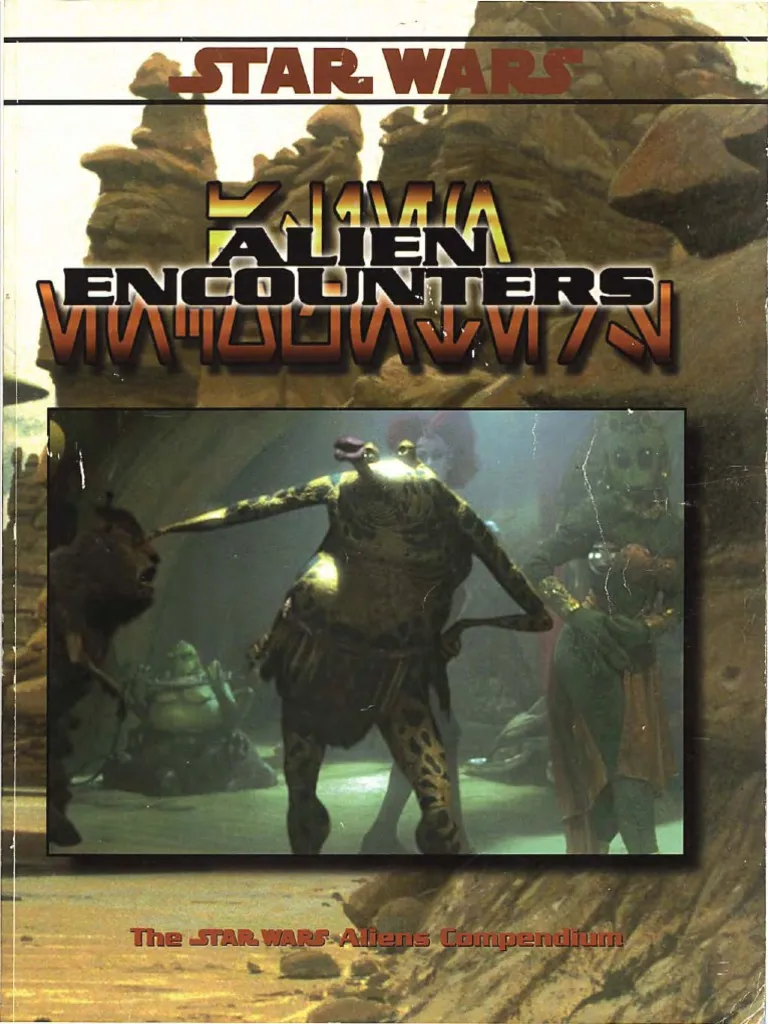
Star Wars: Alien Encounters
Star Wars: Alien Encounters
West End Games, 1998
Publisher: Daniel Scott Palter Associate Publisher/Treasurer: Denise Palter Associate Publisher: Richard Hawran Senior Creative and Editorial Director: Peter Schweighofer Creative Directors: Craig Carey, Fred Jandt, Jen Seiden, Eric S. Trautmann Designer: Paul Sudlow Art Directors: Tom O'Neill, Brian Schomburg Graphic Artist: Joe Bavitz Director of Sales and Marketing: Tim O'Brien Sales Associate: Sue Hartung Sales Assistant: Liberty Dodd Director of Licensing: Ron Seiden Warehouse Manager: Ed Hill Assistant Treasurer: Karen Bayly Accounting: Mary Galant, Wendy Lord
Design: Paul Sudlow and numerous other authors Development and Alien Generation Design: Paul Sudlow Editing: Jen Seiden Cover and Interior Design and Graphics: Tom O'Neill, Richard Hawran Interior Art: Marshall Andrews, Tim Bobko, Joe Corroney, Carolyn Watson Dubisch, Mike Dubisch, Tanner Golobeck, Brian Schomburg and Lucasfilm Ltd. Special Thanks: George Lucas, Sue Rostoni, Eric Trautmann and John Whitman; and all the authors who have created and expounded on these many aliens.
Published by West End Games, Honesdale, PA 18431
TM or ® & © 1998 Lucasfilm Ltd. All Rights Reserved. Used Under Authorization.
For more than a decade, West End Games has published nearly 200 alien species scattered through 100 sourcebooks, adventure modules, supplements, and periodicals for use with the Star Wars Roleplaying Game. As a result, gamemasters who enjoy using a lot of aliens in their games have been forced to locate all of these products (some of which are out of print) and lug piles of books to games; featuring a Herglic, Pacithhip, Ri’Dar, and Sljee in your adventure can be a trifle inconvenient. We feel your pain. Here, then, is Star Wars Alien Encounters: 10 dozen exotic and unusual aliens, gathered in one convenient volume. While this book cannot hope to describe each and every one of the known alien species to be found in the Star Wars universe, it comes fairly close to covering those that West End Games has printed (the primary exception to this are the aliens presented in Galaxy Guide 4: Alien Races and Galaxy Guide 12: Enemies and Allies). In addition, we included a new alien generation system. Whether you want to create a few exotic aliens to menace your players or generate a major new species for your campaign, this system should prove extremely useful. 2 Finally, we added an appendix to this volume, providing several indices that break aliens down into various types—from an alphabetical index of the many species to a listing of prominent space-going aliens. Basically, we’ve done everything we can to make this book your one-stop alien creature shop. We hope you find it useful. Clear Skies, Paul Sudlow West End Games ALIEN
Chapter One: Alien Generation
This chapter presents a new alien generation system and reviews some of the basic factors involved in designing believable new alien species. If the system presented below looks somewhat familiar, you’ve probably read Galaxy Guide 8: Scouts—this chapter is loosely based on Chapter Seven of that book. There are a great many aliens presented in this volume—135 in all, and many of them are fairly esoteric. Chances are, if you crave a new alien species for your campaign, you'll find one within these pages neither you nor your players have ever heard of. However, many gamemasters like to put their own imprint on the Star Wars galaxy by creating new worlds, creatures and aliens. If you prefer to create your own alien species, probably the simplest solution is to base your new alien on an existing chassis: take an established alien and change its attributes and special abilities around a bit to create a new being. For example, if you are interested in generating a new avian species living on a low-gravity world, you might start with the Tikiarri (page 156), retain its basic attributes and flight capabilities, and add a few new special abilities that make sense in the context of the new species’ environment, such as the light-gravity restriction of the Orfites (page 112). If you just need some cannon fodder or a one-shot villain, the alien creation guidelines on pages 218-19 of the rulebook should be sufficient to meet your needs, since such aliens don’t need to be highly detailed in most situations. Actually, we recommend you reread these sections before tackling the new rules in this chapter in any case. If you'd like to produce more detailed original aliens, try out the alien generation system in this chapter. This system does one thing: generate game stats and appearances for carbon-breathing species— the predominant form of sentient life in the Star Wars universe. You can use these rules to generate more exotic aliens—like silicon lifeforms or energy beings which thrive in ammonia seas—with a little additional work, but the system is not intended to produce such results. You’ll also need to do your own legwork in creating a culture and society for your new species. If you need help in this area, review the relevant short essay on page 219 of the Star Wars rulebook. Alien Encounters has dozens of new cultures and societies; you can always base your new culture on one of these if you’re strapped for ideas. We recommend using the system as a guideline in developing your own species rather than as a random alien generator (though the system is set up to produce random results if you prefer to work that way). The process of creating a new alien species should be done with great care, especially if the species will be made available to players as character templates: take the time to think through most of the aspects of the species through to assure that the creature is balanced, reasonable and interesting. That all said, let’s get rolling.
Don Your Thinking Cap
The first step in alien creation is sitting down and thinking about your alien. You don’t need to settle on details right now—that’s what the creation system is for. But you should frame in your mind the objectives you want to accomplish by asking yourself a few questions. How prominent will the new aliens be in your campaign? The amount of time you spend in detailing your alien depends largely on how much you plan to feature it in your adventures. Again, if all you need is a walk-on, you probably don’t need to generate a complete alien civilization. Simple game stats and a general description should be enough. On the other hand, if the characters are traveling to the aliens’ homeworld to bring it into the Alliance, you need to know a lot more about your new species and its culture. Do you already have any ideas about your aliens— how they look, what their society is like, what environment they live in? Will your alien be a squat amphibian or a tall burly primate? Does it hail from a low-gravity world of grassy plains or from the undersea reefs of a waterworld? Is it a herbivore or scavenger? Does it honk really loud when it’s scared? Does it read datapads or try to eat them? If you are designing a new alien to play a specific role in an adventure, your adventure requirements might dictate or influence your design. For example, if you need a species of cowardly lemurs or if the big Imperial governor’s hacienda is on a marshy world, you already know your aliens will be little hyper mammals or swamp-dwellers. The more you can define your alien now, the better. As you go through the system, you’ll have the opportunity to go with your original ideas, or set off in a new direction. But it is always best to have a goal in mind before you start. Of course, it can also be a fun creative exercise to randomly generate a species and come up with creative solutions to each apparent contradiction. Work the way you feel most comfortable. Begin your alien generation process by selecting an environment your alien species evolved in. Either roll 2D or pick one of the following as the primary species habitat:
| Dice Roll (2D) | Terrain |
|---|---|
| 2 | Barren |
| 3 | Desert |
| 4 | Forest |
| 5 | Glacier |
| 6 | Jungle |
| 7 | Mountain |
| 8 | Ocean |
| 9 | Plains |
| 10 | Wetlands |
| 11 | Mixed |
| 12 | Exotic |
Barren environments are typically arid ones, possibly with hostile environments. The ground is extremely hard, dry and cannot sustain most forms of life. The atmosphere is likely to be intolerable to humans. Aliens who thrive in a barren environment may not find human-standard environments hospitable without breath masks or other life-support aids. Deserts are marked by a lack of plant cover with large stretches of bare ground. These are harsh, dry ecosystems and both the plants and animals found here will be very hardy and able to survive a long time without food or water. The ground on the desert may be rocky or sandy. Mountaintops can also be deserts due to the infertile ground and lack of rain. Temperatures in the desert are not moderated by any humidity and will be hot in the day and cold at night. Very cold deserts are called tundras; the ground stays frozen all year long, although the surface may thaw during a warm season and allow plants to grow. Forests occur most commonly in temperate zones, but they can also occur in very cold or warm areas (see the “Jungle” entry for tropical forests). In great forest ecosystems, the trees will probably be the most prevalent forms of life—or at least the most obvious. Small plants do not survive well in large forests, though tiny ones thrive by living off the decay and the refuse of the trees. Animals flourish in forests, most of which are herbivores that subsist on the trees almost entirely. Carnivores keep the population of the herbivores under control, and they tend to be larger and stronger than carnivores in other areas. Glaciers are huge frozen sheets of ice that can be several kilometers thick. Some places are permanently locked into a frigid environment (such as polar regions and planets far from their stars’ warming rays), while others are simply passing through an ice age. In the former case, life will have evolved to thrive in this environment, and have suitable protection against the cold. In an ice age scenario, the dominant species may not be entirely adapted to the environment, but is hardy or clever enough to survive. Tropical forests that receive a great deal of precipitation are called jungles or rain forests. These ecosystems support different subsystems at different heights in the trees. These may be so separated that there is no contact between the creatures in the canopy and those on the forest floor. Mountainous planets have been (or still are) home to a great deal of geologic activity. The mountains may range from small hills to huge alps, but if they characterize a species’ main environment, they are probably fairly large. Many lifeforms live in mountainous environments. They are usually hardy, sure of foot, and accustomed to thriving in rarefied atmospheres.
Ocean
A species from an ocean environment may be a marine lifeform or live primarily on the surface (like seabirds). Oceans may be very deep or merely large and shallow, depending upon whether or not geologic activity has created great mountainous regions on the ocean floor. Ocean depths are sparsely inhabited and will have strange creatures unused to any light and living off the heat of volcanic vents. Coastal waters are the richest ecosystems with plenty of light and minerals and many forms of plant and animal life. On worlds with a large moon or those which circle a gas giant, coastal areas will be subject to tides that leave some land exposed part of the day. Such conditions often give rise to amphibious creatures. Plains get less rainfall than forests and this keeps the plants from reaching great heights. Plains (or grasslands), may feature a tree or two, but they are few in number with a lot of space in between. Plains animals are often accustomed to traveling great distances in search of food or water. Veldts (plains located in hot climates) have more types of life forms than cool grasslands. Herbivores and insects live on the plains, and the carnivores that prey on them tend to be speed-oriented. There aren’t as many places to hide in the grasslands, so the animal life must be fast, strong or both.
Wetlands
Wetlands can take the form of ponds, marshes or swamps. Most wetlands are in warm climates, but this is not a prerequisite (bogs and fens are as likely to be found on highland moors as tropical river deltas). Wetlands support a vast array of lifeforms of every type.
Mixed
The environment is a combination of two other terrain types. Roll twice on this table. You can discard contradictory results if you like, but it may be a fun challenge to invent an explanation for a desert-wetlands combination. Note that some apparently contradictory combinations are perfectly plausible. A glacier-plains combination, for example, describes a tundra perfectly.
Exotic
Exotic environments can encompass all sorts of unusual conditions, from volcano worlds riddled with underground caves, to rarefied strata of gas giant atmospheres (you can find some additional ideas on page 20 of the Star Wars Planets Collection). If you like, roll on this table again, ignoring this result. Use whatever is rolled as a “basis” for an alien ecosystem, then go from there. For example, if you roll “Forest,” the forest might be made of magnesium and heavy metal “trees” and have animals that feed on these compounds in it.
Species Origin
With your environment in mind, it’s time to select a basic origin for your species. The following categories are not all-inclusive, and to streamline things some disparate species are grouped together. Feel free to further specialize the system if you’d like to get more specific. Select one of the following or roll 2D to get the basic biological form of your species (the values are weighed in favor of species types common in the Star Wars galaxy, namely mammals, reptiles and insects). Disregard any obvious clashes between environment and origin (unless you really want to explain aquatic aliens living in a desert). Plant Plants synthesize energy from water, nutrients in soil, and sunlight. They are the lowest and most common niche in an ecosystem. They tend to be immobile and typically possess only passive natural defenses such as burrs. Sentient plant species are usually immobile, but some species can move about in search of better soil, light or nutrients. They can be very difficult to communicate with since their entire existence is based upon a life where food is present every day and they lack many concepts humans and other animals find natural. Soft Invertebrate Soft invertebrates include species descended from soft-bodied creatures without bones, such as worms, slugs or snails, or octopi. These creatures may eat either plants or animals and can form colonies or stay independent. They can take many forms, and some species are able to change form as necessary. They usually move about using muscles, and some creatures have very unusual internal structures that give them some of the rigidity necessary to enable swift movement. Insect Insects are arthropods (for simplicity’s sake, arachnids are lumped in with insects). Most have welldefined segmented bodies consisting of ahead, thorax and abdomen. Others have evolved into other forms (there are some humanoid insect species out there). Insects may have any number of jointed legs, usually have exoskeletons, and some have wings. Sentient insects may be carnivores, omnivores, herbivores, or scavengers. Reptile Reptiles are cold-blooded vertebrates which usually have a bony skeleton and a body covered in scales or bony plates—species like snakes, lizards, turtles, or crocodiles. Most reptile species live on land and lay eggs. These species may be carnivores, omnivores, herbivores, or scavengers. Mammal Mammals are warm-blooded vertebrates who nourish their young with milk secreted from mammary glands. Most mammals are covered in hair or fur (though like humans, body hair might be extremely fine). A great many sentient species in the Star Wars galaxy are mammals. Mammals may be carnivores, omnivores, herbivores, or scavengers. Hard Invertebrate Hard invertebrates have hard outer bodies and no internal skeleton. They often have jointed legs. Examples include crustaceans and some flying creatures. These species can be very diverse. Technically, insects are also hard invertebrates, but they get their own category above. Most hard invertebrates are carnivorous or scavengers, but some may be herbivores.
Aquatic
This category includes species descended from creatures that lived in marine environments. While these beings may be amphibian, mammalian, reptilian, or fish-like, they are grouped into this one categoryto make indexing easier. These species may be carnivores, omnivores, herbivores or scavengers. Sentient marine beings may breathe air instead of water if desired, or both.
Avian
This category includes species descended from warm-blooded, feathered, winged creatures. The species may still be able to fly, or might have evolved to live on the ground. Fliers normally have light bones or incredibly powerful muscles, so that they can stay aloft. These species may be carnivores, omnivores, herbivores, or scavengers. Ecological Niche With your species origin in mind, you can consider what role it played or continues to play in its ecology. Are your aliens herbivores or carnivores? Deciding what niche of the ecosystem your new species springs from goes a long way towards defining that species. Determine the ecological niche of your species by either rolling 1D or picking one. Omnivores and carnivores are given a better chance of occurring because their dining habits encourage both aggression and innovation—presumably important factors in developing sentience. If your new alien is a plant life form, you can skip this step. Only if your plant is carnivorous or otherwise unusual (aside from being mobile and sentient) do you need to worry about its ecological habits. Herbivore Herbivores are plant-eaters. Natural defenses can include acute senses, high movement speeds, armor, and natural weapons that can be used in combat. Sentient herbivores may be skittish, oriented toward large groups and not as aggressive as species descended from carnivores and omnivores. Herbivores tend to have speed or passive defenses (armor or camouflage for example) to protect themselves from predators. . Carnivore Carnivores are meat-eaters, normally preying on herbivores or smaller and weaker carnivores. They often compete with one other, although carnivores in the same ecosystem will often evolve unique abilities that differentiate them from other carnivore species. There are few standard characteristics of carnivores: some are solitary while others are highly social and hunt in packs. Some carnivores are active only during daytime, others only at night; some are highly territorial, while others are migratory. In general, like most animals, carnivores will adopt behaviors most likely to preserve and continue the species. Sentient carnivores are descended from hunters, and may be cunning, aggressive and violent. They may have special adaptations, such as claws, poisonous bites or other items that enable them to attack and kill prey. Since the species has evolved intelligence and has probably begun using tools, the species may have lost these adaptations. Carnivores may also move fast, though others might lie in wait for prey instead. Omnivore Omnivores are creatures that eat both plants and animals. They usually compete with carnivores for prey, and often hunt some of the carnivores themselves. These creatures are highly variable, adopting whatever behaviors and evolving whatever traits are most likely to enable them to survive (those that don’t evolve die out). Sentient omnivores can be competitive and aggressive, but may also be curious, eager for contact with new and unknown beings and cultures. They may have natural defensive abilities or offensive ones. Scavenger Scavengers are the final primary niche in ecosystems. Scavengers survive by feeding off the remains of animals or plants after they have been killed. They are seldom as strong or dangerous as the hunters that made the kill, but do often have formidable natural defenses. (We count scavengers as omnivores in the tables included in the appendix.) Because of the varied nature of homeworlds, there are no hard and fast characteristics of this species, except that because it is evolved from a scavenger, it is clearly not the most dangerous or powerful form of life on the planet. Appearance The physical appearance of an alien will follow directly from the environment and evolutionary stock, so now that you have established these aspects of your alien, refine its physical appearance. Just knowing whether the alien is a reptile or insect gives you a big headstart. Most Star Wars aliens are humanoids, so we can start there if we like by giving our alien two arms and two legs (or tentacles, maybe). Sentient beings need a way to manipulate their environment, so they should have hands, pincers, suction cups or something at the end of at least one of these appendages. They also have heads in the usual place, though the appearance of the head, and the number of sensory organs located in it are for you to determine. The other features of an intelligent species are likewise open to the imagination. If a species does not have a special need for camouflage it can be any color you like. Keep in mind that most creatures evolve towards efficiency and not away from it, so there shouldn’t be too many contrasting features on one creature. You can take this opportunity to develop some of the biological and cultural details of the species. How do the aliens reproduce, for example? Are there more (or less) than two sexes? By the way, you might want to revisit this step after assigning special abilities to your alien. Some special abilities can have a big impact on appearance. For example, if you give your species the ability to fly, it should have at least one pair of wings. Technological Development As intelligent species begin to develop, they form societies with a distinct culture. One measure of the development is the technological level achieved by the most advanced group of the species. Most newly discovered species in the frontier region of space will have low technology levels. This is because as a species’ technology improves, the species is more likely to have already contacted galactic civilization. As one ventures further into the unexplored wilderness, the probability of discovering a high technology species, while not great, does increase. Bear in mind that not all cultures develop at the same pace, and that technological breakthroughs may come in a different order than they did on Earth (our own real-world model). For example, one society may develop computers without having first developed printing presses, or continue to use steam-powered vehicles while developing space-worthy craft. By the way, the reason we’re determining technological level now is so we know whether or not we need to add special skills to the alien’s stats. If the culture is at a Stone or Feudal level, we'll probably have to include some specialized primitive weapons skills. Stone Stone-level civilizations are marked by small social groups, the use of simple tools and primitive agriculture. The tools are usually able to be made by anyone in the society and there is little need for trade. Food can be provided through hunting (if carnivorous) or gathering wild foods (if herbivorous) or through early methods of cultivation. Transportation is by foot, with no organized road network. Communication is by storytelling and pictures. Feudal Feudal-level civilizations are distinguished by extensive social contact on a regional basis and simple manufactured goods. The most advanced tools must be made by specialized workers and factories. Agriculture occupies most of the society and consists of herding bred animals or farming planted crops. Transportation is by harnessing animal, wind or water power; road networks do exist. Communication includes the use of a hand-written language. Industrial Industrial-level civilizations have the population split between agriculture and manufacturing, as society interacts at a continental level. Mass production is used to create the most advanced tools. Transportation and agriculture become motorized and electricity from burning fuels is the common source of power. Communication includes the mass production of written text and simple electrical messages like the telegraph. Atomic Atomic-level civilizations see more efficient mass production, and manufactured goods become available on almost all societal levels. Advanced alloys and plastics are produced, space travel begins, and transportation, communication, medicine and business fields continue to grow. Information Information-level civilizations have a global community, marked by rapid dispersal of information to all inhabited parts of the world. Automation dramatically increases efficiency in factories and agriculture. Atomic power and solar power are understood and used for large energy demands, while more advanced energy sources are being explored. In-system space travel is common and colony ships are possible. Early droids and energy weapons appear; repulsorlift is likely to be discovered soon. Space The Republic and Empire are both Space-level civilizations. These civilizations are characterized by extra-system colonization, hyperspace travel, droids, personal energy weapons, and very efficient industry. Multiple planets may be economically interdependent. Creating Stats Having established a background and appearance for your alien, we need to move into generating some game stats for it. Here’s what a blank alien template looks like. To create your alien, you need to fill each of these slots:
Alien Stat Template
Attribute Dice:
- DEXTERITY:
- KNOWLEDGE:
- MECHANICAL:
- PERCEPTION:
- STRENGTH:
- TECHNICAL:
Special Skills:
Special Abilities:
Story Factors:
Move: Size:
Attribute Dice Attribute dice are the building blocks of your species. The value in this slot determines how many dice and pips can be distributed among the attributes when creating a new representative of this species. A value of 12D is considered average in the Star Wars game system, so most gamemaster characters should be in that range (some species will be somewhat more or less capable than the norm, of course). Add 6D to that base level for player characters and key gamemaster characters to represent their superior hero/villain status. Use this table if you’d like to generate random results: Attribute Die Ranges Each species has a separate listing for each attribute (Dexterity, Knowledge, Mechanical, Perception, Strength, and Technical) that looks something like this: 1D/ 4D+2. This value is your die range: in allocating attribute dice to attributes, you cannot go below the first number or above the second number. Humans, representing the default average in the Star Wars rules, have a 2D/4D minimum/maximum in all attributes. Aliens vary more because they have particular strengths and weaknesses humans do not have; one species may be extremely strong but also poor in mechanical skills while another is highly perceptive but clumsy. You can allocate die ranges however you like.
Often, decisions you have already made about your species will guide you toward certain ranges. For example, if you have already decided that your species is fast and small, you may well assign a higher die range to Dexterity and a lower range to Strength to reflect both the alien’s speed in combat and its overall weakness (in general, small beings possess less physical strength than big ones). Be reluctant to go below 1D or above 6D without good reason (in the latter case remember that players using your alien will start off with 6D in every skill under the relevant attribute before allocating attribute dice—a potentially gamewrecking situation). If you haven’t made these decisions, you can either make them now or roll 3D on the following table for each attribute:
| Attribute Roll (3D) | Die Range |
|---|---|
| 3 | 1D/2D |
| 4 | 1D/2D+1 |
| 5 | 1D/2D+2 |
| 6 | 1D+1/3D |
| 7 | 1D+1/3D |
| 8 | 1D+1/3D+1 |
| 9 | 1D+2/3D+1 |
| 10 | 1D+2/3D+2 |
| 11 | 1D+2/3D+2 |
| 12 | 2D/4D |
| 13 | 2D/4D |
| 14 | 2D/4D |
| 15 | 2D+1/4D+1 |
| 16 | 2D+2/4D+2 |
| 17 | 3D/5D |
| 18 | 4D/6D |
When you’ve finished determining your die ranges, add up your minimums to make sure they are equal to or below the attribute dice. Then add up the maximums to ensure they are at least 6D above the attribute dice. If something is amiss, tweak the ranges until everything squares up. By now you should have a good idea of what sort of alien is taking shape. Here is where it starts to take on personality in terms of game stats. If your species has any unique or specialized skills, list them here. Most special skills reflect knowledge picked up living lifestyles different from the galactic norm. Now that you know the tech level of your species, decide if new skills are warranted. In general, the closer the species is to the Space tech level, the less need there is for special skills. (An exception is a species which has developed an alternative advanced technology which has no direct counterpart in galactic society, such as the Gree on page 67.) Primitive cultures, on the other hand, rely on skills long discarded by more advanced societies. A member of a primitive culture may be adept at using a bow or spear, farming, crafting war chariots, or using banthas for transportation. You may either give the alien the option of taking these new skills or compel him to do so (giving an alien a beginning bonus in taking certain skills is a special ability—see below). Other special skills reflect differences in an alien’s physiology that make performing new tasks possible. Flight is a common special skill based on a physical attribute—that of possessing wings and a light aerodynamic body. Other possibilities include telepathy (see the Ssither entry on page 145) or a fighting style dependent on having a certain number of limbs. Particular alien species may actually be so different they must have new skills to replace the normal ones. The gelatinous Filar-Nitzan on page 49 use aversion instead of dodge, for example, because they can actually change shape fast enough to avoid blaster bolts. Note that special skills of this type merely reflect the use of a unique physiological trait. The trait itself is listed under special abilities (which we'll get to in just a moment). For example, an alien cannot have a special skill of flight unless he also has wings and a corresponding ability to fly—a special ability. (Don’t get confused if you find a few aliens in this book that seem inconsistent with the instructions in this paragraph—over the years, some inconsistent applications of this rule have crept into the game. It isn’t a serious problem, mind you; we just mention it so you know that there are exceptions to the rule floating around out there.) Don’t feel that you simply must generate special skills for your alien, by the way. If a compelling justification for including them isn’t suggesting itself to you, you can probably skip this step and not lose any sleep about it. The majority of aliens in this book lack special skills, including most of those from primitive societies. Because special skills are not often used in designing a new alien, we’re not offering an exhaustive list of random solutions. If you’re randomly generating an alien, either skip this step entirely or pick one of the samples listed below (you can page through this book for more examples, too). Dexterity skills: Thrown Weapons: bows, rocks, sling, spear. Time to use: One round. The character may take the base skill and/or any of the specializations. Knowledge skills: Agriculture. Time to use: at least one standard week. The character has a good working knowledge of crops and animal herds, and can suggest appropriate crops for a type of soil, or explain why crop yields have been affected. Mechanical skills: Beast riding: bantha. Beginning characters must allocate a minimum of 1D to this beast riding specialization. Strength skills: Flight. Time to use: one round. Use this skill when the characters flies. The character begins with a flying speed of 30 and may improve his flying speed as described on page 33 of the Star Wars rulebook. Special abilities are species-wide traits which help the alien thrive in its natural environment. These are generally physiological traits, such as natural weapons and armor (claws, barbed tails, tough hides, and the like), but can also indicate special aptitudes such a talent for picking up alien languages. What is true of all special abilities is that they are specific to the species in question; they cannot be learned by members of other species. This is the biggest difference between special skills and special abilities. There are a couple of ways to approach this section. You can simply peruse the lists if you like, picking and choosing whichever special abilities appeal to you. You can also obtain random results if you prefer—just be sure that the special abilities you wind up with work with your alien (desert-dwelling mammals with the ability to breathe underwater might excite some comment among your players). Alternatively, you can buy attributes at a cost of 1D, using dice from your pool of attribute dice (you get 1D back for every penalty you buy). This method is a good one to use if you are letting your players design their own new species, since it encourages economy. Naturally, this section just scratches the surface when it comes to special abilities. Take a quick look through the book, and you'll see that there are a lot of other possibilities, from telepathy to shapeshifting. If you don’t see a special ability here you'd like to use for your alien, find an alien who does have it and borrow it, or make up your own.
If you want help in determining how many special abilities your alien has, roll on the following table:
| Roll (3D) | Number of Special Abilities |
|---|---|
| 4-6 | 3 |
| 7-9 | 2 |
| 10-14 | 1 |
| 15-18 | 0 |
Special Abilities
You'll need to determine what sort it has. Remember that your alien doesn’t need to be a predator in order to have weapons like claws or sharp teeth; many herbivores have defensive weapons as well. The default damage done by natural weapons on the Weapons Table is STR+1D. To generate another value, either pick one or roll on this table:
Natural Weapon Damage
| Roll (2D) | Result |
|---|---|
| 2-3 | STR damage |
| 4-5 | STR+1 damage |
| 6-7 | STR+2 damage |
| 8-9 | STR+1D damage |
| 10 | STR+1D+2 damage |
| 11 | STR+2D damage |
| 12 | STR+3D damage |
Does your alien have some sort of natural protection against his enemies? If so, you need to decide what sort of armor it is, and how much protection it affords. Armor can be anything from a thick layer of blubber to scales to chitinous armor plating. The default armor bonus on the Natural Armor Table is +1D (and +2D in cases where a contrast is needed). Again, replace it if you like by rolling on the Default Armor Bonus table:
Natural Weapons Table
| Roll (2D) | Result |
|---|---|
| 2 | Claws: Alien can use his claws to inflict STR+1D damage. |
| 3 | Tail: Alien can use his tail as a weapon to do STR+1D damage. |
| 4 | Fangs: Alien’s sharp teeth do STR+1D damage. |
| 5 | Tusks: The sharp tusks of the alien inflict STR+1D damage. |
| 6 | Beak: Alien’s sharp beak inflicts STR+1D damage. |
| 7 | Kick: Alien’s powerful kick does STR+1D damage. |
| 8 | Talons: Alien’s powerful talons do STR+1D damage. |
| 9 | Pincers: Alien pincers are sharp and very strong, inflicting STR+1D damage. |
| 10 | Trampling: Alien tramples for STR+1D damage. |
| 11 | Body Spikes: Alien can use these sharp weapons in combat, causing STR+1D damage. |
| 12 | Venom: Does STR+1D stun damage only. |
Default Armor Bonus
| Roll (1D) | Result |
|---|---|
| 1 | +1 |
| 2 | +1D |
| 3 | +1D+1 |
| 4 | +1D+2 |
| 5 | +2D |
Natural Armor Table
| Roll (1D) | Result |
|---|---|
| 1-2 | Natural Body Armor: The alien’s thick hide provides +1D against physical attacks. It gives no bonus against energy attacks. |
| 3-4 | Natural Body Armor: The alien’s thick hide provides +1D against both physical and energy attacks. |
| 5-6 | Natural Body Armor: The alien’s thick hide provides +2D against physical and +1D against energy attacks. |
Other Special Abilities
Aside from weapons and natural armor, there are several other types of special abilities. These are tackled in the next few sections. You probably won’t be hitting all of the sections for one alien unless you want to decorate your alien like a Christmas tree. Again, you can browse the lists at your leisure or let the dice decide using the chart on the right:
Skill Bonus
Some special abilities add a bonus to a certain skill at all times. For example, Noghri have natural stealth; whenever they use hide and sneak skills, they receive a +2D bonus (see page 110). You can easily modify many of these choices by substituting new skills.
Beginning Character Abilities
Still other special abilities provide a bonus at the time a character is created. New Ewok characters receive 2D for every 1D they spend on hide, search and sneak skills. Sluissi receive an extra 4D for beginning skill dice which must be applied to Technical skills, and may also place up to 4D in a beginning Technical skill instead of the normal 2D limit.
Constant Abilities
Other special abilities do not directly impact the mechanics of the game; they simply allow an alien to do things other aliens can’t. The bird-like Shashay can use their wings to glide through the air. Balinaka can see in the dark. Quarren can breathe both water and air with no penalties.
Penalties
Aliens are not all advantages and no disadvantages. There are downsides too. If some sort of penalty makes sense to you, either for play balance or because the alien’s background demands it, you can find a good sampling of negative special abilities on the chart to the right.
Skill Bonus Table
| Roll (3D) | Ability Result |
|---|---|
| 3 | Climbing Claws: Alien has climbing claws which are used for climbing only. They add +2D to his climbing skill while using the claws. |
| 4 | Jumping: Alien’s strong legs give him a remarkable jumping ability. He receives a +2D bonus for his jumping skill. |
| 5 | Natural Camouflage: The alien gets +2D to sneak in his natural terrain (insert the appropriate environment here). This advantage is negated when the alien is not in this terrain. |
| 6 | Prehensile Tail: The alien has a prehensile tail and can use it as an extra limb at +1D+1 to his Dexterity. |
| 7 | Special Balance: +2D to all actions involving climbing, jumping, acrobatics, or other actions requiring balance. |
| 8 | Stamina: Due to the harsh nature of his homeworld, the alien receives a +2D bonus whenever he rolls his stamina and willpower skills. |
| 9 | Stealth: Alien has such a natural ability to be stealthy that he receives +2D when using his hide or sneak skills. |
| 10 | Swimming: Swimming comes naturally to the alien, who gains +1D to dodge and +3 to Move underwater. |
| 11 | Agriculture: Alien receives a +2D bonus to his agriculture (a Knowledge skill) rolls. |
| 12 | Intimidation: Alien gains +1D when using intimidation due to his fearsome appearance. |
| 13 | Teaching Ability: The alien may advance all specializations of the scholar skill at half the normal Character Point cost. |
| 14 | Wilderness Survival: Alien has an innate sense of survival in wilderness terrains and gets a +1D when making survival rolls regarding either mountains or plains. |
| 15 | Enhanced Vision: Alien adds +2D to search rolls based on visual acuity. |
| 17 | Acute Senses: Because of his keen eyesight and hearing, the alien receives a +1D when using the search skill. |
| 18 | Sense Vibrations: Alien is attuned to movements and vibrations and can sense approaching objects in contact with the ground up to 60 meters away. Using this ability requires a Very Easy Perception roll. |
Constant Abilities Table
| Roll (2D) | Ability Result |
|---|---|
| 2-3 | Aquatic: Alien can breathe both air and water and can withstand extreme pressures found in ocean depths. |
| 4-5 | Flight: Alien can fly. |
| 6-7 | Gliding: Alien can glide. On standard-gravity worlds, he can glide up to 15 meters per round; on light-gravity worlds he can glide up to 30 meters per round; and on heavy-gravity worlds, that distance is reduced to five meters. |
| 8-9 | Infrared Vision: Alien can see in the infrared spectrum, giving him the ability to see in complete darkness if there are heat sources to navigate by. |
| 10-11 | Night Vision: Alien has excellent night vision and can see in darkness with no penalty. |
| 12 | High-Temperature Tolerance: Alien can endure hot, arid climates, and suffers no ill effects from high temperatures (until they reach 85 degrees Celsius). |
Beginning Character Abilities Table
| Roll (2D) | Ability Result |
|---|---|
| 2 | Affinity for Business: At the time of character creation only, the character receives 2D for every 1D of skill dice allocated to bureaucracy, business, bargain, or value. |
| 3 | Aquatic Survival: At the time of character creation only, the character receives 2D for every 1D allocated to the swimming and survival: aquatic skills. |
| 4 | Climbing: At the time of character creation only, the character receives 2D for every 1D allocated to climbing/jumping. |
| 5 | Combat Finesse: At the time of character creation only, the character receives 2D for every 1D allocated to the melee weapons, brawling and thrown weapons skills. |
| 6 | Cultural Learning: At the time of character creation only, character receives 2D for every 1D of skill dice allocated to cultures, languages or value. |
| 7 | Dexterous: At the time of character creation only, character gets +2D bonus skill dice to add to Dexterity skills. |
| 8 | Farming: At the time of character creation only, the character receives +2D bonus skill dice, which may only be used to improve the following skills: agriculture, business, ecology, value, weather prediction, bargain, persuasion, and first aid. |
| 10 | Mechanical Aptitude: At the time of character creation only, the character receives 2D for every 1D allocated to any Mechanical skills. |
| 11 | Stealthy: At the time of character creation only, the character receives 2D for every 1D allocated to the hide, search and sneak skills. |
| 12 | Technical Aptitude: At the time of character creation only, character receives 2D for every 1D allocated to any Technical skills. |
Story Factors
Story factors affect most, if not all, members of given species. Story factors include notes on the alien’s culture, life cycle or beliefs other people hold about the species in general. Examples include the Wookiee’s reputation for ferocity, the fact that all Noghri are sworn to serve the Empire, and that Rodians are often bounty hunters and therefore feared by other species. Story factors are usually very specific to the culture and situation of the species. You should develop them to fit the alien rather than the other way around. Here, though, are a few examples you can use as a basis for your own story factors. Many more can be found in the rest of the book.
Move and Size
We're almost at the bottom of the list. Just roll on the following table twice (once for Move and once for Height), and you’re finished. If your alien is not a humanoid, you might have to play around with the height a bit. Move also doesn’t take into account special abilities such as swimming or flying (add 3-5 points to Move in these cases).
Penalty Abilities Table
| Roll (2D) | Ability Result |
|---|---|
| 2-3 | Delicate Build: Due to the alien’s fragile bone structure, he suffers a -2 modifier to all Strength rolls to resist damage. |
| 4-5 | Breath Masks: To survive in standard atmospheres, alien must wear a breath mask. Without the mask, it suffers a -1D penalty to all skills and attributes. |
| 6-7 | Technological Ignorance: Alien knows almost nothing about technology and has a difficult time grasping new concepts. He suffers a -1D penalty whenever he attempts to use any item more advanced than simple stone age-era tools (until gamemaster deems he has become acclimated to them). |
| 8-9 | Light Gravity: Alien is native to a light-gravity world. When on standard-gravity worlds, reduce his Move by -3. Unless he’s wearing a special power harness on such worlds, also reduce his Strength and Dexterity by -1D (minimum of +2; he can still roll, hoping to get a “Wild Die” result). |
| 10-11 | Poor Vision: Alien has poor vision compared to humans and suffers a -1D penalty for actions involving vision at a range of greater than 50 meters. |
| 12 | Voice Box: Alien is unable to pronounce Basic, although he can understand it perfectly well. |
Story Factors Table
| Roll (1D) | Result |
|---|---|
| 1 | Aggressive: Members of this species are very aggressive and respect only power. |
| 2 | Bloodfeud: The alien species has declared a bloodfeud with another species due to some great disagreement. Members of this species are morally obligated to seek the death of any member of the other species they encounter. |
| 3 | Enslaved: The species has been enslaved en masse by the Empire. Its members are restricted to labor camps on their homeworld, and those who travel the stars are in constant danger of being captured and returned. |
| 4 | Religious Observances: Members of this species are forbidden to eat in the company of aliens or sleep in the same room. |
| 5 | Pacifist: The alien’s culture is traditionally pacifist. Those who fight are taboo, but are cast out of their society if they are found out. |
| 6 | Wealth: The species is a very wealthy one, and most of its members have a very high standard of living. |
Move and Size Table
| Die Roll (3D) | Move | Height (in meters) |
|---|---|---|
| 3 | 4/5 | 0.8 |
| 4 | 5/6 | 0.9 |
| 5 | 7/9 | 1.0 |
| 6 | 8/10 | 1.2 |
| 7 | 9/11 | 1.4 |
| 8 | 10/12 | 1.6 |
| 9 | 10/12 | 1.6 |
| 10 | 10/13 | 1.8 |
| 11 | 10/13 | 1.8 |
| 12 | 11/14 | 2.0 |
| 13 | 11/14 | 2.2 |
| 14 | 11/14 | 2.4 |
| 15 | 12/15 | 2.6 |
| 16 | 12/16 | 2.8 |
| 17 | 13/17 | 3.0 |
| 18 | 14/18 | 3.2 |
At this point, you probably have a jumble of notes and some stats for your alien. Now you need to finish fleshing out the culture and society of your species. Use the stats and results you’ve gotten thus far as raw material for developing your aliens. You might need to make adjustments. During the process, if you see a new direction you’d like to go in, go for it. Don’t be afraid to go back and change things just because you’ve already decided an issue. Creation is a malleable and fluctuating process. Go with it and have fun!
Chapter Two: Aliens
Abinyshi
The Abinyshi are a short, relatively slender, yellow-green reptilian species from Inysh. They possess two dark, pupil-less eyes that are set close together. Their face has few features aside from a slight horizontal slit of a mouth: their nose and ears, while extant, are very minute and barely noticeable. The species has a large, two-forked tail that assists in balance and is used both as an appendage and weapon. A gentle people, the Abinyshi take a rather passive view of life. They prefer to let events flow around them rather than take an active role in changing their circumstances. This philosophy has had disastrous consequences for Inysh. The Abinyshi have played a minor but constant role in galactic history for many centuries. They developed space travel at about the same time as the humans, and though their techniques and technology never compared to that of the Corellians or Duros, they have long enjoyed the technology provided them by their allies. Their small population limited their ability to colonize any territories outside their home system. Their primary contributions have included culinary and academic developments; several fine restaurants serve Abinyshi cuisine and Abinyshi literature is still devoured by university students throughout the galaxy. The popularity of Abinyshi culture has waned greatly over the past few decades as the Abinyshi traveling the stars slowed to a trickle. Most people believe the Abinyshi destroyed themselves in a cataclysmic civil war. In truth, the Empire nearly decimated Inysh and its people. Scouts and Mining Guild officials discovered that Inysh had massive kalonterium reserves (kalonterium is a low-grade ore used in the development of weapons and some starship construction). The Imperial mining efforts that followed all but destroyed the Inysh ecology, and devastated the indigenous flora and fauna. Mining production slacked off considerably as alternative high-grade ores—like doonium and meleenium—became available in other systems. Eventually, the Imperial mining installations packed up and left the Abinyshi to suffer in their ruined world. Years ago, Abinyshi traders and merchants were a relatively common sight in regional space lanes. Abinyshi now seldom leave their world; continued persecution by the Empire has prompted them to become rather reclusive. Those who do travel tend to stick to regions with relatively light Imperial presence (such as the Corporate Sector or the Periphery) and very rarely discuss anything pertaining to their origin. Individuals who come across an Abinyshi most often take the being to be just another reptilian alien. Surprisingly, the Abinyshi have little to say, good or bad, about the Empire, though the Empire has given them plenty of reasons to oppose it. Millennia ago, their culture learned to live with all that the universe presented, and to simply let much of the galaxy’s trivial concerns pass them by.
Home Planet: Inysh Attribute Dice: 12D
- DEXTERITY: 2D/4D
- KNOWLEDGE: 1D+2/4D+1
- MECHANICAL: 1D/3D
- PERCEPTION: 2D+2/4D+2
- STRENGTH: 2D/4D
- TECHNICAL: 1D+1/3D+2
Special Abilities:
Prehensile Tail: Abinyshi can use their tails as a third arm at -1D their die code. In-combat, the tail does Strength damage.
Story Factors:
Believed Extinct: Nearly all beings in the galaxy believe the Abinyshi to be extinct.
Move: 10/12 Size: 1.2-1.6 meters
Adnerem
Adnerem are a tall, slender, dark-gray species dominant on the planet Adner. The Adnerem’s head is triangular with a wide brain pan and narrowing face. At the top of the head is a fleshy-looking lump, which may appear to humans to be a tumor. It is, in fact, a firm, hollow, echo chamber which functions as an ear. Adnerem are bald, except for a vestigial strip of hair at the lower back of the head. Female Adnerem often grow this very small patch of hair long and decorate their braids with jewelry. The Adnerem hand is four-digit and highly flexible, but lacks a true opposable thumb. Adnerem can grow exceptionally long and sturdy nails, and the wealthy and influential often grow their nails to extraordinary lengths as a sign of their idleness. Their eyelids are narrow to protect against the overall brightness of Adner’s twin suns and the eyes are lightly colored, usually blue or green. Adnerem are descended from a scavenger/hunter precursor species. Their distant ancestors were semisocial and banded together in tribe-packs of five to 20. This has carried on to Adnerem today, influencing their modern temperament and culture. They remain omnivorous and opportunistic. Outwardly calm and dispassionate, inwardly intense, the Adnerem are deeply devoted to systematic pragmatism. Each Adnerem increases his position in life by improving his steris (Adner’s primary socio-economic family unit; plural steri). While some individual Adnerem work hard to increase the influence and wealth of their steris, and judge people for the power of their steris and the position they have earned in it, not for accidents of birth. Having no cultural concept of rank, they have difficulty dealing with aliens who consider social position to be an important consideration. Adnerem are fairly asocial and introverted, and spend a great deal of their private time alone. Social gatherings are very small, usually in groups of less than five. Adnerem in a group of more than 10 members are almost always silent (public places are very quiet), but two interacting Adnerem can be as active as 10 aliens, leading to the phrase “Two Adnerem are a party, four a dinner and six a funeral.” Sometimes a pair of Adnerem form a close friendship, a non-sexual bonding called sterika. The two partners become very close and come to regard their pairing as an entity. There is no rational explanation for this behavior; it seems to be a spontaneous event that usually follows a period of individual or communal stress. Only about 10 percent of Adnerem are sterikai, and always belong to the same steris. Outside of sterika, Adnerem do not usually form especially strong emotional attachments to individuals. Adnerem steri occasionally engage in low-level raid-wars, usually when the goals of powerful steri clash or a coalition of lesser steri rise to challenge a dominant steris. A raid-war does not aim to annihilate the enemy (who may become a useful ally or tool in the future), it seeks simply to adjust the dynamic balance between steri. Most raid-wars are fast and conducted on a small scale. For the most part, the Adnerem are a stay-at-home species, preferring to excel and compete amongst themselves. Offworld, they almost always travel with other steri members. Some steri have taken up interstellar trading and run either large cargo ships or fleets of smaller cargo ships. A few steri have hired themselves out to corporations as management teams on small- to medium-sized projects. The Adnerem do not trust the whims of the galactic economy and invest in maintaining their planetary self-sufficiency rather than making their economy dependent on foreign investment and imports. They have funded this course by investing in entertainment industries, both on-planet and off. Hundreds of thousands of tourists and thrill-seekers flock to the casinos, theme parks and pleasure houses of Adner, which, after 2,000 years of practice, are very adept at thrilling and pampering the crowds. These entertainment facilities are run by large steri with Adnerem management and alien employees.
Adnerem
Home Planet: Adner Attribute Dice: 12D
- DEXTERITY: 1D/3D
- KNOWLEDGE: 1D+2/4D+2
- MECHANICAL: 1D/3D
- PERCEPTION: 1D+2/4D+2
- STRENGTH: 1D/3D
- TECHNICAL: 1D/2D
Story Factors:
Behind the Scenes: Adnerem like to manage affairs behind the scenes, and are seldom encountered as “front office personnel.”
Move: 10/11 Size: 1.8-2.2 meters tall
Aganof
The Aganof are a large, androgynous species native to the unexplored world of Kuras III in Elrood sector (they are not the only sentient species on the planet; see the Purla entry on page 120). They have approximately one dozen small appendages for movement (the exact number varies with the individual), with several touch-sensitive pairs of appendages running along their bodies. Their backs have heat-dissipating flaps and olfactory sensors on large flexible stalks. The flaps are also coated with a digestive acid that is used to break down foods; small mouths are nestled underneath the flaps. Each end of the body contains a long, jointed limb that ends in a shelled claw. This species lives, works and breeds in the damp, cool caves of Kuras III. The Aganof must live in these caves, since only these locations provide enough moisture for them to survive (they absorb moisture through all of their appendages). They feed on vegetation, insects and a large variety of small herbivores. Aganof reproduce in their cool, dark caves of their world—they have both male and female characteristics and lay fertilized eggs. The Aganof have only the senses of taste, smell and touch (touch is their primary sense). They communicate by creating vibrations with the shelled claw. The vibrations are modulated with a special organ within the claw called the “sender.” The sender codes the vibrations into a sort of language that other Aganof can understand. Nearby Aganof can detect the vibrations and decipher their meaning (actual distance depends on many factors, including soil composition and competing vibrations). Like speech, this communication can be perceived by all who are within reception distance. Aganof language is icon-based: recipients get picpictures in their minds instead of words. Thus, if an Aganof wanted to ask if a character was an “alien” who came from outer space, the character would get a picture of himself, falling from a cave ceiling to the ground (Aganof cannot conceive of the sky), plus the feeling that the pictures were interrogative. The Aganof are an intelligent species, with a society and a culture. All the Aganof born in the same cave are essentially a tribal unit. The eldest Aganof is the adviser of the cave-fellows, and thus his opinion is given more weight than any others in the cave-unit. The Aganof tribes peacefully co-exist with one another, with inter-tribal meetings quite common (their purpose being to share stories, trade knowledge and exchange tribe members for mating purposes). The Aganof have stories, songs and even a form of art involving the arranging of the dead and decomposing bodies of their departed fellows. A favorite Aganof pastime is having philosophical debates and intellectual arguments. Among the issues debated are what lies above “the ground” (since their limited senses cannot detect very much about the world around them; the concept of space is completely alien to them). Aganof are tranquil, calm and friendly. Their society is a peaceful one, and there is not even a word in their vocabulary for “war.”They understand defense against predators, but not organized Distance from Vibration Modifier Q-2 meters 0 3-10 meters +5 to difficulty 11-30 meters +10 to difficulty 31+ meters +15 or more to difficulty ONGY, Strength of Vibration Difficulty Light vibration. Difficult (as made by a small creature) Moderate vibration Easy (as made by a creature 20-100 kilograms) Heavy vibration Very Easy (such as made by a much larger creature) aggression and murder of other intelligent creatures. Conflict among members of their own species is almost unknown. The Aganof have no idea there is a galactic civil war going on, and would have a very difficult time understanding the issues at stake. Both the concepts of outer space and warfare would have to be explained to them. Even if the Empire came to their world and enslaved them, they would have a difficult time distinguishing between the Empire and those who would fight it, possibly meaning that the Aganof would learn to fear and even attack all humans and aliens from beyond their world....
Home Planet: Kuras III Attribute Dice: 11D
- DEXTERITY: 1D/2D
- KNOWLEDGE: 1D/4D
- MECHANICAL: 1D/2D
- PERCEPTION: 1D/4D+2
- STRENGTH: 1D/3D
- TECHNICAL: 1D/3D
Special Skills:
Perception skills: Vibration Detection: Aganof use this skill to detect ground vibrations and determine the proximity of creatures and beings around them. The difficulty depends on the distance and type of vibration: They can also detect air variations, such as temperature change and movement, and thus can sometimes detect approaching flying creatures, or even sense incoming projectiles and dodge them. Aganof also use their hard shells and this skill for “speech” through ground vibrations, as naturally as humans use their mouths and sense of hearing for speech.
Special Abilities:
Claws: Aganof can use their claws to inflict STR+1D+2 damage. Blind and Deaf: Aganof cannot see in the way that humans can; they also cannot hear in the traditional sense, but they can detect intense air vibrations. Their prime external sense is touch and a sensitivity to ground vibrations. By judging the intensity and frequency of vibrations, in combination with the type of surface they are standing on, they can detect creatures near them.
Move: 4/6 Size: 1.3-2.5 meters tall, 1.5-3.5 meters long
Soil Type Modifier Loose soil, easily carries vibration: -5 or more: Packed soil, material that absorbs vibration 0 Soils or materials absorbing virtually all vibration +5 or more.
Akwin
The Akwin are an aquatic mammalian species native to Lazerian [V—a world claimed by human colonists. Their bodies have six limbs. The first pair of limbs are regular arms located at the shoulders, which end in a pair of hands. The second pair of limbs also resemble arms, except that instead of hands, the arms have flippers. Akwin use this set of limbs to steer themselves through the water. The final set of limbs, located at the hips, are normal legs, which end in webbed feet. From the lowér back of the Akwin, a tail and fins stick out. Their blue-green bodies are tough and muscular, enabling them to withstand the pressure of the depths. Akwin have elongated skulls, with a mouth, a pair of eyes and two blowholes. Cilia grow from their heads and faces and could be mistaken for hair, with colors ranging from white and silver to green, blue, and black. Akwin also have gills on their necks, directly below the jaw. Akwin are amphibious, but they have no real desire to spend much time on land. Their eyes are configured in such a way as to help them see in the dark depths of the ocean. Their hearing is also very acute. The Akwin diet consists of small sea creatures which they raise on “ranches,” and many aquatic plants which they grow on special underwater farms. As a species, the Akwin are peaceful sea-dwellers who live in huge cities on the ocean floor. Each city exists as a separate city-state, ruled by a king or queen. Technologically, the Akwin are on par with the human Lazerians who dwell on the dry land, though the former have no interest in space travel. The Akwin have made tremendous strides in perfecting water-resistant technology. Although the Akwin love swimming, they have developed their own fast-moving craft so they can travel vast distances quickly. The Akwin even have their own ore mines and manufacturing plants, though they are careful not to take too much from them or damage the environment. The Akwin enjoy music, coral-sculpting, and drama. They keep historical records of their people, who evolved from savage sea creatures tens of thousands of years ago. Communication between Akwin is handled by either spoken word or limb gestures. The Akwin do not encourage contact with the Lazerians. In the Akwin world view, the Lazerians live on land, the Akwin live in the sea and both are content. The Akwin see no reason to disrupt this situation. There is, in fact, a hint that the Akwin consider themselves to be superior to the Lazerians— after all, they can live on land or sea while the Lazerians are confined to the soil. This point of view has been reinforced in the Akwin minds by the fact that, while the Akwin know much about the Lazerians, the Lazerians have yet to even establish the existence of sea-folk, but most of these are dismissed as mirages, legends or the effects of too much drink. The Akwin are amazed at this shortsighted reaction. As a result, official Akwin policy is to perpetuate the Lazerian idea of myths, since in the Akwin mind, the Lazerians are clearly “not ready as a species” to deal with the idea of sharing the planet with another advanced civilization. It would probably alarm the Lazerians (and the Empire as well) if they knew just how much the Akwin know about the surface-dwellers. Thanks to scouting parties and monitoring routine planetary broadcasts, the Akwin have a full understanding of Lazerian culture and geography. The Akwin are not impressed—they see Lazerian society as stagnant and uninspired. The only way the Akwin would make their presence known were if the Lazerians dumped pollutants into the sea. Fortunately, the Lazerians are as proud of their environment as the Akwin, and take steps not to damage the ecosystem. They tend to look down on races who cannot breathe air and water, though this will not rule out communication and cooperation. They keep to themselves, and do not go out of their way to seek out alien contact. If the Akwin should meet an alien aquatic race, they would be more willing to make contact. The Akwin are aware of the existence of the galactic civil war, thanks to their interception of transmissions from both sides. At this time, the Akwin consider the war the logical result of immature species. If a Quarren or a Mon Calamari were to approach the Akwin, this view could change in favor of the Alliance. Since the Lazerians are pro-Imperial, the consequences of this could be severe.
Akwin
Home Planet: Lazerian IV Attribute Dice: 12D
- DEXTERITY: 2D/6D
- PERCEPTION: 2D/5D
- KNOWLEDGE: 2D/4D
- STRENGTH: 2D/7D
- MECHANICAL: 2D/3D
- TECHNICAL: 2D/3D
Special Skills:
Dexterity skills: Akwin net guns. Akwin use metal mesh nets that deliver a shock to the victim (stun damage 5D). The mesh nets are shot from a rifle-like device. Each rifle carries two nets. In order for a victim to free himself from the net, he must make a Difficulty Dexterity roll. Strength skills: Swimming: Akwin get +1D to their swimming skill.
Special Abilities:
Sight: Akwin eyes are attuned to the ocean depths. They receive +1D to search underwater, but suffer -2D on land. Hearing: Akwin have very sensitive hearing, giving them +1D to search uses involving noise.
Move: 10/15 (swimming), 5/7 (walking) Size: 1.5-1.8 meters long
Anointed People
The Anointed People, native to Abonshee, are green-skinned, lizard-based humanoids. They are somewhat larger and stronger than humans, but also slower and clumsier. They stand upright on two feet, balanced by a large tail. Their heads are longer and narrower than humans and are equipped with an impressive set of pointed teeth. Typical Anointed /f People dress in colorful robes and carry large cudgels; the nobility wear suits of exotic scale armor and carry nasty-looking broadswords. The Anointed People live in a primitive feudal hierarchy: the kingdom’s Godking on top, below him the Godling nobles, and below them the Unwashed- —the lower class that does most of the work. The Unwashedare big, burly, cheerful, and ignorant. They do not know or care about life beyond their small planet they call “Masterhome.” The Godking and Unwashed are the same in every aspect but that the Godlings are much more informed. Aware of the existence of other worlds and other intelligent beings in the vast reaches of space, they better understand the potential gains—and risks— attendant with the arrival of aliens with unknown powers and motivations. In general, they treat offworlders with guarded friendliness, but refer them to their Godking for answers to questions involving political and economic policies. Godkings are the rulers of their king-doms. Their dynasties emerge from the ranks of the Godlings. AGodking maintains power and authority only as long as he can play potential rivals off one other. While retaining the outward trappings of a warlike people, the Anointed People are more socially advanced than they appear. Though each spring the local nobles call their vassals together to war against their neighbors, the engagements are almost totally bloodless, resembling overly enthusiastic gravball matches. The loser of the “war” must surrender a tribute to the winner—this usually means that he foots the bill for the big three-day party that follows. There hasn’t been a real war on Masterhome for 75 years. The Anointed People are quite fearless, but they dislike bloodshed for aesthetic reasons. They will find it quite difficult to credit outsiders’ stories about a cruel, ruthless Empire, believing that any advanced civilization must have learned to live in peace. Technologically, the Anointed People have not yet reached a high level of mechanization. Swords and shields, wood and stone buildings, and animal-drawn wagons are common. Like many primitive societies, they must deal with high infant-mortality rates, poor sanitation and similar problems.
The Anointed People
Home Planet: Abonshee Attribute Dice: 12D
- DEXTERITY: 1D/3D
- KNOWLEDGE: 1D/3D+2
- MECHANICAL: 1D/3D
- PERCEPTION: 2D/4D
- STRENGTH: 2D/4D+2
- TECHNICAL: 1D/3D
Special Abilities:
Amnored Bodies: Anointed People have thick hides, giving them +1D. against physical attacks and +2 against energy attacks.
Story Factors:
Primitive: The Anointed People are a technologically primitive species and tend to be very unsophisticated.
Move: 8/9 Size: 1.5-2.5 meters tall
Aramandi
The Aramandi are native to the high-gravity tropical world of Aram. Physically, they are short, stout, four-armed humanoids. Their skin tone runs from a light-red color to light brown, and they have four solid black eyes. The Aramandi usually dress in the traditional clothing of their akia (clan), although Aramandi who serve aboard starships have adopted styles similar to regular starship—duty clothing. The Aramandi are adept climbers, and get around as much by climbing as by walking on the ground. Offworlders find traveling about Aramandi cities and ships a challenge, as most do not have the four arms necessary for getting from one place to another; they also find the low ceilings of the Aramandi’s homes and buildings to be troublesome. Though Aramandi enjoy the wild jungles of Aram, they live in labyrinthine, multi-leveled towns and cities. These are scattered throughout the jungle, in natural open clearings and along shorelines. Aramandi society is dominated by its ancient and strict religion of Eeronon. Eeronon teachings influence all aspects of Aramandi life. It is through these teachings that their leaders are selected, their policies made and their lives directed. The Eeronon established the society’s akia system, formed from dozens of smaller clans into the final four akia of Orma, Cirra, Mila, and Lota. The Eeronon teaches that although all four akia must share Aram and the other planets of the Aramand system, each clan is entitled to one of the other systems in the Aramand Cluster, now named after each clan which claims ownership. Although bound by a common religion, each akia has its own leadership, laws, traditions, clothing, and customs. The akia’s leadership settles all internal clan disputes. Each akia has its own territory and urban areas, which are divided into open and private zones. Open zones can be visited by any other akia member or offworlder, while private zones are reserved only for the members of that specific clan. Some cities, such as Talerakia, are shared by all akia and divided into four areas, each controlled by one clan. The Cirra akia is the most aggressive and militant of the clans. Although there have been no akia wars for many generations, the Cirra believe that they must be ready...just in case. Cirra tend to be pushy and aggressive, making them the most disliked of the akia. The Lotaare the most conservative of the Aramandi, taking long periods of discussion before making decisions. All reasonable options must be thoroughly investigated before they will act. Because of their enjoyment of long periods of discussion and investigation, the Lota are seen as slow-moving, data-pushing bureaucrats who are entirely too careful about everything. The Mila akia is the most liberal and business-like of the four clans. The Mila are the most open and receptive to offworlders, and often deal with them in trade and business. The Mila are generally liked by the other akia, though their willingness to develop new ideas and their acceptance of offworlders concerns the other akia. The most devout followers of the Eeronon, the Orma, were the first to settle their system and fulfill their long-dreamt prophesy. With that goal achieved several hundred years ago, the Orma have put huge amounts of effort and money into developing the Orma system to the fullest extent possible, attempting to follow their religious beliefs to the letter. The Orma are a peaceful clan who prefer to settle disputes through arbitration or religious guidance. According to the Eeronon, each akia must work for the day when their clan will leave Aram and settle their own star system in the Aramand Cluster. Some worlds in the Cluster have already been settled, and others are in the process of being explored. Each akia maintains its own schedule in determining when it makes the move to settle a system. Variables range from prophecies from the Eeronon to limitations in technology, money or even internal social problems. All four akia are ruled by a single, neutral leader known as the Taal. The Taal is chosen by an ancient selection process and ritual as set down by the Eeronon, and usually holds the office until death. Each Taal candidate is reviewed by an honor jury of four members, one from each akia. Few of the requirements or tests have been revealed, but is known that tests of wisdom, intelligence, ruling, combat, strategy, and diplomacy are performed. Some Taals were formerly priests of the Eeronon, but it is not a requirement for candidacy. The Taal may only be removed by the honor jury if the jury is supported by the majority of each clan, something which has never happened. The Taal is the final arbitrator of all akia disputes. This leader is also responsible for setting the overall policies for the Aramandi people, including negotiations with the Empire and other offworlders. In addition, the Taal commands the Taler, the military forces which protect the Aramand system and serve as a police force in inter-akia disputes. The Taler may also be deployed to aid one of the other Aramand Cluster systems should the Taal deem it necessary. With the establishment of the Empire, the Aramandi were given great incentives to officially join the New Order, and an elaborate agreement was worked out to the benefit of both. In exchange for officially supporting the new regime (with a few taxes, of course), the Aramandi essentially would be left alone, with the exception of a small garrison on Aram and minimal Imperial Navy forces. So far, the Empire has kept its word and done little in the Cluster. Thetechnology of the Aramandi is largely behind the rest of the galaxy. While imported space-level technology can be found in the starports and richer sections of the city, the majority of the Aramandi prefer to use their own, less advanced versions of otherwise standard items. There are a few exceptions, but these are extremely rare. Repulsorlift technology is uncommon and unpopular, even though it was introduced by the Old Republic. All repulsorlift vehicles and other high-tech items are imported from other systems. Aramandi
Home Planet: Aram Attribute Dice: 11D
- DEXTERITY: 2D/3D+2
- PERCEPTION: 2D/4D
- KNOWLEDGE: 1D/4D
- STRENGTH: 2D/3D+2
- MECHANICAL: 1D/3D
- TECHNICAL: 1D/3D
Special Abilities:
Climbing: At the time of character creation only, the character receives 2D for every 1D placed in climbing/jumping. Heavy Gravity: Whenever Aramandi are on a planet with lighter gravity than their homeworld, they receive a +1D to Dexterity- and Strength-related skills (but not against damage), and add 2 to their Move. Breath Masks: Whenever Aramandi are off of their homeworld or in non-Aramandi starships, they must wear special breath masks which add minute traces of vital gasses. If the mask is not worn, the Aramandi becomes very ill after six hours and dies in two days.
Move: 6/10 Size: 1.0-1.5 meters tall
Araquia
The Araquia are large, greenish-brown, spider-like beings native to Kirtania. Their faces feature mandibles and six black, beady eyes. These web-spinning omnivores once spanned the globe, but early conflicts with human settlers cut their population down to a mere fraction of its former size. Overlords and protectors of the jungles and deciduous woodlands of Kirtania, they make their homes in the lower canopy, where they spin elaborate webs to trap the small rodents, insects and birds which make up their diet. Good climbers, the Araquia often use the an- QQ& chor strands of their webs to lower themselves to the ground, or cut it loose along with a webbing platform which they use to glide through the air to lower branches. When it is windy enough, they use these flying web platforms in the upper canopy, emerging above the treetops and flying to other trees like huge kites. They can also cut their webs loose and drop them onto prey below them. The sticky quality of the web does not hinder the Araquia, & but causes great difficulty for anything caught am in it. While their prey struggles to free itself, the Araquia quickly descend and tie up the web into a bag. They do not prey upon intelligent species, finding the concept disturbing and repugnant. Using their knowledge of native plants, several Araquia have been instrumental in controlling or curing rare diseases throughout the galaxy. They act as guides to those wishing to enter the rain forest, and harvest the abundant plants, roots, and fungi which provide the medicines which are the chief export of the planet.
Araquia
Home Planet: Kirtania Attribute Dice: 12D
- DEXTERITY: 3D/4D
- KNOWLEDGE: 1D/3D
- MECHANICAL: 1D/2D+1
- PERCEPTION: 2D/3D+2
- STRENGTH: 3D/4D
- TECHNICAL: 2D/4D
Special Abilities:
Web Gliding: Aftera supporting platform has been made from webbing, the Araquia may use it to glide upon the prevailing winds. Though they have minimal control, they cannot move the platform against the wind or make it soar higher (unless there is an updraft). When using the platform, the Araquia fill their bodies with air to make themselves lighter. Web Throwing: Araquia throw their webs down on prey or opponents, entangling them and trapping them in this sticky “net,” which has a Strength of 5D. Once entangled, prey may be wrapped up intoa bag and carried off. .
Story Factors:
Pacifism: The Araquia are protectors of their forests, and they seek to educate other concerning the forests’ value. They discourage those who abuse the forests’ gifts from staying by confiscating or ruining their equipment. Killing or injuring except in self-defense or to eat are nearly as repugnant to the Araquia as harming their beloved woodlands.
Move: 12/16 (walking/climbing) Size: 2 meters long with a leg span up to 3 meters.
Askajians
Askaj isa boiling desert planet located in the Outer Rim, a day’s travel off the Rimma Trade Route. Few people visit this isolated world other than the traders who come to buy the luxurious tomuon fabric made by its people. The Askajians are large, bulky, mammals who look very much like humans. Unlike humans, however, they are uniquely suited for their hostile environment. They hoard water in internal sacs, allowing them to go without for several weeks at a time. When fully distended, these sacs increase the Askajian’s bulk considerably. When low on water or in less hostile environments, the Aksakians are much slimmer. An Askajian can shed up to 60 percent of his stored water without suffering. The Askajians are a primitive people who live at a stone age level of technology, with no central government or political system. The most common social unit is the tribe, made up of several extended families who band together to hunt and gather. Many tribes are loosely allied in large federations which occasionally gather together to make war with other federations. Like most species, the Askajians fight over resources—areas frequented by large herds of tomuons and strategically located watering holes. Whena watering hole goes dry or a large herd drifts from one area to another, a local conflict is sure to follow. Chieftains are the heads of most tribes. In some regions, males traditionally serve as chieftains, while in others females take the leadership is hereditary unless violent steps are taken to establish a new dynasty. Askajian society is structured largely around the movements of the tomuon herds. They use nearly every part of the large woolly herbivore—not only its milk, meat, and wool, but also its fat for soap, its hooves and bone marrow for glue, and so on. Weavers serve an important place in Askajian culture because they are the creators of 4, tomuon cloth. Tomuon fabric is in high demand in many galactic communities, including the Core, because it is soft, strong and wrinkle-resistant. The weaving technique of the Askajians is a closely guarded secret. A loommaster or mistress is a great asset to any tribe—wars have been fought over especially skilled weavers. Dancers are also central to Askajian culture, both as religious leaders and the custodians of tribal history and legends. While nearly every member of a tribe assists in gathering and preparing food and making tools, the most skilled dancers become wise men and wise women who do little else other than advise the chieftain, perform and pass their knowledge on to apprentices. They also serve as the tribal shaman and lead the tribe in worshipping the Moon Lady, their primary deity.
Askajians
Home Planet: Askaj Attribute Dice: 12D
- DEXTERITY: 1D/3D
- KNOWLEDGE: 1D+2/4D
- MECHANICAL: 2D+1/4D
- PERCEPTION: 2D/5D
- STRENGTH: 1D/2D
- TECHNICAL: 2D/5D
Special Abilities:
Water Storage: Askajians can effectively store water in their bodies. When traveling in desert conditions, Askajians require only a tenth of a liter of water per day.
Move: 10 Size: 1-2 meters tall
Balinaka
The Balinaka are strong, amphibious mammals native to the ice world of Garnib. Evolved in an arctic climate, they are covered with thick fur, but they also have a dual lung/gill system so they can breathe air or water. They have webbing between each digit, as well as a long, flexible tail. Their diet consists mostly of fish. Balinaka have very sensitive eyes, able to see in a visual spectrum far exceeding human vision. In addition to a high degree of color sensitivity, they have a series of membranes that help them filter and control how they perceive light—a Balinaka can look at a sculpture directly in front of a blinding light and can adjust his perception so that he sees only the sculpture. The Balinaka are individualistic, but very close to their families and larger community. They are an agreeable people as long as they know that the other people involved are also willing to agree or compromise. They often refuse to debate issues with individuals who are stubborn, selfish or unwilling to see adifferent point of view. They have gone along with the Empire simply because they realize that fighting is a losing proposition, although they would be willing to fight for freedom as soon as they saw that there was a good chance of winning. While these people are fun and easygoing, they can be deadly fighters in combat. Their sharp claws can do great damage to those careless enough to anger a Balinaka. They area playful people, always looking forward to the next celebration. They enjoy dancing, singing, light shows, plays, sculpting, and many other forms of relaxation. They are inquisitive and curious—eager to learn new technology and to master new devices. Garnib is extremely cold, with several continents covered by glaciers dozens of meters thick. The Vernols (see page 165) also live on Garnib, but avoid the Balinaka, possibly fearing the larger species. The Balinaka have carved entire underground cities, called sewfes, with their settlements having a strange mixture of simple tools, ice sculptures and modern devices. Being the social creatures that they are, each community has a large open area, called a heswe, that serves as a meeting area, playground, market, and religious center. Messages to the whole community are posted here, and whenever there isa celebration, artists donate ice sculptures, while lights and holoflashers glitter and dance. Fireworks, live music, dancing, feasts, and costume parties are integral parts of many community events. The Balinaka make their homes in ice caves that they carve themselves. Since each cave is custom-built, there is a great variety in style, layout and facilities. Each home is centered around a common room, which is a workplace, casual lounge, kitchen, and recreation area. Most of a family’s modern appliances, such as computers, holovid monitors, and sonicooks, will be found in the common room. Each adult family member has a small cubicle for privacy, while children and infants share a common room. Were it not for the ingenuity of the Balinaka, Garnib would be an ignored and valueless world. However, the Balinakan love for sculpting ice and a chance discovery by Balinaka artists resulted in the fantastic and mesmerizing Garnib crystals, which are known throughout the galaxy for their indescribable beauty. The planet is owned and run by Galactic Crystal Creations (GCC), an employee-owned corporation, so while it is a “corporate world,” it is also a world where the people have absolute say over how the company, and thus their civilization, is managed. The crystals are processed in small factories. The crystal factories form an important part of Garnib’s economy. Positioned near active volcanoes or fissures in the ocean floor, the factories harness the geothermal energy via giant turbines, providing power to every room. All excess energy is freely given to nearby Balinaka communities. Most sewfes receive their power from the factory turbines. Garnib is home to the wallarand, a four-day festival in the height of the “warm” summer season. The wallarand is a once-a-year event that is a town meeting, stock holders meeting, party, and feast rolled up into one. GCC headquarters selects the sight of the wallarand, and then each community sends one artist to help carve the buildings and sculptures for the temporary city that will host the event. Work begins with the arrival of winter, as huge halls for meetings, temporary residences and market place booths are carved out of the ice. During the festival, friendships are renewed, deals are made and romances blossom. It is a time of constant festivals and parties. Of course, there is a practical side to the wallarand as well. Each community selects a spokesman to represent them to other communities and corporate officers. Fishing territories are remarked, quotas for ice sculpture production are set, and any other differences or needs are discussed and debated (most issues are resolved by the end of the wallarand). At the end of these meetings, every citizen (who is also an employee and stockholder for GCC) is presented with acomplete accounting of the financial status of GCC. The citizens then select new corporate officials and vote on what new projects and investments they feel the company should undertake.
Balinaka
Home Planet: Gamib Attribute Dice: 12D
- DEXTERITY: 1D+2/4D
- KNOWLEDGE: 1D/3D+1
- MECHANICAL: 1D+2/3D+2
- PERCEPTION: 2D/4D
- STRENGTH: 3D/5D
- TECHNICAL: 1D/2D+1
Special Abilities:
Claws: Do STR+1D damage. Vision: Balinaka have excellent vision and can see in darkness with no penalties. Water Breathing: Balinaka have a dual lung/gill system, so they can breathe both air and water with no difficulties.
Move: 12/15 Size: Up to 4 meters tall at the shoulder
Bimms
The Bimms are native to Bimmisaari. The diminutive humanoids love stories, especially stories about heroes. Heroes hold a special place in their society—a place of honor and glory. Of all the heroes the Bimms hold high, they hold the Jedi highest. Their own culture is full of hero-oriented stories which sound like fiction but are treated as history. Anyone who has ever met a Bimm can understand how the small beings could become enraptured with heroic feats, but few can imagine the same Bimms performing any. For all their love of heroes and heroic stories, the Bimms are a peaceful, non-violent people. Weapons of violence have been banned from their world, and visitors are not permitted to carry weapons upon their person while visiting their cities. They are a very friendly people, with singing voices of an almost mystic quality. Their language is composed of songs and ballads which sound like they were writtenin five-part harmony. They cover most of their half-furred bodies in tooled yellow clothing. One of the prime Bimm activities is shopping. A day is not considered complete if a Bimm has not engaged in a satisfying bout of haggling or discovered a bargain at one of the many markets scattered among the forests of asaari trees. They take the art of haggling very seriously, and a point of honor among these people is to agree upon a fair trade. They abhor stealing, and shoplifting is a very serious crime on Bimmisaari. Visitors to Bimmisaari are made to feel honored and welcomed from the moment they set foot on the planet, and the Bimms’ hospitality is wellknown throughout the region. A typical Bimm welcome includes a proces- a sion line for each visitor to walk. C, As he passes, each Bimm in line reaches out and places a light touch on the visitor’s shoulder, head, arm or back. The ceremony is performed in complete silence and with practiced order. The more important the visitor, the larger the crowd in the procession.
Bimm
Home Planet: Bimmisaari Attribute Dice: 12D
- DEXTERITY: 1D+1/4D
- KNOWLEDGE: 2D/4D
- MECHANICAL: 1D/2D+2
- PERCEPTION: 1D+1/4D+2
- STRENGTH: 1D/2D+2
- TECHNICAL: 1D/2D+1
Move: 11/14 Size: 1.0-1.5 meters
Bitthzevrians
The Bitthzvrians are an ancient species indigenous to the harsh world of Guiteica in the Kadok Regions. Their society holds in high regard personal combat, and the positions of stature within their culture are dependent upon an individual’s ability as a warrior. Physically, it is obvious that the Bitthzevrians are 7 formidable warriors: their bodies are covered 44 in a thick leather-like hide that provides some protection from harm; their elbow and knee joints possess sharp quills which they make use of during close combat. These quills, if lost or broken during combat, quickly regenerate. They also have a row of six shark-like teeth. The skin coloration of the Bitthzevrians varies, but the most common colors are a rust-colored brown or a ruddy yellow. Many of the species of the northern regions have black or dark-brown skin, and some equatorial inhabitants have tan skin. The manner in which Bitthzevrians are named varies somewhat from the galactic norm. Rather than the common personal name first, followed by a family name, Bitthzevrians always have at least three names. The first name of a Bitthzevrian is the season in which the child was born. There are seven seasons on Guiteica: Giil, Quul, Aul, Zoul, Tweil, Jael, and Quaal. The second name of the child is the cay family name: the name the mother of the children brings from her family. A husband takes his bride’s name upon marriage, and forever afterwards carties four names. Single Bitthzevrian males are recognizable by having only three names. The last name their personal name: the name they are called by friends. So the Bitthzevrian name sequence goes as follows: season; family name and personal name. The married males has a fourth name—his bride’s family name—placed just before his own family name. The Bitthzevrians have historically been an isolated culture: they are content on their world and generally have no desire to venture among the stars. Most often, a Bitthzevrian encountered offworld is hunting down an individual who has committed a crime or dishonored a Bitthzevrian leader.
Bitthzevrians
Home Planet: Guiteica Attribute Dice: 12D
- DEXTERITY: 1D+2/4D
- KNOWLEDGE: 1D+2/4D+2
- MECHANICAL: 1D+2/3D+2
- PERCEPTION: 1D/4D+2
- STRENGTH: 2D/4D+2
- TECHNICAL: 1D/3D+1
Special Abilities:
Fangs: The Bitthzvrians’ sharp fangs inflict STR+2 damage. Quills: The quills of a Bitthzevrians’ arms andlegs do STR+1D+2 when brawling. Natural Body Armor: The thick hide of the Bitthzevrians give them a +2 bonus against physical attacks. It gives them no protection against energy attacks. Infrared Vision: Bitthzevrians can see in the infrared spectrum, giving them the ability to see in complete darkness if there are heat sources.
Story Factors:
Isolation: A Bitthzevrian is seldom encountered off of Guiteica. The species generally holds the rest of the galaxy in low opinion, and individuals almost never venture beyond the homeworld.
Move: 9/12 Size: 1.7-2.2 meters
Bosphs
The Bosphs evolved from six-limbed omnivores on the grassy planet Bosph, a world on the outskirts of the Empire. They are short, four-armed bipeds with three-fingered hands and feet. The creatures’ semicircular heads are attached directly to their torsos; in effect, they have no necks. Bosph eyes, composed of hundreds of individual lenses and located on the sides of the head, also serve as tympanic membranes to facilitate both the senses of sight and hearing. Members of the species possess flat, porcine noses, and sharp, upward-pointing horns grow from the sides of the head. Bosph hides are tough and resilient, with coloration ranging from light brown to dark gray, and are often covered with navigational tattoos. The Bosphs are deeply philosophical and spiritual beings who enjoy isolation, both from one another and from the rest of the galaxy. When encountered, Bosphs are amicable, if indifferent, but they usually try to avoid contact with others if possible. The Bosph reverence for philosophy and religion perpetuates an air of superstition in the species, as members are nearly always attributing unexplained phenomena to Yenntar, the “unknown spirits.” This superstition often gives others the false idea that the Bosphs’ intellects are anything but keen; however, these aliens usually do not mind what others think of them. The Bosphs were discovered by scouts several decades ago. The species was offered a place in galactic government. Although they held the utmost respect for the stars and those who traveled among them, the Bosphs declined, preferring to remain in isolation. Some Bosphs, however, embraced the new-found technology introduced by the outsiders and took to the stars. The body tattoos their nomadic ancestors used to navigate rivers and valleys soon became intricate star maps, often depicting star systems and planets not even discovered by professional scouts. For reasons that were not revealed to the Bosphs, their homeworld was orbitally bombarded during the Emperor’s reign; the attack decimated most of the planet. While most of the Bosphs remained on the devastated world, a few left in secret, taking any transport available to get away. The remaining Bosphs adopted an attitude of “dis-remembrance”toward the Empire, not even acknowledging that the Empire exists, let alone that it is blockading their homeworld. Instead, they blame the scourge on Yenntar, believing it a punishment of some sort. Bosph society is ruled by a complex hierarchy of factions with namessuchas the Gamefinders, Sickhealers and Farseers. The few individuals allowed a place in the government are the only Bosphs allowed the right of ownership, a fact symbolized by their “glyphs,” symbols represented on rune-encrusted pendants. Whenever an official wishes to procure something, he simply places his personal glyph on the item, and it is immediately considered his property. If the ownership is contested, a duel is fought over the item, often to the death. Needless to say, this practice has led to many misunderstandings between Bosphs and members of other species. Before they were discovered by scouts, the Bosphs had developed a strange, industrial-level technology tailored to their four-armed physiques. Many Bosph musical instruments, for example, cannot be played by two-armed beings because of the innate complexities of the instruments’ design. The species now uses several elements of hyperspace technology, but remnants of their outdated, if unique, technology still remain, partly because of their solitude from the greater galaxy. True isolationists, the Bosphs do not trade with other planets, preferring to provide for their own needs. Travel to and from their world is restricted not only by their cultural isolation, but by a small Imperial blockade which oversees the planet. The Empire’s bombardment and blockade of Bosph is a religious purge of sorts, but not quite as the Bosphs believe. Ranking Bosphs are those individuals with the ability to use the Force, which manifests itself through intricate rites and ceremonies. The Emperor became aware of the Bosph Force-users, and consequently the world was quarantined. The Bosphs know the Force as a bob’Yentarr, “power of the unknown spirits.” When a young Bosph shows promise in the Force, he is taken as an apprentice by one of the various orders of ranking Bosphs (those allowed the rights of ownership). Each of the numerous orders teaches its initiates different Force skills and powers first. For example, Gamefinder apprentices learn sense first and specialize in powers such as life detection, postcognition and sense path; Sickhealer initiates first learn control and concentrate on powers like accelerate healing, control disease and control pain. Bosph Force-users, called Ela b’Yentarr—‘the chosen of the unknown spirits’”—may improve Force skills and learn new powers in the same way as Jedi characters. All Force powers have a minimum “Time to Use” of one minute when used through abo b’Yentarr; followers believe that the correct rituals must be performed to call upon the unknown spirits. There are very few Ela b’Yentarr left on Bosph, and most have never heard of the Jedi Code. Each order follows different policies and codes of conduct. Some of the factions are completely good, almost on par with the Jedi Knights, but some embrace the powers of the dark side. All Ela b’Yentarr know right from wrong, however, and must choose for themselves which path to follow— whether it be the light or the dark.
Bosphs
Home Planet: Bosph Attribute Dice: 12D
- DEXTERITY: 1D+2/3D+2
- KNOWLEDGE: 3D/5D
- MECHANICAL: 1D/3D
- PERCEPTION: 2D+2/4D+2
- STRENGTH: 2D/4D
- TECHNICAL: 1D/3D
Story Factors:
Isolationism: Bosphs are inherently solitary beings. They are also being isolated from the galaxy by the Imperial blockade of their system. Different Concept of Possession: Because of the unusual Bosph concept of possession, individuals often take others’ items without permission, believing that what belongs to one belongs to all or that ownership comes from simply placing a glyph on an item. Religious: Bosphs hold religion and philosophy in high regard and always try to follow some sort of religious code, be it abo b’Yentarr, Dim-U, or something else.
Move: 7/9 Size: 1-1.7 meters tall
Bothans
Bothans are short furry humanoids native to Bothawui. They have long tapering beards and hair. Their fur ranges from milky white to dark brown. A subtle species, the Bothans communicate not only verbally, but send ripples through their fur which serves to emphasize points or show emotions in ways not easily perceptible by members of other species. Bothans are a very opportunistic and predatory species. Power and prestige are based on control and influence. A Bothan does not have to physically possess material wealth, but only needs to display the ability to control or influence those who do. Families and clans gain immense power and prestige simply from the accumulated resources and influences of its individual members. When an item or position of another is desired, a sudden flurry of activity occurs; spies are sent forth, and alliances are sought out. Seldom does a Bothan mount a direct attack against an opponent, preferring instead that his rival make some mistake or display a weakness in public. Since Bothans are more scavengers than hunters, they simply wait—as the old saying goes—“for a Bothan to gather enough stones to crush himself.” Bothans try to take advantage of every situation possible, believing that everyone who isn’t allied with them is actively plotting against them. While this is normal for a Bothan, they often appear greedy, selfish and paranoid to many other species. Those who don't understand the Bothan culture often find themselves inadvertently drawn deep into plots and schemes known only to Bothan players. Bothan communities are structured around clan units. Composed of numerous family names and lineages, the clans represent the oldest traditions of Bothan society, bonding and uniting the populace to a common heritage. Accordingly, the clans hold the strongest ties and loyalties of the Bothan people. Currently there are 608 registered Clans represented by the Bothan Council, with an additional 53 new Clans petitioning for legal status. The new clans are from small settlements formed independently of the approved colonies that hope to be included in the Bothan governing process. Only a simple majority vote of the Bothan Council is needed for a new Clan to be accepted, so delegates from all the settlements are actively building new alliances. The government of Bothawui and all the Bothan colonies is the Bothan Council, which creates and regulates all the laws and policies of the Bothan people. One member is selected by the council to fill the position of Council Chief. All decisions of the council are achieved by a simple majority vote, with the Council Chief holding the tie-breaking vote. Clan leaders not on the council are selected to fill posts and positions on the numerous ministries that keep the Bothan Council running. Each council member chairs a dozen or more ministries, and appoints a clan chief to a position as a reward for past support or to ensure cooperation at a later date. The selected clan chiefs go on to appoint other chiefs to lower positions and offices. This system has been followed for centuries, creating a stable power base for council members and ruling clans, as well as allowing the individual families a chance to grow in status. With such an established government, even the poorest Bothan may acquire personal power and prestige simply by following the Bothan Way. The Bothan homeworld enjoys a very active and wealthy business community, based partly on the planet’s location and the policies of the Bothan Council. Located at the juncture of four major jump routes, Bothawui is a natural trading hub for the sector, and provides a safe harbor for passing convoys. In addition, reasonable tax rates and a minimum of bureaucratic red tape entice many galactic concerns into maintaining satellite offices on the planet. Banks, commodity exchanges and many other support services can be found in abundance. Espionage is the unofficial industry of Bothawui, for nowhere else in the galaxy does information flow as freely. Spies from every possible concern—industries, governments, trade organizations, and crime lords—flock to the Bothan homeworld to collect intelligence for their employers. Untold millions of credits are spent each year as elaborate intelligence networks are constructed to harvest facts and rumors. Information can also be purchased via the Bothan spynet, a shadowy intelligence network that will happily sell information to any concern willing to pay. The Bothans are an advanced species, and have roamed the stars for thousands of years. They have a number of colony worlds, the most important of which is Kothlis.
Bothans
Home Planet: Bothawui Attribute Dice: 12D
- DEXTERITY: 1D/4D
- KNOWLEDGE: 2D/4D
- MECHANICAL: 1D/3D
- PERCEPTION: 3D/5D
- STRENGTH: 1D+2/3D+2
- TECHNICAL: 2D/4D+1
Move: 10/12 Size: 1.3-1.5 meters tall
Bovorians
The Bovorians are a species of humanoids who live on Bovo Yagen. They are believed to have evolved from flying mammals. Their hair is nearly always white. Their bodies are slightly thinner and longer than humans. Their faces are narrow and angular, with sloping foreheads, flat noses, and slightly jutting chins. Bovorian eyes do not have noticeable irises or pupils; the entire viewing surface of each eye is a glossy red. Bovorians perceive infrared light, allowing them to function in complete darkness. Their ears are large, membranous and fan out. The muscles within the ear function to swivel slightly forward and back, allowing the Bovorian to direct his highly sensitive hearing around him. Bovorians possess vestigial wings— leathery membranes that run the length of both arms from shoulder blades to the wrists. When the arm is stretched out from the body, the shape of the membrane is similar to that of a mynock’s wing, although it is no longer serviceable as a flying aid. Most Bovorians are friendly, open people who deal with other species patiently and with great ease. Due to their infrared vision and sensitive ears, they can read most emotions clearly and try to keep others happy and pacified. They cannot bear to see others suffer, whether they be Bovorian or otherwise. They will help victim against an attacker, and they usually have the strength and agility to be successful. Bovorians live in clan groups of anywhere between five to 10 adult members. When the eldest male feels there are too many members in the family, the youngest couple and their kits are sent out to head their own clan. A couple can have between one and four kits per birthing, but only once every five years. This allows the kits to benefit as much as possible from the care of their parents before set aside in a nursery when new kits are born. The Bovorians prefer living in tree houses or aeries, although when humans arrived on this world, many took to living on the ground. The aerie consists of three large rooms surrounding a fourth, which is the nursery. Bovorians speak in high-pitched whistles and trills, not unlike an R-series astromech droid. However, many of the Bovorians’ tones register in the ultrasonic range. rads . s makes it very difficult for lower-ranged species, including humans, to understand their speech. Bovorians are able to bring their voices down to lower ranges and even speak Basic when they feel like it. When humans began to arrive on Bovo Yagen, the Bovorians welcomed them, for they knew that other species could share in the work load and offer new trade. In some cases, the humans turned out to be greedy and lazy, sometimeseven threatening. The Bovorians learned to become wary and distrusting of these “false faces.” Fortunately, those disagreeable humans left when they could not find anything they felt worth taking. The Bovorians avoid heavy industries due to the amount of noise and pollution it makes.
Home Planet: Bovo Yagen Attribute Dice: 12D
- DEXTERITY: 2D/5D
- KNOWLEDGE: 2D/5D
- MECHANICAL: 1D/3D
- PERCEPTION: 2D/5D+1
- STRENGTH: 2D/5D
- TECHNICAL: 1D/3D Special abilities: Claws: The Bovorians’ claws do STR+1D damage. Infrared Vision: Bovorians can see in the infrared spectrum, giving them the ability to see in complete darkness if there are heat sources. Acute Hearing: Bovorians have a heightened sense of hearing and can detect movement from up to a kilometer away.
Move: 9/12 Size: 1.8-2.3 meters tall
Carosites
The Carosites are a bipedal species originally native to Carosi IV. Carosite culture experienced a major upheaval 200 years ago when the Carosi sun began an unusually rapid expansion. The Carosites spent 20 years evacuating Carosi IV, their homeworld, in favor of Carosi XII, a remote ice planet which became temperate all too soon. The terraforming continues two centuries later, and Carosi has a great need for scientists and other specialists interested in building a world. The Carosites are one and a half meters tall and quite thin, with unusually long necks. Their faces have long snouts, small, dark eyes, and a fine layer of fur. This fur covers their bodies as well, and keeps them warm. Their senses are extremely acute, and their hands are very nimble and well-coordinated. Carosites have a life expectancy of 120 standard years. The only social unit in Carosite society is the family, consisting of an adult male, adult female, young, and any family member that is. too old to remain independant. Carosites reproduce only twice in their lifetime. Each birth produces a litter of one to six young. The Carosites have an intense respect for life, since they have so few opportunities for renewal. It was this respect for life that drove the Carosites to develop their amazing medical talents, from which the entire galaxy now benefits. Despite their innate pacifism, however, they will vigorously fight to defend their homes, families and planet. Tradition and ritual are very important to the Carosites. Carosites. The loss of their home planet has served to strengthen their resolve to remember and venerate the past. Verbal or written promises are regarded as completely binding by Carosites, and they extend that courtesy to offworlders, expecting visitors to the planet to reciprocate. Thus, Carosites are frequently disappointed by what they perceive as the dishonor prevalent among some other species. Medical metaphors are very common in the Carosite language. Things such as the state of the Empire or Rebellion, the state of the planet, or a business deal are described in medical terms. For instance, a business deal that has taken some bad turns but may still be salvaged would be described as follows: “The business is ailing, but may be healed with proper treatment.” Once every 10 years, the Carosites elect one of their number to serve as the ultimate planetary authority. This leader is advised by a group of 11 counselors, chosen from the 11 most prominent families. Though the Carosites are peaceful, there is a small but vocal segment of Carosites who call themselves “The Preventers.” They feel that their people must take aggressive action against the Empire, so that no more lives will be lost to the galactic conflict. The arguments on this subject are loud, emotional affairs. The Carosites are loyal to the Alliance, but events often lead them to treat Imperials or Imperial sympathizers. The Carosites regard every life as sacred and every private thought inviolate. The Carosites would never try to interrogate, brainwash, or otherwise attempt to remove information from the minds of their patients. The Carosites, having moved to a new homeworld, are obviously a spacefaring species. However, they don’t place much emphasis on space travel and exploration, and have only a small military and merchant fleet. The most prominent Carosite vessel is the Sudden Restoration, a hospital ship that travels the region bringing free medical care to all in need. The Carosite medical industry has led to advances in medical droid programming. Carosite medical software engineers can “squeeze” the maximum performance out of medical droids. Increasing a medical droid’s existing programming while on Carosi XII takes half the standard number of credits. The Carosites also enjoy teaching medicine, and have set up a medical school. Famous doctors, surgeons, scientists, and other medical personnel come to Carosi XII to either study or teach. They have also made significant strides in the cataloguing and treatment of many kinds of mental illnesses. Their sanitariums are clean, well-lit places where healing, not incarceration, is emphasized. The Carosites are not enamored with alcohol and the effects it has, both long- and short-term, on the physiologies of many beings. As a result, establishments that serve liquor are kept to a minimum, and the liquor itself is taxed heavily.
Carosites
Home Planet: Carosi IV Attribute Dice: 12D
- DEXTERITY: 2D/4D
- KNOWLEDGE: 2D/4D+2
- MECHANICAL: 1D/3D
- PERCEPTION: 2D/4D+2
- STRENGTH: 1D+2/4D
- TECHNICAL: 2D/5D
Special Abilities:
Medical Aptitude: Carosites automatically have a first aid skill of 5D; they may not add additional skill dice to this at the time of character creation, but this is a “free skill.” Protectiveness: Carosites are incredibly protective of children, patients and other helpless beings. They gain +2D to their brawling skill and damage in combat when acting to protect the helpless.
Move: 7/11 Size: 1.3-1.7 meters tall
Chikarri
The rodent Chikarri are natives of Plagen, a world on the edge of the Mid-Rim. These chubby-cheeked beings are the masters of Plagen’s temperate highplateau forests and low plains, and through galactic trade have developed a modern society in their tree and burrow cities. Chikarri are short, covered in thick short fur, have enlarged front teeth, chubby cheeks, long, pointed ears, and a bushy tail. Highland Chikarri have gray or reddish-brown fur, and lowlanders range from tan to medium brown. They are herbivorous, mainly eating nuts, berries and grains grown in extensive agriforest combines and grassland farms. Chikarri speech is high-pitched, and communication in Basic suffers from a species-wide lisp. Tremendously active and cheerful beings, the Chikarri are usually busy and bustling about their business. To them, activity is an end to itself, and does not need to be productive to be worth doing. Notoriously tight with money, the Chikarri are the subjects of thriftiness jokes up and down the Enarc and Harrin Runs. Wealthy Chikarri do not show off their riches. One joke says you can tell how rich a Chikarri is by how old and mended its clothes are— the more patches, the more money. The main exception to this stinginess is bright metals and gems. Chikarri are known throughout the region for their shiny-bauble weakness. The Chikarri have an unfortunate tendency toward kleptomania, but otherwise tend to be a forthright and honest species. They aren’t particularly brave, however—a Chikarri faced with danger is bound to turn tail and run. First discovered several hundred years ago on a promising hyperspace route (later to be the Enarc Run), the Chikarri sold port rights to the Klatooinan Trade Guild for several tons of gemstones. The flow of trade along the route has allowed the Chikarri to develop technology for relatively low costs. The Chikarri absorbed this sudden advance with little social disturbance, and have become a technically adept species. Chikarri society is based on the nuclear family; a married couple raising a litter of offspring, the offspring departing upon maturity to marry and create a separate home. Chikarri live in compact, modern: apartments, both in the cool, tall goldleaf trees that characterize plateau communities, or the cool, sprawling burrow cities of the dry plains. The internal politics of the Chikarri revolve around relatively standard economic issues. The governing bodies of the cities (there are no nation-states on Plagen) are half-elected and half-chosen by lot. The elected governors are drawn from a social group of professional governors and the randomly selected ones are from the general population. Only outright insanity, overwhelming disability or serious criminal offense are considered grounds for being excused from civic duty. Resident aliens (10 years of residency required) are subject to random selection. Reactions to being drafted into governance range from civic pride to heartfelt anger. Chikarri are not a particularly aggressive species, and although personal or inter-family violence flares up occasionally, organized warfare is unknown among them. The main division in Chikarri society is between highlanders and lowlanders. Chikarri geography is unusual in that the low-lying plains are parched, while the high plateaus have lakes, the main source of fresh water. Lowlanders grow most of the local staple crops and mine a few low-grade precious metal deposits, exchanging these for water and technology from the highlanders. Both sides are characteristically stingy, and the trade balance between food and water is a constant source of irritation between the two groups. This irritation leads to little more than resentment and bitterness, and is unlikely to escalate beyond harsh words. Highlanders consider lowlanders to be stingy, mean-spirited misers with no technical aptitude. Lowlanders think of the highlanders in exactly the same terms. Offworlders usually find the whole situation ridiculous. Chikarri are modern, but lack heavy industry. Maintenance of technology is dependent on port traffic. They import median-grade technology cheaply due to their proximity to a well-trafficked trade route. Their main export is agri-forest products—wood, fruit and nuts. The Chikarri have a deep attraction for bright and shiny jewelry, and independent traders traveling this route routinely stop off to sell the natives cheap gaudy baubles.
Chikarri
Home Planet: Plagen Attribute Dice: 12D
- DEXTERITY: 2D/4D+2
- KNOWLEDGE: 2D/3D
- MECHANICAL: 1D+2/3D+2
- PERCEPTION: 2D/3D+2
- STRENGTH: 2D/4D
- TECHNICAL: 2D/5D
Story Factors:
Hoarders: Chikarri are hyperactive and hard working, but are driven to hoard valuables, goods, or money, especially in the form of shiny metal or gems.
Move: 9/11 Size: 1.3-1.5 meters tall
Coynites
Coynites are a tall, heavily muscled species of bipeds native to the planet Coyn. Their bodies are covered with fine gold, white or black to brown fur, and their heads are crowned with a shaggy mane. They are natural-born warriors with a highly disciplined code of warfare. A Coynite is rarely seen without armor and a weapon. These proud warriors are ready to die at any time, and indeed would rather die than be found unworthy. In theory, Coynites have a 250-standard year lifespan, but their warrior culture results in an average life span of a mere 53 years. Coynites reach physical maturity in their early twenties. Coynite children are born in var’ sairk (capitalized when referring to noble families; means “birth-group” or litter) of two to six children, and all children of a litter are of the same sex. Coynite appearance and conduct are tied to a rigid social code, the En’Tra’Sol. The length of a Coynite’s mane is directly related to social status—the more respected and successful a warrior, the longer the mane and the more intricate the braids of that mane. The type of braid used is also an indication of the Coynite’s family and the Ag’ Tra (ruling noble) that the Coynite swears loyalty to. Aliens with long hair or shaggy coats are treated with respect. Beings who are bald (or hairless) are shunned as deformed creatures. Coynites value bravery, loyalty, honesty, and duty. They greatly respect the Jedi Knights, their abilities and their adherence to their own strict code (though they don’t understand Jedi restraint and nonaggression). They are private people, and do not look kindly on public displays of affection. Coynite names are not meaningless words—they are stories. By literally translating the meaning of the phrases, it is often possible to know the history of an item, or a person, or a location. The longer a name, the more honored a being is or more noble his family. As a concession to offworld customs, Coynites permit aliens to use shortened versions of names, but only if the alien confers the appropriate level of respect upon the Coynite. To deride an object of great importance or be disrespectful is an unforgivable offense. The Coynites have a militaristic, feudal society. Warfare and aggression are considered essential to Coyn society. Coyn (“land of conflict and blood”) is ruled by a king and queen. Below them are the 29 Ag’Tra, heads of the noble families of the world. Each noble family runs a Sarrh’Tais (“law-land”), so that the entire world is under control of the Ag’Tra, who are loyal to the king. Most of the nobility comes from families with a lasting martial tradition—the Coynites are a species of warriors and thus respect and follow those who prove themselves formidable warriors. This system has lasted for thousands of years. The vast majority of noble families were appointed thousands of years ago, although every few centuries, a new family is added to the noble bloodlines by the Ag’Tra’s decree. It is possible that a family may have its noble status stripped by decree of the Ag’Tra, but this rarely happens. There’s a chance the dishonored family would attempt to unite disgruntled factions and lead a revolution against their Ag’Tra. Very few Ag’Tras have felt secure enough in their power that they would risk a full-scale civil war. Only when the family is branded af harl is a revolution unlikely; no Coynite will assist an a Pharl. While subterfuges and behind-the-scenes skulking are not a permissible part of Coyn life, nobles are permitted to indulge in a little political wrangling, and some of this involves setting up unfavorable circumstances for rival nobles, or even large battles with lopsided odds. Even so, if any hard evidence of such planning comes to light, the noble will be branded afharl. In an extreme case, the entire noble family may be named afharl, in which case a new family from within that territory will be selected to be the new noble bloodline. The world bustles with trade, as it is the first world that most ships visit upon entering Elrood Sector. However, the rather brutal warrior culture makes the world a dangerous place—experienced spacers are normally very careful when dealing with the Coynites and their unique perceptions of justice.
Coynites
Home Planet: Coyn Attribute Dice: 13D
- DEXTERITY: 2D/5D
- KNOWLEDGE: 1D/3D+2
- MECHANICAL: 1D/4D
- PERCEPTION: 1D/4D+2
- STRENGTH: 2D/5D+1
- TECHNICAL: 1D/3D
Special Skills:
Mechanical skills: Beast riding: tris. All Coynites raised in traditional Coynite society have this beast riding specialization. Beginning Coynite player characters must allocate a minimum of 1D to this skill.
Special Abilities:
Sneak: Coynites get +1D when using sneak. Claws: Coynites have sharp claws that do STR+1D+2 damage and add +1D to their brawling skill. Intimidation: Coynites gain a +1D when using intimidation due to their fearsome presence.
Story Factors:
Honor: Toa Coynite, honor is life. The strict code of the Coynite law, the En’Tra’Sol, must always be followed. Any Coynite who fails to follow this law will be branded afharl (“cowardly deceiver”) and loses all rights in Coynite society. Other Coynites will feel obligated to maintain the honor of their species and will hunt down this Coynite. Because an af harl has no standing, he may be murdered, enslaved or otherwise mistreated in any way that other Coynites see fit. Ferocity: The Coynites have a deserved reputation for ferocity (hence their bonus to intimidation).
Move: 11/15 Size: 2.0-3.0 meters tall
Dralls
Dralls are small stout-bodied furry bipeds native to the planet Drall in the Corellia system. They are short-limbed, with claws on their fur-covered feet and hands. Fur coloration ranges from brown and black to gray or red, and they do not wear clothing. Dralls have a slight muzzles and their ears lay flat against their heads. Their eyes are jet black. Dralls live a lifespan similar to that of humans, spanning an average of 120 standard years. The difference is that Dralls tend to reach maturity far more rapidly than humans. Dralls are at their peak at the age of 15 standard years, after which they begin to advance into old age. Dralls are very self-confident beings who carry themselves with great dignity, despite the inclination of many other species to view them as cuddly, living toys. They are level-headed, careful observers who deliberate the circumstances thoroughly before making any decisions. Culturally, Drall are scrupulously honest and keep excellent records. They are well-known for their scholars and scientists. Unfortunately, they are more interested in abstract concepts and in accumulating knowledge for the sake of knowledge. Although they are exceedingly well-versed in virtually every form of technology in the galaxy, and are frequently on the cutting edge of a wide variety of scientific fields, they rarely put any of this knowledge toward practical application. Dralls live in family units under a hierarchy. Usually, the head of the family is a female, who carries the title of Duchess. She inherits the family home from the preceding Duchess after her death. Originally, the Duchess had to know everything about her family’s doings, because she was the center for all communications throughout the family. Today, the Dralls simply have an inherent desire to gossip about their families. Once a Duchess is chosen by the family for her level-headedness, she keeps that position for life unless she chooses to forfeit her position and does something rash. There is no elected leader of the Drall in general, although certain level-headedness, she keeps that position for life unless she chooses to forfeit her position and does something rash. There is no elected leader of the Drall in general, although certain families earn respect from others which can elicit support during conflicts. Drall import high-grade technology to supply their scientists with up-to-date information. Usually, these imports are in the form of computer equipment. Most Drall are involved one way or another with the processing of medicinal agriculture for interplanetary consumption. The rest deal in information gathering and trading. Drall produce virtually no technologies of their own and have no major industries, dealing instead with mostly scholarly and scientific pursuits.
Home Planet: Drall Attribute Dice: 12D
- DEXTERITY: 1D/3D
- KNOWLEDGE: 2D/4D+2
- MECHANICAL: 1D/3D
- PERCEPTION: 2D/4D
- STRENGTH: 1D/3D
- TECHNICAL: 1D/3D
Story Factors:
Honesty: Dralls are adamantly truthful. Hibernation: Some Drall feel they are supposed to hibernate and do so. Others build underground burrows for the sake of relaxation.
Move: 7/9 Size: up to 1.5 meters tall
Eklaad
The Eklaad are short, squat creatures native to Sirpar. They walk on four hooves, and have elongated, prehensile snouts ending in three digits. Their skin is covered in a thick armored hide, which individuals decorate with paint and inlaid trinkets. Eklaad are strong from living in a high-gravity environment, but they lack agility and their senses are not acute. They are vegetarians, and are naturally timid and non-aggressive. When confronted with danger, their first response is to curl up into an armored ball and wait for the peril to go away. Their second response is to flee. Only if backed into a corner with no other choice will an Eklaad fight, but in such cases they will fight bravely and ferociously. The Eklaad speak in hoots and piping sounds; a few have learned Basic by hanging around the Imperial training camps present on Sirpar. Since almost all of their experience with offworlders has come from the Empire’s soldiers, the Eklaad are very suspicious and waty. The scattered tribes of Eklaad are ruled by hereditary chieftains. At one time there was a planetary Council of Chieftains to resolve differences between tribes and plan joint activities, but the Council has not met since the Imperials arrived. The Eklaad have nothing more advanced than bows and spears.
Eklaad
Home Planet: Sirpar Attribute Dice: 12D
- DEXTERITY: 1D/3D
- KNOWLEDGE: 1D/3D
- MECHANICAL: 1D/4D
- PERCEPTION: 1D/4D
- STRENGTH: 3D/5D
- TECHNICAL: 1D/2D
Special Abilities:
Natural Body Armor: The Eklaads’ thick hides give them +1D to resist damage from physical attacks. It gives no bonus to energy attacks.
Story Factors:
Timid: Eklaad do not like to fight, and will avoid combat unless thereS is no other choice.
Move: 8/10 Size: 1-1.5 meters tall
Elomin
Elominare tall, thin humanoids with two distinctly alien features—ears which taper to points, and four horn-like protrusions on the tops of their heads. Though the species considered itself fairly advanced, it was primitive by the standards of the Old Republic, whose scouts first encountered them. The Elomin had no space travel capabilities, and had not progressed beyond the stage of slug-throwing weaponry or combustible engines. Blasters and repulsorlifts were unlike anything the species had ever imagined. With the technological aid of the Old Republic, Elomin soon found themselves with starships, repulsorlift craft and high-tech mining equipment. With these things, they were able to add their world’s resources to the galactic market. Elomin admire the simple beauty and grace of order. They are creatures that prefer to view the universe and every aspect of itas distinctly predictable and organized. This view is reflected in Elomin art, which tends to be very structured and often repetitive, reflecting their own predictable approach to life. Elomin view many other species as unpredictable, disorganized and chaotic, and prefer to work only with their own species. Old Republic psychologists feared that this pattern of behavior would make them ineffectual in deep space, but the Elomin were able to find comfort in the organized pattern of stars and astrogation charts. The only unknowns were simply missing parts of the total structure, not chaotic elements which could randomly disrupt the normal order. Elom was placed under Imperial martial law during the height of the Empire. The Elomin were turned into slaves and forced to mine lommite for their Imperial masters. Lommite, among its other uses, is a major component in the manufacturing of transparasteel, and the Empire needed lots of the ore for its growing fleet of starships.
Elomin
Home Planet: Elom Attribute Dice: 12D
- DEXTERITY: 2D/4D
- KNOWLEDGE: 1D+2/3D+2
- MECHANICAL: 2D/4D
- PERCEPTION: 2D/4D
- STRENGTH: 1D/3D
- TECHNICAL: 2D+1/4D
Move: 10/12 Size: 1.6-1.9 meters tall
Entymals
Entymals are native to Endex, a canyon-riddled world located deep in Imperial space. The tall humanoids are insects with hardened, lanky exoskeletons which shimmer a metallic-jade color in sunlight. Their small, bulbous heads are dominated by a pair of jewel-like eyes. Extending from each wrist joint to the side of the abdomen is a thin, chitinous membrane. When extended, this membrane forms a sail which allows the Entymal to glide for short distances. Entymal society is patterned in a classic hive arrangement, with numerous barren females serving a queen and her court of male drones. The only Entymals which reproduce are the male drones and female queens. Each new generation is consummated in an elaborate mating ritual which also doubles as a death ritual for the male Entymals involved. All Entymals find displays of affection by other species confusing. Most male Entymals in general find the entire pursuit of human love disquieting and disagreeable. Entymals are technologically adept, and their brain patterns make them especially suitable for jobs requiring a finely honed spatial sense. They have unprecedented reputations as excellent pilots and navigators. With the rise of the Empire and its corporate allies, tens of thousands of Entymals have been forcibly removed from their ancestral hive homeworld and pressed into service as scoop ship pilots and satellite miners in the gas mines of Bextar. Sadly, few other Entymals are able to qualify for BoSS piloting licenses. Except for the Entymals bound for Bextar aboard one of Amber Sun Mining’s transports, Entymals are forbidden to leave Endex.
Entymals
Home Planet: Endex Attribute Dice: 12D
- DEXTERITY: 2D/4D
- KNOWLEDGE: 1D/2D
- MECHANICAL: 1D/3D
- PERCEPTION: 1D/4D
- STRENGTH: 2D/4D
- TECHNICAL: 1D/3D
Special Abilities:
Natural Body Armor: The natural toughness of the Entymals’ chitinous exoskeleton gives them +2 against physical attacks. Gliding: Under normal gravity conditions, Entymals can glide down approximately 60 to 100 meters, depending on wind conditions and available landing places. An Entymal needs at least 20 feet of flat surface to come to a running stop after a full glide. Technical Aptitude: At the time of character creation only, the character gets 2D for every 1D placed in astrogation, capital ship piloting or space transports.
Move: 10/14 Size: 1.2-2 meters tall
Ergesh
The Ergesh are native to Ergeshui, an oppressively hot and humid world. The average Ergesh stands two meters tall and resembles a rounded heap of moving plant matter. Its body is covered with drooping, slimy appendages that range from two centimeters to three meters in length, and from one millimeter to five centimeters in width. Ergesh coloration is a blend of green, brown and gray. The younger Ergesh have more green, the elders more brown. A strong smell of ammonia and rotting vegetation follows an Ergesh wherever it goes. Ergesh have a life expectancy of 200 years. Due to their physiology, Ergesh can breathe under-water, though they do prefer “dry” land. Their thick, wet skin also acts as a strong, protective layer against all manner of weapons. Ergesh communicate using sound-based speech. Their voices sound like thick mud coming to a rapid boil. In fact, many Ergesh—especially those that deal most with offworlders—speak rather good Basic, though it sounds as if the speaker is talking underwater. Due to how they perceive and understand the world around them, they often omit personal pronouns (I, me) and articles (a, the). Most small words in the Ergesh tongue are represented by vocal inflections. Ergesh do not have faces in the accepted sense of the word. A number of the smaller tentacles are actually optic stalks, the Ergesh equivalent of eyes, while others are sensitive to sound waves. Ergesh cannot be intoxicated, drugged or poisoned by most substances. Their immune systems break down such substances quickly, then the natural secretions carry out the harmful or waste elements. Ergesh reproduce by a special ritual. Two Ergesh each produce a seed which has their respective genetic codes. Both seeds are planted together in a special swamp called the Shoolbloorp, or “Land of Beginnings.” In 20 Ergeshui days, a young Ergesh grows up from the ground, self-aware and ready to join society. Being asexual beings, Ergesh have no concept of gender. Each Ergesh may produce one seed every two Ergeshui years. Ergesh personal names are long affairs, with many odd bubbling noises included. The Ergesh tolerate being given nicknames by offworlders that they are dealing with. In terms of personality, Ergesh are boisterous, curious and rather naive. They are social beings, greatly prizing friends and “family.” Despite their fearsome appearance, they are not violent. Unfortunately, Ergesh have yet to become accustomed to all of the diverse species of the galaxy. To Ergesh, humans are an “unfathomable alien species.” In their dealings with one other, Ergesh are honest and fair. Theirs is a society with no classes, no discrimination, no wants. There is no crime among the Ergesh. Property is acommunal thing, to be shared each according to his own need. Ergesh do not use money, but instead rely on a barter system. The only place credits are used (or even accepted) is Offworlder City, the sole settlement on the planet built more or less along the lines of human convention. The Ergesh economical system quickly breaks down when offworlders are placed into the equation. Ergesh are often taken advantage of by unscrupulous offworlders, but fortunately, well-traveled Ergesh are usually able to come to the aid of their naive kinfolk. When Ergesh get angry, they quake and begin to make gargling noises. They are poor combatants, their most effective attack is to simply trample over their opponents. Due to their massive bulk (an adult Ergesh weighs half a metric ton), this crude tactic is extremely effective against foes human-sized and smaller. The major drawback of this attack is that the Ergesh must be close to his opponent to begin with, as they are not swift enough to catch a fleeing foe. Once per year, there comes a day when both moons are aligned in a certain way, with devastating effect upon the Ergesh. During this period, the Ergesh act irrational, violent, even insane. It is almost as if the Ergesh are intoxicated. This day is called the “Bad Water Pull,” and all offworlders are encouraged to stay clear of the native population until the madness passes. When embarking on potentially dangerous expeditions, Ergesh wear a harness that holds a series of containers. In each container sits a small plant bud that produces an electrical current. When hurled at a dry opponent, the plant’s current discharges and causes injury (4D damage dispersed by insulated armor). Each bud can only be used once, and an Ergesh normally carries 24 buds. Ergesh are divided into clans, which have formeda federation that rules the planet. The eldest Ergesh from each clan is part of the governing body. This government meets monthly in the Communal Pool. The Ergesh federation has ties with the Rebel Alliance, and occasionally harbors Rebel fugitives. The Ergesh specialize in organic machines, most of them “grown” in the area called the “Industrial Swampfields.” Ergesh machinery is a fusion of plant matter and manufactured materials. This equipment cannot be deprived of moisture for more than one standard hour, or it ceases to function properly. The Ergesh have their own versions of comlinks, hand computers, and an odd device known as a sensory intensifier, which serves the Ergesh in the same way that macrobinoculars serve humans. Even Ergesh buildings are organic, and some are semi-sentient. No locks are needed on the dilating doors because the buildings know who they belong to. Ergesh buildings have ramps instead of stairs—indeed, stairs are unheard of, and there is no such word in the native language. Ergesh are not hesitant about traveling into space. They wear special belts that not only produce a nitrogen field that allows them to breathe, but also retains the vast majority of their moisture. The Ergesh travel in living spaceships called Starjumpers. The Starjumper is an organic vessel, resembling a huge brown cylinder 30 meters wide, with long green tentacles trailing from the hull. The Starjumpers are biologically engineered creatures, not life forms native to Ergeshui. The tentacles act as navigational, fire control and communications appendages for the shipcreature. This versatile vessel is able to make planetary landings. All Starjumpers are sentient creatures whose huge bulks can survive the harsh rigors of space. In fact, the Ergesh and the Starjumpers share a symbiotic relationship.
Ergesh
Home Planet: Ergeshui Attribute Dice: 12D
- DEXTERITY: 1D/3D+2
- KNOWLEDGE: 2D/4D+2
- MECHANICAL: 2D/4D
- PERCEPTION: 2D+2/4D+2
- STRENGTH: 2D/4D
- TECHNICAL: 2D/4D
Special Abilities:
Environment Field Belt: To survive in standard atmospheres, Ergesh must wear a special belt which produces a nitrogen field around individual and retains vast majority of moisture. Without belt, Ergesh suffers 2D worth of damage every round and -2 to all skills and attributes until returning to nitrogen field or death. Natural Body Armor: The tough hides of the Ergesh give them +2D. against physical attacks and +1D against energy attacks.
Move: 6/10 Size: 1.5-2.1 meters
Ewoks
Intelligent, furred bipeds standing about one meter tall, Ewoks are a curious, good-natured species. Their society is quite primitive, and individuals wear little more than hoods, decorative feathers and animal bones, shunning most other clothing. The Ewok tongue is liquid and expressive, and can be spoken (unlike many alien languages) by most humans. The reverse is true, of course, and some Ewoks who have interacted with traders infrequently visiting their beautiful but impoverished world have picked up a kind of Ewok-Basic pidgin. This allows these select few to converse with the varied species of the galaxy—sort of. Often, what starts out as a perfectly reasonable request to “pass the purple food stuff” ends up meaning something else entirely. The forest moon of Endor, the Ewoks’ native world, teems with life. Low axial tilt and the regular orbit of the moon’s primary, a gas giant, make for a comfortable temperate climate. The densely wooded sphere is covered by giant trees, which grow to heights exceeding 300 meters. These serve as home to the Ewoks and much of Ewok culture is related to them. Ewoks are somewhat of an enigma. Living in primi-tive tribal clusters high within the trees of Endor’s forest moon, they are easily startled, but fierce fighters when threatened. They are brave, suspicious, alert, curious, and loyal once their trust is earned, but living in the great predator-filled forests has made them cautious in their dealings with others. The forest moon may appear peaceful and idyllic, but the wooded landscape is home to many terrifying beasts. During the day, Ewoks forage across the forest floor in relative safety, but even the youngest know not to venture from their villages after nightfall, when carnivores roam the dark forest, hoping to dine on hapless Ewoks away from the protection of their giant trees. Ewok villages are built of mud, thatch and wood, and are suspended high above the forest floor. Village clusters employ the wide trees’ trunks for support, often using them as the inner walls of large huts. Where trees crowd close together, the Ewoks build squares, constructing open platforms between the many trunks. Wooden walkways, stairs, rope ladders, and swinging vines connect the huts within the clusters. The Ewoks have a complex religion that centers, as does everything else in their lives, around the giant trees. Legends refer to the great trees as “guardian spirits” and “parents of the people.” The Ewoks believe their trees are mighty, intelligent, long-lived beings. Each village has a shaman who, along with the chieftain, governs the community and interprets the many signs, portents and omens that regularly excite the superstitious Ewoks. Their mystical beliefs also seem to include many references to that which the Jedi call the “Force,” although it is never mentioned by that name. Music plays a large part in Ewok culture. It is used in religious ceremonies, celebrations, storytelling, and as a communications medium. Many of the religious tunes that haunt the forest have been passed from generation to generation by word of mouth, and some of them are ancient indeed. Drumming music echoes through the forest, relaying information and warnings from village cluster to village cluster. Ewoks are generally ahappy, fun-loving people, and this is perhaps best expressed by their dance music. It is played on crude, primitive instruments and, in the hands of a talented Ewok musician, comes to life and seems to sing of pure joy and merrymaking. An Ewok’s main loyalty is to his tribe, and he will unquestioningly give his life to defend it. This sense of community and mutual support is ingrained in the small creatures and sometimes shows up in their rare relations with other species. While an Ewok will never betray the tribe into which he is born, he may be forced to spend time away from his native village. In these instances, an Ewok will adopt those he is with, creating a surrogate tribal cluster which is as important as the core. War among Ewoks is virtually unheard of. Although technologically primitive, Ewoks are clever and inventive. They are experts at creating tools, weapons, traps, and other contraptions using wood, cloth, vines, and stones. When first introduced to machines, Ewoks are skittish and wary. But curiosity soon overcomes fear, and a child-like desire to play leads to experimentation. They can even learn to operate some machines and fire blasters—if someone is brave enough to let them practice—but they are more proficient by far with traditional bows and slings. The Ewok’s heightened sense of smell compensates for somewhat poor vision, making them excellent trackers. Some sixth sense—perhaps rudimentary Force sense—alerts them to danger as if they could smell it in the air. Endor has had little contact with the Empire or Rebellion, and Ewoks have no organized central government on which either side can call for support. They will do everything in their power to protect their homes from invasion, however, and distrust all strangers. The friendship of an Ewok must be earned, not cajoled or gained by displays of power.
Ewoks
Home Planet: Endor’s moon Attribute Dice: 12D
- DEXTERITY: 1D+2/4D+2
- KNOWLEDGE: 1D/3D
- MECHANICAL: 1D+2/3D+2
- PERCEPTION: 2D/4D+2
- STRENGTH: 1D/3D
- TECHNICAL: 1D/2D+2
Special Skills:
Dexterity skills: Thrown Weapons: bows, rocks, sling, spear. Time to use: One round. The character may take the base skill and/or any of the specializations. Mechanical skills: Glider: Time to use: One round. The ability to pilot gliders. Technical skills: Primitive Constructions. Time to use: One hour for gliders and rope bridges; several hours for small structures, catapults and similar constructs. This is the ability to build structures out of wood, vines and other natural materials with only primitive tools. This skill is good for building sturdy houses, vine bridges and rock hurling catapults (2D speeder-scale damage).
Special Abilities:
Skill Bonus: At the time of character creation only, the character gets 2D for every 1D placed in the hide, search and sneak skills. Skill Limits: Beginning characters may not place any skill dice in any vehicle (other than glider) or starship operations or repair skills. Smell: Ewoks have a highly developed sense of smell, getting a +1D to their search skill when tracking by scent. This ability may not be improved.
Story Factors:
Protectiveness: Most human adults will feel unusually protective of Ewoks, wanting to protect them like young children. Because of this, humans can also be very condescending to Ewoks. Ewoks, however, are mature and inquisitive—and unusually tolerant of the human attitude.
Move: 7/9 Size: 1 meter tall
Falleen
The Falleen are a reptilian species from the system of the same name. They are widely regarded as one of the more aesthetically pleasing species of the galaxy, with an exotic appearance and powerful pheromone-creating and color-changing abilities. Falleen have scaled hides, with a pronounced spiny ridge running down their backs. The ridge is slightly raised and sharp—a vestigial feature inherited from their evolutionary predecessors. While their hides are often a deep or graying green, the color may fluctuate towards red and orange when they release pheromones to attract suitable mates. These pheromones also have a pronounced effect on many other human-stock species: Fallen have often been described as “virtually irresistible.” Falleen females are visually almost identical to males; the most notable exception is that their spinal ridge is usually smaller and a brighter green in color. Females also tend to exhibit less ability to change their skin color as their moods change, although their pheromones seem to be equally effective on males of many species. Despite their reptilian origins, Falleen grow hair on their heads (although not on their faces). Females tend to style their long, straight hair in elaborate coiffures, replete with exquisite combs, colorful beads and other adornments. Male Falleen wear their hair in neatly tied tails, single braids or topknots. Falleen physiques are contoured and elegant, although some nobles increase their musculature through rigorous training. Falleen are long-lived, with an average life span nearing 250 Standard years; some exceptional Falleen are known to have lived as long as 400 years. Falleen generally do not show emotion, particularly in public. Their culture and physiology helps them develop great control over the outward signs of passion and anger; while the Falleen still experience very strong emotions, they simply do not display them. The Falleen consider species that indulge in emotionalism—in particular, humans—to be infetior. They prefer to be calculating and cautious since they consider it safer to allow intelligence and clear thought dictate their actions, rather than being enslaved by their feelings. Their self-control extends to their skin color and pheromones. While their skin is generally gray-green in color, the Falleen can change their skin color to warm hues (often in order to gain the confidence of others). In addition, they can generate powerful pheromones that render many humanoid species susceptible to suggestion. While the Falleen usually keep their pheromones “in check,” they can often use this he Falleen that they can exist in the galaxy without the help of other “lesser” species. Although a small stellar-class starport supports modest trade, the Falleen are generally content to conduct their business on their homeworld; the average Falleen never leaves the planet. There are exceptions, however. Young nobles from all the kingdoms spend part of their adolescent years on what is known as “pilgrimage”—a great trip out into the galaxy to see its Ze many wonders. Some remain away from home, giving up their royal claims to their siblings. Most, however, return to Falleen and use what they have learned to more prudently govern their realms. For a species that considers itself the most advanced in the galaxy, Falleen find little need to indulge in what the galaxy has to offer; they'd much rather bask in their own sense of glory at home. The Falleen have made little impact on the galaxy. They are content to manage their own affairs on their homeworld rather than attempt to control the “unwashed hordes of countless run-down worlds.” Before the Falleen disaster 10 years ago, free-traders and a few small shipping concerns made regular runs to Falleen, bringing unique artwork, customized weapons, and a few exotic fruits and plants. Of course, the disaster of a decade ago convinced the Falleen to further remove themselves from the events of the galaxy. The Empire’s orbital turbolaser strike laid waste to a small city and the surrounding countryside, and travel to and from the system was restricted by decree of the Impetial Navy. The incident greatly angered the Falleen and wounded their pride; they chose to withability to achieve a number of results. For instance, if a Falleen were bargaining over the price on a work of art, she might lighten her skin tones and exude a small dosage of pheromones, setting the art dealer at ease and making him more amenable to her wishes. If amale Falleen were trying to seduce a female Imperial operative to help his personal cause, he might change his green skin to a more arousing shade of red or orange, and send a greater amount of pheromones into the air. Many Falleen have some basic control over these powers, although it takes training and meditation to be able to use them to their utmost efficiency. These pheromones So are important communication tools in Falleen culture, but most Falleen individuals also have the discipline to resist the suggestions of others—Falleen may choose to allow themselves to be influenced if it is in their best interests. Although their technology level is considered equal to most space-faring civilizations, Falleen society is relatively feudal, with noble houses ruling over lower classes of artisans, technicians, general workers, and slaves. Their homeworld consists of several kingdoms ruled by monarchs, most of whom care more for political intrigue and displays of influence and wealth than settling differences through such primitive methodsas war. The kingdoms carry out commerce and industry, bicker over boundaries, and further their own agendas to increase prosperity among their general populations, but Falleen civilization is generally peaceful. Rather than concentrating on space travel and conquests, Falleen society instead chose to develop what they considered to be their already superior culture to greater heights of refinement. Their world is self-sufficient, and there is a somewhat arrogant belief among the Falleen that they have nothing to gain from the rest of the Empire. Recently, as the Imperial blockade was loosened, a few Falleen nobles have resumed their “pilgrimage” tradition, but most of the Falleen would just as soon ignore the rest of the galaxy.
Falleen
Home Planet: Falleen Attribute Dice: 13D
- DEXTERITY: 2D/4D
- KNOWLEDGE: 2D/4D+2
- MECHANICAL: 2D/4D
- PERCEPTION: 2D+1/4D+2
- STRENGTH: 2D+1/4D+2
- TECHNICAL: 2D/4D
Special Abilities:
Attraction Pheromones: Exuding special pheromones and changing skin color to affect others gives Falleen a +1D bonus to their persuasion skill, with an additional +1D for each hour of continuous preparation and meditation to enhance the effects—the bonus may total no more than +3D for any one skill attempt and the attempt must be made within one hour of completing meditation. Amphibious: Falleen can “breathe” water for up to 12 hours. They receive +1D to any swimming skill rolls.
Story Factors:
Rare: Falleen are rarely seen throughout the galaxy since the Imperial blockade in their system severely limited travel to and from their homeworld.
Move: 9/12 Size: 1.7-2.4 meters tall
Farghul
The Farghul are a felinoid species from Farrfin. They have medium-length, tawny fur, sharp claws and teeth, and a flexible, prehensile tail. The Farghul are a graceful and agile people. They are very conscious of their appearance, always wearing high-quality clothing, usually elaborately decorated shorts and pants, cloaks and hats; they do not generally wear tunics, shirts or blouses. The Farghul tend to have a strong mischievous streak, and the species has something of a reputation for being nothing more than a pack of con-artists and thieves—a reputation that is not very far from the truth. The Farghul are fearsome, deadly fighters when provoked, but usually it is very difficult to provoke a Farghul without stealing his food or money. They tend to avoid direct conflict, preferring to let others handle “petty physical disputes” and pick up the pieces once the dust has settled. Most Farghul have extremely well-developed pick-pocketing — skills, sleight-of-hand tricks and reflexes. They are a species that prefers cunning and trickery to overt physical force. The Farghul are particularly intimidated by Jedi, probably a holdover from the days of the Old Republic: the Jedi Knights once attempted to clean out the smuggling and piracy bases that were operated on Farrfin (with the felinoids’ blessing). They have retained a suspicion of other governments ever since. They have a strong distaste for the Empire, though they hide this dislike behind facades of smiles and respect.
Farghul
Home Planet: Farrfin Attribute Dice: 12D
- DEXTERITY: 2D/5D
- KNOWLEDGE: 1D/4D
- MECHANICAL: 1D/3D+2
- PERCEPTION: 2D/5D
- STRENGTH: 2D/4D
- TECHNICAL: 1D/3D+1
Special Abilities:
Fangs: The Farghul’s sharp teeth add +2D to brawling damage. Claws: Farghul can use their claws to add +1D to brawling damage. Prehensile Tail: Farghul have prehensile tails and can use them as an “extralimb” at -1D+1 to their Dexterity.
Story Factors:
Acrobatics: Most Farghul are trained in acrobatics and get +2D to acrobatics. Con Artists: The Farghul delight in conning people, marking the ability to outwit someone as a measure of respect and social standing. The Farghul are goodnatured, boisterous people, that are always quick with a manic grin and a terrible joke. Farghul receive a +2D bonus to con.
Move: 10/12 Size: 1.7-2 meters tall
Filar-Nitzan
An extremely rare and virtually unknown species,
the Filar-Nitzan are known to the very few who have any knowledge of the species as “cloud demons” or “gas devils.” Native to DNX-N1—a charted but unexplored world in Wild Space—the Filar-Nitzan are gaseous beings whose coloration ranges greatly, and their glowing eyes tend to be the opposite color of their “bodies”: green Filar-Nitzan tend to have red eyes, blue “cloud demons” orange eyes, and so forth. Very little is known of the species, other than their nature makes them perfectly suited for infiltration and spying. Fewer than 400 of the species are believed to exist by the few xenobiologists who have any knowledge of the Filar-Nitzan.
Filar-Nitzan
Home Planet: DNX-N1 Attribute Dice: 8D
- DEXTERITY: 1D/2D
- KNOWLEDGE: 1D/4D+2
- MECHANICAL: 1D/2D
- PERCEPTION: 1D/4D+1
- STRENGTH: 1D/2D
- TECHNICAL: 1D+1/2D
Special Skills:
Dexterity skills: Aversion: (Used in place of dodge.) To avoid blaster fire and other such potentially harmful things, the Filar-Nitzan have an aversion ability, a near-equivalent to dodge. This skill allows them to change their shapes quickly enough to often avoid melee weapons and occasionally blaster fire without having to move entirely out of the way. Aversion requires double the normal Character Point cost to increase. Example: to improve aversion from 2D to 2D+1 would take four Character Points instead of two; to improve aversion: blaster from 2D to 2D+1 would take two Character Points instead of only one. Specializations: against nearly any weapon (melee, lightsaber, blaster, firearms, etc.) at the gamemaster’s discretion. Strength skills: Diffusion: (Used in place of Strength to resist damage.) When a Filar-Nitzan is hit by an energy weapon of any kind or by some other element that may cause injury (such as open flame), the character rolls his diffusion skill when calculating damage. The diffusion skill requires six times the normal number of Character Points to increase; specializations cost three times the normal cost. Example: to improve diffusion from 2D to 2D+1 would require 12 Character Points instead of two; to improve diffusion: blaster from 2D to 2D+1 would require six Character Points instead of one. Specializations: against any damaging element (blaster fire, strong electricity, large quantities of other gases, open flame, etc.).
Special Abilities:
Gaseous: As non-solid beings, the Filar-Nitzan possess many of the qualities of normal gasses: they can enter normally secure areas, and are nearly impervious to “normal” forms of attack. Because of their nature, the Filar-Nitzan receive a +2D bonus to sneak rolls. The primary disadvantage is that they have considerable difficulty generating enough mass in agiven portion of theirbody to grasp any physical object. All manipulations of physical objects (blaster, grenade, etc.) suffer a +15 difficulty modifier.
Story Factors:
Reputation: Filar-Nitzan are a nearly unknown species, considered to be a myth even more so than the Defel “wraiths.” Often referred to as “cloud demons” or “gas devils,” the Filar-Nitzan are a frightening species when encountered.
Move: 4/8 (floating) Size: 0.3-2.1 square meters (dependent upon preferred density)
Note: It is strongly recommended that players not be allowed to play Filar-Nitzan characters.
Filvian
Filvians are intelligent quadrupeds that evolved in the stark deserts of Filve. While they can survive in the harsh conditions of the desert, they prefer the cooler temperatures found in the extreme regions of their world and on other planets. Their front two legs have dexterous three-toed feet, which they also use for tool manipulation (a Filvian can walk on two legs, but they are much slower when forced to move in this manner). They have a large water- and fat-storage hump along their backs, as well as several smaller body glands that serve the same function and give their bodies a distinctive “bumpy” appearance. They have a covering of short, fine hair, which ranges from light brown to yellow or white in color. Filvians are efficient survivors, capable of going as long as 30 standard days without food or water. They enjoy contact with other species and it is this desire to mingle with others that inspired the Filvians to construct an Imperial-class starport on their planet. Once a primitive people, the Filvians have learned—and in some cases mastered—modern technology; computers in particular. Filvian computer operators and repair techs are highly respected in their field, and many of the galaxy’s most popular computer systems had Filvian programmers. Filvians are good-natured, with a fondness for communication. They are eager to learn about others and make every effort to understand the perspectives of others. The Filvian government has made valiant efforts to placate the Empire, but its representatives would prefer to see the Old Republic return to power.
Filvian
Home Planet: Filve Attribute Dice: 10D
- DEXTERITY: 1D/3D
- KNOWLEDGE: 1D/4D
- MECHANICAL: 1D+1/4D+2
- PERCEPTION: 1D/3D
- STRENGTH: 1D+2/4D
- TECHNICAL: 2D/5D+1
Special Abilities:
Technology Aptitude: At the time of character creation only, the character receives 2D for every 1D placed in any Technical skills. Stamina: As desert creatures, Filvians have great stamina. They automatically have +2D in stamina and survival: desert and can advance both skills at half the normal Character Point cost until they reach 8D, at which point they progress at a normal rate.
Story Factors:
Fear of the Empire: Filvians are fearful of the Empire because of its prejudice against aliens. Curiosity: Filvians are attracted to new technology and unfamiliar machinery. When encountering new mechanical devices, Filvians must make a Moderate willpower roll (at a -1D penalty) or they will be unable to prevent themselves from examining the device.
Move: 8/10 Size: 1.2-1.9 meters tall 7
Frozians
Frozians are tall, thin beings with extra joints in their arms and legs. This gives them an oddlooking gait when they walk. Their bodies are covered with short fur that is a shade of brown. They have wide-set brown eyes on either side of a prominent muzzle; the nose is at the tip and the mouth is small and lipless. From either side of the muzzle grows an enormous black spiky mustache that reaches past the sides of his head. The Frozian can twitch his nose, moving the mustache from side to side in elaborate gestures meant to emphasize speech. Frozians originated on Froz, a world with very light gravity; normal gravity is hard on their bodies. They die around the age of 80 in standard gravity, while living to a little over 100 years in lighter gravity. Frozians evolved from tall prairie lopers, whose only food was obtained from fruit trees that grew out of the tall grass. As they evolved, they retained their doubled joints which once allowed them to stretch to reach the topmost fruits. With the help of visiting species, the Frozians were able to develop working space ships and used them to visit other systems and learn about the universe. They found they were the only sentient beings to have come out of the star system of Froz. Then disaster struck. Too many Frozians harbored sympathies for the Rebel Alliance, and the Empire decided to make an example of them. Their homeworld of Froz—once a beautiful, light-gravity planet of trees and = oceans—was ruined by a series of 4 Z Imperial orbital bombardments. The few Frozians who lived offworld immediately joined the Alliance against the Empire, but soon discovered that they, and their entire species, were as good as dead. Without the light gravity and certain flora of their homeworld, the Frozian species is infertile and will become extinct within a Standard century. This leaves most Frozians with a melancholy that infects their entire life and those around them. Some Frozian scientists are desperately trying to find ways to re-create Froz’s environment before it is too late. Frozians are honest and diligent, making them excellent civil servants in most sections of the galaxy. They uphold the virtues of society and if they make a promise, they hold to it until they die. What Frozians are left in the universe usually have no contact with one another, and have resigned themselves to accepting those governments that they live under. Frozian are very depressed and despite their best intentions, they usually bring down the morale of those around them. Otherwise, they are strong, caring people who give their assistance to anyone in need.
Frozians
Home Planet: Froz Attribute Dice: 12D
- DEXTERITY: 2D/4D
- KNOWLEDGE: 2D/4D
- MECHANICAL: 1D+1/3D+2
- PERCEPTION: 1D/2D+1
- STRENGTH: 2D+1/4D+2
- TECHNICAL: 1D/3D+1 Story factors: Melancholy: The Frozians area very depressed species and tend to look at everything in a sad manner.
Move: 10-15 Size: 2.0-3.0 meters
Gacerites
The Gacerites of the hot, desert world, Gacerian, average 2.5 meters in height, and are thin humanoids with spindly limbs. They are completely hairless. Gacerite eyes are tiny, in order to protect their optic nerves from their sun’s glare. Their ears, however, are huge and exceptionally keen. The most unusual physiological feature of the Gacerites is their respiratory system. In addition to having a highly efficient pair of lungs (able to easily breath Gacerian’s thin air), Gacerites have a second set of air-intake holes, located on their necks, right below the jaw. These breathing holes are attached to a third lung. Gacerites make music with these “gills,” which means that they can breathe normally and sing without having to pause for breath. The Gacerites have aclass-less society which revolves around music and manners. Social customs are tightly regulated and enforced. Politeness is the most valued trait of all, even if it means telling a few white lies or indulging in false modesty. Gacerites live in family units, though their word for family translates more as “ensemble,” as in a musical group. All children are raised with musical training. Music and etiquette are the way of life for the Gacerites, and all aspects of their culture reflect this. Many Gacerites have special songs which they sing whenever they get into certain moods. For instance, a Gacerite may have asong for happiness, €& one for fear and one for hun- “ Gacerites [ ] Gree ger. The Gacerite courtship ritual, aseries of songs and mannerisms, can take upwards of 10 years to complete. Fortunately, Gacerites have a life span of 150 years. The average Gacerite loves music and the freedom of expression that it brings. On the other hand, music is made up of notes played to a certain rhythm. Everyone in an orchestra must know their part and when to play it. As a result, the Gacerites have also developed a love of discipline and order. This carries over into their system of etiquette. Unfortunately, the mixture of the artist’s creative mind and the strictness of order make for a rather bad social combination; the Gacerites are extremely poor at governing themselves. Thus, they welcome the order imposed by the Empire on their world. The Imperial Governor meets once every Gacerian week with a group of Gacerites and goes over routine matters. The Gacerites are very pro-Imperial and report all suspected Rebel operatives to the governor. It is easy to mistake the Gacerite’s excessive courtesy for cowardice. Nothing could be further from the truth. Despite their pleasant demeanor and near-groveling attitudes, Gacerites are fearsome in warfare. Their armies are well-disciplined, and are most receptive to the martial music played by the unit Musicmakers. In fact, when the aria Callet’dira is played, Gacerite soldiers erupt into a battle frenzy as the music stirs their passions. In terms of language, the Gacerites speak in musical tones. The higher the key, the happier the words. Things like war, death, sadness, and displeasure are conveyed by low bass notes and dirge-like melodies. Emperor Palpatine is rumored to have a fondness for Gacerite dirge opera. Gacerite manners are excruciatingly precise and their social rites are complex and feature long-winded orations. There is a certain etiquette to everything, and each occasion has its own rules and regulations regarding what constitutes standard behavior. Gacerites pride themselves on knowing the manners of most known cultures—the more exotic the manners, the more interested the Gacerites become. When on Gacerian, however, the Gacerites expect visitors who have been exposed to their society to at least make the attempt to conform to their mannerisms. Thanks to their cultural sensitivity to matters of etiquette, Gacerites make excellent translators and diplomatic aides. Many travelers who own 3PO units seek out Gacerite programmers to improve their droids. Gacerian is famous for its high-quality gemstones. The Gacerites mine them using the most advanced known, sonic mining equipment. This is probably the most manual labor done by the delicate Gacerites. The Gacerites, at the governotr’s insistence, are considered employees rather than slaves of the Empire. The pleasing Gacerite melodies attract many music lovers from all over the galaxy, enough so that the Gacerites have been able to turn their music into a thriving industry. In fact, sound and the sense of hearing are venerated above everything else here. Silence is equated with death. On the other hand, loud, grating noises or atonal music is considered the equivalent of swearing. The Gacerites have mastered the science of sound, and use sound-based weapons to stun opponents, kill enemies, and even level buildings. Of course, these weapons are useless in space; the Imperials defend Gacerite vessels in return for continued Gacerite obedience.
Gacerites
Home Planet: Gacerian Attribute Dice: 12D
- DEXTERITY: 1D/3D+2
- KNOWLEDGE: 2D/4D
- MECHANICAL: 1D/3D+2
- PERCEPTION: 2D/4D+2
- STRENGTH: 1D/2D+2
- TECHNICAL: 1D/4D
Special Abilities:
Skill Bonus: All Gacerites receive a free bonus of +1D to alien species, bureaucracy, cultures, languages and scholar: music.
Move: 7/9 Size: 1.8-2.5 meters tall
Galidyn
The Galidyn of Fyodos are large flying lizards with small, prehensile forepaws. Though most Galidyn are about five meters long with a 10-meter wingspan, some specimens grow to only two meters in length with a four-meter wingspan. Possessed of keen intellects and great curiosity, Galidyn prize ideas and discussion above all else, though every once in a while they “go native” and prey on some of Fyodos’ wandering herd animals. The Galidyn reproduce by laying one egg every century. Each young is cared for by its immediate family, then educated in the Galidyn “school system,” usually by an elder Galidyn who teaches history, hunting, mathematics, language, aerodynamics, computers, and medicine. The species has a participatory democracy and all Galidyn who complete their instruction successfully can participate. The Galidyn once lived in peaceful coexistence with the Fyodoi, the human population of Fyodos. However, many years ago, the technologically advanced human nations waged a terrible war among themselves. The war, now remembered as the Great Cleansing, destroyed human society. The humans abandoned the ruined cities, and instead of rebuilding, shunned technology and slowly regressed to a stone age level. Nowadays, all attempts to communicate with the primitive Fyodoi have proven futile. With all records of their past expunged, the Fyodoi consider the Galidyn to be heinous, technology-worshipping monsters. In truth, the Galidyn feel sorrow and pity for the Fyodoi, but realize that attempts to re-educate them would be wasted, at least under the current conditions. Asatule, the average Galidyn would rather launch into an analysis of Fyodoi combat tactics than actually fight them. However, their keen intelligence and impressive vocabulary should not be considered a sign of physical weakness. When angered, a Galidyn makes for a formidable foe. These lizard creatures have lifespans of thousands of years, and many remember the Great Cleansing, at least well enough to appreciate the irony of that name. The Galidyn avoided the deadly weaponry of the Fyodoi by retreating into natural underground shelters unknown to the Fyodoi and hibernating for a good century or two. Many Galidyn perished, but the vast majority of the race survived. The Galidyn speak the same language as the Fyodoi, except that the lizards speak it in its purest form, while the Fyodoi speak a corrupted, highly altered form of the language. A Galidyn who tries to speak to a Fyodoi runs the risk of having the human understand only a few of the lizard’s words and misconstrue the intent of the conversation (perhaps seeing it as an attempt to lure the human to his doom). The average Galidyn community is comprised of a few hundred beings. The communities are located at least one kilometer below the planet’s surface, and consist of caverns filled with light panels, electronic gear, security alarm systems, environmental control systems, geothermal power plants, fungus parks, and living quarters made of refined metal and plastics. Several communities are often united to form a city. Average Galidyn population in one of these cities at any given time is about 5,000. There are eight cities, each ruled by a Galidyn whose title is “Steward.” The closest city to the Roh tribe has a Steward named Ssseeeeseetek, a 4,000- year-old Galidyn who is clearly the oldest, strongest and most respected member of the species on the planet. Any offworlders spotted with high-tech equipment will be escorted to an open meeting place called the “Crater of Debate,” and asked to explain themselves and where they have come from. It is very possible that some particularly eloquent heroes may be able to convince the Galidyn to support the Alliance, but the majority of the great creatures will not consent to leave their planet. Instead, they will vigorously defend the planet from any Imperial incursions, as well as aid the Rebels in setting up a base on one of the abandoned continents. (Some Galidyn may be persuaded to venture out into space, provided they are promised intellectual stimulation and problem-solving.) The Imperials remain unaware of the presence of Galidyn on the planet. When initial probes and scouting parties landed on Fyodos, the Galidyn hid themselves and used their sensor-jamming equipment to avoid detection. Since there are no strategic assets on Fyodos, the Imperials have not established a permanent presence there.
Galidyn
Home Planet: Fyodos Attribute Dice: 16D
- DEXTERITY: 2D/5D
- KNOWLEDGE: 2D/4D+2
- MECHANICAL: 1D/3D
- PERCEPTION: 3D/5D
- STRENGTH: 3D/6D+2
- TECHNICAL: 1D/4D
Special Skills:
Strength skills: Flight. Time to use: one round. This is the skill Galidyns use to fly. They begin with a flying speed of 35 and may improve their flying speed as described on page 33 of the Star Wars rulebook.
Special Abilities:
Fangs: The sharp teeth of the Galidyn inflict STR+2D damage. Natural Body Armor: The tough hide of the Galidyn provides +1D against both energy and physical attacks.
Story Factors:
Mistaken Identity: The humans of Fyodos think the Galidyns are treacherous monsters.
Move: 12/15 (walking), 35/45 (flying) Size: Up to 5 meters long
Gamorreans
Gamorreans are green-skinned, porcine creatures noted for great strength and savage brutality. A mature male stands approximately 1.8 meters tall and can weigh in excess of 100 kilos; Gamorreans have pig-like snouts, jowls, small horns, and tusks. Their raw strength and cultural backwardness make them perfect mercenaries and menial laborers. Gamorreans understand most alien tongues, but the structure of their vocal apparatus prevents them from speaking clearly in any but their native language. To any species unfamiliar with this language, Gamorrese sounds like a string of grunts, oinks and squeals. It is, in fact, acomplex and diverse form of communication well-suited to its porcine creators. Gamorr isa planet with varied terrain ranging from frozen plains to deciduous forests. In spite of the pleasant ecology, Gamorrean history is singularly marked by constant war. Put simply, Gamorreans love to pound, hack and slash. In Gamorrean culture, females do all the productive work. They farm, hunt, weave, manufacture weapons, and run businesses. The males spend their timetraining for and fighting wars. Gamorreans organize themselves into clans. A council of matrons in each clan establishes alliances and governs relations with others. At the beginning of the campaigning season, which runs from early spring through late fall, they order the males into action. Gamorrean males train in warfare and weaponry from birth. Their culture and heredity gives them little choice. They delight in slaughter and mayhem, and they go forth each spring to pillage the homesteads of other clans and bring back loot for the delight of their females. Those males who prove valorous achieve great prestige and the pick of mates. Those who do not generally die by “natural selection.” Gamorreans are highly trained in the use of primitive melee weapons such as swords, battle-axes and heavy maces. However, when they discovered an entire galaxy teeming with wars to be waged and battles to be won, the Gamorreans quickly learned the advantages of the blaster. The males of many clans have now become mercenaries and earn hard interstellar currency to buy technologically advanced products. However, it is still considered bad form to use energy weapons during wars on Gamorr. Gamorr is also home to parasites called morrts. About the size of field mice, morrts are bloodsuckers that feed on living organisms. They remain with their hosts throughout their long lives, growing fat and content on bodily fluids for many seasons. Strangely, Gamorreans find morrts to be friendly, cuddly and loyal, and keep the large parasites as pets and symbols of status. A prosperous Gamorrean is often covered with 20 or more, butsuch numbersare rarely seen except among warlords or clan matrons. Morrtsare the only creatures in the galaxy for which the Gamorreans openly show affection. The first trader ship to land on Gamorr became the prize of a hard-fought war between five clans. The ship’s crew watched in fascination as five armies battled for the right to approach. After two days of bloody struggle, a winner emerged from the carnage. The victorious Gamorreans walked proudly forth to claim their prize from the heavens; they promptly bashed the craft into small unrecognizable pieces. After the seventh such event, the traders sent a heavily armed vessel with new orders: not to open trade, but to capture a number of Gamorreans for slaves. It wasn’t long before more lucrative uses were found for Gamorreans. Soon they were being hired as guards, professional soldiers, mercenaries, and bounty hunters—and the Gamorreans have never had such fun. Gamorreans will work for anyone if the money is good and the work is to their liking. They happily serve as slaves if the job involves a lot of combat. One drawback to employing Gamorreans is their contractual practices; Gamorreans don’t consider a deal binding unless it is sealed in blood. Moreover, warlords tradi- ‘A tionally test a recruit’s a, mettle by forcing him to fight for his position. So, when an offworlder seeks Gamorrean employees, he is expected to provide a test. To make a strong-binding deal, the prospective employer himself should test the Gamorrean. The Gamorrean attitude is simple: if an offworlder cannot defeat his hired hand, he isn’t worth working for. These pig-like fighting machines truly respect a good beating. The Empire uses Gamorreansas slave laborers, and underworld organizations employ them as guards and soldiers. They are not particularly useful to the Rebellion, as Gamorreans tend to shoot at the first opportunity...then shoot some more.
Gamorreans
Home Planet: Gamorr Attribute Dice: 11D
- DEXTERITY: 2D/4D
- KNOWLEDGE: 1D/2D
- MECHANICAL: 1D/1D+2
- PERCEPTION: 1D/3D
- STRENGTH: 3D/5D
- TECHNICAL: 1D/1D+2
Special Abilities:
Voice Box: Due to their unusual voice apparatus, Gamorreans are unable to pronounce Basic, although they can understand it perfectly well. Stamina: Gamorreans have great stamina—whenever asked to make astamina check, if they fail the first check, they may immediately make a second check to succeed. Skill Bonus: At the time ofcharacter creation only, the character gets 2D for every 1D placed in the melee weapons, brawling and thrown weapons skills.
Story Factors:
Droid Hate: Most Gamorreans hate droids and other mechanical beings. During each scene in which a Gamorrean player character needlessly demolishes a droid (provided the gamemaster and other players consider the scene amusing), the character should receive an extra Character Point. Reputation: Gamorreans are widely regarded as primitive, brutal and mindless. Gamorreans who attempt to show intelligent thought and manners will often be disregarded and ridiculed by fellow Gamorreans. Slavery: Most Gamorreans who left Gamorr did so by being sold into slavery by their clans.
Move: 7/10 Size: 1.3-1.6 meters tall
Gand
Gands are short, stocky three-fingered humanoids that typically have green, gray, or brown skin, and are roughly the same height as average humans. The Gand’s biology—like most everything else regarding this enigmatic species—remains largely unstudied; the Gands have made it quite clear to every sentientologist who has approached them that they will not provide any information about themselves, nor allow themselves to be studied. There are currently believed to be approximately a dozen Gand subspecies (though the differentiation between each Gand race is not fully understood). Their homeworld, Gand, is an inhospitable, harsh planet blanketed in thick ammonia clouds. Gand are adapted to utilize the ammonia of their atmosphere, but in a manner markedly different from the respiration of most creatures of the galaxy; most Gands simply do not respire. Gas and nutrient exchange takes place through ingestion of foods and most waste gases are passed through the exoskeleton. Gands only require a fraction of the sleep that most beings do. They can, if necessary, store the restorative powers of sleep for times they are unable allow themselves to suspend consciousness. Most Gands are typically considered “humble” by other species; part of Gand culture calls for identity to be earned. As a result, most Gands are soft-spoken and polite. Gand culture is as complex as it is mysterious. More could likely be learned if researchers were allowed to spend any length of time on the Gand homeworld, but those few who are actually permitted access to the planet are usually confined to “Alien Quarters” or within the boundaries of the spaceports. Most offworlders get no further than the orbiting space stations around Gand (of which there are currently five). Those who are privileged enough to make it planetside typically are only granted limited stays— visitation passes are usually for stays of no more than two or three days. The few who are allowed to travel the world usually do so under the sponsorship of a janwuine (“one of greatness”), a candidate’s janwuinejika or the ruetsavii ruling councils. Occasionally, non-Gands are accepted into Gand society as hinwuine— beings who have standing in Gand society. Attempts to learn more from these non-Gands have met with failure. Gand speech is of particular note (and occasionally amusement) to many. Gands frequently refer to themselves in the third person. A Gand who has achieved only minor status is simply called “Gand.” Once a Gand has “made his mark” (either on Gand or in the galaxy at large), he earns the distinction using his family name when referring to himself. Note to Gamemasters The most important thing for a player with a Gand character to keep in mind is the method of speech, detailed above. Suggested Skills: Non-findsman Gand are relatively uncommon off the homeworld, though they will certainly be seen at spaceports and stations that are Gand-operated. In those environs, a Gand is likely to have almost any appropriate skill. Findsman typically have search (with the tracking specialization), investigation, various weapon and combat skills, and some Technical skills. Gand has become even more respected (and has mastered many skills and overcome many obstacles) he earns the right to refer to himself using a first name—a name that is solely his. Very rarely do Gands refer to themselves in the first person; only those who have achieved great feats of skill or bravery and have accomplished exceptionally difficult tasks are permitted to refer to themselves using self-identifying pronouns. Such self-designation carries the presumption that all who hear the Gand’s name know who the speaker is, and that assumption can only be true of a Gand so great, he is known by all. When a Gand gives offense—or even believes he has given offense—doing so diminishes the gains made in that Gand’s life. Name reduction, usually temporary, is an act of apology and amanner of penitence. Some Gands—those who commit shameful acts and regret doing so—sometimes go so far as to punish themselves by reducing their level of “selfreference.” Only after they have absolutely progressed in stature and honor will they refer to themselves as they once did. Other Gands, however, break with this tradition and refer to themselves however they want. The aspect of Gand culture which many beings are marginally familiar with is the findsmen. The findsmen—called a “cult” by some, a “hunting religion” by others, and viewed as “a path to truth” by the Gands themselves— are hunters who claim. to see “omens” during elaborate and arcane rituals. The omens—according to the Gand—lead the findsman to his prey. These rituals are often fairly effective: many non-Gands find the accuracy of the rituals unsettling. The ceremonies are of particular value to the numerous findsmen who make use of their talents for bounty hunting, as well as the occasional Gand assassin. One peculiar aspect of findsman culture that was recently discovered is that many sects require their findsman candidate to endure some sort of chemical immersion or outright genetic manipulation. These chemical baths and gene treatments encourage the growth of the knobby portions on a Gand’s exoskeleton. In some instances those knobby bits grow as long as four or five centimeters and can be used as a weapon in combat. Virtually nothing is known of the Gands’ political structure or practices; it is believed that many of the sects are led by a council of some sort, but that is not confirmed. A ruetsavii determines the status of great Gands, but their exact role in society is still a mystery. Reports will be filed when more information is available. The Gands make use of galactic technology, and tend be particularly well-versed in technologically advanced weaponry. The Gands’ sole export is their skill: findsmen are in great demand in many fields. Gands find work as security advisors, bodyguards or in protection services, private investigators, bounty hunters, and assassins. Non-findsman Gand are relatively uncommon in the galaxy, but are encountered occasionally. Most Gands found offworld are either findsmen or beings making a living using similar skills (bounty hunters, assassins and so on). Despite the lack of information regarding the species, Gands are relatively abundant, particularly in the Outer Rim Territories, Periphery and Expansion Region.
Gand Attribute Dice: 12D
- DEXTERITY: 1D+1/4D
- KNOWLEDGE: 1D/4D
- MECHANICAL: 1D+1/4D
- PERCEPTION: 1D/4D+2
- STRENGTH: 2D/5D
- TECHNICAL: 1D/4D+2 Note: Most Gands live in isolated colonies. Due to divergent evolution, none of the species will have all the special skills or abilities listed below; most have only one or two. Some only apply to findsmen, others are prohibited by findsman culture. This is not a complete list of Gand abilities, only a list of those understood well enough to detail.
Special Skills:
Dexterity Skills: Martial Arts: Some Gand are trained in a specialized form of combat developed by a band of findsmen centuries ago. The tenets of the art are complex and misunderstood, but the few that have been described often make use of the unique Gand biology. Two techniques are described below, their names translated from the Gand language; there arebelieved to be many more. See the Martial Arts rules on pages 116-17 of Rules of Engagement for further informations. Technique Piercing Touch Description The findsman can use his chitinous fist to puncture highly durable substances and materials. Difficulty Very Difficult Effect If the character rolls successfully (and is not partied or dodged), the strike does STR+2D damage and can penetrate bone, chitin and assorted armors. Technique Striking Mist Description The finsman can sneak close enough to an opponent to prevent the victim from dodging or parrying the blow. Difficulty Difficult Effect If the character rolls successfully, and rolls a successful sneak versus his opponent's Perception, the findsman’s strike cannot be dodged of parried. The Gand must declare whether they are striking to injure or immobilize the victim prior to making an attempt.
Special Abilities:
Ammonia Breathers: Most Gands do not respite. However, there is a small number of Gands that are of older evolutionary stock and do respire in the traditional sense. These Gands are ammonia breathers and find other gases toxic to their respiratory system—including oxygen. Exoskeleton: The ceremonial chemical baths of some findsmen initiations promote the growth of pronounced knobby bits on a Gand’s exoskeleton. The bits on a Gand’s arms or legs can be used as rough, serrated weapons in close-quarter combat and will do Strength+1 damage when brawling. Eye Shielding: Most Gands have a double layer of eye-shielding. The first layer is composed of a transparent keratin-like substance: the Gand suffers no adverse effects from sandstorms or conditions with other airborne debris. The Gands’ second layer of eye protection is an exceptionally durable chitin that can endure substantial punishment. For calculating damage, this outer layer has the same Strength as the character. Findsman Ceremonies: Gands use elaborate and arcane rituals to find prey. Whenevera Gand usesaritual (which takes at least three hours), he gains a +2D to track a target. Mist Vision: Having evolved on a mist-enshrouded world, Gands receive a +2D advantage to Perception and relevant skills in environments obscured by smoke, fog, or other gases. Natural Armor: Gands have limited clavicular armor about their shoulders and neck, which provides +2 physical protection to that region (they are immune to nerve or pressure-point strikes to the neck or shoulders). Regeneration: Many Gands—particularly those who have remained on their homeworld or are of one of the very traditional sects—can regenerate lost limbs (fingers, arms, legs, and feet). Once a day, a Gand must make a Strength or stamina roll: a Very Difficult roll results in 20 percent regeneration; a Difficult will result in 15 percent; a Moderate will result in 10 percent regeneration. Any roll below Moderate will not assist a Gand’s accelerated healing process, and the character must wait until the next day to roll. Reserve Sleep: Most Gands need only a fraction of the sleep most living beings require. They can “store” sleep for times when being unconscious is not desirable. As such, the Gand need not make stamina rolls with the same frequency as most characters for purposes of determining fatigue.
The Breathers
There are some Gand sects that have lungs— these Gands are of older evolutionary stock and will either die out or further evolve. These Gand (Zuckuss is a notable example) are particularly unusual because their respiratory rate is roughly one-tenth of a percent of a typical humanoid. Nearly all nutrients and requisite blood gases are obtained from the digestive system and its adjoining tracts. As such, a single, shallow breath can often sustain them for well over a standard week. Their lungs are so efficient that they utilize an estimated 80 to 85 percent of their intake. Some drawbacks to this ultra-efficiency become apparent as Gand travel away from their world. The various atmospheres of other environments—commonly those with a substantial oxygen content—are toxic to the Gand. As a result, a Gand must wear a breather apparatus that seals their respiratory tracts from the harmful gas, every so often spraying their inhalant pipes with a trace ammonia flow. Exhalation is achieved via pores in the exoskeleton. When Gand lungs are exposed to oxygen, the effect is as lethal as a human inhaling acid fumes—the hypersensitivity of the Gand lung can’t endure this gas for even short periods. As bronchial and lung therapy or replacement for a Gand is near-impossible to find when away from their homeworld, a Gand stricken by oxygen inhalation has little chance of survival. The infamous Gand findsman, Zuckuss, suffered respiratory injuries as a result of oxygen exposure shortly after the Battle of Hoth, though he was fortunate enough to be in the presence of Alliance medical facilities. Despite the Alliance’s best effort, the damage done to Zuckuss’ body was extensive. Most are not as lucky. Yet for Gand with lungs, the concern is minimal. Most never have any problems with their respiratory gear, and many can go without it for long periods—provided they are not forced to engage their intrathorax expanders. Unless otherwise stated, this is an assumed trait in a Gand. Ultraviolet Vision: Gand can see in the ultraviolet spectrum.
Move: 10/12 Size: 1.6 -1.9 meters
Gazaran
Planet Veron’s consistently warm climate has encouraged the evolution of several lifeforms that are cold-blooded. The most intelligent are the Gazaran— short bipedal creatures with several layers of scales. They have very thin membranes extending from their ribs, feet and hands, which they use to glide among the trees. Specialized muscles line the ribs so that they can control the shape and angle of portions of the membranes, giving them the ability to perform delicate maneuvers around trees and other obstacles. Their bodies are gray or brown in color, and each limb is lined with a crest of cartilage. Sharp claws give them excellent climbing abilities. The Gazaran are herbivores, subsisting on a diet of fruits, berries and nuts. Because they are cold-blooded, they stay exclusively in the upper levels of the trees. These short herbivores give birth to live young and nurse them during infancy. Females dominate their society for the simple reason that they must be pampered for the species to survive. Pregnant females must relocate to the highest levels of the trees (the warmest areas on the planet) in order to provide optimal conditions for the development of their young, and the males must constantly protect the females from predators. The females are helpless for the entire 133-day gestation period. Each Gazar city is led by a respected elder female (one who has raised at least 12 litters). Each Gazar has one name, but the name indicates the city, the individual’s status within the city and the individual’s parents (as a Gazar rises in status, his name will change). The cities seldom engage in open conflict, although each city has several traditional rivals. Each male is responsible for gathering fruits and nuts, as well as protecting the females. With the arrival of Imperial technology, many males have also become merchants, educators, engineers for the steam and wind-powered engines, tourist guides, and workers. Females are primarily responsible for bearing and raising young, although many of them work in the tourist trade as well. The Gazaran are extremely superstitious, having a particularly pronounced fear of large creatures and the dark. Many Gazaran have nervous habits like stretching their wing flaps, chewing on nearby pieces of wood, and clicking their teeth. Veron is a popular tourist site in the Mektrun Cluster, with an economy driven by the whims of wealthy visitors. Gazar cities welcome tourists with open arms, and each visitor is made to feel as if he has become a personal friend of every native he meets. Despite a firm military presence, the Empire has allowed the Gazaran to retain their traditional lifestyle and government—to keep them happy and eager to please the world’s important resort clientele. The tropical rain forests of Veron are known for the fevvenor trees, which cover over three-quarters of the planet’s land mass (only the mountains and shore areas don’t support the trees). Reaching a height of nearly 50 meters, the trees are merely the crowning feature of a complex biosphere that supports many unusual life forms. The Gazaran require higher temperatures than most other creatures on the planet and live comfortably in elevated cities built in the upper canopy. Gazar can get about in their cities by gliding from tree trunk to tree trunk, but the cities are also very tourist-friendly, with plenty of ramps and walkways linking important areas. Even so, all non-gliding visitors to Gazaran are required by law to wear repulsor belts at all times when walking outside, to prevent accidents. With the arrival of space travelers, the creatures learned all they could about other societies, taking particular interest in the “extremely large family groups” that tended to form with advances in technology. Since the Gazaran desperately wanted to join the galactic society, they decided to model themselves around more advanced cultures and call their home territories “cities.” They have learned some aspects of industry and have mastered the use of steam engines, powered primarily by wood, wind or rain. They are developing small-scale manufacturing, such as mass-produced crafts for tourists (primitive glow rods, fire-starting kits, climbing gear, short-range distress beacons, and clothing). They also use portable steam engines to assist in engineering projects. There are traces of a more advanced culture in some of the oldest cities, and some theorize that the Gazaran once had a much higher level of technology. The Gazaran culture doesn’t even acknowledge the existence of the world below their tree-top cities. They see the area below their homes as an impenetrable dark mist waiting to bring them to an early death. The Gazaran have built up an elaborate and extensive collection of folk tales detailing the horrible monsters that lurk below. While the Gazaran themselves have no interest in visiting the “dark lands,” they know that tourists love a mystery. Exploring the ground level of the world has become a major part of the tourist trade, and as always, the Gazaran have readily adapted: many young Gazar earn their living telling tales of what is below to eager tourists.
Gazaran
Home Planet: Veron Attribute Dice: 12D
- DEXTERITY: 1D/4D
- KNOWLEDGE: 1D/4D
- MECHANICAL: 1D/4D
- PERCEPTION: 2D/4D
- STRENGTH: 2D/4D
- TECHNICAL: 1D/3D+2
Special Skills:
Strength skills: Gliding. Time to use: one round. This is the skill used to glide.
Special Abilities:
Gliding: Gazaran can glide. On standard-gravity worlds, they can glide up to 15 meters per round; on light-gravity worlds they can glide up to 30 meters per round and on heavy-gravity worlds, that distance is reduced to five meters. Temperature Sensitivity: Gazaran are very sensitive to temperature. At temperatures of 30 degrees Celsius or less, reduce all actions by -1D. At a temperature of 25 degrees or less, the penalty goes to -2D, at 20 degrees the penalty is -3D and -4D at less than 15 degrees. At temperatures of less than 10 degrees, Gazaran go into hibernation; if a Gazaran remains in that temperature for more than 28 hours, he dies.
Story Factors:
Superstitious: Gazaran player characters should pick something they are very afraid of (the cold, the dark, strangers, spaceships, the color black, etc.).
Move: 8/10 (walking), plus gliding (above) Size: Up to 1.5 meters tall
Geelan
The Geelan are a short, pot-bellied species who hail from the extremely remote world of Needan. Their bodies are covered in coarse, dark-colored fur. Geelan are roughly humanoid, with two short legs and two arms ending in sharp-clawed hands. Their long, tooth-filled snouts end in dark, wet noses, their brilliant yellow eyes face forward, and their upward-pointing ears are located on the sides of their heads. Geelan are meddlesome beings whose only concerns are to collect shiny trinkets and engage in continuous barter and haggling. Typical Geelan are natural entrepreneurs and are quite annoying to thoseoutside their species. Despite the disdain with which they are usually viewed, however, Geelan are renowned for their ingenuity. This is due in part to Geelan curiosity (trying to do something just to see if it can be done), and partly to good business (trying to do something to make money). Needan lies beyond even the Outer Rim. Once a beautiful, jungle world, Needan was covered with innumerable species of plants and animals, with twothirds of its surface covered by massive, life-teeming oceans. In this environment, the Geelan evolved from canine pack animals. After developing sentience, the Geelan followed their inherent pack instinct, and cities were soon formed. The Geelan had no predators of their own and continued to thrive as their civilization and technology soared toward unknown boundaries. Just as the Geelan were entering the information age, their world was hit by a passing comet. Needan was wrenched from its orbit by the impact, rapidly drifting away from its life-giving sun. Most of the native species died off from the resulting cold, but the intelligent Geelan used their technology to survive by building dome-like habitats and shielding themselves from the eternal winter outside. The supply of fuels on which the Geelan relied was dwindling rapidly, however, and the species realized it did not have long to survive. Geelan scientists immediately began broadcasting distress signals in hopes that someone would respond. Luckily for the Geelan, the signals were intercepted by an Arcona medical vessel. The vessel’s crew followed the signals and eventually tracked them to Needan. Through this visit, the Geelan were introduced to galactic technology. They quickly adapted this technology to themselves, and knowing their world was dying, left in great numbers to explore the galaxy. The Geelan now operate several lucrative businesses across the galaxy, including casinos, cantinas and spaceports. Each establishment must pay a percentage of its profits to the Geelan leader, but the businesses usually do well enough that the tax is almost negligible. All Geelan are ruled by one individual, known as the Geeloniran, roughly translated as “Great Geel” or “Master Geel.” This Geelan is responsible for all major business ventures and contracts that effect all Geelan. The Great Geel has jurisdiction overa loosely connected series of “nests,” each of which consists of several Geelan, one of whom is appointed “Nest Leader” and answers directly to the Great Geel. The other members of the nest may have one of many other positions, such as treasurer, secretary, spy, assassin, or negotiator. The Geelan possess a space-level technology, although the species had only advanced to information-level technology before it was discovered by the Arcona. Geelan live for trade and thrive on the inherent adventure of pursuing a deal and obtaining more baubles for their precious hoards. Geelan love possessions, no matter how worthless, though they prefer expensive commodities such as spice, jewels and credits. This hoarding mentality always supplies them with material to sell and trade, and many Geelan nests are filled with wealth beyond imagination. Geelan employ a sort of “no-holds-barred” method of conducting business. When pursuing a deal with a Geelan, anything is acceptable, from blackmail to bribery to physical violence. Understandably, Geelan prefer to perform business transactions with outsiders when the other members of their nest are present, a defensive precaution against any overly violent customers. Those who trade with Geelan know that “normal” deals bore them to no end, and the more complicated a deal, the more likely it will be acceptable to the Geelan. Geelan are fairly widespread throughout the galaxy. Members of the species find employment in any number of fields, from information-brokering to investment-speculating.
Geelan
Home Planet: Needan Attribute Dice: 12D
- DEXTERITY: 2D+2/4D+2
- KNOWLEDGE: 1D/3D
- MECHANICAL: 2D/4D
- PERCEPTION: 2D+2/4D+2
- STRENGTH: 1D+2/3D+2
- TECHNICAL: 2D/4D
Special Abilities:
Claws: The claws of the Geelan inflict STR+1D damage.
Story Factors:
Hoarders: Geelan are incurable hoarders—they never throw anything away. The only way Geelan will part with a possession is if they are paid or if their lives are in danger.
Move: 10/12 Size: 0.75-1.5 meters tall
Gerbs
Gerbs dwell on Yavin Thirteen, one of the many moons orbiting the immense gas giant Yavin. They share their world with the snakelike Slith (see page 142). Gerbs have short fur, manipulative arms, and long hind legs developed for leaping and running. They have metallic claws designed for digging in the rocky ground, and long tails which serve to balance their bodies. These smaller beings have enormous, mobile ears. They use these to detect approaching enemies and to provide a method for cooling off. Like radiators, the Gerbs lose heat through these outer organs. Nearly one-fourth the length of their bodies, the Gerb’s ears contain a network of tiny blood vessels near the surface of the skin so that, as the wind blows across them, it cools the blood. If the temperature drops, Gertbs fold their ears back close to their bodies. Gerbs do everything rapidly, always making quick movements. They flee at any sign of danger, but can deliver vicious kicks with their hind legs if forced to defend themselves. The Gerbs have more of a community and settling spirit than their wandering counterparts. This isbecause, unlike the Slith, the Gerbs have moved beyond a hunting and gathering society to an agricultural one, which requires the establishment of permanent settlements. Lys, S Most Gerb communities are on the small side, and consist of approximately 10 families. Each family dwells in a cool, underground burrow which is often expanded and linked to other burrows via adobe walls and domes. When a community grows too large for the available food supply, a small segment of younger Gerbs will split off, and search for a new locale for settlement, searching the rocky plains and mesas for an oasis or stream which will form the nucleus ofanew village. The Gerbs raise several crops throughout the year, consisting mostly of several hardy strains of barley, herbs, and various species of cacti. Many settlements water their crops by way of a bucket brigade, though several more advanced communities have developed a primitive system of irrigation canals which divert water from nearby streams to their fields. Gerbs supplement their verbal communication with complicated body movements involving their ears, tails and claws. They seem to be communal beings, with no clear leaders. All work for the benefit of the burrow—raising crops, digging the den, and protecting the young. The Gerbs use a number of primitive tools, and have developed an extensive bartering system to facilitate the exchange of goods. A peaceful species, Gerbs interact with their Slith neighbors on rare occasions. But usually the two species have little to do with one another.
Gerbs
Home Planet: Yavin Thirteen Attribute Dice: 12D
- DEXTERITY: 2D+1/4D
- KNOWLEDGE: 1D/3D+1
- MECHANICAL: 1D/3D
- PERCEPTION: 2D+1/4D
- STRENGTH: 2D+1/3D+2
- TECHNICAL: 1D/2D+2
Special Abilities:
Claws: The sharp claws of the Gerbs do STR damage. Kick: Does STR+1D damage. Acute Hearing: Gerbs gain a +1D to their search.
Move: 8/12 Size: 1-1.5 meters tall
Gesarils
The Gesarils are small, heavily furred, six-limbed creatures who live on the planet Gesaril. The Gesarils live in the incredibly thick jungle tA which blankets the planet. Strangely, the jungle is not anchored on dry ground—it actually grows from a thick kelp which floats on a noxious swamp. The Gesarils are sentient, but not particularly intelligent by human standards. They make judgments based on emotion and feelings rather than logic. Rational arguments are wasted on them. They have no permanent settlements, being nomadic creatures. They eschew the trappings of civilization, preferring to live in the open and pluck their food from the trees. They have a fairly complex spoken language, but no written language. Gesarils spend their time moving slowly through the jungles in small groups. There is no sense of permanence in these small communities. Except during the breeding cycle when the young are born and raised, members change groups with regularity. The Gesarils have some strange affinity for the Force, and a few individuals among them are able to use it to great effect. They are highly sensitive to emotion, and greatly fear anger and aggression. When the Empire’s scouts first landed on Gesaril, they were very aggressive and treated the natives harshly, and the Gesarils combined their strange powers to crash the scout ship as it took off. Later, when other ships came to investigate, they dragged them out of orbit and brought them to the ground. In truth, the Gesarils don’t mind if people land, as long as they are not tainted by the dark side. They are very friendly with visitors who are not fearful or aggressive, but can be extremely skittish around those who are moody or violent. They are hyperactive and constantly race around, chasing one another playfully. Individuals can be identified by their fur markings and colors. Though they cannot speak human language, their psychic sensitivity allows them some limited communication with visitors. The Gesarils are excellent carvers, and enjoy making masks and small statues out of wood. The carvers somehow imbue their carvings with psychic energy, for when they are held, the emotion the crafter was feeling while making the carving can actually be felt. Because of the mysterious crashes, the planet Gesaril is under strict quarantine. No Gesaril is known to have left the planet.
Gesarils
Home Planet: Gesaril Attribute Dice: 12D
- DEXTERITY: 2D/5D+2
- KNOWLEDGE: 1D/1D+2
- MECHANICAL: 2D/3D+2
- PERCEPTION: 3D/5D+2
- STRENGTH: 2D/3D
- TECHNICAL: 1D/2D
Special Abilities:
Empathic: All Gesarils are sensitive to emotion and possess the Force skill sense at 1D. Mass Force: When at least a thousand Gesarils link their minds, they can exert a form of telekinesis which is devastating to mechanical vessels even in orbit. Any vessel which is deemed strong in the dark side can be pulled from orbit and made to crash.
Move: 12/15 Size: 2 meters tall
Note: It is strongly recommended that players not be allowed to play Gesaril characters.
Gigorans
Gigorans are huge bipeds who evolved on the mountainous world of Gigor. They are well-muscled, with long, sinuous limbs ending in huge, paw-like, padded hands and feet. They are covered in palecolored fur. Due to their appearance, Gigorans are often confused with other, similar species, such as Wookiees. They are capable of learning and speaking Basic, but most speak their native tongue, a strange mixture of creaks, groans, grunts, whistles, and chirps which often sounds unintelligible even to translator droids. Despite their fearsome appearances, most Gigorans are peaceful and friendly. When pressed into a dangerous situation, however, they become savage adversaries. Individuals are extremely loyal and affectionate toward family and friends, and have been known to sacrifice themselves for the safety of their loved ones. They are also curious beings, especially with respect to items of high technology. These “shiny baubles” are often taken by naive Gigorans, ignorant of the laws of the galaxy forbidding such acts. Descended from social, troglodytic primates, the Gigorans established a hunter-gatherer society which still exists today. Gigorans dwell in the caves of Gigor in groups known as “home-clans.” These clans consist of three to five families of Gigorans and may have 50 or more members. Contact between home-clans israre but welcomed. Gigor was longknown to the galaxy before the Gigorans were found. The frigid world was considered unimportant when first discovered, except possibly for colonization purposes, so early scouts, eager to find bigger and better worlds, never noticed the evasive Gigorans while exploring the planet. The species was finally discovered when a group of smugglers began building a base on the world. The enterprising smugglers soon began making a profit selling the Gigorans to interested parties, including the Empire, for heavy labor. The business venture went bankrupt because of poor planning, M but slavers still travel to Gigor to kidnap members of this strong and peaceful species. The Gigorans have no central government. The only form of government on Gigor is in the individual home-clans, which are ruled by the best hunter, male or female. Gigoran technology is primitive, consisting mainly of stone- and woodwork. Few items of modern technology have been integrated into the home-clans, but some do possess suchitems. They hardly ever trade among themselves, much less the rest of the galaxy. However, strong, healthy Gigorans often find work as heavy laborers or are pressed into servitude by slavers.
Gigorans
Home Planet: Gigor Attribute Dice: 12D
- DEXTERITY: 2D/4D
- KNOWLEDGE: 1D/2D
- MECHANICAL: 1D/3D
- PERCEPTION: 3D/4D+2
- STRENGTH: 4D/6D
- TECHNICAL: 1D/2D
Special Abilities:
Bashing: Adult Gigorans possess great upper-body strength and heavy paws which enable them to swat at objects with tremendous force. Increase the character's Strength attribute dice by +1D when figuring damage for a brawling attack that involves bashing an object.
Story Factors:
Personal Ties: Gigorans are very family-oriented creatures; a Gigoran will sacrifice his own life to protect a close personal friend or family member from harm.
Move: 12/14 Size: 2-2.5 meters tall
Gorothites
Goroth Prime was once a lush, forested world, but is now a wasteland, thanks to a lethal orbital bombardment that occurred during an Aqualish-Corellian war (this cataclysmic event is referred to as the Scouring). The native Gorothites survived only because they are hardy people. Gorothites are reptilian in appearance, with an elongated and slightly flattened snout. They have sloping foreheads. Their brain cases are large, bulging out and back at the rear of the skull. The positioning of their eyes provides true binocular vision. Gorothites have several “wattles” beneath their chins. These appear to be simply loose flaps of skin; however, by tightening certain muscles in theirnecks, Gorothites can cause these wattles to distend, almost like a pouch under the throat. The skin of the wattles is tattooed in complex, helical designs of bright colors. These tattoos denote ancestry and status within Gorothite society, as well as a identifying to which j’ ber (roughly trans- CA mie “extended family”) latable as “clan” or the individual belongs. Protected under protruding ridges of bone, Gorothites’ eyes are relatively small, almost “beady” in appearance. Gorothites are less susceptible than many other species to the dazzling effects of bright lights or sudden flashes. Far back in their evolutionary history, ‘proto-Gorothites” were predatory carnivores. As they climbed the evolutionary ladder toward sentience, however, they became omnivores. Since the Scouring, they have become pure herbivores. They have no external formations surrounding their ears. Their timpani (ear-drums) are flush with the skin, about three centimeters in diameter. Gorothites have excellent senses of hearing, much more sensitive than humans’, although loud and sudden noises are very painful for them. Gorothites speak by creating a resonance in their sinuses; they have no “voice-box” as such. When they speak their own language, their voices are dry and clicking, and their nostrils visibly close and open to create stops and plosives (“p,” “b” “k” and similar sounds). When they speak Basic, their voices are thin and reedy. Gorothite skin is knobby in appearance and mottled in color, ranging in hue from muddy brown to dirty green, with black markings here and there. Although it looks as though it should be hard and rough to the touch, their skin is actually very soft, with a texture reminiscent of velvet. Gorothite arms are disproportionately long—wellmuscled near the shoulders, but more slender toward the hands. They have two “elbows,”both of which are fully double-jointed. Their hands are long and slender, with five triple-jointed digits. They have two opposable “thumbs,” one on each side of a narrow palm. Their three fingers are dexterous, and wellenervated. Gorothites usually wear simple robes, rather like shifts, woven from synthetic fabrics. They prefer muted “earth-tones” (browns, blacks, light-reds), although some individuals wear brighter colors as a kind of personal “fashion statement.” Style and color of garb is totally unconnected to personal or j’ber status. The ideas of marriage and monogamous relationships are unheard of on Goroth. Gorothites interbreed within their j’ber clan structures. To breed with a member of another j’ber brings immense shame on the individuals and both clans, and is thus exceptionally rare. Before the Scouring, j’bers were traditionally patriarchies. The eldest male in any sub-unit of a family was the leader of that group, and all others deferred to him. The “gender polarity” of authority changed after the Scouring. Families became matriarchies and inheritance passed through the mother. The j’ber is central to the society of the Gorothites. A Gorothite j’ber is a group of individuals connected by bonds of blood and honor. Centuries ago, Gorothite families were very large. Whole towns or cities were occupied exclusively by a single extended family, all working to produce the goods and services the community needed. Over time, families began to specialize; one perhaps concentrating on energy production, another on developing communications systems. One particular j’ber specialized in political science, and became the de facto planetary government. Gorothites rejected the notion of “democracy” as it was commonly practiced—they acknowledged the ruling j’ber as the rightful leaders in the field of interrelations and “laws.” Today, j’ber D’Trel retains what serves for power in the Gorothite political system. With the Scouring, Gorothite civilization fell apart and many j’bers were decimated. The survivors banded together out of necessity: tiny fragments of what were once huge families, and individuals who were the sole heirs of proud bloodlines. Today, the j’ber are slowly regaining strength, but it will be many centuries before the population grows to safe levels. The Gorothites are a traditionally thoughtful people. Most would rather over-analyze the consequences and alternatives than rush into something unprepared. In general, however, they are pragmatic enough to recognize that, sometimes, a decision simply has to be made even if all the information is not yet in. The religious beliefs of the Gorothites encourage passivity and submitting to the trials of life, an aspect of their culture the Imperials have not hesitated to exploit. The vast majority of Gorothites are “clientworkers,” employed either directly by the mega-corporations or nationalized companies which are omnipresent on Goroth. All wages are set by the Colonial Governor and are chronically low. Some jobs pay slightly better—the corporations will typically use raises and bonuses in an attempt to motivate some workers, not quite understanding that money is not a motivator for many Gorothites. Most goods and services are provided by nationalized companies, their prices and tariffs set by the Colonial Government. There are still some independent sources for goods and services, but they are few and so small as to be irrelevant in the grand scheme. If they ever were to grow large enough to be noticed, they would be nationalized, too. Predictably, there is a strong “underground economy.” This is based largely on the old concepts of barter and influence, rather than on money. It is very difficult for offworlders to buy anything through the underground economy, because Gorothites have learned to be very cautious about admitting any involvement to non-natives.
Gorothites
Home Planet: Goroth Prime Attribute Dice: 12D
- DEXTERITY: 1D+2/5D
- KNOWLEDGE: 1D/4D+2
- MECHANICAL: 2D/4D
- PERCEPTION: 2D/4D
- STRENGTH: 1D/2D+2
- TECHNICAL: 1D/3D
Special Abilities:
Skill Bonus: At the time of character creation only, the character gets 2D for every 1D placed in the bargain and search skills. Hyperbaride Immunity: Gorothites are less affected than humans by the contaminants in the air, water and food of their world. Smell: Gorothites have a highly developed sense of smell, getting +1D to their search skill when tracking by scent. This ability may not be improved.
Story Factors:
Family Bonds: Gorothites have a strongly developed sense of family honor. Any action taken by (or against) an individual Gorothite reflects on the entire family. Gorothites would rather die than bring dishonor to their family. Parental Instinct: Adults instantly respond to the cries of a young Gorothite, whether the child is a part of their family or not. They are driven to protect the child, even if this puts themselves at extreme risk. Enslaved: Although the Colonial Government uses the term “client-workers,” the Gorothitesare effectively slaves of the Empire. Gorothites are officially restricted to their world. Attempting to leave Goroth Prime is a crime punishable by imprisonment. A Gorothite who has managed to escape the planet is considered a “fugitive from justice” by the Empire, to be incarcerated and returned to Goroth Prime if caught (if the Imperial forces who find her have the time and inclination to do so). Gorothites are considered a very minor problem and do not receive the same “attention” as a fugitive Wookiee would.
Move: 10/13 Size: 2.0-2.5 meters
Gree
The Gree worlds are an insignificant handful of systems tucked away in an isolated corner of the Outer Rim Territories, the remainder of an ancient and once highly advanced civilization. Few are certain how old this alien society is—the secret of Gree origins is lost even in the collective Gree memory. It flourished so long ago that Gree historians refer to the high point of their civilization as the “most ancient and forgotten days.” The Gree themselves are a species of cephalopods; six-tentacled creatures with gray skin, large, sadlooking eyes, and tall foreheads which support immense brain sacs that flop oddly behind their heads. Gree decorate their large foreheads with hieroglyphic tattoos which indicate rank and caste. No mouth is visible in their faces, although it is thought the multiple fleshy folds beneath the eyes serve the Gree’s vocal communication needs. Since they evolved in the Type II atmosphere of their homeworld, Gree, these aliens are most comfortable in that atmosphere. They find Type I atmospheres unpleasant, and often cover their communication folds with odd spongy devices when in such environments. Much of their bodies are hidden beneath fanciful robes, although slots allow the head to poke through and provide means for tentacles to emerge. One pair of the Gree tentacles functions as fine manipulators, another as heavier grippers, and the third pair as ambulators, which help the Gree shuffle around like large, shambling mounds of flesh. Gree rarely grow greater than a meter and a half tall. Thousands of ‘years ago, the Gree developed a technology which is extremely alien from anything known today. Much of the technology has been forgotten, although Gree can still manufacture and operate certain mundane items, and Gree Masters can operate the more mysterious Gree devices. Most Gree technology consists of devices which emit musical notes when used—instruments that must be “played” to be used properly. This technology is attuned to the Gree physiology—devices are operated using complex systems of levers, foot pedals and switches designed for manipulation by the suckers coating the underside of Gree tentacles. Conversely, Gree are extremely inept at using Imperial-standard technology from the rest of the galaxy. Formerly, Gree society had four roughly equal castes. Crafters produced devices and researchers created new technologies. Operators knew how to “play” the devices and administrators functioned as the Gree government. Each caste had several subgroups or EIT 7 oy airyguilds responsible for individual functions within the caste. As their technology reached its apex, the operator caste came to dominate the other castes and eventually eclipsed them. Now the researcher and crafter castes are no longer produced in the spawning beds—partially because they are no longer needed in the dying Gree civilization, and partly because it is believed the Gree have forgotten the proper bioengineering processes to create those castes. The administrator caste still governs, but tends to give way to the whims of the operators. Each of the few worlds in the Gree Enclave are controlled by a grand council, with a representative from each of the local guilds attending. Grand councils meet at need, and answer to the grandmaster council on the Gree homeworld. Guilds are the local regulating bodies of a caste subgroup; constructors, synthesors, textmasters, and so on. Each master on a planet holds a seat on the council of his guild. There are a limited number of seats on a guild council—if there are no empty seats there can be no new masters in that guild. The masters dominate society. A master has a seat on the local guild of their profession, and need respect only the local guild council, guildmaster, and grandmasters. A guildmaster is the head of a local guild, while grandmasters are those recognized as the preeminent masters of their field on a planet. A master is greatly respected by Gree and expects to have preference over any lesser creature, Gree or not. The Gree masses are the rabble of society. Most Gree never even try to enter the operator professions and are quite willing to perform the minimal services needed to justify a master keeping them fed and clothed. The Gree masses are listless and near-mindless, having short attention spans and being prone to brief bursts of energy to acquire food or wealth. Those with some ambition become merchants, the best position a lower-caste Gree can aspire to. Today, the Gree are an apathetic species and their once unimaginably grand civilization has declined to near-ruin. They are mostly concerned with maintaining what few technological wonders they still understand, and keeping their cultural identity pure and their technology safe from the outside galaxy.
Gree
Home Planet: Gree Attribute Dice: 12D
- DEXTERITY: 2D/3D
- KNOWLEDGE: 2D/4D
- MECHANICAL: 3D/5D
- PERCEPTION: 1D/3D
- STRENGTH: 1D/3D
- TECHNICAL: 2D/5D
Special Skills:
Mechanical skills: Device Operation: This skill allows Gree to manipulate their odd devices. Gree technology is different enough from Imperial-standard technology that a different skill must be used for Gree devices. Device operation is used for native Gree technical objects. Humans (and similar species) are unlikely to have this skill and Gree are only a little more likely to have developed Imperial-standard Mechanical skills. Humans using Gree devices and Gree using Imperial-standard devices suffer a +5 modifier to difficulty numbers. Technical skills: Device Repair: This skill allows Gree to repair their ancient devices. However, only masters of a device would have its corresponding repair skill. Even so, few masters excel at maintaining their deteriorating devices.
Story Factors:
Gree Masters: Gree place great value on individual skills. Those Gree most proficient at operating their ancient technology are known as “masters.” These masters are respected, honored and praised for their skills, and often take on students who study the ancient devices and learn to operate them. Droid Stigma: Gree ignore and look down on droids, and consider droids and autonomous computers an unimportant technology. To the Gree, devicesare to be mastered and manipulated—they shouldn’t be rolling around on their own, operating unsupervised. Gree don’t hate droids, but avoid interacting with them whenever possible.
Move: 5/7 Size: 0.8-1.2 meters
Herglics
Herglics are native to the planet Giju along the Rimma Trade Route, but because their trade empire once dominated this area of space, they can be found on many planets in the region, including the Freeworlds of Tapani sector. Herglics are huge bipeds who seem to have evolved from water-dwelling mammals. They are tall, extremely wide and fairly strong, with smooth, hairless skin that ranges in color from light blue to nearly black. Most evidence of a water origin has been bred out of the species. Fins and flukes, for example, have been replaced by arms and legs. They still breathe through a blowhole, however. The Herglics became traders and explorers early in their history, reaching the stars of their neighboring systems about the same time as the Corellians were reaching theirs. There is evidence that an early Herglic trading empire achieved a level of technology unheard of today—ruins found on some ancient Herglic colony worlds contain non-functioning machines which evidently harnessed gravity to perform some unknown function. Alas, this empire collapsed in on itself a millennia before the Herglic species made contact with the human species—along with most records of its existence. The angular freighters of the Herglics became common throughout the galaxy once they were admitted into the Old Republic. Their inquisitive, but
Move: 6/8 practical natures made them welcome members of the . Size: 1.7-1.9 meters
galactic community, and their even tempers help them get along with other species. Giju was hit hard by the Empire, for its manufacturing centers were among the first to be commandeered by the Emperor’s New Order. The otherwise docile species tried to fight back, but the endless slaughter which followed convinced them to be pragmatic about the situation. When the smoke cleared and the dead were buried, they submitted completely to the Empire’s will. Fortunately, they ceased resistance while their infrastructure was still intact. Herglics can be encountered throughout the galaxy, though they are more likely to be seen on technologically advanced worlds, or in spaceports or recreation centers. There are Herglic towns in just about every settlement in the region. Herglics tend to cluster in their own communities because they build everything slightly larger than human scale to suit their bodies. Once introduced to some type of game of chance, a fever seems to come over a Herglic. He spends his free time—and his credits— trying to develop a “system” which will make him rich. Herglics can regularly be encountered in the gambling halls of Cloud City and the Kuari Princess among others, placing bets and losing credits. The Herglics are also somewhat sensitive about their size. Living in a galaxy where most beings are smaller than they are has made Herglics somewhat self-conscious. As most galactic facilities are built to accommodate human dimensions, the Herglics feel uncomfortable, crowded and out of place when away from their communities or out of their ships. They must take up two seats in restaurants and transports because of their bulk. Most doorways take a bit of maneuvering to get through.
Herglic
Home Planet: Giju’ Attribute Dice: 12D
- DEXTERITY: 1D/3D
- KNOWLEDGE: 1D/3D
- MECHANICAL: 1D/4D
- PERCEPTION: 1D+2/3D+2
- STRENGTH: 3D/5D
- TECHNICAL: 1D+1/4D+1
Special Abilities:
Natural Body Armor: The thick layer of blubber beneath the outer skin of a Herglic provides +1D against physical attacks. It gives no bonus to energy attacks.
Story Factors:
Gambling Frenzy: When near games of chance, Herglics find themselves irresistibly drawn to them. A Herglic who passes by a gambling game must make a Moderate willpower check to resist the powerful urge to play. They may be granted a bonus to their roll if it is critical or life-threatening for them to play.
Move: 6/8 Size: 1.7-1.9 meters
Horansi
Mutanda is a rolling land of grasslands, jungles and natural wonders. The Horansi are carnivorous hunters who are divided into four distinct sub-species. They share some common characteristics. They are bipedal, although they run using all four limbs for speed. All Horansi are covered with thick hair of varying coloration, dependent upon subspecies. The Gorvan Horansi have a thick mane of hair trailing down the back of their skulls and necks, while the Kasa Horansi have thick, striped fur and tufts of hair behind their great triangular ears. All Horansi have. excellent vision in low-light conditions, but only the Mashi Horansi are nocturnal. Horansi have an atypical activity cycle, with alternating periods of rest and activity, normally four to six hours long. Horansi sub-species can cross breed, but these occurrences are rare, primarily due to cultural differences. The Gorvan Horansi are an exception, and have been known to forcibly take wives from other Horansi + groups. Despite the industrial development being carried out on Mutanda by such corporations as Blas Tech and Czerka, most Horansi communities find it more satisfying to retain a primitive and war-like lifestyle. They don’t want to unite their people; instead they are manipulated by petty criminals, local corporations, poachers, and powerful tribal leaders. Offworlders occasionally come to Mutanda to hunt the Horansi for their gorgeous pelts.
Kasa Horansi
These orange, white and black-striped beings are the most intelligent of the Horansi races. They are found predominantly in forest regions. They are second in strength only to the Gorvan. The Kasa Horansi are brave, noble and trustworthy. They despise the Gorvans for their short-sighted nature. Many Kasa can be found throughout the system’s starports, and a few have even left their home system to pursue work elsewhere. The Kasa Horansi get along with one another surprisingly well. Inter-tribal conflictsare rare, although they have been known to cross into the plains and raid Gorvan settlements. They have developed agriculture, low-technology goods (such as bows and spears), and—through the trading actions of their representatives on offworld—have purchased some items of high technology, such as blasters, medicines and repulsorlift vehicles. All tribal leaders are albino in coloration. This seems to be a tradition that was adopted many thousands of years ago, butstill holds sway today.
Kasa Horansi
Home Planet: Mutanda Attribute Dice: 12D
- DEXTERITY: 1D/3D
- KNOWLEDGE: 2D/4D+2
- MECHANICAL: 1D/3D+2
- PERCEPTION: 1D/4D
- STRENGTH: 2D/5D+2
- TECHNICAL: 1D/2D+2
Story Factors:
Technologically Primitive: Kasa Horansi are kept technologically primitive due to the policies of the Gorvan Horansi. While they are fascinated by technology (and once ex-posed to it will adapt quickly), on Mutanda they will seldom possess anything more sophisticated than bows and spears.
Move: 12/15 Size: 2-2.7 meters tall
Gorvan Horansi
Gorvan Horansi, the Lords of War Through strength of numbers and a war-like nature, the golden-maned Gorvan Horansi are the de facto rulers of Mutanda. They actively encourage hunting, and they have no qualms about hunting other Horansi races. Gorvan Horansi are polygamous: a tribe is composed of one adult male, all of his wives and all of the children. As a Gorvan’s male children reach maturity, there is a battle to see who will lead the tribe. The loser, if he is not killed in the battle, is free to leave and establish a new tribe. Many Gorvans in recent years have found employment at the spaceport on Justa. The Gorvan Horansi have purchased many more weapons than the Kasa, but have shown no interest in the other benefits of technology. Through sheer numbers, they are able to control the other Horansi races, but they don’t have complete control over the situation. Imperial representatives have only recognized and accorded rights to the Gorvan, or specific individuals from other groups if they are “sponsored” by a Gorvan. Gorvan Horansi are war-like, belligerent, deceitful, and openly aggressive to almost anyone. They dominate the plains of Mutanda and have been able tocontrol the planet and the interactions of offworlders with the other Horansi races.
Gorvan Horansi
Home Planet: Mutanda Attribute Dice: 12D
- DEXTERITY: 2D/5D
- KNOWLEDGE: 1D/2D
- MECHANICAL: 1D/2D+2
- PERCEPTION: 1D+2/4D
- STRENGTH: 2D/6D
- TECHNICAL: 1D/3D
Move: 12/14 Size: 2.6-3 meters tall
Mashi Horansi
Mashi Horansi, the Night Stalkers Lone, solitary, sleek, and black, the Mashi Horansi stalk the small jungles of Mutanda with great cunning. They are the only species of Horansi that remains nocturnal like their ancestors, and thus have a great advantage over the other Horansi races. They are very quiet and are rarely, if ever, seen by any but the most skilled of scouts and hunters. They mate once for life and the males raise the young. Because of their beauty, stealth and rarity, their skins are the most prized of all Horansi. Mashi Horansi make use of technology when it is convenient, but are still uncomfortable with many aspects of it. The Mashi who have moved into the industrial enclaves have adapted well, discovering a natural aptitude for many skills. Solitary and superstitious, Mashi Horansi are unpredictable. They are the prime target of poachers on Mutanda and accept this with a mixture of resignation and pride. A Mashi feels that if he must be the target of hunters, he will take a few with him.
Mashi Horansi
Home Planet: Mutanda Attribute Dice: 12D
- DEXTERITY: 1D/4D+2
- KNOWLEDGE: 1D/3D+3
- MECHANICAL: 1D/3D
- PERCEPTION: 3D/5D
- STRENGTH: 1D/4D+1
- TECHNICAL: 1D/2D+2
Special Abilities:
Keen Senses: Mashi Horansi are used to nighttime activity and rely more on theirsenses of smell, hearing, taste and touch than sight. They suffer no Perception penalties in darkness. Sneak Bonus: At the time of character creation only, Mashi Horansi receive 2D for every 1D in skill dice they place in sneak; they may still only placea maximum of 2D in sneak (2D in beginning skill dice would get them 4D in sneak).
Story Factors:
Nocturnal: Mashi Horansi are nocturnal. While they gain no special advantages as a race, their life-long experience with night time conditions gives them the special abilities noted above.
Move: 11/14 Size: 1.5-2 meters tall
Treka Horansi
Treka Horansi, the Rock Dwellers The best trackers on Mutanda are the short-haired Treka Horansi. They are the most peaceful of the tribes, as they are safe from most hunters and Horansi wars in the mountain caves where they dwell. The Treka Horansi do not abide the hunting of other Horansi and will take any actions necessary to stop poachers. Male and female Treka Horansi share a rough equality in regards to leadership and responsibility for the tribe and their young. The Treka Horansi are the only ones who have allowed offworlders to develop portions of their world. They are very protective of their hunting areas. Treka Horansi are the most peaceful of the various Horansi races, but they will not tolerate poaching. They are curious and inquisitive, but always seem to outsiders to be hostile and on edge. They make superior scouts and, when angered, fierce warriors.
Treka Horansi
Home Planet: Mutanda Attribute Dice: 12D
- DEXTERITY: 1D/4D+1
- KNOWLEDGE: 1D/3D+2
- MECHANICAL: 1D/3D
- PERCEPTION: 2D/4D+2 The Issori are governed by a bicameral legislature consisting of the Tribe of Issori and the Tribe of Odenji. Members of both houses are elected by their
- STRENGTH: 2D/4D+2 respective species to serve for life and their laws affect the entire system. Move: 11/15 The Issori have merged their own spacelevel technological achievements with those brought to their planet by others. They have an active export market for their quality industrial products, and are always on the look out for more. They import several billion computers and droids a year. Many believe the Issori to be a rambunctious and disreputable group, but this is not true; there are Issori of every conceivable temperament. The myth has been perpetuated through the exploits of more famous Issori, many of whom are smugglers and pirates. Size: 2.3-2.6 meters tall
Issori
The Issori are tall, pale-skinned bipeds with webbed hands and feet; they are hairless except for their heads. The Issori face is covered with wrinkles, usually the result of loose skin, evolution or old age. Some, however, serve a purpose, like the wrinkles between the eyes and mouth. These function as olfactory organs, equally effective in and out of water. The Issori have dwelled on the scarce land of Issor for untold millennia. The early Issori cities were mostly primitive ports where each settlement could trade extensively with others. Eventually, the Issori discovered the aquatic Odenji, their cousin species (see page 111). They were thrilled to find new beings to interact, trade and dwell with them. The Issori
Issori
Home Planet: Issor Attribute Dice: 12D
- DEXTERITY: 2D/4D
- KNOWLEDGE: 2D/5D
- MECHANICAL: 2D/4D
- PERCEPTION: 2D+2/4D+1
- STRENGTH: 2D/4D
- TECHNICAL: 1D/3D
The Issori gladly shared their (then) feudal-level technology with the Odenji, and soon the two species were living and working together in large numbers. The Issori and Odenji made scientific progress like never before, and within a few centuries they found themselves with information-level technology. They immediately began a space program and a search for intelligent life. After many years, and after colonizing the other planets of the system (and establishing their dominance over the humans of Trulalis), the Issori and Odenji received a response to their galactic search when a Corellian scout team came to visit the planet. Despite their surprise at finding other beings in the galaxy, the species joined the galactic community. Several centuries ago, the Odenji entered a species-wide sadness known as the melanncho. The Issori tried to help the Odenji through this troubling period but were ultimately unsuccessful. As an unfortunate result of the melanncho, the Issori are far more widespread than their cousin species today.
- TECHNICAL: 1D/3D
Special Abilities:
Swimming: Issori gain +2 to Move scores and +1D to dodge in underwater conditions.
Move: 10/12 Size: 1.7-2.2 meters
Ithorians
Ithorians hail from the Ortega star system, in the Lesser Plooriod Cluster. They are called “Hammerheads” by other species because of their most prominent and unusual feature. Ithorians have a long neck which curls forward and ends in a tshaped home. Ithorians speak Basic, the common language of the galaxy, albeit with a peculiar twist. Ithorians have two mouths, one oneach side of the long, curling neck. This produces a “stereo” effect when they speak that can be disconcerting to beings not familiar with them. Their native language fully employs this stereo effect, making it one of the most interesting-sounding, but difficult languages to speak. Ithor, the fourth planet in the Ottega star system, isa lush, tropical world teeming with a wide variety of animal and plant life. Much of it has been tamed by the Ithorians, but there are still large regions of wild, unexplored territory. Two land masses and numerous islands of Ithor endure in their original, undeveloped state. Even the “developed” continents appear as overgrown jungles to most other star travelers. The Ithor climate is tropical, and humans and many humanoid races can function on the planet, although some find the heat and humidity troubling. It is a world where technology and nature beautifully coexist, supporting an advanced and peaceful civilization overseen by the ecologically minded Ithorians. The Ithorians live in what have been described as “herds.” They are actually cities that migrate about the planet’s three civilized continents. Each herd is a complex technological wonder: disk-shaped and several levels high, herds ride above the surface on repulsorlift engines, housing the Ithorians and serving as centers of commerce, industry and culture. Developed over long millennia, herds represent a logical, elegant solution to the problem of conserving the ecological system of Ithor while providing the Ithorians with a technological society. Herbivores, the Ithorians “graze” on the vegetation of ( their planet without actually setting foot on its surface, and their belief in ecological equality prohibits them from taking more than each herd’s needs from the soil. In practice, for each vegetable a herd consumes, it plants two more. This way of life led, quite naturally, to star travel early in Ithorian history: Ithorian ships are merely space-going “herds” equipped with hyperdrives. They travel the spaceways like caravans, bringing unusual merchandise from one end of the galaxy to the other. Each herd-spacecraft is designed for Ithorian comfort, built to mimic the world’s environment. They are indoor jungles complete with artificial storms, humid atmospheres, planetary wildlife, and vast corridors of lush vegetation. For all their strange appearance and customs, Ithorians are gentle and peace-loving. They manifest great respect for all life forms, and disturb their planet’s ecology as little as possible. They remain in their floating herds, venturing onto the planet’s surface only when necessary. But Ithorians are also curious and gregarious, which is perhaps why they went into space as merchants. As such, they are welcomed throughout the galaxy. In many systems in the Outer Rim Territories, the arrival of an Ithor herd is cause for celebration. While Hammerheads believe in peaceful coexistence, they also believe in protecting what they hold dear. Star-faring herds employ deflector shields and weapons to suppress smugglers and pirates. They are no match, however, for Imperial warships. Ithor itself boasts a highly advanced defensive system, allowing the planet-bound herds to travel armament-free. While many skills are needed to keep the herds going, most Ithorians opt for training in the agricultural, artistic or diplomatic fields, in addition to mercantile and space-faring occupations. Many even choose to become ecological priests, serving the “Mother Jungle” and preserving nature on Ithor. The people of Ithor practice a communal form of government. Each herd is autonomous and self-supporting. Once every Ithorian season (about five standard years), the herds gather for “the Meet.” A grand sight for offworlders to witness, the Meet draws tourists from across the galaxy. The herds join one to another in a regal ceremony that resembles a majestic dance above the jungle. At the Meet, storytellers spin tales of wonder, families honor long-standing commitments, couples exchange marriage vows, and Ithorians in general debate their place in the galaxy. Any space herds in the vicinity participate, butsmaller versions of the Meet are held in deep space for those Ithorians far from the planet when the “Time of Meeting” comes. The space herds trade with both the Empire and the Rebel Alliance, but wish to avoid trouble. They have no reason to favor one side or the other, so long as they are allowed to continue their activities in peace. Recently, an Imperial Star Destroyer moved into orbit around Ithor and deposited a stormtrooper garrison. Ithorian complaints have been ignored; the Empire claims only to want to “monitor” Ithorian mercantile activities.
Ithorians
Home Planet: Ithor Attribute Dice: 12D
- DEXTERITY: 1D/3D
- KNOWLEDGE: 2D+2/5D
- MECHANICAL: 1D/2D
- PERCEPTION: 1D+1/4D
- STRENGTH: 1D/3D
- TECHNICAL: 1D/2D+1
Special Skills:
Knowledge skills: Agriculture. Time to use: at least one standard week. The character has a good working knowledge of crops and animal herds, and can suggest appropriate crops for a type of soil, or explain why crop yields have been affected. Ecology. Time to use: at least one standard month. The character has agood working knowledge of the interdependent nature of ecospheres, and can determine how proposed changes will affect the sphere. This skill can be used in one minute to determine the probable role of a life form within its biosphere: predator, prey or some other quick description of its ecological niche.
Story Factors:
Herd Ships: Many Ithorians come from herd ships, which fly from planet to planet trading goods. Any character from one of these worlds is likely to meet someone that they have met before if adventuring in a civilized portion of the galaxy.
Move: 10/12 Size: Up to 2.3 meters tall
Jawas
Native to the desert planet of Tatooine, Jawas are intelligent, rodent-like scavengers, obsessed with collecting out-moded and abandoned hardware. About a meter tall, they wear rough-woven, homespun cloaks and hoods to shield them from the hostile rays of Tatooine's twin suns. Usually only bright, glowing eyes shine from beneath the dark confines of a Jawa hood; few have ever seen what hides within the shadowed garments. One thing is certain: to others, the smell of a Jawa is unpleasant and more than slightly offensive. Jawas understand Basic, the common language of the Empire, but prefer their natural tongue, a jabbering of low, guttural croaks and hisses intelligible to most inhabitants of Tatooine—at least to those who must deal with them. Jawas also speak a strange, variable dialect of their language that is incomprehensible to non-Jawas; this greatly aids their ability to bargain with outsiders. Moisture farmers often learn the hard way that it is safer to deal with one Jawa than negotiate with a Jawa committee. Jawas roam the desert world of Tatooine, collecting abandoned droids, broken machinery and any other scraps of advanced technology they find. They travel in enormous, treaded fortress-homes called “sandcrawlers,” scouring the endless wastes in search of salvage. These migrant mechanics are basically high-tech junk dealers who gather things people throw away and sell them to others. They have even been known to take equipment off a moisture farmer's hands—especially if it’s not guarded or securely locked in place. After a few weeks of rewiring and alterations, these wheeler-dealers may even attempt to sell the equipment back to the original owner—at a substantial profit, of course. Most cultures would consider this treachery and stealing; Jawas consider it good business. Jawas are inherently paranoid and fear everything, but apparently have two natural enemies: Sand People and krayt dragons. Sand People are reluctant to attack anything as large as a sandcrawler, but constantly seek opportunities to raid Jawa scavenging parties that wander too far from the mobile fortresses. Krayt dragons have no such qualms and have been known to attack the giant land vehicles on various occasions. Though cowards, if pushed too far, Jawas will use their weapons: blasters of their own design, cobbled together from parts of a wide variety of mechanical sources. Reports also exist of entire moisture farms being flattened by sandcrawlers. Whether these rare incidents are accidental occurrences or some form of retribution is unknown, but most Jawas would rather scurry away than fight. In the few communities that rise out of the Tatooine wastes, Jawas can be found excitedly fawning over the vast concentration of vehicles and droids found there. Often their fear gives way to their obsessive tendencies in the presence of so much high technology and the creatures must be forcibly and repeatedly frightened away. Many visitors complain of emerging from a cantina to find dozens of Jawas scurrying over their newly polished landspeeders, pawing and drooling disgustingly. Despite appearances however, Jawas are accomplished repairmen with an innate knack for analyzing machinery. They may not understand robotic theory or repulsorlift physics, but they can get a malfunctioning droid to work or an unresponsive landspeeder to operate—at least long enough to sell it to a desperate moisture farmer. Jawas take no interest in local or far-ranging politics and have shown no inclination toward either the Rebellion or the Empire. Their only interests lie in making deals and acquiring more of their precious technology.
Jawas
Home Planet: Tatooine Attribute Dice: 12D
- DEXTERITY: 1D/4D
- KNOWLEDGE: 1D/3D+1
- MECHANICAL: 2D/4D+2
- PERCEPTION: 1D/3D
- STRENGTH: 1D/2D+2
- TECHNICAL: 2D/4D+2
Special Abilities:
Technical Aptitude: At the time of character creation only, Jawa characters receive 2D for every 1D they place in repair-oriented Technical skills.
Story Factors:
Trade Language: Jawas have developed a very flexible trade language which is virtually unintelligible to other species—when Jawas want it to be unintelligible.
Move: 8/10 Size: 0.8-1.2 meters tall
Jiivahar
The forest world Carest 1 has long been a favorite location for tourists throughout the galaxy. On this tranquil planet the tree-dwelling Jiivahar evolved from hairless simian stock. Millions of the species inhabit the giant conifers of the northern continents that make Carest 1 such a popular vacation site. With their slender frame and long limbs, the Jitvahar seem lanky and ungraceful. Despite that appearance, their bodies are exceptionally limber, allowing for leisurely travel among the branches of the majestic thykar trees. Their bodies are narrow and streamlined. They have no hair, and are perfectly built for racing along the treetops. They have long, thin fingers and toes that are capable of wrapping completely around small limbs and branches. Their heads are flat and linear, and their large, round eyes are spaced wide apart. Though the Jiivahar tend to be of average size for a humanoid species, they have a light frame with hollow, bird-like bones. Such structure aids in their climbing, but also makes them susceptible to physical damage. The skin of the Jiivahar ranges from light green to dark brown, depending upon geographical location. Though appearing to be smooth, Jiivahar skin is actually covered with tiny pocks which give them added traction for climbing. The Jiivahar also secrete a highly sticky substance from the pores of their hands and feet. This substance, known as sarvin, is remarkably adherent; it will stick to all but the smoothest materials. When no longer required, the sarvin is simply washed away through controlled perspiration. The Jiivahar evolved in tranquil forests with few predators, and the serenity which surrounds them has left its mark on their lifestyle. Jiivahar society is egalitarian in almost all regards, and there have only been two wars in their history, both during times of great scarcity. Amiable by nature, they have always sought peace—both with others and within themselves. The Jiivahar are extremely curious creatures; they actively seek out any new experience, no matter how insignificant it may be. This can get them into serious trouble when dealing with those who are not quite as innocent as they are. Jiivahar who deal with other species are often taken advantage of—especially by gamblers, smugglers and the like—until they learn to be not quite so trusting. Social organization is virtually nonexistent among the Jiivahar. They tend to gather into small talins— usually numbering around five to 10 families—which have some qualities of a formal tribe, but where membership is not limited to those born within the group. Anyone can enter or leave these talins at any time. Jiivahar talins are semi-nomadic. They have permanent settlements by the shores of lakes, rivers and oceans, but they only stay in them during the cold season. These settlements consist of primitive wooden huts insulated with thick leaves and bark. Throughout the rest of the year, the Jitvahar roam the treetops of their particular range in accordance with seasonal variations. Since the Jiivahar have permanent settlements where they can store their possessions, some accumulate more goods than others. Such inequality is remedied through great redistributive feasts that are called once each season by the leaders of a talin. During these feasts, or Kinn-taas, all members of a talin are compelled by social pressure—not law—to give to the talin’s leaders as many of their possessions as they can afford. In return they gain prestige and respect among their peers. The leaders then redistribute these goods to the neediest among them, thus leveling the wealth of the entire talin. The leaders of a talin are not chosen by election or birthright. Rather, the talin chooses its wisest, most experienced members to lead. While exhibiting some qualities of a chief—specifically the privilege to settle disputes and throw feasts—these leaders hold no title, possess no regalia of office, and are considered equal to all other members of the talin. There is no fixed number of leaders a talin may have; they can have as many or as few as they deem necessary. Leaders of a Jiivahar talin have only limited authority. They lack the power to carry out their demands with the use of force, and must instead rely on persuasion and the respect given them by others to effect their wishes. There are no written laws in Jiivahar society; individuals are expected to act on behalf of the community, and with respect toward the rights and wellbeing of others. Those few who choose to ignore these basic guidelines are physically branded and banished from the talin. Tourism is by far the largest industry on Carest 1. Beings from all over the galaxy are drawn to this little planet because of its natural beauty, tranquillity and the magnificent thykar trees—some standing well over 150 meters—that dominate the northern continents. Many enterprising Jiivahar earn a considerable living as guides for the frequent tourists. Many tourists have brought advanced technology; a few Jiivahar have acquired these items. The curiosity of the Jiivahar has made them quite enthusiastic about acquiring these “wonders,” but the items have’ been the source of recent stress within Jiivahar society. Unwilling to give away their most treasured items, some Jiivahar have found themselves victims of theft. Worse yet, some Jiivahar outcasts have managed to obtain advanced weaponry and have begun to terrorize some Jiivahar talins. Time has yet to tell how this will affect Jiivahar society.
Home Planet: Carest 1 Attribute Dice: 12D
- DEXTERITY: 2D/4D+2
- KNOWLEDGE: 1D/3D+2
- MECHANICAL: 1D/3D+1
- PERCEPTION: 2D/4D
- STRENGTH: 1D/3D
- TECHNICAL: 1D/3D
Special Abilities:
Produce Sarvin: The Jiivahar can secrete an adhesive substance, sarvin, from the pores in their hands and feet. This substance gives them a +1D bonus to the climbing skill. In addition, it also gives them a +1D bonus to Strength rolls for the purpose of clutching objects or living creatures. The Jiivahar cleanse themselves of the sarvin through controlled perspiration; it takes one round to do this.
Story Factors:
Curiosity: Jiivahar have an inherent curiosity about the world around them. They will actively seek out new experiences and adventures.
Move: 10/12 (running), 12/14 (climbing) Size: 1.55-1.85 meters tall
Kadri’Ra
The Kadri’Ra are a species of immense sentient beings; it’s possible that they are distantly related to the Duinuogwuin (or “Star Dragons”). Capable of freely existing in space for limited amounts of time, the Kadri’Ra have a reported life span of 1,000 to 1,500 standard years. However, as they are often enslaved, their average life expectancy is now only about 70 to 500 years. They are gigantic, leviathan-like creatures who continue to grow throughout their lifetimes, protected by a hardened exoskeleton that cracks and expands with each growth cycle. At-some juncture during their lives, they become so large as to be a danger to themselves. This is the time when the Kadri’Ra answer a natural instinct and take residence in a deep cavern or asteroid cave where they continue to grow, their exoskeletons conforming to the restraints of their surrounding habitation. The Kadri’Ra are great thinkers and wise beings of exceptional sensitivity: many of them speak Basic and scores of other languages. They often express themselves in creative venues such as art, poetry, debate, and philosophy. Some have shown Force-sensitivity, but they must hide their ability lest they be targeted for termination by slavers or those within the Empire.
Kadri’Ra
Home Planet: Arapia (adopted) Attribute Dice: 12D
- DEXTERITY: 1D/3D
- KNOWLEDGE: 3D/6D
- MECHANICAL: 1D/3D
- PERCEPTION: 1D+2/5D
- STRENGTH: 2D/7D
- TECHNICAL: 1D/4D
Special Abilities:
Trampling:The bulky Kadri’Ra can inflict STR+1D in trampling damage. Natural Body Armor: The thick hide of the Kadri’Ra provides +3D against physical attacks and +1D+1 against energy attacks. Attribute Bonus: For every 50 years of life, Kadri’Ra may add +1D to any attribute (but may not exceed species maximums). Space Survival: Kadri’Ra can survive in the vacuum of space for up to eight days. Ramming: When threatened, Kadri’Ra may ram people or objects, even small spacecraft. A toughened exoskeleton and cranium gives them STR+2D damage.
Story Factors:
Enslaved: Because of their size and strength, Kadri’Ra have been prime targets of slavers. They are often forced to work as living earth-movers or as laborers in large-scale construction projects. Because they can exist in space for limited periods of time, they have also been used as laborers in space docks. They are not considered sentient by the Empire and are not protected by any type of law. During the time of the Old Republic, there were an estimated 140,000,000 Kadri’Ra living on their adopted homeworld, Arapia. By contrast, when Emperor Palpatine dissolved the Imperial Senate, there were less then 14,000 remaining Kadri’Ra.
Move: 8 (decreases with age) Size: 5-200 meters long
Kalduu
The Kalduu are native to Ropagi II. They have transparent, hemispherical bodies and four tentacles streaming from underneath. They float on air and often travel in groups of three, moving in complete silence. Kalduu eat airborne bacteria as well as germs and viruses from their hosts, and breathe in carbon dioxide and exhale oxygen. Lacking vocal chords, the Kalduu communicate by telepathy. Reproduction is done by fission. The average Kalduu lives for about 500 years. Kalduu harness their mental powers by placing their tentacles on the temples and back of the neck of the recipient. They can then manifest their mental powers through their partner. They can also form a group mind if two or more of the creaturesare within 60 meters of one another. This benefit extends to their hosts as well. A group mind shares their thoughts in seconds, no words or gestures need be included. The near-human Ropagu (see page 106) and the Kalduu are long-standing friends, enjoying a symbiotic relationship in which the Ropagu gain the benefit of the Kalduu intellect and medicinal services, and the Kalduu consume the harmful viruses in the Ropagu’s bodies (this is done when they use their tentacles to physically contact others). The relationship between the Ropagu and the Kalduu goes a lot farther than first impressions might indicate. Millennia ago, the various human factions on Ropagi II were warlike creatures, intent on mutual destruction over political differences. The Kalduu, aware of the potential danger to the planet, made contact with them. After winning their trust, the Kalduu bonded with the minds of the Ropagu leaders, filling their heads with peaceful thoughts. Gradually, all of the leaders were thus influenced, and as the years went by, the threat of war faded. Eventually, the way of peaceful discussion became so much a part of their character that the Ropagu acquired itasaracial trait. Only rarely do the Kalduustill use their telepathic powers to influence the Ropagu. As a race, the Kalduu feel a bit guilty about their ancestors’ actions, regardless of the motive. Though some Ropagu thinkers suspect that the Kalduu did some sort of intervention in Ropagu affairs long ago, the present-day Ropagu have wisely let the matter drop. The Kalduu have never come out and admitted what their ancestors did. The Kalduu dwell on the rooftops of many of the buildings on Ropagi, though they avoid the Offworlders’ Quarter. In times of inclement weather, the Kalduu are allowed to enter houses to seek shelter. The Kalduu do not maintain any written records of their history, feeling that dwelling upon the past is a waste of time.
Kalduu
Home Planet: Ropagi II Attribute Dice: 12D
- DEXTERITY: 3D/5D
- KNOWLEDGE: 4D/6D
- MECHANICAL: 1D/2D
- PERCEPTION: 2D/6D
- STRENGTH: 1D+2/3D
- TECHNICAL: 1D/4D
Special Abilities:
Mental Powers: Kalduu have mental powers, which are divided into two groups: internal manifestations, and external manifestations. As a tule, each Kalduu has one power from each group. Kalduu mental powers have an effective range of 10 meters and targets must be in visual range. Use a Kalduu’s Perception for ability checks. Internal Manifestations: Intention Sense: Kalduu may attempt to sense the nature of any action the target intends to take within the next few minutes. The basic natures are parlay, attack, flee, and wait. Difficulty: Moderate or target's Perception roll. Mind-link: Allows two-way mental communication, even if recipient has no mental powers. This is by far the most commonly used Kalduu internal power. This is not mind-reading, so those contacted by Kalduu only tell them what they wish. Targetswho make a Moderate Perception roll can resist contact. If they are willing, the difficulty is Easy. Memory Probe: Allows Kalduu to search memories of target. The further back the memories, the greater the difficulty. Less than an hour ago: Very Easy; less than a day ago: Easy; less than. week ago: Difficult. Targetmay resist with a Perception roll, getting a +2D bonus. External Manifestations: Injure: Targetis hit by a bolt of psychic energy doing 4D stun damage, resist with Perception. Difficulty: Moderate. Healing: Allows the Kalduu to speed up healing. Successful use of this power allows the character to make two natural healing rolls in a day. Difficulty: Easy. Defensive Shield: A barrier of pure mental force is erected surrounding the character and anyone else within a two-meter radius. Strength code is increased by +2D if successful. Difficulty: Difficult. Ability Boost: When mind-linked with a human, the Kalduu are able to grant the recipient either an extra 1D of Perception, Knowledge or Technical ability. This boost lasts for as long as the Kalduu remains in contact with the recipient, up to a period of 30 hours, after which they must rest for at least 10 hours.
Move: 2/5 Size: .5 meters long
Kamarians
Kamar is a harsh world beyond the borders of the Corporate Sector. The galaxy has proven that life has an amazing tenacity and the Kamarians are yet another example of a species that thrives in extreme conditions. The Kamarians are a largely nocturnal species known to inhabit most regions of Kamar. There are many Kamarian races, distinguished by carapace color, size, subtle changes in physical structure, and naturally, language and culture. Kamarians are insectoid, with spherical heads and segmented body structures. They have large, multifaceted eyes. Their bodies are covered with an exoskeleton of hardened, interconnected plates. They have two upper pairs of limbs with fully articulated digits. They have a pair of legs and a segmented, prehensile tail. They walk on their legs, dragging their tail for balance; while resting, they lean back on their tails, using the two legs for balance. Their body covering is composed of cuticulin, which actsas botharmorand watersealer. Thisallows Kamariansto go for great periods without water. They have a series of tracheae between their armored plates, allowing direct respiration throughout their entire body. Kamarians are territorial people, known for conflict. They often live in small groups called tk’skqua. The most numerous Kamarian tk’skquas live in mountain cave structures. They have a feudal society with primitive technology: they are on the verge of developing “clean fusion” and have nuclear-capable weapons. Of special note are the “Badlanders”: a distinct culture that survives in the brutal deserts of Kamar. The Badlanders are typically a few centimeters shorter than their mountain-dwelling cousins. Their coloring is also different, featuring light-browns and tans to blend in with the desert terrain of the Badlands. They seem to have a decreased metabolism, with a considerably lower food-to-water ratio, yet Badlanders live longer than their brethren (averaging 127 local years, compared to 123 for the mountain-dwellers). Unlike their more advanced cousins in their mountain castles and towers, the Badlanders have a low technology level, relying on spears and simple mechanical devices. The Badlanders are nomadic, traveling in small groups and surviving on the few plants and animals of the region. They are considerably more superstitious than other Kamarians and have a fanatic reverence for water.
Kamarians
Home Planet: Kamar Attribute Dice: 10D
- DEXTERITY: 1D+1/4D
- KNOWLEDGE: 1D/3D+1
- MECHANICAL: 1D/4D+2
- PERCEPTION: 1D+1/5D
- STRENGTH: 2D/4D+2
- TECHNICAL: 1D/3D+2
Special Abilities:
High-Temperature Environments: Badlanders can endure hot, arid climates. They suffer no ill effects from high temperatures (until they reach 85° Celsius). High Stamina: Kamarians can go for weeks without water. Kamarians need not worry about dehydration until they have gone 25 days without water. After 25 days, they need to make an Easy stamina roll to avoid dehydration; they must roll once for every additional four days, increasing the difficulty one level until they get water. Beginning Kamarian characters automatically get +1D to survival: desert (specialization only) as a free bonus (does not count toward beginning skill dice and Kamarian characters can add another +2D to survival or survival: desert at the time of character creation). Isolated Culture: Kamarians have limited technology and almost no contact with galactic civilization. They may only place beginning skill dice in the following skills: Dexterity: archaic guns, bows, brawling parry, firearms, grenade, melee combat, melee parry, missile weapons, pick pocket, running, thrown weapons, Knowledge: cultures, intimidation, languages, survival, willpower, Mechanical: beast riding, ground vehicle operation, hover vehicle operation, Perception: bargain, command, con, gambling, hide, persuasion, search, sneak, all Strength skills, Technical: computer programming/repair, demolition, first aid, ground vehicle repair, hover vehicle operation, security.
Move: 11/15 Size: 1.3-1.7 meters tall; Badlanders are 1.1-1.4 meters tall
Kari
The Kari are an insect-like species native to Karideph. They stand approximately one meter tall, with a black exoskeleton covering much of their body. Kari have two very powerful rear legs which enable them to make the impressive leaps which are their primary mode of locomotion. They also have two front limbs that serve as secondary appendages. Their vision is far from acute, but they have a phenomenal sense of hearing. The Kari are one of the few examples of a true hive society. Alone, an individual Kari is little more than an animal; only when these creatures are united in groups are they able to think through even simple problems. By themselves they are nothing—expendable, replaceable slaves of the group mind—but together, they form an advanced consciousness (albeit a very slow-thinking one by human standards). In small groups of 10 individuals they can think well enough to tend a farm; in groups of around 100 individuals they can solve fairly complicated mathematical equations; together as the entire planet they can think through problems of abstract philosophy at a far deeper level than most other species. Kari society is a great deal like most other galactic cultures, with the same systems of leaders and workers, complex hierarchies, and religious structures common to so many other societies. The base group in Karian society is a “Hatch,” which is a family of 20 to 30 Kari. Hatches each have unique personalities; they are the individuals of Kari. All members of a Hatch share a single name. The most important individuals in Kari are the singers. Each Hatch has at least one singer, and the larger or more important Hatches may have hundreds. The singers gather and pass on information from Kari to Kari, and from Hatch to Hatch. They are significantly smarter than the average Kari worker, with intelligence approximately equal to that of a dullwitted human. The best singers in Kari society are known as bards. The bards communicate to Kari all over the planet through the broadcast networks. They and their Hatches comprise the top echelons of the leadership structure, for they directly guide the thought-processes of the entire planet. All Kari, not just the bards, sing to one another constantly. They communicate through a complicated series of clicks and whistles which can carry a huge amount of information each second (the language compares favorably to the beeps and whistles that many droids communicate with). The constant song of the Kari forms the interwoven mental pro-cesses of the group brain. Kari interactions with humans are very complicated. To speak with the Kari requires a complicated machine which can process the information from up to eight different songs simultaneously (Kari usually listen to many songs at the same time). In addition, at least 20 members of a Hatch must be gathered together before any difficult concepts can be understood. Once an idea has been explained to them, it is a matter of time, at least hours—and usually days — while the group talks things over under the direction of a singer and gives its response. The Kari live in extremely dense populations; Karideph is essentially one huge population center, shot through with millions of warrens, tunnels and caverns. Many of the Kari have never seen the light of day, living and working entirely within the teeming warrens. The Kari have dugsome of their tunnels as far as 12 kilometers in depth, nearly breaking through the planet’s crust to its mantle. The surface of Karideph is covered by endless rowsof carefully tilled gardens, filled with tightly crowdedplants. There is neither wilderness nor any wildlife left anywhere: every meter of land is in some way cultivated. With an insanely cheap labor pool, Karideph is one of the Minos Cluster’s biggest manufacturing powerhouses. The Kari import a staggering amount of raw material and foodstuffs to fuel the machine. They primarily manufacture small appliances and machine parts for export, especially droid parts of all types. Because much of their energy must be concentrated upon keeping their own populace fed, they do not have the export potential that might be expected from such a gigantic population, though their exports are extremely large by Cluster standards. The Empire has barred the Kari from developing or purchasing space technology, fearing that with their extremely high birth rate they would eventually overwhelm human space. The Kari bitterly resent this, and have a very strong desire to expand beyond the gravity well of their planet. Many singers among the Kari, especially those in the tuling Hatches, see the Empire as the group mind of many creatures, though dominated by the sub-units called human. They view this entity as schizophrenic, and extremely dangerous. In their songs they are beginning to speak of a new concept, “insanity.” The songs describe how the Empire entity is no longer able to communicate with itself properly and is edging toward self-destruction. These Hatches seek to limit all contact with the Empire, fearing contagion with its insanity. Another group of Hatches, however, holdsa very different view. These Kari see all aliens as, basically, clever animals. They cannot help but look upon individual beings as inferior to the Kari group mind, and argue that the Kari should learn all they can from these animals, and then assume their rightful place in the galaxy as master of them all. They will happily collaborate with the Empire, knowing that they are superior to it, and, when the time is right, they believe that the Empire can be dealt with. These Hatches simply cannot believe that a group of individual beings could ever cooperate sufficiently to stop them. The conflict between the two factions is irreconcilable, and it is beginning to echo throughout all of Kari society—a battle for the thought-processes of the group mind.
Home Planet: Karideph Attribute Dice: 7D
- DEXTERITY: 1D/3D+2
- KNOWLEDGE: 1D/2D
- MECHANICAL: 1D/3D+2
- PERCEPTION: see below
- STRENGTH: 2D/4D+2
- TECHNICAL: 1D/2D+2
Special Skills:
Perception: Kari Perception depends upon the size of the hatch. Size of Hatch= = 1,000 100,000
Special Abilities:
Hive Society: An individual Kari is little more than a mindless animal. Small groups of 10 individuals can think well enough to tend a farm; groups of around 100 individuals can solve fairly complicated mathematical equations; the entire planet’s population can think through problems of abstract philosophy at a far deeper level than most other species.
Move: 12/15 (leaping) Size: 1 meter tall
Karran
The Karrans are large, lumbering beings indigenous to the planet Karra. Their bodies are roughly cone-shaped, starting with narrow, slender snouts, and steadily increasing in mass until they end in thick legs and hindquarters. Karrans are covered with thick, dark-brown or black hair. They wear no clothing, but do decorate their fur with stripes of white clay for festivals and other special occasions. The Karrans are capable of using tools, but the dexterity of their four-fingered, thumb-less hands is limited by the long, sharp claws that extend from the tip of each finger. They are further limited by the resources available to them on Karra’s plateaus: grass, clay and small stones. The primary craft in which the Karrans participate is pottery (at which they are relatively proficient). The grasses of the plateau, which are the most accessible resource, are primarily used for fuel, although fibers from the grasses are occasionally woven into a coarse cloth. The Karrans live in small villages in which the residential huts surround a central common area. The headman’s hut is located at the head of this circle. The common area is used by craftsmen in making and repairing tools. In the evening, village juveniles use the area to play soli, a catch-and-toss game involving three brightly colored balls of differing sizes. The huts themselves are constructed of sun-dried brick made from clay and shredded blades of grass, making them the same light-brown color as the surrounding plain. The typical village is surrounded by a wall of the dense grasses, broken only by the welltraveled paths. Surrounding the village are fields where the Karrans grow tubers—the basis of their diet. Karran warriors fight until dead, because they are not fighting for themselves—they are fighting for their village and their species. Their individual deaths are of no consequence. The Karrans speak an oddly accented dialect of Basic, apparently introduced to, them by the original human settlers who came to Karra centuries ago.
Karran
Home Planet: Karra Attribute Dice: 12D
- DEXTERITY: 2D/5D
- KNOWLEDGE: 1D/4D
- MECHANICAL: 0D/3D
- PERCEPTION: 1D/3D
- STRENGTH: 2D/6D
- TECHNICAL: 0D/2D
Special Abilities:
Claws: The Karrans can use their foreclaws as weapons doing STR damage. Technological Ignorance: The Karrans know almost nothing about technology and have a difficult time grasping new concepts. They suffer a -1D penalty whenever they attempt to use any item more advanced than simple stone age-era tools.
Story Factors:
Altruism: A Karran’s sense of individuality is easily suppressed by its insectoid sense of community survival. The group, whether it be village, tribe or species, is of much greater importance than the individual. As a result, it is not uncommon for a Karran to sacrifice itself, if this sacrifice represents a potential for the group to survive.
Move: 5/10 Size: 2-2.5 meters tall
Kentra
Kentra are native to Orellon II. They are tall, imposing humanoids with long tails and bat-like wings. Short velvet-like fur covers their bodies, including their wings. Their faces have a feline cast. They are capable of flying and gliding, and resemble swift marine mammals swimming as they maneuver in the air. Their pelt markings differs from race to race. The spotted folk live on the open plain, the black folk live in the forests, the striped folk dwell in the grasslands, and the brown folk live in the lowland hills and savannas. The Kentra have a social structure based on “nests”, the extended family and local village folk. The nests organize themselves into a “clan” (regional) and then intoa “flock” (racial). The Kentra have aking who rules with the aid of a representative council. Each major city has a lord who holds position on the council. The Kentra are a very subtle species, so the “truth” does not always come readily. They place a high value on honor. Honor is more than simply social grace or character; it is the measure by which a Kentra is deemed worthy of life or death on a savage planet. To be considered “without honor” by your family or clan is to be banished forever and marked for death in the wilderness. In the villages, the Kentra dwell among the branches of the colossal buntra trees, which often grow in groups where the limbs intertwine. They have tree houses made of wood and mud, but may have stone houses on the ground as well. The city of Kariish is built into a mountain ridge, offering upper terraces accessible by air, as well as a lower ground wall with a gate. Their technology level is latefeudal.
Kentra
Home Planet: Orellon II Attribute Dice: 12
- DEXTERITY: 3D/5D
- KNOWLEDGE: 1D/4D
- MECHANICAL: 1D/2D
- PERCEPTION: 2D/3D
- STRENGTH: 3D/5D
- TECHNICAL: 1D/2D
Special Abilities:
Flight: Kentra can fly using their large, furred wings. Jungle and Plains Survival: Kentra have an innate sense of survival in their native terrains. They get a +1D when making survival rolls regarding either jungle or plains.
Move: 8/10 (walking), 12/16 (flying) Size: 1.8-2.4 meters tall
Ketton
The Ketton are a nomadic and solitary species indigenous to the Great Dalvechan Deserts of Ket. They are resilient beings with carapaces ranging in color from white to dark brown (most carapaces are light brown or tan). Though they have a chitin-like shell similar to many insects, they are mammalian creatures. Their eyes are little more than slits in their heads, designed to avoid the harsh sandstorms that rage across the deserts. Though they are by nature solitary individuals, they have a strong sense of community and will go out of their way to aid a fellow Ketton. Due to the Ketton’s arid native environment, the species have long hollow fangs with which they suck the liquid reservoirs of various succulent plants nativeALIEN ENCOU to their deserts. Though the Ketton are a generally peaceful people, their fangs make them appear to be dangerous. They prefer not to use their fangs in combat however, feeling it soils them.
Ketton
Home Planet: Ket Attribute Dice: 12D
- DEXTERITY: 2D/3D+2
- KNOWLEDGE: 1D/3D+2
- MECHANICAL: 1D/3D
- PERCEPTION: 2D/4D+1
- STRENGTH: 1D+2/4D+1
- TECHNICAL: 1D/3D
Special Abilities:
Fangs: The Ketton’s hollow fangs, usually used to extract water from various succulent plants, can be used in combat, inflicting STR+2 damage. Natural Body Armor: Ketton have a carapace exoskeleton that gives them +1D against physical damage and +1 against energy weapons.
Move: 10/12 Size: 1.3-1.7 meters tall
Kluuzot
Krann orbits an ancient red sun, and is bathed in a crimson light. The entire ecology is based on the presence of the red light; the jungle vegetation that covers most of Krann’s land masses is jet black, the better to absorb all available light. The rainy season on Krann lasts for several months. During that time, the jungles are lashed by powerful typhoons. The Kluuzot of Krann are lemur-like creatures, with softly glowing, amber eyes and body coloring which, though drab in the red sunshine, seems almost fluorescent under white light. They can see very well in the dim light, but light set at typical human levels of intensity all but blinds them. Being mammals, Kluuzots give birth to live young, who are largely helpless until they are roughly five years old. Kluuzots form extended families including aunts, uncles and cousins as well as a mated pair and their offspring. Family lineage is very important in Kluuzot society. For centuries, the Kluuzot lived under a complex feudal system, and their urban centers were linked by an intricate system of flagstone roads. Portions of the jungles were parceled out to barons by kings, and great wars raged in the trees and on the forest floors for resources and land. The wars stopped when the humans came to Krann. The Kluuzot hoped to learn advanced science and culture from the aliens, but the Imperial scouts were not interested in opening dialogues. They were interested in the huge nova crystal deposits in the lowland plains and jungles—a veritable fortune in precious ore. The Imperials swooped down on Krann and established a series of mines to exploit the natural resource. They enslaved the Kluuzot to serve as manual labor. The stubborn Kluuzot did not surrender willingly, and in the process of resisting enslavement, saw their entire civilization destroyed. The enslaved SS Kluuzot were put to work in the mining camps, and they toil there still. With the initiation of the Death Star project, the Empire’sneed for nova crystals increased by a thousand-fold, and the Kluuzot were pressed to work even harder. Heat from the sun can sometimes cause spontaneous reactions in raw crystals freed from their rocky matrix, and death in the mines is common. To keep the natives in line, the Imperials use containment collars which can knock a rebellious Kluuzot unconscious or kill him. The Kluuzot who were not captured and pressed into service fled into the jungles to establish guerrilla camps and hidden towns. The ruined cities and roads are already being reclaimed by the ebony jungle. The guerrillas periodically sabotage Imperial mining facilities and are not deterred when the Imperials execute their enslaved brethren in response; to them, death is preferable to enslavement. They also know that there isa limit to how many Kluuzot the Imperials can execute; they still need a work force. When not agitated by Imperial oppression, most Kluuzot are calm and philosophical by nature. Though they have suffered greatly at the hands of the Imperials, they realize all humans are not evil. Thus far, they haven’t had much proof of that, but remain optimistic. The Kluuzot have an animist religion, and worship spirits of the forest. They worship in temples secreted in the forest, and have erected stone statues of cultural heroes so they can worship their ancestors. Since the coming of the Empire to their world, the Kluuzots have incorporated new demons into their pantheon: complex mosaics depict the depredations of stormtroopers and their gray-clad overlords.
Kluuzot
Home Planet: Krann Attribute Dice: 10D
- DEXTERITY: 1D/4D
- KNOWLEDGE: 1D/3D
- MECHANICAL: 1D/3D
- PERCEPTION: 2D/4D
- STRENGTH: 1D/2D
- TECHNICAL: 1D/2D
Special Abilities:
Night Vision: Kluuzot have excellent vision in dark conditions— consider darkness “normal” daylight, adding +1D to Perception, search and related activities. They lose -3D to sight and are nearly blinded in bright light. Climbing Claws: The Kluuzot have claws which are used for climbing only, and add +1D to their climbing skill while using their claws.
Story Factors:
Enslaved: The Kluuzot has been enslaved en mass by the Empire. Its members are restricted to labor camps on their homeworld, and those who travel the stars are in constant danger of being captured and returned.
Move: 8/12 Size: 1.1-1.5 meters tall
Krieks
Kriekaal is a larger-than-average world that boasts a heavy duranium core, giving the planet increased gravitational pull. While Kriekaal was once a collection of metallic oceans like its sister planet, Ahug, the top layers cooled over many centuries, forming a thick “skin.” Still moved by the restless metal oceans underneath, proto-continents broke apart and haphazardly floated over the stretches of molten duranium. The planet is still cooling today, albeit rather slowly, and it will be many thousands of years before the molten oceans and floating continents solidify completely. Despite such intensely hostile conditions, life made its way onto Kriekaal in the form of low-order lichens and reptilian creatures, well-adapted to the planet’s toxic atmosphere and intense heat. Only one form of life—reptilian sentients called the Krieks—has developed any kind of civilization. The Krieks are reptilian creatures who measure 1.2 to 1.5 meters at the shoulder and are about three meters long. Although they prefer to stay low to the ground and travel on all fours, Krieks are capable of standing and walking short distances upright, using their wide tails for balance. They have also developed retractable opposable digits on their foreclaws and are capable of somewhat fine manipulation with them. Krieks have thick armored shells which resemble the heat-ablative paneling used on starships—the constant pressures of the increased gravity combined with the intense heat levels has made them into walking heat and pressure shields. Like most shelled reptiles, they are capable of withdrawing into their shells—their preferred tactic when faced with combat. Theirnecks are long and light, however, and have powerful muscles for digging in crevices for the lichens which make up most of their diet. Their vision is quite good, extending into the infrared range, as is their sense of touch, which has become attuned to the vibrations of the shifting metals beneath Kriekaal’s surface. A typical Kriek greeting consists of not only a verbal exchange but also a series of vibrations made by tapping their foreclaws, and can seem a very intricate process to outsiders. Kriek culture revolves around the veneration of the goddess Br’lai—who oversees the fiery oceans— and of T’kor—the god of the heat storms that sweep the planet. Small sacrifices of lichens are made before attempting to cross the molten oceans, or in the wake of a heat storm. Wandering Kriek kulai, or shamans, accept a life outside the tribe in exchange for closer communication with the gods. They are also known to act as advisors to the tribes, although their advice tends to be very naturalistic and direct. They are respected and slightly feared by most Kriek—one of the greatest offenses in their society is refusing to offer a kulai hospitality or aid. Though they arenot capable of speaking Basic, Krieks haveshownan aptitude at understanding and translating the language. Their language is based on intricate guttural sounds combined with displays of the tattoo-like carvings on their shells that act as an autobiographical record of the life and deeds of each individual Kriek. Kriek society is tribal in nature, with each particular tribe claiming a section of one of the vast continents as its own. Each tribe is headed by a patriarch known as the k’lar and a small council of advisors, male and female, called the ken’karro. Warriors known as ken’kali guard the tribe’s lands. Disputes seem to be small and relatively bloodless, however, and private problems are solved with simple decisions from the ken’karro. Family units, called selio, are typically large, as Kriek mating customs join the two family units together. Krieks’ names derive largely from their ancestry and grow longer through the years—great moments in their lives are added on to their names, resulting in names that can take several minutes to recite. The Kriek tribes are sedentary, not migratory, and live in small villages constructed of cooled ore-slag blocks. These settlements are scattered and relatively sparsely populated, most of them either along or north of the equatorial region. The location and population level of a village depends on the availability of lichen. If the population of an area grows larger than the food supply, several families are chosen to undertake a quest to find a new village location and create a new tribe. Despite the large number of recognized tribes, the planet’s harsh climate serves to keep the overall population of Krieks small. There are 43 tribes in all, although small sub-tribes exist among the particularly large tribes. The largest tribe, the Kherkhaman, has claimed the entire northern continent of Dekok for themselves, and their tribal leader is given at least grudging respect by the other tribes. Although the tribal leaders rarely move far from their villages, young Krieks—known as koti—are given a wide range to go where they please within tribal boundaries. Most Krieks travel by foot, since traveling over the duranium ore seas is difficult, yet possible. Using thinmetal membranes made at the edge of bubbling ore pools, the Krieks construct large gliders. The contraptions ride the massive heat updrafts generated by the duranium seas. The gliders are generally regarded as a last resort by the Krieks, and they use them on the rare occasions they must travel far to other tribes or to scout out new land for growing tribes.
Krieks
Home Planet: Kriekaal Attribute Dice: 12D
- DEXTERITY: 2D/3D+1
- KNOWLEDGE: 2D/4D
- MECHANICAL: 1D/2D
- PERCEPTION: 2D/5D
- STRENGTH: 2D/4D
- TECHNICAL: 1D/2D+2
Special Abilities:
Natural Body Armor: A Kriek’s strong shell provides +1D against both physical and energy attacks. Sense Vibrations: Krieks are attuned to movements and vibrations and can sense approaching objects in contact with the ground up to 60 meters away on their homeworld. Using this ability requires a Very Easy Perception roll. If a Kriek is removed from his natural environment, this sense still functions, but requires a Perception roll with a difficulty based upon the amount of ground vibrations present in the area (i.e., Moderate for an average city street, Heroic for an area near starship take-offs). Infrared Vision: Krieks can see into the infrared spectrum, giving them the ability to see in complete darkness if there are heat sources to navigate by. Toxic Atmosphere: Krieks live in an atmosphere with amounts of metals and gases considered toxic by most species, and cannot survive without assistance in atmospheres other than Type IV. Voice Box: Due to their unusual voice apparatus, Krieks are unable to pronounce Basic, although they can understand it perfectly well.
Story Factors:
Pacifism: Despite the existence of a warrior class of Krieks, their duties are mostly ceremonial, as the Krieks in general are a very quiet, gentle people. When faced with combat situations, most Krieks withdraw into their shells to wait out the danger. Primitive: Krieks are capable offairly complex metalworks, but are still at a tribal stage of society and have not developed the higher learning necessary to achieve many of the “modern” galactic skills. Krieks cannot start with any skills representing anything beyond their homeworld’s tech level except for languages and alien species, which they are rapidly learning. :
Move: 6/8 Size: 1.2-1.5 meters tall, 3 meters long
Krikthasi
The Krikthasi are native to tropical Baralou. They are large marine mollusks, with long, flexible bodies. The Krikthasi have four small, but very well developed eyes, and two openings at the forepart of their bodies. They have four tentacles immediately behind the eyes. One mouth is used for eating, while the other intake forces water into the Krikthasi’s body. The water is forced through a series of muscles, and expelled through a group of vents at the rear of the body, allowing the creature to propel itself at speeds of up to 40 kilometers per hour. The other end of the body also has four tentacles, as well as several pairs of dorsal fins (the exact number varies depending upon ancestry). The creatures are highly intelligent. Their “natural” coloration ranges from black to brown, but they have chromanins that allow them to communicate by changing color. Not only is color important, but the location, speed, pattern and fluctuation of color allows them to express very complex concepts and emotions. Imperial biologists have yet to decipher their language, but they believe that blue and shades of green represent aggression, yellow represents territory and red or orange indicates a willingness to discuss or negotiate. The Krikthasi are an aggressive, violent and territorial species. Their society is very fragmented, with several large and powerful fiefdoms controlling the majority of the ocean. Each fiefdom, called a junieuw, is ruled by an osi, normally the most powerful warrior of the territory. The osi’s family controls portions of the territory, directing individual tribes. There are also many independent tribes scattered around the oceans of Baralou. Many times the osis will declare a war in an attempt to capture new hunting territories (the Krikthasi are carnivotous and rely upon schools of fish for food). Border skirmishes are also very common. The Krikthasi are engaged in a perpetual inter-species war with the land-based Multopos (see page 97). This ongoing conflict has helped the Krikthasi develop their society into its structured and regimented state. Part of the war comes from misunderstanding—the Krikthasi do not believe the Multopos are also intelligent, sentient beings— and partially from a bloodlust that is seldom sated. They also consider Multopos eggs a delicious delicacy.
The Krikthasi use the interlocked cartilage skeletons of dead treppok for homes, providing a very defensible residence. They carve coral and the bones of dead creatures for spears and primitive tools.
Home Planet: Baralou Attribute Dice: 11D+2
- DEXTERITY: 1D+2/4D+1
- KNOWLEDGE: 1D/2D+2
- MECHANICAL: 1D/3D+2
- PERCEPTION: 1D/4D
- STRENGTH: 1D/4D+1
- TECHNICAL: 0D/1D+2
Special Abilities:
Color Change: The Krikthasi can change their skin coloration, with precise control over color, location of change, speed, pattern and fluctuation of color. Swimming: At the time of character creation only, Krikthasi receive 2D for every 1D placed in swimming. Water Sensitive: Krikthasi take 5D damage for every minute they are out of water.
Story Factors:
Aggressive: Krikthasi are aggressive and violent.
Move: 3/6 (walking), 12/15 (swimming) Size: Up to 2.5 meters long
Krish
The Krish are native to Sanza. They take pride in their sports and games. Everything is a game or puzzle to a Krish. They are also somewhat mechanically inclined, possibly a result of their puzzle-solving nature. Krish are also notorious for being unreliable in business matters. Although they have good intentions, they become sloppy and eventually leave those who depend on them. They have an odd habit of smiling pointy-toothed grins at anything which even slightly amuses them.
Home Planet: Sanza Attribute Dice: 12D
- DEXTERITY: 2D/4D
- KNOWLEDGE: 1D+2/3D
- MECHANICAL: 2D/4D
- PERCEPTION: 1D/3D
- STRENGTH: 2D/3D+2
- TECHNICAL: 2D/3D+2
Story Factors:
Unreliable: Krish are not terribly reliable. They are easily distracted by entertainment and sport, and often forget minor details about the job at hand.
Move: 8/12 Size: 1.5-2 meters tall
Lafrarians
Lafrarians are a humanoid species descended from
avians. While their appearance appears quite similar tohumanity’s, their biology is quite distinct. Lafrarians are characterized by thin builds, vestigial soaring membranes and sharp features. Their entire nose, mouth and cheek area is made of thick cartilage. They have slightly elongated skulls with pointed ears and their bodies are covered with smooth skin. Lafrarians are fond of elaborate adornments, including dyeing their skin different colors, and wearing a variety of rings and pierced jewelry on their ears, noses, mouths, cheeks, fingers and other areas of thick cartilage. Lafrarians normally have small growths of feathers on the head. In recent years, many Lafrarians have taken to using “thickening agents” to make their feathers appear similar to hair. Lafrarian skin tends to be gray, although some have very dark or very light skin. Lafra, their homeworld, is a world with a variety of terrains. Long ago, Lafrarians lost the ability for flight, but once they developed the technology for motorized flight, they found they had an amazing aptitude for it. Most beings on Lafra own personal flying speeders or more primitive aircraft; land or water transport is very rarely used. Lafrarians build their settlements in the tops of trees, high on mountain sides and in other areas that are nearly inaccessible for non-flying creatures.
Home Planet: Lafra Attribute Dice: 12D
- DEXTERITY: 1D/4D
- KNOWLEDGE: 1D/4D
- MECHANICAL: 2D/5D
- PERCEPTION: 1D/5D
- STRENGTH: 1D/3D+1
- TECHNICAL: 1D/4D
Special Abilities:
Enhanced Vision: Lafrarians evolved from aerial predators. They add +2D to all Perception or search rolls involving vision and can make all long-range attacks as if they were medium range.
Story Factors:
Flightless Birds: Lafrarians lost the ability to fly long before they developed intelligence, but to this day are obsessed with flight. They make excellent pilots.
Move: 9/12 Size: 1.4-2 meters tall
Lasat
Lasat are an obscure species from the far reaches of the Outer Rim. Their homeworld, Lasan, is awarm, arid planet with extensive desert and plains, separated by high mountains. The Lasat are welladapted to this environment, with large, thin, pointed, heat-dissipating ears; a light fur that insulates against the cold desert night, small oral and nasal openings; and large eyes facilitating twilight vision. They are carnivores with canines in the forward section of the mouth and bone-crushing molars behind. They are covered with light-brown fur— longer in males than females. The face, hands and tail are hairless, and the males’ heads tend to bald as they grow older. Lasat tend to be furtive, self-centered, indirect, and sneaky. Though carnivores, they typically capture their food by trapping, not hunting. They always call themselves by name, but only use pronouns to refer to others. Lasat history is related primarily by their oral tradition, since their written history remains a primitive hieroglyphic script. Most of the oral history is typical mythological with core truths hidden in a fanciful set of heroic tales. Lasat legendary heroes are clever, stealthy and highly skilled trappers. The Lasat social structure is largely tribal and nomadic, although two regions have developed early-stage citystates, complete with social stratification. Tribal Lasat wander the plains of Lasan following bantha herds as they migrate between seasonal grazing grounds. Banthas provide wool, meat and hides to the tribes, butare yet to be fully domesticated and must be trapped for the nomads to subsist from them. Lasat nomads live in tents made from hides over a bone frame, with interiors divided by combinations of stiff woven screens as walls, curtains as doorways, and decorative tapestries. Lasat city buildings are mud-brick shells creating one or two large cavities, divided and furnished similarly to the nomadic tents. Floors are covered by rugs, sitting mats, and cushions. Internal light is natural, obtained by small window-slits, or from bantha-grease oil lamps. In both tribe and city-state, hereditary religious rulers maintain a warrior-police caste to keep local order and conduct small-scale wars on their neighbors. The city-states are increasingly using nomad tribes as mercenaries in these small wars, and the nomads are gaining political and economic power. Lasat technology ranges from late stone age to early feudal. More primitive tribes use stick-and-hair traps to catch small game, and nets and spears to catch larger game. The more technologically advanced Lasat keep semi-domesticated herds of herbivores. “Civilized” Lasat are in the process of developing simple metal—working. Lasat chemistry is disproportionately advanced—superior fermentation and, interestingly, simple but potent explosives are at the command of the city-states, under the control of precursor scientist-engineers (although the Lasat word for these professionals would correspond more closely to the Basic word “magician”). Little trade has occurred between the Lasat and the galaxy. Some free-traders have landed there, but have found little to export beyond the finely woven Lasat rugs and tapestries.
Lasat
Home Planet: Lasan Attribute Dice: 12D
- DEXTERITY: 2D/4D+1
- KNOWLEDGE: 1D+2/3D+2
- MECHANICAL: 1D/3D+2
- PERCEPTION: 2D/4D
- STRENGTH: 2D+2/4D
- TECHNICAL: 1D/3D
Story Factors:
Mistaken Identity: Lasat are occasionally mistaken for Wookiees by the uninformed—despite the height difference and Lasat tail—and are sometimes harassed by local law enforcement over this.
Move: 10/12 Size: 1.2-1.9 meters
Lurrians
Lurrians are short, furred humanoids native to the frigid world of Lur. Seemingly of simple herbivore stock, Lurrians evolved by banding together into extended family units. By grouping together they could defend themselves from the many dangerous predators of their world. Eventually, true intelligence developed. With social evolution and intelligence came knowledge of the nature of their planet. While their world lacked readily accessible resources like metals or wood, Lur had an abundance of lifeforms, both animal and plant. The Lurrians learned to domesticate certain creatures. They began by taming creatures for food, then transportation, then construction. Eventually, they learned that selective breeding could bring about desirable traits. In time, the Lurrians discovered many natural herbs, roots and compounds that, when administered to females ready to breed, could bring about dramatic changes in the genetic code of offspring. Now, these beings have a very advanced culture based on their knowledge of genetic manipulation. While they lack technological tools, many of their newly developed lifeforms perform the functions of these tools. Swarms of asgnats burrow subterranean cities in the glaciers; herds of grebnars provide meat; noahounds guard the cities. The Lurrians have bred creatures whose sole purpose is to cultivate genetic code altering plants and herbs or to consume the wastes of their culture. Over the millennia, the Lurrians have developed a peaceful society. These diminutive beings live long and enjoyable lives filled with recreation and merriment. They are social and live in cities of a few thousand each. Family ties are extremely strong and violence among citizens or individuals is rare. The Lurrians have a fierce love of their homeworld and few willingly leave it. While genetic manipulation is strictly controlled due to the atrocities of the Clone Wars, there are still those who seek genetics experts. The Empire has quarantined the world due to the Lurrians’ abilities, but little effort is made to enforce the quarantine. Some resort to enslaving them to acquire their services.
Lurrians
Home Planet: Lur Attribute Dice: 12D
- DEXTERITY: 1D+2/4D
- KNOWLEDGE: 2D/4D+2
- MECHANICAL: 2D/4D
- PERCEPTION: 1D/3D
- STRENGTH: 1D/2D+2
- TECHNICAL: 2D/4D
Special Skills:
Knowledge skills: Genetics. Time to use: One day to one month. Lurrians are masters of genetic engineering. This skill covers the basic knowledge of genetics, genetic theory and evolution. Technical skills: Genetic Engineering (A). Time to use: One month to several years. Character must have genetics at 6D before studying genetic engineering. This skill is the knowledge of genetics and how to manipulate the genetic code of creatures to bring about desirable traits. Characters with this skill can use natural substances, genetic code restructuring and a number of other techniques to create “designer creatures” or beings for specific tasks or qualities.
Special Abilities:
Technological Ignorance: While the Lurrians have a highly advanced culture, it is based on engineered life forms rather than technology. They suffer a penalty of -2D when operating machinery, vehicles, normal weapons, and other items of technology. This penalty is incurred until the Lurrian has had a great deal of experience with technology.
Story Factors:
Enslaved: Many Lurrians have been enslaved in recent years. Because of this, the Lurrians are fearful of humans and other aliens. Genetics: Lurrians have highly developed knowledge of genetics. Lurrian characters raised in the Lurrian culture must place 2D of their beginning skill dice in genetics, (they may place up to 3D in the skill) but receive double the number of dice for the skill at the time of character creation.
Move: 6/8 Size: 0.6-1.1 meters tall
Melodies
The Melodies are an amphibious humanoid species who dwell in the caverns and deep, mountain lakes of Yavin Eight’s equatorial mountains. Like many amphibians, they have two distinct phases of life, water-dwelling and land-dwelling. Unlike most amphibians, however, the Melodies hatch on dry land from eggs, and then move to the water as adults. Young Melodies are small humanoids with yellow eyes and human-like hair. They breathe via conventional lungs which are capable of retaining air for long periods of time, allowing the young to go for long dives underwater. The hands of the young are slightly webbed, allowing them to move underwater with greater ease. Adults, known as “elders,” look much like their younger counterparts above the waist, but have long fish-like tails with blue, green, purple, pink, and orange striping. They breathe through gills, by extracting oxygen from the water. Middle-aged adults can still survive in the open air for limited periods, but the elderly cannot surface at all. The Melodies make the transition from one form to the other when they reach maturity, in about their twentieth year. This “Changing Ceremony,” as it is called, takes place in shallow, underground pools coated in a special algae which allows the Melodies to breathe while undergoing the transition. The algae cannot grow in deeper water, forcing the Melodies to dwell in these less-defensible pools for several days or weeks. The changing Melodies are helpless during the change, and must be guarded by the young. Predators of the planet, like purella, rells and raiths, know when the changing season has come, and attempt to devour the changing Melodies. The children can only drive off so many of the invaders with their rocks, and many Melodies do not survive. Once the transformation is complete, the new elders are moved to the deeper lakes within the mountains, where there is much celebrating among the adult community. Some Melodie communities live in underground lakes, but this is relatively uncommon. The children live in settlements surrounding the lakes in which the elders live. The younger adults frequently surface to teach and instruct the children on providing for themselves, protecting the settlements, and caring for the very young. Older children also teach the younger. The young must care for one another and watch the eggs, since the elders cannot leave the water. They also care for the newly hatched, and go foraging for trico and other plants in the forests of the temperate band of Yavin Eight, which they grind into paste for the infants. They travel in groups, to discourage attacks by avrils. Melodie defense is not very advanced, consisting of rock- and stick-throwing. This is only moderately effective in frightening away predators. Many immature Melodies are killed by the land predators in each generation. Fortunately for the Melodie species, there are no natural predators in the rivers and lakes of the equator, so Melodies are relatively safe from harm once they reach maturity.
Melodie
Home Planet: Yavin Eight Attribute Dice: 12D
- DEXTERITY: 2D/3D+2
- KNOWLEDGE: 1D/3D
- MECHANICAL: 1D/2D+1
- PERCEPTION: 2D/4D
- STRENGTH: 1D/3D
- TECHNICAL: 1D/2D
Special Abilities:
Gills: Adult Melodies can breathe underwater. This ability does not apply to the young. Swimming. Young Melodies gain a +3D bonus to their swimming skill. Adults do not need this skill to swim.
Move: Young: 10/8 (underwater), Adult: 10/12 (underwater) Size: 1.0-1.6 meters tall
Meris
The Meris are denizens of Merisee in the Elrood sector. A Meris is humanoid, with dark-blue skin, a pronounced eyebrow ridge and a conical ridge on the top of the head. The webbed hands have both an opposable thumb and end finger, giving them greater dexterity. Inward-spiraling cartilage leads to the ear canal and several thick folds of skin drape around the neck. Meris move with a fluid grace and have amazing coordination. The Meris share their homeworld with another species called the Teltiors (see the Teltiors entry on page 154). Separated by vast and violent seas, the two species grew without any knowledge of the other, and when contact came, it resulted in bloody conflict lasting hundreds of years. While once a true race of warriors, the Meris have learned how to peacefully coexist with the Teltiors. Many Meris have applied their intelligence to farming and healing, but there are many others who have gone into varied fields, such as starship engineering, business, soldiering, and numerous other common occupations. Merisee is a major agricultural producer for Elrood Sector. The Meris are a friendly people, but do not blindly trust those who haven’t proven themselves worthy. Like most other species, Meris have a wide range of personalities and behaviors—some are extremely peaceful, while others are quick to anger and fight. The Meris are a hard-working people, many of whom spend time in quiet contemplation or playing mental exercise games like holochess.
Meris
Home Planet: Merisee Attribute Dice: 12D
- DEXTERITY: 3D+2/6D
- KNOWLEDGE: 1D/4D
- MECHANICAL: 1D/4D
- PERCEPTION: 1D/4D
- STRENGTH: 2D/4D
- TECHNICAL: 2D/4D
Special Skills:
Knowledge skills: Weather Prediction. Time to use: one minute. This skill allows Meris to accurately predict weather on Merisee and similar worlds. This is a Moderate task on planets with climate conditions similar to Merisee. The task’s difficulty increases the more the planet’s climate differs from Merisee’s. The prediction is effective for four hours; the difficulty increases if the Meris wants to predict over a longer period of time. Agriculture. Time to use: five minutes. Agriculture enables the user to know when and where to best plant crops, how to keep the crops alive, how to rid them of pests, and how to best harvest and store them.
Special Abilities:
Skill Bonus: Meris can choose to focus on one of the following skills: agriculture, first aid or medicine. They receive a bonus of +2D to the chosen skill, and advancing that skill costs half the normal amount of skill points. Stealth: Meris gain a +2D when using sneak.
Move: 10/12 Size: 1.5-2.2 meters
Mon Calamari
The Mon Calamari, or Calamarians, are an intelligent, bipedal, salmon-colored, amphibious species with webbed hands, high-domed heads and huge eyes. Named for their world, Calamari, they share the watery planet with the Quarren (see page 122). Water covers most of Calamari’s surface. The planet is tectonically stable and, as a result, mountains are rare and the islands and tiny continents which do exist contain large bogs, marshes and lake chains. Calamari and Quarren speak a similar tongue, but most Calamarians have adopted the common language of the galaxy as their own. Because of Calamari’s unfortunate recent history, Calamarians can be found in both Imperial labor camps and theranks of the Rebel Alliance. They are generally softspoken, gentle and reasonable as individuals, even in the wake of their dealings with the Empire. The Mon Calamari are shore-dwellers—land creatures with an affinity for water. Their primitive ancestors subsisted largely on fish, crustaceans and fruit. Over the millennia, they developed a rudimentary aquaculture system, farming fish in pens and cultivating kelp. Technological advances were slow by human standards, but retarded by the paucity of metals in Calamari’s crust. Perhaps this slow advancement explains Calamari’s peaceful history, or perhaps the explanation lies in the gentility of the Mon Calamari themselves. The Calamari discovered and contacted the deep-sea-dwelling Quarren; after some initial confusion, they developed a symbiotic civilization. This began the true golden age of their planet. As the Calamari advanced, they gradually built large floating cities, which became centers of learning, government and culture. They were aided by the Quarren, who, mining ores deposited at deep-sea volcanic vents, supplied the metals needed for advanced technology. Today, these mechanical floating cities dot the oceans—artificial continents resting above the constant sea. The floating cities of Calamari extend both above and below the water, providing needed space for fish farms, industrial centers and living facilities. And as the Calamari have done with the Quarren, they sought to share their world and aspirations. (However, the Quarren see this relationship in a somewhat different light.) Advanced technology finally gave them the means to fulfill their dreams of galactic community—but the dark cloud of war engulfed their watery world. The first Calamari starship met the Empire, and made peaceful overtures. The Empire, however, didn’t see an advanced civilization with which to trade; it saw instead an advanced technology and gentle, therefore stupid, folk ripe for conquest. The Empire saw a natural slave species whose industries could be exploited to serve the Empire’s war machine. When Imperial forces invaded, they were welcomed as friends. But when the Empire began seizing property and treating the instruments of Calamari power and governance with contempt, a few were moved to passive resistance. The Calamari were enslaved, but they would not easily give up their freedom. The Emperor would not stand for any defiance. He ordered the destruction of three Calamari cities as an example of his power. The sea swelled with the blood of thousands. That, he was sure, would cow his foes. The response was unexpected. This peaceful species, this world with no history of war, rose as one, turning their machines of commerce and science into weapons of war. They sought their dreams among the stars. What they found was a terrible war and a different kind of dream—a dream of freedom, a dream of hope, a dream kept alive by a growing group of warriors that calls itself the Alliance. The industrial capacity, ships and technology of the Calamari are a major aid to the Alliance, but they are, perhaps, the least of what the Calamari have to offer: they are called “the soul of the Rebellion,” bringing to the Alliance commitment, fortitude, and a vision of a peaceful congress of many species, jointly creating a life-promoting civilization to span the galaxy. The Mon Calamari have taken the cause to heart, pledging to fight until the Empire is destroyed...or until the Calamari are erased from the galaxy.
Mon Calamari
Home Planet: Calamari Attribute Dice: 12D
- DEXTERITY: 1D/3D+1
- KNOWLEDGE: 1D/4D
- MECHANICAL: 1D+1/3D+1
- PERCEPTION: 1D/3D
- STRENGTH: 1D/3D
- TECHNICAL: 1D+1/4D
Special Abilities:
Moist Environments: When in moist environments Mon Calamari receive a +1D bonus to all Dexterity, Perception and Strength attribute and skill checks. This is a purely psychological advantage. Dry Environments: When in very dry environments, Mon Calamari seem depressed and withdrawn. They suffer a -1D penalty to all Dexterity, Perception and Strength attribute and skill checks. Again, this is psychological only. Aquatic: Mon Calamari can breathe both air and water and can withstand extreme pressures found in ocean depths.
Story Factors:
Enslaved: Prior to the Battle of Endor, most Mon Calamari not directly allied with the Rebel Alliance were enslaved by the Empire and in labor camps. Imperial officials have placed a high priority on the capture of any “free” Mon Calamari due to their resistance against the Empire. Theirs was one of the first systems to declare their support for the Rebellion.
Move: 9/12 Size: 1.3-1.8 meters tall
Morodin
Morodins are giant, herbivorous beasts which inhabit the Great Jungle of the planet Varonat. They have six stubby legs and spoonbilled snouts filled with flat teeth for chewing on the flora of Varonat. The average adult is 15 meters long. Morodins are not native to Varonat, but came to create an agricultural colony 1,000 years before the Old Republic was formed. Bringing stores of food which would allow them to produce edible plants from Varonat’s grasses, the Morodins transformed an immense section of the Great Jungle and were left to fend for themselves. They have continued to experiment and modify Varonat’s flora to suit their nutritional needs. When the human colonists appeared, the Morodins attempted to aid them with their crops, but communication was nearly impossible. The colonists, convinced the Morodins were wild beasts trying to destroy their crops, began to hunt them. Much later, when several beings ventured into the jungles to sow aleudrupe plants, the Morodins believed they were genuinely interested in working on an agricultural cooperative. The Morodins aided them by adding the aleudrupe planting sites to their rounds of crop fertilization and experimentation. Acommon base nutrient in all Morodin slime seemed to please the new jungle farmers, and they returned to harvest and sow aleudrupe plants. Every few months, several members of the Morodin tribe helping these newcomers would be killed by hunters, but the Morodins did not associate the two group of hunters and farmers. The Morodin “maze-running” is the Morodins’ means of fertilizing an area with their nutrient slime. The practice is also an intellectual exercise, and it helps the Morodin elders to teach their young the art of biochemical agriculture. Morodins keep track of which areas were fertilized by the patterns of the maze.
Morodin
Home Planet: Varonat Attribute Dice: 12D
- DEXTERITY: 2D/4D
- KNOWLEDGE: 2D/4D
- MECHANICAL: 0D/1D+2
- PERCEPTION: 2D/4D
- STRENGTH: 3D/6D
- TECHNICAL: 0D/1D+2
Special Abilities:
Biochemical Agriculture: Morodins have extensive knowledge of Varonat’s plant life, and modify it through their own biological niche in Varonat’s ecosystem. By digesting certain plants and spreading their nutrient slime over other plants, Morodins produce new strains of plant food, some more nutritious than others. Nutrient Slime: The Morodins’ prime agent for implementing their biochemical agriculture is the nutrient slime secreted from a gland in their underbellies and spread in their path. The slime—which changes in nutrient value depending on the Morodin’s diet—encourages growth and mutation in plant life.
Story Factors:
Hunted species: Because the Morodin have no established cities, farms or other signs of acivilization, they are mistaken for wild beasts and are often hunted.
Move: 12/15 Size: 15 meters long
Mrissi
The Mrissi of the planet Mrisst, in the GaTir system, had been subjugated by the Empire for decades. They are small, avian-descended creatures who lost the power of flight millennia ago. They have a light covering of feathers and small vestigial wings protrude from their backs. They have small beaks and round, piercing eyes. The Mrissi operate several respected universities which cater to those students who have the aptitude for advanced studies yet cannot afford the most famous and prestigious galactic universities. Mrissi tend to be scholars and administrators, catering to the universities’ clientele. The Mrissi cultures are known for radical (but peaceful) political views, though they have been a bit subdued under the watchful Imperial eye.
Mrissi
Home Planet: Mrisst Attribute Dice: 7D
- DEXTERITY: 1D/2D+1
- KNOWLEDGE: 2D/5D+1
- MECHANICAL: 0D/3D
- PERCEPTION: 1D/3D+2
- STRENGTH: 1D/3D
- TECHNICAL: +1/3D+1 Special Abilities:Teaching Ability: The vast majority of Mrissi are scholars and should have the scholar skill and a specialization. Mrissi can advance all specializations of the scholar skill at half the normal Character Point cost.
Story Factors:
Enslaved: The Mrissi were subjugated by Imperial forces. During that time, many Mrissi left their planet and most continue roaming the space-lanes. Some are refugees, but most are curious scholars.
Move: 4/8 Size: 0.3-0.5 meters tall
Mrlssti
The Mrlssti are native to the verdant world of Mrlsst, which lies on the very edge of Tapani space on the Shapani Bypass. They lacked space travel when the first Republic and Tapani scouts surveyed their world 7,000 years ago, but have long since made up for lost time; Mrlssti are regarded as scholars and scientists, and are very good at figuring out how things work. starship-design industries by reverse engineering other companies’ products. The Mrlssti are diminutive flightless avian humanoids. Unlike most avians, they are born live. They are covered in soft gray feathers, except on the head, which is bare except for a fringe of delicate feathers which cover the back of the head above the large orb-like eyes. Mrlssti speak Basic with little difficulty, but their high piping voices grate on some humans. Other find it charming. Young Mrlssti have dusky-brown, facial plumage which gradually shifts to more colorful coloring as they age. The condition and color of one’s facial plumage plays an important social role in Mrlssti society. Elders are highly honored for their colorful plumage, which represents the wisdom which is gained in livinga long life. “Show your colors” is a saying used to chastise adults not acting their age. Knowledge is very important to the Mrlssti. Millennia ago, when the Mrlssti were developing their first civilizations, the Mrlsst continents were very unstable; earthquakes and tidal waves were common. Physical possessions were easily lost to disaster, whereas knowledge carried in one’s head was safe from calamity. Over time, the emphasis on education and literacy became ingrained in Mrlssti culture. When the world stabilized, the tradition continued. Today, Mrlsst boasts some of the best universities in the sector, which are widely attended by students of many species. Mrlssti humor is very dry to humans. So dry, in fact, that many humans do not realize when Mrlssti are joking.
Mrlssti
Home Planet: Mrlsst Attribute Dice: 8D
- DEXTERITY: 1D+2/2D+1
- KNOWLEDGE: 3D/4D+2
- MECHANICAL: 3D/5D
- PERCEPTION: 1D+1/3D
- STRENGTH: 1D/1D+2
- TECHNICAL: 2D/4D
Move: 5/8 Size: 0.3-0.5 meters tall
Multopos
The Multopos are tall, muscular amphibians that populate the islands of tropical Baralou. They have a thick, moist skin (mottled gray to light blue in color), with a short, but very wide torso. They have muscular legs and thin, long arms. Trailing from the forearms and legs are thick membranes that aid in swimming. Each limb has three digits. Their heads have long snouts, with three sets of gills immediately below the lower jaw. They eat small herbivores and plants. Their large, bulbous eyes are set deeply into their skulls. The Multopos form tribes and reside near the center of the islands, considered the safest areas. They build simple structures out of soiland sand, which they mix with resin tapped from certain tree trunks. The resulting buildings are sturdy, but very light and float in water. Multopos tribes are quite traditional. Individuals stay with the tribe they were born and raised with. There is very little individuality in their society, as each Multopos is wholly dedicated to the tribe. There is little for these creatures beyond survival. They spend a great deal of time caring for the young (who cannot leave the water until they are about six local years old). Ifnot caring for young, the Multopos spend their time hunting or gathering plants. The tribes are loosely organized; the Multopos normally follow the lead of the tribe member showing the most initiative. Multopos tribes are isolated from one another, although the species as a whole seems to be curious and peaceful. It is only with the Krikthasi that the Multopos see no potential for peace. They are engaged in a fierce battle for survival with the marine Krikthasi (see page 87). The most important function of the tribe is to raise more Multopos. Because of their amphibious nature, Multopos can only mate in water, and their eggs must be kept in water for the entire development period. The water-dwelling Krikthasi steal’ Multopos eggs for food (see page 97). Each Multopos tribe has several canals to keep the eggs alive between storms. Multopos eggs and infants are cared for in these canals, and several adults will watch the canals at all times. The greatest fear for a Multopos is when a storm floods the island, allowing the Krikthasi to launch an attack. While some of the tribe members try to bring the eggs and infants to safety, the warriors do their best to fend off the Krikthasi. The Multopos have had many positive dealings with offworlders and are peaceful in new encounters unless attacked first. They approach curious visitors and attempt to speak with them in a pidgin version of Basic. The Multopos have quickly adapted to the galaxy’s technology. About the only off-world goods Multopos care for are advanced weapons, such as blasters. While generally not a warring people, they understand the need for a good defense. The traders were more than happy to trade blasters for precious gemstones. Some Multopos tribes with blasters have actively begun hunting down Krikthasi beneath the sea.
Multopos
Home Planet: Baralou Attribute Dice: 12D
- DEXTERITY: 2D/4D+1
- KNOWLEDGE: 1D/4D
- MECHANICAL: 0D/3D
- PERCEPTION: 2D/4D
- STRENGTH: 1D/4D
- TECHNICAL: 0D/1D+2
Special Abilities:
Webbed Hands: Due to their webbed hands, Multopos suffer a -1D penalty when using any object designed for the human hand. Dehydration: Any Multopos out of water for overone day must make a Moderate stamina check or suffer dehydration damage equal to 1D foreach day spent away from water. Membranes: Multopos have thick membranes attached to their arms and legs, giving them +1D to swimming. Aquatic: Multopos can breathe bothairand water and can withstand the extreme pressures found in ocean depths.
Move: 7/9 (walking), 11/14 (swimming) ’ Size: 1.6-2 meters tall
Najib
Najib come from the remote world Najiba in the
Faj system. They are a species of stout, dwarf humanoids with well-muscled physiques and immense strength. While not as powerful as Wookiees or Houk, Najib are, kilogram for kilogram, just as strong. Najib have long manes on their whiskered, short-snouted heads, and a narrow ridge grows between their eyes. Najib mouths are filled with formidably sharp teeth. The Najib are a dauntless, hard-working species, suspicious but hospitable to strangers and loyal to friends. Members of the species are jovial, and quite fond of good drink and company. They adapt quickly and are not easily caught off-guard. They are easily angered, especially when friends are threatened; enraged, Najib make ferocious opponents. Najiba is isolated from nearby systems by an asteroid belt known as “The Children of Najiba.” During half of its orbit around its sun, the planet passes through the belt, making space travel very dangerous. The irregular orbit, along with low axial tilt, provides a state of almost perpetual spring. Storms, both rain and electrical, are common occurrences. d The Najib evolved from cave-dwelling primates, as several recently discovered cave paintings attest. Eventually, the species left the caves for the wetlands, possibly to hunt ff migratory herd animals. Najiba was discovered in the early days of the Old Republic, but, due to the nearby asteroid field, it was not visited until a few centuries ago. First contact with the Najib was marginally successful; the Najib were eager to learn about the outsiders, but were suspicious as well. Eventually the Najib agreed to join the galactic government. The largest governmental group on Najiba is the tribe, but the Najib have created a special “governing tribe” to handle galactic affairs. The governmental tribe consists of one elected Najib from each of the other tribes, and the members live together and make the laws that affect the rest of the species. The Najib have access to hyperspace technology, The species produces its own feudal-level items, but nothing more advanced. They participate in galactic trade, but because the nearby asteroid field makes travel to the planet hazardous during half the year, their planet does not see a steady flow of traffic. The Najib are still a relatively unknown species, but their world does serve as a base of operations for several trading and mining groups.
Home Planet: Najiba Attribute Dice: 12D
- DEXTERITY: 1D+1/3D+2
- KNOWLEDGE: 1D/3D
- MECHANICAL: 2D+1/4D+1
- PERCEPTION: 1D/3D+2
- STRENGTH: 3D/4D+2
- TECHNICAL: 2D+2/4D+2
Story Factors:
Carousers: Najib love food, drink and company. They often find it hard to pass by a cantina without buying a few drinks.
Move: 8/10 Size: 1-1.5 meters tall
Nalroni
The Nalroni, native to Celanon, are golden-furred humanoids with long, tapered snouts and extremely sharp teeth. They have slender builds, and are elegant and graceful in motion. The Nalroni have turned their predatory instincts towards the art of trade and negotiation. They have an almost instinctive understanding of the psychology and behavior of other species, and are able to use this to great advantage no matter what the situation. The Nalroni are extremely skilled negotiators and merchants, and their merchants guilds and trading consortiums are extremely wealthy and influential throughout the sector. Just about anything can be bought, sold or stolen in Celanon City. Celanon is a verdant world of grassy plains and gently rolling hills. Most of the planet’s land is given over to large agricultural plantations run exclusively by Nalroni. The vast majority of Nalroni work on the plantations. Mechanization and droid labor have relieved a lot of the labor associated with farming. Celanon City is a large, sprawling walled metropolis, and the sole location on the planet where offworlders are allowed to mingle with the Nalroni. The Nalroni regulate all trade through Celanon Spaceport and derive tremendous revenues from tariffs and bribes. They are deeply sensitive to the possibility their native culture might be contaminated by outsiders, and rarely allow foreigners beyond the city walls. The Nalroni merchant guilds wield tremendous influence over Nalroni society. They. control the planetary government and strictly regulate the number of Nalroni youngsters who are allowed to become merchants. There is a clear distinction between the urban residents of Celanon City (who call themselves Celanites) and the rural Nalroni who live in large clans and tribes. Almost all of the Celanites are merchants. A Celanite trader wears the richest robes and clothing he can afford. In Celanite society, one’s dress is the most important symbol of status and station. Celanites are dedicated to making a large profit and increasing their status within their respective trading guild. Family and tribal ties are effectively severed when a youth enters a trading guild. While the Celanites have firm control of the planet, they also distribute the wealth among the tribes. This insures their continued popularity, and while many rural Nalroni complain about the excesses of the Celanites, they are appreciative of the conveniences that their wealth has brought. Native Nalroni architecture is based on wood, clay and grass, with natural clay pottery and earthenware for dining. With the arrival of the Empire and the new technology, the Nalroni now prefer to live in prefabticated housing units supplied by Imperial merchants, which they then modify and decorate in the old ways.
Nalroni
Home Planet: Celanon Attribute Dice: 12D
- DEXTERITY: 1D/3D+2
- KNOWLEDGE: 1D+2/4D+2
- MECHANICAL: 1D/4D
- PERCEPTION: 2D/4D+2
- STRENGTH: 1D+2/4D
- TECHNICAL: 1D/3D+2
Move: 9/12 Size: 1.5-1.8 meters tall
Near Humans
Borneck
The Borneck are near-humans native to the temperate world of Vellity. They average 1.9 meters in height and live an average of 120 standard years. Their skin ranges in hue from pale yellow to a rich orange-brown, with dark yellow most common.
A peaceful people, the Borneck are known for their patience and common sense. They possess a vigorous work ethic, and believe that hard work is rewarded with success, health and happiness. They find heavy physical labor emotionally satisfying.
Borneck believe that celebration is necessary for the spirit, and there always seems to be some kind of community event going on. The planet is very close-knit, and cities, even those which are bitter rivals, think nothing of sending whatever they can spare to one another in times of need. The world has a strong family orientation. Most young adults are expected to attend a local university, get a good job and get to the important business of providing grandchildren.
Vellity is primarily an agricultural world, and the Borneck excel at the art of farming. They have also developed a thriving space-export business. Borneck traders can be found throughout the region. City residents are often educators, engineers, factory workers, and businessmen. Wages are low, taxes are high, but people can make a decent living on this world, far from the terrors of harsh Imperial repression.
Borneck settlers have been emigrating from Vellity to other worlds in the sector for over half a century, and the hard workers are welcomed on worlds where physical labor is in demand. Their naturally powerful bodies help them perform heavy work, and many have found jobs in the cities in warehouses and the construction industry. They are skilled at piloting vehicles as well, and quite a few have worked their way up to positions on cargo shuttles and tramp freighters. Despite their preferences for physical labor, most Borneck despise the dark, dirty work of mining.
Human: Borneck
Home Planet: Vellity Attribute Dice: 12D+1
- DEXTERITY: 2D/4D
- KNOWLEDGE: 1D+1/4D
- MECHANICAL: 2D/4D+2
- PERCEPTION: 1D/3D+2
- STRENGTH: 2D/4D+2
- TECHNICAL: 1D/3D+2
Move: 8/10 Size: 1.8-2.1 meters tall
Epicanthix
The Epicanthix are a near-human people originally native to Panatha. They are known for their combination of warlike attitudes and high regard for art and culture. Physically, they are quite close to genetic baseline humans, suggesting that they evolved from a forgotten colonization effort many millennia ago. They have lithe builds with powerful musculature. Through training, the Epicanthix prepare their bodies for war, yet tone them for beauty. They are generally human in appearance, although they tend to be willowy and graceful. Their faces are somewhat longer than usual, with narrow eyes. Their long black hair is often tied in ceremonial styles which are not only attractive but practical.
The Epicanthix have always been warlike. From their civilization's earliest days, great armies of Epicanthix warriors marched from their mountain clan-fortresses to battle other clans for control of territory—fertile mountain pastures, high-altitude lakes, caves rich with nutritious fungus—and in quest of slaves, plunder and glory. They settled much of their large planet, and carved new kingdoms with blades and blood.
During their dark ages, a warrior-chief named Canthar united many Epicanthix clans, subdued the others, and declared a world-wide peace. Although border disputes erupted from time to time, the cessation of hostilities was generally maintained. Peace brought a new age to Epicanthix civilization, spurring on greater developments in harvesting, architecture, commerce, and culture. While warriors continued to train and a high value was still placed on an individual's combat-readiness, new emphasis was placed on art, scholarship, literature, and music. Idle minds must find something else to occupy them, and the Epicanthix further developed their culture.
Over time, cultural advancement heralded technological advancement and the Epicanthix swiftly rose from an industrial society to an information- and then space-age level. All this time, they maintained the importance of martial training and artistic development. When they finally developed working hyperdrive starships, the Epicanthix set out to conquer their neighbors in the Pacanth Reach—their local star cluster. These first vessels were beautiful yet deadly ships of war— those civilizations which did not fall prostrate at the arrival of Epicanthix landing parties were blasted into submission. The Epicanthix quickly conquered or annexed Bunduki, Ravaath, Fornow, and Sorimow, dominating all the major systems and their colonies in the Pacanth Reach. In addition to swallowing up the wealth of these conquered worlds, the Epicanthix also absorbed their cultures, immersing themselves in the art, literature and music of their subject peoples. Imperial scouts reached Epicanthix—on the edge of the Unknown Regions—shortly after Palpatine came to power and declared his New Order. The Epicanthix were quick to size up their opponents and—realizing that battling Palpatine’s forces was a losing proposition—quickly submitted to Imperial rule. An Imperial governor was installed to administer the Pacanth Reach, and worked with the Epicanthix to export valuable commodities (mostly minerals) and import items useful to the inhabitants. The Epicanthix still retain a certain degree of autonomy, reigning in conjunction with the Imperial governor and a handful of Imperial Army troops. Quite a few Epicanthix left Panatha after first contact with the Empire, although many returned after being overwhelmed by the vast diversity and unfathomable sights of the Empire’s worlds. Some Epicanthix still venture out into the greater galaxy today, but most eventually return home after making their fortune. The Epicanthix are content to control their holdings in the Pacanth Reach, working with the Empire to increase their wealth, furthering their exploration of cultures, and warring with unruly conquered peoples when problems arise. Human: Epicanthix
Home Planet: Panatha Attribute Dice: 12D
- DEXTERITY: 2D/4D+2
- KNOWLEDGE: 2D/4D
- MECHANICAL: 2D/4D
- PERCEPTION: 2D/4D+2
- STRENGTH: 2D/4D
- TECHNICAL: 2D/3D+2
Special Abilities:
Cultural Learning: At the time of character creation only, Epicanthix characters receive 2D for every 1D of skill dice they allocate to cultures, languages or value.
Story Factors:
Galactic Naiveté: Since the Epicanthix homeworld is in the isolated Pacanth Reach section, they are not too familiar with many galactic institutions outside of their sphere of influence. They sometimes become overwhelmed with unfamiliar and fantastic surroundings of other worlds far from their own.
Move: 10/13 Size: 1.8-2.5 meters tall
Etti
The Etti are a race which concerns itself only with outward appearance and the acquisition of greater luxury. Etti, while genetically human, tend to have lighter, less muscular physiques than the human norm, possibly as a result of generations of pampered living. Their flesh is relatively soft and pale, and their hair is among the most finely textured in their region. Etti often have aquiline features, giving them a haughty look of superiority. The Etti have long had an isolationist culture. Over 20,000 years ago, the ancestors of the modern Etti united in their opposition to the political and military policies of the Galactic Republic. This group of dissidents pooled their resources and purchased several colony ships. Declaring the Republic to be “tyrannical and too oppressive,” they left the Core Worlds and followed several scouts to a new world farremoved from the reach of Coruscant. This new world, Etti, was mild and comfortable. Advanced terraforming and bioengineering technologies (stolen or purchased from the Republic) allowed them to develop a civilization based on aesthetic pleasures and high culture. The Etti shunned contact with the outside galaxy and their culture stagnated and became decadent. Eventually, the rest of the galaxy “caught up” with the isolationist people; the newly founded Corporate Sector Authority offered the Etti control of an entire system if they would only develop and maintain it on behalf of the CSA (and, of course, share the profits). The Authority asked the Etti to terraform portions of one of the planets in this system to serve as lush estates for the Authority’s ruling executives and to develop elaborate entertainment complexes to cater to the needs of wealthy visitors. The Etti leaders, sensing the opportunity for great profit, accepted the offer and relocated, bringing most of the Etti population with them. The Etti were given relatively free reign to govern the planet (within Corporate Sector directives). They terraformed the land, making virtually every hectare burst with rich foliage. Entertainment complexes and starports were constructed to cater to off-world traffic. The starports were turned over to the Corporate Sector (since they tended to attract an unsavory element), but the rest of the planet remained in the hands of the Etti, and the Authority executives and socialites who purchased or rented estates for their personal recreation. As the Corporate Sector developed and grew, Etti IV’s importance increased; each year, more traffic came through its starports and more wealthy citizens were attracted by the planet’s beauty. The Etti have made a profitable business of parceling off and selling plots of prime property on their new planet, many as fine estates for CSA officials, replete with villas, gardens and lakes. They are careful not to overdevelop the planet, and they pride themselves on their land- and resource-management abilities. The Etti also run several pleasure complexes for the CSA as they believe they— more than anyone—can best cater to the wealthy. Their entertainment complexes are works of art in themselves—architectural enclaves shielded from the harsh reality of the Corporate Sector worlds. These complexes include hotels, casinos, pleasure halls, music auditoriums, holo-centers, and fine restaurants, all connected by gardens, seemingly natural waterways, and grand tubeway bridges with greenery hanging from planters everywhere. The entertainment complex at Etti IV’s main starport, called the Dream Emporium, is their most luxurious and lucrative establishment, drawing on the wealth of innumerable CSA officials living on the planet and traders traveling through the region.
Human: Etti
Home Planet: Etti Attribute Dice: 12D
- DEXTERITY: 2D/4D
- KNOWLEDGE: 2D/4D
- MECHANICAL: 2D/3D+2
- PERCEPTION: 2D/4D
- STRENGTH: 2D/3D+2
- TECHNICAL: 2D/3D+2
Special Abilities:
Affinity for Business: At the time of character creation only, Etti characters receive 2D for every 1D of skill dice they allocate to bureaucracy, business, bargaining, or value.
Move: 8/10 Size: 1.7-2.2 meters tall
Hapans
Human: Hapan
Home Planet: Hapes Attribute Dice: 13D
- DEXTERITY: 2D/4D+2
- KNOWLEDGE: 2D/5D
- MECHANICAL: 2D/4D
- PERCEPTION: 1D+1/3D+2
- STRENGTH: 2D/4D+2
- TECHNICAL: 2D/4D
Special Abilities:
Attractiveness: Hapan humans, both male and female, are extremely beautiful. Hapan males receive +1D bonus to any bargain, con, command, or persuasion rolls made against non-Hapan humans of the opposite sex. Language: Hapans are taught the Hapan language from birth. Few are able to speak Basic, and those who can treat it as a second language. Vision: Due to the intensive light on their homeworld, Hapans have very poor night vision. Treat all lesser-darkness modifiers (such as poor-light and moonlit-night modifiers) as complete darkness, adding +4D to the difficulty for all ranged attacks.
Move: 10/12 Size: 1.5-2.1 meters
Hapans
Hapans are native to Hapes, the seat of the Hapan Consortium. Hapes is dominated by lush forests and majestic mountain ranges. The cities are stately and its factories are impeccably clean—as mandated by Hapan Consortium law. Outside the cities, much of Hapes wildlife remains undisturbed. Hunting is strictly regulated, as is the planet’s thriving fishing industry. The Hapans have several distinct features that differentiate them from baseline humans. One is their physical appearance, which is usually striking; many humans are deeply affected by Hapan beauty. The other is their lack of effective night vision. Due to the abundance of moons which reflect sunlight back to the surface, Hapes is a world continually bathed in light. Consequently, the Hapan people have lost their ability to see well in the dark. Hapan ground soldiers often combat this deficiency by wearing vision-enhancers into battle. Hapans do not like shadows, and many are especially uncomfortable when surrounded by darkness. It is a common phobia that most—but certainly not all—overcome by the time they reach adulthood. Over four millennia ago, the first of the Queen Mothers made Hapes the capital of her empire. Hapes is a planet that never sleeps. As the bureaucratic center for the entire Hapan Cluster, all Hapan member worlds have an embassy here. By law, all major financial and business transactions conducted within the domain of the Consortium must be performed on Hapes proper. Most major corporations have a branch office on Hapes, and many other businesses have chosen the world as their primary headquarters. The Hapes Transit Authority handles more than 2,000 starships a day.
Lorrdians
Lorrdians are one of the many human races. Genetically, they are baseline humans, but their radically different culture and abilities have resulted in a distinct group worthy of note and separate discussion. Lorrdians prove that history is as important as planetary climate in shaping a society. During the Kanz Disorders, the Lorrdians were enslaved. Their masters, the Argazdans, forbade them to communicate with one another. This could have destroyed their culture within a couple of generations. Instead, the Lorrdians adapted. They devised an extremely intricate language of subtle hand gestures, body postures, and subtle facial tics and expressions. Lorrdians also learned how to interpret the body language of others. This was vital to survival during their enslavement—by learning how to interpret the body postures, gestures and vocal intonations of their masters, they could learn how to respond to situations and survive. They maintained their cultural identity in the face of adversity. At first, this new language was little more than a battle tongue: a way of keeping guerrilla groups informed of activities. The Lorrdian culture has celebrated and developed this language. Each succeeding generation has been taught the system, called “kinetic communication,” and each has been taught how toread the movements, gestures and mannerisms of others. This has resulted in a race of people who are much more aware of the actions and movements of others. Lorrdians are so perceptive that they can tell a person’s mood and intent with just a few seconds of observation. With more study, they can often determine cultural background, homeworld, occupation, and class, and a number of other factors that few non-Lorrdians would be able to ascertain based solely on distanced observation. Lorrdians are famous around the galaxy for being among the best vocal and physical mimics—they can imitate almost any being’s voice or mannerisms. Human: Lorrdians
Home Planet: Lorrd Attribute Dice: 12D
- DEXTERITY: 2D/4D
- KNOWLEDGE: 2D/4D
- MECHANICAL: 1D/4D
- PERCEPTION: 3D/5D
- STRENGTH: 2D/4D
- TECHNICAL: 1D/4D
Special Skills:
Perception skills: Body Language. Time to use: One round. Traditionally raised Lorrdians can interpret body gestures and movements, and can often tell a person’s disposition just by their posture. Given enough time, a Lorrdian can get a fairly accurate idea of a person’s emotional state. The difficulty is determined based on the target’s state of mind and how hard the target is trying to conceal his or her emotional state. Allow a Lorrdian character to make a body language or Perception roll based on the difficulties below. These difficulties should be modified based on a number of factors, including if the Lorrdian is familiar with the person’s culture, whether the person is attempting to conceal their feelings, or if they are using unfamiliar gestures or mannerisms. Kinetic Communication. Time to use: One round to one minute. This Difficulty Emotional State Very Easy Extremely intense state (rage, hate, intense sorrow, ecstatic). Easy Intense emotional state (agitation, anger, happiness). Moderate Moderate emotional state (one emotion is slightly significant over all others). Difficult Mild emotion or character is actively trying to hide emotional state (must make a willpower roll to hide emotion; base difficulty on intensity of emotion: Very Difficult for extremely intense emotion, Difficult for intense emotion, Moderate for moderate emotion, Easy for mild emotion, or Very Easy for very mild emotion). Very mild emotion or character is very ac tively trying to hide emotional state. Very Difficult is the ability of Lorrdians to communicate with one another through. hand gestures, facial tics and very subtle body movements. Unless the Lorrdian trying to communicate is under direct observation, the difficulty is Very Easy. When a Lorrdian is under direct observation, the observer must roll a Perception check to notice that the Lorrdian is CN communicating a message; the ‘ difficulty to spot the communi- & cation is the Lorrdian’s kinetic communication total. Individuals who know telekinetic conversation are considered fluent in that “language” and will need to make rolls to understand a message only when it is extremely technical or detailed.
Special Abilities:
Kinetic Communication: Lorrdians can communicate with one another by means of a language of subtle facial expressions, muscle ticks and body gestures. In. game terms, this means that two Lorrdians who can see one another can surreptitiously communicate in total silence. This is a special ability because the language is so complex that only an individual raised entirely in the Lorrdian culture can learn the subtleties of the language. Story Points: Former Slaves: Lorrdians were enslaved during the Kanz Disorders and have a great sympathy for any who are enslaved now. They will never knowingly deal with slavers, or turn their back on a slave who is trying to escape.
Move: 10/12 Size: 1.4-2 meters tall
Ropagu
The Ropagu are a frail people, tall and thin, thanks to the light gravity of their homeworld Ropagi II. The average Ropagu is 1.8 meters tall, of relatively delicate frame, wispy dark hair, pink eyes, and pale skin. Many of the men sport mustaches or beards, a badge of honor in Ropagu society. Ropagu move with a catlike grace, and talk in deliberate, measured tones. The Ropagu carry no weapons and only allow their mercenary forces to go armed. Ropagu would much rather talk out any differences with an enemy than fight with him. But the pacifistic attitude of the Ropagu is not as noble as it at first might seem. Long ago, the Ropagu realized that they simply had no talent for fighting. Hence, they developed a fear of violence based on enlightened selfinterest. The Ropagu thinkers took this fear and elevated it to an ideal, to make it sound less like cowardice and more like the attainment of an evolutionary plateau. Their lack of any kind of military training makes the Ropagu totally useless in combat. They cherish three things above all else: peace, intelligence and discussion. It seems that no Ropagu can get enough of these things. The average Ropagu spends his day arguing points of philosophy with his friends and neighbors. Each side brings his facts, theories and research to bear in hopes of proving his point and winning the argument. After the loser bears no ill will toward the winner, instead encouraged to go forth and finda better argument. This, in fact, is the biggest weakness of the Ropagu. They insist on knowing every fact—learning every variable and planning for every possible contingency— before making a decision. Often, this results in deadlocks on issues that last for weeks and sometimes months. They seem arrogant and argumentative to non-Ropagu, since they constantly berate others for not knowing “the truth.” Most of the Ropagu thinkers who are visionaries—with matters concerning the planet’s future predominantly on their minds—live on the continent of Forethought. Those who study the past tend to congregate on Afterthought. Ironically, the Great Library, source of all historical knowledge, is located on Forethought. There is a certain amount of intellectual snobbery among both groups, leading them to look down upon one another. The Ropagu hire extensive muscle from offworld for all of the thankless tasks such as freighter escort, Offworlders’ Quarter security and starport security. The Ropagu pay well, either in credits or services rendered (such as computer or droid repair, overhaul, etc.). They don’t enjoy mixing with foreigners, however, and restrict outsiders’ movements to the city of Offworlders’ Quarter. The Ropagu import exotic foodstuffs in great quantities. Ropagu do not consume intoxicants, as it interferes with their brain functions. However, they enjoy the experience of tasting different food types. The only Ropagi II exports of note are computers and droid personality matrixes. The importation of firearms and other weapons of destruction is absolutely forbidden by Ropagu law. Anyone caught smuggling weapons anywhere on the planet, including the Offworlders’ Quarter, is imprisoned for a minimum of two years. The near-humans of Ropagi share an unusual symbiotic relationship with domestic aliens known as the Kalduu. See their entry on page 78 for details of this relationship.
Ropagu
Home Planet: Ropagi II Attribute Dice: 12D
- DEXTERITY: 1D/2D
- KNOWLEDGE: 2D/5D
- MECHANICAL: 1D/2D
- PERCEPTION: 2D/5D+1
- STRENGTH: 1D/1D+2
- TECHNICAL: 2D/5D
Special Abilities:
Skill bonus: At the time of character creation only, Ropagu characters get an extra 3D in skill dice which must be distributed between Knowledge, Perception and Technical skills. Skill limitation: Ropagu pay triple skill point costs for any combat skills above 2D (dodge and parry skills do not count in this restriction).
Move: 7/9 Size: 1.7-1.9 meters tall
Wroonians
Wroonians come from Wroona, a small, blue world at the far edge of the Inner Rim Planets. These nearhumans’ distinguishing features are their blue skin and their dark-blue hair. They tend to be a bit taller than average humansand more lithe. Wroonians look human in most other respects. Their natural life span is slightly longer than the average human life span. Wroonian society has always emphasized personal gain and material possessions. Each Wroonian has a different sense of what possessions are valued most in life, and what kinds of activities to profit from. Wealth could be measured in credits, land, the number of starships one has, or the number of contracts or jobs a Wroonian completes. This need to obtain wealth is balanced by the Wroonians’ carefree nature. If they were more dedicated and intense in grabbing at their material possessions, they could be called greedy, but the typical Wroonian seems friendly and easy-going. Nothing seems to faze them. They’re the kind of people who laugh at danger, scoff at challenges, and have a smile for you whether you’re friend or foe. They always have acheery disposition about them. Call them the optimists of the galaxy if you want, but Wroonians would rather see the cargo hold half-full than half-empty. Modern Wroonians are still dominated by their ancient sea-going culture, which emphasizes risktaking and living life to its fullest. Death among Wroonians means little—life for them is defined by what they do now, how much wealth they accumulate and how much fun they have doing it. Their independent nature and the constant instability of their government have led to a general distrust of authority among Wroonians. While they respect one another, they hold little respect for government of most sorts. Government to Wroonians is always someone else’s excuse to relieve them of their wealth and restrict their freedom to pursue their fortunes. The only time they submit to other authorities is when such an action has some kind of profit or sport involved. Wroonians have evolved with the growing universe around them—although they haven’t chosen to conquer the galaxy or meddle in everyone else’s affairs. Wroona entered the space age along with everyone else. They’re not big on developing their own technology, they just like to sit back and borrow everyone else’s. Wroona’s economy is based on the activities of the Wroonian Guilds, a loose confederation of private-interest trade organizations, Wroonian corporations and shipping concerns. The guilds have limited authority over planetary affairs. Most guilds govern some aspect of trade or the economy, and a few try to bully their way as some form of government. Some guilds, such as the Guild of Honorable Technicians, or the Salvagers’ Guild, are still reputable trade organizations which oversee the activities of Wroonians in those professions. Others, such as the Guild of Armament Distributors (gun-runners) and Spice Shippers have been shut down by the Imperial governor, for obvious reasons. The guilds’ powers don’t reach much beyond the Wroona system itself. They govern those native Wroonians who still call the system home and base much of their business operations there. However, Wroonians who actually return to their homeworld often pay petty tribute to a guild of their choice— it makes them part of an economic fellowship. Guild members anywhere can expect aid from other guild members, and receive guildhouse assistance while in the Wroona system. Human: Wroonians
Home Planet: Wroona Attribute Dice: 12D
- DEXTERITY: 2D/4D+2
- KNOWLEDGE: 2D/4D
- MECHANICAL: 2D/4D+2
- PERCEPTION: 2D/4D+2
- STRENGTH: 2D/3D+2
- TECHNICAL: 2D/3D+2
Story Factors:
Pursuit of Wealth: Wroonians are always concerned with their personal wealth and belongings. The more portable wealth they own, the better. While they’re not overtly greedy, almost everything they do centers around acquiring wealth and the prestige that accompanies it. Capricious: Wroonians are rather spontaneous and carefree. They sometimes do things because they look like fun, or seem challenging. Wroonians are infamous for taking up dares or wagers based on their spontaneous actions.
Move: 10 Size: 1.7-2.2 meters tall
Xa Fel
The plight of the Xa Fel is a galactic tragedy and a perfect example of what modern mega-corporations without adequate supervision can do to a planet. The Kuat Drive Yards facility that eventually dominated « the planet Xa Fel was constructed with cost as the only concern. Now, decades later, the planet is poisoned almost beyond repair. Environmental cleanup crews have begun work, but the process is very slow so far because the Imperials show little interest in helping out. The Xa Fel themselves are a species of near-humans. Before KDY began construction on the planet they were genetically almost identical to mainline humans (presumably, the planet was one of the countless “lost” colonies of ancient history). Now, though, the pollution and poverty of their world has left the Xa Fel permanently scarred. Many Xa Fel are undernourished; ugly sores and blisters mark most of the inhabitants. The damage seems to have affected the Xa Fel at the genetic level: new generations of Xa Fel are born with these disfigurements covering their bodies. Many Xa Fel tend to have respiratory problems, due to the high acid content of Xa Fel’s atmosphere. When visiting “clean” worlds, Xa Fel often choke or pass out because they are unused to the purity of a clean atmosphere. The life span of an average Xa Fel has dropped from 120 standard years to less than 50 years since the shipyards were constructed. The Xa Fel have been trapped in a spiral of poverty since their simple tribal government was overpowered by the corporate might of Kuat Drive Yards. The Xa Fel tend to distrust and even outwardly despise visitors from other worlds, particularly corporate executives, though some have a modicum of gratitude to the New Republic for its attempts to fix the planet and heal the Xa Fel people. Human: Xa Fel
Home Planet: Xa Fel Attribute Dice: 9D
- DEXTERITY: 1D/3D
- KNOWLEDGE: 1D/3D
- MECHANICAL: 1D/4D+1
- PERCEPTION: 2D/4D
- STRENGTH: 1D/2D
- TECHNICAL: 1D/4D+1
Special Abilities:
Mechanical Aptitude: The Xa Fel seem to have a natural aptitude for machinery and vehicles, particularly spaceships. At the time of character creation, they receive 2D for every 1D of beginning skill dice they place in any starship or starship repair skills.
Story Factors:
Corporate Slaves: The Xa Fel have been virtual slaves of Kuat Drive Yards for decades, subjugated by strict forced-labor contracts. They despise their corporate masters. Due to the depleted nature of their world, and the health problems resulting from the pollution of their environment, they are unable to fight back against the masters they so despise.
Move: 7/10 Size: 1.5-1.8 meters tall
Zelosians
The natives of Zelos II appear to be of mainline human stock. Their height, build, hair-color variation, and ability to grow facial hair are similar to other typical human races. All Zelosians are night-blind, their eyes unable to see in light less than what is provided by a full moon. In addition, all Zelosian eyes are emerald green.
The entire culture of the Zelosians is built upon the dichotomy of day and night. In their language, “good” is synonymous with bright, light, glowing, and day. “Bad” is identified with dimness, darkness, shadows, and night. Speaking any of the four latter words is akin to swearing in Zelosian society.
There are dark-skinned Zelosians, but they are not shunned. It appears that the light-darkness stigma is limited to their words and ideas, and excludes actual colors—they paint their dwellings all manner of hues and will wear any shade of clothing, including black.
Though cataloged as near-human, Zelosians are believed to be descended from intelligent plant life. There is no concrete proof of this, but many Zelosian biologists are certain they were genetically engineered beings, since the odds of naturally evolving to this form are so low. Their veins do not contain blood, but a form of chlorophyll sap. There is no way to visually distinguish a Zelosian from a regular human, since their skin pigmentation resembles the normal shades found in humanity. Their plant heritage is something the Zelosians keep secret.
The Zelosians’ plant heritage does go a long way toward explaining their dislike of darkness, and their transformation into happy, carefree people in the sunlight. Their skin photosynthesizes for them, although they are also able to take nourishment from other sources, including other plants and animal meat.
During daylight hours, Zelosians are happy, cheerful, energetic, helpful, kind, open, pleasant people with laughing voices and animated movements. As the sun goes down, their moods sink, and they seek the shelter of their well-locked homes, even to the point of being rude and leaving someone in the middle of a task or conversation in order to get home in time. During the night, Zelosians are fearful, easily cowed, suspicious, and unwilling to help strangers.
Whatever the time of day, the Zelosians are very superstitious people. The following are some of their more interesting superstitions:
- Never leap out of a starship and land on the ground with both feet.
- Never travel in groups of four. Four is an unlucky number.
- If the light of two full moons strikes you, you will die within one day.
- If someone spills water or any other drink, they must be lightly slapped across the face.
- Right is an unlucky direction. Shake with your left hand. Right-handed people are more vulnerable to bad luck.
- Never begin a voyage, including a space voyage, at night.
- Never make plans at night.
- Devout vegetarians are bad luck.
Human: Zelosian
Home Planet: Zelos II Attribute Dice: 12D
- DEXTERITY: 2D/4D
- KNOWLEDGE: 2D/4D
- MECHANICAL: 2D/3D+2
- PERCEPTION: 2D/4D
- STRENGTH: 2D/3D+2
- TECHNICAL: 2D/3D+2
Special Abilities:
Afraid of the Dark: Zelosians in the dark must make a Difficult Perception or Moderate willpower roll. Failure results in a -1D penalty to all attributes and skills except Strength until the Zelosian is back in a well-lit environment. Intoxication: Zelosians are easily intoxicated when ingesting sugar. However, alcohol does not affect them. Photosynthesis: Zelosians can derive nourishment exclusively from ultraviolet rays for up to one month.
Move: 8/10 Size: 1.5-2.0 meters tall
Noghri
The Noghri of Honoghr are hairless, gray-skinned bipeds—heavily muscled and possessing unbelievable reflexes and agility. Their small size hide their deadly abilities—they are compact killing machines, built to hunt and destroy. They are predators in the strictest sense of the word, with large eyes, protruding, teeth-filled jaws, and a highly developed sense of smell. Noghri can identify individuals through scent alone. Noghri culture is clan-oriented, made up of close-knit family groups that engage in many customs and rituals. Every clan has a dynast, or clan leader, and a village it calls home. Each clan village has a dukha— or community building—at its center, and all village life revolves around it. Many years ago, a huge space battle between two dreadnoughts resulted in the poisoning of Honoghr’s atmosphere. Lord Darth Vader convinced the Noghri that only he and the Empire could repair their damaged environment. In return, he asked them to serve himself and the Emperor as assassins and guards. The Noghri, who were a peaceful, agrarian people, agreed, honor-bound to repay the Emperor their debt. Not until much later would they discover that the machines the Empire gave them to repair their land was in fact working to prevent it from recovering.
Noghri
The Noghri do not travel the galaxy apart from their Imperial masters. No record of the species or its homeworld of Honoghr exists in Imperial records or starcharts; Lord Vader does not want others to discover his secret.
Home Planet: Honoghr Attribute Dice: 16D
- DEXTERITY: 2D+1/5D+2
- KNOWLEDGE: 1D+1/3D+2
- MECHANICAL: 1D/3D+2
- PERCEPTION: 2D+2/4D+2
- STRENGTH: 2D+2/5D+2
- TECHNICAL: 1D/3D+2
Special Skills:
Strength skills: Brawling martial arts: Time to use: one round. This specialized form of brawling combat employs techniques that the Noghri are taught at an early age. Because of the deceptively fast nature of this combat, Noghri receive +2D to their skill when engaged in brawling with someone who doesn’t have brawling: martial arts. Also, when fighting someone without this skill, they also receive a +1D+2 bonus to the damage they do in combat.
Special Abilities:
Claws: Noghri have powerful claws which do STR+1D damage in brawling combat. Fangs: The sharp teeth of the Noghri do STR+1D damage in brawling combat. Stealth: Noghri have such a natural ability to be stealthy that they receive a +2D when using their hide or sneak skills. Acute Senses: Because the Noghri have a combination of highly specialized senses, they get +2D when using their search skill. Ignorance: Noghri are almost completely ignorant of galactic affairs. They may not place any beginning skill dice in Knowledge skills except for intimidation, survival or willpower.
Story Factors:
Enslaved: Noghri are indebted to Lord Darth Vader and the Empire; all Noghri are obligated to serve the Empire as assassins. Any Noghri who refuse to share in their role are executed. Strict Culture: The Noghri have a very strict tribal culture. Noghri who don’t heed the commands of their dynasts are severely punished or executed.
Move: 11/12 Size: 1.3 meters tall
Odenji
The Odenji of Issor are medium-sized bipeds with smooth, hairless heads, and large, webbed hands and feet. Odenji skin color ranges from dark brown to tan. Members of the species have gills on the sides of their necks so they can breath freely in and out of water. Where the Issori have olfactory wrinkles, the Odenji have four horizontal flaps of skin that serve the same purpose: facilitating the sense of smell. The Odenji area sad and pitiable species. After the melanncho (see below), very few Odenji publicly express joy, pleasure or humor. This sadness manifests itself through the Odenji’s apathetic attitude and unwillingness to assume positions of leadership. The Odenji developed as a nomadic, underwater society that existed until the Odenji and Issori met for the first time (see page 72 for the Issori entry). The Issori somehow persuaded the Odenji that life on the surface was better than underwater, and the Odenji eventually relocated their entire culture to the land. Forming a new Issori-Odenji government, the two species made rapid technological progress. Eventually, as the result of an Issori-Odenji experiment, Issor made contact with a space-faring culture, the Corellians. The Issorians gained access to considerably more advanced technology. Several centuries ago, the Odenji entered into a period known as the melanncho. During this time, the amount of violent crime increased and depression among the species was at an all-time high. Eventually the period passed, but today many Odenji experience personal melanncho. Odenji do not intentionally try to be sad; most Odenji want very much to be happy and experience joy like members of other species. Unfortunately, they are unable to bring themselves to a happy emotional plateau. No cause has been discovered for this strange, species-wide sadness, though several theories exist. Some scientists hypothesize that the melanncho was caused by a virus or strain of bacteria, one to which the Issori were immune. Imperial scientists, on the other hand, insist that the melanncho is simply a genetic dysfunction and that the Odenji would have eventually become extinct from it had they not had access to “human” medicine. A theory gaining much support among the Odenji themselves is that the melanncho, both species-wide and personal, is the result of the migration of the Odenji from their aquatic home to the land above. Many of the Odenji who believe this theory have created underwater communities, much to the dismay of their land-dwelling brethren. The Odenjihave access to the space-level technology they developed with the Issori and offworlders. They allow the Issori to handle most of Issor’s trade, but do help produce goods for sale. The groups of Odenji returning to the ocean shun this technology and have returned to the feudal devices used by their ancestors before leaving the oceans.
Odenji
Home Planet: Issor Attribute Dice: 12D
- DEXTERITY: 2D+1/4D+1
- KNOWLEDGE: 2D/5D
- MECHANICAL: 1D/3D
- PERCEPTION: 2D+2/4D+2
- STRENGTH: 1D+2/3D+2
- TECHNICAL: 2D/4D
Special Abilities:
Aquatic: The Odenji possess both gills and lungs and can breathe both in and out of water. Melanncho: Whenever something particularly disturbing happens to an Odenji (the death of a friend or relative, failure to reach an important goal), he must make a Moderate willpower roll. If the roll fails, the Odenji experiences a personal melanncho, entering a state of depression and suffering a -1D penalty on all rolls until a Moderate willpower roll succeeds. The gamemaster should allow no more than one roll per game day. Swimming: Due to their webbed hands and feet, Odenji gain +3 to their Move score and +1D+2 to dodge in underwater conditions.
Story Factors:
Melanncho: Even when not in a personal melanncho, Odenji are sad or apathetic at best. They rarely show happiness unless with very close family or friends. Move: 10/12 Size: 1.5-1.8 meters
Orfites
The Orfites are a stocky humanoid species native to Kidron, a planet in Elrood sector. They have wide noses with large nostrils and frilled olfactory lobes. Their skin has an orange cast, with fine reddish hair on their heads. To non-Orfites, the only distinguishing characteristic between the two sexes is that females have thick eyebrows. Due to Kidron’s thin atmosphere, the Orfites have large lungs so they can take in more air at once. Their bodies have developed to allow them easy movement in the planet’s low-gravity field. Orfites entering a standard one-gee field or higher must wear power harnesses to give them needed support or risk tiring quickly. Orfite society revolves around the sense of smell, their most powerful sense. Orfites produce powerful pheromones, and each Orfite’s scent is distinctive in much the same way that physical appearance is distinctive among humans. Orfites have a peaceful and flexible society; they have reached a consensus on individual freedom and responsibility to society. Hospitable and pleasure-seeking are the two best descriptions of the Orfites as a whole. They are generous, eager to share and they expect others to share with them. The Orfites have a simple social structure. Each Orfite sahh (tribe) has control over a vast tract of jungle. Plentiful food and water and little need for advanced technology ensures that more complex organization is unnecessary. Within a sahh, each member has immense freedom of choice and action. The Orfites have a simple legal code: before using the possessions of another or using their land, ask their permission. Naturally, theft, assault and murder are crimes. Punishment takes the form of permanently scarring the offending Orfite’s face and then banishing him from the sahh, forcing him to venture to an unclaimed area. Other sahhs will not take in a scarred Orfite. The Orfites lack the aggressive instinct of other species, and warfare has never occurred between sahhs. Trade between sahhs and individuals is normally simple barter. Since there is very little technology on the world, a fully regulated economy is also unnecessary. The mainstay of the Orfite diet is kril meat. All individuals are responsible for raising their own krils, although individuals and sahhs share with those who, through misfortune, lack sufficient food. Within a sahh, each person normally has a special role, besides the herding of krils. Some are sahh healers, many are weavers and cloth makers, some are storytellers, and others are tool makers. There are no selected leaders—all tribe members vote on all matters, and only with a clear majority are new actions or endeavors undertaken. If the sahh cannot agree on a new course of action, the sahh simply maintains the traditional ways with no change of action. Sahhs always have a common meeting area; the frequency of meetings depends on the needs of the sahh. Family units of Orfites build their own homes somewhere in the territory claimed by the sahh; any disputes are settled by the vote of the entire sahh. Orfitesarea free and open people. Those whostrongly disagree with their sahh’s decisions are free to leave at any time. Often, groups of disgruntled Orfites will get together and form new sahhs, settling on some of the great expanses of untended and unclaimed wilderness. When alien fringers and settlers (“guests” to the Orfites) began arriving on Kidron many years ago, some Orfites became very curious about what was beyond their world. Over the centuries, many Orfites have been drawn to the new and strange galactic culture. To ensure smooth relations between all Orfite sahhs, the High City, Orfa City, and any other groups which might venture to the world (such as the Empire), the Orfites established the Council of Gordek. The council has four members, chosen by vote from amongall the sahhs. These Orfites are chosen for their ability to listen and interpret the intentions of others, and their purity of thought. Councilors are retained untilasahh declares that anew vote should be held for the council. The councilors are charged with listening to disputes between sahhs. Through their observations they can often suggest compromises that both sides will find acceptable. They also mediate any conflicts between various settlements and other parties. Their final and most important duty is that of diplomatic representative. Whenever dignitaries from other worlds venture to Kidron, the councilors must greet, entertain and negotiate with these people. The Empire considers the Orfites little more than uncivilized savages. Only through the grace of the Empire is this world allowed to live in peace. The Gordek realizes that this is the case, and the councilors go out of their way to ensure that their world remains unexceptional and easily forgettable. The Orfites are a people with a simple culture. They have generously shared their world with people that most of the galaxy considers beneath notice, and that generosity has been returned with warm friendship and profound respect. While most of the Orfite sahhs have ignored high technology, some have adapted to the larger culture of the galaxy. Kidron sustains itself by selling kril meat to other worlds in Elrood Sector. The meat is a staple in diets around the sector. While kril farming has spread to most of the other worlds, Kidron remains the most plentiful and inexpensive source of the meat.
Orfites
Home Planet: Kidron Attribute Dice: 12D
- DEXTERITY: 1D/3D
- KNOWLEDGE: 2D/4D+2
- MECHANICAL: 1D/4D
- PERCEPTION: 2D/5D+1
- STRENGTH: 1D/2D+1
- TECHNICAL: 1D/3D
Special Abilities:
Olfactory Sense: Orfites have well-developed senses of smell. Add +2D to search when tracking someone by scent or when otherwise using their sense of smell. They can operate in darkness without any penalties. Due to poor eyesight, they suffer -2D to search, Perception and related combat skills when they cannot use scent. They also suffer a -2D penalty when attacking targets over five meters away. Light Gravity: Orfites are native to Kidron, a light-gravity world. When on standard-gravity worlds, reduce their Move by -3. If they are not wearing a special power harness, reduce their Strength and Dexter. ity by -1D (minimum of +2; they can still roll, hoping to get a “Wild Die” result).
Move: 11/14 Size: 1.0-2.0 meters
Orgons
Orgons are the dominant life forms on Gorsh, a world dominated by shallow saltwater seas and great stretches of briny swamp. These intelligent and mobile plants have two distinct sections of their bodies. The brain and vital organs are in a round, hardened shell, normally about half of a meter in diameter. The shell is a deep-green or yellow color. Trailing away from the shell are anywhere from six to eight tendrils, up to four meters long (the number is dependent upon the age of the individual Orgon). Each limb is used for mobility as well as absorption of vital nutrients. The limbs are soft and flexible, but incredibly strong through the use of alternating hard, armored cells (which provide protection), and softer cells that perform the same function as muscles in animals. By constricting or loosening these soft cells, the creatures can drag themselves through the swamps or use tools. In order to absorb nutrients, the limbs must be buried in the soil. Each limb is also equipped with a very complex nervous system that constantly relays tactile data to the brain. Because of the nature of the hard shells and the flexibility of their bodies, Orgons can better resist damage from blunt (nonbladed) attacks, such as clubs. They are sensitive to light, and while they don’t que cates have vision in the traditional sense of most other carbon-based sentient life forms, they can “see” light and reflected light within a large area around them. Orgons are almost always found alone. Because of the slow movement rate of the Orgons, the development of intelligence was the only thing that saved them from extinction. Since they cannot “catch” prey through normal hunting methods, they have learned to make very potent poisons and adhesives, as well as traps. They can then lumber over to the site and consume the creature at their leisure (their limbs also secrete digestive fluids). Orgons need to only eat about three kilograms of meat per standard year. The creatures communicate with one another by very precise movement of their limbs. The Genetech research scientists based on Gorsh have not yet learned how intelligent the Orgons are. Many of the “wonder chemicals” that Genetech has discovered have actually been Orgon compounds. The Orgons have learned to shy away from contact with humans. They have also developed a very potent poison which they have liberally applied to plants and berries in the vicinity of Genetech encampments. Exposure to its toxins leads to a screaming, insane death in only a few short minutes unless appropriate medicines are applied quickly.
Orgons
Home Planet: Gorsh Attribute Dice: 12D
- DEXTERITY: 1D/4D
- KNOWLEDGE: 1D/4D+2
- MECHANICAL: 0D/3D
- PERCEPTION: 2D/4D
- STRENGTH: 2D/4D+2
- TECHNICAL: 0D/1D+2
Special Skills:
Knowledge skills: Biochemistry. Time to use: Several days. Biochemistry is the skill the Orgons use to create new chemical compounds for theirownuse. Creatingnew compounds can take days, months or even years.
Special Abilities:
Natural Camouflage: Orgons get +2D to sneak in jungle terrain. Resistance to Blunt Weapons: The shell of the Orgon provides +1D against physical attacks from blunt weapons. Poison: The Orgon can produce a goo with a deadly poison (6D damage upon initial contact, 4D damage per turn thereafter, for a maximum of 10 turns). It only affects exposed skin.
Move: 3/5 Size: Up to 1.5 meters tall
Note: It is strongly suggested that players not be allowed to play Orgon characters.
Pacithhip
The Pacithhip are from the planet Shimia which is located in the Outer Rim Territories. The Pacithhip is a humanoid pachyderm. His greenish-gray skin is thick and textured with fine wrinkles. A prominent bony ridge runs along the back of his head, protecting his brain. The face is dominated by a long trunk-like snout. Both males and females have elegant tusks which emerge from the base of the head ridge and jut out in front of the face. Ancient Pacithhip had much larger tusks they used for protection and mating jousts. The tusks of modern Pacithhip are atrophied, but still serve a useful function aiding depth perception (they are also still of some limited use in combat). The curve and shape of a Pacithhip’s tusks is very important, because it establishes one’s place in society. Pacithhip are born with one of three tusk patterns in their genetic codes (tusks do not actually grow large enough to manifest patterns until puberty). When a child reaches his majority, he is assigned to one of three castes based on his tusk configuration—scholars, warriors or farmers. The scholars rule, the warriors protect and enforce, and the farmers provide the society with food. Each caste is considered honorable and essential. Because Pacithhip society encourages stoicism, few complain if they are disappointed with their lot in life. The Pacithhip are not an active star-faring species—they are currently undergoing their industrial revolution. Because Shimia is located on a busy trade route, however, there are several spaceports on Shimia built by the Old Republic and now maintained by the Empire. Fortunately for the Pacithhip, they do not have anything of interest to the Empire, so its officials and soldiers seldom leave the spaceport areas. Though the Empire discourages the “natives” from leaving the planet, it is not forbidden, and some Pacithhip do manage to steal away on various transports, eager to make a new life in the more advanced worlds of the Empire.
Home Planet: Shimia Attribute Dice: 12D
- DEXTERITY: 1D/3D+2
- KNOWLEDGE: 2D/4D+1
- MECHANICAL: 1D/3D+2
- PERCEPTION: 2D/4D+2
- STRENGTH: 3D/6D+1
- TECHNICAL: 1D/3D
Special Abilities:
Tusks: The sharp tusks of the Pacithhip inflict STR+1D damage ona successful brawling attack. Natural Body Armor: The Pacithhip’s thick hides provides +1D against physical attacks. It gives no bonus against energy attacks.
Move: 5/8 Size: 1.3-1.7 meters tall
Pa’lowick
The Pa’lowick are diminutive amphibians from the planet Lowick. They have plump, bulbous bodies and long, frog-like arms and legs. Their smooth skin is a mottled mixture of greens, browns and yellows. Males tend to have more angular patterns running along their arms and backs than females. The most distinctive feature of a Pa’lowick—to humans—is the astoundingly human-like lips, which lie at the end of a very inhuman, trunklike snout. Lowick is a planet of great seas and mountainous continents. The Pa’lowick themselves are from the equatorial region of their world, which is characterized by marshes and verdant rain forests. Their long legs allow them to move easily through the still waters of the coastal salt marshes in search of fish, reptiles and waterfowl. A particular delicacy are the large eggs of the marlello duck, which the Pa’lowick consume by thrusting their snouts through the shell and sucking the raw yolk down their gullets. The Pa’lowick are very recent additions to the galactic community. Most still live in agrarian communities commanded by a multi-tiered system of nobles. A few have taken to the stars along with the traders and prospectors who once came to the Lowick system in search of the precious Lowickan Firegems. In the past decade, the system has been blockaded by the Empire, eager to monopolize the firegems, which are found only in the Lowick Asteroid Belt.
Pa’lowick
Home Planet: Lowick Attribute Dice: 10D
- DEXTERITY: 1D/4D
- KNOWLEDGE: 1D+2/4D+2
- MECHANICAL: 2D/4D
- PERCEPTION: 2D/4D+2
- STRENGTH: 2D/4D
- TECHNICAL: 1D/4D
Move: 7/10 Size: 0.9-1.8 meters
Pho Ph’eahians
Some species tend to fade into a crowd. Not the Pho Ph’eahians. With four arms and bright, blue fur, they tend to stand out even in the most exotic locale. While few of them travel the galaxy, they tend to get noticed. Pho Ph’eahians take the attention in stride and are well-known for their senses of humor. In the midst of revelry, some Pho Ph’eahians will take advantage of their unusual anatomy to arm-wrestle two opponents at once. Pho Ph’eahians are from the world of Pho Ph’eah, a standard-gravity planet with diverse terrains. They evolved from a mountain-dwelling hunter stock—their four upper limbs are perfectly suited for climbing. Their world receives little light as it orbits far from its star, but is warmed by very active geothermal forces. The Pho Ph’eahians developed nuclear fusion and limited in-system space flight on their own; when they were contacted by the Republic thousands of years ago, they quickly accepted its more advanced technologies. Pho Ph’eahians have a natural interest in technology, and are often employed as mechanics and engineers, although, like many other species, they find employment in a wide range of fields.
Pho Ph’eahians
Home Planet: Pho Ph’eah Attribute Dice: 12D
- DEXTERITY: 1D/4D
- KNOWLEDGE: 1D/4D
- MECHANICAL: 1D/4D
- PERCEPTION: 1D+2/4D+1
- STRENGTH: 1D/4D
- TECHNICAL: 2D/5D
Special Abilities:
Four Arms: Pho Ph’eahians have four arms. They can perform two actions per round with no penalty; a third action in a round receives a -1D penalty, a fourth action a -2D penalty and so forth.
Move: 9/12 Size: 1.3-2.0 meters tall
Poss’Nomin
Somewhat larger than an average human, the Poss’Nomin—native to Illarreen—have a thick build that is due more to their sizable bone structure than muscular bulk. Their skin is almost uniformly red, though some races have black- or brown-spotted forearms. They have wide faces with angular cheek bones rimmed with cartilage knobs, and a broad, flat nose. They have great, shovel-like jaws filled with a mixture of flat and sharp teeth that betray their omnivorous nature. Certainly the most striking aspect of the Poss’Nomin’s physical appearance is his three eyes; they are positioned next to one another horizontally, giving him a wide arc of vision. The large eyes are orange except for the iris, which ranges from dark blue to yellow. Each eye has two fleshy eyelids, the outer one used primarily when sleeping. The Poss’Nomin evolved along the eastern shores of Vhin, an island continent in the northern hemisphere of Illarreen. The area was rich in resources, but due to sudden and intense climatic changes—possibly the result of a solar flare—that took place within the span of a few centuries, the place became an uninhabitable wasteland. Having few options, the Poss’Nomin left the shores for better lands beyond. They quickly spread throughout the continent, eventually building boats that could take them to new regions. Civilizations blossomed throughout the world and society prospered. Within a few millennia, several powerful nations had emerged, each with differing priorities and forms of govérnment. Conflicts began that soon led to war ona global scale, something the Poss’Nomin had never before experienced. It was during this period, scarcely a century ago, that Illarreen was discovered by a party of spice traders. As the planet was previously unexplored, the traders decided to investigate. What they found was a fully developed species engaged in massive global warfare. The Poss’Nomin immediately ceased their fighting in order to comprehend the nature of their visitors. Less than a decade after their initial contact with outsiders, the warring nations put aside their grievances and united in an effort to adopt the galaxy’s more advanced technology and become part of the galactic community. Today approximately one-third of the population has adopted galactic-standard technology. Since the nations of Illarreen have united, they have essentially become one giant government. The power base is loosely structured, with most of the authority resting in the hands of quasi-independent regional governments. Leaders of all government levels are chosen once every three standard years through direct popular election. Poss’Nomin vote for those they believe will better steer them into the galactic community. All Poss’Nomin are automatically registered to vote when they become legal adults. The temperament and personality of the Poss’Nomin, like that of most species, varies ” greatly from individual to individual. In general, however, they possess a fundamental eagerness to explore. This need to explore has been part of the Poss’Nomin psyche since their migration from the eastern shores of Vhin. The recently acquired access to space travel has opened up a whole new realm for them to scout. ’ Since they were discovered, many 9 Poss’Nomin have taken to the stars, in search of the adventure and riches to be found within the rest of the galaxy. Many have traveled to the uncharted regions at the edge of the galaxy and even beyond.
Poss’Nomin
Home Planet: Illarreen Attribute Dice: 12D
- DEXTERITY: 1D/4D
- KNOWLEDGE: 1D/4D
- MECHANICAL: 1D/3D+2
- PERCEPTION: 2D/4D+2
- STRENGTH: 1D+1/4D
- TECHNICAL: 1D/3D+1
Special Abilities:
Wide Vision: Because of the positioning of their three eyes, the Poss’Nomin have a very wide arc of vision. This gives them a +1D bonus to all Perception and search rolls based on visual acuity.
Move: 10/12 Size: 1.7-2.1 meters tall
Proteans
Proteans are silicon-based lifeforms native to Nathas I—a cold, airless world in the Questal sector. They appear as amorphic blobs of clay-like matter, approximately 80 to. 150 kilograms in mass depending on maturity. They ingest all essential elements by surrounding their meal and absorbing it into their matter. There it is broken down into constituent molecules that the Proteans need to survive. Waste particles are exuded in a fine liquid slime that gradually evaporates. Proteans have a dense circulatory and nerve cluster that they keep deep in their forms for protection. This cluster, approximately 30 centimeters in diameter, forms the minimum width of their central body, although they can create pseudopodia and other appendages as small as a single centimeter in diameter. Like many lifeforms, Proteans use oxygen to help fuel their metabolism. On their airless world, they synthesize the oxygen trapped in the rocks, using their great strength to crack open and grind the stones into afine powder. Proteans use this absorption technique to both “breathe” and feed. While they can survive in a vacuum, Proteans cannot do so indefinitely. They require gravity to maintain their shape. A Protean stranded in space will eventually expand beyond its limits, tearing apart its nerve and circulatory cluster in a slow organic explosion. Proteans have four senses: visual, audial, tactile, and chemical. Despite no outwardly visible sensory apparatus, the Proteans have acute senses. Their entire surface forms their sensory receptors. Upon close inspection, the seemingly smooth Protean skin has tiny cup-like receptacles lined with tiny optical and tympanic nerves which they use to detect auditory vibrations on their airless world. Perhaps the most haunting feature of Protean adaptability is its song. Most Proteans master the ability to vocalize. This is notable since the Proteans developed on an airless world, where vocalizations could not be transmitted, yet Proteans learned to funnel air through their forms, and modulate it, so as to create tonal variations. The end result is a wordless “language” of chilling moans. Proteans appear to have very primitive minds at first, but are in fact quite intelligent with a capacity to learn. They communicate by acombination of chemical and tactile signals exchanged when in direct contact. They have no written records per se, but do commemorate key historical events on stone pillars which are placed in prominent locations. Proteans live in small communal groups of approximately five beings. The communal group is the basis of Protean civilization. There is no greater political or economic entity. While Proteans are genderless, they still pair off to reproduce. The two Proteans merge. into a single entity that remains immobile for about one standard year. After that year, this ersatz boulder cracks open, revealing the original Protean pair, and a newborn, approximately 25 kilograms in mass. Proteans have the ability to change color, and adopt the surface features of any stone surface they come in contact with. They cannot alter their form to reproduce any complex rectilinear patterns, like lettering or checkered or striped walls, but they can reproduce intricate marbling that occurs in some stones. Proteans can learn to adopt a humanoid shape, but it is not in their nature. Even though a Protean may take on the outward characteristics of a particular stone type, it will still retain its original durability and other physical properties. A Protean cannot alter its mass. Not even the Proteans know why they have sucha The Smother Attack A favorite attack of a hungry Protean is the smother attack. The Protean typically hides as a rock form, lying in wait for unwitting prey. If a potential meal comes within reach, the Protean strikes, enveloping it. To simulate this tactic, have the Protean make a successful brawling attempt against a character’s dodge. If it succeeds, the Protean does no damage, but has trapped the prey. It then smothers the character, who must make three Difficult Strength attempts to break free. If the victim fails the three attempts, the Protean begins dealing STR damage. If the Protean is having difficulty subduing the enveloped prey, it will grow “teeth” (Easy shape-shifting roll), increasing its damage by +2D. Note that the enveloped victim will eventually suffocate if he doesn’t break free. A Difficult Strength or Dexterity is needed to draw any weapons. An Incapacitated total against the Protean forces it to release its victim. flexible shape-changing ability. There are no known predators on the planet, or a fossil record suggesting that such a predator existed in the past. It might aid them in hunting, except the Proteans seem to be the only sizable lifeforms on the planet, and they do not hunt one other. The Proteans were studied briefly by Imperial scientists when the world was first surveyed, but since Nathas as no strategic value or remarkable ores, it was soon passed over.
Proteans
Home Planet: Nathas I Attribute Dice: 13D
- DEXTERITY: 1D/3D+2
- KNOWLEDGE: 1D/2D+2
- MECHANICAL: 1D/2D+2
- PERCEPTION: 3D/4D+2
- STRENGTH: 3D/5D
- TECHNICAL: 1D/2D+2
Special Skills:
Strength skills: Shape-shifting (A). Time to use: Varies, depending on shape; generally 1-10 minutes. This is an advanced skill (A). The Protean can assume complex shapes. Simple geometric shapes, like cubes or spheres, are Very Easy or Easy to replicate. A basic humanoid form is Difficult to replicate, additional details add more modifiers to the difficulty. Proteans roll this skill when assuming the new form. They don’t have to roll to maintain the new form or to resume their normal state.
Special Abilities:
Shape-shifting: A Protean can alter its shape. It cannot alter its mass. It can reform its shape to fit into a space as small as 30 centimeters wide. Itcan mimic most rocky materials. A shape-shifter that performs an Easy shape-shifting can produce a weapon from its form, with added spikes, which increases brawling damage by +2D. When a Protean conceals itself as a-rock-like form, passers by must make successful Perception or search rolls against the Protean’s shape-shifting to detect it. The Protean receives bonus modifiers if the searchers are unfamiliar with the nature of the Protean or the native rocks. Chemical and Tactile Communications: Although they can vocalize, Proteans communicate through touch and chemical exchange. They cannot communicate to non-Proteans.
Story Factors:
Primitive: Beginning Protean characters cannot place any dice in Mechanical or Technical skills. They are limited in their selection of Knowledge skills as well.
Move: 9/10 Size: 80-150 kilograms in mass
Note: It is recommended that player characters do not play Proteans.
Pulra
The Pulras are indigenous to the unexplored world of Kuras III. The Pulra is an amorphous life form that roams the surface of the planet. Pulras are brown, green or black, gelatinous and shape-changing creatures. They have a highly flexible body structure, allowing them to assume a countless variety of forms. This is the evolution of a sophisticated attack and defense system: they can use this ability to change color 3. and shape to hide from predators or lay traps for their prey. They are omnivores, eating plants and small animals. They have no sensory organs. Their prime sense is a form of sonar: they broadcast ultrasonic signals, then determine their surroundings around them based on the echo of the signals. Pulras, while most commonly about 50 cubic centimeters, can reach sizes upwards of 150 liters. These creatures can also manipulate their genetic code so that several Pulras can form one entity, called a “bind.” Pulras live in large colonies, which can have two dozen to over 100 members. Because of their social nature, Pulras intuitively grasp the concept of teamwork and cooperation. They react more favorably to other groups of beings, as this serves as a common frame of reference. Purlas reproduce through fission; they simply start retaining food energy to nourish a new Pulra growing within their bodies. They don’t consciously decide when to reproduce; natural biochemical fluctuations and subtle changes in the environment dictate population levels. Pulras, while not perfectly harmonious, generally get along with one another peacefully. All disputes are normally settled by the colony as a whole. There are few inter-tribal conflicts, but when they do occur, they are quite brutal. The Pulras are curious about the Aganof, the other sentient species of Kuras III (see the Aganof entry on page 20); they know they are intelligent, but have had no luck establishing effective communications with them. Their bio-chameleon process can work on other sentients: a Pulra can create the form of any appendage, and within certain bounds replicate the functions of certain mechanisms. For example, a Pulra could replicate an arm and attach itself to a human to serve as a living artificial replacement. However, they couldn’t replace an eye because the structure, function and interaction with the body is simply too complex. Due to the clarity of their thoughts, Pulras have little difficulty in grasping concepts such as space travel. They can easily piece together the theory that if they are on a planet orbiting a star, then other stars must also have planets, and those planets must have life on them, and some of those life forms may have created means to leave their world. Pulras have no interest in space travel or technology. The Pulras call their world “Host.”
Pulra
Home Planet: Kuras III Attribute Dice: 6D
- DEXTERITY: 1D/3D
- KNOWLEDGE: 1D/3D
- MECHANICAL: 1D/2D
- PERCEPTION: 1D/3D
- STRENGTH: 1D/2D
- TECHNICAL: 1D/3D
Special Abilities:
Added Strength: Pulra can grow to enormous sizes; they gain a bonus of +1D to their Strength when they reach 100 liters and gain another 1D for every 10 liters thereafter. Amorphous: Pulras can change their shape. This process takes a few minutes. They can form appendages for combat (doing STR+1D damage), or other forms for a variety of tasks (such as turning into a wheel to roll down a hill). Bind: Several Pulras can join shape to create a larger creature. See page 82 of the Star Wars tulebook for details on handling combined actions. Echo Location: Pulras sense the outside world by sonar echo location at ultrasonic frequencies.
Move: 2/5 Size: 20 cubic centimeters to 150 liters
P’w’ecks
The P’w’ecks are a brown-scaled saurian species native to Lwhekk. They are similar in appearance to the Ssi-ruuk (see page 148), although their smaller size, drooping eyes, short tails, and lower intelligence clearly distinguish them as a different species. The Ssi-ruuk have long dominated the P’w’ecks, enslaving them and controlling their breeding. Any spark of creativity and initiative has been bred out of the species. The Ssi-ruuk treat the P’w’ecks like work animals: useful but expendable. When the P’w’ecks reach the equivalent of 15 standard years of age—just old enough to mate but prior to maturing as an adult—they are “enteched” (a process in which life essence is transferred into computers). P’w’ecks who are allowed to live to full adulthood become unstable and violent, and often injure themselves and those around them. They are genetically incompatible with the Ssi-ruuk. P’w’ecks perform a number of menial tasks in Ssiruuvi society; they are servants, beasts of burden and guard creatures. They cannot be trusted, but the Ssiruuk use training, punishment, torture, and traps to force the smaller aliens to perform their duties. By relying on large crews of P’w’ecks, the Ssi-ruuk need to send only a few of their own kind into space. Enteched life energy from P’w’ecks is a vital energy source in Ssi-ruuvi civilization and by enteching these creatures as they reach adulthood, the Ssi-ruuk do not have contend with stronger, smarter and more rebellious adult P’w’ecks.
P’w’ecks
Home Planet: Lwhekk Attribute Dice: 10D
- DEXTERITY: 2D/3D
- KNOWLEDGE: 1D/3D
- MECHANICAL: 1D/3D
- PERCEPTION: 1D/2D+1
- STRENGTH: 2D/4D
- TECHNICAL: 1D/2D
Special Abilities:
Tail: A P’w’eck can use its tail as a weapon to do STR+2 damage. Claws: P’w’eck claws inflict STR+1D damage. Natural Body Armor: The thick hide and scales of a P’w’eck offer +2D against physical and +1D against energy attacks. Enhanced Sense (Smell): P’w'ecks have highly developed olfactory senses. They receive +2 to search rolls if the search attempt is scentbased (maximum range of 20 meters). Poor Vision: P’w’ecks have poor vision compared to humans. They suffer a -1D penalty for actions involving vision at a range of greater than 50 meters. (This penalty does not apply for starship or vehicle weapons which have a fire control modifier and similar cases where computers or sensors negate the limitations of their vision.)
Move: 10/12 Size: 1.3-1.5 meters tall
Quarren
The Quarren are an intelligent humanoid species whose heads resemble four-tentacled squids. Having leathery skin, turquoise eyes and suction-cupped fingers, this amphibious species shares the world of Calamari with the sad-eyed Mon Calamari, living deep within their great floating cities (see page 93 for more on the Mon Calamari). Some people call these beings by the disparaging term “Squid Heads.” The Quarren and the Calamarians share the same homeworld and language, but the Quarren are more practical and conservative in their views. Unlike the Mon Calamari, who adopted the common language of the galaxy, the Quarren remain faithful to their oceanic tongue, using Basic only when dealing with offworlders. Calamari is a watery world with few land masses. What land exists is made up of swampy, bog-like marshes. This land was where the first aquacultural civilizations began when the Calamarians emerged from the blue-green sea. The Quarren remained sea-dwellers, able to live in air but preferring the warm security of the deep. Eventually the two species began cooperating, the Mon Cal—as the Quarren call them—providing ideas and the Quarren mining the metal to make the ideas reality. Now great, floating cities dominate the oceans. They extend far below the waves and serve as centers of learning, culture and government. Within the lowest levels of these floating metropoli, the Quarren live and work. The Quarren are a pragmatic people, unwilling to trust new ideas or lofty concepts. Their outlook on life, as evidenced in their art and literature, is somewhat opposed to that of the Mon Cals. They do not dream of brighter tomorrows, but hold fast toremembered yesterdays. The sea is where their people belong, not upon floating hunks of metal or out among the stars. Still, the Quarren have followed the Mon Cals from the ocean depths to the endless void of space, benefiting from the dreams and aspirations of the sad-eyed species and growing considerably dependent upon them. This dependency has created friction between the two ocean peoples, as also indicated in the literature, and may beat the root of some outward hostilities that were manifest around the time of arrival of the first Imperial ships. What the Calamarians viewed as an opportunity to meet and join other species in a galactic brotherhood quickly turned bad when Imperial ships opened fire on the Calamarians, destroying several Mon Cal ships and damaging some cities on the surface. What few defenses the water planet possessed that fateful day were inoperative when called upon; rumors persist that the Quarren aided the Imperials by sabotaging the protective network. Both species were quickly enslaved by the Empire, forced to work in labor camps to power the Imperial war machine. Little time passed before there was again solidarity against the outsiders and, led by the Mon Calamari, theories of passive resistance were implemented against Imperial forces. The Imperial Army, however, was not so easily deterred, and the resulting backlash was an atrocity the likes of which few in the galaxy even believed possible. Entire floating cities were blasted out of existence by the Imperial fleet, turning the ocean red with the blood of the water planet’s people. This act rallied the planet’s inhabitants to join forces, and together they rose up desperately to repel the Imperial invaders with crude weapons and sheer will. Since that day of cooperation, many Quarren have fled the system to seek a life elsewhere in the galaxy. They have purposely steered clear of both the Rebellion and the Empire, opting to work in more shadowy occupations. Quarren are found amongpirates, slavers, smugglers, and within various spy networks operating throughout the Empire.
Quarren
Home Planet: Calamari Attribute Dice: 12D
- DEXTERITY: 1D+2/4D+2
- KNOWLEDGE: 1D/4D
- MECHANICAL: 2D/4D+2
- PERCEPTION: 1D/3D+2
- STRENGTH: 1D/4D+1
- TECHNICAL: 1D+2/5D
Special Abilities:
Aquatic Survival: At the time of character creation only, Quarren characters receive 2D for every 1D ofskill dice allocated to swimming and survival: aquatic. Aquatic: Quarren can breathe both air and water and can withstand extreme pressures found in ocean depths.
Move: 9/12 (walking), 10/13 (swimming) Size: 1.4-1.9 meters tall
Qieg
The Qieg are small, insect-like humanoids native to the remote world of Lan Barell. Their bodies have three segments: a head, upper abdomen and lower abdomen. The Qieg have six limbs—two arms and four legs. The feet on the first set of legs are jointed so they may also be used as hands if needed. There are several races of Qieg, some having rusty-red shells, while others have yellow, light-blue, or dusky-orange shells. Males and females are very similar in size and appearance, and, unlike many other sentient insect species, have relatively equal roles to play in society. All females lay eggs, which are fertilized by many males. Qieg do not consider it important to claim offspring as one’s own, and make no effort to determine whether a given infant is their child. There is no family unit—offspring are raised communally. Loyalty to the hive, however, is deeply ingrained in each Qieg, and the present Barellian system of industrial mining cooperatives owes a lot to the Qieg culture. Indeed, the Qieg use the word “hive” to describe both their home nests and the cooperative in which they are a member. Qieg culture de-emphasizes the importance of the individual and emphasizes racial and tribal pride. The various races of Qieg get along fine, though there is definitely a feeling of competition between them. The Qieg religion is one of predestination and acceptance of the status quo. Qieg are very adept at solving mechanical and technical problems. Though they were in a feudal tech state when humans first came to the Lan system, they had already developed primitive electronics and had a complex mining infrastructure in place. They quickly absorbed the new technologies the humans brought with them, and began to upgrade their economy to more closely approximate the galactic standard. The Qieg communicate with one another in a series of clicks, chirps and mandible motions, and by waving their antennae about in certain patterns. v Due to the similarity in sound, some Qieg 4 can speak droid binary. Those Qieg dealing regularly with humans wear electronic masks that reproduce the vocal ranges of the human voice box. Some Qieg live in the mining towns and in Shulell, but most Qieg live in the forests, in nests fashioned from great hollowed-out cacti
Qieg
Home Planet: Lan Barell Attribute Dice: 12D
- DEXTERITY: 2D/3D
- KNOWLEDGE: 1D/2D
- MECHANICAL: 2D/3D
- PERCEPTION: 2D/3D
- STRENGTH: 1D/2D
- TECHNICAL: 4D/5D
Special Abilities:
Natural Body Armor: The Qiegs’ chitinous shell provides +1D against physical attacks. It gives no bonus against energy attacks.
Move: 12 Size: 1 meter tall
Quockrans
The affairs of Quockra-4 seem to be populated and managed entirely by various types of alien droids. Many of the droids are of Imperial manufacture, but some are of unknown design. Some of the Imperial models can speak with visitors, but will not be able to tell them much about the world except that they really don’t like it much. The other droids speak machine languages. In reality, the droids are merely the servants of the true masters of Quockra-4— enormous black-skinned slug-like creatures which live deep underground. At one time, when the world had more moisture, the Quockrans lived on the surface. Then the climate changed, becoming hotter and drier, and the delicate-skinned beings were forced to move underground. They only emerge on the surface at night, when the air is cool and damp. Naturally xenophobic, the Quockrans intensely dislike dealing with aliens. They are completely indifferent to the affairs of the galaxy, and will not, in any imaginable circumstances, get involved in alien politics (e.g., the Rebellion). Their most basic desire is to be left alone. It was this desire to avoid dealing with outsiders that moved the Quockrans to engineer an entire society of droids to liaison with other species. Rakaans are large, predatory creatures from Rakaa TV—a warm jungle and forest world on the edge of the Core. The creatures are rarely encountered away from their homeworld. Physically, Rakaans have segmented, mottled, green to dark-brown bodies with bloated abdomens and 10 limbs. The eight hind legs work together for fast locomotion and swimming, while the front two limbs— longer and nimbler—are tool-using limbs with prehensile hands and opposable digits.
Quockrans
Home Planet: Quockra-4 Attribute Dice: 12D
- DEXTERITY: 2D/3D
- KNOWLEDGE: 2D/3D+2
- MECHANICAL: 1D/3D
- PERCEPTION: 3D/4D+2
- STRENGTH: 1D/3D
- TECHNICAL: 3D/6D+1
Special Abilities:
Internal organs: The Quockrans have no differentiated internal organs; they resist damage as if their Strength is 7D.
Story Factors:
Xenophobia: The Quockrans truly despise offworlders, though they are generally not violent in this dislike. However, an non-Quockran who meddles in Quockran affairs is asking for trouble.
Move: 10/12 Size: 1.4-1.7 meters tall
Rakaan
Rakaans have prehensile hands and opposable digits. Rakaans can shoot webs to trap prey. The webs are created in a small sac on top of the abdomen, and are propelled out of the top side of the abdomen segment. Normal webs can last for about two hours. Rakaans who chew on the nargk root native to their world can mix its juices with their saliva to produce a preservative adhesive that can last for many weeks without losing strength. juices with their saliva to produce a preservative adhesive that can last for many weeks without losing strength. This adhesive is used to cocoon victims for later feeding. A pair of glands inside a Rakaan’s mouth produce an acidic substance that dissolves the webs. The Rakaan “head” is mounted on a long neck. The face boasts four segmented eyes, which can move independently of one another, and a small opening leading to the hearing organs. A series of pits on the head allows the Rakaan to breathe when the rest of the body is underwater. The Rakaan mouth is located underneath the abdomen, and is equipped with a set of mandibles. A Rakaan can also breathe through its mouth. The brain is located in the center of the abdomen along with the other major vital organs—well-cushioned from impacts and injury. Rakaans are native to warmer climates: they go into hibernation in cold weather (below zero degrees standard). The normal Rakaan life span is about 160 standard years. Rakaans have five life phases, which also correspond to unique sexes—child, neuter, female, male, and andro. Each Rakaan normally experiences at least three phases during its lifetime. There is no steady cycle of the life phases: on average, a Rakaan is in child phase for the first 30 years of its life, but it may stay in this phase for as fewas five or as many as 60 years. Likewise, the retention of the other sexes is highly variable. A Rakaan might retain a sex for as little as three months or for as long as 80 years. A Rakaan in Transition—as the biological change from one sex to another is called—is very violent and ravenously hungry. The Transition and the distribution of the sexes are part of a natural rhythm that ensures the continuation of the species. In times of famine, the neuter population skyrockets, while in times of severe depopulation, such as during hive wars, the neuter population plummets, children mature quickly and the male, female, and andro populations increase at a very rapid rate. The child phase is the earliest ofall phases. The child Rakaan is diminutive when compared to older Rakaans—only about half a meter tall. In this phase, Rakaans are taught to survive by more mature Rakaans. In the neuter phase, Rakaans are quite strong, but still rather small at a meter and a half. Neutral Rakaans are used as hunters, guards and warriors, as they have a very compact but dense muscle structure. Their altered metabolism allows for the very efficient use of energy, and thus their food requirements are smaller than in other phases. In male phase, Rakaans are responsible for fertilizing Rakaan eggs. A male Rakaan is only slightly larger than the neuter phase; about two meters tall. In female phase, Rakaans lay eggs. After the eggs are fertilized, the female retakes the eggs into her abdomen, where they are nourished. The female phase is the largest at two to three meters tall. The abdomen elongates, giving them a length of up to four meters. After the eggs have gestated for three months, they are released into a nesting chamber where the androstake charge. PERCEPTION 2D/4D+2
- STRENGTH: 1D/4D+2 The andro-phase Rakaans care for fertilized eggs. TECHNICAL 1D/4D They produce a nourishing paste which they spread Move: 8/10 over the eggs. Size: 1.8-3.6 meters long
Rakaan
Home Planet: Rakaa IV Attribute Dice: 12D
- DEXTERITY: 1D/4D
- KNOWLEDGE: 2D/4D+2
- MECHANICAL: 1D/3D+1
- PERCEPTION: 1D/5D
- STRENGTH: 2D+2/5D
- TECHNICAL: 1D/2D+1
Special Abilities:
Dexterity skills: Webs: Time to use: One round. This is the skill used to shoot the Rakaan’s webs.
Story Factors:
Fangs: The fangs of the Rakaan inflict STR+1D damage. Webbing: Rakaans can shoot up to two webs every round; their bodies can produce three webs per standard hour (assuming the Rakaan is well fed), and the abdominal sac can hold up to 10 webs. Breaking out of the webbing is a Very Difficult Strength or lifting task. Normal webbing lasts up to two hours, although with the preservative saliva Rakaans make, a web can last for several weeks. The webs have ranges of 3—4/8/12. Phases: Rakaans have several unique life cycle/ sex phases that affect their die codes. They are child, neuter, male, female, and andro. Child: -1D to Strength -2 to Dexterity, -3 to Move. Neuter: No change to die codes Male: +1D to Perception, +1 to Strength. Female: +2 to Strength, +2 armor to abdomen area, - 1 to Move. Andro: -3 to Move.
Move: 11/15 (walking), 11/14 (swimming) Size: 1.5-3 meters tall, 24 meters long
Rakririans
Rakririans are many-segmented aliens with tubular bodies, five sets of limbs, and a pair of incessantly moving eyestalks. Rakririans have highly developed senses of culture and refinement, and bring new meaning to the words “meticulous” and “finicky.” Few of them leave their homeworld of Ballikite because there are virtually no other locations in the galaxy refined enough for Rakririans. Those who have left their world tend to be fabulously wealthy or work in the service industries serving the rich and famous.
Rakririans
Home Planet: Ballikite Attribute Dice: 12D
- DEXTERITY: 1D/4D
- KNOWLEDGE: 1D+2/5D
- MECHANICAL: 1D/3D+2
Riileb
The Riileb are led by the holder of the “Clan Ring”, an item of jewelry which, according to legend, was crafted by the first Riileb in existence. The Clan Ring rightfully belongs to the eldest female of the “Mother Clan”, a group that consists of only “direct descendants” of the mythical first Riileb. The eldest female receives the Clan Ring after 30 local years (about 21 standard years). Riileb politics are easily prone to deceit and in-fighting, however, and many individuals arrange for their family members to be “taken out of the way” so they may seize the throne. The Riileb have full access to galactic technology but had only advanced to feudal levels before they were discovered by outsiders. The Riileb homeworld does not see much interstellar traffic. Many traders do find it worthwhile, however, to transport heklu—native amphibious beasts—from the world; the meat is considered a delicacy on many Core Worlds. Because Riileb is in the midst of Hutt Space, it often serves as a temporary haven for those seeking to evade the Hutts.
Riileb are tall, gray-skinned bipeds with thin limbs and knobby hides. They are insectoid and have four nostrils (two for inhalation and two for exhalation), pink eyes and sensitive antennae. The antennae—hold-overs from their ancestry—can be used by Riileb to detect changes in biorhythms, and therefore alert the Riileb of other being’s moods. Except for their heads, Riileb are hairless. Unmarried females traditionally shave all but one braid of their head hair. Riileb are generally calm and collected beings, tolerant of others but determined to succeed in their own endeavors. This is partly due to their natural ability to sense the life signs of others and their skill in determining moods through this information. Riileb are good at setting others at ease, and are generally regarded as personable beings. They can easily tell when someone has been angered or offended and remedy the situation. The planet Riileb is teeming with life, from the lowliest bacteria to the most complex avians and mammals. Most species find Riileb an uncomfortable place to be; it is unbearably hot and humid, dry land is scarce, and the native insects are notoriously bloodthirsty. The Riileb were first encountered when their world, located on what was then the fringes of Hutt Space, was discovered by a group of Nimbanese scouts. The Nimbanese, who were on a mission to find more slaves for their Hutt masters, tried to talk the Riileb into voluntary servitude to the slug-like beings. The Riileb refused, however, choosing to remain independent. The Hutt forces, led by Velrugha the Hutt, made several attempts to force the Riileb into submission, but the resourceful insectoids repeatedly turned back the invaders. Eventually the Hutts gave up and began searching for easier marks. As a result, the planet Riileb is now an island in the depths of Hutt Space. The Riileb evolved from large social insects which dwelled on the few islands of dry land on Riileb and built huge labyrinthine mounds. Much of the Riileb’s insectoid heritage remains with the species today.
Home Planet: Riileb Attribute Dice: 12D
- DEXTERITY: 1D+2/4D
- KNOWLEDGE: 1D+2/4D
- MECHANICAL: 2D/4D
- PERCEPTION: 2D+2/4D+1
- STRENGTH: 1D/3D
- TECHNICAL: 1D/3D
Special Abilities:
Biorhythm Detection: The Riileb’s antennae give a unique perspective of other species. They can detect changes in blood pressure, pulse rate and respiration. A Riileb may attempt a Moderate Perception roll to interpret this information for a given character or creature. If the roll succeeds, the Riileb receives a +1D bonus to intimidation, willpower, beast riding, bargain, command, con, gambling, persuasion, and sneak against that character or creature for the rest of the current encounter.
Move: 10/12 Size: 2-2.75 meters tall
Rishii
Rishii are small avians who live in primitive tribal clusters high in the mountains of their homeworld, Rishii. They possess large, feathered wings which give them the ability of true flight. Their human-like hands have made them tool-users, but they have not advanced much beyond working with stone and wood. In many ways, the Rishii are more primitive than the Ewoks of Endor’s forest moon. The loose tribal clusters of the Rishii, or “nests,” are made up of a small number of family groups. Neighboring nests live in peaceful harmony, respecting the territory of other Rishii tribes. Their peaceful coexistence has been extended to the humans and aliens who have set up cities and a spaceport in Rishii’s lowlands. Though the Rishii do not understand why these strangers want to live in the most undesirable parts of the planet, they do not object to their presence. In fact, a few of the nests have started to trade with the strange, wingless ones. They are most interested in the shiny rocks which allow the wingless ones to fly. Rishii have an uncanny knack for languages. They can learn new languages quickly, though their methods are sometimes misunderstood by non-Rishii. The Rishii learn by mimicking the sounds made by newcomers. They can produce the words perfectly, sounding exactly like the person they are mimicking. To the Rishii, this is learning. To the person being mimicked, it sometimes appears as if the primitive avians are making fun of them. This caused a few problems when the two species first were introduced, but has since been seen for what it really is.
The Rishii hunting weapon of choice is a sling which can be used while perched or in flight. Rishii senses are extremely good, especially sight and hearing. Their nests are open-air perches, either natural or constructed when no suitable formations are available. They have no interest or understanding of modern technology, and those items which have been traded to them have become nest liners and perch decorations—whether they be blasters, credit vouchers or power generators.
Rishii
Home Planet: Rishii Attribute Dice: 11D
- DEXTERITY: 1D/4D
- KNOWLEDGE: 1D/3D+2
- MECHANICAL: 1D/3D
- PERCEPTION: 1D/3D+1
- STRENGTH: 1D/3D+2
- TECHNICAL: 1D/3D+2
Special Skills:
Dexterity skills: Thrown weapons: sling. This skill allows a Rishii to use his individually built sling (STR+1D damage, ranges: 1-5/30/60).
Strength skills: Flight: Rishii characters use this skill to fly, much like humans and other land-based creatures use running. Their Move is 13/18 or 13/52 (rush) and may be improved in the same manner as ground movement.
Special Abilities:
Learn Languages: Rishii receive a +2D when checking to see if they understand a new language; they need only make five Very Difficult languages checks to learn a new language.
Enhanced Senses: Because of their keen eyesight and hearing, Rishii receive a +1D when using the search skill.
Story Factors:
Ignorance: Rishii can only place beginning skill dice in the following Knowledge, Mechanical or Technical skills: Knowledge: languages, survival; Mechanical: beast riding; Technical: first aid. They may not place any beginning skill dice in the following Dexterity skills: blaster, firearms, grenade, lightsaber, or vehicle blasters.
Move: 7/9 (walking), 13/18 (flight) Size: 1.6 meters
Sand People (Tusken Raiders)
Tall, strong and aggressive, Tusken Raiders, or "Sand People," are a nomadic, humanoid species found on the desert planet Tatooine. Commonly, they wear strips of cloth and tattered robes for protection from the harsh rays of Tatooine's twin suns, and a simple breathing apparatus to filter out sand particles and add moisture to the dry, scorching air. The language of the Sand People is an unintelligible, angry combination of consonants and growls. None of the more civilized portions of Tatooine have anything to do with the desert nomads, and the moisture farmers avoid contact with these people as much as possible. For these reasons, the Sand People’s tongue remains a mystery. Wrapped mummy-like in endless swathes, bandages and loose bits of cloth, these nomads are masters of stealth, and very little is known of their culture and habits. It is known, though, that these fierce nomads are powerful, dangerous fighters hardened by the glaring suns and arid desert sands. They fear little, but can be driven away by a strong show of force. They travel in bands of up to 20 or 30 individuals, never staying in one place for too long. Not very numerous, Sand People remain in more desolate regions of the desert world. Sand People domesticated the bantha, which serves as a beast of burden. Their weapon of choice is the gaderfii, or gaffi stick, basically a double-edged ax made of cannibalized metal scavenged from abandoned or wrecked vehicles. They also carry blaster rifles, but they are not as refined or accurate as, for example, Imperial stormtroopers’ weapons. Averse to the human settlers of Tatooine, Sand People kill a number of them each year and have even attacked the outskirts of Anchorhead on occasion. If the opportunity arises wherein they can kill without risking too many of their warriors, Sand People will attack isolated moisture farms, small groups of travelers, or Jawa scavenging parties. They shy away from the Jawas’ massive sandcrawler fortresses, heavily protected farmsteads, the larger cities and settlements, and the dreaded krayt dragons. As more and more settlers arrive on Tatooine, the Raiders rarely stray from isolated wastes. They seem to want to avoid confrontations that might bring the entire force of Tatooine’shuman population down on them. This infrequent contact with moisture farmers provides an uneasy peace for the planet’s inhabitants.
Home Planet: Tatooine Attribute Dice: 12D
- DEXTERITY: 1D/4D+1
- KNOWLEDGE: 1D/3D+2
- MECHANICAL: 1D/3D
- PERCEPTION: 1D/4D
- STRENGTH: 1D/4D
- TECHNICAL: 1D/3D
Move: 10/12 Size: 1.5-1.9 meters tall
Sarkans
The Sarkans are natives of Sarka, famous for its great wealth in gem deposits. They are tall (often over two meters) bipedal saurians: a lizard-descended species with thick, green, scaly hides and yellow eyes with slit pupils. They have long, tapered snouts and razor-like fangs. They also possess claws, though they are rather small; Sarkans often decorate their claws with multicolored varnishes or clan symbols. The Sarkans also have thick tails that provide them with added stability and balance, and can be used in combat. They seem to share a common lineage with the reptilian Barabels, but scientists are unable to conclusively prove Yi a genetic link. ii Sarkans tend to wear baggy, loose-fitting robes, often festooned with gemstones. They always travel in groups of three, a hold-over from their clan-dominated culture. The Sarkans are very difficult to negotiate with. They have a rigid code of conduct, and all aliens are expected to fully understand and follow that code when dealing with them. Aliens that violate the protocol of the Sarkans are often dismissed as barbarians. Sarkan protocol states that a meeting with an ambassador must begin with a long Z greeting in one of the five primary Sarkan languages. This greeting must include—in the following order—the life history of the individual, the number of battles won, the number and value of gems mined, and mates acquired in the course of one’s life. This greeting must last at least an hour. If the greeting takes less than an hour, the Sarkans consider this to be an insult because either the person does not consider the ambassador “worth” a complete greeting, or the person performing the greeting has lived such an inconsequential life as to be beneath the ambassador and therefore not worth the ambassador’s time. In most formal situations, such as state dinners and political negotiations, these greetings often last more than eight hours. Following the ritual greeting, a series of elaborate dance steps must be performed by the visiting delegation. Species without tails are excused from knowing the complete set of intricate steps and maneuvers that make up the ancient Sarkan dances, but species that do have tails have a difficult task before them. The dances usually last three hours, and every member of the visiting delegation must dance in turn. Failing to comply with these protocols is considered a major insult to the ambassador, and will probably lead to the immediate “removal” of the visiting delegation from the Sarkan ambassador’s sight. Sarkan diplomatic bodyguards tend to be quite rough. Sarkans used the nova rubies of their home planet to acquire their fabulous wealth, and they tend to be very amused by those who covet the glowing gemstones. Nova rubies are very comnion on Sarka, but are unknown on other worlds and are considered a valuable commodity throughout the civilized galaxy.
Sarkan
Home Planet: Sarka Attribute Dice: 12D
- DEXTERITY: 1D/3D+2
- KNOWLEDGE: 2D/4D+1
- MECHANICAL: 1D/3D+2
- PERCEPTION: 2D/4D+2
- STRENGTH: 3D/6D+1
- TECHNICAL: 1D/3D
Special Abilities:
Tail: Sarkans can use their thick tail to attack in combat, inflicting STR+3D damage. Night Vision: The Sarkans have excellent night vision, and operate in darkness with no penalty. Cold-Blooded: Sarkans are cold-blooded. If exposed to extreme cold, they grow extremely sluggish (all die codes are reduced by -3D). They can die from exposure to freezing temperatures within 20 minutes. Story Factors:
Sarkan Protocol: Sarkans must be treated with what they consider “proper respect.” The Sarkan code of protocol is quite explicit and any violation of established Sarkan greeting procedure is a severe insult. For “common” Sarkans, the greeting is brief and perfunctory, lasting at least an hour. For more respected members of the society, the procedure is quite elaborate.
Move: 4/7 Size: 1.9-2.2 meters tall
Saurton
Essowyn is a valuable, but battered world that is home to the Saurton, a sturdy species of hunters and miners. The world has become a base of operations for many mining companies, exporting metals and minerals to manufacturing systems throughout the Trax sector. The Saurton are thin, golden-skinned, bipedal reptiles. Tall, strong and quick, they possess great stamina and a fierce hunting instinct. They are warmblooded, and can survive in cool weather, but also lay eggs. They are aggressive and combative, and generally not well-liked by other species. The Saurtons’ advanced immune system allows them to avoid the diseases and infections that plague other species. Because of this, the Saurton can reside in unsanitary conditions with no adverse effects, and they are often carriers of diseases. Due to the continual meteorite impacts upon the surface of the world, these people have developed an entirely subterranean culture. The underground Saurton cities are dangerous, overcrowded and a health hazard to all but the Saurton. Most cities were established thousands of years ago, and grew out of deep warrens that had existed for many more centuries before then. The cities are breeding grounds for many dangerous strains of bacteria because of the squalor and filth that the Saurton are willing to live in. With the abundance of metals, the Saurton have developed advanced technology, including radio-wave transmission devices, projectile weapons and advanced manufacturing machinery. Since being discovered by an Old Republic mining expedition several centuries ago, they have adapted more advanced technologies, and are now on par with most galactic civilizations. The Saurton government is ruled by a Council of Elders. The dictates of the Council of Elders are carried out by the Protectors, a combination judge/ policeman/soldier. They are given absolute authority over law enforcement and punishment within given cities, and they are generally aggressive bullies. Because of the high population density and the warlike tendencies of the Saurton, there has arisen a seemingly irreconcilable conflict between two groups of people: the Quenno (back-to-tradition) and the Des’ mar (forward-looking). The planet is on the brink of civil war. The Quenno have long-sought to return Essowyn to the Saurton, and forcibly remove the mining corporations. Since most of the wealth earned for Essowyn is given only to the Council of Elders and not spread to the average citizen, the high poverty level has bred distrust and resentment. Many hunters and craftsmen belong to the Quenno movement and various splinter groups. The Des’mar are a minority, but they also have the influence of wealth and the full backing of the mining companies. They believe that Essowyn must remain as it is, with the mining companies and continued trade with the rest of the galaxy. Supporters of this movement believe that the people who want to return to the traditional ways are lazy and stupid and should be squashed like grasses under a meteorite. Most mining executives and Council of Elders members are part of this group. Mining companies establishing operations on Essowyn are granted charters for a set number of years and are given absolute authority over a particular territory, called a Corporate Complex. In return for absolute autonomy, the Council of Elders receives a large percentage of the profit. Within the Corporate Complexes, Saurton are allowed to use traditional law and custom (such as beating fellow Saurton who are lazy), although they must respect company laws when dealing with other species. Indeed, many operations are run by Saurton because few Saurton will take orders from another species. The Saurton find the other species, particularly the Sullustans, to be weak-willed and lacking motivation. Saurton society revolves around immediate family. Children are given a general education from birth until their twelfth year, at which time they choose a career and begin intensive training at one of the career academies (unless they choose to become a hunter, at which time they are chosen by a hunting company and receive training in the field). Saurton normally choose their mates from within the same occupation, and normally raise anywhere from eight to a dozen children. The most prestigious career is that of mining executive because that is the job responsible for producing the most wealth for the planet. These executives receive excessively large salaries and have no lack of luxury goods. The only way to become an executive is to start as a common miner and work one’s way up. Other common careers include hunters (a moderate-prestige job), educators (a low-prestige job), craftsmen (a low-prestige job) and traders (a high-prestige job). The Council of Elders strictly regulates the number of openings in each career field to insure that there are always enough workers in a given job. Saurton society has no tolerance of failure. Workers are expected to work hard and be responsible. Workers who fail at their jobs are often beaten and sometimes killed by their co-workers and managers. Because Saurton society is so strictly regulated, many fields offer little opportunity for advancement, resulting in even more aggression on the part of the average citizen (Saurton cities are notoriously violent and dangerous).
Saurton
Home Planet: Essowyn. Attribute Dice: 12D
- DEXTERITY: 1D+2/4D
- KNOWLEDGE: 1D/4D
- MECHANICAL: 1D/2D+2
- PERCEPTION: 2D/4D
- STRENGTH: 1D+2/4D
- TECHNICAL: 1D/3D+2
Special Abilities:
Disease Resistance: Saurton are highly resistant to most known forms of disease (double their stamina skill when rolling to resist disease), yet are dangerous carriers of many diseases.
Story Factors:
Aggressive: The Saurton are known to be aggressive, pushy and eager to fight. They are not well-liked by most other species.
Move: 6/10 Size: 1.75-1.9 meters tall
Sekct
The only sentient life forms native to Marca are a species of reptilian bipeds who call themselves the Sekct. They are small creatures, standing about one meter in height. They look like small, smooth-skinned lizards. Their eyes are large, and set into the front of the skull to provide stereoscopic vision. They have no external ears. They walk upright on their hind legs, using their long tails for balance. Their forelimbs have two major joints, both of which are double-jointed, and are tipped with hands each with six slender fingers and an opposable thumb. These fingers are very dexterous, and suitable for delicate manipulation. Sekct are amphibious, and equally at home on land or in the water. Their hind feet are webbed, allowing them to swim rapidly. Sekct range in color from dark, muddy brown to a light-tan. In general, the color of their skin lightens as they age, although the rate of change varies from individual to individual. The small bipeds are fully parthenogenetic; that is, all Sekct are female. Every two years, a sexually mature Sekct lays a leathery egg, from which hatches asingle offspring. Theoretically, this offspring should be genetically identical to its parent; such is the nature of parthenogenesis. In the case of the Sekct, however, their genetic code is so susceptible to change that random mutations virtually ensure that each offspring is different from its parent. This susceptibility carries with it a high cost—only one egg in two ever hatches, and the Sekct are very sensitive to influences from the outside environment. Common environmental byproducts of industrialization would definitely threaten their ecology. Sekct are sentient, but fairly primitive. They oper-ate in hunter-gatherer bands of between 20 and 40 individuals. Each such band is led by a chief, referred to by the Sekct as “She-Who-Speaks.” The chief is traditionally the strongest member of the band, although in some bands this is changing and the chief is the wisest Sekct. The Sekct are skillful hunters. Despite theirsmall size, Sekctare exceptionally strong. They are also highly skilled with the weapons they make from the bones of mosrk’teck and thunder lizards. The creatures have no conception of writing or any mechanical device more sophisticated than a spear or club. They do have a highly developed oral tradition, and many Sekct ceremonies involve hearing the “Ancient Words”—a form of epic poem—recited by She-Who-Speaks. The Ancient Words take many hours to recite in their entirety. Their native tongue is complex (even very simple concepts require a Moderate languages roll). The Sekct have learned some Basic from humans over the years, but have an imperfect grasp of the language because they tend to translate it into a form more akin to their own tongue. The Sekct have a well-developed code of honor, and believe in fairness in all things. To break an oath or an assumed obligation is the worst of all sins, punishable by expulsion and complete ostracism. Ostracized Sekct usually end up killing themselves within a couple of days.
Sekct
Home Planet: Marca Attribute Dice: 12D
- DEXTERITY: 2D/5D
- KNOWLEDGE: 1D/4D
- MECHANICAL: 0D/3D
- PERCEPTION: 1D/4D
- STRENGTH: 2D/5D
- TECHNICAL: 0D/2D
Move: 10/12 Size: 0.8-1.2 meters tall
Selonians
Selonians are bipedal mammals native to Selonia in the Corellia system. They are taller and thinner than humans, with slightly shorter arms and legs. Their bodies are a bit longer; Selonians are comfortable walking on two legs or four. They have retractable claws at the ends of their paw-like hands, which give them the ability to dig and climb very well. Their tails, which average about a half-meter long, help counterbalance the body when walking upright. Their faces are long and pointed with bristly whiskers and very sharp teeth. They have glossy, short-haired coats which are usually brown or black. Most Selonians tend to be very serious-minded. They are first and foremost concerned with the safety of their dens, and then with that of Selonians in general. The well-being of an individual is not as important as the well-being of the whole. This hivemind philosophy leaves the Selonians very unemotional about the rest of the universe. It also causes them to be very honorable, for the actions of an individual might affect the entire den. It is very difficult for a Selonian to lie, and Selonians in general believe lying is as terrible a crime as murder. Selonians group together in dens, which usually consist of one fertile female, called the “queen,” a few fertile males, and a large number of sterile females. They do not recognize relations in the same way most human cultures do, but instead sub-organize the dens into “septs.” Offspring fathered by the same fertile male are in the same sept. A queen can become pregnant up to five times a year, each time giving birth to five or more offspring. This set-up keeps each den a close-knit operation in which each of the sterile females are trained to fulfill a specific job. Some Selonians take care of the queen and the males, who, at best, are treated like prize breeding stock. Other Selonian have been specially trained to deal with humans and other aliens, integrating themselves into the human society and putting forth carefully learned mannerisms and attitudes to put the aliens they interact with at ease. To the uninitiated, Selonians might appear outgoing, friendly and charitable. In reality, Selonians rarely have an interest beyond advancing the good of their den. Selonians build their dens underground, with the breeding queens and males well-protected by the rest of the den. They use their sharp claws to create intricate tunnels and massive dwellings. Much of the underground of both the planets of Selonia and Corellia are criss-crossed with the Selonian’s hard work. Despite their seemingly primitive existence, the Selonians are at an information age-technological level and have their own shipyards where they construct vessels capable of travel within the Corellian system. They have possessed the ability of space travel for many years, but have never developed hyperdrives nor shown much interest as a people in venturing beyond the Corellian system.
Selonians
Home Planet: Selonia Attribute Dice: 12D
- DEXTERITY: 1D/3D+2
- KNOWLEDGE: 1D/3D
- MECHANICAL: 1D/3D+2
- PERCEPTION: 1D/2D+1
- STRENGTH: 2D+1/5D
- TECHNICAL: 1D/3D+1
Special Abilities:
Retractable claws: Selonians receive a +1D bonus to climbing and brawling. Tail: Used to help steer and propel a Selonian through water, adds a +1D bonus to swimming skill. Can also be used as additional weapon as a club, STR+2D damage. Swimming: Swimming comes naturally to Selonians, they gain +1D+2 to dodge in underwater conditions.
Story Factors:
Hive-mind: Selonians live in underground dens like social insects. Only sterile females leave the den to interact with the outside world. Agoraphobia: Selonians are not comfortable in wide-open spaces. They suffer a -1D penalty on all actions when in large-open spaces.
Move: 10/12 (upright), 12/14 (all fours), 13/16 (swimming) Size: 1.8-2.2 meters tall
Shards
The Shards are a unique non-humanoid species allied with the Rebellion against the Empire. The unique physiology and abilities of the Shards make them an unexpected surprise for anyone who considers droids to be just a part of the background of the galaxy. The Shards are silicone-based life forms. They are 30 to 40 centimeters in length, up to 10 centimeters in diameter, and appear as irregularly faceted and roughly cylindrical crystals. The silicate structure of the Shard makes up the molecular “circuitry” of their brains. Faint energy pulses can be seen glimmering inside their body. Each Shard also has a unique electromagnetic “signature” that others of its race can recognize. The Shards developed on the planet Orax, a world known for its beautiful rock and mineral formations, and natural hot springs. They form from an interaction between the ioncharged atmosphere of the planet and the natural crystals and mineral-rich water,“growing” energy-sensitive crystalline lattices in clusters along the rocks near the numerous hot springs. When a Shard has reached its full size and “adult” energy signature, the accre-tion of crystal begins to produce a new Shard. A large colony contains hundreds or even thousands of individual Shards. Some of these Shard clusters can grow to enormous size, towering like giant trees formed from multicolored crystal. Shards are immobile all of their lives, and some of the oldest Shard clusters have existed for several millennia. Over time, natural erosion causes some Shards to dissolve back into the environment they came from, but otherwise Shards live for thousands of standard years. The size of a cluster is of minor importance, since the Shards are able to sense and produce electromagnetic charges. This network of electromagnetism, conducted by the ionization of Orax’s atmosphere, allows the Shards to forma single group-mind. This communication also lets the Shards interact directly with computers of all kinds as well as sense transmissions and electrical pulses from technological equipment. This electromagnetic “vision” is the Shard’s sole means of perceiving the world. They have nosense of hearing, touch, taste, or smell. Early settlers were slow in recognizing the Shards’ sentience. When they did, they devised translators that converted the Shard energy pulses into speech and back again, allowing the Shards to communicate directly with the humans. When the Shards expressed a great curiosity about other worlds, engineers developed a droid-control interface that took advantage of the Shards’ abilities. Several Shards were voluntarily disconnected from their “growth-rocks” and placed inside droid bodies, giving the crystals mobility and sensory input for the first time. Dozens of Shards fanned out to explore the galaxy in the latter days of the Old Republic, returning occasionally to their homeworld to share their experiences with the other Shards. When the New Order inherited the reins of power, the Shard “ambassadors” were cut off from their homeworld. Many were killed, while others went into hiding masquerading as ordinary droids. Aggressive mining of Orax’s mineral resources began with sources of labor that the Shards could not interfere with— slaves. The crystal entities watched helplessly as their world was looted and Shard colonies were destroyed. Some expatriate Shards made attempts to return to their world, but the Empire kept all droids away from Orax, foiling the attempts. Some Shards have decided to ally themselves with the Rebellion as a means of freeing their homeworld from the domination of the Empire. With their ability to naturally affect computers and their droid guises allowing them to go many places undetected, the Shards became valuable spies and covert agents of the Rebellion. Few Rebels even know of the existence of the Shards or their abilities. introspective by nature, able to think and process information with computer-like speed and accuracy. They are calm and reasonable at all times, and many species find Shards rather cold and emotionless. Many Shards have a strong distrust of organic creatures like those who devastated their homeworld. Most Shards are incredibly patient and tend to spend a great deal of time thinking. They are slow-moving by the standards of most other species, taking their time to reach a decision, although Shards disconnected from the group-mind seem to be able to make up their minds much faster. Many Shards also have a childlike curiosity about the world around them; they want to see other worlds, meet new species and travel. (The thirst for knowledge seems to be a driving force for them. These are the Shards most likely to take advantage of the new opportunities open to them to leave their homeworld. Many expatriate Shards have become intoxicated with the experiences of movement and the ability to see the world around through their droid vehicles’ sensors. Many Shards consider this a perverse lifestyle and a “corruption” of their culture, while others believe that the experiences of these wanderers only enhance the greater whole of the race when they are brought back into the group-mind once again. All political decisions among the Shards are decided by general consensus of the group-mind. Shards love nothing more than a good debate, so Shard politics move unbearably slow by the standards of other, more time-bound species of the galaxy. The Shards might take a century or more to come to an important decision. The Shards are gaining some understanding of the concept of limited time, brought back from the wanderers, but it is a slow learning process. The Shards have no “technology” as such, but they are nonetheless some of the finest technicians ever encountered by the Rebel Alliance. The Shards have an intuitive understanding of computers and electronics ofall kinds, allowing them to interact with and repair such things with amazing speed and accuracy. Shard wanderers and those on Orax who have encountered the technology of the galactic civilization have managed to learn its innermost workings in a matter of days, enough to allow them to control and influence the technology using their energy transmissions. Access to technology—especially droids—is the basis for the Shards’ relations with the rest of the galaxy. They trade mining-rights on Orax for the opportunities to access Republic computer systems and databases as well as gain droids that the Shards can control and, sometimes, use as vehicles to leave Orax and explore the galaxy.
Shards
Home Planet: Orax Attribute Dice: 12D
- DEXTERITY: OD
- KNOWLEDGE: 2D/5D
- MECHANICAL: 2D/4D
- PERCEPTION: 2D/4D
- STRENGTH: 0D
- TECHNICAL: 3D/6D
- see below Special Skills Computer Mind: Shards have an instinctive understanding of computers and droid brains and gain +1D with the computer programming/ repair and droid programming skills as well as any other skill that involves computer programming or operation such as astrogation or security (versus computerized locks and devices). Shards can interact directly with comlink-equipped computers using their telecommunication ability. Telecommunication:Shards can emit and receive electromagnetic transmissions as a means of communication. This allows them to detect any operating technological device or droid within 100 meters with an easy Perception roll. Their signals can reach out to about one kilometer individually, but are enough to reach anywhere on their home world when the Shard is part of the group-mind. Shard transmissions can be picked up on standard comlinks and other devices tuned todetect them. Shards can also affect droids equipped with restraining bolts as if they had a control wand by making a moderate Technicalor droid programming roll. Story Factors Sessile: Shards are incapable of movement on their own. They have no natural Dexterity or Strength dice. They can learn Dexterity- or Strengthbased skills and use them in conjunction with a droid body, if the body is capable of performing that skill. They can only move inside a droid “vehicle” or by being carried by a droid or another creature. In their natural state, Shards also have no senses apart from their electromagnetic sense. Fragile: Shards have no Strength attribute dice and gain only 1D to resist damage in their natural state. A damage result that kills a Shard shatters its body into fragments. Normal medical treatment is ineffective on Shards, they must heal naturally unless they can be returned to Orax to receive treatment in the mineral hot-springs on the planet. Force abilities such as accelerate healing and transfer Force do affect Shards, as they are still living creatures.
Move: 0, or the Move of the droid body the Shard controls Size: 30-40 centimeters
Gamemaster Notes: Shard characters provide a way of including “droidsthat aren’t really droids” in the campaign, as well as providing “droid” characters that have a bit more free will and autonomy that ordinary droids. Gamemasters should work with the player of a Shard character to design an appropriate droid body using the droids given in the Star Wars rulebook as a guideline. All of the skills of the droid are provided by the Shard “driving” it. Shard characters with more than one droid body should be quite rare, and the gamemaster will want to limit the abilities of any droid body so they are not too powerful. Shards, especially those operating during the period of the Rebellion, prefer to inhabit droids that are more common and likely to go unnoticed, like 3PO and R2 units. Their goal is to remain undetected by the Empire, so they avoid droid-bodies that were likely to get them in trouble, like assassin droids.
Shashay
Shashay are descended from avians, with thick, colorful plumage and vestigial wings. As they evolved into an intelligent species, they came to rely less on flight, and now their wings are useful only for gliding. Their “wing feathers” are retractable from elbow to wrist. Shashay are known for their grace and elegance of movement, and their fiery tempers. Most Shashay are content to remain on their homeworld, living among their “Nestclans.” However, a few have taken to the star lanes as traders, seeking adventure and excitement. For many years the ships of the Shashay traveled the trade routes of the Old Republic and the Empire without notice, exploring nearby systems, gathering small quantities of natural resources, and surreptitiously trading with smaller and less established settlements. Their status changed when the galaxy learned what beautiful singers the Shashay are. Ever since then, Shashay have been in great demand as performers throughout the Empire. The Shashay have also proven themselves to be excellent astrogators, and are often called “Space Singers.” Their avian brains easily made the transition from the three-dimensional patterns of terrestrial flight to the intricacies of hyperspace. The Shashay are very secretive about the location of their homeworld of Crystal Nest, rightfully fearing the Empire would exploit them should it be discovered. Crystal Nest’s coordinates are never written down, but kept in the memory of Shashay navigators. So strong is a Shashay’s communal ties with his homeworld, that every Shashay would die before divulging its location.
Shashay
Home Planet: Crystal Nest Attribute Dice: 12D
- DEXTERITY: 2D/4D
- KNOWLEDGE: 2D/4D
- MECHANICAL: 2D+2/5D
- PERCEPTION: 1D/3D
- STRENGTH: 1D/2D
- TECHNICAL: 1D/3D
Special Abilities:
Beak: The sharp beak of the Shashay inflicts STR+1D damage. Feet Talons: The Shashay’s talons do STR+2D damage. Gliding: Shashay can glide for limited distances, roughly 10 meters for every five meters of vertical fall. If a Shashay wishes to go farther, he must make a Moderate stamina roll; for every three points by which the Shashay beats the difficulry number, he may glide another three meters that turn. Characters who fail the stamina roll are considered Stunned (as per combat) from the exertion, as are characters who glide more than 25 meters. Stun results are in effect until the Shashay rests for 10 minutes. Natural Astrogation. Time to use: one round. Shashay gain an extra +2D when making astrogation skill rolls, due to their special grasp of three-dimensional space. Singing: Shashay have incredibly intricate vocal cords that allow them to sing musical compositions of unbelievable beauty and complexity.
Story Factors:
Loyalty: A Shashay is fiercely loyal to others ofits species, and will die rather than reveal the location of his homeworld. Language: Shashay cannot speak Basic, though they can understand it.
Move: 5/8 (walking), gliding (see above) Size: 1.3-1.6 meters tall
Shatras
The Shatras are a bipedal, reptilian species hailing from Trascor. They are, on average, slightly taller than most humans, and despite their relatively gaunt build, are a strong species. Their narrow hands are clawed and their talon-like feet are powerful; their bites are savagely painful. The Shatras’ skin is smooth and skin-covered. Only around the joints and down the back do small scales reveal their reptilian heritage. The Shatras has a very long and flexible snake-like neck that possesses amazing dexterity and enables him to rotate his head nearly 720°. The flattened head has four elongated bulbous eyes, two located on each side. There are five distinct races of Shatras, though only the Shatras or those heavily educated in their physiology can distinguish the differences between them. The races which have the greatest numbers are the Y’tras and the Hy’tras. Of the two, the Y’tras is the most often encountered. The Y’tras travel the space lanes and can be found inhabiting planets in thousands of star systems. They are estimated at approximately 87 percent of the Shatras population. The second-most common race, which constitutes approximately 10 percent of the Shatras population, is the Hy’tras. They are only found on the large island continent of Klypash on the Shatras homeworld. They are believed to have once been as technologically advanced as the Y’tras, but after the vast race wars amongst the Shatras, they rejected their technological ways and reverted to a simpler lifestyle. The Y’tras agreed to leave them alone in return for all the Hy’tras’ wealth. When the Hy’tras submitting to this demand, the Y’tras held up their end of the bargain and have since left them alone. The other three races live on other portions of the planet. As a species, the Shatras are deeply loyal to one another, regardless of past wars. If ever a Shatras is persecuted by a non-Shatras, his kind—no matter what race—will come to his or her defense. There are no exceptions to this loyalty.
Shatras
Home Planet: Trascor Attribute Dice: 12D
- DEXTERITY: 2D/4D
- KNOWLEDGE: 1D/3D+2
- MECHANICAL: 1D/3D
- PERCEPTION: 1D/3D+2
- STRENGTH: 1D+2/4D+1
- TECHNICAL: 1D/2D+1
Special Abilities:
Fangs: The bite of a Shatras inflicts STR+1D damage. Infrared Vision: The Shatras can see in the infrared spectrum, giving them the ability to see in complete darkness if there are heat sources to navigate by. Neck Flexibility: The Shatras neck can make two full rotations, making it very difficult for an individual to sneak up on a member of the species. The Shatras receive a +2D to search to notice sneaking characters and a +1D Perception bonus to any relevant actions.
Story Factors:
Species Loyalty: All Shatras are loyal to one another in matters regarding non-Shatras; no Shatras will ever betray his own kind, no matter how much the two Shatras may dislike one another.
Move: 9/12 Size: 1.7-1.9 meters tall
Shawda Ubb
Shawda Ubb are diminutive amphibians from Manpha—a small, wet world located on the Corellian Trade Route in the Outer Rim Territories. The frog-like aliens have long, gangly limbs and wide-splayed fingers. Their rubbery skin is amottled greenish-gray, except on their pot-bellies, where it lightens to a subdued lime-green. Well-defined ridges run across the forehead, keeping Manpha’s constant rains out of their eyes. The females lay one to three eggs a year— usually only one egg “quickens” and hatches. Shawda Ubb feel most comfortable in small communities where everyone knows everyone. Hundreds of thousands of small towns and villages dot the marshlands and swamps of Manpha’s single continent. Life is simple in these communities; the Shawda Ubb do not evidence much interest in adopting the technological trappings of a more advanced culture, though they have the means and capital to do so. There are exceptions. Many of these small commu-nities engage in cottage-industry oil-refining, pumping the rich petroleum that bubbles up out of the swamps into barrels. They sell their oil to the national oil companies based in the capital city of Shanpan. There, factories process the oil into high-grade plastics for export. A large network of orbital transports and shuttles have sprung up to service these numerous community oil cooperatives. Shanpan hosts the only spaceport on the planet. Shawda Ubb subsist on swamp grasses and raw fish. Industries have grown up all around transporting foodstuffs from place to place (particularly to Shanpan), but they do not take well to cooked or processed food.
Shawda Ubb
Home Planet: Manpha Attribute Dice: 12D
- DEXTERITY: 1D/4D
- KNOWLEDGE: 1D/4D
- MECHANICAL: 1D/2D+1
- PERCEPTION: 2D/4D+2
- STRENGTH: 1D/3D
- TECHNICAL: 1D/3D
Special Abilities:
Acid Spray: The Shawda Ubb can spit a paralyzing poison onto victims. This powerful poison can immobilize a human-sized mammal for a quarter-hour (three-meter range, 6D stun damage, effects last for 15 standard minutes). Marsh Dwellers: When in moist environments, Shawda Ubb receive a +1D bonus to all Dexterity, Perception and Strength attribute and skill checks. This is purely a psychological advantage. When in very dry environments, Shawda Ubb seem depressed and withdrawn. They suffer a -1D penalty to all Dexterity, Perception and Strength attribute and skill checks.
Move: 5/8 Size: 0.3-0.5 meters tall
Shi’ido
The Shi’ido are a rare species of beings from Laomon, an isolated world in the Colonies region. Their planet is a garden world ravaged by disease. The governments of the Old Republic and Empire have never located Lao-mon. The Shi’ido’s reputation precedes them as criminals, spies and thieves, although many have entered investigative and educational fields. Of all’ shapeshifters, perhaps the Shi’ido are the most accepted. Shi’ido have limited shifting ability, amixture of physiological and telepathic manipulation. Their physical forms undergo minimal transformation. They are humanoid in shape, with large craniums, pronounced faces and thin limbs. The bulk of their mass tends to be concentrated in their body, which they then distribute throughout their form to adjust their shape. Shi’ido physiology is remarkably flexible. Their thin bones are very dense, allowing support even in the most awkward mass configuration. Their musculature features “floating anchors,” a series of tendons that can reattach themselves in different structures. The physical process is like any other, and requires exercise to perform. While maintaining a new form does not require exertion, the transformation process does. Shi’ido can only form humanoid shapes, as they are limited by their skeletal structure and mass limits. The finishing touches of Shi’ido transformation are executed telepathically. This telepathic process does not appear to be related to the Force, and is instead a function of a neurotransmitter organ located at the base of the Shi’ido brain. The telepathic process is used to “paint” an image atop the new humanoid form, giving it a final look as en‘isioned by the Shi’ido. Certain species, like the Hutts, who are more resistant to telepathic suggestion, cannot be fooled by the Shi’ido. Beyond this telepathic painting, Shi’ido also use their natural telepathy to fog the minds of those around them, erasing suspicion and distracting people from asking probing questions. This is reportedly a difficult process, and maintaining a telepathic aura among many people is difficult, if those people are actively examining the Shi’ido. In large bustling crowds, however, the Shi’ido, like most species, can disappear with little effort.
Shi’ido
Home Planet: Lao-mon Attribute Dice: 12D
- DEXTERITY: 2D/3D+2
- KNOWLEDGE: 2D/4D
- MECHANICAL: 1D/3D+1
- PERCEPTION: 2D/4D+2
- STRENGTH: 3D/4D+1
- TECHNICAL: 3D/4D
Special Skills:
Perception skills: Mind-disguise: Time to use: One round or longer. This skill is used to shroud the mind of those perceiving the Shi’ido, thereby concealing its appearance. Each person targeted by the skill counts as an action. A character may resist this attempt with Perception or sense. Strength skills: Shape-shifting (A): Time to use: One round or longer. This skill is considered advanced (A) for advancement purposes. Shape-shifting allows a Shi’ido to adopt a new humanoid form. The Shi’ido cannot appear shorter than 1.3 meters or taller than 2.1 meters. Adopting a new but somewhat smaller form is a Moderate task. Assuming a form much taller or smaller, or a body shape considerably different from the Shi’ido is a Difficult or Very Difficult task.
Special Abilities:
Shape-shifting: Shi’ido can change their shape to other humanoid forms. Skin color and surface features do not change. Mind-disguising: Shi’ido use this ability to complete their disguise, projecting their image into the minds of others. This can be resisted by opposed Perception or sense rolls, but only those who actively suspect and resist can do so. The mind-disguise does not affect automated cameras or droids.
Story Factors:
Reputation: Those who have heard of Shi’ido know them as thieves, spies or criminals.
Move: 8/12 Size: 1.3-2.1 meters tall
Shistavanens
The “Shistavanen Wolfmen” are human-sized hirsute bipeds hailing from the Uvena star system. Their ears are set high on their heads, and they have pronounced snouts and large canines. The Shistavanens are excellent hunters, and can track prey through crowded urban streets and desolate desert plains alike. They have highly developed senses of sight, and can see in near-absolute darkness. They are capable of moving very quickly and have a high endurance. As a species, the Shistavanens are isolationists and do not encourage outsiders to involve themselves in Shistavanen affairs. They do not forbid foreigners from coming to Uvena to trade and set up businesses, but are not apologetic in favoring their own kind in law and trade. A large minority of Shistavanens are more outgoing, and range out into the galaxy to engage in a wide variety of professions. Many take advantage of their natural talents and become soldiers, guards, bounty hunters, and scouts. Superior dexterity and survival skills make them attractive candidates for such jobs, even in an Empire disinclined to favor aliens. Most of Shistavanen society is at a space technological level, though pockets remain at an information level. The Shistavanen economy is largely self-sufficient. Three of the worlds in the Uvena system are colonized in addition to Uvena Prime itself.
Shistavanens
Home Planet: Uvena Prime Attribute Dice: 12D
- DEXTERITY: 1D/5D
- KNOWLEDGE: 1D/4D
- MECHANICAL: 1D/4D
- PERCEPTION: 1D/5D
- STRENGTH: 1D/4D
- TECHNICAL: 1D/3D
Special Abilities:
Night Vision: Shistavanens have excellent night vision and can see in darkness with no penalty.
Move: 10/13 Size: 1.3-1.9 meters tall
Slith
The Slith are a limb-less, reptilian species that travel across their homeworld of Yavin Thirteen as nomads, neither setting up permanent settlements nor cultivating an established society. Their intelligence has been confirmed through their hunting techniques, communal ceremonies and form of communication, all of which is too highly sophisticated to be attributed to simple instinct. They do not have much to do with Yavin Thirteen’s other sentient species, the Gerbs (see page 61). Slith grow to maximum lengths of five meters. They have milky-white, translucent eyelids that allow them to see with their eyes closed, protecting them from the stinging sand and violent wind. These intelligent reptilians skim over the fine sand and over the rocky plains, using a twisting, snake-like method of locomotion. They can attain greater speeds, however, by traveling sideways. Moving sideways, Slith can speed along, making quick spurts to catch prey or escape hazards. When hunting prey, Slith attack with venomous fangs. The venom paralyzes their prey, allowing the hunters to bring them back to the rest of the tribe. Slith prefer to eat their prey alive. These roving hunters are nocturnal, traveling the deserts at night in search of small reptiles and lizards— the staple of their diets. During the heat of the daythey seek cover in rocks, scrubby bushes, or the shade of the giant cacti. In the summer months, the Slith burrow into the sand for additional protection—the sand helps cool the reptiles during the day and retains the heat during the night, providing instant protection for the wanderers. The nomadic Slith travel in small communities of no more than eight to 15 individuals, including young. These small communities are dominated by an alpha male, who gathers around him one to two juvenile males, several adult females, and their young. Once a juvenile male matures, he is cast out to form his own family or become a loner. The females do all the hunting, while the juvenile males protect the young. The alpha male does little actual work, but is responsible for maintaining the community’s historical tradition. The Slith communicate by running their jagged scales across the ground. The language is grammatically simple, but effective in communicating ideas important in the Slith environment. There are a series of basic signals which even a non-Slith can readily understand—these sounds are haunting, beautiful or frightening, depending on what the Slith wishes to project. Slith are capable of vocal noises, but have not developed a language to take advantage of their vocal abilities. An unavoidable result of verbal communication is the loss of water vapor from the lungs—not a practice beings living in hot, dry deserts would readily engage in.
Slith
Home Planet: Yavin Thirteen Attribute Dice: 12D
- DEXTERITY: 2D/4D
- KNOWLEDGE: 1D+1/2D+1
- MECHANICAL: 1D+1/3D
- PERCEPTION: 1D+1/3D+2
- STRENGTH: 1D+2/3D+2
- TECHNICAL: 1D+1/2D+2
Special Abilities:
Venom: Does STR+1D damage in stun damage only.
Story Factors:
Language: Slith do not have vocal chords and cannot speak human languages.
Move: 8/10 (normal), 12/15 (side-winding) Size: 3-5 meters long
Sljee
Sljee are low, slab-shaped, multi-tentacled aliens from the planet Sljee. While vision is the prime sense of humans and many other humanoid species, the Sljee rely on their sense of smell; they have several antennae called olfactory stalks. Sljee are attentive and curious aliens, often bewildered by the strange smells found elsewhere in the galaxy. As a communal species, they often live in groups when away from their homeworld. The beings are having difficulties integrating into galactic society since they cannot tell apart different beings—they even have trouble distinguishing different species. Their olfactory stalks are geared to a very specific range of scents, focusing around identifying other Sljee and food sources from their world. The unfamiliar scents of strange planets and beings are overwhelming to them. Their homeworld is one where species live by scent: being able to track other creatures is the key tosuccessful hunting and being able to disguise one’s scent is the key to survival. Sljee have developed a number of technologies including, naturally, scentbased communication.
Sljee
Home Planet: Sljee Attribute Dice: 10D
- DEXTERITY: 1D/1D+2
- KNOWLEDGE: 1D/3D
- MECHANICAL: 1D/4D
- PERCEPTION: 1D/3D
- STRENGTH: 1D/5D
- TECHNICAL: 1D/4D
Special Abilities:
Blindness: Sljee, who rely on scent to find their way, are blind. In certain circumstances, they can sense prey from great distances, but once off their homeworld, the bewildering scents confuse them. Sljee are at -2D to all Perception skills when they encounter a specific alien for the first time, as well as any skills involving sight over a long distance. After five encounters, an Easy Perception roll means the Sljee has learned enough to only be at a -1D penalty when meeting new members of this species. It takes a Moderate Perception roll to learn an alien’s scent well enough to eliminate the penalty.
Move: 7/10 Size: 1.4-2 meters long, 1 meter tall when
upraised
Srrors’tok
The Srrors’tok of Jankok are a felinoid, bipedal species. Their massive build and pronounced fangs mark them as predators. Their bodies are covered in a golden pelt of short fur. Most Srrors’tok eschew clothing in warm climates, preferring to wear only pouches sufficient to hold tools and weapons. Srrors’tok are very susceptible to cold, however, and, unlike the Wookiees, must bundle up in frigid climates. The Srrors’tok language, Hras’kkk’rarr, is a combination of sign language and a complex series of growls, snarls and clicks. They find speaking Basic difficult because of the way their mouths are made. They can manage simple words, and when addressing someone accustomed to the way they speak, even some complex ones. Jankok isa technologically primitive planet; most Srrors’tok communities are tribal hunting parties held together by familial bonds and common culture. There are no starports on Jankok; other than scouts and the rare trader, few have come to Jankok. Few Srrors’tok have left their world. The Srrors’tok have an honor-based societal structure. As in Wookiee culture, there is a life-debt tradition in which the saved party must become indentured to his deliverer until the master dies. One may discharge a life-debt by incurring a life-debt from the enemy of one’s current master. It is considered dishonorable to deliberately incur a a second life-debt, which helps prevent Srrors’tok society from dissolving into a chaos of intertwining lifedebts. According to Srrors’tok law, those who do not or are unable to honor a life-debt must take their own lives.
Srrors’tok
Home Planet: Jankok Attribute Dice: 12D
- DEXTERITY: 2D/4D
- KNOWLEDGE: 2D/4D
- MECHANICAL: 2D/3D+2
- PERCEPTION: 2D/4D
- STRENGTH: 2D/4D+2
- TECHNICAL: 1D/3D
Special Abilities:
Fangs: The sharp teeth of the Srrors’tok inflict STR+1D damage. Voice Box: Srrors’tok are unable to pronounce Basic, although they can understand it perfectly well.
Story Factors:
Sign Language: Srrors’tok have very complex sign language and body language. Honor: Srrors’tok are honor-bound. They do not betray their species—individually or as a whole. They do not betray their friends or desert them. They may break the “law,” but never their code. The Srrors’tok code of honor is very stringent. There isa life-debt tradition where a saved party must become indentured to his deliverer until the master dies. According to Srrors’tok law, those who are unable to honor a life-debt must take their own lives.
Move: 10/13 Size: 1.4-1.7 meters tall
Ssi-ruuk
The Ssi-ruuk are a race of warm-blooded saurians native to Lwhekk, a world located in a globular star cluster between the trailing spiral arms of the galaxy. They share the world with the P’w’ecks, another reptilian species (see page 121). Adult Ssi-ruuk (singular, Ssi-ruu, possessive, Ssiruuvi) stand approximately two meters tall, with massive bodies, and huge, muscular tails. Their short upper limbs are strong and end with three clawed, prehensile digits. They are carnivores; their beaked muzzles contain knife-sharp teeth for rending prey. Ssi-ruuvi sensory organs include “scent tongues” located in each nostril. In addition to olfactory senses far beyond human range, a Ssi-ruu can use these highly sensitive appendages to detect an individual’s stress levels with the slightest touch. It is virtually impossible for ahuman to deceive a Ssi-ruu once the Ssi-ruu is familiar with human scent and physiology. The Ssi-ruuvi eye is extremely sensitive, although Ssi-ruuk do not seem to rely on vision as heavily as humans do. The Ssi-ruuk have an unusual triple eyelid that responds to changes in lighting very quickly: Ssi-ruuk are far less susceptible to being blinded by sudden bursts of light. The Ssi-ruuvi language is acomplex series of birdlike honks, whistles and musical chords. Ssi-ruuvi chord-phrases can convey a great deal of information with just a few honks and notes. Very few humans are physically capable of speaking Ssi-ruuvi. Ssi-ruuk do not wear clothing, and in fact find the concept of clothes amusing, though they often wear pouches and belts to carry tools or equipment. The pattern and color of Ssi-ruuvi scales differs greatly from individual to individual, but in general, a single color dominates each individual’s scales. The Ssiruuk have a strong, acrid, reptilian odor. Due to the sensitivity of Ssi-ruuvi olfactory senses, Ssi-ruuk are often identified by scent. Ssi-ruuk find human scent offensive. Early Ssi-ruuvi development and expansion was plagued by dwindling natural resources. Having never developed the breakthroughs in fusion technology that helped galactic civilization expand to other stars, the Ssi-ruuk found their exploration efforts hampered by the need to carry huge fuel stores. To overcome this handicap, the Ssi-Ruuk developed “entechment” technology. By using the entechment process to tap P’w’ecks—and later, humans—as an energy source, the Ssi-ruuk were able to maintain a fairly stable level of energy. The Ssi-Ruuk have been in an expansionist phase for the past century, and are eager to capture as many energy sources as possible from human populations living in the Outer Rim Territories. The Ssi-ruuk have a very rigid code of honor. Honor must be maintained at all costs, and the numerous methods of gaining and losing honor are outlined in the G’nnoch—an ancient pictographic work. A major portion of the G’nnoch concerns the Ssi-ruuk and their place in the universe. The G’nnoch repeatedly stresses that the Ssi-ruuk are superior to all other beings. All other species are considered to be little more than cattle—useful, perhaps, but nothing more. This has helped lead to a rigid, militaristic and expansionist society that is a true threat to human civilization. There is a rigid caste structure based on scale color and pattern. Each Ssi-ruu has one dominant scale color and is forbidden to mate with those of different scale colors. Each clan has inherited subtle variations of color and pattern, creating a natural “clan symbol.” In effect, a large portion of a Ssi-ruuk clan’s genetic history is displayed in the scale patterns of its members. Each color determines status in Ssi-ruuvi society. The sapphire-blue Ssi-ruuk dominate the political structure and are of the highest caste. Gold Ssi-ruuk— one of the rarer castes—make up the bulk of the Ssiruuvi religious hierarchy. Reddish-brown Ssi-ruuk comprise most of the military; they tend to be broader and stronger than the other castes. Most Ssi-ruuk are a brilliant emerald-green. Green is the lowest caste in Ssi-ruuvi society that still possesses a measure of honor or prestige. Poor Vision: Ssi-ruuk have poor vision compared to humans. They suffer a -1D penalty for actions involving vision at a range of greater than 50 meters. (This penalty does not apply for starship or vehicle weapons which have a fire control modifier and similar cases where computers or sensors negate the limitations of their vision.) Natural Body Armor: The thick hide and scales of the Ssi-ruu provides +2D against physical and +1D against energy attacks. Force Blindness: The Ssi-ruuk are incapable of sensing or using the Force. Ssi-ruuk may not be Force-sensitive, although they may earn, possess and use Force Points and Character Points.
Story Factors:
Ssi-ruuvi Religion: Ssi-ruuvi religion states that if a Ssi-ruu dies away from a properly consecrated world, that Ssi-ruu’s spirit is doomed to wander the galaxy without rest. Consequently, Ssi-ruuk tend to avoid open conflict away from their own planets, preferring to have droids and P’w’ecks do their fighting for them, while they monitor the battle from a distance. If confronted on an unconsecrated world, they are very likely to flee from battle.
Move: 11/14 Size: 1.9-2.2 meters tall
Dark brown Ssiruuk are considered “unconsecrated” since “true browns” only occur when Ssi-ruuk of differing colors mate: a highly dishonorable act. The few brownscaled Ssi-ruuk are considered “soiled” and are shunned by the rest of Ssi-ruuvi society. Blackscaled Ssi-ruuk are known to exist, though information on them is limited. It is believed that black Ssi-ruuk are taken from their families immediately upon birth and are trained as assassins and bodyguards for the Ssi-ruuvi leader. The Ssi-ruuvi Imperium is ruled by an absolute potentate known as the Shreeftut. The Shreeftut’s immediate advisors are referred to as the “Elders’ Council” and is generally made up of the most revered citizens of Lwhekk. (Ssi-ruuk born on a planet other than Lwhekk are not eligible to be members of the Council.) The Elders’ Council is a most powerful body, and orders given by an Elder are generally considered to be equivalent to orders from His Potency. Another group is the “Conclave,” agroup of spiritual leaders who—in theory—have power equal to the Elders’ Council. The Conclave’s members are responsible for all decisions that involve the spiritual and religious ramifications of governmental policy.
Ssi-ruuk
Home Planet: Lwhekk Attribute Dice: 12D
- DEXTERITY: 2D/5D
- KNOWLEDGE: 1D+1/4D
- MECHANICAL: 1D/3D+2
- PERCEPTION: 1D/3D+1
- STRENGTH: 3D/5D
- TECHNICAL: 1D+2/3D+2
Special Abilities:
Tail: A Ssi-ruu’s tail does STR+1D damage. Claws: A Ssi-ruu’s claws do STR+2D damage. Enhanced Sense (Smell): Ssi-ruuk have highly developed olfactory senses. They receive +1D to search rolls if the search attempt is scent-based (maximum range of 20 meters). In addition, Ssi-ruuk can often tell by scent if a human is lying.
Ssither
The Ssither are a serpentine species native to Jatee. They are hairless, slender beings with reptilian heads and torsos. They have heavily muscled, humanoid, upper bodies, while their lower bodies taper into long snakelike coils. Most Ssither are about two meters tall, though height varies depending on how high they rise up on their tails. Their gold orb-like eyes have no irises. Ssither can communicate vocally, but are naturally telepathic. Their ability to link minds has helped keep societal violence to a low level. The Ssither live underground in caverns and tunnels that generations of Ssither have carved and refined. There are no actual cities, and the Ssither are not territorial creatures—they simply roam in small familial groups wherever they like. Certain groups cultivate the mushrooms, tubers, fungi, and small rodents the species subsist on, while others maintain the tunnels and caverns. These are the only specific professions embraced by the Ssither. The Ssither live in an environment which provides for all their needs. Although bright, they have not developed technologically because there has been no need or external impetus like a harsh climate or warlike neighbors. They have a limited understanding of the galaxy thanks to occasional contact with scouts and traders.
Ssither
Home Planet: Jatee Attribute Dice: 12D
- DEXTERITY: 2D/4D
- KNOWLEDGE: 2D+2/4D+2
- MECHANICAL: 1D/3D
- PERCEPTION: 2D+1/4D+1
- STRENGTH: 3D/5D
- TECHNICAL: 1D/3D
Special Skills:
Knowledge Skills: Ssither Telepathy:Ssither can communicate with one another and with non-telepaths by sending and receiving thoughts. This skill costs four times the regular number of character points to improve. Non-Ssither may not learn this skill.
Special Abilities:
Telepathy: The Ssither have telepathy and use the Ssither Telepathy skill. They can selectively broadcast or receive thoughts and emotions. Ssither can filter out any unwanted communication. Ssither Telepathy must also be active—they cannot “read minds.” The difficulty is Moderate plus double the normal modifiers for proximity and relationship for Force skills as presented on page 142 of the rulebook. If using Ssither Telepathy on non-Ssither, add +15 to the modifier unless the non-Ssither has the special ability, Ssither Telepathy Familiarity, which costs 10 character points to buy.
Move: 10/12 Size: 1.75-2 meters tall
Sullustans
Sullustans are jowled, mouse-eared humanoids with large, round eyes. Standing one to nearly two meters tall, Sullustans live in vast subterranean caverns beneath the surface of their harsh world. Sullust is a volcanic planet with an inhospitable atmosphere consisting of thick billowing clouds of hot, noxious air. The cooler, humid caves make a comfortable environment for the Sullustan people. Sullust’s surface can be braved only for short periods of time by the tiny, underground-dwelling people, but there are some non-intelligent and often extremely dangerous life forms on the surface. Other species must wear protective apparatus, and even the Sullustans don the gear for extended excursions. A surprisingly wide variety of life dwells on the shores of the underground lakes, beside the oceans of steaming lava, and even in the caverns inhabited by the Sullustans. Most of this wildlife is harmless and serves as a source of food and clothing. The few predators that wander theplanet’s surface rarely venture underground. Sullustans speak a chattering language and their large, luminous eyes are well- adapted to the nocturnal caverns of their homeworld; their oversized ears make them sensitive to even the slightest sounds. They possess an enhanced sense of direction, so once a Sullustan travels a path or examines a map, that route becomes ingrained in her memory. Without this natural ability, the Sullustans could not dwell in the labyrinthine passages beneath their homeworld. This skill has also allowed them to become adept pilots and navigators in space. The people of Sullust have expanded and adapted their natural caverns into beautiful underground cities. Many visitors come to walk the cobbled streets and sample wares available only in the subterranean markets. Sullust is also home to the SoroSuub Corporation, a leading mineral-processing company that has energy, space mining, food-packaging and technoproduction divisions throughout the galaxy. Almost 50 percent of the Sullustan population owe their livelihood to SoroSuub. While many Sullustans have allied with the Rebellion, SoroSuub has made sweeping proclamations supporting the policies and dictates of the Empire. In order to keep some measure of autonomy for their planet and not have the corporation absorbed into the Imperial machine, SoroSuub has dissolved the planetary government and set itself up as supreme authority. The Empire is pleased with this arrangement; it gains them a civilian industrial network and its resources, as well as control of a planetary system without the use of garrison troops that are better deployed elsewhere. The majority of Sullustans, however, find the entire situation extremely unpleasant. The species has a sense of humor and outlook on life that is far different from what one would expect of a people living in dark caves. They are cheerful, pleasant, and fond of practical jokes. Unfortunately, the new SoroSuub government frowns upon frivolity, and, as life becomes more and more depressing in the subterranean cities, more and more Sullustans rally to the cause of the Rebellion.
Sullustans
Home Planet: Sullust Attribute Dice: 12D
- DEXTERITY: 1D/3D
- KNOWLEDGE: 1D/2D+2
- MECHANICAL: 2D/4D+1
- PERCEPTION: 1D/3D+1
- STRENGTH: 1D/2D+2
- TECHNICAL: 1D/3D+2
Special Abilities:
Enhanced Senses: Sullustans have advanced senses of hearing and vision. Whenever they make Perception or search checks involving vision in low-light conditions or hearing, they receive a +2D bonus. Location Sense: Once a Sullustan has visited an area, he always remembers how to return to the area—he cannot get lost in a place that he has visited before. This is automatic and requires no die roll. When using the astrogation skill to jump to a place a Sullustan has been, the astrogator receivers a bonus of +1D to his die roll.
Move: 10/12 Size: 1-1.8 meters
Sunesis
The natives of Monor II are called the Sunesis, which in their language means “pilgrims.” They are a unique alien species which passes through two distinct physiological stages, the juvenile and the adult. This metamorphosis from juvenile stage to adult Sunesi has predisposed these aliens to concepts of life after death. They view their role in the galaxy as pilgrims, traveling along one path to fulfill a destiny before they are uprooted, change and set along a new path. To outsiders, Sunesis in the juvenile phase seem to be little more than mindless beasts on the verge of sentience. They are covered in black fur, and have primitive eyes and ear holes with no flaps in their head region. The juvenile’s primary function is eating, and they are ravenous creatures. Monor II is covered with lush, succulent plant growth, and the Sunesi juveniles drink nectars and sap from many species of long stringy plants. To tap into these nutritious plants, juveniles have long, curling feeding tubules they thrust through drilling mouthparts. These specially shaped mouths do not allow formation of speech; however, juveniles are intelligent, particularly during the later years in their state. When juveniles approach adulthood, they enter a metamorphosis stage. Just before late-juveniles enter the change, they begin to excrete a cirrifog-derived “sweat” that hardens like plaster. When they awake from metamorphosis, they must escape the hardened shells on their own, typically without adult assistance. The length of pupation in these cirrifog cocoons varies. Some pupae mature fully and discover how to use their new mouths; occasionally, pupae who cry for help are assisted to freedom. Some, however, neither cry out nor develop the strength to break through. They generally starve to death inside the shells. Although some juveniles die in metamorphosis, they all look forward to it, because the adult phase is more mobile, enables them to speak, and gives them prehensile digits. In the adult phase, Sunesi have hairless, turquoise skin and a vaguely amphibian, yet pleasing appearance. Silvery ridges show through the skin where bone is present just beneath the surface, and muscles are attached to the sides of bony ridges. Their foreheads sport two melon-like cranial lobes which allow them to communicate using ultrasound; it also gives the local Imperials cause to call Sunesi adults “lumpheads.” Sunesis have large, round, dark eyes framed by brow crests, and their ears are round and can swivel. They clothe their slender bodies in longsleeved tunics.
Sunesis (adult phase)
Home Planet: Monor II Attribute Dice: 12D
- DEXTERITY: 2D/4D
- KNOWLEDGE: 2D/4D+2
- MECHANICAL: 1D/3D+1
- PERCEPTION: 2D/4D+2
- STRENGTH: 1D/3D
- TECHNICAL: 1D/3D
Special Abilities:
Ultrasound: Adult Sunesis' cranial melons allow them to perceive and emit ultrasound frequencies, giving them +1D to Perception rolls involving hearing. Modulation of their ultrasound emissions may have other applications than for communication, but little is known of these at this time.
Move: 8/11 Size: 1.5-2.1 meters tall
Svivreni
The Svivreni are a species of stocky and short bred by the harshness of Svivren, their home planet. The Svivreni are heavily muscled. The Svivreni traditionally wear sleeveless tunics and work trousers, covered with pouches and pockets for carrying the various tools they use in the course of their work. They are almost entirely covered by short, coarse hair. Svivreni custom calls for adults to never trim their hair, which grows longest and thickest on the head and arms; Svivreni regard the thickness of one’s hair as an indication both of fertility and intelligence. As Svivreni tend to defer to older members of their community—the longer a Svivreni’s hair, the greater that individual’s status in the community. The Svivreni are excellent mineralogists and miners, and are often hired by large corporations to oversee asteroid and planetary mining projects. The Svivreni expertise in the area of prospecting is well-known and well-regarded; many have become famous scouts. humanoids. They possess a remarkable toughness q
Svivreni
Home Planet: Svivren Attribute Dice: 12D
- DEXTERITY: 1D/3D+2
- KNOWLEDGE: 1D/3D
- MECHANICAL: 2D/3D+2
- PERCEPTION: 1D/4D+1
- STRENGTH: 2D/5D
- TECHNICAL: 1D/3D+1
Special Abilities:
Stamina: Due to the harsh nature of the planet Svivren, the Svivreni receive a +2D bonus whenever they roll their stamina and willpower skills. Value Estimation: Svivreni receive a +1D bonus to value skill checks involving the evaluation of ores, gems and other mined materials.
Move: 4/8 Size: 0.6-0.9 meters tall
Tarc
The isolationist Tarc live on the arid planet Hjaff— they are a species of land-dwelling crustaceans that have removed themselves from the rest of the galaxy. These fierce aliens attack anyone who dares to enter their “domain of sovereignty,” even the Imperials, who have recently mounted a military campaign against them. Though they are crustaceans evolved from large sea creatures, the Tarc are well-adapted to life in the desert terrain of Hjaff. They are resistant to high temperatures and can go without fresh water for long periods of time. They are entirely covered by a chitinous exoskeleton with a large dorsal shell that stores water and helps maintain body temperature. The shell and exoskeleton also provide strong protection against physical damage. Though standing just about two meters tall, the considerable bulk from its shell and exoskeleton makes the Tarc much larger and heavier than a standard human. The added weight also causes them to be quite slow when moving on land. The Tarc are a bipedal species with four arms. The upper two are used for grasping and manipulating objects. Each possesses a “hand” that consists of three wide, spiny digits, one of which is opposable. The lower two arms end in large pincers that are used for self-defense and hunting. These pincers are exceptionally powerful and capable of causing tremendous damage. The Tarc are carnivorous—they feed mostly on sand mollusks and other soft meats. They have no lips, teeth or tongues, but the inside of the mouth is filled with small, hollow-tipped spikes that excrete a strong, acidic saliva. When “chewing,” these spikes easily shred and dissolve the soft meat, which is then directly ingested through the hollow tips of the spikes and used to nourish the body; the Tarc have no stomachs and cannot eat tough or sinewy meat. Since they possess no tongue or lips, Tarc are unable to speak Basic and most other languages. With their large, spiked, trap-like jaw and darting eyes, the Tarc give the impression of being predators on the hunt. Their sand-colored bodies are strong and imposing, their movements sharp and precise. All this, along with their vicious pincers, give them an intimidating presence. The Tarc believe in action and appropriate reaction. Any action they take must be necessary and decisive. It must produce the desired results within a defined period of time—usually short term. If a plan fails, they do not hesitate to replace it with another; lengthy deliberation is not a cherished value among the Tarc. The Tarc are not especially bloodthirsty or violent, but war is an acceptable action when necessary. Whether the fighting is between individuals or planetary armies, the Tarc believe in the use of quick and overwhelming force to defeat and subsequently dispose of the enemy; mercy is never an option. Tarc culture can seem cold and impersonal to those unfamiliar with the species. Their violence is always rooted in what the Tarc perceive to be appropriate actions and reactions—rarely anger or hatred. The Tarc expanded to settle several systems near their homeworld. The Tarcs’ technology level is roughly comparable to that of the Empire, though its hyperspace technologies are less developed because the Tarcs do not travel beyond their territory. When they encountered aliens, they immediately sealed their borders to outsiders, afraid alien societies would infect their culture. With the creation of their domain, the Tarc formed a large, highly trained navy to police its borders. This navy, the Ivlacav Gourn, has followed a policy of zero tolerance for intruders. They ferociously attack any who enter. This policy has resulted in recent skirmishes with Imperial scouts trying to cross the borders. The Empire has yet to respond decisively, but when it does, the Tarc are not expected to fare well. The Tarc are governed by two main political bodies, the “continental leadership” and the Keddek—the supreme ruler of Hjaff. The purpose of the continental leaders (there are three) is to advise and assist the Keddek in his responsibilities. Though the Keddek has nearly complete control over the Tarc, he must obey the Hjaff constitution. In theory, the continental leaders can oust the Keddek through their combined military control. Tarc rarely venture outside of their realm—it’s a capital crime to leave Tarc space without permission. Only a few have left their home, and they are outcasts or criminals. As such, most Tarc outside their home territory are employed by various criminal organizations where they make excellent enforcers, assassins and bounty hunters. Some are employed as bodyguards, where their fierce appearance alone is often enough to change the mind of any would-be attacker.
Tarc
Home Planet: Hijaff Attribute Dice: 13D
- DEXTERITY: 1D/4D
- KNOWLEDGE: 1D/3D+2
- MECHANICAL: 1D/3D+2
- PERCEPTION: 1D/4D
- STRENGTH: 1D+2/4D+2
- TECHNICAL: 1D/3D+2
Special Abilities:
Pincers: The Tare’spincers are sharp and very strong, doing STR+2D damage. Natural Body Armor: The Tarc’s shell and exoskeleton provides +1D+2 against physical and +1D against energy attacks. Intimidation: The Tarc’s - fierce appearance and relative obscurity give them a +1D intimidation bonus. Rage: The Tarc’spentup emotions sometimes cause them to erupt in a violent frenzy. In this state they attack anyone or anything near them, and they cannot be calmed. These rages can happen at any time, but usually they occur during periods of intense stress (such as combat). To resist becoming enraged a character must make a difficult willpower roll. For each successful rage check a player makes, the difficulty for the next check will be greater by 5. A rage usually lasts for 2D+2 rounds, but for each successful rage check a player makes, the duration of the next rage will be increased by 2 rounds.
Story Factors:
Isolationists: The Tarc fierce isolationists. They feel that interacting with the galactic community will poison their culture with the luxuries, values and customs of other societies. If forced into the galaxy, they will look upon all other species and cultures as wicked and inferior. Language: Due to the nature of their vocal apparatus, the Tarc are unable to speak Basic or most other languages. As the Tare have so effectively isolated themselves from the galactic community, it is exceedingly rare to find anyone who is able to understand them; even most protocol droids are not programmed with the Tarc's language. As a result, most Tare who have left (or been banished from) Hjaff have an extraordinarily difficult time trying to communicate with other denizens of the galaxy.
Move: 7/9 Size: 1.75-2.2 meters tall
Tasari
Tasari, native to Tasariq, are hairless humanoids with scaly skin. They have large, beaked noses and feathery crests that give their faces a superficial resemblance to those of birds. They tend to be shorter and of lighter build than the average human. Their natural life span is about 120 standard years. Tasari are typically inquisitive, creative and openminded. They have a love for inventing and discovering new things, and rarely pass up the opportunity to learn something new about a person or a piece of technology they encounter. Tasari history and culture both have been shaped by the disaster that altered their world and destroyed their ancient high-tech civilization. Their history is achronicle of ingenuity as they adapted to life in the deep craters and underground and struggled to rebuild their lost technology and civilization. The foundation of Tasari culture is the family. Individual family units are united in clans. The 4 clans are each led by a Council of Elders, the heads of which meet twice a year in Barimog Crater, the Tasari ceremonial capital. Here, the Elders set policies for dealing with offworlders and make revisions or additions to the Tasari legal codes to reflect changes in their rapidly evolving society. The Tasari—from the individual families through to the Council of Tribal Elders—defer to the eldest among them. As a people, they have great respect for the wisdom that age and experience bestows in a being. They do not consider one sex superior to the other, but only use age as a guideline. A dark subcurrent of Tasari culture is aresurgence of primitive blood cults. In the centuries after the meteor shower struck Tasariq, the Tasari reverted to barbaric practices. Among these were blood sacrifices to the tasar crystals, as the Tasari believed only by spilling blood could they unlock the mystical potential of the colorful stones. They also believed the sacrifices would appease the dark gods that had sent destruction from the sky. Although the Tasari outgrew these beliefs as a culture long ago, a few communities of Tasari still hold to them. In recent years, a growing number of Tasari have traveled offworld and have seen the treatment the human-dominated Empire has given other alien races, like the Wookiees and Mon Calamari. This in turn has caused many Tasari to grow fearful for the future of their species and world, and they have turned to the old ways in an attempt to make the galaxy safe for themselves; after all, blood sacrifices to the tasar crystals prevented any further meteor strikes. The Tasari have not developed blaster technology but instead rely on slug-throwing firearms. At present, the Tasari culture uses an odd mixture of their own fairly primitive equipment and off-world devices, partly due to the heavy tariffs imposed by the Empire on imports. The tasar crystal trade dominates the Tasari economy. While they operate hundreds of highly efficient factories producing ev-erything from footwear to aircraft, Tasari technology is too primitive to interest other worlds. The Tasari Council of Elders oversees the ever-expanding efforts to mine tasar crystals, with the blessing of the Imperial governor. Theyimposeno limitson whocan mine where, but insist thatall claims be registered with the Imperial authorities in Tasariq City.
Tasari
Home Planet: Tasariq Attribute Dice: 12D
- DEXTERITY: 1D/4D
- KNOWLEDGE: 1D/4D
- MECHANICAL: 1D/3D
- PERCEPTION: 2D/5D
- STRENGTH: 1D/3D+2
- TECHNICAL: 1D/2D+2
Story Factors:
Force-sensitive: Many Tasari are Force-sensitive.
Move: 10/12 Size: 1.4-1.7 meters tall
Teltiors
The Teltiors are a tall humanoid race native to Merisee in Elrood sector. They share their world with the Meris (see the Meris entry on page 93). The Teltiors have pale-blue to dark-blue or black skin. They have a prominent vestigial tail and three-fingered hands. The three fingers have highly flexible joints, giving the Teltiors much greater manual dexterity than many other species. Teltiors traditionally wear their hair in long ponytails down the back, although many females shave their heads for convenience. The Teltiors have shown a greater willingness to spread from their homeworld than the Meris, and many have found great success as traders and merchants. Although the Teltiors don’t like to publicly speak of this, there are also many quite successful Teltior con men, including the infamous Ceezva, who bluffed her way into a high-stakes sabacc game with only 500 credits to her name. She managed to win the entire Unnipar system from Archduke Monlo of the Dentamma Nebula.
Teltiors
Home Planet: Merisee Attribute Dice: 12D
- DEXTERITY: 3D/5D+2
- KNOWLEDGE: 1D+1/4D+2
- MECHANICAL: 1D+1/4D+1
- PERCEPTION: 1D/4D
- STRENGTH: 2D/4D
- TECHNICAL: 1D+2/4D
Special Abilities:
Skill Bonus: Teltiors may choose to concentrate in one of the following skills: agriculture, bargain, con, first aid, or medicine. They receive a +1D bonus, and can advance that single skill at half the normal skill point cost. Stealth: Teltiors gain a +1D+2 bonus when using sneak. Manual Dexterity: Teltiors receive +1D whenever doing something requiring complicated finger work because their fingers are so flexible.
Move: 10/12 Size: 1.5-2.2 meters
Tempestro
The forests of Koda’s World hide the planet’s only sapient life form, the Tempestro. The Tempestro are large, winged reptiles who are able to launch themselves from the trees of the jungle and glide great distances in the upper canopy. Sharp claws allow them to climb the trees of the jungle and bring down prey. The Tempestro are the warlike remnants of a once gentle and proud species. Millennia ago, they had achieved a great civilization. While they never mastered advanced technologies, the Force was strong in their communities, and they had vast control over the spiritual world. This emphasis on the spiritual ultimately lead to their downfall. The planet was struck by ameteor, and because the Tempestro had turned so far inside themselves, they were caught unprepared. Most of the population was destroyed in the dust cloud that was thrown up into the upper atmosphere by the impact. The survivors of the cataclysm spent years erecting a huge stone edifice, where they stored the collected knowledge of their once-proud species. The Tempestro that survive to this day are pale reflections of their proud ancestors. They are reduced to living in the trees surrounding the shattered remains of their cities. A particularly large community lives near the great stone edifice their forefathers built. They no longer remember the purpose of the building or its significance. They merely protect it and wait.
Tempestro
Home Planet: Koda’s World Attribute Dice: 12D
- DEXTERITY: 2D/4D
- KNOWLEDGE: 1D/2D
- MECHANICAL: 1D/3D
- PERCEPTION: 1D/6D
- STRENGTH: 3D/5D
- TECHNICAL: 1D
Special Skills:
Strength Skills: Gliding: Tempestro use their powerful wings to glide through the upper canopy of Koda’s World.
Special Abilities:
Claws: Give +3D in climbing skill checks, and are STR+2D when used as weapons. Telepathic Communication: Thanks to their telepathic abilities, Tempestro receive +3D when attempting to communicate with a sentient being. This bonus applies to all communication-based skills such as con or bargain.
Move: 8/10 (walking), 13/18 (gliding) Size: 1.9-2.5 meters tall
Tikiarri
The Tikiarri are a tribally based, avian species native to Joralla. The Tikiarri have a reputation sufficiently fearsome to keep the faint of heart from visiting Joralla. While the Empire acknowledges no threat from these creatures, many local systems have had unpleasant experiences with the Tikiarri, who seem to have no respect for the law. Since the Empire has refused to consider requests for an official quarantine of the planet, neighboring systems have found it difficult to control the Tikiarri. On many nearby planets, any ship whose crew mentions it has visited Joralla is promptly searched for Tikiarri, who are either executed or imprisoned, and the ship is forced to depart immediately. These flying beings can be found throughout the jungles of Joralla. The Tikiarri are perfectly designed for flight—light, hollow bones, large wings, a razorsharp beak, and excellent eyesight. They are carrion-eaters, and have come to rely on a predatory animal known as the wulkarsk to provide them with food. The Tikiarri breed the wulkarsk, both for ferocity and for the ability to follow simple commands. The Tikiarri hunt by turning loose a group of wulkarsk, then tracking their progress while gliding on the air currents. Once an animal has been killed by the wulkarsk, the Tikiarri swoop down upon the scene and feast, often bringing scraps back to the nesting area for other members of the tribe. The Tikiarri are highly competitive both within the tribe and with neighboring clans. Inter-tribal warfare is a constant of life. Tribes are theoretically tuled by the bravest and most capable male, but in reality the most devious male eliminates all other contenders and assumes control of a tribe by default. Tribal leaders are extremely fortunate if they survive their first year of rule. Tikiarri have a natural life span of about 30 local years, but most males die in combat or during hunting by age 20, and most females die before age 20 because they are forced to produce youngas soon as they are able (between eight and 10 years of age). What makes the Tikiarri especially dangerous to visitors is their interest in advanced weaponry. Since a foolish trader introduced the wonders of blaster technology, the avians have spent an inordinate amount of time trying to acquire more weapons. In fact, “hunts” will often revolve around trying to kill offworlders for their weaponry. Most tribes have at least one or two blaster weapons, always held by the tribe’s leader.
Tikiarri
Home Planet: Joralla Attribute Dice: 11D+2
- DEXTERITY: 1D/3D+2
- KNOWLEDGE: 1D/2D+2
- MECHANICAL: 1D/2D
- PERCEPTION: 2D/4D+2
- STRENGTH: 1D/3D
- TECHNICAL: 1D/2D+2
Special Skills:
Strength skills: Flight. Time to use: one round. This is the skill used for flying. Beginning Tikiarri begin with a flight movement of 15 and may improve their flying Move as described on page 36 of the Star Wars Roleplaying Game.
Story Factors:
Reputation: Most species who know the Tikiarri do not like the avians and execute or imprison any found off Joralla.
Move: 4/6 (walking), 15/20 (flying) Size: 1.5-1.75 meters
Trianii
Trianii have inadvertently become a major thorn in the side of the Corporate Sector Authority. The Trianii evolved from feline ancestors, with semi-prehensile tails and sleek fur. They have a wide range of coloration. They have excellent balance, eyesight and hunting instincts. Trianii females are generally stronger, faster and more dexterous than the males, and their society is run by tribunals of females called yu’nar. Much of their female-dominated society is organized around their religious ways. Dance, art, music, literature, even industry and commerce, revolve around their religious beliefs. In the past, they had numerous competing religions, ranging from fertility cults to large hierarchical orthodoxies. These diverse religions peaceably agreed upon a specific moral code of conduct and beliefs, building a religious coalition that has lasted for thousands of years. Most Trianii are active in the traditional faith of their family and religious figures are held in great regard. Tuunac, current prefect of the largest Trianii church, has visited several non-Trianii worlds to spread their message of peace. Trianii are fiercely independent and self-reliant. Never content with what they have, they are driven to explore. They have established colonies in no less than six systems, including Brochiib, Pypin, Ekibo and Fibuli. Trianii colonies are completely independent civilizations, founded by people seeking a different way of life. The Trianii controlled their space in peace. Then, the Corporate Sector Authority expanded toward Trianii space. By most reckoning, with tens of thousands of systems to be exploited, the Authority need never have come into conflict with the Trianii. Such thinking ignores greed, the principle upon which the Authority was founded. The Authority has always appreciated the wisdom of letting others do the hard work, then swooping down to steal the profits. With these worlds already the colonists’ work for the Authority’s benefit. The Authority tried to force the Trianii to leave, but the colonists fought back. Eventually, the famed Trianii Rangers, the independent space force of the Trianii people, interceded. Their efforts have slowed the predations of the Authority, but the conflicts have continued. The Authority recently annexed Fibuli, possibly triggering war between the Trianii and the Authority. The Empire has remained apart from this conflict.
Trianii
Home Planet: Trian Attribute Dice: 12D
- DEXTERITY: 2D+1/4D
- KNOWLEDGE: 2D/4D
- MECHANICAL: 1D+1/4D
- PERCEPTION: 2D/4D
- STRENGTH: 2D/4D+2
- TECHNICAL: 1D+1/4D+2
Special Skills:
| Distance Fallen | Difficulty | Damage |
|---|---|---|
| 1-6 | Very Easy | 1D |
| 7-8 | Easy | 2D |
| 9-12 | Moderate | 3D |
| 13-15 | Difficult | 3D+2 |
| 16+ | Very Difficult | 4D |
Strength skills: Acrobatics. Time to use: One round. This is the skill of tumbling, jumping and other complex movements. This skill is often used in sports and athletic competitions, or as part of dance. Characters making acrobatics rolls can also reduce falling damage. The difficulty is based on the distance fallen.
Special Abilities:
Claws: The claws of the Trianii inflict STR+1D damage. Prehensile Tail: Trianii have limited use of their tails. They have enough control to move light objects (under three kilograms), but the control is not fine enough to move heavier objects or perform fine manipulation (for example, aim a weapon). Special Balance: +2D to all actions involving climbing, jumping, acrobatics, or other actions requiring balance. Dexterous: At the time of character creation only, all Trianii characters get +2D bonus skill dice to add to Dexterity skills. Female Physical Superiority: At the time of character creation only, female Trianii characters may add +1 to both Dexterity and Strength after allocating attribute dice.
Story Factors:
Feud with the Authority: The Trianii have a continuing conflict with the Corporate Sector Authority. While there is no open warfare, the two groups are openly distrustful; these intense emotions are very likely to simmer over into battle. Trianii Rangers: The Rangers are the honored, independent space force of the Trianii.
Move: 12/14 Size: 1.5-2.2 meters
Trunsks
Trunsks are stout, hairy bipeds with large, wildlooking eyes. Members of the species are entirely covered in fur except for the facial regions, palms of the hands and soles of the feet. The Trunsks possess four digits on each hand, tipped with sharp fighting claws that can easily make short work of an enemy. The Trunsks have adapted to life on the chilly, thin-atmosphered world of Trunska. They possess a pair of cave-like nostrils that help them breathe the thin atmosphere. The ears are also large, and therefore more adept at receiving sound waves. The weathered face has a wide, tusked mouth, vestigial horns near the ears, and wide, bony brows. Trunsks are generally characterized as violent and fierce, but members of the species are kind and gentle toward friends and family. It is only towards strangers that Trunsks react negatively; they are a somewhat paranoid species who do not trust anyone they have not met before. Thankfully, this attitude does not usually escalate into violence unless the Trunsk is provoked. Trunska is a rocky world in the Colonies region. The ancestors of the Trunsks were clawed predators who hunted the various tuber-eating, hoofed creatures that populated the world. As these ancestral Trunsks developed sentience, their paws became true hands with opposable thumbs (thoughthe claws remain), and they began to walk upright. The early Trunsks developed advanced agricultural communities along their world’s intricate river systems. The communities gradually grew into citystates and finally large empires. In this turbulent era, Trunsk warlords feuded and battled with one other, continually striving for more territory. Not until the species had entered the information age did one warlord finally conquer the entire planet. This military genius, Tyl the Deplorable, quickly turned his army into a formidable police force, and new funds were freed for technological advancement. Under the newly formed government, Trunsk scientists began developing advances at a rapid rate. Eventually the Trunsks discovered hyperspace technology (whether by themselves or from an outside source is unknown), and they quickly moved through several neighboring sectors. Their integration into galactic government followed shortly. During Emperor Palpatine’s reign, the Trunsks lost their freedom and position in the galaxy. They were declared a slave species, and members were taken away from Trunska by the thousands. Early Imperial slavers soon learned that the Trunsks were not a species easily tamed, however, and today the Trunsks’ popularity among slave owners continues to dwindle. The Trunsks are currently ruled by Emperor Belgoa. Belgoa is merely an Imperial figurehead; his appointment as ruler of the world fools the Trunsks into believing that one of their own is in charge. Belgoa publicly denounces the enslavement of his people and assures them that he is doing all he can to stop it, but he is secretly allowing the Empire and other parties to take slaves from Trunska. In exchange, the local Moff allows Belgoa final say over which Trunsks stay or go. Obviously, Belgoa has few enemies left on the planet. The Trunsks have access to hyperspace-level technology, but by Imperial law, Trunsks are not allowed to carry weapons or pilot armed starships. Trunska sees a constant influx of traders, though the selling of weapons is forbidden—a law strictly enforced by the Trunskan police force.
Trunsks
Home Planet: Trunska Attribute Dice: 12D
- DEXTERITY: 2D/4D
- KNOWLEDGE: 2D/3D
- MECHANICAL: 2D/4D
- PERCEPTION: 1D/3D
- STRENGTH: 2D/4D+2
- TECHNICAL: 1D/3D
Special Abilities:
Claws: The long, retractable fighting claws of the Trunsks inflict STR+1D damage.
Move: 9/11 Size: 1.5-2 meters tall
Twi’leks
Twi'’leks are tall, thin humanoids, indigenous to the Ryloth star system in the Outer Rim. Twin tentacular appendages protrude from the back of their skulls, distinguishing them from the hundreds of alien species found in the known galaxy. These fat, shapely, prehensile growths serve sensual and cognitive functions well-suited to the Twi’leks’ murky environs. Capable of learning and speaking most humanoid tongues, the Twi’leks’ own language combines uttered sounds with subtle movements of their tentacular “head tails,” allowing Twi’leks to converse in almost total privacy, even in the presence of other alien species. Few species gain more than surface impressions from the complicated and subtle appendage movements, and even the most dedicated linguists have difficulty translating most idioms of Tui leki, the Twi’lek language. More sophisticated protocol droids, however, have modules that do allow quick interpretation. Ryloth—the principle planet in the star system— is a dry, rocky world of shadowy valleys and mistcovered peaks. Its atmosphere is somewhat thinner than most inhabited worlds but is within the range breathable by humans. The rotation of the planet is such that one side of the world constantly bakes in the sun’s harsh rays, while the other is forever plunged in cold darkness. This darkness houses most of the world’s inhabitants, including the Twi’leks. The planet’s dark side would be nothing more than frozen rock if not for the swirling currents of hot air that blow from the sun-swept regions. Called “heat storms,” these dry twisters can be deadly, sometimes reaching temperatures in excess of 300 degrees and producing gusts greater than 500 kilometers per hour. But they also provide the warmth necessary to sustain the planet’s dark-side ecology. “One cannot defeat a heat storm,” says a Twi’lek proverb. “One must ride it.” This adage is indicative of the Twi’leks’ primitive industrial civilization based upon windmills and air-spun turbines. Built upon Ryloth’s rocky surface, they provide power for heat, air circulation, lights, and minor industries within their city complexes. Twi’leks are omnivorous and cultivate edible molds and fungi. They also raise bovine-like rycrits for food and clothing. Twi’leks are not warlike. They prefer cunning and slyness to combat, for these attributes are the key to survival on Ryloth. A Twi’lek city complex is a massive, interconnecting network of catacombs and chambers that house and protect the Twi’lek people. They are built directly into the rocky outcroppings and cliff faces that riddle the planet’s cold, twilight face. Closed, cramped, and oppressive, these stone complexes jut up from the ground, indistinguishable from the mountains surrounding them—a reflection of the sly Twi’lekian nature. Rumor says these complexes extend deep into the planet, but few offworlders have ever ventured into their shadowy maws. Each city complex is autonomous and governed by a “head-clan” consisting of five Twi’leks who collectively oversee production, trade and so forth. These leaders are born to their position and have absolute power. When one member of a head-clan dies, the remaining four are driven out to follow their colleague to the “Bright Lands,” making room for the next generation. Having no space-faring capability, Twi’leks have become dependent on neighboring systems (chiefly Tatooine), pirates, smugglers, and merchants for much of their contact with the rest of the galaxy. Many enter the pirate, smuggler, merchant, and criminal classes, and sometimes serve as spies for the Empire. The Twi’leks view the Rebellion and the Empire as opposing heat storms sweeping the galaxy. Twi’leks usually avoid heat storms, moving aside to profit from resulting currents of warm air. Survival and gain are their chief concerns, and, for the short term, they tend toward the most profitable and least dangerous course. Eventually, both storms will pass, and Twi’leks intend to be around when the galaxy cools to a more acceptable level.
Twi’leks
Home Planet: Ryloth Attribute Dice: 11D
- DEXTERITY: 1D/3D
- KNOWLEDGE: 1D/4D
- MECHANICAL: 1D/2D+1
- PERCEPTION: 2D/4D+2
- STRENGTH: 1D/3D
- TECHNICAL: 1D/3D
Special Abilities:
Head Tentacles: Twi’leks can use their tentacles to communicate in secret with each other, even if in a room full of individuals. The complex movement of the tentacles is, in a sense, a “secret” language that all Twi'leks are fluent in.
Move: 10/12 Size: 1.6-2.4 meters tall
Tynnans
These water-loving aliens have long been integrated into galactic civilization. Tynnans are short, furry mammals who spend nearly as much time in the frigid waters of their planet of Tynna as they do on land. A thick level of blubber insulates them from temperature shock and gives them aninnocuous, chubby appearance that belies their fierce intelligence. They have poor eyesight, but good strength and remarkable stamina. As aquatic mammals, they can hold their breath for extended periods. Tynnans were blessed with a world tich in natural and livelihood, a large portion of which is based upon the export of ryll. Primarily used for medicinal purposes, ryll is a mineral that is also a very popular—but extremely dangerous and addictive—trecreational substance used in the Corporate Sector and other wealthy regions. the planet to stock their thriving trade, and smugglers regularly raid ryll stockpiles. Certain Twi’lek head-clans have adapted to the situation (a Twi’lekian trademark), selling their own people in order to preserve their complexes. They see the alternative—unchecked pillaging on a wide scale—as even more devastating than controlled deals with “honorable” slavers. The slavers, in turn, provide a measure of protection from their more unscrupulous colleagues. Unfortunately, the slave trade grows stronger as Twi’leks—especially females—gain popularity among those who buy and sell intelligent species. Free Twi’leks—who have gotten into space as free beings—can usually be found among themineral resources. The Tynnans decided to develop their world, with the aid of conglomerates in the Old Republic. The Tynnans were determined to protect their world, which remains pristine. The Tynnan government reinvested the profits from its refineries and processing plants. As a result, Tynna has, being for being, one of the wealthiest populations in the galaxy. This wealth doesn’t mean that all Tynnans have abundant fortune. What it does mean is that the entire species is supported by an extensive state-run society. Nearly all amenities, including housing, food, education, and entertainment, are free of charge. Of course, many Tynnans prefer to earn their living standards, and many devote themselves to the arts and sciences. Some live happy lives of leisure and exploration. Tourism is one of their major pastimes, and Tynnans can be found throughout the galaxy on tours, trips and expeditions. Many assume that the Tynnans’ love of play makes them weak-willed, shortsighted and lazy. Nothing could be further from the truth. Tynnans plan things down to the most minute detail. The Tynnans have an equal and enlightened society. Great efforts are made to allow individuals to pursue their own objectives without infringing on the tights of others; Tynnans are instructed to take responsibility for their own actions and have worked to create a safe, fair world. All Tynnan citizens are recognized as equals before the law. Tynnans are an extremely pragmatic people, not given to religion or mythology. For millennia, their society has had a novel way of governing: lottery. Those selected serve in a governing legislature; once they have served a one-year term, they may not serve again for six years. Because any given Tynnan may be called upon to lead her or his people, citizens take it upon themselves to be informed and knowledgeable about politics. This system fosters a strong sense of social duty. In recent years, the Tynnans have attempted to accommodate the Empire. However, the Empire has little respect for their society or system of government. The Empire knows that more resources and revenue could be generated if the Tynnans worked harder, and the Imperial governor is trying to quietly intimidate the legislature into following his goals. If this plan falls through, a full-scale military occupation is not out of the question.
Tynnans
Home Planet: Tynna Attribute Dice: 12D
- DEXTERITY: 1D/3D+2
- KNOWLEDGE: 1D+1/4D+2
- MECHANICAL: 1D/4D
- PERCEPTION: 1D/5D
- STRENGTH: 1D/4D+2
- TECHNICAL: 1D/3D+2
Special Abilities:
Low Temperatures:Tynnans are native to near-frigid waters and suffer no penalties while in extreme cold (temperatures equal to or above - 50° Celsius). Swimming: Tynnansare excellent swimmers and can hold their breath. for as many minutes as their stamina die code. Story Points: Wealth: Most Tynnans are supported by their government and spend their time in recreational pursuits.
Move: 6/9 (11/14 swimming) Size: 1.1-1.5 meters tall
Ubese
Millennia ago, the Ubese were a relatively isolated
species. The inhabitants of the Uba system led a peaceful existence, cultivating their lush planet and creating a complex and highly sophisticated culture. When off-world traders discovered Uba and brought new technology to the planet, they awakened an interest within the Ubese that grew into an obsession. The Ubese hoarded whatever technology they could get their hands on—from repulsorlift vehicles and droids to blasters and starships. They traded what they could to acquire more technology. Initially, Ubese society benefited—productivity rose in all aspects of business, health conditions improved so much that a population boom forced the colonization of several other worlds in their system. Ubese society soon paid the price for such rapid technological improvements: their culture began to collapse. Technology broke clan boundaries, bringing everyone closer, disseminating information more quickly and accurately, and allowing certain ambitious individuals to influence public and political opinion on entire continents with ease. Within a few decades, the influx of new technology had sparked the Ubese’s interest in creating technology of their own. The Ubese leaders looked out at the other systems nearby and where once they might have seen exciting new cultures and opportunities for trade and cultural exchange, they now saw civilizations waiting to be conquered. Acquiring more technology would let the Ubese to spread their power and influence. When the local sector observers discovered the Ubese were manufacturing weapons which had been banned since the formation of the Old Republic, they realized they had to stop the Ubese from becoming a major threat. The sector council ultimately decided a pre-emptive strike would sufficiently punish the Ubese and reduce their influence in the region. Unfortunately, the orbital strike against the Ubese planets set off many of the species’ large-scale tactical weapons. Uba I, II and V were completely ravaged by radioactive firestorms, and Uba III was totally ruptured when its weapons stockpiles blew. Only on Uba IV, the Ubese homeworld, were survivors reported — pathetic, ravaged wretches who sucked in the oxygenpoor air in raspy breaths. Sector authorities were so ashamed of their actionsthat they refused to offer aid—and wiped all references to the Uba system from official star charts. The system was placed under quarantine, preventing traffic through the region. The incident was so sufficiently hushed up that word of the devastation never reached Coruscant. The survivors on Uba scratched out a tenuous existence from the scorched ruins, poisoned soil and parched ocean beds. Over generations, the Ubese slowly evolved into survivors—savage nomads. They excelled at scavenging what they could from the wreckage. Some Ubese survivors were relocated to a nearby system, Ubertica, by renegades who felt the quarantine was a harsh reaction. They only managed to relocate a few dozen families from a handful of clans, however. The survivors on Uba—known today as the “true Ubese”—soon came to call the rescued Ubese yrak pootzck, a phrase which implies impure parentage and cowardly ways. While the true Ubese struggled for survival on their homeworld, the yrak pootzck Ubese on Ubertica slowly propagated and found their way into the galaxy. Millennia later, the true Ubese found a way off Uba IV by capitalizing on their natural talents—they became mercenaries, bounty hunters, slave drivers, and bodyguards. Some returned to their homeworld after making their fortune elsewhere, erecting fortresses and gathering forces with which to control surrounding clans, or trading in technology with the more barbaric Ubese tribes. Nobody really remembers what the Ubese originally looked like, and few have ever seen a true Ubese outside of the protective gear they must wear to survive on UbalV. They tend to be slight of build, and still carry their species’ obsession with technology. The Ubese rely ona variety of machines to keep them alive. They require specially tuned breath masks or filters to process Type I atmospheres. Most use voice modulators to clarify and amplify their natural speech, which is believed to be little more than a raspy whisper. Often, Ubese wrap themselves from head to toe in combat armor, flowing robes and rugged survival clothing. Little is known about Ubese culture. They seem to be loyal to one another, despite nurturing an understandable dislike toward most other members of the galactic community. Away from their homeworld, wayward Ubese seem to care little for other societies’ laws, customs and mores. They are mysterious wanderers—nomadic warriors who hide their inner secrets and agendas just as they hide their faces behind helmets and breath masks.
True Ubese
Home Planet: Uba IV Attribute Dice: 12D
- DEXTERITY: 2D/4D+2
- KNOWLEDGE: 1D/3D
- MECHANICAL: 1D/2D+2
- PERCEPTION: 2D/4D+2
- STRENGTH: 1D/3D
- TECHNICAL: 2D/4D
Special Abilities:
Survival: “True Ubese” geta +2D bonus to their survival skill due to the harsh conditions they are forced to endure on their homeworld. Technical Aptitude: At the time of character creation only, “true Ubese” characters receive 2D for every 1D they place in Technical skills. Type II Atmosphere Breathing: “True Ubese” require adjusted breath masks to filter and breathe Type I atmospheres. Without the masks, Ubese suffer a -1D penalty to all skills and attributes.
Move: 8/11 Size: 1.75-2.25 meters tall
Yrak Pootzck Ubese
Home Planet: Ubertica Attribute Dice: 12D
- DEXTERITY: 2D/4D
- KNOWLEDGE: 1D+1/3D+2
- MECHANICAL: 1D/3D
- PERCEPTION: 1D+2/4D
- STRENGTH: 1D+2/3D+1
- TECHNICAL: 1D+1/4D
Special Abilities:
Increased Stamina: Due to the relatively low oxygen content of the atmosphere of their homeworld, yrak pootzck Ubese add +1D to their stamina when on worlds with Type I (breathable) atmospheres.
Move: 8/12 Size: 1.75-2.25 meters tall
Ukians
Ukians are known as some of the most efficient farmers and horticulturists in the galaxy. They are also among one of the gentlest species in existence. The Ukians are hairless, bipedal humanoids with green skin and red eyes, which narrow to slits. They are humanoid, but to the average human, Ukians appear gangly and awkward—like mismatched arms and legs were attached to the wrong bodies. Their slight build hides impressive strength. The Ukian people are firmly rooted in their agrarian traditions. Few Ukians ever leave their homeworld Ukio and the vast majority of these aliens pursue careers in agriculture. Most Ukians spend their time cultivating and organizing their harvest, and most have large farming complexes directed by the “Ukian Farming Bureau.” The planet itself is run by the “Ukian Overliege,” a selected office with a term of 10 years. The Overliege’s responsibilities include finding ways of improving the total agricultural production of the planet, as well as determining the crops and production output of each community. The Ukian with the most productive harvest for the previous 10- year period is offered the position. Ukians are a pragmatic species and share a cultural aversion to “the impossible;” if events are far removed from standard daily experience, Ukians become very agitated and frightened. This weakness is sometimes used by business execs and commanders; by seemingly accomplishing the impossible, the Ukians are thrown into disarray, placing them at a disadvantage.
Ukian
Home Planet: Ukio Attribute Dice: 12D
- DEXTERITY: 1D/3D
- KNOWLEDGE: 1D/4D+1
- MECHANICAL: 2D/4D
- PERCEPTION: 1D/4D
- STRENGTH: 3D/4D
- TECHNICAL: 1D/3D+1
Special Abilities:
Agriculture: All Ukians receive a +2D bonus to their agriculture (a Knowledge skill) rolls.
Story Factors:
Fear of the Impossible: All Ukians become very agitated when presented with a situation they believe is impossible.
Move: 5/11 Size: 1.6-2 meters tall
Vaathkree
The Vaathkree people are essentially a loosely grouped band of traders and merchants. They are fanatically interested in haggling and trading with other species, often invoking their religion they call “The Deal” (a rough translation). Most Vaathkree are about human size. They are seemingly made out of stone or metal. Vaathkree have an unusual metabolism and can manufacture extremely hard compounds, which then form small scales or plates on the outside of the skin, providing durable body armor. In effect, they are encased in living metal or stone. These amiable aliens wear a minimum of clothing, normally limited to belts or pouches to carry goods. Vaathkree are long-lived compared to many other species, with their natural life span averaging 300 to 350 Standard years. They have a multi-staged life cycle and begin their lives as “Stonesingers”: small nodes of living metal that inhabit the deep crevasses in the surface of Vaathkree. They are mobile, though they have no cognitive abilities at this age. They “roam” the lava flats at night, absorbing lava and bits of stone, which are incorporated into their body structure. After about nine years, the Stonesinger begins to develop some rudimentary thought processes (at this point, the Stonesinger has normally grown to be about 1 meter tall, but still has a fluid, almost shapeless, body structure). The Stonesinger takes a full two decades to evolve into a mature Vaathkree. During this time, the evolving alien must pick a “permanent form.” The alien decides on a form and must concentrate on retaining that form. Eventually, the growing Vaathkree finds that he is no longer capable of altering his form, so thus it is very important that the maturing Vaathkree choose a form he finds pleasing. As the Vaathkree have been active members of the Republic for many millennia and most alien species are roughly humanoid in form, many Vaathkree select a humanoid adult form. Others choose forms to suit their professions. The Deal—the code of trade and barter that all Vaathkree live by—is taught to the Stonesingers as soon as their cognitive abilities have begun to form. The concepts of supply and demand, sales technique, and (most importantly) haggling are so deeply ingrained in the consciousness of the Vaathkree that the idea of not passing these ideas and beliefs on to their young is simply unthinkable.
Vaathkree
Home Planet: Vaathkree Attribute Dice: 12D
- DEXTERITY: 1D/3D
- KNOWLEDGE: 1D/4D
- MECHANICAL: 2D/4D
- PERCEPTION: 2D/5D
- STRENGTH: 2D/4D+2
- TECHNICAL: 1D/3D+1
Special Abilities:
Natural Body Armor: Vaathkree, due to their peculiar metabolisms, have natural body armor. It provides STR+2D. against physical attacks and STR+1D against energy attacks. Trade Language: The Vaathkree have created a strange, constantly changing trade language that they use to communicate back and forth between one another during business dealings. Since most deals are successful when one side has a key piece of information that the other side lacks, the trade language evolved to safeguard such information during negotiations. Non-Vaathkree trying to decipher trade language may make an opposed languages roll against the Vaathkree, but suffer a +15 penalty modifier.
Story Factors:
Trade Culture: The Vaathkree are fanatic hagglers. Most adult Vaathkree have at least 2D in bargain or con (or both).
Move: 6/11 Size: 1.5-1.9 meters tall
Vernols
The Vernols are squat humanoids who emigrated to the icy walls of Garnib in great numbers when their homeworld shifted in its orbit and became uninhabitable. Physically, they stand up to 1.5 meters tall and have blue skin with orange highlights around their eyes, mouth, and on the underside of their palms and feet. Many of them have come to Garnib simply to become part of what they feel is a safe and secure society (much of their native society was destroyed when a meteor collided with their homeworld five decades ago). They are natural foragers adept at finding food, water and other things of importance. Many of them have become skilled investigators on other planets. Others have become wealthy con artists since they have a cheerful, skittish demeanor that lulls strangers into a sense of security. They are fearful and territorial, but extremely loyal to those who have proven their friendship. Vernols are quite diverse and can be found in many occupations on many worlds. Garnib is the only world where they are known to gather in large ethnic communities. They share Garnib with the Balinaka, but tend to avoid them (see page 28).
Vernols
Home Planet: Garnib (adopted) Attribute Dice: 12D
- DEXTERITY: 1D/2D+2
- KNOWLEDGE: 1D/4D
- MECHANICAL: 1D/3D+1
- PERCEPTION: 2D/4D+2
- STRENGTH: 1D/2D+2
- TECHNICAL: 1D/3D
Special Abilities:
Foragers: Vernols are excellent foragers (many have translated this ability to an aptitude in investigation). They receive a +1D bonus to either survival, investigation or search (player chooses which skill is affected at the time of character creation).
Move: 8/10 Size: Up to 1.5 meters tall
Viska
Rordak has been part of galactic society for nearly three centuries, and the stories of the great “bloodsucking fiends of Rordak” (the Viska) are well-known throughout the sector. They are flying carnivores. When fully grown, their bodies are between two and three meters long, with a wingspread of nearly five meters. Two smaller appendages at the base of the torso can manipulate tools, and they have quickly adapted to the use of Imperial technology. The Viska have long necks, topped by a triangular head. Their eyes are placed back on the skull, so they have a complete arc of vision, including directly behind them. They derive nearly all of their sustenance from the blood of other living creatures due to a very primitive digestive tract. The circular mouth houses a proboscis called a blossug. It is about 40 centimeters long, with several layers of muscle, and a hollow bone with a jagged tip in the center. When a Viska feeds, it extends the blossug, cutting into the flesh of a creature. Through use of the muscles in the snout and a secondary group of muscles beneath the skull, the being withdraws blood from the unfortunate victim. The blood is passed through several small organs that extract oxygen and processed nutrients. Because of their biology, the Viska are unable to eat meats or plant life. The Viska are able to absorb the most nutrition from creatures native to their world, including kessarch and drivveb, two kinds of grazing herd animals. A full-grown Viska must drink about two liters of blood per day. For creatures not native to Rordak, a Viska must drink nearly three liters of blood. Alien fluids often harm the Viska, however, so they try to avoid feeding from alien creatures. Viska will not feed off one another, although they will sometimes use a proboscis attack as a means of establishing authority over other Viska. The Viska have excellent infrared spectrum vision, allowing them to operate in complete darkness with no penalties. They expend a great deal of energy, and must rest for eight hours per local day. Individual Viska are controlled by their clan and as such, they constantly seek ways to increase their personal status and the status of their clan. Few Viska have ever attempted to leave their native society; those that did escape had to flee elite Viska warriors and hired bounty hunters. Viska society is known for its callous disrespect of the sanctity of life. Viska leaders rule by sheer power alone, so few Viska choose their profession as much as a leader assigns them to a task or occupation. While they take great pride in performing their job well, they also always have an unspoken agenda of moving into positions of more wealth, influence and comfort. The Viska are ruled by a monarch called a caleisk, traditionally chosen when the preceding caleisk dies. All of the caleisk’s children must battle one another to the death, and the one survivor is declared the ruler of the people. The caleisk then ‘chooses three to six clans, called lurinn, to preside over the various repulsorlift cities found around the planet. Each clan is ruled by a calsk. Each Viska is a member of aclan—either one of the lurinn or one of the unempowered calsedra clans. Whenever a calsk dies, any of the individual’s children are eligible to become the new leader, once again through combat to the death with all siblings. Within aparticular clan, power is shifted to a new family when acalsk dies without any children. Each family selects a leader, typically through trial by combat, who must battle all other leaders for the right to rule. The lives of individual Visk are ruled entirely by the clan. The lurinn are granted absolute authority over certain calsedra clans. Within a clan, the calsk has absolute authority over other individuals. Assassination and other destabilizing methods of altering the power structure are regulated through fear—ifany individual is proven to participate in an effort to kill someone of higher rank, he is killed (if the individual is within the same family) or the entire family is eliminated in an elaborate ritual (if the individual tried to cause the death of someone outside his immediate family). The caleisk and lurinn have absolute authority over investigations into these matters. Rordak is rich in metals, but the hostile atmosphere and high level of geologic activity make the world inhospitable. The Viska have mined their world of Rordak for precious ores for centuries, and had advanced to the atomic level of technology on their own. Once Rordak was discovered by Republic scouts, they quickly embraced space technology. The Viska feed off the few forms of grazing animals that manage to survive. With a constantly expanding population, the Viska must import great amounts of grain and grasses to feed the herds. There are few wild animals remaining on Rordak, and they are found only in the most desolate mountains of the planet. The world has been used as an Imperial prison world for several decades. The Viska live in clusters of repulsorlift-powered buildings. This tradition came from the need to stay away from the ground, or risk being caught in a volcanic eruption or earthquake. With the advent of modern technology, the Viska began building flying platforms, and have now adapted to a completely aerial society. All of their structures are huge, open-aired buildings (to accommodate their large wingspans), attached to a huge repulsor column, which is over 500 meters long and nearly 100 meters in diameter. The cities are built on several levels, reaching many thousands of meters into the air. The upper levels of the cities are reserved for the royal Viska clans, while the lowliest workers and clans are forced to live on the bottom levels. The middle section is where most manufacturing facilities, trade locations and landing pads are located.
Viska
Home Planet: Rordak Attribute Dice: 12D
- DEXTERITY: 2D/4D+2
- KNOWLEDGE: 1D/4D
- MECHANICAL: 1D/3D+1
- PERCEPTION: 2D/4D+2
- STRENGTH: 2D/5D
- TECHNICAL: 1D/3D+2
Special Skills:
Strength skills:
Flight. Time to use: one round. This is the skill used for flying. Beginning Viska begin with a flight movement of 12 and may improve their flying Move as described on page 36 of the Star Wars Roleplaying Game.
Special Abilities:
Blossug Attack: Causes 4D damage; any attack which causes a wound means the Viska’s attack has penetrated the target’s skin. The Viska’s blood-draining attack causes 3D damage each minute. Infrared Vision: Viska can see in the infrared spectrum, giving them the ability to see in complete darkness if there are heat sources to navigate by. Intimidation: Viska are well-known as “blood-suckers,” which terrifies many beings. Viska gain +1D to intimidation rolls. Restricted Diet: If a Viska feeds from a creature not native to Rordak, the foreign chemical compounds in the blood stream cause 1D damage per feeding session. The damage is cumulative, so a Viska feeding from an alien creature a second time takes 2D damage, and so on.
Story Factors:
Terrifying: Viska are a species that terrifies many other beings. They use this to great advantage (some might say they are even proud of their reputation).
Move: 12/18 (flying), 5/7 (walking) Size: 2-3 meters long, wingspan up to 5 meters
Vratix
Vratix are an insect-like species native to Thyferra, the homeworld of the all-important healing bacta fluid. Vratix have greenish-gray skin and black bulbous eyes. They stand upright upon four slim legs—two long, two short. The short legs are connected behind the powerful forelegs about halfway down on each side, and are used for additional spring in the tremendous jumping ability Vratix possess. Two slight antennae rise from the small head and provide them with acute hearing abilities. The thin long neck connects the head to a substantially larger, scaly, protective chest. They have exceptional bargaining skills, which make them great traders and diplomats. Many have left the bacta-harvesting tribe to escape social conflicts and become merchants, doctors or Rebels throughout the galaxy. Many Vratix feel that the competition between the two bacta factions has done little good for Thyferra. They completely despise the total incorporation of the bacta industry into Vratix culture. Insurgent groups have appeared, some wishing for minor reforms, others desiring a huge political upheaval. Zaltin and Xucphra view these groups as major threats and obstructions to their control of bacta. Several groups even use terrorist methods, from kidnapping and killing company agents to poisoning the companies’ precious merchandise. Despite the various societal pressures, the humans and Vratix get along relatively well. The symbiotic relationship is beneficial for both camps.
Vratix
Home Planet: Thyferra Attribute Dice: 12D
- DEXTERITY: 1D/3D+2
- KNOWLEDGE: 1D/3D
- MECHANICAL: 1D/2D+1
- PERCEPTION: 1D+2/4D+2
- STRENGTH: 2D/3D+2
- TECHNICAL: 2D/4D
Special Abilities:
Mid-Arm Spikes: Vratix can use these sharp weapons in combat, causing STR+1D damage. Bargain: Because of their cultural background, Vratix receive a +2D bonus to their bargain skill. Jumping: Vratix’s strong legs give them a remarkable jumping ability. They receive a +2D bonus for their climbing/jumping skill. Pharmacology: Vratix are highly adept at the production of bacta. All Vratix receive a +2D bonus toany (A) medicine: bacta production or (A) medicine: pharmacology skill attempt.
Move: 10/12 Size: 1.8-12.6 meters tall
Wookiees
Wookiees are intelligent anthropoids that typically grow over two meters tall. They have apelike faces with piercing, blue eyes; thick fur covers their bodies. They are powerful—perhaps the single strongest intelligent species in the known galaxy. They are also violent—even lethal; their tempers dictate their actions. They are recognized as ferocious opponents. They are, however, capable of gentle compassion and deep, abiding friendship. In fact, Wookiees will form bonds called “honor families” with other beings, not necessarily of their own species. These friendships are sometimes stronger than even their family ties, and they will readily lay down their lives to protect honor-family friends. The sheer strength and raw power of the Wookiees makes them exceedingly proficient at hand-to-hand combat. Once a Wookiee has locked its massive hands onto an opponent, the contest is virtually over. Not realizing their own strength, Wookiees have been known to rip arms and legs off droids, smash insolent machinery and crush occupied stormtrooper armor—accidentally, of course. Wookiees are, however, masters in the use of hightech weapons such as blasters, disruptor rifles and shipboard blaster cannons. Wookiees tend to have a fondness for more archaic weapons; one particular favorite is the bowcaster. This hand-crafted crossbowlike weapon is a Wookiee invention that requires a Wookiee’s great strength to cock and load. Sometimes called a laser crossbow, a bowcaster hurls energy quarrels targeted by the weapon’s telescopic site. The explosive projectiles cause massive damage to whatever they hit. Wookiees communicate with a series of grunts and growls. Fast learners, Wookiees readily gain understanding of new languages as they encounter them. But the construction of their vocal apparatus makes it impossible for Wookiees to speak languages that involve a high degree of vocal nuance. The Wookiee homeworld of Kashyyyk is an arboreal jungle planet of unmatched beauty and danger. The planet’s ecosystem is divided into several horizontal levels, one above the other. Wookiees share the uppermost level with a variety of flying creatures. Within the highest branches of Kashyyyk’s giant trees, Wookiees live in family clusters that are parts of a tree community which is in turn part of a larger tree-city. While not as primitive as Ewok tree villages, Wookiee tree-cities make use of raw natural components and hand-crafted, non-technological items. But Wookiees aren’t opposed to high-tech machines. Many time-saving devices are incorporated into their multilevel homes, and Wookiees seem born to high-tech repair, starship piloting and droid programming. Visitors to Kashyyyk are requested to stick to the Wookiee towns and not venture lower toward the planet’s surface. The natural environment is increasingly more hostile as one travels down through the ecosystem levels. Some of the creatures that prowl the jungle floors make even the largest Wookiee pause— and Wookiees pause for very few things. Since the coming of the Empire, the life of a Wookiee is not an easy thing. Because of their great strength, these beings make excellent laborers in the Empire’s work camps. Kashyyyk itself is under martial law, its inhabitants enslaved by ever-present Imperial forces. Few Wookiees roam the spaceways as free beings, and those that do are watched carefully by agents of the Empire.
Home Planet: Kashyyyk Attribute Dice: 12D
- DEXTERITY: 1D/3D+2
- KNOWLEDGE: 1D/2D+1
- MECHANICAL: 1D/3D+2
- PERCEPTION: 1D/2D+1
- STRENGTH: 2D+2/6D
- TECHNICAL: 1D/3D+1
Special Abilities:
Berserker Rage: If a Wookiee becomes enraged (the character must believe himself or those to whom he has pledged a life debt to be in immediate, deadly danger), the character gets a +2D bonus to Strength for purposes of causing damage while brawling (the character's brawling skill is not increased). The character also suffers a -2D penalty to all non-Strength attribute and skill checks (minimum 1D). When trying to calm down from a berserker rage while enemies are still present, the Wookiee must make a Moderate Perception total. The Wookiee rolls a minimum of 1D for the check (therefore, while most Wookiees are enraged, they will normally have to roll a 6 with their Wild Die to be able to calm down). Please note that this penalty applies to enemies. After all enemies have been eliminated, the character must only make an Easy Perception total (with no penalty) to calm down. Wookiee player characters must be careful when using Force Points while in a berserker rage. Since the rage is clearly based on anger and aggression, using Force Points will almost always lead to the character getting a Dark Side Point. The use of the Force Point must be wholly justified not to incur a Dark Side Point. Climbing Claws: Wookiees have retractable climbing claws which are used for climbing only. They add +2D to their climbing skill while using the claws. Any Wookiee who intentionally uses his claws in hand-to-hand combat is automatically considered dishonorable by other members of his species, possibly to be hunted down—regardless of the circumstances.
Story Factors:
Reputation: Wookiees are widely regarded as fierce savages with short tempers. Most people will go out of their way not to enrage a Wookiee. Enslaved: Prior to the defeat of the Empire, almost all Wookiees were enslaved by the Empire, and there was a substantial bounty for the capture of “free” Wookiees. Language: Wookiees cannot speak Basic, but they all understand it. Nearly always, they have a close friend who they travel with who can interpret for them...though a Wookiee’s intent is seldom misunderstood. Honor: Wookiees are honor-bound. They are fierce warriors with a great deal of pride and they can be rage-driven, cruel and unfair—but they have a code of honor. They do not betray their species—individually or as a whole. They do not betray their friends or desert them. They may break the “law,” but never their code. The Wookiee code of honor is as stringent as it is ancient.
Move: 11/15 Size: 2-2.3 meters tall
Woostoids
Woostoids inhabit the planet Woostri. In the days of the Old Republic, they were often selected to maintain records for Republic databases, and are still noted for their record-keeping and data-management abilities. Woostoids are highly knowledgeable in the field of computer design and programming, and have remarkably efficient, analytical minds. Since the Woostoids are so adept at computer technology, a substantial portion of Woostri is computer-controlled, which has helped weed out a number of tasks that the Woostoids felt could be automated. Therefore, they have a large amount of free time and a substantial portion of their economy is geared towards recreation. Woostoids are of average height (by human standards), but are extremely slender. They have reddishorange skin and flowing red hair. They have bulbous, pupil-less eyes that rarely blink. Traditionally, they wear long, flowing robes of bright, reflective cloth. Woostoids are a peaceful species, and the concept of warfare and fighting is extremely disconcerting to them. Woostoids tend to think about situations in a very orderly manner, trying to find the logical ties between events. When presented with facts that seemingly have no logical pattern, they become very confused and disoriented. They find the order of the Empire reassuring, but are distressed by its warlike tendencies.
Woostoids
Home Planet: Woostri Attribute Dice: 10D
- DEXTERITY: 1D/3D
- KNOWLEDGE: 2D/5D
- MECHANICAL: 1D/4D
- PERCEPTION: 1D/3D
- STRENGTH: 1D/2D+2
- TECHNICAL: 2D+2/5D+1
Special Abilities:
Computer Programming: Woostoids have an almost instinctual ability to operate and manage complex computer networks. Woostoids receive a +2D bonus whenever they use their computer programming/ repair skill.
Story Factors:
Logical minds: The Woostoids are very logical creatures. When presented with situations that are seemingly beyond logic, they become extremely confused, and all die codes are reduced by -1D.
Move: 7/11 Size: 1.6-1.8 meters tall
Xan
The Xan are native to Algara. They are hairless, slender humanoids with large, bulbous heads. Their height averages between 1.5 and 1.75 meters. Skincoloration ranges from pale green to yellow or pink. Their eyes have no irises, and are big, round pools of black. Xan faces do not show emotion, as they lack the proper muscles for expression. However, like most sentients in the galaxy, the Xan are emotional beings. Their code of behavior is very simple: do good to others, fight when your life is threatened and do not let your actions harm innocents. The only pronounced difference between Xan physiology and that of normal humansis their vulnerability to cold. The Xan cannot tolerate temperatures below one degree Centigrade. When the temperature ranges between zero and minus 10 degrees Centigrade, Xan fall into a deep sleep. If the temperature goes below minus 10 degrees, the Xan die. As a result, most Xan live in the equatorial regions of Algara. Life expectancy among the Xan is roughly 80 years. Xan births are single-offspring, and a female Xancan give birth between the ages of 20 and 50. The human Algarian settlers strictly regulate the number of children Xan women can bear. Algara has been gradually taken over by its human settlers, who now dominate the planet and restrict the Xan to certain professions and social classes. The humans’ advanced technology allowed them to quickly dominate the Xan, a condition that has prevailed for 400 years. The vast majority of Xan are classified as Drones, doing unskilled, menial work. Centuries of Algarian domination has resulted in the virtual extinction of the Xan culture. What little remains must be practiced in secret, in small private gatherings. Unfortunately, most Xan have never heard the history of their people. Instead, they are fed the Algarian version of events, which speaks of Xan atrocities against the peace-loving humans. Most Xan can speak Basic as well as their own native sign language. A small percentage of the Algarians are also trained in the Xan language, to guard against any attempts at conspiracy among the lower classes. Their status as second-class citizens has turned the Xan into a sullen, resentful people. They do the work required of them, no more, no less, and waste no time in complaining about their lot. They do, however, nurse a secret sympathy for the Empire. Most believe that the freedom the Rebel Alliance promises each planetary government to conduct its affairs in its own way is tantamount to a seal of approval for Algarian oppression. The Xan do not believe that their lives could be worse under Imperial rule, and believe the Empire might force the Algarians into awarding the Xan equal status. The Xan are forbidden by Algarian law to travel into space. The Algarians do not want their image to be tarnished in any way by Xan accusations.
Xan
Home Planet: Algara Attribute Dice: 12D
- DEXTERITY: 2D/4D
- KNOWLEDGE: 2D/4D
- MECHANICAL: 2D/4D
- PERCEPTION: 2D/4D
- STRENGTH: 2D/4D
- TECHNICAL: 2D/4D
Special Abilities:
Cold Vulnerability: Xan cannot tolerate temperatures below one degree Celsius. Between zero and -10 degrees, Xan fall into a deep sleep, and temperatures below -10 Celsius kill Xan.
Story Factors:
Oppressed: The Xan are oppressed by the human Algarian settlers which inhabit their homeworld. The Xan are sullen and resentful because of this. Xan are forbidden by the Algarians to travel into space.
Move: 6/8 Size: 1.5-1.75 meters tall
Yagai
The Yagai (singular: Yaga), are tall, reedy tripeds native to Yaga Minor, the site of a major Imperial shipyard. They have two nine-fingered hands, and all of their fingers are mutually opposable, making them well-suited to delicate mechanical work. They are particularly knowledgeable about starship hyperdrives and have been conscripted by the Empire to help maintain the Imperial fleet. The Yagai tend to favor baggy, flowing garments of neutral colors (at least neutral to their world— whites and many shades of blue and purple). Before the Empire, the Yagai were famed for their starship-engineering skills and their cooperation with the Republic. While the Yagai are still known for their skills, their relationship with the Empire is strained. The people of Yaga Minor deeply resent the Imperial presence and are always looking for prudent opportunities to sabotage the Imperial war effort. Unfortunately, with the rest of their people effectively held as hostages, most Yagai starship workers are reluctant to risk incurring Imperial wrath—the Yagai are intimately familiar with the atrocities the Empire has been known to commit. Their society encourages its young to take up technical professions, fearful of what might happen if they cease to be useful to their Imperial masters. They are an aggressive and territorial species that would make a valuable asset to the Alliance if they could be freed from Imperial rule. Unfortunately, since Yaga Minor is so heavily defended, the rescue of the Yagai is a short-term impossibility. Yagai Drones are huge, muscular versions of the Yagai main species. They have purple skin and wild, yellowish hair. They almost never speak, except to acknowledge orders from their work-masters.
Yagai
Home Planet: Yaga Minor Attribute Dice: 12D
- DEXTERITY: 1D/4D
- KNOWLEDGE: 1D/2D+2
- MECHANICAL: 1D+2/4D+1
- PERCEPTION: 2D/4D
- STRENGTH: 1D/4D+2
- TECHNICAL: 2D/5D+2
Story Factors:
Enslaved: The Yagai have been conscripted into Imperial service because of their technical skills. As a result, almost no Yagai are free to roam the galaxy; most that are seen away from their homeworld are escaped slaves (and tend to be paranoid about the possibility of being captured by the Empire) or are workers forced to slave for Imperial officials away from their homeworld.
Move: 10/12 Size: 1.5-1.8 meters tall
Yaga Drone
(Yagai Subspecies)
Home Planet: Yaga Minor Attribute Dice: 8D
- DEXTERITY: 1D/2D
- KNOWLEDGE: 1D/1D+1
- MECHANICAL: 1D/4D+1
- PERCEPTION: 1D/1D+1
- STRENGTH: 2D/5D+2
- TECHNICAL: 2D/5D+2
Story Factors:
Natural Body Armor: The armor of the Yagai Drones provides +2D against energy attacks and +3D against physical attacks. Genetically Engineered: The Yagai Drones have been genetically engineered to survive in harsh environments like deep space. They are extremely sluggish and bulky, and almost never speak. They are trained from birth to be completely loyal to the Empire, but many secretly harbor sympathies with the Alliance. Sealed Systems: Once they are full-grown, Yagai Drones require no food, water or other sustenance, save the solar energy they absorb and occasional energy boosts.
Move: 8/12 Size: 2.5-3 meters
Yevethans
The Yevethan species evolved in the Koornacht Cluster, an isolated collection of about 2,000 suns on the edge of Farlax sector, including about 100 worlds with native life. Six of these worlds have developed sentient species. Only one has reached its space age: the Yevethans of the N’zoth system. Yevethans are thin, bony humanoids with scarlet facial crests along the cheeks, jaw and head. The facial crests engorge when a male is violently moved, and a primary head crest engorges when the male is preparing to mate. The female has no corresponding crest. The Yevethan has wide-set black eyes, and a retractable dew claw on the inside of each wrist. A line of pits along the temple ridges contain fine hair cells associated with hearing. Yevethan skin retains vestigial dermal armor on the back of the neck and down the spine. Yevethan hands are sixfingered and the brain is located in the thorax / behind a thick bone brain cage. Yevethans are mammalian egg-layers of a sort. The fetus is carried in an external womb (“birth-cask” if with child, “nesting” if retained past birth) which is fed by blood— the mother’s blood is best, but the birth-cask can also subsist on the blood of any Yevethan. This birth-cask can stay alive so long as it is kept supplied with a small amount of blood, and many Yevethans return to it nightly to sleep. More than one Yevethan can be produced from a birth-cask: siblings from the same birth-cask are called “serial twins”. This unusual biology has had a considerable impact on Yevethan culture. Blood has taken on a central role in the Yevethan life and religion. Yevethans are a dutiful, attentive, cautious, fatalistic species shaped by a strictly hierarchical culture. Most male Yevethans live day-to-day with the knowledge that a superior may, if moved by need or offense, kill them. This tends to make them eager to please their betters and prove themselves more valuable alive than dead, while at the same time highly attentive to the failings of inferiors. Being sacrificed to nourish the unborn birthcasks of a much higher Yevethan is considered an honor, however. The Yevethan species is young compared to others in the galaxy, having only achieved sentience about 50,000 years ago. They progressed rapidly technologically, but their culture is still adolescent. Yevethan culture is unusual in that even the greatest Yevethan thinkers never seriously considered the idea that there could be other intelligent species in the universe. Intelligent and ambitious, the Yevethans began to expand out into space shortly after the development of a world-wide hierarchical governing system. Although lacking hyperdrive technology, the Yevethans settled 11 worlds using their long-range realspace thrustships. None of these worlds were occupied by the few sentients of the Cluster, and until contact between the Empire and Yevethans, Yevethan culture saw its own intelligence as a unique feature of existence. The Yevethans are highly xenophobic and consider other intelligent life morally inferior. The contact between the Empire and Yevethan Protectorate led swiftly to Imperial occupation. The species was discovered to possess considerable technical aptitude and a number of Black Sword Command shipyards were established in Yevethan systems using conscripted Yevethan labor. Despite early incidents of sabotage, the shipyards have acquired a reputation for excellence, and with Yevethan acceptance of the New Order, have become one of the most efficient conscript facilities of the Empire. Yevethans have very little in the way of a political system. The Yevethan worlds are led by the “Viceroy,” also called the “Blessed” in his role as religious leader, who dominates a collection of underlings, who in turn dominates more underlings. Military leaders are referred to as “primates,” administrative leaders as “proctors.” At the time of initial contact the Yevethans were in a late information age, just on the cusp of a space age level of technology. The Yevethans have established no trade with alien worlds and exhibit no interest in external trade. Internal Protectorate trade has likely increased considerably since the Yevethans acquired hyperdrive technology. Yevethans show little interest in traveling beyond the Koornacht Cluster, which they call “Home.”
Yevethans
Home Planet: N’zoth III Attribute Dice: 12D
- DEXTERITY: 2D/4D
- KNOWLEDGE: 1D/3D
- MECHANICAL: 2D/4D
- PERCEPTION: 1D+2/4D+1
- STRENGTH: 2D+2/4D+1
- TECHNICAL: 3D/5D
Special Abilities:
Dew Claw: Yevethan males have large “dew claws” that retract fully into their wrist. They use these claws in fighting, or more often to execute subordinates. The claws do STR+1D damage. The claws are usually used on a vulnerable spot, such as the throat. Technical Aptitude: Yevethans have an innate talent for engineering. Yevethan technicians can improve on and copy any device they have an opportunity to study, assuming the tech has an appropriate skill. This examination takes 1D days. Once learned, the technician can apply +2D to repairing or modifying such devices. These modifications are highly reliable and unlikely to break down.
Story Factors:
Xenophobia: Yevethans are repulsed by aliens, regard them as vermin, and refuse to sully themselves with contact. Yevethans go to extreme measures to avoid alien contamination, including purification rituals and disinfecting procedures if they must spend time in close quarters with “vermin.” Territorial: Yevethan regard all worlds within the Koornacht Cluster as theirs by right and are willing to wage unending war to purify it from alien contamination. Honor Code: Yevethans are canny and determined fighters, eager to kill and die for their people, cause and Viceroy, and unwilling to surrender even in the face of certain defeat. Isolation: The Yevethans have very little contact with aliens, and can only increase their knowledge of alien cultures and technologies by direct exposure. Thus, they are generally limited to 2D inalien-related skills.
Move: 10 Size: 1.5-2.5 meters.
Note: Because of their extreme xenophobia, Yevethans are not recommended as player characters.
Yrashu
The Yrashu are very tall, green, bald primates who dwell in Baskarn’s lethal jungles. Despite their bold and brutish shape, the Yrashu are—with very few exceptions—a very gentle species, at one with their jungle environment. The Yrashu speak a strange language that mostly consists of “mm” and “schwa” sounds. The jungles of Baskarn are a very rigorous environment that can overcome and kill the unwary within moments. The Yrashu are well-adapted to their environment and are perfectly safe in it. Here, despite their low level of technology, they are masters. The Yrashu are sensitive to the Force and as a result have a very open and loving disposition to all things. Takinga life is the worst thing one can do and Yrashu do not kill unless the need is very great. However, some of the Yrashu, called “The Low,” are tainted by the dark side of the Force. They are tolerated but looked down upon as delinquents and persons of low character. It is the only class distinction the Yrashu make. They have not been integrated into galactic society, and have not yet made contact with the Empire. Yrashu will instinctively fight against the Empire because they can sense the Empire’s ties to the darkside of the Force. They will also oppose stormtroopers or other beings dressed in white armor, because white is a color which symbolizes disease and death to the superstitious Yrashu.
Yrashu
Home Planet: Baskarn Attribute Dice: 13D
- DEXTERITY: 3D/4D
- KNOWLEDGE: 2D/3D
- MECHANICAL: 1D/3D
- PERCEPTION: 2D/4D
- STRENGTH: 4D/5D
- TECHNICAL: 1D/2D
Special Skills:
Dexterity skills: Yrashu Mace: Yrashu are proficient in the use of a mace made from the roots of a certain species of tree that all Yrashu visit upon reaching adulthood. Most Yrashu have this skill at 4D. The weapons acts like an ordinary club (STR+1D). Knowledge skills: Baskarn Survival: This skill allows the Yrashu to survive almost anywhere on Baskarn for an indefinite period and gives them a good chance of surviving in a jungle on almost any planet. Yrashu usually have this skill at 5D.
Special Abilities:
Stealth: All Yrashu receive +2D when sneaking in the jungle. They are almost impossible to spot when they don’t want to be seen. Naturally, this bonus only applies in a jungle and it would take a Yrashu several days to learn an alien jungle’s ways before the bonus could be applied.
Move: 10/12 (walking), 12/15 (jungle movement which involves swinging and climbing) Size: 2 meters tall
ZeHethbra
The ZeHethbra of ZeHeth are a well-known species that has traveled throughout the galaxy and settled on a number of worlds. The ZeHethbra species has no less than 80 distinct cultural, racial and ethnic groups that developed due to historical and geographic variances. While many non-ZeHethbra have trouble distinguishing between the various groups (to the casual observer, the ZeHethbra seem to have only five or six major groups), ZeHethbra themselves have no problems distinguishing between groups due to subtle markings, body language and mannerisms, slight changes in accent, and pheromones. ZeHethbra are tall, brawny humanoids, with a short coating of fur, and a small vestigial tail. All ZeHethbra have a white stripe of fur that begins at the bridge of their nose and widens as it stretches to the small of the back. The width of the stripe denotes gender; wider stripes are present on females, while males tend to have narrowstrips, with slight “branches” running out from the main stripe. The color of ZeHethbra varies. Generally, black fur is the norm, though in the mountainous regions in the northern hemisphere of ZeHeth, brown and even red fur is common. Blue-white fur covers the ZeHethbra from the southern polar region, and spotting and mottled coloration can be found on some ZeHethbra of mixed lineage. The ZeHethbra are naturally capable of producing and identifying extremely sophisticated pheromones. Indeed, a large portion of the ZeHethbra cultural identity consists of these pheromones, and many ZeHethbra can identify other ZeHethbra clans and history simply by their scent. In times of danger, the ZeHethbra can expel a spray that is blinding and unpleasant to the target.
ZeHethbra
Home Planet: ZeHeth Attribute Dice: 12D
- DEXTERITY: 1D/4D
- KNOWLEDGE: 1D/4D
- MECHANICAL: 2D/4D+1
- PERCEPTION: 1D+1/3D+1
- STRENGTH: 1D/4D
- TECHNICAL: 1D+2/3D+2
Special Abilities:
Venom Spray: ZeHethbra can project a stinging spray that can blind and stun those within a three-meter radius. All characters within the range must make a Difficult willpower role or take 5D stun damage; if the result is wounded or worse, the character is overcome by the scents and collapses to the ground for one minute.
Move: 9/12
Chapter Three: Alien Indices
This appendix lists all of the aliens appearing in this book, as well as those appearing in Galaxy Guide 4: Alien Races and Galaxy Guide 12: Enemies and Allies. That’s over 170 aliens in all. It doesn’t include every alien that has ever appeared in a Star Wars game product, but it comes fairly close. There are several indices in this appendix. The first is a straightforward alphabetical listing of aliens A to Z. For the sake of brevity, we have abbreviated the listing Near-Human to NH. The second index, the Species Index, lists the aliens by species type. We don’t break things down as fine as we did in Chapter One. The categories are plants, amphibians, avians, crustaceans, insects and arachnids, mammals, reptiles, and exotics. Exotics include both truly alien species such as silicon lifeforms and shapeshifters as well as species that do not fit easily in one of the above categories, such as soft invertebrates and one-cell organisms. You can use this table to easily locate a species if you have a specific species type in mind for an adventure or encounter (for example, you know you want to feature a reptilian alien, but you aren’t sure which one you'd like to use). Players can use this list to find just the right alien to use as the basis for a character. The Special Environments Index breaks some of the aliens down by environment. Most sentient aliens in the Star Wars galaxy are primarily land-dwellers. This may be because the conditions for evolving sentience are not as readily met in an underwater environment. Whatever the reason, aliens species which live in marine or aerial environments are rare, while those who live in space are rarer still. Use this index to quickly locate species which live in one of these environments. The Space-Farers Index is potentially the most useful. This index lists all of the species which have large populations roaming the stars. They may be explorers, traders, or simply have very large populations on worlds other than their homeworlds. These are the aliens a spacer will likely see in his travels around the galaxy. Think of this list as asummary of potential cantina denizens. Whenever you need a group of aliens for an encounter, be it in a cantina, a palace, or a starport, you can be sure that these aliens are all fair candidates. Most are well-traveled, and might crop up anywhere. Asterisked species are still found amongst the stars, but are less commonly seen for a variety of reasons. Some species, like the Aqualish, have a heritage of space travel but are under Imperial restrictions which prevent them from operating at previous levels of activity. Other species, like the Ssi-ruuk and the Hapan humans, have empires of their own that do not yet interact significantly with the Imperial economy. There are, of course, many other species who have members wandering the stars that are not on this list, like Wookiees, Bruubs, and Ewoks. The division between species that have a distinct presence in space as a large population and those who merely have a class of expatriates who work offworld isa fine one; you may well include species not on this list or exclude some that are. The main criterion for inclusion in this list is that a species must be common enough in the spacelanes to appear often—in a galaxy as big and populated as the Star Wars galaxy, 30 million beings might leave a planet over a century and not make an impact. Your mileage, of course, may vary.
Alphabetical Index
| Left Entry | Right Entry |
|---|---|
| Abinyshi Inysh 18 | Farghul Farrfin 48 |
| Abyssin Byss GG4 p5 | Fefze Fef GG4 p41 |
| Adarians Adari GG12 p7 | Filar-Nitzan DNX-N1 49 |
| Adnerem Adner 19 | Flakax Flax GG4 p43 |
| Advozsec Riflor GG12 p10 | Filvians Filve 49 |
| Aganof Kuras III 20 | Frozians Froz 50 |
| Akwin Lazerian IV 22 | Gacerites Gacerian 52 |
| Altorians (Avogwi) Altor 14 GG4 p8& | Galidyn Fyodos 53 |
| Altorian (Nuiwit) Altor 14 GG4 p10 | Gamorreans Gamorr 54 |
| Amanin Maridun GG12 p12 | Gand Gand 56 |
| Anointed People Abonshee 23 | Gazaran Veron 59 |
| Anomids Yablari GG12 p15 | Geelan Needan 60 |
| Aqualish Ando GG4 p13 | Gerbs Yavin Thirteen 61 |
| Aramandi Aram 24 | Gesarils Gesaril 62 |
| Araquia Kirtania 26 | Gigorans Gigor 64 |
| Arcona Cona GG4 p15 | Givin Yag’Dhul GG4 p44 |
| Askajians Askaj 27 | Gorothites Goroth Prime 65 |
| Balinaka Garnib 28 | Gotal Antar 4 GG4 p46 |
| Barabel Barab I GG4 p17 | Gran Kinyen GG12 p39 |
| Baragwins Unknown GG12 p17 | Gree Gree 67 |
| Berrites Berri GG12 p20 | Herglics Giju 68 |
| Bilars Mima II GG4 p19 | Ho’Din Moltok GG4 p49 |
| Bimms Bimmisaari 29 | Horansi Mutanda 70 |
| Bith Clak’dor VII GG4 p22 | Houk Lijuter GG12 p41 |
| Bittheevrians Guiteica 30 | Hutts Nal Hutta GG4 p51 |
| Bosphs Bosph 31 | Iotrans Iotra GG12 p43 |
| Bothans Bothawui 32 | Ishi Tib Tibrin GG4 p54 |
| Bovorians Bovo Yagen 33 | Issori Issor 72 |
| Brubbs Baros GG4 p25 | Ithorians Ithor 72 |
| Carosites Carosi IV 35 | Iyra Ftral GG4 p56 |
| Chadra-Fan Chad GG4 p27 | Jawas Tatooine 74 |
| Charon Otherspace GG4 p29 | Jenet Garban GG4 p58 |
| Cha’wen’he Wen’he’dinae GG12 p22 | Jiivahar Carest One 75 |
| Chikarri Plagen 36 | Kadri’Ra Unknown 77 |
| Chevin Vinsoth GG12 p24 | Kalduu Ropagi II 78 |
| Chevs Vinsoth GG12 p27 | Kamarians Kamar 79 |
| Columi Columus . GG4 p31 | Kari Karideph 80 |
| Coynites Coyn 38 | Karrans Karra 82 |
| Defel AfEl GG4 p33 | Kentra Orellon II 83 |
| Devaronian Devaron GG4 p35 | Kerestians Kerest GG12 p45 |
| Draedans Sesid GG12 p30 | Ketton Ket 83 |
| Dralls Drall 39 | Khil Belnar GG12 p47 |
| Dresselians Dressel GG12 p32 | Kian’thar Shaum Hii GG12 p49 |
| Duinuogwuin Unknown GG4 p36 | Kitonak Kirdo III GG4 p61 |
| Duros Duro GG4 p39 | Klatooinans Klatooine GG12 p50 |
| Ebranites Ebra GG12 p34 | Kluuzot Krann 84 |
| Eklaad Sirpar 40 | Krieks Kriekaal 85 |
| Elomin Elom 41 | Krikthasi Baralou 87 |
| Eloms Elom GG12 p36 | Krish Sanza 88 |
| Entymals Endex 42 | Krytollaks Thandruss GG12 p53 |
| Ergesh Ergeshui 42 | Kubaz Kubindi GG4 p63 |
| Ewoks Endor moon 44 | Laboi Laboi II GG4 p65 |
| Falleen Falleen 46 | Lafrarians Lafra 89 |
| Lasat Lasan 89 | Sedrians Sedri GG4 p79 |
| Lurrians Lur 90 | Sekct Marca 132 |
| Marasans Marasai GG12 p57 | Selonians Selonia 133 |
| Melodies Yavin Eight 91 | Shards Orax 134 |
| Meris Merisee 93 | Shashay Crystal Nest 136 |
| Mon Calamari Calamari 93 | Shatras Trascor 137 |
| Morodin Varonat 95 | Shawda Ubb Manpha 138 |
| Mrissi Mrisst 96 | Shi’ido Lao-mon 140 |
| Mrlssti Mrlsst 97 | Shistavanens Uvena Prime 141 |
| M’shinni Genassa GG12 p55 | Sic-Six Sisk GG4 p81 |
| Multopos Baralou 97 | Skrillings Agriworld-2079 GG12 p75 |
| Najib Najiba 99 | Slith Yavin Thirteen 142 |
| Nalroni Celanon 100 | Sljee Sljee 143 |
| NH: Borneck Vellity 101 | Sludir Sluudren GG12 p77 |
| NH: Epicanthix Panatha 101 | Snivvians Cadomai GG12 p80 |
| NH: Etti Etti 103 | Squibs Skor II GG4 p83 |
| NH: Hapans Hapes 104 | Srrors’tok Jankok 144 |
| NH: Lorrdians Lorrd 104 | Ssi-ruuk Lwhekk 145 |
| NH: Ropagu Ropagu II 106 | Ssither Jatee 147 |
| NH: Wroonians Wroona 107 | Sullustans Sullust 147 |
| NH: Xa Fel Xa Fel 108 | Sunesis Monor II 149 |
| NH: Zelosian Zelos II 109 | Svivreni Svivren 150 |
| Nikto Kintan GG12 p60 | Talz Alzoc III GG4 p85 |
| Nimbanese Nimban GG12 p63 | Tare Hjaff 151 |
| Noehons Noe’ha’on GG12 p67 | Tarongs Iriand Disim GG12 p82 |
| Noghri Honoghr 110 | Tarro Tililix GG12 p85 |
| Odenji Issor 111 | Tasari Tasariq 153 |
| Orfites Kidron 112 | Teltiors Merisee 154 |
| Orgons Gorsh 114 | Tempestro Koda’s World — 155 |
| Ortolans Orto GG4 p69 | Tikiarri Joralla 156 |
| Ossan Ossel II GG4 p71 | Tiss’shar Tiss’sharl GG12 p86 |
| Pacithhip Shimia 115 | Togorians Togoria GG4 p86 |
| Pa’lowick Lowick 116 | Trianii Trian 157 |
| Pho Ph’eahians Pho Ph’eah 116 | Trunsks Trunska 158 |
| Poss’Nomin Illarreen 117 | Tunroth Jiroch-Reslia GG12 p88 |
| Proteans Nathas I 118 | Twi'leks Ryloth 159 |
| Pulra Kuras III 120 | Tynnans Tynna 160 |
| P’w’ecks Lwhekk 121 | Ubese Uba IV 162 |
| Quarren Calamari 122 | Ugors Paradise System GG4 p89 |
| Qieg Lan Barell 123 | Ukians Ukio 163 |
| Quockrans Quockra-4 123 | Vaathkree Vaathkree 164 |
| Qwohog Hirsi GG12 p68 | Vernols Garnib 165 |
| Rakaan Rakaa IV 124 | Verpine Roche asteroid field GG4 p91 |
| Rakririans Ballikite 126 | Viska Rordak 166 |
| Ranats Aralia GG4 p72 | Vodrans Vodran GG12 p90 |
| Ranth Caaraz GG12 p70 | Vratix Thyferra 168 |
| Rellarins Rellnas Minor GG12 p72 | Weequays Sriluur GG12 p92 |
| Revwiens Revyia GG12 p73 | Whipids Toola GG4 p93 |
| Ri’Dar Dar’Or GG4 p75 | Wookiees Kashyyyk 169 |
| Riileb Riileb 127 | Woostoids Woostri 171 |
| Rishii Rishii 128 | Xan Algara 171 |
| Rodians Rodia GG4 p77 | Xi’Dec Stic GG4 p95 |
| Sand People (Tusken Raiders) | Yagai Yaga Minor 173 |
| Tatooine 129 | Yevethans N’zoth III 174 |
| Sarkans Sarka 130 | Yrashu Baskarn 175 |
| Saurton Essowyn 131 | ZeHethbra ZeHeth 176 |
Species Index
| Entry |
|---|
| PLANTS |
| MAMMALS |
| Ergesh Ergeshui 42 Abyssin Byss GG4 p5 |
| NH: Zelosian Zelos II 109 Adarians Adari GG12 p7 |
| Orgons Gorsh 114 Adnerem Adner 19 |
| Advozsec Riflor GG12 p10 |
| AMPHIBIANS |
| Akwin Lazerian IV 22 |
| Draedans Sesid GG12 p30 Anomids Yablari GG12 p15 |
| Ishi Tib Tibrin GG4 p54 ‘Aqualish ‘Ando GG4 p13 |
| Melodies Yavin Eight 91 wee ‘Askal 07, |
| Mon Calamari Calamari 93 Balinaka Garnib 28 |
| Multopos Baralow 7 Bilars Mima II GG4 p19 |
| Bitthzevrians Guiteica 30 |
| Quarren Calamari 122 Bosphs Bosph 31 |
| Qwohog ei GG12 p65 Bothans Bothawui 32 |
| Shawda Ubb Manpha 138 Bovorians BovoYagen 33 |
| Carosites Carosi IV 35 |
| AVIANS |
| Chadra-Fan Chad GG4 p27 |
| Altorians (Avogwi) Altor 14 GG4 p8& Chikarri Plagen 36 |
| Lafrarians Lafra 89 Chevin Vinsoth GG12 p24 |
| Mrissi Mrisst 96 Chevs Vinsoth GG12 p27 |
| Mrlssti Mrlsst 97 Coynites Coyn 38 |
| Rishii Rishii 128 Defel AfEl GG4 p33 |
| Shashay Crystal Nest 136 Devaronian Devaron GG4 p35 |
| Tarongs Iri and Disim GG12 p82 Dralls Drall 39 |
| Tasari Tasariq 153 Dresselians Dressel GG12 p32 |
| Tikiarri Joralla 156 Duros Duro GG4 p39 |
| Eklaad Sirpar 40 |
| CRUSTACEANS |
| Elomin Elom 41 |
| Aganof Kuras III 20 Elomin Elom 41 |
| Rellarins Rellnas Minor GG12 p72 Ewoks Endor moon 44 Tarc Hjaff 151 Farghul Farrfin 48 |
| Filvians Filve 49 |
| INSECTS AND ARACHNIDS |
| Frozians Froz 50 Gacerites Gacerian 52 |
| Araquia Kirtania 26 Gamorreans Gamorr 54 |
| Entymals Endex 42 Geelan Needan 60 |
| Fefze Fef GG4 p41 Gerbs Yavin Thirteen 61 |
| Flakax Flax GG4 p43 Gesarils Gesaril 62 |
| Gand Gand 56 Gigorans Gigor 64 |
| Kamarians Kamar 79 Given Yag’Dhul GG4 p44 |
| Kari Karideph 80 Gotal Antar 4 GG4 p46 |
| Karran Karra 82 Gran Kinyen GG12 p39 |
| Noehons Noe’ha’on GG12 p67 Herglics Giju 68 |
| Qieg Lan Barell 123 Horansi Mutanda 70 |
| Riileb Riileb 127 Houk Lijuter GG12 p41 |
| Sic-Six Sisk GG4 p81 Iotrans Iotra GG12 p43 |
| Ugors Paradise GG4 p89 Issori Issor 72 |
| Verpine Roche GG4 p91 Ithorians Ithor 72 |
| Vratix Thyferra 168 Jawas Tatooine 74 |
| Xi’Dec Stic GG4 p95 Jenet Garban GG4 p58 SPECIES HOME PAGE SPECIES HOME PAGE |
| Jiivahar Carest 1 75 Tynnans Tynna 160 |
| Kentra Orellon II 83 Ubese Uba IV 162 |
| Kerestians Kerest GG12 p45 Ukians Ukio 163 |
| Ketton Ket 83 Vernols Garnib 165 |
| Khil Belnar GG12 p47 Viska Rordak 166 |
| Kitonak Kirdo III GG4 p61 Weequays Sriluur GG12 p92 |
| Klatooinans Klatooine GG12 p50 Whipids Toola GG4 p93 |
| Kluuzot Krann 84 Wookiees Kashyyyk 169 |
| Krish Sanza 88 Woostoids Woostri 171 |
| Krytollaks Thandruss GG12 p53 Xan Algara 171 |
| Kubaz Kubindi GG4 p63 Yagai Yaga Minor 173 |
| Laboi Laboi II GG4 p65 Yrashu Baskarn 175 |
| Lasat Lasan 89 ZeHethbra ZeHeth 176 |
| Lurrians Lur 90 |
| Marasans Marasai GG12 p57 |
| REPTILES |
| Meris Merisee 93 A F |
| Abinyshi Inysh 18 |
| Norodin Nognat a Altorian (Nuiwit) Altor 14 GG4 p10 |
| Nalroni Celanon 100 Anointed People Abonshee 3 |
| NH:Borneck Vellity 101 Arcona Cona GG4 p15 |
| NH:Epicanthix Panatha 101 Barabel Barab GG4 p17 ees . Baragwins Unknown GG12 p17 |
| NH: Etti Etti 103 |
| Brubbs Baros GG4 p25 |
| NH: Hapans Hapes 104 . |
| Columi Columus GG4 p31 |
| NH: Lorrdians Lorrd 104 |
| Falleen Falleen 46 |
| NH: Ropagu Ropagu II 106 : |
| ri Galidyn Fyodos 53 |
| NH: Wroonians Wroona 107 |
| NH: Xa Fel Xa Fel 108 Gazaran Veron 59 |
| N .rier e — hr 110 Gorothites GorothPrime 65 |
| oghri nog, Ho'Din Moltok GG4 p49 Orfites Kidron 112 nant mn |
| Kian’thar Shaum Hii GG12 p49 |
| Ortolans Orto GG4 p69 ‘ ; |
| Krieks Kriekaal 85 |
| Ossan Ossel II GG4 p71 - " |
| Patan aan Nikto Kintan GG12 p60 |
| cae Shimia a Nimbanese Nimban GG12 p63 |
| Ranats Aralia GG4 p72 Rodians Rodia GG4 p77 |
| Sarkans Sarka 130 |
| Ranth Caaraz GG12 p70 . Saurton Essowyn 131 |
| Ri’Dar Dar’Or GG4 p75 Sand People ken Raid Sekct Marca 132 |
| an ple (TuskenTaters) 129 Shatras Trascor 137 |
| Sadi Seti: acento Slith YavinThirteen 142 |
| ee bat P Sludir Sluudren GG12 p77 |
| Selonians Selonia 133 Fi |
| Ssi-ruuk Lwhekk 145 |
| Shistavanens Uvena Prime 140 Ssither Jatee 147 |
| Skrillings Agriworld-2079 GG12 p75 fi |
| Snivvi Cad . GG12 p80 Tempestro Koda’s World = 155 |
| Squibs Skorl GG4 p83 Tiss’shar Tiss’sharl GG12 p86 |
| Srrors’tok Jankok 144 Vodrans Vodran GG12 p90 |
| Sullustans Sullust 147 |
| Svivreni Svivren 150 |
| EXOTICS |
| Talz Alzoc III GG4 p85 Amanin Maridun GG12 p12 |
| Tarro Tililix GG12 p85 Berrites Berri GG12 p20 |
| Teltiors Merisee 154 Bith Clak’dor VII GG4 p22 |
| Togorians Togoria GG4 p86 Charon Otherspace GG4 p29 |
| Trianii Trian 157 Cha’wen’he Wen’he’dinae GG12 p22 |
| Trunsks Trunska 158 Duinuogwuin Unknown GG4 p36 |
| Tunroth Jiroch-Reslia GG12 p88 Filar-Nitzan DNX-N1 49 |
| Twi'leks Ryloth 159 Gree Gree 67 SPECIES HOME PAGE SPECIES HOME PAGE |
| Hutts Nal Hutta GG4 p51 Rakaan Rakaa IV 124 |
| Iyra Ftral GG4 p56 Rakririans Ballikite 126 |
| Kadri’Ra Unknown 77 Revwiens Revyia GG12 p73 |
| Kalduu Ropagi II 78 Shards Orax 134 |
| Krikthasi Baralou 87 Shi’ido Lao-mon 140 |
| M’shinni Genassa GG12 p55 Sljee Sljee 143 |
| Proteans Nathas 118 Sunesis Monor II 149 |
| Pulra Kuras III 120 Ugors Paradise GG4 p89 |
| Quockrans Quockra-4 123 Vaathkree Vaathkree 164 |
| Yevethans N’zoth III 174 |
Special Environments Index
Air and Water
| Air | Water |
|---|---|
| Altorians (Avogwi) Altor 14 GG4 p8& | Akwin Lazerian IV 22 |
| Fefze Fef GG4 p41 | Draedans Sesid GG12 p30 |
| Ri’Dar Dar’Or GG4 p75 | Iyra Ftral GG4 p56 |
| Rishii Rishii 128 | Krikthasi Baralou 87 |
| Tikiarri Joralla 156 | Qwohog Hirsi GG12 p68 |
| Sedrians Sedri GG4 p79 |
Space
| Species/Home/Page |
|---|
| Duinuogwuin Unknown GG4 p36 |
| Kadri’Ra Unknown 77 |
Space-Farers Index
| Left Entry | Right Entry |
|---|---|
| Abinyshi* Inysh 18 | Gran Kinyen GG12 p39 |
| Adarians Adari GG12 p7 | Herglics Giju 68 |
| Advozsec Riflor GG12 p10 | Houk* Lijuter GG12 p41 |
| Anomids Yablari GG12 p15 | Hutts Nal Hutta GG4 p51 |
| Aramandi* Aram 24 | Iotrans Iotra GG12 p43 |
| Aqualish* Ando GG4 p13 | Issori Issor 72 |
| Arcona Cona GG4 p15 | Ithorians Ithor 72 |
| Baragwins Unknown GG12 p17 | Iyra Ftral GG4 p56 |
| Bith Clak’dor VII GG4 p22 | Jenet Garban GG4 p58 |
| Bothans Bothawui 32 | Khil Belnar GG12 p47 |
| Cha’wen’he Wen’he’dinae GG12 p22 | Kian’thar Shaum Hii GG12 p49 |
| Columi* Columus GG4 p31 | Klatooinans* Klatooine GG12 p50 |
| Devaronian Devaron GG4 p35 | Marasans* Marasai GG12 p57 |
| Duinuogwuin* Unknown GG4 p36 | Mon Calamari* Calamari 93 |
| Duros Duro GG4 p39 | NH: Borneck Vellity 101 |
| Given Yag’Dhul GG4 p44 | NH: Epicanthix Panatha 101 |
| Filvians Filve 49 | NH: Hapans Hapes 104 |
| Gamorreans Gamorr 54 | NH: Lorrdians Lorrd 104 |
| Gand Gand 56 | NH: Ropagu Ropagu II 106 |
| Geelan Needan 60 | NH: Wroonians Wroona 107 |
| Gotal Antar 4 GG4 p46 | Nikto* Kintan GG12 p60 |
| Nimbanese Nimban GG12 p63 | Teltiors Merisee 154 |
| Pa’lowick* Lowick 116 | Tiss’shar Tiss’sharl GG12 p86 |
| Rodians* Rodia GG4 p77 | Trianii Trian 157 |
| Shistavanens Uvena Prime 141 | Tynnans Tynna 160 |
| Skrillings Agriworld-2079 GG12 p75 | Ugors Paradise GG4 p89 |
| Snivvians Cadomai GG12 p80 | Verpine Roche GG4 p91 |
| Squibs Skor II GG4 p83 | Vodrans* Vodran GG12 p90 |
| Ssi-ruuk* Lwhekk 145 | Woostoids Woostri 171 |
| Sullustans Sullust 147 | Yagai Yaga Minor 173 |
| Tarro* Tililix GG12 p85 | ZeHethbra ZeHeth 176 |
- Are not commonly encountered in great numbers outside their immediate sphere of influence.
The Aurebesh
Aurek Besh Cresh Dorn Esk Forn Grek Herf Isk Jenth Krill Leth Mern Nern Osk Peth Qek Resh Senth Trill Usk Vev Wesk Xesh Yirt Zerek Cherek Enth Onith Krenth Nen Orenth Shen Thesh Note: Horizontal lines are provided to show position of marks relative to top edge and baseline of letters. (Credits sign) A staggering variety of species populate the smoky cantinas, dingy spaceports and glittering cities of the Star Wars universe. Now, the secrets of these aliens are at your fingertips!