
- D6DB's Blog
- Log in or register to post comments
A Treatise on Intent, Balance, and the Corruption of the Force
A Dissertation by Vall Juridian, Former Jedi Knight, Mandalorian Sentinel.
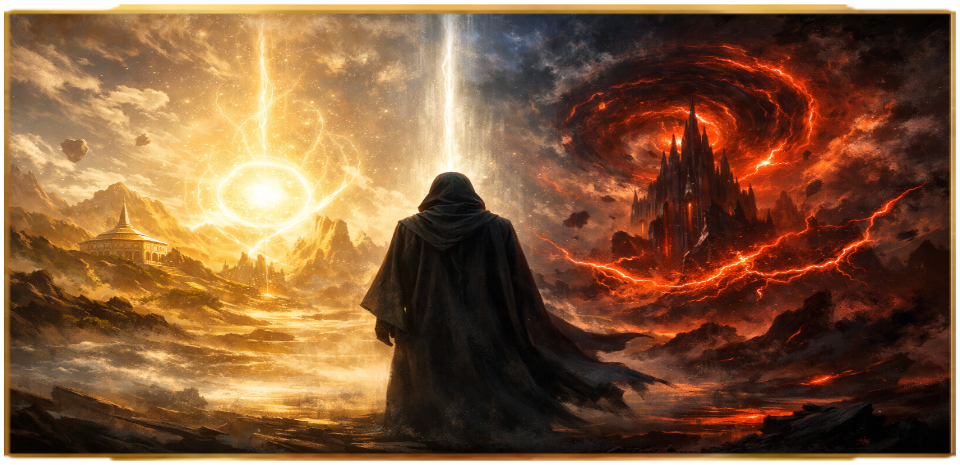
Abstraction
I have heard the Force described as a coin with two faces, or a battlefield with two armies, Light and Dark locked in eternal struggle. That story is tidy. It is also, in my view, wrong at the root.
The Force is not born divided. The Force simply is: a living continuity that binds, moves, reveals, and answers. What people call “light” and “dark” are not inherent halves of the Force. They are outcomes, shadows cast by the intent of the wielder.
In this dissertation I argue that the so-called Dark side is not a rightful counterpart but a corruption: an illness of relationship between a being and the Force. I further argue that intent is the axis upon which balance turns. Not emotion, emotion arrives like weather, but intent: what I choose to do with what I feel. Negative intent feeds corruption, and corruption feeds negative intent in return, until the wielder cannot tell the difference between power and peace.
I. Introduction: The Lie That Sounds Like Wisdom
Most of us inherit the dichotomy before we ever touch the Force with our own hands. “Light” is offered as virtue, “Dark” as temptation, and we are taught to pick a side as if the cosmos itself requires a pledge.
I do not deny that there are luminous acts and monstrous acts. I deny only this: that the Force contains moral factions the way nations contain borders.
When I say the Force is neither light nor dark, I am not trying to blur morality into fog. I am trying to locate morality where it actually lives, inside the will. Inside choice. Inside the part of us that decides whether power will become stewardship or domination.
If the Force is neutral, then we cannot blame it for what we do. And that, I think, is precisely why so many prefer the old story.
II. The Force as It Is: Unity Before Labels
The Force is a field of relation. I feel it in breath and blood, in the tension between two people who love each other and in the silence after betrayal. It is present in growth and decay, in birth and grief, in the minute decision to spare and the grand decision to conquer.
It does not speak in commandments. It responds like water responds to the shape of the channel.
If you want a simple image: a river does not become holy because it nourishes crops, nor evil because it floods a village. The river is power and motion. The moral story begins when hands reach into it, when someone diverts it, poisons it, hoards it, or shares it.
The Force is like that. The division is not in the Force. The division is in us.
III. Why the Dichotomy Persists
If what I say is true, then why does the Light/Dark story feel so accurate to so many?
Because it is useful.
It is useful to teachers because binaries are easier than nuance. It is useful to institutions because a binary makes policing simple. It is useful to frightened people because it relocates the source of their worst impulses into an external enemy.
And it is useful to the corrupted, most of all, because it offers them an alibi:
The Dark side took me.
No. You stepped toward it. Again and again, until the ground beneath you remembered the shape of your feet.
IV. The Dark Side Is Corruption
Here is the line I draw, and I draw it without apology:
The “Dark side” is not a side. It is corruption.
Corruption is not sadness. Corruption is not fear. Corruption is not even anger. Those things are part of being alive. I have felt them all. I still do.
Corruption begins when I choose an intent that turns the Force into a lever for violation.
When I reach for domination.
When I decide someone else’s autonomy is an inconvenience.
When I convince myself that the quickest path is the truest path.
When I treat another being as fuel.
That is corruption: not an emotion, but a posture.
Some say the Dark side is merely “passion” unchained. I reject that definition because it makes cruelty sound romantic. Passion can build. Passion can heal. Passion can protect. Corruption is something more specific: passion made predatory. Passion that demands a victim.
V. Intent: The True Axis of Balance
Balance is not a color you wear. It is not a creed you recite. It is not even the absence of conflict inside the mind.
Balance is alignment, between power, purpose, and responsibility.
I have seen people commit “light” acts for dark reasons: saving someone only to own them, comforting someone only to control them, forgiving someone only to appear righteous. I have also seen terrible necessity: harm inflicted to prevent greater harm, violence used to stop violence. I do not celebrate that, but I refuse to lie about the world.
So I return, always, to intent.
What do I want?
Why do I want it?
What am I willing to do to get it?
And what will I become if I keep choosing the same answers?
Intent is the seed. Technique is only the tool.
VI. How Negative Intent Feeds Corruption
I have come to believe this with the kind of certainty that is earned the hard way:
Negative intent is food for corruption.
When I act from spite, the Force does not become spiteful, but my relationship to the Force becomes distorted. I begin to crave the clean certainty of winning. I begin to prefer outcomes over ethics. I start calling mercy naïve and restraint weakness, because those words make it easier to continue.
And once power proves effective, it becomes persuasive.
This is how the descent happens, not as a single dramatic fall, but as a loop:
- I choose domination, revenge, humiliation, possession.
- Power answers, because power always answers.
- The result “works.” Resistance breaks. Fear spreads.
- I feel reinforced: See? I was right.
- My perception narrows: everyone becomes threat or tool.
- I choose domination again, but larger, because the first dose no longer satisfies.
That is corruption’s rhythm. It is not mystical. It is behavioral. It is addiction dressed as destiny.
VII. The Counterfeit Peace
One of the most dangerous things corruption can give you is quiet.
Not the quiet of clarity, the quiet of anesthesia.
When you stop caring about the inner lives of others, the world becomes simpler. When you stop holding yourself accountable, you sleep more easily. When you declare that only strength matters, you never again have to wrestle with doubt.
Many corrupted wielders believe they are balanced because they are calm. But calm is not virtue. Calm can be emptiness. Calm can be the stillness of a dead thing.
I measure balance differently: by what I can hold without breaking.
Can I feel anger without becoming cruel?
Can I feel fear without becoming possessive?
Can I grieve without demanding someone else bleed to pay for it?
That is balance: not numbness, but integrity under pressure.
VIII. Stewardship: The Discipline That Prevents Corruption
If the Force is neutral, then morality is not enforced by nature. It must be practiced.
I call that practice stewardship.
Stewardship is not meekness. It is not passivity. It is not refusing to act. It is acting while refusing to become a tyrant inside your own soul.
For me, stewardship requires three disciplines:
Witnessing — I learn to look directly at my motives without immediately defending them.
Refusal — I practice saying no to the shortcut even when it would succeed.
Repair — I accept that power creates harm even when used with care, and I commit to making amends rather than inventing excuses.
I do not trust any philosophy that speaks only of purity and never of repair. If you wield the Force and never need to repair, you are either lying—or you are not looking closely enough.
IX. Integrity Over Purity
Some traditions worship the Light like an idol and call that righteousness. Some romanticize darkness and call it honesty. I have found both positions to be temptations in different clothing.
Purity is often pride wearing a white robe.
Integrity is harder. Integrity admits complexity without surrendering principle. Integrity looks at a temptation and names it without bargaining.
My ethic is this: I will not use power to make myself the center of another being’s world. I will not call domination “order.” I will not call revenge “justice.” I will not call cruelty “truth.”
When I fail, as all beings do, I will not hide behind doctrine. I will repair what I can, and I will change what I must.
X. The Practical Implications
If you accept what I argue, training must change.
Do not teach students merely to fear certain techniques. Teach them to recognize the early signs of negative intent:
- the thrill of making someone small
- the comfort of certainty at any cost
- the habit of justification
- the desire to “solve” people instead of understanding them
Teach them that emotion is not the enemy. Deception is. Rationalization is. Hunger is.
And if someone has already been corrupted, do not treat redemption like a poem. Redemption is work. It is unlearning. It is accountability. It is turning away from the loop and enduring the pain of being human again.
XI. Conclusion: The Force Is Whole; I Must Choose
I return to where I began.
The Force is not split into moral teams. The Force is a whole. It is not light. It is not dark. It is relation, waiting, responding, flowing.
What people call “light” is what happens when I meet that relation with care, clarity, and restraint.
What people call “dark” is what happens when I meet it with domination, possession, and contempt, and then keep meeting it that way until corruption feels like identity.
The Force will not save me from myself.
The Force will not condemn me, either.
I will be balanced only insofar as I refuse to feed corruption with negative intent, and choose, again and again, to wield power as stewardship rather than hunger.
That is the dichotomy.
Not in the Force.
In me.